MP Board Class 9th Hindi Solutions वासंती, नवनीत

MP Board Class 9th Hindi Solutions वासंती, नवनीत

MP Board Class 9th Hindi Solutions Guide Pdf Free Download of हिंदी वासंती, नवनीत are part of MP Board Class 9th Solutions. Here we have given Madhya Pradesh Syllabus MP Board Class 9 Hindi Book Solutions Vasanti, Navneet Pdf Special and General.

MP Board Class 9th Hindi Book Solutions Vasanti

Here we have given MP Board Class 9 General Hindi Vasanti Solutions Hindi Samanya Kaksha 9 (वासंती हिंदी सामान्य कक्षा 9).

Vasanti Hindi Book Class 9 Solutions

MP Board Class 9 General Hindi व्याकरण

MP Board Class 9th Hindi Book Solutions Navneet

Here we have given MP Board Class 9 Special Hindi Navneet Solutions Hindi Vishisht Kaksha 9 (नवनीत हिंदी विशिष्ट कक्षा 9).

Navneet Hindi Book Class 9 Solutions

पद्य साहित्य

गद्य साहित्य

एकांकी

कहानी

MP Board Class 9 Special Hindi सहायक वाचन Solutions

MP Board Class 9 Special Hindi व्याकरण

MP Board Class 9 General Hindi Syllabus & Marking Scheme

क्रमविषय सामग्रीअंककालखंड
1.पद्य खंड
-एक पद्यांश की व्याख्या
-काव्य-सौंदर्य पर आधारित प्रश्न
-विषय वस्तु
2540
2.गद्य खंड
अर्थ ग्रहण संबंधी विषय वस्तु पर आधारित प्रश्न
2540
3.हिन्दी साहित्य का इतिहास
काल विभाजन (सामान्य परिचय)
0510
4.व्याकरण
उपसर्ग, प्रत्यय
वर्तनी संशोधन
तत्सम, तद्भव, देशज शब्द
पर्यायवाची शब्द, अनेकार्थी शब्द,
विलोम शब्द वाक्यांश के लिए एक शब्द
वाक्य शुद्ध करना, मुहावरे/लोकोक्तियाँ
2030
5.अपठित बोध
पद्यांश/गद्यांश-शीर्षक सारांश एवं प्रश्न
1015
6.पत्र-लेखन0510
निबन्ध लेखन1015
पुनरावृत्ति20
योग100180

MP Board Class 9 Special Hindi Syllabus & Marking Scheme

क्रमविषय सामग्रीअंककालखंड
1.पद्य खण्ड –
पद्य साहित्य का विकास
कवि परिचय, व्याख्या, सौन्दर्य बोध तथा
भाव एवं विषय वस्तु पर आधारित प्रश्न
4 + 23 = 2740
2.गद्य खण्ड –
गद्य की विविध विधाएँ
लेखक परिचय, व्याख्या, गद्य पाठों पर आधारित
विचार बोध एवं विषय बोध पर प्रश्न
4 + 19 = 2335
3.सहायक वाचन –
विविध पाठों पर आधारित प्रश्न
आँचलिक भाषा के पाठों पर आधारित प्रश्न
1015
4.भाषा बोध-
उपसर्ग, प्रत्यय, तत्सम, तद्भव, देशज, आगत शब्द, रूढ़, यौगिक, योग रूढ़, वर्तनी परिचय एवं सुधार, पर्यायवाची, विलोम, अनेकार्थी शब्द मुहावरे एवं लोकोक्तियों का अर्थ प्रयोग
1015
5.काव्य बोध-
काव्य की परिभाषा एवं भेद – मुक्तक काव्य, प्रबंध काव्य
रस – परिभाषा, अंग, भेद, उदाहरण
अलंकार – अनुप्रास, यमक, श्लेष, उपमा, रूपक, उत्प्रेक्षा
छंद – परिभाषा, मात्रिक, वर्णिक, दोहा, चौपाई
1015
6.अपठित बोध0510
7.पत्र लेखन0510
8.निबंध लेखन1020
पुनरावृत्ति20
योग100180

निर्धारित पाठ्यपुस्तक – “नवनीत”
(गद्य पद्य संकलन) सहायक वाचन समाहित

पद्य खण्ड- (27 Marks)

  • पद्य साहित्य का विकास : आदिकाल (वीरगाथा काल) एवं भक्ति काल, सामान्य परिचय पर प्रश्न (4 Marks)
  • पद्य पाठों पर आधारित कवि का संक्षिप्त साहित्यिक परिचय पर प्रश्न (रचनाएँ, काव्यगत विशेषताएँ) (5 Marks)
  • दो में से एक पद्यांश की सप्रसंग व्याख्या (5 Marks)
  • सौन्दर्य बोध पर आधारित प्रश्न (7 Marks)
  • भाव एवं विषय वस्तु पर आधारित प्रश्न (6 Marks)

गद्य खण्ड- (23 Marks)

  • गद्य की विविध विधाओं का सामान्य परिचय पर आधारित प्रश्न (4 Marks)
  • लेखक का संक्षिप्त परिचय पर प्रश्न (रचनाएँ, भाषा, शैली) (5 Marks)
  • दो में से एक गद्यांश की प्रसंग सहित व्याख्या (5 Marks)
  • गद्य पाठों पर आधारित विचार बोध पर प्रश्न (5 Marks)
  • विषय बोध पर प्रश्न (4 Marks)

सहायक वाचन- (पाठ्य पुस्तक में समाहित) (10 Marks)

  • संकलित पाठों की विषय वस्तु पर प्रश्न

भाषा बोध- (10 Marks)

  • उपसर्ग/ प्रत्यय पर आधारित प्रश्न (2 Marks)
  • तत्सम, तद्भव, देशज, आगत, रूढ़, यौगिक, योगरूढ, शब्द पर प्रश्न (2 Marks)
  • वर्तनी परिचय/वर्तनी सुधार पर प्रश्न (2 Marks)
  • पर्यायवाची/विलोम/अनेकार्थी पर प्रश्न (2 Marks)
  • मुहावरे/लोकोक्तियाँ – अर्थ एवं प्रयोग पर प्रश्न (2 Marks)

काव्य बोध- (10 Marks)

  • काव्य की परिभाषा – भेद, मुक्तक काव्य, प्रबन्ध काव्य (खण्ड काव्य, महा काव्य) पर प्रश्न (4 Marks)
  • रस – परिभाषा, अंग, भेद, उदाहरण पर आधारित प्रश्न (2 Marks)
  • अलंकार – अनुप्रास, यमक, श्लेष, उपमा, रूपक, उत्प्रेक्षा पर प्रश्न (2 Marks)
  • छंद – मात्रिक, वर्णिक, दोहा, चौपाई छंद पर प्रश्न (2 Marks)

अपठित बोध- (5 Marks)

  • गद्यांश-शीर्षक, सारांश/प्रश्न पर प्रश्न
  • पद्यांश- शीर्षक, सारांश/प्रश्न पर प्रश्न

पत्र लेखन- (5 Marks)

  • पारिवारिक, विद्यालयीन, आवेदन पत्र, पर प्रश्न

निबन्ध लेखन- (10 Marks)

  • वर्णनात्मक, विवरणात्मक, एवं समसामयिक विषयों पर निबन्ध लेखन पर प्रश्न

प्रायोजना कार्य-

  • क्षेत्रीय बोली-पहेलियाँ, चुटकुले, लोकगीत, लोक कथाओं का परिचय तथा खड़ी बोली में उनका अनुवाद।
  • दूरदर्शन/आकाशवाणी के कार्यक्रम पर प्रतिक्रियाएँ/विश्लेषण।
  • हिन्दी साहित्य का स्वतंत्र पठन/टिप्पणी एवं प्रेरणाएँ।
  • हस्त लिखित पत्रिका तैयार करना।
  • म.प्र. से प्रकाशित होने वाली हिन्दी भाषा की पत्र पत्रिकाओं की जानकारी।

टिप्पणी-
प्रायोजना कार्य से सम्बन्धित विषय वस्तु पर(अंक आवंटित न होने के कारण) परीक्षा में प्रश्न पूछे जाना अपेक्षित नहीं है।
निर्धारित पाठ्यपुस्तक – “नवनीत” (गद्य पद्य संकलन) सहायक वाचन समाहित
मध्यप्रदेश राज्य शिक्षा केन्द्र द्वारा संकलित एवं निर्मित तथा मध्यप्रदेश पाठ्यपुस्तक निगम द्वारा प्रकाशित

MP Board Class 9 General Hindi Blue Print of Question Paper

You can download MP Board Class 9th Hindi Blueprint and Marking Scheme 2019-2020 in Hindi and English medium.

MP Board Class 9 Hindi Blue Print of Question Paper 1

MP Board Class 9 Special Hindi Blue Print of Question Paper

MP Board Class 9 Hindi Blue Print of Question Paper 2

We hope the given MP Board Class 9th Hindi Solutions Guide Pdf Free Download of हिंदी वासंती, नवनीत will help you. If you have any query regarding Madhya Pradesh Syllabus MP Board Class 9 Hindi Book Solutions Vasanti, Navneet Pdf Special and General, drop a comment below and we will get back to you at the earliest.
MP Board Class 8th General English Solutions Chapter 1 Another Chance

Guys who are planning to learn the fundamentals of English can avail the handy study material using MP Board Solutions for Class 8 General English Solutions Chapter 1 Another Chance Questions and Answers. You Can Download MP Board Class 8 English Solutions Questions and Answers, Notes, Summary, Guide, Pdf. Refer to the Madhya Pradesh State Board Solutions for English PDF available and score better grades. Simply click on the quick links available for MP Board Solutions for Class 8 General English Solutions Chapter 1 Another Chance Questions and Answers and prepare all the concepts in it effectively. Take your preparation to the next level by availing the Madhya Pradesh State Board Solutions for Class 8 English prepared by subject experts.

MP Board Class 8th General English Solutions Chapter 1 Another Chance

Do you feel the concept of English is difficult to understand? Not anymore with our MP Board Solutions for Class 8 General English Solutions Chapter 1 Another Chance Questions and Answers. All the Solutions are given to you with detailed explanation and you can enhance your subject knowledge. Use the Madhya Pradesh State Board Solutions for Class 8 English PDF for free of cost and prepare whenever you want.

Another Chance Textual Exercise

Listen and Repeat (सुनो और दुहराओ):
Do yourself.

Word Power
(शब्द सामर्थ्य):

(A) Read the poem and write the antonyms of the following words:
(कविता को पढ़ो और निम्नलिखित शब्दों के विलोम शब्द लिखो:)

  1. Success
  2. Stale
  3. Hope
  4. End
  5. Shallow.

Answer:

  1. failure
  2. fresh
  3. despair
  4. begin
  5. deep.

(B) Fill in the blanks with appropriate Vowels: ( उचित मात्राओं स्वरों से रिक्त स्थान भरो:)

  1. oft _ n
  2. bl _ t
  3. w _ sh
  4. forg _ve
  5. m _ stake.

Answer:

  1. e
  2. o
  3. i
  4. i
  5. i.

(C) Find the words that rhyme with the following: (तुकान्त शब्दों को ढूँढ़ो:)

  1. shine
  2. through
  3. start it
  4. beginning.

Answer:

  1. wine
  2. new
  3. heart
  4. winning.

Comprehension
(बोध प्रश्‍न):

(A) Answer the following questions: (निम्न प्रश्नों के उत्तर लिखोः)

(a) Why do we wish for another chance ?
(व्हाय डू वी विश फॉर एनदर चान्स ?)
हम एक और मौके की इच्छा क्यों करते हैं?
Answer:
We wish for another chance to change our failure into winning.
(वी विश फॉर एनदर चान्स टू चेंज आवर फेल्यर इन्टू विनिंग।)
हम एक और मौके की इच्छा इसलिए करते हैं ताकि हम अपनी हार को जीत में बदल सकें।

(b) What does it take to make a brand new start?
(व्हॉट डज़ इट टेक टू मेक अ ब्रैन्ड न्यू स्टार्ट?)
नई शुरुआत करने में क्या लगता है?
Answer:
It only takes a deep desire.
(इट ओन्ली टेक्स अ डीप.डिजायर।) इसमें सिर्फ तीव्र इच्छा लगती है।

(c) What does the poet mean by adding a little sunshine to the world ?
(व्हॉट डज द पोएट मीन बाय ऐडिंग अलिटल सनशाइन टू द वर्ल्ड?)
कवि का दुनिया में थोड़ी रोशनी फैलाने से क्या मतलब है?
Answer:
The poet means to make our life better and become something in this world.
(द पोयट मीन्स टु मेक आउर लाइफ बैटर एण्ड बिकम समथिंग इन दिस वर्ल्ड।)
कवि का मतलब है कि अपनी जिन्दगी को बेहतर बनाएँ और कुछ बनें।

(d) Why should we never give up in despair ?
(व्हॉय शुड वी नैवर गिव अप इन डिस्पेअर?)
हमें कभी निराश होकर क्यों नहीं छोड़ देना चाहिए?
Answer:
We should never give up in despair as there is always a tomorrow to start anew.
(वी शुड नैवर गिव अप इन डिस्पेअर ऐज़ देअर इज़ औलवेज़ अ टुमौरो टू स्टार्ट अन्यू) हमें निराश इसलिए नहीं होना चाहिए क्योंकि कल अवश्य आता है।

(e) What should we hope for our future?
(व्हॉट शुड वी होप फॉर आवर फ्यूचर ?)
हमें अपने भविष्य के बारे में क्या उम्मीद रखनी चाहिए?
Answer:
We should hope for starting new and winning in the future.
(वी शुड होप फॉर स्टार्टिंग न्यू ऐन्ड विनिंग इन द फ्यू चर।)
हमें नई शुरुआत और जीत के बारे में सोचना चाहिए।

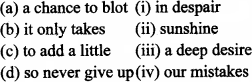
(B) Match the following: (निम्न का मिलान कीजिए:)
Another Chance Poem Class 8 MP Board
Answer:
(a) (iv) our mistakes
(b) (iii) a deep desire
(c) (ii) sunshine
(d) (i) in despair

Let’s Read
(आओ पढ़ें):

Read the passage carefully and answer the following questions:
(गद्यांश को पढ़ो और नीचे लिखे प्रश्नों के उत्तर दोः)

Another Chance Poem Class 8 MP Board Question 1.
What was the challenge ? (व्हॉट वॉज द चैलेंज?) क्या चुनौती थी?
Answer:
The challenge was who could fly higher while carrying sacks of same size.
(द चैलेन्ज वॉज हू कुड फ्लाए हायर व्हाइल कैरिंग सैक्स ऑफ सेम साइज।)
चुनौती यह थी कि बराबर आकार की बोरी लेकर कौन ज्यादा ऊँचा उड़ सकता है।

Class 8 English Chapter 1 Another Chance MP Board Question 2.
What was there in the first crow’s sack?
(व्हॉट वाज देअर इन द फर्स्ट क्रोज सैक ?) पहले कौए के बोरे में क्या था ?
Answer:
There was cotton in the first crow’s sack.
(देअर वॉज कॉटन इन द फर्स्ट क्रोज सैक।) पहले कौए के बोरे में रुई थी।

Another Chance Poem MP Board Question 3.
What was there in the second crow’s sack?
(व्हॉट वॉज देअर इन द सैकिण्ड क्रोज सैक ?)
दूसरे कौए के बोरे में क्या था ?
Answer:
There was salt in the second crow’s sack.
(देअर वॉज साल्ट इन द सैकिन्ड क्रोज सैक।)
दूसरे कौए के बोरे में नमक था।

Another Chance Poem Class 8 Pdf MP Board Question 4.
Who was expecting rain ?
(हू वॉज एक्सपैक्टिंग रेन ?)
कौन बारिश की उम्मीद कर रहा था ?
Answer:
The second crow was expecting rain.
(द सैकिन्ड क्रो वॉज एक्सपैक्टिंग रेन।)
दूसरा कौआ बारिश की उम्मीद कर रहा था।

Another Chance Question Answer MP Board Question 5.
Who was defeated ?
(हू वाज डिफीटिड ?)
कौन हार गया ?
Answer:
The first crow was defeated.
(द फर्स्ट क्रो वॉज़ डिफीटिड।)
पहला कौआ हार गया।

Let’s Write
(आओ लिखो):

Write a paragraph on ‘A night before the examination’, using the expressions given.
(निम्न अभिव्यक्तियों का प्रयोग कर ‘परीक्षा से पूर्व एक रात्रि’ पर एक गद्यांश लिखो।)
Answer:
One is very much worried and confused on the night before the examination. The books and notes lie scattered in the whole room. One is cramming and feeling that he is forgetting everything. He searches for the expected questions and tries to revise them at last. He is unable to have his food or sleep. The parents become very angry and say that it is nothing but the fear of examination and sheer lack of self-confidence.

Let’s Do It
(आओ इसे करें):

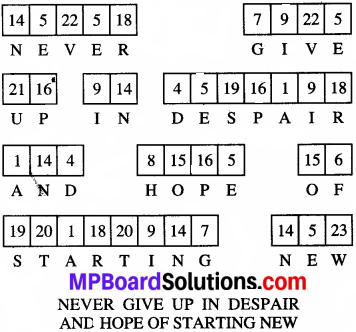
A number has been given to each letter of the alphabet in the table below. Read the table and decode the message.
(निम्न सारणी में वर्णमाला के प्रत्येक अक्षर के लिए एक संख्या दी गई है। सारणी को पढ़ो और संदेश को स्पष्ट करो।)
Answer:
Class 8 English Chapter 1 Another Chance MP Board

Another Chance Word Meanings

wish (विश) – इच्छा करना; Another (एनदर) – एक और; Chance (चान्स) – अवसर मौका; Fresh (पॅश) – ताजी नयी; Beginning (बिगनिंग) – शुरुआत, प्रारम्भ; Blot out (ब्लॉट आउट) – सुधारना; Mistakes (मिस्टेक्स) – गल्तियाँ; Failure (फेल्यर) – असफलता; Desire (डिजायर) – इच्छा; Sunshine (सनशाइन) – धूप; Give up (गिव अप) – छोड़ना; Despair (डिस्पेअर) – निराशा। Hope (होप) – आशा; Often (ऑफन) – अक्सर; Brand new (ब्रैन्ड न्यू) – बिल्कुल नयी; Deep (डीप) – गहरी; Heart (हार्ट) – दिल; Better (बैटर) – बेहतर; World (वड) – जगत; Through (श्रू) – पार होना; Starting (स्टार्टिंग) – शुरू करना।

Another Chance Summary, Pronunciation & Translation

1. How often we wish for another chance
To make a fresh beginning,
A chance to blot out our mistakes,
And change failure into winning.
(हाऊ ऑफन वी विश फॉर एनअदर चान्स
टु मेक अ फ्रेश बिगनिंग
अ चान्स टु ब्लॉट आउट अवर मिस्टेक्स,
एण्ड चेन्ज फेल्यर इनटू विनिंग।)

Lesson 1 Another Chance MP Board अनुवाद:
हम कई बार यह चाहते हैं कि हमें अपनी गल्तियों को सुधारने, और असफलता को सफलता में परिवर्तित करने के लिए एक और अवसर मिल जाये।

2. It does not take a new day
To make a brand new start,
It only takes a deep desire
To try with all our heart.
(इट डज नॉट टेक अ न्यू डे
टु मेक अ ब्रान्ड न्यू स्टार्ट,
इट ऑनली टेक्स अ डीप डिजायर
टु ट्राई विद ऑल अवर हार्ट।)

The Poem Another Chance Tell Us MP Board अनुवाद:
एक बिल्कुल नयी शुरुआत करने के लिए किसी नये समय या दिन की आवश्यकता नहीं है। इसके लिए केवल हमें तीव्र इच्छा और पूर्ण समर्पण के साथ शुरुआत करने की जरूरत है।

3. To live a little better
And to be always forgiving,
And to add a little sunshine
To the world in which we’re living.
(टु लिव अ लिटल बैटर,
एण्ड टु बी ऑलवेज फॉरगिविंग,
एण्ड टु ऐड अ लिटल सनशाइन
टु द वर्ल्ड इन विच वी आर लिविंग।)

Another Chance Poem Questions And Answers MP Board अनुवाद:
हमें अपने जीवन को कुछ बेहतर बनाने, सदैव दूसरों को क्षमा करते रहने, और उस संसार को जहाँ हम रहते हैं, अधिक प्रकाशवान बनाने के लिए एक नई शुरुआत करनी है।

4. So never give up in despair
And think you are through,
For there’s always a tomorrow
And the hope of starting anew.
-Helen Steiner Rice
(सो नैवर गिव अप इन डिस्पेअर
एण्ड थिंक यू आर श्रू,
फॉर देयर इज ऑलवेज अ टुमोरो
एण्ड द होप ऑफ स्टार्टिंग ऐन्यू।)

Class 8 English Chapter 1 Another Chance Question Answer अनुवाद:
इसलिए कभी निराश मत हो और सोचो कि तुम्हें आगे बढ़ना है क्योंकि एक नयी शुरुआत की आशा के साथ कल अवश्य आता है।
-हैलन स्टीनर राइस

We wish the knowledge shared regarding MP Board Solutions for Class 8 General English Solutions Chapter 1 Another Chance Questions and Answers has been helpful to you. If you need any further help feel free to ask us and we will get back to you with the possible solution. Bookmark our site to avail the latest updates on different state boards solutions in split seconds.

MP Board Class 8th Science Solutions विज्ञान

MP Board Class 8th Science Solutions विज्ञान

MP Board Class 8th Science Solutions Guide Pdf Free Download विज्ञान in both Hindi Medium and English Medium are part of MP Board Class 8th Solutions. Here we have given NCERT Madhya Pradesh Syllabus MP Board Class 8 Science Book Solutions Vigyan Pdf.

MP Board Class 8th Science Solutions विज्ञान

MP Board Class 8th Science Book Solutions in Hindi Medium

MP Board Class 8th Science Book Solutions in English Medium

We hope the given MP Board Class 8th Science Solutions Guide Pdf Free Download विज्ञान in both Hindi Medium and English Medium will help you. If you have any query regarding NCERT Madhya Pradesh Syllabus MP Board Class 8 Science Book Solutions Vigyan Pdf, drop a comment below and we will get back to you at the earliest.
MP Board Class 9th English Solutions The Rainbow, The Spring Blossom

MP Board Class 9th English Solutions The Rainbow, The Spring Blossom

Madhya Pradesh State Board Solutions for Class 9 English provided helps students to clear their exam with flying colors Assess your preparation level by practicing from the MP Board Solutions for Class 9 English and Free Download of Text Books Questions and Answers, Notes, Summary, Guide pdf. Practice as often as possible and understand the toughest topics too easily with our detailed MP Board Solutions for English. All the Solutions are given to you after sample research by the subject expertise and you can rely on them to clear your queries.

MP Board Textbook Solutions for Class 9 English lay a stronger foundation for your basics in the future. Download the Madhya Pradesh State Board Solutions for Class 9 English and prepare whenever you want. You just need to tap on the Chapterwise links available out there for the Subject to access various topics underlying.

MP Board Class 9th English Book Solutions

Students preparing for MP Board Solutions for Class 9 English Exam can make the most out of the Chapter Wise and learn concept wise easily. Consistent Practice is the only key to score high in your exams and try solving as many questions as possible. Get a good hold of the concepts by using our Madhya Pradesh State Board Solutions for Class 9 English.

The Rainbow Textbook Special English Class 9th Solutions

The Rainbow Workbook Special English Class 9th Solutions

You can download MP Board The Rainbow Workbook Special English Class 9th Solutions and Answers.

MP Board Class 9th Special English Reading Skills

MP Board Class 9th Special English Reading Unseen Passages

MP Board Class 9th Special English Writing Skills

MP Board Class 9th Special English Grammar

The Spring Blossom Textbook General English Class 9th Solutions

You can download MP Board The Spring Blossom Textbook General English Class 9th Solutions, Questions and Answers, Notes, Summary, Lessons: Pronunciation, Translation, Word Meanings, Textual Exercises.

Objective Type Questions [Based on Textual Lessons]

MP Board Class 9th General English Reading Skills

MP Board Class 9th General English Reading Unseen Passages

MP Board Class 9th General English Writing Skills

MP Board Class 9th General English Grammar

MP Board Class 9th Special English Syllabus & Marking Scheme

Time: 3.00 Hours
Maximum Marks: 100

Unit Wise Weightage

SectionTopicsMarks
AReading Skills (Reading Unseen Passages)30
BWriting Skills30
CGrammar15
DPrescribed Text Book25
Total100

Examination Specifications
Class – IX

On Paper 3 Hours
100 Marks

Section A: Reading (30 Marks, 54 Periods)

Three unseen passages with a variety of comprehension questions including 05 marks for word attach skill such as word formation and inferring meaning.

  • About 200 words in length (8 Marks)
  • About 200 words in length (8 Marks)
  • About 300 words in length (14 Marks)

The total length of the three passages will be between 600 and 700 words.
The passages will include one of each of the following types.
Factual passage, e.g. instruction, description, report.
Discursive passage involving opinion e.g. argumentative, persuasive or interpretative text.
Literary passage, e.g. extract from fiction, drama, poetry, essay or biography
In the case of Poetry extract, the text may be shorter than 150 words.

Section B: Writing (30 Marks, 54 Periods)

Four Writing Tasks indicated below:

  1. Controlled tasks where a student builds up a short composition with guidance. (5 Marks)
  2. Short composition of not more than 50 words, e.g. a not, notice, message, telegram or short postcard. (5 marks.)
  3. Composition in response to some verbal stimulus such as an advertisement, a notice, a newspaper clipping, a table, a diary extract notes, letter or other forms of correspondence. (10 Marks)
  4. Composition response to some visual stimulus such as a diagram, a picture, a graph, a map, a cartoon or a flow chart. (10 Marks)

One of the longer (10 marks) compositions will draw on the thematic content of the Main Course Book.
At least one task will involve, the productions of a form of correspondence, e.g. a letter, postcard, note or notice.
One task will involve the production of a discursive text in which the student is required to express his/her point of view on the topic given.

Section C: Grammar (15 marks)

A variety of short questions involving the use of particular structures within a context (i.e. not in isolated sentences) Test types used will include, for example, gap-filling, cloze (gap filling exercise with blanks at regular intervals) sentence completion, sentence-reordering, editing, dialogue, Completion and sentence transformation.
Not all elements in the grammar syllabus can be included in the questions paper every year.
However, questions will be distributed over the following three broad areas: verb forms, sentences, structures and others.

Section D: Literature (25 Marks, 45 Periods)

  1. Two extracts from different poems from the prescribed reader, each followed by two or three questions to test local and global comprehension of the set text. Each extract will carry 4 marks. (8 Marks)
  2. One or two questions based on one of the drama texts from the prescribed reader to test local and global comprehension of the set text. An extract may or may not be used. (8 Marks)
  3. One question based on one of the prose texts from the prescribed reader to test global comprehension and extrapolation beyond the set text. (4 Marks)
  4. Extended questions based on one of the prose texts from the prescribed reader to test global comprehension and extrapolation beyond the set text. (8 Marks)
    Questions will test comprehension at different levels: literal inferential and evaluative.

Final Examination

This is a formal three-hour examination held at the end of Class IX and carries 100% marks. It tests all the reading and writing skills specified in the teaching/testing objectives, together with a representative sample of the Literature and Grammer objectives.

Book Prescribed:

  1. Text Book The Rainbow with Supplementary Material.
  2. Work Book The Rainbow

Compiled by M.P. Rajya Shiksha Kendra and Published by M.P. Text Book Corporation. Bhopal.

MP Board Class 9th General English Syllabus & Marking Scheme

Time: 3.00 Hours
Maximum Marks = 100

Unit wise Weightage

SectionTopicsMarksTime
AReading Skills Reading and Comprehension1527 Periods
BWriting Skills2036 Periods
CGrammar2036 Periods
DPrescribed Text Book4581 Periods

Examination Specifications

Section A: Reading (15 Marks)

A1, A2 and A3 three unseen passages of total 250 words with a variety of questions including 6 marks for vocabulary.
The prose passage will be factual (instructions, description, report etc), discursive (argumentative, interpretative, persuasive, etc) and literary (poetry, fiction, interview, biography, etc) in nature.

  • Passage 1. 80 words (5 marks)
  • Passage 2. 80 words (5 marks)
  • Passage 3. 80 words (5 marks)

There will be questions for local comprehension besides questions on vocabulary and comprehension of higher-level skills such as drawing inferences and conclusions.

Section B: Writing (20 Marks)

B1. Letter writing: One letter based on provided verbal stimulus and context. (6 Marks)
Type of Letter: informal: personal such as to family and friends
Formal: letters of complaints, enquiries, requests, applications.

B2. Note making and summarising: (6 Marks)

  • Students will be asked to make notes on the passage given (100 words) (3 Marks)
  • The students will be asked to prepare a summary looking at the given notes. (3 Marks)

B3. Composition: A short writing task based on a verbal and/or visual stimulus (diagram, picture, graph, map, chart, table, flow chart etc) (80 words) (8 Marks)
OR
An essay in about 200 words on topics of day to day life.
After giving an example practice to students to write an original composition for two or three years, the option of ‘Essay’ may be eliminated.

Section C: Grammar and Translation (20 Marks)

A variety of short questions involving the use of particular structures within a context. Test Types used will include clauses, gap-filling, sentence completion, sentence re-ordering, editing, dialogue-completion and sentence transformation. The Grammar syllabus for this class will include the following areas for teaching.

1. Tenses (present with extension);
2. Modals (have to/had to, must, should, need, ought to and their negative forms);
3. Use of passive voice;
4. Subject-verb concord;
5. Reporting; (i) Commands and requests, (ii) Statements, (iii) Questions
6. Clauses: (i) Noun-clauses (ii) Adverb clauses of condition and time (iii) Relative clauses;
7. Determiners, and
8. Prepositions
9. Translation (from Hindi to English)
Note: No separate marks allotted for any of grammatical items listed above.

4. Section D: Text Book (45 Marks)

Prose 30 (Marks)

D.1 and D.2 – Two extracts from different prose lessons included in Text Book (approximately 100 words each) (5 × 2 = 10 Marks)
These extract chosen from different lessons will be literary and discursive in nature. Each extract will be of 5 marks. One mark in each extract will be for vocabulary. 4 marks in each passage will be used for testing local and global comprehension besides a question on interpretation.

D.3. One out of two questions: based on any one of the prose lesson from the textbook to be answered in about 50 to 80 words. (6 Marks)

D.4 (A) One out of two questions on drama text (local and global comprehension questions) (50-80 words) (6 Marks)
(B) One out of two questions on drama text in (25-30 words) (4 Marks)

D.5. Four objective type question based on Text. (4 Marks)

Poetry (15 Marks)

D.6. One out of two extracts from different poems from the prescribed reader, each followed by two or three questions to test the local and global comprehension of the set text. (3 Marks)

D.7. Two out of three short answer type questions on substance and ideas contained in the poems to be answered in about 20-25 words each. (6 Marks)

D.8. One out of two short answer type questions central idea of the poems. (4 Marks)

D.9. Objective text based on poetry. (2 Marks)

Book Prescribed:

  1. Text Book – Spring Blossom
  2. WorkBook – Spring Blossom

Compiled by M.P. Rajya Shiksha Kendra and Published by M.P. Text Book Corporation.

MP Board Class 9 Special English Blue Print of Question Paper

You can download MP Board Class 9th English Blueprint and Marking Scheme 2019-2020 in Hindi and English medium.

MP Board Class 9 English Blue Print of Question Paper 3
MP Board Class 9 English Blue Print of Question Paper 4

MP Board Class 9 General English Blue Print of Question Paper

MP Board Class 9 English Blue Print of Question Paper 1MP Board Class 9 English Blue Print of Question Paper 2

MP Board Class 9 Special English Format of Question Paper Design

MP Board Class 9 English Format of Question Paper 3
MP Board Class 9 English Format of Question Paper 4

MP Board Class 9 General English Format of Question Paper Design

MP Board Class 9 English Format of Question Paper 1
MP Board Class 9 English Format of Question Paper 2

Hope the information shared on our page regarding MP Board Solutions for Class 9 English has enlightened you in some or the other way. If you feel any information is missing or needs to be added feel free to reach us and we will revert back to you at the soonest possibility. Stay connected to our site to avail latest updates in no time.

MP Board Class 8th Sanskrit Solutions सुरभिः

MP Board Class 8th Sanskrit Solutions सुरभिः

MP Board Class 8th Sanskrit Solutions Guide Pdf Free Download संस्कृत सुरभिः are part of MP Board Class 8th Solutions. Here we have given Madhya Pradesh Syllabus MP Board Surbhi Sanskrit Book Class 8 Solutions Pdf.

MP Board Class 8th Sanskrit Book Solutions Surbhi

Here we have given MP Board Surbhi Samanya Sanskrit Book Class 8 Solutions Kaksha 8 (संस्कृत सामान्य सुरभिः कक्षा 8).

Surbhi Sanskrit Book Class 8 Solutions

8 वीं कक्षा संस्कृत गाइड Mp Board – पाठ का हिन्दी अनुवाद, शब्दार्थ एवं अभ्यास

MP Board Class 8th Sanskrit Model Question Paper (आदर्श प्रश्नपत्रम्)

We hope the given MP Board Class 8th Sanskrit Solutions Guide Pdf Free Download संस्कृत सुरभिः will help you. If you have any query regarding Madhya Pradesh Syllabus Surbhi Sanskrit Book Class 8 Solutions Mp Board, drop a comment below and we will get back to you at the earliest.
MP Board Class 6th General English Solutions Chapter 1 The Tree

Students who wish to prepare the English Subject can rely on the MP Board Solutions for Class 6 English Chapter 1 The Tree Questions and Answers prevailing. Become perfect with the concepts of Class 6 English Chapter 1 The Tree Questions and Answers, Chapter 1 The Tree, Summary, Notes, Guide, Pdf, by preparing you can score highest grade in your exams. Here, You Can Download MP Board Class 6 English Solutions. Detailed Solutions are provided to the concepts by experts keeping in mind the latest edition textbooks and syllabus.

MP Board Class 6th General English Solutions Chapter 1 The Tree

Ace up your preparation by referring to the Madhya Pradesh State Board Solutions for Class 6 Chapter 1 The Tree Questions and Answers and learn all the topics within. Click on the topic you want to prepare from the Class 6 English and prepare it easily. You can understand your strengths and weaknesses by learining the Questions and Answers in MP Board Solutions for Class 6 English PDF.

The Tree Textual Exercise

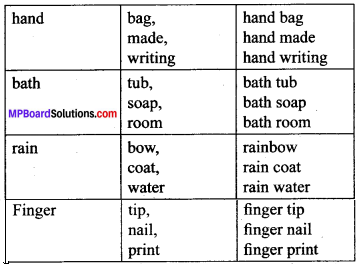
The Tree Class 6 MP Board Question 1.
Make new words by joining words:
(शब्दों को मिलाकर नये शब्द बनाओ)
Answer:
The Tree Class 6 MP Board

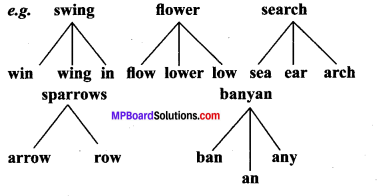
Class 6 English Chapter 1 The Tree MP Board Question 2.
Find the hidden words from the given words:
(दिये गये शब्दों से छिपे हुए शब्द ढूढ़ो)
Answer:
Class 6 English Chapter 1 The Tree MP Board

The Tree Spread Its MP Board Question 3.
Choose from the given words and fill in the blanks:
(दिये गये शब्दों में से छाँटकर रिक्त स्थानों को भरो)
(Village, tree, forty, juice, mangoes, sweet pickles).
Answer:
1. The mango tree in my village is forty years old.
2. It gives us mangoes. They are sweet.
3. My mother makes juice and pickles with them.
4. I like the mango tree.

Comprehension Questions
(बोध प्रश्न)

1. Answer the following questions:
(निम्नलिखित प्रश्नों के उत्तर दीजिए)

The Tree Class 6 Questions And Answers MP Board Question 1.
What is the lesson about?
(व्हॉट इज द लैसन अबाउट?)
पाठ किसके बारे में है?
Answer:
The lesson is about a tree.
(द लैसन इज़ अबाउट अट्री।)
पाठ एक पेड़ के बारे में है।

Lesson 1 The Tree MP Board Question 2.
What do the village children do when they get tired?
(व्हॉट डू द विलेज चिल्ड्रन डू व्हेन दे गैट टायर्ड)
ग्रामीण बच्चे थक जाने पर क्या करते हैं?
Answer:
The village children sleep under the tree shade when they get tired.
(द विलेज चिल्ड्रन स्लीप अन्डर द ट्री शेड व्हेन दे गैट टायर्ड।)
ग्रामीण बच्चे थक जाने पर पेड़ की छाँव में सो जाते हैं।

The Tree Poem Class 6 MP Board Question 3.
Why do the passers by sit under the tree?
(व्हाय डू द पासर्स बाय सिट अन्डर द ट्री ?)
गुजरने वाले यात्री पेड़ के नीचे क्यों बैठते हैं?
Answer:
The passers by sit under the tree to take rest.
(द पासर्स बाय सिट अन्डर द ट्री टु टेक रेस्ट।)
गुजरने वाले यात्री पेड़ के नीचे विश्राम करने के लिए बैठते हैं।

The Big Banyan Tree In Our Village Is Years Old Question 4.
Who take rest at night in the tree?
(हू टेक रेस्ट एट नाइट इन द ट्री?)
पेड़ में रात को कौन विश्राम करता है?
Answer:
Birds, small animals and insects take rest at night in the tree.
(बर्ड्स, स्मॉल एनिमल्स एण्ड इन्सेक्ट्स टेक रेस्ट एट नाइट इन द ट्री।)
चिड़ियाँ, छोटे जानवर और कीट रात को पेड़ में विश्राम करते हैं।

The Tree Lesson 1 Class 6 MP Board Question 5.
Where do we get fresh air from?
(व्हेयर डू वी गेट फ्रेश ऍअर फ्रॉम?)
हमें ताजी हवा कहाँ से मिलती है?
Answer:
We get fresh air from the tree
(वी गेट फ्रेश ऍअर फ्रॉम द ट्री।)
हमें ताजी हवा पेड़ से मिलती है।

Trees Poem Class 6 Questions And Answers MP Board Question 6.
What should we do for the tree?
(व्हॉट शुड वी डू फॉर द ट्री?)
हमें पेड़ कि लिए क्या करना चाहिए?
Answer:
We should always love and care for the tree.
(वी शुड ऑल्वेज़ लव एण्ड केयर फॉर द ट्री।)
हमें हमेशा पेड़ से प्यार करना चाहिए और उसकी देखभाल करनी चाहिए।

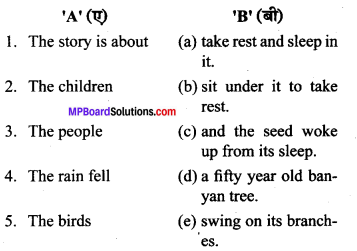
2. Match the column ‘A’ with column ‘B’
(कॉलम ‘A’ का कॉलम ‘B’ से मिलान कीजिए।)
The Tree Spread Its MP Board
Answers:
1. → (d)
2. → (e)
3. → b)
4. → (c)
5. → (a)

Grammar in Use
(व्याकरण प्रयोग)

1. Fill in the blanks:
(खाली स्थान भरें):
Answers:
The Tree Class 6 Questions And Answers MP Board

2. Use these words to complete the conversation.
(वार्तालाप को पूरा करने के लिए इन शब्दों का प्रयोग कीजिए।)
Yes, I do. No, I don’t.
Answer:
(A) Mona : Do you like trees?
Shalu       : Yes, I do.
Shalu       : Do you like bananas?
Mona       : No, I don’t.
Mona       : Do you like mangoes?
Shalu       : Yes, I do.

(B) Mohan : I like football, do you?
Shyam       : No, I don’t.

(C) Grandpa : I like walking, do you?
Grandson     : Yes, I do.

(D) Hariram : I like reading, do you?
Baliram        : No, I don’t. I like watching the T.V.

Let’s Talk
(आओ, बात करें) 

Work in groups. Discuss and find out the different uses of trees. Each group will list the different uses, then exchange the lists among themselves. Make a final list in the class.
(समूह में कार्य करें। चर्चा करें और पेड़ों के विभिन्न उपयोग को ढूढ़ें। प्रत्येक समूह अलग-अलग उपयोगों की सूची बनाएगा, तब वे एक-दूसरे से आपस में सूचियों का आदान-प्रदान करें। कक्षा में एक अन्तिम सूची तैयार anti)
Hints:
rainfall, carbon dioxide, oxygen, wooden table, pencils, paper, medicines
Answer:
The final list prepared would be as follows:

The Banyan Tree Is Biggest Tree In Our Village MP Board Uses of Trees
(पेड़ों के उपयोग)

  1. The trees bring rainfall.
  2. They take in carbon dioxide from the atmosphere and give out oxygen for us to breathe. They thus, make the air pure.
  3. The wood of the tree is used in making furniture like chairs, tables etc. and pencils.
  4. Paper is also made from its bark.
  5. Trees like neem and cinchona have medicinal value.
  6. Rubber is obtained from rubber tree.

Let’s Read
(आओ पढ़ें)

See the Passage and questions in the book.
(पद्यांश एवं प्रश्नों को पुस्तक से देखें।)
Answers:

  1. The poet see a tree – a crooked, grey tree in the park.
  2. In January, it has no leaves, its looks like an ugly tree.
  3. In February, it is covered with red and orange flowers.
  4. The poem is about a Dhak tree, the flame of the forest.
  5. (a) I see a tree in the park.
    (b) In February the tree is covered with flowers.

Let’s Write
(आओ लिखें) 

Write a paragraph on the uses of trees.
(पेड़ों के उपयोग पर एक पैराग्राफ लिखें।)
Answer:
Trees are very useful to us. They make the air pure by taking in carbon dioxide and giving out oxygen. The oxygen given by them is used by living beings in breathing. They bring rainfall and prevent floods. They also prevent soil erosion or washing away of soil. The remove pollution. Their wood is used in making furniture, pencils; and paper is made from its bark. Some trees like neem, tulsi and cinchona are medicinally important. They also add to the beauty of nature. Life without trees cannot be imagined.

Let’s Do
(आओ करें)

Collect leaves of different trees and paste them in your notebook.
(विभिन्न पेड़ों की पत्तियों को एकत्रित करो और अपनी नोट-बुक में चिपकाओ।)
Hint:
The students can collect leaves of different trees around them like peepal, neem, mango, Ashoka, gulmohar etc. and keep them in their notebooks for a few days so that they may dry. Then they can paste them in their notebooks.

The Tree Difficult Word Meanings 

Tree (ट्री)-पेड़, Shade (शेड)-छाया, often (आँफन)-अक्सर, Grandma (ग्राण्डमाँ)-दादी माँ, Stays (स्टेज)-खड़ा रहता है, Rain (रेन)-वर्षा, Seed (सीड)-बीज, Grew (ग्रियू)-बड़ा हुआ, Buried (बरीड)-दबा हुआ, Deep (डीप)-गहरा, Soil (सॉइल)-मिट्टी, Spread (स्प्रेड)-फैला दी, Woke up (वोक अप)-जागा, Wide (वाइड)-चौड़ी, Around (एराउण्ड)-चारों ओर, Gradually (ग्रेज्युअली)-धीरे-धीरे, Wider and wider (वाइडर एण्ड वाइडर)-दूर-दूर तक, Branches (ब्रान्चेज) -शाखाएँ, Tired (टायर्ड)-थका हुआ, Play (प्ले)खेलना, Swing (स्विंग)-झूलना, Rest (रेस्ट)-आराम, Move on (मूव ऑन)-चल देना, Sparrow (स्पैरो)गौरेया, Parrot (पैरट)-तोता, Pigeon (पिजन)-कबूतर, Crow (क्रो)-कौवे, Squirrel (स्कवायरल)-गिलहरी, Together (टुगेदर)-एक साथ, Fresh (फ्रेश)-ताजा, Useful (यूजफल)-उपयोगी।

The Tree Summary, Pronunciation & Translation 

1. I have a tree,
A green green tree,
To shade me from the sun,
Under it I often sit,
When all my work is done.
(आई हैव ए ट्री,
ए ग्रीन ग्रीन ट्री,
टू शेड मी फ्रॉम द सन,
अण्डर इट आई ऑफन सिट,
हैन ऑल माई वर्क इज डन।)

अनुवाद:
मेरे पास एक पेड़ है,
एक हरा-भरा पेड़,
धूप से मुझे छाया देने के लिए,
इसके नीचे मैं अक्सर बैठता हूँ,
जब मेरे सभी कार्य कर लिये जाते हैं।
-R.L. Stevenson
आर.एल. स्टीवेंसन

2. “The big banyan tree in our village is fifty years old”. Says grandma, “It stays day and night in the sun and rain.”
(“द बिग बनयान ट्री इन ऑवर विलेज इज फिफ्टी ईयर्स ओल्ड।” सेज ग्राण्डमा, “इट स्टेज डे एण्ड नाइट इन द सन एण्ड रेन।”)

अनुवाद:
“हमारे गाँव में पचास वर्ष पुराना एक विशाल बरगद का पेड़ है।” दादी माँ कहती हैं, “यह दिन-रात धूप और बरसात में खड़ा रहता है।”

3. The tree grew out of a little seed buried deep in the soil. When the rain fell, the seed woke up from its sleep. The day the sun shone, it opened its eyes wide and saw the world around. A plant was born.
(द ट्री ग्रियू आउट ऑफ ए लिटिल सीड बरीड डीप इन द सॉइल। व्हैन द रेन फैल, द सीड वोक अप फ्रॉम इट्स स्लीप। द डे दी सन शोन, इट ओपन्ड इट्स आइज वाइड एण्ड सॉ द वर्ड एराउण्ड। ए प्लांट वाज बोर्न।)

अनुवाद:
यह वृक्ष जमीन में गहरे गाढ़े गये एक छोटे से बीज से बड़ा हुआ था। जब बरसात हुई, बीज अपनी नींद से जागा। जिस दिन सूर्य चमका, इसने अपनी आँखें खोली और अपने चारों ओर के संसार को देखा। एक पौधे का जन्म हुआ।

4. Gradually the plant grew up into a big tree. It spread its branches, flowered every year and bore fruits like berry. It grew bigger and spread its branches wider and wider.
(ग्रेज्युली द प्लाण्ट ग्रियू अप इनटू ए बिग ट्री। इट स्प्रेड इट्स ब्रान्चेज, फ्लावर्ड एवरी ईयर एण्ड बोर फ्रूट्स लाइक बेरी। इट ग्रियू बिगर एण्ड स्पैड इट्स ब्रान्चेज वाइडर एण्ड वाइडर।)

अनुवाद:
धीरे-धीरे यह पौधा एक विशाल वृक्ष बन गया। इसने अपनी शाखाओं को फैलाया, हर वर्ष फूलों से लदा और बेरी जैसे फलों को धारण किया। यह बड़ा और बड़ा होता चला गया और इसने अपनी शाखाओं को दूर-दूर तक फैला दिया।

5. All the village children play near it. They swing on its branches and have fun. Sometimes, when they get tired, they sleep under its shade.
(ऑल द विलेज चिल्ड्रन प्ले नीयर इट। दे स्विंग ऑन इट्स ब्रान्चेज एण्ड हैव फन। समटाइम्स, हैन दे गैट टार्यड, दे स्लीप अण्डर इट्स शेड।)

अनुवाद:
गाँव के सभी बच्चे इसके निकट खेलते हैं। वे इसकी शाखाओं पर झूलते हैं और आनन्द लेते हैं। कभी-कभी जब वे थक जाते हैं तो वे इसकी छाँव में सो जाते हैं।

6. In the afternoons passers-by sit under the tree. They rest for sometime and move on.
(इन द आफ्टरनून्स पासर्स-बाई सिट अन्डर द ट्री। दे रैस्ट फॉर समटाइम एण्ड मूव ऑन।)

अनुवाद:
दोपहर में गुजरने वाले व्यक्ति पेड़ के नीचे बैठते हैं। वे कुछ समय के लिए आराम करते हैं और चल देते हैं।

7. The tree is a home for many birds, small animals and insects. Sparrows, parrots, pigeons, crows, squirrels and ants, they all live together. The tree gives fresh air too.
(द ट्री इज अ होम फॉर मेनी बर्ड्स, स्माल एनीमल्स एण्ड इन्सेक्ट्स स्पैरोज, पैरट्स, पिजन्स, मोज, स्क्वाइरल्स एण्ड आण्ट्स, दे ऑल लिव टूगेदर। द ट्री गिव्स फ्रैश एयर टू।)

अनुवाद:
पेड़ कई पक्षियों, छोटे जानवरों और कीटों का घर है। गौरेया, तोते, कबूतर, कौए, गिलहरियाँ और चीटियाँ, वे सभी मिलकर रहते हैं। वृक्ष ताजी हवा भी देता है।

8. “See how useful our tree is,” says grandma. “We should always love and care for it.”
(“सी हाउ यूजफुल ऑवर ट्री इज,” सेज ग्राण्डमा। वी शुड ऑल्वेज लव एण्ड केयर फॉर इट।)

अनुवाद:
दादी माँ कहती हैं, “देखो हमारा पेड़ कितना उपयोगी है”। “हमें सदैव इसे प्यार एवं इसकी देखभाल करनी चाहिए।”

Hope the data shared has shed some light on you regarding the MP Board Solutions of Class 6 English Chapter 1 The Tree Questions and Answers. Do leave us your queries via the comment section and we will guide you at the earliest with help seeked. Stay connected with our website and avail the latest information in a matter of seconds.

MP Board Class 8th Maths Solutions गणित

MP Board Class 8th Maths Solutions गणित

MP Board Class 8th Maths Solutions Guide Pdf Free Download गणित in both Hindi Medium and English Medium are part of MP Board Class 8th Solutions. Here we have given NCERT Madhya Pradesh Syllabus MP Board Class 8 Maths Book Solutions Ganit Pdf.

MP Board Class 8th Maths Solutions गणित

MP Board Class 8th Maths Book Solutions in Hindi Medium

MP Board Class 8th Maths Chapter 1 परिमेय संख्याएँ

MP Board Class 8th Maths Chapter 2 एक चर वाले रैखिक समीकरण

MP Board Class 8th Maths Chapter 3 चतुर्भुजों को समझना

MP Board Class 8th Maths Chapter 4 प्रायोगिक ज्यामिती

MP Board Class 8th Maths Chapter 5 आँकड़ो का प्रबंधन

MP Board Class 8th Maths Chapter 6 वर्ग और वर्गमूल

MP Board Class 8th Maths Chapter 7 घन और घनमूल

MP Board Class 8th Maths Chapter 8 राशियों की तुलना

MP Board Class 8th Maths Chapter 9 बीजीय व्यंजक एवं सर्वसमिकाएँ

MP Board Class 8th Maths Chapter 10 ठोस आकारों का चित्रण

MP Board Class 8th Maths Chapter 11 क्षेत्रमिति

MP Board Class 8th Maths Chapter 12 घातांक और घात

MP Board Class 8th Maths Chapter 13 सीधा और प्रतिलोम समानुपात

MP Board Class 8th Maths Chapter 14 गुणनखंडन

MP Board Class 8th Maths Chapter 15 आलेखों से परिचय

MP Board Class 8th Maths Chapter 16 संख्याओं के साथ खेलना

MP Board Class 8th Maths Book Solutions in English Medium

MP Board Class 8th Maths Chapter 1 Rational Numbers

MP Board Class 8th Maths Chapter 2 Linear Equations in one Variable

MP Board Class 8th Maths Chapter 3 Understanding Quadrilaterals

MP Board Class 8th Maths Chapter 4 Practical Geometry

MP Board Class 8th Maths Chapter 5 Data Handling

MP Board Class 8th Maths Chapter 6 Square and Square Roots

MP Board Class 8th Maths Chapter 7 Cube and Cube Roots

MP Board Class 8th Maths Chapter 8 Comparing Quantities

MP Board Class 8th Maths Chapter 9 Algebraic Expressions and Identities

MP Board Class 8th Maths Chapter 10 Visualizing Solid Shapes

MP Board Class 8th Maths Chapter 11 Mensuration

MP Board Class 8th Maths Chapter 12 Exponents and Powers

MP Board Class 8th Maths Chapter 13 Direct and Inverse Proportions

MP Board Class 8th Maths Chapter 14 Factorization

MP Board Class 8th Maths Chapter 15 Introduction to Graphs

MP Board Class 8th Maths Chapter 16 Playing with Numbers

We hope the given MP Board Class 8th Maths Solutions Guide Pdf Free Download गणित in both Hindi Medium and English Medium will help you. If you have any query regarding NCERT Madhya Pradesh Syllabus MP Board Class 8 Maths Book Solutions Ganit Pdf, drop a comment below and we will get back to you at the earliest.
MP Board Class 9th Sanskrit Solutions दूर्वा

MP Board Class 9th Sanskrit Solutions दूर्वा

MP Board Class 9th Sanskrit Solutions Guide Pdf Free Download संस्कृत दूर्वा are part of MP Board Class 9th Solutions. Here we have given Madhya Pradesh Syllabus MP Board Durva Sanskrit Book Class 9 Solutions Pdf.

MP Board Class 9th Sanskrit Book Solutions Durva

Durva Sanskrit Book Class 9 Solutions

MP Board Class 9th Sanskrit व्याकरणखण्डः

We hope the given MP Board Class 9th Sanskrit Solutions Guide Pdf Free Download संस्कृत दूर्वा will help you. If you have any query regarding Madhya Pradesh Syllabus MP Board Class 9 Sanskrit Book Solutions Durva Pdf, drop a comment below and we will get back to you at the earliest.

MP Board Class 10th Social Science Solutions Chapter 16 Rural Development and Employment Guarantee Scheme

In this article, we will share MP Board Class 10th Social Science Book Solutions Chapter 16 Rural Development and Employment Guarantee Scheme Pdf, These solutions are solved subject experts from the latest edition books.

MP Board Class 10th Social Science Solutions Chapter 16 Rural Development and Employment Guarantee Scheme

MP Board Class 10th Social Science Chapter 16 Text book Exercises

Objective Type Questions

Mp Board Class 10th Social Science Chapter 16 Question 1.
Multiple Choice Questions
(Choose the correct answer from the following)

Chapter 16 Social Science Class 10 MP Board Question (i)
The National Rural Guarantee Act is –
(a) Right to work
(b) Responsibility of work
(c) Right to information of a work
(d) All the above
Answer:
(a) Right to work

Rural Development Class 10 MP Board Question (ii)
The National Rural Guarantee Act was formulated
(a) In 1948
(b) In 1985
(c) In 2001
(d) In 2005
Answer:
(d) In 2005

Rural Development 10th Notes MP Board Question (iii)
Employment under National Rural Employment Guarantee Scheme is made available for –
(a) 100 days
(b) 150 days
(c) 200 days
(d) One year
Answer:
(a) 100 days

Social 16th Lesson MP Board Question (iv)
Scheme relating to irrigation is –
(a) Nirmal Neer Yojna
(b) Sahastra Dhara Scheme
(c) Vanya Upayojna
(d) Bhoomi Shilp Yojna
Answer:
(a) Nirmal Neer Yojna

Objective Questions On Mgnrega In Hindi Question 2.
Fill in the blanks:

  1. Aim of the National Rural Employment Guarantee Scheme is to generate ………………
  2. Such members of families are given work under the National Rural Employment Guarantee Scheme who have ………………
  3. If it is not possible to provide employment to a person holding a Job Card, then he is given ………………
  4. Wages are paid to a Job Card holder as per ……………… Act of 1948.
  5. To arrest rain water form draining out from the hillocks devoid of vegetation, the work is done under ……………… Scheme.

Answer:

1. Employment
2. Job Card
3. Unemployment allowance
4. Minimum Wages
5. Community Development

Question 3.
Match the Following:
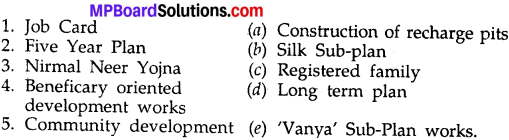
Mp Board Class 10th Social Science Chapter 16
Answer:

1. (c)
2. (d)
3. (a)
4. (b)
5. (e)

MP Board Class 10th Social Science Chapter 16 Very Short Answer Type Questions

Question 1.
Which law has been enacted by the Government of India to enforce ‘right to work’?
Answer:
The National Rural Employment Guarantee Act.

Question 2.
Which type of work is provided for giving employment under the National Rural Employment Guarantee Act?
Answer:
Under this scheme the works taken up are related to water, forests, land and agriculture or construction and improvement/repairs of roads.

Question 3.
How many women out of the total number of applicants are benefited under the National Rural Employment Guarantee Scheme?
Answer:
Women are given preference while giving employment; there is a provision in the scheme that are third of the people employed are women.

Question 4.
Who does the work of redressal of complaints relating to Job Cards?
Answer:
Arrangements have been made for attending to the complaints under the scheme, at every level, i.e., from Gram Panchayat level to District level.

Question 5.
When is the applicant paid extra amount towards minimum wages?
Answer:
If it is not possible to provide work within a radius of 5 kilometres from the residence of the applicant.

Question 6.
To whom unemployment allowance is paid?
Answer:
If a person doesn’t get work within 15 days from the date of application, he/she is entitled to unemployment allowance.

Question 7.
Name any one scheme under community development works programme?
Answer:
Water harvesting and augmentation of water resources.

MP Board Class 10th Social Science Chapter 16 Short Answers Type Questions

Question 1.
State the objectives of the National Rural Employment Guarantee Scheme?
Answer:
The main objectives of the National Rural Employment Guarantee Scheme are:

  1. To provide atleast 100 days employment to the adult members of each family living in rural areas who are willing to do unskilled labour.
  2. To create permanent assets in rural areas.

Question 2.
Explain about the availability of employment under the National Rural Employment Guarantee Scheme?
Answer:
For providing employment to the people of rural areas, certain works have been specified under the National Rural Employment Guarantee Scheme. The works specified in the Act are as under:

  1. Augmentation and conservation of water resources.
  2. Afforestation/plantation programme to prevent drought conditions.
  3. Canals and small/medium irrigation projects.
  4. Irrigation facilities, horticulture development and land improvement programme on the lands of Scheduled Castes and Scheduled Tribes, families living below poverty lines beneficiaries of land development programme or beneficiaries of the ‘Indira Awas Yojana’.
  5. Development and improvement of traditional water resources.
  6. Land development works.
  7. Flood control/protection, drainage arrangements in areas of water clogging.
  8. Perennial roads in rural areas.
  9. Any other work notified by Central Government in consultation with the ‘state government.

Question 3.
Explain the procedure of formulation of the Five Year Plan?
Answer:
After Independence, in order to make plans for the country the Planning Commission was set up on 15th March, 1950 for the country. By now 11 Five Year Plans have been prepared by this Commission and implemented by Government of India. At present the Eleventh Five Year Plan was being implemented on 1st April 2007.

The main guiding principles of the five year plans in India are ecomonic equality, social justice, self – dependence, improvement in efficiency and productivity.

In different plans out of above directive principles, emphasis has been laid on different facts due to changes in situations and problems.

Question 4.
State the special features of any four schemes under Community Development works?
Answer:
Some of the schemes under Community Development works are as under:

  1. Water harvesting and augmentation of water resources
  2. Plantation
  3. Construction of canals
  4. Irrigation.

Question 5.
State the role of Gram Panchayat in the National Rural Employment Guarantee Scheme?
Answer:
The role of Gram Panchayat is important in the implementation of this scheme. The Gram Panchayat has to perform the following functions:

  1. Registration of families of the village and to give Job Cards to families whose names have been registered.
  2. To accept applicat from people for employment and give them information as to where the work will be made available.
  3. To prepare proposals for works as per the decisions of the Gram Sabha.
  4. To get the estimate of the proposed works prepared from a Sub -engineer.
  5. To indicate estimate of expenditure on labour, material and other heads of expenditure in the proposal.
  6. To start works approved by the Programme Officer or Chief Executive Officer of the Janpad Panchayat.

MP Board Class 10th Social Science Chapter 16 Long Answer Type Questions

Question 1.
State the meaning, objectives and special features of the National Rural Employment Guarantee Scheme?
Answer:
As per the present situation, it is necessary to provide employment to the rural people as and when they need. The National Rural Employment Guarantee Act has been enforced keeping these objectives in view.

The main objectives of the National Rural Employment Guarantee Scheme are:

  1. To provide atleast 100 days employment to the adult members of each family living in rural areas who are willing to do unskilled labour.
  2. To create permanent assets in rural areas.

The special features of this scheme are:

  1. All adult members of the families living in the rural areas notified by the Central Government are eligible to get benefit of this scheme.
  2. All the adult member of a registered family of the Gram Panchayat to whom Job Card has been issued will be eligible to apply
    for unskilled work.
  3. If a worker is injured during the work, necessary facility for treatment and in case of physical disability or death during the work compensation is given.
  4. If a person doesn’t get work within 15 days from the date of application, he/she is entitled to unemployment allowance.

Question 2.
What is National Rural Employment Guarantee Scheme? Explain its importance?
Answer:
Under this scheme, a family shall be eligible to get work for 100 days in one financial year.
The importance of National Rural Employment Scheme are:

1. It helps in solving the problems of poverty unemployment and starvation in rural areas.

2. It helps in reducing migration of rural population to urban areas.

3. It provides opportunities of employment to women and makes them self-dependent economically.

4. Useful assets are created in rural areas. It helps in imporving the economic condition of people of lower income bracket and they get the ownership of assets/ infrastructure created under the scheme.

5. Panchayati Raj Institutions are strengthened and they get an opportunity to play useful and important role in the scheme.

6. This scheme will help develop a system where the rural social setup will develop in such a way that there would be equality among different sections of the population (because of employment opportunities provided to rural unemployed poor.)

Question 3.
What is the meaning and importance of Social Audit?
Answer:
Audit is a process under which is checking is carried out of the work/scheme implemented and expenditure incurred on it. In the social audit of the works taken up under the National Rural Employment Gurantee Scheme, details of the works undertaken, expenditure incurred on them, labour employed and material used on the works is given.

Importance of Social Audit:
It is a wellknown fact in the absence of provision for inspection of a work/project, there is every likelihood of slackness in the work, irregularities in the accounts, corruption and other irregularities so also people with selfish interests take undue advantage of the ignorance of the people.

Therefore, it is necessary to carry out regularl social audit of the schemes so that benefits of those works reach the target groups and possibilities of slackness in work and corruption are avoided. Really speaking schemes and their social audit are integral to each other. Only effective social audit can help in ensuring the ultimate success of the works.

Further some main importance of social audit are:

  1. Transparence in the schemes.
  2. Important in ensuring participation of common people.
  3. It helps in realisat of responsibility.
  4. It helps in making them aware about their rights.
  5. It is helpful in making the scheme effective.
  6. It is helpful in controlling irregularities.

Question 4.
Explain the arrangements made for redressal of complaints at different levels under the National Rural Employment Guarantee Scheme?
Answer:
Arrangements have been made for attending to the complaints under the scheme, at every level, i.e. from Gram Panchayat level to District level. Complaint books have been kept in these offices and any body can register complaints in these books.

Gram Panchayat Level:
Every six months the Gram Sabha carries out inspections of the works executed and in case of any irregularity, the matter is forwarded to the Sub Divisional Officer (S.D.M.) after passing a resolution to that effect. On receipt of a complaint the Sub Divisional Officer constitutes an enquiry committee. The enquiry committee comprises of a Panch of the same Gram Panchayat (who is not a member of the construction and development committee), sub – engineer of the Janpad and a social worker nominated by the Sub Divisional Officer.

The Janpad member and a block level officer of the same Janpad Panchayat are also included as members of this committee. On receipt of enquiry report, it is read out in the Gram Sabha by the Secretary. If the Gram Sabha feels that there has been an irregularity, it may send it to the Sub Divisional Officer for taking action in the matter. The Sub Divisional Officer takes necessary legal action under sections 40, 89, 92 or 100 of the Panchayat Raj and Gram Swaraj Act, 1993.

Janpad Level:
If a complaint is received relating to the Janpad level or Programme Officer (C.E.O. Janpad), the District Programme Co – ordinator (Collector) constitutes an enquiry committee. The committee submits its report to the District Programme Co – ordinator and if any officer is found guilty, the District Programme Co – ordinator himself/herself takes disciplinary action or sends the report to the concerned department for suitable action.

District Panchayat Level:
In case of a complaint against the Chief Executive Officer of the District Panchayat the District Programme Co – ordinator (Collector) or the Additional District Programme Co – ordinator, the Divisional Commissioner constitutes an enquiry committee. In case the concerned officer is found guilty the Divisional Commissioner himself/herself takes disciplinary action or sends the report for suitable action to the concerned department.

State Level:
At the state level, the complaints are disposed by the M.P. State Employment Guarantee Council.

MP Board Class 10th Social Science Chapter 16 Additional Important Questions

Question 1.
Multiple choice Questions
Choose the correct answer from the following:

Question (i)
Availability of employment under the National Rural Employment Guarantee Scheme is based on the principle of –
(a) First come first served
(b) Local migration
(c) Both of these
(d) None of these
Answer:
(a) First come first served

Question (ii)
Any physical work which a person can do without any skill or special training in known as –
(a) Unskilled physical labour
(b) Skilled physical labour
(c) Both of these
(d) None of these.
Answer:
(a) Unskilled physical labour

Question (iii)
The National Rural Employment Scheme is an important step towards improvement in the –
(a) Rural economy
(b) Urban economy
(c) Both of these
(d) None of these
Answer:
(a) Rural economy

Question (iv)
Nandan Falodyan Scheme is related to –
(a) Plantation
(b) Irrigation facility
(c) Horticlture/Fruit plantation
(d) Land Improvement
Answer:
(c) Horticlture/Fruit plantation

Question 2.
Fill in the blanks:

  1. As per the census 2001, …………… % of the population lives in villages.
  2. In the year 1973, the share of agriculture sector in the Gross Domestic Product was about …………… %.
  3. The Job Card is issued on the basis of the …………… survey.
  4. The Sub Divisional Officer takes necessary legal action under Gram Swaraj Act, ……………
  5. In Madhya Pradesh Projects have been formulated under the ……………
  6. There is a provision of …………… to ensure transparency and people’s participation in the works.
  7. National rural employment …………… to ensure transparency and people’s participation in the works.

Answer:

  1. 74.27
  2. 45
  3. B.P.L
  4. 1993
  5. State plan
  6. Social audit

Question 3.
True and False type questions:

  1. The people are economically insecure due to limited employment opportunities in rural areas.
  2. There is a provision in the Rural Development and Employment Guarantee Scheme that one third of the people employed are women.
  3. The wages are paid weekly or maximum on fortnightly basis.
  4. There is not any provision for free treatment in case of an injury sustained during the work.
  5. Every worker is entitled to the minimum wages fixed by the State Government
  6. If the card is lost, then a new card can be obtained on payment of prescribed fees.
  7. The family should be registered in the local Gram Parrehayat.
  8. Gram Sabhas and Gram Panchayats have been given responsibility of implementation of the scheme.
  9. Madhya Pradesh has predominance of Scheduled Tribes population.

Answer:

  1. True
  2. True
  3. True
  4. False
  5. True
  6. True
  7. True
  8. True
  9. True.

Question 4.
Match the following:
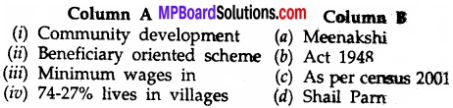
MP Board Class 10th Social Science Solutions Chapter 16 16 Rural Development and Employment Guarantee Scheme img 3
Answer:

(i) (d)
(ii) (a)
(iii) (b)
(iv) (c)

Answer in One – Two Words or One Sentences:

Question 1.
Where does real India live?
Answer:
Real India lives in villages.

Question 2.
How many villages are there in India?
Answer:
Around seven lakh.

Question 3.
When Was the National Rural Employment Guarantee Act notified?
Answer:
The National Rural Employment Guarantee Act was notified on September. 7, 2005.

Question 4.
Write the full form of NREGA?
Answer:
The National Rural Employment Guarantee Act

Question 5.
Who does dispose the complaints at State level?
Answer:
At the State level, the complaints are disposed by fee M.P. State Employement Guarantee Council.

Question 6.
Define wage rate?
Answer:
Rate of wages under section 6 of the relevant Act.

Question 7.
Define unskilled physical labour?
Answer:
Any phsical work which a person can do without any skill or special trainning.

Question 8.
What do you mean by the term ‘adult’?
Answer:
A person who has attained the age of 18 years.

MP Board Class 10th Social Science Chapter 16 Very Short Answer Type Questions

Question 1.
What is the goal of NREGA?
Answer:
NREGA fosters conditions for inclusive growth ranging from basic wage security and recharging rural economy to a transformative empowerment process of democracy.

Question 2.
Define wage seekers?
Answer:
The wage seekers are the primary stake holders of the Act. Their exercise of choice to demand employment is the trigger of key processes.

Question 3.
Explain partial employment?
Answer:
Partial employment is a situation where the worker employed for a part of the year and for the remaining period he/ she is unemployed.

Question 4.
Define financial year?
Answer:
Government for purposes of financial accounting, the year commences from 1 April of the year and ends on 31 March, this a called financial year.

Question 5.
Who is a Programme Officer?
Answer:
Any officer who is appointed to execute works under the scheme under section 15, sub – section (1) of the National Rural Employment Guarantee Act.

Question 6.
What do you mean by latent unemployment?
Answer:
This is a situation which is normally seen in a family carrying, out a business or agriculture or running a cottage industry and where all the members of the family do one or the other work although there is no need of all the persons of the family for that work, i.e. more number of people engaged in that work in comparison to actual manpower needed for it.

Question 7.
What do you mean by transparency in NREGS?
Answer:
There is a proper system laid down for implementing a scheme/working, its timely inspection and monitoring and where facts, information etc., about the scheme/any other matter is made public or is made available on request i.e., facts are not kept confidential.

MP Board Class 10th Social Science Chapter 16 Short Answer Type Questions

Question 1.
Write a short note on coverage of NREGA?
Answer:
The Act was notified in 200 districts in the first phase with effect from February 2nd, 2006 and then extended to additional 130 districts in the financial year 2007-2008 (113 districts were notified with effect from April 1st, 2007, and 17 districts in UP were notfied with effect from May 15, 2007). The remaining districts have been notified under the NREGA with effect from April 1,2008. Thus NREGA covers the entire country with the exception of districts that have a hundred per cent urban population.

Question 2.
What are the roles and responsibilities of Gram Sabha for implementation of NREGS?
Answer:
The Gram Sabha has been given the following rights and responsibilities under the Act:

  1. It will recommend works to be taken up under NREGS.
  2. It will conduct social audits on implementation of the Scheme.
  3. In addition, it is suggested that the Gram Sabha be used extensively as a forum for sharing information about the Scheme.

Question 3.
What are the roles and responsibilities of Gram Panchayat for implementation of NREGS?
Answer:
Gram Phanchayat (GP):
The Gram Panchayat is the pivotal body for implementation at the village level. Where Part Nine of the Constitution does not apply, local councils/authorities as mandated by the State concerned Will be invested with corresponding responsibilities.
The Gram Panchayat is responsible for the following activities:

  1. Planning of works
  2. Receiving applications for registration
  3. Verifying registration applications
  4. Registering households
  5. Issuing Job Cards
  6. Receiving applications for employment
  7. Issuing dated receipts
  8. Allotting employment within fifteen days of application
  9. Executing works
  10. Maintaining records
  11. Convening the Gram Sabha for social audit
  12. Monitoring the implementation of the Scheme at the village level.

Question 4.
What are key Stakeholders?
Answer:
The key Stakeholders are:

  1. Wage seekers
  2. Gram Sabha
  3. PRIs, specially the Gram Panchayat
  4. Programme Officer at the block level
  5. District Programme Co-ordinator
  6. State Government
  7. Ministry of Rural Development.

Question 5.
Explain which art the schemes under the beneficiary oriented schemes.
Answer:
Some of the beneficiary oriented schemes are in M.P. as:

  1. Irrigation facility
  2. Land improvement
  3. Plantation
  4. Irrigation
  5. Horticulture/Fruit plantation.

Question 6.
Name some of the facilities provided on work sites to – the workers under the Employment Guarantee Scheme.
Answer:
Certain basic facilities are to be provided to the workers at the sites of works started under the Employment Gurantee Scheme like:

  1. Safe drinking water and shelter for rest.
  2. First aid facilities and medicines in case of injury, accident or sickness.
  3. If there are 5 or more children below 6 years of age with the working women, a separate women worker shall be entrusted the job of looking after such children.
  4. If a worker is injured during the work necessary facility for treatment and in case of physical disability or death during the work compensation is given.

Question 7.
What is the procedure to procure work under the Employment Guarantee Scheme?
Answer:
All adult members of the families living in the rural areas notified by the Central Government are eligible to get benefit of this i scheme. Under the scheme, a family shall be eligible to get work for 100 days in one financial year. According to the availability of works (employment), the 100 days work may be divided among all the adult workers of a family. For obtaing employment it is necessary that (0 The family should be local resident of the Gram Panchayat.

  1. The family should be registered in the local Gram Panchayat.
  2. The family should obtain a Job Card from the Gram Panchayat.
  3. The family (should apply for work as unskilled worker on the basis of the Job Card.
  4. Family should be ready to work as unskilled labourer.

MP Board Class 10th Social Science Chapter 16 Long Answer Type Questions

Question 1.
What a Rural Employment Guarantee Scheme should have?
Answer:
A Rural Employment Guarantee Scheme (NREGS) will be expected to cltirify, inter alia, the following matters:

1. Specify the implementing Department in the State.

2. Specify a senior officer in the State as State Programme Co – ordinator.

3. Specify the District Programme Co – ordinator.

4. Lay down the mode of recruitment for Programme Officers, supportive staff and other required professional services, and make interim arrangements till regular Programme Officer is appointed.

5. Define the relationship with the Block Development Officer.

6. Clearly delineate Agency – wise the roles and responsibilities for each task mandated in the Act and elaborated in the Guidelines. Establish co – ordihation mechanisms among them, fixing clear accountability for each task, since activities under the Act are justiciable and the people and the Implementing Agency should know in whom the legal obligation for getting a task done vests.

7. Delineate the Fund Flow system for the Rural Employment Guarantee Scheme.

8. Specify the cheque – signing authorities at the District, Block (Programme Officer) and Gram Panchayat levels.

9. Specify the procedure for payment of unemployment allowance.

10. Specify the authorities for administrative and technical approval of works and define their powers.

11. Specify the procedure for maintenance of accounts, maintenance of muster rolls, material, unskilled wage and  skilled wage
content of the works and audit arrangements for internal and social audit.

12. Specify procedures for making entries in the Job Cards and for cross – checking them to avoid wrong entries.

13. Specify systems for measurement of works and rates of payment there of and methods for making this information transparent.

14. Specify the system of payment of wages. Possibility of payment through accounts in the bank or post office may be considered.

15. Specify procedures for social audit, public accountability and implementation of the Right to Information Act.

16. Specify grievance redressal mechanisms at the Gram Panchayat, Intermediate Panchayat, District and State levels.

17. Specify the terms and conditions of the Chairperson and Members of the State Employment Guarantee Council, time, place and procedure of meetings.

Question 2.
What are the salient features of the NREGA?
Answer:
Some of the salient features of the NREGA are:

1. Adult members of a rural household, willing to do unskilled manual work, may apply for registration in writing or orally to the local Gram Panchayat.

2. The Gram Panchayat after due verification will issue a Job Card, The Job Card will bear the photograph of all adult members of the household willing to work under NREGA and is free of cost.

3. The Job Card should be issued within 15 days of application.

4. A Job Card holder may submit a written application for employment to the Gram Panchayat, stating the time and duration for which work is sought. The minimum days of employment have to be at least fourteen.

5. The Gram Panchayat will issue a dated receipt of the written application for employment against which the guarantee of providing employment within 15 days operates.

6. Employment will be given within 15 days of application for work, if it is not then daily unemployment allowance as per the Act, has to be paid. Liability of payment of unemployment allowance is of the states.

7. Work should ordinarily be provided within 5 km radius of the villages. In case work is provided beyond 5 km, extra wages of 10% are payable to meet additional transportation and living expenses.

8. Wages are to be paid according to the Minimum Wages Act, 1948 for agricultural labourers in the State, unless the Centre notifies a wage rate which will not be less than Rs. 60 per day. Equal wages will be provided to both men and women.

Question 3.
Draw a logo for NREGA?
Answer:
MP Board Class 10th Social Science Solutions Chapter 16 16 Rural Development and Employment Guarantee Scheme img 2

Question 4.
What is Job Card? How is it obtained? What is the procedure for getting unemployment allowance?
Answer:
Job Card is a description of the person registered for securing employment:

The Job Card is issued on the basis of the B.P.L. survey. This Card has all the information relating to the family for it is issued. The Job Card is valid for five years for the date of issue and is renewed by the Gram Panchayat within one month from the date of expiry.

If a person doesn’t get work within 15 days for the date of application he/she in entitled to unemployment allowance. But the aggregate amount of unemployment allowance and the minimum wages already paid to that family will not exceed an amount which is equal to 100 days minimum wages.

A person who has applied for work, does not do the entrusted work, and does not present him/herself on the work within 15 days and remains absent for a week or more or for more than a week in one month without the permission of the implementing agency, such person shall not be entitled to unemployment allowance for a period, of 3 months.

Question 5.
State which are the schemes under the Community Development works?
Answer:
The Community Development schemes included in list 1 para 1 (4) of the National Rural Employment Gurantee Act. Some of the works are as under:

  1. Water harvesting and augmentation of water resources.
  2. Plantation
  3. Construction of canals
  4. Irrigation.

MP Board Class 8th Social Science Solutions Chapter 23 Australia-Geographical features

MP Board Class 8th Social Science Solutions Chapter 23 Australia-Geographical features

MP Board Class 8th Social Science Chapter 23 Australia-Geographical features

MP Board Class 8th Social Science Chapter 23 Text Book Exercise

Choose the correct option of the following.

Mp Board Class 8 Social Science Solution Chapter 23 Question 1.
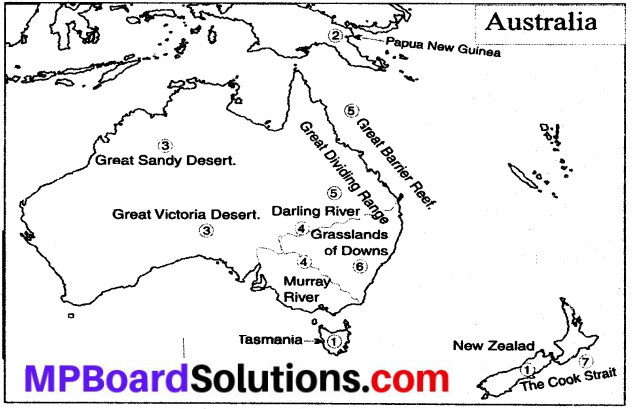
(i) The main latitude line passing through the middle of Australia Continent is:
(a) Tropic of Cancer
(b) Equator
(c) Capricorn
(d) None of the above
Answer:
(c) Capricorn

Mp Board Class 8 Social Science Chapter 23 Question 2.
Which is Island Continent?
(a) Antarctica
(b) Australia
(c) Asia
(d) North America
Answer:
(b) Australia

Class 8 Social Science Chapter 23 Question 3.
Which is the country of Australia Continent?
(a) Fizi
(b) Cuba
(c) Chile
(d) Bornio
Answer:
(a) Fizi

Question 4.
In which region of Australian Continent, lies the Great Barrier Reef?
(a) South-East region.
(b) North-East region
(c) North-West region
(d) North-West region
Answer:
(b) North-East region

MP Board Class 8th Social Science Chapter 23 Very Short Answer Type Questions

Question 1.
The area of Eyre Lake which is in the Central lowlands where rivers falls into lakes is known as?
Answer:
The major area around the Eyre Lake is known as inland drainage area. Where the rivers, which can not reach the sea, fall into the inland lakes.

Question 2.
What is called the high but narrow long belt plateaus in Australian Continent?
Answer:
There is parallel expansion of this mountain ranges from the Cape York Peninsula in east coast to the Tasmania island in the south. They form a long belt of the high plateaus which are known as the Great Dividing Range.

Question 3.
What name the sea landform made by coral insects in the east coast of Australia is known?
Answer:
Along the north-east cost of Australia extends very long coral ridge known (racks of coral) as the Great Barrier Reef. This world famous reef is more than 1920 kms. in length. It is made of skeletons of tiny insects called corals.

Question 4.
Which is the emblem animal and famous tree of Australia?
Answer:
The Kangaroo is the national animal of Australia and Eucalyptus is the main tree

MP Board Class 8th Social Science Chapter 23 Short Answer Type Questions

Question 1.
Why is the western part of Australia Continent?
Answer:
Western Plateau is in Western part of Australia. It occupies two-thirds of the continent and lies from north to south. Due to lack of rain the most of the plateau is desert or semi-desert. The northern part is Great Sandy Desert and southern part is occupied by Great Victoria Desert.

Question 2.
Mention about the Inland drainage of Australia continent?
Answer:
An extensive low land between the western and eastern highlands extends from the gulf of Carpentaria in north to the southern and shores of Australia. Many rivers flow in the lowland but most of the rivers could not reach the sea and fells into the inland lakes.

The biggest Lake Eyre is situated in this area. So the major area around the Eyre Lake is known as inland drainage area. The Inland drainage area is a system where the river flowing, instead of felling in the sea, falls in some water areas there.

Question 3.
Write the climate of Australia?
Answer:
Australia lies in the southern Hemisphere. Most of Australia is dry. The eastern, north-eastern and the western part of the country come in the way of winds blowing on the sea. This part receives heavy rainfall.

The following types of climates are found in Australia.

  1. Desert type in the vast interior of the earth.
  2. Mediterranean type of climate is found in southern coast of Australia.
  3. Monsoon type of climate in northern part of Australia causes rain in summer.

Question 4.
Write about the prominent animals of Australia continent?
Answer:
Australia is known for Kangaroos and Koala called the mansupials animals. Mansupials have a pouch like fold of skin near the stomach in which they carry their young ones. The other animals are dingo, a wild dog. Platypus is a four legged animal that lays eggs like a bird.

Question 5.
What is Downs? Explain
Answer:
The Middle regions of Australia which receive little rain fall have trees and gray equally. There are two types of grasslands here. In the north there is tropical grass land and in the south of Murray-Darling Basin has temperate grassland which is known is ‘Downs’ also.

Question 6.
Mention about the physical features of New Zealand Island?
Answer:
In the south-east of Australia lies New Zealand. New Zealand is the mountain island. In the north and south islands there stretches a mountain range from north to south. In the southern island this mountain range is called south Alps. The narrow Cook Strait divides the north and south islands of New Zealand.

MP Board Class 8th Social Science Chapter 23 Long Answer Type Questions

Question 1.
Discuss the physical divisions of Australia?
Answer:
Australia can be divided into three major physical divisions. They are:

  1. Western Plateau
  2. The Central Lowlands and
  3. The Eastern Highlands
  4. The Western Plateau

1. The western plateau:
The western plateau of Australia is a vast plateau occupying two thirds of the continent. This part of Australia is a desert or a semi-desert. Desert type of vegetation consisting mainly small shrubs and thorny bushes is found here. In North West the desert area is known as Great Sandy Desert and in its south it is called the Great Victoria Desert.

This part of plateau is rich in minerals especially in gold. Kalgoorlie and Coolgradie gold. Kalgoorlie and Coolgradie goldmines are famous in this area.

2.The Central Lowlands:
There are extensive lowlands between the western plateau and the Eastern Highlands. They extend from the Gulf of Carpentraia in the north, across the continent to the southern shore of Australia.

These are the lowlands so much so that at Lake Eyre, the land is about 12 metres below sea level. The Murray and the Darling are the major rivers of Australia flowing through the Central lowland. Most of the rivers of this area do not reach the sea.

They infect, fall into Are inland lakes. Thus the area around Lake Eyre is a region of inland drainage. The north-eastern part of the plain is occupied by the Great Artesian Basin, Artesian well supply some water to this semi-desert area.

3. The Eastern Highlands:
Along the east coat of Australia are found long belt of elevate plateaus. They extend from Cape York Peninsula in the north to Tasmania in the south. These elevated plateaus are known as the Great Dividing Range. They are broad low in the north whereas in the south they are narrow and high. They also called Great Dividing Range.

4. Coastal plains:
There is oceanic water all around the continent, hence there are narrow coastal plain in the continent. The sea sand and water-borne soil on the mouth of rivers is found here. Along the north east coast of Australia. There is a very long coral ridge known as the Great Barrier Reef.

The Coral reefs have colorful beings and vegetations. New Zealand is the mountain island. The narrow Cook Strait divides the north and south islands of New Zealand.

Question 2.
What is Great Barrier Reef?
Answer:
Great Barrier Reef:
Off the northeast coast of Australia extends a very long edge like feature known as the Great Barrier Reef. It has been formed as a result of the deposition of skeleton of carols. Corals are tiny sea animals when the corals die their hard skeletons remain fixed in places and new coral grow upon them.

The accumulations of these corals are known as coral Reefs. The world famous Great Barriers Reef made of these corals in more than 1900 kilometers, in length and its distance from coast varies from 30 to 240 kilometers.

Question 3.
Write in detail about the vegetations and animals of Australia Continent.
Answer:
The vegetations are found in Australia as per rain distribution. The Coastal areas which receive
heavy rains abound with long trees and forests. The Western and central dry land are full of thorny bushes and grass. Tropical forests are found in the northern and north-eastern coastal regions of Australia which receive heavy rains they are like monsoon forests. But they are evergreen.

The important trees that grow in these forests are Devdar, Date, Bamboo, Baobab and Bottle. The Eucalyptus is the main tree.

The Koala animal mostly lives on these trees and eats the leaves of eucalyptus trees. The middle regions of Australia which receive little rain have trees and grass equally. In the north there is tropical grass land and in the south of Murray-Darling basin has temperate grass-lands which is known as‘Downs’.

Kangaroo is the national animal of Australia. Emu, Kookaburra and Lyre Bird are other different birds, Kiwis and Penguins are famous birds of New Zealand. Dingo, a wild dog and Platypus are other animals of Australia.

Project Work

Show the following on the outline map of Australia continent.

  1. Tasmania and New Zealand
  2. Fizi and Papua New Guinea
  3. Grat Victoria and Great Sandy Desert
  4. Murray and Darling rivers,
  5. Great Dividing Range and Great Barrier Reef,
  6. Grasslands of Downs
  7. The Cook Strait.

MP Board Class 8th Social Science Solutions Chapter 23 Australia-Geographical features img 1

MP Board Class 8th Social Science Solutions