MP Board Class 7th Sanskrit Solutions Chapter 9 ग्रामजीवनम्

MP Board Class 7th Sanskrit Solutions Surbhi Chapter 9 ग्रामजीवनम्

MP Board Class 7th Sanskrit Chapter 9 अभ्यासः

Mp Board Class 7th Sanskrit Chapter 9 प्रश्न 1.
एक शब्द में उत्तर लिखो
(क) दीपेशः कं ग्रामं भ्रमणार्थम् अगच्छत्? [दीपेश कौन-से गाँव घूमने गया था?]
उत्तर:
रामपुर ग्राम

(ख) ग्रामीणानां व्यवहारः कथम् अस्ति? [ग्रामीणों का व्यवहार कैसा था?]
उत्तर:
सरलः प्रेमपूर्णश्च

(ग) देशस्य आधारः कः? [देश का आधार क्या है?]
उत्तर:
ग्रामः एव

(घ) देशोन्नतिः कुत्र सन्निहिता? [देश की उन्नति किसमें समाहित है?]
उत्तर:
ग्रामोन्नतौ

(ङ) दीपेशस्य छात्रावासः कस्मिन् नगरे अस्ति? [दीपेश का छात्रावास किस नगर में स्थित है?]
उत्तर:
(ङ) इन्दौर नगरे।

कक्षा 7 संस्कृत पाठ 9 के प्रश्न उत्तर MP Board प्रश्न 2.
एक वाक्य में उत्तर लिखो
(क) ग्रामं परितः किं किम् अस्ति? [गाँव के चारों ओर क्या-क्या है?]
उत्तर:
ग्रामं परितः कृषि भूमिः, गोचारणभूमिः, विभिन्नवृक्षाश्च सन्ति। [गाँव के चारों ओर खेती करने योग्य भूमि, चरागाह भूमि तथा अनेक तरह के वृक्ष हैं।]

(ख) ग्रामे के के पशवः सन्ति? [गाँव में कौन-कौन से पशु हैं?]
उत्तर:
ग्रामे धेनवः, महिष्यः, बलीवर्दादयः पशवः सन्ति। [गाँव में गायें, भैंस, बैल आदि पशु हैं।]

(ग) झिरीग्रामस्य महद् वैशिष्ट्यं किम्? [झिरीग्राम की सबसे बड़ी विशेषता क्या है?]
उत्तर:
झिरीग्रामस्य इदं महद् वैशिष्ट्यं यत् प्रायः सर्वे जनाः संस्कृतेन एव भाषन्ते। [झिरी गाँव की यह बड़ी विशेषता है कि प्रायः सभी लोग संस्कृत में ही बोलते हैं।]

(घ) हट्टे विक्रेतारः किं किं विक्रीणन्ति? [हाट में विक्रेता क्या-क्या बेचते हैं?]
उत्तर:
हट्टे विक्रेतारः नित्योपयोगिवस्तुनि, हस्तशिल्पकला वस्तूनि, गोधूमचणकादिखाद्यवस्तूनि, गृहोपयोगिवस्तूनि विक्रीणन्ति।
[हाट में विक्रेता प्रतिदिन प्रयोग में आने वाली वस्तुएँ, हस्तशिल्पकला की वस्तुएँ, गेहूँ, चना आदि खाद्य वस्तुएँ, घर के उपयोग की वस्तुएँ बेचते हैं।]

(ङ) कृषकाः कथं कृषिकर्म कुर्वन्ति? [किसान किस तरह खेती करते हैं?]
उत्तर:
कृषकाः तापंशीतं वृष्टिं सहित्वा कृषिकर्म कुर्वन्ति। [किसान गर्मी, जाड़ा और वर्षा को सहन करके कृषिकर्म करते हैं।]

Mp Board Class 7th Sanskrit Solution प्रश्न 3.
रेखांकित शब्दों के आधार पर प्रश्न निर्माण करो-
(क) छात्रावासे स्थित्वा सम्यक् अध्ययनं करोमि।
(ख) मासिकमूल्याङ्कने भगिन्याः प्रथमस्थानम् स्यात्।
(ग) ग्रामं परितः कृषिभूमिः अस्ति।
(घ) वास्तविक भारतं नाम ग्राम एव।
(ङ) तैः सह मिलित्वा वार्तालापं कृतवन्तः।
उत्तर:
(क) कुत्र स्थित्वा सम्यक् अध्ययनं करोमि?
(ख) कस्मिन् भगिन्याः प्रथम स्थानम्?
(ग) कम् परितः कृषिभूमिः अस्ति?
(घ) वास्तविक भारतं नाम कः एव?
(ङ) तैः सह मिलित्वा किं कृतवन्तः?

Mp Board Class 7 Sanskrit Solution प्रश्न 4.
पाठ के आधार पर क्त्वान्त पदों को लिखो-
(क) मिलति (मिल् + क्त्वा)
(ख) पश्यति (दृश + क्त्वा)
(ग) करोति (कृ + क्त्वा)
(घ) सहति (सह् + क्त्वा)
(ङ) स्मरति (स्मृ + क्त्वा)
(च) शृणोति (श्रु + क्त्वा)
(छ) गच्छति (गम् + क्त्वा)
(ज) पठति (पठ् + क्त्वा)।
उत्तर:
(क) मिलित्वा
(ख) दृष्ट्वा
(ग) कृत्वा
(घ) सहित्वा
(ङ) स्मृत्वा
(च) श्रुत्वा
(छ) गत्वा
(ज) पठित्वा।

कक्षा 7 संस्कृत पाठ 9 MP Board प्रश्न 5.
उदाहरण के अनुसार ल्यबन्त रूपों को लिखो
(क) उत् + स्था + ल्यप्
(ख) वि + की + ल्यप
(ग) स्वी + कृ + ल्यप्
(घ) प्र + क्षाल् + ल्यप्
(ङ) वि + चिन्त + ल्यप्
(च) वि + ज्ञा + ल्यप्
(छ) वि + लिख् + ल्यप्
(ज) उप + कृ + ल्यप्
(झ) आ + गम् + ल्यप्।
उत्तर:
(क) उत्थाप्य
(ख) विक्रीय
(ग) स्वीकृत्य
(घ) प्रक्षाल्य
(ङ) विचिन्त्य
(च) विज्ञाप्य
(छ) विलिख्य
(ज) उपकृत्य
(झ) आगम्य।

प्रश्न निर्माण संस्कृत कक्षा 7 MP Board प्रश्न 6.
क्त्वा/ल्यप् के योग से वाक्यों को जोड़ो-
(क) बालकः फलं खादति। – दुग्धं पिबति।
(ख) कविः संस्कृतिं जानाति। – काव्यं लिखति।
(ग) ऋचा गृहम् आगच्छति। – गृहकार्य करोति।
(घ) अर्चकः देवालयं गच्छति। – पूजां करोति।
(ङ) माता शाकानि आनयति। – पाकं करोति।
(च) जनकः प्रभाते उत्तिष्ठति। – योगाभ्यासं करोति।
(छ) दीपेशः हस्तं प्रक्षालयति। – भोजनं करोति।
(ज) समिधा मनसि विचिन्तयति। – लेखं लिखति।
(झ) आराधना स्नानं करोति। – पूजां करोति।
(ञ) विक्रेता वस्तूनि विक्रीणाति। – धनं अर्जयति।
उत्तर:
(क) बालकः फलं खादित्वा दुग्धं पिबति।
(ख) कविः संस्कृतं ज्ञात्वा काव्यं लिखति।
(ग) ऋचा गृहम् गत्वा गृहकार्यं करोति।
(घ) अर्चकः देवालयं गत्वा पूजां करोति।
(ङ) माता शाकानि आनीय पाकं करोति।
(च) जनकः प्रभाते उत्थाय योगाभ्यासं करोति।
(छ) दीपेशः हस्तं प्रक्षाल्य भोजनं करोति।
(ज) समिधा मनसि विचिन्तय लेखं लिखति।
(झ) आराधना स्नानं कृत्वा पूजां करोति।
(ञ) विक्रेता वस्तूनि विक्रीय धनं अर्जयति।

Mp Board Solution Class 7 Sanskrit प्रश्न 7.
भिन्न प्रकृति वाले शब्द को चुनो-
(क) गत्वा, पठित्वा, भूत्वा, हसित्वा, पठितुम्।
(ख) दुग्धं, दधि, नवनीतं, तक्रम्, रोटिका।
(ग) भ्राता, भगिनी, माता, पिता, शिक्षकः।
(घ) काकः, कोकिलः, कपोतः, शुकः, मत्स्यः।
उत्तर:
(क) पठितुम्
(ख) रोटिका
(ग) शिक्षकः
(घ) मत्स्यः।

ग्रामजीवनम् हिन्दी अनुवाद

(पत्रवाहक द्वारघण्टिकां वादयति। दीपिका द्वारम् उद्घाट्य पत्रवाहकात् पत्रं स्वीकृत्य मातरं प्रसन्नतया वदति, “अम्ब! अम्ब! पश्य भ्रातुः पत्रम्” इति उक्त्वा मात्रे पत्रं ददाति। माता पत्रं पठति।)

छात्रावासः
उत्कृष्टविद्यालयः
इन्दौरनगरम्
दिनाङ्क-११-१०-०५

पूज्यमातृपितृचरणयोः
सादरं प्रणामाः।
अहम् अत्र कुशली अस्मि। छात्रावासे स्थित्वा सम्यक अध्ययनं करोमि। गृहे सर्वेषां कुशलं प्रार्थयामि। भवती स्वस्था भूत्वा पूर्ववत् गृहकार्याणि करोति इति ज्ञात्वा अहं सन्तुष्टः अस्मि। मासिकमूल्याङ्कने भगिन्याः प्रथमस्थानमेव स्यात् इति चिन्तयामि।

अनुवाद :
(पत्रवाहक (डाकिया) द्वार की घण्टी बजाता है। दीपिका द्वार खोलकर पत्रवाहक से पत्र लेकर माता को प्रसन्नतापूर्वक बतलाती है,”माँ ! माँ ! देखो भाई का पत्र” ऐसा कहकर माता को पत्र दे देती है। माता पत्र पढ़ती है।)

छात्रावास
उत्कृष्टविद्यालय
इन्दौर नगर
दिनांक-११-१०-०५

पूजनीय माता-पिता,
सादर प्रणाम।
मैं यहाँ कुशलपूर्वक हूँ। छात्रावास में रहकर ठीक तरह से अध्ययन करता हूँ। घर में सबकी कुशलता के लिए प्रार्थना करता हूँ। आप स्वस्थ होकर पहले की तरह घर के कार्यों को करती हो, यह जानकर मैं सन्तुष्ट हूँ। मासिक मूल्यांकन में बहन का पहला स्थान ही होगा-ऐसा मैं सोचता हूँ।

अहं विगतसप्ताहे अस्माकं विद्यालयस्य छात्रैः सह मिलित्वा रामपुरग्रामं भ्रमणार्थम् अगच्छम्। तं ग्रामं दृष्ट्वा अहम् अतिप्रसन्न अभवम्। ग्रामं परितः कृषिभूमिः, गोचारणभूमिः विभिन्नवृक्षाश्च सन्ति। ग्रामस्य पार्वे एका नदी प्रवहति। अतः अत्र शुद्धवायुः वहति। एषः ग्रामः नगरात् दूरे स्थित्वा औद्योगिकप्रदूषणात् रहितः अस्ति। अतः पशुपक्षिणः अत्र स्वच्छन्दतया विचरन्ति। अस्मिन् ग्रामे धेनवः महिष्यः बलीवर्दादयः बहवः पशवः सन्ति। अत्र ग्रामे जनाः प्रायः कृषिकार्यं कृत्वा सरलजीवनं यापयन्ति। परिश्रमशीला एते कृषकाः ताप शीतं वृष्टिं सहित्वा कृषिकर्म कुर्वन्ति । ग्रामीणानां व्यवहार सरलः प्रेमपूर्णश्च अस्ति।

अनुवाद :
मैं पिछले सप्ताह अपने विद्यालय के छात्रों के साथ मिलकर रामपुर गाँव को घूमने के लिए गया था। उस गाँव को देखकर मैं बहुत प्रसन्न हुआ। गाँव के चारों ओर कृषि भूमि, पशुओं के चराने की भूमि (चरागाह) तथा अनेक प्रकार के वृक्ष हैं। गाँव के पास में एक नदी बहती है। अतः यहाँ शुद्ध हवा बहती है। यह गाँव नगर (शहर) से दूर स्थित होने के कारण औद्योगिक प्रदूषित से रहित है। इसलिए पशु-पक्षी यहाँ आजादी से विचरण करते हैं। इस गाँव में गायें, भैंस, बैल आदि बहुत से पशु हैं। यहाँ गाँव में लोग प्रायः कृषि कार्य करके सरल जीवन बिताते हैं। परिश्रम करने के स्वभाव वाले ये किसान गर्मी, जाड़ा और वर्षा को सहन करके खेती के काम को करते हैं। गाँववासियों का जीवन सरल और प्रेमपूर्ण है।

वयं तैः सह मिलित्वा वार्तालापं कृत्वा ग्रामजीवनविषये ज्ञातवन्तः। तत्र प्रभूतं दुग्धं, दधि, नवनीतं, हरितशाकानि, उष्णस्निग्धरोटिकाश्च खादित्वा हट्ट अगच्छाम। तस्मिन् साप्तहिकहट्टे विविधता: आपणाः भवन्ति। एतं हट्टम् आगत्य विक्रेतारः नित्योपयोगिवस्तूनि, हस्तशिल्पकलावस्तूनि, गोधूमचणकादिखाद्यवस्तूनि, गृहोपयोगिवस्तूनि च विक्रीय धनम् अर्जयन्ति। ग्रामवासिनः हट्टात् वस्तूनि स्वीकृत्य गच्छन्ति। कक्षायां पठितम् आसीत् यत् “अस्माकं देशः कृषिप्रधानः अस्ति, देशस्य अधिकाः जनाः ग्रामे वसन्ति, ग्रामः एव देशस्य आधारः” इति स्मृत्वा इदानीं ज्ञातं यत् “वास्तविकं भारतं नाम ग्राम एव, ग्रामोन्नती एव देशोन्नतिः सन्निहिता” इति।

भवतु, पत्रं समापयामि। ग्रीष्मावकाशे वयं सर्वे मिलित्वा समीपस्थं “झिरी” ग्रामं गत्वा तत्रत्यं प्राकृतिक सौन्दर्यं द्रक्ष्यामः। तस्य ग्रामस्य इदं महद् वैशिष्ट्यं यत् प्रायः सर्वे जनाः संस्कृतेन एव भाषनते। आगामिमासे मम अर्द्धवार्षिकपरीक्षा अस्ति। अन्यत् सर्वं शुभम्। सर्वेभ्यः पुनर्नमस्कार। पत्रोत्तरस्य प्रतीक्षारतः।

भवतः पुत्रः
दीपेशः

अनुवाद :
हमने उनके साथ मिलकर बातें करते हुए गाँव के जीवन के विषय में जानकारी ली। वहाँ बहुत-सा दूध, दही, मक्खन, हरी सब्जियाँ, गर्म चिकनी रोटियाँ खाकर हाट (पैंठ) को गये। उस साप्ताहिक हाट में (पैंठ में) अनेक प्रकार की दुकानें होती हैं। इस हाट में आकर विक्रेता (बेचने वाले) रोजाना के उपयोग में आने वाली वस्तुओं, हस्तशिल्पकला की वस्तुएँ, गेहूँ, चना आदि खाद्य वस्तुएँ और घर के उपयोग की वस्तुओं को बेचकर धन कमाते हैं। गाँव के निवासी हाट से वस्तुओं को अपने आप खरीदकर ले जाते हैं। कक्षा में पढ़ा था कि “हमारा देश कृषि प्रधान है, देश के अधिकतर लोग गाँवों में रहते हैं। गाँव ही देश के आधार हैं।” इसे स्मरण करके अब ज्ञात हुआ है कि “वास्तविक भारत तो गाँवों में ही है, गाँवों की उन्नति में ही देश की उन्नति निहित है।”

ठीक है, पत्र समाप्त करता हूँ। गर्मी के अवकाश में हम सभी मिलकर पास में स्थित ‘झिरी’ नामक गाँव को जाकर वहाँ के प्राकृतिक सौन्दर्य को देखेंगे। उस गाँव की यह बड़ी विशेषता है कि प्रायः सभी लोग संस्कृत में ही बोलते हैं। आने वाले महीने में मेरी अर्द्धवार्षिक परीक्षा है। अन्य सभी ठीक-ठाक है। सभी को फिर से नमस्ते। पत्रोत्तर की प्रतीक्षा में।

आपका पुत्र
दीपेश

ग्रामजीवनम् शब्दार्थाः

विगतसप्ताहे = पिछले सप्ताह में। सहित्वा = सहन करके। गोचारणभूमिः = गाय चराने के लिए भूमि या चरागाह। स्वच्छन्दं = स्वतंत्र रूप से। बलीवाः = बैल। हट्टः = बाजार, पैंठ। द्रस्यामः = देखेंगे। प्रभूतं = अत्यधिक मात्रा में। महद् वैशिष्ट्यम् = महती विशेषता। दृष्ट्वा = देखकर। परितः = चारों ओर। महिष्यः = भैंसें। वृष्टिः = बरसात। आपणाः = दुकानें। अम्ब! = माँ (सम्बोधन)। सन्निहिता = छिपी हुई है। भाषन्ते = बोलते हैं।
MP Board Class 7th Sanskrit Solutions

MP Board Class 10th General English The Spring Blossom Solutions Chapter 4 Children

Are you seeking for the Madhya Pradesh Board Solutions 10th General English The Spring Blossom Solutions Chapter 4 Children Questions and Answers PDF? If yes, then read this entire page. Here, we are giving a direct link to download MP Board Class 10th English Solutions Questions and Answers PDF which contains the chapter wise questions, solutions, and grammar topics. You can also get the shortcuts to solve the grammar related questions on this page.

MP Board Class 10th General English The Spring Blossom Solutions Chapter 4 Children

For the sake of students we have gathered the complete 10th General English The Spring Blossom Solutions Chapter 4 Children Questions and Answers can provided in pdf Pattern. Refer the chapter wise MP Board Class 10th English Solutions Questions and Answers Topics and start the preparation. You can estimate the importance of each chapter, find important English grammar concepts which are having more weightage. Concentrate on the important grammar topics from Madhya Pradesh Board Solutions for 10th English Chapter 4 Children Questions and Answers PDF, prepare well for the exam.

Children Textual Exercises

Word Power

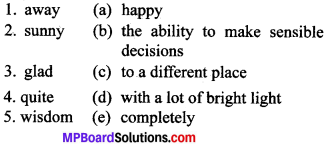
A. Match the words with their meanings.
(सुमेलित कीजिए।)

Chapter 4 English Class 10 Mp Board
Answer:
1. → (c)
2. → (d)
3. → (a)
4. → (e)
5. → (b)

B. Complete the following lines of the poem.
(निम्न पंक्तियों को पूरा कीजिए।)
Answer:
Come to me, o ye children!
And whisper in my ear
What the birds and the winds are singing
In your sunny atmosphere.

C. Use the following words in your sentences.
(निम्न शब्दों के वाक्य बनाइए।)
Answer:
1. vanish – All difficulties vanish in front of strong determination.
2. eastern – Rahim entered the building through the eastern gate.
3. sunshine – I love to walk in the early morning sunshine.
4. gladness – In the state of gladness my mother embraced me.
5. autumn – I haven’t heard from him since last autumn.

How Much Have I Understood?

A. Answer the following questions. (One or two sentences)
(निम्न प्रश्नों के उत्तर एक या दो वाक्यों में दीजिए।)

Chapter 4 English Class 10 Mp Board Question 1.
What happens when the poet looks at the children playing?
(व्हॉट हैपन्स व्हेन द पोऍट लुक्स एट द चिल्ड्रन प्लेइंग?) कवि जब खेलते हुए बच्चों को देखता है तो क्या होता है?
Answer:
When the poet looks at the children playing all the questions that made him anxious and confused disappear.
(व्हेन द पोऍट लुक्स एट द चिल्ड्रन प्लेइंग, ऑल द क्वैश्चन्स दैट मेड हिम एंक्शियस एण्ड कन्फ्यूज्ड डिसअपीयर।)
जब कवि बच्चों को खेलते हुए देखता है तब वो सारे प्रश्न जो उसे चिन्तित व असमंजस में डालते थे, गायब हो जाते हैं।

Mp Board Class 10th English Chapter 4 Question 2.
Where do the windows open?
(व्हेअर डू द विन्डोज ओपन?)
खिड़कियाँ कहाँ खुलती हैं?
Answer:
Windows open towards east where the sun rises.
(विन्डोज ओपन टुवर्ड्स ईस्ट व्हेयर द सन राइज़ेज़।)
खिड़कियाँ पूर्व की ओर खुलती हैं जहाँ से सूर्योदय होता है।

Mp Board Class 10 English Book Solution Chapter 4 Question 3.
What lies in the hearts of the children?
(व्हॉट लाइज़ इन द हार्ट्स ऑफ द चिल्ड्रन?)
बच्चों के दिल में क्या है?
Answer:
In the hearts of children there are birds and sunshine.
(इन द हार्ट्स ऑफ चिल्ड्रन देयर आर बर्ड्स एण्ड सनशाइन।)
बच्चों के दिल में चिड़ियाँ व सूर्य की रोशनी है।

Question 4.
What does the poet compare with the caresses of the children and their look?
(व्हॉट डज़ द पोऍट कम्पेयर विद द करेसेस ऑफ द चिल्ड्रन एण्ड देयर लुक्स?)
कवि बच्चों के दुलार व सूरत की किससे तुलना करता है?
Answer:
The poet compares the caresses of the children with the clever plans of contrivings of adults and their looks with the wisdom of books.
(द पोऍट कम्पेअर्स द करेसेस ऑफ द चिल्ड्रन विद द क्लेवर प्लैन्स ऑफ कन्ट्राइविंग्स ऑफ एडल्ट्स एण्ड देअर लुक्स विद द विजडम ऑफ बुक्स।)
कवि बच्चों के दुलार की बड़ों की चतुर योजना व उनके चेहरे की अपनी किताबों के विवेक से तुलना करता है।

Question 5.
Which lines of the poem do you like most and why?
(व्हिच लाइन्स ऑफ द पोऍम डू यू लाइक मोस्ट एण्ड व्हाय?)
कविता की कौन-सी पंक्तियाँ तुम्हें सबसे ज्यादा पसन्द हैं व क्यों?
Answer:
The lines of the poem that I like the most are, “ye are better than all the ballads……….And all the rest are dead.” I liked these lines because it is a truth that the ballads and songs are lifeless but children are living poems and have life.
(द लाइन्स ऑफ द पोऍम दैट आइ लाइक द मोस्ट आर, “ये आर बैटर दैन द बैलड्स……….एण्ड ऑल द रेस्ट आर डेड।” आइ लाइक्ड दीज़ लाइन्स बिकॉज़ इट इज अ ट्रथ दैट द बैलड्स एण्ड साँग्स आर लाइफलेस बट चिल्ड्रन आर लिविंग पोऍम्स एण्ड हैव लाइफ।)
कविता की ये पंक्तियाँ मुझे पसन्द आईं क्योंकि यह सत्य है कि गाने निर्जीव होते हैं मगर बच्चे जीती-जागती कविताओं के समान होते हैं व उनमें जान होती है।

B. Answer the following questions. (Three or four sentences).
(निम्न प्रश्नों के उत्तर तीन या चार वाक्यों में दीजिए।)

Question 1.
When do the problems of the poet end and why?
(व्हेन डू द प्रॉब्लम्स ऑफ द पोऍट ऍन्ड एण्ड व्हाय?)
कवि की परेशानियाँ कब खत्म होती हैं व क्यों?
Answer:
The problems of the poet end when he hears the children playing. This is because children spread joy and he gets relief from all the problems of life.
(द प्रॉब्लम्स ऑफ द पोऍट ऍण्ड व्हेन ही हियर्स द चिल्ड्रन प्लेइंग। दिस इज़ बिकॉज़ चिल्ड्रन स्प्रेड जॉय एण्ड ही गेट्स रिलीफ फ्रॉम ऑल द प्रॉब्लम्स ऑफ लाइफ।)
कवि जब बच्चों को खेलते हुए सुनता है तो उसकी सारी परेशानियाँ खत्म हो जाती हैं। यह इसीलिए क्योंकि बच्चे खुशी बिखेरते हैं और उसे अपनी परेशानियों से निजात मिल जाती है।

Question 2.
How does the poet compare his heart with that of children?
(हाउ डज़ द पोऍट कम्पे हिज़ हार्ट विद दैट ऑफ चिल्ड्रन?)
कवि अपने हृदय की बच्चों से किस प्रकार तुलना करता
Answer:
The poet says that in the heart of children there are birds and the sunshine while in his heart is the wind of autumn. It means children’s heart is full of joy while his is full of tensions.
(द पोऍट सेज दैट इन द हार्ट ऑफ चिल्ड्रन देयर आर बर्ड्स एण्ड द सनशाइन व्हाइल इन हिज़ हार्ट इज़ द विण्ड ऑफ ऑटम इट मीन्स चिल्ड्रन्स हार्ट इज फुल ऑफ जॉय व्हाइल हिज़ इज़ फुल ऑफ टेन्शन्स।)
कवि कहता है कि बच्चों के हृदय में चिड़ियाँ व सूर्य की रोशनी है जबकि उसके हृदय में पतझड़ की आँधियाँ। इसका तात्पर्य है कि बच्चों के हृदय खुशी से परिपूर्ण हैं व उसके हृदय में परेशानियाँ व चिन्ताएँ।

Question 3.
What has the gladness of the children been compared to? Do you agree with the comparison?
(व्हॉट हैज़ द ग्लैडनेस ऑफ द चिल्ड्रन बीन कम्पेयर्ड ट्र? डू यू एग्री विद द कम्पैरिज़न?)
बच्चों की खुशी की तुलना किससे की गई है? क्या तुम इस तुलना से सहमत हो?
Answer:
The gladness of the children has been compared to the wisdom of books. Yes, I agree with the comparsion as happiness is more valuable than wisdom.
(द ग्लैडनैस ऑफ द चिल्ड्रन हैज़ बीन कम्पेयर्ड टू द विज़डम ऑफ बुक्स। यस, आइ एग्री विद द कम्पैरिज़न एज़ हैप्पिनेस इज़ मोर वैलुएब्ल् देन विज़डम।)
बच्चों की खुशी की तुलना पुस्तकों द्वारा प्राप्त विवेक से की गई है। हाँ, मैं इससे सहमत हूँ क्योंकि खुशी विवेक से ज्यादा कीमती है।

Question 4.
Why does the poet say that the children are better than all the ballads?
(व्हाय डज़ द पोएट से दैट द चिल्ड्रन आर बैटर दैन ऑल द बैलड्स?)
कवि यह क्यों कहता है कि बच्चे सभी गीतों से ज़्यादा बेहतर हैं?
Answer:
The poet says that the children are better than all the ballads because ballads are lifeless while children are living poems.
(द पोऍट सेज़ दैट द चिल्ड्रन आर बैटर दैन ऑल द बैलड्स बिकॉज़ बैलड्स आर लाइफलेस व्हाइल चिल्ड्रन आर लिविंग पोऍम्स।)
कवि कहता है कि बच्चे सभी गीतों से बेहतर हैं क्योंकि गीत तो निर्जीव हैं जबकि बच्चे जीती-जागती कविताएँ हैं।

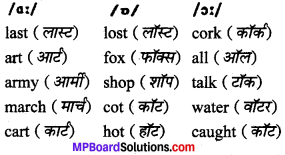
Listening Time

The teacher will read out the following words and the students will repeat them.
(निम्न शब्दों को दोहराओ।)
Answer:
MP Board Class 10th General English The Spring Blossom Solutions Chapter 4 Children 2

Speaking Time

Read out the lines that have rhyming words.
(तुकान्त शब्दों वाली पंक्तियाँ पढ़ो।)
Answer:
Students should do themselves.
(छात्र स्वयं करें।)

Writing Time

Answer the following questions

Question 1.
Have you ever been to a hill station?
Answer:
Yes, I visited Nainital in these summer vacations.

Question 2.
How did you prepare for your journey?
Answer:
Since it is a cool place I took some warm clothes, a pair of boots along with other things.

Question 3.
What was the route and mode of transport to reach the place you visited?
Answer:
From Gwalior I reached Delhi by train and then I reached Kathgodam from Delhi. There was also bus service from Delhi to Kathgodam but since train was more comfortable so I went by train. From Kathgodam to Nainital the mode of transport was either Govt. bus or private taxi. I hired private taxi and reached the place.

Question 4.
How was your journey? Describe it.
Answer:
The journey was quite comfortable since I had already reserved my berth in the train. The roads were also smooth from Kathgodam to Nainital and mode of transport was easily available. People on the way were also very co-operative since it was a new place for me and I visited there for the first time.

Question 5.
Mention some specific spots you visited and describe them.
Answer:
Some spots that I visited there were Mall road. Naini lake, snow view, cave park, dolphin peak and Raj Bhawan. In the Naini lake the water was pure and we did boating there, on Mall road there was a market and shops of different things, from snow view Himalaya range could be seen, in cave park there were caves of different kinds and from dolphin peak whole Nainital could be seen.

Question 6.
Where did you halt?
Answer:
We halted in a hotel on Mall road from where we could get the view of Naini lake.

Question 7.
What did you like most?
Answer:
I liked Naini lake the most because I could do boating in it.

Question 8.
How long did you stay there? What were your feelings at departure?
Answer:
I stayed there for a week. I enjoyed there too much and did not want to come back home but since I had already reserved my berth in the train I had to come back.

Question 9.
Do you think the visit was useful? Why?
Answer:
Yes, it was as I could see so many new spots and observe natural beauty so closely.

Question 10.
Can you suggest some more places you want to visit?
Answer:
Yes, I want to visit Shimla, Manali, Dehradun and Mussoorie.

Now, develop your answers into an essay.
Students can develop an essay on the basis of the above answers themselves.

Things to do

If you happen to go to, and watch, the river near your village or town, make a list of pollutants. Give some ideas to keep the river free from pollution.
Answer:
Pollutants in the river were industrial effluents, garbage from the city, human excreta, polythene bags, wastage obtained by religious ceremonies, bathing, washing clothes, dead bodies etc. Humans should check the disposal of above mentioned pollutants in the river to keep it free from pollution.

Children Central Idea of the Poem

Children spread joy and relieve us from the tensions of life. Their hearts are free of clever plans and tensions like those of adults. Their careless happy looks are more valuable than the wisdom of books. They are sweetest songs and living poems while everything else is lifeless.

Difficult Word Meanings Children

Perplex (पर्पलेक्स)-to feel confused and anxious because you do not understand something (चकित, भ्रमित); Vanish (वैनिश) – to disappear suddenly (अचानक गायब होना); Swallow (स्वॉलो)-a small song bird (एक छोटी गाने वाली चिड़िया); Brook (ब्रुक)-a small river (एक छोटी नदी); Autumn (ऑटम)-the season of the year between summer and winter (ग्रीष्म व शरद ऋतु के बीच का मौसम); Whisper (feat)- to speak very quietly to somebody so that other people cannot hear what you are saying (बुदबुदाना); Contrivings (कण्ट्राइविंग्स)-clever plans (चतुर योजना); Caress (करेस)-agentle touch or kiss to show you love somebody (प्रमपूर्ण स्पर्श); Ballad (बैलड)-a song or poem that tells a story (गाना या कविता); Ye (ये)-old use, a word meaning ‘you’ (“यू” शब्द का पुराना उपयोग)

Children Summary, Pronunciation & Translation

Come to me, Oye children!
For I hear you at your play,
And the questions that perplexed me
Have vanished quite away.

(कम टु मी, ओ ये चिल्ड्रन!
फॉर आई हीयर यू ऐट यॉर प्ले,
ऐण्ड द क्वेश्चन्स दैट परप्लेक्स्ड मी
हैव वेनिश्ड क्वाइट अवे.)

अनुवाद :
मेरे पास आओ तुम ओ बच्चो!
मैं तुम्हें खेलते हुए सुन रहा हूँ,
और जो सवाल मुझे हैरान किए हुए थे
सब कहीं गायब हो गए हैं।

Ye open the eastern windows,
That took towards the sun,
Where thoughts are singing swallows,
And the brooks of morning run.

(ये ओपन द ईस्टर्न विन्डोज,
दैट लुक टुवर्ड्स द सन,
व्हेयर थॉट्स आर सिंगिंग स्वैलोज,
ऐण्ड द ब्रुक्स ऑफ मॉर्निंग रन.)

अनुवाद :
तुम पूर्व दिशा की खिड़कियाँ खोलते हो.
जो सूर्य की ओर देखती हैं,
जहाँ विचार गाती अबाबीलें हैं,
और सुबह के सोते दौड़ते हैं।

In your hearts the birds and the sunshine,
In your thoughts the brooklet’s flow,
But in mine is the wind of Autumn
And the first fall of the snow.

(इन यॉर हार्ट्स द ब ऐण्ड द सनशाईन,
इन यॉर थॉट्स द ब्रक्लेट्स फ्लो,
बट इन माईन इज द विन्ड ऑफ ऑटम
ऐण्ड द फर्स्ट फॉल ऑफ स्नो.)

अनुवाद :
तुम्हारे हृदयों में हैं पक्षी और सूर्य का प्रकाशं.
तुम्हारे विचारों में स्रोतों का बहाव,
परन्तु मेरे मन है पतझड़ की हवा
और मौसम की पहली बर्फबारी।

Come to me, Oye children!
And whisper in my ear
What the birds and the winds are singing
In your sunny atmosphere.

(कम टू मी, ओ ये चिल्ड्रन!
ऐण्ड व्हिस्पर इन माई ईअर
वॉट द बर्ड्स ऐण्ड द विण्ड्स आर सिंगिंग
इन यॉर सनी ऐटमॉस्फेयर.)

अनुवाद :
मेरे पास आओ तुम ओ बच्चो!
और मेरे कान में फुसफुसाके बताओ
पक्षी और हवा क्या गा रही हैं
तुम्हारे उजले परिवेश में।

For what are all our contrivings,
And the wisdom of our books,
When Compared with your caresses,
And the glandness of your looks?

(फॉर वॉट आर ऑल आवर कण्ट्राइविंग्स,
ऐण्ड द विस्डम ऑफ आवर बुक्स,
व्हेन कम्पेअर्ड विद यॉर केअरेसिस,
ऐण्ड द ग्लैडनेस ऑफ यॉर लुक्स?)

अनुवाद :
क्या महत्व है हमारी सारी युक्तियों का,
और हमारी पुस्तकों के ज्ञान का,
तुम्हारे प्यार भरे दुलार,
और तुम्हारी आह्लादित दृष्टि के आगे?

Ye are better than all the ballads
That ever were sung or said,
For ye are living poems,
And all the rest are dead.

(ये आर बेटर दैन ऑल द बैलेड्स
दैट एवर वर संग ऑर सेड,
फॉर ये आर लिविंग पोयम्स,
ऐण्ड ऑल द रेस्ट आर डेड.)

अनुवाद :
तुम सभी प्रेम-गीतों से अच्छे हो
जो कभी गाए या कहे गए,
क्योंकि तुम साक्षात जीवित कविता हो
और बाकी सब मृत।

Hope that the above shaped information regarding the Madhya Pradesh Board Solutions for 10th English Chapter 4 Children Questions and Answers is useful for making your preparation effective. View our website regularly to get other subjects solutions.

MP Board Class 6th Social Science Solutions Chapter 1 The Sources of Knowing History

MP Board Class 6th Social Science Solutions Chapter 1 The Sources of Knowing History

MP Board Class 6th Social Science Chapter 1 Text Book Exercise

MP Board Class 6th Social Science Chapter 1 Short Answer Type Questions

Mp Board Class 6 Social Science Solution Question 1.
Question (a)
What are the different ways of knowing History?
Answer:
The different ways of knowing History are through

  1. oral information
  2. written information
  3. evidences

1. Oral information:
The old proverbs, stories and ancedotes come under oral informations.

2. Written information:
These are the writings which can be read.

3. Evidences:
These are the things which were used by the people at that time.

Mp Board Class 6th Social Science Solution Question (b)
What are the main sources of knowing History?
Answer:
Our ancestors have left behind the following clues which help us in knowing the History :

1. Records:
Records have been found on dried palm leaves, the bark of the birch tree, plates of copper, hand written papers.

2. Inscriptions:
The writings of the past have also been engraved on large rocks, stone walls, stones, pillars and clay tablets.

3. Manuscripts:
Manuscripts are ancient books written either on dried palm leaves or the thick bark of the tree or on papers. They serve ready evidence of the past.

4. Objects of the Past:
Weapons, tools and pottery of the ancient people have been
found out in many excavations. They have been dug out of earth and can be seen and touched.

5. Skin and Bones:
Man used the skin of the animals as clothes and bones to make the weapons, tools and even ornaments.

Mp Board Class 6 Social Science Solution English Medium Question (c)
What are the rock paintings and where are they found in Madhya Pradesh?
Answer:
When human being did not have the knowledge of scripts, they expressed themselves through pictures and figures drawn on rocks. These pictures are called rock paintings.

The rock paintings at Bhimbetka near Bhopal is a living example of ancient rock painting.
The most of the rock-paintings in India have been found in the Vindhyachal and Satpura ranges in Madhya Pradesh.

Mp Board Class 6 History Solution Question (d)
What is Bhojpatra?
Answer:
The bark of birch tree on which ancient books were written, is called as Bhojpatra.

Class 6th Social Science Mp Board Question (e)
Why is the study of History important?
Answer:
It is necessary to study History in order to understand the present. History is very interesting and exciting. History is the story of our development. We can know about our civilisation and culture only by studying History. From our History we can learn lessons that will help us in advancing continuously.

Mp Board Class 6th Social Science Question (f)
What are records?
Answer:
Records are the old historic information. These are found on dried palm leaves, the bark of the brich tree, plates of copper and hand written papers.

Mp Board 6th Class Social Science Book Question (g)
Why should we protect our historical heritage?
Answer:
We should protect our Historical heritage to study the past of our History

Class 6 Social Science Mp Board Question 2.
Fill in the blanks:

  1. Huen-Sang and Fa-Hien were ……………..
  2. The tope of Sanchi is related to …………….. religion.
  3. The person who discovers ancient things/places and finds facts about them are called ……………

Answer:

  1. Chinese travellers
  2. Jain
  3. Archaeologists

Choose the correct alternative

Social Science Class 6 Mp Board Question 1.
Tamrapatras were written on:
(a) stones
(b) sheets of copper
(c) barks of trees
Answer:
(c) barks of trees

Mp Board Solution Class 6 Social Science Question 2.
Petrographs are:
(a) information engraved on stones
(b) information written in books
(c) information written bn Bhojpatra
Answer:
(a) information engraved on stones

Mp Board Class 6 Social Science Question 3.
Architecture gives us knowledge about:
(a) buildings
(b) paintings
(c) tools.
Answer:
(a) buildings.

Project work

Mp Board Class 6 Social Science Chapter 1 Question 1.
Observe a museum/your town/your villages. List out the things of historical importance?
Answer:
Please do with the help of your subject teacher.

Social Science Class 6 Mp Board English Medium Question 2.
What are the sources of knowing History ? Make a list of them.
Answer:
Our ancestors have left behind the following clues which help us in knowing the History:

1. Records:
Records have been found on dried palm leaves, the bark of the birch tree, plates of copper, hand written papers.

2. Inscriptions:
The writings of the past have also been engraved on large rocks, stone walls, stones, pillars and clay tablets.

3. Manuscripts:
Manuscripts are ancient books written either on dried palm leaves or the thick bark of the tree or on papers. They serve ready evidence of the past.

4. Objects of the Past:
Weapons, tools and pottery of the ancient people have been found out in many excavations. They have been dug out of earth and can be seen and touched.

5. Skin and Bones:
Man used the skin of the animals as clothes and bones to make the weapons, tools and even ornaments.

Class 6th Mp Board Social Science Question 3.
Go around your village/school. Talk to the people and gather information about the History of your village?
Answer:
Please do with the help of your subject teacher.

MP Board Class 6th Social Science Solutions

MP Board Class 7th Special English Solutions Chapter 6 The Kings Choice

Get Updated MP Board Solutions for Class 7 Special English Solutions Chapter 6 The Kings Choice Questions and Answers in PDF Format and download them free of cost. These are provided as per the latest exam pattern and syllabus. Access the topics of Chapter wise and communication skills, grammer part through the direct links available depending on the need. You can Download MP Board Class 7 English Solutions and can score highest grade in examination. Clear all your queries on the Mp Board Solutions for Class 7 English Chapter 6 The Kings Choice Questions and Answers Subject by using the Madhya Pradesh State Board Solutions for existing.

MP Board Class 7th Special English Solutions Chapter 6 The Kings Choice

If you are eager to know about the Madhya Pradesh State Board Solutions for Class 7 English you will find all of them here. You can identify the knowledge gap using these MP Board Solutions for English PDF and plan accordingly. Don’t worry about the accuracy as they are given after extensive research by people having subject knowledge along side from the latest English Syllabus.

The Kings Choice Text Book Exercise

Comprehension

(Answer the questions given below.)

Mp Board Class 7th English Chapter 6 Question 1.
Whom did the lion appoint as his courtiers and why?
Answer:
The lion appointed the crow, the fox and the leopard as his courtiers. He did so for the following reasons. The fox was wise and clever. The leopard was alert and swift-footed. The crow could fly high.

Class 7 English Chapter 6 Mp Board Question 2.
What did the crow ask the king?
Answer:
The crow asked the king if he had ever tasted the camel’s meat. It was very tasty and sweet.

Class 7 English Chapter 6 The King Choice MP Board Question 3.
Where did the king and his courtiers go in search of food?
Answer:
The king and his courtiers went to a desert. It was some miles away. The camel lived there.

The King’s Choice Class 7 Question Answer MP Board Question 4.
Why could the lion not go farther?
Answer:
The lion and his courtiers reached the desert the sand of the desert was burning hot because the blazing sun was shining there. The hot sand had burnt the lion’s paws. There fore, he could not go farther.

The King’s Choice Class 7 Answers MP Board Question 5.
How did they return from the desert?
Answer:
The lion got on the camel’s back. The fox and the leopard sat behind the lion. The crow kept flying. In this way, they returned from the desert to the forest.

The King Choice Question And Answer MP Board Class 7 Question 6.
Why did the three advisers smile mysteriously?
Answer:
The lion and the three advisers were tired and hungry. They looked at the camel intently. Then they looked at each other. With their looks they planned to entrap the camel. Therefore, they smiled mysteriously.

The King’s Choice Lesson Std 7 Questions And Answers MP Board Question 7.
What did they plan next?
Answer:
The fox made a planning. They would make the camel request the lion to eat him.

The King Treated The Animals Very MP Board Class 7 Question 8.
What did the lion say to the camel in the end?
Answer:
In the end the lion said to the camel, “You have been loyal and good. You shall be my friend as long as I live.”

A. Read the following sentences and tick true or false

  1. The king was big, handsome, fierce and strong. T / F
  2. A king must not have courtiers. T / F
  3. The lion had four courtiers. T / F
  4. The courtiers never opposed the king. T / F
  5. The lion had never seen a camel. T / F
  6. The hot sand had burnt the feet of the fox. T / F
  7. They were tired and hungry. T / F
  8. I shall eat you one by one in the order in which you offered by ourselves. T / F

Answer:

  1. True
  2. False
  3. False
  4. True
  5. True
  6. False
  7. True
  8. True

Word Power

A. Use these phrases in the following sentences:
(ran, away, looked at, set off, inspite of, far from)
Question

  1. They ……………. each other.
  2. The king …………………. on a journey.
  3. The forest is not ……………….. the desert.
  4. The lion was pleased ………………. his burnt paws.
  5. The leopard wanted to ………………

Answer:

  1. looked at
  2. set off
  3. far from
  4. inspite of
  5. run.

B. Write one word for:

  1. person a part of the court of king or queen ……..
  2. a swift-footed animal………
  3. one who advises……..
  4. an area full of sand………
  5. a place of living ………
  6. the ship of the desert ……..
  7. one who remains faithful ……..

Answer:

  1. courtier
  2. Adviser
  3. Desert
  4. Dwelling
  5. Camel
  6. Loyal

C. Rearrange the. words to make meaningful sentences:

  1. have/must/king/courtiers/a/./
  2. a/bird/can/high/fly/./
  3. roared/./whenever/stood/he/in/awe/ they
  4. fat/big/and/looked/./it/
  5. burnt/the/paws/.had/hot/sand/his
  6. them/the/far/was/./behind/forest

Answer:

  1. A king must have courtiers.
  2. A bird can fly high.
  3. Whenever he roared they stood in awe.
  4. It looked big and fat.
  5. The hot sand had burnt his paws.
  6. The forest was far behind them.

Grammar in use

A. Underline the verbs in the following sentences:

  1. The dog barked at the thief.
  2. The snake killed the rat.
  3. The hare fell into the well.
  4. The hunter shot a lion.
  5. Fish swim in the river.

Answer:

  1. The dog barked at the thief
  2. The snake killed the rat
  3. The hare fell into the well
  4. The hunter shot a lion
  5. Fish swim in the river.

B. Fill in the blank spaces with suitable adverbs given in the box:

(greedily, unbearably, kindly, happily, mysteriously, slowly, loyalty)

  1. The king treated the animals very………..
  2. The hungry lion ate the food…………..
  3. A tortoise walks ………….
  4. The fox smiled ………….
  5. All the animals took oaths of ……….. to the king.
  6. It was……….. hot.
  7. The animals lived……… in the jungle.

Answer:

  1. Kindly
  2. greedily
  3. slowly
  4. mysteriously
  5. loyalty
  6. unbearably
  7. happily.

Let’s Talk

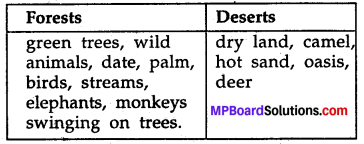
Some images of the forest and the desert are given here but they are mixed. Discuss them in groups to sort out and write them separately in the two columns given below :
(green trees, wild animals, dry land, camel, hot sand, date palm, oasis, birds, streams, elephant, deer, monkeys, swinging on trees.)
Answer:
The King's Choice Class 7 MP Board

Let’s Write

A. Using the following clues, write a paragraph about your visit to a bird sanctuary or a national park.

1. A national park (name)
2. it is in……….. (state)
3. world famous for ………….
4. besides lions, there are other wild animals such as……….
5. lots of people come daily.
6. facility to wander in the forest area (name) ………..
Answer:
One day, I visited a national park, Its name is kaziranga national park. It is in the state of Assam. It is world famous for one homed rhinos. Besides lions there are other wild animals such as tigers, panthers, leopards and bears. Lots of people come there daily to see the birds and animals. There is also a facility to wander in the forest area named kaziranga.

B. Write a letter to your friend describing how and where you spent your last summer vacation.

V & P.O. Sadhrana
Distt Gurgaon,
Haryana
8th July, 2006
Dear Rakesh,
Received your letter just now. I am my describing how I spent my last summer vacation.

I went to my village. There I went for a daily morning walk in the fields. After staying there for a fortnight, I went on L.T.C. with my father. I saw many places of pilgrimage. The sight of the historical buildings added a great deal to my knowledge. I saw many falls, rivers, mountains and seas.

Then I went to the houses of all of my relatives in turn. In this way I spent summer vacation.
Rest when we meet
Yours sincerely,
Sham Lai Vasistha.

Let’s Do It

Discuss in groups of four and collect the pictures of lion, camel, leopard, fox and then write three sentences about each of them.
Answer:
For self attempt.

The Kings Choice Word Meanings 

Page 32 to 35: Handsome – pretty, good looking beautiful – सुन्दर, Fierce – fearful – भयानक, Continued – persisted – जारी रही, Courtiers – ministers/counsellors in royal court – राजदरबारी, Bowed – bent – झुकाया, Alert – smart, agile – चुस्त, Lastly – finally – अन्त में, Oaths – pledges – शपथ, Loyalty – fidelity, faithfulness – वफादारी, Protection – safety – सुरक्षा, Opposed – acted against – विराध करना, Wishes – desires – इच्छाएं, Roared – thundered, granted loudly – दहाड़ा, Awed – fear mingled with respect – रोबयुक्त भय, Fill-full diet – पूर्ण भोजन प्राप्त करना, Remains – left overs – जूठन बचा हुआ, Desert – sandy place – मरुस्थल, Longed – desired – इच्छा करना, Looked – seemed – दिखाई देता था, Advisors – counsellors – सलाहकार, set off – started – चल दिया, Blazing – burning, scorching – झुलसता हुआ, Unbearably – intoserably – असह्य तौर पर, Further – to a more distance – अधिक दूरी तक, Commanded – ordered – आज्ञा दी, Frightened – got afraid – भयभीत हो गए, Behind – on the back – पीछे, Surprised – amazed -आशचर्य चकित होना, Intesently – designedly – उद्देश्य से, Promise – give word – वचन देना, Shocked – hurt – आहत हुए, Disappointed – worried – निराश/हताशा, However – still, nevertheless – फिर भी, Indeed – really – वास्तव में, While – a short time, moment – क्षण, Flesh – fat, meat – चर्बी माँस, Rushed in – dashed – तेजी से आगे बढ़ा, Proposal – suggestion to make offerings – सुझाव, Sacrifice – renounce – बलिदान देना, Really – actually – वास्तव में।

We believe the information shared regarding MP Board Solutions for Class 7 English Chapter 6 The Kings Choice Questions and Answers as far as our knowledge is concerned is true and reliable. In case of any queries or suggestions do leave us your feedback and our team will guide you at soonest possibility. Bookmark our site to avail latest updates on several state board Solutions at your fingertips.

MP Board Class 8th General English Grammar

Guys who are planning to learn the fundamentals of English can avail the handy study material using MP Board Solutions for Class 8 General English Grammar Questions and Answers. You Can Download MP Board Class 8 English Solutions Questions and Answers, Notes, Summary, Guide, Pdf. Refer to the Madhya Pradesh State Board Solutions for English PDF available and score better grades. Simply click on the quick links available for MP Board Solutions for Class 8 General English Grammar Questions and Answers and prepare all the concepts in it effectively. Take your preparation to the next level by availing the Madhya Pradesh State Board Solutions for Class 8 English prepared by subject experts.

MP Board Class 8th General English Grammar

Do you feel the concept of English is difficult to understand? Not anymore with our MP Board Solutions for Class 8 General English Grammar Questions and Answers. All the Solutions are given to you with detailed explanation and you can enhance your subject knowledge. Use the Madhya Pradesh State Board Solutions for Class 8 English PDF for free of cost and prepare whenever you want.

1. Articles
(उपपद):

A,An, The को Articles कहते हैं। Articles दो प्रकार के होते हैं –

(1) Indefinite Articles – ‘A’ and ‘An’ दोनों Indefinite Articles कहलाते हैं क्योंकि ये किसी विशेष व्यक्ति या वस्तु को सूचित नहीं करते।
जैसे – I saw a dog and an ox yesterday.
Note: An’ का प्रयोग उन जातिवाचक संज्ञा के पूर्व किया जाता है जो Vowel (a, e, i, o, u) से आरम्भ होते हैं। जैसे An ox, An eye, an orange.
Note : ‘A’ का प्रयोग consonant से आरम्भ होने वाले एकवचन की जातिवाचक संज्ञा के पूर्व होता है। जैसे a book, a cow, a lion

(2) Definite Articles – ‘The’ definite article है क्योंकि ये किसी विशेष व्यक्ति या वस्तु को सूचित करता है। किसी खास वस्तु, नदी, पहाड़, प्रसिद्ध ग्रन्थ, अखबार आदि के नाम से पहले ‘The’ का प्रयोग करते हैं।
जैसे –

  1. The sun shines brightly.
  2. The Ganga is a holy river.
  3. I saw the Taj Mahal.
  4. My mother met the Principal.

Note: (i) जब ० का उच्चारण wa की तरह और u का उच्चारण yoo की तरह हो तब हम a का प्रयोग करते हैं, an का नहीं जैसे a one rupee note, a useful thing, a university
Note: (ii) जब h बोला नहीं जाता, तब हम an का प्रयोग करते हैं, a का नहीं जैसे – an honest man, in an hour.

Exercise

Fill in the blanks with the correct articles

1. Ramesh is ……….. honest boy.
2. The cow is …….. useful animal.
3. This is …….. umbrella.
4. Sameer brought …….. apple and …….. banana.
5. This is, …….. interesting story.
6. Honesty is …….. best policy.
7. ………. earth is round.
8. Mr. Prasad is ……. teacher.
9. Mr. Harish is ……… M.L.A.
10. Delhi is …………… capital of India.
11. Have you ……. umbrella?
12.  ……… Sun rises in the east.
13. The train is ………… hour late.
14. She is ………. untidy girl.
15. Rajni was ……… blind girl.
16. He is ………. university professor.
17. Reeta reads ……… Gita.

Answers:

1. an
2. a
3. an
4. an
5. an, a
6. the
7. The
8. a
9. an
10. the
11. an
12. The
13. an
14. an
15. a
16. a
17. the.

2. Pronouns
(सर्वनाम):

परिभाषा – जो शब्द संज्ञा के स्थान पर प्रयोग किये जाते हैं, सर्वनाम (Pronouns) कहलाते हैं।
जैसे – Ram is a good boy.
He goes to school.
He का प्रयोग ram की जगह हुआ हैं से यह सर्वनाम हैं For example he, it, she, myself.

Kinds of Pronouns

1. Personal Pronoun
(यक्तिवाचक सर्वनाम)
The Pronouns which stands for the names of persons or things are called personal pronouns.
For e.g. – i, we, you, yours, he, she, it, her etc.
जिन सर्वनामों का प्रयोग व्यक्तियों या वस्तुओं के लिए किया जाये उन्हों Personal Pronouns कहते हैं।

2. Reflexive Pronouns
(कर्तासम्बिधित सर्वनाम)
for e.g. – myself, yourself, herself, itself etc.

3. Demonstrative Pronouns
(संकेतवाचक सर्वनाम)
Pronouns which point out things, are called demonstrative pronouns.
For eg. This, that, these, those.

4. Indefinite Pronouns
(अनिशचयवचक सर्वनाम)
Pronouns which. refers to persons or things in a general or vague way are called Indefinite Pronouns. For eg.Some, many, all, others etc.

5. Distributive Pronouns
(प्रत्येक बोधक)
Pronouns which are used for single person or thing. For eg-each, either, neither.

6. Interrogative Pronouns
(प्रश्नवाचक सर्वनाम)
Pronouns which are used for asking questions are called Interrogative pronouns. for eg—who, whom, what, which etc.

7. Relative Pronouns
(सम्बिधित सर्वनाम)
Who, whose, whom, which and that are called relative pronouns when they are used with nouns coming before them.

Exercise

Fill in the blanks with suitable pronouns:

1. Jack’s mother gave …………….. an orange.
2. Niti said that …………… had not done …………..
3. Please tell ……………. a story.
4. …………… went to the market.
5. Mother told …………… to return home early.
6. ……………. book belongs to ……………
7.  ………….. love music.
8. John bought a ball and gave ………… to Jeff.
9. …………… told ………….. to go away.
10. i …………. is a shy boy.
11. Ram did the work. ………………
12. I …………….. shall do it.
13. They …………….. went there.
14. ……………. of us has a’ book.
15.  …………… did this?
16. This is the house in ……………. I live …………..

Answers:

1. him
2. she, it
3. me
4. He
5. us
6. This, me
7. i
8. it
9. He, me
10. He
11. himself
12. myself
13. themselves
14. Each
15. Who
16. which.

3. The Prepositions
(सम्बन्धसूचक )

परिभाषा – जो शब्द वाक्य में किसी एक वस्तु का दूसरी वस्तु से सम्बन्ध बतलाते हैं Prepositions कहलाते हैं।
A word used to show the relation of one thing to another in a sentence is a preposition.

Relation expressed by Prepositions.
1. Prepositions of Time – कुछ Prepositions समय सूचक होते हैं जैसे –

  • He came at six.
  • I study for seven hours daily.
  • She is absent from class for three days.
  • They work from 10 to 4.

2. Prepositions of Place – कुछ Prepositions स्थान सूचक होते हैं, जैसे –

  • He was born in America.
  • She was in her room.
  • They are coming home from school.
  • I stood before him
  • The ball is out of the circle.

3. Prepositions of Movement – कुछ Prepositions गति सूचक / स्थान सूचक होते हैं, जैसे –

  • He travelled by train.
  • I came by car.
  • He went there on his bike.
  • He travelled in my car.

Use of Some other Prepositions
1. At, In : At, छोटे स्थान के लिए प्रयोग किया जाता है। In, बड़े स्थान के लिए प्रयोग किया जाता है। जैसे

  • He lives at Dholpur.
  • He lives in Madhya Pradesh.

2. In, Into : In स्थिति को बताता है और Into गति का बोध कराता है। जैसे

  • All the boys are in the class.
  • He dived into the river.

3. Why, By : With यन्त्र के साथ प्रयोग होता है और by कार्य करने वाले समय के साथ प्रयोग किया जाता है, जैसे –

  • We cut the apple with the knife.
  • The snake was killed by the farmer.

4. Since, For : Since निश्चित समय के लिए (जैसे दिन का नाम या तिथि आदि) और for का प्रयोग समय की अवधि के लिए किया जाता है। जैसे –

  • He has been ill since Monday.
  • Raj Kumar has been absent for three days.

5. Between, Among : Between दो व्यक्तियों तथा Among दो से अधिक व्यक्तियों के लिए प्रयोग किया जाता है। जैसे –

  • Divide these sweets between Raj and Ravi.
  • He divided his property among his four sons

6. On, Upon : On गतीहीनता upon गतीशीलता के लिए प्रयोग किया जाता है जैसे –

  • The cat is on the mat.
  • The dog jumped upon the table.

7. In, Within : In समय के अवधि की समाप्ति का बोध कराता है और Within समय के अवधि के भीतर का बोध कराता है जैसे

  • I shall come back in a week.
    (सप्ताह की समाप्ति पर)
  • I shall come within a week.
    (एक सप्ताह समाप्ति होने से पूर्व )

8. Below, Beneath : Below पद को सन्दर्भ में और Beneath स्थान के सन्दर्भ में प्रयोग किया जाता है जैसे –

  • Your brother is below my rank.
  • The lion sat beneath a tree.

9. Beside, Besides : Beside का अर्थ है पास और Besides का अर्थ है अतिरिक्त

  • The boys stood beside the teacher’s chair.
  • Besides the Principal, other teachers spoke in the prayer assembly.

10. With, Without : With का अर्थ है साथ और Without का अर्थ है बिना रहित जैसे –

  • Come to me with your brother.
  • Come to the field without anything.

Exercise

Fill in the blanks with the words given in brackets:

1. Hari has been playing …………. two hours. (for, since)
2. He is angry ……………. me. (to, with)
3. The lion jumped ………….. the deer. (on, upon)
4. I live …………….. Kolkata. (in, at)
5. They reached the Bhil village ……………… 9 O’clock. (in, at)
6. The beggar begs …………….. door to door. (from, by)
7. The cat jumped ……………… the rat. (on, upon)
8. Nagpur is famous ……………… oranges. (of, for)
9. The bird is flying …………….. the sky. (in, on)
10. The ball is ……………… the table. (on, at)

Fill in the blanks with suitable prepositions:

11. Lincoln was born ……………. Thursday.
12. He went ……………… the hill.
13. He lives ………………. Bombay.
14. Yesterday Mohan fell ……………… the well.
15. Suman and Rajesh went to see the marble rocks …………….. Jabalpur.
16. The teacher was angry …………….. Rahul.
17. Look …………….. this picture.
18. He met me ……………… 15th August.
19. I don’t want ……………….. take it back.
20. Put your signature …………… ink.
21. Gandhiji was born …………… 2nd Oct. 1869.
22. Once …………. a time, there was a king.
23. I see ………….. my eyes …………..
24. he is afraid ………… snakes.
25. The cat jumped ……….. the river.
26. She’writes ……………. the pen.

Answers:

1. for
2. with
3. upon
4. in
5. at
6. from
7. upon
8. for
9. in
10. on
11. on
12. up
13. in
14. into
15. in
16. with
17. at
18. on
19. to
20. in
21. on
22. upon
23. with
24. of
25. into
26. with.

4. Numbers: Singular & Plural
(एकवचन, बहुवचन):

वह संज्ञा जो किसी एक व्यक्ति या वस्तु के लिए प्रयुक्त होती है एकवचन संज्ञा कहलाती है। (Singular Noun) जैसे – Boy, chair, man अदि वह संज्ञा जो एक से अधिक व्यक्तियों या वस्तुओं के लिए प्रयुक्त होती है बहुवचन संज्ञा कहलाती है। (Plural Noun) जैसे – Boys, Chairs, men अदि।

Singular से Plural बनाना –
1. By adding s to the singular nouns as : boy –
boys, girl – girls, dog – dogs, etc.

2. By adding es as : brush brushes, box –
boxes, gas-gases etc.

3. By changing y into ies as : pony ponies, –
lady – ladies, city – cities etc.

4. By changing f into ves as : thief-thieves –
calf – calves, leaf – leaves etc.

5. By change in the vowel as : man-men, –
foot – feet, tooth teeth, mouse – mice etc.

Exercise

Fill in the blanks with suitable words.

1. The police arrested five …………….. (thief, thieves)
2. The ………………. are green. (leaf, leaves)
3. Mr. Prasad has a lovely ………………. (baby, babies)
4. Some ………………… were riding horses. (boy/boys)
5. All the ………………… were ready to go for a picnic. (student, students)
6. When you close your …………………. you cannot see anything. (eye, eyes)
7. I like reading ………………. (book, books)
8. Sardar Patel was one of the great …………….. of India. (leader, leaders)
9. He loved his only …………….. very much.(son, sons)
10. This …………….. is very sharp. (knife, knives)

Answers:

1. thieves
2. leaves
3. baby
4. boys
5. students
6. eyes
7. books
8. leaders
9. son
10. knife.

5. Gender
(परिभाषा):

Noun के जिस रूप से यह पता चले कि Noun पुरुष है, स्त्री है या निर्जीव है उसे Gender कहते हैं।
Kinds of Gender (लिंग के भेद)

1. Masculine Gender
(पुल्लिंग) – इन संज्ञा शब्दों से पुरुषत्व का बोध होता है, जैसे –
Ram, boy, man, father, brother, king etc.

2. Feminine Gender
(स्त्रीलिंग) – इन संज्ञा शब्दों से नारी अथवा स्त्रीत्व का बोध होता है, जैसे –
girl, woman, mother, queen, sister, etc.

3. Neuter Gender (अलिंग) –
इन संज्ञा शब्दों से निर्जीव वस्तुओं का बोध होता है, जैसे –
book, pen, table, room, house, etc.

4. Common Gender (उभयलिंग) –
इन संज्ञा शब्दों से नर व नारी दोनों का बोध होता है, जैसे –
child, teacher, doctor, enemy etc

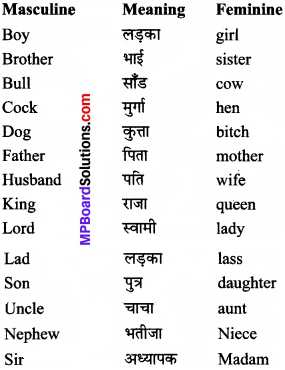
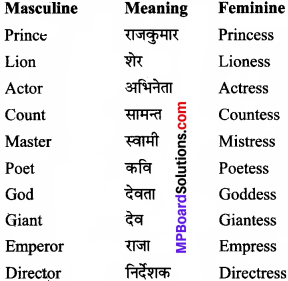
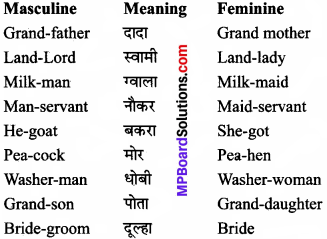
Change of Gender (लिंग परिवर्तन)
Masculine से feminine बनाने के नियम इस प्रकार हैं –

1.Masculine से बिल्कुल भिन्न शब्द का प्रयोग करके जैसे –

MP Board Class 8th General English Grammar-1.1

2. Masculine के अन्त में ess लगाकर।

MP Board Class 8th General English Grammar-1.3

3. Masculine के प्रथम अथवा अन्तिम शब्द को बदल कर।

MP Board Class 8th General English Grammar-1.4

Some Common Genders:

Baby      –    (बच्चा या बच्ची)
Cousin   –   (चचेरा भाई या बहन)
Pupil      –   (शिष्य या शिष्या)
Child     –   (बच्चा या बच्ची)
Person   –   (पुरुष या स्त्री)
Infant     –   (बच्चा या बच्ची)
Doctor    –   (पुरुष या स्त्री)
Teacher  –   (पुरुष या स्त्री)

Exercise

Write the opposite genders of the following nouns:

  1. Poet, land – lord, lad, God.
  2. Princess, brother, mother, girl, man.
  3. Mistress, aunt, hero, king.

Answer:

  1. Poetess, land – lady, lass, Goddess
  2. Prince, sister, father, boy, woman
  3. Master, uncle, heroine, queen.

6. Tense
(काल):

परिभाषा – The tense of a verb shows the time of an event or action of a verb.
Verb के tense से किसी घटना या कार्य के समय का ज्ञान होता है।
अंग्रेजी में Tense तीन प्रकार के होते हैं –

  1. Present tense
  2. Past tense
  3. Future tense.

1. Present Tense (वर्तमान काल) –
इस Tense से यह पता चलता है कि कार्य अब या अभी हुआ है। जैसे –
I go to school. (मैं स्कूल जाता हूँ।)

2. Past Tense (भूतकाल) –
इस Tense से यह पता चलता है कि कार्य बीते हुए समय में हुआ है। जैसे –
I went to school. (मैं स्कूल जाता था।)

3.  Future Tense (भविष्य काल) –
इस Tense से यह पता चलता है कि कार्य आने वाले समय में होगा। जैसे –
I shall go to school. (मैं स्कूल जाऊँगा।)

प्रत्येक Tense निम्नलिखित चार प्रकार के होते हैं –

  1. Indefinite
  2. Continuous
  3. Perfect
  4. Perfect Continuous.

Present Tense (वर्तमान काल):
1. Present Indefinite Tense – इस Tense में सदा सत्य बातें, आदतें अथवा बार-बार होने वाले कार्यों का वर्णन किया जाता है। जैसे –

(i) The sun rises in the east.
सूर्य पूर्व में उदय होता है।
(ii) I go to school.
मैं स्कूल जाता हूँ।

पहचान – हिन्दी में वाक्यों के अन्त में ता, ती, ते तथा है, हूँ, हो होता है।

2. Present Continuous Tense –
इस Tense dit प्रयोग तब किया जाता है जब कार्य अभी भी चल रहा हो जैसे –

(i) I am writing a letter.
मैं पत्र लिख रहा हूँ।
(ii) They are playing football.
पे फुटबॉल खेल रहे हैं। पहचान-हिन्दी में वाक्यों के अन्त में रहा हूँ, रहा है, रही है, रहे हैं होता है।

3. Present Perfect Tense –
इस Tense का प्रयोग ऐसे कार्य के लिए होता है जो वर्तमान में पूरा हो चुका है जैसे –
(i) I have done my work.
मैंने अपना काम कर लिया है।
(ii) He has written a letter.
वह एक पत्र लिख चुका है।

इसमें I, You, तथा बहुवचन के साथ have तथा एकवचन के साथ has का प्रयोग किया जाता है।
इसमें Verb की III form का ही प्रयोग होता है।
पहचान – हिन्दी में वाक्यों के अन्त में किया है, दिया है, चुका है, चुके हैं, चुका हूँ आदि होता है।

4. Present Perfect Continuous Tense –
इस Tense में कार्य पहले से हो रहा है तथा वर्तमान में भी जारी है। जैसे

1. I have been writing a letter for an hour.
मैं एक घण्टे से पत्र लिख रहा हूँ।

2. It has been raining since morning.
सुबह से वर्षा हो रही है।
इस Tense में subject के अनुसार has been या have been तथा मुख्य क्रिया में ing लगाते हैं।
समय के लिए for या since का प्रयोग होता है।
पहचान – हिन्दी वाक्यों के अन्त में रहा हूँ, रहे हैं, रही हूँ तथा कार्य शुरू होने का समय दिया जाता है।

Past Tense (भूतकाल):

1. Past Indefinite Tense – इस Tense में बीते हुए समय में कार्य होता है। जैसे –
(i) He went to the market.
वह बाजार गया।
(ii) I bought a pen.
मैंने एक कलम-खरीदी।

इन वाक्यों में Verb की II form का प्रयोग होता है।
पहचान – हिन्दी में वाक्यों के अन्त में गया, आया, दिया, लिया, किया आता है।

2. Past Continuous Tense –
इस Tense का प्रयोग ऐसे कार्यों के लिए किया जाता है जो भूतकाल में कुछ समय तक जारी रहा हो। जैसे –
(i) I was writing a letter.
मैं एक पत्र लिख रहा था।
(ii) They were playing cricket.
वे क्रिकेट खेल रहे थे।

पहचान – हिन्दी वाक्यों में रहा था, रहे थे, रही थी आदि का प्रयोग होता है। एकवचन में संज्ञा में was तथा बहुवचन में were का प्रयोग होता है।

3. Past Perfect Tense –
इस Tense का प्रयोग ऐसे कार्यों के लिए किया जाता है जो बीते समय में पूरा हो चुका है। जैसे –
(i) He had done his work.
उसने अपना काम कर लिया था।
(ii) They had posted their letters in the post office.
उन्होंने अपने पत्र डाकखाने में डाल दिये थे।

इस Tense में had के साथ Verb की III form का प्रयोग होता है।
पहचान – हिन्दी में वाक्यों के अन्त में लिया था, चुका था, चुकी थी, चुके थे आदि आते हैं।

4. Past Perfect Continuous Tense – इस Tense का प्रयोग ऐसे वाक्यों में होता है जहाँ कार्य बीते समय में शुरू होकर कुछ समय तक जारी रहता है। वाक्य शुरू होने के समय ‘से’ का प्रयोग आवश्यक होता है। इसके लिए for व since का प्रयोग होता है। जैसे –
(i) Ram had been reading since morning.
राम सुबह से पढ़ रहा था।
(ii) Ram had been playing for two hours.
राम दो घण्टे से खेल रहा था। इन वाक्यों में had been के साथ Verb की I form + ing का प्रयोग होता है।
पहचान – हिन्दी वाक्यों के अन्त में रहा था, रहे थे, रही थी आदि आते हैं।

Future Tense (भविष्य काल):
1. Future Indefinite Tense –
इस Tense से यह पता चलता है कि कार्य अभी होगा। जैसे –
(i) I shall go to the market.
मैं बाज़ार जाऊँगा।
(ii) We will play.
हम खेलेंगे।

इस Tense में will, shall का प्रयोग होता है।
पहचान – हिन्दी वाक्यों में अन्त में गा, गे, गी आता है।

2. Future Continuous Tense – इस Tense का
प्रयोग उस कार्य को व्यक्त करने के लिए किया जाता है जो घटनाओं के सामान्य क्रम से घटित होता है। इस Tense में will be या shall be के साथ प्रधान क्रिया में ing लगाया जाता है। जैसे –
(i) Hari will be doing his work.
हरि अपना काम कर रहा होगा।
(ii) Meera will not be going to school.
मीरा स्कूल नहीं जा रही होगी।

पहचान हिन्दी के वाक्यों में अन्त में रहा होगा, रहे होंगे,। रही होगी आदि आते हैं।

3. Future perfect Tense –
इस Tense में भविष्य में किसी कार्य के होने की निश्चितता दर्शाई जाती है –
Shall have, will have + verb की III form का प्रयोग होता है। जैसे –
(i) I shall have finished my work before 4 p.m.
शाम चार बजे से पहले मैं अपना काम समाप्त कर चुकूँगा।
(ii) The teacher will have caught the boy before he runs away.
लड़के के भागने से पहले अध्यापक उसे पकड़ चुके होंगे।

पहचान हिन्दी के वाक्यों में अन्त में चुके होंगे, चुका होगा आदि आते हैं।

4. Future Perfect Continuous Tense
इस Tense में भविष्यत काल में कार्य पूरा होने के साथ-साथ उसके चालू रहने के समय का वर्णन होता है।
Will have been, shall have been के साथ प्रधान क्रिया में ing लगाया जाता है। जैसे –
(i) Dogs will have been barking since one o’clock.
कुत्ते एक बजे से भौंक रहे होंगे।
(ii) Ram will have been writing his poem for four days.
राम चार दिन से अपनी कविता लिख रहा होगा।

पहचान हिन्दी के वाक्यों के अन्त में कर रहा होगा, कर रहे होंगे, कर रही होंगी आदि आते हैं।

Simple Present:

Translate into English

  1. सूर्य पूर्व में उगता है।
  2. मैं चाय पीता हूँ।
  3. मैं प्रतिदिन घूमने जाता हूँ।
  4. माला एक अच्छी लड़की है।
  5. पृथ्वी गोल है।
  6. वृक्ष हमें फल देते हैं।
  7. क्या वे गाना गाते हैं ?
  8. मोहन अपना काम क्यों नहीं करता है ?

Answer:

  1. The sun rises in the East.
  2. I take tea.
  3. I go for a walk daily.
  4. Mala is a good girl.
  5. The earth is round.
  6. Trees give us fruits.
  7. Do they sing a song ?
  8. Why does Mohan not do his work? .

Present Perfect:

  1. मैं चाय पी चुका हूँ।
  2. शीला यहाँ आ गयी है।
  3. उसने पत्र नहीं लिखा है।
  4. वह अपना काम नहीं कर चुकी है।
  5. वे कहाँ जा चुके हैं ?
  6. क्या वे खेल चुके हैं ?

Answer:

  1. I have taken tea
  2. Sheela has come here.
  3. He has not written a letter.
  4. She has not done her work.
  5. Where have they gone ?
  6. Have they played ?

Simple Past:

  1. मैंने एक पेन खरीदा।
  2. वह वहाँ गया।
  3. हमने एक गीत नहीं गाया।
  4. मैंने आम नहीं खरीदे।
  5. क्या हमने खेल खेला ?

Answer:

  1. I bought a pen.
  2. He went there
  3. We did not sing a song.
  4. I did not buy mangoes.
  5. Did we play a game ?

Past Continuous:

  1. शिक्षिका कक्षा में पढ़ा रही थी।
  2. वह नाच रहा था।
  3. क्या वह खेल रहा था ?
  4. राम पत्र नहीं लिख रहा था।
  5.  पिताजी जबलपुर जा रहे थे।

Answer:

  1. The teacher was teaching in the class.
  2. He was dancing.
  3. Was he playing ?
  4. Ram was not writing a letter.
  5. Father was going to Jabalpur.

Simple Future:

  1. मैं उसकी मदद करूँगा।
  2. अध्यापक आज हमें पढ़ायेंगे।
  3. मैं स्कूल नहीं जाऊँगा।
  4. वह गाना नहीं गायेगी।
  5. क्या तुम कविता लिखोगे ?

Answer:

  1.  I shall help him.
  2. The teachers will teach us today.
  3. I shall not go to school.
  4. She will not sing a song.
    Will you write a poem ?

Future Continuous:

  1. वह खाना खा रहा होगा।
  2. राम अपना काम कर रहा होगा।

Answer:

  1. He will be having his meals
  2. Ram will be doing his work.

Translate into English:

  1. यह मेरी पुस्तक है।
  2. उसकी माँ डॉक्टर थी।
  3. मै आगरा जाऊँगा।
  4. माँ खाना बना रही है।
  5. तुम कहाँ रहते हो?
  6. क्या तुम क्रिकेट खेलते हो ?
  7. जया गाना गा चुकी है।
  8. कल छुट्टी का दिन था।

Answer:

  1. This is my book.
  2. His mother was a doctor.
  3. I will go to Agra.
  4. Motor is cooking food.
  5. Where do you live?
  6. Do you play cricket ?
  7. Jaya has sung a song.
  8. Yesterday was a holiday.

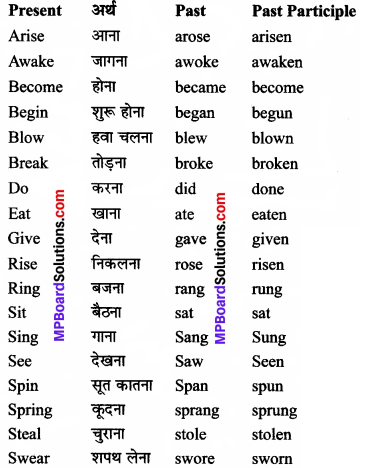
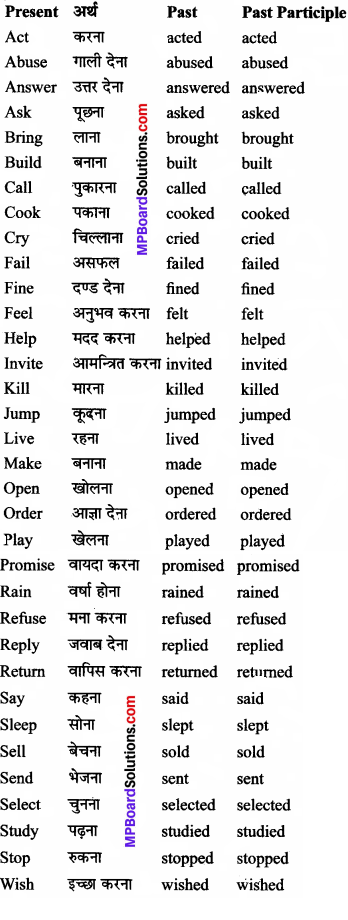
7. Three Forms Of Verbs
(क्रियाओं के तीन रूप)।

Group I – ऐसी क्रियाएँ जिनके तीनों रूप अलग हैं –

MP Board Class 8th General English Grammar-1

Group II – वे क्रियाएं जिनके II form a III form तथा d, ed, t लगाकर बनाते हैं।

MP Board Class 8th General English Grammar-3
Group III – वे क्रियाएं जिनके रूप तीनों Forms में एक से होते हैं –

MP Board Class 8th General English Grammar-5

Exercise

Fill in the blanks with the correct form of verb.

  1. Ra-him ……………. Watching T.V. (was, were)
  2. I ………….. a cock there.. (seen, saw)
  3. The bell …………. before we reached the school …………….. (ring) .
  4. The girl, who is …………… a red sweater, is a good singer. (wear)

Answer:

  1. was
  2. saw
  3. had rung
  4. wearing.

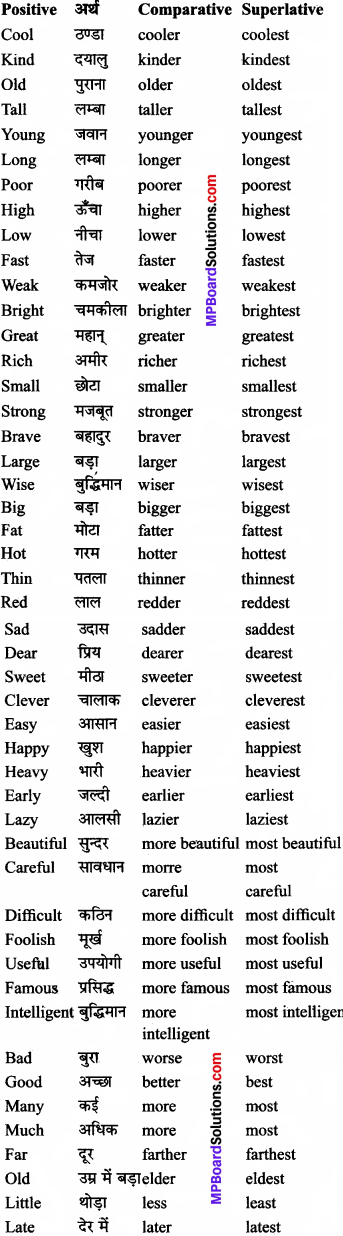
8. Adjective And Its Degrees
(विशेषण तथा उसकी डिग्री ):

परिभाषा – An adjective is a word that is used to add something to the meaning of a Noun.
जो शब्द संज्ञा की विशेषता बतलाते हैं, विशेषण कहलाते है। जैसे –

1. Satish ia a tall boy.
सतीश लम्बा लड़का है।

2. She is a clever girl.
वह चतुर लडकी है।

Adjectives कि तीन अवस्थाएँ होती हैं –

  1. Positive degree
  2. Comparative degree
  3. Superlative degree.

MP Board Class 8th General English Grammar-6

Exercise

Fill in the blanks with correct degree of comparison.

1. Bala is …………… than Ravi. (young)
2. Raji Devi is not as …………….. as her husband. (tall)
3. This is the ……………. flower I have ever seen. (beautiful)
4. Raja is not as …………..,.. as his brother. (intelligent)
5. I am ………………. (strong) than he is.
6. Calcutta is the ……………… city in India. (big)
7. Iron is the …………………. (useful) of all metals.
8. Iron is ……………….. (heavy) than wood.
9. Which is the ……………… (high) mountain in India ?
10. He is ………………. (lazy) than his sister.

Answers:

1. younger
2. tall
3. most beautiful
4. intelligent
5. stronger
6. biggest
7. most useful
8. heavier
9. highest
10. lazier.

9. Adverbs
(क्रिया-विशेषण):

परिभाषा – An adverb is a word which modifies an adjective, verb or another adverb.
जो शब्द किसी विशेषण, क्रिया अथवा अन्य क्रिया विशेषण की विशेषता बतलाते हैं, क्रिया-विशेषण कहलाते हैं।

Kinds of Adverbs:

1. Adverb of Time – ये शब्द कार्य के होने का समय। स्पष्ट करते हैं, जैसे –

  • Ram came early.
  • She gets up in the morning daily.
  • Our shop remains closed on Monday.
  • You may go now.

इस प्रकार के adverbs निम्नलिखित हैं –
Now, then, before, since, ago, soon, early, late, afterwards, today, tomorrow, yesterday etc.
Adverb of Time answers the questions: When? i.e. ये verb में ‘कब’ लगाकर ज्ञात होता है।

2. Adverb of Place ये शब्द क्रिया के होने का स्थान बताते हैं, जैसे –

  • Please come here.
  • Come in.
  • Go out.
  • She sits there.

इस प्रकार के adverbs निम्नलिखित हैं –
here, there, in, out, above, below, inside, outside, far, near, every where etc.
Adverb of Place answers the questions : Where? i.e., ये verb में ‘कहाँ’ लगाकर ज्ञात होता है।

3. Adverbs of Reason –
ये शब्द कारण प्रकट करते हैं, जैसे

  • He therefore left the school.
  • He is hence unable to go.

Adverb of Reason answers the question : Why ? i.e., ये verb में क्यों लगाकर ज्ञात होता है।

10. The Conjunctions
(संयोजक):

परिभाषा – A conjunction is a word which joins words or sentences with each other.
वे शब्द जो शब्दों या वाक्यों को आपस में जोड़ते हैं संयोजक कहलात हैं।

निम्नलिखित कुछ conjunctions the हैं, जैसे –
and (और), as (जैसे), but (लेकिन), before (पहले), because (क्योंकि), after (बाद में), if (अगर), or (या), otherwise (अन्यथा ), that (की), though (यद्यपि), then (जबकि), till (तक), unless (जब तक कि), while (जबकि), which (जोकि), when (जब), therefore (अतः), so (इसलिए), as well as (तथा), either-or (या तो या), neither nor (ना तो-ना ही) etc.

1. Rita and Gita are sisters.
2. I live in Bhopal which is the capital of Madhya Pradesh.
3. Anil is rich but Hari is poor.
4. Walk fast or you will miss the bus.
5. He was so tired that he could not walk.
6. He was ill, therefore he could not come to school.

Exercise

Combine the following pairs of sentences into a single one using and or but:

  1. Mala studied well. She won a number of prizes.
  2. Sheela likes red colour. Geeta likes blue colour.
  3. Rani bought some apples. Raju bought oranges.
  4. I have seen the Taj Mahal. I have not seen the Qutub Minar.
  5. Bala likes birds. She does not like monkeys.
  6. I like cricket. I like football.
  7. Sohan went to Delhi during the vacation. Rohan went to Agra.
  8. He is poor. He is honest.

Answers:

  1. Mala studied well and won a number of prizes.
  2. Sheela likes red colour but Geeta likes blue.
  3. Rani bought some apples and Raju bought oranges.
  4. I have seen the Taj Mahal but not the Qutub Minar.
  5. Bala likes birds, but not monkeys.
  6. I like circket and football.
  7. Sohan went to Delhi during the vacation but Rohan went to Agra.
  8. He is poor but honest.

11. Modals
(सहायक किया):

1. Primary Auxiliaries – Be, have, do.
2. Modal Auxiliaries – will, shall, can, may, must etc.
नोट – यहाँ केवल वही Auxiliaries दी जा रही हैं जो पाठ्यक्रम में निर्धारित हैं –

Have का main verb के रूप में प्रयोग:

1. I have a car. (अधिकार)
2. He has a pen (अधिकार)
3. We had an old car. (अधिकार)
4. We had our meal early today. (ate)
5. I had tea not coffee. (drank)
6. She had a packet from the postman.(received)
7. He has fever. (suffering from)

Use of ‘Shall’ and ‘Should’
Shall –
1. Promise
(वचन) के लिए, जैसे –

  • I shall help you.
  • We shall go to cinema today.

2. Suggestion या advice
(सुझाव) दिखाने के लिए जैसे –

  • Shall we go to school today?
  • Shall I close the door ?

3.  Determination
(दृढ़ निश्चय) के लिए, जैसे –

  • I shall turn you out of the room.
  • He shall reach there by evening.

4. Command
(आदेश) के लिए, जैसे –

  • You shall have to do this work.
  • He shall be punished again.

Should –
(i) Obligation or advisability
(कर्तव्य, सुझाव) के लिए, जैसे –

  • We should respect our elders.
  • You should study the subject first then give your views.
  • You should be punctual.

(ii) Assumption
(पूर्ण धारणा) के लिए

  • That should be Mohan’s cycle.
  • You should be Ram’s brother.

(iii) Lest at ang should ait beim
(a) Walk carefully lest you should fall. Use of ‘Can’ and ‘Could’

Can –
(i) Ability
(योग्यता) दिखाने के लिए, जैसे –

  • I can swim.
  • He can speak English.

(ii) Permission
(आज्ञा), जैसे –

  • You can go home now.
  • You can park your car here.

(iii) Possibility
(संभावना) दिखाने के लिए, जैसे –

  • The students can be notorious.
  • He can come today.

(iv) Power
(शक्ति) प्रकट करने के लिए, जैसे –

  • We can walk so long.
  • Can he bear this pressure ?

Could—
(i) Ability is past
(भूतकाल में क्षमता) दिखाने के लिए, जैसे

  • She could speak English well.
  • He could not pass as he did not work hard.
  • He could swim, when he was a child.

(ii) Possibility
(सम्भावना) व्यक्त करने के लिए। जैसे –
(a) When I was the principal, teachers could meet the girl students in the open.

(iii) Request (प्रार्थना) के लिए, जैसे –

  • Could you give me your pen ?
  • Could you tell your residence ?

Use of ‘May’ and ‘Might’
May –
(i) Permission
(अनुमति) माँगने/देने के लिए –

  • May I come in Sir ? (माँगना)
  • You may go now. (देना)।

(ii) Possibility (सम्भावना) के लिए, जैसे –

  • It may rain today.
  • The principal may not grant me leave.

(iii) Purpose (उद्देश्य) व्यक्त करने के लिए, जैसे –

  • We eat so that we may live.
  • We save so that we may use in future.

(iv) Wish (इच्छा) प्रकट करने के लिए, जैसे –

  • May you live long !
  • May God help you !

Might –
(i) Possibility (सम्भावना) व्यक्त करने के लिए, जैसे –

  • The principal might grant me leave.
  • She might be Suman.

(ii) Permission (अनुमति) माँगने के लिए
(a) Might I borrow your car for a day?

Use of ‘Must

(i) Necessity (आवश्यकता) व्यक्त करने के लिए –

  • We must obey our elders.
  • We must get up early.

(ii) Prohibition (रोकने) के लिए –
(a) You must not leave home before 6 p.m.

(iii) Certainty or belief (पक्का विश्वास) व्यक्त करने के लिए, जैसे –

  • I must finish this book today.
  • He must have gone.

Exercise

Fill in the blanks with suitable modals:

1. We ………….. get up early in the morning.
2. The sky is clear now, it ………….. rain in the evening.
3. He promised me that he …………… preside over our function.
4. …………… you switch the fan off?
5. We …………….do our duty.
6. ……………… I come in Sir ?
7. My friend ……………. arrive at 8 p.m.
8. My son ………….. drive a car.
9. The news ………….. be false.
10. If you disobey, you ………….. be punished.

Answers:

1. should
2. can
3. would
4. Would
5. must
6. May
7. will
8. can
9. may
10. shall.

12. Punctuation
(विराम चिन्ह)।

Punctuation का अर्थ होता है किसी वाक्य में Full stop, comma आदि विराम चिह्न का प्रयोग करना। इनके प्रयोग इस प्रकार हैं।
1. Full stop (.) – हिन्दी के पूर्ण विराम (।) के स्थान पर अंग्रेजी में full stop (.) प्रयोग होता है।

(a) Affirmative, Negative site Imperative वाक्यों के अन्त में –

  1. She is a girl.
  2. She is not coming.
  3. Please come here.

(b) Abbreviations
(संक्षिप्त शब्दों) तथा नामों के प्रारम्भ में। जैसे –
M. A., A.P.J. Abdul Kalam.

2. Comma (.) – Comma (अर्द्ध विराम) का प्रयोग निम्न दशाओं में होता है –

(i) एक ही Part of Speech के कई शब्दों को अलग करने के लिए. जैसे –
He can read, write and sing well.

(ii)And से जोड़े गये एक से अधिक शब्द समूहों को अलग करने के लिए, जैसे –
The minister addressed all, men and women, old and young.

(iii) Yes और No के बाद, जैसे –

  1. Yes, I shall do it.
  2. No, I can’t go there.

(iv) Reported Speech के शेष वाक्य को अलग करने के लिए, जैसे –
He said, “The sun rises in the East.”.

(v) Noun और Phrase in apposition को अलग करने के लिए, जैसे –
Milton, the great poet,,was blind.

(vi) दिन, दिनांक या वर्ष को पृथक् करने के लिए, जैसे –
Monday, 6th June, 2006.

3. Question Mark (?)
प्रश्नवाचक वाक्यों के अन्त में लगाया जाता है, जैसे –
What is your name?

4. Exclamation mark (!) – इस चिह्न का प्रयोग
(i) Interjection
(विस्मयादिबोधक) शब्दों के बाद होता है, जैसे
Oh! Alas ! Hurrah !

(ii) उन वाक्यों के अन्त में भी होता है जो गहन संवेग व्यक्त करते हैं, जैसे
What a beautiful picture !

5. Inverted Commas (“….”) – Direct speech में किसी के द्वारा कहे गये यथार्थ शब्दों को शेष वाक्य से अलग करने के लिए Inverted commas का प्रयोग होता है, जैसे –
He said, “I shall win.”

6. Apostrophe (‘) इनका प्रयोग होता हैं जैसे –

  • अक्षर के लोप को को प्रकट करने को लिए – Don’t, can’t, won’t, didn’t.
  • Possessive case बनाने के लिए Sita’s doll.
  • अक्षर तथा संख्याओं का बहुवचन बनने को लिए And three 4’s and two 3’s.

7. Capital Letters – इनका प्रयोग निम्न होता है –
(i) वाक्य के प्रथम शब्द का प्रथम अक्षर लिखने के लिए –
He is my brother.
(ii) Proper Nouns और उससे बने हुए Adjectives के प्रथम अक्षर को लिखने के लिए –
Asha, Delhi, Indian.
(iii) Pronoun Ion frana forte I am a teacher.
(iv) God, Almighty, Lord शब्दों के प्रथम अक्षर लिखने के लिए।

Exercise

Punctuate the following sentences:

  1. he sits next to his friend sonu his father teaches geography.
  2. Come here Sonam i have a rupee for you said rajan.
  3. is this your final decision asked ramesh.
  4. during our journey to delhi we slept read and played cards.
  5. don’t worry said akash i will give the pen to him.

Answer:

  1. He sits next to his friend, Sonu. His father teaches Geography.
  2.  “Come here, Sonam. I have a rupee for you.” said Rajan.
  3. “Is this your final decision ?” asked Ramesh.
  4. During our journey to Delhi, we slept, read and played cards.
  5. “Don’t worry”, said Akash, “I will give the pen to him.”

13. Compound Word
(सयुक्त शब्द)

परिभाषा – दो शब्दों को मिलाकर जब एक शब्द बनता है,

  • Base +ball → Baseball
  • Post + man → Postman
  • Milk + maid Milkmaid
  • Pocket + money → Pocket money
  • Water + melon → Watermelon
  • Friend + ship → Friendship

कभी-कभी hyphen (-) से भी compound words बनते हैं, जैसे –

  • Bell + like → Bell – like
  • Re + create → Re – create
  • Day + dream → Day – dream
  • Bus + conductor – Bus – conductor
  • Dark + haired → Dark – haired

14. Interrogative Sentences
(प्रश्नवाचक वाक्य):

वाक्यों को Interrogative बनाने के लिए. सहायक क्रिया (Auxiliary verb), (Main verb) प्रश्नवाचक शब्दों की सहायता ली जाती है जैसे –
1. उसके पास नई कार है।
She has a new car. (Simple)
Has she a new car? (Interrogative)

2. वह एक अच्छा लड़का है।
He is a good boy. (Simple)
Is he a good boy ? (Interrogative)

Exercise

Change the following sentences into interrogative –
1. Seema is going to Delhi.
सीमा दिल्ली जा रही है।

2. He can come here
वह यहाँ आ सकता है।

3. Ram has written a letter.
राम एक पत्र लिख चुका है।

4. She writes a letter.
वह एक पत्र लिखती है।

5. She sang a song.
उसने एक गीत गाया।

6. This is a book.
यह एक पुस्तक है।

7. She is playing hockey.
वह हॉकी खेल रही है।

8. He is driving a car.
वह एक कार चाल रहा है ।

9. I love my brother.
मैं अपने भाई से प्यार करता हूँ।

10. I gave a book to Lata.
मैंने लता को एक पुस्तक दी।

11. I like to live in Agra.
मुझे आगरा में रहना पसन्द है।

12. Shahjahan built the Taj.
शाहजहाँ ने ताजमहल बनवाया।

Answers:

1. Is Seema going to Delhi?
2. Can he come here ?
3. Has Ram written a letter ?
4. Does she write a letter ?
5. Did she sing a song ?
6. Is this a book ?
7. Is she playing hockey ?
8. Is he driving a car ?
9. Do you love your brother ?
10. Did you give a book to Lata ?
11. Do you like to live in Agra ?
12. Did Shahjahan build the Taj ?

Exercise

Change the following sentences into interrogatives:

  1. Nehru was honored every where.
  2. Time and tide wait for none.
  3. No man is mightier than God.
  4. ‘Everybody loves his motherland.
  5. He would like to be free.
  6. They played a hockey match.
  7. Girls were dancing.

Answer:

  1. Was Nehru honored everywhere ?
  2. Do time and tide wait for anyone ?
  3. Is any man mightier than God ?
  4. Does anybody not love his motherland ?
  5. Would he not like to be free ?
  6. Did they play a hockey match ?
  7. Were girls dancing ?

15. Negative Sentences
(नाकारात्मक वाक्य):

How to change affirmative sentences into negative sentences:
1. जब स्वीकारात्मक वाक्य में verb “to be के रूप 1619 is, am, are, was, were तथा verb ‘have os के रूप have, has, had का प्रयोग Full verb की तरह हो तो negative sentence बनाते समय इनके बाद not लगाते हैं। जैसे –
(a) He is a good boy.
He is not a good boy.

(b) They were players.
They were not players.

2. जब स्वीकारात्मक वाक्य में Primary Auxiliary (be, do, have) और Modal Auxiliary का प्रयोग एक साथ हो तो Negative sentence बनाते समय इनके बीच में not लगाते हैं जैसे –
(a) He may be a good boy.
He may not be a good boy.

(b) I can do this work.
I can not do this work.

3. Interrogative Sentences को negative में बदलते समय Subject (कर्ता) के बाद not लगा देते हैं। जैसे –
(a) Is he a good man ?
Is he not a good man ?

(b) Will you go home ?
Will you not go home ?

4. Imperative को negative में बदलते समय verb से । पहले don’t लगा देते हैं। जैसे –
(a) Go there.
Don’t go there.

(b) Bring water.
Don’t bring water.

Exercise

  1. You play cricket daily.
  2. This is a cow.
  3. I have seen the Taj.
  4. I lost my cycle.
  5. She lives in a good house.

Answer:

  1. You don’t play cricket daily.
  2. This is not a cow.
  3. I have not seen the Taj.
  4. I did not lose my cycle.
  5. She does not live in a good house.

16. Active And Passive Voice

अंग्रेजी भाषा में दो प्रकार की voice होती हैं –
Active and Passive voice. We drink milk. (Active voice)
हम दूध पीते हैं।

Milk is drunk by us. (Passive voice)
दूध हमारे द्वारा पिया जाता है।

मुख्य बातें:

1. केवल कर्म (object) वाले वाक्यों को Passive voices में बदला जा सकता है। बिना कर्म वाले वाक्यों को Passive voice में नहीं बदला जा सकता है जैसे-He sleeps, Radha is weeping, इन वक्यों में object नहीं है इसलिए इन्हें Passive में नहीं बदला जा सकता है।
2. Perfect Continuous वाक्यों को Passive वाक्यों में नहीं बदला जता जैसे – She has been waiting for me.
3. Future continuous वाक्यों को passive में नहीं बदला जा सकता है। – I shall be going to Delhi.
4. Passive Voice में Past participle (Third form of the verb) प्रयोग होता है।
I sing a song (Active)
A song is sung by me. (Passive)

Tense wise Change of Voice:

1. Simple Present Tense:
I water Plants. (Active)
Plants are watered by me. (Passive)
Hint – is, am ,are + III form of verb

2. Present Continuous Tense:
I am singing a song. (Active)
A song is being sung by me. (Passive)
Hint – is, am, are + being + III form of verb

3. Present Perfect Tense:
I have watered the plants. (Active)
The plants have been watered by me. (Passive)
Hint – has, have + been + III form of verb.

4. Simple Past Tense:
I watered plants. (Active)
Plants were watered by me. (Passive)
Hints – was, were + III form of verb

5. Past Continuous Tense:
I was singing a song. (Active)
A song was being sung by me. (Passive)
Hint – was, were + being + III form of verb.

6. Past Perfect Tense:
He had drunk milk. (Active)
Milk had been drunk by him. (Passive)
Hint – had been + III form of verb

7. Simple Future Tense:
I shall drink milk. (Active)
Milk will be drunk by me. (Passive)
Hint – will be / shall be + III form of verb

How to Change Interrogative Sentences into Passive Voice

1. Sentences starting with Helping verbs
(सहायक क्रिया से आरम्भ होने वाले वाक्य)
Did you water plants ? (Active)
Were plants watered by you ? (Passive)
Hint – Helping verb + Object + III form of verb and question mark.

2. Sentences Starting with “Why’ (‘Why’ से आरम्भ होने वाले वाक्य)
Why did you leave the room? (Active)
Why was the room left by you? (Passive)
Hint – Why + helping verb + object + III form of verb and question mark.

3. Sentences starting with ‘Who’ (‘Who’से आरम्भ होने वाले वाक्य)
Who watered the plants ? (Active)
By whom were the plants watered ? (Passive)
Hint-By Whom + helping verb + object + III form of verb and question mark.

How to Change the Sentences with can, should, must etc., into Passive Voice
1. I can help you. (Active)
You can be helped by me. (Passive)

2. You should obey your elders. (Active)
Your elders should be obeyed by you. (Passive)

3. You must drink milk. (Active)
Milk must be drunk by you. (Passive)
Hint-Can, should, must + be + III form of verb.

How to Change Imperative Sentences into Passive Voice
1. Open the door. (Active)
Let the door be opened. (Passive)

2. Clean the glass. (Active)
Let the glass be cleaned. (Passive)
Hint-Let + object + Be + III form of verb.

3. Please bring me a glass of water. (Active)
You are requested to bring me a glass of water. (Passive)
Hint-You are requested + to + sentence.

Exercise

Change the Voice:

1. My father brought a new car.
2. He was writing a letter.
3. You are eating oranges.
4. He called them.
5. She is making tea.
6. Do it.
7. Mala sold the books.
8. Flowers are liked by me.
9. People do not play cricket in America.
10. Sona sings a song.
11. A letter was written by Amit.
12. A car was driven by Ramu.

Answers:

1. A new car was bought by my father.
2. A letter was being written by him.
3. Oranges are being eaten by you.
4. They were called by him.
5. Tea is being made by her.
6. Let it be done.
7. The books were sold by Mala.
8. I like flowers.
9. Cricket is not played in America.
10. A song is sung by Sona.
11. Amit wrote a letter.
12. Ramu drove a car.

17. Direct & Indirect Narration

अंग्रेजी में किसी के कहे हुए वचन को दो प्रकार से प्रकट कर सकते हैं –
1. यदि किसी व्यक्ति के वही शब्द लिखे जायें जो उसने कहे हैं और उनमें किसी प्रकार की तब्दीली न की जाये तो उसे Direct Speech कहते हैं। जैसे –
“Rama said, “She is a good girl.” यहाँ बोलने वाले के ठीक-ठीक वही शब्द दिये गये हैं। Direct Speech में निम्न बातों का ध्यान रखना चाहिए –
(a) बोलने वाले के असली शब्दों को inverted Commas (“….”) में लिखते हैं।
(b) बोलने वाले के असली शब्दों को Reported Speech कहते हैं।
(c) जो Verb (क्रिया) ‘Reported Speech’ के सम्बन्ध में कुछ बताता है उसे Reporting verb कहते हैं।

2. जब हम बोलने वाले के असली शब्दों का प्रयोग नहीं करते परन्तु उनका तात्पर्य या अर्थ लिखते हैं तो उसे Indirect Speech कहते हैं। जैसे –
Rama said that she was a good girl. “Indirect speech में निम्न बातों का ध्यान रखना चाहिए –

  • इसमें कोई inverted commas नहीं होते। बोलने वाले के ठीक वही शब्द नहीं लिखे जाते। उनमें कुछ परिवर्तन किया जाता है।
  • Reporting verb के बाद कोई comma नहीं लगाया जाता।
  • Reported Speech से पहले Conjunction that’ का प्रयोग होता है।
  • Reported speech की क्रिया को बदलते हैं।

जब हम Direct Speech को Indirect speech में बदलते हैं तो निम्न बातों का ध्यान रखते हैं जैसे –
(1) Said को told में बदल देते हैं। Persons में परिवर्तन निम्न रूप में करते हैं। I person के Pronoun (I, we, us, our) का परिवर्तन Direct Speech के Subject (कर्ता) के Person के अनुसार होता है। II Person के Pronoun (You, Your) का परिवर्तन Object के अनुसार होता है तथा III Person के Pronoun (he, she, it, her) में कोई भी परिवर्तन नहीं होता है।

(2) निकटता प्रकट करने वाले शब्दों में परिवर्तन निम्नलिखित रूप से किया जाता है –

MP Board Class 8th General English Grammar-8

(3) Tense (काल) के परिवर्तन –

  • Reporting Verb के Present या future Tense में होने पर Reported verb के Tense में कोई परिवर्तन नहीं होता।
  • Reporting verb के Past Tense में होने पर Reported Verb के Tense में परिवर्तन होता है –

(i) Simple Present का Simple Past हो जाता है।
He said, “She works hard.”
He said that she worked hard.

(ii) Present Continuous at Past Continuous हो जाता है। जैसे –
He said, “She is reading a book”.
He said that she was reading a book.

(iii) Present Perfect at Past Perfect हो जाता है। जैसे –
Hema said, “Ram has done his work.”
Hema said that Ram had done his work.

(iv) Present Perfect Continuous cat Past Perfect Continuous हो जाता है। जैसे –
Sham said, “Ram has been working for two hours.”.
Sham said that Ram had been working for two hours.

(v) Simple Past का Past Perfect हो जाता है। –
Sita said, “Rita read a book.”
Sita said that Rita read a book.”

(vi) Past Continuous cft Past Perfect Continuous हो जाता है। जैसे –
Gopal said, “Govind was singing a song.”
Gopal said that Govind had been singing a song.
Shall का should, may, का might, can का could हो जाता है तसदा सत्य व ऐतिहासिक तथ्यों का Tense नही बदलता।

Interrogative Sentences:
Direct – Rahul said to Rama, “Is it easy to ride a bicycle ?”
Indirect – Rahul asked Rama if it was easy to ride a bicycle.
Direct – The bird said to the Prince, “Why are you weeping ?
Indirect – The bird asked the Prince why he was weeping.

Command and Orders:
Direct – Father said, “Get Some sleep.”
Indirect – Father told him to get some sleep.
Direct – Hari said to me, “Please help me.”
Indirect – Hari requested me to help him.

Exercise

I. Rewrite the following sentences in indirect form of narration:

1. Amit says, “I like travelling.”
2. The teacher said, “The earth is round.”
3. The teacher said to the boy, “Shut the door”
4. He asked me, “Where is the bus stand ?”
5. Savita’s mother says, “I think it is good to travel.”
6. Sita says, “I went to the cinema.”
7. The teacher said, “What is your name ?”
8. “Who is your father ?” The policeman asked the girl.
9. He said to me, “I live in Delhi.”
10. He said, “Two and two make four.”

Answers:

1. Amit says that he likes travelling.
2. The teacher told that the earth is round.
3. The teacher asked the boy to shut the door.
4. He asked me where the bus stand was.
5. Savita’s mother says that she thinks that it is good to travel.
6. Sita says that she went to the cinema.
7. The teacher asked me what my name was.
8. The policeman asked the girl who her father was.
9. He told me that he lived in Delhi.
10. He said that two and two make four.

Exercise

II. Change the following into Indirect Narration:

1. Savita said, “I am going to Delhi today.”
2. Mohit said, “I can’t come. I have to stay with my brother.”
3. Seema said, “I am going home.”
4. Teacher said, “The sun rises in the east.”
5. Vivek said, “I am busy.”
6. Ramesh said, “I cannot drive scooter.”

Answers:

1. Savita said that she was going to Delhi that day.
2. Mohit said that he couldn’t come, he had to stay with his brother.
3. Seema said that she was going home.
4. Teacher said that the sun rises in the east.
5. Vivek said that he was busy.
6. Ramesh said that he could not drive scooter.

18. Antonyms
(विपरीतार्थक शब्द):

विपरीत अर्थ वाले शब्द विपरीतार्थक शब्द कहलाते है

MP Board Class 8th General English Grammar-9

19. Synonyms
(समानार्थक शब्द):

समानार्थक शब्दों का अर्थ है समान अर्थ वाले शब्द

MP Board Class 8th General English Grammar-12

20. Homophones
(समोच्चारित शब्द):
Homophones are words that sound alike but have completely different meaning. –
(Homophone शब्द उच्चारण में समान लगते हैं परन्तुअर्थ में भिन्न होते हैं।)
I use
1. Sea, See –
Sea -The ship is sailing on the sea.
See – I see with my eyes.

2. Sale, Sail –
Sale – Bachoomal has the largest sale.
Sail – Children sail boats in a pond.

3. Sell, Cell –
Sell – He sells vegetables.
Cell – He lives in a small cell.

4. Knew, new –
Knew – He knew my name.
New – We wear new clothes on Diwali.

5. There, their –
There – There are four students in the class.
Their – They do their work.

6. Peace, Piece –
Peace – There was peace in the forest.
Piece – He gave me a piece of cake.

7. Blue, Blew –
Blue – The sky is blue.
Blew – He blew a whistle.

8. Heard, herd –
Heard – I heard a great noise.
Herd – A herd of cows was grazing.

9. Right, write –
Right – He knew the right answer.
Write – I write with my left hand.

10. Hare, hair –
Hare – Hare runs very fast.
Hair – have long and smooth hair.

11. Fair, Fare –
Fair – I went to a fair with my family.
Fare – Train fare is increasing rapidly.

12. Quiet, Quite –
Quiet – You must be quiet in the class.
Quite – He waited for quite a long period.

13. Plain, Plane –
Plain – He is wearing a plain blue shirt.
Plane – I flied by a plane to Delhi.

14. Hear, Here –
Hear – We hear with our ears.
Here – Please come here.

15. Ate, Eight
Ate – He ate two ice creams.
Eight – Octopus has eight legs.

16. Bye, Buy –
Bye – He bade good bye to his friends.
Buy – I went to market to buy books.

17. Weak, Week –
Weak – He is a weak boy.
Week – There are seven days in a week.

18. One, Won –
One – One comes before two.
Won – He won a prize in academics.

19. I, Eye
I – I am a beautiful girl.
Eye – We see with our eyes.

20. Hour, Our
Hour – He is a late by one hour.
Our – The name of our country is India.

MP Board Class 8th General English Grammar-15

21. One Word Substitution
(अनेक शब्दों को लिए एक शब्द):

1. One who takes care of your teeth. Dentist
2. A person who uses a type writer. Typist
3. One who flies a plane. Pilot
4. A person who sells medicines. Chemist
5. One who travels in public transport like bus, train or plane. Passenger
6. A person who pays rent for the use of a house. Tenant
7. One who sells goods for his company. Agent
8. One who makes wooden furniture. Carpenter
9. A woman expecting to give birth to a baby. Pregnant
10. Place where you were born. Motherland
11. A person who fights cases in court. Lawyer
12. An official letter to make an arrest or search. Warrant
13. A person in an officer or shop who is in-charge of money. Cashier
14. One who teaches. Teacher
15. The flight of birds from one part of the world to another. Migration
16. A person who makes breads, cakes etc. Baker
17. One who is in-charge of a part of a news paper and magazine. Editor
18. A person who cuts hair. Barber
19. A cook in a hotel, restaurant. Chef
20. A person who writes poems. Poet
21. A person who grows or sells flowers. Florist
22. Animals that live in water. Aquatic
23. A person who believes that there is no God. Atheist
24. A disease which spreads by contact. Contagious
25. A disease which spreads rapidly among many people in the same place for a time. Epidemic

22. Prefix:

It is a letter or a group of letters placed at the beginning of a word to alter its meaning. (वे शब्दांश जो किसी शब्द से पहले जोड़े जाते हैं उन्हें उपसर्ग कहते हैं। ये शब्द का अर्थ बदल देते हैं।)
Dis + agree = Disagree

MP Board Class 8th General English Grammar-16

23. Suffix:

A letter or group of letters added at the end of a word to form a derivative.
जो शब्दों श primary word के अन्त में जोड़े जायें उसे Suffix कहत है।

MP Board Class 8th General English Grammar-19
24. Silent Latter:

वे शब्दांश जो लिखे तो जाते हैं पर बोले नहीं जाते, मूक शब्दांश कहलाते हैं। जैसे –

MP Board Class 8th General English Grammar-21

25. Sound of Animals:

MP Board Class 8th General English Grammar-23

We wish the knowledge shared regarding MP Board Solutions for Class 8 General English Grammar Questions and Answers has been helpful to you. If you need any further help feel free to ask us and we will get back to you with the possible solution. Bookmark our site to avail the latest updates on different state boards solutions in split seconds.

MP Board Class 6th Social Science Solutions सामाजिक विज्ञान

MP Board Class 6th Social Science Solutions सामाजिक विज्ञान

MP Board Class 6th Social Science Solutions Guide Pdf Free Download सामाजिक विज्ञान in both Hindi Medium and English Medium are part of MP Board Class 6th Solutions. Here we have given Madhya Pradesh Syllabus MP Board Class 6 Social Science Book Solutions Samajik Vigyan Pdf.

MP Board Class 6th Social Science Book Solutions in Hindi Medium

MP Board Class 6th Social Science आदर्श प्रश्न-पत्र

MP Board Class 6th Social Science Book Solutions in English Medium

We hope the given MP Board Class 6th Social Science Solutions Guide Pdf Free Download सामाजिक विज्ञान in both Hindi Medium and English Medium will help you. If you have any query regarding Madhya Pradesh Syllabus MP Board Class 6 Social Science Book Solutions Samajik Vigyan Pdf, drop a comment below and we will get back to you at the earliest.

MP Board Class 7th English Solutions General & Special Series

MP Board Class 7th English Solutions General & Special Series

Do you feel English is difficult to ace? You will not feel the subject tough anymore with the MP Board Solutions for Class 7 English provided. Simply use the quick links available and practice the different questions prevailing whenever you want. Enhance the subject knowledge and learn the chapters in Class 7 English without any worries. Make sure to practice as many times as possible with the Madhya Pradesh State Board Solutions for Class 7 English and clear your ambiguities easily.

MP Board Class 7th English Book Solutions

Students who wish to prepare for the Madhya Pradesh Board Solutions for Class 7 English Exam can download the MP Board Solutions for Class 7 English from here. Learn all the chapters of English through the direct links available and prepare the Chapter you want. All you need to do is simply click on the corresponding chapter you want to prepare and understand all the concepts within. By practicing from the MP Board Solutions for English PDF you can clear the exams with better scores.

MP Board English Reader Special Series Class 7 Solutions

Here we have given MP Board English Reader Special Series Class 7 Solutions and Answers Guide.

MP Board Class 7th Special English Grammar

MP Board English Reader General Series Class 7 Solutions

Here we have given MP Board English Reader General Series Class 7 Solutions and Answers Guide.

We as a team believe that the information existing regarding MP Board Solutions for Class 7 English has enhanced your subject knowledge. For any other queries do reach us and we will get back to you at the soonest possibility. Keep in touch with our site to avail the latest updates on different state board solutions in a matter of seconds.

MP Board Class 7th Sanskrit Solutions सुरभिः

MP Board Class 7th Sanskrit Solutions सुरभिः

MP Board Class 7th Sanskrit Solutions Guide Pdf Free Download संस्कृत सुरभिः are part of MP Board Class 7th Solutions. Here we have given Madhya Pradesh Syllabus MP Board Surbhi Sanskrit Book Class 7 Solutions Pdf.

MP Board Class 7th Sanskrit Book Solutions Surbhi

Here we have given MP Board Surbhi Samanya Sanskrit Book Class 7 Solutions Kaksha 7 (संस्कृत सामान्य सुरभिः कक्षा 7).

Surbhi Sanskrit Book Class 7 Solutions

पाठ का हिन्दी अनुवाद, शब्दार्थ एवं अभ्यास

MP Board Class 7th Sanskrit Model Question Paper (आदर्श प्रश्नपत्रम्)

We hope the given MP Board Class 7 Sanskrit Solutions Guide Pdf Free Download संस्कृत will help you. If you have any query regarding Madhya Pradesh Syllabus MP Board Class 7 Sanskrit Book Solutions Surbhi Pdf, drop a comment below and we will get back to you at the earliest.

MP Board Class 6th Maths Solutions गणित

MP Board Class 6th Maths Solutions गणित

MP Board Class 6th Maths Solutions Guide Pdf Free Download गणित in both Hindi Medium and English Medium are part of MP Board Class 6th Solutions. Here we have given NCERT Madhya Pradesh Syllabus MP Board Class 6 Maths Book Solutions Ganit Pdf.

MP Board Class 6th Maths Solutions गणित

MP Board Class 6th Maths Book Solutions in Hindi Medium

MP Board Class 6th Maths Chapter 1 अपनी संख्याओं की जानकारी

MP Board Class 6th Maths Chapter 2 पूर्ण संख्याएँ

MP Board Class 6th Maths Chapter 3 संख्याओं के साथ खेलना

MP Board Class 6th Maths Chapter 4 आधारभूत ज्यामितीय अवधारणाएँ

MP Board Class 6th Maths Chapter 5 प्रारंभिक आकारों को समझना

MP Board Class 6th Maths Chapter 6 पूर्णांक

MP Board Class 6th Maths Chapter 7 भिन्न

MP Board Class 6th Maths Chapter 8 दशमलव

MP Board Class 6th Maths Chapter 9 आँकड़ों का प्रबंधन

MP Board Class 6th Maths Chapter 10 क्षेत्रमिति

MP Board Class 6th Maths Chapter 11 बीजगणित

MP Board Class 6th Maths Chapter 12 अनुपात और समानुपात

MP Board Class 6th Maths Chapter 13 सममिति

MP Board Class 6th Maths Chapter 14 प्रायोगिक ज्यामिती

MP Board Class 6th Maths Book Solutions in English Medium

MP Board Class 6th Maths Chapter 1 Knowing Our Numbers

MP Board Class 6th Maths Chapter 2 Whole Numbers

MP Board Class 6th Maths Chapter 3 Playing With Numbers

MP Board Class 6th Maths Chapter 4 Basic Geometrical Ideas

MP Board Class 6th Maths Chapter 5 Understanding Elementary Shapes

MP Board Class 6th Maths Chapter 6 Integers

MP Board Class 6th Maths Chapter 7 Fractions

MP Board Class 6th Maths Chapter 8 Decimals

MP Board Class 6th Maths Chapter 9 Data Handling

MP Board Class 6th Maths Chapter 10 Mensuration

MP Board Class 6th Maths Chapter 11 Algebra

MP Board Class 6th Maths Chapter 12 Ratio and Proportion

MP Board Class 6th Maths Chapter 13 Symmetry

MP Board Class 6th Maths Chapter 14 Practical Geometry

We hope the given MP Board Class 6th Maths Solutions Guide Pdf Free Download गणित in both Hindi Medium and English Medium will help you. If you have any query regarding NCERT Madhya Pradesh Syllabus MP Board Class 6 Maths Book Solutions Ganit Pdf, drop a comment below and we will get back to you at the earliest.

MP Board Class 6th English Solutions General & Special Series

MP Board Class 6th English Solutions General & Special Series

MP Board Solutions for Class 6 English helps you revise the syllabus in a smart way. MAdhya Pradesh Board Solutions for Class 6 English Book Solutions are as per the latest syllabus. You can acquire knowledge on the English Subject by referring to MP Board Solutions Class 6 English Solutions. Check out Chapterwise Mp Board Solutions through the quick links available. Download the MP Board Solutions for Class 6 English Solutions PDF free of cost.

MP Board Class 6th English Book Solutions

Madhya Pradesh State Board Solutions for Class 6 English helps you stand out from the crowd. Access the corresponding chapter you want to prepare through the quick links and prepare whenever you want. You can understand the topics in All the Chapters of Calss 6 English easily using the MP Board Solutions for English provided here with in depth explanation.

MP Board English Reader Special Series Class 6 Solutions

Here we have given MP Board English Reader Special Series Class 6 Solutions and Answers Guide.

MP Board Class 6th Special English Grammar

MP Board English Reader General Series Class 6 Solutions

Here we have given MP Board English Reader General Series Class 6 Solutions and Answers Guide.

Hope you have enough idea about MP Board Solutions for Class 6 English after referring to our article. If you want anything to be added do leave us your suggestions and we will get back to you at the soonest possibility.