MP Board Class 10th Social Science Solutions Chapter 5 Map Reading and Depiction

In this article, we will share MP Board Class 10th Social Science Book Solutions Chapter 5 Map Reading and Depiction Pdf, These solutions are solved subject experts from the latest edition books.

MP Board Class 10th Social Science Solutions Chapter 5 Map Reading and Depiction

MP Board Class 10th Social Science Text Book Exercise

Objective Type Questions

Map Reading And Depiction MP Board Class 10th Question 1.
Multiple Choice Questions:
(Choose the correct answer from the following)

Mp Board Class 10th Social Science Chapter 5 Question (a)
Publication of weather maps in India commenced from the year:
(a) 1853
(b) 1947
(c) 1950
(d) 1875.
Answer:
(d) 1875

Class 10 Social Science Chapter 5 MP Board Question (b)
In India maps are published in:
(a) Kolkata
(b) Delhi
(c) Pune
(d) Hyderabad.
Answer:
(c) Pune

Chapter 5 Social Science Class 10 MP Board Question (c)
The Meteorological Department in India is divided into:
(a) 6 zones
(b) 4 zones
(c) 5 zones
(d) 8 zones
Answer:
(c) 5 zones

Class 10th Social Science Chapter 5 MP Board Question 2.
Fill in the blanks:

  1. The international weather indicators (signs) were recognised in the year 1935 by the Meteorological Union/Federation at ……………….. (name the place).
  2. Beaufort was associated with ………………… Navy.
  3. Measurement of the speed of wind was for the first time planned in ………………………

Answer:

  1. Warsa
  2. British
  3. 1805.

Social Science Class 10 Chapter 5 MP Board Question 2.
Match the column:

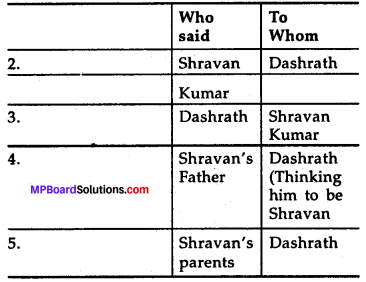
MP Board Class 10th Social Science Solutions Chapter 5 Map Reading and Depiction img 1
Answer:

  1. (a)
  2. (c)
  3. (d)
  4. (b)

MP Board Class 10th Social Science Very Short Answer Type Questions

Chapter 5 Class 10 Social Science MP Board Question 1.
What is Naut?
Answer:
Naut is the unit of measurement the speed of wind. 1 Naut = 1.85 km/hour.

Map Reading And Depiction Meaning In Hindi MP Board Class 10th Question 2.
How many centres of seismology are there in India?
Answer:
22 (Twenty-two).

MP Board Class 10th Social Science Short Answer Type Questions

Map Reading And Depiction In Hindi MP Board Class 10th Question 1.
What do you mean by weather signs?
Answer:
The signs or indications that indicate the condition of weather are called weather signs. With the help of figures or symbols in the map the weather of specific time or area is indicated.

Class 10th Mp Board Solution MP Board Question 2.
How is weather information collected for preparing weather map?
Answer:
Weather maps can be studied on the basis of following features:

  1. The weather features are indicated on the map through standard signs.
  2. For preparing weather maps information is obtained through observatories, pilots of aeroplanes, balloon, ships.
  3. Following information is collected in the observatories regarding the weather conditions:
  4. Temperature, rains, speed of winds the directions of wind, humidity, duration of sun light, conditions of the sea, previous and present weather condition etc.

Class 10 Social Science Mp Board  Question 3.
How are weather conditions defected in weather map?
Answer:
The weather conditions defected in whether map through indicators accepted at the international level. These maps show the weather conditions of any area on earth, e.g., temperature, air pressure, rains, speed and direction of winds, condition of clouds, etc.

Class 10th Social Science Mp Board Question 4.
Identify the following wind measuring signs name them and write their speed?

MP Board Class 10th Social Science Solutions Chapter 5 Map Reading and Depiction img 2
Answer:

(i) Calm; speed 0 to 1 miles
(ii) Steady breeze; speed 8 to 12 miles
(iii) Fresh breeze; speed 19 to 24
(iv) Gale; speed 39 to 46 miles
(v) Storm; speed 64 to 75 miles.

Importance Of Weather Map MP Board Class 10th Question 5.
Identify the cloud condition and described their intensity and level?
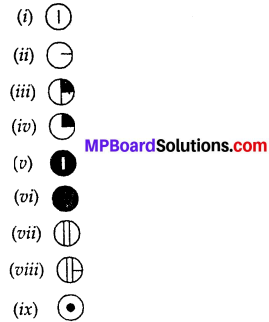
MP Board Class 10th Social Science Solutions Chapter 5 Map Reading and Depiction img 3
Answer:

(i) Low level; 1/8
(ii) High level; 1/8
(iii) Low level; 3/8
(iv) Low level; 2/8 or 1/4
(v) Low level; 7/8
(vi) Low level; full (8/8)
(vii) High level; 4/8 or 1/2
(viii) High level; 5/8
(ix) High level; Sunlight

Social Science Class 10 Mp Board Solutions Question 6.
Describe the atmosphere conditions on the basis of following isobar?
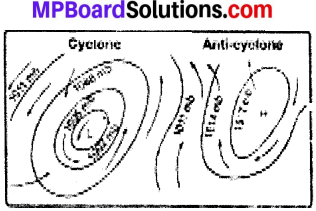
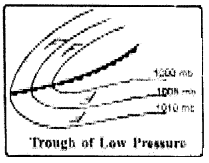
MP Board Class 10th Social Science Solutions Chapter 5 Map Reading and Depiction img 4
MP Board Class 10th Social Science Solutions Chapter 5 Map Reading and Depiction img 5
Answer:

  1. Is cyclone and
  2. Is anti – cyclone.

In cyclone when the isobars form concentric closed circles, the smallest circle in the center indicates a low pressure center. Air moves from a high pressure area to a low pressure area. In the Northern Hemisphere, the wind blows in a counter clock – wise direction in a cyclone. In the Southern Hemisphere, the wind blows in a clock – wise direction. These cyclones move in the direction of pressure center.

Air pressure in little in the center of shallow depression but it is very little in deep depression. Deep depression is surrounded by more than one isobar and shallow depression area is surrounded by single isobar and partially surrounded by other isobars. Isobars are depicted in a dispersed way in shallow depression and the isobars are shown close in depression. Under this condition the air mass rises above and takes the form of clouds and rains. Thus the weather conditions are rough in the cyclonic area.

The Anti – cyclone is opposite of cyclone. Anti – cyclone have high pressure in the center and they are surrounded by low pressure. The center of high pressure is called ‘Highs’. This is the point of intersection of two wedge lines. The isobar is usually circular, the winds blow in clock – wise direction in the Northern Hemisphere and counter clock – wise in the Southern Hemisphere.

The winds blow outwards from the center in such condition. Anti – cyclone are weak and stay at one place for quite some times. The wind is slow and keep varying. Anti – cyclone do not move in a definite direction and the center is calm. In the front the winds blow in a definite direction; the sun is bright and sky is clear and dry. Sometimes there are drizzling rains.

MP Board Class 10th Social Science Long Answer Type Questions

Mp Board Class 10th Social Science Solution Question 1.
Describe the importance of weather maps. Where we can use the information of weather forecast which in shown in weather map?
Answer:
Need and importance of the study of weather map:
With the help of weather maps it is possible to know in advance the weather conditions, these forecasts are published in news – papers and broadcasted through ’Akashvani’.

Through these forecasts efforts are made to provide safety and security to the people in times of natural calamities like excessive rains, (and consequently floods etc.) inadequate rains (and draught conditions as a consequence), earthquake, hailstorm, cyclones, snow fall, etc.

The forecasts made on the basis of weather map help in talking suitable safety measures at the time of navigation safe aeroplanes, flights, and drought conditions and their ill effects and properly carrying out the agricultural operations.

Question 2.
Draw symbol/signs to show the following weather conditions:
Fog, Hailstorm, Snow, Rains?
Or
Give the indication of the following seasonal conditions:

1. Snow
2. Rains
3. Fog
4. Hailstorm (MP Board 2009)

Give the indication of weather in your answer book:

1. Fog
2. Hailstrom
3. Rain

Answer:
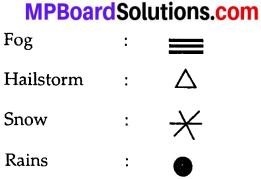
MP Board Class 10th Social Science Solutions Chapter 5 Map Reading and Depiction img 6

Question 3.
Explain following points in the given weather map Cyclone and Anti – cyclone, Wedge?
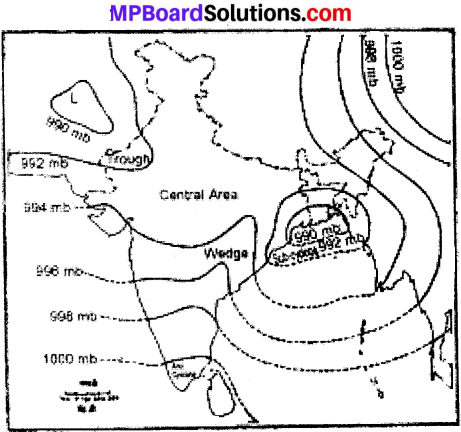
MP Board Class 10th Social Science Solutions Chapter 5 Map Reading and Depiction img 7
Answer:
Do with help of your subject teacher.

MP Board Class 10th Social Science Additional Important Questions

Objective Type Questions

Question 1.
Multiple Choice Questions.
(Choose the correct answer from the following)

Question (a)
The Meteorological Department in India was set up in the year of:
(a) 1854
(b) 1864
(c) 1874
(d) 1884.
Answer:
(b) 1864

Question (b)
The meteorological department has set up 22 centers for measuring the intensity of:
(a) Natural calamity
(b) Earthquake
(c) Landslide
(d) Flood.
Answer:
(b) Earthquake

Question (c)
Blowing sudden heavy winds?
(a) Wind
(b) Storm
(c) Cyclone
(d) Breeze.
Answer:
(b) Storm

Question (d)
On the basis of temperature, India is divided into:
(a) Two parts
(b) Three parts
(c) Four parts
(d) Five parts.
Answer:
(d) Five parts.

Question 2.
Fill in the blanks:

  1. The weather features are indicated on the map through standard ………………………..
  2.  ………………….. is the center of publication for weather map.
  3. The weather informations are collected through ……………………….
  4. Sometimes low pressure is indicated by …………………….

Answer:

  1. signs
  2. Pune
  3. observatories
  4. L.

Question 3.
True and False Type Questions:

  1. High Pressure is normally indicated by P.
  2. There are 1142 observatories in India.
  3. The meteorological department was set up by the British Govt, in the state of Bengal.
  4. The universal symbols of weather conditions were accepted in the International Meteorological conference held in Warsa in the year 1935.
  5. In Kashmir the direction of winds are from north to south.

Answer:

  1. False
  2. True
  3. True
  4. True
  5. True.

Answer in One – Two Words or One Sentence

Question 1.
How many regions have been divided in India by meteorological department?
Answer:
Five.

Question 2.
Where is the head office of meteorological department in India located?
Answer:
Delhi.

Question 3.
Name the place of other offices of meteorological department in India?
Answer:
Nagpur, Mumbai, Chennai and Kolkata.

Question 4.
How many centers are there for measuring the intensity of earthquake in India?
Answer:
22 centers.

Question 5.
Who developed the indicator of air speed?
Answer:
Vufort.

Question 6.
What is V – shaped depression?
Answer:
When the isobars on the surface are V – shaped, it is called V – shaped depression.

MP Board Class 10th Social Science Very Short Answer Type Questions

Question 1.
In which area the pressure of air pressure was normal?
Answer:
The mountain region of North Bihar, Andaman and Nicobar and Eastern Myanmar, the air pressure was normal.

Question 2.
What is mean by weather map?
Answer:
The map in which we study the condition of temperature, speed of wind, humidity, duration of sunlight etc. is called weather map.

Question 3.
Where are the weather forecasts most useful which are obtained from weather map?
Answer:
Weather forecast are most useful to the certain places at the time of nature calamities, inadequate rain, earthquake and cyclone etc.

Question 4.
Which are the main points to be interpreted in weather map?
Answer:
The following points are the main to interpret in weather map:

  1. Variation in temperature
  2. Variation in air pressure
  3. Rainfall
  4. Clouds.

Question 5.
How cyclone and anti – cyclone are formed?
Answer:
Cyclone and anti – cyclone are formed due to the contact of two different types of wind. The contact point is known as a surface of separation.

Question 6.
What do you mean by wedge? Also, define crest line?
Answer:
Wedge is a triangular high pressure area. The isobars are V – shaped with rounded peak. The peak indicates towards the low pressure area. In the center of the edge, the air pressure is the highest and it goes on diminishing towards the peak and edge. The line joining the highest pressure point and the peak point it called crest line.

MP Board Class 10th Social Science Short Answer Type Questions

Question 1.
What do you mean by international climatic indicators?
Answer:
The facts and information received from observatories are indicated in the map with the help of figures, signs and symbols which are accepted internationally. These are called international climate indicators. These were given recognition in the International Meteorological meet (conference) held in Warsa (Italy) in the year 1935.

Question 2.
What do you mean by the indicator of air speed?
Answer:
Indicators of air speed:
The system of measuring the wind speed was pioneered by the British naval chief Vufort in 1805, that system is being used even today with some modifications. In the Indian Weather maps. Wind indicator which are being used are different from the one developed by Vufort.

MP Board Class 10th Social Science Solutions Chapter 5 Map Reading and Depiction img 8
This wind indicator shows the speed through its rear wings and the front end indicates the direction. Through these wings any speed can be indicated. Normally by changing half of the wind a difference of five knots occurs.

Question 3.
What are the need and importance of the study of, weather map?
Answer:
Need and importance of the study of weather map:

1. With the help of weather maps it is possible to know in advance the weather conditions, these forecasts are published in news papers and broadcasted though ‘Akashvani’. Through these forecasts efforts are made to provide safety and security to the people in times of natural calamities like excessive rains, (and consequently floods etc.), inadequate rains (and draught conditions as a consequence) earthquake, hailstorm, cyclones, snow fall etc.

2.  The forecasts made on the basis of weather map help in taking suitable safety measures at the time of navigation safe aeroplanes, flights, and drought conditions and their ill effects and properly carrying gout the agricultural operations.

MP Board Class 10th Social Science Long Answer Type Questions

Question 1.
Write a short note on Meteorological Department of India?
Answer:
1. The Meteorological Department in India was set up in the year 1864 in Bengal on the recommendation of the Asiatic Society. In the beginning its office was in Shimla. After the Second World War the head office and observatory was set up in Delhi.

2. This department, does the work of studying changes in the weather conditions in various parts of the country on daily basis, observation, documentation, collection of data and observation of weather conditions of neighbouring countries, their analysis and forecasting in advance.

3. The meteorological department in India has been divided into five regions. The head office is in Delhi. Nagpur, Mumbai, Chennai and Kolkata or other offices. There are 1142 observatories, 2500 rain gauges and 22 centers for measuring the intensity of earthquake, in India.

Question 2.
Explain with the help of diagram the main sign of clouds?
Answer:
The shadow in circle is indicated to cloud. In the Indian maps clouds with only low and medium height are shown.The level of clouds is shown by different types of circles. In India only low and medium hight clouds are shown. The percentage of cloud is indicated on the 8th part of the circle.
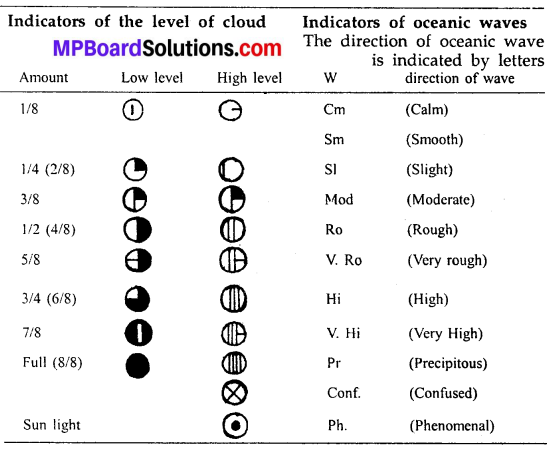
MP Board Class 10th Social Science Solutions Chapter 5 Map Reading and Depiction img 9

Question 3.
Outline the different sign of measuring wind speed?
Or
Give the Indication of air measurement of the following:

  • light air
  • Calm
  • Gale
  • Fresh Breeze
  • Strong Breeze (MP Board 2009)

Or
Give the indication of plesant breeze weather in your answer – book? (MP Board 2009)
Or
Give the indications of fresh breeze and gale weather in your answer – book? (MP Board 2009)
Answer:
Signs to measure speed of the wind
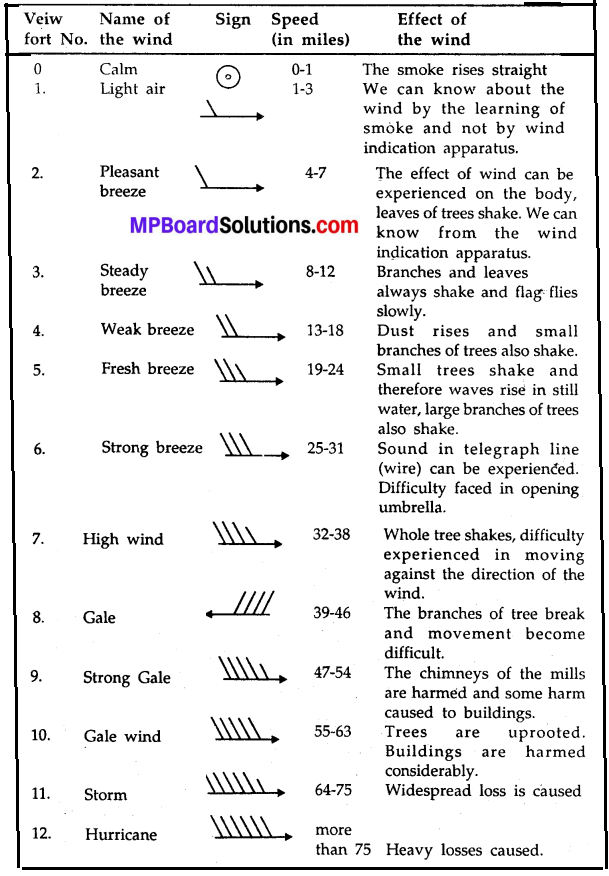
MP Board Class 10th Social Science Solutions Chapter 5 Map Reading and Depiction img 10

Question 4.
Explain the variation of air pressure with the help of Indian map and draw the conclusion related to the trends?
Answer:
Variation in air pressure:

In the weather map the air pressure is shown with the help of millibar. This is normally indicated by the difference between two millibars. The higher number shows high air pressure and the lower number shows low air pressure.
Sometimes low pressure is indicated by writing L and high pressure by H. This is read like contour lines. The air always blows towards low pressure area from the high pressure area.

1. Normal distribution of air pressure:
High and low pressure zone.

2. Speed of cyclones:
With the help of the air pressure map, we can explain the conditions of air pressure in the atmosphere. From the map given we see that the air pressure was 2 millibar less than the normal. Only in two zones the pressure was normal. The mountain region of North, Bihar, Andaman and Nicobar and Eastern Myanmar the air pressure was normal.
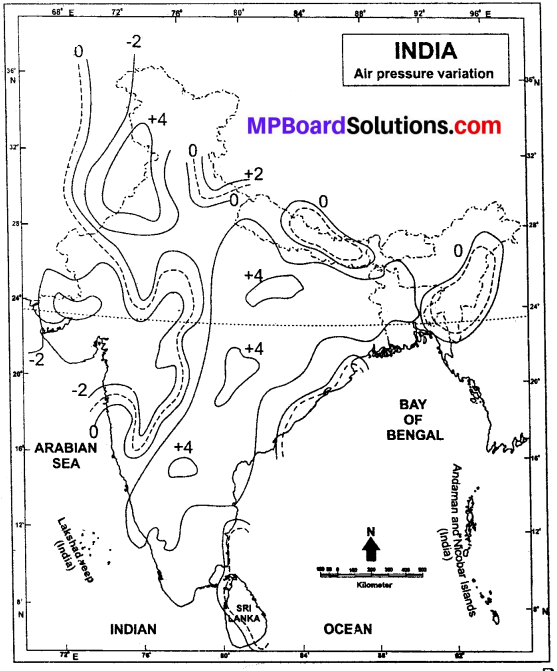
MP Board Class 10th Social Science Solutions Chapter 5 Map Reading and Depiction img 11

MP Board Class 10th Social Science Solutions

MP Board Class 7th Special English Solutions Chapter 3 The Wheat is Cheaper-I

Get Updated MP Board Solutions for Class 7 Special English Solutions Chapter 3 The Wheat is Cheaper-I Questions and Answers in PDF Format and download them free of cost. These are provided as per the latest exam pattern and syllabus. Access the topics of Chapter wise and communication skills, grammer part through the direct links available depending on the need. You can Download MP Board Class 7 English Solutions and can score highest grade in examination. Clear all your queries on the Mp Board Solutions for Class 7 English Chapter 3 The Wheat is Cheaper-I Questions and Answers Subject by using the Madhya Pradesh State Board Solutions for existing.

MP Board Class 7th Special English Solutions Chapter 3 The Wheat is Cheaper-I

If you are eager to know about the Madhya Pradesh State Board Solutions for Class 7 English you will find all of them here. You can identify the knowledge gap using these MP Board Solutions for English PDF and plan accordingly. Don’t worry about the accuracy as they are given after extensive research by people having subject knowledge along side from the latest English Syllabus.

The Wheat is Cheaper-I Text Book Exercise

Comprehension

A. Answer the questions given below:

Mp Board Class 7th English Chapter 3 Question 1.
Where did the merchant live?
Answer:
The merchant lived in an”Indian town.

Class 7 English Chapter 3 The Wheat Is Cheaper 1 MP Board Question 2.
Where was he going one day?
Answer:
He (the merchant) was going to a town one day.

The Wheat Is Cheaper 1 MP Board Class 7th Question 3.
Whom did he see on his way?
Answer:
He (the-merchant) saw a farmer on his way.

The Merchant Went To MP Board Class 7th Question 4.
What did they agree to tell each other?
Answer:
They agreed to tell the wildest possible tale to each other.

Question 5.
What had each to pay the other, if one cast a doubt on the other’s story?
Answer:
Each of them had to pay the other a hundred rupees if he cast a doubt on the other’s story.

Question 6.
What was the maid doing?
Answer:
The maid was combing the hair of the princess.

Question 7.
What fell into the princess’s eye?
Answer:
The train of camels fell (right) into the princess’s eye.

Question 8.
What happened in the end?
Answer:
The farmer did not cast any doubt on the merchant’s story. He went on every part of the story till its end. The merchant felt disappointed.

B. Read the following sentences and tick true or false

  1. There lived a farmer in a village. T / F
  2. The merchant was greedy. T/ F
  3. The merchant told an incident T / F
  4. The maid was combing the princess’s hair. T / F
  5. The farmer cast a doubt on the merchant’s story. T / F

Answer:

  1. True
  2. True
  3. True
  4. True
  5. False

C. Tick the correct option:

(i) Who was an Englishman?
(a) Ravi
(b) Mr. Smith
(c) Ashok
Answer:
(b) Mr. Smith

(ii) Who wants to become a writer or a story teller?
(a) Ravi
(b) Ashok
(c) David
Answer:
(a) Ravi

(Hi) There was a long train of
(a) kites
(b) camels
(c) dogs
Answer:
(a) kites

Word Power

A. Choose the correct word to complete the sentence:

  1. A monkey has a long……… (tale/tail)
  2. Bubal’s…………are famous for their wit. (tales/tails)
  3. Ladies like to go to a…………… (Sail/sale)
  4. Vivekhas a……….. boat of his own. (sail/sale)
  5. The Milkmaid had a……….. of milk. (pail/pale)
  6. The patient looked…………. (pail/pale)
  7. Wounds ………… fast if bandaged properly. (hael/heel)
  8. He got hurt in his……….. (heal/heel)

Answer:

  1. tail
  2. tales
  3. sale
  4. sail
  5. pail
  6. pale
  7. heal
  8. heel.

B. Rearrange the letters to make words

  1. stwan – w………
  2. Yotrs – s ……….
  3. riwse – w……….
  4. hrai – h……..
  5. leamc – c……..
  6. tiek – k………
  7. daim – m…….
  8. rfame – f………

Answer:

  1. wants
  2. story
  3. wiser
  4. Hari
  5. camel
  6. kite
  7. maid
  8. frame

Grammar in Use

A. Fill in the blanks with prepositions ‘by’, ‘of’, ‘for’, ‘to’ ‘on’.

  1. The boy listened…………. me carefully.
  2. I am fond………… milk.
  3. She learnt the poem…………heart.
  4. I was waiting………….my friend.
  5. The book is………… the table.

Answer:

  1. to
  2. of
  3. by
  4. for
  5. on

B. Use ‘as’ in place of ‘because’ or ‘so’. Two sentences are done for you.

1. (a) Because it was raining, we stayed at home.
(b) As it was raining, we stayed at home.

2. (a) I felt tired, so I went to bed.
(b) As I felt tired, I went to bed.

3. Because I had already seen the film, I did not go to the cinema.
4. Because the train was late, I went by bus.
5. I am going to Indore, so I can take your parcel with me.
6. The princess suffered from great pain, so she cried.
Answer:
3. As I had already see. the film, I did not go to the cinema.
4. As the train was late, I went by bus.
5. As I am going to Indore, I can take your parcel with me.
6. As the princess suffered from great pain, (so) she cried.

Read the following examples and notice how ‘used to’ describes things that happened regularly in the past.

  1. My brother goes to work on bicycle now.
  2. He used to go to work by bus.
  3. My father does not play tennis now.
  4. He used to play tennis when he was a young man.

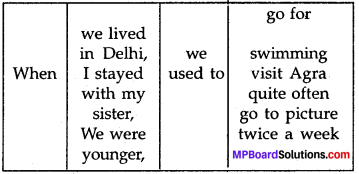
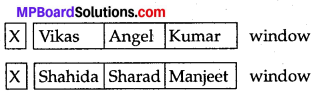
write five sentences from the following table:
Mp Board Class 7th English Chapter 3
Answer:

  1. When we lived in Delhi, we used to go to picture twice a week.
  2. When I stayed with my sister, we used to go for swimming every week.
  3. When we were younger, we used to visit Agra quite often.
  4. When I stayed with my sister, we used to visit Agra.
  5. When we were younger, we used to go to picture twice a week.

D. Complete the sentences using the correct form of the verb given in bracket.

  1. He……………. at 7 O’clock yesterday, (get up)
  2. She…………… till 11 O’clock now a days. (study)
  3. She………… in the next party, (sing)
  4. Ravi………….. cricket now. (play)

Answer:

  1. got up
  2. studies
  3. will sing
  4. is playing.

Let’s Talk

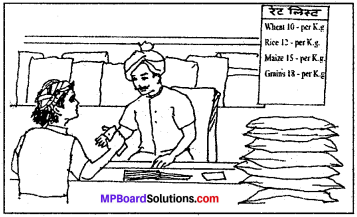
B. Ramu the farmer wants to buy quality seeds. He goes to the village co-operative store. There Ramu is talking to the stock keeper. Look at the picture given below and complete the conversation using the picture clues:
Class 7 English Chapter 3 The Wheat Is Cheaper 1 MP Board

Ramu : Hello! Are there quality seeds available here?
The store-keeper : Yes Sir, What seeds do you want?
Ramu : I want wheat, rice and maize.
The store-keeper : They are all available here
Ramu : What are their rates per kg.?
The store-keeper : They are Rs. 10,12 and 15 per kg.
Ramu : Give me four kilos of each
The store-keeper : Pick up the packets from there.
Ramu : How much money should I pay?
The store-keeper : Rs 148/- Total.
Ramu : Here is the money. Give me the receipt.

Let’s Write

Write a funny incident with the help of the words given below:
1. wore socks
2. spoke foolishly
3. carried a bicycle in his hands.
4. tried to ride the bicycle backward but fell again and again
5. wore his tie as his belt
6. peeled the banana from its centre.
Answer:
The Muddle Head
There was a muddle head. He reversed the socks and wore them. He spoke foolishly. He carried a bicycle in his hands. Some times he rode the bicycle backward. He fell again and again and got injured. He wore his tie around his waist like a tie. He wore his shoes around his neck. He peeled the bananas from the centre. He ate the skin and threw away the pulp. He sneezed on the back of a fellow passenger.

let’s Do It

Find a funny story from your library book and tell it to your class.
Answer:
Class-Room Activity.

The Wheat is Cheaper-I Word Meanings

Page 15 to 17: Widely – to distant places – दूर-दूर तक, A lot of – a great number of – ढेर सारी, Perhaps – possible – सम्भवत, of course – in fact – निस्संदेह, Distance – space between two points – दूरी, Opportunity – chance – अवसर, Believe – think – सोचना विशवास करना, Stranger – lacking knowledge of – अजनबी, Fair – just proper – उचित, Wildest – odd – अटण्टी, Tale – story – कहानी, Cast – show – प्रकट करना, Bargain – agreement – सौदा, Wiser – more intelligent – अधिक बुद्धिमान, Train – line – कतार, Together – with one another – एक साथ, Disappointed – full of despair – निराशा, Attempt – effort – प्रयत्न, Continued – carried on – जारी रखा, Happened – chanced – अनायास होना, Carefully – attentively – ध्यानपूर्वक, Lifted – raised – उठाया

We believe the information shared regarding MP Board Solutions for Class 7 English Chapter 3 The Wheat is Cheaper-I Questions and Answers as far as our knowledge is concerned is true and reliable. In case of any queries or suggestions do leave us your feedback and our team will guide you at soonest possibility. Bookmark our site to avail latest updates on several state board Solutions at your fingertips.

MP Board Class 12th Hindi Makrand Solutions Chapter 3 ठेस

MP Board Class 12th Hindi Makrand Solutions Chapter 3 ठेस (कहानी, फणीश्वरनाथ ‘रेणु’)

ठेस पाठ्य-पुस्तक पर आधारित प्रश्न

ठेस लघु उत्तरीय प्रश्न

ठेस कहानी का सारांश MP Board Class 12th Hindi प्रश्न 1.
सिरचन कौन-कौन सी वस्तुएँ बनाना जानता था?
उत्तर:
सिरचन मोथी घास और पटेर की रंगीन- शीतलपाटी, बाँस की तीलियों की झिलमिलाती चिक, मोढ़े, पूँज की रस्सी के बड़े-बड़े जाले, ताल के पत्रों की छतरी-टोपी आदि बनाना जानता था।

ठेस कहानी का प्रश्न उत्तर MP Board Class 12th Hindi प्रश्न 2.
बड़ी भाभी ने मानू के संबंध में क्या चेतावनी दी थी?
उत्तर:
बड़ी भाभी ने मानू के संबंध में चेतावनी दी थी कि मानू के साथ मिठाई आए या न आए लेकिन तीन जोड़े फैशनेबिल चिक, पटेर की दो शीतलपाटी अवश्य आनी चाहिए और यदि ये चीजें नहीं आईं तो मानू बैरंग वापस भेज दी जाएगी।

ठेस कहानी के प्रश्न उत्तर MP Board Class 12th Hindi प्रश्न 3.
चाची ने माँ के पास जाकर क्या कहा था?
उत्तर:
चाची ने माँ से पास जाकर कहा कि छोटे आदमी का मुँह भी छोटा होता है। मुँह लगाने से सर पर चढ़ेगा ही। किसी की ससुराल की बात वह क्यों करेगा?

प्रश्न 4.
सिरचन मानू से मिलने रेलवे स्टेशन क्यों गया था? (M.P. 2009)
उत्तर:
सिरचन मानू को बेटी मानता है। वह अपने हाथ से बनी वे चीजें मानू को देने के लिए स्टेशन गया जिन्हें बनाता हुआ आधा-अधूरा छोड़ आया था और मान-मनौती करने पर भी उन्हें पूरा करने नहीं गया था।

ठेस दीर्घ उत्तरीय प्रश्न

प्रश्न 1.
लोगों की सिरचन के प्रति क्या धारणा थी? स्पष्ट कीजिए। (M.P. 2011)
उत्तर:
गाँव के लोगों की सिरचन के प्रति दो तरह की धारणाएँ थीं। पहली-लोग उसे एक कुशल कलाकार मानते हैं जो केवल पारिश्रमिक को ध्यान में रखकर कार्य नहीं करता। उसके जैसा शीतलपाटी, चिक, मोढ़े, जाले और छतरी-टोपी बनाने वाला कारीगर उस गाँव में कोई नहीं है। पहले लोग उसका सम्मान करते हैं। उसे घर बुलाने के लिए खुशामद करते हैं। दूसरी-समय के साथ-साथ सिरचन के प्रति लोगों की धारणा बदल जाती है। अब लोग उसे बेकार ही नहीं, बेगार समझते हैं। उनकी धारणा है कि सिरचन मुफ्तखोर, कामचोर, चटोर होने के साथ-साथ घमंडी और मुँहफट है। लोग उसके काम को बेकार का काम समझते हैं और उसे कोई महत्त्व नहीं देते हैं।

प्रश्न 2.
सिरचन को एक सप्ताह पहले बुलाने का कारण लिखिए।
उत्तर:
मानू पहली बार ससुराल जा रही थी। मानू के पति ने बड़ी भाभी को खत लिखकर चेतावनी दे दी थी कि मानू के साथ मिठाई की पतीली न आये कोई बात नहीं। लेकिन तीन जोड़े फैशनेबिल चिक, पटेर की दो शीतलपाटी अवश्य आनी चाहिए। यदि इनके बिना मानू आई तो बैरंग वापस भेज दी जाएगी। यही कारण था कि सिरचन को एक सप्ताह पहले ही बुलवाकर काम पर लगा दिया गया था।

प्रश्न 3.
मानू ने सिरचन को पान का बीड़ा देते समय क्या सलाह दी थी? (M.P. 2010)
उत्तर:
मानू ने सिरचन को पान का बीड़ा देते समय सलाह दी थी कि सिरचन दादा, कामकाज का घर है। पाँच तरह के लोग पाँच किस्म की बातें करेंगे। तुम किसी की बात पर ध्यान मत दो।

प्रश्न 4.
सिरचन ने मानू को उपहार में क्या दिया था?
उत्तर:
सिरचन ने मानू को उपहार में शीतलपाटी, चिक और कुश की एक जोड़ी आसनी दी थी। इसके साथ उसने मानू को अपने हृदय की ममता का भी उपहार दिया था।

प्रश्न 5.
कहानी का अंत आपको कैसा लगा? अपने विचार लिखिए।
उत्तर:
विद्यार्थी स्वयं करें।

ठेस भाव-विस्तार/पल्लवन

प्रश्न 1.
निम्नलिखित पंक्ति का भाव-विस्तार कीजिए: खाने-पीने में चिकनाई की कमी हुई कि काम की सारी चिकनाई खत्म।
उत्तर:
खाने-पीने के शौकीन व्यक्ति को स्वादिष्ट भोजन चाहिए। उसके भोजन में पर्याप्त मात्रा में घी-तेल होना चाहिए। सिरचन एक ऐसा ही प्रसिद्ध एवं सिद्धहस्त ग्रामीण कलाकार है। उसके मन में धन के प्रति आसक्ति नहीं है, परंतु यदि उसे स्वादिष्ट भोजन उपलब्ध न हो तो वह कार्य नहीं करता। मनोनुकूल भोजन न मिलने पर उसके काम में कला की सारी बारीकियाँ समाप्त हो जाती हैं। ऐसी स्थिति में वह मन लगाकर कार्य नहीं करता अथवा कोई न कोई बहाना बनाकर कार्य को अधूरा छोड़कर चला जाता है।

ठेस भाषा-अनुशीलन

प्रश्न 1.
दिए गए शब्दों में से तत्सम, तद्भव, देशज, विदेशी (आगत) शब्दों को छाँटकर पृथक-पृथक लिखिए –
इलाका, किसान, फैशनेबिल, प्रबंध, खुशामद, अफ़सर, खेत, पनियाई, जतन।
उत्तर:

  • तत्सम शब्द – प्रबंध
  • तद्भव शब्द – किसान, खेत
  • देशज शब्द – पनियाई, जतन
  • विदेशी शब्द – इलाका, फैशनेबिल, अफसर, खुशामद

प्रश्न 2.
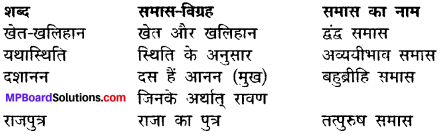
नीचे कुछ शब्द दिए जा रहे हैं, इनका समास-विग्रह करते हुए समास का नाम भी बताइए –
खेत-खलिहान, यथास्थिति, दशानन, राजपुत्र।
उत्तर:
MP Board Class 12th Hindi Makrand Solutions Chapter 3 ठेस img-1
प्रश्न 3.
दिए गए मुहावरों का अर्थ स्पष्ट करते हुए उनका वाक्यों में प्रयोग कीजिए –
दुम हिलाना, मुँह लटकाना, कान पकड़ना, फूट-फूटकर रोना।
उत्तर:
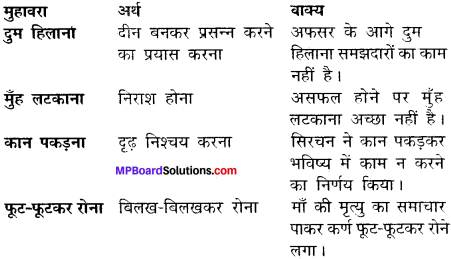
MP Board Class 12th Hindi Makrand Solutions Chapter 3 ठेस img-2

ठेस योग्यता-विस्तार

प्रश्न 1.
आप अपने गाँव. या क्षेत्र के किसी निपुण कारीगर के बारे में जानते हो। उसके संबंध में लिखिए।
उत्तर:
हमारे गाँव में प्रभातीलाल कुम्हार एक निपुण कारीगर है। बहे अत्यन्त ही सरल एवं सहज स्वभाव का व्यक्ति है। सभी लोग उसके काम एवं व्यवहार की बड़ी तारीफ करते हैं। वह मिट्टी के ऐसे सुंदर खिलौने बनाता है कि उन्हें देखकर लगता है कि अभी बोल पड़ेंगे। दुर्गा-पूजा और दीपावली पर तो उसकी दुकान पर खरीददारों की भीड़ लगी रहती है। दूर-दूर से लोग दुर्गा-पूजा के लिए माँ दुर्गा की प्रतिमाएँ बनवाने के लिए उसके पास आते हैं।

वह विभिन्न आकार और रूप-रंग की साकार प्रतीत होने वाली प्रतिमाएँ बनाने की कला में कुशल है। इतना ही नहीं, वह घर की सजावट के लिए आकर्षक फूलदान, फूल, मुखौटे, जालियाँ भी बनाप्ता है। मटके और सुराहियाँ तो इतनी फैशनेबिल और रंगीन होती हैं कि खरीदने को मन ललचा उठता है।

प्रश्न 2.
अपनी रुचि के अनुसार चित्रकला, हस्तकला, मूर्तिकला आदि से संबंधित सामग्री का निर्माण कर प्रदर्शित करें।
उत्तर:
छात्र स्वयं करें।

प्रश्न 3.
अपने क्षेत्र की लोककला की जानकारी प्राप्त कर कक्षा में चर्चा कीजिए।
उत्तर:
छात्र अपने माता-पिता अथवा भाषा-अध्यापक से स्वयं जानकारी प्राप्त करें।

ठेस परीक्षोपयोगी अन्य महत्वपूर्ण प्रश्न

I. वस्तुनिष्ठ प्रश्नोत्तर

प्रश्न 1.
‘ठेस’ कहानी के कहानीकार हैं –
(क) फणीश्वरनाथ ‘रेणु’
(ख) प्रेमचंद
(ग) जयशंकर प्रसाद
(घ) जैनेंद्र कुमार
उत्तर:
(क) फणीश्वरनाथ ‘रेणु’।

प्रश्न 2.
बड़े लोगों की बस…….होती है –
(क) हवेली ही बड़ी
(ख) बात ही बड़ी
(ग) धमकियाँ ही बड़ी
(घ) डींगें ही बड़ी
उत्तर:
(ख) बात ही बड़ी।

प्रश्न 3.
सिरचन के किसी दिन आकर पूरा कर दूंगा में किसी दिन’ का अर्थ है –
(क) दो-चार दिन बाद
(ख) जब मौका मिलेगा
(ग) कभी नहीं
(घ) इनमें से कोई नहीं
उत्तर:
(ग) कभी नहीं।

प्रश्न 4.
‘आज तो अधकपाली दर्द से माथा टनटना रहा है’ में ‘अधकपाली’ का अर्थ है –
(क) आधा सरदर्द
(ख) आधा पैर दर्द
(ग) आधा हाथ दर्द
(घ) अधपका खाने का दर्द
उत्तर:
(क) आधा सरदर्द

प्रश्न 5.
सिरचन जब काम में मगन रहता है तो उसकी………निकल आती है।
(क) लार जरा बाहर
(ख) जीभ जरा बाहर
(ग) आँखें जरा बाहर
(घ) आँखें, जीभ बाहर
उत्तर:
(ख) जीभ जरा बाहर।

प्रश्न 6.
सिरचन जब काम करता था दब –
(क) उसका लार जहर बाहर निकल जाता था।
(ख) उसकी जीभ जरा बाहर निकल जाती थी।
(ग) उसकी आँखें जरा बाहर निकल जाती थीं।
(घ) उसके होठ जरा बाहर निकल जाते थे।
उत्तर:
(ख) उसकी जीभ जरा बाहर निकल जाती थी।

II. निम्नलिखित रिक्त स्थानों की पूर्ति दिए गए विकल्पों के आधार पर करें –

  1. ‘ठेस’ कहानी के लेखक हैं ……..। (गुलाबराय फणीश्वरनाथ ‘रेणु’)
  2. फणीश्वरनाथ ‘रेणु’ ……. उपन्यासकार हैं। (जासूसी आंचलिक)
  3. ‘ठेस’ कहानी ……. पर केन्द्रित है। (स्वाभिमान/अहंकार)
  4. ‘टेस’ कहानी का नायक ………. है। (पंचानंद चौधरी सिरचन)
  5. सिरचन ने ………. को उपहार दिया था। (चाची/मानू)

उत्तर:

  1. फणीश्वरनाथ ‘रेणु’
  2. आंचलिक
  3. स्वाभिमान
  4. सिरचन
  5. मानू।

III. निम्नलिखित कथनों में सत्य/असत्य छाँटिए- (M.P. 2010-2011)

  1. ‘ठेस’ एक निबन्ध है।
  2. ‘ठेस’ कहानी शहरी जीवन की है।
  3. सिरचन ने मानू को उपहार में शीतलपाटी, चिक और कुश की एक जोड़ी आसनी दी थी।
  4. सिरचन एक स्वाभिमान कलाकार है।
  5. मोहर छाप वाली धोती आठ रुपये में आती है।

उत्तर:

  1. असत्य
  2. असत्य
  3. सत्य
  4. सत्य
  5. सत्य।

IV. निम्नलिखित के सही नोड़े मिलाइए –

प्रश्न 1.
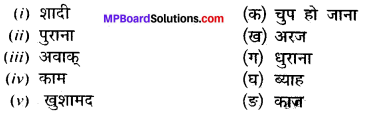
MP Board Class 12th Hindi Makrand Solutions Chapter 3 ठेस img-3
उत्तर:

(i) (घ)
(ii) (ग)
(iii) (क)
(iv) (ङ)
(v) (ख)।

V. निम्नलिखित प्रश्नों के उत्तर एक शब्द या एक वाक्य में दीजिए –

  1. सिरचन मान से मिलने रेलवे स्टेशन क्यों गया था?
  2. सिरचन कौन था?
  3. “ठहरो! मैं माँ से जाकर कहती है। इतनी बड़ी बात।” यहकसने कहा?
  4. “यह तुम्हारी माँ ही कर सकती हबबुनी।” यह कथन किसका है?
  5. सिरचन ने किसको तिरस्कृत किया?

उत्तर:

  1. अपने हाथ से बनी चीजें देने के लिए।
  2. सिरचन एक ग्रामीण कलाकार था।
  3. भज्जू महाजन की बेटी ने।
  4. सिरचन ने।
  5. भज्जू महाजन की पत्नी को।

ठेस लघु उत्तरीय प्रश्न

प्रश्न 1.
‘ठेस’ कहानी का नायक कौन है?
उत्तर:
‘ठेस’ कहानी का नायक सिरचन है।

प्रश्न 2.
सिरचन का चरित्र कहानी में किस बात को उजागर करता है?
उत्तर:
सिरचन का चरित्र ग्रामीण कलाकार के आत्मसम्मान को उजागर करता है।

प्रश्न 3.
सिरचन गाँववालों से किस व्यवहार की अपेक्षा करता है?
उत्तर:
सिरचन गाँववालों से सहज और आत्मीय व्यवहार की अपेक्षा करता है।

प्रश्न 4.
सिरचन ने गाँव टोली के पंचानंद चौधरी के छोटे लड़के को कैसे बेपानी कर दिया था?
उत्तर:
सिरचन ने लेखक के सामने ही चौधरी के लड़के को यह कहकर बेपानी कर दिया कि तुम्हारी भाभी कंजूसी से तरकारी परोसती है और इमली की कढ़ी तो उसकी (सिरचन की) घरवाली बनाती है।

प्रश्न 5.
लेखक के परिवार के साथ सिरचन का व्यवहार किस प्रकार अलग होता था?
उत्तर:
सिरचन स्वादिष्ट खाने का शौकीन था। वह जहाँ भी काम करने जाता, खाने की लालसा जरूर रखता पर वह लेखक के परिवार में काम करते समय कभी पूजा-भोग की बात नहीं करता था।

प्रश्न 6.
सिरचन क्या-क्या बनाता था? (M.P.2011)
उत्तर:
सिरचन शीतलपाटी, चिक, मोढ़े, जमले, छतरी और टोप बनाता था।

प्रश्न 7.
बड़ी भाभी ने मानू के संबंध में क्या चेतावनी दी धी?
उत्तर:
बड़ी भाभी ने तीन जोड़े फैशनेबल चिक और पटेर की दो शीतलपाटियों को मानू के दूल्हे के लिए भेजे जाने संबंधी चेतावनी दी थी।

ठेस दीर्घ उत्तरीय प्रश्न

प्रश्न 1.
सिरचन की तीन चारित्रक विशेषताएँ लिखिए।
उत्तर:
कुशल कारीगर:
सिरचन अपने इलाके का एक निपुण कारीगर है। उसके जैसी मोथी घास और पटेर की शीतलपाटी, बाँस की तीलियों की झिलमिलाती चिक, सतरंगे डोरे के मोढ़े, मूंज की रस्सी के बड़े-बड़े जाले, ताल के सूखे पत्तों की छतरी-टोपी कोई नहीं बना सकता। वह एक प्रतिभाशाली कलाकार है।

स्वाभिमानी;
सिरचन एक स्वाभिमानी कलाकार है। वह गरीब भले ही हो, लेकिन किसी का तिरस्कार सहन नहीं कर सकता। अपमानित होने की अपेक्षा वह भूखा रहना पसंद करता है। वह लेखक की मँझली भाभी और मानू की चाची के द्वारा तिरस्कृत होने पर काम अधूरा छोड़कर चला जाता है।

स्वादिष्ट भोजन का शौकीन:
सिरचन स्वादिष्ट भोजन का शौकीन है। यदि उसे स्वादिष्ट भोजन न मिले तो वह काम नहीं करता। उसे तली, बघारी तरकारी, दही की कढ़ी, मलाई वाला दूध पसंद है। मनोनकूल भोजन न मिलने पर वह कोई न कोई बहाना बनाकर खिसक जाता है। इसीलिए लोग उसे चटोर भी कहते हैं।

प्रश्न 2.
सिरचन मानू के घर से काम छोड़कर क्यों चला जाता है?
उत्तर:
सिरचन जिसके घर काम करता है, उनसे सहज और आत्मीय व्यवहार की अपेक्षा करता है। जब सिरचन मानू के घर में काम कर रहा है तो उसकी मँझली भाभी तथा उसकी चाची उसे तिरस्कृत और अपमानित करती हैं। वह मानू के घर से काम छोड़कर चला जाता है। दूसरे वह स्वयं को मानू की हवेली में सर्वाधिक सम्मानित अनुभव करता था क्योंकि वहाँ उसकी कारीगरी का सम्मान होता था, परंतु अब उसे वहाँ भी तिरस्कृत और अपमानित किया गया है इस कारण उसके हृदय को ठेस पहुँचती है और वह काम अधूरा छोड़कर चला जाता है।

प्रश्न 3.
‘ठेस’ कहानी का उद्देश्य संक्षेप में स्पष्ट कीजिए।
उत्तर:
‘ठेस’ कहानी का उद्देश्य एक ग्रामीण कलाकार के स्वाभिमान और आत्मगौरव को प्रकट करना है। कलाकार दूसरों से सम्मान प्राप्त करने का आकांक्षी होता है। उसे जब सम्मान की जगह तिरस्कार और अपमान प्राप्त होता है तो उसके संवेदनशील कोमल हृदय को ठेस पहुंचती है। यही ठेस उसे भविष्य में काम न करने का कठोर निर्णय लेने पर विवश करती है।

प्रश्न 4.
सिरचन को गाँववाले चटोरा क्यों समझते थे?
उत्तर:
सिरचन को गाँववाले चटोरा समझते थे। ऐसा इसलिए कि उसे खाने को दही की कढ़ी, मलाई वाला दूध जरूर चाहिए, इसके बिना उसका मन काम में नहीं लगता था।

प्रश्न 5.
सिरचन को लोग बेकार ही नहीं, अपितु बेगार क्यों समझते थे?
उत्तर:
जब दूसरे मजदूर खेत पर पहुँचकर एक तिहाई काम कर चुके होते थे, तब वह हाथ में खुरपी डुलाता हुआ दिखाई देता। फिर पगडंडी पर तौल-तौलकर कदम रखता हुआ धीरे-धीरे काम पर आता था। इसीलिए सिरचन को लोग बेकार ही नहीं अपितु बेगार भी समझते थे।

ठेस लेखक-परिचय

प्रश्न 1.
फणीश्वरनाथ ‘रेणु’ का संक्षिप्त जीवन-परिचय देते हुए उनकी साहित्यिक विशेषताओं पर प्रकाश डालिए।
उत्तर:
जीवन-परिचय:
आंचलिक कथाकार फणीश्वरनाथ रेणु का जन्म बिहार के पूर्णियाँ जिले के औराही हिंगना गाँव में 4 मार्च, 1921 ई० को हुआ था। इनकी विद्यालयी शिक्षा इंटरमीडिएट तक ही हो पाई। आपने उच्च शिक्षा के लिए विश्वविद्यालय में प्रवेश तो लिया, लेकिन महात्मा गाँधी के आह्वान पर पढ़ाई छोड़कर स्वतंत्रता आंदोलन में कूद पड़े। आपने सन् 1942 ई० के भारत छोड़ो आंदोलन में सक्रिय भाग लिया लेकिन 1952 में राजनीति को छोड़कर पूरी तर पे साहित्य-सेवा में जुट गए। सन् 1970 ई० में आपको ‘पद्मश्री’ से सम्मानित किया गया। रेणुजी जीवन के अंतिम समय तक साहित्य सेवा करते रहे। 11 अप्रैल, 1977 ई० को इनका देहांत हो गया।

साहित्यिक विशेषताएँ:
हिंदी साहित्य जगत् में ‘रेणुजी’ आंचलिक उपन्यास के जनक माने जाते हैं। उन्होंने कथाकार के साथ-साथ रिपोर्ताज लेखक के रूप में भी ख्याति प्राप्त की। उनका जीवन उतार-चढ़ाव व संघर्ष से भरा था। उनके रचनात्मक साहित्य ने देश की राजनीति को भी प्रभावित किया। सन् 1954 में इनका बहुचर्चित आंचलिक उपन्यास मैला आँचल प्रकाशित हुआ जिसने हिंदी उपन्यास को एक नई दिशा दी। हिंदी जगत् में आंचलिक उपन्यासों का प्रारंभ मैला आँचल से ही हुआ। आंचलिकता की इस अवधारणा ने उपन्यासों और कथा-साहित्य में गाँव की भाषा-संस्कृति और वहाँ के लोकजीवन को केंद्र में ला खड़ा किया।

लोकगीत, लोकसंस्कृति, लोकभाषा लोकनायक की इस अवधारणा ने भारी-भरकम चीज़ एवं नायक की जगह अंचल को ही नायक बना डाला। उनकी रचनाओं में अंचल कच्चे और अनगढ़ रूप में ही आता है इसलिए उनका यह अंचल एक त शस्य-श्यामल है तो दूसरी तरफ धूलभरा और मैला भी।.स्वातंत्र्योत्तर भारत में जब सारा चिकास शहर केंद्रित होता जा रहा था, ऐसे में रेणुजी ने अपनी रचनाओं से अंचल की समस्याओं की ओर भी लोगों का ध्यान खींचा। उनकी रचनाएँ इस अवधारणा को भी पुष्ट करती हैं कि भाषा की सार्थकता वोली के साहचर्य में ही है।

रचनाएँ:
फणीश्वरनाथ ‘रेणु जी’ की लेखनी उपन्यास, कहानी, संस्मरण और रिपोर्ताज आदि निकले हैं। उन्होंने अपनी लेखनी से हिंदी साहित्य को नई दिशा दी है।

  • उपन्यास – मैला आँचल, परती परिकथा, दीर्घतपा, कितने चौराहे।
  • कहानी-संग्रह – ठुमरी, अग्निखोर, आदिम रात्रि की महक, एक श्रावणी दोपहरीकी धूप।
  • संस्मरण – ऋणजल धनजल, वन तुलसी की गंध, श्रुत अश्रुत पूर्व।
  • रिपोर्ताज – नेपाली क्रांति कथा।

इनके नाम से ‘रेणु रचनावली’ भी पाँच भागों में प्रकाशित हो चुकी है जिसमें इनका सारा साहित्य समाहित किया गया है।

भाषा-शैली:
रेणुजी की भाषा आंचलिक है। उनकी भाषा में आंचलिक शब्दों के साथ अंग्रेजी, अरबी, फारसी आदि शब्दों का प्रयोग हुआ है। भाषा में मुहावरों, लोकोक्तियों और सूक्तियों का पर्याप्त मात्रा में प्रयोग हुआ है। भाषा में सर्वत्र प्रवाह है। इनके साहित्य में मानव जीवन की स्थानीय वैयक्तिकता विशिष्ट रूप से उभरी है।

महत्त्व:
हिंदी साहित्य में ‘रेणुजी’ को महत्त्वपूर्ण स्थान प्राप्त है। उन्हें हिंदी साहित्य में आंचलिक उपन्यास व कहानियों का जनक माना जाता है। वे एक सशक्त और परिपक्व गद्यकार के साथ-साथ आंचलिक कथाकार और रिपोर्ताज लेखक के रूप में भी जाने जाते हैं।

ठेस का पाठ सारांश

प्रश्न 2.
फणीश्वरनाथ ‘रेणु’ की कहानी का सार अपने शब्दों में लिखिए।
उत्तर:
फणीश्वरनाथ रेणु’ द्वारा लिखित कहानी ‘ठेस’ गाँव के एक कलाकार के स्वाभिमान पर केंद्रित है। गाँव में सिरचन (श्री चंद्र) को सम्मान की दृष्टि से नहीं देखा जाता। वह बहुत आलसी है इसलिए कोई किसान उसे अपने खेत में मजदूरी के लिए नहीं बुलाना चाहता है। सिरचन को गाँव में ‘कामचोर’ और ‘चटोर’ दोनों कहा जाता है। कुछ समय पहले उसकी ऐसी स्थिति न थी। गाँव में उसे सम्मान की दृष्टि से देखा जाता था।

बाबू लोग सिरचन की खुशामद किया करते थे। सिरचन उच्च कोटि का कारीगर था। वह मनोनुकूल भोजन पाकर लोगों को विभिन्न प्रकार की चीजें बनाकर दिया करता था। उसमें स्वाभिमान भी कूट-कूटकर भरा था। एक बार पंचानन चौधरी के लड़के को अपमानित करते हुए उसने कहा था- ‘तुम्हारी भाभी नाखून से खाँटकर तरकारी परोसती है और इमली का रस डालकर कढ़ी तो हम कहार-कुम्हारों की घरवाली बनाती हैं, तुम्हारी भाभी ने कहाँ सीखा?’

सिरचन अपनी कला में अत्यंत निपुण है। वह धीरे-धीरे कार्य करता परंतु कार्य करते समय वह अत्यंत तन्मय हो जाता है। वह एक-एक मोथी और पटरे को हाथ में लेकर बड़े जतन से उसकी कुच्ची बनाता। फिर कुच्चियों को रंगने से लेकर सुतली सुलझाने में पूरा दिन लगाता है। काम करते समय उसकी तन्मयता में जरा भी बाधा पड़ी तो वह गेहुँअन साँप की तरह फुफकार उठता है।

सिरचन को गाँव में ‘चटोर माना जाता है। यदि व्यक्ति उसे काम पर बुलाना चाहता है तो उसे तली हुई तरकारी, दही की कढ़ी, मलाई वाला दूध आदि का प्रबंध पहले करना पड़ता है। सिरदन को यदि मनोनुकूल भोजन नहीं मिलता तो वह कोई-न-कोई बहाना बनाकर कार्य को अधूरा छोड़ देता है। सिरचन ‘मोथी घास और पटरे की रंगीन शीतलपाटी, बाँस की तीलियों की झिलमिलाती चिक, सतरंग डोर के मोढ़े’ आदि बनाने में अत्यंत कुशल है। मानू की माँ ने सिरचन को चिक और शीतलपाटी बनाने के लिए कहा। सिरचन ने चिक बनाने का कार्य प्रारंभ किया। ‘रंगीन सुतलियों में झब्बे डालकर वह चिक बनने बैठा। डेढ के हाथ की बिनाई देखकर ही लोग समझ गए कि इस बार एकदम नए फैशन की चीज बन रही है, जो पहले कभी नहीं बनी।

सिरचन में मानू के प्रति ममत्व की भावना है। सिरचन चिक बुनने में अपनी संपूर्ण क्षमता का प्रयोग कर रहा था। वह जब काम में लीन होता तो इसे खाने-पीने की सुधि नहीं रहती। वह चिक में सुतली के फंदे डाल रहा था कि उसकी दृष्टि पास पड़े सूप की ओर गई। सूप में चिउरा और गुड़ का एक सूखा ढेला पड़ा था। मानू की माँ को पता लगा तो उसने अपनी मँझली बहू को कहा कि उसने सिरचन को ‘बँदिया’ क्यों नहीं दी? मँझली बह ने क्रोध में मुट्ठी-भर ‘बुंदिया’ सूप में फेंकी और चली गई। सिरचन मँझली बहू के इस व्यवहार से. अपने को अपमानित महसूस किया। उसके लिए यह अपमान हो गया।

उसने कहा- “मँझली बहूरानी अपने मैके से आई हुई मिठाई भी इसी तरह हाथ खोलकर बाँटती हैं क्या?” मँझली भाभी सिरचन की बात सुनकर रोने लगी। मानू की माँ ने सिरचन से कहा कि उसे बहुओं का अपमान करने का अधिकार नहीं है। सिरचन को बुरा लगा। मानू पान सजाकर बैठकखाने में भेज रही थी। उसने पान का एक बीड़ा सिरचन को देते हुए कहा कि उसे छोटी बातों पर नाराज नहीं होना चाहिए। सिरचन को मानू की चाची ने पान खाते देखा तो विस्मित हो गई। सिरचन चाची को अपनी ओर अचरज से घूरते देखकर कहा- ‘छोटी चाची, जरा अपनी डिबिया, का गमकौआ जर्दा तो खिलाना।’ छोटी चाची, जरा भड़क उठी। उसने सिरका को बुरी तरह से अपमानित किया।

सिरचन कुछ क्षणों तक चुपचाप बैठा रहा फिर वह कार्य को अधूरा छोड़कर चला गया। मानू का मन व्यथा से भर उठा। अधूरी चिक के सातों तारे फीके पड़ गए। माँ ने उसे धैर्य बँधाते हुए कहा कि वह उसे मेले से चिक खरीदकर भेज देगी। मानू का भाई सिरचन को मनाने उसके घर गया तो वह एक फटी हुई शीतलपाटी पर लेटकर कुछ सोच रहा था। उसने काम करने के लिए इनकार करते हुए कहा-“बबुआ जी! अब नहीं। कान पकड़ता हूँ, अब नहीं। मोहर छाप वाली धोती लेकर क्या करूँगा? कौन पहनेगा? ससुरी खुद मेरे, बेटे-बेटियों को ले गई अपने साथ बबुआ जी, मेरी घरवाली जिन्दा रहती तो मैं ऐसी दुर्दशा भोगता? यह शीतलपाटी उसी की बुनी हुई है।

इस शीतलपाटी को छूकर कहता हूँ, अब यह काम नहीं करूँगा।” गाँव-भर में केवल मानू की माँ का घर ही तो बचा था जहाँ उसे सम्मान मिलता था। लेकिन अब वहाँ भी उसका अपमान हो गया। अपमानित सिरचन ने चिक और शीतलपाटी बुनना स्वीकार नहीं किया। मानू का भाई जब उसे ससुराल पहुँचाने जा रहा था तो स्टेशन पर उसकी दृष्टि प्लेटफार्म पर दौड़ते सिरचन पर पड़ी। उसकी पीठ पर बोझ लदा था। उसने हकलाते हुए कहा कि वह मानू दीदी के लिए चिक, शीतलपाटी और एक जोड़ी कुश की आसनी लेकर आया है। मानू उसे दाम निकालकर देने लगी तो उसने इनकार कर दिया। मानू फूट-फूटकर रोने लगी। सिरचन ने चिक और शीतलपाटी को बुनने में अपनी कला का अद्भुत चमत्कार . प्रदर्शित किया था।

ठेस संदर्भ-प्रसंगसहित व्याख्या

प्रश्न 1.
खेती-बारी के समय गाँव के किसान सिरचन की गिनती नहीं करते। लोग उसे बेकार ही नहीं, ‘बेगार’ समझते हैं। इसलिए खेत-खलिहान की मजदूरी के लिए कोई नहीं बुलाने जाता है सिरचन को। क्या होगा उसको बुलाकर । दूसरे मजदूर खेत पर पहुंचकर एक तिहाई काम कर चुकेंगे, तब कहीं सिरचनराय हाथ में खुरपी डुलाता हुआ दिखाई पड़ेगा-पगडंगी पर तौल-तौलकर पाँव रखता हुआ, धीरे-धीरे। मुफ्त में मजदूरी देनी हो तो और बात है।

आज सिरचन को मुफ्तखोर, कामचोर या चटोर कह ले कोई एक समय था, जब उसकी मडैया के पास बड़े-बड़े लोगों की सवारियाँ बँधी रहती थीं। उसे लोग पूछते ही नहीं थे, उसकी खुशामद भी करते थे-अरे, सिरचन भाई! अब तो तुम्हारे ही हाथ में यह कारीगरी रह गई है सारे इलाके में। एक दिन भी समय निकालकर चलो। कल बड़े भैया की चिट्ठी आई है शहर से-सिरचन से एक जोड़ा चिक बनवाकर भेज दो। (Page 10)

शब्दार्थ:

  • बेकार – बेरोज़गार, व्यर्थ।
  • बेगार – बिना मजदूरी के परिश्रम कराना।
  • मुफ्तखोर – मुफ्त में खाने वाला।
  • कामचोर – काम से मन चुराने वाला।
  • चटोर – चाटने वाला, स्वादी।
  • खुशामद – चापलूसी।
  • चिक – बाँस की तीलियों से बना पर्दा।

प्रसंग:
प्रस्तुत गद्यांश आंचलिक कथाकार फणीश्वरनाथ ‘रेणु’ द्वारा लिखित कहानी ‘ठेस’ से लिया गया है। सिरचन एक ग्रामीण कलाकार हैं परंतु समय परिवर्तन . के साथ उसके जीवन में बदलाव आता है। पहले उसे सम्मान की दृष्टि से देखा जाता है लेकिन अब उसे कोई पूछता तक नहीं है। लेखक सिरचन के जीवने में आए बदलाव पर प्रकाश डालते हुए कहता है..व्याख्या-खेत जोतने-बोने के काम के समय गाँव के किसान सिरचन की गिनती नहीं करते हैं अर्थात् उसे कृषि-कर्म के समय कोई नहीं पूछता। वह बेकार ही नहीं, बेगार भी समझा जाता है। खेत-खलिहान में मजदूरी करने के लिए कोई बुलाने नहीं जाता।

लेखक सिरचन को, मजदूरी के लिए न बुलाने के कारणों को स्पष्ट करता हुआ कहता है कि लोग समझते हैं कि उसे मजदूरी करने के लिए बुलाकर क्या होगा? अर्थात् उसे बुला भी लिया तो वह कुछ नहीं करेगा। जब तक दूसरे कृषि श्रमिक खेत पर पहुंचकर एक-तिहाई काम समाप्त कर चुके होंगे, तब कहीं सिरचन हाथ में खुरपी इधर-उधर हिलाता पगडंडी पर धीरे-धीरे जमा-जमा कर पैर रखते हुए आता दिखाई देगा। अर्थात् सिरचन खेत पर देर से पहुँचेगा और इसलिए ज्यादा काम नहीं कर पाएगा। यदि बिना काम करवाए ही मजदूरी देनी हो तो अलग बात है।

दूसरे शब्दों में, सिरचन को खेती के काम के लिए बुलाना बेकार में मजदूरी देने के समान आज गाँव के लोग सिरचन को मुफ्त में खाने वाला, काम से जी चुराने वाला या चटोर भले ही कह लें, परंतु उसके जीवन में एक समय ऐसा भी था, जब उसकी झोंपड़ी के पास गाँव के बड़े-बड़े सेठ-साहूकार, जमींदार आदि लोगों की सवारियाँ बँधी रहती थीं। उसे लोग पूछते ही नहीं थे, अपितु उसकी चापलूसी भी करते थे और कहते थे कि अरे, सिरचन भाई! अब तो इस क्षेत्र में केवल तुम्हारे हाथों में ही यह हुनर रह गया है। एक दिन समय निकालकर हमारे साथ भी घर चलो। कल बड़े भाई साहब का शहर से पत्र आया है कि सिरचन से एक जोड़ा बाँस की तीलियों से बना पर्दा भिजवा दो।

विशेष:

  1. लेखक ने एक ग्रामीण कलाकार के जीवन में आए उतार-चढ़ाव का वर्णन किया गया है। पहले सिरवन की गाँव में पूछ थी और आज उसे कोई मजदूरी तक के लिए नहीं बुलाता है।
  2. भाषा अरबी, फारसी और आंचलिक शब्दों से युक्त है।
  3. शैली वर्णनात्मक है।
  4. मुहावरों के प्रयोग से कथन ज्यादा सटीक लगने लगे हैं।

गद्यांश पर आधारित अर्थग्रहण संबंधी प्रश्नोत्तर

प्रश्न (i)
गाँव के लोग सिरचन के संबंध में क्या सोचते हैं?
उत्तर:
गाँव के लोग सिरचन को कामचोर समझते हैं।

प्रश्न (ii)
सिरचन और दूसरे मजदूरों में क्या अंतर है?
उत्तर:
दूसरे मजदूर सिरचन से पहले काम पर पहुँचकर अपना एक तिहाई काम समाप्त कर लेते थे जबकि सिरचन अपना काम शुरू भी नहीं किया होता।

प्रश्न (iii)
पहले लोग सिरचन की खुशामद कैसे करते थे?
उत्तर:
सिरचन भाई! इस इलाके में अब तो तुम्हारे ही हाथ में कारीगरी रह गई है। एक दिन समय निकालकर चलो।

गद्यांश पर आधारित बोधात्मक प्रश्नोत्तर

प्रश्न (i)
किसकी मडैया के पास बड़े-बड़े लोगों की सवारियाँ बँधी रहती थीं और क्यों?
उत्तर:
सिरचन की मडैया के पास बड़े-बड़े लोगों की सवारियाँ बँधी रहती थीं . क्योंकि वह चिक बनाने का कुशल कारीगर था।

प्रश्न (ii)
‘मुफ्त में मजदूरी देनी हो तो और बात है।’ इससे सिरचन के चरित्र की कौन-सी विशेषता उजागर होती है?
उत्तर:
इससे सिरचन के चरित्र की काम से जी चुराने वाली विशेषता उजागर होती है।

प्रश्न (iii)
पहले लोग सिरचन को क्यों पूछते थे?
उत्तर:
सिरचन गाँव का एक कुशल कारीगर था। वह बाँस की तीलियों से बड़े सुंदर पर्दे बनाता था इसलिए लोग उसे पूछते थे।

प्रश्न 2.
सिरचन को लोग चटोर भी समझते हैं…..तली-बघारी हुई तरकारी, दही की कढ़ी, मलाई वाला दूध, इन सबका प्रबंध पहले कर लो, तब सिरचन को बुलाओ, दुम हिलाता हुआ हाजिर हो जाएगा। खाने-पीने में चिकनाई की कमी हुई कि काम की सारी चिकनाई खत्म? काम अधूरा रखकर उठ खड़ा होगा-आज तो अब अधकपाली दर्द से माथा टनटना रहा है। थोड़ा-सा रह गया है, किसी दिन आकर पूरा कर दूंगा।

‘किसी दिन’ माने कभी नहीं? मोथी घास और पटेर की रंगीन शीतलपाटी, बाँस की तीलियों की झिलमिलाती चिक, सतरंगे डोरे के मोढ़े, भूसी-चुन्नी रखने के लिए मूंज की रस्सी के बड़े-बड़े जाले, हलवाहों के लिए ताल के सूखे पत्रों की छतरी-टोपी तथा इसी तरह के बहुत काम हैं, जिन्हें सिरचन के सिवा गाँव में और कोई नहीं जानता। यह दूसरी बात है कि अब गाँव में ऐसे कामों को बेकाम का काम समझते हैं लोग-बेकाम का काम, किसकी मजदूरी में अनाज यो पैसा देने की कोई ज़रूरत नहीं। पेट-भर खिला दो, काम पूरा होने पर एकाध पुराना-धुराना कपड़ा देकर बिदा करो। (Page 11)

शब्दार्थ:

  • चटोर – चटपटा खाने का शौकीन।
  • बधारी – छौंक लगाई हुई।
  • तरकारी – सब्जी।
  • दुम हिलाना – दीन बनकर प्रसन्न करने का यत्न करना।
  • हाजिर – उपस्थित।
  • अधकपाली – आधा सरदर्द।
  • माथा टनटनाना – सरदर्द होना।
  • बेकाम – बेकार का काम।
  • पटेर – सरकंडे की जाति की एक पानी की घास।

प्रसंग:
प्रस्तुत गद्यांश फणीश्वरनाथ ‘रेणु’ द्वारा लिखित कहानी ‘ठेस’ से लिया गया है। लेखक कथानक सिरचन की आदतों और उसकी कारीगरी पर प्रकाश डालते हुए कहता है –

व्याख्या:
गाँव के लोग सिरचन को चटोस समझते हैं। उसे खाने में स्वादिष्ट वस्तुएँ चाहिए। घर में सिरचन को काम पर बुलाने से पहले घी में तली हुई और छौंकी हुई सब्जी, दही से बनी कढ़ी, मलाईवाले दूध आदि का इंतजाम कर लो, तब सिरचन को घर में काम के लिए बुलवाओ। सिरचन को ये सब वस्तुएँ पसंद हैं। इन वस्तुओं के प्रबंध का हवाला देकर, उसे बुलाओ तो वह खुशी-खुशी काम परु उपस्थित हो जाएगा।

यदि उसके खाने-पीने की चीज़ों में घी कम हुआ तो उसके काम में जो बारीकियाँ और सुंदरता होती हैं, वह सब समाप्त हो जाएँगी। अर्थात् वह मन लगाकर अच्छा काम नहीं करेगा। काम अपूर्ण छोड़कर उठ जाएगा और कहेगा, आज सरदर्द हो रहा है और दर्द के मारे माथा फटा जा रहा है। थोड़ा-सा काम अधूरा रह गया है। किसी दिन आकर पूरा कर दूंगा। उसके ‘किसी दिन’ कहने का अर्थ होता है, वह काम कभी पूरा नहीं होगा। उसका ‘किसी.दिन’ कभी नहीं आता। अधूरा काम, अधूरा ही पड़ा रहेगा।

सिरचन गाँव का एक कुशल कारीगर हैरिसे मोथी घास पर पटेर की रंगीन शीतलपाटी, बाँस की बारीक तीलियों का रंगीन झिलमिलाता पर्दा, सात रंग के डोरे (मोटे धागे) से मोढ़े बनाना, भूसी और चुन्नी रखने के लिए मूंज की रस्सी के बड़े-बड़े जाल, हल चलाने वालों के लिए ताल के सूखे पत्तों से छतरी-टोपी बनाना आदि इस प्रकार के बहुत-से काम आते हैं। इन कामों को सिरचन के अतिरिक्त पूरे गाँव में कोई नहीं जानता। यह अलग बात है कि अब इन कामों को गाँव के लोगों का मानना है कि इस प्रकार के काम करवाने के लिए पेट भर खिला दो और काम पूरा होने पर फटे-पुराने कपड़े देकर बिदा कर दो, इतना ही पर्याप्त है।

विशेष:

  1. लेखक ने ग्रामीण कलाकार के प्रति गाँव के लोगों की दृष्टि में आए – बदलाव और कलाकार की आदतों पर प्रकाश डाला है।
  2. भाषा सरल और सुबोध है। उसमें अरबी-फारसी शब्दों के साथ आंचलिक शब्दों का भी प्रयोग हुआ है।
  3. शैली वर्णनात्मक है।
  4. मुहावरों का सटीक प्रयोग हुआ है।

गद्यांश पर आधारित अर्थ ग्रहण संबंधी प्रश्नोत्तर

प्रश्न (i)
सिरचन को गाँव के लोगों द्वारा चटोरा समझने के क्या कारण हैं?
उत्तर:
सिरचन को खाने में स्वादिष्ट वस्तु, चाहिए। उसे खाने में घी में तली हुई और छौंकी हुई सब्जी, दही की कढ़ी, मलाई वाला दूध अच्छा लगता है। यदि उसके खाने की चीजों में घी कम हुआ तो वह काम मन से नहीं करता। इन्हीं कारणों से लोग उसे चटोरा कहते हैं।

प्रश्न (ii)
सिरचन की कला की बारीकियाँ और सुंदरता कब समाप्त हो जाती है?
उत्तर:
जब सिरचन के खाने में घी कम हो जाता है तो वह मन से काम नहीं करता। और जब मन से काम नहीं करता तो उसकी कला की बारीकियाँ और सुंदरता गायब हो जातीं।

प्रश्न (iii)
‘थोड़ा-सा रह गया है, किसी दिन आकर पूरा कर दूंगा।’ सिरचन के इस कथन का अर्थ स्पष्ट कीजिए।
उत्तर:
सिरचन एक कलाकार है। उसे चिकनाईयुक्त वस्तुएँ खाने का शौक है और जब उसके खाने में चिकनाई कम हो जाती है तो वह कोई न कोई बहाना बनाकर काम अधूरा छोड़कर उपर्युक्त वाक्य कहता हुआ चला जाता है। इसका अर्थ होता है कि अब वह कार्य अधूरा ही पड़ा रहेगा। कभी पूरा नहीं होगा।

गद्यांश पर आधारित बोधात्मक प्रश्नोत्तर

प्रश्न (i)
गाँव में सिरचन के अतिरिक्त कौन-सा काम कोई नहीं जानता?
उत्तर:
गाँव में मोथी घास और पटेर की ‘रंगीन शीतलपाटी, बाँस की तीलियों की झिलमिलाती चिक, सतरंगे डोरे के मोढ़े, भूसी-चुन्नी रखने के बड़े-बड़े जाले, ताल के सूखे पत्तों की छतरी-टोपी आदि जैसे काम सिरचन के अतिरिक्त कोई नहीं जानता।

प्रश्न (ii)
अब सिरचन के काम के संबंध में लोगों की सोच में क्या परिर्वतन आ गया है?
उत्तर:
अब गाँव के लोग उसके काम के लिए अनाज या पैसा देने की आवश्यकता नहीं समझते। उसे पेट भर स्वादिष्ट भोजन करा देना और एकाध पुराना कपड़ा दे देना काफी समझते हैं।

प्रश्न 3.
बड़ी बात ही है, बिटिया। बड़े लोगों की बस बात ही बड़ी होती है। नहीं तो दो-दो पटेर की पाटियों का काम सिर्फ खंसारी का सत्तू खिलाकर कोई करवाए भला? यह तुम्हारी मा ही कर सकती है, बबुनी। (Page 11)

प्रसंग:
प्रस्तुत गद्यांश फणीश्वरनाथ ‘रेणु’ द्वारा लिखित कहानी ‘ठेस’ से लिया गया है। इन पंक्तियों में कथानायक सिरचन के आत्मसम्मान की भावना उजागर हुई है। महाजन टोले के भज्जू महाजन की वेटी को सिरचन ने तिरस्कृत करते हुए यह शब्द कहे थे।

व्याख्या:
सिरचन महाजन की बेटी से कहता है कि ‘बड़े लोग’ अर्थात् समाज के सम्मानित और पूँजीपति लोग केवल बड़ी-बड़ी बातें ही करना जानते हैं। तथाकथित बड़े लोगों का बड़प्पन केवल शब्दों की सीमा तक ही सीमित है। तुम्हारी माँ खंसारी का सत्तू खिलाकर ही मुझसे कितना कार्य करा लेती है। तुम्हारी माँ काम के बदले केवल मधुर शब्दों की ही मजदूरी देती है। इस प्रकार समाज के धनी और प्रतिष्ठित कहलाने वाले लोग मजदूरों का इसी तरह से शोषण करते हैं। इस वर्ग के लोगों का हृदय अत्यंत संकुचित होता है वे काम करवाना तो जानते हैं लेकिन उचित मजदूरी देना नहीं जानते। वे मजदूरों से अधिक-से-अधिक काम लेकर कम-से-कम मजदूरी देते हैं।

विशेष:

  1. सिरचन के माध्यम से कथाकार ने समाज के कटु सत्य को उजागर किया है।
  2. भाषा सरल और सुबोध है।
  3. आंचलिक शब्दों का प्रयोग किया गया है।
  4. शैली वर्णनात्मक है।

गद्यांश पर आधारित अर्थग्रहण संबंधी प्रश्नोत्तर

प्रश्न (i)
‘बड़े लोगों की बस बात ही बड़ी होती है’। इस कथन से सिरचन का क्या आशय है?
उत्तर:
इंस कथन से सिरचन का आशय है कि समाज के तथाकथित सम्मानित और पूँजीपति लोग केवल बड़ी-बड़ी बातें ही करना जानते हैं। उनका बड़प्पन केवल शब्दों तक सीमित रहता है। उनके काम से उनका बड़प्पन बिलकुल नहीं झलकता है। बड़ों जैसी बातें जरूर कर लेते हैं किन्तु बड़ों जैसा काम नहीं करते।

प्रश्न (ii)
सिरचन किसको तिरस्कृत कर रहा है? ।
उत्तर:
सिरचन महाजन टोले के भज्जू महाजन की बेटी को तिरस्कृत कर रहा है।

प्रश्न (iii)
सिरचन ने महाजन टोले की भज्जू महाजन की बेटी को किस प्रकार तिरस्कृत किया?
उत्तर:
सिरचन ने महाजन टोले की भज्जू महाजन की बेटी को तथाकथित बड़े, लोगों की असलियत बताकर व्यंग्य करते हुए तिरस्कृत किया। उसने कहा, “बड़े लोगों की बस बात ही बड़ी होती है। नहीं तो दो-दो पटेर के पाटियों का काम सिर्फ खंसारी का सत्तू खिलाकर कोई करवाये भला? यह तुम्हारी माँ ही कर सकती है।”

गद्यांश पर आधारित बोधात्मक संबंधी प्रश्नोत्तर

प्रश्न (i)
‘यह तुम्हारी माँ ही कर सकती है, बबुनी’ यह कथन किसका है और किससे कहा गया है?
उत्तर:
यह कथन सिरचन का है और महाजन टोले के भज्जू महाजन की बेटी से कहा गया है।

प्रश्न (ii)
सिरचन को केवल खंसारी का सत्तू खिलाकर कौन काम करवाती थी?
उत्तर:
महाजन टोले के भज्जू महाजन की पत्नी यह काम करवाती थी।

प्रश्न (iii)
इस गद्यांश में छिपा व्यंग्य स्पष्ट कीजिए।
उत्तर:
इस गद्यांश में समाज में सम्मानित, प्रतिष्ठित समझे जाने वाले लोगों पर व्यंग्य किया गया है कि उनकी कथनी और करनी में अंतर होता है। बातें बड़ी-बड़ी करते हैं, काम नहीं। मजदूरों का शोषण करते हैं। उन्हें पूरी मजदूरी भी नहीं देते।

प्रश्न 4.
अरे बाप रे बाप! इतनी तेजी? कोई मुफ्त में तो काम नहीं करता। आठ रुपये में मोहर छाप वाली धोती आती है। … इस मुँहझोले के न मुँह में लगा है, न आँख में शील। पैसा खर्च करने पर सैकड़ों चिकें मिलेंगी। चिक बनाने वाली टोली की औरतें सर पर गट्ठर लेकर गली-गली मारी फिरती हैं। (Page 13)

शब्दार्थ:

  • बाप रे बाप! – दुख या आश्चर्य सूचित करने वाला उद्गार।
  • तेजी – गुस्सा, क्रोध।
  • मुँहझोले – मुँहफट, जो मुँह में आए कह देना।
  • मुँह में लगाम – समझकर बोलना।
  • आँख में शील न होना – निर्लज्ज होना।
  • गली-गली फिरना – दुर्दशा में इधर-उधर घूमना।

प्रसंग:
प्रस्तुत गद्यांश फणीश्वरनाथ ‘रेणु’ द्वारा लिखित कहानी ‘ठेस’ से लिया गया है। मानू की चाची और सिरचन में नहीं बनती थी। सिरचन मानू के घर में काम कर रहा था। वह मानू के द्वारा दिया गया पान चबाते हुए काम में लगा था कि चाची आ गई। सिरचन ने चाची से गमकौओ जर्दा माँग लिया। इस पर चाची ने उसे डाँटते हुए चटोर कह दिया। चाची की बात से सिरचन काफी दुःखी हो गया। वह चुपचाप अपना सारा सामान इकट्ठा कर चला गया। उसे जाते देखकर चाची मन-ही-मन बड़बड़ा उठी। लेखक उसी का वर्णन करते हुए कह रहा है।

व्याख्या:
चाची आश्चर्य भाव से बकबक करती हुई बोली-“इतना गुस्सा करता है। कोई मुफ़्त में तो काम करता नहीं है। उसे मजदूरी देते हैं। खाना खिलाते हैं। मोहर छाप वाली नई धोती बाज़ार से आठ रुपये में आती है। उसे मोहरे छाप वाली धोती देने का वादा किया है। सिरचन मुँहफट है, बिना सोचे-समझे जो कुछ मुँह में आता है, बोलता है। उसमें न शर्म-लिहाज है, न ही सहनशक्ति है, उसका स्वभाव बड़ा उग्र है। काम छोड़कर जाता है तो जाए पैसा खर्च करने पर बाज़ार में सैकड़ों चिकें मिल जाएँगी। चिक बनाने वालों की औरतें सर पर पोटली बाँधे चिक बेचने के लिए गली-गली घूमती फिरती हैं।”

विशेष:

  1. लेखक ने सिरचन और मानू की चाची के संबंधों के साथ-साथ दोनों के स्वभाव पर प्रकाश डाला है।
  2. भाषा पात्रानुकूल है।
  3. मुहावरों का भरपूर प्रयोग हुआ है।
  4. वर्णनात्मक शैली के साथ-साथ संवादात्मक शैली का भी प्रयोग है।

गद्यांश पर आधारित अर्थग्रहण संबंधी प्रश्नोत्तर

प्रश्न (i)
‘अरे बाप रे बाप! इनकी तेजी’ का आशय स्पष्ट कीजिए।
उत्तर:
इस कथन में आश्चर्य व्यक्त किया है कि इस मज़दूर सिरचन में इतना गुस्सा भरा है। एक मजदूर के लिए इतना क्रोध करना अच्छा नहीं है।

प्रश्न (ii)
इस गद्यांश के आधार पर सिरचन की दो चारित्रिक विशेषताओं का उल्लेख कीजिए।
उत्तर:

  1. सिरचन स्वभाव से अत्यंत क्रोधी प्रवृत्ति वाला व्यक्ति है।
  2. वह मुँहफट है पर हृदय का साफ है। वह अपने में कुछ भी दबाकर नहीं रखता। जो कुछ उसे उचित लगता है, वेझिझक बोल देता है।

प्रश्न (iii)
‘चिक बनाने वाली औरतें गट्ठर लेकर मारी-मारी फिरती हैं, इससे कलाकारों की किस दशा का परिचय मिलता है?
उत्तर:
इससे कलाकारों की दुर्दशा का परिचय मिलता है। उन्हें अपनी कलाकृतियों को सर पर उठाकर गाँव-गाँव, गली-गली घूमना पड़ता है।

गद्यांश पर आधारित बोधात्मक संबंधी प्रश्नोत्तर

प्रश्न (i)
यह कथन किसका है और इससे वक्ता के चरित्र का कौनसा पक्ष उजागर होता है?
उत्तर:
यह कथन मानू की चाची का है। इससे मानू की चाची के चरित्र का यह पक्ष उजागर होता है कि उसकी दृष्टि में ग्रामीण कलाकारों के प्रति सम्मान का अभाव है। वह अपने कथन एवं भाव-भंगिमा से कलाकार के मन को ठेस पहुँचाती है।

प्रश्न (ii)
‘पैसा खर्च करने पर सैकड़ों चितें मिलेंगी।’ यह ग्रामीण लोगों की सोच में आए किस परिवर्तन का सूचक है?
उत्तर:
यह पंक्ति इस बात का सूचक है कि गाँव के लोगों में अब ग्रमीण कलाकारों के प्रति सम्मान की भावना समाप्त हो गई है। वे केवल पारिश्रमिक देकर ही काम कराना चाहते हैं।

प्रश्न (iii)
मोहर छाप वाली धोती कितने में आती है?
उत्तर:
मोहर छापवाली धोती आठ रुपये में आती है।

प्रश्न 5.
बबुआजी! अब नहीं। कान पकड़ता हूँ, अब नहीं। मोहर छाप वाली धोती लेकर क्या करूँगा? कौन पहनेगा? ससुरी खुद मरी, बेटे-बेटियों को ले गई अपने साथ। बबुआजी, मेरी घरवाली जिंदा रहती तो मैं ऐसी दुर्दशा भोगता? यह शीतलपाटी उसी की बनी हुई है। इस शीतलपाटी को छूकर कहता हूँ, अब यह काम नहीं करूँगा।… गाँव भर में तुम्हारी हवेली में मेरी कदर होती थी। अब क्या? (Page 13)

प्रसंग:
प्रस्तुत गद्यांश फणीश्वरनाथ रेणु द्वारा लिखित कहानी ‘ठेस’ से लिया गया है। इस गद्यांश में कथानायक के संवेदनशील व्यक्तित्व का परिचय मिलता है। कलाकार छोटा हो या बड़ा, अपमान सहन नहीं कर सकता। मानू की चाची के कटु शब्दों से सिरचन के हृदय को ठेस पहुँचती है और वह अधूरा कार्य छोड़कर होली से चला जाता है। मानू का भाई जब उसे मनाने के लिए उसके पास जाता है तो वह अपनी व्यथा व्यक्त करते हुए कहता है –

व्याख्या:
बाबूजी, मुझसे अब चिक और शीतलपाटी नहीं बुनी जाएगी। मैं कान पकड़ता हूँ, अब आगे यह काम नहीं करूँगा। मुझे मोहर छाप वाली धोती नहीं चाहिए। उसे पहनने के लिए कौन-सी मेरी पत्नी बैठी है। वह तो कब का स्वर्ग सिधार गई। खुद भी गई और अपने साथ अपनी संतानों को भी ले गई। यदि आज मेरी पत्नी जीवित होती तो मुझे ऐसी अपमानजनक स्थिति में नहीं रहना पड़ता। यह शीतलपाटी मेरी पत्नी की बुनी हुई है।

यह शीलतपाटी उसके प्रेम की अंतिम निशानी है। मैं इसी शीतलपाटी की शपथ लेकर कहता हूँ कि मुझसे अब लोगों की गुलामी नहीं की जाएगी। अब भविष्य में ये सब बुनने का काम नहीं करूँगा। तुम्हारी हवेली में ही मेरी कारीगरी का सम्मान होता था। मैं तुम्हारी हवेली में ही स्वयं को सम्मानित समझता था। परंतु अब उसी हवेली में अपमानित हुआ हूँ। अब तुम्हारा यहाँ आना . व्यर्थ है क्योंकि अब मैं यह काम नहीं करूंगा।

विशेष:

  1. कलाकार के कोमल हृदय पर लगी ठेस की प्रतिक्रिया अभिव्यक्त हुई है। सिरचन अपमानित होकर आगे कार्य न करने का कठोर निर्णय लेता है।
  2. सिरचन के हृदय की भावनाएँ व्यक्त हुई हैं।
  3. भाषा पात्रानुकूल है।
  4. आंचलिक शब्दों के प्रयोग से भाषा प्रभावपूर्ण एवं सजीव हो उठी है।

गद्यांश पर आधारित अर्थग्रहण संबंधी प्रश्नोत्तर

प्रश्न (i)
सिरचन ने यह क्यों कहा कि कान पकड़ता हूँ, अब नहीं।
उत्तर:
सिरचन एक स्वाभिमानी ग्रामीण कलाकार है। लेखक की चाची अपने कटु शब्दों से उसके हृदय को ठेस पहुँचाती है। लेखक उसे मनाने उसके घर पहुँचता है। इसलिए वह आगे काम न करने का निर्णय लेता हुआ कहता है।

प्रश्न (ii)
‘मोहर छाप वाली धोती लेकर क्या करूँगा? कौन पहनेगा’ में छिपी वेदना को स्पष्ट कीजिए।
उत्तर:
लेखक की माँ ने मानू के पहली बार ससुराल जाने के अवसर पर सिरचन को एक सप्ताह पहले काम पर बैठाते हुए उसे मोहर छाप धोती देने का वादा किया था। लेकिन मानू की चाची की बातों से उसे ठेस पहुँचती है। वह चिक एवं शीतलपाटी बनाने का काम बीच में ही छोड़कर चला जाता है। लेखक उसे मनाने जाता है तो सिरचन हृदय की वेदना फूट पड़ती है। उसकी पत्नी, बेटे-बेटियों की मृत्यु हो चुकी है। वह दुनिया में अकेला है। उसके लिए मोहर वाली धोती कोई अर्थ नहीं रखती। वह उसे लेकर क्या करेगा। उसके हृदय में दुनिया में अकेले रहकर अपमानित जीवन व्यतीत करने की पीड़ा है।

प्रश्न (iii)
सिरचन किस शीतलपाटी की शपथ लेता है और क्यों?
उत्तर:
सिरचन अपनी पत्नी की बुनी हुई शीतलपाटी की शपथ लेता है क्योंकि वह अपनी पत्नी से अत्यधिक प्रेम करता है और अब उसी की कसम खाकर भविष्य में काम न करने की शपथ लेता है।

गद्यांश पर आधारित बोधात्मक प्रश्नोत्तर

प्रश्न (i)
सिरचन ने भविष्य में काम न करने का निर्णय को लिया?
उत्तर:
सिरचन ने भविष्य में काम न करने का निर्णय इसलिए लिया क्योंकि गाँव के जिस घर में उसे सबसे अधिक सम्मान मिलता था, जहाँ उसकी कला की कदर होती थी, उसी हवेली में भी कटु शब्दों के द्वारा उसके हृदय को ठेस पहुंचाई गई थी।

प्रश्न (ii)
सिरचन ने मोहर छाप वाली धोती लेने से इनकार क्यों कर दिया?
उत्तर:
सिरचन के घर मोहर छाप वाली धोती पहनने वाला कोई नहीं था। उसकी पत्नी और बेटे-बेटियों की मृत्यु हो चुकी थी। इसलिए उसने मोहर छाप वाली धोती लेने से इनकार कर दिया।

MP Board Class 12th Hindi Solutions

MP Board Class 8th Special English Solutions Chapter 16 To the New Year

Guys who are planning to learn the fundamentals of English can avail the handy study material using MP Board Solutions for Class 8 English Chapter 16 To the New Year Questions and Answers. You Can Download MP Board Class 8 English Solutions Questions and Answers, Notes, Summary, Guide, Pdf. Refer to the Madhya Pradesh State Board Solutions for English PDF available and score better grades. Simply click on the quick links available for MP Board Solutions for Class 8 English Chapter 16 To the New Year Questions and Answers and prepare all the concepts in it effectively. Take your preparation to the next level by availing the Madhya Pradesh State Board Solutions for Class 8 English prepared by subject experts.

MP Board Class 8th Special English Solutions Chapter 16 To the New Year

Do you feel the concept of English is difficult to understand? Not anymore with our MP Board Solutions for Class 8 English Chapter 16 To the New Year Questions and Answers. All the Solutions are given to you with detailed explanation and you can enhance your subject knowledge. Use the Madhya Pradesh State Board Solutions for Class 8 English PDF for free of cost and prepare whenever you want.

To the New Year Textual Exercise

Word Power

(a) Match of words with their meanings.
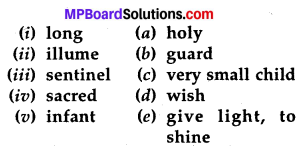
Class 8 English Chapter 16 MP Board
Answers:
(i) – (d)
(ii) – (e)
(iii) – (b)
(iv) – (a)
(v) – (c)

(b) Read the poem carefully and find out the words which have the following meanings:

  1. It is the bottom of a door way ………………….
  2. A hollow place in a wall ………………….
  3. Hidden corners of a houses where light does not reach ………………….
  4. A guard ………………….
  5. A sugary fluid collected by the bees

Answers:

  1. threshold
  2. niche
  3. nooks
  4. sentinel
  5. honey

(c) Given below is a circle having a few words. The words outside the circle have been used with the words given inside the circle.

Match them:
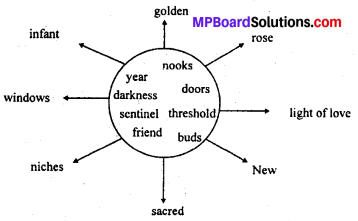
To The New Year Poem Class 8 MP Board
Answers:

  1. infant-friend
  2. golden- threshold
  3. rose-buds
  4. light of love-darkness
  5. New-year
  6. sacred-sentinel
  7. niches-nooks
  8. windows-doors.

Comprehension

(A) Answer the following questions:

To The New Year Poem Class 8 MP Board Question 1.
Whom does the poet address in the poem?
Answer:
The poet addresses to the New year in the poem.

Class 8 English Chapter 16 MP Board Question 2.
What does the poet long to be in the beginning of the poem?
Answer:
The poet longs to be a child in the beginning of the poem.

Class 8 English Chapter 14 To The New Year MP Board Question 3.
Why does the poet want to open all windows and doors?
Answer:
The poet wants to open ail windows and doors to allow light in every nook and corner.

(b) Choose the correct alternatives:

(i) The poet wants to drive out the darkness with:
(i) the light of the sun.
(ii) the light of the moon.
(iii) the light of love.
Answer:
(iii) the light of love.

(ii) The poet wants to be the infant friend of the:
(i) rose buds of goodness.
(ii) bright stars.
(iii) Temple of Life.
Answer:
(i) rose buds of goodness

(iii) The poet wants to be …………… at the golden threshold of the Temple of Life:
(i) child like
(ii) a sacred sentinel
(iii) stars.
Answer:
(ii) a sacred sentinel.

Let’s Read

Honourable teachers and dear friends, it is a sad day for me as well as for all of us today, because we have to say goodbye to our senior friends of the school. It is a happy day as well since they will be promoted to the higher class and join the senior school. Though we will miss them very much but we will feel their presence because they have contributed in the development of the school.

We have always seen them working in the garden, cleaning the class room, decorating the building and participating in various activities. How can we forget them? I remember many of them to be helping us-the juniors in our studies also. They have really play their role well and now when they are departing from us I would like to thank them and wish a very bright future for them. Hope they will keep guiding us.

Thank you.

Answer the questions given below:

Mp Board Class 8 English Chapter 16 Question 1.
What was the function in which the above speech was delivered?
Answer:
It was a farewell party.

To The New Year Poem Summary MP Board Chapter 16 Question 2.
Why did the speaker say goodbye to his senior friends?
Answer:
The speaker said goodbye to his senior friends because they were leaving the school.

To The New Year Summary MP Board Chapter 16 Question 3.
Why did the speaker say that it was a sad as well as a happy day?
Answer:
It was a sad day because the senior students were leaving the school. It was a happy day because they (senior students) would be promoted to the higher class and join the senior school.

Chapter 16 English Class 8 MP Board Question 4.
What was the contribution of the senior students in the development of the school?
Answer:
The senior students had always worked in the garden, cleaned the class room, decorated the building and participated in various activities.

Lesson 14 To The New Year MP Board Chapter 16 Question 5.
What did the speaker say in the end ?
Answer:
In the end the speaker said that their senior friends would keep guiding them.

To The New Year Poem Summary Class 8 MP Board Chapter 16 Question 6.
Suggest any other title to the above passage.
Answer:
Goodbye to our Senior Friends.

Let’s Write

(A) “Remove the darkness of hatred with the light of love” This seems like a slogan. Now make your own slogans on the following themes:
To The New Year Summary Class 8 MP Board Chapter 16

(B) Read the poem carefully and write its summary with the help of the
rose buds, the light of love, child, darkness, holy guard, the new year, stars, nook and corner, honey, windows and doors
Answer:
The poet addresses to the new year. He has always longed to be like child. He wants to be a friend of rose buds and gather honey. He wants to look and wonder at stars and open all windows and doors to allow light in every nook and corner. He wishes to drive out the darkness with the light of love, and become holy guard.

To the New Year Word Meanings

Page-147: Long – to wish, to desire – इच्छा करना। Childlike – like a child – बच्चे की तरह। Gather – collect – इकटठा करना illume – shine (literary word for illuminate’) – चमकना,रौशनी,फैलाना Niches – small hollow places in a wall – दीवार के छिद्र Nooks – corners – कोने Sacred – holy – पवित्र। Sentinel – guard – पहरेदार।

We wish the knowledge shared regarding MP Board Solutions for Class 8 English Chapter 16 To the New Year Questions and Answers has been helpful to you. If you need any further help feel free to ask us and we will get back to you with the possible solution. Bookmark our site to avail the latest updates on different state boards solutions in split seconds.

MP Board Class 8th Sanskrit Solutions Chapter 15 देवी अहिल्या

MP Board Class 8th Sanskrit Solutions Surbhi Chapter 15 देवी अहिल्या

MP Board Class 8th Sanskrit Chapter 15 अभ्यासः

Mp Board Class 8 Sanskrit Chapter 15 प्रश्न 1.
एकपदेन उत्तरं लिखत(एक शब्द में उत्तर लिखो-)
(क) अहिल्यायाः जन्मग्रामः कः? (अहिल्या का जन्म कां ग्राम कौन-सा है?)
उत्तर:
चौण्डी। (चौण्डी)

(ख) अहिल्यायाः व्यक्तित्वं कथं वर्तते? (अहिल्या का व्यक्तित्व कैसा है?)
उत्तर:
बहुमुखिप्रतिभासम्पन्नम्। (बहुमुखी प्रतिभा से सम्पन्न)

(ग) राजवाड़ा कुत्र अस्ति? (राजवाड़ा कहाँ है?)
उत्तर:
इन्दौर नगरे। (इन्दौर नगर में)

(घ) माहिष्मती कस्य राजधानी आसीत्? (माहिष्मति किसकी राजधानी थी?)
उत्तर:
सहस्रार्जुनस्य। (सहस्रार्जुन की)

(ङ) सुशीलाबाई-माणकोजी इति अनयोः पुत्री का आसीत्। (सुशीलाबाई-माणकोजी इन दोनों की पुत्री कौन थी?)
उत्तर:
अहिल्याबाई। (अहिल्याबाई)

Mp Board Class 8 Sanskrit Solution Chapter 15 प्रश्न 2.
एकवाक्येन उत्तरं लिखत(एक वाक्य में उत्तर लिखो-)
(क) लेखनप्रतियोगिता के विषयम् अधिकृत्य आसीत्? (लेखन प्रतियोगिता किस विषय को आधार बनाकर थी?)
उत्तर:
लेखनप्रतियोगिता ‘विक्रमादित्य-भोजराजाभ्याम् पोषिते मालवक्षेत्रे अहिल्यायाः प्रजावात्सल्यम्’ इति विषयम् अधिकृत्य आसीत्। (लेखन प्रतियोगिता ‘विक्रमादित्य और भोजराजा के द्वारा पोषित मालव क्षेत्र में अहिल्या का प्रजा प्रेम’ इस विषय को आधार बनाकर थी।)

(ख) अहिल्याबाई कदा जन्म अलभत? (अहिल्याबाई ने कब जन्म लिया?)
उत्तर:
अहिल्याबाई पञ्चविंशत्युत्तरसप्तदश ख्रिस्ताब्दे (१७२५) मईमासस्य एकत्रिंशे (३१) दिनाङ्के जन्म अलभत्। (अहिल्याबाई ने सत्रह सौ पच्चीस (1725) ईस्वी में मई महीने की इकत्तीस (31) तारीख को जन्म लिया।)

(ग) अहिल्याबाई कीदृशी महिला आसीत्? (अहिल्याबाई कैसी महिला थीं?)
उत्तर:
अहिल्याबाई प्रजावत्सला, धर्मपरायणा, न्यायनिष्ठा च महिला आसीत्। (अहिल्याबाई प्रजावत्सल, धर्मपरायण और न्यायनिष्ठ महिला थीं।)

(घ) महेश्वरस्थानस्य उल्लेखः कुत्र कुत्र वर्तते? (महेश्वर स्थान का उल्लेख कहाँ-कहाँ है?)
उत्तर:
महेश्वरस्थानस्य उल्लेखः रामायणमहाभारतग्रन्थयोः बौद्ध-जैनधर्मग्रन्थेषु वर्तते। (महेश्वर स्थान का उल्लेख रामायण-महाभारत ग्रन्थों में और बौद्ध-जैन धर्म ग्रन्थों में है।)

(ङ) कीदृशी अहिल्याबाई सदा राजते? (कैसी अहिल्याबाई सदा सुशोभित होती हैं?)
उत्तर:
धर्मार्थकाममोक्षेषु निरता अहिल्याबाई सदा राजते। (धर्म, अर्थ, काम और मोक्ष में लगी हुई अहिल्याबाई सदा सुशोभित होती हैं।)

Class 8 Sanskrit Chapter 15 Mp Board प्रश्न 3.
रेखाङ्कितपदम् आधृत्य प्रश्ननिर्माणं कुरुत(रेखांकित शब्द के आधार पर प्रश्न निर्माण करो-)
(क) अहम् मालवप्रदेशतः आगच्छामि। (कुतः) (मैं मालव प्रदेश से आ रहा हूँ।)
उत्तर:
अहम् कुतः आगच्छामि। (मैं कहाँ से.आ रहा हूँ?)

(ख) अहिल्याबाईखण्डेरावस्यपत्नीआसीत्।(कस्य) (अहिल्याबाई खण्डेराव की पत्नी थीं।)
उत्तर:
अहिल्याबाई कस्य पत्नी आसीत्। (अहिल्याबाई किसकी पत्नी थीं।)

(ग) रघुवंशकाव्ये महिष्मतिवर्णनम् अस्ति। (कुत्र) (रघुवंश काव्य में महिष्मति वर्णन है।)
उत्तर:
कुत्र महिष्मतिवर्णनम् अस्ति? (कहाँ महिष्मति का वर्णन है?)

(घ) अहिल्यायाः विद्याप्रीतिः असामान्या आसीत्। (कथम्) (अहिल्या का विद्या के प्रति प्रेम असामान्य था।)
उत्तर:
अहिल्यायाः विद्याप्रीतिः कथम् आसीत्? (अहिल्या का विद्या के प्रति प्रेम कैसा था?)

(ङ) राज्ञा महिष्मता निर्मिता माहिष्मती। (केन) (राजा महिष्मत् के द्वारा माहिष्मती का निर्माण किया गया।)
उत्तर:
केन निर्मिता माहिष्मती? (किसके द्वारा माहिष्मती का निर्माण किया गया?)

Mp Board Class 8 Sanskrit Solution Chapter 14 प्रश्न 4.
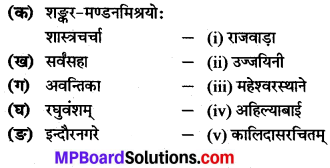
समुचितमेलनं कुरुत(सही मेल करो-)
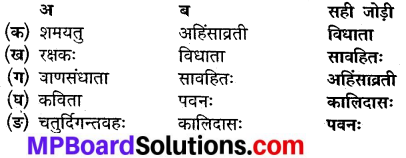
Mp Board Class 8 Sanskrit Chapter 15
उत्तर:
(क) → (iii)
(ख) → (iv)
(ग) → (ii)
(घ) → (v)
(ङ) → (i)

8th Class Sanskrit Chapter 15 MP Board प्रश्न 5.
उचितपदेन रिक्तस्थानम् पूरयत(उचित शब्द से रिक्त स्थान की पूर्ति करो-)
(क) भवान् कुतः …………। (आगच्छति/आगच्छसि)
(ख) माहिष्मतीनाम्ना …………. प्रसिद्धः। (महेश्वरः/उज्जयिनी)
(ग) राजवाड़ास्थानां …………. वर्तते। (प्रेक्षणीयं/उपेक्षणीयम्)
उत्तर:
(क) आगच्छति
(ख) महेश्वरः
(ग) प्रेक्षणीयम्।

Class 8 Sanskrit Chapter 15 Question Answer प्रश्न 6.
भिन्नशब्दं चिनुत(भिन्न शब्द चुनो-)
(क) कुतः, किम्, कुत्र, कथम्, मित्रम्।
(ख) श्रोतुम्, गन्तुम्, नेतुम्, समागत्य, ज्ञातुम्।
(ग) नर्मदा, क्षिप्रा, शिवना, चम्बल, हिमालयः।
(घ) विंशति, अशीति, नवतिः, षष्ठिः, द्रोणः।
(ङ) रामायणम्, महाभारतम्, पुराणम्, काव्यम्, कालिदासः।
उत्तर:
(क) मित्रम्
(ख) समागत्य
(ग) हिमालयः
(घ) द्रोणः
(ङ) कालिदासः।

देवी अहिल्या हिन्दी अनुवाद

क्लास 8 संस्कृत चैप्टर 15 MP Board अञ्जना :
हरिः ॐ! भ्रातः भवान् कुल आगच्छति?

अङ्केश: :
भगिनी, मालवप्रदेशतः आगच्छन् अस्मि।

अञ्जना :
तव जन्मदेश: मध्यप्रदेशस्य मालवक्षेत्रे वर्तते किम्? तत्र को विशेषः?

Class 8 Sanskrit Chapter 15 MP Board अङ्केश :
आम्! विक्रमादित्य-भोजराजाभ्यामपोषिते मालवक्षेत्रे अहिल्यायाः प्रजावात्सल्यम् इति विषयम् अधिकृत्य लेखनप्रतियोगिता आसीत्।

अञ्जना :
तर्हि, कथय मे अहिल्यावृत्तम्। श्रोतुम् इच्छामि।

अनुवाद :
अंजना-हलो! भाई आप कहाँ से आ रहे हो?

अंकेश :
बहन, मालव प्रदेश से आ रहा हूँ।

अंजना :
तुम्हारा जन्म का स्थान मध्य प्रदेश के मालव क्षेत्र में है क्या? वहाँ क्या विशेष है?

अंकेश :
हाँ! विक्रमादित्य और भोज राजा के द्वारा पोषित मालव क्षेत्र में अहिल्या का प्रजा प्रेम’ इस विषय के आधार पर लेखन प्रतियोगिता थी।

अंजना :
तो, मुझे अहिल्या का चरित्र बताओ। सुनना चाहती हूँ।

अङ्केशः :
सुशीलाबाई-माणकोजी इति। अनयोः सुपुत्री आसीत्। अहिल्याबाई महाराष्ट्रस्य चौण्डीग्रामे पंचविंशत्युत्तरसप्तदश ख्रिस्ताब्दे (१७२५) मईमासस्य एकत्रिंशे (३१) दिनाङ्के जन्म अलभत।

अञ्जना :
नर्मदा-क्षिप्रा-शिवनाचम्बलनदीभिः सम्पन्नस्य मालवक्षेत्रस्य वधूः खण्डेरावस्य पत्नी खलु अहिल्याबाई?

अङ्केश :
आम! सूबेदार मलाररावस्य पुत्रवधूः मालवप्रजानां सर्वस्वम् आसीत्। अहिल्यायाः व्यक्तित्वं बहुमुखि प्रतिभासम्पन्नं वर्तते स्म। एषा प्रजावत्सला, धर्मपरायणा, न्यायनिष्ठा महिला आसीत्। इन्दौरनगरे तस्याः राजवाड़ा क्षेत्रं सुन्दरम् पवित्रं च अस्ति। अद्यापि राजवाड़ास्थलम् इन्दौरनगरस्य हृदयमिव प्रेक्षणीयं वर्तते। अत्र देशविदेशेभ्यः यात्रिकाः दर्शनार्थम् आगच्छन्ति।

अनुवाद :
अंकेश :
(अहिल्याबाई) सुशीलाबाई और माणकोजी इन दोनों की सुपुत्री थी। अहिल्याबाई ने महाराष्ट्र के चौण्डी ग्राम में सत्रह सौ पच्चीस (1725) ईस्वी में मई महीने की इकत्तीस (31) तारीख को जन्म पाया।

अंजना :
नर्मदा, क्षिप्रा, शिवना और चम्बल नदियों से सम्पन्न मालव क्षेत्र की वधू और खण्डेराव की पत्नी क्या अहिल्याबाई थीं ?

अंकेश :
हाँ! सूबेदार महारराव की पुत्रवधू मालव की प्रजा की सब कुछ थी। अहिल्या का व्यक्तित्व बहुमुखी प्रतिभा से सम्पन्न रहता था। वह प्रजा से प्रेम करने वाली, धर्मपरायण, न्यायनिष्ठ महिला थीं। इन्दौर नगर में उनका राजवाड़ा क्षेत्र सुन्दर और पवित्र है। आज भी राजवाड़ा स्थल इन्दौर नगर के हृदय की तरह देखने योग्य है। यहाँ देश-विदेश से यात्री दर्शन के लिए आते हैं।

अञ्जना :
स्मर न तस्याः धर्मनिष्ठाम्। स्वपुत्रस्य मालेरावस्य मरणानन्तरं नर्मदातीरम् इन्दौरसमीपस्थम् महेश्वरस्थानं राजधानी चकार।

अङ्केश :
पुनः पुनः स्मरतु। प्राचीनकालतः अवन्तिकानाम्नी प्रसिद्धा उज्जयिनी, माहिष्मतीनाम्ना प्रशस्तः महेश्वरञ्चेति स्थानद्वयं मालवक्षेत्रे अन्तर्भवति।

अञ्जना :
राज्ञा महिष्मता निर्मिता माहिष्मती अधुना ‘महेश्वरनगरमेव’ अस्ति। अनूपदेशस्य राज्ञः सहस्रर्जुनस्य राजधानी अपि आसीत्।

अनुवाद :
अंजना-उनकी धर्म निष्ठा को याद कर रहा हूँ। अपने पुत्र मालेराव की मृत्यु के बाद नर्मदा के किनारे इन्दौर के पास महेश्वर (नामक) स्थान को राजधानी बनाया।

अंकेश :
फिर से याद करो। प्राचीन काल से अवन्तिका नाम की प्रसिद्ध उज्जयिनी और माहिष्मती नाम से प्रशंसनीय महेश्वर ये दोनों स्थान मालव क्षेत्र के अन्तर्गत हैं।

अंजना :
राजा महिष्मत् के द्वारा निर्मित माहिष्मती अब ‘महेश्वर’ नगर ही है। अनूपदेश के राजा सहस्रार्जुन की राजधानी भी थी।

अङ्केश: :
अथ किम्! रामायण-महाभारतग्रन्थयोः बौद्धजैनधर्मग्रन्थेषु अपि महेश्वरस्य उल्लेखो वर्तते। कालिदासविरचिते. रघुवंशे माहिष्मती-वर्णनमस्ति। आदिशङ्करमण्डनमिश्रयोः मध्ये शास्त्रार्थचर्चा महेश्वरस्थाने एव अभवत्, एतदेव पुण्यक्षेत्रम् अहिल्यायाः राजधानी च अभवत्।

अञ्जना :
अहिल्याबाई धीरा, शासनप्रवीणा च आसीत् इति पठितवती।

अङ्केश: :
आम्! आम्, सत्यं खल। तस्याः शासनव्यवस्था, अर्थनीतिः, रक्षानीतिः, विद्याप्रीतिः च विशिष्टा इति ज्ञायते।

अनुवाद :
अंकेश :
और क्या! रामायण महाभारत ग्रन्थों में और बौद्ध जैन धर्म ग्रन्थों में भी महेश्वर का उल्लेख है। कालिदास के द्वारा रचित रघुवंश (महाकाव्य) में माहिष्मती का वर्णन है। आदि शंकराचार्य और मण्डनमिश्र के बीच शास्त्रार्थ चर्चा महेश्वर स्थान पर ही हुई और यही पुण्यक्षेत्र अहिल्या की राजधानी हुई।

अंजना :
अहिल्याबाई धीरे और शासन में प्रवीण थीं ऐसा पढ़ा है।

अंकेश :
हाँ! हाँ! निश्चय ही सत्य है। उनकी शासन व्यवस्था, अर्थनीति, रक्षानीति और विद्या के प्रति प्रेम अद्वितीय था, ऐसा जाना जाता है।

अञ्जना :
अहो भाग्यम् मालवक्षेत्रस्य। जयतु कीर्तिशेषा अहिल्याबाई।

अङ्केश: :
जयतु, जयतु लोकमाता अहिल्याबाई।

उभौ :
सर्वंसहा जितक्रोधाऽहिल्याबाईति कीर्तिता।
धर्मार्थकाममोक्षेषु निरता राजते सदा॥

अनुवाद :
अंजना :
ओह! मालव क्षेत्र का भाग्य। केवल यश के रूप में जीने वाली अहिल्याबाई की जय हो।

अंकेश :
लोकमाता अहिल्याबाई की जय हो, जय हो।

दोनों :
धरती क्रोध को जीतने वाली अहिल्याबाई से प्रसिद्ध हुई। जो धर्म, अर्थ, काम और मोक्ष में सदा लगी हुई सुशोभित होती हैं।

देवी अहिल्या शब्दार्थाः

प्रजावत्सल्यम् = प्रजा प्रेम। दम्पती = पति और पत्नी। पञ्चविंशत्युत्तरसप्तदश = 1725, (पंचविंशति = 25, उत्तरे = आगे, सप्तदश = 17)। एकत्रिंश=31 अलभत = पाया/प्राप्त किया। सर्वस्वम् = सब कुछ। बहुमुखीप्रतिभासम्पन्नम् = बहुत प्रकार की प्रतिभा से सम्पन्न। विशिष्टा = अद्वितीय, विशिष्ट। कीर्तिशेषा = केवल यश के रूप में जाने वाली। सहा = धरती। जितक्रोधा= क्रोध को जीतने वाली। धर्मार्थकाममोक्षेषु = धर्म, अर्थ, काम और मोक्ष में। चतुर्विधपुरुषार्थाः = चत्वारः धर्मः, अर्थः, कामः, मोक्षश्च।

MP Board Class 8th Sanskrit Solutions

MP Board Class 7th Special English Solutions Chapter 9 Shravan Kumar

Get Updated MP Board Solutions for Class 7 Special English Solutions Chapter 9 Shravan Kumar Questions and Answers in PDF Format and download them free of cost. These are provided as per the latest exam pattern and syllabus. Access the topics of Chapter wise and communication skills, grammer part through the direct links available depending on the need. You can Download MP Board Class 7 English Solutions and can score highest grade in examination. Clear all your queries on the Mp Board Solutions for Class 7 English Chapter 9 Shravan Kumar Questions and Answers Subject by using the Madhya Pradesh State Board Solutions for existing.

MP Board Class 7th Special English Solutions Chapter 9 Shravan Kumar

If you are eager to know about the Madhya Pradesh State Board Solutions for Class 7 English you will find all of them here. You can identify the knowledge gap using these MP Board Solutions for English PDF and plan accordingly. Don’t worry about the accuracy as they are given after extensive research by people having subject knowledge along side from the latest English Syllabus.

Shravan Kumar Text Book Exercise

Read and Learn

Class 7 English Chapter 9 Shravan Kumar

Comprehension

A. Answer the questions given below:

Class 7 English Chapter 9 Shravan Kumar Question 1.
Who was the king of Kaushal?
Answer:
Aja was the son of Kaushal.

Mp Board Class 7th English Chapter 9 Question 2.
Which river flowed near Kaushal Pradesh?
Answer:
The Saryu-river flowed near Kaushal JPradesh.

Shravan Kumar Story MP Board Class 7th Question 3.
which art did Dashrath excel?
Answer:
Dashrath excelled in the art of archery (shooting with arrow and bow).

Shrawan Kumar MP Board Class 7th Question 4.
Why is Shravan kumar famous?
Answer:
Shravan kumar is famous for his devotion and obedience to his blind parents.

Shravan Bal Story MP Board Class 7th Question 5.
What blunder did Dashrath commit?
Answer:
Dashrath pierced Shravan’s chest with his arrow and caused his death. He had committed that blunder.

Shravan Kumar Short Story In English MP Board Class 7th Question 6.
What did Dashrath see when he reached the spot?
Answer:
Dashrath reached the spot from where the sound of groaning was coming. He saw a young man dying and crying due to injury. His chest was pierced by Dashrath’s arrow.

Question 7.
What curse did the blind parents give to Dashrath?
Answer:
The blind man cursed Dashrath in the following words. ‘As we are separated from our dear son, you too will die in agony and grief longing for your dear son.’

B. Complete the following chart:
Mp Board Class 7th English Chapter 9
Answer:
Shrawan Kumar MP Board Class 7th

Word Power

A. Make words from the jumbled letters. The first letter is given:

  1. tsop       →  spot,
  2. rehear    →  a- –
  3. gunhthi  →  h- –
  4. bildu       →  b- –
  5. thsrit       →  t- –

Answer:

  1. spot
  2. archer
  3. hunting
  4. build
  5. thirst.

B. Fill in the blank spaces with correct option.

  1. The cat ran after its…….. (prey/pray)
  2. He went inside the temple to………. to God (Prey/pray)
  3. He helped his………..friend (deer/dear).
  4. He saved the………. from the hunter (deer/dear).
  5. His………… looked bright (son/sun).
  6. The……….. was bright that day (son/sun).
  7. Dashrath longed to have a………. of Ram (site/sight).
  8. The engineer went to the……….. where the bridge was being built (site/sight).

Answer:

  1. prey
  2. pray
  3. dear
  4. deer
  5. son
  6. sun.
  7. sight
  8. site.

Grammar in Use

A. Change the paragraph into past tense.

Shyam asks his parents to take him to the exhibition at the City Parade Ground. His parents agree, all of them reach the exhibition ground. It is all very crowded. There are several swings and rides, horse- rides, Camel-ride, elephant-ride, and other stalls of eatables. Shyam and his younger sister Meena enjoy camel and elephant rides, They go on swings too. They are fond of chat and rabari. They eat chat and get the sweets packed. Their parents too enjoy this outing with their children.
Answer:
Shyam asked his parents to take him to the exhibition at the city parade ground. His parents agreed. All of them reached the exhibition ground. It was all very crowded. There were several swings and rides, horse- rides, camel-ride, elephant-ride, and other stalls of eatables. Shyam and his younger sister Meena enjoyed camel and elephant rides. They went on swings too. They were fond of chat and rabari. They ate chat and got the sweets packed. Their parents too enjoyed this outing with their children.

B. Rearrange the words to make meaningful sentences:

  1. was/prince/of/Dashrath/Ayodhya/?/
  2. pareht/Shravan/were/of/blind/./
  3. archer/great/a/was/Dashrath/./
  4. committed/a/blunder/he/./
  5. sent/son/his/exile/into/he/./

Answer:

  1. Was Dashrath prince of Ayodhya?
  2. Parents of Shravan were blind.
  3. Dashrath was a great archer.
  4. He committed a blunder.
  5. He sent his son into exile.

C. Write nouns for these adjectives
Popular – popularity
ignorant – …………
exceptional – ………….
dense – ……….
thirsty – ………
Answer:
Adjective                Noun
Ignorant         –      ignorance
Exceptional    –      exception
Dense             –      density
Thirsty            –      thirst

Let’s Talk

We are celebrating Vanmahotsava. Here is a picture. Discuss about it in the class room with the help of questions. Work in pairs. Ask these questions and let your partner answer the questions Change roles and repeat the exercise.
Shravan Bal Story MP Board Class 7th

Question 1.

  1. What is the picture about?
  2. Where are all the children?
  3. What is the teacher doing?
  4. What is Geeta doing?
  5. Why is Geeta digging?
  6. Are the children happy?

Answer

  1. The picture is about the celebration of Vanmahotsava.
  2. All the children are in the school garden.
  3. The teacher is patting a boy.
  4. Geeta is digging the ground.
  5. Geeta is digging the ground to sow, seeds.
  6. Yes, the children are very happy.

Let’s Write

A. Rewrite the sentences in the correct sequence:

  1. Dashrath’s arrow pierced Shravan’s chest.
  2. Dashrath went for hunting.
  3. Shravana’s parents cursed Dashrath.
  4. Shravan went to bring water for his blind parents.
  5. Dashrath died longing for Ram.

Answer:
The Correct sequence of sentences is: 4, 2, 1, 3, 5
Sentences in correct sequence:

  1. Shravan went to bring water for his blind parents.
  2. Dashrath went for hunting.
  3. Dashrath’s arrow pierced Shravan’s chest.
  4. Shravan’s parents cursed Dashrath.
  5. Dashrath died longing for Ram.

B. Write ten sentences on Shravan Kumar. Take the help of the clues.
(obedient, devoted, dutiful, pilgrimage, forest, put aside, thirsty, old and blind, river.)
Answer:
Shravan Kumar

Shravan Kumar was a devoted and obedient son. He used to carry his old and blind parents for pilgrimage. One day he was passing through the forest around Ayodhya. His parents asked him to bring water. Shravan took a pot. He went to Saryu river to bring water. His pot produced a gurgling sound. King Dashrath drought him to be a big animal. He shot an arrow. It pierced shravan’s chest. Shravan asked Dashrath to give water to his parents just then he died.
Let’s Do it

Work in groups of four. Use these words and phrases in sentences of your own to write a short story.
Good at, archer, burst into tears, hunting, wait for, broken-hearted, shot.
Answer:
For self attempt

Shravan Kumar Word Meanings

Shravan Kumar Short Story In English MP Board Class 7th

We believe the information shared regarding MP Board Solutions for Class 7 English Chapter 9 Shravan Kumar Questions and Answers as far as our knowledge is concerned is true and reliable. In case of any queries or suggestions do leave us your feedback and our team will guide you at soonest possibility. Bookmark our site to avail latest updates on several state board Solutions at your fingertips.

MP Board Class 9th Sanskrit Solutions Chapter 1 जयतु मे माता

MP Board Class 9th Sanskrit Solutions Durva Chapter 1 जयतु मे माता (गीतम्)

MP Board Class 9th Sanskrit Chapter 1 पाठ्य पुस्तक के प्रश्न

Class 9 Sanskrit Chapter 1 Mp Board प्रश्न 1.
एकपदेन उत्तरं लिखत-(एक शब्द में उत्तर दीजिए)।
(क) गीतायाः गाता क? (गीता का गाने वाला कौन है?)
उत्तर:
गीतायाः गाता कृष्णः। (गीता का गान करने वाला कृष्ण है।)

(ख) सीमान्तरक्षकः कः अस्ति? (सीमा का रक्षक कौन है?)
उत्तर:
सीमान्तरक्षकः सैनिकः अस्ति। (सीमा का रक्षक सैनिक है।)

(ग) वेदोपनिषज्जनयित्री का? (वेद और उपनिषद् की माता कौन है?)
उत्तर:
वेदोपनिषज्जनयित्री भारतभूमिः। (वेद और उपनिषद् की माता भारतभूमि है)

(घ) निष्कारणविद्वेषकरः कुत्र याति? (बिना कारण के बैर करने वाला कहां जाता है?)
उत्तर:
निष्कारणविद्वेषकर कालमुखिः याति। (बिना कारण के बैर करने वाला काल के मुख अर्थात् मृत्यु के मुख में जाता है)

(ङ) मातुः कष्टकर दुर्दैवं कः शमयतु? (माता के दुखों या कष्टों को कौन दूर करता है)
उत्तर:
मातुः कष्टकरं दुर्दैवं विधाता शमयतु। (माता के दुखों व कष्टों को विधाता दूर करता है।)

You can download MP Board 10th sanskrit solution to help you to revise complete syllabus and score more marks in your examinations.

Mp Board Class 9 Sanskrit Chapter 1 प्रश्न 2.
एकवाक्येन उत्तरं लिखत्-(एक वाक्य में उत्तर लिखें)।
(क) मातर्यशशांगाता कः? (माता की यश महिमा का गान करने वाला कौन है?)
उत्तर:
चतुर्दिगन्तवहः पवनः। (चारों दिशाओं में बहने वाली हवा।)

(ख) भारतमाता कैः वंदिता?। (भारत माता किसके द्वारा वंदित की गई है।)
उत्तर:
हर्ष-भोज-शिवराज वंदिता। (हर्ष-भोज और शिवराज के द्वारा पूजी गई।)

(ग) भारतमाता कैः नंदिता? (भारत माता किसके द्वारा प्रसन्न की गई है?)
उत्तर:
मौर्य-शुङ्ग गुप्ताभिनन्दिता। (मौर्य-शुङ्ग और गुप्त के द्वारा प्रसन्न की गई है।)

(घ) अहिंसाव्रती किमर्थं वाणसंधान करोति? (अहिंसा का व्रत धारण करने वाले वाणों का संधान किसलिए करते हैं?)
उत्तर:
निजरक्षार्थमहिंसाव्रती। (अपनी रक्षा के लिए अहिंसाव्रत धारी भी वाण संधान करता है।)

(ङ) आदौ ज्ञानभानुः कुत्र उदितः? (पहले ज्ञान का सूर्य कहां उदित होता है?)
उत्तर:
ज्ञान भानुरादौ त्वय्युदितः।। (ज्ञान का सूर्य तुम ही से उदित होता है।)

संस्कृत कक्षा 9 पाठ 1 Question Answer MP Board प्रश्न 3.
रिक्त स्थानानिपूरयत-(रिक्त स्थानों की पूर्ति करो)
(क) येन न दस्यति कोऽपि तक्षकः।
(ख) भारत रामायण कवयित्री।
(ग) मौर्य शुंङ्ग गुप्ताभिनन्दिता।
(घ) कच्छ शम रूपान्त वासिनी।
(ङ) निष्कारणविद्वेषकरस्तव कालमुखं प्रतियाता।

Mp Board Class 9 Sanskrit Solution प्रश्न 4.
संधिविच्छेदं कृत्वा सन्धेः नाम लिखत् (संधि विच्छेद कर संधि नाम लिखो)।
(क) त्वय्युदित
उत्तर:
त्वयि + उदिता = यण स्वर संधि।

(ख) शूरस्ते
उत्तर:
शूरः + ते = विसर्ग संधि।

(ग) गणोऽयम्
उत्तर:
गणः + अयम् = पूर्वरूप स्वर संधि।

(घ) कोऽपि
उत्तर:
कः + अपि = पूर्वरूप स्वर संधि।

(ङ) विद्वेषकरस्तव
उत्तर:
विद्वेषकरः + तव = विसर्ग संधि।

कक्षा 9 संस्कृत अध्याय 1 सवाल जवाब MP Board प्रश्न 5.
यथायोग्यं योजयत (सही जोड़ी बनाओ)
Mp Board 9th Class Sanskrit Solution

कक्षा 9वी संस्कृत के प्रश्न उत्तर MP Board प्रश्न 6.
शुद्धवाक्यानां समक्षम् “आम्” अशुद्धवाक्यानां समक्षं “न” इति लिखत् उदाहरणम्
यथा- पवनः चतुदिर्गन्तवहः अस्ति। – आम्
अस्याः तनः हिंसार्थम् बाण संधाता। –  न
(क) गोपालः गीतायाः गाता।
(ख) भारत माता मौर्य शुङ्ग-गुप्ताभिवन्दिता अस्ति।
(ग) सकल लोकगणः सीमां त्राता अस्ति।
(घ) अस्यां आदौ ज्ञानभानु न उदितः।
उत्तर:
(क) आम्
(ख) आम्
(ग) आम्
(घ) न

संस्कृत कक्षा 9 पाठ 1 सवाल जवाब MP Board प्रश्न 7.
उदाहरणानुसारं पदानां मूल शब्द विभन्ति च लिखत
कक्षा 9 विषय संस्कृत पाठ 1 के प्रश्न उत्तर MP Board

जयतु मे माता पाठ संदर्भ/प्रतिपाद्य

आधुनिक काल में भी संस्कृत में गद्य-पद्य लेखन की बहुलता है। इस भाषा के मूर्धन्य विद्वान, कवि और लेखकों के बीच आचार्य डॉ. प्रभुदयाल अग्निहोत्री का विशेष स्थान है। इनकी संस्कृत साहित्य में दर्शन, इतिहास, मनोविज्ञान, कथा, काव्य, नाटक आदि विधाओं में अनेक पुस्तकें प्रकाशित हुई हैं। ‘त्रिपथगा’ कविता संग्रह 2005 में प्रकाशित हुई। प्रस्तुत गीत भी ‘त्रिपथगा’ नामक कृति से ही लिया गया है। इस गीत में स्वतंत्रता सेनानी एवं संस्कृत के मूर्धन्य विद्वान अग्निहोत्री दारा सुंदर, मधुर एवं भावपूर्ण शब्दों में भारत माता की वंदना की गई है।

जयतु मे माता पाठ का हिन्दी अर्थ

1. जयतु जयतु मे माता,
अस्याः कष्टकरं दुर्दैवं शमयतु सदा विधाता।।

शब्दार्थ :
जयतु-जय हो-Vicrory; अस्याः -इसकी-Her/Him; कष्टकरंदुखी-Sorrow; दुर्दैवं-दुर्भाग्य को या बाधाओं को-Misfortune/Unfortunately; शमयतु-शांत कराये/ दूर करवाये; विधाता-ब्रह्मा-God Almighty; सदा-हमेशा-Always.

हिन्दी-अर्ध :
मेरी माता (मातृभूमि) की जय हो, जय हो। हे विधाता! तुम इसके कष्टों एवं आपदाओं को सदैव के लिए शान्त करें।

2. त्वं वेदोपनिषज्जनयित्री,
भारत-रामायण कवयित्री
अजनिष्ठाः कृष्णं गोपालं यो गीतायाः गाता॥

शब्दार्थ :
त्वं–तुम्हारा-Your; वेदोपनिषद्-वेद और उपनिषद्-Ved and Upnishad; जनयित्री-पैदा करने वाली-Mother, Originatee; गाता-गान करने वाले-Singer.

हिन्दी अर्थ :
हे भारत भूमि-तुम ही वेद और उपनिषदों की जननी हो। हे माँ! तुम ही महाभारत, रामायण की रचयित्री हो। हे माँ! तुम ही गीता का गान करने वाले मुरली-मनोहर कन्हैया की जननी हो।

3. ज्ञान-भानुरादौ त्वरयुदितः,
शूरस्ते तनयः सम्मुदितः,
केवल-निजरक्षार्थमहिंसाव्रती वाण-सन्धाता।

शब्दार्थ :
ज्ञान-ज्ञान-Knowledge; भानु-सूर्य-Sun; तनयः-पुत्र-Son; शूर-वीर-Brave; निज-स्वयं के-Myself; वाण-सन्धाता-वाण से लक्ष्य भेद करने पाला-Arjun or Bowman.

सरलार्थ :
हे भारत माँ! तुममें ही ज्ञान का सूर्य सर्व प्रथम उदित हुआ (अर्थात् भारतभूमि पर सर्व प्रथम ज्ञान रूपी सूर्य उदित हुआ।)। वीर पुत्र की जननी तुम्ही हो (अर्थात् वीरों का जन्म भारतभूमि पर ही हुआ)। केवल अपनी रक्षा के लिए अहिंसा का व्रत धारण करने वाला भी वाण संधान करता है अर्थात् वाणों से लक्ष्य साधता है।

4. मौर्य-शुङ्ग-गुप्ताभिनन्दिता,
हर्ष-भोज-शिवराज-वंदिता,
संप्रति लोकगणोऽयं सकल स्तव सीम्नां त्राता॥

शब्दार्थ :
नंदिता-प्रसन्न की गई-Toglad; वंदिता-पूजित-Worshipper; सम्प्रति-इस समय-This time; अयमं-इस-It; सकल-सभी-All, every; सीमनां-सीमाओं के-Limit; त्राता-रक्षक-Guard.

सरलार्थ :
हे भारत माँ! तुम मौर्य, शुंग, गुप्त वंशों द्वारा पूजित हो और (राजा) हर्ष, (राजा) भोज एवं शिवाजी द्वारा वंदित हुई हो। हे माँ! (इस पावन भूमि पर पैदा हुए) सभी जन तुम्हारी रक्षा करने वाले हैं।

5. कालिदास-कविता-रस-मग्ना,
सांख्ययोग-साधन-संलग्ना,
नालन्दाजन्ता मातस्ते श्रद्धाञ्जलि-प्रदाता॥

शब्दार्थ :
मग्ना-मग्न-Meditate; सांख्ययोग-सांख्ययोग-Sankhyoga; संलग्ना-संलग्न-Enclouse; नालन्दाजन्ता-नालन्दा और अजंता-Nalanda & Ajanta; प्रदाता-प्रदान करने वाले-Giver, Doner.

सरलार्थ :
हे मातृभूमि! कविता (की मधुर रागिनी) रस में मग्न कालिदास (सदृश कवि), सांख्य (दर्शन) योग में निमग्न अजंता एवं नालंदा के विद्वान जन तुम्हारी चरण वंदना करते हैं।

6. कच्छे-कामरूपान्त-वासिनी,
गङ्गा-कावेरी-सुहासिनी,
चतुर्दिगन्तवहः पवनस्ते मातर्यशसां गाता॥

शब्दार्थ :
वासिनी-निवास करने वाली-Inhahitant; चतुर्दिगन्तवहः-चारों दिशाओं में बहने वाला-Omni; पवनः-पवन-Air; ते-तुम्हारे-Your.

सरलार्थ :
हे भारत माते! तुम कच्छ से कामरूप तक निवास करने वाली (के अंक में) को गंगा-कावेरी (आदि नदियाँ) शोभायमान करती हैं तथा चारों दिशाओं में प्रवाहित होने वाला वायु तुम्हारी महिमा गान करता है।

7. सावहितः सीमान्त-रक्षकः
येन न दंशति कोऽपि तक्षकः
निष्कारण-विद्वेषकरस्तव कालमुखं प्रतियाता॥
जयतु जयतु मे माता। जयतु जयतु मे माता॥

शब्दार्थ :
सावहितः-सावधान-Attention; दंशति-दशता है-Sting; येन-जो-Who, what, which; तक्षकः-लुटेरा-Robber; कोपि-कोई भी-Any one; निष्कारण-बिना कारण के-Without reason; विद्वेष-द्वेष के कारण-Reason of jealous; प्रतिभाता-समाहित होता है-To meet.

सरलार्थ :
हे भारत माता की सीमा को रक्षित करने वाले रखवालो (जवानों)! सावधान रहो जिससे कोई बाहरी दस्यु भारत का नुकसान न कर सके। हे माँ! जो तुमसे (अर्थात् इस भूमि से) वैर भाव रखता है. वह काल रूपी गाल में समा जाता है। हे भारत माता! तुम्हारी जय हो, तुम्हारी जय हो, जय-जय हो माँ।

MP Board Class 9th Sanskrit Solutions

MP Board Class 8th Social Science Solutions Chapter 24 Economic Development of Australia Continent

MP Board Class 8th Social Science Solutions Chapter 24 Economic Development of Australia Continent

MP Board Class 8th Social Science Chapter 24 Economic Development of Australia Continent

MP Board Class 8th Social Science Chapter 24 Text Book Exercise

Choose the correct option of the following

Mp Board Class 8 Social Science Solution Chapter 24 Question 1.
From which metal aluminium is made?
(a) Copper
(b) Bauxite
(c) Mica
(d) Tin
Answer:
(b) Bauxite

Class 8 Social Science Chapter 24 Question 2.
The original people of New Zealand are called:
(a) Mawaris
(b) Aboriginal
(c) Eskima
(d) none of above
Answer:
(d) none of above

Mp Board Class 8 Social Science Chapter 24 Question 3.
The capital of Australia is
(a) Sydney
(b) Canberra
(c) Perth
(d) Wellington
Answer:
(a) Sydney

Fill in the blanks:

  1. The main crop of Australia continent is …………
  2. The high quality wool is obtained from ………… sheep.
  3. The worship place of Australian people is called …………
  4. The farming is done in Australia on ………….. percent land.

Answer:

  1. Wheat
  2. Marino
  3. Yuluroo
  4. 4%

MP Board Class 8th Social Science Chapter 24 Very Short Answer Type Questions

Question 1.
Write the name of the biggest rail route in Australia Continent?
Answer:
The Trans-Australian Railways is the biggest rail network in Australia that runs between Sydney (eastern coast) and Perth (in the west) the total length of this route is 4000 kms.

Question 2.
Write the name of famous gold mines in Australia?
Answer:
Kalgoorlie and Coolgardie are the famous gold mines in western Australia.

Question 3.
Which island is situated in south-east of Australia?
Answer:
Tasmania Island lies in the south-east of Australia.

Question 4.
Which are labourers called who work on sheep-rearing centres?
Answer:
The labourers who work on sheep rearingh are called Jackarooes. They graze sheeps and attend them.

MP Board Class 8th Social Science Chapter 24 Short Answer Type Questions

Question 1.
Where and why grapes are cultivated in Australia continent?
Answer:
A variety of fruits are also grown in Australia. While in South grapes are grown in abundance. The climate of this region is suitable for grape-farming. The wine made of grapes is exported.

Question 2.
Which are the favourable conditions for the farming of wheat in Australia Continent?
Answer:
Wheat is the most important crop of Australia. Half of the total land under cultivation is used for producing wheat. There are big farms here. All the farming works are done by machines. The wheat is produced in winter.

The main wheat producing areas are downs, plains, coastal western-southern Australia and Kenterburry plains of New Zealand. Here the fertile soil, the temperature climate and normal rains are suitable for the wheat crop.

Question 3.
Which are the major minerals found in Australia ? Write the names of producing areas?
Answer:
In the major part of Australia there are mountains plateaus and deserts. It is one of the oldest land in the world. There are mines of iron ore, bauxite, manganese and gold. Besides these, silver, uranium, thorium, copper and tin mines in abundance in Australia. Kalgoorlie and Coolgardie are the famous gold mines in western Australia.

There are also big mines in Queensland. Bauxite is in plenty in Australia but fairly good amount is used by its own industries hence it is exported in less quantity. Aluminium is made of bauxite. Opal a milky colour metal is found here which is used in manufacturing of bangles and things.

Coal is found in the mines of New South Wales, Queensland and New Zealand. Natural Oil and Gas are found in the Downs and Western Coastal Australia.

MP Board Class 8th Social Science Chapter 24 Long Answer Type Questions

Question 1.
Why sheep rearing industry is advanced in Australia?
Answer:
Sheeps are mainly reared for wool in Australia. Few sheep are reared for meat also. Nearly 18 crore sheeps are reared in Australia Continent. Here sheeps are kept in big farm house which is called sheep rearing centre. These Centres spread in several kilometres.

The region lying near Murray-Darling rivers are most suitable for sheep rearing. New South Wales, Victoria, Queensland and New Zealand are Chief Centres for sheep rearing. Marino sheeps are nearest for wool. Very high quality wool is achieved from Marino sheeps. The wool is taken by machines from the sheep.

The wool is graded and pressure into bales and then exported Marino wool fatches high prices so it is economically beneficial. Because sheeps are reared in abundance so this industry is becoming advance in Australia.
Question 2.
Where and why dense population is found in Australia?
Answer:
The high population is mostly in south-east, south-west and eastern coastal area in Australia. These regions are plains and agriculture is main occupation of the people of Australia like India, the original people of Australia is known as aboriginal and original people of New Zealand are known as Maories. So south-east, South-west and eastern coastal areas are densely populated.

Question 3.
Mention about two chief industries of Australia Continent?
Answer:
Australia has made treremendous progress in industrial sector and this all is due to the use of latest technology. The high-level administration capability cheap and skilled labour and competitive industrial policy are the main factors of industrial development in Australia.

The two main industries are:

  1. Iron and Steel industry
  2. Woollen clothes.

Most of the manufacturing industries are located in New South Wales, Victoria and New Zealand. Besides these two industries there are agriculture machines, motor vehicles, electrical goods, chemicals, papers, ships, machine tools and oil machines, milk products, cotton clothes tinned fruit and meat industries.

Project Work

Show the following in the map of Australia continent.

  1. Any one wheat producing area
  2. Goldmines of Kalgoorlie and Coolgardie
  3. NewZealand, Tasmania islands
  4. One state of sheep rearing
  5. Melbourne Brisbane and Sydnv cities
  6. The first last stations of Trans-Australian rail route.

MP Board Class 8th Social Science Solutions Chapter 24 Economic Development of Australia Continent

MP Board Class 8th Social Science Solutions

MP Board Class 8th Special English Solutions Chapter 7 Nothing You Can’t Do

Guys who are planning to learn the fundamentals of English can avail the handy study material using MP Board Solutions for Class 8 English Chapter 7 Nothing You Can’t Do Questions and Answers. You Can Download MP Board Class 8 English Solutions Questions and Answers, Notes, Summary, Guide, Pdf. Refer to the Madhya Pradesh State Board Solutions for English PDF available and score better grades. Simply click on the quick links available for MP Board Solutions for Class 8 English Chapter 7 Nothing You Can’t Do Questions and Answers and prepare all the concepts in it effectively. Take your preparation to the next level by availing the Madhya Pradesh State Board Solutions for Class 8 English prepared by subject experts.

MP Board Class 8th Special English Solutions Chapter 7 Nothing You Can’t Do

Do you feel the concept of English is difficult to understand? Not anymore with our MP Board Solutions for Class 8 English Chapter 7 Nothing You Can’t Do Questions and Answers. All the Solutions are given to you with detailed explanation and you can enhance your subject knowledge. Use the Madhya Pradesh State Board Solutions for Class 8 English PDF for free of cost and prepare whenever you want.

Nothing You Can’t Do Textual Exercise

Word Power

A. Write the words given below against their correct meanings. Find out the correct meaning with the help of a dictionary:
Class 8 English Chapter 7 Nothing You Can't Do
Answer:

Mp Board Class 8 English Chapter 7

Class 8 English Chapter 7 Mp Board

B. You already know that there are five sense. Certain words are related with the sense of sight, Example : stare, look
similarly there are words related to the sense of hearing.
Example : loud, booming
Some words describe different ways of touching.
Example: grab, press
Moreover, there are words that describe how things smell.
Emample : stinking aromatic
Finally, there are words that describe the four common tastes.
Some such words are given in the block given below:
Nothing You Can't Do Class 8
Pick up the words, decide to which sense they relate to, and write them in the column. One in each case is done for you.
Answer:
Class 8 Mp Board English Chapter 7

Comprehension

A. Rearrange the following sentences in the correct order:

Class 8 English Chapter 7 Nothing You Can’t Do Question 1.
Sharad boarded a train to Delhi one November evening.
Answer:
Sharad boarded a train to Delhi one November evening.

Mp Board Class 8 English Chapter 7 Question 2.
Sharad’s seat was in a compartment occupied by young disabled athletes.
Answer:
Sharad’s seat was in compartment occupied by young disabled athletes.

Class 8 English Chapter 7 Mp Board Question 3.
Sharad was thrown out of a moving train and his right arm was cut off.
Answer:
Sharad was thrown out of a moving train and his right arm was cut off.

Nothing You Can’t Do Class 8 Question 4.
Sharad hid his severed arm with a shawl after the accident.
Answer:
Sharad hid his severed arm with a shawl after the accident.

Class 8 Mp Board English Chapter 7 Question 5.
Marjeet introduced him to his friends.
Answer:
Manjeet introdused him to his friends.

Mp Board Class 8 Chapter 7 Question 6.
They did not sleep that night.
Answer:
They did not sleep that night.

Nothing You Can Do MP Board Class 8 Question 7.
The train ride gave confidence to Sharad.
Answer:
The train ride gave confidence to sharad.

B. Answer the following questions :

Mp Board Solution Class 8 English Question 1.
How did Sharad become disabled?
Answer:
Sharad lost his right hand in a train ride. He left his seat in an express train after having supper to wash his hands. As he finished and turned, the train suddenly jerked throwing him off balance. He was flung night out of the door to lose his right hand.

Class 8th English Mp Board Solution Question 2.
Why did he constantly hide his disability?
Answer:
He did not like to show his disability to anyone. Therefore he constantly hid his disability.

Question 3.
Why did Sharad not meet the eyes his travel-mates when he settled down in his seat?
Answer:
Sharad felt shy due to his disability. He had fear that his travel-mates would notice it. Hence he did not meet their eyes.

Question 4.
Who introduced Sharad to the other students?
Answer:
Manjeet introduced Sharad to the other students.

Question 5.
What was the name of the girl who had the ‘face of an angel’?
Answer:
Her name was Angel.

Question 6.
What disability did Kumar have?
Answer:
Kumar was blind.

Question 7.
What in Abilympics?
Answer:
Abilympies is an event where people with disability compete to show the world that people with or without disability enjoy equal rights and opportunities.

Question 8.
What and where were the first-international Abilympies held?
Answer:
The first International Abilympics was held in Tokyo in 1981.

Question 9.
What brought a change in Sharad’s view of his disability?
Answer:
Sharad had a talk with some disabled athletes in the train. He got impressed to learn that those disabled athletes had positive attitude towards life. They had not hidden their disability with a shawl like him. This left a deep impact on Sharad’s mind. Now his view changed completely.

Question 10.
Sharad’s travel-mates were going to Delhi to participate in the Abilympics. From the clues given in the text, can you guess what year was it?
Answer:
It was the year 2003.

Question 11.
Which one of the following words does not relate to the character of Sharad :
nervous, timid, shy, fearful, cheerful, meek.
Answer:
Timid.

Question 12.
Which one of the following words does not relate to the character of Sharad’s travel-mates :
confident, cheerful, pleasant, selfish, lively, encouraging
Answer:
Selfish.

Question 13.
Given below is a layout of the compartment where Sharad sat along with Angel, Manjeet, Shahida, Kumar and Vikas. From the clues produced in the text, assign each child the correct seat. Sharad’s seat is done for you.
Answer:
MP Board Class 8th Special English Chapter 7 Nothing You Can't Do 6

Question 14.
Which sentence in the lesson talk us that the season was winter when Sharad travelled to Delhi?
Answer:
It was a cool November evening and I was thankful that the shawl on my shoulder would go unnoticed.

Let’s learn

‘Will’ as Model Auxiliory is used for different purposes –

(i) We use I’ll or I will when we decide to do something at the time of speaking: Oh, I haven’t shut the windows, I’ll go and shut it.
Did you talk to Mona? Sorry, I forgot I’ll phone her now.

(ii) We often use will in these situtations also :

  • Offering to do thing.
    eg. I’ll help you to carry those books.
  • Asking somebody to do something (Will you?).
    eg. Will you lock the cupboard, please?

(iii) We also use ‘will’ for

  • Promising to do something
    eg. I’ll return the book on Friday.

Given below are exercises based on the use of ‘will’ for ‘Promising to do something

New Year Resolutions.
The New Year has much more to offer than mere celebration. Some people make resolution on the New Year eve. Usually these resolution are of two types:

(a) Wishes, that people make to be ful filled in the New Year.
(b) Quitting some bad habit in the New Year.

Question 1.
Given below are some bands on which New Year Resolutions are written. Read each one of them carefully. If you think it is about a wish,then write ‘a’ in the circle. If the resolution is about quitting an undesirable habit, then write ‘b’ in the circle.
Answer:
MP Board Class 8th Special English Chapter 7 Nothing You Can't Do 7

Question 2.
The bands given above belong to the following people. From the clues given below, write the name of the person in the band.

  1. Priyank plays football.
  2. Asif is very fond of chocolates.
  3. Mohini dances well.
  4. Jayant has failed in the quarterly examination.
  5. Mandeep watches late night shows on TV.
  6. Salma is in the habit of telling lies.

Answer:

  1. I will become the highest goal scorer of the football clubs – Priyank.
  2. I will stop eating chocolates – Asif.
  3. I will win the school dance competition – Mohini.
  4. I will stand first in the class – Jayant.
  5. I will never fall asleep in class Mandeep.
  6. I will never tell a lie again – Salma.

Question 3.
Some similar sentences are given below. Frame resolutions related to each sentence as given in the previous exercise.

  1. Abhishek does not do his homework in time.
  2. Javed has lost the Chess Champion ship.
  3. Suman sings sweetly.
  4. I drink tea a lot.
  5. Ruchi is very fond of ice-cream.
  6. Neha wastes her time in gossips
  7. Manoj quarrels with his sister.

Answer:

  1. I will always do my home in time.
  2. I will win the next Chess Champion ship.
  3. I will win the singing competition.
  4. I will stop drinking tea a lot.
  5. I will always eat a lot of ice cream.
  6. I will never bring poor marks in the test again.
  7. I will stop quarrelling with my sister.

Let’s Talk

Read this article from a newspaper:
MP Board Class 8th Special English Chapter 7 Nothing You Can't Do 8

Role-play:
Work in pairs. One pupil will be the newspaper reporter and the other will be Amar Jyoti. Complete the question and answer in this interview.
Answer:
Reporter : Where was the Chess Championship held?
Jyoti : It was held in New Delhi.
Reporter : How many titles did you win for children below 10 years.
Jyoti : Iwon five titles for children below 10 years.
Reporter : Is there anybody who has helped you with your chess?
Jyoti : Yes, my coach and my elder sister.
Reporter : Did you draw lose any game?
Jyoti : I drew three and lost four games.
Reporter : What do you want to be when you grew up?
Jyoti : A Chess Grandmaster.

Let’s Read

Read these announcements from a school notice-board:

Notice – Board
MP Board Class 8th Special English Chapter 7 Nothing You Can't Do 9

Now answer these questions :

Question 1.
How many students are selected in the school Hockey team?
Answer:
Eleven students are selected in the school Hockey team.

Question 2.
Who is Mrs. Mohini Giri?
Answer:
Mrs. Mohini Giri in the chairper son, Guide of service New Delhi.

Question 3.
Which teacher is going to retire?
Answer:
Mrs. Sarita Joshi is going to retire.

Question 4.
What is the problem which the school is facing this week?
Answer:
The school is facing the problem of drinking water this week.

Question 5.
Look at ‘This week’s notice?’ What trouble might have taken place on an earlier occasion?
Answer:
The participants may be late due to rehearsal.

Let’s Write

Given below is the personal information about one of your friends :

  1. Name : Mohit Sinha
  2. Date of Birth : July 6, 1992
  3. Place of birth : Bhopal
  4. Address : HIG-63, North T.T. Nager, Bhopal
  5. Father’s name : Mr. Asit Sinha
  6. Mother’s name : Mrs. Anjali Sinha
  7. Height : 149 cm.
  8. Weight : 40 kg.
  9. General appearance : Fair, slim., active, cheerful, friendly
  10. Likes : Company of friends, Judo
  11. Dislikes : People who cheat others.
  12. Ambition : Wants to become a chartered accountant.

Keeping in mind the above information write a paragraph :
My friend Mohit Sinha was born on July 6, 1992 at Bhopal. He lives with his parents Mr. Asit Sinha and Mrs. Anjali Sinha at….
Answer:
HIG-63, North T.T. Nagar, Bhopal.
His height is 149 cm and weight is 40 kg.
He is fair, slim, active, and cheerful.
He is friendly to all. He likes company of friends.
His favourite game is Judo. He does not like the people who cheat others.
He wants to become a Chartered accountant.

Nothing You Can’t Do Word Meanings

MP Board Class 8th Special English Chapter 7 Nothing You Can't Do 10
MP Board Class 8th Special English Chapter 7 Nothing You Can't Do 11

We wish the knowledge shared regarding MP Board Solutions for Class 8 English Chapter 7 Nothing You Can’t Do Questions and Answers has been helpful to you. If you need any further help feel free to ask us and we will get back to you with the possible solution. Bookmark our site to avail the latest updates on different state boards solutions in split seconds.

MP Board Class 8th Special English Solutions Chapter 3 The False Flight

Guys who are planning to learn the fundamentals of English can avail the handy study material using MP Board Solutions for Class 8 English Chapter 3 The False Flight Questions and Answers. You Can Download MP Board Class 8 English Solutions Questions and Answers, Notes, Summary, Guide, Pdf. Refer to the Madhya Pradesh State Board Solutions for English PDF available and score better grades. Simply click on the quick links available for MP Board Solutions for Class 8 English Chapter 3 The False Flight Questions and Answers and prepare all the concepts in it effectively. Take your preparation to the next level by availing the Madhya Pradesh State Board Solutions for Class 8 English prepared by subject experts.

MP Board Class 8th Special English Solutions Chapter 3 The False Flight

Do you feel the concept of English is difficult to understand? Not anymore with our MP Board Solutions for Class 8 English Chapter 3 The False Flight Questions and Answers. All the Solutions are given to you with detailed explanation and you can enhance your subject knowledge. Use the Madhya Pradesh State Board Solutions for Class 8 English PDF for free of cost and prepare whenever you want.

The False Flight Textual Exercise

Word Power

(A) Three words in each group have almost the same meaning. But one of them is different. Point out the different one.
Class 8 English Chapter 3 The False Flight MP Board
Answer:
(i) bitterness
(ii) annoyed
(ii) lenient
(iv) scold
(v) pain

(B) Here are some words denoting reactions. Write “plus” for a positive reaction and “minus” for a negative reaction.

  1. awful
  2. terrific
  3. amazing
  4. superb
  5. terrible
  6. remarkable
  7. excellent
  8. nonsense

Answer:

  1. minus
  2. minus
  3. plus
  4. plus
  5. minus
  6. plus
  7. plus
  8. minus.

Comprehension

(A) Answer the following questions :

Class 8 English Chapter 3 The False Flight MP Board  Question 1.
What was Shekh Chilli’s plan ?
Answer:
Shekh Chilli’s plan was to buy a cow when I got some money.

The False Flight MP Board Class 8 Question 2.
How many pots did Shekh Chilli’s wife buy?
Answer:
Shekh Chilli’s wife bought five pots.

Mp Board Class 8 English Chapter 3 Question 3.
Why did she buy an extra pot ?
Answer:
She bought an extra pot for carrying milk to her mother.

Mp Board Class 8 English Solution Chapter 3 Question 4.
What made the husband so angry?
Answer:
The husband became angry when his wife told him that she would carry some milk in the fifth pot to her mother.

Class 8 English Chapter 3 Mp Board Question 5.
Why did the neighbour start hitting Shekh Chilli ?
Answer:
The neighbour started hitting Shekh Chilli to make him realize the truth.

(B) Complete the statements:

  1. Shekh Chilli and his wife lived _______
  2. Shekh Chilli grabbed the pots one by one and _______
  3. I work and sweat all day and buy a cow and _______
  4. I’ve been planning it for months and your cow _________

Answer:

  1. in a village.
  2. smashed them all against the wall.
  3. you give away the valuable milk to your mother!
  4. has been eating all the wheat and corn.

Let’s learn
Some words are given in the box. Put them in the right column.
The False Flight MP Board Class 8
Answer:
Mp Board Class 8 English Chapter 3

The False Flight Meaning In Hindi MP Board There are five types of nouns.
Mp Board Class 8 English Solution Chapter 3

  1. A Proper Noun is the name of a particular person or place as India, Bhopal, Neeraj, Diksha etc. e.g. Bhopal is the capital of Madhya Pradesh.
  2. A Common Noun is a name given in common to every person or thing of the same class or kind as baby, girl, book, man etc. e.g. A baby is crying.
  3. An Abstract Noun is the name of something that we can only think of, as hope, childhood, sweetness, honesty etc. e.g. Honesty is the best policy.
  4. A Collective Noun is the name of a number of people or things considered as one unit, class, troop, assembly.
    e.g. Our class consists of forty pu pils.
  5. A Material Noun – A noun which stands for the matter or substance of which things are made is called a material noun, as iron, wood, gold, cotton.
    e.g. Ornaments are made of silver and gold.

(A) Pick out the nouns in the following sentences and say whether they are Common, Proper, Material, Collective or Abstract.

  1. Clothes are made of cotton, wool and silk
  2. Ashoka was a just and a wise ruler
  3. The judge found the prisoner guilty.
  4. We saw a herd of cattle grazing in the field.

Answer:

  1. Clothes. – Common Noun
    cotton, wool – Material noun and silk
  2. Ashoka. – Proper Noun
    ruler – Common Noun
  3. Judge – Common Noun
    prisoner – Common Noun
  4. Herd of cattle – Collective Noun.

B. Column A has 7 common nouns. Match it with column B which has Seven proper nouns
Class 8 English Chapter 3 Mp Board
Answers:

  1. – 2
  2. – 4
  3. – 1
  4. – 3
  5. – 7
  6. – 5
  7. – 6.

(C) Pick a word from column ‘A , and match it with a word from column ‘B’, and then write it in the space given below as given in the example.
The False Flight Meaning In Hindi MP Board
Answer:
Class 8 English Lesson 3 Question Answer MP Board

(D)

  1. That boy works hard.
  2. Those boys work hard.
  3. The woman goes to her work.
  4. The women go to their work.

Class 8 English Lesson 3 Question Answer MP Board There are only two numbers in English.

Any noun that stands for only one person or thing is said to be in the singular number, as boy, woman, pen.

Any noun that stands for more than one person or thing is said to be in the plural number as boys, women, pens.

Observe how the following nouns form their plurals
MP Board Class 8th Special English Chapter 3 The False Flight 8

MP Board Class 8th Special English Chapter 3 The False Flight 9
MP Board Class 8th Special English Chapter 3 The False Flight 10

(A) Separate singular and plural nouns given in the box into two colums.
MP Board Class 8th Special English Chapter 3 The False Flight 11
Answers:
MP Board Class 8th Special English Chapter 3 The False Flight 12
(B) Which of the two words given in brackets is correct?

  1. My scissors (is, are) not very sharp.
  2. Mathematics (is, are) a difficult subject.
  3. The hunter shot three (deer, deers).
  4. Fifty (sheep, sheeps) are grazing in the field.

Answers:

  1. are
  2. is
  3. deer
  4. sheep.

(i) The king went to the palace.
He ate his breakfast.
(ii) The queen went to the palace.
She ate her breakfast.
(iii) The dog barks.
(iv) The bitch barks.

A noun that denotes a male person or animal is said to be of the masculine gender, as man, boy, uncle, king, dog.

A noun that denotes a female person or animal is said to be of the feminine gender, as woman, girl, aunt, queen, bitch.

A noun that denotes an inanimate thing, that is neither male nor female, is said to be of the neuter gender, as house, knife, tree, chair, table, desk, ball.

A noun that denotes either a male or a female is said to be of the common gender, as child, friend, cousin, parent, teacher.
MP Board Class 8th Special English Chapter 3 The False Flight 13

(A) Arrange these words under four categories:
MP Board Class 8th Special English Chapter 3 The False Flight 14
Answer:
MP Board Class 8th Special English Chapter 3 The False Flight 15

(B) Fill in the blanks:

  1. A boy is to a girl, as a tiger is to a ___________
  2. A ___________ is to a heifer, as a hero is to heroine.
  3. A host is to a as a dog ___________ is to a bitch.

Answer:

  1. tigeress
  2. ox
  3. hostess

(C) Rewrite the following after changing the gender of the nouns and making other changes if necessary.

  1. The lion carried away the son of a washerman.
  2. The hero of this play is a man of great skill and experience.
  3. His nephews and brothers came to see him.
  4. The host asked his maid servant to lay the table at once.

Answer:

  1. The lioness carried away the daughter of a washerwoman.
  2. The heroine of this play is a woman of great skill and experience.
  3. Her neice and sisters came to see, her.
  4. The hostess asked her servant to lay the table at once.

Let’s Talk (work in pairs)

Complete the conversation below by choosing a proper response from the box:
MP Board Class 8th Special English Chapter 3 The False Flight 16

1. A. Our school has won the first prize in the debate competition.
B. That’s great !

2. A. My purse has been stolen.
B. How sad !

3. A. Look at these beautiful peacocks.
B. Aren’t they lovely !

4. A. Have you heard? Amit has got a scholarship
B. Really!

5. A. Have you heard about the dengu fever? About 60 people have been killed in Delhi.
B. That’s terrible !

Let’s Read

Read the following story carefully.

One day Nasiruddin went to town to buy new clothes. First he tried on a pair of trousers. He didn’t like it so he gave it back to the shopkeeper. Then he tried on a robe which had the same price as the trousers. Nasiruddin was pleased with the robe, and he left the shop. Before he climbed on his donkey to ride home, the shopkeeper and the shop assistant ran out.

“You didn’t pay for the robe!” said the shopkeeper. “But I gave you the trousers in exchange for the robe, didn’t I ?” replied Nasiruddin.

“Yes, but you didn’t pay for the trousers, either! said the shopkeeper.

“But I didn’t buy the trousers,” replied Nasiruddin. “I am not so stupid as to pay for something which I never bought.”

Now answer these questions:

  1. How did Nasiruddin get to the shop?
  2. What did Nasiruddin do first in the shop ?
  3. What did Nasiruddin try on next?
  4. Which item did Nasiruddin like best?
  5. Why was the shopkeeper angry when Nasiruddin left ?

Answers:

  1. He went of the shop riding his donky.
  2. First Nasiruddin tried on a pair trousers.
  3. Then Nasiruddin tried on a robe.
  4. Nasiruddin liked the robe most.
  5. The shopkeeper was angry because Nasiruddin left the shop without paying for the robe.

Let’s write

Look at the pictures given below. Write a short story with the help of clues given.
Answer:
Do yourself.

Let’s do it

(A) Collect a funny story from your story book and narrate in the Balsabha.
(B) Write at least three jokes and tell in the Balsabha.
Answer:
Do yourself.

The False Flight Word Meanings

Page – 14 : Replied – answered – जवाब दिया। Clay pots-pots made of soil – मिट्टी के बने बर्तन Grabbed – hold something with hands frimly – कसकर पकड़ना । Smashed – break something into pieces – चूर-चूर कर देना। Valuable – precious – अनमोल, कीमती। Roared – made a very loud sound – चीखना – चिल्लाना ।Enough-sufficient – पर्याप्त

Page – 15:Thrashing – hitting somebody very hard-जोर-जोर से चोट पहुँचाना या पीटना। Sow – plantseed in-बीज बोना। Realized-felt – महसूस

We wish the knowledge shared regarding MP Board Solutions for Class 8 English Chapter 3 The False Flight Questions and Answers has been helpful to you. If you need any further help feel free to ask us and we will get back to you with the possible solution. Bookmark our site to avail the latest updates on different state boards solutions in split seconds.