MP Board Class 8th Social Science Solutions Chapter 24 Economic Development of Australia Continent

MP Board Class 8th Social Science Solutions Chapter 24 Economic Development of Australia Continent

MP Board Class 8th Social Science Chapter 24 Economic Development of Australia Continent

MP Board Class 8th Social Science Chapter 24 Text Book Exercise

Choose the correct option of the following

Mp Board Class 8 Social Science Solution Chapter 24 Question 1.
From which metal aluminium is made?
(a) Copper
(b) Bauxite
(c) Mica
(d) Tin
Answer:
(b) Bauxite

Class 8 Social Science Chapter 24 Question 2.
The original people of New Zealand are called:
(a) Mawaris
(b) Aboriginal
(c) Eskima
(d) none of above
Answer:
(d) none of above

Mp Board Class 8 Social Science Chapter 24 Question 3.
The capital of Australia is
(a) Sydney
(b) Canberra
(c) Perth
(d) Wellington
Answer:
(a) Sydney

Fill in the blanks:

  1. The main crop of Australia continent is …………
  2. The high quality wool is obtained from ………… sheep.
  3. The worship place of Australian people is called …………
  4. The farming is done in Australia on ………….. percent land.

Answer:

  1. Wheat
  2. Marino
  3. Yuluroo
  4. 4%

MP Board Class 8th Social Science Chapter 24 Very Short Answer Type Questions

Question 1.
Write the name of the biggest rail route in Australia Continent?
Answer:
The Trans-Australian Railways is the biggest rail network in Australia that runs between Sydney (eastern coast) and Perth (in the west) the total length of this route is 4000 kms.

Question 2.
Write the name of famous gold mines in Australia?
Answer:
Kalgoorlie and Coolgardie are the famous gold mines in western Australia.

Question 3.
Which island is situated in south-east of Australia?
Answer:
Tasmania Island lies in the south-east of Australia.

Question 4.
Which are labourers called who work on sheep-rearing centres?
Answer:
The labourers who work on sheep rearingh are called Jackarooes. They graze sheeps and attend them.

MP Board Class 8th Social Science Chapter 24 Short Answer Type Questions

Question 1.
Where and why grapes are cultivated in Australia continent?
Answer:
A variety of fruits are also grown in Australia. While in South grapes are grown in abundance. The climate of this region is suitable for grape-farming. The wine made of grapes is exported.

Question 2.
Which are the favourable conditions for the farming of wheat in Australia Continent?
Answer:
Wheat is the most important crop of Australia. Half of the total land under cultivation is used for producing wheat. There are big farms here. All the farming works are done by machines. The wheat is produced in winter.

The main wheat producing areas are downs, plains, coastal western-southern Australia and Kenterburry plains of New Zealand. Here the fertile soil, the temperature climate and normal rains are suitable for the wheat crop.

Question 3.
Which are the major minerals found in Australia ? Write the names of producing areas?
Answer:
In the major part of Australia there are mountains plateaus and deserts. It is one of the oldest land in the world. There are mines of iron ore, bauxite, manganese and gold. Besides these, silver, uranium, thorium, copper and tin mines in abundance in Australia. Kalgoorlie and Coolgardie are the famous gold mines in western Australia.

There are also big mines in Queensland. Bauxite is in plenty in Australia but fairly good amount is used by its own industries hence it is exported in less quantity. Aluminium is made of bauxite. Opal a milky colour metal is found here which is used in manufacturing of bangles and things.

Coal is found in the mines of New South Wales, Queensland and New Zealand. Natural Oil and Gas are found in the Downs and Western Coastal Australia.

MP Board Class 8th Social Science Chapter 24 Long Answer Type Questions

Question 1.
Why sheep rearing industry is advanced in Australia?
Answer:
Sheeps are mainly reared for wool in Australia. Few sheep are reared for meat also. Nearly 18 crore sheeps are reared in Australia Continent. Here sheeps are kept in big farm house which is called sheep rearing centre. These Centres spread in several kilometres.

The region lying near Murray-Darling rivers are most suitable for sheep rearing. New South Wales, Victoria, Queensland and New Zealand are Chief Centres for sheep rearing. Marino sheeps are nearest for wool. Very high quality wool is achieved from Marino sheeps. The wool is taken by machines from the sheep.

The wool is graded and pressure into bales and then exported Marino wool fatches high prices so it is economically beneficial. Because sheeps are reared in abundance so this industry is becoming advance in Australia.

Question 2.
Where and why dense population is found in Australia?
Answer:
The high population is mostly in south-east, south-west and eastern coastal area in Australia. These regions are plains and agriculture is main occupation of the people of Australia like India, the original people of Australia is known as aboriginal and original people of New Zealand are known as Maories. So south-east, South-west and eastern coastal areas are densely populated.

Question 3.
Mention about two chief industries of Australia Continent?
Answer:
Australia has made treremendous progress in industrial sector and this all is due to the use of latest technology. The high-level administration capability cheap and skilled labour and competitive industrial policy are the main factors of industrial development in Australia.

The two main industries are:

  1. Iron and Steel industry
  2. Woollen clothes.

Most of the manufacturing industries are located in New South Wales, Victoria and New Zealand. Besides these two industries there are agriculture machines, motor vehicles, electrical goods, chemicals, papers, ships, machine tools and oil machines, milk products, cotton clothes tinned fruit and meat industries.

Project Work

Show the following in the map of Australia continent.

  1. Any one wheat producing area
  2. Goldmines of Kalgoorlie and Coolgardie
  3. NewZealand, Tasmania islands
  4. One state of sheep rearing
  5. Melbourne Brisbane and Sydnv cities
  6. The first last stations of Trans-Australian rail route.
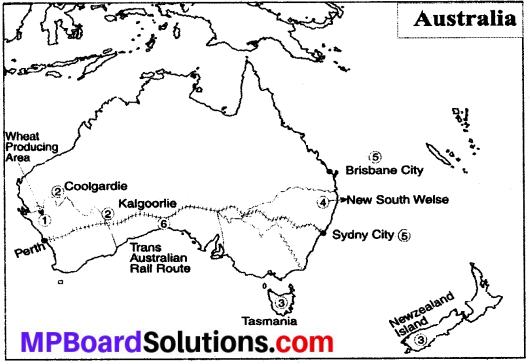
MP Board Class 8th Social Science Solutions Chapter 24 Economic Development of Australia Continent

MP Board Class 8th Social Science Solutions

MP Board Class 8th Special English Solutions Chapter 7 Nothing You Can’t Do

Guys who are planning to learn the fundamentals of English can avail the handy study material using MP Board Solutions for Class 8 English Chapter 7 Nothing You Can’t Do Questions and Answers. You Can Download MP Board Class 8 English Solutions Questions and Answers, Notes, Summary, Guide, Pdf. Refer to the Madhya Pradesh State Board Solutions for English PDF available and score better grades. Simply click on the quick links available for MP Board Solutions for Class 8 English Chapter 7 Nothing You Can’t Do Questions and Answers and prepare all the concepts in it effectively. Take your preparation to the next level by availing the Madhya Pradesh State Board Solutions for Class 8 English prepared by subject experts.

MP Board Class 8th Special English Solutions Chapter 7 Nothing You Can’t Do

Do you feel the concept of English is difficult to understand? Not anymore with our MP Board Solutions for Class 8 English Chapter 7 Nothing You Can’t Do Questions and Answers. All the Solutions are given to you with detailed explanation and you can enhance your subject knowledge. Use the Madhya Pradesh State Board Solutions for Class 8 English PDF for free of cost and prepare whenever you want.

Nothing You Can’t Do Textual Exercise

Word Power

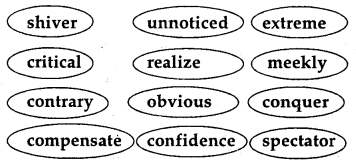
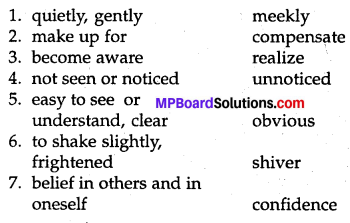
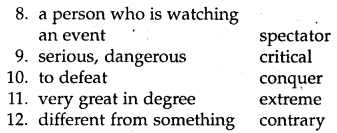
A. Write the words given below against their correct meanings. Find out the correct meaning with the help of a dictionary:
Class 8 English Chapter 7 Nothing You Can't Do
Answer:

Mp Board Class 8 English Chapter 7

Class 8 English Chapter 7 Mp Board

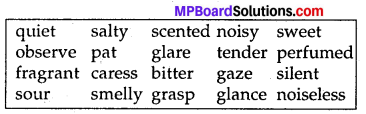
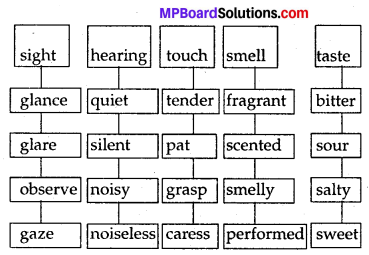
B. You already know that there are five sense. Certain words are related with the sense of sight, Example : stare, look
similarly there are words related to the sense of hearing.
Example : loud, booming
Some words describe different ways of touching.
Example: grab, press
Moreover, there are words that describe how things smell.
Emample : stinking aromatic
Finally, there are words that describe the four common tastes.

Some such words are given in the block given below:
Nothing You Can't Do Class 8
Pick up the words, decide to which sense they relate to, and write them in the column. One in each case is done for you.
Answer:
Class 8 Mp Board English Chapter 7

Comprehension

A. Rearrange the following sentences in the correct order:

Class 8 English Chapter 7 Nothing You Can’t Do Question 1.
Sharad boarded a train to Delhi one November evening.
Answer:
Sharad boarded a train to Delhi one November evening.

Mp Board Class 8 English Chapter 7 Question 2.
Sharad’s seat was in a compartment occupied by young disabled athletes.
Answer:
Sharad’s seat was in compartment occupied by young disabled athletes.

Class 8 English Chapter 7 Mp Board Question 3.
Sharad was thrown out of a moving train and his right arm was cut off.
Answer:
Sharad was thrown out of a moving train and his right arm was cut off.

Nothing You Can’t Do Class 8 Question 4.
Sharad hid his severed arm with a shawl after the accident.
Answer:
Sharad hid his severed arm with a shawl after the accident.

Class 8 Mp Board English Chapter 7 Question 5.
Marjeet introduced him to his friends.
Answer:
Manjeet introdused him to his friends.

Mp Board Class 8 Chapter 7 Question 6.
They did not sleep that night.
Answer:
They did not sleep that night.

Nothing You Can Do MP Board Class 8 Question 7.
The train ride gave confidence to Sharad.
Answer:
The train ride gave confidence to sharad.

B. Answer the following questions :

Mp Board Solution Class 8 English Question 1.
How did Sharad become disabled?
Answer:
Sharad lost his right hand in a train ride. He left his seat in an express train after having supper to wash his hands. As he finished and turned, the train suddenly jerked throwing him off balance. He was flung night out of the door to lose his right hand.

Class 8th English Mp Board Solution Question 2.
Why did he constantly hide his disability?
Answer:
He did not like to show his disability to anyone. Therefore he constantly hid his disability.

Question 3.
Why did Sharad not meet the eyes his travel-mates when he settled down in his seat?
Answer:
Sharad felt shy due to his disability. He had fear that his travel-mates would notice it. Hence he did not meet their eyes.

Question 4.
Who introduced Sharad to the other students?
Answer:
Manjeet introduced Sharad to the other students.

Question 5.
What was the name of the girl who had the ‘face of an angel’?
Answer:
Her name was Angel.

Question 6.
What disability did Kumar have?
Answer:
Kumar was blind.

Question 7.
What in Abilympics?
Answer:
Abilympies is an event where people with disability compete to show the world that people with or without disability enjoy equal rights and opportunities.

Question 8.
What and where were the first-international Abilympies held?
Answer:
The first International Abilympics was held in Tokyo in 1981.

Question 9.
What brought a change in Sharad’s view of his disability?
Answer:
Sharad had a talk with some disabled athletes in the train. He got impressed to learn that those disabled athletes had positive attitude towards life. They had not hidden their disability with a shawl like him. This left a deep impact on Sharad’s mind. Now his view changed completely.

Question 10.
Sharad’s travel-mates were going to Delhi to participate in the Abilympics. From the clues given in the text, can you guess what year was it?
Answer:
It was the year 2003.

Question 11.
Which one of the following words does not relate to the character of Sharad :
nervous, timid, shy, fearful, cheerful, meek.
Answer:
Timid.

Question 12.
Which one of the following words does not relate to the character of Sharad’s travel-mates :
confident, cheerful, pleasant, selfish, lively, encouraging
Answer:
Selfish.

Question 13.
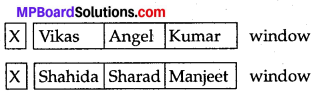
Given below is a layout of the compartment where Sharad sat along with Angel, Manjeet, Shahida, Kumar and Vikas. From the clues produced in the text, assign each child the correct seat. Sharad’s seat is done for you.
Answer:
MP Board Class 8th Special English Chapter 7 Nothing You Can't Do 6

Question 14.
Which sentence in the lesson talk us that the season was winter when Sharad travelled to Delhi?
Answer:
It was a cool November evening and I was thankful that the shawl on my shoulder would go unnoticed.

Let’s learn

‘Will’ as Model Auxiliory is used for different purposes –

(i) We use I’ll or I will when we decide to do something at the time of speaking: Oh, I haven’t shut the windows, I’ll go and shut it.
Did you talk to Mona? Sorry, I forgot I’ll phone her now.

(ii) We often use will in these situtations also :

  • Offering to do thing.
    eg. I’ll help you to carry those books.
  • Asking somebody to do something (Will you?).
    eg. Will you lock the cupboard, please?

(iii) We also use ‘will’ for

  • Promising to do something
    eg. I’ll return the book on Friday.

Given below are exercises based on the use of ‘will’ for ‘Promising to do something

New Year Resolutions.
The New Year has much more to offer than mere celebration. Some people make resolution on the New Year eve. Usually these resolution are of two types:

(a) Wishes, that people make to be ful filled in the New Year.
(b) Quitting some bad habit in the New Year.

Question 1.
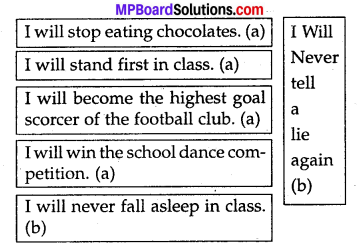
Given below are some bands on which New Year Resolutions are written. Read each one of them carefully. If you think it is about a wish,then write ‘a’ in the circle. If the resolution is about quitting an undesirable habit, then write ‘b’ in the circle.
Answer:
MP Board Class 8th Special English Chapter 7 Nothing You Can't Do 7

Question 2.
The bands given above belong to the following people. From the clues given below, write the name of the person in the band.

  1. Priyank plays football.
  2. Asif is very fond of chocolates.
  3. Mohini dances well.
  4. Jayant has failed in the quarterly examination.
  5. Mandeep watches late night shows on TV.
  6. Salma is in the habit of telling lies.

Answer:

  1. I will become the highest goal scorer of the football clubs – Priyank.
  2. I will stop eating chocolates – Asif.
  3. I will win the school dance competition – Mohini.
  4. I will stand first in the class – Jayant.
  5. I will never fall asleep in class Mandeep.
  6. I will never tell a lie again – Salma.

Question 3.
Some similar sentences are given below. Frame resolutions related to each sentence as given in the previous exercise.

  1. Abhishek does not do his homework in time.
  2. Javed has lost the Chess Champion ship.
  3. Suman sings sweetly.
  4. I drink tea a lot.
  5. Ruchi is very fond of ice-cream.
  6. Neha wastes her time in gossips
  7. Manoj quarrels with his sister.

Answer:

  1. I will always do my home in time.
  2. I will win the next Chess Champion ship.
  3. I will win the singing competition.
  4. I will stop drinking tea a lot.
  5. I will always eat a lot of ice cream.
  6. I will never bring poor marks in the test again.
  7. I will stop quarrelling with my sister.

Let’s Talk

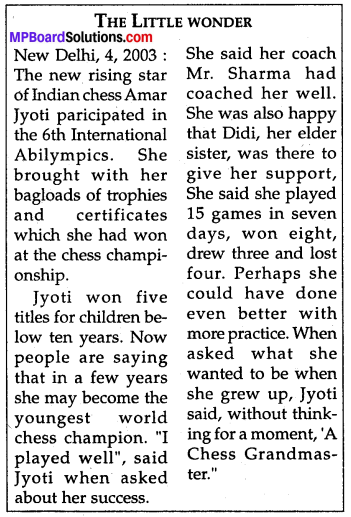
Read this article from a newspaper:
MP Board Class 8th Special English Chapter 7 Nothing You Can't Do 8

Role-play:
Work in pairs. One pupil will be the newspaper reporter and the other will be Amar Jyoti. Complete the question and answer in this interview.
Answer:
Reporter : Where was the Chess Championship held?
Jyoti : It was held in New Delhi.
Reporter : How many titles did you win for children below 10 years.
Jyoti : Iwon five titles for children below 10 years.
Reporter : Is there anybody who has helped you with your chess?
Jyoti : Yes, my coach and my elder sister.
Reporter : Did you draw lose any game?
Jyoti : I drew three and lost four games.
Reporter : What do you want to be when you grew up?
Jyoti : A Chess Grandmaster.

Let’s Read

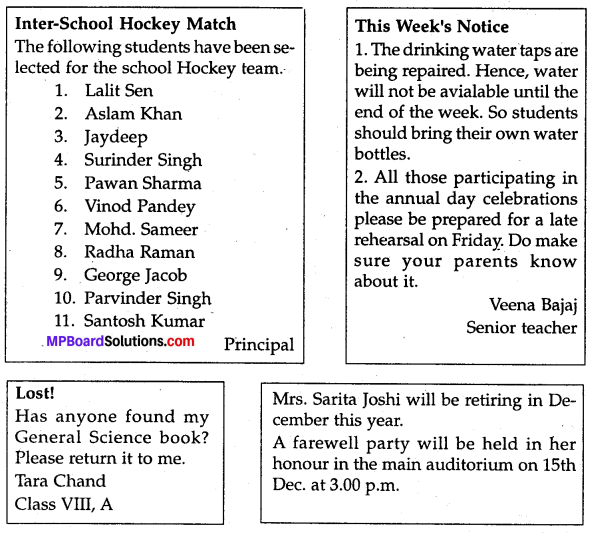
Read these announcements from a school notice-board:

Notice – Board
MP Board Class 8th Special English Chapter 7 Nothing You Can't Do 9

Now answer these questions :

Question 1.
How many students are selected in the school Hockey team?
Answer:
Eleven students are selected in the school Hockey team.

Question 2.
Who is Mrs. Mohini Giri?
Answer:
Mrs. Mohini Giri in the chairper son, Guide of service New Delhi.

Question 3.
Which teacher is going to retire?
Answer:
Mrs. Sarita Joshi is going to retire.

Question 4.
What is the problem which the school is facing this week?
Answer:
The school is facing the problem of drinking water this week.

Question 5.
Look at ‘This week’s notice?’ What trouble might have taken place on an earlier occasion?
Answer:
The participants may be late due to rehearsal.

Let’s Write

Given below is the personal information about one of your friends :

  1. Name : Mohit Sinha
  2. Date of Birth : July 6, 1992
  3. Place of birth : Bhopal
  4. Address : HIG-63, North T.T. Nager, Bhopal
  5. Father’s name : Mr. Asit Sinha
  6. Mother’s name : Mrs. Anjali Sinha
  7. Height : 149 cm.
  8. Weight : 40 kg.
  9. General appearance : Fair, slim., active, cheerful, friendly
  10. Likes : Company of friends, Judo
  11. Dislikes : People who cheat others.
  12. Ambition : Wants to become a chartered accountant.

Keeping in mind the above information write a paragraph :
My friend Mohit Sinha was born on July 6, 1992 at Bhopal. He lives with his parents Mr. Asit Sinha and Mrs. Anjali Sinha at….
Answer:
HIG-63, North T.T. Nagar, Bhopal.
His height is 149 cm and weight is 40 kg.
He is fair, slim, active, and cheerful.
He is friendly to all. He likes company of friends.
His favourite game is Judo. He does not like the people who cheat others.
He wants to become a Chartered accountant.

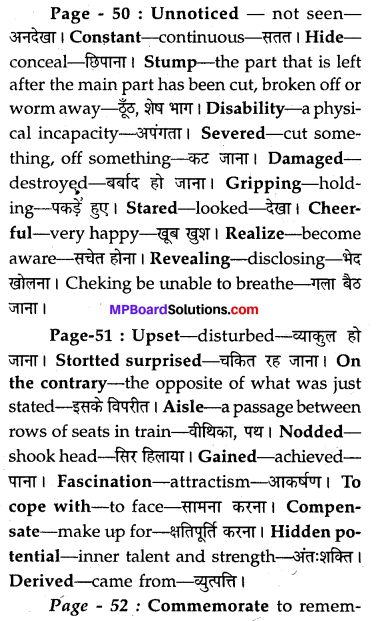
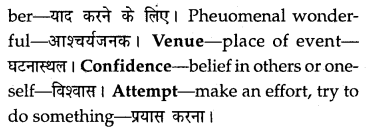
Nothing You Can’t Do Word Meanings

MP Board Class 8th Special English Chapter 7 Nothing You Can't Do 10
MP Board Class 8th Special English Chapter 7 Nothing You Can't Do 11

We wish the knowledge shared regarding MP Board Solutions for Class 8 English Chapter 7 Nothing You Can’t Do Questions and Answers has been helpful to you. If you need any further help feel free to ask us and we will get back to you with the possible solution. Bookmark our site to avail the latest updates on different state boards solutions in split seconds.

MP Board Class 8th Special English Solutions Chapter 3 The False Flight

Guys who are planning to learn the fundamentals of English can avail the handy study material using MP Board Solutions for Class 8 English Chapter 3 The False Flight Questions and Answers. You Can Download MP Board Class 8 English Solutions Questions and Answers, Notes, Summary, Guide, Pdf. Refer to the Madhya Pradesh State Board Solutions for English PDF available and score better grades. Simply click on the quick links available for MP Board Solutions for Class 8 English Chapter 3 The False Flight Questions and Answers and prepare all the concepts in it effectively. Take your preparation to the next level by availing the Madhya Pradesh State Board Solutions for Class 8 English prepared by subject experts.

MP Board Class 8th Special English Solutions Chapter 3 The False Flight

Do you feel the concept of English is difficult to understand? Not anymore with our MP Board Solutions for Class 8 English Chapter 3 The False Flight Questions and Answers. All the Solutions are given to you with detailed explanation and you can enhance your subject knowledge. Use the Madhya Pradesh State Board Solutions for Class 8 English PDF for free of cost and prepare whenever you want.

The False Flight Textual Exercise

Word Power

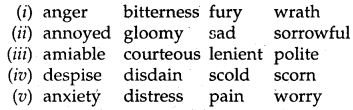
(A) Three words in each group have almost the same meaning. But one of them is different. Point out the different one.
Class 8 English Chapter 3 The False Flight MP Board
Answer:
(i) bitterness
(ii) annoyed
(ii) lenient
(iv) scold
(v) pain

(B) Here are some words denoting reactions. Write “plus” for a positive reaction and “minus” for a negative reaction.

  1. awful
  2. terrific
  3. amazing
  4. superb
  5. terrible
  6. remarkable
  7. excellent
  8. nonsense

Answer:

  1. minus
  2. minus
  3. plus
  4. plus
  5. minus
  6. plus
  7. plus
  8. minus.

Comprehension

(A) Answer the following questions :

Class 8 English Chapter 3 The False Flight MP Board  Question 1.
What was Shekh Chilli’s plan ?
Answer:
Shekh Chilli’s plan was to buy a cow when I got some money.

The False Flight MP Board Class 8 Question 2.
How many pots did Shekh Chilli’s wife buy?
Answer:
Shekh Chilli’s wife bought five pots.

Mp Board Class 8 English Chapter 3 Question 3.
Why did she buy an extra pot ?
Answer:
She bought an extra pot for carrying milk to her mother.

Mp Board Class 8 English Solution Chapter 3 Question 4.
What made the husband so angry?
Answer:
The husband became angry when his wife told him that she would carry some milk in the fifth pot to her mother.

Class 8 English Chapter 3 Mp Board Question 5.
Why did the neighbour start hitting Shekh Chilli ?
Answer:
The neighbour started hitting Shekh Chilli to make him realize the truth.

(B) Complete the statements:

  1. Shekh Chilli and his wife lived _______
  2. Shekh Chilli grabbed the pots one by one and _______
  3. I work and sweat all day and buy a cow and _______
  4. I’ve been planning it for months and your cow _________

Answer:

  1. in a village.
  2. smashed them all against the wall.
  3. you give away the valuable milk to your mother!
  4. has been eating all the wheat and corn.

Let’s learn
Some words are given in the box. Put them in the right column.
The False Flight MP Board Class 8
Answer:
Mp Board Class 8 English Chapter 3

The False Flight Meaning In Hindi MP Board There are five types of nouns.
Mp Board Class 8 English Solution Chapter 3

  1. A Proper Noun is the name of a particular person or place as India, Bhopal, Neeraj, Diksha etc. e.g. Bhopal is the capital of Madhya Pradesh.
  2. A Common Noun is a name given in common to every person or thing of the same class or kind as baby, girl, book, man etc. e.g. A baby is crying.
  3. An Abstract Noun is the name of something that we can only think of, as hope, childhood, sweetness, honesty etc. e.g. Honesty is the best policy.
  4. A Collective Noun is the name of a number of people or things considered as one unit, class, troop, assembly.
    e.g. Our class consists of forty pu pils.
  5. A Material Noun – A noun which stands for the matter or substance of which things are made is called a material noun, as iron, wood, gold, cotton.
    e.g. Ornaments are made of silver and gold.

(A) Pick out the nouns in the following sentences and say whether they are Common, Proper, Material, Collective or Abstract.

  1. Clothes are made of cotton, wool and silk
  2. Ashoka was a just and a wise ruler
  3. The judge found the prisoner guilty.
  4. We saw a herd of cattle grazing in the field.

Answer:

  1. Clothes. – Common Noun
    cotton, wool – Material noun and silk
  2. Ashoka. – Proper Noun
    ruler – Common Noun
  3. Judge – Common Noun
    prisoner – Common Noun
  4. Herd of cattle – Collective Noun.

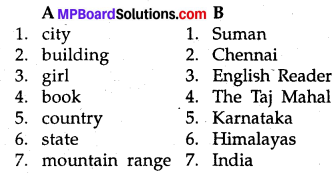
B. Column A has 7 common nouns. Match it with column B which has Seven proper nouns
Class 8 English Chapter 3 Mp Board
Answers:

  1. – 2
  2. – 4
  3. – 1
  4. – 3
  5. – 7
  6. – 5
  7. – 6.

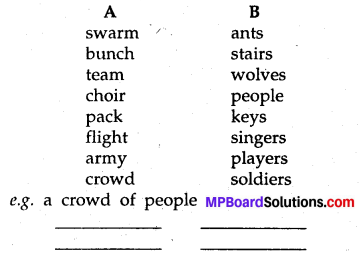
(C) Pick a word from column ‘A , and match it with a word from column ‘B’, and then write it in the space given below as given in the example.
The False Flight Meaning In Hindi MP Board
Answer:
Class 8 English Lesson 3 Question Answer MP Board

(D)

  1. That boy works hard.
  2. Those boys work hard.
  3. The woman goes to her work.
  4. The women go to their work.

Class 8 English Lesson 3 Question Answer MP Board There are only two numbers in English.

Any noun that stands for only one person or thing is said to be in the singular number, as boy, woman, pen.

Any noun that stands for more than one person or thing is said to be in the plural number as boys, women, pens.

Observe how the following nouns form their plurals
MP Board Class 8th Special English Chapter 3 The False Flight 8

MP Board Class 8th Special English Chapter 3 The False Flight 9
MP Board Class 8th Special English Chapter 3 The False Flight 10

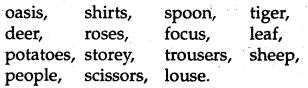
(A) Separate singular and plural nouns given in the box into two colums.
MP Board Class 8th Special English Chapter 3 The False Flight 11
Answers:
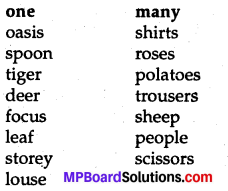
MP Board Class 8th Special English Chapter 3 The False Flight 12
(B) Which of the two words given in brackets is correct?

  1. My scissors (is, are) not very sharp.
  2. Mathematics (is, are) a difficult subject.
  3. The hunter shot three (deer, deers).
  4. Fifty (sheep, sheeps) are grazing in the field.

Answers:

  1. are
  2. is
  3. deer
  4. sheep.

(i) The king went to the palace.
He ate his breakfast.
(ii) The queen went to the palace.
She ate her breakfast.
(iii) The dog barks.
(iv) The bitch barks.

A noun that denotes a male person or animal is said to be of the masculine gender, as man, boy, uncle, king, dog.

A noun that denotes a female person or animal is said to be of the feminine gender, as woman, girl, aunt, queen, bitch.

A noun that denotes an inanimate thing, that is neither male nor female, is said to be of the neuter gender, as house, knife, tree, chair, table, desk, ball.

A noun that denotes either a male or a female is said to be of the common gender, as child, friend, cousin, parent, teacher.
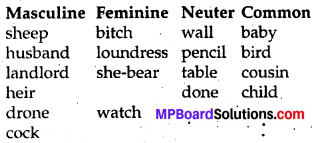
MP Board Class 8th Special English Chapter 3 The False Flight 13

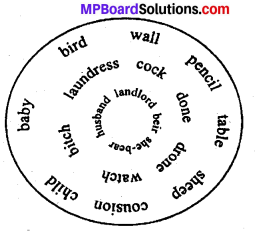
(A) Arrange these words under four categories:
MP Board Class 8th Special English Chapter 3 The False Flight 14
Answer:
MP Board Class 8th Special English Chapter 3 The False Flight 15

(B) Fill in the blanks:

  1. A boy is to a girl, as a tiger is to a ___________
  2. A ___________ is to a heifer, as a hero is to heroine.
  3. A host is to a as a dog ___________ is to a bitch.

Answer:

  1. tigeress
  2. ox
  3. hostess

(C) Rewrite the following after changing the gender of the nouns and making other changes if necessary.

  1. The lion carried away the son of a washerman.
  2. The hero of this play is a man of great skill and experience.
  3. His nephews and brothers came to see him.
  4. The host asked his maid servant to lay the table at once.

Answer:

  1. The lioness carried away the daughter of a washerwoman.
  2. The heroine of this play is a woman of great skill and experience.
  3. Her neice and sisters came to see, her.
  4. The hostess asked her servant to lay the table at once.

Let’s Talk (work in pairs)

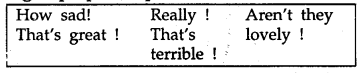
Complete the conversation below by choosing a proper response from the box:
MP Board Class 8th Special English Chapter 3 The False Flight 16

1. A. Our school has won the first prize in the debate competition.
B. That’s great !

2. A. My purse has been stolen.
B. How sad !

3. A. Look at these beautiful peacocks.
B. Aren’t they lovely !

4. A. Have you heard? Amit has got a scholarship
B. Really!

5. A. Have you heard about the dengu fever? About 60 people have been killed in Delhi.
B. That’s terrible !

Let’s Read

Read the following story carefully.

One day Nasiruddin went to town to buy new clothes. First he tried on a pair of trousers. He didn’t like it so he gave it back to the shopkeeper. Then he tried on a robe which had the same price as the trousers. Nasiruddin was pleased with the robe, and he left the shop. Before he climbed on his donkey to ride home, the shopkeeper and the shop assistant ran out.

“You didn’t pay for the robe!” said the shopkeeper. “But I gave you the trousers in exchange for the robe, didn’t I ?” replied Nasiruddin.

“Yes, but you didn’t pay for the trousers, either! said the shopkeeper.

“But I didn’t buy the trousers,” replied Nasiruddin. “I am not so stupid as to pay for something which I never bought.”

Now answer these questions:

  1. How did Nasiruddin get to the shop?
  2. What did Nasiruddin do first in the shop ?
  3. What did Nasiruddin try on next?
  4. Which item did Nasiruddin like best?
  5. Why was the shopkeeper angry when Nasiruddin left ?

Answers:

  1. He went of the shop riding his donky.
  2. First Nasiruddin tried on a pair trousers.
  3. Then Nasiruddin tried on a robe.
  4. Nasiruddin liked the robe most.
  5. The shopkeeper was angry because Nasiruddin left the shop without paying for the robe.

Let’s write

Look at the pictures given below. Write a short story with the help of clues given.
Answer:
Do yourself.

Let’s do it

(A) Collect a funny story from your story book and narrate in the Balsabha.
(B) Write at least three jokes and tell in the Balsabha.
Answer:
Do yourself.

The False Flight Word Meanings

Page – 14 : Replied – answered – जवाब दिया। Clay pots-pots made of soil – मिट्टी के बने बर्तन Grabbed – hold something with hands frimly – कसकर पकड़ना । Smashed – break something into pieces – चूर-चूर कर देना। Valuable – precious – अनमोल, कीमती। Roared – made a very loud sound – चीखना – चिल्लाना ।Enough-sufficient – पर्याप्त

Page – 15:Thrashing – hitting somebody very hard-जोर-जोर से चोट पहुँचाना या पीटना। Sow – plantseed in-बीज बोना। Realized-felt – महसूस

We wish the knowledge shared regarding MP Board Solutions for Class 8 English Chapter 3 The False Flight Questions and Answers has been helpful to you. If you need any further help feel free to ask us and we will get back to you with the possible solution. Bookmark our site to avail the latest updates on different state boards solutions in split seconds.

MP Board Class 8th Hindi Sugam Bharti Solutions Chapter 6 हीरा-कुणी

In this article, we will share MP Board Class 8th Hindi Book Solutions Chapter 6 हीरा-कुणी Pdf, These solutions are solved subject experts from the latest edition books.

MP Board Class 8th Hindi Sugam Bharti Solutions Chapter 6 हीरा-कुणी

प्रश्न अभ्यास

अनुभव विस्तार

Mp Board Class 8 Hindi Chapter 6 प्रश्न 1.
वस्तुनिष्ठ प्रश्न
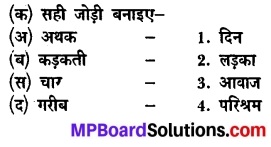
(क)सही जोड़ी बनाइए
(अ) बछिया भूखी रह जाती थी
1. दूध के लिए तरसती रहती थी।
(ब) हीरा मन-ही-मन रो-रोकर कहने लगी
2. राजा दूध पीकर मौज मनाता था।
(स) राजा के पत्थर दिल पहरेदार ने द्वार नहीं खोला
3. काश, मुझे पंख मिल जाते।
(द) बछिया अपनी माँ को नहीं पा सकती थी
4. बालक को दूध पिलाने के लिए माँ की छाती फटने लगी।
उत्तर-
(अ) 2
(ब) 3
(स) 4
(द) 1

Hira Kudi Kahani Ka Saransh MP Board प्रश्न 2.
दिए गए विकल्पों में से रिक्त स्थान की पूर्ति कीजिए
(अ) वह दूध दुहकर बेचने के लिए राजा के ………………….. में चली जाती थी। (घर, किले)
(ब) राजा कुणी ………………….. का दूध पीकर आनंद मनाता था। (गाय, बकरी)
(स) ………………….. का फाटक बंद कर दिया गया। (किले, भवन)
(द) राजा ने हीरा से सारी ………………….. सुनी। (कविता, कहानी)
उत्तर-
(अ) किले,
(ब) गाय,
(स) किले,
(द) कहानी।

Class 8 Hindi Chapter 6 Mp Board प्रश्न 2.
अति लघु उत्तरीय प्रश्न
(अ) ग्वालिन का नाम क्या था?
(ब) दूध दुहने के समय कुणी गाय रह-रहकर किसे पुकारती थी?
(स) हीरा किले से वापिस कब लौट आती थी?
(द) राजा ने हीरा को जागीर में क्या दिया?
उत्तर-
(अ) ग्वालिन का नाम हीरा था।
(ब) दूध दुहने के समय कुणी गाय रह-रहकर अपनी बछिया को पुकारती थी।
(स) हीरा किले से वापस रात होने से पहले ही लौट आती थी।
(द) राजा ने हीरा को जागीर में एक गाँव दे दिया।

Mp Board Class 8 Chapter 6 प्रश्न 3.
लघु उत्तरीय प्रश्न
(अ) दूध दुहते समय हीरा बछिया के साथ कैसा व्यवहार करती थी?
उत्तर-
दूध दुहते समय हीरा बछिया के साथ बड़ा ही कठोर व्यवहार करती थी। बछिया दौड़कर दूध पीने के लिए आती तो हीरा उसे लौटा देती। इससे बछिया अपनी माँ का दूध नहीं पा सकती थी। फलस्वरूप वह अपनी माँ का दूध पीने के लिए तरसती और बिलखती रहती थी। लेकिन हीरा उधर कभी देखती भी नहीं।

(ब) किले का फाटक बंद होने पर हीरा पहरेदार से क्या बोली?
उत्तर-
किले का फाटक बंद होने पर हीरा पहरेदार से बोली-

“द्वार खोलो! मेरा मुन्ना भूखा है, तुम्हारे पैर पड़ती हूँ, फाटक खोल दो। अरे भाई, एक बार द्वार खोल दो।”

(स) राजा का मन क्यों पिघला?
उत्तर-
राजा ने हीरा से यह सारी कहानी सुनी कि किस प्रकार वह स्वयं के जीवन को संकट में डालकर, अपने बच्चे के पास जा पहुंची थी। उससे राजा का मन पिघल गया।

भाषा की बात

Class 8th Hindi Chapter 6 MP Board प्रश्न 1.
बोलिए और लिखिएमहाराष्ट्र, रायगढ़, कोषाध्यक्ष, पत्थर, चट्टानों।
उत्तर-
महाराष्ट्र, रायगढ़, कोषाध्यक्ष, पत्थर, चट्टानों।

Class 8 Hindi Chapter 6 MP Board प्रश्न 2.
सही वर्तनी वाले शब्दों पर गोला लगाइए
(अ) कुणी, कूणी, कुणि, कूणि
(ब) बछिया, बछीया, बाछिया, बछिय
(स) पेहरदार, पहेरदार, पेहारदार, पहरेदार
(द) ग्वलिन, ग्वालीन, गवालिन, ग्वालिन
उत्तर-
(अ) कुणी,
(ब) बछिया,
(स) पहरेदार
(द) ग्वालिन।

Sugam Bharti Class 8 MP Board प्रश्न 3.
निम्नलिखित गंद्याश को ध्यान से पढ़कर व्यक्तिवाचक, जातिवाचक और भाववाचक संज्ञाएँ छाँटकर लिखिए-
“विवेकानंद को कौन नहीं जानता? वे महान् विचारक, दार्शनिक और धार्मिक व्यक्ति थे। उनके विचार समाज का मार्ग प्रशस्त करते हैं। उनके भाषणों में मधुरता, गंभीरता, मानवीयता और राष्ट्रीयता कूट-कूटकर भरी होती थी। भारत के महान् सपूतों “दयानंद सरस्वती, राजाराम मोहन राय” तथा ‘महात्मा गांधी’ जैसे महापुरुषों की सूची में उनकी गणना होती है।
उत्तर-

  • व्यक्तिवाचक संज्ञा – विवेकानंद, भारत, दयानंद सरस्वती, राजाराम मोहन राय, महात्मा गाँधी
  • जातिवाचक संज्ञा – सपूत, महापुरुष
  • भाववाचक संज्ञा – मधुरता, गंभीरता, मानवीयता, राष्ट्रीयता।

प्रश्न 4.
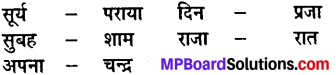
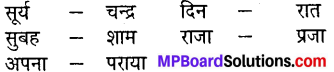
विलोम शब्दों की सही जोड़ी बनाइए
MP Board Class 8th Hindi Sugam Bharti Chapter 6 हीरा-कुणी 1
उत्तर-
MP Board Class 8th Hindi Sugam Bharti Chapter 6 हीरा-कुणी 2

प्रश्न 5.
रेखांकित संज्ञा शब्दों के स्थान पर नीचे दिए गए सर्वनामों में से उचित सर्वनाम शब्द चुनकर भरिए (वह, उसकी, उसके)
(अ) गाय का नाम था कुणी। गाय की एक महीने की बछिया थी।
(ब) हीरा के मन में बछिया के लिए दया नहीं जागती थी।
(स) राजा गाय का दूध पीकर आनंद मनाता था। राजा दयालु नहीं था।
उत्तर-
(अ) गाय का नाम था कुणी। उसकी एक महीने की बछिया थी।
(ब) उसके मन में बछिया के लिए दया नहीं जागती थी।
(स) राजा गाय का दूध पीकर आनंद मनाता था। वह दयालु नहीं था।

प्रश्न 6.
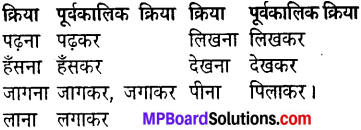
निम्नलिखित क्रियाओं के पूर्वकालिक क्रिया रूप बनाइए ण्ढ़ना, लिखना, हँसना, देखना, जागना, पीना, लाना।
उत्तर-
MP Board Class 8th Hindi Sugam Bharti Chapter 6 हीरा-कुणी 3

♦ प्रमुख गद्यांशों की संदर्भ-प्रसंग सहित व्याख्याएँ

1. सूरज छिप गया। पक्षी पंख फैलाकर अपने बसेरों की ओर उड़ चले। किले के मध्य भाग में देव मंदिर के ऊपर साँझ का तारा दिखने लगा। हीरा रोकर मन-ही-मन कहने लगी-“काश, मुझे पंख मिल जाते और मैं अपने लाल के पास पहुँच जाती। वह दूध पिए बिना बिलख रहा होगा।”

संदर्भ-प्रस्तुत पंक्तियाँ हमारी पाठ्य-पुस्तक ‘सुगम भारती’ (हिंदी सामान्य) के भाग-8 के पाठ-6 ‘हीरा-कुणी’ से ली गई हैं। इन पंक्तियों के लेखक श्री रवीन्द्रनाथ ठाकुर हैं।

प्रसंग-प्रस्तुत पंक्तियों में लेखक ने ‘हीरा’ नामक ग्वालिन के वात्सल्य-भाव पर प्रकाश डालते हुए कहा है कि-

व्याख्या-किले के अंदर बंद ‘हीरा’ अपने बच्चे के लिए तड़पने लगी। उस समय सूरज डूबना था। सभी पक्षी अपने घोंसलों की ओर लौटने लगे थे। चारों ओर अंधेरा बढ़ने लगा था। हीरा ने किले के बीच में स्थित एक देव मंदिर देखा। उसने यह भी देखा कि उस मंदिर के ऊपर साँझ का तारा चमकने लगा है। इससे उसने यह समझ लिया कि अब रात हो रही है। फलस्वरूप अब अपने घर पहुँचना असंभव-सा है। वह मन-ही-मन यह अफसोस करने लगी कि उसके पास उड़ने के पंख नहीं हैं। यदि वे होते तो वह तुरंत ही यहीं से उड़कर अपने घर पहुँच जाती। फिर दूध पीने के लिए बिलख रहे अपने बेटे को दूध पिलायकर फूले नहीं समाती।

विशेष-

  • हीरा का वात्सल्य-भाव बिल्कुल स्वाभाविक और सही है।
  • भाषा की शब्दावली सरल है।

MP Board Class 8th Hindi Sugam Bharti Solutions Chapter 14 प्रेरक प्रसंग

In this article, we will share MP Board Class 8th Hindi Book Solutions Chapter 14 प्रेरक प्रसंग Pdf, These solutions are solved subject experts from the latest edition books.

MP Board Class 8th Hindi Sugam Bharti Solutions Chapter 14 प्रेरक प्रसंग

प्रश्न अभ्यास
अनुभव विस्तार

(क) सही जोड़ी बनाइए

Mp Board Class 8 Hindi Chapter 14 प्रश्न 1.
वस्तुनिष्ठ प्रश्न
Mp Board Class 8 Hindi Chapter 14
उत्तर
(अ) 4, (व) 3, (स) 1, (द) 2

(ख) सही विकल्प चुनकर रिक्त स्थान की पूर्ति कीजिए

(अ) अब्राहम लिंकन नाम का एक …………….. लड़का था। (अमीर, गरीब)
(ब) आधी रात तक लिंकन ……………… रहता। (पढ़ता-सोता)
(स) द्विवेदी जी ने …………….. में नौकरी की और तार बाबू बने। रिलवे, डाकघर)
(द) द्विवेदी जी ने नौकरी छोड़ दी और वे … …. पत्रिका का संपादन करने लगे। (लक्ष्मी, सरस्वती)
उत्तर
(अ) गरीब
(ब) पढ़ता
(स) रेलवे
(द) सरस्वती।

Class 8 Hindi Chapter 14 Mp Board प्रश्न 2.
अति लघु उत्तरीय प्रश्न
(अ)महावीर प्रसाद द्विवेदी जी ने किस पत्रिका का संपादन किया?
(ब) द्विवेदी जी ने किन-किन भाषाओं का ज्ञान प्राप्त किया?
(स) लिंकन गणित के सवाल किस पर हल करते थे?
(द) लिंकन ने सर्वोच्च पद किसके बल पर प्राप्त किया?
उत्तर
(अ) महावीर प्रसाद द्विवेदी ने ‘सरस्वती’ पत्रिका का संपादन किया।
(ब) द्विवेदी जी ने हिन्दी, संस्कृत, उर्दू, अंग्रेजी और फारसी भाषाओं का ज्ञान प्राप्त किया।
(स) लिंकन गणित के सवाल लकड़ी के लट्ठों पर हल करते थे।
(द) लिंकन ने सर्वोच्च पद अपनी लगन, परिश्रम और योग्यता के बल पर प्राप्त किया।

Mp Board Solution Class 8 Hindi Chapter 14 प्रश्न 3.
लघु उत्तरीय प्रश्न

(अ)
द्विवेदी जी के प्रेरक प्रसंग पढ़कर आपको क्या प्रेरणा मिलती है?
उत्तर
द्विवेदी जी के प्रेरक प्रसंग पढ़कर हमें समय का सदुपयोग, घोर परिश्रम और ईमानदारी सहित ज्ञानवर्द्धन करने की प्रेरणा मिलती है।

(ब)
द्विवेदी सुबह के समय किसी से क्यों नहीं मिलते थे?
उत्तर
द्विवेदी सुबह के समय किसी से नहीं मिलते थे। यह इसलिए कि वे प्रातःकाल ‘सरस्वती’ पत्रिका का सम्पादन करते थे। पत्रिका के स्तर के अनुसार उस पर कड़ी मेहनत करते थे। यदि वे इस काम को एकाग्रतापूर्वक न करते तो वह श्रेष्ठ नहीं होती। दूसरी बात वे प्रातःकाल का समय मानसिक कामों के लिए अधिक उपयोगी समझते थे।

(स)
समय नियोजन को स्पष्ट करने वाली द्विवेदी जी के जीवन की घटना बताइए।
उत्तर
समय-नियोजन को स्पष्ट करने वाली द्विवेदी जी के जीवन की घटना है एक बार साहित्यकार श्री सद्गुरुशरण अवस्थी अपने मित्र के साथ द्विवेदी जी से मिलने गए। द्विवेदी जी उनसे प्रेम से मिले, किंतु समय की कमी के कारण पहले ही संकेत कर दिया-‘हम समझते हैं कि अपनी बात पन्द्रह मिनट में पूरी हो जाएगी। उन्होंने नपे-तुले शब्दों में बातचीत की। समय परा होने पर द्विवेदी जी ने पुनः स्नेह से पूछा-“और कोई विशेष बात तो नहीं रह गई।” अवस्थी जी ने उत्तर दिया ‘इतनी जल्दी वात पूरी होने की तो हमें आशा ही नहीं थी।’

(द)
अब्राहम लिंकन की दिनचर्या कैसी थी?
उत्तर
अब्राहम लिंकन की दिनचर्या इस प्रकार थी वह दिन-भर खेतों में गल्ला-उठाने-धरने का काम करता, दिन ढलने पर घर आता, भोजन करता और दिया जलाकर पढ़ने के लिए बैठ जाता। यह सिलसिला रोज चलने लगा। पढ़ने की लगन थी, आधी रात तक वह पढ़ता रहता पर उसे थकान न लगती।

(ई)
लिंकन ने किताब का दाम किस प्रकार चुकाया?
उत्तर
जिसकी किताव थी, उसके खेत में लिंकन ने चार दिनों तक कड़ी मेहनत की। इसके लिए उस तनख्वाह नहीं मिली। केवल भरपेट भोजन ही मिला।

भाषा की बात

प्रश्न 1.
बोलिए और लिखिए
विद्वान, श्रेणी, कौटुम्बिक, सरस्वती, राष्ट्रभाषा, दुरावस्था, रायबरेली, प्रलोभन, प्रधान, ट्रैफिक, मैनेजर।।
उत्तर
विद्वान, श्रेणी, कौटुम्बिक, सरस्वती, राष्ट्रभाषा, दुरावस्था, रायबरेली, प्रलोभन, प्रधान, ट्रैफिक, मैनेजर।

प्रश्न 2.
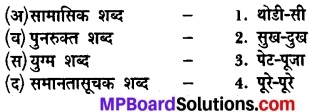
सही जोड़ी बनाइए
Class 8 Hindi Chapter 14 Mp Board
उत्तर
(अ) , (ब) 4, (स) 2, (द) 1।

प्रश्न 3.
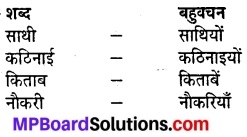
उदाहरण के अनुसार निम्नलिखित शब्दों को बहुवचन में लिखिए
उत्तर
Mp Board Solution Class 8 Hindi Chapter 14
MP Board Class 8th Hindi Sugam Bharti Solutions Chapter 14 प्रेरक प्रसंग 4

प्रश्न 4.
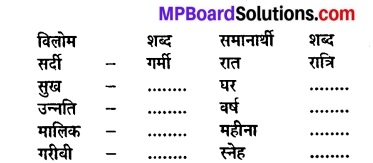
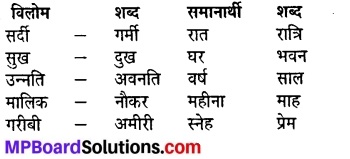
दिए गए उदाहरण के अनुसार विलोम और समानार्थी शब्द लिखिए।
MP Board Class 8th Hindi Sugam Bharti Solutions Chapter 14 प्रेरक प्रसंग 5
उत्तर

MP Board Class 8th Hindi Sugam Bharti Solutions Chapter 14 प्रेरक प्रसंग 6

प्रश्न 5.
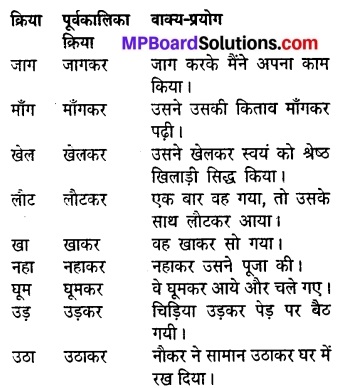
निम्नलिखित क्रियाओं के पूर्वकालिक क्रियारूप बनाइए और वाक्यों में प्रयोग कीजिए
जाग, माँग, खेल, लौट, खा, नहा, घूम, उड़, उठा।
उत्तर
MP Board Class 8th Hindi Sugam Bharti Solutions Chapter 14 प्रेरक प्रसंग 7

प्रश्न 6.
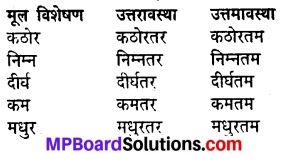
कठोर, निम्न, दीर्घ, कम, मधुर, शब्दों में ‘तर’ ‘तम’ प्रत्यय लगाकर उत्तरावस्था और उत्तमावस्था के विशेषण बनाइए और वाक्यों में प्रयोग कीजिए।
उत्तर
MP Board Class 8th Hindi Sugam Bharti Solutions Chapter 14 प्रेरक प्रसंग 8

प्रमुख गद्यांशों की संदर्भ-प्रसंग सहित व्याख्याएँ

1. पूर्व निर्धारित समय के बिना काम करने से एक कार्य दूसरे की सीमा में अकारण घुस जाता है और सारी व्यवस्था चौपट कर देता है। पूर्व निर्धारित समय में कार्य करने का संकल्प मनुष्य की शक्तिों में निखार लाता है। .

शब्दार्व
निर्धारित-निश्चित । पूर्व-पहले। चौपट-बर्बाद । संकल्प-प्रतिज्ञा।

संदर्भ – प्रस्तुत पंक्तियाँ हमारी पाठ्य-पुस्तक ‘सुगम भारती’ (हिन्दी सामान्य) के भाग-8 के पाठ-14 ‘प्रेरक-प्रसंग’ से ली गई हैं।

प्रसंग – प्रस्तुत पंक्तियों में लेखक ने आचार्य महावीर प्रसाद द्विवेदी के समय के सदुपयोग के विषय में यह बतलाने का प्रयास किया है कि

व्याख्या
एक समय महान् साहित्यकार श्री सद्गुरुशरण अवस्थी अपने किसी मित्र के साथ आचार्य महावीर प्रसाद द्विवेदी से भेंट करने गए। प्रेमपूर्वक मिलने के बाद द्विवेदी जी ने कहा कि हमारी बात पन्द्रह मिनट में पूरी हो जाएगी। जब बात पूरी हो गई तो अवस्थी जी ने चकित होकर कहा कि इतनी जल्दी बात पूरी हो जाने की उन्हें आशा नहीं थी। द्विवेदी जी ने उन्हें समझाया कि पहले तय सीमा के अंदर काम पूरा हो जाता है। इससे दूसरे काम में कोई रुकावट नहीं होती है। इसके विपरीत पहले तय सीमा के बिना काम पूरा नहीं होता है और दूसरा काम भी रुक जाता है। इस प्रकार पहले निर्धारित समय के अंदर काम करने पर आदमी की शक्ति और क्षमता बढ़ती है।

विशेष

  • समय के सदुपयोग का तरीका बताया गया है।
  • भाषा-शैली रोचक है।

MP Board Class 8th General English Grammar

Guys who are planning to learn the fundamentals of English can avail the handy study material using MP Board Solutions for Class 8 General English Grammar Questions and Answers. You Can Download MP Board Class 8 English Solutions Questions and Answers, Notes, Summary, Guide, Pdf. Refer to the Madhya Pradesh State Board Solutions for English PDF available and score better grades. Simply click on the quick links available for MP Board Solutions for Class 8 General English Grammar Questions and Answers and prepare all the concepts in it effectively. Take your preparation to the next level by availing the Madhya Pradesh State Board Solutions for Class 8 English prepared by subject experts.

MP Board Class 8th General English Grammar

Do you feel the concept of English is difficult to understand? Not anymore with our MP Board Solutions for Class 8 General English Grammar Questions and Answers. All the Solutions are given to you with detailed explanation and you can enhance your subject knowledge. Use the Madhya Pradesh State Board Solutions for Class 8 English PDF for free of cost and prepare whenever you want.

1. Articles
(उपपद):

A,An, The को Articles कहते हैं। Articles दो प्रकार के होते हैं –

(1) Indefinite Articles – ‘A’ and ‘An’ दोनों Indefinite Articles कहलाते हैं क्योंकि ये किसी विशेष व्यक्ति या वस्तु को सूचित नहीं करते।
जैसे – I saw a dog and an ox yesterday.
Note: An’ का प्रयोग उन जातिवाचक संज्ञा के पूर्व किया जाता है जो Vowel (a, e, i, o, u) से आरम्भ होते हैं। जैसे An ox, An eye, an orange.
Note : ‘A’ का प्रयोग consonant से आरम्भ होने वाले एकवचन की जातिवाचक संज्ञा के पूर्व होता है। जैसे a book, a cow, a lion

(2) Definite Articles – ‘The’ definite article है क्योंकि ये किसी विशेष व्यक्ति या वस्तु को सूचित करता है। किसी खास वस्तु, नदी, पहाड़, प्रसिद्ध ग्रन्थ, अखबार आदि के नाम से पहले ‘The’ का प्रयोग करते हैं।
जैसे –

  1. The sun shines brightly.
  2. The Ganga is a holy river.
  3. I saw the Taj Mahal.
  4. My mother met the Principal.

Note: (i) जब ० का उच्चारण wa की तरह और u का उच्चारण yoo की तरह हो तब हम a का प्रयोग करते हैं, an का नहीं जैसे a one rupee note, a useful thing, a university
Note: (ii) जब h बोला नहीं जाता, तब हम an का प्रयोग करते हैं, a का नहीं जैसे – an honest man, in an hour.

Exercise

Fill in the blanks with the correct articles

1. Ramesh is ……….. honest boy.
2. The cow is …….. useful animal.
3. This is …….. umbrella.
4. Sameer brought …….. apple and …….. banana.
5. This is, …….. interesting story.
6. Honesty is …….. best policy.
7. ………. earth is round.
8. Mr. Prasad is ……. teacher.
9. Mr. Harish is ……… M.L.A.
10. Delhi is …………… capital of India.
11. Have you ……. umbrella?
12.  ……… Sun rises in the east.
13. The train is ………… hour late.
14. She is ………. untidy girl.
15. Rajni was ……… blind girl.
16. He is ………. university professor.
17. Reeta reads ……… Gita.

Answers:

1. an
2. a
3. an
4. an
5. an, a
6. the
7. The
8. a
9. an
10. the
11. an
12. The
13. an
14. an
15. a
16. a
17. the.
2. Pronouns
(सर्वनाम):

परिभाषा – जो शब्द संज्ञा के स्थान पर प्रयोग किये जाते हैं, सर्वनाम (Pronouns) कहलाते हैं।
जैसे – Ram is a good boy.
He goes to school.
He का प्रयोग ram की जगह हुआ हैं से यह सर्वनाम हैं For example he, it, she, myself.

Kinds of Pronouns

1. Personal Pronoun
(यक्तिवाचक सर्वनाम)
The Pronouns which stands for the names of persons or things are called personal pronouns.
For e.g. – i, we, you, yours, he, she, it, her etc.
जिन सर्वनामों का प्रयोग व्यक्तियों या वस्तुओं के लिए किया जाये उन्हों Personal Pronouns कहते हैं।

2. Reflexive Pronouns
(कर्तासम्बिधित सर्वनाम)
for e.g. – myself, yourself, herself, itself etc.

3. Demonstrative Pronouns
(संकेतवाचक सर्वनाम)
Pronouns which point out things, are called demonstrative pronouns.
For eg. This, that, these, those.

4. Indefinite Pronouns
(अनिशचयवचक सर्वनाम)
Pronouns which. refers to persons or things in a general or vague way are called Indefinite Pronouns. For eg.Some, many, all, others etc.

5. Distributive Pronouns
(प्रत्येक बोधक)
Pronouns which are used for single person or thing. For eg-each, either, neither.

6. Interrogative Pronouns
(प्रश्नवाचक सर्वनाम)
Pronouns which are used for asking questions are called Interrogative pronouns. for eg—who, whom, what, which etc.

7. Relative Pronouns
(सम्बिधित सर्वनाम)
Who, whose, whom, which and that are called relative pronouns when they are used with nouns coming before them.

Exercise

Fill in the blanks with suitable pronouns:

1. Jack’s mother gave …………….. an orange.
2. Niti said that …………… had not done …………..
3. Please tell ……………. a story.
4. …………… went to the market.
5. Mother told …………… to return home early.
6. ……………. book belongs to ……………
7.  ………….. love music.
8. John bought a ball and gave ………… to Jeff.
9. …………… told ………….. to go away.
10. i …………. is a shy boy.
11. Ram did the work. ………………
12. I …………….. shall do it.
13. They …………….. went there.
14. ……………. of us has a’ book.
15.  …………… did this?
16. This is the house in ……………. I live …………..

Answers:

1. him
2. she, it
3. me
4. He
5. us
6. This, me
7. i
8. it
9. He, me
10. He
11. himself
12. myself
13. themselves
14. Each
15. Who
16. which.

3. The Prepositions
(सम्बन्धसूचक )

परिभाषा – जो शब्द वाक्य में किसी एक वस्तु का दूसरी वस्तु से सम्बन्ध बतलाते हैं Prepositions कहलाते हैं।
A word used to show the relation of one thing to another in a sentence is a preposition.

Relation expressed by Prepositions.
1. Prepositions of Time – कुछ Prepositions समय सूचक होते हैं जैसे –

  • He came at six.
  • I study for seven hours daily.
  • She is absent from class for three days.
  • They work from 10 to 4.

2. Prepositions of Place – कुछ Prepositions स्थान सूचक होते हैं, जैसे –

  • He was born in America.
  • She was in her room.
  • They are coming home from school.
  • I stood before him
  • The ball is out of the circle.

3. Prepositions of Movement – कुछ Prepositions गति सूचक / स्थान सूचक होते हैं, जैसे –

  • He travelled by train.
  • I came by car.
  • He went there on his bike.
  • He travelled in my car.

Use of Some other Prepositions
1. At, In : At, छोटे स्थान के लिए प्रयोग किया जाता है। In, बड़े स्थान के लिए प्रयोग किया जाता है। जैसे

  • He lives at Dholpur.
  • He lives in Madhya Pradesh.

2. In, Into : In स्थिति को बताता है और Into गति का बोध कराता है। जैसे

  • All the boys are in the class.
  • He dived into the river.

3. Why, By : With यन्त्र के साथ प्रयोग होता है और by कार्य करने वाले समय के साथ प्रयोग किया जाता है, जैसे –

  • We cut the apple with the knife.
  • The snake was killed by the farmer.

4. Since, For : Since निश्चित समय के लिए (जैसे दिन का नाम या तिथि आदि) और for का प्रयोग समय की अवधि के लिए किया जाता है। जैसे –

  • He has been ill since Monday.
  • Raj Kumar has been absent for three days.

5. Between, Among : Between दो व्यक्तियों तथा Among दो से अधिक व्यक्तियों के लिए प्रयोग किया जाता है। जैसे –

  • Divide these sweets between Raj and Ravi.
  • He divided his property among his four sons

6. On, Upon : On गतीहीनता upon गतीशीलता के लिए प्रयोग किया जाता है जैसे –

  • The cat is on the mat.
  • The dog jumped upon the table.

7. In, Within : In समय के अवधि की समाप्ति का बोध कराता है और Within समय के अवधि के भीतर का बोध कराता है जैसे

  • I shall come back in a week.
    (सप्ताह की समाप्ति पर)
  • I shall come within a week.
    (एक सप्ताह समाप्ति होने से पूर्व )

8. Below, Beneath : Below पद को सन्दर्भ में और Beneath स्थान के सन्दर्भ में प्रयोग किया जाता है जैसे –

  • Your brother is below my rank.
  • The lion sat beneath a tree.

9. Beside, Besides : Beside का अर्थ है पास और Besides का अर्थ है अतिरिक्त

  • The boys stood beside the teacher’s chair.
  • Besides the Principal, other teachers spoke in the prayer assembly.

10. With, Without : With का अर्थ है साथ और Without का अर्थ है बिना रहित जैसे –

  • Come to me with your brother.
  • Come to the field without anything.

Exercise

Fill in the blanks with the words given in brackets:

1. Hari has been playing …………. two hours. (for, since)
2. He is angry ……………. me. (to, with)
3. The lion jumped ………….. the deer. (on, upon)
4. I live …………….. Kolkata. (in, at)
5. They reached the Bhil village ……………… 9 O’clock. (in, at)
6. The beggar begs …………….. door to door. (from, by)
7. The cat jumped ……………… the rat. (on, upon)
8. Nagpur is famous ……………… oranges. (of, for)
9. The bird is flying …………….. the sky. (in, on)
10. The ball is ……………… the table. (on, at)

Fill in the blanks with suitable prepositions:

11. Lincoln was born ……………. Thursday.
12. He went ……………… the hill.
13. He lives ………………. Bombay.
14. Yesterday Mohan fell ……………… the well.
15. Suman and Rajesh went to see the marble rocks …………….. Jabalpur.
16. The teacher was angry …………….. Rahul.
17. Look …………….. this picture.
18. He met me ……………… 15th August.
19. I don’t want ……………….. take it back.
20. Put your signature …………… ink.
21. Gandhiji was born …………… 2nd Oct. 1869.
22. Once …………. a time, there was a king.
23. I see ………….. my eyes …………..
24. he is afraid ………… snakes.
25. The cat jumped ……….. the river.
26. She’writes ……………. the pen.

Answers:

1. for
2. with
3. upon
4. in
5. at
6. from
7. upon
8. for
9. in
10. on
11. on
12. up
13. in
14. into
15. in
16. with
17. at
18. on
19. to
20. in
21. on
22. upon
23. with
24. of
25. into
26. with.

4. Numbers: Singular & Plural
(एकवचन, बहुवचन):

वह संज्ञा जो किसी एक व्यक्ति या वस्तु के लिए प्रयुक्त होती है एकवचन संज्ञा कहलाती है। (Singular Noun) जैसे – Boy, chair, man अदि वह संज्ञा जो एक से अधिक व्यक्तियों या वस्तुओं के लिए प्रयुक्त होती है बहुवचन संज्ञा कहलाती है। (Plural Noun) जैसे – Boys, Chairs, men अदि।

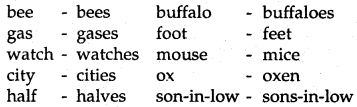
Singular से Plural बनाना –
1. By adding s to the singular nouns as : boy –
boys, girl – girls, dog – dogs, etc.

2. By adding es as : brush brushes, box –
boxes, gas-gases etc.

3. By changing y into ies as : pony ponies, –
lady – ladies, city – cities etc.

4. By changing f into ves as : thief-thieves –
calf – calves, leaf – leaves etc.

5. By change in the vowel as : man-men, –
foot – feet, tooth teeth, mouse – mice etc.

Exercise

Fill in the blanks with suitable words.

1. The police arrested five …………….. (thief, thieves)
2. The ………………. are green. (leaf, leaves)
3. Mr. Prasad has a lovely ………………. (baby, babies)
4. Some ………………… were riding horses. (boy/boys)
5. All the ………………… were ready to go for a picnic. (student, students)
6. When you close your …………………. you cannot see anything. (eye, eyes)
7. I like reading ………………. (book, books)
8. Sardar Patel was one of the great …………….. of India. (leader, leaders)
9. He loved his only …………….. very much.(son, sons)
10. This …………….. is very sharp. (knife, knives)

Answers:

1. thieves
2. leaves
3. baby
4. boys
5. students
6. eyes
7. books
8. leaders
9. son
10. knife.

5. Gender
(परिभाषा):

Noun के जिस रूप से यह पता चले कि Noun पुरुष है, स्त्री है या निर्जीव है उसे Gender कहते हैं।
Kinds of Gender (लिंग के भेद)

1. Masculine Gender
(पुल्लिंग) – इन संज्ञा शब्दों से पुरुषत्व का बोध होता है, जैसे –
Ram, boy, man, father, brother, king etc.

2. Feminine Gender
(स्त्रीलिंग) – इन संज्ञा शब्दों से नारी अथवा स्त्रीत्व का बोध होता है, जैसे –
girl, woman, mother, queen, sister, etc.

3. Neuter Gender (अलिंग) –
इन संज्ञा शब्दों से निर्जीव वस्तुओं का बोध होता है, जैसे –
book, pen, table, room, house, etc.

4. Common Gender (उभयलिंग) –
इन संज्ञा शब्दों से नर व नारी दोनों का बोध होता है, जैसे –
child, teacher, doctor, enemy etc

Change of Gender (लिंग परिवर्तन)
Masculine से feminine बनाने के नियम इस प्रकार हैं –

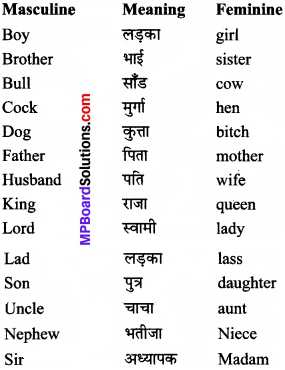
1.Masculine से बिल्कुल भिन्न शब्द का प्रयोग करके जैसे –

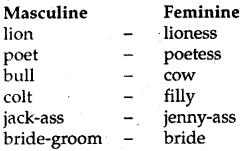
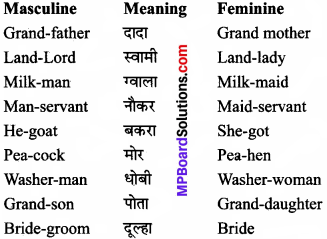
MP Board Class 8th General English Grammar-1.1

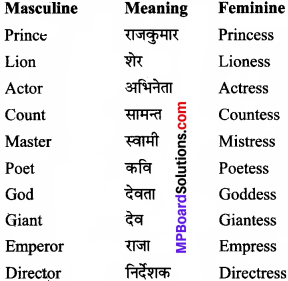
2. Masculine के अन्त में ess लगाकर।

MP Board Class 8th General English Grammar-1.3

3. Masculine के प्रथम अथवा अन्तिम शब्द को बदल कर।

MP Board Class 8th General English Grammar-1.4

Some Common Genders:

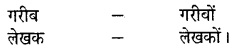
Baby      –    (बच्चा या बच्ची)
Cousin   –   (चचेरा भाई या बहन)
Pupil      –   (शिष्य या शिष्या)
Child     –   (बच्चा या बच्ची)
Person   –   (पुरुष या स्त्री)
Infant     –   (बच्चा या बच्ची)
Doctor    –   (पुरुष या स्त्री)
Teacher  –   (पुरुष या स्त्री)

Exercise

Write the opposite genders of the following nouns:

  1. Poet, land – lord, lad, God.
  2. Princess, brother, mother, girl, man.
  3. Mistress, aunt, hero, king.

Answer:

  1. Poetess, land – lady, lass, Goddess
  2. Prince, sister, father, boy, woman
  3. Master, uncle, heroine, queen.

6. Tense
(काल):

परिभाषा – The tense of a verb shows the time of an event or action of a verb.
Verb के tense से किसी घटना या कार्य के समय का ज्ञान होता है।
अंग्रेजी में Tense तीन प्रकार के होते हैं –

  1. Present tense
  2. Past tense
  3. Future tense.

1. Present Tense (वर्तमान काल) –
इस Tense से यह पता चलता है कि कार्य अब या अभी हुआ है। जैसे –
I go to school. (मैं स्कूल जाता हूँ।)

2. Past Tense (भूतकाल) –
इस Tense से यह पता चलता है कि कार्य बीते हुए समय में हुआ है। जैसे –
I went to school. (मैं स्कूल जाता था।)

3.  Future Tense (भविष्य काल) –
इस Tense से यह पता चलता है कि कार्य आने वाले समय में होगा। जैसे –
I shall go to school. (मैं स्कूल जाऊँगा।)

प्रत्येक Tense निम्नलिखित चार प्रकार के होते हैं –

  1. Indefinite
  2. Continuous
  3. Perfect
  4. Perfect Continuous.

Present Tense (वर्तमान काल):
1. Present Indefinite Tense – इस Tense में सदा सत्य बातें, आदतें अथवा बार-बार होने वाले कार्यों का वर्णन किया जाता है। जैसे –

(i) The sun rises in the east.
सूर्य पूर्व में उदय होता है।
(ii) I go to school.
मैं स्कूल जाता हूँ।

पहचान – हिन्दी में वाक्यों के अन्त में ता, ती, ते तथा है, हूँ, हो होता है।

2. Present Continuous Tense –
इस Tense dit प्रयोग तब किया जाता है जब कार्य अभी भी चल रहा हो जैसे –

(i) I am writing a letter.
मैं पत्र लिख रहा हूँ।
(ii) They are playing football.
पे फुटबॉल खेल रहे हैं। पहचान-हिन्दी में वाक्यों के अन्त में रहा हूँ, रहा है, रही है, रहे हैं होता है।

3. Present Perfect Tense –
इस Tense का प्रयोग ऐसे कार्य के लिए होता है जो वर्तमान में पूरा हो चुका है जैसे –
(i) I have done my work.
मैंने अपना काम कर लिया है।
(ii) He has written a letter.
वह एक पत्र लिख चुका है।

इसमें I, You, तथा बहुवचन के साथ have तथा एकवचन के साथ has का प्रयोग किया जाता है।
इसमें Verb की III form का ही प्रयोग होता है।
पहचान – हिन्दी में वाक्यों के अन्त में किया है, दिया है, चुका है, चुके हैं, चुका हूँ आदि होता है।

4. Present Perfect Continuous Tense –
इस Tense में कार्य पहले से हो रहा है तथा वर्तमान में भी जारी है। जैसे

1. I have been writing a letter for an hour.
मैं एक घण्टे से पत्र लिख रहा हूँ।

2. It has been raining since morning.
सुबह से वर्षा हो रही है।
इस Tense में subject के अनुसार has been या have been तथा मुख्य क्रिया में ing लगाते हैं।
समय के लिए for या since का प्रयोग होता है।
पहचान – हिन्दी वाक्यों के अन्त में रहा हूँ, रहे हैं, रही हूँ तथा कार्य शुरू होने का समय दिया जाता है।

Past Tense (भूतकाल):

1. Past Indefinite Tense – इस Tense में बीते हुए समय में कार्य होता है। जैसे –
(i) He went to the market.
वह बाजार गया।
(ii) I bought a pen.
मैंने एक कलम-खरीदी।

इन वाक्यों में Verb की II form का प्रयोग होता है।
पहचान – हिन्दी में वाक्यों के अन्त में गया, आया, दिया, लिया, किया आता है।

2. Past Continuous Tense –
इस Tense का प्रयोग ऐसे कार्यों के लिए किया जाता है जो भूतकाल में कुछ समय तक जारी रहा हो। जैसे –
(i) I was writing a letter.
मैं एक पत्र लिख रहा था।
(ii) They were playing cricket.
वे क्रिकेट खेल रहे थे।

पहचान – हिन्दी वाक्यों में रहा था, रहे थे, रही थी आदि का प्रयोग होता है। एकवचन में संज्ञा में was तथा बहुवचन में were का प्रयोग होता है।

3. Past Perfect Tense –
इस Tense का प्रयोग ऐसे कार्यों के लिए किया जाता है जो बीते समय में पूरा हो चुका है। जैसे –
(i) He had done his work.
उसने अपना काम कर लिया था।
(ii) They had posted their letters in the post office.
उन्होंने अपने पत्र डाकखाने में डाल दिये थे।

इस Tense में had के साथ Verb की III form का प्रयोग होता है।
पहचान – हिन्दी में वाक्यों के अन्त में लिया था, चुका था, चुकी थी, चुके थे आदि आते हैं।

4. Past Perfect Continuous Tense – इस Tense का प्रयोग ऐसे वाक्यों में होता है जहाँ कार्य बीते समय में शुरू होकर कुछ समय तक जारी रहता है। वाक्य शुरू होने के समय ‘से’ का प्रयोग आवश्यक होता है। इसके लिए for व since का प्रयोग होता है। जैसे –
(i) Ram had been reading since morning.
राम सुबह से पढ़ रहा था।
(ii) Ram had been playing for two hours.
राम दो घण्टे से खेल रहा था। इन वाक्यों में had been के साथ Verb की I form + ing का प्रयोग होता है।
पहचान – हिन्दी वाक्यों के अन्त में रहा था, रहे थे, रही थी आदि आते हैं।

Future Tense (भविष्य काल):
1. Future Indefinite Tense –
इस Tense से यह पता चलता है कि कार्य अभी होगा। जैसे –
(i) I shall go to the market.
मैं बाज़ार जाऊँगा।
(ii) We will play.
हम खेलेंगे।

इस Tense में will, shall का प्रयोग होता है।
पहचान – हिन्दी वाक्यों में अन्त में गा, गे, गी आता है।

2. Future Continuous Tense – इस Tense का
प्रयोग उस कार्य को व्यक्त करने के लिए किया जाता है जो घटनाओं के सामान्य क्रम से घटित होता है। इस Tense में will be या shall be के साथ प्रधान क्रिया में ing लगाया जाता है। जैसे –
(i) Hari will be doing his work.
हरि अपना काम कर रहा होगा।
(ii) Meera will not be going to school.
मीरा स्कूल नहीं जा रही होगी।

पहचान हिन्दी के वाक्यों में अन्त में रहा होगा, रहे होंगे,। रही होगी आदि आते हैं।

3. Future perfect Tense –
इस Tense में भविष्य में किसी कार्य के होने की निश्चितता दर्शाई जाती है –
Shall have, will have + verb की III form का प्रयोग होता है। जैसे –
(i) I shall have finished my work before 4 p.m.
शाम चार बजे से पहले मैं अपना काम समाप्त कर चुकूँगा।
(ii) The teacher will have caught the boy before he runs away.
लड़के के भागने से पहले अध्यापक उसे पकड़ चुके होंगे।

पहचान हिन्दी के वाक्यों में अन्त में चुके होंगे, चुका होगा आदि आते हैं।

4. Future Perfect Continuous Tense
इस Tense में भविष्यत काल में कार्य पूरा होने के साथ-साथ उसके चालू रहने के समय का वर्णन होता है।
Will have been, shall have been के साथ प्रधान क्रिया में ing लगाया जाता है। जैसे –
(i) Dogs will have been barking since one o’clock.
कुत्ते एक बजे से भौंक रहे होंगे।
(ii) Ram will have been writing his poem for four days.
राम चार दिन से अपनी कविता लिख रहा होगा।

पहचान हिन्दी के वाक्यों के अन्त में कर रहा होगा, कर रहे होंगे, कर रही होंगी आदि आते हैं।

Simple Present:

Translate into English

  1. सूर्य पूर्व में उगता है।
  2. मैं चाय पीता हूँ।
  3. मैं प्रतिदिन घूमने जाता हूँ।
  4. माला एक अच्छी लड़की है।
  5. पृथ्वी गोल है।
  6. वृक्ष हमें फल देते हैं।
  7. क्या वे गाना गाते हैं ?
  8. मोहन अपना काम क्यों नहीं करता है ?

Answer:

  1. The sun rises in the East.
  2. I take tea.
  3. I go for a walk daily.
  4. Mala is a good girl.
  5. The earth is round.
  6. Trees give us fruits.
  7. Do they sing a song ?
  8. Why does Mohan not do his work? .

Present Perfect:

  1. मैं चाय पी चुका हूँ।
  2. शीला यहाँ आ गयी है।
  3. उसने पत्र नहीं लिखा है।
  4. वह अपना काम नहीं कर चुकी है।
  5. वे कहाँ जा चुके हैं ?
  6. क्या वे खेल चुके हैं ?

Answer:

  1. I have taken tea
  2. Sheela has come here.
  3. He has not written a letter.
  4. She has not done her work.
  5. Where have they gone ?
  6. Have they played ?

Simple Past:

  1. मैंने एक पेन खरीदा।
  2. वह वहाँ गया।
  3. हमने एक गीत नहीं गाया।
  4. मैंने आम नहीं खरीदे।
  5. क्या हमने खेल खेला ?

Answer:

  1. I bought a pen.
  2. He went there
  3. We did not sing a song.
  4. I did not buy mangoes.
  5. Did we play a game ?

Past Continuous:

  1. शिक्षिका कक्षा में पढ़ा रही थी।
  2. वह नाच रहा था।
  3. क्या वह खेल रहा था ?
  4. राम पत्र नहीं लिख रहा था।
  5.  पिताजी जबलपुर जा रहे थे।

Answer:

  1. The teacher was teaching in the class.
  2. He was dancing.
  3. Was he playing ?
  4. Ram was not writing a letter.
  5. Father was going to Jabalpur.

Simple Future:

  1. मैं उसकी मदद करूँगा।
  2. अध्यापक आज हमें पढ़ायेंगे।
  3. मैं स्कूल नहीं जाऊँगा।
  4. वह गाना नहीं गायेगी।
  5. क्या तुम कविता लिखोगे ?

Answer:

  1.  I shall help him.
  2. The teachers will teach us today.
  3. I shall not go to school.
  4. She will not sing a song.
    Will you write a poem ?

Future Continuous:

  1. वह खाना खा रहा होगा।
  2. राम अपना काम कर रहा होगा।

Answer:

  1. He will be having his meals
  2. Ram will be doing his work.

Translate into English:

  1. यह मेरी पुस्तक है।
  2. उसकी माँ डॉक्टर थी।
  3. मै आगरा जाऊँगा।
  4. माँ खाना बना रही है।
  5. तुम कहाँ रहते हो?
  6. क्या तुम क्रिकेट खेलते हो ?
  7. जया गाना गा चुकी है।
  8. कल छुट्टी का दिन था।

Answer:

  1. This is my book.
  2. His mother was a doctor.
  3. I will go to Agra.
  4. Motor is cooking food.
  5. Where do you live?
  6. Do you play cricket ?
  7. Jaya has sung a song.
  8. Yesterday was a holiday.

7. Three Forms Of Verbs
(क्रियाओं के तीन रूप)।

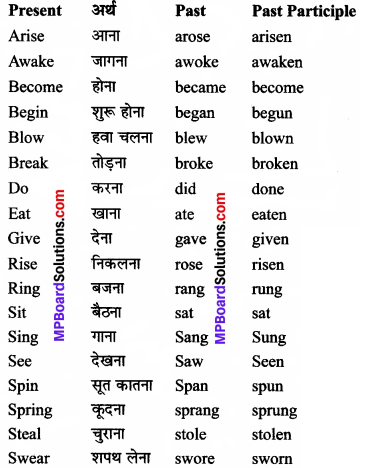
Group I – ऐसी क्रियाएँ जिनके तीनों रूप अलग हैं –

MP Board Class 8th General English Grammar-1

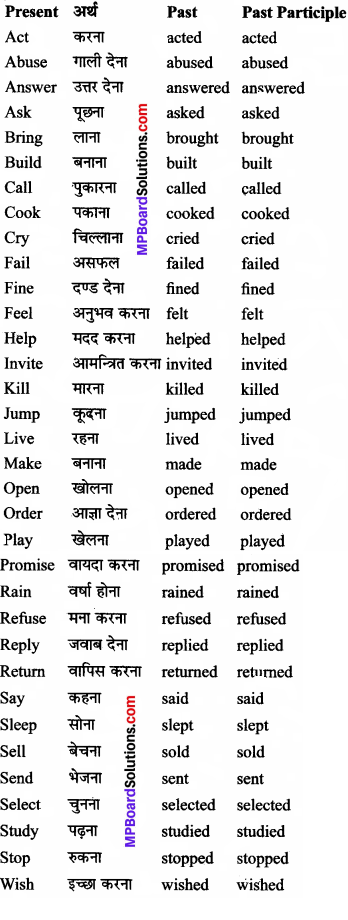
Group II – वे क्रियाएं जिनके II form a III form तथा d, ed, t लगाकर बनाते हैं।

MP Board Class 8th General English Grammar-3
Group III – वे क्रियाएं जिनके रूप तीनों Forms में एक से होते हैं –

MP Board Class 8th General English Grammar-5

Exercise

Fill in the blanks with the correct form of verb.

  1. Ra-him ……………. Watching T.V. (was, were)
  2. I ………….. a cock there.. (seen, saw)
  3. The bell …………. before we reached the school …………….. (ring) .
  4. The girl, who is …………… a red sweater, is a good singer. (wear)

Answer:

  1. was
  2. saw
  3. had rung
  4. wearing.

8. Adjective And Its Degrees
(विशेषण तथा उसकी डिग्री ):

परिभाषा – An adjective is a word that is used to add something to the meaning of a Noun.
जो शब्द संज्ञा की विशेषता बतलाते हैं, विशेषण कहलाते है। जैसे –

1. Satish ia a tall boy.
सतीश लम्बा लड़का है।

2. She is a clever girl.
वह चतुर लडकी है।

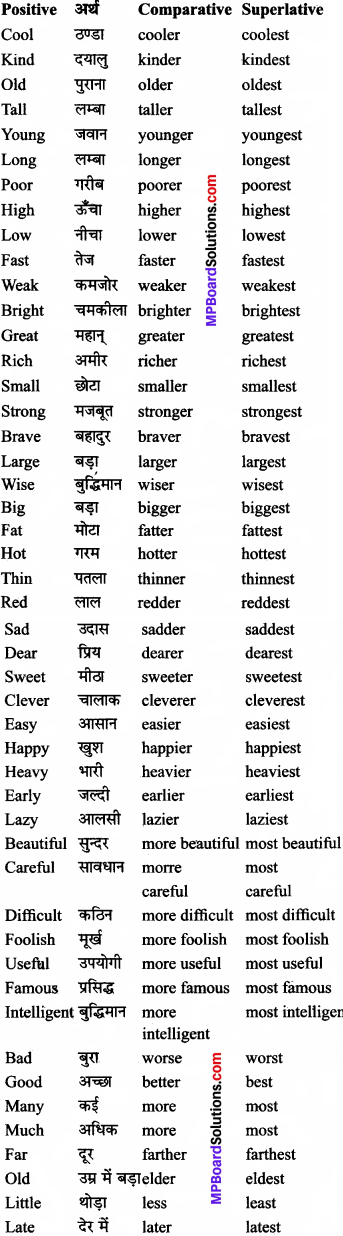
Adjectives कि तीन अवस्थाएँ होती हैं –

  1. Positive degree
  2. Comparative degree
  3. Superlative degree.

MP Board Class 8th General English Grammar-6

Exercise

Fill in the blanks with correct degree of comparison.

1. Bala is …………… than Ravi. (young)
2. Raji Devi is not as …………….. as her husband. (tall)
3. This is the ……………. flower I have ever seen. (beautiful)
4. Raja is not as …………..,.. as his brother. (intelligent)
5. I am ………………. (strong) than he is.
6. Calcutta is the ……………… city in India. (big)
7. Iron is the …………………. (useful) of all metals.
8. Iron is ……………….. (heavy) than wood.
9. Which is the ……………… (high) mountain in India ?
10. He is ………………. (lazy) than his sister.

Answers:

1. younger
2. tall
3. most beautiful
4. intelligent
5. stronger
6. biggest
7. most useful
8. heavier
9. highest
10. lazier.

9. Adverbs
(क्रिया-विशेषण):

परिभाषा – An adverb is a word which modifies an adjective, verb or another adverb.
जो शब्द किसी विशेषण, क्रिया अथवा अन्य क्रिया विशेषण की विशेषता बतलाते हैं, क्रिया-विशेषण कहलाते हैं।

Kinds of Adverbs:

1. Adverb of Time – ये शब्द कार्य के होने का समय। स्पष्ट करते हैं, जैसे –

  • Ram came early.
  • She gets up in the morning daily.
  • Our shop remains closed on Monday.
  • You may go now.

इस प्रकार के adverbs निम्नलिखित हैं –
Now, then, before, since, ago, soon, early, late, afterwards, today, tomorrow, yesterday etc.
Adverb of Time answers the questions: When? i.e. ये verb में ‘कब’ लगाकर ज्ञात होता है।

2. Adverb of Place ये शब्द क्रिया के होने का स्थान बताते हैं, जैसे –

  • Please come here.
  • Come in.
  • Go out.
  • She sits there.

इस प्रकार के adverbs निम्नलिखित हैं –
here, there, in, out, above, below, inside, outside, far, near, every where etc.
Adverb of Place answers the questions : Where? i.e., ये verb में ‘कहाँ’ लगाकर ज्ञात होता है।

3. Adverbs of Reason –
ये शब्द कारण प्रकट करते हैं, जैसे

  • He therefore left the school.
  • He is hence unable to go.

Adverb of Reason answers the question : Why ? i.e., ये verb में क्यों लगाकर ज्ञात होता है।

10. The Conjunctions
(संयोजक):

परिभाषा – A conjunction is a word which joins words or sentences with each other.
वे शब्द जो शब्दों या वाक्यों को आपस में जोड़ते हैं संयोजक कहलात हैं।

निम्नलिखित कुछ conjunctions the हैं, जैसे –
and (और), as (जैसे), but (लेकिन), before (पहले), because (क्योंकि), after (बाद में), if (अगर), or (या), otherwise (अन्यथा ), that (की), though (यद्यपि), then (जबकि), till (तक), unless (जब तक कि), while (जबकि), which (जोकि), when (जब), therefore (अतः), so (इसलिए), as well as (तथा), either-or (या तो या), neither nor (ना तो-ना ही) etc.

1. Rita and Gita are sisters.
2. I live in Bhopal which is the capital of Madhya Pradesh.
3. Anil is rich but Hari is poor.
4. Walk fast or you will miss the bus.
5. He was so tired that he could not walk.
6. He was ill, therefore he could not come to school.

Exercise

Combine the following pairs of sentences into a single one using and or but:

  1. Mala studied well. She won a number of prizes.
  2. Sheela likes red colour. Geeta likes blue colour.
  3. Rani bought some apples. Raju bought oranges.
  4. I have seen the Taj Mahal. I have not seen the Qutub Minar.
  5. Bala likes birds. She does not like monkeys.
  6. I like cricket. I like football.
  7. Sohan went to Delhi during the vacation. Rohan went to Agra.
  8. He is poor. He is honest.

Answers:

  1. Mala studied well and won a number of prizes.
  2. Sheela likes red colour but Geeta likes blue.
  3. Rani bought some apples and Raju bought oranges.
  4. I have seen the Taj Mahal but not the Qutub Minar.
  5. Bala likes birds, but not monkeys.
  6. I like circket and football.
  7. Sohan went to Delhi during the vacation but Rohan went to Agra.
  8. He is poor but honest.

11. Modals
(सहायक किया):

1. Primary Auxiliaries – Be, have, do.
2. Modal Auxiliaries – will, shall, can, may, must etc.
नोट – यहाँ केवल वही Auxiliaries दी जा रही हैं जो पाठ्यक्रम में निर्धारित हैं –

Have का main verb के रूप में प्रयोग:

1. I have a car. (अधिकार)
2. He has a pen (अधिकार)
3. We had an old car. (अधिकार)
4. We had our meal early today. (ate)
5. I had tea not coffee. (drank)
6. She had a packet from the postman.(received)
7. He has fever. (suffering from)

Use of ‘Shall’ and ‘Should’
Shall –
1. Promise
(वचन) के लिए, जैसे –

  • I shall help you.
  • We shall go to cinema today.

2. Suggestion या advice
(सुझाव) दिखाने के लिए जैसे –

  • Shall we go to school today?
  • Shall I close the door ?

3.  Determination
(दृढ़ निश्चय) के लिए, जैसे –

  • I shall turn you out of the room.
  • He shall reach there by evening.

4. Command
(आदेश) के लिए, जैसे –

  • You shall have to do this work.
  • He shall be punished again.

Should –
(i) Obligation or advisability
(कर्तव्य, सुझाव) के लिए, जैसे –

  • We should respect our elders.
  • You should study the subject first then give your views.
  • You should be punctual.

(ii) Assumption
(पूर्ण धारणा) के लिए

  • That should be Mohan’s cycle.
  • You should be Ram’s brother.

(iii) Lest at ang should ait beim
(a) Walk carefully lest you should fall. Use of ‘Can’ and ‘Could’

Can –
(i) Ability
(योग्यता) दिखाने के लिए, जैसे –

  • I can swim.
  • He can speak English.

(ii) Permission
(आज्ञा), जैसे –

  • You can go home now.
  • You can park your car here.

(iii) Possibility
(संभावना) दिखाने के लिए, जैसे –

  • The students can be notorious.
  • He can come today.

(iv) Power
(शक्ति) प्रकट करने के लिए, जैसे –

  • We can walk so long.
  • Can he bear this pressure ?

Could—
(i) Ability is past
(भूतकाल में क्षमता) दिखाने के लिए, जैसे

  • She could speak English well.
  • He could not pass as he did not work hard.
  • He could swim, when he was a child.

(ii) Possibility
(सम्भावना) व्यक्त करने के लिए। जैसे –
(a) When I was the principal, teachers could meet the girl students in the open.

(iii) Request (प्रार्थना) के लिए, जैसे –

  • Could you give me your pen ?
  • Could you tell your residence ?

Use of ‘May’ and ‘Might’
May –
(i) Permission
(अनुमति) माँगने/देने के लिए –

  • May I come in Sir ? (माँगना)
  • You may go now. (देना)।

(ii) Possibility (सम्भावना) के लिए, जैसे –

  • It may rain today.
  • The principal may not grant me leave.

(iii) Purpose (उद्देश्य) व्यक्त करने के लिए, जैसे –

  • We eat so that we may live.
  • We save so that we may use in future.

(iv) Wish (इच्छा) प्रकट करने के लिए, जैसे –

  • May you live long !
  • May God help you !

Might –
(i) Possibility (सम्भावना) व्यक्त करने के लिए, जैसे –

  • The principal might grant me leave.
  • She might be Suman.

(ii) Permission (अनुमति) माँगने के लिए
(a) Might I borrow your car for a day?

Use of ‘Must

(i) Necessity (आवश्यकता) व्यक्त करने के लिए –

  • We must obey our elders.
  • We must get up early.

(ii) Prohibition (रोकने) के लिए –
(a) You must not leave home before 6 p.m.

(iii) Certainty or belief (पक्का विश्वास) व्यक्त करने के लिए, जैसे –

  • I must finish this book today.
  • He must have gone.

Exercise

Fill in the blanks with suitable modals:

1. We ………….. get up early in the morning.
2. The sky is clear now, it ………….. rain in the evening.
3. He promised me that he …………… preside over our function.
4. …………… you switch the fan off?
5. We …………….do our duty.
6. ……………… I come in Sir ?
7. My friend ……………. arrive at 8 p.m.
8. My son ………….. drive a car.
9. The news ………….. be false.
10. If you disobey, you ………….. be punished.

Answers:

1. should
2. can
3. would
4. Would
5. must
6. May
7. will
8. can
9. may
10. shall.

12. Punctuation
(विराम चिन्ह)।

Punctuation का अर्थ होता है किसी वाक्य में Full stop, comma आदि विराम चिह्न का प्रयोग करना। इनके प्रयोग इस प्रकार हैं।
1. Full stop (.) – हिन्दी के पूर्ण विराम (।) के स्थान पर अंग्रेजी में full stop (.) प्रयोग होता है।

(a) Affirmative, Negative site Imperative वाक्यों के अन्त में –

  1. She is a girl.
  2. She is not coming.
  3. Please come here.

(b) Abbreviations
(संक्षिप्त शब्दों) तथा नामों के प्रारम्भ में। जैसे –
M. A., A.P.J. Abdul Kalam.

2. Comma (.) – Comma (अर्द्ध विराम) का प्रयोग निम्न दशाओं में होता है –

(i) एक ही Part of Speech के कई शब्दों को अलग करने के लिए. जैसे –
He can read, write and sing well.

(ii)And से जोड़े गये एक से अधिक शब्द समूहों को अलग करने के लिए, जैसे –
The minister addressed all, men and women, old and young.

(iii) Yes और No के बाद, जैसे –

  1. Yes, I shall do it.
  2. No, I can’t go there.

(iv) Reported Speech के शेष वाक्य को अलग करने के लिए, जैसे –
He said, “The sun rises in the East.”.

(v) Noun और Phrase in apposition को अलग करने के लिए, जैसे –
Milton, the great poet,,was blind.

(vi) दिन, दिनांक या वर्ष को पृथक् करने के लिए, जैसे –
Monday, 6th June, 2006.

3. Question Mark (?)
प्रश्नवाचक वाक्यों के अन्त में लगाया जाता है, जैसे –
What is your name?

4. Exclamation mark (!) – इस चिह्न का प्रयोग
(i) Interjection
(विस्मयादिबोधक) शब्दों के बाद होता है, जैसे
Oh! Alas ! Hurrah !

(ii) उन वाक्यों के अन्त में भी होता है जो गहन संवेग व्यक्त करते हैं, जैसे
What a beautiful picture !

5. Inverted Commas (“….”) – Direct speech में किसी के द्वारा कहे गये यथार्थ शब्दों को शेष वाक्य से अलग करने के लिए Inverted commas का प्रयोग होता है, जैसे –
He said, “I shall win.”

6. Apostrophe (‘) इनका प्रयोग होता हैं जैसे –

  • अक्षर के लोप को को प्रकट करने को लिए – Don’t, can’t, won’t, didn’t.
  • Possessive case बनाने के लिए Sita’s doll.
  • अक्षर तथा संख्याओं का बहुवचन बनने को लिए And three 4’s and two 3’s.

7. Capital Letters – इनका प्रयोग निम्न होता है –
(i) वाक्य के प्रथम शब्द का प्रथम अक्षर लिखने के लिए –
He is my brother.
(ii) Proper Nouns और उससे बने हुए Adjectives के प्रथम अक्षर को लिखने के लिए –
Asha, Delhi, Indian.
(iii) Pronoun Ion frana forte I am a teacher.
(iv) God, Almighty, Lord शब्दों के प्रथम अक्षर लिखने के लिए।

Exercise

Punctuate the following sentences:

  1. he sits next to his friend sonu his father teaches geography.
  2. Come here Sonam i have a rupee for you said rajan.
  3. is this your final decision asked ramesh.
  4. during our journey to delhi we slept read and played cards.
  5. don’t worry said akash i will give the pen to him.

Answer:

  1. He sits next to his friend, Sonu. His father teaches Geography.
  2.  “Come here, Sonam. I have a rupee for you.” said Rajan.
  3. “Is this your final decision ?” asked Ramesh.
  4. During our journey to Delhi, we slept, read and played cards.
  5. “Don’t worry”, said Akash, “I will give the pen to him.”

13. Compound Word
(सयुक्त शब्द)

परिभाषा – दो शब्दों को मिलाकर जब एक शब्द बनता है,

  • Base +ball → Baseball
  • Post + man → Postman
  • Milk + maid Milkmaid
  • Pocket + money → Pocket money
  • Water + melon → Watermelon
  • Friend + ship → Friendship

कभी-कभी hyphen (-) से भी compound words बनते हैं, जैसे –

  • Bell + like → Bell – like
  • Re + create → Re – create
  • Day + dream → Day – dream
  • Bus + conductor – Bus – conductor
  • Dark + haired → Dark – haired

14. Interrogative Sentences
(प्रश्नवाचक वाक्य):

वाक्यों को Interrogative बनाने के लिए. सहायक क्रिया (Auxiliary verb), (Main verb) प्रश्नवाचक शब्दों की सहायता ली जाती है जैसे –
1. उसके पास नई कार है।
She has a new car. (Simple)
Has she a new car? (Interrogative)

2. वह एक अच्छा लड़का है।
He is a good boy. (Simple)
Is he a good boy ? (Interrogative)

Exercise

Change the following sentences into interrogative –
1. Seema is going to Delhi.
सीमा दिल्ली जा रही है।

2. He can come here
वह यहाँ आ सकता है।

3. Ram has written a letter.
राम एक पत्र लिख चुका है।

4. She writes a letter.
वह एक पत्र लिखती है।

5. She sang a song.
उसने एक गीत गाया।

6. This is a book.
यह एक पुस्तक है।

7. She is playing hockey.
वह हॉकी खेल रही है।

8. He is driving a car.
वह एक कार चाल रहा है ।

9. I love my brother.
मैं अपने भाई से प्यार करता हूँ।

10. I gave a book to Lata.
मैंने लता को एक पुस्तक दी।

11. I like to live in Agra.
मुझे आगरा में रहना पसन्द है।

12. Shahjahan built the Taj.
शाहजहाँ ने ताजमहल बनवाया।

Answers:

1. Is Seema going to Delhi?
2. Can he come here ?
3. Has Ram written a letter ?
4. Does she write a letter ?
5. Did she sing a song ?
6. Is this a book ?
7. Is she playing hockey ?
8. Is he driving a car ?
9. Do you love your brother ?
10. Did you give a book to Lata ?
11. Do you like to live in Agra ?
12. Did Shahjahan build the Taj ?

Exercise

Change the following sentences into interrogatives:

  1. Nehru was honored every where.
  2. Time and tide wait for none.
  3. No man is mightier than God.
  4. ‘Everybody loves his motherland.
  5. He would like to be free.
  6. They played a hockey match.
  7. Girls were dancing.

Answer:

  1. Was Nehru honored everywhere ?
  2. Do time and tide wait for anyone ?
  3. Is any man mightier than God ?
  4. Does anybody not love his motherland ?
  5. Would he not like to be free ?
  6. Did they play a hockey match ?
  7. Were girls dancing ?

15. Negative Sentences
(नाकारात्मक वाक्य):

How to change affirmative sentences into negative sentences:
1. जब स्वीकारात्मक वाक्य में verb “to be के रूप 1619 is, am, are, was, were तथा verb ‘have os के रूप have, has, had का प्रयोग Full verb की तरह हो तो negative sentence बनाते समय इनके बाद not लगाते हैं। जैसे –
(a) He is a good boy.
He is not a good boy.

(b) They were players.
They were not players.

2. जब स्वीकारात्मक वाक्य में Primary Auxiliary (be, do, have) और Modal Auxiliary का प्रयोग एक साथ हो तो Negative sentence बनाते समय इनके बीच में not लगाते हैं जैसे –
(a) He may be a good boy.
He may not be a good boy.

(b) I can do this work.
I can not do this work.

3. Interrogative Sentences को negative में बदलते समय Subject (कर्ता) के बाद not लगा देते हैं। जैसे –
(a) Is he a good man ?
Is he not a good man ?

(b) Will you go home ?
Will you not go home ?

4. Imperative को negative में बदलते समय verb से । पहले don’t लगा देते हैं। जैसे –
(a) Go there.
Don’t go there.

(b) Bring water.
Don’t bring water.

Exercise

  1. You play cricket daily.
  2. This is a cow.
  3. I have seen the Taj.
  4. I lost my cycle.
  5. She lives in a good house.

Answer:

  1. You don’t play cricket daily.
  2. This is not a cow.
  3. I have not seen the Taj.
  4. I did not lose my cycle.
  5. She does not live in a good house.

16. Active And Passive Voice

अंग्रेजी भाषा में दो प्रकार की voice होती हैं –
Active and Passive voice. We drink milk. (Active voice)
हम दूध पीते हैं।

Milk is drunk by us. (Passive voice)
दूध हमारे द्वारा पिया जाता है।

मुख्य बातें:

1. केवल कर्म (object) वाले वाक्यों को Passive voices में बदला जा सकता है। बिना कर्म वाले वाक्यों को Passive voice में नहीं बदला जा सकता है जैसे-He sleeps, Radha is weeping, इन वक्यों में object नहीं है इसलिए इन्हें Passive में नहीं बदला जा सकता है।
2. Perfect Continuous वाक्यों को Passive वाक्यों में नहीं बदला जता जैसे – She has been waiting for me.
3. Future continuous वाक्यों को passive में नहीं बदला जा सकता है। – I shall be going to Delhi.
4. Passive Voice में Past participle (Third form of the verb) प्रयोग होता है।
I sing a song (Active)
A song is sung by me. (Passive)

Tense wise Change of Voice:

1. Simple Present Tense:
I water Plants. (Active)
Plants are watered by me. (Passive)
Hint – is, am ,are + III form of verb

2. Present Continuous Tense:
I am singing a song. (Active)
A song is being sung by me. (Passive)
Hint – is, am, are + being + III form of verb

3. Present Perfect Tense:
I have watered the plants. (Active)
The plants have been watered by me. (Passive)
Hint – has, have + been + III form of verb.

4. Simple Past Tense:
I watered plants. (Active)
Plants were watered by me. (Passive)
Hints – was, were + III form of verb

5. Past Continuous Tense:
I was singing a song. (Active)
A song was being sung by me. (Passive)
Hint – was, were + being + III form of verb.

6. Past Perfect Tense:
He had drunk milk. (Active)
Milk had been drunk by him. (Passive)
Hint – had been + III form of verb

7. Simple Future Tense:
I shall drink milk. (Active)
Milk will be drunk by me. (Passive)
Hint – will be / shall be + III form of verb

How to Change Interrogative Sentences into Passive Voice

1. Sentences starting with Helping verbs
(सहायक क्रिया से आरम्भ होने वाले वाक्य)
Did you water plants ? (Active)
Were plants watered by you ? (Passive)
Hint – Helping verb + Object + III form of verb and question mark.

2. Sentences Starting with “Why’ (‘Why’ से आरम्भ होने वाले वाक्य)
Why did you leave the room? (Active)
Why was the room left by you? (Passive)
Hint – Why + helping verb + object + III form of verb and question mark.

3. Sentences starting with ‘Who’ (‘Who’से आरम्भ होने वाले वाक्य)
Who watered the plants ? (Active)
By whom were the plants watered ? (Passive)
Hint-By Whom + helping verb + object + III form of verb and question mark.

How to Change the Sentences with can, should, must etc., into Passive Voice
1. I can help you. (Active)
You can be helped by me. (Passive)

2. You should obey your elders. (Active)
Your elders should be obeyed by you. (Passive)

3. You must drink milk. (Active)
Milk must be drunk by you. (Passive)
Hint-Can, should, must + be + III form of verb.

How to Change Imperative Sentences into Passive Voice
1. Open the door. (Active)
Let the door be opened. (Passive)

2. Clean the glass. (Active)
Let the glass be cleaned. (Passive)
Hint-Let + object + Be + III form of verb.

3. Please bring me a glass of water. (Active)
You are requested to bring me a glass of water. (Passive)
Hint-You are requested + to + sentence.

Exercise

Change the Voice:

1. My father brought a new car.
2. He was writing a letter.
3. You are eating oranges.
4. He called them.
5. She is making tea.
6. Do it.
7. Mala sold the books.
8. Flowers are liked by me.
9. People do not play cricket in America.
10. Sona sings a song.
11. A letter was written by Amit.
12. A car was driven by Ramu.

Answers:

1. A new car was bought by my father.
2. A letter was being written by him.
3. Oranges are being eaten by you.
4. They were called by him.
5. Tea is being made by her.
6. Let it be done.
7. The books were sold by Mala.
8. I like flowers.
9. Cricket is not played in America.
10. A song is sung by Sona.
11. Amit wrote a letter.
12. Ramu drove a car.

17. Direct & Indirect Narration

अंग्रेजी में किसी के कहे हुए वचन को दो प्रकार से प्रकट कर सकते हैं –
1. यदि किसी व्यक्ति के वही शब्द लिखे जायें जो उसने कहे हैं और उनमें किसी प्रकार की तब्दीली न की जाये तो उसे Direct Speech कहते हैं। जैसे –
“Rama said, “She is a good girl.” यहाँ बोलने वाले के ठीक-ठीक वही शब्द दिये गये हैं। Direct Speech में निम्न बातों का ध्यान रखना चाहिए –
(a) बोलने वाले के असली शब्दों को inverted Commas (“….”) में लिखते हैं।
(b) बोलने वाले के असली शब्दों को Reported Speech कहते हैं।
(c) जो Verb (क्रिया) ‘Reported Speech’ के सम्बन्ध में कुछ बताता है उसे Reporting verb कहते हैं।

2. जब हम बोलने वाले के असली शब्दों का प्रयोग नहीं करते परन्तु उनका तात्पर्य या अर्थ लिखते हैं तो उसे Indirect Speech कहते हैं। जैसे –
Rama said that she was a good girl. “Indirect speech में निम्न बातों का ध्यान रखना चाहिए –

  • इसमें कोई inverted commas नहीं होते। बोलने वाले के ठीक वही शब्द नहीं लिखे जाते। उनमें कुछ परिवर्तन किया जाता है।
  • Reporting verb के बाद कोई comma नहीं लगाया जाता।
  • Reported Speech से पहले Conjunction that’ का प्रयोग होता है।
  • Reported speech की क्रिया को बदलते हैं।

जब हम Direct Speech को Indirect speech में बदलते हैं तो निम्न बातों का ध्यान रखते हैं जैसे –
(1) Said को told में बदल देते हैं। Persons में परिवर्तन निम्न रूप में करते हैं। I person के Pronoun (I, we, us, our) का परिवर्तन Direct Speech के Subject (कर्ता) के Person के अनुसार होता है। II Person के Pronoun (You, Your) का परिवर्तन Object के अनुसार होता है तथा III Person के Pronoun (he, she, it, her) में कोई भी परिवर्तन नहीं होता है।

(2) निकटता प्रकट करने वाले शब्दों में परिवर्तन निम्नलिखित रूप से किया जाता है –

MP Board Class 8th General English Grammar-8

(3) Tense (काल) के परिवर्तन –

  • Reporting Verb के Present या future Tense में होने पर Reported verb के Tense में कोई परिवर्तन नहीं होता।
  • Reporting verb के Past Tense में होने पर Reported Verb के Tense में परिवर्तन होता है –

(i) Simple Present का Simple Past हो जाता है।
He said, “She works hard.”
He said that she worked hard.

(ii) Present Continuous at Past Continuous हो जाता है। जैसे –
He said, “She is reading a book”.
He said that she was reading a book.

(iii) Present Perfect at Past Perfect हो जाता है। जैसे –
Hema said, “Ram has done his work.”
Hema said that Ram had done his work.

(iv) Present Perfect Continuous cat Past Perfect Continuous हो जाता है। जैसे –
Sham said, “Ram has been working for two hours.”.
Sham said that Ram had been working for two hours.

(v) Simple Past का Past Perfect हो जाता है। –
Sita said, “Rita read a book.”
Sita said that Rita read a book.”

(vi) Past Continuous cft Past Perfect Continuous हो जाता है। जैसे –
Gopal said, “Govind was singing a song.”
Gopal said that Govind had been singing a song.
Shall का should, may, का might, can का could हो जाता है तसदा सत्य व ऐतिहासिक तथ्यों का Tense नही बदलता।

Interrogative Sentences:
Direct – Rahul said to Rama, “Is it easy to ride a bicycle ?”
Indirect – Rahul asked Rama if it was easy to ride a bicycle.
Direct – The bird said to the Prince, “Why are you weeping ?
Indirect – The bird asked the Prince why he was weeping.

Command and Orders:
Direct – Father said, “Get Some sleep.”
Indirect – Father told him to get some sleep.
Direct – Hari said to me, “Please help me.”
Indirect – Hari requested me to help him.

Exercise

I. Rewrite the following sentences in indirect form of narration:

1. Amit says, “I like travelling.”
2. The teacher said, “The earth is round.”
3. The teacher said to the boy, “Shut the door”
4. He asked me, “Where is the bus stand ?”
5. Savita’s mother says, “I think it is good to travel.”
6. Sita says, “I went to the cinema.”
7. The teacher said, “What is your name ?”
8. “Who is your father ?” The policeman asked the girl.
9. He said to me, “I live in Delhi.”
10. He said, “Two and two make four.”

Answers:

1. Amit says that he likes travelling.
2. The teacher told that the earth is round.
3. The teacher asked the boy to shut the door.
4. He asked me where the bus stand was.
5. Savita’s mother says that she thinks that it is good to travel.
6. Sita says that she went to the cinema.
7. The teacher asked me what my name was.
8. The policeman asked the girl who her father was.
9. He told me that he lived in Delhi.
10. He said that two and two make four.

Exercise

II. Change the following into Indirect Narration:

1. Savita said, “I am going to Delhi today.”
2. Mohit said, “I can’t come. I have to stay with my brother.”
3. Seema said, “I am going home.”
4. Teacher said, “The sun rises in the east.”
5. Vivek said, “I am busy.”
6. Ramesh said, “I cannot drive scooter.”

Answers:

1. Savita said that she was going to Delhi that day.
2. Mohit said that he couldn’t come, he had to stay with his brother.
3. Seema said that she was going home.
4. Teacher said that the sun rises in the east.
5. Vivek said that he was busy.
6. Ramesh said that he could not drive scooter.

18. Antonyms
(विपरीतार्थक शब्द):

विपरीत अर्थ वाले शब्द विपरीतार्थक शब्द कहलाते है

MP Board Class 8th General English Grammar-9

19. Synonyms
(समानार्थक शब्द):

समानार्थक शब्दों का अर्थ है समान अर्थ वाले शब्द

MP Board Class 8th General English Grammar-12

20. Homophones
(समोच्चारित शब्द):
Homophones are words that sound alike but have completely different meaning. –
(Homophone शब्द उच्चारण में समान लगते हैं परन्तुअर्थ में भिन्न होते हैं।)
I use
1. Sea, See –
Sea -The ship is sailing on the sea.
See – I see with my eyes.

2. Sale, Sail –
Sale – Bachoomal has the largest sale.
Sail – Children sail boats in a pond.

3. Sell, Cell –
Sell – He sells vegetables.
Cell – He lives in a small cell.

4. Knew, new –
Knew – He knew my name.
New – We wear new clothes on Diwali.

5. There, their –
There – There are four students in the class.
Their – They do their work.

6. Peace, Piece –
Peace – There was peace in the forest.
Piece – He gave me a piece of cake.

7. Blue, Blew –
Blue – The sky is blue.
Blew – He blew a whistle.

8. Heard, herd –
Heard – I heard a great noise.
Herd – A herd of cows was grazing.

9. Right, write –
Right – He knew the right answer.
Write – I write with my left hand.

10. Hare, hair –
Hare – Hare runs very fast.
Hair – have long and smooth hair.

11. Fair, Fare –
Fair – I went to a fair with my family.
Fare – Train fare is increasing rapidly.

12. Quiet, Quite –
Quiet – You must be quiet in the class.
Quite – He waited for quite a long period.

13. Plain, Plane –
Plain – He is wearing a plain blue shirt.
Plane – I flied by a plane to Delhi.

14. Hear, Here –
Hear – We hear with our ears.
Here – Please come here.

15. Ate, Eight
Ate – He ate two ice creams.
Eight – Octopus has eight legs.

16. Bye, Buy –
Bye – He bade good bye to his friends.
Buy – I went to market to buy books.

17. Weak, Week –
Weak – He is a weak boy.
Week – There are seven days in a week.

18. One, Won –
One – One comes before two.
Won – He won a prize in academics.

19. I, Eye
I – I am a beautiful girl.
Eye – We see with our eyes.

20. Hour, Our
Hour – He is a late by one hour.
Our – The name of our country is India.

MP Board Class 8th General English Grammar-15

21. One Word Substitution
(अनेक शब्दों को लिए एक शब्द):

1. One who takes care of your teeth. Dentist
2. A person who uses a type writer. Typist
3. One who flies a plane. Pilot
4. A person who sells medicines. Chemist
5. One who travels in public transport like bus, train or plane. Passenger
6. A person who pays rent for the use of a house. Tenant
7. One who sells goods for his company. Agent
8. One who makes wooden furniture. Carpenter
9. A woman expecting to give birth to a baby. Pregnant
10. Place where you were born. Motherland
11. A person who fights cases in court. Lawyer
12. An official letter to make an arrest or search. Warrant
13. A person in an officer or shop who is in-charge of money. Cashier
14. One who teaches. Teacher
15. The flight of birds from one part of the world to another. Migration
16. A person who makes breads, cakes etc. Baker
17. One who is in-charge of a part of a news paper and magazine. Editor
18. A person who cuts hair. Barber
19. A cook in a hotel, restaurant. Chef
20. A person who writes poems. Poet
21. A person who grows or sells flowers. Florist
22. Animals that live in water. Aquatic
23. A person who believes that there is no God. Atheist
24. A disease which spreads by contact. Contagious
25. A disease which spreads rapidly among many people in the same place for a time. Epidemic

22. Prefix:

It is a letter or a group of letters placed at the beginning of a word to alter its meaning. (वे शब्दांश जो किसी शब्द से पहले जोड़े जाते हैं उन्हें उपसर्ग कहते हैं। ये शब्द का अर्थ बदल देते हैं।)
Dis + agree = Disagree

MP Board Class 8th General English Grammar-16

23. Suffix:

A letter or group of letters added at the end of a word to form a derivative.
जो शब्दों श primary word के अन्त में जोड़े जायें उसे Suffix कहत है।

MP Board Class 8th General English Grammar-19
24. Silent Latter:

वे शब्दांश जो लिखे तो जाते हैं पर बोले नहीं जाते, मूक शब्दांश कहलाते हैं। जैसे –

MP Board Class 8th General English Grammar-21

25. Sound of Animals:

MP Board Class 8th General English Grammar-23

We wish the knowledge shared regarding MP Board Solutions for Class 8 General English Grammar Questions and Answers has been helpful to you. If you need any further help feel free to ask us and we will get back to you with the possible solution. Bookmark our site to avail the latest updates on different state boards solutions in split seconds.

MP Board Class 8th Hindi Bhasha Bharti Solutions Chapter 22 गीता का मर्म

MP Board Class 8th Hindi Bhasha Bharti Solutions Chapter 22 गीता का मर्म

गीता का मर्म बोध प्रश्न

Mp Board Class 8 Hindi Chapter 22 प्रश्न 1.
निम्नलिखित शब्दों के अर्थ शब्दकोश से खोजकर लिखिए
उत्तर
विशाल = विस्तृत, बड़ा; मर्मज्ञ ज्ञाता, जानकार; महास्य = महत्व प्रवचन = उपदेशः कटिलता कपटता, चालाकी; वाचालता = बातूनीपन; प्रयास = कोशिश, प्रयत्न; प्रपंच = पाखंड, नाटक; युक्तियुक्त = तर्कपूर्ण; धृष्टता = अशिष्टता, उइंडता; प्रकांड = महान, सर्वश्रेष्ठ; मर्म = सूक्ष्म अर्थ, रहस्य; तारतम्य = क्रम; लिप्सा = लालसा, इच्छा; मन्तव्य = विचार; पार्थ = अर्जुन का एक नाम; मध्यस्थता = बीच-बचाव; चित्त = मन; व्यापक = विशाल; शमन- नाश, शान्त; शास्त्र = पुस्तक, धर्मग्रन्थ; धर्मक्षेत्र = धर्मभूमि।

Class 8 Hindi Chapter 22 Mp Board प्रश्न 2.
निम्नलिखित प्रश्नों के उत्तर संक्षेप में लिखिए
(क) राजा ने मंत्रियों के समक्ष कौन-सी इच्छा प्रकट की?
उत्तर
राजा ने मंत्रियों के समक्ष गीता का ज्ञान प्राप्त करने की इच्छा प्रकट की।

(ख) राजा की घोषणा सुनकर उनके पास कौन-कौन आने लगे?
उत्तर
राजा की घोषणा सुनकर दूर-दूर से बड़े-बड़े विद्वान, पण्डित, ज्ञानीजन राजा के पास आने लगे।

(ग) गौवर्ण राजा के पास क्यों आया था?
उत्तर
गौवर्ण राजा को गीता का मर्म समझाने के लिए राजा के पास आया था।

(घ) गीता में कुल कितने श्लोक हैं ?
उत्तर
गीता में कुल सात सौ श्लोक हैं।

(ङ) राजा के मन में कौन-सी कुटिलता समाई हुई थी?
उत्तर
राजा के मन में आधा राज्य न देने का लोभ व कुटिलता समाई हुई थी।

(च) दूसरों को उपदेश देने का अधिकारी कौन हो सकता है?
उत्तर
दूसरों को उपदेश देने का अधिकारी वही है जो स्वयं उस पर आचरण करता हो।

(छ) विद्या से हममें कौन-कौन से गुण आते हैं ?
उत्तर
विद्या से हममें विनम्रता आती है और व्यक्ति शालीन बन जाता है। मन शान्त हो जाता है, चित्त एकाग्र हो जाता है और तृष्णाओं का शमन होता है।

Class 8 Hindi Chapter 22 प्रश्न 3.
निम्नलिखित प्रश्नों के उत्तर विस्तार से लिखिए
(क) राजा आनन्द पाल ने अपने मंत्रियों से क्या कहा और क्यों ?
उत्तर
एक बार राजा आनन्द पाल के मन में गीता का ज्ञान अर्जित करने की कामना उत्पन्न हुई, उन्होंने तत्काल अपने मंत्रियों से कहा कि वे श्रीमद्भगवद्गीता का ज्ञान प्राप्त करना चाहते हैं। अतः पूरे राज्य में यह घोषणा करवा दी जाये कि जो कोई भी विद्वानजन राजा को पूर्णरूप से गीता को समझा देगा, उसे राजा अपने राज्य का आधा हिस्सा प्रदान करेगा। मंत्रियों ने भी राजा के आदेशानुसार पूरे राज्य के समस्त नगरों तथा गाँवों में तथा राज्य के बाहर भी ढिंढोरा पिटवाकर यह घोषणा करवा दी कि राजा गीता का ज्ञान प्राप्त करना चाहते हैं। अत: जो कोई भी राजा को पूर्ण रूप से गीता समझा देगा, उसे राजा द्वारा आधा राज्य उपहार स्वरूप प्रदान किया जायेगा।

(ख) गौवर्ण ने राजा को गीता का मर्म समझाने के लिए क्या प्रयास किया ?
उत्तर
गौवर्ण नाम के एक प्रकाण्ड विद्वान ने जब राजा की घोषणा सुनी तो उसने राजा को गीता का मर्म समझाने की ठानी। वह राजा के पास आया और बोला कि वह उन्हें गीता समझायेगा। राजा के ना-नुकर करने पर उसने राजा से एक अवसर प्रदान करने की प्रार्थना की। राजा द्वारा अनुमति प्रदान करने के उपरांत गौवर्ण ने राजा को गीता के एक-एक शब्द, पद, अक्षर व श्लोक का अर्थ व्याख्या सहित समझाया। धर्मक्षेत्रे कुरूक्षेत्रे …” से प्रारम्भ कर यत्र योगेश्वरः कृष्णो यत्र पार्थो धनुर्धरः’ तक पूरे सात सौ श्लोक राजा को लगभग कण्ठस्थ करा दिए। ‘

(ग) महायोगी विशाख ने दोनों की मध्यस्थता करते हुए क्या कहा?
उत्तर
महायोगी विशाख ने दोनों की मध्यस्थता करते हुए सर्वप्रथम राजा आनन्दपाल से पूछा “राजन्, क्या आप गीता को समझे?” राजा ने कहा-“तपोनिधि ! नहीं, मैं कुछ भी नहीं समझा।” फिर उन्होंने गौवर्ण से पूछा-“श्रीमान् ! आपने राजन् को गीता अच्छी तरह से समझा दी क्या ?” गौवर्ण ने कहा-“हाँ, मुनिवर । एक-एक शब्द, पद व अक्षर की व्याख्या करके समझाया है।” महायोगी विशाख गौवर्ण से बोले-“सच तो यह है कि आपने स्वयं ही गीता का मर्म नहीं समझा अन्यथा आप आधे राज्य के लोभ के कारण इस प्रपंच में नहीं पड़ते क्योंकि गीता तो निष्काम कर्म करने की शिक्षा देती है, फल प्राप्ति की आशा से कर्म करने की नहीं । राजन् ने भी अर्थ नहीं समझा है, अन्यथा विद्वानों का मान-सम्मान करने वाले राजा का व्यवहार इस प्रकार का नहीं होता। वास्तव में दूसरे को उपदेश देने का अधिकारी वही है जो स्वयं उस पर आचरण करता हो। ज्ञान या स्वाध्याय का अर्थ हमें स्वयं को जानना है।

विद्याग्रहण करने के बाद भी जिसने स्वयं को न जाना वह उसी व्यक्ति के समान है जिसके पास नक्शा तो है पर मार्ग नहीं सूझता। ज्ञान हमें रास्ता बताता है। इससे हमारी विचार शक्ति बढ़ती है और देखने की शक्ति व्यापक हो जाती है तथा मनन करने की शक्ति में वृद्धि हो जाती है। हम किसी परिणाम पर युक्तियुक्त ढंग से पहुँचने का प्रयत्न करते हैं। विद्या से विनम्रता आती है और व्यक्ति शालीन बन जाता है। मन शान्त हो जाता है, चित्त एकाग्र हो जाता है और तृष्णाओं का शमन होता है। मात्र विषयों को जानना ही सच्चा ज्ञान नहीं है, पढ़े हुए को चरित्र में डालना ही सच्चा ज्ञान है।

(घ) अर्जुन ने इन्द्र से अपनी विद्या का उपयोग किन-किन के लिए करने को कहा था ?
उत्तर
अर्जुन ने इन्द्र से अपनी विद्या का उपयोग सत्य व न्याय की रक्षा करने, दुष्टों का दमन करने, असहायों की सहायता करने, नारी की रक्षा करने, निर्बल को सबल बनाने तथा धर्म की रक्षा करने के लिए कहा था।

(ङ) राजा आनन्दपाल के मन में किस प्रसंग को सुनकर हलचल मची और क्यों?
उत्तर
जब महायोगी विशाख के मुँह से राजा आनन्दपाल ने अर्जुन और इन्द्र से सम्बन्धित प्रसंग सुना तो उसके मन में हलचल मच गई। उन्हें लगा कि राजा के रूप में उनका कार्य जन कल्याण होना चाहिए, राज भोग की लिप्सा नहीं। उनके मन में वैराग्य भाव जाग्रत हो गया। उन्होंने अपना सम्पूर्ण राजपाट गीता का मर्म.सुनाने वाले पंडित गौवर्ण को देने की इच्छा व्यक्त की। उधर महाज्ञानी गौवर्ण सोचने लगे कि मैं तो पंडित हूँ, राज भोग अथवा आधे राज्य का लालच मेरे आत्मकल्याण के लिए उचित नहीं। उनके मन में भी विरक्ति पैदा हो गई और वे भी राज-पाट के मोह से मुक्त हो गए।

(च) इस कहानी से आज का विद्यार्थी क्या सीख ले सकता है ? अपने विचार प्रकट कीजिए।
उत्तर
इस कहानी से आज का विद्यार्थी यह सीख ग्रहण कर सकता है कि उसे सच्ची, अर्थपूर्ण एवं सही शिक्षा प्राप्त करनी चाहिए। साथ ही उसे यह भी स्पष्ट रूप से समझ लेना चाहिए कि शिक्षा मात्र धनोपार्जन तथा यश प्राप्ति का साधन नहीं है वरन् इसका उपयोग मानव कल्याण के लिए होना चाहिए। यह कहानी हमें यह भी सिखाती है कि यदि विद्यार्थी अपने द्वारा अर्जित ज्ञान (शिक्षा) को अपने चरित्र में भी डाल लेता है तो वह और अधिक सार्थक हो सकता है। साथ ही इस कहानी के द्वारा विद्यार्थियों को यह भी संदेश दिया गया है कि उन्हें लोभ और लालच से सदैव बचना चाहिए।

गीता का मार्ग Mp Board Class 8 प्रश्न 4.
किसने, किससे कहा?
(क)”मुझे गीता का ज्ञान प्राप्त करना है।”
उत्तर
राजा आनन्दपाल ने अपने मंत्रियों से कहा।

(ख)”राजन आप लोभवश ऐसा कह रहे हैं।”
उत्तर
गौवर्ण ने राजा आनन्दपाल से कहा।

(ग) “आप अपने दिए हुए वचन से पीछे हट रहे हैं।”
उत्तर
गौवर्ण ने राजा आनन्दपाल से कहा।

(घ) “धृष्टता क्षमा करें देव। विजय, यश और राज्य भोगने के लिए मैंने धनुर्विद्या प्राप्त नहीं की है।”
उत्तर
अर्जुन ने इन्द्र से कहा।

(ङ) “आप दोनों ही गीता के मर्म को भली-भाँति समझ गए हैं।”
उत्तर
महायोगी विशाख ने राजा आनन्दपाल एवं गौवर्ण दोनों से कहा।

गीता का मर्म भाषा-अध्ययन

गीता के प्रश्न उत्तर Mp Board Class 8 प्रश्न 1.
निम्नलिखित शब्दों का शुद्ध उच्चारण कीजिए और उन्हें अपने वाक्यों में प्रयोग कीजिए
मर्मज्ञ, ढिंढोरा, महात्म्य, प्रकाण्ड, धनुर्विद्या, स्वाध्याय, तृष्णा ।
उत्तर
विद्यार्थी उपर्युक्त शब्दों को ठीक-ठीक पढ़कर उनका | शुद्ध उच्चारण करने का अभ्यास करें।
वाक्य प्रयोग-

  1. आर्यभट्ट ज्योतिष विद्या के भी मर्मज्ञ थे।
  2. राजा ने अपने राज्य में यह ढिंढोरा पिटवा दिया कि पूर्णमासी को एक विशाल दंगल का आयोजन होगा।
  3. हिन्दू धर्म में गौ-दान का बहुत महात्म्य बताया गया है।
  4. कालिदास संस्कृत के प्रकाण्ड विद्वान थे।
  5. अर्जुन धनुर्विद्या में सर्वाधिक निपुण योद्धा थे।
  6. विद्यार्थी को स्वाध्याय अवश्य करना चाहिए।
  7. मनुष्य को कभी भी पराये धन एवं वैभव की तृष्णा नहीं करनी चाहिए।

प्रश्न 2.
‘वाचाल’शब्द में ता’ प्रत्यय लगाकर नया शब्द ‘वाचालता’ और ‘सत्य’ में ‘अ’ उपसर्ग लगाकर ‘असत्य’
नया शब्द बना है। इसी प्रकार ‘ता’ प्रत्यय और ‘अ’ उपसर्ग लगाकर चार-चार शब्द लिखिए
उत्तर
‘ता’ प्रत्यय से बने शब्द – ‘अ’ उपसर्ग से बने शब्द
(1) आतुर + ता = आतुरता – (1) अ + नाथ = अनाथ
(2) कामुक + ता = कामुकता – (2) अ + धर्म = अधर्म
(3) दृढ़ + ता = दृढ़ता – (3) अ+ ज्ञात = अज्ञात
(4) महान + ता = महानता – (4) अ+ ज्ञानी = अज्ञानी

प्रश्न 3
निम्नलिखित सामासिक पदों का समास विग्रह करते हुए उनमें निहित समास पहचानकर लिखिए
महापण्डित, मान-सम्मान, यथोचित, लोभवश, महाराज, देवलोक, तपोनिधि।
उत्तर
MP Board Class 8th Hindi Bhasha Bharti Solutions Chapter 22 गीता का मर्म 1
MP Board Class 8th Hindi Bhasha Bharti Solutions Chapter 22 गीता का मर्म 2

प्रश्न 4.
निम्नलिखित शब्दों का सन्धि-विच्छेद कीजिए और सन्धि का प्रकार भी लिखिए
सम्मान, स्वागत, उत्थान, निराश, परोपकार।।
उत्तर
MP Board Class 8th Hindi Bhasha Bharti Solutions Chapter 22 गीता का मर्म 3

प्रश्न 5.
निम्नलिखित वर्ग पहेली में से राजा, इन्द्र, नारी और धनुष के तीन-तीन पर्यायवाची शब्द खोजकर लिखिए
MP Board Class 8th Hindi Bhasha Bharti Solutions Chapter 22 गीता का मर्म 4
उत्तर
MP Board Class 8th Hindi Bhasha Bharti Solutions Chapter 22 गीता का मर्म 5
MP Board Class 8th Hindi Bhasha Bharti Solutions Chapter 22 गीता का मर्म 6

प्रश्न 6.
उदाहरण के अनुसार ‘नहीं’,’मत’ और ‘न’ का – प्रयोग हुए निषेधवाचक वाक्य (दो-दो) लिखिए।
उत्तर
(क) ‘नहीं’ का प्रयोग
उदाहरण- मेरी समझ में कुछ नहीं आया।

  1. उसने मुझसे कुछ नहीं कहा।
  2. वह मेरे लिए उपहार नहीं लाया।

(ख) ‘मत’ का प्रयोग
उदाहरण-कक्षा में शोर मत करो।

  1. वहाँ मत बैठो।
  2. सड़क के बीचों-बीच मत चलो।

(ग) ‘न’ का प्रयोग
उदाहरण-आप इधर न बैठे।

  1. आप इधर न थूकें।
  2. कृपया मुझे अनावश्यक सलाह न दें।

प्रश्न 7.
अर्थ के आधार पर निम्नलिखित वाक्यों के भेद – उनके सामने लिखिए
उत्तर
MP Board Class 8th Hindi Bhasha Bharti Solutions Chapter 22 गीता का मर्म 7

गीता का मर्म परीक्षोपयोगी गद्यांशों की व्याख्या 

(1) “सच तो यह है कि आपने स्वयं ही गीता का मर्म नहीं समझा अन्यथा आप आधे राज्य के लोभ के कारण इस प्रपंच में नहीं पड़ते क्योंकि गीता तो निष्काम कर्म करने की शिक्षा देती है, फल प्राप्ति की आशा से कर्म करने की नहीं। राजन् ने भी अर्थ नहीं समझा है, अन्यथा विद्वानों का मान-सम्मान करने वाले राजा का व्यवहार इस प्रकार का नहीं होता। वास्तव में दूसरे को उपदेश देने का अधिकारी वही है जो स्वयं उस पर आचरण करता हो। ज्ञान या स्वाध्याय का अर्थ हमें स्वयं को जानना है। विद्याग्रहण करने के बाद भी जिसने स्वयं को न जाना वह उसी व्यक्ति के समान है जिसके पास नक्शा तो है पर’मार्ग नहीं सूझता। ज्ञान हमें रास्ता बताता है। इससे हमारी विचार शक्ति बढ़ती है और देखने की शक्ति व्यापक हो जाती है तथा मनन करने की शक्ति में वृद्धि हो जाती है। हम किसी परिणाम पर युक्तियुक्त ढंग से पहुँचने का प्रयत्न करते हैं। विद्या से विनम्रता आती है और व्यक्ति शालीन बन जाता है। मन शान्त हो जाता है, चित्त एकाग्न हो जाता है और तृष्णाओं का शमन होता है। मात्र विषयों को जानना ही सच्चा ज्ञान नहीं है, पढ़े हुए को चरित्र में डालना ही सच्चा ज्ञान है।”

शब्दार्थ-मर्म = अर्थ, सार; प्रपंच = पाखंड, नाटक; निष्काम = बिना स्वार्थ; व्यापक = दीर्घ; युक्तियुक्त = तर्कपूर्ण; शालीन = सभ्य; तृष्णा = इच्छा; शमन शांत ।

सन्दर्भ-प्रस्तुत गद्यांश हमारी पाठ्य-पुस्तक भाषा-भारती’ के पाठ ‘ गीता का मम’ से अवतरित है।

प्रसंग-इस गद्यांश में गीता के गूढ़ रहस्य को बहुत ही । सरल शब्दों में समझाया गया है।

व्याख्या-महायोगी विशाख गौवर्ण को सम्बोधित करते हुए – कहते हैं कि गीता के विद्वान होने के बाद भी गौवर्ण गीता-सार को स्वयं ही नहीं समझ पाये। आधा राज्य प्राप्त करने के स्वार्थ के चलते उन्होंने राजा को गीता समझाने की ठानी थी, जबकि गीता तो निस्वार्थ भाव से कर्म करने की सीख देती है। दूसरी ओर राजा, जो ज्ञानी लोगों का सदैव आदर-सत्कार करता था, वह भी । मीता के ज्ञान को किंचित मात्र भी ग्रहण नहीं कर सका। वास्तवमें, वही व्यक्ति दूसरों को सीख प्रदान कर सकता है, जो स्वयं उस सीख पर अमल करता हो। ज्ञान प्राप्ति का प्रमुख उद्देश्य व्यक्ति के लिए स्वयं को जानना होना चाहिए। ज्ञान हमें हमारे ।

गंतव्य तक का रास्ता सुझाता है। ज्ञान से हमारी विचार शक्ति, दृष्टिकोण एवं मनन करने की शक्ति बढ़ती है। यह ज्ञान ही है कि. । जिसके चलते हम किसी समस्या के समाधान हेतु तर्कपूर्ण ढंग से सोच पाते हैं। विद्या व्यक्ति के अन्दर समस्त उच्च मानवीय गुणों; यथा-विनम्रता, शालीनता इत्यादि को समाहित करती है और उसके मन को शान्त एवं चित्त को एकाग्र कर उसकी समस्त इच्छाओं को शान्त करती है। वास्तव में, ज्ञान का सही अर्थ विभिन्न विषयों का अध्ययन करना ही नहीं है अपितु अर्जित ज्ञान को चरित्र में ढालकर जीवन को उच्चता की ओर ले जाना है।

MP Board Class 8th Hindi Solutions

MP Board Class 8th Hindi Sugam Bharti Solutions Chapter 16 साँची

In this article, we will share MP Board Class 8th Hindi Book Solutions Chapter 16 साँची Pdf, These solutions are solved subject experts from the latest edition books.

MP Board Class 8th Hindi Sugam Bharti Solution Chapter 16 साँची

प्रश्न अभ्यास
अनुभव विस्तार

Class 8 Hindi Chapter 16 Mp Board प्रश्न 1.
वस्तुनिष्ठ प्रश्न
(क) सही जोड़ी बनाइए
सुगम भारती क्लास 8 MP Board
उत्तर
(अ) 4, (ब) 1, (स) 2, (द) 3

(ख) सही विकल्प चुनकर रिक्त स्थान की पूर्ति कीजिए
(अ) साँची अपने ……………….के लिए विश्व प्रसिद्ध है। (आश्रम, बौद्ध स्तूप)
(ब) साँची ……………….जिले में स्थित है।(भोपाल, रायसेन)
(स) स्तूप क्रमांक 3 में भगवान बुद्ध के प्रमुख शिष्यों के अवशेष रखे गए थे। (दो, चार)
(द) साँची के निकट का सुविधा एक प्रमुख रेलवे स्टेशन ……………है। (इटारसी, विदिशा)
उत्तर
(अ) बौद्ध,
(ब) रायसेन
(स) दो
(द) विदिशा।

अति लघु उत्तरीय प्रश्नोत्तर

Mp Board Class 8 Hindi Chapter 16 प्रश्न 2.
(क) साँची कहाँ पर स्थित है?
(ब) बौद्ध धर्म के प्रवर्तक कौन हैं?
(स) साँची के स्तूप का आकार किस प्रकार का है? ।
(द) बौद्ध धर्म विश्व के किन-किन देशों में प्रचलित है?
(ई) साँची क्यों प्रसिद्ध है?
उत्तर
(अ) साँची मध्य-प्रदेश के रायसेन जिला में स्थित है।
(ब) बौद्ध धर्म के प्रर्वत्तक महात्मा बुद्ध हैं।
(स) साँची के स्तूप का आकार गुम्बदनुमा है।
(द) बौद्ध धर्म भारत, चीन, जापान, मंगोलिया, तिब्बत, म्यांमार, कम्बोडिया आदि देशों में प्रचलित है।
(इ) साँची अपने स्तूपों, विहारों, मंदिरों और तोरणद्वारों के लिए प्रसिद्ध है।

लघु उत्तरीय प्रश्नोत्तर

Sugam Bharti Class 8 MP Board प्रश्न 3.
(अ)
साँची के स्तूपों का मुख्य आकर्षण क्या
उत्तर
साँची के स्तूपों का मुख्य आकर्षण है कि यह एक विशाल अर्द्ध गोलाकार गुम्बद है। इसके चारों ओर अलंकृत परिक्रमा पथ है जिसमें प्रवेश के लिए चार तोरण द्वार बनाए गए हैं। ये तोरण द्वार कला और स्थापत्य के उत्कृष्ट नमूने हैं। इन पर भगवान बुद्ध के जीवन को जीवन को प्रतीक रूप में उत्कीर्ण किया गया है। इसके अलावा कई जातक कथाएँ भी उत्कीर्ण हैं।

(ब)
साँची के संग्रहालय में क्या संग्रहीत हैं?
उत्तर
संग्रहालय में अनेक पुरातत्त्व महत्त्व की वस्तुएँ प्रदर्शित की गई हैं। जो साँची तथा इसके आस-पास के स्थानों की खुदाई में मिली हैं। यहाँ अनेक मूर्तियों तथा मंदिरों के भग्नावशेष व कलाकृतियाँ हैं। इनमें अशोक स्तंभ का सिंह चिन तथा बौद्ध भिक्षुओं द्वारा उपयोग किये जाने वाले पात्र देखते ही बनते हैं। यह साँची के उत्खनन में प्राप्त हुए हैं। संग्रहालय में साँची और उसके पास स्थित सतधारा की खुदाई और खोज के समय के कई चित्र लगे हैं। इनसे पता चलता है कि इन स्तूपों को संरक्षित रखने में कितना परिश्रम और कौशल लगा है।

(स)
स्तूप क्रमांक 1 की क्या विशेषताएँ हैं?
उत्तर
स्तूप क्रमांक 1 विश्व प्रसिद्ध स्तूप है। इसमें प्रवेश के लिए जो चार तोरण द्वार बनाए गए हैं, वे कला और स्थापस्थ के श्रेष्ठ उदाहरण हैं। यही नहीं इसके चारों ओर अलंकृत परिक्रमा-पथ है।

(द)
साँची के इतिहास से जुड़ी प्रसिद्ध किंवदंतियाँ कौन-कौन-सी हैं?
उत्तर
साँची के इतिहास से जुड़ी प्रसिद्ध किंवदंतियाँ दो हैं

  • युवराज वसंतारा ने धर्म और दया के लिए अपना सर्वस्व दान कर दिया था।
  • भगवान बुद्ध ने अपने पूर्व जन्म में वानरराज के रूप में अपने दल की रक्षा के लिए अपने प्राणों का बलिदान कर दिया था।

(ई)
साँची के स्तूप का संक्षेप में वर्णन कीजिए।
उत्तर
साँची का स्तूप विश्व प्रसिद्ध है। यह विश्व के धरोहरों में से एक है। यह अपने स्तूपों, विहारों, भंदिरों, स्तंभों तथा तोरणद्वारों के लिए प्रसिद्ध है।

भाषा की बात

Mp Board Solution Class 8 Hindi Chapter 16 प्रश्न 1.
बोलिए और लिखिएकम्बोडिया, संग्रहालय, भग्नावशेष, कलाकृतियाँ, उत्खनन,
मंजूषा।
उत्तर
कम्बोडिया, संग्रहालय, भग्नावशेष, कलाकृतियाँ, उत्खनन, मंजूषा।

Class 8 Hindi Sugam Bharti MP Board प्रश्न 2.
निम्नलिखित में से सही शब्द पहचानकर खाली स्थान में लिखिए
पर्यटक, पयर्टक, परयटक ……..
मंजूसा, मंजुशा, मंजूषा ……………
विहार, बिहार, बीहार ………………
उत्कीरन, उत्कीर्ण, उतकिर्ण ………….
उत्तर-
पर्यटक, मंजूषा, विहार, उत्कीर्ण।

Hindi Sugam Bharti Class 8 Solutions MP Board प्रश्न 3.
‘सतधारा’ शब्द में ‘सत’ के साथ ‘धारा’ लगाकर नया शब्द ‘सतधारा’ बना है। इसी प्रकार ‘धारा’ लगाकर निम्नलिखित शब्दों से नए शब्द बनाइए
Hindi Class 8 Sugam Bharti MP Board
उत्तर

Mp Board Class 8th Hindi Solution

प्रमुख गणेशों की संदर्भ-प्रसंग सहित व्याख्याएँ

1. बौद्ध धर्म भारत का ही नहीं बल्कि संसार के अनेक देशों चीन, जापान, मंगोलिया, तिब्बत, नेपाल, म्यांमार, कम्बोडिया आदि का प्रमुख धर्म है। साँची का बौद्ध स्तूप विश्व धरोहरों में से एक है। बौद्धधर्म के प्रवक भगवान गौतम बुद्ध हैं। साँची प्राचीन काल में बौद्ध धर्म का प्रमुख केन्द्र था। साँची अपने स्तूपों, बिहारों, मंदिरों, स्तंभों तथा तोरणद्वारों के लिए प्रसिद्ध

शब्दार्थ
स्तूप-शिखर ।

प्रवर्तक
स्थापक। तोरणद्वारों-किसी घर या नगर का बाहरी द्वार, जिस पर सजावट की गई हो।

संदर्भ – प्रस्तुत पंक्तियाँ हमारी पाठ्य-पुस्तक ‘सुगम भारती’ (हिंदी सामान्य) भाग-8 के पाठ-16 ‘साँची’ से ली गई हैं।

प्रसंग – एस्तुत पंक्तियों में लेखक ने बौद्ध धर्म का महत्त्व बतलाते हुए कहा है कि

Sugam Bharti Class 8 Hindi MP Board व्याख्या
बौद्ध धर्म न केवल हमारे ही देश का एक महान और प्रमुख धर्म है, अपितु यह तो संसार के कई देशों का भी एक प्रमुख और बड़ा धर्म है। इस प्रकार के देश चीन, जापान, मंगालिया, तिब्बत, नेपाल, म्यांमार, कम्बोडिया आदि अधिक उल्लेखनीय हैं। संसार के बौद्ध स्तूपों में साँची का बौद्ध स्तूप भी बहुत प्रसिद्ध है। यह हम सभी जानते हैं कि महात्मा गौतम युद्ध ही बौद्ध धर्म के प्रर्वत्तक हैं। साँची बहुत पुराने सार से की बोद्ध धर्म में सुख बंन्द्रों में से एक था। वह अपने शिखरों, हारों, मंदिरों ओर स्तम्भों एवं तोरण द्वारा के लिए प्रसिद्ध है।

MP Board Class 8th Solutions

MP Board Class 8th Solutions

MP Board Class 8th Books Solutions Guide Pdf download all subjects in both Hindi Medium and English Medium are part of MP Board Solutions. Here we have given NCERT Madhya Pradesh Syllabus MP Board Class 8 Text Book Solutions Pdf.

MP Board Class 8th Books Solutions

MP Board Class 8th Solutions

We hope the given MP Board Class 8th Books Solutions Guide Pdf download all subjects in both Hindi Medium and English Medium will help you. If you have any query regarding NCERT Madhya Pradesh Syllabus MP Board Class 8 Text Book Solutions Pdf, drop a comment below and we will get back to you at the earliest.

MP Board Class 8th Social Science Solutions सामाजिक विज्ञान

MP Board Class 8th Social Science Solutions सामाजिक विज्ञान

MP Board Class 8th Social Science Solutions Guide Pdf Free Download सामाजिक विज्ञान in both Hindi Medium and English Medium are part of MP Board Class 8th Solutions. Here we have given Madhya Pradesh Syllabus MP Board Class 8 Social Science Book Solutions Samajik Vigyan Pdf.

MP Board Class 8th Social Science Book Solutions in Hindi Medium

सामाजिक विज्ञान कक्षा 8 MP

MP Board Class 8th Social Science आदर्श प्रश्न-पत्र

MP Board Class 8th Social Science Book Solutions in English Medium

Social Science Class 8 MP Board English Medium Solution

MP Board Class 8th Social Science Model Question Paper

We hope the given MP Board Class 8th Social Science Solutions Guide Pdf Free Download सामाजिक विज्ञान in both Hindi Medium and English Medium will help you. If you have any query regarding Madhya Pradesh Syllabus MP Board Class 8 Social Science Book Solutions Samajik Vigyan Pdf, drop a comment below and we will get back to you at the earliest.