MP Board Class 12th Economics Important Questions Unit 1 व्यष्टि अर्थशास्त्र परिचय

MP Board Class 12th Economics Important Questions Unit 1 व्यष्टि अर्थशास्त्र परिचय

व्यष्टि अर्थशास्त्र परिचय Important Questions

व्यष्टि अर्थशास्त्र परिचय वस्तुनिष्ठ प्रश्न

व्यष्टि अर्थशास्त्र एक परिचय प्रश्न 1.
सही विकल्प चुनकर लिखिए

प्रश्न (a)
भारतीय अर्थव्यवस्था है –
(a) केन्द्रीकृत योजनाबद्ध अर्थव्यवस्था
(b) बाजार अर्थव्यवस्था
(c) मिश्रित अर्थव्यवस्था
(d) इनमें से कोई नहीं।
उत्तर:
(c) मिश्रित अर्थव्यवस्था

प्रश्न (b)
सबसे पहले ‘माइक्रो’ शब्द का प्रयोग करने वाले अर्थशास्त्री हैं –
(a) मार्शल
(b) बोल्डिंग
(c) कीन्स
(d) रेग्नर फिश
उत्तर:
(d) रेग्नर फिश

प्रश्न (c)
किसने कहा अर्थशास्त्र, धन का विज्ञान है –
(a) प्रो. रॉबिन्स ने
(b) प्रो. जे. के मेहता ने
(c) प्रो. मार्शल ने
(d) प्रो. एडम स्मिथ ने
उत्तर:
(d) प्रो. एडम स्मिथ ने

प्रश्न (d)
उत्पादन सम्भावना वक्र का आकार कैसा होता है –
(a) मूल बिन्दु की ओर अवनतोदर
(b) नतोदर
(c) सीधी रेखा
(d) इनमें से कोई नहीं
उत्तर:
(a) मूल बिन्दु की ओर अवनतोदर

प्रश्न (e)
उत्पादन संभावना वक्र के अवनतोदर आकार का कारण है –
(a) बढ़ती अवसर लागत
(b) घटती अवसर लागत
(c) समान अवसर लागत
(d) ऋणात्मक अवसर लागत
उत्तर:
(b) घटती अवसर लागत

प्रश्न (f)
संसाधनों के पूर्ण उपयोग वाला बिन्दु उत्पादन संभावना वक्र के किस ओर पाया जाता है –
(a) बायीं ओर
(b) दायीं ओर
(c) अन्दर की ओर
(d) ऊपर
उत्तर:
(d) ऊपर

व्यष्टि अर्थशास्त्र प्रश्न 2.
रिक्त स्थानों की पूर्ति कीजिए –

  1. प्रत्येक व्यक्ति के पास …………………………… वस्तुओं की कुछ ही मात्रा होती है।
  2. ………………………. में व्यक्तिगत आर्थिक इकाइयों के व्यवहार का अध्ययन किया जाता है।
  3. अवसर लागत उत्पादन सूची में ……………. को स्पष्ट करती हैं।
  4. व्यष्टि तथा समष्टि अर्थशास्त्र दोनों एक दूसरे के …………….. हैं।
  5. आर्थिक वृद्धि का संबंध …………….. अर्थशास्त्र से होता है।
  6. अर्थव्यवस्था …………….. इकाइयों का समूह होती है।
  7. मिश्रित अर्थव्यवस्था …………….. और …………….. को मिलाकर बनती है।
  8. उत्पादित वे वस्तुएँ अथवा सेवाएँ जो अन्य वस्तुओं अथवा सेवाओं के उत्पादन में काम आती हैं …………….. वस्तु कहलाती हैं।

उत्तर:

  1. कुछ
  2. व्यष्टि अर्थशास्त्र
  3. परिवर्तनों
  4. पूरक
  5. समष्टि
  6. उत्पादन
  7. समाजवाद, पूँजीवाद
  8. मध्यवर्ती.

समष्टि अर्थशास्त्र के दोष प्रश्न 3.
सत्य/असत्य का चयन कीजिए –

  1. उत्पादन सम्भावना वक्र मूल बिन्दु की ओर उन्नतोदर होता है?
  2. कीमत – यंत्र पूँजीवादी अर्थव्यवस्था में केन्द्रीय समस्याओं को हल करता है?
  3. अर्थव्यवस्था पूँजीवादी, समाजवादी या अवसरवादी हो सकती है?
  4. आजकल विश्व की सभी अर्थव्यवस्थाएँ लगभग मिश्रित अर्थव्यवस्थाएँ हैं?
  5. आदर्शात्मक अर्थशास्त्र में यह अध्ययन किया जाता है कि किसी तंत्र को किस प्रकार से कार्य करना चाहिए?
  6. समष्टि अर्थशास्त्र में बेरोजगारी, मुद्रास्फीति आदि समस्याओं का अध्ययन किया जाता है?
  7. समाजवाद में निजी लाभ की भावना प्रमुख है?

उत्तर:

  1. असत्य
  2. सत्य
  3. असत्य
  4. सत्य
  5. सत्य
  6. सत्य
  7. असत्य

एमपी बोर्ड अर्थशास्त्र प्रश्न 4.
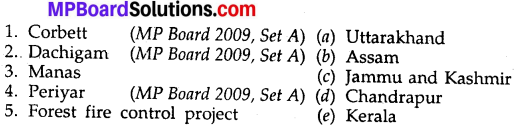
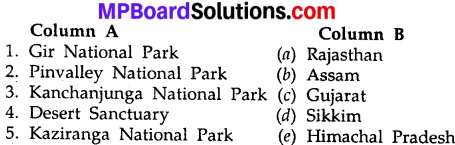
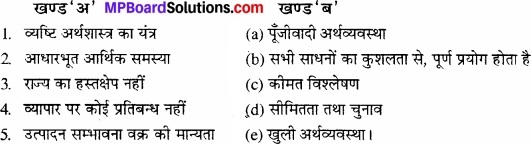
सही जोड़ी बनाइएखण्ड –
व्यष्टि अर्थशास्त्र एक परिचय MP Board Class 12th Economics IMPortant Questions Unit 1

  1. (c)
  2. (d)
  3. (a)
  4. (e)
  5. (b).

प्रश्न 5.
एक शब्द/वाक्य में उत्तर दीजिए –

  1. भारत में किस अर्थव्यवस्था को अपनाया गया है?
  2. उत्पादन संभावना वक्र मूल बिन्दु की ओर कैसा होता है?
  3. शोषण का सरकारीकरण किस अर्थव्यवस्था का दोष है?
  4. चुनावों की सूची बनाने वाला वक्र कौन – सा है?
  5. वर्ग संघर्ष किस अर्थव्यवस्था की विशेषता है?
  6. किस अर्थव्यवस्था में निजी क्षेत्र को सीमित कर दिया जाता है?
  7. पूँजीवाद की सभी संस्थाओं का हृदय किसे कहा जाता है?
  8. अर्थव्यवस्था की केन्द्रीय समस्याएँ क्या कहलाती हैं?
  9. प्राथमिकताओं के आधार पर उत्पादन क्षेत्र एवं उत्पादन की मात्रा का निर्धारण कौन करता है?

उत्तर:

  1. मिश्रित अर्थव्यवस्था
  2. नतोदर
  3. समाजवाद
  4. उत्पादन संभावना वक्र
  5. पूँजीवाद
  6. समाजवादी
  7. लाभ को
  8. आधारभूत कार्य
  9. केन्द्रीय नियोजन सत्ता.

व्यष्टि अर्थशास्त्र परिचय लघु उत्तरीय प्रश्न

प्रश्न 1.
समष्टि अर्थशास्त्र से क्या आशय है? इसकी दो विशेषताएँ लिखिए?
उत्तर:
समष्टि अर्थशास्त्र से आशय:
समष्टि अर्थशास्त्र, आर्थिक ज्ञान की वह शाखा है, जो संपूर्ण अर्थव्यवस्था एवं अर्थव्यवस्था से संबंधित बड़े योगों व औसतों का, उनके व्यवहार एवं पारस्परिक संबंधों का अध्ययन करती है। समष्टि अर्थशास्त्र की विशेषताएँ – समष्टि अर्थशास्त्र की निम्नलिखित दो विशेषताएँ हैं –

1. समष्टि अर्थशास्त्र की धारणा विस्तृत:
समष्टि अर्थशास्त्र की धारणा विस्तृत है। इसमें छोटी इकाइयों को महत्व नहीं दिया जाता, बल्कि इसकी सहायता से राष्ट्रीय एवं अंतर्राष्ट्रीय समस्या का हल निकाला जाता है। अतः समष्टि अर्थशास्त्र प्रावैगिक अर्थव्यवस्था को महत्व देता है।

2. विस्तृत विश्लेषण:
समष्टि अर्थशास्त्र में विस्तृत विश्लेषण को सर्वाधिक महत्व दिया जाता है। उदाहरण के लिए, समष्टि अर्थशास्त्र में सरकार की मौद्रिक एवं राजस्व की नीतियों का अध्ययन किया जाता है जो कि सामान्य प्रभावों को स्पष्ट करता है तथा इस तथ्य को नजर अंदाज कर दिया जाता है कि इन नीतियों का व्यक्तियों अथवा उद्योगों पर क्या प्रभाव पड़ेगा? यदि सार्वजनिक आय तथा सार्वजनिक व्यय का परस्पर प्रभाव समाज पर अच्छा पड़ रहा है, तो निष्कर्ष के रूप में यह कहा जा सकता है कि समाज में रहने वाले व्यक्ति पर इसका अच्छा प्रभाव पड़ेगा।

प्रश्न 2.
समष्टि अर्थशास्त्र के प्रकारों को स्पष्ट कीजिए?
उत्तर:
समष्टि अर्थशास्त्र के प्रमुख प्रकार निम्नलिखित हैं –

1. समष्टि आर्थिक स्थैतिकी:
समष्टि अर्थशास्त्र के अंतर्गत संपूर्ण अर्थव्यवस्था का अध्ययन किया जाता है; लेकिन समष्टि आर्थिक विश्लेषण इस तथ्य का विश्लेषण नहीं करता कि अर्थव्यवस्था संतुलन के बिन्दु पर किस प्रकार पहुँचती है। समष्टि स्थैतिक में जिस अंतिम संतुलन का अध्ययन किया जाता है, उसे प्रो. कीन्स के अनुसार, निम्नलिखित समीकरण की सहायता से स्पष्ट किया जा सकता है Y = C + I यहाँ, Y = कुल आय, C = कुल उपभोग व्यय एवं I = कुल विनियोग व्यय है।

2. तुलनात्मक समष्टि आर्थिक स्थैतिकी:
इसके अंतर्गत स्थैतिकी रीति द्वारा प्रावैगिक प्रक्रिया का अध्ययन किया जाता है। एक अर्थव्यवस्था के विभिन्न ‘समष्टि चर’ जैसे – कुल आय एवं कुल रोजगार आदि परिवर्तित होते रहते हैं। इसके परिणामस्वरूप अर्थव्यवस्था के साम्य बिन्दु भी परिवर्तित होते रहते हैं।

3. समष्टि आर्थिक प्रावैगिकी:
आर्थिक विश्लेषण की यह नवीनतम प्रणाली है। इसके अंतर्गत एक साम्य से दूसरे साम्य तक पहुँचने की संपूर्ण प्रक्रिया का अध्ययन किया जाता है। हालाँकि उच्च गणितीय प्रयोग के कारण यह जटिल प्रणाली है, किन्तु यह संपूर्ण अर्थव्यवस्था के प्रावैगिक चित्र को यथार्थ रूप में प्रस्तुत करती है।

प्रश्न 3.
आर्थिक समस्या क्या है? यह क्यों उत्पन्न होती है?
उत्तर:
अर्थव्यवस्था की आर्थिक समस्याओं का संबंध आबंटन की समस्या से है। साधन सीमित हैं एवं आवश्यकताएँ असीमित, यही कारण है कि दुर्लभ संसाधनों के उपयोगों में चुनाव की समस्या जन्म लेती है जिसमें साधनों के वैकल्पिक उपयोग से संसाधनों का कुशलतम एवं अधिकतम उपयोग किया जा सके आर्थिक समस्याएँ इसलिए उत्पन्न होती हैं क्योंकि प्रो. रॉबिन्स के अनुसार, मानव की इच्छाएँ एवं आवश्यकताएँ अनंत एवं असीमित होती हैं।

सभी आवश्यकताएँ पूर्ण हो जायें यह भी संभव नहीं होता है। इन आवश्यकताओं की पूर्ति के साधन अर्थात् धन सीमित होता है। इसीलिए साधनों के वैकल्पिक उपयोग किए जाते हैं ताकि इनका कुशलतम उपयोग किया जा सके। अतएव दुर्लभ साधनों का कुशलतम एवं सर्वोत्तम उपयोग करना आवश्यक है क्योंकि संसाधनों की दुर्लभता आर्थिक समस्या को जन्म देती है।

प्रश्न 4.
‘दुर्लभता ही केन्द्रीय समस्याओं की जननी है’, स्पष्ट कीजिए?
उत्तर:
यह कथन अक्षरशः
सही है कि साधनों की दुर्लभता है परन्तु इन दुर्लभ साधनों में से किनका चयन किया जाए यह समस्या जन्म लेती है। दुर्लभता ही चयन की समस्या का मूल कारण है। ये संसाधन दुर्लभ हैं परन्तु इनका वैकल्पिक उपयोग किया जा सकता है। इन संसाधनों से अधिकतम संतुष्टि प्राप्त करने के लिए व्यक्ति एवं समाज को संसाधनों के प्रयोग का चयन करना पड़ता है। इसीलिए ऐसा कहा जाता है कि दुर्लभता ही केन्द्रीय समस्याओं की जननी है।

प्रश्न 5.
सकारात्मक आर्थिक विश्लेषण क्या है? समझाइये?
उत्तर:
इस आर्थिक विश्लेषण के अन्तर्गत यह देखा जाता है कि मूल्य एवं माँग के सिद्धान्त के व्यवहार में क्रियाशीलता दिखाई दे रही है या नहीं अर्थात् मूल्य के बढ़ने से माँग की मात्रा कम हो रही है या नहीं तथा मूल्य के घटने से माँग की मात्रा में वृद्धि होती है या नहीं। यही सकारात्मक आर्थिक विश्लेषण कहलाता है।

प्रश्न 6.
आदर्शात्मक आर्थिक विश्लेषण से आप क्या समझते हैं?
उत्तर:
इस आर्थिक विश्लेषण में यह देखा जाता है कि जिन विधियों एवं तकनीकों का प्रयोग किया जाता है उसका प्रभाव समाज या अर्थव्यवस्था पर अच्छा पड़ रहा है या बुरा । उदाहरण के लिए, मादक पदार्थों की माँग को समाज हित में कम करने के लिए इन वस्तुओं पर करारोपण अधिक किया जा सकता है। आदर्शात्मक आर्थिक विश्लेषण सत्य – असत्य, उचित – अनुचित पर आधारित होता है।

प्रश्न 7.
उत्पादन संभावना वक्र की मान्यताएँ लिखिए?
उत्तर:
उत्पादन संभावना वक्र की प्रमुख मान्यताएँ निम्न प्रकार है –

  1. अर्थव्यवस्था में उपलब्ध संसाधनों की मात्रा निश्चित होती है।
  2. संसाधनों का पूर्ण एवं कुशलतम प्रयोग आवश्यक है।
  3. उत्पादन की तकनीक अर्थव्यवस्था में दी हुई होती है।
  4. अर्थव्यवस्था में केवल दो वस्तुओं का ही उत्पादन हो रहा है ऐसा यह नियम मानता है।
  5. उपलब्ध संसाधनों की कुशलता सभी वस्तुओं के उत्पादन में एक समान नहीं होती है।

प्रश्न 8.
अर्थव्यवस्था की उत्पादन संभावनाओं से आपका क्या अभिप्राय है?
उत्तर:
किसी अर्थव्यवस्था में आवश्यकता के अनुरूप एवं उपलब्ध संसाधनों के आधार पर संयोगों को निर्धारित करना होता है। जिन दो वस्तुओं के संयोग को चुना जाता है वही अर्थव्यवस्था के उत्पादन की संभावनाएँ कहलाती हैं। यह उत्पादन संभावना वक्र से निर्धारित की जाती है।

प्रश्न 9.
सीमान्त उत्पादन संभावना किसे कहते हैं?
उत्तर:
सीमान्त उत्पादन संभावना से अभिप्राय उस लागत से है जो एक अतिरिक्त इकाई उत्पादित करने की अवसर लागत है। अंतिम वस्तु की लागत की संभावना सीमान्त कहलाती है।

प्रश्न 10.
किसी विद्यालय में कार्यरत् शिक्षक विश्वविद्यालय से डॉक्टर ऑफ फिलॉसफी की उपाधि प्राप्त करने के लिए दो वर्षों के अध्ययन अवकाश पर जाता है। उस शिक्षक की मासिक आय ₹35,200 है। शोध उपाधि शुल्क ₹40,000 है। उस शिक्षक की डॉक्टरेट डिग्री प्राप्त करने की अवसर लागत क्या होगी?
उत्तर:
अवसर लागत = (35,200  x  12  x  2) + 40,000 = (35,200 x 24) + 40,000 = ₹ 8,84,800

प्रश्न 11.
उत्पादन संभावना वक्र नीचे की ओर ढाल क्यों होता है?
उत्तर:
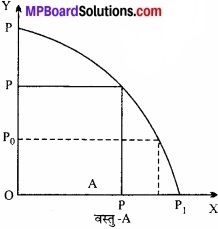
किसी अर्थव्यवस्था में पूर्ण रोजगार की दशा में संसाधनों का कुशलतम उपयोग किसी एक वस्तु के उत्पादन की मात्रा को बढ़ाता है तो दूसरी वस्तु की उत्पादन मात्रा को कम करता. है। जब अर्थव्यवस्था के सभी संसाधनों का कुशलतम एवं पूर्ण उपयोग किया जा रहा हो तो दोनों वस्तुओं के उत्पादन में एक साथ वृद्धि करना संभव नहीं होता है। एक वस्तु के उत्पादन की मात्रा को घटाकर ही दूसरी वस्तु के उत्पादन में वृद्धि की जा सकती है। यही कारण है कि उत्पादन संभावना वक्र का झुकाव बाएँ से दाहिने ओर ढाल होता है। यह इस चित्र से और अधिक स्पष्ट किया जा सकता है।
व्यष्टि अर्थशास्त्र परिचय MP Board Class 12th Economics IMPortant Questions Unit 1

प्रश्न 12.
उत्पादन संभावना वक्र नतोदर क्यों होता है?
उत्तर:
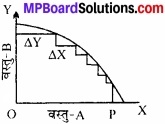
सामान्यतया उत्पादन संभावना वक्र मूल बिन्दु के नतोदर होता है। यह स्थिति उसके ढलान बढ़ने के कारण निर्मित होती है। ढलान के बढ़ने का अर्थ है सीमांत अवसर लागत में वृद्धि। जैसे – जैसे संसाधनों को एक वस्तु के उत्पादन से दूसरे वस्तु के उत्पादन में स्थानांतरित किया जाता है। इसकी वजह से Y वस्तु के उत्पादन को हानि के रूप में X वस्तु की प्रत्येक अतिरिक्त इकाई के उत्पादन की अवसर लागत में वृद्धि की प्रवृत्ति होती है। ऐसा इस कारण होता है कि संसाधनों का प्रयोग विशिष्ट तौर पर ही किया जा सकता है।

उदाहरण के लिए, यदि किसी राज्य में आम की उत्पादकता अधिक होती है तो जरूरी नहीं कि किसी अन्य राज्य में भी आम की खेती अधिक हो। हो सकता है दूसरे राज्य में Y, गन्ने की खेती एवं उसका उत्पादन अधिक हो। अत: यह आवश्यक नहीं है कि जो AY व्यक्ति चावल उत्पादन में सक्षम हो वह व्यक्ति मशीन उत्पादन में भी निपुण होगा।

चित्र से स्पष्ट हो रहा है कि प्रत्येक स्तर पर सीमांत अवसर लागत या बढ़ती रूपांतरण की सीमांत दर अर्थात् \(\frac { \triangle Y }{ \triangle X } \) लगातार बढ़ रही है। यही कारण है कि बढ़ती हुई सीमांत अवसर लागत की वजह से उत्पादन संभावना वक्र मूल बिन्दु के नतोदर होता है।
समष्टि अर्थशास्त्र के दोष MP Board Class 12th Economics IMPortant Questions Unit 1

प्रश्न 13.
अर्थशास्त्र में किस वस्तु का अध्ययन किया जाता है?
उत्तर:
किसी अर्थव्यवस्था में विषय-वस्तु क्या हो यह अत्यंत महत्वपूर्ण प्रश्न है। वास्तव में यह विषयवस्तु इतनी अधिक व्यापक होती है कि अर्थव्यवस्था को यह निर्णय करना होता है कि उपलब्ध संसाधनों का अधिकतम एवं कुशलतम उपयोग हो। दुर्लभ संसाधनों का विवेकपूर्ण उपयोग पर आधारित होता है किसी अर्थव्यवस्था का अध्ययन। किसी भी अर्थव्यवस्था का अंतिम लक्ष्य अधिकतम आर्थिक कल्याण होता है। किसी भी अर्थव्यवस्था में जिन आर्थिक प्रणालियों के द्वारा अध्ययन किया जाता है वे व्यष्टि एवं समष्टि पर आधारित होती हैं।

व्यष्टि अर्थशास्त्र के अंतर्गत उपभोक्ता सिद्धान्त, उत्पादक व्यवहार सिद्धान्त, कीमत निर्धारण, कल्याणकारी अर्थशास्त्र तथा समष्टि अर्थशास्त्र के अंतर्गत राष्ट्रीय आय तथा रोजगार, राजकोषीय और मौद्रिक नीतियाँ, मुद्रास्फीति एवं अपस्फीति, सरकारी बजट, विनिमय दर एवं भुगतान संतुलन का अध्ययन किया जाता है।

व्यष्टि अर्थशास्त्र परिचय दीर्घ उत्तरीय प्रश्न

प्रश्न 1.
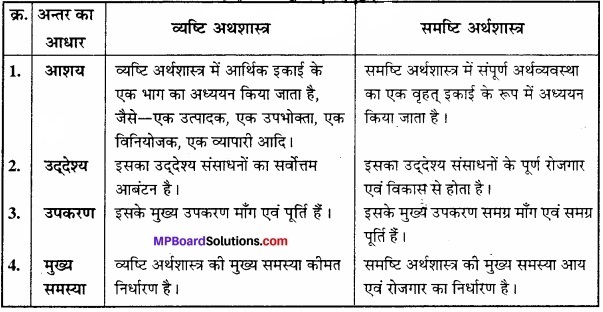
व्यष्टि एवं समष्टि अर्थशास्त्र में अंतर स्पष्ट कीजिए?
उत्तर:
व्यष्टि एवं समष्टि अर्थशास्त्र में अंतर:
एमपी बोर्ड अर्थशास्त्र MP Board Class 12th Economics IMPortant Questions Unit 1

प्रश्न 2.
व्यष्टि अर्थशास्त्र का अर्थ बताते हुए इसकी विशेषताएँ लिखिए?
उत्तर:
व्यष्टि अर्थशास्त्र का अर्थ:
व्यष्टि अर्थशास्त्र अंग्रेजी भाषा के शब्द ‘माइक्रो’ (micro), ग्रीक भाषा के शब्द ‘माइक्रोस’ (micros) का हिन्दी रूपान्तरण है। व्यष्टि से अभिप्राय है – अत्यंत छोटी इकाई, दस लाखवाँ भाग, अर्थात व्यष्टि अर्थशास्त्र का संबंध अध्ययन की सबसे छोटी इकाई से है।

इस प्रकार, व्यष्टि अर्थशास्त्र के अंतर्गत वैयक्तिक इकाइयों जैसे – व्यक्ति, परिवार, उत्पादक फर्म उद्योग आदि का अध्ययन किया जाता है। प्रो. चेम्बरलिन के अनुसार, “व्यष्टि अर्थशास्त्र पूर्णरूप से व्यक्तिगत व्याख्या पर आधारित है और इसका संबंध अंतर – वैयक्तिक संबंधों से भी होता है।” व्यष्टि अर्थशास्त्र की विशेषताएँ:

व्यष्टि अर्थशास्त्र की निम्नलिखित विशेषताएँ हैं –

1. वैयक्तिक इकाइयों का अध्ययन:
व्यष्टि अर्थशास्त्र में वैयक्तिक इकाइयों का ही अध्ययन किया जाता है। व्यष्टि अर्थशास्त्र वैयक्तिक आय, वैयक्तिक उत्पादन एवं वैयक्तिक उपभोग आदि की व्याख्या करने में सहायता करता है। यह प्रणाली अपना संबंध समूहों से न रखकर इकाइयों से रखती है। इस प्रकार व्यष्टि अर्थशास्त्र वैयक्तिक समस्याओं का अध्ययन करते हुए समस्त अर्थव्यवस्था के विश्लेषण में सहायता प्रदान करता है।

2. सूक्ष्म चरों का अध्ययन:
सूक्ष्म अर्थशास्त्र की दूसरी विशेषता के रूप में यह छोटे – छोटे चरों का अध्ययन करती है। इसके चरों का प्रभाव इतना कम है कि इसके परिवर्तनों का प्रभाव संपूर्ण अर्थव्यवस्था पर नहीं पड़ता है। उदाहरण के लिए – एक उपभोक्ता अपने उपभोग, एक उत्पादक अपने उत्पादन से संपूर्ण अर्थव्यवस्था की माँग पूर्ति को प्रभावित नहीं कर सकता है।

3. व्यक्तिगत मूल्य का निर्धारण:
व्यष्टि अर्थशास्त्र को कीमत सिद्धांत अथवा मूल्य सिद्धांत के नाम से भी जाना जाता है। इसके अंतर्गत वस्तु की माँग एवं पूर्ति की घटनाओं का अध्ययन किया जाता है। इसके साथ-साथ माँग एवं पूर्ति के द्वारा विभिन्न वस्तुओं के व्यक्तिगत मूल्य – निर्धारण भी किये जाते हैं।

4. पूर्ण रोजगार की मान्यता पर आधारित:
व्यष्टि अर्थशास्त्र पूर्ण रोजगार की मान्यता को लेकर चलता है।

प्रश्न 3.
सूक्ष्म अर्थशास्त्र (व्यष्टि अर्थशास्त्र) के पाँच महत्व बताइए?
उत्तर:
सूक्ष्म अर्थशास्त्र के महत्व निम्नलिखित हैं –

1. संपूर्ण अर्थव्यवस्था के लिए आवश्यक:
यदि हम संपूर्ण अर्थव्यवस्था के स्वरूप की जानकारी प्राप्त करना चाहते हैं तो हमें व्यक्तिगत इकाइयों की जानकारी हासिल करना आवश्यक है, क्योंकि व्यक्तिगत माँग, व्यक्तिगत उत्पादन के संयोग से ही सामूहिक माँग और सामूहिक पूर्ति से संबंधित जानकारी हासिल की जा सकती है।

जैसे कि सूती वस्त्र उद्योग की क्या स्थिति है, इससे संबंधित जानकारी ज्ञात करनी है तो हमें सबसे पहले सूती वस्त्र की फर्मों की जानकारी हासिल करनी होगी तभी हमें सती वस्त्र उद्योग की स्थिति के बारे में जानकारी मिलेगी। इस प्रकार व्यष्टि अर्थशास्त्र की सहायता से समष्टि अर्थशास्त्र की समस्याओं का अध्ययन किया जाता है।

2. आर्थिक समस्याओं के निर्णय में सहायक:
व्यष्टि अर्थशास्त्र आर्थिक समस्याओं के निर्णय में सहायक होता है। आर्थिक समस्याओं में मूल्य निर्धारण एवं वितरण की समस्या प्रमुख होती है। उत्पत्ति का प्रत्येक साधन अधिकाधिक पारिश्रमिक प्राप्त करना चाहता है। इसी तरह वस्तु के मूल्य निर्धारण की समस्या भी है। इन समस्त समस्याओं के निर्णय के लिए व्यष्टि अर्थशास्त्र उपयोगी रहा है।

3. आर्थिक नीति के निर्धारण में सहायक:
व्यष्टि अर्थशास्त्र का आर्थिक नीतियों के निर्धारण में महत्वपूर्ण स्थान है। व्यष्टि अर्थशास्त्र के अंतर्गत सरकार की आर्थिक नीतियों का अध्ययन इस आधार पर किया जाता है, कि उनका व्यक्तिगत इकाइयों के कार्यकरण पर कैसा प्रभाव पड़ता है।

4. आर्थिक कल्याण की पूर्ति का निरीक्षण:
व्यष्टि अर्थशास्त्र में जहाँ व्यक्तिगत उपभोग, व्यक्तिगत रहन-सहन के स्तर की जानकारी प्राप्त की जाती है, वहीं सार्वजनिक व्यय एवं सार्वजनिक आय के प्रभावों की भी जानकारी प्राप्त की जाती है।

5. व्यक्तिगत इकाइयों के आर्थिक निर्णय में सहायक:
व्यष्टि अर्थशास्त्र, व्यक्तिगत इकाइयों (जैसेफर्म, परिवार, व्यक्तिगत आय, व्यक्तिगत बचत आदि) की समस्याओं पर उचित निर्णय लेने में सहायता प्रदान करता है।

प्रश्न 4.
व्यापक अर्थशास्त्र की क्या सीमाएँ हैं? अथवा समष्टि अर्थशास्त्र के दोष लिखिए?
उत्तर:
समष्टि अर्थशास्त्र की सीमाएँ या दोष निम्नानुसार हैं –

1. समूह की संरचना को महत्व न देना:
समष्टि अर्थशास्त्र के अन्तर्गत, समूह के आकार – प्रकार का ही अध्ययन किया जाता है, न कि समूह की संरचना का। अत: समूह के आधार पर भविष्यवाणियाँ करना अथवा सुझाव देना, तब तक सही नहीं है जब तक समूह की बनावट एवं उसके अंगों के स्वभाव तथा परस्पर सम्बन्ध की समस्त जानकारी हासिल न कर ली जाये।

2. वैयक्तिक इकाई महत्वहीन:
समष्टि अर्थशास्त्र के अन्तर्गत, वैयक्तिक इकाइयों की तलना में सम्पूर्ण अर्थव्यवस्था का अध्ययन किया जाता है लेकिन ऐसा करने से एक दोष उत्पन्न हो जाता है कि जिन छोटी-छोटी आर्थिक इकाइयों के योग से सम्पूर्ण अर्थव्यवस्था की दीवार खड़ी की गयी है, उनके महत्व एवं अस्तित्व की उपेक्षा कर दी जाती है जो सर्वथा अनुचित है।

3. निष्कर्षों का व्यावहारिक न होना:
समष्टि अर्थशास्त्र में सम्पूर्ण मात्राओं का अध्ययन किया जाता है, लेकिन समूह के आर्थिक विश्लेषण के आधार पर निर्मित नीतियाँ कभी – कभी गलत परिणाम दे देती हैं।

4. समूह की इकाइयाँ, वैयक्तिक इकाइयों का सही प्रतिनिधित्व नहीं कर सकती हैं:
समष्टि अर्थशास्त्र की अंतिम सीमा यह है कि समूह की इकाइयाँ वैयक्तिक इकाइयों का सही प्रतिनिधित्व नहीं कर सकती हैं।

5. जटिल विश्लेषण:
सैद्धांतिक दृष्टिकोण से समष्टि आर्थिक विश्लेषण सरल लगता है किन्तु व्यावहारिक दृष्टिकोण से यह विश्लेषण बहुत जटिल होता है। सम्पूर्ण अर्थव्यवस्था के समूहों अथवा योगों का अध्ययन एवं विश्लेषण बहुत जटिल कार्य होता है।

प्रश्न 5.
समष्टि अर्थशास्त्र के महत्व के कोई पाँच बिन्दु स्पष्ट कीजिए?
अथवा
समष्टि अर्थशास्त्र के कोई पाँच गुण लिखिए?
उत्तर:
समष्टि अर्थशास्त्र के महत्व या गुण निम्नानुसार हैं –

1. जटिल समस्याओं के अध्ययन में सहायक:
आधुनिक अर्थव्यवस्था अत्यन्त जटिल है। अनेक आर्थिक तत्व एक-दूसरे पर आश्रित रहते हैं। समष्टि अर्थशास्त्र के विश्लेषण की सहायता से पूर्ण रोजगार, व्यापार चक्र आदि जटिल समस्याओं का अध्ययन हो जाता है।

2. आर्थिक नीतियों के निर्माण में सहायक:
सरकार का प्रमुख कार्य कुल रोजगार, कुल आय, कीमत स्तर, व्यापार के सामान्य स्तर आदि पर नियंत्रण करना होता है। समष्टि अर्थशास्त्र सरकार को आर्थिक नीतियों के निर्माण में सहायता पहँचाता है।

3. व्यष्टि अर्थशास्त्र के अध्ययन में सहायक:
समष्टि अर्थशास्त्र का अध्ययन व्यष्टि अर्थशास्त्र के अध्ययन में सहायक है क्योंकि व्यक्तिगत इकाइयाँ अपने विश्लेषण में समष्टि अर्थशास्त्र की सहायता लेती हैं।

4. आर्थिक विकास का अध्ययन:
समष्टि अर्थशास्त्र के अन्तर्गत अर्थव्यवस्था के आर्थिक विकास के संसाधनों एवं क्षमताओं का मूल्यांकन किया जाता है। राष्ट्रीय आय उत्पादन एवं रोजगार के स्तर में वृद्धि करने के लिए योजनाएँ बनायी तथा कार्यान्वित की जाती हैं ताकि अर्थव्यवस्था का बहुमुखी विकास हो सके।

5. मुद्रा – मूल्य के निर्धारण में सहायक:
मुद्रा के मूल्य निर्धारण के सिद्धान्त की व्याख्या समष्टि अर्थशास्त्र में ही की जाती है क्योंकि इसमें मुद्रा – मूल्य के परिवर्तनों के सम्पूर्ण समाज पर पड़ने वाले प्रभावों की व्याख्या की जाती है।

प्रश्न 6.
व्यष्टि अर्थशास्त्र की कोई पाँच सीमाएँ लिखिए?
अथवा
व्यष्टि अर्थशास्त्र के पाँच दोष लिखिए?
उत्तर:
व्यष्टि अर्थशास्त्र की सीमाएँ या दोष निम्नानुसार हैं –

1. केवल व्यक्तिगत इकाइयों का अध्ययन:
व्यष्टि अर्थशास्त्र में केवल व्यक्तिगत इकाइयों का ही अध्ययन किया जाता है। इस विश्लेषण में राष्ट्रीय अथवा विश्वव्यापी अर्थव्यवस्था का सही – सही ज्ञान प्राप्त नहीं हो पाता।

2. अवास्तविक मान्यताएँ:
व्यष्टि अर्थशास्त्र अवास्तविक मान्यताओं जैसे – पूर्ण रोजगार, पूर्ण प्रतियोगिता व दीर्घकाल पर आधारित है। इसलिए काल्पनिक भी कहा जाता है।

3. व्यष्टि निष्कर्ष समग्र अर्थव्यवस्था के लिए अनुपयुक्त:
व्यष्टि अर्थशास्त्र व्यक्तिगत इकाइयों के अध्ययन के आधार पर निर्णय लेता है, लेकिन व्यवहार में कुछ धारणाएँ ऐसी होती हैं जिन्हें समूहों पर लागू करने से गलत निष्कर्ष निकलता है।

4. संकुचित अध्ययन:
कुछ आर्थिक समस्याएँ ऐसी होती हैं जिसका अध्ययन व्यष्टि अर्थशास्त्र में नहीं हो सकता है, जैसे – मौद्रिक नीति, राष्ट्रीय आय, रोजगार, राजकीय नीति, विदेशी विनिमय आदि।

5. अव्यावहारिक:
व्यष्टि अर्थशास्त्र के अधिकांश नियम एवं सिद्धान्त पूर्ण रोजगार की मान्यता पर आधारित है, लेकिन जब पूर्ण रोजगार की मान्यता ही अव्यावहारिक है, तो इस पर बने समस्त नियम एवं सिद्धान्त भी अव्यावहारिक ही कहे जायेंगे।

प्रश्न 7.
अवसर लागत क्या है? उदाहरण सहित समझाइये?
उत्तर:
अवसर लागत दो अवसरों में दूसरे अवसर की हानि के रूप में पहले अवसर का लाभ उठाने की लागत है। अवसर लागत वास्तव में किसी साधन के उसके दूसरे सर्वश्रेष्ठ प्रयोग मूल्य को कहा जाता है। उदाहरण के लिए, एक ड्राइवर ट्रक भी चला सकता है एवं कार भी चला सकता है। इनमें से वर्तमान ट्रक ड्राइवर को बनाए रखने के लिए यदि वह कार ड्राइवरी की नौकरी का परित्याग करता है तो इसे अवसर लागत कहते हैं। वास्तव में अवसर लागत, साधन लागत के ऊपर एक बचत है।

एक अन्य उदाहरण के अनुसार, हाई स्कूल परीक्षा पास करने के बाद कक्षा 11वीं में विषय चयन के समय वाणिज्य विषय को चुनता है तो विज्ञान तथा कला विषयों का उसे त्याग करना पड़ेगा। यहाँ पर विज्ञान तथा कला विषय, वाणिज्य विषय चुनने की अवसर लागत है।

एक अन्य उदाहरणानुसार, एक उच्च शिक्षित व्यक्ति एम.कॉम. उत्तीर्ण करने के बाद शिक्षक बनकर ₹ 50,000, पुस्तकों का लेखन कार्य करके ₹ 60,000 एवं अर्थशास्त्री बनकर ₹ 80,000 अर्जित कर सकता है। यदि वह अर्थशास्त्री बनना चाहता है तो उसे शिक्षक बनने के अवसर का परित्याग करना पड़ेगा। उसकी अवसर लागत ₹ 60,000 है क्योंकि यही दूसरा सर्वश्रेष्ठ विकल्प उसके पास उपलब्ध है। उदाहरण के लिए, विद्यार्थी का C.A. के लिए बी.कॉम. छोड़ना।

प्रश्न 8.
उत्पादन संभावना वक्र क्या है? एक उदाहरण देकर समझाइए?
उत्तर:
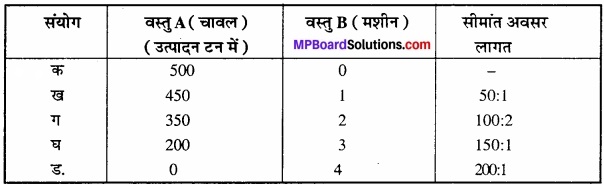
दो वस्तुओं के उन सभी संभव संयोगों को जिनका उपयोग किसी अर्थव्यवस्था में उपलब्ध तकनीक एवं संसाधनों के पूर्ण एवं कुशलतम उपयोग पर निर्भर करता है, उत्पादन संभावना वक्र कहलाता है। उदाहरणसीमित संसाधनों एवं उपलब्ध तकनीकों के आधार पर काल्पनिक उदाहरण द्वारा उत्पादन संभावना को प्रदर्शित किया जा सकता है।
MP Board Class 12th Economics Important Questions Unit 1 व्यष्टि अर्थशास्त्र परिचय img 5
संसाधनों की सीमितता के कारण अर्थव्यवस्था में संसाधनों का पूर्ण उपयोग तभी संभव है जब एक वस्तु का उत्पादन बढ़ाने के लिए दूसरी वस्तु का उत्पादन कम किया जाए। सारणी से स्पष्ट है कि यदि मशीनों का उत्पादन शून्य है तो चावल का उत्पादन 500 टन होगा।

जैसे ही मशीनों का उत्पादन 1 से बढ़कर 2 किया जाएगा। चावल का उत्पादन 500 टन से घटाकर 450 टन हो जाएगा। यदि सभी संसाधनों को मशीनों के उत्पादन पर लगा दिया जाय तो इससे मशीनों का उत्पादन तो 4 हो जाएगा किन्तु चावल का उत्पादन शून्य हो जाएगा। अत: उचित संयोग बनाकर उत्पादन किया जाता है।

प्रश्न 9.
सीमान्त अवसर लागत से आप क्या समझते हैं? एक काल्पनिक अनुसूची की सहायता से समझाइये?
उत्तर:
सीमान्त अवसर लागत का आशय X एवं Y वस्तुओं में X की प्रत्येक अतिरिक्त इकाई के लिए Y वस्तु के उत्पादन का परित्याग है। सीमान्त अवसर लागत को रूपान्तरण की सीमान्त दर भी कहा जाता है। बीजगणितीय समीकरण की सहायता से इसे निम्न प्रकार स्पष्ट किया जा सकता है –
सीमान्त अवसर लागत = \(\frac { -\triangle Y }{ \triangle X } \)
यहाँ पर,
∆Y = वस्तु के उत्पादन में वृद्धि
∆X = X वस्तु के उत्पादन में वृद्धि
उपर्युक्त को निम्न अनुसूची से अधिक स्पष्ट किया जा सकता है:
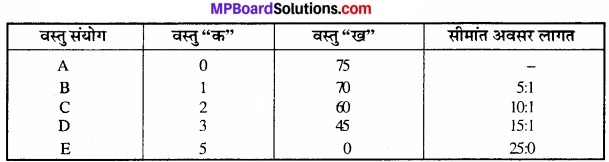
MP Board Class 12th Economics Important Questions Unit 1 व्यष्टि अर्थशास्त्र परिचय img 6
उपर्युक्त अनुसूची से स्पष्ट है कि A से B पर जाने के लिए उसे वस्तु ‘ख’ की पाँचों इकाइयों का परित्याग करके वस्तु ‘क’ की एक इकाई उत्पादित करनी पड़ रही है। इसी प्रकार B से C जाने के लिए उसे वस्तु “ख” की दस इकाइयों का परित्याग करके “क” वस्तु की एक इकाई का उत्पादन करना पड़ेगा। संयोग E के पश्चात Fतक पहुँचने के लिए यह दर 25:0 हो गई है। इससे सिद्ध होता है कि उत्पादन संभावना वक्र को रूपांतरण वक्र या सीमान्त अवसर लागत या रूपांतरण की सीमान्त दर भी कहा जा सकता है।

प्रश्न 10.
“व्यष्टि एवं समष्टि अर्थशास्त्र एक – दूसरे के प्रतियोगी नहीं बल्कि पूरक हैं।” इस कथन को तर्क देकर सिद्ध कीजिए?
उत्तर:
व्यष्टि एवं समष्टि अर्थशास्त्र एक – दूसरे के पूरक हैं, क्योंकि:

(I) समष्टि आर्थिक विश्लेषण में व्यष्टि आर्थिक विश्लेषण की आवश्यकता:
समष्टि आर्थिक विश्लेषण के लिए व्यष्टि आर्थिक विश्लेषण अतिआवश्यक है क्योंकि

1. सम्पूर्ण अर्थव्यवस्था का अध्ययन करने के लिए उसके संबंध में नीति का निर्धारण करने के लिए हमें व्यक्तिगत इकाइयों का विश्लेषण करना पड़ता है। जब तक व्यक्तिगत इकाइयों के बारे में सही – सही जानकारी प्राप्त नहीं होती है, तब तक समष्टि आर्थिक विश्लेषण सही नहीं हो सकते।

2. यदि समाज में रहने वाले लोगों द्वारा अधिकाधिक वस्तुओं की माँग की जाती है तो यह समझा जाता है कि फर्म माँग बढ़ने के कारण उत्पादन बढ़ायेगी, किन्तु जिन फर्मों की उत्पादन लागत में वृद्धि हो रही हो, उन फर्मों के लिए अधिक कीमत पर भी उत्पादन में वृद्धि करना संभव नहीं होगा।

3. सम्पूर्ण अर्थव्यवस्था की सामान्य प्रवृत्ति की सही-सही जानकारी तभी प्राप्त हो सकती है जब हमें तथ्यों एवं सिद्धान्तों का ज्ञान हो।

(II) व्यष्टि आर्थिक विश्लेषण में समष्टि आर्थिक विश्लेषण की आवश्यकता:
व्यष्टि आर्थिक विश्लेषण के लिए समष्टि आर्थिक विश्लेषण अति आवश्यक है क्योंकि:

  1. किसी भी फर्म को अपने उत्पादन की मात्रा निश्चित करते समय समाज की सम्पूर्ण माँग, समाज की क्रयशक्ति, रोजगार स्तर एवं आय के स्तर जैसी बातों को ध्यान में रखना पड़ता है।
  2. कोई फर्म कितना माल विक्रय कर सकेगी, यह इस बात पर निर्भर करेगा कि समाज में लोगों की क्रयशक्ति कितनी है।
  3. प्रायः एक व्यक्तिगत उत्पादन के उत्पत्ति के साधनों की मजदूरी का निर्धारण व्यष्टि अर्थशास्त्र के अन्तर्गत किया जाना चाहिए, किन्तु व्यवहार में ऐसा नहीं होता। इसके लिए अन्य संबंधित तथ्यों को अध्ययन करना आवश्यक होगा।

प्रश्न 11.
एक अर्थव्यवस्था में बेरोजगारी के कारण उत्पादन, क्षमता से कम हो रहा है। सरकार रोजगारोन्मुखी योजनाएँ प्रारंभ करती है। उत्पादन संभावना वक्र की सहायता से इसके प्रभाव की व्याख्या कीजिए?
उत्तर:
सरकार द्वारा रोजगारोन्मुखी योजनाएँ प्रारंभ करने के पूर्व अर्थव्यवस्था उत्पादन संभावना वक्र से नीचे थी। सरकारी योजनाओं के लागू होने के बाद यदि श्रमिकों को रोजगार उपलब्ध कराया जाता है और मजदूरों को X वस्तु के उत्पादन में लगाया जाता है तो उत्पादन संभावना वक्र चित्रानुसार U से A की ओर जायेगा।

परन्तु यदि इन्हीं श्रमिकों को Y वस्तु के उत्पादन पर लगाया जाता है तो यही वक्र U से B पर चला जाएगा। अब सरकार दोनों वस्तुओं के उत्पादन पर श्रमिकों को कार्य पर लगाती है तो उत्पादन संभावना वक्र A से B के मध्य दिखाई – देगा जैसा कि चित्र में बिन्दु C को दर्शाया गया है।
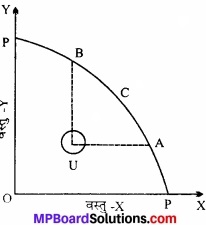
MP Board Class 12th Economics Important Questions Unit 1 व्यष्टि अर्थशास्त्र परिचय img 7

प्रश्न 12.
समष्टि अर्थशास्त्र की विषय-सामग्री को समझाइये?
अथवा
समष्टि अर्थशास्त्र के क्षेत्रों का वर्णन कीजिए?
उत्तर:
समष्टि अर्थशास्त्र की विषय सामग्री-इसकी विषय – सामग्री निम्नलिखित हैं –

1. आय तथा रोजगार का निर्धारण:
आय तथा रोजगार का निर्धारण समष्टि अर्थशास्त्र की मुख्य विषय सामग्री है। आय एवं रोजगार का स्तर प्रभावपूर्ण माँग पर निर्भर करता है। प्रभावपूर्ण माँग कुल व्यय (उपभोग व्यय, विनियोग व्यय एवं सरकारी व्यय) द्वारा निर्धारित होती है।

2. सामान्य कीमत स्तर एवं स्फीति का विश्लेषण:
मुद्रा – स्फीति के कारण उत्पन्न स्फीतिक कीमत वृद्धि वर्तमान विश्व की सबसे कष्टदायक आर्थिक बीमारी है। विकसित एवं अर्द्ध – विकसित दोनों तरह की अर्थव्यवस्थाएँ इससे पीड़ित हैं। प्रो. कीन्स के आर्थिक विश्लेषण के बाद स्फीतिक कीमत वृद्धि का अध्ययन समष्टि अर्थशास्त्र का महत्वपूर्ण अंग बन गया है।

3. आर्थिक विकास के सिद्धांत:
आर्थिक विकास का अर्थशास्त्र, समष्टि अर्थशास्त्र की एक महत्वपूर्ण शाखा है। द्वितीय महायुद्ध के पश्चात् विश्व के अनेक देशों को गुलामी से स्वतंत्रता प्राप्त हुई। इन नवोदित राष्ट्रों में आर्थिक विकास की समस्या को आर्थिक नियोजन की सहायता से हल करने का प्रयत्न किया जा रहा है।

4. वितरण का समष्टि सिद्धांत:
वितरण की अनेक समस्याओं जैसे – कुल राष्ट्रीय आय में उत्पादन के विभिन्न साधनों का पारिश्रमिक कितना है तथा उनमें कुल आय का वितरण किस प्रकार किया जाता है, यह समष्टि अर्थशास्त्र के सिद्धांतों का मुख्य विषय है।

5. राजस्व का सिद्धांत:
राजस्व के अनेक सिद्धांत जैसे – अंतर्राष्ट्रीय व्यापार के सिद्धांत एवं आर्थिक नियोजन के सिद्धांत भी समष्टि अर्थशास्त्र के विषय हैं।

प्रश्न 13.
बाजार अर्थव्यवस्था एवं केन्द्रीयकृत योजनाबद्ध अर्थव्यवस्था में अन्तर स्पष्ट कीजिए?
उत्तर:
बाजार अर्थव्यवस्था एवं केन्द्रीयकृत योजनाबद्ध अर्थव्यवस्था में अंतर –
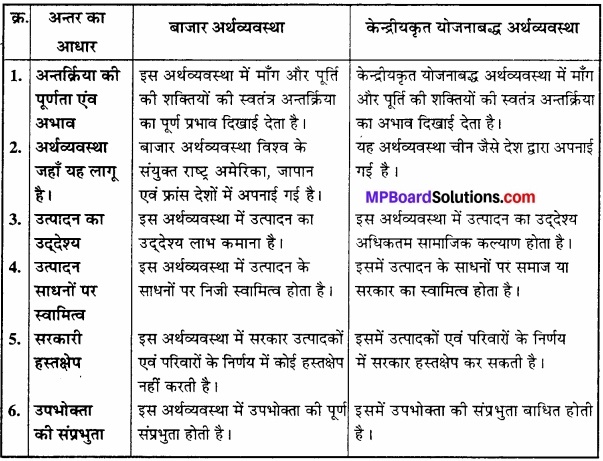
MP Board Class 12th Economics Important Questions Unit 1 व्यष्टि अर्थशास्त्र परिचय img 8

MP Board Class 12th Economics Important Questions

MP Board Class 8th Social Science Solutions Chapter 5 Our National Goals (a) Achievement of National Goals (b) Democracy and Citizen

MP Board Class 8th Social Science Solutions Chapter 5 Our National Goals (a) Achievement of National Goals (b) Democracy and Citizen

MP Board Class 8th Social Science Chapter 5 Text Book Exercise

Choose the correct option of the following

MP Board Class 8 Social Science Solution Chapter 5 Question 1.
Our national goals?
(a) Democracy
(b) Kingship
(c) imperialism
(d ) Dictatorship
Answer:
(a) Democracy

Our National Goal Is Question 2.
Who said need peace in the world?
(a) Sardar vallab bai Patel
(b) Pandit Jawaharlal Nehru
(c) Lal Baliadur Shastre.
(d) Mahatma Gandhi
Answer:
(b) Pandit Jawaharlal Nehru

MP Board Class 8 Social Science Chapter 5 Question 3.
Why is disarmament a must?
(a) for the world peace
(b) for war
(c) for forming government
(d) for atomic arms
Answer:
(a) for the world peace

Our National Goals Class 8 Question 4.
Voting on the basis of caste and religion makes democracy ?
(a) Strong
(b) weak
(c) Protects our rights
(d) All the above
Answer:
(b) weak

Our National Goals Question 5.
Age is fixed for Adult Franchise?
(a) 14 years
(b) 18 years
(c) 21 years
(d) 25 years
Answer:
(b) 18 years

Fill up the blanks:

  1. in the constitution total …………… Fundamental rights, have been conferred
  2. Democracy is the rule by…………
  3. There is freedom of ………….. in secularism
  4. Non-Alignment means to be ……………… from armed lobbies
  5. Democracy , chief factors are ……………. equality and ………..

Answers:

  1. Six
  2. people
  3. religion
  4. separation
  5. Democracy Freedom


MP Board Class 8th Social Science Chapter 5 very Short Answer Type Questions

Class 8 Social Science Chapter 5 Our National Goals Question 1.
Answer:
Individual freedom civil freedom. political economic, social and Religious freedom

Democracy Is The Rule Of Class 8 Question 2.
Write meaning of equality
Answer:
The equal opportunity being made available by the state for all development of citizen is called equality

Our National Goal Is Answer Question 3.
What is representative democracy?
Answer:
The democracy in which the people elect their representative to form govt is Know representative democracy

Make A Chart Of Key Points Of National Goals Question 4.
Why each citizen should be literate in democracy
Answer:
So that they can make use of their voting rights correctly


MP Board Class 8th Social Science Chapter 5 Short Answer Type Questions

Key Points Of National Goals Question 1.
Define Adult Franchise.
answer:
Indian constitution has provided voting right to the citizens Every citizen who has attained the age of 18 has the right to vote This right is available to all this is Adult Franchise.

Our National Goal Question 2.
What are our national goals
Answer:
National goals are defined and deter-mused. There are necessary for path of progress The national goals are democracy socialism Secularism and Internationale peace.

Our National Goal Is Democracy Question 3.
Write the true meaning of just-ire
Answer:
The justice indicates about correct genuine and logical facts Justice is that state in democratic society where individual rights are protected and law and order is maintained in the Society.


MP Board Class 8th Social Science Chapter 5 Long Answer Type Questions 

Question 1.
Why International peace and cooperation are important?
Answer:
International peace and co-operation is necessary for the citizens of the country. This works for the welfare of the people. This reduces arms and ammumitions procurement. The country can spend the major part of resources on social and economic developments. The progress and prosperity of the country depends upon the international peace and co-operation

Question 2.
What are the conditions required for the success of democracy?
Answer:
In a democratic system, the people play important role in electing the govt. The citizen should be aware of his duties so that govt, could work in the interest of the people. Every citizen should have equal rights with freedom. All the section of the society get equal opportunities to make progress without any discrimination. The citizen should follow the constitution and show respect to its ideals, institutions, national flag and national anthem.

Project Work

Question 1.
Make a chart of the Key Points of National Goals.
Answer:

  • Democracy
  • Freedom
  • Equality
  • Justice
  • Secularism
  • International Peace and Cooperation
  • Non – Aligned Movement
  • Disarmament

MP Board Class 8th Social Science Solutions

MP Board Class 10th Social Science Solutions Chapter 7 1857 का प्रथम स्वतन्त्रता संग्राम

In this article, we will share MP Board Class 10th Social Science Book Solutions Chapter 7 1857 का प्रथम स्वतन्त्रता संग्राम Pdf, These solutions are solved subject experts from the latest edition books.

MP Board Class 10th Social Science Solutions Chapter 7 1857 का प्रथम स्वतन्त्रता संग्राम

MP Board Class 10th Social Science Chapter 7 पाठान्त अभ्यास

MP Board Class 10th Social Science Chapter 7 वस्तुनिष्ठ प्रश्न

सही विकल्प चुनकर लिखिए

MP Board Class 10th Social Science Chapter 7 प्रश्न 1.
1857 के स्वतन्त्रता संग्राम में बुन्देलखण्ड से प्रमुख सेनानी थे – (2016)
(i) कुँवर सिंह
(ii) बख्तावर सिंह
(iii) तात्या टोपे
(iv) अहमदुल्ला खाँ।
उत्तर:
(iii) तात्या टोपे

प्रश्न 2.
1857 के संग्राम के समय भारत के गवर्नर जनरल थे – (2009)
(i) डलहौजी
(ii) बैंटिंक
(iii) कैनिंग
(iv) रिपन।
उत्तर:
(iii) कैनिंग

रिक्त स्थानों की पूर्ति कीजिए

प्रश्न 1.
बहादुर शाह द्वितीय को बन्दी बनाकर ……….. स्थान पर भेज दिया गया।
उत्तर:
रंगून (बर्मा)

प्रश्न 2.
लार्ड डलहौजी ने ……….. नीति के कारण अनेक भारतीय राज्यों को अंग्रेजी राज्य में शामिल कर लिया। (2013, 16, 18)
उत्तर:
हड़प

प्रश्न 3.
ब्रिटिश संसद के 1858 के अधिनियम के अनुसार भारत पर शासन करने का अधिकार ……….. को दिया।
उत्तर:
इंग्लैण्ड की सरकार

प्रश्न 4.
दिल्ली की जनता ने …………. को भारत का सम्राट घोषित किया। (2009, 14, 15)
उत्तर:
बहादुरशाह (द्वितीय)

प्रश्न 5.
अंग्रेज इतिहासकारों ने 1857 के स्वतन्त्रता संग्राम को ……….. कहना स्वीकार किया।
उत्तर:
सैनिक विद्रोह।

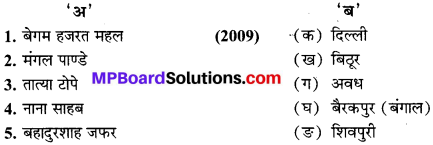
सही जोड़ी मिलाइए
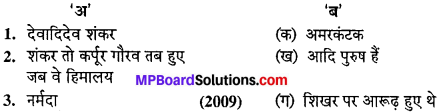
MP Board Class 10th Social Science Chapter 7 1857 का प्रथम स्वतन्त्रता संग्राम
उत्तर:

  1. → (ग)
  2. → (घ)
  3. → (ङ)
  4. → (ख)
  5. → (क)

MP Board Class 10th Social Science Chapter 7 अति लघु उत्तरीय प्रश्न

प्रश्न 1.
उन क्षेत्रों के नाम लिखिए जहाँ 1857 ई. का स्वतन्त्रता संग्राम व्यापक रूप से हुआ।
अथवा
1857 की क्रान्ति के प्रमुख केन्द्र कौन-कौनसे थे ? (2015)
उत्तर:

  1. बैरकपुर
  2. मेरठ
  3. दिल्ली
  4. कानपुर
  5. झाँसी
  6. ग्वालियर
  7. लखनऊ
  8. जगदीशपुर (बिहार)।

प्रश्न 2.
1857 के स्वतन्त्रता संग्राम के प्रमुख नेताओं के नाम बताइए। (2009, 14)
उत्तर:

  1. मंगल पाण्डे
  2. बहादुरशाह (जफर) द्वितीय
  3. रानी लक्ष्मीबाई
  4. तात्या टोपे
  5. नाना साहब
  6. बेगम हजरत महल
  7. कुँवर सिंह
  8. अहमदुल्ला खाँ
  9. रंगा बापूजी गुप्त
  10. सोनाजी पण्डित
  11. नाना फड़नवीस
  12. गुलाम गौस आदि।

प्रश्न 3.
1857 के स्वतन्त्रता संग्राम का तात्कालिक कारण क्या था ? (2014, 18)
उत्तर:
बैरकपुर छावनी में 29 मार्च, 1857 को मंगल पाण्डे नामक सैनिक ने चर्बी वाले कारतूस को भरने से इन्कार कर दिया और उत्तेजित होकर अंग्रेज अधिकारियों की हत्या कर दी। फलस्वरूप उसे बन्दी बनाकर 8 अप्रैल, 1857 को फाँसी दे दी गयी। इस प्रकार चर्बी लगे कारतूस 1857 की क्रान्ति का तात्कालिक कारण बना।

प्रश्न 4.
ब्रिटिश सरकार द्वारा उठाए गए समाज सुधार के कार्यों से भारतीय क्यों असंतुष्ट हए ? (2011, 13)
उत्तर:
कम्पनी सरकार ने सामाजिक कुरीतियों को समाप्त करने के लिए अनेक कदम उठाये तथा कानूनों को लागू किया। परम्परागत दृष्टिकोण के भारतीयों को अंग्रेजों का उनके सामाजिक जीवन में हस्तक्षेप करना उनमें रोष उत्पन्न करने वाला था। ब्रिटिश सरकार द्वारा ईसाई धर्म का प्रचार, धर्म परिवर्तन हेतु सुविधाओं का प्रलोभन देना, शिक्षण संस्थाओं में ईसाई धर्म की शिक्षा दिया जाना, ऐसे अनेक कारण थे जिनके कारण भारतीयों में अत्यधिक असन्तोष था।

MP Board Class 10th Social Science Chapter 7 लघु उत्तरीय प्रश्न

प्रश्न 1.
1857 के संग्राम को प्रथम स्वतन्त्रता संग्राम क्यों कहा जाता है ? (2011, 17)
उत्तर:
भारत में पहला प्रभावशाली आन्दोलन 1857 ई. की क्रान्ति थी। यह भारत का पहला स्वतन्त्रता आन्दोलन था। इस क्रान्ति ने अंग्रेजों की जड़ों को हिलाकर रख दिया। इससे पहले भी बैल्लोर, बैरकपुर तथा बुन्देलखण्ड में विद्रोह हुए, जिनको अंग्रेजों ने कुचल दिया, किन्तु इन विद्रोहों से 1857 ई. के क्रान्तिकारियों को . बड़ी प्रेरणा मिली। वीर सावरकर, अशोक मेहता तथा अन्य भारतीय इतिहासकारों ने 1857 की इस क्रान्ति को प्रथम स्वतन्त्रता संग्राम का नाम दिया।

इस क्रान्ति के उठ खड़ा होने का कारण न चर्बी के कारतूसों का प्रयोग करना था और न ही कुछ भारतीय शासकों का व्यक्तिगत स्वार्थ, वरन् जन साधारण में वह असन्तोष की भावना थी जो पिछले सौ वर्षों के अंग्रेजी राज्य के कारण उत्पन्न हो रही थी। इन इतिहासकारों का विचार है कि विस्फोट की सामग्री काफी समय पहले से ही इकट्ठी होती आ रही थी। इसे केवल एक चिंगारी की आवश्यकता थी जो चर्बी वाले कारतूसों से मिल गयी। इसलिए 1857 की इस महान क्रान्ति को केवल सैनिक विद्रोह न कहकर पहला स्वतन्त्रता संग्राम या राष्ट्रीय आन्दोलन कहना कहीं उचित होगा।

प्रश्न 2.
1857 के पूर्व ब्रिटिश शासन के विरुद्ध विद्रोह अपनी आरम्भिक अवस्था में क्यों असफल रहे?
उत्तर:
ईस्ट इण्डिया कम्पनी ने विजय के माध्यम से, भारतीय प्रदेशों का अनुचित तरीकों से कम्पनी के साम्राज्य में विलय करके तथा भारतीय जनता का शोषण करके भारतीय जनमानस को असन्तोष एवं आक्रोश की भावना से भर दिया था। इसका परिणाम यह हुआ कि 1765 से 1856 तक देश के विभिन्न भागों में दर्जनों विद्रोह हुए। इनमें से कई विद्रोह किसानों और आदिवासियों ने किये थे। पदच्युत शासकों, जमींदारों और सरदारों के नेतृत्व में भी कई विद्रोह हुए। कम्पनी की फौज के सिपाहियों ने भी विद्रोह का झण्डा ऊँचा किया।

अंग्रेजी शासन के विरुद्ध जितने विद्रोह हुए उनका स्वरूप स्थानीय रहा और उनका दमन हो गया। यद्यपि ये विद्रोह ब्रिटिश शासन के विरुद्ध गम्भीर चुनौती उत्पन्न नहीं कर सके परन्तु इससे यह सिद्ध होता है कि 1857 के प्रथम स्वतन्त्रता संग्राम के पूर्व ईस्ट इण्डिया कम्पनी के शासन के विरुद्ध व्यापक असन्तोष विद्यमान था। 1857 के संग्राम की पृष्ठभूमि तैयार करने में इन विद्रोहों की महत्वपूर्ण भूमिका रही है।

प्रश्न 3.
भारतीय शासकों में असन्तोष के क्या कारण थे?
अथवा
अंग्रेजी शासन (ब्रिटिश शासन) से भारतीय शासकों में असन्तोष के क्या कारण थे ? (2010, 13)
अथवा
भारतीय शासकों में ब्रिटिश शासन से असन्तोष के क्या कारण थे ? (2017)
उत्तर:
अंग्रेजों की राज्य विस्तार की नीति के कारण भारत के अनेक शासकों और जमींदारों में असन्तोष व्याप्त हो गया था। लॉर्ड वेलेजली की सहायक सन्धि व्यवस्था और लॉर्ड डलहौजी की हड़प नीति के कारण अनेक राज्यों का अंग्रेजी साम्राज्य में जबरदस्ती विलय कर दिया गया। अंग्रेजों ने पंजाब, सिक्किम, सतारा, जैतपुर, सम्भलपुर, झाँसी, नागपुर आदि राज्यों को अपने अधीन कर लिया था। सरकार ने अवध, तंजौर, कर्नाटक के नवाबों की राजकीय उपाधियाँ समाप्त कर राजनीतिक अस्थिरता की स्थिति उत्पन्न कर दी।

अन्तिम मुगल सम्राटों के प्रति अंग्रेजों का व्यवहार अनादरपूर्ण होता चला गया। इन परिस्थितियों में शासन-परिवारों में घबराहट फैल गयी थी। अंग्रेजों ने जिन राज्यों पर कब्जा किया वहाँ के सैनिक, कारीगर तथा अन्य व्यवसायों में जुड़े लोग भी प्रभावित हुए। अंग्रेजों ने अनेक सरदारों और जमींदारों से उनकी जमीन छीन ली। इसके कारण भारतीय शासकों में असन्तोष व्याप्त हो गया।

प्रश्न 4.
प्रथम स्वतन्त्रता संग्राम का राजनैतिक व्यवस्था पर क्या प्रभाव पड़ा ?
उत्तर:
प्रथम स्वतन्त्रता संग्राम ब्रिटिश राज के लिए एक बड़ी चुनौती था। इसे अन्ततः कुचल दिया गया, परन्तु इस संग्राम से अंग्रेजों को गहरा झटका लगा। इस संग्राम ने अंग्रेजी साम्राज्य की जड़ों को हिलाकर रख दिया। अतः ब्रिटिश सरकार ने भारत में अनेक प्रशासनिक परिवर्तन किए। महत्वपूर्ण परिवर्तन निम्नलिखित हुए –

  1. ब्रिटिश संसद ने 1858 ई. में अधिनियम पारित किया। इसके अनुसार भारत पर शासन करने का अधिकार ईस्ट इण्डिया कम्पनी से लेकर सीधे इंग्लैण्ड की सरकार ने ले लिया।
  2. 1858 के पश्चात् सेना का पुनर्गठन किया गया। अंग्रेजों का भारतीय सैनिकों पर से विश्वास उठ गया था। अत: महत्वपूर्ण जिम्मेदारियाँ अंग्रेज अधिकारियों को सौंपी गयीं।
  3. ब्रिटिश शासन ने देशी रियायतों का विलय करने की नीति में परिवर्तन किया और उत्तराधिकारियों को गोद लेने के अधिकार को मान्यता प्रदान की।
  4. ब्रिटिश सरकार ने राजाओं, भू-स्वामियों और जमींदारों के प्रति उदार दृष्टिकोण अपनाया और इस प्रकार उनका समर्थन प्राप्त करने की नीति अपनायी।

प्रश्न 5.
1857 के स्वतंत्रता संग्राम की असफलता के कारण बताइए। (2010, 11, 15)
अथवा
सन् 1857 की क्रान्ति की असफलता के दो कारण बताइए। (2016)
अथवा
1857 के संग्राम की असफलता के कोई तीन कारण लिखिए। (2018)
उत्तर:
1857 के संग्राम की असफलता के प्रमुख कारण निम्नलिखित थे –

  1. 1857 की क्रान्ति निर्धारित तिथि से पूर्व प्रारम्भ कर दी गयी थी जिससे यह असफल हो गयी। मैलसन के अनुसार, “यदि यह क्रान्ति निश्चित समय पर प्रारम्भ होती तो इसे सफलता अवश्य मिलती।”
  2. 1857 की क्रान्ति की असफलता का अन्य कारण योग्य नेतृत्व का अभाव था। विद्रोही नेताओं में सैनिक कुशलता तथा संगठित होकर कार्य करने तथा क्रान्ति संचालन की क्षमता का अभाव था।
  3. 1857 की क्रान्ति के समय अधिकांश नरेशों ने क्रान्तिकारियों का साथ न देकर अंग्रेजों का ही साथ दिया। सर जॉन के मत में, “यदि समस्त भारतवासी पूर्ण उत्साह से अंग्रेजों के विरुद्ध संगठित हो जाते तो अंग्रेज पूर्णतया नष्ट हो जाते।”
  4. क्रान्तिकारियों में वीरता तथा साहस की भावना का अभाव नहीं था परन्तु उनकी सैनिक शक्ति अत्यधिक निर्बल थी।
  5. अंग्रेज अधिकारी क्रान्तिकारियों का दमन आधुनिक हथियारों से करते थे परन्तु क्रान्तिकारियों के पास उनका सामना करने के लिए आधुनिक हथियारों का अभाव था।

MP Board Class 10th Social Science Chapter 7 दीर्घ उत्तरीय प्रश्न

प्रश्न 1.
1857 के स्वतन्त्रता संग्राम का भारतीय इतिहास में क्या महत्व है ? समझाइए ? (2009)
उत्तर:
1857 के स्वतन्त्रता संग्राम का महत्व

1857 की क्रान्ति का महत्व निम्नलिखित कारणों से है –

(1) हिन्दू-मुस्लिम एकता का प्रदर्शन-1857 की क्रान्ति का सर्वाधिक महत्व इस कारण है क्योंकि इस क्रान्ति में पहली बारी हिन्दू तथा मुसलमानों ने एकजुट होकर अंग्रेजों से संघर्ष किया था। इस क्रान्ति ने हिन्दू और मुसलमानों में प्रेम-भावना का विकास किया। नाना साहब तथा बहादुरशाह का संयुक्त मोर्चा इसका उदाहरण है। इस क्रान्ति ने यह सिद्ध कर दिया कि हिन्दू और मुसलमान एक-दूसरे के निकट आ सकते हैं।

(2) नवीन उत्साह की भावना का उदय-1857 की क्रान्ति से पूर्व भारतवासी अंग्रेजों को अजेय समझते थे, परन्तु इस क्रान्ति के पश्चात् उनका यह भ्रम टूट गया, क्योंकि अनेक स्थानों पर अंग्रेजों को भी भीषण पराजय का मुख देखना पड़ा था। भारतवासियों में यह आत्मविश्वास की भावना उत्पन्न हुई कि वे संगठित होकर अंग्रेजों से संघर्ष कर सकते हैं।

(3) क्रान्ति में किसानों का भाग लेना-1857 की क्रान्ति की प्रमुख विशेषता यह थी कि इससे पूर्व किसानों ने किसी भी राजनीतिक आन्दोलन तथा संघर्ष में भाग नहीं लिया था। परन्तु अंग्रेजों ने अपनी नीतियों से ग्रामीण जीवन में हस्तक्षेप कर अनेक प्रकार से शोषण करने का प्रयास किया था। परिणामस्वरूप किसानों में अंग्रेजों के विरुद्ध जागरूकता आयी तथा उन्होंने भी सक्रिय होकर क्रान्ति को अपना पूर्ण सहयोग दिया।

(4) भारतीय राजाओं तथा नवाबों को आश्वासन-क्रान्ति के पश्चात् ब्रिटिश साम्राज्यवादियों ने यह अनुभव किया कि भारतीय राजाओं के साथ उन्हें अच्छे सम्बन्ध बनाने चाहिए, क्योंकि उनके सहयोग से ही भारत में ब्रिटिश साम्राज्य को सुदृढ़ किया जा सकता है। इस आधार पर ही महारानी विक्टोरिया ने घोषणा करके भारतीय राजाओं को आश्वासन दिया कि अब उनके राज्यों को नहीं हड़पा जायेगा। कम्पनी द्वारा की गयी सन्धियाँ पूर्ववत् ही चलेंगी तथा उनमें किसी भी प्रकार का परिवर्तन नहीं किया जायेगा।

(5) संचार तथा यातायात साधनों का अपूर्व विकास-क्रान्ति से पूर्व भी संचार तथा यातायात के साधनों की स्थापना हो चुकी थी परन्तु वे सीमित अवस्था में थे जिससे कम्पनी के अधिकारी क्रान्ति दमन में उनका समुचित प्रयोग नहीं कर सके। अत: 1857 की क्रान्ति के पश्चात् अंग्रेजों ने भारत में तार, रेलों तथा डाक सेवाओं का जाल बिछा दिया।

(6) देशी राजाओं व सामन्तों की दुर्बलताओं पर प्रकाश पड़ना-1857 की क्रान्ति ने देशी राजाओं व सामन्त वर्ग की स्वार्थपरता, कायरता तथा परस्पर मतभेद की भावनाओं पर प्रकाश डाला। क्रान्ति के समय जब क्रान्तिकारी अंग्रेजों से संघर्ष कर अपने प्राणों का सौदा कर रहे थे, तो उसी समय कुछ देशी राजा तथा सामन्त अंग्रेजों को सहयोग दे रहे थे।

इस प्रकार लक्ष्य की एकता, साम्प्रदायिक सद्भाव एवं जन सहयोग की भावना के कारण 1857 ई. की घटनाएँ राष्ट्रीय स्वरूप की मानी जाती हैं।

प्रश्न 2.
टिप्पणी लिखिए –
(क) तात्या टोपे (2009, 11, 14, 18)
(ख) रानी लक्ष्मीबाई (2009, 11, 14)
(ग) नाना साहब (2018)
(घ) हजरत महल।
अथवा
प्रथम स्वतन्त्रता संग्राम के प्रमुख सेनानियों का संक्षिप्त परिचय दीजिए। (2009)
उत्तर:
(क) तात्या टोपे
तात्या टोपे, 1857 के उन वीर सेनानियों में से एक थे, जिनकी आरम्भिक निष्ठा पेशवा परिवार के प्रति . थी। तात्या टोपे अपनी देश भक्ति, वीरता, व्यूह रचना, शत्रु को चकमा देने की कुशलता, साधनहीनता की स्थिति में युद्ध जारी रखने का साहस, निर्भीकता और गुरिल्ला पद्धति से युद्ध के लिए जाने जाते हैं। पेशवा नाना साहब की ओर युद्ध का समस्त उत्तरदायित्व तात्या टोपे पर ही था।

झाँसी की रानी लक्ष्मीबाई के साथ ग्वालियर पर अधिकार करने में तात्या टोपे का बड़ा योगदान रहा। रानी लक्ष्मीबाई की मृत्यु के पश्चात् तात्या टोपे ने निरन्तर गुरिल्ला युद्ध के माध्यम से मध्य भारत और बुन्देलखण्ड में अंग्रेजों को कड़ी टक्कर दी। अंग्रेजों ने तात्या टोपे को बन्दी बनाने के लिए कुटिलता और विश्वासघात की नीति का पालन किया। अन्ततः तात्या टोपे को आरौन (जिला गुना) के जंगल में विश्राम करते समय बन्दी बनाया गया। अंग्रेजों ने 18 अप्रैल, 1859 को तात्या को फाँसी दे दी।

(ख) रानी लक्ष्मीबाई
अंग्रेजों ने 1854 में झाँसी के राजा गंगाधर राव की मृत्यु के पश्चात् उनकी रानी लक्ष्मीबाई के दत्तक पुत्र को झाँसी की गद्दी का उत्तराधिकारी मानने से इन्कार कर दिया तथा झाँसी का अंग्रेजी साम्राज्य में विलय कर लिया। इसका विरोध करते हुए रानी लक्ष्मीबाई ने ब्रिटिश सेना से जबरदस्त टक्कर ली। सर ह्यूरोज द्वारा पराजित होने पर वह कालपी आयीं व तात्या टोपे की मदद से ग्वालियर पर अधिकार किया। अंग्रेज सेनापति एरोज ने ग्वालियर आकर किले को घेर लिया। 17 जून, 1858 को झाँसी की रानी लक्ष्मीबाई बड़ी वीरता से सैनिक वेश में संघर्ष करती हुई वीरगति को प्राप्त हुईं। उनकी वीरता की गाथाएँ आज भी देशवासियों को प्रेरित करती हैं।

(ग) नाना साहब
नाना साहब प्रथम स्वतन्त्रता संग्राम के महत्वपूर्ण नेता थे। नाना साहब भूतपूर्व पेशवा बाजीराव द्वितीय के दत्तक पुत्र थे और बिठूर में निवास करते थे। पेशवा की मृत्यु के उपरान्त लॉर्ड डलहौजी ने नाना साहब को पेंशन एवं उपाधि देने से वंचित कर दिया था। अत: नाना ने अपने विश्वासपात्र सैनिकों की सहायता से अंग्रेजों को कानपुर से निकाल दिया और स्वयं को पेशवा घोषित कर दिया। तात्या टोपे और अजीमुल्लाह नाना साहब के विश्वासपात्र सेनानायक थे।

(घ) हजरत महल
बेगम हजरत महल अवध के नवाब की विधवा थीं। संग्राम आरम्भ होने पर 4 जून, 1857 को अवध की बेगम ने संग्राम को प्रोत्साहन दिया और उसका संचालन किया। उन्होंने अपने युवा पुत्र विराजिस कादर को अवध का नवाब घोषित कर दिया तथा लखनऊ स्थिति ब्रिटिश रेजीडेन्सी पर आक्रमण किया। बेगम हजरत महल ने शाहजहाँपुर में भी संग्राम का नेतृत्व किया। पराजित होने के पश्चात् बेगम सुरक्षा की दृष्टि से नेपाल चली गयीं।

MP Board Class 10th Social Science Chapter 7 अन्य परीक्षोपयोगी प्रश्न

MP Board Class 10th Social Science Chapter 7 वस्तुनिष्ठ प्रश्न

बहु-विकल्पीय प्रश्न

प्रश्न 1.
ब्रिटिश ईस्ट इण्डिया कम्पनी की स्थापना हुई थी
(i) 1705 ई.
(ii) 1600 ई. में
(iii) 1800 ई.
(iv) 1830 ई में।
उत्तर:
(ii) 1600 ई. में

प्रश्न 2.
मंगल पाण्डे को फाँसी दी गयी –
(i) 8 अप्रैल, 1857
(ii) 5 अक्टूबर, 1856
(iii) 18 अप्रैल, 1860
(iv) 10 अक्टूबर. 1858
उत्तर:
(i) 8 अप्रैल, 1857

प्रश्न 3.
अंग्रेजों ने बहादुरशाह को बन्दी बनाकर भेजा
(i) ब्रिटेन
(ii) अफगानिस्तान
(iii) भूटान
(iv) रंगून (बर्मा)।
उत्तर:
(iv) रंगून (बर्मा)।

प्रश्न 4.
कानपुर में आन्दोलन शुरु किया था – (2018)
(i) रानी लक्ष्मीबाई ने
(ii) तात्या टोपे ने
(iii) नाना साहब ने
(iv) बहादुरशाह ने।
उत्तर:
(iii) नाना साहब ने

रिक्त स्थानों की पूर्ति कीजिए

  1. नाना साहब का निवास …………… में था।
  2. 1857 ई. की क्रान्ति में मध्य प्रदेश के दो नेताओं के नाम …………… थे।

उत्तर:

  1. बिठूर
  2. रानी लक्ष्मीबाई एवं झलकारी बाई।

सत्य/असत्य

प्रश्न 1.
1857 ई. की क्रान्ति के व्यापक प्रचार में मुख्यतया भारतीय सैनिकों की भूमिका रही।
उत्तर:
सत्य

प्रश्न 2.
1857 ई. की क्रान्ति का तात्कालिक कारण ‘हड़प नीति’ थी।
उत्तर:
असत्य

प्रश्न 3.
जन आन्दोलन तथा सामूहिक आन्दोलन 1857 ई. की ही क्रान्ति थी।
उत्तर:
सत्य

प्रश्न 4.
1857 ई. की क्रान्ति प्रथम स्वतन्त्रता संग्राम थी।
उत्तर:
सत्य

प्रश्न 5.
1857 की क्रान्ति के प्रमुख केन्द्र बैरकपुर, मेरठ, दिल्ली, कानपुर, झाँसी आदि थे।
उत्तर:
सत्य।

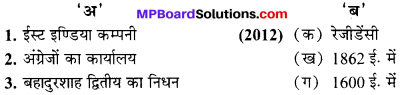
जोड़ी मिलाइए
MP Board Class 10th Social Science Solutions Chapter 7 1857 का प्रथम स्वतन्त्रता संग्राम 2
उत्तर

  1. → (ग)
  2. → (क)
  3. → (ख)

एक शब्द/वाक्य में उत्तर

  1. 1857 ई. के संग्राम के समय भारत के गवर्नर जनरल कौन थे ? (2010)
  2. 1857 ई. की क्रान्ति का तात्कालिक कारण क्या था ? (2015)
  3. 1857 ई. की क्रान्ति कब और कहाँ से प्रारम्भ हुई थी ?
  4. 1857 ई. की क्रान्ति की पूर्व निश्चित तिथि क्या थी ?
  5. 1857 ई. की क्रान्ति के क्या प्रतीक थे?

उत्तर:

  1. कैनिंग
  2. चर्बी लगे कारतूसों के प्रयोग के लिए सैनिकों को बाध्य करना
  3. 29 मार्च, 1857 में बैरकपुर छावनी से
  4. 31 मई, 1857
  5. कमल का फूल और रोटी।

MP Board Class 10th Social Science Chapter 7 अति लघु उत्तरीय प्रश्न

प्रश्न 1.
हड़प नीति क्या थी ?
उत्तर:
इसे विलय नीति भी कहा जाता है। लार्ड डलहौजी द्वारा कम्पनी के अधीन देशी राज्यों के सन्तानहीन शासकों को गोद लेने के अधिकार से वंचित कर उनके राज्य को हड़प लेना ही हड़प नीति थी।

प्रश्न 2.
सहायक सन्धि व्यवस्था क्या थी ? इसको किसने लागू किया था ? (2017)
उत्तर:
भारत के गवर्नर जनरल वेलेजली द्वारा लागू व्यवस्था को सहायक सन्धि व्यवस्था कहा जाता है। इस व्यवस्था को जो भारतीय नरेश स्वीकार करते थे, उन्हें अंग्रेजों के संरक्षण में रहकर कार्य करना पड़ता था।

MP Board Class 10th Social Science Chapter 7 लघु उत्तरीय प्रश्न

प्रश्न 1.
1857 ई. की क्रान्ति के राजनीतिक कारण संक्षेप में बताइए। (2009)
उत्तर:
1857 ई. के स्वतन्त्रता संग्राम के राजनीतिक कारण निम्नलिखित थे –
(1) लार्ड डलहौजी की अपहरण (हड़प) नीति-इतिहासकारों के मत में 1857 के स्वतन्त्रता संग्राम का प्रमुख राजनीतिक कारण लॉर्ड डलहौजी का अपहरण नीति थी। उसकी अपहरण नीति के परिणामस्वरूप अनेक रियासतें ब्रिटिश साम्राज्य का एक अंग बन गयी थीं। इन समस्त रियासतों के शासक लॉर्ड डलहौजी की नीतियों के कारण ब्रिटिश साम्राज्य के प्रबल विरोधी हो गये।

(2) बहादुरशाह का अपमान तथा अन्याय-अंग्रेजों ने दिल्ली के मुगल शासक बहादरशाह के साथ अन्याय किया तथा उसे भेंट देना बन्द कर दिया। कम्पनी के नौकर भी बहादुरशाह का अपमान करते रहते थे।

(3) दोषपूर्ण प्रशासनिक नीतियाँ-अंग्रेजों ने महत्वपूर्ण प्रशासनिक पदों से यथासम्भव भारतीयों को दूर रखा। साथ-ही-साथ समान पर पर भी अंग्रेजों तथा भारतीय के वेतनों में पर्याप्त असमानता थी। पदोन्नति भारतीयों को देर से तथा कम मिलती थी, जबकि अंग्रेजों को शीघ्र तथा अधिक मिलती थी। इस प्रकार की भेद-भावना ने भारतवासियों के मन में ब्रिटिश साम्राज्य के विरुद्ध असन्तोष को भावना उत्पन्न कर दी थी।

प्रश्न 2.
“लॉर्ड मैकाले की शिक्षा नीति 1857 के स्वतन्त्रता संग्राम का मूल कारण नहीं थी परन्तु यह असन्तोष का गौण कारण अवश्य थी।” स्पष्ट कीजिए।
अथवा
लार्ड मैकाले की शिक्षा नीति पर प्रकाश डालिए।
उत्तर:
लॉर्ड मैकाले की शिक्षा नीति भारतीय शिक्षा पद्धति एवं संस्कृति पर आक्रमण था। वह पूर्वाग्रहों से प्रेरित था और देशी भाषाओं में शिक्षा दिये जाने का विरोधी था। मैकाले अंग्रेजों को सबसे उच्च नस्ल एवं अंग्रेजी भाषा को सर्वोत्तम मानता था और इसीलिए उसने अंग्रेजी भाषा और पाश्चात्य ज्ञान-विज्ञान के अध्ययन को प्रोत्साहित किया। परन्तु इस समय मैकाले का उद्देश्य अंग्रेजी शिक्षा का ज्ञान देकर ब्रिटिश राज्य के हितों की रक्षा करना था और ऐसे व्यक्ति तैयार करना था जो अंग्रेजों को शासन में मदद कर सकें। मैकाले प्रजातीय अहंकार से परिपूर्ण था इसका उदाहरण यह है कि उनकी अनुशंसा पर सरकार ने प्राच्य भाषाओं की पुस्तकों के मुद्रण और अनुवाद पर प्रतिबन्ध लगा दिया। प्राच्य भाषा के समर्थकों ने अंग्रेजी शिक्षा नीति को अपनी भाषा, परम्परा एवं संस्कृति पर आक्रमण मानकर इसका विरोध किया। यद्यपि यह कारण 1857 के स्वतन्त्रता संग्राम का मूल कारण नहीं था परन्तु यह असन्तोष का गौण कारण अवश्य था।

प्रश्न 3.
1857 ई. की क्रान्ति के लिए आर्थिक कारण लिखिए।
उत्तर:
आर्थिक कारण – अंग्रेजों के निरन्तर आर्थिक शोषण ने भारतीयों में असन्तोष की भावना उत्पन्न की। अंग्रेजों ने भारतीय व्यापार, वाणिज्य तथा उद्योग-धन्धों को तो आघात पहुँचाया ही, साथ ही अपनी भूमि-सम्बन्धी नीतियों से भारतीय किसानों को भुखमरी के कगार पर खड़ा कर दिया। जमींदारों के साथ अन्यायपूर्ण व्यवहार किया गया। उनके अनेक अधिकार छीन लिये गये। परिणामस्वरूप वे भी ब्रिटिश साम्राज्य के विरुद्ध हो गये। कम्पनी की आर्थिक नीति ने भारतीय गृह-उद्योगों को पूर्णतया नष्ट कर दिया। देश के व्यापार पर भी अंग्रेजों ने पूर्णतया अपना अधिकार स्थापित कर भारतीय व्यापारियों को भी अपना विरोधी बना लिया था।

प्रश्न 4.
सन् 1857 ई. की क्रान्ति में मंगल पाण्डे की क्या भूमिका रही ?
उत्तर:
मंगल पाण्डे – मंगल पाण्डे एक सैनिक थे, जो बैरकपुर (बंगाल) स्थित छावनी में नियुक्त थे। 29 मार्च, 1857 को इस सैनिक ने चर्बी युक्त कारतूसों को मुँह से काटने से स्पष्ट मना कर दिया व क्रोध में आकर अंग्रेज अधिकारियों की हत्या कर दी। फलस्वरूप उन्हें बन्दी बनाकर 8 अप्रैल, 1857 को फाँसी दे दी गयी। मंगल पाण्डे का बलिदान इस विद्रोह की पहली आहुति थी।

प्रश्न 5.
बहादुरशाह जफर का संक्षिप्त परिचय दीजिए।
उत्तर:
बहादुरशाह जफर – बहादरशाह जफर मुगल साम्राज्य के अन्तिम बादशाह थे। 10 मई, 1857 ई. को मेरठ की सैन्य छावनी के सिपाहियों ने ब्रिटिश शासन के विरुद्ध संग्राम आरम्भ कर दिल्ली जीतकर सत्ता के नए प्रतीक के रूप में बहादुरशाह जफर को भारत का सम्राट घोषित कर दिया। वृद्धावस्था के बावजूद बहादुरशाह में व्याप्त भक्ति की भावना ने क्रान्तिकारियों में भी आशा का संचार किया। दिल्ली र्को समाचारों के कारण क्रान्ति का विस्तार अनक स्थानों पर हुआ। इससे घबराकर लॉर्ड कैनिंग ने दिल्ली से ही क्रान्ति दमन का निश्चय किया। बहादुरशाह ने वीरतापूर्वक अंग्रेजों से युद्ध किया किन्तु वह पराजित हुआ। अंग्रेजों ने बहादुरशाह को बन्दी बनाकर रंगून (बर्मा) भेज दिया जहाँ 1862 में बहादुरशाह जफर का निधन हो गया।

MP Board Class 10th Social Science Chapter 7 दीर्घ उत्तरीय प्रश्न

प्रश्न 1.
सन् 1857 की क्रान्ति के क्या परिणाम हुए ? समझाइए। (2009)
उत्तर:
परिणाम-1857 का विद्रोह भारतीय इतिहास के एक महत्वपूर्ण घटना मानी जाती है। यह एक महत्वपूर्ण परिवर्तनशील बिन्दु था। इसके बड़े दूरगामी परिणाम निकले। संक्षेप में, इस विद्रोह के प्रमुख परिणाम निम्नलिखित थे –

(1) कम्पनी राज्य समाप्त – विद्रोह के कारण ब्रिटिश सरकार ने कम्पनी के बार-बार विरोध करने के बावजूद कम्पनी के शासन का अन्त कर दिया। भारत के अच्छे शासन के लिए 1858 ई. में भारत शासन अधिनियम पारित हुआ और भारत का शासन सीधे ब्रिटिश क्राउन के हाथ में चला गया।

(2) भारतीय सेना का पुनर्गठन – विद्रोह के परिणामस्वरूप सेना का पुनर्गठन हुआ। भारतीय सैनिकों की संख्या घटा दी गयी। महत्त्वपूर्ण स्थानों पर अंग्रेजी सैनिक रखे गये। उच्च सैनिक पद भारतीयों के लिए बन्द कर दिए गए।

(3) प्रतिक्रियावादी तत्व सक्रिय – ब्रिटिश व्यापारिक नीति के फलस्वरूप देश के अधिकांश उद्योग-धन्धे नष्ट हो चुके थे। नयी शिक्षा-पद्धति के कारण बेरोजगारी की समस्या बढ़ने लगी। सरकारी नौकरी प्राप्त करने के लिए प्रतिस्पर्धा बढ़ी, जिससे नैतिक पतन तथा संघर्ष बढ़ा। इस प्रकार, समाज में अनेक प्रतिक्रियावादी तत्व सक्रिय हो गये।

(4) अंग्रेजों के प्रति कटुता – 1857 की क्रान्ति के परिणामस्वरूप अंग्रेजों तथा भारतीयों में पारस्परिक कटुता तथा घृणा की भावना इतनी बढ़ गयी कि वे एक-दूसरे के निकट सम्पर्क में नहीं आ सके। भारतीयों के बीच यह भावना घर कर गयी कि अंग्रेज उनका शोषण कर रहे हैं।

(5) भारतीयों को लाभ – इस क्रान्ति के अनेक दुष्परिणाम निकले, पर इससे भारतीयों को अनेक लाभ भी हुए। इसके बाद ब्रिटिश सरकार ने भारत की आन्तरिक दशा को सुधारने की ओर ध्यान दिया। क्रान्ति की विफलता से भारतीयों को अपनी भूल का एहसास हुआ। यह स्पष्ट हो गया कि कोई क्रान्ति राष्ट्रीयता के अभाव में सफल नहीं हो सकती। अतः 1857 ई. की क्रान्ति से भारतीयों को राष्ट्रीयता के आधार पर संगठित तथा एकमत होने की प्रेरणा मिली तथा इसी भावना के आधार पर राष्ट्रीय आन्दोलन की पृष्ठभूमि तैयार की गयी।

प्रश्न 2.
प्रथम स्वतन्त्रता संग्राम की प्रमुख घटनाओं पर प्रकाश डालिए।
उत्तर:
प्रथम स्वतन्त्रता संग्राम की प्रमुख घटनाएँ

क्रान्ति की प्रथम चिंगारी बैरकपुर (बंगाल) में प्रज्वलित हुई परन्तु क्रान्ति का प्रारम्भ 10 मई से माना जाता है क्योंकि क्रान्तिकारियों ने इसी घटना के बाद सुनियोजित रूप से ब्रिटिश सत्ता को चुनौती देने का कार्य आरम्भ किया।

दिल्ली की क्रान्ति का समाचार शीघ्र ही आग की भाँति चारों ओर फैल गया। अवध, कानपुर, रुहेलखण्ड, अलीगढ़, मथुरा, आगरा, बदायूँ, बिहार के अधिकांश भागों, राजस्थान की नसीराबाद सैनिक छावनी, कोटा, जोधपुर आदि नगरों तथा मध्य प्रदेश के इन्दौर, नीमच और ग्वालियर की सैनिक छावनियों में सैनिकों ने क्रान्ति आरम्भ कर दी। किसानों और दस्तकारों ने जो अत्याचार और शोषण का शिकार थे, संग्राम में खुलकर भाग लिया।

बिहार में क्रान्तिकारियों का नेतृत्व कुंवर सिंह ने किया। दिल्ली में क्रान्ति का नेतृत्व मुगल बादशाह के सेनापति बख्त खाँ ने किया। कानपुर में क्रान्तिकारियों ने नाना साहब को पेशवा घोषित किया और अजीमुल्ला उसका मुख्य सलाहकार बना। नाना साहब के सैनिकों का नेतृत्व तात्या टोपे ने किया। झाँसी में दिवंगत राजा की विधवा रानी लक्ष्मीबाई ने सैनिकों का नेतृत्व किया।

सम्पूर्ण क्रान्ति के दौरान हिन्दू और मुसलमान कन्धे से कन्धा मिलाकर लड़े। अंग्रेजों ने हिन्दुओं और मुसलमानो को एक-दूसरे के विरुद्ध उकसाने के अनेक प्रयास किए, परन्तु ऐसे सारे प्रयास व्यर्थ सिद्ध हुए।

संग्राम का स्वरूप इतना व्यापक होने के उपरान्त भी एक वर्ष से कुछ अधिक समय बाद ही इसे कुचल दिया गया। सितम्बर 1857 में अंग्रेजों ने दिल्ली पर पुनः अधिकार कर लिया। 1858 में लखनऊ पर ब्रिटिश सैनिकों का कब्जा हो गया, किन्तु बेगम हजरत महल ने समर्पण करने से मना कर दिया। रानी लक्ष्मीबाई ने तात्या टोपे की मदद से ग्वालियर पर अधिकार कर लिया परन्तु अन्तत: 17 जून, 1858 में लड़ते हुए वह वीरगति को प्राप्त हुईं। अप्रैल 1858 में गम्भीर रूप से घायल होने के बाद कुँवर सिंह की मृत्यु हो गयी। तात्या टोपे राजस्थान और मध्य प्रदेश में अंग्रेजों से गुरिल्ला युद्ध पद्धति से संघर्ष करते रहे। तात्या टोपे को धोखे से अंग्रेजों द्वारा बन्दी बनाकर शिवपुरी में फाँसी दे दी गयी।

1857 का संग्राम अंग्रेजों द्वारा कुचल दिया गया परन्तु अंग्रेजों को सैनिकों के साथ-साथ नागरिकों के विरोध का भी सामना करना पड़ा था। अत: अंग्रेजी फौजों ने संग्राम के दमन के लिए गाँव के गाँव जला दिये तथा लोगों को भयभीत करने के लिए सार्वजनिक स्थलों पर बन्दियों को फाँसी देने की व्यवस्था की। इतिहासकारों का मत है कि इस संग्राम में लगभग तीन लाख नागरिक मारे गए।

प्रश्न 3.
सन् 1857 की क्रान्ति के कारणों का वर्णन कीजिए। (2016)
अथवा
1857 के प्रथम स्वतन्त्रता संग्राम के उत्तरदायी चार कारण लिखिए। (2012)
उत्तर:
1857 में ब्रिटिश शासन के विरुद्ध सबसे बड़ा सशस्त्र विद्रोह हुआ जिसने ब्रिटिश शासन की नींव को हिला दिया। इस विद्रोह के प्रमुख कारण निम्नलिखित थे –
(1) राजनीतिक कारण-इस विद्रोह के अधिकांश राजनीतिक कारणों के लिए लॉर्ड डलहौजी उत्तरदायी था। उसकी उग्र-साम्राज्यवादी नीति तथा छोटे-छोटे राज्यों को हड़पने के विभिन्न सिद्धान्तों ने भारतीय राजपरिवारों में घोर असन्तोष उत्पन्न कर दिया था।

(2) सामाजिक कारण-अंग्रेजों द्वारा सती-प्रथा पर प्रतिबन्ध लगाकर, धर्म-परिवर्तन को प्रोत्साहित करके, परम्परागत उत्तराधिकार के नियम में संशोधन करके भारतीयों की सामाजिक, धार्मिक भावनाओं को ठेस पहुँचाई गयी। इसने भी 1857 ई. की क्रान्ति लाने में सहयोग दिया।

(3) आर्थिक कारण-1857 के विद्रोह में राजनीतिक कारणों की तरह ही आर्थिक कारण भी प्रबल थे। अंग्रेजों की नीति ने भारतीय किसानों को उजाड़ दिया, शिल्पकारों व दस्तकारों को बेकार बना दिया, व्यापारियों को चौपट कर दिया तथा जमींदारियाँ समाप्त कर दीं। भारत का धन बाहर जाने लगा और इस तरह शासन के खिलाफ व्यापक आर्थिक असन्तोष उत्पन्न कर दिया।

(4) सैनिक कारण-कम्पनी के सैनिकों में भारतीय सैनिकों की संख्या दो लाख तेतीस हजार थी, जबकि ब्रिटिश सैनिक केवल 35 हजार थे। इस प्रकार भारतीय सैनिक ब्रिटिश साम्राज्य के स्तम्भ थे, परन्तु वेतन-भत्ते ब्रिटिश सैनिकों से कम थे। अंग्रेज अधिकारी भारतीय सैनिकों के साथ बहुत बुरा व्यवहार करते थे।

(5) तात्कालिक कारण-इस समय सरकार ने ‘एनफील्ड रायफल’ नामक एकनली बन्दूक सेना के व्यवहार के लिए चालू की। इसके कारतूसों में सूअर तथा गाय की चर्बी होती थी। इससे भारतीय सैनिकों ने अंग्रेजों के खिलाफ विद्रोह कर दिया।

MP Board Class 11th Chemistry Solutions Chapter 10 s-ब्लॉक तत्त्व

MP Board Class 11th Chemistry Solutions Chapter 10 s-ब्लॉक तत्त्व

s-ब्लॉक तत्त्व NCERT अभ्यास प्रश्न

प्रश्न 1.
क्षार धातुओं के सामान्य भौतिक तथा रासायनिक गुण क्या हैं ?
उत्तर:
भौतिक गुण –
1. क्षार धातुएँ चाँदी के समान सफेद, नरम तथा हल्की धातुएँ होती हैं।
2. इनके धनत्व बहुत कम होते हैं (बड़े आकार के कारण)। यह वर्ग में नीचे जाने पर घटता है। यद्यपि पोटैशियम, सोडियम से हल्की धातु है।
3. क्षार धातुओं के गलनांक तथा क्वथनांक निम्न होते हैं, क्योंकि इन धातुओं में मात्र एक संयोजी इलेक्ट्रॉन के उपस्थिति के कारण इनके बीच दुर्बल धात्विक बंध होते हैं।
4. क्षार धातुएँ, Be तथा Mg इनके लवण ज्वाला में विशिष्ट रंग प्रदान करते हैं, क्योंकि इनके संयोजी इलेक्ट्रॉन आसानी से निम्न से उच्च ऊर्जा स्तर तक उत्तेजित हो जाते हैं –
MP Board Class 11th Chemistry Solutions Chapter 10 s-ब्लॉक तत्त्व - 1 (2)

रासायनिक गुण:
क्षार धातुएँ अपनी निम्न आयनन एन्थैल्पी के कारण अत्यधिक क्रियाशील होती है। इनकी क्रियाशीलता वर्ग में नीचे जाने पर घटती है –

1. वायु के साथ अभिक्रियाशीलता:
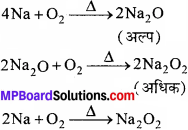
क्षार धातुएँ वायु की उपस्थिति में ऑक्साइड बनाने के कारण मलिन हो जाती है। लीथियम मोनोऑक्साइड, सोडियम परॉक्साइड तथा अन्य धातुएँ सुपर ऑक्साइड बनाती है।

  • 4Li+ O2 → 2Li2O (ऑक्साइड)
  • 2Na + O2 → NaO2 (परॉक्साइड)
  • M+ O2 → MO2 (सुपरऑक्साइड) (M = K, Rb, Cs)

लीथियम वायु की नाइट्रोजन के साथ सीधे संयोग करके लीथियम नाइट्राइड (Li3N) बनाती है।

2. जल के साथ क्रिया:
क्षार धातुएँ जल के साथ क्रिया करके हाइड्रॉक्साइड तथा डाइहाइड्रोजन बनाती हैं।
2M + 2H2O → 2M+ + 2OH + H2, (M = क्षार धातु) लीथियम का जल के साथ क्रिया सोडियम की तुलना में कम होता है। क्षार धातुएँ प्रोटॉन दाता स्पीशीज, जैसे – एल्कोहॉल, ऐल्काइन और गैसीय NHS से भी क्रिया करती हैं।

3. डाइहाइड्रोजन के साथ क्रिया:
क्षार धातुएँ डाइहाइड्रोजन के साथ सुगमतापूर्वक क्रिया करके आयनिक या लवणीय हाइड्राइड बनाती हैं।
MP Board Class 11th Chemistry Solutions Chapter 10 s-ब्लॉक तत्त्व - 2
(M = Li,Na, K आदि)

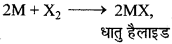
(iv) हैलोजन के साथ क्रिया:
क्षार धातुएँ हैलोजनों के साथ सुगमतापूर्वक क्रिया करके आयनिक हैलाइड बनाती हैं।
MP Board Class 11th Chemistry Solutions Chapter 10 s-ब्लॉक तत्त्व - 3
(M = क्षार धातु)

(v) अपचायक प्रकृति:
क्षार धातुएँ अपने संयोजी इलेक्ट्रॉन को सरलता से त्याग देती है। अतः ये प्रबल अपचायक होती हैं।
Na → Na+ +e
लीथियम सर्वाधिक प्रबल तथा सोडियम दुर्बलतम अपचायक है।

(vi) दव अमोनिया में विलेयता:
सभी क्षार धातुएँ अमोनिया में विलेय हो जाती है तथा गहरे नीले रंग का विलयन बनाती है।
MP Board Class 11th Chemistry Solutions Chapter 10 s-ब्लॉक तत्त्व - 4

(vii) सभी क्षार धातुएँ परस्पर तथा अन्य धातुओं के साथ मिलकर मिश्रधातु बनाती हैं। मर्करी के साथ अमलगम बनाती है तथा इस प्रकार की क्रियाएँ अत्यधिक ऊष्माक्षेपी होती हैं।

प्रश्न 2.
क्षारीय मृदा धातुओं के सामान्य अभिलाक्षणिक गुणों में आवर्तिता की विवेचना कीजिए।
उत्तर:
वर्ग – 2 के तत्व Be, Mg, Ca, Sr, Ba तथा Ra को संयुक्त रूप से क्षारीय धातु कहते हैं (Be के अतिरिक्त)।
सामान्य गुण (A) परमाण्विक गुण:
1. इलेक्ट्रॉनिक विन्यास – इनके सामान्य इलेक्ट्रॉनिक विन्यास को [उत्कृष्ट गैस] ns2 द्वारा दर्शाते हैं।
2. परमाण्विक तथा आयनिक त्रिज्या – इन तत्वों की परमाण्विक तथा आयनिक त्रिज्याएँ एक ही आवर्त में निकटवर्ती क्षार धातुओं की अपेक्षा कम होती है। एक ही वर्ग में परमाण्विक तथा आयनिक त्रिज्याएँ, परमाणु संख्या में वृद्धि के साथ – साथ बढ़ती है।
3. आयनन एन्थैल्पी – क्षारीय मृदा धातुओं की प्रथम आयनन एन्थैल्पी, इनके छोटे आकार के कारण –

MP Board Class 11th Chemistry Solutions Chapter 10 s-ब्लॉक तत्त्व - 5
क्षारीय मृदा धातुओं की द्वितीय आयनन एन्थैल्पी, संगत क्षार धातुओं की अपेक्षा कम होती है।
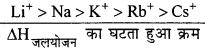
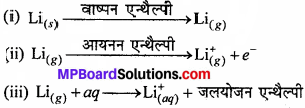
4. जलयोजन एन्थैल्पी – क्षारीय मृदा धातुओं की जलयोजन एन्थैल्पी क्षार धातु आयनों के समान वर्ग में नीचे की ओर जाने से क्रमशः घटती है।
Be2+ > Mg2+ > Ca2+ > Sr2+ > Ba2+
क्षारीय मृदा धातु आयनों की जलयोजन एन्थैल्पी, संगत क्षार धातुओं की अपेक्षा कम होती है।

(B) भौतिक गुण:
1. ये धातुएँ चाँदी के समान सफेद, चमकीली तथा नरम (परन्तु क्षार धातुओं की अपेक्षा कठोर) होती है।
2. इन धातुओं के छोटे आकार के कारण इनके गलनांक तथा क्वथनांक संगत क्षार धातुओं की अपेक्षा कम होते हैं। यह क्रम यद्यपि नियमित नहीं है।
3. ज्वाला के प्रति रंग – Be तथा Mg के अतिरिक्त सभी क्षारीय मृदा धातुएँ ज्वाला के साथ एक विशिष्ट रंग देते हैं। इनके विभिन्न रंग इलेक्ट्रॉनों को उत्तेजित तथा उत्तेजनहीन करने में प्रयुक्त ऊर्जाओं के विभिन्नता के कारण होता है।
MP Board Class 11th Chemistry Solutions Chapter 10 s-ब्लॉक तत्त्व - 6
4. घनत्व – इन धातुओं के घनत्व Be से Ca तक घटते हैं, तदुपरान्त बढ़ते हैं, ये धातुएँ अपने छोटे आकार के कारण, संगत क्षार धातुओं की अपेक्षा सघन, भारी तथा कठोर होती हैं।

(C) रासायनिक गुण:
क्षारीय मृदा धातुएँ क्षार धातुओं की अपेक्षा कम क्रियाशील होती हैं। इन धातुओं की क्रियाशीलता वर्ग में नीचे की ओर जाने पर क्रमशः घटती है।
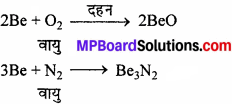
1. वायु तथा जल के साथ क्रिया – Be तथा Mg वायु (ऑक्सीजन) तथा जल के प्रति अक्रिय होते हैं क्योंकि इनकी सतह पर ऑक्साइड की परत जम जाती है। यद्यपि, बेरीलियम चूर्ण वायु में आसानी से जल जाता है।
MP Board Class 11th Chemistry Solutions Chapter 10 s-ब्लॉक तत्त्व - 7
इसी प्रकार मैग्नीशियम अधिक विद्युत् धनात्मक है तथा वायु में चमकीले प्रकाश के साथ जलकर Mgo तथा Mg,N, बनाता है। Ca, Sr तथा Ba वायु के साथ शीघ्रता से क्रिया करके ऑक्साइड तथा नाइट्राइड बनाते हैं।
2. हाइड्रोजन के साथ क्रिया – Be के अतिरिक्त ये सभी धातुएँ गर्म करने पर हाइड्रोजन के साथ योग करके MH, प्रकार के हाइड्राइड बनाती है। (M = Be, Mg, Ca, Sr, Ba)
3. हैलोजन के साथ क्रिया – ये धातुएँ हैलोजन के साथ उच्च ताप पर क्रिया करके MX2 प्रकार के हैलाइड बनाती है। M + X2 → MX2,
(X = F, CI, Br)
4. अम्लों के साथ क्रिया-ये धातुएँ अम्लों के साथ शीघ्रता से क्रिया करती हैं तथा H, गैस मुक्त करती हैं।
M + 2HCl → MCl2 + H2
5. अपचायक प्रकृति- क्षार धातुओं की भाँति, क्षारीय मृदा धातुएँ भी प्रबल अपचायक प्रकृति की होती है। यद्यपि इनकी अपचायक क्षमता क्षार धातुओं की अपेक्षा कम होती है। वर्ग में नीचे जाने पर इनकी अपचायक क्षमता क्रमशः घटती है।

6.  द्रव NH3 में विलेयता:
क्षार धातुओं की भाँति, क्षारीय मृदा धातुएँ द्रव अमोनिया में घुलकर गहरा नीला काला विलयन बनाती हैं।
M + (x + y)NH3 → [M(NH3)x]2+ + 2[e(NH3)y]

प्रश्न 3.
क्षार धातुएँ प्रकृति में क्यों नहीं पाई जाती हैं ?
उत्तर:
क्षार धातुएँ अत्यधिक रासायनिक सक्रियता के कारण प्रकृति में मुक्त अवस्था में नहीं पाई जाती हैं। ये भूपर्पटी में हैलाइड, सल्फेट, कार्बोनेट, सिलिकेट, बोरेट, ऑक्साइड आदि अयस्कों के रूप में पाई जाती हैं।

प्रश्न 4.
Na2O2में सोडियम की ऑक्सीकरण अवस्था ज्ञात कीजिए।
उत्तर:
माना Na2O2में Na की ऑक्सीकरण अवस्था x है। H2O2 के समान Na2O2 में परॉक्साइड बंध (-O-O-) होता है। अत: Na2O2 में Na की ऑक्सीकरण अवस्था –
x × 2 + (-1) × 2 = 0
2x – 2 = 0
⇒ x = \(\frac { 2 }{ 2 }\) = +1

प्रश्न 5.
पोटैशियम की तुलना में सोडियम कम अभिक्रियाशील क्यों है ? बताइए। ‘
उत्तर:
पोटैशियम की आयनन एन्थैल्पी (∆iH) (419 kJmol-1) सोडियम की आयनन एन्थैल्पी (496 kJmol-1) की अपेक्षा कम होती है तथा पोटैशियम का मान इलेक्ट्रोड विभव, (-2.925 V), सोडियम के संगत मान (-2.714 V) की अपेक्षा अधिक ऋणात्मक है। यही कारण है कि पोटैशियम, सोडियम की अपेक्षा अधिक ऋणात्मक है। अत: पोटैशियम, सोडियम से अधिक क्रियाशील होता है।

प्रश्न 6.
निम्नलिखित के सन्दर्भ में क्षार धातुओं एवं क्षारीय मृदा धातुओं की तुलना कीजिए –

  1. आयनन एन्थैल्पी
  2. ऑक्साइडों की क्षारकता
  3.  हाइड्रॉक्साइडों की विलेयता।

उत्तर:

  1. आयनन एन्थैल्पी – अधिक नाभिक आवेश एवं छोटे परमाणु आकार के कारण, क्षारीय मृदा धातुओं की आयनन एन्थैल्पी संगत क्षार धातुओं से अधिक होती है।
  2. ऑक्साइडों की क्षारकता – क्षार धातुओं के आयनन एन्थैल्पी कम अथवा वैद्युत धनात्मक गुण संगत क्षारीय मृदा धातुओं से अधिक होते हैं। अतः क्षारीय धातु ऑक्साइड संगत क्षारीय मृदा धातु ऑक्साइडों से अधिक क्षारीय होते हैं।
  3. हाइड्रॉक्साइडों की विलेयता – क्षारीय मृदा धातुओं के हाइड्रॉक्साइडों की विलेयता संगत क्षारीय हाइड्रॉक्साइडों की अपेक्षा कम होती है।

प्रश्न 7.
लीथियम किस प्रकार मैग्नीशियम से रासायनिक गुणों में समानताएँ दर्शाता है ?
उत्तर:
लीथियम तथा मैग्नीशियम समान आकार के कारण गुणों में अत्यधिक समानता प्रदर्शित करते हैं –
(परमाण्विक त्रिज्या : Li = 152pm, Mg = 160pm; आयनिक त्रिज्या Li+ = 76pm, Mg2+ = 72pm)। इनके समान गुण निम्न हैं –
1. लीथियम तथा मैग्नीशियम दोनों अपने संबंधित वर्गों के तत्वों की अपेक्षा हल्के तथा कठोर हैं।
2. लीथियम तथा मैग्नीशियम दोनों जल के साथ धीरे-धीरे क्रिया करते हैं।
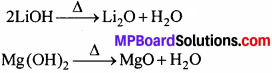
3. लीथियम तथा मैग्नीशियम दोनों के ऑक्साइड तथा हाइड्रॉक्साइड जल में बहुत कम विलेय हैं। इनके हाइड्रॉक्साइड गर्म करने पर अपघटित होते हैं।
MP Board Class 11th Chemistry Solutions Chapter 10 s-ब्लॉक तत्त्व - 8
4. Li तथा Mg दोनों वायु की नाइट्रोजन से सीधे क्रिया करके नाइट्राइड (Li3N तथा Mg3N2) बनाते हैं।
5. Li तथा Mg दोनों गर्म करने पर कार्बन के साथ संयुक्त होते हैं।

  • 2Li + 2C → Li2C2
  • Mg + 2C → MgC2

6. Li एवं Mg दोनों का ऑक्सीजन में गर्म करने पर मोनोऑक्साइड बनाते हैं।

  • 4Li + O2 → 2Li2o
  • 2Mg + O2 → 2MgO

7. Li2SO4 , MgSO4 की भाँति फिटकरी नहीं बनाता है।
8. LiCl, MgCl दोनों प्रस्वेद्य है तथा जलीय विलयन में हाइड्रेट (LiCl – 2H2O तथा MgCl26H2O) के रूप में क्रिस्टलीय होते हैं।
9. LiCO3 तथा MgCO3 दोनों गर्म करने पर आसानी से अपघटित होकर ऑक्साइड तथा CO2 बनाते हैं।
10. Li तथा Mg दोनों द्वारा ठोस हाइड्रोजन कार्बोनेट नहीं बनाए जा सकते हैं।
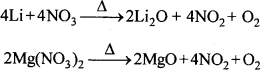
11. LiNO3 तथा Mg(NO3)2 दोनों गर्म करने पर अपघटित होकर नाइट्रोजन डाइऑक्साइड बनाते हैं।
MP Board Class 11th Chemistry Solutions Chapter 10 s-ब्लॉक तत्त्व - 54

प्रश्न 8.
क्षार धातुएँ तथा क्षारीय मृदा धातुएँ रासायनिक अपचयन विधि से क्यों प्राप्त नहीं किए जा सकते ? समझाइए।
उत्तर:

  • क्षार धातुएँ तथा क्षारीय मृदा धातुएँ स्वयं में प्रबल अपचायक हैं। अतः ये धातुएँ अपने ऑक्साइंड तथा अन्य यौगिकों द्वारा रासायनिक अपचयन विधि द्वारा प्राप्त नहीं की जा सकती है।
  • इन धातुओं की प्रकृति अत्यधिक विद्युत् धनात्मक होती है। अतः इनके लवणों में जलीय विलयन से इन्हें अन्य धातुओं द्वारा विस्थापित नहीं किया जा सकता है।

प्रश्न 9.
प्रकाश वैद्युत सेल में लीथियम के स्थान पर पोटैशियम एवं सीज़ियम क्यों प्रयुक्त किए जाते हैं?
उत्तर:
पोटैशियम तथा सीज़ियम की आयनन एन्थैल्पी लीथियम की अपेक्षा अधिक कम होती है। अतः ये धातुएँ प्रकाश में रखने पर इलेक्ट्रॉन आसानी से उत्सर्जित करती है, परन्तु लीथियम ऐसा नहीं कर पाती है। यही कारण है Li की अपेक्षा K तथा Cs का प्रयोग प्रकाश वैद्युत सेल में किया जाता है।

प्रश्न 10.
जब एक क्षार धातु को दव अमोनिया में घोला जाता है, तब विलियन विभिन्न रंग प्राप्त कर सकता है। इस प्रकार के रंग-परिवर्तन कारण बताइए।
उत्तर:
क्षार धातुओं का अमोनिया में तनु विलयन का रंग गहरा नीला होता है क्योंकि अमोनीकृत इलेक्ट्रॉन प्रकाश के अदृश्य क्षेत्र में ऊर्जा अवशोषित करते हैं। यदि विलयन की सान्द्रता 3M से अधिक बढ़ा दी जाये तो रंग ताँबे – काँस्य जैसा हो जाता है।

प्रश्न 11.
ज्वाला को बेरीलियम एवं मैग्नीशियम कोई रंग प्रदान नहीं करते हैं, जबकि अन्य क्षारीय मृदा धातुएँ ऐसा करती हैं, क्यों?
उत्तर:
Be तथा Mg परमाणु अपने छोटे आकार तथा अधिक प्रभावी नाभिकीय आवेश के कारण अपने इलेक्ट्रॉनों को अधिक प्रबलता सं बाँधे रखते हैं। अतः इन्हें उच्च उत्तेजन ऊर्जा की आवश्यकता होती है तथा ये बुन्सन ज्वाला द्वारा उत्तेजित नहीं हो पाते हैं। जबकि अन्य क्षारीय मृदा धातुओं के उच्च ऊर्जा स्तरों में इलेक्ट्रॉनों का सरलतापूर्वक उत्सर्जन हो सकता है। अतः ज्वाला में विशिष्ट रंग देते हैं।

प्रश्न 12.
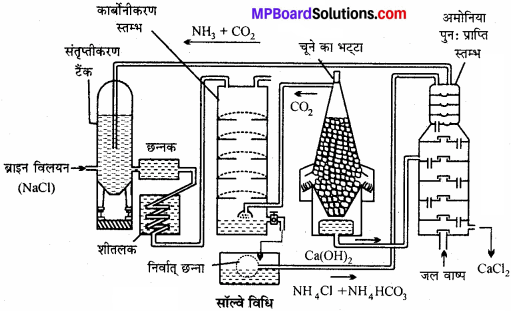
सॉल्वे प्रक्रम में होने वाली विभिन्न अभिक्रियाओं की विवेचना कीजिए।
उत्तर:
सॉल्वे अमोनिया प्रक्रम में, अमोनिया द्वारा संतृप्त ब्राइन (NaCl का सान्द्र विलयन) में CO2 प्रवाहित की जाती है। इस प्रक्रम में शीघ्र विलेय सोडियम बाइकार्बोनेट बनता है।
MP Board Class 11th Chemistry Solutions Chapter 10 s-ब्लॉक तत्त्व - 60
इस प्रकार बने सोडियम बाइकार्बोनेट को छानकर, सुखाकर तथा गर्म करके सोडियम कार्बोनेट प्राप्त करते हैं।
MP Board Class 11th Chemistry Solutions Chapter 10 s-ब्लॉक तत्त्व - 9

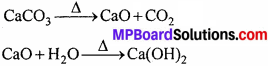
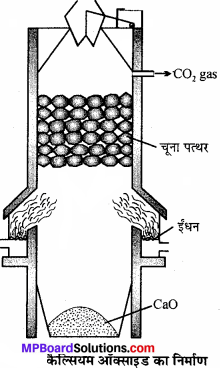
कार्बोनेटिंग स्तंभ में प्रयुक्त CO2 को कैल्सियम कार्बोनेट को गर्म करके प्राप्त करते हैं। इस क्रिया में बने Cao को जल में घोलकर बुझा हुआ चूना प्राप्त कर लेते हैं।
MP Board Class 11th Chemistry Solutions Chapter 10 s-ब्लॉक तत्त्व - 10
अमोनिया पुनः प्राप्ति स्तंभ में NH4Cl तथा Ca(OH)2 को गर्म करके NH3 प्राप्त करते हैं।
MP Board Class 11th Chemistry Solutions Chapter 10 s-ब्लॉक तत्त्व - 11

प्रश्न 13.
पोटैशियम कार्बोनेट सॉल्वे विधि द्वारा नहीं बनाया जा सकता है, क्यों?
उत्तर:
पोटैशियम कार्बोनेट को सॉल्वे विधि से नहीं बनाया जा सकता, क्योंकि पोटैशियम कार्बोनेट जल में अत्यधिक विलेय होने के कारण अवक्षेपित नहीं होता है।

प्रश्न 14.
Li2CO3 कम ताप पर एवं Na2CO3 उच्च ताप पर क्यों विघटित होता है ?
उत्तर:
Li+ आयन आकार में छोटे होते हैं, जो छोटे ऋणायन ऑक्साइड O2-के साथ, CO32- की तुलना में स्थायी जालक बनाते हैं इसलिए Li2CO3 निम्न ताप पर Li2O में विघटित होता है। जबकि Na+ आयन बड़े आकार का होता है, जो बड़े ऋणायन CO32- के साथ O2-आयन की तुलना में स्थायी जालक बनाता है। अतः Na2CO3 अत्यधिक स्थायी है, जो उच्च ताप पर ही Na2O में विघटित होता है।

प्रश्न 15.
क्षार धातुओं के निम्नलिखित यौगिकों की तुलना क्षारीय मृदा धातुओं के संगत यौगिकों से विलेयता एवं तापीय स्थायित्व के आधार पर कीजिए –
(a) नाइट्रेट
(b) कार्बोनेट
(c) सल्फेट।
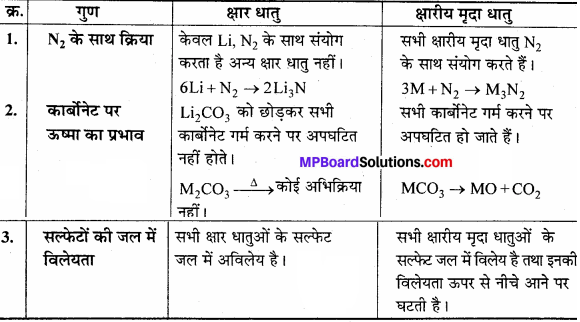
उत्तर:
(a) क्षार तथा क्षारीय मृदा धातुओं में नाइट्रेट –
1. क्षार तथा क्षारीय मृदा धातुओं के नाइट्रेट जल में अति विलेय होते हैं।
MP Board Class 11th Chemistry Solutions Chapter 10 s-ब्लॉक तत्त्व - 12
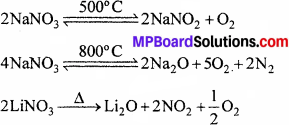
2. क्षार धातुओं के नाइट्रेट (लीथियम नाइट्रेट के अतिरिक्त) उच्च ताप पर नाइट्राइड में अपघटित हो जाते हैं। अधिक ताप पर पुनः गर्म करने पर, ऑक्साइड प्राप्त होते हैं। क्षारीय मृदा धातुओं के नाइट्रेट (बेरियम नाइट्रेट के अतिरिक्त) गर्म करने पर संगत ऑक्साइड देते हैं तथा NO2 तथा O2 का मिश्रण मुक्त होता है।
MP Board Class 11th Chemistry Solutions Chapter 10 s-ब्लॉक तत्त्व - 13

(b) क्षार तथा क्षारीय मृदा धातुओं में कार्बोनेट –
1. क्षार धातुओं के कार्बोनेट 1273 K तक स्थायी होता है। इससे अधिक ताप पर ये पिघलकर संगत ऑक्साइड बनाते हैं।
MP Board Class 11th Chemistry Solutions Chapter 10 s-ब्लॉक तत्त्व - 14
अपेक्षाकृत कम स्थायी है तथा शीघ्रता से अपघटित हो जाती है।
MP Board Class 11th Chemistry Solutions Chapter 10 s-ब्लॉक तत्त्व - 15
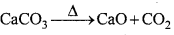
सभी क्षारीय मृदा धातुओं के कार्बोनेट गर्म करने पर संगत धातु ऑक्साइड तथा CO2 देते हैं।
MP Board Class 11th Chemistry Solutions Chapter 10 s-ब्लॉक तत्त्व - 16
क्षारीय मृदा धातुओं के कार्बोनेटों का तापीय स्थायित्व वर्ग में नीचे जाने पर क्रमशः घटता है। BeCO2 सबसे कम स्थायी है।
2. सभी क्षार धातु कार्बोनेट सामान्यतः जल में विलेय होते हैं तथा इनकी विलेयता वर्ग में नीचे जाने पर क्रमशः बढ़ती है, क्योंकि इनकी जलयोजन ऊर्जा की अपेक्षा जालक ऊर्जा अधिक शीघ्रता से घटती है। क्षारीय मृदा धातुएँ कार्बोनेट जल में विलेय होती है तथा इनकी विलेयता वर्ग में नीचे जाने पर क्रमशः घटती है। यद्यपि ये CO2 की उपस्थिति में अधिक विलेय होती है।

(c) क्षार तथा क्षारीय मृदा धातुओं में सल्फेट –
1. क्षार धातुओं के सल्फेट (Li2SO4 के अतिरिक्त) ताप स्थायी होते हैं, जबकि क्षारीय मृदा धातुओं के सल्फेट गर्म करने पर अपघटित हो जाते हैं। इनका ताप स्थायित्व वर्ग में नीचे की ओर जाने पर क्रमशः बढ़ता है।
2. क्षार धातु सल्फेट (Li2SO4 के अतिरिक्त) जल में विलेय होते हैं। क्षारीय मृदा धातुओं के सल्फेटों की विलेयता वर्ग में नीचे की ओर जाने पर क्रमशः घटती है। BeSO4 तथा MgSO4 जल में शीघ्र विलेय हैं, जबकि BaSO4 जल में पूर्णतया अविलेय है।

प्रश्न 16.
सोडियम क्लोराइड से प्रारम्भ करके निम्नलिखित को आप किस प्रकार बनाएँगे –

  1. सोडियम धातु
  2. सोडियम हाइड्रॉक्साइड
  3. सोडियम परॉक्साइड
  4. सोडियम कार्बोनेट।

उत्तर:
1. सोडियम धातु:
इसे NaCl (40%) तथा CaCl2(60%) के गलित मिश्रण द्वारा 273K पर डाउन्स सेल में वैद्युत-अपघटन द्वारा बनाया जाता है। कैथोड पर मुक्त Na को केरोसीन (मिट्टी के तेल)में एकत्रित करते हैं, जबकि Cl2 एनोड पर मुक्त होती है।
MP Board Class 11th Chemistry Solutions Chapter 10 s-ब्लॉक तत्त्व - 61
कैथोड पर – Na+ + e →Na(s)
एनोड पर – 2Cl → Cl2(g) + 2e

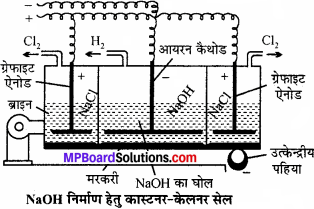
2. सोडियम हाइड्रॉक्साइड:
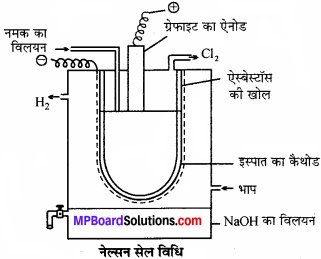
इसे कास्टनर – कैलनर सेल में NaCl के जलीय संतृप्त विलयन (ब्राइन) के वैद्युत – अपघटन द्वारा प्राप्त करते हैं। इस सेल में मर्करी कैथोड तथा कार्बन एनोड का प्रयोग करते हैं। सोडियम धातु जो कैथोड पर मुक्त होती है, मर्करी के साथ संयोग करके सोडियम अमलगम बनाती है। Cl2 गैस एनोड पर मुक्त होती है।
MP Board Class 11th Chemistry Solutions Chapter 10 s-ब्लॉक तत्त्व - 18
एनोड पर – 2Cl → Cl2(g) + 2e
इस प्रकार प्राप्त सोडियम अमलगम की क्रिया जल से कराने पर सोडियम हाइड्रॉक्साइड तथा हाइड्रोजन गैस मुक्त होती है।
2Na – अमलगम + 2H2O → 2NaOH + 2Hg + H2

3. सोडियम परॉक्साइड:
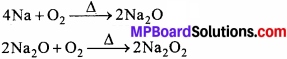
गलित NaCl के वैद्युत – अपघटन से प्राप्त गलित सोडियम धातु को वायु की अधिकता में गर्म करने पर सोडियम ऑक्साइड प्राप्त होता है। इससे वायु की पुनः क्रिया कराने पर Na2O2 प्राप्त होता है।
MP Board Class 11th Chemistry Solutions Chapter 10 s-ब्लॉक तत्त्व - 19

4. सोडियम कार्बोनेट- इसे सॉल्वे अमोनिया प्रक्रम द्वारा बनाया जाता है। अमोनियाकृत सान्द्र ब्राइन विलयन (NaCl के जलीय विलयन) में CO2 प्रवाहित करने पर, सोडियम हाइड्रोजन कार्बोनेट अवक्षेपित होता है। जिसे पुनः गर्म कराने पर सोडियम कार्बोनेट प्राप्त होता है।
MP Board Class 11th Chemistry Solutions Chapter 10 s-ब्लॉक तत्त्व - 64

प्रश्न 17.
क्या होता है, जब –

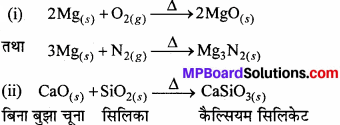
  1. मैग्नीशियम को हवा में जलाया जाता है
  2. बिना बुझे चूने को सिलिका के साथ गर्म किया जाता है
  3. क्लोरीन को बुझे चूने से क्रिया कराया जाता है
  4. कैल्सियम नाइट्रेट को गर्म किया जाता है।

उत्तर:
MP Board Class 11th Chemistry Solutions Chapter 10 s-ब्लॉक तत्त्व - 20
(iii) यह Cl2 से क्रिया करके कैल्सियम हाइपोक्लोराइड बनाता है।
MP Board Class 11th Chemistry Solutions Chapter 10 s-ब्लॉक तत्त्व - 62
MP Board Class 11th Chemistry Solutions Chapter 10 s-ब्लॉक तत्त्व - 22

प्रश्न 18.
निम्नलिखित में से प्रत्येक के दो-दो उपयोग बताइए –
(a) कास्टिक सोडा
(b) सोडियम कार्बोनेट
(c) बिना बुझा चूना।
उत्तर:
(a) कास्टिक सोडा –

  • इसका उपयोग साबुन, कागज, कृत्रिम रेशम आदि बनाने में होता है।
  • वस्त्र उद्योग में सूती कपड़ों के मर्सरीकरण में इसका प्रयोग होता है।

(b) सोडियम कार्बोनेट –

  • इसका प्रयोग जल के मृदुकरण, धुलाई तथा निर्मलन में करते हैं।
  • इसका उपयोग काँच, साबुन, बोरेक्स कास्टिक सोडा के निर्माण में होता है।

(c) बिना बुझा चूना –

  • इसका प्रयोग कास्टिक सोडा से धावन सोडा बनाने में करते हैं।
  • इसका प्रयोग शर्करा के शुद्धिकरण में तथा रंजकों के निर्माण में करते हैं।

प्रश्न 19.
निम्नलिखित की संरचना बताइए –

  1. BeCl(वाष्य)
  2. BeCl2(ठोस)।

उत्तर:
1. वाष्प अवस्था में यह सेतु बंधित क्लोराइड द्विलक की भाँति रहता है।
MP Board Class 11th Chemistry Solutions Chapter 10 s-ब्लॉक तत्त्व - 23
2. ठोस अवस्था में, यह क्लोरीन आबंध के साथ बहुलक श्रृंखला संरचना प्रदर्शित करता है।
MP Board Class 11th Chemistry Solutions Chapter 10 s-ब्लॉक तत्त्व - 55

प्रश्न 20.
सोडियम एवं पोटैशियम के हाइड्रॉक्साइड एवं कार्बोनेट जल मे विलेय है, जबकि मैग्नीशियम एवं कैल्सियम के संगत लवण जल में अल्प विलेय है। समझाइए।
उत्तर:
MP Board Class 11th Chemistry Solutions Chapter 10 s-ब्लॉक तत्त्व - 24
∆Hविलयन का मान जितना अधिक ऋणात्मक होता है, यौगिक की विलेयता उतनी ही कम होती है। सोडियम तथा पोटैशियम हाइड्रॉक्साइड तथा कार्बोनेटों की जल योजन ऊर्जा उनकी जालक ऊर्जा से अधिक होती है। अतः ये जल में विलेय होते हैं। मैग्नीशियम तथा कैल्सियम हाइड्रॉक्साइड की जालक ऊर्जा इनकी जलयोजन ऊर्जा से अधिक होती है। अतः ये जल में अल्प विलेय होते हैं।

प्रश्न 21.
निम्नलिखित की महत्व बताइए –
(a) चूना पत्थर
(b) सीमेंट
(c) प्लास्टर ऑफ पेरिस।
उत्तर:
(a) चूना पत्थर (CaCO3):

  • इसे मैग्नीशियम कार्बोनेट के साथ आयरन जैसी धातुओं के निष्कर्षण में गालक के रूप में प्रयोग करते हैं।
  • इसका प्रयोग ऐन्टासिड, टूथपेस्ट में अपघर्षक के रूप में, च्यूइंगम में संघटक तथा सौन्दर्य प्रसाधनों के रूप में भी करते हैं।

(b) सीमेंट:

  • यह भवन निर्माण हेतु एक महत्वपूर्ण यौगिक है।
  • इसका उपयोग काँक्रीट, प्रगलित काँक्रीट, प्लास्टीरंग, पुल-निर्माण, भवन-निर्माण आदि में किया जाता है।

(c) प्लास्टर ऑफ पेरिस:

  • इसका उपयोग भवन निर्माण तथा टूटी हुई हड्डियों के प्लास्टर में होता है।
  • इसका उपयोग दंत चिकित्सा, अलंकरण कार्य तथा मूर्तियों एवं अर्द्धप्रतिमाओं को बनाने में भी होता है।

प्रश्न 22.
लीथियम के लवण साधारणतया जलयोजित होते हैं, जबकि अन्य क्षार धातुओं के लवण साधारणतया निर्जलीय होते है, क्यों?
उत्तर:
क्षार धातुओं में सबसे छोटा आकार होने के कारण Li+ की जलयोजन कार्य सबसे कम होती है। यही कारण है कि लीथियम लवण सामान्यतः जलयोजित होते हैं तथा अन्य क्षार धातुओं के लवण साधारणतः निर्जलीय होते हैं।
MP Board Class 11th Chemistry Solutions Chapter 10 s-ब्लॉक तत्त्व - 25

प्रश्न 23.
LiF जल में लगभग विलेय होता है, जबकि LiCl न सिर्फ जल में, बल्कि एसीटोन में भी विलेय होता है। कारण बताइए, अन्य क्षार धातुओं के लवण साधारणतया निर्जलीय होते है। क्यों ?
उत्तर:
LiF, उच्च जालक ऊर्जा के कारण जल में लगभग विलेय होता है। परन्तु LiCl जल में विलेय होता है। LiCl अपनी विशिष्ट सहसंयोजी प्रकृति के कारण, एसीटोन में भी विलेय होता है। (चूँकि सहसंयोजी प्रकृति, ऋणायन के आकार के साथ बढ़ती है। अतः विलेयता का क्रम निम्न है –
LiF < LiCl< LiBr < Lil

प्रश्न 24.
जैव द्रवों में सोडियम, पोटैशियम, मैग्नीशियम एवं कैल्सियम की सार्थकता बताइए।
उत्तर:
सोडियम तथा पोटैशियम आयन अंतराकाशी द्रव में महत्वपूर्ण भूमिका निभाते हैं। ये आयन शिरा-संकेतों के संचरण में भाग लेते हैं। पोटैशियम आयन कोशिका द्रव में प्रचुरता में पाए जाने वाले धनायन हैं। जहाँ ये अनेक एन्जाइमों को सक्रिय करते हैं, ग्लूकोस के ऑक्सीकरण से ATP के निर्माण में भाग लेते हैं।

पौधे में, प्रकाश अवशोषण के लिए मुख्य रंजक क्लोरोफिल होता है। क्लोरोफिल में मैग्नीशियम होता है। शरीर में कैल्सियम का 99% भाग हड्डियों तथा दांतों में होता है। यह अंतर तांत्रिकीय पेशीय कार्यप्रणाली, अंतर तांत्रिकीय प्रेषण, कोशिका झिल्ली अखंडता तथा रक्त स्कंदन में महत्वपूर्ण भूमिका निभाता है।

प्रश्न 25.
क्या होता है, जब –
(a) सोडियम धातु को जल में डाला जाता है।
(b) सोडियम धातु को हवा की अधिकता में गर्म किया जाता है।
(c) सोडियम परॉक्साइड को जल में घोला जाता है।
उत्तर:
(a) H2 गैस मुक्त होती है, जो अभिक्रिया में अत्यधिक ऊष्मा उत्पन्न करने के कारण आग पकड़ लेती है।
2Na2(s) + 2H2O(l) → 2NaOH(aq)+ H2(g)

(b) Nazo की समान मात्रा के साथ Na20, प्राप्त होता है।
MP Board Class 11th Chemistry Solutions Chapter 10 s-ब्लॉक तत्त्व - 26
(c) HO2 बनता है।
Na2O2(s) + 2H2O(l) → 2NaOH(aq) + H2O2(l).

प्रश्न 26.
निम्नलिखित में से प्रत्येक प्रेक्षण पर टिप्पणी लिखिए –
(a) जलीय विलयनों में क्षार धातु आयनों की गतिशीलता Li+ < Na+ <K+ <Rb+ <Cs+ क्रम में होती है।
(b) लीथियम ऐसी एकमात्र क्षार धातु है, जो नाइट्राइड बनाती है।
(c) M2+(aq) + 2e → M(s); हेतु E° ( जहाँ, M = Ca, Sr या Ba) लगभग समान है।
उत्तर:
(a) आयन का आकार जितना कम होता है, जलयोजन उतना ही अधिक होता है तथा आयन का जलयोजन जितना अधिक होता है, उसकी आयनिक गतिशीलता उतनी ही कम होती है। अतः जलयोजन क्षमता का क्रम निम्न होगा –
Li+ < Na+ <K+ <Rb+ <Cs+
अतः आयनिक गतिशीलता विपरीत क्रम में बढ़ेगी –
Li+(aq) < Na+(aq) <K+(aq) <Rb+(aq) <Cs+(aq)
(b) अपने छोटे आकार के कारण, क्षार धातुओं में केवल लीथियम नाइट्राइड बनाती है।
(c) M2+ + 2e M(s); जहाँ, M = Ca, Sr, Ba के लिए E° का मान लगभग समान होता है। किसी भी इलेक्ट्रोड के लिए E का मान निम्नलिखित तीन कारकों पर निर्भर करता है –

  • वाष्पन एन्थैल्पी
  • आयनन एन्थैल्पी
  • जलयोजन एन्थैल्पी

चूँकि इन तीनों कारकों का संयुक्त प्रभाव Ca, Sr तथा Ba के लिए लगभग समान रहता है। अतः इनके इलेक्ट्रोड विभव का मान लगभग स्थिर रहता है।

प्रश्न 27.
निम्नलिखित में से प्रत्येक प्रेक्षण पर टिप्पणी लिखिए –
(a) Na2CO3 का विलयन क्षारीय होता है।
(b) क्षार धातुएँ उनके संगलित क्लोराइडों के वैद्युत-अपघटन से प्राप्त की जाती है।
(c) पोटैशियम की तुलना में सोडियम अधिक उपयोगी है।
उत्तर:
(a) Na2CO3 एक दुर्बल अम्ल (H2CO3) तथा प्रबल क्षार का लवण है। अतः जल-अपघटन कराने पर यह क्षार (NaOH) देता है, जिसके कारण इसका जलीय विलयन क्षारीय होता है।
Na2CO3(s) + 2H2O(l) → 2NaOH(aq) + H2CO3(aq)

(b)1. क्षार धातुएँ प्रबल अपचायक होती है, अतः इन्हें इनके ऑक्साइड तथा यौगिकों से निष्कर्षित नहीं किया जा सकता है।
2. अत्यधिक धनात्मक प्रकृति के कारण इनके लवणों के विलयन से इन्हें किसी अन्य धातु द्वारा विस्थापित नहीं किया जा सकता है।
3. क्षार धातुएँ अपने लवणों के जलीय विलयन के विद्युत्-अपघटन विधि द्वारा प्राप्त नहीं की जा सकती है, क्योंकि कैथोड पर Na धातु की अपेक्षा H, मुक्त होती है। यही कारण है कि क्षार धातुएँ अपने गलित क्लोराइडों के विद्युत्-अपघटन द्वारा प्राप्त होती है।
MP Board Class 11th Chemistry Solutions Chapter 10 s-ब्लॉक तत्त्व - 27
वैद्युत अपघटन में निम्नलिखित क्रियाएँ होती हैं –
कैथोड पर – 2cl → Cl2 + 2e
एनोड पर – 2Na+ + 2e →2Na

(c) पोटैशियम की तुलना में सोडियम अधिक महत्वपूर्ण है क्योंकि यह क्रियाशील तो है परन्तु पोटैशियम की भाँति अतिक्रियाशील नहीं है। सोडियम के अन्य उपयोग हैं –

  • नाभिकीय संयंत्रों में शीतलक के रूप में।
  • पेट्रोल के लिए अपस्फोटन-रोधी पदार्थ, टेट्राएथिल लेड (TEL) के निर्माण में।
    4C2H2Cl + 4Na – Pb →(C2H5)4Pb + 3Pb + 4NaCl

प्रश्न 28.
निम्नलिखित के मध्य क्रियाओं के संतुलित समीकरण लिखिए –

  1. Na2O2 एवं जल
  2. KO2 एवं जल
  3. Na2O2 एवं CO2.

उत्तर:

  1. Na2O2(s) +2H2O(l) → 2NaOH(aq) + H2O2(aq)
  2. 2KO2(s) + H2O(l) →2KOH(aq) + \(\frac { 3 }{ 2 }\)O2(g)
    या 2KO2(s) + H2O(l) →2KOH(aq) + \(\frac { 3 }{ 2 }\)O2(g)
  3. Na2O + CO2 → Na2CO3 .

प्रश्न 29.
आप निम्नलिखित तत्वों को कैसे समझाएँगे –

  1. BeO जल में अविलेय है, जबकि BeSO4 विलेय है।
  2. Bao जल में विलेय है, जबकि BaSO4 अविलेय है।
  3. एथेनॉल में dil. KI की तुलना में अधिक विलेय है।

उत्तर:
1. BeO जल में अविलेय है, क्योंकि BeO की जालक ऊर्जा का मान जलयोजन ऊर्जा से अधिक है, जबकि BeSO जल में घुलनशील है क्योंकि इसकी जलयोजन ऊर्जा जालक ऊर्जा से अधिक है।

2. दूसरे वर्ग के ऑक्साइड की विलेयता के लिए दोनों जालक ऊर्जा और जलयोजन ऊर्जा वर्ग में नीचे जाते समय घटती है, क्योंकि धनायन का आकार बढ़ता है। लेकिन जालक ऊर्जा, जलयोजन की अपेक्षा अधिक तीव्रता से घटती है। अत: BaO जल में घुलनशील है, क्योंकि जलयोजन ऊर्जा जालक ऊर्जा से अधिक है। परन्तु दूसरी ओर BaSO4 जल में अविलेय है। जालक ऊर्जा की प्रबलता समान रहती है, क्योंकि ऋणायन का आकर इतना बड़ा है कि धनायन का आकार बढ़ने से कोई प्रभाव नहीं पड़ता। अत: BaSO4 के लिए जालक ऊर्जा मान जलयोजन ऊर्जा से अधिक है।

3. एथेनॉल में Lil अधिक घुलनशील है, KI की तुलना में Lil में Li4 आयन का आकार छोटा है और घुलनशील है KI आयनिक यौगिक है अतः एथेनॉल में कम घुलनशील है।

प्रश्न 30.
इनमें से किस क्षार धातु का गलनांक न्यूनतम है-
(a) Na,
(b) K,
(c) Rb,
(d) Cs.
उत्तर:
(d) सीज़ियम का गलनांक न्यूनतम है (312K)।

प्रश्न 31.
निम्नलिखित में से कौन-सी क्षार धातु जलयोजित लवण देती है –
(a) Li,
(b) Na,
(c) K,
(d) Cs.
उत्तर:
(a) लीथियम अकेला ऐसा क्षार तत्व है, जो जलयोजित लवण देती है।

प्रश्न 32.
निम्नलिखित में कौन-सी क्षारीय मृदा धातु कार्बोनेट ताप के प्रति सबसे अधिक स्थायी है –
(a) MgCO3
(b) CaCO3
(c) SrCO3
(d) BaCO3
उत्तर:
(d) BaCO3 ताप के प्रति अधिक स्थाई है, यह 1633K पर वियोजित होता है।

s-ब्लॉक तत्त्व अन्य महत्वपूर्ण प्रश्न

s-ब्लॉक तत्त्व वस्तुनिष्ठ प्रश्न

प्रश्न 1.
सही विकल्प चुनकर लिखिए –

प्रश्न 1.
प्लास्टर ऑफ पेरिस होता है –
(a) (CaSO4)2. H2O
(b) CaSO4.2H2O
(c) CaSO4. H2O
(d) CaSO4.
उत्तर:
(a) (CaSO4)2. H2O

प्रश्न 2.
ब्लीचिंग पाउडर का सक्रिय घटक –
(a) Ca(OCl)2
(b) Ca(OCl)Cl
(c) Ca(O2Cl)2
(d) CaCl2O2.
उत्तर:
(b) Ca(OCl)Cl

प्रश्न 3.
द्रव अमोनिया में सोडियम का विलयन निम्न के कारण अपचायक होता है –
(a) Na परमाणु
(b) NaH
(c) NaNH2
(d) e (NH3)x
उत्तर:
(d) e (NH3)x

प्रश्न 4.
जल के साथ सोडियम की क्रिया तीव्र होती है, लीथियम की नहीं, क्योंकि लीथियम –
(a) का परमाणु भार अधिक है
(b) एक धातु है
(c) अधिक विद्युत् धनी है
(d) अधिक विद्युत् ऋणी है।
उत्तर:
(d) अधिक विद्युत् ऋणी है।

प्रश्न 5. विभिन्न क्लोराइडों में स्थायित्व का क्रम –
(a) LiCl > KCl > NaCl > CsCl
(b) CsCl > KCI > NaCl > LICl
(c) NaCl > KCl > LiCl > Csci
(d) KCl> CsCl> NaCl> LiCl.
उत्तर:
(a) LiCl > KCl > NaCl > CsCl

प्रश्न 6.
M 2+ की जलयोजन ऊर्जा अधिक होगी इससे –
(a) A3+
(b) Na+
(c) Be2+
(d) Mg3+
उत्तर:
(b) Na+

प्रश्न 7.
क्षारीय मृदा धातुओं का कौन-सा गुण परमाणु-क्रमांक बढ़ने के साथ बढ़ता है –
(a) आयनन ऊर्जा
(b) हाइड्रॉक्साइड की विलेयता
(c) सल्फेट की विलेयता
(d) ऋण-विद्युतता।
उत्तर:
(b) हाइड्रॉक्साइड की विलेयता

प्रश्न 8.
वायु को शुष्क करने के लिये किसका उपयोग ठीक है –
(a) CaCO3
(b) Na2CO3
(c) NaHCO 3
(d) CaO.
उत्तर:
(d) CaO.

प्रश्न 9. किस सल्फेट की विलेयता सबसे कम है –
(a) BaSO4
(b) MgSO4
(c) SrSO4
(d) CaSO4
उत्तर:
(a) BaSO4

प्रश्न 10.
क्षारीय मृदा धातुओं के कार्बोनेटों में तापीय स्थायित्व का क्रम होगा –
(a) BaCO3 > SrCO3 > CaCO3 > MgCO3
(b) BaCO3 > SrCO3 > MgCO3 > CaCO3
(c) CaCO3 > SrCO3 > MgCO3 > BaCO3
(d) MgCO3 > CaCO3 > SrCO3 > BaCO3.
उत्तर:
(d) MgCO3 > CaCO3 > SrCO3 > BaCO3.

प्रश्न 11.
मैग्नीशियम का महत्वपूर्ण अयस्क है –
(a) मेलाकाइट
(b) केसीटेराइट
(c) कार्नेलाइट
(d) गेलेना।
उत्तर:
(c) कार्नेलाइट

प्रश्न 12.
क्षारीय मृदा धातुओं के सल्फेटों की घुलनशीलता समूह में नीचे जाने पर घटती है। इसका कारण है –
(a) गलनांक का बढ़ना
(b) जालक ऊर्जा का बढ़ना
(c) समन्वयन संख्या का बढ़ना
(d) उपर्युक्त सभी।
उत्तर:
(b) जालक ऊर्जा का बढ़ना

प्रश्न 13.
कौन-सा अयस्क लीथियम का नहीं है –
(a) पेंटालाइट
(b) ट्राइफिलाइट
(c) एल्बाइट
(d) स्पोड्यूमीन।
उत्तर:
(c) एल्बाइट

प्रश्न 14.
मैग्नीशियम उपस्थित है इसमें –
(a) हीमोग्लोबीन
(b) क्लोरोफिल
(c) विटामिन B12
(d) विटामिन C.
उत्तर:
(b) क्लोरोफिल

प्रश्न 15.
CaCN2 तथा C के मिश्रण को कहते हैं –
(a) बेराइट
(b) एनहाइड्राइट
(c) नाइट्रोलियम
(d) आइसलैंड स्पॉट।
उत्तर:
(c) नाइट्रोलियम

प्रश्न 2.
रिक्त स्थानों की पूर्ति कीजिए –

  1. Ca2+ आयन की त्रिज्या K+ आयन से कम है क्योंकि …………. है।।
  2. Be(OH)2अम्ल तथा क्षार दोनों में विलेय है, क्योंकि इसकी प्रकृति ………….. है।
  3. लीथियम समूह – 2 के ……………… तत्व से समानता रखता है।
  4. द्रव अमोनिया में सोडियम धातु नीला रंग देती है यह ………….. के कारण है।
  5. हाइड्रोलिथ का सूत्र …………… है।
  6. s – ब्लॉक तत्व प्रबल …………… है।
  7. क्षारीय मृदा धातु …………. रेडियोधर्मी गुण प्रदर्शित करता है।
  8. क्षारीय धातु …………….. रेडियोधर्मी गुण प्रदर्शित करता है।
  9. …………. क्षारीय मृदा धातु हाइड्रॉक्साइड उभयधर्मी है।
  10. कार्नेलाइट का रासायनिक सूत्र …………… है।

उत्तर:

  1. धनावेश अधिक
  2. उभयधर्मी
  3. Mg
  4. e (NH3)x
  5. CaH2
  6. अपचायक
  7. रेडियम
  8. फ्रान्सियम (Fr)
  9. Be(OH)2
  10. KClMgCl2 6H2O.

प्रश्न 3.
उचित संबंध जोड़िए –
MP Board Class 11th Chemistry Solutions Chapter 10 s-ब्लॉक तत्त्व - 59
उत्तर:

  1. (e) CaO
  2. (d) CaCN2 तथा C
  3. (b) MgCl2
  4. (a) Ca(OCI)Cl
  5. (c) BaSO4
  6. (g) चूना पत्थर
  7. (f) धुएँ का पर्दा

प्रश्न 4.
एक शब्द / वाक्य में उत्तर दीजिए –

  1. क्षारीय मृदा धातुओं को बढ़ती हुई क्रियाशीलता के क्रम में व्यवस्थित कीजिए।
  2. लीथियम अयस्क के दो नाम सूत्र सहित लिखिए।
  3. मैग्नीशियम के दो अयस्कों के नाम लिखिए।
  4. क्षार धातुओं को मिट्टी के तेल में रखा जाता है। क्यों?
  5. ग्लोबल लवण का आण्विक सूत्र है।

उत्तर:

  1. क्षारीय मृदा धातुओं की रासायनिक क्रियाशीलता समूह में ऊपर से नीचे आने (Be-Ra) पर बढ़ती है। Be < Mg < Ca < Sr < Ba < Ra
  2. Li अयस्क के दो नाम व सूत्र –
    • स्पोड्यूमीन LiAl(SiO3)2
    • लेपिडोलाइट Li2Al2(SiO3)3.F(OH)2
  3. Mg के दो अयस्कों के नाम –
    • कार्नेलाइट
    • डोलोमाइट
  4. अत्यधिक क्रियाशीलता के कारण
  5. Na2SO4.10H2O

s-ब्लॉक तत्त्व अति लघु उत्तरीय प्रश्न

प्रश्न 1.
एक ऐसे खनिज का नाम तथा सूत्र बताइये जिसमें Ca एवं Mg दोनों उपस्थित होते हैं।
उत्तर:
खनिज का नाम-डोलोमाइट। सूत्र – MgCO3,CaCO3

प्रश्न 2.
फ्लक्स का नाम लिखिए जिसको धात्विक प्रक्रमों में अम्लीय अशुद्धियों को दूर करने के लिये प्रयोग करते हैं।
उत्तर:

  • लाइमस्टोन CaCO3
  • मैग्नेसाइट MgCO3

प्रश्न 3.
प्लास्टर ऑफ पेरिस का उपयोग प्लास्टर चढ़ाने में किस गुण के कारण किया गया है ?
उत्तर:
प्लास्टर ऑफ पेरिस जल से क्रिया करके सीमेण्ट के समान कठोर हो जाता है। इस गुण के कारण इसका उपयोग टूटी हड्डियों को जोड़ने के लिये प्लास्टर चढ़ाने में किया जाता है।
MP Board Class 11th Chemistry Solutions Chapter 10 s-ब्लॉक तत्त्व - 28

प्रश्न 4.
IA तथा IIA समूह को s-ब्लॉक तत्व कहते हैं। क्यों?
उत्तर:
IA तथा IIA समूह में उपस्थित सभी तत्वों का इलेक्ट्रॉनिक विन्यास करने पर अंतिम इलेक्ट्रॉन S – उपकोश में प्रवेश करता है, इसलिये इसे s-ब्लॉक तत्व कहते हैं।
उदाहरण –

  • Na11 → 1s2 2s22p63s1
  • Ca20 → 1s2 2s22p63s23p64s2

प्रश्न 5.
सॉरेल सीमेंट क्या है ? इसका उपयोग किन कार्यों में होता है ?
उत्तर:
MgCl2के सान्द्र विलयन में MgO मिलाया जाये तो MgCl2 2MgO. xH2O संघटन वाले मैग्नीशियम क्लोराइड का एक सफेद पेस्ट बनता है, जो जमकर कड़ा हो जाता है। इसे सॉरेल सीमेन्ट कहा जाता है। इसका उपयोग दाँतों की खोह भरने में तथा चीनी मिट्टी एवं पोर्सलेन के बर्तनों को जोड़ने में किया जाता है।

प्रश्न 6.
सोडियम कार्बोनेट को वायु में खुला छोड़ देने पर क्या परिवर्तन होता है ? समीकरण सहित समझाइये।
उत्तर:
Na2CO3 10H2O को वायु में खुला छोड़ देने पर इसका क्रिस्टलीय जल धीरे-धीरे निकल जाता है और यह मोनोहाइड्रेट Na2CO2 H2O देता है जो 750°C पर गर्म करने पर निर्जल Na2CO3 देता है जिसे सोडा राख कहते हैं।
MP Board Class 11th Chemistry Solutions Chapter 10 s-ब्लॉक तत्त्व - 29

प्रश्न 7.
लीथियम हाइड्राइड का प्रयोग अन्य हाइड्राइडों के निर्माण में किया जा सकता है। बेरेलियम हाइड्राइड उनमें से एक है। इसके निर्माण के विभिन्न पद बताइए। इस प्रक्रम में प्रयुक्त रासायनिक समीकरण भी दीजिए।
उत्तर:
BeH2 का निर्माण संगत जटिल क्षारीय धातुओं हाइड्राइडों जैसे लीथियम-ऐल्युमिनियम हाइड्राइड के अपचयन द्वारा करते हैं।

  • 8LiH + Al2Cl6 → 2LiAlH4 + 6LiCl
  • 2BeCl2 + LiAlH4 → 2BeH2 + LiCl + AlCl2

प्रश्न 8.
कैल्सियम सल्फेट किस प्रकार बनाया जाता है ? इसके उपयोग लिखिए।
उत्तर:
प्रयोगशाला में Ca के ऑक्साइड, कार्बोनेट, क्लोराइड की अभिक्रिया तनु H2SO4 के साथ कराने पर कैल्सियम सल्फेट प्राप्त होता है।

  • CaO+ H2SO4 → CaSO4 + H4O
  • CaCO3 + H2SO4 → CaSO4 + H2O + CO2

उपयोग:

  • चाक बनाने में
  • सीमेंट उद्योग में
  • प्लास्टर ऑफ पेरिस बनाने में
  • खाद के रूप में।

प्रश्न 9.
जिप्सम किसे कहते हैं ? इससे प्लास्टर ऑफ पेरिस कैसे बनाते हैं ?
उत्तर:
कैल्सियम सल्फेट CaSO4 2H2O को जिप्सम कहते हैं । जिप्सम को 120 – 130°C तक गर्म करने पर इसमें से तीन चौथाई क्रिस्टल जल निकल जाता है तथा प्लास्टर ऑफ पेरिस प्राप्त होता है।
MP Board Class 11th Chemistry Solutions Chapter 10 s-ब्लॉक तत्त्व - 30
प्लास्टर ऑफ पेरिस जल अवशोषित करके पुनः जिप्सम में परिवर्तित हो जाता है।

प्रश्न 10.
अनबुझा चूना बनाते समय भट्टी का ताप 1000°C से अधिक गर्म नहीं करते।रासायनिक समीकरण सहित समझाइये।
उत्तर:
अनबुझा चूना बनाते समय भट्टी का ताप 1000°C से अधिक नहीं रखते क्योंकि इससे उच्च ताप पर CaO अशुद्धि के रूप में उपस्थित SiO2 से मिलकर गलनीय सिलिकेट बना लेता है।
MP Board Class 11th Chemistry Solutions Chapter 10 s-ब्लॉक तत्त्व - 31

प्रश्न 11.
सोडियम को मिट्टी के तेल में रखा जाता है। क्यों?
उत्तर:
सोडियम अत्यन्त क्रियाशील तथा प्रबल धन विद्युती तत्व है। यह वायुमण्डल में उपस्थित 02, नमी तथा कार्बन डाइ-ऑक्साइड के साथ अभिक्रिया करके ऑक्साइड तथा हाइड्राक्साइड बनाता है। इसलिये सोडियम को मिट्टी के तेल में रखा जाता है जिससे वह वायु के संपर्क में न आ सके।

  • 4Na + O2 → 2Na2O
  • Na2O+ H2O → 2NaOH
  • 2NaOH + CO2 → Na2CO3 + H2O

प्रश्न 12.
चूने के पानी का सूत्र लिखिए। इसमें CO2 के प्रवाह से क्या परिवर्तन होगा?
उत्तर:
बुझे हुये चूने का जल में स्वच्छ विलयन चूने का पानी कहलाता है। इसका सूत्र Ca(OH)2 होगा।

  • चूने के पानी में CO2 प्रवाहित करने से CaCO3 बनने के कारण विलयन दूधिया हो जाता है।
    Ca(OH)2 + CO2 → CaCO3 + H2O
  • चूने के पानी में CO2 को देर तक प्रवाहित करने पर चूने के पानी का दूधियापन समाप्त हो जाता है।
    Ca(OH)2 + CO2 + H2O → Ca(HCO3)2

प्रश्न 13.
फोटो रासायनिक सेल में किस धातु का उपयोग होता है और क्यों?
उत्तर:
फोटो रासायनिक सेल में पोटैशियम तथा सीजियम का उपयोग होता है, क्योंकि इनकी आयनन ऊर्जा अत्यन्त कम होती है।

प्रश्न 14.
सोडियम क्लोराइड से सोडियम का निष्कर्षण सामान्य अपचायक से क्यों नहीं किया जा सकता है ?
उत्तर:
सोडियम प्रबल अपचायक है। विद्युत् रासायनिक श्रेणी में इसका स्थान सबसे ऊँचा है। इससे प्रबल अपचायक उपलब्ध न होने से इसे सामान्य अपचायकों द्वारा अपचयित नहीं किया जा सकता है इसे केवल विद्युत् अपघटन द्वारा ही अपचयित किया जाता है।

प्रश्न 15.
Li और Be सहसंयोजी यौगिक बनाने की प्रवृत्ति रखते हैं। समझाइये।
उत्तर:
Li और Be परमाणु का आकार बहुत छोटा होता है और उनकी आयनन ऊर्जा अधिक होती है। अतः इनके संयोजकता कोश के इलेक्ट्रॉन नाभिक से दृढ़ता से जुड़े रहते हैं। साथ ही साथ आयनों की ध्रुवण क्षमता उच्च आवेश घनत्व के कारण अधिक होती है। इसलिये Li और Be सहसंयोजी यौगिक बनाने की प्रवृत्ति रखते हैं।

प्रश्न 16.
Li की तुलना में K और Cs का उपयोग फोटो रासायनिक सेल में करते हैं। क्यों?
उत्तर:
Cs तथा K के बड़े आकार के कारण इनकी आयनन ऊर्जा Li की तुलना में अत्यन्त कम है इसलिये सरलता से इलेक्ट्रॉन का त्याग कर सकते हैं। इसलिये फोटो रासायनिक सेल में Li की तुलना में K तथा Cs का उपयोग किया जाता है।

प्रश्न 17.
BeCl2, को वायुमण्डल में रखने पर यह सफेद धूम्र देता है। क्यों?
उत्तर:
BeCl2 आर्द्रता ग्राही होता है। यह वायुमण्डल में उपस्थित नमी को अवशोषित करके जल अपघटित हो जाता है और HCl गैस उत्पन्न करता है। HCl गैस बनने के कारण ही सफेद धूम्र प्राप्त होते हैं।
BeCl2 + 2H2O → Be(OH)2 + 2HCl

प्रश्न 18.
प्रथम वर्ग में ऊपर से नीचे आने पर तत्वों की कठोरता बढ़ती जाती है, क्यों?
उत्तर:
प्रथम वर्ग में ऊपर से नीचे आने पर तत्वों के आकार में वृद्धि के साथ-साथ इनके घनत्वों में भी वृद्धि होती है और उनके परमाणुओं के मध्य आकर्षण बल भी बढ़ता जाता है। जिससे तत्वों की कठोरता बढ़ती जाती है।

s-ब्लॉक तत्त्व लघु उत्तरीय प्रश्न

प्रश्न 1.
s – ब्लॉक तत्व तथा p – ब्लॉक तत्वों को प्रतिनिधि तत्व कहते हैं। क्यों ?
उत्तर:
वे तत्व जिनके बाहरी कोश का इलेक्ट्रॉनिक विन्यास ns1-2 तथा ns2np1-6 होता है, प्रतिनिधि तत्व कहलाते हैं। क्योंकि इस समूह में उपस्थित प्रत्येक तत्व अपने समूह के गुणों का प्रतिनिधित्व करते हैं तथा प्रत्येक समूह के गुण दूसरे समूह के गुण से पूर्णतः भिन्न होते हैं।
(1) s – ब्लॉक तत्व – वे तत्व जिनका अंतिम इलेक्ट्रॉन s – उपकोश में प्रवेश करता है, s – ब्लॉक तत्व कहलाते हैं। इनका सामान्य इलेक्ट्रॉनिक विन्यास ns1-2 होता है।
(2) p – ब्लॉक तत्व-वे तत्व जिनका इलेक्ट्रॉनिक विन्यास करने पर अंतिम इलेक्ट्रॉन p – उपकोश में प्रवेश करता है, p – ब्लॉक तत्व कहलाते हैं। इनका सामान्य इलेक्ट्रॉनिक विन्यास ns2np1-6 होता है।

प्रश्न 2.
क्षार धातु प्रबल अपचायक होते हैं, क्यों?
उत्तर:
क्षार धातुओं के बड़े आकार के कारण इनकी आयनन ऊर्जा कम होती है। जिसके कारण ये संयोजी कोश के इलेक्ट्रॉन को आसानी से त्याग कर ऑक्सीकृत हो जाते हैं तथा इनके मानक इलेक्ट्रोड विभव का मान अधिक ऋणात्मक होता है। इसलिये ये इलेक्ट्रॉन का त्याग कर सरलता से M+ आयन बनाते हैं। इसलिये ये प्रबल अपचायक की तरह कार्य करते हैं।

प्रश्न 3.
BeSO4 तथा MgSO4 जल में शीघ्र विलेय है जबकि CaSO4 SrSO4 तथा BaSO4 अविलेय है। क्यों?
उत्तर:
क्षारीय मृदा धातुओं की जालक ऊर्जा, सल्फेट आयन के वृहद् आकार के कारण लगभग समान होती है। अतः इनकी विलेयता जलयोजन ऊर्जा पर निर्भर करती है, जो वर्ग में नीचे जाने पर क्रमशः घटती है। Be2+ तथा Mg2+ आयनों की उच्च जलयोजन एन्थैल्पी, जालक एन्थैल्पी कारक को हीन कर देती है जिसके कारण इनके सल्फेट जल में विलेय होते हैं। दूसरी ओर Ca2+, Sr2+ तथा Ba2+ आयनों के लिए जलयोजन एन्थैल्पी कम होती है। अत: यह जालक एन्थैल्पी कारक को हीन नहीं कर पाती है। अतः इनके सल्फेट जल में अविलेय होते हैं।

प्रश्न 4.
जलीय विलयन में लीथियम की अपचायक क्षमता अधिक क्यों होती है ?
उत्तर:
किसी तत्व के जलीय विलयन में इलेक्ट्रॉनों की त्यागने की क्षमता का मापन इलेक्ट्रोड विभव द्वारा करते हैं। यह मुख्यतः निम्नलिखित तीन कारकों पर निर्भर करता है –
MP Board Class 11th Chemistry Solutions Chapter 10 s-ब्लॉक तत्त्व - 32

अपने आयनों के छोटे आकार के कारण, लीथियम की जलयोजन एन्थैल्पी सर्वाधिक होती है। यद्यपि Li की आयनन एन्थैल्पी, क्षार धातुओं से सर्वाधिक होती है परन्तु जलयोजन एन्थैल्पी भी आयनन एन्थैल्पी से अधिक होती है। अतः उच्च जलयोजन एन्थैल्पी के कारण, लीथियम जलीय विलयन में प्रबलतम अपचायक होता है।

प्रश्न 5.
प्रकाश वैद्युत सेल में लीथियम के स्थान पर पोटैशियम एवं सीजियम क्यों प्रयुक्त किए जाते हैं ?
उत्तर:
पोटैशियम तथा सीजियम की आयनन एन्थैल्पी लीथियम की अपेक्षा अधिक कम होती है। अतः ये धातुएँ प्रकाश में रखने पर इलेक्ट्रॉन आसानी से उत्सर्जित करती है, परन्तु लीथियम ऐसा नहीं कर पाती है। यही कारण है Li की अपेक्षा K तथा Cs का प्रयोग प्रकाश वैद्युत सेल में किया जाता है।

प्रश्न 6.
क्या कारण है कि क्षार धातुएँ M+ प्रकार का धनायन बनाती है, M+2 प्रकार का धनायन नहीं?
उत्तर:
क्षार धातुओं के संयोजी कोश में 1 इलेक्ट्रॉन होता है। इनके बड़े आकार के कारण इनकी आयनन ऊर्जा अत्यन्त कम होती है। इसलिये ये सरलता से इलेक्ट्रॉन का त्याग कर M+ आयन बनाते हैं। इस M+1 आयनिक अवस्था में इनका इलेक्ट्रॉनिक विन्यास अक्रिय गैसों के इलेक्ट्रॉनिक विन्यास के समान अत्यन्त स्थायी होता है। इसलिये इस अवस्था में ये रासायनिक दृष्टि से निष्क्रिय होते हैं और इसकी आयनन ऊर्जा अत्यन्त उच्च होती है। इसी कारण ये M+2 आयन नहीं बनाते।

प्रश्न 7.
क्षार धातुओं में कौन-सी धातु प्रबल अपचायक है तथा क्यों ?
उत्तर:
किसी भी तत्व की अपचायक प्रवृत्ति उसके मानक इलेक्ट्रोड विभव पर निर्भर करती है। वे तत्व जिनका मानक इलेक्ट्रोड विभव ऋणात्मक होता है अपचायक की तरह कार्य करते हैं तथा मानक इलेक्ट्रोड विभव का मान जितना अधिक ऋणात्मक होता है वह तत्व उतना प्रबल अपचायक होता है। Li का मानक इलेक्ट्रोड विभव अत्यधिक उच्च ऋणात्मक मान दर्शाता है। इसलिये यह प्रबल अपचायक है।

प्रश्न 8.
क्षार धातु प्रकृति में मुक्त अवस्था में नहीं प्राप्त होते हैं, क्यों? अथवा, क्षार धातु सदैव आयनिक यौगिक का निर्माण करते हैं, क्यों?
उत्तर:
क्षार धातुओं के बड़े आकार के कारण इनकी आयनन ऊर्जा अत्यन्त कम होती है। इसलिये यह सरलता से इलेक्ट्रॉन का त्याग करके धनायन बना सकते हैं। अर्थात् प्रबल धनविद्युती तथा अत्यधिक क्रियाशील होने के कारण वायुमण्डल में उपस्थित ऋणविद्युती तत्व, जैसे-नमी, CO2 के साथ सरलता से अभिक्रिया करके आयनिक यौगिकों का निर्माण करते हैं। इसलिये प्रकृति में मुक्त अवस्था में प्राप्त नहीं होते हैं।

प्रश्न 9.
क्षार धातु सरलता से ज्वाला परीक्षण देते हैं। क्यों ?
उत्तर:
क्षार धातुओं के बड़े आकार के कारण इनकी आयनन ऊर्जा के मान अत्यन्त कम होते हैं। इसलिये इन क्षारीय धातुओं तथा इनके यौगिकों को जब बुन्सन ज्वाला में गर्म किया जाता है तो संयोजी कोश का इलेक्ट्रॉन उत्तेजित होकर उच्च ऊर्जा स्तर में चला जाता है। कुछ समय पश्चात् यह इलेक्ट्रॉन अतिरिक्त ऊर्जा को दृश्य प्रकाश के रूप में प्रकीर्णित कर अपनी मूल स्थिति में वापस आ जाता है । इस प्रकार प्रकाश के प्रकीर्णन के कारण यह ज्वाला को विशिष्ट रंग प्रदान करते हैं।

प्रश्न 10.
Be तथा Mg ज्वाला परीक्षण नहीं देते हैं। क्यों ?
उत्तर:
Be तथा Mg में s – कक्षक पूर्ण कक्षक के रूप में होता है। इनके छोटे आकार तथा :-कक्षक के पूर्ण कक्षक होने की वजह से इनका स्थायित्व अधिक होता है जिसके कारण इनकी आयनन ऊर्जा उच्च होती है। जिसके कारण इलेक्ट्रॉन को बुन्सन ज्वाला द्वारा उत्तेजित करना संभव नहीं है। दूसरे शब्दों में, दृश्य प्रकाश द्वारा विकिरण संभव नहीं है। इसलिये Mg तथा Be ज्वाला परीक्षण नहीं देते हैं।

प्रश्न 11.
क्षार धातुएँ द्रव अमोनिया में घुलकर नीला विलयन बनाती है, जो प्रबल विद्युत् चालक होते हैं। समीकरण सहित कारण बताइये।
उत्तर:
क्षार धातुओं का द्रव अमोनिया में विलयन अमोनीकृत इलेक्ट्रॉन की उपस्थिति के कारण नीले रंग का होता है। इस विलयन की चालकता अमोनीकृत इलेक्ट्रॉन एवं अमोनिया युक्त धनायन दोनों की उपस्थिति के कारण होती है।
M + (x + y)NH3 → [M(NH3)x]+ + [e(NH3)y]

प्रश्न 12.
Na क्षारीय है अथवा Na2O, स्पष्ट कीजिये।
उत्तर:
Na2O, Na की तुलना में अधिक क्षारीय है क्योंकि Na2O जल से क्रिया करके NaOH बनाते हैं जबकि Na भी जल से अभिक्रिया करके NaOH बनाता है लेकिन पहले वह Nago बनाता है फिर NaOH

  • 4Na + 2H2O → 2Na2O + 2H2
  • Na2O + H2O → 2NaOH

प्रश्न 13.
क्षार धातुएँ तथा क्षारीय मृदा धातुओं की तुलना निम्नलिखित बिन्दुओं के आधार परकीजिये –

  1. N2 के साथ क्रिया
  2. कार्बोनेट पर ऊष्मा का प्रभाव
  3. सल्फेटों की जल में विलेयता।

उत्तर:
क्षार धातुएँ तथा क्षारीय मृदा धातु में तुलना –
MP Board Class 11th Chemistry Solutions Chapter 10 s-ब्लॉक तत्त्व - 33

प्रश्न 14.
क्षार धातुओं को यदि वायुमंडल में खुला रखा जाये तो कुछ समय पश्चात् उनकी धात्विक चमक नष्ट हो जाती है। क्यों?
उत्तर:
प्रत्येक धातु में एक विशिष्ट चमक होती है जिसे धात्विक चमक कहते हैं । क्षार धातुओं के बड़े आकार के कारण इनकी आयनन ऊर्जा अत्यधिक कम होती है। इसलिये यह अत्यधिक क्रियाशील तथा प्रबल धनविद्युती होते हैं तथा वायुमण्डल में उपस्थित नमी, O2 तथा CO2 के साथ अभिक्रिया करके क्षारीय कार्बोनेट बनाते हैं। धातुओं की सतह पर ऑक्साइड तथा कार्बोनेट की पर्त बनने के कारण इनकी धात्विक चमक नष्ट हो जाती है।

प्रश्न 15.
क्षार धातु एवं क्षारीय मृदा धातुओं में प्रमुख अंतर लिखिये।
उत्तर:
क्षार धातु एवं क्षारीय मृदा धातुओं में प्रमुख अंतर –

क्षार धातु:

  • ये + 1 संयोजकता दर्शाते हैं।
  • इनके हाइड्रॉक्साइड प्रबल क्षार होते हैं।
  • इनके कार्बोनेट, सल्फेट, फॉस्फेट जल में विलेय होते हैं।
  • इनकी आयनन ऊर्जा का मान अपेक्षाकृत कम होता है।
  • ये चमकदार, आघातवर्धनीय एवं तन्य होते हैं।

क्षारीय मृदा धातु:

  • ये + 2 संयोजकता दर्शाते हैं।
  • इनके हाइड्रॉक्साइड दुर्बल क्षार होते हैं, क्षार धातु की तुलना में।
  • इनके यौगिक जल में अविलेय होते हैं।
  • इनकी आयनन ऊर्जा का मान उच्च होता है।
  • इनके ये गुण क्षार धातु की तुलना में अपेक्षाकृत कम होते हैं।

प्रश्न 16.
LiCl और RbCl में कौन प्रबल आयनिक होगा और क्यों ?
उत्तर:
LiCl की तुलना में RbCl प्रबल आयनिक यौगिक है। क्योंकि Li के छोटे आकार के कारण इसकी आयनन ऊर्जा अत्यधिक उच्च होती है। इसलिये यह सहसंयोजी यौगिक बनाता है जबकि Rb के बड़े आकार के कारण इसकी आयनन ऊर्जा अत्यन्त कम होती है। इसलिये यह सरलता से इलेक्ट्रॉन का त्याग करके धनायन बनाता है। इसलिये इसके यौगिक प्रबल आयनिक प्रवृत्ति दर्शाते हैं।

प्रश्न 17.
क्षार धातु और क्षारीय मृदा धातु में किसके कार्बोनेट जल में विलेय हैं और क्यों?
अथवा
क्षार धातु के कार्बोनेट जल में विलेय हैं जबकि क्षारीय मृदा धातु के कार्बोनेट जल में अविलेय हैं। क्यों?
उत्तर:
क्षार धातु के कार्बोनेट जल में विलेय है क्योंकि इनकी जलयोजन ऊर्जा, जालक ऊर्जा से अधिक होती है जबकि क्षारीय मृदा धातु के छोटे आकार तथा उच्च आवेश घनत्व के कारण इनकी जालक ऊर्जा उच्च तथा जलयोजन ऊर्जा से अधिक होती है। इसलिये क्षारीय मृदा धातु के कार्बोनेट जल में अविलेय है।

प्रश्न 18.
क्षारीय मृदा धातुओं के द्वितीय आयनन विभव का मान प्रथम आयनन विभव से अधिक है फिर भी क्षारीय मृदा धातु + 2 ऑक्सीकरण संख्या दर्शाते हैं + 1 नहीं, क्यों?
उत्तर:
क्षारीय मृदा धातु + 2 आयन का निर्माण करते हैं + 1 आयन का नहीं, क्योंकि

  • इनके संयोजी कोश में 2 इलेक्ट्रॉन होते हैं ये तत्व स्थायी इलेक्ट्रॉनिक विन्यास प्राप्त करने के लिये 2e का त्याग कर M+2 आयन का निर्माण करते हैं।
  • इस द्विसंयोजी आयन के निर्माण के दौरान जालक ऊर्जा मुक्त होने लग जाती है जो द्वितीय आयनन ऊर्जा के मान को कम कर देती है। इसलिये ये सरलता से द्विसंयोजी आयन का निर्माण करते हैं।

प्रश्न 19.
BeCl2 तथा अन्य क्षारीय मृदा धातुओं के क्लोराइडों में असमानता बताइए।
उत्तर:

  • BeCl2 सहसंयोजी यौगिक है जबकि अन्य क्षारीय मृदा धातुओं के क्लोराइड आयनिक है।
  • BeCl2 जल में अविलेय है जबकि अन्य क्षारीय मृदा धातुओं के क्लोराइड जल में विलेय है।
  • BeCl2 कार्बनिक विलायकों में विलेय है जबकि अन्य क्षारीय मृदा धातुओं के क्लोराइड कार्बनिक विलायकों में विलेय है।
  • BeCl2 के गलनांक, क्वथनांक निम्न हैं जबकि अन्य क्षारीय मृदा धातुओं के क्लोराइड के गलनांक, क्वथनांक उच्च हैं।

प्रश्न 20.
BaSO4 की विलेयता CaSO4 से कम है। क्यों?
उत्तर:
क्षारीय मृदा धातुओं के सल्फेटों की विलेयता समूह में ऊपर से नीचे आने पर कम होती है। क्योंकि जालक ऊर्जा तो लगभग समान रहती है। परन्तु समूह में ऊपर से नीचे आने पर परमाणविक त्रिज्या में वृद्धि के कारण जलयोजन ऊर्जा में कमी आती है। जलयोजन ऊर्जा का मान जालक ऊर्जा से कम होने लगता है जिसके कारण विलेयता में कमी आती है।

प्रश्न 21.
Be की आयनन ऊर्जा B से अधिक है। क्यों?
उत्तर:
MP Board Class 11th Chemistry Solutions Chapter 10 s-ब्लॉक तत्त्व - 56
Be में s – कक्षक पूर्ण कक्षक है। जबकि B में p कक्षक अपूर्ण कक्षक है। अर्धपूर्ण तथा पूर्ण कक्षक अपूर्ण कक्षक की तुलना में अधिक स्थायी होते हैं तथा इनमें से इलेक्ट्रॉन को निकालने के लिये अत्यधिक ऊर्जा की आवश्यकता होती है। इसलिये Be की आयनन ऊर्जा बोरॉन से अधिक है।

प्रश्न 22.
सोडियम कार्बोनेट को अमोनिया सोडा विधि से कैसे बनाया जाता है ? इसके सिद्धान्त को लिखिये।
उत्तर:
इस विधि में पहले NaCl के सान्द्र विलयन को NH3 द्वारा संतृप्त करते हैं । जिससे अमोनियामय सोडियम क्लोराइड बनाता है।
इस अमोनियामय सोडियम क्लोराइड विलयन में CO2 गैस प्रवाहित करते हैं। जिससे अमोनियम बाइकार्बोनेट बनता है जो सोडियम क्लोराइड से क्रिया करके सोडियम बाइ-कार्बोनेट बनाता है।

  • NH3 + CO2 + H2O → NH4HCO3
  • NH4HCO3 + NaCl → NaHCO3 + NH4Cl

सोडियम बाइ-कार्बोनेट अल्प विलेय होने से अवक्षेप के रूप में नीचे बैठ जाता है। इसे छानकर निस्तापित करने पर सोडियम कार्बोनेट बना लेता है।
2NaHCO3 → Na2CO3 + H2O + CO2

प्रश्न 23.
सोडियम कार्बोनेट से –

  • सोडियम बाइ-कार्बोनेट
  • सोडियम हाइड्रॉक्साइड
  • सोडियम सिलीकेट कैसे प्राप्त करते हैं ?

उत्तर:

  • सोडियम कार्बोनेट के जलीय विलयन में CO2 गैस प्रवाहित करने पर सोडियम बाइकार्बोनेट का सफेद अवक्षेप प्राप्त होता है।
    NaCO3 + H2O + CO2 → 2NaHCO3
  • सोडियम कार्बोनेट को चूने के पानी के साथ उबालने पर सोडियम हाइड्रॉक्साइड बनता है।
    Na4CO3 + Ca(OH)2 → 2NaOH + CaCO3
  • सोडियम कार्बोनेट को सिलिका के साथ गर्म करने पर सोडियम सिलिकेट बनता है।
    Na2CO3 + SiO2 → Na2SiO3 + CO2

प्रश्न 24.
बेकिंग सोडा क्या है ? इसे बनाने की विधि, गुण तथा उपयोग लिखिए।
उत्तर:
परिभाषा-सोडियम हाइड्रोजन कार्बोनेट को बेकिंग सोडा कहते हैं तथा इसका सूत्र NaHCO, है।
बनाने की विधि –

  • अमोनिया सोडा विधि में सोडियम बाइ-कार्बोनेट माध्यमिक यौगिक के रूप में मिलता है।
    NH4HCO3 + NaCl + NaHCO3 + NH4Cl
  • सोडियम कार्बोनेट विलयन में CO2 गैस प्रवाहित करने पर सोडियम बाइकार्बोनेट बनता है।
    NaCO3 + H2O + CO2 → 2NaHCO3

गुण:
सफेद क्रिस्टलीय पदार्थ जल में अल्प विलेय, जलीय विलयन दुर्बल क्षारीय।
उपयोग:

  • बेकिंग पाउडर बनाने में
  • पेट की अम्लीयता कम करने की दवा में
  • आग बुझाने के यंत्र में।

प्रश्न 25.
सोडियम कार्बोनेट बनाने की ली-ब्लॉक विधि का संक्षिप्त विवरण देते हुये समझाइये कि ली ब्लॉक-विधि से सॉल्वे विधि अच्छी क्यों है ?
उत्तर:
ली-ब्लॉक प्रक्रम – यह प्रक्रम तीन पदों में पूर्ण होता है।
(1) नमक को सान्द्र H2SO4 के साथ गर्म करने पर सोडियम सल्फेट (साल्ट केक) बनता है।
MP Board Class 11th Chemistry Solutions Chapter 10 s-ब्लॉक तत्त्व - 34
(2) पिसे हुये साल्ट केक, चूने पत्थर और कोक के मिश्रण को गर्म करने पर सोडियम कार्बोनेट के साथ कैल्सियम सल्फाइड बनता है। CaCO3,Na2CO3 और Cas के इस मिश्रण को काली राख कहा जाता है।
MP Board Class 11th Chemistry Solutions Chapter 10 s-ब्लॉक तत्त्व - 35
(3) बारीक पिसी काली राख को जल के साथ उबालने पर Na2CO3 विलेय हो जाता है। अविलेय Cas और CaCO3 के छानकर अलग कर देते हैं। छनित को वाष्पित करके ठोस Na2CO3प्राप्त कर लेते हैं।

सॉल्वे विधि की ली-ब्लॉक से श्रेष्ठता –

  • सॉल्वे विधि सस्ती है।
  • सॉल्वे विधि में शुद्ध Na2CO3 बनता है।
  • सॉल्वे विधि में कोई हानिकारक धूम नहीं निकलते।
  • सॉल्वे विधि में बीच में NaHCO3 भी बनता है जो एक उपयोगी यौगिक है।

प्रश्न 26.
सोडियम कार्बोनेट की हारग्रीव-बर्ड सेल विधि का वर्णन कीजिये।
उत्तर:
हारग्रीव बर्ड सेल में कार्बन का एनोड तथा छिद्रयुक्त कॉपर का कैथोड होता है तथा इन्हें ऐस्बेस्टॉस झिल्ली द्वारा पृथक् रखा जाता है। NaCl विलयन का वैद्युत अपघटन कराने पर सोडियम तथा क्लोरीन बनते हैं । सेल में ऐस्बेस्टॉस के बाहरी ओर भाप और CO2भेजी जाती है, जो Na से अभिक्रिया करके Na2CO3 बनाते हैं। इन विलयन का वाष्पन करने पर Na2CO3.10H2O प्राप्त होता है।

  • 2NaCl – 2Na+ + 2Cl
  • 2Na+ + 2e → 2Na
  • कैथोड पर – 2Na + 2H2O → 2NaOH + H2.
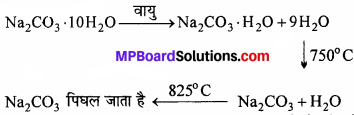
  • 2NaOH + CO2 →Na2CO3 + H2O

MP Board Class 11th Chemistry Solutions Chapter 10 s-ब्लॉक तत्त्व - 36

प्रश्न 27.
सोडियम हाइड्रॉक्साइड बनाने की नेल्सन सेल विधि का चित्र सहित वर्णन नमक का ग्रेफाइट का ऐनोड कीजिये।
उत्तर:
नेल्सन सेल इस्पात की टंकी में ऐस्बेस्टॉस बेलनाकार ऐस्बेस्टॉस की तह लगी इस्पात की की खोल छिद्रयुक्त नली लगाकर बनाया जाता है। इस्पात की छिद्र युक्त नली कैथोड का कार्य करती है। इस नली में NaCl विलयन भरकर इस्पात की नली में लटका इस्पात का कैथोड देते हैं। कार्बन की छड़ एनोड का कार्य करती है। विद्युत् अपघटन पर सोडियम आयन मुक्त होता है NaOH का विलयन जो ऐस्बेस्टॉस की तह को पार कर कैथोड पर मुक्त होने के बाद टंकी में आने वाली भाप से क्रिया कर NaOH बनाता है।
MP Board Class 11th Chemistry Solutions Chapter 10 s-ब्लॉक तत्त्व - 38

2NaCl ⇌ 2Na+ + 2Cl
कैथोड पर – 2Na+ + 2e →2Na

2Na + 2H2O → 2NaOH + H2
MP Board Class 11th Chemistry Solutions Chapter 10 s-ब्लॉक तत्त्व - 57

प्रश्न 28.
बुझा हुआ चूना बनाने की विधि, गुण तथा उपयोग लिखिए।
उत्तर:
(1) अनबुझे चूने पर पानी का छिड़काव करने पर बुझा चूना प्राप्त होता है।
CaO + H2O → Ca(OH)2

(2) कैल्सियम लवणों पर क्षार की अभिक्रिया कराने पर Ca(OH)2 प्राप्त होता है।
Ca(NO3)2 + 2NaOH → Ca(OH)2 + 2NaNO3

गुण:
(1) इसे 400°C तक गर्म करने पर कैल्सियम ऑक्साइड बनता है।
MP Board Class 11th Chemistry Solutions Chapter 10 s-ब्लॉक तत्त्व - 58
(2) चूने के पानी में CO2 प्रवाहित करने पर CaCO3 का सफेद दूधिया अवक्षेप बनता है।
Ca(OH)2 + CO2 → CaCO3 + H2 O
(3) चूने के पानी में देर तक CO2 प्रवाहित करने पर Ca(HCO3 )2 बनने के कारण दूधियापन समाप्त हो जाता है।
CaCO3 + CO2 + H2O → Ca(HCO3 )2
(4) शुष्क बुझे चूने पर Cl2 गैस प्रवाहित करने पर ब्लीचिंग पाउडर प्राप्त होता है।
Ca(OH)2 + Cl2 → CaoCl2 + H2 O
उपयोग:

  • कॉस्टिक सोडा तथा विरंजक चूर्ण के निर्माण में।
  • कोल गैस के शोधन में।
  • दीवारों पर सफेदी करने में।
  • अमोनिया के निर्माण में।

प्रश्न 29.
सोडा लाइम विधि से सोडियम हाइड्रॉक्साइड कैसे बनाते हैं ?
उत्तर:
सोडियम कार्बोनेट के 10 – 20% विलयन को बुझे हुये चूने की उचित मात्रा के साथ भाप के द्वारा 84-85°C ताप गर्म करने पर कैल्सियम कार्बोनेट एवं कास्टिक सोडा बनता है। कास्टिक सोडा विलयन में रहता है जबकि CaCO3 का सफेद अवक्षेप प्राप्त होता है। विलयन को छानकर वाष्पन करने या 98% शुद्ध ठोस कास्टिक सोडा प्राप्त होता है।

Na2 CO3 + Ca[OH]2 → 2NaOH + CaCO3

s-ब्लॉक तत्त्व दीर्घ उत्तरीय प्रश्न

प्रश्न 1.
निम्नलिखित में से प्रत्येक प्रेक्षण पर टिप्पणी लिखिए –
(a) जलीय विलयनों में क्षार धातु आयनों की गतिशीलता Li + > Na+ > K+ > Rb+ > Cs+
(b) लीथियम ऐसी एकमात्र क्षार धातु है, जो नाइट्राइट बनाती है।
(c) M2+(aq) + 2e →M(s) हेतु E° ( जहाँ, M = Ca, Sr या Ba) लगभग स्थिरांक है।
उत्तर:
(a) आयन का आकार जितना कम होता है, जलयोजन उतना ही अधिक होता है तथा आयन का जलयोजन जितना अधिक होता है, उसकी आयनिक गतिशीलता उतनी ही कम होती है। अतः जलयोजन क्षमता का क्रम निम्न होगा –
Li + > Na+ > K+ > Rb+ > Cs+
अतः आयनिक गतिशीलता विपरीत क्रम में बढ़ेगी
(b) अपने छोटे आकार के कारण, क्षार धातुओं में केवल लीथियम नाइट्राइड बनाती है।
MP Board Class 11th Chemistry Solutions Chapter 10 s-ब्लॉक तत्त्व - 39
(c) M2+(aq) + 2e →M(s)
जहाँ, M = Ca, Sr, Ba के लिए E° का मान लगभग समान होता है। किसी भी M2+/ M इलेक्ट्रोड के लिए E° का मान निम्नलिखित तीन कारकों पर निर्भर करता है –

  • वाष्पन एन्थैल्पी
  • आयनन एन्थैल्पी
  • जलयोजन एन्थैल्पी।

चूँकि इन तीनों कारकों का संयुक्त प्रभाव Ca, Sr तथा Ba के लिए लगभग समान रहता है। अतः इन इलेक्ट्रोड विभव का मान भी लगभग स्थिर रहता है।

प्रश्न 2.
लीथियम अपने समूह के अन्य सदस्यों से अपसामान्य व्यवहार दर्शाता है, क्यों?
उत्तर:
Li अपने समूह के अन्य सदस्यों से अपसामान्य व्यवहार दर्शाता है, क्योंकि –

  • इसके परमाणु तथा आयन का आकार छोटा होता है।
  • आयनन ऊर्जा उच्च है।
  • इलेक्ट्रॉनबंधुता उच्च है।
  • d – कक्षक अनुपस्थित है।

अपसामान्य व्यवहार:

  • Li अन्य क्षार-धातुओं की तुलना में अधिक कठोर है।
  • Li के गलनांक तथा क्वथनांक अन्य क्षार धातुओं की तुलना में उच्च है।
  • Liसहसंयोजी यौगिक बनाता है जबकि समूह के अन्य सदस्य आयनिक यौगिक बनाते हैं।
  • Li केवल ऑक्साइड बनाता है जबकि अन्य क्षार धातुएँ परॉक्साइड तथा सुपर ऑक्साइड भी बनाते हैं।
  • लीथियम हाइड्रॉक्साइड समूह के अन्य धातुओं के हाइड्राइड की तुलना में अधिक स्थायी है।
  • लीथियम हाइड्रॉक्साइड दुर्बल क्षार है जबकि अन्य क्षार धातुओं के हाइड्रॉक्साइड प्रबल क्षार है।
  • Li नाइट्रोजन के साथ संयोग कर नाइट्राइड बनाता है जबकि समूह की अन्य धातु नाइट्रोजन से संयोग नहीं करती है।
  • लीथियम नाइट्रेट गर्म करने पर विघटित होकर Li2O देता है जबकि अन्य क्षार धातु के नाइट्रेट गर्म करने पर अपघटित होकर नाइट्राइट देते हैं।
    1. 4LiNO3 → 2Li2O + 4NO2 + O2
    2. 2NaNO3 → 2NaNO2 + O2
  • Li2CO3 गर्म करने पर विघटित हो जाता है जबकि अन्य क्षार धातु के कार्बोनेट गर्म करने पर अपघटित नहीं होते हैं।
    MP Board Class 11th Chemistry Solutions Chapter 10 s-ब्लॉक तत्त्व - 40

प्रश्न 3.
विकर्ण संबंध क्या है ? Li तथा Mg में विकर्ण संबंध लिखिये।
उत्तर:
विकर्ण संबंध:
द्वितीय आवर्त के कुछ तत्व तृतीय आवर्त के कुछ तत्व के साथ विकर्ण में समानता दर्शाते हैं जिसे विकर्ण संबंध कहते हैं।
Liतथा Mg में विकर्ण संबंध:

  • लीथियम की परमाणु त्रिज्या 1.34A तथा Mg की परमाणु त्रिज्या 1.36A लगभग बराबर है।
  • Liव Mg+2 की ध्रुवण क्षमता लगभग समान है।
  • Li व Mg दोनों कठोर होते हैं।
  • Li व Mg की ऋण विद्युतता (1.0 और 1.2) बराबर होती हैं।
  • Li तथा Mg दोनों के गलनांक तथा क्वथनांक उच्च हैं।
  • Li तथा Mg दोनों N, के साथ अभिक्रिया करके नाइट्राइड बनाते हैं।
  • Li तथा Mg दोनों ऑक्सीजन के साथ संयोग करके मोनो ऑक्साइड देते हैं।
  • Li तथा Mg दोनों जल को विघटित करके H2 देते हैं।
  • Li तथा Mg के कार्बोनेट गर्म करने पर CO2 गैस देते हैं।
  • LiOH तथा Mg (OH)2 दोनों दुर्बल क्षार हैं।।

प्रश्न 4.
क्षार धातु तथा क्षारीय मृदा धातु में क्या समानता है ?
उत्तर:

  • क्षार धातु तथा क्षारीय मृदा धातु प्रकृति में मुक्त अवस्था में प्राप्त नहीं होते।
  • क्षार धातु तथा क्षारीय मृदा धातु के ऑक्साइड जल में विलेय होकर प्रबल क्षार का निर्माण करते हैं।
  • क्षार धातु तथा क्षारीय मृदा धातु कोमल तथा चमकीली होती हैं।
  • इन्हें वायु में रखने पर इनकी सतह मलिन हो जाती है।
  • क्षार धातु तथा क्षारीय मृदा धातु (Be तथा Mg को छोड़कर) ज्वाला परीक्षण देते हैं।
  • क्षार धातु तथा क्षारीय मृदा धातु प्रबल अपचायक है।
  • क्षार धातु तथा क्षारीय मृदा धातु दोनों आयनिक यौगिक का निर्माण करते हैं।
  • दोनों के नाइट्रेट तथा हैलाइड जल में विलेय हैं।

प्रश्न 5.
Be अपने समूह के अन्य सदस्यों की तुलना में अपसामान्य व्यवहार दर्शाता है, क्यों?
उत्तर:
Be अपने समूह के अन्य सदस्यों से अपसामान्य व्यवहार दर्शाता है, क्योंकि

  • इसके परमाणु तथा आयन का आकार छोटा होता है।
  • आयनन ऊर्जा अत्यधिक उच्च होती है।
  • इलेक्ट्रॉनबंधुता उच्च होती है।
  • d-कक्षक की अनुपस्थिति।

अपसामान्य व्यवहार:

  • Be कठोर है जबकि इस समूह के अन्य सदस्य कोमल धातु होती है।
  • अन्य क्षारीय मृदा धातु की तुलना में Be के गलनांक तथा क्वथनांक उच्च होते हैं।
  • Be के यौगिक सहसंयोजी होते हैं। जबकि अन्य क्षारीय मृदा धातु के यौगिक आयनिक होते हैं।
  • Be अम्लों से सरलता से H2 मुक्त नहीं करता जबकि अन्य क्षारीय मृदा धातु शीघ्रता से H2 मुक्त करती है।
  • बेरीलियम कार्बाइड जल अभिक्रिया कराने पर मेथेन देता है, जबकि अन्य सदस्य एसीटिलीन देते हैं ।
    Be2C + 2H2O → 2BeO + CH4
    CaC2 + 2H20 → Ca(OH)2 + C2H,2
  • BeO उभयधर्मी है जबकि अन्य सदस्यों के ऑक्साइड क्षारीय होते हैं।
  • Be व Mg को छोड़कर सभी सदस्य ज्वाला परीक्षण देते हैं।
  • Be गर्म करने पर भी जल के साथ कोई अभिक्रिया नहीं दर्शाता जबकि अन्य क्षारीय मृदा धातु जल के साथ सरलता से अभिक्रिया दर्शाते हैं।
  • Be हाइड्रोजन के साथ मंद गति से अभिक्रिया करता है, जबकि अन्य शीघ्रता से अभिक्रिया करते हैं।

प्रश्न 6.
Be व AI में विकर्ण संबंध लिखिये।
उत्तर:

  • Be व AI की परमाणविक त्रिज्या तथा आयनिक त्रिज्या लगभग बराबर है।
  • दोनों सहसंयोजी यौगिक बनाते हैं।
  • दोनों धातुएँ दुर्बल विद्युती धनी प्रकृति के होते हैं।
  • दोनों धातुओं की सान्द्र HNO, से क्रिया कराने पर ये निष्क्रिय होते हैं।
  • दोनों शीघ्रता से हाइड्राइड नहीं बनाती।
  • Be तथा AI दोनों के ऑक्साइड उभयधर्मी प्रकृति के होते हैं।
    1. BeO +2HCl→ BeCl2 + H2O
    2. BeO + 2NaOH → Na2BeO2 + H2O
    3. Al2O3+6HCl → 2AlCl3 + 3H2O
    4.  Al203 + 2NaOH → 2NaAlO2 + H2O
  • दोनों धातुओं के कार्बाइड जल से क्रिया करके मीथेन देते हैं।
    Be2C + 2H2O → 2BeO + CH2
    Al4C3 + 6H2O → 2AI2O3 + 3CH4
  • BeCl2 तथा AlCl3 द्विलक तथा बहुलक के रूप में मिलते हैं।
  • Be तथा A1 के ऑक्साइड दुर्बल क्षार हैं।
  • BeCl2तथा AlCl3 प्रबल लुईस अम्ल हैं।

प्रश्न 7.
सॉल्वे विधि द्वारा सोडियम कार्बोनेट का निर्माण किस प्रकार किया जाता है ? नामांकित रेखाचित्र खींचिए एवं समीकरण लिखिये।
उत्तर:
जब अमोनियामय NaCl विलयन में CO2 गैस प्रवाहित करते हैं तो अमोनियम बाइकार्बोनेट बनता है। जो NaCl से अभिक्रिया करके सोडियम बाइकार्बोनेट बनाता है।

  • NH3 + CO2 + H2O → NH4HCO3
  • NH4HCO3 + NaCl → NaHCO3 + NH4Cl

सोडियम बाइकार्बोनेट अल्प विलेय होने से अवक्षेपित होकर नीचे बैठ जाता है। इसे छानकर निस्तापित करने पर Na2co3 प्राप्त होता है।
2NaHCO3 → Na2CO3 + H2O + CO2

उपकरण एवं विधि –
(1) अमोनिया संतृप्त स्तम्भ – इसमें ब्राइन को अमोनिया से संतृप्त करते हैं। अमोनियामय ब्राइन बनता है तथा Ca एवं Mg की अशुद्धि अवक्षेपित होकर नीचे बैठ जाती है।
(2) छन्ना – Ca तथा Mg के अवक्षेप अमोनियामय ब्राइन से पृथक् हो जाते हैं।
(3) शीतकारक-अमोनियामय ब्राइन को ठण्डा करते हैं।
(4) कार्बोनेटीकरण स्तम्भ – अमोनियामय ब्राइन में चूने के भट्टी से प्राप्त CO2 प्रवाहित करने पर सोडियम बाइकार्बोनेट प्राप्त होता है।

  • 2NH3 + H2O + CO2 → (NH4)2 CO3
  • (NH4)2CO3CO2 + H2O → 2NH4HCO3
  • NH4HCO3 + NaCl → NaHCO3 + NaCl

(5) निर्वात् छन्ना – अविलेय NaHCO3 छनकर पृथक् हो जाता है। विलयन में NH4Cl तथा NH4HCO3 शेष रहता है। इसे पुनः प्राप्ति स्तम्भ में भेजा जाता है।
(6) चूने की भट्टी – चूने के पत्थर से CO2 गैस प्राप्त की जाती है।
MP Board Class 11th Chemistry Solutions Chapter 10 s-ब्लॉक तत्त्व - 41
CaO जल के साथ क्रिया कर Ca(OH)2 बनाता है जो NH4Cl के साथ अभिक्रिया कर पुन: NH3 देता है।
CaO + H2O + Ca(OH)2
MP Board Class 11th Chemistry Solutions Chapter 10 s-ब्लॉक तत्त्व - 42
(7) अमोनिया पुनः प्राप्ति स्तम्भ – निर्वात् छन्ने से प्राप्त द्रव पर ऊष्मा तथा बुझे चूने की क्रिया से अमोनिया प्राप्त करते हैं।

  • NH4HCO3 → NH3 + H2O+CO
  • 2NH4Cl + Ca(OH)2 → CaCl2 + 2NH3 + 2H2O

(8) NaHCO4 का जारण – निर्वात् छन्ना से प्राप्त सोडियम बाइकार्बोनेट प्राप्त होता है। इसे बेलनाकार भट्टियों में गर्म करते हैं जिससे सोडियम कार्बोनेट प्राप्त होता है।
2NaHCO2 → Na2CO3 + H2O + CO2

प्रश्न 8.
जब वर्ग – 1 की एक धातु को द्रव अमोनिया में घोला गया, तो निम्नलिखित प्रेक्षण प्राप्त हुए –
(a) प्रारंभ में नीला विलयन प्राप्त हुआ।
(b) विलयन को सान्द्र करने पर, नीला रंग-काँस्य-रंग में परिवर्तित हो गया। विलयन के नीले रंग की व्याख्या कीजिए। विलयन को कुछ समय तक रखने पर प्राप्त उत्पाद का नाम बताइए।
उत्तर:
(a) वर्ग-1 धातुओं को द्रव अमोनिया में घोलने पर निम्नलिखित अभिक्रिया प्राप्त हुई –
MP Board Class 11th Chemistry Solutions Chapter 10 s-ब्लॉक तत्त्व - 43
विलयन का नीला रंग अमोनीकृत इलेक्ट्रॉनों के कारण होता है, जो दृश्य प्रकाश क्षेत्र की संगत् ऊर्जा का अवशोषण करके विलयन को नीला रंग प्रदान करता है।

(b) सान्द्र विलयन में, धातु आयन स्तर बन जाने के कारण नीला रंग, काँस्य रंग में बदल जाता है। नीला विलयन कुछ समय तक पड़े रहने पर हाइड्रोजन को मुक्त करता है तथा ऐमाइड बनते हैं।
MP Board Class 11th Chemistry Solutions Chapter 10 s-ब्लॉक तत्त्व - 44

प्रश्न 9.
क्षार धातुओं के परॉक्साइड तथा सुपर ऑक्साइडों का स्थायित्व वर्ग में नीचे की ओर जाने पर घटता है। उदाहरण सहित व्याख्या कीजिए ?
उत्तर:
परॉक्साइड तथा सुपर ऑक्साइडों का स्थायित्व धातु आयन का आकार बढ़ने पर बढ़ता है।
KO2 < RbO2 < CsO2
क्षार धातुओं का ऑक्सीजन के साथ क्रिया करके विभिन्न ऑक्साइड बनाने का कारण, क्षार धातु के धनायन के परितः प्रबल धनात्मक क्षेत्र का निर्माण होता है। Li* का आकार सबसे छोटा है, जिसके कारण यह O2-आयन को पुन: O2 से क्रिया नहीं करने देता है। Na+ का आकार Li से बड़ा है अतः इसका धनात्मक Li+ के क्षेत्र से क्षीण होता है। K+ Rb+ Cs+जैसे बड़े आयन O2-2 आयन को पुन: 02 से क्रिया करके सुपरऑक्साइड (O2) बनाने देते हैं।
MP Board Class 11th Chemistry Solutions Chapter 10 s-ब्लॉक तत्त्व - 45
पुनः धातु आयनों का आकार बढ़ने के साथ-साथ परॉक्साइडों तथा सुपरऑक्साइडों के स्थायित्व में भी वृद्धि होती है। इसका प्रमुख कारण जालक ऊर्जा प्रभाव के फलस्वरूप बड़े ऋणायनों का बड़े धनायनों द्वारा स्थायित्व प्रदान करना है।

प्रश्न 10.
सोडियम हाइड्रॉक्साइड प्राप्त करने की कास्टनर केलनर सेल का चित्र सहित वर्णन कीजिए।
उत्तर:
इसमें एक लोहे की आयताकार टंकी होती है जो स्लेट की पट्टियों द्वारा तीन भागों में विभाजित रहती है। ये पट्टियाँ हौज पेंदे को छूती नहीं हैं बल्कि निचला भाग हौज के तले में रखे हुये पारे से ढंका रहता है। पारे की पर्त तीनों भागों को एक-दूसरे से पृथक् रखती है। पारे की पर्त यांत्रिक प्रबन्ध द्वारा इधर – उधर घूमती रहती है।

बाहरी कक्ष में NaCl का विलयन भरा रहता है, जिसमें ग्रेफाइट की छड़ लगी रहती है। ये एनोड का कार्य करती है। बीच ऐनोड वाले भाग में NaOH का तनु विलयन भरा रहता है, जिसमें लोहे की छड़ का बना कैथोड लटका – रहता है। विद्युत् धारा प्रवाहित करने पर पारा प्रेरण बीच का कक्ष एनोड का तथा बाहरी कक्ष कैथोड का कार्य करते हैं।

बाहरी कक्ष में एनोड पर Cl2 मुक्त होती है। सोडियम कैथोड पर मुक्त होकर पारे के साथ सोडियम अमलगम बना लेता है। सोडियम अमलगम उत्क्रेन्द्रीय पट्टियों की सहायता से सेल के मध्य भाग में आता है । यहाँ पर सोडियम अमलगम ऐनोड का कार्य करता है और आयरन की छड़ कैथोड का। इस भाग में NaOH भरा रहता है। विद्युत् धारा प्रवाहित करने पर OH आयन एनोड पर विसर्जित होते हैं तथा अमलगम में उपस्थित सोडियम से क्रिया कर NaOH बनाते हैं तथा H2 गैस मुक्त करते हैं।
MP Board Class 11th Chemistry Solutions Chapter 10 s-ब्लॉक तत्त्व - 46

अभिक्रिया-बाहरी कक्ष में –
2NaCl ⇄ 2Na+ + 2Cl

कैथोड पर –
2Na+ + 2e → 2Na
2Na + xHg → HgxNa2
एनोड पर –
MP Board Class 11th Chemistry Solutions Chapter 10 s-ब्लॉक तत्त्व - 66
मध्य कक्ष में –
NaOH ⇄  Na+ + OH

कैथोड पर –
2NaHg + 2H2O → 2NaOH + 2Hg + H2
Na+ + e → Na
2Na + 2H2O → 2NaOH + H2

एनोड पर –
2OH → 2OH + 2e
Hgx Na2 + 2OH → 2NaOH + xHg

प्रश्न 11.
जब कैल्सियम के यौगिक –
(A) में जल मिलाया जाता है तो यौगिक (B) के विलयन का निर्माण होता है। इस विलयन में कार्बन डाइ-ऑक्साइड प्रवाहित करने पर यह यौगिक (C) बनने के कारण दुधिया हो जाता है। कार्बन डाइ-ऑक्साइड की अधिक मात्रा में प्रवाहित करने पर, यौगिक (D) के निर्माण के कारण यह दुधियापन लुप्त हो जाता है तथा यौगिक (A), (B), (C) तथा (D) को पहचानिए तथा बताइए कि अंतिम पद में दुधियापन क्यों समाप्त हो जाता है ?
उत्तर:
यौगिक (B) के विलयन में CO2 प्रवाहित करने पर विलयन का दुधिया होना संकेत करता है कि यौगिक (B) बुझा हुआ चूना [Ca(OH)2] है तथा यौगिक (C) कैल्सियम कार्बोनेट है। चूँकि यौगिक (B), यौगिक (A) में H2O को मिलाने से प्राप्त होता है। अतः यौगिक (A) में बिना बुझा चूना (CaO) है। संगत अभिक्रियाएँ निम्नलखित हैं –
MP Board Class 11th Chemistry Solutions Chapter 10 s-ब्लॉक तत्त्व - 47
MP Board Class 11th Chemistry Solutions Chapter 10 s-ब्लॉक तत्त्व - 48
(iii) CO2 को अधिकता में प्रवाहित करने पर, विलेय कैल्सियम बाइकार्बोनेट बनाने के कारण दुधियापन लुप्त हो जाता है।
MP Board Class 11th Chemistry Solutions Chapter 10 s-ब्लॉक तत्त्व - 49

प्रश्न 12.
कैल्सियम ऑक्साइड बनाने की विधि, रासायनिक गुण तथा उपयोग लिखिये।
उत्तर:
चूने के पत्थर को गर्म करके कैल्सियम ऑक्साइड बनाते हैं।
MP Board Class 11th Chemistry Solutions Chapter 10 s-ब्लॉक तत्त्व - 50
यह अभिक्रिया उत्क्रमणीय है। अतः चूना प्राप्त करने हेतु CO2 को जल्दी-जल्दी-हटाते रहना आवश्यक है। अभिक्रिया का-ताप 900°C होना चाहिये क्योंकि अधिक ताप पर मिट्टी और चूने की अभिक्रिया से गलनीय सिलिकेट बन जाता है। भट्टी में बाजू से दो अँगीठियों में कोयला जलाया जाता है। ऊपर से धीरे-धीरे चूने का पत्थर डालते रहते हैं, जो नीचे आते-आते अपघटित हो जाता है। CO2 गैस ऊपरी भाग से बाहर निकलती है। इसे द्रवित कर सिलेण्डरों में भर लिया जाता है।
MP Board Class 11th Chemistry Solutions Chapter 10 s-ब्लॉक तत्त्व - 51
रासायनिक गुण:
(1) नम वायु से नमी तथा CO2 सोखकर Ca(OH)2 तथा CaCO3 बनाता है।

  • CaO + H2O Ạ Ca(OH)2
  • CaO + CO2 CaCO2

(2) यह एक प्रबल क्षारीय ऑक्साइड है जो अम्लों के साथ अभिक्रिया कर लवण बनाता है।

  • CaO + 2HCl → CaCl2 + H2O
  • Cao + SiO2→ CaSiO3

(3) अमोनियम लवणों के साथ गर्म करने पर NH, गैस बनती है।
2NH4Cl + CaO → CaCl2 + H2O + 2NH2
(4) कार्बन और कैल्सियम ऑक्साइड को गर्म करने से CaC2 प्राप्त होता है।
MP Board Class 11th Chemistry Solutions Chapter 10 s-ब्लॉक तत्त्व - 52
उपयोग:

  • धातुकर्म के गालक के रूप में
  • ऐल्कोहॉल तथा गैसों को सुखाने में
  • लाइम लाइट उत्पन्न करने के लिये
  • कोल गैस को शुद्ध करने में
  • कागज बनाने में।

प्रश्न 13.
वर्ग-1 के एक तत्व का आयन कोशिकाओं में शिरा-संकेतों के संचरण, शर्करा तथा एमीनो अम्लों के प्रवाह में सहायक है। यह तत्व ज्वाला परीक्षण में ज्वाला के साथ पीला रंग देता है तथा
ऑक्सीजन के साथ ऑक्साइड तथा परॉक्साइड बनाता है।तत्व की पहचान कीजिए तथा इसके परॉक्साइड निर्माण की रासायनिक समीकरणों को लिखिए। यह तत्व ज्वाला के साथ रंग क्यों देता है ?
उत्तर:
ज्वाला परीक्षण में पीले रंग की ज्वाला दर्शाता है कि धातु सोडियम ही होनी चाहिए। यह 0, के साथ क्रिया करके सोडियम परॉक्साइड Na2O2 तथा सोडियम ऑक्साइड, Nao का मिश्रण देता है।
MP Board Class 11th Chemistry Solutions Chapter 10 s-ब्लॉक तत्त्व - 53
सोडियम की आयनन एन्थैल्पी कम होती है। जब सोडियम धातु या इसके लवण को बुन्सन ज्वाला में गर्म किया जाता है, तब ज्वाला की ऊष्मा बाह्यतम इलेक्ट्रॉन को उच्च ऊर्जा स्तर पर उत्तेजित कर देती है तब ये इलेक्ट्रॉन पुनः अपनी तलस्थ / आद्य अवस्था में आते हैं तो दृश्य क्षेत्र में विकिरण उत्सर्जन के कारण ज्वाला को पीला रंग प्रदान करते हैं।

प्रश्न 14.
निम्नलिखित की महत्ता बताइए –
(a) चूना पत्थर
(b) सीमेंट
(c) प्लास्टर ऑफ पेरिस।
उत्तर:
(a) चूना पत्थर (CaCO3):

  • इसे मैग्नीशियम कार्बोनेट के साथ आयरन जैसी धातुओं के निष्कर्षण में गालक के रूप में प्रयोग करते हैं।
  • इसका प्रयोग ऐन्टासिड, टूथपेस्ट में अपघर्षक के रूप में, च्यूइंगम में संघटक तथा सौन्दर्य प्रसाधनों में रूपक के रूप में भी करते हैं।

(b) सीमेंट:

  • यह भवन निर्माण हेतु एक महत्वपूर्ण यौगिक है।
  • इसका उपयोग कांक्रीट, प्रबलित कांक्रीट, प्लास्टरिंग, पुल-निर्माण, भवन-निर्माण आदि में किया जाता है।

(c) प्लास्टर ऑफ पेरिस:

  • इसका उपयोग भवन निर्माण तथा टूटी हुई हड्डियों के प्लास्टर में होता है।
  • इसका उपयोग दंत-चिकित्सा, अलंकरण कार्य तथा मूर्तियों एवं अर्द्धप्रतिमाओं को बनाने में भी होता है।

MP Board Class 11th Chemistry Solutions

MP Board Class 12th Hindi Swati Solutions गद्य Chapter 2 वापसी

MP Board Class 12th Hindi Swati Solutions गद्य Chapter 2 वापसी (कहानी, उषा प्रियंवदा)

वापसी अभ्यास

वापसी अति लघु उत्तरीय प्रश्न

प्रश्न 1.
गजाधर बाबू किस नौकरी से रिटायर हुए थे? (2015)
उत्तर:
गजाधर बाबू रेलवे की नौकरी से रिटायर हुए थे।

प्रश्न 2.
परिवार वालों ने गजाधर बाबू के रहने की व्यवस्था कहाँ की थी?
उत्तर:
पहले दिन बैठक में कुर्सियों को दीवार से सटाकर बीच में गजाधर बाबू के लिए, पतली-सी चारपाई डाल दी गई थी। तत्पश्चात् पत्नी की कोठरी (भण्डारघर) में उनकी चारपाई डाल दी गई थी।

प्रश्न 3.
गजाधर बाबू ने अपनी नौकरी में कितने वर्ष अकेले व्यतीत किए थे?
उत्तर:
गजाधर बाबू ने अपनी नौकरी में अपने परिवार की बेहतरी तथा बच्चों की उच्च शिक्षा की आस में परिवार से दूर रेलवे क्वार्टर में अकेले पैंतीस वर्षों की लम्बी अवधि व्यतीत कर दी।

प्रश्न 4.
गजाधर बाबू के लिए मधुर संगीत क्या था?
उत्तर:
पटरी पर रेल के पहियों की खट-खट गजाधर बाबू के लिए किसी उच्च कोटि के मधुर संगीत की तरह ही था।

प्रश्न 5.
गजाधर बाबू के स्वभाव की दो विशेषताएँ बतलाइए। (2014)
उत्तर:
गजाधर बाबू के स्वभाव की दो विशेषताएँ थीं-

  1. वे स्नेही व्यक्ति थे तथा स्नेह की आकांक्षा रखते थे।
  2. वे परिवार के सदस्यों के साथ मनोविनोद करना चाहते थे।

प्रश्न 6.
गजाधर बाबू के कुल कितने बच्चे थे? सभी के नाम लिखिए। (2016)
उत्तर:
गजाधर बाबू के कुल चार बच्चे थे-बड़ा बेटा अमर,छोटा बेटा नरेन्द्र,बड़ी बेटी। कान्ति तथा छोटी बेटी बसन्ती।

वापसी लघु उत्तरीय प्रश्न

प्रश्न 1.
संसार की दृष्टि में गजाधर बाबू का जीवन किस प्रकार सफल कहा जा सकता था?
उत्तर:
संसार की दृष्टि में गजाधर बाबू का जीवन सफल कहा जा सकता है क्योंकि सफलतापूर्वक पैंतीस वर्ष तक रेलवे की नौकरी करने के पश्चात् सम्मानपूर्वक सेवानिवृत्त हुए थे। उन्होंने शहर में एक मकान बनवा लिया था। बड़े लड़के अमर और लड़की कान्ति की शादियाँ कर दी थीं। दो बच्चे ऊँची कक्षाओं में पढ़ रहे थे।

प्रश्न 2.
घर जाने की खुशी होने के बाद भी गजाधर बाबू का मन क्यों दुःखी था? (2017)
उत्तर:
घर जाकर पत्नी, बाल-बच्चों के साथ रहने की कल्पना से गजाधर बाबू का मन बहुत खुश था, परन्तु पैंतीस वर्ष तक रेलवे के क्वार्टर में रहते हुए वहाँ के परिचित स्नेह-आदरमय, सहज संसार से सदैव के लिए नाता टूटने तथा सामान हट जाने से क्वार्टर की कुरूपता को देखकर उनका मन एक विचित्र विषाद (दुःख) का अनुभव कर रहा था।

प्रश्न 3.
अमर को अपने पिताजी से क्या शिकायत थी?
उत्तर:
अमर को अपने पिताजी से बहुत शिकायतें थीं। उसका कहना था कि गजाधर बाबू हमेशा बैठक में ही पड़े रहते हैं,कोई आने-जाने वाला हो, तो कहीं बिठाने की जगह नहीं। अमर को अब भी वह छोटा-सा समझते हैं और मौके-बेमौके टोक देते हैं। बहू को काम करना पड़ता था। अमर को हर चीज में पिताजी का हस्तक्षेप पसन्द नहीं था। कहता था, बूढ़े आदमी हैं चुपचाप पड़े रहें।

प्रश्न 4.
बसन्ती गजाधर बाबू के किस कथन से रूठ गई थी?
उत्तर:
कपड़े बदलकर शाम को जब बसन्ती पड़ोस में शीला के घर जा रही थी, तब गजाधर बाबू ने उससे कड़े स्वर में कहा कि कोई जरूरत नहीं है, अन्दर जाकर पढ़ो। इस कथन से बसन्ती रूठ गई थी।

प्रश्न 5.
गजाधर बाबू ने भोजन बनाने की जिम्मेदारी किसे सौंपी और क्यों?
उत्तर:
गजाधर बाबू ने सुबह का खाना बनाने की जिम्मेदारी बहू को तथा शाम का खाना बनाने की जिम्मेदारी बसन्ती को सौंपी। क्योंकि उनकी पत्नी बूढी हो चली थी तथा उसके शरीर में अब वह शक्ति नहीं बची थी कि वह अकेले पूरे घर का काम कर सके। साथ ही,गजाधर वाबू को लड़की का बाहर जाना पसन्द नहीं था, इसलिए वह उसे कार्य में व्यस्त रखना चाहते थे।

वापसी दीर्घ उत्तरीय प्रश्न

प्रश्न 1.
गजाधर बाबू का अस्तित्व उनके परिवार का हिस्सा क्यों नहीं बन पाया? स्पष्ट कीजिए।
उत्तर:
गजाधर बाबू निम्न मध्यमवर्गीय समाज के नौकरी-पेशा पात्र हैं जिन्होंने घर-परिवार से दूर अकेले रहकर पैंतीस वर्ष इस प्रतीक्षा में व्यतीत कर दिये कि सेवानिवृत्ति के पश्चात् वह अपने परिवार के साथ रहेंगे और उसी आशा तथा सुखद कल्पना के साथ वह अपने घर को लौटते हैं। परिवार में आने पर उनका कोई गर्मजोशी से स्वागत नहीं होता बल्कि उनको एक बन्धन के रूप में माना जाने लगता है। वे घर को अपने अनुसार चलाना चाहते हैं, सबके मध्य बैठकर पैंतीस वर्षों के एकान्त जीवन को विस्मृत करना चाहते हैं। लेकिन सबके मध्य वह और भी एकाकी हो जाते हैं। पत्नी अचार-दाल-चीनी में व्यस्त है,बच्चे अपने-अपने व्यक्तिगत आनन्द में व्यस्त हैं,उनके रहने का स्थान भण्डारघर की चारपाई है। पत्नी शिकायत करती है पर उसमें सहानुभूति नहीं होती। बड़ा बेटा उनके आने पर अपनी गृहस्थी अलग बसाने की माँग करने लगता है। उनकी अनुपस्थिति में उनका परिवार अपनी तरह से जीने का आदी हो चुका है, अब गजाधर बाबू का हस्तक्षेप उन सबको पसन्द नहीं। यहाँ तक कि पुत्री भी पिता से सहमत नहीं। उस परिवार के लिए अब गजाधर बाबू केवल आर्थिक आधार भर हैं।

इन सब घटनाओं के कारण ही गजाधर बाबू का अस्तित्व उनके परिवार का हिस्सा न बन सका, जो आधुनिक युग का समाज को सटीक उपादान है।

प्रश्न 2.
“वह जीवन अब उन्हें एक खोई निधि-सा प्रतीत हुआ।” इस कथन को पाठ के आधार पर समझाइए।
उत्तर:
परिवार से दूर रेलवे क्वार्टर में पैंतीस वर्ष व्यतीत करने के बाद गजाधर बाबू घर लौटते हैं तथा सोचते हैं कि अब परिवार के साथ रहकर वह सुखी व सन्तोषी जीवन बितायेंगे। पर उन्होंने पाया कि परिवार में उनका अस्तित्व मात्र धनोपार्जन तक ही सीमित है, तो उन्हें अपनी रेलवे की नौकरी के साथ बिताया समय याद आया-वह बड़ा-सा खुला हुआ क्वार्टर, निश्चिन्त जीवन, गाड़ियों के आने पर स्टेशन की चहल-पहल, रेल के पहियों की खट-खट आवाज, सेठ रामजीमल के मिल के लोग……। नौकरी का वह समय उन्हें खोई हुई निधि के समान लगा। दूसरी ओर जब वह नौकरी पर थे,तो घर की सुखद कल्पनाएँ थीं। पत्नी का कोमल स्पर्श,उसकी मनमोहक मुस्कान, बच्चों के मनोविनोद आदि को पाने की कल्पनाएँ, उन्हें धनवान बना देती थीं। घर लौटने पर उन्हें इन सबके स्थान पर उपेक्षा ही मिली। घर में उनके लिए कोई स्थान नहीं था। सब उनसे बचना चाहते थे। दोनों ही स्थितियों में उन्हें अपना जीवन किसी खोई हुई निधि के समान लगा। उन्हें लगा कि वह जिन्दगी के द्वारा ठगे गये हैं। जो कुछ भी उन्होंने चाहा, वह उन्हें नहीं मिला।

प्रश्न 3.
गजाधर बाबू के घर जाने से पहले उनके घर की क्या स्थिति थी?
उत्तर:
गजाधर बाबू के घर जाने से पहले उनका बड़ा बेटा अमर घर का मालिक बनकर रहता था। बहू को कोई रोकने-टोकने वाला नहीं था। अमर के दोस्तों का प्राय: यहीं अड्डा जमा रहता था, अन्दर से चाय-नाश्ता तैयार होकर आता रहता था। बसन्ती को भी वही अच्छा लगता था। पड़ोस में शीला के घर देर-देर तक रहना बसन्ती की आदत थी। बहू कुछ काम-काज करती नहीं थी। सास सारे दिन काम में लगी रहती थी। छोटा बेटा नरेन्द्र अपने ही ढंग से जीवन जी रहा था। बाजार का सारा काम नौकर करता था। उनके घर का रहन-सहन और खर्च हैसियत से कहीं ज्यादा था। घर की सम्पूर्ण स्थिति में धन देने के अतिरिक्त गजाधर बाबू का कोई स्थान नहीं था।

प्रश्न 4.
‘वापसी’ कहानी के शीर्षक के औचित्य पर अपने विचार लिखिए।
उत्तर:
लेखिका उषा प्रियंवदा ने प्रस्तुत कहानी का शीर्षक ‘वापसी’ सटीक ही रखा है। इसके दो आधार हैं पहला आधार है-गजाधर बाबू 35 वर्ष रेलवे क्वार्टर में अकेले रहकर अनेक आत्मीय आशाओं को लेकर वापस घर आते हैं,जो केवल मृग मारीचिकाएँ ही सिद्ध होती हैं। यहाँ वापसी एक व्यंग्य व दुःखान्त घटना बन जाती है। इस वापसी के सुख में दुःख था।

दूसरा आधार है-परिवार में रहने पर भी गजाधर बाबू अपरिचित व मेहमान के अस्थायी रूप में रहते हैं। उनका जीवन भार बन जाता है। यहाँ तक कि उनकी पत्नी भी उनकी उपेक्षा करती है, आत्मीयता का पूर्ण अभाव दिखाती है। उस समय सेठ रामजीमल की नौकरी के लिए चीनी मिल में लौट जाना भी वापसी’ है। यह वापसी जीवन की सच्चाई तथा बुढ़ापे की यथार्थता को प्रकट करती है। इस वापसी के दुःख में सुख था। उपरोक्त चर्चा से स्पष्ट है कि कहानी का शीर्षक ‘वापसी’ उचित ही है।

प्रश्न 5.
गजाधर बाबू ने पत्नी के स्वभाव में क्या-क्या परिवर्तन देखे?
उत्तर;
पहले पत्नी दो-दो बजे तक आग जलाये बैठी रहती और गजाधर बाबू के आते ही रसोई की ओर दौड़ती और गरम खाना बनाकर देती। सेवानिवृत्ति के पश्चात् वह पूजाघर से देर से निकलती है और रसोई में जाकर बड़बड़ाने लगती है। उधर गजाधर बाबू चाय की प्रतीक्षा करते रहते हैं। प्रेमपूर्ण वार्तालाप के बदले अब वह हर समय शिकायतें करती, जिनमें आत्मीयता व सहानुभूति का पूर्ण अभाव होता। पत्नी का कोमल स्पर्श,सुन्दरता,मनोविनोद आदि कटाक्ष वाणी में बदल गये थे। जिस नारी का सर्वस्व पति था, वह आज केवल भोजन की थाली सामने रखकर सारे कर्तव्यों से छुट्टी पा जाती है। पति, पत्नी के जीवन का केन्द्र नहीं है। उसकी दुनिया घी-चीनी-अचार के डिब्बे हैं। गजाधर बाबू के बोलने पर वह उन्हें न बोलने के लिए टोक देती है। पति के बजाय बच्चों की त्रुटि पर भी बच्चों का पक्ष लेकर पति की उपेक्षा व अपमान करती है। बात-बात पर झुंझला उठती है। पति के साथ नौकरी पर जाने के लिए मना कर देती है। पत्नी के इन परिवर्तनों को देखकर गजाधर बाबू हताश हो उठते हैं तथा चीनी मिल में नौकरी करने चले जाते हैं।

प्रश्न 6.
“अरे नरेन्द्र बाबूजी की चारपाई कमरे से निकाल दे। उसमें चलने तक की जगह नहीं है।” इस पंक्ति के माध्यम से लेखिका क्या कहना चाहती है? स्पष्ट कीजिए।
उत्तर:
घर में अपने अस्तित्व के नकारे जाने के दुःख से दुःखी होकर गजाधर बाबू पुराने शहर की एक चीनी मिल में नौकरी करने चले जाते हैं। उनके साथ ही उनका सामान भी चला जाता है। उनके अस्तित्व का बोध कराने वाली चारपाई घर पर ही रह जाती है। उस चारपाई को देखकर उनकी पत्नी उसे भी हटाने का आदेश देती है, क्योंकि उनके अस्तित्व का अनुभव होने पर उन सबको घर में विघटन,क्लेश, अव्यवस्था, असम्मान की भावना पनपने लगती है। पत्नी पूर्णरूपेण गृहस्थी को समर्पित हो गई है। गृहस्थी के अतिरिक्त उसे कुछ अच्छा नहीं लगता है। लेखिका के इन शब्दों द्वारा मनोविज्ञान के सूक्ष्म तन्तुओं का ज्ञान होता है। मनुष्य ऐसी परिवर्तन की स्थिति को बिल्कुल स्वीकार नहीं करता, जिसके कारण उसकी व्यक्तिगत स्वतन्त्रता में बाधा पड़ती हो। गजाधर बाबू उस परिवार के लिए मात्र आर्थिक आधार हैं,परिवार के प्रति उनका कोई संवेदनात्मक रिश्ता नहीं है।

प्रश्न 7.
गजाधर बाबू दोबारा चीनी मिल की नौकरी पर क्यों गये? (2015)
उत्तर:
गजाधर बाबू ने घर वापसी पर पहले ही दिन देखा कि जिस अकेलेपन को वह परिवार के साथ दूर करने की सोचकर आये थे, उसी परिवार ने उन्हें अकेला छोड़ दिया। पत्नी भी पति को चाय नाश्ता न देकर अपनी शिकायतें करने लगती है। गजाधर बाबू बेटी को शाम के समय पड़ोस में जाने के लिए मना करते हैं और शाम का खाना बनाने की जिम्मेदारी देते हैं, बहू को सास के साथ काम में हाथ बँटाने की कहते हैं। आय कम होने के कारण खर्चा कम करने के उद्देश्य से नौकर का हिसाब कर देते हैं। इन बातों से पुत्री,बहु व पुत्र नाराज हो जाते हैं, उन्हें यूँ पिताजी की दखलअन्दाजी बिल्कुल पसन्द नहीं आती। जिस घर को उन्होंने एक-एक पैसा जोड़कर बनवाया, उसी घर में गजाधर बाबू के रहने के लिए जगह नहीं है। भण्डारघर बने पत्नी के कमरे में उनकी चारपाई डाल दी गयी। पत्नी शिकायत करती है पर आत्मीयता से सुझाव नहीं माँगती है। बच्चे पिता को हुण्डी समझते हैं। बड़ा बेटा अलग होने की माँग करने लगता है। इन सब घटनाओं से गजाधर बाबू यह अनुभव करते हैं कि वह मात्र धनोपार्जन का साधन हैं, उस परिवार में उनका कोई अस्तित्व नहीं है तथा वह उस परिवार का अंग नहीं बन सकते। मुख्य रूप से पत्नी की उपेक्षा ने उन्हें चीनी मिल की नौकरी पर जाने को बाध्य कर दिया।

प्रश्न 8.
‘वापसी’ कहानी का उद्देश्य लिखिए। (2010)
उत्तर:
उषा प्रियंवदा की ‘वापसी’ कहानी पारिवारिक सम्बन्धों की संवेदनहीनता पर आधारित है। इसका उद्देश्य पारिवारिक विसंगतियों तथा बिखराव को अंकित करना है। रेलवे में नौकरी करने वाले गजाधर बाबू घर से दूर अकेले सरकारी स्वार्टर में रहते हैं। पत्नी, एक बेटी, दो पुत्र तथा पुत्र-वधू घर के प्राणी हैं जो शहर के मकान में रहते हैं। नौकरी से सेवा-निवृत्त हो जब वे घर लौटते हैं तो पारिवारिक आत्मीयता की बड़ी उम्मीदें उनके मन में हैं, परन्तु घर आने पर वे सब भ्रम सिद्ध होती हैं। वे घर को अपने ढंग से चलाना चाहते हैं, किन्तु उन्हें हर स्तर पर उपेक्षा ही मिलती है। बेटे,बेटी, पुत्र-वधू के साथ पत्नी भी उनके प्रति उदासीन ही है। वे जो सोचकर आए थे उसके विपरीत भाव परिवार में उन्हें मिलता है। उन्हें अपनी उपस्थिति परिवार में विक्षोभ पैदा करने वाली लगने लगती है। फलस्वरूप वे सेठ रामजीमल की मिल में पुन: नौकरी करने वहीं चले जाते हैं जहाँ से वे सेवा-निवृत्त हुए थे।

कहानी आज की संवेदनहीनता की गिरावट को प्रस्तुत करने में सफल रही है। निरन्तर असहिष्णु बनती जा रही युवा पीढ़ी के स्वच्छंद व्यवहार का दुष्परिणाम पुरानी पीढ़ी झेलती है। व्यक्तिवादी प्रवृत्तियों के बढ़ते क्रम में यह कहानी पारिवारिक संवेदनाओं की वापसी का प्रयास भी है।

वापसी भाषा अध्ययन

प्रश्न 1.
नीचे दिए गए गद्यांश में उचित विराम चिह्न लगाइए-
नारद ने पूछा उस पर आयकर तो बकाया नहीं था हो सकता है उन लोगों ने रोक लिया हो चित्रगुप्त ने कहा आय होती तो कर होता भुखमरा था नारद बोले मामला बड़ा दिलचस्प है अच्छा मुझे उसका नाम पता तो बताओ मैं पृथ्वी पर जाता हूँ।
उत्तर:
नारद ने पूछा, “उस पर आयकर तो बकाया नहीं था?” हो सकता है, उन लोगों ने रोक लिया हो। चित्रगुप्त ने कहा, “आय होती तो कर होता, भुखमरा था।” नारद बोले, “मामला बड़ा दिलचस्प है। अच्छा मुझे उसका नाम पता तो बताओ। मैं पृथ्वी पर जाता हूँ।”

प्रश्न 2.
निम्नलिखित शब्दों में से तत्सम, तद्भव, देशज और विदेशी शब्द छाँटकर लिखिए-
बॉक्स, विषाद, वर्ष, दुहरी, रात्रि, खिन्नता, स्निग्ध, आखिरी, प्रकृति, आकांक्षी, धप्प,उन्मुक्त, छोर, टोन।
उत्तर:
तत्सम – विषाद, वर्ष, रात्रि, स्निग्ध, प्रकृति, आकांक्षी, उन्मुक्त।
तद्भव – दुहरी, खिन्नता। देशज-धप्प, छोर।
विदेशी – बॉक्स, आखिरी, टोन।

प्रश्न 3.
दिए गए मुहावरों और कहावतों का वाक्यों में प्रयोग कीजिए-
ऊँट के मुँह में जीरा, मुँह लटकाना, मुँह बनाना, अपने मुँह मियाँ मिट्ठ बनना।
उत्तर:
(i) शब्द-ऊँट के मुँह में जीरा।
वाक्य प्रयोग :
राजा दस-बारह रोटियाँ खाता है, उसे दो रोटियाँ देना तो ऊँट के मुँह में जीरा देने के समान है।

(ii) शब्द-मुँह लटकाना।
वाक्य प्रयोग :
जिद्द पूरी न होने पर सुरेश कमरे के कोने में मुँह लटकाकर बैठ गया।

(iii) शब्द-मुँह बनाना।
वाक्य प्रयोग :
बंदर हाथ आये आईने में खुद की शक्ल देखकर बार-बार मुँह बना रहा था।

(iv) शब्द-अपने मुँह मियाँ मिट्ठ बनना।
वाक्य प्रयोग :
अपने मुँह मियाँ मिट्ट बनने वाले व्यक्ति का सम्मान धीरे-धीरे कम होता जाता है।

प्रश्न 4.
शरीर के निम्नलिखित अंगों पर बनने वाले कोई दो मुहावरे लिखिए
आँख, नाक, कान, हाथ, पैर।
उत्तर:

  1. आँख-आँखों में धूल झोंकना, आँखों में खटकना।
  2. नाक-नाक में दम करना, नाक में नकेल कसना।
  3. कान-कान काटना,कान पर जूं तक न रेंगना।
  4. हाथ-हाथ-पैर फूलना, हाथ-पर-हाथ रखकर बैठना।
  5. पैर-पैर उखड़ जाना,पैर फैलाना

प्रश्न 5.
निम्नलिखित वाक्यों के विपरीत अर्थ लिखकर वाक्य पूरा करें

  1. विश्व में जन्म एवं ………… अवश्यंभावी है।
  2. इस संसार में ……….. और दानव दोनों ही तरह के लोग हैं।
  3. रावण से राम की शत्रुता थी तो सुग्रीव से ………..।
  4. उसने रात और ………. एक कर दिए।

उत्तर:

  1. मरण
  2. मानव
  3. मित्रता
  4. दिन।

प्रश्न 6.
अन्तर्राष्ट्रीय स्तर पर हिन्दी का प्रचार-प्रसार किस प्रकार हो रहा है?
उत्तर:
हिन्दी बहुत तेजी से अन्तर्राष्ट्रीय मंच पर प्रतिष्ठित होती जा रही है। विदेशों के लगभग 90 विश्वविद्यालयों में हिन्दी का अध्ययन-अध्यापन कार्य हो रहा है। विश्व में सर्वाधिक बोले जाने वाली भाषाओं में चीनी, अंग्रेजी के पश्चात् हिन्दी का ही स्थान आता है।

अन्तर्राष्ट्रीय स्तर पर हिन्दी का प्रचार-प्रसार अनेक प्रकार से किया जा रहा है-

  1. इसे संयुक्त राष्ट्र संघ की मान्य भाषाओं में सम्मिलित करने के प्रयास हो रहे हैं।
  2. विश्व में विविध स्थानों पर विश्व हिन्दी सम्मेलनों का आयोजन इसकी प्रतिष्ठा और स्वीकार्यता को और बढ़ा रहा है।
  3. प्रवासी भारतीयों द्वारा भी साहित्य सृजन कर हिन्दी को समृद्ध बनाया जा रहा है।

प्रश्न 7.
राष्ट्रभाषा की प्रमुख विशेषताएँ लिखिए।
उत्तर:
राष्ट्र भाषा की कुछ प्रमुख विशेषताएँ निम्नलिखित हैं-

  1. राष्ट्रभाषा समस्त राष्ट्र की भाषा होती है।
  2. राष्ट्रभाषा का रूप व्यापक होता है।
  3. राष्ट्रभाषा का व्यवहार पूर्ण राष्ट्र में होता है।
  4. राष्ट्र भाषा सम्पूर्ण देश की संस्कृति एवं आदर्शों को अभिव्यक्त करती है।
  5. राष्ट्रभाषा देशवासियों की आकांक्षाओं को भी अभिव्यक्त करती है।
  6. राष्ट्रभाषा देश के विभिन्न भागों के निवासियों के मध्य सम्पर्क स्थापित करती है।
  7. राष्ट्र भाषा अन्य भाषाओं एवं विभाषाओं की प्रगति में सहायक बनती है।

वापसी पाठ का सारांश

वर्तमान जीवन की विसंगतियों और विशृंखलाओं का चित्रण करने में सिद्धहस्त लेखिका ‘उषा प्रियंवदा’ ने प्रस्तुत कहानी ‘वापसी’ में एक निम्न मध्यमवर्गीय परिवार के बिखराव का मार्मिक चित्र प्रस्तुत किया है। ‘वापसी’ लेखिका की सुप्रसिद्ध रचना है।

कहानी का मुख्य पात्र गजाधर बाबू रेलवे में नौकरी करता है। वह अपने परिवार से दूर रेलवे क्वार्टर में अकेले रहता है। बच्चों की उच्च शिक्षा के कारण परिवार शहर में रहता है,जहाँ उनका अपना मकान है। वह जीवन के पैंतीस वर्ष अकेले ही इस आशा में व्यतीत कर देते हैं कि सेवानिवृत्त होने पर उन्हें परिवार की संगति मिलेगी। इसके उलट, वह परिवार के मध्य स्वयं को उपेक्षित एवं अपमानित अनुभव करते हैं। परिवार में कोई उनका कहना नहीं मानता। बड़ा बेटा पिताजी के बीच में बोलने पर ताने देता है, तो बेटी बसन्ती टोकने पर रूठ जाती है। बहू घर का काम करना ही नहीं चाहती है।

पत्नी घर की शिकायतें तो करती है पर उन शिकायतों में आत्मीयता नहीं होती और न ही निवारण हेतु सलाह ही ली जाती है। बड़ा बेटा अमर अपनी पत्नी के साथ अलग गृहस्थी बसाना चाहता है। उनके आने से पूर्व सम्पूर्ण परिवार पर अमर की ही आज्ञा चलती थी। बैठक में पिता का बैठना उसे पसन्द नहीं है। इस स्थिति में गजाधरबाबू को अपना जीवन एक खोई निधि-सा प्रतीत होता है। वह अपने ही घर में स्वयं को एक परदेशी के समान महसूस करने लगते हैं।

इन्हीं परिस्थितियों के मध्य गजाधर बाबू को सेठ रामजीमल की चीनी की मिल में कार्य करने का प्रस्ताव मिलता है जिसे वह बिना सोचे-समझे स्वीकार कर जाने को तैयार हो जाते हैं। परिवार भी उनके जाने की तैयारी में लग जाता है और उन्हें विदा करके प्रसन्नता का अनुभव करता है।

वापसी कठिन शब्दार्थ

विषाद = दुःख! हौंसला = साहस। बिछोह = बिछुड़ना। रिटायर = अवकाश प्राप्त। सलज्ज = शर्म से। स्निग्ध = चिकना,प्रेमपूर्ण। उन्मुक्त = खुले। कुण्ठित – क्षुब्ध, दुःखी। पैसेन्जर = यात्रीगण। व्याघात = रुकावट। फुरसत = अवकाश। कुशन = गद्दियाँ। वाजिब = उचित। आहत = दुःखी। विस्मित = आश्चर्यचकित। लावण्यमयी = सौन्दर्यमयी। नितान्त = बिल्कुल। श्रीहीन = शोभारहित। मिजाज = नखरे। रोब = क्रोध। दायरा = क्षेत्र। निधि = सम्पत्ति। निमित्त = उद्देश्य। हैसियत = स्तर। सिटपिटाई = घबराई। हताश = निराश। हस्तक्षेप = दखल देना। अगहन = हिन्दी कैलेण्डर का नवाँ महीना। आग्रह = निवेदन। मनोविनोद = हँसी-मजाक। आकांक्षी = पूर्ण इच्छा रखने वाला। तत्परता = फुर्ती।

वापसी संदर्भ-प्रसंग सहित व्याख्या

(1) गजाधर बाबू ने आहत, विस्मित दृष्टि से पत्नी को देखा। उनसे अपनी हैसियत छिपी न थी। उनकी पत्नी तंगी का अनुभव कर उसका उल्लेख करती, यह स्वाभाविक था, लेकिन उनमें सहानुभूति का पूर्ण अभाव गजाधर बाबू को बहुत खटका उनसे यदि राय-बात की जाती कि प्रबंध कैसे हो, तो उन्हें चिन्ता कम, सन्तोष अधिक होता।

सन्दर्भ :
प्रस्तुत गद्यांश हमारी पाठ्य-पुस्तक के ‘वापसी’ नामक पाठ से उद्धृत’ है। इसकी लेखिका ‘उषा प्रियंवदा’ हैं।

प्रसंग :
गजाधर बाबू नौकरी से सेवानिवृत्त होकर परिवार के मध्य लौटने पर पत्नी से खर्चा कम करने की बात कहते हैं तो पत्नी शिकायत करती है कि कम खर्चे की जोड़-गाँठ करने के कारण न मन का पहना, न ओढ़ा। इस उत्तर पर गजाधरबाबू आश्चर्यचकित दुःख में डूब जाते हैं।

व्याख्या :
पत्नी कहती है कि जीवन-भर इस गृहस्थी को कम-से-कम खर्चे से चलाने की जोड़-तोड़ में कभी भी उसकी किसी भी इच्छा की पूर्ति न हो सकी। पत्नी के इस कथन से गजाधर बाबू को अत्यन्त दुःख भी हुआ और गहरा आश्चर्य भी,क्योंकि परिवार के सुख के कारण ही वे परिवार को शहर में छोड़कर स्वयं अकेले रेलवे क्वार्टर में इतने लम्बे समय तक रहे। पत्नी अपने अभावों का वर्णन पति के अतिरिक्त और किससे करती,इस बात को गजाधर बाबू ने स्वीकार किया परन्तु वे चाहते थे कि शिकायत में आत्मीयता व सलाह का स्वर भी होता। कहने का तात्पर्य है कि इन अभावों में कैसे उत्तम प्रबन्ध कर गृहस्थी को चलाया जाय,यदि इस बात पर अपनेपन के साथ चर्चा हुई होती तो उन्हें दुःख न होता,वरन् अपार संतोष का अनुभव हुआ होता।

विशेष :

  1. पति-पत्नी की शिकायतों का हृदयस्पर्शी चित्रण है।
  2. वाक्य रचना लघु तथा संस्कृत व उर्दू के शब्दों का प्रयोग है।
  3. भाषा सारगर्भित होते हुए भी बोधगम्य है।
  4. शैली में काव्यात्मकता है।

(2) यही थी क्या उनकी पत्नी, जिसके हाथों के कोमल स्पर्श, जिसकी मुस्कान की याद में उन्होंने सम्पूर्ण जीवन काट दिया था? उन्हें लगा कि वह लावण्यमयी युवती जीवन की राह में कहीं खो गई है; और उसकी जगह आज जो स्त्री है, वह उनके मन और प्राणों के लिए नितान्त अपरिचिता है।

सन्दर्भ :
पूर्ववत्।

प्रसंग :
गजाधर बाबू अपनी पत्नी को समझाते हैं कि जीवन का सुख धन में नहीं बल्कि परिवार के सुख और मन के सुख से है। इस छोटी-सी बात को पत्नी नहीं समझ पाई और आँख बन्द करके सो गई। सोती हुई पत्नी को देखकर गजाधर बाबू के मन में जो भाव उठते हैं, इन पंक्तियों में उनका भावपूर्ण वर्णन है।

व्याख्या :
गजाधर बाबू सोती हुई पत्नी को देखकर सोचते हैं कि जिस पत्नी के कोमल स्पर्श और मुस्कान तथा उसके साथ बिताये सुख के क्षणों की याद में उन्होंने रेलवे के सूने क्वार्टर में रहकर जीवन के पैंतीस वर्ष बिता दिये आज उसका वह सुखदायक स्पर्श व मनमोहक मुस्कान कहाँ चले गये। आज पत्नी की समस्त सुन्दरता मानो बीते कल की बात हो गई है। उनके सम्मुख सो रही स्त्री उनकी आत्मा के लिए बिल्कुल अनजान-सी नारी लग रही थी, जिससे उनके जीवन का मानो कभी कोई नाता ही न रहा हो। कभी सुन्दर लगने वाली उनकी पत्नी कैसी कुरूप, बेडौल और थुल-थुल लग रही थी। वह सूनी आँखों से पत्नी को देखते रहे और अन्त में स्वयं भी लेट गये।

विशेष :

  1. जीवन की विसंगतियों और विडम्बनाओं का मार्मिक चित्रण है।
  2. संस्कृत के शब्दों के प्रयोग के साथ भावों में सरलता है।
  3. भावों की अभिव्यक्ति में काव्य का सा आनन्द है।
  4. प्रश्नोत्तर लेखन शैली की झलक है।
  5. विराम चिह्नों के प्रयोग में किंचित् त्रुटियाँ भी हैं- “और” का एक साथ प्रयोग।

MP Board Class 12th Hindi Solutions

MP Board Class 10th Special Hindi Sahayak Vachan Solutions Chapter 1 लोकसंस्कृति की स्मृति रेखा : नर्मदा

MP Board Class 10th Special Hindi सहायक वाचन Solutions Chapter 1 लोकसंस्कृति की स्मृति रेखा : नर्मदा (यात्रा वृत्तांत, डॉ. श्यामसुंदर दुबे)

लोक संस्कृति की स्मृति रेखा : नर्मदा अभ्यास

यात्रा वृत्तांत

लोक संस्कृति की स्मृति रेखा नर्मदा प्रश्न 1.
अमरकंटक पहुँचने के लिए लेखक द्वारा बनाये गये मार्ग की रूपरेखा लिखिए।
उत्तर:
अमरकंटक पहुँचने के लिए लेखक ने कटनी और बिलासपुर को जोड़ने वाली रेलवे लाइन के पेण्ड्रा रोड स्टेशन पर प्रातःकाल अपनी आँखें खोलीं। पेंड्रा रोड से लगभग चालीस किलोमीटर की यात्रा बस द्वारा करनी थी।

रात का गहन अन्धकार हमारे चारों ओर था। हमारी जीप पहाड़ी की ऊँचाई पर चढ़ रही थी। चारों ओर वृक्ष थे। ये वृक्ष हवा के कारण तेजी से हिल रहे थे। ठण्ड के दिन थे। ठण्डी हवायें हमारे शरीर को छू रही थीं। इस प्रकार पहले रेल से फिर बस और जीप के द्वारा हमने अमरकंटक का मार्ग तय किया। इस प्रकार ऊँची-नीची पहाड़ियों और चट्टानों को पार करते हुए हम अमरकंटक पहुँचे।

Lok Sanskriti Ki Smriti Rekha Narmada प्रश्न 2.
‘कपिलधारा’ नामकरण से लेखक ने कपिलधारा को किस तरह व्याख्यायित किया है?
उत्तर:
कहा जाता है कि कभी इस स्थान पर कपिल मुनि ने तपस्या की थी। अमरकंटक तपस्या का स्थान है। यहाँ बैठकर न जाने कितने मुनियों ने तपस्या की थी। इस तथ्य को सत्य मानते हुए लेखक ने यह माना है कि कपिलमुनि ने यहीं पर तपस्या की थी।

नर्मदा की क्षीण धारा जब उसके वास्तविक स्वरूप को प्रकट नहीं कर पाती, तब वह ‘कपिलधारा’ के रूप में पर्वतों पर खड़ी ऊँचाई से कूदती है, तब नर्मदा स्फटिक जैसी सफेदी में प्रकट होती है। अतः कपिलधारा का नाम लेखक को बार-बार कपिला गाय से जोड़ रहा है। उसे ऐसा प्रतीत हो रहा है मानो कपिलधारा का नामकरण कपिला गाय की सफेदी के आधार पर ही किया गया है क्योंकि नर्मदा का जलप्रपात अपनी आकृति व रंग-रूप में एकदम कपिला गाय की भाँति सफेद दिखाई देता है। इसी जलप्रपात के नीचे की ओर एक अन्य छोटा प्रपात है। यह प्रपात लगभग आधा किलोमीटर की दूरी पर है, इसे दूधधारा का नाम दिया गया।

इन नामकरणों के पीछे वास्तव में गाय का रूपक ही है। कपिलधारा के रूप में जब नर्मदा नीचे की ओर जाती है, तब भूमि पर पड़ी बड़ी-बड़ी चट्टानों की छाती पिचक जाती है।

अन्त में लेखक ने यही निष्कर्ष निकाला है कि कपिला गाय एवं कपिलमुनि की तपस्या के आधार पर कपिलधारा को व्याख्यापित किया गया है।

प्रश्न 3.
मधुछत्रों का वर्णन करते हुए लेखक ने मधु को प्राप्त करने की क्या विधि बतलाई है?
उत्तर:
मधुछत्रों का वर्णन करते हुए लेखक ने कहा है कि अमरकंटक के घने जंगलों के मध्य मधुछत्रों का निवास है। अमरकंटक अपने बीहड़ों में एक अनोखा मधु क्षरित करता है। इसे प्राप्त करने के लिए ऊँची-नीची पहाड़ियों को पार करके चट्टानों में लटके मधु छत्रों से मधु प्राप्त किया जा सकता है। मधु (शहद) में दो तत्त्व विद्यमान हैं-भय और हर्ष। भय मधुमक्खियों के काटने का तथा हर्ष मधु को प्राप्त करने का मधु को तभी प्राप्त किया जा सकता है, जब हम भय को त्याग दें। भय रहित होकर ही मधु का पान हर्ष के साथ किया जा सकता है।

प्रश्न 4.
कुआँ पर पनहारिनें क्या कर रही थीं? वे किसके गीत गा रही थीं?
उत्तर:
कुएँ पर पनहारिनें पानी भर रही थीं। वे नर्मदा माई के गीत गा रही थीं।

प्रश्न 5.
पुराणों में नर्मदा की उत्पत्ति का वर्णन किस तरह से किया गया है?
उत्तर:
पुराणों में नर्मदा की उत्पत्ति का वर्णन इस प्रकार है-
नर्मदा का उद्गम स्थल अमरकंटक है। नर्मदा जिस ऊँचाई से अपना आकार ग्रहण करती है,उसकी कोई भी निर्धारित सीमा नहीं है लेकिन नर्मदा बहुत शान्त नदी है और शान्ति से विस्तार लेती है। पुराणों में कहा जाता है कि नर्मदा नदी का जन्म शंकर जी के श्रम सीकर (पसीने की बूंदों) से हुआ है। शंकर जी के मस्तक पर जो श्रम के कारण पसीने की बूंदें थीं, उसी ने नर्मदा नदी का रूप लिया। ऐसा भी कहा जाता है कि आदि पुरुष के श्रम सीकरों से भी नर्मदा नदी का विस्तार सम्भव है। गोंडवाना की इस आदिभूमि पर करोड़ों वर्ष पूर्व नर्मदा का अस्तित्व था। इसी कारण इस नदी को सनातन नदी भी कहा जाता है। ऐसा पुराणों में उल्लेख है।

प्रश्न 6.
नर्मदा और सोन से सम्बन्धित लोककथा लिखिए। (2011)
उत्तर:
नर्मदा और सोन के विषय में इस प्रकार की लोककथा प्रचलित है-
ये लोककथाएँ इतिहास के अमृत कुण्ड हैं। ये धाराएँ इतिहास की हैं और अनेक रूपों में फूटती हैं। नर्मदा पश्चिम की ओर प्रवाहित हुई होगी लेकिन कुछ भू-भौतिक परिवर्तनों के कारण लोगों ने इसे कथा रूप दे दिया है।

संसार में ऐसा प्रचलित है कि सोन और नर्मदा की प्रणय कथा मिथकीय सृष्टि है। यह कथा अमरकंटक में ही जन्म लेती है।

महाभारत में भी इस तथ्य की चर्चा है। ऐसा कहा जाता है जो व्यक्ति शोण और ज्योति रथ्या नदी के संगम पर तर्पण करते हैं। वे अपने देवताओं और पितरों को प्रसन्न करते हैं।

सोन नदी अपने उद्गम स्थान से सैकड़ों फुट ऊँचाई से गिरती है। इसके विपरीत नर्मदा नदी उत्स कुण्ड से निकलकर शान्त भाव से बहती है।

नर्मदा की क्षीणधारा कपिल धारा के रूप में ऊँची पहाड़ियों से कूदती हुई श्वेत जलधारा के रूप में प्रवाहित होती है।

प्रश्न 7.
‘माई की बगिया’ का वर्णन अपने शब्दों में कीजिये।
उत्तर:
‘माई की बगिया’ नर्मदा के उत्स कुण्ड से थोड़ा ऊपर है। माई की बगिया पहाड़ी ढलान पर है। यह बगिया पहाड़ी को काटकर बनाई गयी है। यहाँ एक जल धारा भी प्रवाहित होती है। यहाँ पर अनेक मन्दिर भी हैं। बगीची का रूप सुव्यवस्थित नहीं है। यहाँ गुलबकावली के फूल खिले हुए हैं। माई की बगिया ऐतिहासिक तथ्यों की ओर संकेत करती है।

एक बात का बहुत आश्चर्य है माई तो नर्मदा नदी ही है। नर्मदा बचपन में अपने सखियों के साथ खेलने आती थीं। वे नाराज होकर पश्चिम की ओर गतिशील हो गयीं, तब उनकी सहेलियाँ उनके वियोग में गुलबकावली बन गयीं। यह एक सुन्दर और मनोहर स्थान है। यहाँ फूलों की एक विशेष प्रकार की दवा बनायी जाती है। यह दवा आँखों को ठण्डक पहुँचाती है और नेत्रों को निरोगी बनाती है।

प्रश्न 8.
“विपरीत से विपरीत को पार करने की ताकत हमें अमरकंटक से निकलने वाली एक सीधी-सादी नदी ने अपने वेगवान आचरण से दी है।” इस कथन से लेखक का क्या आशय है? लिखिए।
उत्तर:
लेखक का कथन है कि अमरकंटक से निकलने वाली नर्मदा नदी यद्यपि बहुत ही सरल और शान्त प्रवृत्ति की है, यह नदी एक प्रकार से नवीन जीवन प्रदान करने वाली है । लेखक ने इस नदी से अपनापन प्रकट करने का प्रयास करते हुए कहा है-जिस प्रकार नर्मदा नदी विषम परिस्थितियों में शान्त भाव से अडिग रहकर बहती है उसी प्रकार प्रत्येक व्यक्ति को विषम परिस्थितियों में इस शान्त नर्मदा नदी की भाँति जीवन में आगे बढ़ते रहना चाहिए। लेखक के कथन का अभिप्राय है कि यह शान्त नर्मदा ऊँची-नीची पहाड़ियों और चट्टानों से निकलती हुई निरन्तर बहती रहती है और पत्थरों को भी झुका देती है। इसी प्रकार मानव को भी विषम परिस्थितियों में निभीकतापूर्वक निरन्तर नर्मदा की भाँति गतिशील रहना चाहिए।

वास्तव में लेखक ने मानव को नदी की भाँति जीवन में बढ़ने की प्रेरणा दी है। वैसे भी किसी ने उचित ही कहा है-
“गति ही जीवन है, रुकना ही मृत्यु है।”

प्रश्न 9.
‘सोन और नर्मदा का जलप्रवाह’ किन-किन दिशाओं में है? (2018)
उत्तर:
सोन अपने उद्गम के साथ ही सैकड़ों फुट की ऊँचाई से नीचे गिरती है, जबकि नर्मदा अपने उत्स कुण्ड से निकलकर एकदम शांत और सूक्ष्म रूप में बहती है।

लोक संस्कृति की स्मृति रेखा : नर्मदा महत्त्वपूर्ण वस्तुनिष्ठ प्रश्न

लोक संस्कृति की स्मृति रेखा : नर्मदा बहु-विकल्पीय प्रश्न

प्रश्न 1.
माई की बगिया किस स्थान पर है?
(क) नर्मदा से ऊपर
(ख) घाटी में
(ग) नर्मदा से नीचे
(घ) पहाड़ी पर।
उत्तर:
(क) नर्मदा से ऊपर

प्रश्न 2.
कपिलधारा का नाम किस तपस्वी मुनि के नाम पर रखा गया?
(क) विश्वामित्र
(ख) दुर्वासा
(ग) द्रोणाचार्य
(घ) कपिल मुनि।
उत्तर:
(घ) कपिल मुनि।

प्रश्न 3.
नर्मदा जिस स्थान से अपना स्थान ग्रहण करती है वहाँ किस आराध्य का पवित्र स्थान है?
(क) राम
(ख) शंकर
(ग) कृष्ण
(घ) गणेश।
उत्तर:
(ख) शंकर

रिक्त स्थानों की पूर्ति

  1. अमरकंटक ही नहीं नर्मदा तो पूरे देश में …………… है।
  2. जब जल प्रपात नीचे गिरता है, तो वह अपने रंग में ………….. जैसा दिखता है।
  3. अमरकंटक ऐसा ही ………… क्षरित करता है।
  4. अमरकंटक की केन्द्रीय सत्ता तो ………. है। (2013)
  5. नर्मदा के उत्स कुण्ड से थोड़ा-सा ……….. चलने पर ‘माई की बगिया’ है। (2014)
  6. माई की बगिया में ………… के फूल खिलते हैं। (2015)

उत्तर:

  1. माई
  2. गाय
  3. मधु
  4. नर्मदा
  5. ऊपर
  6. गुलबकावली।

सत्य/असत्य

  1. नर्मदा नदी विश्व की आदि संस्कृति को अपने गर्भ में छिपाये हुए है।
  2. लोक कथाएँ इतिहास का अमृत कुण्ड हैं।
  3. अमरकंटक को स्मृतियों की भूमि नहीं कहा जा सकता है।
  4. माई की बगिया पहाड़ी ढलान पर है।
  5. नर्मदा का उद्गम स्थल नासिक है।

उत्तर:

  1. सत्य
  2. सत्य
  3. असत्य
  4. सत्य
  5. असत्य

सही जोड़ी मिलाइए

लोक संस्कृति की स्मृति रेखा नर्मदा MP Board Class 10th Special Hindi Sahayak Vachan Solutions Chapter 1
उत्तर:
1. → (ख)
2. → (ग)
3. → (क)

एक शब्द/वाक्य में उत्तर

  1. नर्मदा को जन्म देने वाले कौन हैं?
  2. जो अपने पितरों को प्रसन्न करना चाहते हैं, वे क्या करते हैं?
  3. अमरकंटक अपनी बीहड़ता में क्या क्षरित करता है?

उत्तर:

  1. शंकर
  2. अग्निष्ठोम यज्ञ
  3. मधु।

MP Board Class 10th Hindi Solutions

MP Board Class 10th Sanskrit Solutions Chapter 4 सुभाषितानि

MP Board Class 10th Sanskrit Solutions Durva Chapter 4 सुभाषितानि (पद्यम्) (सङ्कलितम्)

MP Board Class 10th Sanskrit Chapter 4 पाठ्यपुस्तक के प्रश्न

Students can also download MP Board 10th Model Papers to help you to revise the complete Syllabus and score more marks in your examinations.

Class 10 Sanskrit Chapter 4 प्रश्न 1.
एकान उत्तरं लिखत-(एक पद में उत्तर लिखिए)।
(क) गङ्गा किं हन्ति? (गङ्गा क्या नष्ट करती है?)
उत्तर:
पापम् (पाप को)

(ख) केतकीगन्धम् आघ्राय के स्वयम् आयान्ति? (केवड़े की गन्ध को सूंघकर कौन स्वयं आ जाते हैं?)
उत्तर:
षट्पदाः (भौरे)

(ग) सर्वोत्तमं भूषणं किम् अस्ति? (सबसे उत्तम आभूषण क्या है?)
उत्तर:
वाग्भूषणम् (वाणी)

(घ) प्रीतिरसायनं किम् अस्ति? (प्रेमरूपी रस का आश्रय क्या है?)
उत्तर:
मित्रम् (मित्र)

(ङ) सर्वस्य के परीक्ष्यन्ते? (सबकी क्या परीक्षा की जाती है?)
उत्तर:
स्वभावः (स्वभाव)

You can download MP Board 10th sanskrit solution to help you to revise complete syllabus and score more marks in your examinations.

Sanskrit Class 10 Chapter 4 MP Board प्रश्न 2.
एकवाक्येन उत्तरं लिखत-(एक वाक्य में उत्तर लिखिए-)
(क) केषां कृते महोदधिः अपारो नास्ति? किसके लिए महान् समुद्र अगम्य नहीं है?)
उत्तर:
व्यवसायद्वितीयानां कृते पहोदधिः अपारो नास्ति। (उद्यमशील लोगों के लिए महान् समुद्र अगम्य नहीं है।)

(ख) अर्थेः समायुक्तोऽपि कः परिभवपदं याति? (धन से युक्त होते हुए भी कौन पराजयता को प्राप्त होता है?)
उत्तर:
अर्थैः समायुक्तोऽपि कृपणः परिभवपदं याति। (धन से युक्त होते हुए भी कंजूस व्यक्ति पराजय को प्राप्त होते हैं।)

(ग) सन्तः कानि घ्नन्ति? (सज्जन क्या नष्ट करते हैं?)
उत्तर:
सन्तः पापं, तापं दैन्यं च ध्नन्ति। (सज्जन लोग पाप, ताप और दीनता का नाश करते हैं।)

(घ) कान् अतीत्य कः मूर्ध्नि वर्तते? (किसको छोड़कर क्या सर्वोच्च है?)
उत्तर:
सर्वान् गुणान् अतीत्य स्वभावः मूर्ध्नि वर्तते। (सब गुणों को छोड़कर स्वभाव सर्वोच्च है।)

(ङ)
कीदृशो वह्रि स्वयम् उपशाम्योते? (कैसी अग्नि स्वयं शान्त हो जाती है?)
उत्तर:
अतृणे पतितः वह्निः स्वयम् उपशाम्यति। (तिनके से रहित गिरी हुई अग्नि स्वयं शान्त हो जाती है।)

MP Board Class 10 Sanskrit Chapter 4 प्रश्न 3.
अधोलिखितप्रश्नानाम् उत्तराणि लिखत-(नीचे लिखे प्रश्नों के उत्तर लिखिए)
(क) दानेन कानि-कानि भवन्ति? (दान से क्या-क्या होता है?)
उत्तर:
दानेन भूतानि वशीभवन्ति, वैराणि नाशं यान्ति, परः अपि बन्धुत्वम् उपैति, सर्वव्यसनानि च हन्ति। (दान से प्राणी वश में होते हैं, शत्रुभाव नष्ट हो जाता है, पराये भी अपने हो जाते हैं और सब बुरी आदतों का नाश होता है।)

(ख) पुरुष के न विभूषयन्ति? (पुरुष को क्या शोभा नहीं देते?)
उत्तर:
पुरुषः केयूराः न, चन्द्रोज्ज्वलाः हाराः न, स्नानं न, विलेपन न, कुसुमं न, अलङ्कताः मूर्धजा न विभूषयन्ति।

(पुरुष न बाजूबन्द, न चन्द्रमा जैसे उचल हार, न स्नान, न चन्दन आदि के लेप, न फूल और न सुसज्जित केशां से सुशोभित होता है।)

(ग) बुधजनसकाशात् मे किमभवत्? (विद्वानो की सङ्गति से मेरा क्या हुआ?)
उत्तर:
बुधजनसकाशात् मे मदः ज्वर इव व्यपगतः।
(विद्वानों की सङ्गति में मेरा अभिमान ज्वर के समान दूर हो गया।)

Chapter 4 Sanskrit Class 10 MP Board प्रश्न 4.
रिक्तस्थानानि पूरयत
(दिए हुए शब्दों से रिक्त स्थान भरिए-.)
(क) दानेन …………… वशी भवन्ति। (भूतानि/प्रेताः)
(ख) द्युतिं सैंही …………… किं धृतकनकमालोऽपि लभते। (श्वा/अश्वाः )
(ग) केतकीगन्धमानाय स्वयमायान्ति ……………। (आपदाः/षट्पदाः)
(घ) क्षमाशस्त्रं करे यस्य …………… किं करिष्यति। (सज्जनः/दुर्जनः)
(ङ) अतीत्य हि गुणान्सर्वान् …………… मूर्ध्नि वर्तते। (स्वभावो/दुर्भावो)
उत्तर:
(क) भूतानि
(ख) श्वा
(ग) पट्पदाः
(घ) दुर्जनः
(ङ) स्वभावो

सुभाषितानि श्लोक अर्थ सहित Class 10 प्रश्न 5.
यथायोग्यं योजयत-(उचित क्रम से मिलाइए-)
Class 10 Sanskrit Chapter 4 MP Board Solutions सुभाषितानि
उत्तर:
(क) 2
(ख) 1
(ग) 4
(घ) 5
(ङ) 3

Class 10th Sanskrit Chapter 4 प्रश्न 6.
शुद्धवाक्यानां समक्षम् ‘आम्’ अशुद्धवाक्यानां समक्षं ‘न’ इति लिखत- (शुद्ध वाक्यों के सामने ‘आम’ तथा अशुद्ध वाक्यों के सामने ‘न’ लिखिए-)
(क) अलङ्कताः मूर्धजाः पुरुषं विभूषयन्ति।
(ख) संस्कृता वाणी पुरुष समलङ्करोति।
(ग) तृणे पतितो वह्निः स्वयमेवोपशाम्यति।
(घ) दानेन परोऽपि बन्धुत्वमुपैति।
(ङ) धृतकनकमालो श्वा सैंहीं द्युतिं लभते।
उत्तर:
(क) न
(ख) आम्
(ग) न
(घ) आम्
(ङ) न।

Sanskrit Chapter 4 Class 10 MP Board प्रश्न 7.
अधोलिखितक्रियापदानां लकारं पुरुषं वचनं च लिखत-(नीचे लिखे क्रियापदों के लकार, पुरुष और वचन लिखिए।)
Sanskrit Class 10 Chapter 4 MP Board सुभाषितानि
उत्तर:
MP Board Class 10 Sanskrit Chapter 4 Solutions सुभाषितानि

संस्कृत श्लोक 10 वीं कक्षा MP Board प्रश्न 8.
उदाहरणानुसारं पर्यायशब्दं लिखत-(उदाहरण के अनुसार पर्यायवाची शब्द लिखिए)
यथा- गङ्गा – देवनदी
(क) सन्तः
(ख) शिखरः
(ग) वीरः
(घ) षट्पदाः
(ङ) नयनयोः
उत्तर:
(क) सन्तः – सज्जनाः
(ख) शिखरः – तुंगः
(ग) वीरः – शूरः
(घ) षट्पदाः – भ्रमराः
(ङ) नयनयोः – नेत्रयोः

MP Board Class 10th Sanskrit Chapter 4 प्रश्न 9.
रेखात्तिपदान्याधृत्य प्रश्ननिर्माणं कुरुत-(खांकित्त पदों के आधार पर प्रश्न बनाइए।)
(क) ते सर्वत्र मिलन्ति। (वे सब जगह मिलते हैं।)
उत्तर:
के सर्वत्र मिलन्ति? (कौन सब जगह मिलते हैं?)

(ख) दानेन वैराण्यपि नाशं यान्ति। (दान से शत्रुभाव नष्ट होता है।
उत्तर”
केन वैराण्यपि नाशं यान्ति? (किससे शत्रुभाव नष्ट होता है?)

(ग) कृपणः परिभवपदं याति। (कंजूस पराजयता को प्राप्त होता है।)
उत्तर:
कः परिभवपदं याति? (कौन पराजयता, को प्राप्त होता है ?)

(घ) मे मदः ज्वर इव व्यपगतः। (मेरा घमण्ड ज्वर के समान दूर हो गया।)
उत्तर:
कस्य मदः ज्वर इव व्यपगतः? (किसका घमण्ड ज्वर के समान दूर हो गया?)

(ङ) केयूराः पुरुषं न विभूषयन्ति। (बाजूबन्द पुरुष को शोभा नहीं देते।)
उत्तर:
केयूराः कं न विभूषयन्ति? (बाजूबन्द किसको शोभा नहीं देते?)

Class 10 Sanskrit Chapter 4 Question Answer प्रश्न 10.
श्लोकपूर्ति कुरुत। (श्लोक पूरा कीजिए।)
उत्तर:
(क) गङ्गा पापं शशी तापं दैन्यं कल्पतरुस्तथा।
पापं तापं च दैन्यं च घ्नन्ति सन्तोमहाशयाः॥

(ख) नात्युच्चशिखरो मेरु नातिनीचं रसातलम्।
व्यवसायद्वितीयानां नाप्यपारो महोदधिः॥

(ग) गुणाः कुर्वन्ति दूतत्वं दूरेऽपि वसतां सताम् ।
केतकी गन्धमाघ्राय स्वयमायान्ति षट्पदाः॥

(घ) क्षमाशस्त्रं करे यस्य दुर्जनः किं करिष्यति।
अतृणे पतितो वह्निः स्वयमेवोपशाम्यति॥

(ङ) सर्वस्य हि परीक्ष्यन्ते स्वभावाः नेतरेः गुणाः।
अतीत्य हि गुणान्सर्वान् स्वभावो मूर्धिन वर्तते॥

योग्यताविस्तार –

पाठे समागतान् श्लोकान् कण्ठस्थं कुरुत।
(पाठ में आए हुए लोकों को कण्ठस्थ करो।)

पाठ्यपुस्तकेतराणि सुभाषितानि पठत।।
(पाठ्यपुस्तक से अलग सुभाषित श्लोक पढ़ो।)

पाठ्यपुस्तकेतरान् दशसुभाषितश्लोकान् लिखत।
(पाठ्यपुस्तक से अलग दस सुभाषित श्लोक लिखो।)

सुभाषितानि पाठ का सार

प्रस्तुत पाठ में ऐसे श्लोकों का संग्रह है, जिनसे मनुष्य को जीवन में अच्छे कार्य करने की प्रेरणा मिलती है। इनमें सज्जन व दान की, परिश्रमी व वीर पुरुषों की, गुण की, वाणी की, क्षमा की प्रशंसा, मित्र का स्वरूप, स्वभाव की महिमा तथा अल्पज्ञानी के स्वभाव की चर्चा की गई है।

सुभाषितानि पाठ का अनुवाद

1. गङ्गा पापं शशी तापं दैन्यं कल्पतरुस्तया।
पापं तापं च दैन्यं च ध्नन्ति सन्तोमहाशयाः॥1॥

अन्वय :
गङ्गा पापं, शशी तापं कल्पतरुः च दैन्यं (घ्नन्ति) तथा सन्तो महाशयाः पापं तापं दैन्य च (त्रीणि अपि) घ्नन्ति।

शब्दार्था:
शशी-चन्द्रमा-Moon; दैन्यम्-दीनता/गरीबी-humbleness, poverty, indigence, घ्नन्ति-नाश करते हैं-destroy, uproot.

अनुवाद :
गंगा पाप का, चन्द्रमा ताप (गर्मी) का और कल्पवृक्ष गरीबी का नाश करते हैं। वैसे ही महान (संत) लोग पाप, ताप व दीनता तीनों का ही नाश करते हैं।

English :
The saints uproot sin, heat and poverty. They have the qualities of the ganges, the moon and the kalpa tree.

2. दानेन भूतानि वशीभवन्ति दानेन वैराण्यपि यान्ति नाशम्।
परोऽपि बन्धुत्वमुपैति दानैर्दानं हि सर्वव्यसनानि हन्ति॥2॥

अन्वय :
दानेन भूतानि वशीभवन्ति, दानेन वैराणि अपि नाशं यान्ति, दानैः परः अपि बन्धुत्वम् उपैति, हि दानं सर्वव्यसनानि हन्ति ।।

शब्दार्था :
भूतानि-प्राण-animate creatures, वैराणि-शत्रुभाव-enmity; उपैति-बन जाता है-turns into, becomes.

अनुवाद :
दान के द्वारा सभी प्राणी वश में किए जाते हैं, दान के द्वारा शत्रुभाव का भी नाश किया जाता है, दान के द्वारा पराये भी अपने बन जाते हैं, क्योंकि दान सब बुरी आदतों को हर लेता है।

English :
Generosity controls human beings (creatures), removes enmity, befriends enemies and uproots vices.

3. नात्युच्चशिखरो मेरुनातिनीचं रसातलम् ।
व्यवसायद्वितीयानां नाप्यपारो महोदधिः॥3॥

अन्वय :
व्यवसायद्वितीयानां कृते मेरुः शिखरो अत्युच्चः न, रसातलम् अतिनीचं न, महोदधिः अपि अपारो न।

शब्दार्था :
व्यवसायद्वितीयानाम्-उद्यमशील लोगों के लिए-for the adventurous people; अत्युच्चः-अत्यन्त ऊँचा-lofty, very high, रसातलम्-पृथ्वी के नीचे का रसातल नामक छठा लोक-nether region, अपारः-अगम्य-inaccessible.

अनुवाद :
उद्यमशील (परिश्रमी) लोगों के लिए मेरू शिखर अत्यन्त ऊंचा नहीं है, रसातल (पृथ्वी के नीचे का लोक) बहुत नीचा नहीं है, बहुत बड़ा समुद्र भी अगम्य (न पार करने योग्य) नहीं है। अर्थात् परिश्रमी व्यक्तियों के लिए कोई भी कार्य असम्भव नहीं है।)

English :
Adventurous people have access to all the places under the earth, on the earth and above the earth.

4. विनाप्यर्थैर्वीरः स्पृशति बहुमानोन्नतिपदं,
समायुक्तोप्यर्थैः परिभवपदं याति कृपणः।
स्वभावादुद्भूतां गुणसमुदयावाप्तिविषयां,
युतिं सैंही श्वा किं धृतकनकमालोऽपि लभते॥4॥

अन्वय P\वीरः अर्थेः विना अपि बहुमानोन्नतिपदं स्पृशति, कृपणः अर्थः समायुक्तः अपि परिभवपदं याति, गुणसमुदयावाप्तिविषयां स्वभावाद् उद्भूतां सैंही द्युतिं धृतकनकमालो श्वा अपि किं लभते?

शब्दार्था :
अथैः विना-धन से रहित-devoidof riches (money), बहुमानोन्नतिपदम्अत्यन्त सम्मान एवं उन्नति के स्थान.को-Position of respect and progress, परिभवपदम्-पराजयता को-defeat, गुणसमुदयावाप्तिविषयाम्-गुणों के समुदाय को प्राप्त कराने वाली को-whichcauses theattainmentofheapofvirtues, सैंही द्युतिम्-सिंह की कान्ति को-The grace of the lion, धृतकनकमालः-स्वर्णमाला को धारण करने वाला-Wearing golden necklace, श्वा-कुत्ता-a dog.

अनुवाद :
वीर पुरुष धन के बिना भी अत्यधिक सम्मान एवं उन्नति के स्थान को छू लेता है, कंजूस व्यक्ति, धन से युक्त होते भी पराजयंता को प्राप्त होता है। स्वभाव से गुणों के समुदाय को प्राप्त कराने वाली सिंह की कान्ति को स्वर्णमाला को धारण करने वाला कुत्ता भी क्या प्राप्त कर सकता है?

English :
Money is no criterion for greatness. A dog with ornaments can not match a lion in grace.

5. गुणाः कुर्वन्ति दूतत्वं दूरेऽपि वसतां सताम्।
केतकीगन्धमाघ्राय स्वयमायान्ति षट्पदाः॥5॥

अन्वय :
दूरे अपि वसतां सतां गुणाः दूतत्वं कुर्वन्ति, षट्पदाः केतकीगन्धम् आघ्राय स्वयम् आयान्ति। – शब्दार्थाः-दूतत्वम्-दूत के कार्य-duty of messenger, सताम्-सज्जनों के-of the noble persons, षट्पदाः-भौरे-Black bee केतकीगन्धम्-केवड़े के गन्ध को-smell of ‘ketaki’, आघ्राय-सूंघकर-smelling.

अनुवाद :
दूर रहते हुए भी सज्जनों के गुण दूत के कार्य करते हैं, भौरे केवड़े की गन्ध को सूंघकर स्वयं ही आ जाते हैं।

English :
Virtues reveal themselves from a distance. The smell of flowers attracts black bees.

6. केयूरा न विभूषयन्ति पुरुषं हारा न चन्द्रोज्वलाः.
न स्नानं न विलेपनं न कुसुमं नालङ्कता मूर्धजाः।
वाण्येका समलङ्करोति पुरुष या संस्कृता धार्यते,
क्षीयन्ते खलु भूषणानि सततं वाग्भूषणं भूषणम्।।6।।

अन्वय :
पुरुषं केयूराः न, चन्द्रोज्ज्वलाः हाराः न, स्नानं न, विलेपनं न, कुसुमं न, अलङ्कताः मूर्धजाः न विभूषयन्ति, एका वाणी (एव) पुरुषं समलङ्करोति या संस्कृता धार्यते, भूषणानि खलु सततं क्षीयन्ते, वाग्भूषणं भूषणम् (अस्ति)।

शब्दार्था:
विलेपनम्-चन्दनादि सुगन्धित पदार्थों के लेप-bemearing with fragrant pastes, मूर्धजाः-केश-hair, समलङ्करोति-सुशोभित करती है-adorn, संस्कृतासंस्कारमयी-cultured, polished, क्षीयन्ते-नष्ट हो जाते हैं-decay.

अनुवाद :
मनुष्य न बाजूबन्द से, न चन्द्रमा के समान उज्ज्वल हार से, न स्नान से, न चन्दनादि सुगन्धित पदार्थों के लेप से, न फूलों से, न सुसज्जित केश से सुशोभित होता है। एक वाणी ही मनुष्य को सुशोभित करती है, जो संस्कारित रूप से धारण की जाती है। आभूषण तो निरन्तर नष्ट हो जाते हैं, वाणी रूपी आभूषण ही सच्चा आभूषण है।

English :
Ornaments and pastes fail to adorn a person. Cultured speech beautifies one’s personality. Speech is the real ornament which never loses its lustre (fades).

7. क्षमाशस्त्रं करे यस्य दुर्जनः कि करिष्यति।
अतणे पतितोः वद्धिः स्वयमेवोपशाम्यति॥7॥

अन्वय :
यस्य करे क्षमाशस्त्रं (विद्यते), (तस्य) दुर्जनः किं करिष्यति? (यथा) अतृणे पतितः वह्निः स्वयम् एव उपशाम्यति।

शब्दार्था :
अतृणे-तृण (घास) से रहित-withoutstraw (grass), उपशाम्यति-उपशमित हो जाता है-extinguishes..

अनुवाद :
जिसके हाथ में क्षमा रूपी शस्त्र होता है, उसका दुष्ट व्यक्ति क्या कर सकता है? जैसे तिनके से रहित गिरी हुई अग्नि स्वयं ही शान्त हो जाती है।

English :
An enemy cannot harm a forgiving person. The fire lying on bare ground gets extinguished.

8. मित्रं प्रीतिरसायनं नयनयोरानन्दनं चेतसः
पात्रं यत्सुखदुःखयोः सह भवेन्मित्रेण तद् दुर्लभम्।
ये चान्ये सुहृदः समृद्धिसमये द्रव्याभिलाषाकुला
स्ते सर्वत्र मिलन्ति तत्त्वनिकषग्रावा तु तेषां विपत्॥8॥

अन्वय :
मित्रं प्रीतिरसायनं, नयनयोः चेतसः (च) आनन्दनं, यत् मित्रेण सह सुखदुःखयोः पात्रं भवति तदुर्लभम्, ये च अन्ये सुहृदः समृद्धिसमये द्रव्याभिलाषाकुलाः (भवन्ति) ते सर्वत्र मिलन्ति, तेषां (कृते) विपत् तु तत्त्वनिकषग्रावा (इव भवति)।

शब्दार्था :
प्रीतिरसायनम्-प्रेमरूपी रस का आश्रय-uf the heart, चेतसः-चिन्न का-of the heart, आनन्दनम्-आनन्दित करने वाला-which delights, अन्ये-दूसरे-others; द्रव्याभिलाषाकुलाः-धन प्राप्ति की कामना करने वाले-those who crave for attainment of wealth; तत्त्वनिकषग्रावा-तत्त्व रूपी कसौटी का पत्थर-touchstone.

अनुवाद :
प्रेमरूपी रस का आश्रय मित्र नेत्रों व मन को आनन्दित करने वाला होता है। जो मित्र के साथ सुख-दुख का भागी होता है, वह (मित्र) मुश्किल से मिलता है और जो, दूसरे, मित्र की खुशहाली के समय पर धन प्राप्ति की कामना करने वाले होते हैं, वे सब जगह मिलते हैं, उनके लिए विपत्ति तो तत्त्व रूपी कसौटी का पत्थर समान है।

English :
A loving friend delights one’s eyes and heart. Shares weal and woe of a friend. He is rare. A false friend sticks during prosperity but leaves in adversity.

9. सर्वस्य हि परीक्ष्यन्ते स्वभावा नेतरे गुणाः।
अतीत्य हि गुणान्सर्वान्स्वभावो मूर्ध्नि वर्तते॥9॥

अन्वय:
सर्वस्य स्वभाषाः हि परीक्ष्यन्ते, इतरे गुणाः न, हि सर्वान् गुणान् अतीत्य स्वभावो मनि वर्तते।

शब्दार्था :
परीक्ष्यन्ते-परीक्षा की जाती है-is tested, अतीत्य-छोड़कर-surpassing, leaving behind, मूर्जि-मस्तक पर (सर्वोच्च)-on the head, above all.

अनुवाद :
सबके स्वभाव की ही परीक्षा की जाती है, दूसरे गुणों की नहीं, क्योंकि सब गुणों को छोड़कर स्वभाव सर्वोच्च है।

English :
Nature is above other virtues. It is tested everywhere leaving aside other qualities.

10. यदा किञ्चिज्ज्ञोऽहं गज इय मदान्धः समभवं,
तदा सर्वज्ञोऽस्मीत्यभवदवलिप्तं मम मनः।
यदा किञ्चित् किञ्चिद् बुधजनसकाशादवगतं
तदा मूखोऽस्मीति ज्वर इव मदो मे व्यपगतः॥10॥

अन्वय :
यदा अहं किञ्चिद् ज्ञः (आसम्) तदा (अह) गज इव मदान्धः समभवम्, सर्वज्ञः अस्मि इति मम मनः अवलिप्तम् अभवत्। यदा किञ्चित् किञ्चिद् बुधजनसकाशात् अवगतं तदा मूर्खः अस्मि इति मे मदः ज्वर इव व्यपगतः।

शब्दार्था :
किञ्चिज्ज्ञः-थोड़ा जानने वाला-having lesser knowledge, मदान्धः-घमण्ड में चूर-vain, full of pride, अवलिप्तम्-अभिमानी-proud, बुधलनराकाशात्-विद्वानों की सङ्गति से-Incompanyof the wise,अवगतम्-जाना-knew, व्यपगतः-दूर हो गया-removed, abated.

अनुवाद :
जब मैं थोड़ा जानने वाला होता, तब मैं हाथी के समान घमण्ड में चूर हो जाता, मैं सब जानता हूँ, ऐसा मेरा मन अभिमानी हुआ। जब थोड़ा-थोड़ा विद्वानों की सङ्गति से जाना, तब ‘मैं मूर्ख हूँ’ ऐसा मेरा अभिमान (घमण्ड) बुखार के समान दूर हो गया।

English :
Aman with lesser knowledge is proud like an elephantthinks himself knowledgeable-Pride shattered when came in association with learned persons.

MP Board Class 10th Sanskrit Solutions

MP Board Class 10th Social Science Solutions Chapter 1 Resources of India: Soil, Water, Forest and Wild Life

In this article, we will share MP Board Class 10th Social Science Book Solutions Chapter 1 Resources of India: Soil, Water, Forest and Wild Life Pdf, These solutions are solved subject experts from the latest edition books.

MP Board Class 10th Social Science Solutions Chapter 1 Resources of India: Soil, Water, Forest and Wild Life

MP Board Class 10th Social Science Chapter 1 Text book Exercise

Objective Type Questions

MP board class 10th social science chapter 1 Question 1.
Multiple Choice Questions
(Choose the correct answer from the following)

MP board class 10 social science chapter 1 solution Question 1.
Which factor does not help in the formation of the soil?
(a) Wind and water
(b) Decomposed plants and animals
(c) Rocks and temperature
(d) Water accumulation.
Answer:
(a) Wind and water

MP Board 10th Maths Solution

resources of india class 10 Question 2.
Which soil is generally found in the delta region of Andhra Pradesh and Orissa and the plains of Ganges?
(a) Red soil
(b) Alluvial soil
(c) Black soil
(d) Laterite soil.
Answer:
(b) Alluvial soil

social science class 10 MP board Question 3.
In which region, the method of making contour bunds is used for soil conservation?
(a) Delta region
(b) Plateau region
(c) Hills
(d) Plains
Answer:
(c) Hills

chapter 1 social science class 10 MP board Question 4.
Man uses the most?
(a) underground water
(b) Oceanic Water
(c) Surface Water
(d) Atmospheric Water
Answer:
(a) underground water

class 10 social science MP board Question 5.
Which of the following states is known as Tiger state?
(a) Rajasthan
(b) Madhya Pradesh
(c) Uttarakhand
(d) Assam.
Answer:
(b) Madhya Pradesh

class 10 social science chapter 1 MP board Question 6.
The founder of Vanmahostava was?
(a) Mahatma Gandhi
(b) Pt.Jawaharlal Nehru
(c) K.M. Munshi
(d) Acharya Vinobha Bhave
Answer:
(c) K.M. Munshi

MP board class 10th social science solution in english Question 7.
Most forested state is –
(a) Madhya Pradesh
(b) Uttar Pradesh
(c) Assam
(d) Tamil Nady.
Answer:
(c) Assam

class 10 social science MP board chapter 1 Question 8.
Ghana Bird Santuary is located in –
(a) Kerala
(b) Rajasthan
(c) West Bengal
(d) Madhya Pradesh
Answer:
(b) Rajasthan

social science class 10 chapter 1 Question 2.
Fill in the blanks:

  1.  ………………. has an important place in Joint Forest Management System.
  2.  Social Forestry Scheme is getting financial assistance from ……………….
  3.  Forest Fire Control Project is working in association with ……………….
  4.  ……………….. and are ……………… established to protect and conserve wild life.

Answer:

    1.  Forest protection
    2.  World Bank
    3.  W.W.F.
  1.  Sancturay, Naitonal Parks.

class 10th social science chapter 1 Question 3.
MP board class 10th social science chapter 1 Resources of India: Soil, Water, Forest and Wild Life
Answer:

  1. (a)
  2. (c)
  3. (b)
  4. (e)
  5. (d)

MP Board Class 10th Social Science Chapter 1 Very Short Answer Type Questions

social science class 10 MP board solutions Question 1.
What is meant by soil erosion?
Answer:
Removal of soil at a large scale from one place to another by some natural agent is known as soil erosion.

MP board class 10th social science solution Question 2.
What do you mean by soil conservation?
Answer:
The ever increasing population resulted in the destruction of natural resources. Therefore, to prevent destruction soil conservation is necessary. There are various methods of soil conservation.

resources of india class 10 MP board Question 3.
What are the sources of underground water?
Answer:
Rain water is a main source of underground water. Some part of rain water is soaked by the land. Rest of the water percolates and is collected below the surface as underground water.

class 10 social science chapter 1 Question 4.
What is the basis of modified forest policy of 1988?
Answer:
The main basis of modified forest policy is to maintain environmental stability, to conserve the natural heritage and to check on soil erosion.

social science class 10 MP board chapter 1 Question 5.
What is the basis of the success of social forestry?
Answer:
This programme of plantation has been started in association with World Bank. It aims to plant useful trees in waste lands, road side and canal embankments near villages. One tree for every child’ this slogan is developed in schools and colleges. People’s participation is increased by publishing Vanmahotsava and by farm forestry, by planting trees road side, railway side and canal embankments.

class 10 MP board social science chapter 1 Question 6.
Why Indian Institute of Forest Management had been established?
Answer:
This institute had been established in Ahemdabad in 1978 in collaboration with a Swidish Company for the development of the forest. Central Government has also established Indian Institute of Forest Management in Bhopal for training, research and consultancy purposes.

MP Board Class 10th Social Science Chapter 1 Short Answer Type Questions

class 10th MP board social science chapter 1 Question 1.
What is meant by soil profile? Explain?
Answer:
Soil profile is the sequence, colour, texture and nature of the horizons (layers) superimposed one above the other and exposed in a pit – section dug through the soil mantle,

  1.  Upper most layer is top soil
  2.  Second layer is sub soil
  3.  Third layer is weathered parent rock material
  4.  Fourth layer consists of parent rocks.

Top soil of the upper most layer is the real soil. Its important characteristic is the presence of humans and organic matter. Second layer is sub soil which consists of rocks, sand particles and clay. Third layer consists of weathered parent rock material and the fourth layer is made of parent rocks.

MP board 10th class social science book solutions Question 2.
What is importance of soil in human life? Explain?
Answer:
Soil is very important for human life, especially for farmers. Human life depends on soil. All living organisms get their food directly or indirectly from soil. We get cotton, silk, jute and wool for making
clothes from soil, either directly or indirectly, e.g. sheep eats grass and gives us wool, silk worms survive on vegetation and vegetation grows in soil. Our industries like animal rearing, agriculture and forest – based industries all depend on soil. So soil is the basis of our life. According to Wil Cox, ‘The history of civilization is the history of the soil and the education of the individual begins from the soil.’

class 10th social science MP board Question 3.
Differentiate between Red Soil and Laterite Soil ?
Answer:
Red Soil:

  1. Red soil is formed due to weathering of igneous and metamorphic rocks.
  2. It is highly porous and less fertile but where it is deep it is fertile.
  3. It is less crystalline.
  4. It is red in colour due to the presence of iron in it.
  5. It occurs in part of Tamilnadu, Karnataka, Orissa, Jharkhand and Andhra Pradesh.

Laterite Soil:

  1. Laterite soil is formed by the leaching process in the heavy rainfall areas of tropical India.
  2. It is less fertile, only grass grows on it in abundance.
  3. It is crystalline.
  4. It is red in colour due to little clay and much gravel of red sandstones.
  5. It is found is hills of the Deccan, Karnataka, Orissa, Assam, Megha­laya and Kerala.

class 10th social science chapter 1 MP board Question 4.
What are the measures of water conservation?
Answer:
The judicious utilization, conservation and management of water resources is necessary. In the view of the limited water available, increasing demand and its uneven availability it has become imperative to conserve the water resources. Following three steps are essential in this direction:

  1.  To collect the rainwater and stop it from draining off.
  2.  Scientific management of the water resources of all the river watersheds minor to major.
  3.  Prevention of water resources from pollution.

MP board solution class 10 social science Question 5.
Rain water harvesting is important. Why?
Answer:
Natural water is precious but abundantly available during rainy season. But due to carelessness of the people it goes wasted. We know that the crisis of fresh and pure water has became a world wide problem. So it is call of time to collect such a huge quantity of water by constructing reservoir on the roof or nearby the house or roadways.

Question 6.
Conservation of forest is necessary, why?
Answer:
Conservation of forests is necessary, because of the following:

  1. Plants provide food for men and animals.
  2. They help in the maintenance of ecosystem.
  3. They give oxygen necessary for the survival of men and animals.
  4. They provide us timber for building, doors, houses, etc.
  5. They give us herbal medicines.
  6.  They help in soil erosion.

Question 7.
Explain forest based industries?
Answer:
Forests provide a large number of minor produce which are essential for industries such as lac, tanning materials, gum, honey, katha, wax, resins, bamboo, medicinal herbs, horn and hides of animals etc. Forests provide materials for basic industries i.e., wood is useful raw material for several industries like paper, match, lac, leather, oil and herbal medicines. Small scale industries developed from the minor forest provide like tendupatta, cane, honey, wax, etc.

Question 8.
How does forest control the climate?
Answer:
It is necessary for a country to have a proper echological balance. A country should therefore have at least one third of its land area covered with the forests. A larger area under forest is must for absorption of carbon – di – oxide, the accumulation of which is likely to accentuate green house effect. This ‘effect’ may further give rise to general increase in temperature globally and ultimately melt the icecaped areas of the world. This would cause great loss to the life and property of the people living in low lying areas of the world. Thus, the forests would vanish by these natural calamities brought by the man.

Question 9.
Write down the chief characteristics of Forests Policy of December 1988?
Answer:
The following are the chief characteristics of the Forests Policy of Decemeber 1988:

  1. Substantial increase in forest tree cover through massive forestation and social forestry programmes.
  2. Steps to meet requirements of fuel wood, fodder and minor forest produce and timber for tribal and rural populations.
  3. Increase in productivity of forest to meet the national needs.
  4. Encouragement of efficient utilisation of forest produce and optimum substitution of wood.
  5. Steps to massive people’s movement with involvement of women to achieve the objective and minimise pressure on existing forests.

Question 10.
What is Social Forestry Scheme?
Answer:
Social Forestry Scheme means the scheme for an awareness of tree plantation with the help of government and non – governmental institution. There is a known slogan ‘one tree for every child’ geared up to the students of schools and colleges is a serious measure to implement this variety of ecological scheme. This scheme of plantation is started in association with World Bank.

MP Board Class 10th Social Science Chapter 1 Long Answer Type Questions

Question 1.
What is soil? Describe different types of soil, their characteristics and distribution?
Answer:
The – uppermost layer of the earth’s crust, which is useful for cultivations and the basic resource of agriculture is called soil. The soils of India are:

  1. Alluvial soil
  2. Black soil
  3. Red soil, and
  4. Laterite soil.

1. Alluvial Soil:
Alluvial soil is considered to be a most fertile soil which forms the largest and the most important soil group of India. It contributes the largest share to the country’s agricultural production.

(a) Area:
Alluvial soil covers about 43.7% of the total land area under cultivation. The entire northern plain of India is made up of alluvial soil.

(b) Composition:
These soils are made up of new alluvium and old alluvium. These soils contain fine particles of soil called alluvium. The soil is called new and old depending upon their period of deposit.

(c) Fertility:
Alluvium soils are very fertile soils as they contain adequate amount of potash, phosphoric acid and lime. All the river basin generally have alluvial soils. It supports over half the Indian population.

2. Black Soil:
These soils are black in colour and are very suitable for the cultivation of cotton.

(a) Area:
These soils are spread all over the Deccan trap and are made up of lava flows. They cover the plateaus of Maharashtra, Saurastra, Malwa and southern Madhya Pradesh and extend eastwards in the south along the Godavari and Krishan Valley.

(b) Composition:
The Regur soils or Black soils contain calcium carbonate, magnesium carbonate, potash and lime. They are generally poor in phosphoric content. The soils consisting of extremely fine clay material known for their sticky characteristics are also called Black soils.

(c) Fertility:
Regur soils are very important and suitable for the cultivation of cotton, that is why they are sometimes also called cotton soil.

3. Red Soil:
These soils are derived from crystalline and metamorphic rocks rich in minerals.

(a) Area:
The southern half of peninsular block is covered by red soils of different shades of red and yellow. This type of soil can be seen in Chotanagpur plateau, Orissa, east Madhya Pradesh, Telangana, Nigiries and Tamilnadu plateau. These soil areas are also found northwards in the west along the Konkan coast of Maharashtra.

(b) Composition:
Red soils are loamy in deep depressions and in uplands. They contain loose grave (a highly coarse material and are deficient in phosphoric acid, organic matter and nitrogenous material.

(c) Fertility:
Since these soils are loamy and are made up of coarse material, they are not fertile. They are deficient in the organic matter and nitrogenous material that makes it less fertile.

4. Laterite Soil:
The laterite soil is a result of intense leaching owing to heavy tropical rains.

(a) Area:
They are found in western coastal regions receiving very heavy rainfall. They are also found in patches along the edge of the plateau in the east covering small parts of Tamilnadu and Orissa, a small part of Chotanagpur and Meghalaya in the north east.

(b) Composition:
These soil’s have resulted due to intense leaching owing to heavy tropical rainfall.

(c) Fertility:
These soils are invariably poor and support only pastures and scrub forests.

Question 2.
What is soil erosion? Explain the causes of soil erosion and methods of conservation of soil?
Answer:
The term erosion means the loosening and removal of soil from its previous resting place by the action of water and other agents. In India, soil erosion is in many places a serious menace. The extent to which erosion is liable to occur will vary with the condition but at any point its incidence is determined by the following factors:

  1. The configuration, and particularly the slope of the land.
  2. The credibility of the soil.
  3. The amount distribution and intensity of the rainfall.
  4. The vegetable cover.
  5. The system of husbandary and soil management practiced.

Causes of soil erosion are:

  1. Deforestation
  2. Overgrazing
  3. Shifting agriculture
  4. Wind erosion
  5. Agriculture by non-scientific methods.

Soil conservation:
The ever increasing population resulted in the destruction of natural resources. Therefore, to prevent destruction, soil conservation is necessary. There are various methods of soil conservation.

  1. Contour farming
  2. To prevent gully erosion by making field ridge.
  3. Prevention of soil erosion by planting trees as wind breaks in deserts which check the velocity of wind. By doing plantation on the follow land and mountain slopes and by controlled grazing.
  4. By collecting the run off water in mountain slopes and uneven areas.
  5. By developing grazing land in the rural areas.

Question 3.
Draw a labelled diagram of soil profile?
Answer:
Soil profile:
Soil profile is the sequence, colour, texture, nature of the horizons (layers) superimposed one above the other and exposed in a pit – section dug through the soil mantle. Top soil of the upper most layer is the real soil. Its important characteristic is the presence of humans and organic matter.

Second layer is sub soil which consists of rocks, sand particles and clay. Third layer consists of weathered parent rock material and the fourth layer is made of parent rocks.
MP board class 10 social science chapter 1 solution Resources of India: Soil, Water, Forest and Wild Life

Question 4.
What are the main sources of water resource? What is importance of water resources in human life?
Answer:
There are four major sources of water.

  1. Surface water
  2. Ground water
  3. Atmospheric water, and
  4. Oceanic Water.

1. Surface water:
The surface water is available in rivers, ponds and lakes. Rivers are the main source of surface water in India. Rivers and its tributaries are found in each and every part of India. Three main rivers are the Indus, the Ganga and the Brahmaputra and they carry nearly 60 percent of the total surface water in India. Among the major rivers of the world, the Brahmaputra and the Ganga are at eighth and tenth places respectively.

2. Ground water:
Some part of rain water is soaked by the land. Only 60 percent reaches the upper layer of the soil, which is very useful for agriculture and vegetation to grow. Rest of the water percolates and is collected below the surface as ground water. It is obtained on the surface through wells and tubewells and is used by human beings for irrigation purposes, gardening and industrial purposes.

3. Atmospheric water:
This is in the form of water vapour therefore, it is not used.

4. Ocean water:
This type of water is mainly used for transport and fishing industry. Arabian Sea, Bay of Bengal and Indian Ocean are in the West, East and South of India respectively. Importance of water in human life is as follows:

  1. To provide irrigational facilities.
  2. To conserve the soil fertility as the flood.
  3. To generate hydro – electric power.
  4. To promote navigation through canals and rivers.
  5. To promote tourism as beach tourism.
  6. To promote fish culture, and
  7. To store water, which can be used when it is in greater demand.

Question 5.
Describe the methods of water conservation. Why is it necessary?
Or
Why is water conservation necessary? Describe its main methods? (MP Board 2009,)
Answer:
The following are the crucial methods for the water conservation:

  1. To collect rain water and stop it from draining off.
  2. Scientific management of water resources.
  3. Prevention of water resources from industrial and domestic pollution.

The availability of water for agricultural and other purpose is inadequate and irregular in our country. Being the monsoon, the bulk of rainfall is confined to a brief period of three to four months. Even the places of high rainfall like Cherrapunji and Konkan having heavy rainfall face scarcity of water during the dry season.

Secondly the distribution of rainfall is unequal for example our ground water resources are abundant only in the northern and coastal plains and in the other parts of the country its supply is inadequate. The river water of the Country is also not well connected by canals. In short, the supply of water in India depends on Monsoons and also the topography of land.

Therefore we feel that it is necessary to conserve this precious natural resource. Running water of rivers may be used for irrigation by constructing a canal. Similarly, dams may to constructed to produce electricity.

Question 6.
Describe direct and indirect advantages of forests? (MP Board .2009, 2013)
Or
Mention the direct and indirect advantages of forests? (MP Board 2009)
Answer:
Direct advantages of the forests are:
1. Forest provides wood:
Wood from forests is an important fuel. Wood and cow dung produces 34.6 per cent of total power resources. They provide us Teak, Sal, Shisham, Pine, Abnoos, Sandle wood and Deodar. Wood is also used for making furniture.

2. Forests provide minor forest produce:
Forests produce a large number of minor product which are essential for industries such as lac, tanning materials, gum, honey, katha, wax, resins, bamboo, medicinal herbs, horn and hides of animals etc.

Forests provide materials for basic industries i.e., wood is useful raw material for several industries like paper, match, lac, leather, oil and herbal medicines. Small scale industries developed from the minor forest provide like tendupatta, cane, honey, wax, etc.

3. Grazing land for animals:
Forests provide natural pastures for grazing animals.

4. Employment:
About 7.8 crore people depend on forests for their livelihood. Many industries are based on raw materials from forests giving employment to crores of people.

5. Revenue generation:
Government receive crores of rupees from the forests as revenue and royalty. Presently this revenue is 670 crore rupees per annum.

Indirect advantages of the forests are:

1. Control soil erosion:
Trees firmly enclose and considerably reduce soil erosion. Trees hold the fertile top layer of the soil.

2. Control the climate:
Forest act as wind breaks which check the velocity of wind. The climate of forest area remains temperate.

3. Check floods:
Speed of water is reduced by the existence of forests. Water is reduced by the trees. The force of water is reduced by the extensive forest cover.

4. Control expansion of desert areas:
Sardar Patel said, “If expansion of deserts are to be controlled and human civilization is to be prevented then the destruction of forest wealth is to be prevented.”

Question 7.
Describe the efforts of government in forest conservation?
Answer:
In 1950 after independence, Central Forest Board was established. New forest policy was made. Its four main points were:

  1. Forest area should be increased to 33.3 per cent.
  2. Forestation
  3. Protection of forests
  4. Forestry research.

The policy was revised on 7th December 1988. The main aim of the forest policy of 1988 is protection, conservation and development of forests. Policy holds the following objectives:

  1. Maintenance of environmental stability through preservation and restoration of ecological balance.
  2. Conservation of natural heritage.
  3. Check on soil erosion and denudation in catchment areas of river, lakes and reservoirs.

In 1990, a 20 – year National Forestry Action programme was launched to make National Forest Policy of 1988 functional. For the development of the forests following activities are taking place:

  1. Establishment of Central Forest Commission.
  2. Indian Forest Survey Organisation.
  3. Council of Forestry Research and Education.
  4. Establishment of Wood Craft Training Centre.
  5. State Forest Development Corporations.
  6. Indian Institute of Forest Management.

Question 8.
Why wildlife conservation is necessary? What are the measures of wildlife conservation? (MP Board, 2011)
Answer:
Depletion of forest has endangered plant and wildlife. Several species have already become extinct. In order to preserve natural habitat and protect them from becoming extinct the government has set up many programmes. There are also programmes for conservation of wetland mangroves and coral reefs under the preservation of special ecosystem.

Coral reefs are characterized by high biomass production and rich floral and faunal diversity four coral reefs have been identified for conservation and management. Periodic census of wild animals are undertaken to check the number of certain species getting reduced. The hunting of wild animals and. birds has been banned and hunters are penalised. Conservation of wildlife: Following efforts can be made to protect the wildlife:

  1. Safeguarding the national habitat of the wild animals.
  2. Poaching should be restricted.
  3. Establishing biosphere reserves in forest areas.
  4. Educating public for environmental protection at levels of education.
  5. Implementation of wildlife management programmes.

Project Work

Question 1.
Prepare a plan for a geographical tour of your area and collect the following information:

  1. Type of soil in your region and its characteristics.
  2. Causes of soil erosion in the area.
  3. What could be the measures to prevent soil erosion in that area.
  4. Characteristics of soil on the basis of crops grown in that area.

Answer:
Do yourself with the help of your subject teacher.

Question 2.
Prepare a map of India and show the following:
Kaziranga, Gir, Gim, Keoladeo, Simlipal National Park, Sunderban, Ranthambore, Savisca, Manas, Corbett Tiger Project, Nilgiri, Nandadevi, Great Nicobar, Pachmarhi Biosphere Reserve.
Answer:
Do yourself with the help of map under the guidance of your subject teacher.

Question 3.
Visit a National Park and prepare a report on the following points:

  1. Wild life
  2. Habitat of wild animals.
  3. Their food and methods of hunting.
  4. Forest produce collected from that park.

Answer:
Do yourself with the help of your subject teacher.

MP Board Class 10th Social Science Chapter 1 Additional Important Questions

Objective Type Questions

Question 1.
Multiple Choice Questions:
(Choose the correct answer from the following)

Question (a)
Which soil variety in known a ‘regur’?
(a) Laterite soil
(b) Black soil
(c) Red soil
(d) Alluvial soil.
Answer:
(b) Black soil

Question (b)
Which of the following river is the longest one?
(a) Indus
(b) Narmada
(c) Godavari
(d) Ghagra.
Answer:
(b) Narmada

Question (c)
Indian Institute of Forest Management is in?
(a) Mumbai
(b) Kanpur
(c) Dehradoon
(d) Ahamedabad.
Answer:
(d) Ahamedabad.

Question (d)
Dachigam National Park is located in the state?
(a) Madhya Pradesh
(b) Jammu & Kashmir
(c) Kerala
(d) Uttar Pradesh
Answer:
(c) Kerala

Question (e)
Project Tiger was started in?
(a) 1971
(b) 1972
(c) 1973
(d) 1974
Answer:
(c) 1973

Question (f)
Which type of soil is found in western Ghats?
(a) Alluvial soil
(b) Black soil
(c) Laterite soil
(d) Red soil
Answer:
(a) Alluvial soil

Question 2.
Fill in the blanks:

  1. Petrol and coal are ………………… resources.
  2. Clay soil is called ………………….. soil.
  3. Deforestation is the cause of soil …………………
  4. The National Forest Policy was formulated in …………………….
  5. Jim Corbett National Park is located in …………………
  6. Central Forest Commission is established in …………………… (MP Board 2009, Set D)
  7. Ghana Bird Sanctuary is located in …………………….. (MP Board 2009, Set C)
  8. All the elements which are capable of fulfilling human wants, are called ……………………..
  9. Soil erosion ocwrs due to ………………… , ……………… and ………………. activities.

Answer:

  1. non – renewable
  2. alluvial
  3. erosion
  4. 1988
  5. Uttarakhand
  6. 1965
  7. Rajasthan
  8. Resources
  9. water, wind, human.

Question 3.
True and False type questions:

  1. Sunderlal Bahuguna was the founder of Vanmahotsava in 1950.
  2. 33 per cent is the minimum criteria of the forestation as the biological balance.
  3. About 47,000 species are found in India according to Zoological Survey of India.
  4. In 1965, K.M. Munshi started Vanmahostsava. (MP Board 2009, Set C)
  5. Gir National Park is located in Maharashtra.
  6. There are 14 boisphere reserves which have been established in India.

Answer:

  1. False
  2. True
  3. False
  4. False
  5. False
  6. True.

Question 5.
Match the Columns:
resources of india class 10 MP Board Social Science Solutions Chapter 1 Soil, Water, Forest and Wild Life
Answer:

  1. (c)
  2. (e)
  3. (d)
  4. (a)
  5. (b)

Question 1.
What per cent of our land area is plain?
Answer:
About 43%.

Question 2.
What per cent of land is mountainous?
Answer:
About 30%.

Question 3.
What is pasture?
Answer:
Land covered with natural grasses is knows as pasture.

Question 4.
Name the most endangered species in India?
Answer:
The tiger, the rhino, the bustard and the lion.

Question 5.
Which is the first biological reserve in India?
Answer:
The first biological reserve was set up in the Nilgiries.

Question 6.
Where is the Gulf of Mannar?
Answer:
Tamil Nadu.

Question 7.
What percentage of India is covered with forests?
Answer:
About 23.3%.

Question 8.
What are the sources of surface water?
Answer:
Ponds, tanks, rivers and reservoirs, etc.

Question 9.
What do you mean by rain water harvesting?
Answer:
It simply means capturing rains where it falls.

Question 10.
What are the major sources of irrigation in India?
Answer:
Canals, Tanks, Wells and Tubewells.

Question 11.
Which elements enhance the fertility of soil?
Answer:
Fine vegetal and animal remains add to the fertility of the soil.

Question 12.
What is Bangar?
Answer:
This is the old alluvium soil spread at the outer areas of khadar.

Question 13.
Where are the elephants found in India?
Answer:
Elephants in India are found in the jungles of Assam and those of Kerala and Karnataka.

Question 14.
How many species of animals, birds and fishes are found in India?
Answer:
India has approximately 89000 species of animals, 1200 of birds and 2500 species of fishes.

Question 15.
What is the primary source of water on the earth?
Answer:
The primary source of water on earth is precipitation that comes in the forms of rain and snowfall.

MP Board Class 10th Social Science Chapter 1 Very Short Answer Type Questions

Question 1.
Name the various elements of nature which contribute to evolution of soil?
Answer:
Changing temperature, running water and wind etc., contribute in the evolution of soil.

Question 2.
Which soil supports over half the Indian population?
Answer:
The alluvial soil. The new alluvium soil near the river banks or the catchment areas is called khadar.

Question 3.
What is National Park?
Answer:
It is a place where wildlife is in their natural setting. It is a place where animals mpve freely. Food for the animals is provided by animals themselves.

Question 4.
What do you mean by hydro – electricity?
Answer:
The electricity derived from the running or falling water. It is one of the neatest, cheapest and pollution free form of energy.

Question 5.
What are the types of forests according to administration?
Answer:
On the basis of administration, forests are classified into three types:

  1. Reserved Forests
  2. Protected Forests
  3. Unclassified Forests.

Question 6.
What are the main causes of growing scarcity of water?
Answer:
Main causes of growing scarcity of water are:

  1. Rapidly growing population.
  2. Rising demand for. food and cash crops.
  3. Increasing urbanisaffon and rising standard of living.

Question 7.
What is Humus?
Answer:
Deposited organic matter of plants and animals is called humus. It is found in top soil and helps in making soil fertile.

Question 8.
Define weathering?
Answer:
Disintegration of rocks on the earth surface due to weathering.

MP Board Class 10th Social Science Chapter 1 Short Answer Type Questions

Question 1.
Write any four characteristics of black soil?
Answer:
Black soil is also known as Regur soil. It is:

  1. most suitable for the cultivation of cotton.
  2. made up of extremely fine material.
  3. known for its capacity to hold moisture.
  4. rich in soil nutrients such as calcium carbonate, magnesium carbonate, potash and lime.

Question 2.
Why should we increase the land under forest?
Answer:
India has only 19 per cent of forest cover out its total land area. It is far below the scientific norms which prescribes minimum availability of forest to be 33 per cent. The forest area in India must therefore be increased to maintain ecological balance and absorption of carbon dioxide. The forests help us to preserve the wild ‘life. They cause precipitation and help us in decreasing the possibility of droughts. Forests regulate the flow of river water.

Question 3.
Write the main differences between Khadar soil and Bangar soil?
Answer:
Khadar Soil:

  1. This is the new alluvial soil deposited by the rivers in the northern plains. The new alluvial soil deposited at the bank of rivers is locally kndwn as khadar.
  2. This is very fertile land and the soil contains adequate amount of potash, phosphoric acid and lime. This has fine particles.

Bangar Soil:

  1. This is the old alluvial soil ‘ deposited by the rivers in the northern plains. The old alluvial soil which is deposited beyond the new alluvium is locally called bangar in the norhtern plains.
  2. This is also fertile soil but not as fertile as the Khadar is. This old alluvium often contains kankar nodules with- calcium carbonate in sub soil.

Question 4.
What is bio – reserve?
Answer:
Efforts are being made on the basis of specific regions to protect and preserve every plant and animal species found in India so that this natural heritage can be transmitted to the future. This concept is known as bio – reserve. Till now there are 14 bio – reserves have been established in India. Nilgiri of Kerala is one of them.

Question 5.
Differentiate between surface water and ground water resources?
Answer:
Surface Water:

  1. Surface water is the volume of water present over the surface of the earth whether in the stationary state or the running state.
  2. The volume of water on the surface changes with the change in the seasons and weather conditions.
  3. The surface water can be used by constructing dams and canals etc.

Ground Water:

  1. The underground water is the volume of water present below the earth surface whether in the stationary state or the running state.
  2. The volume of underground water also depends on the amount of water received on the surface and at the same time, the amount of underground water utilized.
  3. The undergournd water is widely used for drinking and irrigation through well and tube- wells.

Question 6.
Explain the agents of soil formation?
Answer:
Soil is a renewable resource. It takes hundreds of years in the formation of one centimetre thick layer of soil. Plain surface is best for the formation of soil because least problems are created here during the formation. There are different factors which help in formation of soil e.g., parent rocks and topography, climatic conditions which helps in weathering of rocks, plants, animals and there remains.

Question 7.
Write five steps for conervation of wild life?
Answer:

  1. Safeguarding the national habital of the wild animals.
  2. Hunting of wild animals should be restricted.
  3. Establishing Biosphere Reserves in forest areas.
  4. Educating public for environmental protection at levels of education.
  5. Implementation of wildlife management programmes.

MP Board Class 10th Social Science Chapter 1 Long Answer Type Questions

Question 1.
Describe the concept of soil conservation. Outline the measures of soil conservation?
Answer:
Conservation of Soil. Soil is the most important resource to support human life. The soil on which we depend so much for our survival has evolved over thousands and thousands of years. It is therefore necessary to conserve this resource to enable people to produce a variety of crops.

What is needed to day is the scientific management of soil, their proper conservation, avoidance of their erosion and maintainence of their fertility through organic and bio manures.

Soil erosion is one single factor which cause great harm to our agricultural productivity. Secondly, salinity and alkalinity has also spoiled the fertility of the soil in India. Running water and wind have been causing regular soil erosion. So, conservation is necessary to ensure sustained productivity of land.
The soil can be conserved by adopting the following measures:

1. Aforestation and a ban on blind deforestation.

2. Contour Ploughing:
It is the method by which field are ploughed, harrowed and sown along the contours instead of up and down the slopes.

3. Terracing:
This means making a series of winding steps on mountain slope.

4. Strip Cropping:
Cover crop such as grasses and small grains are planted alternately with cultivated crops. Cover crops absorb moisture and hold the soil together.

5. Stopping clearance of forests on a large scale.

6. Preventing overgrazing.

7. Construction of bunds.

Question 2.
How are forests useful to man?
Answer:
The economical uses of forests are as follows:

  1. Forests maintain environmental stability, ecological balance for the existence of all life forms.
  2. They provide timber and fuel wood. Soft wood is used in furniture, packages, and also other building materials.
  3. Pulp is made from soft wood and is used in paper making.
  4. Forest provide many things to meet our food requirements like wild fruits, nuts, berries, etc. Many tribes are dependent on gathering of these products in forests.
  5. They modify climatic conditions and bring better rainfall in the area.
  6. They reduce wind force and reduce air temperature during summer which have a positive effect on the overall environment.
  7. They add to the forest floor large quantities of leaves, twigs and branches, which after decomposition form humus. This increases the fertility of soil.

Question 1.
Show distribution of soil on a outline map of India?
Answer:
social science class 10 MP board Solutions Chapter 1 Resources of India: Soil, Water, Forest and Wild Life

Question 2.
Show Wildlife and Biosphere Reserves on a outline map of India?
Answer:
chapter 1 social science class 10 MP board Resources of India: Soil, Water, Forest and Wild Life

MP Board Class 8th Hindi Book Solutions सुगम भारती, भाषा भारती

MP Board Class 8th Hindi Book Solutions सुगम भारती, भाषा भारती

MP Board Class 8th Hindi Solutions Guide Pdf Free Download of हिंदी सुगम भारती, भाषा भारती are part of MP Board Class 8th Solutions. Here we have given Madhya Pradesh Syllabus MP Board Class 8 Hindi Book Solutions Sugam Bharti, Bhasha Bharti Pdf Special and General.

MP Board Class 8th Hindi Book Solutions Sugam Bharti

Here we have given MP Board Class 8 General Hindi Sugam Bharti Solutions Hindi Samanya Kaksha 8 (सुगम भारती हिंदी सामान्य कक्षा 8).

MP Board Class 8 Hindi Book Solution Sugam Bharti

MP Board Class 8th General Hindi Model Question Paper

MP Board Class 8th Hindi Book Solutions Bhasha Bharti

Here we have given MP Board Class 8 Special Hindi Bhasha Bharti Solutions Hindi Vishisht Kaksha 8 (भाषा भारती हिंदी विशिष्ट कक्षा 8).

Bhasha Bharti Hindi Book Class 8 Solutions

MP Board Class 8th Special Hindi Model Question Paper

We hope the given MP Board Class 8th Hindi Solutions Guide Pdf Free Download of हिंदी सुगम भारती, भाषा भारती will help you. If you have any query regarding Madhya Pradesh Syllabus MP Board 8th Class Hindi Book Solutions Sugam Bharti, Bhasha Bharti Pdf Special and General, drop a comment below and we will get back to you at the earliest.

MP Board Class 11th Chemistry Important Questions Chapter 11 The p-Block Elements

Students get through the MP Board Class 11th Chemistry Important Questions Chapter 11 The p-Block Elements which are most likely to be asked in the exam.

MP Board Class 11th Chapter 11 The p-Block Elements

The p-Block Elements Class 11 Important Questions Very Short Answer Type

Question 1.
How would you explain the higher stability of BC13 in comparison to TiCl3?
Answer:
Boron exhibits only +3 oxidation state, thus it forms a stable compound BCl3. Down the group, inert pair effect gradually becomes more effective due to which+1 oxidation state of Thallium is more stable than its +3 oxidation state. That is why BCl3 is more stable thanTiCl3.

Question 2.
Why does Boron trifluoride act as a Lewis acid?
Answer:
Due to electron deficiency, BF3 acts as a strong Lewis acid. It easily reacts with Lewis base and completes its octet towards boron.
MP Board Class 11th Chemistry Important Questions Chapter 11 The p-Block Elements 1.

Question 3.
Giving the examples of BCl3 and CCl4 compounds, explain their behaviour towards water.
Answer:
BCl3 is an electron deficient molecule. It easily accepts an electron pair from water and forms boric acid (H3BO3) and HCl.
BCl3 + 3H2O → H3BO3 + 3HCl
CCl4 is an electron sufficient molecule in which 4 does not undergo hydrolysis.

Question 4.
What is the reason that caustic base like NaOH is not stored in aluminium containers?
Answer:
On keeping caustic base like NaOH in aluminium containers, aluminium dis-solves in base to form sodium meta aluminate, therefore base is not stored in aluminium containers.
2Al + 2NaOH + 2H2O → 2NaAlO2 + 3H2.

Question 5.
At normal temperature, aluminium does not react with water. Why?
Answer:
In presence of air, a transparent protective oxide layer is formed on the surface of aluminium. Due to this layer, at normal temperature, aluminium does not react with water.

MP Board Class 11th Chemistry Important Questions Chapter 11 The p-Block Elements

Question 6.
Among iron and aluminium, aluminium is more reactive as compared to iron but iron easily gets rusted than aluminium. Why?
Answer:
In presence of air, a transparent non-porous protective layer of oxide is developed on aluminium surface due to which at normal temperature it does not react with oxygen and moisture present in air. Whereas a porous oxide layer is formed on iron surface, due to which reactivity of iron increases. Therefore iron easily gets rusted.

Question 7.
Write the formula of double salt or Alum.
Answer:
General formula of double salt is R2SO4.M2(SO4)3 where R is a monovalent metal like Na, K, Rb, Cs or NH4 radical and M is a trivalent metal like Fe+3, Al+3 or Cr+3.
Example: K2SO4.Al2(SO4)3.24H2O (Potash Alum).

Question 8.
Name the ores of aluminium. Give their formulae.
Answer:
Ores of aluminium are as follows :
1. Bauxite: Al2O3.2H2O
2. Diaspore: Al2O3.H2o
3. Cryolite: Na3AlF6
4. Alunite: K2SO4.Al2(SO4)3.2Al(OH)3
5. Corundum: Al2O3
6. Felspar: K2O.Al2O3.SiO3.

Question 9.
What happens when (Give chemical equation):
(a) Aluminium chloride is heated, (b) Alum is heated.
Answer:
(a) On heating aluminium chloride :
2AlCl3.6H2O → Al2O3 +6HCl+ 3H2O
Thus on heating anhydrous aluminium chloride cannot be obtained.

(b) On heating alum to 200°C a porous substance is obtained.
K2SO4. Al2 (SO4)3.24H2O → K2O + Al2O3 + 4 SO2 + 24H2O

Question 10.
Aluminium is a strong reducing agent. Why?
Answer:
Elements which donate electrons and form cations are known as reducing agents. Reducing nature of an element depends on its standard electrode potential. Higher the negative value of standard electrode potential of an element higher is its reducing character. Standard electrode potential of AI is -1.67, therefore aluminium acts as a strong reducing agent.

Question 11.
Why is Gallium a liquid at room temperature?
Answer:
In solid state crystalline structure of gallium is such that its lattice energy is very less and at low-temperature metallic bond between its atoms start breaking. Therefore gallium is obtained in liquid state at low temperature.

Question 12.
Boron does not form trivalent ion. Why?
Answer:
Due to small size of boron, its ionization energy is high and value of third ionization is more than that of first and second ionization energy. Therefore, it is not possible to remove or donate three electrons. Therefore it does not form trivalent ion.

MP Board Class 11th Chemistry Important Questions Chapter 11 The p-Block Elements

Question 13.
Is boric acid a protic acid ? Explain.
Answer:
Boric acid, is not a protic acid, because it does not give proton on ionization in water. It accepts electron from the hydroxyl ion of water and behaves as a Lewis acid and releases H+ ion at the end.
B(OH)3 + HOH → [B(OH)4] + H+.

Question 14.
Give the reactions representing amphoteric behaviour of aluminium.
Answer:
Al dissolves both in acid and base and liberate dihydrogen. This behaviour of it, is amphoteric.
2Al(s) + 3H2SO4(aq) → Al2 (SO4)3(aq) + 3H2(g)
2Al(s) + 2NaOH(aq) + 6H2O(l) → 2Na+ [Al(OH)4](aq) + 3H2(g)
Sodium tetrahydroxoaluminate (III).

Question 15.
Write resonance structures of CO3-2 and HCO3.
Answer:
Resonance structures of CO3-2
MP Board Class 11th Chemistry Important Questions Chapter 11 The p-Block Elements 2

Question 16.
Why is melting and boiling point of boron extremely high?
Answer:
Crystals of boron are formed by the development of covalent bonds between its atoms. Two atoms combine to form icosahedron network which contain 20 triangular faces and 12 comers. It makes boron extremely hard, therefore melting and boiling point of boron is extremely high.

Question 17.
Normally, boron does not react with acid or base under what conditions does it react with acid or base ?
Answer:
Normally, boron does not react with acid or base but if the acid is strongly reducing then boron reacts with it at high temperature and forms boric acid. Similarly, it reacts with base at high temperature to form borate.
MP Board Class 11th Chemistry Important Questions Chapter 11 The p-Block Elements 3

Question 18.
What is inorganic benzene? Le
Answer:
Borazine is known as inorganic benzene. Its chemical formula is B3N3H6. Structure of borazine is like benzene. It has cyclic and planar hexagonal structure.
MP Board Class 11th Chemistry Important Questions Chapter 11 The p-Block Elements 4

Question 19.
What is corundum? Borazine
Answer:
Al is found in more than one crystalline forms. Its hardest crystalline form is known as corundum which acts as an abrasive.

Question 20.
State the names of ores ot boron. Give their formulae.
Answer:
Ores of boron are as follows:

  1. Borax – Na2B4O7.1oH2O
  2. Kernite – Na2B4O7.2H2O
  3. Colemanite – Ca2B6O11 .2H2O
  4. Orthoboric acid – H3BO3

Question 21.
Justify that Tl+3 is an oxidizing agent whereas Al+3 is not?
Answer:
Due to inert pair effect, in boron family, stability of + I oxidation state increases on moving down the group whereas stability of +3 oxidation state decreases. Therefore, Tl+1 is more stable than Tl+3 Thus,
Tl+3 +2e → Tl+1
By the reaction, it is clear that Tl+3 is getting reduced to Tl+1, therefore Tl+3 is an oxidizing agent but in Al, Al+3 oxidation state is possible and not Al+1, therefore it is not possible for Al+3 to be an oxidizing agent.

Question 22.
What is the hybridized state of carbon in
(i) CO32-
(ii) Diamond,
(iii) Graphite?
Answer:
Hybridization of carbon in CO32-, diamond and graphite are sp2, sp3 and sp2 respectively.
MP Board Class 11th Chemistry Important Questions Chapter 11 The p-Block Elements 5

Question 23.
B-Cl bond has a dipole moment, but dipole moment of BCl3 molecule is zero. Why?
Answer:
In BCl3, boron is sp2 hybridized, due to which geometry of BCl3 molecule is trigonal planar. It has a symmetrical shape and resultant dipole moment of symmetrical molecules is zero (because all dipole moments become negligible due to symmetry of molecules).
MP Board Class 11th Chemistry Important Questions Chapter 11 The p-Block Elements 6
Thus, dipole moment of BCl3 is zero.

MP Board Class 11th Chemistry Important Questions Chapter 11 The p-Block Elements

Question 24.
What happens when boron is treated with caustic soda?
Answer:
At ordinary temperature, boron does not show any reaction with base but it reacts with caustic soda NaOH or caustic potash (KOH) to form borate and liberate H2 gas.
MP Board Class 11th Chemistry Important Questions Chapter 11 The p-Block Elements 7

Question 25.
Explain disproportionation reaction with example.
Answer:
Gallium exhibits +1 and +3 oxidation states. +3 oxidation state of gallium is more stable, therefore compound of gallium of+1 oxidation state oxidizes to compound of +3 oxidation state.
3GaCl → 2Ga + GaCl3.

Question 26.
Boric acid acts as a Lewis acid, not as a protic acid. Why?
Answer:
In boric acid, octet of central metal boron is not complete. Its valence shell has 6 electrons, so it needs a lone electron pair to complete its octet. Due to being an electron pair acceptor, boric acid acts as a Lewis acid. It liberates H+ ion on reacting with water.
H3BO3 or B(OH)3 + H2O ⇌ [B(OH)4]+ H+

Question 27.
How is borax obtained from colemanite?
Answer:
On boiling colemanite with concentrated sodium carbonate solution, borax is obtained.
Ca2B6O11 + 2Na2CO3 → Na2B4O7 + 2NaBO2 + 2CaCO3
On concentrating the solution, crystals Of borax are obtained on passing carbon dioxide in the mother liquor borax is obtained.
4NaBO2 + CO2 → Na2B4O7 + Na2CO3

Question 28.
What is the effect of heat on boric acid?
Answer:
On heating boric acid to 100°C temperature, metaboric acid is obtained which on heating to high temperature forms boric anhydride.
MP Board Class 11th Chemistry Important Questions Chapter 11 The p-Block Elements 8

Question 29.
Cryolite is used in the extraction of aluminium by alumina. Why?
Answer:
Melting point of pure alumina is very high 2050°C, but in presence of cryolite and fluorspar, it melts at 870°C. This way, cryolite reduces the melting point of alumina and also acts as an electrolyte.

Question 30.
How will you justify that diamond and graphite are the allotropes of carbon?
Answer:
On combustion of diamond and graphite in the presence of air, C02 gas is re-leased which on passing through lime water turns it milky. This proves that diamond and graphite are the allotropes of carbon.
Cdiamond + O2 →CO2
Cgraphite + O2 → CO2

Question 31.
What will happen if a piece of diamond is dropped on burning charcoal?
Answer:
If a piece of diamond is dropped on burning charcoal, then it will bum completely and only CO2 gas is obtained and after combustion no residue is left which proves that diamond is the purest form of carbon.

Question 32.
Write the uses of carbon monoxide.
Answer:

  • It is the main constituent of water gas (CO + H2) and producer gas (CO + N2).
  • It is used for the preparation of some metal carbonyls.
  • Carbon monoxide is used as reducing agent.

Question 33.
Diamond is less abundant than graphite in nature. Why?
Answer:
Diamond is formed due to conversion of carbon in molten state at extremely high pressure into crystalline form. But this stage in nature is very rare, therefore diamond is less abundant than graphite.

Question 34.
What is dry ice? Write its use.
Answer:
Solid carbon dioxide is known as dry ice because its crystals appear as ice and they do not wet paper or clothe. It gets converted to solid state at -78.5°C without forming a liquid. It is used as a coolant to prevent food materials from decay and as an anaesthetic in surgery.

MP Board Class 11th Chemistry Important Questions Chapter 11 The p-Block Elements

Question 35.
What is carborundum? Write its main use.
Answer:
Structure of silicon carbide is hard like diamond, it is known as carborundum. It is used for sharpening and grinding the metals.

Question 36.
Write name and structural formulae of organic compounds used as refrigerant, anaesthetic and solvent.
Answer:
MP Board Class 11th Chemistry Important Questions Chapter 11 The p-Block Elements 9

Question 37.
Write the uses of graphite.
Answer:
Uses of graphite :

  1. It is a good conductor of electricity. So it is used as an electrode in dry cells, electric arcs etc.
  2. Pencil, black paint, black ink is prepared from it.
  3. Due to its lubricating property, it is used at high temperature to maintain the machines smooth.

Question 38.
Write the names of various varieties of coal.
Answer:
On the basis of carbon content, coal is of the following varieties :

  1. Peat: Contains 60% carbon,
  2. Lignite: Contains 70% carbon,
  3. Bituminous : Contains 70% carbon,
  4. Anthracite : Contains 90% carbon.

Question 39.
Write the uses of diamond.
Answer:
Uses of diamond :

  • As valuable jewellery,
  • Used in cutting glass,
  • In drilling rocks,
  • In polishing gems.

Question 40.
Carbon dioxide is acidic in nature. Explain with equation.
Answer:
Aquaous solution of carbon dioxide is acidic.
CO2 + H2O → H2CO3 (Carbonic acid)

It turns blue litmus to red and reacts with base to form salt.
2NaOH + CO2 → Na2CO3 + H2O
Ca(OH)2 + CO2 → CaCO3 + H2O.

Question 41.
Why should we not sleep in a closed room with burning chulha (Angithi)?
Answer:
We should not bum chulha (angithi) in a closed room, because the gas coming out of it contains large amount of CO. It enters the body by the process of respiration, combines with haemoglobin and forms carboxyhaemoglobin which creates obstruction in the transportation of oxygen and blood in the body. Therefore, the person can become unconcious and can die also.

MP Board Class 11th Chemistry Important Questions Chapter 11 The p-Block Elements

Question 42.
What are carbides?
Answer:
Binery compounds of carbon which it forms with less electronegative or highly electropositive elements than itself are called carbides. These are of various types, like :

  1. Ionic carbide,
  2. Metallic carbide,
  3. Intermediate carbide,
  4. Covalent carbide.

Question 43.
Write the use of silica gel.
Answer:
Silica gel is a porous, amorphous solid which contains 4% of moisture. It is used as a catalyst in petroleum industry, also in chromatography.

Question 44.
What is thixotropy?
Answer:
On shaking or agitating a liquids, its viscosity decreases temporarily. This property is known as thixotropy.
When SiCl4 is hydrolysed at a high temperature, then the silica obtained this property.
MP Board Class 11th Chemistry Important Questions Chapter 11 The p-Block Elements 10

Question 45.
What are the interstitial carbides?
Answer:
When carbon atoms occupy the interstitial sites of crystal lattice of transition metals, then such carbides formed are called interstitial carbides. They are extremely hard and the melting points are high.
Example: Tungsten carbide, iron carbide.

Question 46.
What are methanides and acetylides?
Answer:
1. Carbides which give methane on hydrolysis are called methanides.
Al4C3 +12H2O →4Al(OH)3 +3CH4

2. Carbides which give acetylene on hydrolysis are called acetylides.
CaC2 + 2H2O → Ca(OH)2 + C2H2.

Question 47.
What are silanes and germanes ?
Answer:
Hydrides of Si and Ge are known as silanes and germanes which are represented by MnH2n+2
where M = Si, Ge. In silanes, value of n is from 1 to 8 whereas in germanes value of n is 1 to 5.

MP Board Class 11th Chemistry Important Questions Chapter 11 The p-Block Elements

Question 48.
What is activated charcoal?
Answer:
Charcoal is soft and porous. It absorbs coloured substances and smelling gases. If it is heated in steam to 1100°C, then its absorbing power increases and it is known as activated charcoal.

The p-Block Elements Class 11 Important Questions Short Answer Type

Question 1.
What happens when boric acid is heated?
Answer:
When boric acid is heated, it liberates three molecules of water at various temperatures and forms boron trioxide at the end.
MP Board Class 11th Chemistry Important Questions Chapter 11 The p-Block Elements 11

Question 2.
Describe the shapes of BF3 and BH4. Assign the hybridization of boron in these species.
Answer:
In BF3, three bond pairs are present in boron. Thus, it is sp2 hybridized and of trigonal planar structure, whereas bond pair number in [BH4] is 4 due to which it is sp3 hybridized and has tetrahedral structure.
MP Board Class 11th Chemistry Important Questions Chapter 11 The p-Block Elements 12

Question 3.
What is alum? State its general formula and use.
Answer:
Initially, double salts of potassium sulphate and aluminium sulphate K2SO4.Al2(SO4)3.24H2O are known as alums. But presently, all double salts with general formula R2SO4.M2(SO4)3.24H2O called alums. Where R = monovalent metal like : Na, K, Rb, Cs, etc. M = Trivalent metal like:PAl, Cr, Fe etc.
Uses :

  • In the purification of water,
  • In dyeing leather,
  • In paper industry,
  • In fire extinguishers,
  • In dyeing clothes,
  • In clotting of blood.

Question 4.
Write the name, composition and uses of four alloys of aluminium.
Answer:
Alloys of aluminium :

  1. Aluminium bronze: Cu (90%) + Al (10%)
    Uses: For making utensils, cheap ornaments, coins.
  2. Magnelium : Mg (10%) + Al (90%)
    Uses : Used for making aeroplanes, tools.
  3. duralumin : Al (95%) + Cu (4%) + Mn (0.5%) + Mg (0.5%)
    Uses : Used for making airships.
  4. Nickeloy : Al (95%) + Cu (4%) + Ni (1%)
    Uses : For making utensils, coins etc.

Question 5.
Aluminium is a weaker conductor of electricity than copper still it is used in electric cables. Why?
Answer:
Copper is a better conductor of electricity than aluminium but aluminium is a light metal and its density is less than copper. This way according to weight aluminium is a better conductor as compared to copper. Therefore, aluminium is used in making electric wire and cable instead of copper.

Question 6.
Boron forms only covalent compounds. Why?
Answer:
Due to small size and high ionization energy of boron, its tendency to form cation is very less. Therefore boron cannot lose three electrons to form trivalent ion. To achieve a stable electronic configuration it shares its electrons with atoms of other elements to form stable compounds. Therefore, boron forms only covalent compounds.

MP Board Class 11th Chemistry Important Questions Chapter 11 The p-Block Elements

Question 7.
Halides of boron acts as strong Lewis acids. Why?
Answer:
There are three electrons in the valence shell of boron. When it shares its electrons with three halogen atoms, then also it contains total 6 electrons in its valence shell, it still needs lone electron pair to complete its octet. Therefore, it is an electron-deficient compound and acts as an electron acceptor and accepts electrons from an electron-pair donor compound to form a co-ordinate bond and form an addition compound. Therefore it acts as a strong Lewis acid.

Question 8.
Aluminium cannot be obtained from its ore by the process of reduction. Why?
Answer:
Due to strong electropositivity, aluminium acts as a reducing agent, therefore aluminium can be easily oxidized, on the basis of ionization energy and electron affinity, it is clear that aluminium acts as electron donor, not as an electron acceptor. Therefore, it cannot be reduced. That is why aluminium cannot be obtained from its ore by reduction.

Question 9.
Atomic radius of gallium is less than aluminium. Why?
Answer:
In gallium, there are 10 electrons in d-orbital. Shape of d-orbital is such that its screening effect is less effective due to which attractive force of nucleus for outermost electrons is more. As a result, outermost electrons are strongly attracted by the nucleus due to which atomic radius of gallium decreases. Therefore atomic radius of gallium is less than aluminium.

Question 10.
Suggest a reason as to why CO is poisonous?
Answer:
Carbon monoxide reacts with haemoglobin to form a stable compound named carboxyhaemoglobin. It is 300 times more stable than oxyhaemoglobin. Due to formation of carboxyhaemoglobin the tendency of flow of oxygen in blood decreases which in turn leads to suffocation. Less amount of it may cause headache and more amount of it may lead to death.

Question 11.
State the reason of formation of covalent compounds of boron halides with ammonia and amine.
Answer:
There are three electrons in valence shell of boron. When it shares electrons with three halogen atoms to form boron trihalide then also the valence shell of boron contains total 6 electrons. They still require an electron pair to complete their octet. Therefore, they are electron deficient compounds and act as electron acceptor and accept a lone pair of electron from any electron-pair donor compound like ammonia or amine to form a co-ordinate bond and result in the formation of an addition compound.

Question 12.
Boron family generally exhibit +1 and +3 oxidation state. Why?
Answer:
B5 → 1s2,2s22p1
MP Board Class 11th Chemistry Important Questions Chapter 11 The p-Block Elements 13
General electronic configuration of all the members of boron family is ns2 np1. In normal state, there is one unpaired electron in p-orbital of its valence shell. But in excited state, one electron of 2s gets excited and goes to 2p-subshell. Thus, in excited state there are three unpaired electrons. Therefore, all the members of boron family exhibit +1 and +3 oxidation state.

Question 13.
Explain inert pair effect in boron family.
Answer:
Members of boron family exhibit +1 oxidation state in normal state and +3 in excited state. On moving down the group, stability of +1 oxidation state increases but that of +3 oxidation number decreases because the two electrons of 5-orbital of valence shell do not participate in bond formation. This is known as inert pair effect.

With the increase in atomic number, electrons enter into d-subshell and shape of d and d-subshells is such that their screening effect is minimum due to which attractive force of nucleus on valence electron increases. This increase in attractive force is more in 5-orbital electrons than in electrons of p-subshell. Therefore 5-orbital electrons do not participate in bond formation.

MP Board Class 11th Chemistry Important Questions Chapter 11 The p-Block Elements

Question 14.
How is boric acid obtained from colemanite?
Answer:
Colemanite is dissolved in boiling water and on passing sulphur dioxide gas through it, boric acid and calcium bisulphite are formed. Calcium bisulphite is soluble whereas boric acid crystallizes.
MP Board Class 11th Chemistry Important Questions Chapter 11 The p-Block Elements 14

Question 15.
What is borax glass?
Answer:
Anhydrous sodium tetraborate (Na2B4O7) is known as borax glass. It is obtained on heating ordinary borax above its melting point. It is a colourless glass-like substance which absorbs moisture from the environment and gets converted to decahydrate form. It is soluble in hot water, its aqueous solution is alkaline due to hydrolysis. On heating, it swells up to a white opaque substance. Anhydrous substance gives borax glass at 740°C.
Na2B4O7+ 2H2O → H2B4O7 + 2NaOH

Question 16.
Explain the effect of heat on borax.
Answer:
On strong heating borax, its water of Crystallization separates and finally it melts and gets converted to transparent bead.
MP Board Class 11th Chemistry Important Questions Chapter 11 The p-Block Elements 15
Boric anhydride B2O3 reacts with metallic oxides to form metaborate which has a specific colour. This reaction is known as borax bead test and is used in the detection of basic radicals.

Question 17.
How is excessive content of CO2 responsible for global warming?
Answer:
CO2 is a greenhouse gas. 75% of the solar energy reaching the earth is absorbed by the earth’s surface and the remaining is reflected back into the atmosphere. But the heat released from the hot surface cannot be sent back to space because the C02 present in the atmosphere absorbs this extra heat due to which average temperature of the atmosphere increases. This is known as global warming.

Question 18.
Explain why is there a phenomenal decrease in ionization enthalpy from carbon to silicon?
Answer:
On moving from carbon to silicon in the periodic table, the atomic size increases, thus distance between the outermost electron and nucleus increases. Thus, these electrons feel very less attraction of the nucleus, due to which their removal is very easy. Since size of Si atom is considerably larger due to which the outermost electrons feel less attraction. Therefore, its ionization enthalpy (to remove 1 electron) is less.

Question 19.
How would you explain the lower atomic radius of Ga as compared to Al?
Answer:
Electronic structures of Al and Ga are as follows :
13Al = 1 s2,2s22p6,3s23p1
31 Ga = 1s2,2s2,2p6,3s2,3p63d10,4s24p1
In this screening effect of d-electrons is very less. Thus, on moving from Al to Ga, screening effect of 10 d-electrons is unable to make the nuclear charge ineffective. Thus, atomic radius of Ga, due to effective nuclear charge is less than that of aluminium.

Question 20.
What is borax bead test? Explain.
Answer:
Borax bead test: On heating borax it loses its water of crystallisation. On further heating it forms a glassy bead which contains sodium metaborate and boric anhydride.
Na2B4O7.10H2O → Na2B4O7+10H2O
Na2B4O7 → 2NaBO2 + B2O3

Example: Copper sulphate forms a bluish green metaborate.
CuSO4 → CuO+SO3
CuO + B2O3 →Cu(BO2 )2
Cupric metaborate bead of bluish green colour In reducing flame the colour of the bead is red.
2Cu(BO2)2 →CuBO2 +B2O3 + CUO
Thus, Borax bead test is used in the detection of basic radicals.

Question 21.
How many types of borax are there? Describe briefly.
Answer:
Borax exists in the following three forms :
1. Prismatic borax: It is decahydrate, Na2B4O7.10H2O. It is the ordinary form and is obtained by the crystallization of solution at ordinary temperature.
2. Octahedral borax: It is borax pentahydrate, Na2B4O7.5H2O. It is formed by the crystallization of the solution above 60°C.

3. Borax glass: It is anhydrous sodium tetraborate, Na2B4O7. It is obtained by heating ordinary borax above its melting point. It is a colourless glass like substance. It absorbs moisture from the air and gets converted to decahydrate form. Its aqueous solution is basic.
Na2B4O7 +2H2O → H2B4O7 +2NaOH.

MP Board Class 11th Chemistry Important Questions Chapter 11 The p-Block Elements

Question 22.
How is borate radical detected?
Answer:
In the laboratory, for the detection of acidic borate radical BO3-3, salt is heated with ethanol and concentrated sulphuric acid, due to which vapours of ethyl borate are obtained. These vapours bum with a green core flame. Actually, the salt first gets converted to boric acid, which reacts with ethanol to form triethyl borate.
H3BO3 +3C2H5OH →B(OC2H5)3 + 3H2O.

Question 23.
Explain the structure of aluminium chloride.
Answer:
Aluminium chloride is actually obtained in the form of dimer Al2Cl6. There are three electrons in the valence shell of Al, when these three electrons are shared with three chlorine atoms, AlCl3 is formed but there are total 6 electrons in the valence shell of Al. To complete its octet, it requires one lone electron pair. In tfcis conation, Al of AlClelectron pair from chlorine of AlCl3 and complete its octet.
MP Board Class 11th Chemistry Important Questions Chapter 11 The p-Block Elements 16

Question 24.
What is the reason that AlF3 is insoluble in anhydrous HF but becomes soluble on the addition of NaF Why?
Answer:
Strength of hydrogen bond in HF is more, due to which HF is comparatively a weak acid and cannot release F ion. On adding NaF, due to complete ionization concentration ofF ion considerably increases by which due to formation of complex ion AlF6-3 by AlF3 it dissolves.
HF → H+ + F
3NaF → 3Na++ 3F
AlF3 + 3F → AlF6-3
AlF6-3 + 3Na+ → Na3 [AlF6].

Question 25.
In some reactions thallium resembles aluminium, whereas in others it resembles with group-1 metals. Support this statement by giving some evidences.
Answer:
Both thallium and aluminium are the elements of group-13. General electronic configuration of their valence shell is ns2 np1. Aluminium exhibits only +3 oxidation state. Like aluminium, thallium also exhibits +3 oxidation states in some of its compounds.
Example: Tl2O3, TlC3 etc. Like aluminium, thallium also forms octahedral ion like [AlF6]-3– and [TlF6]3-.
Like alkali metals of group-1, due to inert pair effect, thallium exhibits +1 oxidation state.

Example: TlCl, Tl2O etc. Like alkali metal hydroxides, TlOH is also soluble in water and its aqueous solution is strongly basic. Tl2SO4, like alkali metal sulphates form alum and Tl2CO3, like alkali metal carbonates soluble in water.

Question 26.
Explain the difference in properties of diamond and graphite on the basis of their structure.
Answer:
Differences in properties of Diamond and Graphite

DiamondGraphite
1. In this C is sp3 hybridized.In this C is sp2 hybridized.
2. Its geometry is three-dimensional tetrahedral.Its geometry is two-dimensional hexagonal layers.
3. It is hardest substance with high density and high boiling point.It is a soft slippery substance with low density and high boiling point.
4. It is a bad conductor of electricity (due to absence of free electrons).It is a good conductor of electricity (fourth electron is free).
5. It is used in cutting glass, jewellery and as an abrassive.It is used as a lubricant, in the manufacture of electrodes, in making pencils, crucibles (due to high melting point) etc.

Question 27.
Explain back bonding with example.
Answer:
There are total 6 electrons in the valence shell of boron trifluoride. Being an electron acceptor, BF3 acts as a Lewis acid. It should be a strong Lewis acid but it acts as a weak Lewis acid.

BF3 is a symmetrically planar molecule due to sp2 hybridized boron in BF3. In this molecule, one 2pz orbital of boron remains completely vacant. On the other side, there are 2 electrons in 2pz orbital of fluorine. In this situation, due to overlapping between 2pz orbital of boron and 2pz orbital of fluorine a bond can be formed. This is known as back bonding.

Question 28.
1. BCl3 is stable but B2Cl6 does not exist whereas AlCl3 is unstable.
2. AlCl3 is unstable, Al2Cl6 is stable. What is the cause?
Answer:
1. BCl3 is stable because of the presence of electrons in its valence shell but due to back bonding, the various resonating structure provide stability to BCl3 due to resonance. But B does not contain vacant d orbital, therefore, it cannot accept the electron pair donated by chlorine, therefore formation of B2Cl6 is not possible.

2. In the valence shell of AlCl3, there are total 6 electrons. Due to incomplete octet, AlCl3 is unstable but in Al2Cl6 dimer, vacant d orbital of aluminium can accept the lone electron pair donated by chlorine to complete its octet. Therefore Al2Cl6 is stable.

MP Board Class 11th Chemistry Important Questions Chapter 11 The p-Block Elements

Question 29.
Write the formula and two uses of the following compounds :
1. Borax,
2. Boric acid.
Answer:
1. Borax:
Formula: Na2B4O7.10H2O
Uses:

  • Due to its resisting character, it is used in the preparation of medicinal soaps.
  • In the manufacture of spectacle glass (boro glass).

2. Boric acid :
Formula: H3BO3
Uses :

  • Boric acid is used in the manufacture of enamel and in brightening utensils.
  • Due to its antiseptic nature, boric acid is used to wash eyes.

The p-Block Elements Class 11 Important Questions Short Answer Type – II

Question 1.
Rationalise the given statements and give chemical reactions :
(a) Lead (II) chloride reacts with Cl2 to give PbCl4.
(b) Lead (IV) chloride is highly unstable towards heat.
(c) Lead is known not to form an iodide Pbl4.
Answer:
(a) Due to inert pair effect, Pb is more stable in +2 oxidation state than in +4 oxidation state.
Thus, lead (II) chloride does not give lead (IV) chloride on reacting with chlorine.

(b) Lead (IV) chloride dissociate on heating and gives lead (II) chloride and Cl2 because lead is more stable in +2 oxidation state than in +4 oxidation state.
2PbCl4(l) →PbCl2(s) + Cl2(g)

(c) Due to strong reducing tendency of Pb+4 ions and reducing tendency of F ion, Pbl4 does not exist.

Question 2.
If starting material for the manufacture of silicones is RSiCl3. Write the structure of the product formed.
Answer:
By the hydrolysis of alkyl trichlorosilane followed by condensation polymerization, chain polymer (silicone) is obtained.
MP Board Class 11th Chemistry Important Questions Chapter 11 The p-Block Elements 17

Question 3.
What is catenation? In which element this property is maximum and why?
Answer:
The property of linking with atoms of its own kind is called catenation. This property is maximum in carbon because carbon atom is small in size and its electronegativity is high. Bond energy of C-C bond (355.3 kJ mol-1) is maximum. Thus, it possess the tendency to form long carbon chains.

Question 4.
Give structure of Diamond.
Answer:
Diamond is a tetrahedral molecule, forming three- dimensional network. Each carbon has sp3 hybridization and is linked with four other carbon atoms by strong covalent bonds as shown in the Fig. It is clear from the figure that each carbon is situated at the centre of a regular tetrahedron and other four carbon atoms are present at the four corners of it. Experimental data proves this structure. In this structure, C-C bond length is 154 A (154 picometer).

Hence, in structure of diamond there is three-dimensional network of strong covalent bonds. It is for this reason that the diamond is the hardest substance known and it has a very high melting point (m.p. of diamond is 3843 K). All the valencies of carbon take part in the formation of C – C bonds and therefore, diamond is a bad conductor of electricity.
MP Board Class 11th Chemistry Important Questions Chapter 11 The p-Block Elements 18

Question 5.
Give structure of Graphite.
Answer:
Structure: In graphite, each carbon is sp2 hybridized. Each carbon is linked with three other carbon atoms by single covalent bonds. The fourth electron of each carbon remains free and this accounts for good conductivity of graphite. The C – C bond length in graphite is 1.42Å (142 picometer). All the three sp2 hybridized orbitals lie in the same plane (are planar). Hence, in graphite carbon atoms form a hexagonal ring and lie in the same plane.

These rings combine together to form a plane. In graphite, there are many such planes which lie one over the other at a distance of 3.4Å. Weak van der Waals’ forces are acting in between these planes. Due to this reason, it is possible to slip one plane of graphite over other and this is responsible for lubricating property of graphite and its soft nature.
MP Board Class 11th Chemistry Important Questions Chapter 11 The p-Block Elements 19

Question 6.
Explain industrial method of preparation of Artificial graphite with chemical equation.
Answer:
Preparation of artificial graphite: Graphite is obtained by Acheson (Edward G. Acheson) method in electric arc furnace. Mixture of coke and sand is heated in electric furnace. The furnace is fitted with carbon electrodes which are connected together with a thin rod of carbon as shown in the fig.
Electric current is passed. The temperature reaches to 3000°C. Iron oxide or silica acts as catalyst in the reaction.
MP Board Class 11th Chemistry Important Questions Chapter 11 The p-Block Elements 20
MP Board Class 11th Chemistry Important Questions Chapter 11 The p-Block Elements 21

Question 7.
Explain the method of preparation of artificial diamond.
Answer:
A mixture of sugar, charcoal and iron oxide is taken in a crucible and heated in an electric furnace to a temperature of 3000°C. Then, it is placed in molten lead. Temperature of molten lead is less than iron due to which iron starts solidifying. As a result of pressure carbon starts separating in the form of small crystals of diamond. Iron is separated by dissolving in HCl. This way, artificial diamond is obtained.

Question 8.
Explain Labell and van’t Hoff law related to valency of carbon atom. Or, What do you understand by symmetrical tetrahedral structure of carbon?
Answer:
Atomic number of carbon is 6. On this basis, 2 electrons are in first shell and 4 electrons in the second shell. Thus, its valency is four. According to Labell and van’t Hoff, if we consider carbon atom to be situated at the centre of tetrahedron and the four arms of tetrahedron representing the four valencies of carbon, then the value of angle between any two valencies is 109°28’. By Henry’s experiments, carbon valencies are symmetrically arranged. It is in tetrahedral form in space. These are not in a plane.
MP Board Class 11th Chemistry Important Questions Chapter 11 The p-Block Elements 22

Question 9.
Give the cause of lubricanting property of graphite.
Answer:
In graphite, carbon atoms link with each other by covalent bonds and form a hexagonal network. These rings mutually form a layer. In graphite, many such layers lie one over the other at a distance of 3.4 Å and van der Waals’ force are bonded to each other by weak due to which they can easily slide over each other. As a result, graphite is soft and its melting point is high. Therefore graphite is used as a lubricant for such machines which become hot when used.

MP Board Class 11th Chemistry Important Questions Chapter 11 The p-Block Elements

Question 10.
Diamond is used in cutting tools. Why?
Answer:
In diamond, each carbon atom is in sp3 hybridized state and each carbon is linked with other carbon atoms by strong covalent bonds. Thus a three-dimensional tetrahedral structure is formed in diamond which is very strong. Therefore, diamond is hardest known element and therefore it is used in cutting tools.

Question 11.
Diamond has a specific shine (brilliance). Why? Or, Diamond is used in making jewellery, why?
Answer:
High refractive index and total internal reflection makes diamond shine and appear beautiful. Therefore, diamond is extremely shiny and is used in making costly jewellery.

Question 12.
Graphite is soft and diamond is hard. Why?
Answer:
In graphite, each carbon atom is in sp2 hybridized state and each carbon atom in graphite link with nearest three atoms in the same plane and form a hexagonal network. Many such planes are loosely held over one another with weak van der Waals’ force due to which layers of graphite can slide over one another. Due to This property graphite is soft.

In diamond, each carbon atom is in sp3 hybridized state in which each carbon atom is joined to other four carbon atoms by covalent bonds and form a tetrahedral three-dimensional structure, therefore diamond is hard.

Question 13.
Diamond is a bad conductor of electricity, whereas graphite a good conductor. Give reason.
Answer:
Both diamond and graphite are the allotropes of carbon and the outermost shell of their atoms contain four electrons. In diamond carbon is sp3 hybridized state and the four electrons of each carbon atom is linked to nearest four carbon atoms by strong covalent bonds. Thus, no free electron is present in any carbon atom, therefore it is extremely hard and a bad conductor of electricity.

In graphite each carbon is in sp2 hybridized state and only three electrons are joined to nearest three carbon atoms by strong covalent bonds and the fourth electron remains free. Therefore, flow of electrons in graphite is easy. As a result graphite is soft, and a good conductor of electricity.

Question 14.
Carbon monoxide has bad effect on our body. Or, Why is CO gas poisonous?
Answer:
CO combines with haemoglobin of blood and forms a stable compound carboxyhaemoglobin.
Haemoglobin + O2 ⇌ Oxyhaemoglobin
In which the ability to carry the oxygen of blood is destroyed due to which the person may become unconscious or even die due to suffocation.

Question 15.
Differentiate physical properties of Diamond and Graphite in a tabular form.
Answer:
Differences in physical properties of Diamond and Graphite

Physical propertiesDiamondGraphite
1. AppearanceTransparentOpaque, Black
2. HardnessHardSoft
3. Thermal conductivityVery low (bad conductor)Low
4. Electrical conductivityBad conductorGood conductor
5. Density3510 kg/m32250 kg/m3
6. UseIn jewellery and in cutting toolsAs a lubricant, as electrodes.

Question 16.
What is supercritical liquid?
Answer:
Any gas can be liquefied by increasing pressure at a temperature lower than its criticaL temperature. The pressure at which a gas can be liquefied is known as its critical pressure. But due to sublime nature of CO2, it cannot be converted to liquid state, therefore above critical pressure it can be converted to supercritical liquid. Critical temperature and critical pressure for CO2 is 31°C and 729 atmospheric pressure.

Question 17.
Suggest reasons why the B – F bond lengths in BF3 (130 pm) and BF4 (143 pm) differ.
Answer:
In BF3, boron is sp2 hybridized. It contains vacant 2p-orbital. In BF3, each F contains completely filled 2p-orbital. Since both these orbitals are of similar energy, pπ-pπ back bonding is formed in which one electron pair from completely filled 2p-orbital is transferred to vacant 2p-orbital of boron. This type of bond ] formation is known as back bonding. Thus, some double bond behaviour is found in B – F bond. That is why, bond length of all the three B – F bonds is less.

In [BF4] ion, boron is sp3 hybridized. It does not contain vacant 2p-orbital due to which back bonding is not found in it. In [BF4] ion, all the 4 B – F bonds are complete single bonds. Double bonds are smaller than single bonds. Thus, B – F bond length in BF3 (130 pm) is less than in [B4](143 pm).
MP Board Class 11th Chemistry Important Questions Chapter 11 The p-Block Elements 23

Question 18.
Write the reactions of carbon monoxide which states that it is :
1. Combustible,
2. Unsaturated compound,
3. Reducing agent.
Answer:
1. Combustible: It liberates CO2 gas on combustion in presence of oxygen.
CO+\(\frac{1}{2}\) O2 → CO2

2. Unsaturated compound: Being an unsaturated compound, carbon monoxide forms addition compounds.
MP Board Class 11th Chemistry Important Questions Chapter 11 The p-Block Elements 24
3. Reducing agent: It reduces with metal oxide to metal.
ZnO + CO → Zn + CO2

Question 19.
Write similarities and dissimilarities in carbon and silicon.
Answer:
Similarities :

  • Both carbon and silicon are non-metals.
  • Valence shell configuration of both is ns2np2.
  • Both show allotropy.
  • Both form covalent compounds.
  • Covalency of both is four.
  • Both possess the property of catenation.
  • Oxides of both are acidic.

Dissimilarities:

CarbonSilicon
1. Except graphite, carbon is a bad conductor of electricity.Silicon is a semiconductor.
2. Maximum covalency of carbon is four.Maximum covalency of silicon is six.
3. Tendency of catenation is more in carbon.Tendency of catenation is less in silicon.
4. Carbon forms multiple bonds.Silicon does not form multiple bond.
5. CO is known.SiO is unknown.
6. CCl4 does not hydrolyse.SiCl4 undergoes hydrolysis.

Question 20.
Carbon and silicon show tetravalency whereas Ge, Sn and Pb are bivalent. Why?
Answer:
Due to the small size of carbon and silicon, their ionization energy is very high. Therefore, they do not form ionic compounds by losing electrons but for completing their octet, they share electrons to form covalent compounds and exhibit tetravalency.

Due to large size of Ge, Sn and Pb their ionization energy is very less. Therefore, they can lose electrons to form ionic compounds also and these elements exhibit +2 and +4 oxidation state. Due to inert pair effect on moving from top to bottom in a group, stability of +4 oxidation state decreases, but stability of +2 oxidation state increases. Therefore, they represent +2 oxidation state.

MP Board Class 11th Chemistry Important Questions Chapter 11 The p-Block Elements

Question 21.
SnCl4 is a liquid whereas SnCl2 is a solid. Why? Or, Molecular mass of a compound of tin is 189 and of the other is 260, still the first compound is solid whereas the second is a liquid. Why?
Answer:
In SnCl4, Sn exhibits +4 oxidation state and forms covalent compounds, therefore SnCl4 is a liquid whereas in SnCl2, Sn exhibits +2 oxidation state and forms ionic compounds. Therefore, SnCl2 is a solid.

Question 22.
Si, like C does not form graphite-like structure. Why?
Answer:
Si does not form graphite-like structure because :

  1. Si does not form sp2 hybridized compounds whereas in graphite, carbon is sp2 hybridized.
  2. Atomic radius of Si is greater than carbon due to which electron affinity, ionization energy etc. is less than carbon due to which Si does not form π -bonds like carbon.

Question 23.
Maximum covalency of carbon is 4, whereas maximum covalency of other members of this group is 6. Why? Or, Carbon does not show higher oxidation state like Si. Why?
Answer:
All the members of carbon family contain 4 unpaired electrons in their valence shell in excited state. They require 4 more electrons to complete their octet. Therefore, they share electrons with other elements and form covalent bond. Therefore, their valency is 4.

In carbon, due to absence of d-orbital higher oxidation state is not possible whereas in other members, higher oxidation state is possible due to presence of vacant d-orbital because due to presence of vacant d-orbital, they can behave as electron acceptor and can accept a lone electron pair from any other electron donor group forming a co-ordinate bond. Therefore, their maximum oxidation state is 6.

Question 24.
CCl4 does not hydrolyse whereas SiCl4 hydrolysis. Why?
Answer:
Due to absence of vacant d-orbital in carbon, its maximum oxidation state is 4 and it cannot increase its oxidation state. Therefore, CCl4 does not hydrolyse.
In Si, due to presence of vacant d-orbital, its maximum oxidation state is 6, therefore SiCl4 can easily accept the lone electron pair donated by water and this way its oxidation state increases, due to which it easily hydrolyse.
MP Board Class 11th Chemistry Important Questions Chapter 11 The p-Block Elements 25

Question 25.
CO2 is a gas, whereas Si02 is a high melting point solid. Why ? Or, Explain the structure of CO2 and SiO2.
Answer:
CO2 has a linear structure. In it carbon is in sp hybridized state and CO2 molecules are attracted by weak van der waals’ force of attraction. Therefore, at normal temperature CO2 is a gas.
MP Board Class 11th Chemistry Important Questions Chapter 11 The p-Block Elements 26
SiO2 is a solid. Its structure is like a three dimentional network. In it, each Si is linked with four oxygen atom in tetrahedral form. Single covalent bond is present between Si and O atom. This single covalent bond is stronger than van der Waals’ force.
Therefore, SiO2 is a hard solid and its melting point is high.

Question 26.
Compare CO2 and SiO2.
Answer:
Comparison of CO2 and SiO2

PropertiesCO2SiO2
1. Physical stateGasSolid
2. StructureLinear monomerThree-dimensional lattice
3. Melting pointLowHigh
4. ReactivityMore reactiveLess reactive
5. Hybridizationspsp3
6. Solubility in waterSolubleInsoluble
7. Reaction with baseForm carbonateForm silicate.

Question 27.
Carbon like other members of its group do not form complex compound. Why?
Answer:
Tendency of an element to form co-ordinate or complex compound depend on the following factors:
1. Small atomic radius,
2. High charge density,
3. Presence of d-orbital.
From the electronic configuration of carbon, it is clear that carbon does not contain vacant d-orbital, therefore it cannot accept electron pair by ligand and form complex compound. Whereas other members of the group contain vacant d-orbital due to which they can easily accept the electron pair donated by ligand and can form coordinate bond. Therefore, they easily form complex compound.

Question 28.
M2+ is strong reducing agent whereas M4+ ion represent covalent character.
Answer:
All the members of carbon family contain 4 electrons in their valence shell and in M4+ state its ionization energy is very high. Therefore, all the elements share their electrons with other elements and form covalent compounds.
Whereas less ionization energy is required to remove two electrons, therefore in +2 oxidation state, they form ionic compounds. Due to the tendency to donate electrons, they behave as reducing agents.

Question 29.
Normally compounds of tin and lead like SnCl2 and PbCl2 are used as reducing agents whereas SnCl, and PbCl4 are used as oxidizing agents. Why?
Answer:
In Sn and Pb, +2 oxidation state is more stable than +4 oxidation state. Thus, Sn4+ and Pb4+ possess the tendency to form Sn2+ and Pb2+ respectively due to which it reduces others. Hence Sn4+ and Pb4+ is oxidising agent and Sn2+ and Pb2+ possess the tendency to form Sn4+ and Pb4+. That’s why it oxidizes others.

Question 30.
Explain the orbital structure of monoxide by carbon.
Answer:
In CO, both carbon and oxygen are in sp-hybridized state.
MP Board Class 11th Chemistry Important Questions Chapter 11 The p-Block Elements 27
One sp-orbital of carbon overlaps with one sp-orbital of oxygen and form σ-bond. Other orbital of carbon and oxygen contain one-one electron pair which is non-bonding. One electron pz-orbital of carbon undergoes lateral overlapping with one electron of pz – orbital of oxygen to form a π-bond.
Now, there is no electron in p orbital of carbon, whereas there are two electron in py orbital of oxygen. These also undergo lateral overlapping to form a bond which represents co-ordination in Lewis structure.
MP Board Class 11th Chemistry Important Questions Chapter 11 The p-Block Elements 28

Question 31.
What is Silica garden?
Answer:
In a crystal of saturated aqueous solution of sodium silicate if sand, crystal of copper sulphate, ferrous sulphate, nickel sulphate, cadmium nitrate, manganese sulphate, cobalt nitrate etc. are added then after two three days coloured plants appear to grow in the solution. This is known as Silica garden.

Question 32.
Why does silicon monoxide not form like carbon monoxide ?
Answer:
Carbon can form a π-bond with oxygen after the formation of a σ-covalent bond. Also another vacant 2pz orbital of carbon can undergo overlapping with lone electron pair situated in 2pz orbital of oxygen. Because carbon is so much electronegative that it can accept a lone electron pair by oxygen. Whereas Si is less electronegative and it also has a bigger size due to which it cannot form 3pπ – 2pπ. Therefore, SiO is not possible.

Question 33.
Write balanced equations for the preparation of water gas, carburetted water gas and producer gas.
Answer:
1. Water-gas: This gas is a mixture of carbon monoxide and hydrogen. It is prepared by passing steam over red hot coke.
MP Board Class 11th Chemistry Important Questions Chapter 11 The p-Block Elements 29
2. Carburetted water gas : On passing water gas through hot bricks placed in oil, acetylene and ethylene are formed which mix with water gas to form carburetted water gas. It contains CO = 30%, H2 = 35%, saturated hydrocarbons = 15.20%, hydrocarbon = 10%, N2 = 2.5 – 5%, C02 = 2%.
3. Producer gas: It is a mixture of carbon monoxide and nitrogen. It is obtained by passing limited amount of air on red hot coke.
2C + Air (O2 +N2) →2CO + N2

Question 34.
How is silica gel obtained from silicon tetrachloride?
Answer:
Silicon tetrachloride is obtained by, the reaction of silicon with chlorine.
Si + 2Cl2 →SiCl4
By the hydrolysis of SiCl4, silicon tetrahydroxide is obtained.
SiCl4 + 4HOH → Si(OH)4 +4HCl

This silicon tetrahydroxide is actually silicic acid monohydrate.
Si (OH)4 ⇌ H2SiO3 .H2O
On heating, silicic acid breaks into silica.
H2SiO3.H2O → SiO2 + 2H2O
This silica, is known as silica gel (SiO2 xH2O).

MP Board Class 11th Chemistry Important Questions Chapter 11 The p-Block Elements

The p-Block Elements Class 11 Important Questions Long Answer Type

Question 1.
Discuss the pattern of variation in the oxidation state of (i) B to TI and (ii) C to Pb.
Answer:
MP Board Class 11th Chemistry Important Questions Chapter 11 The p-Block Elements 30
Boron and aluminium exhibit only +3 oxidation state because due to absence of d and d-electrons, they do not show inert pair effect. Elements from Ga to Tl exhibit +1 and +3 oxidation state. On moving down the group, tendency of+1 oxidation state increases because tendency of ns2 electrons of valence shell for bond formation goes on decreasing. This is known as inert pair effect. Tl+ is more stable than Tl+3.
MP Board Class 11th Chemistry Important Questions Chapter 11 The p-Block Elements 31
Carbon and silicon exhibit only +4 oxidation state. Tendency to represent +2 oxidation state in heavier members increases in the order Ge < Sn < Pb. This is due to class tendency of ns2 electrons of valence shell towards bond formation (inert pair effect). Sn forms compounds in both the states and compounds of lead are more stable in +2 oxidation state than in +4 state.

Question 2.
Write diagonal relationship in Be and Al.
Answer:
Elements placed diagonally in second and third period show resemblance in properties. This is known as diagonal relationship.
1. Both possess same electronegativity.
Be =1.5 Al = 1.5 .
2. Polarizing power of Be+2 and Al+3 is nearly same.
MP Board Class 11th Chemistry Important Questions Chapter 11 The p-Block Elements 32
3. Alkaline earth metals are soft, but beryllium is hard like aluminium.
4. Like Al, Be is also passive to concentrated nitric acid.
5. Like Aluminium carbide, Be2C reacts with water to liberate methane.
Be+2C + 2H+2O →2BeO + CH4
Al4C3 + 12H2O → 4Al(OH)3 +3CH4

6. Both Be arid Al react with NaOH and librate hydrogen.
Be + 2NaOH → Na2BeO2 + H2
2Al+ 2NaOH +2H2O →2NaAlO2 +3H2

7. Oxides of both are amphoteric.
BeO + 2 HCl →BeCl2 +H2O
BeO+2NaOH → Na2BeO2 +H2O
Al2O3 + 6HCl → 2AlCl3 + 3H2O
Al2O3 +2NaOH →2NaAlO2 + H2O
8. BeCl2 and AlCl3 exist in the form of dimer and polymer.
9. Hydroxides of both are insoluble in water and dissociate on heating.
Be(OH)2 →BeO + H2O
2Al(OH)3 → Al2O3 +3H2O

10. BeCl2 and AlCl3 are strong Lewis acids.
11. Both the metals react with halogens to form halides.
Be + Cl2 →BeCl2
2Al + 3Cl, → 2AlCl3
12. Halides of both show covalent behaviour and are soluble in organic solvents.

Question 3.
Write similarities and dissimilarities in B and Al.
Answer:
Similarities :

  1. Electronic configuration of valence shell of both is ns2np.
  2. Covalency of both is 6.
  3. Oxidation number of both is +3.
  4. Both form M2O3 type of oxides.
  5. Compounds of both act as strong Lewis acids.
  6. Oxides of both are of amphoteric nature.

Dissimilarities:

BoronAluminium
1. Boron is a non-metal.1. Aluminium is a metal.
2. Boron is a bad conductor of heat and electricity.2. Aluminium is a good conductor of heat and electricity.
3. Its melting point is very high.3. Its melting point is very low.
4. It does not react with dilute HCl and H2SO4.4. It reacts with dilute HCl and H2SO4 to liberate H2.
2Al + 3H2SO4 → Al2(SO4)3 + 3H2
5. It reacts with cone. HNO3B + 3HNO3 → H3BO3 + 3NO25. It is passive towards cone. HNO3.
6. It reacts with metals to form borides.6. 3Mg + 2B → Mg3B2 It reacts with metals to form alloys.
7. Maximum covalency of boron is 4.7. Maximum covalency of Al is 6.
8. Its carbide is covalent.8. Its carbide are ionic and hydrolyse to give methane.

Question 4.
Boron shows anomalous behaviour with other members of the group. Ex-plain.
Answer:
Boron shows anomalous behaviour with other members of the group because :

  1. Atomic and ionic radius of boron is less.
  2. Boron is a bad conductor of electricity, where as others are good conductors.
  3. Boron forms covalent compounds where as other members of the group form ionic compound.
  4. Compounds of boron are insoluble in water but soluble in organic solvents where as compounds of other members are soluble in water.
  5. Boron does not form trivalent ion like other members.
  6. Maximum covalency of boron is 4 where as maximum covalency of other members is 6.
  7. Oxides of boron is acidic where as oxides of other members are either amphoteric or of basic nature.
  8. Boron reacts with other metals to form borides where as other members react with metals to form alloys.
  9. Boron forms more than one type of hydride, where as other members form only one hydride.

Question 5.
What are boranes? Write their characteristics and uses.
Answer:
Hydrides of boron are known as boranes. Boron forms hydrides in two series :
Nido borane series : Its general formula is BnHn+4. Its first member BH5 does not exist. Second member B2H6 is most important which is known as diborane. Other important members are pentaborane B5H9, hexaborane B6H10.
Borane series : Its general formula is BnHn+6. Important member of this series is tetraborane B4H10, pentaborane B5H11, hexaborane B6H12.

Method of preparation:
1. Diborane is obtained by the reaction of BX3 with lithium hydride at 450K temperature.
MP Board Class 11th Chemistry Important Questions Chapter 11 The p-Block Elements 33
2. Diborane is obtained by the reduction of Boron trihalide with lithium aluminium tetrahydride.
4BCl3 +3LiAlH4→ 2B2H6+ 3LiCl+3AlCl3

Characteristics :

  • Diborane is a colourless gas where as other members are volatile solid.
  • Diborane after combustion in presence of oxygen releases heat. Therefore, it is used as a rocket fuel.
  • It is stable at low temperature. It starts dissociating at a higher temperature.

Uses :

  1. In the form of a rocket fuel.
  2. As a catalyst in polymerization reaction.

MP Board Class 11th Chemistry Important Questions Chapter 11 The p-Block Elements

Question 6.
Show the structure of diborane. Or, Draw the structure of diborane.
Answer:
Structure of diborane: It is very interesting because it does not have sufficient valence electrons. So it is called electron-deficient compounds. Its structure is determined by electron diffraction studies.
MP Board Class 11th Chemistry Important Questions Chapter 11 The p-Block Elements 34
Terminal hydrogens (4) and both boron atoms are in one plane and bridged hydrogens are perpendicular to this plane in both sides. The four-terminal B-H bonds are normal electron-pair bond while B-H-B bonds are electron deficient in which 2 electrons join 3 atoms. Thus, it is called 2 electrons 3 centre or (2e – 3c) bond.

Question 7.
Compare boron and carbon.
Answer:
Similarities:
1. Both boron and carbon are non-metals.
2. Both show allotropy,
3. form more than one type of hydride.
4. Compounds of both are covalent.
5. Com- both are soluble in organic solvents.
6. Crystalline form of boron is hard like
7. Both CO2 and B2O3 dissolve in alkali and form carbonate and borate.
2NaOH +CO2 →Na2CO3 +H2O
2NaOH + B2O3 → Na2B2O3 + H2O.
Dissimilarities:

BoronCarbon
1. Electronic configuration of boron is 1s2,2s22p1.Electronic configuration of carbon is 1s2,2s22p2.
2. Covalent of boron is 3.Covalent of carbon is 4.
3. Compounds of boron are electron deficient. Carbon forms double or triple bond.
4.Boarn does not double or triple Bond.Compounds of boron are not electron deficient.
5. Compounds of boron are Lewis acids.Compounds of carbon are not Lewis acids.

Question 8.
Write diagonal relationship between boron and silicon.
Answer:
Elements placed diagonally in second and third period show similarity in properties. This is known as diagonal relationship.

Diagonal relationship :
1. Both boron and silicon does not exist in free state in nature. They are found as compounds.
2. Both have same density and electronegativity.
MP Board Class 11th Chemistry Important Questions Chapter 11 The p-Block Elements 35
3. Both are non-metals and exhibit allotropy.
4. Both have high melting point.
5. Both are bad conductor of electricity.
6. Both does not form cation.
7. Both do not react with dilute HCl.

8. Oxides of both react with base to form borate and silicate.
B2O3 +6NaOH → 2Na3BO3+ 3H2O
SiO2 + 2NaOH → Na2SiO3 + H2O

9. Both form various covalent hydrides.
10. Both form halide with halogen which get hydrolysed with water.
4BF3 +2H2O →HBO2 +3HBF4
3SiF4+3H2O → H2SiO3+2H2SiF6

11. Both react with nitrogen at high temperature to form nitride.
2B + N2 →2BN
2Si + 4N2 →2SiN4

12. Both the elements react with metals at high temperature to form boride and silicate.
3Mg +2B → Mg3B2
2Mg + Si → Mg2Si.

Question 9.
Compare the structure of BCl3 and AlCl3.
Answer:
BCl3 is an electron-deficient compound which always exist as a monomer. In BCl3, B is in sp2 hybridized state. Therefore, its structure is trigonal and bond angle is 120°. Because atomic radius of boron is small and chlorine bridge is unstable, therefore it does not form dimer structure.
MP Board Class 11th Chemistry Important Questions Chapter 11 The p-Block Elements 36
AlCl3 always exist as a dimer. In this dimer structure, each Al atom accept lone electron pair from the chlorine atom linked to other Al and complete its octet and achieve stability.
MP Board Class 11th Chemistry Important Questions Chapter 11 The p-Block Elements 37

Question 10.
Explain the structure of diborane and boric acid.
Answer:
Structure of diborane: In diborane structure, four-terminal hydrogen and two boron atoms are in one plane. There are two bridged hydrogen atoms above and below this plane. The 4 terminal B – H bonds are normal bonds where as two bridged (B – H – B) are of different types, they are known as banana bond (or three centred bond).
MP Board Class 11th Chemistry Important Questions Chapter 11 The p-Block Elements 38
Structure of boric acid: Boric acid has layered structure, in which H3BO3 units are joined by hydrogen atoms.
MP Board Class 11th Chemistry Important Questions Chapter 11 The p-Block Elements 39

Question 11.
Explain Goldschmidt aluminothermic process with a labelled diagram. Or, Explain the thermite welding process.
Answer:
Thermite process: It is also called Goldschmidt aluminothermic process. In this process, refractory crucible is filled with oxide of the metal to be reduced, aluminium powder and barium peroxide. After filling magnesium ribbon it is fixed in sand. Now, the magnesium ribbon is set on fire. A very high temperature is produced at which metal oxide get reduced by aluminium and collected in molten state. Reaction is extremely exothermic and the O2 required is supplied by barium peroxide. Selection of reducing metal is done on the basis of nature of ore.
MP Board Class 11th Chemistry Important Questions Chapter 11 The p-Block Elements 40
Cr2O3+2Al → Al2O3 +2Cr + Heat
Fe2O3+2Al →2Fe + Al2O3

Question 12.
What is Alum? Write its general formula, method of preparation, properties and uses. Or, Explain the method of preparation of common alum. Write any four uses of it.
Answer:
Alums: Double salts which can be represented by the general formula R2SO4. M2 (SO4)3. 24H2O are called Alums. Here R=A monovalent metal Na, K, Rb, Cs or NH4 radical
M = Trivalent metal like Fe, Al or Cr.
Alums in which trivalent metal is Al, are named as the alums of monovalent metal or radical present in them like :
Potash alum K2SO4. Al2(SO4)3.24H2O
Ammonium alum (NH4)2SO4. Al2(SO4)3.24H2O.
Methods of preparation: On crystallizing a mixture of equimolecular proportion of potassium sulphate and aluminium sulphate solution.
K2SO4 + Al2 (SO4)3 + 24H2O →K2SO4. Al2 (SO4)3.24H2O

Properties: 1. Colourless, octahedral crystals are formed whose aqueous solution is acidic due to hydrolysis. Solid alum is soluble in water but insoluble in alcohol. It’s one molecule contain 24 molecules of crystallized water.
2. On heating it melt at 92°C, on heating up to 200°C all the water of crystallization is lost and alum swells up and becomes porous. This type of alum is known as burnt alum.
MP Board Class 11th Chemistry Important Questions Chapter 11 The p-Block Elements 41

Uses :

  • To stop the flow of blood and in medicines. Blood contains negative charge and due to positive charge of Al3+ coagulation takes place which stops bleeding.
  • In dyeing and printing cloth, in sizing of paper.
  • In purifying water.
  • In special foam extinguishers.

Question 13.
What happens when :
(a) Borax is heated strongly,
(b) Boric acid is added to water,
(c) Aluminium is treated with dilute NaOH,
(d) BF3 is reacted with ammonia.
Answer:
(a) When borax is heated strongly, sodium metaborate and glass-like transparent beads of boric anhydride are obtained.
MP Board Class 11th Chemistry Important Questions Chapter 11 The p-Block Elements 42
Sodium metaborate Boric anhydride Glass like transparent bead

(b) Boric acid is partially soluble in cold water where as readily soluble in hot water. It acts as a weak monobasic acid. It is not a protic acid but by accepting a hydroxide ion from water and donating a proton it behaves like a Lewis acid.
H-OH + B(OH)3 →[B(OH)4]+H+
(c) When aluminium is treated with dilute NaOH, dihydrogen is released.
2Al(s) + 2NaOH(aq) + 6H2O(l) → 2Na+[ Al(OH)4]+ 3H2(g)
(d) BF3, being a Lewis acid accepts an electron pair from NH3 and forms a complex compound.
MP Board Class 11th Chemistry Important Questions Chapter 11 The p-Block Elements 43

Question 14.
Carbon shows anomalous behaviour in comparison to other members of its group. Why?
Answer:
Carbon shows anomalous behaviour in comparison to other members of the group because:
1. Atomic and ionic radius is less.
2. Ionisation energy is high.
3. High electron affinity.
4. Absence of d-orbital.

Anomalous behaviour:

  • Melting and boiling points of carbon is higher than other members.
  • Tendency of catenation of carbon is higher than the other members.
  • Carbon forms multiple bonds where as other members do not form multiple bonds.
  • Monoxide of carbon is known where as that of other members are not known.
  • Maximum covalency of carbon is 4 where as maximum covalency of other members is 6.
  • Carbon like other members, does not form complex compounds.
  • Carbon forms more than one type of hydride where as other members form only one type of hydride.
  • CCl4 does not hydrolyse where as tetrahalides of other members easily hydrolyse.
  • CO2 is a gas where as dioxide of other members are solid.

Question 15.
Explain the following reactions :
(a) Silicon is heated with methyl chloride at high temperature in the presence of copper.
(b) Silicon dioxide is treated with hydrogen fluoride.
(c) CO is heated with ZnO.
(d) Hydrated alumina is treated with aqueous NaOH solution.
Answer:
(a) On heating silicon with methyl chloride at high temperature in the presence of copper mixture of mono, di, tri methyl chlorosilicon and tetramethylsilane is formed.
MP Board Class 11th Chemistry Important Questions Chapter 11 The p-Block Elements 44

(b) On treating silicon dioxide with hydrogen fluoride, silicon tetrafluoride is obtained which dissolves in HF to form hydro fluorosilicic acid.
SiO2 +4HF → SiF4 +2H2O
SiF4 + 2HF → H2SiF6

(c) CO is a strong reducing substance but it does not reduce ZnO because ΔG° for CO → CO2, is always higher than corresponding value of ZnO. Thus, no reaction takes place.
(d) Alumina dissolves in NaOH to form sodium metaluminate.
MP Board Class 11th Chemistry Important Questions Chapter 11 The p-Block Elements 45

MP Board Class 11th Chemistry Important Questions Chapter 11 The p-Block Elements

Question 16.
Write notes on the following :
1. Freon,
2. Silicones.
Answer:
1. Freon: Dichloro difluoro methane are called freons, freons are formed by the reaction of carbon tetrachloride with HF or SF3 in presence of SbCl5. Freon is used as a refrigerant in refrigerators and A.C.
MP Board Class 11th Chemistry Important Questions Chapter 11 The p-Block Elements 46

2. Silicones: Silicone is a synthetic polymer whose basic unit is R2SiCl2. Its molecular formula is like ketone, therefore these are named silicones. By the reaction of alkyl halide and Si in the presence of Cu at 575 K temperature dialkyl dihalide silane is obtained.
MP Board Class 11th Chemistry Important Questions Chapter 11 The p-Block Elements 47
Properties :
1. Chemically inert,
2. Water repellant,
3. Insulators,
4. Unaffected by heat or heat resistant.

Use :
1. As waterproof paper,
2. As a lubricant.

Question 17.
Give reasons :
(i) Cone. HNO3 can be transported in aluminium container.
(ii) A mixture of dilute NaOH and aluminium pieces is used to open drain.
(iii) Graphite is used as lubricant.
(iv) Diamond is used as an abrasive.
(v) Aluminium alloys are used to make aircraft body.
(vi) Water should not be kept in aluminium utensils overnight.
(vii) Aluminium wire is used to make transmission cables.
Answer:
(i) Al reacts with cone. HNO3 and develops a protective layer of aluminium oxide on its surface which prevent its further reactions.
MP Board Class 11th Chemistry Important Questions Chapter 11 The p-Block Elements 48
Thus, Al becomes inactive. That is why cone. HNO3 is transported in aluminium container.
(ii) NaOH reacts with A1 to liberate dihydrogen gas. This hydrogen gas is used to open drains.
2Al(s) + 2NaOH(aq)+2H2O(l) → 2NaAlO2(aq) + 3H2(g)

(iii) Graphite has layered structure. These layers are joined mutually by weak van der Waals’ attractive forces. Thus, can easily slide over one another. That is why graphite is used as a dry lubricant.
(iv) In diamond, each sp3 hybridized atom is linked with four other carbon atoms by which three dimensional lattice is formed. It is difficult to break this large covalent bond. Thus, diamond is the hardest substance found on earth. That is why it is used as an abrasive.

(v) Alloy of aluminium like duration is light, strong and corrosion-resistant. That is why, it is used in making aircraft body.
(vi) Aluminium reacts with water and oxygen (present in water) and forms a thin layer of poisonous aluminium oxide only on the walls. Therefore, water should not be kept in aluminium utensils overnight.
2Al(s) + O2(g) + H2O(l) → Al2O3(s) + H2(g)

(vii) Aluminium has high electrical conductivity. It is used for the preparation of trans¬mission cables. Again on the basis of weight its electrical conductivity is double than Cu.

Question 18.
(a) Classify the following oxides into neutral, basic, acidic and amphoteric oxides:
CO, B2O3, SiO2, Al2O3, PbO3, PbO2, Tl2O3.
(b) Write the chemical reactions to show their nature.
Answer:
MP Board Class 11th Chemistry Important Questions Chapter 11 The p-Block Elements 49
(ii) Due to amphoteric nature Al2O3 and PbO2, react both with acids and alkalies.
Al2O3 + 3H2SO4 → Al2 (SO4)3 + 3H2O
MP Board Class 11th Chemistry Important Questions Chapter 11 The p-Block Elements 50

(iii) Due to basic nature TlO3 reacts with acids.
Tl2O3 + 6HCl → 2TlCl3 + 3H2O

Question 19.
Write a brief note on fullerenes.
Answer:
Fullerenes is a crystalline allotrope of carbon, but due to its ball like structure and presence of 60 carbon atom in its spherical crystal, such type of crystals are like dust particles. Formula of one unit of crystal is C60, C70, C80. C60 fullerene is also known as Buckminster fullerene. On evaporating graphite in an electric arc in helium or argon medium and condensing it, dust like powder is collected.
MP Board Class 11th Chemistry Important Questions Chapter 11 The p-Block Elements 51
Properties: Fullerenes are like dust particles which are soft and spherical. Dissolves in organic solvents to give a coloured solution. Reacts with alkali metal like sodium to give Na3C60 compound. Fullerenes polymerize in presence of ultraviolet rays though their crystals do not break at 1375K temperature.

Structure: In fullerenes, there are 20, six carbon atom rings, 12 five carbon atom rings. All five atomic rings are joined to six atomic rings to which a spherically symmetrical shape is obtained. Therefore, C60 fullerene is also known as Buckyball. It is a cage-like football, radius of each sphere is 700pm.

Uses :
1. As a lubricant,
2. Compounds formed with alkali metals as semiconductors.

Question 20.
What do you understand by the following :
(a) Inert pair effect,
(b) Allotropy,
(c) Catenation.
Answer:
(a) Inert pair effect: The property of 5-electrons not to participate in bond formation is called inert pair effect. This is because the energy required to unpair the ns2 electrons is more than the energy released in the formation of the two bonds. Havier elements of group – 13, 14, 15 exhibit lower oxidation state than the number of electrons present in their valence shell. For example, in T1 +1 oxidation state is more stable than +3 oxidation state.

(b) Allotropy: The existence of an element in two or more forms which possess different physical properties but similar chemical properties, then these forms are known as allotropes and the phenomenon is known as allotropy. This is either due to difference in the number of atoms in the molecule (like O2 and O3) or due to difference in the arrangement of atoms in the molecule [like graphite, diamond and fullerene (crystalline allotrope of carbon)].

(c) Catenation: The property of self linking of atoms of the same type to form long, open or closed chain is called catenation. This property is maximum in carbon and goes on decreasing on moving down the group. In group-14, the order is as follows :
C >> Si >> Ge = Sn >> Pb

Question 21.
A certain salt X gives the following result:
(i) Its aqueous solution is alkaline to litmus.
(ii) It swells up to a glass material Y on strong heating.
(iii) When cone. H2SO4 is added to a hot solution of X, white crystal of an acid Z separates out.
Answer:
(i) Aqueous solution of salt is alkaline which represents that X is a strong base and a weak acid.
(ii) On strong heating, salt X swells up to a glassy solid Y. This represents that salt X is borax.
(iii) Hot aqueous solution of borax, reacts with cone.H2SO4 to form crystals of orthoboric acid.
Equations involved in the above reactions are as follows :
MP Board Class 11th Chemistry Important Questions Chapter 11 The p-Block Elements 52

Question 22.
Write method of preparation, properties and use of carbon monoxide.
Answer:
Preparation of CO :
1. Carbon monoxide is obtained by the incomplete combustion of carbon or hydrocarbon.
2. CO is obtained by the dehydration of formic acid with cone. H2SO4.
MP Board Class 11th Chemistry Important Questions Chapter 11 The p-Block Elements 53

Physical properties :

  • Density of this gas is 1.25 gm/litre.
  • It is a colourless, odourless, poisonous gas.
  • Its boiling point is 81 K.
  • Partially soluble in water.
  • Strong reducing agent.

Chemical properties :
1. Combustibility: Carbon monoxide undergoes combustion in the presence of air to form C02.
2CO + O2 → 2CO2
2. Reducing property: Carbon monoxide is a strong reducing agent. It reduces metal oxides to metals.
Fe2O3 + 3CO → 2Fe + 3CO2
CuO + CO → Cu + CO2

3. It reacts with chlorine and forms a poisonous gas named phosgene.
CO + Cl2 → COCl2
4. Manufacture of metal carbonyl: Due to the presence of non-bonded electron pair on carbon monoxide, it acts as a ligand and manufactures metal carbonyls by forming a co-ordinate bond with transition metals.
Ni + 4CO →Ni (CO)4
Fe + 5CO → Fe (CO)5

Uses :

  1. In industries carbon monoxide is used as a fuel (as water gas and producer gas).
  2. As a reducing agent.
  3. In industrial preparation of methanol and formic acid.
  4. In the purification of nickel.

MP Board Class 11th Chemistry Important Questions Chapter 11 The p-Block Elements

Question 23.
Write a note on zeolite.
Answer:
Zeolite is a type of complex silicate in which few silicon atoms are replaced by Al+3 ion. To balance the difference in valency of Si+4 and Al+3 ion some other ions like Na+, K+, Ca+2, Mg+2 etc. are present which keeps the molecule electrically neutral. Their general formula is Mx[(AlO2)x(SiO2)y ].mH2O.
Example: Na2[Al2Si3O10].2H2O
Ca[Al2Si7O18].6H2O

Zeolites have a honeycomb-like structure which has pores and channels of various size. Size of these pores is between 260 pm to 740 pm. Molecules or ions of appropriate size can be absorbed in these pores and by the channels liberation or absorption of molecules like water can take places. Therefore, these are also known as molecular sieves and they act as selecting size catalysts. Reactions catalyzed by them depends on the size of pores present in them and also on the size of reactants and products.

Structure: 24 units of tetrahedral SiO-44 ions join to form one block of zeolite. This dense octahedral block is known as octahedral block or sodalite cage. These blocks of sodalite join mutually by four-membered ring to form a two dimensional or three-dimensional network. Due to this type of structure zeolites are extremely porous. If blocks of sodalite cage are joined by double six-membered ring then the network formed is known as fouge sight.

Question 24.
What are allotropes? Sketch the structure of two allotropes of carbon namely diamond and graphite. What is the impact of structure on the physical properties of two allotropes?
Answer:
When an element exists in two or more than two forms which show different physical properties but same chemical properties then these forms are called allotropes and the phenomenon is known as allotropy.
Crystalline carbon mainly exist in two allotropes
(i) Graphite and
(ii) Diamond. In 1985 a third allotrope fullerene of carbon was discovered by H. W. Croto, E. Smale and R. F. Kurl.

In diamond each carbon atom is sp3 hybridized and linked to four other carbon atoms in a tetrahedral geometry. In diamond a three dimensional lattice of carbon atoms is formed. In graphite each carbon is sp2 hybridized and forms three sigma bonds with three nearest carbon atoms. It has layered structure and these layers are joined by weak van der Waals’ force of attraction.

Structure of two allotropes diamond and graphite of carbon and effect on their physical properties :
Diamond is a tetrahedral molecule, forming three- dimensional network. Each carbon has sp3 hybridization and is linked with four other carbon atoms by strong covalent bonds as shown in the Fig. It is clear from the figure that each carbon is situated at the centre of a regular tetrahedron and other four carbon atoms are present at the four corners of it. Experimental data proves this structure. In this structure, C-C bond length is 154 A (154 picometer).

Hence, in structure of diamond there is three-dimensional network of strong covalent bonds. It is for this reason that the diamond is the hardest substance known and it has a very high melting point (m.p. of diamond is 3843 K). All the valencies of carbon take part in the formation of C – C bonds and therefore, diamond is a bad conductor of electricity.
MP Board Class 11th Chemistry Important Questions Chapter 11 The p-Block Elements 18

Structure: In graphite, each carbon is sp2 hybridized. Each carbon is linked with three other carbon atoms by single covalent bonds. The fourth electron of each carbon remains free and this accounts for good conductivity of graphite. The C – C bond length in graphite is 1.42Å (142 picometer). All the three sp2 hybridized orbitals lie in the same plane (are planar). Hence, in graphite carbon atoms form a hexagonal ring and lie in the same plane.

These rings combine together to form a plane. In graphite, there are many such planes which lie one over the other at a distance of 3.4Å. Weak van der Waals’ forces are acting in between these planes. Due to this reason, it is possible to slip one plane of graphite over other and this is responsible for lubricating property of graphite and its soft nature.
MP Board Class 11th Chemistry Important Questions Chapter 11 The p-Block Elements 19

(i) Due to its hardness, diamond is used as an abrasive and in making dyes where as being soft in nature, graphite is used as pencils and as a dry lubricant in machines.
(ii) Diamond is not a conductor of electricity where as graphite is a good conductor of electricity because in it an electron of each carbon atom remains in free state.
(iii) Diamond is transparent where as graphite is not transparent.

Question 25.
Write Lewis structure and resonance structure of CO2.
Answer:
Structure: Lewis structure of CO2 is as follows :
MP Board Class 11th Chemistry Important Questions Chapter 11 The p-Block Elements 54
Standard heat of CO2 is ΔH0f = -393.5kJ /mol-1 and C – O bond length is 115 pm. By this, it is clear that stability of CO2 is even more than the stability that should be obtained on the basis of Lewis structure of CO2.

This is only possible when resonance structure of CO2 is possible. Carbon dioxide is a resonance hybrid of the following resonating structures.
MP Board Class 11th Chemistry Important Questions Chapter 11 The p-Block Elements 55
Orbital structure: In CO2, carbon is in sp hybridized state and both the oxygen are in sp2 hybridized state. In each oxygen in two sp2 orbitals non-bonding electron pair are present. One sp2 orbital overlaps with sp orbital of carbon to form σ-bond. pz orbital of one oxygen undergoes lateral overlapping with the pz orbital of carbon to form π-bond. py orbital of other oxygen laterally overlaps with p orbital of carbon to form π-bond.
This way, CO2 molecule is linear and its dipole moment is zero.
MP Board Class 11th Chemistry Important Questions Chapter 11 The p-Block Elements 56

Question 26.
1. What is the basic difference in the silicones formed by the hydrolysis of R2SiCl2 and RSiCl3.
(2) [SiF6]-2 is known whereas [SiCl6]-2 is not. Why?
Answer:
1. By the hydrolysis of R2SiCl2, linear polymer of silicones is formed.
MP Board Class 11th Chemistry Important Questions Chapter 11 The p-Block Elements 57
2. Size of fluoride ion is small, therefore silicon atom can combine with 6 fluoride ions. Therefore [SiF6]-2 is known where as due to larger size of chloride, silicon cannot combine with six chloride ions therefore [SiCl6]-2 is not known.

Question 27.
Give one method for industrial preparation and one for laboratory preparation of CO and CO2 each.
Ans. (a) Carbon monoxide :
(i) Industrial preparation: On passing steam over hot coke, CO is obtained.
MP Board Class 11th Chemistry Important Questions Chapter 11 The p-Block Elements 58
(ii) Laboratory method: CO is obtained by the dehydration of formic acid in the presence of cone. H2SO4.
MP Board Class 11th Chemistry Important Questions Chapter 11 The p-Block Elements 59
Formic acid (b) Carbon dioxide :
(i) Industrial preparation: CO2 is obtained by heating limestone.
MP Board Class 11th Chemistry Important Questions Chapter 11 The p-Block Elements 60
(ii) Laboratory method: CO2 is obtained by the action of dilute HCl on CaC03.
CaCO3(s) +2HCl(aq) →CaCl2(aq) +CO2(g)+H2O(l)

Question 28.
Write short notes on :
(i) Sodium zeolite,
(ii) Sodium silicate,
(iii) Silicones.
Answer:
(i) Sodium zeolite: Sodium zeolite is also known as sodium permutit. Permutit is mixed silicate of sodium and aluminium. Its formula is : Na2[Al3Si2O8.xH2O]
Sodium zeolite is used in converting hard water into soft water. Water containing calcium and magnesium ion is known as hard water. When hard water is passed through permutit kept in a column then calcium and magnesium ions are displaced by sodium. So-dium salts do not make water hard and this way soft water is obtained. If sodium permutit is represented by Na2P then the following reaction can be written for softening of water.
MP Board Class 11th Chemistry Important Questions Chapter 11 The p-Block Elements 61
MP Board Class 11th Chemistry Important Questions Chapter 11 The p-Block Elements 62
(ii) Sodium silicate or water glass: It is bright like glass and soluble in water, there-fore it is known as water glass. It contains sodium metasilicate and silica in excess and its formula is Na2SiO3 SiO2 orNa2SiO3.3SiO2.
It is obtained by fusing a mixture of sodium carbonate and sand.
Na2CO3+2SiO2 → Na2SiO3. SiO2 + CO2
The product obtained is hard, solid like glass and is soluble in water.

If sand, crystals of copper sulphate, ferrous sulphate, nickel sulphate, cadmium nitrate, manganese sulphate and cobalt nitrate etc. are added to a saturated solution of sodium silicate in a tube, then after two or three days coloured plants seem to grow in the solution and this is known as silica garden.

(iii) Silicones: These are synthetic resins of silicon and organic compounds. They are generally prepared from sand, sodium chloride and petroleum. It can be obtained in the form of gas, sticky liquid, solid like rubber or hard like stone. These are organosilicon polymers.

MP Board Class 11th Chemistry Important Questions Chapter 11 The p-Block Elements

Question 29.
What is zeolite? Explain with example. Write any four uses of it.
Answer:
Zeolite:

Zeolite is a type of complex silicate in which few silicon atoms are replaced by Al+3 ion. To balance the difference in valency of Si+4 and Al+3 ion some other ions like Na+, K+, Ca+2, Mg+2 etc. are present which keeps the molecule electrically neutral. Their general formula is Mx[(AlO2)x(SiO2)y ].mH2O.
Example: Na2[Al2Si3O10].2H2O
Ca[Al2Si7O18].6H2O

The p-Block Elements Class 11 Important Questions Objective Type

1. Choose the correct answer:

Question 1.
Which statement is false for boric acid :
(a) It is mono basic acid
(b) It is formed by hydrolysis of boron halide
(c) Its shape is planar
(d) It is tribasic acid.
Answer:
(a) It is mono basic acid

Question 2.
Aqueous solution of Borax is :
(a) Basic
(b) Acidic
(c) Neutral
(d) Amphoteric.
Answer:
(a) Basic

Question 3.
Hybridization of boron atom in diborane is :
(a) sp
(b )sp2
(c) sp3
(d ) sp3d2.
Answer:
(b )sp2

Question 4.
Cause of polymerization of boric acid is :
(a) Acidic nature
(b) H-bond
(c) Mono basic acid
(d) Its geometry.
Answer:
(b) H-bond

Question 5.
Main ore of aluminium is :
(a) Bauxite
(b) Dolomite
(c) Galena
(d) Felspar.
Answer:
(a) Bauxite

Question 6.
Three centred-two electron bond is present in :
(a) NH3
(b) B2H6
(c) BCl3
(d) Al2Cl3.
Answer:
(b) B2H6

Question 7.
Carborundum is:
(a) B4C
(b) SiC
(c) Al3C4
(d) CaC2.
Answer:
(b) SiC

MP Board Class 11th Chemistry Important Questions Chapter 11 The p-Block Elements

Question 8.
Which halide is electron deficient:
(a) CCl4
(b) NCl3
(c) Cl2O
(d) BCl3.
Answer:
(d) BCl3.

Question 9.
Stable allotrope of carbon is :
(a) Diamond
(b) Graphite
(c) Coal
(d) Anthracite.
Answer:
(b) Graphite

Question 10.
Best conductor of heat is :
(a) Cu
(b) B
(c) Ag
(d) Diamond.
Answer:
(b) B

Question 11.
Which does not possess electrical conductivity :
(a) K
(b) Graphite
(c) Diamond
(d) Na.
Answer:
(c) Diamond

Question 12.
Amphoteric oxide is:
(a) CaO
(b) CO2
(c) SiO2
(d) SnO2.
Answer:
(c) SiO2

Question 13.
Hardest known substance is :
(a) Coke
(b) Carborundum
(c) Corundum
(d) Diamond.
Answer:
(d) Diamond.

2. Fill in the blanks:

1. When alumina contain both Fe2O3 and SiO2 as impurity it is concentrated by ………………… process.
Answer:
Hall’s

2. When bauxite contain excess of silica as impurity, then it is concentrated by ………………… process. In this process ………………… is mixed and is heatd to 1800°C in a current of nitrogen.
Answer:
Serpeck, coke

3. Bauxite ore containing silica as impurity is mixed with coke and heated to 1800°C in a current of nitrogen when ………………… is formed and volatile silicon is separated.
Answer:
Aluminium nitride (AIN)

4. Hydrolysis of AIN formed by Serpeck process form ………………… which is heated to obtain Al2O3.
Answer:
Neutral

5. Aqueous solution of some oxides of group 13 elements convert blue litmus to red and red litmus to blue. Solution of this type of oxides are called ………………… .
Answer:
Al2Cl6

6. Aluminium chloride exist in the form of a dimmer. Its chemical formula is ………………… .
Answer:
Al(OH)3

7. Boron halide forms electron ………………… compound.
Answer:
Deficient

8. Solid CO2 is known as ………………… .
Answer:
Dry ice

9. Main factor of depletion of ozone layer is ………………… .
Answer:
Chlorofluoro carbon

10. Carbon monoxide reacts with chlorine in the presence of sunlight to form a poison-ous gas ………………… .
Answer:
Phosgene

11. First scientist to form artificial diamond is ………………… .
Answer:
Moissan

12. Germanium is a ………………… .
Answer:
Metalloid

13. Graphite is a ………………… and diamond is a of electricity.
Answer:
Good conductor,’bad conductor

14. Silicon carbide is known as …………………. .
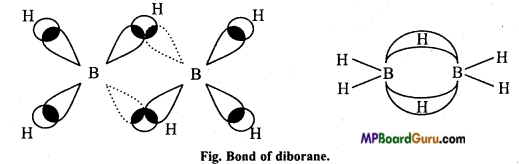
Answer:
Carborundum.
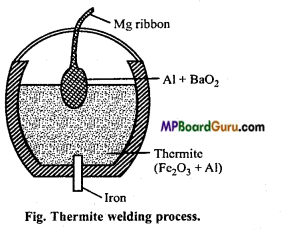
MP Board Class 11th Chemistry Important Questions Chapter 11 The p-Block Elements

3. Match the following:

I.

‘A’‘B’
1. B2O3(a) Amphoteric
2. TiO2(b) Acidic
3. Al2O3(c) Basic
4. Ca2O3(d) Basic
5. Ln2O3(e) Amphoteric.

Answer:
1. (c) Basic
2. (c) Basic
3. (d) Basic
4. (a) Amphoteric
5. (e) Amphoteric.

II.

‘A’‘B’
1. In the preparation of artificial silk (cellulose xanthate)(a) CCl4
2. In cutting and drilling diamond(b) C2H2
3. In used for extinguishing fire in fire extinguishes(c) B4C
4. Is used in welding as oxyacetylene flame(d) Graphite
5. Black lead is known as Plumbago(e) CS2.

Answer:
1. (e) CS2
2. (c) B4C
3. (a) CCl4
4. (b) C2H2
5. (d) Graphite.

4. Answer in one word/sentence:

1. +1 oxidation state of T1 is more stable as compared to +3.
Answer:
Inert pair effect

2. What are hydrides of Boron known as?
Answer:
Borane

3. Which is known as two electron-three centre bond.
Answer:
Diborane

4. What will happen on mixing excess of ammonia solution in copper sulphate solution?
Answer:
A complex compound cupric ammonium sulphate is formed

5. Write the formula of alum.
Answer:
K2SO4. Al2(SO4)3.24H2O

6. What is the effect of heat on borax?
Answer:
Transparent bead of sodium metaborate + boric anhydride is formed

7. What is the name of C6O carbon crystal?
Answer:
Buckminster Fullerene

8. Which carbide is harder than diamond?
Answer:
Boron carbide

9. What is dry ice?
Answer:
Solid carbon dioxide

10. Name the compound which harm ozone layer.
Answer:
C.F.C. or freon

11. Due to which property of carbon, its number of compounds is large?
Answer:
Property of catenation

12. Name the good conductor allotrope of carbon.
Answer:
Graphite

13. What is water glass?
Answer:
Sodium silicate.