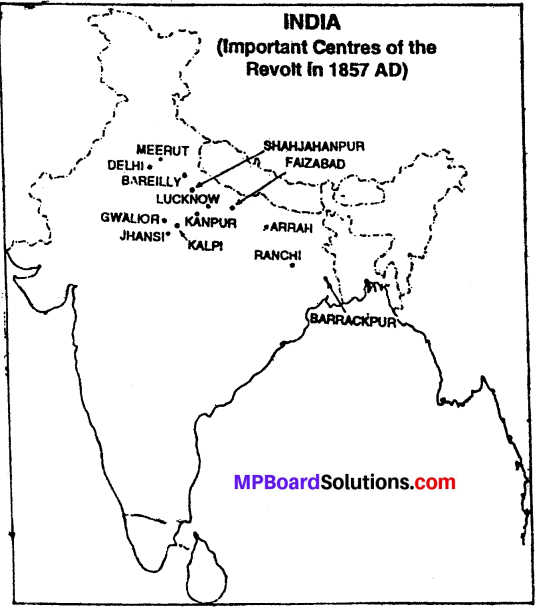
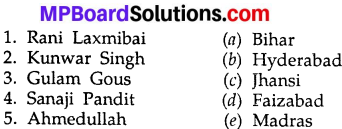
MP Board Class 8th Social Science Solutions Chapter 8 British Policies and Administration in India After 1858

MP Board Class 8th Social Science Solutions Chapter 8 British Policies and Administration in India After 1858

MP Board Class 8th Social Science Chapter 8 Text Book Exercise

Choose the correct option of the following questions

Mp Board Class 8 Social Science Solution Chapter 8 Question 1.
The Proclamation of Queen Victoria were made in:
(a) 1757
(b) 3858
(c) 1957
(d) 1965
Answer:
(b) 3858

Mp Board Class 8 Social Science Chapter 8 Question 2.
The rule of India entrusted into hands of Queen of England.
(a) By 1858 Act
(b) By 1861 Act
(c) By 1865 Act
(d) By 1876 Act
Answer:
(a) By 1858 Act

British Policies And Administration In India After 1858 Question 3.
First Municipality in India was established:
(a) In 1865 at Madras
(b) In 1J867 in Bengal
(c) In 1868 in Uttar Pradesh
(d) None of the above
Answer:
(d) None of the above

Class 8 Social Science Chapter 8 Mp Board Question 5.
The head of Indian Secretariat was called:
(a) Indian Secretary
(b) Viceroy
(c) Governor General
(d) Secretary
Answer:
(a) Indian Secretary

Fill in the blanks:

  1. To help Viceroy a members …………. council was formed.
  2. The British economic policies were formed to protect the interests of …………..
  3. In 1876 the minimum age for Civil Services was …………..
  4. To implement Wood Proposals Lord Rippon constituted ………… Commission.

Answer:

  1. Four
  2. Britishers
  3. 19
  4. Hunter

MP Board Class 8th Social Science Chapter 8 Very Short Answer Type Questions

Question 1.
By which Act Queen of England was made Empress of India.
Answer:
By Ordinance of 1858.

Question 2.
After 1858 how was the Governor General Addressed.
Answer:
The Governor General was addressed as Viceroy.

Question 3.
Who was called the father of local governance?
Answer:
Lord Rippon.

MP Board Class 8th Social Science Chapter 8 Short Answer Type Questions

Question 1.
Describe the proclamation of Queen in short.
Answer:
The rule of the company was replaced by rule of the Crown. The Company territories were now governed by English government. Indian people and rulers got some rights and privileges.

Question 2.
What changes were made by 1861 Act.
Answer:
The Legislative Council was enlarged by the addition of 6 to 12 more members and also introduced provincial councils.

Question 3.
Describe the administrative division after 1858.
Answer:
It transferred power to British crown. A minister called the Secretary of State for India was made responsible for the government of India to the British Parliament. Viceroy replaced Governor General title.

MP Board Class 8th Social Science Chapter 8 Long Answer Type Questions

Question 1.
Write about the decisions of 1858 Act.
Answer:
The decisions of 1858 Act are:
1. The control of India passed on completely to British Government. It was announced that India would be governed by and in the name of the British monarch through a Secretary of State.

2. Before 1858, there were two bodies in Britain which controlled the British policies in India, viz, the Board of Control and the Court of Directors of the East India Company. Now a minister of the British Government called the Secretary of State for India, was given complete control over the Government of India. Like other ministers of the British Government, he was responsible to the British Parliament.

3. To advise the Secretary of State, the Indian Council was created. This Council had no real powers and could only advise the Secretary of State who could ignore the advise of the Council at any time the liked.

4. Before 1858, the Governor General generally acted on his own within the framework of the general policies laid down in Britain. The advanced means of transport and communication reduced the freedom enjoyed by the earlier Governor Generals of India. Now, the Viceroy had to inform the latest developments of India to the Secretary of State thereafter he was to work according to his instructions and others.

Question 2.
Write short note on Army Organisation?
Answer:
Before 1858, the Presidencies of Bombay, Madras and Calcutta had their separate armies. Each Presidency consisted of the Indian soldiers, units of the European soldiers and the regiments of the British soldiers – the latter two were combined.

In 1859, the armies of the three Presidencies were unified and the entire army, of the British India came under the control of the commander – in – chief. The Indian soldiers were excluded from the artillery and the arsenals; The number of the European soldiers was increased. For every two Indian soldiers, one European soldier was recruited. All the officers in the army were to be the Europeans.

Question 3.
Give short Information about the local administration in brief.
Answer:
After 1857, the British government encouraged the local government units such as the municipalities and district boards. Thus, the system of administration was decentralized. The local bodies were given the tasks of providing education, health services, water supply, and the like to the people. Some important changes were made in the local government in 1882, the old system was broken down.

Matters like sanitation, roads, water supply and street lighting were neglected. After 1857, Municipal committees were set up in towns, they levied taxes to meet expenditure on local administration and works. After 1882, the district boards were set up but they consisted of only officials and not elected members. After 1882, the elected members were introduced but only with property were entitled to vote.

Question 4.
Evaluate the British economic policies in precise?
Answer:
British government reorganized the financial administration after 1858. The economic policies followed by Britishers drained the Indian resources and help the Britishers. The British government abolished the tax on Import and allowed free trade in India.

This lured lot of foreign companies to India and caused disastrous effect on Indian industries. The prominent industries that suffered due to the British financial policy were Jute, Indigo, Textiles, Woolen, Tea, Rubber, Coffee, Coal, Iron, and Steam ships. The financial policy of British government completely halted the progress of India.

Question 5.
Describe the British education policy.
Answer:
The British education policy was not for the welfare of Indians but was more for promoting Christian religion and imparting English education. Missionaries established in 1820 promoted English language. In 1854 Woods proposals suggested to promote English languages with other Indian languages.

There was proposal to train teachers and to provide financial grant to educational institutions on secular basis. In 1904 University Act was passed for affiliation of the University and to appoint professors. The 1919 Act entrusted the responsibility of education to provincial councils. The British education policy played a major role in motivating Indians towards nationality
MP Board Class 8th Social Science Solutions

MP Board Class 10th Social Science Solutions Chapter 6 Natural Disasters and Disaster Management

In this article, we will share MP Board Class 10th Social Science Book Solutions Chapter 6 Natural Disasters and Disaster Management Pdf, These solutions are solved subject experts from the latest edition books.

MP Board Class 10th Social Science Solutions Chapter 6 Natural Disasters and Disaster Management

MP Board Class 10th Social Science Text Book Exercise

Objective Type Questions

Students can also download MP Board 10th Model Papers to help you to revise the complete Syllabus and score more marks in your examinations.

Mp Board Class 10th Social Science Chapter 6 Question 1.
Multiple Choice Questions:
(Choose the correct answer from the following)

Question (a)
Most flood affected state:
(a) Bihar
(b) West Bengal
(c) Assam
(d) Uttar Pradesh.
Answer:
(c) Assam

Question (b)
Area of the country where earthquakes often occur (high incidence zones):
(c) Assam
(b) Aravali mountain
(c) Orissa coast
(d) Goa.
Answer:
(c) Assam

Question (c)
The Tsunami of 2004 December, caused greatest loss of human lives in: (MP Board 2009)
(a) Tamilnadu
(b) Gujarat
(c) Kerala
(d) Orissa.
Answer:
(a) Tamilnadu

Question (d)
Which place summit conference organised at the international level?
(a) Japan (Yakohama)
(b) India (Bangaluru)
(c) Brazil (Riyodijanero)
(d) United States of America
Answer:
(a) Japan (Yakohama)

MP Board Class 10th Social Science Very Short Answer Type Questions

Social Science Class 10 Mp Board Chapter 6 Question 1.
What is done on the hilly roads to arrest landslides?
Answer:
Natural vegetation is grown on the side of hilly roads and construct strong wall.

Class 10th Social Science Chapter 6 Question 2.
Which natural disaster occur abruptly?
Answer:
Earthquake, Tsunami, Volcano, Landslide, Flood, Tornado etc.

Chapter 6 Social Science Class 10 Question 3.
For which areas construction of bunds is considered useful?
Answer:
For storage of water.

Class 10 Social Science Chapter 6 Question 4.
What is measured on the richter scale?
Answer:
An intensity of earthquake.

MP Board Class 10th Social Science Short Answer Type Questions

Class 10 Social Science Disaster Management Question 1.
What is meant by disaster?
Or
What do you mean by Disasters? (MP Board 2009)
Answer:
Disaster is a calamity either natural or which occurs due to human mistake. This results into loss of lives and natural resources, and ultimately the people suffer. A disaster hampers the normal routine of the whole society and a large section of the population is affected.

Chapter 6 Class 10 Social Science Question 2.
What is drought and flood?
Answer:
In our country there are a few areas which never face the problem of drought. Any area which gets 25% or less average rainfall is called drought condition. Accumulation of large quantity of water on property is called flood. Floods are caused due to increase in the level of water in water reservoirs beyond limit, due to heavy rains the water overflows in rivers, storms and tornado occur and due to cracks or breaking of dams, a very large area is inundated.

Disaster Management Class 10th Question 3.
Describe three stages to protect ourselves from landslides?
Answer:
Measures to prevent the landslides and the losses:
Different measures should be taken in different areas.

1. First of all the landslide prone areas should be plotted on the map; this will enable us to know which areas should be excluded while planning for human settlements.

2. More construction and development activities should be taken up in such areas.

3. Natural vegetation should be encouraged on mountain or hill slopes. Slopy regions where vegetation is absent, such areas should be identified for plantation of suitable varieties of trees.

4. Care should be taken while constructing roads, canals for irrigation etc., so that the natural drainage of water is not hampered. It is also useful to construct strong walls on the sides of the roads in hill areas, set up control centers and ensure that water drains away in plain areas.

Ch 6 Social Science Class 10 Question 4.
What is meant by Tsunami?
Answer:
Earthquakes eruption from a volcano cause a sudden disturbance in the base of the ocean causing abrupt displacement of oceanic water. Consequently very high waves are produced, these are called Tsunami or earthquake affected oceanic waves. Normally only one high wave is produced and in due course chain of waves appear on the sea.

The speed of the waves is slow in shallow sea and is high in deep sea. In the deep sea, length of the tsunami waves is more and the height is less. On the shallow sea shores the waves can be 15 meter high or even more. This results into great disaster on the coastal area.

Social Science Class 10 Chapter 6 Question 5.
Why more earthquakes occur in Himalayan and North – Eastern Regions of India?
Answer:
It is believed that the earth’s surface is made of big plates. These plates shift towards each other due to earth’s internal heat. Their shifting or expanding cause earthquake. Where two plates meet, mountains are formed and where they shift new surface are formed. That’s why the danger of earthquakes is maximum in that areas.

Question 6.
Why droughts are more frequent in the Western Region and Madhya Bharat?
Answer:
We know that the western and middle region of India’s rainfall is less than 50% of the average rainfall or these areas does not get rains for two consecutive years, therefore situation of grave drought condition.

As per the Irrigation Commission’s report of 1972 these areas are called ‘drought – prone’, because of receiving average annual rainfall, less than 75 cm. So also if there is a variation of 25% in the annual average rainfall then that area is called drought-affected area.

Question 7.
Which are the main areas affected to Tsunami in India?
Or
Write the areas effected by Tsunami? (MP Board 2009)
Answer:
Coastal areas of the world are prone to Tsunami. These areas are particularly Pacific Ocean coasts (Alaska, Japan, Philiphines and Indonesia, Malaysia, etc. of South East Asia) and Indian Ocean coasts (Myanmar, Sri Lanka and India).

Question 8.
Exploitation of forest resources is responsible for natural disaster is it true? Explain? (MP Board 2009)
Answer:
Forests are homeland of nature. Forests attract the clouds to rain. The rainfedare is fit for agriculture. The agricultural production is the solution of drought. Thus forest is the root condition of natural resources.

Question 9.
How does epidemics spread? Explain?
Or
How does Epidemic spread? Classify? (MP Board 2009)
Or
What do you mean by epidemic disaster? Write its main causes? (MP Board 2009)
Answer:
The condition of epidemic is said to be one when the number of cases (patients) is more than expected. This requires emergency preventive steps. An epidemic can spread abruptly. When the number of cases of particular disease increase disproportionately that is considered to be warning of an epidemic. In some instances the breeding places of germs that cause the disease increase or the carriers of germs start dying (e.g. rats who are carriers of plague germs) an advance warning of the epidemic is received.

Causes and effects of the epidemic:
Cause of an epidemic are worms, germs, bacteria [bacteria, protozoa, fungi] polluted water, and food items, increase in the number of mosquitoes, large crowd of tourists and passengers from outside and effect of natural calamities on the atmosphere also bring epidemics.

Question 10.
What is meant by disaster management? Explain main elements of disaster management?
Or
What is meant by Disaster Management? Explain its main elements? (MP Board 2009)
Answer:
Disaster management is a chain of activities which are carried out not only before and after the disaster but carried out during the period of disaster also. This arrangement is something more than the expansion and contraction model.

Under this system it is believed that disaster management is efforts to prevent the calamity, minimise its effects, timely action and activities to bring the situation to normalcy; these activities are expanded and contracted as per the emergency, sense of insecurity in the society etc.

Main stages of disaster management:
Disaster management lays stress on four important things:

  1. Advance preparation
  2. Action at the time of disaster
  3. To restore normalcy and rehabilitation.
  4. Plan for preventing the recurrence of the disaster and minimise the ill effects of the disaster.

MP Board Class 10th Social Science Long Answer Type Questions

Question 1.
Explain the factors responsible for floods? write the steps which should be taken to control floods?
Answer:
The following are the responsible factors of flood:

  1. Dams, bunds, barrages etc., are harmed.
  2. Increase of silt arid soil in rivers.
  3. Land slides.
  4. Hindrance in draining of water due to roads or other construction work.
  5. Silting of rivers and dams.
  6. Destruction of environment, soil erosion and soil draining.

Steps to control floods:

There is a reasonable period warning for floods other than the sudden floods which come due to rains or tornado. In India the Central Water Board/Commission, Irrigation and Flood Control Department and Water Resources Department issue warning regarding floods. The forecasts of Central Water Board are based on the 132 forecast centers located on the flood prone rivers of different states. Following efforts can be made to minimise the risks of flood in the flood affected areas:

  1. Many reservoirs can be made on the upper areas of the rivers.
  2. Small dams should be constructed on the tributaries and brooks so that the possibilities of floods in the main river can be minimised.
  3. Dense plantation should be done on the upper catchment area of the rivers.
  4. In the plains, water can be stored in reservoirs to be constructed on unused land.
  5. Attention should be paid towards the safety of bunds constructed on the coasts.
  6. Total or partial rehabilitation of people of the villages which are surrounded by waters between the bunds.
  7. Encroachment of human settlements on the lands adjacent to the banks of rivers should be prevented.
  8. Destruction of forests located in the catchment area of rivers should be controlled.
  9. Landslides can be controlled ensuing only limited use of explosives for construction of roads in the hill area.

Question 2.
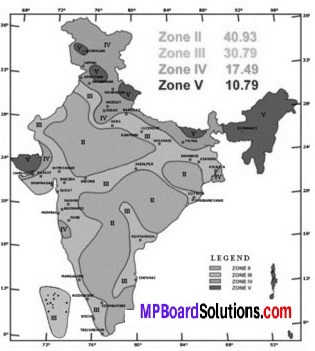
What is meant by earthquakes? Describe the earthquake affected areas of India?
Answer:
This disaster abruptly crops up. It can come at any place, any time and without any warning. This incidence creates movements of the earth’s crust and cases shaking of the ground. As the waves move away from epicenter of the earthquake, its intensity goes on diminishing.

Earthquake affects in two ways. Firstly, it creates waves around the epicenter and the effect is widespread. The second effect is on and under surface of the earth. This effect is perpendicular type, this form of the earthquake is very destructive.

Earthquake – prone areas in India:
India can be divided into five areas on the basis of the effect and dispersal earthquakes:

  1. Highest earthquake – prone areas.
  2. More earthquake – prone areas.
  3. Medium affected areas.
  4. Low danger areas
  5. Normal areas.

The areas where the danger is maximum are The Himalayan region which includes Himachal Pradesh, Uttarakhand, North Bihar and parts of North East India. Besides, areas of Kutchh, and coastal Kokan are also more dangerous areas. Middle India, Rajasthan, Maharashtra, Karnataka, Orissa, Tamilnadu, Andhra Pradesh, Jharkhand and Chhattisgarh are areas less affected by earthquakes. Other areas of the country are moderate danger areas.

Question 3.
What is common between – drought and flood? How can flood and drought conditions be controlled by proper planning? Explain?
Answer:
Drought is common.
Steps to minimise the ill – effects of drought:

1. The condition of rainfall, reservoirs, lakes, rivers etc. should be closely watched with the intention to conserve water and for making water available, demand for water in different areas and supply should be monitored and water conservation and storage should be encouraged.

2. Efforts to increase water supply, storing water in homes and agricultural fields increases the availability of water. The water which drains away should be stored at one place and through bunds it should be allowed to go into the soil. Contour bunding, improved plantation of seeds in beds, etc. help in increasing availability of water.

3. Extension of irrigation facilities minimise the ill – effects of drought.

4. For providing employment, alternative avenues other than agriculture should be opened for employment. Besides, collection of forest produce other than wood, goat rearing, carpentry etc. should be encouraged.

Steps to minimise ill – effects of floods:
There is a reasonable period warning for floods other than the sudden floods which come due to rains or tornado. In India the Central Water Board/ Commission, Irrigation and Flood Control Department and Water Resources Department issue warming regarding floods. The forecasts of Central Water Board are based on the 132 forecast centres located on the flood prone rivers of different states. Following efforts can be made to minimise the risks of floods in the flood affected areas:

  1. Many reservoirs can be made on the upper areas of the rivers.
  2. Small dams should be constructed on the tributaries and brooks so that the possibilities of flood in the main river can be minimised.
  3. Dense plantation should be done on the upper catchment area of the rivers.
  4. In the plains, water can be stored in reservoirs to be constructed on unused land.
  5. Attention should be paid towards the safety of bunds constructed on the coasts.
  6. Total or partial rehabilitation of people of the villages which are surrounded by waters between the bunds.
  7. Encroachment of human settlements on the lands adjacent to the blanks of rivers should be prevented.
  8. Destruction of forests located in the catchment area of rivers should be controlled.
  9. Landslides can be controlled ensuing only limited use of explosives for construction of roads in the hill area.

Question 4.
What is meant by common disasters? Classify main common disaster and explain their causes, effect and the safety measures to be taken during the disaster?
Or
Write the basic tips to prevent domestic fire? (MP Board 2009, 2012)
Answer:
Common disaster means the disaster that occurs day – to – day social life e.g., fire, rail accidents, road accidents and plain accidents.

1. Fire:
Fire is very dangerous. Number of deaths caused by fire are much more than the total number of deaths caused by whirl winds, earthquakes, floods. There are many reasons of occurring, fire like, electrical heaters, accidents while cooking food, wiring (naked electrical wires and short circuit) fires in the garbage, explosives, etc.

Prevention of domestic fire:
Some basic tips are as under:

  1. Basic rules to prevent/save from fire and exit doors should always be remembered and followed.
  2. Do not keep hightly inflammable matter in the house.
  3. Always keep a fire extinguisher in home and learn to use it and teach it to other members of the family also.
  4. When you go out switch off all the gas and electric gadgets.
  5. In case of fire, call the fire brigade immediately, tell them your address, type of fire and place.

Rail Accidents:
Rail accident usually occur due to lack of maintenance of railway track, and railway engines, bogies, etc., human errors, and derailment. Derailment is sometimes caused by harming the rails/other systems (by anti – social elements)
Safety measures to be adopted:

Following steps should be taken to save ourselves from rail accidents:

  1. Always pay attention towards the signals; and swing barrier. When the gate is closed/barrier is put, do not try to cross the railway line under the barrier.
  2. When crossing a railway line where there is an unmanned level crossing always see on both the sides of the railway line to be sure that there is no train/engine upto a long distance.
  3. One should not smoke in the train or carry inflammable material.
  4. While travelling do not stand in the entrance gate or lean out from the window or door.

Road Accidents:
Roads are for facilitating easy transportation and service. But drivers drive at a very high speed and carelessly and as a result the number of roads accidents is increasing. Following are the main reasons of road accidents:

  1. Rash driving.
  2. Drinking in drunken state.
  3. Improper maintenance of vehicles.

Safety measures to be adopted:

  1. Start driving only when you are competent to drive.
  2. Follow your lane on the road, this is the best way to be safe on the road.
  3. Know the road signs and follow them.
  4. During rains drive very carefully.
  5. While driving do not increase or decrease the speed of your vehicle abruptly.
  6. See on both side of the road while crossing the road.
  7. Do not try to overtake unnecessarily.
  8. Do not take on the cell phone while driving.

Question 5.
What are chemical disasters? Give examples of main disasters and explain the steps proposed to be taken to prevent their recurrence?
Answer:
Chemical disasters are man – related tragedies. These can be caused abruptly without any warning chemical leakage can be caused by human mistake, technological follies or nature related. The chemicals when mix with water, air and land it pollutes the atmosphere and as a result crops, cattle, fish etc. either die or their development is retarded.

Some of the main chemical disasters are:

1. Leakage of chemical gas:
The Bhopal Gas Tragedy, occurred in the midnight of 2 – 3 December, 1984 is the biggest industrial – chemical tragedy. It was the result of a technological incidence. In this tragedy hydrogen, cynide and other products together with 45 tons of mythyl isocynide (MIC), on a highly poisonous gas leaked from the pesticide plant of Union Carbide, Bhopal in the midnight. It took a toll of about 3600 lives and many more developed severe health problems.

2. Another severest tragedy of the world was dropping of atomic bombs by America on Hiroshima and Nagasaki on Japan during the Second World War.

3. Attack of pests on crops, diseases caused by insects and bacteria like plague, viral attack bird flu, dengue, etc. are bio attacks. Suitable protective measures are necessary in respect of these diseases also.

Measures to minimise the ill effects:

1. General public should be educated as to how harmful chemicals should be used and stored and if by mistake they come in contact with any body part what action should be taken to nullify that effect.

2. Human habitations (residential areas) should be located away from industrial areas, and in between these two areas there should be a green belt.

3. Mock drills should be organised from time – to – time to face such calamities properly.

4. Warning system for fire fighting (and other such calamities) should be improved.

5. Storage of poisonous chemicals should be done only up to a particular limit.

6.  Industrial insurance and safety laws should be strictly enforced.

Question 6.
Please indicate on the map of India the place of your residence (by a point); also indicate earthquake drought, flood, landslide and Tsunami prone zones?
Answer:
MP Board Class 10th Social Science Solutions Chapter 6 Natural Disasters and Disaster Management img 1

MP Board Class 10th Social Science Solutions Chapter 6 Natural Disasters and Disaster Management img 2

MP Board Class 10th Social Science Solutions Chapter 6 Natural Disasters and Disaster Management img 3

Question 7.
Please collect information from newspapers and magazines about four natural disasters? What steps can be taken to minimise the occurrence of these disasters?
Answer:
Do yourself.

Question 8.
Write an essay on disaster management?
Answer:
Disaster affects the society adversely and external assistance is needed to solve the problems caused by the disaster. Thus it can be said that disaster is the consequence of unnecessary interference in the nature’s system; this interference in turn is the result of consumerism and growing population.

Disasters are unexpected incidents; occurrence of which is beyond the human control. They occur abruptly and hamper the normal human activities. To meet the challenges of such disasters much more needs to be done than the minimum emergency services provided Disasters are not only the result of natural phenomena but they are closely related with human activities also.

Some human activities indirectly affect the environment e.g. landslides and floods due to destruction of forests. It is difficult to check natural disasters. Therefor, it is better to minimise their effect and a proper disaster management. Many efforts have been made in this direction. Important steps in this direction are setting up of Indian National Disaster Management Institute, The Summit Conference of May 1994 in Yokohama (Japan) and conferences, seminars etc. on Disaster Management.

Disaster management is a chain of activities which are carried out not only before and after the disaster but carried out during the period of disaster also. This arrangement is something more than the expansion and contraction model. Under this system it is believed that disaster management is efforts to prevent the calamity, minimize its effects, timely action and activities to bring the situation to normally. These activities are expanded and contracted as per the emergency, sense of insecurity in the society, etc.

MP Board Class 10th Social Science Additional Important Questions

Objective Type Questions

Question 1.
Multiple Choice Questions:
(Choose the correct answer from the following)

Question (a)
Tsunami hit occurred in India on?
(a) 24 December 2002
(b) 26 December 2004
(c) 28 December 2006
(d) 28 December 2008.
Answer:
(b) 26 December 2004

Question (b)
Which one of the following is a biological disaster? (MP Board 2009)
(a) Bomb explosion
(b) Bird flue
(c) Volcano
(d) Tsunami
Answer:
(a) Bomb explosion

Question (c)
The most flood state of India is:
(a) West Bengal
(b) Assam
(c) Orissa
(d) Tamilnadu.
Answer:
(b) Assam

Question (d)
Which of the following disaster is natural?
(a) Flood
(b) Earthquake
(b) Drought
(d) All of them.
Answer:
(d) All of them.

Question (v)
Landslides occur in the:
(a) Seashore
(b) Plain
(c) Mountains
(d) Forest.
Answer:
(c) Mountains

Question 2.
True and False type questions:

  1. Tornado occur in the plain regions.
  2. Vaccination will help the people to do disease – free.
  3. Bacterias and viruses are the agent of biological disaster.
  4. Rajasthan is the most drought – prone area of India.
  5. Losses of disaster can be minimized by disaster management. (MP Board 2009)

Answer:

  1. False
  2. True
  3. True
  4. True
  5. True.

Question 3.
Fill in the blanks:

  1. MP Board Class 10th Social Science Solutions Chapter 6 Natural Disasters and Disaster Management img 5
  2. …………………….. is the only disaster which can come at any place, any time and with out any warning.
  3. Destruction of forests is the ultimate cause of ……………………..
  4. ……………………. is the state of India which is the most storm – prone area in the country.
  5. ……………………. per cent of the total rains of the country are from monsoons.
  6. The area of ‘Spiti valley’ consests of Laddakh and Pradesh.
  7. ………………….. is the most flood effective state of India. (MP Board 2009)

Answer:

  1. capacity
  2. earthquake
  3. flood
  4. earthquake
  5. Japanese
  6. Orissa
  7. 80
  8. Himachal
  9. Assam.

Question 4.
Match the column:
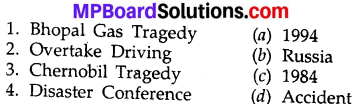
MP Board Class 10th Social Science Solutions Chapter 6 Natural Disasters and Disaster Management img 4
Answer:

  1. (c)
  2. (d)
  3. (b)
  4. (a).

Answer in One – Two Words or One Sentence

Question 1.
Which factor is responsible either drought or flood?
Answer:
Shortage or excess of monsoons.

Question 2.
Who published the building code and guidelines for construction work in earthquake zone?
Answer:
Indian Standards Bureau.

Question 3.
What is epidemic disaster?
Answer:
An epidemic is a disease or health problem which spreads unexpectedly on a large scale.

Question 4.
What is their effect on developmental clock?
Answer:
The disasters have turned the developmental clock back of the affected areas by decades.

Question 5.
Describe earthquake?
Answer:
It is the only disaster which can come at any place, any and with out any warning. In earthquake movement of earth crust takes place which leads to shaking of ground.

Question 6.
When and where did an earthquake hit on December 26, 2003?
Answer:
At Bam (Iran).

Question 7.
When did Tsunami hit south and south east Asia in the recent past?
Answer:
26 December 2004.

Question 8.
What is the toll of this Tsunami?
Answer:
2,7,000 +

Question 9.
What is the final toll of India in the December 26, 2004 Tsunami?
Answer:
9,575 +

Question 10.
Which toll cannot be calculated in respect of Tsunami of December 26, 2004?
Answer:
Emotional, economical and ecological toll.

MP Board Class 10th Social Science Very Short Answer Type Questions

Question 1.
How do we deal with natural disasters?
Answer:
We deal with natural disasters such cyclones, floods, droughts earthquakes and landslides, technically and scientifically within scientific disciplines.

Question 2.
What have we seen in the recent past/decades about disasters?
Answer:
In the recent decades we have seen an alarming increase in the occurrence of natural disasters and the magnitude of their social, economic and environmental impacts.

Question 3.
What was special about the earthquake of December 26, 2004?
Answer:

  1. It was biggest earthquake to hit the world in the last 40 years.
  2. Its intensity was 8.9 on the Richter Scale.
  3. It caused Tsunami waves with a height of up to 30 metres.

MP Board Class 10th Social Science Short Answer Type Questions

Question 1.
What is the social and environmental effect of earthquake?
Answer:
The losses due to earthquake are widespread. If it occurs in a densely populated area then there is a great loss of lives. The means of transport and communication are destroyed and industry and development works are hampered. The roads get blocked and it becomes difficult to reach help to the people.

Question 2.
Discuss the types of disasters?
Answer:
Main types of disasters:
In India we have come across many calamities which are a cause of worry for us. They may be classified as under:

1. Disasters that appear abruptly:
Earthquake, Tsunami, eruption of volcano, landslide, flood, Tornado, (Whirl wind), avalanche, cloud burst etc.

2. Disasters that appear gradually:
Drought, hailstorm, environment deterioration, transformation of land into deserts etc.

3. Epidemics:
Food/water borne diseases, epidemics etc.

4. Industrial/Technological accidents:
System related problems/ failure; fire, explosion, chemical leakage etc.

Question 3.
Name the main drought – prone areas of the country?
Answer:
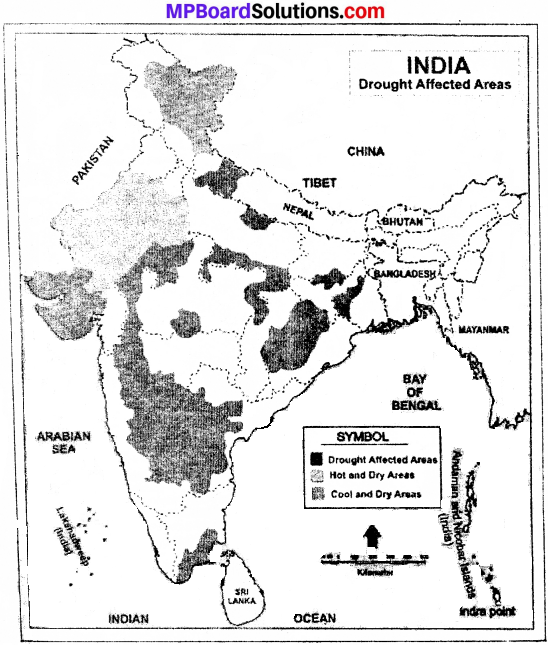
The drought – prone areas of India are mainly:

  1. The dry and semi – dry regions of Rajasthan where every two years drought conditions occur.
  2. Gujarat, Punjab, Western Uttar Pradesh, Tamilnadu.
  3. Eastern Uttar Pradesh, Southern Karnataka and Vidarbha areas where once in every year.

Question 4.
Describe the effects of landslides?
Answer:
Effects of landslides:
The areas worst hit by landslides are deep slopes, low lying areas of the rivers flowing from hill slopes and settlements on the areas from where river flows. Following are the bad effects of landslides:

Physical harms:
Land slides destroy anything which come in their way. Landslides damage the roads, communication lines, human settlements, agricultural land, crops etc., The rails break, traffic is disrupted and development activities affected.

Loss of lives and property:
On the basis of the location of landslide human life and property is destroyed. Big landslide have sometimes taken thousands of peoples lives.

Question 5.
What are the causes of Tsunami? (MP Board 2009)
Or
Explain the causes of Tsunami?
Answer:
The sea water is never calm. Movements in the sea water is a common phenomenon. Earthquake and volcano when appear near the sea area then occurs Tsunami disaster. When the process of volcanic eruption and earthquake takes place in the base of the sea then the movements in the sea waters increase, as a result of this high waves are produced in the sea water which are in turn responsible for loss of lives and property.

Question 6.
What do you mean by the prevention of effect of disaster?
Answer:
The prevention and reduction of their effects of the disaster are discussed under the following heads:

  1. Prepare plan for land use.
  2. To prevent people from settling in risky areas.
  3. To construct buildings which can resist the risks involved in the disaster (e.g. earthquake proof building etc.)
  4. To find out ways and means to minimise the ill effects of the disaster before their occurrence.
  5. Community awareness and education.

Question 7.
How are landslides among the major natural disasters in the world?
Answer:

  1. Landslides are among the major natural disasters in the world.
  2. In hilly terrains of India, including Himalayan mountains landslides are major and widely spread natural disasters.
  3. They strikes life and property almost perennially and occupy a position of major concern.
  4. These landslides, year after year, bring about untold misery to human settlements and cause devastating damages to transportation and communication network.

Question 8.
How are disasters classified in India? (2010)
Answer:
In India disasters may be classified as under:

  1. Disasters that occurs abruptly like earthquake, Tsunami, landslide etc.
  2. Disasters that appear gradually for example draught, hailstrom, transformation of land into deserts etc.
  3. Epidemics Food and water – born diseases.

Question 9.
What caused landslides in Nepal on 21 August, 2002?
Answer:

  1. On 21st August, 2002, heavy monsoon in eastern Nepal triggered landslides and flash floods. They killed 419 people and injured 105 people.
  2. More than 53,152 families were affected and about 19,485 houses were destroyed.
  3. A total of 47 districts were affected.

Question 10.
Enumerate the factor that cause landslides?
Answer:
Factors causing Landslides:
Landslides occur due to the interplay of several factors. They are classed as under:

Natural Factors:

  1. Intensity of rainfall
  2. Steep slopes
  3. Stiffness of, slopes
  4. Highly weathered rock layers
  5. Soil layers formed under gravity
  6. Seismic activity
  7. Poor drainage.

Man – made Factors:

  1. Deforestation leading to soil erosion
  2. Non – engineered excavation
  3. Mining and quarrying
  4. Non – engineered construction
  5. Land use pattern (faulty).

Question 11.
How can the risk of landslides be reduced?
Answer:
The potential for landslides and destructive erosion can be greatly reduced by adopting the following measures:

  1. Proper development.
  2. Adoption of sound construction techniques.
  3. Erection of retaining walls.
  4. Avoiding steep slopes for construction of buildings.

Question 12.
How is water a source for all life forms? How is it tragic?
Answer:

  1. Water is a source for all life forms.
  2. In its absence no life is sustainable.
  3. It is tragic that same water in the form of floods takes away thousand of human and cattle lives.
  4. More than 10 lakh huts and poor houses are lost every year in floods in India.

Question 13.
Enumerate the most vulnerable homes in the wake of floods?
Answer:
The Most Vulnerable Homes:

  1. In the wake of floods the following are the most vulnerable homes, buildings, constructed with earth – based materials or using stone and brick in mud mortar.
  2. The huts made from biomass materials like bamboo, leaves, thatch or light construction using metal sheets.
  3. The buildings constructed within the flood plain of rivers.
  4. Houses constructed in high population concentration low lying areas.
  5. Jhuggi – Jhompri clusters in low lying flood plain areas.

MP Board Class 10th Social Science Long Answer Type Questions

Question 1.
Write any four measures to prevent fire in house hold?
Answer:
Some basic tips to prevent house hold fire are as under:

  1. Basic rules to prevent/save from fire and exit doors should always be remembered and followed.
  2. Do not keep highly inflammable matter in the house.
  3. Always keep a fire extinguisher at home and learn to use it and teach it to other members of the family also.
  4. When you go out please switch off all the gas and electrical gadgets.
  5. Do not put so many electrical gadgets in one socket.
  6. Keep match boxes out of reach of children and do not allow anyone to smoke in the house.
  7. Do not block the entrance door of the house by putting almarah or any furniture against it.
  8. Try to know the reason of fire and take suitable action.
  9. In case of fire call the fire brigade immediately, tell them your address, type of fire and place.
  10. The passage where smoke is there, try to crawl on the ground because smoke is always less near the floor.
  11. There should be two exit doors in the house, do an exercise of going out from these doors twice in an year as per your plan.
  12. Do not store inflammable liquids, gas cylinder and other such risky material in the house.

Question 2.
Describe the human factors for drought disaster?
Answer:
Human factors responsible for drought: The drought comes gradually and it is difficult to decide the duration of its beginning and end. The dividing level of rains, diminishing ground water level, dry well, rivers and reservoirs and weak crop give a warning of the imminent danger of drought. Although drought is a natural calamity but the main factor responsible for it are as follows:

  1. Ignore land management.
  2. Ignoring traditional sources of irrigation viz tanks, wells, reservoirs, etc.
  3. Destruction of community forests.
  4. Natural water resources get dried due to destruction of forest, due to insufficient rains the ground water level goes down; water level in the ground water level goes down; water level in rivers also goes down.
  5. Fodder shortage for cattle.
  6. Drastic changes in rotation of crops.
  7. Imbalanced relationship with atmosphere (ecology) results in excessive demand for water in the agriculture, industry and cottage industry.
  8. Faulty management of water resource.

Question 3.
How do floods in Bangladesh become disasters? Give an example of such disasters?
Answer:
Bangladesh is a riverine country where recurrent flooding is both common and necessary. Every year large areas are submerged during the monsoon season and fertilized by deposits of fresh alluvium. If the waters remain stagnant for too long, these beneficial floods become major disasters.

Examples:

  1. In the summer and fall of 1974 when flooding extended over nearly 50% of the country and stagnated for more than a month.
  2. At least 1,200 people died in the floods and another 27,500 died from subsequent disease and starvation.
  3. Approximately 425,000 houses were destroyed or severely damaged.
  4. A total of 36 million people suffered severe hardship and losses due to the disaster.

Question 4.
What are the main reasons of floods? Discuss the effects and effected region in India?
Answer:
Main reasons of floods in India are leakage or cracking of bunds, dams etc. and releasing excess water from barrages. The danger of floods is also increasing because of defective construction of bunds, old dams etc. The water that are flowing from Himalayan rivers bring with them large quantities of soil and this is deposited on the land and areas near the sea coast.

According to an estimate, every year 10 lakh cubic feet of soil gets mixed up with the waters of rivers Gandak and Sarayu flowing from the Himalayas. This soil is deposited on the plains of Uttar Pradesh. Consequently the bottom of the rivers and their water surface is coming up. Thus every year the flow of these river is taking the form of floods.

In the mountainous regions, the river flow gets blocked due to landslides and water reservoirs are formed; then suddenly they crack and floods occur. In the Himalayan region landslides are common. In the mountainous regions the land has become unstable due to construction of roads, deforestation, uncontrolled cutting of roads, deforestation, uncontrolled cutting of hills etc. In the Himalayan area on an average 60,000 cubic meter soil is removed in construction 1 km long road. So far 50,000 kilometers of road has so far been constructed in the Himalayan region. This soil accumulation is also a cause of floods.

Flood regions in India:

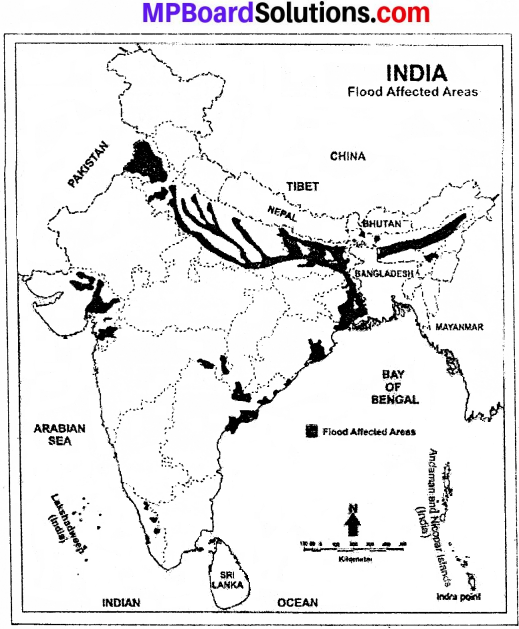
Floods are a regular featured in India. The vast plains and coastal areas suffer from the devastation of floods. Floods are a regular annual feature in the states of Assam, Meghalaya, Arunachal Pradesh, Tripura, West Bengal, Bihar and Orissa in the North-east India. The consequences of this are suffered by both, the human and cattle population.

Effects of floods:
Floods affect the life of human beings in the following manner:

1. Physical harm:
The flood waters harm the buildings, some buildings are razed to the ground. There is danger to the lives and property-. Landslides also occur due to heavy down pour of rains and flowing water.

2. Deaths and public health:
People and cattle drown/die in the flood waters. Epidemic, diarrhoea, bacterial, infections, malaria, etc. spread.

3. Hindrance in water supply:
The water sources get contaminated and there is problem in supply of potable water.

4. Crops and food supply:
The fields (crops) are inundated and the grain godowns are also harmed and damage is caused to food grains.

5. Change in the soil structure:
The soil is also affected and due to sea water there is a danger of soil becoming salty.

Map Work

Question 1.
On an outline map of India, show the seismic zones?
Answer:
MP Board Class 10th Social Science Solutions Chapter 6 Natural Disasters and Disaster Management img 1

Question 2.
On an outline map of India, show drought-affected areas?
Answer:
MP Board Class 10th Social Science Solutions Chapter 6 Natural Disasters and Disaster Management img 2

Question 3.
On an outline map of India, show flood-affected areas?
Answer:
MP Board Class 10th Social Science Solutions Chapter 6 Natural Disasters and Disaster Management img 3

MP Board Class 8th Social Science Solutions Chapter 17 National Movement 1885-1918

MP Board Class 8th Social Science Solutions Chapter 17 National Movement 1885-1918

MP Board Class 8th Social Science Chapter 17 Text Book Exercise

Choose the correct option of the following.

Mp Board Class 8 Social Science Solution Chapter 17 Question 1.
Prominent leader of Extremist group was –
(a) Gopal Krishna Gokhle
(b) Bipin Chandra Pal
(c) Pt. Moti Lal Nehru
(d) Feroze Shah Mehta
Answer:
(b) Bipin Chandra Pal

Mp Board Class 8 Social Science Chapter 17 Question 2.
‘Swaraj is my birth right and I must have it,’ who said?
(a) Biomesh Chandra Banerjee
(b) Dadabhai Naoroji .
(c) Bal Gangadhar Tilak
(d) Sardar Bhagat Singh
Answer:
(c) Bal Gangadhar Tilak

Class 8 Social Science Chapter 17 Question 3.
Bengal was divided –
(a) By Lord Cornwallis
(b) By Lord Curzon
(c) By Lord Hastings
(d) By Lord William Bentick
Answer:
(b) By Lord Curzon

Class 8 Social Science Chapter 17 Question Answer Question 4.
Where Tilak was exiled in 1908 –
(a) Sri Lanka
(b) China
(c) Burma
(d) Rangoon
Answer:
(c) Burma

Fill in the blanks :

  1.  In Calcutta Surrender Nath Banerjee …………. founded
  2.  …………. played important role in the formation of Congress.
  3.  …………. led a Muslim delegation to meet Viceroy Minto.
  4.  Mahatma Gandhi was born at in ………… Gujarat State.
  5.  Gandhiji developed a new method to fight against the oppression. It is called …………

Answer:

  1. Indian Association
  2. A.O.Hume
  3. Aga Khan
  4. Porbander
  5. Satyagraha

MP Board Class 8th Social Science Chapter 17 Very Short Answer Type Questions

Mp Board Class 8 Science Chapter 17 Question 1.
Where first session of Congress was held?
Answer:
The first session of Congress was held at Gokuldas Tejpal Sanskrit College in Bombay

Mp Board Class 8 Science Solution Chapter 17 Question 2.
Who was Viceroy during the partition of Bengal?
Answer:
Lord Curzon was the Viceroy during the partition of Bengal.

Mp Board Class 8 English Chapter 17 Question 3.
Who led the Champaran Movement?
Answer:
Mahatma Gandhi led the Champaran Movement.

Question 4.
Write names of two leaders who played important role in the formation of Muslim League?
Answer:
Aga Khan and Nawab Sali Mullah from Dhaka played an important role in the formation of Muslim League.

MP Board Class 8th Social Science Chapter 17 Short Answer Type Questions

Question 1.
What festivals were used to arrows the people by Bal Gangadhar Tilak?
Answer:
Bal Gangadhar Tilak utilized the popular festivals like Ganpati and Shivaji to spread and to arrows political awakening among the people.

Question 2.
Write the reasons of Bengal partition?
Answer:
1. The partition of Bengal was done in 1905 during the regime of Lord Curzon. It came into effect on October, 16,1905.

2. The Governor- General did it to provide efficient administration. But his underneath motive was to divide the Hindus and the Muslims and weaken the nationalist movement.

Question 3.
Describe the objectives of Muslim League formation?
Answer:
The Muslim League was formed in 1906 at Dhaka. Its aims included the following:

  1. To promote loyalty towards the government.
  2. To protect and advance the interests the Muslims; and
  3. To ensure that the Muslims did not develop feelings of hostility towards other communities in India.

As the Muslim League was formed on the basis of religion, it only encouraged communal politics.

MP Board Class 8th Social Science Chapter 17 Long Answer Type Questions

Question 1.
What were the early major demands of Congress? Explain?
Answer:
The main demands of the Indian National Congress during in first 20 years were as under:

More powers for the Legislative Councils.

  • Election system to the membership of Councils be introduced.
  • Creation of the Legislative Councils in the provinces where they did not exist.
  • Recruiting of the Indians to higher posts in government offices.
  • Holding of the Civil Services examinations in India also.
  • education in land revenue.
  • hang in the Government policies to help. grow the Indian industries.
  • Reduction in heavy expenditure of government on administration and the army.
  • Freedom of speech and expression.
  • Expansion of welfare programmers.
  • Promotion of education.

Question 2.
Write about the organisation pro to the formation of Congress.
Answer:
Keeping in view the regional and provincial needs in India many political an social organisations were founded before tilt Indian Congress was formed.

  1. 1851 – British Indian Association in Calcutta
  2. 1852 – Bombay Association in Bomba
  3. 1852 – Madras Native Association in Madras

Most of the members of these bodies belonged to higher class in India. These Associations worked in their regions. Latest many organisations came into existence which gave more representation to the masses.

  1. 1870 – Pune Public Meeting
  2. 1876 – Indian Association
  3. 1884 – Madras Mahajan Sabha
  4. 1885- Bombay Presidency Association

The need to represent the view of people through an All India Organisation was being felt for years. Surendernath Banerjee took up effective steps towards it. He formed India Association in Calcutta.

He was the first India leader who organised the people from different parts of India in the month of Dec. 1883 in All India Seminar. He again invited a National Conference in 1885 in Calcutta.

Question 3.
Write about the rise of extremism in Congress?
Answer:
Towards the beginning of the 20th century, there had begun a new trend in the Indian Nationalist Congress. It was known as the extremist trend. The extremists believed that the Indians could not win their rights by merely doing appeals.

They had no faith in the good intentions of the British government. They taught the people to rely on their own strength and be prepared for any sacrifice. They instilled among the people love and pride for their country. Among the extremists, the names of Bal Gangadhar Tilak, Bipin Chandra Pal, Lala Lajpat Rai, Aurobindo Ghosh, Bankim Chandra are worth mentioning.

The rise and emergence of the extremist movement was a phenomenon of great importance. It arose as a result of numerous factors some of them can be stated as under:

1. Most of the young Congressmen did not believe in appeals, prayers and petitions as a policy of getting the demands of the Congress fulfilled. Hence, a new trend began which asked for the satisfaction of the demands as a master of right.

2. The influence of the world events in the rise of extremists was no less important. The defeat of Italy by Ethiopia and of Russia by Japan proved that the Europeans could not claim to be invincible. This created sense of pride among the Indians and inspired them to fight for Swaraj.

3. The partition of Bengal in 1905 and the Swadeshi and boycott movements which followed it were other factors which gave rise to extremism in India.

Question 4.
When Home Rule Moment was founded and how it left impact on Indian Politics?
Answer:
The ‘Home Rule’ movement was a movement which demanded introduction of ‘self-government’ in India’s Mrs. Annie Besant started this movement in Madras in 1916 while Tilak, in Bombay in the same year.

This movement left a great impact on Indian politics. Indian aimed at achieving the self- goveranance speaking on the significance of this movement Bipin Chandrapal wrote “The major achievement of the Home Rule Movement was the making of fierce fighters for the nationalist movement. This movement aroused the feelings of Indians to get self Govt, all over India.

Question 5.
Write about the role of Gandhiji in the movements of Champaran, Ahmedabad and Kheda.
Answer:
The main development in the nationalist movement during the First World War was the emergence of Mahatma Gandhi as a leader with his new method of struggle, that is Satyagraha. It was a non-violent method of fighting against oppression.

He launched his first satyagraha in Champaran in Bihar where excesses were being committed on the Indigo workers. In 1917, he went to Champaran and defied the Government order asking the officials, to leave the area.

Gandhiji’s satyagraha forced the Government to enquire into the excesses and to put an end to them. In 1918, Gandhiji led the textile workers of Ahmedabad who were demanding a wage rise. Gandhiji also led the peasants movement in Kaira in Gujarat where the peasants wanted suspension of land revenue collection.

These developments in the nationalist movement brought the peasants and workers in the mainstream of national movements and thus the movement became truly a mass movement.

MP Board Class 8th Social Science Solutions

MP Board Class 6th Sanskrit Solutions Chapter 5 विद्या-महिमा

MP Board Class 6th Sanskrit Solutions Surbhi Chapter 5 विद्या-महिमा

MP Board Class 6th Sanskrit Chapter 5 अभ्यासः

Mp Board Solution Class 12 Economics प्रश्न 1.
एकपदेन उत्तरं लिखत(एक शब्द में उत्तर लिखो)
(क) विद्या कि ददाति? (विद्या क्या देती है?)
उत्तर:
विनयम् (विनम्रता)

(ख) कः सर्वत्र पूज्यते? (किसकी सभी जगह पूजा की जाती है?)
उत्तर:
विद्वान् (विद्यावान्)

(ग) देवैः कः पूज्यते? (देवताओं के द्वारा किसी पूजा की जाती है?)
उत्तर:
विद्यावान् (विद्या से युक्त)

(घ) विदेशेषु विद्या किम् भवति? (विदेशों में विद्या क्या होती है?)
उत्तर:
धनम् (धन)।

Mp Board 12th Economics Book Pdf प्रश्न 2.
एकवाक्येन उत्तरं लिखत(एक वाक्य में उत्तर लिखो)
(क) कस्मात् पात्रतां याति? (किससे पात्रता (योग्यता) आती है?)
उत्तर:
विनयाद् पात्रतां याति। (विनय (नम्रता) से योग्यता आती है।)

(ख) परलोके धनं किम्? (परलोक में धन क्या है?)
उत्तर:
परलोके धनं धर्मः। (परलोक में धर्म ही धन है।)

(ग) स्वदेशे कः पूज्यते? (अपने देश में किसकी पूजा होती है?)
उत्तर:
स्वदेशे राजा पूज्यते। (अपने देश में राजा की पूजा होती है।)

(घ) केषां बलं विद्या? (किसका बल विद्या होती है?)
उत्तर:
निर्बलानां बलं विद्या। (बलहीनों का बल विद्या होती है।)

Mp Board 12th Economics Important Questions प्रश्न 3.
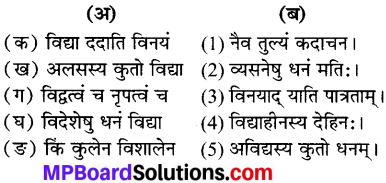
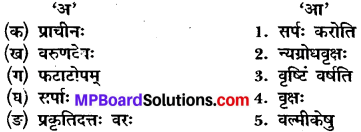
उचितं योजयत (उचित को जोडिए)
Business Economics 12th Mp Board
उत्तर:
(क) → 3
(ख) → 5
(ग) → 1
(घ) → 2
(ङ) → 4

Mp Board Class 12th Economics Book प्रश्न 4.
रिक्तस्थानानि पूरयत (रिक्त स्थानों की पूर्ति कीजिए)
(क) पात्रत्वाद् …………. , आप्नोति ………….. धर्मः।
(ख) पुस्तकस्था तु या ………..।
(ग) स्वदेशे ……… पूज्यते। ……. सर्वत्र पूज्यते।
(घ) …………. सर्वस्य भूषणम्।
उत्तर:
(क) धनम्, धनाद्;
(ख) विद्या परहस्तगतं धनम्
(ग) राजा, विद्वान्;
(घ) विद्याः।

Economics Class 12 Mp Board प्रश्न 5.
कोष्ठकात् चित्वा विलोमशब्दैः मेलयत (कोष्ठक से चुनकर विलोम शब्दों से मिलाओ)
(अ) (क) सुखम्
(ख) विदेशेषु
(ग) इहलो के
(घ) महाधनः
(ङ) सुन्दरः
(च) निर्बलः
(छ) विद्वान्
(ज) मित्रम्
(झ) कुलीनः
(ञ) सुशीलः।

(ब) (अकुलीनः, शत्रुः, निर्धनः, दुःखम्, कुरूपः, स्वदेशेषु, दुःशीलः, परलोके, सबलः, मूर्खः।)
उत्तर:
(क) सुखम् – दु:खम्
(ख) विदेशेषु – स्वदेशेषु
(ग) इहलोके – परलोके
(घ) महाधन: – निर्धनः
(ङ) सुन्दरः – कुरूंपः
(च) निर्बल: – सबलः
(छ) विद्वान् – मूर्खः
(ज) मित्रम् – शत्रुः
(झ) कुलीनः – अकुलीनः
(ञ) सुशील: – दुःशीलः।।

Mp Board Class 12th Economics प्रश्न 6.
उदाहरणानुगुणं अन्वयपूर्ति कुरुत (उदाहरण के अनुसार अन्वय की पूर्ति करो)
(क) कुरूपाणां …………. विद्या, …………. धनं (विद्या) तथा। निर्बलानां बलं …………. अतः ………… साधनीया।
(ख) विदेशेषु ……… धनं, व्यसनेषु मतिः………। परलोके ………….. धनं, ………… सर्वत्र वै धनम्।
उत्तर:
अन्वय-
(क) कुरूपाणां रूपं विद्या, निर्धनानां धनं (विद्या) तथा। निर्बलानां बलं विद्या अतः प्रयत्नेन साधनीया।
(ख) विदेशेषु विद्या धनं, व्यसनेषु मतिः धनम्। परलोके धर्म: धनं, शीलंः सर्वत्र वै धनम्।

Mp Board 12th Economics Book Pdf Hindi Medium प्रश्न 7.
‘विद्या’ विषये संस्कृते पञ्च वाक्यानि लिखत। (‘विद्या’ विषय पर संस्कृत में पाँच वाक्यों लिखो।)
उत्तर:
‘विद्या’

  1. विद्याधनं सर्वधनं प्रधानमस्ति।
    विद्या धन सभी धनों में प्रधान होता है।
  2. विद्या एव मानवस्य भूषणमस्ति।
    विद्या ही मनुष्य का आभूषण है।
  3. विद्या तु सदा उपार्जनीया अस्ति।
    विद्या तो सदा ही प्राप्त करने योग्य होती है।
  4. विद्याविहीनः जनः पशुः भवति।
    विद्या से रहित मनुष्य पशु होता है।
  5. विद्या विनयम् ददाति।
    विद्या विनय देती है।

योग्यताविस्तारः
पाठस्थ श्लोकान् कण्ठस्थीकुरुत।
(पाठ में आये श्लोकों को कण्ठाग्र करो।)

‘विद्या’ इति शब्दमधिकृत्य अन्यश्लोकानाम् सङ्ग्रहणं शिक्षकस्य साहाय्येन कुरुत।
(‘विद्या’ शब्द पर आधारित अन्य श्लोकों का संग्रह शिक्षक की सहायता से करो।)
उत्तर:
(1) नक्षत्रभूषणो चन्द्रो, नारीणाम् भूषणं पतिः।
पृथिवीभूषणं राजा, विद्या सर्वस्य भूषणम्॥

(2) अपूर्वः कोऽपि कोशोऽयं विद्यते तव भारति।
व्ययतो वृद्धिमायाति क्षयमायाति संचयात्।।

(3) विद्या नाम नरस्य रूपमधिक,प्रच्छन्न गुप्तं धनम्।
विद्या भोगकरी यशः सुखकरी, विद्या गुरुणां गुरुः॥

विद्या-महिमा हिन्दी अनुवाद

(1) विद्या ददाति विनयं, विनयाद् याति पात्रताम्।
पात्रत्वाद् धनमाप्नोति, धनाद् धर्मः ततः सुखम्॥

अनुवाद :
विद्या नम्रता देती है। नम्रता से पात्रता (योग्यता) आती है। पात्रता से धन प्राप्त होता है। धन से धर्म और धर्म से सुख प्राप्त होता है।

(2) विदेशेषु धनं विद्या, व्यसनेषु धनं मति।
परलोके धनं धर्मः, शीलं सर्वत्र वै धनम्॥

अनुवाद :
विदेश में विद्या ही धन है। विकारों में बुद्धि ही धन है। परलोक में धर्म ही धन है और शील तो सभी स्थानों पर धन है।

(3) सुन्दरोऽपि सुशीलोऽपि कुलीनोऽपि महाधनः।
शोभते न बिना विद्या, विद्या सर्वस्य भूषणम्॥

अनुवाद :
बिना विद्या के मनुष्य शोभायमान नहीं लगता, चाहे वह सुन्दर, सुशील, अच्छे कुल का एवं बहुत धनवान भी हो। अतः विद्या सबका भूषण है।

(4) विद्या रूपं कुरूपाणाम्, निर्धनानां धनं तथा।
निर्बलानां बलं विद्या, साधनीया प्रयत्नतः॥

अनुवाद :
कुरूपों का रूप विद्या होती है तथा निर्धनों का धन (विद्या) होती है। बलहीनों का बल विद्या ही होती है जो प्रयत्नपूर्वक प्राप्त की जा सकती है।

(5) विद्वत्वं च नृपत्वं च, नैव तुल्यं कदाचन।
स्वदेशे पूज्यते राजा, विद्वान् सर्वत्र पूज्यते॥

अनुवाद :
विद्वान और राजा की कभी तुलना नहीं की जा सकती है। (क्योंकि) राजा की पूजा अपने देश में होती है (किन्तु) विद्वान सर्वत्र पूजा जाता है।

(6) अलसस्य कुतो विद्या, अविद्यस्य कुतो धनम्।
अधनस्य कुतो मित्रम्, अमित्रस्य कुतो सुखम्॥

अनुवाद :
आलसी को विद्या कहाँ? विद्याहीन के पास धन कहाँ? धनहीन के मित्र कहाँ और बिना मित्र वाले पुरुष को सुख कहाँ?

(7) पुस्तकस्था तु या विद्या, परहस्तगतम् धनम्।
कार्यकाले समुत्पन्ने न सा विद्या न तद् धनम्॥

अनुवाद :
पुस्तक में स्थित विद्या (अर्थात् बिना याद की हुई विद्या) और दूसरे के हाथ में गया हुआ धन। कार्य पड़ने पर (आवश्यकता होने पर) न तो वह विद्या काम आती है और न ही वह धन।

(8) किं कुलेन विशालेन, विद्याहीनस्य देहिनः।
अकुलीनोऽपि विद्यावान, देवैरपि सः पूज्यते॥

अनुवाद :
विशाल कुल में उत्पन्न होने से क्या, यदि मनुष्य विद्याहीन है (और) निम्न कुल में उत्पन्न होने पर भी जो विद्यावान है, देवता भी उसकी पूजा करते हैं।

विद्या-महिमा शब्दार्थाः

पुस्तकस्था = पुस्तक में लिखी हुई। परहस्तगतं = दूसरे के हाथ में गया हुआ। अकुलीनोऽपि = अच्छे कुल में जन्म लेने पर भी। देहिनः = शरीर में। ददाति = देती है। साधनीया = अर्जित करनी चाहिए। कदाचन = कभी भी। विद्याहीनस्य = विद्या से रहित। या = जो। पात्रत्वात् = योग्यता से। नैव = नहीं। कुरूपाणाम् = कुरूपों का। प्रयत्नतः = प्रयत्नपूर्वक। अविद्यस्य = विद्या रहित का। अमित्रस्य = मित्र रहित का। व्यसनेषु = विकारों में। शीलं = चरित्र। निर्बलानां = शक्तिहीनों का। महाधनः = बहुत धनी। अलसस्य = आलसी का। कुतो = कैसे। शोभते = सुशोभित होता है। विद्वत्वं = विद्वान। नृपत्व = राजा।

MP Board Class 6th Sanskrit Solutions

MP Board Class 8th Social Science Solutions Chapter 7 Changing Outer Forces

MP Board Class 8th Social Science Solutions Chapter 7 Changing Outer Forces

MP Board Class 8th Social Science Chapter 7 Text Book Exercise

Choose the correct option of the following

Mp Board Class 8 Social Science Solution Chapter 7 Question 1.
By which process the materials of broken rocks assemble at its original place
(a) Weathering
(b) Transportation
(c) Erosion
(d) Deposition
Answer:
(a) Weathering

Mp Board Class 8 Social Science Chapter 7 Question 2.
Where among the following winds perform its work?
(a) In deserts
(b) In Mountains
(c) In coastal areas
(d) In plains
Answer:
(a) In deserts

Class 8 Social Science Chapter 7 Mp Board Question 3.
Which is vital factor that makes soil fer-tile?
(a) The original rock materials
(b) Humus
(c) Climate
(d) Man
Answer:
(b) Humus

Fill in the blanks:

  1. When the rock breaks into pieces without chemical reaction is …………… weathering
  2. The process of flattening of unleavened surface is called ………….
  3. With the deposition …………. lake is formed.
  4. On the  Orissa coast in India …………. is an example of lagoon-lake.

Answers:

  1. Biological
  2. Surface Balancing
  3. Oxbow
  4. Chilka Lake

MP Board Class 8th Social Science Chapter 7 Very Short Answer Type Questions

Mp Board Solution Class 8 Social Science Chapter 7 Question 1.
Which are the three works of river?
Answer:
Erosion, Transportation & Deposition are three works of river.

Mp Board Class 8 Science Chapter 7 Question 2.
Which are three stages of river?
Answer:
There are three stages of river, young, matured and old age.

Mp Board Class 8 Science Solution Chapter 7 Question 3.
What is estuary?
Answer:
Some of the rivers become wider at their meeting point with sea and sweep away into deep sea.

Social Science Class 8 Chapter 7 Question 4.
What is geyser?
Answer:
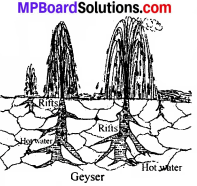
The underground hot water is thrown up in the form of fountain is called geyser.

Mp Board Class 8 Social Science Solution Chapter 7

Question 5.
How is the Yardage formed?
Answer:
Yardage is formed by wind erosion.

Question 6.
What is Lagoon?
Answer:
The sea water enclosed between the coast and sand bar is known as lagoon.

MP Board Class 8th Social Science Chapter 7 Short Answer Type Questions

Question 1.
Write the factors that help soil formation?
Answer:
The weathering and erosion process of rocks from the soil. The helping agents in soil formation are parent rocks, surface shape, climate & vegetation.

Question 2.
What is weathering? Write the names of different types of weathering?
Answer:
Weathering is the iocal process in which graduation and split of rocks occur at their original place. The types are physical, chemical and biological weathering.

Question 3.
Differentiate between slow and rapid wasting?
Answer:
The process of surface sliding by weathering is slow wasting and the process of filling up the holes is high wasting.

Question 4.
How the V – shaped valley is formed?
Answer:
The V – shaped valley is formed when river reaches its base level and widens its banks. V – Shaped Valley

Mp Board Class 8 Social Science Chapter 7

Question 5.
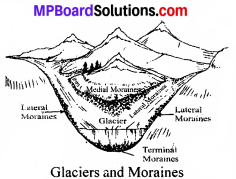
What are Moraines? Write its types?
Answer:
When the glacier melts, it starts depositing the sediments in different parts of the valley. The land form made is Moraines. The types are Lateral, Medial and Terminal moraines.

Class 8 Social Science Chapter 7 Mp Board

Mp Board Solution Class 8 Social Science Chapter 7

Question 6.
What is underground water level?
Answer:
The water which collects on the ground goes in to under the ground is called underground water. Water reaches into ground through rivers, lakes and sea.

MP Board Class 8th Social Science Chapter 7 Long Answer Type Questions

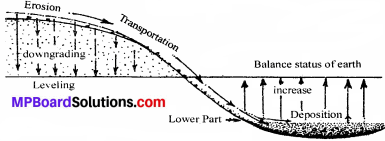
Question 1.
Discuss the surface Balancing?
Answer:
The widening and flattening of the surface is called surface Balancing. Rivers, glaciers, wind, underground water and sea waves are the key agents of leveling. The Surface Balancing can be classified in to two categories.

  1. Slow wasting
  2. Rapid wasting.

1. Slow wasting:
The rapid erosion cycle shifts the rocks from its original place by rubbing, cut-ting & peeling to decrease the high elevated areas.

2. Rapid wasting:
The process of deposition of weathered materials in low-lying regions or holes is called aggravation and the weathered materials fill up the holes whose height kept on growing is called Rapid wasting.

Question 2.
What is soil erosion? Write its cause and ways to conserve soil?
Answer:
The natural forces or human activities which help in removing the layer of soil is called soil erosion. The causes of soil erosion are as follows:

  • When the cover of vegetation is removed the upper layer of soil gets loose.
  • Heavy rains and powerful wind remove the Soil content and layer.
  • Overgrazing by domestic animals.
  • Cutting trees and clearing forest cover.
  • Excess use of fertilize & pesticide.

The measures to conserve soil are:

  • To protect forest. Trees tighten the soil material.
  • Tree plantation in river valleys, barren land and mountain slopes.
  • Soil rehab of the land which becomes uneven due to water can be leveled to stop erosion.
  • Controlled grazing.
  • Flood control measures by building stop dams.
  • Crop rotation by planting crops alter – neatly.

Question 3.
How wind erosion takes place? Mention about the land forms created by the wind?
Answer:
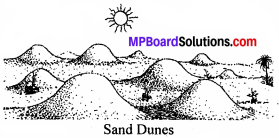
The wind erosion generally occurs in Desert areas where wind brings pebbles and sand particles with it. These particles make friction among themselves and scratch rocks. The work of erosion is done by transportation, collision and friction. Wind erosion is affected by the speed of wind, the size, quantity and height of particles, the structure and shape of rocks, and the climate. The land forms created by the wind erosion are sand dunes and Leos.

Sand Dunes:
When some obstacle comes in the path of the sand laden wind the deposition of sand forms a dune hill which has a crest.
Mp Board Class 8 Science Chapter 7

Loess:
Fine particles of the sand are suspended in wind. They are carried over long distance and gets deposited as Loess.

Question 4.
What is glacier? Write about glacier types with example.
Answer:
A river of moving ice is called glacier. It creeps down a valley from a snowfield above the snow line. It moves under the influence of gravity. On the basis of origin and situation glaciers can be divided into two groups.

1. Continental glacier:
These are permanent sheets of ice and snow that covers extensive land surfaces. These exist in Greenland and Antarctica.

2. Valley glacier:
These are formed in high mountains and are usually long and narrow as they occupy valleys of former streams. The biggest valley glacier is Siachen glacier.

Question 5.
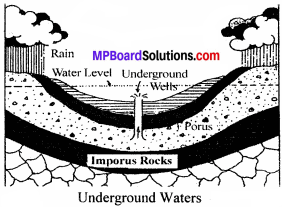
Describe the function of underground water with pictures?
Answer:
The writer which collects on the ground goes into under the ground is called underground water. Water reaches into ground through rivers, lakes, and sea. Ground water partly exists on the surface like waterfall, artesian well and geyser. Ground water balances the surface and several land forms are created through erosion and transportation. Ground water dilutes the limestone by rain water entering in causes erosion which is called Karts topography

The erosion work of ground water can be classified into two parts:

  1. landscape or the surface
  2. underground landscape.

The land forms created on the surface are lapses and sink hole. The underground land form includes caves, stalactites stalagmites.
Mp Board Class 8 Science Solution Chapter 7

MP Board Class 8th Social Science Solutions

MP Board Class 8th Social Science Solutions Chapter 11 Economic Development

MP Board Class 8th Social Science Solutions Chapter 11 Economic Development

MP Board Class 8th Social Science Chapter 11 Text Book Exercise

Choose the most suitable alternative:

Mp Board Class 8 Social Science Solution Chapter 11 Question 1.
In India the total percent of working people in agriculture is:
(a) 50 percent
(b) 60 percent
(c) 70 percent
(d) None of the above
Answer:
(b) 60 percent

Mp Board Class 8 Social Science Chapter 11 Question 2.
The total contribution of agriculture in. Indian G.D.P. is:
(a) 26 percent
(b) 36 percent
(c) 42 percent
(d) 100 percent
Answer:
(a) 26 percent

Describe The Major Economic Problems Class 8 Question 3.
The industrial development:
(a) lessens dependence on agriculture
(b) improves life style
(c) Both of the above
(d) None of the above
Answer:
(b) improves life style

Fill up the blanks:

  1. India, Nepal, China, Pakistan are ……………. countries and Japan, Singapore, Britain and U.S. are …………. countries.
  2. The industrial development brings ………….. for the country and citizens.
  3. The modern iron and steel plant was set up ……………
  4. The cotton cloths from India are exported to prominent countries …………..
  5. The slow pace of economy increases ……………..

Answer:

  1. developing, developed
  2. Prosperity
  3. At Porto-nova in Tamil Nadu in 1830
  4. U.S., Britain, Russia, France, Eastern Countries of Europe, Nepal, Singapore, Sri Lanka and African countries
  5. Poverty.

MP Board Class 8th Social Science Chapter 11 Very Short Answer Type Questions

Class 8 Social Science Chapter 11 Economic Development Question 1.
What is poverty?
Answer:
Poverty is the inability to secure minimum requirements of life, health and efficiency. One is unable to get minimum requirements for life such as food, clothing, housing, education and health due to poverty. Poverty leaves bad effect on the life and health of man.

The Slow Pace Of Economy Increases Class 8 Question 2.
What is unemployment?
Answer:
Unemployment is a situation in which people are willing to work for income but they are unable to find work.

Class 8 Social Science Chapter 11 Question 3.
Which are mineral-based industries?
Answer:
The industries based on raw material like iron, steel, cement, chemicals are called mineral-based industry.

MP Board Class 8th Social Science Chapter 11 Short Answer Type Questions

Economic Development Class 8 Question 1.
How was our economy in ancient times?
Answer:
In the ancient times Indian economy was rich and developed. India was independent in economy. The industry of pottery, metal, buildings were in advanced stage during the Indus Valley Civilization. In the medieval time Indian silk was in so high demand that Roman people were ready to give gold equal to the weight of Indian silk, Indian trade of cotton, silk, cotton clothes and spices was on the peak and our economy was rich in ancient times.

The Slow Pace Of Economy Increases Answer Question 2.
What do you mean by small scale industry?
Answer:
Cottage and small scale industries is the traditional industry as it needs little money and goods are made by the family members. The farmers when they have no work they earn money by this industry. These industries produce various traditional products like baskets, small toys, bides, ropes, envelopes, papad, mats, bade, spices and weaving items etc.

Chapter 11 Social Science Class 8 Question 3.
What is sustainable agriculture?
Answer;
Most of the farmers in India still use traditional tools for farming. They cannot make use of refined seeds, fertilizers and pesticides due to’poor economy and it also affects production. Their food production is consumed by their family members.

Mp Board Class 8 Science Chapter 11 Question 4.
Write the names of Cottage industries.
Answer:
Some of the Cottage industries are:

  • Small toys making
  • Carpet weaving
  • Papad making
  • Basket making
  • Bidi making
  • Rope making
  • Badi making
  • Mat weaving
  • Paper envelope making
  • Spices preparing etc.

Social Science Class 8 Chapter 11 Question 5.
What is Gramin Rozgar Guarantee Programmer?
Answer:
The Central Government has passed the “Gramin Rozgar Guarantee Yojna” Bill, 2005. Under this bill a provision has been made to provide to one adult person of every family a 100 days job in the periphery of 5 Km near his residence. This scheme will be in force in 600 districts of the country by 2010.

MP Board Class 8th Social Science Chapter 11 Long Answer Type Questions

Mp Board Class 8 Chapter 11 Question 1.
How agriculture is helpful in economic growth?
Answer:
The whole country depends on agriculture for its food requirements. Through agriculture, we get cereals, vegetables and fruit; it also supplies raw materials to various industries. Many industries, in India, depend on agriculture for their raw material for example, jute, sugar, cotton, cotton textile. Good crops raise the farmer’s income. With increase of income, the farmers purchase various items of daily life manufactured in industry. Agriculture is the backbone of our economic growth.

Mp Board Class 8 Science Solution Chapter 11 Question 2.
Describe the mineral-based industry.
Answer:
Such industries based on raw material like iron, steel, cement, chemicals are called mineral-based industries. The first iron and steel plant was set up at Porto nova in Tamil Nadu in 1830. Modern Iron and Steel plant was set up in Jamshedpur in 1907. India has chemical industries under which fertilizers, artificial fibers, rubber, plastic goods, paints and medicines are made. Transport equipment like rail engine, motor cars, bus, truck, motorcycle, aeroplane and ships industries have been set up in India. These industries provide employments in large number to our people.

Question 3.
Describe the major economic problems.
Answer:
The major economic problems are:

  1. Pulsation growth
  2. Poverty
  3. Unemployment
  4. Price List
  5. Corruption

1. Pulsation growth:
The rapid growth of population in India is the major problem in the development. In 1951 the population was 36 crore which increased to 102 crore by 2002. The main causes of population growth are poverty, illiteracy, desire to love boy to run family and child marriages. The population increase impedes in the economic growth of nation. This leaves impact oil the lifestyle of people, the expansion of food grains and industries are not possible at the rate of increase in population.

2. Poverty:
Poverty is a very complex problem and requirements include minimum needs in respect of food, clothing, housing, education and health. Poverty leaves bad effect on the life and health of man. The working capacity decreases and poverty continues. Some people are living below the poverty line. Poverty is an obstacle in economic growth.

3. Unemployment:
A person who is not gainfully employed is called an unemployed person. In other words, unemployment is a situation in which a person mentally and physically is willing to work for income but is
Project Work unable to find it. Even the educated and skilled persons are unemployed in our country. Its main cause is slow growth of our economy.

4. Price List:
The continuous and uncontrolled price rise leads the economy to crises and poor became poorer. The price rise increases economic inequality and poverty, with the sincere efforts of govt, and citizens the price rise could be brought under control.

5. Corruption:
To get own’s word done in favor people pay either money or other things to a person or any agency is called corruption. Stealing of taxation also corruption. The corruption creates economic inequality. All the above problems are obstacles in our rapid economic growth.

project work:
Fill in the given table with the prices of 10 goods used in your home.

Mp Board Class 8 Social Science Solution Chapter 11

MP Board Class 8th Social Science Solutions

MP Board Class 8th Social Science Solutions Chapter 12 Defence Systems of India

MP Board Class 8th Social Science Solutions Chapter 12 Defence Systems of India

MP Board Class 8th Social Science Chapter 12 Text Book Exercise

Choose the correct option of the following.

MP Board Class 8 Social Science Solution Chapter 12 Question 1.
Where is the headquarters of south commands?
(a) Mumbai
(b) Kochi
(c) Visakhapatnam
(d) Bangalore
Answer:
(b) Kochi

MP Board Class 8 Social Science Chapter 12 Question 2.
Where is the headquarters of Army?
(a) Bangalore
(b) Mumbai
(c) Visakhapatnam
(d) New Delhi
Answer:
(d) New Delhi

Mention The Chief Works Of Air Force Question 3.
In which state Tarapur Atomic Center is located?
(a) Madhya Pradesh
(b) Maharashtra
(c) Tamil Nadu
(d) Karnataka.
Answer:
(b) Maharashtra

Fill up the blanks:

  1. The head of Air Force is called ……………..
  2. The post of wing commanders is in the ………….
  3. The forces work …………. in peace time.
  4. The atomic tests in India were done in …………..

Answer:

  1. Air Chief Marshal
  2. Air Force
  3. Service and Community
  4. 1974 and 1998.


MP Board Class 8th Social Science Chapter 12 Very Short Answer Type Questions

Mention The Chief Work Of Air Force Question 1.
Write the name of the head of Navy?
Answer:
The Chief of the Naval Staff and is an Admiral.

Mention The Water Borders Of India Class 8 Question 2.
Write the names of organs of Indian defence forces?
Answer:
Major organs of Indian defence forces are:

  1. Army
  2. Navy
  3. Air force

Mention The Water Borders Of India Question 3.
Where the joint commands of three forces were set up in 2001?
Answer:
In 2001 a joint command of Army, Navy and Air force has been set up in Andaman and Nicobar Island.

Class 8 Social Science Chapter 12 Defence System Of India Question 4.
Why NCC was formed?
Answer:
National Cadet Corps was formed to develop among the students of the country a sense of discipline and an aptitude for defence.


MP Board Class 8th Social Science Chapter 12 Short Answer Type Questions

Class 8 Social Science Chapter 12 Question 1.
Write the names of important organs of the Army?
Answer:
The headquarters of the Army are in New Delhi. The Chief of the Army Staff heads the army and possesses, generally, the rank of the General. The numerous branches of the army are infantry, cavalry, artillery (Guns), supply, engineering and medical. There are five commands in the army. These are Central, Eastern, Western, Northern are Southern. Each command is headed by an officer with the rank of Lieutenant – General.

The Head Of Air Force Is Called Class 8 Question 2.
Mention the water borders of India?
Answer:
India is a subcontinent. The boundaries of India touch water from three sides. In the east lies Bay of Bengal, in the west Arabian Sea and in south Indian Ocean. Hence, an organised and powerful navy is must to safeguard the coastal areas.

Question 3.
Give the names of major missiles of India?
Answer:
The missiles are produced to strengthen the defence line of the country. Agni, Prithvi, Trishul, Nag, Akash and Brahmastra are the major missiles of India.


MP Board Class 8th Social Science Chapter 12 Long Answer Type Questions

Question 1.
Write note on the role of defence force during peace.
Answer:
Besides defence of the country the defence forces perform many other services in peace time. These services include the relief work at the time of natural calamities such as floods, earthquakes and sea – storms. They have also assisted the United Nations in peacekeeping activities in different countries of the world. For example, our forces have rendered admirable services in Korea, Lebanon, the Congo, etc. recently we have sent India’s peace keeping forces to Sri Lanka. The IPKF is back in India.

Question 2.
Mention the chief works of Air Force.
Answer:
The Air force has vital role in the defence of country. The main work of Air force is to bombard the key and sensitive arm installations, to destroy transport system and communication of the attacking country. The Air Force helps in supplying arms and foods to the army. The Air Force keeps vigil on the borders of country in the sky. Indian Air Force is powerful enough to defend our country.

MP Board Class 8th Social Science Solutions

MP Board Class 8th Social Science Solutions Chapter 6 Lithosphere and Land Forms

MP Board Class 8th Social Science Solutions Chapter 6 Lithosphere and Land Forms

MP Board Class 8th Social Science Chapter 6 Text Book Exercise

Choose the correct option of the following.

MP Board Class 8 Social Science Solution Chapter 6 Question 1.
How much area of earth is covered by hydrosphere?
(a) 61 percent
(b) 71 percent
(c) 81 percent
(d) 51 percent
Answer:
(b) 71 percent

MP Board Class 8 Social Science Chapter 6 Question 2.
Which country is world renowned for earthquakes?
(a) India
(b) France
(c) Japan
(d) Srilanka
Answer:
(c) Japan

Fill up the blanks:

  1. ………….. area or earth is surrounded by lithosphere.
  2. The outer layer of earth is called …………….
  3. Sal contains silicon and ………… metals mostly.
  4. At the depth of every 32 meter ………….. Celsius temperature increases.

Answers:

  1. 29 percent
  2. lithosphere
  3. Magnesium

MP Board Class 8th Social Science Chapter 6 Very Short Answer Type Questions

Lithosphere And Landforms Class 8 Question 1.
Which are the elementary rocks of the earth?
Answer:
The elementary rocks are Igneous rocks.

Class 8 Social Science Chapter 6 MP Board Question 2.
Write names of three prominent land forms?
Answer:
The three land forms are Mountains, Plateaus, Plains.

Class 8 Social Science Chapter 6 Lithosphere And Landforms Question 3.
What do you call when rocks curve like waves?
Answer:
When rocks curve like waves are called Metamorphic rocks.

MP Board Solution Class 8 Social Science Chapter 6 Question 4.
Where volcanoes are mostly dominant in the world?
Answer:
The volcanoes are mostly dominant near the coastal area of pacific ocean and in the continental regions.

MP Board Class 8th Social Science Chapter 6 Short Answer Type Questions

Social Science Class 8 Chapter 6 Question 1.
What is difference between a fold mountain and a rift mountain?
Answer:
Fold Mountain are formed by the horizontal land movement in earth which causes wave like bends in rocks. Rift mountains are formed by breaking of rocks with pressure and tension of the horizontal land movement which causes few part of land lift and few part go down.

Write Names Of Three Prominent Landforms Question 2.
How Sedimentary rocks are formed?
Answer:
Sedimentary rocks are formed due to the deposits of sediments brought by wind, running water or moving ice.

Class 8 Social Science Chapter 6 Question 3.
What is Volcano? Give two causes of eruption?
Answer:
Volcano is an opening on the earth crust, in the form of lava which emits molten magma, rock pieces, gases and steam on the surface of the earth. The two causes of eruptions are, the break up of radioactive minerals under die bottom of earth and the movement of plates due to eternal heat.

MP Board Class 8 Chapter 6 Question 4.
Mention the merits and demerits of earthquakes?
Answer:
Earth quakes are useful when we get fertile lands, formation of new land areas, valuable minerals come upon the surface and lakes are formed in low-lying areas. Earthquakes brings loss of life, material, devastating floods and few areas go down of land.

MP Board Class 8th Social Science Chapter 6 Long Answer Type Questions

Lithosphere And Landforms Question 1.
What is Rock? Explain the type of Rocks?
Answer:
The earth’s crust is made up of rocks. A rock is a mixture of minerals which forms the earths upper part called crust. These rocks are composed of all types of material which may be hard and resistant substance like granite, marble etc. and of soft and loose substance like salt, sand, mud, chalk etc. The difference between rock and mineral is that the rocks contain in them various types of minerals. Rocks do not have definite chemical composition while minerals have definite chemical properties.

There are three kinds of rocks:
1. Igneous Rock
2. Sedimentary Rock
3. Metamorphic Rock

1. Igneous Rock:
Igneous rocks are formed due to the solidification of molten magma. The high temperature inside the earth causes rock masses to melt. The molten material due to heavy pressure inside tries to come out on the surface or to low pressure areas.

In this process some of its material cools down under the earth surface itself and solidifies in the form of solid rocks. Some of it comes out on tire surface as lava and gas hardened. These solidified rocks are called igneous rocks. Basalt and Granite are the other examples. Basalt is formed above the earth surface and Granite below the earth.

2. Sedimentary Rock:
Sedimentary rocks are formed due to the deposits of sediments brought by wind, running water or moving ice. These deposits or sediments lay down on the floor of the river beds, lakes, sea etc. forming one layer over the other. These layers contain fossils also. Fossils are the remains of animals embedded in the rocks. They are also called stratified rocks. Sandstone, Limestone, Clay, Coal, Gravels etc. are the examples of Sedimentary rocks.

3. Metamorphic Rocks:
When main rocks change in appearance and composition losing their original identity, they are called metamorphic rocks. In other words, when Igneous rocks and Sedimentary rocks change their original form due to intense heat and pressure, they are called metamorphic rocks.

The chemical composition of minerals present in the rocks get transformed into new type minerals. For example Limestone gets transformed into Marble, Sandstone changes into granite. Other examples of metamorphic rocks are slate and gneiss etc.

Class 8th Social Science Chapter 6 Question 2.
Define the formation of earth by Diagram?
Answer:
The structure of earth can be divided into three distinct parts. They are Crust, Mantle, Core.
1. The Crust:
The outer most part of the earth is crust. It is also known as lithosphere. It has thickness of 60 kms. It forms the continents, islands and lands underlying seas and oceans. The outer crust is made of silicates and aluminum and is called SIAL.

Lithosphere And Landforms Class 8 MP Board Social Science Solutions Chapter 6

2. The Mantle:
The next layer that underlies Sial is Mantle. It has two parts:

  •  inner silicate layer made of silica and magnesium called SIMAL.
  • Transitional layer of mixed metals and silicate: This is about 2900 km in thickness, and is made of solid heavy rocks containing mixture of silicates and other metals. The average density of his layer varies between 45 to 5.5.

3. The Core:
The innermost part of the earth is known as Core it extends beyond the depth of 2900 kilometers. It is made up of heavy meta like iron and nickel generally expressed as Nife. They believed to be source of earth magnetism its thickness is 3467 kms. The temperature inside the earth increases at an average rate of 1°C for 32 meters of depth This is also called bray sphere

Class 8 Chapter 6 Social Science Question 3.
Explain the impact of volcanoes on! human life?
Ans. The volcanoes create formations of various land forms like plains, plateaus, mountain etc. We get valuable minerals from these The Java which spreads forms a fertile land after Sometimes. The dead volcanoe smouth filled with rain water creates lakes. The eruption of volcanoes destroy human lives. Cattles. vegetation, Agricultural land cities.

MP Board Class 8 Science Solution Chapter 6 Question 4.
What is earthquake? Describe the causes of the carthquake?
Answer:
Earthquake is sudden shaking of the earth by sudden tectonic or external movement. The place where earthquake occurs is earthquake epicenter (focus). The place exactly over focus where waves of earthquakes are felt is called carthquake center
The causes of earthquake are as follows:

  • Sudden movement within earth.
  • The eruption of volcano
  • The gases or vapors, formed under the bottom of the earth breaks earth crust to come out and thus earthquake happens.

Lithosphere And Land Forms Question 3.
Mention the following rocks in the table given below?

  1. Marble
  2. Coal
  3. Granite
  4. limestone
  5. basalt
  6. Diamond

Answer:
types of rocks
1. Ligneous Rock:          Granite         basalt
2. Sedimentary Rock:     limestone     Coal
3. Metamorphic Rock:    Marble         Diamond

Project Work.

Question 1.
Draw a diagram of the formation of the earth?
Answer:

MP Board Class 8 Social Science Chapter 6 Lithosphere And Land Forms

Question 2.
Draw a sketch of volcano?
Answer:

MP Board Class 8 Social Science Solution Chapter 6 Lithosphere And Land Forms

Question 3.
Collect samples of granite, coal and sand stone?
Answer:
Do your self.

MP Board Class 8th Social Science Solutions

MP Board Class 10th Sanskrit Solutions Chapter 2 न्यग्रोधवृक्षः

MP Board Class 10th Sanskrit Solutions Durva Chapter 2 न्यग्रोधवृक्षः (कथा) (कथावल्लरीतः)

MP Board Class 10th Sanskrit Chapter 2 पाठ्यपुस्तक के प्रश्न

कक्षा 10 संस्कृत पाठ 2 प्रश्न 1.
एकपदेन उत्तरं लिखत-(एक पद में उत्तर लिखिए)।
(क) ग्रामे कः वृक्षः आसीत्? (गाँव में कौन-सा पेड़ था?)
उत्तर:
न्यग्रोधवृक्षः (बरगद का पेड़)

(ख) के मार्गायासं परिहरन्ति स्म? (कौन रास्ते की थकान दूर करते थे?)
उत्तर:
पथिकाः (राहगीर)

(ग) कस्य ध्वनिः अन्तरिक्षम् अस्पृशत्? (किसकी आवाज अंतरिक्ष को छू रही थी?)
उत्तर:
काकस्य (कौए की)

(घ) प्रकृतिदत्तः वरः कः? (प्रकृति का दिया हुआ वरदान क्या था?)
उत्तर:
वृक्षः (पेड़)

(ङ) तरोः पत्राणि खादन् कः नन्दति स्म? (पेड़ के पत्ते खाकर कौन प्रसन्न होता था?)
उत्तर:
अजापुत्रः (बकरी का बच्चा)

You can download MP Board 10th sanskrit solution to help you to revise complete syllabus and score more marks in your examinations.

Class 10 Sanskrit Chapter 2 प्रश्न 2.
एकवाक्येन उत्तरं लिखत-(एक वाक्य में उत्तर लिखिए-)
(क) सर्वैः कस्य निर्णयः स्वीकृतः? (सबने किसका निर्णय माना?)
उत्तर:
सर्वैः अजस्य निर्णयः स्वीकृतः। (सबने बकरे का निर्णय माना।)

(ख) कः वृष्टिं वर्षति? (कौन वर्षा करता है?)
उत्तर:
वरुणदेवः वृष्टिं वर्षति। (वरुणदेव वर्षा करते हैं।)

(ग) वृक्षस्य आधारभूता का? (वृक्ष का आधार कौन है?)
उत्तर:
वृक्षस्य आधारभूता भूमाता। (पेड़ का आधार धरती है।)

(घ) अस्माभिः का वर्धनीया? (हमें क्या बढ़ाना चाहिए?)
उत्तर:
अस्माभिः वृक्षसम्पत् वर्धनीया। (हमें वृक्ष-सम्पत्ति को बढ़ाना चाहिए।)

(ङ) किं महत् पापम् अस्ति? (क्या बहुत बड़ा पाप है?)
उत्तर:
वृक्षाणां छेदनं महत् पापम् अस्ति । (पेड़ों को काटना बहुत बड़ा पाप है।)

Sanskrit Class 10 Chapter 2 MP Board प्रश्न 3.
अधोलिखितप्रश्नानाम् उत्तराणि लिखत- (नांचे लिखे प्रश्नों के उत्तर लिखिए-)
(क) शकः किम् अवदत्? (तोते ने क्या कहा?)
उत्तर:
शुकः अवदत्-“अस्य वृक्षस्य फलानि खादन् जन्मतः अहम् अत्रेव वर्ते। नाहम् इमं द्रुमं परित्यक्तुमिच्छामि मदीय एवायं न्यग्रोधवृक्षः।” इति। (तोते ने कहा- “इस पेड़ के फल खाता हुआ मैं जन्म से यहीं हूँ। मैं इस पेड़ को नहीं छोड़ना चाहता। यह मेरा ही बरगद का पेड़ है।)

(ख) कीटः किं प्रत्यवदत्? (कीड़े ने क्या जवाब दिया?)
उत्तर:
कीटः प्रत्यवदत्-“मदीयैः अर्भकैः सार्द्धम् अहं बहुवर्षेभ्यः अत्रैव उषितवानस्मि। अतः अयं वृक्षः ममैव” इति।

(कीड़े ने कहा-“मेरे पुत्रों के साथ मैं बहुत सालों से यहीं रह रहा हूँ। इसलिए यह पेड़ मेरा ही है।”)

(ग) वृक्षच्छेदनविषये काष्ठच्छेदकः किम् अवदत्? (वृक्ष काटने के विषय पर लकड़हारे ने क्या कहा?)
उत्तर:
वृक्षच्छेदनविषये काष्ठछेदकः अवदत्-“पूर्वम् अहं वृक्षान् छिनद्मि स्म। अधुना तादृशे कृत्सिते कर्मणि न व्यापारयामि। वृक्षाणां छेदनं महत् पापमिति मयाअधिगतमस्ति अतः न्यग्रोधवृक्षस्य छेदन अहं न करष्यिामि’ इति।

(वृक्ष काटने के विषय पर लकड़हारे ने कहा-“मैं पहले पेड़ काटता था पर अब यह बुरा काम नहीं करता। पेड़ काटना बहुत बड़ा पाप है, यह मैं जान गया हूँ, इसलिए मैं पेड़ नहीं काटूंगा।”)

MP Board Class 10 Sanskrit Chapter 2 प्रश्न 4.
प्रदत्तशब्दैः रिक्तस्थानानि पूरयत
(दिए गए शब्दों से रिक्त स्थान भरिए-)
(नीडानि, अनिलं, मार्गायासं, सूर्यदेवः, चंक्रम्य)
(क) शाखान्तरं …………….. एकः कीटः अवदत्
(ख) पथिकाः …………….. परिहरन्ति स्म।
(ग) पक्षिणः शाखासु …………….. विरच्य वसन्ति स्म।
(घ) वायुः …………….. ददाति।
(ङ) …………….. प्रकाशं प्रयच्छति।
उत्तर:
(क) चंक्रम्य
(ख) मार्गायासं
(ग) नीडानि
(घ) अनिलं
(ङ) सूर्यदेवः

Sanskrit Chapter 2 Class 10 MP Board प्रश्न 5.
यथायोग्यं योजयत
(उचित रूप से जोड़िए-)
कक्षा 10 संस्कृत पाठ 2 MP Board Sanskrit Solutions
उत्तर:
(क) 2
(ख) 3
(ग) 1
(व) 5
(ङ) 4

Class 10th Sanskrit Chapter 2 प्रश्न 6.
शुद्धवाक्यानां समक्षम् “आम्” अशुद्धवाक्यानां समक्षं “न” इति लिखत
(शुद्ध वाक्यों के सामने ‘आम्’ और अशुद्ध वाक्यों के सामाने ‘न’ लिखिए-)
(क) शुकस्य ध्वनिः अन्तरिक्षम् अस्पृशत्।
(ख) कीटः अर्भकैः सार्द्धम् वसति स्म।
(ग) वृक्षच्छेदकः वृक्षं खण्डशः कृतवान्।
(घ) वृक्षाणां छेदनं महत् पापम्।
(ङ) सूर्यदेवः वृष्टिं वर्षति।।
उत्तर:
(क) न
(ख) आम्
(ग) न
(घ) आम्
(ङ) न।

MP Board Class 10th Sanskrit Chapter 2 प्रश्न 7.
अधोलिखितपदानां प्रकृतिं प्रत्ययं च पृथक्कुरुत
(नीचे लिखे पदों की प्रकृति व प्रत्यय अलग कीजिए-)
यथा-भक्षयित्वा – भक्ष्+ क्त्वा
(क) कुर्वन्
(ख) विभज्य
(ग) छेत्तुम
(घ) विस्मृत्य
उत्तर:
(क) कुर्वन् – कृ+शतृ
(ख) विभज्य – वि+भ+ल्यप्
(ग) छेत्तुम – छिद्+तुमुन्
(घ) विस्मृत्य – वि+स्मृ+ल्यप्

Chapter 2 Sanskrit Class 10 MP Board प्रश्न 8.
अधोलिखितपदानां सन्धिविच्छेदं कृत्वा सन्धिनाम लिखत
(नीचे लिखे पदों के सन्धि-विच्छेद करके सन्धि का नाम लिखिए-)
Class 10 Sanskrit Chapter 2 MP Board Solutions न्यग्रोधवृक्षः
उत्तर:
Sanskrit Class 10 Chapter 2 MP Board Solutions न्यग्रोधवृक्षः

Sanskrit Class 10 Chapter 2 प्रश्न 9.
अधोलिखितपदानां पर्यायशब्दान् लिखत
(नीचे लिखे पदों के पर्यायवाची शब्द लिखिए-)
यथा- वृक्षः – तरुः
(क) काकः
(ख) सर्पः
(ग) पिताः
(घ) पुत्रः
उत्तर:
(क) काकः – वायतः
(ख) सर्पः – भुजङ्गः
(ग) पिता – जनकः
(घ) पुत्रः – अर्भकः

Class 10 Sanskrit Chapter 2 Question Answer प्रश्न 10.
अव्ययैः वाक्यरचनां कुरुत- (अव्ययों के द्वारा वाक्य बनाइए-)
यथा- एव – ईश्वरः एव रक्षकः अस्ति
(क) अपि
उत्तर:
अपि-पुत्रः अपि पित्रा सह गच्छति। (पुत्र भी पिता के साथ जाता है।)

(ख) तहिं
उत्तर:
तर्हि-यदि सः परिश्रमं करिष्यति तर्हि सफलं भविष्यति।
(यदि वह मेहनत करेगा तभी सफल होगा।)

(ग) ततः
उत्तर:
ततः-ततः पार्वे उपवनम् अस्ति। (उसके पास में एक बगीचा है।)

योग्यताविस्तार

“वृक्षः” इति विषयमधिकृत्य संस्कृते निबन्धं लिखत।
‘वृक्ष’ इस विषय के आधार पर संस्कृत में निबन्ध लिखिए।

पर्यावरणसंरक्षणार्थम् उपायान् लिखत।
पर्यावरण संरक्षण के लिए उपाय लिखिए।

न्यग्रोधवृक्षः पाठ का सार

प्रस्तुत पाठ में पर्यावरण सुरक्षा के प्रति जागरुकता एक कथा के माध्यम से दाई गई है। इस कथा में वृक्ष का महत्त्व बताया गया है तथा उसे काटने से होने वाली हानियों का वर्णन किया गया है, जिससे वन-सरंक्षण किया जा सके।

न्यग्रोधवृक्षः पाठ का अनुवाद

1. कस्मिंश्चित ग्रामे एकःप्राचीनः विशालः त्च न्यग्रोधवृक्षः आसीत्। सः पशुपक्षिभ्यः बहुविधेभ्यः जीवजन्तुभ्यः मनुष्येभ्यः अपि नित्यं बहूपकारकः आसीत्। पथिकाः तस्य वृक्षस्य छायायां पाथेयं भक्षयित्वा मार्गायासं परिहरन्ति स्म। पशवः छायार्थं वृक्षमिमम् आश्रयन्ति स्म। पक्षिणः तस्य शाखासु नीडानि विरच्य वसन्ति स्म। साश्च तत्रत्येषु वल्मीकेषु वासं कुर्वन्ति स्म। एवं स वृक्षः सर्वप्रिय सर्वहितः सर्वापेक्षितः च आसीत्।

शब्दार्था :
न्यग्रोधवृक्षः-बरगद का पेड़-A banyan tree; बहुविधेभ्यः-अनेक प्रकार के-in various (different) ways; पथिकाः -राहगीर-travellers,passers by; way farers; पाथेयम्-रास्ते का भोजन-foodstuff; मार्गायासम्-रास्ते की थकान को-fatigue of the way;नीडानि-घोंसले-nests; विरच्य-बनाकर-making, building; वल्मीकेषु-बिलों में-holes (white ant; termite).

हिन्दी अनुवाद :
किसी गाँव में एक पुराना और विशाल बरगद का पेड़ था। वह पशु-पक्षियों व अनेक प्रकार के जीव-जन्तुओं तथा मनुष्यों के लिए भी सदा बहुत उपकारक था। राहगीर उस वृक्ष की छाया में रास्ते का भोजन खाकर रास्ते की थकान दूर करते थे। पशु छाया के लिए इस वृक्ष का आश्रय लेते थे। पक्षी उसकी शाखाओं पर घोंसले बनाकर रहते थे। और साँप वहीं पर बिलों में रहते थे। इस प्रकार वह वृक्ष सबका प्यारा, सबका हित करने वाला तथा सबके द्वारा अपेक्षित था।

2. तस्य न्यग्रोधवृक्षस्य शाखायाम् एकः काकः बहुकालात् वसन्नासीत्। कस्मिंश्चित् दिने स वायसः किमपि स्मरन् इतस्ततः दृष्ट्वा एवम् उच्चैः अरटत्-“हे बन्धवः श्रूयतां-श्रूयतां मे वचः। अहम् अस्मिन् वृक्षे चिरात् वसामि। अतः अस्योपरि ममैव अधिकारः वर्तते। अयं मदीयः वृक्षः इति। काकस्य ध्वनि क्रमेण अन्तरिक्षम् अस्पृशत्।

शब्दार्था :
वायसः-कौआ-Crow;अरटत-रटने लगा (लगातार) cawed persistently; चिरात्-बहुत समय से-since a long time; मदीयः-मेरा-mite, my.

अनुवाद :
उस बरगद के वृक्ष की शाखा पर एक कौआ बहुत समय से रहता था। किसी (एक) दिन वह कौआ कुछ याद कर इधर-उधर देखकर ही जोर से रटने लगा-‘हे बन्धुओ। सुनो, सुनो मेरी बात। मैं इस पेड़ पर बहुत समय से रहता हूँ। अतः इसके ऊपर मेरा ही अधिकार है। यह मेरा वृक्ष (पेड़) है। कौए की आवाज, क्रम से अन्तरिक्ष को छू रही थी।

English :
A crow lived in the tree; proclaimed himself as sole owner of the tree. Made a loud cry and tall claim over the tree.

3. काकस्य रटनं श्रुत्वा वृक्षस्य समीपे चरन्तः वृक्षाग्रे डयमानाः वृक्षस्य कोटरेषु निवसन्तः च सर्वे प्राणिनः पशवः पक्षिणः साश्च समायाताः। तेषां मध्ये प्रथमं सर्पः फटाटोपं कुर्वन् न्यगदत् “पितृपितामहान कालादपि अहम् अत्रैव निवसामि अतोऽयं वृक्षः मदीय एद” इति। ततः शाखातः शाखान्तरं चंक्रम्य एकः कीटः प्रत्यवदत् “मदीयैः अर्भकैः सार्द्धम् अहं बहुवर्षेभ्यः अत्रैव उषितवानस्मि। अतोऽयं वृक्षः ममैव” इति।

शब्दार्था :
डयमानाः-उड़ते हुए-flying; समायाताः-आ गए-gathered; assembled; flocked; फटाटोपम्-फण् से क्रोध को-showing anger by spreading its hood; न्यगदत्-बोला-uttered;spoke out; अर्भकैः-पुत्रों के साथ-with male issues.

अनुवाद :
कौए की रट को सुनकर पेड़ के पास में चरते हुए, पेड़ के आगे (ऊपर) उड़ते हुए और पेड़ के बिल में रहते हुए सभी प्राणी पशुओं, पक्षी और साँप वहाँ आ गए। उनके बीच में से पहले साँप फण से क्रोध प्रकट करते हुए बोला- “मेरे बाप-दादा के समय से ही मैं यहीं रह रहा हूँ, इसलिए यह मेरा ही पेड़ है।” तब एक शाखा से दूसरी शाखा पर घूमते हुए एक कीड़ा बोला-“मेरे पुत्रों के साथ मैं बहुत सालों से यहीं रह रहा हूँ। इसलिए यह मेरा ही पेड़ है।”

English :
All creatures flocked near the banyan tree. The snake spread its hood and called himself the possessor of the tree. An insect proclaimed its possession of the tree because of the long stay of his family in it.

4. अनन्तरं शुकः “अस्य वृक्षस्य फलानि खादन् जन्मतः अहमत्रैव वर्ते। नाहमिमं द्रुमं परित्यक्तुमिच्छामि। मदीय एवायं न्यग्रोधवृक्षः” इति उच्चैः अभणत्। ततश्च तत्रत्याः अपरिमिताः कृमयः कीटाश्च “अयं तरुः अस्मदीय एव” इत्युक्त्वा वृक्षस्योपरि स्वं स्वम् अधिकार घोषयन् विचित्रतरं कोलाहलम् अकुर्वन्।

शब्दार्था :
द्रुमम्-पेड़ को-the tree; परित्यक्तुम्-छोड़ना-to leave; अभणत्बोला-repeated, uttered; तत्रत्याः -वहाँ के-living there; अपरिमिताः-न मापने योग्य-numberless; कृमयः-कीड़े-मकोड़े-insects (worms).

अनुवाद :
इसी बीच में तोता जोर से बोला-“इस पेड़ के फलों को खाता हुआ जन्म से ही मैं यहीं हूँ। मैं इस पेड़ को छोड़ना नहीं चाहता हूँ। यह बरगद का पेड़ मेरा ही है।” और तब वहाँ के सब छोटे-छोटे कीड़े-मकोड़े “यह पेड़ हमारा ही है” ऐसा कहकर पेड़ पर अपने-अपने अधिकार की घोषणा करते हुए अजीब-सा शोर करने लगे।

English :
Parrot lived in the banyan since its birth. Claimed the tree its own. The worms and insects also declared their claim, created a strange bediam (clamour) scene of confusion).

5. अत्रान्तरे कश्चित् अजापुत्रः तत्रागतः। सोऽपि तस्य तरोः पत्राणि खादन नन्दति स्म। तं दृष्ट्वा सर्वे प्राणिनः न्यायनिर्णयं कर्तुं तं प्रार्थयन्त। सर्वेषां वचनानि श्रुत्वा स अजः अवदत्-“अस्तु मया समेषां समस्या समाकर्णिता। इदानीं मम चचनानि यूयं शृणुत। काश्चन शाखाः काकेभ्यः, शाखान्तराणि च कृमिकीटेभ्यः, मूलं सर्वेभ्यः अनेन प्रकारेण सर्वेभ्योऽपि वृक्षं विभज्य दापयिष्यामि। अस्मिन्नेव ग्रामे कश्चित् वृक्षच्छेदकः मे मित्रमस्ति। तम् आह्वयामि इमं वृक्षं खण्डशः कर्तुम्” इति।

शब्दार्था :
अजापुत्रः-बकरी का बच्चा-Kid; नन्दति-प्रसन्न होता है-rejoices; समेषाम्-सभी की-of one and all; समाकर्णिता-सुन ली है-have heard; दापयिष्यामि-दिलवाऊँगा-cause to be given; वृक्षच्छेदकः-लकड़हारा-a woodcutter; आह्वयामि-बुलाता हूँ-call.

अनुवाद :
तभी यहाँ कोई बकरी का बच्चा आता है। वह भी उस पेड़ के पत्तों को खाकर प्रसन्न होता था। उसे देखकर सभी प्राणियों ने न्यायनिर्णय करने की उससे प्रार्थना की। सबके वचनों को सुनकर वह बकरा बोला-“ठीक है, मेरे द्वारा सारी समस्या सुन ली गई है। अब मेरी बात तुम सब सुनो। कोई शाखा कौओं के लिए, शाखाओं के अन्दर का भाग कीड़े-मकोड़ों के लिए और जड़ सबके लिए इस प्रकार से सबको ही पेड़ को विभाजित कर दिलवाऊँगा। इसी गाँव में ही कोई लकड़हारा मेरा मित्र है। उसे इस पेड़ के टुकड़े-टुकड़े करने के लिए बुलाता हूँ।

English :
A kid arrives there. All the creatures asked him to give its judgement on the claimant of the tree. He proposed that the tree should be cut into pieces. (branches for crows, inner portion for worms and insects and root for all).

6. अजस्य निर्णयः सर्वैः स्वीकृतः अतः सर्वेऽपि वृक्षच्छेदकस्य समीपं गत्वा न्यग्रोधवृक्षं छित्वा तस्य भागानाम् वितरणार्थं प्रार्थयन्त। परं सोऽयं काष्ठच्छेदकः अवदत् “पूर्वम् अहं वृक्षान् छिनमि स्म। अधुना तादृशे कुत्सिते कर्मणि न व्यापारयानि। वृक्षाणां छेदनं महत् पापमिति मया अधिगतमस्ति अतः न्यग्रोधवृक्षस्य छेदनं अहं न करिष्यामि” इति।

शब्दार्था :
वितरणार्थम्-बाँटने के लिए-to make a division; कुल्सिते-बुरे में-evil, vicious, sinful; अधिगतम्-जान गया-have known.

अनुवाद :
बकरे का निर्णय सब ने मान लिया, इसलिए सभी ने लकड़हारे के पास जाकर बरगद के पेड़ को काटकर उसके टुकड़ों को बाँटने की प्रार्थना की। पर उस लकड़हारे ने कहा-‘पहले मैं पेड़ काटता था। अब उस बुरे काम (में) को नहीं करता हूँ’ पेड़ों को काटना बहुत बड़ा पाप है, मैं यह जान गया हूँ। इसलिए मैं बरगद का पेड़ नहीं काटूंगा।”

English :
Everyone honoured the kid’s decision. All approached the woodcutter to cut the tree into pieces; the woodcutter declined to do the sinful job of cutting a tree.

7. तथापि सर्वे प्राणिनः तं वृक्षं छेत्तुं यदा निर्बन्धम् अकुर्वन् सदा स धीमान् इदमाह-“अस्तु तर्हि प्रथमं मे वचः शृणुत-यूयं सर्वेऽपि अनेन वृक्षण उपकृताः एव। वृक्षस्य उपकारं स्वीकृत्य युष्माभिः कः प्रत्युपकारः कृतः? युष्माकं मध्ये कः वृक्षस्य जलसेचनम् अकरोत्? कः तस्य॑ रक्षणं विहितवान्? न कोऽपि किञ्चिदपि अकरोत्। वरुणदेवः वृष्टि वर्षति। सूर्यदेवः प्रकाशं प्रयच्छति। भूमाता वृक्षस्य आधारभूता अस्ति। वायुः अनिलं ददाति। ते सर्वे वृक्षं पालयन्ति पोषयन्ति रक्षन्ति च। ते न कदापि “मम अधिकारः वर्तते।” इति अवदन्। ते सर्वे परोपकारिणः। परं यूयं सर्वे परापकारिणः वृक्षस्य साहाय्यं स्वीकृत्य तमेव नाशयितुं कृतसङ्कल्पा यूयं स्वाश्रयमेव नाशयथ। अस्मिन् वृक्षे छिन्ने सति यूयं कुत्र गच्छथ?

शब्दार्था :
निर्बन्धम्-अत्यधिक आग्रह करना-Appealed repeatedly; insisted; प्रत्युपकारः-उपकार का बदला उतारना-to repay the gratitude; सेचनम्-सींचना-to sprinkle, वृष्टिम्-वर्षा को-rain.

अनुवाद :
तभी भी सब प्राणियों ने जब उसको पेड़ काटने के लिए अत्यधिक आग्रह किया, तब उस बुद्धिमान् ने कहा-“ठीक है, तो पहले मेरी बात सुनो-तुम सभी उस पेड़ के द्वारा उपकृत (उ कार करवाया जाना) हो। पेड़ के उपकार को लेकर तुम सब ने क्या प्रत्युपकार (उपकार बदला) किया? तुम सब के बीच में से किसने पेड़ को जल से सींचा? किसने इसकी रक्षा की? किसी ने भी कुछ भी नहीं किया। वरुण देव ने वर्षा की। सूर्यदेव ने प्रकाश दिया। भूमि माता पेड़ का आधार है। वायु ने हवा दी। उन सब ने पेड़ को पाला, पोषण किया और रक्षा की। उन्होंने कभी नहीं कहा कि “मेरा अधिकार है।” वे सब परोपकारी हैं। पर तुम सभी परापकारी हो, पेड़ की सहायता स्वीकार करके उसे ही नष्ट करने का सङ्कल्प कर तुम सब अपने आश्रय को ही नष्ट कर रहे हो। इस पेड़ के कट जाने पर तुम सब कहाँ जाओगे?

English :
Being insisted repeatedly the woodcutter reminded them of their ungrate fulness. They were out at harming themselves by cutting the tree reared by the divine powers. They would lose their own refuge.

8. सर्वमिदं श्रुत्वा पशुपक्षिणः “आम्। सत्यम्। वयं स्वकर्त्तव्यं विस्मृत्य अधिकारार्थं कोलाहलं कुर्मः। वृक्षः प्रकृतिदत्तः वरः अस्ति। स न कस्यापि एकस्य सम्पत् भवितुमर्हति। अस्माभिः सर्वैः मिलित्वा वृक्षस्य संरक्षणं संवर्धनं समारोपणं च कर्त्तव्यम्। न तु विनाशः कार्यः” इति दृढनिश्चयम् अकुर्वन्। अस्माभिः मानवैः अपि वृक्षसम्पत् वर्धनीया ननु।

शब्दार्था :
विस्मृत्य-भूलकर-forgetting; दत्तः-दिया हुआ-given;सम्पत्-संपत्तिproperty; संवर्धनम्-बढ़ाने का-growing (rearing).

अनुवाद :
यह सब सुनकर पशु-पक्षियों ने-“हाँ। सत्य है। हम सब अपने कर्तव्य को भूलकर अधिकार के लिए शोर कर रहे हैं। पेड़ प्रकृति का दिया हुआ वरदान है। वह किसी भी एक की सम्पत्ति नहीं हो सकती। हम सब को मिल कर पेड़ की रक्षा करनी चाहिए, बढ़ाना चाहिए और उगाना चाहिए। न कि विनाश करना चाहिए” ऐसा दृढ़निश्चय किया। हम मानवों के द्वारा भी वृक्ष सम्पत्ति को बढ़ाना चाहिए।

English :
All the creatures realised their folly. They had no claim on the tree which is a gift of nature. They should grow more trees and protect them. It is an object lesson to human beings also.

MP Board Class 10th Sanskrit Solutions

MP Board Class 10th Social Science Solutions Chapter 7 The First Freedom Struggle of 1857

In this article, we will share MP Board Class 10th Social Science Book Solutions Chapter 7 The First Freedom Struggle of 1857 Pdf, These solutions are solved subject experts from the latest edition books.

MP Board Class 10th Social Science Solutions Chapter 7 The First Freedom Struggle of 1857

MP Board Class 10th Social Science Text Book Exercise

Objective Type Questions

MP Board Class 10th Social Science Chapter 7 Question 1.
Multiple Choice Questions:
(Choose the correct answer from the following)

Question (a)
Who led the freedom struggle of 1857 in Bundelkhand was:
(a) Kunwar Singh
(b) Bakhtawar Singh
(c) Tatya Tope
(d) Anamadulla Khan.
Answer:
(c) Tatya Tope

Question (b)
The British Governor General of India in 1857 was:
(a) Dalhousie
(b) Willium Bantick
(c) Canning
(d) Rippon.
Answer:
(c) Canning

Class 10 Social Science Chapter 7 MP Board Question 2.
Fill in the blanks:

  1. After being arrested Bahadur Saha II was sent to ……………………..
  2. Many Indian states were annexed to the British empire as a result of Dulhosie’s ………………………. policy. (MP Board, 2013)
  3. An ordinance passed by British Parliament, India was placed under the direct control of ……………………….
  4. The people of Delhi proclaimed …………………………. as the emperor of India. (MP Board, 2009, 2011)
  5. British historians depicted Freedom Struggle of 1857 as …………………………

Answer:

  1. Rangoon
  2. Doctrine of lapse
  3. Crown
  4. Bahadur Shah II
  5. the sepoy mutiny.

Name The Places Most Affected By Freedom Struggle Of 1857 Question 3.
Match the Column:
MP Board Class 10th Social Science Chapter 7 The First Freedom Struggle Of 1857
Answer:

  1. (c)
  2. (d)
  3. (e)
  4. (b)
  5. (a).

MP Board Class 10th Social Science Very Short Answer Type Questions

The First Freedom Struggle Of 1857 Class 10th Question 1.
Name the places most affected.by freedom struggle of 1857?
Answer:
Delhi, Meerut, Barrackpur, Avadh, Rohelkhand, Bundelkhand, Kanpur, Jagdishpur, Lucknow and Gwalior.

MP Board Class 10th Social Science Chapter 7 Solutions Question 2.
Name a few main freedom fighters who led the freedom struggle of 1857? (MP Board 2009)
Answer:
Rani Laxmibai, Kunwar Singh, Begum Hazarat Mahal, Tatyia Tope, Mangal Pandey, Bahadur Shah Zafar.

Name The Place Most Affected By Freedom Struggle Of 1857 Question 3.
What were the immediate causes of freedom struggle?
Answer:
The immediate cause of the Revolt of 1857 was the cartridges incident. The cartridges supplied to the soldiers for the newly introduced enfield rifle were greased with fat and had to be bitten with teeth before being loaded in the rifle. The rumour spread that the cartridges were greased with the fat of cows and pigs. As such many Indian soldiers refused to use them. This sparked the revolt.

MP Board Class 10th Social Science Short Answer Type Questions

Class 10th Social Science Chapter 7 Question 1.
Why is the struggle of 1857 called the first struggle of freedom? (MP Board 2011)
Answer:
The struggle for freedom of 1857 is considered as a glorious and revolutionary event in the history of India. The revolution of 1857 was the first armed revolution which was so widespread and powerful that it shook the foundation of British Empire. By keeping the national problems on center stage, the revolution of 1857 challenged the existence of East India Company’s Rule.

The revolution of 1857 was a nationwide, organized struggle for putting up an end to the British Rule. Although this struggle failed in its mission, its memories and inspiration are still alive in the heart of common man. Among the Indian people an awakening took place followed by the freedom struggle.

Chapter 7 Social Science Class 10 Question 2.
Why did the 1857 uprisings against the British Rule failed?
Answer:
Lack of organised policy, leadership and tradition weapons are the main factors responsible to the failure of 1857 awakening. While the British army and leaders were well planned in there resources and policy. The rising did not spread throughout the country.

It was confined to some pockets of India. Sindh, Kashmir, Rajputana, East Bengal, South India and most of the Punjab did not take part in it. The Sikh, Rajput and Gorkha battallions remained faithful to British and even helped them in suppressing the revolt.

The First Freedom Struggle Of 1857 Class 10th Notes Question 3.
Why were the Indian rulers angry with the British Rule? (MP Board 2010, 2013)
Answer:
The policy of exploitation for the natural and human resources of the country was the matter of dissatisfaction to the Indians. On the other hand, the policy of ‘divide and rule’ proned a dicisive for uprising the Indian against the company rule.

Class 10 Social Science Chapter 7 Question 4.
What changes were introduced in the British administration after the freedom struggle of 1857?
Answer:
The revolt was eventually crushed by British Government but it caused a severe blow to the British Government. Consequentially British Government had to introduce many administrative changes. These changes brought about many transform in Indian society, economy and governance. They were:

1. A declaration was passed in 1858 in British Parliament according to which the right to rule was transferred to British Government from the East India Company.

2. After 1858 there was a restructuring of army. Since British Government had lost faith in Indian soldiers, all important posts in army were given to British officers. More number of European soldiers was inducted. British restructured the Indian army with the policy of “divide and rule”.

3. There was change in policy of merger of states. Adoption of a successor was recognized. Native rules were assured that no more take over of states will take place henceforth.

4. British Government showed a more sympathetic altitude towards landowners, landlords, and native rulers in order to get their support.

MP Board Class 10th Social Science Long Answer Type Questions

Mention The Reason For The Failure Of The First Struggle For Freedom Question 1.
Describe the historical importance of the first struggle for freedom?
Or
Describe the historical importance of the struggle for freedom of 1857? (MP Board 2009)
Answer:
The importance of the first struggle of freedom – 1857 can be discussed under the following heads:

1. The end of the Company Rule in India:
The rule and administrations of East India Company had transferred to British Government. It was then thought that the crown’s administration would bring a new period of good administration.

2. Indian People in Government Service:
It was thought that with the introduction of new government. Indian people will have good chances to secure government services and that would be without any discrimination of colour, creed, sex and other economic grounds.

3. Religious freedom:
In its post policy, it was expected, as per assurance given that religious freedom would be given to the Indian people and Britishers would not interfere in their religious matters.

4. Assurance to the Princely states:
Indian kings were given assurance that their kingdoms would not be annexed. They were also told that right of adoption will also be given.

5. Patriotism:
After the struggle of 1857, the feeling of patriotism was fostered in the minds of the people and they were more confident of achieving things if they are denied by the administration.

Class 10 Social Science MP Board Chapter 7 Question 2.
Write short notes on:

  1. Tatya Tope
  2. Rani Laxmibai
  3. Nana Saheb
  4. Begam Hazrat Mahal.

Or
“Tatya Tope was a brave freedom fighter”. Write in short? (MP Board 2009)
Or
Write about Rani Laxmibai? (MP Board 2009)
Or
Give a brief introduction of main freedom fighter of first freedom struggle? (MP Board 2009)
Answer:
1. Tatya Tope:
Tatya Tope was one of the valiant soldiers of struggle of 1857 who had their loyalty with Peshwa family. Tatya Tope will be remembered for his patriotism, courage, strategizing skills, military acumen, perseverance in the absence of resources, fearlessness and guerrilla warfare tactics. The entire responsibility of Nana Saheb Peshwa’s military campaign was on the shoulders of Tatya Tope.

Tatya Tope played a major role in acquiring Gwalior for the Queen of Jhansi Laxmibai. After the death of Laxmibai, Tatya Tope continuously engaged himself in guerrilla warfare and challenged British army in Central India and Bundelkhand. He was arrested by British by deceit and betrayal. He was caught in the jungle of Aaron (district Guna) and was hanged in Shivpuri on 18th April, 1859.

Class 10 Social Science Chapter 7 MP Board The First Freedom Struggle Of 1857

2. Rani Laxmibai:
In the year 1854, following the death of Raja Gangadhar Rao, the husband of Laxmibai, British Government denied their adopted son the throne and merged Jhansi with their empire. Rani Laxmibai protested and fought fiercely. Having defeated by Hurose she landed in Kalapi and, with the help of Tatya Tope she acquired Gwalior.

British commandor Hurose besieged Gwalior fort. On 17th June, 1858 Laxmi sacrificed her life in soldier’s outfit and harnessed with horse. Stories of her valour are still sung and inspire the Indians.

Name The Places Most Affected By Freedom Struggle Of 1857 MP Board Class 10th Social Science Solutions Chapter 7

3. Nana Saheb:
Nana Saheb was another important soldier in the freedom struggle. He was the adopted son of Bajirao Peshwa II and stayed in Bithur. After the demise of Bajirao Peshwa, British Govemement refused to grant a title or pension to Nana Saheb. Therefore, Nana Saheb along with his loyal soldiers chased British army off from Kanpur and declared himself a Peshwa. Tatya Tope and Ajimullah were his loyal army chiefs.

The First Freedom Struggle Of 1857 Class 10th MP Board Social Science Solutions Chapter 7

4. Begam Hazrat Mahal:
Begum Hazrat Mahal was the widow of Nawab of Awadh. Once the revolt started, Begum encouraged and manage it. She declared her minor son Birjis Kadar as Nawab of Awadh and ordered her soldiers to attack the British residency in Lucknow. She also led the revolt in Shahajahnpur. After suffering a defeat she went to Nepal.

MP Board Class 10th Social Science Chapter 7 Solutions The First Freedom Struggle Of 1857

Project Work

The First Freedom Struggle Of 1857 Class 10th MP Board Question 1.
Trace the places related to the freedom on struggle of 1857 on the map of India. Also write the names of regional leaders associated with it?
Answer:
Following are the main places of the freedom struggle of 1857.

  1. Barrackpur – Revolt by Mangal Pandey, an Indian soldier in British Army.
  2. Jagdishpur (Ara) – Revolt by Kunwar Singh.
  3. Ranchi – Revolt by local landlord.
  4. Faizabad – Revolt led by Maulvi Ahmad Ulla.
  5. Lucknow – Revolt led by Begum Hazrat Mahal.
  6. Shahajahnpur – Revolt let by Maulvi Ahmad Shah.
  7. kanpur – Revolt by Nana Saheb Peshwa.
  8. Bareilly – Revolt by Barkhat Khan.
  9. Meerut – Revolt by Indian soldiers of British Army.
  10. Delhi – Revolt by Mughal Emperor Bahadur Shah Zafar.
  11. Jhansi – Revolt under the leadership of Maha rani Laxmibai and Tatya Tope.
  12. Gwalior – Maharani Laxmibai and Tantiya Tope went to Gwalior to seek help of Sindhia. When Sindhia refused, they captured Gwalior, which was later on recaptured by Sindhia with the help of the British.

Name The Place Most Affected By Freedom Struggle Of 1857 MP Board Class 10th Social Science Solutions Chapter 7

Chapter 7 Class 10 Social Science Question 2.
Analyse, what do you think were the causes of failure of freedom struggle of 1857. Share your view’s with your classmates?
Answer:
Do yourself with the help of your classmates.

MP Board Class 10th Social Science Additional Important Questions

Objective Type Questions

MP Board Class 10 Social Science Chapter 7 Question 1.
Multiple Choice Questions:
(Choose the correct answer from the following)

Question (a)
Kunwar Singh was the landlord of:
(a) Bihar
(b) Jagdishpur
(c) U.P.
(d) Meerut.
Answer:
(b) Jagdishpur

Question (b)
The revolt out breaked at Meerut on:
(a) 10 April 1857
(b) Jagdishpur
(c) 10 June 1857
(d) 10 July 1857.
Answer:
(b) Jagdishpur

Question (c)
The Commander of Mughal army Bakht Khan led the revolt in:
(a) Jhansi
(b) Lucknow
(c) Delhi
(d) Kanpur.
Answer:
(c) Delhi


Question (d)
Bahadurshah was sent to Rangoon in:
(a) 1860
(b) 1861
(c) 1862
(d) 1864.
Answer:
(c) 1862

Mention The Reason Of The Failure Of The First Struggle For Freedom Question 2.
Fill in the blanks:

  1. …………………….. called the revolt of 1857 as the first struggle for freedom.
  2. Barrackpur is situated in the state of …………………….
  3. The disputed cartridge was made of the fat of ……………………….
  4.  ………………………… was the founder of Subsidiary Alliance.
  5. Residence of Nana Sahib was in ………………………….. (MP Board 2009)

Answer:

  1. Damodar Savarkar
  2. Bengal
  3. cow and pig
  4. Lord Wellesely
  5. Bithur.

Social Science Class 10 Chapter 7 Question 3.
True and False type questions.

  1. Lord Dalhousie was the founder of doctrine of lapse.
  2. The battle of Plassy was started in 1857.
  3. Mangal Pandey was the soldier of 34th batallion.
  4. The British East India Company was established in the year of 1700.
  5. Bahadur Shah II was declared the king of India by public of Delhi. (MP Board 2009)
  6. The British Governer General of India during the struggle of 1857 was Lord Dalhousie. (MP Board 2009)

Answer:

  1. True
  2. False
  3. True
  4. False
  5. False
  6. False.

Question 4.
Match the column:
Class 10th Social Science Chapter 7 MP Board The First Freedom Struggle Of 1857
Answer:

  1. (c)
  2. (a)
  3. (e)
  4. (b)
  5. (d)

Answer in One – Two Words or One Sentence

Question 1.
How much people sacrificed their lives in this struggle?
Answer:
Lakhs of people sacrified their lives in this struggle.

Question 2.
When was British East India Company established?
Answer:
In the year 1600.

Question 3.
When did Aurangzeb die?
Answer:
In 1707.

Question 4.
What was the name of British Company?
Answer:
British East India Company.

Question 5.
When did the battle of Plassy started?
Answer:
1757.


Question 6.
When was Mangal Pandy executed?
Answer:
Mangal Pandey was executed on 8 April, 1857.

Question 7.
Who declared Bahadur Shah – II as the emperor of India?
Answer:
The soldiers declared Bahadur Shah – II as the emperor of India.

Question 8.
Who led the revolt in Bihar?
Answer:
Kunwar Singh.

Question 9.
Who led the army of Nana Saheb?
Answer:
Tatya Tope.

Question 10.
To whom Begum Hazrat Mahal declared as the Nawab of Awadh?
Answer:
Her younger son Birjis Kadar.

MP Board Class 10th Social Science Very Short Answer Type Questions

Question 1.
Mantion the important centres of the Revolt of 1857?
Answer:
Delhi, Meerut, Kanpur, Lucknow, Jhansi, Barrackpur, Allahabad, Arraha, Gwalior and Bareilly.

Question 2.
Why the British Government discourged the cottage industries of handlooms and handicrafts?
Answer:
In order to sell more and more finished goods manufactured in England, the British Government discourged the cottage industries of handlooms and handicrafts.

Question 3.
What was the statement of Major Edwarden?
Answer:
Major Edwarden’s statement was the ultimate aim of the British rule to make India a Christian country.


Question 4.
Who was Mangal Pandey?
Answer:
Mangal Pandey was a soldier and on 29 March, 1857 he refused to use the larded cartridge and shot a British officer in a feat of anger.

Question 5.
Who was Bahadurshah Jafar II?
Answer:
Bahadur Shah Zafar II was the last Mughal emperor of India. Despite his old age, Bahadurshah II accepted the leadership of revolt. Looking to the enthusiasm of soldiers, he was also optimistic about the success of revolt.

MP Board Class 10th Social Science Short Answer Type Questions

Question 1.
What do you mean by the East India Company?
Answer:
The British East India, Company was established in the year 1600. To earn more and more profit through trade was the main aim of the company. In order to achieve its objective, the company did not hesitate to even use the unscrupulous methods.

Surat was the first place to be developed as a trade center by East India Company. Following which the company established its main trade centers in Bharuch, Ahmedabad, Agra, Macchlipatnam, Madras, Calcutta, Bengal and Mumbai etc.

By the end of 17th century, the East India Company began, aspiring for the political foot hold in India so that it would facilitate its commercial activities. After Aurangzeb’s death in 1707, Mughal empire started disbanding. The whole nation disintegrated into smaller states. Many of the states became virtually independent. These circumstances led to establishing company’s foothold in the country.

Question 2.
What is the importance of Meerut in 1857?
Answer:
The Barrackpur incident was repeated in Meerut too. About 85 soldiers of Indian cavalary refused to use larded cartridges. As a result they were dismissed from the army and were imprisoned, as a reaction to their dismissal, the other soldiers in Meerut, on 10th May 1857, openly confronted the Government by breaking in to the prison and liberating the arrested soldiers. They then marched towards Delhi and took control of armory. The soldiers declared Bahadur Shah – H as the emperor of India, who wrote letters to various rulers of India seeking their support.

Question 3.
Why were the Indian rulers angry with the British rule? (MP Board 2010, 2013)
Answer:
Due to British territorial extension policies there was a lot of dispute among land – lords and Jamindars. Lord Wellesley introduced the scheme to bring the India rulers under the British thumb with the plan of Subsidiary Alliance. The Doctrine of Lapse policy of dissolution of state, Lord Dalhousie caused many Indian states to be a part of the British empire.

British took control of many states like Punjab, Sikkim Satara, Jhansi, Nagpur etc. British were disrespectful towards the last Mughal emperors which caused a state of anxiety among ruling families, and British seiged lands from many jamindars and sardars which resulted in unempbyment of many people working there previously.


Question 4.
Which classes of Indians joined the Revolt of 1857 to show their resentment against the British rule?
Answer:
Following were the main classes:

  1. The peasants whose land were taken away and auctioned.
  2. The artisans who became unemployed due to loss of partronage.
  3. The common people who feared forcible conversion to Christianity.
  4. The soldiers who were refused promotion and equality of pay and status.
  5. The princely rulers whose states had been annexed under the Doctrine of Lapse, Subsidiary Alliance and through direct annexation.

Question 5.
What were the main results of the 1857 revolt?
Or
Mention two consequences of the Revolt of 1857?
Answer:
The main results or consequneces of the revolt of 1857 were:

  1. The company’s rule came to an end and India was placed under the direct control of British Government.
  2. The British Government declared that no more territories would be annexed to the British Empire.
  3. The Indian rulers were allowed to adopt sons. It was also declared that the treaties entered into with the company shall be honoured.
  4. Religious freedom was guaranteed to the Indian people.
  5. The revolt brought the Hindu-Muslim unity.


Question 6.
What led to the failure of freedom struggle of 1857? (MP Board 2010, 2011)
Or
Write any four reasons of failure of the first freedom struggle? (MP Board 2009)
Answer:
The reasons of failures of the freedom struggle:
The revolt of 1857 did not bring about positive outcome but it proved to be a milestone in gaining the freedom. This revolt did not receive success in full measure because of the following:

1. Lack of unity and organization:
The chief cause of failure of first war of freedom was lack of unity and organized effort. Neither was a proper planning for the revolt nor any concrete programme. This resulted in unorganized and limited attempt.

2. Lack of leadership:
One of the main reasons of failure was, a lack of powerful leadership which was capable of strategizing. Due to the lack of a single capable leadership, this revolt did not succeed in its objective.

3. Traditional and outdated weapons:
Indian soldiers had to use traditional weapons like sword, bow and arrow, spear, barchha unlike the British soldiers who had modern and sophisticated weapons with a big artillery.

4. Unawareness of Bahadurshah II.

5. Lack of communication.

6. Localise revolt.

7. No common language of communication.

MP Board Class 10th Social Science Long Short Answer Type Questions

Question 1.
The Freedom Struggle of 1857 was a mass struggle? Explain?
Answer:
A large number of people participated in the struggle. On one hand the soldiers were revolting against the British regime, on the other hand common people were protesting against on roads with spears, axe and sticks in hands. The fear of administration and rulers was eliminated from people of villages.

Wherever the soldiers could not reach, these villagers organized themselves and came forward to protest and revolt. Farmers, artisans and landlords whose lands were seized came forward openly to express their agitation. Every policy that affected Indian society adversely affected the soldiers as well, therefore the similarity in the interests of soldiers and common man was a major issue of unity.

This blurred the line of divide between caste and religion. Hindus and Muslims became closer more than before. This struggle of freedom always inspired the coming generations of India. The struggle of 1857 implanted the nationalistic feelings. This caused to reinforce a cultural unity in the country.

The main feature of this revolt was that Indians realised the importance of unity and organization for the achievement of their goals. Therefore, common goal, religious harmony and feeling of co-operation between people makes the struggle for freedom of 1857 an event of national importance.


Question 2.
Describe the political reasons of the revolt of 1857? (MP Board 2009)
Answer:
There was a lot of discontent among landlords and jamindars due to the British territorial extension policies. Lord Wellesely’s introduced a scheme to bring the India rulers under the British thumb. He named this plan the Subsidary Alliance.

The Doctrine of Lapse policy of dissolution of states, Lord Dulhosie caused many Indian states to be dissolve in British empire. British took control of many states like Punjab, Sikkim, Satara, Jaitpur, Sambhalpur, Jhansi Nagpur etc. The British Govt, ended state titles conferred to Nawab’s of Awadh, Tanjore and Karnataka which caused a political distability therein. British were disrespectful towards the last Mughal emperors.

This caused a state of anxiety among ruling families, whichever states’ British took control of, their soldiers, craftsmen and people connected with various other trades were adversely affected. British seized lands from many Jamindars and Sardars which resulted in unemployement of many people working there previously.

Question 3.
What was the education policy suggested by Lord Macaulay? How Indian languages, culture and traditions was affected through this policy?
Answer:
The education policy formulated by Lord Macaulay was an attack on Indian culture and education system. Lord Macaulay was prejudiced and was against education in vernacular languages. Macaulay considered English as a superior race and English language as finest language.

He therefore encouraged English language and western and scientific learning, but at that point of time, Lord Macaulay’s aim was to protect the interests of British rule in India by providing English education and prepare a class of people who would help in running of British administration.

Macaulay was such a conceited racist that he recommended a ban on printing and translation of books in oriental languages. The followers of oriental education considered, English education policy as an attack on their culture, traditions and language and protested against it.


Question 4.
Describe the main causes of freedon struggle of 1857. (MP Board 2009)
Answer:
The main causes of freedom struggle of 1857 were:
1. The Political Causes:
The British policy of annexation derived many native rulers of their states. Lord Delhousie’s Doctrine of Lapse resulted in the annexation of many states. He annexed Outh on the pretext of bad government. All this led to widespread discontent.

2. Economic Causes:
Economic policies of the British Government disrupted .the traditional social and economic relationships. Peasants were dispossessed of their lands; native industries and trade was ruined, the artisans were rendered jobless. The new revenue system led to peasant indebtedness.

3. Raligious Causes:
The British Government paid little attention to the religious beliefs and sentiments of the Indian people. Indians began to feel that the British Government wanted to forcibly convert them, to Christianity.

4. Social Causes:
Racial discrimination, prohibition of sati practice, legalising widow – remarrige, banning infanticide, etc. were regarded as an interference in the Indian’s social matters.

5. Military Causes:
There was widespread discontent in the army. Indian soldiers were paid low salaries as compared with the British soldiers of the same rank. Doors of promotion were closed on them. They could not rise above the rank of a Subedar. British officers maltreated them.


Question 5.
Why were the Indian unhappy with social reforms introduced by the British Government? (MP Board, 2011, 2013)
Answer:
The social and religious policies of company caused a lot of discontent among Indians. Indians developed an apprehension that British Government was bent upon destroying their religion and traditions. Major Edwarden’s statement was “the ultimate aim of the British rule was to make India a Christian country”.

Company Government made many laws and took major steps to eradicate the social evils prevailing in India. Indians considered this as an interference in their social life. The Christian missionaries tried to convert the Indian people to Christianity. They made objectionable and violent public attacks on Hinduism and Islam. The rumours that the British Government was forcibly converting Indians into Christianity.

The Indian sepoys who had by their dedicated service enabled the British Company to conquer India were a dissatisfied lot. They were not only ill – treated by their seniors but were paid very less salary. They were treated with contempt by their British officers.

The growing poverty of the Indian people made them revolt against the mighty British kingdom. The poverty had emanated out of the faulty economic policy followed by the Britishers in India. Their economic policy led to the impoverishment of the peasantry, artisans, handicraftsmen and a large number of tradition zamindars.

A large number of peasant proprietors became landless and fell into the clutches of money lenders. Excessive land revenue, prevalence of corruption at the lower level of administration and lack of interest in the improvement of agriculture etc. made people revolt against the British Government. These all causes were working as the catalyte to uprise the revolt on the social base.