MP Board Class 11th Chemistry Notes Chapter 3 Classification of Elements and Periodicity in Properties

These MP Board Class 11th Chemistry Notes for Chapter 3 Classification of Elements and Periodicity in Properties help students to get a brief overview of all the concepts.

MP Board Class 11th Chemistry Notes Chapter 3 Classification of Elements and Periodicity in Properties

→ Periodic table is the arrangement of keeping similar elements together.

→ Dobereiners’s Triad : Dobereiner (1829) classified groups of three elements (triad) with similar physical and chemical properties. He also observed, that in each triad the atomic mass of the middle element was an average value of the other two elements.

→ Long form of Periodic Table : This form is based on Bohr Bury’s electronic concept. This periodic table consists of 7 periods and 18 groups. Each period starts with the filling of a new quantum number (n) and ends with the complete filling of outermost shell. In this, elements are arranged into four blocks (y-block,p-block, rf-block and^block) on the basis of electronic configuration.

MP Board Class 11th Chemistry Notes Chapter 3 Classification of Elements and Periodicity in Properties

→ Of all the known elements 78% of metals are placed on the left side of the periodic table.

→ Electron gain enthalpy (Electron-affinity) generally becomes more negative in a period and becomes less negative in a group.

→ Ionisation enthalpy (Ionisation energy) increases in a period, and decreases in a group.

→ Newland’s law of octaves: On arranging the elements in the increasing order of atomic mass the eighth and the first element shows periodicity like the eighth note of music.

→ Lother Meyer Curve : Atomic volume of elements are a periodic function of their atomic number.

→ Mendeleev’s Periodic Table : Mendeleev in 1869 stated that the physical and chemical properties of elements are a periodic fuhction of their atomic mass.

→ Period : Seven horizontal rows in which elements are arragned in the increasing order of atomic mass.

→ Group: Nine vertical columns in which 1 to 7 has subgroups A and B and 8lh group has three elements. Later Zero group was added.

→ Modern periodic-law : Physical and chemical properties of elements are periodic functions of their atomic numbers. Moseley proposed it in 1913.

→ Modern periodic table: Elements are placed according to their electronic structure. In long form 7 periods and 18 vertical columns (groups) are present.

MP Board Class 11th Chemistry Notes Chapter 3 Classification of Elements and Periodicity in Properties

→ Classification of elements :

  1. s-block elements : Elements having last electron in s sub¬shell. Configuration of last shell is ns1 or 2.
  2. p-block elements : Electrons are filled in p-subshell of outermost orbit. Configuration is ns2 np1 to 6.
    Elements of 5-block and p-block are commonly known as typical elements.
  3. Transition elements : Situated in between s- and p-block. There are 10 vertical rows in rf-block. Two outer shells are incomplete. General configuration (outer shell) is (n -1) 1 to 10.
  4. Inner transition elements : Also known as f-block elements. Three outer shells are incomplete. Last electrons are filled in (n -2) f subshells.

→ Ionization potential: Required energy to pull most loosely bounded electron out in isolated gaseous atom is called I.P. In period from left to right, its value increases while in group on moving below its value decreases.

→ Electron affinity: Energy released in accepting one electron by gaseous atom is called electron
affinity. Its value decreases in groups on moving below while in periods on moving left to right increases. .

→ Electronegativity: Tendency to accept electron is called electronegativity. Its value increases in periods from left to right and in groups decreases in below.

MP Board Class 11th Chemistry Notes Chapter 3 Classification of Elements and Periodicity in Properties

→ Atomic radii : Half of the length of single covalent bond exist between two atoms in a molecule. Atomic radii increases in groups on moving below while in periods from left to right, it decreases.

MP Board Class 11th Chemistry Notes Chapter 2 Structure of Atom

These MP Board Class 11th Chemistry Notes for CChapter 2 Structure of Atom help students to get a brief overview of all the concepts.

MP Board Class 11th Chemistry Notes Chapter 2 Structure of Atom

→  Atom: Smallest particle which has all properties of the element is called atom.

→ Atomic structure : Distribution of fundamental constituent particles of atom is called atomic structure.

→ Cathode rays : Negatively charged rays which move from cathode to anode in discharge tube. Anode rays: Rays of positively charged particles which move opposite the cathode in discharge tube are called anode rays.

→ Electron (01e): Particle with unit negative charge 1.60 × 10⁻¹⁹ coulomb and mass 91 × 10-31 kg.

→ Proton (11e) : Fundamental particle of atom with unit positive charge 1.60 × 10⁻¹⁹ coulomb and mass 1.67 × 10⁻²⁷ kg. Its mass is nearly equal to mass of hydrogen atom.

→ Neutron (11n) : Fundamental particle of atom which has no charge. Mass of neutron is 1.6747 × 10⁻²⁷ kg. It is heavier than proton.

→ Nucleus: Central part of atom is called nucleus. Radius of nucleus is 10“23 cm. Total mass of atom and positive charge is in the nucleus.

MP Board Class 11th Chemistry Notes Chapter 2 Structure of Atom

→ Atomic number: Number of proton in the riucleus of atom or number of electrons in atom is . called atomic number.

→ Mass number : Sum of neutron and proton present in nucleus is called mass number.

→ Isotopes : Different atoms of elements which have same atomic number but different atomic mass are called isotopes.

→ Shell or Orbit : Electrons rotate in stable and definite circular orbits around the nucleus. These are called energy levels or shell or orbits.

→ Relation between frequency (υ) and wavelength (λ) υ = \(\frac{c}{\lambda}\) (Where c is velocity of light = 3 x 10⁸ms-1)

→ Einstein equation E = mc2
Planck equation E = hυ = \(\frac{h c}{\lambda}\) (Where h = Planck’s constant = 6.626 x 10⁻³⁴ Js)

MP Board Class 11th Chemistry Notes Chapter 2 Structure of Atom

→ Photoelectric Effect hυ = hυ0 + \(\frac { 1 }{ 2 }\)mv2
Where hυ = Energy of Striking photon
0 = w0 = Work function
\(\frac { 1 }{ 2 }\)mv2 = Kinetic energy of Ejected electron

(Where R = Rydberg constant = 1.09678 × 10⁷ m-1)

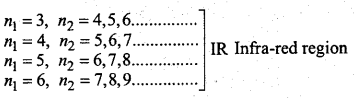
→ Rydberg formula \(\bar{v}=\frac{1}{\lambda}=\mathrm{RZ}^{2}\left[\frac{1}{n_{1}^{2}}-\frac{1}{n_{2}^{2}}\right]\), n2 > n1
(Where R = Ryberg constant = 1.09678 × 10⁷ m-1)
n1 =1, n2 = 2,3,4………………………….. UV region
n1 = 2, n2 = 3,4,5………………….. Visible region
MP Board Class 11th Chemistry Notes Chapter 2 Structure of Atom 1

→ Frequency of the absorbed or emitted radiation at two unstable states of transmission v = \(=\frac{\Delta E}{h}=\frac{E_{2}-E_{1}}{h}\) (Where E1 and E2 are the energies of lower and higher states)

MP Board Class 11th Chemistry Notes Chapter 2 Structure of Atom

→ Energy of stable state En = -RH \(\left(\frac{1}{n^{2}}\right)\) where n = 1,2,3…………………..

→ Stable energy of H and species similar to H (Like : He+,Li2+,Be3+) i.e., one electron species ) En = -2.18 x 10⁻¹⁸\(\left(\frac{z^{2}}{n^{2}}\right)\) J

→ Radius of nth orbit rn = \(\frac{n^{2} a_{0}}{Z}\) [where a0 (Bohr’s radius of H) = \(\frac{h^{2}}{4 \mathrm{~A}^{2} m e^{2} k}\) = 0.529Å

→ de-Broglie equation \(\lambda=\frac{h}{m v}=\frac{h}{\sqrt{2 m(\mathrm{KE})}}\)

→ Angular momentum mvr = \(\frac{n h}{2 \pi}\)

→ Heisenberg’s uncertainty principle Δx . Δp ≥ \(\frac{h}{4 \pi}\) or Δx . Δp ≥ \(\frac{h}{4 \pi}m\)
[Where Δx and Δv are uncertainty in position and principle]

→ Velocity in n shell vn = 2.182 × 10⁶ × \(\frac{z}{n}\).

→ Ionisation Energy (IE)H = ∆E ∝\(z^{2}\left[\frac{1}{n_{1}^{2}}-\frac{1}{n_{2}^{2}}\right]\)

→ Position of an electron in an atom is determined by four quantum numbers (n, l, in. s
(i) n (Principal Quantum number) = 1, 2, 3, 4 ………………n
(ii) l (Azimuthal Quantum number) = 0, 1, 2 ………….. (n – 1)
MP Board Class 11th Chemistry Notes Chapter 2 Structure of Atom 2
(iii) m (Magnetic Quantum number) = – l to + l
(iv) s (Spin Quantum number) = \(+\frac{1}{2}\) or \(-\frac{1}{2}\)

MP Board Class 11th Chemistry Notes Chapter 2 Structure of Atom

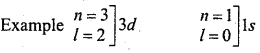
→ Determination of subshell = nl

MP Board Class 11th Chemistry Notes Chapter 2 Structure of Atom 3

→ l also expresses the shape of orbital surrounded by electron : s – Spherical, p – dumbell, d – Double dumbell, f- Complex.

→ Total value of m – (2l + 1) = Number of orbitals in subshell = Number of spectrum lines in Magnetic or Electric field.

→ In an atom, l angular node, (n – l – 1) radial node i.e., Total nodes are (n – 1).

→ Electrons are filled in the various orbitals on the basis of the following rules :
(i) Aufbau’s Principle, (ii) Hund’s Rule, (iii) Pauli’s Exclusion Principle.

→ Electronic configuration of 24Cr = [Ar]3r54s1

→ Electronic configuration of 29CU = [Ar]3d104s1

→ Completely filled and half filled orbitals are more stable due to same symmetry and maxi¬mum energy exchange.

MP Board Class 11th Chemistry Notes Chapter 2 Structure of Atom

→ Energy of electron due to which it is bound to the nucleus = Work function (w0) of metal.

→ Subshell: In a shell all electrons do not have same energy so shells are divided in different subshells. These subshells are s, p, d and f

→ Orbital: Space around the nucleus where probability to find a electron is maximum is called orbital. ‘

→ Spectrum: On jumping of electrons from higher energy level to lower energy level, obtained lines on photographic plate from the produced light is called spectrum.

→ Visible spectrum : It is a part of electromagnetic radiation which can be seen by our eyes. Wavelength range is 4000 Å to 7500 Å.

→ Invisible spectrum : The wavelength range of 7500 Å to 3 x 1.06Å and before violet up to 4000A, which we cannot see is called invisible spectrum.

→ Hund’s rule : Pairing of electrons in orbitals of equivalent energy occurs when there is no vacant orbital.

→ Aufbau’s principle: Electrons are filled in subshells in increasing order of energy. Electrons are filled first in the shell whose (n + l) value is less. If (n + l) value is same, then electron will go to that shell whose in n value is lower.

MP Board Class 11th Chemistry Notes Chapter 2 Structure of Atom

→ Pauli’s exclusion principle: No two electrons in an atom have similar four quantum numbers

MP Board Class 11th Chemistry Notes Chapter 1 Some Basic Concepts of Chemistry

These MP Board Class 11th Chemistry Notes for Chapter 1 Some Basic Concepts of Chemistry help students to get a brief overview of all the concepts.

MP Board Class 11th Chemistry Notes Chapter 1 Some Basic Concepts of Chemistry

→ Laws of chemical combinations :

  1. Law of conservation of matter : In a chemical change, total mass of reactants and total mass of products are the same.
  2. Law of constant proportion : Ratio by weight of constituent elements in a chemical compound remains always the same.
  3. Law of multiple proportion : When an element of definite weight combines with an other element of definite weight, two or more than two compounds are formed in a simple ratio.
  4. Law of equivalence proportion : When two elements combine with a definite mass of an other element separately, the weight of both elements will be in the ratio in which they combine with each other or is simple multiple of that.
  5. Gay Lussac’s law : When gases react, their volumes are in simple ratio and volume of products ifgaseous are also in simple ratio of reacting gases.

→ Atomic mass : Atomic mass of an element is the number which shows that one atom of element is how many times heavier than that of 1/12th part of C12.

MP Board Class 11th Chemistry Notes Chapter 1 Some Basic Concepts of Chemistry

→ Molecular mass: Molecular mass of an element is the number which shows that one molecule of a compound is how many times heavier than 1/12 th part of C12 atom.
Molecular mass = 2 × Vapour density.

→ Mole : It shows collection of particles of a substance. In one mole of substance (molecule, atom or ion), number of particles are 6023 × 1023. It is also called as Avogadro’s number.

→ Volume of 1 mole of.a gas at N.T.R is 224 litre.

→ Percentage : Number of grams of solute present in 100 gm of a solution.

→ Molarity : No. of moles of solute in a litre of solution.

→ Percentage composition : Number of parts of each element present in 100 parts according to mass in a compound.

→ Chemical formula: Representation of molecule of a compound in terms of symbol of elements.
It is of three types :

  1. Empirical formula: Formula which gives simple whole number ratio of different elements.
  2. Molecular formula : Formula which gives exact number of different atoms present in a molecule.
  3. Structural formula : Represents the arrangement of various atoms present in molecule of compound.

MP Board Class 11th Chemistry Notes Chapter 1 Some Basic Concepts of Chemistry

→ Chemical Equation : The short representation of a chemical reaction in terms of symbols and formula of reactants and products.

→ Element: Substance made up of only one kind of atoms.

→ Compound : Compound is formed by the combination of two or more elements in a definite ratio.

→ Mixture : Mixture is formed by mixing two or more substances in any ratio.

→ There are seven basic units of measurement. All other units are derived from these.

→ Limiting reactants are those which are present in less amount in chemical reaction.

→ Total number of digits in a number are called significant figures.

→ Some useful conversion fractions :

1 pm = 10-12m, 1Å = 10-10m, 1 nm= 10-9 m
1L = 10-3 m3 = 1 dm3, 760 torr = 101325 Pa = Nm-2.
1 atm = 1.01325 bar
1 bar =105 Nm-2 = 105 Pa, 1 atm = 760mm Hg = 760 torr 1 calorie =4184 joule, 1 Electron volt = 1-6022 x 10-19 joule
Avogadro Number (N0) = 6 022 x 1023 (Atom, Molecule, ion or electron)
1 Atomic mass unit (amu or u) = \(\frac{\text { Atomic mass }}{\text { Avogadro Number }}=\frac{A}{N_{0}}\)

MP Board Class 11th Chemistry Notes Chapter 1 Some Basic Concepts of Chemistry

→ Normality (N) : Number of gram equivalent of solute per litre of solution.

→ Molality (m) : Number of moles of solute present in 1 kg solvent of the solution.

→ Mole Fraction : Ratio of number of moles of a component to the total number of moles of all the components of the solution.
In a mixture of solution number of moles of components 1 and 2 are n1and n2.
Mole fraction of component 1 will be
X1 = X1 + X2 = 1
Thus X1 = 1 – X2

→ Average mole mass of an element (\(\bar{M}\))
= \(\frac{\text { Sum of mole mass of Isotopes } \times \% \text { amount (abundance) }}{100}\)
Sum of mole mass of Isotopes X % amount (abundance)
or \(\bar{M}\) = Σfi × Ai
Where fi = Fraction of amount of Isotope
Ai = Sum of masses of Isotopes.

MP Board Class 11th Biology Notes Chapter 22 Chemical Coordination and Integration

These MP Board Class 11th Biology Notes for Chapter 22 Chemical Coordination and Integration help students to get a brief overview of all the concepts.

MP Board Class 11th Biology Notes Chapter 22 Chemical Coordination and Integration

→ Hormones are informational molecules, secreted by endocrine glands into venous blood to regulate the functions of other organs and tissues.

→ If young tadpoles are administered thyroxine, they metamorphosed prematurely and change into tiny frogs. On the other hand, if antithyroid substance like thiourea is given to tadpoles, it delays their metamorphosis.

→ Mexican axolotls which are the larval forms of Ambystoma tigrinum do not metamorphose due to the lack of thyroid hormone and ordinarily exist as axolotl larva and even reproduce in this form, but if thyroid extract is injected, they metamorphose into Ambystoma tigrinum, the adult terrestrial form. Breeding of Axolotl in the larval stage is called neoteny or pedogenesis.

MP Board Class 11th Biology Notes Chapter 22 Chemical Coordination and Integration

→ Estrogens in human urine, increase twice during the menstrual cycle. Urine of a pregnant woman is a very rich source of estrogen, which appears to be produced by the placenta.

→ Medullary hormones are not essential for life.

→ Glucocorticoids reduce the number of circulating lymphocyte eosinophils (anti-leukaemic property) and have anti-inflammatory and anti-allergic properties. Glucocorticoids are also used in the treatment of rheumatoid arthritis.

→ Certain drugs like thiouracil, thiourea, para-amino benzoic acid, radioactive iodine, carbimazole and methimazole prevent the formation and secretion of thyroxine hormone.

→ Pars tuberalis a part of adenohypophysis of pituitary is rarely found in man.

→ Adrenogenital syndrome (Gallais, 1912) is due to the excess of adrenal cortex androgenic hormones. It is responsible for precocious growth of body “Infant Hercules”. This disease is found in females only.

→ Norepinephrine is known as hormonal secretion of adrenal medulla but it is seldom released as
norepinephrine from gland-what all is released is epinephrine only, not norepinephrine. The latter is secreted at nerve endings only.

→ Night urine usually contains more inactivated ADH than the day urine.

→ Alcohol inhibits ADH secretion.

MP Board Class 11th Biology Notes Chapter 22 Chemical Coordination and Integration

→ Acromegaly is a kind of malformation of bones due to oversecretion of growth hormones in
adults.

→ Cachexia or Simroonds disease is caused due to undersecretion of growth hormone in adults.

→ Pituitary gland is also known to be as master gland because it controls the secretion of all the endocrine glands.

→ Pheromones or Ectohormones are chemical substances released into the external surroundings by some exocrine glands. The pheromones released by the members of a species are recognized by the other members of the same species. Hence, pheromones serve as means of communication among the members of same species, e.g. The path followed by a worker ant is recognized and followed by the other ants. This is possible because the rest of the ants recognize the pheromones released by the worker ant.

→ Thomas Addison is regarded as the father of Endocrinology.

→ Hyposecretion of thyroid gland results in the production of cretinism, myxoedema, goitre and Hashimoto disease.

→ Hyposecretion of adrenal cortex results in the production of Addisons, Hypoglycemia and Cons disease.

→ Pancreas is a mixed (exocrine as well endocrine) gland.

→ The humoral immune system defends against those pathogens that invade the body fluid (blood and lymph), i.e., extracellular pathogen.

MP Board Class 11th Biology Notes Chapter 22 Chemical Coordination and Integration

→ Cell mediated immune system defends the body against those pathogens which invade the cells. i.e., intracellular pathogen.

MP Board Class 11th Biology Notes Chapter 21 Neural Control and Coordination

These MP Board Class 11th Biology Notes for Chapter 21 Neural Control and Coordination help students to get a brief overview of all the concepts.

MP Board Class 11th Biology Notes Chapter 21 Neural Control and Coordination

→ If the blood flow to brain is interrupted for a few movements unconsciousness may result. Interruption of 1-2 minutes may weaken the brain cells by starving them of oxygen. Neurons are permanently injured if deprived of oxygen for 4 minutes.

→ If blood entering the brain has low glucose level, mental confusion, dizziness, convolutions and even unconsciousness may occur.

MP Board Class 11th Biology Notes Chapter 21 Neural Control and Coordination

→ Myelin is white and made up of phospholipid. It is responsible for the colour of the white matter in brain, spinal cord and nerves.

→ Sir Charles Sherington (1861-1954) was the first person who applied the term synapse to the junctional points between two neurons. Actually synapse is a place of physiological continuity without anatomical continuity.

→ Parkinsonism or Parkinson’s disease is a disease of the basal ganglia deep in the substance of the brain that control movement. It occurs usually in the late middle age. Parkinson’s disease seems to be caused by the malfunction at the synapses.

→ Sciatica is the painful condition of the sciatic nerve or its branches. In this, pain passes from the back or thigh down its length into the leg, foot and toes.

→ Strabismus or Squint is an eye muscle disorder commonly known as crossed eyes. The eyeballs do not move in unison and the image does not fall upon corresponding points of the two retinas. It may be caused due to lack of coordination of the extrinsic eye muscles. As a result, two images are seen, a condition termed diplopia.

→ Taste of chillies, black pepper and hot sauces is not a true sensation. It is mainly a sensation of burning pain produced by the stimulation of pain receptors of the tongue by specific chemical substances in those goods.

→ Image formed on the retina is always inverted.

MP Board Class 11th Biology Notes Chapter 21 Neural Control and Coordination

→ The hair cells in the human ear are variously estimated to be of 13,000 to 54,000 in number each one with about 40 cilia or hair at the receptive side and projecting into the endolymph.

→ The nervous system is derived from embryonic ectoderm.

→ The central nervous system consists of brain and spinal cord developing from neural ectoderm.

→ The brain and spinal cord are covered and protected by connective tissue membranes called meninges.

→ The wall of brain is made up of grey and white matter.

→ Grey matter differs from white matter in having cell bodies and non-myelinated proximal parts , of axons. The white matter contains myelinated parts of axons.

→ We lose our sense of smell when olfactory lobes are removed from brain.

MP Board Class 11th Biology Notes Chapter 21 Neural Control and Coordination

→ The forebrain or prosencephalon is the largest part of the brain and cerebrum is the largest part of the forebrain.

→ The roof of the cerebrum is known as pallium.

→ Cranial nerves are arising from brain. There are 12 pairs of cranial nerves in mammals.

→ The cells of nervous system are called neurons.

→ In mammals, 31 pairs of spinal nerves are present.

→ The processes emerging out from cyton are known to be as dendrites.

→ Middle ear has three bones : (i) Malleus, (ii) Incus and (iii) Stapes.

→ Internal ear is made up of two tubules : (i) Vestibule and (ii) Semicircular tubules.

→ The path of nerve impulse in a reflex action is called reflex arc.

→ An automatic spontaneous involuntary and unconscious action brought about by nervous system is called reflex action.

→ Reflex actions are controlled by central nervous system.

→ Poliomyelitis is an acute viral infection that destroys the cell bodies of motor neurons in the anterior horn of the spinal cord.

→ Rods mainly enable the animal to see in the darkness, therefore rods are present in larger number in nocturnal animals.

MP Board Class 11th Biology Notes Chapter 21 Neural Control and Coordination

→ Cones are chiefly concerned with the distinction in colour and light vision during day time.

→ The rods contain rhodopsin or visual purple pigment, whereas cones contain the iodopsin or visual violet pigment.

→ Acetylcholine functions like that of a synaptic stimulant.

MP Board Class 11th Biology Notes Chapter 20 Locomotion and Movement

These MP Board Class 11th Biology Notes for Chapter 20 Locomotion and Movement help students to get a brief overview of all the concepts.

MP Board Class 11th Biology Notes Chapter 20 Locomotion and Movement

→ Muscle fatigue is caused due to the accumulation of lactic acid.

→ Number of cervical vertebrae in mammals is always seven, even in case of camel and giraffe.

→ Sliding filament theory of muscle contraction was given by H. E. Huxley and A. F. Huxley in 1954.

→ Chemical changes which occur during the contraction of muscle fibres were studied by Albert Szent Gyorgyi and his associates for the first time.

→ Total number of bones in human is 206.

MP Board Class 11th Biology Notes Chapter 20 Locomotion and Movement

→ Locomotion of starfish (Asterias) takes place with the help of water vascular system.

→ Poliomyelitis is caused by the polio virus which affects the muscles of limbs.

→ In man caudal vertebra or coccyx is a small bony piece showing rudimentary caudal vertebra.

→ Haemopoiesis (formation of blood) takes place in the bone-marrow of long bones.

→ Actin is a contractile protein forming thin filaments of muscle fibres.

→ Myoglobin is a protein of muscle with haem.

→ Tube-feets are the locomotory organs of starfish.

→ The minimum intensity of stimulus that can stimulate the muscles to contract is called threshold stimulus.

→ Joints are structures where two bones are fixed with each other.

→ A single isolated contraction of the muscle fibre is called muscle twitch.

MP Board Class 11th Biology Notes Chapter 20 Locomotion and Movement

→ Sarcomere is a unit of myofibril which extends between two successive Z-lines. A sarcomere is made of A-band in the middle and one half of an I-band on its either side.

→ Oxygen debt is the extra oxygen required during relaxation over the resting state of muscle.

→ Osteology is a branch of biology that deals with structure, nature and development of bones.

→ Hydra locomotes with the help of tentacles and muscles.

→ Annelids locomote with the help of setae and parapodia, whereas in arthropods locomotion takes place with the help of jointed appendages.

→ In echinoderms locomotion takes place with the help of tube-feet.

→ Stapes is the smallest and femur is the largest bone of the human body.

→ Myalgia : Pain in the muscles.

→ Myology : Study of muscles. It is also called sarcology.

MP Board Class 11th Biology Notes Chapter 20 Locomotion and Movement

→ Arthrology : Study of joints.

MP Board Class 11th Biology Notes Chapter 19 Excretory Products and their Elimination

These MP Board Class 11th Biology Notes for Chapter 19 Excretory Products and their Elimination help students to get a brief overview of all the concepts.

MP Board Class 11th Biology Notes Chapter 19 Excretory Products and their Elimination

→ Earthworms excrete ammonia when sufficient water is available but excrete urea in drier environment.

→ Human is ureotelic, but excretes little amount of uric acid in the urine which is formed from the nucleic acids. In some persons the formation of uric acid is abnormally increased by metabolic disorders or their urinary excretion becomes defective. This raises the concentration of uric acid in the body fluids and as it is insoluble, it gets deposited in soft tissues including joints, cartilages and kidneys, such individuals consequently develop gout and kidney failure.

→ Formation of urea from ammonia takes place in the liver.

→ In mammals, camel is the best adapted animal to the dry conditions. Camel does not store water. In the problem of osmoregulation, like most desert animals, it is intimately related to the temperature regulation. In summer, camel varies its osmoregulation to a greater extent than in winter and may exhibit a morning temperature of 34°C and in afternoon maximum of 41°C. It helps to prevent sweating and thus water is conserved.

MP Board Class 11th Biology Notes Chapter 19 Excretory Products and their Elimination

→ During day period, amphibians generally do not expel urine.

→ Animals which are able to tolerate wide range of change in osmotic concentration of the external environment are called euryhaline and those with narrow range of tolerance are called stenohaline.

→ The blood may appear in the urine in the form of R.B.Cs. or haemoglobin. First condition is called haematuria and the second haemoglobinuria.

→ Presence of large number of pus cells in the urine indicates infection in the kidney or urinary tract. A condition of pus in the urine is known as pyuria.

→ Sometimes certain substances like calcium oxalate, calcium phosphate and uric acid, etc. are crystallized and form stones in the kidney. These stones cause pain, haematuria and pyuria, sometimes urinary passage may be blocked by these stones.

→ Cystitis is the inflammation of the urinary bladder mainly involving mucosa and submucosa. It may be due to bacterial infection, chemical or mechanical injury.

→ Toad and lung fishes generally excrete ammonia but when water becomes insufficient they excrete urea.

→ After metamorphosis, tadpole larva excrete urea in place of ammonia.

→ The blood of shark fish contains urea which is responsible for osmoregulation.

→ Earthworm and lung fishes are ammonotelic animals but during shortage of water and hibernation, they become ureotelic.

→ Green glands are the excretory organs of crustaceans like prawn.

→ Malpighian tubules are the excretory organs of insects like cockroach.

→ Human and other primates are ureotelic.

MP Board Class 11th Biology Notes Chapter 19 Excretory Products and their Elimination

→ Aldosterone is the hormone which is responsible for the controlling of the amount of sodium
and water in the body.

→ Filtration takes place in the glomerulus of nephrons.

→ Vasopressin hormone is secreted by pituitary glands which controls the amount of urine in the body.

→ Diuresis is the condition in which secretion of urine is in large quantities.

→ Diabetes insipidus is a condition in which ADH hormone is not produced and large amount of water is excreted along with urine.

→ Alkalidine and caffeine present in tea and coffee respectively, increases the amount of urine secretion.

MP Board Class 11th Biology Notes Chapter 18 Body Fluids and Circulation

These MP Board Class 11th Biology Notes for Chapter 18 Body Fluids and Circulation help students to get a brief overview of all the concepts.

MP Board Class 11th Biology Notes Chapter 18 Body Fluids and Circulation

→ The heart of a bird is proportionately larger than that of any other vertebrate.

→ In mammals, sinus venosus is absent.

→ The tissues of heart itself receive blood through the small coronary arteries.

→ In heart block transmission of the impulse through the heart is blocked at critical points in the conductive system. One of the most common of these points is between the auricles and the ventricles. This condition is called auriculoventricular block. It usually indicates myocardial infection, arteriosclerosis, rheumatic heart disease, etc.

MP Board Class 11th Biology Notes Chapter 18 Body Fluids and Circulation

→ Puffiness or oedema of tissue is caused by the increased capillary pressure; increased per-meability of the capillary wall or decreased rate of return of lymph due to increased pressure in the veins.

→ In adult human male, the heart is about 0-43% of the body weight and in female about 0-4%; but in active mammals like the deer or greyhound, the heart is about 1 % of the body weight.

→ Rate of heartbeat in elephant is about 25 times per minute.

→ Pulsating hearts are simply blood vessels with a relatively heavy muscular layer which contracts in peristaltic waves thus pushing the blood through blood vascular system. Such vessels have valves as found in many forms of annelids.

→ Neurogenic heart is found in most of the arthropods.

→ Inferior vena cava is the largest vein in human body.

→ Aorta is the largest artery of human body.

→ The pacemaker is the specialized region which initiates and sets pace to the contraction of the heart. There are two pacemakers, S.A. node and A.V. node in the heart of higher vertebrates.

MP Board Class 11th Biology Notes Chapter 18 Body Fluids and Circulation

→ The heart of vertebrates is described as myogenic in which the contractions are started from within the muscles of heart.

→ The heart of invertebrates is described as neurogenic because the contractions of the heart are initiated by a nerve impulse.

→ The human heart beats about 72 times per minute.

→ The blood circulation in humans was discovered by William Harvey. He is regarded as the Father of Physiology.

→ The circulatory system in vertebrates is derived from embryonic mesoderm.

→ When the heart muscles are deprived of oxygen and nutrients due to the formation of clot, hardening, degenerative changes in the coronary arteries, the heart does not receive enough blood. This damage to the heart is known as heart attack or coronary thrombosis.

→ Tricuspid valve is found in the opening of right atrium.

→ In closed circulatory system, blood flows in closed vessels and never comes in the direct contact with the tissues.

→ Hypotension is a condition with low blood pressure than normal.

→ Hypertension is a condition with high blood pressure than normal.

→ Stethoscope is an instrument used to listen to heart and lung sounds.

→ The circulation of blood from the heart to the body (except lungs) and back is called systemic circulation or body circulation.

MP Board Class 11th Biology Notes Chapter 18 Body Fluids and Circulation

→ The circulation of blood from the heart to the lungs back is called pulmonary circulation.

→ Systole is a phase of heart when the heart muscle is contracted and blood is being pumped into the arteries.

→ In earthworms, haemoglobin is dissolved in plasma.

→ The blood pressure of a normal healthy man is 120/80 mm Hg.

→ Bicuspid valve is located in between left auricle and left ventricle.

→ The relaxation of heart, during which blood comes in the heart, is called diastole.

Largest sized heart is found in blue-whale.

MP Board Class 11th Biology Notes Chapter 17 Breathing and Exchange of Gases

These MP Board Class 11th Biology Notes for Chapter 17 Breathing and Exchange of Gases help students to get a brief overview of all the concepts.

MP Board Class 11th Biology Notes Chapter 17 Breathing and Exchange of Gases

→ Process if oxidation of food inside the cells of the living organisms in presence of specific enzymes to release energy is called as Respiration.

→ Respiration which occurs in presence of oxygen is called as aerobic respiration and which occurs in absence of oxygen is called as anaerobic respiration.

→ In modem birds, the lungs are highly modified by the presence of air sacs which facilitate the circulation of air through the lungs.

MP Board Class 11th Biology Notes Chapter 17 Breathing and Exchange of Gases

→ Inflammation of the pleural membrane called pleurisy causes friction during breathing which is quite painful.

→ In males, the larynx increases considerably in size and becomes much larger than that of the females. The enlarged vocal cords are responsible for lower pitch of the masculine voice.

→ Normally, trachea bifurcates into two bronchi but in snakes, there is only one bronchus while in certain ruminants, pigs and whales there are three bronchi.

→ The human lungs have about 750,000,000 alveoli covering the total area of 100 sq. meter which is 100 times than the surface area of the skin.

→ All tissues are not equally affected by the shortage of oxygen. The more active tissues are more affected. Skeletal muscles, heart and brain are much more affected than skin, intestine and bones.

→ Turtles can respire inside water due to the presence of air sacs in their body.

→ O2 is transported by haemoglobin in our body.

MP Board Class 11th Biology Notes Chapter 17 Breathing and Exchange of Gases

→ R.B.Cs. do not respire aerobically because of the absence of mitochondria in them.

→ Tfre rate of human breathing is 16-20 per minute at rest.

→ Hyperpnoea is a condition, when breathing rate increases above normal.

→ Hypopnoea is a condition, when breathing rate decreases below normal.

→ In some turtles, cloaca acts as respiratory organ.

→ Respiration is a catabolic process.

→ Gills are the respiratory organs of aquatic animals like fish.

→ Spiracles are small apertures in abdominal segments of insects for gaseous exchange.

→ Asthma : Narrowing of bronchi due to spasm in bronchial muscles. It is an allergic response.

MP Board Class 11th Biology Notes Chapter 17 Breathing and Exchange of Gases

→ Haemocyanin : Copper containing blue coloured pigment found in blood plasma of molluscs.

MP Board Class 11th Biology Notes Chapter 16 Digestion and Absorption

These MP Board Class 11th Biology Notes for Chapter 16 Digestion and Absorption help students to get a brief overview of all the concepts.

MP Board Class 11th Biology Notes Chapter 16 Digestion and Absorption

→ Amala is the richest source of vitamin C.

→ Vitamin B (biotin) is an exception, it is regarded as insoluble in water and fat.

→ Gail bladder is not found in horse, rat, whale.

→ Most vertebrates lack proteases for digesting some fibrous animal proteins like hair, keratin, silk fibroin and wool protein.

MP Board Class 11th Biology Notes Chapter 16 Digestion and Absorption

→ Peristalsis is the rhythmical contractions of alimentary canal by its muscular action which forces food through the canal.

→ Bolus is the rounded mass of masticated food and saliva.

→ The digestibility of bread is increased by toasting because some of its starch is broken into dextrines during the process.

→ In ruminants (e.g., Cow), fermentation is particularly facilitated by rumination or chewing of the cud. Boluses of food are drawn from the rumen to the mouth, chewed thoroughly to break the plant fibres more finely, mixed with saliva to promote further fermentation and swallowed again into the rumen; where it undergoes further fermentation.

→ The conversion of glucose (blood sugar) into glycogen is called glycogenesis.

→ The conversion of glycogen into glucose is called glycogenolysis.

→ The conversion of excess of carbohydrates (blood sugar) into fats is known as lipogenesis.

→ The gastric juice of infant mammals contains an enzyme called rennin. Rennin in the presence of calcium, acts on milk protein known as casein to form curd called calcium paracaseinate.

→ Heparin is secreted by liver, which prevents the coagulation of blood.

MP Board Class 11th Biology Notes Chapter 16 Digestion and Absorption

→ The synthesis of fibrinogen and prothrombin take place in liver.

→ Vermiform appendix is a vestigial organ attached with the alimentary canal of human beings.

→ HC1 is the activator of pepsinogen.

→ Lunin (1881) discovered vitamins.

→ Stomach absent in Labeo, lamprey and hagfish.

→ Odontology : Study of teeth.

→ Choleresis : Process of bile secretion.

→ Vomiting centre : Is located in the medulla oblongata.

→ World food day : 17th October.

→ Cholecystostasis : Formation of stone in gall bladder.

→ Coprophagy : Eating of faeces by the rabbit, guinea pig etc.

→ Hernia : Choking of intestine.

→ Osteomalacia : A disease of bones in adults caused due to deficiency of vitamin D.

MP Board Class 11th Biology Notes Chapter 16 Digestion and Absorption

→ Ruminants : Cud-chewing mammals e.g., cattle.