MP Board Class 7th Special English Solutions Chapter 19 Song of Radha, the Milkmaid

Get Updated MP Board Solutions for Class 7 Special English Solutions Chapter 19 Song of Radha, the Milkmaid Questions and Answers in PDF Format and download them free of cost. These are provided as per the latest exam pattern and syllabus. Access the topics of Chapter wise and communication skills, grammer part through the direct links available depending on the need. You can Download MP Board Class 7 English Solutions and can score highest grade in examination. Clear all your queries on the Mp Board Solutions for Class 7 English Chapter 19 Song of Radha, the Milkmaid Questions and Answers Subject by using the Madhya Pradesh State Board Solutions for existing.

MP Board Class 7th Special English Solutions Chapter 19 Song of Radha, the Milkmaid

If you are eager to know about the Madhya Pradesh State Board Solutions for Class 7 English you will find all of them here. You can identify the knowledge gap using these MP Board Solutions for English PDF and plan accordingly. Don’t worry about the accuracy as they are given after extensive research by people having subject knowledge along side from the latest English Syllabus.

Song of Radha, the Milkmaid Text Book Exercise

Comprehension

Song Of Radha The Milkmaid Question And Answer MP Board Class 7th Question 1.
Where did Radha carry her curds to?
Answer:
Radha carried her curds to the Mathura fair.

Mp Board Class 7th English Chapter 19 Question 2.
What did she compare her curds to?
Answer:
She compared her curds to white clouds.

Song Of Radha The Milkmaid MP Board Class 7th Question 3.
What did she cry out and why?
Answer:
She cried out ‘Govinda’, ‘Govinda’. She did so because her heart was full of the beauty of her beloved Krishna.

Class 7 English Chapter 19 MP Board Question 4.
What did her comrades ask her to do?
Answer:
Her comrades asked her to dance, sing, wear saffron garments and pluck new buds.

Song Of Radha The Milkmaid Summary MP Board Class 7th Question 5.
Why did her comrades mock at her?
Answer:
Her (Radha’s) comrades mocked at her because she did not care for their requests. Instead of joining them in dance, in singing and plucking new buds, she cried ‘Govinda’, ‘Govinda’.

The Song Of Radha The Milkmaid MP Board Class 7th Question 6.
What did she do at the altar?
Answer:
She folded her hands at the altar and prayed for divine guidance at all times.

Song Of Radha The Quest Question And Answer MP Board Class 7th Question 7.
Why were her comrades angry?
Answer:
Her comrades were angry because she did not pay attention to their requests. She busied herself in the worship of her beloved Krishna.

Word Power

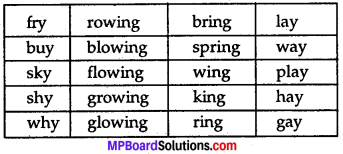
Select words from these and write them in the columns with the word they rhyme with:
(fry, bring,way, lay, rowing, buy, blowing, sky, flowing, spring, play, growing, hay, wing, shy, king, gay, ring why, glowing)
Answer:
Song Of Radha The Milkmaid Question And Answer MP Board Class 7th

Let’s Talk

Talk to your partner and find answers to the questions given below:
Radha The Milkmaid MP Board Class 7th Question 1.
Who is Radha?
Answer:
Radha is a milkmaid.

Question 2.
Who is Govinda?
Answer:
Govinda is Lord Krishna.

Question 3.
What is the poetess trying to explain about-Radha?
Answer:
The poetess is trying to explain that Radha is deeply devoted to Krishna. Her heart is full of Krishna’s beauty and music. She is so much engrossed in his worship that she does not care for anything else or any other person.

Question 4.
What does the poetess compare the curds with?
Answer:
The poetess compares the curds with white clouds in the sky.

Question 5.
Write about the three things that made Eadha say Govinda Govinda?
Answer:
The following three things made Radha say Govinda Govinda.

  1. Her heart was full of her beloved’s (Govinda’s) beauty.
  2. Her heart was deeply full of her beloved’s (Govinda’s) music.
  3. Her heart was fully lost in her beloved’s (Govinda’s) worship.

Let’s Write

Write three paragraphs one on each stanza of the poem explaining/saying what the poetess Sarojini Naidu is trying to say in the poem.
Answer:
Do Yourself.

Let’s Do it

(a) Find some more poems written by Sarojini Naidu and read them in the class.
(b) In your library find poems on Radha and krishna and write them in your note book.
Answer:
Class-room Activity

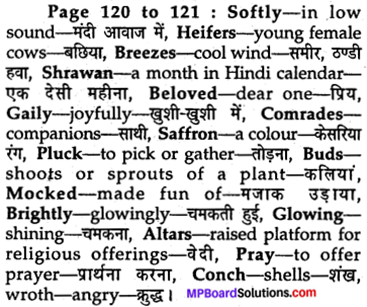
Song of Radha, the Milkmaid Word Meanings
Mp Board Class 7th English Chapter 19

Song of Radha, the Milkmaid Stanzas for Comprehension

1. I carried my curds to the Mathura fair
How softly the heifers were lowing
I wanted to cry “Who will buy
These curds that are white as the clouds in the sky
When the breezes of Shrawan are blowing?”

Question 1.
Who is ‘Y in the above stanza?
Answer:
Here T refers to ‘Radha’.

Question 2.
How were the heifers lowing?
Answer:
The heifers were lowing softly.

Question 3.
What did she want to cry?
Answer:
She wanted to cry, “who will buy these white curds?”

Question 4.
What do you mean by ‘Shrawan’?
Answer:
Shrawan is a month of rainy season in Hindu calendar.

2. How softly the river was flowing!
I carried my pots to the Mathura tide
How gaily the rowers were rowing!
My comrades called, “Ho! let us dance, let us sing
And wear saffron garments to welcome the spring.
And pluck the new buds that are blowing.”

Question 1.
What was flowing softly?
Answer:
The river was flowing softly.

Question 2.
What were the pots full of?
Answer:
The pots were full of curd and other gifts.

Question 3.
Why did her comrades call her?
Answer:
Her comrades called her to dance, sing and pluck the new buds.

Question 4.
How were the rowers rowing?
Answer:
The rowers were rowing in a gay mood.

3. I carried my gifts to the Mathura shrine
How brightly the torches were glowing!
I folded my hands at the altars to pray
“O shining, ones guard us by night and by day”
And loudly the conch shells were blowing.

Question 1.
Where did Radha carry her gifts?
Answer:
Radha carried her gifts to the Mathura Shrine.

Question 2.
How were the torches glowing there?
Answer:
The torches Were glowing brightly’ there.

Question 3.
What did she pray for?
Answer:
She prayed that the shining gods, should guard her every time.

Question 4.
What were blowing loudly?
Answer:
The conch shells were blowing loudly.

We believe the information shared regarding MP Board Solutions for Class 7 English Chapter 19 Song of Radha, the Milkmaid Questions and Answers as far as our knowledge is concerned is true and reliable. In case of any queries or suggestions do leave us your feedback and our team will guide you at soonest possibility. Bookmark our site to avail latest updates on several state board Solutions at your fingertips.
MP Board Class 7th Special English Solutions Chapter 4 The Wheat is Cheaper-II

Get Updated MP Board Solutions for Class 7 Special English Solutions Chapter 4 The Wheat is Cheaper-II Questions and Answers in PDF Format and download them free of cost. These are provided as per the latest exam pattern and syllabus. Access the topics of Chapter wise and communication skills, grammer part through the direct links available depending on the need. You can Download MP Board Class 7 English Solutions and can score highest grade in examination. Clear all your queries on the Mp Board Solutions for Class 7 English Chapter 4 The Wheat is Cheaper-II Questions and Answers Subject by using the Madhya Pradesh State Board Solutions for existing.

MP Board Class 7th Special English Solutions Chapter 4 The Wheat is Cheaper-II

If you are eager to know about the Madhya Pradesh State Board Solutions for Class 7 English you will find all of them here. You can identify the knowledge gap using these MP Board Solutions for English PDF and plan accordingly. Don’t worry about the accuracy as they are given after extensive research by people having subject knowledge along side from the latest English Syllabus.

The Wheat is Cheaper-II Text Book Exercise

Comprehension

A. Answer the questions given below:

Mp Board Class 7th English Chapter 4 Question 1.
Did the merchant cast a doubt on the farmer’s story?
Answer:
No, the merchant did not cast a doubt on the farmer’s story at all.

Class 7 English Chapter 4 The Wheat Is MP Board Question 2.
How did the farmer make the merchant pay him up?
Answer:
The farmer made the merchant pay him up by narrating a false story.

The Wheat Is Cheaper 2 MP Board Question 3.
Why did the merchant not object to the farmer’s charge about his father?
Answer:
The merchant would have to pay the farmer a hundred rupees if he cast a doubt on his story. He was very greedy, \miserly and money minded. By paying fee price of wheat he still saved some money. Therefore he did not object to the farmer’s charge about his father.

Class 7 English Chapter 4 Mp Board Question 4.
Why was he silent during the farmer’s story?
Answer:
He was silent during the farmer’s story because if he raised objection, he would undergo a loss of money.

Class 7 English Chapter 4 MP Board Question 5.
Why did the merchant decide to pay the farmer?
Answer:
The merchant decided to pay the farmer because the price of wheat was lesser than the price of raising the doubt.

Class 7 Chapter 4 English MP Board Question 6.
How much money did he pay to the farmer?
Answer:
He paid rupees seventy five to the farmer. It was the price of 75 kilos of wheat.

English Chapter 4 Class 7th MP Board Question 7.
Who do you think was clever’ the merchant or fee farmer?
Answer:
The farmer was cleverer of the two.

B. Read the following sentences and tick true or false.

  1. The merchant cast a doubt on the farmer’s story. T / F
  2. The merchant held his tongue.T / F
  3. The farmer had a weak horse with out saddle. T / F
  4. The grains sprouted on the horse back. T / F
  5. The merchant gave him hundred rupees. T / F
  6. The farmer’s story failed to impress the merchant. T / F

Answer:

  1. False
  2. True
  3. False
  4. True
  5. False
  6. True.

Word Power

A. Fill in the blanks using the words given below:
(Saddle, admired, sore, grain, sprouted, hire, reap, starving, begged, neighbouring, his)

The farmer used to go to the market on………….. horse. The horse had a fine …………… on which he sat. People of the …………. village …………. the horse and its saddle. The farmer’s saddle was torn which caused a …………. on its back. Once there was a storm and a lot of ………….. stuck into the wound. Later the grains of wheat …………. on the horse back. The farmer had to………… about forty men to………… the grain. One day a man came to my father and ………… him to give seventy five kilos of wheat. When my father saw the man…………. he gave him wheat.
Answer:
his, saddle, neighbouring, admired, sore, grain, sprouted, hire, reap, begged, starving.

Grammar in Use

A. Frame questions for the following answers using what, when, how, who, why.

Example:
Question.
Who had a fine horse?
Answer:
The farmer’s father had a fine horse.

i. ………….
Answer:
The farmer used to go on his horse to the market.

ii. …………
Answer:
The farmer found that the horse had a sore on its back.

iii. ………….
Answer:
He begged him to give him seventy- five kilos of wheat.

iv. …………..
Answer:
Your father owes seventy kilos of wheat to my father even to this day.

v. ……………
Answer:
The merchant began running his thumb up and was calculating.

Answer:
(i) Who used to go on his horse to the market?
(ii) What did the farmer find on the horse’s back.
(iii) Who begged him to give him seventy- five kilos of wheat.
(iv) What does my father owe to your father to this day?
(v) Why did the merchant begin running his thumb up and calculating?

Let’s Talk

Discuss in groups about the famous Indian freedom fighter Bhagat Singh and find answers to the following questions.

  1. Who was Bhagat Singh?
  2. Where was he born?
  3. How did he inspire people?
  4. Why did the British dislike him?
  5. Where was he hanged to death?

Answer:

  1. Bhagat Singh was a martyr.
  2. He was born at Lyollpur in Punjab (Now in Pakistan).
  3. He inspired the people to make armed struggle.
  4. The British disliked him because he shot dead Saunders and revenged the death of Lala Lajpat Rai.
  5. He also threw a bomb in the Assembly.
  6. He was hanged to death in Delhi.

Let’s Write

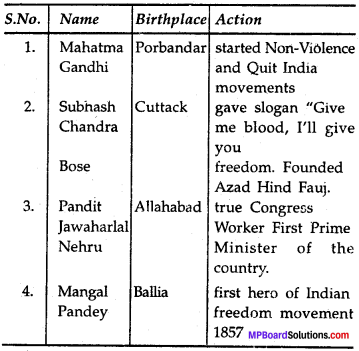
Read the information given in the table and write three sentences about each freedom fighter.
Example:
(1) Mahatma Gandhi was a freedom fighter
(2) He was born in Porbandar.
(3) He started Non-violence and Quit India movements.
Mp Board Class 7th English Chapter 1
Answer:
1. Mahatma Gandhi :
Mahatma Gandhi was born at Porbander. He started Non-Violence and Quit India movements. We call him ‘Bapu’. He was the liberator of India.

2. Subhash Chander Bose :
Subhash Chander Bose was born in Cuttack. He gave the slogan “give me blood” I’ll give you freedom, He founded the National Indian Army. He was famous by the name of ‘Netaji’.

3. Pandit Jawaharlal Nehru :
Jawaharlal Nehru was born at Allahabad. He was a true congress worker. He was the First Prime Minister of India. The children call him ‘Chacha’ He was the maker of modern India.

4. Mangal Pandey :
Mangal Pandey was born at Ballia. He was the first hero of Indian freedom movement of 1857. He lost his, life for the nation It was a great sacrifice!

Let’s Do It

Make a list of the names of crops produced by the farmers.
Answer:
The following is the list of the names of crops produced by the farmers.
Wheat barley, grams, millet, maize, rice

The Wheat is Cheaper-II Word Meanings

Page 22 to 24: Cast – show – दिखाना, Doubt – suspicion – राक, Really – actually – वास्तव में, Interesting – charming – रोचक – seat – काठी, Neighbouring – nearby – पास वाले, Admired – praised – सराहना करना, Sore – wound – घाव, Palm – front part of the hand – हथेली, Caused – brought- about – कारण बनना, Grains – corn – दाने, Sprout – germinate – उगना, Wonder – amazement – आरचर्थ, Reap – harvest – फसल काटना, Lucky – fortunate – भाग्यशाली, Indeed – really – सचमुच, Starving – suffering from hunger – भूखों मरना, Effort – attempt – प्रयत्न, Owes – remains to be paid, payment is due – देनदार, Calculating – counting – हिसाब लगाना, Bargain – transaction, a deal – सौदा

We believe the information shared regarding MP Board Solutions for Class 7 English Chapter 4 The Wheat is Cheaper-II Questions and Answers as far as our knowledge is concerned is true and reliable. In case of any queries or suggestions do leave us your feedback and our team will guide you at soonest possibility. Bookmark our site to avail latest updates on several state board Solutions at your fingertips.
MP Board Class 6th Science Solutions Chapter 1 Food: Where Does it Come From?

MP Board Class 6th Science Solutions Chapter 1 Food: Where Does it Come From?

Food: Where Does it Come From? Text Book Exercise

Mp Board Class 6 Science Solution Question 1.
Do you find that all living beings need the same kind of food?
Answer:
No, we know that the different organisms eat different kinds of food. For example, human being eats roti, dal, rice, bread, vegetables and rice, etc. Buffalo, cow and some other animals eats grass, oil cake, grains, hay, etc. Cat and dog eats small animals, milk, roti, bread and birds, etc. Tiger, lion eat other animals. Thus, we can say that different living beings eat different kind of food.


Mp Board Class 6 Science Solution Chapter 1 Question 2.
Name the five plants and their parts that we eat?
Answer:

Plants:

  1. Radish
  2. Carrot
  3. Mustard
  4. Potato
  5. Maize

Parts that we eat:

  1. Roots and leaves
  2. Roots
  3. Seeds, oil and leaves
  4. Roots
  5. Fruits

Mp Board Class 6 Science Solution English Medium Question 3.
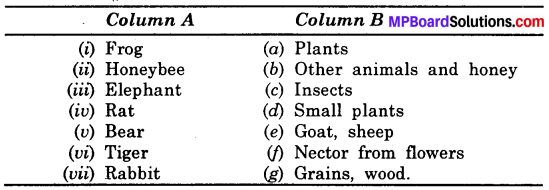
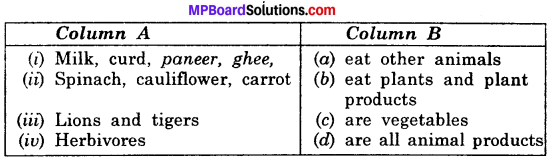
Match the items in Column A with that in Column B.
Mp Board Class 6 Science Solution
Answer:

(i) (d)
(ii) (c)
(iii) (a)
(iv) (b)

Mp Board Class 6 Science Chapter 1 Question 4.
Fill up the blanks with the words gives:
herbivore, plant, milk, sugarcane, carnivore

  1. Tiger is a ……………………… because it eats only meat.
  2. Deer eats only plants products and so, is called ……………………….
  3. Parrot eats only ………………….. products.
  4. The …………………….. that we drink, which comes from cows, buffaloes and goats is an animal product.
  5. We get sugar from ……………………..

Answer:

  1. Carnivore
  2. Herbivore
  3. Plant
  4. Milk
  5. Sugarcane.

Projects And Activities

Mp Board Solution Class 6 Science Activity 1.
You must have seen a garden lizard around your home. Next time whenever you see it, observe carefully and find out what it takes for food. Is the food different from that of a house lizard?
Answer:
A garden lizard takes mosquitoes, house flies while a house lizard takes insects only.

Mp Board Class 6th Science Solution Activity 2.
Make a list (with pictures, when possible) of food items generally taken by people of different regions of India. Place these on a large outline map of India to display in your classroom?
Answer:
Mp Board Class 6 Science Solution Chapter 1

Mp Board Class 6th Science Solution English Medium Activity 3.
Find out the names of plants that grow in water and which are eaten as food?
Answer:
Lotus, lily, algae and chest – nut, etc. are grow in water and which are eaten as food.

Mp Board Solution Class 6th Science Activity 4.
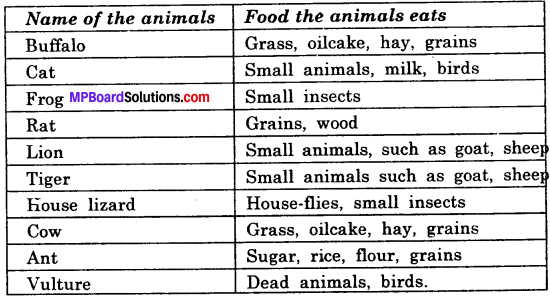
Make a table to show that the type of food the animals eat?
Answer:
Mp Board Class 6 Science Solution English Medium

Mp Board Solution Class 6 Activity 5.
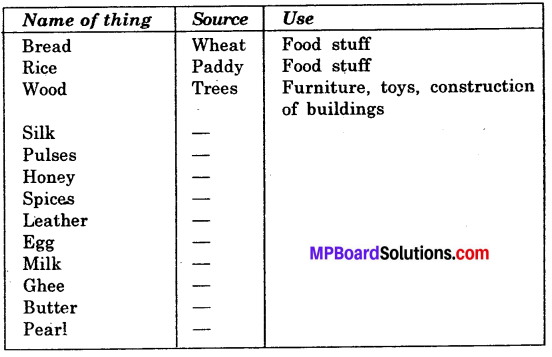
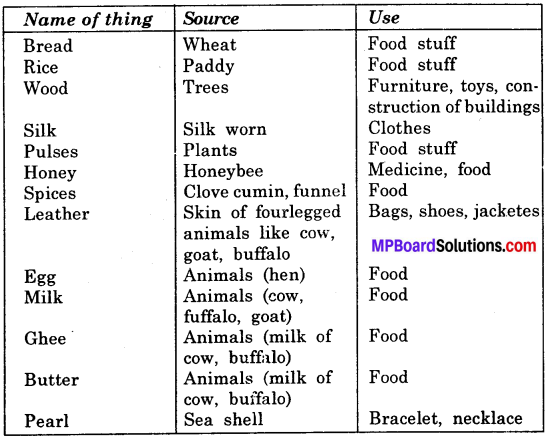
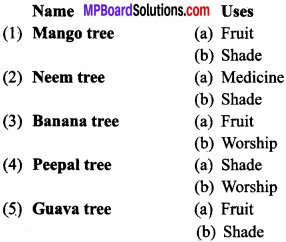
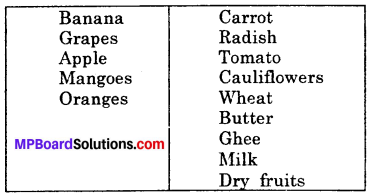
In the table give below names of some of the things are given. Write their uses and sources in front of them?
Mp Board Class 6 Science Chapter 1
Answer:
Mp Board Solution Class 6 Science

Class 6 Science Chapter 1 Mp Board Activity 6.
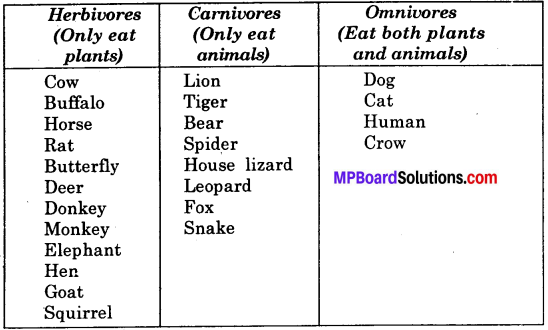
Prepare a table to show animals which eats only plants, other animals and both plants and animals?
Answer:
Mp Board Class 6th Science Solution

Class 6th Science Mp Board Activity 7.
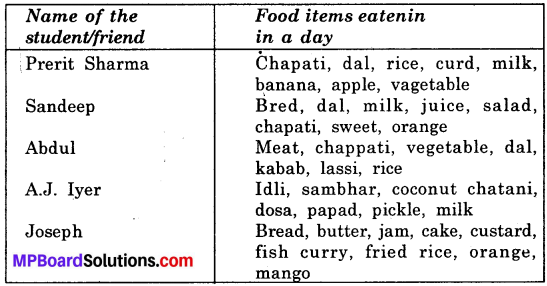
Make a table that what do your friends eat?
Answer:
Mp Board Class 6th Science Solution English Medium

Mp Board 6th Class Science Solutions Activity 8.
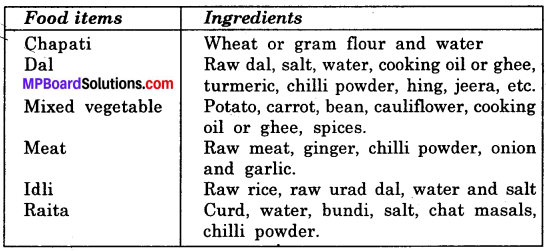
Make a table to show some food items and their ingredients?
Answer:
Food items and their ingredients
Mp Board Solution Class 6th Science

Mp Board Class 6 Science Book Pdf Activity 9.
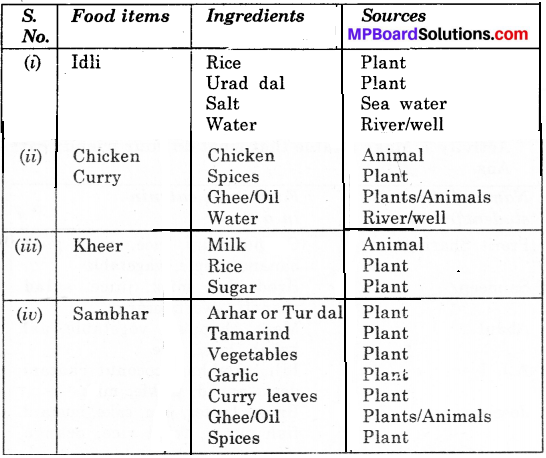
Prepare a table to show ingredients used to prepare food items and their sources?
Answer:
Ingredients used to prepare food items and their sources
Mp Board Solution Class 6

Mp Board Class 6 Science Solution In English Activity 10.
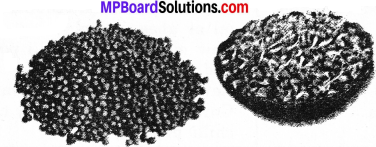
How will you sprout the seeds?
Answer:

1. Take some dry seeds of chana or raoong.
2. Put a small quantity of seeds is a container filled with water and leave this aside for a day.
3. Next day, drain the water completely and leave the seeds in the vessel. Wrap them with a piece of wet cloth and set aside.
4. The following day, a small white structure may have grown out of the seeds. If so, the seeds have sprouted.

Class 6 Science Chapter 1 Mp Board

If not, wash the seeds in water, drain the water and leave them aside for another day, covered with a wet cloth.

5. Further, the next day, the seeds would have sprouted.
6. Further, the next day, the seeds would have sprouted.
7. After washing these sprouted seeds, we can eat them.
8. They can also be boiled. Add some spices and get a tasty snack to eat.
Class 6th Science Mp Board

Food: Where Does it Come From? Intex Questions

Class 6th Mp Board Science Question 1.
Paheli want to know if any of our food comes from sources other than plants and animals?
Answer:
No.

Science Class 6 Mp Board English Medium Question 2.
Paheli wants to know where you would place human beings, while filling table of Activity 6?
Answer:
Omnivoxes.

Food: Where Does it Come From? Additional Important Questions

Objective Type Questions Food: Where Does it Come From?

Mp Board 6th Class Science Book Question 1.
Choose the correct answer:

Question (a)
Cat is a omnivores because it eats:
(a) Plants
(b) Animals
(c) Both of these
(d) None of these.
Answer:
(c) Both of these

Question (b)
Sugar is made from:
(a) Water
(b) Wheet
(c) Rice
(d) Sugarcane
Answer:
(d) Sugarcane

Question (c)
The source of chicken curry is:
(a) Plants
(b) Animals
(c) Both of these
(d) None of these
Answer:
(b) Animals

Question (d)
Seeds of mustard plants give us:
(a) Oil
(b) Fruit
(c) Both of these
(d) None of these
Answer:
(a) Oil

Question (e)
Human beings are –
(a) Herbivores
(b) Carnivores
(c) Omnivores
(d) None of these
Answer:
(c) Omnivores

Question 2.
Fill in the blanks:

  1. Food is essential for all ………………….. beings.
  2. Animals provides us ……………………..
  3. All animals are …………………… because of their food habits.
  4. Horse is a herbivorous animal because it eats …………………………
  5. Honey is obtained from …………………….

Answer:

  1. Living
  2. Food
  3. Different
  4. Herbivorous
  5. Honey – Bees.

Question 3.
Which of the following statements are true (T) or false (F):

  1. Milk gives us proteins.
  2. Animals that feed on both plants and animals are called omnivorous.
  3. Animals do not provide us food.
  4. All living beings need the same kind of food.
  5. Animals do not depend for their food on plants.
  6. Human beings are omnivores.

Answer:

  1. True
  2. True
  3. False
  4. False
  5. False
  6. True.

Question 4.
Give one word for the following:

  1. Animals which eat plants and plant products only.
  2. Animals which eat other animals.
  3. Animals which eat both plants and animals.

Answer:

  1. Herbivores
  2. Carnivores
  3. Omnivores.

Question 5.
Match the names of same animals in column A with their common food in column B:
MP Board Class 6th Science Solutions Chapter 1 Food Where Does it Come From img 13
Answer:

(i) – (c)
(ii) – (f)
(iii) – (a)
(iv) – (g)
(v) – (b)
(vi) – (e)
(vii) – (d)

Food: Where Does it Come From? Very Short Answer Type Questions

Question 1.
How many materials or ingredients are needed to prepare a dish of boiled rice?
Answer:
Two, i.e., raw rice and water.

Question 2.
What are the sources of rice or wheat?
Answer:
The sources of rice or wheat are fields and plants.

Question 3.
Name some food products we obtain from animals?
Answer:
Milk, egg and meat.

Question 4.
Which animals provide us milk?
Answer:
Buffalo and cow.

Question 5.
Which animals provide us eggs?
Answer:
Hen.

Question 6.
Name some animals that provide us food?
Answer:
Buffalo, cow and goat.

Question 7.
Which parts of a plant are our food?
Answer:
We eat many leafy vegetables. We eat fruits of some plants. Sometimes roots, stems and even flowers of plant are our food.

Question 8.
Name any two oil – yielding plants?
Answer:
Sunflower and mustard plants.

Question 9.
What are herbivorous?
Answer:
The animals which depend on only green plants for their food like cow, goat, etc.

Question 10.
What are carnivorous?
Answer:
The animals which eat only other animals Tiger and Lion are carnivorous.

Question 11.
What are omnivorous?
Answer:
The animals who can feed on plants and other animals both are called omnivorous like man, cat, dog, etc.

Question 12.
Name any two invertebrates?
Answer:

  1. Earthworm
  2. Insects.

Question 13.
What is the food of a frog?
Answer:
Small insects.

Question 14.
What is the food of fishes?
Answer:
It feeds upon microplants and aquatic insects.

Question 15.
Which types of foods are eaten by buffalo and cow?
Answer:
Buffalo and cow eat oil cake, grass, hay, leaf and grain.

Question 16.
What is the smallest constituent of plant or animal?
Answer:
The smallest constituent of plants and animal is cell.

Question 17.
Give one example of each plant which is reproduced by (i) stems, (ii) leaves?
Answer:

  1. Potato, ginger are reproduced by stems.
  2. Bryophyllum is reproduced by leaves.

Question 18.
Where do we get honey?
Answer:
We get honey from honey – bees, which is collected from sweet, juice or nector of flowers.

Question 19.
Name some animals which eat only plants?
Answer:
Buffalo, cow, goat, sheep and deer.

Question 20.
Name some animals which eat both plants and animals?
Answer:
Dog and crow.

Question 21.
Name some animals with lay eggs?
Answer:
Frog, snakes, birds, etc. lay eggs.

Food: Where Does it Come From? Short Answer Type Questions

Question 1.
Name the animals which provide us milk, meat, egg, and honey?
Answer:
We get milk from buffalo, goat, cow and sheep, we get meat from, fish, goat, hen, etc., we get eggs from hens. Honey is obtained from honey – bees.

Question 2.
Name the plants from which we obtained grains, oils, fruits and pulses?
Answer:
We get grains from wheat, rice and maize, etc. we get oils from sunflower, mustard, ground nut and soyabean plants, etc. We get fruits from mango, banana, guava, orange and papaya plants. We get pulses from urad, moong, masoor, and gram plants.

Question 3.
Name the plants from which we obtained vegetables?
Answer:
We get vegetables from radish, brinjal, cabbage, carrot, cauliflower, and peas plants, etc. These vegetables are in the form of roots, stems leaves and fruits.

Question 4.
How are plants different from animals?
Answer:
Difference between plants and animals are:
plants:

  1. All green plants prepare their own food.
  2. Plants cannot move from one place to another. But they show movement only in the position.

Animals:

  1. Animals cannot prepare their own food. They take their food from plants.
  2. Animals can move from one place to another.

Question 5.
Give five examples each of plants producing, cereals, vegetables, fruits, medicines and timber?
Answer:

  1. Cereals plants: Moong, urad, iram, pla, masoor.
  2. Vegetables – Carrot, radish, turnip, cauliflowers and tomato.
  3. Fruits – Apple, guava, orange and mango.
  4. Medicines – Neem, tulasi, podina, ginger and peepal.
  5. Timber – Neem, guava, jamun, babool and palms.

Question 6.
How can plants be classified?
Answer:
Plants can be classified on the basis of following:

  1. Plants can be classified on the basis of their habitat. i.e., water plants, land plants, sea/land plants, water plants, desert plants.
  2. They can be classified on the basis of their structure like herb, shurb or tree.
  3. They can be classified on the basis of their food habits like autotrophic plants, insectivorous plants, heterotrophic plants.

Food: Where Does it Come From? Long Answer Type Questions

Question 1.
Write a short note on the importance of plants and animals in our daily life?
Answer:
Most of the things we use in our daily life are obtained from plants or animals.

  1. Our food items like wheat, rice, pulses, species, oil, vegetables and fruits are obtained from plants.
  2. Milk, ghee, butter, curd, egg and meat are obtained from animals.
  3. Fibers like silk, wool and leather are obtained from animals.
  4. Many materials for shelter house, construction and furniture are also obtained from plants.
  5. Some plants are used for decorative purposes.
  6. Most of the medicines are obtained from living sources. Thus plants are food producing, timber producing, fiber producing and medicine producing source. Plants are also responsible for producing oxygen which is essential for life.
  7. Animal produce very important material for us. Milk, ghee, egg, meat, silk, leather etc. are produced by animals. They plough our fields and work for transportation. In this way we can say that plants and animals are very important for us.

Question 2.
What are similarities and dissimilarities between plants and animals?
Answer:
Similarities between plants and animal:

  1. Both can grow.
  2. Both can respire.
  3. Both can reproduce.
  4. Both can excrete.
  5. Both can show response to stimuli.

Dissimilarities between plants and animals:

  1. Plants can prepare their own food in green leaves with the help of carbondioxide, water, minerals and sunlight. But animals can’t prepare their own food.
  2. Plant’s cannot move from one place to another, but animals can move from one place to another.

MP Board Class 6th Science Solutions

MP Board Class 6th Sanskrit Solutions Chapter 14 जन्तुशाला

MP Board Class 6th Sanskrit Solutions Surbhi Chapter 14 जन्तुशाला

MP Board Class 6th Sanskrit Chapter 14 अभ्यासः

Jantushala In Sanskrit MP Board प्रश्न 1.
एक वाक्येन उत्तरं लिखत (एक वाक्य में उत्तर लिखो)
(क) वानरः कुत्र भ्रमति? (बन्दर कहाँ घूमता है?)
उत्तर:
वानरः पञ्जरे भ्रमति। (बन्दर पिंजड़े में घूमता है।)

(ख) कः उच्चैः गर्जति? (ऊँचे स्वर में कौन गरजता है?)
उत्तर:
सिंहः उच्चैः गर्जति। (शेर ऊँचे स्वर में गर्जना करता है।)

(ग) मकरः कुत्र वसति? (मगरमच्छ कहाँ रहता है?)
उत्तर:
मकरः जले वसति। (मगरमच्छ जल में रहता है।)

(घ) जन्तुशालायां कः नृत्यति? (जन्तुशाला में कौन नाचता है?)
उत्तर:
जन्तुशालायां मयूरः नृत्यति। (जन्तुशाला में मोर नाचता है।)

Mp Board Solution Class 6 Sanskrit प्रश्न 2.
रिक्तस्थानं पूरयत (रिक्त स्थान को पूरा करो)
(क) तव ………….. नमः।
(ख) मयूरः अस्माकं ………….. पक्षी अस्ति।
(ग) जन्तवः अस्माकं …………… सन्ति।
(घ) सिंहः ……….. गर्जति।
उत्तर:
(क) जनकाय जनन्यै च
(ख) राष्ट्रियः
(ग) मित्राणि
(घ) उच्चैः।

Class 6th Sanskrit Chapter 14 MP Board प्रश्न 3.
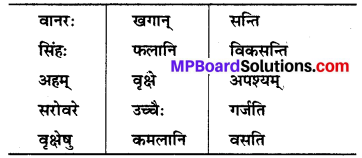
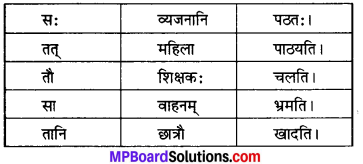
निम्नलिखिततालिकया वाक्यरचनां कुरुत (निम्नलिखित तालिका से वाक्य रचना कीजिए)
Jantushala Meaning In Hindi MP Board
उत्तर:

  1. वानरः वृक्षे वसति।
  2. सिंहः उच्चैः गर्जति।
  3. अहम् खगान् अपश्यम्।
  4. सरोवरे कमलानि विकसन्ति।
  5. वृक्षेषु फलानि सन्ति।

Jantushala In Sanskrit In Hindi MP Board प्रश्न 4.
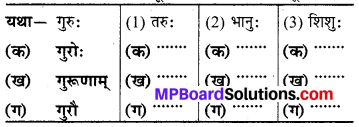
रिक्तस्थानं पूरयत (रिक्त स्थान को पूरा करे)
Class 6 Sanskrit Chapter 14 Question Answer MP Board
उत्तर:

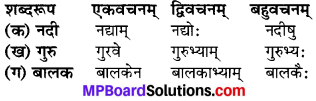
  1. तरुः = (क) तरोः, (ख) तरुणाम्, (ग) तरौ।
  2. भानुः = (क) भानोः, (ख) भानूनाम्, (ग) भानौ।
  3. शिशुः = (क) शिशोः, (ख) शिशूनाम्, (ग) शिशौ।

Class 6th Subject Sanskrit Chapter 14 MP Board प्रश्न 5.
त्वं संदीपः असि। तव मित्रम् अस्ति सुनीलः। तव विद्यालयस्य वार्षिकोत्सवस्य वर्णनं कृत्वा मित्राय एकं पत्रं लिख। (तुम संदीप हो। तुम्हारा मित्र सुनील है। अपने विद्यालय के वार्षिक उत्सव का वर्णन करके मित्र को एक पत्र लिखो।)
उत्तर:

पत्रम् मित्रम् प्रति

उज्जयिनीतः
१४-०२-….

प्रिय मित्र सुनीलः।
सस्नेह नमस्ते।
अत्र सर्वं कुशलं तत्रापि कुशलं भवतु । मम विद्यालये जनवरीमासस्य षड्विंशतिः तारिकायां वार्षिकोत्सवः सम्पन्नः अभवत्। दिसम्बर मासे अर्द्धवार्षिकी परीक्षा समाप्ता जाता। प्रत्येक कक्षा-वर्गस्य छात्रा: विविध कार्यक्रमेषु-क्रिकेट खेलम्, कन्दुक खेलम्, धावन प्रतियोगिताषु-प्रतिभागिनः आसन् सायंकाले विद्यालयस्य विशालकक्षे एकम् सांस्कृतिकम् कार्यक्रमः अपि संजातः। गीतानि, भाषणानि नाटकानि आदि कार्यक्रमानि प्रस्तुतानि छात्रैः। कार्यक्रमस्य अन्ते अस्य उत्सवस्य मुख्यः अतिथि: विद्यालयस्य प्राचार्यः आसीत्। तेन प्रतिभागिनेभ्यः छात्रेभ्यः विविधपुरस्कारैः पुरस्कृताः। सर्वाणि कार्यक्रमाणि अतिरुचिकराणि आसन्। अहं इच्छामि यत् त्वम् स्वपरीक्षानन्तरे – मम गृहं आगच्छः।

तव जनकाय जनन्यै च नमः। स्वस्ति अनुजाय। पत्रोत्तरम्। शीघ्रम् लिखतु।

तत्र मित्रम्
सन्दीपः

योग्यताविस्तारः

1. योग्यशब्दं चित्वा उचितस्थाने लिखत (उचित शब्द चुनकर उचित स्थान पर लिखो)-
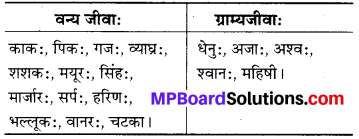
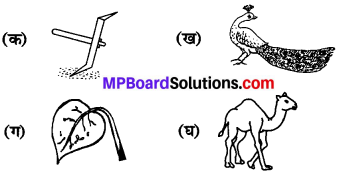
काकः, पिकः, गजः, व्याघ्रः, धेनुः, शशकः, मयूरः, सिंहः, अजा, मार्जार, सर्पः, अश्वः, हरिणः, भल्लूकः, वानरः, श्वानः, महिषी, चटका।
जन्तुशाला Meaning In Hindi MP Board

2. पशुपक्षीणां चित्रावल्याः निर्माणं कुरुत। तेषां नामानि संस्कृते लिखत। (पशुपक्षियों की चित्रावली का निर्माण करो। उनके नाम संस्कृत में लिखिये)
उत्तर:
चित्रावली स्वयं निर्मित करें। पशुपक्षियों के संस्कृत में नाम-वन्य पशवः तथा ग्राम्य पशवः तालिका से लिखें।

जन्तुशाला हिन्दी अनुवाद

भोपालनगरात्
२२-१०-०५

प्रिय मित्र गोपाल!
सस्नेह नमस्ते।
अत्र सर्वं कुशलं तत्रापि कुशलं भवतु। मम मासिकमूल्याङ्कनं समाप्तम्। अहं जनकेन सह जन्तुशालाम् अगच्छम्। किं त्वं जानासि ? जन्तवः अस्माकं मित्राणि सन्ति। जन्तुशालायां जन्तवः अस्माकं मनांसि रञ्जयन्ति। तत्र अहं व्याघ्र जम्बूकं,ऋक्षं, गज, सिंह, वानरं, मकर,शशकं, हरिणं च अपश्यम्। अहं तत्र शुकं, बकं, सारसं, मयूर, हंसं तथा च अन्यान् खगान् अपि अपश्यम्।

अनुवाद :

भोपाल नगर से
२२-१०-०५

प्रिय मित्र गोपाल!
स्नेहपूर्वक नमस्ते।
यहाँ सब कुशल हैं, वहाँ भी कुशल होंगे। मेरी तिमाही परीक्षा समाप्त हो गयी हैं। मैं पिता के साथ जन्तुशाला (चिड़ियाघर) गया था। क्या तुम जानते हो ? जन्तु (प्राणी) हमारे मित्र हैं। जन्तुशाला में जन्तु हमारे मन को प्रसन्न करते हैं। वहाँ मैंने व्याघ्र, जम्बूक (सियार), रीछ, हाथी, सिंह (शेर), बन्दर, मगरमच्छ, खरगोश और हिरण देखे। मैंने वहाँ तोता, बगुला, सारस, मोर, हंस तथा अन्य पक्षियों को भी देखा।

सिंहः उच्चैः गर्जति। वानरः पञ्जरे भ्रमति, उत्पतति च। तस्य पुच्छं दीर्घं भवति। मकरः जले निवसति। मयूरः नृत्यति। सः अस्माकं राष्ट्रीयः पक्षी अस्ति। अलम् अतिविस्तरेण, त्वं अत्र स्थितस्य प्राणिसंग्रहालयस्य अवलोकनार्थं भोपालनगरे मम गृहं आगच्छ। तव जनकाय जनन्यै च नमः। स्वस्ति अनुजाय। पत्रोत्तरं शीघ्रं लिखतु।

तव मित्रम्
सुरेशः

अनुवाद :
सिंह जोर से (ऊँची) गरजना करता है। बन्दर पिंजड़े में घूमता है और उछलता है। उसकी पूँछ लम्बी होती है। मगरमच्छ जल में रहता है। मोर नाचता है। वह हमारा राष्ट्रीय पक्षी है। अधिक विस्तार की आवश्यकता नहीं है। तुम यहाँ स्थित प्राणि संग्रहालय को देखने के लिए भोपाल नगर में मेरे घर आ जाओ। तुम्हारे पिता और माता को नमस्कार। छोटे भाई को स्वस्ति (कल्याण हो)। पत्र का उत्तर शीघ्र लिखो।

तुम्हारा मित्र
सुरेश।

जन्तुशाला शब्दार्थाः

जन्तुशाला = चिड़ियाघर। अस्माकं = हमारा। शुकं = तोता को। रञ्जयन्ति = मनोरंजन करते हैं। बकं = बगुला को। व्याघ्नं = बाघ को। जम्बूकं = सियार को। उच्चैः = जोर से। ऋक्षं = रीछ को। गर्जति = गरजता है। खगान = पक्षियों को। उत्पतति = उछलता है। गज = हाथी को। निवसति = रहता है। वानरं = बन्दर को। अलं = बस। मकरं = मगर को। आगच्छ = आओ। शशकं = खरगोश को। नेष्यामि = ले जाऊँगा। हरिणं = हरिण को। अनुजाय = छोटे भाई को।

MP Board Class 6th Sanskrit Solutions

MP Board Class 8th Social Science Solutions Miscellaneous Questions 1

MP Board Class 8th Social Science Solutions Miscellaneous Questions 1

Write the correct options to the following questions:

(i) Under whose leadership English fleet reached India.
(a) Duplex
(b) Robert Clive
(c) Captain Hokins
(d) Charles IInd
Answer:
(c) Captain Hokins

Miscellaneous Questions 1 Class 8 Question 2.
The ban on the import of Indian clothes was slapped an act in England in:
(a) 1700
(b) 1813
(c) 1793
(d) 1716
Answer:
(a) 1700

Mp Board Solution Class 8 Social Science Question 3.
Which book has mention of Sanyase Revolt against British:
(a) Geet Govind
(b) Anand Math
(c) Kamayani
(d) Ein-e-Akbari
Answer”
(b) Anand Math

Mp Board Solution Social Science Class 8 Question 4.
The Varna system in ancient times was based on:
(a) Religion
(b) Karma
(c) Yagna
(d) Caste
Answer:
(b) Karma

Social Science Class 8 Mp Board Solution Question 5.
Who said, ‘Democracy is the govt, of the people, by the people and for the people:
(a) Abraham Lincon
(b) Mahatma Gandhi
(c) Pt. Jawaharlal Nehru
(d) Karl Marx
Answer:
(c) Pt. Jawaharlal Nehru

Mp Board Solution Class 8th Social Science Question 6.
What is called the upper layer of the earth?
(a) Earth crust
(b) Rocks
(c) Hydrosphere
(d) Atmosphere
Answer:
(a) Earth crust.

Class 8 Mp Board Solution Social Science Question 7.
Narmada River makes shapes at its mouth-
(a) Estuary
(b) V-shaped valley
(c) Waterfall
(d) Oxbow
Answer:
(a) Estuary

Fill in the Blanks:

  1. Alivardi Khan was made Nawab of Bengal in ……………
  2. The Act in 1843 was passed to check …………… custom.
  3. The khadi revolt was led under the leadership of ………….
  4. …………. is easy and useful to impart education.
  5. In our country as per constitution …………. form of governance is established.
  6. The 80 percent area of earth is covered by ………….. rocks.
  7. Bhedaghat ……………… in Jabalpur is worth watching.

Answer:

  1. 1740
  2. Slavery
  3. King Tirahsing
  4. Mother-tongue
  5. Democratic
  6. Sedimentary
  7. Gorge

MP Board Class 8th Social Science Miscellaneous Questions 1 Very Short Answer Type Questions

Class 8 Sst Mp Board Solution Question 1.
On which ground Dalhousie made Avadh province a part of the British government?
Answer:
In 1856 Nawab of Avadh was accused of having misgoverning his state and thus it was annexed to British rule by Dalhousie.

Social Science Class 8th Mp Board Question 2.
When and who established the Asiatic Society?
Answer:
In 1784 Sir Villiam Jones founded the Asiatic Society of Bengal. Efforts were made to study Indian History and Culture through this society.

Mp Board Class 8 Social Science Solution Question 3.
Who opposed use of new cartridges at Barrackpore?
Answer:
In Barrackpore Mangal Pandey had stood against the introduction of the new Cartridges and he had been executed.

Class 8 Social Science Mp Board Solution Question 4.
Which are our National festivals?
Answer:
26th January (Republic day), 15th August (Independent day) and 2nd Oct. (Gandhi Jayanti) are our national festivals.

Class 8th Sst Mp Board Solution Question 5.
Which is called ‘Fourth Estate’ of democracy?
Answer:
Free press is the fourth estate of democracy.

Mp Board Solution Class 8 Subject Social Science Question 6.
What is called the originating site of earthquake?
Answer:
The place, where earthquake originates, is called earthquake epicenter.

Class 8 Mp Board Solution Question 7.
What is Loess?
Answer:
Fine particles of sand suspended in wind are called Loess. They are carried over long distances much away and deposited there as Loess. The most important Loess region of the world is in north China.

MP Board Class 8th Social Science Miscellaneous Questions 1  Short Answer Type Questions

Class 8th Social Science Mp Board Question 1.
Mention any one of the reasons of English success in India?
Answer:
There are many reasons of English success. But their policy of Divide and Rule was one of them.

Meaning of the policy of Divide and Rule:
The policy of Divide and Rule’ means to create differences among the people on the basis of caste, region, religion etc. it aims at creating disunity among the natives. The British Government wanted to keep its hold over the conquered people i.e. Indians by dividing them. The main features of the British policy of “divide and rule’ were can be given as below:

  1. They divided India into two parts, viz. the British India and the Indian States. They provided more facilities to the people of the British India in comparison to the people living in the Indian States. This created differences among the people.
  2. They followed a systematic policy of dividing – the Hindus and the Muslims, favouring one section against another at one time.
  3. The British provided opportunities of employment to the sons of the Zamindars and land-lords. It created unrest among the middle class people.
  4. They practiced the policy of‘Divide and Rule’ in military administration also. The troops were organised on the basis of region, caste, tribes, etc.

Mp Board Solution Class 8 Question 2.
What was the Ryotwari System?
Answer:
Ryotwari System: A system of land revenue introduced in Madras and Bombay
Presidencies. The cultivator in this case would pay fifty percent of his produce to the govern¬ment every year.

Mp Board Class 8th Social Science Solution In English Question 3.
Describe about Ramosi Revolt?
Answer:
The Ramosi tribe in the Western Ghats under the leadership of Sardar Chitar Singh revolted against British Rule in 1822. They plundered the region nearby Satara.

Class 8th Mp Board Social Science Question 4.
Define the role of tourism in national integration?
Answer:
Tourism right from the start had been the important factor of National integration. Tourism helps sense of unity and offers opportunity to know our vast country. Tourism brings us very close. People know the problems of each other and this build equal feelings and equal outlook among the people. It is also helpful to know the development in culture, economy and industry. Thus tourism is a means of national integration.

Question 5.
What do you mean by Non-Alignment?
Answer:
(a) Non – alignment – Non – alignment means keeping away from aligning with any other group or power bloc. Pt. Nehru with some other government premier developed Non – alignment as a global movement.

Question 6.
Why the plains are called Cradle of Civilization?
Answer:
Plain-The smooth wide and low lying having low height is the area known as plain. The plains are suitable place for human habitat because people fulfill their needs of food, clothes, housing and other necessities. Hence, all the civilizations of the world originated in plain areas. Thus, the plains are known as ‘Cradle of civilization’.

MP Board Class 8th Social Science Miscellaneous Questions 1 Long Answer Type Questions

Question 1.
Describe the battle of Buxar?
Answer:
The English had brought Mir Qasim as the Nawab of Bengal in place of Mir Jafar, thinking that Mir Qasim would as a better puppet. But the English were disappointed Mir Qasim attempted to become independent of the English. In the process, he dismissed the officials loyal to the Company and withdrew the trade concessions granted to the British. This annoyed the English. This also led to the battle between the English in the one hand, and the Nawabs of Bengal and Awadh as also the Mughal Emperor Shah Alam on the other. This battle is called the battle of Buxar. (1764)

The following were the consequences of the battle of Buxar:

  • The English defeated the natives and this paved the way for the English to became the virtual ruler of India.
  • The English East India Company secured the Diwani of Bengal, Bihar and Orissa.
  • The Mughal Emperor though got the areas of Allahabad and Kora, but lived himself under the protection of the Company.
  • The Company promised to pay Rs. 26 lacs every year, but soon after stopped paying it.
  • Mir Jafar was again appointed as the Nawab of Bengal and in the meantime the Company amassed huge money.
  • The Nawab of Awadh became dependent on the Company as the letter’s troops were stationed in Awash to protect the Nawab.

Question 2.
Describe the law and order system of British Rule in India.
Answer:
In 1774, the Supreme Court was established at Calcutta. For sometime, the English judges of this court tried to apply English law because they knew no other law. But the Indians did not like it. So an Act 1781 restricted the application of English law to Englishmen only.

But as conditions changed, the need for definite codes applicable to the Indian subjects were keenly felt. The Bengal Regulation of 1793 was passed. It bound the courts to take decisions on the rights of persons and property of the Indians.

The court applied the principles of justice, equality and goods conscience. The laws were printed and published in English and Indian languages. In 1883, the government appointed the Indian Law Commission. The courts were reorganized. Every district came to have a civil and criminal Court. There were Courts of Appeal. The Indians were made to feel that the “rule of law” was being established, which implied that everybody was equal in the eyes of law.

The establishment of law and order was necessary for a peaceful living. This was the purpose for which the police force was organised in India by the company. It was during Cornwalli’s period that the police was given a regular shape in 1791. A superintendent of Police was appointed at Calcutta and soon, such officials were appointed in other cities.

The districts were divided into thanas and each thana was put under the charge of Daroga. Though the police was to maintain law and order, it never became popular. It soon earned much notoriety far its corruption and harassment of the common people.

Question 3.
Write about the status of farmers and artisans of India before 1857?
Answer:

1. The introduction of land laws by the British had a vary bad effect on the economic life of the farmers. They were doomed. They had to mortgage or sell their land because they could not pay the revenue in time. The ownership of lands was inequitable.

2. Land became a saleable property. The new land laws introduced the use of cash currency in the field of agriculture.

3. Cash crops and plantation products became commodities for sale in markets. So land laws helped in an indirect way the Indian agriculture production. Poppy cultivation was encouraged. Cotton, jute, tea and coffee and other cash crops were grown in abundance for profitable export trade. The merchants and Zamindars earned huge profits, but the benefits did not reach the cultivators. Some of the main points that affected the indigenous industries by the Industrial policy of the British Government are as under:

  • The British officials did not patronize the Indian goods.
  •  Restrictions were imposed on the entry of Indian textile products by laws passed in Britain 1700 A.D. and 1720 A.D. Steps were taken in India and in Britain to serve the interest of the British traders and manufactures at the cost of the Indian industries.
  • The company’s agents in India forced the , products or goods or charge 20 to 40
    percent less than the market price.
  • They manipulate the prices of raw cotton. This almost wiped out the cotton textile industry in India.
  • The British goods coming to India were exempted from duties, but the Indian exports of Britain were subjected to high import duty. The free trade policy proved ruinous to Indian industries.
    The Indian artisans were ruined by this policy. They lost their job and they became poorer.

Question 4.
Communal-ism is a threat for unity of Country. How?
Answer:
Communal-ism is a force that has played a negative role in our country. It has divided the country into two parts. It has led to communal riots. At times, these forces of communal-ism result in conflicts among the different communities. These conflicts eat away the vitality of our country and strike at our unity and integrity. To cover up the evil of communal-ism, we must respect each other’s religion.

Question 5.
W rite about the important of voting in democracy?
Ans. In a democracy, the people of the country elect the government. Only the citizens of the country have the right to vote. They elect their representatives who for the legislature. To choose a right kind of representative there is a great importance of voting. We should vote who possess the following qualities:

A voter should keep in mind the following considerations before voting:

  • He should vote only for a person who can serve the cause of the people with devotion and dedication. He should be well abreast with the qualities of the candidate.
  • He should cast his vote in favor of able, honest, selfless candidates.
  • He should not vote under any kind of threat or temptation whatsoever because the efficiency of the government depends mainly upon his judicious exercise of vote.
  • At the time of voting, he should rise above caste, creed or provincial and linguistic feelings because such considerations weaken the very spirit of democracy. Such considerations strike at the root of national unity and pollutes the social atmosphere.
  • He should not vote for such candidates who defect their party after elections. Defection corrupts the political life of the country, brings self-interest to the fore and throws people’s interest into the background.
    In a democracy voting plays a important role.

Question 6.
Describe the types of Volcanoes.
Answer:
Volcano is an opening on the earth crust, in the form of lava which emits molten magma, rock pieces, gases and steam on the surface of the earth usually with great noise and thunder. The lava and other material comes out through deep tissues in the crust. Sometimes, this material gets deposited around the opening of volcano called vent and forms a conical volcanic mountain.

There are mainly three kinds of volcanoes:
1. Active Volcano:
There are volcanoes which keep on erupting frequently. Mount Etna Sicily and Barren Island in the Andaman Nicobar Island in India are examples of active volcano.

2. Dormant Volcano:
Volcanoes which have not erupted for quite a long time but there is possibility that they may erupt any time. Such volcanoes are called sleeping volcano or dormant. The Visuvious near Naples in Italy is an example of Dormant Volcano.

3. Extinct Volcano:
Volcanoes which had erupted a long time before but have not erupted for the last four years are known as extinct volcano. Mt. Kilimanjaro in Tanzania in East Africa is an example of extinct volcano.

Question 7.
Mention the land forms made by the erosion of rivers.
Answer:
The work of river in upper course. The river is powerful agent of gradation. In order to understand the work of river as running water it is divided into 3 parts each part depicting its work from origin to the final destination i.e. sea. Upper part is described as childhood of the river, middle course as youth and lower courses as the old age.

Upper course. When the river originates from glaciers, it flows very swiftly down the slope. The river takes along the stones and rock material etc. with its strong current. Thus the water,, boulders, moving along with the river cause deepening of the bed and also widening of the banks. The river in its upper course is busy in erosion and transportation of material which results into formation of many peculiar land forms.

Some of them are as follows:
Gorge. The river flows through an area which is made up of hard rocks. It cuts constantly the floor of the river (called river bed) and forms a deep and narrow valley which looks like I letter of English. Thus a gorge is formed.

V-shaped Valley:
V-shaped valley is formed when the river passes through an area having heavy rainfall and its bank made up of soft material. The river banks due to rain get widening and the river bed goes on deepening. Thus, giving rise to a valley working, the shape of English alphabet ‘V’.

Waterfall:
Waterfall, is a sudden descent of water over a big vertical step formed in a river bed. It is generally formed at the edge of river, hard rock over laing a soft one. The waterfall, the river water falls down almost vertically along its course.

Rapids:
When the waterfall instead of falling straight downwards falls through the rock by hoping suipping and leaping some ladder by the land form is made it is called rapid.

Cascades:
A series of rapids are called cascades. Alluvial fans. Is a semicircular inform and points up streams. It is broader than alluvial cone but its height is less. The Himalayas, Rockies and Anders form alluvial fans. Oxbow lake, Natural lever and flood plains, delta and Estuary are formed by the erosion of rivers.

MP Board Class 8th Social Science Solutions

MP Board Class 7th Social Science Solutions Chapter 23 The Administration of the Mughal and the Life of the People

MP Board Class 7th Social Science Solutions Chapter 23 The Administration of the Mughal and the Life of the People

MP Board Class 7th Social Science Chapter 23 Text Book Questions

Choose the correct alternatives:

Class 7 Social Science Chapter 23 Question 1.
During the Mughal period the Di-wan or Wazir looked after:
(a) The income & expenditure
(b) The army
(c) Home affairs
(d) Judicial affairs
Answer:
(a) The income & expenditure

Mp Board Class 7th Social Science Chapter 23 Question 2.
The main occupation of the people during the Mughal rule was:
(a) Agriculture
(b) Timber industry
(c) Foreign trade
(d) None of the above
Answer:
(a) Agriculture

Mp Board Solution Class 7 Social Science Question 3.
Which new faith was propagated by Akbar:
(a) Din-i-illahi
(b) Bhakti Movement
(c) Sikhism
(d) All the above
Answer:
(a) Din-i-illahi

Fill in the blanks:

  1. The court language was …………. during the Mughal period. (Sanskrit, Arabic, Urdu and Pessian)
  2. During the reign of Akbar …………. was the great singer of India, (Tansen, Tulsidas, Raidas, Mirabai).
  3. The ………….. built by Shajahan is included in the world heritage site. (Jama Masjid, Redfort, Tajmahal, Hawaniahal)

Answer:

  1. Urdus and Persian
  2. Tansen
  3. Tajmahal.

MP Board Class 7th Social Science Chapter 23 Short Answer Type Questions

Mp Board Solution Class 7th Social Science Question 1.
Write a short account of the administration of the Mughal period.
Answer:
The Emperor was all powerful. He ruled with the help of his army. There were many Ministers to did and assist the Emperor, e.g. Wakil, Wazir or Diwan, Mirabakshi, Khan – i – sama, Qazi – ul – Qazat etc. Akbar introduced the provincial system of administration in his empire. He divided his empire in 18 Subas.

Mp Board Solutions.Com Class 7 Question 2.
Name of the items of import and export during the Mughal period.
Answer:

1. Items of import:
Gold, Silver, Copper, Tin, Steel, Glass, Minors, Wines, Horses, Corals, Mercury etc.

2. Items of export:
Muslim, Spices, Turmeric, Gun powder, Indigo, opium, Sugar, Gum, Sugar candy, Precious stones etc.

Class 7 Social Science Mp Board Solution Question 3.
Give an account of Akbar’s religious policy.
Answer:
Akbar followed a policy of broad religious toleration. He gave full religious freedom to die people. In 1594 he abolished the Jazia which was used by the Ulema to humiliate the non – Muslims. He abolished the pilgrim’s tax. Generally he removed himself from orthodoxy in Islam. He set up a new religion which was compounded of many existing religions Hinduism, Christianity, Zoroastrianism etc. This new religion was known as Din-i-Illahi.

MP Board Class 7th Social Science Chapter 23 Long Answer Type Questions

Mp Board Solution Class 7th Sst Question 1.
Describe with examples the development of architecture during the Mughal Period.
Answer:
The Mughal Emperors were great lovers of architecture. The buildings of this period reflect the fusion of Hindu – Muslim – style of architecture. The tomb of Humayun is an excellent piece of architecture. Akbar built the city of Fatehpur Sikri in which besides Buland Darwaza many beautiful buildings were also constructed. Noorjahan built the tomb of her father Itmad – ud – daulah that was decorated wife precious gems.

The Tajmahal built by Shahjahan in fee memory of his Begun Mumtaz is fee best example of architecture of Mughal period. It has been included in fee World Heritage Site. Shahjahan also built – Jama Masjid at Delhi and Agra, The Red Fort of Delhi, Shish Mahal etc. The Moti Masjid was built by Aurangzeb. Thus we can find magnificent buildings during fee Mughal period.

MP Board Class 7th Social Science Solutions

MP Board Class 6th Special English Solutions Chapter 7 Who Has Seen the Wind

Students who wish to prepare the English Subject can rely on the MP Board Solutions for Class 6 English Chapter 7 Who Has Seen the Wind Questions and Answers prevailing. Become perfect with the concepts of Class 6 English Chapter 7 Who Has Seen the Wind Questions and Answers, Grammar, Summary, Notes, Guide, Pdf, by preparing you can score highest grade in your exams. Here, You Can Download MP Board Class 6 English Solutions. Detailed Solutions are provided to the concepts by experts keeping in mind the latest edition textbooks and syllabus.

MP Board Class 6th Special English Solutions Chapter 7 Who Has Seen the Wind

Ace up your preparation by referring to the Madhya Pradesh State Board Solutions for Class 6 Chapter 7 Who Has Seen the Wind Questions and Answers and learn all the topics within. Click on the topic you want to prepare from the Class 6 English and prepare it easily. You can understand your strengths and weaknesses by learining the Questions and Answers in MP Board Solutions for Class 6 English PDF.

Who Has Seen the Wind Text Book Exercise

Word Power

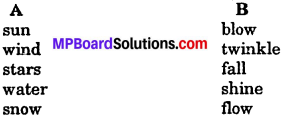
1. Match the column ‘A’ with ‘B’.
Who Has Seen The Wind MP Board Class 6th
Answer:
1. → (d)
2. → (a)
3. → (6)
4. → (e)
5. → (c)

Comprehension

Answer these questions:

Class 6 English Chapter 7 Who Has Seen The Wind MP Board Question 1.
Has anyone seen the wind?
Answer:
No, no one has seen the wind.

Who Has Seen The Wind Poem Questions And Answers Class 6 MP Board Question 2.
What do the leaves do when the wind is passing through?
Answer:
The leaves hang trembling when the wind is passing through.

Who Has Seen The Wind Question Answer MP Board Class 6th Question 3.
How do we know that the wind is passing by?
Answer:
We know that the wind is passing by when the trees bow down their heads.

Let’s Write

Who Has Seen The Wind Class 6 MP Board Question 1.
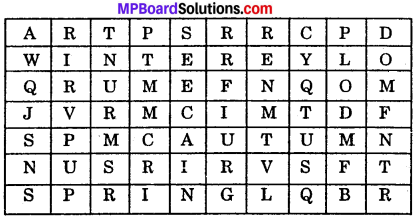
Find.out the name of the seasons hidden in this grid and write them in your note books.
Who Has Seen The Wind Poem Questions And Answers MP Board Class 6th
Answer:
Winter, Autumn, Spring.

Who Has Seen the Wind Word Meanings

Page 1: Trembling – shaking, कांपना Bow – bend, झुकना!

Hope the data shared has shed some light on you regarding the MP Board Solutions of Class 6 English Chapter 7 Who Has Seen the Wind Questions and Answers. Do leave us your queries via the comment section and we will guide you at the earliest with help seeked. Stay connected with our website and avail the latest information in a matter of seconds.

MP Board Class 11th Chemistry Solutions Chapter 9 हाइड्रोजन

MP Board Class 11th Chemistry Solutions Chapter 9 हाइड्रोजन

हाइड्रोजन NCERT अभ्यास प्रश्न

प्रश्न 1.
हाइड्रोजन के इलेक्ट्रॉनिक विन्यास के आधार पर आवर्त सारणी में इसकी स्थिति को युक्तिसंगत ठहराइए।
उत्तर:
हाइड्रोजन आवर्त सारणी में स्थित प्रथम तत्व है। इसका इलेक्ट्रॉनिक विन्यास 1s1  है। यह क्षार धातुओं की भाँति, एक इलेक्ट्रॉन का त्याग करके H+ आयन बना सकता है। यह हैलोजनों की भाँति, एक इलेक्ट्रॉन ग्रहण करके H आयन भी बना सकता है। क्षारीय धातुओं की भाँति यह ऑक्साइड, हैलाइड तथा सल्फाइड बनाता हैं। यद्यपि क्षारीय धातुओं के विपरीत इसकी आयनन एन्थैल्पी उच्च होती है तथा सामान्य स्थितियों में यह धात्विक व्यवहार प्रदर्शित नहीं करता है। वास्तव में आयनन एन्थैल्पी के पदों में यह हैलोजनों से अधिक समानता प्रदर्शित करता है।

हैलोजनों के समान, यह द्विपरमाणुक अणु बनाता है, तत्वों से क्रिया करके हाइड्राइड तथा अनेक सहसंयोजी यौगिक बनाता है। यद्यपि हैलोजनों के विपरीत इसकी क्रियाशीलता बहुत कम होती हैं। अतः उपरोक्त गुणों के आधार पर, आवर्त सारणी में हाइड्रोजन को क्षार धातुओं के साथ वर्ग-1 तथा प्रथम आवर्त अथवा हैलोजन के साथ वर्ग-17 तथा प्रथम आवर्त में रखना चाहिए। यद्यपि क्षार धातुओं तथा हैलोजनों के साथ गुणों में समानता के साथ-साथ, यह क्षार धातुओं तथा हैलोजनों के साथ गुणों में विभिन्नता भी दर्शाता है। अत: इसे आवर्त सारणी में पृथक स्थान दिया जाना चाहिए।

प्रश्न 2.
हाइड्रोजन के समस्थानिकों के नाम लिखिए तथा बताइए कि इन समस्थानिकों का दव्यमान अनुपात क्या है ? ।
उत्तर:
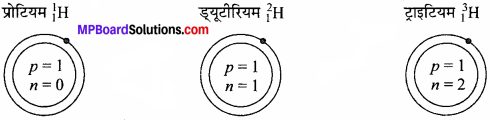
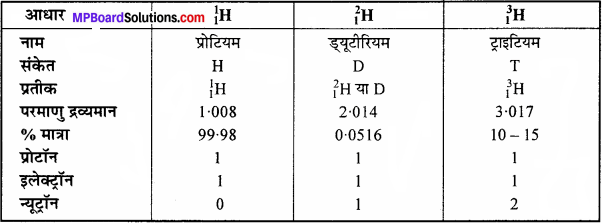
हाइड्रोजन के तीन समस्थानिक है-प्रोटियम \(\left(_{1}^{1} \mathrm{H}\right)\), ड्यूटीरियम (\(\left(_{1}^{2} \mathrm{H}\right)\) या D) और ट्रीटियम (\(\left(_{1}^{3} \mathrm{H}\right)\)या T)। तीनों समस्थानिकों का द्रव्यमान अनुपात है –
MP Board Class 11th Chemistry Solutions Chapter 9 हाइड्रोजन - 2

प्रश्न 3.
सामान्य परिस्थितियों में हाइड्रोजन एक परमाण्विक की अपेक्षा द्विपरमाण्विक रूप में क्यों पाया जाता है ?
उत्तर:
एक परमाणुक रूप में हाइड्रोजन के प्रथम कोश में एक इलेक्ट्रॉन (1s1) होता है जबकि द्विपरमाणुक अवस्था का प्रथम कोश पूर्ण (1s2)होता है। इसका तात्पर्य है कि द्विपरमाणुक रूप में हाइड्रोजन (H2) उत्कृष्ट गैस हीलियम का विन्यास प्राप्त कर लेता है। अतः यह काफी स्थायी होती है।

प्रश्न 4.
कोल गैसीकरण से प्राप्त डाइ-हाइड्रोजन का उत्पादन कैसे बढ़ाया जा सकता है ?
उत्तर:
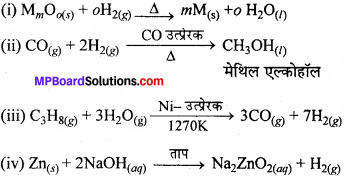
कोल गैसीकरण अभिक्रिया में, जल की वाष्प को प्रवाहित करके CO और H2 का मिश्रण बनाया जाता है जिसे सिन गैस भी कहा जाता है
MP Board Class 11th Chemistry Solutions Chapter 9 हाइड्रोजन - 3

कोल भाप सिन गैस डाइहाइड्रोजन का उत्पादन सिन गैस में उपस्थित CO(g) की आयरन क्रोमेट उत्प्रेरक की उपस्थिति में भाप के साथ क्रिया द्वारा बढ़ाया जा सकता है।
MP Board Class 11th Chemistry Solutions Chapter 9 हाइड्रोजन - 4
CO(g) या CO2(g) के निकलने के साथ ही अभिक्रिया अग्र दिशा में विस्थापित हो जाती है।

प्रश्न 5.
विद्युत् – अपघटन विधि द्वारा डाइहाइड्रोजन वृहत् स्तर पर किस प्रकार बनाई जा सकती है? इस प्रक्रम में वैद्युत-अपघट्य की क्या भूमिका है ?
उत्तर:
अम्लीकृत जल का प्लैटिनम इलेक्ट्रोडों द्वारा वैद्युत – अपघटन करने पर हाइड्रोजन प्राप्त होती है।
MP Board Class 11th Chemistry Solutions Chapter 9 हाइड्रोजन - 5
वैद्युत अपघट्य की भूमिका जल का चालन करना है।

प्रश्न 6.
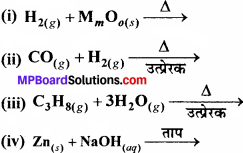
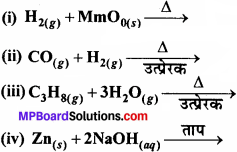
निम्नलिखित समीकरणों को पूरा कीजिए –
MP Board Class 11th Chemistry Solutions Chapter 9 हाइड्रोजन - 6
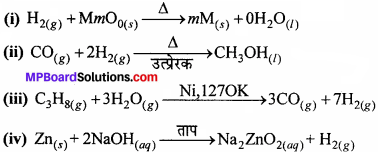
उत्तर:
MP Board Class 11th Chemistry Solutions Chapter 9 हाइड्रोजन - 7

प्रश्न 7.
डाइहाइड्रोजन की अभिक्रियाशीलता के पदों में H – H बन्ध की उच्च एन्थैल्पी के परिणामों की विवेचना कीजिए?
उत्तर:
H – H आबन्ध की उच्च आबन्ध वियोजन एन्थैल्पी के कारण, हाइड्रोजन कमरे के तापमान पर अपेक्षाकृत अक्रियाशील रहती है । यद्यपि उच्च तापों पर अथवा उत्प्रेरक की उपस्थिति में, यह अनेक धातुओं तथा अधातुओं के साथ क्रिया करके हाइड्राइड बनाती है।

प्रश्न 8.
हाइड्रोजन के –

  1. इलेक्ट्रॉन न्यून
  2. इलेक्ट्रॉन परिशुद्ध तथा
  3. इलेक्ट्रॉन समृद्ध यौगिकों से आप क्या समझते हैं? उदाहरणों द्वारा समझाइए।

उत्तर:
1. इलेक्ट्रॉन न्यून हाइड्राइड:
इन हाइड्राइड्स की लुईस संरचना लिखने पर, इनमें इलेक्ट्रॉन की संख्या अपर्याप्त है, इसका उदाहरण डाइबोरेन [B2H6] है। अतः आवर्त सारणी के 13वें वर्ग के सभी तत्वों के हाइड्राइड इलेक्ट्रॉन न्यून यौगिक बनाते हैं, BH3, AIH3, GaH3, InH3, TIH3 से लुईस अम्ल की भाँति कार्य करते हैं।

2. इलेक्ट्रॉन परिशुद्ध हाइड्राइड:
इन हाइड्राइड की लुईस संरचना में इनमें इलेक्ट्रॉनों की संख्या पर्याप्त होती है। [8es] आवर्त सारणी के वर्ग 14 के तत्वों के हाइड्राइड इसके अन्तर्गत आते हैं। इनकी आकृति चतुष्फलकीय होती है।
उदाहरण – CH4, SiH4, GeH4, SnH4, PbH4

3. इलेक्ट्रॉन समृद्ध हाइड्राइड:

  • इन हाइड्राइड्स में उपस्थित केन्द्रीय परमाणु पर इलेक्ट्रॉन आधिक्य एकाकी इलेक्ट्रॉन युग्म उपस्थित होते हैं।
  • आवर्त सारणी के वर्ग 15, वर्ग 16 व वर्ग 17 के तत्वों के हाइड्राइड इलेक्ट्रॉन समृद्ध हाइड्राइड्स कहलाते हैं।
    MP Board Class 11th Chemistry Solutions Chapter 9 हाइड्रोजन - 8

प्रश्न 9.
संरचना एवं रासायनिक अभिक्रिया के आधार पर बताइए कि इलेक्ट्रॉन न्यून हाइड्राइड के कौन-कौन से अभिलक्षण होते हैं ?
उत्तर:
इलेक्ट्रॉन न्यून हाइड्राइडों में सामान्य सहसंयोजी आबंधों के निर्माण हेतु इलेक्ट्रॉनों की संख्या पर्याप्त नहीं होती है। उदाहरण के लिए, BF3, में B (F : \(\overset { F }{ \underset { B }{ ¨ } } \) : F) के संयोजी कोश में 6 इलेक्ट्रॉन होते हैं। इन हाइड्राइडों का आकार त्रिकोणीय समतलीय होता है।
MP Board Class 11th Chemistry Solutions Chapter 9 हाइड्रोजन - 9
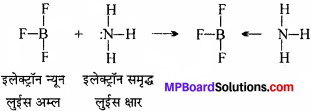
ये हाइड्राइड लुईस अम्ल अर्थात् इलेक्ट्रॉन ग्राही के भाँति कार्य करते हैं। जैसे –
MP Board Class 11th Chemistry Solutions Chapter 9 हाइड्रोजन - 10
इलेक्ट्रॉनों की कमी पूरा करने के लिए, ये हाइड्राइड बहुलक के रुप में पाये जाते हैं। जैसे – B2H4 B4H10, (AlH3)n आदि। ये हाइड्राइड अत्यधिक क्रियाशील होते हैं। ये धातुओं, अधातुओं तथा उनके यौगिकों के साथ सुगमतापूर्वक क्रिया करते हैं। उदाहरण के लिए –
B2H6(g) + 3O6(g) → B2O6(s) + 3H2O(g)

प्रश्न 10.
क्या आप आशा करते हैं कि (CnH2n+2) कार्बनिक हाइड्राइड्स लुईस अम्ल या क्षार की भाँति कार्य करेंगे ? अपने उत्तर को युक्तिसंगत ठइराइए।
उत्तर:
(CnH2n+2) प्रकार के कार्बन हाइड्राइड, इलेक्ट्रॉन समृद्ध हाइड्राइड है। इनके पास सहसंयोजी आबंध बनाने हेतु पर्याप्त इलेक्ट्रॉन हैं। अतः ये न तो लुईस अम्ल और न ही लुईस क्षार की भाँति व्यवहार करेंगे।

प्रश्न 11.
अरससमीकरणमितीय हाइड्राइड (Non stoichiometric hydride) से आप क्या समझते हैं ? क्या आप क्षारीय धातुओं से ऐसे यौगिकों की आशा करते हैं ? अपने उत्तर को न्यायसंगत ठहराइए।
उत्तर:
ये हाइड्राइड अनेक d – ब्लॉक के तत्वों (वर्ग – 7, 8 तथा 9 की धातुओं को छोड़कर) तथा fब्लॉक के तत्वों द्वारा बनते हैं। हाइड्राइड सदैव अरससमीकरणमितीय अर्थात् हाइड्रोजन की कमी वाले होते हैं। इन हाइड्राइडों में हाइड्रोजन परमाणु अंतरकाशी स्थानों को घेरता है।
उदाहरण – LaH2.87, YbH2.55, TiH15-1.8, PdH0.6-0.8आदि।

इस प्रकार के हाइड्राइड क्षारीय धातुओं द्वारा नहीं प्राप्त किए जा सकतें हैं। क्षारीय धातुओं द्वारा आयनिक अथवा लवणीय हाइड्राइड प्राप्त होते हैं। जो रससमीकरणमितीय होते है। क्षारीय धातुएँ अत्यधिक धनविद्युती होती है अतः ये इलेक्ट्रॉन H-परमाणु को स्थानांतरित करके H आयन बनाती है। ये H आयन जालक की रिक्तियों में समा जाते हैं।

प्रश्न 12.
हाइड्रोजन भण्डारण के लिए धात्विक हाइड्राइड किस प्रकार उपयोगी है ? समझाइए।
उत्तर:
कुछ धातुएँ जैसे पैलेडियम (Pd), प्लेटिनम (Pt) आदि अपनी हाइड्राइड बनाने वाली सतह पर हाइड्रोजन के विशाल आयतन को अवशोषित करने की क्षमता रखती हैं। वास्तव में हाइड्रोजन (H) परमाणुओं के रूप में धातु के पृष्ठ पर वियोजित हो जाता है। इन परमाणुओं को समायोजित करने के लिए धातु जालक फैल जाता है और गर्म करने पर अधिक अस्थायी हो जाता है।

हाइड्राइड हाइड्रोजन मुक्त करके पुनः धात्विक अवस्था में परिवर्तित हो जाता है। इसी तरीके से उत्पन्न हाइड्रोजन ईंधन की तरह प्रयुक्त हाइड्रोजन के संग्रहण एवं परिवहन में प्रयुक्त की जा सकती है। अतः धातु हाइड्राइड हाइड्रोजन अर्थ-व्यवस्था में बहुत उपयोगी भूमिका निभाता है।

प्रश्न 13.
बर्तन और वेल्डिंग में परमाण्विय हाइड्रोजन अथवा ऑक्सी हाइड्रोजन टॉर्च किस प्रकार कार्य करती है ? समझाइए।
उत्तर:
धात्विक हाइड्राइडों में हाइड्रोजन, H-परमाणु के रुप में अधिशोषित हो जाती है। संक्रमण धातुओं में हाइड्रोजन परमाणु के इस अधिशोषण का प्रयोग हाइड्रोजन भंडारण के रुप में होता हैं । Pd, Pt जैसी धातुएँ हाइड्रोजन के वृहत् आयतन को समायोजित कर सकती हैं । इस गुण की हाइड्रोजन भंडारण तथा ऊर्जा स्रोत के रुप में प्रयोग की प्रबल संभावना है। धात्विक हाइड्राइड गर्म करने पर अपघटित होकर हाइड्रोजन तथा अंतिम धातु देते हैं।

प्रश्न 14.
NH3, H2O तथा HF में से किसका हाइड्रोजन बन्ध का परिमाण उच्चतम अपेक्षित है और क्यों ?
उत्तर:
चूँकि F की वैद्युतऋणात्मकता का मान अधिकतम है। अत: HF में हाइड्रोजन पर धनावेश तथा फ्लुओरीन पर ऋणावेश का परिमाण सर्वाधिक होगा जिसके कारण H आबंधन का स्थिर वैद्युत आकर्षण बल H-F में अधिकतम होगा।

प्रश्न 15.
लवणीय हाइड्राइड, जल के साथ प्रबल अभिक्रिया करके झाग उत्पन्न करती है। क्या इसमें CO2 (जो एक सुपरिचित अग्निशामक है) का उपयोग हम कर सकते हैं ? समझाइए।
उत्तर:
लवणीय हाइड्राइड (NaH या CaH2) जल के साथ क्रिया करता है तो अभिक्रिया इतनी ज्यादा ऊष्माक्षेपी होती है कि उत्पन्न हाइड्रोजन आग पकड़ लेती है।
उदाहरण के लिए –

  • NaH(s) + H2O(aq) → NaOH(aq) + H2(g) + ऊष्मा
  • CaH2(s) + 2H2O(aq) → Ca(OH)2(aq) + 2H2(g)

प्रायः अग्निशामक के रूप में प्रयोग की जाने वाली CO2 को इस स्थिति में प्रयुक्त नहीं किया जा सकता है, क्योंकि यह अभिक्रिया में निर्मित हाइड्रोजन के साथ अभिक्रिया करके कार्बोनेट बनाएगी। इससे अग्र अभिक्रिया की दर बढ़ जाएगी।
2NaOH(aq) + CO2(g) → Na2CO3(aq) + H2O(aq)

प्रश्न 16.
निम्नलिखित को व्यवस्थित कीजिए –

  1. CaH2, BeH2, तथा TiH2, को उनकी बढ़ती हुई विद्युत् चालकता के क्रम में
  2. LiH, NaH तथा CSH आयनिक गुण के बढ़ते हुए क्रम में
  3. H-H, D-D तथा F_F को उनके बन्ध – वियोजन एन्थैल्पी के बढ़ते हुए क्रम में
  4. NaH, MgH2, तथा H2O को बढ़ते हुए अपचायंक गुण के क्रम में।

उत्तर:
1. BeH2 < CaH2 < TiH2
2. बढ़ता हुआ आयनिक गुण LiH < NaH < CsH
बढ़ता हुआ आयनिक गुण LiH < NaH < CsH क्रम में घटता है। यह आयनिक गुण पर विपरीत प्रभाव डालता है अर्थात् उपर्युक्त के अनुसार बढ़ जाता है।

3. बढ़ती हुई बन्ध वियोजन एन्थैल्पी – F – F < H – H < D – D
कारण:
फ्लुओरीन की बन्ध-वियोजन एन्थैल्पी दो F परमाणुओं पर उपस्थित इलेक्ट्रॉनों के एकाकी युग्मों में प्रतिकर्षण के कारण बहुत कम (242.6 kJ mol-1) होता है। H2 और D2 में से H-H की बन्धवियोजन एन्थैल्पी (435.88 kJ mol-1) D-D (443:35 kJ mol-1) की अपेक्षा कम होती है।

4. बढ़ता हुआ अपचायक गुण H2O < MgH2 < NaH
कारण – NaH आयनिक प्रकृति का होता है। अतः यह प्रबल अपचायक होता है। H2O और MgH2 सहसंयोजी प्रकृति के होते हैं। परन्तु H2O की आबन्ध वियोजन ऊर्जा अत्यधिक होती है। अत: यह MgH2 से अधिक दुर्बल अपचायक है।

प्रश्न 17.
H2O तथा H2O2 की संरचनाओं की तुलना कीजिए।
उत्तर:
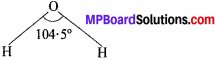
जल में ऑक्सीजन sp3 – संकरित है।
आबंध युग्म:
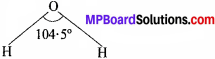
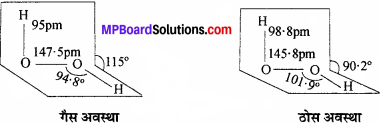
आबंध युग्म प्रतिकर्षण की अपेक्षा एकाकी युग्म प्रतिकर्षण की प्रबलता के कारण, HOH आबंध कोण 109.5° से 104.5° तक घट जाता है। जिसके कारण जल की संरचना बंधित होती है।
MP Board Class 11th Chemistry Solutions Chapter 9 हाइड्रोजन - 11
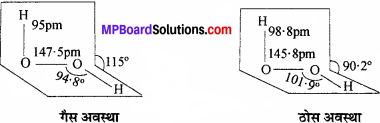
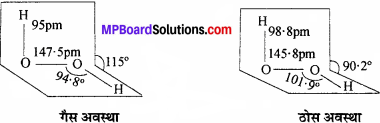
यह एक प्रबल ध्रुवीय अणु है। हाइड्रोजन परॉक्साइड की संरचना अध्रुवीय होती है। H2O2 के द्विध्रुव आघूर्ण का मान दर्शाता है कि H2O2के चारों परमाणु एक ही तल में स्थित नहीं होते हैं। H2O2 की संरचना की तुलना 94° कोण पर खुली हुई किताब से कर सकते हैं। इसमें H – O – H आबंध कोण 97° का होता है।
MP Board Class 11th Chemistry Solutions Chapter 9 हाइड्रोजन - 12

प्रश्न 18.
जल के स्वतः प्रोटोनीकरण से आप क्या समझते हैं ? इसका क्या महत्व है ?
उत्तर:
जल के स्वतः प्रोटोनीकरण का तात्पर्य जल का स्वतः आयनीकरण होता है –
MP Board Class 11th Chemistry Solutions Chapter 9 हाइड्रोजन - 13

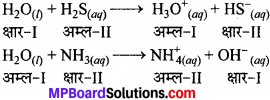
स्वतः प्रोटोनीकरण के कारण, जल की प्रकृति उभयधर्मी होती है। अतः यह अम्लों तथा क्षारों दोनों से क्रिया करता है। उदाहरण के लिए –
MP Board Class 11th Chemistry Solutions Chapter 9 हाइड्रोजन - 14

प्रश्न 19.
F2 के साथ जल की अभिक्रिया से ऑक्सीकरण तथा अपचयन के पदों पर विचार कीजिए एवं बताइए कि कौन-सी स्पीशीज ऑक्सीकृत/अपचयित होती है ?
उत्तर:
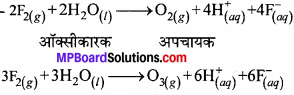
MP Board Class 11th Chemistry Solutions Chapter 9 हाइड्रोजन - 15
इन अभिक्रियाओं में, जल अपचायक का कार्य करता है। अतः यह स्वयं ऑक्सीजन अथवा ओजोन में ऑक्सीकृत हो जाता है। क्लोरीन ऑक्सीकारक की भाँति कार्य करती है तथा स्वयं F आयन में अपचयित हो जाती है।

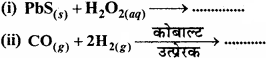
प्रश्न 20.
निम्नलिखित अभिक्रियाओं को पूर्ण कीजिए –

  1. Pb(s) + H202(aq)
  2. MnO4(aq) + H202(aq)) →
  3. Ca0(s) + H2O(g)
  4. AlCl3(g) + H2O(l)
  5. Ca3N2(s) + H2O(l)

उपर्युक्त को –

  • जल – अपघटन
  • अपचयोपचय (Redox) तथा
  • जलयोजन अभिक्रियाओं में वर्गीकृत कीजिए।

उत्तर:

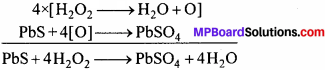
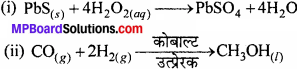
  1. PbS(s) + 4H2O2(aq) → PbSO4(s)+ 4H2O(l)(अपचयोपचय अभिक्रिया)
  2. 2MnO4(aq) + 6H+(aq) + 5H2O2(aq) → 2Mn 2+(aq) + 8H2O(l) + 5O2(g) (अपचयोपचय अभिक्रिया)
  3. CaO(s) + H2O(g) → Ca(OH)2(aq) (जलयोजन अभिक्रिया)
  4. AlCl3(g) + 3H2O(l) → Al(OH)3(s) + 3HCl(l) (जल-अपघटन अभिक्रिया)
  5. Ca3N2(s) + 6H2O(l) → 3Ca(OH)2(aq) + 2NH3(aq) (जल-अपघटन अभिक्रिया)

प्रश्न 21.
बर्फ के साधारण रूप की संरचना का उल्लेख कीजिए।
उत्तर:
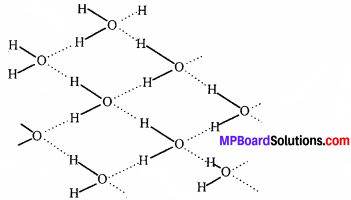
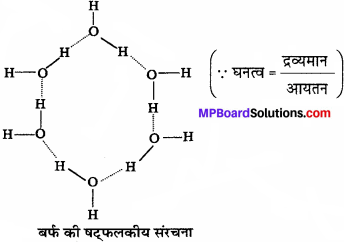
वायुमण्डलीय दाब पर बर्फ एक त्रिविम हाइड्रोजन आबंधित संरचना है। बर्फ में प्रत्येक ऑक्सीजन परमाणु चतुष्फलकीय रुप में चार ऑक्सीजन परमाणुओं से जुड़ा है अर्थात् प्रत्येक ऑक्सीजन युग्म में एक हाइड्रोजन परमाणु होता है। इस कारण बर्फ एक खुले पिंजरे की आकृति बनाती है। प्रत्येक ऑक्सीजन परमाणु चार हाइड्रोजन परमाणु से घिरा रहता है। इनमें से दो हाइड्रोजन परमाणु सहसंयोजी आबंध से व दो हाइड्रोजन परमाणु हाइड्रोजन आबंध से जुड़े होते हैं। क्रिस्टल जालक में खाली जगह होती है अत: बर्फ का घनत्व जल से कम होता है।
MP Board Class 11th Chemistry Solutions Chapter 9 हाइड्रोजन - 16

प्रश्न 22.
जल की अस्थायी एवं स्थायी कठोरता के क्या कारण है ? वर्णन कीजिए।
उत्तर:
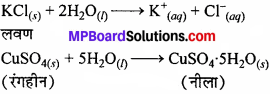
जल में कैल्सियम बाइकार्बोनेट तथा मैग्नीशियम बाइकार्बोनेट की उपस्थिति के कारण अस्थायी कठोरता उत्पन्न होती है। जल में विलेय लवणों कैल्सियम क्लोराइड, मैग्नीशियम क्लोराइड, कैल्सियम सल्फेट तथा मैग्नीशियम सल्फेट आदि के कारण स्थायी कठोरता उत्पन्न होती है।

प्रश्न 23.
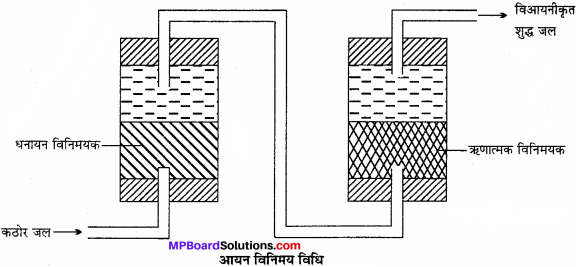
संश्लेषित आयन विनिमयक विधि द्वारा कठोर जल के मृदुकरण के सिद्धान्त एवं विधि की विवेचना कीजिए।
उत्तर:
संश्लेषित आयन विनिमयक रेजिन विधि निम्नलिखित दो प्रकार की होती है –
(1) धनायन:
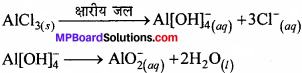
विनिमयक रेजिन ये रेजिन – SO3H समूह युक्त वृह्द कार्बनिक अणु होते हैं तथा जल में अविलेय होते हैं। इनकी NaCl से क्रिया कराकर R-Na में परिवर्तित किया जाता है। रेजिन R-Na, कठोर जल में उपस्थित Mg2+(aq) तथा Ca2+ आयनों से विनिमय करके इसे मृदुजल बना देता है।
2RNa(s) + Ma2+(aq) → R2M(s) + 2Na+(aq) (M = Ca2+ या Mg2+)

रेजिन में NaCl का जलीय विलयन मिलाने पर इसका पुनर्जनन कर लिया जाता है। शुद्ध विरवणिजित तथा विआयनित जल को प्राप्त करने के लिए उपयुक्त प्राप्त जल को क्रमशः धनायन विनिमयक तथा ऋणायन विनिमयक रेजिन में प्रवाहित करते हैं।

धनायन:
विनिमयक प्रक्रम में, H का विनिमय जल में उपस्थित Na+, Ca2+, Mg2+ आदि आयनों से हो जाता है।
2RH(s) + M2+(aq) ⥨ MR2(s) + 2H+(aq) (H+ के रूप में धनायन विनिमय रेजिन) इस प्रक्रम में प्रोटानों का निर्माण होता है तथा जल अम्लीय हो जाता है।

(2) ऋणायन:
विनिमयक प्रक्रम में OH का विनिमय जल में उपस्थित Cr, HCO3, SO2-4 आयनों द्वारा होता है।
MP Board Class 11th Chemistry Solutions Chapter 9 हाइड्रोजन - 19
R\(\stackrel{+}{\mathrm{N}}\)H2(s) OH विस्थापित अमोनियम हाइड्रॉक्साइड ऋणायन रेजिन है।
MP Board Class 11th Chemistry Solutions Chapter 9 हाइड्रोजन - 19
इस प्रकार मुक्त OH आयन, H+ आयनों को उदासीन कर देते हैं। अंत में उत्पन्न धनायन तथा ऋणायन विनिमयक रेजिन को क्रमशः तनु अम्ल तथा तनु क्षारीय विलयनों से क्रिया कराके पुर्नजनित कर लिया जाता है।

प्रश्न 24.
जल के उभयधर्मी स्वभाव को दर्शाने वाले रासायनिक समीकरण लिखिए।
उत्तर:
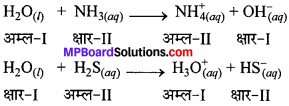
जल का स्वभाव उभयधर्मी होता है। यह अम्ल तथा क्षार दोनों की भाँति कार्य करता है। स्वयं से प्रबल अम्लों के साथ यह क्षार की भाँति व्यवहार करता हैं। जबकि स्वयं से प्रबल क्षारों के प्रति यह अम्ल की भाँति व्यवहार करता है।
MP Board Class 11th Chemistry Solutions Chapter 9 हाइड्रोजन - 21

प्रश्न 25.
हाइड्रोजन परॉक्साइड के ऑक्सीकारक एवं अपचायक रूप को अभिक्रियाओं द्वारा समझाइए।
उत्तर:
H2O2 अम्लीय तथा क्षारीय माध्यमों में ऑक्सीकारक तथा अपचायक, दोनों की भाँति कार्य कर सकता है। उदाहरण –

(1) अम्लीय माध्यम में ऑक्सीकारक –
MP Board Class 11th Chemistry Solutions Chapter 9 हाइड्रोजन - 22

(2) क्षारीय माध्यम में ऑक्सीकारक –
MP Board Class 11th Chemistry Solutions Chapter 9 हाइड्रोजन - 23

(3) अम्लीय माध्यम में अपचायक –
MP Board Class 11th Chemistry Solutions Chapter 9 हाइड्रोजन - 24

(4) क्षारीय माध्यम में अपचायक –
MP Board Class 11th Chemistry Solutions Chapter 9 हाइड्रोजन - 25

प्रश्न 26.
विखनिजित जल से क्या तात्पर्य है? यह कैसे प्राप्त किया जा सकता है ?
उत्तर:
जो जल सभी विलेय खनिज लवणों से मुक्त होता है, विखनिजित जल कहलाता है। विखनिजित जल को प्राप्त करने के लिए जल को क्रमशः धनायन-विनिमयक रेजिन तथा ऋणायन-विनिमयक रेजिन से प्रवाहित करते हैं। धनायन – विनिमयक में जल में उपस्थित Ca2+, Mg2+, Na+ तथा अन्य धनायन, H+ आयनों द्वारा विनियमित होकर दूर जाते है जबकि ऋणायन-विनिमयक में जल में उपस्थित Cl, SO42-
MP Board Class 11th Chemistry Solutions Chapter 9 हाइड्रोजन - 26

प्रश्न 27.
क्या विखनिजित या आसुत जल पेय-प्रयोजनों में उपयोगी है ? यदि नहीं, तो इसे उपयोगी कैसे बनाया जा सकता है ?
उत्तर:
विखनिजित या आसुत जल पेय-प्रयोजनों में उपयोगी नहीं है। इनमें कुछ उपयोगी लवणों को उचित मात्रा में मिलाकर पेय योग्य बनाया जा सकता है।

प्रश्न 28.
जीवमण्डल एवं जैव प्रणालियों में जल की उपादेयता को समझाइए ?
उत्तर:
सभी सजीवों के शरीर का मुख्य भाग जल द्वारा निर्मित होता है। मानव शरीर में लगभग 65% तथा कुछ पौधों में लगभग 95% भाग जल होता है। सभी सजीवों को जीवित रखने के लिए जल एक महत्वपूर्ण यौगिक है। अन्य द्रवों की तुलना में, जल को विशिष्ट ऊष्मा, तापीय चालकता, पृष्ठ तनाव, द्विध्रुव आघूर्ण तथा परावैद्युतांक के मान उच्च होते हैं।

इन्हीं गुणों के कारण जीवमंडल में जल की भूमिका अति महत्वपूर्ण होती है। जीवों के शरीर तथा जलवायु के सामान्य ताप को बनाए रखने के लिए, जल की वाष्पन ऊष्मा तथा उच्च ऊष्मा धारिता ही उत्तरदायी होती है। यह वनस्पत्तियों तथा प्राणियों के उपापचय में अणुओं के अभिगमन के लिए उत्तम विलायक का कार्य करता है। जल पौधों में प्रकाश संश्लेषण क्रिया के लिए भी आवश्यक है। जो कि वातावरण में O2 मुक्त करती है।
MP Board Class 11th Chemistry Solutions Chapter 9 हाइड्रोजन - 27

प्रश्न 29.
जल का कौन-सा गुण इसे विलायक के रूप में उपयोगी बनाता है ? यह किस प्रकार के यौगिक –

  1. घोल सकता है और
  2. जल- अपघटन कर सकता है ?

उत्तर:
उच्च द्विध्रुव आघूर्ण तथा उच्च परावैद्युतांक के कारण जल विलायक के रुप में उपयोगी होता है।

  1. यह आयनिक यौगिकों तथा उन सहसंयोजी यौगिकों जिनमें जल के साथ H-आबंध पाया जाता है। (जैसे-एथेनॉल, चीनी, ग्लूकोस आदि)को घोल सकता है।
  2. जल अनेक धात्वीय तथा अधात्वीय ऑक्साइडों, हाइड्राइड, कार्बाइड, फॉस्फाइड तथा अन्य लवणों का जल-अपघटन कर सकता है।

उदाहरणार्थ –
P4O10(s) + 6H2O(l) →4H3PO4(aq)
CaH2(s) + 2H2O(l) → Ca(OH)2(aq) + 2H2(g)
Al4C3(s) + 12H2O(l) → 4AI(OH)3 + 3CH4

प्रश्न 30.
H2O एवं D2O के गुणों को जानते हुए क्या आप मानते हैं कि D2O का उपयोग पेयप्रयोजनों के रूप में लाया जा सकता है ?
उत्तर:
भारी जल (D2O) जीवित प्राणी, पादप तथा जन्तुओं के लिए काफी हानिकारक होता है, क्योंकि यह उनमें होने वाली अभिक्रियाओं की दरों को मन्द कर देता है। यह जीवन का समर्थन करने में असफल होता है तथा इसकी जैवमण्डल में कोई उपयोगिता नहीं होती है।

प्रश्न 31.
जल-अपघटन (Hydrolysis) तथा जलयोजन (Hydration) पदों में क्या अन्तर है ?
उत्तर:
जल के H+ आयन तथा OH आयनों का किसी लवण के क्रमशः ऋणायन तथा धनायन के साथ स्वतः क्रिया करके मूल अम्ल तथा क्षार बनाने की क्रिया जल – अपघटन कहलाती है।
MP Board Class 11th Chemistry Solutions Chapter 9 हाइड्रोजन - 28
दूसरी ओर, जलयोजन का अर्थ आयनों तथा अणुओं में H2O के योग द्वारा जलयोजित आयन अथवा जलयोजित लवणों का निर्माण होता है।
MP Board Class 11th Chemistry Solutions Chapter 9 हाइड्रोजन - 29

प्रश्न 32.
लवणीय हाइड्राइड किस प्रकार कार्बनिक यौगिकों से अति सूक्ष्म जल की मात्रा को हटा सकते हैं?
उत्तर:
लवणीय हाइड्राइड जैसे NaH, CaH2 आदि कार्बनिक यौगिकों में उपस्थित अति सूक्ष्म जल से क्रिया करते हैं तथा संगत धातु हाइड्रॉक्साइड बनाते हैं तथा हाइड्रोजन गैस मुक्त करते हैं।
MP Board Class 11th Chemistry Solutions Chapter 9 हाइड्रोजन - 30
वास्तव में लवणीय हाइड्राइड M+H में, H प्रबल ब्रॉन्स्टेड क्षार होते हैं अतः ये जल से सुगमतापूर्वक क्रिया करते हैं।

प्रश्न 33.
परमाणु क्रमांक 15, 19, 23 तथा 44 वाले तत्व यदि हाइड्रोजन से अभिक्रिया कर हाइड्राइड बनाते हैं, तो उनकी प्रकृति से आप क्या आशा करेंगे? जल के प्रति इनके व्यवहार की तुलना कीजिए।
उत्तर:

  • परमाणु क्रमांक (Z) = 15 वाला तत्व, फॉस्फोरस, p – ब्लॉक का सदस्य है अतः यह सहसंयोजक हाइड्राइड, बनाता है।
  • परमाणु क्रमांक (Z) = 19 वाला तत्व, पोटैशियम, s – ब्लॉक सदस्य है अत: यह आयनिक हाइड्राइड बनाता है।
  • परमाणु क्रमांक (Z) = 23 वाला तत्व वैनेडियम, d – ब्लॉक तथा वर्ग-5 का सदस्य है। यह अन्तराकाशी हाइड्राइड (VHI6) बनाता है। यह अरससमीकरणमितीय हाइड्राइड है।
  • परमाणु क्रमांक (Z) = 44 वाला तत्व रुथेनियम, d – ब्लॉक तथा वर्ग-8 का सदस्य है। यह कोई हाइड्राइड नहीं बनाता है क्योंकि वर्ग-7, 8 तथा 9 के तत्व हाइड्राइड नहीं बनाते हैं (हाइड्राइड रिक्ति)। जल के साथ,केवल आयनिक हाइड्राइड, KH क्रिया करके डाइहाइड्रोजन गैस मुक्त करता है।

प्रश्न 34.
जब ऐल्युमिनियम (III) क्लोराइड एवं पोटैशियम क्लोराइड को अलग-अलग –

  1. सामान्य जल
  2. अम्लीय जल एवं
  3. क्षारीय जल से अभिकृत कराया जाएगा, तो आप किन-किन विभिन्न उत्पादों की आशा करेंगे? जहाँ आवश्यक हो, वहाँ रासायनिक समीकरण दीजिए।

उत्तर:
AlCl3, दुर्बल क्षार, Al(OH)3, तथा प्रबल अम्ल, HCl का लवण है। अतः सामान्य जल से क्रिया कराने पर इसका जल-अपघटन हो जाता है।
AlCl3(s) + 3H2O(l) → Al(OH3(s) + 3H+(aq)+ 3Cl(aq)
इसका जलीय विलयन अम्लीय प्रकृति का होता है। अम्लीय जल में उपस्थित H+ आयन AI(OH)3 से क्रिया करके Alt+(aq) आयन तथा HO उत्पन्न करते हैं। अतः अम्लीय जल में, AlCl3(s), Al3+ तथा CITaa) आयनों के रूप में रहता है। क्षारीय जल में AlCl3 अग्र उत्पाद उत्पन्न करता है –
MP Board Class 11th Chemistry Solutions Chapter 9 हाइड्रोजन - 36
KCl प्रबल अम्ल, HCl तथा प्रबल क्षार, KOH का लवण है। यह सामान्य जल में जल-अपघटित नहीं होता है। यह जल में केवल अपघटित होकर K+(aq) तथा Cr(aq) आयन देता है।
MP Board Class 11th Chemistry Solutions Chapter 9 हाइड्रोजन - 32
का जलीय विलयन उदासीन होता है। अतः अम्लीय जल में अथवा क्षारीय जल में, इसके आयन और कोई क्रिया नहीं करते हैं।

प्रश्न 35.
H2O2 विरंजन कारक के रूप में कैसे व्यवहार करता है ? लिखिए।
उत्तर:
H2O2 नवजात ऑक्सीजन उत्पन्न करने के कारण विरंजक की भाँति कार्य करता है।
H2O2 → H2O + O
रंगीन पदार्थ + [O] → रंगहीन पदार्थ
यह रेशम, बाल, वस्त्र, कागज की लुग्दी, ऊन, तेल, वसा आदि का विरंजन करता है।

प्रश्न 36.
निम्नलिखित पदों से आप क्या समझते हैं –

  1. हाइड्रोजन अर्थव्यवस्था
  2. हाइड्रोजनीकरण
  3. सिन-गैस
  4. भाप अंगारगैस सृति अभिक्रिया तथा
  5. ईंधन सेल।

उत्तर:
1. हाइड्रोजन अर्थव्यवस्था:
हाइड्रोजन का मुख्य उपयोग एवं संभावनाएँ निकट भविष्य में इसका प्रदूषण रहित (स्वच्छ) ईंधन के रूप में उपयोग है। हाइड्रोजन अर्थव्यवस्था का मूल सिद्धांत ऊर्जा का द्रव हाइड्रोजन अथवा गैसीय हाइड्रोजन के रूप में अभिगमन तथा भंडारण है।

2. हाइड्रोजनीकरण:
किसी द्विबंध या त्रिबंध युक्त कार्बनिक यौगिकों में उत्प्रेरक की उपस्थिति में हाइड्रोजन का संयोग हाइड्रोजनीकरण कहलाता है। वनस्पति तेलों को निकिल उत्प्रेरक की उपस्थिति में हाइड्रोजनीकरण कराने पर खाद्य वसा (मार्गेरीन तथा वनस्पति घी) प्राप्त होता है।
MP Board Class 11th Chemistry Solutions Chapter 9 हाइड्रोजन - 33

3. सिन-गैस:
CO तथा H2 का मिश्रण सिन-गैस अथवा संश्लेषित गैस अथवा जल गैस कहलाता है। हाइड्रोकार्बन अथवा कोक की उच्च ताप पर एवं उत्प्रेरक की उपस्थिति में भाप से अभिक्रिया कराने पर सिन-गैस प्राप्त होती है।
MP Board Class 11th Chemistry Solutions Chapter 9 हाइड्रोजन - 34
आजकल सिन-गैस को वाहितमल, अखबार, लकड़ी का बुरादा एवं छीलन आदि से भी प्राप्त किया जाता है। कोल से सिन-गैस के उत्पादन को, कोल-गैसीकरण प्रक्रम कहते है।

4. भाप अंगार गैस सृति अभिक्रिया:
जल गैस में डाइहाइड्रोजन की मात्रा को बढ़ाने के लिए CO को 500°C पर आयरन क्रोमेट उत्प्रेरक की उपस्थिति में भाप से क्रिया कराते हैं।
MP Board Class 11th Chemistry Solutions Chapter 9 हाइड्रोजन - 35
सिन-गैस / जल गैस उपरोक्त क्रिया को भाप अंगार गैस सृति अभिक्रिया कहते हैं।

5. ईंधन सेल:
ईंधन सेल में ईंधन के दहन से उत्पन्न ऊर्जा को सीधे वैद्युत ऊर्जा में परिवर्तित किया जाता है। इस प्रकार के ईंधन सेल का उदाहरण हाइड्रोजन ऑक्सीजन ईंधन सेल है। यह किसी प्रकार का प्रदूषण उत्पन्न नहीं करता है। ईंधन सेल, 70-85% रूपान्तरण क्षमता के साथ वैद्युत उत्पन्न करता है।

हाइड्रोजन अन्य महत्वपूर्ण प्रश्न

हाइड्रोजन वस्तुनिष्ठ प्रश्न

प्रश्न 1.
सही विकल्प चुनकर लिखिए –
1. निम्न में से कौन – सी धातु H2 का अधिशोषण करती है –
(a) Zn
(b) Pb
(c) AI
(d) K.
उत्तर:
(b) Pb

प्रश्न 2.
हाइड्रोजन का रेडियोऐक्टिव समस्थानिक कहलाता है –
(a) प्रोटियम
(b) ड्यूटीरियम
(c) भारी हाइड्रोजन
(d) ट्राइटियम।
उत्तर:
(d) ट्राइटियम।

प्रश्न 3.
H2O2 का 1 ml N.T.P. पर 10 mlo, देता है, यह है
(a) 10 आयतन HO2
(b) 20 आयतन H2O2
(c) 30 आयतन H2O2
(d) 40 आयतन H202
उत्तर:
(a) 10 आयतन HO2

प्रश्न 4.
भारी जल प्राप्त किया जाता है –
(a) जल को उबालकर
(b) जल के प्रभावी आयतन द्वारा
(c) जल के निरंतर विद्युत् विच्छेद द्वारा
(d) H2O2 को गर्म करके।
उत्तर:
(c) जल के निरंतर विद्युत् विच्छेद द्वारा

प्रश्न 5.
ऑर्थो तथा पैरा हाइड्रोजन में किस बात का अंतर है –
(a) परमाणु क्रमांक
(b) द्रव्यमान संख्या
(c) इलेक्ट्रॉन चक्रण
(d) नाभिकीय चक्रण।
उत्तर:
(d) नाभिकीय चक्रण।

प्रश्न 6.
कौन-से हाइड्राइड सामान्यतः सरल अनुपात में नहीं होते हैं –
(a) आयनिक
(b) आण्विक
(c) अंतराकाशीय
(d) उपर्युक्त सभी।
उत्तर:
(c) अंतराकाशीय

प्रश्न 7.
आयनिक हाइड्राइड का उदाहरण नहीं है –
(a) LiH
(b) CaH2
(c) CsH
(d) GeH2.
उत्तर:
(d) GeH2.

प्रश्न 8.
H2O2के अणु में H-0 0 बंध कोण होता है –
(a) 99.5°
(b) 95.9°
(c) 97°
(d) 100.5°
उत्तर:
(c) 97°

प्रश्न 9.
रॉकेट के लिये नोदक का कार्य करता है –
(a) N2 + O2
(b) H2 + O2
(c) O2 + Ar
(d) H2 + N2.
उत्तर:
(b) H2 + O2

प्रश्न 10.
कैलगॉन प्रक्रम में, निम्न में कौन सा उपयोग होता है –
(a) सोडियम बहु मेटाफॉस्फेट
(b) जलयुक्त सोडियम ऐल्युमिनियम सिलिकेट
(c) धनायन विनिमय रेजिन
(d) ऋणायन विनिमय रेजिन।
उत्तर:
(a) सोडियम बहु मेटाफॉस्फेट

प्रश्न 11.
अभिकारक जो जल की कठोरता ज्ञात करने में प्रयोग किया जाता है –
(a) ऑक्जेलिक अम्ल
(b) डाइसोडियम लवण EDTA
(c) सोडियम सिट्रेट
(d) सोडियम थायोसल्फेट।
उत्तर:
(b) डाइसोडियम लवण EDTA

प्रश्न 12.
‘CO2, H20 तथा H,0, को उनके अम्लीयता के बढ़ते क्रम में लिखिए –
(a) CO2 <H2O2 < H2O
(b) H2O< H2O2<CO2.
(c) H2O< H2O2> CO2
(d) H2O2> CO2 > H2O
उत्तर:
(b) H2O< H2O2 <CO2.

प्रश्न 2.

  1. रिक्त स्थानों की पूर्ति कीजिये –
  2. गलित NaH के विद्युत् – विच्छेदन से ऐनोड पर ………….. गैस मुक्त होती है।
  3. कैलगॉन …………….. का व्यापारिक नाम है।
  4. कैल्सियम फॉस्फाइड पर जल की क्रिया से …………….. बनती है।
  5. ……………… जल साबुन के साथ कम झाग देता है।
  6. जल की कठोरता ……………… और ……………… के लवणों के कारण होती है।
  7. ……………… जीवधारियों में होने वाली क्रियाओं के अध्ययन में ट्रेसर का कार्य करता है।
  8. Al या …………. के सान्द्र विलयन की क्रिया से हाइड्रोजन मुक्त होती है।
  9. CO + H2 का मिश्रण ……………….. कहलाती है।
  10. 2N H2O2 का आयतन क्षमता ……………….. होगी।
  11. पैलेडियम द्वारा हाइड्रोजन का अवशोषण ……………….. कहलाता है।

उत्तर:

  1. H2
  2. सोडियम हेक्सा मेटाफॉस्फेट
  3. फॉस्फीन
  4. कठोर
  5. Ca, Mg
  6. भारी जल
  7. NaOH
  8. जल गैस
  9. 11.2 आयतन
  10. अधिशोषण

प्रश्न 3.
उचित संबंध जोडिए –
MP Board Class 11th Chemistry Solutions Chapter 9 हाइड्रोजन - 1
उत्तर:

  1. (d) अम्लीय
  2. (f) क्षारीय
  3. (a) ड्यूटिरो फॉस्फीन
  4. (b) तेल गैस
  5. (c) H2O2
  6. (e) अम्लीय
  7. (i) जीवाणुनाशक
  8. (g) मंदक
  9. (h) रॉकेट ईंधन

प्रश्न 4.
एक शब्द / वाक्य में उत्तर दीजिए –

  1. किस यौगिक में हाइड्रोजन की ऑक्सीकरण अवस्था ऋणात्मक होती है ?
  2. H2O2 का विरंजक गुण ऑक्सीकरण के कारण है अथवा अपचयन के कारण।
  3. हाइड्रोजन की खोज किसने की ?
  4. परमाणु भट्टियों में मंदक के रूप में किसका उपयोग किया जाता है ?
  5. H2O2 Cl2 को किसमें अपचयित कर देता है ?
  6. H2O2 का विरंजक गुण निर्भर करता है।
  7. कौन-सा ऑक्साइड तनु अम्ल से क्रिया करके H2O2 देता है ?
  8. जल की तुलना में एथेनॉल का वाष्पन तेजी से होता है। क्यों ?
  9. किस प्रकार के तत्व जालक हाइड्राइड बनाते हैं ?
  10. जालक हाइड्राइड का क्या उपयोग है ?

उत्तर:

  1. CaH2
  2. H2O2 सरलता से ऑक्सीजन देने के कारण यह विरंजक पदार्थ है। अत: H2O2 का विरंजक गुण ऑक्सीकरण के कारण है। H2O2
  3. H2O + [O]
  4. हेनरी केवेण्डिस
  5. भारी जल (D2O)
  6. HCl में
  7. नवजात ऑक्सीजन के कारण
  8. Na2CO2, BaC2
  9. दुर्बल हाइड्रोजन बंध के कारण
  10. d – तथा f – ब्लॉक के तत्व
  11. H2के भण्डारण एवं हाइड्रोजनीकरण क्रियाओं को उत्प्रेरित करने में।

हाइड्रोजन अति लघु उत्तरीय प्रश्न

प्रश्न 1.
जल की अस्थायी एवं स्थायी कठोरता के क्या कारण हैं ? वर्णन कीजिए।
उत्तर:
जल में कैल्सियम बाइकार्बोनेट तथा मैग्नीशियम बाइकार्बोनेट की उपस्थिति के कारण अस्थायी कठोरता उत्पन्न होती है। जल में विलेय लवणों कैल्सियम क्लोराइड, मैग्नीशियम क्लोराइड, कैल्सियम सल्फेट तथा मैग्नीशियम सल्फेट आदि के कारण स्थायी कठोरता उत्पन्न होती है।

प्रश्न 2.
बेरीलियम सहसंयोजी हाइड्राइड बनाता है जबकि कैल्सियम आयनिक हाइड्राइड क्यों?
उत्तर:
उच्च विद्युत् ऋणात्मकता के कारण Be (1.5) सहसंयोजी हाइड्राइड बनाता है। जबकि Ca की विद्युत् ऋणात्मकता कम होती है।

प्रश्न 3.
हाइड्रोजन बनाने की यूनो विधि का वर्णन कीजिए।
उत्तर:
ऐल्युमिनियम की अभिक्रिया गर्म कास्टिक सोडा के साथ गर्म करने पर ऐल्युमिनियम कास्टिक सोडा में विलेय हो जाती है और हाइड्रोजन गैस प्राप्त होती है।
MP Board Class 11th Chemistry Solutions Chapter 9 हाइड्रोजन - 37

प्रश्न 4.
अशुद्ध हाइड्रोजन का शुद्धिकरण किस प्रकार होता है ?
उत्तर:
प्लेटिनम ब्लैक या पैलेडियम धातु पर हाइड्रोजन गैस प्रवाहित करने पर धातु द्वारा हाइड्रोजन का अधिशोषण हो जाता है। इसे अधिधारण कहते हैं। अशुद्ध हाइड्रोजन का इस प्रकार शुद्धिकरण किया जा सकता है क्योंकि पैलेडियम द्वारा केवल शुद्ध हाइड्रोजन का अधिशोषण होता है।

प्रश्न 5.
कठोर जल से होने वाली हानियाँ लिखिए।
उत्तर:
कठोर जल से होने वाली हानियाँ –

  • कपड़े धोने से झाग उत्पन्न करने के लिये अधिक साबुन खर्च होता है।
  • कठोर जल का उपयोग प्रयोगशाला में तथा दवाइयों में इंजेक्शन के लिये नहीं किया जा सकता है।
  • इसका सेवन संधिवात, गठिया आदि से पीड़ित व्यक्तियों के लिये हानिकारक होता है।

प्रश्न 6.
हाइड्रोजन बनाने की तीन विधि का वर्णन कीजिए।
उत्तर:
पानी की भाप को 600 – 900°C पर तप्त लोहे पर प्रवाहित करने पर हाइड्रोजन गैस बनती है। यह अभिक्रिया उत्क्रमणीय है। अतः हाइड्रोजन को क्रिया क्षेत्र से हटाते रहना आवश्यक है।
3Fe + 4H2O ⥨ Fe3O4 + 4H2

प्रश्न 7.
उस विधि का वर्णन कीजिए जो जल की अस्थायी तथा स्थायी दोनों प्रकार की कठोरता दूर कर देता है।
उत्तर:
रासायनिक विधि-इस विधि से जल की अस्थायी तथा स्थायी दोनों प्रकार की कठोरता समाप्त हो जाती है। इस विधि में NaOH या Na2CO3 में से कोई पदार्थ मिलाने पर Ca या Mg अविलेय लवण बनाकर पृथक् हो जाता है।

  • CaCl2 + Na2Co3 → CaCO3 + 2NaCl
  • MgCl2 + Na2CO3 → MgCO3 + 2NaCl
  • MgSO4 + Nal2CO3 → sMgCO3 + Na2SO4

प्रश्न 8.
H2O2 की सान्द्रता किस प्रकार व्यक्त करते हैं ?
उत्तर:
H2O2विलयन की सान्द्रता ऑक्सीजन के N. T. P. पर उस आयतन के बराबर होती है जो उस विलयन के एकांक आयतन को गर्म करने पर उत्पन्न होती है। जैसे 10 आयतन H2O2का तात्पर्य है कि 1 ml H2O2 को गर्म करने से N.T.P. पर 10 ml O2 प्राप्त होती है।

प्रश्न 9.
हाइड्रोजन के उपयोग लिखिए।
उत्तर:
हाइड्रोजन के उपयोग –

  • अपचायक के रूप में
  • तेल के हाइड्रोजनीकरण से वसा बनाने के लिये
  • कोल चूर्ण के साथ-साथ अभिकृत करके कृत्रिम पेट्रोल बनाने के लिये
  • काँच उद्योग में काँच को धीरे-धीरे ठण्डा करने में।

प्रश्न 10.
तेल गैस क्या है तथा इसे कैसे प्राप्त किया जाता है ?
उत्तर:
यह गैस मिट्टी के तेल के भंजन से बनायी जाती है। मिट्टी के तेल की पतली धार लोहे के रक्त तप्त रिटार्ट में डाली जाती है जिससे बड़े अणु टूटकर मेथेन, एथिलीन, एसीटिलीन में टूट जाती है। इसका उपयोग बर्नरों को जलाने में किया जाता है।

प्रश्न 11.
कोल गैस क्या है ? इसका रासायनिक संघटन लिखिए।
उत्तर:
कोल गैस कई गैसों का मिश्रण है जिनमें हाइड्रोजन भी एक अवयवी गैस है। कोल गैस का प्रतिशत संगठन निम्न प्रकार से है

  • H2 = 43.55%,
  • CH4 = 25.35%
  • CO2 = 0.3%
  • CO = 4.11%
  • N2= 2 – 12%
  • O2 = 0 – 1.5% कोल गैस का उपयोग ईंधन के अतिरिक्त प्रकाश उत्पन्न करने के लिये प्रयुक्त होता है।

प्रश्न 12.
सोडियम पर जल की अभिक्रिया कराने पर गैस उत्पन्न होती है। उसका नाम व सूत्र लिखिए।
उत्तर:
अत्यधिक क्रियाशील धातु जैसे-सोडियम, पोटैशियम, कैल्सियम पर साधारण ताप पर जल की अभिक्रिया कराने पर हाइड्रोजन गैस मुक्त होती है।

  • 2Na +2H2O → 2NaOH + H2
  • Ca + 2H2 O → Ca(OH)2 + H2

प्रश्न 13.
मृदु जल और कठोर जल किसे कहते हैं ?
उत्तर:
मृदु जल:
साबुन के साथ रगड़ने पर शीघ्रता से और अधिक झाग देने वाला जल मृदु जल कहलाता है।
उदाहरण-आसुत जल, वर्षा का जल आदि।

कठोर जल:
साबुन के साथ रगड़ने पर देर से तथा कम झाग देने वाला जल कठोर जल कहलाता है। और साबुन फटकर थक्के बनाता है।
उदाहरण – समुद्र का जल।

प्रश्न 14.
आसुत जल क्या है ? इसका एक उपयोग लिखिए।
उत्तर:
आसवन विधि से प्राप्त शुद्ध जल आसुत जल कहलाता है। इसका उपयोग औषधि बनाने में एवं प्रयोगशाला में विलयन बनाने में किया जाता है।

प्रश्न 15.
भारी जल की क्या उपयोगिता है ?
उत्तर:

  • भारी जल मुख्य रूप से नाभिकीय रिएक्टरों में मंदक के रूप में प्रयुक्त होता है।
  • यह अभिक्रियाओं की क्रियाविधि के अध्ययन में ट्रेसर यौगिक के रूप में प्रयोग किया जाता है।
  • अन्य ड्यूटीरियम यौगिकों जैसे – CD4 , D2SO4 आदि के निर्माण में इसका प्रयोग करते हैं।

प्रश्न 16.
हाइड्रोजन परॉक्साइड का तनु विलयन गर्म करके सान्द्र क्यों नहीं किया जा सकता इसका सान्द्र विलयन किस प्रकार कर सकते हैं ?
उत्तर:
H2O2 का तनु विलयन गर्म करके सान्द्रित नहीं किया जा सकता है, क्योंकि यह अपने गलनांक से काफी नीचे ही अपघटित हो जाता है।
2H2O2 → 2H2O + O2
जल से निष्कर्षित 1% H2O2का कम दाब पर आसवन करके 30%(द्रव्यमानानुसार) तक सान्द्रित करते हैं। पुनः इसका सावधानीपूर्वक कम दाब पर आसवन करके 85% तक सान्द्रण किया जाता है। अवशेष जल को हिमशीतित करके शुद्ध हाइड्रोजन परॉक्साइड प्राप्त की जाती है।

प्रश्न 17.
परॉक्साइडों से हाइड्रोजन परॉक्साइड के निर्माण हेतु सल्फ्यूरिक अम्ल की अपेक्षा, फॉस्फोरिक अम्ल अधिक उपयुक्त होता है। क्यों ?
उत्तर:
H2SO4, H2O2 के अपघटन में उत्प्रेरक की भाँति व्यवहार करता है। अत: परॉक्साइडों से H2O2 के निर्माण में H2SO4 की अपेक्षा दुर्बल अम्ल जैसे – H3PO4, H2CO3 आदि उपयुक्त रहते हैं।
MP Board Class 11th Chemistry Solutions Chapter 9 हाइड्रोजन - 38

प्रश्न 18.
किसी क्षारीय धातु का आयनिक हाइड्राइड प्रभावी सहसंयोजक व्यवहार प्रदर्शित करता है तथा यह ऑक्सीजन तथा क्लोरीन के प्रति लगभग अक्रियाशील होता है। इसका प्रयोग अन्य उपयोगी हाइड्राइडों के संश्लेषण में करते हैं। इस हाइड्राइड का सूत्र लिखिये।इसकी AlCl के साथ अभिक्रिया भी लिखिए।
उत्तर:
यह आयनिक हाइड्राइड LiH है। सबसे छोटी Li धातु के कारण इसका व्यवहार सहसंयोजी भी होता है। LiH अत्यधिक स्थायी है। यह ऑक्सीजन तथा क्लोरीन के प्रति अत्यधिक अक्रियाशील है। यह Al2Cl6 के साथ अभिक्रिया करके लीथियम ऐल्युमिनियम हाइड्राइड बनाता है।
8LiH + Al2Cl6 → 2LiAlH4 + 6LiCl

प्रश्न 19.
कठोर जल साबुन के साथ शीघ्रता से झाग क्यों नहीं देता?
उत्तर:
कठोर जल में Ca तथा Mg के बाइ कार्बोनेट, सल्फेट तथा क्लोराइड में से कोई भी लवण विलेय रहता है। साबुन उच्च कार्बनिक वसा अम्ल के सोडियम लवण होते हैं जो Ca एवं Mg के लवणों से क्रिया करके अवक्षेप देते हैं।
2C17H35COONa + MgSO4 → (C17H35COO)2 Mg + Na2SO4
जल में से जब तक ये लवण पूरी तरह से अवक्षेपित नहीं हो जाते तब तक साबुन से झाग नहीं बनता और साबुन व्यर्थ हो जाता है।

प्रश्न 20.
H2O2 के कोई चार उपयोग लिखिए।
उत्तर:
H2O2 के उपयोग –

  • यह जीवाणुनाशी के रूप में कान, दाँत आदि धोने के काम आता है।
  • प्रयोगशाला में अभिकर्मक के रूप में।
  • रॉकेटों में ईंधन के रूप में प्रयोग किया जाता है।
  • पुराने तैल चित्रों को ठीक करने में इसका उपयोग किया जाता है।

प्रश्न 21.
भाप अंगार गैस से हाइड्रोजन के औद्योगिक निर्माण की विधि लिखिए।
उत्तर:
गर्म भाप को रक्त तप्त कोक पर प्रवाहित करके वाटर गैस बनाते हैं।
MP Board Class 11th Chemistry Solutions Chapter 9 हाइड्रोजन - 39
इस प्रकार प्राप्त H2 व CO2 के मिश्रण को वायुमण्डलीय दाब पर पानी में प्रवाहित करने पर CO2 शोषित हो जाती है तथा H2 शेष रहती है।

प्रश्न 22.
चालकता जल किसे कहते हैं ? इसके उपयोग लिखिए।
उत्तर:
कोलरॉश ने जल का निम्न दाब पर क्वार्ट्स के बने उपकरण में 42 बार आसवन करके अत्यन्त शुद्ध जल प्राप्त किया। यह चालकता जल कहलाता है। आसुत जल में कुछ पोटैशियम परमैंगनेट मिलाकर मजबूत काँच के बने रिटार्ट में उसका एक बार पुनः आसवन कर लेते हैं। इसका उपयोग चालकता निर्धारण में होता है।

प्रश्न 23.
ड्यूटीरियम क्या है ? इसके दो उपयोग लिखिए।
उत्तर:
ड्यूटीरियम हाइड्रोजन का समस्थानिक है। इसे भारी हाइड्रोजन भी कहते हैं। इसके नाभिक में एक प्रोटॉन एवं एक न्यूट्रॉन होता है तथा नाभिक के चारों ओर एक इलेक्ट्रॉन घूमता रहता है। अर्थात् इसकी द्रव्यमान संख्या दो तथा परमाणु क्रमांक 1 है। इसे \(_{1}^{2} \mathrm{H}\) या D से दर्शाते हैं। भारी जल के वैद्युत् अपघटन से कैथोड पर ड्यूटीरियम प्राप्त होता है।
MP Board Class 11th Chemistry Solutions Chapter 9 हाइड्रोजन - 40
उपयोग:

  • इसका उपयोग कृत्रिम तत्वान्तरण में प्रक्षेपक कण ड्यूट्रॉन के रूप में।
  • रासायनिक एवं जैव रासायनिक अभिक्रियाओं की क्रियाविधि ज्ञात करने पर।

प्रश्न 24.
सोडियम डाइहाइड्रोजन के साथ क्रिया करके क्रिस्टलीय आयनिक ठोस बनाता है। यह यौगिक अवाष्पशील तथा अचालक प्रकृति का होता है। यह जल के साथ शीघ्रता से क्रिया करके डाइहाड्रोजन गैस बनाता है। इस यौगिक का सूत्र लिखिए तथा इसकी जल के साथ क्रिया लिखिए। इस ठोस के गलित का वैद्युत-अपघटन कराने पर क्या होगा?
उत्तर:
सोडियम डाइहाइड्रोजन के साथ क्रिया करके सोडियम हाइड्राइड बनाता है जो कि एक क्रिस्टलीय आयनिक ठोस है।
2Na + H2 → 2Na+ H
यह जल के साथ शीघ्रता से क्रिया करके H, गैस बनाता है।
2NaH + 2H2O → 2NaOH + 2H2
ठोस अवस्था में NaH में वैद्युत धारा प्रवाहित नहीं होती है। परन्तु गलित अवस्था में यह एनोड पर H, तथा कैथोड पर Na मुक्त करता है।

प्रश्न 25.
फ्लुओरीन तथा जल के मध्य रेडॉक्स अभिक्रिया लिखिए।
उत्तर:
फ्लुओरीन प्रबल ऑक्सीकारक है। यह HO को O2 तथा O2 में ऑक्सीकृत करता है।
MP Board Class 11th Chemistry Solutions Chapter 9 हाइड्रोजन - 61

प्रश्न 26.
समझाइये कि HCl गैस तथा HF द्रव क्यों है ?
उत्तर:
Cl की अपेक्षा F का आकार छोटा तथा वैद्युत ऋणात्मकता अधिक है। अतः यह Cl की अपेक्षा अधिक प्रबल H – आबंध बनायेगा। यही कारण है कि HF द्रव है तथा HCl गैस है।

प्रश्न 27.
D2O2 के निर्माण की एक रासायनिक समीकरण लिखिए।
उत्तर:
जल में विलेय D2SO4 की क्रिया BaO2 से कराने पर D2O2 प्राप्त होता है।
BaO2 +D2SO4 → BaSO4 +D2O2

प्रश्न 28.
H,O, को अधिक समय तक संचित क्यों नहीं किया जा सकता है ?
उत्तर:
H2O2 में परॉक्साइड बंध होता है। इस बंध की उपस्थिति के कारण यह अस्थायी होता है और अपघटित होने लगता है।
2H2O2 → 2H2O + O2 फलस्वरूप H2O2 को अधिक समय तक संचित नहीं किया जा सकता है । यह अपघटन की क्रिया काँच से उत्प्रेरित हो जाती है। इसलिये काँच की बोतल में अपघटन क्रिया और तीव्र हो जाती है। इसे रोकने या मंद करने के लिये मोम व अस्तर लगी रंगीन बोतल में संचित किया जाता है।

प्रश्न 29.
H2O2 प्रति क्लोर कहलाती है, क्यों?
उत्तर:
उन रंगीन पदार्थों में जिनमें विरंजन क्लोरीन द्वारा किया जाता है क्लोरीन की कुछ मात्रा शेष रह जाती है। इस प्रकार शेष क्लोरीन को दूर करने के लिये H2O2का उपयोग किया जाता है इस गुण के कारण इसे प्रति क्लोर कहते हैं।
Cl2 + H2O2 →2HCl + O2

प्रश्न 30.
अस्थायी कठोर जल को बुझे हुये चूने के साथ उबालने पर वह मृदु हो जाता है, क्यों?
उत्तर:
जब अस्थायी कठोर जल को बुझे हुये चूने के साथ उबाला जाता है तब अस्थायी कठोर जल में उपस्थित Ca व Mg के बाइ कार्बोनेट अघुलनशील कार्बोनेट में बदल जाता है जिन्हें छानकर दूर कर देते हैं।
MP Board Class 11th Chemistry Solutions Chapter 9 हाइड्रोजन - 41

प्रश्न 31.
लवणीय हाइड्राइड जल के साथ प्रबल अभिक्रिया करके आग उत्पन्न करती है। क्या इसमें CO2(जो एक सुपरिचित अग्निशामक है) का उपयोग हम कर सकते हैं? समझाइए।
उत्तर:
लवणीय हाइड्राइड (NaH, CaH2 आदि) जल के साथ प्रबल अभिक्रिया करके धातु ऑक्साइड तथा डाइहाइड्रोजन उत्पन्न करते हैं।

प्रश्न 32.
कारण दीजिए –

  1. झीलों के पानी का तली की अपेक्षा सतह की ओर गमन।
  2. बर्फ जल पर तैरती है।

उत्तर:
1. द्रव (Liquid water) जल की अपेक्षा बर्फ का घनत्व अधिक होता है। शीतकाल में, झील के पानी का तापमान घटने लगता है। चूँकि ठंडा पानी भारी होता है। अत: यह पानी की तली की ओर गति करता है तथा तली का गर्म पानी सतह की ओर गति करता है। यह प्रक्रिया चलती रहती है। 277 K पर जल का घनत्व अधिकतम होता है।

अतः सतह जल के तापमान में कमी से घनत्व में कमी होगी। सतह से जल का तापमान घटता रहता है और अन्त में जल जम जाता है। अतः निम्न तापमान पर बर्फ की सतह जल के ऊपर तैरती है। इसी कारण सतह से तली की ओर जल लगातार बर्फ के रूप में जमता रहता है।

2. द्रव जल (Liquid water) की अपेक्षा, बर्फ का घनत्व कम होता है अत: बर्फ जल पर तैरती है।

प्रश्न 33.
यदि द्रव जल तथा बर्फ के टुकड़े के समान द्रव्यमान लिये जायें तो द्रव जल की अपेक्षा बर्फ का घनत्व कम होता है ?
उत्तर:
बर्फ में H2O अणु द्रव जल की भाँति सघन नहीं होते हैं। बर्फ की जालक संरचना में रिक्त अवकाश होते हैं। जिसके कारण इसका आयतन अधिक तथा घनत्व कम होता है।
MP Board Class 11th Chemistry Solutions Chapter 9 हाइड्रोजन - 42

हाइड्रोजन लघु उत्तरीय प्रश्न

प्रश्न 1.
H2O2 पुराने तैलचित्रों को ठीक करने में प्रयुक्त होता है, उचित तर्क द्वारा समझाइये।
उत्तर:
पुरानी तैलचित्र जो बेसिक लेड कार्बोनेट से बनी हुई होती है। समय के साथ धीरे-धीरे काली पड़ जाती है क्योंकि वायुमण्डल में उपस्थित HS गैस तैलचित्र के सफेद लेड ऑक्साइड को काले लेड सल्फाइड में बदल देती है।
PbO+ H2S → PbS + H2O
ऐसे तैलचित्रों को H2O2 से धोने पर काला लेड सल्फाइड ऑक्सीकृत होकर PbSO4 में बदल जाता है और तस्वीर में पुनः चमक आ जाती है।
MP Board Class 11th Chemistry Solutions Chapter 9 हाइड्रोजन - 43

प्रश्न 2.
हाइड्रोजन के सभी समस्थानिकों के आरेख बनाकर उनके नाम लिखिये।
उत्तर:
हाइड्रोजन के तीन समस्थानिक हैं –

  • साधारण हाइड्रोजन या प्रोटियम – \(_{1}^{1} \mathrm{H}\)
  • भारी हाइड्रोजन या ड्यूटीरियम – \(_{1}^{2} \mathrm{H}\) या D
  • ट्राइटियम – \(_{1}^{3} \mathrm{H}\)

संरचना आरेख:
MP Board Class 11th Chemistry Solutions Chapter 9 हाइड्रोजन - 44
तुलना:
MP Board Class 11th Chemistry Solutions Chapter 9 हाइड्रोजन - 45

प्रश्न 3.
ऑर्थो तथा पैराहाइड्रोजन को समझाइये।
उत्तर:
सन् 1927 में हाइजेनबर्ग ने बताया कि हाइड्रोजन अणु दो प्रकार के होते हैं। प्रत्येक हाइड्रोजन अणु में दो हाइड्रोजन परमाणु होते हैं। इसके इलेक्ट्रॉन के चक्रण सदैव विपरीत दिशा में होता है। लेकिन इलेक्ट्रॉन की भाँति नाभिक भी अपनी दूरी पर चक्रण करते हैं। हाइड्रोजन अणु में जब दोनों हाइड्रोजन परमाणु के नाभिकों का चक्रण एक ही दिशा में होता है तो उसे ऑर्थो हाइड्रोजन कहते हैं और जब नाभिकों का चक्रण विपरीत दिशा में होता है तो उसे पैरा हाइड्रोजन कहते हैं। आर्थो तथा पैरा हाइड्रोजन के रासायनिक गुणों में कोई अंतर नहीं होता है। लेकिन उनके भौतिक गुणों में अंतर होता है। यह अंतर उनके अणुओं की आंतरिक ऊर्जा में अंतर के कारण होता है।
MP Board Class 11th Chemistry Solutions Chapter 9 हाइड्रोजन - 46

प्रश्न 4.
बॉयलर में कठोर जल का प्रयोग क्यों नहीं किया जाता है ?
उत्तर:
उद्योगों में बॉयलर का उपयोग भाप बनाने में किया जाता है। बॉयलरों में कठोर जल का उपयोग नहीं किया जाता। यदि कठोर जल को बॉयलर में प्रयोग किया जाता है तो Ca और Mg के लवण बॉयलर के अंदर की सतह पर पपड़ी के रूप में जम जाते हैं। यह पपड़ी ऊष्मा की कुचालक होती है जिससे ईंधन का अपव्यय होता है। इस कुचालक पपड़ी के कारण बॉयलर को बहुत अधिक गर्म करना पड़ता है जिससे पानी गर्म हो सके। उच्च ताप पर बाहरी सतह का Fe वायु की O2 से अभिक्रिया करके Fe3O4 बना लेता है।

कभी-कभी अंदर की पपड़ी में दरार हो जाती है जिससे गर्म जल की Fe की सतह से सीधी अभिक्रिया हो सकती है तथा Fe3O4 व H2 बनते हैं। हाइड्रोजन एक ज्वलनशील गैस है जिससे विस्फोट का भय रहता है। कठोर जल में यदि MgCl2 हो, तो वह पानी से अभिक्रिया करके HCl बनाता है। यह अम्ल बॉयलर का संक्षारण करता रहता है।
MgCl2 +H2O → Mg(OH)Cl+ HCl

प्रश्न 5.
क्या होता है जबकि –

  1. कैल्सियम हाइड्राइड की पानी से क्रिया कराते हैं।
  2. H2O2 को अम्लीय KMnO2 विलयन में मिलाते हैं।
  3. पोटैशियम फेरीसायनाइड के क्षारीय विलयन को H2O2 से क्रिया कराते हैं।
  4. उच्च ताप तथा उच्च दाब पर Fe की उपस्थिति में H2की अभिक्रिया N2 के साथ कराते हैं।

उत्तर:
1. कैल्सियम हाइड्राइड की पानी से क्रिया कराने पर H2 बनता है।
CaH2 + 2H2O →Ca(OH)2 + 2H2

2. H2O2 को अम्लीय KMnO4 में मिलाने पर KMnO4का गुलाबी रंग उड़ जाता है।
2KMnO4 + 3H2SO4 + 5H2O2 → K2SO4 + 2MnSO4 + 8H2O + 5O2

3. पोटैशियम फेरीसायनाइड के क्षारीय विलयन में H,O, मिलाने पर पोटैशियम फेरोसायनाइड में अपचयित हो जाता है।
2K3[Fe(CN)6] + 2KOH + H2O2 → 2K4[Fe(CN)6] +2H2O + O2

4. उच्च ताप तथा उच्च दाब पर Fe उत्प्रेरक तथा Mo उत्प्रेरक वर्धक की उपस्थिति में हाइड्रोजन की अभिक्रिया N, से कराने पर अमोनिया प्राप्त होता है।
MP Board Class 11th Chemistry Solutions Chapter 9 हाइड्रोजन - 47MP Board Class 11th Chemistry Solutions Chapter 9 हाइड्रोजन - 47

प्रश्न 6.
हाइड्रोजन परॉक्साइड की निम्नलिखित से अभिक्रिया लिखिये –

  1.  O2
  2. PbS
  3. KI
  4. Cl2
  5. H2S.

उत्तर:

  1. हाइड्रोजन परॉक्साइड ओजोन से क्रिया कर ऑक्सीजन देता है।
    H2O2 + O3 →H2O + 2O2
  2. हाइड्रोजन परॉक्साइड PbS को PbSO4 में ऑक्सीकृत कर देता है।
    PbS + 4H2O2 → PbSO4 + 4H2O
  3. हाइड्रोजन परॉक्साइड KI को आयोडीन में ऑक्सीकृत कर देता है।
    2KI + H2O2 2KOH + I2
  4. हाइड्रोजन परॉक्साइड Cl, को HCl में अपचयित कर देती है।
    Cl + H2O2 → 2HCl + O2
  5. हाइड्रोजन परॉक्साइड HS को सल्फर में ऑक्सीकृत कर देती है।
    H2S + H2O2 → 2H2O + S

प्रश्न 7.
क्या आप आशा करते हैं कि (C,Han+2) कार्बनिक हाइड्राइड्स लुईस अम्ल या क्षार की भाँति कार्य करेंगे? अपने उत्तर को युक्ति संगत ठहराइए।
उत्तर:
(CnH2n+2) प्रकार के कार्बन हाइड्राइड्स, इलेक्ट्रॉन समृद्ध हाइड्राइड है। इनके पास सहसंयोजी आबंध बनाने हेतु पर्याप्त इलेक्ट्रॉन हैं । अतः ये न तो लुईस अम्ल और न ही लुईस क्षार की भाँति व्यवहार करेंगे।

प्रश्न 8.
निम्नलिखित समीकरणों को पूरा कीजिए –
MP Board Class 11th Chemistry Solutions Chapter 9 हाइड्रोजन - 48
उत्तर:
MP Board Class 11th Chemistry Solutions Chapter 9 हाइड्रोजन - 49

प्रश्न 9.
भाप अंगार गैस क्या है ? इसका संघटन लिखते हुये इसके उपयोग लिखिये।
उत्तर:
भाप अंगार गैस:
यह गैस कार्बन मोनोऑक्साइड तथा हाइड्रोजन का मिश्रण है। रक्त तप्त कोक पर जलवाष्प प्रवाहित करने पर कार्बन मोनोऑक्साइड तथा हाइड्रोजन का मिश्रण (भाप अंगार गैस) प्राप्त होता है।
MP Board Class 11th Chemistry Solutions Chapter 9 हाइड्रोजन - 50
संगठन –

  • H2 = 49%
  • N2 = 4%,
  • CO = 44%
  • CO2 = 2.7%
  • CH4 = 0.3%

उपयोग –

  • भट्टियों में ईंधन के रूप में
  • कार्बोरेटेड भाप अंगार गैस बनाने में
  • अमोनिया के निर्माण में
  • असंतृप्त हाइड्रोकार्बनों के साथ प्रकाश देने में।

प्रश्न 10.
जल की अस्थायी कठोरता कैसे दूर करते हैं ?
उत्तर:
अस्थायी कठोरता दूर करने की दो विधियाँ हैं –
(1) उबालकर:
उबालने पर Ca और Mg के विलेय बाइ कार्बोनेट अविलेय कार्बोनेट में बदल जाते हैं और अवक्षेपित हो जाते हैं।

  • Ca(HCO3)2 + CaCO3 + H2O+CO2
  • Mg(HCO3)2 + MgCO3 + H2O+CO2

(2) क्लार्क विधि-अस्थायी कठोर जल में चूने के पानी की निश्चित मात्रा मिलाने पर विलेय बाइ कार्बोनेट अविलेय कार्बोनेट बना लेते हैं जो अवक्षेपित हो जाते हैं।

  • Ca(HCO3)2 + Ca(OH)2 →2CaCO3 +2H2O
  • Mg(HCO3)2 + Ca(OH)2 →MgCO3 +CaCO3 + 2H2O.

प्रश्न 11.
हाइड्रोजन परॉक्साइड की लुईस संरचना बताइए।
उत्तर:
MP Board Class 11th Chemistry Solutions Chapter 9 हाइड्रोजन - 51

प्रश्न 12.
हाइड्रोजन परॉक्साइड की संरचना को समझाइये।
उत्तर:
H2O2 का द्विध्रुव आघूर्ण 2.1 D है। इससे स्पष्ट होता है कि संरचना असमतलीय है। X – किरणे एवं अन्य भौतिक विधियों से विदित होता है कि H,O, की संरचना खुली पुस्तक के समान होती है। H2O2 अणु को दो OH के रूप में लिखते हैं। H – O – O – H परन्तु दोनों OH समूह एक ही तल में नहीं हैं । गैसीय स्थिति में तल 111.5° का कोण बनाते हैं।
MP Board Class 11th Chemistry Solutions Chapter 9 हाइड्रोजन - 11
0-0 परमाणु दोनों तलों के संधि स्थल पर और परमाणु दोनों तलों पर 94.8° का O – O – H कोण बनाते हैं। बंध दूरी H – O = 0.95A और 0 – 0 = 1-47 A होती है। क्रिस्टलीय स्थिति में H बंध के कारण थोड़ा अंतर होता है। तलों के बीच का कोण 90.2°, कोण O – O – H = 101.9° बंध दूरी O – H = 0.994 होती है। और O-O= 1.46वें होता है।
MP Board Class 11th Chemistry Solutions Chapter 9 हाइड्रोजन - 12

प्रश्न 13.
समझाइये H2O2 ऑक्सीकारक और अपचायक दोनों प्रकार का कार्य करता है।
उत्तर:
H2O2 सरलता से अपघटित होकर ऑक्सीजन परमाणु मुक्त करता है इसलिये यह प्रबल ऑक्सीकारक है। परन्तु जब यह अन्य ऑक्सीकारक के साथ क्रिया करता है तो ऑक्सीकारकों से सक्रिय ऑक्सीजन का एक परमाणु आसानी से पृथक् कर देता है।

ऑक्सीकारक प्रकृति –

  • 2Kl + H2O2 → 2KOH + I2
  • Na2SO3 + H2O2 → Na2SO4 + H2O
  • H2S + H2O2 → 2H2O + S

अपचायक प्रकृति –

  • H2O2+ O2 → H2O2 + 2O2
  • PbO2 + H2O2 → PbO+ H2O + O2
  • Cl2 + H2O2 → 2HCl + O2

प्रश्न 14.
कैलगॉन क्या है ? इसकी सहायता से जल की कठोरता कैसे दूर की जा सकती है ?
उत्तर:
पॉली हेक्सा मेटाफॉस्फेट को कैलगॉन कहते हैं । इसका रासायनिक संगठन Na2 [Na4 (PO4)6] होता है । कठोर जल में कैलगॉन की थोड़ी मात्रा डालने पर कैलगॉन कठोर जल में उपस्थित Ca और Mg लवणों से क्रिया कर उनके विलेय संकुल यौगिक बना लेता है। यह संकर यौगिक आयनन पर Ca2+और Mg2+ आयन नहीं देता है जिससे जल इन आयनों से मुक्त रहता है।
Na2[Na4 (PO3)6] + CaSO4 → Na2[CaNa2 (PO3)6] + Na2SO4

Na2 [CaNa2 (PO3)6] + CaSO4 → Na2[Ca(PO3)6] + Na2SO2

प्रश्न 15.
हाइड्रेट कितने प्रकार के होते हैं ? उदाहरण सहित समझाइये।
उत्तर:
जल अनेक धातु लवणों के साथ संयुक्त होकर हाइड्रेट बनाता है। ये तीन प्रकार के होते हैं –
1. जटिल आयन कैटायन जल – जटिल आयन में केन्द्रीय धातु के साथ लिगैण्ड बनाकर कैटायन में उपस्थित रहता है।

उदाहरण-हेक्सा एक्वा क्रोमियम (III) क्लोराइड [Cr(H2O6)]Cl3

2. जटिल आयन ऑक्सीऐनायन जल-जटिल आयन में ऑक्सी ऐनायन के साथ जल अणु उपस्थित रहता है।
MP Board Class 11th Chemistry Solutions Chapter 9 हाइड्रोजन - 52
3. क्रिस्टलीय जल – क्रिस्टल जालक में अणु के भीतर खाली जगह में अणु उपस्थित रहते हैं जिसे क्रिस्टलन जल कहते हैं। कुछ धातु लवण रखा रहने पर संयुक्त जल को खो देते हैं। इसको उत्फुलन कहते हैं तथा अनेक पदार्थ वायु में रखे रहने पर वायु से जल सोख लेते हैं। इस क्रिया को प्रस्वेदन कहते हैं।
उदाहरण – Na2SO4 , 10H2O,MgSO4, 7H2O

प्रश्न 16.
जल की कठोरता दूर करने की परम्यूटिट विधि को समझाइये।
उत्तर:
इस विधि में कठोर जल को मृदु करने के लिये परम्यूटिट नामक पदार्थ का उपयोग करते हैं। ये पदार्थ जियोलाइट भी कहलाते हैं। जियोलाइट, सोडियम तथा ऐल्युमिनियम के मिश्रित जलयोजित सिलिकेट हैं। इनका सूत्र Na2 Al2 Si2O8 xH2O है। इसे संक्षिप्त में Na2Z द्वारा दर्शाते हैं। कठोर जल को जब जियोलाइट के ऊपर प्रवाहित करते हैं तो Ca और Mg जियोलाइट प्राप्त होते हैं जो अवक्षेपित होकर नीचे बैठ जाते हैं। इस प्रकार जल मृदु हो जाता है।

  • Na2Z + CaCl2 → Ca2 + 2 NaCl
  • Na2Z + MgSO4 → Na2SO4 + MgZ

अधिक समय तक जियोलाइट का उपयोग करने पर जियोलाइट की क्षमता कम हो जाती है। इसे पुनः सक्रिय करने के लिये 10% NaCl विलयन मिलाते हैं।
CaZ + 2NaCl → Na2Z + CaCl2
MP Board Class 11th Chemistry Solutions Chapter 9 हाइड्रोजन - 52

प्रश्न 17.
जल अणु की संरचना दर्शाइये तथा उसके अच्छे विलायक होने का कारण दीजिये।
उत्तर:
जल के अणु में दो H परमाणु तथा एक 0 परमाणु आपस में सहसंयोजक बंध द्वारा जुड़े होते हैं। जल की संरचना उल्टे V के आकार की होती है। जिसमें H – 0 – H बंध 104°28′ होता है। जिसमें केन्द्रीय परमाणु ऑक्सीजन 3 संकरित अवस्था में होता है। इस प्रकार H2O अणुओं में दो sp3σ बंध होते हैं। तथा ऑक्सीजन पर 2 एकांकी इलेक्ट्रॉन युग्म होते हैं। तथा एकांकी इलेक्ट्रॉन युग्म – एकांकी इलेक्ट्रॉन युग्म प्रतिकर्षण के कारण बंध कोण 109°28′ से गिरकर 104°28′ होता है।

MP Board Class 11th Chemistry Solutions Chapter 9 हाइड्रोजन - 11

जल का विलायक गुण:
जल एक उत्तम विलायक है। क्योंकि जल का अणु ध्रुवीय है तथा इसके अणुओं के मध्य H बंध होता है। ध्रुवीय तथा उच्च परावैद्युतांक स्थिरांक होने के कारण जल में आयनिक यौगिक तथा ध्रुवीय सह-संयोजी यौगिक विलेय हो जाते हैं। H बंध के कारण वे यौगिक भी जल में विलेय हैं जो जल के साथ हाइड्रोजन बंध बना सकते हैं।
MP Board Class 11th Chemistry Solutions Chapter 9 हाइड्रोजन - 12
प्रश्न 18.
भारी जल का निर्माण किस प्रकार करते हैं ? इसके गुण लिखिए।
उत्तर:
साधारण जल के प्रभाजी आसवन से-साधारण जल के 6000 भाग में लगभग 1 भाग भारी जल होता है साधारण जल में से भारी जल को प्रभाजी आसवन द्वारा पृथक् किया जाता है। भारी जल का क्वथनांक साधारण जल के क्वथनांक से अधिक होता है। इसलिये साधारण जल का प्रभाजी आसवन करने पर साधारण जल पहले आसवित होता है तथा भारी जल अवशेष के रूप में रह जाता है।

भौतिक गुण:
भारी जल रंगहीन, गंधहीन, स्वादहीन द्रव है। इसका हिमांक 3.8°C तथा क्वथनांक 101-4°C होता है। रासायनिक गुण –

(1) वैद्युत अपघटन:
किसी वैद्युत अपघट्य की उपस्थिति में भारी जल का वैद्युत अपघटन कराने पर कैथोड पर ड्यूटीरियम तथा एनोड पर O2 गैस प्राप्त होती है।
MP Board Class 11th Chemistry Solutions Chapter 9 हाइड्रोजन - 53

(2) नाइट्राइडों के साथ अभिक्रिया – भारी जल की अभिक्रिया नाइट्राइडों के साथ कराने पर भारी अमोनिया बनता है।
MP Board Class 11th Chemistry Solutions Chapter 9 हाइड्रोजन - 53

प्रश्न 19.
जल का घनत्व 4°C पर अधिकतम होता है, क्यों ?
उत्तर:
जब बर्फ पिघलकर द्रव अवस्था में आती है तो बर्फ में उपस्थित पिंजरानुमा संरचना टूट जाती है। हाइड्रोजन बंध की संख्या में कमी आती है तथा H बंध टूटने के कारण बर्फ की संरचना के खाली स्थान में जल के अणुओं के व्यवस्थित होने के कारण जल के अणु अत्यधिक निकट आने लगते हैं जिससे जल का घनत्व बढ़ने लगता है तथा 4°C पर यह घनत्व अधिकतम हो जाता है लेकिन 4°C के पश्चात् ताप में वृद्धि करने पर जल के अणुओं की गतिज ऊर्जा में वृद्धि के कारण जल के अणु दूर-दूर जाने लगते हैं। जिसके फलस्वरूप इसके आयतन में वृद्धि हो जाती है और घनत्व में कमी आने लगती है।

प्रश्न 20.
उन हाइड्राइड वर्गों का नाम बताइए जिनसे H2O2, B2H6तथा NaH संबंधित है।
उत्तर:
H2O – सहसंयोजक या आण्विक हाइड्राइड(इलेक्ट्रॉन समृद्ध हाइड्राइड)
B2H6 – सहसंयोजक या आण्विक हाइड्राइड(इलेक्ट्रॉन न्यून हाइड्राइड)
NaH – आयनिक या लवणीय हाइड्राइड।

हाइड्रोजन दीर्घ उत्तरीय प्रश्न

प्रश्न 1.
संश्लेषित आयन विनिमयक विधि द्वारा कठोर जल के मृदुकरण के सिद्धान्त एवं विधि की विवेचना कीजिए।
उत्तर:
संश्लेषित आयन विनिमय रेजिन विधि निम्नलिखित दो प्रकार की होती है –
1. धनायन – विनिमयक रेजिन- ये रेजिन, – SO3H समूह युक्त वृहद् कार्बनिक अणु होते हैं तथा जल में अविलेय होते हैं। इनकी NaCI से क्रिया कराकर R-Na में परिवर्तित किया जाता है। रेजिन R – Na, कठोर जल में उपस्थित Mg2+ तथा Ca2+ आयनों से विनिमय करके इसे मृदु जल बना देता है।
2RNa(s)+ M2+(aq) → R2M(s) + 2Na2+(aq)  (M = Ca2+ या Mg2+)

रेजिन में NaCl का जलीय विलयन मिलाने पर इसका पुनर्जनन कर लिया जाता है। शुद्ध विखनिजित तथा विआयनित जल को प्राप्त करने के लिए उपरोक्त प्राप्त जल को क्रमश: धनायन-विनिमयक तथा ऋणायन विनिमयक रेजिन में प्रवाहित करते हैं। धनायन-विनिमयक प्रक्रम में, H’ का विनिमय जल में उपस्थित Nat, Cat, Mg2+ आदि आयनों से हो जाता है।
MP Board Class 11th Chemistry Solutions Chapter 9 हाइड्रोजन - 55
(H’ के रूप में धनायन विनिमय रेजिन) इस प्रक्रम में प्रोटॉनों का निर्माण होता है तथा जल अम्लीय हो जाता है।

2. ऋणायन-विनिमयक प्रक्रम में, OH का विनिमय जल में उपस्थित Cl, HCO3, SO2-4 आयनों द्वारा होता है।MP Board Class 11th Chemistry Solutions Chapter 9 हाइड्रोजन - 63
R\(\stackrel{+}{\mathrm{N}}\)H3 OH विस्थापित अमोनियम हाइड्रॉक्साइड ऋणायन रेजिन है।
MP Board Class 11th Chemistry Solutions Chapter 9 हाइड्रोजन - 62
इस प्रकार मुक्त OH आयन, H+ आयनों को उदासीन कर देते हैं। अंत में उत्पन्न धनायन तथा ऋणायन विनिमयक रेजिन को क्रमशः तनु अम्ल तथा तनु क्षारीय विलयनों से क्रिया कराके पुनर्जनित कर लिया जाता है।

प्रश्न 2.
प्रयोगशाला में हाइड्रोजन बनाने की विधि का सचित्र वर्णन कीजिए।
उत्तर:
प्रयोगशाला विधि-दानेदार जस्ते पर तनु H2SO4 की अभिक्रिया कराने पर हाइड्रोजन गैस प्राप्त होती है। वुल्फ बोतल में जस्ता लेकर थिसिल फनल द्वारा उसमें तनु H2SO4मिलाते हैं। साधारण ताप पर हाइड्रोजन गैस प्राप्त होती है जिसे गैस जार में जल के ऊपर एकत्रित कर लेते हैं।
शोधन – इस प्रकार प्राप्त हाइड्रोजन में आर्सीन, फॉस्फीन, H2S, SO2,CO2,NO2, जलवाष्प की अशुद्धि होती है।
MP Board Class 11th Chemistry Solutions Chapter 9 हाइड्रोजन - 56
इन अशुद्धियों को दूर करने के लिये हाइड्रोजन को विभिन्न पदार्थों से भरी U नली में क्रम से प्रवाहित करते हैं।

  • AgNO3विलयन से भरी नली में जिसमें ASH3 और PH3 अवशोषित हो जाते हैं।
  • PbNO3 विलयन से भरी U नली में H2S अवशोषित हो जाता है।
  • KOH विलयन से भरी U नली में SO2,CO2 और NO2 अवशोषित हो जाती है।
  • निर्जल CaCl2 या P2O5 से भरी U नली जो जलवाष्प को अवशोषित कर लेती है।

प्रश्न 3.
डिमिनरलाइज्ड पानी क्या है ? इसे कैसे प्राप्त किया जाता है ? अथवा, कठोर जल के मृदुकरण की आयन विनिमय विधि का चित्र सहित वर्णन कीजिए।
उत्तर:
पानी में उपस्थित धनायन और ऋणायन को दूर करने के बाद प्राप्त जल को डिमिनरलाइज़्ड पानी कहते हैं, यह आसुत जल की तरह अच्छा होता है। इसके लिये दो प्रकार के आयन विनिमय रेजिन प्रयोग में लाए जाते हैं।
1. धनायन विनिमय रेजिन-यह अम्लीय रेजिन है इसे RSO3H से दर्शाते हैं। कठोर जल को इनके ऊपर प्रवाहित करने से कठोर जल में उपस्थित Ca+ और Mg+2 सभी धनायन रेजिन की हाइड्रोजन को विस्थापित करके उनका स्थान लेते हैं।

  • 2RSO3H + CaCl2 → (RSO3)2Ca + 2H + 2Cl
  • 2RSO3H + MgSO4 → (RSO3)2Mg + 2H+ + SO42-

यह H+ आयन जल को अम्लीय कर देता है।

2. ऋणायन विनिमय रेजिन:
यह क्षारकीय रेजिन होता है इन्हें RNH2 सूत्र से दर्शाते हैं। यह जल से क्रिया करके RNH+3OH बनाता है।
R – NH2 + H2O → RNH+3OH

थनायन विनिमय रेजिन के बाद जब इस रेजिन के ऊपर जल प्रवाहित करते हैं तो जल में उपस्थित क्लोराइड, सल्फेट आदि ऋण आयन रेजिन के OH आयन को मुक्त कर देते हैं।
RNH3OH + Cl → RNH3Cl + OH
2RNH3OH + SO42- → (RNH3)2SO4 + 2OH
MP Board Class 11th Chemistry Solutions Chapter 9 हाइड्रोजन - 57
यह OH जल में मिलाकर उसमें अधिकता में उपस्थित H+ को उदासीन कर देता है।
H+ + OH → H2O
इस प्रकार दूसरे कक्ष से निकलने वाला जल सभी प्रकार धनायन, ऋणायन, अम्लीयता एवं क्षारीयता से युक्त होता है।

प्रश्न 4.
हाइड्राइड किसे कहते हैं ? विभिन्न प्रकार के हाइड्राइड को उदाहरण सहित समझाइये।
उत्तर:
जब हाइड्रोजन अक्रिय गैसों को छोड़कर किसी धातु या अधातुओं से संयोग करती है तो बनने वाले यौगिक हाइड्राइड कहलाते हैं। ये हाइड्राइड बनने वाले रासायनिक बंध की प्रकृति के अनुसार तीन प्रकार के होते हैं –
1.  आयनिक हाइड्राइड:
जब हाइड्रोजन प्रबल धन विद्युती तत्वों के साथ संयोग करता है तो इस प्रकार के हाइड्राइड आयनिक प्रकृति के होते हैं।
2Li + H2 → 2LiH
2 Na + H2 → 2NaH
इन्हें सेलाइन हाइड्राइड भी कहते हैं।
गुण –

  • ये प्रायः अवाष्पशील ठोस पदार्थ हैं।
  • ये सफेद क्रिस्टलीय ठोस हैं। इनके क्रिस्टल की संरचनात्मक इकाई आयन है।
  • इनके गलनांक तथा क्वथनांक उच्च होते हैं।
  • इन हाइड्राइड के घनत्व बनने वाली धातुओं की तुलना में कम होते हैं।
  • ये विद्युत् के सुचालक हैं।
  • आयनिक हाइड्राइडों के जलीय विलयन क्षारीय होते हैं।
    NaH + H2O → NaOH + H2
  • वायुमण्डलीय ऑक्सीजन ऑक्सीकृत होकर ये ऑक्साइड में बदल जाते हैं।
    CaH2 + O2 → Cao + H2O

उपयोग:

  1. अपचायक के रूप में
  2. ठोस ईंधन के रूप में।

2. सहसंयोजी हाइड्राइड:
जब हाइड्रोजन p – ब्लॉक तत्वों तथा s – ब्लॉक तत्वों में Be व Mg के साथ संयोग करता है तो सहसंयोजी हाइड्राइड बनाता है क्योंकि इनकी ऋणविद्युता में कम अंतर होता है। इन्हें आण्विक हाइड्राइड भी कहते हैं।

गुण –

  • कम गलनांक व क्वथनांक वाले वाष्पशील यौगिक हैं।
  • विद्युत् के दुर्बल चालक या कुचालक होते हैं।
  • इनके अणुओं के मध्य दुर्बल वाण्डर वाल्स होता है।
  • विद्युत् ऋणता के अंतर के अनुसार इनके जलीय विलयन अम्लीय या क्षारीय होते हैं।
  • ये इलेक्ट्रॉन न्यून यौगिक होते हैं।
  • एक समूह में ऊपर से नीचे आने पर हाइड्राइडों का स्थायित्व कम होता है।

3. धात्विक हाइड्राइड;
d – ब्लॉक के तत्व तथा s – ब्लॉक के Be, Mg हाइड्रोजन से संयोग करके धात्विक हाइड्राइड बनाते हैं। इन्हें अंतराकाशीय हाइड्राइड भी कहते हैं। क्योंकि हाइड्रोजन धात्विक परमाणुओं के बीच अंतराकाश में व्यवस्थित हो जाते हैं।
गुण:

  • ये कठोर, धात्विक चमक वाले होते हैं।
  • ये विद्युत् व ऊष्मा के सुचालक होते हैं।
  • इनका घनत्व उन धातुओं से कम होता है जिससे ये बनते हैं।
  • ये असममित होते हैं।
  • ये अपनी सतह पर हाइड्रोजन की पर्याप्त मात्रा को अधिशोषित करते हैं। इसे हाइड्रोजन का अधिधारण कहते हैं।

प्रश्न 5.
निम्नलिखित समीकरणों को पूरा कीजिए –
MP Board Class 11th Chemistry Solutions Chapter 9 हाइड्रोजन - 58
उत्तर:
MP Board Class 11th Chemistry Solutions Chapter 9 हाइड्रोजन - 59

प्रश्न 6.
D2O को जल से किस प्रकार प्राप्त करते हैं ? D2O तथा H2O के भिन्न-भिन्न भौतिक गुणों का वर्णन कीजिए।D,O की न्यूनतम तीन अभिक्रियाएँ दीजिए जिनमें हाइड्रोजन का ड्यूटीरियम से विनिमय होता है।
उत्तर:
(a) भारी जल, D2O का उत्पादन जल के वैद्युत – अपघटन द्वारा करते हैं।

(b) भौतिक गुण –

  • D2O रंगहीन, गंधहीन, स्वादहीन द्रव है। 11.6°C पर इसका घनत्व अधिकतम -1.1071 gml है (जल का 4°C पर)।
  • सामान्य जल की अपेक्षा भारी जल में लवणों की विलेयता कम होती है क्योंकि यह सामान्य जल की अपेक्षा अधिक श्यान होता है।
  • (i) D2O के लगभग सभी भौतिक स्थिरांकों के मान H2O की अपेक्षा अधिक होते हैं। यह H – परमाणु की अपेक्षा D – परमाणु के उच्च नाभिकीय द्रव्यमान H2O की अपेक्षा D2O में प्रबल H – आबंध के कारण होता है।

(c) हाइड्रोजन की ड्यूटीरियम से विनिमय अभिक्रियाएँ

  • NaOH + D2O → NaOD + HOD
  • HCl + D2O → DCl+ HOD
  • NH4Cl + D2O → NH2DCl + HOD

प्रश्न 7.
पाँच आयतन H2O2 विलयन की सांद्रता की गणना कीजिए।
उत्तर:
5 आयतन H2O2विलयन का अर्थ है कि NTP पर, 5 आयतन H2O2विलयन के IL के अपघटन पर 5 L2O2 प्राप्त होती है।
MP Board Class 11th Chemistry Solutions Chapter 9 हाइड्रोजन - 60
NTP पर 22.4 O2 प्राप्त होती है = 68g H2O2 से
∴ NTP पर 5L, O2 प्राप्त होगी = \(\frac { 68 × 5. }{ 22.4 }\)15.17g = 15gH2O2 से
परन्तु NTP पर, 5L, O2 उत्पन्न होती है = 5 आयतन H2O2 विलयन के 1L से।
∴ H2O2 विलयन की सांद्रता = 15 g L-1
अथवा H2O2 विलयन की प्रतिशत सांद्रता = \(\frac { 15 }{ 100 }\) × 100 = 15%

MP Board Class 11th Chemistry Solutions

MP Board Class 8th General English Solutions Chapter 4 Trees: Our Saviours

Guys who are planning to learn the fundamentals of English can avail the handy study material using MP Board Solutions for Class 8 General English Solutions Chapter 4 Trees: Our Saviours Questions and Answers. You Can Download MP Board Class 8 English Solutions Questions and Answers, Notes, Summary, Guide, Pdf. Refer to the Madhya Pradesh State Board Solutions for English PDF available and score better grades. Simply click on the quick links available for MP Board Solutions for Class 8 General English Solutions Chapter 4 Trees: Our Saviours Questions and Answers and prepare all the concepts in it effectively. Take your preparation to the next level by availing the Madhya Pradesh State Board Solutions for Class 8 English prepared by subject experts.

MP Board Class 8th General English Solutions Chapter 4 Trees: Our Saviours

Do you feel the concept of English is difficult to understand? Not anymore with our MP Board Solutions for Class 8 General English Solutions Chapter 4 Trees: Our Saviours Questions and Answers. All the Solutions are given to you with detailed explanation and you can enhance your subject knowledge. Use the Madhya Pradesh State Board Solutions for Class 8 English PDF for free of cost and prepare whenever you want.

Trees: Our Saviours Textual Exercise

Read and Learn
(पढ़ो और याद करो):
Do Yourself.

Word Power
(शब्द सामर्थ्य):

(A) The letters ‘dis’ and ‘un’ before a word often mean ‘not’. Make new words by. adding the correct prefixes.
(किसी भी शब्द के आगे अक्षर “dis” और “un” अक्सर नहीं (नकारात्मक) अर्थ देते हैं। सही प्रत्यय लगाकर नये शब्द बनाएँ।)

  1. happy
  2. continue
  3. agree
  4. fair
  5. kind
  6. approve.

Answer:

  1. unhappy
  2. discontinue
  3. disagree
  4. unfair
  5. unkind
  6. disapprove.

(B) Fill the right word in the right place:
(उचित स्थान से रिक्त शब्द भरो:)
Answer:

  1. Clothes are made of cloth.
  2. My elder brother obviously is older than me.
  3. My grandfather is old and is child-like, but my uncle often behaves in a childish manner which I don’t like.
  4. We can adapt to western ways of living but not adopt them.

(C) Match the words given in the two-boxes to make compound words:
(दो खानों में दिये शब्दों का संयुक्त शब्द बनाने के लिए मिलान करें:)
Answer:
blackboard; toothbrush; newspaper; teapot; notebook; raincoat; farmhouse forehead, suitcase; bargraph.

Comprehension
(बोध प्रश्न):

(A) Answer the following questions:
(नीचे दिये प्रश्नों का उत्तर दें:)

Trees Were Being Saved By The Contractors Question 1.
Why did the workers from a factory come to the village of Gopeshwar ?
(व्हाय डिड द वर्कर्स फ्रॉम अ फैक्ट्री कम टु द विलेज ऑफ गोपेश्वर ?)
फैक्ट्री के कर्मचारी गोपेश्वर गाँव क्यों आए ?
Answer:
The workers from a factory had come to the village of Gopeshwar to cut the ash trees to make sleepers for the railways.
(द वर्कर्स फ्रॉम अ फैक्ट्री हैड कम टु द विलेज ऑफ गोपेश्वर टु कट द ऐश ट्रीज टु मेक स्लीपर्स फॉर द रेलवेज।)
फैक्ट्री के कर्मचारी रेलगाड़ी के स्लीपर बनाने के लिए पेड़ काटने गोपेश्वर आए थे।

Mp Board Class 8 English Chapter 4 Question 2.
What did the villagers decide when the axe men refused to return ?
(व्हॉट डिड द विलेजर्स डिसाइड व्हेन द ऐक्समेन रिफ्यूज्ड टु रिटर्न ?)
गाँववासियों ने क्या निर्णय लिया जब कुल्हाड़ी धारियों ने लौटने से इन्कार कर दिया ?
Answer:
The villagers decided that they would not let the axes touch the trees at any cost.
(द विलेजर्स डिसाइडिड दैट दे वुड नॉट लैट द ऐक्सिज टच द ट्रीज ऐट ऐनी कॉस्ट।)
गाँववासियों ने यह तय किया कि वे किसी भी कीमत पर पेड़ों पर कुल्हाड़ी नहीं लगने देंगे।

Class 8 English Chapter 4 Mp Board Question 3.
What did the axe men do when the villagers hugged the trees and shouted “chipko, chipko”?
(व्हॉट डिड द ऐक्समेन डु व्हेन द विलेजर्स हग्ड द ट्रीज एण्ड शाउटिड “चिपको चिपको” ?)
कुल्हाड़ीधारियों ने क्या किया जब गाँववासियों ने पेड़ों को गले लगा लिया और “चिपको, चिपको” चिल्लाए ?
Answer:
The axe men were frightened and they ran away.
(द ऐक्समेन वर फ्राइटन्ड एण्ड दे रैन अवे।)
कुल्हाड़ीधारी डर गये और वे भाग गए।

Trees Were Being Saved By The Contractors True Or False Question 4.
What did the villagers do when the contractors chose another forest ?
(व्हॉट डिड द विलेजर्स डू व्हेन द कॉन्ट्रेक्टर्स चोज ऐनदर फॉरेस्ट ?)
गाँववासियों ने क्या किया जब ठेकेदारों ने दूसरा जंगल चुन लिया ?
Answer:
When the contractors chose another forest, the villagers began to march in a procession to save the forests.
(व्हेन द कॉण्ट्रैक्टर्स चोज एनदर फॉरेस्ट, द विलेजर्स बिगेन टू मार्च इन अ प्रोसैशन टु सेव द फॉरेस्ट्स।)
जब ठेकेदारों ने दूसरा जंगल चुना तो गाँववासी जुलूस के साथ उसे बचाने निकल पड़े।

Mp Board Class 8th English Solution Question 5.
What is the work of “Dasohli Gram Swarajya Mandal ?”
(व्हॉट इट द वर्क ऑफ “दसोहली ग्राम स्वराज्य मण्डल’)
“दसोहली ग्राम स्वराज्य मण्डल” का क्या कार्य है ?
Answer:
This organisation works to regenerate the degraded forests.
(दिस ऑर्गेनाइजेशन वर्क्स टु रीजनरेट द डिग्रेडिड फॉरेस्ट्स।)
ये संस्था उन जंगलों को नवजीवन प्रदान करने का कार्य करती है जिनका पतन हो गया है।

(B) Say whether the following statements are true or false:
(निम्नलिखित कथन सत्य हैं या गलत, बतायें:)

  1. Trees were being saved by the contractors.
  2. In 1953, a group of people from a factory arrived at the Village of Gopeshwar.
  3. ‘Chipko’ or ‘Hug the trees’ was a non-violent movement of the mountain people to save their trees.
  4. Dasohli Gram Swarjya Mandal is an organisation to regenerate the degraded forests.
  5. Chipko movement proved very valuable in the conservation of forests.

Answer:

  1. False
  2. False
  3. True
  4. True
  5. True.

Let’s Learn
(आओ याद करें):

(A) Fill in the blanks with suitable pronouns.
(उचित सर्वनाम से रिक्त स्थान भरिए:)
Answer:
Leena was on her annual visit to her uncle’s house. She always enjoyed it because she was allowed to spend most of the day down at the mango grove. Reena’s uncle was a friend of the man who owned the grove and he always gave mangoes at a special rate. This year her aunt joined her, and together they set off across the fields to the grove. The branches of the trees were covered with fruits, and so bowed down with the weight that they almost touched the ground. They spent hours picking the fruit, eating most of them and sleeping in the shade.

(B) Use the words given in the box in the blanks below to make the Past Perfect Tense.
(बॉक्स में दिये शब्दो से Past Perfect Tense बनाने के लिए रिक्त स्थान भरें:)
Answer:

  • Harry had died before the doctor came.
  • The rain had stopped before you arrived.
  • I had reached the school before the bell rang.
  • There was a storm after the plane had landed.
  • The thief had run away before the police came.

Let’s Talk
(आओ बात करों):

Look at the picture given in the book carefully.
(दिये चित्र को ध्यान से देखें।)
Frame the questions related to the answers.
(दिए गए उत्तरों से सम्बन्धित प्रश्न बनाएँ।)

Mp Board Class 8 English Book Solution Question 1.
Where did you go in the morning ?
Answer:
I went for a morning walk.

Class 8 English Mp Board Question 2.
Who went with you ?
Answer:
My mother and sister went with me.

Mp Board Class 8 English Question 3.
What did you see there?
Answer:
We saw a large number of people and children there.

Mp Board Solution Class 8 English Question 4.
What were they doing there?
Answer:
Some were walking about, some were reading newspapers. Some were doing exercise, children were playing and some of them were roaming around.

English Reader Class 8 Question 5.
When did you come back?
Answer:
We came back at 9 O’clock.

Mp Board Class 8 English Solutions Question  6.
Did you enjoy ?
Answer:
Yes, we enjoyed and returned home full of energy.

Let’s Read
(आओ पढ़ें):

Read the given notice which the Cultural Secretary of Vallabh Bhai School put up on his school notice board and answer the questions given below:
(दिये गये नोटिस को पढ़ें जो वल्लभ भाई स्कूल के सांस्कृतिक सचिव ने स्कूल के सूचना-पट्ट पर लगाया है और नीचे दिये प्रश्नों के उत्तर दें:)

(A) Fill in the blanks:
(रिक्त स्थान भरिए:)

(1) Anurag has put up a ………on his school noticeboard.
(2) Anurag is the ……….. secretary of Vallabh Bhai School.
Answer:
(1) notice
(2) cultural.

(B) Answer the following questions:
(निम्नलिखित प्रश्नों के उत्तर दें:)

Class 8 Mp Board English Solution Question 1.
Which ceremony was being held at Vallabh Bhai School ?
Answer:
Tree Plantation ceremony was being held at Vallabh Bhai School.

English Class 8 Mp Board Question 2.
How many plants are to be contributed by each class ?
Answer:
A minimum of five plants should be contributed by each class.

English Mp Board Class 8 Question 3.
Write the name and designation of the student who has written the notice.
Answer:
Anurag has written the notice. He is the Cultural Secretary of the school.

English Reader Book Class 8 Question 4.
Which word in the notice has the meaning complete and enthusiastic ?
Answer:
The word ‘wholehearted’ means complete and enthusiastic.

Let’s Write
(आओ लिखो):

Write a letter to the editor of a newspaper complaining against the cutting of trees, with the help of guidelines, given in the box.
(बॉक्स में दिये गये निर्देशों की सहायता से पेड़ों को काटने के विरुद्ध शिकायत करते हुए किसी समाचार-पत्र के सम्पादक को एक पत्र लिखें)
Answer:

403, D. K. Rainbow
Chunna Bhatti,
Bhopal
15th Oct., 20 …….

The Editor,
The Hindustan Times,
Bhopal:
15th Oct., 20.

Sir,
I would like to draw your attention to the cutting of trees prevailing in our area. As we all know that trees are valuable to us. Trees help to bring rain, keep the air clean, we get fruits from them. Trees help to beautify our surroundings. Hence, cutting of trees shall be a thrust to the environment. If the trees are cut then ecology will be disturbed. The floods shall occur and destroy the crops after rains. So the concerned authorities should take immediate steps to stop the cutting. Strick action should be taken against them.

Thanking you,
Yours Truly
Anurag

Let’s do it
(आओ इसे करें):

Draw pictures of at least five trees and write two uses of each in your note book / drawing sheet.
कम से कम पाँच पेड़ों के चित्र बनायें और अपनी नोटबुक/ चित्रकला शीट पर प्रत्येक के दो प्रयोग लिखें।
Answer:
Here are the names of five trees with their uses. Students can draw their pictures themselves in their drawing sheet.

MP Board Class 8th geranal English Chapter 4 Trees Our Saviours

Trees: Our Saviours Word Meanings

Arrive (अराइव) – पहुँचना; Achieve (ऐचीव) – प्राप्त करना; Conservation (कन्सरवेशन) – सुरक्षित रखना; Comforts (कम्फर्ट्स) – सुख साधन; Deforestation (डीफॉरेस्टेशन) – वन कटाई; Destroy (डेस्ट्रॉय) – नष्ट करना; Degrade (डिग्रेड) – दरजा घटाना; Frighten (फ्राइटन) – भयभीत करना; Flood (फ्लड) – बाढ़; Hug (हग) – लिपटना; Huge (ह्यूज) – विशाल; Incident (इन्सिडेन्ट) – घटना, Landslide (लैन्डस्लाइड) – भू-स्खलन; Livelihood (लाइवलिहुड) – आजीविका, रोजी; Neglect ( गलैक्ट)-ध्यान नहीं रखना; Non – violent (नॉन-वाइलेंट) — अहिंसात्मक; Organisation (ऑर्गनाइजेशन) – संगठन; Prevent (प्रिवेन्ट) – नहीं होने देना; Procession (प्रोसेशन) – जलूस; Precious (प्रैशस) – कीमती; Regenerate (रिजेनरेट) – नवजीवन प्रदान करना; Unforgettable (अनफॉरगैटेबल) – अविस्मरणीय; fodder (फॉडर) – चारा; Erosion (ईरोजन) – (भू) क्षरण, नाश।

Trees: Our Saviours Summary, Pronunciation & Translation

1. The forests of the Himalayan region have played an important role in the life of the people of Uttarakhand. They have been supplying fodder for their cattle, wood for fuel, fruits for food and herbs for medical treatment. The forests have also prevented floods and soil erosion in the area during the monsoon season.

द फॉरेस्ट्स ऑफ द हिमालयान रीजन हैव प्लेड ऐन इम्पोर्टेट रोल इन द लाइफ ऑफ द पीपुल ऑफ उत्तराखण्ड. दे हैव बीन सप्लाइंग फोडर फॉर देअर कैटल, वुड फॉर फ्युअल, फ्रूट्स फॉर फूड एण्ड हर्ब्स फॉर मेडिकल ट्रीटमेंट. द फॉरेस्ट्स हैव ऑल्सो प्रीवेन्टिड फ्लड्स एण्ड सॉइल इरोजन इन द एरिया ड्यूरिंग द मानसून सीजन.

अनुवाद:
हिमालय क्षेत्र के जंगलों की उत्तराखण्ड के लोगों के जीवन में एक महत्वपूर्ण भूमिका रही है। वे उनके जानवरों के लिए चारा, ईंधन के लिए लकड़ी, भोजन के लिए फल और चिकित्सा के लिए जड़ी-बूटियाँ प्रदान करते हैं। वन बरसात के मौसम में बाढ़ और भूमि क्षरण से इस क्षेत्र का बचाव भी करते हैं।

2. During the 1970’s, however deforestation began. Trees were cut down. As a result, there was nothing to hold the soil. The rushing rain water carried away not only the soil, but also huge rocks, causing landslides, filling up the rivers, leading to floods. Further owing to the forest trees being taken away, the people who depended on them for food and fuel, faced great difficulty. They had to walk longer distances to collect firewood for cooking, plants for food and medicines, and to graze their cattle.

ड्यूरिंग द 1970′ (नाइन्टीन सेवन्टीज) हाउएवर डिफॉरेस्टेशन बिगेन. ट्रीज़ वर कट डाउन. ऐज़ अ रिजल्ट, देअर वाज़ नथिंग टु होल्ड द सॉइल. द रशिंग रेन वाटर कैरिड अवे नॉट ऑनली द सॉइल, बट आल्सो ह्यूज रॉक्स, कॉजिंग लैण्डस्लाइड्स, फिलिंग अप द रिवर्स, लीडिंग टु फ्लड्स. फर्दर ओइंग टु द फॉरेस्ट ट्रीज बीइंग टेकन अवे, द पीपुल हूँ डिपेन्डिड ऑन दैम फॉर फूड एण्ड फ्यूअल, फेस्ड ग्रेट डिफीकल्टी. दे हैड टु वॉक लांगर डिस्टेन्सिस टु कलैक्ट फायरवुड फॉर कुकिंग, प्लांट्स फॉर फूड एण्ड मेडीसिन्स, एण्ड टु ग्रेज देअर केटल.

अनुवाद:
उन्नीस सौ सत्तर के दशक में जंगलों की कटाई आरम्भ हुई। वृक्षों को काटा गया था। परिणामस्वरूप मृदा को क्षरण से रोकने को कुछ नहीं था। तेज बहते हुए वर्षा का जल अपने साथ केवल मिट्टी ही नहीं बल्कि विशाल चट्टानें ले जाता था जिससे भूस्खलन होता था और इनसे नदियाँ भर जाने पर बाढ़ आ जाती थी। इसके अतिरिक्त जंगल से पेड़ों को हटाने से, लोग जो भोजन और ईंधन के लिए उन पर निर्भर थे, उन्होंने बड़ी परेशानी का सामना किया। उन्हें खाना पकाने के लिए लकड़ी, भोजन एवं दवाइयों के लिए पौधे इकट्ठा करने और अपने पशुओं को चराने दूर-दूर तक जाना पड़ता था।

3. The people were angry but helpless. They did not know what they, the simple villagers, could do to stop the destruction of their forests. For a long time rich forests had been destroyed by the contractors. One morning in March 1973, a group of people from a factory that made railway goods arrived at the village of Gopeshwar, in Chamoli district of Uttarakhand. They had come to cut the ash trees. The wood was to be used to make sleepers for the railways in the plains. The villagers requested the axe men to go back, but they refused to return. The people decided that they would not let the axes touch the trees, no matter what happened. They said,

द पीपुल वर ऐंग्री बट हैल्पलैस. दे डिड नॉट नो व्हाट दे, द सिम्पल विलेजर्स, कुड डू टु स्टॉप द डिस्ट्रक्शन ऑफ देअर – फॉरेस्ट्स. फॉर अ लांग टाइम रिच फॉरेस्ट्स हैड बीन डेस्ट्रायड बाइ द कॉन्ट्रेक्टर्स. वन मार्निंग इन मार्च 1973, अ ग्रुप ऑफ पीपुल फ्रॉम अ फैक्ट्री दैट मेड रेलवे गुड्स एराइव्ड ऐट द विलेज ऑफ गोपेश्वर, इन चमोली डिस्ट्रिक्ट ऑफ उत्तराखण्ड. दे हैड कम टु कट द एश ट्रीज. द वुड वाज टु बी यूज्ड टु मेक स्लीपर्स फॉर द रेल्वेज इन द प्लेन्स. द विलेजर्स रिक्वेस्टिड द एक्समैन टु गो बैक, बट दे रिफ्यूज्ड टु रिटर्न. द पीपुल डिसाइडिड दैट दे वुड नॉट लैट द एक्सेज टच द ट्रीज, नो मैटर व्हॉट हैपन्ड. दे सैड,.

अनुवाद:
लोग क्रुद्ध थे परन्तु असहाय थे। वे नहीं जानते थे कि वे, साधारण ग्रामीण, अपने वनों का विनाश रोकने के लिए क्या करें। एक लम्बे अर्से से समृद्ध वनों को ठेकेदारों द्वारा नष्ट किया जा रहा था। मार्च, 1973 की एक सुबह, उत्तराखण्ड के चमोली जिले के गोपेश्वर गाँव में रेलवे कोच बनाने वाले एक कारखाने के लोगों का एक समूह आया। वे मोहिन वृक्षों को काटने आये थे। लकड़ी का प्रयोग मैदानी क्षेत्रों में रेल्वे के लिए स्लीपर बनाने में किया जाना था। ग्रामीणों ने पेड़ काटने वालों से वापस जाने की प्रार्थना की परन्तु उन्होंने वापस जाने से मना कर दिया। लोगों ने तब यह तय किया कि चाहे जो हो जाए वह कुल्हाड़ियों को उन वृक्षों को छूने नहीं देंगे। उन्होंने कहा,

4. “Let us save our precious trees. Let us hug them so that no one can reach them.” And they all rushed forward shouting, “Chipko Chipko.” The axe men were frightened by the turn the situation had taken and they ran away. The people had succeeded in saving their trees Thus began the movement called “Chipko” or. “Hug the Trees”. It was a non-violent movement of the mountain people to save their trees by hugging them.

“लैट अस सेव अवर प्रैशस ट्रीज. लैट अस हग दैम सो दैट नो वन कैन रीच दैम.” एण्ड दे ऑल रश्ड फॉरवर्ड शाउटिंग, “चिपको चिपको”. द एक्समैन वर फ्राइटन्ड बाइ द टर्न द सिचुएशन हैड टेकन एण्ड दे रैन अवे. द पीपुल हैड सक्सीडिड इन सेविंग देअर ट्रीज ! दस बिगेन द मूवमेंट कॉल्ड “चिपको” और “हग द ट्रीज”. इट वाज़ अ नॉन-वायलेण्ट मूवमेंट ऑफ द माउन्टेन पीपुल टु सेव देअर ट्रीज बाइ हगिंग दैम.

अनुवाद:
आओ, अपने मूल्यवान पेड़ों को बचाएँ। आओ उनसे लिपट जाएँ जिससे कोई उन तक नहीं पहुँच सके। . . .. और वे सभी ‘चिपको-चिपको’ चिल्लाते हुए आगे की ओर दौड़े। स्थिति को बदलता देख वृक्षों को काटने आये लोग भयभीत हो गए और वे भाग गए। लोग अपने वृक्षों को बचाने में सफल हो गए। इस प्रकार ‘चिपको’ या वृक्षों को गले लगाओ’ आन्दोलन आरम्भ हो गया। यह पहाड़ी लोगों का अपने वृक्षों को गले लगाकर उन्हें बचाने के लिए एक अहिंसावादी आन्दोलन था।

5. The villagers of Gopeshwar had saved its trees but the contractors were not going to give up easily. They chose another forest which was about 60 kilometers away from Gopeshwar. News of this reached Gopeshwar. So the entire village men and women, old and young, began to march in a procession. They carried drums and trumpets and banners with messages like –

“Chop me – not the tree.”
and
“Kill us first, before you cut a single tree.”

द विलेजर्स ऑफ गोपेश्वर हैड सेव्ड इट्स ट्रीज बट द कॉन्ट्रेक्टर्स वर नॉट गोइंग टु गिव अप ईजिली. दे चोज अनअदर फॉरेस्ट विच वाज अबाउट 60 किलोमीटर्स अवे फ्रॉम गोपेश्वर. न्यूज ऑफ दिस रीच्ड गोपेश्वर. सो द एन्टायर विलेज मैन एण्ड वुमैन, ओल्ड एण्ड यंग, बिगेन टु मार्च इन अ प्रोसेशन. दे कैरिड ड्रम्स, एण्ड ट्रम्पेट्स एण्ड बैनर्स विद मेसेजिज लाइक-

“चॉप मी-नॉट द ट्री.”
एण्ड
“किल अस फर्स्ट, बिफोर यू कट अ सिंगल ट्री.”

अनुवाद:
गोपेश्वर के ग्रामीणों ने अपने वृक्षों को बचा लिया था परन्तु ठेकेदार भी आसानी से छोड़ने वाले नहीं थे। उन्होंने दूसरा जंगल चुन लिया जो गोपेश्वर से लगभग 60 किमी. दूर था। यह समाचार गोपेश्वर पहुँचा। तब सम्पूर्ण गाँववासी-पुरुष एवं स्त्रियाँ, वृद्ध एवं युवा एक जुलूस में आगे बढ़ने लगे। वे ढोल और तुरही बजाते हुए चल रहे थे तथा हाथों से इसमें सन्देश की । तख्ख्यिाँ लिए हुए थे –
“मुझे काटो-पेड़ को नहीं”
और
“हमें पहले मारो, इससे पहले कि तुम एक भी पेड़ काटो।”

6. The axe men could not raise their axes. They fled. The “Chipko” idea had once again won. Trees had been saved. The message began to sweep through the region. The people knew that if they could save their forest, the forest would save for them their soil, their water and their livelihood. Many such incidents took place. Over the years the people’s movement became well known all over India and abroad. Thus, people have come together to work to protect their forests.

द एक्समैन कुड नॉट रेज देअर एक्सिस. दे फ्लैड. द “चिपको” आइडिया हैड वन्स अगेन वन. ट्रीज हैंड बीन सेव्ड. द मेसेज बिगेन टु स्वीप श्रू द रीजन. द पीपुल निऊ दैट इफ.दे कुड सेव देअर फॉरेस्ट, द फॉरेस्ट वुड सेव फॉर दैम देअर सॉइल, देअर वाटर एण्ड देअर लाइवलीहुड. मैनी सच इन्सीडेन्ट्स एक प्लेस. ओवर द ईयर्स द पीपुल्स मूवमेंट बिकेम वैल नोन ऑल ओवर इण्डिया एण्ड एब्रोड. दस, पीपुल हैव कम टुगेदर टु वर्क टु प्रोटेक्ट देअर फारेस्ट्स.

अनुवाद:
कुल्हाड़ी लिए लोग अपनी कुल्हाड़ी को नहीं उठा सके। वे भाग गए। ‘चिपको’ विचार ने एक बार पुनः विजय प्राप्त की। वृक्षों को बचा लिया गया। पूरे क्षेत्र में सन्देश फैल गया। लोगों को समझ आ गया कि यदि वे अपने वनों को बचा सके तो वन उनके लिए उनकी मिट्टी, जल और जीविका को बचाएँगे। ऐसी कई घटनाएँ घटित हुईं। कालान्तर में यह जनान्दोलन पूरे भारत और विश्व में प्रसिद्ध हो गया। इस प्रकार लोग अपने जंगलों की रक्षा करने के लिए काम करने को एक साथ आ गये।

7. They have organised themselves especially the women through organisations such as the Dasohli. Gram Swarajya Mandal to regenerate the degraded forests. This is how the Chipko movement has proved very valuable in the conservation of forests. It has taught an important lesson to the people in the conservation of the forests.

दे हैव ऑर्गनाइज्ड दैमसेल्व्स एस्पेशियली द वुमैन श्रू ऑर्गनाइजेशन्स सच ऐज़ द दसोहली ग्राम स्वराज्य मण्डल टु रिजनरेट द डिग्रेडिड फॉरेस्ट्स.दिस इज हाउ द चिपको मूवमेंट हैज प्रूव्ड वैरी वेल्यूएबल इन द कन्जर्वेशन ऑफ फॉरेस्ट्स. इट हैज टॉट एन इम्पॉर्टेट लैसन टु द पीपुल इन द कन्जर्वेशन ऑफ द फॉरेस्ट्स.

अनुवाद:
उन्होंने मृत वनों को पुनर्जीवित करने के लिए दसोहली ग्राम स्वराज्य मण्डल जैसे, कई संगठनों के माध्यम से – स्वयं को संगठित किया, विशेष रूप से महिलाओं से। इस प्रकार चिपको आन्दोलन वनों के संरक्षण में बहुत मूल्यवान सिद्ध हुआ है। इसने वनों के संरक्षण में लोगों को एक . महत्वपूर्ण सबक सिखाया है।

We wish the knowledge shared regarding MP Board Solutions for Class 8 General English Solutions Chapter 4 Trees: Our Saviours Questions and Answers has been helpful to you. If you need any further help feel free to ask us and we will get back to you with the possible solution. Bookmark our site to avail the latest updates on different state boards solutions in split seconds.

MP Board Class 6th Sanskrit Model Question Paper

MP Board Class 6th Sanskrit Model Question Paper (आदर्श प्रश्नपत्रम्)

प्रश्न 1.
(अ) समुचितपदं चित्वा लिखत (उचित शब्द छाँटकर लिखो)
(क) विद्वान् पूज्यते-
(अ) एकत्र
(ब) सर्वत्र
(स) अत्र
(द) अन्यत्र।
उत्तर:
(ब) सर्वत्र

(ख) मध्यप्रदेशस्य राजधानी अस्ति-
(अ) इन्दौरम्
(ब) ग्वालियरम्
(स) भोपालम्
(द) जबलपुरम्।
उत्तर:
(स) भोपालम्

(ग) मकरः निवसति-
(अ) वृक्षे
(ब) पर्वते
(स) नगरे
(द) जले।
उत्तर:
(द) जले।

(घ) कार्याणि सिध्यन्ति-
(अ) उद्यमेन
(ब) ज्ञानेन
(स) शयनेन
(द) मनोरथेन।
उत्तर:
(अ) उद्यमेन

(ङ) निम्नलिखितेषु उपसर्गः अस्ति-
(अ) ज्ञानम्
(ब) धनम्
(स) अनु
(द) पत्रम्।
उत्तर:
(स) अनु

(ब) प्रदत्तैः शब्दैः रिक्तस्थानानि पूरयत (दिये गये शब्दों से रिक्त स्थानों की पूर्ति करो)
(महाकालस्य, सङ्गणकयन्त्रस्य, पुष्पैः, स्वास्थ्याय, मित्राणि)
(क) मालायाः निर्माणं ………… भवति।
(ख) भोजनं ……………… भवति।
(ग) उज्जयिनी ……………… नगरी।
(घ) जन्वतः अस्माकं ………………. सन्ति।
(ङ) शिक्षाक्षेत्रे ……………. महती भूमिका अस्ति।
उत्तर:
(क) पुष्पैः
(ख) स्वास्थ्याय
(ग) महाकालस्य
(घ) मित्राणि
(ङ) सङ्गणकयन्त्रस्य।

प्रश्न 2.
अधोलिखितगद्यांशं पठित्वा प्रश्नानाम् उत्तराणि संस्कृते लिखत- (नीचे लिखे गद्यांश को पढ़कर प्रश्नों के उत्तर संस्कृत में लिखो)

परेषाम् उपकारः परोपकारः। सूर्यः लोकहिताय तपति। नद्यः परोपकाराय वहन्ति। वृक्षाः परोपकाराय फलानि यच्छन्ति। मेधाः परोपकाराय जलं वर्षन्ति। वसुधा परोपकाराय भारं वहति। एवं प्रकृतिः परोपकाराय प्रेरयति।

(क) कः लोकहिताय तपति?
(ख) वृक्षाः किमर्थं फलानि यच्छन्ति?
(ग) के परोपकाराय जलं वर्षन्ति?
(घ) का परोपकाराय प्रेरयति?
उत्तर:
(क) सूर्यः लोकहिताय तपति।
(ख) वृक्षाः परोपकाराय फलानि यच्छन्ति।
(ग) मेघाः परोपकाराय जलं वर्षन्ति।
(घ) प्रकृतिः परोपकाराय प्रेरयति।
अथवा

प्रथमदिवसे त्रयोदश्यां जनाः आभूषणानि गृहपात्राणि स्वर्ण रजतं वा क्रीणन्ति। धन्वन्तरीति वैद्यराजः अद्य एव पूज्यते। द्वितीयदिवस्य चतुर्दश्याः विशेषता अस्ति सूर्योदयात् प्राक् अभ्यङ्गस्नानम्। तृतीयदिवसे अमावस्यायां जनाः धनदेवी लक्ष्मी पूजयन्ति। व्यापारिणः व्यापारपुस्तकानामपि पूजनं कुर्वन्ति।

(क) प्रथमदिवसे त्रयोदश्यां जनां किं किं क्रीणन्ति?
(ख) तृतीयदिवसे जनाः कां पूजयन्ति?
(ग) द्वितीयदिवसस्य चतुर्दश्याः विशेषता का?
(घ) के व्यापारपुस्तकानामपि पूजनं कुर्वन्ति?
उत्तर:
(क) प्रथमदिवसे त्रयोदश्यां जनां आभूषणानि गृहपात्राणि स्वर्ण रजतं वा क्रीणन्ति।
(ख) तृतीयदिवसे अमावस्यायां जनाः धनदेवी लक्ष्मी पूजयन्ति।
(ग) द्वितीयदिवसस्य चतुर्दश्या विशेषता अस्ति सूर्योदयात् प्राक् अभ्यङ्गस्नानम्।
(घ) व्यापारिण: व्यापार पुस्तकानामपि पूजनं कुर्वन्ति।

प्रश्न 3.
अधोलिखितपद्यांशं पठित्वा प्रश्नानाम् उत्तराणि संस्कृते लिखत (नीचे लिखे पद्यांश को पढ़कर प्रश्नों के उत्तर संस्कृत में लिखो)

विदेशेषु धनं विद्या, व्यसनेषु धनं मतिः।
परलोके धनं धर्मः, शीलं सर्वत्र वै धनम्॥

(क) कुत्र धनं विद्या?
(ख) केषु धनं मतिः?
(ग) परलोके धनं किम्?
(घ) किं सर्वत्र धनम्?
उत्तर:
(क) विदेशेषु धनं विद्या।
(ख) व्यसनेषु धनं मति।
(ग) परलोके धनं धर्मः।
(घ) शीलं सर्वत्र धनम्।
अथवा

दुखानां तु विनाशाय, वर्धनाय सुखस्य च।
सर्वभूतहितार्थाय, चलिष्यामो निरन्तरम्॥

(क) वयं केषां विनाशाय चलिष्यामः?
(ख) वयं कस्य वर्धनाय चलिष्यामः?
(ग) केषां हितार्थाय वयं चलिष्यामः?
(घ) वयं कीदृशं चलिष्यामः?
उत्तर:
(क) वयं दु:खानां विनाशाय चलिष्यामः।
(ख) वयं सुखस्य वर्धनाय चलिष्यामः।
(ग) सर्वभूतहितार्थाय वयं चलिष्यामः।
(घ) वयं निरन्तरं चलिष्यामः।

प्रश्न 4.
(अ) पाठ्यपुस्तकात् कण्ठस्थीकृतम् एक सुभाषितश्लोकं लिखतः यः अस्मिन् प्रश्नपत्रे नास्ति।
(पाठ्य पुस्तक से याद किया हुआ एक सुभाषित श्लोक लिखिए जो इस प्रश्न-पत्र में न आया हो)-
उत्तर:
देन्यं चैव हरिष्यामः सर्वभारत भूतलात्।
भेदभाव विनाशाय, उद्यताः सर्वदा वयम्॥

(ब) श्लोकपूर्ति कुरुत (श्लोक को पूरा करो)-
यस्य नास्ति ………… शास्त्रं…………… किम्। ………….. विहीनस्य, दर्पण: किं………….
उत्तर:
स्वयं प्रज्ञा, तस्य करोति, लोचनाभ्यां, करिष्यति॥

प्रश्न 5.
(अ) अधोलिखितेषु (5) पञ्चप्रश्नानाम् उत्तराणि एकपदेन संस्कृते लिखत- (नीचे लिखे प्रश्नों में से पाँच प्रश्नों के उत्तर एक शब्द में संस्कृत में लिखो)
(क) मोहनः रात्रौ किं पश्यति? (मोहन रात को क्या देखता है?)
उत्तर:
दूरदर्शनम् (दूरदर्शन) (टी. वी.)

(ख) का कार्यसाधिका भवति? (कार्य में सफलता देने वाली क्या होती है?)
उत्तर:
संहति (एकता)

(ग) वायुयानं केन मार्गेण गच्छति? (वायुयान किस मार्ग से चलता है?)
उत्तर:
आकाशमार्गेण (आकाश मार्ग से)

(घ) मध्यप्रदेशस्य मध्यभागे का नदी प्रवहति? (मध्यदेश के मध्य भाग में कौन-सी नदी बहती है?)
उत्तर:
नर्मदा नदी

(ङ) कः प्रतिदिन जम्बूफलानि खादति स्म? (प्रतिदिन कौन जामुन के फल खाया करता था?)
उत्तर:
वानरः (बन्दर)

(च) सिक्खधर्मस्य प्रवर्तकः कः? (सिक्ख धर्म के प्रवर्तक कौन थे?)
उत्तर:
गुरुनानकः।

(ब) अधोलिखितेषु (5) पञ्चप्रश्नानाम् उत्तराणि एकवाक्येन संस्कृते लिखत- (नीचे लिखे प्रश्नों के से पाँच प्रश्नों के उत्तर एक वाक्य में संस्कृत में लिखो)
(क) कस्मात् विक्रमसंवत्सरस्य गणना भवति? (विक्रम संवत्सर की किससे गणना होती है?)
उत्तर:
उज्जयिन्याः राजा विक्रमादित्यस्य कालात् विक्रम संवत्सरस्य गणना भवति। (उज्जयिनी के राजा विक्रमादित्य के काल से विक्रमसंवत्सर की गणना होती है।)

(ख) आदिकविः कः अस्ति? (आदिकवि कौन हैं?)
उत्तर:
आदिकवि: वाल्मीकिः अस्ति। (आदि कवि वाल्मीकि हैं।)

(ग) भारतीयाः कस्यै निरन्तरं प्रयासम् अकुर्वन्? (भारतीयों ने किसके लिए निरन्तर प्रयास किये थे?)
उत्तर:
भारतीयाः स्वतन्त्रतायै निरन्तरं प्रयासम् अकुर्वन् (भारतीयों ने स्वतन्त्रता के लिए निरन्तर प्रयास किये।)

(घ) भोजस्य नाम केन कारणेन प्रसिद्धम्? (भोज का नाम किस कारण से प्रसिद्ध है?)
उत्तर:
भोजस्य नाम शिक्षाप्रियता कारणेन प्रसिद्धम्। (भोज का नाम शिक्षाप्रियता के कारण प्रसिद्ध है।)

(ङ) भारतभूतलात् वयं किं हरिष्यामः? (भारत धरा से हम किसे दूर करेंगे?)
उत्तर:
भारतभूतलात् वयं दैन्यं हरिष्यामः। (भारत धरा से हम दीनता को दूर करेंगे।)

(च) लक्ष्मी: शुद्धा कथं भवति? (लक्ष्मी शुद्ध किस तरह होती है?)
उत्तर:
श्रमेण अर्जिता लक्ष्मी: शुद्धा भवति। (परिश्रम से कमाई लक्ष्मी शुद्ध होती है।)

प्रश्न 6.
(अ) अधोलिखितेषु (2) द्वयोः शब्दयोः रूपाणि त्रिषु वचनेषु लिखत- (निम्नलिखित में से दो शब्दों के रूप तीनों वचनों में लिखो)
(क) नदी-सप्तमी विभक्तिः
(ख) गुरु-चतुर्थी विभक्तिः
(ग) बालक-तृतीया विभक्तिः
उत्तर:
MP Board Class 6th Sanskrit Model Question Paper 1

(ब) अधोलिखितेषु (2) द्वयोः धातुरूपाणि निर्देशानुसारं त्रिषु वचनेषु लिखत- (निम्नलिखित में से दो के धातुरूप निर्देशानुसार तीनों वचनों में लिखो)
(क) पठ् – लङ्लकारः (भूतकाल:), मध्यमपुरुषः
(ख) क्रीड् – लुट्लकारः (भविष्यकालः), प्रथमपुरुषः
(ग) कृ – लट्लकारः (वर्तमानकालः),
उत्तर:
MP Board Class 6th Sanskrit Model Question Paper 2

(स) अधोलिखितेषु (3) त्रीणि अशुद्धवाक्यानि शुद्धानि कुरुत- (निम्नलिखित में से तीन अशुद्ध वाक्यों को शुद्ध करो)
(क) बालकाः क्रीडति
(ख) सः गच्छन्ति
(ग) छात्रः पठसि
(घ) वयं लिखामि।
उत्तर:
(क) बालकः क्रीडति
(ख) सः गच्छति
(ग) छात्रः पठति
(घ) वयं लिखामः

प्रश्न 7.
(अ) अधोलिखितेषु (3) त्रयाणां धातुं प्रत्ययं च पृथक् कुरुत (निम्नलिखित में से तीन के धातु व प्रत्यय पृथक् करो)
(क) चलितुम्
(ब) हसित्वा
(ग) गन्तुम्
(घ) भूत्वा।
उत्तर:
(क) चलितुम् = चल् + तुमुन्।
(ख) हसित्वा = हस् + क्त्वा।
(ग) गन्तुम् = गम् + तुमुन्।
(घ) भूत्वा = भू + क्त्वा।

(ब) अधोलिखितेषु (3) त्रीन् उपसर्गान् पृथक् कुरुत(निम्नलिखित में से तीन उपसर्गों को पृथक् करो)
(क) प्रतिकरोति
(ख) परिहारः
(ग) विहरति
(घ) अनुवादः।
उत्तर:
(क) प्रति
(ख) परि
(ग) वि
(घ) अनु।

(स) अधोलिखितेषु अव्ययं चित्वा लिखत(निम्नलिखित में से अव्यय छाँटकर लिखो)
(क) फलम्
(ख) सर्वदा
(ग) तत्र
(घ) लेखनी।
उत्तर:
(ख) सर्वदा
(ग) तत्र।

प्रश्न 8.
(अ) अधोलिखितेषु (3) त्रयाणां पदानां सन्धिविच्छेदं कृत्वा सन्धिनाम लिखत-
(क) भोजनालयः
(ख) भानूष्मा
(ग) कवीन्द्रः
(घ) विद्यार्थी।
उत्तर:
(क) भोजनालय = भोजन + आलयः-दीर्घ सन्धि
(ख) भानूष्मा = भानु + ऊष्मा-दीर्घ सन्धि
(ग) कवीन्द्र = कवि + इन्द्रः-दीर्घ सन्धि
(घ) विद्यार्थी = विद्या + अर्थी-दीर्घ सन्धि

(ब) चित्राणि दृष्ट्वा नामानि लिखत (चित्रों को देखकर नाम लिखो)
MP Board Class 6th Sanskrit Model Question Paper 3
उत्तर:
(क) हलम् (हल)
(ख) मयूरः (मोर)
(ग) पत्रं (पत्ता)
(घ) ऊष्ट्रः (ऊँट)।

(स) अधोलिखितेषु (2) सङ्ख्याद्वयं संस्कृतशब्दे लिखत (निम्नलिखित में से दो संख्याओं को संस्कृत में लिखो)
(क) 6
(ख) 8
(ग) 9
उत्तर:
(क) षट्
(ख) अष्ट
(ग) नव।

प्रश्न 9.
अधोलिखितपदैः पत्रं पूरयत (निम्नलिखित शब्दों में से पत्र को पूरा करो)
(शक्नोमि, कार्यम्, अवकाश, अद्य, अहम)
सेवायाम्,
श्रीमान् प्रधानाचार्य महोदयः
शासकीय माध्यमिक विद्यालयः
मनासानगरम्
महोदय!,
निवेदनम् अस्ति यत् मम गृहे………………. आवश्यक ……….. अस्ति। अतः …………..”विद्यालयम् आगन्तुं न ……………। अतः एक दिवसस्य ………….. स्वीकरोतु।
दिनाङ्कः 12.11.20…….

भवतः आज्ञाकारी शिष्यः
अनूपः
कक्षा-षष्ठी

उत्तर:
अद्य, कार्यम्, अहम्,  शक्नोमि, अवकाश।

प्रश्न 10.
अधोलिखितपदसाहाय्येन चित्रं दृष्ट्वा पञ्चवाक्यानि लिखत (निम्नलिखित शब्दों की सहायता से चित्र देखकर पाँच वाक्य लिखो)
(विद्यालयः, वृक्षः, पठति, क्रीडाङ्गणम्, क्रीडति)
MP Board Class 6th Sanskrit Model Question Paper 4
उत्तर:

  1. अस्मिन् चित्रे एक: आदर्श: विद्यालयः अस्ति।
  2. विद्यालयस्य भवनस्य पृष्ठभागे एकः सुन्दरः वृक्षः अस्ति।
  3. विद्यालये एक विशालं क्रीडाङ्गणम् अस्ति।
  4. अस्मिन् चित्रे एकः छात्रः विद्यालयात् पठित्वा स्वगृहम् गच्छति।
  5. सः सहचरैः सह अस्मिन् विद्यालये पठति क्रीडाङ्गणे च क्रीडति।

अथवा

तालिकां दृष्ट्वा पञ्चवाक्यानि रचयत (तालिका देखकर पाँच वाक्य बनाओ)
MP Board Class 6th Sanskrit Model Question Paper 5
उत्तर:

  1. सः शिक्षकः पाठयति।
  2. तत् वाहनम् चलति।
  3. तौ छात्रौ पठतः।
  4. सा महिला भ्रमति।
  5. तानि व्यजनानि खादति।

MP Board Class 6th Sanskrit Solutions