MP Board Class 9th Maths Solutions Chapter 13 Surface Areas and Volumes Ex 13.4

MP Board Class 9th Maths Solutions Chapter 13 Surface Areas and Volumes Ex 13.4

Assume π = \(\frac{22}{7}\), unless stated otherwise.

Question 1.
Find the surface area of a sphere of radius:

(i) 10.5 cm
(ii) 5.6 cm
(iii) 14 cm

Solution:
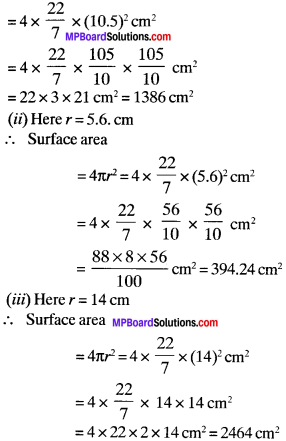
(i) Here r = 10.5 cm
∴ Surface area of the sphere = 4πr2
MP Board Class 9th Maths Solutions Chapter 13 Surface Areas and Volumes Ex 13.4 img-1

Question 2.
Find the surface area of a sphere of diameter:

(i) 14 cm
(ii) 21 cm
(Hi) 3.5 m

Solution:
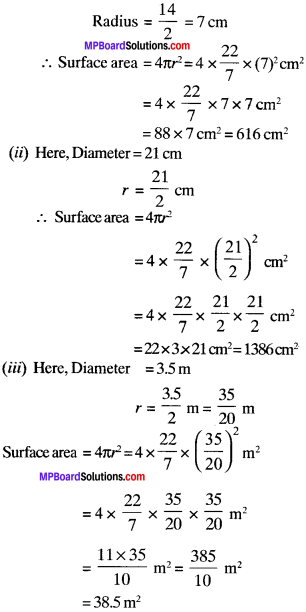
(i) Here, Diameter = 14 cm
MP Board Class 9th Maths Solutions Chapter 13 Surface Areas and Volumes Ex 13.4 img-2

Question 3.
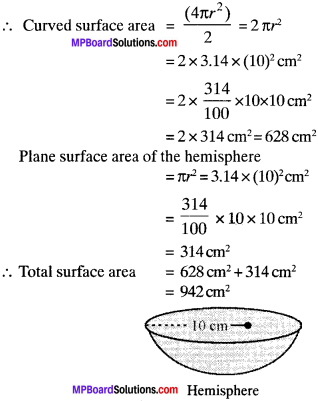
Find the total surface area of a hemisphere of radius 10 cm. (Use π = 3.14)
Solution:
Here, radius (r) = 10 cm
MP Board Class 9th Maths Solutions Chapter 13 Surface Areas and Volumes Ex 13.4 img-3

Question 4.
The radius of a spherical balloon increases from 7 cm to 14 cm as air is being pumped into it. Find the ratio of surface areas of the balloon in the two cases.
Solution:
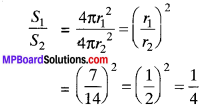
Initial radius of the balloon, r1 = 7 cm
Final radius of the balloon, r2 = 14 cm
Initial surface area of the balloon = S1
Final surfacg area of the balloon = S2
MP Board Class 9th Maths Solutions Chapter 13 Surface Areas and Volumes Ex 13.4 img-4
S1 : S2 = 1 : 4

Question 5.
A hemispherical bowl made of brass has inner diameter 10.5 cm. Find the cost of tin-plating it on the inside at the rate of ₹ 16 per 100 cm2.
Solution:
d = 10.5 cm
r =5.25 cm
Rate of tinplating = \(\frac{16}{100}\) = ₹ 0.16 per cm2
Inner curved surface area of bow l = 2 πr2
ICSA = 2 x \(\frac{22}{7}\) x 5.25 x 5.25 = 173.25 cm2
Cost of tin-plating = Rate x ICSA
= 0.16 x 173.25 = ₹ 27.72

MP Board Solutions

Question 6.
Find the radius of a sphere whose surface area is 154 cm2.
Solution:
Surface area of sphere = 4 πr2
154 = 4 x \(\frac{22}{7}\) x r2
\(\frac{154×7}{4×22}\) = r2
⇒ r2 = 3.5 cm.

Question 7.
The diameter of the moon is approximately one-fourth of the diameter of the earth – Find the ratio of their surface areas.
Solution:
d1 = \(\frac{1}{4}\)d2
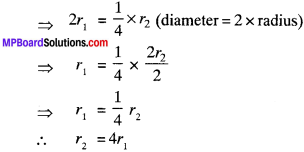
MP Board Class 9th Maths Solutions Chapter 13 Surface Areas and Volumes Ex 13.4 img-5
Let .S1, and .S2, be the surface area of moon and earth respectively.
S1 = 4 πr12
S2 = 4 πr22
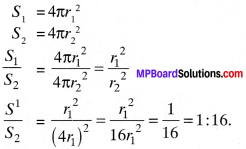
MP Board Class 9th Maths Solutions Chapter 13 Surface Areas and Volumes Ex 13.4 img-6

Question 8.
A hemispherical bowl is made of steel, 0.25 cm thick. The inner radius of the bowl is 5 cm. Find the outer curved surface area of the bowl.
Solution:
r1 = 5 cm
t (thickness) = 0.25 cm
r2 = r1 + t
= 5 + 0.25 = 5.25 cm
OCSA of bowl = 2x \(\frac{22}{7}\) x 5.25 x 5.25
= \(\frac{44}{7}\) x 5.25 x 5.25 = 173.25 cm2

MP Board Solutions

Question 9.
A right circular cylinder just encloses a sphere of radius r (see Fig.). Find
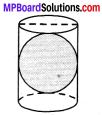
MP Board Class 9th Maths Solutions Chapter 13 Surface Areas and Volumes Ex 13.4 img-7

  1. surface area of the sphere.
  2. curved surface area of the cylinder.
  3. ratio of the areas obtained in (i) and (ii).

Solution:
As the sphere just encloses a right circular cylinder, the height of the cylinder is equal to the diameter of the sphere.
∴ Height of cylinder h = 2r
where r is the radius of sphere

1. Surface area of sphere S1 = 4πr2

2. CSA of a cylinder,= 2πrh
= 2πr x 2r = 4πr2

3. MP Board Class 9th Maths Solutions Chapter 13 Surface Areas and Volumes Ex 13.4 img-8
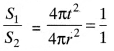
MP Board Class 9th Maths Solutions

MP Board Class 6th Science Solutions Chapter 5 Separation of Substances

MP Board Class 6th Science Solutions Chapter 5 Separation of Substances

Separation of Substances Text Book Exercises

Question 1.
Why do we need to separate different components of a mixture? Give two examples?
Answer:
It is essential to purify foodstuff to maintain good health. Researchers, chemists and technologists also need pure substances. Thus, separation of different components of a mixture is essential. The main purposes are:

  1. To remove impurities for getting a pure sample. For example, salt from sea water.
  2. To obtain the useful components for getting wheat or rice grains after separating.
  3. To remove the harmful component.
MP Board Solutions

Question 2.
What is winnowing? Where it is used?
Answer:
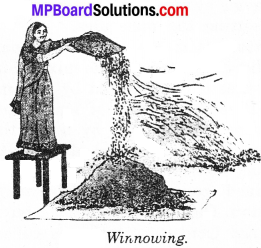
The process of separating heavier and lighter components of a mixture by wind or by blowing air is called winnowing? This method is commonly used by farmers to separate lighter husk particles from heavier seeds of grain. The farmer allows the mixture of grain and the husk to fall from a height.

The grains which are heavier fall vertically down on the ground and form a heap near the platform of winnowing. The husk which is higher, is carried away by the wind and forms a separate heap at a short distance from the heap of grains as shown in the figure.
MP Board Class 6th Science Solutions Chapter 5 Separation of Substances img 1
The separated husk is used for many purposes such as fodder for catels.

Question 3.
How will you separate husk or dirt particles from a given sample of pulses before cooking?
Answer:
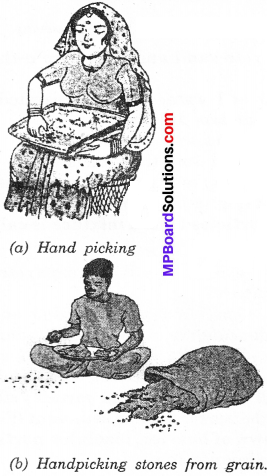
The husk or dirt particles from a given sample of pulses before cooking can be separated by hand picking. For example, when the components of a mixture are different in size, shape and color, they can be easily separated by hand picking. Housewife often clean pulses and spices by this method.
They remove small dust, dirt, pebbles and other unwanted materials. The quantity of such impurities is usually not very large. In such situations, we find that hand picking is a convenient method of separating substances.
MP Board Class 6th Science Solutions Chapter 5 Separation of Substances img 2

Question 4.
What is sieving? Where is it used?
Answer:
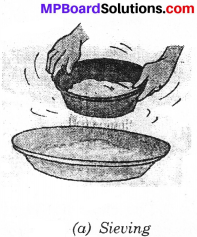
Sieving is a method used to separate the components of a mixture which are of different size. Sieving allows the fine flour particles to pass through the holes of the sieve while the bigger impurities remain on the sieve In a flour mill, impurities like husk and stones are removed from wheat before grinding it.

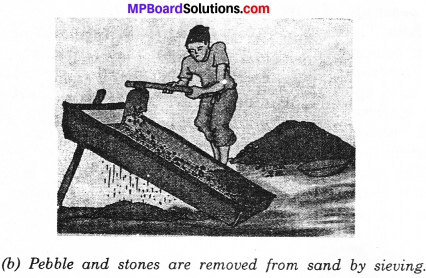
Usually, a bagful of wheat is poured on a slanting sieve. The sieving removes pieces of stones, stalk and husk that may still remain with wheat after threshing and winnowing. You may have also noticed similar sieves being used at construction sites to separate pebbles and stones from sand.
MP Board Class 6th Science Solutions Chapter 5 Separation of Substances img 3
MP Board Class 6th Science Solutions Chapter 5 Separation of Substances img 4

Question 5.
How will you separate sand and water from their mixture?
Answer:
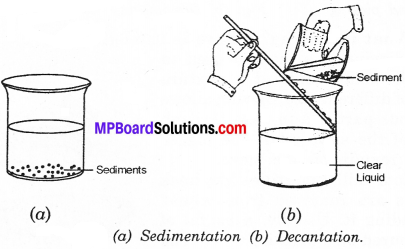
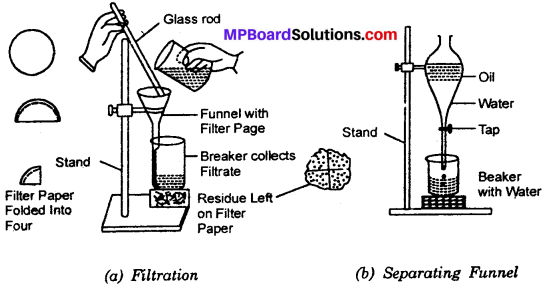
A mixture of sand and water can be separated by sedimentation method or decantation method. Take the mixture of sand and water in a beaker. Allow the mixture to stand for sometime undisturbed.

You will observe that sand particles start settling down at the bottom of the beaker forming sediment (Fig. (a). The process of settling down of heavier, insoluble particles from a mixture is called sedimentation.
MP Board Class 6th Science Solutions Chapter 5 Separation of Substances img 5
The clear liquid above the sediment is gently poured off into another beaker, without disturbing the sediment (Fig. b). This process of transferring the clear liquid without disturbing sediments is known as decantation.

Question 6.
Is it possible to separate sugar mixed with wheat flour? If yes, how will you do it?
Answer:
Yes, it is possible to separate sugar mixed with wheat flour. This can be separated by sieving. Sieving allows the fine wheat flour particles to pass through the holes of the sieve while the sugar remain on the sieve.

MP Board Solutions

Question 7.
How would you obtain clear water from a sample of muddy water?
Answer:
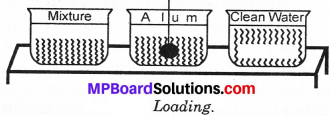
We can separate clear water from a sample of muddy water by loading process. Take a beaker half filled with muddy water and take a piece of alum. The loading of suspended particles is carried out by alum. The alum crystal is slowly moved in water.

The dissolved particles of alum in water loads on the fine dust particles. The particles become heavy and settles down to the bottom. The clear water is decanted as shown in Fig. The suspended particles remains at bottom as sediment.
MP Board Class 6th Science Solutions Chapter 5 Separation of Substances img 6

Question 8.
Fill up the blanks:

  1. The method of separating seeds of paddy from its stalks is called ………………………
  2. When milk, cooled after boiling, is poured onto a piece of cloth the cream (malai) is left behind on it. This process of separating cream from milk is an example ……………………………..
  3. Salt is obtained from seawater by the process of ……………………….
  4. Impurities settled at the bottom when muddy water was kept overnight in a bucket. The clear water was then poured off from the top. The process of separation used in this example is called ………………………..

Answer:

  1. Threshing
  2. Filtration
  3. Evaporation
  4. Decantation.
Question 9.
True or false:

  1. A mixture of milk and water can be separated by filtration.
  2. A mixture of powdered salt and sugar can be separated by the process of winnowing.
  3. Separation of sugar from tea can be done with filtration.
  4. Grain and husk can be separated with the process of decantation.

Answer:

  1. False
  2. False
  3. False
  4. False.

MP Board Solutions

Question 10.
Lemonade is prepared by mixing lemon juice and sugar in water. You wish to add ice to cool it. Should you add ice to the lemonade before or after dissolving sugar? In which case would it be possible to dissolve more sugar?
Answer:
We should add ice in lemonade after dissolving sugar in it, because sugar dissolve more quickly before adding ice. It would be possible to dissolve more sugar before adding ice in the lemonade, because it dissolve more into hot than in cold.

Projects and Activities

Activity 1.
You have tried a number of methods to separate impurities like mud from water. Sometimes, the water obtained after employing all these processes could still be a little muddy. Let us see if we can remove even this impurity completely. Take this filtered water in a glass?

Tie a thread to a small piece of alum. Suspend the piece of alum in the water and swirl. Did the water become clear? What happened to the mud? This process is called loading. Talk to some elders in your family to find out whether they have seen or used this process?
Answer:
We can separate clear water from a sample of muddy water by loading process. Take a beaker half filled with muddy water and take a piece of alum. The loading of suspended particles is carried out by alum. The alum crystal is slowly moved in water.

The dissolved particles of alum in water loads on the fine dust particles. The particles become heavy and settles down to the bottom. The clear water is decanted as shown in Fig. The suspended particles remains at bottom as sediment.
MP Board Class 6th Science Solutions Chapter 5 Separation of Substances img 6

Activity 2.
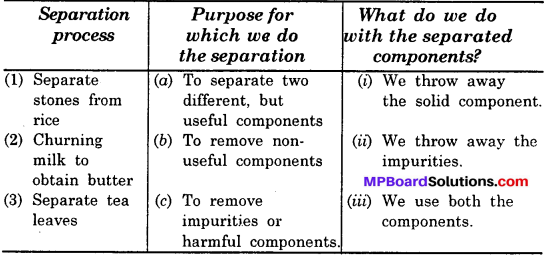
Match the each process with its purpose and the way separated components are used:
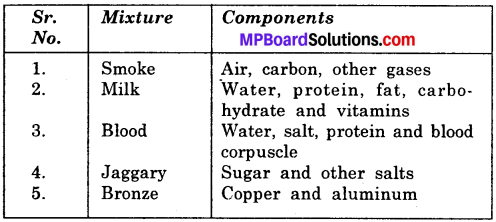
Table: Why do we separate substances?
MP Board Class 6th Science Solutions Chapter 5 Separation of Substances img 7

Activity 3.
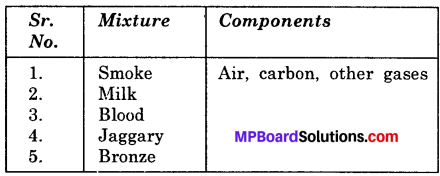
Complete the following table:
MP Board Class 6th Science Solutions Chapter 5 Separation of Substances img 8
Answer:
MP Board Class 6th Science Solutions Chapter 5 Separation of Substances img 9

Activity 4.
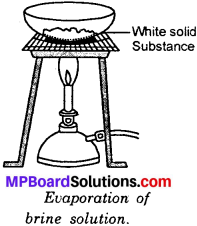
To separate common salt from common salt solution (brine)?
Method:
Take brine in a china dish. Heat it by placing it over a wire gauze on a tripod stand as shown in Fig. After sometime the water starts evaporating. Go on heating till all the water present in the solution evaporates. You will see that some white solid substance is left behind as a residue. This is a sample of pure common salt.
MP Board Class 6th Science Solutions Chapter 5 Separation of Substances img 10

Activity 5.
To separate a mixture of kerosene and water?
Method:
Prepare a mixture of kerosene and water in a 200ml. Beaker. Carefully transfer to a separating funnel through a funnel. Stopper and shaken well. Now the mixture allow to settle. Note that kerosene is the top layer and water is the bottom layer.

This is due to the density differences between the two liquids Place the separating funnel in a ring stand and place a beaker below it to collect the components. Carefully looking at the layers of separation, drain kerosene and water in different containers.
MP Board Class 6th Science Solutions Chapter 5 Separation of Substances img 12

Separation of Substances Additional Important Questions

Separation of Substances Objective Type Questions

Question 1.
Choose the correct answer:

Question (a)
A mixture of iodine and sand can be separated by –
(a) Decantation
(b) Centrifugation
(c) Filtration
(d) Sublimation.
Answer:
(d) Sublimation.

Question (b)
A mixture of leaves of tea and iron fillings are separated by –
(a) Filtration
(b) Handpicking
(c) Magnetic separation
(d) Sieving.
Answer:
(c) Magnetic separation

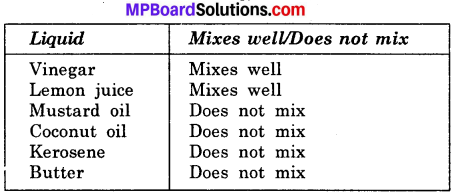
Question (c)
A mixture of mustard oil and kerosene oil can be separated by –
(a) Sublimation
(b) Evaporation
(c) Separating funnel
(d) Filtration.
Answer:
(c) Separating funnel

MP Board Solutions

Question (d)
When two elements are brought together, the always form
(a) A mixture
(b) An element
(c) A compound
(d) None of these.
Answer:
(a) A mixture

Question (e)
In nature most elements occur as –
(a) Pure elements
(b) Mixture of elements
(c) Compound form
(d) None of these.
Answer:
(c) Compound form

Question (f)
A solution of salt in water is a –
(а) Compound
(b) Homogeneous mixture
(c) Heterogeneous mixture
(d) None of these.
Answer:
(b) Homogeneous mixture

Question 2.
Fill in the blanks:

  1. A mixture of mustard oil and water can be separated by using ………………………
  2. Ammonium chloride and salt are separated by …………………………
  3. Common salt is obtained from sea water by …………………….
  4. A mixture of chalk powder and water is seperated by ………………………
  5. Husk is separated from rice by …………………………
  6. Cream is separated from milk by ……………………….
  7. Naphthalene is separated from common salt by ……………………..
  8. Insects are separated from wheat by ……………………..

Answer:

  1. Separating funnel
  2. Sublimation
  3. Evaporation
  4. Filtration
  5. Winnowing
  6. Centrifugation
  7. Sublimation
  8. Hand – picking.

MP Board Solutions

Question 3.
Which of the following statements are true (T) or false (F):

  1. Sherbet is a pure substance.
  2. Rock salt is impure substance.
  3. The process of winnowing is used to remove small pieces of stone from grams.
  4. A pure sample of a substance consists of only one kind of particles.
  5. Sugar is separated from its solution in water by decantation.
  6. Butter is separated from milk by the. method of crystallization.

Answer:

  1. False
  2. True
  3. False
  4. True
  5. False
  6. False.

Question 4.
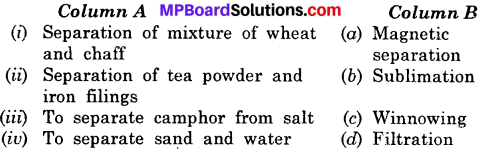
Match the items in Column A with the Column B:
MP Board Class 6th Science Solutions Chapter 5 Separation of Substances img 19
Answer:

(i) – (c)
(ii) – (a)
(iii) – (b)
(iv) – (d).

Separation of Substances Very Short Answer Type Questions

Question 1.
Name the process used in flour mill?
Answer:
Sieving.

Question 2.
Name the method of separating iron from waste material?
Answer:
Magnetic separation.

Question 3.
Name the process to separate two unmixible liquids?
Answer:
Decantation.

Question 4.
Name the apparatus used to separate two unmixible liquids?
Answer:
Separating funnel.

MP Board Solutions

Question 5.
Some Suji has been stored in a rusty tin. When taken out it contains some flakes of rust. How will you remove them?
Answer:
We can remove flakes of rust by sieving the mixture.

Question 6.
What is the advantage of distillation over evaporation?
Answer:
In distillation liquid can be recovered while in evaporation it is lost.

Question 7.
Which substance is used for loading?
Answer:
Alum.

Question 8.
What is the use of alum in loading?
Answer:
Alum is used to make the decantation faster.

Question 9.
Name the process to obtain salt from sea water?
Answer:
Evaporation.

Question 10.
Name two sublime substances?
Answer:

  1. Iodine
  2. Ammonium chloride.

Question 11.
What happens during sublimation?
Answer:
Solids are directly converted into their vapours without undergoing liquid state.

Question 12.
How does doctor get distilled water?
Answer:
By distillation of water.

MP Board Solutions

Question 13.
Can you say that a mosquito net is a filter?
Answer:
Yes, mosquito net is a filter. It filters out mosquito from the air.

Question 14.
How does jeweller separate pearls of different sizes?
Answer:
Jeweller separates pearls of different size by sieving.

Question 15.
Are all crystals of substances of same shape and colour?
Answer:
No, crystals of different substances are of different shape and colour.

Question 16.
Tea filter is missing, then what method would you use for separation of tea powder?
Answer:
Sedimentation.

Question 17.
Which organ of our body separates harmful components from blood?
Answer:
Kidney.

MP Board Solutions

Question 18.
What happens when camphor is left open?
Answer:
When camphor is left open then a strong smell is produced.

Question 19.
Name two pure substances that you know?
Answer:
All elements and compounds are pure substances like salt, water, carbon (graphite), diamond, silver, copper etc.

Question 20.
Solid substance is dissolved in water. Which of the following methods is used to separate it?

  1. Filtration
  2. Evaporation
  3. Sublimation
  4. Decantation.

Answer:
A solid substance is dissolved in water. It is separated by the method of evaporation.

MP Board Solutions

Question 21.
Which method would you use for the separation of a solid substance dissolved in water? Both the components are to be collected?
Answer:
Distillation is used to separate solid substance and the water from the mixture like salt solution.

Question 22.
Why does visibility increase after rains?
Answer:
This is because the dust particles that were present in air settle down due to loading by fain drops and we can see distant objects if the air dust is free and clean.

Question 23.
Name the two materials used in water filters?
Answer:

  1. Filters made from ceramics are used in households.
  2. In water – works for large supply of drinking water the material called resin, a kind of plastic is used.

Question 24.
Why is chlorine mixed with drinking water?
Answer:
In water – works, chlorine is used for killing the harmful bacteria present in water before supplied to consumers.

Question 25.
Name the method by which we can remove butter from milk?
Answer:
The process called centrifugation is used to remove butter from milk. Milk is churned in special machines like centrifuges. Butter being light in weight floats on the surface of milk and is removed easily.

MP Board Solutions

Question 26.
Define evaporation?
Answer:
Evaporation method is used to separate solids dissolved in a liquid. This process is largely used to obtain common salt from sea or lake water. The process of converting a liquid into its vapour by heating is called evaporation.

Question 27.
Define crystallization?
Answer:
Crystallization method is used to purify solid substances. The process of separating a pure substance in the form of crystals from its hot saturated solution by cooling is called crystallization.

Separation of Substances Short Answer Type Questions

Question 1.
Name three mixtures commonly found in nature?
Answer:
The three mixtures commonly found in nature are soil, air and sea – water. Soil is a mixture of various inorganic and organic matter. Air is a mixture of various gases and dust particles. Sea water is a mixture of water and salts.

Question 2.
How would you separate water and mustard oil?
Answer:
The separation of water and mustard oil is based on the principle that water is heavier than oil and also the two are immixible liquids. They form distinct layers. Take the mixture in separating funnels. Separate the water by opening the stop – clock at the base of the funnel in a beaker.
MP Board Class 6th Science Solutions Chapter 5 Separation of Substances img 20

Question 3.
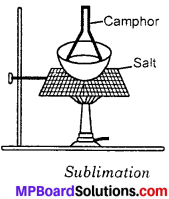
What is the process to separate salt and camphor?
Answer:
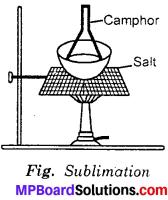
Camphor is a volatile substance. It sublimes on heating. When a mixture of salt and camphor is heated, the camphor being volatile sublimes and is collected as shown in figure. The salt being non – volatile is left behind.

MP Board Solutions

Question 4.
Explain how would you make crystals of sugar?
Answer:
Prepare sugar solution in hot water. The beaker is allowed to cool. Filter the solution. Hang a crystal of sugar in this solution with the help of a thread and a glass rod or a pencil. Leave the solution uncovered and undisturbed for a few days. We observe that the crystal slowly begin to grow.

Question 5.
Write the name of methods which we use in our daily life for separating components of mixtures?
Answer:
The various processes involved in separation of a mixture components of a mixture are:

  1. Winnowing
  2. Hand – picking
  3. Sieving
  4. Decantation
  5. Filtration
  6. Magnetic separation
  7. Loading
  8. Distillation
  9. Centrifugation
  10. Crystallization
  11. Sublimation.

Question 6.
How you separate a mixture of milk and cooking oil?
Answer:
Milk and cooking oil are two immiscible liquids. The cooking oil is lighter than milk and it will form upper layer in this mixture. We take the mixture in a separating funnel and allow the mixture to settle. When the separation of milk and cooking oil is complete, we open the stop – cock of the separating funnel. The lower layer of milk is decanted leaving behind oil in the separating funnel. The cooking oil is collection in a separate breaker.

MP Board Solutions

Question 7.
Define distillation?
Answer:
Distillation is the process of evaporation followed by condensation. This method is used to separate a mixture of two miscible liquids with a difference in their boiling points. This process is also used to obtain pure substance from a solution. In evaporation the liquid is lost but in distillation both solute and solvent are obtained. Distilled water used by the doctor for injections is obtained by distillation. In Kuwait, sea water is distilled to get drinking water.

Separation of Substances Long Answer Type Questions

Question 1.
What is a mixture? Give examples of mixtures?
Answer:
A mixture is a heterogeneous material which has two or more kind of particles. A mixture may have solid, liquid or gas components. Examples:

  1. Rock salt is a mixture of some salts, soil and sand.
  2. Soil is a mixture of clay, sand and particles of grass and other dead plants.
  3. Sherbet we drink in summer is a mixture of water, sugar and colouring and flavouring substances.
  4. Sea water is a mixture of water and many salts.
  5. Air is a mixture of oxygen, nitrogen, carbon dioxide, water vapour, dust particles and gases like argon.

Question 2.
You are given a mixture of sand, water and mustard oil. How will you separate the components of the mixture?
Answer:
Principle – The separation is based on the principle that sand and mustard oil are insoluble in water. But sand being heavy, so settles at bottom and mustard oil being lighter floats on water surface. The separation is carried out in two steps.
MP Board Class 6th Science Solutions Chapter 5 Separation of Substances img 13
Step – I:
Take the mixture of water, sand and mustard oil, filter the mixture. The sand will be separated. The water and oil will pass through filter – paper and will be collected as filtrate.

Step – II:
Take the filtrate in a separating funnel. Allow the mixture to set. Then open the stopcock and decant of water. Mustard oil will be left in the separating funnel.

Question 3.
How will you obtain pure salt from its impure sample?
Answer:
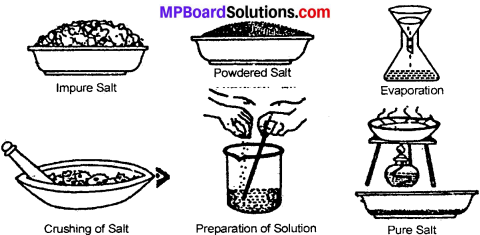
Rock salt is a mixture of salt, clay and sand. Of these pure salt is soluble in water. Therefore, rock salt is first ground to a fine powder. The powdered rock salt is dissolved in water. On dissolving, salt being soluble in water so dissolves and the clay and sand is left behind:

The mixture is now filtered through a filter – paper. The clay and sand filtrate. The filtrate is evaporated in China dish. The water evaporates and pure salt is left behind.
MP Board Class 6th Science Solutions Chapter 5 Separation of Substances img 14

Question 4.
How will you separate a mixture of iron filings, ammonium chloride and sand from their mixture?
Answer:
Principle – The separation is based on the principle that ammonium chloride is volatile, iron filings are magnetic and sand is neither volatile nor magnetic. The separation is carried out in two steps:

Step – I:
Take the mixture in a dish. Bring a strong bar magnet over the mixture. The iron filings are attracted to the magnet and are separated leaving the mixture of ammonium chloride and sand.

Step – II:
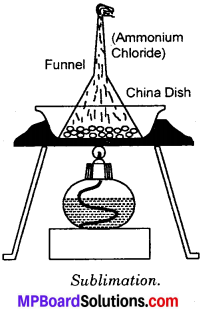
Take the mixture in a China dish. Cover the China dish with an. inverted funnel as shown in the fig. Heat the content of China dish with spirit lamp. The ammonium chloride being volatile sublimes and its vapours collects on the surface of funnel. Allow the funnel to cool. Scratch the ammonium chloride. The sand will remain in China Dish.
MP Board Class 6th Science Solutions Chapter 5 Separation of Substances img 15

Question 5.
Define threshing with diagram?
Answer:
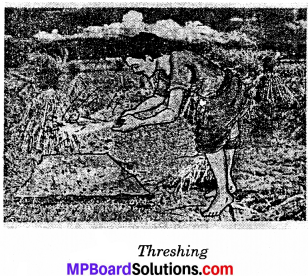
The process that is used to separate grain from stalks is threshing. In this process, the stalks are beaten to free the grain seeds (Fig.). Sometimes, threshing is done with the help of bullocks. Machines are also used to thresh large quantities of grain.
MP Board Class 6th Science Solutions Chapter 5 Separation of Substances img 16

Question 6.
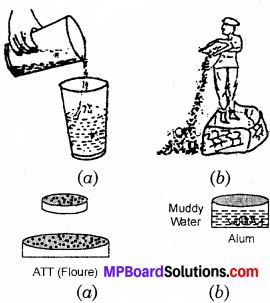
You know various methods of separating mixtures. Here four pictures are shown. Write the correct names of methods under each picture?
MP Board Class 6th Science Solutions Chapter 5 Separation of Substances img 17
Answer:

  1. Decantation.
  2. Winnpwing
  3. Sieving
  4. Loading.

Question 7.
How will you separate pure water from a solution of salt in water?
Answer:
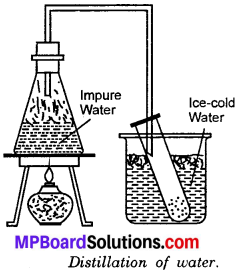
Take the mixture of salt in water in a flask. Set the arrangement for distillation. On heating water vapour rises and passes through the tube. They are condensed in the test – tube surrounded by the cold water. Thus we get pure water leaving behind salt in the flask.
MP Board Class 6th Science Solutions Chapter 5 Separation of Substances img 18

MP Board Class 6th Science Solutions

MP Board Class 6th Science Solutions Chapter 10 Motion and Measurement of Distances

MP Board Class 6th Science Solutions Chapter 10 Motion and Measurement of Distances

Motion and Measurement of Distances Text Book Questions

Question 1.
Give two examples each, of modes of transport used on land, water and air.
Answer:

  • Land: Railways, buses.
  • Water: Ships, boats.
  • Air: Aeroplanes, helicopters.

Question 2.
Fill in the blanks:

  1. One meter is ……………… cm.
  2. Five kilometer is ……………. m.
  3. Motion of a child on a swing is ………………
  4. Motion of the needle of a sewing machine is ………………
  5. Motion of wheel of a bicycle is ……………….

Answer:

  1. 100
  2. 5000
  3. Periodic motion
  4. Oscillatory motion
  5. Circular motion.

MP Board Solutions

Question 3.
Why can a pace or a footstep not be used as a standard unit of length?
Answer:
A pace or a footstep cannot be used as a standard unit of length because they are different for different people. Moreover, there will be a large difference in a pace and a footstep of child, young and an adult.

Question 4.
Arrange the following lengths in their increasing magnitude:
1 meter, 1 centimeter, 1 kilometer, 1 millimeter.
Answer:
The given lengths in their increasing order are written as:
1 millimeter > 1 centimeter > 1 meter > 1 kilometer.

Question 5.
The length of a person is 1.65 m. Express it into cm and mm.
Answer:
We know that,
1 m = 100 cm
and 1 m = 1000 mm
∴ 1.65 m = 1.65 × 100 cm = 165 cm
and 1.65 m = 1.65 × 1000 mm = 1650 mm.

Question 6.
The distance between Radha’s home and her school is 3250 m. Express this distance into km.
Answer:
We know that,
1 m = \(\frac { 1 }{ 1000 }\) Km
∴ Distance between Radha’s home and her school = 3250m
= 3250 × \(\frac { 1 }{ 1000 }\) km.
= 3.250 km.

MP Board Solutions

Question 7.
While measuring the length of a knitting needle, the reading of the scale at one end is 3.0 cm and at the other end is 33.1 cm. What is the length of the needle?
Answer:
The length of needle = 33.1 – 3.0 cm
= 30.1 cm.

Question 8.
Write the similarities and differences between the motion of a bicycle and a ceiling fan that has been switched on.
Answer:

Similarity:
The motion of a bicycle and ceiling fan are in circular motion.

Dissimilarity:
The ceiling fan moves without changing its position while the bicycle moves with changing its position with time.

Question 9.
Why could you not use an elastic measuring tape to measure distance? What would be some of the problems you would meet in telling someone about a distance you measured with an elastic tape?
Answer:
We should not use an elastic measuring tape to measure distance because the length of an elastic measuring tape will increase when we pull or stretch the tape for measuring the length. The measured length may be increase or decrease due to its elasticity. Thus, we cannot measure the correct length by an elastic measuring tape. The length of any object measured by this elastic tape either will be more or less depending upon the elasticity of the tape.

MP Board Solutions

Question 10.
Give two examples of periodic motion.
Answer:
Examples of periodic motion are motion of a pendulum, a branch of a tree moving to and fro, motion of a child on a swing, strings of a guitar, etc. (any two).

Projects And Activities

Activity 1.
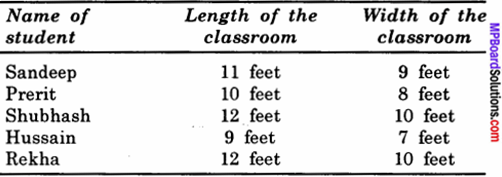
Work in groups and each of you do this activity one by one. Using your foot as a unit of length, measure the length and breadth of the classroom. It is possible that while measuring these you may find some part remains to be measured as it is smaller than your foot.
Answer:
Measuring length and breadth of classroom
MP Board Class 6th Science Solutions Chapter 10 Motion and Measurement of Distances 18

Activity 2.
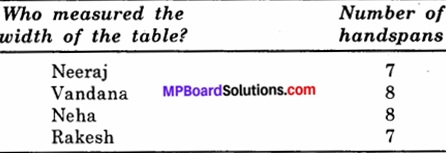
Work in groups and each of you use your handspan as a unit to measure the width of a table or a desk in the classroom.
Answer:
Measuring width of a table
MP Board Class 6th Science Solutions Chapter 10 Motion and Measurement of Distances 19

Activity 3.
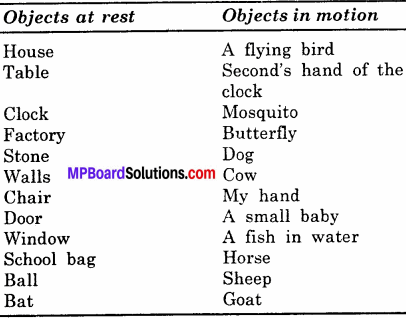
Think of some objects you have seen recently. List them in Table. A school bag, a mosquito, a table, people sitting on desks, people moving about? May be a butterfly, dog, cow, your hand, a small baby, a fish in water, a house, a factory, a stone, a horse, a ball, a bat, a moving train, a sewing machine, a wall clock, hands of a clock? Make your list as large as you can. Which of these are moving? Which are at rest?
Answer:
Table: Objects in rest and motion
MP Board Class 6th Science Solutions Chapter 10 Motion and Measurement of Distances 17

Motion and Measurement of Distances Additional Important Questions

Motion and Measurement of Distances Objective Type Questions

Question 1.
Choose the correct answers:

Question (i)
The SI unit of the length is –
(a) Centimeter
(b) Meter
(c) Decimeter
(d) Kilometer
Answer:
(a) Centimeter

Question (ii)
The SI unit of mass is –
(a) Milligram
(b) Gram
(c) Kilogram
(d) Quintal
Answer:
(c) Kilogram

MP Board Solutions

Question (iii)
SI unit of time is –
(a) Day
(b) Hour
(c) Minute
(d) Second
Answer:
(d) Second

Question (iv)
To read the scale the eye should be vertically –
(a) Upward
(b) Downward
(c) Both
(d) None
Answer:
(a) Upward

Question (v)
Flying kite is an example of –
(a) Circular motion
(b) Periodic motion
(c) Irregular motion
(d) Linear motion
Answer:
(c) Irregular motion

Question 2.
Fill in the blanks:

  1. One decameter equals ……………. meters.
  2. One decimeter equals ……………. centimeters.
  3. One quintal equals ……………. kilograms.
  4. One millennium equals ……………. centuries.
  5. One metric ton equals …………… quintals.
  6. Meter is indicated by sign …………….
  7. Kilogram is indicated by sign …………….
  8. Second is indicated by sign …………….
  9. Changing of day and night is ……………. change.

Answer:

  1. 0.1
  2. 10
  3. 100
  4. 10
  5. 10
  6. m
  7. kg
  8. s
  9. Periodic

MP Board Solutions

Question 3.
State whether the following statements are true (T) or false (F):

  1. In ancient India, small length measurements used were an angul (finger) or a mutthi (fist).
  2. In 1790, the French created a standard unit of measurement called the metric system.
  3. For measuring large distances, meter is not a convenient unit.
  4. Handspan is a standard unit of length.
  5. Length of a curved line cannot be measured by a meter scale directly.
  6. Motion of the balance wheel of a watch is a periodic motion.
  7. The motion of a ball rolling on ground is random motion.
  8. The motion of a point marked on the black of an electric fan is the example of circular motion.
  9. The motion of the moon round the earth is periodic.
  10. When a drum is struck gently, its membrane shows random motion.

Answer:

  1. True
  2. True
  3. True
  4. False
  5. True
  6. True
  7. True
  8. True
  9. False
  10. False.

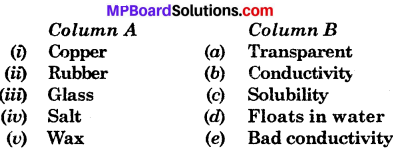
Question 4.
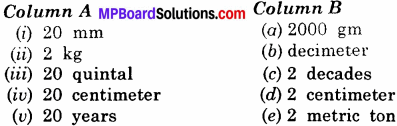
Match the items in Column A with Column B:
MP Board Class 6th Science Solutions Chapter 10 Motion and Measurement of Distances 16
Answer:

(i) (d)
(ii) (a)
(iii) (e)
(iv) (b)
(v) (c).

Question 5.
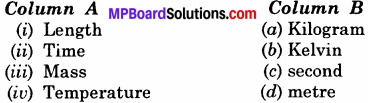
Match the items in Column A with Column B:
MP Board Class 6th Science Solutions Chapter 10 Motion and Measurement of Distances 15
Answer:

(i) (d)
(ii) (c)
(iii) (a)
(iv) (b).

Motion and Measurement of Distances Very Short Answer Type Questions

Question 1.
How may kilogram are there in one metric ton?
Answer:
1 metric ton = 1000 kg = 103 kg.

Question 2.
How many seconds are there in one day?
Answer:
Number of seconds in one day=24 × 60 x 60 = 86400 s.

Question 3.
Why a pace or a foot step cannot be used as a standard unit of length.
Answer:
The pace or a foot step vary from person to person. These methods are not satisfactory.

Question 4.
Arrange the following lengths in their increasing order: metre, centimeter, kilometer, millimeter.
Answer:
Millimeter < centimeter < metre < kilometer.

MP Board Solutions

Question 5.
Arrange the following masses in their increasing order: kilogram, quintal, milligram, gram.
Answer:
Milligram < gram < kilogram < quintal.

Question 6.
How many liters would be there in 1000 ml?
Answer:
1 litre, because liter = 1000 ml.

Question 7.
How many seconds are there in 8 minutes?
Answer:
∵ 1 minutes = 60 seconds
∴ 8 minutes = 8 × 60 seconds
= 480 seconds.

Question 8.
How many centimeters means 8 meters?
Answer:
∵ 1 metre = 100 centimeter
∴ 8 meters = 8 × 100 centimeters
= 800 centimeters.

Question 9.
How many meters means 3000 mm?
Answer:
∵ 1 mm = 100 metre
3000
∴ 3000 mm = metre = 3 metre.

Question 10.
To measure the length of chest, what instrument would you use? Can you measure chest with the help of any other method?
Answer:
For measuring the size of chest we use a measuring tape. A metre scale cannot be used. It will not give correct measurement because it is not flexible.

MP Board Solutions

Question 11.
Why hand is not a standard unit to measure length?
Answer:
A hand cannot be used as standard unit of length because the length of hand of all the people are different. So the length measured by one person will differ from the length measured by the other person.

Question 12.
What happens if the tailor takes your measurement with hand?
Answer:
There is variation in the measurement takes by hand because the length of hand-span of every tailor was different.

Question 13.
State any two points necessary for measurement.
Answer:
The measurement is the comparison of any two unknown quantity with same kind of definite known quantity. The measure should be such that it must have same meaning for each individual. To bring uniformity in measurement we use standard units.

Question 14.
At which place, the standard units have been preserved?
Answer:
International standard units have been preserved at the Weight and Measures Bureau in Paris.

Question 15.
Where does the copies of standard units have been preserved in India?
Answer:
In India, one copy of International standard units is preserved at National Physical Laboratory, Pusa Road, New Delhi.

Question 16.
Name the quantity which a shopkeeper measures while selling rice.
Answer:
Kilogram.

Question 17.
Name the two parts which must be mentioned to state the results of a measurement.
Answer:
The two parts are

  1. Quantity
  2. Unit.

MP Board Solutions

Question 18.
Name the SI units of length?
Answer:
SI unit of length is 1 metre or 9 m.

Question 19.
Name the SI unit of mass?
Answer:
SI unit of mass is kilogram or 9 kg.

Question 20.
What is motion?
Answer:
Motion is the continuous change in position of a body with respect to time as compared to a stationary object. For examples, moving car, moving fan, etc.

Question 21.
Is your classroom at rest or in motion?
Answer:
It is at rest because’ it is not changing its position.

Question 22.
Is the hour’s hand of a wall clock at rest or in motion?
Answer:
The hour’s hand of a wall clock is moving though it moves very slowly.

Question 23.
What type of motion do the vehicles on a straight road perform?
Answer:
The vehicles perform rectilinear motion on the road.

Question 24.
What type of motion does the wheel of a bicycle perform?
Answer:
The wheel of a bicycle perform rotatory or circular motion.

Question 25.
An object is hung from a spring is pulled down and left. What type of motion does the object perform?
Answer:
The object perform oscillatory motion which is also a periodic motion.

Question 26.
Give two examples of periodic motion.
Answer:

  1. Rotation of earth on its axis.
  2. Moon moves around the earth.

Question 27.
Give two examples of non – uniform motion.
Answer:

  1. Motion of the train when its driver applies breaks.
  2. Motion of the cricket ball when the bowler throws the ball and the ball is hit by the player.

MP Board Solutions

Question 28.
Name the three types of motion.
Answer:
Three types of motion are rectilinear motion, rotatory motion and oscillatory motion.

Question 29.
Which type of motion does the feet of a tailor perform while sewing some clothes on a sewing machine?
Answer:
The feet of the tailor perform periodic motion while sewing clothes on a sewing machine.

Motion and Measurement of Distances Short Answer Type Questions

Question 1.
What do you mean by measurement, explain with example?
Answer:
The comparision of an unknown quantity with a known standard quantity (called unit) is known as measurement. For example, while buying things, we ask a certain amount of quantity to the shopkeeper, he then weight the exact quantity and gives it to us, like one kg sugar, 5 metre cloth, 10 kg. flour etc.

Question 2.
In our daily life, where we need measurement. Give any five examples.
Answer:
Examples of measurements:

  1. To measure the length of cloth before serving.
  2. To measure the weight of vegetables before buying.
  3. To build house.
  4. To reach school in time.
  5. To buying milk.

Question 3.
What are the difficulties in using non – standard units?
Answer:
People use foot, arm, stretched palm, etc. as units of length. These non – standard units (or methods) were not satisfactory because lengths of arm, foot and stretched palm vary from person to person. However if there are different units of length in the different parts of the world, it is very inconvenient for the exchange of scientific information. Thus the need for the standard unit been felt. The unit which people agree to use as a basic unit for measurement becomes a standard unit for the group of people for the sake of uniformity.

MP Board Solutions

Question 4.
What do you understand by International System of measurements? Write a short note on it.
Answer:
For bringing the uniformity in units, scientists have done lot of efforts on International level and prepared an unanimous standard system. It is known as International Standard System. It is abbreviated as SI units.In this system length is measured in metre mass in kilogram and time in second. A metre is a distance equal to one million (10-7) time of the distance between equator and pole. A second is 1/86400 times of a mean solar day. A kilogram is equal to one thousand milligrams.

Question 5.
Why standard units are necessary?
Answer:
A quantity adopted as a standard of measurement of physical quantity, is called a unit. In fact, the unit of measurement should be such that the magnitude measurement must be the same even if it is measured by different persons. The measure should be such that it must have same meaning for each individual. To bring uniformity in measurement standard units are necessary.

Question 6.
How can you find out that a given meter scale is correct or not?
Answer:

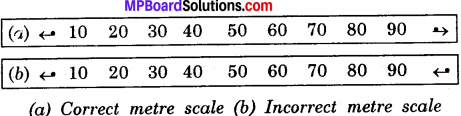
  1. A correct metre sacle has (←, →) signs on its both ends as shown in figure.
  2. A correct metre scale has the stamp of the Weights and Measure Department.
  3. A correct metre scale is straight, not bent from the centre.
  4. A correct metre sacle gives the correct measurement of length.
    MP Board Class 6th Science Solutions Chapter 10 Motion and Measurement of Distances 14

MP Board Solutions

Question 7.
Give three examples of rectilinear motion. Explain.
Answer:

  1. A scooterist driving on a road.
  2. Soldiers marching in the battlefield.
  3. A ball falling from a height.

In all these examples objects change their position with time along a straight line.

Question 8.
Give two examples of rotatory motion. Explain.
Answer:

  1. Motion of blades of a fan.
  2. Motion of minute hand of the clock.
  3. Motion of the wheel of a car.

In these examples the object or any parts of it move in a circular path. This is called rotatory or circular motion.

Question 9.
What are the differing types of motion?
Answer:
The different types of motions are :

  1. Linear motion
  2. Circular motion
  3. Curvilinear motion
  4. Oscillatory motion
  5. Random motion
  6. Periodic motion

A motion can be the combination of all these types of motions or a few of them.

Question 10.
What are periodic and non-periodic motions? Explain with example.
Answer:
Periodic motion:
The motion of a body which is repeated at regular intervals of time is called periodic motion. In periodic motion, a body covers equal distances in equal intervals of time. For exampls, revolution of earth round the sun, the motion of moon round the earth, the motion of a swing, the motion of a pendulum, etc.

Non – periodic motion:
The motion of a body which is not repeated at regular intervals of time is called non-periodic motion. In non – periodic motion, a body does not cover equal distances in equal intervals of time. For examples an athlete running on a track, a moving car on busy road, etc.

MP Board Solutions

Question 11.
How is circular motion different from curvilinear motion?
Answer:
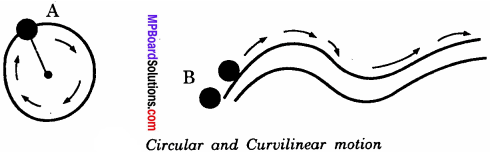
Circular motion is curvilinear motion but it involves the motion of a body at a fixed distance from a fixed point called axis. The figure explains the difference. As motion of the body ‘A’ is around the axis but in second case ‘B’ it is curvilinear motion.
MP Board Class 6th Science Solutions Chapter 10 Motion and Measurement of Distances 13

Question 12.
Give a table to show multiples and sub – multiples of units of length, mass and time.
Answer:
Length
10 mm = 1 centimeter (cm)
10 cm = 1 decimeter (dm)
10 decimeter = 100 cm = 1 metre (m)
10 metre = 1 decameter
100 metre = 1 hectometer
1000 metre = 1 kilometer (km)

Mass
1000 (mg) = 1 gram (g)
1000 gm = 1 kilogram (kg)
100 kg = 1 quintal
10 quintal = 1 metric ton

Time
60 seconds = 1 minute
60 minutes = 1 hours
24 hrs. = 1 day
365 days = 1 year
10 years = 1 decade
10 decades = 1 century

Motion and Measurement of Distances Long Answer Type Questions

Question 1.
What precautions are taken while measuring length?
Answer:
The precautions which should be taken while using a metre scale to measure length are the following:

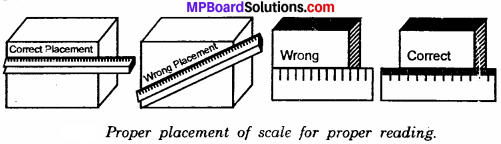
1. The scale should be placed along the length to be measured
MP Board Class 6th Science Solutions Chapter 10 Motion and Measurement of Distances 12

2. The scale should be placed very close to the object to be measured.

3. The broken scale should not be used because if used the 1 always begin with the final mark on scale. Subtract the final reading from initial reading to get length e.g., if the initial reading is 4.2 cm and final reading is 6.8 cm. then the length is 6.8 – 4.2 cm = 2.6 cm.
MP Board Class 6th Science Solutions Chapter 10 Motion and Measurement of Distances 11

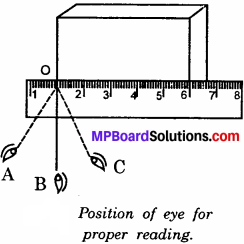
4. To read to scale correctly the eye should be vertically upward. As shown in fig. OA and OC give wrong reading of length while OB gives the correct reading of length.

Question 2.
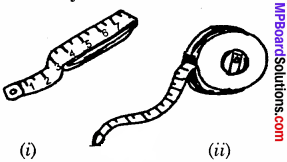
Identify the measuring instruments given in the pictures and tell where they are used?
MP Board Class 6th Science Solutions Chapter 10 Motion and Measurement of Distances 10
Answer:
1. Inch tape:
It is used for measuring height and tailor also uses this inch tape.

2. Steel tape or measuring tape:
It is used for measurement of glass, building height and carpenter also uses this.

Question 3.
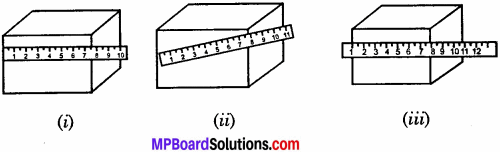
Identify the correct method of keeping scale for measuring the length?
MP Board Class 6th Science Solutions Chapter 10 Motion and Measurement of Distances 9
Answer:

  1. Is the correct method of keeping scale for measuring the length.

Question 4.
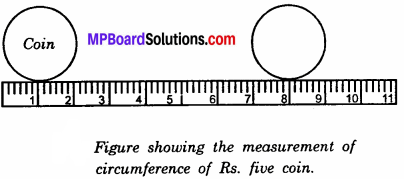
With the help of thread and scale find out the length of Rs. 5 coin.
Answer:
Mark a dot on one end of the circumference of the coin. Now put a knot on one end of the thread. Keep it tight on the mark on the coin. Move the thread around the circumference till the mark on the coin is reached again. Mark this position on the thread with a dark pencil. Measure the length of the thread between the knot and the mark. (Do not stretch the thread with a force). This is the length of circumference of five rupee coin.

Verify this length by keeping the thread in stretched position on the table between two tight nails. Mark a dot with a pencil. Place the rupee coin in vertical position. Now slide the coin along the length of thread till the mark on the coin is reached again as shown in the diagram below. Measure the distance between two marks on the thread. This is the circumference of the coin. The two measurement must be exactly identical.
MP Board Class 6th Science Solutions Chapter 10 Motion and Measurement of Distances 8

Question 5.
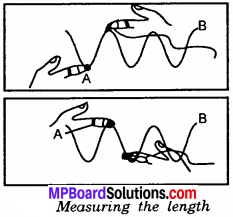
Use a thread to measure the length of a curved line.
Answer:
Mark the ends of curved line by putting full stop. Tie a knot on the open end of the thread. Place the knot of the thread on end A of the line. Now place the thread along the line keeping it tightly gripped with the help of both the thumbs or fore-fingers as in the diagram.
MP Board Class 6th Science Solutions Chapter 10 Motion and Measurement of Distances 7
Now move the thumb a little further keeping the thread in position and then press and release the hold on the thread as you keep on sliding the thread along the curves on the line. When the thread reaches the end B mark this position on the thread. You may tie the second knot at this point. Now measure the length of thread between two knots with the help of the metre scale. This is the length of the curved line.

MP Board Solutions

Question 6.
How many kinds of motions are? On the basis of daily experience explain only two of them.
Answer:
The different types of motions are:

  1. Linear motion
  2. Curvi linear motion
  3. Random motion
  4. Circular motion
  5. Oscillatory motion
  6. Periodic motion
  7. Non – periodic motion.

A motion can be the combination of all these types of motions or a few of them.

1. Linear motion:
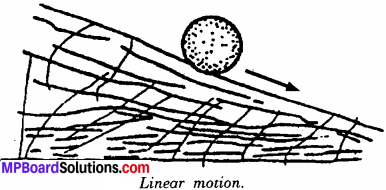
It is also called as translatory motion. It involves the motion of a body along a straight line. For examples, a bullet fired from a rifle, a ball rolling on ground, a child sliding down a slope as shown in fig.
MP Board Class 6th Science Solutions Chapter 10 Motion and Measurement of Distances 6

2. Curvilinear motion:
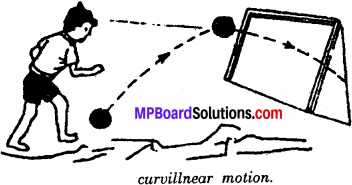
The motion of a body along a curved path is called curvilinear motion. For examples, a cyclist turning on road, a ball falling from a height, a train moving on a curved rail track, football kicked high in air by a player, etc.
MP Board Class 6th Science Solutions Chapter 10 Motion and Measurement of Distances 5
3. Random motion:
The motion of a body in which it changes its position rapidly with time in all the possible directions is called random motion. For examples, the motion of a mosquito, the motion of a hockey ball or of football in the ground, etc.
MP Board Class 6th Science Solutions Chapter 10 Motion and Measurement of Distances 4
4. Circular motion:
The motion of a body along a circular path about a fixed axis is called circular motion. For examples, revolution of moon around the earth, revolution of earth around the sun, a rotating spinning top, moving wheel, a moving fan, etc.
MP Board Class 6th Science Solutions Chapter 10 Motion and Measurement of Distances 3
5. Oscillatory motion:
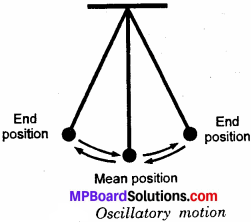
A body is said to be in oscillatory motion when it moves to an fro about a fixed point. For examples, the pendulum of a wall, clock (Fig.), a swing, a wire of sitar when plucked, striking of drum, etc. Mostly the hanging objects show oscillatory motion.

6. Periodic motion:
The motion of a body which is repeated at regular intervals of time is called periodic motion. In periodic motion, a body covers equal distances in equal intervals of time. For examples revolution of earth round the sun, the motion of moon round the earth, the motion of a swing, the motion of a pendulum, etc.

7. Non – periodic motion:
The motion of a body which is not repeated at regular intervals of time is called non – periodic motion. In non – periodic motion, a body does not cover equal distances in equal intervals of time. For examples an athelete running on a track, a moving car on the busy road, etc.

MP Board Solutions

Question 7.
Give an experiment to show that motion of plucked string is oscillatory motion?
Answer:
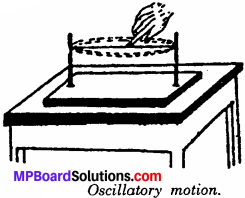
Take a thin string and tie it in between the two nails fixed on table. Now pluck the string and observe the motion of the plucked string. We will see that the string moves to and fro along its mean position. This shows that motion of plucked string is Oscillatory
motion.
MP Board Class 6th Science Solutions Chapter 10 Motion and Measurement of Distances 2

Question 8.
Why sand grains kept on a drum move up and down on stiling?
Answer:
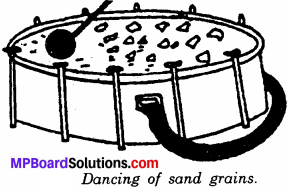
The drum membrane shows vibratory motion when struck. This vibratory motion of the membrane makes the sand grains dance up and down as shown in figure. As the membrane vibrates above its mean position, the sand grains fly up and then fall down.
2019-10-19 12_24_08-CH 10 a.pdf - Foxit PhantomPDF

MP Board Class 6th Science Solutions

MP Board Class 9th Maths Solutions Chapter 13 Surface Areas and Volumes Ex 13.3

MP Board Class 9th Maths Solutions Chapter 13 Surface Areas and Volumes Ex 13.3

Assume π = \(\frac{22}{7}\), unless stated otherwise.

Question 1.
Diameter of the base of a cone is 10.5 cm and its slant height is 10 cm. Find its curved surface area.
Solution:
Here, diameter of the base = 10.5 cm
Radius (r) = \(\frac{10.5}{2}\)
Slant height (l) = 10 cm
Curved surface area of the cone = πrl
= \(\frac{22}{7}\) x \(\frac{10.5}{2}\) x 10 cm2
= \(\frac{22}{7}\) x \(\frac{10.5}{20}\) x 10 cm2
= 11 x 15 x 1 cm2 = 165 cm2

MP Board Solutions

Question 2.
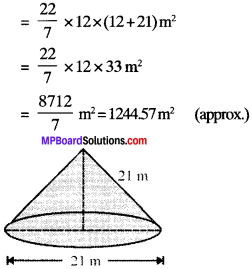
Find the total surface area of a cone, if its slant height is 21 m and diameter of its base is 24 m.
Solution:
Here, diameter = 24 m
Radius (r) = \(\frac{24}{2}\) m = 12m
Slant height (l) = 21 m
Total surface area = πr (r + l)
MP Board Class 9th Maths Solutions Chapter 13 Surface Areas and Volumes Ex 13.3 img-1

Question 3.
Curved surface area of a cone is 308 cm2 and its slant height is 14 cm. Find:

  1. radius of the base and
  2. total surface area of the cone.

Solution:
Here, curved surface area = 308 cm2
Slant height (l) = 14 cm

1. Let the radius of the base be ‘r’ cm.
πrl = 308
\(\frac{22}{7}\) x r x 14 = 308
r = \(\frac{308×7}{22×14}\) = 7 cm
Thus, the required radius of the cone is 7 cm.

2. base area = πr2 = \(\frac{22}{7}\) x 72 cm.
and curved surface area = 308 cm2 given
∴ Total surface area = [Curved surface area] + [Base area]
= 308 cm2 + 154 cm2 = 462 cm2

MP Board Solutions

Question 4.
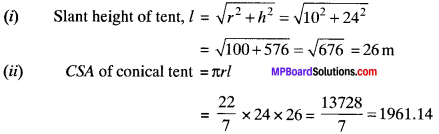
A conical tent is 10 m high and the radius of its base is 24 m. Find

(i) slant height of the tent.
(ii) cost of the canvas required to make the tent, if the cost of 1 m2 canvas is ₹ 70.

Solution:
h = 10 m
r =24m
MP Board Class 9th Maths Solutions Chapter 13 Surface Areas and Volumes Ex 13.3 img-2
Cost of canvas = CSA x Rate of canvas
= 1961.14 x 70
= ₹ 137279.8
= ₹ 137280.

Question 5.
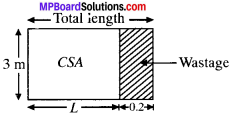
What length of tarpaulin 3 m wide will be required to make conical tent of height 8 m and base radius 6 m? Assume that the extra length of material that will be required for stitching margins and wastage in cutting is approximately 20 cm. (Use π = 3.14)
Solution:
MP Board Class 9th Maths Solutions Chapter 13 Surface Areas and Volumes Ex 13.3 img-3
h = 8m
r = 6m
Width of tarpaulin = 3 m
Extra length required = 20 cm = 0.2 m
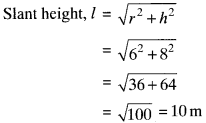
MP Board Class 9th Maths Solutions Chapter 13 Surface Areas and Volumes Ex 13.3 img-4
CSA of conical tent = πrl
= 3.14 x 6 x 10 = 188.4 m2
CSA of conical tent = Area of tarpaulin
188.4 = l x 3 (Here l = length of tarpaulin)
l = \(\frac{188.4}{3}\)
Total length of tarpaulin required = 62.8 + 0.2 = 63 m

Question 6.
The slant height and base diameter of a conical tomb are 25 m and 14 m respectively. Find the cost of white-washing its curved surface at the rate of ₹ 210 per 100 m2.
Solution:
l = 25m
d = 14m
r = 7m
Rate of white washing = ₹ 210 per 100 m2
= \(\frac{210}{100}\) = ₹ 2.10 per m2
CSA of conical tomb = πrl
= \(\frac{22}{7}\) x 7 x 25 = 550 m2
Cost of white washing = Rate x CSA
= 2.10 x 550 (Rate per m2 = \(\frac{220}{100}\))
= ₹ 1155

Question 7.
A joker’s cap is in the form of a right circular cone of base radius 7 cm and height 24 cm. Find the area of the sheet required to make 10 such caps.
Solution:
r = 7 cm
h = 24 cm
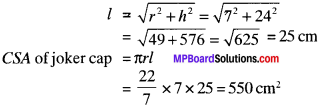
MP Board Class 9th Maths Solutions Chapter 13 Surface Areas and Volumes Ex 13.3 img-5
Area of sheet required = CSA of 10 such caps = 550 x 10 = 5500 cm2.

MP Board Solutions

Question 8.
A bus stop is barricaded from the remaining part of the road, by using 50 hollow cones made of recycled cardboard. Each cone has a base diameter of 40 cm and height 1 m. If the outer side of each of the cones is to be painted and the cost of painting is ₹ 12 per m2 what will be cost of painting all these cones? (Use π = 3.14 and take \(\sqrt{1.04}\) =1.02).
Solution:
d = 40 cm
r = 20 cm = 0.20 m
h = l m
Rate = ₹ 12 per m2
MP Board Class 9th Maths Solutions Chapter 13 Surface Areas and Volumes Ex 13.3 img-6
= 1.02
CSA of cone = 3.14 x 0.2 x 1.02 = 0.64m2
Total area of 50 hollow cones= 50 x 0.64 = 32 m2
Cost of painting = 32 x 12 = ₹ 384
(Rate of painting = ₹ 12/m2)

MP Board Class 9th Maths Solutions

MP Board Class 10th Hindi Navneet Solutions पद्य Chapter 9 जीवन दर्शन

MP Board Class 10th Hindi Navneet Solutions पद्य Chapter 9 जीवन दर्शन

जीवन दर्शन अभ्यास

बोध प्रश्न

जीवन दर्शन अति लघु उत्तरीय प्रश्न 

प्रश्न 1.
कवि नाश पथ पर कौन-से चिह्न छोड़ जाना चाहता है?
उत्तर:
कवि नाश पथ पर अपने पग चिह्न छोड़ जाना चाहता

प्रश्न 2.
मधुप की मधुर गुनगुन विश्व पर क्या प्रभाव डालेगी?
उत्तर:
मधुप की मधुर गुनगुन सम्पूर्ण संसार के क्रन्दन को भुला देगी।

प्रश्न 3.
तितलियों के रंग से कवि का क्या तात्पर्य है?
उत्तर:
तितलियों के रंग से कवि का तात्पर्य सांसारिक सुख-भोग एवं सुविधाओं से है।

प्रश्न 4.
कवि के अनुसार काँटे की मर्यादा क्या है?
उत्तर:
कवि के अनुसार काँटे की मर्यादा है उसका कठोर होना तथा तीखा होना।

प्रश्न 5.
कवि ने ‘मर्दे होंगे’ किसे कहा है?
उत्तर:
कवि ने ‘मुर्दे होंगे’ उन प्रेमियों के लिए कहा है जिन्होंने प्रेम के नाम पर सम्मोहन करने वाली मदिरा पी रखी है।

MP Board Solutions

जीवन दर्शन लघु उत्तरीय प्रश्न

प्रश्न 1.
कवि की आँखें उनींदी क्यों हैं?
उत्तर:
कवि की आँखें उनींदी इसलिए हैं कि आज हमको समाज में अनुकूल वातावरण नहीं मिल रहा है।

प्रश्न 2.
‘मोम के बन्धन सजीले’ से कवि का क्या आशय है?
उत्तर:
‘मोम के बन्धन सजीले’ से कवि का आशय सांसारिक आकर्षणों से है।

प्रश्न 3.
‘चिर सजग’ का क्या आशय है?
उत्तर:
‘चिर सजग’ का आशय है कि हमें हमेशा सचेत रहना चाहिए और सांसारिक बाधाओं से संघर्ष करते रहना चाहिए।

प्रश्न 4.
कवि ने अन्तिम रहस्य के रूप में क्या पहचान लिया?
उत्तर:
कवि ने अन्तिम रहस्य के रूप में यह जान लिया कि यह संसार एक यज्ञशाला है और इसमें व्यक्ति को स्वाहा होना है।

प्रश्न 5.
कुचला जाकर भी कवि किस रूप में उभरता
उत्तर:
कुचला जाकर भी कवि आँधी की धूल बनकर उमड़ना चाहता है।

प्रश्न 6.
‘निर्मम रण में पग-पग पर रुकना’ किस प्रकार प्रतिफलित होता है?
उत्तर:
निर्मम रण में पग-पग पर रुकना वार बनकर प्रतिफलित होता है।

जीवन दर्शन दीर्घ उत्तरीय प्रश्न

प्रश्न 1.
‘जाग तुझको दूर जाना’ में क्या आशय छिपा है? लिखिए।
उत्तर:
‘जाग तुझको दूर जाना’ में यह आशय छिपा है कि मनुष्य का जीवन एक निश्चित अवधि का होता है, जबकि जीवन क्षेत्र में उसे अनगिनत कार्य करने पड़ते हैं। अपने लक्ष्य प्राप्त करने के लिए उसे अनेकानेक विघ्न-बाधाओं से टकराना होता है।

प्रश्न 2.
‘पंथ की बाधा बनेंगे तितलियों के पर रंगीले’ में निहित भाव स्पष्ट कीजिए।
उत्तर:
मनुष्य जब अपने लक्ष्य को प्राप्त करने के लिए चलता है तो सांसारिक भौतिक आकर्षण तथा सुख-सुविधाएँ उसे विचलित करने की चेष्टा करती हैं। मनुष्य जब तक इनसे सचेत नहीं रहेगा, वह अपने लक्ष्य को प्राप्त नहीं कर सकेगा।

प्रश्न 3.
‘तू न अपनी छाँह को अपने लिए कारा बनाना’ द्वारा कवि क्या सन्देश देना चाहता है?
उत्तर:
छाँह चाहने के लिए अर्थात् जीवन में सुख-सुविधाएँ जुटाने के लिए व्यक्ति उचित एवं अनुचित सभी प्रकार के कार्य करता रहता है। कभी-कभी मनुष्य के स्वयं किये गये कारनामे ही उसे कारागार की हवा खिला देते हैं। अतः कवि जीवन के अनुचित कार्यों से बचने की सलाह देता है।

प्रश्न 4.
‘मैंने आहुति बनकर देखा’ कविता का मूल भाव लिखिए।
उत्तर:
‘मैंने आहुति बनकर देखा’ कविता का मूलभाव यह है कि यद्यपि जीवन मरणशील है; इसमें जय और पराजय दोनों हैं। इसमें गति को रोकने वाली अनेक विघ्न-बाधाएँ भी हैं किन्तु इन्हीं सबके चलते हुए हमें जीवन को निरन्तर आगे चलाते रहना चाहिए। संसार एक यज्ञ वेदिका जैसा है इसमें सब कुछ होम करके ही जीवन को श्रेष्ठ बनाया जा सकता है। तप करके ही जीवन में ललकार देने की शक्ति आती है। कवि ने इसमें त्याग और तपस्या का महत्व बताया है।

प्रश्न 5.
प्रस्तुत कविताओं से हमें क्या सीख मिलती है?
उत्तर:
प्रस्तुत कविताओं से हमें यह सीख मिलती है कि मानव का जीवन संघर्षों से भरा हुआ है। यह संसार नाशवान् है पर महान् मनुष्य वे होते हैं जो आने वाली पीढ़ी के लिए अपने चरण चिह्न छोड़ जाया करते हैं। अपनी पहचान बनाने के लिए हमें भौतिक सुख-सुविधाओं को त्यागना होगा। संसार एक यज्ञ की वेदी के समान है। इसमें जो सब कुछ स्वाहा कर देता है, उसी का जीवन सार्थक बन जाता है। त्याग और तपस्या से मानव का संसार में महत्व आँका जाता है।

प्रश्न 6.
निम्नलिखित काव्य पंक्तियों की सप्रसंग व्याख्या लिखिए
(क) मैं कब कहता हूँ …………. ओछा फूल बने?
उत्तर:
कविवर अज्ञेय जी संसार के मनुष्यों से कहते हैं कि मैं संसार के लोगों से कब कहता हूँ कि वे मेरे समान संघर्षों का सामना करने वाली शक्ति को धारण करें। मैं यह भी नहीं कहता हूँ कि संसार के मनुष्य अपने रेगिस्तान जैसे शुष्क जीविन को देवताओं के सुन्दर उपवन के समान हरा-भरा या सुख-सुविधाओं में सम्पन्न बना लें। काँटा देखने में कठोर और तीखा अवश्य लगता है, पर उसकी भी इस सृष्टि में अपनी मर्यादा है। मैं उससे भी यह नहीं कहता कि वह अपने इस कठोर रूप को कम करके किसी भाग का एक ओछा फूल बन जाये। कहने का भाव यह है कि सबका अपना-अपना भाग्य होता है। अतः सभी को अपनी सामर्थ्य के अनुसार जीवन में काम करना चाहिए।

(ख) विश्व का क्रन्दन …………… तुझको दूर जाना।
उत्तर:
कवयित्री महादेवी वर्मा कहती हैं कि हे मानव! क्या ये मोम के गीले बन्धन तझे अपने जाल में बाँध लेंगे? क्या रंग-बिरंगी तितलियों के पंख तुम्हारे मार्ग की रुकावट बनेंगे? क्या भौरों की मधुर गुनगुनाहट संसार के दुःखों को भुला देंगी या ओस से गीले फूल की पंखुड़ियाँ तुझे डूबो देंगी? तू व्यर्थ में ही अपनी ही परछाईं को अपना जेलखाना बना रहा है। इन निराशा की भावनाओं को छोड़! तेरा जो लक्ष्य है, उसे पाने के लिए तू सतत् प्रयत्न कर तुझे अभी बहुत दूर तक जाना है।

MP Board Solutions

जीवन दर्शन काव्य सौन्दर्य

प्रश्न 1.
हास्यरसकी परिभाषा किसी अन्य उदाहरण द्वारा समझाइए।
उत्तर:
हास्य रस-विचित्र वेश-भूषा, विकृत आकार, चेष्टा आदि के कारण जाग्रत हास स्थायी भाव विभावादि से पुष्ट होकर हास्य रस में परिणत होता है। जैसे-

“हँसि हँसि भजे देखि दूलह दिगम्बर को,
पाहुनी जे आवै हिमाचल के उछाह में।
कहै पद्माकर सु काहु सों कहै को कहा,
जोई जहाँ देखे सो हँसोई तहाँ राह में।
मगन भएई हँसे नगन महेश ठाढ़े,
और हँसे वेऊ हँसि-हँसि के उमाह में।
सीस पर गंगा हँसे भुजनि भुजंगा हँसे,
हास ही को दंगा भयो नंगा के विवाह में ॥”

यहाँ दर्शक आश्रय हैं तथा शिवजी आलम्बन हैं। उनकी विचित्र आकृति, नग्न स्वरूप आदि उद्दीपन हैं। लोगों का हँसना, भागना आदि अनुभाव तथा हर्ष, उत्सुकता, चपलता आदि संचारी भाव हैं।

जीवन दर्शन महत्त्वपूर्ण वस्तुनिष्ठ प्रश्न

जीवन दर्शन बहु-विकल्पीय प्रश्न

प्रश्न 1.
कवि की आँखें उन्नींदी क्यों हैं?
(क) शीघ्र जगने के कारण
(ख) नींद पूरी न होने से
(ग) आलस्य के कारण
(घ) बिना किसी कारण।
उत्तर:
(ग) आलस्य के कारण

प्रश्न 2.
‘जाग तुझको दूर जाना अचल के हृदय में चाहे कम्प हो ले’ ‘अचल’ शब्द का प्रयोग किसके लिये है?
(क) हिमालय
(ख) गंगा
(ग) आकाश
(घ) आँखों।
उत्तर:
(क) हिमालय

प्रश्न 3.
कवयित्री ने ‘मोम के बन्धन’ किसको कहा है?
(क) माया-मोह
(ख) विषय-वासनादि
(ग) साधना मार्ग की बाधाएँ
(घ) उपर्युक्त सभी।
उत्तर:
(घ) उपर्युक्त सभी।

प्रश्न 4.
‘मैने आहुति बनकर देखा है’ कविता के रचयिता हैं
(क) सच्चिदानन्द हीरानन्द वात्स्यायन ‘अज्ञेय’
(ख) रामनरेश त्रिपाठी
(ग) रामधारी सिंह ‘दिनकर’
(घ) नरेश मेहता।
उत्तर:
(क) सच्चिदानन्द हीरानन्द वात्स्यायन ‘अज्ञेय’

रिक्त स्थानों की पूर्ति

  1. महादेवी वर्मा के काव्य में वेदना की प्रचुरता थी। इसी कारण उन्हें आधुनिक ………. कहा जाता है।
  2. महादेवी वर्मा साधना मार्ग में ………… नहीं आने देना चाहती थीं।
  3. बाँध लेंगे क्या तुझे मोम के ……….. सजीले।
  4. “धूल पैरों से कुचली जाती है किन्तु वह कुचलने वाले के सिर पर सवार हो जाती है।” उसी प्रकार मैंने ……….. से हार नहीं मानी है।

उत्तर:

  1. मीरा
  2. आलस्य
  3. बन्धन
  4. बाधाओं।

MP Board Solutions

सत्य/असत्य

  1. महादेवी वर्मा छायावादी युग की प्रमुख कवयित्री हैं। इन्होंने छायावाद के अन्तर्गत जीवन के दोनों पक्षों का वर्णन किया है।
  2. महादेवी वर्मा का वैवाहिक जीवन सुखमय था। इसी कारण उन्होंने विरह गीत लिखे हैं।
  3. “हरी घास पर क्षण भर” कविता महादेवी वर्मा की है?
  4. हिन्दी साहित्य में अज्ञेय की ख्याति केवल भारत में ही नहीं अपितु विदेशों में भी है।

उत्तर:

  1. सत्य
  2. असत्य
  3. असत्य
  4. सत्य

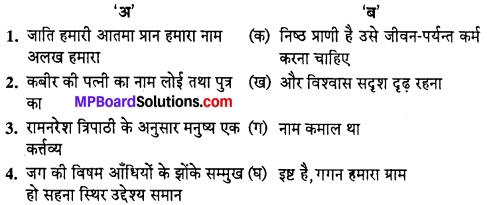
सही जोड़ी मिलाइए

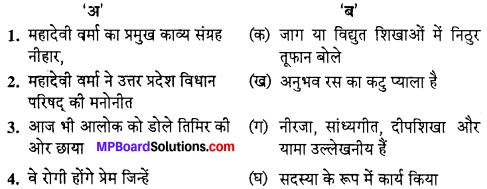
MP Board Class 10th Hindi Navneet Solutions पद्य Chapter 9 जीवन दर्शन img-1
उत्तर:
1. → (ग)
2. → (घ)
3. → (क)
4. → (ख)

एक शब्द/वाक्य में उत्तर

  1. महादेवी वर्मा ने कबीर की भाँति अपने काव्य में वर्णन किया है।
  2. ‘तु न अपनी छाँह को अपने लिए काटा बनाना’ यह पंक्ति किस रचनाकार की है। (2011)
  3. अज्ञेय की रचनाएँ नई पीढ़ी के लेखकों के लिए हैं।
  4. अज्ञेय ने अपनी कविता द्वारा स्पष्ट किया है कि जीवन मरणशील है। इसमें पराजय भी है और आगे बढ़ने में हैं।
  5. काँटे की मर्यादा क्या है? (2016)

उत्तर:

  1. रहस्यवाद का
  2. महादेवी वर्मा
  3. मानक स्वरूप
  4. अनेक व्यवधान
  5. काँटे की मर्यादा उसके कठोर एवं तीखे होने में है।

MP Board Solutions

चिर सजग आँखें उनींदी आज कैसा व्यस्त बाना! भाव सारांश

‘चिर सजग आँखें उनींदी आज कैसा व्यस्त बाना’ नामक कविता में महादेवी वर्मा ने अपने मन को साधना मार्ग का राहगीर समझकर उसे जीवन में आगे बढ़ने के लिए उत्साहित किया है।

कवयित्री कहती हैं हे मन! तू आलस्य को त्याग, क्योंकि ये जीवन पथ बहुत लम्बा है और तुझे यह दूरी तय करनी है। चाहे हिमालय पर्वत अपने स्थान से हिल जाये अथवा आसमान में प्रलय के बादल छा जाये। चाहे तेज आँधी और तूफान आयें या घनघोर वर्षा हो। बिजली भी चाहे कड़के, तुम्हें आगे बढ़ते ही जाना है।

कवयित्री का कथन है कि मेरे मन तुम वज्र के सदृश कठोर थे लेकिन आँसुओं ने उन्हें गीला करके गला दिया। सांसारिक माया-मोह में डूबकर तुमने अपने जीवन के मूल्यवान क्षणों को खो दिया है।

कवयित्री कहती है कि हे प्राण! तुम आलस्य और प्रमाद को त्यागकर अपने मन में उत्साह उत्पन्न करो जिससे कि तुम्हें विषय-वासनाओं से मुक्ति मिलेगी और तुम्हारी साधना का मार्ग प्रशस्त हो जायेगा। अत: हे मानव! आलस्य को त्याग दे। यही तेरे लिये उचित और उत्तम है।

चिर सजग आँखें उनींदी आज कैसा व्यस्त बाना! संदर्भ-प्रसंगसहित व्याख्या

(1) चिर सजग आँखें उनींदी आज कैसा व्यस्त बाना!
जाग तुझको दूर जाना!
अचल हिमगिरि के हृदय में आज चाहे कम्प हो ले,
या प्रलय के आँसुओं में मौन अलसित व्योम रो ले,
आज पी आलोक को डोले तिमित की घोर छाया,
जाग या विद्युत-शिखाओं में निठुर तूफान बोले
पर तुझे है नाश-पथ पर चिन्ह अपने छोड़ जाना!
जाग तुझको दूर जाना!

शब्दार्थ :
चिर = पुराना। सजग = जाग्रत। उनींदी = अलसाई हुई। व्यस्त = काम में लगा हुआ। बाना = व्यवहार। अचल = पर्वत। हिमगिरि = बर्फ से ढंकी हुई पहाड़ियाँ। कम्प = कम्पन, थरथराहट। अलसित = आलस्य से भरा हुआ। व्योम = आकाश। आलोक = प्रकाश। तिमिर = अन्धकार। विद्युत = बिजली। निठुर = निष्ठुर, कड़े स्वभाव वाला।

सन्दर्भ :
प्रस्तुत छन्द “चिर सजग आँखें उनींदी आज कैसा व्यस्त बाना!” शीर्षक कविता से लिया गया है। इसकी रचयिता श्रीमती महादेवी वर्मा हैं।

प्रसंग :
कवयित्री मानव को सचेत करते हुए कह रही हैं कि हे संसार के पथिक! तेरी सदैव सजग रहने वाली आँखें आज अलसाई हुई सी क्यों हो रही हैं, तुझे तो अभी बहुत दूर तक जाना है।

व्याख्या :
कवयित्री महादेवी वर्मा कहती हैं कि हे संसार के पथिक! तू तो सदैव सजग रहकर इस मार्ग पर चलता रहता था पर आज तेरी ये सजग आँखें उनींदी सी क्यों हो रही हैं, तूने ये कैसा बाना (ढर्रा) बना लिया है। तुझे तो अभी बहुत दूर तक जाना है।

चाहे हिमालय पर्वत की ऊँची चोटियों में आज कम्पन पैदा हो जाये या फिर प्रलय के आँसुओं को लेकर ऊलसाया हुआ आकाश। रुदन करने लग जाये, या फिर अन्धकार की घोर छाया प्रकाश को। पीकर डोल जाये, या फिर बिजली की जाग्रत शिखाओं में निष्ठुर तूफान हुँकार भरने लग जाये लेकिन तेरा लक्ष्य तो यह है कि इस नाश के पथ पर तू अपने चरणों के चिह्नों को छोड़ दे। कहने का भाव यह है कि चाहे कैसी भी विषम परिस्थितियाँ क्यों न हों, तुझे तो अपने निर्धारित लक्ष्य पर निरन्तर बढ़ते चले जाना है ताकि नाश। की अवस्था आने पर भी तेरे चरणों के चिह्न आने वाले समय में लोगों का मार्गदर्शन कर सकें। जाग जा, तुझे तो अभी बहुत दूर जाना है, इन विषम परिस्थितियों से अपने लक्ष्य को मत भूल जाना।

विशेष :

  1. कवयित्री विषम परिस्थितियों में भी संसार के पथिक को अपने मार्ग पर निरन्तर चलते रहने की प्रेरणा दे रही हैं।
  2. लाक्षणिक भाषा।

(2) बाँधे लेंगे क्या तुझे यह मोम के बन्धन सजीले?
पंथ की बाधा बनेंगे तितलियों के पर रँगीले?
विश्व का क्रन्दन भुला देगी मधुप की मधुर गुनगुन,
क्या डुबो देंगे तुझे यह फूल के दल ओस-गीले?
तू न अपनी छाँह को अपने लिए कारा बनाना!
जाग तुझको दूर जाना!

शब्दार्थ :
सजीले = गीले। पंथ = रास्ते की। रँगीले = रंग-बिरंगे। क्रन्दन= रोना-धोना। मधुप = भौंरों की। मधुर = मीठी। कारा = जेलखाना।

सन्दर्भ एवं प्रसंग :
पूर्ववत्।

व्याख्या :
कवयित्री महादेवी वर्मा कहती हैं कि हे मानव! क्या ये मोम के गीले बन्धन तझे अपने जाल में बाँध लेंगे? क्या रंग-बिरंगी तितलियों के पंख तुम्हारे मार्ग की रुकावट बनेंगे? क्या भौरों की मधुर गुनगुनाहट संसार के दुःखों को भुला देंगी या ओस से गीले फूल की पंखुड़ियाँ तुझे डूबो देंगी? तू व्यर्थ में ही अपनी ही परछाईं को अपना जेलखाना बना रहा है। इन निराशा की भावनाओं को छोड़! तेरा जो लक्ष्य है, उसे पाने के लिए तू सतत् प्रयत्न कर तुझे अभी बहुत दूर तक जाना है।

विशेष :

  1. कवयित्री सांसारिक प्राणियों से कल्पना लोक में न विचर कर जीवन की यथार्थता का ज्ञान कराना चाहती हैं। साथ ही उसे जीवन पथ पर निन्तर बढ़ते रहने की प्रेरणा देती हैं।
  2. लाक्षणिक भाषा।

MP Board Solutions

मैंने आहुति बनकर देखा भाव सारांश 

‘मैंने आहुति बनकर देखा’ कविता के द्वारा ‘अज्ञेय’ कवि ने कर्म करते हुए स्वयं को बलिदान करने की इच्छा को सर्वोत्तम बताया है। त्याग द्वारा ही व्यक्ति को आत्मिक सुख प्राप्त होता है। कवि का कथन है कि वह संसार की प्रत्येक वस्तु को उसके वास्तविक रूप में देखने का इच्छुक है। वह यह कदापि नहीं चाहता कि वृद्धावस्था की तुलना युवावस्था से की जाये। अतः उसकी तुलना शक्तिशाली व्यक्ति से नहीं करनी चाहिए।

जीवन में यदि दःखों का सागर उमडे तो मानव में उसे भी सहन करने की शक्ति होनी चाहिए। कवि कहता है कि मैं नन्दन वन के फूलों की चाहत की भाँति धनवानों के धन की चाहत में अपनी इच्छा और सुखों को गँवा देने का इच्छुक हूँ। काँटों की शोभा काँटा बना रहने में है, फूल बनने में नहीं।

योद्धा की शोभा युद्धभूमि में प्राप्त हुए घावों से ही होती है। यह आवश्यक नहीं कि यदि मैं किसी से प्रेम करूँ तो वह व्यक्ति भी मुझसे प्रेम करे। मैं तो स्वार्थ रहित प्रेम की इच्छा रखता हूँ और चाहता हूँ कि आस्था और विश्वास महल बनाकर कर्तव्य पथ पर बढ़ता रहूँ।

प्रेम में त्याग आवश्यक है। जो लोग प्रेम में कटुता का अनुभव करते हैं, उन्हें स्वयं को रोगी मान लेना चाहिए। जो व्यक्ति प्रेम को सम्मोहन वाली मदिरा मानते हैं उन्हें यह मान लेना चाहिए कि उनमें जीवन ही नहीं है, जिन्होंने प्रेम के रहस्य को जान लिया है।

कवि का कथन है कि मैंने प्रेम को आहुति बनकर देख लिया है। प्रेम यज्ञ की अग्नि है। जिस प्रकार अग्नि में आहुति डाली जाती है और वह सामग्री जल जाती है उसी प्रकार मैंने भी अपने आप को आहुति बनाकर जल जाने की बात सोच ली है। व्यक्ति को आगे बढ़ने के लिए विषम आँधी और तूफानों का सामना करना पड़ता है परन्तु मानव को सफलता पाने के लिए निरन्तर बढ़ते रहना चाहिए। जीवन एक रणक्षेत्र है जहाँ पर अनेक बाधाएँ आती हैं। ईश्वर ने जो जीवन दिया है उसे हम ईश्वर के लिए समर्पित कर दें। तब ही जीवन सफल और सार्थक होगा।

मैंने आहुति बनकर देखा संदर्भ-प्रसंगसहित व्याख्या

(1) मैं कब कहता हूँ जग मेरी दुर्धर गति के अनुकूल बने,
मैं कब कहता हूँजीवन-मरुनन्दन-कानन का फूल बने?
काँटा कठोर है, तीखा है, उसमें उसकी मर्यादा है,
मैं कब कहता हूँ, वह घटकर प्रांतर का ओछा फूल बने?

शब्दार्थ :
जग = संसार। दुर्धर = कठिनाइयों को पार करने में समर्थ। अनुकूल = उसी के अनुरूप। जीवन-मरु = जीवन रूपी रेगिस्तान। नन्दन-कानन = देवताओं का उपवन। प्रांतर = छोटे से प्रदेश का। ओछा = छोटा, पद में नीचा।

सन्दर्भ :
प्रस्तुत छन्द ‘मैंने आहुति बनकर देखा’ शीर्षक कविता से लिया गया है। इसके कवि अज्ञेय हैं।

प्रसंग :
कवि का सन्देश है कि मैं किसी भी व्यक्ति को अपने पथ पर चलने को बाध्य नहीं करता हूँ, लेकिन सबको अपनी मर्यादा का ध्यान अवश्य रखना चाहिए।

व्याख्या :
कविवर अज्ञेय जी संसार के मनुष्यों से कहते हैं कि मैं संसार के लोगों से कब कहता हूँ कि वे मेरे समान संघर्षों का सामना करने वाली शक्ति को धारण करें। मैं यह भी नहीं कहता हूँ कि संसार के मनुष्य अपने रेगिस्तान जैसे शुष्क जीविन को देवताओं के सुन्दर उपवन के समान हरा-भरा या सुख-सुविधाओं में सम्पन्न बना लें। काँटा देखने में कठोर और तीखा अवश्य लगता है, पर उसकी भी इस सृष्टि में अपनी मर्यादा है। मैं उससे भी यह नहीं कहता कि वह अपने इस कठोर रूप को कम करके किसी भाग का एक ओछा फूल बन जाये। कहने का भाव यह है कि सबका अपना-अपना भाग्य होता है। अतः सभी को अपनी सामर्थ्य के अनुसार जीवन में काम करना चाहिए।

विशेष :

  1. कवि संसार के मनुष्यों को निरन्तर कर्म करने की प्रेरणा दे रहा है।
  2. लाक्षणिक भाषा।

(2) मैं कब कहता हूँ, मुझे युद्ध में कहीं न तीखी चोट मिले?
मैंकबकहताहूँ, प्यार करुतो मुझे प्राप्तिकीओटमिले?
मैं कब कहता हूँ विजय करूँ-मेरा ऊँचा प्रासाद बने?
या पात्र जगत की श्रद्धा की मेरी धुंधली सी याद बने?

शब्दार्थ :
प्रासाद = महल। धुंधली सी = अस्पष्ट सी।

सन्दर्भ एवं प्रसंग :
पूर्ववत्।

व्याख्या :
कविवर अज्ञेय जी कहते हैं कि मैं यह कब कहता हूँ कि युद्ध क्षेत्र में जाने पर मुझे कोई चोट न लगे; मैं कब कहता हूँ कि यदि मैं किसी से प्यार करूँ तो मुझे उसका प्रतिफल भी मिले; मैं कब कहता हूँ कि युद्ध क्षेत्र में मुझे विजय प्राप्त हो और मेरा एक भव्य महल निर्मित हो। या फिर संसार रूपी रंगमंच पर अभिनय करने वाले पात्र के रूप में मेरी धुंधली-सी याद मनुष्यों के मानस-पटल पर अंकित हो जाये।

विशेष :

  1. कवि संसार में निरन्तर कार्य में लगे रहने की प्रेरणा दे रहा है।
  2. भाषा लाक्षणिक है।

MP Board Solutions

(3) पथ मेरा रहे प्रशस्त सदा क्यों विकल करे यह चाह मुझे?
नेतृत्व न मेरा छिन जावे, क्यों इसकी हो परवाह मुझे?
मैं प्रस्तुत हूँ चाहे मेरी मिट्टी जनपद की धूल बने
फिर उस धूली का कण-कण भी मेरा गति-रोधक शूल बने।

शब्दार्थ :
प्रशस्त = चौड़ा। विकल = बेचैन। नेतृत्व = नेतागीरी। प्रस्तुत = तैयार। गति-रोधक = चाल को रोकने वाला। शूल = काँटा।

सन्दर्भ एवं प्रसंग :
पूर्ववत्।

व्याख्या :
कविवर अज्ञेय कहते हैं कि मेरे मन में इस प्रकार चाह या इच्छा क्यों उत्पन्न हो कि मार्ग सदैव चौड़ा एवं निर्विघ्न हो। मुझे इस बात की भी परवाह नहीं करनी चाहिए कि कहीं मेरी नेतागीरी तो खत्म नहीं हो रही है। मैं इसके लिए तैयार हूँ कि मेरे मरने के पश्चात् मेरे शरीर की मिट्टी इसी भूमि की धूल में मिल जाये; फिर चाहे उसी धूल का एक-एक कण मेरे रास्ते को रोकने वाले काँटे ही क्यों न बन जायें।

विशेष :

  1. कवि को अपनी सामर्थ्य पर विश्वास है। अतः वह हर विषम स्थिति को स्वीकार करने को तैयार है।
  2. भाषा लाक्षणिक।

(4) अपने जीवन को रस देकर जिसको यत्नों से पाला है
क्या वह केवल अवसाद-मलिन झरते आँसूकी माला है?
वे रोगी होंगे प्रेम जिन्हें अनुभव-रस का कटु प्याला है
वे मुर्दे होंगे प्रेम जिन्हें सम्मोहन-कारी हाला है।

शब्दार्थ :
यत्नों = प्रयत्नों से। अवसाद मलिन = दुःख से सना हुआ। कटु = कड़वा। सम्मोहनकारी = वश में करने वाली। हाला = मदिरा।

सन्दर्भ एवं प्रसंग :
पूर्ववत्।

व्याख्या :
कविवर अज्ञेय कहते हैं कि मैंने अपने जीवन को रस देकर तथा यत्नपूर्वक पाला-पोसा है; क्या ऐसा मेरा जीवन केवल दुःख से सने हुए आँसुओं की माला भर है? जिन प्रेमियों ने अनुभव रस के कड़वे प्याले को पिया है, वे रोगी होंगे अर्थात् स्वस्थ नहीं होंगे और जिन प्रेमियों ने मोह पाश में डालने वाली मदिरा का पान कर लिया है वे मुर्दे होंगे, जीवन्त मनुष्य नहीं होंगे।

विशेष :

  1. कवि मनुष्यों को सतत् जागरूक बने रहने का सन्देश दे रहा है।
  2. भाषा लाक्षणिक।

(5) मैंने विदग्ध हो जान लिया, अन्तिम रहस्य पहचान लिया
मैंने आहुति बनकर देखा यह प्रेम यज्ञ की ज्वाला है।
मैं कहता हूँ, मैं बढ़ता हूँ, नभ की चोटी चढ़ता हूँ,
कुचला जाकर भी धूली-सा आँधी और उमड़ता हूँ।

शब्दार्थ :
विदग्ध = जानकार होते हुए भी। आहुति = यज्ञ में दी जाने वाली समिधा। नभ = आकाश। धूली-सा = धूल जैसा।

सन्दर्भ एवं प्रसंग :
पूर्ववत्।

व्याख्या :
कविवर अज्ञेय कहते हैं कि मैंने जानकार बनकर यह भली-भाँति जान लिया है और जीवन के अन्तिम रहस्य को पहचान लिया है। मैंने आहुति बनकर देख लिया है कि यह प्रेम एक यज्ञ की ज्वाला.के समान है। मैं इस बात को डंके की चोट पर कहता हूँ कि मैं निरन्तर आगे बढ़ता जाता हूँ और नभ की चोटी पर चढ़ता जाता हूँ। यद्यपि विषम परिस्थितियों में धूल जैसा कुचला जाता हूँ, लेकिन उस अवस्था में भी मैं आँधी बनकर उमड़ता रहता हूँ।

विशेष :

  1. कवि हर स्थिति में अपनी पहचान बनाये रखता है।
  2. भाषा लाक्षणिक।

MP Board Solutions

(6) मेरा जीवन ललकार बने, असफलता की असि-धार बने
इस निर्मम रण में पग-पग का रुकना ही मेरा वार बने।
भव सारा तुझको है स्वाहा सब कुछ तपकर अंगार बने।
तेरी पुकार-सा दुर्निवार मेरा यह नीरव प्यार बने।

शब्दार्थ :
ललकार = चुनौती। असि-धार = तलवार की धार। निर्मम = निर्दयी, क्रूर। वार = प्रहार। भव = संसार। दुर्निवार = जिसका निवारण करना कठिन हो। नीरव = शान्त।

सन्दर्भ एवं प्रसंग :
पूर्ववत्।

व्याख्या :
कविवर अज्ञेय कहते हैं कि मैं चाहता हूँ कि मेरा जीवन दूसरों के लिए एक चुनौती बने तथा मेरी असफलताएँ तलवार की धार के समान तेज बन जाएँ। मेरे जीवन के इस निर्दयी रण-क्षेत्र में कदम-कदम पर रुकना ही मेरा प्रहार बन जाये। मैं तेरे लिए सारे संसार को स्वाहा कर सकता हूँ और इस यज्ञ में सभी कुछ तपकर अंगार बन जायें। तुम्हारी पुकार जैसा तथा कठिनता से निवारण किया जाने वाला मेरा यह प्यार नीरव बन जाये।

विशेष :

  1. कवि अपने को बलिदान कर देना चाहता है।
  2. भाषा लाक्षणिक।

MP Board Class 10th Hindi Solutions

MP Board Class 11th Biology Solutions Chapter 4 प्राणि जगत

MP Board Class 11th Biology Solutions Chapter 4 प्राणि जगत

प्राणि जगत NCERT प्रश्नोत्तर

प्रश्न 1.
यदि मूलभूत लक्षण ज्ञात न हो तो प्राणियों के वर्गीकरण में आप क्या परेशानी महसूस करेंगे?
उत्तर:
प्राणियों को वर्गीकृत करने में निम्नलिखित परेशानी हो सकती है –

  • कुछ प्राणियों में कोशिकीय स्तर, कुछ में ऊतक स्तर तथा किसी में अंग स्तर का शारीरिक संगठन पाया जाता है।
  • कुछ प्राणियों में त्रिज्या सममिति तथा कुछ में द्विपाश्वीय सममिति पायी जाती है।
  • कुछ प्राणियों में खुला रक्त परिवहन तंत्र तथा कुछ में बंद प्रकार का रक्त परिवहन तंत्र पाया जाता है।
  • कुछ में बाह्य कोशिकीय तथा कुछ प्राणियों में अन्त:कोशिकीय पाचन पाया जाता है। अत: ऐसे बहुत-से लक्षणों का ज्ञान न होने पर प्राणियों को वर्गीकृत करने में परेशानी होती है।

प्रश्न 2.
यदि आपको एक नमूना (स्पेशीमेन) दे दिया जाये तो वर्गीकरण हेतु आप क्या कदम अपनाएँगे?
उत्तर:
प्राणियों की संरचना एवं आकार में भिन्नता होते हुए भी उनकी कोशिकीय व्यवस्था, शारीरिक सममिति, प्रगुहा की प्रकृति, पाचन तंत्र, परिसंचरण तंत्र व जनन तंत्र की रचना में कुछ आधारभूत समानताएँ पाई जाती हैं। हम वर्गीकरण के समय इन विशेषताओं को वर्गीकरण का आधार बनाकर अपना कदम बढ़ाएंगे।

प्रश्न 3.
देहगुहा एवं प्रगुहा का अध्ययन प्राणियों के वर्गीकरण में किस प्रकार सहायक है ?
उत्तर:
शरीर में भित्ति तथा आहारनाल के बीच की गुहा की उपस्थिति अथवा अनुपस्थिति वर्गीकरण का मुख्य आधार है। मध्य त्वचा (Mesoderm) से आच्छादित शरीर गुहा को देहगुहा (Coelom) कहते हैं तथा इससे युक्त प्राणी को प्रगुही (Coelomata) कहा जाता है। उदा.-ऐनेलिडा, मोलस्का, ऑर्थोपोडा, इकाइनोडर्मेटा वर्ग के प्राणी। कुछ प्राणियों में यह गुहा मध्य त्वचा से आच्छादित नहीं होती, बल्कि मध्य त्वचा (Mesoderm), बाह्यत्वचा (Ectoderm) एवं अंत: त्वचा (Endoderm) के बीच बिखरी हुई थैली के रूप में पायी जाती है जिसे कूटगुहिका (Pseudocoelom) कहते हैं, (उदाहरण – ऐस्केरिस)। जिन प्राणियों में शरीर गुहा नहीं पायी जाती है उन्हें अगुहीय (Acoelomata) कहा जाता है, (उदाहरण – प्लेटीहेल्मिन्थीज)।

प्रश्न 4.
अन्तःकोशिकीय एवं बाह्यकोशिकीय पाचन में विभेद कीजिए।
उत्तर:
1. अन्तः कोशिकीय पाचन (Intracellular digestion):
यह कोशिका के अन्दर पाया जाता है। भोजन के कण अन्त:भक्षण (Endocytosis) के द्वारा कोशिका के अन्दर लिये जाते हैं, कोशिकीय अंगक लाइसोसोम से स्रावित एन्जाइम द्वारा भोजन का पाचन कर लिया जाता है। अपचित पदार्थ कोशिकीय वमन क्रिया द्वारा बाहर निकाल दिया जाता है। उदाहरण- अमीबा, पैरामीशियम, आदि।

2. बाह्य कोशिकीय पाचन (Extracellular digestion):
कोशिका के बाहर उपस्थित पदार्थों का पाचन बाह्य कोशिकीय पाचन कहलाता है। बहुकोशिकीय प्राणियों के पाचन तंत्र में भोज्य पदार्थों का बाह्य कोशिकीय पाचन होता है। उदाहरण – केंचुआ, लाइकेन आदि

प्रश्न 5.
प्रत्यक्ष तथा अप्रत्यक्ष परिवर्धन में क्या अंतर है ?
उत्तर:
1. प्रत्यक्ष परिवर्धन (Direct development):
इस प्रकार के परिवर्धन में लार्वा अवस्था नहीं होती है। युग्मनज (Zygote) का विकास सीधे वयस्क के रूप में होता है। उदाहरण – मनुष्य, चूहा, हाथी, बंदर।

2. अप्रत्यक्ष परिवर्धन (Indirect development):
कुछ जीवों के परिवर्धन में लार्वा की अवस्था आती है। युग्मनज पहले लार्वा में बदलता है, पश्चात् लार्वा का परिवर्धन वयस्क जीव में होता है। उदाहरण – इकाइनोडर्मेटा, ऐस्केरिस, कॉकरोच, आदि।

MP Board Solutions

प्रश्न 6.
परजीवी प्लेटीहेल्पिन्थीज के विशेष लक्षण बताइए।
उत्तर:
चपटे कृमियों (Platyhelminthes) का शरीर इनकी संरचना, आवास तथा प्रकृति के प्रति अनुकूलित होता है। चूँकि इसके शरीर में विकसित संवहन तथा उत्सर्जन तंत्र नहीं पाये जाते हैं, इस कारण इनका शरीर चपटा होता है, जिससे इनके शरीर की सभी कोशिकाएँ शरीर की बाह्य तथा पाचक गुहा की आन्तरिक सतह के करीब पहुँच सके और वहाँ O2 व भोजन को विसरण के द्वारा ग्रहण कर सके। त्वचा और दूसरे CO2 उत्सर्जी पदार्थों को विसरण के ही द्वारा शरीर से बाहर कर सकें। इनमें उत्सर्जन के लिए विशिष्ट शिखा कोशिकाएँ (Flame cells) पायी जाती हैं। इसी प्रकार परजीवी चपटे कृमियों में शरीर के चारों तरफ क्यूटिकल का आवरण, चूषकों की उपस्थिति, शरीर का मुक्त होने वाले स्वतंत्र खण्डों का बना होना, प्रचलन अंग की अनुपस्थिति, आहार नाल का कम विकसित होना तथा तीव्र प्रजनन दर आदि परजीवी अनुकूलन पाये जाते हैं।

प्रश्न 7.
ऑर्थोपोडा प्राणी समूह का सबसे बड़ा वर्ग है, इस कथन के प्रमुख कारण बताइए।
उत्तर:
ऑर्थोपोडा प्राणी जगत का सबसे बड़ा वर्ग है, जिसमें कीट भी शामिल हैं। निम्नलिखित शारीरिक अनुकूलताओं के कारण ये पृथ्वी में उपस्थित जीवों में से दो तिहाई जीव इसी वर्ग से संबंधित हैं –

  1. पैर छोटे-छोटे खण्डों में विभाजित होते हैं।
  2. ये वायु, जल, स्थल एवं परजीवी चारों अवस्थाओं में पाये जाते हैं। इनका शरीर त्रिस्तरीय, द्विपार्श्व सममित खण्डों में विखण्डित तथा
  3. काइटिन के कवच से ढंका रहता है।
  4. देहगुहा छोटी तथा परिसंचरण तन्त्र खुला होता है।
  5. उत्सर्जन मैल्पिघी नलिकाओं द्वारा होता है।
  6. सिर पर सरल या संयुक्त आँखें पायी जाती हैं।
  7. इनके लिंग अलग-अलग होते हैं।
  8. सामान्यत: शरीर के प्रत्येक खण्ड में एक जोड़ी सन्धित उपांग पाया जाता है।
  9. रुधिर में लाल रुधिर कणिकाएँ तथा हीमोग्लोबिन नहीं पाया जाता है। इसी कारण इनका रुधिर लाल नहीं होता है। हीमोग्लोबिन के स्थान पर हीमोसायनिन वर्णक पाया जाता है। उदाहरण – पेरीप्लेनेटा, पैलीमॉन, तितली।

प्रश्न 8.
जल संवहन – तंत्र किस वर्ग के प्रमुख लक्षण हैं –
(a) पोरीफेरा
(b) टीनोफेरा
(c) इकाइनोडर्मेटा
(d) कॉर्डेटा।
उत्तर:
(c) इकाइनोडर्मेटा

प्रश्न 9.
सभी कशेरुकी वर्टीब्रेट्स, रज्जूकी (कॉर्डेट्स ) हैं, लेकिन सभी रज्जूकी कशेरुकी नहीं हैं। इस कथन को सिद्ध कीजिए।
उत्तर:
सभी कशेरुकी (वर्टीब्रेट्स) संघ के प्राणियों में तीन मूलभूत लक्षण –

  • पृष्ठ रज्जू
  • पृष्ठ खोखली तंत्रिका रज्जू तथा
  • युग्मित ग्रसनी क्लोम छिद्र पाये जाते हैं।

सभी कशेरुकी द्विपार्वीय सममिति, त्रिकोरकी तथा प्रगुही प्राणी हैं। उनमें अंगतंत्र स्तर का संगठन पाया जाता है। इसमें गुदा-पश्च पूँछ तथा बंद परिसंचरण तंत्र पाया जाता है। उपरोक्त लक्षणों के आधार पर सभी कशेरुकी रज्जूकी कहलाते हैं लेकिन सभी रज्जूकी कशेरुकी नहीं हैं, क्योंकि कशेरुकी प्राणी में पृष्ठ रज्जू भ्रूणीय अवस्था में पायी जाती है। वयस्क अवस्था में पृष्ठ रज्जू अस्थिल अथवा उपास्थिल मेरुदण्ड में परिवर्तित हो जाती है। अत: कहा जा सकता है कि कशेरुकी रज्जूकी भी है, लेकिन सभी रज्जूकी कशेरुकी नहीं होते हैं।

प्रश्न 10.
मछलियों में वायु आशय (एयर ब्लैडर) की उपस्थिति का क्या महत्व है ?
उत्तर:
मछलियों में वायु आशय (एयर ब्लैडर) की उपस्थिति उत्प्लावन (Buoyancy) में सहायता करती है। वायु आशय के कारण मछलियाँ जल के निचले स्तर में जाकर तैर सकती हैं। उदाहरण – हिप्पोकैम्पस, एक्सोसीटस, रोहू, क्लेरियस आदि।

प्रश्न 11.
पक्षियों में उड़ने हेतु क्या-क्या रूपान्तरण हैं?
उत्तर:
पक्षियों के शरीर में उड़ने के लिए निम्नलिखित अनुकुलताएँ पाई जाती हैं –

  • पक्षियों के परों (Wings) में मौजूद शक्तिशाली पेशियाँ उड़ने में सहायता करती हैं।
  • पक्षियों की हड्डियाँ अत्यन्त हल्की होती हैं तथा पेशियों को जोड़ने के लिए अत्यधिक स्थान प्रदान करती हैं।
  • पक्षियों के अग्रपाद रूपान्तरित होकर पंख बनाते हैं।
  • पश्चपाद में सामान्यतः शत्क होते हैं जो रूपान्तरित होकर चलने, तैरने तथा पेड़ों की शाखाओं को पकड़ने में सहायता करते हैं।
  • पक्षियों की त्वचा शुष्क होती है।
  • पूँछ में तेल ग्रन्थि को छोड़कर त्वचा में अन्य कोई ग्रन्थि नहीं पायी जाती है।
  • पक्षियों की नौकाकार आकृति, वायु को पीछे ढकेलने में मदद करती है।

प्रश्न 12.
अंडजनक तथा जरायुज द्वारा उत्पन्न अंडे या बच्चे संख्या में बराबर होते हैं। यदि हाँ तो क्यों? यदि नहीं तो क्यों?
उत्तर:
अंडजनक (Oviparous), वे जंतु हैं, जो अण्डे देते हैं। जरायुज (Viviparous), वे जन्तु हैं, जो शिशुओं को जन्म देते हैं। अंडजनक एवं जरायुज द्वारा उत्पन्न अंडे या बच्चों की संख्या बराबर नहीं होती क्योंकि अंडजनक का निषेचन बाह्य होता है तथा परिवर्धन अप्रत्यक्ष होता है। अंडजनक अत्यधिक संख्या में अंडे उत्पन्न करते हैं किन्तु अंडे से बच्चे निकलने के पश्चात् लंबी परिवर्धन की अवस्थाओं से गुजरने के पश्चात् वयस्क बनते हैं। परिवर्धन की लंबी अवस्था में बहुत से अंडे नष्ट हो जाते हैं। जरायुज मादाओं द्वारा कम संख्या में शिशु उत्पन्न किये जाते हैं। शिशुओं का माता की गर्भाशय में प्रत्यक्ष परिवर्धन होता है। परिवर्धन की प्रक्रिया में कोई भी लार्वा की अवस्था नहीं आती है।

MP Board Solutions

प्रश्न 13.
निम्नलिखित में से शारीरिक खंडीभवन किसमें पहले देखा गया –
(a) प्लेटीहेल्मिन्थीज
(b) एस्केल्पिन्थीज
(c) ऐनेलिडा
(d) ऑर्थोपोडा।
उत्तर:
(c) ऐनेलिडा

प्रश्न 14.
निम्न का मिलान कीजिए –
MP Board Class 11th Biology Solutions Chapter 4 प्राणि जगत - 1
उत्तर:

  1. (h) ऑस्टिक्थीज
  2. (e) एनेलिडा
  3. (d) रेप्टीलिया
  4. (a) टीनोफेरा
  5. (b) मोलस्का
  6. (g) मैमेलिया
  7. (c) पोरीफेरा
  8. (f) साइक्लोस्टोमेटा एवं कॉन्ड्रिक्थीज

प्रश्न 15.
मनुष्यों में पाए जाने वाले कुछ परजीवों के नाम लिखिए।
उत्तर:
मनुष्यों में पाये जाने वाले परजीवी निम्नलिखित हैं –

  1. टीनिया सोलियम
  2. ऐसियोला हेपेटीका
  3. एस्केरिस लुम्बीकॉइड्स
  4. वुचेरियन बैन्क्रोफ्टी
  5. एन्साइक्लोस्टोमा।

प्राणि जगत अन्य महत्वपूर्ण प्रश्नोत्तर

प्राणि जगत वस्तुनिष्ठ प्रश्न

प्रश्न 1.
सही विकल्प चुनकर लिखिए –
1. सिफैलोपोडा जन्तुओं का एक वर्ग है, जिसमें
(a) नोटोकॉर्ड सिर तक फैली होती है
(b) सिर, पर, पाद स्थित होता है
(c) सिर, पाद, पर स्थित होता है
(d) सिर, वक्ष से समेकित होता है।
उत्तर:
(c) सिर, पाद, पर स्थित होता है

2. मोती सीप किस वर्ग से सम्बन्धित है –
(a) गैस्ट्रोपोडा
(b) पैलिसीपोडा
(c) स्कैफोपोडा
(d) एम्फीन्यूरा।
उत्तर:
(b) पैलिसीपोडा

3. यूथीरियन स्तनी होते हैं –
(a) अण्डज
(b) जरायुज
(c) अण्डज जरायुज
(d) अण्डज एवं अण्ड जरायुज।
उत्तर:
(b) जरायुज

4. मीजोग्लिया बनी होती है –
(a) अमीबॉइड कोशिका
(b) तन्त्रिका कोशिका
(c) निमैटोसिस्ट
(d) अकोशिकीय जेली।
उत्तर:
(d) अकोशिकीय जेली।

5. निम्न वर्गों में से किसमें सबसे अधिक जन्तु संख्या पायी जाती है –
(a) स्तनी में
(b) मत्स्य में
(c) कीट में
(d) सरीसृप में।
उत्तर:
(c) कीट में

6. क्रे फिश है –
(a) क्रस्टेशियन जन्तु
(b) खाद्य मछली
(c) विषैली मछली
(d) इनमें से कोई नहीं।
उत्तर:
(a) क्रस्टेशियन जन्तु

7. निम्न में से कौन कशेरुकियों में नहीं होता है –
(a) द्विपार्श्व सममिति
(b) क्लोम छिद्र
(c) देह शल्क
(d) देश कोरक।
उत्तर:
(d) देश कोरक।

8. निम्न में कौन स्तनी वर्ग का उदाहरण है –
(a) मैनिस
(b) प्लेनार्बिस
(c) हाइड्रोफिश
(d) सिटैकुला।
उत्तर:
(a) मैनिस

MP Board Solutions

9. निम्न में से किसमें झुण्ड बनाकर आवास बदलने की क्रिया पायी जाती है –
(a) मच्छर
(b) घरेलू मक्खी
(c) टिड्डी
(d) पाइरिला।
उत्तर:
(c) टिड्डी

10. स्पांजों में पाचन कहाँ होता है –
(a) स्पांजोसील
(b) ऑस्कुलम
(c) ऑस्टियम
(d) खाघ रिक्तिका।
उत्तर:
(d) खाघ रिक्तिका।

11. चपटे कृमियों में उत्सर्जन अंग होता है –
(a) नेफ्रीडिया
(b) ज्वाला कोशिकाएँ
(c) मैल्पीघियन नलिकाएँ
(d) हरी ग्रंथियाँ।
उत्तर:
(b) ज्वाला कोशिकाएँ

12. समुद्र की तली में पाये जाने वाले जन्तु कहलाते हैं –
(a) लेन्टिक
(b) लांटिक
(c) वेन्टिक
(d) जिलेजिक।
उत्तर:
(c) वेन्टिक

13. कंगारू होता है –
(a) प्रोटोथीरिया
(c) वेन्टिक
(c) यूथीरिया
(d) रेप्टाइलस।
उत्तर:
(c) वेन्टिक

14. निम्न में से कौन अण्डयुज स्तनी जन्तु है –
(a) व्हेल
(b) प्लेटीपस
(c) खरगोश
(d) साँप।
उत्तर:
(b) प्लेटीपस

15. मीजोग्लिया किसका बना होता है –
(a) अमीबीय कोशिकाओं का
(b) तंत्रिका कोशिकाओं का
(c) निमैटोसिस्ट का
(d) कोशिकीय जेली का।
उत्तर:
(d) कोशिकीय जेली का।

16. सिफैलोकॉर्डेटा जन्तु का वह वर्ग है, जिसमें –
(a) नोटोकॉर्ड सिर से पैरों तक होता है
(b) सिर पर पैर पाये जाते हैं
(c) पैरों पर सिर पाया जाता है
(d) सिर, सिफैलोथोरेक्स से जुड़ा रहता है।
उत्तर:
(a) नोटोकॉर्ड सिर से पैरों तक होता है

MP Board Solutions

17. इंक ग्रंथियाँ पाई जाती हैं –
(a) सीपिया में
(b) लोलिंगा में
(c) ऑक्टोपस में
(d) उपर्युक्त सभी में।
उत्तर:
(d) उपर्युक्त सभी में।

18. मासुपियम का पाया जाना किसका प्रमुख लक्षण है –
(a) मेटाथीरिया
(b) कीटोप्टेरा
(c) रोडेंशिया
(d) कॉर्नीवोरा।
उत्तर:
(a) मेटाथीरिया

19. एवियन हृदय होता है –
(a) दो कोष्ठों युक्त
(b) तीन कोष्ठों युक्त
(c) अधूरे चार कोष्ठों युक्त
(d) चार कोष्ठों युक्त।
उत्तर:
(d) चार कोष्ठों युक्त।

20. स्टारफिश किस संघ का जंतु है –
(a) कॉर्डेटा
(b) एनीलिडा
(c) इकाइनोडर्मेटा
(d) पोरीफेरा।
उत्तर:
(c) इकाइनोडर्मेटा

प्रश्न 2.
रिक्त स्थानों की पूर्ति कीजिए –

  1. पंख तथा ……………. के आधार पर ऑर्थोपोडा को विभाजित किया गया है।
  2. पेरीपेटस …………….. वर्ग का जंतु है।
  3. सिल्वर फिश …………… संघ में सम्मिलित किया गया है।
  4. उभयचर जीव के हृदय में …………….. वेश्म होते हैं।
  5. पक्षीवर्ग की हड्डियाँ …………. होती हैं।
  6. अधिकांश चपटे कृमि अवायवीय श्वसन करते हैं, यह ……………. अनुकूलन है।
  7. स्टारफिश में …………. सममिति होती है।
  8. संधियुक्त पाद …………. संघ का प्रमुख लक्षण है।

उत्तर:

  1. उपांगों
  2. ओनिकोफोरा
  3. ऑर्थोपोडा
  4. तीन
  5. खोखली
  6. परजीवी
  7. अरीय
  8. ऑर्थोपोडा।

प्रश्न 3.
एक शब्द में उत्तर दीजिए

  1. पक्षियों की सर्वोत्तम परिभाषा है।
  2. यूथीरीयन स्तनी होते हैं।
  3. सीप (मोती) किस वर्ग से संबंधित है ?
  4. मीसोग्लिया किस संघ का लक्षण है?
  5. ऑर्थोपोडा के रुधिर का रंग हल्का नीला किसके कारण होता है?

उत्तर:

  1. परयुक्त चतुष्पादी
  2. जरायुज
  3. पैलिसीपोडा (मोलस्का)
  4. सीलेन्ट्रेटा
  5. हीमोसायनिन

प्रश्न 4.
उचित संबंध जोडिए –
MP Board Class 11th Biology Solutions Chapter 4 प्राणि जगत - 2
उत्तर:

  1. (d) टारपीडो
  2. (a) इकाइनोडर्मेटा
  3. (b) मोलस्का
  4. (c) पीसीज

MP Board Class 11th Biology Solutions Chapter 4 प्राणि जगत - 3
उत्तर:

  1. (b) एवीज
  2. (c) मैमेलिया
  3. (d) निमैटोडा
  4. (a) प्लेटीहेल्मिन्थीस

MP Board Class 11th Biology Solutions Chapter 4 प्राणि जगत - 4
उत्तर:

  1. (d) पेरीप्लेनेटा
  2. (c) केकड़ा
  3. (a) ऑरिलिया
  4. (e) नेरिस
  5. (b) प्लेनेरिया

प्रश्न 5.
सत्य / असत्य बताइए –

  1. कॉर्डेटा संघ के जंतु सीलोमेट तथा नॉन-कॉर्डेटा संघ के जंतु एसीलोमेट, स्यूडोसीलोमेट व यूसीलोमेट होते हैं।
  2. वर्मीकम्पोस्ट के लिए कीड़ों को पाला जाता है।
  3. नोटोकॉर्ड भ्रूण की मीसोडर्म स्तर से बनती है।
  4. चमगादड़ का पंख, पाद एवं पूँछ का फैलाव है।
  5. अंडा देने वाला स्तनी आर्निथोरिन्कस है।

उत्तर:

  1. सत्य
  2. असत्य
  3. सत्य
  4. असत्य
  5. सत्य।

MP Board Solutions

प्राणि जगत अति लघु उत्तरीय प्रश्न

प्रश्न 1.
त्रिज्यतः सममिति एवं द्विपार्श्व सममिति में अन्तर लिखिए।
उत्तर:
त्रिज्यतः सममिति एवं द्विपार्श्व सममिति में अन्तर –

MP Board Class 11th Biology Solutions Chapter 4 प्राणि जगत - 5

प्रश्न 2.
कोई तीन ऐसे लक्षण लिखिए, जिसके कारण चींटी तथा केकड़े को एक ही संघ में सम्मिलित करते हैं।
उत्तर:

  •  दोनों के उपांग (पैर) संधियुक्त होते हैं।
  • दोनों में एक जोड़ी संयुक्त नेत्र पाये जाते हैं।
  • दोनों में शिकार को पकड़ने के लिए पेडीपल्स पाये जाते हैं।

प्रश्न 3.
प्रोटोकॉर्डेट जन्तुओं के तीन लक्षण लिखिए।
उत्तर:

  • इनका नोटोकॉर्ड कशेरुक दण्ड में विकसित नहीं होता है।
  • इनमें मस्तिष्क बॉक्स (Cranium) एवं जबड़ा नहीं पाया जाता है।
  • इनमें जोड़ेदार उपांग नहीं पाये जाते हैं। उदाहरण – हर्डमानिया।

प्रश्न 4.
कोई तीन स्थिर जन्तुओं के नाम लिखिए।
उत्तर:

  • ल्यूकोसोलेनिया
  • साइकॉन
  • ग्रैन्शिया (पोरीफेरा संघ के जन्तु स्थिर होते हैं, उपर्युक्त तीनों जीव संघ पोरीफेरा के ही हैं।)

प्रश्न 5.
ऐसे स्तनधारी का नाम बताइए, जिसके R.B.Cs. में केन्द्रक पाया जाता है।
उत्तर:
ऊँट के R.B.Cs. में केन्द्रक पाया जाता है।

प्रश्न 6.
उप-संघ यूरोकॉर्डेटा के तीन लक्षणों को लिखकर एक उदाहरण दीजिए।
उत्तर:
यूरोकॉर्डेटा के लक्षण –

  • इनके प्रौढ़ में नोटोकॉर्ड नहीं पाया जाता, जबकि डिम्भकों में पाया जाता है।
  • ये अपने शरीर के चारों तरफ एक कठोर कंचुक (Tunic) या कवच स्रावित करते हैं।
  • इनमें गिलछिद्र पाये जाते हैं। उदाहरण – हर्डमानिया, डोलिओलम।

प्रश्न 7.
उप-संघ सिफैलोकॉर्डेटा के लक्षण लिखकर एक उदाहरण दीजिए।
उत्तर:
सिफैलोकॉर्डेटा के लक्षण –

  • इनमें क्रेनियम तथा जबड़े नहीं पाये जाते हैं।
  • ये मछली के समान होते हैं तथा इनमें नोटोकॉर्ड एवं तन्त्रिका रज्जू शरीर की पूरी लम्बाई में पाये जाते हैं।
  • इनमें कवच नहीं पाया जाता है। उदाहरण – ऐम्फिऑक्सस।

MP Board Solutions

प्रश्न 8.
ग्लास स्पंज किसे कहते हैं ?
उत्तर:
कुछ स्पंजों के कंकाल पारदर्शी होते हैं एवं इनकी कंटिकाएँ सिलिका की बनी होती हैं। पारदर्शी होने के कारण इन्हें ग्लास स्पंज कहते हैं।

प्राणि जगत लघु उत्तरीय प्रश्न

प्रश्न 1.
निम्नलिखित जन्तुओं के जन्तु वैज्ञानिक नाम लिखिए –

  1. घरेलू मक्खी
  2. हाथी
  3. शुतुरमुर्ग
  4. गोलकृमि
  5. कंगारू

उत्तर:
जन्तुओं के वैज्ञानिक नाम –

MP Board Class 11th Biology Solutions Chapter 4 प्राणि जगत - 6

प्रश्न 2.
एसीलोम, स्यूडोसीलोम में अन्तर स्पष्ट कीजिए एवं प्रत्येक का एक-एक उदाहरण दीजिए।
उत्तर:
एसीलोम एवं स्यूडोसीलोम में अन्तर – जन्तु शरीर की आहारनाल और देहभित्ति के बीच एक गुहा पायी जाती है जिसे देहगुहा (सीलोम) कहते हैं। इसका विकास मध्यचर्म (Mesoderm) के दो भागों में बँट जाने के कारण होता है। मध्यचर्म से विकसित देहगुहा वास्तविक देहगुहा कहलाती है। जिन जीवों में देहगुहा नहीं पायी जाती उन्हें एसीलोमेट जीव कहते हैं। जैसे – साइकॉन, हाइड्रा। कुछ जीवों में देहगुहा मध्यचर्म से विकसित न होकर शरीर के किसी दूसरे भाग से विकसित होती है जैसे – ब्लास्टोसील, इस देहगुहा को कूट देहगुहा (स्यूडोसीलोम) कहते हैं। जैसे – फीताकृमि (टीनिया) एव रोटीफर ट्राइलोबस।

प्रश्न 3.
निम्नलिखित जन्तुओं के संघ का नाम लिखिए –

  1. स्टारफिश
  2. जेलीफिश
  3. डॉग फिश
  4. इक्थियोफिश
  5. हॉर्स फिश
  6. व्हेल फिश
  7. सिल्वर फिश।

उत्तर:
जन्तु – संघ

  • स्टारफिश – इकाइनोडर्मेटा
  •  जेली फिश – सीलेण्ट्रेटा
  • डॉग फिश – कॉर्डेटा
  • इक्थियोफिश – कॉर्डेटा
  • हॉर्स फिश – कॉर्डेटा
  • व्हेल फिश – कॉर्डेटा।
  • सिल्वर फिश – ऑर्थोपोडा

प्रश्न 4.
निम्नलिखित जन्तुओं के प्रचलन अंग का नाम लिखिए –

  • अमीबा
  • केंचुआ
  • पैरामीशियम
  • सर्प
  • स्टारफिश
  • हाइड्रा
  • यूग्लीना।

उत्तर:
जन्तु – प्रचलन अंग

  1. अमीबा – कूटपाद
  2. केंचुआ – सीटी
  3. पैरामीशियम – सिलिया
  4. सर्प – पसली एवं शल्क
  5. स्टारफिश – भुजा
  6. हाइड्रा – स्पर्शक
  7. यूग्लीना – कशाभिका।

प्रश्न 5.
निम्नलिखित रचनाएँ किन जन्तुओं में पायी जाती हैं, प्रत्येक के सामने केवल एक जन्तु का नाम लिखिए –

  1. संयुक्त नेत्र
  2. कैरापेस
  3. मेड्यूसा
  4. फ्लेम कोशिका
  5. प्लेकॉइड स्केल
  6. ब्लबर
  7. एक अण्डाशय
  8. पैरापोडिया
  9. मिसेण्ट्री
  10. आन्तरिक कवच।

उत्तर:

रचना – वहन करने वाला जन्तु

  1. संयुक्त नेत्र – पेरिप्लेनेटा (तिलचट्टा)
  2. कैरापेस – कैन्सर (केकड़ा)
  3. मेड्यूसा – ऑरेलिया
  4. फ्लेम कोशिका – प्लैनेरिया
  5. प्लेकॉइड स्केल – स्कॉलियोडॉन
  6. ब्लबर – नीला व्हेल (बेलिना)
  7. एक अण्डाशय – पक्षी (कबूतर = कोलम्बा)
  8. पैरापोडिया – नेरीस
  9. मिसेण्ट्री – कोरेलियम
  10. आन्तरिक कवच – सीपिया (सिफैलोपोडा जीव)।

प्रश्न 6.
कोई पाँच जन्तु संघों के नाम एवं उनके एक-एक उदाहरण लिखिए।
उत्तर:
पाँच जन्तु संघ निम्नलिखित हैं –

  • पोरीफेरा – उदाहरण – साइकॉन (स्पंज)
  • सीलेण्ट्रेटा – उदाहरण – हाइड्रा
  • प्लेटीहेल्मिन्थीस – उदाहरण – प्लैनेरिया
  • निमैटोहेल्मिन्थीस – उदाहरण – ऐस्केरिस
  • ऐनीलिडा – उदाहरण – फेरेटिमा।

प्रश्न 7.
निम्नलिखित पर संक्षिप्त टिप्पणी लिखिए –

  1. हीमोसील
  2. साइक्लोस्टोमेटा
  3. निमैटोडा।

उत्तर:
(1) हीमोसील:
जीवों की आहारनाल एवं देहभित्ति के बीच एक गुहा पायी जाती है, जिसे देहगुहा कहते हैं। इसमें एक प्रकार का द्रव भरा रहता है, जिसे देहगुहीय द्रव कहते हैं, लेकिन ऑर्थोपोडा संघ तथा दूसरे खुले परिसंचरण वाले जीवों की देहगुहा में देहगुहीय द्रव के स्थान पर रुधिर भरा होता है, इस कारण इनकी देहगुहा को हीमोसील कहते हैं। यह देहगुहा संवहन का कार्य करती है।

(2) साइक्लोस्टोमेटा:
यह संघ कॉर्डेटा का एक वर्ग है, जिसमें निम्नलिखित लश्नाण पाये जाते हैं –

  • इनमें मस्तिष्क बॉक्स उपस्थित, लेकिन जबड़ा अनुपस्थित होता है। मुख चुपक प्रकृति का होता है।
  • इनके उपांग जोड़ में नहीं होते हैं । शरीर बेलनाकार तथा लम्बा होता है।
  • ये मछली जैसे होते हैं, लेकिन त्वचा चिकनी तथा शल्कविहीन होती है।
  • सिर पर केवल एक नासा छिद्र पाया जाता है।

(3) निमैटोडा (निमैटोहेल्मिन्थीस):
यह जन्तु जगत का एक संघ है, जिसमें सूत्र-कृमि या गोल कृमि जन्तुओं को रखा गया है। इस संघ के जीवों में निम्नलिखित लक्षण पाये जाते हैं-

  • इनका शरीर त्रिस्तरीय, गोलाकार होता है।
  • ये जल तथा गीली मिट्टी में या अन्तःपरजीवी के रूप में पाये जाते हैं।
  • इनका शरीर लम्बा, पतला, सिरों पर सँकरा द्विपार्श्व सममित होता है। इसमें सिर का अभाव होता है। शरीर पर क्यूटिकल का आवरण पाया जाता है।
  • शरीर में श्वसन तथा परिसंचरण तन्त्र नहीं पाया जाता, लेकिन जनन-तन्त्र विकसित होता है। उदाहरण – ऐस्केरिस, वाउचेरिया।

MP Board Solutions

प्राणि जगत दीर्घ उत्तरीय प्रश्न

प्रश्न 1.
संघ पोरीफेरा के लक्षण तथा दो उदाहरण लिखिए।
उत्तर:
संघ पोरीफेरा के लक्षण –

  • इस संघ के जन्तु असममिति अथवा अरीय सममिति के जलीय समुद्री जन्तु होते हैं।
  • इनकी आकृति बेलनाकार, अण्डाकार, अनियमित और शाखित होती है। इनमें ऊतक या अंग नहीं बनते हैं।
  • इनमें देहगुहा (Coelom) का अभाव होता है।
  • शरीर भित्ति में अनेक सूक्ष्म छिद्र (Ostia) होते हैं। शरीर के शीर्ष पर ऑस्कुलम नामक एक छिद्र होता है।
  • शरीर में नाल तन्त्र होता है, जिसमें भोज्य पदार्थों, जल आदि का परिभ्रमण होता है। शरीर का कंकाल अनेक प्रकार की कंटिकाओं (Spicules) का बना होता है। ये कंटिकाएँ CaCO3 (कैल्सियम कार्बोनेट) या सिलिका की बनी होती हैं।
  • जनन अलैंगिक व लैंगिक दोनों प्रकार का होता है। इनमें पुनरुद्भवन की क्षमता होती है।
  • शरीर द्विस्तरीय होता है, दोनों स्तरों के मध्य में जेली के समान मध्य स्तर मीजोडर्म पायी जाती है।
  • शरीर संगठन कोशिकीय स्तर का होता है, लेकिन इनमें ऊतकों का अभाव होता है। उदाहरण – साइकॉन, ल्यूकोसोलेनिया।

प्रश्न 2.
संघ – सीलेण्ट्रेटा के विशिष्ट लक्षण तथा उदाहरण दीजिए।
उत्तर:
संघ – सीलेण्ट्रेटा के लक्षण:

  • ये अधिकांश समुद्री तथा अलवणीय जल में पाये जाने वाले जन्तु होते हैं।
  • ये बहुकोशिकीय अरीय सममिति के होते हैं।
  • ये द्वि-स्तरीय होते हैं। बाहरी तथा भीतरी स्तर के बीच एककोशिकीय स्तर मीजोग्लिया (Mesoglea) पाया जाता है।
  • शरीर में एक गुहा, आन्तर गुहा (Coelenteron) पायी जाती है।
  • इनमें सिर तथा गुदाद्वार नहीं पाये जाते हैं।
  • पाचक गुहा थैली के समान होती है, गैस्ट्रोवैस्कुलर गुहा बाहर की ओर मुख से सम्बन्धित होती है।
  • मुख को घेरे हुए स्पर्शक पाये जाते हैं, लेकिन सुरक्षा तथा परिवहन तन्त्रों का अभाव होता है।
  • उनमें निमैटोसिस्ट दंशक उपकरण पाया जाता है। उदाहरण – हाइड्रा, ऑरेलिया।

प्रश्न 3.
जन्तु जगत वर्गीकरण की बाह्य रूपरेखा का चित्रण कर प्रत्येक संघ के दो – दो प्रमुख लक्षण एवं दो-दो उदाहरण दीजिए।
उत्तर:
जन्तु जगत सभी जीवों में सबसे विकसित जगत है, जिसमें लगभग 12 लाख प्रकार के जीवों को रखा गया है। जन्तु जगत को मोटे तौर पर तीन शाखाओं में बाँटा गया है, जिन्हें पुन: कई संघों में बाँटा गया है, जो निम्नानुसार हैं –

(A) शाखा मीसोजोआ – कोशिकाओं का समूह मात्र होता है, इनमें केवल एक संघ आता है –
1. संघ-मीसोजोआ:

  • शरीर कोशिका समूह का बना होता है।
  • जल में पाये जाते हैं। उदाहरण – डाइसिमा।

(B) शाखा पैराजोआ – इनमें कोशिकीय स्तर का संगठन पाया जाता है। इनका एक संघ प्रमुख है –
2. संघ-पोरीफेरा:

  • शरीर पर असंख्य छिद्र पाये जाते हैं।
  • ये स्थिर तथा जलीय होते हैं। उदाहरण-साइकॉन, ग्रैन्शिया।

(C) शाखा मेटाजोआ –
इनमें ऊतकीय, अंगीय तथा तंत्रीय स्तर का संगठन पाया जाता है। इनके प्रमुख संघ निम्नानुसार हैं –

3. संघ-सीलेण्ट्रेटा:

  • शरीर के मध्य में एक खोखली गुहा पायी जाती है।
  • इनमें दंशक कोशिकाएँ पायी जाती हैं। उदाहरण – हाइड्रा, ऑरेलिया।

4. संघ – प्लेटीहेल्मिन्थीस –

  • शरीर चपटा व त्रिस्तरीय होता है।
  • इसमें देहगुहा नहीं पायी जाती है। उदाहरण-टीनिया, प्लैनेरिया।

5. संघ – निमैटोहेल्मिन्थीस –

  • इनका शरीर लम्बा, त्रिस्तरीय, गोलाकार कृमि के समान होता है।
  • शरीर में नलिका के अन्दर नलिका व्यवस्था पायी जाती है। उदाहरण – ऐस्केरिस, वाउचेरिया।

6. संघ-ऐनीलिडा:

  • शरीर पतला, लम्बा तथा छोटे-छोटे छल्ले समान खण्डों का बना होता है।
  • प्रचलन, शूकों द्वारा होता है। उदाहरण-फेरिटिमा, लुम्ब्रिकस।

MP Board Solutions

7. संघ – मोलस्का

  • शरीर कोमल, त्रिस्तरीय तथा खण्डहीन होता है।
  • शरीर के चारों तरफ कवच पाया जाता है। उदाहरण-पाइला, यूनियो।

8. संघ – ऑर्थोपोडा:

  • शरीर त्रिस्तरीय तथा खण्डों में बँटा होता है।
  • शरीर से संधित पैर जुड़े होते हैं। उदाहरण-पेरीप्लेनेटा, पैलीमॉन।

9. संघ – इकाइनोडर्मेटा:

  • शरीर अरीय सममिति वाला होता है।
  • शरीर भुजाओं में बँटा होता है तथा इनकी बाह्य त्वचा पर कंटिकाएँ पायी जाती हैं। उदाहरण – ऐस्टेरियास, कुकुमेरिया।

10. संघ – हेमीकॉर्डेटा –

  • शरीर प्रोबोसिस, कॉलर व धड़ में विभेदित होता है।
  • प्रोबोसिस में नोटोकॉर्ड जैसी रचना पायी जाती है।
  • शरीर कृमि जैसा होता है। समुद्री कीचड़ में रहते हैं। उदाहरण – बैलेनोग्लॉसस, रेब्डोप्ल्यूरा।

11. संघ-कॉर्डेटा:

  • जीवन की किसी-न-किसी अवस्था में नोटोकॉर्ड, नर्वकॉर्ड एवं गिल छिद्र अवश्य पाये जाते हैं।
  • सभी तन्त्र विकसित होते हैं। उदाहरण – राना टिग्रिना, होमो सैपिएन्स।

प्रश्न 4.
कॉर्डेटा संघ का वर्गीकरण एवं प्रत्येक के दो-दो लक्षण एवं दो – दो उदाहरण लिखिए।
उत्तर:
कॉर्डेटा संघ का वर्गीकरण-संघ कॉर्डेटा को मोटे तौर पर निम्नलिखित 7 वर्गों में बाँटते हैं –
1. वर्ग-साइक्लोस्टोमेटा:

  • मस्तिष्क बॉक्स उपस्थित, लेकिन जबड़ा अनुपस्थित होता है।
  • शरीर पर जोड़ेदार उपांग नहीं पाये जाते हैं। उदाहरण – पेट्रोमाइजॉन, मिक्सिन। अधिवर्ग – मत्स्य वर्ग-इसके अन्तर्गत निम्न दो वर्ग हैं –

2. वर्ग-कॉण्ड्रिक्थीस –

  • इस वर्ग में वे मछलियाँ आती हैं, जिनका कंकाल उपास्थि का बना होता है।
  • श्वसन, गलफड़े (गिल) द्वारा होता है, लेकिन इस पर ऑपरकुलम नहीं पाया जाता है। उदाहरण – स्कॉलियोडॉन, टॉरपिडो।

3. वर्ग-ऑस्टिक्थीस –

  • इन मछलियों का अन्त:कंकाल अस्थि का बना होता है।
  • शरीर अस्थि शल्कों से ढंका रहता है। उदाहरण- लैबियो, हिप्पोकैम्पस।।

4. वर्ग-एम्फिबिया –

  • इस वर्ग के कशेरुकी जीव जल एवं स्थल दोनों में रह सकते हैं, लेकिन उनका भ्रूणीय विकास जल में ही होता है।
  • इनमें चार पैर पाये जाते हैं। उदाहरण-राना टिग्रिना, ब्यूफो (भेक), सेलामेंडर।

MP Board Solutions

5. वर्ग-सरीसृप –

  • ये जमीन पर रेंगकर चलते हैं।
  • इसकी त्वचा सूखी होती है। उदाहरणकैलोटिस, नाजा।

6. पक्षी वर्ग –

  • अग्र पाद पंखों में रूपान्तरित होता है तथा पूरा शरीर परों से ढंका रहता है।
  • इनकी अस्थियों में वायु कोष्ठ पायी जाती है। उदाहरण – कोलम्बा, पेसर।

7. स्तनी वर्ग –

  • चमड़ी पर बाल तथा सिर में बाह्य कर्ण पाये जाते हैं।
  • इनमें स्तन ग्रन्थियाँ पायी जाती हैं। उदाहरण – मैक्रोपस, होमो सैपिएन्स।

प्रश्न 5.
स्तनधारी जन्तु समूह के प्रमुख लक्षणों का वर्गीकरण करते हुए प्रमुख स्तनधारियों का संक्षिप्त विवरण दीजिए।
अथवा
प्रोटोथीरिया एवं मेटाथीरिया में अन्तर दीजिए।
उत्तर:
स्तनधारी जन्तुओं के लक्षण-जन्तु-जगत का स्तनधारी समूह पृथ्वी का सबसे अधिक विकसित जन्तु समूह है, जिसमें निम्नलिखित लक्षण पाये जाते हैं –

  • शरीर रोयें या बालों से ढंका रहता है। त्वचा में स्वेद तथा तेल ग्रन्थियाँ पायी जाती हैं।
  • मादा में बच्चों को दूध द्वारा पोषण देने के लिए स्तन ग्रन्थियाँ पायी जाती हैं, जो नर में कम विकसित होती हैं।
  • करोटि की अस्थियाँ सीवनों द्वारा जुडी होती हैं। इनमें दो अस्थि कन्द पाये जाते हैं।
  • हृदय चार कोष्ठों का बना होता है तथा R.B.Cs. में केन्द्रक नहीं पाया जाता। ऊँट के R.B.Cs. में केन्द्रक पाये जाते हैं।
  • देहगुहा एक लचीले मध्यपट द्वारा पृष्ठीय वक्षगुहा तथा प्रतिपृष्ठीय उदर गुहा में विभाजित होती है।
  • ग्रैव कशेरुकाओं की संख्या हमेशा सात होती है।
  • ये नियततापी (Warm blooded) होते हैं।
  • इनकी कशेरुकाएँ अगर्ती होती हैं। उदाहरण – होमो सैपिएन्स, रैटस रैटस।

स्तनियों के प्रकार या स्तनियों का वर्गीकरण-स्तनियों को मोटे तौर पर 3 भागों में बाँटते हैं –
(i) प्रोटोथीरिया- इस उप-वर्ग के स्तनियों में निम्नलिखित गुण पाये जाते हैं

  • इनकी स्तन ग्रन्थियों में चूषक नहीं पाये जाते हैं।
  • इनकी मादा अण्डे देती है। इनमें बाह्य कर्ण नहीं होते हैं।
  • नर का वृषण, उदर गुहा में स्थित होता है।
  • इनमें गर्भाशय तथा योनि नहीं पाए जाते हैं। उदाहरण – डकबिल्ड, प्लेटिपस, ऐकिडना।

(ii) मेटाथीरिया – इस उप-वर्ग में निम्नलिखित गुण पाये जाते हैं –

  • ये अपरिपक्व बच्चे देते हैं। बच्चे का शेष विकास मार्क्सपियल थैली में होता है।
  • स्तनों में चूषक पाये जाते हैं।
  • इनमें बाह्य कर्ण पाये जाते हैं।
  • इनमें गर्भाशय तथा योनि पाये जाते हैं। उदाहरण – मैक्रोपस, डाइडेल्फिस।

(iii) यूथीरिया ये सबसे विकसित स्तनी हैं, इनके प्रमुख लक्षण निम्नानुसार हैं –

  • मादा परिपक्व शिशुओं को जन्म देती है तथा बच्चे का पूरा विकास गर्भाशय में ही होता है।
  • स्तन ग्रन्थियाँ विकसित चूषक युक्त होती हैं।
  • गर्भाशय तथा योनि विकसित होते हैं। उदाहरण – छछूदर(Talpa), खरगोश (Lepus), मनुष्य (Homo sapiens)।

MP Board Solutions

प्रश्न 6.
निम्नलिखित पर संक्षिप्त टिप्पणी लिखिए –

  1. पक्षी वर्ग
  2. सरीसप वर्ग
  3. मत्स्य वर्ग।

उत्तर:
(1) पक्षी वर्ग – यह संघ कॉर्डेटा का प्रमुख वर्ग है, जिसका शरीर उड़ने के लिए अनुकूलित होता है। इनके जीवन काल में नोटोकॉर्ड, नर्वकॉर्ड तथा गिल्स जीवन की किसी-न-किसी अवस्था में पाये जाते हैं। इनके अलावा इनमें निम्नलिखित लक्षण पाये जाते हैं –

  • ये गर्म रक्त वाले जन्तु हैं। इनका शरीर परों से ढंका रहता है और सिर, धड़ एवं पूँछ में बँटा रहता है।
  • अग्रपाद का उड़ने के लिए पंखों में परिवर्तन हो जाता है। जबड़ों में दाँत नहीं पाये जाते हैं।
  • श्वसन फेफड़ों द्वारा होता है, जो वायुकोषों में बँटा होता है।
  • हृदय चार कोष्ठों का बना होता है।
  • कंकाल में छोटे-छोटे कोष्ठ पाये जाते हैं, जिन्हें वायु कूपिकाएँ कहते हैं। इनमें वायु भरी होती है।
  • इनमें केवल एक महाधमनी पायी जाती है।
  • खोपड़ी की हड्डियाँ आपस में संयुग्मित होती हैं।
  • नर में मैथुन अंग पाया जाता है। इनमें अन्त:निषेचन पाया जाता है, मादा अण्डे देती है, जिन्हें वह सेती है। उदाहरण-कोलम्बा, पैसर।

(2) सरीसृप वर्ग – इस वर्ग में संघ कॉर्डेटा के उन जन्तुओं को रखा जाता है, जो रेंगकर चलते हैं। इनके प्रमुख लक्षण निम्नलिखित हैं –

  • ये असमतापी तथा रेंगकर चलने वाली जलीय या स्थलीय जीव हैं।
  • इनकी त्वचा रूखी तथा शल्कयुक्त होती है।
  • इनका कंकाल अस्थिमय होता है, इनकी R.B.Cs. में केन्द्रक पायी जाती है।
  • हृदय में तीन कोष्ठ पाये जाते हैं।
  • इनमें आन्तरिक निषेचन होता है। उदाहरण-छिपकली, साँप, मगरमच्छ घड़ियाल।

(3) मत्स्य वर्ग-मत्स्य वर्ग कॉर्डेटा का प्रमुख वर्ग है अर्थात् इसमें नोटोकॉर्ड, नर्वकॉर्ड एवं गिल्स जीवन की किसी-न-किसी अवस्था में अवश्य पाये जाते हैं। ये जलीय होते हैं इनके प्रमुख लक्षण निम्न हैं –

  • ये अनियततापी या शीत रुधिर (Cold blooded) जलीय जन्तु हैं।
  • इनका शरीर पार्श्व में चपटा तथा शल्कों से ढंका होता है।
  • फेफड़ा मछलियों को छोड़कर सभी में गिल द्वारा श्वसन होता है।
  • इनमें कर्णपटह कला नहीं पायी जाती है।
  • शरीर के पार्श्व में पार्श्व रेखा पायी जाती है जिसमें ज्ञानेन्द्रियाँ स्थित होती हैं।
  • हृदय आलिंद व शिरा दो भागों में बँटा होता है। उदाहरण – क्लाइमेटियस, स्कॉलियोडॉन, टॉरपिडो, रोहू।

MP Board Class 11th Biology Solutions

MP Board Class 6th Science Solutions Chapter 4 Sorting Materials into Groups

MP Board Class 6th Science Solutions Chapter 4 Sorting Materials into Groups

Sorting Materials into Groups Textbook Exercises

Question 1.
Name five objects which can be made from wood?
Answer:
The five objects which can be made from wood:

  1. Chair
  2. Table
  3. Door
  4. Bullock cart
  5. Plough.

Question 2.
Select those objects from the following which shine: Glass bowl, plastic toy, steel spoon, cotton shirt?
Answer:
Glass bowl, steel spoon.

Question 3.
Match the objects given below with the materials from which they could be made. Remember, an object could be made from more than one material and a given material could be used for making many objects?
MP Board Class 6th Science Solutions Chapter 4 Sorting Materials into Groups img 1
Answer:
Book – Paper; Tumbler – glass; Chair – wood; Toy – plas – tics; Shoes – leather.

Question 4.
State whether the statements given below are True or False.

  1. Stone is transparent, while glass is opaque.
  2. A notebook has lustre while eraser does not.
  3. Chalk dissolves in water.
  4. A piece of wood floats on water.
  5. Sugar does not dissolve in water.
  6. Oil mixes with water.
  7. Sand settles down in water.
  8. Vinegar dissolves in water.

Answer:

  1. False
  2. False
  3. True
  4. True
  5. False
  6. False
  7. True
  8. True.

MP Board Solutions

Question 5.
Given below are the names of some objects and materials:
Water, basket ball, orange, sugar, globe, kpple and earthen pitcher,
Group them as:

  1. Round shaped and other shapes.
  2. Eatables and non – eatables.

Answer:

  1. Round shaped and other shapes: Basket ball, orange, globe, apple, earthen pitcher.
  2. Eatables and non – eatables: Water, sugar.

Question 6.
List all items known to you that float on water? Check and see if they will float on an oil or kerosene?
Answer:
Paper, ice, oil, wax and dried leaves. All of these items floats on water and they sink in oil and float on kerosene.

Question 7.
Find the odd one out from the following:

  1. Chair, Bed, Table, Baby, Cupboard.
  2. Rose, Jasmine, Boat, Marigold, Lotus.
  3. Aluminium, Iron, Copper, Silver, Sand.
  4. Sugar, Salt, Sand, Copper sulphate.

Answer:

  1. Baby
  2. Boat
  3. Sand
  4. Copper sulphate.

MP Board Solutions

Projects and Activities

Activity 1.
Given on experiment to show that glycerin or lime juice is soluble in water but not edible oil?
Answer:
Necessary materials – Glycerin or like juice, water, edible oil, two test tubes. Take two test – tubes half filled with water on test – tube stand. In one of the test tube add 5 to 6 drops of glycerin or lime juice and in second test tube add little edible oil. Shake them well and then let them remain on stand for about 5 minutes.

After 5 minutes, it is observed that glycerin dissolves in water. But in other test tube two distinct layers are seen, upper layer is that of the edible oil and lower one is of water. This shows that glycerin is soluble in water but edible oil is insoluble in water.
MP Board Class 6th Science Solutions Chapter 4 Sorting Materials into Groups img 2

Activity 2.
List some materials each of which can be used to make different kinds of object:
Answer:
MP Board Class 6th Science Solutions Chapter 4 Sorting Materials into Groups img 3

Activity 3.
List five objects each of which is made different kinds of materials?
Answer:
MP Board Class 6th Science Solutions Chapter 4 Sorting Materials into Groups img 4

Activity 4.
Give an experiment to show that sugar is soluble in water but not chalk powder?
Answer:
Take two test – tubes containing water. Take a teaspoonful of sugar and chalk powder. Add the two in separate test – tubes. Shake the test – tubes and observe. In first test – tube sugar dissolves completely with no left over at the bottom. In second test – tube chalk powder does not dissolve but settled at the bottom (Fig.). This shows that sugar is soluble in water but not chalk powder.
MP Board Class 6th Science Solutions Chapter 4 Sorting Materials into Groups img 5

Activity 5.
Make a table to show that mixing of different solid materials in water?
Answer:
MP Board Class 6th Science Solutions Chapter 4 Sorting Materials into Groups img 6

Activity 6.
Make a table to show that solubility of some common liquids in water?
Answer:
Solubility of some common liquids in water:
MP Board Class 6th Science Solutions Chapter 4 Sorting Materials into Groups img 7

Sorting Materials into Groups Intex Questions:

Question 1.
Boojho wants to know, whether we found some materials that were used for making more than one type of an object?
Answer:
Yes.

Question 2.
Boojho suggests that we also check if the liquids that we used in Activity 6 mix well with some liquid other than water? Peheli is curious to known whether gases also dissolve in water?
Answer:
Some gases are soluble in water whereas others are not. For example, oxygen gas dissolved in water is very important for the survival of animals and plants that live in water.

Sorting Materials into Groups Additional Important Questions

Sorting Materials into Groups Objective Type Questions

Question 1.
Choose the correct answer:

Question (a)
All things are made of:
(a) Materials
(b) Things
(c) Both of these
(d) None of these.
Answer:
(a) Materials

Question (b)
Wax and plastics are in water?
(a) Soluble
(b) Insoluble
(c) Miscible
(d) None of these.
Answer:
(b) Insoluble

MP Board Solutions

Question (c)
Chalk powder is in water?
(a) Soluble
(b) Insoluble
(c) Miscible
(d) None of these.
Answer:
(b) Insoluble

Question (d)
A liquid containing a dissolved material is called:
(a) Soluble
(b) Solubility
(c) Solution
(d) None of these.
Answer:
(c) Solution

Question (e)
Common salt is ……………………… in water?
(a) Soluble
(b) Insoluble
(c) Miscible
(d) None of these.
Answer:
(a) Soluble

MP Board Solutions

Question 2.
Fill in the Blanks:

  1. A sugar syrup is a ……………………
  2. Sand is …………………. in water.
  3. Lemon juice is ………………….. in water.
  4. Materials which can be compressed or scratched easily are called ……………………….
  5. Materials which are difficult to compress are called ………………………..
  6. Iron, copper, aluminium and gold are examples of …………………………
  7. Those substances or materials, through with things can be seen are called ………………………….
  8. The materials through which objects can be seen, but not clearly, are known as ………………………..

Answer:

  1. Solution
  2. Insoluble
  3. Soluble
  4. Shoft
  5. Hard
  6. Metals
  7. Translucent
  8. Transparent.

MP Board Solutions

Question 3.
State whether the following statements are true (T) or false (F):

  1. Metals are good conductors of heat.
  2. Water is a bad conductor of electricity but if salt is dissolved in water, it becomes good conductor.
  3. Disprine tablet is insoluble in water.
  4. Iron is a magnetic material.
  5. Glass and air are transparent materials.
  6. Sands are soluble in water.
  7. Wax floats in water.
  8. Mustard oil is not miscible with water.
  9. Iron nails float in water.
  10. Gases are soluble in water.
  11. Coconut oil is not miscible with water.
  12. Stone is opaque while glass is transparent.
  13. Wood and plastics are good conductor of heat.
  14. We are able to see through opaque substances.
  15. Sand settles down in water.
  16. All metals are good conductors of heat.
  17. All gases are good conductors of heat.
  18. A substance which allows the heat to pass is conductor.

Answer:

  1. True
  2. True
  3. False
  4. True
  5. True
  6. False
  7. True
  8. True
  9. False
  10. True
  11. True
  12. True
  13. False
  14. False
  15. True
  16. True
  17. False
  18. True.

Question 4.
Match the items in Column A with items in Column B:
MP Board Class 6th Science Solutions Chapter 4 Sorting Materials into Groups img 8
Answer:

(i) – (b)
(ii) – (e)
(iii) – (a)
(iv) – (c)
(v) – (d)

Question 5.
In the given below group of words one is odd and rest are similar. Write down the odd qualities of them?

  1. Bus, motor cycle, cycle, bullock – cart.
  2. Pen, chalk, pencil, paper.
  3. Lemon, banana, ma ngo, ‘gulab jamun’.
  4. Hen, lizard, pigeon, crow.
  5. Tumbler, jug, mug, spoon.

Answer:

  1. Bullock – cart
  2. Paper
  3. Gulab jamun
  4. Lizard
  5. Spoon.

Question 6.
Answer the riddle:
Sometimes I am hard and chill  Sometimes I run down the hill But I am always present in air Who am I?
Answer:
Water.

Sorting Materials into Groups Very Short Answer Type Questions

Question 1.
What is matter?
Answer:
Any thing which has mass and occupies space is called matter.

Question 2.
Write the definition of classification?
Answer:
The process of grouping and sorting objects is called classification.

Question 3.
Write down the names of two natural substances which are used to make cloth?
Answer:
Cotton and silk.

MP Board Solutions

Question 4.
Name five things made up of plastic?
Answer:

  1. Chair
  2. Table
  3. Bucket
  4. Comb
  5. Toys.

Question 5.
List five things which are made up of same material?
Answer:
Shirt, towel, curtain, bed – sheet and trousers are made up of same material i.e., cotton.

Question 6.
Classify the following into natural and man-made substances: cotton, plastic, rubber, soil, petrol, diesel.
Answer:
Natural substance: Cotton, rubber, soil.
Man – made substances: Plastic, petrol, diesel.

Question 7.
Plastic is a man – made material. Give five more examples of man – made materials?
Answer:
Glass, steel, ceramic, thermocole and polythene.

Question 8.
Coal is a naturally occurring material. Write the names of five naturally occurring materials?
Answer:
Wood, cotton, jute, rubber and leather.

Question 9.
Name any four materials that can be used to make the school bag?
Answer:
School bag can be made from cotton (natural), nylon (man-made), leather (natural), jute (natural).

MP Board Solutions

Question 10.
Name three material from which following things could be made:

  1. Table
  2. Bucket
  3. Glass
  4. Toys

Answer:

  1. Table: Wood, steel, aluminium, silver and glass.
  2. Bucket: Plastic, steel.
  3. Glass: Ceramic, bone china, steel, plastic and silver.
  4. Bowl: Steel, ceramic, bone china and brass.
  5. Chair: Wood, steel, aluminium silver and glass.

Question 11.
Give one example of solids which have the properties listed:

  1. Solids which are hard.
  2. Solids which are soft.
  3. Solids which are soluble in water.
  4. Solids which are insoluble in water.
  5. Solids which have colour.
  6. Solids which are colourless.
  7. Solids whose shape can easily changed.
  8. Solids which have smell.
  9. Solids which break easily.
  10. Solids which sink in water.
  11. Solids which float on water.
  12. Solids through which we can see.
  13. Solids through which we cannot see.

Answer:

  1. Stone, wood
  2. Butter
  3. Sugar, salt
  4. Chalk, sand
  5. Clothes
  6. Ice, colourless glass
  7. Clay, plastercin.
  8. Flowers, camphour.
  9. Glass
  10. Stone
  11. Wood piece.
  12. Glass
  13. Wall.

MP Board Solutions

Question 2.
Name the liquids which have following properties:

  1. A colourless liquid.
  2. A liquid which has smell.
  3. A liquid in which sugar dissolves.
  4. A flammable liquid.
  5. A non – flammable liquid.
  6. Apair of liquids which are unmixable with each other
  7. A pair of liquids which are mixable with each other.
  8. A liquid that floats on water.
  9. A liquid that sinks in water.
  10. A liquid which has some colour.

Answer:

  1. Water
  2. Kerosene
  3. Water, milk
  4. Petrol
  5. Water
  6. Mustard oil and water
  7. Water and milk
  8. Petrol
  9. Mercury
  10. Mustard oil is yellow in colour.

Question 13.
Write the names of different things made by ghee, water, sugar?
Answer:
Ghee. It is used for sweets and different products of eating. Water. It is used for drinking, bathing, harvesting, etc. Sugar. It is used to sweeten milk, tea, sweets, etc.

MP Board Solutions

Question 14.
Write names of four different things made from cotton?
Answer:
The different things made from cotton are shirt, towel, curtain, bed sheets, etc.

Question 15.
Divide the following items according to their solubility in water:

  1. Sugar
  2. Glass
  3. Particles of wood
  4. Salt
  5. Honey
  6. Rubber
  7. Soap
  8. Caustic soda
  9. Chalk
  10. Urea.

Answer:

Solubility in water:

  1. Sugar
  2. Salt
  3. Honey
  4. Soap
  5. Caustic soda
  6. Chalk
  7. Urea.

Question 16.
Does coconut oil get dissolved in kerosene oil?
Answer:
No.

MP Board Solutions

Question 17.
List five opaque and five transparent materials?
Answer:
Opaque materials:
Cardboard, wooden piece, metal sheet and wall.

Transparent materials:
Glass, air, water, thin polythene, cellophane paper.

Question 18.
List five objects which are made from transparent material?
Answer:
Substances made from transparent material are

  1. Glass tumbler, cellophane sheet, ballons (coloured or colourless), car window, mask of transparent plastic sheet.

Question 19.
List five liquids that are transparent?
Answer:

  1. Water
  2. Alcohol
  3. Kerosene
  4. Purified mustard oil
  5. Glycerine.

Question 20.
List five objects made from opaque material?
Answer:

  1. Wooden chair
  2. Leather bag
  3. Plastic handle
  4. Iron almirah
  5. Cardboard box.

MP Board Solutions

Question 21.
Why does wood float on water but stone sink?
Answer:
Wood floats on water because it is lighter than water whereas a piece of stone sinks in water. It is heavier than water.

Sorting Materials into Groups Short Answer Type Questions

Question 1.
If you have objects similar in all respects, can you classify them in different groups?
Answer:
No, it is not possible to classify similar objects. Classification can only be done when objects have some similar and some dissimilar properties in them.

Question 2.
Why do we need to classify objects?
Answer:
There are millions of objects around us. These are of different size, shape and different in any ways. It is not easy to study each of them. Thus for easy and better understanding, we need to classify them.

MP Board Solutions

Question 3.
A bag can be made from jute, a naturally occurring material or from nylon, a man-made material. List five more things that can be made from natural as well as man – made material?
Answer:

  1. Tumbler – Copper and glass.
  2. Suitcase – Iron and plastic (P.V.C.)
  3. String – Cotton/jute and nylon.
  4. Pen – Aluminium and plastic.
  5. Shoes – Cloth/leather and plastic.

Question 4.
What is a solution?
Answer:
The matter which dissolves is called solute. A liquid in which solute gets dissolved is called solvent. When solute and solvent mix together it is called solution.

Question 5.
What is transparency? Find out the transparent and opaque substances from the following: Glass, plastic, wood, oil, paper, water, iron.
Answer:
The materials through which we can see the outside view are called transparent material. For example, water, glass. This property of such materials is called transparency.

Transparent substances:
Glass, water.

Opaque substances:
Plastic, wood, iron.

MP Board Solutions

Question 6.
Mention three materials which are soluble and three which are insoluble in water?
Answer:
Materials soluble in water are:

  1. Salt
  2. Sugar
  3. Washing soda.

Materials insoluble in water are :

  1. Sand
  2. Chalk powder
  3. Coconut oil.

MP Board Solutions

Question 7.
On what basis are the various objects grouped?
Answer:
The various objects can be grouped on the basis of their properties like:

  1. Colour
  2. Size
  3. Hardness or softness
  4. Natural or man – made,
  5. Solid, liquid or gas,
  6. Living or non – living
  7. Plant or animal
  8. Material they have made up of
  9. Simple substance or mixture of many substances.

Sorting Materials into Groups Long Answer Type Questions

Question 1.
What are transparent, translucent and opaque objects?
Answer:
Transparent objects are those objects through which light passes across completely. We can see across them in figure. For example, glass, water, cellophane paper etc. Translucent objects are those objects which allow only a part of light falling on them to pass while they reflect the rest of the light.

We can see only faintly across them. For example, grinded glass, butter paper, turbid water, etc. Opaque objects are those objects which do not allow the light to pass through them. They reflect all the light falling on them. For example, card – board, an iron sheet, aluminium foil, etc.
MP Board Class 6th Science Solutions Chapter 4 Sorting Materials into Groups img 9

MP Board Class 6th Science Solutions

MP Board Class 10th Hindi Navneet Solutions पद्य Chapter 7 सामाजिक समरसता

MP Board Class 10th Hindi Navneet Solutions पद्य Chapter 7 सामाजिक समरसता

सामाजिक समरसता अभ्यास

बोध प्रश्न

सामाजिक समरसता अति लघु उत्तरीय प्रश्न 

प्रश्न 1.
लोहा किसकी श्वांस से भस्म हो जाता है?
उत्तर:
लोहा मरे हुए जानवर की खाल से बनी हुई मसक की श्वांस (हवा) से भस्म हो जाता है।

प्रश्न 2.
भक्ति किस प्रकार के प्राणियों से नहीं हो सकती?
उत्तर:
कामी, क्रोधी और लालची प्रकृति के प्राणियों से भक्ति नहीं हो सकती।

प्रश्न 3.
गुण लाख रुपये में कब बिकता है?
उत्तर:
गुण लाख रुपये में तब बिकता है जब उसे गुण का ग्राहक मिल जाता है।

प्रश्न 4.
संसार में विद्यमान सचर-अचर प्राणी क्या कर रहे हैं?
उत्तर:
संसार में विद्यमान जितने भी सचर या अचर प्राणी हैं, वे सभी अपने-अपने कर्मों में लगे हुए हैं।

प्रश्न 5.
दयामयी माता के तुल्य किसे माना गया है?
उत्तर:
दयामयी माता के तुल्य पृथ्वी को माना गया है।

प्रश्न 6.
जीवन को सफल बनाने के लिए कवि क्या निर्देश देते हैं?
उत्तर:
जीवन को सफल बनाने के लिए कवि ने मनुष्यों को अपने-अपने उद्देश्य में लगे रहने का निर्देश दिया है।

MP Board Solutions

सामाजिक समरसता लघु उत्तरीय प्रश्न

प्रश्न 1.
कबीर ईश्वर से क्या माँगते हैं?
उत्तर:
कबीर ईश्वर से यह माँगते हैं कि हे भगवान तुम कृपा करके मुझे इतना दे देना जिससे मैं अपने परिवार को पाल लूँ, मैं खुद भी भूखा न रहूँ और कोई साधु भी मेरे घर से खाली हाथ न जाये।

प्रश्न 2.
कवि के अनुसार किस प्रकार के वृक्ष के नीचे विश्राम करना चाहिए?
उत्तर:
कवि के अनुसार उस वृक्ष के नीचे विश्राम करना चाहिए जिसमें बारह महीने फल लगते हों, जिसमें शीतल छाया हो और घने फल हों तथा जिस पर पक्षी गण क्रीड़ा करते हों।

प्रश्न 3.
साधु से किस प्रकार के प्रश्न नहीं करने चाहिए?
उत्तर:
साधु से उसकी जाति नहीं पूछनी चाहिए, उससे तो केवल ज्ञान की बातें पूछनी चाहिए।

प्रश्न 4.
‘लोक कल्याण कामना’ से कवि का क्या आशय है?
उत्तर:
लोक कल्याण कामना से कवि का आशय है कि हमें संसार में रहकर ऐसे कार्य करने चाहिए जिनसे अधिक-से-अधिक लोगों का कल्याण हो। स्वार्थ के लिए हमें कार्य नहीं करने चाहिए।

प्रश्न 5.
कवि जग की विषम आँधियों के सम्मुख किस प्रकार के स्वभाव की अपेक्षा कर रहा है?
उत्तर:
कवि जग की विषम आँधियों के सम्मुख हिम्मत से डटे रहने के स्वभाव की अपेक्षा कर रहा है।

प्रश्न 6.
कर्मच्युत होने से क्या परिणाम होगा?
उत्तर:
कर्मच्युत होने से यह परिणाम निकलेगा कि तुम धोखे में पड़कर इस अलभ्य (अनमोल) अवसर से हाथ धो बैठोगे।

सामाजिक समरसता दीर्घ उत्तरीय प्रश्न

प्रश्न 1.
दुर्बल को सताने का क्या दुष्परिणाम होता है?
उत्तर:
दुर्बल व्यक्ति को सताने का यह परिणाम होता है कि उसकी मोटी आहों से कोई बच नहीं पायेगा।

प्रश्न 2.
अवगुण का निवास कहाँ है?
उत्तर:
अवगुण का निवास मनुष्यों के हृदय में होता है।

प्रश्न 3.
किन विशेषताओं को खोकर भक्ति की जा सकती है?
उत्तर:
जाति एवं वर्ण जैसी विशेषताओं को खोकर ही भक्ति की जा सकती है।

प्रश्न 4.
मनुष्य किन-किन शक्तियों से सम्पन्न है? संसार में जीने का उद्देश्य लिखिए।
उत्तर:
मनुष्य अमित बुद्धि एवं बल से युक्त है, अतः उसका संसार में जीने का भी निश्चित उद्देश्य है; और वह है जीवन में प्रतिक्षण अपने उद्देश्य को पाने के लिए कर्म में जुटे रहना।

प्रश्न 5.
‘जीवन सन्देश’ कविता का केन्द्रीय भाव लिखिए।
उत्तर:
‘जीवन सन्देश’ कविता में कवि ने स्पष्ट किया है कि मनुष्य एक कर्त्तव्यपरायण व्यक्ति है, किन्तु कभी-कभी वह कर्तव्य से विमुख होकर भी काम करने लगता है और जीवन के उच्च उद्देश्यों से भटक जाता है। इस प्रकार के कार्यों से वह समाज की कोई भलाई नहीं कर सकता। अपने समाज और अपनी जन्म-भूमि के प्रति भी मनुष्य में कर्त्तव्य भावना होनी चाहिए, तभी उसकी जीवन यात्रा सार्थक है।

प्रश्न 6.
संसार मनुष्य के लिए एक परीक्षा स्थल है, ऐसा कवि ने क्यों कहा है ?
उत्तर:
संसार में अनेकानेक विषम परिस्थितियाँ और विपदाएँ आती रहती हैं, इसलिए कवि ने संसार को एक परीक्षा स्थल कहा है। इन विषम परिस्थितियों और आपदाओं से मनुष्य को घबड़ाना नहीं चाहिए बल्कि उनका डटकर सामना करना। चाहिए तथा अपने उद्देश्य को पाने के लिए निरन्तर संघर्ष करते रहना चाहिए।

प्रश्न 7.
निम्नलिखित पद्यांशों की सप्रसंग व्याख्या कीजिए
(क) ऊँचै कुल का ………. निंद्या सोई॥
उत्तर:
कबीरदास जी कहते हैं कि ऊँचे कुल में जन्म लेने भर से कोई व्यक्ति ऊँचा नहीं हो जाता। यदि उसके कार्य ऊँचे नहीं हैं, तो वह कभी ऊँचा नहीं हो सकता है। ऊँचे अर्थात् श्रेष्ठ कार्य करने वाला व्यक्ति ही.ऊँचा होता है। वे उदाहरण देते हुए कहते हैं कि यदि सोने के कलश में मदिरा भरी हुई है, तो साधु लोग उस कलश की प्रशंसा न करके निन्दा ही करेंगे।

(ख) जब गुण ………… बदलै जाइ॥
उत्तर:
कबीरदास जी कहते हैं कि जब गुण के ग्राहक मिल जाते हैं तो गुण लाख रुपये में बिकता है और यदि गुण के ग्राहक न मिलें तो वह गुण कौड़ियों में बिक जाता है।

(ग) तुम मनुष्य हो ………….. निज जीवन में?
उत्तर:
कविवर त्रिपाठी जी कहते हैं कि तुम मनुष्य हो और तुम्हारा जन्म इस संसार में अत्यधिक बुद्धि एवं बल से युक्त है। ऐसी दशा में क्या तुमने अपने मन में कभी इस बात पर विचार किया है कि तुम्हारा जीवन क्या उद्देश्य रहित है? अर्थात् नहीं। कवि पुनः कहता है कि हे मनुष्यो! तुम बुरा मत मानना। तुम अपने मन में एक बार सोचो तो कि क्या तुमने अपने जीवन के सभी कर्त्तव्य पूरे कर लिये हैं अर्थात् अभी नहीं किये हैं।

MP Board Solutions

सामाजिक समरसता काव्य सौन्दर्य

प्रश्न 1.
करुण रस को उदाहरण सहित समझाइए।
उत्तर:
करुण रस-किसी प्रिय वस्तु अथवा व्यक्ति की अनिष्ट की आशंका या विनाश से हृदय में उत्पन्न क्षोभ या दुःख को करुण रस कहते हैं। इसका स्थायी भाव शोक’ है।

उदाहरण :
अभी तो मुकुट बँधा था माथ हुए कल ही हल्दी के हाथ।
खुले भी न थे लाज के बोल, खिले भी चुंबन शून्य कपोल। हाय रुक गया यहीं संसार,बना सिन्दूर अंगार।
बातहत लतिका वह सुकुमार पड़ी है छिन्न धार।
स्पष्टीकरण स्थायी भाव-शोक।
विभाव :
(क) आलम्बन विनष्ट पति।
(ख) आश्रय-पत्नी।
(ग) उद्दीपन-मुकुट का बाँधना, हल्दी के हाथ होना,लाज के बोल न खलना।
अनुभाव :
वातहत लतिका के समान नायिका का बेहाल पड़े रहना। संचारी भाव-जड़ता,स्मृति, दैन्य और विषाद आदि।

प्रश्न 2.
गीतिका छन्द को अन्य उदाहरण सहित समझाइए।
उत्तर:
गीतिका छन्द में 26 मात्रा, 14-12 पर यति तथा प्रत्येक चरण के अन्त में ‘लघु-गुरु’ (15) होता है।

उदाहरण :
हे प्रभो! आनन्ददाता, ज्ञान हमको दीजिए।
शीघ्र सारे दुर्गुणों कों दूर हमसे कीजिए।
लीजिए हमको शरण में, हम सदाचारी बनें।
ब्रह्मचारी धर्मरक्षक, वीर व्रत धारी बनें।।

प्रश्न 3.
हरिगीतिका छन्द के लक्षण देते हुए एक अन्य उदाहरण लिखिए।
उत्तर:
हरिगीतिका सममात्रिक छन्द है। इसमें चार चरण होते हैं। प्रत्येक चरण में 16 एवं 12 पर यति के साथ कुल 28 मात्राएँ होती हैं। चरण के अन्त में लघु-गुरु होता है।

उदाहरण :
‘गाते प्रियाओं के सहित रस राग यक्ष जहाँ तहाँ। प्रत्यक्ष दो उत्तर दिशा की दीखती लक्ष्मी यहाँ। कहते हुए यों पार्श्व में सहसा उदासी छा गई। उत्तर दिशा से याद सहसा उत्तरा की आ गई।’

सामाजिक समरसता महत्त्वपूर्ण वस्तुनिष्ठ प्रश्न

सामाजिक समरसता बहु-विकल्पीय प्रश्न

प्रश्न 1.
लोहा किसकी श्वांस से भस्म हो जाता है?
(क) कोयले की
(ख) सोने की
(ग) लकड़ी की
(घ) मरी हुई खाल की।
उत्तर:
(ग) लकड़ी की

प्रश्न 2.
दयामयी माता के तुल्य किसे माना गया है?
(क) माँ
(ख) भारत की धरती को
(ग) भारत
(घ) प्रान्त को।
उत्तर:
(ख) भारत की धरती को

प्रश्न 3.
कवि के अनुसार किस प्रकार के वृक्ष के नीचे विश्राम करना चाहिए?
(क) छायादार
(ख) घना
(ग) फलयुक्त
(घ) उपर्युक्त सभी।
उत्तर:
(घ) उपर्युक्त सभी।

प्रश्न 4.
सज्जन व्यक्ति से क्या पूछना चाहिए? (2009)
(क) जाति
(ख) नाम
(ग) ज्ञान
(घ) काम।
उत्तर:
(ग) ज्ञान

MP Board Solutions

रिक्त स्थानों की पूर्ति

  1. जाति न पूछो साधु की पूछि लीजिए ………..
  2. कबीर ने बाह्य आडम्बरों तथा ………… का व मूर्तिपूजा का विरोध किया।
  3. ऊँचे कुल में जन्म लिया हो पर करनी ऊँची न हो, ऐसा व्यक्ति ……….. स्वर्ण कलश के समान है।
  4. लोक कल्याण की कामना ही सच्ची ……….. है।

उत्तर:

  1. ज्ञान
  2. अन्ध विश्वास
  3. मदिरा से भरे
  4. लोक सेवा।

सत्य/असत्य

  1. कबीर की भाषा को खिचड़ी या सधुक्कड़ी भाषा कहा जाता है।
  2. कबीर ने बाहरी आडम्बरों का समर्थन किया। (2009)
  3. ‘सबसे अधिक अवगुण औरों में ही होते हैं’ कबीर का यह कथन है।
  4. रामनरेश त्रिपाठी स्वच्छन्दतावादी काव्यधारा के प्रतिष्ठित कवि हैं। इन्होंने स्वच्छन्दतावादी परम्परा को बढ़ाया।

उत्तर:

  1. सत्य
  2. असत्य
  3. असत्य
  4. सत्य।

सही जोड़ी मिलाइए

MP Board Class 10th Hindi Navneet Solutions पद्य Chapter 7 सामाजिक समरसता img-1
उत्तर:
1. → (घ)
2. → (ग)
3. → (क)
4. → (ख)

एक शब्द/वाक्य में उत्तर

  1. कबीर सच्चे अर्थों में कवि होते हुए भी क्या थे?
  2. साधु से क्या नहीं पूछना चाहिए? (2012)
  3. कवि ने जीवन सन्देश में अपने कर्म में कैसी तत्परता बतायी है?
  4. अटल निश्चय व भय रहित संसार में कौन है?
  5. जीवन संदेश कविता का मूल स्वर क्या है? (2012)
  6. गुण कब लाख रुपये में बिकता है? (2018)

उत्तर:

  1. समाज सुधारक
  2. जाति
  3. तुच्छ पत्र जैसी
  4. ध्रुव जैसा
  5. कर्म में रत रहना
  6. जब गुणों को समझने वाला ग्राहक मिलता है।

MP Board Solutions

कबीर की साखियाँ भाव सारांश

कबीर ने अपनी साखियों में जीवन से सम्बन्धित अनेक उपयोगी सीखें दी हैं। मानव को भगवान से उतनी ही याचना करनी चाहिए जितनी आवश्यकता हो। दुर्बल को सताना अपने लिए काँटे बोना है। साधु की जाति नहीं पूछनी चाहिए अपितु उसके गुणों पर दृष्टिपात करना चाहिए। भक्ति के मार्ग में काम,क्रोध तथा लोभ बाधक हैं, अत: इनका त्याज्य अनिवार्य है। उच्च कुल में जन्म लेने वाले मानव का आचरण भी पवित्र होना आवश्यक है। फलदायी वृक्ष का आश्रय सुखद होता है। गुणी मानव हीं गुणों की परख कर सकता है। हीरा की परख जौहरी ही जानता है। भगवान गुणों के अक्षय कोष हैं, अवगुण तो हमारे मन-मानस में पल्लवित हैं। कबीर की साखियों में उच्चादर्शों से सम्बन्धित उत्कृष्ट काव्य सृष्टि है।

कबीर की साखियाँ संदर्भ-प्रसंगसहित व्याख्या

साईं इतना दीजिए, जामैं कुटुम समाय।
मैं भी भूखा न रहूँ, साधु न भूखा जाय॥ (1)

शब्दार्थ :
साईं = स्वामी, भगवान। कुटुम = कुटुम्ब। समाय = भरण-पोषण हो जाए। साधु = अतिथि।

सन्दर्भ :
प्रस्तुत साखी कबीरदास द्वारा रचित ‘कबीर की साखियाँ’ शीर्षक से ली गयी है।

प्रसंग :
इसमें कवि ने भगवान से प्रार्थना की है कि हे भगवान! हमें इतना दे दो कि हमारा भली-भाँति गुजारा हो जाए।

व्याख्या :
कबीरदास जी कहते हैं कि हे भगवान! आप हमें इतना भर दे दें जिसमें हमारे कुटुम्ब का भली-भाँति भरण-पोषण हो जाए। मैं भी भूखा न रहूँ और मेरे घर पर जो भी साधु-संन्यासी आएँ, वे भी खाली हाथ न लौटें।

विशेष :

  1. कवि ने मात्र कुटुम्ब भरण तक की सुविधा ही भगवान से माँगी है।
  2. दोहा छन्द।

दुर्बल को न सताइए, जाकी मोटी हाय।
मरी चाम की स्वांस से, लौह भसम है जाय॥ (2)

शब्दार्थ :
दुर्बल = कमजोर व्यक्ति। चाम = चमड़े।

सदर्भ :
पूर्ववत।

प्रसंग :
कबीर ने दुर्बल व्यक्ति को न सताने का उपदेश दिया है।

व्याख्या :
कबीरदास जी कहते हैं कि दुर्बल व्यक्तियों को मत सताओ। इनकी आहे बड़ी मोटी अर्थात् भारी होती हैं। एक उदाहरण देकर वे कहते हैं कि जब मरे हुए चमड़े से बनाई गई मसक की श्वांस से लोहा भी भस्म हो जाता है तो जीवित व्यक्ति की आहों से कितना अहित हो जायेगा, इसे अच्छी तरह सोच लो और दुर्बलों को मत सताओ।

विशेष :

  1. कवि ने दुर्बलों को न सताने का उपदेश दिया।
  2. दोहा छन्द।

जाति न पूछो साधु की, पूछि लीजिए ज्ञान।
मोल करो तलवार का, पड़ा रहन दो म्यान॥ (3)

शब्दार्थ :
मोल = मोल-भाव।

सन्दर्भ :
पूर्ववत्।

प्रसंग :
कबीरदास जी साधु संन्यासी की जाति न पूछने और ज्ञान जानने की बात कहते हैं।

व्याख्या :
कबीरदास जी संसारी मनुष्यों से कहते हैं कि हे मनुष्यो! तुम कभी भी किसी साधु-संन्यासी की जाति के बारे में मत पूछो। यदि तुम्हें पूछना ही है तो उससे उसके ज्ञान के बारे में जानकारी लो। एक उदाहरण देकर कबीर बताते हैं कि मोल-भाव तो तलवार का किया जाता है, म्यान को कौन पूछता है।

विशेष :

  1. गुणों को जानना चाहिए, जाति को नहीं।
  2. दोहा छन्द।

MP Board Solutions

जाति हमारी आतमा, प्रान हमारा नाम।
अलख हमारा इष्ट है, गगन हमारा ग्राम॥ (4)

शब्दार्थ :
अलख = अदृश्य। इष्ट = भगवान। गगन = आकाश।

सन्दर्भ ;
पूर्ववत्।

प्रसंग :
इस साखी में कबीरदास जी अपना परिचय देते हुए कह रहे हैं।

व्याख्या :
कबीरदास जी कहते हैं कि हमारी आत्मा ही हमारी जाति है, हमारा नाम ही हमारे प्राण हैं। अदृश्य अर्थात् न दिखाई देने वाला निर्गुण निराकार ईश्वर ही हमारा इष्ट है और आकाश हमारा ग्राम है।
विशेष :

  1. कवि ने अपनी व्यापकता का परिचय दिया है।
  2. दोहा छन्द है।

कामी क्रोधी लालची, इन पै भक्ति न होय।
भक्ति करै कोई शूरमाँ, जाति वरण कुल खोय॥ (5)

शब्दार्थ :
कामी = काम वासना में रत रहने वाला। जाति = जाति, कुल। वर्ण = वर्ण व्यवस्था। खोय = खोकर।

सन्दर्भ-:
पूर्ववत्।

प्रसंग :
इस छन्द में कबीरदास जी ने बताया है कि कामी-क्रोधी व्यक्तियों से ईश्वर की भक्ति नहीं हो सकती है।

व्याख्या :
कबीरदास जी कहते हैं कि कामी, क्रोधी और लालची स्वभाव के व्यक्तियों से भगवान की भक्ति नहीं हो सकती है जो व्यक्ति जाति एवं वर्ण भूल जाता है, वही शूरमाँ होता है और वही भगवान की भक्ति कर सकता है।

विशेष :

  1. विषय-वासनाओं से मुक्त होकर ही भक्ति की जा सकती है।
  2. दोहा छन्द।

ऊँचै कुल का जनमियाँ, जे करणी ऊँच न होइ।।
सोवन कलस सुरै भऱ्या, साधू निंद्या सोई॥ (6)

शब्दार्थ :
जनमियाँ = जन्म लेने वाला। करणी = कार्य। सोवन = सोने के। सुरै = मदिरा। भऱ्या = भरी हुई है। निंद्या = निंदा करता है। सोइ = उसकी।

सन्दर्भ :
पूर्ववत्।

प्रसंग :
कबीरदास जी कहते हैं कि ऊँचे कुल में जन्म लेने से कोई व्यक्ति ऊँचा नहीं होता है।

व्याख्या :
कबीरदास जी कहते हैं कि ऊँचे कुल में जन्म लेने भर से कोई व्यक्ति ऊँचा नहीं हो जाता। यदि उसके कार्य ऊँचे नहीं हैं, तो वह कभी ऊँचा नहीं हो सकता है। ऊँचे अर्थात् श्रेष्ठ कार्य करने वाला व्यक्ति ही.ऊँचा होता है। वे उदाहरण देते हुए कहते हैं कि यदि सोने के कलश में मदिरा भरी हुई है, तो साधु लोग उस कलश की प्रशंसा न करके निन्दा ही करेंगे।

विशेष :

  1. व्यक्ति अच्छे कामों से ऊँचा होता है, ऊँचे कुल में जन्म लेने से नहीं।
  2. दोहा छन्द।

तरवर तास बिलंबिए, बारह मास फलंत।
सीतल छाया गहर फल, पंधी केलि करत॥ (7)

शब्दार्थ :
तरवर = श्रेष्ठ वृक्ष। तास = उसी का। बिलंबिए = सहारा लीजिए। फलंत = फलता है। गहर = घने। पंषी = पक्षी। केलि = क्रीड़ाएँ।

सन्दर्भ :
पूर्ववत्।

प्रसंग :
कबीरदास जी ने ऐसे व्यक्ति का आश्रय लेने का उपदेश दिया है, जिससे हर व्यक्ति सुखी हो।

व्याख्या :
कबीरदास जी तरुवर के माध्यम से उस श्रेष्ठ व्यक्ति का आश्रयं ग्रहण करने का उपदेश देते हैं कि उसी श्रेष्ठ वृक्ष का आश्रय लेना चाहिए जो बारह महीने फल देता हो, जिसकी छाया शीतल हो, जिसमें घने फल लगते हों और जिस पर बैठकर पक्षीगण अपनी क्रीड़ाएँ करते हों।

विशेष :

  1. सज्जन लोगों का आश्रय लेने की बात कही है।
  2. दोहा छन्द।

MP Board Solutions

जब गुण कँगाहक मिलै, तब गुण लाख बिकाइ।
जब गुण कौं गाहक नहीं, कौड़ी बदले जाइ॥ (8)

शब्दार्थ :
गाहक = ग्रहण करने वाला, जानकार।

सन्दर्भ :
पूर्ववत्।

प्रसंग :
कवि कहता है कि गुणों का महत्त्व तभी तक है जब तक उसके ग्राहक मिलते हैं।

व्याख्या :
कबीरदास जी कहते हैं कि जब गुण के ग्राहक मिल जाते हैं तो गुण लाख रुपये में बिकता है और यदि गुण के ग्राहक न मिलें तो वह गुण कौड़ियों में बिक जाता है।

विशेष :

  1. गुण के ग्राहक का महत्व है।
  2. दोहा छन्द।

सरपहि दूध पिलाइये, दूधैं विष है जाइ।
ऐसा कोई नां मिलै, सौं सरपैं विष खाइ॥ (9)

शब्दार्थ :
सरपहि = साँप को। लै जाइ = हो जायेगा।

सन्दर्भ :
पूर्ववत्।

प्रसंग :
कवि कहता है कि सर्प को दूध पिलाने से कोई लाभ नहीं है, क्योंकि वह दूध भी विष बन जायेगा।

व्याख्या :
कबीरदास जी कहते हैं कि सर्प को दूध पिलाने से कोई लाभ नहीं है क्योंकि सर्प के गले में जाकर दूध भी विष बन जायेगा। कबीर कहते हैं कि मुझे आज तक ऐसा कोई व्यक्ति नहीं मिला, जो सर्प के विष को खा जाये।

विशेष :

  1. साँप से आशय दुष्ट लोग हैं।
  2. दोहा छन्द।

करता करे बहुत गुण, आगुण कोई नांहि।
जे दिल खोजौं आपणौं, तो सब औगुण मुझ माहि॥ (10)

शब्दार्थ :
करता = कर्ता, सृष्टि का निर्माणकर्ता। केरे = तेरे। आगुण = अवगुण। आपणौ = अपना। मांहि = अन्दर।

सन्दर्भ :
पूर्ववत्।

प्रसंग :
कर्ता (भगवान) में गुण ही गुण होते हैं, अवगुण नहीं।

व्याख्या :
कबीरदास जी कहते हैं कि कर्ता अर्थात् भगवान में केवल गुण ही गुण हैं, उनमें कोई भी अवगुण नहीं है। कबीर दास जी कहते हैं कि जब मैंने अपना दिल खोजा तो मैंने पाया कि सभी अवगुण मेरे अन्दर हैं।

विशेष :

  1. ईश्वर (कर्ता) की महत्ता का वर्णन तथा अपने अवगुणों का वर्णन कवि ने किया है।
  2. दोहा छन्द।

जीवन संदेश भाव सारांश

प्रस्तुत कविता ‘जीवन संदेश’ में श्री रामनरेश त्रिपाठी ने मानव को कर्म में रत रहने का संदेश दिया है। संसार में जड़,चेतन सभी पदार्थ अपने-अपने कर्म में लगे रहते हैं। सूर्य संसार में नवीन शोभा विकीर्ण करता है। चन्द्रमा रात्रि में अमृत की वर्षा करता है।

तुच्छ तिनका भी कर्म में रत रहकर अपना सर्वस्व न्योछावर कर देता है। कवि मनुष्य को सचेत करता हुआ कहता है कि तुम मनुष्य हो, तुम्हारे पास बुद्धि,बल है। तुम्हें भी सोद्देश्य जीवन बिताना चाहिए।

मातृभूमि के प्रति भी अपने कर्तव्य का दृढ़ता से पालन करना चाहिए। जीवन में लोक कल्याण व लोक सेवा आवश्यक है। संसार में मानव को विषम परिस्थितियों का दृढ़ता से सामना करना चाहए, चाहे कितनी ही विषम आँधियाँ आयें। व्यक्ति को चन्द्रमा सा शान्त व ध्रुव तारे की भाँति अचल भावना रखनी चाहिए।

यह संसार ईश्वर के द्वारा निर्मित है। उसी के द्वारा समस्त सृष्टि का संचालन होता है। अतः कवि का कथन है कि जिस भूमि पर तुमने जन्म लिया है उसके प्रति अपने कर्तव्य का पालन अन्तिम श्वांस तक करना चाहिए। यही मानव का परम धर्म है।

MP Board Solutions

जीवन संदेश संदर्भ-प्रसंगसहित व्याख्या

(1) जग में सचर अचर जितने हैं सारे कर्म निरत हैं।
धुन है एक न एक सभी को सबके निश्चित व्रत हैं।
जीवनभर आतप सह वसुधा पर छाया करता है।
तुच्छ पत्र की भी स्वकर्म में कैसी तत्परता है।

शब्दार्थ :
सचर = चलने-फिरने वाले प्राणी। अचर = न चलने-फिरने वाली जड़ वस्तुएँ। कर्म निरत हैं अपने-अपने आप में लगे हुए हैं। व्रत = उद्देश्य, निश्चय। आतप = धूप। वसुधा = पृथ्वी। पत्र = पत्ता। स्वकर्म= अपने काम में। तत्परता = लगन।

सन्दर्भ :
प्रस्तुत छन्द ‘जीवन सन्देश’ शीर्षक कविता से लिया गया है। इसके रचयिता श्री रामनरेश त्रिपाठी हैं।

प्रसंग :
कवि ने यहाँ बताने का प्रयास किया है कि संसार में जड़ एवं चेतन सभी अपने-अपने काम में लगे हुए हैं।

व्याख्या :
श्री रामनरेश त्रिपाठी कहते हैं कि इस संसार। में जितने भी जड़ और चेतन हैं, वे सभी अपने-अपने कामों में लगे हुए हैं। सभी को कोई-न-कोई धुन होती है और उनका कोई-न-कोई व्रत (उद्देश्य) होता है। कवि पत्ते का उदाहरण देते हुए कहता है कि वह तुच्छ पत्ता जीवन भर धूप को सहता हुआ पृथ्वी पर छाया करता रहता है। देखिए उस तुच्छ पत्ते की भी अपने काम में कितनी तत्परता है।

विशेष :

  1. कवि का मानना है कि जड़ और चेतन सभी अपने कामों में लगे हुए हैं।
  2. अनुप्रास की छटा।

(2) रवि जग में शोभा सरसाता सोम सुधा बरसाता।
सब हैं लगे कर्म में कोई निष्क्रिय दृष्टि न आता॥
हैं उद्देश्य नितान्त तुच्छ तृण के भी लघु जीवन का।
उसी पूर्ति में वह करता है अन्त कर्ममय तन का॥

शब्दार्थ :
रवि = सूर्य। सोम = चन्द्रमा। सुधा = अमृत। निष्क्रिय = बिना काम के। नितान्त = पूरी तरह से। तुच्छ = छोटे। तृण = घास। कर्ममय = काम में लगते हुए।

सन्दर्भ-:
पूर्ववत्।

प्रसंग :
कवि का कथन है कि सूर्य, चन्द्रमा आदि सभी अपने-अपने कर्म में लगे हुए हैं।

व्याख्या :
कविवर त्रिपाठी जी कहते हैं कि सूर्य संसार में शोभा का विस्तार करता है तो चन्द्रमा पृथ्वी पर अमृत बरसाता है। इस संसार में सभी जड़, चेतन अपने-अपने कामों में लगे हुए हैं। कोई भी व्यक्ति हमें बिना काम के नजर नहीं आता है। तुच्छ तिनके के लघु जीवन का भी उद्देश्य है और उसी उद्देश्य की पूर्ति हेतु वह अपने शरीर का अन्त कर देता है।

विशेष :

  1. सभी संसार में कार्यरत हैं, बिना काम के कोई नहीं है।
  2. अनुप्रास की छटा।

(3) तुम मनुष्य हो, अमित बुद्धिबल-विलसित जन्म तुम्हारा।
क्या उद्देश्य रहित है जग में तुमने कभी विचारा?
बुरा न मानो, एक बार सोचो तुम अपने मन में।
क्या कर्त्तव्य समाप्त कर लिए तुमने निज जीवन में॥

शब्दार्थ :
अमित = अत्यधिक। बुद्धि-बल विलसित = बुद्धि और बल से सुशोभित।

सन्दर्भ :
पूर्ववत्।

प्रसंग :
कवि मनुष्यों को सचेत करते हुए कहता है कि तुम्हें भी अपने जीवन को काम करते हुए सार्थक बनाना है।

व्याख्या :
कविवर त्रिपाठी जी कहते हैं कि तुम मनुष्य हो और तुम्हारा जन्म इस संसार में अत्यधिक बुद्धि एवं बल से युक्त है। ऐसी दशा में क्या तुमने अपने मन में कभी इस बात पर विचार किया है कि तुम्हारा जीवन क्या उद्देश्य रहित है? अर्थात् नहीं।

कवि पुनः कहता है कि हे मनुष्यो ! तुम बुरा मत मानना। तुम अपने मन में एक बार सोचो तो कि क्या तुमने अपने जीवन के सभी कर्त्तव्य पूरे कर लिये हैं अर्थात् अभी नहीं किये हैं।

विशेष :

  1. कवि मनुष्य का कर्म क्षेत्र में निरन्तर लगे रहने की प्रेरणा देता है।
  2. अनुप्रास की छटा।

MP Board Solutions

(4) वह सनेह की मूर्ति दयामयि माता-तुल्य मही है।
उसके प्रति कर्त्तव्य तुम्हारा क्या कुछ शेष नहीं है।
हाथ पकड़कर प्रथम जिन्होंने चलना तुम्हें सिखाया।
भाषा सिखा हृदय का अद्भुत रूप स्वरूप दिखाया।

शब्दार्थ :
सनेह = स्नेह, प्रेम। दयामयि = दया करने वाली। मही = पृथ्वी।

सन्दर्भ :
पूर्ववत्।

प्रसंग :
कवि कहता है कि तुमने जन्म तो ले लिया पर जन्म देने वालों के प्रति तुम्हारे जो कर्त्तव्य हैं, उन्हें पूरा करो।

व्याख्या :
कविवर त्रिपाठी कहते हैं कि वह प्रेम की मूर्ति। और दयामयी पृथ्वी माता के समान है। क्या उसके प्रति तुम्हारा। कोई कर्त्तव्य नहीं है? अर्थात् निश्चय ही उसके प्रति हमारा कर्तव्य है? हाथ पकड़कर जिन्होंने सर्वप्रथम तुम्हें पृथ्वी पर चलना सिखाया है, बाद में भाषा का ज्ञान देकर हृदय के अद्भुत रूप। एवं स्वरूप को दिखाया है; क्या उनके प्रति तुम्हारा कर्त्तव्य नहीं? हाँ अवश्य है।

विशेष :

  1. कवि का सन्देश है कि जिन्होंने हमारे साथ कुछ भी उपकार किया है, उनके प्रति हमें कर्त्तव्य पूरा करना चाहिए।
  2. अनुप्रास की छटा।

(5) जिनकी कठिन कमाई का फल खाकर बड़े हुए हो।
दीर्घ देह की बाधाओं में निर्भय खड़े हुए हो॥
जिनके पैदा किए, बुने वस्त्रों से देह ढके हो।
आतप-वर्षा-शीत-काल में पीडित हो न सके हो॥

शब्दार्थ :
बाधाओं = रुकावटों। निर्भय = निडर।

सन्दर्भ :
पूर्ववत्।

प्रसंग :
कवि कहता है कि पृथ्वी ने तुम्हें जो विभिन्न उपहार। प्रदान किये हैं उनके प्रति तुम्हें पूर्ण रूप से समर्पित होना चाहिए।

व्याख्या :
कविवर त्रिपाठी कहते हैं कि जिन माता-पिता की कमाई खाकर तुम बड़े हुए हो और अनेकानेक शारीरिक कष्टों से तुम्हें उबार कर जिन्होंने निर्भय बनाकर तुम्हें खड़ा कर दिया है। जिनके पैदा किए हुए तथा बुने हुए वस्त्रों से तुम अपना शरीर ढके हुए हो तथा जिनकी कृपा से धूप, वर्षा, शीत आदि की मुसीबतों से बचे रहे हो, क्या उनके प्रति तुम्हारा कोई कर्त्तव्य नहीं है? भाव यह है कि उनके प्रति तुम्हारा पूर्ण समर्पण होना चाहिए।

विशेष :

  1. कवि ने मनुष्यों को अपने कर्तव्य के प्रति सचेत करना चाहा है।
  2. अनुप्रास की छटा।

(6) क्या उनका उपकार-भार तुम पर लवलेश नहीं है।
उनके प्रति कर्तव्य तुम्हारा क्या कुछ शेष नहीं है।
सतत् ज्वलित दुःख दावानल में जग केदारुण रन में।
छोड़ उन्हें कायर बनकर तुम भाग बसे निर्जन में।

शब्दार्थ :
उपकार = कृपा। लवलेश = जरा भी। सतत् = निरन्तर। ज्वलित = जलते हुए। दावानल = जंगल की आग। दारुण = भयंकर। निर्जन = एकान्त।

सन्दर्भ :
पूर्ववत्।

प्रसंग :
कवि उन लोगों को फटकार लगाता है, जो संसारिक मुसीबतों से घबड़ाकर जंगल में चले जाते हैं।

व्याख्या :
कविवर त्रिपाठी कहते हैं कि क्या जिन लोगों ने तुम्हें जन्म दिया और पाल-पोस कर बड़ा किया, उनके प्रति तुम्हारा कोई कर्त्तव्य नहीं है। निरन्तर जलते हुए दुःख के दावानल में तथा संसार के भयानक रण-क्षेत्र में उन सबको छोड़कर और कायर बनकर तुम निर्जन स्थान में भाग कर बस गए हो, क्या यह तुम्हें उचित लगता है? अर्थात् बिल्कुल नहीं।

विशेष :

  1. कवि ने कृतघ्न लोगों को फटकारा है।
  2. अनुप्रास की छटा।

MP Board Solutions

(7) यही लोक-कल्याण-कामना यही लोक-सेवा है।
यही अमर करने वाले यश-सुरतरु की मेवा है।
जाओ पुत्र! जगत् में जाओ, व्यर्थ न समय गँवाओ।
सदालोक-कल्याण-निरतहोजीवनसफलबनाओ।

शब्दार्थ :
यश-सुरतरु = शयरूपी कल्प वृक्ष। निरत = लगे रहो।

सन्दर्भ :
पूर्ववत्।

प्रसंग :
कवि मनुष्यों को व्यर्थ में ही समय न गँवाकर लोक कल्याण में लग जाने का उपदेश देता है।

व्याख्या :
श्री त्रिपाठी जी कहते हैं कि लोक कल्याण की भावना से जो व्यक्ति लोक सेवा करता है, इससे भी अमर होता है तथा इसी से उसे यशरूपी कल्पतरु से मिलने वाली मेवा प्राप्त होती है। इसलिए हे मानवी पुत्रो! तुम व्यर्थ में अपना समय मत गँवाओं और सदैव लोक कल्याण में रत रहकर अपने जीवन को सफल बनाओ।

विशेष :

  1. कवि ने मनुष्यों को लोक कल्याणकारी कार्यों में लगे रहने का महत्व बताया है।
  2. अनुप्रास की छटा।

(8) जनता के विश्वास कर्म मन ध्यान श्रवण भाषण में।
वास करो, आदर्श बनो, विजयी हो जीवन-रण में।
अति अशांत दुखपूर्ण विश्रृंखल क्रान्ति उपासक जग में।
रखना अपनी आत्म शक्ति पर दृढ़निश्चय प्रति पग में।

शब्दार्थ :
वास करो = निवास करो। जीवन-रण = जीवन रूपी रण में। विशृंखल = बिखरे हुए।

सन्दर्भ :
पूर्ववत्।

प्रसंग :
कवि का संदेश है कि अपने कर्मों, मन में, ध्यान में, श्रवण में और भाषण में सदैव ऐसी बातें रखना जिससे तुम। जनता के हृदय में वास कर सको, उनके आदर्श बन सको। इस प्रकार के क्रिया-कलाप करते हुए तुम जीवन रूपी रण में सदैव विजयी होगे। आज संसार का वातावरण अति अशान्त, दुःखपूर्ण बिखरा हुआ, क्रान्ति की उपासना करने वाला बना हुआ है। इन परिस्थितियों में भी तुम अपनी आत्म शक्ति पर प्रत्येक पग में दृढ़ निश्चय रखना अर्थात् कभी विचलित मत। हो जाना।

विशेष :

  1. कवि ने जनता के कल्याण में रत रहने का उपदेश दिया है।
  2. रूपक एवं अनुप्रास की छटा।

(9) जग की विषम आँधियों के झोंके सम्मुख हो सहना।
स्थिर उद्देश्य-समान और विश्वास सदृश दृढ़ रहना।
जाग्रत नित रहना उदारता-तुल्य असीम हृदय में।
अन्धकार में शान्त, चन्द्रसा, ध्रुव-सा निश्चय भय में।

शब्दार्थ :
विषय आँधियों = विपरीत परिस्थितियों। – सम्मुख = सामने से। जाग्रत = जागना। तुल्य = समान। असीम = सीमा रहित।

सन्दर्भ :
पूर्ववत्।

प्रसंग :
कवि उपदेश देता है कि चाहे संसार में कैसी भी विषम परिस्थितियाँ क्यों न आ जाएँ, तुम ध्रुव तारे के समान डटे रहना।

व्याख्या :
कविवर त्रिपाठी कहते हैं कि संसार में आने वाली विषम परिस्थितियों के झोंकों से तुम विचलित मत होना, अपितु उनका डटकर सामना करना। समान उद्देश्य में स्थिर तथा विश्वास के समान दृढ़ बने रहना। उदारता करते समय नित्य जागते रहना और अपने असीम हृदय में यह गुण धरते रहना। अन्धकार अर्थात् निराशा के समय चन्द्रमा के समान शान्त रहना और भय तथा विपत्ति में ध्रुव के समान निश्चल (अडिग) बने रहना।

विशेष :

  1. कवि ने किसी भी स्थिति में विचलित न होने। का सन्देश दिया है।
  2. उपमा और अनुप्रास की छटा।

MP Board Solutions

(10) जगन्नियंता की इच्छा से यह संसार बना है।
उसकी ही क्रीड़ा का रूपक यह समस्त रचना है।
है यह कर्म-भूमि जीवों की यहाँ कर्मच्युत होना।
धोखे में पड़ना अलभ्य अवसर से है कर धोना॥
पैदा कर जिस देश जाति ने तुमको पाला पोसा।
किए हुए वह निजहित का तुमसे बड़ा भरोसा।
उससे होना उऋण प्रथम है सत्कर्त्तव्य तुम्हारा।
फिर दे सकते हो वसुधा को शेष स्वजीवन सारा॥

शब्दार्थ :
जगन्नियंता = ईश्वर। कर्मच्युत = काम से भागना। अलभ्य = जो सरलता से प्राप्त न हो सके। उऋण = ऋण मुक्त।

सन्दर्भ :
पूर्ववत्।

प्रसंग :
कवि ने सन्देश दिया है कि जिस देश जाति ने तुमको पैदा कर तुम्हारा भरण-पोषण किया है, उसके प्रति नि:स्वार्थ भाव से सेवा करके तुम उऋण हो सकते हो।

व्याख्या :
कविवर त्रिपाठी जी कहते हैं कि परम सत्ता की इच्छा से ही इस संसार का निर्माण हुआ है तथा उसकी ही क्रीड़ा का रूपक यह संसार है। यह देश जीवों की कर्मभूमि है अतः यहाँ कभी भी कर्म से पीछे मत हटना। यदि किसी धोखे में पड़कर तुमने कर्त्तव्य को त्याग दिया, तो तुम्हारे हाथ से अलभ्य (अनमोल) अवसर निकल जायेगा। जिस देश और जाति ने तुम्हें पैदा कर तुम्हें पाला-पोसा है, वह अपने हित का तुम परं बहुत बड़ा भरोसा किए हुए है। तुम्हारा यह सत्कर्म तथा प्रथम कर्त्तव्य है कि तुम देश और जाति के ऋण से ऋण-मुक्त हो जाओ। इस प्रकार तुम अपना शेष (बचा हुआ) जीवन अपनी पृथ्वी को दे सकते हो।

विशेष :

  1. कवि ने कर्म क्षेत्र से भागने वालों की निन्दा सकते हो। की है।
  2. कवि का उपदेश है कि जिस देश और जाति में तुमने जन्म पाया है, उनके प्रति भी तुम्हारे कुछ कर्त्तव्य हैं।
  3. अनुप्रास की छटा।

MP Board Class 10th Hindi Solutions

MP Board Class 6th Science Solutions Chapter 9 The Living Organisms and their Surroundings

MP Board Class 6th Science Solutions Chapter 9 The Living Organisms and their Surroundings

The Living Organisms and their Surroundings Text Book Exercises

Question 1.
What is a habitat?
Answer:
The place where a plant or an animal lives is called its habitat.

Question 2.
How are cactus adapted to survive in a desert?
Answer:
Cactus plants lose very little through transpiration. The leaves in desert plants are either absent, very small, or they are present in the shape of spines. This helps in reducing loss of water from the leaves through transpiration. The photosynthesis in these plants is usually carried out by the stems. The stem is also covered with a thick waxy layer, which helps to retain water. Cactus plants have roots that go very deep into the soil for absorbing water.

MP Board Solutions

Question 3.
Fill up the blanks:

  1. The presence of specific features, which enable a plantor an animal to live in a particular habitat, is called …………….
  2. The habitats of the plants and animals that live on land are called ……………. habitat.
  3. The habitats of plants and animals that live in water are called ……………. habitat.
  4. Soil, water and air are the ……………. factors of habitat.
  5. Changes in our surroundings that make us respond to them, are called …………….

Answer:

  1. Adaptations
  2. Terrestrial
  3. Aquatic
  4. Abiotic
  5. Stimuli.

Question 4.
Which of the things in the following list are non – living? Plough, Mushroom, Sewing machine, Radio, Boat, Water hyacinth, Earthworm.
Answer:
Non – living things are plough, sewing machine, radio and boat.

Question 5.
Give an example of a non – living thing, which shows any two characteristics of living things?
Answer:
Clouds in the sky. They show two living characteristics. These are grow in size and move from one place to another place.

MP Board Solutions

Question 6.
Which of the non – living things listed below, were once part of a living thing? Butter, Leather, Soil, Wool, Electric bulb, Cooking oil, Salt, Apple, Rubber.
Answer:
Butter, Leather, Wool, Cooking oil, Apple, Rubber.

Question 7.
List the common characteristics of the living things?
Answer:
The common characteristics of the living things are growth, movement, life cycle, nutrition (taking food), respiration, excretion, respond to stimuli, show movement, die and reproduction.

Question 8.
Explain, why speed is important for survival in the grasslands for animals that live there?
Answer:
There are few trees or places for animals to hide in the grassland habitats. The animals like lion or tiger prey other animals such as deer. The deer have very fast running speed to help them to run away from the predator’s speed is important for their survival in grassland habitats.

MP Board Solutions

Projects And Activities

Activity 1.
Prepare a table to show that animals, plants and other objects found in different surroundings.
Answer:
Animals, plants and’other objects found in different surroundings:
MP Board Class 6th Science Solutions Chapter 9 The Living Organisms and their Surroundings 14

Activity 2.
What is phototropism. Explain with a diagram.
Answer:
Phototropism is the growth of the plant shoot to the sources of light. Take a potted plant with erect stem. Keep the plant in dark room in which the source of the light should be on any one side. Observe the plant after a weak. We see that the shoot of the plant has bent towards the source of light as shown in figure.
MP Board Class 6th Science Solutions Chapter 9 The Living Organisms and their Surroundings 13

Activity 3.
What is its name and habitat?
Answer:
MP Board Class 6th Science Solutions Chapter 9 The Living Organisms and their Surroundings 12
Answer:

  • “Penguin.”
  • Habitat: Polar regions.

The Living Organisms and their Surroundings Additional Important Questions

The Living Organisms and their Surroundings Objective Type Questions

Question 1.
Choose the correct answer:

Question (i)
In which of the following thing, life activities are carried out –
(a) Chain
(b) Stone
(c) Banyan
(d) Plastic
Answer:
(c) Banyan

Question (ii)
prepare their own food –
(a) Plants
(b) Things
(c) Creatures
(d) None of these.
Answer:
(c) Creatures

Question (iii)
…………… gives eggs.
(a) Cat
(b) Cow
(c) Hen
(d) Dog
Answer:

Question (iv)
Which one is not a noctural animal –
(a) Owl
(b) Camel
(c) Cockroach
(d) Bat
Answer:
(b) Camel

MP Board Solutions

Question (v)
Pond is an example of habitat.
(a) Aquatic
(b) Desert
(e) Terrestrial
(d) Oceans.
Answer:
(a) Aquatic

Question 2.
Fill in the blanks:

  1. The place where the animals live is called …………….
  2. Hydra is fnuni in ……………
  3. Cactus is the plant found in ……………
  4. …………… is an añimal which gives eggs.
  5. …………… is a non – flower plant.
  6. A group of similar organisms is called …………….
  7. The world of living organisms is divided into and …………….
  8.  …………….. are both living and non – living.
  9. There are some sea animals like dolphins and whales that do not have ………………
  10. Changes in our surrondings that makes us respond to them, are called ………………

Answer:

  1. Habitat
  2. Pond water
  3. Desert
  4. Snake
  5. Fungi
  6. Species
  7. Plant, animal
  8. Viruses
  9. Gills
  10. Stimuli.

MP Board Solutions

Question 3.
Which of the following statements are true (T) or false (F):

  1. Reproduction is a common feature of living and nonliving.
  2. The process of give birth to young ones is called as reproduction.
  3. Every living being responds to external stimuli. This property is called as response.
  4. The plants and animals that live on land are said to live in terrestrial habitats.
  5. Breathing is part of a process called respiration. Animals and plants are abiotic components.
  6. Abiotic components are also known as physical factors.
  7. Zizyphus is an aquatic plant.
  8. Many plants reproduce through seeds.
  9. There is wide variety of organisms present in different habitats.

Answer:

  1. False
  2. True
  3. True
  4. True
  5. True
  6. False
  7. True
  8. False
  9. True
  10. True.

Question 4.
Match the items of Column A with Column B:
MP Board Class 6th Science Solutions Chapter 9 The Living Organisms and their Surroundings 11

(i) (c)
(ii) (d)
(iii) (a)
(iv) (b)
(v) (f)
(vi) (e)

The Living Organisms and their Surroundings Very Short Answer Type Questions

Question 1.
What is an organisms?
Answer:
All living creatures of various kinds are organisms.

Question 2.
Name some animals which lay eggs?
Answer:
Frog, snakes, birds, etc. lay eggs.

Question 3.
Name animals which give birth to their young ones.
Answer:
Woman, cow, monkey, etc. give birth to their young ones.

Question 4.
What are biotic components?
Answer:
Plants and animals are biotic components.

Question 5.
What are abiotic components?
Answer:
Water, air, light, soil and heat are abiotic components.

MP Board Solutions

Question 6.
How do plants obtain their food?
Answer:
Plants prepare their own food in their green leaves with carbon – di – oxide, water, minerals and sunlight.

Question 7.
How do the plants prepare their food?
Answer:
Plants take carbon – di – oxide from air water and sunlight. They prepare their food with the help of these and leave out oxygen.

Question 8.
Give example of organisms who do not need light and live underground?
Answer:
Earthworm, cockroach, rats and termites, etc. live in. burrows and are active at night.

Question 9.
Some names of living things are given below. Divide them in two groups (i) giving eggs, (ii) giving birth to young ones. Cockroach, Cat, Dog, Bird, Cow, Lizard, Parrot, Crow, Horse?
Answer:

  1. Living being which lay eggs are cockroach, bird, lizard, crow and parrot.
  2. Living being which give birth to young ones are cat, dog, cow and horse.

Question 10.
What is the food of a frog?
Answer:
Small insects.

Question 11.
What is the food of fishes?
Answer:
lt feeds up micro plants and aquatic insects.

Question 12.
What is the scientific name of human being?
Answer:
Homo – Sapines.

Question 13.
Name any three desert animals?
Answer:
Lizard, camel, snake.

Question 14.
Name any two desert plants?
Answer:
Kikar, cactus.

Question 15.
Name any two aquatic animals?
Answer:
Fish, coral.

MP Board Solutions

Question 16.
Name three non – living things in a pond?
Answer:
Water, mud and air.

Question 17.
Name two living organisms in a pond?
Answer:
Frog and fish.

Question 18.
Name some animals which are found at mountains?
Answer:
Snow – bear, musk deer, wolf and water fowl.

Question 19.
How is light essential for plants?
Answer:
Plants prepare their own food in the presence of light.

Question 20.
Where do you find yak?
Answer:
At mountains.

Question 21.
What kind of trees do you see on Himalayan mountains?
Answer:
Pines, deodars, oaks.

Question 22.
What is adaptation?
Answer:
The presence of specific features or certain habits, which enable a plant or an animal to live in its surroundings is called adaptation.

Question 23.
What is excretion?
Answer:
As a result of various chemical (metabolic) reactions taking place in the body of cells certain harmful toxic substances are constantly formed. Removal of these toxic substances from j the body is termed as excretion.

MP Board Solutions

Question 24.
Define respiration with the help of chemical equation?
Answer:
The process in which the oxidation of absorbed food is takes place by the 02 which is inhaled by breathing and energy is released out is called respiration. Chemical equation of nutrition is as follows:
C6H12O6 + 6O2 → 6CO2 + 6H2O + 673 kcal (Energy)

Question 25.
Where will you find the birds?
Answer:
We find the birds on the branches of trees.

Question 26.
Name the habitat of monkey and cactus?
Answer:
The habitat of monkey is trees while the habitat of cacutus is desert.

The Living Organisms and their Surroundings Short Answer Type Questions

Question 1.
What are biotic components? Name some abiotic components.
Answer:
Plants and animals are part of biotic components. In addition, there are small organisms like fungi and bacteria in the habitat, which cannot be seen with naked eyes. These are called micro – organisms. They are also a part of biotic components of different habitat. Some abiotic components are rocks, soil, air and water.

Question 2.
Define terrestrial habitats and aquatic habitats.
Answer:
The plants and animals that live on .land are said to live in terrestrial habitats. For example; forests, grasslands, deserts, coastal and mountain regions. On the other hand, the habitats of plants and animals that live in water are called aquatic habitats. For example, lakes, rivers and oceans, etc.

There are large variations in forests, grasslands, deserts, coastal and mountain regions located in different parts of the world. This is true for all aquatic habitats as well.

MP Board Solutions

Question 3.
Define mountain habitats. Also explain tree of a mountain habitat?
Answer:
Mountain habitats are normally very cold and windy. In some areas, snowfall may take place in winters also. There is a large variety of plants in the mountain regions. These trees are normally cone shaped and having sloping branches. The leaves of some of these trees are like needle. This helps the rainwater and snow to slide off easily. There could be trees with shapes very different from these that are also present on mountains: They have different type of adaptations to survive on the mountains.

Question 4.
List some common features of the living and non – living?
Answer:
Common features of living and non – living are:

  1. All of them have mass, shape, and they occupy space.
  2. They are made up of structural units.
  3. The structural units of living and non – living are called molecules respectively.

Question 5.
In what ways living things differ from non – living things?
Answer:
The living things differ from non – living in the following ways:
All the living are characterized by movement, execution respiration intake of food, reproduction and sentivity towards such, heat and sound.

Question 6.
What do you understand by life cycle and life span of the living things?
Answer:
In living things life starts with a single cell which developes to a mature plant or full grown animal and finally grows old. This whole cycle is called the life cycle. Life span is the time period for which animals grow till they die. This time varies from a few minutes to hundreds of years. Life span of bacteria is short and the life of span a banyan tree may be even hundred of years.

Question 7.
‘All living things respond to external stimuli’. Explain.
Answer:
An important character of plants and animals is their response to external stimuli that is touch, fight, sound, water, chemicals or smell. Plants grow in the direction of fight. Earthworm moves away from fight and saline medium. Cockroaches five in dark corners.

Question 8.
How can you say that plants respond to stimulus?
Answer:
Plants like animals respond to stimulus. For example, the shoot grow towards fight and root grow towards water. The touch – me – not plant shows the most clear example as its leaves drops on touching.

MP Board Solutions

Question 9.
How do plants differ from each other?
Answer:
Plants differ from each other in their habitat, food habits, structure, shape of leaves, type of flower, type of fruit, etc. Some plants five in water, others in marshes and still others on land. Some plants are green, others are non – green, some plants have their body divided into stem, root or leaf but in others there is no stem, root or leaf.

Question 10.
What is photosynthesis?
Answer:
Photosynthesis is the process by which the green plants manufacture their own food from carbon dioxide and water in presence of sunlight. In the process they produce oxygen also.
MP Board Class 6th Science Solutions Chapter 9 The Living Organisms and their Surroundings 10

Question 11.
Name five plants and five animals whose habitat is pond.
Answer:
Pond is the habitat for variety of plants and animals.

Plants found in pond:
Spirogyra (algae), water lily, hydrilla, water hyacinth, sundew, bladder wort. Sundew and bladder wort are insectivorous plants.

Animals found in pond:
Frog, fish, trutles, ducks, snail, kingfisher, etc.

Question 12.
How does reproduction take place in plants and creatures?
Answer:
Every adult living being has the capability to give birth to child like itself. For example, adult cat gives birth to its young ones, and they grow and become adult. The reproduction in plants take place when the seeds sowed in the soil get germinated, sprout out and a sapling is born. Gradually it grows up and become a plant. In case of some of the plants, Certain portion is put under the soil.

MP Board Solutions

Question 13.
How is the growth in plants different from growth in animals?
Answer:
The growth in plants is a continuous process. It occurs throughout their life. In animals the growth occurs only for a limited period of time. For example, in human growth takes place only in the first twenty years of life.

Question 14.
Why is the process of excretion important for living?
Answer:
As a result of metabolism various toxic substances are continuously formed. These wastes (carbon dioxide, ammonia compounds, other salts) if allowed to accumulate in the body (cells), would disturb the chemical composition of the protoplasm and produce toxic effects, crippling the life activities. Hence their elimination is most important. This is done by the process of excretion.

The Living Organisms and their Surroundings Long Answer Type Questions

Question 1.
What are the surroundings in sea and desert regions?
Answer:
In the sea, plants and animals are surrounded by saline (salty) water. Most of them use the air dissolved in water.
There is very little water available in the desert. It is very hot in the day time and very cold at night in the desert. The animals and plants of the desert live on the desert soil and breathe air from the surroundings. The sea and the desert are very different surroundings and we find very different kind of plants and animals in these two regions.
MP Board Class 6th Science Solutions Chapter 9 The Living Organisms and their Surroundings 9
For example, a fish and a camel. There are so many kinds of fish. All the ones shown here have the streamlined shape. This shape helps them move inside water. Fish have slippery scales on their bodies. These scales protect the fish and also help in easy movement through water. Fish have flat fins and tails that help them to change directions and keep their body balance in water. Gills present in the fish help them to use oxygen dissolved in water.
MP Board Class 6th Science Solutions Chapter 9 The Living Organisms and their Surroundings 8
The body structure of a camel helps it to survive in desert conditions. Camel have long legs which help to keep their bodies away from the heat of the sand. They excrete small amount of urine, their dung is dry and they do not sweat. Since camels lose very little water from their bodies, they can live for many days without water.
MP Board Class 6th Science Solutions Chapter 9 The Living Organisms and their Surroundings 7
We see that the features of a fish help it to live inside water and the features of a camel help it to survive in a desert.

Question 2.
Define acclimatisation?
Answer:
There are some changes that can happen in an organism over a short period of time to help them adjust to some changes in their surroundings. For instance, if we live in the plains and suddenly go to high mountain regions, we may experience difficulty in breathing and doing physical exercise for some days. We need to breathe faster when we are on high mountains.

After some days, our body adjusts to the changed conditions on the high mountain. Such small changes that take place in the body of a single organism over short periods, to overcome small problems due to changes in the surroundings, are called acclimatisation. These changes are different from the adaptations that take place over thousands of years.

MP Board Solutions

Question 3.
How animals living in mountain regions adapt themselves? Is there any change in surroundings?
Ans. Animals living in the mountain regions are also adopted to the conditions there. They have thick skin or fur to protect them from cold. For example, yaks have long hair to keep them warm. Snow leopard has thick fur on its body including feet and toes. This protects its feet from the cold when it walks on the snow. The mountain goat has strong hooves for running up the rocky slopes of the mountains.
MP Board Class 6th Science Solutions Chapter 9 The Living Organisms and their Surroundings 7
MP Board Class 6th Science Solutions Chapter 9 The Living Organisms and their Surroundings 6
As we go up in the mountainous regions, the surroundings change and we see different kinds of adaptations at different heights.

Question 4.
Discuss the features of lion and deer that help them to survive in forests or grasslands?
Answer:
A lion lives in a forest or a grassland and is a strong animal that can hunt and kill animals like deer. It is light brown in colour. Lions have long claws in their front legs that can be withdrawn inside the toes. It’s light brown colour helps it to hide in dry grasslands when it hunts for prey (animals to eat). The eyes in front of the face allow it to have a correct idea about the location of its prey.
MP Board Class 6th Science Solutions Chapter 9 The Living Organisms and their Surroundings 5
A deer is another animal that lives in forests and grasslands. It has strong teeth for chewing hard plant stems of the forest. A deer needs to know about the presence of predators (animals like lion that make it their prey) in order to run away from them and not become their prey.

It has long ears to hear movements of predators. The eyes on the side of its head allow it to look in all directions for danger. The speed of the deer helps them to run away from the predators. There are many other features of a lion, a deer or other animals and plants that help them to survive in their habitat.

MP Board Solutions

Question 5.
Which life activities take place in livings being? Explain every activities in three to four sentences.
Answer:
The life activities take place in living being are as follows:

1. Nutrition:
Nutrition is very much essential for living beings for growth and for sustaining life. Every living being takes food in some or other form which provides nutrients to its body.

2. Respiration:
The process of respiration takes place in every living being. There can not be a life without respiration. Generally, the respirations is called as breathing. Exhaling and inhaling are the two steps of respiration.

3. Excretion:
To extrete urine and other harmful material out of body is the most important characteristics of living being. The harmful things like urine, stools, sweat and carbon – di -oxide, etc. are excreted through excretory organs of living beings.

4. Reproduction:
Every adult living being has the capability to give birth to child like itself.

5. Growth:
When we sow seed, it germinates, sprout out, gradually grows and it becomes adult. In this way, the growth takes place in every living being and this process is called growth.

6. Movement and Speed:
Movement and speed is one of the important property of living things. Animals move from one place to another in search of food or to save themselves from enemies. Like animals, no movement takes place in case of plants but despite remaining stationary at one place, they do their movements for procurring sunlight.

7. Response:
Every living being is sensational to the external stimulus. For example, during winter we wear woolen clothes.

Question 6.
What do you mean by growth?
Answer:
Growth means an increase in the size, weight or volume of an organism. It is permanent change in a living organism. The growth in animal is limited only upto the primary stages of life. In plants, the growth is unlimited and continues upto the last stage of life.
MP Board Class 6th Science Solutions Chapter 9 The Living Organisms and their Surroundings 4

Question 7.
Discuss the reproduction in animals.
Answer:
Animals reproduce their own kind. The mode of reproduction may be different, in different animals. Some animals produce their young ones through eggs. Some animals give birth to the young ones. [See figure (i)] Many birds lay their eggs in the nest. Some of the eggs may hatch and young birds come out of these. [See figure (ii)]
MP Board Class 6th Science Solutions Chapter 9 The Living Organisms and their Surroundings 3

Question 8.
Discuss the reproduction in plants.
Answer:
Plants also reproduce. Like animals, plants also differ in their mode of reproduction. Many plants reproduce through seeds. Plants produce seeds, which can germinate and grow into new plants. [See figure (i)]

MP Board Class 6th Science Solutions Chapter 9 The Living Organisms and their Surroundings 2

Some plants also reproduce through parts other than seeds. For example, a part of a potato with a bud, grows into a new plant. [See figure (ii)] Plants also reproduce through cuttings.

MP Board Class 6th Science Solutions Chapter 9 The Living Organisms and their Surroundings 1

MP Board Class 6th Science Solutions

MP Board Class 12th Chemistry Solutions Chapter 3 Electrochemistry

MP Board Class 12th Chemistry Solutions Chapter 3 Electrochemistry

Electrochemistry NCERT Intext Exercises

Question 1.
How would you determine the standard electrode potential of the system Mg2+ | Mg ?
Answer:
\(\mathrm{E}_{\mathrm{Mg}^{2+} / \mathrm{Mg}}^{\circ}\) can be determined by forming a cell with standard hydrogen electrode (SHE).
Mg(s) | Mg2+ 1 M || H+g | H2 (1 atm) Pt.

Question 2.
Can you store copper sulphate solutions in a zinc pot ?
Answer:
No, it is not possible. The E° values of the copper and zinc electrodes are as follows :
Zn2+(aq) + 2e– → Zn(s) ; E° = – 0·76 V
Cu2+(aq) + 2e– → Cu(s) ; E° = + 0·34 V
This shows that zinc is a stronger reducing agent than copper. It will lose electrons to Cu2+ ions and redox reaction will immediately set in.
Zn(s) + Cu2+ (aq) → Zn2+(aq) + Cu(s)
Thus, copper sulphate solution cannot be stored in zinc pot.

Question 3.
Consult the table of standard electrode potentials and suggest three sub-stances that can oxidise ferrous ions under suitable conditions.
Answer:
Only those species can oxidise ferrous ions (Fe2+) whose standard reduction potential is more positive than 0.77V. Thus, suitable oxidising agents will be F2, Cl2, Br2.

Question 4.
Calculate the potential of hydrogen electrode in contact with a solution whose pH is 10.
Solution:
For hydrogen electrode, H+ + e– → 1/2H2
Applying Nernst equation,
MP Board Class 12th Chemistry Solutions Chapter 3 Electrochemistry 2

Question 5.
Calculate the emf of the cell in which the following reaction takes place :
Ni(s) + 2Ag+ (0.002 M) → Ni2+ (0.160 M) + 2Ag(s) Given that Ecell = 1.05 V.
Solution:
MP Board Class 12th Chemistry Solutions Chapter 3 Electrochemistry 3

Question 6.
The cell in which the following reactions occurs :
2Fe3+(aq) + 2I(aq) → 2Fe2+(aq) + I2(s) has Ecell = 0-236 V at 298 K.
Calculate the standard Gibbs energy and the equilibrium constant of the cell reaction.
Solution:
The two half reactions are :
2Fe3+ + 2e → 2Fe2+ and 2I → I2 + 2e
For the above reaction, n = 2
MP Board Class 12th Chemistry Solutions Chapter 3 Electrochemistry 4

Question 7.
Why does the conductivity of a solution decreases with dilution ?
Answer:
Because number of ions per cm3 decreases.

Question 8.
Suggest a way to determine the \(\wedge_{m}^{0}\) value of water.
Answer:
Conductance of weak electrolytes can be determined by kohlraush’s law. Thus, molar conductance of water of infinite dilution can be determined by the molar conductances of NaOH, HCl and NaCl at infinite dilution.
MP Board Class 12th Chemistry Solutions Chapter 3 Electrochemistry 5

Question 9.
The molar conductivity of 0.025 mol L-1 methanoic acid is 46.1 S cm2 mol-1 Calculate its degree of dissociation and dissociation constant Given \(\lambda_{\left(\mathbf{H}^{+}\right)}^{\circ}\) = 349.6 S cm2 mol-1 and \(\lambda_{\left(\mathrm{H} \mathrm{COO}^{-}\right)}^{\circ}\) = 54.6 S cm2 mol.
Solution:
MP Board Class 12th Chemistry Solutions Chapter 3 Electrochemistry 6

Question 10.
If a current of 0.5 ampere flows through a metallic wire for 2 hours, then how many electrons would flow through the wire ?
Solution:
Q (coulomb) = 1 (ampere) × t (sec)
Q = 0.5 ampere × 2 × 60 × 60
= 3600 C
A flow of IF, i.e. 96500 C is equivalent to flow of 1 mole of electrons
i. e., = 6.023 × 10²³ electrons
3600 C is equivalent to flow of electrons
MP Board Class 12th Chemistry Solutions Chapter 3 Electrochemistry 7

Question 11.
Suggest a list of metals that are extracted electrolytically.
Answer:
The metals like Na, K, Mg, Al, Ca etc. i.e., reactive metals can be extracted electrolytically.

Question 12.
What is the quantity of electricity in coulombs needed to reduce 1 mol of Cr2O-27 ? Consider the reaction :
MP Board Class 12th Chemistry Solutions Chapter 3 Electrochemistry 8
Answer:
1 mole Cr2O-27 requires 6 moles electrons for reduction.
∴ Required charge = 6F
= 6 × 96500 coulomb.
= 579000 coulomb.

Question 13.
Write the chemistry of recharging the lead storage battery, highlighting all the materials that are involved during recharging.
Answer:
Lead storage battery : It is a secondary cell i.e., a cell which is rechargeable because the products of cell reaction sticks to the electrode. It is also called as lead storage cells. It consists of six cells connected in series. Each cell consist of spongy lead anode and a grid of lead packed with lead dioxide (PbO2) acts as cathode. An aqueous solution of H2SO4 (38% by mass) acts as electrolyte. The reactions which takes place at electrodes can be represented as:
MP Board Class 12th Chemistry Solutions Chapter 3 Electrochemistry 9
Concentration of H2SO4 decreases as sulphate ions are consumed to form PbSO4 during the working of the cell. As a result of this the density of solution also decreases.

Recharging the cell / battery: Lead storage battery can be recharged by connecting it to an external source of direct current. This reverses the flow of electron with the deposition of Pb on the anode and PbO2 on the cathode. That is, during recharging operation the cell behaves as electrolytic cell. Following reaction occurs during recharging.
MP Board Class 12th Chemistry Solutions Chapter 3 Electrochemistry 10

Question 14.
Suggest two materials other than hydrogen that can be used as fuels in fuel cells.
Answer:
Methane, Methanol.

Question 15.
Explain how rusting of iron is envisaged as setting up of an electrochemical cell.
Answer:
Formation of carbonic acid takes place on the surface of iron
MP Board Class 12th Chemistry Solutions Chapter 3 Electrochemistry 11
In presence of H+ ion, oxidation of iron takes place
MP Board Class 12th Chemistry Solutions Chapter 3 Electrochemistry 12
The electrons are used at other spot where reduction takes place.
MP Board Class 12th Chemistry Solutions Chapter 3 Electrochemistry 13
Overall reaction,
MP Board Class 12th Chemistry Solutions Chapter 3 Electrochemistry 14

MP Board Solutions

Electrochemistry NCERT TextBook Exercises

Question 1.
Arrange the following metals in the order in which they displace each other from the solution of their salts. Al, Cu, Fe, Mg and Zn.
Answer:
A metal with lesser standard potential (more reactive) can displace the other metal from solution of its salts.
MP Board Class 12th Chemistry Solutions Chapter 3 Electrochemistry 15

Question 2.
Given the standard electrode potentials, K+/K = -2.93V, Ag+/Ag = 0.80V, Hg2+/Hg = 0.79V, Mg2+/Mg = -2.37 V, Cr3+/Cr = -0.74V. Arrange these metals in their increasing order of reducing power.
Answer:
Less the electrode potential, more will be the reducing power.
Ag < Hg < Cr < Mg < K.

Question 3.
Depict the galvanic cell in which the reaction Zn(s) + 2Ag+(aq) → Zn2+(aq)+ 2Ag(s) takes place. Further show :
(i) Which of the electrode is negatively char-ged ?
(ii) The carriers of the current in the cell.
(iii) Individual reaction at each electrode.
Answer:
MP Board Class 12th Chemistry Solutions Chapter 3 Electrochemistry 16
(i) Anode i.e., Zn electrode is negatively charged.
(ii) Electrons are current carriers.

Question 4.
Calculate the standard cell potentials of galvanic cells in which the following reactions take place:
MP Board Class 12th Chemistry Solutions Chapter 3 Electrochemistry 17
Calculate the ∆rG°, and equilibrium constant of the reactions.
Solution:
MP Board Class 12th Chemistry Solutions Chapter 3 Electrochemistry 18

Question 5.
Write the Nernst equation and emf of the following cells at 298 K :
MP Board Class 12th Chemistry Solutions Chapter 3 Electrochemistry 19
Solution:
MP Board Class 12th Chemistry Solutions Chapter 3 Electrochemistry 20
MP Board Class 12th Chemistry Solutions Chapter 3 Electrochemistry 21
MP Board Class 12th Chemistry Solutions Chapter 3 Electrochemistry 22

Question 6.
In the button cells widely used in watches and other devices the following reaction takes place:
MP Board Class 12th Chemistry Solutions Chapter 3 Electrochemistry 23
Solution:
MP Board Class 12th Chemistry Solutions Chapter 3 Electrochemistry 24

Question 7.
Define conductivity and molar conductivity for the solution of an electrolyte. Discuss their variation with concentration.
Answer:
Conductivity : Conductivity of a solution is defined as the conductance of a solution of 1 cm length and having 1 sq. cm as the area of cross-section.

Molar conductivity : Molar conductivity of a solution at a dilution (V) is the conductance of all the ions produced from one mole of the electrolyte dissolved in V cm3 of the solution when the electrodes are one cm apart and area of cross-section of the electrodes is so large that the whole of the solution is contained between them. It is usually represented by Λm.

Variation with concentration : The conductivity of a solution (Both for strong and weak electrolytes) decreases with decrease in concentration of the electrolyte i.e., on dilution. This is due to the decrease in the number of ions per unit volume of the solution on dilution. The molar conductivity of a solution increase in the decrease in concentration of the electrolyte i.e., on dilution. This is due to the decrease in the number of ions per unit volume of the solution on dilution. The molar conductivity of a solution increases with decrease in concentration of the electrolyte. This is because both number of ions as well as mobility of ions increases with dilution. When concentration approaches zero, the molar conductivity is known as limiting molar conductivity.

Question 8.
The conductivity of 0.20 M solution of KCI at 298 K is 0.0248 Scm-1. Calculate its molar conductivity.
Solution:
MP Board Class 12th Chemistry Solutions Chapter 3 Electrochemistry 25

Question 9.
The resistance of a conductivity cell containing 0.001M KCl solution at 298 K is 1500Ω What is the cell constant if conductivity of 0.001M KCl solution at 298 K is 0.146 × 10⁻³ S cm-1.
Solution:
MP Board Class 12th Chemistry Solutions Chapter 3 Electrochemistry 26

Question 10.
The conductivity of sodium chloride at 298 K has been determined at different concentrations and the results are given below :
Concentration/M 0.001 0.010 0.020 0.050 0.100 102 × kSm-1 1.237 11.85 23.15 55.53 106.74 for all concentrations and draw a plot between Λm and C1/2 Find the value calculate Λm and C1/2 Find the value calculate Λm of Λ0m.
Answer:
MP Board Class 12th Chemistry Solutions Chapter 3 Electrochemistry 27
Λ0m = intercept on Λm axis = 124-0 S cm2 mol-1 (on extrapolation to zero concentration)
MP Board Class 12th Chemistry Solutions Chapter 3 Electrochemistry 28

MP Board Solutions

Question 11.
Conductivity of 0.00241 M acetic acid is 7.896 × 10⁻⁵ S cm-1. Calculate its molar conductivity and if Λ0m for acetic acid is 390.5 S cm2 mol-1, what is its dissociation constant ?
Solution:
MP Board Class 12th Chemistry Solutions Chapter 3 Electrochemistry 29

Question 12.
How much charge is required for the following reductions :
(i) 1 mol of Al3+ to Al.
(ii) 1 mol of Cu2+ to Cu.
(iii) 1 mol of MnO4 to Mn2+.
Solution:
(i) The electrode reaction is :
MP Board Class 12th Chemistry Solutions Chapter 3 Electrochemistry 30
(ii) The electrode reaction is :
MP Board Class 12th Chemistry Solutions Chapter 3 Electrochemistry 31
(iii) The electrode reaction is :
MP Board Class 12th Chemistry Solutions Chapter 3 Electrochemistry 32

Question 13.
How much electricity in terms of Faraday is required to produce (i) 20.0 g of Ca from molten CaCl2.
(ii) 40.0 g of Al from molten Al2O3.
Solution:
MP Board Class 12th Chemistry Solutions Chapter 3 Electrochemistry 33

Question 14.
How much electricity is required in coulomb for the oxidation of (i) 1 mole of H2O to O2
(ii) 1 mole of FeO to Fe2O3.
Answer:
(i) 2H2O → O2 + 4H+ + 4e
2mole – 4F
lmole – 2F
Electricity required for one mole H2O = 2F = 2 × 96500 coulomb.

(ii) 4FeO + O2 → 2Fe2O3
or Fe2+ → Fe3+ + e
1 mole – IF
1 × 96500 coulomb.

Question 15.
A solution of Ni(NO3)2 is electrolysed between platinum electrodes using a current of 5 amperes for 20 minutes. What mass of Ni is deposited at the cathode ?
Answer:
According to Faraday’s first law:
W = ZIr [z = \(\frac { M }{ nF } \)]
MP Board Class 12th Chemistry Solutions Chapter 3 Electrochemistry 34

Question 16.
Three electrolytic cells A, B, C containing solutions of ZnSO4, AgNO3 and CuSO4, respectively are connected in series. A steady current of 1.5 amperes was passed through them until 1.45 g of silver deposited at the cathode of cell B. How long did the current flow ? What mass of copper and zinc were deposited ?
Solution:
MP Board Class 12th Chemistry Solutions Chapter 3 Electrochemistry 35

Question 17.
Using the standard electrode potentials given in Table 3.1, predict if the reaction between the following is feasible :
(i) Fe3+(aq) and I(aq)
(ii) Ag+(aq) and Cu(s)
(iii) Fe3+(aq) and Br(aq)
(iv) Ag(s) and Fe3+(aq)
(v) Br2(aq) and Fe2+(aq)
Answer:
A reaction is feasible if EMF of the cell is +ve.
Cathode : At which reduction occurs.
Anode : At which oxidation occurs.
MP Board Class 12th Chemistry Solutions Chapter 3 Electrochemistry 36
MP Board Class 12th Chemistry Solutions Chapter 3 Electrochemistry 37

MP Board Solutions

Question 18.
Predict the products of electrolysis in each of the following :
(a) An aqueous solution of AgNO3 with silver electrodes.
(b) An aqueous solution of AgNO3 with platinum electrodes.
(c) A dilute solution of H2SO4 with platinum electrodes.
(d) An aqueous solution of CuCl2 with platinum electrodes.
Answer:
(a) At cathode : Possible reactions are :
(i) Reduction of Ag+Ag = 0.80V
(ii) Reduction of H2O E°H2O = -0.83 V
∴ Ag+ ion reduced because its E°Ag > E°H2O
At anode : Possible reactions are :
(i) Oxidation of H2O E° = 1.23 V
(ii) Oxidation of Ag E° = 0.80V
Since E°Ag < E°H2O ∴ Ag gets oxidised.

(b) Possible reactions at cathode :
(i) Reduction of Ag+g = 0.80V
(ii) Reduction of water E°H2O = -0.8 V .
Since E°Ag > E°H2O ∴Ag+ gets reduced.
Possible reactions at anode :
Oxidation of water E°Ag = 1.23
∴ O2 gas is liberated at anode.

(c) Possible reaction at cathode :
(i) Reduction of H+H+/H2 0.0
(ii) Reduction of H2O E°H2O = -0.87
Since E°H+/H2 > E°H2O ∴ H2 gas is liberated at cathode.
Possible reaction at anode :
Oxidation of water E°H2O = 1.23
∴ O2 gas is liberated at anode.

(d) Possible reaction at cathode :
(i) Reduction of water E° H2O = -0.87V
(ii) Reduction of Cu2+ E°Cu2+/Cu = 0.34V
Since E°cu2+/cu > E°H2O ∴ Cu2+ gets reduced at cathode.
Possible reaction at anode :
(i) Oxidation of water E°H2O = 1.23V
(ii) Oxidation of Cl- E° Cl/Cl2 = 1.36V
Cl2 gas is liberated at anode because oxidation of water is kinetically slow.

MP Board Solutions

Electrochemistry Other Important Questions and Answers

Electrochemistry Objective Type Questions

Question 1.
Choose the correct answer:

Question 1.
If specific conductance = K, R = Resistance, l = distance between the electrodes A = Cross-sectional area of a conductor Cm = mol L-1, Ceq = g.eq L-1 then specific resistance of electrolyte will be equal to :
MP Board Class 12th Chemistry Solutions Chapter 3 Electrochemistry 38

Question 2.
K is equal to :
MP Board Class 12th Chemistry Solutions Chapter 3 Electrochemistry 39

Question 3.
Molar conductivity Λm is equal to :
MP Board Class 12th Chemistry Solutions Chapter 3 Electrochemistry 40

Question 4.
Cell constant is :
MP Board Class 12th Chemistry Solutions Chapter 3 Electrochemistry 41

Question 5.
For electrolyte (v+ = v = 1) like NaCI:
MP Board Class 12th Chemistry Solutions Chapter 3 Electrochemistry 42

Question 6.
Which among the following is not a conductor of electricity :
(a) NaCl(aq)
(b) NaCl(s)
(c) NaCl(mol)
(d) Ag.

Question 7.
By which of the following the resistance of the solution is multiplied to obtain cell constant:
(a) Specific conductance (K)
(b) Molar conductance (Λm)
(c) Equivalent conductance (Λeq)
(d) None of these.

Question 8.
Increase in equivalent conductance of the solution of an electrolyte by dilution is due to:
(a) Increase in ionic attraction
(b) Increase in molecular attraction
(c) Increase in association of electrolyte
(d) Increase in ionization of electrolyte.

Question 9.
If the specific conductance and observed conductance of an electrolyte is same then its cell constant will be :
(a) 1
(b) 0
(c) 10
(d) 1000

Question 10.
Unit of cell constant is :
(a) ohm-1 cm-1
(b) cm
(c) ohm cm
(d) cm-1.

Question 11.
Unit of specific conductance is :
(a) ohm-1
(b) ohm-1 cm-1
(c) ohm-2 cm-1 equivalent-1
(d) ohm-1 cm-2.

Question 12.
If the concentration of any solution is C gram equivalent/ litre and specific resistance is A, its equivalent conductance will be :
MP Board Class 12th Chemistry Solutions Chapter 3 Electrochemistry 43

Question 13.
The coating of layer of zinc on iron to prevent it from corrosion is called :
(a) Galvanization
(b) Cathodic protection
(c) Electrolysis
(d) Photoelectrolysis.

Question 14.
A saturated solution of KNO3 is used for salt bridge because :
(a) Speed of K+ is more than NO3
(b) Speed of NO3 is more than K+
(c) Speed of both is nearly same
(d) Solubility of KNO3 is high in water.

Question 15.
Acts as dipolar in dry cells :
(a) NH4Cl
(b) Na2CO3
(c) pbSO4
(d) MnO2

Question 16.
Reduction is known as :
(a) Electronation
(b) De-electronation
(c) Protonation
(d) De-protonation.

Question 17.
What is the path of electric current in a Daniel cell when Zn and Cu electrodes are connected:
(a) From Cu to Zn inside the cell
(b) From Cu to Zn outside the cell
(c) From Zn to Cu inside the cell
(d) From Zn to Cu outside the cell.

Question 18.
In a cell containing Zn electrode and normal hydrogen electrode (NHE), Zn acts like:
(a) Anode
(b) Cathode
(c) Neither cathode nor anode
(d) Both anode and cathode.

Question 19.
If salt bridge is removed from half cells then voltage :
(a) Reduces and becomes zero
(b) Increases
(c) Immediately increases
(d) Does not change.

Question 20.
When lead storage battery is discharged :
(a) SO2 is released
(b) Pb is manufactured
(c) PbSO4 is used
(d) H2SO4 is used.

Question 21.
Process of Rusting of iron is :
(a) Oxidation
(b) Reduction
(c) Corrosion
(d) Polymerisation.

Question 22.
Value of standard potential of hydrogen electrode is :
(a) Positive
(b) Negative
(c) Zero
(d) No definite value.

Answers:
1. (b), 2. (c), 3. (d), 4. (b), 5. (a), 6 (b), 7. (a), 8. (d), 9. (a), 10. (d), 11. (b), 12. (a), 13. (a), 14. (c), 15. (d), 16. (a), 17. (d), 18. (a), 19. (a), 20. (d), 21. (c), 22. (c).

Question 2.
Fill in the blanks :

  1. Acetic acid is a ………………… electrolyte.
  2. Conductance of electrolyte ………………… with the increase in temperature.
  3. On increasing dilution the value of specific conductance of a solution …………………
  4. ………………… decreases with increase in size of ion.
  5. Unit of specific resistance is …………………
  6. Primary cells cannot be ………………… again.
  7. Device which converts chemical energy into electrical energy is known as ………………… cell.
  8. Amount of electric current which produces one gram equivalent of a substance is known as …………………
  9. In metallic conduction ………………… property remains unchanged.
  10. Reciprocal of resistance is known as …………………
  11. Conductance of 1 cm cube of a conductor is called …………………
  12. 1 Faraday is equal to ………………… coulomb.
  13. Rusting of iron is an example of …………………
  14. Potential of standard hydrogen is assumed to be …………………

Answers:

  1. Weak
  2. Increases
  3. Decreases
  4. Conductance
  5. ohm cm
  6. Charged
  7. Electrochemical
  8. Faraday
  9. Chemical property
  10. Conductance
  11. Specific conductance
  12. 96500 coulomb
  13. Corrosion process
  14. 0.0 volt
  15. Electrochemical cell.

Question 3.
Match the following :

I.
MP Board Class 12th Chemistry Solutions Chapter 3 Electrochemistry 44
Answers:

  1. (e)
  2. (c)
  3. (d)
  4. (b)
  5. (a).

II.
MP Board Class 12th Chemistry Solutions Chapter 3 Electrochemistry 45
MP Board Class 12th Chemistry Solutions Chapter 3 Electrochemistry 46
Answer:

  1. (c)
  2. (d)
  3. (b)
  4. (a)
  5. (e)
  6. (f).

Question 4.
Answer in one word / sentence :

1. Give two examples of strong electrolyte.
2. Give two examples of weak electrolytes.
3. What is the effect of temperature on electrolytic conductivity ?
4. Write the formula of Kohlrausch’s law.
5. Write the formula of equivalent conductance.
6. Write the formula of molar conductance.
7. Device which converts electrical energy into chemical energy.
8. What is the potential of both the electrodes of the cell due to which electric current flows in the cell ?
9. What is the potential produced due to redox reaction between a metal electrode and its ions called ?
10. What is the unit of potential difference ?
11. Write the formula of cell constant.
12. Cell which can be recharged are known as.
13. State the unit of Equivalent conductance.
14. What is the chemical composition of rust ?
15. Write the relation between Electromotive force and Equilibrium constant of a cell.
16. What is the name of the reaction in which oxidation and reduction occur simultaneously ?
Answers:
1. Strong electrolyte : HCl, NaOH, NaCl
2. Weak electrolyte : CH3COOH, H2CO3,
3. Conductivity increases
4.
MP Board Class 12th Chemistry Solutions Chapter 3 Electrochemistry 47
5. Equivalent conductance
MP Board Class 12th Chemistry Solutions Chapter 3 Electrochemistry 48
6.
MP Board Class 12th Chemistry Solutions Chapter 3 Electrochemistry 49
7. Electrolytic cell
8. Electromotive force
9. Electrode potential
10. Volt
11. Cell constant = \(\frac { l }{ A } \)
12. Secondary cell
13. Ohm cm2 gm eq-1
14. Fe2O3 . xH2O
15.
MP Board Class 12th Chemistry Solutions Chapter 3 Electrochemistry 50
16. Redox reaction.

MP Board Solutions

Electrochemistry Very Short Answer Type Questions

Question 1.
Write the definition of Electrochemical cell.
Answer:
System in which chemical energy is converted to electrical energy by oxidation reduction is known as electrochemical cell or voltaic cell.

Question 2.
What is an Electrolytic cell ?
Ans.
The container or system in which electrical energy is passed by which chemical reaction takes place thus, electrical energy is converted to chemical energy is known as electrolytic cell.

Question 3.
What is Electrode potential ?
Answer:
The potential difference developed between the electrodes and electrolyte of an Electrolytic cell is known as Electrode potential.

Question 4.
What is a strong electrolyte ? Write two examples.
Answer:
Electrolyte which completely dissociate in aqueous solution are known as strong electrolyte.
Example : NaCl, KCl, NH4Cl etc.

Question 5.
What is a weak Electrolyte ? Write two examples.
Answer:
Electrolyte which dissociate partially in aqueous solution are known as weak electrolyte.
Example : NH4OH, CH3COOH, HCN etc.

Question 6.
What is meant by standard electrode potential ?
Answer:
Standard electrode potential (E°) of a half cell is the potential difference when one electrode is dipped in molar solution of its ion at 298 K. If electrode is gaseous the pressure of gas must be one atmosphere.

In IUPAC system, reduction potential are known as standard electrode potential.

Question 7.
Write Ohm’s law.
Answer:
According to Ohm’s law “It states that potential difference across the conductor is directly proportional to the current (I) flowing through it” i.e.,
Mathematically, it can be written as :
I α V
V = IR (R = Resistance, unit = ohm, Ω)

Question 8.
What is cell constant ?
Answer:
For a conductivity cell, the ratio of distance between two electrodes (l) and area of cross-section of electrode (A) is called as cell constant.
∴ Cell constant = \(\frac { l }{ A } \) or x = \(\frac { l }{ A } \)
Unit of cell constant = cm-1.

Question 9.
What is galvanization ? Explain.
Answer:
Iron is coated with the layer of zinc to protect it from rusting. This process is known as galvanization. The galvanized iron articles keep their lustre due to the coating of invisible protective layer of basic zinc carbonate, ZnCO3.Zn(OH)2.

Question 10.
What is Electrochemical Equivalent ?
Answer:
Electrochemical equivalent of a substance is that mass of substance released or deposited on an electrode when a current of one ampere is passed for one second.

MP Board Solutions

Electrochemistry Short Answer Type Questions

Question 1.
What is salt bridge ? Write its two functions.
Answer:
‘U’ shaped tube filled with KCl or KNO3 in Agar-Agar solution or gelatin, is known as salt bridge. It connects the two half cell.
Functions : (i) It allows the flow of current by completing the circuit.
(ii) It maintains the electrical neutrality.

Question 2.
Derive relation between standard electromotive force and equilibrium constant
Answer:
Relation between standard electromotive force and equilibrium constant can be derived using van’t Hoff isochore. For any given reaction equilibrium constant IQ is equal to the ratio of rate constant of forward reaction and rate constant of backward reaction.
MP Board Class 12th Chemistry Solutions Chapter 3 Electrochemistry 51
Value of equilibrium constant Kc can be calculated using standard free energy change (∆G°) because
MP Board Class 12th Chemistry Solutions Chapter 3 Electrochemistry 52

Question 3.
What do you understand by oxidation-reduction reactions ?
Answer:
Oxidation-Reduction reactions: Chemical reactions in which valency of elements changes are known as oxidation-reduction reactions. In this process both oxidation and reduction reactions occur simultaneously, in which one of the substance is oxidized and the other substance is reduced. Like
MP Board Class 12th Chemistry Solutions Chapter 3 Electrochemistry 53
In this reaction FeCl3 is reduced to FeCl2 and SnCl2 is oxidized to SnCl4. In the reaction valency of Fe decreases and valency of Sn increases.

Question 4.
Write difference between Metallic conduction and Electrolytic conduction.
Answer:
Differences between Metallic conduction and Electrolytic conduction :

Metallic conduction:

  1. Metallic conduction takes place by movement of electrons.
  2. There is no chemical change.
  3. There is no transfer of matter.
  4. In metallic conduction conductivity decreases with increase in temperature.

Electrolytic conduction

  1. Electrolytic conduction takes place by movement of ions.
  2. Due to chemical change decomposition of electrolyte takes place.
  3. Transfer of matter takes place as ions.
  4. In electrolytic conduction conductivity increases with increase in temperature.

Question 5.
What are the difference between emf (Cell potential) and potential difference
Answer:
Difference between EMF and Potential difference :

EMF / Cell potential:

  1. It is the potential difference between the two terminals of the cell when no current is flowing in the circuit, i.e., in an open circuit.
  2. It is the maximum voltage which can be obtained from a cell.
  3. It can be measured by potentiaometrie method.
  4. Work performed by electromotive force is the maximum work done by a cell.
  5. It is responsible for continuous flow of current in electric circuit.

Potential difference:

  1. It is the difference of the electrodes potentials of the two electrodes when the cell is sending current through the circuit.
  2. It is the less than the maximum voltage as it is the difference of electrode potential.
  3. It can be measured by simple voltmeter also.
  4. Work performed by potential difference is less than the maximum work done by a cell.
  5. It is not responsible for the continuous flow of current in circuit.

Question 6.
What is specific conductance ? Give its unit.
Answer:
Specific conductivity: The reciprocal of resistivity is called specific conductiv¬ity. It is defined as the conductance between the opposite faces of one centimeter cube of a conductor. It is denoted by K (kappa).
MP Board Class 12th Chemistry Solutions Chapter 3 Electrochemistry 54
MP Board Class 12th Chemistry Solutions Chapter 3 Electrochemistry 55
The specific conductivity of a solution at a given dilution is the conductance of one cm cube of the solution. It is represented by K (kappa).
Note : The specific conductivity of a solu¬tion of electrolyte depends upon the dilution or molar concentration of the solution.

Question 7.
What is resistivity of any solution ?
Answer:
Resistivity : When current flow in the solution through two electrodes the resistance is proportional to length and inversely proportional to cross-sectional area A.
MP Board Class 12th Chemistry Solutions Chapter 3 Electrochemistry 56
The constant p (rho) is called resistivity or specific resistance.
Unit: If l is expressed in cm, A in cm2 and R in ohm, the unit of resistivity will be
MP Board Class 12th Chemistry Solutions Chapter 3 Electrochemistry 57
or Resistivity of any solution is the resistance of 1 cm cube.

Question 8.
Differentiate between Electrochemical cell (Galvanic cell) and Electrolytic cell.
Answer:
Differences between Electrochemical and Electrolytic cells :

Electrochemical cell or Galvanic cell:

  1. It is a device to convert chemical energy into electrical energy.
  2. It consists of two electrodes in different compartments joined by a salt bridge.
  3. Redox reactions occurring in the cell are spontaneous.
  4. Free energy decreases with operation of cell, i.e., ∆G < 0.
  5. Useful work is obtained from the cell.
  6. Anode works as negative and cathode as positive electrodes.
  7. Electrons released by oxidation process at anode go into external circuit and pass to cathode.
  8. To set-up this cell, a salt bridge/porous pot is used.

Electrolytic cell:

  1. It is a device to convert electrical energy into chemical energy.
  2. Both the electrodes are in same solution.
  3. Redox reactions occurring in the cell are non-spontaneous.
  4. Free energy increases with operation of cell, i.e., ∆G > 0.
  5. Work is done on the system.
  6. Anode is positive and cathode is negative.
  7. Electrons enter into cathode electrode from external source and leave the cell at anode.
  8. No salt bridge is used in this cell.

Question 9.
What is equivalent conductance ?
Answer:
Equivalent conductance:
“Conductance of total ion produced by one gram equivalent of electrolyte in the solution is called equivalent conductance.” It is denoted by Λeq.
MP Board Class 12th Chemistry Solutions Chapter 3 Electrochemistry 58

Question 10.
What is molar conductance ?
Answer:
Molar Conductivity : The molar conductivity of a solution at definite concentration (or dilution) and temperature is the conductivity of that volume which contains one mole of the solute and is placed between two parallel electrodes 1 cm apart and having sufficient area to hold whole of the solution. It is denoted by Λm.
Mathematically,
Λm = K × V …(1)
Where V is the volume in ml in which one gram mole of substance is dissolved.
If M is molarity or m moles are dissolved in 1000 ml.
MP Board Class 12th Chemistry Solutions Chapter 3 Electrochemistry 59
MP Board Class 12th Chemistry Solutions Chapter 3 Electrochemistry 60

Question 11.
Define cell constant Develop a relation between specific conductance and cell constant.
Answer:
Cell constant: In any conductive cell, the distance between two electrodes and surface area of electrode A are constant. The ratio of l and a is called cell constant i.e.
MP Board Class 12th Chemistry Solutions Chapter 3 Electrochemistry 61
Unit of cell constant is cm1 and it is generally expressed by x.
Relation between specific conductance and cell constant : For a conductor, the resistance R is directly proportional to length R and inversely proportional to area of cross – section of electrolyte.
MP Board Class 12th Chemistry Solutions Chapter 3 Electrochemistry 62

Question 12.
What are the factors which influence the electrical conductance of electrolytes ?
Answer:
Factor which influence electrical conductivity of electrolytes :

The main factor which influence the electrical conductivity are following:

1. Temperature: It influence following interactions.
(a) Interionic attractions: It depends upon the solute-solute interactions. Which is found between the ions of solute.
(b) Solvation of ions: It depends upon solute-solvent interactions. It is relation between ions of solute and solvent molecules.
(c) Viscosity of solvent: It depends upon solvent-solvent interactions. Solvent molecules are related with each other.
With increase in temperature all these three effects decrease and average kinetic energy of ions increases. Thus, with increase of temperature, resistance of solution decreases and hence conductance increases.

2. Nature of electrolyte : The conductance of solution depends upon the nature of electrolyte. On the basis of conductance measurement electrolytes are classified as strong electrolyte and weak electrolyte. Strong electrolytes have high value of conductance even at higher concentration also.

3. Dilution or concentration : It is main factor which influence electrical conductance. Effect of dilution or concentration can be studied indivisually in equivalent conductance, specific conductance and molar conductance. But for a general concept of electrical conductance of solution as the concentration is lowered or dilution increases, electrical conductance of whole solution increases.

Question 13.
On what factors does the various conductivities of an electrolytic solution depend ?
Answer:
Conductivities of electrolytic solution depend on the following factors :

  1. Dilution : On increasing dilution, value of specific conductance of a solution decreases, value of equivalent conductance and molar conductance increases.
  2. Nature of solvent: A solvent with high dielectric constant has high conductivity and with low dielectric constant has low conductivity.
  3. Number of ions present in solution: Conductivity of strong electrolytes is higher than the conductivity of weak electrolytes.
  4. Size of ion : In aqueous solution, small ions are heavily hydrated due to which their conductivity decreases.
  5. Effect of Temperature: With the increase in temperature conductivity increases.

Question 14.
With the increase in dilution how do specific conductance, Equivalent conductance and molar conductance change ?
Answer:
With the increase in dilution, specific conductance decreases. This is because by the increase in dilution number of ions present in 1 cm cube of solution decreases.
But, Equivalent conductance Λeq = K × V
and Molar conductance Λm = K × V
Equivalent conductance and molar conductance are the product of specific conductance and dilution. By the increase in dilution (or decrease in concentration) magnitude of K decreases but that of V increases.
Increase in magnitude of V is comparatively much more than the decrease in magnitude of K. Thus, by the combined effect of both, by the increase in dilution Λeq and Λm increases.

MP Board Solutions

Question 15.
What is an Electrolytic cell and how does it work ?
Answer:
Electrolytic cells : In these cells electric current is supplied through an external source, as a result of which chemical reactions take place which is called electrolysis like : Electrolysis of water, NaCl, Al2O3 etc. For example in Solvay trough cell electrode is immersed in sodium chloride solution and electric current is passed due to which NaCl electrolyses.

At mercury cathode sodium is released and at anode chlorine is released. Sodium forms amalgam with mercury and is taken out of the cell.
MP Board Class 12th Chemistry Solutions Chapter 3 Electrochemistry 63

Question 16.
What is meant by electromotive force of an electrochemical cell ?
Answer:
The difference in electrode potentials of the two electrodes of an electro- chemical cell is known as electromotive force or cell potential. It is expressed in volt.

Due to difference in potential electric current flows from an electrode of lower potential to an electrode of higher potential. EMF of the cell can be expressed in terms of reduction potential as :

Cell potential = Standard electrode potential – Standard electrode potential
of R.H.S. electrode of L.H.S electrode
MP Board Class 12th Chemistry Solutions Chapter 3 Electrochemistry 64
EMF of a cell is measured by connecting the voltmeter between the two electrodes of a cell. EMF of a cell depend on the concentration of solutions of both half cells and nature of the two electrodes. For example, In Daniel cell, concentration of CuSO4 and ZnSO4 solutions in the two half cells is 1M and at 298 K EMF of the cell is 1.10 volt.

MP Board Solutions

Electrochemistry Long Answer Type Questions

Question 1.
What is standard hydrogen electrode ? How is it prepared ?
Answer:
Standard hydrogen electrode : This consists of gas at 1 atmospheric pressure bubbling over a platinum electrode immersed in 1 M HC1 at 25°C (298 K) as shown in figure. The platinum electrode is coated with platinum black to increase its surface. The hydrogen electrode thus con¬structed forms a half cell which on coupling with any other half cell begins to work on the principle of oxidation or reduction. Electrode depending upon the circumstances works both as anode or cathode.
MP Board Class 12th Chemistry Solutions Chapter 3 Electrochemistry 65

MP Board Class 12th Chemistry Solutions Chapter 3 Electrochemistry 66
Standard hydrogen electrode (SHE) is arbitrarily assigned a potential of zero.

Question 2.
Derive Nernst Equation for single electrode potential.
Answer:
Value of standard electrode potential given in electrochemical series is applicable only when the concentration of electrolyte is 1M and temperature is 298 K. But in electrochemical cells the concentration of electrolyte is not definite and electrode potential depends on concentration and temperature. In such condition single electrode potential can be expressed by Nernst equation.
For a reduction half reaction, Nernst equation can be expressed as follows :
MP Board Class 12th Chemistry Solutions Chapter 3 Electrochemistry 67
Where E = Reduction electrode potential
E° = Standard electrode potential (Mn+ concentration 1M and at 298 K)
R = Gas constant = 8.31 JK-1 mol-1 = Temperature (in kelvin) = 298 K
n = Valency of metal ion, F = 1 Faraday (96,500 coulomb)
MP Board Class 12th Chemistry Solutions Chapter 3 Electrochemistry 68
Equation (2) is Nernst equation for single electrode potential.

Question 3.
Write the Faraday’s laws of electrolysis.
Answer:
Faraday’s first law of electrolysis : The law states that, “The mass of any substance deposited or liberated at any electrode is directly proportional to the quantity of electricity passed.”
Thus, if W gm of the substance is deposited on passing Q coulomb of electricity, then
W α Q or W = ZQ
Where, Z is a constant of proportionality and is called electrochemical equivalent of the substance deposited. If a current of I ampere is passed for t second, then Q = I × t. So that,
W = Z × Q = Z × I × t
Thus, if Q = 1 coulomb, I = 1 ampere and t = 1 second, then W = Z. Hence, electrochemical equivalent of a substance may be defined as, “The mass of the substance deposited when a current of one ampere is passed for one second.”
MP Board Class 12th Chemistry Solutions Chapter 3 Electrochemistry 69
As one faraday (96500 C) deposits one gram equivalent of the substance, hence electrochemical equivalent can be calculated from the equivalent mass.
Faraday’s second law of electrolysis : It states that, “When the same quantity of electricity is passed through solutions of different electrolytes connected in series, the weight of the substances produced at the electrodes are directly proportional to their equivalent mass.”

For example, for CuSO4 solution and AgNO3 solution connected in series, if the same quantity of electricity is passed, then
MP Board Class 12th Chemistry Solutions Chapter 3 Electrochemistry 70

Question 4.
What is rusting of iron ? Describe Electrochemical theory of rusting.
Answer:
Corrosion: Process by which the layers of undesirable compounds are formed on the surface of a metal on its exposure to atmospheric condition are called corrosion. Rusting of iron is an example of corrosion, chemically it is Fe2O3xH2O.

Electrochemical theory of rusting :
Anode reaction : On one spot of iron sheet, oxidation takes place and this spot behaves as an anode.
MP Board Class 12th Chemistry Solutions Chapter 3 Electrochemistry 71
The electrons which are released at this spot travel through the metal and reach another spot on the metal which acts as cathode. These electrons cause the reduction of oxygen in the presence of hydrogen ions (H+). H+ ions are formed due to decomposition of carbonic acid formed by dissolution of CO2 in H2O.
MP Board Class 12th Chemistry Solutions Chapter 3 Electrochemistry 72
MP Board Class 12th Chemistry Solutions Chapter 3 Electrochemistry 73

Question 5.
What is corrosion ? Write three factors affecting it and any three methods to prevent it.
Answer:
Corrosion : Process by which the layers of undesirable compounds are formed on the surface of a metal on its exposure to atmospheric conditions are called corrosion.

Factors affecting corrosion :

  1. Nature of metal: Reactive metal corrodes readily.
  2. Impurities in metal: Impure metal corrodes quickly to a greater extent.
  3. Environment: If environment around metal contains oxygens, carbon dioxide, moisture, salts and acidic gases like CO2, SO2, SO3 etc. then corrosion occurs quickly.

Methods to prevent corrosion :

1. Barrier protection : In this method, the surface of the metal is coated with paint, oil or grease. Due to this the surface of the metal remain unexposed to atmospheric conditions and hence corrosion is prevented. Surface of the metal can also be protected by :
(i) Coating metal surface with non-corroding metals like nickel and chromium is called electroplating.
(ii) Dipping iron article in molten metal like zinc. This process is called galvanization.

2. Sacrificial protection : The rusting of iron can be prevented by covering the iron with more electropositive metals like zinc. Zinc metal has more tendency to get oxidized as compared to iron. So, iron articles will not be harmed till the layer of zinc present on its surface hence zinc metal is called the sacrificial metal.

3. Antirust solution : The alkaline antirust solution are employed to prevent rusting, alkaline solution prevent the availability of H+ ions.

In this method, iron articles are dipped in alkaline sodium phosphate or chromate solution. Due to this an insoluble sticking film of iron phosphate is formed on the surface which prevents rusting.

MP Board Solutions

Question 6.
Describe dry cell with labelled diagram.
Answer:
Dry cell: It is a primary cell based on Leclanche cell invented by G. Leclanche in 1868. In a primary cell, the electrode reactions cannot be reversed by an external source of electrical energy. In this cell, the cell reaction takes place only once i.e., this cell is not rechargeable.

It is generally used in torches, transistors, radios, calculators, tape recorders, etc. It consists of a hollow zinc cylinder which is filled with a paste of NH4Cl and a little ZnCl2. This paste is made with the help of water. The zinc cylinder acts as anode while cathode is a graphite rod (Carbon). The carbon rod is surrounded by a black paste of MnO2 and carbon powder. The zinc cylinder has an outer insulation of cardboard case.

Dry cells are sealed with wax or other material to protect the moisture from evaporation. When the electrodes are connected, the cell operates.

The electrode reactions are complex. Metallic Zn is oxidized to Zn2+ and the electrons liberated are left on the container. The reactions which take place at electrodes can be represented as :
MP Board Class 12th Chemistry Solutions Chapter 3 Electrochemistry 74

This reaction prevents polarization due to formation of ammonia. It also prevents the substantiaL increase of concentration of Zn2+ ions which would decrease the cell potential. This potential of dry cell is approximately 1.5 V.

Defect: Due to acidic nature of NH4Cl zinc container corrodes due to which holes develop through which the chemicals come out.
MP Board Class 12th Chemistry Solutions Chapter 3 Electrochemistry 75
Nowadays, the cells are made leakage resistant. In it KOH is used in place of NH4Cl by which zinc does not corrode.

Question 7.
What is Kohlrausch law ? Give its two applications.
Answer:
Kohlrausch in 1875 gave a generalisation known as Kohlrausch’s law, “At infinite dilution when the dissociation of the electrolyte is complete, each ion makes a definite contribution towards molar conductance of the electrolyte irrespective of the nature of the other ion with which it is associated.”
Or
“The value of molar conductance at infinite dilution is given by the sum of the contributions of ions (cation and anion).”
MP Board Class 12th Chemistry Solutions Chapter 3 Electrochemistry 76
Where, λ+ and λ are ionic contributions or ionic conductances of cation and anion while v+ and v are the number of cations and anions in the formula unit of electrolyte.

Applications of Kohlrausch’s law :

(i) Calculation of molar conductance at infinite dilution for weak electrolytes :

Molar conductance or equivalent conductance of weak electrolytes cannot be obtained graphically by extrapolation method, since these are feebly ionized. Kohlrausch’s law enables indirect evaluation in such cases. For example, molar conductances of acetic acid can be obtained from the knowledge of molar conductances at infinite dilution of HCl, CH3COONa and NaCl which are strong electrolytes.

From Kohlrausch’s law, it is clear that
MP Board Class 12th Chemistry Solutions Chapter 3 Electrochemistry 77
MP Board Class 12th Chemistry Solutions Chapter 3 Electrochemistry 78

(ii) Determination of degree of dissociation :
MP Board Class 12th Chemistry Solutions Chapter 3 Electrochemistry 79

Question 8.
Draw a labelled diagram of Daniel cell and explain cell reaction.
Or,
Draw a labelled diagram of electrochemical cell and write cell reaction.
Answer:
Electrochemical cell: In the redox reactions, the transfer of electrons between oxidizing and reducing agents occurs through wire and thus chemical energy changes into electrical energy. The device on which chemical energy changes into electrical energy is called electro chemical cell. These are also known as galvanic or voltaic cells. Working of these cells can be understood with the example of Daniel cell.
MP Board Class 12th Chemistry Solutions Chapter 3 Electrochemistry 80
Daniel cell : In this cell, Zn rod is dipped in ZnSO4 solution and Cu rod in copper sulphate solution. Both solutions are connected through KC1 salt bridge. When Zn and Cu electrodes are connected by wire and galvanometer, flow of electrons from Zn to Cu occurs. Zinc atoms change into Zn2+ and electrons reach at Cu electrode, where Cu2+ changes into Cu metal and this copper deposits on electrode.
MP Board Class 12th Chemistry Solutions Chapter 3 Electrochemistry 81

MP Board Solutions

Electrochemistry Numerical Questions

Question 1.
On passing 5 ampere electric current for 30 minute through a container filled with AgNO3 10.07 gram silver is deposited, then determine the chemical equivalent of silver. If electrochemical equivalent of hydrogen is 0-00001036 then calculate the equivalent mass of Silver.
Solution:
Given : W = 10-07 gm, i = 5 ampere, t = 30 × 60 second
According to Faraday’s first law W = Zit
∴ 10.7 = Z × 30 × 60
MP Board Class 12th Chemistry Solutions Chapter 3 Electrochemistry 82

Question 2.
What are weak electrolytes ? Give one example. Find out molar conductivity of LiBr aqueous solution infinite dilution when joint conductance of Li+ ion and Br ion are 38.7 Scm2 mol-1 and 78.40 Scm2 mol-1 respectively.
Solution:
Weak electrolytes : These are the substances which dissociate only to a small extent.
Examples: CH3COOH,NH4OH
MP Board Class 12th Chemistry Solutions Chapter 3 Electrochemistry 83

Question 3.
What are strong electrolytes ? Find out the molar conductivity of aqueous solution of BaCl2 at infinite dilution when ionic conductance of Ba+2 ion and Cl ion are 127.30 Scm2 mol-1 and 76.34 Scm2 mol-1 respectively.
Solution:
Strong electrolytes : These are substances which dissociate almost completely into ions under all dilutions.
Examples: NaCl, HCl,CH3COONa
MP Board Class 12th Chemistry Solutions Chapter 3 Electrochemistry 84

Question 4.
Calculate the molar conductance of Al2(SO4)3 if
MP Board Class 12th Chemistry Solutions Chapter 3 Electrochemistry 85
MP Board Class 12th Chemistry Solutions Chapter 3 Electrochemistry 86
Solution:
By the ionisation of Al2(SO4)3 solution
MP Board Class 12th Chemistry Solutions Chapter 3 Electrochemistry 87
MP Board Class 12th Chemistry Solutions Chapter 3 Electrochemistry 88

Question 5.
Molar conductivity of \(\frac { M }{ 30 } \) CH3COOH is 9.625 mho and molar conductance of CH3COOH at infinite dilution (Λm) is 385 mho. Calculate the percentage of dissociation of \(\frac { M }{ 30 } \) CH3COOH.
Solution:
Degree of dissociation
MP Board Class 12th Chemistry Solutions Chapter 3 Electrochemistry 89

Question 6.
Calculate molar conductance of acetic acid at infinite dilution from following values:
MP Board Class 12th Chemistry Solutions Chapter 3 Electrochemistry 90
Solution:
From Kohlrausch’s law,
MP Board Class 12th Chemistry Solutions Chapter 3 Electrochemistry 91

MP Board Class 12th Chemistry Solutions