MP Board Class 6th Science Solutions Chapter 13 Fun with Magnets

MP Board Class 6th Science Solutions Chapter 13 Fun with Magnets

Fun with Magnets Textbook Exercises

Question 1.
Fill in the blanks in the following:

  1. Artificial magnets are made in different shapes such as …………….. , …………….. and ……………..
  2. The materials which are attracted towards a magnet are called ……………..
  3. Paper is not a …………….. material.
  4. In olden days, sailors used to find direction by suspending a piece of ……………..
  5. A magnet always has …………….. poles.

Answer:

  1. Bar magnet, horse – shoe magnet, cylindrical.
  2. Magnetic material
  3. Plastic,
  4. Suspended magnet
  5. Two.

MP Board Solutions

Question 2.
State whether the following statements are True (T) or False (F):

  1. A cylindrical magnet has only one pole.
  2. Artificial magnets were discovered in Greece.
  3. Similar poles of magnet repel each other.
  4. Maximum iron filings stick in the middle of a bar magnet when it is brought near them.
  5. Bar magnets always point towards North – South direction.
  6. A compass can be used to find East – West direction at any place.
  7. Rubber is a magnetic material.

Answer:

  1. False
  2. False
  3. True
  4. False
  5. True
  6. False
  7. False.

Question 3.
It was observed that a pencil sharpener gets attracted by both the poles of a magnet although its body is made of plastic. Name a material that might have been used to make some part of it.
Answer:
Iron.

Question 4.
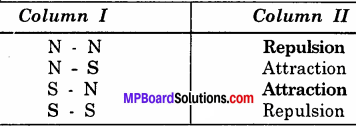
Column I shows different positions in which one pole of a magnet is placed near that of the other. Column II indicates the resulting action between them for each situation. Fill in the blanks.
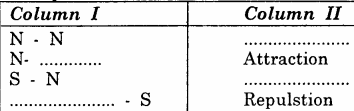
MP Board Class 6th Science Solutions Chapter 13 Fun with Magnets 17
Answer:
MP Board Class 6th Science Solutions Chapter 13 Fun with Magnets 16

Question 5.
Write any two properties of a magnet.
Answer:
The properties of a magnet are:

  1. It attracts the objects made of iron, cobalt and nickle.
  2. When it is suspended freely then it stands always in North – South direction.

MP Board Solutions

Question 6.
Where are poles of a bar magnet located?
Answer:
On the two ends of the bar magnet.

Question 7.
A bar magnet has no markings to indicate its poles. How would you find out near which end is its north pole located?
Answer:
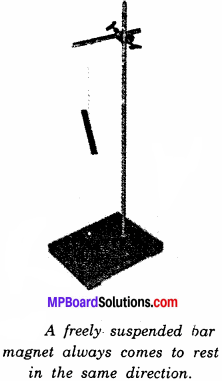
Take a bar magnet. Put a mark on one of its ends for identification. Now, tie a thread at the middle of the magnet so that you may suspend it from a wooden stand [Fig.]. Make sure that the magnet can rotate freely. Let it come to rest. Mark two points on the ground to show the position of the ends of the magnet when it comes to rest. Draw a line joining the two points. This line shows the direction in which the magnet Was pointing in its position of rest. Now, rotate the magnet by gently pushing one end in any direction and let it come to rest. Again, mark the position of the two ends in its position of rest.
MP Board Class 6th Science Solutions Chapter 13 Fun with Magnets 15
Rotate  the magnet in other directions and magnet always comes to rest note the final direction in which it in the same direction comes to rest. We find that a freely suspended bar magnet always comes to rest in a North –  South direction. The end of the magnet that points towards North is called its North seeking end or the North pole of the magnet.

Question 8.
You are given an iron strip. How will you make it into a magnet?
Answer:
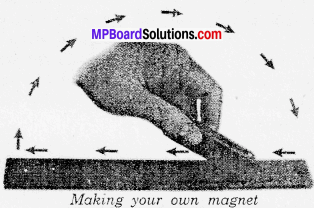
Take the iron strip and place it on the table. Now take a bar magnet and place one of its poles near one edge of the bar of iron. Without lifting the bar magnet, move it along the length of the iron bar till you reach the other end. Now, lift the magnet and bring the pole (the same pole you started with) to the same point of the iron bar from which you began (fig.) Move the magnet again along the iron bar in the same direction as you did before.
MP Board Class 6th Science Solutions Chapter 13 Fun with Magnets 14
Repeat this process about 30 – 40 times. Bring a pin or some iron filings near the iron bar to check whether it has become a magnet. If not, continue the process for some more time. Remember that, the pole of the magnet and the direction of its movement should not change. In this way, an iron strip can be converted into a magnet.

MP Board Solutions

Question 9.
How is a compass used to find directions?
Answer:
Magnetic Compass.
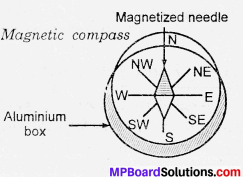
Magnetic compass consists of a small magnetized needle which is enclosed in a small round box made of aluminium. The box consists of a small pointed vertical axis (pivot) on which the magnetized needle rotates freely. The aluminium box is covered by thin glass cover.
MP Board Class 6th Science Solutions Chapter 13 Fun with Magnets 13
The magnetized needle rotates freely and points towards geographic north from which true north can be calculated. This magnetic compass is used to find the direction at any place. Sailors and navigators also use this compass to find the direction during their journey.

Question 10.
A magnet was brought from different directions towards a toy boat that has been floating in water in a tub. Affect observed in each case is stated in Column I. Possible reasons for the observed affects are mentioned in Column II. Match the statements given in Column I with those in the Column II
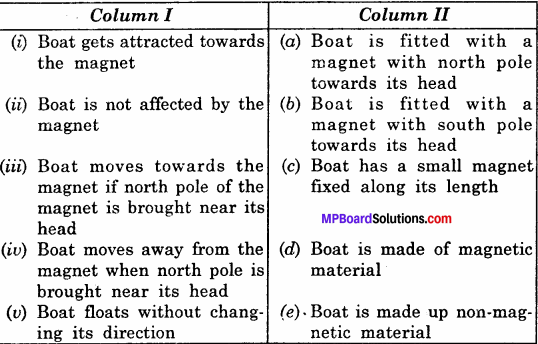
MP Board Class 6th Science Solutions Chapter 13 Fun with Magnets 12
Answer:

(i) (d)
(ii) (e)
(iii) (b)
(iv) (a)
(v) (b).

Projects and Activities

Activity 1.
collect various objects of day – to – day use from your sourroundings. Test these with the “Magnes stick”. You can also take a magnet, touch these objects with it and observe which objects stick to the magnet. Prepare a table and record your observations.
Answer:
Table: Finding the objects attracted by magnet
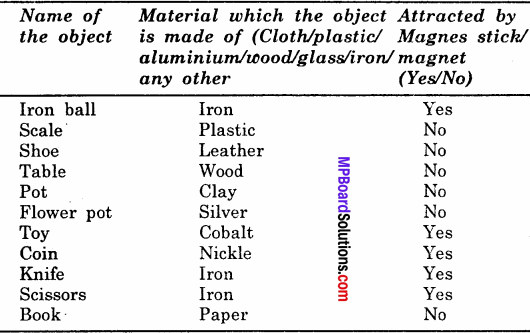
MP Board Class 6th Science Solutions Chapter 13 Fun with Magnets 11

Fun with Magnets Text Book Questions

Question 1.
Boojho has this question for you. A tailor n was stitching buttons on his Shirt. The needle has slipped from his hand on to the floor. Can you help the tailor to find the needle?
Answer:
Yes, with the help of magnet.

MP Board Solutions

Question 2.
Paheli has this puzzle for you. You are given tow indentical bars which look as if they might be made of iron. One of them is a magnet, while the other is a simple iron bar. How will you find out, which one is a magnet?
Answer:
The magnet has two poles where attraction is maximum. But in iron bar there is no pole, so attraction is same everywhere.

Fun with Magnets Additional Important Questions

Fun with Magnets Objective Type Questions

Question 1.
Choose the correct answer:
Question (i)
North pole of a magnet –
(a) Attracts north pole
(b) Remains inactive
(c) May attract or repel
(d) Repels north pole.
Answer:
(d) Repels north pole.

Question (ii)
Which one is natural magnet –
(a) Ferrite
(b) Carbon
(c) Iron
(d) Magnetite.
Answer:
(b) Carbon

Question (iii)
Which of the following is non – magnetic –
(q) Iron
(b) Nickel
(c) Cobalt
(d) Aluminium.
Answer:
(d) Aluminium.

Question (iv)
An electrolyte is a –
(a) Solid that conducts electricity
(b) Liquid that does not conduct electricity
(c) Solid that does not conduct electricity
(d) Liquid that conducts electricity and breaks up chemically in the process.
Answer:
(d) Liquid that conducts electricity and breaks up chemically in the process.

MP Board Solutions

Question (v)
Strength of a magnet is –
(а) Maximum at centre
(b) Maximum at poles
(c) Minimum at poles
(d) None of these.
Answer:
(а) Maximum at centre

Question 2.
Fill in the blanks:

  1. Iron and nickle are …………….. materials whereas copper and aluminium are …………….. materials.
  2. The regions of strongest magnetism in a magnet are known as the ………………
  3. Like poles ………………. whereas unlike poles
  4. The molecular magnets in a magnet are arranged in groups called ……………..
  5. Steel is used to make …………….. magnets.
  6. The shaving blade is an inexpensive ………………

Answer:

  1. Magnetic, non – magnetic
  2. Ends
  3. Repel, attract
  4. Domains
  5. Permanent
  6. Magnet.

MP Board Solutions

Question 3.
Which of the following statements are true (T) false (F):

  1. The magnetite is mainly composed of oxides of iron.
  2. Like poles of a magnet attract each other,
  3. Plastic is a non – magnetic material.
  4. A magnet looses its magnetism on striking voilently with hammer.
  5. Magnets point towards East – West when freely suspended.
  6. Earth behaves like a huge magnet.
  7. Orested a Danish scientist noticed that a compass needle was affected by the electric current flowing in the neighbouring coil of wire.
  8. The most important property of magnet is to attract iron pieces.
  9. A horse – shoe magnet.can have only one pole.
  10. A magnet can have two north poles.

Answer:

  1. True
  2. False
  3. True
  4. False
  5. True
  6. True
  7. True
  8. Ture
  9. False
  10. False.

Question 4.
Match the items of Column A with Column B:
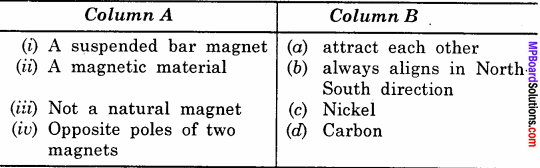
MP Board Class 6th Science Solutions Chapter 13 Fun with Magnets 10
Answer:

(i) (b)
(ii) (c)
(iii) (d)
(iv) (a).

Fun with Magnets Very Short Answer Type Questions

Question 1.
When was magnetite discovered?
Answer:
Magnetite was discovered in 800 B. C.

Question 2.
From where a mineral magnetite was discovered first.
Answer:
It was discovered in the town of Magnesia.

MP Board Solutions

Question 3.
Why was magnetite named Londestone?
Answer:
It was named so because this mineral can align itself in the same direction it left to rotate freely.

Question 4.
Which is the North Pole of a bar magnet?
Answer:
It is the tip of a bar magnet which points towards the north direction.

Question 5.
Which is the South Pole of a bar magnet?
Answer:
It is the tip of a bar magnet which points towards the south direction.

Question 6.
What is a temporary magnet?
Answer:
It is piece of magnet only for a short period. This magnetism is lost as soon as the source of magnetisation is removed.

Question 7.
How should we store magnets?
Answer:
We should store magnets by joining opposite poles of two magnets preferably with a piece of iron in between.

Question 8.
Who discovered the magnetic effects of electric current?
Answer:
Danish Scientist H. C. Uersted discovered the phenomenon in 1820.

Question 9.
What are domains?
Answer:
When we study a magnet in microscope, it consists of small regions. These regions are called domains.

Question 10.
How is magnet and electric current similar in property?
Answer:
Because wires having electric current behave like a magnet. In electric current also like charges repel and unlike charges attract

.MP Board Solutions

Question 11.
What is a magnetic needle?
Answer:
This needle moves a pivot fixed at the centre of a round frame box. It is used by navigators for finding out the direction in the sea.

Question 12.
Name some non-magnetic materials.
Answer:
Plastic, cloth, paper and leather, etc. are non – magnetic materials.

Question 13.
What are the ends of a magnet called?
Answer:
Poles.

Question 14.
What is natural magnet called?
Answer:
Magnetite.

Question 15.
Which iron is used for making a permanent magnet?
Answer:
Hard steel and alloys.

Question 16.
What is the instrument in which directive property of a magnet is used?
Answer:
Mariner’s compass.

Fun with Magnets Short Answer Type Questions

Question 1.
What is a magnet? How is a temporary magnet different from a permanent magnet?
Answer:
Any material that has the property of attracting iron is called a magnet.
Difference between temporary and permanent magnet:

Temporary magnet:

  • It is magnet for a short period.
  • Its magnetism is lost if source of magnetisation is removed.
  • It is made up of soft iron.

Permanent magnet:

  • It is magnet for ever.
  • It remains magnet even if the source of magnetisation is removed.
  • It is made up of steel.

MP Board Solutions

Question 2.
Can you make out the south and north direction with the help of bar magnet. How?
Answer:
Yes, we can make out the south and north directions with the help of bar magnet. Suspend a magnet from a string tied to its middle so that it can rotate freely. The tip of the bar magnet which point north will rest to the north direction and the tip bearing south will rest to point towards south direction.

Question 3.
Define magnetism. Also give the name of magnetic and non – magnetic substance.
Answer:
Magnetism:
Magnet has the property of attracting various substances towards itself. This property of magnet is called magnetism.

Magnetic substances:
Those substances which are attracted by a magnet are called magnetic substances. For examples-, nickel, iron steel, cobalt and alloys of these substances are magnetic in nature.

Non – magnetic substances:
Those substances which are not attracted by a magnet are called non-magnetic substances. For examples, glass, cloth, wood, cloth, etc.

Question 4.
How can you make your personal compass?
Answer:
Magnetise an iron needle using a bar magnet. Now, insert the magnetised needle through a small piece of cork or foam. Let the cork float in water in a bowl or a tub. Make sure that the needle does not touch the water (Fig.). Your compass is now ready to work.
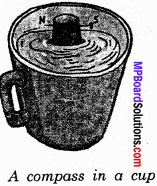
MP Board Class 6th Science Solutions Chapter 13 Fun with Magnets 9

Question 5.
What is an electromagnet? Give two applications of electromagnets?
Answer:
When an electric current flows through a coil of wire, the coil behaves like a permanent magnet. When this current carrying coil is brought near a suspended bar magnet, one end of the coil repeals the north pole of the magnet. The other end of the coil attracts the north pole of the magnet. Thus, a current carrying coil has both a north and south pole like a magnet, such a magnet is called electromagnet.

Applications of electromagnet:

  1. They are used in electric bells, telephones, telegraphps, etc.
  2. They are used to separate magnetic substances like nickel, cobalt and iron from non – magnetic substances like brass, copper, zinc and plastics.

Fun with Magnets Long Answer Type Questions

Question 1.
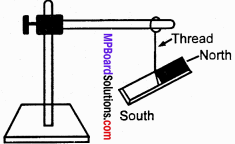
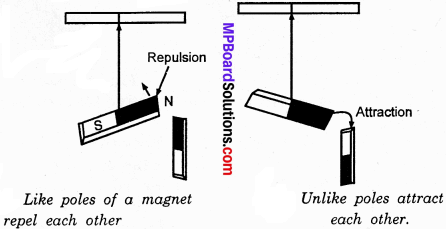
What happens when the north pole of a magnet is brought near (i) the north pole, (ii) the south pole of a freely suspended magnet?
MP Board Class 6th Science Solutions Chapter 13 Fun with Magnets 8
Answer:
Suspend a bar magnet with a string. This bar magnet should be marked with north and south pole.

  1. Hold another magnet in hand and bring its north pole close to each pole one by one. North pole of two magnet will repel each other as they are like poles.
  2. While north of magnet, in hand comes close to south of suspended magnet, it will show attraction because they are unlike poles.
MP Board Class 6th Science Solutions Chapter 13 Fun with Magnets 7

Question 2.
Can we have an isolated north pole or south pole?
Answer:
An isolated magnetic pole is not possible. Two magnetic poles of a magnet cannot be separated.
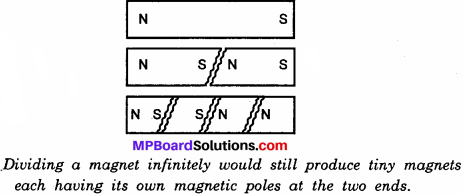
If a magnet is broken into two pieces, each piece is a magnet having north and south pole. If these pieces are further broken into more smaller pieces, each piece consists the two poles (i.e., north pole and south pole) at its ends.
MP Board Class 6th Science Solutions Chapter 13 Fun with Magnets 6
Dividing a magnet infinitely would still produce tiny magnets each having its own poles at two ends. This shows that two poles of a magnet cannot be separated and an isolated magnetic pole does not exist.

MP Board Solutions

Question 3.
Explain the process by which a permanent magnet can magnetise an ordinary piece of iron?
Answer:
A piece of iron can be magnetised by two methods:

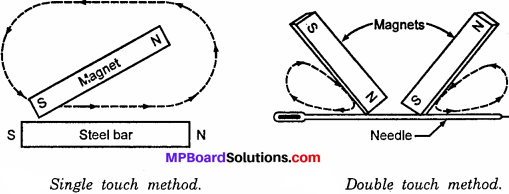
1. By single touch method. Put a piece of iron on the table:
Hold a bar magnet on it vertically with north pole touching. Now move the magnet along the length. By repeating this practice many times makes that iron piece a magnet.

2. By double touch method:
Put a piece of iron on the table. Hold two bar magnets on it vertically with north and south pole of two magnets. Put them in the middle first. Move the magnets in opposite direction as shown in figure. Repeating this process converts the piece of iron into a magnet.
MP Board Class 6th Science Solutions Chapter 13 Fun with Magnets 5

Question 4.
Why does a freely suspended magnet always come to rest in the north – south direction?
Answer:
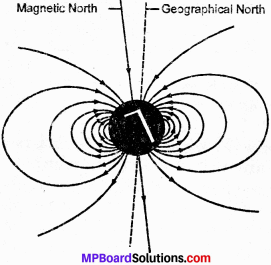
This is because the earth itself behaves like a huge bar magnet with its magnetic poles near the geographical north and south poles. The south pole of this bar magnet is near the geographical north pole, whereas the north pole of the bar magnet is near the geographical south pole.
MP Board Class 6th Science Solutions Chapter 13 Fun with Magnets 4

In a freely suspended magnet, therefore, the north pole points towards the geographical north pole since it is attracted by the earth’s magnetic south pole. Similarly, the south pole of the suspended magnet is attracted by the earth’s magnetic north pole and, therefore, points towards the geographical south pole.

MP Board Solutions

Question 5.
Write a short note on the cautions of magnets?
Answer:
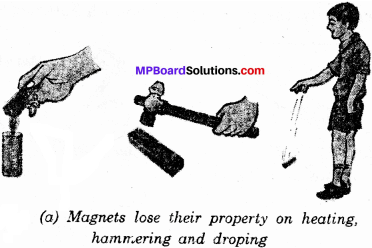
Magnets loose their properties if they are heated, hammered or dropped from some height [Fig. (a)]. Also, magnets become weak if they are not stored properly.
MP Board Class 6th Science Solutions Chapter 13 Fun with Magnets 3
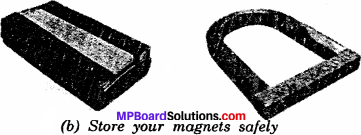
To keep them safe, bar magnets should be kept in pairs with their unlike poles on the same side. They must be separated by a piece of wood while two pieces of soft iron should be placed across their ends [Fig. (b)]. For horse-shoe magnet, one should keep a piece of iron across the poles.
MP Board Class 6th Science Solutions Chapter 13 Fun with Magnets 2
Keep magnets away from cassettes, mobiles, television, music system, compact disks (CDs) and the computer. [See Fig. (c)]

MP Board Class 6th Science Solutions Chapter 13 Fun with Magnets 1

MP Board Class 6th Science Solutions

MP Board Class 10th Hindi Navneet Solutions गद्य Chapter 6 मेरे गाँव की सुख और शांति किसने छीन ली?

MP Board Class 10th Hindi Navneet Solutions गद्य Chapter 6 मेरे गाँव की सुख और शांति किसने छीन ली? (संस्मरण रामनारायण उपाध्याय)

मेरे गाँव की सुख और शांति किसने छीन ली? अभ्यास

बोध प्रश्न

मेरे गाँव की सुख और शांति किसने छीन ली? अति लघु उत्तरीय प्रश्न

प्रश्न 1.
गाँधी द्वारा स्थापित आश्रम का नाम लिखिए।
उत्तर:
गाँधी द्वारा ‘सेवा ग्राम’ आश्रम की स्थापना की गयी है।

प्रश्न 2.
लोक संस्कृति का जन्म कहाँ हुआ?
उत्तर:
लोक संस्कृति का जन्म गाँवों में हुआ।

प्रश्न 3.
लेखक ने संगीत का जन्म किससे माना है?
उत्तर:
लेखक ने संगीत का जन्म श्रम से माना है।

प्रश्न 4.
ललित कलाओं का स्वभाव कैसा होता है?
उत्तर:
ललित कलाओं का स्वभाव फूल जैसा होता है।

प्रश्न 5.
ग्रामीण समूचे गाँव को किस रूप में मानता आया है?
उत्तर :
ग्रामीण समूचे गाँव को एक परिवार मानता आया है।

MP Board Solutions

मेरे गाँव की सुख और शांति किसने छीन ली? लघु उत्तरीय प्रश्न

प्रश्न 1.
लेखक समाज से किन प्रश्नों को पूछना चाहता है?
उत्तर:
लेखक समाज से ये प्रश्न पूछना चाहता है कि मेरे गाँवों की सुख और शान्ति को किसने छीन लिया। गाँवों की अन्न-धन और लक्ष्मी कहाँ चली गई?

प्रश्न 2.
लोक की जीवन्त रसधारा को किसने, कहाँ सुरक्षित रखा है?
उत्तर:
लोक की जीवन्त रसधारा को गाँवों ने अपने हृदय-में सुरक्षित रखा है।

प्रश्न 3.
अँधेरे को सुहावने प्रभात में कौन, कैसे परिवर्तित करता है?
उत्तर:
गाँव की स्त्रियाँ भोर में उठकर आटे के साथ घने अँधेरे को पीसकर सुहावने प्रभात में बदल देती थीं।

प्रश्न 4.
गाँव के समृद्ध किसान की स्थिति अब कैसी हो गई है?
उत्तर:
गाँव के समृद्ध किसान की स्थिति बढ़ती हुई महँगाई और शोषणकारी समाज व्यवस्था के चलते मज़दूर के रूप में बदल गई है।

प्रश्न 5.
श्रम से किसका जन्म होना प्रतीत होता था?
उत्तर:
श्रम से संगीत का जन्म होना प्रतीत होता था और यही संगीत लोरी बनकर श्रम को हल्का करने में योगदान देता था।

प्रश्न 6.
माटी कुम्हार की हथेली के स्पर्श से किन नवीन रूपों को धारण करती थी?
उत्तर;
माटी कुंम्हार की हथेली का स्पर्श पाकर नये-नये रूप धारण करती थी। कभी वह गागर बनती, कभी खपरैल तो कभी माटी का दीप बनकर आशा की किरण जगाया करती थी।

मेरे गाँव की सुख और शांति किसने छीन ली? दीर्घ उत्तरीय प्रश्न

प्रश्न 1.
ललित कलाओं का ग्राम्य जीवन में क्या महत्त्व था?
उत्तर:
ललित कलाओं का ग्राम्य जीवन में बड़ा महत्त्व था। ये ललित कलाएँ उनमें जीवन का रस घोलती थीं। तीज-त्यौहार, मेले-ठेले तथा चौपालों पर इनके रूप देखने को मिलते थे।

प्रश्न 2.
लोकगीत ग्रामीण जीवन में किस प्रकार रचे-बसे थे?
उत्तर:
लोकगीत ग्रामीण जीवन की रग-रग में बसे और रचे थे। ग्रामीण जनों का सम्पूर्ण जीवन इन्हीं लोकगीतों के ताने-बाने से बुना हुआ था। उनकी श्वास-प्रश्वास में ये ही गीत समाये हुए थे।

प्रश्न 3.
लेखक के अनुसार “गोकुल के सहज-सरल गाँव” का आशय स्पष्ट कीजिए।
उत्तर:
लेखक की मान्यता है कि ब्रजमण्डल के गोकुल के गाँव जिस प्रकार सहज एवं सरल थे वैसे ही इस क्षेत्र के सभी गाँव सहज और सरल थे। बनावट एवं कृत्रिमता का उनमें कोई स्थान नहीं था। वहाँ के निवासी सरल एवं भोले-भाले व्यक्ति हुआ करते थे।

प्रश्न 4.
गाँब के सुसंस्कृत आदमी की पाँच विशेषताएँ लिखिए।
उत्तर:
गाँव का आदमी निरक्षर भले हो लेकिन वह सुसंस्कृत रहा है। उसकी पाँच विशेषताएँ इस प्रकार हैं-

  1. वह विश्वास पर बिक जाता है
  2. वह धर्म पर झुक जाता है
  3. वह थककर बैठता नहीं हैं
  4. झुककर नहीं चलता है और
  5. वह दुःख में भी मुस्कुराता रहता है।

प्रश्न 5.
गाँव के कुटीर उद्योगों पर आधुनिकता का क्या प्रभाव पड़ा है?
उत्तर:
गाँव के कुटीर उद्योगों पर आधुनिकता का यह प्रभाव पड़ा है कि गाँव के कुटीर उद्योग नष्ट हो गये हैं। फ्लोर मिल खुल जाने से चक्कियों का चलना बन्द हो गया है, ट्रैक्टर एवं अन्य कृषि यन्त्रों के प्रयोग से किसानों का हल आदि चलाना बन्द हो गया है।

प्रश्न 6.
गाँव का आदमी अपने समग्र जीवन से क्या-क्या देने की क्षमता रखता है?
उत्तर:
गाँव के आदमी का समग्र जीवन एक अनपढ़ी खुली किताब जैसा है। उसका रहन-सहन, खान-पान, वस्त्राभूषण, आचार-विचार, रीति-रिवाज, गीत और कथाएँ, नृत्य संगीत आदि सभी कुछ हमें कुछ न कुछ देने की क्षमता रखते हैं।

MP Board Solutions

मेरे गाँव की सुख और शांति किसने छीन ली? भाषा अध्ययन

प्रश्न 1.
निम्नलिखित शब्दों का सन्धि-विच्छेद कीजिए और नाम लिखिए
उत्तर:

  1. रवीन्द्र = रवि + इन्द्र = दीर्घ सन्धि।
  2. निरक्षर = निः + अक्षर = विसर्ग सन्धि।
  3. संग्रहालय = संग्रह + आलय = दीर्घ सन्धि।
  4. सज्जन = सत् + जन = व्यंजन सन्धि।

प्रश्न 2.
निम्नलिखित शब्दों का समास-विग्रह कीजिए
उत्तर:

  1. कार्य स्थल= कार्य का स्थल = तत्पुरुष समास।
  2. रसधारा = रस की धारा = तत्पुरुष समास।
  3. श्वास-प्रश्वास = श्वास और प्रश्वास = द्वन्द्व समास।
  4. लोक संस्कृति = लोक की संस्कृति = तत्पुरुष समास।

प्रश्न 3.
निम्नलिखित शब्दों की सन्धि कीजिए
उत्तर:

  1. पर + उपकार = परोपकार।
  2. देव + ऋषि = देवर्षि।
  3. अति + आचार = अत्याचार।
  4. प्रति + एक = प्रत्येक।

प्रश्न 4.
निम्नलिखित वाक्यांशों के लिए एक-एक शब्द लिखिए.

  1. ठेका लेने वाला।
  2. खेती करने वाला।
  3. मिट्टी के बर्तन बनाने वाला।
  4. पानी भरने वाली।

उत्तर:

  1. ठेकेदार
  2. खेतिहर
  3. कुम्हार
  4. पनहारिन।

प्रश्न 5.
निम्नलिखित वाक्यों को पहचान कर अर्थ के आधार पर वाक्य प्रकार का नाम लिखिए

  1. किसान के कंठ से गीत कहाँ लुप्त हो गये?
  2. गाँवों में लोक संस्कृति का जन्म हुआ।
  3. मेरे गाँव की शान्ति मन छीनो।
  4. निर्मल चाँदनी, रात को नहीं फैली थी।
  5. मैं चाहता हूँ कि आप एक बार गाँव अवश्य जायें।

उत्तर:

  1. प्रश्नवाचक
  2. स्वीकारात्मक
  3. आदेशात्मक
  4. निषेधात्मक
  5. आदेशात्मक।

मेरे गाँव की सुख और शान्ति किसने छीन ली? महत्त्वपूर्ण वस्तुनिष्ठ प्रश्न

मेरे गाँव की सुख और शांति किसने छीन ली? बहु-विकल्पीय प्रश्न 

प्रश्न 1.
‘मेरे गाँव की सुख और शान्ति किसने छीन ली?’ निबन्ध के लेखक हैं-
(क) रामनारायण उपाध्याय
(ख) सरदार पूर्णसिंह
(ग) बालकृष्ण भट्ट
(घ) अज्ञेय।
उत्तर:
(क) रामनारायण उपाध्याय

प्रश्न 2.
गाँधीजी ने गाँवों को आदर्श मानकर किस गाँव की स्थापना की?
(क) सेवाग्राम
(ख) रामपुर
(ग) शान्ति निकेतन
(घ) साबरमती आश्रम।
उत्तर:
(क) सेवाग्राम

प्रश्न 3.
लोकगीतों के स्वर गलों से लुप्त होकर कहाँ कैद किये गये हैं?
(क) पुस्तकों में
(ख) कैसिटों में
(ग) संग्रहालयों में
(घ) कहीं नहीं।
उत्तर:
(ख) कैसिटों में

प्रश्न 4.
मिट्टी को नवीन आकृति प्रदान करता है
(क) मनुष्य
(ख) बढ़ई
(ग) रंगरेज
(घ) कुम्हार।
उत्तर:
(घ) कुम्हार।

प्रश्न 5.
लोक संस्कृति का जन्म हुआ (2016)
(क) शहरों में
(ख) गाँवों में
(ग) कस्बों में
(घ) विद्यालयों में।
उत्तर:
(ख) गाँवों में

MP Board Solutions

रिक्त स्थानों की पूर्ति

  1. रवीन्द्रनाथ टैगोर ने ………….. की स्थापना की।
  2. ……….. में लोकसंस्कृति का जन्म हुआ। (2013)
  3. पहले गाँव का किसान …………. माना जाता था।
  4. गाँव का आदमी निरक्षर भले हो, लेकिन ………… रहा है।
  5. आज गाँव में बेरोजगारी है, गाँव में नीरसता है, गाँव . हैं।

उत्तर:

  1. शान्ति निकेतन
  2. ग्रामों
  3. समृद्ध
  4. सुसंस्कृत
  5. गरीब।

सत्य/असत्य

  1. गाँव का आदमी निरक्षर भले ही हो लेकिन सुसंस्कृत होता है।
  2. गाँव में रहने के लिए साधारण नागरिक ही नहीं कवियों का मन भी ललचाया था।
  3. गाँधीजी द्वारा स्थापित आश्रम का नाम ‘सेवाग्राम’ है। (2009)
  4. आज गाँव में मजदूर प्रसन्नता से गाता गुनगुनाता मिलेगा।
  5. गाँव वालों का जीवन एक बिना पढ़ी खुली पुस्तक की तरह सामने बिछा है।

उत्तर:

  1. सत्य
  2. सत्य
  3. सत्य
  4. असत्य
  5. सत्य।

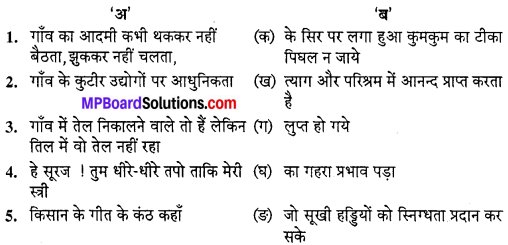
सही जोड़ी मिलाइए

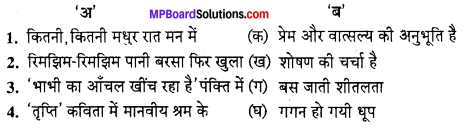
MP Board Class 10th Hindi Navneet Solutions गद्य Chapter 6 मेरे गाँव की सुख और शांति किसने छीन ली img-1
उत्तर:
1. → (ख)
2. → (घ)
3. → (ङ)
4. → (क)
5. → (ग)

एक शब्द/वाक्य में उत्तर

  1. लोक संस्कृति का जन्म कहाँ हुआ? (2014, 18)
  2. ‘मेरे गाँव की सुख और शान्ति किसने छीन ली?’ के लेखक कौन हैं?
  3. ललित कलाओं का स्वभाव कैसा होता है? (2017)
  4. कहाँ के सरल और सहज गाँव धीरे-धीरे नष्ट होते जा रहे हैं?
  5. अमराई में अब किसकी कूक नहीं गूंजती है?

उत्तर:

  1. ग्रामों में
  2. पण्डित रामनारायण उपाध्याय
  3. फूल की तरह
  4. गोकुल के
  5. कोयल।

मेरे गाँव की सुख और शान्ति किसने छीन ली? पाठ सारांश

इस संस्मरण में पं.रामनारायण उपाध्याय जी ने भारत के गाँव की संस्कृति का अवलोकन किया है लेकिन निबन्धकार भारत के गाँव के वर्तमान को लेकर व्यथित हैं। उसका प्रमुख कारण है कि गाँव अपनी पहचान को नष्ट करते जा रहे हैं। गाँव की पहचान के साथ-साथ भारतमाता की पहचान भी धुंधली पड़ती जा रही है।

गाँधीजी और रवीन्द्रनाथ टैगोर ने भारत के गाँवों को ही आदर्श मानकर सेवाग्राम और शान्ति निकेतन की स्थापना की। हमारे देश के गाँवों की प्राकृतिक छटा अलौकिक व दर्शनीय थी लेकिन अब वही गाँव आधुनिकता के दबाव के कारण इस अनुपम सुख से पृथक् होते जा रहे हैं।

अब न तो कहीं लोकगीतों की मधुर ध्वनि सुनाई देती है न ही ढोलक की थाप। ये लोकगीत मानव जीवन का अभिन्न अंग थे तथा मानव को भरपूर स्फूर्ति प्रदान करते थे। अब इन गीतों के समाप्त होने के कारण मानव की संवेदना भी समाप्त हो गयी है।

जिस भारत को सोने की चिड़िया कहा जाता था वही भारतवासी जो कि ग्रामीण क्षेत्रों में रहते हैं, आर्थिक रूप से विपन्न हैं। आत्मनिर्भर गाँव अब छिन्न-भिन्न हो गये हैं। मजदूर व शिल्पकार रोजी-रोटी की तलाश में गाँव से पलायन कर शहर की ओर भाग रहे हैं।

पूर्व में गाँव के लोग अनपढ़ होते थे लेकिन उनमें परस्पर स्नेह. आस्था. विश्वास और परिश्रम की भावना कूट-कूटकर भरी हुई थी। वे श्रम और संघर्ष करके भी प्रसन्नतापूर्वक जीवन बिताते थे क्योंकि वे आत्मनिर्भर थे। आज भी इतिहास इस बात का प्रमाण है कि भारत के गाँव खुशहाल थे लेकिन आज गाँव में नीरसता,निर्धनता और अशान्ति है। निबन्धकार का इस निबन्ध को लिखने का उद्देश्य है कि लोकचेतना जाग्रत हो।

MP Board Solutions

मेरे गाँव की सुख और शान्ति किसने छीन ली? संदर्भ-प्रसंगसहित व्याख्या

(1) जिन गाँवों ने हिन्दी साहित्य को ‘हीरो’ और ‘गोबर’ जैसे पात्र दिये, जिन गाँवों के लिए गाँधी और रवीन्द्रनाथ टैगोर ने शहरों की समस्त सुविधाओं को त्यागकर ‘शान्ति निकेतन’ और ‘सेवाग्राम’ को अपना कार्यस्थल बनाया, जिन गाँवों में रहने के लिए साधारण नागरिक ही नहीं कवियों का मन भी ललचाया था, वे ही गाँव आज अशान्ति के घर हुए जा रहे हैं और जैसे किसी भी आँख से आँसू गिरे, ऐसे गाँवों के आँचल से एक-एक घर टूटते ही चले जा रहे हैं।

कठिन शब्दार्थ :
कार्यस्थल = कामकाज करने का स्थान। आँचल = परिवेश, वातावरण।

सन्दर्भ :
प्रस्तुत गद्यांश ‘मेरे गाँव की सुख और शान्ति किसने छीन ली’ शीर्षक पाठ से लिया गया है। इसके लेखक श्री रामनारायण उपाध्याय हैं।

प्रसंग :
इसमें लेखक की चिन्ता यह है कि पहले तो गाँव सुख शान्ति के भण्डार हुआ करते थे और सभी लोग गाँवों की ओर देखा करते थे; पर आज तो वे समस्याओं के घर बनते चले जा रहे हैं।

व्याख्या :
लेखक श्री रामनारायण उपाध्याय कहते हैं कि जिन गाँवों ने प्रेमचन्द के प्रसिद्ध उपन्यास, ‘गोदान’ में ‘होरी’ और ‘गोबर’ का चित्रण किया है तथा जिन गाँवों में गाँधी और टैगोर को शहरों की सभी सुख-सुविधाएँ त्याग कर ‘सेवा ग्राम’ और ‘शान्ति निकेतन’ भाया तथा इन्हीं को इन लोगों ने अपनी कर्म भूमि बनाया। इन गाँवों के प्रति साधारण नागरिक ही नहीं अपितु पन्त जैसे महान् कवियों का मन भी ललचाया करता था, वे ही गाँव आज सुख शान्ति से रहित होकर अशान्ति के घर क्यों बनते जा रहे हैं? जिस प्रकार किसी आँख से आँसू टप-टप गिरते जाते हैं, उसी प्रकार गाँव के आँचल के एक-एक घर टूटते जा रहे हैं।

विशेष :

  1. लेखक को गाँवों की वर्तमान दशा से हार्दिक दुःख होता है।
  2. भाषा सहज एवं सरल है।

(2) जिन गाँवों में लोक-संस्कृति का जन्म हुआ, जिसने लोक की जीवन्त रसधारा को, अपने हृदय में सुरक्षित रखा, वे ही गाँव आज टूटते जा रहे हैं, गाँव की वह पुरानी पीढ़ी भी समाप्त होती जा रही है जिसका सम्पूर्ण जीवन श्वास-प्रश्वास की तरह गीतों के ताने-बाने पर आधारित था। अब तो वे गोकुल से सहज-सरल गाँव नष्ट होते जा रहे हैं, जहाँ स्त्रियाँ भोर में उठकर आटे के साथ घने अँधेरे को भी पीसकर सुहावने प्रभात में बदल देती थीं। जहाँ चक्की के हर फेरे के साथ गीत की नई पंक्तियाँ उठती थीं। लगता था जैसे श्रम में से संगीत का जन्म हो रहा हो और संगीत लोरी बनकर श्रम को हल्का करने में अपना योगदान दे रहा हो।

कठिन शब्दार्थ :
लोकसंसार। जीवन्त रसधारा = ऐसी धारा जो जीवन प्रदान करती हो। श्वास-प्रश्वास = साँस लेना और छोड़ना। लोक-संस्कृति = गाँव की संस्कृति।

सन्दर्भ :
पूर्ववत्।

प्रसंग :
लेखक का मानना है कि लोक संस्कृति का जन्म गाँवों से ही हुआ था और आज वह टूटती जा रही है।

व्याख्या :
लेखक श्री रामनारायण उपाध्याय कहते हैं कि जिन गाँवों में लोक-संस्कृति का जन्म हुआ था और जिसने वहाँ के जन-जीवन में एक जीवन्त जीवन प्रवाहित किया था, वे ही गाँव आज टूटते और बिखरते जा रहे हैं। गाँव की वह पुरानी पीढ़ी आज नाश के कगार पर है जिसका सारा जीवन श्वास-प्रश्वास की तरह लोक गीतों के ताने-बाने पर टिका हुआ था। गोकुल के सहज एवं सरल गाँव जहाँ स्त्रियाँ प्रात:काल की बेला में उठकर घर की चक्की पर बैठकर लोकगीत गाते-गाते रात्रि के घने अँधेरे को पीसकर सुहावने प्रात:काल में बदल देती थीं, आज वे गाँव भी नष्ट होते जा रहे हैं। उस समय गाँव की स्त्रियाँ चक्की चलाते वक्त गीत की नई-नई पंक्तियाँ गाकर वातावरण को मधुर बना दिया करती थीं। उस समय ऐसा लगता था मानो श्रम में से संगीत का जन्म हो रहा हो और संगीत लोरी बनकर श्रम को हल्का कर दिया करता था।

विशेष :

  1. पहले गाँवों में स्त्रियाँ चक्की चलाते समय, पानी भरते समय लोकगीत गाया करती थीं।।
  2. भाषा सहज, सरल में भावानुकूल है।

MP Board Solutions

(3) पहले जो आदमी गाँव का समृद्ध किसान माना जाता था, वही अब बढ़ती महँगाई और शोषणकारी समाज व्यवस्था के चलते अपनी जमीन से हाथ धोकर खेतिहर मजदूर में बदलता जा रहा है और सचमुच जो मजदूर था वह जमीन पर से किसान का आधिपत्य कम हो जाने से शहरों में मजदूरी करता नजर आता है।

कठिन शब्दार्थ-समृद्ध = सम्पन्न, खाता-पीता। शोषणकारी = सताने वाला, अनुचित लाभ लेने वाला। खेतिहर = मजदूरी पर खेत में काम करने वाला। आधिपत्य = अधिकार।

सन्दर्भ :
पूर्ववत्।

प्रसंग :
लेखक यह बताना चाहता है कि गाँव के लोग पलायन कर शहरों की ओर भाग रहे हैं।

व्याख्या :
लेखक रामनारायण उपाध्याय कहते हैं कि पहले जो गाँव का सम्पन्न किसान माना जाता था वह बढ़ती महँगाई के कारण तथा शोषण करने वाली सामाजिक व्यवस्था के कारण अपनी जमीन से हाथ धोकर खेत में काम करने वाला मजदूर बनता जा रहा है और जो वास्तव में मजदूर था वह जमीन पर से किसान का अधिकार समाप्त हो जाने पर शहर में मजदूरी करता दिखाई देता है।

विशेष :

  1. बढ़ती महँगाई और शोषणकारी सामाजिक व्यवस्था ने किसानों को मजदूर बना डाला है।
  2. भाषा सहज एवं सरल है।

MP Board Class 10th Hindi Solutions

MP Board Class 11th Biology Solutions Chapter 6 पुष्पी पादपों का शारीर

MP Board Class 11th Biology Solutions Chapter 6 पुष्पी पादपों का शारीर

पुष्पी पादपों का शारीर NCERT प्रश्नोत्तर

प्रश्न 1.
विभिन्न प्रकार के मेरिस्टेम की स्थिति तथा कार्य बताइए।
उत्तर:
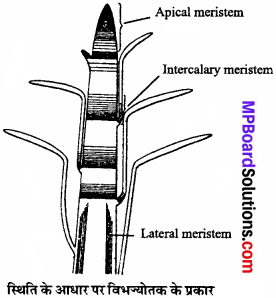
स्थिति के अनुसार विभज्योतक निम्न प्रकार के होते हैं –
1.शीर्षस्थ विभज्योतक (Apical meristem):
ये ‘जड़ तथा तने के शीर्ष पर पाये जाते हैं इनकी कोशिकाओं के विभाजन से तने तथा जड़ें लम्बाई में बढ़ती हैं। इनसे जड़ व तनों के सिरों पर वृद्धि बिन्दु का निर्माण होता है।

2. अन्तर्विष्ट विभज्योतक (Intercalary meristem):
वास्तव में यह शीर्षस्थ विभज्योतक से पृथक् हुआ भाग है जो प्ररोह की वृद्धि के समय शीर्षस्थ भाग से अलग हो जाता है और स्थायी ऊतक में परिवर्तित नहीं होता एवं स्थायी ऊतकों के बीच में विभज्योतक ऊतक के रूप में बचा रहता है। यह ऊतक पत्ती के आधार के पास अथवा पर्व के आधार के पास स्थित रहता है। अन्तर्विष्ट विभज्योतक ऊतक सामान्यतः घासों में पर्व के आधार के पास, पुदीने (Mentha) की पर्वसन्धि के नीचे इत्यादि स्थानों पर पाये जाते हैं। ये ऊतक अस्थायी होते हैं लेकिन बाद में स्थायी ऊतकों में परिवर्तित हो जाते हैं। इस ऊतक के कारण पौधा लम्बाई में बढ़ता है।

3. पार्श्व विभज्योतक (Lateral meristem):
ये विभज्योतक ऊतक तनों तथा जड़ों के पार्यों में स्थित हैं, जैसे कि संवहन एधा और कॉर्क एधा। ये ऊतक स्थायी ऊतकों के पुनः विभेदन के कारण बनते हैं। इनके विभाजन से द्वितीयक वृद्धि होती है जिससे जड़ व तने मोटाई में वृद्धि करते हैं।
MP Board Class 11th Biology Solutions Chapter 6 पुष्पी पादपों का शारीर - 1

प्रश्न 2.
कार्क कैंबियम ऊतकों से बनता है, जो कार्क बनाते हैं। क्या आप इस कथन से सहमत हैं ? वर्णन कीजिए।
उत्तर:
जब द्विबीजपत्री जड़ और तने के परिधि में वृद्धि होती है तब वल्कुट तथा बाह्य त्वचा की सतहें टूटती जाती है और उन्हें नई संरक्षी कोशिका सतह की आवश्यकता होती है। इसलिए एक दूसरा मेरीस्टेमी ऊतक तैयार हो जाता है जिसे कार्क कैंबियम अथवा कागजन कहते हैं। यह प्रायः वल्कुट क्षेत्र में विकसित होता है इसकी सतह मोटी और सँकरी पतली भित्ति वाली आयताकार कोशिकाओं की बनी होती है। कागजन दोनों ओर की कोशिकाओं को बनाता है।

बाहर की ओर की कोशिकाएँ कार्क अथवा काग में बँट जाती है और अंदर की ओर की कोशिकाएँ द्वितीयक वल्कुट अथवा कागास्तर में विभेदित हो जाती है। कार्क कोशिकाओं में पानी का प्रवेश नहीं होता है क्योंकि इसकी कोशिका भित्ति पर सूबेरिन जमा रहता है। द्वितीयक वल्कुट कोशिकाएँ पैरेकाइमी होती है। कागजन, काग तथा काग मिलकर परिचर्म बनाते हैं । ये बाहरी तथा तने के भीतरी ऊतकों के बीच गैसों का आदान-प्रदान करते हैं। ये अधिकांश काष्ठीय वृक्षों में पाये जाते हैं।

MP Board Solutions

प्रश्न 3.
चित्रों की सहायता से काष्ठीय एंजियोस्पर्म के तने में द्वितीयक वृद्धि के प्रक्रम का वर्णन कीजिए। इसकी क्या सार्थकता है?
उत्तर:
द्वितीयक वृद्धि (Secondary growth):
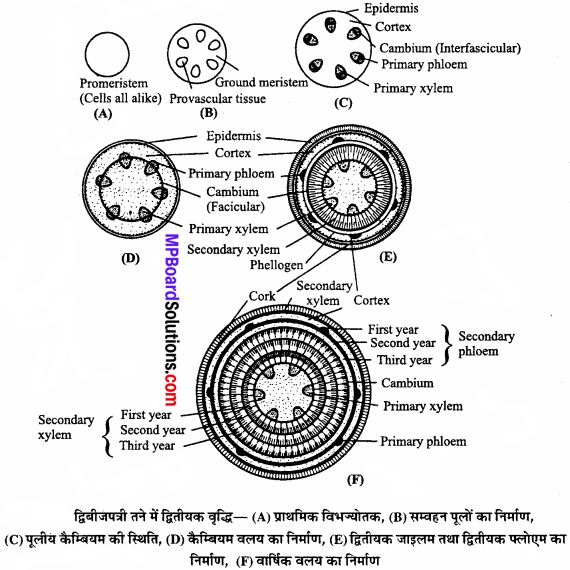
“कैम्बियम तथा कॉर्क कैम्बियम की क्रियाशीलता के फलस्वरूप क्रमशः स्टील के अन्दर तथा स्टील के बाहर द्वितीयक ऊतकों के बनने के कारण जड़ तथा तने में मोटाई में हुई वृद्धि द्वितीयक वृद्धि कहलाती है।” द्वितीयक वृद्धि के कारण ही आवृतबीजी और द्विबीजपत्री पौधे वृक्ष जैसी रचना बना पाते हैं द्वितीयक वृद्धि के अभाव के कारण ही एकबीजपत्री पादपों में सामान्यतः वृक्ष का अभाव रहता है। अत: कुछ अपवादों को छोड़कर एकबीजपत्री पादपों में द्वितीयक वृद्धि का पूर्णतः अभाव होता है। जबकि द्विबीजपत्री पादपों (जड़ एवं तना) में द्वितीयक वृद्धि पायी जाती है।

द्विबीजपत्री तने में द्वितीयक वृद्धि (Secondary growth in cambium) – एक प्रारूपी द्विबीजपत्री तने में द्वितीयक वृद्धि निम्न प्रकार से होती है –

(A) कैम्बियम की क्रियाशीलता (Activity of cambium):
आप जानते हैं कि द्विबीजपत्री तने में जाइलम तथा फ्लोएम के बीच एक पट्टी पायी जाती है जिसे पूलीय कैम्बियम (Fascicular cambium) कहते हैं। जब तना वयस्क हो जाता है अर्थात् उसमें द्वितीयक वृद्धि होनी होती है तब पूलीय कैम्बियम क्रियाशील हो जाता है तथा इसके साथ ही दो सम्वहन पूलों के बीच की कैम्बियम की सन्धि वाली कोशिकाएँ, जो मृदूतकी होती हैं, भी विभाजित हो जाती हैं अब इन्हें अन्तरपूलीय कैम्बियम (Interfascicular cambium) कहते हैं। इस प्रकार कैम्बियम का एक वलय बन जाता है जिसे कैम्बियम वलय (Cambium ring) कहते हैं।

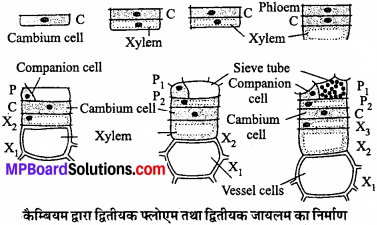
अनुकूल परिस्थिति में कैम्बियम कोशिकाएँ विभाजन करने लगती हैं। यह विभाजन स्पर्श रेखीय (Tangential) होता है जिसके कारण वलय के बाहर द्वितीयक फ्लोएम तथा अन्दर द्वितीयक जाइलम का निर्माण होता है। सामान्यतः द्वितीयक फ्लोएम की अपेक्षा द्वितीयक जाइलम अधिक मात्रा में बनता है, इस कारण कैम्बियम का वलय परिधि की ओर खिसकता जाता है।

प्राथमिक जाइलम तथा फ्लोएम इस क्रिया के कारण दूर हो जाते हैं जबकि कैम्बियम क्रियाशीलता के पहले ये पास-पास स्थित होते हैं। इस समय प्राथमिक फ्लोएम दबाव के कारण कुचलकर अवशेष के रूप में रह जाता है जबकि प्राथमिक जाइलम केन्द्रीय मज्जा की ओर आ जाता है। कुछ कैम्बियम कोशिकाएँ द्वितीयक जाइलम तथा फ्लोएम के स्थान पर केवल मृदूतकी कोशिकाओं का निर्माण करने लगती हैं –
MP Board Class 11th Biology Solutions Chapter 6 पुष्पी पादपों का शारीर - 2

जिससे अक्ष के क्षैतिज द्वितीयक जाइलम से द्वितीयक फ्लोएम तक एक पट्टी दिखाई देने लगती है। जिसे द्वितीयक ऊतकों में स्थित होने के कारण द्वितीयक मेड्यूलरी रश्मियाँ (Secondary medulary rays) कहते हैं। ये संवहन ऊतक की जीवित कोशिकाओं से सम्बन्ध स्थापित करती हैं, इन्हीं से होकर फ्लोएम तथा जाइलम की जीवित कोशिकाओं को भोजन सामग्री पहुँचती है। इसके अलावा ये कोशिकाएँ भोजन संग्रह का भी कार्य करती हैं।
MP Board Class 11th Biology Solutions Chapter 6 पुष्पी पादपों का शारीर - 3

(B) कॉर्क कैम्बियम की सक्रियता (Activity of cork cambium):
कैम्बियम द्वारा नये ऊतकों के बनने के कारण तने के बाहरी ऊतकों पर दबाव पड़ता है जिसके कारण बाह्य त्वचा फट जाती है। इसी समय कॉर्टेक्स की बाहरी पर्त विभाजित होकर नयी कोशिकाएँ बनाने लगती हैं इस पर्त को ही कॉर्क कैम्बियम या फेलोजन (Cork cambium or Phellogen) कहते हैं। कॉर्क कैम्बियम अन्दर तथा बाहर दोनों तरफ कोशिकाओं का निर्माण करता है लेकिन बाहर की तरफ अपेक्षाकृत अधिक कोशिकाएँ बनती हैं।

कॉर्क कैम्बियम द्वारा बाहर की ओर जो कोशिकाएँ बनती हैं उन्हें कॉर्क या फेलम (Phellem) तथा अन्दर की तरफ बनी कोशिकाओं को फैलोडर्म कहते हैं। बाहर बनी कोशिकाओं में अन्तराकोशिकीय अवकाश नहीं पाया जाता है तथा ये सुबेरिन का निर्माण कर मृत हो जाती है और तने की छाल (Bark) बनाती हैं। अन्दर की ओर कोशिकाएँ द्वितीयक कॉर्टेक्स बनाती हैं जो मृदूतकी कोशिकाओं का बना होता है जिसमें हरितलवक पाया जाता है। सामान्यत: कॉर्क कैम्बियम द्वारा बनाये ऊतकों को कॉर्क (Cork or Periderm) कहा जाता है जो तने को यांत्रिक सहारा देने के साथ ही रक्षात्मक आवरण बनाता है तथा आन्तरिक ऊतकों से जल हानि को रोकता है।

प्रश्न 4.
निम्नलिखित में विभेद कीजिए –

  1. वाहिका तथा ट्रैकीड
  2. पैरेनकाइमा तथा कोलेनकाइमा
  3. रसदारु तथा अंत:काष्ठ
  4. खुला तथा बंद संवहन बंडल।

उत्तर:
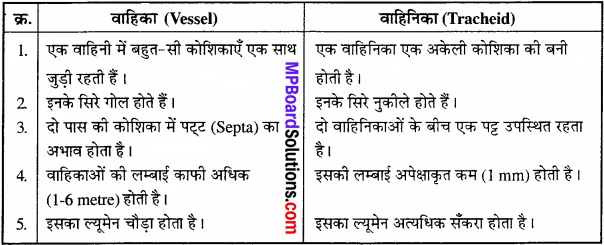
1. वाहिका एवं वाहिनिका (ट्रैकीड) में अन्तर –
MP Board Class 11th Biology Solutions Chapter 6 पुष्पी पादपों का शारीर - 4

2. पैरेनकाइमा (मृदूतक) तथा कोलेनकाइमा (स्थूलकोण ऊतक) पैरेनकाइमा (Perenchyma):

  1. इसकी कोशिकाएँ जीवित एवं पतली भित्ति वाली होती हैं।
  2. इनकी कोशिका भित्ति सेल्युलोज की बनी होती है।
  3. इनकी कोशिकाओं में रिक्तिकाएँ संख्या में अधिक होती हैं।
  4. इनकी कोशिकाएँ गोल या बहुभुजी और अन्तराकोशिकीय अवकाश युक्त होती हैं।
  5. इनका मुख्य कार्य भोज्य पदार्थों का संग्रहण करना है।
  6. जब इनमें क्लोरोफिल उपस्थित होता है, तब इन्हें क्लोरेनकायमा कहते हैं। यह प्रकाश-संश्लेषण. का कार्य करता है।
  7. जब इन कोशिकाओं के अन्तराकोशिकीय अवकाश बड़े-बड़े होते हैं तब इन्हें ऐरेनकायमा कहते हैं। ये जलीय पौधों में पाये जाते हैं तथा उनको तैरने में सहायता करते हैं।

स्थूलकोण ऊतक (Collenchyma):

  1. यह जीवित ऊतक है, जिसकी कोशिकाएँ लम्बी होती हैं।
  2. इनकी कोशिकाओं में अन्तर कोशिकीय अवकाशों का अभाव होता है।
  3. इनकी कोशिकाओं की कोशिका भित्ति के कोने सेल्युलोज एवं पेक्टिन के जमाव के कारण मोटे व स्थूलित हो जाते हैं इसलिए इन्हें स्थूलकोण ऊतक कहा जाता है।
  4. क्लोरोप्लास्ट उपस्थित होने पर ये प्रकाश-संश्लेषण का कार्य करते हैं।
  5. यह पौधे को यांत्रिक मजबूती प्रदान करता है।
  6. लचीला होने के कारण यह अंगों को तनन सामर्थ्य प्रदान करता है।
  7. क्लोरोप्लास्ट उपस्थित होने पर यह प्रकाश-संश्लेषण का कार्य करता है।

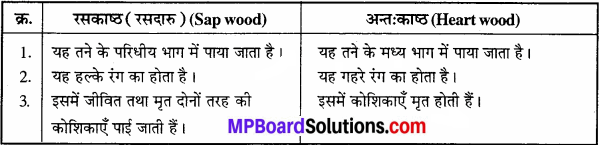
3. रसदारु तथा अंतःकाष्ठ में अन्तर।
MP Board Class 11th Biology Solutions Chapter 6 पुष्पी पादपों का शारीर - 5

4. खुला तथा बंद संवहन बंडल

  • खुला संवहन बंडल (Open vascular bundle) – इसमें जायलम तथा फ्लोएम के बीच में कैम्बियम स्थित होता है। इस प्रकार का सम्वहन पूल द्विबीजपत्री तनों में पाया जाता है।
  • बन्द संवहन बंडल (Closed vascular bundle) – इस प्रकार के सम्वहन पूलों में कैम्बियम नहीं पाया जाता। यह एकबीजपत्री पौधों के तनों में पाया जाता है।

प्रश्न 5.
निम्नलिखित में शारीरिकी (Anatomy) के आधार पर अंतर बताइए

  1. द्विबीजपत्री मूल तथा एकबीजपत्री मूल।
  2. द्विबीजपत्री तना तथा एकबीजपत्री तना।

उत्तर:
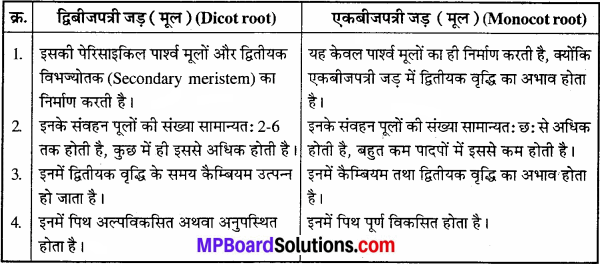
1. एकबीजपत्री एवं द्विबीजपत्री जड़ (मूल) की आन्तरिक संरचना में अन्तर –
MP Board Class 11th Biology Solutions Chapter 6 पुष्पी पादपों का शारीर - 6

2. द्विबीजपत्री तथा एकबीजपत्री तने में अन्तर –
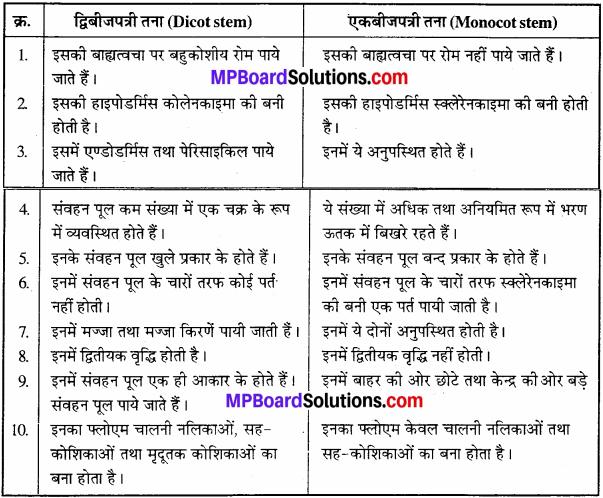
MP Board Class 11th Biology Solutions Chapter 6 पुष्पी पादपों का शारीर - 8

प्रश्न 6.
आप एक शैशव तने की अनुप्रस्थ काट का सूक्ष्मदर्शी अवलोकन कीजिए।आप कैसे पता करेंगे कि यह एकबीजपत्री तना अथवा द्विबीजपत्री तना है ? इसके कारण बताइए।
उत्तर:

एक शैशव तने की अनुप्रस्थ काट का सूक्ष्मदर्शी में अवलोकन करने के पश्चात् एकबीजपत्री एवं द्विबीजपत्री तना को निम्नलिखित संरचनाओं के आधार पर पहचाना जा सकता है –

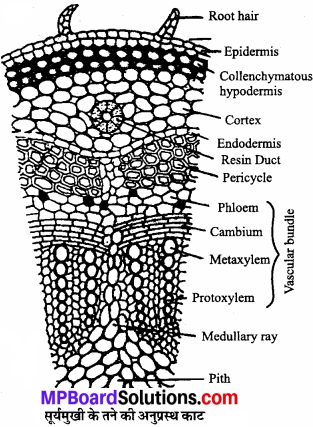
द्विबीजपत्री तने की आंतरिक संरचना(Internal structure of dicot stem) – यदि हम सूर्यमुखी के तने की आंतरिक संरचना को देखें तो इसमें निम्न रचनाएँ दिखाई देती हैं –

1. बाह्यत्वचा (Epidermis):
यह सबसे बाहरी एक कोशिकीय स्तर है जिस पर क्यूटिकिल पायी जाती है। इस पर कहीं-कहीं बहुकोशिकीय रोम तथा स्टोमेटा पाये जाते हैं।

2. कॉर्टेक्स (Cortex):
यह बाह्यत्वचा के नीचे के स्तर है जो तीन स्तरों की बनी होती है –

  • अधस्त्व चा (Hypodermis) – यह कोलेनकाइमेटस कोशिकाओं की 3 से 5 परतों की बनी होती है। इन कोशाओं में अन्तराकोशिकीय अवकाश अनुपस्थित तथा हरित लवक उपस्थित होता है।
  • सामान्य कॉर्टेक्स (General cortex) – यह अधस्त्वचा के नीचे स्थित होता है तथा अन्तराकोशिकीय अवकाशों युक्त मृदूतकी कोशिकाओं का बना होता है।
  • अन्तस्त्वचा (Endodermis) – यह कॉर्टेक्स की आन्तरिक एक कोशिकीय स्तर जो ढोलक के समान कोशिकाओं की बनी होती है। जिसमें स्टार्च कण पाये जाते हैं। इसमें कैस्पेरियन स्ट्रिप स्पष्ट दिखाई देती है।

3. पेरिसाइकिल (Pericycle):
यह परत मृदूतकी तथा दृढ़ऊतकी कोशिकाओं के एकान्तर क्रम में व्यवस्थित होने से बनती है और अन्तरस्त्वचा के नीचे स्थित होती है।
MP Board Class 11th Biology Solutions Chapter 6 पुष्पी पादपों का शारीर - 9

4.संवहन पूल (Vascular bundle):
इनके संवहन पूल संयुक्त (Conjoint), कोलेटरल (Collateral), खुले (Open) तथा एक घेरे में व्यवस्थित होते हैं। इनका प्रत्येक संवहन पूल जाइलम, फ्लोएम तथा कैम्बियम का बना होता है। इनका जाइलम वैसेल्स, ट्रैकीड, काष्ठ तन्तु तथा काष्ठ मृदूतक का बना होता है जबकि फ्लोएम चालनी नलिकाओं, सखि कोशिकाओं तथा मृदूतक कोशिकाओं का बना होता है। इनके जाइलम तथा फ्लोएम के बीच में पतली भित्ति वाली कोशिकाओं की एक पट्टी पायी जाती है जिसे कैम्बियम कहते हैं।

5. पिथ (Pith):
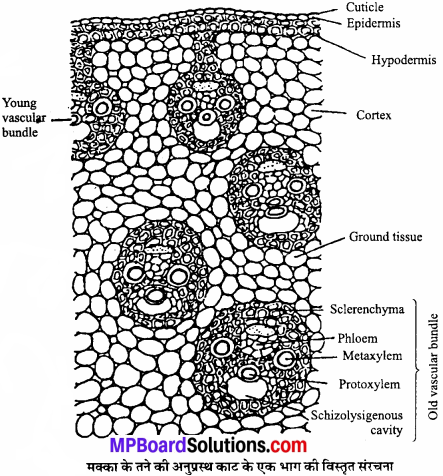
तने के मध्य में मृदूतकी कोशिकाओं का बना पिथ पाया जाता है। एकबीजपत्री तने की आंतरिक संरचना (Internal structure of monocot stem) – मक्का सामान्य रूप से पाया जाने वाला एकबीजपत्री पादप है। जिसके अनुप्रस्थ काट में निम्न संरचनाएँ दिखाई देती हैं –

1. बाह्यत्वचा (Epidermis) – इसमें क्यूटिकिल उपस्थित लेकिन रोम अनुपस्थित होते हैं।

2. हाइपोडर्मिस (Hypodermis) – बाह्यत्वचा के नीचे दृढ़ऊतकी कोशिकाओं की दो से चार परतें पायी जाती हैं, जिन्हें हाइपोडर्मिस कहते हैं।
MP Board Class 11th Biology Solutions Chapter 6 पुष्पी पादपों का शारीर - 10

3. भरण ऊतक (Ground tissue):
यह मृदूतकी अन्तराकोशिकीय अवकाश युक्त कोशिकाओं का बना भाग है जो अधस्त्वचा से लेकर तने के केन्द्र तक फैला होता है।

4. संवहन पूल (Vascular bundle):
इनके भरण ऊतक में बहुत – से संयुक्त (Conjoint), कोलेटरल (Collateral) तथा बन्द (Close) संवहन पूल बिखरे होते हैं अर्थात् इनमें कैम्बियम का अभाव होता है। प्रत्येक संवहन पूल के चारों तरफ स्क्लेरेनकाइमा कोशिकाएँ पायी जाती हैं। इनका संवहन पूल जाइलम तथा फ्लोएम का बना होता है। इसका जाइलम वेसेल्स, ट्रैकीड्स तथा जाइलम मृदूतक का बना होता है। जबकि फ्लोएम चालनी नलिकाओं तथा सखि कोशिकाओं का बना होता है। एकबीजपत्री तनों में फ्लोएम पैरेनकाइमा नहीं पायी जाती हैं। एकबीजपत्री तने में मज्जा (Pith) का अभाव होता है।

प्रश्न 7.
सूक्ष्मदर्शी किसी पौधे के भाग की अनुप्रस्थ काट का निम्नलिखित शरीर रचनाएँ दिखाती

  1. संवहन बंडल संयुक्त, फैले हुए तथा उसके चारों ओर स्क्लेरेनकाइमी आच्छद है।
  2. फ्लोएम पैरेनकाइमी है। आप इसे कैसे पहचानेंगे यह किसका है?

उत्तर:
यह एकबीजपत्री तने (Monocot stem) की अनुप्रस्थ काट की रचना है।

प्रश्न 8.
जाइलम एवं फ्लोएम को जटिल ऊतक क्यों कहते हैं ?
उत्तर:
जटिल स्थायी ऊतक (Complex permanent tissue) – पौधे के संवहनी ऊतक (Vascular tissues) ही जटिल ऊतक हैं। ये पौधे में पदार्थों को एक-स्थान से दूसरे स्थान तक ले जाने का कार्य करते हैं। इसलिए इनका नाम संवहनी ऊतक (Conductive tissue) है। जटिल ऊतक कोशिकाओं का वह समूह होता है जिसमें एक से अधिक प्रकार की कोशिकाएँ होती हैं लेकिन सब मिलकर एक इकाई की तरह कार्य करती है। जटिल ऊतक के प्रमुख उदाहरण दारू (Xylem) तथा पोषवाह (Phloem) हैं।

ऐसे ऊतक जो पानी और लवणों (Salts) को गुरुत्वाकर्षण बल के विपरीत ऊपर की ओर ले जाते हैं, जाइलम (Xylem or Wood) तथा जो ऊतक प्रकाश-संश्लेषी उत्पादों (Prepared food) के संवहन से सम्बन्धित होते हैं, उन्हें पोषवाह या बास्ट (Pholem or Bast) कहा जाता है। चूँकि कार्य सम्पादन के दृष्टिकोण से दारू और पोषवाह अलंग-अलग काम करते हैं, इसलिए उनकी रचना में भी भिन्नता पाई जाती है। चूंकि ये ऊतक एक.से अधिक ऊतकों के बने होते हैं इसलिए इन्हें जटिल ऊतक कहा जाता है।

MP Board Solutions

प्रश्न 9.
रंध्रीय तंत्र क्या है? रंध्र की रचना का वर्णन कीजिए और इसका चिन्हित चित्र बनाइए।
उत्तर:
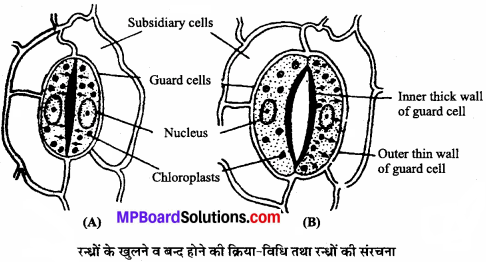
रंध्र (Stomata) ऐसी रचनाएँ हैं, जो पत्तियों की बाह्यत्वचा पर होते हैं। प्रत्येक रंध्र में दो सेम के आकार की द्वार कोशिकाएँ (Guard cells) होती हैं। द्वार कोशिका की बाहरी भित्ति पतली तथा आंतरिक भित्ति मोटी होती है। द्वार कोशिकाओं में क्लोरोप्लास्ट होता है और यह रंध्र के खुलने तथा बंद होने के क्रम को नियमित करता है। कभी-कभी कुछ बाह्यत्वचीय कोशिकाएँ, जो रंध्र के आस – पास पायी जाती हैं, इन्हें सहायक कोशिकाएँ (Subsidiary cells) कहते हैं। रंध्रीय छिद्र, द्वार कोशिका तथा सहायक कोशिकाएँ मिलकर रन्ध्रीय तंत्र (Stomatal system) का निर्माण करती हैं।
MP Board Class 11th Biology Solutions Chapter 6 पुष्पी पादपों का शारीर - 11

प्रश्न 10.
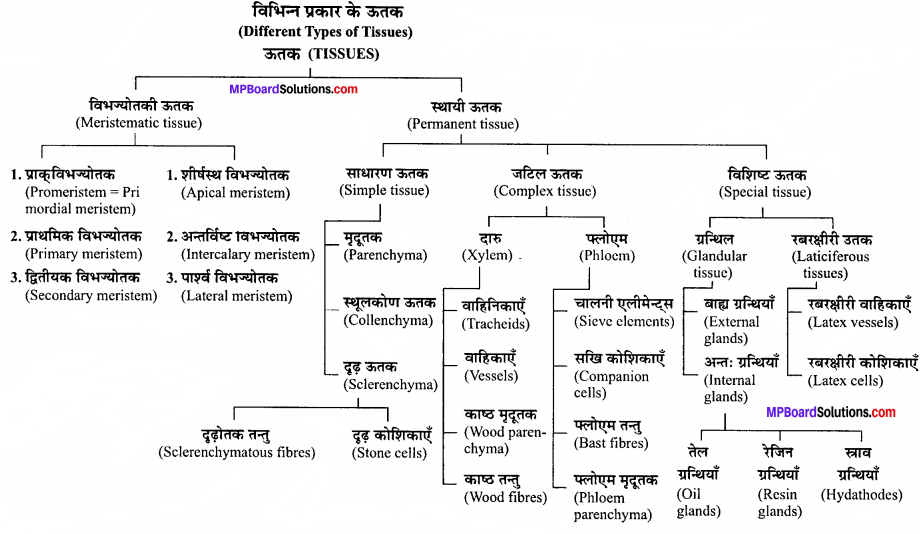
पुष्पीय पौधों के तीन मूलभूत ऊतक तंत्र बताइए। प्रत्येक तंत्र के ऊतक बताइए।
उत्तर:
पुष्पीय पौधों के तीन मूलभूत ऊतक तंत्र निम्नलिखित हैं –

  • साधारण ऊतक
  • जटिल ऊतक
  • विशिष्ट ऊतक।

MP Board Class 11th Biology Solutions Chapter 6 पुष्पी पादपों का शारीर - 12

प्रश्न 11.
पादप शरीर (Anatomy) का अध्ययन हमारे लिए कैसे उपयोगी है ?
उत्तर:
सजीवों के आकारिकी (Morphology) का अध्ययन करने से उनके केवल बाह्य आकृति, रूप रंग में समानता अथवा भिन्नता का पता चल पाता है, लेकिन बहुत-से जीवों के बाह्य समानता होने के बावजूद उनमें विभिन्नता हो सकती है। जब हम पादपों अथवा जन्तुओं के आंतरिक संरचना का अध्ययन करते हैं तब हमें उनकी कोशिका, ऊतकों तथा अंगों में विभिन्नता दिखाई देती है। पादपों के आंतरिक संरचना का अध्ययन, विज्ञान की शरीर शाखा (Anatomy) के अन्तर्गत किया जाता है। शरीर के अध्ययन करने से पादपों की औतिकी, संरचना एवं उनके कार्यों का पता चलता है, जैसे – कि जाइलम एवं फ्लोएम ऊतकों का जल एवं भोज्य पदार्थों का संवहन करना है।

प्रश्न 12.
परिचर्म क्या है ? द्विबीजपत्री तने में परिचर्म कैसे बनता है ?
उत्तर:
कागजन कॉर्क तथा काग मिलकर परिचर्म बनाते हैं। जैसे-जैसे तने की परिधि में वृद्धि होती है वैसे ही बाहरी कॉर्टेक्स तथा बाह्य त्वचा की सतहें टूटती जाती हैं तब उन्हें संरक्षी कोशिकीय सतह की आवश्यकता पड़ती है। इसी कारण एक दूसरा प्रविभाजी ऊतक विकसित होता है जिसे कॉर्क कैम्बियम या कागजन कहते हैं। यह प्राय: कॉर्टेक्स क्षेत्र में विकसित होता है। इसकी सतहें मोटी और सँकरी भित्ति वाले आयताकार कोशिकाओं से बनी होती है।

कागजन दोनों ओर कोशिकाओं को बनाता है। बाहर की ओर की कोशिकाएँ कॉर्क अथवा काग में बँट जाते हैं। अंदर की ओर की कोशिकाएँ द्वितीयक कॉर्टेक्स अथवा काग स्तर में विभेदित हो जाती हैं। कॉर्क की कोशिकाभित्ति में सुबेरिन का जमाव हो जाता है, इस कारण इसमें पानी का प्रवेश नहीं होता है। द्वितीयक कॉर्टेक्स की कोशिकाएँ पैरेनकाइमी होती है। इस प्रकार से तीन रचनाओं कागजन, कॉर्क तथा काग मिलकर परिचर्म बनाते हैं।

MP Board Solutions

प्रश्न 13.
पृष्ठाधारी पत्ती की भीतरी रचना का वर्णन चिन्हित चित्रों की सहायता से कीजिए।
उत्तर:
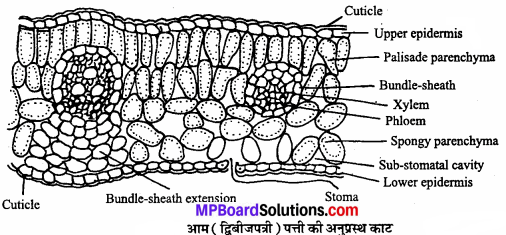
द्विबीजपत्री ( पृष्ठाधारी पत्ती) पत्ती की आन्तरिक संरचना (Internal structure of dicot leaf) – वे पत्तियाँ, जिनकी ऊपरी तथा निचली सतह में संरचनात्मक भिन्नता पायी जाती है पृष्ठाधारी पत्ती कहलाती है। द्विबीजपत्री पादपों में इसी प्रकार की पत्तियाँ पायी जाती हैं। आम एक सामान्य द्विबीजपत्री पौधा है, जिसकी संरचना निम्नानुसार होती है –

1. ऊपरी बाह्यत्वचा (Upper epidermis):
वे एक कोशिका स्तर मोटी पैरेनकाइमेटस कोशिकाओं की बनी होती है, जिसमें क्लोरोप्लास्ट तथा स्टेमेटा नहीं पाये जाते लेकिन उनकी बाहरी सतह पर क्यूटिकिल का एक आवरण पाया जाता है। इनकी कोशिकाएँ ढोलक के समान तथा एक-दूसरे से सटी होती हैं।

2. निचली बाह्यत्वचा (Lower epidermis):
यह एक कोशिका मोटी निचली स्तर है जिसकी संरचना बाह्य त्वचा के समान होती है लेकिन इस स्तर में कुछ विशेष प्रकार के छिद्र पाये जाते हैं जिन्हें स्टोमेटा (Stomata) कहते हैं ये वाष्पोत्सर्जन तथा वायु के आदान-प्रदान में भाग लेते हैं। स्टोमेटा एक कक्ष में खुलते हैं जिसे श्वसन कक्ष कहते हैं।

3. पर्ण मध्योतक (Mesophyll):
ऊपरी तथा निचली त्वचा के बीच के ऊतक को पर्ण मध्योतक कहते हैं। इनमें बाह्यत्वचा से लगे अन्तराकोशीय अवकाशविहीन तथा हरितलवक युक्त ऊतक पाये जाते हैं जिन्हें खम्भ मृदूतक (Palisade parenchyma) कहते हैं। ये प्रकाश-संश्लेषण में भाग लेते हैं। इन ऊतकों के नीचे के ऊतक की कोशिकाएँ अण्डाकार अन्तराकोशीय अवकाश तथा हरितलवकयुक्त होती हैं इन्हें स्पॉन्जी (Spongy parenchyma) कहते हैं।

4. संवहन पूल (Vascular bundle):
पत्तियों में संवहन पूल स्पॉन्जी मृदूतक में बिखरे रहते हैं। जिन पत्तियों में मध्यशिरा पाया जाता है उनकी मध्यशिरा का संवहन पूल सबसे बड़ा होता है। उनके सम्वहन पूल कोलेटरल या बन्द प्रकार के होते हैं तथा उनके चारों तरफ मृदूतकी कोशिकाओं का एक आवरण पाया जाता है जिसे बण्डल छाद (Bundle seath) कहते हैं। इनका जाइलम ट्रैकीड्स, वेसेल्स, काष्ठ तन्तु (Wood fire) तथा जाइलम पैरेनकाइमा का बना होता है तथा जल एवं खनिज लवणों का सम्वहन करता है।

इनका फ्लोएम, चालनी नलिकाओं, सखि कोशिकाओं तथा फ्लोएम पैरेनकाइमा का बना होता है। फ्लोएम भोज्य पदार्थों के सम्वहन का कार्य करता है। इनका जाइलम बाह्यत्वचा की ओर तथा फ्लोएम नीचे की ओर स्थित होता है जाइलम का प्रोटोजाइलम भी बाह्यत्वचा की ओर ही स्थित होता है। इसके सम्वहन पूल के ऊपर तथा नीचे पैरेनकाइमा अथवा कोलेनकाइमा की कोशिकाएँ बाह्यत्वचा तक स्थित होती हैं।
MP Board Class 11th Biology Solutions Chapter 6 पुष्पी पादपों का शारीर - 13

प्रश्न 14.
त्वक कोशिकाओं की रचना तथा स्थिति उन्हें किस प्रकार विशिष्ट कार्य करने में सहायता करती है ?
उत्तर:
घास में ऊपरी बाह्य त्वचा की कुछ कोशिकाएँ लंबी, खाली तथा रंगहीन होती हैं। इन कोशिकाओं को आवर्ध त्वक कोशिका कहते हैं। जब कोशिकाएँ स्फीत होती हैं, तब ये कोशिकाएँ मुड़ी हुई पत्तियों को खुलने में सहायता करती हैं। वाष्पोत्सर्जन की अधिक दर होने पर ये पत्तियाँ वाष्पोत्सर्जन की दर कम करने के लिए मुड़ जाती हैं।

पुष्पी पादपों का शारीर अन्य महत्वपूर्ण प्रश्नोत्तर

पुष्पी पादपों का शारीर वस्तुनिष्ठ प्रश्न

प्रश्न 1.
सही विकल्प चुनकर लिखिए –

1. कुछ पादप कोशिकाओं की कोशिकाभित्ति मोटी तथा सिरों पर नुकीली होती है, यह हो सकती –
(a) पैरेनकाइमा
(b) क्लोरेनकाइमा
(c) स्क्लेरेनकाइमा
(d) ऐरेनकाइमा।
उत्तर:
(c) स्क्लेरेनकाइमा

2. शीर्षस्थ ऊतक के डर्मेटोजन का प्रमुख कार्य है –
(a) उपत्वचा का निर्माण
(b) बाह्यत्वचा का निर्माण
(c) संवहन ऊतक का निर्माण
(d) हाइपोडर्मिस का निर्माण।
उत्तर:
(b) बाह्यत्वचा का निर्माण

3. लेटेक्स वाहिकाएँ पायी जाती हैं –
(a) दारु ऊतक में
(b) पोषवाह ऊतक में
(c) वल्कुट में
(d) उपर्युक्त में से किसी में नहीं।
उत्तर:
(c) वल्कुट में

4. एक ऊतक जिसकी कोशिकाएँ सक्रिय बढ़ने वाले अंगों के यान्त्रिक ऊतकों को बनाती हैं और
इनकी कोशिका भित्तियों में कोशिकाओं के कोनों पर सेल्यूलोजिक, अलिग्नीन स्थूलन पाये जाते हैं, ये हो सकती हैं
(a) स्क्लेरेनकाइमा
(b) पैरेनकाइमा
(c) कोलेनकाइमा
(d) क्लोरेनकाइमा।
उत्तर:
(c) कोलेनकाइमा

MP Board Solutions

5. एकबीजपत्रियों के प्रारूपी संवहन पूल होते हैं –
(a) बहिफ्लोएमी
(b) उभय फ्लोएमी
(c) संकेन्द्री
(d) अरीय।
उत्तर:
(a) बहिफ्लोएमी

6. ऊतक किसे कहते हैं –
(a) कोशिकाओं का अलग-अलग विकसित होने वाला समूह
(b) कोशिकाओं का वह समूह जो रचना, उत्पत्ति तथा कार्य में समान हो
(c) कोशिकाओं का वह समूह जो रचना में समान लेकिन कार्य में भिन्न हो
(d) कोशिकाओं का एकसमान आयु वाला समूह।
उत्तर:
(b) कोशिकाओं का वह समूह जो रचना, उत्पत्ति तथा कार्य में समान हो

7. पैरेनकाइमा (मृदूतकी) ऊतक किसे कहते हैं –
(a) मोटी कोशिकीय भित्ति वाली कोशिकाओं का समूह
(b) मृत कोशिकाओं का समूह
(c) पतली कोशिकीय भित्ति वाली जीवित कोशिकाओं का समूह
(d) लिग्निन युक्त कोशिकाओं का समूह।
उत्तर:
(c) पतली कोशिकीय भित्ति वाली जीवित कोशिकाओं का समूह

8. एक ऊतक जिसकी कोशिकाएँ महीन भित्ति वाली, समव्यासी और अन्तराकोशिकीय स्थान वाली हैं, वह होगा –
(a) पैरेनकाइमा
(b) कोलेनकाइमा
(c) स्क्लेरेनकाइमा
(d) क्लोरेनकाइमा।
उत्तर:
(a) पैरेनकाइमा

9. डर्मेटोजन, पेरीब्लेम तथा प्लीरोम पाये जाते हैं –
(a) पूर्णाग्र में
(b) तने की गाँठों पर
(c) मूलाग्र तथा तनाग्र में
(d) जायलम तथा फ्लोएम में।
उत्तर:
(c) मूलाग्र तथा तनाग्र में

10. पादपों के जलोत्सर्जक या हाइडेथोड हैं –
(a) वाष्पोत्सर्जन करने वाली रचनाएँ
(b) रसारोहण करने वाली रचनाएँ
(c) म्यूसीलेज स्रावित करने वाली रचनाएँ
(d) जल स्रावित करने वाली रचनाएँ।
उत्तर:
(d) जल स्रावित करने वाली रचनाएँ।

MP Board Solutions

11. रसकाष्ठ होता है –
(a) द्वितीयक जाइलम का बाहरी क्रियाशील भाग
(b) द्वितीयक जाइलम का आंतरिक अक्रियाशील भाग
(c) द्वितीयक जाइलम का आंतरिक तथा बाह्य भाग
(d) इनमें से कोई नहीं।
उत्तर:
(a) द्वितीयक जाइलम का बाहरी क्रियाशील भाग

12. पुराने तने में गैस का आदान-प्रदान किसके द्वारा होता है –
(a) स्टोमेटा
(b) हाइडेथोड्स
(c) वातरंध्र
(d) पैलेड कोशिका।
उत्तर:
(c) वातरंध्र

13. पेरीडर्म में होते हैं –
(a) कॉर्क कैम्बियम, कॉर्क, द्वितीयक कॉर्टेक्स
(b) कॉर्क कैम्बियम तथा कॉर्क
(c) कॉर्क
(d) कॉर्क तथा द्वितीयक फ्लोएम।
उत्तर:
(a) कॉर्क कैम्बियम, कॉर्क, द्वितीयक कॉर्टेक्स

14. जैसे-जैसे द्वितीयक वृद्धि होती है किसकी मोटाई में वृद्धि होती है –
(a) अन्त:काष्ठ
(b) रसकाष्ठ
(c) अन्तः एवं रसकाष्ठ
(d) इनमें से कोई नहीं।
उत्तर:
(a) अन्त:काष्ठ

15. वृक्ष की आयु का पता लगाने का सबसे आसान तरीका है –
(a) तने का व्यास मापना
(b) पत्तियों की संख्या की गिनती करना
(c) तने के आधार पर वार्षिक वलयों की गणना
(d) शाखाओं की गणना करना।
उत्तर:
(c) तने के आधार पर वार्षिक वलयों की गणना

16. द्विबीजपत्री तने के काष्ठ में जाइलम का सबसे नया स्तर स्थित होता है –
(a) कैम्बियम के बाहर
(b) कैम्बियम के अंदर
(c) पिथ के बाहर
(d) कॉर्टेक्स के अंदर।
उत्तर:
(b) कैम्बियम के अंदर

17. द्विबीजपत्री तने में संवहन पूल होते हैं –
(a) खुला, कोलैटरल तथा एन्डार्क
(b) बंद, कोलैटरल तथा एन्डार्क
(c) खुला, कोलैटरल तथा एक्सार्क
(d) बंद, कोलैटरल तथा एक्सॉर्क।
उत्तर:
(a) खुला, कोलैटरल तथा एन्डार्क

18. द्विबीजपत्री जड़ में पाये जाने वाले संवहन पूल होते हैं –
(a) रेडियल एक्सॉर्क
(b) संयुक्त एण्डार्क
(c) रेडियल एन्डार्क
(d) संयुक्त एक्सॉर्क।
उत्तर:
(a) रेडियल एक्सॉर्क

MP Board Solutions

19. कॉर्क का निर्माण किससे होता है –
(a) कॉर्क कैम्बियम
(b) संवहन कैम्बियम
(c) फ्लोएम
(d) जाइलम।
उत्तर:
(a) कॉर्क कैम्बियम

20. कॉर्क कैम्बियम का कार्य किसका निर्माण करना होता है –
(a) द्वितीयक जाइलम तथा द्वितीयक फ्लोएम
(b) कॉर्क तथा द्वितीयक कॉर्टेक्स
(c) द्वितीयक कॉर्टेक्स तथा फ्लोएम
(d) कॉर्क।
उत्तर:
(b) कॉर्क तथा द्वितीयक कॉर्टेक्स

21. कैस्पेरियन बैन्ड्स कहाँ पाये जाते हैं:
(a) एपिडर्मिस
(b) एण्डोडर्मिस
(c) पेरीसाइकिल
(d) फ्लोएम।
उत्तर:
(a) एपिडर्मिस

22. वार्षिक वलय का निर्माण किसकी सक्रियता से होता है –
(a) कैम्बियम
(b) जाइलम
(c) फ्लोएम
(d) जाइलम तथा फ्लोएम दोनों।
उत्तर:
(a) कैम्बियम

23. टाइलोसेज किसमें पाये जाते हैं –
(a) द्वितीयक जाइलम
(b) द्वितीयक फ्लोएम
(c) थैलस ऊतक
(d) कॉर्क कोशाएँ।
उत्तर:
(a) द्वितीयक जाइलम

24. वेसेल्स के अंदर मृदूतक कोशिकाओं का बैलून के समान अतिवृद्धि कहलाती है –
(a) हिस्टोजन
(b) टाइलोसेज
(c) फैलोजेन
(d) ट्यूनिका।
उत्तर:
(b) टाइलोसेज

25. एकबीजपत्री पौधों में ग्राफ्टिग संभव नहीं है, क्योंकि –
(a) कैम्बियम नहीं पाया जाता
(b) संवहन पूल बिखरे होते हैं
(c) समान्तर शिराविन्यास पाये जाते हैं
(d) पृथक् अरीय संवहन पूल पाये जाते हैं।
उत्तर:
(a) कैम्बियम नहीं पाया जाता

MP Board Solutions

26. संयुक्त, कोलैटरल, खुला तथा एण्डार्क संवहन पूल किसमें पाये जाते हैं –
(a) एकबीजपत्री तना
(b) एकबीजपत्री जड़
(c) द्विबीजपत्री जड़
(d) द्विबीजपत्री तना।
उत्तर:
(d) द्विबीजपत्री तना।

27. जड़ों में पार्श्व शाखाएँ किससे विकसित होती हैं –
(a) एपिब्लेमा
(b) पेरीसाइकिल
(c) कॉर्टेक्स
(d) एण्डोडर्मिस।
उत्तर:
(b) पेरीसाइकिल

28. कॉर्क कोशिकाएँ किसके जमाव के कारण अपारगम्य होती हैं –
(a) क्यूटिन
(b) लिग्निन
(c) सुबेरिन
(d) काइटिन।
उत्तर:
(b) लिग्निन

29. वेलामेन ऊतक किसमें भाग लेते हैं –
(a) श्वसन
(b) नमी का अवशोषण
(c) वाष्पोत्सर्जन
(d) संरक्षण।
उत्तर:
(b) नमी का अवशोषण

30. एकबीजपत्री तने में संवहन पूल होते हैं –
(a) बाइकोलैटरल तथा बंद
(b) बाइकोलैटरल तथा खुला
(c) (a) एवं (b) दोनों
(d) इनमें से कोई नहीं।
उत्तर:
(a) बाइकोलैटरल तथा बंद

प्रश्न 2.
एक शब्द में उत्तर दीजिए –

  1. द्वितीयक वृद्धि से बनने वाली रचना जो वातावरण से गैसों का आदान-प्रदान करती है।
  2. पुष्पीय पौधों की पत्तियों के सिरों पर पाई जाने वाली विशेष रचना जिनसे पानी की बूंदों के रूप में स्राव होता है।
  3. एक पार्श्व विभज्योतक ऊतक जिसके कारण पौधों की मोटाई में वृद्धि होती है।
  4. अरीय संवहन पूल किसमें पाये जाते हैं ?
  5. किसी एक बीजपत्री पौधे का नाम जिसमें द्वितीयक वृद्धि होती है।
  6. वृक्ष में हल्के रंग की लकड़ी को क्या कहते हैं?
  7. द्विबीजपत्री जड़ में संवहन पूल की क्या संख्या होती है ?
  8. दो बाह्य त्वचीय अतिवृद्धियों के नाम लिखिये।
  9. रबर क्षीरी, कोशिका वाले पौधे का नाम लिखिये।
  10. कैम्बियम की उपस्थिति वाले संवहन पूल को क्या कहते हैं?
  11. फैलोजन, फैलोडर्म तथा फैलम का सम्मिलित नाम क्या है ?
  12. द्विबीजपत्री तनों के बाह्य भाग में पाया जाने वाला काष्ठीय भाग क्या कहलाता है?
  13. ऐसा संवहन पूल जिसमें जाइलम के दोनों ओर कैम्बियम तथा फ्लोएम पाये जाते हैं ?
  14. तने में एपिडर्मिस के नीचे पाया जाने वाला कोलेनकाइमेटस भाग क्या कहलाता है ?

उत्तर:

  1. वातरंध्र
  2. जलरंध्र
  3. कैम्बियम
  4. जड़
  5. ड्रैसीना
  6. रसकाष्ठ
  7. 1 से 6 तक
  8. ट्राइकोम्स व सिस्टोलिथ
  9. यूफोर्बिया
  10. खुला संवहन पूल
  11. पेरीडर्म
  12. रसकाष्ठ
  13. बाइकोलैटरल
  14. हाइपोडर्मिस।

MP Board Solutions

प्रश्न 3.
रिक्त स्थानों की पूर्ति कीजिए –

  1. डर्मेटोजन, पेरीब्लेम तथा प्लीरोम …………….. में पाये जाते हैं।
  2. वाहिकाओं के बीच पाई जाने वाली गुब्बारे जैसी रचना को …………. कहते हैं।
  3. वार्षिक वलय …………….. से बनता है।
  4. लेटेक्स वाहिकाएँ …………….. में पाई जाती हैं। ………..
  5. द्विबीजपत्री तने में सबसे पुराना फ्लोएम …………….. में स्थित होता है।
  6. पौधों की ……………. में वृद्धि को द्वितीयक वृद्धि कहते हैं।
  7. द्वितीयक वृद्धि ………….. में सक्रियता के कारण होती है।
  8. कॉर्टेक्स सामान्यतः ……………. कोशिकाओं द्वारा बना होता है।
  9. द्वितीयक संवहनी ऊतकों का निर्माण ……………. में होता है।
  10. तने में वार्षिक वलय ……………. तथा ……………. के कारण होता है।

उत्तर:

  1. मूलाग्र व तनाग्र में
  2. टायलोसिस
  3. स्प्रिंग व ऑटम काष्ठ से
  4. कॉर्टेक्स
  5. प्राथमिक फ्लोएम के अन्दर
  6. मोटाई
  7. कैम्बियम
  8. पैरेन्काइमेट्स
  9. कैम्बियम
  10. वसन्त काष्ठ, शरद काष्ठ।

प्रश्न 4.
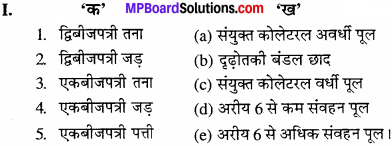
उचित संबंध जोडिए –
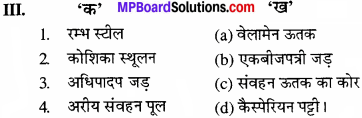
MP Board Class 11th Biology Solutions Chapter 6 पुष्पी पादपों का शारीर - 14
उत्तर:

  1. (c) संयुक्त कोलेटरल वर्षी पूल
  2. (d) अरीय 6 से कम संवहन पूल
  3. (a) संयुक्त कोलेटरल अवर्धी पूल
  4. (e) अरीय 6 से अधिक संवहन पूल।
  5. (b) दृढ़ोतकी बंडल छाद

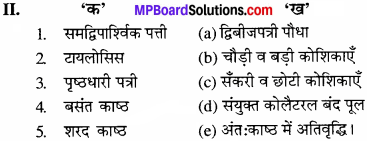
MP Board Class 11th Biology Solutions Chapter 6 पुष्पी पादपों का शारीर - 15
उत्तर:

  1. (d) संयुक्त कोलैटरल बंद पूल
  2. (e) अंत:काष्ठ में अतिवृद्धि।
  3. (a) द्विबीजपत्री पौधा
  4. (b) चौड़ी व बड़ी कोशिकाएँ
  5. (c) सँकरी व छोटी कोशिकाएँ

MP Board Class 11th Biology Solutions Chapter 6 पुष्पी पादपों का शारीर - 16
उत्तर:

  1. (c) संवहन ऊतक का कोर
  2. (d) कैस्पेरियन पट्टी।
  3. (a) वेलामेन ऊतक
  4. (b) एकबीजपत्री जड़

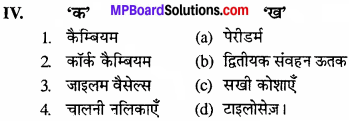
MP Board Class 11th Biology Solutions Chapter 6 पुष्पी पादपों का शारीर - 17
उत्तर:

  1. (b) द्वितीयक संवहन ऊतक
  2. (a) पेरीडर्म
  3. (d) टाइलोसेज़।
  4. (c) सखी कोशाएँ

प्रश्न 5.
सत्य / असत्य बताइए

  1. विकसित प्रौढ़ पादपों में द्वितीयक वृद्धि पाई जाती है।
  2. छाल पर वात विनिमय हेतु कुछ विशिष्ट छिद्र होते हैं जिसे जलरंध्र कहते हैं।
  3. ऐसे ऊतक जिनकी कोशिकाओं में विभाजन क्षमता नहीं होती प्रविभाजी ऊतक कहलाते हैं।
  4. किसी तने के अनुप्रस्थ काट में वार्षिक वलयों को गिनकर वृक्ष की उम्र का पता लगाया जाता है।
  5. अपवादस्वरूप कुछ एकबीजपत्री पादपों के तनों में भी द्वितीयक वृद्धि पाई जाती है।
  6. एकबीजपत्री पौधों में द्वितीयक वृद्धि नहीं पाई जाती।
  7. कॉर्क कैम्बियम का निर्माण संवहन पूल में होता है।
  8. कॉर्क कैम्बियम को फैलोजन भी कहा जाता है।
  9. वार्षिक वलय की संख्या के आधार पर पौधे की आयु का पता लगाया जा सकता है।
  10. पेरीडर्म तथा छाल वानस्पतिक रूप से एक समान होते हैं।
  11. तने की छाल पर पाये जाने वाले छिद्र को वातरंध्र कहते हैं।
  12. घावों को भरना पौधे में वैस्कुलर कैम्बियम की सक्रियता के कारण होता है।
  13. पर्ण विलगन के समय विलगन परत का निर्माण होता है।
  14. द्विबीजपत्री तने में अरीय संवहन पूल पाये जाते हैं।
  15. व्यापारिक दृष्टि से अंत:काष्ठ अधिक महत्वपूर्ण होता है।

उत्तर:

  1. सत्य
  2. असत्य
  3. असत्य
  4. सत्य
  5. सत्य
  6. सत्य
  7. असत्य
  8. सत्य
  9. सत्य
  10. असत्य
  11. सत्य
  12. असत्य
  13. सत्य
  14. असत्य
  15. सत्य।

MP Board Solutions

पुष्पी पादपों का शारीर अति लघु उत्तरीय प्रश्न

प्रश्न 1.
ऊतक क्या है ?
उत्तर:
एकसमान उत्पत्ति एवं विकास वाली कोशिकाओं का ऐसा समूह जो एकसमान कार्य करता हो, ऊतक कहलाता है।

प्रश्न 2.
जाइलम का कार्य बताइए।
उत्तर:

  • जाइलम जल एवं उसमें घुले लवणों का संवहन करता है।
  • यह पौधों को यांत्रिक शक्ति (मजबूती) प्रदान करता है।

प्रश्न 3.
द्वार कोशिकाएँ कहाँ पायी जाती हैं ? इसके क्या कार्य हैं ?
उत्तर:
द्वार कोशिकाएँ (Guard cells) पत्तियों के रन्ध्रों में पायी जाती हैं, ये रन्ध्रों के खुलने एवं बन्द होने की क्रिया को नियंत्रित करती हैं। .

प्रश्न 4.
कैम्बियम क्या है? इसके कार्य बताइए।
उत्तर:
कैम्बियम एक पार्श्व विभज्योतक ऊतक है, जिसके कारण पौधे की मोटाई में वृद्धि होती है।

प्रश्न 5.
स्थायी ऊतक किसे कहते हैं?
उत्तर:
ऐसे ऊतक जिनमें विभाजन की क्षमता नहीं पायी जाती है, उन्हें स्थायी ऊतक कहते हैं।

प्रश्न 6.
बास्ट रेशा क्या है?
उत्तर:
फ्लोएम के साथ सम्बद्ध दृढ़ोतक कोशिकाएँ बास्ट रेशे कहलाती हैं।

MP Board Solutions

प्रश्न 7.
जायलम ऊतक में पायी जाने वाली कोशिकाओं के नाम बताइए।
उत्तर:
जायलम में निम्नलिखित चार प्रकार की कोशिकाएँ पायी जाती हैं –

  • वाहिनिका (Tracheids)
  • वाहिनी (Vessel or Tracheae)
  • जायलम रेशे या काष्ठ रेशे (Xylem fibres or Wood fibres)
  • जायलम या काष्ठ पैरेनकायमा (Xylem or Wood parenchyma)।

प्रश्न 8.
कैम्बियम कहाँ पाया जाता है?
उत्तर:
कैम्बियम प्रायः द्विबीजपत्री पौधों के संवहन पूलों में पार्श्व विभज्योतक के रूप में संवहन पूलों (V. B.) में जायलम एवं फ्लोएम के बीच पाया जाता है।

प्रश्न 9.
फ्लोएम में पायी जाने वाली कोशिकाओं के नाम लिखिए।
उत्तर:
फ्लोएम में निम्नलिखित कोशिकाएँ पायी जाती हैं –

  • चालनी नलिका (Sieve tube)
  • सखि कोशिकाएँ (Companian cells)
  • फ्लोएम पैरेनकायमा (Phloem parenchyma)
  • बास्ट रेशे (Bast fibres)।

प्रश्न 10.
ऊतक तंत्र किसे कहते हैं?
उत्तर:
पुष्पीय पौधों में अनेक प्रकार के स्थायी ऊतक आपस में संयुक्त होकर एक या कई कार्यों का निर्वहन करते हैं। इन संयुक्त ऊतकों से निर्मित तंत्र को ही ऊतक तंत्र (Tissue system) कहते हैं।

प्रश्न 11.
काष्ठ क्या है?
उत्तर:
तनों में उपस्थित द्वितीयक जायलम को काष्ठ (Wood) कहते हैं।

MP Board Solutions

पुष्पी पादपों का शारीर लघु उत्तरीय प्रश्न

प्रश्न 1.
प्रविभाजी / विभज्योतक ऊतक की चार विशेषताएँ बताइए।
उत्तर:
प्रविभाजी विभज्योतक ऐसी कोशिकाओं से मिलकर बना होता है, जिसमें बार-बार विभाजन की क्षमता होती है। इनमें निम्नलिखित विशेषताएँ पायी जाती हैं –

  • इनकी आकृति बहुभुजी या चौकोर होती है। कोशिकाओं की भित्ति पतली व सेल्युलोज की बनी होती है।
  • कोशिकाओं में बड़े तथा निश्चित केन्द्रक होते हैं। कोशिकाएँ आपस में सटी हुई होती हैं अर्थात् अन्तरकोशिकीय अवकाशों का अभाव होता है।
  • कोशिकाओं में लवण प्राकलवक (Proplastid) अवस्था में होते हैं।
  • इन कोशिकाओं में जीवद्रव्य सघन तथा प्रायः रिक्तिकाहीन होता है। ये कोशिकाएँ सक्रिय उपापचय की अवस्था में रहती हैं।

प्रश्न 2.
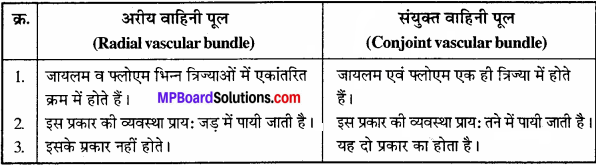
जड़ एवं तने के वैस्कुलर बंडल में अन्तर स्पष्ट कीजिए।
अथवा
अरीय व संयुक्त वाहिनी पूल में अन्तर स्पष्ट कीजिए।
उत्तर:
अरीय व संयुक्त वाहिनी पूल में अन्तर –
MP Board Class 11th Biology Solutions Chapter 6 पुष्पी पादपों का शारीर - 18

प्रश्न 3.
वातरंध्र पर संक्षिप्त टिप्पणी दीजिए।
उत्तर:
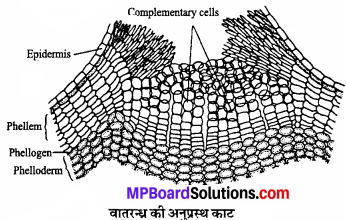
तने की छाल पर पाये जाने वाले छिद्र को वातरंध्र कहते हैं। इसकी सहायता से वातावरण से गैसों का आदान-प्रदान होता है। द्वितीयक वृद्धि के बाद बनने वाली कॉर्क की कोशाएँ जल तथा वायु के लिए अपारगम्य होती हैं। वातरंध्र बनने के पहले शिशु तने के उन्हीं स्थानों पर स्टोमेटा पाये जाते हैं। इनका निर्माण पेरिडर्म के निर्माण के साथ ही प्रारंभ हो जाता है। इन स्थानों पर फैलोजन की कोशिकाएँ बाहर की ओर कॉर्क कोशिकाओं का निर्माण नहीं कर पातीं। इनके स्थान पर ये पतली भित्ती वाली पैरेनकाइमेटस कोशाएँ बनाती हैं। इन कोशाओं को पूरक कोशाएँ कहते हैं।

इनके दबाव के कारण एपिडर्मिस की कोशिकाएँ टूट जाती हैं तथा छिद्र के समान संरचना बन जाती है इसे वातरंध्र कहते हैं। परक कोशिकाओं के बीच पर्याप्त अंतराकोशिकीय अवकाश पाया जाता है। अनेक स्थितियों में वातरंध्र स्टोमेटा के स्थान पर नये स्थान पर भी बनते हैं। नये तनों की सतह पर वातरंध्र को छोटे – छोटे उभार के रूप में आसानी से देखा जा सकता है। शीतऋतु में सामान्यतः कॉर्क कोशिकाओं द्वारा बँक जाते हैं। बसंत ऋतु आने पर फैलोजेन की सक्रियता के कारण पुरानी कॉर्क कोशिकाएँ नष्ट हो जाती हैं तथा नई कोशिकाएँ तेजी से बनने लगती हैं, इससे वातरंध्र खुल जाते हैं।

प्रश्न 4
द्विबीजपत्री एवं एकबीजपत्री पत्ती की आन्तरिक संरचना में अन्तर स्पष्ट कीजिए।
अथवा
एकबीजपत्री एवं द्विबीजपत्री में अन्तर लिखिए।
उत्तर:
द्विबीजपत्री तथा एकबीजपत्री की आन्तरिक संरचना में अन्तर –
MP Board Class 11th Biology Solutions Chapter 6 पुष्पी पादपों का शारीर - 19

पुष्पी पादपों का शारीर दीर्घ उत्तरीय प्रश्न

प्रश्न 1.
विभिन्न प्रकार के संवहन बण्डलों की रचना समझाइए।
उत्तर:
संवहन पूलों का प्रकार (Types of vascular bundles):
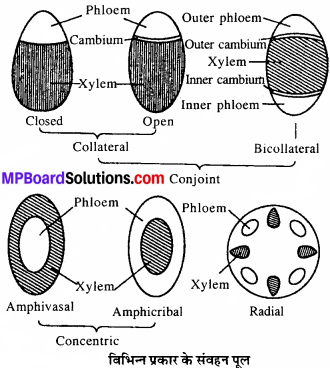
विभिन्न अंगों या ऊतकों का बना वह तन्त्र जो संवहन का कार्य करता है, संवहन तन्त्र कहलाता है। पौधों का सम्वहन तन्त्र अनेक छोटी-छोटी समान इकाइयों का बना होता है, जिन्हें संवहन पूल (Vascular bundle) कहते हैं। प्रत्येक सम्वहन पूल जायलम तथा फ्लोएम या जायलम, फ्लोएम तथा कैम्बियम का बना होता है। जायलम तथा फ्लोएम की स्थिति तथा कैम्बियम की उपस्थिति और अनुपस्थिति के आधार पर सम्वहन पूल निम्नलिखित प्रकार के हो सकते हैं –

1. अरीय (Radial) – इसमें जायलम तथा फ्लोएम एक-दूसरे से अलग – अलग भिन्न – भिन्न त्रिज्याओं पर एकान्तरित क्रम में स्थित होते हैं। यह सम्वहन पूल मुख्यतः जड़ों में पाया जाता है।

2. संयुक्त (Conjoint) – इसमें जायलम तथा फ्लोएम एक ही त्रिज्या पर एक – दूसरे से जुड़े हुए स्थित होते हैं। यह मुख्यतः तने में पाया जाता है। यह सम्वहन पूल दो प्रकार का होता है –

(a) कोलैटरल (Collateral):
इन सम्वहन पूलों में एक ही त्रिज्या पर फ्लोएम बाहर की तरफ तथा जायलम अन्दर की तरफ स्थित होता है। यह पुनः दो प्रकार का होता है –
MP Board Class 11th Biology Solutions Chapter 6 पुष्पी पादपों का शारीर - 21

1. कोलैटरल खुला (Collateral open) – इसमें जायलम तथा फ्लोएम के बीच में कैम्बियम स्थित होता है। इस प्रकार का सम्वहन पूल द्विबीजपत्री तनों में पाया जाता है।
2. कोलैटरल बन्द (Collateral closed) – इस प्रकार के सम्वहन पूलों में कैम्बियम नहीं पाया जाता। यह एक बीजपत्री पौधों के तनों में पाया जाता है।

(b) बाइकोलैटरल (Bicollateral):
इस प्रकार के सम्वहन पूल में जायलम बीच में स्थित होता है और इसके दोनों तरफ कैम्बियम तथा फ्लोएम पाये जाते हैं। इस प्रकार यह एक जायलम, दो कैम्बियम तथा दो फ्लोएम का बना होता है। कुकरबिटेसी, सोलेनेसी, कान्वल्वुलेसी और एपोसाइनेसी कुल के पौधों में इस प्रकार का सम्वहन पूल पाया जाता है।

3. संकेन्द्री (Concentric):
इस प्रकार के सम्वहन बण्डल में जायलम तथा फ्लोएम में से एक-दूसरे को पूरी तरह से घेरे रहता है। यह बण्डल बन्द प्रकार का होता है, अर्थात् इसमें कभी भी कैम्बियम नहीं पाया जाता है। यह दो प्रकार का होता है –

(a) एम्फीक्राइबल (Amphicribal):
इसमें जायलम को फ्लोएम पूरी तरह से घेरे रहता है। यह सम्वहन पूल कुछ जलीय पौधों और टेरिडोफाइट्स जैसे – सिलैजिनेला (Selaginella) और लाइकोपोडियम (Lycopodium) में पाया जाता है।

(b) एम्फीवेसल (Amphivasal):
इसमें फ्लोएम को जायलम चारों तरफ से घेरे रहता है। यह कुछ एकबीजपत्री पौधों के तनों में पाया जाता है। जैसे – ड्रैसीना (Dracena), यूक्का (Yucca)।

MP Board Class 11th Biology Solutions

MP Board Class 10th Hindi Navneet Solutions गद्य Chapter 5 पहली चूक

MP Board Class 10th Hindi Navneet Solutions गद्य Chapter 5 पहली चूक (व्यंग्य निबन्ध, श्रीलाल शुक्ल)

पहली चूक अभ्यास

बोध प्रश्न

पहली चूक अति लघु उत्तरीय प्रश्न

प्रश्न 1.
‘आपका नाम बाजरा तो नहीं है’ यह कथन किसने किससे पूछा?
उत्तर:
यह कथन लेखक ने रामचरन से पूछा।

प्रश्न 2.
रामचरन ने किसानों को पुकारते हुए क्या कहा?
उत्तर:
रामचरन ने किसानों को पुकारते हुए कहा-“यह देखो, ये भैया तो बाजरे को आदमी समझ रहे हैं।”

प्रश्न 3.
लेखक ने भाषायी चूक से बचने के लिए कौन-कौनसी तैयारी की ?
उत्तर:
लेखक ने भाषायी चूक से बचने के लिए कृषि शास्त्र की मोटी-मोटी किताबें मँगवाकर उनका अध्ययन आरम्भ कर दिया।

प्रश्न 4.
लेखक को बीज गोदाम क्यों जाना पड़ा?
उत्तर:
लेखक को बीज और खाद खरीदने के लिए बीज गोदाम जाना पड़ा।

प्रश्न 5.
लेखक के अनुसार कंद-मूल-फल खाने के कारण ऋषियों की दिलचस्पी किस व्यवसाय में थी?
उत्तर:
कंद-मंद-फल खाने के कारण ऋषियों की दिलचस्पी हॉर्टिकल्चर में थी।

MP Board Solutions

पहली चूक लघु उत्तरीय प्रश्न

प्रश्न 1.
चाचा ने लेखक को खेती के बारे में क्या समझाया?
उत्तर:
चाचा ने लेखक को खेती के बारे में समझाया कि खेती का काम है तो बड़ा उत्तम, पर फारसी पढ़कर जिस प्रकार तेल नहीं बेचा जा सकता, वैसे ही अंग्रेजी पढ़कर खेत नहीं जोता जा सकता।

प्रश्न 2.
लेखक ने रामचरन के कन्धे पर हाथ रखते हुए मित्र भाव से क्या-क्या प्रश्न किये?
उत्तर:
लेखक ने रामचरन के कन्धे पर हाथ रखते हुए मित्र भाव से कहा-“तो भाई रामचरन, मुझे बताओ यह बाजरा कौन है? कहाँ रहता है? यह खड़ा कहाँ है? इसे क्यों खड़ा किया गया है?”

प्रश्न 3.
पंचभूत और पंचगव्य में क्या अन्तर है?
उत्तर:
मानव शरीर का पंचभूतों अर्थात्-पृथ्वी, जल, अग्नि, आकाश और वायु से मिलकर निर्माण होता है। पंचगव्य से आशय है-गाय से मिलने वाली पाँच वस्तुएँ-दूध, दही, घी, गोबर और गौ मूत्र।

प्रश्न 4.
“शरीर ही मिट्टी का बना हुआ है”-किस अर्थ में प्रयुक्त हुआ है?
उत्तर:
मानव शरीर के निर्माण में पंचभूतों का योग होता है और ये पंच भूत हैं-पृथ्वी (मिट्टी), जल, अग्नि, आकाश और वायु। अतः जब शरीर के निर्माण में मिट्टी की प्रमुख भूमिका है तब फिर हमें मिट्टी से क्यों परहेज करना चाहिए?

प्रश्न 5.
लेखक ने अन्तिम बार शहर जाने का फैसला क्यों किया?
उत्तर:
लेखक ने अन्तिम बार शहर जाने का फैसला इसलिए किया कि वह शहर में रहकर बाजरे के विषय में अपनी रिसर्च कर सकेगा तथा वह बता पायेगा कि खाद के प्रयोग से बाजरे की लताओं में मीठे और बड़े-बड़े फल लाये जा सकते हैं।

पहली चूक दीर्घ उत्तरीय प्रश्न

प्रश्न 1.
‘पहली चूक’ पाठ का केन्द्रीय भाव लिखिए।
उत्तर:
‘पहली चूक’ शीर्षक पाठ में लेखक ने उन शिक्षित जनों को अपनी रचना का केन्द्र बिन्दु बनाया हैं जो शहर में निवास करते हैं और ग्रामीण वातावरण से पूर्णतः अनभिज्ञ होते हैं। वे पुस्तकों और सिनेमाओं से प्राप्त जानकारी के आधार पर अपने मन में काल्पनिक ग्राम का निर्माण किया करते हैं। उनकी यह कल्पना उस समय खण्ड-खण्ड होकर बिखर जाती है, जब वे ग्रामीण परिवेश में जाकर वास्तविक बातों को जान पाते हैं।

प्रश्न 2.
‘सिनेमा से खेती की शिक्षा’ पर लेखक के विचार लिखिए।
उत्तर:
सिनेमा खेती की उन्नति का एक अच्छा साधन है। सिनेमा द्वारा खेती का बड़ा प्रचार हुआ है। बड़े-बड़े हीरो खेत जोतते जाते हैं और गाते जाते हैं। हीरोइन खेत पर टोकरी में रोटी लेकर आती है। हरी-भरी फसल में आँख-मिचौली का खेल होता है। फसल काटते समय हीरोइन के साथ बहुत-सी लड़कियाँ नाचती हैं और गाती भी हैं। वे नाचती जाती हैं और फसल अपने आप कटती जाती है। ऐसे ही मधुर दृश्यों को देखकर, पढ़े-लिखे आदमी गाँवों में आने लगते हैं और खेतों के चक्कर काटने लगते हैं। इस प्रकार सिनेमा द्वारा खेती की शिक्षा मिलती है।

प्रश्न 3.
‘फारस में तेल बेचने वाले संस्कृत नहीं बोलते’ इस कथन का भाव विस्तार कीजिए।
उत्तर:
लेखक का चाचा लेखक को समझाता है कि जिस प्रकार फारस में तेल बेचने वाले संस्कृत नहीं बोलते, खेत जोतते हैं। उसी प्रकार भारत में फारसी पढ़कर तेल नहीं बेचा जाता है। उसी प्रकार अंग्रेजी पढ़कर भी खेती नहीं की जा सकती।

पहली चूक भाषा अध्ययन

प्रश्न 1.
निम्नलिखित शब्दों का सन्धि-विच्छेद करते हुए सन्धि का नाम बताइए
उत्तर:

  1. वागीश = वाक् + ईश = व्यंजन सन्धि।
  2. कीटाणु = कीट + अणु = दीर्घ सन्धि।
  3. ग्रन्थालय = ग्रन्थ + आलय = दीर्घ सन्धि।
  4. महेश = महा + ईश = गुण सन्धि।
  5. उन्नति = उत् + नति = व्यंजन सन्धि।।

प्रश्न 2.
निम्नलिखित वाक्यों में संकेत के अनुसार परिवर्तन कीजिए-

  1. खेत के पूरब में गन्ने का एक खेत है। (प्रश्न वाचक)
  2. मैं खेती के बारे में अधिक जानता हूँ। (निषेधात्मक वाक्य)
  3. यह आप क्यों पूछ रहे हो ? (विस्मयबोधक वाक्य)

उत्तर:

  1. क्या खेत के पूरब में गन्ने का एक खेत है?
  2. मैं खेती के बारे में अधिक नहीं जानता हूँ।
  3. अरे! यह आप क्यों पूछ रहे हो?

MP Board Solutions

पहली चूक महत्त्वपूर्ण वस्तुनिष्ठ प्रश्न

पहली चूक बहु-विकल्पीय प्रश्न

प्रश्न 1.
‘पहली चूक’ पाठ में लेखक ने किसे केन्द्र-बिन्दु बनाया है? (2009)
(क) ग्रामीणों को
(ख) शिक्षितों को
(ग) मूरों को
(घ) अज्ञानियों को।
उत्तर:
(क) ग्रामीणों को

प्रश्न 2.
गोबर पवित्र वस्तु है, उसका स्थान है
(क) पंचभूत में
(ख) मिट्टी में
(ग) पंचगव्य में
(घ) किसी में नहीं।
उत्तर:
(ग) पंचगव्य में

प्रश्न 3.
“बेटा! यह खेती का पेशा तुमसे नहीं होगा।” किसने कहा है?
(क) चाचा ने
(ख) लेखक ने
(ग) किसान ने
(घ) रामचरन ने।
उत्तर:
(क) चाचा ने

प्रश्न 4.
खेती करने वाला कहलाता है (2009)
(क) मजदूर
(ख) मुनीम
(ग) माली
(घ) कृषक।
उत्तर:
(घ) कृषक।

प्रश्न 5.
‘पहली चूक’ किस विधा में लिखी गई रचना है? (2018)
(क) कहानी
(ख) एकांकी
(ग) निबन्ध
(घ) व्यंग्य निबन्ध।
उत्तर:
(घ) कृषक।

रिक्त स्थानों की पूर्ति

  1. मिट्टी का स्थान यदि पंचभूत में है तो गोबर का स्थान …………. में है।
  2. क्योंकि फारस में तेल बेचने वाले …………. नहीं बोलते,खेत जोतते हैं।
  3. हरी-भरी फसल में ……….. का खेल होता है।
  4. गाँव की पुरानी पीढ़ी भी ……….. होती जा रही है।
  5. पहली चूक …………. विधा की रचना है। (2012, 17)

उत्तर:

  1. पंचगव्य
  2. संस्कृत
  3. आँख मिचौली
  4. समाप्त
  5. व्यंग्य

सत्य/असत्य

  1. ‘पहली चूक’ का शीर्षक सटीक एवं सार्थक नहीं है।
  2. लेखक ने खेत में खड़े बाजरे को आदमी समझा।
  3. बीज खरीदने के लिए बीजगोदाम जाना पड़ता है।
  4. ‘मैं वैज्ञानिक ढंग से खेती करूँगा।’ अन्त में लेखक ने यही निर्णय लिया।

उत्तर:

  1. असत्य
  2. सत्य
  3. सत्य
  4. सत्य

MP Board Solutions

सही जोड़ी मिलाइए

MP Board Class 10th Hindi Navneet Solutions गद्य Chapter 5 पहली चूक img-1
उत्तर:
1. → (ग)
2. → (ङ)
3. → (क)
4. → (घ)
5. → (ख)

एक शब्द/वाक्य में उत्तर

  1. पहली चूक किसके द्वारा हुई थी?
  2. “फारसी पढ़कर तेल नहीं बेचा जा सकता।” यह कथन किसका है?
  3. लेखक ने खेत की मेंड़ पर खड़े किस किसान से पूछा-“आपका नाम बाजा तो नहीं है?
  4. अन्त में लेखक ने किस व्यवसाय को श्रेष्ठ माना?
  5. खेती के प्रचार व प्रसार का जीता-जागता उदाहरण क्या है?

उत्तर:

  1. लेखक के द्वारा
  2. लेखक के चाचा का
  3. रामचरन से
  4. खेती
  5. सिनेमा।

पहली चूक पाठ सारांश

‘पहली चूक’ श्रीलाल शुक्ल द्वारा रचित उच्चकोटि का व्यंग्यात्मक निबन्ध है। इस निबन्ध में श्रीलाल शुक्ल जी ने शहर में रहने वालों पर तीखा प्रहार किया है क्योंकि शहर में रहने वाले व्यक्तियों का ग्रामीण वस्तुओं से तथा ग्राम के वातावरण से तनिक भी परिचय नहीं होता है। शहर में रहने वाले लोगों को गाँव की जानकारी केवल पुस्तकों के द्वारा होती है या वे सिनेमा के द्वारा ग्रामीण व्यवस्था से परिचित होते हैं।

लेखक को जब बी.ए. करने के बाद नौकरी नहीं मिली तो उसने अपने गाँव जाकर खेती करने का निर्णय किया। लेकिन उनके चाचा ने कहा कि किसी भी कार्य को करने से पूर्व उसका अनुभव आवश्यक है,अंग्रेजी पढ़ लेने मात्र से वह खेती नहीं कर सकता है। खेती के लिए अथक परिश्रम की आवश्यकता होती है। दिन-रात,मिट्टी,गोबर तथा धूप,सर्दी व बरसात में परेशानियों से जूझना पड़ता है।

लेखक को उसके चाचा ने यह भी बताया यह शरीर मिट्टी से बना है तथा गोबर का पंचगव्य में स्थान है। अतः पवित्र है। लेखक अपने चाचा की बातों से प्रभावित हुआ और बोला कि खेती जाहिलों का पेशा नहीं है। टालस्टॉय किसान था,वाल्टेयर ने भी स्वयं खेती की थी। अतः खेती को सर्वोत्तम व्यवसाय मानकर लेखक ने खेती करने का निर्णय किया। लेखक ग्रामीण वस्तुओं से अपरिचित था अतः उसे यह नहीं मालूम था कि गन्ना क्या होता है अथवा बाजरा क्या होता है।

लेखक चाचा द्वारा बताये स्थान पर पहुँचकर वहाँ पर बैठे एक किसान से पूछने लगा, “क्या तुम बाजरा हो?” वह बोला, “मेरा नाम रामचरण है।”

बाद में उसे छायादार वृक्ष समझने लगा। लेखक ने निश्चय किया कि मैं अब शहर में रहकर रिसर्च करूँगा तथा समझने की चेष्टा करूँगा कि खाद बाजरे को हरा-भरा करने का अचूक साधन है।

पहली चूक संदर्भ-प्रसंगसहित व्याख्या

(1) “उत्तम खेती मध्यम बान,
अधम चाकरी भीख निदान।”

कठिन शब्दार्थ :
उत्तम = सबसे अच्छा। मध्यम = बीच का। बान = व्यवसाय, धन्धा। अधम = गिरा हुआ, ओछा। चाकरी = नौकरी।

सन्दर्भ :
प्रस्तुत अंश ‘पहली चूक’ शीर्षक निबन्ध से लिया गया है। इसके लेखक श्रीलाल शुक्ल हैं।

प्रसंग :
इसमें लेखक ने अन्य सभी व्यापारों से कृषि को सबसे अच्छा बताया है।

व्याख्या :
लेखक कहता है कि उपर्युक्त कहावत प्रायः सुनने को मिल जाती है और इसका अर्थ यह है. कि संसार में अन्य सभी व्यापारों में खेती करना सबसे उत्तम काम है, मध्यम काम व्यापार करना है, चाकरी अर्थात् नौकरी अधम है और भीख माँगना सबसे तुच्छ है।

विशेष :
भाषा सहज एवं सरल है।

(2) शरीर ही मिट्टी का बना हुआ है और यह गोबर तो परम पवित्र वस्तु है। मिट्टी का स्थान यदि पंचभूत में है तो गोबर का स्थान पंचगण्य में है।

कठिन शब्दार्थ :
पंचभूत = मानव शरीर का निर्माण पाँच भूतों से होता है और वे हैं-पृथ्वी, जल, अग्नि, वायु और आकाश। पंचगण्य = गाय के पाँच उपादान होते हैं-दूध, दही, घी, गोबर और गौ मूत्र।

सन्दर्भ :
पूर्ववत्।

प्रसंग :
लेखक ने बी. ए. करने के पश्चात् गाँव जाकर अपने चाचा से खेती का व्यवसाय करने की इच्छा व्यक्त की तो चाचा लेखक को खेती की बुराइयाँ एवं परेशानियाँ बताते हुए कहते हैं कि इसमें दिन-रात पानी और पसीना. मिट्टी और गोबर से खेलना पड़ता है। चाचा के इस तर्क का उत्तर देते हुए लेखक कहता है।

व्याख्या :
लेखक कहता है कि चाचाजी मनुष्य का यह शरीर ही मिट्टी का बना हुआ है और यह गोबर तो परम पवित्र वस्तु है। मिट्टी का स्थान मानव शरीर का निर्माण करने वाले पंच भूतों अर्थात् पृथ्वी, जल, अग्नि, वायु और आकाश में से एक है तथा उसी प्रकार गोबर का स्थान पंचगण्य अर्थात् दूध, दही, घी, गोबर और मूत्र में है। अतः मुझे मिट्टी और गोबर से कोई परेशानी नहीं होगी।

विशेष :

  1. लेखक ने मिट्टी और गोबर का महत्त्व बताया
  2. भाषा सरल एवं सहज है।

MP Board Solutions

(3) सिनेमा खेती की उन्नति का एक अच्छा साधन है। सिनेमा द्वारा खेती का बड़ा प्रचार हुआ है। बड़े-बड़े हीरो खेत जोतते जाते हैं और गाते जाते हैं। हीरोइन खेत पर टोकरी में रोटी लेकर आती है। हरी-भरी फसल में आँख-मिचौंली का खेल होता है। फसल काटते समय हीरोइन के साथ बहुत-सी लड़कियाँ नाचती हैं और गाती भी हैं। वे नाचती जाती हैं और फसल अपने आप कटती जाती है। ऐसे ही मधुर दृश्यों को देखकर, पढ़े-लिखे आदमी गाँवों में आने लगते हैं और खेतों के चक्कर काटने लगते हैं। इस प्रकार सिनेमा द्वारा खेती की शिक्षा मिलती है। सच पूछिए तो खेती करने की सच्ची शिक्षा मुझे सिनेमा से ही मिली थी।

कठिन शब्दार्थ :
आँख मिचौली = लुकाछिपी का खेल। मधुर = सुन्दर, मोहक।

सन्दर्भ :
पूर्ववत्।

प्रसंग :
लेखक बताता है कि सिनेमा देखकर ही उसे इतना पढ़-लिख जाने के बाद भी खेती करने की शिक्षा मिली है।

व्याख्या :
लेखक कहता है कि आजकल सिनेमा खेती की उन्नति का अच्छा साधन बन गया है। इन सिनेमाओं ने खेती के प्रचार में बहुत बड़ा योगदान किया है। बड़े-बड़े प्रसिद्ध हीरो खेत जोतते जाते हैं और मस्ती में गाने गाते जाते हैं। हीरोइन खेत पर टोकरी में रोटी खाने के लिए लेकर आती है। हीरो और हीरोइन हरी-भरी फसल में आँख-मिचौली का खेल खेलते हैं। फसल जब कटने को होती है तो उस समय हीरोइन के साथ अनेक सुन्दर लडकियाँ नाचती और गाती हैं। वे एक ओर नाचती जाती हैं और दूसरी ओर फसल अपने आप कटती जाती है। इसी प्रकार के मनमोहक दृश्यों को देखकर पढ़े-लिखे लोग गाँवों की ओर जाने लगते हैं तथा वे खेतों के चक्कर काटते रहते हैं। इस प्रकार हम कह सकते हैं कि सिनेमा द्वारा खेती की शिक्षा प्राप्त होती है। सच मानो तो खेती करने की सच्ची शिक्षा मुझे सिनेमा से ही मिली थी।

विशेष :

  1. लेखक ने सिनेमाओं को खेती सिखाने का उचित साधन माना है।
  2. भाषा सहज, सरल है।

(4) जैसे खूटे से छूटी हुई घोड़ी भूसे के ढेर पर मुँह मारती है, जैसे धूप में बँधी हुई भैंस तालाब की ओर दौड़ती है, वैसे ही तुम्हारा शहर की ओर जाना बड़ा स्वाभाविक और उचित है।

कठिन शब्दार्थ :
स्वाभाविक = स्वभावगत। सन्दर्भ-पूर्ववत्।

प्रसंग :
लेखक का मत है कि पढ़ा-लिखा व्यक्ति शहर की ओर ही भागता है।

व्याख्या :
लेखक कहता है कि जैसे छूटे से बँधी हुई घोड़ी भूसे के ढेर को देखकर उसी पर टूट पड़ती है और धूप में बँधी हुई भैंस तालाब की ओर भागती है, उसी प्रकार पढ़ा-लिखा व्यक्ति शहर की ओर भागता हुआ दिखाई देता है और उसका यह कार्य स्वाभाविक और उचित ही है।

विशेष :

  1. लेखक ने पढ़े-लिखे व्यक्ति की स्वाभाविक भावना को बताया है।
  2. भाषा सहज और सरल है।

MP Board Class 10th Hindi Solutions

MP Board Class 9th Maths Solutions Chapter 13 Surface Areas and Volumes Ex 13.6

MP Board Class 9th Maths Solutions Chapter 13 Surface Areas and Volumes Ex 13.6

Assume = \(\frac{22}{7}\) unless stated otherwise.

Question 1.
The circumference of the base of a cylindrical vessel is 132 cm and its height is 25 cm. How many litres of water can it hold? (1000 cm3 = 1l)
Solution:
Circumference of base, C =132 cm ,
h = 25 cm
C = 2πr
132 = 2 x \(\frac{22}{7}\) x r
r = \(\frac{132×7}{2×22}\) = 21 cm
Volume of cylinder =πr2h
= \(\frac{22}{7}\) x 21 x 21 x 25 = 34650 cm3
= \(\frac{34650}{1000}\)

Question 2.
The inner diameter of a cylindrical wooden pipe is 24 cm and its outer diameter is 28 cm. The length of the pipe is 35 cm. Find the mass of the pipe, if 1 cm3 of wood has a mass of 0.6 g.
Solution:
MP Board Class 9th Maths Solutions Chapter 13 Surface Areas and Volumes Ex 13.6 img-1
Inner diameter
d1 = 24 cm ⇒ r1 = 12 cm
Outer diameter, d2 = 28 cm ⇒ r2 = 14 cm
Volume of wood in the piple = πr22h – πr12h
πh(r22 – r12) = \(\frac{22}{7}\) x 35(142 – 122)
= \(\frac{22}{7}\) x 35 x 52 = 5720 cm3
Mass of pipe = 0.6 x 5720 = 3432 gm
= 3.432 kg.

MP Board Solutions

Question 3.
A soft drink is available in two packs –

  1. a tin can with a rectangular base of length 5 cm and width 4 cm, having a height of 15 cm and
  2. a plastic cylinder with circular base of diameter 7 cm and height 10 cm. Which container has greater capacity and by how much?

Solution:
1. Volume of cuboidal can = (5 x 4 x 15) = 300 cm3

2. Volume of cylindrical can = πr2h = \(\frac{22}{7}\) x 3.5 x 3.5 x 10
= 385 cm2
Capacity of cylindrical can is more than the cuboidal can by 85 cm2.

Question 4.
If the lateral surface of a cylinder is 94.2 cm2 and its height is 5 cm, then find

  1. radius of its base
  2. its volume. (Use π = 3.14)

Solution:
1. CSA of cylinder = 94.2 cm2
2πrh = 94.2 cm2
2 x 3.14 x 5 = 94.2 cm2
r = \(\frac{94.2}{2×3.14×5}\) = 3 cm
Volume of the cylinder = πr2h
= 3.14 x 3 x 3 x 5
= 3.14 x 45 = 141.3 cm3

Question 5.
It costs ₹ 2200 to paint the inner curved surface of a cylindrical vessel 10 m deep. If the cost of painting is at the rate of ₹ 20 per m2, find

  1. inner curved surface area of the vessel
  2. radius of the base
  3. Capacity of the Vessel.

1. Inner curved surface area =
MP Board Class 9th Maths Solutions Chapter 13 Surface Areas and Volumes Ex 13.6 img-2
2. Let r be the radius of the base ICSA = 2πrh
110 = 2 x \(\frac{22}{7}\) x r x 10 r
= 1.75 m

3. Capacity of vessel = πr2h = \(\frac{22}{7}\) x 1.75 x 1.75 x 10
= 96.25 m3.

MP Board Solutions

Question 6.
The capacity of a closed cylindrical vessel of height 1 m is 15.4 litres. How many square metres of metal sheet would be needed to make it?
Solution:
h = 1 m
V = 15.4l
= \(\frac{15.4}{1000}\)m3 = 0.0154 m3
Volume of the vessel = πr2h
0. 0154 = \(\frac{22}{7}\) x r2 x 1
∴ r2 = \(\frac{0.0154×7}{22}\)
⇒ r2 = 0.0049
∴ r = 0.07 m
Area of metal sheet required = 2nr (h + r)
= 2x \(\frac{22}{7}\) x 0.07(1 + 0.07)
= 0.4708 m2.

Question 7.
A lead pencil consists of a cylinder ofvyood with a solid cylinder of graphite filled in the interior. The diameter of the pencil is 7 mm and the diameter of the graphite is 1 mm. If the length of the pencil is 14 cm, find the volume of the wood and that of the graphite.
Solution:
Volume of the pencil = πr2h
= \(\frac{22}{7}\) x 3.5 x 3.5 x 140 = 5390 mm3
Volume of graphite = πr2h
= \(\frac{22}{7}\) x 0.5 x 0.5 x 140 = 110 mm3
Volume of wood = Volume of pencil – Volume of graphite
= 5390 – 110
= 5280 mm3
=5.28 cm3.

MP Board Solutions

Question 8.
A patient in a hospital is given soup daily in a cylindrical biftvl of diameter 7 cm. If the bowl is filled with/soup to a height of 4 cm, how much soup the hospital has to prepare daily to serve 250 patients?
Solution:
d = 7cm
r = 3.5 cm
h = 4cm
Volume of the bowl = πr2h
= \(\frac{22}{7}\) x 3.5 x 3.5 x 4 = 154 cm3
Volume of soup needed for 250 patients = 154 x 250
= 38500 cm3
= 38.5l.

MP Board Class 9th Maths Solutions

MP Board Class 6th Science Solutions Chapter 12 Electricity and Circuits

MP Board Class 6th Science Solutions Chapter 12 Electricity and Circuits

Electricity and Circuits Textbook Exercises

Question 1.
Fill in the blanks:

  1. A device that is used to break an electric circuit is called ……………… terminals.
  2. An electric cell has ……………… terminals.

Answer:

  1. Switch
  2. Two.

MP Board Solutions

Question 2.
Mark ‘True’ or ‘False’ for following statements:

  1. Electric current can flow through metals.
  2. Instead of metal wires, a jute string can be used to make a circuit.
  3. Electric current can pass through a sheet of thermo Col.

Answer:

  1. True
  2. False
  3. False.

Question 3.
Explain why the bulb would not glow in the arrangement show in Fig?
MP Board Class 6th Science Solutions Chapter 12 Electricity and Circuits 1
Answer:
The bulb will not glow because the circuit is not completed due to the presence of an insulator between the circuit. Here insulator is screw driver.

Question 4.
Complete the drawing shown in figure to indicate where the free ends of the two wires should be joined to make the bulb glow.
MP Board Class 6th Science Solutions Chapter 12 Electricity and Circuits 2
Answer:
The complete diagram in shown below:
MP Board Class 6th Science Solutions Chapter 12 Electricity and Circuits 3

Question 5.
What is the purpose of using an electric switch? Name some electrical gadgets that have switches built into them.
Answer:
An electric switch is used to open or close the circuit. Electric gadgets that have switches built into them are freezer, washing machines, microwaves, toaster, heaters, electric – bulb, tube – light, electric iron, etc.

MP Board Solutions

Question 6.
Would the bulb glow after completing the circuit shown in Figure of Question 4 above if instead of safety pin we use an eraser?
Answer:
No.

Question 7.
Would the bulb glow in the circuit shown in Fig.
MP Board Class 6th Science Solutions Chapter 12 Electricity and Circuits 4
Answer:
No, because both of the terminal of battery is connecting with one terminal of bulb.

Question 8.
Using the “conduction tester” on an object it was found that the bulb begins to glow. Is that object a conductor or an insulator? Explain.
Answer:
That object is a conductor because electricity can pass through a conductor and not through an insulator. If the object is an insulator then bulb could not glow.

MP Board Solutions

Question 9.
Why should an electrician use rubber gloves while repairing an electric switch at your home? Explain.
Answer:
An electrician use rubber gloves while repairing an electric switch because rubber is a bad conductor of electricity or in other words rubber is an insulator.

Question 10.
The handles of the tools like screwdrivers and pliers used by electricians for repair work usually have plastic or rubber covers on them. Can you explain why?
Answer:
Because plastic and rubber, both are the bad conductor of electricity. Hence, they protect electricians against electric shock.

Projects and Activities

Activity 1.
Make a table to show different materials allows current to pass through it or not.
Answer:
Conductors and Insulators:
MP Board Class 6th Science Solutions Chapter 12 Electricity and Circuits 5

Activity 2.
Describe a simple experiment to test whether a given material is a conductor or an insulator.
Answer:
To identify given material is a conductor or an insulator.

Requirements:
Pencil, matchstick, alpin, rubber tube, cell wire, bulb.
MP Board Class 6th Science Solutions Chapter 12 Electricity and Circuits 6
Procedure:
Take a small bulb, a battery and a length of wire and connect them in a circuit as show in figure. This circuit is not closed and no current will pass through it. Close the gap between the points A and B by inserting the graphite of your pencil between them. Repeat this by successively replacing the graphite by rubber tube, alpin and matchstick. Record the observations in the table given below.
Table
MP Board Class 6th Science Solutions Chapter 12 Electricity and Circuits 7

Electricity and Circuits Additional Important Questions

Electricity and Circuits Objective Type Questions

Question 1.
Choose the correct answer:

Question (i)
S.I. unit of electic current is –
(a) Farad
(b) Volt
(c) Ampere
(d) Coulomb.
Answer:
(c) Ampere

Question (ii)
The types of charges are –
(a) Two
(b) Three
(c) Four
(d) None of these.
Answer:
(a) Two

Question (iii)
Voltaic cell was invented by –
(a) Alessandro Volta
(b) J. F. Volta
(c) Georges Leclanche
(d) None of these.
Answer:
(a) Alessandro Volta

MP Board Solutions

Question (iv)
The principle of a voltaic cell was used by –
(a) J. F. Daniel
(b) Alessandro Volta
(c) Georges Leclanche
(d) None of these.
Answer:
(a) J. F. Daniel

Question (v)
The primary cells are –
(a) Voltaic cell
(b) Daniel cell
(c) Dry cell
(d) All of these.
Answer:
(d) All of these.

Question (vi)
Electric current is the flow of particles with –
(a) A negative charge
(b) A positive charge
(c) Both positive and negative charges flowing opposite to each other.
(d) Either positive or negative charge depending on the material.
Answer:
(a) A negative charge

Question (vii)
The conductors of electricity are –
(a) mica
(6) wood
(c) glass
(d) none of these.
Answer:
(d) none of these.

MP Board Solutions

Question 2.
Fill in the blanks:

  1. Flow of ………….. through a conductor, when a potential difference is applied across its terminals, is called electric current.
  2. The actual direction of current flowing through a circuit is from negative to positive electrode, whereas the …………….. direction is from negative to positive.
  3. S.I. unit of electric current is ……………..
  4. …………….. is used to measure current flowing through a conductor and voltmeter is used to measure ……………. difference across the ends of a conductor.
  5. The bulb with broken filament is called a …………… bulb.
  6. The thin tiny wire inside the glass cover in a bulb is called ……………….
  7. The bulb does not glow when the ……………. is open.

Answer:

  1. Free electrons
  2. Conventional
  3. Ampere,
  4. Ammeter, potential difference
  5. Fused
  6. Filament
  7. Switch.

Question 3.
Which of the following statements are true (T) or false (F):

  1. Materials which do not allow an electric current to flow through them are called conductors.
  2. In an electric press which effect of electric current used is heating effect.
  3. Rate of flow of charge is called electric current.
  4. Electric cell converts chemical energy to mechanical energy.
  5. Voltaic cell was invented by Volta.
  6. Dry cell is portable.
  7. An electric cell cannot to be used in a wrist watch.

Answer:

  1. False
  2. True
  3. True
  4. False
  5. True,
  6. True
  7. False.

Electricity and Circuits Very Short Answer Type Questions

Question 1.
What are the essential components of an electric circuit?
Answer:
The essential components of an electric circuit are battery or cell, conductor and a key.

Question 2.
What is an electric circuit?
Answer:
The path of an electric current is referred to as electric circuit.

Question 3.
Can we see electricity?
Answer:
No, we cannot see electricity but can observe its effects.

MP Board Solutions

Question 4.
Name two sources of electric current?
Answer:
The two sources of electric current are Voltaic cell and Daniel cell.

Question 5.
What is a conductor? Give two examples.
Answer:
Substances, such as metals, that can conduct electric current are called conductors. For examples, Copper, Aluminium.

Question 6.
What is an insulator? Give three examples.
Answer:
The materials that do not allow current to pass through them are called insulators. For examples, Mica, Wood and Rubber.

Question 7.
Make a list of materials around you which conduct electricity and a list of those that do not.
Answer:
Conductors of electricity are:
All metals, acid base and salt solutions, aluminium, iron, copper and nickel.

Do not conduct electricity are:
Paper, rubber, wool, nylon, polythene and backelite.

Question 8.
Who supplies electricity to tourch bulb?
Answer:
Electric cell supplies electricity to torch bulb.

Question 9.
What are the ready sources of electric current?
Answer:
The ready sources of electric current are dry cell and battery. Every dry cell and battery had got two terminals or connection points marked (+) and (-).

Question 10.
Which scientist made earliest attempts to obtain an electric current?
Answer:
The earliest attempts to obtain electric current was made in the year 1790 by Alessandro Volta an Italian scientist.

MP Board Solutions

Question 11.
What is a fused bulb?
Answer:
When the filament is broken in a bulb, it is called the fused bulb.

Question 12.
Define an open circuit?
Answer:
When there is a gap between two terminals, it is called an open circuit.

Question 13.
Define a closed circuit?
Answer:
A circuit where there is no gap between two terminals is called a closed circuit.

Question 14.
Draw symbol of (i) a cell, (ii) battery and (iii) a key.
Answer:
MP Board Class 6th Science Solutions Chapter 12 Electricity and Circuits 8

Question 15.
Name two insulators?
Answer:
Plastics and rubber.

Question 16.
Who discovered the dry cell?
Answer:
Georges Leclanche discovered the dry cell.

MP Board Solutions

Question 17.
What is meant by battery?
Answer:
The positive terminal of one cell is kept in contact with the negative terminal of the other cell. When two or more then two cells are joined together in this way, we get a battery.

Question 18.
What energy is converted to electrical energy in an electric cell?
Answer:
The chemicals in a cell produce chemical energy. This chemical energy is converted to electrical energy in a cell.

Question 19.
What are the uses of storage batteries?
Answer:
Storage batteries are used where electric current is needed for longer time of more voltage. For examples, in cars, trucks, buses. It is also used in submarines, radars and satellites.

MP Board Solutions

Question 20.
Give some uses of dry cells?
Answer:
Uses of dry cells. In radio, transistor, tourches, remote, camera and calculator.

Question 21.
What is filament of a bulb?
Answer:
The thin wire that gives off light is called the filament of the bulb.

Electricity and Circuits Short Answer Type Questions

Question 1.
What is current?
Answer:
The rate of flow of electric charge through a conductor per unit time is called electric current. In other words, we can say that the amount of electric current is the ratio of charge flowing through a conductor to the time taken in the flowing of the charge.

Question 2.
List the appliances around you that depend on electricity for their operation. List the appliances that do not use electrical energy?
Answer:
Appliances that depend on electricity are:
Electric press, geyser, washing machine, television, radio, fan, cooler etc.

Appliances that do not depend on electricity are:
Cooking gas, stove, solar cooker, sewing machine, cycle, rickshaw, etc.

MP Board Solutions

Question 3.
We selectively choose certain materials to make a path and reject others. Why?
Answer:
Some materials do not allow an electric current to pass through them. Such materials are called insulators. Materials which allow electric current to pass through them are called conductors.

Question 4.
What happens when a charged electroscope is connected to a uncharged electroscope by a wire? What is that called?
Answer:
When a charged electroscope is joined to an uncharged electroscope by a wire, charges flow from the charged to the uncharged electroscope through the wire till they are equalised. This flow of charges forms an electric current. It is measured in ampere.

Question 5.
What is the nature of electric current?
Answer:
As water flows from higher level to lower level in a pipe, electric current also flows from the source of electric current to the target where it is needed through metal wires.

Question 6.
Define an electric switch?
Answer:
A switch is a simple device that either breaks the circuit or completes it. When the switch is open, the circuit is not complete and the current does not flow. In the other position, when the switch is closed, the circuit is complete and current can flow through the circuit.

MP Board Solutions

Question 7.
On what principle scientist Volta made his cell?
Answer:
The principle was that when two strips of different metals are dipped in an acid solution an electric current begins to flow through them. Such a simple source of current, or a cell is called as a voltaic cell in honour of its inventor.

Question 8.
What are the draw backs in voltaic cell? Who then improved the design?
Answer:
Voltaic cell is not a good source of current as the flow through the wire in such a cell is not smooth and steady. J. F. Daniel (1790 – 1845) made an improved design of voltaic cell in the year 1836.

Electricity and Circuits Long Answer Type Questions

Question 1.
Explain an electric cell with suitable diagram and their construction.
Answer:
Electricity to the bulb in a torch is provided by the electric cells. Electric cells are also used in alarm clocks, wristwatches, transistor, radios, cameras and many other devices. In an electric cell their is a small metal cap on one side and a metal disc on the other side. The metal cap is the positive terminal of the electric cell while the metal disc is the negative terminal.
MP Board Class 6th Science Solutions Chapter 12 Electricity and Circuits 9
All electric cells have two terminals one positive and another negative terminal. An electric cell produces electricity from the chemical stored inside it. When the chemicals in the electric cell are used up, the electric cell stops producing electricity. The electric cell then has to be replaced with a new one.

MP Board Solutions

Question 2.
What is meant by an electric circuit?
Answer:
When we connect the two ends of a cell to a bulb using copper wires, the bulb lights up. This is because we have provided a path for electrons to flow the negative terminal of the battery to the positive terminal through a bulb. Such a path of an electric current is known as a electric circuit.
MP Board Class 6th Science Solutions Chapter 12 Electricity and Circuits 10

Question 3.
Find the various ways in which two batteries and two bulbs can be connected in a working circuit.
Answer:
Two batteries and two bulbs can be connected in working circuit in two ways.
1. In series as shown in figure.
MP Board Class 6th Science Solutions Chapter 12 Electricity and Circuits 11
2. In parallel as shown in figure.
MP Board Class 6th Science Solutions Chapter 12 Electricity and Circuits 12

Question 4.
Draw a diagram of a torch bulb?
Answer:
MP Board Class 6th Science Solutions Chapter 12 Electricity and Circuits 13

Question 5.
Draw a neat diagram to show the inside view of a torch?
Answer:
MP Board Class 6th Science Solutions Chapter 12 Electricity and Circuits 14

MP Board Class 6th Science Solutions

MP Board Class 6th Science Solutions Chapter 11 Light, Shadows and Reflections

MP Board Class 6th Science Solutions Chapter 11 Light, Shadows and Reflections

Light, Shadows and Reflections Textbook Exercises

Question 1.
Rearrange the boxes given below to make a sentence that helps us understand opaque objects?
MP Board Class 6th Science Solutions Chapter 11 Light, Shadows and Reflections 1
Answer:
MP Board Class 6th Science Solutions Chapter 11 Light, Shadows and Reflections 2

Question 2.
Classify the objects or materials given below as opaque, transparent or translucent and luminous or non -luminous? Air, water, a piece of rock, a sheet of aluminium, a mirror, a wooden board, a sheet of polythene, a CD, smoke, a sheet of plane glass, fog, a piece of red hot iron, an umbrella, a lighted fluorescent tube, a wall, a sheet of carbon paper, the flame of a gas burner, a sheet of cardboard, a lighted torch, a sheet of cellophane, a wire mesh, kerosene stove, sun, firefly, moon.
Answer:
Obaque objects:
A piece of rock, a sheet of aluminium, a mirror, a wooden board, a CD, a wall, a sheet of cardboard.

Transparent objects:
Air, water, sheet of plane glass.

Translucent objects:
A sheet of polythene, smoke, fog, a sheet of carbon paper, a sheet of cellophone.

Luminous objects:
A piece of red hot iron, a lighted fluorscent tube, the flame of a gas burner, a lighted torch, sun, firefly, kerosene stove.

Non – luminous Objects:
An umberela, a wire mesh, moon.

MP Board Solutions

Question 3.
Can you think of creating a shape that would give a circular shadow if held in one way and a rectangular shadow if held in another way?
Answer:
Yes, we can think of creating a shape that would give a circular shadow if held in one way and a rectangular shadow of held in another way.
MP Board Class 6th Science Solutions Chapter 11 Light, Shadows and Reflections 3

Question 4.
In a completely dark room, if you hold up a mirror in front of you, will you see a reflection of yourself in the mirror?
Answer:
No, in a completely dark room, we cannot see our right – left inverted image in the mirror, because there is no source of light.

Projects and Activities:

Activity 1.
Look around you and collect as many objects as you can an eraser, plastic scale, pen, pencil, notebook, single sheet of paper, tracing paper or a piece of cloth. Try to look at something far away, through each of these objects. Is light from a far away object able to travel to your eye, through any of the objects?
Record your observations in a table.
Answer:
MP Board Class 6th Science Solutions Chapter 11 Light, Shadows and Reflections 4

Activity 2.
Describe an experiment which shows that light propagates in a straight line?
Answer:
In a homogeneous medium, light travels in a straight line path. This is called rectilinear propagation of light. This can be demonstrated with the help of three card – board pieces A, B and C with a fine hole at their centres. A candle or a bulb is placed on one side and the boards are arranged such that the holes are in straight lines as shown in figure. Looking from the other side, it is found that the fight from the candle is received only when the three holes are in a straight fine. If one of the card board pieces is displaced, the fight is no longer seen. This clearly demonstrates that the fight travels in a straight fine path.
MP Board Class 6th Science Solutions Chapter 11 Light, Shadows and Reflections 5

Things to Think About:

Question 1.
Opaque objects cast shadows, isn’t it? Now, if we hold a transparent object in the Sun, do we see anything on the ground that gives us a hint that we are holding something in our hand?
Answer:
Yes, it gives us a fuzzy shadow on the ground, which gives us a hint that we are holding some thing in our hand.

Question 2.
We saw that changing colour of opaque objects does not change the colour of their shadows. What happens if we place an opaque object in coloured light? You can cover the face of a torch with a coloured transparent paper to do this. (Did you ever noticed the colours of evening shadows just as the Sun is setting?)
Answer:
Yes, the colour of shadow depends upon the colour of the objects. If we can change the colour of opaque objects, the same colour will be seen in shadow.

Light, Shadows and Reflections Additional Important Questions

Light, Shadows and Reflections Objective Type Questions

Question 1.
Choose the correct answer:

Question (i)
A pinhole camera forms an image of a building on its screen. Compared to the building, its image would be –
(а) Larger and inverted
(b) Larger and upright
(c) Smaller and inverted
(d) Smaller and upright.
Answer:
(c) Smaller and inverted

Question (ii)
The transparent object out of the following is –
(a) Water
(b) Moon
(c) Rubber sheet
(d) None of these
Answer:
(a) Water

Question (iii)
Which of the following objects allow more light to pass through –
(a) Translucent
(b) Opaque
(c) Transparent
(d) None of these.
Answer:
(a) Translucent

MP Board Solutions

Question (iv)
The objects which do not allow the light to pass through them at all are called –
(a) Opaque
(b) Translucent
(c) Transparent
(d) None of these.
Answer:
(a) Opaque

Question (v)
In a room lighted by an electric bulb, it is found that the shadow of the ceiling fan hung in the centre is falling on a wall opposite to the door. What can you say about the position of the bulb –
(a) On the wall on your right as you enter the room.
(b) On the wall on your left as you enter the room.
(c) On the wall facing the door.
(d) On the wall on which the door is fixed.
Answer:
(b) On the wall on your left as you enter the room.

Question 2.
Fill in the blanks:

  1. Opaque objects cast shadow.
  2. The shadow is longest during and
  3. The totally dark portion of a shadow is called
  4. Surfaces act like mirrors.
  5. Solar eclipse occurs only on moon days.
  6. Lunar eclipse occurs only on moon days.
  7. A pin – hole camera is based on propagation of light.
  8. Surfaces act like mirrors.

Answer:

  1. Dark
  2. Sunset, sunrise
  3. Umbra
  4. Polished,
  5. New
  6. Full
  7. Straight
  8. Luminous.

MP Board Solutions

Question 3.
Which of the following statements are true (T) or false (F):

  1. A fire fly is a hot source of fight.
  2. The sun is a natural source of fight.
  3. The tourch is a man – made source of fight.
  4. The partially dark portion of a shadow is called umbra.
  5. Formation of a sharp shadow of an object in sunlight is an evidence of the rectilinear propagation of fight.
  6. We do not see the shadow of the aeroplane flying high in the sky because the Sun is a point source of fight.
  7. Fluroscent tube is an extended source of light.
  8. If we keep 100 sheets of transparent paper one above the other, the heap of paper would behave as an opaque body.
  9. If we keep 100 sheets of translucent paper one above the other, the heap would behave as an opaque body.
  10. Regular reflection obeys only one law, namely, the angle of incidence is equal to the angle of reflection.
  11. Light does not interact with the living matter.
  12. Image formed in a convex mirror is shorter anti real. (xii) Concave mirror always forms a real image.

Answer:

  1. False
  2. True
  3. True
  4. False
  5. True
  6. False
  7. True
  8. True
  9. True
  10. False
  11. False
  12. True
  13. False.

Light, Shadows and Reflections Very Short Answer Type Questions.

Question 1.
Name any four man – made sources of light?
Answer:
The man – made sources of light are:

  1. An electric bulb
  2. A torch
  3. A candle
  4. A lamp.

Question 2.
Why do objects in a room become visible even if sunlight does not enter it?
Answer:
The objects in a room become visible during the day because of reflection of sunlight by the several non – luminous objects around us.

Question 3.
Give the names of four different sources of light.
Answer:
The four different sources of light are:

  1. Sun
  2. Stars
  3. Moon
  4. Firefly.

Question 4.
How does light travel from one point to the other?
Answer:
Light travel from one point to the other in straight line.

Question 5.
Why is the image formed in a pinhole camera inverted?
Answer:
The image formed in a pinhole camera is inverted because light travels in straight lines.

Question 6.
What is luminous objects?
Answer:
Objects like the sum that give out or emit light of their own are called luminous objects.

Question 7.
Does the flame of a gas stove emit light?
Answer:
Yes.

MP Board Solutions

Question 8.
Give one example of living thing, which emits light?
Answer:
Firefly (Jugnu) is a living source of light.

Question 9.
Why translucent objects cast feeble shadow?
Answer:
Translucent objects cast feeble shadows because they allow the partial light to pass through them. So, every light or feeble shadow is formed behind the object.

Question 10.
State the conditions when annular solar eclipse occurs?
Answer:
An annular solar eclipse occurs when only the tip of the umbra of the moon falls on the earth.

Question 11.
Tube light is a cold source of light. Is this statement correct? If yes, then why?
Answer:
Yes, this statement is correct because tube light gives light only. It does not produce any heat. This is why tube light is called a cold source of light.

Question 12.
Classify the following into transparent, opaque and translucent objects: Wax, spectacles, a heap of salt, a stone, dense smoke, wood, skin, balloon, rubber, membrane of a table, blood and milk?
Answer:
Transparent objects:
Spectacles, membrane of a tabla.

Opaque objects:
Wax, wood, a heap of salt, a stone.

Translucent objects:
Dense smoke, skin, balloon, rubber, blood and milk.

Question 13.
What is the meaning of shadow?
Answer:
When any obstacte comes in the way of light then the portion on the screen where light does not reach is called shadow.

MP Board Solutions

Question 14.
Why is the shadow of edges of a blade not clear?
Answer:
Because at the edges of the blade, the light is diffracted, i.e., bent slightly in the shadow region. Hence the edges of shadow of blade are not sharp.

Question 15.
Is the medium required for the propagation of light?
Answer:
No, the light can travel in vacuum.

Light, Shadows and Reflections Short Answer Type Questions

Question 1.
What is light?
Answer:
Light is the external physical reason which makes things visible. Light makes it possible to see the objects but light itself cannot be seen. When light falls on any body, it gets reflected and reaches our eyes and we feed the presence of that body. Light is also a form of energy. It can be converted to other form of energy. Light is propagated in the form of electromagnetic waves. Its wavelength is about 4000 A0 to 8000 A0. It can travel through vacuum with velocity of 3 x 10⁸ m/see.

Question 2.
What do you mean by luminious and non – luminious bodies?
Answer:
The bodies which themselves are a source of light, and emit light they are called luminious. For examples, the sun, a burning candle, a light bulb, etc. Those bodies which do not emit light but are made visible by light falling from some luminious object on them are called non – luminious bodies. For examples, the earth, the moon, the table, etc.

MP Board Solutions

Question 3.
Give the definitions of

  1. Transparent bodies
  2. Translucent bodies
  3. Opaque bodies.

Answer:

1. Transparent bodies are those through which light can pass freely and through which things can be distinctly seen. For example, air, water, glass, etc.

2. Translucent bodies are those which allow only a part of the light to pass through them and things cannot be seen distinctly. For example, butter-paper, ground glass, etc.

3. Opaque bodies are those which do not allow any light to pass through them and so we cannot through them. For example, stone, iron, wood, etc.

Question 4.
Give the differences between transparent and opaque objects.
Answer:
The differences between the transparent and opaque objects are:
Transparent Object:

  • The light passes through these objects.
  • They cast no shodow.

Opaque Object:

  • The light cannot pass through these objects.
  • They cast dark shadows.

Question 5.
State the differences between transluscent and opaque objects.
Answer:
Difference between transparent and transluscent materials:
Transparent Materials:

  • The light pass through easily.
  • Through it objects can. be seen clearly.

Transluscent Materials:

  • It allows a part of light to pass through it.
  • Through it objects can only be seen dimly.

MP Board Solutions

Question 6.
How can you see a solar eclipse?
Answer: Solar eclipse can be seen by using a glass. There is another alternative method to see the sun. Take a piece of cardboard having a hole in the centre. This cardboard forms an image of sun on the wall. Thus the solar eclipse can be seen by this image safely.

Question 7.
Mention some of the uses of plane mirror.
Answer:
Uses of plane mirror are:

  1. In hair cutting saloons, shops and at home.
  2. For constructing periscope.
  3. For constructing kelidoscope.

MP Board Solutions

Question 8.
State two properties each of umbra and penumbra.
Answer:
Properties of Umbra:

  1. The darkest part of the shadow is called umbra.
  2. The light in umbra does not reach from any source of light.

Properties of Penumbra:

  1. In this region light reaches from one part of the source.
  2. This region is not completely dark.

Question 9.
What is regular reflection?
Answer:
When the light falls on the smooth surface the scattered light rays move in a definite direction. This gives the clear image of the object. This. is called regular reflection.
MP Board Class 6th Science Solutions Chapter 11 Light, Shadows and Reflections 6

Question 10.
State the difference between umbra and penumbra.
Answer:
Difference between umbra and penumbra:
Umbra:
The region of the space where the light does not reach from any source, is the darkest. This darkest part of the shadow is called umbra.

Penumbra:
The dark circular path is surrounded by a less dark portion. This shadow part is called penumbra.

Light, Shadows and Reflections Long Answer Type Question

Question 1.
Draw a diagram to show the position of the screen so that no umbra is formed on it if the source of light is bigger than the obstacle.
Answer:
MP Board Class 6th Science Solutions Chapter 11 Light, Shadows and Reflections 7

Question 2.
Describe clearly the event of partial lunar eclipse and explain is cause.
Answer:
The ray diagram shows the various positions of the Moon as it passes through the penumbra and the umbra of the earth during a lunar eclipse. At position A, the moon is yet to enter the penumbra and it looks bright as usual. At position B, it has entered the penumbra. At this position, the moon looks pale, as if it has gone behind the clouds. After some time, a part of the moon enters the umbra. This part is then not visible from the earth, but the remaining part of the moon is still visible. This is called a partial lunar eclipse. Lunar eclipse, always takes place on full moon day but not on all full moon days.
MP Board Class 6th Science Solutions Chapter 11 Light, Shadows and Reflections 8

Question 3.
How can you make a pin hole camera? Describe.
Answer:
Take two boxes so that one can slide into another with no gap in between them. Cut open one side of each box. On the opposite face of the larger box, make a small hole in the middle [Fig. (a)]. In the smaller box, cut out from the middle a square with a side of about 5 cm to 6 cm. Cover this open square in the box with tracing paper (translucent screen) [Fig. (b)]. Slide the smaller box inside the larger one with the hole, in such a way that the side with the tracing paper is inside [Fig. (c)]. Your pin hole camera is ready for use.
MP Board Class 6th Science Solutions Chapter 11 Light, Shadows and Reflections 9
Holding the pin hole camera look through the open face of the smaller box.# You should use a piece of black cloth to cover your head and the pinhole camera. Now, try to look at some distant objects like a tree or a building through the pinhole camera. Make sure that the objects you wish to look at through your pinhole camera are in bright sun. shine. Move the smaller box forward or backward till you get a picture on the tracing paper pasted at the other end.

MP Board Solutions

Question 4.
Describe the working of a its uses?
Answer:
A principle is an obtical instrument which is used to see the overhead objects. In a principls there are two mirror. A and B fixed at the two ends of a vertical tube whose reflecting surfaces are parallel and face each other.

Principle:
It is based on the principle of reflection of plane mirrors which are placed parallel. Light rays are coming through an object and entering from the apperture C. These rays strike on the mirror A at an angle of incidence 45° and is reflected along the axis of the tube striking the mirror at 45° again. This is then finally reflected parallel to their original path and reach is to the eyes of observer.
MP Board Class 6th Science Solutions Chapter 11 Light, Shadows and Reflections 10

MP Board Class 6th Science Solutions

MP Board Class 12th Chemistry Solutions Chapter 4 Chemical Kinetics

MP Board Class 12th Chemistry Solutions Chapter 4 Chemical Kinetics

Chemical Kinetics NCERT Intext Exercises

Question 1.
For the reaction R → P, the concentration of reactant changes from 0.03M to 0.02M in 25 minutes. Calculate the average rate of reaction using units of time both in minutes and seconds.
Answer:
For the reaction R → P
MP Board Class 12th Chemistry Solutions Chapter 4 Chemical Kinetics 1

Question 2.
In a reaction, 2A → Products, the concentration of A decreases from 0.5 mol L-1 to 0.4 mol L-1 in 10 minutes. Calculate the rate during this interval ?
Answer:
MP Board Class 12th Chemistry Solutions Chapter 4 Chemical Kinetics 2

Question 3.
For a reaction, A + B → Product; the rate law is given by, r = k [A]1/2 [B]2. What is the order of the reaction ?
Answer:
Order of reaction = sum of powers of concentration of reactants.
Order of reaction = \(\frac { 1 }{ 2 } \) + 2 = \(\frac { 5 }{ 2 } \) = 2.5.

Question 4.
The conversion of molecules A; toy follows second order kinetics. If concetration of JC is increased to three times how will it affect the rate of formation of y2.
Answer:
For the reaction x → y
Rate of reaction (r) = k[x]2 …(1)
If concentration of x is increased three times, now
Rate of reaction (r)1 = K[3x]2 = k[9x2]
Dividing equation (2) by eq. (1)
\(\frac{r^{1}}{r}=\frac{k\left[9 x^{2}\right]}{k\left[x^{2}\right]}=9\)
Thus, rate of reactions will become 9 times.

Question 5.
A first order reaction has a rate constant 1.15 × 10⁻³ s-1. How long will 5g of this reactant take to reduce to 3g ?
Solution:
According to question,
MP Board Class 12th Chemistry Solutions Chapter 4 Chemical Kinetics 3
Applying first order kinetic equation
MP Board Class 12th Chemistry Solutions Chapter 4 Chemical Kinetics 4

Question 6.
Time required to decompose SO2Cl2 to half of its initial amount is 60 minutes. If the decomposition is a first order reaction, calculate the rate constant of the reaction.
Solution:
For a first order reaction,
MP Board Class 12th Chemistry Solutions Chapter 4 Chemical Kinetics 5

Question 7.
What is the effect of rate constant on temperature ? How can this effect of temperature be measured quantitatively ?
Answer:
Rate of reaction increases with increase in temperature and with 10°C rise in temperature its value becomes two times.
Arrhenius equation expresses the effect of temperature on constant
\(\mathrm{K}=\mathrm{A}_{e}^{-\mathrm{E}_{a} / \mathrm{RT}}\)
Where A is frequency factor and Efl is activation energy of the reaction.

Question 8.
The rate of the chemical reaction doubles for ah increase of 10K in absolute temperature from 298K. Calculate Ea.
Solution:
Given : k2 = 2k1, T1 = 298K, T2 = 308K, R = 8.314 JK-1 mol-1
We know that
MP Board Class 12th Chemistry Solutions Chapter 4 Chemical Kinetics 6
MP Board Class 12th Chemistry Solutions Chapter 4 Chemical Kinetics 7

Question 9.
The activation energy for the reaction
2HI(g) → H2(g) + I2(g)
is 209.5kJ mol-1 at 581K. Calculate the fraction of molecules of reactants having energy equal to or greater than activation energy ?
Solution:
According to question, Ea = 209.5kJ mol-1 = 209.5 × 10³ J mol-1, T = 581K Fraction of molecules with energy equal to or greater than activation energy is given by
[R = 8.314J]
MP Board Class 12th Chemistry Solutions Chapter 4 Chemical Kinetics 8

MP Board Solutions

Chemical Kinetics NCERT TextBook Exercises

Question 1.
From the rate expression for the following reactions, determine their order of reaction and the dimensions of the rate constants.
MP Board Class 12th Chemistry Solutions Chapter 4 Chemical Kinetics 9
Solutions:
MP Board Class 12th Chemistry Solutions Chapter 4 Chemical Kinetics 10

Question 2.
For the reaction :
2A + B → A2B
the rate= k [A][B]2 with k = 2.0 × 10⁻⁶ mol-2 L2 s-1. Calculate the initial rate of the reaction when [A] = 0.1 mol L-1, [B] = 0.2 mol L-1. Calculate the rate of reaction after [A] is reduced to 0.06 mol L-1
Solution:
Given, Rate = k [A][B]2
Initial rate = 2 × 10-6 × [0.1] × [0.2]2
= 8 × 10⁻⁹ mol L-1 s-1.
Decrease in concentration of A
i.e. ∆[A] = 0.1 – 0.06 = 0.04 mol L-1
Decrease in concentration of B
i.e. ∆[B] = \(\frac { 1 }{ 2 } \) × 0.04 = 002 mol L-1
Remaining concentration of B
= 0.2 – 0.02 = 0.18M
Rate = k[A] [B]2
= 2 × 10-6 × 0.06 × [0.18]2
= 3.89 × 10⁻⁹ mol L-1 s-1.

Question 3.
The decomposition of NH3 on platinum surface is zero order reaction. What are the rates of production of N2 and H2 if k = 2.5 × 10⁻⁴ mol-1 L s-1 ?
Solution:
2NH3 → N2 + 3H2
MP Board Class 12th Chemistry Solutions Chapter 4 Chemical Kinetics 11

Question 4.
The decomposition of dimethyl ether leads to the formation of CH4, H2 and CO and the reaction rate is given by Rate = k [CH3OCH3]3/2. The rate of reaction is followed by increase in pressure in a closed vessel, so the rate can also be expressed in terms of the partial pressure of dimethyl ether, i.e.,
Rate = k(PCH3OCH3)3/2
If the pressure is measured in bar and time in minutes, then what are the units of rate and rate constants ?
Solution:
The rate law of reaction is
Rate = k [PCH3OCH3]3/2
Rate = Pressure change/Time change
Unit of rate = bar min-1
MP Board Class 12th Chemistry Solutions Chapter 4 Chemical Kinetics 12

Question 5.
Mention the factors that affect the rate of a chemical reaction.
Answer:
Rate of reaction depends upon the following factors:

  1. Concentration of reactants
  2. Temperature
  3. Catalyst
  4. Nature of reactant etc.

Question 6.
A reaction is second order with respect to a reactant. How is the rate of reaction affected if the concentration of the reactant is :
(i) doubled
(ii) reduced to half ?
Solution:
Let the reaction A → B is a second order reaction, for A
MP Board Class 12th Chemistry Solutions Chapter 4 Chemical Kinetics 13
(i) When the concentration of [A] is doubled
A = 2 a
The new rate of reaction
MP Board Class 12th Chemistry Solutions Chapter 4 Chemical Kinetics 14
The rate of reaction will become four times when concentration is doubled.

(ii) When concentration of [A] is 1/2.
A = \(\frac { a }{ 2 } \)
So new rate of reaction
MP Board Class 12th Chemistry Solutions Chapter 4 Chemical Kinetics 15
Therefore, the rate of the reaction could be reduced to l/4th.

Question 7.
What is the effect of temperature on the rate constant of a reaction ? How can this temperature effect on rate constant be represented quantitatively ?
Answer:
Rate constant of the reaction increases with temperature, it is independent whether the reaction is exothermic or endothermic. Arrhenius equation shows the dependence of rate constant on temperature.
MP Board Class 12th Chemistry Solutions Chapter 4 Chemical Kinetics 16

Question 8.
In a pseudo first order hydrolysis of ester in water, the following results were obtained:
MP Board Class 12th Chemistry Solutions Chapter 4 Chemical Kinetics 17
(i) Calculate the average rate of reaction between the time interval 30 to 60 seconds.
(ii) Calculate the pseudo first order rate constant for the hydrolysis of ester.
Solution:
MP Board Class 12th Chemistry Solutions Chapter 4 Chemical Kinetics 18
Where [R]0 = 0.55 M is initial concentration of ester (t = 0) and [R] is the concentration of ester at time ‘t’
MP Board Class 12th Chemistry Solutions Chapter 4 Chemical Kinetics 19
MP Board Class 12th Chemistry Solutions Chapter 4 Chemical Kinetics 20

Question 9.
A reaction is first order in A and second order in B.
(i) Write the differential rate equation.
(ii) How is the rate affected on increasing the concentration of B three times?
(iii) How is the rate affected when the concentrations of both A and B are doubled ?
Solution:
MP Board Class 12th Chemistry Solutions Chapter 4 Chemical Kinetics 21
Let [A] = x and [B] = y
Rate (r1) = kxy2 ….(i)

(ii) When [B] = 3y
r2 = k x (3y)2 ….(ii)
On dividing equation (ii) by (i),
r2 = 9r1
i. e. rate increases 9 times.

(iii) When both [A] and [B] are doubled.
r3 = k (2x) (2y)2 ….(iii)
Dividing equation (iii) by (i),
r3 = 8r1
i.e. rate increases 8 times.

Question 10.
In a reaction between A and B, the initial rate of reaction (r0) was measured for different initial concentrations of A and B as given below:
MP Board Class 12th Chemistry Solutions Chapter 4 Chemical Kinetics 22
What is the order of the reaction with respect to A and B ?
Solution:
Assuming that the order of reaction w.r.t. A is x and w.r.t. B is y.
Rate = k [A]x [B]y
Rate1 = 1(0.20)x (0.30)y = 5.07 × 10⁻⁵ ….(i)
Rate2 = k(0.20)x (0.10)y = 5.07 × 10⁻⁵ …..(ii)
MP Board Class 12th Chemistry Solutions Chapter 4 Chemical Kinetics 23.
Order of reaction w.r.t A = 1.5
Order of reaction w.r.t B = 0.

MP Board Solutions

Question 11.
The following results have been obtained during the kinetic studies of the reaction :
2A + B → C + D
MP Board Class 12th Chemistry Solutions Chapter 4 Chemical Kinetics 24
Determine the rate law and the rate constant for the reaction.
Solution:
Comparing experiments I and IV and substituting the values.
As concentration of ‘B’ remains constant therefore we get order w.r.t. ‘A’.
(Rate)1 = k (0.1)x (0.1)y = 6.0 × 10⁻³ ….(i)
(Rate)2 = k (0.4)x (0.1)y = 2.40 × 10⁻² ….(ii)
Dividing equation (ii) by (i),
MP Board Class 12th Chemistry Solutions Chapter 4 Chemical Kinetics 25
Similarly by comparing experiments II and III, we get the order w.r.t. ‘B’.
(Rate)2 = k (0.3)x (0.2)y = 7.2 × 10⁻² ….(iii)
(Rate)3 = k (0.3)x (0.4)y = 2.88 × 10⁻¹ …(iv)
Dividing equation (iv) by (iii),
MP Board Class 12th Chemistry Solutions Chapter 4 Chemical Kinetics 26

Question 12.
The reaction between A and B is first order with respect to A and zero order with respect to B. Fill in the blanks in the following table:
MP Board Class 12th Chemistry Solutions Chapter 4 Chemical Kinetics 27
Solution:
Given that the reaction between A and B is first order w.r.t. A and zero order w.r.t. B.
∴ Rate = it [A]1 [B]0 but [B]0 = 1.
Rate = k [A]
From experiment I,
2 × 10-2 = k(0.1) ⇒ k = 0.2 min-1
From experiment II,
4 × 10-2 = 0.2 [A] ⇒ [A] = 0.2 min L-1
From experiment III,
Rate = (0.2) (0.4) = 0.08 mol L-1 min-1
From experiment IV,
2 × 10-2 = 0.2[A] ⇒ [A] = 0.1 mol L-1

Question 13.
Calculate the half-life of a first order reaction from their rate constants given below:
(i) 200 s-1
(ii) 2 min-1
(iii) 4 years-1.
Solution:
MP Board Class 12th Chemistry Solutions Chapter 4 Chemical Kinetics 28

Question 14.
The half-life for radioactive decay of 14C is 5730 years. An archaeological artifact containing wood had only 80% of the 14C found in a living tree. Estimate the age of the sample.
Solution:
Radioactive decay follows first order kinetics,
MP Board Class 12th Chemistry Solutions Chapter 4 Chemical Kinetics 29

Question 15.
The experimental data for decomposition of N2O5
[2N2Os → 4NO2 + O2]
In gas phase at 318K are given below:
MP Board Class 12th Chemistry Solutions Chapter 4 Chemical Kinetics 30
(i) Plot [N2O5] against t.
(ii) Find the half-life period for the reaction.
(iii) Draw a graph between log [N2O5] and t.
(iv) What is the rate law?
(v) Calculate the half-life period from k and compare it with (ii).
Solution:
(i) The plot of [N2O5] versus time is shown below :
MP Board Class 12th Chemistry Solutions Chapter 4 Chemical Kinetics 31
(ii) Initial concentration of N2O5 = 1.63 × 10⁻² M
Half of initial concentration = 1.63 × 10⁻² \(\frac { 1 }{ 2 } \) × = 0.815 × 10⁻² M
Time corresponding to half of initial cone. (t1/2) from the plot = 1440 sec.

(iii) The plot of log [N2O5] Versus time :
MP Board Class 12th Chemistry Solutions Chapter 4 Chemical Kinetics 32

(iv) Since the graph between log [N2O5] vs time is a straight line, the reaction is of 1st order.
Rate = k [N2O5]

MP Board Class 12th Chemistry Solutions Chapter 4 Chemical Kinetics 33

Question 16.
The rate constant for a first order reaction is 60s-1. How much time will it take to reduce the initial concentration of the reactant to its 1/16th value ?
Solution:
MP Board Class 12th Chemistry Solutions Chapter 4 Chemical Kinetics 34

Question 17.
During nuclear explosion, one of the products is 90Sr with half-life of 28.1 years. If µg of 90Sr was absorbed in the bones of a newly born baby instead of calcium, how much of it will remain after 10 years and 60 years if it is not lost metabolically.
Solution:
MP Board Class 12th Chemistry Solutions Chapter 4 Chemical Kinetics 35
MP Board Class 12th Chemistry Solutions Chapter 4 Chemical Kinetics 36

Question 18.
For a first order reaction, show that time required for 99% completion is twice the time required for the completion of 90% of reaction.
Solution:
MP Board Class 12th Chemistry Solutions Chapter 4 Chemical Kinetics 37
MP Board Class 12th Chemistry Solutions Chapter 4 Chemical Kinetics 38

Question 19.
A first order reaction takes 40 min for 30% decomposition. Calculate t1/2.
Solution:
30% decomposition means that x = 30% of a = 0.30 a
As reaction is of first order
MP Board Class 12th Chemistry Solutions Chapter 4 Chemical Kinetics 39

Question 20.
For the decomposition of azoisopropane to hexane and nitrogen at 543 K, the following data are obtained :
MP Board Class 12th Chemistry Solutions Chapter 4 Chemical Kinetics 40
Calculate the rate constant.
Solution:
MP Board Class 12th Chemistry Solutions Chapter 4 Chemical Kinetics 41

MP Board Solutions

Question 21.
The following data were obtained during the first order thermal decomposition of SO2Cl2 at a constant volume.
SO2Cl2(g) → SO2(g) + cl2(g)
MP Board Class 12th Chemistry Solutions Chapter 4 Chemical Kinetics 42
Calculate the rate of the reaction when total pressure is 0.65 atm.
Solution:
MP Board Class 12th Chemistry Solutions Chapter 4 Chemical Kinetics 43
For the first order reaction in terms of pressure
MP Board Class 12th Chemistry Solutions Chapter 4 Chemical Kinetics 44
MP Board Class 12th Chemistry Solutions Chapter 4 Chemical Kinetics 45

Question 22.
The rate constant for the decomposition of N2O5 at various temperatures is given below:
MP Board Class 12th Chemistry Solutions Chapter 4 Chemical Kinetics 46
Draw a graph between In k and 1/T and calculate the values of A and Ea. Predict the rate constant at 30°C and 50°C.
Solution:
To draw the plot of log k versus 1/T, we can rewrite the given data as follows:
MP Board Class 12th Chemistry Solutions Chapter 4 Chemical Kinetics 47
Draw the graph as shown in the ahead figure :
MP Board Class 12th Chemistry Solutions Chapter 4 Chemical Kinetics 48
MP Board Class 12th Chemistry Solutions Chapter 4 Chemical Kinetics 49
Compare it with y = mx + c
log A = Value of intercept on y axis i.e„ on logk axis
[y2 – y1 = -1 – (-7.2)] = (-1 + 7.2) = 6.2
log A = 6.2
A = Antilog 6.2
= 1.585 × 10⁶ s-1
The value of rate constant k can be found from graph as follows :
MP Board Class 12th Chemistry Solutions Chapter 4 Chemical Kinetics 50
We can also calculate the value of k from the following formula :
MP Board Class 12th Chemistry Solutions Chapter 4 Chemical Kinetics 51

Question 23.
The rate constant for the decomposition of hydrocarbons is 2.418 × 10-s s-1 at 546 K. If the energy of activation is 179-9 kj/mol, what will be the value of pre-exponential factor.
Solution:
According to the question, Rate constant (k) = 2.418 × 10⁻⁵ s-1, Temperature (T) = 546K, Activation energy (Ea) = 179.9 kJ mol-1
MP Board Class 12th Chemistry Solutions Chapter 4 Chemical Kinetics 52

Question 24.
Consider a certain reaction A → Products, with k = 2.0 × 10⁻² s-1. Calculate the concentration of A remaining after 100 s if the initial concentration of A is 1.0 mol L-1.
Solution:
Unit of k is s-1.
MP Board Class 12th Chemistry Solutions Chapter 4 Chemical Kinetics 53
MP Board Class 12th Chemistry Solutions Chapter 4 Chemical Kinetics 54

Question 25.
Sucrose decomposes in acid solution into glucose and fructose according to the first order rate law, with t1/2 = 3.00 hours. What fraction of sample of sucrose remains after 8 hours?
Solution:
MP Board Class 12th Chemistry Solutions Chapter 4 Chemical Kinetics 55
Let initial concentration of sucrose (a) = 1M
Concentration after 8hrs = (a – x) = (1 – x). Where ‘x’ is the amount of sucrose decomposed.
MP Board Class 12th Chemistry Solutions Chapter 4 Chemical Kinetics 56

Question 26.
The decomposition of hydrocarbon follows the equation k = (4.5 × 10¹¹ s-1) e28000 K/T Calculate Ea.
Solution:
k = (4.5 × 10¹¹ s-1) e-28000K/T
Comparing the equation with Arrhenius equation
\(k=\mathrm{A} e^{-\mathrm{E}_{a} / \mathrm{RT}}\)
MP Board Class 12th Chemistry Solutions Chapter 4 Chemical Kinetics 57

Question 27.
The rate constant for the first order decomposition of H2O2 is given by the following equation:
log k = 14.34 – 1.25 × 10⁴ K/T
Calculate Ea for this reaction and at what temperature will its half-period be 256 minutes?
Solution:
(i) We know that
\(k=\mathrm{A} e^{-\mathrm{E}_{a} / \mathrm{RT}}\)
Taking logarithm on both sides of equation (i), we get
MP Board Class 12th Chemistry Solutions Chapter 4 Chemical Kinetics 58

Question 28.
The decomposition of A into product has value of k as 4.5 × 10³ s-1 at 10°C and energy of activation 60 kj mol-1. At what temperature would k be 1.5 × 10⁴ s-1 ?
Solution:
Given k1 = 4.5 × 10³ s-1, k2 = 1.5 × 10⁴ s-1, T1 =10°C = 10 + 273 = 283K, Ea = 60kJ mol-1 = 60000J mol-1
Applying Arrhenius equation and substituting the values, we get
MP Board Class 12th Chemistry Solutions Chapter 4 Chemical Kinetics 59

Question 29.
The time required for 10% completion of a first order reaction at 298 K is equal to that required for its 25% completion at 308 K. If the value of A is 4 × 10¹⁰ s-1. Calculate k at 318 K and Ea.
Solution:
For 10% completion of the reaction
MP Board Class 12th Chemistry Solutions Chapter 4 Chemical Kinetics 60
MP Board Class 12th Chemistry Solutions Chapter 4 Chemical Kinetics 61

Question 30.
The rate of a reaction quadruples when the temperature changes from 293 K to 313 K. Calculate the energy of activation of the reaction assuming that it does not change with temperature.
Solution:
MP Board Class 12th Chemistry Solutions Chapter 4 Chemical Kinetics 62

MP Board Solutions

Chemical Kinetics Other Important Questions and Answers

Chemical Kinetics Objective Type Questions

Question 1.
Choose the correct answer :

Question 1.
For most of the reactions, the value of temperature coefficient lies in between:
(a) 1 and 3
(b) 2 and 3
(c) 1 and 4
(d) 2 and 4.

Question 2.
For first order reaction value of t1/2 is :
MP Board Class 12th Chemistry Solutions Chapter 4 Chemical Kinetics 63

Question 3.
A first order reaction gets completed to 75% in 32 minutes. How much time would have been required for 50% completion :
(a) 24 minute
(b) 16 minute
(c) 8 minute
(d) 4 minute.

Question 4.
For reaction H2(g) + Br2(g) → 2HBr(g) the experimental values indicate that:
Rate of reaction = k [H2] [Br2]1/2 Molecularity and order of reaction is :
(a) 2, \(\frac { 3 }{ 2 } \)
(b) \(\frac { 3 }{ 2 } \),\(\frac { 3 }{ 2 } \)
(c) 1,1
(d) 1,\(\frac { 1 }{ 2 } \)

Question 5.
The reaction 2FeCl3 + SnCl2 → 2FeCl2 + SnCl4 is an example of:
(a) First order reaction
(b) Second order reaction
(c) Third order reaction
(d) None of these.

Question 6.
In the reaction 2A + B → A2B, the rate of consumption of reactant A is:
(a) Half of the consumption rate of B
(b) Equal to the consumption rate of B
(c) Twice to the consumption rate of B
(d) Equal to the rate of formation of A2B.

Question 7.
Hydrolysis of sucrose to glucose and fructose is :
C12H22O11 + H2O > C6H12O6 + C6H12O6
sucrose  glucose  fructose
an example of:
(a) First order reaction
(b) Second order reaction
(c) Third order reaction
(d) Zero order reaction.

Question 8.
At a given temperature the rate of reaction becomes slow when :
(a) Energy of activation becomes high
(b) Energy of activation becomes low
(c) Entropy changes
(d) Initial concentration of reactants remains constant.

Question 9.
Plants prepare starch in the process of:
(a) Flash photolysis
(b) Photolysis
(c) Photosynthesis
(d) None of these.

Question 10.
For first order reaction the specific reaction constant depends upon:
(a) Concentration of reactants
(b) Concentration of products
(c) Time
(d) Temperature.

Question 11.
In the reaction between A and B to form C, A represents first order and B rep¬resents second order. Rate equation will be written as :
(a) Rate = k [A]2 [B]
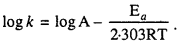
(b) Rate = k [A] [B]2
(c) Rate = k [A]1/2 [B]
(d) Rate = k [A] [B]1/2.

Question 12.
Molecularity of reaction of Inversion of sugar :
(a) 3
(b) 2
(c) 1
(d) 0.

Question 13.
Minimum energy required for molecules to react is called :
(a) Potential energy
(b) Kinetic energy
(c) Nuclear energy
(d) Activation energy.

Question 14.
2A + B → A2B, if concentration A is doubled and concentration of B is being half, the rate of reaction will:
(a) Increase 4 times
(b) Decrease 2 times
(c) Increase 2 times
(d) Remains unchanged.

Question 15.
Half life for second order reaction :
(a) Is proportional to initial concentration
(b) Does not depend upon initial concentration
(c) Inversely proportional to initial concentration
(d) Inversely proportional to square root of intial concentration.

Question 16.
The reaction 2H2O2 → 2H2O + O2, r = k[H2O2] is:
(a) Zero order reaction
(b) First order reaction
(c) Second order reaction
(d) Third order reaction.

Question 17.
Thermal decomposition of a compound is first order reaction. If a sample of compound decomposes 50% in 120 minutes, how much time it will take for 90% decomposition:
(a) About 240 minutes
(b) About 480 minutes
(c) About 450 minutes
(d) About 400 minutes.

Question 18.
Arrhenius equation is :
MP Board Class 12th Chemistry Solutions Chapter 4 Chemical Kinetics 64

Question 19.
When temperature is raised, rate of reaction increases. This is due to :
(a) Decrease in activation energy
(b) Increase in number of collisions
(c) Decrease in number of active molecules
(d) Decrease in number of collisions.

Question 20.
Unit of rate constant of second order reaction is :
(a) mol-1 litre-1 second-1
(b) mol litre-1 second-1
(c) mol litre second
(d) mol-1 litre second-1.

Question 21.
Reaction
MP Board Class 12th Chemistry Solutions Chapter 4 Chemical Kinetics 65
(a) Bimolecular and second order
(b) Unimolecular and first order
(c) Bimolecular and first order
(d) Bimolecular and zero order.

Question 22.
Unit of rate constant of first order reaction is :
(a) mol L-1 S-1
(b) mol-1 LS-1
(c) S-1
(d) mol L-1 S.

Question 23.
Time required for the completion of 90% reaction of first order is :
(a) 1-1 times that of half life
(b) 2-2 times that of half life
(c) 3-3 times that of half life
(d) 4-4 times that of half life.

Question 24.
The rate of chemical reaction depends upon :
(a) Active mass
(b) Atomic mass
(c) Equivalent weight
(d) Molecular mass.

Question 25.
Unit of reaction rate is :
(a) mol litre-1 second-1
(b) mol-1 litre second-1
(c) mol-1 litre-1 second
(d) mol litre second.

Answer:
1. (b), 2. (a), 3. (b), 4. (a), 5. (d), 6(b), 7. (a), 8. (a), 9. (c), 10. (d), 11. (b), 12. (c), 13. (d), 14. (d), 15. (c), 16. (b), 17. (d), 18. (d), 19. (b), 20. (d), 21. (c), 22. (c), 23. (c), 24. (a), 25. (a).

Question 2.
Fill in the blanks :

1. The rate of a reaction does not depends on the concentration of the reacting species, then the reaction is of …………………
2. Half life period of a radioactive element is 140 days. On taking 1 gm element initially the amount left after 560 days will be …………………
3. Fast reactions are completed in less than ………………… seconds.
4. In the mechanism of a reaction, the slowest step is called …………………
5. Study of fast reactions is done by …………………
6. Unit of rate constant for third order reaction is …………………
7. Difference in the minimum and maximum energy state of reactants is called …………………
8. Reactions which take place by the absorption of radiations are called …………………
9. The total number of molecules which participate in a reaction is called …………………
10. ………………… gives the idea about the mechanism of the reaction.
11. Hydrolysis of Ethyl acetate in acidic medium is an example of ………………… order reaction.
12. Molecularity is always a …………………
13. For the excitation of one mole reactant ………………… photons are required.
14. Rate of change in concentration of reactant at a specific instant of time is known as ………………… rate.
15. Rate of reaction is ………………… to the concentration of reactant.
16. cm-1 is the unit of …………………
Answer:
1. Zero
2. \(\frac { 1 }{ 16 } \) gm
3. 10-9
4. Rate determining step
5. Flash photolysis
6. mol-2 Litre2 second-1
7. Activation energy
8. Photochemical reactions
9. Molecularity
10. Order of reaction
11. Pseudo unimolecular
12. whole number
13. one mole
14. Instantaneous
15. Proportional
16. cell constant.

Question 3.
Match the following :
MP Board Class 12th Chemistry Solutions Chapter 4 Chemical Kinetics 66
MP Board Class 12th Chemistry Solutions Chapter 4 Chemical Kinetics 67
Answers:

  1. (c)
  2. (e)
  3. (a)
  4. (b)
  5. (d)
  6. (g)
  7. (f).

Question 4.
Answer in one word / sentence :

1. What is the relation between threshold energy and activation energy ?
2. What is the expression of rate constant for first order reaction ?
3. Write alternative form of Arrhenius equation.
4. If reaction A + B → C is a zero order reaction. Write rate law expression for it.
5. If rate equation for a reaction is Rate = k [NO2]2 [Cl2] then state the order of reaction with respect to Cl2 and order with respect to NO2 and total order of reaction.
6. Write rate equations on the basis of concentration of reactants and products for the following reactions.
2NO2 → 2NO + O2
7. What is rate determining step ?
8. Write an example of zero order reaction.
9. What is Quantum Efficiency ?
10. Write Arrhenius Equation.
11. Write the expression of half life period for first order reaction.
12. What is the effect of surface area of reactant on the rate of reaction ?
13. What is instantaneous rate ?
14. What is half-life period of a reaction ?
15. What is the unit of k for zero order reaction ?
16. Explain Threshold energy.
17. What are fast reactions ?
18. For a zero order reaction tm is proportional to what ?
Answer:
1. Activation energy = Threshold energy – Energy of molecules in normal state
2.
MP Board Class 12th Chemistry Solutions Chapter 4 Chemical Kinetics 68
3.
MP Board Class 12th Chemistry Solutions Chapter 4 Chemical Kinetics 69
4.
MP Board Class 12th Chemistry Solutions Chapter 4 Chemical Kinetics 70
5. Order with respect to cl2 = l, Order with respect to NO2 = 2, Thus, Total order = 1 + 2 = 3
6.
MP Board Class 12th Chemistry Solutions Chapter 4 Chemical Kinetics 71
7. The slowest step is the rate determining step
8.
MP Board Class 12th Chemistry Solutions Chapter 4 Chemical Kinetics 72
9. Quantum Efficiency
MP Board Class 12th Chemistry Solutions Chapter 4 Chemical Kinetics 73
10.
MP Board Class 12th Chemistry Solutions Chapter 4 Chemical Kinetics 74
11.
MP Board Class 12th Chemistry Solutions Chapter 4 Chemical Kinetics 75
12. Larger surface area increases the rate of reaction
13. Rate of change in concentration of reactant or product at a specific instant of time is known as instantaneous rate
14. Half-life period of a reaction is the time in which concentration of reactant is reduced to one half of the initial concentration
15. Litre mol-1 sec-1
16. The minimum amount of energy which the reactant molecules should possess for effective collision
17. Reactions which gets completed in 10-9 second or even lesser time interval are called fast reactions
18. Initial concentration of reactant [A]

MP Board Solutions

Chemical Kinetics Very Short Answer Type Questions

Question 1.
What is first order reaction ?
Answer:
If the rate of reaction depends on the first power of concentration of reactant then the order of reaction is said to be first order reaction.

Question 2.
What is Energy Barrier ?
Answer:
The minimum energy achieved by the reactant only after which it can be converted to product is known as energy barrier. Reactant molecules cannot form activated complex till they reach this height (activation energy) and cannot be converted to form product.

Question 3.
Explain the rate determining step.
Answer:
Some chemical reactions complete in one or more steps. Rate of reaction is determined by the slowest step which is known as rate determining step.

Question 4.
Write the characteristics of photochemical reactions. Any three.
Answer:
Characteristics :

  1. Absorption of magnetic radiations is necessary for these reactions.
  2. These reactions are unaffected by temperature but intensity of radiations affects them.
  3. Light is necessary for activating the reactants.

Question 5.
What are the applications of Arrhenius equation ? (Any two)
Answer:

  1. In calculating activation energy.
  2. In determining the rate constant at a temperature by the help of rate constant at another temperature of the reaction.

Question 6.
What is photochemical reaction ? Give an example.
Answer:
Such reactions which are induced by light or other electromagnetic radiations are known as photochemical reactions. Wavelength of these radiations is from 2000Å to 8000Å.
MP Board Class 12th Chemistry Solutions Chapter 4 Chemical Kinetics 76

Question 7.
What is specific reaction rate ?
Answer:
Specific reaction rate of a reaction at a given temperature is equal to that rate of a reaction when concentration of each reactant is unity.
MP Board Class 12th Chemistry Solutions Chapter 4 Chemical Kinetics 77
Rate of reaction = k where k = Specific reaction rate constant.

Question 8.
When is the average rate of the reaction equal to its instantaneous rate ?
Answer:
When value of time interval is nearly zero or when time by infinite form is minute then the average rate of reaction is comparable to its instantaneous rate.
MP Board Class 12th Chemistry Solutions Chapter 4 Chemical Kinetics 78

Question 9.
What are pseudo unimolecular reactions ?
Answer:
There are some reactions in which molecularity is more than one i.e. two or more molecules are present, but in the chemical reaction concentration of only one reactant molecule is changed and it is only responsible for rate of reaction. Thus, order is one. These reactions are called pseudo unimolecular reactions.
MP Board Class 12th Chemistry Solutions Chapter 4 Chemical Kinetics 79
Above reaction is bimolecular but concentration of water does not affect the rate of reaction, thus, rate of reaction is proportional to the concentration of sucrose only.
Rate = k[C12H22O11]
Thus, inversion of sucrose is a first order reaction. It is known as pseudo unimoleciilar reaction.

Question 10.
What is temperature coefficient ?
Answer:
Generally, rate of any reaction increases due to increase in temperature. On increasing temperature by 10 C, velocity of reaction is increased up to 2-3 times. If velocity constant of a reaction is and it is increased to increasing temperature by 10 C, the ratio of these two constant is called temperature coefficient, i.e.,
MP Board Class 12th Chemistry Solutions Chapter 4 Chemical Kinetics 80
Thus, at various time the ratio of rate of reaction which differ by 10°C is known as temperature coefficient.

MP Board Solutions

Chemical Kinetics Short Answer Type Questions

Question 1.
Write down the expression representing the rate of reaction.
Answer:
Rate of reaction is the rate of change in concentration of reactant or concentration of product in unit time interval.
MP Board Class 12th Chemistry Solutions Chapter 4 Chemical Kinetics 81
Unit of rate of reaction depend on the units of concentration and time. If concentration is represented in mole per litre and time in second, then unit of rate of reaction is mol per litre per second. If time is expressed in minute then unit of reaction rate is mole per litre per minute.

Question 2.
What is the meaning of instantaneous rate of reaction ?
Answer:
The rate of reaction does not remain constant during the whole time interval because rate of reaction depends upon the concentration of reactants. As the concentration of reactants decreases with time, the rate of reaction also decreases with time.

In order to express the reaction rate as accurately as possible, the instantaneous rate of reaction is expressed. For this the time interval (∆t) is taken as small as possible.
MP Board Class 12th Chemistry Solutions Chapter 4 Chemical Kinetics 82
Where, d [A] is a change in concentration of reactant A.

Question 3.
What do you know about molecularity of any reaction ?
Answer:
Molecularity of Reaction : ‘Number of moles of reactant participating in elementary step of chemical reaction is called molecularity of the reaction.’

There are many reactions which proceed through the number of steps and each step being independent is called elementary step. The rate of reaction is determined by slowest step and it is known as rate determining step. Here molecularity can be defined as “Number of molecules/atoms or ions participating in rate determining step is called molecularity.”

Example : (i) Unimolecular reaction :
O3 → O2 + O
(ii) Bimolecular reaction:
NO + O3 → NO2 + O2

Question 4.
Differentiate molecularity and order of reaction.
Answer:
Differences between Molecularity and Order of reaction :

Molecularity:

  1. It is the total number of molecules which participate in the reaction.
  2. It is a theoretical concept.
  3. It is always a whole number.
  4. Its value is never zero.
  5. It does not provide any information about mechanism of reaction.

Order of reaction

  1. It is the number of molecules which participate in reaction and whose concentration is changed.
  2. Order of reaction is determined by experimentally.
  3. Fractional values are also possible.
  4. Zero value is possible.
  5. It provides information about mechanisms of reaction.

Question 5.
Write any four factors which affects rate of a chemical reaction.
Answer:
The rate of reaction depends upon the following factors :
(i) Concentration of reactants: At constant temperature, the rate of a reaction increases by increasing the concentration of the reactants.

(ii) Temperature of the system : If the concentration of the reactants are constant then the rate of reaction increases by increasing temperature. For 10 degree rise of temperature, the reaction rate becomes double or triple.

(iii) Presence of catalyst: Positive catalyst increases the rate of reaction and negative catalyst decreases the reaction rate.

(iv) Nature of the reactants: Nature of reactants also affect the reaction rate. In any chemical reaction some old bonds are broken and new bonds are formed. Thus, in case of more simple molecules the lesser is the number of bond breaking and the rate of reaction increase whereas in case of complex molecules more bonds are broken and rate decreases.

(v) Exposure to radiations: The rate of some reactions increases due to some special radiations.

Question 6.
Write characteristics of rate constant
Answer:

  1. At fixed temperature, the value of k is constant.
  2. For a particular reaction, k is independent of concentration but depends on temperature.
  3. The value of k is different for different reactions.
  4. It is a measure of intrinsic rate of reaction i. e., larger the value of k, faster will be the reaction and viceversa.

Question 7.
What do you understand by order of reaction ? Give example.
Answer:
Order of reaction : The order of a reaction is defined as the sum of all the powers to which concentration terms in the rate law are raised to express the observed rate of the reaction. Suppose there is a general reaction,
aA + bB + cC → product
For which the rate law is
Rate = – \(\frac { dx }{ dt } \) = k[A]p [B]q [C]r
Then the order of the reaction n = p + q + r, where, p, q and r are the orders with respect to individual reactants and overall order is the sum of the exponents i.e.,p + q + r.
When n = 1 the reaction is of first order, if n = 2 the reaction is of second order and so on.
For example : Decomposition of ammonium nitrite occurs as follows :
NH4NO2 → N2 + 2H2O
Rate of reaction = – \(\frac { dx }{ dt } \) = k[NH4NO2]
Thus, order of this reaction will be 1.

Question 8.
What do you mean by zero order reaction ? Give one example,
Answer:
In some reactions, rate does not depends, upon the concentration of reactants. This type of reactions are called zero order reaction.
Example : In contact of Au or Pt, the ammonia molecule dissociate and rate of this reaction is independent of concentration of ammonia.
MP Board Class 12th Chemistry Solutions Chapter 4 Chemical Kinetics 83

Question 9.
How does rate of any reaction depend on temperature ? Explain.
Answer:
Generally, rate of any reaction increases due to increase in temperature. On increasing temperature by 10°C, velocity of reaction is increased up to 2-3 times. If velocity constant of a reaction is and it is increased to increasing temperature by 10°C, the ratio of these two constant is called temperature coefficient, i.e.,
\(\frac{k_{t+10}}{k_{t}} \approx 2 \text { to } 3\)
Arrhenius provide the following relation for showing the effect of temperature on velocity constant.
i.e., \(k=\mathbf{A} \cdot e^{-\mathrm{E}_{\alpha} / \mathrm{RT}}\)

Question 10.
What is activation energy ?
Answer:
According to Arrhenius, any chemical reaction is only possible when reacting . molecules are activated with minimum energy which is called threshold energy. Kinetic energy of most of the molecules are less than this minimum energy. The excess energy which is required to activate reactant molecules, is called activation energy.

Activation energy can be determined by the use of Arrhenius equation.
MP Board Class 12th Chemistry Solutions Chapter 4 Chemical Kinetics 84

Question 11.
Write four differences between Rate of reaction and Rate constant.
Answer:
Differences between Rate of reaction and Rate constant:

Rate of reaction:

  1. It is expressed in terms of consumption of reactants or formation of product per unit time.
  2. It depends on concentration of reactant at particular moment.
  3. It generally decreases with the progress of reaction.
  4. Its unit is mol L-1 cm-1.

Rate constant:

  1. It is proportionality constant in differential form in rate law or rate equation.
  2. It is independent of concentration of reactant.
  3. It does not depend on the progress of reaction.
  4. It changes according to order of reaction.

Question 12.
Prove that half-life period of zero order reaction is proportional to initial concentration of reactant.
Answer:
If rate of reaction does not depend on the concentration of reactants, then it is known as zero order reaction.

For a zero order reaction the relation between rate constant and concentration is expressed by the following equation :
MP Board Class 12th Chemistry Solutions Chapter 4 Chemical Kinetics 85
Thus, half-life period of zero order reaction is proportional to initial concentration of reactant.

Question 13.
Prove that half-life period is independent of the initial concentration for the first order reaction.
Answer:
Half-life period for the reaction is that period in which the initial concentration of reactant is reduced to half.
For first order reaction :
MP Board Class 12th Chemistry Solutions Chapter 4 Chemical Kinetics 86
Thus, the half-life period is independent of the initial concentration for the first order reaction.

Question 14.
What is Integrated rate law method ? Write a note.
Answer:
Integrated rate equation for first order reaction is :
MP Board Class 12th Chemistry Solutions Chapter 4 Chemical Kinetics 87
By this equation, order of reaction can be calculated. By knowing the initial concen¬tration (a) of reactant, concentration at a definite time (a – x) can be known.

This way, by substituting the values of t and (a – x), value of k is calculated. If value of k comes to be constant, the reaction is of first order. For, first order reaction, on plotting a graph between concentration log)0 (a – x) and t, a straight line is obtained. For other orders of reaction suitable equations are used and orders are determined.

Question 15.
A first order reaction is 90% complete in 40 minutes. Calculate its half- life period. (log 2 = 0.3010).
Solution:
Let initial cone, of reactant (a) = 100, t = 40 minutes
90% reaction gets completed in 40 minutes i.e.,
MP Board Class 12th Chemistry Solutions Chapter 4 Chemical Kinetics 88

Question 16.
Show that time required for completing 99.9% of a first order reaction is 10 times of its half-life period.
Solution:
If initial concentration of reactant is a, then t = ? for x = 0.999 a
We know that for a first order reaction
MP Board Class 12th Chemistry Solutions Chapter 4 Chemical Kinetics 89.

Question 17.
Write unit of rate constant k for the zero order, first order and second order reaction
Solution:
MP Board Class 12th Chemistry Solutions Chapter 4 Chemical Kinetics 90.

Question 18.
(1) 2N2Os 4NO2 + O2
(2) H22 + I2 → 2HI
Reaction (1) is first order reaction and (2) is second order reaction. Why ?
Answer:
(1) In reaction 2N2O5 → 4NO2 + O2, when graph is plotted between rate of reaction and then again graph is plotted between rate of reaction and [N2O5]2, it is shown that in the first graph straight line is obtained i.e.
rate ∝ [N2O5]
or rate = k[N2O5]
Therefore, 2N2O5 → 4NO2 + O2 is first order reaction.

(2) In reaction H2 + I2 → 2HI when graph is plotted between rate of reaction and (H2) (I2), it is seen that straight line is obtained.
Therefore rate ∝ [H2][I2]
Hence, this reaction is of 2nd order reaction.

MP Board Solutions

Chemical Kinetics Long Answer Type Questions

Question 1.
Determine the expression for zero order reaction.
Answer:
Reactions in which rate of reaction does not depend on the concentration of the reactants are called zero order reactions. Consider a zero order reaction
A → B
Where, A and B are concentration of reactants and products. Since in this type of reaction, rate of reaction does not depend on the concentration of reactant therefore, rate of change in concentration of reactant remains constant.
Rate of reaction = Constant.
Let initial cone, of reactants be a moles /It and after time ‘t’ x moles are converted into product. Then cone, of A after time t will be (a – x) mol /It.
MP Board Class 12th Chemistry Solutions Chapter 4 Chemical Kinetics 91
Thus, eqn. (7) is the velocity equation for zero order reaction.

Question 2.
Write a note on Arrhenius equation.
Answer:
Arrhenius equation : Arrhenius gave a relation between rate constant of reaction and temperature which is known as Arrhenius equation i.e.,
\(k=\mathbf{A} e^{-\Delta \mathbf{E}_{a} / \mathbf{R} \mathbf{T}}\)
Where, k = Rate constant of reaction, A = Frequency factor, Ea = Activation energy, R = Gas constant, T = Absolute temperature.

Taking logarithm both sides of above equation we get
MP Board Class 12th Chemistry Solutions Chapter 4 Chemical Kinetics 92

Ea and A can be determined by measuring rate constants of the reaction at two different temperature. Let k1 and k2 are the rate constant for the reaction at two temperatures T1 and T2 respectively. Then from eqn. (1)MP Board Class 12th Chemistry Solutions Chapter 4 Chemical Kinetics 93
MP Board Class 12th Chemistry Solutions Chapter 4 Chemical Kinetics 94
Application : Activation energy AEa may be calculated easily from this equation.

Question 3.
Write the Arrhenius equation in the form of equation of straight line. What will be the slope of a graph using this equation ? Calculate the activation energy for the decomposition in a decomposition reaction in which the value of slope obtained is – 9920 when log k is plotted against \(\frac { 1 }{ T } \).
Answer:
Arrhenius equation : Arrhenius gave a relation between rate constant of reac¬tion and temperature which is known as Arrhenius equation, i.e.,
\(k=\mathrm{A} e^{-\mathrm{E}_{a} / \mathrm{RT}}\)
Where, k = Rate constant of reaction, A = Frequency factor, Ea = Activation energy, R = Gas constant and T = Absolute temperature.
Taking logarithm both sides of above equation, we get
MP Board Class 12th Chemistry Solutions Chapter 4 Chemical Kinetics 95
This is a straight line equation. If log10 A and \(\frac { 1 }{ T } \) is plotted at different temperatures, a straight line is obtained whose slope = \(\frac{-\mathrm{E}_{a}}{2 \cdot 303 \mathrm{R}}\) From the graph, value of slope = \(\frac{\mathrm{E}_{a}}{2 \cdot 303 \mathrm{R}}\) can be calculated and activation energy (Ea) can be calculated.

Alternatively, Ea and A can be determined by measuring rate constant of the reaction at two different temperatures. Let k1 and k2 are the rate constants for the reaction at two temperatures T1 and T2 respectively. Then, from eqn. (1),
MP Board Class 12th Chemistry Solutions Chapter 4 Chemical Kinetics 96
Calculation of activation energy :
Ea = -2.303 × slope × R = -2.303 × (-9920) × 1.986
∴ Ea = 45334 cal/gm/mol.

Question 4.
Derive an expression for velocity constant of first order reaction.
Answer:
The reaction in which velocity of reaction depends upon the concentration of one mole, are called first order reaction.
Let this reaction is
A → Product
Suppose intial concentration of A is a gram mole and after t second x mole consumed and remaining concentration is (a – x) gram mole.
So after t time, the rate of reaction will be proportional to (a – x)
MP Board Class 12th Chemistry Solutions Chapter 4 Chemical Kinetics 97
Putting the value of c from eqn. (4), into eqn. (3).
– ln(a – x) = kt – In a
or In a – ln(a – x) = kt
MP Board Class 12th Chemistry Solutions Chapter 4 Chemical Kinetics 98
It is the desired expression for first order of reaction.

MP Board Class 12th Chemistry Solutions

MP Board Class 9th Maths Solutions Chapter 13 Surface Areas and Volumes Ex 13.5

MP Board Class 9th Maths Solutions Chapter 13 Surface Areas and Volumes Ex 13.5

Assume π = \(\frac{22}{7}\), unless stated otherwise.

Question 1.
A matchbox measures 4 cm x 2.5 cm. x 1.5 cm. What will be the volume of a packet containing 12 such boxes?
Solution:
Measures of matchbox (cuboid) is 4 cm x 2.5 cm x 1.5 cm
l = 4 cm,
b = 2.5 cm and
h = 1.5 cm
∴ Volume of matchbox = (l x b) x h
= [4 cm x 2.5 cm] x 1.5 cm3
= 4 x \(\frac{25}{10}\) x \(\frac{25}{10}\) cm3 = 15 cm3
Volume of 12 boxes =12 x 15 cm3 = 180 cm3

MP Board Solutions

Question 2.
A cuboidal water tank is 6 m long, 5 m wide and 4.5 m deep. How many litres of water can it hold? (1 m3 = 1000 l)
Solution:
Here, Length (l) = 6 m
Breadth (b) = 5 m
Depth (h) = 4.5 m
Capacity = l x b x h = 6 x 5 x 4.5 m3
= 6 x 5 x \(\frac{45}{10}\) m3 = 3 x 45
= 135 m3
∴ 1 m3 can hold 1000 l.
∴ 135 m3 can hold (135 x 1000 l = 135000 l) of water.
∴ The required amount of water in the tank = 135000 l.

Question 3.
A cuboidal vessel is 10 m long and 8 m wide. How high must it be made to hold 380 cubic meters of a liquid?
Solution:
Volume of the vessel = l x b x h
380 = 10 x 8 x h
380 = 80 x h
h = \(\frac{380}{80}\) = 4.75m.

Question 4.
Find the cost of digging a cuboidal pit 8 m long, 6 m broad and 3 m deep at the rate of ₹ 30 per m3.
Solution:
Volume of cuboidal pit = 8 x 6 x 3 = 144 m3
Cost of digging = 144 x 30 = ₹ 4320.

Question 5.
The capacity of a cuboidal tank is 50000 liters of water. Find the breadth of the tank, it its length and depth are respectively 2.5 m and 10 m.
Solution:
Capacity of cuboidal tank = \(\frac{50000}{1000}\) m3 = 50 m3
Volume of cuboidal tank = l x b x h
50 = 2.5 x 6 x 10
50 = 25b
Breadth of tank, b = \(\frac{50}{25}\) = 2 m.

MP Board Solutions

Question 6.
A village, having a population of4000, requires 150 liters of water per head per day. It has a tank measures 20 m x 15 m x 6m. For how many days will the water of this tank last?
Solution:
Volume of water required for the village per day = \(\frac{4000×150}{1000}\)
Volume of tank = 20 x 15 x 6 = 1800 m3
No. of days = \(\frac{1800}{600}\) = 3.

Question 7.
A godown measures 60 m x 25 m x 10 m. Find the maxium number of wooden crates each measuring 1.5 m x 1.25 m x 0.5 m that can be stored in the godown.
Solution:
Volume of godown = (60 x 25 x 10) m3 = 15000 m3
Volume of one wooden crate = (1.5 x 1.25 x 0.5) m3 = 0.9375 m3
No. of wooden crates which can be stored in the godown
MP Board Class 9th Maths Solutions Chapter 13 Surface Areas and Volumes Ex 13.5 img-1
= 16000.

Question 8.
A solid cube of side 12 cm is cut into eight cubes of equal volume. What will be the side of the new cubk? Also, find the ratio between their surface area.
Solution:
Volume of cube of side 12 cm = (12 x 12 x 12) cm3
Let V be volume of new cube.
Volume of cube of side 12 cm = 8 x volume of new cube
12 x 12 x 12 = 8 x V
V = \(\frac{12x12x12}{8}\) = \(\frac{12x12x12}{2x2x2}\) = 216 cm3
Let a be the side of new cube
a3 = 216 = 63
a = 6 cm
TSA of cube of side 12 = 6 x (12)2
TSA of new cube = 6 x (6)2
MP Board Class 9th Maths Solutions Chapter 13 Surface Areas and Volumes Ex 13.5 img-2

MP Board Solutions

Question 9.
Anver 3 m deep and 40 m wide is flowing at the rate of 2 km per hour. How much water will fall into the sea in a minute?
Solution:
b = 40 m,
h = 3 m
V = 2 km/hr
= \(\frac{2×1000}{60}\) = \(\frac{100}{3}\) m/min
Volume of water coming out of the river per min = b x h x V
= \(\frac{100}{3}\) x 3 x 40 = 4000 m3.

MP Board Class 9th Maths Solutions

MP Board Class 10th Hindi Navneet Solutions पद्य Chapter 10 विविधा

MP Board Class 10th Hindi Navneet Solutions पद्य Chapter 10 विविधा

विविधा अभ्यास

बोध प्रश्न

विविधा अति लघु उत्तरीय प्रश्न 

प्रश्न 1.
आसमान में किस तरह के बादल उड़ रहे थे?
उत्तर:
आसमान में झीने-झीने, कजरारे एवं चंचल बादल उड़ रहे थे।

प्रश्न 2.
रिमझिम-रिमझिम पानी बरसने के बाद क्या हुआ?
उत्तर:
रिमझिम-रिमझिम पानी बरसने के बाद आकाश खुल गया और धूप-निकल आयी।

प्रश्न 3.
कवि के अनुसार हवा बार-बार क्या कर रही है?
उत्तर:
कवि के अनुसार हवा बार-बार उनकी पत्नी का आँचल खींच रही है।

प्रश्न 4.
कवि ने नई सभ्यता का स्वरूप कैसा बतलाया
उत्तर:
कवि ने नई सभ्यता का स्वरूप इस प्रकार बतलाया है कि पूर्व में तो हमारी कुटियों में तूफान बिना पूछे ही घुस जाया करते थे, लेकिन नई सभ्यता में वे बिना दरवाजे खटखटाए ही घरों में चले आते हैं।

प्रश्न 5.
आक्रोश में आकर मजदूरों ने क्या किया?
उत्तर:
आक्रोश में आकर मजदूरों ने सूरज को निगल लिया।

प्रश्न 6.
‘खाली पेट’ से कवि का क्या आशय है?
उत्तर:
‘खाली पेट’ से कवि का आशय भूखे-नंगे लोगों से है।

MP Board Solutions

विविधा लघु उत्तरीय प्रश्न

प्रश्न 1.
बादलों के हटने पर तारे कैसे दिखलाई पड़ते हैं?
उत्तर:
बादलों के हटने पर तारे जब-तब उज्ज्वल एवं झलमल दिखाई पड़ते हैं।

प्रश्न 2.
कवि के अनुसार सम्पूर्ण दिन में किस तरह के बादल दिखाई पड़ रहे थे?
उत्तर:
कवि के अनुसार सम्पूर्ण दिन में कपसीले, ऊदे, लाल, पीले और मटमैले बादल दिखाई पड़ रहे थे।

प्रश्न 3.
कवि ने हरे खेतों के बारे में क्या कल्पना की हैं?
उत्तर:
कवि ने हरे खेतों के बारे में यह कल्पना की है कि हम दोनों ने इनको जोता और बोया है; अब इनमें धीरे-धीरे अंकुर निकल आये हैं और इनकी हरियाली ने धरती माता का रूप सजा दिया है।

प्रश्न 4.
कवि के अनुसार मेहनत से कमाई हुई फसल का वास्तविक लाभ किसे प्राप्त होता है?
उत्तर:
कवि के अनुसार मेहनत से कमाई हुई फसल का वास्तविक लाभ बिचौलियों को प्राप्त हो जाता है।

प्रश्न 5.
कवि नियति से क्या प्रश्न करते हैं?
उत्तर:
कवि नियति से एक प्रश्न करता है कि तुमने खाली पेट वालों को घुटने क्यों दिए।

प्रश्न 6.
‘बुनियाद चरमराने’ से कवि का क्या तात्पर्य। है?
उत्तर:
बुनियाद चरमराने से कवि का तात्पर्य यह है कि नयी सभ्यता ने हमारे प्राचीन ढंग एवं आदर्शों को पूरी तरह नकार दिया है।

विविधा दीर्घ उत्तरीय प्रश्न

प्रश्न 1.
‘त्रिलोचन’ की कविता में प्रस्तुत शरद ऋतु के प्राकृतिक सौन्दर्य का वर्णन कीजिए।
उत्तर:
शरद ऋतु के प्राकृतिक सौन्दर्य का वर्णन करते हुए कविवर त्रिलोचन कहते हैं कि नवमी की तिथि है और इस समय रात बड़ी ही मधुरं एवं शीतल है। अभी पूरी तरह जाड़ा नहीं पड़ा है। हाँ, हल्का गुलाबी जाड़ा अवश्य शुरू हो गया। इस गुलाबी जाड़े में कभी-कभी शरीर के रोएँ काँप जाया करते हैं। कभी-कभी रिमझिम पानी की बरसात होती है तो कभी आकाश साफ खुल जाता है। कभी-कभी कपसीले, ऊदे, लाल और पीले तथा मटमैले बादल आकाश में घूमते दिखाई दे जाते हैं।

प्रश्न 2.
पठित पाठ के आधार पर ‘त्रिलोचन’ की कविता के कलापक्ष पर अपना मन्तव्य दीजिए।
उत्तर:
पठित पाठ के आधार पर हम देखते हैं कि त्रिलोचन की कविता में भावपक्ष के साथ ही साथ कलापक्ष भी सुन्दर बन पड़ा है। कवि ने धीरे-धीरे, सीरी-सीरी, झीने-झीने, रिमझिम-रिमझिम, उजला-उजला, बार-बार, धीरे-धीरे आदि शब्दों का प्रयोग से काव्य में पुनरूक्तिप्रकाश अलंकार के द्वारा काव्य के सौन्दर्य को कई गुना बढ़ा दिया है। इसी प्रकार कवि ने जब-तब, तन-मन, काला-हल्का, सुनती हो-गुनती हो आदि में पद मैत्री का सुन्दर प्रयोग किया है। यह पवन आज ……….. छोटा देवर’ में उदाहरण अलंकार ‘जिनको नहलाते हैं बादल, जिनको बहलाती है बयार’ में मानवीकरण अलंकार का प्रयोग हुआ। सम्पूर्ण कविता में अनुप्रास की छटा। भाषा कोमलकान्त पदावली है। कहीं-कहीं भाषा में लाक्षणिकता भी आ गयी है।

प्रश्न 3.
त्रिलोचन शास्त्री ने पवन के माध्यम से क्या संकेत किया है, भाव व्यंजना कीजिए।
उत्तर:
त्रिलोचन शास्त्री ने पवन के माध्यम से यह संकेत किया है कि यह पवन आज बार-बार तुम्हारे आँचल को वैसे ही खींच रहा है जैसे कोई देवर अपनी भाभी के आँचल को खींचता हो।

प्रश्न 4.
नई और पुरानी सभ्यता में कवि ने क्या अन्तर बतलाया है?
उत्तर:
नई और पुरानी सभ्यता में कवि ने यह अन्तर बताया है कि प्राचीन समय में तो हमारी कुटियों में बिना पूछे ही तूफान प्रवेश पा जाते थे, पर इस नई सभ्यता में तो सब कुछ बदल गया है। आज तो लोग हमारे घरों में बिना दरवाजा खटखटाए ही घुस आते हैं। शिष्टाचार, शालीनता का कहीं कोई पता नहीं है। इस परिवर्तन ने हमारी बुनियाद की चूलें ही हिला दी हैं।

प्रश्न 5.
‘खाली पेट’ कविता में निहित व्यंग्य को समझाइए।
उत्तर:
‘खाली पेट’ कविता में निहित व्यंग्य यह है कि नियति ने किसी को कष्ट देने के लिए भोजन की व्यवस्था न की हो, यह बात तो ठीक है पर खाली पेट के साथ उसको चलने-फिरने के लिए घुटने क्यों दिए? कहने का भाव यह है कि नियति ने जिसको खाली पेट रखा है उसे वह घुटने भी प्रदान न करे तो अच्छा है क्योंकि बिना घुटने के वह चल फिर नहीं सकेगा और न वह समाज को अपना खाली पेट दिखा सकेगा।

प्रश्न 6.
‘तृप्ति’ कविता के माध्यम से कवि ने किस विसंगति को उजागर किया है?
उत्तर:
‘तृप्ति’ कविता के माध्यम से कवि ने समाज की उस विसंगति को उजागर किया है जिसमें मेहनतकश तो दो जून की रोटी भी प्राप्त नहीं कर पाता है और उसकी मेहनत का फल बिचौलिए या मध्यस्थ ले जाते हैं। वह बेचारा श्रमिक या मजदूर भूखा का भूखा रह जाता है। लेकिन जब मजदूर से ये अत्याचार सहन नहीं होते हैं तो उसका गुस्सा लावा बनकर फूट पड़ता है और तब वह सूरज तक को निगल जाता है।

प्रश्न 7.
निम्नलिखितं काव्यांशों की सप्रसंग व्याख्या कीजिए
(क) हाँ दिन भी अजीब रहा ………….. आए बादल।
उत्तर:
कविवर त्रिलोचन कहते हैं कि यह शरद ऋतु की नवमी तिथि का दिन है। ये रात कितनी मधुर है, यह कहते नहीं बनता। इन रातों में हमारे मन में शीतलता बस जाती है। यद्यपि अभी कोई जाड़ा नहीं आया है। हाँ, कभी-कभी थोड़े-थोड़े रोएँ काँप जाया करते हैं। ऐसे सुन्दर वातावरण को देखकर तन और मन में उत्साह भर आया। इस समय का दिन भी बड़ा विचित्र रहा। आज रिमझिम-रिमझिम करता हुआ पानी बरसा, इसके बाद आकाश खुल गया और चारों ओर धूप छा गयी। पूरे दिन इसी प्रकार का क्रम बना रहा। आकाश में भिन्न-भिन्न रंगों के बादल यथा-कपसीले, ऊदे, लाल, पीले, मटमैले झुण्ड के रूप में तैर रहे थे। फिर रात आ गयी लेकिन उस रात में पहले जैसा न तो काला, हल्का या गहरा या धुएँ जैसा रंग दिखाई देता था। फिर आकाश कुछ उजला-उजला सा दिखाई दिया। न मालूम इस रम्य वातावरण को किसके प्यासे नेत्र देख पायेंगे। चाँदनी चमक रही है और गंगा बहती जा रही है।

(ख) यह पवन आज यों ………… जिधर वे हरे खेत।
उत्तर:
कविवर त्रिलोचन अपनी पत्नी को सम्बोधित करते हुए कहते हैं कि क्या तुम कुछ सुन रही हो, या कुछ गुनगुना रही हो। यह हवा आज तुम्हारे आँचल को वैसे ही बार-बार खींच रही है जैसे तुम्हारा देवर जब कभी हठ करके तुमसे कोई बात कहना चाह रहा हो।

आगे कवि अपनी पत्नी से कहता है कि तुम उधर चलो जहाँ हरे खेत खड़े हुए हैं। फिर वह कहता है कि शायद तुम्हें यह बात याद है या नहीं, इन खेतों को हम दोनों ने एक साथ मिलकर जोता तथा बोया था। समय के अनुसार इन खेतों में बीज से नये अंकुर निकल आये और बड़े होते गये। इसके बाद हम दोनों ने उन्हें मिलकर सींचा था। आज हमारे परिश्रम के फलस्वरूप ही मनमोहन हरियाली चारों ओर फैल रही है। इस हरियाली से धरती माता का रूप सज गया है। खेत के इन परम सलौने पौधों को हम दोनों ने मिलकर ही बड़ा किया है। आज उन पौधों को बादल नहला रहे हैं और बयार (हवा) उनको बहला रही है। वे हरे खेत कैसे लग रहे हैं और इस समय उनकी दशा क्या होगी? वे इस समय सचेत होंगे या खोये हुए से होंगे।

(ग) कल हमारी कुटियों ………… चरमरा रही है।
उत्तर:
कवि श्री अभिमन्यु कहते हैं कि कल तक तो हमारी कुटियों में बिना पूछे ही तूफान चले आते थे, किन्तु नयी सभ्यता की चकाचौंध में आज हमारे मेहमान हमारे ही घरों में बिना दरवाजा खटखटाए घुसे चले आ रहे हैं। उनके इस बदले हुए व्यवहार से हमारे घर की दीवारें और छतें ही नहीं, अपितु उनसे तो हमारी बुनियाद ही चरमरा रही है।

MP Board Solutions

विविधा काव्य सौन्दर्य

प्रश्न 1.
निम्नलिखित प्रश्नों के उत्तर दीजिए
(अ) “इसलिए आक्रोश में आकर, मजदूर सूरज को निगल गया” में निहित अलंकार को पहचानकर उसके लक्षण लिखिए।
उत्तर:
इसमें रूपकातिशयोक्ति अलंकार है जिसका लक्षण इस प्रकार है-
रूपकातिशयोक्ति :
जहाँ उपमान द्वारा उपमेय का वर्णन किया जाये वहाँ रूपकातिशयोक्ति अलंकार होता है।

(ब) “माथे की श्रम बूंदों को खेत में पहुँचाकर बो दिया” पंक्ति का भाव स्पष्ट कीजिए।
उत्तर:
इस पंक्ति का भाव है कि मजदूर ने परिश्रम करके खेत की जुताई, गुड़ाई की। उसने अपना पसीना बहाकर फसल के लिए खेत तैयार किये। खेत तैयार होने पर उसने श्रम के द्वारा बीज बो दिए ताकि अच्छी पैदावार हो सके।

प्रश्न 2.
“खाली पेट वालों को तुमने घुटने क्यों दिए? फैलाने वाले हाथ क्यों दिए?” इन पंक्तियों के प्रश्नों का भाव-सौन्दर्य स्पष्ट कीजिए।
उत्तर:
जब व्यक्ति का पेट खाली होता है तो वह अपने घुटनों से पेट को दबा लेता है ताकि भूख का दबाव कम हो जाय या फिर अपनी भूख शान्त करने के लिए दूसरों के सामने हाथ फैलाता है। ये दोनों ही स्थितियाँ हीनता की परिचायक हैं। इन प्रश्नों का भाव है कि घुटने और हाथ न होते तो खाली पेट व्यक्ति अपनी हीनता नहीं दर्शा पाता, भले वह भूख के कारण मर जाता।

प्रश्न 3.
भयानक रस को उदाहरण सहित परिभाषित कीजिए।
उत्तर:
भयानक रस :
किसी भयंकर व्यक्ति, वस्तु के कारण जाग्रत भय स्थायी भाव विभावादि के संयोग से भयानक रस रूप में परिणत होता है। जैसे-
“एक ओर अजगर सिंह लखि,एक ओर मृगराय।
विकल वटोही बीच ही, पर्यो मूरछा खाय॥”

यहाँ आश्रय वटोही तथा आलम्बन अजगर और सिंह हैं। अजगर एवं सिंह की डरावनी चेष्टाएँ उद्दीपन हैं। बटोही (राहगीर) का मूच्छित होना अनुभाव तथा स्वेद, कम्पन, रोमांच आदि संचारी भाव हैं।

प्रश्न 4.
वीभत्स रस और भयानक रस में अन्तर बताइए।
उत्तर :
वीभत्स रस का स्थायी भाव जुगुप्सा (घृणा) होता है, जबकि भयानक रस का स्थायी भाव भय होता है। विभाव, अनुभाव और संचारी भावों में भिन्नता होती है। स्पष्ट है कि वीभत्स में घृणा का भाव जाग्रत होता है परन्तु भयानक में भय उत्पन्न होता है।

प्रश्न 5.
अद्भुत रस की परिभाषा एवं उदाहरण, रस के विभिन्न अंगों सहित दीजिए।
उत्तर:
अद्भुत रस-किसी असाधारण या अलौकिक वस्तु के देखने में जाग्रत विस्मय स्थायी भाव विभावादि के संयोग से अद्भुत रस में परिणत होता है। जैसे-
“अखिल भुवनचर-अचरसब, हरिमुख मेंलखि मातु।
चकित भई गद्-गद् वचन, विकसित दृग पुलकातु ॥”

यहाँ माँ यशोदा आश्रय तथा श्रीकृष्ण के मुख में विद्यमान सब लोक आलम्बन हैं। चर-अचर आदि उद्दीपन हैं। आँख फाड़ना, गद-गद स्वर, रोमांच अनुभाव तथा दैन्य, त्रास आदि संचारी भाव हैं।

MP Board Solutions

विविधा महत्त्वपूर्ण वस्तुनिष्ठ प्रश्न

बहु-विकल्पीय प्रश्न विविधा

प्रश्न 1.
आसमान में किस तरह के बादल उड़ रहे थे?
(क) लाल
(ख) मटमैले
(ग) पीले
(घ) उपर्युक्त सभी।
उत्तर:
(घ) उपर्युक्त सभी।

प्रश्न 2.
त्रिलोचन कवि ने शरद ऋतु की किस तिथि का वर्णन किया है?
(क) द्वितीया
(ख) चतुर्थी
(ग) नवमी
(घ) इनमें से कोई नहीं।
उत्तर:
(ग) नवमी

प्रश्न 3.
बादलों के हटने पर तारे कैसे दिखलाई पड़ते हैं?
(क) नहीं दिखाई दे रहे हैं
(ख) उज्ज्वल झलमल
(ग) जगमगा रहे हैं
(घ) छिपते-छिपते।
उत्तर:
(ख) उज्ज्वल झलमल

प्रश्न 4.
‘बुनियाद चरमराने’ से कवि का क्या आशय है?
(क) छत टूटना
(ख) जमीन टूटना
(ग) जड़ से नष्ट होना
(घ) उपर्युक्त सभी।
उत्तर:
(ग) जड़ से नष्ट होना

रिक्त स्थानों की पूर्ति

  1. ‘चाँदनी चमकती है गंगा बहती जाती है’ कविता के रचयिता ………….. हैं।
  2. यह पवन आज यों बार-बार खींचता तुम्हारा …………… है।
  3. इसीलिए आक्रोश में आकर मजदूर ……………. को निगल गया।
  4. उनसे हमारी दीवारें और छतें नहीं हमारी ………… चरमरा रही है।

उत्तर:

  1. त्रिलोचन शास्त्री
  2. आँचल
  3. सूरज
  4. बुनियाद।

सत्य/असत्य

  1. ‘चाँदनी चमकती है गंगा बहती है’ कविता के रचयिता अप्रवासी भारतीय अभिमन्यु ‘अनन्त’ हैं।
  2. कवि त्रिलोचन ने हरी-भरी धरती को माता के सदृश सम्मान दिया है।
  3. ‘चाँदनी चमकती है गंगा बहती है’ कविता ने कृषकों की दयनीय दशा का वर्णन किया है।
  4. कवि अभिमन्यु अनंत नियति से प्रश्न करते हैं। (2016)

उत्तर:

  1. असत्य
  2. सत्य
  3. असत्य
  4. सत्य।

सही जोड़ी मिलाइए

MP Board Class 10th Hindi Navneet Solutions पद्य Chapter 10 विविधा img-1
उत्तर:
1. → (ग)
2. → (घ)
3. → (क)
4. → (ख)

MP Board Solutions

एक शब्द/वाक्य में उत्तर

  1. ‘चाँदनी चमकती है गंगा बहती है’ कविता में कवि ने मानवीय व्यवहार का चित्रण किस माध्यम से किया है?
  2. ‘दिनभर ऐसा ही रहा तार कपसीले,ऊदे लाल और पीले मटमैले दल के दल’ पंक्ति का प्रयोग किसके लिये किया है?
  3. ‘कल हमारी कुटियों में बिन पूछे तूफान दाखिल हो जाते थे’ कविता का शीर्षक लिखिए।
  4. ‘तुमने खाली पेट दिया ठीक किया’ यह पंक्ति किसकी ओर संकेत करती है?
  5. आक्रोश में आकर मजदूरों ने क्या किया? (2014)

उत्तर:

  1. हवा
  2. बादलों के लिए
  3. नयी सभ्यता
  4. निर्धनता एवं भुखमरी
  5. सूरज को निगल लिया।

चाँदनी चमकती है गंगा बहती जाती है भाव सारांश 

‘चाँदनी चमकती है गंगा बहती जाती है’ कविता में त्रिलोचन कवि ने गंगा नदी के किनारे चाँदनी रात का वर्णन किया है।

कवि का कथन है कि गंगा नदी के किनारे चाँदनी रात का वातावरण अत्यन्त सुन्दर दिखाई देता है। इस समय आकाश में काले-काले बादल काजल की भाँति इधर-उधर घूम रहे हैं। बादलों में छिपते और चमकते तारे शोभा को बढ़ा रहे हैं। चाँदनी रात्रि में गंगा की लहरें तरंगित होती हुई सुशोभित हो रही हैं।

शरद काल का समय है और नवमी तिथि की मनोहर रात है। शीतल ठंडी रात मन में रोमांच का अनुभव कराती है। शीत ऋतु यद्यपि अभी नहीं है,किन्तु शरदकालीन शीतलता से तन के रोंये कम्पन कर रहे हैं अर्थात् शरीर रोमांचित हो रहा है।

रात में आसमान स्वच्छ था लेकिन यकायक वर्षा होने लगी है। इसके बाद आकाश स्वच्छ हो गया और पुनः धूप खिल उठी। देखते-देखते बादल इकट्ठे हो गये हैं। कवि अपनी पत्नी से कहता है कि यह हवा बार-बार तुम्हारा आँचल इस प्रकार खींच रही है जैसे तुम्हारा देवर बचपन में आँचल खींचता और हठ करता था।

कवि पत्नी से कहता है कि खेतों की ओर चलो और देखो हम दोनों ने जो बीज बोये थे वे अब अंकुरित तथा बड़े होकर वायु वेग से लहलहा रहे हैं। वास्तव में खेतों की हरियाली के कारण गंगा तट का सौन्दर्य दुगना हो गया है।

चाँदनी चमकती है गंगा बहती जाती है संदर्भ-प्रसंगसहित व्याख्या

(1) चल रही हवा
धीरे-धीरे
सीरी-सीरी;
उड़ रहे गगन में
झीने-झीने
कजरारे
चंचल बादल!
छिपते-छिपते
जब-तब
तारे,
उज्ज्वल, झलमल
चाँदनी चमकती है गंगा बहती जाती है।

शब्दार्थ :
सीरी-सीरी= ठण्डी-ठण्डी। गगन = आकाश। झीने-झीने = पतले-पतले। कजरारे = काले।

सन्दर्भ :
प्रस्तुत कविता ‘चाँदनी चमकती है गंगा बहती जाती है’ शीर्षक से ली गयी है। इसके कवि श्री त्रिलोचन हैं।

प्रसंग :
इस कविता में कवि ने प्रकृति के मादक रूप का वर्णन किया है।

व्याख्या :
कवि त्रिलोचन कहते हैं कि ठण्डी-ठण्डी हवा धीरे-धीरे बह रही है और आकाश में झीने-झीने तथा काले एवं चंचल बादल उमड़ रहे हैं। इसी समय आकाश में उज्ज्वल एवं झिलमिलाते हुए जब कभी तारे भी छिपते-छिपते दिखाई दे जाते हैं। चाँदनी चमक रही है और गंगा की धारा बहती जा रही है।

विशेष :

  1. प्रकृति की सुन्दरता का चाँदनी रात में कवि ने वर्णन किया है।
  2. पुनरुक्तिप्रकाश एवं अनुप्रास अलंकार।

MP Board Solutions

(2) ऋतु शरद और
नवमी तिथि है
है कितनी, कितनी मधुर रात
मन में बस जाती शीतलता है
अभी नहीं जाड़ा कोई
बस जरा-जरा रोएँ काँपे
तन-मन में भर आया उछाह
हाँ, दिन भी आज अजीब रहा
रिमझिम रिमझिम पानी बरसा
फिर खुला गगन
हो गयी धूप
दिन भर ऐसा ही रहा तार
कपसीले, ऊदे, लाल और
पहले, मटमैले-दल के दल
आये बादल
अब रात
न उतना रंग रहा
काला-हलका या गहरा
या धुएँ-सा
कुछ उजला-उजला
किसके अतृप्त दृग देखेंगे
चाँदनी चमकती है गंगा बहती जाती है।

शब्दार्थ :
उछाह = उत्साह। तार = क्रम। दल के दल = झुण्ड के झुण्ड। अतृप्त = प्यार से। दृग = नेत्र।

सन्दर्भ एवं प्रसंग :
पूर्ववत्।

व्याख्या :
कविवर त्रिलोचन कहते हैं कि यह शरद ऋतु की नवमी तिथि का दिन है। ये रात कितनी मधुर है, यह कहते नहीं बनता। इन रातों में हमारे मन में शीतलता बस जाती है। यद्यपि अभी कोई जाड़ा नहीं आया है। हाँ, कभी-कभी थोड़े-थोड़े रोएँ काँप जाया करते हैं। ऐसे सुन्दर वातावरण को देखकर तन और मन में उत्साह भर आया। इस समय का दिन भी बड़ा विचित्र रहा। आज रिमझिम-रिमझिम करता हुआ पानी बरसा, इसके बाद आकाश खुल गया और चारों ओर धूप छा गयी। पूरे दिन इसी प्रकार का क्रम बना रहा। आकाश में भिन्न-भिन्न रंगों के बादल यथा-कपसीले, ऊदे, लाल, पीले, मटमैले झुण्ड के रूप में तैर रहे थे। फिर रात आ गयी लेकिन उस रात में पहले जैसा न तो काला, हल्का या गहरा या धुएँ जैसा रंग दिखाई देता था। फिर आकाश कुछ उजला-उजला सा दिखाई दिया। न मालूम इस रम्य वातावरण को किसके प्यासे नेत्र देख पायेंगे। चाँदनी चमक रही है और गंगा बहती जा रही है।

विशेष :

  1. शरद ऋतु का कवि ने मनोरम वर्णन किया है।
  2. पुनरुक्तिप्रकाश एवं अनुप्रास की छटा।

(3) कुछ सुनती हो
कुछ गुनती हो
यह पवन, आज यों बार-बार
खींचता तुम्हारा आँचल है
जैसे जब तब छोटा देवर
तुमसे हठ करता है जैसे
तुम चलो जिधर वे हरे खेत
वे हरे खेत
हैं याद तुम्हें?
मैंने जोता तुमने बोया
धीरे-धीरे अंकुर आये
फिर और बढ़े
हमने तुमने मिलकर सींचा
फैली मनमोहन हरियाली
धरती माता का रूप सजा
उन परम सलौने पौधों को
हम दोनों ने मिल बड़ा किया
जिनको नहलाते हैं बादल
जिनको बहलाती है बयार
वे हरे खेत कैसे होंगे
कैसा होगा इस समय ढंग
होंगे सचेत या सोये से
वे हरे खेत
चाँदनी चमकती है गंगा बहती जाती है।

शब्दार्थ :
मनमोहन = मन को मोहने वाली। ढंग = रूप, स्थिति। सचेत = जागते हुए से।

सन्दर्भ एवं प्रसंग :
पूर्ववत्।

व्याख्या :
कविवर त्रिलोचन अपनी पत्नी को सम्बोधित करते हुए कहते हैं कि क्या तुम कुछ सुन रही हो, या कुछ गुनगुना रही हो। यह हवा आज तुम्हारे आँचल को वैसे ही बार-बार खींच रही है जैसे तुम्हारा देवर जब कभी हठ करके तुमसे कोई बात कहना चाह रहा हो।

आगे कवि अपनी पत्नी से कहता है कि तुम उधर चलो जहाँ हरे खेत खड़े हुए हैं। फिर वह कहता है कि शायद तुम्हें यह बात याद है या नहीं, इन खेतों को हम दोनों ने एक साथ मिलकर जोता तथा बोया था। समय के अनुसार इन खेतों में बीज से नये अंकुर निकल आये और बड़े होते गये। इसके बाद हम दोनों ने उन्हें मिलकर सींचा था। आज हमारे परिश्रम के फलस्वरूप ही मनमोहन हरियाली चारों ओर फैल रही है। इस हरियाली से धरती माता का रूप सज गया है। खेत के इन परम सलौने पौधों को हम दोनों ने मिलकर ही बड़ा किया है। आज उन पौधों को बादल नहला रहे हैं और बयार (हवा) उनको बहला रही है। वे हरे खेत कैसे लग रहे हैं और इस समय उनकी दशा क्या होगी? वे इस समय सचेत होंगे या खोये हुए से होंगे। चाँदनी चमक रही है और गंगा बहती जा रही है।

विशेष :

  1. ‘जैसे जब तब …………. छोटा देवर’-में उदाहरण अलंकार।
  2. अन्यत्र उपमा और अनुप्रास की छटा।

MP Board Solutions

भाव सारांश कुछ कविताएँ

नयी सभ्यता-अभिमन्यु ‘अनन्त’ अप्रवासी भारतीय हैं। उन्हें भारतीय सभ्यता एवं संस्कृति के प्रति अगाध प्रेम है। वे अपनी सभ्यता की बुनियाद को चरमराते हुए देखकर अत्यन्त व्यथित होते हैं।

उनका कथन है कि आज पाश्चात्य सभ्यता अनजाने अतिथि की भाँति बिना दरवाजा खटखटाये हमारे घरों में प्रवेश कर रही है। इसके परिणामस्वरूप हम अपनी सभ्यता एवं संस्कृति से पृथक् होते जा रहे हैं।

तृप्ति इन पंक्तियों में कवि ने मजदूरों की दयनीय दशा का वर्णन किया है। शोषणवादी नीति के विरुद्ध अपना आक्रोश व्यक्त किया है।

मजदूर दिन-रात खून-पसीना बहाकर खेतों में लहलहाती फसल उगाते हैं लेकिन फसल तैयार होने पर उससे प्राप्त धन से पूँजीपति अपनी तिजोरी से भर लेते हैं। इसी कारण मजदूर ने सूरज को निगलने अथवा विद्रोह करने का झंडा गाढ़ दिया।

‘खाली पेट’ – कवि ने नियति से प्रश्न किया है कि तुम्हें खाली पेट क्यों दिया? यदि पेट दिया तो उसमें टेकने के लिए घुटने भी दिये हैं जिसकी सहायता से श्रमिक अपनी क्षुधा को शान्त करने का कोरा प्रयास करता है। हाथ भी व्यर्थ ही दिये क्योंकि वे दूसरों के समक्ष हाथ फैलाकर याचना करते हैं।

कुछ कविताएँ संदर्भ-प्रसंगसहित व्याख्या

(1) नयी सभ्यता
कल हमारी कुटियों में बिन पूछे
तूफान दाखिल हो जाते थे
आज हमारे घरों में बिन दरवाजे खटखटाये
जो चले आ रहे हैं।
उनसे हमारी दीवारें और छतें नहीं
हमारी बुनियाद चरमरा रही है।

शब्दार्थ :
दाखिल = प्रवेश। बुनियाद = नींव, मूल।

सन्दर्भ :
प्रस्तुत कविता ‘कुछ कविताएँ’ शीर्षक के अन्तर्गत ‘नयी सभ्यता’ शीर्षक से ली गयी है। इसके कवि अभिमन्यु अनन्त हैं।

प्रसंग :
इस कविता में कवि ने नयी सभ्यता के रूपक को प्रस्तुत किया है।

व्याख्या :
कवि श्री अभिमन्यु कहते हैं कि कल तक तो हमारी कुटियों में बिना पूछे ही तूफान चले आते थे, किन्तु नयी सभ्यता की चकाचौंध में आज हमारे मेहमान हमारे ही घरों में बिना दरवाजा खटखटाए घुसे चले आ रहे हैं। उनके इस बदले हुए व्यवहार से हमारे घर की दीवारें और छतें ही नहीं, अपितु उनसे तो हमारी बुनियाद ही चरमरा रही है।

विशेष :

  1. कवि ने नयी सभ्यता पर व्यंग्य कसा है।
  2. अनुप्रास की छटा।
  3. भाषा लाक्षणिक।

(2) तृप्ति
माथे की श्रम बूंदों को
खेत में पहुँचाकर मजदूर ने बो दिया।
लहलहाती फसल जब तैयार हुई
उन हरे-भरे दानों को किसी और ने
तिजोरी के लिए बटोर लिया
इसीलिए आक्रोश में आकर
मजदूर सूरज को निगल गया।

शब्दार्थ :
आक्रोश = क्रोध में।

सन्दर्भ :
यह कतिवा ‘तृप्ति’ शीर्षक से ली गयी है। इसके कवि ‘अभिमन्यु अनन्त’ हैं।

प्रसंग :
इस कविता में बिचौलियों (व्यापारियों) पर सटीक व्यंग्य किया गया है।

व्याख्या :
कवि श्री अभिमन्यु अनन्त कहते हैं कि मजदूर ने अपने खून-पसीने को एक करके खेतों में बीज को बो दिया। कुछ अन्तराल के बाद जब खेत में लहलहाती फसल पक कर तैयार हुई तो मध्यस्थ व्यापारियों या बिचौलिओं ने उस सम्पूर्ण फसल को इकट्ठा करके अपने कब्जे में ले लिया और उसे बाजार में बेचकर अपनी तिजोरियों को भर लिया। बिचौलियों के इस व्यवहार से दु:खी होकर किसान क्रोधित हो उठा और उसने सूरज को निगल लिया। कहने का भाव यह है कि जब किसी व्यक्ति को उसका वाजिब हक (उचित अधिकार) नहीं मिलता है तब वह विद्रोह कर उठता है और उस विद्रोह के फलस्वरूप वह होनी-अनहोनी सभी कर डालता है।

विशेष :

  1. मध्यस्थों एवं बिचौलियों पर व्यंग्य।
  2. मजदूर किसान की बेवसी का वर्णन।
  3. भाषा लाक्षणिक शैली में।

MP Board Solutions

(3) खाली पेट
तुमने आदमी को खाली पेट दिया
ठीक किया।
पर एक प्रश्न है रे नियति!
खाली पेट वालों को
तुमने घुटने क्यों दिए?
फैलने वाला हाथ क्यों दिया?

शब्दार्थ :
नियति = प्रकृति, भाग्य।

सन्दर्भ :
प्रस्तुत कविता ‘खाली पेट’ शीर्षक से ली गयी है। इसके कवि अभिमन्यु अनन्त हैं।

प्रसंग :
कवि ने भूखे लोगों की नियति का वर्णन किया है।

व्याख्या :
कविवर श्री अभिमन्यु अनन्त कहते हैं कि हे भाग्य! तेरी लीला बड़ी विचित्र है। तुमने आदमी को खाली पेट दिया यह तो ठीक है पर प्रश्न यह है कि खाली पेट वालों को तुमने चलने के लिए घुटने क्यों दिये, साथ ही इन्हें भीख माँगने के लिए फैलाने वाले हाथ क्यों दिये।

विशेष :

  1. कवि ने नियति (भाग्य) पर व्यंग्य किया है।
  2. भाषा लाक्षणिक।

MP Board Class 10th Hindi Solutions