MP Board Class 9th Maths Solutions Chapter 11 Constructions Ex 11.1

MP Board Class 9th Maths Solutions Chapter 11 Constructions Ex 11.1

Question 1.
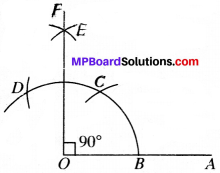
Construct an angle of 90° at the initial point of a given ray and justify the construction.
Solution:
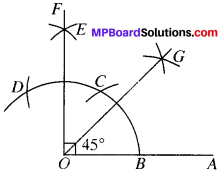
MP Board Class 9th Maths Solutions Chapter 11 Constructions Ex 11.1 img-1

  1. Draw a ray OA and with O as centre and any radius, draw an arc, cutting OA at B.
  2. With B as centre and the same radius draw an arc cutting the arc drawn in step (i) at C.
  3. With C as centre draw another arc with same radius cutting the arc drawn in step (i) at D.
  4. with C as centre and the same radius draw an arc.
  5. With D as centre and the same radius draw an arc, cutting the arc drawn in step (iv) at E.
  6. Draw OE ∴ ∠AOF = 90°

MP Board Solutions

Question 2.
Construct an angle of 45° at the initial point of a given ray justify the construction.
Solution:

  1. Draw ∠AOF = 90° by following the same steps for constructing a 90° angle.
  2. Draw OG, the bisector of ∠AOF.
  3. ∠AOF= 45°

MP Board Class 9th Maths Solutions Chapter 11 Constructions Ex 11.1 img-2

Question 3.
Construct the angle of the following measurements:
Solution:

  1. 30°
  2. 22 \(\frac{1}{2}\)°
  3. 15°

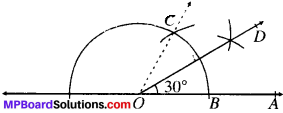
1. 30°

  1. Draw a ray OA.
  2. With O as centre and any radius draw an arc which intersect OA at B.
  3. With B as centre and same radius draw an arc cutting the arc drawn is step (ii) at C.
  4. Join OC and produce upward
  5. ∠BOC = 60°
  6. Draw the bisector OD of ABOC.
  7. ∠BOD = ∠COD = 30°

MP Board Class 9th Maths Solutions Chapter 11 Constructions Ex 11.1 img-3
2. 22 \(\frac{1}{2}\)°

  1. Draw a ray OA.
  2. With O as centre and any radius draw an arc which intersect intersect CM at B.
  3. With B as centre and same radius draw an arc intersecting the arc drawn in step (ii) at C.
  4. With C as centre and same radius draw an arc cutting the arc drawn in step (ii) at D.
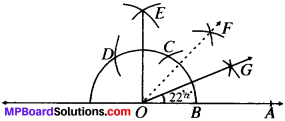
    MP Board Class 9th Maths Solutions Chapter 11 Constructions Ex 11.1 img-4
  5. With C and D as centres and same radius draw arcs to intersect at E.
  6. Join OE.
  7. ∠AOG – 90°
  8. Draw the bisector OE of ∠AOE, to get ∠AOF = 45°
  9. Draw the bisector OG of ∠AOF.
  10. ∠AOG = 22\(\frac{1}{2}\)°

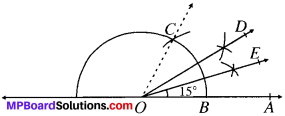
3. 15°

  1. Draw a ray CM.
  2. With O as centre and any radius draw an arc which intersect CM at B.
  3. With B as centre and same radius draw an arc intersecting the arc drawn in step (ii), at C.
  4. Draw OD as the bisector of ZAOC.
  5. ∠BOD = 30°
  6. Draw the bisector OE of ∠AOD.
  7. ∠AOE = 15°

MP Board Class 9th Maths Solutions Chapter 11 Constructions Ex 11.1 img-5

Question 4.
Construct the following angles and verily by measuring them by a protractor.

(i) 75°
(ii) 105°
(iii) 135°

Solution:
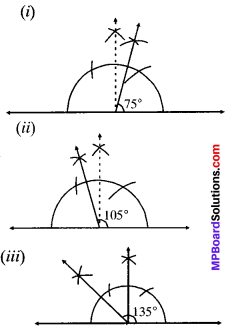
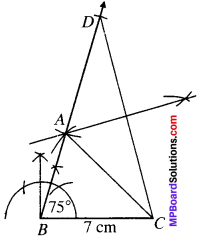
MP Board Class 9th Maths Solutions Chapter 11 Constructions Ex 11.1 img-6

Question 5.
Construct an equilateral triangle given its side and justify the construction.
Solution:

  1. Draw a ray AY with intial point A.
  2. With centred and radius equal to length of a side of the A draw an arc BY, cutting the ray AX at B.
  3. With centre B and the same radius draw an arc cutting are BY at C.
  4. Join AC and BC to obtain the required A.
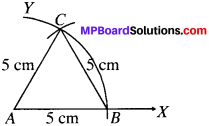
MP Board Class 9th Maths Solutions Chapter 11 Constructions Ex 11.1 img-7

Construction of Triangles:

Example 1:
Construction of a Triangle when its base, a base angle and sum of other two sides are given
Solution:
Step of Construction:

  1. Draw the base PQ.
  2. At point P draw an angle, MPQ equal to the given angle.
  3. Cut a line segment PM equal to sum of sides i.e., (PR + RQ) from point P.
  4. Join MQ.
  5. Draw the perpendicular bisector of MQ which intersect PM at R.
  6. Join QR. PQR is the required triangle.
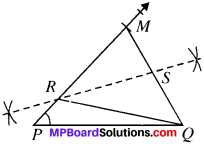
MP Board Class 9th Maths Solutions Chapter 11 Constructions Ex 11.1 img-8
Justification:
Mark points S as shown in Fig.
QS = MS (∴ RS is the perpendicular bisector of MQ)
RS = RS (Common)
∠QSR = ∠MSR (Each \({ 90 }^{ \underline { 0 } }\))
∆RSQ ≅ ∆RSQ (By SAS)
and so PQ = RM (By CPCT)
Now PR = PM – RM = PM – RQ
PM = PR + RQ.

MP Board Solutions

Example 2:
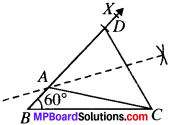
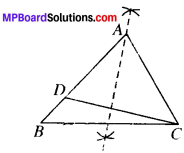
Construct a AABC in which BC = 3.6 cm, AB + AC = 4.8 and A RSM QS – MS RS = RS cm and B = ∠60°.
Solution:
Steps of Construction:

  1. Draw BC = 3.6 cm.
  2. Draw ∠CBX= \({ 60 }^{ \underline { 0 } }\) at B.
  3. From BX, cut off line segment BD = 4.8 cm.
  4. Join DC.
  5. Draw the perpcndicub: bisector ofDC meeting BD at A.
  6. joinAC.
  7. ABC is the required Mangle.

MP Board Class 9th Maths Solutions Chapter 11 Constructions Ex 11.1 img-9
Justification:
‘A‘ lies on the perpendicular bisector of DC
∴ AD = AC
Now BD = 4.8 cm
⇒ BA + AD = 4.8
BA + AC = 4.8 (∴ AD = AC)

Example 3:
Construction of a Triangle when its Base Angle and the Difference of the other two sides are given.
Solution:
Case I:
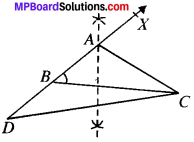
Given the base BC, a base angle, say ∠B and AB – AC. Steps of Construction:

  1. Draw the base BC.
  2. At point B draw an angle ∠CBX equal to the given angle.
  3. Cut a line segment BD = AB – AC from point B.
  4. Join DC.
  5. Draw the perpendicular bisector of . DC which intersect BX at A.
  6. Join AC.
  7. ΔABC is the required triangle.

MP Board Class 9th Maths Solutions Chapter 11 Constructions Ex 11.1 img-10
Justification:
As point A lies on the perpendicular bisector of DC
∴ AD = AC
BD = AB – AD = AB – AC (∴ AD = AC)

Case II:
Given the base BC, a base angle say ∠B and (AC – AB).
Steps of Construction:

  1. Draw the base SC.
  2. At point S, draw an angle, ∠CBX equal to the given angle and extend the arm XB backward.
  3. Cut a line segment BD equal to (AC – AB) from the extended arm.
  4. Join DC.
  5. Draw the perpendicular bisector of DC which intersect BX at A.
  6. Join AC.
  7. ΔABC is the required triangle.

MP Board Class 9th Maths Solutions Chapter 11 Constructions Ex 11.1 img-11
Justification:
As the perpendicular bisector of DC passes through A.
∴ AD – AC
BD = AD – AB
∴ BD = AC – AB

Example 4:
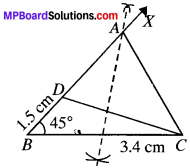
Construct a ∆ABC in which BC = 3.4 cm, AB – AC = 1.5 cm and ∠B = \({ 45 }^{ \underline { 0 } }\).
Solution:
Steps of Construction:

  1. Draw base BC = 3.4 cm.
  2. Draw ∠CBX = \({ 45 }^{ \underline { 0 } }\).
  3. From BX, cut line segment BD =1.5 cm.
  4. Join DC.
  5. Draw the perpendicular bisector of DC which intersect BX at A.
  6. Join AC.
  7. ABC is the required triangle.
MP Board Class 9th Maths Solutions Chapter 11 Constructions Ex 11.1 img-12
Justification:
As A lies on perpendicular bisector of DC.
AD = AC
BD = 1.5 cm
⇒ AB – AD =1.5 cm
AB – AC =1.5 cm

MP Board Solutions

Example 5:
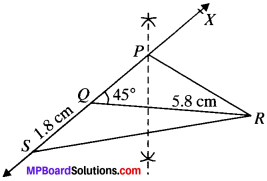
Construct a ∆PQR in which QR = 5.8 cm, PR – PQ = 1.8 cm and ∠Q = \({ 45 }^{ \underline { 0 } }\). Justify your construction.
Solution:
Steps of Construction:

  1. Draw base QR = 5.8 cm.
  2. Draw ∠RQP = \({ 45 }^{ \underline { 0 } }\).
  3. Produce arm XQ backward and cut a line segment QS = 1.8 cm.
  4. Join SR.
  5. bisector of SR which intersect QX at P.
  6. Join PR.
  7. PQR is the required triangle.

MP Board Class 9th Maths Solutions Chapter 11 Constructions Ex 11.1 img-13
Justification:
As P lies on perpendicular bisector of SR
PS = PR
QS = 1.8 cm
⇒ PS – PQ = 1.8 cm
∴ PR – PQ = 1.8 cm

Example 6:
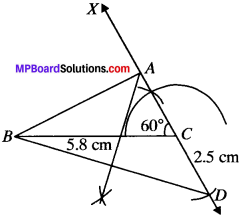
Construct a ∆ABC in which BC = 5.8 cm, ∠C = \({ 60 }^{ \underline { 0 } }\) and AB – AC = 2.5 cm.
Solution:
Steps of Construction:

  1. Draw base BC = 5.8 cm
  2. Draw ∠ACB = \({ 60 }^{ \underline { 0 } }\)
  3. Produce arm CX backward and cut a line segment CD = 2.5 cm.
  4. Join BD.
  5. Draw perpendicular bisector of BD which intersect CX at A.
  6. Join AB.
  7. ABC is the required triangle.
MP Board Class 9th Maths Solutions Chapter 11 Constructions Ex 11.1 img-14
Justification:
A lies on the perpendicular bisector of BD.
∴ AB =AD
CD = 2.5 cm
⇒ AD – AC = 2.5 cm
⇒ AB – AC = 2.5 cm

Example 7:
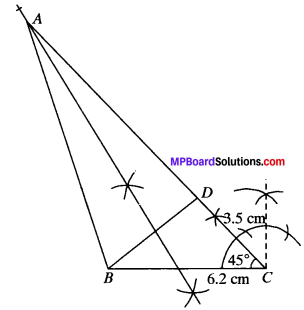
Construct a ∆ABC in which AC – AB = 3.5 cm, BC = 6.2 cm and ∠C = \({ 45 }^{ \underline { 0 } }\).
Solution:
Steps of Construction:

  1. Draw BC = 6.2 cm
  2. Draw ∠ACB = \({ 45 }^{ \underline { 0 } }\)
  3. Cut CD = 3.5 cm from CX.
  4. Join BD and draw the perpendicular bisector of BD which intersect CX at A.
  5. Join AB.
  6. ABC is the required triangle.
MP Board Class 9th Maths Solutions Chapter 11 Constructions Ex 11.1 img-15
Justification:
As A lies on the perpendicular bisector of BD.
∴ AB = AD
CD = 3.5 cm
⇒ AC – AD = 3.5 cm
∴ AC – AB = 3.5 cm

Example 8:
Construction of a Triangle when its Perimeter and Two Base Angles are given.
Solution:
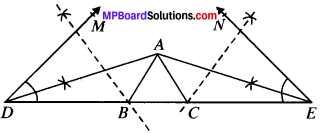
Given the base angles, ∠B and ∠C and perimeter, i.e., AB + BC + AC.
Steps of Construction:

  1. Draw a line segment, DE equal to AB + BC + CA.
  2. Draw ∠EDM and ∠DEN equal to the base angles ∠B and ∠C respectively.
  3. Draw bisectors of ∠MDE and ∠NED which intersect at A.
  4. Draw the perpendicular bisectors of AD and AE which intersect DE at B and C respectively.
  5. Join AE and AC.
  6. ABC is the required triangle.
MP Board Class 9th Maths Solutions Chapter 11 Constructions Ex 11.1 img-16
Justification:
As B lies on the perpendicular bisector of AD
∴ AB = DB
In ∆ADB
AB = DB
∠ADB = ∠DAB
(∴ Angles opposite to equal sides of a A are equal)
Similarly, AC = CE
and ∠CAE = ∠CEA
Now DE = DB + BC + CE
= AB + BC + AC
In ∆ABD, ∠ABC = ∠DAB + ∠ADB = ∠ADB + ∠ADB = 2∠ADB
In ∆ACE, ∠ACB = ∠CAE + ∠CEA = ∠CEA + ∠CEA = 2∠CEA

MP Board Solutions

Example 9:
Construct a triangle whose perimeter is 6.4 cm and angles at the base are \({ 60 }^{ \underline { 0 } }\) and \({ 45 }^{ \underline { 0 } }\).
Solution:
Steps of Construction:

  1. Draw line segment DE equal to (AB + BC + CA) = 6.4 cm
  2. Draw ∠EDM = \({ 60 }^{ \underline { 0 } }\) and ∠DEN = \({ 45 }^{ \underline { 0 } }\).
  3. Draw AD and AE as bisectors of ∠MDE and ∠NED which inter sect at A.
  4. Draw the perpendicular bisector of AD and AE which intersect DE at B and C respectively.
  5. Join AB and AC.
  6. ABC is the required triangle.
MP Board Class 9th Maths Solutions

MP Board Class 9th Science Solutions Chapter 11 Work and Energy

MP Board Class 9th Science Solutions Chapter 11 Work and Energy

Work and Energy Intext Questions

Work and Energy Intext Questions Page No. 148

Question 1.
A force of 7 N acts on an object. The displacement is, say 8 m, in the direction of the force (Fig. below). Let us take it that the force acts on the object through the displacement. What is the work done in this case?
MP Board Class 9th Science Solutions Chapter 11 Work and Energy 1
Answer:
The work done W on the body by the force is given by:
Work done = Force × Displacement
W = F × s
Given:
F = 7 N
s = 8 m
Hence, work done, W = 7 × 8
= 56 Nm
= 56 J.

Work and Energy Intext Questions Page No. 149

Question 1.
When do we say that work is done?
Answer:
We can say a work is done whenever the conditions given below are satisfied:

  1. A force is applied over the body.
  2. A displacement of the body is caused by the applied force, along the direction of the applied force.

Question 2.
Write an expression for the work done when a force is acting on an object in the direction of its displacement.
Answer:
When a force ‘F’ displaces a body by a distance ‘d’ in the direction of the applied force, then the work done ‘W’ on the body is given by:
Work done = Force × Displacement
W = F × d.

MP Board Solutions

Question 3.
Define 1 J of work.
Answer:
1 J is the amount of work done when an object is provided with a force of 1 N that displaces it through a distance of 1 m in the direction of the applied force.

Question 4.
A pair of bullocks exerts a force of 140 N on a plough. The field being ploughed is 15 m long. How much work is done in ploughing the length of the field?
Answer:
Here,
Applied force, F = 140 N
Displacement, d = 15 m
We know,
Work done is given by the expression:
Work done = Force × Displacement
W = F × d
So,
W= 140 × 15 = 2100 J
Hence, 2100 J of work is done in ploughing the length of the field.

Work and Energy Intext Questions Page No. 152

Question 1.
What is the kinetic energy of an object?
Answer:
The energy attained by or generated in a body due to its action or motion is called kinetic energy. Every object which possesses motion contain a kinetic energy. A body uses kinetic energy to do work. Kinetic energy can be used for any work to be performed. Kinetic energy is useful to generate other forms of energy too. It is expressed by KE and can be calculated by the following formula:
Ek = \(\frac { 1 }{ 2 }\) mv2
Here, m represents mass of object.
And ‘V’ gives the velocity by which object is shifting or working.

MP Board Solutions

Question 2.
Write an expression for the kinetic energy of an object.
Answer:
Energy Ek is proportional to:

  • Object’s mass and
  • Square of its velocity.

Energy Ek due to a moving object with a body mass ‘m’ which is moving with a velocity v, can be given by the expression,
Ek = \(\frac { 1 }{ 2 }\) mv2
Its S.I. unit is joule (J).

Question 3.
The kinetic energy of an object of mass, m moving with a velocity of 5 ms-1 is 25 J. What will be its kinetic energy when its velocity is doubled? What will be its kinetic energy when its velocity is increased three times?
Answer:
Given:
K.E. of the object = 25 J
Velocity of the object, v = 5 m/s
Putting value to formula:
∵ K.E = \(\frac { 1 }{ 2 }\) mv2

  • m = 2 × K.E / v2
  • m = 2 × \(\frac { 25 }{ 25 }\) = 2 kg

Condition 1:
If velocity is double, v = 2 × 5 = 10 m/s
∴ K.E. (for v = 10 m/s) = \(\frac { 1 }{ 2 }\) mv2 = \(\frac { 1 }{ 2 }\) × 2 × 100 = 100 J

Condition 2:
If velocity is tripled, v = 3 × 5 = 15 m/s
∴ K.E. (for v = 10 m/s) = \(\frac { 1 }{ 2 }\) mv2 = \(\frac { 1 }{ 2 }\) × 2 × 225 = 225 J.

Work and Energy Intext Questions Page No. 156

Question 1.
What is Power?
Answer:
Work done is calculated by the amount of power consumption. Power can be understood by the term efficiency of an object to consume or generate energy. So, power is the rate of doing work or the rate of transfer of energy. If W is the amount of work done in time t, then power is given by the expression,
Power = \(\frac { Work }{ Time }\) = \(\frac { Energy }{ Time }\)
or
P = \(\frac { W }{ T }\)
It is calculated in watt (W).

Question 2.
Define 1 watt of power.
Answer:
As we know that:
Power = \(\frac { Work }{ Time }\)
Hence,
A body is said to have power of 1 watt if its work is equal to 1 joule in 1 s, i.e.,
1 W = \(\frac { 1J }{ 1s }\)

MP Board Solutions

Question 3.
A lamp consumes 1000 J of electrical energy in 10 s. What is its power?
Answer:
Power = \(\frac { Work }{ Time }\)
Given,
Work done = Energy consumed by the lamp = 1000 J
Time = 10 s
Putting values,
Power = \(\frac { 1000 }{ 10 }\) = 100 Js-1
= 100 W.

Question 4.
Define average power.
Answer:
When efficiency of an operator is changed with time, average power is calculated.
The average power of an object is defined as the total work done by it in the total time taken.
Total time taken
MP Board Class 9th Science Solutions Chapter 11 Work and Energy 2

Work and Energy NCERT Textbook Exercises

Question 1.
Look at the activities listed below. Reason out whether or not work is done in the light of your understanding of the term ‘work’.

  • Suma is swimming in a pond.
  • A donkey is carrying a load on its back.
  • A wind – mill is lifting water from a well.
  • A green plant is carrying out photosynthesis.
  • An engine is pulling a train.
  • Food grains are getting dried in the sun.
  • A sailboat is moving due to wind energy.

Answer:
Work is done whenever the two given conditions are satisfied:

  • A force is applied over the body.
  • A displacement of the body is caused by the applied force, along the direction of the applied force.

Hence, work is done in case:

  • Suma is swimming in a pond.
  • A wind – mill is lifting water from a well.
  • An engine is pulling a train.
  • A sailboat is moving due to wind energy.

Work is not being done in case:

  • A donkey is carrying a load on its back.
  • A green plant is carrying out photosynthesis.
  • Food grains are getting dried in the sun.

Explanation:

  1. Suma applies a force to push the water backwards which causes a displacement. Hence, work is done by Suma while swimming.
  2. While carrying a load, the donkey has to apply a force in the upward direction. But, displacement is exchanged with shifting, so the work done is zero.
  3. A wind – mill works against the gravitational force to lift water. Hence, work is done.
  4. In this case, chemical change occurs not a physical. Therefore, the work done is zero.
  5. An engine applies force to pull the train. Therefore, there is a displacement in the train in the same direction. Hence, work is done by the engine on the train.
  6. This is an example of evaporation. Hence, the work done is zero.
  7. Wind energy applies a force on the sailboat to push it in the forward direction. Therefore, there is a displacement in the boat in the direction of force. Hence, work is done by wind on the boat.

Question 2.
An object thrown at a certain angle to the ground moves in a curved path and falls back to the ground. The initial and the final points of the path of the object lie on the same horizontal line. What is the work done by the force of gravity on the object?
Answer:
Gravitational forces are proportional to ‘h’ which is vertical displacement and work done by the force of gravity is considered only if vertical displacement occurs. Vertical displacement is given by the difference in the initial and final positions / heights of the object which is zero. In this case work done by gravity is given by thy expression,
W = mgh
Where,
h = Vertical displacement = 0
W = mg × 0 = 0 J
Therefore, the work done by gravity on the given object is zero joule.

MP Board Solutions

Question 3.
A battery lights a bulb. Describe the energy changes involved in the process.
Answer:
When a battery lights a bulb, then the chemical energy of the battery is converted into electrical energy. When the bulb receives this electrical energy, then it converts it into light and heat energy. Hence, the transformation of energy is as follows:
Chemical Energy → Electrical Energy → Light Energy + Heat Energy

Question 4.
Certain force acting on a 20 kg mass changes its velocity from 5 ms-1 to 2 ms-1. Calculate the work done by the force.
Answer:
Kinetic energy is given by the expression, (Ek) = \(\frac { 1 }{ 2 }\) mv2.
Where,
Ek = Kinetic energy of the object moving with a velocity,
v Kinetic energy when the object was moving with a velocity 5 ms-1.
(Ek)5 = \(\frac { 1 }{ 2 }\) × 20 × (5)2 = 250 J
Kinetic energy when the object was moving with a velocity 2 ms-1.
(Ek)2 = \(\frac { 1 }{ 2 }\) × 20 × (2)2 = 40 J

Question 5.
A mass of 10 kg is at a point A on a table. It is moved to a point B. If the line joining A and B is horizontal, what is the work done on the object by the gravitational force? Explain your answer.
Answer:
Work done by gravity depends only on the vertical displacement of the body. It does not depend upon the path of the body.
Therefore, by the expression,
W = mgh
Here,
Vertical displacement, h = 0
W = mg × 0 = 0
Hence, the work done by gravity on the body is zero.

Question 6.
The potential energy of a freely falling object decreases progressively. Does this violate the law of conservation of energy? Why?
Answer:
No. In freely falling object only potential energy decreases progressively, but at same time kinetic energy increases and total of both remains equal to initial energy.
Total energy = Potential energy + Kinetic energy
So, this process does not violate the law of conservation of energy. During the process, total mechanical energy of the body remains equal.

Question 7.
What are the various energy transformations that occur when you are riding a bicycle?
Answer:
When we ride a bicycle, the chemical energy of muscles of rider’s body gets transferred into heat energy and kinetic energy of the bicycle. Heat energy is changed to physical energy. Kinetic energy provides a velocity to the bicycle. The transformation can be shown as:
Muscular energy → Kinetic energy + Heat energy
During the transformation, the total energy remains conserved.

MP Board Solutions

Question 8.
Does the transfer of energy take place when you push a huge rock with all your might and fail to move it? Where is the energy you spend going?
Answer:
When we push a huge rock, there is no transfer of muscular energy to the stationary rock. Here, the energy is completely spent doing work (pushing) against friction between the ground and the rock.

Question 9.
A certain, household has consumed 250 units of energy during a month. How much energy is this in joules?
Answer:
1 unit of energy is equal to 1 kilowatt hour (kWh).
1 unit = 1 kWh
1 k Wh = 3.6 × 10⁶ J
Therefore, 250 units of energy
= 250 × 3.6 × 106 = 9 × 10⁸ J.

Question 10.
An object of mass 40 kg is raised to a height of 5 m above the ground. What is its potential energy? If the object is allowed to fell, find its kinetic energy when it is half – way down.
Answer:
Gravitational potential energy is given by the expression,
W = mgh
Where,
h = Vertical displacement = 5 m
m = Mass of the object = 40 kg
g = Acceleration due to gravity = 9.8 ms-2
∴ W = 40 × 5 × 9.8 = 1960 J.
At half – way down, the potential energy of the object will be \(\frac { 1960 }{ 2 }\) = 980 J.
At this point, the object has an equal amount of potential and kinetic energy.
This is due to the law of conservation of energy.
Hence, half – way down, the kinetic energy of the object will be 980 J.

MP Board Solutions

Question 11.
What is the work done by the force of gravity on a satellite moving round the earth? Justify your answer.
Answer:
Work is done whenever the two given conditions are satisfied:

  1. A force acts on the body.
  2. There is a displacement of the body by the application of force in or opposite to the direction of force.

If the direction of force is perpendicular to displacement, then the work done is zero. When a satellite moves around the Earth, then the direction of force of gravity on the satellite is perpendicular to its displacement. Hence, the work done on the satellite by the Earth is zero.

Question 12.
Can there be displacement of an object in the absence of any force acting on it? Think. Discuss this question with your friends and teacher.
Answer:
Yes. For a uniformly moving object, suppose an object is moving with constant velocity. The net force acting on it is zero. But, there is a displacement along the motion of the object. Hence, there can be a displacement without a force.

Question 13.
A person holds a bundle of hay over his head for 30 minutes and gets tired. Has he done some work or not? Justify your answer.
Answer:
When a person holds a bundle of hay over his head, then there is no displacement in the bundle of hay. And since
displacement of the body by the application of force is required to prove that work is done, no work is done here.
Here, force of gravity is acting on the bundle, but the person 1 is not applying any force on it. Hence, in the absence of force, work done by the person on the bundle is zero.

Question 14.
An electric heater is rated 1500 W. How much energy does it use in 10 hours?
Answer:
Energy consumed by an electric heater can be obtained with the help of the expression,
P = \(\frac { W }{ t }\)
Where,
Power rating of the heater, P = 1500, W = 1.5 kW
Time for which the heater has operated, t = 10 h
Work done = Energy consumed by the heater
Therefore,
Energy consumed = Power × Time = 1.5 × 10 = 15 kWh
Hence, the energy consumed by the heater in 10 h is 15 kWh.

MP Board Solutions

Question 15.
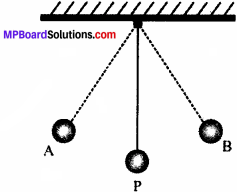
Illustrate the law of conservation of energy by discussing the energy changes which occur when we draw a pendulum bob to one side and allow it to oscillate. Why does the bob eventually come to rest? What happens to its energy eventually? Is it a violation of the law of conservation of energy?
Answer:
According to law of conservation of energy, energy can be neither created nor destroyed. It can only be converted from one form to another. Considering the case of an oscillating pendulum.
MP Board Class 9th Science Solutions Chapter 11 Work and Energy 3
When a pendulum moves from its actual position P to either of its extreme point A or B, it rises through a height h above the mean level P. Here at this point, the kinetic energy of the bob changes into potential energy and the kinetic energy becomes zero, and the bob possesses only potential energy.

When it moves towards point P, its potential energy decreases progressively. And the kinetic energy increases. As the bob reaches point P, its potential energy becomes zero and the bob possesses only kinetic energy. This process is repeated as long as the pendulum oscillates.

The pendulum loses its kinetic energy to overcome atmospheric friction and stops after some time. Hence law of conservation of energy is not violated and the total energy of the pendulum and the surrounding system remain conserved.

Question 16.
An object of mass, m is moving with a constant velocity, v. How much work should be done on the object in order to bring the object to rest?
Answer:
We know that Kinetic energy of an object of mass m, moving with a velocity, v is given by:
Ek = \(\frac { 1 }{ 2 }\) mv2
To bring the object to rest, total energy must be consumed.
So, \(\frac { 1 }{ 2 }\) mv2 amount of work is required to be done on the object.

Question 17.
Calculate the work required to be done to stop a car of 1500 kg moving at a velocity of 60 km/h?
Answer:
Kinetic energy, Ek = \(\frac { 1 }{ 2 }\) mv2
Where,
Mass of car, m = 1500 kg
Velocity of car, v = 60 km/h
= 60 × \(\frac { 5 }{ 18 }\) ms-1
Ek = \(\frac { 1 }{ 2 }\) × 1500 × [60 × \(\frac { 5 }{ 18 }\)]2
= 20.8 × 10⁴ J.
Hence, 20.8 × 10⁴ J of work is required to stop the car.

Question 18.
In each of the following a force, F is acting on an object of mass, m. The direction of displacement is from west to east shown by the longer arrow. Observe the diagrams carefully and state whether the work done by the force is negative, positive or zero.
MP Board Class 9th Science Solutions Chapter 11 Work and Energy 4
Answer:
Case I: Here, the direction of force acting on the block is perpendicular to the displacement. Therefore, work done will be zero.

Case II: Here, the direction of force acting on the block is in the direction of displacement. Therefore, work done will be positive.

Case III: Here, the direction of force acting on the block is opposite to the direction of displacement. Therefore, work done will be negative.

MP Board Solutions

Question 19.
Soni says that the acceleration in an object could be zero even when several forces are acting on it. Do you agree with her? Why?
Answer:
When all the forces cancel out each other, acceleration in an object will be zero even when several forces are acting on it. And as for a uniformly moving object, the net force acting on the object is zero. Hence, the acceleration of the object is zero. Hence, Soni is right.

Question 20.
Find the energy in kWh consumed in 10 hours by four devices of power 500 W each.
Answer:
We know,
P = \(\frac { W }{ t }\)
Given,
Power of the device (P) = 500 W = 0.50 kW
Total Time (t) = 10 h
Since,
Work done = Energy consumed by the device
Therefore, energy consumed
= Power × Time = 0.50 × 10 = 5 kWh
Hence, the energy consumed by four equal rating devices in 10 h will be:
4 × 5 kWh = 20 kWh
= 20 Units.

Question 21.
A freely falling object eventually stops on reaching the ground. What happens to its kinetic energy?
Answer:
As the object hits the ground, its kinetic energy gets converted into heat energy and sound energy. Sometimes, it also deform the ground and itself depending upon the nature of the ground and the amount of kinetic energy of the object. Freely falling object towards the ground feels following changes:

  • Its potential energy decreases and kinetic energy increases.
  • When the object touches the ground, all its potential energy gets converted into kinetic energy.

Work and Energy Additional Questions

Work and Energy Multiple Choice Questions

Question 1.
S.I. unit of work is ____________ .
(a) Newton
(b) Joule
(c) Watt
(d) All.
Answer:
(b) Joule

Question 2.
Work done is applied and displacement occurred is acute ____________ .
(a) Negative
(b) Zero
(c) Positive
(d) None.
Answer:
(c) Positive

Question 3.
Work done is negative, if angle formed between force applied and displacement occurred is ____________ .
(a) Obtuse
(b) Right angle
(c) Acute
(d) Zero.
Answer:
(a) Obtuse

Question 4.
Work is done if displacement of object occurs in ____________ .
(a) Opposite the direction of force
(b) The direction of force
(c) Zero
(d) Infinite.
Answer:
(b) The direction of force

MP Board Solutions

Question 5.
Force is to work done ____________ .
(a) Inverse
(b) Zero
(c) Proportional
(d) Infinite.
Answer:
(c) Proportional

Question 6.
If direction of applied force and displacement are perpendicular then resultant work will be ____________ .
(a) Zero
(b) Positive
(c) Negative
(d) Infinite.
Answer:
(a) Zero

Question 7.
Writing for two hours is equal to work ____________ .
(a) 1 joule
(b) 2 joule
(c) Zero
(d) None.
Answer:
(c) Zero

Question 8.
Falling ball will have ____________ .
(a) Kinetic energy
(b) Potential energy
(c) Both
(d) None.
Answer:
(c) Both

MP Board Solutions

Question 9.
If mass of an object is doubled over a pully, force required to displacement upto previous destination will be ____________ .
(a) Double
(b) Half
(c) Four times
(d) Equal.
Answer:
(a) Double

Question 10.
Change in kinetic energy, if velocity of an object is doubled will be ____________ .
(a) Double
(b) Half
(c) Equal
(d) 4 times.
Answer:
(d) 4 times.

Question 11.
Rate at which work is done is called ____________ .
(a) Work
(b) Power
(c) K.E.
(d) P.E.
Answer:
(b) Power

Question 12.
Running wings of a fan shows an example of ____________ .
(a) K.E.
(b) P.E.
(c) Work
(d) Power.
Answer:
(a) K.E.

Work and Energy Very Short Answer Type Questions

Question 1.
Give a formula / expression to give total energy.
Answer:
Total energy = Potential energy + Kinetic energy.

Question 2.
How displacement is related to work?
Answer:
Displacement is proportionally related to work.

MP Board Solutions

Question 3.
What is a positive work?
Answer:
When displacement occurs in direction of force applied and object shifted forms an acute angle with force, work is termed as positive.

Question 4.
What kind of force is applied in a lift?
Answer:
Upward and gravitational force is applied in a lift.

Question 5.
What kind of quantity is power?
Answer:
It is scalar.

Question 6.
What will be the potential energy of an object at ground?
Answer:
PE = mgh
Here, h = 0
So, PE = mg.

Question 7.
What will be the work done if no force is being applied?
Answer:
Since, W = F × S
If F = 0;
W = 0 × S
Hence, W = 0
∴ No work will be done.

Question 8.
Name three forms of energy.
Answer:
Potential energy, Kinetic energy and Gravitational energy.

Question 9.
Write expression to calculate kinetic energy if mass of an object is m and its velocity is v.
Answer:
K.E. = \(\frac { 1 }{ 2 }\) mv2.

Question 10.
Write expression for potential energy for an object being shifted to ‘d’ height and ‘a’ mass.
Answer:
PE = agd.

Question 11.
If a machine consumes 1000 J of energy in a second and runs for 5 hours, then calculate total energy consumed.
Answer:
P = \(\frac { W }{ t }\)
= 1000 × (5 × 3600)
= 18000000 joule
or
= 1.8 × 10⁷ joule.

MP Board Solutions

Question 12.
What happen to potential and kinetic energy of a falling object?
Answer:
P.E. = decrease to zero
K.E. = increase from zero
Total P.E. converts to K.E.

Work and Energy Short Answer Type Questions

Question 1.
If a pulley is pulling a box towards itself with a force equal to 10 N and have drawn the box upto 2 m. Calculate the work done by it.
Answer:
Given, F = 10 N and s = 2 m
We know W = F × s
Putting values = 10 × 2
W = 20 Nm
or
20 J.

Question 2.
If a hammer operates over a pully machine with 21 J and pulls the balls to 7 m, Calculate the force applied by the hammer.
Answer:
Given:
W = 21 J and s = 7 m
Using formula W = \(\frac { F }{ s }\)
or
F = \(\frac { W }{ s }\)
Putting values F = \(\frac { 21 }{ 7 }\) = 3 N
Hence, F = 3 N was applied by the hammer.

Question 3.
Calculate the work done by a pair of bullocks if an object is pulled by them for 10 m which has mass equal to 20 kg and an acceleration of 20 ms-1.
Answer:
Given, m = 20 kg, a = 20 ms-1, s = 10 m
Using formula W = F × s
or
W = m × a × s
Putting values = 20 × 20 × 10
= 4000 kg ms-2 m = 4000 J.

Question 4.
Give two examples of energy produced due to work or action.
Answer:
Examples showing production of kinetic energy:

  1. Heat energy in body after exercise.
  2. Generation of kinetic energy in a ball after falling through a point.

Question 5.
Read the following examples and tell in which case work is being done?

  1. Manish is riding bicycle in a circular path.
  2. John throws a pebble which comes back to initial height of ground.
  3. Reading books for 2 hours.
  4. Cooking pizza.

Answer:
Work is being done in none case because:

  1. Case 1: In a circular path displacement is zero, hence work done is zero.
  2. Case 2: Again no displacement occurs.
  3. Case 3: Any kind of force is not being used, hence zero work.
  4. Case 4: No force is applied here, so zero work.

MP Board Solutions

Question 6.
(a) Under what conditions work is said to be done?
(b) A porter lifts a luggage of 1.5 kg from the ground and puts it on his head 1.5 m above the ground. Calculate the work done by him on the luggage.
Answer:
(a) Conditions for work to be done:

  1. Force should be applied.
  2. Body should move in the line of action of force.
  3. Angle between force and displacement should not be 90°.

(b) Given,
Mass of luggage, m = 15 kg
Displacement, s = 1.5 m
Using formula:
Work done i.e., W = F × s = mg × s
= 15 × 10 × 1.5 = 225 J.

Question 7.
Four persons jointly lift a 250 kg box to a height of 1 m and hold it.

  1. Calculate the work done by the persons in lifting the box.
  2. How much work is done for just holding the box?
  3. Why do they get tired while holding it? (g = 10 ms2)

Answer:

  1. Given, F = 250 × 10 = 2500 N
    s = 1 m
    W = F × s = 2500 × 1 = 2500 J.
  2. Zero work, as there is no displacement.
  3. Men are applying a force which is opposite and equal to the gravitational force acting on the box. Muscular effort is involved and therefore persons feel tried.

Question 8.
(i) Justify that “a body at a greater height has larger energy”.
(ii) A body of mass 2 kg is thrown up at a velocity of 10 m/s. Find the potential energy at the highest point.
Answer:
(i) When an object is placed at a greater height, the height increases from the reference level (Velocity remains constant i.e., zero). Hence by comparing the potential energy at two points, we can see that the P.E. at greater height will be larger.

(ii) Given,
Using formula m = 2 kg, v = 10 m/s
Initial KE = \(\frac { 1 }{ 2 }\) mv2
= \(\frac { 1 }{ 2 }\) × 2 × (10)2 = 100 J
Height will be
h = \(\frac { { v }^{ 2 }-{ u }^{ 2 } }{ 2g } \) = \(\frac { { 0 }^{ 2 }-{ 10 }^{ 2 } }{ 2×10 } \)
= \(\frac { -100 }{ 20 }\) = -5 m
So, magnitude of height = 5 m and
P.E. at highest point = mgh
= 2 × 10 × 5
= 100 J.

Question 9.
A light and a heavy object have the same momentum. What is the ratio of their kinetic energies? Which one has a larger kinetic energy?
Answer:
p1 = m1v1, p2 = m2v2
But p1= p2  or  m1v1 = m2v2
and If m1 < m2 then v1 > v2
(K.E.)1 = \(\frac { 1 }{ 2 }\) m1v12
(K.E.)2 = \(\frac { 1 }{ 2 }\) m2v22
(K.E.)1 = \(\frac { 1 }{ 2 }\) (m1v1)v1 = \(\frac { 1 }{ 2 }\) p1v1
(K.E.)2 = \(\frac { 1 }{ 2 }\) (m2v2)v2 = \(\frac { 1 }{ 2 }\) p2v2.

Question 10.
(i) Define 1 kWh. Relate it to joules.
(ii) Find the energy in kWh in the month of September by four devices of power 100 W each, if each one of them is used for 10 hours daily.
Answer:
(i) 1 kWh is the energy used in 1 hour at the rate of 1000 J/s (or 1 kW)
1 kWh = 3.6 × 10⁶ J

(ii) Energy consumed by four devices in the month of September
= 4 × \(\frac { 100 }{ 1000 }\) × 10 × 30
= 120 kWh.

Work and Energy Long Answer Type Questions

Question 1.
(i) Give SI unit and commercial unit of electrical energy.
(ii) Calculate the power of an electric motor that can lift 800 kg of water to store in a tank at a height of 1500 cm in 20 s. (g = 10 m/s2)
(iii) A lamp consumes 500 J of electrical energy in 20 seconds. What is the power of the lamp?
Answer:
(i) SI unit of electrical energy is Joules (J).
Commercial unit of electrical energy is kilowatt hour (kWh)

(ii) Given,
m = 800 kg,
h = 1500 cm = 15 m,
t = 20 sec, g = 10 m/s2
Using formula,
P = \(\frac { W }{ t }\) = \(\frac { mgh }{ t }\)
= \(\frac { 800×10×15 }{ 20 }\) = 600 W.

(iii) Given,
E = 500 J, t = 20 sec
Using formula,
power P = \(\frac { W }{ E }\) = \(\frac { 500 }{ 20 }\) = 25W.
& r E 20

MP Board Solutions

Question 2.
(i) Name the commercial unit of electrical energy.
(ii) Establish the relationship between the SI unit and the commercial unit of electric energy.
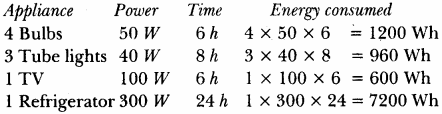
(iii) If 4 bulbs of 50 W for 6 hours, 3 tube lights of 40 W for 8 hours, a T.V of 100 W for 6 hours, a refrigerator of 300 W for 24 hours are used. Calculate the electricity bill amount for a month of 30 days. The cost per unit is ? ₹2.50.
Answer:
(i) The commercial unit of energy is kilowatt hour (kWh)
(ii) The SI unit of energy is joule.
Now, 1 kWh = 1 kW × 1 h
= 1000 W × 1 h
= 1000 W × 3600 s
= 3600000 J
= 3.6 × 10⁶ J
1 kWh = 3.6 × 10⁶ J

(iii)
MP Board Class 9th Science Solutions Chapter 11 Work and Energy 7
Total energy consumed = 9960 Wh = 9.960 kWh
Electricity bill amount = 9.960 units × ₹2.50 = ₹24.90
For 30 days = 30 × 24.90 = ₹747.

Question 3.
(i) Name the physical quantity defined by rate of doing work. Define its SI unit.
(ii) Why is concept of average power useful? How is it determined?
(iii) A boy of mass 45 kg runs up a staircase of 45 steps in 9 s. If the height of each step is 15 cm, find his power.
(g = 10 m/s2)
Answer:
(i) Power: Watt or J/s. 1 watt is the power of an object which does work at the rate of 1 J per second.

(ii) Power of an object may vary. Hence, average power is important in the case when the average power of the entire process within a given time is calculated.
MP Board Class 9th Science Solutions Chapter 11 Work and Energy 6

(iii) P = \(\frac { mgh }{ t }\) = \(\frac { (50×10×45×0.15) }{ 9 }\) = 375 W.

Question 4.
(i) A body of mass 15 kg possesses kinetic energy of 18.75 kJ. Find the velocity.
(ii) An electric bulb of 100 W is used for 4 hours a day. Calculate the energy consumed by it in a day in joules and kilowatt hour unit.
Answer:
(i) K.E. = \(\frac { 1 }{ 2 }\) mv2
= 18.75 kJ = 18750
v2 = \(\frac { 18750×2 }{ 15 }\)
v = √2500 m/s = 50 m/s

(ii) E = \(\frac { P }{ t }\) = 100 W × 4 h = 0.4 kWh
Energy consumed by it in a day = 0.4 × 3.6 × 106 J
= 1.44 × 10⁶ J

MP Board Solutions

Question 5.
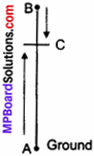
(a) A stone is thrown upwards from a point A, as shown in the figure. After reaching the highest point B, it comes down. Explain the transformation of energy from A to B and B to A and also mention the type of energy possessed by the stone at point A, B and C of its journey.
(b) A body of mass 20 kg is dropped from a height of 100 m. Find its K.E. and P.E. after,
(i) First second
(ii) Second second
(iii) Third second
Answer:
(a) While moving upward (A to B) K.E → P.E. and while moving downward (B to A)
P.E.→ K.E.
At,
A → K.E.
B → P.E.
C → K.E. + P.E.

(b) Total Energy = mgh
= 20 × 10 × 100 = 2 × 10⁴ J

MP Board Class 9th Science Solutions Chapter 11 Work and Energy 5
(i) After first, second: v = u + gt ms-1
= 10 × 1 = 10 m/s
K.E. = \(\frac { 1 }{ 2 }\) mv2.
= \(\frac { 1 }{ 2 }\) × 20 × 10 × 10
= 1000 J
P.E.= T.E. – K.E.
= 20,000 – 1000 = 19,000 J

(ii) After second, second: v = 20 ms-1
K.E. = mgh + \(\frac { 1 }{ 2 }\) mv2.
= 4,000 J
P.E. = T.E – K.E.
= 20,000 – 4,000 = 16,000 J

(iii) After third, second: v = 30 ms-1
K.E. = mgh + \(\frac { 1 }{ 2 }\) mv2.
= 9,000 J
P.E. = T.E.- K.E.
= 20,000 – 9,000 = 11,000 J

Work and Energy Higher Order Thinking Skills (HOTS)

Question 1.
Earth and other planets moves continuously around the sun. Do they work?
Answer:
No, Earth and other planets do not work while moving around the earth because they move in a circular path and reach the initial point after sometimes, so shows no displacement, hence no work is done by earth and other planets.

MP Board Solutions

Question 2.
Generally heavy objects exert more power over other objects. Give reason.
Answer:
As expression, P = wit
On expanding, P = \(\frac { m.a.s }{ t } \)
Here, P is proportional to mass in p × m
Hence, heavy object exert more pressure or power.

VI. Value-Based Question

Question 1.
Ravi saw a lady labour who carried stones on her head from one point of the construction site to the other end which was some 500 m far. He prepares a trolley for the labour to carry the stones, to make her work easier:

  1. Is any work done by the labour while carrying the stones from point A to point B on head by lady labour in the construction site?
  2. Is any work done by pulling the trolley of stones from point A to point B?
  3. What value of Ravi is seen in the above act?

Answer:

  1. No work is said to be done in carrying the stones from point A to B on head by the lady.
  2. Work is said to be done by pulling the trolley of stones.
  3. Ravi showed kindness, general awareness and sympathy.

MP Board Class 9th Science Solutions

MP Board Class 7th Science Solutions Chapter 7 Weather, Climate and Adaptations of Animals of Climate

MP Board Class 7th Science Solutions Chapter 7 Weather, Climate and Adaptations of Animals of Climate

Weather Climate and Adaptations of Animals of Climate  Intext Questions

Question 1.
I wonder who prepares the wheather report?
Answer:
The weather reports are prepared by the Meteorological Department of the Government.

Question 2.
I wonder why weather changes so frequently?
Answer:
Because factors affecting weather like temperature, humidity, etc. vary frequently.

Question 3.
What is the source of whether in the first place?
Answer:
All changes in the weather are caused due to sun.

Question 4.
Do fishes and butterflies also migrate like birds?
Answer:
No.

MP Board Solutions

Activity
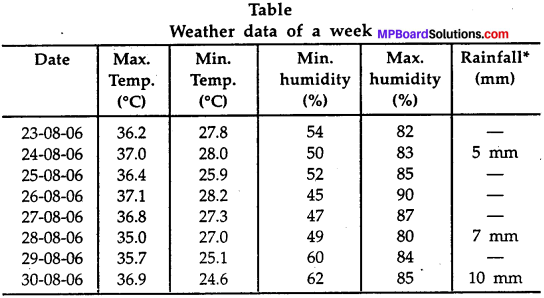
Fill all the columns according to the data in the chart that you have prepared.
Answer:
Table
Weather data of a week
MP Board Class 7th Science Solutions Chapter 7 Weather, Climate and Adaptations of Animals of Climate img-1
(Rainfall may not be recorded for all the days since it may not rain everyday.)

Weather, Climate and Adaptations of Animals of Climate Text Book Exercises

Question 1.
Name the elements that determine the weather of a place?
Answer:
The day – to – day condition of the atmosphere at a place with respect to the temperature, rainfall, humidity, wind – speed, etc., is called the weather at that place.

Question 2.
When are the maximum and minimum temperature likely to occur during the day?
Answer:
The maximum temperature of the day occurs generally in the afternoon while the minimum temperature occurs in the early morning.

MP Board Solutions

Question 3.
Fill in the blanks:

  1. The average weather taken over a long time is called …………..
  2. A place receives very little rainfall and the temperature is high throughout the year, the climate of that place will be ……………. and
  3. The two regions of the earth with extreme climatic conditions are ………….. and ……………

Answer:

  1. Climate of the place
  2. Hot, dry
  3. Tropical, polar regions.

MP Board Solutions

Question 4.
Indicate the type of climate of the following areas:

  1. Jammu and Kashmir –
  2. Kerala –
  3. Rajasthan –
  4. North – east India –

Answer:

  1. Moderately hot and moderately wet climate.
  2. Very hot and wet climate.
  3. Hot and dry climate.
  4. Wet climate.

Question 5.
Which of the two changes frequently weather or climate?
Answer:
Weather.

Question 6.
Following are some of the characteristics of animals:

  1. Diets heavy on fruits
  2. White fur
  3. Need to migrate
  4. Loud voice
  5. Sticky pads on feet
  6. Layer of fat under skin
  7. Wide and large paws
  8. Bright colours
  9. Strong tails
  10. Long and Large beak.

For each characteristic indicate whether it is adaptation for tropical rainforests or polar regions. Do you think that some of there characteristics can be adapted for both regions?
Answer:

  1. Tropical rainforests
  2. Polar region
  3. Polar region
  4. Tropical rainforesl
  5. Tropical rainforests
  6. Polar region
  7. Polar region
  8. Tropical rainforets
  9. Tropical rain.forests
  10. Tropical rainfore’t

Question 7.
The tropical rainforest has a large population of animals. Explain why it is so?
Answer:
Tropical rain are found in Western Ghats and Assam in India, South – east Asia, central America and Central Africa. Because of continuous warmth and rain, this region supports wide variety of plants and animals. The major types of animals living in the rainforests are apes, gorillas, monkeys, tigers, lions, leopards, lizards, elephants, insects, birds and snakes.

The climate conditions in rainforests are highly suitable for supporting an enormous number and variety of animals. Thus, we can say that because of the hospitable climate conditions huge populations of plants and animals are found in the tropical rainforests.

MP Board Solutions

Question 8.
Explain, with examples, why we find animals of certain kind living in particular climatic conditions?
Answer:
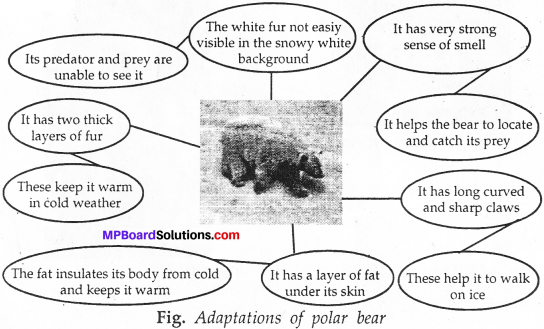
Animals are adapted to survive in the conditions in which they live. Animals living in very cold and hot climate must possess special features to protect themselves against the extreme cold or heat. Polar bears have white fur so that they are not easily visible in the snowy white background. It protects them from their predators. It also helps them in catching their prey. To protect them from extreme cold, they have two thick layers of fur.

They also have a layer of fat under their skin. In fact, they are so well – insulated that they have to move slowly and rest often to avoid getting overheated. Physical activities on warm days necessitate cooling. So, the polar bear goes for swimming. It is a good swimmer. Its paws are wide and large, which help it not only to swim well but also walk with ease in the snow. While swimming under water, it can close its nostrils and can remain under water for long durations.
MP Board Class 7th Science Solutions Chapter 7 Weather, Climate and Adaptations of Animals of Climate img-2
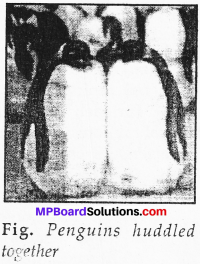
It has a strong sense of smell so that it can catch its prey for food. Another well – known animal living in the polar regions is the penguin (Fig.). It is also white and merges well wTith the white background. It also has a thick skin and a lot of fat to protect it from cold. You may have seen pictures of penguins huddled together. This they do to keep warm.

Question 9.
How do elephant living in the tropical rainforest adapt itself?
Answer:
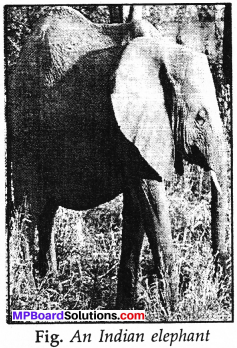
The elephant has adapted to the conditions of rainforests in many remarkable ways. Look at its trunk. It uses it as a nose because of whjch it has a strong sense of smell. The trunk is also used by it for picking up food. Moreover, its tusks are modified teeth. These can tear the bark of trees that elephant loves to eat.
MP Board Class 7th Science Solutions Chapter 7 Weather, Climate and Adaptations of Animals of Climate img-3
So, the elephant is able to handle the competition for food rather well. Large ears of the elephant help it to hear even very soft sounds. They also help the elephant to 4 keep cool in the hot and humid climate of the rainforest.

Choose the correct option which answers the following question:

Question 10.
A carnivore with stripes on its body moves very fast while catching its prey. It is likely to be found in

  1. Polar regions
  2. Deserts
  3. Oceans
  4. Tropical rainforests.

Answer:
4. Tropical rainforests.

MP Board Solutions

Question 11.
Which features adapt polar bears to live in extremely cold climate?

  1. A white fur, fat below skin, keen sense of smell.
  2. Thin skin, large eyes, a white fur.
  3. A long tail, strong claws, white large paws.
  4. White body, paws for swimming, gills for respiration.

Answer:
1. A white fur, fat below skin, keen sense of smell.

Question 12.
Which option best describes a tropical region?

  1. Hot and humid
  2. Moderate temperature, heavy rainfall
  3. Cold and humid
  4. Hot and dry.

Answer:
1. Hot and humid.

Extended Learning – Projects and Activities

Question 1.
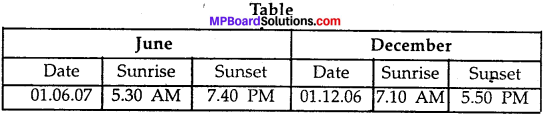
Collect weather reports of seven successive days in the winter months (preferably December). Collect similar reports for the summer months (preferably June). Now prepare a table for sunrise and sunset times as shown:
Table
MP Board Class 7th Science Solutions Chapter 7 Weather, Climate and Adaptations of Animals of Climate img-4

Try to answer the following questions:

  1. Is there any difference in the time of sunrise during summer and winter?
  2. When do you find that the sun rises earlier?
  3. Do you also find any difference in the time of sunset during the month of June and December?
  4. When are the days longer?
  5. When are the nights longer?
  6. Why are the days sometimes longer and sometimes shorter?
  7. Plot the length of the days against the days chosen in June and December?

Answer:

  1. Yes.
  2. Sunrises earlier during summer.
  3. Yes, sunsets earlier during winter.
  4. During summer, the days are longer.
  5. During winter, the nights are longer.
  6. Earth revolves around the sun. During different times, the angle of earth with the sun changes. This causes the difference in length of day and night.
  7. Length.

MP Board Solutions

Question 2.
Collect information about the Indian Meteorological Department. If possible visit its website: http//www.imd.gov.in. Write a brief report about the things this department does.
Answer:
Do with the help of your subject teacher.

Weather, Climate and Adaptations of Animals of Climate Additional Important Questions

Objective Type Questions

Question 1.
Choose the correct alternative:

Question (i)
The weather reports are prepared by the –
(a) Meteorological Department of the Government
(b) Agricultural Department of the Government
(c) Radio and TV Department of the Government
(d) None of these.
Answer:
(a) Meteorological Department of the Government

Question (ii)
The climate of the north – east is –
(a) Hot
(b) Wet
(c) Cold
(d) Dry.
Answer:
(b) Wet

Question (iii)
The climate of the western region is –
(a) Hot
(b) Wet
(c) Dry
(d) Hot and dry.
Answer:
(d) Hot and dry.

MP Board Solutions

Question (iv)
The lion – tailed macaque lives in the rainforests of –
(a) Western Ghats
(b) Eastern Ghats
(c) Both (a) and (b)
(d) None of these.
Answer:
(a) Western Ghats

Question (v)
Which are of the following is a migratory bird –
(a) Penguin
(b) Peacock
(c) Crow
(d) Siberian crane.
Answer:
(d) Siberian crane.

Question 2.
Fill in the blanks:

  1. The temperature, humidity and other factors are called the ……………. of the weather.
  2. Rainfall is measured by an instrument called the …………….
  3. All changes in the weather are caused by …………….
  4.  ……………. Record the weather every day.
  5. The polar regions are situated near the …………….
  6. Musk oxen, foxes, seals, etc. are living in the ……………. regions.
  7. The tropical region has generally a ……………. climate.
  8. Animals are adapted to the conditions in which they …………….
  9. Penguins lives in ……………. regions.
  10. The beard ape lives in the rainforests of …………….

Answer:

  1. Elements
  2. Rain gauge
  3. Sun
  4. Meteorologists
  5. Poles
  6. Polar
  7. Hot
  8. Live
  9. Very cold
  10. Western Ghats.

MP Board Solutions

Question 3.
Which of the following statements are true (T) or false (F):

  1. The weather is generally not the same on any two days and week after week.
  2. The camel is called the ship of the desert.
  3. The times of sunrise and sunset also change during the year.
  4. The climate of the Kerala is very cold for most part of the year
  5. Penguins lives in very cold.
  6. Animals are adapted to the conditions in which they live.
  7. All the changes in the weather are driven by the sun.
  8. Migration is another means to escape the harsh, cold conditions.
  9. Polar bears are found in Indian tropical rainforests.
  10. The winter sleep of animals is called migration.

Answer:

  1. True (T)
  2. True (T)
  3. True (T)
  4. False (F)
  5. True (T)
  6. True (T)
  7. True (T)
  8. True (T)
  9. False (F)
  10. False (F).

Question 4.
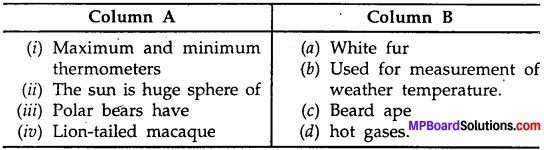
Match the items in Column A with Column B:
MP Board Class 7th Science Solutions Chapter 7 Weather, Climate and Adaptations of Animals of Climate img-5
Answer:

(i) (b)
(ii) (d)
(iii) (a)
(iv) (c)

Weather, Climate and Adaptations of Animals of Climate vert short  Answer Type Questions

Question 1.
Who prepares the weather report?
Answer:
The weather reports are prepared by the Metreological Department of the Government.

Question 2.
What do you mean by weather?
Answer:
The day – to – day condition of the atmosphere at a place with respect to the temperature, rainfall, wind speed, humidity, is called the weather of that place.

Question 3.
What do you mean by climate?
Answer:
The average weather pattern taken over a long time, say 25 years, is called the climate of the place.

Question 4.
When is the climate of a place called hot and wet?
Answer:
If there is heavy rainfall on most of the days as well as the temperature is high in the same place, then we can say that the climate of that place is hot and wet.

Question 5.
When is the climate of a place called hot?
Answer:
If the temperature at a place is high most of the time, then we say that the climate of that place is hot.

Question 6.
Why do some places have hotter climate than others?
Answer:
The places nearer to the equator are usually hotter. This is because the sim’s rays are more concentrated near the equator than they are farther North or South.

Question 7.
Which causes the changes in weather?
Answer:
Sun.

Question 8.
Name the location in India where climate is hot and dry?
Answer:
Rajasthan.

Question 9.
Name the location in India where climate is wet.
Answer:
North – east.

Question 10.
Define raingauge.
Answer:
Rainfall is measured by an instrument called the raingauge.

MP Board Solutions

Question 11.
Name two animals found in cold climate?
Answer:
Polar bear and Penguins.

Question 12.
Name two animals found in hot and humid climate.
Answer:
Beard ape and Red – eyed frog.

Question 13.
Name two deserts animal.
Answer:
Camel and snake.

Question 14.
Where does penguin live?
Answer:
Penguin lives in very cold places.

Question 15.
What makes penguins good swimmers?
Answer:
Penguin’s bodies are streamlined and their feet have webs, making them good swimmers.

Question 16.
How are the paws of a polar bear?
Answer:
Wide and large.

Question 17.
Can a polar bear live happily on land?
Answer:
No, it lives happily where the land is fully covered with snow.

Question 18.
Where do the elephant live ?
Answer:
Elephant lives in forest.

Question 19.
Name two countries where the tropical rainforests are found?
Answer:
India and Brazil.

Question 20.
Name two countries where polar regions are found?
Answer:
Sweden and Canada.

Question 21.
Name four countries in polar region?
Answer:
Norway, Iceland, Canada and Greenland.

MP Board Solutions

Question 22.
Name the major types of animals living in rainforest?
Answer:
The major types of animals living in the rainforests are apes, lions, tigers, monkeys, gorillas, elephants, leopards, snakes, birds and lizards.

Question 23.
Where do the following animals live?

  1. Fish
  2. Monkeys
  3. Snakes

Answer:

  1. In water
  2. On land and trees
  3. On land and water.

Question 24.
Name any two animals which are active during night?
Answer:
Owl and Bat.

Question 25.
Name the bird from Siberia that comes to India?
Answer:
Siberian Crane.

Weather, Climate and Adaptations of Animals of Climate Short Answer Type Questions

Question 1.
Differentiate between weather and climate?
Answer:
Difference between weather and climate:

Weather:
The day – to – day condition of the atmosphere at a place with respect to the temperature, rainfall, windspeed, humidity, etc. is called the weather at that place.

Climate:
The average weather pattern taken over a long time, say 25 years, is called the climate of that place.

Question 2.
Write a short note on the sun?
Answer:
All changes in the weather are caused by the sun. The sun is a huge sphere of hot gases at a very high temperature. The distance of the sun from us is very large. Even then the energy sent out by the sun is so huge that it is the source of all heat and light on the earth. So, the sun is the primary source of energy that causes changes in the weather.

Energy absorbed and reflected by the earth’s surface, oceans and the atmosphere play important roles in determining the weather at any place. If you live near the sea, you would have realised that the weather at your place is different from that of a place in a desert, or near a mountain.

MP Board Solutions

Question 3.
How do penguins adapt with polar climate?
Answer: Penguins are white and merge well with the white background. They also have a thick skin and a lot of fat to protect it from cold. Penguins huddle together. This they do to keep warm. Further, their bodies are streamlined and their feet have webs, making them good swimmers.

Question 4.
How is camel adapted to live in desert?
Answer:
Camel lives in desert. It has long legs which help it to lift its body above the ground. So, camel is able to avoid direct contact with the hot ground. Camel drinks more than 50 litres of water at a time. Camel store the water in his body. So that it lives without water for a longer time. Due to its thick skin, transpiration of water is also prevents. That’s why camel is suited to live in desert.

Question 5.
How are fishes adapted to live in water?
Answer:
Fishes are best suited to live in water. They have structure like a boat, which help them in swimming in water. They have gills from which they get food and oxygen. The body of fishes contain different types of fins which help them for swimming in water.

Question 6.
What is the climate of polar regions?
Answer:
The polar regions present an extreme climate. These regions are covered with snow and it is very cold for most part of the year. For six months the sun does not set at the poles while for the other six months the sun does not rise. In winters, the temperature can be as low as 37°C. Animals living there have adapted to these severe conditions.

Question 7.
Where the polar regions are situated? Name some of the countries that belong to the polar regions. Also name the some countries where the tropical rainforests are found.
Answer:
The polar regions are situated near the poles, i.e., north pole and south pole. Some well – known countries that belong to the polar regions are Canada, Greenland, Iceland, Norway, Sweden, Finland, Alaska in U.S.A. and Siberian region of Russia. Some countries where the tropical rainforests are found are India, Malaysia, Indonesia, Brazil, Republic of Congo, Kenya, Uganda, and Nigeria.

Question 8.
Write the features of lion – tailed macaque?
Answer:
The lion – tailed macaque (also called Beard ape) lives in the rainforests of Western Ghats. Its most outstanding feature is the silver – white mane, which surrounds the head from the cheeks down to its chin. It is a good climber and spends a major part of its life on the tree. It feeds mainly on fruits. It also eats seeds, young leaves, stems, flowers and buds. This beard ape also searches for insects under the bark of the trees. Since it is able to get sufficient food on the trees, it rarely comes down on the ground.

Weather, Climate and Adaptations of Animals of Climate Long Answer Type Questions

Question 1.
Answer:

MP Board Class 7th Science Solutions Chapter 7 Weather, Climate and Adaptations of Animals of Climate img-7

Question 2.
Write a note about “climate of the tropical rainforests”?
Answer:
The tropical region has generally a hot climate because of its location around the equator. Even in the coldest month the temperature is generally higher than about 15°C. During hot summers, the temperature may cross 40°C. Days and nights are almost equal in length throughout the year. These regions get plenty of rainfall. An important feature of this region is the tropical rainforests. Tropical rainforests are found in Western Ghats and Assam in India, Southeast Asia, Central America and Central Africa. Because of continuous warmth and rain, this region supports wide variety of plants and animals. The major types of animals living in the rainforests are monkeys, apes, gorillas, lions, tigers, elephants, leopards, lizards, snakes, birds and insects.

MP Board Solutions

Question 3.
For which animals the climatic conditions in rainforests are highly suitable?
Answer:
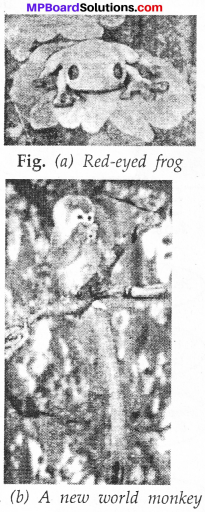
The climatic conditions in rainforests are highly suitable for supporting an enormous number and variety of animals. Since the numbers are large, there is intense competition for food and shelter. Many animals are adapted to living on the trees. Red – eyed frog (Fig. (a)) has developed sticky pads on its feet to help it climb trees on which it lives. To help them live on the trees, monkeys (Fig. (b)) have long tails for grasping branches. Their hands and feet are such that they can easily hold on to the branches.
MP Board Class 7th Science Solutions Chapter 7 Weather, Climate and Adaptations of Animals of Climate img-8

MP Board Class 7th Science Solutions

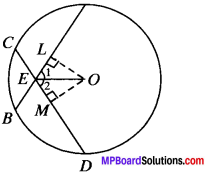
MP Board Class 9th Maths Solutions Chapter 10 Circles Ex 10.5

MP Board Class 9th Maths Solutions Chapter 10 Circles Ex 10.5

Question 1.
In the figure, A, B and C are three points on a circle with centre O such that ∠BOC = 30° and ∠AOB = 60°. If D is a point on the circle other than the arc ABC, find ∠ADC.
Solution:
We have a circle with centre O, such that ∠AOB = 60° and ∠BOC = 30°
MP Board Class 9th Maths Solutions Chapter 10 Circles Ex 10.5 img-1
∴ ∠AOB + ∠BOC = ∠AOC
∠AOB = 60° + 30° = 90°
Now, tne arc ABC subtends ∠AOC = 90° at the centre and ∠ADC at a point D on the circle other than the arc ABC.
∴ ∠ADC = \(\frac{1}{2}\) [∠AOC]
∠ADC = \(\frac{1}{2}\) (90°) = 45°

MP Board Solutions

Question 2.
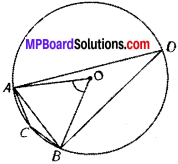
A chord of a circle is equal to the radius of the circle. Find the angle subtended by the chord at a point on the minor arc and also at a point on the major arc.
Solution:
We have a circle having a chord AB equal to radius of the circle.
∴ AO = BO = AB
∆AOB is an equilateral triangle.
Since, each angle of an equilateral triangle = 60
∠AOB = 60°
Since, the arc ACB makes reflex ∠AOB = 360° – 60° = 300° at the centre of the circle and ∠ABC at a point on the minor arc of the circle.
MP Board Class 9th Maths Solutions Chapter 10 Circles Ex 10.5 img-2
∠ACB = \(\frac{1}{2}\) [reflex ∠AOB]
= \(\frac{1}{2}\) [300°] = 150°
Similarly, ∠ADB = \(\frac{1}{2}\) [∠AOB]
= \(\frac{1}{2}\) x [60°] = 30°
Thus, the angle subtended by the chord on the minor arc = 150° and on the major arc = 30°.

Question 3.
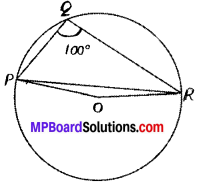
In the figure, ∠PQR = 100°, where P, Q and R are points on a circle with centre O. Find ∠OPR.
Solution:
The angle subtended by an arc of a circle at its centre is twice the angle subtended by the same arc at a point on the circumference.
MP Board Class 9th Maths Solutions Chapter 10 Circles Ex 10.5 img-3
∴ reflex ∠POR = 2∠PQR,
But ∠PQR = 100°
reflex ∠POR = 2 x 100° = 200°
Since, ∠POR + reflex ∠POR = 360°
∠POR + 200° = 360°
∠POR = 360° – 200°
∠POR = 160°
Since, OP = OR [Radii of the same circle]
∴ In ∆POR, ∠OPR = ∠ORP [Angles opposite to equal sides of a triangle are equal]
Also, ∠OPR + ∠ORP + ∠POR = 180° [Sum of the angles of a triangle = 180°]
∠OPR + ∠OPR + 160° = 180° [∴ ∠OPR = ∠ORP]
2∠OPR = 180° – 160° = 20°
∠OPR = \(\frac{20^{\circ}}{2}\) =10°

Question 4.
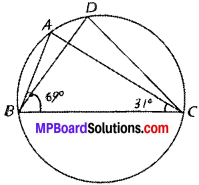
In the Figure, ∠ABC = 69°, ∠ACB = 31°, find ∠BDC.
Solution:
We have, in ∆ABC,
∠ABC = 69° and
∠ACB = 31°
MP Board Class 9th Maths Solutions Chapter 10 Circles Ex 10.5 img-4
But ∠ABC + ∠ACB + ∠BAC = 180°
∴ 69° +31° + ∠BAC = 180°
∠BAC = 180° – 69° – 31°
= 80°
Since, angles in the same segment are equal.
∴ ∠BDC = ∠BAC
∠BDC =80°

Question 5.
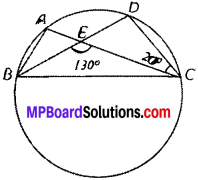
In the figure, A, B, C and D are four points on a circle. AC and BD intersect at a point E such that ∠BEC = 130° and ∠ECD = 20°. Find ∠BAC.
Solution:
In ∆CDE,
Exterior ∠BEC – ∠AED = 130°
MP Board Class 9th Maths Solutions Chapter 10 Circles Ex 10.5 img-5
130° = ∠EDC + ∠ECD
130° = ∠EDC + 20°
∠EDC = 130° – 20° = 110°
∠BDC = 110°
Since, angles in the same segment are equal.
∠BAC = ∠BDC
∠BAC = 110°

MP Board Solutions

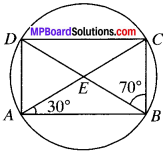
Question 6.
ABCD is a cyclic quadrilateral whose diagonals intersect at a point E. ∠DBC = 70°, ∠BAC is 30°, find ∠BCD. Further, if AB = BC, find ∠ECD.
Solution:
Given:
∠BAC = 30°, ∠DBC = 70°
To find:
∠BCD and ∠ECD.
∠BDC = ∠BAC = 30° (∠s on the same segment of a circle are equal)
MP Board Class 9th Maths Solutions Chapter 10 Circles Ex 10.5 img-6
In ∆BCD, 70° + 30° + ∠C = 180° (ASP)
100° + ∠C = 180°
∠C = 80°
AB = BC (Given)
∠BAC = ∠BCA = 30°
∠BCD = ∠BCA + ∠ECD
80° = 30° + ∠ECD
∠ECD – 50°

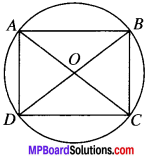
Question 7.
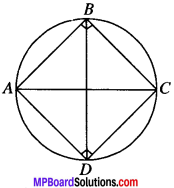
If diagonals of a cyclic quadrilateral are diameters of the circle through the vertices of the quadrilateral, prove that it is a rectangle.
Solution:
Given
ABCD is a cyclic quadrilateral in which AC and BD are diagonals.
To prove:
ABCD is a rectangle.
MP Board Class 9th Maths Solutions Chapter 10 Circles Ex 10.5 img-7
Proof:
BD is the diameter of the circle.
∠BAD = 90°(angle in a semicircle)
Similarly ∠BCD = 90°
AC is the diameter of the circle
∠ABC = 90° (angle in a semicircle)
Similarly ∠ADC = 90°
In quadrilateral ABCD, ∠A = ∠B = ∠C = ∠D = 90°
ABCD is a rectangle.

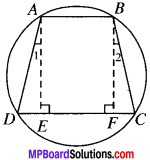
Question 8.
If the non-parallel sides of h trapezium are equal, prove that it is cyclic.
Solution:
Given:
AD = BC, AB ∥ DC.
To prove:
ABCD is cyclic quadrilateral.
Construction:
Draw AE and BF As on DC.
MP Board Class 9th Maths Solutions Chapter 10 Circles Ex 10.5 img-8
Proof:
In ∆ADE and ∆BCF
∴ AE = BF
(∴ Distance between two parallel lines are equal)
∠E = ∠F (Each 90°)
AD = BC (Given)
∆ADE = ∆BCF (By RHS)
and so ∠D = ∠C (By CPCT)
AB ∥ DC and AD is the transversal.
∴ ∠BAD + ∠ADC =180° (CIA’s)
⇒ ∠BAD + ∠BCD = 180° (∠ADC = ∠BCD)
∴ ABCD is cyclic quadrilateral.

MP Board Solutions

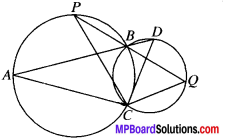
Question 9.
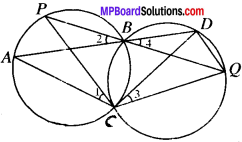
Two circles intersect at two points B and C. Through B, two line segments ABD and PBQ are J drawn to intersect the circles at A, D and Q respectively (see Fig.). Prove that ∠ACP = ∠QCD.
MP Board Class 9th Maths Solutions Chapter 10 Circles Ex 10.5 img-9
Solution:
Given
C (O, r) and C (O1, r1) are two circles. Two lines ABD and PBQ are drawn which intersect at B.
To prove:
∠1 = ∠3
MP Board Class 9th Maths Solutions Chapter 10 Circles Ex 10.5 img-10
Proof:
∠1 = ∠2 …(1) (Z s on the same segment of a circle are equal.)
∠3 = ∠4 …..(2) (Z s on the same segment of a circle are equal)
∠2 = ∠4 …(3) (OA’s)
From (1), (2) and (3), we get
∠1 = ∠3 …(2)

Question 10.
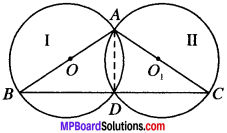
If circles are drawn taking two sides of a triangle as diameters, prove that the point of intersection of these circles lie on the third side.
Solution:
Given
C (O, r) and C (O1, r1) are two Circles in whichAB andAC are diameter. These circles intersect at point A and D.
To prove:
BDC is a line.
Construction: JoinAD.
Proof:
∠ADB = 90° (∠s in a semicircle)
∠ADC) = 90° (∠s in a semicircle)
MP Board Class 9th Maths Solutions Chapter 10 Circles Ex 10.5 img-11
Adding (1) and (2), we get
∠ADB + ∠ADC = 90° + 90°
∠BDC = 180°
∴ BDC is a line and hence D lies on the third side.

Question 11.
ABC and ADC are two right triangles with common hypotenuse AC. Prove that ∠CAD – ∠CBD.
Solution:
Given:
ABC and ADC are two right ∆’s on common base AC. ∠B – 90° and ∠D = 90°.
To prove: ∠CAD = ∠CBD
Proof:
∠ABC + ∠ADC = 90° + 90°
= 180°
MP Board Class 9th Maths Solutions Chapter 10 Circles Ex 10.5 img-12
ABCD is a cyclic quadrilateral.
∠CAD and ∠CBD are angles on the same segment of a circle.
∴ ∠CAD = ∠CBD.

MP Board Solutions

Question 12.
Prove that a cyclic parallelogram is a rectangle.
Solution:
Given: ABCD is a ∥gm
To prove: ABCD is a rectangle.
MP Board Class 9th Maths Solutions Chapter 10 Circles Ex 10.5 img-13
Proof:
∠A = ∠C
∠A + ∠C =180°
∠A + ∠A = 180°
∠A = \(\frac{180^{\circ}}{2}\) = 90°
∴ ABCD is a rectangle.
∠A = \(\frac{180^{\circ}}{2}\) = 90°
∴ ABCD is a rectangle.

MP Board Class 9th Maths Solutions

MP Board Class 7th Science Solutions Chapter 6 Physical and Chemical Changes

MP Board Class 7th Science Solutions Chapter 6 Physical and Chemical Changes

Activities

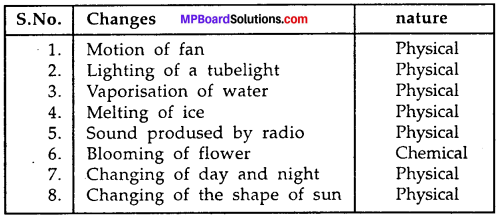
Activity 1
Make a list of eight changes you have noticed from your surroundings.
Answer:
The changes are as:

  1. Motion of fan
  2. Lighting of a tubelight
  3. Vaporisation of water
  4. Melting of ice
  5. Sound produced by radio
  6. Blooming of flower
  7. Changing of day and night
  8. Changing of the shape of sun.

MP Board Solutions

Activity 2
Try to indentify changes that you observe around you as physical or chemical changes.
Answer:
MP Board Class 7th Science Solutions Chapter 6 Physical and Chemical Changes img-5

Physical and Chemical Changes Text book Exercises

Question 1.
Classify the changes involved in the following processes as physical or chemical changes?

  1. Photosynthesis
  2. Dissolving sugar in water
  3. Burning of coal
  4. Melting of wax
  5. Beating aluminium to make aluminium foil
  6. Digestion of food

Answer:

  1. Chemical change
  2. Physical change
  3. Chemical change
  4. Physical change
  5. Physical change
  6. Chemical change.

MP Board Solutions

Question 2.
State whether the following statements are true or false. In case a statement is false, write the corrected statement in you notebook?

  1. Cutting a log food into pieces is a chemical change. (T/F)
  2. Formation are from leaves is a physical change. (T/F)
  3. Iron pipes coated with zinc do not get rusted easily. (T/F)
  4. Iron and rust are the same substances. (T/F)
  5. Condensation of steam is not a chemical change. (T/F)

Answer:

  1. False (F)
  2. False (F)
  3. True (T)
  4. True (T)
  5. True (T)

Question 3.
Fill in the blanks in the following statements:

  1. When carbon dioxide is passed through lime water, it turns milky due to the formation of ……………
  2. The chemical name of baking soda is ……………
  3. Two methods by which rusting of iron can be prevented are …………… and ……………
  4. Changes in which only …………… properties of a substance change are called physical changes.
  5. Changes in which new substances are formed are called …………… changes.

Answer:

  1. calcium carbonate
  2. Sodium hydrogen carbonate
  3. coating, galvanization
  4. physical
  5. chemical

Question 4.
When baking soda is mixed with lemon juice, bubbles are formed with the evolution of a gas. What type of changes is it? Explain.
Answer:
It is a chemical change. When baking soda is mixed with lemon juice, bubbles are formed with the evolution of a gas carbaon – dioxide.
Lemon juice + Baking soda Carbon dioxide + Lime water.

MP Board Solutions

Question 5.
When a candle burns, both physical and chemical changes take place. Identify these changes. Give another example of a familiar process in which both the chemical and physical changes take place?
Answer:
Melting of wax is a physical change while burning of candle is a chemical change. Lightning torch bulb using dry cell is another example where both physical and chemical changes takes place. The lighting of the bulb is physical change while current from the dry cell is obtained by the chemical substances inside it.

This is chemical change because the chemicals in the cell get converted into new substances and hence the cell ultimately becomes useless.

Question 6.
How would you show that setting of curd is a chemical change?
Answer:
The conversion of milk into curd, i.e., setting of curd is a permanent as well as irreversible and lead to the production of a new substance. The curd is not be converted into milk. Thus, the formation of curd is a chemical change.

MP Board Solutions

Question 7.
Explain why burning of wood and cutting it into small pieces are considered as two different types of changes.
Answer:
Burning of a wood is a chemical change because in addition to new products burning is always accompanied by production of heat. Cutting of wood into small pieces is a physical change because pieces of wood under went changes in size and no new substances is formed.

Question 8.
Describe how crystals of copper sulphate are prepared?
Answer:
Take a cupful of water in a beaker and add a few drops of dilute sulphuric acid. Heat the water. When it starts boiling add copper sulphate powder slowly while stirring continuiously (fig.). Continue adding copper sulphate powder, till no more powder can be dissolved. Filter the solution. Allow it to cool.
MP Board Class 7th Science Solutions Chapter 6 Physical and Chemical Changes img-1
Do not disturb the solution when it is cooling. Look at the solution after some time. Can you see the crystals of copper sulphate? If not, wait for some more time. Crystals of copper sulphate slowly from at the bottom of the beaker.

Question 9.
Explain how painting of an iron gate prevents it from rusting?
Answer:
For rusting, iron must be in contact with both air and moisture. When iron gate is painteel the layer of paint cuts the contact between air, moisture and iron. Thus, it prevents rusting.

MP Board Solutions

Question 10.
Explain why rusting of iron objects is faster in coastal areas than in deserts?
Answer:
The water of coastal areas containing many salts. The salt water makes the process of rust formation faster. Thus, rusting of iron objects is faster in coastal areas than deserts.

Question 11.
The gas we use in the kitchen is called liquified petroleum gas (LPG). In the cylinder it exist as a liquid. When it comes out from the cylinder it becomes a gas (Change A) then it burns (Change B). The following statements pertain to these changes. Choose the correct one.

  1. Process – A is a chemical change.
  2. Process – B is a chemical change.
  3. Both processes – A and B are chemical changes.
  4. None of these processes is a chemical change.

Answer:
3. Both processes – A and B are chemical changes.

Question 12.
Anaerobic bacteria digest animal waste and produce biogas (Change A). The biogas is then burnt as fuel (Change B). The following statements pertain to these changes. Choose the correct one.

  1. Process – A is a chemical change.
  2. Process – B is a chemical change.
  3. Both processes – A and B are chemical changes.
  4. None of these processes is a chemical change.

Answer:
3. Both processes – A and B are chemical changes.

Extended Learning – Activities and Projects

Question 1.
Describe two changes that are harmful. Explain why you consider them harmful. How can you prevent them?
Answer:
1. Spoilage of Food:
Food items when kept carelessly, get spoiled. This is a chemical change and obviously harmful for our health. Basically, the food is spoiled by microorganisms.

Preventation of Food Spoilage:
Microorganisms do not survive high or low temperature. So, food items stored in refrigerator do not spoil. Also, we should keep them covered, so that microorganism do not get any change to spoil them.

2. Rusting:
If a piece of iron is left in open for some time, it acquires a film of brownish substance. This substance is called rust and the process is called rusting.

Iron benches kept in parks, gardens and lawns, iron gates of parks, farm houses, houses; almost every article of iron, kept in open gets rusted.

The process of rusting can be represented by the following equation:
Iron (Fe) + Oxygen (O2, from the air) + water (H2O) → Rust (ironoxide, Fe2O3)
For rusting, the presence of both water (or water vapour) and oxygen is essential. Rusting is harmful because, it destorys the iron objects. Iron is the most widely used metal and so rusting is a serious problem.

Preventation of rusting:
It can be prevented by preventing iron things from coming in contact with water, oxygen, or both. One simple way is to apply a coat of paint or grease. In fact, these coats should be applied regularly to prevent rusting.

Another way is to deposit a layer of a metal like chromium or zinc on iron. This process is called galvanisation. Generally the iron pipes, which are used in our homes for water supply are galvanised to prevent rusting.

MP Board Solutions

Question 2.
Take three glass bottles with wide mouths. Label them, A, B and C. Fill about half of bottle A with ordinary tap water. Fill bottle B with water which has been boiled for several minutes, to the same level as in A. In bottle C, take the same boiled water and of the same amount as in other bottles. In each bottle put a few similar iron nails so that they are completely under water. Add a teaspoonful of cooking oil to the water in bottle C so that it forms a film on its surface. Put the bottles away for a few days. Take out nails from each bottle and observe them. Explain your observations?
Answer:
The nails in bottle B rust a little, nails in bottle A are the most rusted and that is bottle C remain unchanged. For rusting both oxygen and water are necessary. Both of these factors are present in the bottle A, since oxygen is dissolved in water. In bottle B, water is boiled and hence dissolved air is removed. Due to lack of oxygen, iron nail does not rust much. In bottle C, the layer of oil present dissolution of air in the water and hence no rusting occurs.

Question 3.
Prepare crystals of alum.
Answer:
Take a cupful of water in a beaker and add a few drops of dilute sulphuric acid. Heat the water. When it starts boiling add copper sulphate powder slowly while stirring continuiously (fig.). Continue adding copper sulphate powder, till no more powder can be dissolved. Filter the solution. Allow it to cool.
MP Board Class 7th Science Solutions Chapter 6 Physical and Chemical Changes img-1
Do not disturb the solution when it is cooling. Look at the solution after some time. Can you see the crystals of copper sulphate? If not, wait for some more time. Crystals of copper sulphate slowly from at the bottom of the beaker.

Question 4.
Collect information about the types of fuels used for cooking in you area. Discuss with your teachers/ parents/ others which fuels are less polluting and why?
Answer:
The different fuels used for cooking are wood, cow – dung cake, kerosene, biogas and LPG. Among all of these, biogas and LPG are least polluting. Both of these burn completely and do not give smoke. Also there is no residue i.e. ash after burning. Thus, these fuels are less polluting.

Physical and Chemical Changes Additional Important Questions

Objective Type Questions

Question 1.
Choose the correct alternative

Question (i)
Which of the following is not a chemical change –
(a) Digestion of food
(t) Burning of oaal
(c) Curdling of milk
(d) Melting Of ice.
Answer:
(d) Melting Of ice.

Question (ii)
Properties such as shape, size, colour and state of a sub-stance are called its –
(a) Chemical properties
(b) Physical properties
(c) Both (a) and (b)
(d) None of these.
Answer:
(b) Physical properties

MP Board Solutions

Question (iii)
The substances formed as a result of chemical reaction are called –
(a) Materials
(b) Products
(c) Reactants
(d) ingredients.
Answer:
(b) Products

Question (iv)
Rusting of iron is a
(a) Slow reaction
(b) Fast reaction
(c) Both (a) and (b)
(d) None of these.
Answer:
(a) Slow reaction

Question (v)
Qutub minar was built more than years ago –
(a) 1600
(b) 1650
(c) 1700
(d) 1800.
Answer:
(a) 1600

Question 2.
Fill in the blanks:

  1. A physical change is generally ……………..
  2. A chemical change is also called a …………….. reaction.
  3. Chemical changes are very important in our ……………..
  4. Ozone layer protects us from the harmful …………….. radiation which come from the sun.
  5. Oxygen is …………….. from ozone.
  6. If the content of moisture in air is high, which means if it is more humid, rusting becomes ……………..
  7. The process of depositing a layer of zinc on iron is called ……………..
  8. Stainless steel does …………….. rust.
  9. In chemical changes …………….. substances are produced.
  10. Burning of coal, wood or leaves is a …………….. change.

Answer:

  1. Reversible
  2. Chemical
  3. Lives
  4. Ultraviolet
  5. Different
  6. Faster
  7. Galvanisation
  8. Hot
  9. New
  10. Chemical.

MP Board Solutions

Question 3.
Which of the following statements are true (T) or false (F):

  1. Conversion of milk into curd is a physical change.
  2. A physical change is generally reversible.
  3. On dissolving the ash in water it forms a new substance.
  4. When carbon dioxide is passed throuth lime water, calcium carbonate is formed, which makes lime water milky.
  5. Chemical changes are not important in our lives.
  6. All new substances are formed as a result of chemical changes.
  7. A medicine is the end product of a chain of chemical reactions.
  8. Stainless steel is made by mixing iron with carbon and metals.

Answer:

  1. False (F)
  2. True (T)
  3. True (T)
  4. True (T)
  5. False (F)
  6. True (T)
  7. True (T)
  8. True (T).

Question 4.
Match the items in Column A with Column B:
MP Board Class 7th Science Solutions Chapter 6 Physical and Chemical Changes img-2
Answer:

(i) (b)
(ii) (d)
(iii) (a)
(iv) (c)

Physical and Chemical Changes Very Short  Answer Type Question

Question 1.
Define a physical change.
Answer:
The change in which the identity of the substance does not change is called a physical change.

Question 2.
Give any one characteristic of a physical change.
Answer:
No new substance is formed as a result of physical change.

Question 3.
List two physical changes.
Answer:

  1. Change of an iron bar to a magnet.
  2. Melting of ice.

MP Board Solutions

Question 4.
Complete the following:

  1. In a physical change the state of the substance is ………….. if cause of the change is removed.
  2. In a physical change only ……………… physical properties of the substance are

Answer:

  1. Restored
  2. Changed.

Question 5.
Define a chemical change.
Answer:
It is the change in which identity of the substance is changed and a new substance is formed-

Question 6.
Which of the following is true in case of a chemical change:

  1. Identity of the substance does not change.
  2. No, new substance is formed.
  3. Only physical properties of the substance are changed.
  4. Chemical properties of the substance are changed.

Answer:
4. Chemical properties of the substance are changed.

Question 7.
Give any one important characteristic of a chemical change?
Answer:
In this change new substance is formed.

Question 8.
Give any two examples of a physical change?
Answer:

  1. Dissolution of common salt (or sugar) in water.
  2. Magnetisation of an iron piece and demagnetisation of a magnet.

Question 9.
Is glowing of an electric bulb is a physical change or chemical ?
Answer:
Physical change.

MP Board Solutions

Question 10.
List any two chemical changes with which we come across in our daily life.
Answer:

  1. Durdling of milk, and
  2. Digestion of food.

Question 11.
Classify the following into physical change and chemical change:

(a) Souring of kneaded flour
(b) Change of sugarcane juice to vinegar
(c) Evaporation of water
(d) Change of an iron rod to a magnet
(e) Pickling
(f) Dissolving common salt in water
(g) Change of cattle dung to biogas
(h) Glowing of an electric bulb.

Answer:

Physical change: (c), (d), (f), (h).
Chemical change: (a), (b), (e), (g).

Question 12.
Give one difference between physical and chemical change.
Answer:
In a physical change new substance is not formed, whereas in a chemical change new substance is formed.

Question 13.
Are the following changes physical or chemical:

  1. Burning of candle
  2. Preparation of soap from oil and caustic soda
  3. Dissolving sugar in cone, sulphuric acid, and
  4. conversion of grape juice to wine.

Answer:
Chemical change.

Question 14.
Pick up chemical changes out of the following:

(a) Souring of milk
(b) Making of ice – cream
(c) Burning of a candle
(d) Lighting of an electric bulb
(e) Respiration
(f) Heating of ammonium chloride
(g) Melting of wax.
(h) Breaking a chalk.

Answer:

Physical change: (b), (d), (f), (g), (h).
Chemical change: (a), (c), (e).

Question 15.
What are main points under which physical changes can be classified?
Answer:
The three main points viz. change in state, dispersion in solution, magnetisation and electrical changes.

Question 16.
Define rate of a chemical reaction.
Answer:
The rate of reaction is the quantity of products obtained per unit time from the reactant.

Question 17.
List a fast reaction.
Answer:
2Na + 2H2O → 2NaOH + H2

MP Board Solutions

Question 18.
List the factors which influence the rate of a chemical reaction.
Answer:

  1. Nature and state of reactants
  2. Temperature
  3. Concentration of the reactants
  4. Catalyst.

Question 19.
What happens when temperature of a chemical reaction increases?
Answer:
Rate of reaction increases.

Physical and Chemical Changes Short Answer Type Question

Question 1.
How can you say that burning of coal and passing of electric current through water are chemical changes?
Answer:
Burning of coal:
When coal is burnt carbon dioxide gas is formed and ash is left behind as residue. Thus, new substances with new properties are formed. It is because the molecular structure of carbon-dioxide and coal are quite different from that of coal. Further more coal cannot be obtained back, hence it is a permanent change. So, it is a chemical change.

Passing of electric currnet through water:
When electric current is passed throuth water it decomposes to hydrogen and oxygen. The molecular structure of the later viz. H2 and O2 is different from that of H2O, therefore the change is a chemical one.

MP Board Solutions

Question 2.
Define a physical change?
Answer:
Physical change:
A physical change is a change in the physical properties (colour, state, density etc.) and does not involve a change in molecular structure. No new substance is formed and the change can be reversed by ordinary physical means.

Question 3.
Prove that evaporation of water and heating of iron to redness are physical changes?
Answer:
When water is heated, it changes into steam. No new substance has been formed because the molecular structures of water and steam are the same. Water has merely undergone a change in form (liquid → gas).

Further steam can be converted back into water just by the process of cooling therefore, this is a temporary change. Similary when iron is heated to redness, it is a temporary change in colour because on cooling iron is obtained back in its original form.

Question 4.
How can you argue that the following changes are physical changes:

  1. Dissolution of sugar in water
  2. Melting of wax
  3. Lighting of bulb
  4. Breaking of a chalk stick.

Answer:
1. Dissolution of sugar in water:
Is a physical change because no new substance is formed. On boiling off water, sugar can be obtained back.

2. Melting of wax:
When wax is heated in a dish, it melts but its composition does not change. On cooling we get back wax.

3. Lighting of bulb:
When an electric bulb is lighted by-passing electric current, the filament glows and emits light. But no new substance is formed. So it is a temporary change.

4. Breaking of a chalk stick:
When a chalk breaks, no new substance is formed. The identity of chalk aslo does not change. Therefore, it is a physical change.

Question 5.
Dispersion of a substance is a physical change or chemical one.
Answer:
Dispersion in solution:
This is also a physical change in many cases. The solute molecules get dispersed amongst the solvent molecules. They do not suffer a change in molecular structure and the solute can be recovered unchanged by cation of the solvent.

MP Board Solutions

Question 6.
Give some chemical reactions which occurs in our daily life.
Answer:
Some important chemical reactions that occur in our daily life are:

  1. Respiration (during respiration oxidation of glucose takes place).
  2. Digestion of food.
  3. Combustion of fuels.
  4. Ripening of fruits.
  5. Cooking of food.
  6. Rusting of iron.

Question 7.
Explain that change in state is nothing but a physical change?
Answer:
Change in state:
All the substances can be transformed to gases, liquids or solids by changing temperature or the other physical conditions. In the solid state the constituent particles are ordred. In the liquid state they are less ordered; in the gaseous state they are most disordered. So, the physical state of a substance can be changed by application of energy.

Thus, changes of a solid to liquid i.e., melting of a solid, change of vapour to liquid etc. can be reversed by application of enerty i.e., either by supplying heat or by cooling. This leads to the conclusion that change of state is nothing but a physical change.

Question 8.
Why heating of a metal say platinum, to redness is a physical change?
Answer:
When platinum is heated to redness it glows. This is only due to temporary excitement of electrons in its atoms. When we stop heating in electrons get unexcited and consequently it ceases glowing. Therefore, change under consideration is definitely a physical change.

Question 9.
Explain as to why the following changes are chemical changes?

  1. Rusting of iron
  2. Souring of milk
  3. Burning of magnesium
  4. Pickling.

Answer:
1. Rusting of iron:
During the phenomenon new substances viz. iron oxide etc. are formed on the surface of iron. Iron cannot be obtained back from rust. So, rusting of iron is a chemical change.

2. Souring of milk:
As a result of souring of milk new sub¬stances are formed which cannot be converted back to milk, hence souring of milk is a chemical change.

3. Burning of magnesium:
When Mg burns new substance viz. magnesium oxide is formed, which cannot be converted back to magnesium and oxygen. Therefore burning of magnesium is a chemical change.
2Mg + O2 → 2MgO

4. Pickling:
Pickling is nothing but the fermentation of the vegetable. Pickled vegetables cannot be changed back to fresh vegetables. Hence, it is also a chemical changed.

MP Board Solutions

Question 10.
Give brief distinction between physical change and chemical change.
Answer:
Distinction between physical and chemical changes:
Physical Change:

  • Change in physical properties.
  • Temporary change.
  • Composition of matter does not change.
  • No new substance is formed.
  • Can be reversed by physical means.
  • Not accompanied by large energy changes.
  • No change in weight.

Chemical Change:

  • Change in chemical properties.
  • More or less a permanent change.
  • Composition of matter changes.
  • New substance is formed.
  • Cannot be reversed easily.
  • Accompanied by large energy changes.
  • Though total mass remains constant, mass of individual substance changes.

Question 11.
Is the solution of hydrogen chloride in water a physical changes?
Answer:
Hydrogen chloride is a covalent molecule. In solution it becomes electrovalent. The hydrogen ion combines with a water molecule to form hydronium ion. The properties of the solution are entirely different. There is a change in molecular structure and so as per our definition it is a chemical change.

Question 12.
Is an allotropic change a chemical change?
Answer:
The constituent atoms are identical in allotropes but allotropy is caused by change in molecular structure. Oxygen gas contains two atoms in each molecule but ozone contains three. In many cases the chemical as well as physical properties are different. So we have to conclude that allotropic change is a chemical change.

Question 13.
Is the cooking of rice a physical change?
Answer:
In cooking the fast molecules of boiling water pierce the walls of the cell in which strach is enclosed and release the starch. Sight hydrolysis also takes place. But the change is physical to a major extent since most of the starch remains unchanged.

MP Board Solutions

Question 14.
What type of change is sublimation of ammonium chloride?
Answer:
Ammonium chloride on heating splits up into gases ammonia and hydrogen chloride. These gaseous products recombine on cooling to give the original salt. The apparent physical change is the result of two distinct chemical changes decomposition and combination. Sublimation can also be a physical change when the sub – stance is below its triple point and the change to vapour and back to solid state takes place directly, but in the case of ammonium chloride and many other compounds dissociation occurs.

Question 15.
Magnetisation of an iron bar is a physical change. Explain.
Answer:
Magnetisation of an iron bar:
Magnetisation caused by alignment of constituent atoms [figs, (a) and (b)] and as such it is to be considered only as a physical change. Charging and discharging of a condenser a temporary and physical change.
MP Board Class 7th Science Solutions Chapter 6 Physical and Chemical Changes img-3

Physical and Chemical Changes Long Answer Type Question

Question 1.
Give in detail the distinction between physical and chemical changes?
Answer:
Distinction between physical and chemical changes:
As already stated a chemical change involves a change in the structure of the molecules while a physical change does not involve a change in molecular structure. This definition is comprehensive and all other characteristic of a chemical change can be deduced easily as floows.

1. During a chemical change new substances with new properties are produced:
Change in molecular structure means a new substance with new properties. On the other hand, a physical change does not involve a change in the molecular structure.

2. A chemical change is a permanent change and the original substance is not got back by reversing the conditions. A physical change is temporary and exist only as long as the imposed conditions exist. A physical change can be reversed by reversing the conditions.

3. No change, physical or chemical can take place without energy change. A large amount of heat energy has to be given to convert water into steam. But the energy involved in chemical changes is generally far greater than that involved in physical changes.

4. A chemical change means a physical change also, because won news substances with new properties are produced the physical state and physical properties are altered.

MP Board Solutions

Question 2.
Give a detailed account of modem approach of physical and chemical changes?
Answer:
Modern approach of physical and chemical changes:
As your studies in science progress you will appreciate the point of view that all changes are chemical changes. Chemical changes are changes in structure. Minor electronic changes do occure even when a physical change takes place. In solids, subjected to heat, the ions oscillate with increasing amplitude and electrons move with greater speeds in expanded orbitals. Breaking a piece of diamond is an accepted chemical change because covalent chemical bonds are broken in the process. The same is happening when any substance is broken.

Thedivision into physical and chemical changes is, therefore, purely a matter of convenience. The three types of changes are classified as fallows:

1. Physical change:
Slight changes in outer electron states. Comparatively less energy change. No change in molecular patterns. No change in nucleonic pattern.

2. Chemical change:
Change in molecular pattern. Large scale energy change. Rearrangement, of electronic orbitals. No change in nucleonic pattern.

Question 3.
What are slow and fast reactions? Give example.
Answer:
A reaction can be called slow or fast depending upon the speed rate of reaction.
Whenever elements and compounds react their reaction is said to be slow if the rate of the reaction, i.e., the quantity of products obtained per unit time from the reactants, is slow.
Example:

  1. Rusting of iron is a slow reaction.
  2. When a copper vessel kept in moist air it gets greenished due to the formation of basic copper carbonate. To the contrary if the speed or the rate of the reaction is fast, than the reaction is said to be the fast reaction.

Example:
By adding sodium chloride in silver nitrate solution, immediately a white ppt. appears. It is a fast reaction i.e.,
MP Board Class 7th Science Solutions Chapter 6 Physical and Chemical Changes img-4

Question 4.
What is a chemical reaction? Give an example.
Answer:
A reaction in which the following are being occurred is called a chemical reaction:

  1. Absorption or liberation of heat or any other form of energy.
  2. Change in the identity of the combining substances i.e., the reactants.
  3. Collision among the reactant molecules.
  4. Use of some catalyst or provision of some form of energy to the reactants for initiation of reaction.

Example:
1. Sodium reacts with water to form sodium hydroxide alongwith the liberation of hydrogen gas.
The chemical equation of the reaction is as follows:
2Na + 2H2O → NaOH + H2

2. Lime stone, on heating, liberates carbon dioxide.
The equation for the reaction is as follows:
CaCO3 → CaO + CO2.

MP Board Class 7th Science Solutions

MP Board Class 9th Science Solutions Chapter 10 Gravitation

MP Board Class 9th Science Solutions Chapter 10 Gravitation

Gravitation Intext Questions

Gravitation Intext Questions Page No. 134

Question 1.
State the universal law of gravitation.
Answer:
Suppose there are two objects having mass M and m respectively.
The distance between their centres is equal to d.
The force of attraction is F.
Thus, F ∝ M . m … (i)
and, F ∝ 1/d2 … (ii)
Joining equation (i) and (ii)
we get F ∝ M . m/d2
⇒ F = G . M . m/d2 … (iii)
where, G is the proportionality constant and called Universal Gravitation Constant.
The expression (iii) is called expression for Universal Law of Gravitation.
The universal law of gravitation is represented as:
\(F=\frac{G m_{1} m_{2}}{r^{2}}\)
Where, G is the universal gravitation constant given by:
G = 6.67 × 10⁻¹¹ Nm2 kg-2.

MP Board Solutions

Question 2.
Write the formula to find the magnitude of the gravitational force between the Earth and an object on the surface of the earth.
Answer:
Let Me be the mass of the Earth and m be the mass of an object on its surface.
And say R is the radius of the Earth,
then according to the universal law of gravitation,
the gravitational force (F) acting between the Earth and the object is given by the relation:
\(F=\frac{G m_{1} m_{2}}{r^{2}}\)
F = GMem/R

Gravitation Intext Questions Page No. 136

Question 1.
What do you mean by free fall?
Answer:
Its a phenomenon of gravity. When an object falls from any height under the influence of gravitational force only, it is said to have a free fall. In the case of free fall, no change in direction takes place but the magnitude of velocity changes because of acceleration.

MP Board Solutions

Question 2.
What do you mean by acceleration due to gravity?
Answer:
Change in velocity due to variation in height produces acceleration which is due to gravity in the object and is known as acceleration due to gravity denoted by letter g. The value of acceleration due to gravity is g = 9.8 m/s2.

Gravitation Intext Questions Page No. 138

Question 1.
What are the differences between the mass of an object and its weight?
Answer:

MassWeight
Mass is a measurement of the amount of matter something has.Weight is the measurement of the pull of gravity on an object.
Mass is a constant quantity.Weight is not a constant quantity. It is different at different places.
It is a scalar quantity.It is a vector quantity.
Its SI unit is kilogram (kg).Its SI unit is the same as the SI unit of force, i.e., Newton (N).

Question 2.
Why is the weight of an object on the moon \(\frac { 1 }{ 6 }\)th its weight on the earth?
Answer:
The mass of moon is \(\frac { 1 }{ 100 }\) times and its radius \(\frac { 1 }{ 4 }\) times that of earth. As a result, the gravitational attraction on the moon is about one sixth when compared to earth. Hence, the weight of an object on the moon is \(\frac { 1 }{ 6 }\)th of its weight on the earth.

Gravitation Intext Questions Page No. 141

Question 1.
Why is it difficult to hold a school bag having a strap made of a thin and strong string?
Answer:
It is difficult to hold a school bag having a thin strap because the pressure on the shoulders is quite large. This is because the pressure is inversely proportional to the surface area on which the force acts. The smaller is the surface area; the larger will be the pressure on the surface. In the case of a thin strap, the contact surface area is very small. Hence, the pressure exerted on the shoulder is very large.

Question 2.
What do you mean by buoyancy?
Answer:
The upward force exerted by a liquid on an object that is immersed in it is known as buoyancy.

MP Board Solutions

Question 3.
Why does an object float or sink when placed on the surface of water?
Answer:

  1. An object sinks in water if its density is greater than that of water.
  2. An object floats in water if its density is less than that of water.

Gravitation Intext Questions Page No. 142

Question 1.
You find your mass to be 42 kg on a weighing machine. Is your mass more or less than 42 kg?
Answer:
When we weigh our body, an upward force acts on it. This upward force is the buoyant force. As a result, the body gets pushed slightly upwards, causing the weighing machine to show a reading less than the actual value.

Question 2.
You have a bag of cotton and an iron bar, each indicating a mass of 100 kg when measured on a weighing machine. In reality, one is heavier than other. Can you say which one is heavier and why?
Answer:
The cotton bag is heavier than the iron bar. The cotton bag experiences larger up – thrust of air than the iron bar. So, the weighing machine indicates a smaller mass for cotton bag than its actual mass.

Gravitation NCERT Textbook Exercises

Question 1.
How does the force of gravitation between two objects change when the distance between them is reduced to half?
Answer:
According to Universal Law of gravitation, the gravitational force of attraction between any two objects of mass M and m is proportional to the product of their masses and inversely proportional to the square of distance r between them. So, force F is given by
F = G\(\frac { M\times m }{ { r }^{ 2 } } \)
Now, when the distance ‘r’ is reduced to half then force between two masses becomes
F’ = G\(\frac { M\times m }{ { (\frac { r }{ 2 } ) }^{ 2 } } \)
Or
F’ = 4F
Hence, if the distance is reduced to half, then the gravitational force becomes four times larger than the previous value.

Question 2.
Gravitational force acts on all objects in proportion to their masses. Why then, a heavy object does not fall faster than a light object?
Answer:
All objects fall on ground with constant acceleration, called acceleration due to gravity (in the absence of air resistances). It is constant and does not depend upon the mass of an object. Hence, heavy objects do not fall faster than light objects.

MP Board Solutions

Question 3.
What is the magnitude of the gravitational force between the earth and a 1 kg object on its surface? (Mass of the earth is 6 × 1024 kg and radius of the earth is 6.4 × 10⁶ m).
Answer:
Given that,
Mass of the body, m = 1 kg
Mass of the Earth, M = 6 × 1024 kg
Radius of the Earth, R = 6.4 × 10⁶ m
Now, magnitude of the gravitational force (F) between the Earth and the body can be given as,
F = G\(\frac { M\times m }{ { r }^{ 2 } } \) = \(\frac { 6.67 × 10 × 6 × 10 × 1 }{ (6.4 × 6.4) }\)
= \(\frac { 6.67 × 6 × 10 }{ (6.4 × 6.4) }\) = 9.8N (approx.)

Question 4.
The Earth and the Moon are attracted to each other by gravitational force. Does the Earth attract the Moon with a force that is greater or smaller or the same as the force with which the Moon attracts the Earth? Why?
Answer:
According to the Universal Law of Gravitation, two objects attract each other with equal force, but in opposite directions. The Earth attracts the Moon with an equal force with which the Moon attracts the Earth.

Question 5.
If the Moon attracts the Earth, why does the Earth not move towards the Moon?
Answer:
The Earth and the Moon experience equal gravitational forces from each other. However, the mass of the Earth is much larger than the mass of the Moon. Hence, it accelerates at a rate lesser than the acceleration rate of the Moon towards the Earth. For this reason, the Earth does not move towards the Moon.

Question 6.
What happens to the force between two objects, if
(i) the mass of one object is doubled?
(ii) the distance between the objects is doubled and tripled?
(iii) the masses of both objects are doubled?
Answer:
(i) From Universal Law of Gravitation, force exerted on an object of mass at by Earth is given by
F = G\(\frac { M\times m }{ { R }^{ 2 } } \) ….1
When nws of the object say ne is doubled than
F’ = G\(\frac { M\times 2m }{ { R }^{ 2 } } \)  = 2F
So as the mass of any one of the object is doubled the force is also doubled,

(ii) The force F is inversely proportional to the distance between the objects. So if the distance between two objects es doubled, then the gravitational force of attraction between them is reduced to one fourth of its original value, Similarly, if the distance between two objects is tripled. then the gravitational force of attraction becomes one ninth of its original value.

(iii) Again from Universal Law of Attraction, from equation 1, force ‘F’ is directly proportional to the product of both the masses, So, if both the masses are doubled then, the gravitational force of attraction become four times the original value.

MP Board Solutions

Question 7.
What in the importance of Universal Law of Gravitation?
Answer:
Universal Law of Gravitation is important because it tells us about:

  1. the force that is responsible for binding us to Earth.
  2. the motion of Moon around the Earth.
  3. the motion of planets around the Sun.
  4. the tides formed by rising and falling of water level in the ocean are due to the gravitational force exerted by both Sun and Moon on the Earth.

Question 8.
What in the acceleration of free fall?
Answer:
Acceleration of free tall is the acceleration produced when a body falls under the influence of the force of gravitation of the Earth alone. It is denoted by ‘g’ and its value on the surface of the Earth is 9.8 ms-2.

Question 9.
What do we call the gravitational force between the Earth and an object?
Answer:
Gravitational force between the Earth and an object is known as the weight of the object.

Question 10.
Amit buys few grams of gold at the poles as per the instruction of one of his friends. He hands over the same when he meets him at the equator. Will the friend agree with the weight of gold bought? If not, why? [Hint: The value of g is greater at the poles than at the equator}.
Answer:
Weight of a body on the Earth is given by:
W = mg
Where,
m = Mass of the body
g = Acceleration due to gravity
The value of g is greater at poles than at the equator.
Therefore, gold at the equator weighs less than at the poles.
Hence, Amit’s friend will not agree with the weight of the gold bought.

Question 11.
Why does a sheet of paper fell slower than one that is crumpled into a ball?
Answer:
When a sheet of paper is crumpled into a ball, then its density increases. Hence, resistance to its motion through the air decreases and it falls faster than the sheet of paper.

MP Board Solutions

Question 12.
Gravitational force on the surface of the Moon is only \(\frac { 1 }{ 6 }\) as strong as gravitational force on the Earth. What is the weight in newtons of a 10 kg object on the moon and on the Earth?
Answer:
Weight of an object on the Moon = \(\frac { 1 }{ 6 }\) × Weight of an object on the Earth.
Also,
Weight = Mass × Acceleration
Acceleration due to gravity, g = 9.8 m/s2
Therefore, weight of a 10 kg object on the earth = 10 × 9.8 = 98 N
And, weight of the same object on the Moon = 1.6 × 9.8 = 16.3 N.

Question 13.
A ball is thrown vertically upwards with a velocity of 49 m/s. Calculate
(i) the maximum height to which it rises.
(ii) the total time it takes to return to the surface of the earth.
Answer:
According to the equation of motion under gravity:
-u2 = 2 gs
Where,
u = Initial velocity of the ball
v = Final velocity of the ball
s = Height achieved by the ball
g = Acceleration due to gravity
At maximum height, final velocity of the ball is zero, i.e., v = 0, u = 49 m/s.
During upward motion, g = – 9.8 ms-2.
(i) Let ‘h’ be the maximum height attained by the ball.
Hence,
0 – 492 = 2 × 9.8 × h
h = \(\frac { 49 × 49 }{ 2 × 9.8}\) = 122.5 m

(ii) Let ‘t’ be the time taken by the ball to reach the height 122.5 m, then according to the equation of motion:
v = u + gt
We get,
= 49 + t × (- 9.8)
9.8 t = 49
t = \(\frac { 49 }{ 9.8}\) = 5 s
But,
Time of ascent = Time of descent
Therefore, total time taken by the ball to return = 5 + 5 = 10 s

Question 14.
A stone is released from the top of a tower of height 19.6 m. Calculate its final velocity just before touching the ground.
Answer:
According to the equation of motion under gravity: v2 – u2 = 2 gs
Where,
u = Initial velocity of the stone = 0
v = Final velocity of the stone
s = Height of the stone = 19.6 m
g = Acceleration due to gravity = 9.8 ms-2
∴ v2 – 02 = 2 × 9.8 × 19.6
v2 = 2 × 9.8 × 19.6 = (19.6)2
v = 19.6 ms-1
Hence, the velocity of the stone just before touching the ground is 19.6 m s-1.

Question 15.
A stone is thrown vertically upward with an initial velocity of 40 m/s. Taking g = 10 m/s2, find the maximum height reached by the stone. What is the net displacement and the total distance covered by the stone?
Answer:
According to the equation of motion under gravity:
v2 – u2 = 2 gs
Where,
u = Initial velocity of the stone = 40 m/s
v = Final velocity of the stone = 0
s = Height of the stone
g = Acceleration due to gravity = -10 ms-2
Let h be the maximum height attained by the stone.
Therefore,
0 – (40)2 = 2 × h × (-10)
h = \(\frac { 40 × 40 }{ 20 }\) = 80 m
Therefore, total distance covered by the stone during its upward and downward journey = 80 + 80 = 160 m
Net displacement of the stone during its upward and downward journey
= 80 + (-80) = 0.

MP Board Solutions

Question 16.
Calculate the force of gravitation between the earth and the Sun, given that the mass of the earth = 6 × 1024 kg and of the Sun = 2 × 1030 kg. The average distance between the two is 1.5 × 10¹¹ m.
Answer:
According to question,
MSun = Mass of the Sun = 2 × 1030 kg
MEarth = Mass of the Earth = 6 × 1024 kg
R = Average distance between the Earth and the Sun = 1.5 × 10¹¹ m.
From Universal Law of Gravitation,
F = G\(\frac { M\times m }{ { R }^{ 2 } } \)
Therefore, putting all the values given in question in above equation we get
F = 6.67 × 10⁻¹¹ \(\frac { (6\times { 10 }^{ 24 })\times (2\times { 10 }^{ 30 }) }{ { (1.5\times { 10 }^{ 11 }) }^{ 2 } } \) = 3.56 × 10²² N.

Question 17.
A stone is allowed to fall from the top of a tower 100 m high and at the same time another stone is projected vertically upwards from the ground with a velocity of 25 m/s. Calculate when and where the two stones will meet.
Answer:
Let be the point at which two stones meet and let ‘h’ be their height from the ground. It is given in the question that height of the tower is H = 100 m
Now, first consider the stone which falls from the top of the tower.
So, distance covered by this stone at time ‘t’ can be calculated using equation of motion:
x – x0 = u0t + \(\frac { 1 }{ 2 }\)gt2
Since, initial velocity u = 0,
so we get
100 =  x \(\frac { 1 }{ 2 }\)gt2 ………… (1)
The distance covered by the same stone that is thrown in upward direction from ground is
x = 25t –\(\frac { 1 }{ 2 }\)gt2
In this case intitial velocity is 25 m/s.
So, x = 25t – \(\frac { 1 }{ 2 }\)gt………… (2)
Adding equations (1) and (2) we get,
100=25t
or,
t = 4s
Putting value in equation (2).
x = 25 × 4 – \(\frac { 1 }{ 2 }\) × 9.8 × (4)2
= 100 – 78.4
= 21.6 m.

Question 18.
A ball thrown up vertically returns to the thrower after 6 s. Find:
(a) the velocity with which it was thrown up,
(b) the maximum height it reaches, and
(c) its position after 4 s.
Answer:
(a) Time of ascent is equal to the time of descent. The ball takes a total of 6 s for its upward and downward journey. Hence, it has taken 3 s to attain the maximum height. Final velocity of the ball at the maximum height, v = 0 Acceleration due to gravity, g = -9.8 m s-2
Equation of motion, v = u + gt
will give,
0 = u + (-9.8 × 3)
u = 9.8 × 3
= 29.4 ms-1
Hence, the ball was thrown upwards with a velocity of 29.4 ms-1.

(b) Let the maximum height attained by the ball be ‘h’
Initial velocity during the upward journey, u = 29.4 ms-1
Final velocity, v = 0
Acceleration due to gravity, g = -9.8 ms-2
From the equation of motion, s = ut + \(\frac { 1 }{ 2 }\) at2
h = 29.4 × 3 + \(\frac { 1 }{ 2 }\) × – 9.8 × (3)2 = 44.1 m.

(c) Ball attains the maximum height after 3 s.
After attaining this height, it will start falling downwards.
In this case, Initial velocity, u = 0
Position of the ball after 4 s of the throw is given by the distance travelled by it during its downward journey in
4 s – 3 s = 1 s.
Equation of motion, s = ut + \(\frac { 1 }{ 2 }\) g2
will give,
s = 0 x t + \(\frac { 1 }{ 2 }\) x 9.8 x 12 = 4.9 m
Total height  = 44.1 m.
This means that the ball is 39.2 m (44.1 m – 4.9 m) above the ground after 4 seconds.

MP Board Solutions

Question 19.
In what direction does the buoyant force on an object immersed in a liquid act?
Answer:
An object immersed in a liquid experiences buoyant force in the upward direction.

Question 20.
Why does a block of plastic released under water come up to the surface of water?
Answer:
For an object immersed in water two forces act on it:

  1. Gravitational force which tends to pull object in downward direction
  2. Buoyant force that pushes the object in upward direction.

Here, in this case buoyant force is greater than the gravitational pull on the plastic block. This is the reason the plastic block comes up to the surface of the water as soon as it is released under water.

Question 21.
The volume of 50 g of a substance is 20 cm3. If the density of water is 1 g cm-3, will the substance float or sink?
Answer:
If the density of an object is more than the density of a liquid, then it sinks in the liquid. On the other hand, if the density of an object is less than the density of a liquid, then it floats on the surface of the liquid.
MP Board Class 9th Science Solutions Chapter 10 Gravitation 1
= \(\frac { 50 }{ 20 }\)
= 2.5 g cm-3
The density of the substance is more than the density of water (1 g cm-3).
Hence, the substance will sink in water.

Question 22.
The volume of a 500 g sealed packet is 350 cm3. Will the packet float or sink in water if the density of water is 1 g cm-3? What will be the mass of the water displaced by this packet?
Answer:
Density of the 500 g sealed packet
MP Board Class 9th Science Solutions Chapter 10 Gravitation 2
= \(\frac { 500 }{ 350 }\)
= 1.428 g cm-3
The density of the substance is more than the density of water (1 g cm-3). Hence, it will sink in water.
The mass of water displaced by the packet is equal to the volume of the packet, i.e., 350 g.

Gravitation Additional Questions

Gravitation Multiple Choice Questions

Question 1.
Two objects of different masses falling freely near the surface of moon would __________ .
(a) have same velocities at any instant.
(b) have different accelerations.
(c) experience forces of same magnitude.
(d) undergo a change in their inertia.
Answer:
(c) experience forces of same magnitude.

MP Board Solutions

Question 2.
The value of acceleration due to gravity __________ .
(a) is same on equator and poles.
(b) is least on poles.
(c) is least on equator.
(d) increases from pole to equator.
Answer:
(c) is least on equator.

Question 3.
The gravitational force between two objects is F. If masses of both objects are halved without changing distance between them, then the gravitational force would become __________ .
(a) \(\frac { F }{ 4 }\)
(b) \(\frac { F }{ 2 }\)
(c) F
(d) 2 F.
Answer:
(a) \(\frac { F }{ 4 }\)

Question 4.
A boy is whirling a stone tied with a string in an horizontal circular path. If the string breaks, the stone __________ .
(a) will continue to move in the circular path.
(b) will move along a straight line towards the centre of the circular path.
(c) will move along a straight line tangential to the circular path.
(d) will move along a straight line perpendicular to the circular path away from the boy.
Answer:
(c) will move along a straight line tangential to the circular path.

Question 5.
An object is put one by one in three liquids having different densities. The object floats with 1 2 3, and 9 11 7 parts of their volumes outside the liquid surface in liquids of densities d1, d2 and d3 respectively. Which of the following statement is correct?
(a) d1 > d2 > d3
(b) d21 > d2 < d3
(c) d1 < d2 > d3
(d) d1 < d2 < d3.
Answer:
(d) d1 < d2 < d3.

Question 6.
In the relation F = GM m/d2, the quantity G __________ .
(a) depends on the value of ‘g’ at the place of observation.
(b) is used only when the Earth is one of the two masses.
(c) is greatest at the surface of the Earth.
(d) is universal constant of nature.
Answer:
(d) is universal constant of nature.

Question 7.
Law of gravitation gives the gravitational force between __________ .
(a) the Earth and a point mass only.
(b) the Earth and Sun only.
(c) any two bodies having some mass.
(d) two charged bodies only.
Answer:
(c) any two bodies having some mass.

MP Board Solutions

Question 8.
The value of quantity G in the law of gravitation __________ .
(a) depends on mass of Earth only.
(b) depends on radius of Earth only.
(c) depends on both mass and radius of Earth.
(d) is independent of mass and radius of the Earth.
Answer:
(d) is independent of mass and radius of the Earth.

Question 9.
Two particles are placed at some distance. If the mass of each of the two particles is doubled, keeping the distance between them unchanged, the value of gravitational force between them will be __________ .
(a) 14 times
(b) 4 times
(c) 12 times
(d) unchanged.
Answer:
(b) 4 times

Question 10.
The atmosphere is held to the earth by __________ .
(a) gravity
(b) wind
(c) clouds
(d) Earth’s magnetic field.
Answer:
(a) gravity

Question 11.
The force of attraction between two unit point masses separated by a unit distance is called __________ .
(a) gravitational potential.
(b) acceleration due to gravity.
(c) gravitational field.
(d) universal gravitational constant.
Answer:
(d) universal gravitational constant.

Question 12.
The weight of an object at the centre of the Earth of radius R is __________ .
(a) zero.
(b) infinite.
(c) R times the weight at the surface of the Earth.
(d) \(\frac { 1 }{ { R }^{ 2 } } \) times the weight at surface of the Earth.
Answer
(a) zero.

Gravitation Very Short Answer Type Questions

Question 1.
Why Moon revolves around the Earth?
Answer:
Gravitational force of Earth.

Question 2.
What is the SI unit of gravitational force?
Answer:
Newton (N).

Question 3.
Which law of physics is represented by the statement every object attract other object in universe towards itself’?
Answer:
Universal Law of Gravitation.

MP Board Solutions

Question 4.
State the relation between gravitational force and distance among objects.
Answer:
Inversely proportional.

Question 5.
In which conditions free fall of an object occur?
Answer:
When an object falls from a height under the influence of gravity and no other force, it is said to have a free fall.

Question 6.
What is the SI unit of gravitational constant?
Answer:
Nm2kg-2.

Question 7.
Express the relation between thrust and pressure.
Answer:
Pressure = thrust / area.

Question 8.
What kind of force is exerted by a liquid?
Answer:
Equal and unidirectional.

MP Board Solutions

Question 9.
In what condition an object sinks?
Answer:
If the weight of the object is more than 9.8 N, then the object will sink.

Question 10.
Which material is taken as standard to calculate any object’s relative density?
Answer:
Water.

Gravitation Short Answer Type Questions

Question 1.
What is the source of centripetal force that a planet requires to revolve around the Sun? On what factors does that force depend?
Answer:
Gravitational force. This force depends on the product of the masses of the planet and Sun, and the distance between them.

Question 2.
On the Earth, a stone is thrown from a height in a direction parallel to the Earth’s surface while another stone is simultaneously dropped from the same height. Which stone would reach the ground first and why?
Answer:
Both the stones will take the same time to reach the ground because the two stones fall from the same height.

Question 3.
Suppose gravity of Earth suddenly becomes zero, then in which direction will the Moon begin to move if no other celestial body affects it?
Answer:
The Moon will begin to move in a straight line in the direction in which it was moving at that instant because the circular motion of Moon is due to centripetal force provided by the gravitational force of Earth.

MP Board Solutions

Question 4.
Two identical packets are dropped from two Aeroplanes, one above the equator and the other above the north pole, both at height h. Assuming all conditions are identical, will those packets take same time to reach the surface of Earth. Justify your answer.
Answer:
The value of ‘g’ at the equator of the Earth is less than that at poles. Therefore, the packet falls slowly at equator in comparison to the poles. Thus, the packet will remain in air for longer time interval, when it is dropped at the equator.

Question 5.
The weight of any person on the Moon is about \(\frac { 1 }{ 6 }\) times that on the Earth. He can lift a mass of 15 kg on the Earth. What will be the maximum mass, which can be lifted by the same force applied by the person on the moon?
Answer:
The value of ‘g’ at the equator of the Earth is less than that at poles. Therefore, the packet falls slowly at equator in comparison to the poles. Thus, the packet will remain in air for longer time interval, when it is dropped at the equator.

Gravitation Long Answer Type Questions

Question 1.
State ‘Archimedes’ Principle and write its two applications.
Answer:
‘Archimedes’ Principle:
Force exerted by liquid on wholly or partly immersed object is equal to the weight of the fluid displaced by the object. Applications based on ‘Archimedes’ principle are:

  1. designing of water transport vehicles.
  2. hydrometers used for determining the density of liquids

MP Board Solutions

Question 2.
What is relative density? What is the density of water?
Answer:
Relative Density (RD) or Specific Gravity (SG) is the ratio of either densities or weights. Hence, when we compare or divide value of an objects’ density with water’s density, it is called Relative Density of a substance to water.

  1. In SI units, the density of water is (approximately) 1000 kg/m3 Or 1 g/cm3.

Question 3.
Mass of a rectangular copper solid piece is 300 g. With dimensions 5 × 2 × 5 cm3, what should be its specific gravity, calculate? Will the bar float or sink in water?
Answer:
MP Board Class 9th Science Solutions Chapter 10 Gravitation 3
Given:
Mass of copper = 300 g
5 × 2 × 5 = 50 cm3
Density of copper = mass / volume
\(\frac { 300 }{ 50 }\) = 6 g / cm3
Density of water, = 1 g/cm3
Specific gravity of iron = \(\frac { 6 }{ 1 }\) = 6.
Hence the bar will sink.

Question 4.
How does the weight of an object vary with respect to mass and radius of the earth. In a hypothetical case, if the diameter of the earth becomes half of its present value and its mass becomes four times of its present value, then how would the weight of any object on the surface of the earth be affected?
Answer:
We know, weight of an object is directly proportional to the mass of the earth and inversely proportional to the square of the radius of the earth, i.e.,.
Weight of a body ∝ \(\frac { M }{ { R }^{ 2 } } \)
Original weight, W0  = mg = mG\(\frac { M }{ { R }^{ 2 } } \)
When hypothetically M becomes 4 M and R becomes \(\frac { R }{ 2 }\) then weight becomes
W0 = mG \(\frac { 4M }{ { (\frac { R }{ 2 } ) }^{ 2 } } \) = (16 m G) M
R2 = 16 × W0
The weight will be 16 times heavier.

MP Board Solutions

Question 5.
(a) A cube of side 5 cm is immersed in water and then in saturated salt solution. In which case will it experience a greater buoyant force. If each side of the cube is reduced to 4 cm and then immersed in water, what will be the effect on the buoyant force experienced by the cube as compared to the first case for water? Give reason for each case.
(b) A ball weighing 4 kg of density 4000 kg m-3 is completely immersed in water of density 103 kg m-3. Find the force of buoyancy on it. (Given: g = 10 ms-2.)
Answer:
(a)

  1. The cube will experience a greater buoyant force in the saturated salt solution because the density of the salt solution is greater than that of water.
  2. The smaller cube will experience lesser buoyant force as its volume is lesser than the initial cube.

(b) Buoyant force = weight of the liquid displaced = density of water x volume of water displaced xg 4
= 1000 × \(\frac { 4 }{ 4000 }\) × 10 = 10N.
4000

Gravitation Higher Order Thinking Skills (HOTS)

Question 1.
How will the weight of a body of mass 250 g of changes, if it is taken from equator to the poles? Give reasons.
Answer:
As we move from equator to poles, acceleration due to gravity increases. It is because radius of earth is less at poles than at equator. Therefore, its weight will increase.

MP Board Solutions

Question 2.
Aman tried to immerse an empty plastic bottle in a bucket of water. But each time he fails. Why does this happen?
Answer:
When Aman tried to immerse an empty plastic bottle in a bucket of water, it comes above the surface of water. It is due to the upward force (upthrust or buoyant force). The upthrust exerted by water on the bottle is greater than its own weight.

Gravitation Value Based Question

Question 1.
Rashmi was wearing a high heel shoes for a beach party. Her friend told her to wear flat shoes as she will be tired soon with high heel and will not feel comfortable.

  1. What is the reason of one’s feeling tired with high heel shoes on a beach?
  2. Name the unit of pressure.
  3. What value of Rashmi’s friend is reflected in the above act?

Answer:

  1. Because the high heel shoes would exert lot of pressure on the loose sand of beach and will sink more in the soil as compared to flat shoes. Therefore, large amount of force will be required to walk with high heels.
  2. Pascal.
  3. Rashmi’s friend showed the value of being intelligent, concerned and helpful.

MP Board Class 9th Science Solutions

MP Board Class 9th Maths Solutions Chapter 11 Constructions Ex 11.2

MP Board Class 9th Maths Solutions Chapter 11 Constructions Ex 11.2

MP Board Solutions

Question 1.
Construct a triangle ABC in which BC = 7 cm, B = ∠75° and AB + AC = 13 cm.
Solution:
BC = 7 cm
∠B = 15°
AB + BC = 13 cm.
MP Board Class 9th Maths Solutions Chapter 11 Constructions Ex 11.2 img-1

Question 2.
Construct a triangle ABC in which BC = 8 cm, ∠B = 45° AB – AC = 3.5 cm.
Solution:
BC = 8 cm
∠B = 45°
AB – AC = 3.5 cm.
MP Board Class 9th Maths Solutions Chapter 11 Constructions Ex 11.2 img-2

Question 3.
Construct a triangle PQR in which QR = 6 cm. ∠Q = 60° and PR – PQ = 2 cm.
Solution:
QR = 6 cm
∠Q =60°
PR – PQ = 2 cm
MP Board Class 9th Maths Solutions Chapter 11 Constructions Ex 11.2 img-3

Question 4.
Construct a triangle XYZ in which ∠Y = 30°, ∠Z = 90° and XY + YZ + ZX = 11 cm.
Solution:
XY + YZ + ZX = 11 cm
∠Y = 30°
∠Z =90°
MP Board Class 9th Maths Solutions Chapter 11 Constructions Ex 11.2 img-4

  1. Draw a line segment BC =11 cm.
  2. At B construct an angle of 30° and at C, draw angle of 90°.
  3. Bisect these angles. Let the bisectors of these angles intersect atX.
  4. Draw perpendicular bisectors AC of BX to intersect BC at Y and DZ of XC to intersect BC at Z.
  5. Join XY and XZ. XYZ is the required D.

MP Board Solutions

Question 5.
Construct a right triangle whose base is 12 cm and sum of its hypotenuse and other side is 18 cm.
Solution:
Steps of construction:

  1. Draw \(\overline { BC } \) = 12 cm.
  2. Construct ∠CBY = 90°.
  3. From \(\overline { BY } \), cut off BX = 18 cm.
  4. Join CX.
  5. Draw PQ, the perpendicular bisector of CX, such that PQ meets BX at A.
  6. JoinAC.

Thus, ABC is the required triangle.
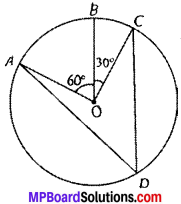
MP Board Class 9th Maths Solutions Chapter 11 Constructions Ex 11.2 img-5

MP Board Class 9th Maths Solutions

MP Board Class 9th Maths Solutions Chapter 10 Circles Ex 10.4

MP Board Class 9th Maths Solutions Chapter 10 Circles Ex 10.4

Question 1.
Two circles of radii 5 cm and 3 cm intersect at two points and the distance between their centres is 4 cm. Find the length of the common chord.
Solution:
Given
Let O and O1 be the centre of bigger and smaller circle respectively
OA = OB = 5 cm
O1A – O1B = 3 cm
OO1 = 4 cm
MP Board Class 9th Maths Solutions Chapter 10 Circles Ex 10.4 img-1
To find: AB.
Construction:
Join OA, OB, O1A and O1B join AB also.
In ∆OAO1 and ∆OBO1
OA = OB (Radii of a circle)
O1A = O1B (Radii of a circle)
OO1 = OO1 (Common)
so ∆OAO1 = ∆OBO1 (By SSS)
and so ∠1 = ∠2 (By CPCT)
In ∆OCA and ∆OCB,
OA = OB (Radii of a circle)
∠1 = ∠2 (Proved)
OC = OC (Common)
∆OCA = ∆OCB (By SAS)
so AC = BC (By CPCT)
and ∠ACO = ∠BCO (By CPCT)
∠ACO + ∠BCO = 180° (LPA’s)
⇒ ∠ACO + ∠BCO = 180°
2∠ACO = 180°
∠ACO = 90°
ar (OAO1) = \(\frac{1}{2}\) x OO1 x AC
= \(\frac{1}{2}\) x 4 x AC = 2ACcm2 …..(i)
In ∆QAO1, a = 5 cm, bc = 4 cm, c = 3 cm
12
s = \(\frac{5+4+3}{2}\) = \(\frac{12}{2}\) = 6 cm
s – a = 6 – 5 = 1 cm
s – b = 6 – 4 = 2 cm
s – c = b – 3 = 3 cm
ar(OAO1) = \(\sqrt{s(s-a)(s -b)(s- c)}\).
= \(\sqrt{6x1x2x3}\)
= 6 cm2 …..(ii)
From (i) and (ii), we get
2AC =6
AC = 3 cm
Now, AB = 2AC (∴ AC = BC)
= 2 x 3 = 6 cm.

MP Board Solutions

Method II. By Construction:
Geometrically, AB is the diameter of the circle of radius 3 cm as it passes through centre O1
AB = 2 x 3 = 6 cm.

Question 2.
If two equal chords of a circle intersect within the circle, prove that the segments of one chord are equal to corresponding segment of the other chord.
Solution:
Given
C (O, r) is a circle in which AB and CD are two equal chords which intersect at P.
To prove:
CP = BP and AP = DP.
Construction:
Draw OE and OF perpendiculars on AB and CD respectively. Join OP.
Proof:
In ∆OPF and ∆OPE,
OP = OP (Common)
OE = OF (∴ AB = CD)
∠F = ∠E (Each 90°)
∆OPF = ∆OPE (By RHS)
and so PE = PF …..(1) (By CPCT)
AB = CD (Given)
MP Board Class 9th Maths Solutions Chapter 10 Circles Ex 10.4 img-2
\(\frac{1}{2}\) AB = \(\frac{1}{2}\) CD
BE = CF
and AE = DF …..(2)
Adding (1) and (2), we get,
PE + AE = PF + DF
∴ AP = DP
Subtracting (1) and (2) we get,
BE – PE = CF – PF
∴ BP = CP

Question 3.
If two equal chords of a circle intersect within the circle, prove that the line joining the point of intersection to the centre makes equal angles with the chords.
Solution:
Given
AB and CD are two equal chords of a circle which intersect at E.
To prove:
∠1 = ∠2
Construction:
Draw OL ⊥ AB and OM ⊥ CD. Join OE.
MP Board Class 9th Maths Solutions Chapter 10 Circles Ex 10.4 img-3
Proof:
In ∆OLE and ∆OME,
OE = OE
OL = OM (∴ AB = CD)
∠L = ∠M (Each 90°)
∆OLE = ∆OME (By RHS)
and so∠1 = ∠2 (By CPCT)

Question 4.
If a line intersects two concentric circles (circles with the same centre) with centre O at A, B, C and D, prove that AB = CD. (see Fig. adjacent)
MP Board Class 9th Maths Solutions Chapter 10 Circles Ex 10.4 img-4
Solution:
Given:
C (O, r) and C (O, r) are two concentric circles.
To prove: AB = CD
MP Board Class 9th Maths Solutions Chapter 10 Circles Ex 10.4 img-5
Construction: Draw OP ⊥ AD.
Proof:
In circle I, AD is the chord and OP ⊥ AD.
AP = DP …(1)
In circle II, BC is the Chord and OP L BC.
∴ BP = CP …(2)
Subtracting (1) and (2), we get
AP – BP = DP – CP
AB = CD

MP Board Solutions

Question 5.
Three girls Reshma. Salma and Mandip are playing a game by standing on a circle of radius 5 m drawn in a park. Reshma throws a ball to Salma, Salma to Mandip, Mandip to Reshma. If the distance between Reshma and Salma and between Salma and Mandip is 6 m each, what is the distance between Reshma and Mandip?
Solution:
Given:
OR = OM = 5 m and SR = SM = 6 m.
To find: MR.
MP Board Class 9th Maths Solutions Chapter 10 Circles Ex 10.4 img-6
Constrution:
Join OR, OM and OS. Draw ON ⊥ SR. In AORS and AOMS,
OS = OS (Common)
RS = MS (Given)
OR = OM (Given)
∆ORS = ∆OMS (By SSS)
and ∠1 = ∠2 (By CPCT)
SP = SP (Common)
SR = SM (Given)
∠1 = ∠2 (Proved)
∆SPR = ∆SPM (By SAS)
and so PR = PM (By CPCT)
and ∠3 = ∠4 (By CPCT)
∠3 + ∠4 = 180° (LPA’s)
2∠3 = 180°
∠3 = \(\frac{180^{\circ}}{2}\) = 90°
ar (∆OSR) = \(\frac{1}{2}\) x OS x PR …(i)
= \(\frac{1}{2}\) x 5 x PR
ON ⊥ SR
RN = \(\frac{1}{2}\) SR
(Perpendicular drawn from the centre of a circle to a chord bisects the chord)
= \(\frac{6}{2}\) = 3m
In ∆ONR ON2 = \(\sqrt{O R^{2}-N R^{2}}\) (Using Pythagoras Theorem)
= \(\sqrt{5^{2}-3^{2}}\) = \(\sqrt{4^{2}}\) = 4m
ar (∆OSR) = \(\frac{1}{2}\) x SR x ON
= \(\frac{1}{2}\) x 6 x \(\frac{1}{2}\) x 4 = 12m2 …..(ii)
From (i) and (ii), we get
PR = \(\frac{2×12}{2}\) = 4.8m
MR = 2 PR
= 2 x 4.8
= 9.6 m

MP Board Solutions

Question 6.
A circular park of radius 20 m is situated in a colony. Three boys Ankur, Syed and David are sitting at equal distance on its boundary each having a toy telephone in his hands to talk each other. Find the length of the string of each phone.
Solution:
Given: OS = OA = 20 m and AS = SD = AD
To find: AS, SD and AD.
Construction:
Draw AE ⊥ SD. Join OS.
Let AS = SD = AD = 2x (say)
MP Board Class 9th Maths Solutions Chapter 10 Circles Ex 10.4 img-7
In equilateral ∠ASD, AE ⊥ SD
⇒ E is the mid-point of SD
SE = \(\frac{2x}{2}\) = x
In ∆AES, AS2 = AE2 + SE2
(2x)2 = AE2 + x2
4x2 – x2 = AE2
AE = \(\sqrt{3x^{2}}\) = \(\sqrt{3}\)
OE = AE – AO
= (\(\sqrt{3}\) – 20)m
In ∆OES, OS2 = OE2 + SE2
(20)2 = [(\(\sqrt{3}\)x) 20]2 + x2
400 = (\(\sqrt{3}\)x)2 – 2 x \(\sqrt{3}\)x × 20 + (20)2 + x2
= 3x2 + 400 – 40\(\sqrt{3}\)x + x2
400 – 400 = 4x2 – 40\(\sqrt{3}\)x
0 = 4x2 – 40\(\sqrt{3}\)x
40\(\sqrt{3}\)x = 4x2
40\(\frac { 40\sqrt { 3 } }{ 4 } \) = x
x = 10\(\sqrt{3}\)m .
2x = 2 x 10\(\sqrt{3}\) = 20\(\sqrt{3}\)m
AS = SD = AD = 20\(\sqrt{3}\)m.

MP Board Class 9th Maths Solutions

MP Board Class 12th Chemistry Solutions Chapter 1 The Solid State

MP Board Class 12th Chemistry Solutions Chapter 1 The Solid State

The Solid State NCERT Intext Exercises

Question 1.
Why are solids rigid ?
Answer:
Solids are rigid due to presence of strong inter- molecular forces between the constituent particles.

Question 2.
Why do solids have a definite volume ?
Answer:
In solids, the constituent particles are bonded together by strong attractive forces between them. By the increase or decrease of pressure, the intermolecular space remains unaffected. Thus, volume of solids is definite.

Question 3.
Classify the following as amorphous or crystalline solids : Polyurethane, naphthalene, benzoic acid, teflon, potassium nitrate, cellophane, poly vinyl chloride, fibre glass, copper.
Answer:
Amorphous solids: Polyurethane, teflon, cellophane, polyvinyl chloride, fibre glass.
Crystalline solids : Benzoic acid, potassium nitrate, copper.

Question 4.
Why is glass considered a super cooled liquid ?
Answer:
Like liquids, glass has tendency to flow but very slowly. Therefore, it is called super cooled liquid.

Question 5.
Refractive index of a solid is observed to have the same value along all directions. Comment on the nature of this solid. Would it show cleavage property ?
Answer:
Solid is amorphous because amorphous solids are isotropic in nature. No, it would not show the cleavage property.

Question 6.
Classify the following solids in different categories based on the nature of intermolecular forces operating in them : Potassium sulphate, tin, benzene, urea, ammonia, water, zinc sulphide, graphite, rubidium, argon, silicon carbide.
Answer:
Potassium sulphate : Ionic, Tin : Metallic, Benzene : Molecular (non-polar), Urea: Molecular (polar), Ammonia: Molecular (H-bonded), Water: Molecular (H-bonded), Zinc sulphide: Ionic, Graphite: Covalent or network, Rubidium: Metallic, Argon: Molecular (non-polar), Silicon carbide : Covalent or network.

Question 7.
Solid A is a very hard electrical insulator in solid as well as in molten state and melts at extremely high temperature. What type of solid is it ?
Answer:
Covalent solid.

Question 8.
Ionic solids conduct electricity in molten state but not in solid state. Explain.
Answer:
In Solid state, ions are not free therefore ionic solids are bad conductor. How¬ever, in molten state, the ions become free to conduct electric current.

Question 9.
What type of solids are electrical conductors, malleable and ductile ?
Answer:
Metallic solids, they are conductor due to the presence of free electron in them.

Question 10.
Give the significance of a ‘lattice point’.
Answer:
Each lattice point represents one constituent particle of the solid. This constituent particle may be an atom, a molecule (group of atoms) or an ion.

Question 11.
Name the parameters that characterise a unit cell.
Answer:
A unit cell is characterized by :

  1. The dimensions along the three edges. These are represented by a, b, and c.
  2. The angle between the edges. These are represented by α,β, and γ. The angle α is between b and c,β is between a and c and γ is between a and b (For diagram refer book).

Question 12.
Distinguish between (i) Hexagonal and monoclinic unit cells (ii) Face centred and end centred unit cells.
Answer:

  1. For Hexagonal unit cell, a = b ≠ c, α = β = 90°, γ = 120°.
    For monoclinic unit cell a ≠ b ≠ c, α = γ = 90°, β = 90°.
  2. Face centred unit cell has points at the comers as well as the centre of each face. It has 4 atoms per unit cell.
    End centred unit cell has points at all the comers and at the centre of any two opposite faces. It has 2 atoms per unit cell.

Question 13.
Explain, how much portion of an atom located at (i) corner and (ii) body centre of a cubic unit cell is part of its neighbouring unit cell ?
Answer:

  1. 1/8th part of an atom located at comer belongs to neighbouring unit cell.
  2. The atom at the body centre of a cubic unit cell is not shared by any other unit cell. Hence, it belongs fully to the unit cell.

MP Board Solutions

Question 14.
What is the two-dimensional co-ordination number of a molecule in square close packed layer ?
Answer:
4.

Question 15.
A compound forms hexagonal close packed structure. What is the total number of voids in 0-5 mol of it ? How many of these are tetrahedral voids ?
Answer:
An atom in hep structure has three voids, one octahederal and two tetrahederal.
Number of atoms in 0-5 mol = 0.5 × 6.022 × 1023 = 3.011 × 10²³
Total number of voids = 3 × 3.011 × 1023 = 9.033 × 10²³
Number of tetrahedral voids = 2 × 3.011 × 1023 = 6.022 × 10²³.

Question 16.
A compound is formed by two elements M and N. The element N forms ccp and atoms of M occupy 1/3rd of tetrahedral voids. What is the formula of the compound ?
Answer:
Since, N forms ccp arrangement, it will have 4 atoms in a unit cell.
Number of N atoms in unit cell = 4
For each atom, there are two tetrahedral voids so that there are 8 tetrahedral voids per unit cell.
No. of M atoms = \(\frac { 1 }{ 3 } \) × 8 = \(\frac { 8 }{ 3 } \)
Formula = M8/3 N4 or M2N3.

Question 17.
Which of the following lattices has the highest packing efficiency (i) simple cubic (ii) body centred cubic and (iii) hexagonal close packed lattice ?
Answer:
The packing efficiencies are :
Simple cubic = 52.4%
Body centred cubic = 68%
Hexagonal close packed = 74%
∴ Hexagonal close packed lattice has highest packing efficiency.

Question 18.
An element with molar mass 2.7 × 10⁻² kg mol-1 forms a cubic unit cell with edge length 405 pm. If its density is 2.7 × 10³ kg m-3, what is the nature of the cubic unit cell ?
Answer:
We know that Z = \(\frac{a^{3} \times \mathrm{N}_{\mathrm{A}} \times d}{\mathrm{M}}\)
Where a = 405pm = 405 x 10-10
d = 2.7 × 10³ kg m-3
M = 2.7 × 10⁻² kg m-1
= 2.7g mol-1
NA = 6.203 x 10²³
MP Board Class 12th Chemistry Solutions Chapter 1 The Solid State - 1
Z =  4
∴ The element has fee (cep) unit cell.

Question 19.
What type of defect can arise when a solid is heated ? Which physical property is affected by it and in what way ?
Answer:
Vacancy defect is created when a solid is heated. This is because on heating some atoms or ions leave the lattice site completely. As a result the density of substance decreases.

Question 20.
What type of stoichiometric defect is shown by : (i) ZnS, (ii) AgBr.
Answer:
(i) ZnS, shows Frenkel defect due to large difference in size of ions.
(ii) AgBr, shows both Frenkel defect and Schottky defect.

Question 21.
Explain, how vacancies are introduced in an ionic solid when a cation of higher valence is added as an impurity in it ?
Answer:
When a cation of higher valency is added as an impurity in the ionic solid, some of the site of the original cations are occupied by the cations of higher valency. For example, Sr+2 in NaCl. Each Sr+2 replaces two Na+ ions. It occupies the site of one Na+ ion and the other site remains vacant. The cation vacancies thus produced are equal in number to that Sr+2 ions.

Question 22.
Ionic solids, which have anionic vacancies due to metal excess defect, develop colour ? Explain with the help of a suitable example.
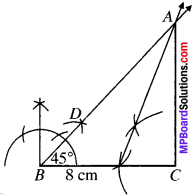
Answer:
The anionic vacancies due to metal excess defect in ionic solids are occupied by free electrons to maintain the electrical neutrality. These impart colour by excitation of these electrons when they absorb energy from the visible light falling on the crystals. For example :
When NaCl is heated in presence of sodium vapours, Na+ ions are in excess, Cl ions leave their normal site and come to the surface. The vacant site of anion is occupied by electron forming F-centre. They absorb light from visible region and radiate complementary colour.
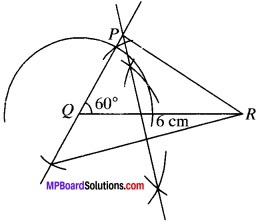
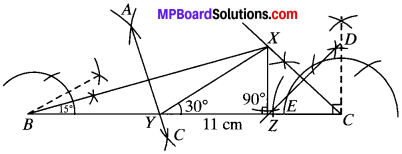
Question 23.
A group-14 element is to be converted into n-type semiconductor by doping it with a suitable impurity. To which group should this impurity belong ?
Answer:
n-type semiconductors are obtained by doping of a higher group impurity. Hence, to convert group 14 element to n-type semiconductor, it should be doped with a group 15 element.

Question 24.
What type of substances would make better permanent magnets, ferro-magnetic or ferrimagnetic ? Justify your answer.
Answer:
Ferromagnetic materials would make better permanent magnets than ferrimagnetic materials because in ferromagnetic solids, the magnetic moments of unpaired electrons spontaneously align themselves in same direction. However, in ferrimagnetic solids the magnetic moments of the domains are aligned in parallel and anti-parallel direction in unequal numbers.
MP Board Class 12th Chemistry Solutions Chapter 1 The Solid State - 2

MP Board Solutions

The Solid State NCERT TextBook Exercises

Question 1.
Define the term ‘amorphous’. Give a few examples of amorphous solids.
Answer:
In non-crystalline solids constituent particles like atoms, molecules or ions do,not have a definite ordered structure. These do not have a definite geometry, thus they are also known as pseudo solid.
Example : Glass, rubber, plastic.

Question 2.
What makes a glass different from a solid such as quartz ? Under what conditions could quartz be converted into glass ?
Answer:
Quartz is a crystalline solid whereas glass is a amorphous solid. Quartz can be converted into glass by melting and rapid cooling.

Question 3.
Classify each of the following solids as ionic, metallic, molecular, network (covalent) or amorphous.
(i) Tetra phosphorus decoxide (P4O10)
(ii) Ammonium phosphate (NH4)3PO4
(iii) SiC
(iv) I2
(v) P4
(vi) Plastic
(vii) Graphite
(viii) Brass
(ix) Rb
(x) LiBr
(xi) Si.
Answers:
Ionic : (NH4)3PO4, LiBr
Metallic : Brass, Rb
Molecular : P4O10,I2,P4
Network : Graphite, SiC, Si
Amorphous : Plastics.

Question 4.
(i) What is meant by the term ‘co-ordination number’ ?
(ii) What is the co-ordination number of atoms :
(a) In a cubic close packed structure ?
(b) In a body centred cubic structure ?
Answer:
(i) The number of nearest neighbours of a particle in its close packing is called its coordination number.
(ii) (a) 12, (b) 8.

Question 5.
How can you determine the atomic mass of an unknown metal if you know its density and the dimension of its unit cell ? Explain.
Answer:
Atomic mass (M)
MP Board Class 12th Chemistry Solutions Chapter 1 The Solid State - 3

Question 6.
‘Stability of a crystal is reflected in the magnitude of its melting points’, comment. Collect melting points of solid water, ethyl alcohol, diethyl ether and methane from a data book. What can you say about the intermolecular forces between these molecules ?
Answer:
Stability of a crystal depends on the force of attraction so : Higher the melting point of crystal, stronger the intermolecular force of attraction, hence greater is the stability of a crystal.
MP Board Class 12th Chemistry Solutions Chapter 1 The Solid State - 4
Melting point of the H2O, C2H5OH, diethyl ether and methane given as below :
MP Board Class 12th Chemistry Solutions Chapter 1 The Solid State - 5
On the basis of melting point, the strength of the intermolecular forces between these molecules follows the order :
Water > Diethyl ether > Ethyl alcohol > Methane.

Question 7.
How will you distinguish between the following pairs of terms :
(i) Hexagonal close packing and cubic close packing ?
(ii) Crystal lattice and unit cell ?
(iii) Tetrahedral void and octahedral void ?
Answer:
(i) Refer to NCERT Text-Book (Close packing in crystals).

(ii) Crystal lattice :
Regular arrangement of the consti-tuent particle (atoms, molecules, or ions) of a crystal in three dimentional space.

Unit cell :
It is the smallest repeating unit in three-dimensional space, which is repeated again and again to give the complete lattice.

(iii)Tetrahedral void :

  1. It is the open space between four touching spheres of two layers of atoms.
  2. The radius of tetrahedral void relative to radius of sphere is 0-225.

Octahedral void :

  1. It is the open space between six touching spheres of two layers of atoms.
  2. The radius of octahedral void relative to radius of sphere is 0-414.

Question 8.
How many lattice points are there in one unit cell of each of the following lattice:
(i) Face centred cubic
(ii) Face centred tetragonal
(iii) Body centred.
Answer:
(i) In face centred cubic arrangement, number of lattice points are :
= 8 (at comers) + 6 (at face centres)
Lattice points per unit cell = 8 × \(\frac { 1 }{ 8 } \) + 6 × \(\frac { 1 }{ 2 } \) = 4.

(ii) In face centred tetragonal, number of lattice points are :
= 8 (at comers) + 6 (at face centres)
Lattice points per unit cell = 8 × \(\frac { 1 }{ 8 } \) + 6 × \(\frac { 1 }{ 2 } \) = 4

(iii) In body centred cubic arrangement, number of lattice points are :
= 8 (at comers) + 1 (at body centres)
Lattice points per unit cell = 8 × \(\frac { 1 }{ 8 } \) + 1 = 2

Question 9.
Explain:
(i) The basis of similarities and differences between metallic and ionic crystals.
(ii) Ionic solids are hard and brittle.
Answer:
(i) Metallic and Ionic crystal:
(a) Both metallic and ionic solids have high melting points.
(b) Ionic solids are hard and brittle but metallic solids are hard but not brittle, metals are malleable and ductile.
(c) Ionic solids are bad conductor but good conductor in a molten state and in solution. Metallic solids are good conductor in solid and liquid as well as in vapour state.
(d) Constituent units in ionic solids are cations and anions. In metallic solids, constituent units are Kernel (positively charged ions) surrounded by a sea of delocalized electrons.

(ii) Ionic crystals are hard because there are strong electrostatic forces of attraction among the oppositely charged ions. They are brittle because the ionic bond is non-directional.

Question 10.
Calculate the efficiency of packing in case of a metal crystal for:
(i) Simple cubic
(ii) Body centred cubic
Solution:
(i) Packing effiency of simple cube =
MP Board Class 12th Chemistry Solutions Chapter 1 The Solid State - 6
(ii) Packing efficiency in body centred cubic structure
MP Board Class 12th Chemistry Solutions Chapter 1 The Solid State - 7
(iii) Packing efficiency of face centred cubic structure
MP Board Class 12th Chemistry Solutions Chapter 1 The Solid State - 8

Question 11.
Silver crystallizes in fee lattice. If edge length of the cell is 4.077 × 10⁻⁸ cm and density is 10-5 gem-3, calculate the atomic mass of silver.
Solution:
MP-Board-Class-12th-Chemistry-Solutions-Chapter-1-The-Solid-State-9
Z = 4 (fcc lattice), d = 10.5 gcm, N = 6.022 x 10, (a = 4.077 × 10⁻⁸ cm)
MP Board Class 12th Chemistry Solutions Chapter 1 The Solid State - 10

Question 12.
A cubic solid is made of two elements P and Q. Atoms of Q are at the corners of the cube and P at the body centre. What is the formula of the compound ? What are the co-ordination numbers of P and Q ?
Answer:
As atom Q are present at the 8 comers of the cube, therefore, number of atoms of Q in the unit cell = 8 × \(\frac { 1 }{ 8 } \) = 1.
As atoms P are present at the body centre, therefore number of atoms P in the unit cell = 1.
∴ Formula of the compound = PQ
Co-ordination number of each P and Q = 8.

Question 13.
Niobium crystallizes in body centred cubic structure. If density is 8.55 gem-3, calculate atomic radius of niobium using its atomic mass 93u.
Solution:
Density = 8.55 g cm-3
Let, length of the edge = a cm
Number of atoms per unit cell, Z = 2 (bcc)
Atomic mass, M = 93 g mol-1
density, d = \(\frac{\mathrm{Z} \times \mathrm{M}}{a^{3} \times \mathrm{N}_{\mathrm{A}}}\)
MP Board Class 12th Chemistry Solutions Chapter 1 The Solid State - 10
= 1.431 x 10⁻¹⁰m = 0.143 nm

Question 14.
If the radius of the octahedral void is r and radius of the atoms in close packing is R, derive relation between r and R.
Solution:
Atoms covering the octahedral void from the top and below are not shown in the figure. Centre of octahedral void is C and its radius is equal to r. Atoms surrounding the voids are of radius R.
MP Board Class 12th Chemistry Solutions Chapter 1 The Solid State - 12
According to the figure,
Radius of atom surrounding the void BA = R
BC = Radius of void + Radius of outer atom
= R + r
∠ABC = 45°
in triangle ABC \(\frac {AB}{BC} \) = cos 45° = \(\frac{1}{\sqrt{2}}\) = 0.707
or \(\frac {AB}{BC} \) = 0.707
or 0.707 R + 0.707 r = R
or o.293 = 0.707r
\(\frac {r}{R} \) = \(\frac {0.293}{0.707} \) = 0.414

Question 15.
Copper crystallizes into a fee lattice with edge length 3.61 × 10⁻⁸ cm. Show that the calculated density is in agreement with its measured value of 8.92 gcm-3.
Solution:
We know that, d = \(\frac{\mathrm{Z} \times \mathrm{M}}{a^{3} \times \mathrm{N}_{\mathrm{A}}}\)
For fcc Z = 4, Atomic mass of copper = 63.5, a = 3.16 x 10⁻⁸
MP Board Class 12th Chemistry Solutions Chapter 1 The Solid State - 13
= 8.96 g cm-3
This value is close to measured value.

MP Board Solutions

Question 16.
Analysis shows that nickel oxide has the formula NiO0.98 O1.00. What fractions of nickel exist as Ni2+ and Ni3+ ions ?
Solution:
Let there are x ions of Ni2+ and (0.98 – x) ions of Ni3+.
For electrical neutrality of the compound :
Total positive charge contributed by Ni2+ and Ni3+ ions = Total negative charge contributed by
O2- ions
(+2 × x) + {+3 × (0-98 – x)} = 2
2x + 2.94 – 3x = 2
x = 0.94.
Thus, fraction of Ni2+ = \(\frac { 0.94 }{ 0.98 } \) = 0.96 or 96%
Fraction of Ni3+ = (1 – 0.96) = 0.04 or 4%.

Question 17.
What is a semiconductor ? Describe the two main types of semiconductors and contrast their conduction mechanism.
Answer:
Substance whose conductance likes in between that of metals (Conductors) and insulators are called semiconductors. There are two main types of semiconductors :

(i) n-type semiconductors : Silicon and germanium belong to group 14 of the periodic table and have four valence electrons each. In their crystals each atom forms four covalent bonds with its neighbours. When doped with a group 15 element like P or As, which contains five valence electrons, they occupy some of the lattice sites in silicon or germanium crystal. Four out of five electrons are used in the formation of four covalent bonds with the four neighbouring silicon atoms. The fifth electron in extra and becomes delocalised.

These delocalised electrons increase the conductivity of doped silicon (or germanium). Here, the increase in conductivity is due to the negatively charged electron, hence silicon doped with electron with impurity is called n-type semiconductor.

(ii) p-type semiconductors: Silicon or germanium can also be doped with a group 13 element like B, A1 or Ga which contains only three valence electrons. The place where the fourth valence electron is missing is called electron-hole or electron vacancy. An electron from a neighbouring atom can come and fill the electron hole, but in doing so it would leave an electron hole at its original position.

If it happens it would appear as if the electron hole has moved in the direction opposite to that of the electron that filled it under the influence of electric field, electrons would move towards the positively charged plate through electronic holes, but it would appear as if electron holes are positively charged and are moving towards negatively charged plate. This type of semiconductors are called p-type semiconductors.

Question 18.
Non-stoichiometric cuprous oxide, Cu2O can be prepared in laboratory. In this oxide, copper to oxygen ratio is slightly less than 2:1. Can you account for the fact that this substance is a p-type semiconductor ?
Answer:
The ratio less than 2: 1 in Cu2O shows that some cuprous (Cu+) ions have been replaced by cupric (Cu2+) ions. To maintain electrical neutrality, every two Cu+ ions will be replaced by one Cu2+ ion thereby creating a hole. As conduction will be due to presence of these positive hole, hence it is a p type semiconductor.

Question 19.
Ferric oxide crystallizes in a hexagonal close packed array of oxide ions with two out of every three octahedral holes occupied by ferric ions. Derive the formula of the ferric oxide.
Solution:
Number of oxide (O2-) ions = n
Number of octahedral voids = n
Number of Fe3+ ions = \(\frac { 2 }{ 3 } \) n
Fe3+ : O2- = \(\frac { 2 }{ 3 } \)n : n
= 2 : 3
Formula, Fe2O3.

Question 20.
Classify each of the following as being either a p-type or an-type semiconductor :
(i) Ge doped with In
(ii) B doped with Si.
Answer:
(i) Ge belongs to group 14 and In belongs to group 13, therefore an electron-deficient hole is created and hence it is n-type semiconductor.
(ii) B belongs to group 13 and Si belongs to group 14, therefore there will be a free electron and hence it is n-type semiconductor.

Question 21.
Gold (atomic radius = 0.144 nm) crystallizes in a face-centred unit cell. What is the length of a side of the cell ?
Solution:
According to the question, r = 0.144 nm.
For fee structure:
Edge length (a) = 2\(\sqrt { 2 }\) × Radius of atom= 2 × 1.414 × 0.144
= 0.407 nm.

Question 22.
In terms of band theory, what is the difference :
(i) between a conductor and an insulator ?
(ii) between a conductor and a semiconductor ?
Answer:
(i) The energy gap between the valence band and the conduction band in an insulator is very large whereas in a conductor the energy gap is either very small or there is overlapping between valence band and conduction band.

(ii) In a conductor, the energy gap between the valence band and conduction band is very small or there is overlapping between valence band and conduction band. But in a semiconductor, there is always a small energy gap between them.

Question 23.
Explain the following terms with suitable examples :
(i) Schottky defect
(ii) Frenkel defect
(iii) Interstitials and
(iv) F-centres.
Answer:
(i) Schottky defect: This defect arises in the crystal when one cation and one anion is missing from their normal lattice site and as a result vacancies are created. Since, the number of missing positive ions is equal to the missing negative ions, the crystal as a whole is electrically neutral. Due to this defect, the density of the crystal decreases.

This defect generally occurs in strongly ionic compounds with high coordination number and where positive and negative ions are almost of similar sizes, e.g., NaCl and CsCl.

(ii) Frenkel defect: This defect is due to vacancy at a cation site. The cation leaves its correct lattice site and moves to another position between the two. Frenkel defects are common in ionic compound which possess low co-ordination number in which there is large difference between the size of positive and negative ions. As there is no absence of ions from the lattice the density remains the same, e.g. ZnS, AgCl.
MP Board Class 12th Chemistry Solutions Chapter 1 The Solid State - 14
(iii) Interstitial defect: When some constituent particles (atoms or molecules) occupy an interstitial site the crystal is said to have interstitial defect. This defect increases the density of the substance. Non ionic solids are example of this defect.

(iv) F-centres : Alkalihalides like NaCl and KCl show this type of defect when crystals of NaCl are heated in a atmosphere of sodium vapour the sodium atoms are deposited normal on the surface of the crystal. The Cl ions diffuse to the surface of the crystal and combine with Na atoms to give NaCl. This happens by the loss of electrons by sodium atoms to form Na+ ions. The released electron diffuse into the crystal and occupy anionic sites.

As a result crystal has now excess of sodium. The anionic sites occupied by unpaired electrons are called F-centres. They impart yellow colour to the crystal of NaCl. The colour results by excitation of these electrons when they absorb energy from the visible light falling on the crystals. Another examples are : LiCl, KCl etc.

Question 24.
Aluminium crystallizes in a cubic close packed structure. Its metallic radius is 125 pm.
(i) What is the length of the side of the unit cell ?
(ii) How many unit cells are there in 1.00 cm3 of aluminium ?
Solution:
(i) For a cubic close packed structure, length of the side of unit cell is related to radius.
MP Board Class 12th Chemistry Solutions Chapter 1 The Solid State - 15

Question 25.
If NaCI is doped with 10-3 mol % of SrCl2, what is the concentration of cation vacancies ?
Solution:
We know that, doping of SrCl2 to NaCI brings in replacement of two Na+ ions by each Sr2+ ions, but each Sr2+ occupies only one lattice point. This produces one cation vacancy.
Thus, doping of 10-3 mole of SrCl2 in 100 moles of NaCI.
NaCI will produce cation vacancies = 103 mol
∵ 100 mole of NaCI will have cation vacancies after doping = 10-3 mol
∴ 1 mole of NaCI will have cation vacancies after doping = \(\frac{10^{-3}}{100}=10^{-5}\) mol
Total cationic vacancies after doping = 10-5 × NA
= 10-5 × 6.023 × 1023
= 6.023 × 10¹⁸ vacancies.

Question 26.
Explain the following with suitable examples :
(i) Ferromagnetism
(ii) Paramagnetism
(iii) Ferrimagnetism
(iv) Anti-ferromagnetism
(v) 12-16 and 13-15 group compounds.
Answer:
On the basis of magnetic properties solids are classified into following categories :
(i) Ferromagnetic : A substance which shows unusually large paramagnetism and shows permanent magnetism even in absence of a magnetic field is called ferromagnetic.
Examples : Fe, Co, Ni, CrO2, Fe3O4, alnico (alloy of Al, Ni, Co, Fe and Cu)
A ferromagnetic substance if once magnetised remains magnetised permanently. Fer-romagnetism arises due to spontaneous alignment of magnetic moments (due to unpaired electrons) in the same direction.
MP Board Class 12th Chemistry Solutions Chapter 1 The Solid State - 16
(ii) Paramagnetic : A substance which is attracted by a magnetic field is called para-magnetic. Paramagnetism arises due to the presence of permanent dipoles due to unpaired electrons in atoms, ions or molecules.
MP Board Class 12th Chemistry Solutions Chapter 1 The Solid State - 17
Example : Cu+2, Fe3+, TiO, CuO, O2 etc.
(iii) Ferrimagnetic : A substance which shows fairly good paramagnetic character is called ferrimagnetic.
In ferrimagnetic substances the alignment of magnetic moments in opposite directions are not equal. As a result the substance attains a net magnetic moments, e.g. Fe3O4 isaferrimag- netic substance which on heating upto 850 K becomes paramagnetic.
MP Board Class 12th Chemistry Solutions Chapter 1 The Solid State - 18
(iv) Antiferromagnetic : A substance which shows much reduced paramagnetism than expected is called antiferromagnetic.
In antiferromagnetic substances the alignment of magnetic moments are equal and in opposite directions. Hence, the net magnetic moment is zero.
Examples: V2O3,Cr2O3,MnO,Mn2O3,MnO2,FeO,Fe2O3,CoO, Co3O4,NiO
MP Board Class 12th Chemistry Solutions Chapter 1 The Solid State - 19
(v) 12-16 and 13-15 group compounds: Various types of compounds are formed by the mixture of elements of group 13 and 15 and group 12 and 16 whose average valency is like Ge and Si is 4. Of these specific compounds of group 13-15 are InSb, AlP and GaAs. Gallium arsenious are accelerated sensitive semiconductors. Semiconductors brought a revolutionary change in the manufacture of devices. ZnS, CdS, CdSe and HgTe are examples of compounds of group 12-16. Bonds of these compounds are not totally covalent and their ionic properties depend on the electronegativity of both the elements present.

MP Board Solutions

The Solid State Other Important Questions and Answers

The Solid State Objective Type Questions

Question 1.
Choose the correct answer:

Question 1.
Due to Frenkel defect, density of ionic solids :
(a) Decreases
(b) Increases
(c) Does not change
(d) It changes.

Question 2.
In CsCl each Cl is surrounded by how many Cs :
(a) 8
(b) 6
(c) 4
(d) 2.

Question 3.
Frenkel defect is not shown by :
(a) AgBr
(b)AgCl
(c) KBr
(d) ZnS.

Question 4.
In NaCl crystal number of oppositely charged ions situated at equal distance are:
(a) 8
(b) 6
(c) 4
(d) 2.

Question 5.
Best conductor of electricity is :
(a) Diamond
(b) Graphite
(c) Silicon
(d) Carbon (Non-crystalline).

Question 6.
Which type of point defect is found in NaCI crystal or KCl crystal:
(a) Frenkel defect
(b) Schottky defect
(c) Lattice defect
(d) Impurity defect.

Question 7.
How many space lattices (Bravais lattice) can be obtained from various crystal systems:
(a) 7
(b) 14
(c) 32
(d) 230.

Question 8.
Diamond is a:
(a) H-bond solid
(b) Ionic solid
(c) Covalent solid
(d) Glass.

Question 9.
The Co-ordination number of Ca2+ ions in fluoride structure is :
(a) 4
(b) 6
(c) 8
(d) 3.

Question 10.
8 : 8 Co-ordination number is found in which compound :
(a) MgO
(b) Al2O3
(C) CsCl
(d) All of these.

Question 11.
Co-ordination number of body centred cubic cell is :
(a) 8
(b) 12
(c) 6
(d)4.

Question 12.
Density of unit cell is :
MP Board Class 12th Chemistry Solutions Chapter 1 The Solid State - 20

Question 13.
The number of tetrahedral voids in unit cell of cubic close packing :
(a) 4
(b) 8
(c) 6
(d) 2.

Question 14.
Intra-ionic distance of CsCl will be :
(a) a
(b) \(\frac { a }{ 2 } \)
(c) \(\frac{\sqrt{3}}{2} a\)
(d) \(\frac{2 a}{\sqrt{3}}\)

Question 15.
Number of atoms in body centred cubic unit cell is :
(a) 1
(b) 2
(c) 3
(d) 4

Question 16.
Which of the following is Bragg equation :
(a) nλ = 2Φ sin θ
(b) nλ = 2d sin θ
(c) nλ = sin θ
(d) \(n \frac{\theta}{2}=\frac{d}{2} \sin \theta\)

Question 17.
Constituents of covalent crystal is :
(a) Atom
(b) Molecule
(c) Ion
(d) All of these.

Question 18.
Number of Na atom present in the unit cell of NaCl crystal is :
(a) 1
(b) 2
(c) 3
(d) 4.

Question 19.
What type of magnetic substance are Fe, Co, Ni:
(a) Paramagnetic
(b) Ferromagnetic
(c) Diamagnetic
(d) Antiferromagnetic.

Question 20.
The correct example of Frenkel defect is :
(a) NaCI
(b) CsCl
(c) KCl
(d) AgCI.

Question 21.
Dry ice (solid CO2) is a/an :
(a) Ionic crystal
(b) Covalent crystal
(c) Molecular crystal
(d) Metallic crystal.

Question 22.
Co-ordination number of Cs in CsCl:
(a) Like Cl i.e., 6
(b) Like Cl i.e., 8
(c) Unlike Cl i.e., 8
(d) Unlike Cl i.e., 6.

Question 23.
Structure of NaCl crystal:
(a) Tetragonal
(b) Cubic
(c) Orthorhombic
(d) Monoclinic.

Question 24.
Each Na+ ion in NaCl crystal is surrounded by :
(a) Three Cl ions
(b) Eight Cl ions
(c) Four Cl ions
(d) Six Cl ions.

Question 25.
For increasing of electro-conductivity in a solid crystal, mixing of impurities is known as:
(a) Schottky defect
(b) Frenkel defect
(c) Doping
(d) Electronic defect

Question 26.
Which type of lattice is found in KCl crystal:
(a) Face centred cubic
(b) Body centred cubic
(c) Simple cubic
(d) Simple tetragonal.

Question 27.
Number of atoms in a body centred cubic unit cell of a monoatomic substance is:
(a) 1
(b) 2
(c) 3
(d) 4.

Question 28.
Radius ratio limit for tetrahedral symmetry is :
(a) 0.155
(b) 0.414
(c) 0.732
(d) 0.225.

Question 29.
The defect produced due to a cation and an anion vacancy in a crystal lattice is known as:
(a) Schottky defect
(b) Frenkel defect
(c) Crystal defect
(d) Ionic defect.

Question 30.
If co-ordination number of Cs+ is 8 in CsCl then co-ordination number of Cl ion is :
(a) 8
(b) 4
(c) 6
(d) 12.

Answers:
1. (c), 2. (a), 3. (c), 4. (b), 5. (b), 6. (b), 7. (b), 8. (c), 9. (c), 10. (c), 11. (a), 12. (a), 13. (b), 14. (c), 15. (b), 16. (b), 17. (a), 18. (d),’ 19. (b), 20. (d), 21. (c), 22. (b), 23. (b), 24. (d), 25. (c), 26. (a), 27. (b), 28. (d), 29 (a), 30. (a).

Question 2.
Fill in the blanks :

  1. The defect produced due to removal of a cation and an anion from a crystal lattice is called ………………..
  2. If in a crystal lattice a cation leaves its lattice site and occupies a space in the interstitial site then the defect is called ……………….
  3. The cause of electric conduction of NaCl in its molten state are its ………………..
  4. Due to ……………….. defect the density of crystal decreases.
  5. Total ……………….. types of crystal system are there.
  6. ……………….. proposed the concept of atom for the first time.
  7. The ratio of the cation and anion present in a crystal is known as ………………..
  8. The process of adding small amount of impurities in an element or compound is called ………………..
  9. Total 14 types of unit cells are there which are known as ………………..
  10.  In NaCl crystal structure, co-ordination number of both Na+ and Cl ion is ………………..
  11. ……………….. defect is found in ZnS and AgCl crystal.
  12. Due to Schottky defect, density of crystal ………………..
  13. In metallic solids, conductivity is due to the presence of …………..
  14. Point defects are found in ………….. crystals.Substances which are attracted in magnetic field are called …………..
  15. For a unit cell, if r = \(\frac{a}{\sqrt{8}}\) then it will be ………….. type of unit cell.
  16. Conductivity of semiconductor ………….. on increasing temperature.

Answers:

  1. Schottky defect
  2. Frenkel defect
  3. Free ions
  4. Schottky
  5. Seven
  6. Kannad
  7. Radius ratio
  8. Doping
  9. Bravais lattice
  10. Six
  11. Frenkel
  12. Decreases
  13. Free electron
  14. Ionic
  15. Paramagnetic substance
  16. fcc
  17. Increases.

Question 3.
Match the following
MP Board Class 12th Chemistry Solutions Chapter 1 The Solid State - 21
Answers:
1. (b)
2. (d)
3. (c)
4. (a)

MP Board Class 12th Chemistry Solutions Chapter 1 The Solid State - 22
Answers:
1. (c)
2. (d)
3. (a)
4. (b).

MP Board Class 12th Chemistry Solutions Chapter 1 The Solid State - 23
Answer:
1. (d)
2. (c)
3. (b)
4. (a).

Question 4.
Answer in one word / sentence :

  1. Give two examples of metallic crystal.
  2. Give two examples of covalent crystal.
  3. Give two examples of ionic crystal.
  4. What is the co-ordination number of F in CaF2 ?
  5. What type of crystal is SiC ?
  6. What is the value of co-ordination number of hexagonal close packing structure ?
  7. Write the formula of radius ratio.
  8. What is the type of structure of NaCl crystal ?
  9. Give an example of body centred cubic cell.
  10. Give an example of a compound which has both Schottky and Frenkel type of defect.
  11. Give two examples of amorphous or non-crystalline solid.
  12. Write Bragg equation.
  13. What is effect on the density of a substance or crystal due to Schottky defect ?
  14. State the co-ordination number of CsCl and NaCl.
  15. Write the formulae of two superconductors substance.
  16. Give an example of Frenkel defect.
  17. Give an example of superconductor.
  18. Radius ratio of tetrahedral void is.

Answers:

  1. Copper, Nickel
  2. Diamond, Graphite
  3. NaCl, NaNO3
  4. 4
  5. Covalent
  6. 12
  7. MP-Board-Class-12th-Chemistry-Solutions-Chapter-1-The-Solid-State-38.
  8. Cubic
  9. CsCl
  10. AgBr
  11. Glass,plastic,
  12. nλ = 2d sin θ
  13. Due to schottky defect, density of substance decreases
  14. Co-ordination number of CsCl = 8 : 8, Co-ordination number of NaCl = 6:6
  15. (i) λBa3- Cu2O7, (ii) Bi2Ca2Sr2Cu3O10
  16. AgCl
  17. Ba0.7K0.3BIO3
  18. 0.225.

MP Board Solutions

The Solid State Very Short Answer Type Questions

Question 1.
What are crystalline solids ? Crystalline solids are of how many types ?
Answer:
Solids in which the constituent particles like atoms, molecules or ions are in a definite order, with a definite geometry are known as crystalline solids.

Crystalline solids are of four types :

  1. Ionic crystal
  2. Covalent crystal
  3. Molecular crystal
  4. Metallic crystal.

Question 2.
Write the formula of density of unit cell.
Answer:
MP Board Class 12th Chemistry Solutions Chapter 1 The Solid State - 24

Question 3.
What is crystal lattice ?
Answer:
Geometry of a crystal in which unit cells are arranged in a definite order and forms a crystal like the shape of unit cell is known as crystal lattice.

Question 4.
What is a unit cell ?
Answer:
The smallest unit formed by the arrangement of constituent particles atoms, ions or molecules of a crystal in an ordered form is known as unit cell of the crystal.

Question 5.
Give two-two examples of each of the following :

  1. Diamagnetic substance
  2. Paramagnetic substance
  3. Ferromagnetic substance
  4. Antiferromagnetic substance
  5. Ferrimagnetism.

Answer:

  1. Diamagnetic substance – TiO2, NaCl
  2. Paramagnetic substance – Cu+2, Fe+3
  3. Ferromagnetic substance – Fe, Co
  4. Antiferromagnetic substance – MnO2, MnO
  5. Ferrimagnetism – Fe3O4, Ferrite.

Question 6.
Write the structure and co-ordination number of the following:
(1) CsCl
(2) NaCl
(3) Zn.
Answer:
(1) CsCl – Structure : Cubic, Co-ordination number : 8.
(2) NaCl – Structure: Octahedral, Co-ordination number : 6.
(3) Zn – Structure : Tetrahedral, Co-ordination number : 4.

Question 7.
What makes a glass different from a solid such as quartz ? Under what conditions could quartz be converted into glass ?
Answer:
Glass is an amorphous solid in which constituent particles are orderly arranged in a short range order. Quartz is a crystalline form of silica in which SiO4 units are orderly arranged in a long range order.
Quartz can be converted into glass by melting the glass and then cooling it rapidly.

Question 8.
Which are the seven fundamental crystal system on the basis of crystal geometry ?
Answer:
Seven types of crystal system are following:

  1. Cubic
  2. Tetragonal
  3. Orthorhombic
  4. Monoclinic
  5. Hexagonal
  6. Rhombohedral
  7. Triclinic.

Question 9.
Write the names of different type of cubic system,
Answer:
Cubic system is of three types :

  1. Simple cubic (see)
  2. Body centred cubic (bcc)
  3. Face centred cubic (fcc).

Question 10.
What is co-ordination number of Na+ and Cl in the structure of NaCl ?
Answer:
In NaCl structure each Na+ is surrounded by 6 Cl and each Cl is surrounded by 6 Na+ ions.
Thus, Co-ordination number of Na+ = 6
Co-ordination number of Cl = 6.

Question 11.
What is co-ordination number ? What is the effect of temperature and pressure on co-ordination number ?
Answer:
The number of neighbouring ions around the constituent particles of a crystal lattice is known as its co-ordination number. At high pressure co-ordination number increases and at low pressure it decreases.

Question 12.
What information is obtained by X-ray diffraction study of crystals ?
Answer:
By X-ray diffraction study of crystals, spacing between crystal planes of constituents particles of crystals is known.

Question 13.
What type of solids are electrical conductors : metallic or ductile ?
Answer:
Metallic solids.

Question 14.
Give the significance of a ‘lattice point’.
Answer:
Each lattice point represents one constituent particle of the solid. The constituent particle may be an atom, a molecule (group of atom) or an ion.

Question 15.
Refractive index of a solid is observed to have the same value along all directions. Comment on the nature of this solid. Would it show cleavage property ?
Answer:
As the solid has same value of refractive index along all directions, this means that it is isotropic and hence amorphous. Being an amorphous solid, it would not show a clean cleavage when cut with a knife. Instead it would break into pieces with irregular surfaces.

MP Board Solutions

The Solid State Short Answer Type Questions

Question 1.
What is Schottky defect ?
Answer:
This type of defect is found in crystals in which both the cation and anion leave their normal lattice site and make their place vacant. In this defect, density decreases but r electrical neutrality is maintained. Like NaCl, CsCl etc.

Question 2.
What is radius ratio of ions ?
Answer:
Ratio of radii of cation and anion in any crystal is called radius ratio.
MP Board Class 12th Chemistry Solutions Chapter 1 The Solid State - 25
For example, in NaCl, ionic radii of Na+ and Cl- ions are 95 pm and 181 pm respectively.
Radius ratio in NaCl = \(\frac { 95 }{ 181 } \) = 0.52
Due to presence of other forces, in the crystal the observed value of radius ratio is less as in NaCl crystal it is 0414.

Question 3.
Describe briefly the structure of CsCl.
Answer:
It is AB type ionic crystal with body centred cubic structure. In this Cs+ ion in centre of cube and Cl ions at comers of cube (or vice versa). Co-ordination number of caesium chloride is 8 : 8 and radius ratio of Cs+ and Cl ions is 0.732.
MP Board Class 12th Chemistry Solutions Chapter 1 The Solid State - 26
In the unit cell of CsCl one Cs+ ion and one Cl ion are present.
Cs+ = 8 (at Centre) × 1 = 1
Cl = 8 (at corners) × \(\frac { 1 }{ 8 } \) = 1

Question 4.
Calculate the density of unit cell.
Answer:
MP Board Class 12th Chemistry Solutions Chapter 1 The Solid State - 27
If number of particles (atom, molecule, ions) of unit cell is Z and mass of each particle is m, then
Mass of unit cell = m × Z …….(1)
If molar mass of the substance is M, then mass of each particle :
MP Board Class 12th Chemistry Solutions Chapter 1 The Solid State - 28

Question 5.
Why is glass considered as super cooled liquid ?
Answer:
Glass is an amorphous solid. Like liquids it has tendency to flow, though very slowly. The proof of this fact is that the glass panes in the windows or doors of old buildings are invariably found to be slightly thicker at the bottom that at the top.

Question 6.
Ionic solids conduct electricity in molten state but not in solid state. Explain.
Answer:
In the molten state, ionic solids dissociate to give free ions and hence can conduct electricity. However in the solid state, as the ions are not free but remain held together by strong electrostatic forces of attraction, they cannot conduct electricity in the solid state.

Question 7.
What type of defect can arise when a solid is heated ? Which physical property is affected by it and in what way ?
Answer:
When a solid is heated, vacancy defect is produced in the crystal. This is because on heating some atoms or ions leave the lattice site completely, some lattice sites become vacant. As a result of this defect the density of the substance decreases because some atoms ions leave the crystal completely.

Question 8.
A compound consists of A and B exhibits cubic structure. A atoms are arranged at corners of cube while B are at the centre of faces. What will be the formula of the compound ?
Answer:
Atoms situated at corners are 8 A atoms which are shared by 8 cubes. So in the unit cell:
Number of A atom = 8 × \(\frac { 1 }{ 8 } \) = 1
B atoms are present in centre of 6 faces and each face is shared by two cubes
So number of B atoms = 6 × \(\frac { 1 }{ 2 } \) = 3
Formula of compound will be AB3.

Question 9.
Prove that in face centred cubic (fee) structure, there are four atoms in an unit cell.
Answer:
Face Centred Cubic Structure : In this structure one atom is also situated in each face along with the corners of cube. The atom in each face is shared by two faces.
Thus, number of atom in each unit cell = 8 × \(\frac { 1 }{ 8 } \) (at 8 comers) + 6 × \(\frac { 1 }{ 2 } \) (at 6 faces)
= 1 + 3 = 4.

Question 10.
Write Bragg equation.
Answer:
Bragg equation is as follows : 2d sin θ = nλ.
Where, d = Distance between two consecutive planes in a crystal,
θ = Incident angle of X-rays
n = Simple whole number
λ. = Wavelength of X-rays.
By this distance d between the planes of the crystal is determined.

Question 11.
Name the parameters that characterise a unit cell.
Answer:
A unit cell is characterised by : (i) Its dimensions along the three edges a, b and c. These edges may or may not be mutually perpendicular
(ii) Angles between the edges, a, (between b and c), β (between a and c) and γ (between a and b). Thus, a unit cell is characterised by six parameters a, b, c, α, β and γ.

Question 12.
Window glass of old buildings appear milky. Why ?
Answer:
In day time, glass becomes hot and cools down at night. This way, the process of annealing takes place. Due to annealing in many years, glass develops crystalline property and window glass appear milky.

Question 13.
Common salt sometimes appear yellow instead of being colourless. Why ?
Answer:
In common salt, due to metal excess defect the anion Cl disappears from its lattice site but leaves an electron thereby which the crystal remains electrically neutral. A hole is formed at the vacant space of anion. This hole is known as F-centre. Due to this reason NaCl appear yellow.

Question 14.
With the increase in temperature, electrical conductivity of semiconductors increases. Why ?
Answer:
The energy gap between valence band and conduction band is less. Thus, with the increase in temperature, some electrons from the valence band jump to the conduction band due to which electrical conductivity increases with the increase in temperature.

Question 15.
Which of the following lattices has the highest packing efficiency :
(i) Simple cubic
(ii) Body centred cubic
(iii) Hexagonal close packed lattice ?
Answer:
Packing efficiency for simple cubic = 52-4%
Body centred cubic = 68%
Hexagonal close packed = 74%
Hence, Hexagonal close packed (hcp) has highest packing efficiency.

Question 16.
What type of stoichiometric defect is shown by (i) ZnS (ii) AgBr ?
Answer:
(i) ZnS shows Frenkel defect because its ions have a large difference in size.
(ii) AgBr shows both Frenkel and Schottky defects.

Question 17.
Explain how much portion of an atom located at: (i) Corner and (ii) Body centre of a cubic unit cell is part of its neighbouring unit cell ?
Answer:
(i) An atom at the corner is stand by eight adjacent unit cells. Hence, portion of the atom at the corner not belongs to one unit cell = \(\frac { 1 }{ 8 } \)
(ii) The atom at the body centre of a cubic unit cell is not stand by other unit cell. Hence, it belongs fully to the unit cell.

Question 18.
How can you determine the atomic mass of an unknown metal if you know its density and the dimension of its unit cell ? Explain.
Answer:
Let d – Density of the unit cell and volume of the unit cell = a3 (in case of cubic crystal)
Mass of an atom present in the unit cell
MP Board Class 12th Chemistry Solutions Chapter 1 The Solid State - 29

Question 19.
Stability of a crystal is reflected in the magnitude of its melting point. Comment. Collect melting point of solid water, ethyl alcohol,diethyl ether and methane from a data book. What can you say about the intermolecular forces between these molecules ?
Answer:
Higher the melting point, greater are the forces holding the constituent particles together and hence greater is the stability.
Melting points of the substance are given below :
MP Board Class 12th Chemistry Solutions Chapter 1 The Solid State - 31

Question 20.
A group 14 element is to be converted into n-type semiconductor by doping it with a suitable impurity. To which group should this impurity belong ?
Answer:
n-type semiconductor means conduction due to the presence of excess of negative charged electrons. Hence, to convert group 14 element into n-type semiconductor, it should be doped with group 15 element.

Long Answer Type Questions

Question 1.
Give difference between crystalline solid and amorphous solid.
Answer:
Differences between Crystalline solid and Amorphous solid:

Crystalline solid:

  1. Structure of crystalline solid are of definite geometrical shape.
  2. In the internal structure, particle are arranged systematically.
  3. Crystalline solids are solids in real sense.
  4. Melting points of these compounds are sharp and definite.
  5. These exhibit anisotropy.
  6. Cooling curve are not continuous.
  7. Crystalline solids possess less energy.

Amorphous solid

  1. No any definite geometrical shape in the structure.
  2. No any definite arrangement of particles in the internal structure. Amorphous solids are super cooled liquids.
  3. Melting point of these compounds are not definite and sharp.
  4. These exhibit isotropy.
  5. Cooling curves are continuous.
  6. Amorphous solids possess higher energy.

Question 2.
Distinguish between :
(i) Hexagonal and monoclinic unit cell
(ii) Face centred and end centred unit cell.
Answer:
(i) For hexagonal unit cell a = b ≠ c, α = β = 90°, γ = 120°
For monoclinic unit cell a ≠ b ≠ c, α = γ= 90°, β = 90°
(ii) A face centred unit cell has one constituent particle present at the centre of each face in addition to the particles present at the comers.
An end centred unit cell has one constituent particle each at the centre of any two opposite faces in addition to the particles present at the corners.

Question 3.
Give difference between Schottky and Frenkel defect.
Answer:
Differences between Schottky and Frenkel defect:

Schottky Defect:

  1. Cation and anion completely leave their lattice sites.
  2. Density of the crystal decreases by this defect.
  3. This defect generally occur in ionic compounds with high co-ordination number where size cation and anion are nearly same.
  4. No effect on dielectric constant.

Frenkel Defect:

  1. Cation leave its normal lattice site and occupies the intestitial site.
  2. No effect on the density of the crystal.
  3. It is found in ionic compounds with low co-ordination number and where size of cation and anion differ largely.
  4. Magnitude of dielectric constant increase.

Question 4.
What do you understand by imperfections in crystals ? What are the rea¬sons for imperfections ?
Answer:
It is generally supposed that arrangement of constituent particles in crystal struc¬ture is completely regular, but actually it is very hard to get a such complete ideal crystal. Crystal structures have many imperfections or defects. Reasons for these imperfections are following:
(i) Temperature: Crystal which have no imperfections or defects are known as ideal crystal. However such crystals exist only at absolute zero temperature because the energy of crystals at 0 K is minimum. At any temperature above 0 K, there are crystals which have some departure from complete order arrangement.

(ii) Presence of impurities : Sometimes presence of impurities causes disorder in regular arrangement of crystals which is responsible for imperfections and defects.

Question 5.
State the importance of radius ratio in crystal structure.
Answer:
Importance of radius ratio in crystal structure: Cations have tendency to get surrounded by maximum number of anions, hence larger be the size of cation greater will be its co-ordination number. We can understand this by taking examples of NaCl and CsCl. In NaCl, small sized Na+ has co-ordination number 6, while in CsCl large sized Cs+ ion has co-ordination number 8. Hence, radius ratio is closely related to co-ordination number.

Radius ratio, Co-ordination number and Structural arrangement
MP Board Class 12th Chemistry Solutions Chapter 1 The Solid State - 30

Question 6.
Ionic solids, which have anionic vacancies due to metal excess defect develop colour. Explain with the help of suitable example.
Answer:
Due to anion vacancies basic halides like NaCl, KCl etc., show this type of metal excess defect. Taking the example of NaCl, when its crystals are heated in presence of sodium vapour some chloride ion leave their lattice sites to combine with sodium to form NaCl. For this reaction to occur Na atoms lose electrons to form Na+ ions. The electron has released diffuse into the crystal to occupy the anion vacancies created by Cl ions. The crystal now has excess of sodium. The sites occupied by unpaired electrons are called F- centres. They impart yellow colour to the crystal because they absorb energy from the visible light and get excited.

Question 7.
What type of substances would make better permanent magnets : ferromagnetic or ferrimagnetic ? Justify your answer.
Answer:
Ferromagnetic substances make better permanent magnets. This is because the metal ions of a ferromagnetic substances are grouped into small regions called ‘domains’. Each domain acts as a tiny magnet. These domains are randomly oriented. When the substance is placed in a magnetic field all the domains get oriented in the direction of the magnetic field and a strong magnetic field is produced. This ordering of domains persists even when the external magnetic field is removed. Hence, the ferromagnetic substance becomes a permanent magnet.

Question 8.
How many lattice points are there in one unit cell of each of the following lattice:
(i) Face centred cubic
(ii) Face centred tetragonal
(iii) Body centred.
Solution:
(i) Lattice points in face-centred cubic lattice = 4.
(ii) Face centred tetragonal = 8 (at corners) + 6 (at the face centre) = 14.
However, particles per unit cell
= 8 × \(\frac { 1 }{ 8 } \) + 6 × \(\frac { 1 }{ 2 } \) = 1 + 3 = 4.
(iii) Lattice points in body centred cube
= 8 (at comers) + 1 (at the body centre)
= 9
However, particles per unit cell = 8 × \(\frac { 1 }{ 8 } \) + 1 = 2.

MP Board Solutions

The Solid State Numerical Questions

Question 1.
A compound forms hexagonal close packed structure. What is the total number of voids in 0.5 mol of it ? How many of these are tetrahedral voids ?
Solution:
No. of atoms in the close packing = 0.5 mol
= 0.5 × 6.022 × 1023
= 3.011 × 10²³
No. of octahedral voids = No. of atoms in the packing .
= 3.011 × 10²³
No. of tetrahedral voids = 2 × No. of atoms in the packing
= 2 × 3.011 × 1023
= 6.022 × 10²³
Total No. of voids = 3.011 × 10²³ + 6.022 × 1023
= 9.033 × 10²³.

Question 2.
A compound is formed by two elements M and N. The elements N forms ccp and atoms of M occupy l/3rd of the tetrahedral voids. What is the formula of the compound ?
Solution:
Suppose the atoms N in the ccp = n
∴ No. of tetrahedral voids = 2n
As 1/3rd of the tetrahedral voids are occupied by atoms M, therefore,
No of atoms M = \(\frac { 2n }{ 3 } \)
∴ Ratio of M : N = \(\frac { 2n }{ 3 } \) : n
Hence, the formula is M2N3

Question 3.
Structure of a solid AB is like NaCl. Radii of cation A is 100 pm, find out the radii of anion.
Solution:
For NaCl structure value of radius ratio (\(\frac{r^{+}}{r^{-}}\)) is in between 0.414 – 0.732.
Radius of cation is 100 pm.
MP Board Class 12th Chemistry Solutions Chapter 1 The Solid State - 32

Question 4.
The radii of A+ and B+ ions are 0.95 Å and 1.81 Å respectively. Find out the co-ordination number of A+.
Or,
The ionic radii of Na+ and Cl are 95 pm and 181 pm respectively.
What will be the co-ordination number of Na+?
Solution:
Radii of Na+ = 95 pm
Radii of Cl =181 pm
Radius ratio = \(\frac{r^{+}}{r^{-}}\) = \(\frac { 95 }{ 181 } \) = 0.524
Radius ratio is between 0.414 and 0.732. Thus, co-ordination number of Na+ or A+ will be 6.

Question 5.
Core length of a face centred cubic crystal is 400 pm calculate the density of element Atomic mass of element is 60.
Solution:
Density \((d)=\frac{Z \times M}{N_{0} \times a^{3}}\)
Where, Z = Number of atoms = 4, in face centred cubic structure.
M = Atomic mass = 60, N0 = Avogadro number (6.023 × 10²³)
a = Core length (400 p.m.)
MP Board Class 12th Chemistry Solutions Chapter 1 The Solid State - 33

Question 6.
Silver crystallises in fee lattice. If edge length of the cell is 4.07 × 10⁻⁸ cm and density is 10.5 g cm-3, calculate the atomic mass of silver.
Solution:
MP Board Class 12th Chemistry Solutions Chapter 1 The Solid State - 34
Where d = Density of the material
a = Length of the edge of the cell
NA = Avogadro number
Z = No. of atoms
MP Board Class 12th Chemistry Solutions Chapter 1 The Solid State - 35
∴ Atomic mass of silver = 107.08 g mol-1.

Question 7.
Atomic mass of a face centred cubic (fee) is 60 g mol-1 and its edge of its face is 400 pm. Determine the density of the element
Solution:
Volume of unit cell (a3) = (Length of edge)3
= (400 × 10-12 m)3
= 64 × 10-30 m3
= 64 × 10-30 (102 cm)3
= 64 × 10-24 cm3
Number of atoms in fee unit cell = 4
MP Board Class 12th Chemistry Solutions Chapter 1 The Solid State - 36

Question 8.
Structure of CuCl like ZnS is cubic. If density of CuCl is 3-4 g cm-3, then determine the length of edge of the unit cell.
Solution:
ZnS has fee structure, thus same structure will be of CuCl. If length of edge of unit cell is a, number of atoms in fee is Z, molecular mass M and Avogadro number is NA, then,
MP Board Class 12th Chemistry Solutions Chapter 1 The Solid State - 37

MP Board Class 12th Chemistry Solutions

MP Board Class 7th Science Solutions Chapter 18 Wastewater Story

MP Board Class 7th Science Solutions Chapter 18 Wastewater Story

Activities

Activity – 1
We have given one example of the use of clean water. You can add many more?
MP Board Class 7th Science Solutions Chapter 18 Wastewater Story img 1
Answer:
MP Board Class 7th Science Solutions Chapter 18 Wastewater Story img 2

Activity – 2
Locates an open drain near your home, school or on the roadside and inspect water flowing through it? Record color, odour and any other observation. Discuss with your friends and your teacher and fill up the following Table?
Table: Contaminant survey
MP Board Class 7th Science Solutions Chapter 18 Wastewater Story img 3

Wastewater Story Text Book Exercises

Question 1.
Fill in the blanks:

  1. Cleaning of water is a process of removing ……………………….
  2. Waste – water released by houses is called ………………………
  3. Dried ……………………… is used as manure.
  4. Drains get blocked by …………………….. and ………………………..

Answer:

  1. Contaminants
  2. Sewage
  3. Dung
  4. Plastic, sludge.

Question 2.
What is sewage? Explain why it is harmful to discharge untreated sewage into rivers or seas?
Answer:
Sewage is waste – water released by homes, hospitals, offices, industries and other users. It also includes rainwater that has run down the street during a heavy rain or storm. The water that washes off roads and roof tops carries harmful substances with it. Basically sewage is a liquid waste. Most of it is water, which has dissolved and suspended impurities which are called contaminants. That is why it is harmful to discharge untreated sewage in to rivers or seas.

MP Board Solutions

Question 3.
Why should oils and fats be not released in the drain? Explain.
Answer:
Oils and fats should not be released in the drains because they harden the soil in the pipes and block them. Fats get clogged in the holes of the soil in the drain and block it. It does not allow the waste – water to flow and thus the whole sewer system is blocked.

Question 4.
Describe the steps involved in getting clarified water from waste – water?
Answer:
Treatment of waste – water involves physical, chemical, and biological processes, which remove physical, chemical and biological matter that contaminates the waste – water.

1. Waste – water is passed through bar screens. Large objects like rags, sticks, cans, plastic packets, napkins are removed.

2. Water goes to a grit and sand removal tank. The speed of the incoming waste-water is decreased to allow sand, grit and pebbles to settle down.

3. The water is then allowed to settle in a large tank which is sloped towards the middle. Solids like faces settle at the bottom and are removed with a scraper. This is the sludge. A skimmer removes the float able solids like oil and grease. Water so cleared is called clarified water.

4. The sludge is transferred to a separate tank where it is decomposed by the anaerobic bacteria. The bio gas produced in the process can be used as fuel or can be used to produce electricity.

5. Air is pumped into the clarified water to help aerobic bacteria to grow. Bacteria consume human waste, food waste, soaps and other unwanted matter still remaining in clarified water. After several hours, the suspended microbes settle at the bottom of the tank as activated sludge. The water is then removed from the top.

Question 5.
What is sludge? Explain how it is treated?
Answer:
Sludge is the collected solid waste from the waste – water during the treatment in water treatment plant. Sludge is decomposed in a separate tank by the anaerobic bacteria. The activated sludge is about 97% water. The water is removed by sand drying beds or machines. Dried sludge is used as manure, returning organic matter and nutrients to the soil.

The treated water has a very low level of organic material and suspended matter. It is discharged into a sea, a river or into the ground. Nature cleans it up further. Sometimes it may be necessary to disinfect water with chemicals like chlorine and ozone before releasing it into the distribution system.

MP Board Solutions

Question 6.
Untreated human excreta is a health hazard? Explain?
Answer:
Untreated human excreta is a health hazard. It may cause water pollution and soil pollution. Both the surface water and groundwater get polluted. Groundwater is a source of water for wells, tubewells, springs and many rivers. Thus, it becomes the most common route for water borne diseases. They include chlorea, typhoid, polio, meaningities, hepatitis and dysentery.

Question 7.
Name two chemicals used to disinfect water?
Answer:
Ozone, chlorine.

Question 8.
Explain the function of bar screens in a waste – water treatment plant?
Answer:
Bar screens clear the waste – water of all the physical impurities. Large waste objects like napkins, plastics, can sticks, rags etc. are removed from the waste – water through the bar screens.
MP Board Class 7th Science Solutions Chapter 18 Wastewater Story img 4

Question 9.
Explain the relationship between sanitation and disease?
Answer:
Untreated human excreta is a health hazard. It may cause water pollution and soil pollution. Both the surface water and groundwater get polluted. Groundwater is a source of water for walls, tubewells, springs and many rivers. Thus, it becomes the most common route for water borne diseases. They include cholera, typhoid, polio, meningitis, hepatitis and dysentery. That is proper sanitation is must to avoid some of the deadliest diseases.

Question 10.
Outline your role as an active citizen in relation to sanitation?
Answer:
As active citizen we should take care of our personal and environmental sanitation. We should make people around us, aware of the benefits of sanitation we should help the municipal corporations and gram panchayats to cover all the open drains and remove the unhygienic and disease causing substances thrown in open.

Question 11.
Here is a crossword puzzle: Good luck!
MP Board Class 7th Science Solutions Chapter 18 Wastewater Story img 5
Across

  1. Liquid waste products
  2. Solid waste extracted in sewage treatment
  3. A word related to hygiene
  4. Waste matter discharged from human body.

Down

  1. Used water
  2. A pipe carrying sewage.
  3. Micro – organisms which causes cholera.
  4. A chemical to disinfect water.

Answer:
MP Board Class 7th Science Solutions Chapter 18 Wastewater Story img 6

Question 12.
Study the following statements about ozone:

  1. It is essential for breathing of living organisms.
  2. It is used to disinfect water.
  3. It absorbs ultraviolet rays.
  4. Its proportion in air is about 3%.

Which of these statements are correct?

  1. (a), (b) and (c)
  2. (b) and (c)
  3. (a) and (d)
  4. All four.

Answer:

2. (b) and (c).

Extended Learning – Activities and Projects

Question 1.
Construct a crossword puzzle of your using the keywords?
Answer:
MP Board Class 7th Science Solutions Chapter 18 Wastewater Story img 7

Across:

  1. Mixing with air.
  2. Decomposed product of leaves.
  3. Does not read oxygen
  4. Needs oxygen.

Down:

  1. Necessary for hygiene
  2. Solid waste
  3. Pipes to carry sewage

Question 2.
Then and now: Talk to your grand parents and other elderly people in the neighbourhood? Find out the sewage disposal systems available to them. You can also write letters to people living in far off places to get more information. Prepare a brief report on the information you collected?
Answer:
Do yourself.

MP Board Solutions

Question 3.
Visit a sewage treatment plant?
It could be as exciting and enriching as a visit to a zoo, a museum, or a park? To guide your observation here are a few suggestions?

Record in your notepad:
Place ……………….. Date …………………… Time
Name of the official at the plant ………………………. Guide/Teacher …………………………

  1. The location of the sewage plant.
  2. Treatment capacity.
  3. The purpose of screening as the initial process?
  4. How is air bubbled through the aeration tank?
  5. How safe is the water at the end of the treatment? How is it tested?
  6. Where is the water discharged after treatment?
  7. What happens to the plant during heavy rains?
  8. Is bio gas consumed within the plant or sold to other consumers?
  9. What happens to the treated sludge?
  10. Is there any special effort to protect nearby houses from the plant?
  11. Other observations.

Answer:
Do with the help of your subject teacher.

Wastewater Story Additional Important Questions

Objective Type Questions

Question 1.
Choose the correct alternative :

Question (a)
This is not the cause of water pollution?
(a) Floods
(b) Rains
(c) Chemicals
(d) Open defecation.
Answer:
(b) Rains

Question (b)
To improve sanitation following new technique is being used?
(a) Vermi – processing toilets
(b) Sewer system
(c) Onsite sewage disposal
(d) Both (a) and (b).
Answer:
(d) Both (a) and (b).

Question (c)
Following should not be disposed off in the drains?
(a) Tissue Papers
(b) Excreta
(c) Oils and Fats
(d) Waste water.
Answer:
(c) Oils and Fats

MP Board Solutions

Question (d)
Following process is not a part of waste – water treatment?
(a) Decomposition
(b) Grit and Sand Removal
(c) Evaporation
(d) Chlorination.
Answer:
(c) Evaporation

Question (e)
Polluted water causes disease likes –
(a) Hepatitis
(b) Typhopid
(c) Cholera
(d) Diarrhoea.
Answer:
(c) Cholera

Question (f)
In a public sewerage system, the largest sewers are –
(a) Filters
(b) Interceptors
(c) Waterways
(d) None of these.
Answer:
(b) Interceptors

Question 2.
Fill in the blanks:

  1. …………………… bacteria is used to treat sludge.
  2. Sewage is a liquid waste which causes water and soil
  3. Waste – water is treated in a sewage treatment ………………………
  4. …………………… and …………………….. are the products of water clarification.
  5. By – products of waste – water treatment are sludge and ………………………
  6. Addition of disease causing organisms in water is called water …………………….
  7. …………………………… in open cause health hazards.
  8. ……………………….. is used as manure.
  9. To improve sanitation, low cost ……………………….. sewage disposal systems are being encouraged.
  10. Adopting good sanitation practices should be our way of ……………………………….

Answer:

  1. Anaerobic
  2. Pollution
  3. Plant
  4. Sludge and bio gas
  5. Bio – gas
  6. Contamination
  7. Defecation
  8. Activated sludge
  9. Onsite
  10. Life.

MP Board Solutions

Question 3.
Which of the following statements are true (T) or false(F):

  1. Sewage contains pure water for drinking.
  2. Used water is waste – water.
  3. Waste – water could not be reused.
  4. Open drain system is a breeding place for flies.
  5. Manholes are located at every 50 m to 60 m in the sewerage.
  6. Waste – water is passed through for screens.
  7. Eucalyptus trees absorb all surplus waste – water rapidly and release pure water vapour into the atmosphere.

Answer:

  1. False
  2. True
  3. False
  4. True
  5. True
  6. True
  7. True.

Wastewater Story Very Short Answer Type Questions

Question 1.
Define sewage?
Answer:
Sewage is water that contains waste products produced by human beings. It is also called waste water.

Question 2.
Which is the world water day?
Answer:
22nd March.

Question 3.
Which is proclaimed as the International Decade for action on water for life?
Answer:
United Nations proclaimed the period 2005 – 2015 as the international Decade for action on “Water for life”.

Question 4.
What do you mean by cleaning of water?
Answer:
Cleaning of water is a process of removing pollutants before it enters a water body or is reused.

MP Board Solutions

Question 5.
What is sewage treatment?
Answer:
This process of wastewater treatment is commonly known as “Sewage Treatment”.

Question 6.
In how many steps sewage treatment divided?
Answer:
The sewage treatment in most cities involve two main steps primary and secondary treatment. Some cities also require an additional step called tertiary treatment.

Question 7.
What do you mean by primary treatment?
Answer:
The primary treatment removes the heaviest solid material from sewage. This process removes about half the suspended solids and bacteria in sewage. Sometimes chlorine gas is added to kill most of the remaining bacteria.

Question 8.
What do you mean by secondary treatment?
Answer:
The secondary treatment removes from 85% to 90% of the solids and oxygen consuming wastes remaining in sewage after it has undergone primary treatment. The most common methods of secondary treatment are the activated sludge process and the trickling filtration process.

Question 9.
Why should we plant eucalyptus along sewage ponds?
Answer:
These trees absorb all surplus waste – water rapidly and release pure water vapour into the atmosphere.

Question 10.
Write certain inorganic impurities in the waste – water?
Answer:
Metals, phosphates and nitrates.

Question 11.
Name certain disease causing micro – organism?
Answer:
Bacterias, Viruses etc.

MP Board Solutions

Question 12.
Which process removes the solids like faces and other substances from the waste – water?
Answer:
Grit and sand removal tank.

Question 13.
How is sand, grit on pebbles settled down?
Answer:
Water goes to a grit and sand removal tank. The speed of the incoming waste-water is decreased to allow sand, grit and pebbles to settle down.

Question 14.
How is dry sludge used?
Answer:
Dried sludge is used as manure, returning organic matter and nutrients to the soil.

Question 15.
Who decomposes the sludge?
Answer:
Anaerobic bacteria decompose the sludge.

Question 16.
Which instrument is used to remove floatable solids from the waste – water?
Answer:
A skimmer is used to remove floatable impurities.

MP Board Solutions

Question 17.
What helps to clean the clarified water?
Answer:
Aerobic bacteria helps to clean the clarified water.

Question 18.
Why is ozone and chlorine used?
Answer:
Ozone and chlorine is used to kill the bacteria etc. present in the clarified water.

Question 19.
Why is air pumped to clarified water?
Answer:
Air is pumped into the clarified water to help aerobic bacteria to grow. Bacteria consume human waste, food waste, soaps and other unwanted matter still remaining in clarified water.

Wastewater Story Short Answer Type Questions

Question 1.
Explain sewage?
Answer:
Waste water including human excreta which flows from our homes into the drains is called domestic sewage. This contains microbes which cause water – borne diseases. This waste water is often dumped into water bodies.

Question 2.
How is water polluted?
Answer:
Water is used various purposes in homes, industries and agriculture. When water is used for cleaning, bathing, washing, dying etc. it pollutes the water. Unwanted waste materials and chemicals etc get added in the water and this wastes the water.

MP Board Solutions

Question 3.
What is done to improve sanitation?
Answer:
To improve sanitation, low cost onsite sewage disposal stem are being encouraged. Examples are septic tanks, chemical toilets, composting pits. Septic tanks are suitable for places where there is no sewerage system, for hospitals isolated buildings or a Luster of 4 to 5 houses.

Question 4.
What is vermi process toilet?
Answer:
A design of a toilet in which humans excreta is treated by earthworms has been tested in India. It has been found to be a novel, j low water – use toilet for safe processing of human waste. The operation of the toilet is very simple and hygienic. The human excreta is completely converted to vermi cakes resource much needed for soil.

Wastewater Story Long Answer Type Questions

Question 1.
How defection in open cause health hazards?
Answer:
Due to lack of proper sewage disposal system a large amount of people in India defecates in open. They use riverbeds, railway lines, fields and drains for this purpose. These excreta dries down and percolate in soil with rain water. It pollutes the ground water.

Excreate along river bed pollutes the river water. In this way water on the ground and under the ground get polluted. This polluted water contains the micro – organisms of various communicable diseases like cholera, typhoid, hepatitis and meaning it is dysentery etc.

Question 2.
Suggest some better house keeping practices?
Answer:

1. Cooking oil and fats should not be thrown down the drain. They can harden and block the pipes. In an open drain the fats dog the soil pores redunt. Its effectiveness in filtering water. Oil and fats should he thrown in the dustbin.

2. Chemicals like paints, vents, insecticides, motor oil, medicines may kill microbes it help purity water. So they should not be thrown in the drain.

3. Used ten – leaves, solid food remains, soft toys, cotton, sanitary towels, etc. should also be thrown in the dustbin. These waste choke the drains. They do not allow free flow of oxygen. This hampers the degradation process.

MP Board Solutions

Question 3.
What is the composition of sewage?
Answer:
Sewage is a complex mixture containing suspended solids, organic and inorganic impurities. nutrients, saprotrophic and disease causing bacteria and other microbes.

1. Organic impurities:
Human faces, animal waste, oil, urea (urine), pesticides, herbicides, fruit and vegetable waste, etc.

2. Inorganic impurities:
Nitrates, phosphates, metals. Nutrients Phosphorus and nitrogen.

3. Bacteria:
Such as which cause cholera and typhoid.

4. Other microbes:
Such as which cause dysentery.

Question 4.
How is sewage treated?
Answer:
Domestic sewage should be treated before being discharged into the river. Sewage is treated by first separating the solid material by sedimentation and filtration. Compressed air is then passed through the liquid which is then chlorinated to kill micro – organisms. The solid matter separated from sewage can be used to generated bio gas which can be used as fuel. The sludge that is left can be used as manure in the fields to grow organic foods.

Question 5.
What are the different ways in which solid waste can be disposed off?
Answer:
The different ways are as:

  1. Domestic wastes like fruit and vegetable waste, leftover food, leaves of potted plants can be converted into compost and used as manure.
  2. Most of the solid waste is buried in low lying areas to level uneven land. This is called landfill.
  3. Wastes coming from industries such as metals can be recycled and used again.
  4. Broken plastic articles like plastic bags, buckets, bowls, cups, plates, etc. can be melted and remolded to make new articles.
  5. The waste disposal on a large scale is done by the municipality of a city using incinerators. The solid waste is burnt at high temperature. Ash is removed from time to time.

MP Board Solutions

Question 6.
Explain sewage treatment plant.
Answer:
Sewage is water that contains waste products by human beings. It is also known as waste water. In fact sewage comes from the sinks and toilets of homes, restaurants, factories and office buildings. The sewage mainly consists of dissolved material that cannot be seen and bits of such solid matter as human waste and ground up rubbish.

It also contains harmful chemical and disease producting bacteria. Most sewage ultimately goes into lakes, rivers and oceans. However, in many western nations, the sewage is treated in some way before it goes into the waterways as a semi – clear liquid called effluent. Most methods used to treat sewage convert organic sewage into inorganic compounds viz. nitratres, sulphates and phosphates. Some of these compounds serve as food for algae. As the algae decay using excess of oxygen from water, the fish and plants in water will ultimately die.

Question 7.
Explain rural sewerage system?
Answer:
Many rural areas not served by public sewers. In such areas, most home owners use septic tanks to treat their sewage. These tanks are concrete or steel containers buried underground at home and buildings. Sewage flows into a septic tank through a pipe connecting the tank with a building.

Solids in the sewage sink to the bottom of the tank as sludge or float to the surface as scum. Effluent then flows from the tank into a system of pipes with open joints that allow sewage effluent to be gradually distributed into the soil. The soil bacteria then destroy the remaining organic material in the influent.

In a septic tank, bacteria in the sewage attack and digest the sludge and scum. The digestion process changes most to the wastes into gas and a harmless substance called humus. The gas then escapes into the air. The humus in the tank should be pumped our periodically and taken to a sewage treatment plant.

Question 8.
Explaining urban sewerage system?
Answer:
In a public sewerage system, the largest sewers, known as interceptors, carry the sewage to a wastewater treatment plant. The sewage treatment in most cities involves two main steps, primary treatment and secondary treatment. Some cities also require an additional step called tertiary treatment. At a treatment plant, sewage first passes through a screen that traps the largest pieces of matter. It then flows through a grit chamber, where heavy inorganic matter, such as sand, settles down.

The liquid next flows into a large primary sedimentations tank. Many suspended solids sink to the bottom of this tank and form a muddy material called sludge. Grease floats to the surface, where it is removed by a process called skimming. The effluent is then released into waterways.

Primary treatment removes bout half of the suspended solids and bacteria in sewage. Sometimes chlorine gas is added after primary or secondary treatment to kill most of the remaining bacteria. The secondary treatment removes about 85 to 90 percent of the solids and oxygen consuming wastes remaining in sewage after it has undergone primary treatment.

MP Board Solutions

Question 9.
Explain the most common methods of secondary treatment in urban sewerage system?
Answer:
The most common methods of secondary treatment are:

  1. The activated sludge process.
  2. The trickling filtration process.

In case of activated sludge process, the influent from the primary sedimentation tank flows into a second tank called an aeration tank. The useful bacteria move through the liquid and change the organic matter into less harmful substances. The liquid then flows into a final sedimentation tank, where the sludge settles down to the bottom.

The influent is then discharged into waterways. In case of trickling filtration process, the filters are filled with crushed rocks. As sewage is distributed over the rocks, it reacts with slime that develops on the rocks. The slime contains useful bacteria that change organic material in the sewage into less harmful substances. These substances are removed in a final sedimentation tank, where they fall to the bottom as sludge.

Sometimes tertiary treatment is also used after primary and secondary treatment to produce purer effluent. The tertiary treatment methods include chemical treatment, microscopic screening, radiation treatment, etc. Tertiary treatment makes effluent safer to discharge into waterways.

MP Board Class 7th Science Solutions