MP Board Class 9th Maths Solutions Chapter 13 Surface Areas and Volumes Ex 13.2

MP Board Class 9th Maths Solutions Chapter 13 Surface Areas and Volumes Ex 13.2

Assume π = \(\frac{22}{7}\) unless stated otherwise.

Question 1.
The curved surface area of a right circular cylinder of height 14 cm is 88 cm2. Find the diameter of the base of the cylinder.
Solution:
h = 14 cm
CSA of cylinder = 88 cm2
CSA of cylinder = 2 πrh
88 = 2x \(\frac{22}{7}\) xr x 14
\(\frac{88}{4}\) = 2r
r = \(\frac{2}{2}\) = 1
Diameter = 2 r
= 1 x 2 = 2 cm.

MP Board Solutions

Question 2.
It is required to make a closed cylindrical tank of height 1 m and base diameter 140cm from a metal sheet. How many square metres of the sheet are required for the same?
h = 1 m
d = 140 cm
r = 7o cm = 0.7 m
Area of metal required = TSA of cylinderical tank
= 2 πr (r + h)
= 2 x \(\frac{22}{7}\) x 0.7 (0.7 + 1)
= 4.4 x 1.7 = 7.4m2

Question 3.
A metal pipe is 77 cm long. The inner diameter of a cross section is 4 cm. the outer diameter being 4.4 cm. (see Fig.). Find its

(i) inner curved surface area.
(ii) outer curved surface area.
(iii) total surface area.
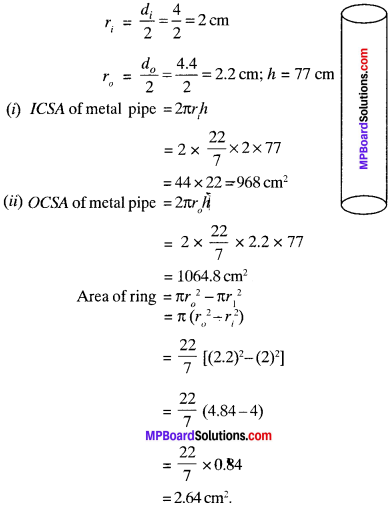
MP Board Class 9th Maths Solutions Chapter 13 Surface Areas and Volumes Ex 13.2 img-1
(iii) TSA = ICSA + OCSA + 2 x area of ring
= 968 + 1064.8 + 2 x 2.64
= 2032.8 + 5.28
= 20.38.08 cm2.

Question 4.
The diameter of a roller is 84 cm and its length is 120 cm. It takes 500 complete revolutions to move once over to level a playground. Find the area of the playground in m2.
Solution:
d = 84cm
∴ r = 42 cm
h = 120 cm
No. of revolution = 500
CSA of the roller = 2πrh
= 2 x \(\frac{22}{7}\) x 42 x 120
= 44 x 720
= 31680 cm2
Area of the playground = 31680 x 500
= 15840000 cm2
Area in m2 \(\frac{ 15840000}{100 x 100}\)
= 1584 m2.

MP Board Solutions

Question 5.
A cylindrical pillar is 50 cm in diameter and 3.5 m in height Find the cost of painting the curved surface of the pillar at the rate of ₹ 12.S0 per m2.
Solution:
d = 50cm
r = 25 cm2
h = 3.5 m = 350 cm
CSA of pillar = 2πrh
= 2x \(\frac{22}{7}\) x 25 x 350
= 44 x 1250
= 55000 cm2
CSA in m2 = \(\frac{55000}{100×100}\)
Cost of painting the cylindrical pillar = ₹ 12.50 x 5.5
= ₹ 68.75

Question 6.
Curved surface area of a right circular cylinder is 4.4 m2. If the radius of the base of the cylinder is 0.7 m, find its height.
Solution:
CSA = 4.4m2.
r = 0.7 m
CSA of cylinder =2πrh
4.4 = 2x \(\frac{22}{7}\) x 0.7 x h
4.4 = 44 x 0.1 x h
4.4 = 4.4 x h
h = \(\frac{44}{4.4}\) = 1m

Question 7.
The inner diameter of a circular well is 3.5 m. It is 10 m deep. Find

  1. its inner curved surface area
  2. the cost of plastering this curved surface at the rate of ₹ 40 per m2.

Solution:
d = 3.5m
r = 1.75 m
h = 10 m

1. ICSA of the well = 2πrh
= 2 x \(\frac{22}{7}\) x 1.75 x 10
= 110 m2

2. Cost of plastering = ₹ 40 x 110
= ₹ 4400.

MP Board Solutions

Question 8.
In a hot water heating system, there is a cylindrical pipe of length 28 m and diameter 5 cm. Find the total radiating surface in the system.
Solution:
h = 28m
d = 5cm
r = 2.5cm = 0.025m
Total radiating surface = CSA of pipe = 2πrh
= 2 x \(\frac{22}{7}\) x 0.025 x 28
= 4.4 m2.

9. Find

1. The lateral or curved surface area of a closed cylindrical petrol storage tank that is 4.2 m in diameter and 4.5 m high.

2. How much steel was actually used, if \(\frac{1}{2}\) of the steel actually used was wasted in making the tank.

Solution:
1. d = 4.2 m
r = 2.1m
h = 4.5 m
CSA of cylinderical tank = 2πrh
= 2x \(\frac{22}{7}\) x 2.1 x 4.5
= 59.4 m2.
TSA = 2πrr(r + h)
= 2 x \(\frac{22}{7}\) x 2.1 (2.1 + 4.5)
= 2 x \(\frac{22}{7}\) x 2.1 x 6.6
= 44 x 1.98
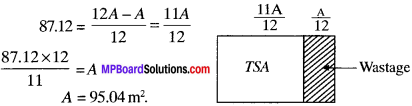
= 87.12 m2

2. Let A be the area of sheet actually used
TSA = A – \(\frac{1}{12}\)
MP Board Class 9th Maths Solutions Chapter 13 Surface Areas and Volumes Ex 13.2 img-2
A = 95.04m2.

Question 10.
In Fig. you see the frame of a lampshade. It is to be covered with a decorative cloth. The frame has a base diameter of 20 cm and height of 30 cm. Amargin of 2.5 cm is to be given for folding it over the top and bottom of the frame. Find how much cloth is required for covering the lampshade.
Solution:

MP Board Class 9th Maths Solutions Chapter 13 Surface Areas and Volumes Ex 13.2 img-3
d = 20 cm
r = 10 cm
h = 30 + 2.5 + 2.5 cm = 35 cm
Area of cloth required = CSA of cyliner of height 35 cm
= 2πrh
= 2 x \(\frac{22}{7}\) x 10 x 35
= 44 x 50 = 2200 cm2.

MP Board Solutions

Question 11.
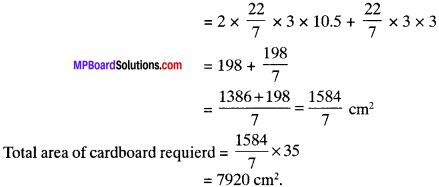
The students of a Vidyalaya were asked to participate in a competi-tion for making and decorating penholders in the shape of a cylinder with a base, using cardboard. Each penholder was to be of radius 3 cm and height 10.5 cm. The Vidyalaya was to supply the competitors with cardboard. If there were 35 competitors, how much cardboard was required to be bought for the competition?
Solution:
r = 3 cm
h = 10.5 cm
Cardboard required for one penholder = CSA of penholder + Area of base
= 2πrh + πr2
MP Board Class 9th Maths Solutions Chapter 13 Surface Areas and Volumes Ex 13.2 img-4
MP Board Class 9th Maths Solutions

MP Board Class 9th Maths Solutions Chapter 13 Surface Areas and Volumes Ex 13.1

MP Board Class 9th Maths Solutions Chapter 13 Surface Areas and Volumes Ex 13.1

Question 1.
A plastic box 1.5 m long, 1.25 m wide and 65 cm deep is to be made. It is to be open at the top. Ignoring the thickness of the plastic sheet, determine:

  1. The area of the sheet required for making the box.
  2. The cost of sheet for it, if a sheet measuring 1m2 costs ₹ 20.
Solution:
Given
l = 1.5 m = 150 cm
b = 1.25 m = 125 cm
h = 65 cm

1. Total area of plastic sheet required = LSA + Area of base
= 2h(l + b) + l x b
= 2 x 65 (150 + 125) + 150 x 125
= 130 (275) + 18750
= 35750 + 18750
= 54500 cm2
= 5.45 m2

2. Cost of sheet = area of plastic sheet x rate = 5.45 x 20
= 109.00
= ₹ 109.

MP Board Solutions

Question 2.
The length, breadth and height of a room are 5 m, 4 m and 3 m respectively. Find the cost of white washing the walls of the room and the ceiling at the rate of ₹ 7.50 per m2.
Solution:
Given
l = 5m
b = 4m
h = 3 m
Area of the room to be white washed = LSA + Area of ceiling
= 2h(l + b) + l x b
= 2 x 3 (5 + 4) + 5 x 4
= 6(9) + 20
= 54 + 20 = 74 m2
Cost of painting = 7.50 x 74 m2
= ₹ 555

Question 3.
The floor of a rectangular hall has a perimeter 250 m. If the cost of painting the four walls at the rate of ₹ 10 per m2 is ₹ 15000, find the height of the hall.
Solution:
Given
P = 250 m
Rate of painting = ₹ 10/ m2
Cost of painting = ₹ 15000
Area of walls to be painted = \(\frac{15000}{10}\) = 1500 m2
Perimeter = 2 (l + b) = 250
∴ l + b = 250/2 = 125m
Area of walls = LSA = 2h (l + b) = 1500
= h (l + b) = \(\frac{1500}{10}\) = 750 m2 …..(i)
Putting the value of (l + b) in (i), we get
h(125) = 750
h = \(\frac{750}{125}\) = 6 m.

Question 4.
The paint in a certain container is sufficient to paint an area equal to 9315 m2. How many bricks of dimensions 22.5 cm x 10 cm x 7.5 cm can be painted out of this container?
Solution:
Given
l = 22.5 cm
h = 7.5 cm = 0.075 m
b = 10 cm = 0.1 m
Area to be painted = 9.375 m2 = 93750 cm2
Area of one brick = 2(lb + bh + hl)
= 2(22.5 x 10 + 10 x 7.5 + 7.5 x 22.5)
= 2(225 + 75 + 168.75)
= 2 x 468.75
= 937.5 cm2
No. of bricks which can be painted = \(\frac{93750}{937.5}\) = 100

MP Board Solutions

Question 5.
A cubical box has each edge 10 cm and another cuboidal box is 12.5 cm long, 10 cm wide and 8 cm high.

  1. Which box has the greater lateral surface area and by how much?
  2. Which box has the smaller total surface area and by how much? Sol.

Solution:
1. LSA of cubical box = 4a2
= 4 x 10 x 10 = 400 cm2
LSA of cuboidal box = 2h (l + b)
= 2 x 8 (12.5 x 10)
= 16 x 22.5
= 360 cm2
LSA of cubical box is more than cuboidal box by 40 cm2.

2. TSA of cubical box = 6a2 = 6 x 10 x 10
= 600 cm2
TSA of cuboidal box = 2 (lb + bh + hl)
= 2(12.5 x 10 + 10 x 8 + 12.5 x 8)
= 2(125 + 80 + 100)
= 2 x 305 = 610 cm2.
∴ TSA of cuboidal box is more than cubical box by 10 cm2.

Question 6.
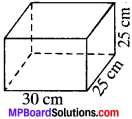
A small indoor green house (herbarium) is made entirely of glass panes (including base) held together with tape. It is 30 cm long, 25 cm wide and 25 cm high.

  1. What is the area of the glass?
  2. How much of tape is needed for all the 12 edges?

Solution:
MP Board Class 9th Maths Solutions Chapter 13 Surface Areas and Volumes Ex 13.1 img-1
Given
l = 30 cm
b = 25 cm and
h = 25 cm
Area of glass required = 2(30 x 25 + 25 x 25 x 30)
= 2(750 + 625 + 750)
= 2 x 2125 = 4250 cm2
Length of tape required = 4(l + b + h)
= 4(30 + 25 + 25)
= 4 x 80 = 320 cm

MP Board Solutions

Question 7.
Shanti Sweets Stall was placing an order for making cardboard boxes for packing their sweets. Two sizes of boxes were required. The bigger of dimensions 25 cm x 20 cm x 5 cm and the smaller of dimensions 15 cm x 12 cm x 5 cm. For all the overlaps, 5% of the total surface area is required extra. If the cost of the cardboard is ₹ 4 for 1000 cm2, find the cost of cardboard required for supplying 250 boxes of each kind.
Solution:
Big Box :
l = 25 cm
b = 20 cm
h = 5 cm
Small Box:
l = 15 cm
b = 12 cm
h = 5 cm
Number of boxes required = 250
Rate = ₹ 4 per 1000 cm2
TSA of bigger box = 2 (25 x 20 + 20 x 5 + 5 x 25)
= 2(500 + 100 + 125)
= 2 x 725 = 1450 cm2
TSA of smaller box = 2 (15 x 12 +12 x 5 + 5 x 15)
= 2 (180 + 60 + 75)
= 2 x 315 = 630 cm2
Area of cardboard required one bigger = TSA + 5% of TSA
= 1450 + \(\frac{5}{100}\) x 1450
= 1522.5 cm2
Area of cardboard required for 250 boxes of bigger size = 250 x 1522.5
= 380625 cm2
Area of cardboard required for one small box = 630 + \(\frac{5}{100}\) x 630
= 661.5 cm2
Total area of cardboard required for 250 boxes of smaller size = 250 x 661.5
= 165375 cm2
Total area = (165375 + 380625) cm2
= 546000 cm2
Total cost of each kind of cardboard = \(\frac{4}{1000}\) x 546000
= ₹ 2184/-

Question 8.
Parveen wanted to make a temporary shelter for her car, by making a box – like structure with tarpaulin that covers all the four sides and the top of the car (with the front face as a flap which can be rollpd up). Assuming that the stitching margins are very small, and therefore negligible, how much tarpaulin would be required to make the shelter of height 2.5 m, with base dimensions 4 m x 3 m?
Solution:
Given
l = 4m
b = 3 m and
h = 2.5 m
Area of the tarpaulin required = 2h(l + b) + l x b
= 2 x 2.5(4 + 3) + 4 x 3
= 5 x 7 + 12
= 35 + 12= 47m

MP Board Class 9th Maths Solutions

MP Board Class 10th Hindi Navneet Solutions पद्य Chapter 6 शौर्य और देश प्रेम

MP Board Class 10th Hindi Navneet Solutions पद्य Chapter 6 शौर्य और देश प्रेम

शौर्य और देश प्रेम अभ्यास

बोध प्रश्न

शौर्य और देश प्रेम अति लघु उत्तरीय प्रश्न 

प्रश्न 1.
सभी दिशाएँ क्या पूछ रही हैं?
उत्तर:
सभी दिशाएँ यह पूछ रही हैं कि वीरों का वसन्त कैसा हो।

प्रश्न 2.
किसके अंग-अंग पुलकित हो रहे है?
उत्तर:
पृथ्वी रूपी वधू के अंग-अंग पुलकित हो रहे हैं।

प्रश्न 3.
वसन्त के आने पर कौन तान भरने लगता है?
उत्तर:
वसन्त के आने पर कोयल अपनी तान भरने लगती हैं।

प्रश्न 4.
कवि चट्टानों की छाती से क्या निकालने के लिए कह रहा है?
उत्तर:
कवि चट्टानों की छाती से दूध निकालने के लिए कह रहा है।

प्रश्न 5.
क के अनुसार मनुष्य का भीतरी गुण क्या
उत्तर:
कवि के अनुसार मनुष्य का भीतरी गुण स्वातन्त्र्य जाति की लगन है।

प्रश्न 6.
भ्रामरी किसका अभिनन्दन करती है?
उत्तर:
जो व्यक्ति युद्ध क्षेत्र में जाकर तलवार की चोट खाकर माथे पर रक्त का चन्दन लगाता है, भ्रामरी उसी का अभिनन्दन करती है।

MP Board Solutions

शौर्य और देश प्रेम लघु उत्तरीय प्रश्न

प्रश्न 1.
ऐ कुरुक्षेत्र! अब जाग-जाग’ से कवि का क्या आशय है?
उत्तर:
‘ऐ कुरुक्षेत्र! अब जाग-जाग’ से कवि का आशय यह है कि जिस प्रकार द्वापर में कुरुक्षेत्र में अन्याय के विरुद्ध संघर्ष किया गया था, आज पुनः उसी की आवश्यकता है।

प्रश्न 2.
सिंहगढ़ का दुर्ग एवं हल्दी घाटी में किसकी याद छिपी है?
उत्तर:
सिंहगढ़ के दुर्ग में अद्वितीय वीर शिवाजी की तथा हल्दी घाटी में राणा प्रताप की याद छिपी है।

प्रश्न 3.
विजयी के सदृश बनने के लिए कवि क्या-क्या करने को कह रहा है?
उत्तर:
विजयी के सदृश बनने के लिए कवि मनुष्यों से वैराग्य छोड़ने, युद्ध में लड़ने, चट्टानों की छाती से दूध निकालने, चन्द्रमा को निचोड़ कर अमृत निकालने और ऊँची चट्टटानों पर सोमरस पीने के लिए कहता है।

प्रश्न 4.
स्वाधीन जगत में कौन जीवित रह सकता है?
उत्तर:
जो व्यक्ति अपनी आन-बान पर डटा रहता है तथा जो किसी के सामने झुकता नहीं है साथ ही जो अपने शरीर पर वज्रों का आघात सहता है, वही जाति स्वाधीन जगत में जीवित रह सकता है।

प्रश्न 5.
जीवन की परिभाषा क्या है? कवि के विचारों को लिखिए।
उत्तर:
कवि के शब्दों में जीवन गति है, जो विघ्न-बाधाओं को पार करता हुआ निरन्तर चलता रहता है। जीवन एक तरंग है, एक गर्जन है और एक चंचलता है।

प्रश्न 6.
कवि ने वीरता के कौन से दो लक्षण बताये हैं?
उत्तर:
कवि ने वीरता के दो लक्षण इस प्रकार बताये हैं-स्वर में पावक जैसी उष्णता या तीव्रता होनी चाहिए, दूसरे वीर के सिर पर तलवार की चोट का चन्दन लगा होना चाहिए।

शौर्य और देश प्रेम दीर्घ उत्तरीय प्रश्न

प्रश्न 1.
कवयित्री वीरों के लिए किस तरह वसन्त का का आयोजन करना चाहती है?
उत्तर:
कवयित्री वीरों के लिए इस तरह के वसन्त का आयोजन करना चाहती हैं, जिसमें इधर तो कोयल अपनी तान सुना रही हो और उधर मारू बाजा बज रहा हो। इस प्रकार रंग (आनन्द) और रण (युद्ध) का वातावरण बन रहा हो।

प्रश्न 2.
वसन्त उत्सव के लिए प्रेरक पंक्तियों का उल्लेख कीजिए।
उत्तर:
वसन्त उत्सव के लिए प्रेरक पंक्तियाँ निम्नलिखित हैं-
फूली सरसों ने दिया रंग,
मधु लेकर आ पहुँचा अनंग,
वधू-वसुधा, पुलकितअंग-अंग
हैं वीर-देश में, किन्तु कंत।
वीरों का कैसा हो वसन्त?

प्रश्न 3.
कवि के अनुसार जब अहं पर चोट पड़ती है तब उसकी प्रतिक्रिया क्या होती है?
उत्तर:
कवि के अनुसार जब अहं पर चोट पड़ती है, तब उसकी प्रतिक्रियास्वरूप अहं से बड़ी कोई चीज जन्म ले लेती है।

प्रश्न 4.
स्वतन्त्रता प्रेमी जाति के गुणों का वर्णन कीजिए।
उत्तर:
स्वतन्त्रता प्रेमी जाति में लगन होती है, वह जाति धुन की पक्की होती है। चाहे कितनी भी विपत्तियाँ क्यों न आ जायें वे उनसे हार नहीं मानती है।

प्रश्न 5.
निम्नलिखित पद्यांशों की व्याख्या कीजिए-
(अ) गलबाहें हो या हो कृपाण ……………. कैसा हो वसन्त?
उत्तर:
कवयित्री कहती हैं कि चाहे तो प्रेमालाप के समय कोई परस्पर गले में बाँहें डाले हो अथवा रणक्षेत्र आने पर हाथ में कृपाण (तलवार) उठी हो। चाहे आनन्द का रस विलास। हो अथवा दलित नागरिकों की रक्षा की बात हो। आज मेरे सामने यही सबसे बड़ी समस्या है कि वीरों का वसन्त कैसा हो।

(ब) स्वर में पावक …………… मनुष्यता के पथ भी खुलते हैं।
उत्तर:
कवि कहता है कि यदि तुम्हारी वाणी में आग जैसी गर्मी नहीं है तो फिर तुम्हारा क्रन्दन करना वृथा है। यदि तुममें वीरता नहीं है तो फिर सभी प्रकार की विनम्रता केवल रोना है। जिस व्यक्ति के सिर पर तलवार की चोट से रक्त और चन्दन लगा होता है, दुर्गा या काली माँ उसी व्यक्ति का अभिनन्दन किया करती हैं। – कवि कहता है कि राक्षसी रक्त से सभी पाप धुल जाया करते हैं। साथ ही ऐसी वीरता से ऊँची मनुष्यता का मार्ग खुल जाया करता है।

MP Board Solutions

शौर्य और देश प्रेम काव्य सौन्दर्य

प्रश्न 1.
संकलित कविता में से ‘वीर रस’ की कुछ पंक्तियाँ उद्धृत करते हुए वीर रस को परिभाषित कीजिए।
उत्तर:
वीर रस-जहाँ उत्साह नामक स्थायी भाव जाग्रत होकर विभाग, अनुभाव एवं संचारी के संयोग से पुष्ट होकर रस दशा में पहुँचता है, वहाँ वीर रस होता है।

उदाहरण :
वैराग्य छोड़कर बाँहों की विभा सँभालो।
चट्टानों की छाती से दूध निकालो।
है रुकी जहाँ भी धार शिलाएँ तोड़ो।
पीयूष चन्द्रमाओं को पकड़ निचोड़ो॥

प्रश्न 2.
रौद्र रस को समझाते हुए वीर एवं रौद्र रस में अन्तर स्पष्ट कीजिए।
उत्तर:
शत्रु या दुष्ट जन द्वारा किए गए अत्याचारों या गुरुजन की निन्दा आदि से उत्पन्न क्रोध स्थायी भाव, विभाव, अनुभाव तथा संचारी के संयोग से पुष्ट होकर रौद्र रस के रूप में परिणत होता है।

वीर एवं रौद्र रस में अन्तर :
वीर एवं रौद्र दो भिन्न-भिन्न रूप हैं। वीर रस का स्थायी भाव उत्साह होता है जबकि रौद्र रस का स्थायी भाव क्रोध है। दोनों के आलम्बन, अनुभाव, संचारी आदि में अन्तर होता है।

प्रश्न 3.
अन्योक्ति अलंकार की उदाहरण सहित परिभाषा कीजिए।
उत्तर:
प्रस्तुत कथन के द्वारा अप्रस्तुत का बोध हो वहाँ अन्योक्ति अलंकार होता है।
उदाहरण :
नहिं पराग नहिं मधुर मधु, नहिं विकास एहि काल।
अली कली ही सौ बिंध्यौ; आगे कौन हवाल॥

शौर्य और देश प्रेम महत्त्वपूर्ण वस्तुनिष्ठ प्रश्न

शौर्य और देश प्रेम बहु-विकल्पीय प्रश्न

प्रश्न 1.
हिमालय से क्या आ रही है? (2016)
(क) पुकार
(ख) हुंकार
(ग) दुत्कार
(घ) चीत्कार।
उत्तर:
(क) पुकार

प्रश्न 2.
वसन्त के आने पर कौन तान भरने लगता है?
(क) कौआ
(ख) मोर
(ग) कोयल
(घ) मेंढक
उत्तर:
(ग) कोयल

प्रश्न 3.
“जीवन गति है, वह नित अरुद्ध चलता है” पंक्ति पाठ्य-पुस्तक की किस कविता से ली (2009)
(क) सोये हुए बच्चे से
(ख) श्रद्धा से
(ग) उद्बोधन से
(घ) शौर्य और देश-प्रेम से।
उत्तर:
(ग) उद्बोधन से

प्रश्न 4.
रामधारी सिंह ‘दिनकर’ ने जीवन की गति को कैसा बतलाया है?
(क) रुक-रुक कर चलने वाला
(ख) निर्मल
(ग) नित अरुद्ध
(घ) चंचल।
उत्तर:
(ग) नित अरुद्ध

MP Board Solutions

रिक्त स्थानों की पर्ति

  1. ‘वीरों का कैसा हो वसन्त’ कविता की रचयिता ………….. चौहान हैं।
  2. रामधारी सिंह ‘दिनकर’ की कविता में ………….. है। (2009)
  3. महाराणा प्रताप ने अपने स्वाभिमान की रक्षा के लिए ……………. की अधीनता स्वीकार नहीं की।
  4. कवि के अनुसार चलते रहने का नाम ………… है।

उत्तर:

  1. सुभद्राकुमारी
  2. ओज गुण
  3. मुगलों
  4. जीवन

सत्य/असत्य

  1. ‘वीरों का कैसा हो वसन्त’ में केवल वसन्त की प्राकृतिक शोभा का वर्णन है।
  2. ‘वीरों का कैसा हो वसन्त’ में कवि ने सिंहगढ़ का किला,राणा प्रताप के शौर्य एवं वीरता की याद दिलवाई है।
  3. वसन्त ऋतु में कोयल का मधुर स्वर सुनायी पड़ता है।
  4. ‘स्वाधीन जगत में वही जाति रहती है ।’ पंक्ति ‘वीरों का कैसा हो’ वसन्त कविता की है।

उत्तर:

  1. असत्य
  2. सत्य
  3. सत्य
  4. असत्य।

सही जोड़ी मिलाइए

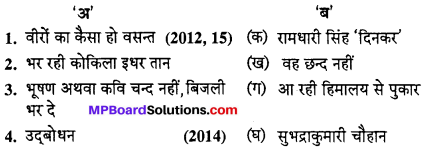
MP Board Class 10th Hindi Navneet Solutions पद्य Chapter 6 शौर्य और देश प्रेम img-1
उत्तर:
1. → (घ)
2. → (ग)
3. → (ख)
4. → (क)

एक शब्द/वाक्य में उत्तर

  1. ‘वीरों का कैसा हो वसन्त’ कविता में कवयित्री ने किस पर्व का आयोजन किया है?
  2. वीरों की पुकार किस स्थान से आ रही है?
  3. वसन्त ऋतु में सरसों में किसके द्वारा पीलिमा छा जाती है?
  4. नर पर जब विपत्ति आती है तब वह विपत्ति मानव को किस प्रकार की शक्ति देती है?

उत्तर:

  1. वीरों के वसन्त का
  2. हिमालय पर्वत से
  3. फूलों द्वारा
  4. संघर्षों से जूझने की।

MP Board Solutions

वीरों का कैसा हो वसन्त? भाव सारांश

प्रस्तुत कविता में कवयित्री ने राष्ट्र को परतन्त्रता से मुक्ति की अपेक्षा राग-रंग को श्रेष्ठ ठहराया है। जैसे प्रकृति अपने फूलों के माध्यम से केसरिया वस्त्र पहनती है,उसी भाँति वीरों को भी वसंत का आह्वान करना चाहिए। संपूर्ण दिशाएँ भी यह पूछ रही हैं कि वीरों का वसंत कैसा होना चाहिए? हिमालय की पुकार में भी यही स्वर गुंजायमान है। वीरों को कोकिला की तान सुनने के साथ ही रणभूमि में जाने के लिए उद्यत रहना चाहिए। कवयित्री पुनः जागृति का सन्देश देते हुए कहती है कि हे वीरो! तुम्हें भली प्रकार विदित है कि लंका में क्यों आग लगायी गयी थी, कुरुक्षेत्र में महासंग्राम क्यों हुआ था। अन्त में कवयित्री का कथन है कि मेरी कविता भूषण अथवा कवि चन्दवरदायी की कविता के समान क्रान्ति की ज्वाला धधकाने में सक्षम नहीं है क्योंकि परतन्त्रता के वातावरण में कलम पर भी बन्धन है। वह अपनी भावनाओं को ब्रिटिश शासन के उत्पीड़न के फलस्वरूप व्यक्त करने में प्तक्षम नहीं है।

वीरों का कैसा हो वसन्त? संदर्भ-प्रसंगसहित व्याख्या

(1) वीरों का कैसा हो वसन्त?
आ रही हिमालय से पुकार,
है उदधि गरजतां बार-बार
प्राची,पश्चिम,भू,नभ,अपार,
सम पूछ रहे हैं, दिग् दिगन्त
वीरों का कैसा हो वसन्त?

शब्दार्थ :
उदधि = समुद्र। प्राची = पूर्व दिशा। दिग = दिशाएँ।

सन्दर्भ :
प्रस्तुत छन्द वीरों का कैसा हो वसन्त?’ शीर्षक कविता से लिया गया है। इसकी रचयिता सुश्री सुभद्रा कुमारी चौहान हैं।

प्रसंग :
इस छन्द में कवयित्री ने वीरों का वसन्त कैसा होना चाहिए के बारे में बतलाया है।

व्याख्या :
कवयित्री जी कहती हैं कि वीरों का वसन्त कैसा हो? आज हिमालय की चोटियों से यही पुकार आ रही है, समुद्र बार-बार गर्जन कर पूछ रहा है। पूर्व दिशा, पश्चिम दिशा, पृथ्वी, आकाश एवं दिग-दिगन्त सभी पूछ रहे हैं कि वीरों का वसन्त कैसा हो।

विशेष :

  1. वीरों का सम्मान हिमालय, समुद्र एवं दिशाएँ सभी करते हैं।
  2. अनुप्रास अलंकार।

(2) फूली सरसों ने दिया रंग,
मधु लेकर आ पहुँचा अनंग,
वधू-वसुधा पुलकित अंग-अंग
हैं वीर देश में, किन्तु कंत
वीरों का कैसा हो वसन्त?

शब्दार्थ :
अनंग = कामदेव। वधू-वसुधा = पृथ्वी रूपी दुल्हन। कंत = पति।

सन्दर्भ एवं प्रसंग :
पूर्ववत्।

व्याख्या :
कवयित्री जी कहती हैं कि वसन्त ऋतु में सरसों ने फूलकर अपना वसन्ती रंग सम्पूर्ण पृथ्वी पर बिखेर दिया है। कामदेव मधु लेकर स्वयं उपस्थित हो गया है। इस ऋतु में पृथ्वी रूपी वधू का अंग प्रत्यंग खुशी से पुलकित हो रहा है। आज हमारे देश में वीर तो हैं परन्तु हमारा वसन्त (पति) हमारे पास नहीं है। वीरों का वसन्त कैसा हो।

विशेष :

  1. बसन्त ऋतु की मादकता प्रकृति में छा गई है।
  2. वधू वसुधा में रूपक, अंग-अंग में पुनरुक्तिप्रकाश अलंकार।

MP Board Solutions

(3) भर रही कोकिला इधर तान,
मारू बाजे पर उधर गान,
है रंग और रण का विधान,
मिलने आए हैं आदि-अंत
वीरों का कैसा हो वसंत?

शब्दार्थ :
कोकिला = कोयल। मारू = युद्ध का बाजा। रण = युद्ध।

सन्दर्भ एवं प्रसंग :
पूर्ववत्।

व्याख्या :
कवयित्री कहती हैं कि एक ओर तो कोयल अपनी मीठी धुन गा-गाकर सुना रही है और दूसरी ओर युद्ध का बाजा मारू बज रहा है। ऐसा लग रहा है कि आज आनन्द और युद्ध दोनों का विधान है। ऐसा लग रहा है कि आज; आदि और अन्त दोनों मिलने के लिए आये हों। वीरों का वसन्त कैसा हो।

विशेष :

  1. चाहे वसन्त की मादकता हो या फिर कोई दूसरा आकर्षण, वीरों को अपने रण क्षेत्र से हटा नहीं सकता है।
  2. अनुप्रास अलंकार।

(4) गलबाँहे हों या कृपाण,
चल चितवन हो या धनुष बाण,
हो रस-विलास, या दलित त्राण,
अब यही समस्या है, दुरन्त,
वीरों का कैसा हो वसन्त?

शब्दार्थ :
गलबाँहें = प्रेम में प्रेमी-प्रेमिका एक-दूसरे के गले में अपनी बाँहे डाल देते हैं। कृपाण = तलवार। चल-चितवन = प्रेम में चंचल दृष्टि। रस-विलास = आनन्द का वातावरण। दलित = दबे हुए। त्राण = रक्षा। दुरन्त = मुश्किल से नष्ट होने वाली।

सन्दर्भ :
पूर्ववत्।

प्रसंग :
जब समाज में एक ओर बलिदान की बात हो तो प्रेम की बात अच्छी नहीं लगती।

व्याख्या :
कवयित्री कहती हैं कि चाहे तो प्रेमालाप के समय कोई परस्पर गले में बाँहें डाले हो अथवा रणक्षेत्र आने पर हाथ में कृपाण (तलवार) उठी हो। चाहे आनन्द का रस विलास। हो अथवा दलित नागरिकों की रक्षा की बात हो। आज मेरे सामने यही सबसे बड़ी समस्या है कि वीरों का वसन्त कैसा हो।

विशेष :
अनुप्रास की छटा।

(5) कह दे अतीत! अब मौन त्याग,
लंके! तुझमें क्यों लगी आग?
ऐ कुरुक्षेत्र! अब जाग, जाग,
बतला अपने अनुभव अनंत,
वीरों का कैसा हो वसंत?

शब्दार्थ :
लंके = रावण की लंका। मौन = खामोशी, चुप्पी।

सन्दर्भ :
पूर्ववत्।

प्रसंग :
इसमें कवयित्री अतीत की वीर गाथाओं का सन्दर्भ लेते हुए कह रही हैं।

व्याख्या :
कवयित्री कहती है कि हे अतीत! तुम अब अपना मौन त्याग दो और विगंत की घटनाओं को बतला दो। हे लंके! तू बता तुझमें क्यों आग लगी? हे कुरुक्षेत्र! तुम अब जाग जाओ और अपने अनन्त अनुभवों को हमें बता दो। वीरों का वसन्त कैसा हो।

विशेष :

  1. कवयित्री ने लंका और कुरुक्षेत्र का मानवीकरण किया है।
  2. अतीत काल की वीर गाथाओं का स्मरण किया है।

(6) हल्दी घाटी के शिला खण्ड,
ऐ दुर्ग! सिंहगढ़ के प्रचंड,
राणा-ताना का कर घमण्ड,
दो जगा आज स्मृतियों ज्वलन्त,
वीरों का कैसा हो वसन्त?

शब्दार्थ :
शिला खण्ड = चट्टानें। ज्वलन्त = प्रखर, तेज। सन्दर्भ एवं प्रसंग-पूर्ववत्।

व्याख्या :
कवयित्री कहती हैं कि हे हल्दी घाटी के शिलाखण्डों तथा हे सिंहगढ़ के दुर्ग! तुम राणा प्रताप तथा शिवाजी की वीरता का बखान करके आज तेजी के साथ उन अतीत की स्मृतियों को जगा दो। वीरों का वसन्त कैसा हो।

विशेष :

  1. हल्दी घाटी में राणा प्रताप के शौर्य की गाथा की ओर कवयित्री ने संकेत किया है तो सिंहगढ़ के दुर्ग के माध्यम से वीर शिवाजी की वीरता का बखान किया है।
  2. मानवीकरण अलंकार।
  3. वीर रस।

MP Board Solutions

(7) भूषण अथवा कवि चन्द नहीं,
बिजली भर दे वह छन्द नहीं
है कलम बँधी, स्वच्छन्द नहीं
फिर हमें बतावै कौन? हंत!
वीरों का कैसा हो वसन्त?

शब्दार्थ :
बिजली भर दे = वीरता का संचार कर दे। हंत = दुर्भाग्य है।

सन्दर्भ एवं प्रसंग :
पूर्ववत्।

व्याख्या :
कवयित्री अतीत का स्मरण करती हुई कहती है कि अतीत काल में हमारे देश में भूषण और चन्दवरदाई जैसे वीर रस का संचार करने वाले दो महाकवि थे। भूषण ने शिवाजी के शौर्य का वर्णन कर उस समय समाज में वीरता का संचार किया था और उससे पूर्व चन्दवरदाई ने पृथ्वीराज के शौर्य का वर्णन कर तत्कालीन समाज में वीरता का संचार किया लेकिन देश का दुर्भाग्य है कि ऐसे महान कवि आज नहीं हैं। इतना ही नहीं वर्तमान शासकों ने इस प्रकार के कवियों की रचना धर्मता को कैद कर लिया है उनको बोलने की आज्ञा नहीं दी है। फिर। हमें कौन मार्गदर्शन देगा, यह हमारा दुर्भाग्य है। वीरों का वसन्त कैसा हो।

विशेष :

  1. कवयित्री अंग्रेजी शासन के उन आदेशों की ओर संकेत कर रही हैं, जब अंग्रेज शासकों ने यहाँ के कवियों द्वारा वीरता के गान पर पाबन्दी लगा दी थी।
  2. वीर रस।

उद्बोधन भाव सारांश

प्रस्तुत कविता में कवि ने मनुष्य का उद्बोधन करते हुए उसे मृत्यु से भयभीत न होने का संदेश दिया है। कवि का आग्रह है कि विषम परिस्थितियों में भी व्यक्ति को स्वाभिमान नहीं छोड़ना चाहिए। इसके लिए चाहे उसे अपना सिर कटाकर भले ही मूल्य चुकाना पड़े। व्यक्ति को अन्याय का डटकर सामना करना चाहिए।

विपत्ति के भयानक बादल छा जाने पर मानव के हृदय में संघर्ष करने की भावना जाग्रत होती है। आघात सहने के साथ ही एक छोटी सी चिंगारी अंगारे का रूप धारण कर लेती है। यदि वाणी में ज्वाला के सदृश तेज नहीं तो वह वन्दना निरर्थक है।

जीवन का नाम ही गति है। पावक के सदृश जलना ही जीवन गति का प्रत्यक्ष प्रमाण है। धरती पर आगे बढ़ने में राह में अनेक बाधायें आती हैं तब भी निरन्तर गतिमान रहना चाहिए।

उद्बोधन संदर्भ-प्रसंगसहित व्याख्या

(1) वैराग्य छोड़कर बाँहों की विभा सँभालो,
चट्टानों की छाती से दूध निकालो।
है रुकी जहाँ भी धार, शिलाएँ तोड़ो,
पीयूष चन्द्रमाओं को पकड़ निचोड़ो।
चढ़ तुंग शैल-शिखरों पर सोम पियो रे!
योगियों नहीं, विजयी की सदृश जियो रे!

शब्दार्थ :
बाँहों की विभा सँभालो = अपने पौरुष। (शक्ति) पर विश्वास करो। पीयूष = अमृत। तुंग = ऊँचे। शैल = चट्टान। सदश = समान।।

सन्दर्भ :
प्रस्तुत छन्द ‘उद्बोधन’ शीर्षक कविता से लिया गया है। इसके रचनाकार श्री रामधारी सिंह ‘दिनकर’ हैं।

प्रसंग :
कवि ने मनुष्यों को वैराग्य छोड़ने और शूरता का पथ अपनाने का सन्देश दिया है।

व्याख्या :
कविवर दिनकर जी कहते हैं कि हे भारतवासियो! तुम वैराग्य की बातों को त्याग दो और अपनी भुजाओं के बल। पर विश्वास करो। तुम ऐसी चेष्टा करो कि आवश्यकता पड़ने पर चट्टानों की छाती से दूध निकाल लो। यदि तुम्हारे मार्ग में, लक्ष्य प्राप्त करने में कोई बाधाएँ आती हैं, तुम्हारी गति की धार को यदि बीच में शिलाएँ रोक देती हैं तो तुम अपने बल पर उन शिलाओं को तोड़कर अपना मार्ग स्वयं बना डालो। अमृतधारी चन्द्रमाओं को पकड़कर उन्हें निचोड़ डालो। हे वीर! तुम ऊँचे पर्वत शिखरों पर चढ़कर सोम का पान करो। अतः योगियों जैसा नहीं अपितु वीर विजेता के समान जीवन जीओ।

विशेष :

  1. समय के अनुरूप कवि ने भारतीयों को शक्ति संचित करने का उपदेश दिया है।
  2. कवि वैरागियों से घृणा करता है।
  3. लाक्षणिक शैली।

MP Board Solutions

(2) छोड़ो मत अपनी आन, सीस कट जाए,
मत झुको अनय पर, भले व्योम फट जाए।
दो बार नहीं यमराज कंठ धरता है,
मरता है जो, एक ही बार मरता है।
तुम स्वयं मरण के मुख पर चरण धरो रे!
जीना हो तो मरने से नहीं डरो रे!

शब्दार्थ :
आन = मान-मर्यादा। अनय = अनीति। व्योम = आकाश। यमराज = मृत्यु का देवता। कंठ धरता है = मनुष्य को मृत्यु देता है।

सन्दर्भ :
पूर्ववत्।

प्रसंग :
कवि ने हर स्थिति में अन्याय का विरोध करने और अपनी आन-बान-शान की रक्षा का सन्देश दिया है।

व्याख्या :
कवि कहता है कि अपनी आन (मान-मर्यादा) को मत छोड़ो, चाहे इसकी रक्षा के लिए तुम्हें अपना सिर भी क्यों ने कटाना पड़े। कभी भी अनीति के सामने झुको मत, चाहे फिर आकाश ही क्यों न फट जाए। कवि मनुष्यों को सचेत करते हुए कहता है कि मृत्यु का देवता यमराज किसी भी व्यक्ति के प्राणों को दो बार नहीं लेता है। जिसे भी मरना होता है, वह एक ही बार मरता है। अतः भय छोड़कर अनीति का डटकर विरोध करो। कवि कहता है कि तुममें इतना साहस होना चाहिए कि तुम स्वयं मृत्यु के मुख पर चढ़ बैठो। यदि तुममें जीने की इच्छा है तो फिर मौत से भी डरो मत।

विशेष :

  1. आन-बान-शान की रक्षा का उपदेश दिया है।
  2. भाषा लाक्षणिक है।
  3. वीर रस।

(3) स्वातन्त्र्य जाति की लगन, व्यक्ति की धुन है,
बाहरी वस्तु यह नहीं, भीतरी गुण है।
नत हुए बिना जो अशनि-घात सहती है,
स्वाधीन जगत् में वही जाति रहती है।
वीरत्व छोड़, पर-का मत चरण गहो रे!
जो पड़े आन, खुद ही सब आग सहो रे!

शब्दार्थ :
स्वातन्त्र्य = स्वतन्त्रता की। नत = झुकना। अशनिघात = वज्राघात। वीरत्व = वीरता को।

सन्दर्भ :
पूर्ववत्।

प्रसंग :
कवि कहता है कि स्वाधीन जगत में वही जाति जीवित रहती है जो अपनी रक्षा के लिए कठोर से कठोर एवं भीषण विपत्तियों का मुकाबला करती है।

व्याख्या :
कवि कहते हैं कि स्वतन्त्रता की लगन व्यक्ति – विशेष की धुन हुआ करती है। यह कोई बाहरी वस्तु नहीं अपितु यह तो भीतरी गुण है। बिना झुके हुए जो जाति वज्रों का आघात सहती है, वही जाति स्वाधीन संसार में जीवित रह सकती है।

अतः हे वीर पुरुषो! वीरता का बाना छोड़कर अन्य किसी का चरण मत पकड़ो। जो कोई भी परिस्थिति आ जाये, उसका सामना बिना संकोच के तुम्हें स्वयं करना होगा।

विशेष :

  1. अपनी जाति एवं आन की रक्षा के लिए हमें बड़ी से बड़ी विपत्ति को सहन करना होगा।
  2. लाक्षणिक शैली।
  3. वीर रस।

(4) जब कभी अहं पर नियति चोट देती है.
कुछ चीज अहं से बड़ी जन्म लेती है।
नर पर जब भी भीषण विपत्ति आती है,
वह उसे और दुर्घर्ष बना जाती है।
चोटें खाकर विफरो, कुछ अधिक तनो रे!
धधको स्फुलिंग में बढ़ अंगार बनो रे!

शब्दार्थ :
नियति = भाग्य, ईश्वरीय सत्ता। भीषण = भयानक। दुर्घर्ष = कठिन। स्फुलिंग = ज्योति-कण।

सन्दर्भ :
पूर्ववत्।

प्रसंग :
कवि का कथन है कि विपत्तियों से मानव और अधिक ताकतवर बन जाता है।

व्याख्या :
कवि कहते हैं कि जब कभी भी अहं (आत्म सम्मान) पर भाग्य चोट देता है, तब अहं से बड़ी वस्तु का जन्म – हुआ करता है। मनुष्य पर जब भी भीषण विपत्ति आती है, तो वह उसे और कठोर बना देती है।

अतः हे वीर पुरुषो! चोटें खाकर बिफर पड़ो तथा कुछ। अधिक तन जाओ। तुम अपनी वीरता के क्रोध से धधक पड़ो और ज्योति-कण से बढ़कर अंगार बन जाओ।

विशेष :

  1. कवि ने मनुष्यों को विपत्ति में न घबड़ाने का उपदेश दिया है।
  2. लाक्षणिक शैली।
  3. वीर रस।

(5) स्वर में पावक नहीं; वृथा वन्दन है।
वीरता नहीं, तो सभी विनय क्रन्दन है;
सिर जिसके असिंघात रक्त चन्दन है।
भ्रामरी उसी का करती अभिनन्दन है।
दानवी रक्त से सभी पाप धुलते हैं।
ऊँची मनुष्यता के पथ भी खुलते हैं।

शब्दार्थ :
पावक = अग्नि। वृथा = बेकार का। क्रन्दन = रोना। असिंघात = तलवार की चोट। भ्रामरी =दुर्गा। दानवी = राक्षसी। पथ = रास्ते।

सन्दर्भ :
पूर्ववत्।

प्रसंग :
कवि मनुष्यों में वीरता का संचार करने का उपदेश देता है।

व्याख्या :
कवि कहता है कि यदि तुम्हारी वाणी में आग जैसी गर्मी नहीं है तो फिर तुम्हारा क्रन्दन करना वृथा है। यदि तुममें वीरता नहीं है तो फिर सभी प्रकार की विनम्रता केवल रोना है। जिस व्यक्ति के सिर पर तलवार की चोट से रक्त और चन्दन लगा होता है, दुर्गा या काली माँ उसी व्यक्ति का अभिनन्दन किया करती हैं। – कवि कहता है कि राक्षसी रक्त से सभी पाप धुल जाया करते हैं। साथ ही ऐसी वीरता से ऊँची मनुष्यता का मार्ग खुल जाया करता है।

विशेष :

  1. कवि मनुष्यों में वीरता के संचार का उपदेश देता है।
  2. लाक्षणिक शैली।
  3. वीर रस।

MP Board Solutions

(6) जीवन गति है, वह नित अरुद्ध चलता है,
पहला प्रमाण पावक का, वह जलता है।
सिखला निरोध-निज्वलन धर्म छलता है।
जीवन तरंग गर्जन है, चंचलता है।
धधको अभंग, पाल-पिवल अरुण जलो रे!
धरा रोके यदि राह, विरुद्ध चलो रे!

शब्दार्थ :
अरुद्ध = बिना रुके। पावक = अग्नि। निरोध = रुकना। निर्व्वलन = जिसमें जलने की क्षमता न हो। अभंग = बिना रुकावट के। अरुण = सूर्य। धरा = पृथ्वी।

सन्दर्भ :
पूर्ववत्।।

प्रसंग :
कवि कहता है कि जीवन की सार्थकता निरन्तर चलते रहने में है। यदि हमारे सत्कार्य में कोई भी बाधा डाले, तो हमें उसका विरोध करना चाहिए।

व्याख्या :
कवि कहता है कि जीवन उसे ही कहते हैं जिसमें गति होती है और वह जीवन बिना किसी के रोके निरन्तर चलता रहता है। अग्नि का पहला प्रमाण ही उसमें जलने का गुण होता है। जो धर्म हमें रुकने तथा न जलने का उपदेश देता है, वह वास्तव में धर्म न होकर छलावा है। जीवन तो चंचलता एवं गर्जन में ही निवास करता है।

हे वीरो! बिना किसी रुकावट के तुम सूर्य के समान निरन्तर धधकते रहो। यदि पृथ्वी भी तुम्हारी राह रोकती है, तो तुम उसके विरुद्ध भी चल पड़ो।

विशेष :

  1. जीवन की सार्थकता चलते रहने में है।
  2. लाक्षणिक शैली।
  3. वीर रस।

MP Board Class 10th Hindi Solutions

MP Board Class 9th Maths Solutions Chapter 12 Heron’s Formula Ex 12.2

MP Board Class 9th Maths Solutions Chapter 12 Heron’s Formula Ex 12.2

Question 1.
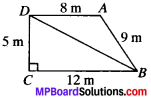
A park, in the shape of a quadrilateral ABCD, has ∠C = 90°, AB = 9 m, BC = 12 m, CD, = 5 m and AD = 8 m. How much area does it. occupy?
Solution:
In ∆DCB
DB2 = DC2 + BC2
MP Board Class 9th Maths Solutions Chapter 12 Heron’s Formula Ex 12.2 img-1
In ∆DBA P = (8 + 9 + 13)m = 30m
s = \(\frac{P}{2}\) = 15 m
s – a = 15 – 13 = 2
s – b = 15 – 9 = 6
s – c = 15 – 8 = 7
Area of ∆DBA = \(\sqrt{15x 2x6x7}\)
\(\sqrt{3x5x2x2x3x7}\)
= 2 x 3\(\sqrt{5×7}\) x 7 = 6\(\sqrt{35}\)m2
Area of quadrilateral ABCD = (30 + 6\(\sqrt{35}\)) m2
= 30 + 6 x 5.91
= 30 + 35.46
= 65.46 m2

MP Board Solutions

Question 2.
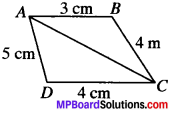
Find the area of a quadrilateral ABCD in which AB = 3 cm, BC = 4 cm, CD = 4 cm, DA = 5 cm and AC = 5 cm.
Solution:
In ∆ABC
MP Board Class 9th Maths Solutions Chapter 12 Heron’s Formula Ex 12.2 img-2
P = 3 + 4 + 5 = 12cm
s = \(\frac{12}{2}\) = 6 cm
s – a = 6 – 5 = 1 cm
s – b = 6 – 4 = 2cm
s – c = 6 – 3 = 3 cm
Area of ∆ABC = \(\sqrt{6x1x2x3}\)
= \(\sqrt{2x3x2x3}\)
= 2 x 3 = 6 cm2
In ∆ADC P = 5 + 5 + 4 = 14 cm
s = \(\frac{P}{2}\) = 7 cm
s – a = 7 – 5 = 2cm
s – b = 7 – 5 = 2cm
s – c = 7 – 4 = 3cm
Area of ∆ADC = \(\sqrt{7x2x2x3}\) = 2\(\sqrt{21}\) cm2
Area of ∆BCD = Area of ∆ABC + Area of ∆ADC
= (6 + 2\(\sqrt{21}\)) cm2
= (6 + 2 x 4.58)
= 15.16 cm2

Question 3.
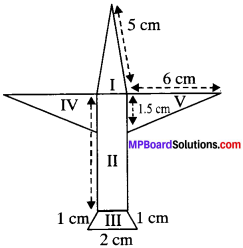
Radha made a picture of an aeroplane with coloured paper is shown in Fig. Find the total area of the paper used.
Solution:
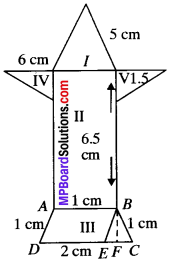
The figure is divided into five parts as shown in Fig.
MP Board Class 9th Maths Solutions Chapter 12 Heron’s Formula Ex 12.2 img-3

  • Part I – Triangle having sides 5 cm, 5 cm and 1 cm
  • Part II – Rectangle having sides 1 cm and 6.5 cm
  • Part III – Trapezium having sides 2,1,1,1.
  • Part IV and V. Right angled triangles having sides 6 cm and 1.5 cm.

MP Board Class 9th Maths Solutions Chapter 12 Heron’s Formula Ex 12.2 img-4
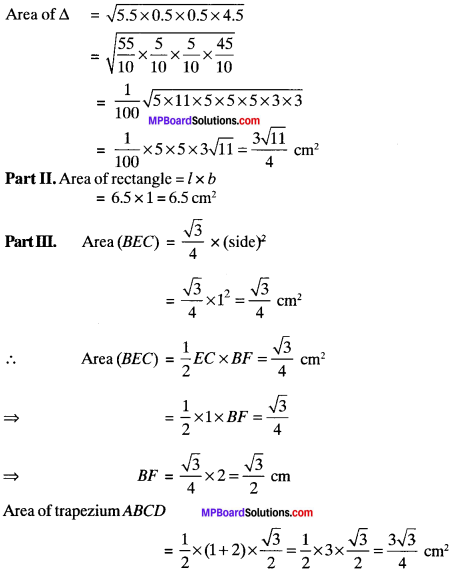
For Part I:
a = 5 cm
b = 5 cm
c = 1 cm
s = \(\frac{P}{2}\) = \(\frac{5+5+1}{2}\) = \(\frac{11}{2}\) = 5.5 cm
s – a = 5.5 – 5 = 0.5
s – b = 5.5 – 5 = 0.5
s – c = 5.5 – 1 = 4.5
MP Board Class 9th Maths Solutions Chapter 12 Heron’s Formula Ex 12.2 img-5
Area of triangle IV and V = \(\frac{1}{2}\) x 1.5 x 6 = 4.5 cm2
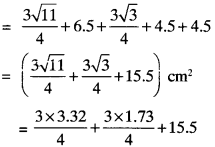
∴ Area of paper required = Area of part I + Area of part II + Area of part III + Area of part IV + Area of part V
MP Board Class 9th Maths Solutions Chapter 12 Heron’s Formula Ex 12.2 img-6
= 2.49 + 1.27 + 15.5
= 19.26 cm2

Question 4.
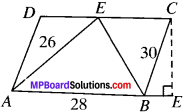
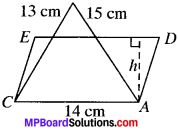
A triangle and a parallelogram have the same base and the &me area. If the sides of the triangle are 26 cm, 28 cm and 30 cm, and the parallelogram stands on the base 28 cm, find the height of the parallelogram.
Solution:
MP Board Class 9th Maths Solutions Chapter 12 Heron’s Formula Ex 12.2 img-7
In ∆ABE
a = 30 cm
b = 28 cm
c = 26 cm
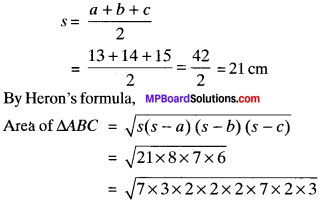
s = \(\frac{P}{2}\) = \(\frac{30+28+26}{2}\) = 42 cm
s – a = 42 – 30 = 12
s – b = 42 – 28 = 14
s – c = 42 – 26 = 16
Area of ∆ABE = \(\sqrt{42x12x14x16}\)
= \(\sqrt{2x3x7x2x2x3x2x7x4x4}\)
= 2 x 3 x 7 x 2 x 4
= 336 cm2
MP Board Class 9th Maths Solutions Chapter 12 Heron’s Formula Ex 12.2 img-8
Area of parallelogram ABCD = area of ∆ABE = 336 cm2 (given)
Area of parallelogram = b x h
336 = 28 x h
⇒ \(\frac{336}{28}\)
h= 12 cm.

MP Board Solutions

Question 5.
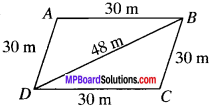
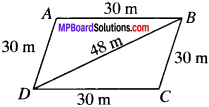
A rhombus shaped field has green grass for 18 cows to graze. If each side of the rhombus is 30 m and its longer diagonal is 48 m, how much area of grass field will each cow be getting?
Solution:
We know that the diagonal of a rhombus divide it into two triangles of equal area.
MP Board Class 9th Maths Solutions Chapter 12 Heron’s Formula Ex 12.2 img-9
a = 48m
b = 30m
c = 30m
s = \(\frac{P}{2}\) = \(\frac{48+30+30}{2}\) = \(\frac{108}{2}\) = 54
s – a = 54 – 48 = 6 cm
s – b = 54 – 30 = 24 cm
s – c = 54 – 30 = 24 cm
Area of ∆ABD
= \(\sqrt{54x6x24x24}\)
= \(\sqrt{2x3x3x3x2x3x2x2x2x3x2x2x2x3}\)
= 2 x 3 x 3 x 2 x 2 x 3 x 2 = 432 cm2
Area of rhombus = 2 x 432 = 864 cm2
Area of grass field for each cow = \(\frac{864}{18}\) = 48 cm2

Question 6.
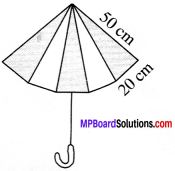
An umbrella is made by stitching 10 triangular pieces of cloth of two different colours (see Fig.), each piece measurig 20 cm, 50 cm and 50 cm. How much cloth of each colour is required for the umberella?
Solution:
MP Board Class 9th Maths Solutions Chapter 12 Heron’s Formula Ex 12.2 img-10
a = 50 cm
b = 50cm
c = 20 cm
s = \(\frac{P}{2}\) = \(\frac{50+50+20}{18}\) = 60 cm
s – a = 60 – 50 = 10
s – b = 60 – 50 = 10
s – c = 60 – 20 = 40
Area of a ∆ = \(\sqrt{60x10x10x40}\)
= \(\sqrt{2x3x10x10x10x2x2x10}\)
= 10 x 10 x 52\(\sqrt{6}\)
= 200\(\sqrt{6}\) cm2
Area of cloth of each type = 200\(\sqrt{6}\) x 5 = 1000\(\sqrt{6}\) cm2

Question 7.
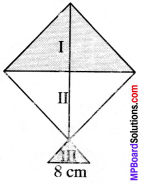
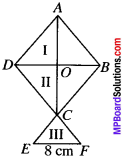
A kite in the shape of a square with a diagonal 32 cm and an isosceles triangle of base 8 cm and sides 6 cm each is to be made of three different shades as shown in Fig. How much paper of each shade has been used in it?
Solution:
MP Board Class 9th Maths Solutions Chapter 12 Heron’s Formula Ex 12.2 img-11
∠AOB = 90°
BD = AC = 32 cm
OA = OC = 16 cm
Area (ABD) = area (DBC) = \(\frac{1}{2}\) x 32 x 16 = 256 cm2
In ∆CEF
a = 6 cm
b = 6 cm
c = 8 cm
s = \(\frac{P}{2}\) = \(\frac{6+6+8}{2}\) = 10
s – a = 10 – 6 = 4
s – b = 10 – 6 = 4
s – c = 10 – 8 = 2
MP Board Class 9th Maths Solutions Chapter 12 Heron’s Formula Ex 12.2 img-12
Area of ∆CEF = \(\sqrt{10x4x4x2}\)
= \(\sqrt{5x2x4x4x2}\)
= 8\(\sqrt{5}\) cm2
= 8 x 2.24 = 17.92 cm2

MP Board Solutions

Question 8.
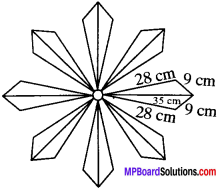
A floral design on a floor is made up of 16 tiles which are triangular, the sides of the triangle being 9 cm, 28 cm and 35 cm (see Fig.). Find the cost of polishing the tiles at the rate of the field.
Solution:
MP Board Class 9th Maths Solutions Chapter 12 Heron’s Formula Ex 12.2 img-13
a = 35 cm
b = 28 cm
c = 9 cm
s = \(\frac{P}{2}\) = \(\frac{35+28+9}{2}\)
s = a = 36 – 35 = 1
5 = b = 36 – 28 = 8
c = c = 36 – 9 = 27
Area of a tile = \(\sqrt{36x1x8x27}\)
= \(\sqrt{2x2x3x3x2x2x2x3x3x3}\)
= 2 x 3 x 2 x 3\(\sqrt{6}\) = 36\(\sqrt{6}\) cm2
= 36 x 2.45 = 88.2 cm2
Total area of tiles = 16 x 88.2 = 1411.2 cm2
Cost of polishing the tiles per cm2 = 50 P
Total cost of polishing the tiles = 1411.2 x 50 P
= ₹ \(\frac{1411.2×50}{100}\) = ₹ 705.60

Question 9.
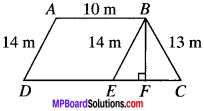
A field is in the shape of a trapezium whose parallel sides are 25 m and 10 m. The non-parallel sides are 14 m and 13 m. Find the area of the field.
Solution:
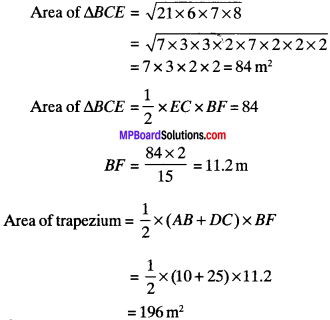
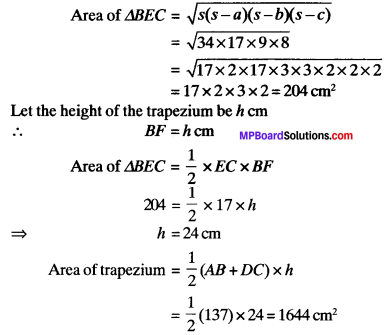
ABCD is a trapezium. Draw BE parallel to AD. Draw BF ⊥ DC. ABED is a parallelogram
AB = DE = 10 m and AD = BE = 14 m
EC = DC – DE = 25 – 10 = 15 m
In ∆BEC
a = 15m
b = 14m
c = 13m
s = \(\frac{15+14+13}{2}\) = 21
MP Board Class 9th Maths Solutions Chapter 12 Heron’s Formula Ex 12.2 img-14
s – a = 21 – 15 = 6
s – b = 21 – 14 = 7
s – c = 21 x 13 = 8
MP Board Class 9th Maths Solutions Chapter 12 Heron’s Formula Ex 12.2 img-15

MP Board Class 9th Maths Solutions

MP Board Class 6th Science Solutions Chapter 3 Fibre to Fabric

MP Board Class 6th Science Solutions Chapter 3 Fibre to Fabric

Fibre to Fabric Test Book Exercise

Question 1.
Classify the following fibres as natural or synthetic: nylon, wool, cotton, silk, polyester, jute?
Answer:
Natural Fibre. Wool, cotton, silk, jute. Synthetic Fibre. Nylon, polyster.

Question 2.
State whether the following statemepts are true or false –

  1. Yarn is made from fibres.
  2. Spinning is a process of making fibres.
  3. Jute is the outer covering of coconut.
  4. The process of removing seed from cotton is called ginning.
  5. Weaving of yarn makes a piece of fabric.
  6. Silk fibre is obtained from the stem of a plant.
  7. Polyester is a natural fibre.

Answer:

  1. True
  2. True
  3. False
  4. True
  5. True
  6. False
  7. False.

Question 3.
Fill in the blanks:

  1. Plant fibres are obtained from …………………….. and …………………………
  2. Animals fibres are ………………………. and ……………………….

Answer:

  1. Jute, cotton
  2. Silk, wool.

Question 4.
From which parts of the plant cotton and jute are obtained?
Answer:
Cotton fibres are obtained from cotton seeds. Cotton fibres are hairs of cotton seeds. Jute fibres are obtained from the stem of jute plants by retting process.

Question 5.
Name two items that are made from coconut fibre?
Answer:
The items that are made from coconut fibre:

  1. Coir in mattress
  2. Ropes.

MP Board Solutions

Question 6.
Explain the process of making yarn from fibre?
Answer:
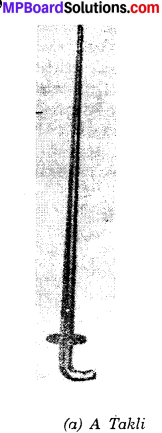
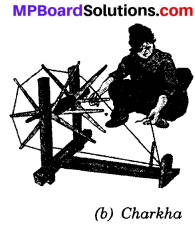
Hold some cotton wool in one hand. Pinch some cotton between the thumb and forefinger of the other hand. Now, gently start pulling out the cotton, while continuously twisting the fibres. The process of making yarn from fibres is called spinning. In this process, fibres from a mass of cotton wool are drawn out and twisted.

This brings the fibres together to form a yarn. A simple device used for. spinning is a hand spindle, also called takali (Fig. a). Another hand operated device used for spinning is charkha (Fig. b). Use of charkha was popularized by Mahatma Gandhi as part of the Independence movement. He encouraged people to wear clothes made Of homespun yarn and shun imported cloth made in the mills of Britain.

MP Board Class 6th Science Solutions Chapter 3 Fibre to Fabric img 1
MP Board Class 6th Science Solutions Chapter 3 Fibre to Fabric img 2

Spinning of yarn on a large scale is done with the help of spinning machines. After spinning, yarns are used for making fabrics.

MP Board Solutions

Fibre to Fabric Additional Important Questions

Fibre to Fabric Objective Type Questions

Choose the correct answer:

Question (a)
Natural clothing materials includes:
(a) Cotton
(b) Nylon
(c) Rayon
(d) Polyester.
Answer:
(a) Cotton

Question (b)
Man – made clothing materials are:
(a) Rayon
(b) Nylon
(c) Polyester
(d) All the above.
Answer:
(d) All the above.

Question (c)
The process of pulled out cotton seeds from cotton is called:
(a) Ginning
(b) Retting
(c) Spinning
(d) None of these.
Answer:
(a) Ginning

Question 2.
Fill in the blanks:

  1. The jute fibres are obtained from the stem of plant called ………………………
  2. Cotton and jute are examples of fibres obtained from ………………………..
  3. The fruits of the cotton plant are about the size of a ……………………….
  4. Weaving of fabric is done on ………………………….
  5. Weaving and knitting are used for making different kinds of ………………………
  6. In olden days, silk comes from ………………………..

Answer:

  1. Patsun
  2. Plants
  3. Lemon
  4. Looms
  5. Fabric
  6. China.

Question 3.
State whether the following statements are true (T) or false (F):

  1. Silk and wool fibres are obtained. from animal.
  2. Jute crops are cultivated in worm season.
  3. In olden days, the yarn was spun directly by charkha.
  4. Big reels of yarn is called bobbine.
  5. Coconut fibres have a rough surface.
  6. Wool is a fibre of animals.

Answer:

  1. True
  2. False
  3. True
  4. True
  5. True
  6. True

Question 4.
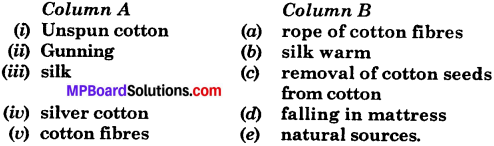
Match the items in Column A with Column B:
MP Board Class 6th Science Solutions Chapter 3 Fibre to Fabric img 3
Answer:

(i) – (d)
(ii) – (c)
(iii) – (b)
(iv) – (a)
(v) – (e)

MP Board Solutions

Fibre to Fabric Very Short Answer Type Questions

Question 1.
What is yarn?
Answer:
Yarns are made up of fibres.

Question 2.
Name some fibres obtained from plants and animals?
Answer:
Silk, wool, jute and cotton fibres are obtained from plants and animals.

Question 3.
Give two examples of synthetic fibres?
Answer:
Nylon and polyester.

Question 4.
Which type of clothes burn slowly?
Answer:
Cotton clothes are burn slowly.

Question 5.
Which type of clothes burn quickly?
Answer:
Polyester and nylon clothes are burn quickly.

Question 6.
Which type of clothes absorb water quickly?
Answer:
Cotton clothes.

Question 7.
What are the fruits of the cotton plant called?
Answer:
Cotton bolls.

Question 8.
Define “ginning”?
Answer:
The process of pulled out cotton seeds from cotton is called griming.

Question 9.
Write any two uses of cotton?
Answer:
As absorbent in hospitals and manufacture of textiles.

Question 10.
In which season are cotton crops grown?
Answer:
Summer season.

Question 11.
Where is cotton chops grown in India?
Answer:
In India cotton crops are grown in Gujarat, Madhya Pradesh, Rajasthan, Maharashtra and Tamil Nadu.

Question 12.
How is cotton collected?
Answer:
Cotton is usually hand picked.

Question 13.
Which part of jute plant gives jute?
Answer:
Jute fibres is obtained from the stem of jute plant.

Question 14.
In which season are jute crops grown?
Answer:
Rainy season.

Question 15.
Where is jute grown in India?
Answer:
In India jute grown is Bihar, Assam and West Bengal.

Question 16.
Name any two processes by which fabrics are made from yarns?
Answer:
Wearing and knitting.

Question 17.
Why a coconut fibres not used for making yarns?
Answer:
Coconut fibres are not used for making yarns because they are very hard.

Question 18.
Why are fibre twisted?
Answer:
By twisting fibres, they become strong and their co¬hesion power increase.

Question 19.
What is flaxl?
Answer:
Flax is also a plant that gives natural fibres.

Question 20.
Where cotton and flax were cultivated in ancient Egypt?
Answer:
Near the river Nile.

Question 21.
What materials people used in ancient times for clothes?
Answer:
In ancient time people used the bark and big leaves of trees or .animal skins and furs to cover themselves.

Question 22.
What is knitting?
Answer:
In knitting, a single yarn is used to make a piece of fabric.

Question 23.
Name some dresses which are used as an unstitched piece of fabric?
Answer:
Saree, Lungi, Dhoti and Turban.

MP Board Solutions

Fibre to Fabric Short Answer Type Questions

Question 1.
Define natural fibres?
Answer:
The fibres of some fabrics such as cotton, jute, silk and wool are obtained from plants and animals. These are called natural fibres.For examples, wool and silk fibres are obtained from animals while cotton and jute are obtained from plants.

Question 2.
Define synthetic fibres?
Answer:
In the last hundred years or so, fibres are also made from chemical substances, which are not obtained from plant or animal sources. These are called synthetic fibres. For examples, nylon, polyester and acrylic.

Question 3.
What is spinning machines?
Answer:
Spinning of yarn on a large scale is done with the help of spinning machines. After spinning, yarns are used for making fabrics.

Question 4.
Describe the process of weaving?
Answer:
A fabric is made up of two sets of yarns arranged together. The process of arranging two sets of yarns together to make a fabric is called weaving. The weaving of fabric is done on looms. The looms are either hand operated or power operated.

Question 5.
How was cloth making developed?
Answer:
The cloth making was developed in three stages. First stage was making cloth from plant fibres, second stage was the beginning of the use of animal fibres and the third stage began with man-made fibres in nineteenth century.

Question 6.
Why do we wear clothes?
Answer:
We wear clothes due to the following reasons:

  1. They protect against weather.
  2. They protect against injury.
  3. They protect against wind.

Fibre to Fabric Long Answer Type Questions

Question 1.
Where does this cotton came from? Also define ginning of cotton?
Answer:
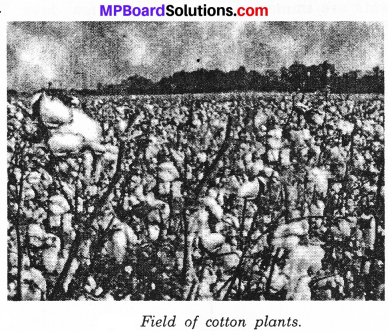
Cotton plant is grown in the fields. They are usually grown at places having black soil and worm climate. In India, cotton crops are grown in Punjab, Madhya Pradesh, Rajasthan, Gujarat, Maharashtra and Tamil Nadu. The fruits of the cotton plant (cotton bolls) are about the size of a lemon. After maturing, the bolls burst open and the seeds covered with cotton fibres can be seen.
MP Board Class 6th Science Solutions Chapter 3 Fibre to Fabric img 4

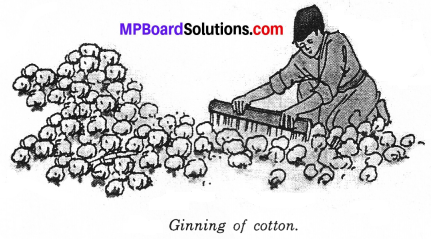
From these bolls, cotton is usually picked by hand. Fibres are then separated from the seeds by combing. This process is called ginning of cotton. Ginning was traditionally done by hand as shown in the following figure. These days, machines are also used for ginning.
MP Board Class 6th Science Solutions Chapter 3 Fibre to Fabric img 5

Question 2.
Write the process to obtained jute fibres from a jute plant?
Answer:
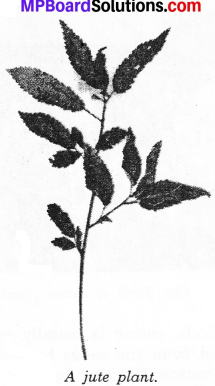
Jute fibre is obtained from the stem of the jute plant. It is cultivated during the rainy season. In India, jute is mainly grown in West Bengal, Bihar and Assam. The jute plant is normally harvested when it is at flowering stage. The stems of the harvested plants are immersed in water for a few days. The stems rot and fibres are separated by hand.
MP Board Class 6th Science Solutions Chapter 3 Fibre to Fabric img 6

MP Board Class 6th Science Solutions

MP Board Class 7th Science Solutions Chapter 9 Soil

MP Board Class 7th Science Solutions Chapter 9 Soil

Soil Intext Questions

Question 1.
I wonder why I found some pieces of plastic articles and polythene bags in the soil sample collected from the roadside and the garden?
Answer:
It is because people throw used plastic things and polythene bags in the soil.

Question 2.
I want to know whether ‘the soil from a field can be used to make toys?
Answer:
Yes.

Question 3.
I want to know: What kind of soil should be used for making making  and surahis?
Answer:
Clayey soil.

MP Board Solutions

Question 4.
Boojho wondered why there was a difference in the absorption of water in the two squares?
Answer:
Because different soils are used to make the two squares.

Question 5.
What is the difference between rate of percolation and the amount of water retained?
Answer:
Rate of percolation is the amount of water percolated per unit time through soil. Whereas the amount of water retained is the amount of water absorbed by soil. Thus, rate of percolation and water retention are opposite attributes.

Activities

Activity 1
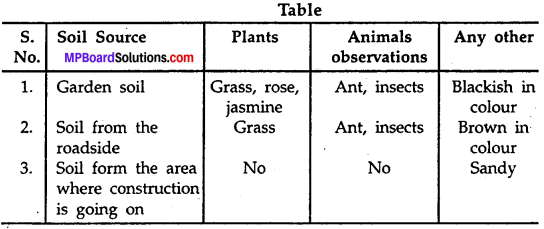
Collect some soil samples and observe them carefully. You can use a hand lens. Examine each sample carefully and fill in Table. Answer:
Table
MP Board Class 7th Science Solutions Chapter 9 Soil img-1

Activity 2
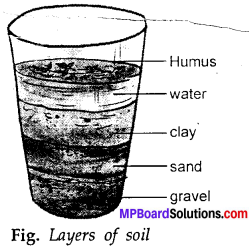
Take a little soil. Break the clumps with your hand to powder it. Now take a glass tumbler, three quarters filled with water, and then add a handful of soil to it. Stir it well with a stick to dissolve the soil. Now let it stand undisturbed for some time. Afterwards, observe it and answer the following questions:

  1. Do you see layers of particles of different sizes in the glass tumbler?
  2. Draw a diagram showing these layers?
  3. Are there some dead rotting leaves or animal remains floating on water?

Answer:

  1. Yes
  2. MP Board Class 7th Science Solutions Chapter 9 Soil img-2
  3. Yes

MP Board Solutions

Activity 3
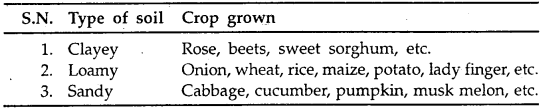
Find from your teachers, parents and farmers the type of soils and crops grown in your area. Enter the data in the following Table,

  1. Which kind of soil would be most suitable for planting rice?
  2. Soil with a higher or lower rate of percolation?

MP Board Class 7th Science Solutions Chapter 9 Soil img-3
Answer:
MP Board Class 7th Science Solutions Chapter 9 Soil img-4

  1. Loamy soil.
  2. Lower rate of percolation.

Soil Text Book Exercises

Tick the most suitable answer in questions 1 and 2.

Question 1.
In addition to the rock particles, the soil contains?

  1. Air and water
  2. Water and plants
  3. Minerals, organic matter, air and water
  4. Water, air and plants.

Answer:
3. Minerals, organic matter, air and water.

Question 2.
The water holding capacity is the highest in?

  1. Sandy soil
  2. Clayey soil
  3. Loamy soil
  4. Mixute of sand and loam.

Answer:
2. Clayey soil.

Question 3.
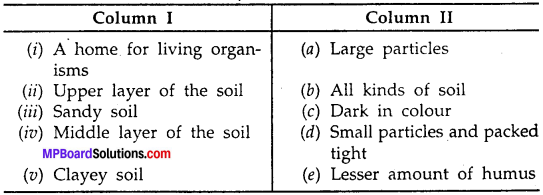
Match the items in Column I with Column II:
MP Board Class 7th Science Solutions Chapter 9 Soil img-5
Answer:

(i) (b)
(ii) (c)
(iii) (a)
(iv) (e)
(v) (d).

Question 4.
Explain how soil is formed?
Answer:
The soil is the mtter which cover the top most layer of the earth in most of area. It is one of the most important natural resources. Long ago earth was a very hot sphere and then converted into a very hard and rocky land. These rocks were broken into smaller pieces by violent earthquakes. Volcanic eruptions also made the rocks and lava into smaller pieces. In cold temperatures the ice in the services of rocks expanded to break it into smaller pieces and thus gradually the soil was formed. The nature of any soil depends upon the rocks from which it has been formed and the type of vegetation that grows in it.

MP Board Solutions

Question 5.
How is clayey soil useful for crops?
Answer:
Clayey soil is good at retaining water. They, are rich in humus and are very fertile. They also hold sufficient water due to the presence of smaller particles and certain enough air due to the presence of some large particles.

Question 6.
List the differences between clayey soil and sandy soil?
Clayey soil:

  1. They contains more than 50% of clay particles.
  2. Water holding capacity is very high.
  3. Suitable for plant growth.
  4. Low percolation rate.

Sandy Soil:

  1. They contains about 60% of sand particles.
  2. Water holding capacity is very low.
  3. Not suitable for plant growth.
  4. High percolation rate.

Question 7.
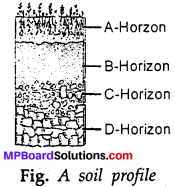
Sketch the cross section of soil and label the various layers?
Answer:
MP Board Class 7th Science Solutions Chapter 9 Soil img-7

Question 8.
Razia conducted an experiment in the field related to the rate of percolation. She observed that it took 40 min for 200 mL of water to percolate through the soil sample. Calculate the rate of percolation.
Answer:
We know that,
MP Board Class 7th Science Solutions Chapter 9 Soil img-8
Thus, the rate of percolation is 5ml/min.

Question 9.
Explain how soil pollution and soil erosion could be prevented?
Answer:
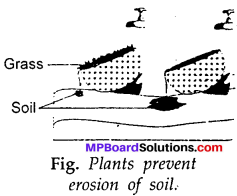
Polythene bags and plastics pollute the soil. They also kill the organisms living in the soil. That is why there is a demand to ban the polythene bags and plastics. Other substances which pollute the soil are a number of waste product, chemicals and pesticides. Waste products and chemicals should be treated before they are released into the soil.

The use of pesticides should be minimised. Soil erosion can be slowed down and soil can be conserved by regulating the factors responsible for it. Some methods to prevent or slow down the soil erosion are:

  1. To stop the unnecessary cutting of forests and trees.
  2. To stop the excessive use of grass land due to overgrazing by cattle.
  3. Growing vegetation along the boundary of the fields and open grounds.
  4. Making use of proper and scientific methods for cultivation such as crops rotation. This maintains the natural fertility of the soil and at the same time soil also maintains its capacity to hold water. Soil remains wet and cannot be easily carried away by water and blown up by wind.
  5. Making use of scientific methods for irrigation and water drainage.
  6. Gutting the hill slopes into steps or terraces and adopting terrace cultivation on hill slopes.

MP Board Solutions

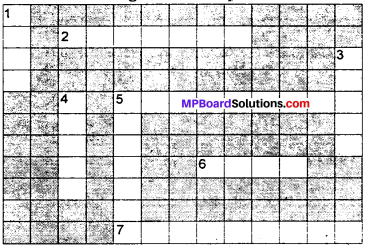
Question 10.
Solve the following crossword puzzle with the clues given:
MP Board Class 7th Science Solutions Chapter 9 Soil img-9
Across:

2. Plantation prevents it.
5. Use should be banned to avoid soil pollution.
6. Type of soil used for making pottery.
7. Living organism in the soil.

Down:

1. In desert soil erosion occurs through.
3. Clay and loam are suitable for cereals like.
4. This type of soil can hold very little water.
5. Collective name for layers of soil.

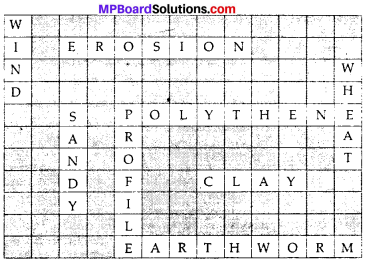
Answer:
MP Board Class 7th Science Solutions Chapter 9 Soil img-10

Soil Additional Important Questions

Soil Objective Type Questions

Question 1.
Choose the correct alternative:

Question (i)
The constituents of the soil are –
(a) Mineral particles, air and water
(b) Living of organisms
(c) Organic and inorganic substances
(d) All of these.
Answer:
(d) All of these.

Question (ii)
Soil is the thin layer of fine material containing –
(a) Organic matter
(b) Air and water
(c) Weathered rock materials
(d) All of these.
Answer:
(d) All of these.

Question (iii)
Soil formation is brought about by –
(a) physical factors
(b) Chemical factors
(c) Biological agent
(d) All of these.
Answer:
(d) All of these.

Question (iv)
Which profile contains humus –
(a) A – horizon
(b) B – horizon
(c) C – horizon
(d) R – horizon.
Answer:
(a) A – horizon

MP Board Solutions

Question (v)
Which of these has the smallest size of particles –
(a) Sand
(b) Silt
(c) Clay
(d) Gravel.
Answer:
(b) Silt

Question (vi)
What kind of soil is best for growing cotton –
(a) Black soil
(b) Alluvial soil
(c) Red laterite soil
(d) Mountain soil.
Answer:
(a) Black soil

Question (vii)
What kind of soil is good for growing tea and coffee –
(a) Red laterite soil
(b) Black soil
(c) Laterite soil
(d) Mountain soil.
Answer:
(c) Laterite soil

Question (viii)
The dead and decaying organisms are –
(a) Humus
(b) Gravel
(c) Clay
(d) Inorganic material.
Answer:
(a) Humus

Question (ix)
Which kind of soil is best for growing wheat, rice and sugarcane –
(a) Black soil
(b) Mountain soil
(c) Alluvial soil
(d) Desert soil
Answer:
(c) Alluvial soil

Question 2.
Fill in the blanks:

  1. Wheat and rice grow best in …………… soil.
  2. Humus is present in the ………….. layer of soil, known as the ………….. horizon.
  3. Clay is the smallest size of particles less than …………… in diameter.
  4.  …………… is a mixture of sand, silt, clay and humus.
  5. Weathering of rocks is a …………… process.
  6. …………… is the breaking down of rocks into smaller pieces.
  7. Soil commonly found in India is of …………….. main types.
  8. Red colour of the soil is due to ………………

Answer:

  1. Alluvial
  2. Upper, A
  3. 0.002 mm
  4. Loam
  5. Slow
  6. Weathering
  7. Six
  8. Iron.

MP Board Solutions

Question 3.
Which of the following statements are true (T) or false (F):

  1. The soil is uppermost layer of the land surface.
  2. The soil with particle size greater than 2 mm in diameter is gravel.
  3. The soil with particle size greater than 2 mm in diameter is clay.
  4. Decayed organic matter in the soil forms humus.
  5. Most fertile farm lands consist of alkaline soil.
  6. No humus is present in C – horizon.
  7. Black soil is rich in iron and magnesium.
  8. B – horizon is the most fertile part of the soil.
  9. Laterite soil is rich in nutrients.
  10. Soil is classified in sand, silt and clay.
  11. The process of .carrying away of top soil by natural process is called soil erosion.
  12. Black soil is loamy in texture with plenty of humus.
  13. Overgrasing is a means of soil conservation.
  14. Extremely acidic soil supports plants.
  15. Planting of trees in a large area is known as afforestation.

Answer:

  1. True (T)
  2. True (T)
  3. False (F)
  4. True (T)
  5. False (F)
  6. True (T)
  7. True (T)
  8. False (F)
  9. True (T)
  10. True (T)
  11. True (T)
  12. False (F)
  13. False (F)
  14. False (F)
  15. True (T).

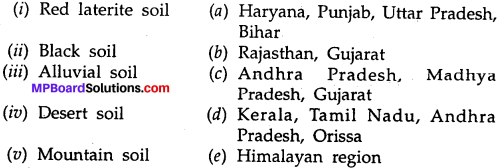
Match the items in Column A with items in Column B:
MP Board Class 7th Science Solutions Chapter 9 Soil img-11
Answer:

(i) (d)
(ii) (c)
(iii) (a)
(iv) (b)
(v) (e).

Soil Very Short Answer Type Questions

Question 1.
Mention two main components of soil?
Answer:
The two main components of soil are mineral particles and organic particles.

Question 2.
Name the different types of particles present in the soil?
Answer:
The different types of particles present in the soil are water, air, humus, mineral particles and living organisms.

Question 3.
What is soil?
Answer:
The soil is the outer layer of earth’s crust capable of supporting plant growth.

Question 4.
Mention two functions of soil?
Answer:
The two functions of soil are:

  1. It provides water and minerals to the plants.
  2. It provides anchorage to the plants.

MP Board Solutions

Question 5.
What is the role of plants in the formation of soil?
Answer:
The roots of plants on penetrating into the crevices of rocks break these and help in the formation of soil.

Question 6.
Name some of the living organisms which are present in the soil?
Answer:
Fungi, bacteria, earth worms, round worms, and protozoams are the living organisms present in the soil.

Question 7.
What do you mean by soil texture?
Answer:
The structure or texture of soil determines the relative proportion of particles of different sizes.

Question 8.
What is the difference between soil texture and structure?
Answer:
Soil texture pertains to particle size, composition of a soil and soil structure refers to arrangement of soil particles into aggregates.

Question 9.
What is meant by the term weathering?
Answer:
Weathering is the breaking down of huge pieces of rocks into smaller pieces by the action of natural forces, such as water, wind, glaciers and roots of plants.

Question 10.
Which layer of soil contains the largest rock pieces?
Answer:
Bedrock contains the. largest rock pieces.

Question 11.
Which layer of soil will have the highest humus content and which the least?
Answer:
The upper most layer (A-horizon) will have the highest humus content and lowest layer (C-horizon) will have the least.

Question 12.
Which types of soil is most suitable for crops like wheat, rice and sugarcane?
Answer:
Alluvial soils is the most suitable for crops like wheat, rice x – and sugarcane.

Question 13.
Define residual soil?
Answer:
The soil which remains at the place of its formation is called residual soil.

Question 14.
Which soil is classified as alluvial type?
Answer:
The soil transported by flowing water is classified as alluvial type.

Question 15.
What are mountainous soil?
Answer:
Mountainous soil consist of clay, shales, sandstones and limestones. This type of soil is usually found in depressions and valley basins or on gently inclined slopes.

Question 16.
Define loam?
Answer:
Loam is a mixture of sand, silt and clay and also has humus in it.

MP Board Solutions

Question 17.
What is soil pollution?
Answer:
The contamination of soil with excess of fertilizers, herbicides, weedicides, insecticides and industrial waste is called soil pollution.

Question 18.
Define soil moisture?
Answer:
Soil holds water in it, which is called soil moisture.

Question 19.
Name the three types of soil erosion?
Answer:
The three types of soil erosion are sheet erosion, gaily erosion and wind erosion.

Question 20.
How does vegetation help to prevent soil erosion?
Answer:
Flowing water and wind take away the top layer of the soil if there is no vegetation. The grasses, trees hold the soil in place.

Question 21.
How does soil erosion take place?
Answer:
Soil erosion can take place by natural processes such as floods, forest fire, winds, deforestation and overgrazing.

Question 22.
Which horizon of soil profile contains humus?
Answer:
A – horizon of soil profile contains humus.

Question 23.
Which type of soil is classified as residual soil?
Answer:
The soil, which remains at the place of its formation is called residual soil. This type of soil is generally poor in nitrogen, phosphorus and humus.

Question 24.
The soil at a given place was found to consist of sand stones, clay, shales and limestone. What is the type of the soil and how it might have formed?
Answer:
The type of the soil is mountainous soil. It might have formed, when the weathered soil particles are taken away to other places.

Soil Short Answer Type Questions

Question 1.
What does soil consist of?
Answer:
Soil consists of tiny bits of mineral particles which come from larger rocks and humus which is dark brown in colour and consists of decaying remains of plants and animals. Soil also contains water, air and living organisms such as bacteria, fungi, earth worms, round worms, and insects etc.

Question 2.
How is the soil formed? Explain in brief?
Answer:
Millions years ago, the surface of earth was very hard, rugged and rocky. In the long run, weathering of these rocks resulted in formation of soil which with the flow of river water came down to the lower plains and got deposited. Gradually it spread out on whole surface of the earth. Formation of soil is a very slow process. In this process rocks crack and break down into fine particles to form soil.

Question 3.
Define alluvial soil and its distribution?
Answer:
Alluvial soil is loamy soil which contains abundant amount of water in it. This is very fertile soil. This type of soil is very suitable for the production of wheat and rice. This soil is found in the plains of northern India, i.e., in the state of Punjab, Bihar, Haryana, Uttar Pradesh and West Bengal.

MP Board Solutions

Question 4.
What are physical properties of soil?
Answer:
The physical properties of soil are:

  1. Colour
  2. Moisture storage capacity
  3. Texture
  4. Presence of living organisms
  5. Porosity.

Question 5.
Give an account of the importance of physical properties of soil?
Answer:
The physical properties .of soil exert a great influecne on soil fertility. These are taken into consideration when soil is to be used as a medium for plant growth but also when soils are to be [ used as a structural material for making highways, dams, foundation for buildings as well as for the manufacture of bricks and tiles.

Question 6.
What are organic and inorganic components of soil?
Answer:
The inorganic components of soil comprise minerals which are derived from fragmentation and weathering of rocks. The porespaces formed between the mineral particles of soil are filled with water and gases. The organic component of soil comprise organic wastes, dead animals, plants and their decomposition products.

Question 7.
Explain the role of various organisms present in the soil?
Answer:
Bacteria in the soil helps in decomposing dead remains of plants and animals to make humus. Some bacteria can convert atmospheric nitrogen into water soluble nitrates which plants can easily use for their growth. Earthworms help in loosening of soil. They also improve the texture of the soil thus causing better growth of plants.

Question 8.
Name four common sources of pollution of soil?
Answer:
The common sources of pollution of soil are:

  1. Excessive use of fertilisers.
  2. Spraying of crops with insecticides and herbicides.
  3. Garbage and other kitchen refuge.
  4. Industrial wastes such as chemicals, plastic, leather, fly ash, etc.

Question 9.
Define A – horizon layer. Give also the main characteristic of A – horizon.
Answer:
A – horizon layer:
The uppermost layer of the soil is called A – horizon. It is generally known as upper soil or earth’s crust. The main characteristics of this layer of soil are as under:

  1. It generally bears dark colour.
  2. It contains lot of dead and decaying plant and animal matter called humus.
  3. Due to presence of humus this layer is highly fertile.
  4. The soil in this layer is porous, soft and has comparatively more water retaining capacity.
  5. In this layer living organisms such as earth worms, insects, bacteria and fungi etc. are found.

MP Board Solutions

Question 10.
Define B – horizon layer. Also give the main characteristics of B – horizon.
Answer:
B – horizon layer:
This layer lies next to A – horizon. The main characteristics of this layer of soil are as under:

  1. The colour of this layer is comparatively dull.
  2. This layer of soil is usually harder and more compact than the top soil.
  3. This layer contains very less amount of organic matter in it.
  4. This layer is rich in iron oxide and soluble mineral salts,
  5. Roots of large and old trees are found in this layer.

Question 11.
Differentiate between Alluvial soils and Desert soils.
Answer:
Alluvial soils:

  1. Loamy in texture with plenty of humus.
  2. Very fertile, good for crops like wheat and rice.
  3. In India, it is mainly found in the plains of Uttar Pradesh, Haryana, Bihar, West Bengal and in the coastal regions of Orissa and Andhra Pradesh.

Desert soils:

  1. Soil sandy and porous, cannot hold much water.
  2. If irrigated, crops can be grown.
  3. In India, it is mainly found in Rajasthan and in some parts of Gujarat.

Soil Long Answer Type Questions

Question 1.
Describe the various steps involved in the formation of soil?
Answer:
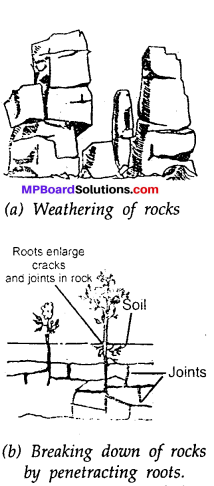
There is a hard surface of the rocks just below the layer of the soil. In the past, these rocks were broken into smaller pieces by a process known as weathering. Weathering is the breaking down of huge pieces of rocks into smaller pieces by the action of natural forces, such as water, wind, glaciers and roots of plants, etc.

1. Rain water enters crevices of rocks. In winter, as this water freezes, it expands. This expansion breaks the rocks into smaller pieces.

2. The broken pieces roll down by the force of flowing or wind.

3. The broken pieces get converted into very fine particles, and mix with humus to form soil.

4. Roots of tree growing through rocks exert great pressure on the rocks. This causes cracks in the rocks, leading to weathering.

5. Large variation in day and night temperatures.

6. In hot and humid climates, the minerals in rocks react with oxygen of the air. Such oxidised rocks crumble to form soil.
MP Board Class 7th Science Solutions Chapter 9 Soil img-12

Question 2.
Describe various types of soil on the basis of their classification?
Answer:
There are mainly six types of soil found in India. These are:

1. Red soil:
It is red in colour due to the presence of red iron oxide in it. It is poor in humus but can be made fertile by adding manure. This type of soil is generally found in southern part of. India.

2. Black soil:
It is derived from the lava of volcanic eruptions and is rich in minerals containing iron and magnesium. This type of soil is found in Maharashtra and parts of Madhya Pradesh, Gujarat and Andhra Pradesh.

3. Alluvial soil:
It is a loamy soil which contains abundant amount of water in it. This is very fertile soil. This type of soil is very suitable for the production of rice and wheat. This soil is found in the plains of northern India.

4. Desert soil:
It is grey to brown in colour. The soil is sandy and porous, and cannot hold much water. This soil is found in Rajasthan and Gujarat.

5. Mountain soil:
It has the highest humus content among all soils in India. These soils are highly, fertile. This soil is found in the Himalyan region and the north – eastern parts of India.

6. Laterite soil:
It is red in colour and good for crops such as tea, coffee and coconut. This type of soil is typical of the rainy climate and rich in nutritive elements. This soil is found in Tamil Nadu, Andhra Pradesh, Assam and Orissa.

MP Board Solutions

Question 3.
Write an essay on the importance of soil?
Answer:
Soil is an important part of our earth. It is not only a natural habitat for various worms and insects but plants also grow and absorb water and minerals for their growth and development in the soil.

1. For food, clothing and shelter:
By supporting growth of plants, the soil provides us with food. Much of our clothing, such as cotton and wool, can be traced to the soil. Plants also provide us fuel, paper, medicines and wood for use in furniture and for constructing houses.

2. For minerals:
We depend on the soil for minerals. Industries use the minerals dug out from the earth to extract metals such as gold, silver, iron, etc. and for use in thousands of industries that produce various useful things for us. Minerals, such as petroleum, natural gas, and coal obtained from soil provide us fuel and many other useful things.

3. For clay:
We depend on the soil for clay which is the raw material used to make tiles, bricks, procelain and pottery.

4. For water:
We depend on the soil for water. Water that seeps into the soil is stored underground as subsoil water. We use this water for drinking and other purposes.

Question 4.
Write a note on soil erosion?
Answer:
The process of water or wind carrying away soil from one place to another is called soil erosion. Following are the main reasons for soil erosion:

1. Erosion by natural forces:
Fast moving wind generally . carries away with it the top soil from the surface of the earth. Similarly, heavy rainfall creates flood situation and fast moving water washes away with it the top fertile soils from our fields which combinely result into erosion of soil.

2. Erosion by human activities. Various human activities are responsible for erosion of soil such as cutting of forests, improper and unscientific methods of agriculture and extensive use of grass lands.

MP Board Solutions

Question 5.
What are the main causes for the erosion of soil?
Answer:
The main causes for the erosion of soil are:
1. Cultivation:
Continuous cultivation of land by only one type of crop further adds to the loss of soil fertility. Once the top of soil is lost, the sub-soil becomes a part of the layer for cultivation. This layer has less nutrient retention power, organic matter and aeration.

2. Deforestation:
It is due to increasing population and increasing industrialization. Deforestation leads to flooding and soil erosion. Forested land looses one tonne of soil per year whereas unforested land looses approximately 40 times more soil.

3. Floods:
The soil taken away by flood often gets deposited in ponds, rivers and lakes’. This causes the water to become muddy and reduces the depth of ponds, rivers and lakes. It also raises their bed due to silting, which has an adverse impact on aquatic life.

4.Overgrasing:
Animal overgrase the slopes that leads to removal of vegetation cover from the soil. All these animals pulverise the soil which is easily washed away in time of heavy rainfall. By overgrasing the soil is denuded of its protective covering of roots and grass.

Question 6.
How will you demonstrate that the vegetation prevents erosion of soil?
Answer:
Take two trays or baskets. Fill them with garden soil. Grow grass or some cereal in one of them and water it properly for a few days. Now keep both the trays in a slightly inclined position by placing a brick below their one side. Let the water fall on both the trays. You will find that the water that flows from the tray with vegetation contains less amount of soil particles in it. This is due to the fact that the roots of plants bind the soil and do not allow it to flow with water.
MP Board Class 7th Science Solutions Chapter 9 Soil img-13

Question 7.
Differentiate between Black soils and Red soils?
Answer:
Black soils:

  1. Rich in iron and magnesium derived from basaltic rocks.
  2. Soil is clayey, contains dead organic matter and water; ideal for growing cotton and sugarcane.
  3. In India, it is mainly found in Maharashtra, parts of Andhra Padesh, Madhya Pradesh and Gujarat.

Red soils:

  1. Red colour is due to the presence of iron oxide.
  2. Poor in humas but cannot be made fertile by adding manure or fertilizers.
  3. In India, it is found in interior regions of Kerala and Tamil Nadu, Southern Karnataka, Andhra Pradesh, Orissa, Eastern Madhya.

MP Board Solutions

Question 8.
What are the human activities responsible for soil erosion?
Answer:
The various human activities responsible for soil erosion are:

1. Cutting of forests:
With the increase in population and civilisation, deforestation started. Deforestation disturbed the natural habitat of wild animals and at the same time, it enchanced the process of soil erosion.

2. Improper and unscientific methods of agriculture:
Improper and unscientific methods of agriculture also increase the rate of soil erosion.

3. Extensive use of grass lands:
Extensive use of grass lands due to overgrazing by cattle also reduces grass and other, vegetation on the earth which causes erosion of soil.

MP Board Class 7th Science Solutions

MP Board Class 6th Science Solutions Chapter 2 Components of Food

MP Board Class 6th Science Solutions Chapter 2 Components of Food

Components of Food Textbook Exercises

Question 1.
Name the major nutrients in our food?
Answer:
The major nutrients, in our food are proteins, fats, carbohydrates, vitamins and minerals. In addition to above, food also contains dietary fibres and water.

Question 2.
Name the following:

  1. The nutrients which mainly give energy to our body.
  2. The nutrients that are needed for the growth and maintenance of our body.
  3. A vitamin required for maintaing good eyesight.
  4. A mineral that is required for keeping our bones healthy.

Answer:

  1. Fats and carbohydrates
  2. Proteins
  3. Vitamin A
  4. Calcium

MP Board Solutions

Question 3.
Name two foods each rich in:

  1. Fats
  2. Starch
  3. Dietary fibre
  4. Protein.

Answer:

  1. Fats: Groundnuts, til, milk, ghee.
  2. Starch: Peanuts, dal (cooked), rice (cooked), raw potato.
  3. Dietary fibre: Fresh fruits, grains, pulses, potatoes.
  4. Protein: Gram, soyabeans, eggs, paneer.

Question 4.
Tick (✓)  the statements that are correct?

  1. By eating rice alone, we can fulfill nutritional requirement of our body.
  2. Deficiency diseases can be prevented by eating a balanced diet.
  3. Balanced diet for the body should contain a variety of food items.
  4. Meat alone is sufficient to provide all nutrients to the body.

Answer:

  1. (x)
  2. (✓)
  3. (✓)
  4. (x)

MP Board Solutions

Question 5.
Fill in the blanks:

  1.  ……………………….. is caused by deficiency of Vitamin D.
  2. Deficiency of ………………………. causes a disease known as beri – beri.
  3. Deficiency of Vitamin C causes a disease known as ……………………….
  4. Night blindness is caused due to deficiency of ………………….. in our food.

Answer:

  1. Rickets
  2. Vitamin B
  3. Scurvy
  4. Vitamin A.

Projects And Activities

Activity 1.
Prepare a table to show that means from different regions/states?
Answer:
Some common meals of different regions/states
MP Board Class 6th Science Solutions Chapter 2 Components of Food img 1

Activity 2.
Prepare a table to show that various nutrients present in some food items?
Answer:
Nutrients present in some food items
MP Board Class 6th Science Solutions Chapter 2 Components of Food img 2

Activity 3.
Make a list of uncooked items of food that are found around you. Indicate the importance of each one of these in your diet. How can these items be protected from spoiling or contamination?
Answer:
Uncooked food items, their importance in diet and method of protection.
MP Board Class 6th Science Solutions Chapter 2 Components of Food img 3

Activity 4.
Define diagrammetically the daily requirement of carbohydrates, fats and proteins in an adult?
Answer:
Daily requirement of carbohydrates of an adult is about 400 g to 500 g per day and that of proteins is 65 g to 75 g per day. The daily requirement of fats for females is 50 g to 55 g per day and for males 60 g to 70 g per day. During pregnancy and lactation period, protein requirement in females is greater than that for the males.
MP Board Class 6th Science Solutions Chapter 2 Components of Food img 4

Activity 5.
Define diagrametically the daily requirement of some minerals in an adult?
Answer:
The minerals present in our body are mainly in the form of compounds of sodium phosphorous, calcium, chlorine, iron, potassium, sulphur, copper and iodine. Only small amount of minerals are required in our daily diet. Each one of these minerals is necessary for a proper growth of the body and to maintain good health. Following figure shows the daily requirement of some minerals for adults.
MP Board Class 6th Science Solutions Chapter 2 Components of Food img 5

Activity 6.
Define diagrametically the daily requirements of some vitamins in adults?
Answer:
Vitamins are an essential component of our diet as they perform specific functions in our body. Different types of vitamins have been given specific names, like vitamin A, vitaminC, vitamin D, vitamin E and vitamin K. Some of the vitamins are soluble in water while some others dissolve only in fats. Daily requirement (in mg) of various vitamins are shown in following diagram: vitamin A = 0.5 mg
MP Board Class 6th Science Solutions Chapter 2 Components of Food img 6

Activity 7.
What is the basic functions of food and what it does to our body?
Answer:
MP Board Class 6th Science Solutions Chapter 2 Components of Food img 7

Components of Food Intex Questions

Question 1.
Our body also prepares Vitamin D in the presence of Sunlight?
Answer:
Yes.

Question 2.
Paheli wonders whether animal food also consists of these different components and do they also need a balanced diet?
Answer:
Yes, animals also need a balanced diet.

Components of Food Additional Important Questions

Objective type Questions Components of Food

Question 1.
Choose the correct answer:

Question (a)
Which one of the following foods provides energy to the body:
(a) carbohydrates
(b) proteins
(c) minerals
(d) vitamins.
Answer:
(a) carbohydrates

Question (b)
Salad in our diet mainly contains:
(a) carbohydrates
(b) fats
(c) proteins
(d) roughage.
Answer:
(d) roughage.

MP Board Solutions

Question (c)
Which one of the following is an example of fats?
(a) Banana
(b) Wheat
(c) Butter
(d) Lemon.
Answer:
(c) Butter

Question (d)
Kishmish is a dry form of:
(a) grapes
(b) watermelon
(c) mango
(d) none of the above.
Answer:
(a) grapes

Question (e)
Which one of the following represents a balanced diet?
(a) Leafy vegetables
(b) Mango
(c) Milk
(d) Wheat and rice.
Answer:
(c) Milk

Question (f)
The total requirement of fats for an adult is about –
(a) 60 g to 80 g per day
(b) 50 g to 70 g per day
(c) 80 g to 100 g per day
(d) None of the above.
Answer:
(a) 60 g to 80 g per day

MP Board Solutions

Question (g)
Communicable diseases are caused by:
(a) virsues
(b) bacteria
(c) fungi
(d) all of these.
Answer:
(d) all of these.

Question (h)
Which is a water – soluble vitamin?
(a) Vitamin A
(b) Vitamin C
(c) Vitamin D
(d) all of these.
Answer:
(b) Vitamin C

Question (i)
Beri – Beri is caused due to the deficiency of vitamin:
(a) A
(b) B
(c) D
(d) K
Answer:
(b) B

Question (j)
One of the following is not a communicable disease –
(a) malaria
(b) scurvy
(c) typhoid
(d) dysentery.
Answer:
(b) scurvy

MP Board Solutions

Question 2.
Fill in the blanks:

  1. Organism feeding on flesh are called ………………………….
  2. Less intake of proteins in diet causes ………………………….
  3. Less intake of nutrients than required is …………………………..
  4. Carbohydrates and fats are composed of ………………………..
  5. Pulses are rich in …………………………..
  6. Starch is a ………………….. sugar.
  7. ………………….. is the essence of life.
  8. A …………………….. includes both of these components in required proportion.
  9. …………………….. is an example of saturated fat.
  10. A bad taste and fuel smell indicates that the food has been infested with ………………………..
  11. Vitamin K helps in ……………………….
  12. Deficiency of B12 causes ………………………..
  13. Deficiency of iron causes ………………………….
  14. ……………………….. and ……………………… are essential nutrients.
  15. Lack of vitamins causes and leads to ………………………..

Answer:

  1. Carnivorous
  2. Kwashiorker
  3. Malnutrition
  4. Carbon, hydrogen and oxygen
  5. Proteins
  6. Polymers
  7. Water
  8. Balance diet
  9. Vanaspati
  10. Micro – organisms,
  11. Clotting of blood
  12. Anaemia
  13. Anaemia
  14. Vitamins, minerals
  15. Specific diseases.

MP Board Solutions

Question 3.
Which of the following statements are true (T) or false (F):

  1. Proteins supply the maximum calories to our bodies.
  2. We can live without proteins.
  3. A diet that supplies enough calories is a balanced diet.
  4. Protein is a staple food.
  5. Potato is rich in carbohydrates.
  6. Tomatoes contain Vitamin C.
  7. Milk, meat, pulses and fish are sources of proteins.
  8. Fats contain more energy than carbohydrates.
  9. Expensive food is not always the best food.
  10. Roughage contains all the food components.
  11. High dose of vitamins to children may not harmful.
  12. Rice is one of the major basic foods.
  13. Over – eating does not causes any diseases.
  14. Vitamin D deficiency may occur during pregnancy and lactation.
  15. Vitamin C is not soluble vitamin.
  16. Phosphorus is very important for the development of body.
  17. Deficiency of Vitamin A makes our bones weak.
  18. Deficiency of iron causes paleness.
  19. Deficiency of Vitamin D cause swollen and bleeding gums.
  20. Deficiency of vitamin B help to increase for palliate.

Answer:

  1. False
  2. False
  3. False
  4. False
  5. True
  6. True
  7. True
  8. True
  9. True
  10. False
  11. False
  12. True
  13. False
  14. True
  15. False
  16. True
  17. False
  18. True
  19. False
  20. False.

Question 4.
Match the items of Column A with the items of Column B:
MP Board Class 6th Science Solutions Chapter 2 Components of Food img 8
Answer:

(i) – (c)
(ii) – (e)
(iii) – (a)
(iv) – (f)
(v) – (b)
(vi) – (d)

Components of Food Very Short Answer Type Questions

Question 1.
Which of the following produce energy: Fat or Carbohydrates?
Answer:
Carbohydrates.

Question 2.
What is calorie?
Answer:
Calorie is the unit of heat. The food which we take is oxidised, in the presence of oxygen with the liberation of energy.

Question 3.
Which one offers you more energy 100g of grapes or one banana?
Answer:
One banana.

MP Board Solutions

Question 4.
Which has more vitamins 100 g of grapes or 100g of spinach?
Answer:
100g of spinach.

Question 5.
What are nutrients?
Answer:
Nutrients are the components of food that the body needs in adequate amount for growth to reproduce and lead a normal healthy life.

Question 6.
Write the sources of car body drates?
Answer:
The carbohydrates are mainly found in sugar, wheat, maize and cereal etc.

Question 7.
What are the sources of fats?
Answer:
The sources of fats are ghee, butter, nuts and vegetable oils.

Question 8.
How much energy is produced from one gram of carbohydrates?
Answer:
16.8 kJ of energy is produced from one gram of carbohydrates.

Question 9.
Write the names of any two water soluble vitamins?
Answer:
Vitamin B and C.

MP Board Solutions

Question 10.
What are the sources of Vitamin A?
Answer:
The sources of Vitamin A are milk, carrot, fish, oil etc.

Question 11.
Name the fat soluble Vitamins?
Answer:
Vitamin A and D.

Question 12.
What are the sources of Vitamin D?
Answer:
The sources of Vitamin D are eggs, fish, oil and milk products.

Question 13.
Which mineral is vital for bones and teeth?
Answer:
Calcium and phosphorus.

Question 14.
Name the main constituent of roughage?
Answer:
Cellulose is the main constituent of roughage.

Question 15.
What do you mean by staple food?
Answer:
The main food that we eat to provide us energy is called staple food. For example, chapati, rice, bread, etc.

Question 16.
Name the two biotic factors that damage the food – grains?
Answer:

  1. Temperature, and
  2. Moisture content.

MP Board Solutions

Question 17.
Grapes get spoiled faster as compared to apples. Why?
Answer:
Because grapes contain more water content than apples, so they spoil faster.

Question 18.
Write the cause for food poisoning?
Answer:
Food poisoining is caused by micro – organisms like bacteria which can reproduce rapidly.

Question 19.
What is dehydration?
Answer:
Removal of water from fruits and vegetables is called dehydration.

Question 20.
Name two sources each of animal and vegetable proteins?
Answer:
Sources of animal proteins are Egg, Meat, Fish and Milk. Sources of vegetable proteins are Pulses, Peas, Bean and Soyabean.

Question 21.
What are the symptoms of Vitamin C deficiency?
Answer:
Deficiency of Vitamin C causes trouble in gums.

Question 22.
Name the disease caused by deficiency of Vitamin A?
Answer:
Deficiency of Vitamin A causes weakness in eyes and night blindness.

Question 23.
Same mass of which nutrient gives more energy fats or carbohydrates?
Answer:
The fats produce more energy than carbohydrates because they have less oxygen percentage. A gram of carbohydrate produce 4.2 kcal While a gram of fat produce 9.1 kcal of heat.

Question 24.
What is a balanced diet?
Answer:
A meal which contains various constituents of food which are necessary to keep the body healthy. A balanced meal has an appropriate food ratio of carbohydrate, protein, fat, vitamins and minerals.

MP Board Solutions

Question 25.
Mention the factors which effect our health?
Answer:
The factors which effect our health are:

  1. Unbalanced food
  2. Diseases caused by infection.

Question 26.
What are the major factors affecting the human health?
Answer:
The major factors affecting the human health are:

  1. Intrinsic (or internal) factors
  2. Extrinsic (or external) factors.

Question 27.
Define intrinsic factors?
Answer:
The disease causing factors which exist within the humun body are called intrinsic factors?

Question 28.
Define extrinsic factors?
Answer:
The disease causing factors which come from outside the human body are called extrinsic factors.

Question 29.
Name the disease caused by deficiency of Vitamin C?
Answer:
Scurvy.

Question 30.
Name the disease caused by deficiency of Vitamin D?
Answer:
Rickets.

Question 31.
How much proteins do you need in your daily diet?
Answer:
We need proteins according to our body weight which is 2.5 gm per kilogram weight of the body.

MP Board Solutions

Question 32.
When you fry your food in oil, which Vitamins are generally lost?
Answer:
Vitamin C.

Question 33.
Name some water – borne diseases?
Answer:
Water – borne disease are jaundice, cholera, polio, diarrhoea, typhoid.

Question 34.
Name some air – borne diseases?
Answer:
Air – borne diseases are whooping cough, common cold.

Question 35.
Name some of the diseases caused by extrinsic factors?
Answer:
Kwashiorkor, goitre, obesity, malaria, T.B., AIDS etc.

Question 36.
List some food – borne diseases?
Answer:
Some food – brone diseases are diarrhoea, dysentery and cholora during the rainy season.

Components of Food Short Answer Type Questions

Question 1.
How can we say that the fats are like an energy bank in living organism?
Answer:
We know that the fats have more calories of energy than carbohydrates in a unit mass. Fats have less oxygen and give more energy. Only fat can be stored for the future use as the polar bear does. It takes food before winter and then hibernates for several months. During this period the stored fat is consumed and thus fat acts as an energy bank.

Question 2.
How will you test for carbohydrate?
Answer:
To test the carbohydrate we take the given material and heat it with water. Then we put two drops of iodine solution in it and see the result. If the colour is changed to blue black, then carbohydrate is there otherwise not.

MP Board Solutions

Question 3.
Name any three sources of carbohydrates?
Answer:
Carbohydrates are the compounds of carbon, hydrogen and oxygen. These are one of the compound of our food which provide us energy. Various sources from where we get carbohydrates are rice, wheat, cereals, sugar etc.

Question 4.
What are proteins?
Answer:
Proteins are the polymers of amino acids. There are only twenty amino acids known to us. They link together to form proteins. The amino acids are made up of carbon, hydrogen, oxygen and nitrogen. However some also contains phosphorous, sulphur etc. The important sources of proteins are meat, fish, egg, milk and all pulses.

Question 5.
What are minerals?
Answer:
Minerals are the chemical elements present in our food. They help to regulate various metabolic activities in our body. The importatant minerals required are calcium, phosphorous, iron, iodine, potassium sodium and magnesium. Calcium and phosphorous are required for bone and teeth formation, iron is required for the formation of haemoglobin and sodium and potassium are required for normal functioning of the nerve cells.

Question 6.
Why does living organisms required food?
Answer:
Every living being needs energy for its life processes. This energy can be obtained only from the food. So to meet out the energy requirement of the body, food is necessary. Food is also needed for growth and control of various life activities of the body.

MP Board Solutions

Question 7.
What are the three important qualities of balanced diet?
Answer:
The three important qualities of balanced diet are as follows:

  1. It should be rich in essential nutrients such as vitamins, minerals, amino acids, etc.
  2. It should be able to provide enough raw material to meet the basic needs of growth, repair and replacement of cells in our body.
  3. It should provide energy required by the body.

Question 8.
How can you vary your diet without making it costlier?
Answer:
We can vary our diet by adopting the following instructions without making it costlier:

  1. We should take seasonal vegetables and fruits because they are cheap at that time.
  2. Rice and wheat should be eaten alternately so that a balanced diet may be obtained at low cost.
  3. We should use cheap and nutritious fruits e.g., banana, guava, are more nutritious than grapes.

Question 9.
Name the foods needed?

  1. For strong bones and teeth.
  2. To prevent scurvy.
  3. To avoid constipation.
  4. For warmth.
  5. For growth.

Answer:

  1. For strong bones and teeth. Milk, Fish, Oils, Eggs,
  2. To prevent scurvy. All citrus fruits, Amla, Orange, Lemon, etc.
  3. To avoid constipation. Water, Juicy fruits, Fresh vegetables, etc
  4. For warmth. Meat, Fish,
  5. For growth. Green leafy vegetables, Milk.

Question 10.
Explain why you should:

  1. Eat less cakes and ice – cream.
  2. Remove most of the fat from meat.
  3. Eat fresh food instead of processed food.
  4. Eat more fruits and vegetables.

Answer:

  1. Cakes and ice – cream have too much carbohydrates and sugar.
  2. Fat is not digested quickly. It is used as fuel in the deficiency of carbohydrates only otherwise in deposits in the inner side of blood vessels.
  3. The perishable food items are processed to keep them edible for a long time but many food nutrients are destroyed during processing, so we should eat fresh food. Moreover the nutrients present in the food can easily be processed food.
  4. Fruits and vegetables contain more food nutrients than the preserved and non-perishable food items, so we should eat more fruits and vegetables.

MP Board Solutions

Question 11.
What is the main difference between vitamins and minerals?
Answer:
Vitamins:

  1. Vitamins are chemical substances which help the proteins particularly enzymes in their proper functioning.
  2. Their main source are fruits, vegetables, milk and other food items. They cannot be extracted from the earth.

Minerals:

  1. Minerals are the main constituents of our body parts such as teeth, bone blood etc.
  2. The minerals can be extracted from the earth. But animals obtain them from fruits, vegetables, milk, etc.

Question 12.
What are deficiency diseases?
Answer:
There are many vitamins which are used as nutrients. They are named by alphabet letters such as A, B, B1, B2, B6, B12, C, D, K. Each of them plays its own role. If any one of them is not present, an abnormality in the body can be seen. Such abnormalities are known as vitamin deficiency diseases.

Question 13.
List some diseases that are caused by vitamin deficiency in the body.
Answer:
Vitamin deficiency diseases are:

Components of Food Long Answer Type Questions

Question 1.
What are the various functions of protein?
Answer:
The various functions of proteins are:

  1. They form enzymes which are very important for living organisms.
  2. They are able to repair cells of the body which have undergone wear and tear.
  3. They are also used in making new cells.
  4. Proteins help in building of the body.
  5. Proteins help in digestion of body.
  6. Haemoglobin is a kind of protein which helps in the transportation of oxygen and carbon dioxide.
  7. Muscle, skin, hair and nails are all proteins.
  8. Proteins also act as the body materials.

Question 2.
What are the roles of each of these components?
Answer:
Components of Food

  1. Carbohydrates
  2. Proteins
  3. Fats
  4. Vitamins
  5. Minerals.

MP Board Class 6th Science Solutions Chapter 2 Components of Food img 9

Question 3.
How can you balance your diet without adding to its cost? Suggest any one method to do so?
Answer:
We should eat the things which are easily available and cheap and having the food nutrients in equal quantity as that of costly food items. We should find out the nutrients and their percentage in the edible things and also their cost and then suggest the people to eat those things.
A list is given for average daily calorie needs of people of different ages.MP Board Class 6th Science Solutions Chapter 2 Components of Food img 10

Question 4.
What are carbohydrates?
Answer:
The carbohydrates are components of carbon, hydrogen and oxygen. The simple carbohydrate is glycose. The other carbohydrates include sucrose, lactose, sugar, starch etc. The staple foods like rice, wheat, maize are rich sources of carbohydrates together with potato, sugarcane, grapes etc.
MP Board Class 6th Science Solutions Chapter 2 Components of Food img 11

Question 5.
Draw a neat diagram of some sources of fats?
Answer:
MP Board Class 6th Science Solutions Chapter 2 Components of Food img 12

Question 6.
Write a short note on Vitamin B complex?
Answer:
Vitamin ‘B’ complex is not a single vitamin but it is a group of many vitamins. The main vitamins of this group are Vitamin B1, Vitamin B2, Vitamin B12.

Vitamin B1:
It is found in egg, meat, cereals, yeast, cabbage, soyabean. This is important in helping the digestive system and the nervous system. The deficiency disease of this vitamin is known as Beri – Beri.

Vitamin B2:
The chief sources of this vitamin are green leafy vegetables, peas, beans, cheese. It is helpful in keeping our mouth and skin healthy and for normal growth.

Vitamin B12:
This vitamin is available in milk, cheese, etc. and is responsible for proper growth of the body. The deficiency disease due to this vitamin is the anaemia.

Question 7.
Write down the sources, importance and deficiency diseases of Vitamin A, Vitamin C, Vitamin D and Vitamin K?
Answer:
MP Board Class 6th Science Solutions Chapter 2 Components of Food img 13

Vitamin A:
The main sources of this vitamin are milk, butter, cheese, egg, liver oils, green and yellow vegetables. This is important for eyes, hair and skin and the deficiency disease due to Vitamin ‘A’ is night blindness.
MP Board Class 6th Science Solutions Chapter 2 Components of Food img 14

Vitamin C:
Citrus fruits as the lemon, organges are the main sources and is also available in plenty amount in goose berries, guava and amla. This vitamin is helpful in keeping teeth, gums and joints healthy. The deficiency disease is known as the scurvy.
MP Board Class 6th Science Solutions Chapter 2 Components of Food img 15

Vitamin D:
The main sources are fish, liver oil, milk. Our body can prepare it in sunlight. It is essential for the normal growth of the bones. The deficiency disease is known as the rickets.

Vitamin K:
It is available in green leafy vegetables, tomatoes and egg yolks in sufficient amount. Due to its deficiency there is excessive bleeding after injury. Vitamin D helps in clotting of the blood.

Question 8.
What are the functions of iron and iodine in the body?
Answer:
The function of iron in our body are:
It gives red colour to the blood and transmits oxygen to body. It is needed for the formation of blood cells (RBC). The functions of iodine in our body are: It is very important component of thyroxin, a hormone secreted by the thyroid gland situated in the neck. Iodine deficiency can cause disorders resulting in retarded growth and mental disability. It also causes abnormal enlargment of the thyroid gland commonly known as goitre.
MP Board Class 6th Science Solutions Chapter 2 Components of Food img 16
MP Board Class 6th Science Solutions Chapter 2 Components of Food img 17

MP Board Class 6th Science Solutions

MP Board Class 9th Maths Solutions Chapter 12 Heron’s Formula Ex 12.1

MP Board Class 9th Maths Solutions Chapter 12 Heron’s Formula Ex 12.1

Question 1.
A traffic signal borard, indicating ‘SCHOOL AHEAD’, is an equilateral triangle with side ‘a’ Find the area of the signal board, using Heron’s formula. If its perimeter is 180 cm, what will be the area of the signal board?
Solution:
MP Board Class 9th Maths Solutions Chapter 12 Heron’s Formula Ex 12.1 img-1

Question 2.
The triangular side walls of a flyover have been used for advertisements. The sides of the walls are 122 m, 22 m and 120 m (see Fig.) the advertisements yield an earning of ₹ 5000/m2 per year. Acompany hired one of its walls for 3 months. How much rents did it pay?
MP Board Class 9th Maths Solutions Chapter 12 Heron’s Formula Ex 12.1 img-2
Solution:
MP Board Class 9th Maths Solutions Chapter 12 Heron’s Formula Ex 12.1 img-3
s = \(\frac{122+120+22}{2}\) = \(\frac{264}{2}\) = 132 m
s – a = 132 – 122 = 10 m
s – b = 132 – 22 = 12m
s – c = 132 – 22 = 110 m
area of triangular portion of wall = \(\sqrt{32x10x12x110}\)
= \(\sqrt{2x2x3x11x10x2x2x3x11x10}\)
= 10 x 2 x 2 x 3 x 11 = 1320 m2
Rate = ₹ 5000/m2 per year
Rent for 3 months = 1320 x \(\frac{5000×3}{12}\)
= 330 x 5000
= ₹ 16,50,000

MP Board Solutions

Question 3.
There is a slide in a park. One of its side walls has been painted in some colour with a message “Keep The Park Green And Clean” (see Fig.). If the sides of the wall are 15 m, 11 m and 6 m, find the area painted in colour.
MP Board Class 9th Maths Solutions Chapter 12 Heron’s Formula Ex 12.1 img-4
Solution:
a = 15 m
b = 11 m
c = 6m
p = a + b + c
= 15 + 11 + 6
= 32 m P
MP Board Class 9th Maths Solutions Chapter 12 Heron’s Formula Ex 12.1 img-5
s = \(\frac{P}{2}\) = \(\frac{32}{2}\) = 16m
s – a = 16 – 15 = 1 m
s – b = 16 – 11 = 5 m
s – c = 16 – 6 = 10m
Area of triangular park = \(\sqrt{16x1x5x10}\)
= \(\sqrt{2x2x2x2x1x5x2x5}\)
= 2 x 2 x 5√2 = 2o\(\sqrt{2m^{2}}\)

Question 4.
Find the area of a triangle two sides of which are 18 cm and 10 cm and the perimeter is 42 cm.
Solution:
MP Board Class 9th Maths Solutions Chapter 12 Heron’s Formula Ex 12.1 img-6
a = 18 cm
b = 10 cm
Let the third side be c
p = 42 cm
18 + 10 + C = 42
C = 14
S = \(\frac{P}{2}\) = \(\frac{42}{2}\) = 21 cm
s – a = 21 – 18 = 3
s – b = 21 – 10 = 11
s – c = 21 – 14 = 7
Area of ∆ = \(\sqrt{21x3x11x7}\) = \(\sqrt{3x7x3x11x7}\)
= 3 x 7\(\sqrt{11}\) = 21\(\sqrt{11}\) cm2

MP Board Solutions

Question 5.
Sides of triangle are in the ratio of 12 : 17 : 25 and its perimeter is 540 cm. Find its area
Solution:
a = 12x
b = 17x
c = 25x
p = 12x + 11x + 25x = 540
54x = 540
x = \(\frac{540}{54}\) = 10
a = 12 x 10 = 120 cm
b = 17 x 10 = 170 cm
c = 25 x 10 = 250 cm
s = \(\frac{P}{2}\) = \(\frac{540}{2}\) = 270 cm
s – a = 270 – 120 = 150 cm
s – b = 270 – 170 = 100 cm
s – c = 270 – 250 = 20 cm
Area of ∆ = \(\sqrt{270x150x100x20}\)
= \(\sqrt{3x3x3x10x3x5x10x10x10x2x10}\)
= 3 x 3 x 10 x 10 x 10
= 9000 cm2

Question 6.
An isosceles triangle has perimeter 30 cm and each of the equal sides is 12 cm. Find the area of the triangle.
Solution:
MP Board Class 9th Maths Solutions Chapter 12 Heron’s Formula Ex 12.1 img-7
a = 12 cm
b = 12cm
Let the third side be c.
p = a + b + c
30 = 12 + 12 + c
c = 30 – 24 = 6 cm
s = \(\frac{P}{2}\) = \(\frac{30}{2}\) = 15
s – a = 15 – 12 = 3
s – b = 15 – 12 = 3
s – c = 15 – 6 = 9
Area of ∆ = \(\sqrt{5x3x3x9}\)
= \(\sqrt{5x3x3x3x3x3}\)
= 3 x 3\(\sqrt{15}\) = 9\(\sqrt{15}\) cm2

Area of Quadrilaterals:
To find the area of quadrilaterals divide the quadrilateral into two triangles using a diagonal and then use heron’s formula.

Example 1:
A triangle and a parallelogram have the same base and the same area. If the sides of the triangle are 13 cm, 14 cm and 15 cm and the parallelogram stands on the base 14 cm, And the height of the parallelogram.
Solution:
MP Board Class 9th Maths Solutions Chapter 12 Heron’s Formula Ex 12.1 img-8
Here, a = 13 cm,
b = 14 cm,
c = 15 cm
Base of parallelogram =14 cm.
MP Board Class 9th Maths Solutions Chapter 12 Heron’s Formula Ex 12.1 img-9
= 7 x 3 x 2 x 2
= 84 cm2
Let h be the height of the parallelogram ADEC.
Area of parallelogram ADEC = Area of ∆ABC (given)
Base x height = 84
14 x height = 84
h = \(\frac{84}{14}\)
= 6 cm.

MP Board Solutions

Example 2:
The sides of a quadrilateral, taken in order are 5, 12, 14 and 15 meters respectively, and the angle contained by the first two sides is a right angle. Find its area.
Solution:
MP Board Class 9th Maths Solutions Chapter 12 Heron’s Formula Ex 12.1 img-10
Here, AB = 5m
BC = 12m
CD = 14m
DA = 15 m
Join AC. The ABCD is divided into two triangles ABC and ACD. The area of the quadrilateral is equal to sum of areas of ∆ABC and ∆ADC.
In ∆ABC
MP Board Class 9th Maths Solutions Chapter 12 Heron’s Formula Ex 12.1 img-11
area of ABCD
= ar (∆ABC) + ar (∆ACD) –
= (84 + 30)m2 = 114m2

Example 3:
In a parallelogram measure of adjacent sides are 34 cm and 20 cm. One of the diagonals is 42 cm. Find the area of the parallelogram.
Solution: In Fig.
MP Board Class 9th Maths Solutions Chapter 12 Heron’s Formula Ex 12.1 img-12
AB = DC = 34 cm
AD = BC = 20 cm
AC =42 cm.
We know that the diagonal of a parallelogram divides it into two tri¬angles of equal area.
∴ Area of parallelogram ABCD = 2 x Area of (∆ABC)
Consider ∆ABC
a = 34cm
b = 20cm
c = 42cm
s = \(\frac{a+b+c}{2}\)
= \(\frac{34+20+42}{2}\)
= \(\frac{96}{2}\) = 48 cm
s – a = 48 – 34 = 14 cm
s – b = 48 – 20 = 28 cm
s – c = 48 – 42 = 6 cm
By Heron’s formula,
MP Board Class 9th Maths Solutions Chapter 12 Heron’s Formula Ex 12.1 img-13
= 2 x 2 x 6 x 14
= 336 cm2
∴ Area of (∥gm ABCD) = 2 x 336
= 672 cm2

Example 4:
A rhombus sheet, whose perimeter is 32 m and whose one diagonal is 10 m long, is painted on both sides at the rate of? 5 per m2. Find the cost of painting.
Solution:
MP Board Class 9th Maths Solutions Chapter 12 Heron’s Formula Ex 12.1 img-14
Given P = 32m
BD = 10m
Rate of painting = ₹ 5/m2
Let the sides of rhombus be x m.
P = Ax
⇒ 32 = 4x
∴ x = 8m
So, AB = BC = CD = DA = 8 m
We know that the diagonal of a rhombus divides it into two triangles of equal area. .
∴ Area of rhombus ABCD = 2 x area of ∆ABD
Consider ∆ABD
a = 8m
b = 8m
c = 10m
S = \(\frac{a+b+c}{2}\) = \(\frac{8+8+10}{2}\)
= 13 m.
s – a = 13 – 8 = 5 m
s – b = 13 – 8 = 5m
s – c = 13 -10 = 3 m
By Heron’s formula,
Area of ∆ABD = \(\sqrt{s(s-a)(s-b)(s-c)}\)
= \(\sqrt{3x5x5x3}\)
= 5 x \(\sqrt{39}\)
= 5 x 6.24 = 31.2 m2
Area of rhombus ABCD = 2 x 31.2 = 62.4 m2
Area of rhombus to be painted = 2 x area of rhombus (∴ Painting is to be done on both sides)
= 2 x 62.4 = 124.80
Cost of painting = Rate x Area
= 5 x 124.80
= ₹ 624.

MP Board Solutions

Example 5:
Two parallel sides of a trapezium are 60 cm and 77 cm other sides are 25 cm and 26 cm. Find the area of trapezium.
Solution:
MP Board Class 9th Maths Solutions Chapter 12 Heron’s Formula Ex 12.1 img-15
Given AB = 60 cm
DC = 77 cm
AD = 25 cm
BC =26 cm
Draw a line BE ∥ AD from point B.
In ABED
AB ∥ DE
AD ∥ BE
ABED is a parallelogram.
AB = DE = 60
EC = 77 – 60 = 17 cm.
AD = BE = 25 cm
In ∆BEC
a = EC = 17 cm
b = BE = 25 cm
c = BC = 26cm
s = \(\frac{17+25+36}{2}\)
s – a = 34 – 17 = 17 cm
s – b = 34 – 25 = 9 cm
s – c = 34 – 26 = 8cm
By Heron’s formula,
MP Board Class 9th Maths Solutions Chapter 12 Heron’s Formula Ex 12.1 img-16

MP Board Class 9th Maths Solutions

MP Board Class 12th Chemistry Solutions Chapter 2 Solutions

MP Board Class 12th Chemistry Solutions Chapter 2 Solutions

Solutions NCERT Intext Exercises

Question 1.
Calculate the mass percentage of benzene (C6H6) and carbon tetrachloride (CCl4) if 22 g of benzene is dissolved in 122 g of carbon tetrachloride.
Solution:
Mass of solution = Mass of benzene + Mass of CCl4
= 22g + 122g = 144g
MP Board Class 12th Chemistry Solutions Chapter 2 Solutions 1
Alternatively : Mass % of CC14 = 100 – 15.28 = 84.72%.

Question 2.
Calculate the mole fraction of benzene in solution containing 30% by mass in carbon tetrachloride.
Solution:
30% of benzene in carbon tetrachloride by mass means that
Mass of benzene in the solution = 30 g
Mass of solution = 100 g
∴ Mass of carbon tetrachloride = 100 – 30 g = 70 g
Molar mass of benzene (C6H6) = 78 g mol-1
Molar mass of CCl4 = 12 + 4 × 35.5 = 154 g mol-1
MP Board Class 12th Chemistry Solutions Chapter 2 Solutions 2

Question 3.
Calculate the molarity of each of the following solutions:
(a) 30 g of Co(NO3)2. 6H2O in 4-3 L of solution
(b) 30 ml of 0.5 M H2SO4 diluted to 500 ml.
Solution:
(a) Molar mass of Co(NO3)2.6H2O = MB = 291, WB of Co(NO3)2.6H2O = 30g, Vsol = 4.3L = 4300ml
MP Board Class 12th Chemistry Solutions Chapter 2 Solutions 3

(b) Molanty of solution after dilution may be calculated as.
M1V1 (Concentrated) M2,V2 (Diluted)
0.5 x 30 = M2 x 500
M2 = \(\frac{0 \cdot 5 \times 30}{500}\) = 0.03

Question 4.
Calculate the mass of urea (NH2CONH2) required in making 2.5 kg of 0.25 molal aqueous solution.
Solution:
0-25 molal aqueous solution means that
Moles of urea = 0.25 mole
Mass of solvent (water) = 1 kg = 1000 g
Molar mass of urea = 14 + 2 + 12 + 16 + 14 + 2 = 60g mol-1
∴ 0.25 mole of urea = 60 × 0.25 mole = 15 g
Total mass of the solution = 1000 + 15 g
= 1015 g = 1.015 g
∵ 1.015 kg of solution contain urea = 15 g
∴ 2.5 kg of solution will require urea = \(\frac { 15 }{ 1.015 } \) × 2.5 kg = 37g .

Question 5.
Calculate (a) molality (b) molarity and (c) mole fraction of KI if the density of 20% (mass/mass) aqueous KI is 1.202 g ml-1.
Solution:
Here, MB = 166, WB = 20, WA = 80
MP Board Class 12th Chemistry Solutions Chapter 2 Solutions 4

Question 6.
H2S, a toxic gas with rotten egg like smell, is used for the qualitative analysis. If the solubility of H2S in water at STP is 0.195 m, calculate Henry’s law constant
Solution:
0.195m solution means that 0.195 moles of H2S is dissolved in 1 kg of water.
Moles of H2S = 0.195
MP Board Class 12th Chemistry Solutions Chapter 2 Solutions 5

Question 7.
Henry’s law constant for CO2 in water is 1.67 × 10⁸ Pa at 298 K. Calculate the quantity of CO2 in 500 ml of soda water when packed under 2.5 atm CO2 pressure at 298 K.
Solution:
According to Henry’s law
P = KHX …(1)
P = 2.5 atm = 2.5 × 101325 Pa, KH = 1.67 × 10⁸ Pa
Putting these values in equation (1), we get
2.5 × 101325 = 1.67 × 10⁸ × XCO2
MP Board Class 12th Chemistry Solutions Chapter 2 Solutions 6

MP Board Solutions

Question 8.
The vapour pressure of pure liquids A and B are 450 and 700 mm Hg respectively, at 350 K. Find out the composition of the liquid mixture if total vapour pressure is 600 mm Hg. Also And the composition of the vapour phase.
Solution:
Here, P°A = 450 mm, P°B = 700 mm, PTotal = 600 mm
Applying Raoult’s law
PA = XAA, PB = XBB = (1 – XA)P°B
PTotal = PA + PB = XAA + (1 – XA)P°B =
B + (P°A – P°B) XA.
Substituting the value we get
600 = 700+ (450 – 700) XA
or 250 XA = 100
or XA = \(\frac { 100 }{ 250 } \) = 0.40
Thus, the composition of the liquid mixture will be
XA (mole fraction of A) = 0.40
XB (mole fraction of B) = 1 – 0.40 = 0.60
∴ PA = XAA = 0.40 × 450 = 180 mm
PB = XBB = 0.60 × 700 = 420 mm
MP Board Class 12th Chemistry Solutions Chapter 2 Solutions 7

Question 9.
Vapour pressure of pure water at 298 K is 23.8 mm Hg. 50 g of urea (NH2CONH2) is dissolved in 850 g of water. Calculate the vapour pressure of water for this solution and its relative lowering.
Solution:
We know that
MP Board Class 12th Chemistry Solutions Chapter 2 Solutions 8
Here, P° = 23-8mm, W2 = 50g, M2(urea) = 60 g mol-1, W1 = 850g, M1 (water) = 18 g mol-1
MP Board Class 12th Chemistry Solutions Chapter 2 Solutions 9.
Thus, vapour pressure of water in the solution = 23.4 mm.

Question 10.
Boiling point of water at 750 mm Hg is 99.63°C. How much sucrose is to be added to 500 g of water such that it boils at 100°C. Molal elevation constant for water is 0.52 K kg mol-1.
Solution:
MP Board Class 12th Chemistry Solutions Chapter 2 Solutions 10

Question 11.
Calculate the mass of ascorbic acid (Vitamin C, C6H8O6) to be dissolved in 75 g of acetic acid to lower its melting point by 1.5°C. KF = 3.9 K kg mol-1.
Solution:
MP Board Class 12th Chemistry Solutions Chapter 2 Solutions 11

Question 12.
Calculate the osmotic pressure in pascals exerted by a solution prepared by dissolving 1.0 g of poly-mer of molar mass 1,85,000 in 450 ml of water at 37°C.
Solution:
π = CRT
\(=\frac{n}{\mathrm{V}} \mathrm{RT}\)
Here, number of moles of solute dissolved (n) =
MP Board Class 12th Chemistry Solutions Chapter 2 Solutions 12

MP Board Solutions

Solutions NCERT TextBook Exercises

Question 1.
Define the term solution. How many types of solutions are formed ? Write briefly about each type with an example.
Answer:
A solution is a homogeneous mixture of two or more substances which are chemically non-reacting. On the basis of physical component solutions are of the following types :
Solid Solution
MP Board Class 12th Chemistry Solutions Chapter 2 Solutions 13
Liquid Solution
MP Board Class 12th Chemistry Solutions Chapter 2 Solutions 14
Gaseous Solution
MP Board Class 12th Chemistry Solutions Chapter 2 Solutions 15

Question 2.
Suppose a solid solution is formed between two substances, one whose particles are very large and the other whose particles are very small. What kind of solid solution is this likely to be ?
Answer:
Interstitial solid solution.

Question 3.
Define the following terms :
(i) Mole fraction
(ii) Molality
(iii) Molarity
(iv) Mass percentage.
Answer:
(i) Mole fraction : Ratio of moles of a component (solute or solvent) to the total number of moles of all the components of solution is called mole fraction. If moles of solute is n and that of solvent is N, then
Mole fraction of solute = \(\frac { n }{ n+N } \)
and mole fraction of solvent = \(\frac { N }{ n+N } \)
(ii) Molality: Molality is defined as number of moles of solute present in a kilogram (1000 gram) of solvent. It is denoted by m.
MP Board Class 12th Chemistry Solutions Chapter 2 Solutions 16
(iii) Molarity : Molarity is defined as number of gram moles of solute dissolved in a litre of solution. It is denoted by M.
MP Board Class 12th Chemistry Solutions Chapter 2 Solutions 17
(iv) Mass percentage: The mass percentage of a component in a given solution is the mass of the component per 100 gm of the solution.
MP Board Class 12th Chemistry Solutions Chapter 2 Solutions 18
This can be expressed as WAV. For example, 10% Na2CO3 WAV means 10g of Na2CO3 is dissolved in 100 g of the solution (It means 10 g Na2CO3 is dissolved in 90 g of H2O).

Question 4.
Concentrated nitric acid used in laboratory work is 68% nitric acid by mass in aqueous solution. What should be the molarity of such a sample of the acid if the density of the solution is 1-504 g ml-1 ?
Solution:
68% nitric acid by mass means that
Mass of nitric acid = 68 g
Mass of solution = 100 g
Molar mass of HNO3 = 63 g mol-1
MP Board Class 12th Chemistry Solutions Chapter 2 Solutions 19
MP Board Class 12th Chemistry Solutions Chapter 2 Solutions 20

Question 5.
A solution of glucose in water is labelled as 10% WAV, what would be the molality and mole fraction of each component in the solution ? If the density of solution is 1.2 g ml-1, then what shall be the molarity of the solution ?
Solution:
10% (W/W) glucose means 10g of glucose in 100g of solution i.e., 90 g of water = 0.090 kg of water
MP Board Class 12th Chemistry Solutions Chapter 2 Solutions 21

Question 6.
How many ml of 0.1M HCl are required to react completely with lg mixture of Na2CO3 and NaHCO3 containing equimolar amount of both ?
Solution:
Let there, is x g Na2CO3 and (1 – x)g NaHCO3 in the mixture.
Molar mass of Na2CO3 = 106 g/mol
Molar mass of NaHCO3 = 84 g/mol
Number of moles of Na2CO3 = Number of moles of NaHCO3
\(\frac { x }{ 106 } \) = \(\frac { (1-x) }{ 84 } \)
On solving, x = 0.56.
Number of moles of Na2CO3 = Number of moles of NaHCO3 = 5.283 × 10⁻³
During the process of Neutralisation, following reactions takes place :
Na2CO3 + 2HCl → 2NaCl + H2O + CO2
NaHCO3 + HC1 → NaCl + H2O + CO2
Number of moles of HCl required = 2 × Number of moles of Na2CO3 + Number of moles of NaHCO3
= 2 × 5.283 × 10-3 + 5.283 × 10-3 = 0.0158
MP Board Class 12th Chemistry Solutions Chapter 2 Solutions 22

Question 7.
A solution is obtained by mixing 300 g of 25% solution and 400g of 40% solution by mass. Calculate the mass percentage of the resulting solution.
Solution:
300 g of 25% solution contain solute = 75g
400g of 40% solution contain solute = 160g
Total solute = 160 + 75 = 235g
Total solution = 300 + 400 = 700g
∴ Mass % of solute = \(\frac { 235 }{ 700 } \) × 100 = 33.5%
and mass % of water = 100 – 33.5 = 66.5%.

Question 8.
An antifreeze solution is prepared from 222.6 g of ethylene glycol (C2H6O2) and 200 g of water. Calculate the molality of the solution. If the density of the solution is 1-072 g ml-1, then what shall be the molarity of the solution ?
Solution:
Mass of solute, C2H4(OH)2 = 222.6g, Molar mass of solute = 62 g mol-1
MP Board Class 12th Chemistry Solutions Chapter 2 Solutions 23

Question 9.
A sample of drinking water was found to be severely contaminated with chloroform (CHCl3) supposed to be a carcinogen. The level of contamination was 15 ppm (by mass):
(i) express this in percent by mass
(ii) determine the molality of chloroform in the water sample.
Solution:
15 ppm (by mass) means 15 g of CHCl3 is present in 106 g of solution.
MP Board Class 12th Chemistry Solutions Chapter 2 Solutions 24
MP Board Class 12th Chemistry Solutions Chapter 2 Solutions 25

Question 10.
What role does the molecular interaction play in a solution of alcohol and water ?
Answer:
Alcohols dissolve in water due to formation of inter-molecular H-bonding with water.

Question 11.
Why do gases always tend to be less soluble in liquids as the temperature is raised ?
Answer:
MP Board Class 12th Chemistry Solutions Chapter 2 Solutions 26
The dissolution of a gas in a liquid is exothermic process. Therefore in accordance with Le-Chatilier’s principle with increase in temperature, the equilibrium shifts in back¬ward direction. Therefore, the solubility of gas in solution decreases with the rise in temperature.

Question 12.
State Henry’s law and mention some important applications.
Answer:
Henry’s law : According to this law, ‘The mass of a gas dissolved per unit volume of a solvent at constant temperature, is proportional to the pressure of the gas with which the solvent is in equilibrium’.
Let in unit volume of solvent, mass of the gas dissolved is m and equilibrium pressure be P, then m α P or m = KP, where K is a constant.
We can understand Henry’s law by taking example of soda water bottle. Soda water contains carbon dioxide dissolved in water under pressure.

Applications of Henry’s law :

1. In the production of carbonated beverages : To increase the solubility of CO2 in soft drinks, soda water, bear etc. the bottles are sealed at high pressure.

2. In exchange of gases in the blood : The partial pressure of O2 is high inhaled air, in lungs it combines with haemoglobin to form oxyhaemoglobin. In tissues, the partial pressure of oxygen is comparatively low therefore oxyhaemoglobin releases oxygen in order to carry out cellular activities.

3. In deep sea diving : Deep sea divers depend upon compressed air for breathing at high pressure under water. The compressed air contains N2 in addition to O2, which are not very soluble in blood at normal pressure. However, at great depths when the diver breathes in compressed air from the supply tank, more N2 dissolve in the blood and in other body fluids because the pressure at that depth is far greater than the surface atmospheric pressure. When the divers come towards the surface at atmospheric pressure, this dissolve nitrogen bubbles out of the blood. These bubbles restrict blood flow, affect the transmission of nerve impulses. This causes a disease called bends or decompression sickness. To avoid bends, as well as toxic effects of high concentration of nitrogen in blood, the tanks used by scuba divers are filled with air diluted with helium (11.7% He, 56.2% N2 and 32.1% O2).

4. At high altitudes: At high altitudes the partial pressure of O2 is less than that at the ground level. This result in low concentration of oxygen in the blood and tissues of the people living at high altitudes or climbers. The low blood oxygen causes climbers to become weak and unable to think clearly known as anoxia.

5. Aquatic life : The dissolution of oxygen (from air) in water helps in the existence of aquatic life in various water bodies like : Lake, rivers and sea.

Question 13.
The partial pressure of ethane over a solution containing 6.56 x 10⁻³ g of ethane is 1 bar. If the solution contains 5.00 x 10⁻² g of ethane, then what shall be the partial pressure of the gas ?
Solution:
According to Henry’s law m = KP, 6.56 × 10⁻³ g = K × 1 bar, K = 6.56 × 10⁻³ g bar-1
Now when m = 5 × 10⁻² g, P = ?
Applying m’ = K × P
5.00 × 10⁻²g = 6.56 × 10⁻³ g bar-1 × P
MP Board Class 12th Chemistry Solutions Chapter 2 Solutions 27

Question 14.
What is meant by positive and negative deviations from Raoult’s law and how is the sign of ∆mix H related to positive and negative deviations from Raoult’s law ?
Answer:
Positive deviation : When vapour pressure of the solution is greater than as expected on the basis of Raoult’s Law, it is known as positive deviation. For a solution formed by components A and B, if the A-B interactions in the solutions are weaker than the solute A-A and solvent B-B interactions in the two components, then the escaping tendency of A and B types of molecules from the solution becomes more than from pure liquids. As a result, each component of the solution has a partial vapour pressure greater than expected on the basis of Raoult’s Law.
MP Board Class 12th Chemistry Solutions Chapter 2 Solutions 28
Characteristics of solution representing positive deviation if:
MP Board Class 12th Chemistry Solutions Chapter 2 Solutions 29
Example: (1) Ethyl alcohol and water
(2) Acetone and benzene.

Negative deviation: When vapour pressure of the solution is less than as expected on the basis of Raoult’s Law, it is known as negative deviation. In this type of solution, A-B (solute- solvent) interaction is stronger than the interaction between A-A (solute-solute) and B-B (solvent-solvent). Thus, the escaping tendency of A and B types of molecules from the solution becomes less than from pure liquids. As a result, each component of the solution has a partial vapour pressure lesser than expected on the basis of Raoult’s Law.
MP Board Class 12th Chemistry Solutions Chapter 2 Solutions 30
Characteristics of solution representing negative deviation.if:
MP Board Class 12th Chemistry Solutions Chapter 2 Solutions 31
Example : (1) HNO2 and water and
(2) Chloroform and Acetone.

MP Board Solutions

Question 15.
An aqueous solution of 2% non-volatile solute exerts a pressure of 1-004 bar at the normal boiling point of the solvent. What is the molar mass of the solute ?
Solution:
Vapour pressure of pure water at the boiling point
P° = 1 atm = 1.013 bar
Vapour pressure of solution Ps = 1.004 bar
M1 = 18 g mol-1
M2 = ?
Mass of solute = W2 = 2 g
Mass of solution = 100 g
Mass of solvent W1 = 98 g
Applying Raoult’s law for dilute solution
MP Board Class 12th Chemistry Solutions Chapter 2 Solutions 32

Question 16.
Heptane and octane form an ideal solution. At 373K, the vapour pressures of the two liquid components are 105.2 kPa and 46.8 kPa respectively. What will be the vapour pressure of a mixture of 26.0 g of heptane and 35 g of octane ?
Solution:
Heptane (C7H16) Octane (C8 H18)
Mass = 26g Mass = 35g
Molar mass = 100 Molar mass =114
MP Board Class 12th Chemistry Solutions Chapter 2 Solutions 33
MP Board Class 12th Chemistry Solutions Chapter 2 Solutions 34

Question 17.
The vapour pressure of water is 12.3 kPa at 300K. Calculate vapour pressure of 1 molal solution of a non-volatile solute in it.
Solution:
1 molal solution means 1 mol of the solute in 1 kg of the solvent (water)
MP Board Class 12th Chemistry Solutions Chapter 2 Solutions 35

Question 18.
Calculate the mass of a non-volatile solute (molar mass 40 g mol-1) which should be dissolved in 114 g octane to reduce its vapour pressure to 80%.
Solution:
According to Raoult’s law, P = P°A XA …(1)
P° = 100 then P = 80
∴ From equation (1), XA = 0.80
MP Board Class 12th Chemistry Solutions Chapter 2 Solutions 36

Question 19.
A solution containing 30 g of non-volatile solute exactly in 90 g of water has a vapour pressure of 2-8 kPa at 298 K. Further, 18 g of water is then added to the solution and the new vapour pressure becomes 2.9 kPa at 298 K. Calculate :
(i) molar mass of the solute
(ii) vapour pressure of water at 298 K.
Solution:
Applying the Raoult’s law
MP Board Class 12th Chemistry Solutions Chapter 2 Solutions 37
MP Board Class 12th Chemistry Solutions Chapter 2 Solutions 38
IInd experiment:
Given, WB = 30g, WA = 90 + 18 = 108g, Ps = 2.9 kPa, MA = 18 g mol2-1
Substituting the value in equation (1)
MP Board Class 12th Chemistry Solutions Chapter 2 Solutions 39

Question 20.
A 5% solution (by mass) of cane sugar in water has freezing point of 271 K. Calculate the freezing point of 5% glucose in water if freezing point of pure water is 273.15 K.
Solution:
For cane sugar, ∆Tf = 273.15 – 271.0 = 2.15°C
MP Board Class 12th Chemistry Solutions Chapter 2 Solutions 40

MP Board Solutions

Question 21.
Two elements A and B form compounds having formula AB2 and AB4. When dissolved in 20g of benzene (C6H6), lg of AB2 lowers the freezing point by 2-3 Kwhereas 1.0g of AB4 lowers it by 1.3 K. The molar depression constant for benzene is 5.1 K kg mol-1. Calculate atomic masses of A and B.
Solution:
Applying the formula
MP Board Class 12th Chemistry Solutions Chapter 2 Solutions 41
Suppose atomic masses of A and B are ‘a’ and ‘b’ respectively.
Then,
Molar mass of AB2 = a + 2b = 110.87 g mol-1 …(1)
Molar mass of AB4 = a + 4b = 196.15 g mol-1 …(2)
Equation (2) – (1) gives
2b = 85.28 or b = 42.64
Substituting in equation (1), we get
a + 2 × 42.64 = 110.87
or a = 25.59
Thus, atomic mass of A = 25.59 u
Atomic mass of B = 42.64u.

Question 22.
At 300 K, 36g of glucose present in a litre of its solution has an osmotic pressure of 4.98 bar. If the osmotic pressure of the solution is 1.52 bars at the same temperature, what would be its concentration ?
Solution:
MP Board Class 12th Chemistry Solutions Chapter 2 Solutions 42
Dividing equation (1) by equation (2), we get
MP Board Class 12th Chemistry Solutions Chapter 2 Solutions 43
Here, the volume of solution is 1L. So, the conc, of the solution
MP Board Class 12th Chemistry Solutions Chapter 2 Solutions 44

Question 23.
Suggest the most important type of intermolecular attractive interaction in the following pairs :
(i) n-hexane and n-octane
(ii) I2 and CCl4
(iii) NaClO4 and water
(iv) methanol and acetone
(v) acetonitrile (CH3CN) and acetone (C3H6O).
Answer:
(i) n-hexane and n-octane : Dispersion or London force.
(ii) I2 and CCl4 (Both non-polar): London or Dispersion force.
(iii) NaClO4 (Ionic) and water (Polar): Ion-dipole interaction also called hydration of ion.
(iv) Methanol (Polar) and acetone (Polar): Dipole-dipole interaction.
(v) Acetonitrile (Polar) and acetone (Polar): Dipole-dipole.

Question 24.
Based on solute-solvent interactions, arrange the following in order of increasing solubility in n-octane and explain :
Cyclohexane, KCl, CH3OH, CH3CN.
Answer:
For solubility we know ‘like dissolves like’, n-oc-tane is a non-polar solvent, hence non-polar compounds will be more soluble.
KCl < CH3OH < CH3CN < Cyclohexane.

Question 25.
Amongst the following compounds, identify which are insoluble, partially soluble and highly soluble in water :
(i) phenol
(ii) toluene
(iii) formic acid
(iv) ethylene glycol
(v) chloroform and
(vi) pentanol.
Answer:
Highly soluble : Formic acid and ethylene glycol. They are able to form H- bonding with water mole-cule.
Insoluble : Chloroform and toluene being non-polar are insoluble in polar medium like water.
Partially soluble : Phenol and pentanol form weaker H-bonding with water hence, they are partially soluble.

Question 26.
If the density of some lake water is T25 g ml-1 and contains 92 g of Na+ ions per kg of water, calculate the molality of Na+ ions in the lake.
Solution:
Given WB = 92g, MB = 23, WA = 1000g
MP Board Class 12th Chemistry Solutions Chapter 2 Solutions 45

Question 27.
If the solubility product of CuS is 6 × 10-16, calculate the maximum molarity of CuS in aqueous solution.
Solution:
Given Ksp of CuS = 6 × 10-16
If ‘s’ is the solubility, then
MP Board Class 12th Chemistry Solutions Chapter 2 Solutions 46

Question 28.
Calculate the mass percentage of aspirin (C9H8O4) in acetonitrile (CH3CN) when 6.5g of C9H8O4 is dissolved in 450g of CH3CN.
Solution:
MP Board Class 12th Chemistry Solutions Chapter 2 Solutions 47

Question 29.
Nalorphine (C19H21NO3), similar to morphine, is used to combat with drawal symptoms in narcotic users. Dose of nalorpheine generally given is 1.5 mg. Calculate the mass of 1.5 × 10⁻³ m aqueous solution required for the above dose.
Solution:
MP Board Class 12th Chemistry Solutions Chapter 2 Solutions 48
MP Board Class 12th Chemistry Solutions Chapter 2 Solutions 49

MP Board Solutions

Question 30.
Calculate the amount of benzoic acid (C6H5CO-OH) required for preparing 250 ml of 0.15 M solution in methanol.
Solution:
MP Board Class 12th Chemistry Solutions Chapter 2 Solutions 50

Question 31.
The depression in freezing point of water observed for the same amount of acetic acid, trichloroacetic acid and trifluoroacetic acid increases in the order given above. Explain briefly.
Answer:
Acetic acid < Trichloroacetic acid < Trifluoroacetic acid
Degree of ionisation, increases with the increase in the electron withdrawing effect of the groups attached to carboxylic group.
MP Board Class 12th Chemistry Solutions Chapter 2 Solutions 51
Increasing electron withdrawing effect
Depression in freezing point is a colligative property. As more ions are produced by ionisation of trifluoroacetic acid, so depression in freezing point is maximum.

Question 32.
Calculate the depression in the freezing point of water when 10 g of CH2CH2CHClCOOH is added to 250g of water. Ka = 1.4 × 10⁻³, Kf = 1.86 K kg mol-1.
Solution:
Molar mass of solute CH3CH2CHClCOOH (MB) = 122.5 g mol-1
MP Board Class 12th Chemistry Solutions Chapter 2 Solutions 52
If α is the degree of dissociation of CH3CH2 CHCl-COOH.
MP Board Class 12th Chemistry Solutions Chapter 2 Solutions 53
MP Board Class 12th Chemistry Solutions Chapter 2 Solutions 54

Question 33.
19-5g of CH2FCOOH is dissolved in 500g of water. The depression in the freezing point of water observed is 1-0°C. Calculate the van’t Hoff factor and disso-ciation constant of fluoroacetic acid.
Solution:
Molecular mass of CH2FCOOH (MB) = 78, WB = 19.5g, WA = 500g
MP Board Class 12th Chemistry Solutions Chapter 2 Solutions 55
CH2FCOOH dissociates as CH2FCOO and H+ if α is the degree of dissociation.
MP Board Class 12th Chemistry Solutions Chapter 2 Solutions 56

Question 34.
Vapour pressure of water at 293 K is 17.535 mm Hg. Calculate the vapour pressure of water at 293K when 25g of glucose is dissolved in 450g of water.
Solution:
MP Board Class 12th Chemistry Solutions Chapter 2 Solutions 57
MP Board Class 12th Chemistry Solutions Chapter 2 Solutions 58

Question 35.
Henry’s law constant for the molality of methane in benzene at 298 K is 4.27 × 105 mm Hg. Calculate the solubility of methane in benzene at 298K under 760 mm Hg.
Solution:
Here KH = 4.27 × 105 mm, P = 760 mm
Applying Henry’s law, P = KHX
MP Board Class 12th Chemistry Solutions Chapter 2 Solutions 59
∴ Mole fraction of methane in benzene = 1.78 × 10⁻³.

Question 36.
100 g of liquid A (molar mass 140 g mol-1) was dissolved in 1000 g of liquid B (molar mass 180 g mol-1). The vapour pressure of pure liquid B was found to be 500 torr. Calculate the vapour pressure of pure liquid A and its vapour pressure in the solution if the total vapour pressure of the solution is 475 torr.
Solution:
MP Board Class 12th Chemistry Solutions Chapter 2 Solutions 60
Vapour pressure of a solution of two liquids A and B may be calculated as

MP Board Class 12th Chemistry Solutions Chapter 2 Solutions 61

Question 37.
Vapour pressures of pure acetone and chloroform at 328K are 741.8 mm Hg and 632.8 mm Hg respectively. Assuming that they form ideal solution over the entire range of composition, plot Ptotal,Pchioroform and Pacetonc as a function of Xacetonc. The experimental data observed for different compositions of mixture is :
MP Board Class 12th Chemistry Solutions Chapter 2 Solutions 62
Plot this data also on the same graph paper. Indicate whether it has positive deviation or negative deviation from the ideal solution.
Answer:
From the question, we have the following data
MP Board Class 12th Chemistry Solutions Chapter 2 Solutions 63
It can be observed from the graph that the plot for the Ptotal of the solution curves downwards. Therefore, the solution shows negative deviation from the ideal behaviour.

Question 38.
Benzene and toluene form ideal solution over the entire range of compo-sition. The vapour pressure of pure benzene and toluene at 300K are 50.71 mm Hg and 32.06 mm Hg respectively. Calculate the mole fraction of benzene in vapour phase if 80 g of benzene is mixed with 100 g of toluene.
Solution:
A → Benzene (C6H6); B → Toluene (C7Hg)
MP Board Class 12th Chemistry Solutions Chapter 2 Solutions 64
Mole fraction of components in vapour phase may be calculated by using Dalton’s law,
MP Board Class 12th Chemistry Solutions Chapter 2 Solutions 65

Question 39.
The air is a mixture of a number of gases. The major components are oxygen and nitrogen with approximate proportion of 20% is to 79% by volume at 298 K. The water is in equilibrium with air at a pressure of 10 atm. At 298 K if the Henry’s law constants for oxygen and nitrogen are 3.30 × 107 mm and 6.51 × 107 mm respectively, calculate the composition of these gases in water.
Solution:
The vapour pressure of air over water = 10 atm
The partial pressure of N2 and O2 are :
MP Board Class 12th Chemistry Solutions Chapter 2 Solutions 66

Question 40.
Determine the amount of CaCl2 (i = 2.47) dissolved in 2.5 litre of water such that its osmotic pressure is 0.75 atm at 27°C.
Solution:
MP Board Class 12th Chemistry Solutions Chapter 2 Solutions 67

Question 41.
Determine the osmotic pressure of a solution prepared by dissolving 25 mg of K2SO4 in 2 litre of water at 25° C, assuming that it is completely dissociated.
Solution:
MP Board Class 12th Chemistry Solutions Chapter 2 Solutions 68

MP Board Solutions

Solutions Other Important Questions and Answers

Solutions Objective Type Questions

Question 1.
Choose the correct answer :

Question 1.
The elevation in boiling point of a solution of molal concentration of solute will be maximum if the solvent is :
(a) Ethyl alcohol
(b) Acetone
(c) Benzene
(d) Chloroform.

Question 2.
Solutions of similar osmotic pressure are known as :
(a) Hypotonic
(b) Hypertonic
(c) Isotonic
(d) Normal.

Question 3.
How many ml of 1 M H2SO4 is required to neutralize 10 ml of 1 N NaOH :
(a) 20 ml
(b) 2.5 ml
(c) 5 ml
(d) 10ml.

Question 4.
Which of the following solution does not show positive deviation from Raoult’s law:
(a) Benzene – chloroform
(b) Benzene – acetone
(c) Benzene – ethanol
(d) Benzene – CCl4.

Question 5.
Molarity of solution of H2SO4 containing 9.8 gm H2SO4 dissolved in 2 litre water is:
(a) 0.1 M
(b) 0.05 M
(c) 0.01 M
(d) 0.2 M.

Question 6.
On dissolving common salt in water boiling point of water :
(a) Decreases
(b) Increases
(c) Does not change
(d) Cannot be said.

Question 7.
When blood cells are kept in high osmotic pressure solution than cellsap then:
(a) They contract
(b) They swell up
(c) Not affected
(d) First contract then swell.

Question 8.
All of the following form ideal solution, except one :
(a) C2H5Br and C2H5Cl
(b) C6H5Cl and C6H5Br
(c) C6H6 and C6H5CH3
(d) C2H5I and C2H5OH

Question 9.
According to Raoult’s law relative lowering of vapour pressure of solution of non-volatile solute is equal to :
(a) Mole fraction of solvent
(b) Mole fraction of solute
(c) Mass percent of solvent
(d) Mass percent of solute.

Question 10.
For osmotic pressure (P), volume (V) and temperature (T) which of the follow¬ing statement is false:
(a) P α \(\frac { 1 }{ V } \) T’s constant
(b) P α T if T is constant
(c) p α V if T is constant
(d) PV is constant if T is constant.

Question 11.
Whose boiling point is highest at 1 atm. pressure :
(a) 0.1M glucose
(b) 0.1M BaCl2
(c) 0.1M NaCl
(d) 0.1M urea.

Question 12.
Semipermeable membrane is chemically :
(a) Copper ferrocyanide
(b) Copper ferricyanide
(c) Copper sulphate
(d) Pottassium ferrocyanide.

Question 13.
Which among the following is a colligative property :
(a) Surface tension
(b) Viscosity
(c) Osmotic pressure
(d) Optical solution.

Question 14.
Experimental molecular mass of an electrolyte will ‘always be less than’ its calculated value because value of van’t Hoff factor i is :
(a) Less than 1
(b) More than 1
(c) Equal to 1
(d) Zero.

Question 15.
In molal solution, 1 mole of solute substance is dissolved in :
(a) In 1000 gm. solvent
(b) In 1 litre solution
(c) In 1 litre solvent
(d) In 224 litre solution.

Question 16.
If boiling point of solution is T1 and boiling point of solvent is T2, then elevation in boiling point will be :
(a) T1 + T2
(b) T1 – T2
(c) T2 – T1
(d) T1T2.

Question 17.
Colligative property is :
(a) Change in free energy
(b) Change in pressure
(c) Heat of vapourisation
(d) Osmotic pressure.

Question 18.
Gram molality of a solution is :
(a) Number of molecules of solute per 1000 ml solvent
(b) Number of molecules of solute per 1000 gm solvent
(c) Number of molecules of solute per 1000 ml solvent
(d) Number of gm equivalent of solute per 1000 ml solvent.

Question 19.
An Ideal solution is that:
(a) Which represents negative deviation towards Raoult’s law
(b) Which represents positive deviation towards Raoult’s law
(c) Is not related to Raoult’s law
(d) Obey’s Raoult’s law.

Question 20.
Order of osmotic pressure of BaCl2, NaCl and glucose solutions of same molarity will be:
(a) BaCl2 > NaCl > Glucose
(b) NaCl > BaCl2 > Glucose
(c) Glucose > BaCl2 > NaCl
(c) Glucose > NaCl > BaCl2.

Question 21.
A solution contains 20 mole solute and total number of moles is 80. Mole frac-tion of solute will be :
(a) 2.5
(b) 0.25
(c) 1
(d) 0.75.

Question 22.
A solution contain 1 mole of water and 4 moles of ethanol. The mole fraction of water and ethanol in solution will be :
(a) 0.2 water + 0.8 ethanol
(b) 0.4 water + 0.6 ethanol
(c) 0.6 water + 0.8 ethanol
(d) 0.8 water + 0.2 ethanol.

Question 23.
Colligative properties of solution depends upon :
(a) Nature of solvent
(b) Nature of solute
(c) Number of solute particles present in solution
(d) None of these.

Question 24.
Molality of pure water is :
(a) 55.6
(b) 50
(c) 100
(d) 18.

Question 25.
Is not a colligative property :
(a) Osmotic pressure
(b) Vapour pressure depression
(c) Freezing point depression
(d) Boiling point elevation.

Question 26.
Formula for determining osmotic pressure :
MP Board Class 12th Chemistry Solutions Chapter 2 Solutions 69

Question 27.
Ratio of observed value of colligative property to that of theoritical value is known as:
(a) Colligative property
(b) van’t Hoff factor
(c) Solution constant
(d) Specific constant.

Question 28.
Which of the following does not show positive deviation from Raoult’s law :
(a) Benzene-chloroform
(b) Benzene-acetone
(c) Benzene-ethanol
(d) Benzene-CCl4.

Question 29.
6 gm urea (mol. wt 60) dissolved in 180 gm of water. The mole fraction of urea will be:
(a) \(\frac { 10 }{ 10.1 } \)
(b) \(\frac { 10.1 }{ 10 } \)
(c) \(\frac { 0.1 }{ 10.1 } \)
(d) \(\frac { 10.1 }{ 0.1 } \)

Answers:
1. (c), 2. (c), 3. (c), 4. (a), 5. (b), 6. (b), 7. (a), 8. (d), 9. (b), 10. (c), 11. (b), 12. (a), 13. (c), 14. (b), 15. (a), 16. (b), 17. (d), 18. (b), 19. (d), 20. (a), 21. (b), 22. (a), 23. (c), 24. (a), 25. (b), 26. (c), 27. (b), 28. (d), 29 (c).

Question 2.
Fill in the blanks :

1. Value of van’t Hoff factor for a solute showing normal state in the solution will be …………………. one.
2. The mathematical expresssion for relative lowering in vapour pressure is ………………….
3. Number of moles of solute in 1000 gm solvent is known as ………………….
4. Liquid mixture which boil without any change in its composition is called ………………….
5. Through semipermeable membrane only …………………. molecules can pass through.
6. At high altitudes boiling point of water decreases because at high attitudes atmospheric pressure is ………………….
7. Molality of water is ………………….
8. Soda water is a solution of ………………….
9. Number of moles of solute present in one litre solution is known as ………………….
10. Non-ideal solution of 95.4% of H2O + C2H5OH represents …………………. deviation
Answer:
1. Equal
2. \(\frac{P_{A}^{\circ}-P_{A}}{P_{A}^{\circ}}\)
3. Molality
4. Azeotropic liquid mixture
5. Solvent
6. Less
7. 55.6 m
8. Gas in liquid
9. Molality
10. Positive.

Question 3.
Match the following:
MP Board Class 12th Chemistry Solutions Chapter 2 Solutions 70
Answers:

  1. (c)
  2. (a)
  3. (b)
  4. (h)
  5. (f)
  6. (g)
  7. (d)
  8. (e).

Question 4.
Answer in one word / sentence :

1. Write the formula to determine normality.
2. What is the unit of molality ?
3. Write the formula which states the relation between relative lowering in vapour pres¬sure and mass of solute.
4. What is the property of a dilute solution which depend on the number of solute present in it ?
5. What is Raoult’s law ?
6. Give an example of non-ideal solution showing positive deviation.
7. Give an example of non-ideal solution showing negative deviation.
8. Give an example of antifreeze compound.
9. Write the unit of representing pollution.
10. Write the example of minimum boiling constant solution.
Answers:
1.
MP Board Class 12th Chemistry Solutions Chapter 2 Solutions 71
2. Mole per kilogram,
3. \(\frac{P_{A}^{0}-P_{A}}{P_{A}^{\circ}}=\frac{W_{B}}{M_{B}} \times \frac{M_{A}}{W_{A}}\)
4. Colligative properties
5. At a definite tempearture for a solution of a non-volatile solute relative lowering in vapour pressure is equal to the mole fraction of solute
6. CH3COCH3 + C6H6
7. CHCl3 + CH3COCH3
8. Ethylene glycol
9. ppm
10. 96.4% C2H5OH + 4.5% H2O.

Solutions Very Short Answer Type Questions

Question 1.
Write formula of van’t Hoff factor T.
Answer:
MP Board Class 12th Chemistry Solutions Chapter 2 Solutions 72

Question 2.
Write down van’t Hoff equation. Give formula used for calculating molecular mass with its help.
Answer:
MP Board Class 12th Chemistry Solutions Chapter 2 Solutions 73
Where, W is mass of solute, R is solution constant, T is temperature, n is osmotic pressure and V is volume of solution.

Question 3.
6.3 gm oxalic acid (Eqv. wt 63) is dissolved in 500 ml of solution. Find out the normality of solution.
Solution:
MP Board Class 12th Chemistry Solutions Chapter 2 Solutions 74

Question 4.
Define formality and write its formula.
Answer:
Formality is defined as number of gram formula mass of substance dissolved in a litre of solvent. It is denoted by F. It is used for solutions in which solute associates.
MP Board Class 12th Chemistry Solutions Chapter 2 Solutions 75

Question 5.
Determine the molarity of a solution of 4#0 gram per litre concentration of NaOH.
Solution:
MP Board Class 12th Chemistry Solutions Chapter 2 Solutions 76

Question 6.
Give two-two example of solution showing negative deviation.
Answer:
(i) CHCl3 + CH3COCH3
(ii) CHCl3 + C2H5OC2H5.

Question 7.
Give two examples of non-ideal solutions showing positive deviation.
Answer:
Examples of non-ideal solutions showing positive deviation are :
(i) CCl4 and CHCl3
(ii) CCl4 and C6H5CH3 (Toluene).

Question 8.
Define Normality.
Answer:
Number of gram equivalent of solute present in one litre of solution is called normality. It is represented by N.
MP Board Class 12th Chemistry Solutions Chapter 2 Solutions 77
Normality of a solution changes with temperature as it is based on mass-volume relationship and volume changes with change in temperature.

Question 9.
If 2 gm NaOH is present in 250 ml solution, then determine the normality of the solution.
Solution:
Equivalent mass of sodium hydroxide (NaOH) = 40
Amount dissolved in 250 ml NaOH solution = 2 gm
∴ 1000 ml solution of NaOH contains
MP Board Class 12th Chemistry Solutions Chapter 2 Solutions 78

Question 10.
Differentiate between Molarity and Molality.
Answer:
Differences between Molarity and Molality :

Molarity (M)

  1. Molarity involves the total volume of solution.
  2. In molarity, gram moles of solute are dissolved in 1 litre of solution.
  3. Molarity changes with temperature because volume changes with tempe-rature.

Molality (m)

  1. Molality involves the mass of solvent.
  2. In molality, gram moles of solute are dissolved in 1 kg of solvent. Here volume of solution is not considered.
  3. Molality is independent of temperature as it takes mass into consideration.

Question 11.
Explain the following term : Parts per million.
Answer:
(i) Parts per million : When a solute is present in very minute amounts (in traces), the concentration is expressed in parts per million abbreviated as ppm. The parts may be of mass or volume. It is the parts of a component per million parts of the solution.
MP Board Class 12th Chemistry Solutions Chapter 2 Solutions 79
Where, ppm. is the concentration of component A in parts per million.

Question 12.
Write two examples of non-ideal solution showing negative deviation.
Answer:

  1. Chloroform and acetone
  2. Water and hydrochloric acid.

Question 13.
On which factor colligative properties of a solution depend ?
Answer:
Number of solute particles.

Question 14.
What is transition temperature ?
Answer:
The temperature at which the nature of solubility changes (i. e„ first it increases, then decreases) is known as transition temperature. Solubility of sodium sulphate in water , increases upto 324, then it starts decreasing. Thus, 324°C is the transition temperature of sodium sulphate.

Question 15.
Give an example of such a solid solution in which solute is a gas.
Answer:
Hydrogen (solute) in Palladium (solvent).

Question 16.
Sprinkling of salt help in clearing the snow covered roads in hilly areas. Why?
Answer:
On sprinkling salts like CaCl2 or NaCl over snow covered roads, the freezing point of water lowers to such an extent that water does not freeze to form ice and as a result the snow starts melting from the surface and therefore it helps in clearing the roads.

MP Board Solutions

Solutions Short Answer Type Questions

Question 1.
Write down Raoult’s law.
Answer:
The vapour pressure of a solution containing non-volatile solute is directly proportional to the mole fraction of the solute,
Mathematically,
MP Board Class 12th Chemistry Solutions Chapter 2 Solutions 80
Where, P°A = Vapour pressure of pure solvent, PA = Vapour pressure of solvent in solution, XB = Mole fraction of solute.

Question 2.
What is Azeotropic mixture ? They are of how many types ?
Ans.
Azeotropic mixture is the mixture of liquids which boil at one temperature with- out any change in composition. For example, at the composition of 95-6% alcohol and 4 4% water. It form an azeotropic mixture which boils at 78.13°C. Components of this mixture cannot be separated fully by fractional distillation.

They are of two types :
(1) Low boiling azeotropic mixture: Such solutions which represent positive deviation towards Raoult’s law i.e. their vapour pressure is high thus their boiling point is low are known as low boiling azeotropic mixture.
Example : (i) CS2 + Acetone, (ii) C2H5OH + n-hexane.

(2) High boiling azeotropic mixture : Such solutions which represent negative deviation towards Raoult’s law i.e. their vapour pressure is low thus their boiling point is high are known as high boiling azeotropic mixture,
Example : (i) Acetone + Chloroform, (ii) Ether + Chloroform.

Question. 3.
Give relation between elevation in boiling point and molecular mass of solute.
Answer:
Relation between elevation in boiling point and molecular mass of solute :
Suppose, WB gram of non-volatile solute dissolve in WA gram of solvent and the mollecular mass of non-volatile solute is MB gram. Then, molality, m will be
MP Board Class 12th Chemistry Solutions Chapter 2 Solutions 81
MP Board Class 12th Chemistry Solutions Chapter 2 Solutions 82

Question 4.
Derive the expression for molecular mass of solute by relative lowering in vapour pressure.
Answer:
Determination of molecular mass of solute by relative lowering in vapour pressure : Suppose a known mass(WB)of solute is dissolved in known mass (WA) of solvent to give a dilute solution and the relative lowering of vapour pressure of the solution is equal to mole fraction of solute.
MP Board Class 12th Chemistry Solutions Chapter 2 Solutions 83
It is determined by experiment, when the molecular mass of solvent (MA) is known, the molecular mass of the solute (MB) can be calculated as given below :
MP Board Class 12th Chemistry Solutions Chapter 2 Solutions 84
MP Board Class 12th Chemistry Solutions Chapter 2 Solutions 85
MP Board Class 12th Chemistry Solutions Chapter 2 Solutions 86
If relative lowering of vapour pressure \(\left[\frac{P_{A}^{0}-P_{A}}{P_{A}^{0}}\right]\) is known and WA,WB,MA are also known then molecular mass of solute MB can be calculated from the eqn. (5).

Question 5.
What are ideal and non-ideal solutions ? Explain with example.
Answer:
Ideal solutions: Ideal solutions are those solutions in which Raoult’s law can be applied completely for all concentrations of the solutions and at all temperatures.
Condition for ideal solutions are following :
MP Board Class 12th Chemistry Solutions Chapter 2 Solutions 87
Non-ideal solutions: Solutions in which Raoult’s law cannot be applied completely for all concentrations and temperatures are called non-ideal solutions.
For these solutions:
MP Board Class 12th Chemistry Solutions Chapter 2 Solutions 88

Question 6.
Differentiate between Diffusion and Osmosis.
Answer:
Differences between Diffusion and Osmosis :

Diffusion:

  1. Molecules move from a region of high concentration to lower concentration.
  2. Semipermeable membrane is not required.
  3. This process takes place in gases and in liquids.
  4. Molecule of both solute and solvent move.
  5. It cannot be stopped by applying pressure from opposite direction.

Osmosis:

  1. Molecules of solvent move from solution of low concentration to solution of high concentration.
  2. Semipermeable membrane is required.
  3. This process takes place only in solution.
  4. Only molecules of solvent move.
  5. It can be stopped by applying pressure from opposite direction.

Question 7.
Write four examples of colligative properties of solutions.
Answer:
Physical properties of solution which depends upon number of solute particles dissolved in solution, are called colligative properties.

Colligative properties are:

  1. Lowering of vapour pressure
  2. Elevation in boiling point
  3. Depression in freezing point
  4. Osmotic pressure.

Value of ail colligative properties increases with increase in concentration of solute and decreases with decrease in concentration.

Question 8.
Establish van’t Hoff solution equation.
Answer:
Osmotic pressure of dilute solution of a non-volatile solute is proportional to absolute temperature of the solution at constant concentration. This is known as van’t Hoff law.
π α T
Derivation : Osmotic pressure n of a solution is directly proportional to a molar concentration.
MP Board Class 12th Chemistry Solutions Chapter 2 Solutions 89

Question 9.
Define the following :
(i) Molal elevation boiling point constant
(ii) Molal freezing point depression constant.
Answer:
(i) Molal elevation boiling point constant: Molal elevation constant can be defined as ‘The elevation in boiling point of the solution in which 1 gm of solute is dissolved in 1000 gm of solvent.”
∴ Elevation in boiling point
MP Board Class 12th Chemistry Solutions Chapter 2 Solutions 90
Where Kb = Molal boiling point elevation constant

(ii) Molal freezing point depression constant: Molal depression constant may be defined as “The depression in freezing point for 1 molal solution i. e., solution in which 1 gm mole of solute is dissolved in 1000 gm of solvent.”
∴ Depression in freezing point
MP Board Class 12th Chemistry Solutions Chapter 2 Solutions 91

Question 10.
(a) What is osmotic pressure ?
(b) Solution of urea is prepared by dissolving 6 gm urea in 1 litre. Determine the osmotic pressure of that urea solution at 300 K. (R = 0.0821 L atom K-1 mol-1) (Mo-lecular mass of urea = 60)
Answer:
(a) Osmotic Pressure: Osmotic pressure is the excess hydrostatic pressure that builds up when the solution is separated from the solvent by a semipermeable membrane. It is denoted by π.
MP Board Class 12th Chemistry Solutions Chapter 2 Solutions 92

Solutions Long Answer Type Questions

Question 1.
What are constant boiling mixture ? Write three differences in Ideal solution and Non-ideal solution.
Answer:
Constant boiling mixtures or azeotropic mixture. A solution which distils without change in composition is called azeotropic mixture.
Differences between Ideal and Non-ideal solution
MP Board Class 12th Chemistry Solutions Chapter 2 Solutions 93

Question 2.
(a) What is meant by depression in freezing point ?
(b) Solution is prepared by dissolving 1 gm NaCl in 100 gm water. If molal de-pression constant for water is 1-85 K kg mol-1 then determine the extent of dissociation of NaCl. Depression in freezing point for NaCl solution is 0-604 K.
Answer:
(a) Freezing point of a substance is the temperature at which its solid and liquid phases have the same vapour pressure. If non-volatile solute is dissolved in pure liquid to constitute a solution its freezing point decreases, this decrease in freezing point is called depression of freezing point and it is denoted by ∆Tf.
(b) Observed molecular mass of NaCl can be calculated by the following formula:
MP Board Class 12th Chemistry Solutions Chapter 2 Solutions 94
Thus, observed molecular mass = 30.6 and normal molecular mass of sodium chloride = 58.5.
MP Board Class 12th Chemistry Solutions Chapter 2 Solutions 95
MP Board Class 12th Chemistry Solutions Chapter 2 Solutions 96

Question 3.
Write five differences in solution having Positive deviation and Negative deviation.
Answer:
Differences between Positive deviation and Negative deviation :
MP Board Class 12th Chemistry Solutions Chapter 2 Solutions 97

Question 4.
Explain in brief Berkeley and Hartley’s method of osmotic pressure measurement and state its uses.
Answer:
Berkeley and Hartley’s method : In this method, pressure is applied over the solution to stop the flow of solvent. This pressure is equivalent to osmotic pressure.
MP Board Class 12th Chemistry Solutions Chapter 2 Solutions 98
In this method, the apparatus consists of a strong vessel made up of steel in which porous pot is fitted. In the porous pot, copper ferro-cyanide semipermeable membrane is deposited. The porous pot is fitted with a capillary tube on one side and a water reservoir on the other side. A piston and pressure gauge are fitted to the steel vessel.

The porous pot and steel vessel are filled with water and solution respectively. Osmosis takes place and water moves into the steel vessel from the porous pot through the semipermeable membrane. This is shown by fall in water level in the capillary tube. This flow of water is stopped by applying external pressure on the solution with the help of piston.

This method has the following advantages :

  1. It takes comparatively lesser time to determine osmotic pressure.
  2. Concentration of solution does not change, hence better results are obtained.
  3. As high pressure is not exerted over semipermeable membrane, it does not break.
  4. High osmotic pressure can be measured.

Question 5.
(a) What is molal elevation boiling point constant ?
(b) On dissolving phenol in benzene, two of its molecule associate to form a bigger molecules. When Z gm phenol is dissolved in 100 gm benzene, then its freezing point decreases by 0.69°C. Determine the extent of association of phenol. (Kf = 512 K kg mol-1).
Answer:
(a) Molal boiling elevation constant: It is defined as the elevation in boiling point when 1 gm of non-volatile solute is dissolved in 1000 gm of the solvent.
We know that, ∆Tb α m or ∆Tb = Kbm
Where, Kb is a molal elevation boiling point constant.
Elevation in boiling point is directly proportional to molality of the solution.
MP Board Class 12th Chemistry Solutions Chapter 2 Solutions 99
Normal molecular mass of phenol = 6 × 12 + 1 × 5 + 16 + 1 = 94
MP Board Class 12th Chemistry Solutions Chapter 2 Solutions 100

Question 6.
What do you understand by van’t Hoff’s factor ? Write its importance.
Answer:
van’t Hoff’s factor (i) : This factor expresses the extent of association or dissociation of solutes in solution. It is defined as the ratio of the observed value of colligative property to the theoretical value of colligative property, i.e
MP Board Class 12th Chemistry Solutions Chapter 2 Solutions 101
If association of solute in solution takes place, number of particles decreases. Whereas, in case of dissociation number of particles increases. Since, colligative property depends upon the actual number of particles in solution and is inversely proportional to molecular mass, thus, observed value may be more or less due to association or dissociation.

After introducing the van’t Hoff’s factor (i), the modified equations for colligative properties may be written as :
MP Board Class 12th Chemistry Solutions Chapter 2 Solutions 102
From the value of ‘i’ degree of dissociation or degree of association of a solute can be calculated.
Value of i : (i) If it is l, then it represents neither association nor dissociation.
(ii) If value of i is less than l, then it expresses association, e.g., solution of benzoic acid in benzene.
(iii) If it is more than 1, then dissociation takes place, e.g., solution of NaCl in water.
MP Board Class 12th Chemistry Solutions Chapter 2 Solutions 103
Assuming no association or dissociation.

Question 7.
Molecular weight obtained on the basis of colligative property is sometimes different from the actual molecular weight Explain.
Answer:
When value of observed molar mass for a solution is more or less than values of normal molar mass.Then they are known as abnormal molar mass. Abnormal molar mass primarily due to :
(1) Association of solute molecule and (2) Dissociation of solute molecule.
(1) Association of solute molecule: This leads to decrease in the number of molecular particles on dissolving in a solvent. Due to association, there is decrease in the values of colligative properties. Hence, higher values are obtained for the molecular mass of solutes compound to the normal values.
Example : When acetic acid is dissolved in benzene it shows a molecular mass of 120. While the normal molecular mass is 60, these are due to dimer formation as a result of hydrogen bonding.
MP Board Class 12th Chemistry Solutions Chapter 2 Solutions 104

(2) Dissociation of solute molecules : In electrolytic solution molecules of electro-lytes dissociate to give two or more particles. Since the number of solute particles in solution of such substance is more than the expected value, these solution give higher value of colligative properties. The value of colligative properties are inversely proportional to mo-lecular masses, so the calculated values of molecular mass will be less than normal values.
Example: KCl dissociates into K+ and Cl ions when dissolved in water so the number of solute particles in solution would be double, the number of particle if no dissociation had been take place. So on the basis of colligative properties the expected value of molecular
mass is half of its normal molecular mass i.e. = \(\frac { 74.5 }{ 2 } \) = 37.25

Question 8.
An aqueous solution freezes at – 0.385°C
if Kf= 3.85 K kg/mol, Kb = 0.712 K kg/mol
Then, determine the elevation in its boiling point.
Solution:
MP Board Class 12th Chemistry Solutions Chapter 2 Solutions 105

Question 9.
What is elevation in boiling points ? How addition of a non-volatile solute elevates the boiling point of a solvent ? Explain it with the help of graph diagram.
Answer:
The vapour pressure of the solution containing a non-volatile solute is always less than that of pure solvent. Therefore, the solution has to be heated to higher temperature so that its vapour pressure become equal to the atmospheric pressure. Thus, the boiling point of solution (Tb) is always higher than the boiling point of solvent (Tb°). The difference Tb – Tb° is called elevation in boiling point.
MP Board Class 12th Chemistry Solutions Chapter 2 Solutions 106
If we plot graph between temperature and vapour pressure of a pure solvent and its solution, then following curve is obtained. Curve AB gives the vapour pressure for the pure solvent and the curve CD gives the vapour pressure of the solution at different temperature.

At temperature Tb° the vapour pressure of the solvent becomes equal to the atmospheric pressure hence it boils at Tb°. Now, by the addition of non-volatile solute, lowering of vapour pressure of the solution takes place. And to increase the vapour pressure of the solution to become equal to atmospheric pressure, the temperature rises. Hence, at Tb the solution boils. Thus, the boiling point is now elevated from Tb° to Tb. The rise in temperature that results by the addition of a non-volatile solute in a solvent is termed as elevation in boiling point. It is represented by ∆Tb.

So, elevation in boiling point (∆Tb) = Tb – Tb°.

Question 10.
Prove that the relative lowering in vapour pressure of a solution is equal to mole fraction of solute present in the solution.
Or, What is Raoult’s law ? Establish its mathematical expression.
Or, What is Raoult’s law ? How can molar mass of a non-volatile solute be deter-mined with its help ?
Answer:
Raoult’s law : For a solution in which solute is non-volatile, the Raoult’s law- may be stated as following :

“At any constant temperature, vapour pressure of solvent collected above the solution of non-volatile solute, is directly proportional to the mole fraction of solute.”

If a non-volatile solute is added to a volatile solvent, the vapour pressure of the solvent decreases. The vapour pressure of the solvent is directly proportional to its mole fraction. As the solute is non-volatile, the vapour pressure of the solution (P) will be equal to the vapour pressure of the solvent (PA).
MP Board Class 12th Chemistry Solutions Chapter 2 Solutions 107

A – PA is lowering in vapour pressure and \(\frac{\mathrm{P}_{\mathrm{A}}^{\mathrm{o}}-\mathrm{P}_{\mathrm{A}}}{\mathrm{P}_{\mathrm{A}}^{\mathrm{o}}}\) is relative lowering in vapour pressure.

On the basis of equation (5) Raoult’s law can be defined as “The relative lowering in vapour pressure of a solution containing non-volatile solute is equal to mole fraction of solute”.

Question 11.
What is molal freezing point depression constant ? Derive the formula to establish relation between molal freezing point depression constant and molecular mass of solute.
Or,
What is molal freezing point depression constant ? Show that depression in freezing point is a colligative property. How can molecular mass of solute be deter-mined from depression in freezing point ?
Answer:
Molal freezing point depression constant is equal to depression in freezing point of the solution when 1 gm mole is dissolved in 1000 gm of solvent. It is represented by Ky i.e.,
MP Board Class 12th Chemistry Solutions Chapter 2 Solutions 108
Thus, depression in freezing point is proportional to molality of solution. Molality is directly proportional to number or molecules of solute substrance. Therefore, depression in freezing point is a colligative property.
Calculation of molecular mass of solute : By determination of depression in freez-ing point, the Molecular mass of non-volatile solute can be determined.
For a solution of non-volatile solute,
∆Tf = Kf × m ….(1)
Let WB gram non-volatile solute is dissolved in WA gram solvent and molecular mass of solute is MB.
MP Board Class 12th Chemistry Solutions Chapter 2 Solutions 109
From eqn. (3), molecular mass of solute (MB) can be calculated.

MP Board Solutions

Solutions Numerical Questions

Question 1.
1.325 gram sodium carbonate is dissolved in 250 ml solution. Determine the concentration of solution in gram/litre.
Solution:
MP Board Class 12th Chemistry Solutions Chapter 2 Solutions 110
Mass of Na2CO3 = 1.325 gram
Volume of solution = 250 gram
Concentration of sodium carbonate in gram per litre \(\frac { 1.325 }{ 250 } \) × 1000 = 5.3.

Question 2.
4 gm caustic soda (NaOH) is dissolved in 500 ml aqueous solution. Deter-mine the normality of the solution.
Solution:
∵ In 500 ml. solution 4 gm NaOH is dissolved
MP Board Class 12th Chemistry Solutions Chapter 2 Solutions 111

Question 3.
Determine the osmotic pressure of 5% glucose solution at 25°C. Molecular mass of glucose = 180, R = 0-0821 litre atmosphere.
Solution:
∵ 5 gm glucose is dissolved in 100 ml.
∴ 180 gm glucose will be dissolved in \(\frac { 100 }{ 5 } \) × 180
= 3600 ml = 3.6 litre
We know that,
MP Board Class 12th Chemistry Solutions Chapter 2 Solutions 112

Question 4.
12.5 gm of urea dissolved in 170 gm of water. The elevation in boiling point was found to be 0.63 K. If Kb for water = 0.52 Km-1, calculate the molecular mass of urea.
Solution:
MP Board Class 12th Chemistry Solutions Chapter 2 Solutions 113

MP Board Class 12th Chemistry Solutions

MP Board Class 7th Science Solutions Chapter 8 Winds, Storms and Cyclones

MP Board Class 7th Science Solutions Chapter 8 Winds, Storms and Cyclones

Winds, Storms and Cyclones Intext Questions

Question 1.
I wonder why the winds shown in the figure are not in the exact north – south direction?
MP Board Class 7th Science Solutions Chapter 8 Winds, Storms and Cyclones img-1
Answer:
The winds would have flown in the north – south direction from north to south or from south to north. A change in direction from however, caused by the rotation of the earth.

Question 2.
I want to know what these winds do for us?
Answer:
The winds from the oceans carry water and bring rain. It is a part of the water cycle.

Activities

Activity – 1
Blow the balloons:
Take two balloons of approximately equal size. Put a little water into the balloons. Blow up both the balloons and tie each one to a string. Hang the balloons 8 – 10 cm apart on a cycle spoke or a stick. Blow in the space between the balloons.
MP Board Class 7th Science Solutions Chapter 8 Winds, Storms and Cyclones img-2

Question 1.
What did you expect? What happens?
Answer:
We expected that balloons would move apart. But the balloons come closer.

MP Board Solutions

Activity – 2
Can you blow and lift?
Hold a strip of paper, 20 cm long and 3 cm wide, between your thumb and forefinger as shown in the paper. Paheli Thinks that the strip will be lifted up. Boojho thinks that the strip will bend down.
MP Board Class 7th Science Solutions Chapter 8 Winds, Storms and Cyclones img-3

Question 1.
What do you think Will happen to the paper?
Answer:
Paper strip will be lifted up.

Question 2.
Were the observations along the lines you thought?
Answer:
Yes.

MP Board Solutions

Question 3.
Do you get the feeling that the increased wind speed is accompanied by a reduced air pressure?
Answer:
Yes.

Activity – 3
Take two paper bags or empty paper cups of the same size. Hang the two bags in the inverted position on the two ends of a metal or wooden stick. Tie a piece of thread in the middle of the stick. Hold the stick by the thread (See Fig.) as in a balance. Put a burning candle below one of the bags as shown in the figure. Observe what happens.
MP Board Class 7th Science Solutions Chapter 8 Winds, Storms and Cyclones img-4

Question 1.
Why is the balance of the bags disturbed?
Answer:
The bag below which the candle is lighted, is pushed up by the rising hot air from above the candle flame.

Question 2.
Does this activity indicate that warm air rises up?
Answer:
Yes.

Question 3.
Does the disturbance of the balance suggest that the warm air is lighter than the cold air?
Answer:
Yes.

Winds, Storms and Cyclones Text Book Exercises

Question 1.
Fill the missing word in the blank spaces in the following statements:

  1. Wind is ……………. air.
  2. Winds are generated due to ……………. heating on the earth.
  3. Near the earth’s surface ……………. air rises up whereas air comes down.
  4. Air moves from a region of ……………. pressure to a region of pressure.

Answer:

  1. Moving
  2. Uneven
  3. Warm, cooler
  4. High, low.

MP Board Solutions

Question 2.
Suggest two methods to find out wind direction at a given place?
Answer:

  1. By wind direction indicator.
  2. By watching the direction of movement of a paper released in air.

Question 3.
State two experiences that made you think that air exerts pressure (other than those given in the text).
Answer:

  1. Compressed air is used in the brake system for stopping trains.
  2. Blowing air in a balloon makes it expand.

Question 4.
You want to buy a house. Would you like to buy a house having windows but no ventilators ? Explain your answer.
Answer:
No, a house which has no ventilators is not a healthy house to live in. Basically ventilators provide a path for warm air to go out of the rooms.

Question 5.
Explain why holes are made in hanging banners and hoardings?
Answer:
We know that air exerts pressure, so that due to this pressure banners and hoardings flutter when the wind is blowing. The holes are made in the banners and hoardings as wind pass through that holes and they does not become loose and fall down.

Question 6.
How will you help your neighbours in case cyclone approaches your village/town?
Answer:
I will help by following ways:

  1. By warning everyone about the coming danger.
  2. Searching for shelter.
  3. Moving people fast to safe places.
  4. Managing first aid facility.

MP Board Solutions

Question 7.
What planning is required in advance to deal with the situation created by a cyclone?
Answer:
The following planning is required in advance to deal with the situation created by a cyclone:

  1. Listening carefully to warnings being transmitted on TV and radio.
  2. Setting up cyclone warning system,
  3. Moving to cyclone shelter.
  4. Storing food in water – proof bags.
  5. Keeping an emergency kit ready.

Question 8.
Which one of the following place is unlikely to be affected by a cyclone.

  1. Chennai
  2. Mangaluru (Mangalore)
  3. Amritsar
  4. Puri.

Answer:
3. Amritsar.

Question 9.
Which of the statements given below is correct?

  1. In winter the winds flow from the land to the ocean.
  2. In summer the winds flow from the land towards the ocean.
  3. A cyclone is formed by a very high – pressure system with very high – speed winds revolving around it.
  4. The coastline of India is not vulnerable to cyclones.

Answer:
1. In winter the winds flow from the land to the ocean.

Extended Learning – Activities and Projects

Question 1.
You can perform the Activity 8.5 (of textbook) in the chapter slight differently at home. Use two plastic bottles of the same size. Stretch one balloon on the neck of each bottle. Keep one bottle in the sun and the other in the shade. Record your observations. Compare these observations and the result with those of Activity 8.5 of text book
Answer:
Do yourself.

Question 2.
You can make your own anemometer?
Answer:
Collect the following items:
4 small paper cups (used ice cream cups), 2 strips of cardboard (20 cm long and 2 cm wide), gum, stapler, a sketch pen and a sharpened pencil with eraser at one end. Take a scale draw crosses on the cardboard strips as shown in the Fig. (a). This will give you the centres of the strips.
MP Board Class 7th Science Solutions Chapter 8 Winds, Storms and Cyclones img-5
Fix the strips at the centre, putting one over the other so that they make a plus (+) sign. Now fix the cups at the ends of the strips. Colour the outer surface of one cup with a marker or a sketch pen. All the 4 cups should face in the same direction.
MP Board Class 7th Science Solutions Chapter 8 Winds, Storms and Cyclones img-6
Push a pin through the centre of the strips and attach the strips and the cups to the eraser of. the pencil. Check that the strips rotate freely when you blow on the cups. Your anemometer is ready. Counting the number of rotations per minute will give you an estimate of the speed of the wind.

To observe the changes in the wind speed, use it at different places and different times of the day. If you do not have a pericil with attached eraser you can use the tip of a ball pen. The only condition is that the strips should rotate freely. Remember that this anemometer will indicate only speed changes. It will not give you the actual wind speed.

MP Board Solutions

Question 3.
Collect articles and photographs from newspapers and magazines about storms and cyclones. Make a story on the basis of what you learnt in this chapter and the matter collected by you?
Answer:
Do with the help of your subject teacher.

Question 4.
Suppose you are a member of a committee, which is responsible for creating development plan of a coastal state. Prepare a short speech indicating the measures to be taken to reduce the suffering of the people caused by cyclones?
Answer:
Do with the help of your subject teacher.

Question 5.
Interview eyewitness to collect the actual experience of people affected by a cyclone?
Answer:
Do with the help of your subject teacher.

Question 6.
Take an aluminium tube about 15 cm long and 1 to 1.5 cm in diameter. Cut slice of a medium – sized potato about 2 cm thick. Insert the tube in the slice, press it, and rotate it 2 – 3 times. Remove the tube. You will find a piece of potato fixed in the tube like a piston head. Repeat the same process with the other end of the tube. Now you have the tube with both ends closed by potato pieces with an air column in between.
MP Board Class 7th Science Solutions Chapter 8 Winds, Storms and Cyclones img-7
Take a pencil with one end unsharpened. Place this end at one of the pieces of potato. Press it suddenly to push the potato piece in the tube. Observe what happens. The activity shows rather dramatically how increased air pressure can push things.
Answer:
Do yourself.

Winds, Storms and Cyclones Additional Important Questions

Objective Type Questions

Question 1.
Choose the correct alternative:

Question (i)
A storm is marked by –
(a) Strong winds
(b) Rain
(c) Thunder the lightning
(d) All the above.
Answer:
(d) All the above.

Question (ii)
The moving air is called –
(a) Wind
(b) Strong winds
(c) Storm
(d) None of these.
Answer:
(a) Wind

Question (iii)
The amount of water on the earth remains more or less the same because of –
(a) Thunder
(b) Storm
(c) Flood
(d) Water cycle.
Answer:
(d) Water cycle.

MP Board Solutions

Question (iv)
The word monsoon is derived from –
(a) Arabic word
(b) English word
(c) Hindi word
(d) Urdu word.
Answer:
(a) Arabic word

Question (v)
The diameter of the eye of the cyclone varies from –
(a) 10 km to 15 km
(b) 10 km to 20 km
(c) 10 km to 30 km
(d) 10 km to 40 km.
Answer:
(c) 10 km to 30 km

Question (vi)
A violent tornado can travel at speeds of about –
(a) 200 km/h
(b) 300 km/h
(c) 350 km/h
(d) None of these.
Answer:
(b) 300 km/h

Question 2.
Fill in the blanks :

  1. Orissa was hit by a cyclone with wind speed of 200 km/h on …………….
  2. On 29 October, 1999, a second cyclone with wind speed of ……………. hit Orissa again.
  3. The greater the difference in pressure, the ……………. the air moves.
  4. The worm air is lighter than the ……………. air.
  5. At the poles, the air is colder than that at latitudes about ……………. degrees.
  6. The word monsoon is derived from the Arabic word …………….
  7. Clouds bring ……………..
  8. Farmers in our country depend mainly on rains for their …………….
  9. A large cyclone is a violently rotating mass of ………… in the atmosphere.
  10. A tornado is a ……………. funnel shaped cloud that reaches from the sky to the ground.

Answer:

  1. 18 October 1999
  2. 260 km/h
  3. Faster
  4. Cold,
  5. 60
  6. Mausam
  7. Rain
  8. Harvests
  9. Air
  10. Dark.

MP Board Solutions

Question 3.
Which of the following statements are true (T) or false (F):

  1. The cyclone affected agriculture, communication, transport and electricity supply.
  2. On heating the air expands and occupies more space
  3. In winter, the direction of the wind flow gets reversed.
  4. The winds from the oceans carry water arid bring rain.
  5. Water cycle is not a continuous phenomenon.
  6. Thunderstorms are caused by violent air current inside the cumulus clouds.
  7. The cyclones are called hurricane in America.
  8. The storms are called typhoons in China.
  9. Uneven heating on the earth is the main cause of wind movement.
  10. We must stand under a high-rise building or a tree when caught in a thunderstorm.
  11. Tropical cyclones occur throughout the year.
  12. Lightning, rains and storms are always harmful for the earth.

Answer:

  1. True (T)
  2. True (T)
  3. True (T)
  4. True (T)
  5. False (F)
  6. True (T)
  7. True (T)
  8. True (T)
  9. True (T)
  10. False (F)
  11. False (F)
  12. False (F)

Question 4.
Match the items in Column A with Column B:
MP Board Class 7th Science Solutions Chapter 8 Winds, Storms and Cyclones img-8
Answer:

(i) (b)
(ii) (c)
(iii) (d)
(iv) (a).

Winds, Storms and Cyclones Very Short Answer Type Questions

Question 1.
What is a wind?
Answer:
The moving air is called wind.

Question 2.
Define the term cycle?
Answer:
A cycle is an event or phenomenon which repeats it selfs after sometime.

Question 3.
Define the term evaporation?
Answer:
The process of changing water from its liquid form to its vapour is known as evaporation.

MP Board Solutions

Question 4.
When you fly a kite, does the wind coming from your back help?
Answer:
Yes.

Question 5.
If you are in a boat, is it easier to row it if there is wind coming from behind you?
Answer:
Yes.

Question 6.
Define tornadoes?
Answer:
A tornado is a dark funnel shaped cloud that reaches from the sky to the ground. In our country tornadoes are not very frequent.

Question 7.
Which region gets maximum sunlight?
Answer:
Regions close to the equator get maximum sunlight.

Question 8.
What do you mean by the “eye” of a storm?
Answer:
The centre of a cyclone is calm area. It is called the eye of the storm.

Question 9.
Can you imagine what would happen if high speed winds blow over the roofs of buildings?
Answer:
If the roofs were weak, they would be lifted and blown away.

Question 10.
What do you mean by “hurricane”?
Answer:
“Hurricane” is the term used for storm in West Indies and America.

Question 11.
When is cyclone alert issued?
Answer:
A cyclone alert or cyclone watch is issued 48 hours in advance of any expected storm.

Question 12.
Which factors contribute to the development of cyclone?
Answer:
Facters like wind speed, wind direction, humidity and temperature contribute to the development of cyclones.

MP Board Solutions

Question 13.
When is cyclone warning issued?
Answer:
A cyclone warning is issued 24 hours in advance.

Question 14.
Why smoke always rises up?
Answer:
Smoke is hotter than air, so it is also lighter than air. That is why smoke always moves up.

Question 5.
How do “high – speed winds” harm us ?
Answer:
High – speed winds accompanying a cyclone can damage houses, telephones and other communication systems, trees, etc. causing tremendous loss of life and property.

Question 16.
What is “beaufort scale”?
Answer:
The number and name of a wind is determined by the speed at which it flows on an internationally accepted scale, called beaufort scale.

Question 17.
Is our body a conductor?
Answer:
Yes.

Question 18.
How are high building protected from lightning?
Answer:
High buildings are protected from lightning by fixing lightning conductor on the building.

Winds, Storms and Cyclones Short Answer Type Questions

Question 1.
How is storm caused?
Answer:
When the wind blows gently, it is called a breeze. But, when it blows very fast it cause storm. Storm may be defined as something taking place in the weather of a violent nature. At sea, a storm may be a strong wind or gale. On land, a storm usually means a weather situation marked by heavy rain and often with strong winds, lightning and thunder.

Question 2.
Explain the structure of a tornado?
Answer:
The diameter of a tornado can be as small as a metre and as large as a kilometer, or even wider. The funnel of a tornado sucks dust, debris and everything near it at the base (due to low pressure) and throws out near the top.

MP Board Solutions

Question 3.
How is lightning useful in nature?
Answer:
Lightning is useful in nature because during lightning in tense heat and high temperature are produced. As a result, nitrogen combines with oxygen to form its oxides. These oxides of nitrogen further get dissolved in water to form a dilute solution of nitric acid that comes to the ground with rain. This is how nature provides nitrogenous compounds to plants that are important for their growth.

Question 4.
How are lightning and thunder caused?
Answer:
When two oppositily charged clouds are near each other, the air between them becomes good conductor because charges begin, to move in air very speedily. The presence of electric charges in very large quantities in the air causes to appear as sleaks of lightning and thunder.

Question 5.
Explain the terms thunderstorms and cyclones.
Answer:
Thunderstorms develop in hot, humid tropical areas like India very frequently. The rising temperatures produce strong upward rising winds. These winds carry water droplets upwards, where they freeze, and fall down again. The swift movement of the falling waterd roplets along with the rising air create lightning and sound. It is this event that we call a thunderstorm.

Question 6.
Suggest precautios if a storm is accompanied by lightning?
Answer:
If a storm is accompanied by lightning, we must take the following precautions:

  1. Do not take shelter under an isolated tree. If you are in a forest take shelter under a small tree. Do not lie on the ground,
  2. Do not take shelter under an umbrella with a metallic end.
  3. Do not sit near a window. Open garages, storage sheds, metal sheds are not safe places to take shelter.
  4. A car or a bus is a safe place to take shelter.
  5. If you are in water, get out and go inside a building.

MP Board Solutions

Question 7.
Suggest some effective safety measures for cyclone.
Answer:
Some Effective Safety Measures:

  1. A cyclone forecast and warning service.
  2. Rapid communication of. warnings to the Government agencies, the ports, fishermen, ships and to the general public.
  3. Construction of cyclone shelters in the cyclone prone areas, and Administrative arrangements for moving people fast to safer places.

Winds, Storms and Cyclones Long Answer Type Questions

Question 1.
How does a thunderstorm becomes a cyclone?
Answer:
Before cloud formation, water takes up heat from the atmosphere to change into vapour. When water vapour changes back to liquid form as raindrops, this heat is released to the atmosphere. The heat released to the atmosphere warms the air around. The air tends to rise and causes a drop in pressure. More air rushes to the centre of the storm. This cycle is repeated. The chain of events ends with the formation of a very low – pressure system with very high – speed winds revolving around it. It is this weather condition that we call a cyclone. Factors like wind speed, wind direction, temperature and humidity contribute to the development of cyclones.

MP Board Solutions

Question 2.
Define the structure of a cyclone?
Answer:
Structure of a cyclone:
The centre of a cyclone is a calm area. It is called the eye of the storm. A large cyclone is a violently rotating mass of air in the atmosphere, 10 to 15 km high. The diameter of the eye varies from 10 to 30 km. It is a region free of clouds and has light winds. Around this calm and clear eye (See Fig.), there is a cloud region of about 150 km in size.
MP Board Class 7th Science Solutions Chapter 8 Winds, Storms and Cyclones img-9
In this region there are high – speed winds (150-250 km/h) and thick clouds with heavy rain. Away from this region the wind speed gradually decreases. The formation of a cyclone is a very complex process.

Question 3.
With a neat diagram show the formation of a cyclone.
Answer:
MP Board Class 7th Science Solutions Chapter 8 Winds, Storms and Cyclones img-10

Question 4.
Describe the action taken by the people and some precautions if you are staying in a cyclone hit area?
Answer:
Action on the part of the people:

  1. We should not ignore the warnings issued by the meteorological department throught TV, radio, or newspapers.
  2. We should make necessary arrangements to shift the essential household goods, domestic animals and vehicles, etc. to safer places.
  3. We should avoid driving on roads through standing water, as floods may have damaged the roads.
  4. We should keep ready the phone numbers of all emergency sendees like police, fire brigade, and medical centres.

Some precautions, if you are staying in a cyclone hit area:

  1. Do not drink water that could be contaminted. Always store drinking water for emergencies.
  2. Do not touch wet switches and fallen power lines.
  3. Do not go out just for the sake of fun.
  4. Do not pressurise the rescue force by making undue demands.
  5. Cooperate and help your neighbours and friends

MP Board Solutions

Question 5.
Show the phenomena that lead to the formation of clouds and falling of rain and creation of storms and cyclones with the help of a flow diagram or a flow chart.
Answer:
MP Board Class 7th Science Solutions Chapter 8 Winds, Storms and Cyclones img-11

Question 6.
On a map, show the regions near the equator where cyclones form.
Answer:
MP Board Class 7th Science Solutions Chapter 8 Winds, Storms and Cyclones img-12

MP Board Class 7th Science Solutions