MP Board Class 7th Science Solutions Chapter 5 Acids, Bases and Salts

MP Board Class 7th Science Solutions Chapter 5 Acids, Bases and Salts

Acids, Bases and Salts Intext Questions

Question 1.
Can I taste all substances to find their taste?
Answer:
No, we should not taste unknown substances. They could harm us.

Question 2.
I am not getting the same result when using solid baking soda on dry litmus paper. Why?
Answer:
Make a solution of baking soda and then try.

MP Board Solutions

Activities
Activity 1
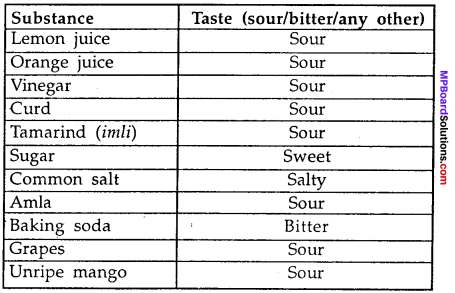
Let us recall tastes of some edible substances listed in table. If you have not tasted any of these substances taste it now and enter the result in the given table.
Answer:
MP Board Class 7th Science Solutions Chapter 5 Acids, Bases and Salts img-2

Activity 2
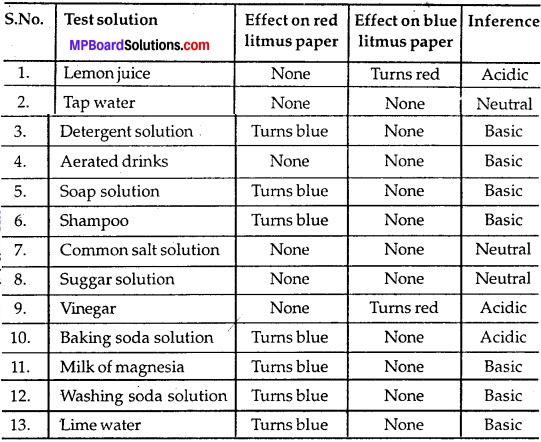
Mix some water with lemon juice in a plastic cup/ tumbler/ test tube. Put a drop of the above solution on a strip of the red litmus paper with the help of a dropper.

  • Is there any change in colour.
  • Repeat the same exercise with the blue litmus paper.
  • Note down if there is any change in colour.

Perform the same activity with the following substances:
Tap water, detergent solution, aerated drink, soap solution, shampoo, common salt solution, sugar solution, vinegar, baking soda solution, milk of magnesia, washing soda solution, lime water. If possible make solutions in distilled water. Record your observations as in table.
Answer:
MP Board Class 7th Science Solutions Chapter 5 Acids, Bases and Salts img-3

Activity 3
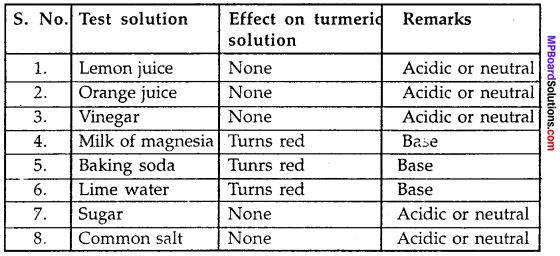
Take a tablespoonful of turmeric powder. Add a little water and make a paste.
Make turmeric paper by depositing turmeric paste on blotting paper/filter paper and drying it. Cut thin strips of the yellow paper obtained.

  • Put a drop of soap solution on the strip of turmeric paper.
  • What do you observe
  • Similarly test the solutions listed in table and note down your observations.

Answer:
The turmeric turns red.
MP Board Class 7th Science Solutions Chapter 5 Acids, Bases and Salts img-4

Acitivity 4
Collect some China rose (Gudhal) petals and place them in a beaker. Add some warm water. Keep the mixture for some time till water becomes coloured. Use the coloured water as an indicator. Add five drops of the indicator to each of the solutions given in table:
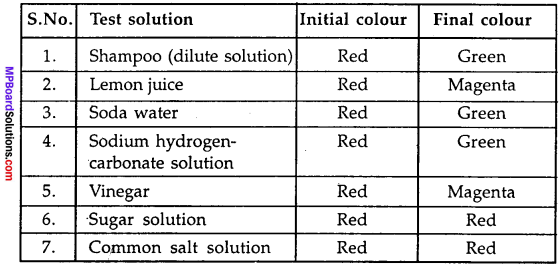
MP Board Class 7th Science Solutions Chapter 5 Acids, Bases and Salts img-5

Acids, Bases and Salts Text book Exercises

Question 1.
State ditterences between acids and bases?
Answer:
Differences between acids and bases:
Acids:

  1. Acids are substances which contain one or more replaceable hydrogen atoms.
  2. All acids are sour in taste.
  3. All acids turn blue litmus red.
  4. Acids are compounds that contain hydrogen.
  5. Acids react with metal to form salts and release hydrogen gas.

Bases:

  1. Bases are substances which have one or more replaceable hydroxyl group (OH).
  2. Bases are bitter in taste and slippry in touch.
  3. Bases turn red litmus blue.
  4. Bases are compound which have hydroxyl group.
  5. Bases react with acids to form salts.

MP Board Solutions

Question 2.
Ammonia is found in many household products, such as window cleaners. It turns red litmus blue. What is its nature?
Answer:
Basic.

Question 3.
Name the source from which litmus solution is obtained. What is the use of this solution?
Answer:
Litmus solution is extracted from lichens. It is used as indicator.

Question 4.
Is the distilled water acidic/basic/neutral? How would you verify it?
Answer:
The distilled water is neutral.

Put a drop of distilled water on a strip of the red litmus paper with the help of a droper. We observe that colour of the litmus paper is not change. The solutions which do not change the colour of either red or blue litmus are knwon as neutral solutions. These substances are neither acidic nor basic.

MP Board Solutions

Question 5.
Describe the process of neutralisation with the help of an example?
Answer:
The reaction between an acid and a base is known as neutralisation. Salt and water are produced in this process with the evolution of heat.
Acid + Base → Salt + Water
Example: Following reaction:
Hydrochloric acid (HCl) + Sodium hydroxide (NaOH) → Sodium chloride (NaCl) + Water (H2O)

Question 6.
Mark ‘T’ if the statement is true and ‘F’ if it is false:

  1. Nitric acid turn red litmus blue. (T/F)
  2. Sodium hydroxide turns blue litmus red. (T/F)
  3. Sodium hydroxide and hydrochloric acid neutralise each other and form salt and water. (T/F)
  4. Indicator is a substance which shows different colours in acidic and basic solutions. (T/F)
  5. Tooth decay is caused by the presence of a base. (T/F)

Answer:

  1. False (F)
  2. False (F)
  3. True (T)
  4. True (T)
  5. False (F).

Question 7.
Dorji has a few bottles of soft drink in his restaurant. But, unfortunately, these are not labelled. He has to serve tire drinks on the demand of customers. One customer wants acidic drind, another wants basic and third one wants neutral drink. How will Dorji decide which drink is to be served to whom?
Answer:

  1. He can decide by the use of indicator.
  2. It the sample of drink turns red litmus blue, it is basic. It it turns blue litmus red, it is acidic.
  3. It it does not effect litmus, then it is neutral.

MP Board Solutions

Question 8.
Explain why?

  1. An antacid tablet is taken when you suffer from acidity.
  2. Calamine solution is applied on the skin when an ant bites.
  3. Factory waste is neutralised before disposing it into the water bodies.

Answer:
1. Our stomach contains hydrachloric acid. It help us to digest food. But too mcuh of acid in the stomach causes indigestion. Sometimes indigestion is painful. To relieve indigestion, we take an antacid such as milk of magnesia, which contains magnesium hydroxide. It neutralises the effect of excessive acid.

2. Ant injects an acid (i.e., formic acid) during bite which cavses the burning sensation. Calamine solution is basic in nature. It neutralises the acid and relives us from the pain.

3. Factory wastes contain both acidic and basic substances. If they are allowed to flaw into the water bodies, they are harmful for orgainsms living in water. So the factory wastes are neutralised by adding basic substances.

Question 9.
Three liquids are given to you. One is hydrochloric acid, another is sodium hydroxide and third is a sugar solution. How will you identify them? You have only turmeric indicator.
Answer:
Turmeric solution turns red in contact with bases. It is not affected by acids and neutral substances. So, first we will identify the base.

Now, the base is taken and turmeric is added. It will turn red. Then, one of the solutions is added to it gradually. If the solution turns yellow again, the added liquid is hydrochloric acid because it neutralises the base. Otherwise the added liquid is sugar solution.

MP Board Solutions

Question 10.
Blue litmus paper is dipped in a solution. It remains blue. What is the nature of the solution? Explain.
Answer:
The nature of the solution is neutral, because the solutions which do not change the colour of either red or blue litmus are known as neutral solution. These substances are neither acidic nor basic.

Question 11.
Consider the following statements:

  1. Both acids and bases changes colour of all indicators.
  2. If an indicator gives a colour change with an acid, it does give a change with a base.
  3. If an indicator changes colour with a base, it does not change colour with an acid.
  4. Change of colour in an acid and a base depends on the type of the indicator.

Which of these statements are correct?

  1. All four
  2. (a) and (d)
  3. (b) and (c)
  4. only (d)

Answer:
4. only (d).

Extended Learning – Activities and Projects:

Question 1.
Using the knowledge of acids and bases, write a secret message with the help of baking soda and beet root. Explain how it works?
Answer:
Prepare baking soda solution in water. Use this solution to write the message on a sheet of white paper with a cotton bud. Rub a slice of fresh beet root over the message.

MP Board Solutions

Question 2.
Prepare red cabbage juice by boiling a piece of red cabbage in water. Use it as an indicator and test the acidic and basic solutions with it. Present your observations in the form of a table?
Answer:
Do with the help of your subject teacher.

Question 3.
Bring the soil sample of your area, find out if it is acidic, basic or neutral. Discuss with farmers if they treat the soil in any manner?
Answer:
Do yourself.

Question 4.
Visit a doctor. Find out the medicines, he prescribes to treat acidity Ask him how acidity can be prevented?
Answer:
Do yourself.

Acids, Bases and Salts Additional Important Questions

Objective Type Questions

Question 1
Choose the correct alternative

Question (i)
Bases are –
(a) Sour in taste
(b) Sweet in taste
(c) Bitter in taste
(d) None of the above.
Answer:
(c) Bitter in taste

Question (ii)
Blue litmus turns red by –
(a) Sodium
(b) Sodiujn sulphate
(c) Bitter in taste
(d) Qattstic potash.
Answer:
(c) Bitter in taste

MP Board Solutions

Question (iii)
Which one of the following oxides will react with acids to salt and water –
(a) CO
(b) SO2
(c) SO3
(d) CuO.
Answer:
(d) CuO.

Question (iv)
Which of the following is a mineral acid –
(a) Acetic acid
(b) Citric acid
(c) Tartaric acid
(d) Nitric acid.
Answer:
(d) Nitric acid.

Question (v)
Which is the common name of sodium bicarbonate –
(a) Caustic soda
(b) Washing soda
(c) Blue vitriol
(d) Baking soda.
Answer:
(d) Baking soda.

Question (vi)
For diluting acid –
(a) Water is added to acid.
(b) Acid is added to water.
(c) Acid is boiled after adding water.
(d) Acid is boiled before adding water.
Answer:
(c) Acid is boiled after adding water.

Question (vii)
……………. is used for white – washing in house.
(a) Sodium hydroxide
(b) lime stone, calcium hydroxide
(c) blue vitriol
(d) lime water and ash.
Answer:
(b) lime stone, calcium hydroxide

Question (viii)
Nausadar is –
(a) Acid
(b) Alkali
(c) Salt
(d) Indicatior
Answer:
(c) Salt

Fill in the blanks:

  1. Acetic acid is present in while is present ………….. While …………. is present in lemon.
  2. Magnesium burns in air to form …………. which is ………….. oxide.
  3. The chemical formula of slaked lime is ……………..
  4. Acids are …………….. in taste.
  5. The gas which escapes out from many aerated soft drinks is …………..
  6. ………….. are slippery in touch.
  7. Bases turn ………….. litmus to …………..
  8. In a neutralisation reaction an ………….. and an ………….. combine to form a salt and water.
  9. The solution formed by reacting P2 O5 with H2O turns ………….. litmus ……………
  10. Methyl orange is a good ……………

Answer:

  1. Vinegar, citric acid
  2. Magnesium oxide, basic
  3. Ca2, (OH)2
  4. Sour
  5. CO2
  6. Bases
  7. Red, blue
  8. Acid, alkali
  9. Blue, red
  10. Indicator.

MP Board Solutions

Question 3.
Which of the following statements are true (T) or false (F):

  1. Acids have a bitter taste.
  2. Bases have a bitter taste.
  3. Bases react with carbonate to liberate carbon dioxide.
  4. Copper does not reach with tamarind (imli) water.
  5. Sulphuric acid is c.’led ‘King of chemicals’.
  6. Orange juice turns blue litmus red.
  7. Alum (Phitkari) acts as a antacid.
  8. Soaps are salts of fatty acids.
  9. Copper sulphate is used as a preservative in pickels. Potassium chloride is a salt of sulphuric acid.

Answer:

  1. False
  2. True
  3. False
  4. True
  5. True
  6. True
  7. False
  8. True
  9. False
  10. False.

Question 4.
Paheli brought the following paheli (riddle) for you.

  1. Coffee is brown
  2. And bitter in taste
  3. Is it an acid
  4. Or a base
  5. Don’t give the answer
  6. Without any test
  7. You are in the dark With its taste

Answer:
Acidic.

Acids, Bases and Salts Very Short Answer Type Questions

Question 1.
Which acid is present in our stomach?
Answer:
Hydrochloric acid in small amount is present in our stomach.

Question 2.
What will you do if some acid is split on the table?
Answer:
We will sprinkle some base on the table to neutralise the effect of the acid.

Question 3.
Why antacids tablests are used to reduce acidity of the stomach?
Answer:
Sometimes due to spicy food the concentration of hydrochloric acid increases in the stomach. This causes acidity. To reduce it some harmless bases are used like milk of magnesia [Mg (OH)2] and aluminium hydroxide, which balance the excess of acids. These are solid in the form of tablets called antacids.

MP Board Solutions

Question 4.
What are mineral acids? Give two examples.
Answer:
The acids which are capable of forming hydrogen ions, when dissolved in water are mineral acids. For example, HCl, HNO3, H2SO4 (Hydrochloric acid, Nitric acid, Sulphuric acid). In other words, mineral acids are strong acids. These acids are called mineral acids because these are prepared from minerals.

Question 5.
What are organic acids? Give two Examples.
Answer:
Organic acid are soured milk, lemon, green mangoes and karvanda are sour tasting. All of them contain some naturally occurring acids. Such acids are found in animals and plant materials. They are known as organic acids.
Examples: Lactic acid, Citric acid, Vinegar, Formic acid.

Question 6.
What do you understand by concentrated and dilute acids?
Answer:
Concentrated acid:
The acids which are prepared by dissolving in water, are known as concentrated acid.

Dilute acid:
The acid which are prepared by dissolving in excess amount of water are known as dilute acids.

Question 7.
Name the gas obtained when a metal carbonate reacts with an acid?
Answer:
When metal carbonate reacts with acids they give carbon dioxide gas.

Question 8.
What will happen if blue litmus paper is soaked in orange juice?
Answer:
It change into red colour.

Question 9.
State one characteristic property of all acids. Is dry hydrogen chloride gas an acid?
Answer:

  1. Acids have a sour taste.
  2. Acids turn blue litmus red.
  3. Acids react with metal to evolve hydrogen gas.
    2HCl + Mg → MgCl2 + H2
    Yes, hydrogen chloride is an acid.

Question 10.
A solution turns red litmus paper into blue. What does this indicate about the chemical nature of the solution?
Answer:
The solution which turns red litmus paper blue is basic in nature. The substance which turns red litmus paper blue is known as alkalies.

MP Board Solutions

Question 11.
Classify the following chemicals in acids and bases:
KON, HNO3, Ca(OH)2, LiOH, CH3COOH, HCOOH, Mg(OH)2, NaOH, H2SO4, HCl
Answer:
Acids:
HNO3, H2SO4, HCl.

Bases:
KOH, Ca(OH)2, LiOH, CH3COOH, HCOOH, Mg(OH)2, NaOH.

Acids, Bases and Salts Short Answer Type Questions

Question 1.
You are given hydrochloric acid solution, sodium hydroxide solution and water in three different bottles. How will you check which bottle has which compound?
Answer:
Take three pieces of blue litmus paper. Put one piece of blue litmus paper into each of these solutions. That bottle which turns blue litmus red contains hydrochloric acid. Take three pieces of red litmus paper. Put one piece of red litmus paper into each of these solutions. That bottle which turns red litmus blue contains sodium hydroxide (base).

Question 2.
How can you test the presence of acid in a substance?
Answer:
Acids can be tested in any substance by the following methods:

  1. Take a drop of the dilute solution of the substance on the tips of your tongue. If it taste sour, it is acid.
  2. Place a blue litmus paper in the solution. If the colour changes to red, acid is present.

Example: 2Na + 2HCl → 2NaCl + H2

MP Board Solutions

Question 3.
What are indicators? Name two acid – base indicators.
Answer:
The substance which are used to identify whether a substance is an acid or base is called indicators. For example, litmus solutions give red colour with acids and blue colour with bases. Therefore, litmus is used as indicator. Substances wrhich given differnet colours with acid and base are called acid – base indicators.
Example:

  1. Methyl orange
  2. Phenolpthalein

Question 4.
State the colour of dry litmus paper when placed in separate samples of dilute sulphuric acid, moist ammonia gas, moist chlorine, sodium hydroxide, lemon juice, vinegar and water into which sulphur dioxide gas has been bubbled for some time?
Answer:
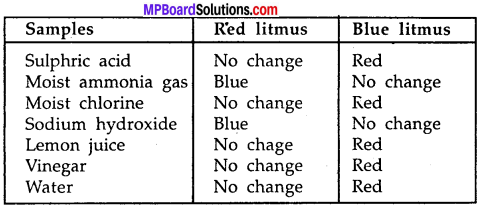
MP Board Class 7th Science Solutions Chapter 5 Acids, Bases and Salts img-6

Question 5.
Why are acids not stored in metal containers? Containers/ vessels made from which material are safe to store acids?
Answer:
All the acids react with metals. They react vigorously and slowly with metals according to their nature. So, the acids are not stored in metal containers. Vessels made from glass or cermics are considered safe for strong acids.

Question 6.
Which acids are present in following substance:
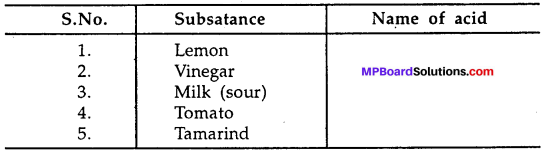
MP Board Class 7th Science Solutions Chapter 5 Acids, Bases and Salts img-7
Answer:

  1. Citric acid
  2. Acetic acid
  3. Lactic acid
  4. Oxalic acid
  5. Tartaric acid.

Question 7.
Why does colour of blue vitriol change when heated?
Answer:
When we blue vitriol heated it changes into white vitriol and water.
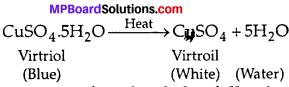
MP Board Class 7th Science Solutions Chapter 5 Acids, Bases and Salts img-8

Question 8.
Write one use of each of the following compounds?

  1. Vinegar
  2. Methly orange
  3. Alum
  4. Sulphuric, acid
  5. Sodium hydroxide.

Answer:

  1. In pickles and jam for preserving it in good condition for long duration.
  2. As a indicator.
  3. In purifying water.
  4. In purifying pertroliujn products.
  5. In purifying pertrolium products.

MP Board Solutions

Question 9.
What are acid salts? Give two examples?
Answer:
Acid salt:
When a strong acid is neutralised by a weak base, then a salt is formed, such type of salt is called acid salt.
For example:
H2SO4 + 2NH4OH → (NH ) SO4 + 2H2O
HCl+ NH4OH → NH4Cl + H2O

Question 10.
Complete the following equations:

  1. NaOH + H2SO4 → ……………. + H2O
  2. H2CO3 + NaOH → ……………. + H2O
  3. HNO3 + KOH → ……………. + H2O
  4. Mg (OH)2 + 2HCl → ……………. + 2H2O

Answer:

  1. NaOH + H2SO4 → Na2SO4 + H2O
  2. H2CO3 + 2NaOH → Na2CO3 + 2H2O
  3. HNO3 + KOH → KNO3+ H2O
  4. Mg (OH)2 + 2HCl → + MgCl2 + 2H2O

Question 11.
Name the gas obtaines when a metal carbonate reacts with an acid?
Answer:
When metal carbonate reacts with acids they give carbon dioxide gas.
For example.

MP Board Class 7th Science Solutions Chapter 5 Acids, Bases and Salts img-9

Question 12.
Differentiate between bases and alkalies by giving suitable examples of each?
Answer:
Bases:
Bases are the compound which have one or more hydroxyl group (OH) in their molecule.
Examples: NaOH, Ca(OH)2, KOH etc.

Alkalies:
Water soluble bases are called alkalies.
Examples: Sodium hydroxide, potassium hydroxide and calcium hydroxide.

Question 13.
What is a neutralisation reaction? Give two examples.
Answer:
The reaction of an acid with an alkali and vice – versa to form salt and water is called neutralisation reaction.
For examples:

MP Board Class 7th Science Solutions Chapter 5 Acids, Bases and Salts img-10.1

MP Board Class 7th Science Solutions Chapter 5 Acids, Bases and Salts img-10

Question 14.
How is salt obtained from sea – water?
Answer:
The seas are great sources of salts. A litre of a water contains about 35 grams of salts. Sodium chloride is the main salt. The sea water is trapped in shallow called lagoons and is allowed to evaporate in sunlight to white solid crystal of salts. These crystals are processed and packed to send to markets.

MP Board Solutions

Question 15.
What are the uses of weak alkalies?
Answer:

  1. Ammonia is a weak alkali. It is used for the manufacture of fertilizers.
  2. Ammonia is also used for the production of wood pulp and organic chemicals.
  3. It is also used for making synthetic fibres such as nylon and nitric acid, which are used for the preparation of synthetic cloth.
  4. Calcium hydroxide is used in the manufacture of bleaching powder.

Question 16.
Tabulate the some hydrated salts with their chemical formulae and colour?
Answer:
Some hydrated salts:
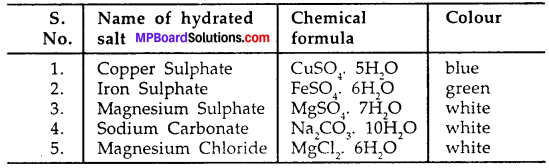
MP Board Class 7th Science Solutions Chapter 5 Acids, Bases and Salts img-11

Question 17.
Name some common acid and alkali indicators?
Answer:
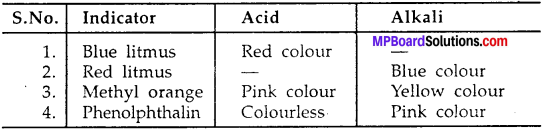
MP Board Class 7th Science Solutions Chapter 5 Acids, Bases and Salts img-12

Acids, Bases and Salts Long Answer Type Question

Question 1.
What are acids? Write their properties.
Answer:
Acids are substances which contain one or more replaceable hydrogen atoms. Its properties are:

    1. All acids are sour in taste.
    2. All acids turn blue litmus red.
    3. Acids are compounds that contain hydrogen e.g., H2SO4, HCl etc.
    4. Acids are compounds which form hydronium ion (H3O+) in aqueous (water) solution.
      Example:
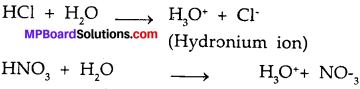
      MP Board Class 7th Science Solutions Chapter 5 Acids, Bases and Salts img-13
  1. Acids react with metal to form salts and release hydrogen gas.
    Example: 2Na + 2 HC1 → 2NaCl + H2
  2. Acids react with carbonates and bicarbonates to give carbon dioxide gas.
    Example:
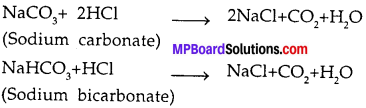
    MP Board Class 7th Science Solutions Chapter 5 Acids, Bases and Salts img-14

Question 2.
What are bases? Write down its properties.
Answer:
Bases are substances which have one or more replaceable hydroxyl group (OH).
The various properties of bases are:

  1. Bases are bitter in taste and slippery in touch.
  2. Bases turn red litmus blue.
  3. Bases are compound which have hydroxyl group.
  4. All bases give hydroxyl ion into aqueous solutions.

    MP Board Class 7th Science Solutions Chapter 5 Acids, Bases and Salts img-15
  5. Bases react with acids to form salts.
    Example: NaOH + HCl → NaCl + H2O

Question 3.
What are the uses of mineral acids in industry?
Answer:
The uses of mineral acids in industry are:

1. Concentrated sulphuric acid, nitric acid and hydrochloric acid are used in a large number of metallurgical operations, manufacture of fertilizers and preparations of large number of industrial chemicals.

2. Hydrochloric acid is used for removing the deposits from inside the boilers. This process is known as descaling.

3. One of the mineral acid, hydrochloric acid (HCl) present in our stomach helps in digestion of food.

4. Nitric acid (HNO3) is used by goldsmiths for cleaning gold and silver ornaments.

MP Board Solutions

Question 4.
Distinguish clearly between the following terms by giving suitable examples:

  1. Organic acid and mineral acid.
  2. Base and alkali.

Answer:
1. Organic acid:

  • Organic acid contains COOH functional group.
  • These acids are weak.
  • These acids are present in humans and plants.
  • They are less corrosive and are used in food ingradients.
    Examples: Ethanoic acid, lactic acid, citric acid.

Mineral acid:

  • Mineral acid contains hydrogen ions (H+).
  • These acids are strong.
  • These acids are prepared by mankind.
  • They are corrosive in nature and have industrial use.
    Examples: Hydrochloric acid, sulphuric acid, nitric acid.

2. Base:

  • Bases are the compound which have one or more hydroxhyl group (OH) in their molecule.
  • All alkalies are bases
  • Bases are insoluble in water.
    Examples: NaOH, Ca(OH)2, KOH

Alkali:

  • Water soluble bases are called alkalies.
  • All bases are not alkalies.
  • Alkalies are soluble in water.
    Examples: Sodium hydroxide potassium hydroxide and calcium hydroxide.

MP Board Solutions

Question 5.
Write any three most common salts used in daily life and write their uses?
Answer:
Most common salts used in daily life are:
1. Washing Soda: Na2CO3.10H2O.
Uses:

  • It is used in laundary.
  • It is used to prepare other compounds such as glass, caustic soda and detergent poweders.

2. Baking Soda: NaHCO3
Uses:

  • It is used in baking powder.
  • It is used as medicine to reduce acidity of the stomach.
  • It is used in fire extinguisher.

3. Potash alum or phitkari:
K2SO4.Al2(SO4)324H2O
Uses:

  • It is used to purify water.
  • It is used after shave to stop the bleeding from cuts.
MP Board Class 7th Science Solutions

MP Board Class 9th Maths Solutions Chapter 9 Areas of Parallelograms and Triangles Ex 9.3

MP Board Class 9th Maths Solutions Chapter 9 Areas of Parallelograms and Triangles Ex 9.3

Question 1.
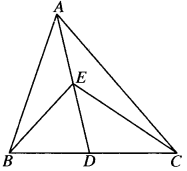
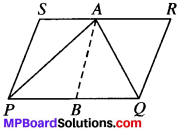
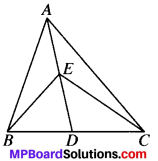
In Fig. given below E is any point on median AD of a ∆ABC. Show that ar (ABE) = ar (ACE).
MP Board Class 9th Maths Solutions Chapter 9 Areas of Parallelograms and Triangles Ex 9.3 img-1
Solution:
Given.
E is any point on median AD of ∆ABC.
To prove
ar (ABE) = ar (ACE)
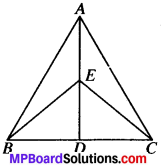
MP Board Class 9th Maths Solutions Chapter 9 Areas of Parallelograms and Triangles Ex 9.3 img-2
Proof:
In ∆ABC, AD is the median
ar (ABD) = ar(ACD) ….(1)
In ∆EBC, ED is the median
∴ ar (BDE) = ar (CDE) ….(2)
Subtracting (2) from (1), we get
ar (ABD) – ar (BDE) = ar (ACD) – ar (CDE)
ar (ABE) = ar (ACE)

MP Board Solutions

Question 2.
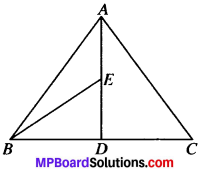
In a triangle ABC, E is the mid-point of median AD. Show that ar (BED) = \(\frac{1}{4}\) ar (ABC).
MP Board Class 9th Maths Solutions Chapter 9 Areas of Parallelograms and Triangles Ex 9.3 img-3
Solution:
Given
E is the mid point of – median AD of ∆ABC.
To prove:
ar (BED) = \(\frac{1}{4}\) ar (ABC)
Proof:
In ∆ABC, AD is the media
ar (ABD) = \(\frac{1}{2}\) ar (ABC) …..(1)
In ∆ABD, BE is the median
MP Board Class 9th Maths Solutions Chapter 9 Areas of Parallelograms and Triangles Ex 9.3 img-4
ar (BED) = \(\frac{1}{2}\) ar (ABD)
= \(\frac{1}{2}\) [\(\frac{1}{2}\) ar (ABC)]
= \(\frac{1}{4}\) ar (ABC)

Question 3.
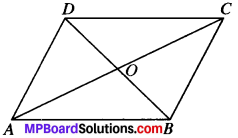
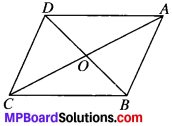
Show that the diagonals of parallelogram divide it into four triangles of equal area.
Solution:
Given.
ABCD is a parallelogram.
To prove:
ar (AOB) = ar (BOC) = ar (COD) = ar (AOD)
MP Board Class 9th Maths Solutions Chapter 9 Areas of Parallelograms and Triangles Ex 9.3 img-5
Proof:
In ∆ABC, OA is the median
∴ ar (AOB) = ar (AOD) …..(1)
In AABC, BO is the median
∴ ar (AOB) = ar (BOC) …..(2)
In ABCD, CO is the median
ar (BOC) = ar (COD) …(3)
From (1), (2) and (3), we get
ar (AOB) ar (BOC) = ar (COD) = ar (AOD)

Question 4.
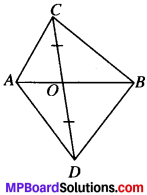
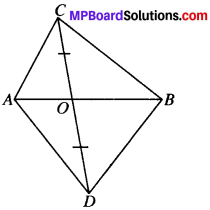
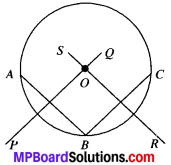
In Fig. given below, ABC and ABC are two triangles on the same base AB. If line – segment CD is bisected by AB at O, show that ar (ABC) = ar (ABD).
MP Board Class 9th Maths Solutions Chapter 9 Areas of Parallelograms and Triangles Ex 9.3 img-6
Solution:
Given.
∆ABC and ∆ABD have a common base AB.
OC = OD
To prove
ar (ABC) = ar (ABD)
MP Board Class 9th Maths Solutions Chapter 9 Areas of Parallelograms and Triangles Ex 9.3 img-7
Proof:
As OC = OD,
O is the mid-point of CD
In ∆ACD, O is the median
ar (AOC) = ar(AOD)
In ABCD, BO is the median
ar (BOC) = ar (BOD)
Adding (1) and (2), we get
ar (AOC) + (BOC) = ar (AOD) + ar (BOD)
ar (ABC) = ar (ABC)

MP Board Solutions

Question 5.
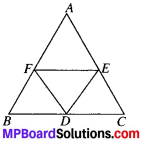
D, E and F are respectively the mid-points of the sides BC, CA and AB of a AABC. Show that
MP Board Class 9th Maths Solutions Chapter 9 Areas of Parallelograms and Triangles Ex 9.3 img-8

  1. BDEF is a parallelogram.
  2. ar (DEF) = \(\frac{1}{2}\) ar (ABC)
  3. ar (BDEF) = \(\frac{1}{4}\) ar (ABC).

Solution:
D, E, F are the mid points of sides BC, CA and AB of ∆ABC.
To prove:

  1. BDEF is a parallelogram.
  2. ar (DEF) = \(\frac{1}{4}\) ar (ABC)
  3. ar (BDEF) = \(\frac{1}{2}\) ar (ABC)

Proof:
In ∆ABC, F is the mid-point of AB, E is the mid point of AC.
∴ FE ∥ BC and FE = – BC (By MPT)
⇒ FE ∥ BD and FE =BD

1. BDEF is a ∥gm
Similarly CDFE and AEDF are ∥gm
In parallelogram BDEF, DF is the diagonal
∴ ax (BDF) = ar (DEF)
[In a ∥gm diagonal divides it into 2∆s of equal areas]
Similarly, In ∥gm CDFE, DE is a diagoilal …(1)
ar (CDE) = (DEF) …(2)
In ∥gm AEDF, FE is a diagonal
ar (AEF) = ar (DEF) …(3)
From (1), (2) and (3), we get
ar (BDF) = ar (CDF) = ar (AEF) = (DEF) …(4)

2. ar (ABC) = ar (AEF) + ar (ADF) + ar (CDE) + ar (DEF)
ar (ABC) = 4 ar (DEF) [Using (4)]
ar (DEF) = \(\frac{1}{4}\) ar (ABC)

3. ar (BDEF) = ar (BDF) + ar (DEF)
ar (BDEF) = 2ar (DEF) [∴ ar (BDF) = ar (DEF)]
= 2 x \(\frac{1}{4}\) ar (ABC) = \(\frac{1}{2}\) ar (ABC)

Question 6.
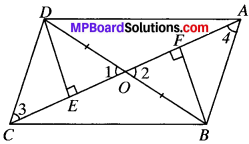
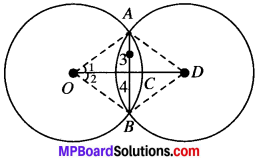
In the Fig. diagonals AC and BD of quadrilateral ABCD intersect at O such that OB = OD. If AB – CD, then show that:
MP Board Class 9th Maths Solutions Chapter 9 Areas of Parallelograms and Triangles Ex 9.3 img-9

  1. ar (DOC) = ar (AOB)
  2. ar DCB = ar (ACB)
  3. DA ∥ CB or ABCD is a parallelogram.

[Hint: From D and B, draw perpendiculars to AC.]

Solution:
Given
ABCD is a quadrilateral in which OB = OD and AB = CD.
To prove:

  1. ar (DOC) = ar (AOB)
  2. ar (DCB) = ar (ACB)
  3. DA ∥ CB or ABCD is a ∥gm

MP Board Class 9th Maths Solutions Chapter 9 Areas of Parallelograms and Triangles Ex 9.3 img-10
Construction:
Draw DE and BF perpendicular from point D and B on AC.
Proof:
1. In ∆OED and ∆OFB
∠1 = ∠2 (V.O.A.’s)
OD = OB (given)
∠E = ∠F (each 90°)
∆ OED = ∆ OFB (by AAS)
and so DE = BF (by CPCT)
In ∆DEC and ∆BFA, DE = BF (proved)
∠E = ∠F (each 90°)
DC = BA (given)
∆DEC = ∆BFA (by RHS)
and so ∠3 = ∠4 (by CPCT)
ar (OED) = ar (OFB) [∴ AOED = AOFB] …(1)
ar (DEC) = ar (BFB) [∴ ADEC = ABEA] …..(2)
Adding (1) and (2), we get
ar (OED) + ar (DEC) = ar (OFB) = ar (BFA)
ar (OCD) = ar (OAB) …..(3)

2. Adding ar (OBC) on both sides of equation (3)
ar (OCD) + (OBC) = ar (OAB) + ar (OBC)
ar (DCB) = ar (ACB)

3. ∆DCB and ∆ACB have the same base BC and have equal area
∴ they will lie between the same parallels BC and AD
and so BC ∥ AD
∠3 and ∠4 are A.I.A’s and are equal
∴ AB ∥ DC
In quadrilateral ABCD, AB ∥ DC and AB = DC (given)
ABCD is a parallelogram.

MP Board Solutions

Question 7.
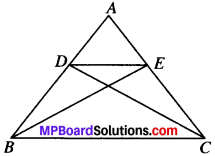
D and E are points on sides AB and AC respectively of ∆ABC such that ar (DBC) = ar (EBQ. Prove that DE ∥ BC.
Solution:
Given
ar (DBC) = ar (EBC)
To prove:
DE ∥ BC
MP Board Class 9th Maths Solutions Chapter 9 Areas of Parallelograms and Triangles Ex 9.3 img-11
Proof:
∆ DBC and ∆EBC have the same base BC and
ar (DBC) = ar (EBC)
∴ They will lie between the same parallel lines DE and BC.
and so DE ∥ BC

Question 8.
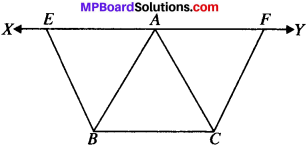
XY is a line parallel to side BC of a triangle ABC. If BE ∥ AC and CF ∥ AB meet XY at E and F respectively, show that ar (ABE) = ar (ACF).
Solution:
Given
XY ∥ BC, BE ∥ AC and CF ∥ AB.
To prove
ar (ABE) = ar (ACF)
Proof:
In quadrilateral ACBE, AE ∥ CB (∴ BC ∥ XY)
and AC ∥ EB
ACBE is a ∥gm
MP Board Class 9th Maths Solutions Chapter 9 Areas of Parallelograms and Triangles Ex 9.3 img-12
Similarly ABCF is a parallelogram.
gm ACBE and ABCF have the same base BC and are between the same parallels BC and AY.
∴ ar (ACBE) = ar (ABCF)
ar (ABE) + ar (ABC) = ar (ABC) + ar (ACF)
∴ ar (ABE) = ar (ACF)

Question 9.
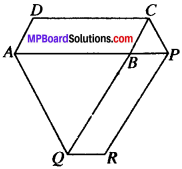
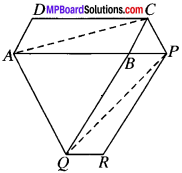
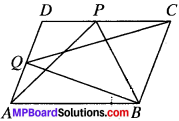
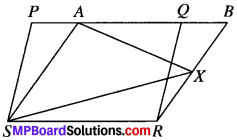
The side AB of a parallelogram ABCD is produced to any point P. A line through A and parallel to CP meets CB produced at Q and then parallelogram PBQR is completed (see Fig. below). Show that ar (ABCD) = ar (PBQR).
[Hint: Joint AC and PQ. Now compare ar (ACQ) and ar (APQ).]
MP Board Class 9th Maths Solutions Chapter 9 Areas of Parallelograms and Triangles Ex 9.3 img-13
Solution:
Given
ABCD and BPRQ are parallelograms. CP ∥ AQ
To prove:
ar (ABCD) = ar (PBQR)
Construcion:
Join AC and PQ
Proof:
∆ACQ and ∆APQ lie on the same base AQ and are between the same parallels AQ and CP.
∴ ar (ACQ) = ar (APQ)
⇒ ar (ABQ) + ar (ABC) = ar (ABQ) + ar (BQP)
∴ ar (ABC) = ar (BQP) …..(i)
MP Board Class 9th Maths Solutions Chapter 9 Areas of Parallelograms and Triangles Ex 9.3 img-14
Multiplying (1) by 2 on both sides
2 ar (ABC) = 2 ar (BQP)
∴ ar (ABCD) = ar (PBQR)
[∴ ABCD and PBQR are parallelogram]

MP Board Solutions

Question 10.
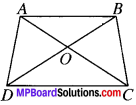
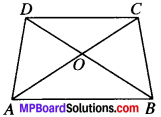
Diagonals AC and BD of a trapezium ABCD with AB ∥ DC intersect each other at C. Prove that ar (AOD) = ar (BOC).
Solution:
Given
ABCD is a trapezium in which AB ∥ DC.
To prove:
ar (AOD) = ar (BOC).
MP Board Class 9th Maths Solutions Chapter 9 Areas of Parallelograms and Triangles Ex 9.3 img-15
Proof:
∆ADC and ∆BCD lie on the same base DC and between the same parallels AB and CD.
∴ ar (ADC) = ar (BCD)
Subtracting ar (DOC) from both sides
ar (ADC) – ar (DOC) = ar (BCD) – ar (DOC)
ar (AOD) = ar (BOC)

Question 11.
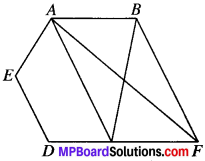
In Fig. ABCDE is a pentagon. A line through B parallel to AC meets DC produced at F. Show that:

  1. ar (ACB) = ar (ACF)
  2. ar (AEDF) = ar (ABCDE).

MP Board Class 9th Maths Solutions Chapter 9 Areas of Parallelograms and Triangles Ex 9.3 img-16
Solution:
Given
ABCDE is a pentagon.
To prove:
1. ar (ACB) = ar (ACF)
MP Board Class 9th Maths Solutions Chapter 9 Areas of Parallelograms and Triangles Ex 9.3 img-17
2. ar (AEDF) = ar (ABCDE)
Proof:
∆ACB and ∆ACF lie on the same base AC and between the same parallels AC and BE.
ar (ACB) = ar (ACF)

3. Adding ar (AEDC) on both sides
ar (ACB) + ar (AEDC) = ar (ACF) + ar (AEDC)
ar (ABCDE) = ar (AEDF)

Question 12.
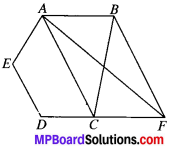
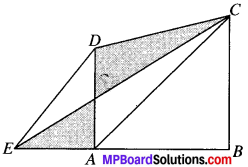
A villager Itwaari has a plot of land of the shape of a quadrilateral. The Gram Panchayat of the village decided to take over some portion of his plot from one of the corners to construct a Health Centre. Itwaari agrees to the above proposal with the condition that he should be given equal amount of land in lieu of his land adjoining his plot so as to form a triangular plot. Explain how this proposal will be implemented.
Solution:
Given.
ABCD is a quadrilateral.
Construction:
Join AC. Draw DE ∥ CA which intersect BA produced at E.
MP Board Class 9th Maths Solutions Chapter 9 Areas of Parallelograms and Triangles Ex 9.3 img-18
Proof:
∆ADC and ∆ACE both lie on the same base AC and between the same parallels AC and DE.
ar (ADC) = ar (ACE)
Adding ar (ABC) on both sides
ar (ADC) + ar (ABC) = ar (ACE) + ar (ABC)
ar (ABCD) = ar (EBC)

MP Board Solutions

Question 13.
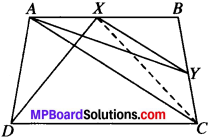
ABCD is a trapezium with AB ∥ DC. Aline parallel to AC intersects AB at X and BC at Y. Prove that ar (ADX) = ar (ACY).
[Hint: Join CX.]
Solution:
Given
ABCD is trapezium with AB ∥ DC and AC ∥ XY.
To prove:
ar (ADX) = ar (ACY).
Construction:
Join CX.
Proof:
∆ADX and ∆ACX both lie on the same base AX and between the same parallel AN and DC.
MP Board Class 9th Maths Solutions Chapter 9 Areas of Parallelograms and Triangles Ex 9.3 img-19
∴ ar (ADX) = ar (ACX) …(1)
∆ACX and ∆ACT both lie on the same base AC and between the same parallels AC and AT.
ar (ADY) = ar (ACX) …(2)
From (1) and (2), we get
ar (ADX) = ar(ACT)

Question 14.
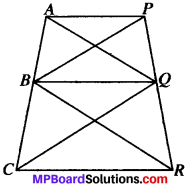
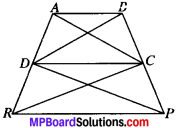
In Fig. below AP ∥ BQ ∥ CR. Prove that ar (AQC) = ar (PBR).
MP Board Class 9th Maths Solutions Chapter 9 Areas of Parallelograms and Triangles Ex 9.3 img-20
Solution:
Given:
AP∥BQ∥CR.
To prove:
ar (AQC) = ar (PBR)
Proof:
∆ABQ and ∆PBQ both lie on the same base BQ and between the same parallels AP and BQ.
∴ ar (ABQ) = ar (PBQ) …(1)
∆BCQ and ∆BRQ both lie on the same base BQ and between the same parallels BQ and CR.
MP Board Class 9th Maths Solutions Chapter 9 Areas of Parallelograms and Triangles Ex 9.3 img-21
∴ ar (BCQ) = ar (BRQ) …(2)
Adding (1) and (2), we get
ar (ABQ) tar (BCQ) = ar (PBQ) + ar (BRQ)
∴ ar (AQC) = ar (PBR)

Question 15.
Diagonals AC and BD of a quadrilateral ABCD intersect at 0 in such a way that ar (AOD) = ar (BOC). Prove that ABCD is a trapezium.
Solution:
Given:
ar (AOD) = ar (BOC)
To prove:
ABCD is a trapezium.
MP Board Class 9th Maths Solutions Chapter 9 Areas of Parallelograms and Triangles Ex 9.3 img-22
Proof:
ar ∠AOD = ar (BOC) (given)
Adding ar (AOB) on both sides
ar (AOD) + ar (AOB) = ar (BOC) + ar (AOB)
ar (ABD) = ar (ABC)
∆ABD and ∆ABC both lie on same base AB and have equal area.
∴ they will lie between the same parallels.
⇒ AB ∥ DC
∴ ABCD is a trapezium.

Question 16.
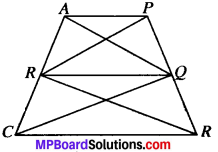
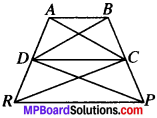
In Fig. below, ar (DRC) = ar (DPC) and ar (BDP) = ar (ARC). Show that both the quadrilaterals ABCD and DCPR are trapeziums.
MP Board Class 9th Maths Solutions Chapter 9 Areas of Parallelograms and Triangles Ex 9.3 img-23
Solution:
Given
ar (DRC) = ar (DPC)
ar (BDP) = ar (ARC)
To prove:
ABCD and DCPR are trapezium.
MP Board Class 9th Maths Solutions Chapter 9 Areas of Parallelograms and Triangles Ex 9.3 img-24
Proof:
∆DRC and ∆DPC both lie on the same base DC and have equal area .•. They will lie between the same parallels.
⇒ DC ∥ BP
and so DCPR is a trapezium.
ar (BDP) = ar (ARC) [given] …(1)
ar (DPC) = ar (DRC) [given] …(2)
Subtracting (1) and (2), we get
ar (BDP) – ar (DPC) = ar (ARC) – (DRC)
ar (BDC) = ar (ADC)
∆ADC and ∆BDC both lie on same base DC and have equal area.
∴ they will lie between the same parallels
⇒ AB ∥ DC
and so ABCD is a trapezium.

MP Board Class 9th Maths Solutions

MP Board Class 7th Science Solutions Chapter 17 Forests: Our Lifeline

MP Board Class 7th Science Solutions Chapter 17 Forests: Our Lifeline

Forests: Our Lifeline Intex Questions

Question 1.
What would happen if forests disappear?
Answer:

  1. If forests disappear, the amount of carbon dioxide in air will increase, resulting in the increase of earth’s temperature.
  2. In the absence of trees and plants, the animals will not get food and shelter.
  3. In the absence of trees, the soil will not hold water which will cause floods.
  4. Deforestation will ending our life and environment. Think, what, we can do to preserve our forests.

Forests: Our Lifeline Text Book Exercises

Question 1.
Explain how animals dwelling in the forest help it grow and regenerate?
Answer:
Animals help in growing and regenerating forests in many ways. Animals help in dispersing, seeds of certain plants. The decaying animal dung also provides nutrients to the seedling to plant. By this number of plants are growing which serve as a food for a number of herbivorous animals.

Herbivorous helps the carnivores to grow as they serve as food for them. So, the flora and fauna grows in the forests. Also, the animals work as the cleaning agents in the forest micro – organisms work on the death bodies of plants and animals and regenerate them.

MP Board Solutions

Question 2.
Explain how forest prevent floods?
Answer:
If trees or widely we can say that forests are not present, rain will directly hit the ground and may cause the flood the area around it. Also, the heavy rain may damage the soil. Roots of trees and grasses basically bind the soil together, but in the absence of soil, they will be washed away or eroded.

The washed soil will get deposited in river and thus reduce the water carrying capacity of rivers. Which is the major causes of flood. Also, forests can absorb a lot of water. This also helps in preventing floods.

Question 3.
What are decomposers? Name any two of them. What do they do in the forest?
Answer:
The micro – organisms which convert the dead plants and animals to humus are known as decomposers. These micro – organisms play an important role in the forest. The any two decomposers are grubs and beetles. They clean the forests of the decaying dead bodies and replenishes the nutrient back to the forest soil.

Question 4.
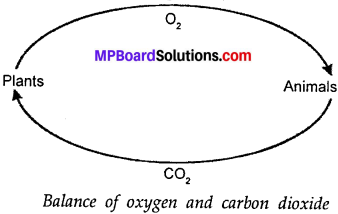
Explain the role of forest in maintaining the balance between oxygen and carbon – dioxide in the atmosphere?
Answer:
Plants release oxygen through the C02 photosynthesis. The Plants help to provide oxygen for animal respiration. They also maintain the balance of oxygen and carbon dioxide in the atmosphere. That is why forests are called lungs.
MP Board Class 7th Science Solutions Chapter 17 Forests Our Lifeline img 1

Question 5.
Explain why there is no waste in a forest?
Answer:
The decomposers decompose the dead organisms. The decomposed matter is absorbed by plants as nutrients. Thus, there is no waste in a forest.

Question 6.
List five products we get from forests?
Answer:
We get following products from forests:

  1. Medicine
  2. Spice
  3. Wood
  4. Honey.
  5. Gum

Question 7.
Fill in the blanks:

  1. The insects, butterflies, honeybees and birds help flowering plants in ………………………..
  2. A forest is a purifier of ……………………………. and …………………………
  3. Herbs form the ……………………………… layer in the forest.
  4. The decaying leaves and animal droppings in a forest enrich the ………………………….

Answer:

  1. Pollination
  2. Water, air
  3. Lowest
  4. Humus.

MP Board Solutions

Question 8.
Why should we worry about the conditions and issues related to forests far from us?
Answer:
We should be worried about deforestation, as it would lead to floods, increase in earth’s temperature, depriving animals of their habitats and soil erosion.

Question 9.
Explain why there is a need of variety of animals and plants in a forest?
Answer:
Variety of animals are necessary for their survival and maintenance of food chain. For example, grass is eaten by insects, which in turn, are eaten by the frog. The frog is consumed by snakes and snakes is eaten by eagles.

Thus, it forms a food chain. There are so many food chains in the forest. All of these are linked. If any one food chain is disturbed, it affects other food chains. Also, animals convert the death plants and animals into humus and increase the fertility of soil.

Question 10.
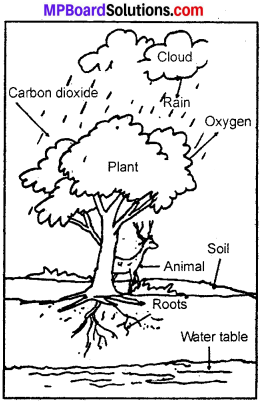
In figure, the artist has forgotten to put the labels and directions on the arrows. Mark the directions on the arrows and label the diagram using the following labels: clouds, rain, atmosphere, carbon dioxide, oxygen, plants, animals, soil roots, water table?
Answer:
MP Board Class 7th Science Solutions Chapter 17 Forests Our Lifeline img 2

Question 11.
Which of the following is not a forest product?

1. Gum
2. Plywood
3. Sealing wax
4. Kerosene

Answer:
4. Kerosene.

Question 12.
Which of the following statements is not correct?

1. Forests protect the soil from erosion.
2. Plants and animals in a forest are not dependent on one another.
3. Forests influence the climate and water cycle.
4. Soil helps forests to grow and regenerate.

Answer:
2. Plants and animals in a forest are not dependent on one another.

Question 13.
Micro – organisms act upon the dead plants to produce?

1. Sand
2. Mushrooms
3. Humus
4. wood.

Answer:
3. humus.

MP Board Solutions

Extended Learning – Activities and Projects

Question 1.
The Department of Environment is to decide whether some portion of a forest in your area could be cleared for a housing complex. Write a letter to the department explaining your point of view as a concerned citizen?
Answer:
Do yourself.

Question 2.
Visit a forest? Here is a list of points that would make your visit more fruitful?

  1. Make sure that you have permission to go into the forest.
  2. Make sure that you can find your way around. Get a map and go along with some one who is familiar with the area.
  3. Keep a record of the things you see and do. Observations make the visit interesting. Sketches and photographs are useful.
  4. You may record bird calls.
  5. Collect different kinds of seeds or hard fruits like nuts.
  6. Try to recognise various types of trees, shrubs, herbs, etc. Make lists of plants from different places in the forest and of different layers. You may not be able to name all the plants, but it is worth recording and seeing where they grow. Make a record of approximate heights of plants, crown shape, bark texture, leaf size, and flower colour.
  7. Learn to recognise the animal’s droppings.
  8. Interview the forest officials and the people of surrounding villages and other visitors.
  9. You must never collect birds eggs, and their nests should never be disturbed.

Answer:
Do yourself.

Forests: Our Lifeline Additional Important Questions

Objective Type Questions

Question 1.
Choose the correct alternative:

Question (a)
Plants give out during photosynthesis?
(a) carbon dioxide
(b) oxygen
(c) humus
(d) none of these.
Answer:
(b) oxygen

Question (b)
Interdependence of animals for food is called –
(a) food – order
(b) food – cycle
(c) food – chain
(d) none of these.
Answer:
(c) food – chain

MP Board Solutions

Question (c)
Small trees and grass and shrubs from the –
Answer:
(a) Canopy
(b) Under stories
(c) Lowest canopy
(d) All of these
Answer:
(b) Under stories

Question (d)
Deforestation leads to
(a) Soil erosion
(b) Floods
(c) Both of these
(d) None of these
Answer:
(c) Both of these

Question 2.
Fill in the blanks:

  1. The branch part of a tree above the stem is known as the ……………………… of the tree.
  2. The micro – organisms which convert the dead plants and animals to humus are known as …………………………
  3. The plants help to provide ………………………….. for animal respiration.
  4. The plants maintain the balance of oxygen and carbon dioxide in the …………………………
  5. The covered ground with decaying material acts like a ……………………………
  6. The root system helps water to seep down in the ……………………………
  7. Forests protect the soil from ………………………..
  8. Forests are the lifeline for the forest dwelling …………………………….

Answer:

  1. Crown
  2. Decomposers
  3. Oxygen
  4. Atmosphere
  5. Sponge
  6. Ground
  7. Erosion
  8. Communities.

MP Board Solutions

Question 3.
Which of the following statements are true (T) or false (F):

  1. Forests cause rain on the earth.
  2. In a forests, the herbs form the lowest layer of the vegetation.
  3. The various components of the forest are not interdependent on one another.
  4. The forests keeps on growing and changing, and can regenerate.
  5. Soils helps forests to grow and regenerate.
  6. Forests influence climate, water – cycle and air quality.
  7. Forests is a renewable natural resources.

Answer:

  1. True
  2. Ture
  3. False
  4. True
  5. True
  6. True
  7. True.

Forests: Our Lifeline Very Short Answer Type Questions

Question 1.
What do you mean by forest?
Answer:
Forest is a place hosting a number of animals and plants.
Question 2.
Name any two trees in forest?
Answer:
Sheesham, Neem.

Question 3.
Write any three things we get from forests?
Answer:
Gum, medicine and wood.

Question 4.
Which plants constitute canopy in forests?
Answer:
Tall and giant trees.
MP Board Solutions

Question 5.
What is the basic unit of any food chain?
Answer:
Plants.

Question 6.
Write one food chain in forest?
Answer:
Grass → Insects → Frog → Snake → Eagle

Question 7.
How is forest environment?
Answer:
Forest environment is peaceful and a cool breeze is blowing.

Question 8.
Name some animals that live deep inside forest?
Answer:
Bison, Jackals, Boar, Elephants.

Question 9.
What is humus?
Answer:
Humus is a dark coloured substance which is formed from the dead bodies of plants and animals.

Question 10.
What happens if an animal dies in the forest?
Answer:
The dead animals become food for vultures, jackals, insects and crows.

Question 11.
How does forest help in preventing floods?
Answer:
Forests absorb the rain .water in the soil and prevent the floods.

MP Board Solutions

Question 12.
What is seed dispersal?
Answer:
The method by which plants scatter their seeds to reduce competition between off springs.

Question 13.
Define soil erosion?
Answer:
The weaving away of the soil by wind or water.

Question 14.
What do you mean by canopy?
Answer:
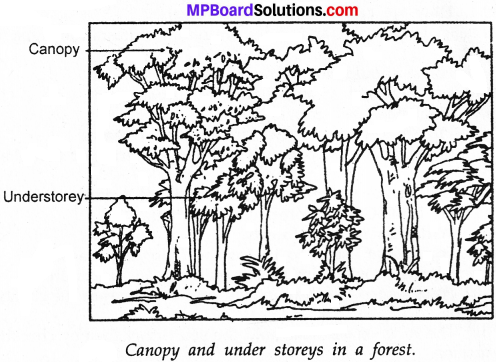
The branches of the tall trees look like a roof over the other plants in the forest is called canopy.

Question 15.
Define crown?
Answer:
Branch part of a tree above the stem is known as the crown.

Question 16.
What is deforestation?
Answer:
Cutting and destroying the forest is called deforestation.

Question 17.
What are the effects of deforestation?
Answer:
Floods, rising temperature, scarcity of flood and wood and disturbed flood chains are the results of deforestation.

MP Board Solutions

Question 18.
What do you mean by afforestation?
Answer:
Planting more trees is called afforestation.

Question 19.
What would happen if it rains heavily in your town?
Answer:
There will be water logging or even flood. Everything will be in a mesh. No food, no water. No place, no stay.

Forests: Our Lifeline Short Answer Type Questions

Question 1.
Define soil erosion?
Answer:
Removal of fertile top layers of earth (soil) is called soil erosion. The soil erosion can be brought about by various agents like – water, wind, glaciers and ocean waves. Erosion occurs in both wet and arid regions. The various human activities like falling of trees, over – cropping and improper tilling accelerate soil erosion. The soil erosion can lead to floods.

Question 2.
What are the major factors that lead to soil erosion? Name them?
Answer:
The major factors that lead to soil erosion are the following:

  1. Overgrazing by livestock
  2. Deforestation
  3. Over cultivation
  4. Poor irrigation facilities
  5. Water logging
  6. Shifting cultivation.

Question 3.
Write about the dependence of animals on plants?
Answer:
Dependence of Animals on Plants:

  1. Plants produce food by the process of photosynthesis and animals depend directly or indirectly on them for food.
  2. Plants produce oxygen during photosynthesis and animals use this oxygen for respiration.
  3. Plants act as habitat for the animals dwelling on trees.

MP Board Solutions

Question 4.
Write about the dependence of plants on animals?
Answer:
Dependence of Plants on Animals:

  1. Animals produce carbon dioxide during respiration which is released in the atmosphere. Plants use this oxygen for preparing food.
  2. A number of insects, birds and bats help in pollination.
  3. Some animals help in dispersal of fruits and seeds.

Question 5.
How forests help in bringing rain?
Answer:
Trees absorbs water from the soil through their roots. They then release the excess of water through the process of transpiration in the form of water vapours. These water vapours form clouds and clouds bring rain.

Question 6.
How are forests useful to us?
Answer:
The forests are very useful to us for the following reasons:

  1. They conserve soil and water.
  2. They are helpful in causing rains.
  3. They give us food and fruit.
  4. They are the natural habitats of animals.
  5. They help in the maintenance of ecological balance.

MP Board Solutions

Question 7.
Write a short note on deforestation?
Answer:
Deforestation is another important cause which brings about soil erosion. Deforestation leads to depletion of water vapour in the atmosphere so which in turn adversely affects the formation of rain bearing clouds and consequently the rainfall. In the absence of adequate rainfall, the soil dries up and its nutrient value is affected.

The decrease in rainfall affects the growth of plants and trees, thus leads to the formation of deserts. When there is no plant cover over the earth, it becomes naked. When rain falls over this naked earth, the water does not percolate down the earth and washes away. Similarly, strong winds also take away the top soil, thus causing soil erosion.

Question 8.
In which layer of the soil would you find humus? What is its importance to the soil?
Answer:
Humus is found in the top of layer of soil. The presence of humus ensures that the nutrients of the dead plants and animals are released into the soil. From there, these nutrients are again absorbed by the roots of the living plants.

Forests: Our Lifeline Long Answer Type Questions

Question 1.
How we can conserved the forests?
Answer:

  1. Unplanned and indiscriminate deforestation must be stopped.
  2. Forest should not be over – exploited.
  3. Use of wood as fuel should be discouraged.
  4. Plant new fast growing trees.
  5. Protect forest from fires, insects and diseases.
  6. Protect national parks, wildlife sanctuaries or biosphere reserves.
  7. Follow the guidelines of international organizations like W.W.F. and UNESCO for forest conservation.

MP Board Solutions

Question 2.
Write the uses of forests?
Answer:
Forests are useful to us for the following reasons:

  1. Forests provide timber for building and furniture.
  2. Forests keep the environment cool and increase the chances of rainfall.
  3. The roots of the trees hold the soil firmly thereby checking soil erosion.
  4. Forests provide habitat to a variety of wild plants and animals.
  5. The plants of forests use CO2 and release oxygen in photosynthesis, thereby maintaining balance of gases in atmosphere.
  6. Forests provide animal products such as honey, lac, wax, etc.
  7. Forests provide plant products such as fruits, nuts, gums, resins, fibres, medicines, essential oil (like sandal wood), etc.
  8. They are involved in the absorption of water which percolates in the soil, thereby becoming a part of the groundwater.

Question 3.
What will happen if forests disappear?
Answer:

  1. Soil erosion will increase which will affect soil fertility and productivity.
  2. Air pollution will increase which will ultimately threaten thirty existence of life on the Earth.
  3. Unpredictable changes will take place in weather and climate.
  4. Reduction in rainfall.
  5. Reduction in recharging of existing water resources
  6. Wildlife may also disappear along with forest.
  7. Shortage of forest products.
  8. Disturbance in ecological balance.
  9. Increase in temperature
  10. Global warming may reach in flooding of low lying area.

Question 4.
Draw a figure to show the difference between canopy and under stories?
Answer:
MP Board Class 7th Science Solutions Chapter 17 Forests Our Lifeline img 3

Question 5.
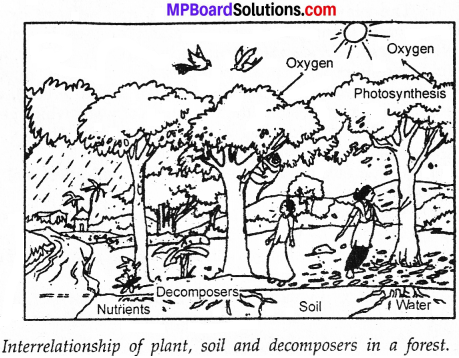
Draw a figure to show in the dependence of plant, soil and decomposers in a forest?
Answer:
MP Board Class 7th Science Solutions Chapter 17 Forests Our Lifeline img 4

MP Board Class 7th Science Solutions

MP Board Class 9th Science Solutions Chapter 12 Sound

MP Board Class 9th Science Solutions Chapter 12 Sound

Sound Intext Questions

Sound Intext Questions Page No. 162

Question 1.
How does the sound produced by a vibrating object in a medium reach your ear?
Answer:
When an object vibrates, it allows the particles of the medium around it to vibrate. It exerts force on the adjacent particles and continue oscillating in all directions and one of it, hit our ear’s medium which creates sound. This process continues in the medium till the sound reaches your ear.

Sound Intext Questions Page No. 163

Question 1.
Explain how sound is produced by your school bell.
Answer:
When the bell rings, it continues to move forward and backward which creates vibration and simultaneously a series of compressions and rarefactions which produce a very loud sound.

MP Board Solutions

Question 2.
Why are sound waves called mechanical waves?
Answer:
Sound waves needs medium to propagate therefore, they are called mechanical waves. Sound cannot travel in the absence of a medium. Sound waves are propagated through a medium because of the interaction of the particles present in that medium.

Question 3.
Suppose you and your friend are on the moon. Will you be able to hear any sound produced by your friend?
Answer:
No, because sound waves needs a medium through which they can propagate. And since there is no medium on the moon due to absence of atmosphere, one cannot hear any sound produced by his / her friend on the moon.

Sound Intext Questions Page No. 166

Question 1.
Which wave property determines.

  1. loudness
  2. pitch?

Answer:

  1. Amplitude determines loudness of a sound wave.
  2. Frequency determines pitch of a sound wave.

Question 2.
Guess which sound has a higher pitch: guitar or car horn?
Answer:
Guitar has a higher pitch than car horn, because sound produced by the strings of guitar has higher frequency and since pitch is proportional to frequency, pitch of guitar will be higher.

MP Board Solutions

Question 3.
What are wavelength, frequency, time period and amplitude of a sound wave?
Answer:

  1. Wavelength: Wave length is the length between two consecutive peaks it is represented by Greek letter λ (lambda). Louder sound has shorter wavelength and softer sound has longer wavelength.
  2. Frequency: The number of sound waves produced in unit time is called the frequency of sound waves. Frequency is measured in seconds. Frequency is denoted by Greek letter v (nu). The SI unit of frequency is ‘hertz’.
  3. Amplitude: Amplitude of a wave is magnitude of maximum disturbance on either side of the normal position or mean value in a medium.

Question 4.
How are the wavelength and frequency of a sound wave related to its speed?
Answer:
Speed, wavelength, and frequency of a sound wave are related as follows:
Speed (ν) = Wavelength [λ] × Frequency (v)
⇒ ν = λ × v

Question 5.
Calculate the wavelength of a sound wave whose frequency is 220 Hz and speed is 440 m/s in a given medium.
Answer:
Given,
Frequency of the sound wave, v = 220 Hz
Speed of the sound wave, u = 440 ms-1
Putting the equations,
Speed = Wavelength (λ) × Frequency (v)
ν = λ × v
∴ λ = \(\frac { ν }{ v  }\) = \(\frac { 440 }{ 220 }\) = 2 m
Hence, Wavelength = 2 m.

Question 6.
A person is listening to a tone of 500 Hz sitting at a distance of 450 m from the source of the sound. What is the time interval between successive compressions from the source?
Answer:
Given,
Frequency = 500 Hz
Distance = 450 m
Since, T = \(\frac { 1 }{ Frequency }\)
= \(\frac { 1 }{ 500 }\) = 0.002 sec.
Hence, person will listen the sound after every 0.002 sec.

Question 7.
Distinguish between loudness and intensity of sound.
Answer:
Intensity drives loudness of a sound. These both qualities of sound are proportional to each other. The amount of sound passing through a unit area per second represents intensity of a sound wave. While loudness is the response of the ear to the sound (amount received to pinna). The loudness of a sound is defined by its amplitude. The amplitude of a sound decides its intensity, which in turn is perceived by the ear as loudness.

Sound Intext Questions Page No. 167

Question 1.
In which of the three media, air, water or iron, does sound travel the fastest at a particular temperature?
Answer:
Sound travels the fastest in solids medium (here Iron) then in liquids (water) and it is the slowest in gases (air). Therefore, for a given temperature, sound travels as follows (decreasing order): ⇒ Iron > water >air.

Sound Intext Questions Page No. 168

Question 1.
An echo returned in 3s. What is the distance of the reflecting surface from the source, given that the speed of sound is 342 ms-1?
Answer:
Given,
Speed, v = 342 ms-1
Time, t = 3 s
Since, Distance = v × t
= 342 × 3 = 1026 m
Condition,
In fixed time interval, sound has to travel a distance that is twice the distance of the reflecting surface and the source.
Hence, the distance of the reflecting surface from the source = \(\frac { 1026 }{ 2 }\) m = 513 m.

Sound Intext Questions Page No. 169

Question 1.
Why are the ceilings of concert halls curved?
Answer:
Ceilings of concert halls are curved to:

  1. Enhance loudness and echo of sound created.
  2. Sound after reflection (from the walls) spreads uniformly in all directions.

Sound Intext Questions Page No. 170

Question 1.
What is the audible range of the average human ear?
Answer:
The audible range of an average human ear is between 20 Hz to 20,000 Hz.

Question 2.
What is the range of frequencies associated with

  1. Infrasound?
  2. Ultrasound?

Answer:

  1. Infrasound: frequencies less than 20 Hz.
  2. Ultrasound: frequencies more than 20,000 Hz.

Sound Intext Questions Page No. 172

Question 1.
A submarine emits a sonar pulse, which returns from an underwater cliff in 1.02 s. If the speed of sound in salt water is 1531 m/s, how far away is the cliff?
Answer:
Given,
Time taken by the sonar pulse to return, t = 1.02s
Speed of sound in salt water, v = 1531 ms-1
Distance of the cliff from the submarine = Speed of sound × Time taken
= 1531 × 1.02 m = 1561.62 m
Distance travelled by the sonar pulse during its transmission and reception in water
= 2 × Actual distance = 2d
Actual distance,
d = Distance of the cliff from the submarine / 2 = \(\frac { 1561 }{ 2 }\) = 780.31 m.

MP Board Solutions

Sound NCERT Textbook Exercises

Question 1.
What is sound and how is it produced?
Answer:
Sound is a form of energy which is received at our ear pinna and gives the sensation of hearing. It is a vibration which propagates in air and developed by vibrating objects.

MP Board Solutions

Question 2.
Describe with the help of a diagram, how compressions and rarefactions are produced in air near a source of sound.
Answer:
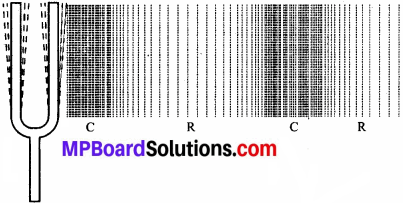
When vibration is produced by a body, it moves in backward and forward direction till the energy lasts. During forward movement it creates a region of high pressure. This region of high pressure is known as compressions. When it moves backward, it creates a region of low pressure. This region is known as a rarefaction. This is shown in figure given below.
MP Board Class 9th Science Solutions Chapter 12 Sound 1
Here,
C = compressions
R = rarefaction.

Question 3.
Cite an experiment to show that sound needs a material medium for its propagation.
Answer:
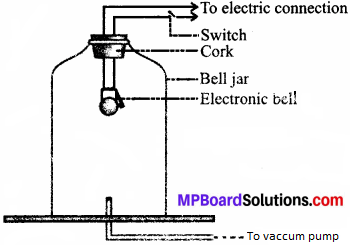
Arrange the instrument according to the picture given below:
MP Board Class 9th Science Solutions Chapter 12 Sound 2

  • Take an electric bell and an air tight jar with glass bell and connect it to a vacuum pump.
  • Suspend the bell inside the jar, and press the switch of the bell.

Method: Now pump out the air from the glass jar. The sound of the bell will become fainter and after some time, the sound will not be heard. This shows that sound needs a material medium to travel.

Question 4.
Why is sound wave called a ‘longitudinal wave’?
Answer:
Sound wave is called longitudinal wave because the air particles vibrates parallel to the direction of propagation of sound wave,it is produced by compressions and rarefactions in the air.

Question 5.
Which characteristics of the sound helps you to identify your friend by his voice while sitting with others in a dark room?
Answer:
The quality of pitch and loudness of sound enables us to identify our friend by his voice.

MP Board Solutions

Question 6.
Flash and thunder are produced simultaneously. But thunder is heard a few seconds after the flash is seen, why?
Answer:
Speed difference is the main reason of this happening. The speed of sound (344 m/s) is very less than the speed of light (3 × 10⁸ m/s). A flash is seen before we hear a thunder because sound of thunder takes more time to reach the Earth as compared to light.

Question 7.
A person has a hearing range from 20 Hz to 20 kHz. What are the typical wavelengths of sound waves in air corresponding to these two frequencies? Take the speed of sound in air as 344 ms-1.
Answer:
We know,
Speed (ν) = Wavelength × Frequency v
ν = λ × v
Given,
Speed of sound in air ν = 344 m/s (Given)

(i) For, v = 20 Hz
λ1 = \(\frac { ν }{ v }\)
= \(\frac { 344 }{ 20 }\) = 17.2 m

(ii) For, v = 20000 Hz
12 = \(\frac { ν }{ v }\)
= \(\frac { 344 }{ 20000 }\) = 0.172 m
Hence, for humans, the wavelength range for hearing is 0. 0172 m to 17.2 m.

Question 8.
Two children are at opposite ends of an aluminium rod. One strikes the end of the rod with a stone. Find the ratio of time taken by the sound wave in air and in aluminium to reach the second child.
Answer:
Velocity of sound in air= 346 m/s
Velocity of sound waves in aluminium 6420 m/s
Let length of rod be 1.
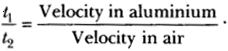
Time taken for sound wave in air, t1 = \(\frac { 1 }{ Velocity }\) in air.
Time taken for sound wave in aluminium, t2 = \(\frac { 1 }{ Velocity }\) in aluminium.
Therefore,
MP Board Class 9th Science Solutions Chapter 12 Sound 6
= \(\frac { 6420 }{ 346 }\) = 18.55.

Question 9.
The frequency of a source of sound is 100 Hz. How many times does it vibrate in a minute?
Answer:
Frequency =100 Hz. (Given)
This means the source of sound vibrates 100 times in one second.
Therefore, number of vibrations in 1 minute, i.e. in 60 seconds = 100 × 60 = 6000 times.

Question 10.
Does sound follow the same laws of reflection as light does? Explain.
Answer:
Yes, sound waves also follow the same laws of reflection as light wave do because:

  1. Angle of incidence of sound is always equal to that of angle of reflection of sound waves.
  2. The direction in which sound is incident, the direction in which it is reflected and normal all lie in the some plane.

MP Board Solutions

Question 11.
When a sound is reflected from a distant object, an echo is produced. Let the distance between the reflecting surface and the source of
sound production remains the same. Do you hear echo sound on a hotter day?
Answer:
An echo is heard when the time for the reflected sound is just 0.1 s
Time taken = \(\frac { Total Distance }{ Velocity }\)
On a hotter day, due to lighter medium the velocity of sound is more then a colder day. Hence, sound wave will move faster and if time taken by echo is less than 0.1 sec it will not be heard.

Question 12.
Give two practical applications of reflection of sound waves.
Answer:
Two practical applications of reflection of sound waves are:

  1. Reflection of sound is used to measure the distance and speed of underwater objects. This method is known as SONAR.
  2. Working of a stethoscope is also based on reflection of sound. In a stethoscope, the sound of the patient’s heartbeat reaches the doctor’s ear by multiple reflection of sound.

Question 13.
A stone is dropped from the top of a tower 500 m high into a pond of water at the base of the tower. When is the splash heard at the top? Given, g = 10 ms-2 and speed of sound = 340 ms-1.
Answer:
Height of the tower, s = 500 m
Velocity of sound, v = 340 ms-1
Acceleration due to gravity, g = 10 ms-2
Initial velocity of the stone, u = 0 (since the stone is initially at rest)
Time taken by the stone to fall to the base of the tower t1,
According to the second equation of motion:
s = ut1 + \(\frac { 1 }{ 2 }\) gt12
500 = 0 × t1 + \(\frac { 1 }{ 2 }\) × 10 t12
t12 = 500
t1 = 10 s
Now, time taken by the sound to reach the top from the base of the tower,  t2 = \(\frac { 500 }{ 340 }\) = 1.47 s.
Therefore, the splash is heard at the top after time, t Where, t = t1 + t2 = 10 + 1.47 = 11.47 s.

Question 14.
A sound wave travels at a speed of 339 ms-1. If its wavelength is 1.5 cm, what is the frequency of the wave? Will it be audible?
Answer:
Speed of sound, v = 339 ms-1
Wavelength of sound, λ = 1.5 cm = 0.015 m
Speed of sound = Wavelength × Frequency
ν = λ × v
∴ v = \(\frac { ν }{ λ }\)
= \(\frac { 339 }{ 0.015 }\)
= 22600 Hz.
The frequency range of audible sound for humans lies between 20 Hz to 20,000 Hz.
Since, the frequency of the given sound is more than 20,000 Hz, it is not audible.

Question 15.
What is reverberation? How can it be reduced?
Answer:
The repeated multiple reflections of sound in any big enclosed space is known as reverberation. The reverberation can be reduced by covering the ceiling and walls of the enclosed space with sound absorbing materials, such as fibre board, loose woollens, etc.

Question 16.
What is loudness of sound? What factors does it depend on?
Answer:
The effect produced in the brain by the sound of different frequencies is called loudness of sound. Loudness depends on the amplitude of vibrations. In fact, loudness is proportional to the square of the amplitude of vibrations.

Question 17.
Explain how bats use ultrasound to catch a prey.
Answer:
Bats produce high – pitched ultrasonic squeaks. These high – pitched squeaks are reflected by objects such as preys and returned to the bat’s ear. This allows a bat to know the distance of his prey.

MP Board Solutions

Question 18.
How is ultrasound used for cleaning?
Answer:
Objects to be cleansed are put in a cleaning solution and ultrasonic sound waves are passed through that solution. The high frequency of these ultrasound waves detaches the dirt from the objects.

Question 19.
Explain the working and application of a SONAR.
Answer:
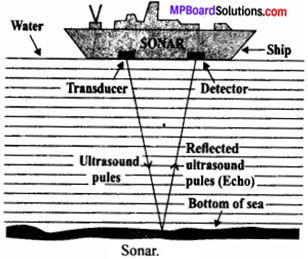
Sonar stands for Sound Navigation And Ranging. It is a device used to measure the depth, direction and speed of under – water objects such as submarines and ship wrecks with the help of ultrasounds and is also used to measure the depth of seas and oceans. An ultrasonic sound is produced and transmitted by the transducer (it is a device that produces ultrasonic sound) of the Sonar, which travels through sea water.

The echo produced by the reflection of this ultrasonic sound is detected and recorded by the detector, which is converted into electrical signals. The distance (d) of the under – water object is calculated from the time (t) taken by the echo to return with speed (v) is given by 2d = v × t.
MP Board Class 9th Science Solutions Chapter 12 Sound 3

Question 20.
A SONAR device on a submarine sends out a signal and receives an echo 5 s later. Calculate the speed of sound in water if the distance of the object from the submarine is 3625 m.
Answer:
Given,
Time taken to hear the echo, t = 5 s
Distance of the object from the submarine, d = 3625 m
Total distance travelled by the sonar waves during the transmission and reception in water = 2d
Using formula:
Velocity of sound in water,
v = 2 \(\frac { d }{ t }\)
= 2 × \(\frac { 3625 }{ 5 }\) = 1450 ms-1.

Question 21.
Explain how defects in a metal block can be detected using ultrasound.
Answer:
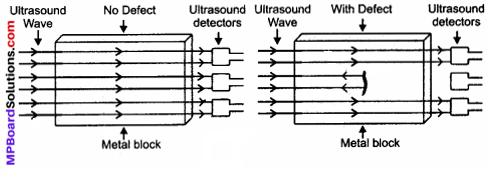
Defects in metal blocks do not allow ultrasound to pass through them and they are reflected back. This fact is used to detect defects in metal blocks. Ultrasound is passed through one end of a metal block and detectors are placed on the other end. The defective part of the metal block does not allow ultrasound to pass through it. As a result, it will not be detected by the detector. Hence, defects in metal blocks can be detected using ultrasound.
MP Board Class 9th Science Solutions Chapter 12 Sound 4

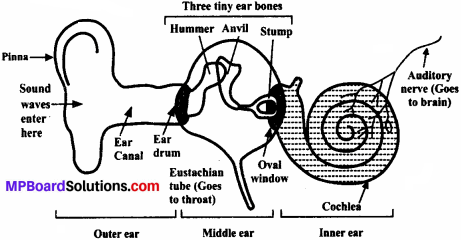
Question 22.
Explain how the human ear works.
Answer:
The human ear consists of three parts – the outer ear, middle ear and inner ear.

  1. Outer ear: It is also termed ‘pinna’. It collects the sound from the surrounding and directs it towards auditory canal.
  2. Middle ear: It is at the auditory canal where there is a thin membrane called eardrum or tympanic membrane. The sound waves set this membrane to vibrate. These vibrations are amplified by three small bones hammer, anvil and stirrup.
  3. Inner ear: When vibration reach the cochlea in the inner ear and are converted into electrical signals which are sent to the brain by the auditory nerve, and the brain interprets them as sound.
    MP Board Class 9th Science Solutions Chapter 12 Sound 5

Sound Additional Questions

Sound Multiple Choice Questions

Question 1.
Which of the following waves have no requirement of any medium to propagate?
(a) sound
(b) radio
(c) light waves
(d) none of above.
Answer:
(c) light waves

Question 2.
What kinds of waves are produced by sound?
(a) longitudinal only
(b) transverse waves only
(c) electromagnetic Waves
(d) both Longitudinal and Transversal.
Answer:
(a) longitudinal only

MP Board Solutions

Question 3.
When a wave propagate, it transfers ___________ .
(a) energy only
(b) matter only
(c) both energy and matter
(d) none of these.
Answer:
(a) energy only

Question 4.
Note is a sound ___________ .
(a) of mixture of several frequencies
(b) of mixture of two frequencies only
(c) of a single frequency
(d) always unpleasant to listen.
Answer:
(a) of mixture of several frequencies

Question 5.
A key of a mechanical piano struck gently and then struck again but much harder this time. In the second case:
(a) sound will be louder but pitch will not be different.
(b) sound will be louder and pitch will also be higher.
(c) sound will be louder but pitch will be lower.
(d) both loudness and pitch will remain unaffected.
Answer:
(d) both loudness and pitch will remain unaffected.

Question 6.
Earthquake produces which kind of sound before the main shock wave begins ___________ .
(a) ultrasound
(b) Infrasound
(c) audible sound
(d) none of the above.
Answer:
(b) Infrasound

Question 7.
Infrasound can be heard by ___________ .
(a) dog
(b) bat
(c) rhinoceros
(d) human beings.
Answer:
(c) rhinoceros

Question 8.
Before playing the orchestra in a musical concert, a sitarist tries to adjust the tension and pluck the string suitably. By doing so, he is adjusting ___________ .
(a) intensity of sound only.
(b) amplitude of sound only.
(c) frequency of the sitar string with the frequency of other musical instruments.
(d) loudness of sound.
Answer:
(c) frequency of the sitar string with the frequency of other musical instruments.

MP Board Solutions

Question 9.
What we term to the number of oscillations completed in one second?
(a) time period
(b) velocity
(c) frequency
(d) wavelength.
Answer:
(c) frequency

Question 10.
Sound waves which can be propagate in solids are ___________ .
(a) Longitudinal only.
(b) Transverse only.
(c) Either longitudinal or transverse.
(d) Non mechanical waves only.
Answer:
(c) Either longitudinal or transverse.

Question 11.
In SONAR, we use ___________ .
(a) ultrasonic waves
(b) infrasonic waves
(c) radio waves.
(d) audible sound waves.
Answer:
(a) ultrasonic waves

Question 12.
Sound travels in air if ___________ .
(a) particles of medium travel from one place to another.
(b) there is no moisture in the atmosphere.
(c) disturbance moves.
(d) both particles as well as disturbance travel from one place to another.
Answer:
(c) disturbance moves.

Question 13.
When we change feeble sound to loud sound we increases ___________ .
(a) Frequency
(b) Amplitude
(c) Velocity
(d) Wavelength.
Answer:
(b) Amplitude

Question 14.
In the curve (Figure) half the wavelength is ___________ .
image
(a) AB
(b) BD
(c) DE
(d) AE
Answer:
(a) AB

Question 15.
The time taken to complete an osoillation ___________ .
(a) time period
(b) velocity
(c) frequency
(d) wavelength.
Answer:
(a) time period

Question 16.
The period of a vibrating body of frequency 100 Hz is ___________ .
(a) 100 seconds
(b) 10 seconds
(c) 0.1 second
(d) 0.01 second.
Answer:
(a) 100 seconds

MP Board Solutions

Question 17.
Which of the following is SI unit of amplitude?
(a) metre
(b) s-1
(c) metre / second
(d) Hertz.
Answer:
(a) metre

Question 18.
The quantity λ is known as ___________ .
(a) wave velocity
(b) frequency
(c) wavelength
(d) wave number.
Answer:
(c) wavelength

Question 19.
Sound wave of which of the following frequency is an ultrasonic sound?
(a) 30 Hz
(b) 300 Hz
(c) 3000 Hz
(d) 30,000 Hz.
Answer:
(d) 30,000 Hz.

Question 20.
In which of the following, speed of the sound is maximum?
(a) air
(b) water
(c) steel
(d) kerosene.
Answer:
(c) steel

Sound Very Short Answer Type Questions

Question 1.
How does sound travels in gases and liquids – as longitudinal or as transverse waves?
Answer:
As longitudinal waves.

Question 2.
Give examples of longitudinal waves.
Answer:
Sound waves.

Question 3.
What is speed of sound in air?
Answer:
At 0° C, it is 331 m/s. At 20°C, it is 341 m/s.

Question 4.
What is reverberation?
Answer:
The repeated reflection that results in the persistence of sound is called reverberation.

MP Board Solutions

Question 5.
Among solids, liquids and gases sound travels faster in which medium?
Answer:
Sound travels the fastest in solids.

Question 6.
What is one Hz?
Answer:
Hz is the unit of frequency, called as Hertz. One Hertz is equal to one cycle per second.

Question 7.
What is ‘note’ of second?
Answer:
The sound produced due to a mixture of several frequency is called a note, it is pleasant to listen to.

Question 8.
What is pitch?
Answer:
The way our brain interprets the frequency of an emitted sound is called the pitch.

Sound Short Answer Type Questions

Question 1.
What is Sound? Why it is important for us?
Answer:
Sound is a longitudinal mechanical wave. Sound has great importance in our daily life. It gives us a sensation of hearing. It makes it possible to communicate with other persons through speech.

Question 2.
What is a mechanical wave?
Answer:
A mechanical wave is a disturbance that moves through a medium when the particles of the medium set neighbouring particles into motion. The particles vibrating in turn do not move forward but the disturbance is carried forward.

Question 3.
What is a longitudinal wave?
Answer:
If the particles of a medium vibrate in a direction, parallel to or along the direction of propagation of wave, it is called longitudinal wave.

MP Board Solutions

Question 4.
What type of waves can travel in vacuum? Give example(s).
Answer:
Electromagnetic waves can travel in vacuum. Sun light, x – rays are examples of electromagnetic waves.

Question 5.
Suppose you and your friend are on the Moon. Will you be able to hear any sound produced by your friend?
Answer:
No, we will not hear any sound on the Moon. The Moon does not have any atmosphere, since sound is a mechanical wave and requires a medium to travel.

Question 6.
What are the factors, speed of sound wave depends upon?
Answer:
Speed of the sound depends on the following factors:

  1. Inertial property of the medium (to store kinetic energy).
  2. Elastic property of the medium (to store potential energy).
  3. Temperature of the medium.
  4. Density of the medium.
  5. Humidity present in the medium (in air / gases).

Question 7.
Three persons A, B and C are made to hear a sound travelling through different mediums as given below:

PersonsMedium
AIron Rod
BAir
Cwater

Who will hear the sound first ? Why ?
Answer:
Person A will hear the sound first because sound travels the faster in solids than in liquids and gases.

Question 8.
If 20 waves are produced per second, what is the frequency in hertz?
Answer:
Number of waves per second is known as frequency.
∴ Frequency (v) = 20 Hz.

Question 9.
What is echo?
Answer:
The sound waves produced bounce back or gets reflected from the mountains or buildings and come to our ears, this reflected sound is known as Echo. To hear echo, the barrier reflecting the sound should be atleast at a distance of 17 metres.

MP Board Solutions

Question 10.
What is infrasonic? Give an example.
Answer:
Sound having frequency less than 20 Hz is known as infrasonic sound or infrasonic. Waves produced during earthquake are infrasonic.

Sound Long Answer Type Questions

Question 1.
Establish the relationship between speed of sound, its wave length and frequency. If velocity of sound in air is 340 m s-1, calculate:

  1. wavelength when frequency is 256 Hz.
  2. frequency when wavelength is 0.85 m.

Answer:
Derivation of formula ν = v λ

  1. 340 = 256 λ ⇒ λ = 1.33 m.
  2. 340 = v (0.85) ⇒ v = 400 Hz.

Question 2.
A girl is sitting in the middle of a park of dimension 12 m × 12 m. On the left side of it there is a building adjoining the park and on right side of the park, there is a road adjoining the park. A sound is produced on the road by a cracker. Is it possible for the girl to hear the echo of this sound? Explain answer.
Answer:
If the time gap between the original sound and reflected sound received by the listener is around 0.1 s, only then the echo can be heard. The minimum distance travelled by the reflected sound wave for the distinctly listening the echo, distance = velocity of sound × time interval;
= 344 × 0.1 = 34.4 m.
But, in this case the distance travelled by the sound reflected from the building and then reaching the girl will be (6 + 6 = 12 m),  which is much smaller than the required distance. Therefore, no echo can be heard.

Sound Higher Order Thinking Skills (HOTS)

Question 1.
A key of piano is struck gently and then struck again but much harder this time. What will happen in the second case?
Answer:
In second case, the loudness will increase as this will increase the amplitude of vibration of string. Pitch and frequency will also increase in force or tension in the string.

MP Board Solutions

Question 2.
At a hill station, a child could hear the echo of his voice after 0.2 s. But, when he went to the same place in the afternoon, he could not hear echo at all. What could be the reason?
Answer:
In afternoon, the temperature rises, therefore the speed of sound also increased. The reflected sound will take very less time to travel back and no echo is heard.

Sound Value Based Question

Question 1.
It is not advisable to construct houses near airports, inspite of that many new residential apartments are constructed near airports. Rajesh / Sumit files RTI and also complains the municipal office about the same.

  1. Why one should not reside near airport?
  2. Name other two places where there is noise pollution.
  3. What value of Rajesh is reflected in this act?

Answer:

  1. The landing and taking off of the air – planes causes lot of noise-pollution which may lead to deafness, high blood pressure and other health problems.
  2. The other two places where there is noise-pollution are residing near the heavy traffic routes and railway stations or lines.
  3. Rajesh shows participating citizen and moral responsibility values.

MP Board Class 9th Science Solutions

MP Board Class 9th Maths Solutions Chapter 10 Circles Ex 10.3

MP Board Class 9th Maths Solutions Chapter 10 Circles Ex 10.3

Question 1.
Draw different pairs of circles. How many points does each pair have in common? What is the maximum number of common points?
Solution:
Let us draw different pairs of circles as shown below:
MP Board Class 9th Maths Solutions Chapter 10 Circles Ex 10.3 img-1
We gave,
In figure           Maximum number of common points
(i)             –                     nil
(ii)            –                    one
(iii)           –                    two
Thus, two circles can have at the most two points in common.

Question 2.
Suppose you are given a circle. Give a construction to find its center.
Solution:
Steps of construction:

  1. Mark any three points A, B and C on the circle.
    MP Board Class 9th Maths Solutions Chapter 10 Circles Ex 10.3 img-2
  2. Join AB and BC.
  3. Draw the perpendicular bisector of AS. Let it be PQ.
  4. Draw the perpendicular bisector of BC. Let it be RS.
  5. PQ and RS intersect at point O.
  6. O is the center of given circle.

MP Board Solutions

Question 3.
If two circles intersect at two points, prove that their centers lie on the perpendicular bisector of the common chord.
Solution:
Given:
Circles C(O, r) and C(D, r1) intersect at A and B.
To prove:
OD is perpendicular bisector of AS.
MP Board Class 9th Maths Solutions Chapter 10 Circles Ex 10.3 img-3
Construction:
Join OA, AD, OB and BD.
Proof:
In ∆AOD and ∆BOD,
OA = OB
DA = DB (Radii of the circle)
OD = OD (Common)
∆AOD ≅ ∆BOD (By SXS)
and ∠1 = ∠2 (By CPCT)
In ∆OAC and ∆OBC,
OA = OB (Radii of the circle)
OC =OC (Common)
∠1 = ∠2 (Proved)
∆AOC = ∆OBC (By SAS)
So ∠3 = ∠4 (By CPCT)
and AC = BC (By CPCT)
∠3 + ∠4 = 180.°
2∠3 = 180°
∠3 = \(\frac{180^{\circ}}{2}\) =90° (UA’s)
OD is perpendicular bisector of AB.

MP Board Class 9th Maths Solutions

MP Board Class 7th Science Solutions Chapter 16 Water: A Precious Resource

MP Board Class 7th Science Solutions Chapter 16 Water: A Precious Resource

Activities

Activity – 1
Given here is the rainfall map of India (Fig.) It gives the average annual rainfall in different regions of our country?
MP Board Class 7th Science Solutions Chapter 16 Water A Precious Resource image 1

Question 1.
Are you blessed with sufficient rainfall?
Answer:
No.

Question 2.
Is there sufficient water available in your area throughout the year?
Answer:
Yes.

Question 3.
Can we attribute this to mismanagement of water resources?
Answer:
Yes.

Water: A Precious Resource Text Book Exercises

Question 1.
Mark T if the statement is true and F if it is false:

  1. The freshwater stored in the ground is much more than that present in the rivers and lakes of the world.
  2. Water shortage is a problem faced only by people living in rural areas.
  3. Water from rivers is the only source for irrigation in the fields.
  4. Rain is the ultimate source of water.

Answer:

  1. True
  2. False
  3. False
  4. True

MP Board Solutions

Question 2.
Explain how groundwater is recharged?
Answer:
The ground water get recharged through the process of infiltration. The infiltration means seeping in water from rain, rivers and lakes into the empty spaces and crack deep below the ground.

Question 3.
There are ten tubewells in a lane of fifty houses. What could be the long term impact on the water table?
Answer:
The effect on the water table depends on the replenishment of the underground water. As only five families will share a tubewell, the water used for daily domestic purpose will not effect the water table as such. But if there is acute shortage of rains the water used by the families will not replenished and water table will fall down.

Question 4.
You have been asked to maintain a garden. How will you minimise the use of water?
Answer:
By collecting rain water. Also to minimise the wastage of water we will use the new technique of drip irrigation, which directly throws water at the base of plants.

MP Board Solutions

Question 5.
Explain the factors responsible for the depletion of water table?
Answer:
Increasing population:
Increasing population creates demand for construction of houses, shops, offices, roads and pavements. This decreases the open areas like parks, and playgrounds. This, in turn, decreases the seepage of rainwater into the ground. What could be the consequence? Recall that a pukka floor does not allow water to seep in easily, while in a grass lawn water seeps through in no time.

Moreover a huge amount of water is required for construction work. Often groundwater is used for this purpose. So, on the one hand we are consuming more groundwater, and on the other we are allowing lesser water to seep into the ground. This results in depletion of water table. In fact, the water table in some parts of many cities has gone down to alarmingly low levels.

Increasing industries:
Water is used by all the industries. Almost everything that we use needs water somewhere in its production process. The number of industries is increasing continuously. Water used by most of the industries is drawn from the ground.

Agricultural activities:
A majority of farmers in India depend upon rains for irrigating their crops. Irrigation systems such as canals are there only in a few places. Even these systems may suffer from lack of water due to erratic rainfall. Therefore, farmers have to use groundwater for irrigation. Population pressure on agriculture forces increasing use of groundwater day by day. This results in depletion of water table.

Question 6.
Fill in the blanks with the appropriate answers:

  1. The water bearing layer of the earth is …………………………
  2. The process of water seepage into the ground is called ………………………
  3. The water bearing layer of the earth is ………………………
  4. The process of water seepage into the ground is called ………………………….

Answer:

  1. Well and handpumps
  2. Solid (ice), liquid (water), gas (water vapour)
  3. Aquifer
  4. Infiltration.

MP Board Solutions

Question 7.
Which one of the following is not responsible for water shortage?

1. Rapid growth of industries
2. Increasing population
3. Heavy rainfall
4. Mismanagement of water resources.

Answer:
3. Heavy rainfall.

Question 8.
Choose the correct option. The total water –

1. In the lakes and rivers of the world remains constant.
2. Under the ground remains constant.
3. In the seas and oceans of the world remains constant.
4. Of the world remains constant.

Answer:
3. In the seas and oceans of the world remains constant.

Question 9.
Make a sketch showing groundwater and water table? Lab T it?
Answer:
MP Board Class 7th Science Solutions Chapter 16 Water A Precious Resource image 2

Extended Learning Activities and Projects

Question 1.
Role play?
You are a water detective in your school? You have a term of six members? Survey the campus and make a note of the following:

  1. Total number of taps
  2. Number of taps leaking
  3. Amount of water wasted due to leakage
  4. Reasons of leakage
  5. Corrective measures taken.

Answer:
Do yourself.

MP Board Solutions

Question 2.
Groundwater pumped out?
Try to find out if there are any hand pumps in your neighborhood. Go to the owner or the users of a few of these and find out the depth at which they struck water? If there are any differences/think of the probable reason? Write a brief report and discuss it in your class. If possible, visit a place water boring is going on to install a hand pump? Watch the process carefully and find out the depth of the water table at that place?
Answer:
Do yourself.

Question 3.
Catching rainwater – Traditional methods? Form groups of 4 to 5 students in the class and prepare a report on the various traditional ways of water harvesting. If possible, use the following web link: www.rainwaterharvesting.org.?
Answer:
Do yourself.

Question 4.
Conservation of water? Carry out a campaign to conserve water at home and in the school. Design posters to remind others of the importance of water resources?
Answer:
Do yourself.

Question 5.
Create a logo? Hold a competition to create a logo or a symbol depicting water scarcity?
Answer:
Do yourself.

Water: A Precious Resource Additional Important Questions

Objective Type Questions

Question 1.
Choose the correct alternative:

Question (a)
…………………………. is celebrated as the “world water day”?
(a) 22 March
(b) 20 March
(c) 22 April
(d) 20 April.
Answer:
(a) 22 March

Question (b)
Water is a Unique substance because?
(a) It is consumable
(b) It is colourless
(c) It exits in all three states
(d) Both (a) and (b)
Answer:
(c) It exits in all three states

MP Board Solutions

Question (c)
Year …………………….. was observed as the International Year of fresh water to make people aware of this dwindling natural resource?
(a) 2002
(b) 2003
(c) 2004
(d) 2005.
Answer:
(b) 2003

Question (d)
The earth’s surface is covered with water about?
(a) 70%
(b) 71%
(c) 72%
(d) 73%.
Answer:
(b) 71%

Question (e)
Main source of water on earth is –
(a) rain
(b) snow
(c) glaciers
(d) all the above.
Answer:
(a) rain

Question (f)
One of these is not a source of surface water –
(a) lake
(b) rain
(c) river
(d) spring.
Answer:
(d) spring.

MP Board Solutions

Question (g)
This is level …………………. of ground water?
(a) sea level
(b) rain
(c) aquifer
(d) (b) and (c).
Answer:
(d) (b) and (c).

Question (h)
Water has maximum density at –
(a) 0°C
(b) 4°C
(c) 98.4°C
(d) 100°C.
Answer:
(b) 4°C

Question (i)
Water is –
(a) a mixture
(b) a compound
(c) an element
(d) none of these.
Answer:
(b) a compound

Question (j)
The purest form of natural water is –
(a) river
(b) sea
(c) rain
(d) spring.
Answer:
(c) rain

Question (k)
Common salt content of sea water is –
(a) 1.5%
(b) 2.5%
(c) 3.5%
(d) 10%.
Answer:
(b) 2.5%

MP Board Solutions

Question 2.
Fill in the blanks:

  1. The amount of water recommended by the United Nations for drinking, cooking, washing and maintaining proper hygiene is a minimum of ……………………… liters per person per day.
  2. The water that is fit for use is ………………………..
  3. Solid form of …………………. water, and …………… , is present as ice caps at the poles of the earth.
  4. ……………………. water is present in lakes, oceans, rivers and even underground.
  5. The process of seeping of water into ground is called ………………………..
  6. Water in the aquifiers can be usually pumped out with the help of …………………………. or ………………………..
  7. Increase in population, industrial and agricultural activities are some common factors affecting ……………………….. table.
  8. The rain water can be used to recharge the …………………………
  9. Bhujpur in the Kutch area of ………………….. has a very erratic rainfall.
  10. ……………………… irrigation is a technique of watering plants.

Answer:

  1. 50
  2. Fresh water
  3. Snow, ice
  4. Liquid
  5. Infiltration
  6. Tubewells, handpumps
  7. Water
  8. Groundwater
  9. Gujarat
  10. Drip.

MP Board Solutions

Question 3.
Which of the following statements are true (T) or false(F):

  1. Water is essential for all living beings.
  2. Water exists in three forms.
  3. There is an uneven distribution of water.
  4. Water shortage has become a matter of concern throughout the world.
  5. The gaseous form is the water vapour present in the air around us.
  6. Many villages do not have water supply system.
  7. The water – table does not varies from place to place.
  8. Water drawn from under the ground gets replenished by seepage of rain water.
  9. Rainwater harvesting is not necessary.
  10. Rajasthan is a hot and dry place.
  11. Water allows sunlight to pass through it.
  12. Pure water has no taste.

Answer:

  1. True
  2. True
  3. True
  4. True
  5. True
  6. True
  7. False
  8. True
  9. False
  10. True
  11. True
  12. True.

Water: A Precious Resource Very short Answer Type Questions

Question 1.
What is the most important property of water?
Answer:
The most important property of water is its ability to dissolve various substances. Hence, it is called a universal solvent.

Question 2.
What are the sources of water?
Answer:
The two main sources of natural water are surface water and underground water or subsoil water.

MP Board Solutions

Question 3.
What are the different states of water?
Answer:
The different states of water are solid, liquid and gas.

Question 4.
What are the characteristics of pure water?
Answer:
The pure water is colourless, odourless, tasteless and transparent.

Question 5.
What do you mean by a resource?
Answer:
Materials that we get from the environment to meet our needs are called resources.

Question 6.
A part from water, what are the other natural resources?
Answer:
A part from water, air, forests, minerals and fossilfuels are natural resources.

Question 7.
What is the percentage of water that is available for human beings?
Answer:
Only a tiny fraction about 0.01% of total water is used by human beings.

MP Board Solutions

Question 8.
List the sources of water for your daily use?
Answer:
Sources of water for our daily use are well, lakes, rivers and ponds.

Question 9.
Define saturated solution?
Answer:
A saturated solution of a solute at a given temperature is a solution which contains as much of the solute as it can dissolve at that temperature.

Question 10.
Define unsaturated solution?
Answer:
If a solution contains less of the solute than what it can dissolve at that temperature, then it is called all unsituated  solution.

Question 11.
Name three forms of water?
Answer:
Three forms of water are solid, gaseous and liquid.

Question 12.
Which is universal solvent?
Answer:
Water.

MP Board Solutions

Question 13.
What is the percentage of water (by weight) that an average elephant body has?
Answer:
An average elephant body has 80% water by weight.

Question 14.
If you have sample of tap water, well water and sea water, which do you think has the highest amount of salts?
Answer:
Sea water has highest amount of salts.

Question 15.
List the salts that can be obtained from the sea?
Answer:

  1. Common salt (NaCl)
  2. Sodium bromide (NaBr)
  3. Potassium iodide (Kl)
  4. Calcium salts.

Question 16.
Which sea has the highest salinity?
Answer:
Dead sea has the highest salinity.

Question 17.
Name two gaseous fuels which are prepared from water?
Answer:
Water gas and hydrogen gas.

Question 18.
Define water table?
Answer:
The depth at which water is found at a particular place is called water table.

Question 19.
What is Bawri?
Answer:
Bawri is a traditional way of collecting water.

Question 20.
What is potable water?
Answer:
The water which is fit for drinking is called potable water.

MP Board Solutions

Question 21.
Define salinity of water?
Answer:
Water which has salts dissolved in it and is salty in taste is called salinity of water.

Question 22.
Define water cycle?
Answer:
The water from the earth reaches the atmosphere and from there it ultimately comes back to land, this is known as water cycle.

Question 23.
How does water cycle help in maintaining global climate?
Answer:
Liquid water on heating turns into water vapours. Water vapour on cooling again forms liquid water. This change of state of water over and over again makes the cycle in nature.

Question 24.
How are clouds formed?
Answer:
Water vapours being lighter and rise up in the atmosphere. At the upper layer of the atmosphere, where the temperature is lower. The vapours get condensed into tiny water droplets and clouds are formed.

MP Board Solutions

Question 25.
Which unwanted material could be present in the water that you get from your local water supply?
Answer:
The unwanted materials in our water supply are dust particles, germs, bacteria and many other materials as impurities.

Question 26.
Define water harvesting?
Answer:
Most of the water that we get as rainfall just flows aways. This is a waste of precious natural resource. The rainwater can be used to recharge the groundwater. This is known as water harvesting or rainwater harvesting.

Question 27.
Define drip irrigation?
Answer:
Drip irrigation is a technique of watering plants by making use of narrow tubings which deliver water directly at the base of the plant.

Water: A Precious Resource Short Answer Type Questions

Question 1.
Wrote a short note on source of water?
Answer:
Water is available to us through various sources. Rain water, lake Water, river water, sea water are some of the sources. Natural water from all these sources contain some impurities these are the dissolved minerals and salts. Apart from that, they contain some insoluble impurities too.

Question 2.
List the sources of water on the earth?
Answer:
There are two main sources of natural water:

  1. Underground water
  2. Surface water.
  3. Underground Water: There are mainly two types of underground water –
    • (a) Well water
    • (b) Spring water.

2. Surface water:
It is of three types:

  • Rain water
  • River and lake water
  • Sea water.

MP Board Solutions

Question 3.
Write a short rote an river water?
Answer:
The river water is mainly due to rain or due to melting of snow on the mountains. The river water usually carries some suspended impurities and some soluble impurities. The soluble impurities are the dissolved salts and minerals. Apart from that they may carry certain micro – organisms and organic matter due to contamination.

Question 4.
Write a short note on sea water?
Answer:
Sea water is the largest source of natural water. But it is not fit either for drinking or for irrigation directly. This is because it contains a large number of dissolved salts of chlorides, bromides, iodides, sulphates and carbonates. The sea water is a rich source for common salt. It is recovered from sea water by evaporation and then is purified to remove the other impurities present.

Question 5.
Write a short note an underground water?
Answer:
Water present underneath the earth is tapped as it is an excellent source of pure drinking water. We usually dig wells. Depending on the geographical conditions of the place, the depth in which water is available is estimated. Well water contains some dissolved impurities.

Again the nature of the impurities depends on the geographical conditions. We also get water from springs under the earth. Such springs usually contain some dissolved mineral salts. However the spring water does not contain suspended impurities as it comes from deep under the earth.

Question 6.
Write a short note on rain water?
Answer:
It is the purest form of natural water available to us. Though the first few droplets of rain bring along with them some dust particles and micro-organisms, the later drops are free from impurities.

MP Board Solutions

Question 7.
What are the properties of water?
Answer:
Properties of Water:

  1. Pure water is colourless, odourless and tasteless.
  2. Pure water freezes at 0 degree Celsius and boils at 100 degree celsius.
  3. The density of water is 1 g/cc. It means that 1 cc of water at 1 degree Celsius weighs 1 gram.

Question 8.
What are the different ways by which water vapour is put into the atmosphere?
Answer:
The different ways by which water vapours put into atmosphere are as follows:

  1. Factories and thermal stations produce a lot of steam and put is into the atmosphere.
  2. Water in ponds, rivers and lakes, ocean gets evaporated due to atmospheric heat.
  3. Plants throughout water vapours during respiration.

Question 9.
What makes the sea water so saline?
Answer:
Rivers flowing from different places bring water containing dissolved salts and minerals into the sea. Sea water is continuously evaporated by the heat of the sun. This evaporated water forms clouds and again fall on the earth as rain. This rain water again dissolves salts into it and goes into the sea. Thus the amount of salts in sea water goes on increasing.

MP Board Solutions

Question 10.
How will you show that saline water is not fit for agriculture?
Answer:
Take two healthy plants of same type. Water both the plants separately one with ffesh water and other with saline water. Continue to water similarly for seven days and observe. The plant which was watered with saline water wilts. This shows that saline water is not fit for plants or agriculture.

Water: A Precious Resource Long Answer Type Questions

Question 1.
Draw a diagram to show water cycle?
Answer:
MP Board Class 7th Science Solutions Chapter 16 Water A Precious Resource image 3

Question 2.
What are the causes of water scarcity?
Answer:
Causes of Water Scarcity:

  1. Overpopulation
  2. Over – irrigation for agriculture
  3. Water pollution
  4. Climatic change and variability
  5. Indiscriminate cutting of forest
  6. Increase in demand for water
  7. Misuse of water
  8. Poor water resource management
  9. Disputes between the states for sharing water
  10. Destruction of natural water reservoirs.

MP Board Solutions

Question 3.
What are the methods to prevent water scarcity? Ans. Methods to prevent water scarcity:

  1. Control population by adopting small family norms
  2. Prevent misuse and wastage of water
  3. Prevent water pollution
  4. Replace large flush tanks with smaller ones.
  5. Build dams, bunds and tanks to store rainwater.
  6. Replace large flush tanks with smaller ones.
  7. Recharge underground water
  8. Recycle waste water for gardening
  9. Follow drip irrigation or low water sprinklers for agriculture.

Question 4.
What are the effect of water scarcity on the life of people?
Answer:
Effect of water scarcity on the life of the people:

  1. Long walk to fetch water.
  2. Have to pay high price for buying water.
  3. Low scope for generating employment.
  4. Uncertainty over availability of water for agriculture.
  5. Area will remain backward and neglected.
  6. Increase incidents of crime.
  7. More incidence of diseases due to poor sanitary conditions.
  8. Fall in the productivity of animals.

MP Board Class 7th Science Solutions

MP Board Class 9th Maths Solutions Chapter 10 Circles Ex 10.2

MP Board Class 9th Maths Solutions Chapter 10 Circles Ex 10.2

Question 1.
Recall that two circles are congruent if they have the same radii. Prove that equal chords of congruent circles subtend equal angles at their centers.
Solution:
We have a circles having its centers at O and O’ two equal chords AB and CD such that they subtend ∠AOB and ∠COD respectively at their centers, i.e. at O and O’.
MP Board Class 9th Maths Solutions Chapter 10 Circles Ex 10.2 img-1
We have to prove that
∠AOB = ∠CO’D
Now, in ∆AOB and ∆CO’D, we have
AO = CO’ [Radii of the same circle]
BO = DO’ [Radii of the same circle]
AB = CD [Given]
∆AOB = ∆CO’D [SSS criterion]
Their corresponding parts are equal.
∴ ∠AOB = ∠CO’D

MP Board Solutions

Question 2.
Prove that if chords of congruent circles subtend equal angles at their centers, then the chords are equal.
Solution:
We have circles having their centers at O and O’, and its two chords AB and CD such that
∠AOB = ∠CO’D
we have to prove that
AB = CD
In ∆AOB and ∆COO’D, we have:
AO = CO’ [Radii of the same circle]
BO = DO’ [Radii of the same circle]
∠AOB = ∠CO’D [Given]
∆AOB = ∆CO’D [SAS criterion]
Their corresponding parts are equal, i.e.,
AB = CD.
MP Board Class 9th Maths Solutions Chapter 10 Circles Ex 10.2 img-2

MP Board Class 9th Maths Solutions

MP Board Class 9th Maths Solutions Chapter 10 Circles Ex 10.1

MP Board Class 9th Maths Solutions Chapter 10 Circles Ex 10.1

Question 1.
Fill in the blanks:

  1. The center of a circle lies in …………of the circle.
  2. A point, whose distance from the center of a circle is greater then its radius lies in …………..of the circle.
  3. The longest chord of a circle is a ………… of the circle.
  4. An arc is a ………….. when its ends are the ends of a diameter.
  5. Segment of a circle is the region between an arc and ……….. of the circle.
  6. A circle divides the plane, on which it lies, in ……….. parts.

Solution:

  1. interior
  2. exterior
  3. diameter
  4. semicircle
  5. the chord
  6. three.

MP Board Solutions

Question 2.
Write True or False. Give reasons for your answers.

  1. Line segment joining the center to any point on the circle is a radius of the circle.
  2. A circle has only finite number of equal chords.
  3. If a circle is divided into three equal arcs, each is a major arc.
  4. A chord of a circle, which is twice as long as its radius, is a diameter of the circle.
  5. Sector is the region between the chord and its corresponding arc.
  6. A circle is a plane figure.

Solution:

  1. True [∵ All points on the circle are equidistant from the center]
  2. False [∵ A circle can have an infinite number of equal chords.]
  3. False [∵ Each part will be less than a semicircle.]
  4. True [∵ Diameter = 2 x Radius]
  5. False [∵ The region between the chord and its corresponding arc is a segment.]
  6. True [∵ A circle is drawn on a plane.]

MP Board Class 9th Maths Solutions

MP Board Class 9th Maths Solutions Chapter 9 Areas of Parallelograms and Triangles Ex 9.2

MP Board Class 9th Maths Solutions Chapter 9 Areas of Parallelograms and Triangles Ex 9.2

Question 1.
In fig. given below, ABCD is a parallelogram, AE ⊥ DCand CF ⊥ AD. If AB = 16 cm, AE = 8 cm and CF = 10 cm, find AD.
MP Board Class 9th Maths Solutions Chapter 9 Areas of Parallelograms and Triangles Ex 9.2 img-1
Solution:
ar (ABCD) = AE x DC ….(i)
ar (ABCD) = AD x CF ….(ii)
From (i) and (ii), we get
AE x DC = AD x CF
⇒ AE x AB = AD x CF (∵ AB = DC)
MP Board Class 9th Maths Solutions Chapter 9 Areas of Parallelograms and Triangles Ex 9.2 img-2
8 x 16 = AD x 10
\(\frac{8×16}{10}\) = AD
\(\frac{128}{10}\) = AD
AD = 12.8 cm.

Question 2.
If E, F, G and H are respectively the mid-points of the sides of a parallelogram ABCD, show that ar (EFGH) \(\frac{1}{2}\) = ar (ABCD)
Solution:
Given
ABCD is a ∥gm E, F, G, H, are the mid-points of AB, BC, CD and DA respectively.
MP Board Class 9th Maths Solutions Chapter 9 Areas of Parallelograms and Triangles Ex 9.2 img-3
To prove:
ar (EFGH) = \(\frac{1}{2}\) ar (ABCD)
Construction: Join GE.
Proof:
ABCD is a ∥gm
∴ AB ∥ DC and AB = DC
⇒ \(\frac{1}{2}\)AB ∥ \(\frac{1}{2}\)DC and \(\frac{1}{2}\) AB = \(\frac{1}{2}\) DC
AE ∥ DG and AE = DG
∴ AEGD is a parallelogram.
Similarly BCGE is also a parallelogram.
∥gm AEGD and AEGH both lie on the same base EG and are between the same parallels AD and EG.
ar (EGH) = \(\frac{1}{2}\) ar {AEGD) …(1)
Similarly ar {GEF) = \(\frac{1}{2}\) ar {BCGE) …(2)
Adding (1) and (2), we get
ar (EGH) + ar (GEF) = ar (AEGD) + \(\frac{1}{2}\) ar {BCGE)
ar (EFGH) ar {EFGH) = \(\frac{1}{2}\) [ar (AEGD) + ar (BCGE)]

MP Board Solutions

Question 3.
P and Q are any two points lying on the sides DC and AD respectively of a parallelogram ABCD. Show that ar (APB) = ar (BQC).
Solution:
Given:
ABCD is a ∥gm
To prove:
ar (APB) = ar (BQC)..
Proof:
∆APB and ∥gm ABCD lie on the same base BC and are between the same parallels AB and DC.
MP Board Class 9th Maths Solutions Chapter 9 Areas of Parallelograms and Triangles Ex 9.2 img-4
ar(APB) = \(\frac{1}{2}\) ar (ABCD)
∆BQC and ∥gm ABCD lie on the same base BC and are between the same parallels BC and AD.
ar (BQC) = \(\frac{1}{2}\) ar (ABCD) …(2)
From (1) and (2), we get
ar (APB) = ar (BQC)

Question 4.
In Fig. given below, P is a point in the interior of a parallelogram ABCD, Show that
MP Board Class 9th Maths Solutions Chapter 9 Areas of Parallelograms and Triangles Ex 9.2 img-5

  1. ar (APB) + ar (PCD) = \(\frac{1}{2}\) ar (ABCD)
  2. ar (APD) + ar (PBC) = ar (APB) + ar (PCD)

[Hint: Thorough P, draw a line parallel to AB.]
Solution:
Given:
P is any point in the interior of ∥gm ABCD.
To prove:

  1. ar (APB) + ar (PCD) \(\frac{1}{2}\) ar (ABCD)
  2. ar (APD) + ar (PBC) ar (APB) + ar (PCD)

1. Construction:
Draw a line EF passing through point P parallel to AB.
Proof:
AB ∥EF (By construction) …(1)
AB ∥ DC (∵ ABCD is a ∥gm) …(2)
EF ∥ DC [From (1) and (2)]
MP Board Class 9th Maths Solutions Chapter 9 Areas of Parallelograms and Triangles Ex 9.2 img-6
In quadrilateral ABFE, AB ∥ EF and AE ∥ BF (∵ AD ∥ BC)
∴ ABFE is a ∥gm
∆ APB and ∥gm ABEF lie on same base base AB and are between the same parallels AB and EF.
ar (APB) = \(\frac{1}{2}\) ar (ABFE) …. (A)
Similarly, ar (PCD) = \(\frac{1}{2}\) ar (DCFE) …(B)
Adding (A) and (B), we get
ar (APB) + ar (PCD) = \(\frac{1}{2}\) ar (ABFE) + \(\frac{1}{2}\) (DCFE)
= \(\frac{1}{2}\) [ar (ABFE) + ar (DCFE)]
= \(\frac{1}{2}\) ar (ABCD) …(3)

2. Construction:
Draw a line GH passing through point P parallel to AD.
Proof:
AD ∥ GH (by construction) …(4)
AD ∥ BC (∵ ABCD is a ∥gm) …(5)
GH ∥ BC [From (4) and (5)]
In quadrilateral ADHG,
AD ∥ GH (by construction)
and AG ∥ DH (∵ AB\\DC)
∴ ADHG is a parallelogram.
∆APD and ∥gm ADHG lie on the same base AD and lie betweeiwthe same parallels AD and GH.
ar(APD) = \(\frac{1}{2}\) ar (ADHG) …(6)
Similarly, ar (BCP) = \(\frac{1}{2}\) ar (BCHG) …(7)
Adding (6) and (7), we get
ar (APD) + ar (BCP) = \(\frac{1}{2}\) ar (ADHG) + \(\frac{1}{2}\) ar (BCHG)
= \(\frac{1}{2}\) ar (ADHG) + ar (BCHG)
= \(\frac{1}{2}\) [ar (ADHG) + ar (BCHG)]
= \(\frac{1}{2}\) ar (ABCD) …(8)
From (3) and (8), we get
ar (APB) + ar (PCD) = ar (APD) + ar (BCP)

Question 5.
In Fig. given below PQRS and ABRS are parallelograms and X is any point on side BR. Show that
MP Board Class 9th Maths Solutions Chapter 9 Areas of Parallelograms and Triangles Ex 9.2 img-7

  1. ar (PQRS) = ar (ABRS)
  2. ar (AZS) = \(\frac{1}{2}\) ar (PQRS)

Solution:
Given
PQRS and ABRS are H801 and X is any point on side BR.
To prove:

  1. ar (PQRS) = ar (ABRS)
  2. ar (AXS) \(\frac{1}{2}\) ar (PQRS)

Proof:
1. ∥gm PQRS and ABRS lie on the same base SR and are on the same parallels SR and PB.
∴ ar (PQRS) = ar (ABRS) …(i)

2. D AXS and ∥gm ABRS lie on the same base AS and are on the same parallels AS and BR.
ar (∆ AXS) = \(\frac{1}{2}\) ar (ABRS) …(ii)
MP Board Class 9th Maths Solutions Chapter 9 Areas of Parallelograms and Triangles Ex 9.2 img-8
From (i) and (ii), we get
ar (AXS) = \(\frac{1}{2}\) ar (PQRS)

MP Board Solutions

Question 6.
A farmer was having a field in the form of a parallelogram PQRS. She took any point A on RS and joined it to points P and Q. In how many parts the fields is divided? What are the shapes of these parts? The farmer wants to sow wheat and pulses in equal portions of the field separately. How should she do it?
Solution:
The field will be divided in three parts. The shapes of three parts are triangles.
Given:
PQRS is a ∥gm
To prove:
ar (APQ) = ar (APS) + ar (AQR)
Construction:
Draw a line AB ∥ SP.
Proof:
∆APQ and ∥gm PQRS are on the same base PQ and are between the same parallels PQ and SR.
MP Board Class 9th Maths Solutions Chapter 9 Areas of Parallelograms and Triangles Ex 9.2 img-9
ar (PQRS) = \(\frac{1}{2}\) ar (PQRS)
⇒ 2ar (APQ) = ar (PQRS)
2ar (APQ) = ar (APS) + ar (APQ) + ar (AQR)
2ar (APQ) – ar (APQ) = ar (APQ) ar (AQR)
ar (APQ) = ar (APS) + ar (AQR)

MP Board Class 9th Maths Solutions

MP Board Class 7th Science Solutions Chapter 15 Light

MP Board Class 7th Science Solutions Chapter 15 Light

Light Intex Questions

Question 1.
Paheli wants to know, what makes things visible to us? Boojho thinks that objects are visible only when light reflected from them reaches our eyes. Do you agree with him?
Answer:
Yes.

Question 2.
Boojho noted in his notebook: Is it not surprising that my image is of the same size as me whether the mirror is small or large?
Answer:
Yes.

MP Board Solutions

Question 3.
Paheli made a note in her notebook: In a plane mirror the image is formed behind the mirror. It is erect, of the same size and is at the same distance from the mirror as the object is in front of it?
Answer:
Yes.

Question 4.
Boojho saw an ambulance on the road. He was surprised to see that the word ‘AMBULANCE’ in front was written in a strange manner?
Answer:
When the driver of a vehicle ahead of an ambulance looks in her/his rear view mirror, he/she can read ‘AMBULANCE’ written on it and give way to it. It is the duty of every one of us to allow an ambulance to pass without blocking its way.

Activities

Activity – 1
Write down the letters ABC on a piece of paper with sketch pen and look at its image in a plane mirror. Then find out which letters look the same as on the paper and which letters look different (fig.) Try to write these letters as seen in the mirror
Answer:
MP Board Class 7th Science Solutions Chapter 15 Light img 1

Activity – 2
Take a red book and allow white light to fall on it (fig)
Answer:
The color of the book is due to the red color which gets reflected from the book, i.e., it reflects only red color while it absorbs all the other colours of white light. A rose is red because it reflects only red light.
MP Board Class 7th Science Solutions Chapter 15 Light img 2

Light Text Book Exercises

Question 1.
Fill in the blanks:

  1. An image that cannot be obtained on a screen is called ………………………..
  2. Image formed by a convex ……………………….. is always virtual and smaller in size.
  3. An image formed by a …………………….. mirror is always of the same size as that of the object.
  4. An image which can be obtained on a screen is called a ………………………….. image.
  5. An image formed by a concave ………………………. cannot be obtained on a screen.

Answer:

  1. Virtual image
  2. Mirror
  3. Plane
  4. Real
  5. Lens

Question 3.
Match the items given in of Column I with one or more items Column II:
MP Board Class 7th Science Solutions Chapter 15 Light img 3
Answer:

1. (a) – (v)
2. (b) – (ii)
3. (c) – (i)
4. (d) – (iii)
5. (e) – (vi)

Question 4.
State the characteristics of the image formed by a plane mirror?
Answer:
The characteristics of the image formed by a plane mirror are:

  1. It forms an erect image.
  2. It forms a virtual image.
  3. It forms the image behind the mirror.
  4. The size of the image is same as that of the object.
  5. It forms the image at the same distance behind the mirror as the object stands infront of it.

Question 5.
Find out the letters of English alphabet or any other language known to you in which the image formed in a plane mirror appears exactly like the letter itself. Discuss your findings?
Answer:
Letters like A, H, I, M, O, T, U, V, and W.

Question 6.
What is a virtual image? Give one situation where a virtual image is formed?
Answer:
The image which cannot be taken on a screen is called a virtual image. For example, when some object is placed very close to the concave mirror we do not get any image of that object on the white screen placed behind the mirror. This type of image is known as virtual image.

MP Board Solutions

Question 7.
State two differences between a convex and a concave lens?
Answer:
Convex lens:

  1. These are thick at middle and thin at edge.
  2. They can form magnified image.

Concave lens:

  1. These are thin at middle and thick at edge.
  2. The image formed by these lens are always diminished in size.

Question 8.
Give one use each of a concave and convex mirror?
Answer:
Use of convex mirror:
It is used in vehicles as rear view mirror.

Concave mirror:
It is used by dentists to examine is used in vehicles as rear view mirror.

Question 9.
Which type of mirror can form a real image?
Answer:
Concave mirror.

Question 10.
Which type of lens forms always a virtual image?
Answer:
Concave lens.

MP Board Solutions

Choose the correct option in questions 11 – 13:

Question 11.
A virtual image larger than the object can be produced by a –

  1. Concave lens
  2. Concave mirror
  3. Convex mirror
  4. Plane mirror

Answer:
2. concave mirror

Question 12.
David is observing his image in a plane mirror. The distance between the mirror and his image is 4 m. If he moves 1 m towards the mirror, then the distance between David and his image will be –

1. 3 m
2. 5 m
3. 6 m
4. 8 m.

Answer:
3. 6 m

Question 13.
The rear view mirror of a car is a plane mirror. A driver is reversing his car at a speed of 2 m/s. The driver sees in his rear view mirror the image of a truck parked behind his car. The speed at which the image of the truck appears to approach the driver will be –

1. 1 m/s
2. 2 m/s
3. 4 m/s
4. 8 m/s.

Answer:
3. 4 m/s

MP Board Solutions

Extended Learning – Activities and Projects

Question 1.
Play with mirror? Write your name with a sketch pen on a thin sheet of paper, polythene or glass. Read your name on the sheet while standing infront of a plane mirror. Now look at your image in the mirror?
Answer:
Do yourself

Question 2.
A burning candle in water? Take a shoe box, open on one side. Place a small lighted candle in it. Place a clear glass sheet Fig- Candle burning in water (roughly 25 cm x 25 cm) infront of this candle (Fig.). Try to locate the image of the candle behind the glass sheet. Place a glass of water at its position. Ask your friends to look at the image of the candle through the sheet of glass. Ensure that candle is not visible to your friends. Your friends will be surprised to see the candle burning in water. Try to explain the reason?
Answer:
Do yourself.
MP Board Class 7th Science Solutions Chapter 15 Light img 4

Question 3.
Make a rainbow?
Try to make your own rainbow. You can try this project in the morning or in the evening. Stand with your back towards the sun/ Take a hosepipe or a water pipe used in the garden. Make a fine spray in front of you. You can see different colours of rainbow in the spray?
Answer:
Do yourself.

Question 4.
Visit a laughing gallery in some science centre or a science park or a village mela. You will find some large mirrors there. You can see your distorted and funny images in these mirrors. Try to find out the kind of mirrors used there?
Answer:
Do yourself.

Question 5.
Visit a nearby hospital. You can also visit the clinic of an ENT specialist, or a dentist. Request the doctor to show you the mirrors used for examining ear, nose, throat and teeth. Can you recognise the kind of mirror used in these instruments?
Answer:
Do yourself.

MP Board Solutions

Question 6.
Role play?
Here is a game that a group of children can play. One child will be chosen to act as object and another will act as the image of the object. The object and the image will sit opposite to each other. The object will make movements, such as raising a hand touching an ear, etc. The image will have to make the correct movement following the movement of the object. The rest of the group will watch the movements of the image. If the image fails to make the correct movement, she/he will be retired. Another child will take her/his place and the game will continue. A scoring scheme can be introduced. The group that scores the maximum will be declared the winner?
Answer:
Do yourself.

Light Additional Important Questions

Objective Type Questions

Question 1.
Choose the correct alternative:

Question (a)
Formation of shadows suggests that light travels in –
(a) vacuum
(b) straight lines
(c) dark rooms
(d) None of these.
Answer:
(b) straight lines

Question (b)
A smooth polished surface which can return back the rays of light into the same medium is called –
(a) mirror
(b) lens
(c) prison
(d) None of these.
Answer:
(a) mirror

MP Board Solutions

Question (c )
The phenomenon of bouncing back of the rays of light into the same medium is called –
(a) reflection
(b) refraction
(c) scattering
(d) None of these.
Answer:
(a) reflection

Question (d)
If the image cannot be taken on the screen, it must be –
(a) real
(b) virtual
(c) real or virtual
(d) None of these.
Answer:
(b) virtual

Question (e)
A spherical mirror with its reflecting surface on the outside is a –
(a) plane mirror
(b) convex mirror
(c) concave mirror
(d) None of these.
Answer:
(b) convex mirror

MP Board Solutions

Question (f)
The mirror which is used as rear – view mirror in cars and scooters is, by nature –
(a) plane
(b) convex
(c) concave
(d) None of these.
Answer:
(b) convex

Question (g)
An image that can be obtained on a screen is –
(a) virtual
(b) real
(c) both real and virtual
(d) None of these.
Answer:
(b) real

Question (h)
The image produced by a plane mirror is –
(a) small
(b) real
(c) inverted
(d) equal size virtual and erect.
Answer:
(d) equal size virtual and erect.

MP Board Solutions

Question (i)
In the formation of rainbow the altitude of the sun should be between or less than –
(a) 40° to 42°
(b) 42° to 44°
(c) 41° to 43°
(d) 0° to 40°.
Answer:
(a) 40° to 42°

Question (j)
White light comprises of ……………………… colours?
(a) 7
(b) 5
(c) 3
(d) 8.
Answer:
(a) 7

Question (k)
Which of the following can be used to prove that light consists of seven colours?
(a) plane mirror
(b) convex lens
(c) Newton’s disc
(d) None of these.
Answer:
(c) Newton’s disc

Question (l)
If the speed of rotation of Newton’s colour disc is fast enough, the various colours would blend and produce –
(a) white light
(b) red light
(c) no light at all
(d) green light.
Answer:
(a) white light

MP Board Solutions

Question (m)
Primary colours are –
(a) red, blue, yellow
(b) red, yellow, magenta
(c) red, blue, green
(d) None of these.
Answer:
(c) red, blue, green

Question (n)
Which color is produced by mixing of blue and green?
(a) cyan
(b) magenta
(c) yellow
(d) blue.
Answer:
(a) cyan

Question 2.
Fill in the blanks:

  1. The surface of water can act like a mirror and change the path of …………………………
  2. An image formed by a plane mirror is erect and of the same size as the ……………………
  3. The curved shining surface of a spoon acts as a ……………………
  4. The inner surface of the cut ball is called and the outer surface is called ………………………
  5. Concave mirrors are also used by dentists to see an enlarged image of the ………………………
  6. The reflectors of tourches, headlights of cars and scooters are ……………………….. in shape.
  7. The magnifying glass is actually a type of a ……………………………..
  8. A convex lens is also called ………………………….. lens.
  9. A concave lens is also called ……………………….. lens.
  10. The rainbow has ………………………… colours.
  11. The process of splitting up of white light into different colours is called ……………………
  12. In a common rainbow the …………………………. colour is observed in the inner fringe and ………………………. on the outer fringe.

Answer:

  1. Light
  2. Object
  3. Mirror
  4. Concave, convex
  5. Teeth
  6. Concave
  7. Lens
  8. Converging
  9. Diverging
  10. Seven
  11. Dispersion of light
  12. Violet, red.

MP Board Solutions

Question 3.
Which of the following statements are true (T) or false (F):

  1. A shining stainless steel’spoon or plate can change the direction of light.
  2. In a plane mirror only sides are interchanged.
  3. The common example of a curved mirror is a spherical mirror.
  4. The reflecting surface of the bell is convex.
  5. Convex mirrors can form images of objects spread over a large area.
  6. The lenses are not transparent.
  7. A concave lens always forms erect, virtual and smaller image than the object.
  8. A rainbow is seen as a large arc in the sky with many colours.
  9. The sunlight consists of five colours.
  10. The white light is composed of seven colours.

Answer:

  1. True
  2. Ture
  3. True
  4. True
  5. True
  6. False
  7. True
  8. True
  9. False
  10. True

Light Very Short Answer Type Questions

Question 1.
Give the names of four different sources of light?
Answer:
The four different sources of light are:

  1. Sun
  2. Stars
  3. Moon
  4. Firefly.

Question 2.
How does light travel from one point to the other?
Answer:
Light travel from one point to the other in straight line.

Question 3.
How can we change the direction of the light?
Answer:
We can change the direction of light by the phenomenon called reflection.

MP Board Solutions

Question 4.
What is refraction?
Answer:
Bending of light when it travels from one medium to another is called refraction.

Question 5.
Define concave mirror?
Answer:
In a spherical mirror, of the reflecting surface is on the inside, it is called a concave mirror.

Question 6.
Define convex mirror?
Answer:
In a spherical mirror, if the reflecting surface is on the outside, it is called a convex mirror.

Question 7.
Define reflection of light?
Answer:
The phenomenon of turning back of light into the same medium on striking a polished surface is called reflection of light.

Question 8.
Define real image?
Answer:
An image that can be captured on a screen is called a real image.

MP Board Solutions

Question 9.
Define virtual image?
Answer:
An image which cannot be captured on a screen is called a virtual image.

Question 10.
Define plane mirror?
Answer:
A plane polished surface capable of reflecting light regularly is known as a plane mirror.

Question 11.
How is the word AMBULANCE written on an ambulance?
Answer:
MP Board Class 7th Science Solutions Chapter 15 Light img 5

Question 12.
What happens when light falls on a mirror?
Answer:
The mirror reflects the direction of light that falls on it.

Question 13.
Why is the sky blue?
Answer:
The blue color of the sky is the result of the white light from the sun being separated into different colours.

Question 14.
Where do the different colours come from?
Answer:
All Colours came from light.

Question 15.
Define dispersion?
Answer:
The branching of white light into various colours is called dispersion of light.

MP Board Solutions

Question 16.
How rainbows are formed?
Answer:
Rainbows are formed by sunlight falling on rain drops.

Question 17.
Have you ever seen a rainbow in the sky?
Answer:
Yes.

Question 18.
Does the white light consists of seven colours?
Answer:
Yes.

Light Short Answer Type Questions

Question 1.
Name the four features of the image formed by a plane mirror?
Answer:
The four features of the image formed by a plane mirror are:

  1. The image formed by a plane mirror is as far behind the mirror as the object is in front of it.
  2. It is virtual.
  3. It is exactly of the same size and shape.
  4. It is erect but laterally inverted.

Question 2.
What is the real image of an object?
Answer:
Real image is that image where the rays of light actually pass hence, it can be taken on the screen and is always inverted.
For example: image formed by pinhole camera, convex lens and concave mirror etc.

MP Board Solutions

Question 3.
Name two situations in which the real image of an object is formed?
Answer:

  1. When the object is at infinity.
  2. When the object is at centre of curvature.

Question 4.
Give one use each Of concave and convex mirrors?
Answer:
Use of concave mirror:

  1. They are used in reflected of car, head-lights and search lights.
  2. They are used as shaving mirrors.
  3. They are used in telescopes.

Use of convex mirrors:

  1. They are used in automobiles by the drivers for seeing the erect images of the traffic.

Question 5.
What is virtual image? Give one example of virtual image?
Answer:
Virtual image is that image where the rays of light appear to intersect hence, it can only be seen, but it cannot be taken on the screen and is always erect. For example, image formed by plane mirror convex mirror and concave lens etc.

Question 6.
State two uses of concave mirror?
Answer:
The two uses of concave mirror are :

  1. Concave mirrors are used as reflectors in car head-lights, search lights, torches and table lamps.
  2. Concave mirrors are used by doctors to concentrate light on nose, ear, eyes etc.

Question 7.
Mention some of the uses of plane mirror?
Answer:
Uses of plane mirror are:

  1. In hair cutting saloons, shops and at home.
  2. For constructing periscope.
  3. For constructing kelodoscope.

MP Board Solutions

Question 8.
How will you come to know that the mirror given to you is a concave or convex?
Answer:
In the concave surface the polish is done on its outer surface and the inner surface is shining. If we bring it closer to our face the later will look very big. In a convex mirror the polish is done on the inner surface and then outer side is shining. In this mirror our face will always appear to be shorter.

Question 9.
Draw a ray diagram to explain the formation of a virtual image of a point source of light in a plane mirror?
Answer:
The image of a point object formed by a plane mirror.
MP Board Class 7th Science Solutions Chapter 15 Light img 6

Question 10.
In figure, complete the image of the coin after reflection at the surfaces of both the mirrors?
MP Board Class 7th Science Solutions Chapter 15 Light img 7
Fig. A ray diagram for formation of image by a pair of inclined mirrors.
MP Board Class 7th Science Solutions Chapter 15 Light img 8

Question 11.
Differentiate between real and virtual image formed by mirrors?
Answer:
Difference between real and virtual image:
Real image:

  1. It can be obtained on a screen.
  2. It is inverted.
  3. It is obtained on the same side of mirror as the object.
  4. Rays converge at a point to form the image.

Virtual image:

  1. It cannot be obtained on a screen.
  2. It is erect.
  3. It is formed always behind the mirror.
  4. Rays appear to diverge from a point where the image is formed.

Question 12.
Draw concave and convex mirrors?
Answer:
MP Board Class 7th Science Solutions Chapter 15 Light img 19
MP Board Class 7th Science Solutions Chapter 15 Light img 20

Question 13.
Draw convex and concave lens?
Answer:
MP Board Class 7th Science Solutions Chapter 15 Light img 21
MP Board Class 7th Science Solutions Chapter 15 Light img 22

Question 14.
Differentiate between reflection and refraction?
Answer:
Differences between reflection and refraction:
Reflection:

  1. The speed of light remains the same.
  2. The incident ray and the reflected ray travel in the same media.
  3. In reflection the ray of light gets reflected back into the same medium.

Refraction:

  1. The speed of light varies as it travels from one medium to another.
  2. The incident ray and the refracted ray travel in different media.
  3. In the refraction the ray of light bends at the surface of separation between the two media.

Question 15.
Define mixing of colours? What is the color of the object as the red and green glasses?
Answer:
When two colours mix or overlap, a third color is produced. Thus, red + green = yellow; red + blue = magenta; red + blue + green = white and so on. In fact, any color can be obtained by the combination of red, green and blue which are called the primary colours. The colours so produced. From them are called secondary colours. The mixing of colours can be shown with the help of the diagram given in fig.
MP Board Class 7th Science Solutions Chapter 15 Light img 23

Light Long Answer Type Questions

Question 1.
Explain the image formation in plane mirror?
Answer:
A mirror with a plane surface is called a plane mirror. The ordinary mirror we use is a plane mirror. Formation of image is one of effects on reflection of light. The image is seen behind the mirror and it is of the same size as the object. The distance from the object to the mirror and the distance between the mirror and the image are equal. In the plane mirror the right side of the object appears to be left side of the image, and the left side of the object appears to be the right side of the image. This inversion of sides is known as lateral inversion.
MP Board Class 7th Science Solutions Chapter 15 Light img 24

Question 2.
Define Newton’s experiment?
Answer:
Newton’s Experiment:
The idea that sunlight consists of several colours was first put forward by Sir Isaac Newton. He passed a narrow beam of light into a prism. The light that emerged from the prism was found to be coloured as in a rainbow. He gave the name spectrum to this coloured patch of light. The spectrum was seen to consist of seven colours of light – violet, indigo, blue, green, yellow, orange and red. The various colours found in white light can be easily remembered as VIBGYOR. The process of splitting up of white light into different colours is called dispersion of light.
MP Board Class 7th Science Solutions Chapter 15 Light img 16

Question 3.
Explain rainbow?
Answer:
Rainbows are formed by sunlight falling on rain drops. The rainbow is always observed with the back towards the sun. The rainbow is formed when rain drops owing to refraction and internal reflection produce deviation and dispersion into seven colours of the sunlight falling on them. The rainbows are visible only when the altitude of the sun is less than 42°.

A full rainbow can be seen from an aeroplane flying at higher altitudes. It is a matter of common observation that when one looks at a spray of water on which sun shines, rainbows are seen. When you look at the water falls with the sun shining at your back, a circular rainbow will be seen. In a common rainbow (primary rainbow) the violet color is observed in the inner fringe and red on the outer fringe.

Question 4.
How will you show that combining seven colours, we get white light?
Answer:
Take a circular cardboard disc of about 10 cm diameter. Divide this disc into seven segments. Paint the seven rainbow colours on these segments as shown in Fig. (a). A small hole is made at the center of the disc. Fix the disc loosely on the tip of a refill of a ball pen. Ensure that the disc rotates freely [Fig.(a)]. Rotate the disc in the daylight. When the disc is rotated fast, the colours get mixed together and the disc appears to be whitish [Fig. (b)]. This disc is popularly known as Newton’s disc.
MP Board Class 7th Science Solutions Chapter 15 Light img 25

MP Board Class 7th Science Solutions