MP Board Class 9th Maths Solutions Chapter 6 Lines and Angles Ex 6.3

MP Board Class 9th Maths Solutions Chapter 6 Lines and Angles Ex 6.3

Question 1.
In Fig. given below, sides QP and RQ of ∆PQR are produced to points S and T respectively. If ∠SPR = 135° and ∠PQT = 110°, find ∠PRQ.
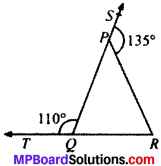
MP Board Class 9th Maths Solutions Chapter 6 Lines and Angles Ex 6.3 img-1
Solution:
Given
∠SPR = 135°
∠PQT = 110°
To find. ∠PRQ
Calculation:
∠Q = 110°
110° + ∠PQR = 180° (LPA’s)
∠1 = 70°
∠P = ∠1 + ∠PRQ
135° = 70° + ∠PRQ
135° – 70° = ∠PRQ
65° = ∠PRQ

Question 2.
In Fig. given below, ∠X = 62°, ∠XYZ = 54°. If YO and ZO are the bisectors of ∠XYZ and ∠XZY respectively of ∠XYZ, find ∠OZY and ∠YOZ.
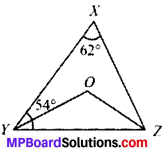
MP Board Class 9th Maths Solutions Chapter 6 Lines and Angles Ex 6.3 img-2
Solution:
Given
∠X = 62°, ∠XYZ = 54°
∠OYZ = \(\frac{1}{2}\)∠XYZ
∠OZY = \(\frac{1}{2}\)∠XZY
To find ∠OZY and ∠YOZ
Calculation:
In ∠XYZ
∠X + ∠Y + ∠Z = 180° (ASP)
62° + 54° + ∠Z = 180°
116° + ∠Z = 180°
∴ ∠Z = 64°
In ∠OYZ
∠OYZ + ∠OZY + ∠O = 180° (ASP)
⇒ \(\frac{1}{2}\)∠XYZ + \(\frac{1}{2}\)∠XZY + ∠O = 180°
32° + 27° + ∠O = 180°
59° + ∠O = 180°
∠O = 121°

Question 3.
In Fig. given below, if AS ∥ DE, ∠BAC = 35° and ∠CDE = 53°, find ∠DCE.
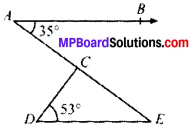
MP Board Class 9th Maths Solutions Chapter 6 Lines and Angles Ex 6.3 img-3
Solution:
Given
AS ∥ DE,
∠BAC = 35°
∠CDE = 53°
To find. ∠DCE
Calculation:
AB ∥ DE and AE is the transversal.
∠BAE = ∠AED = 35°
In ∆DEC
∠D + ∠E + ∠C = 180°
53° + 35° + ∠C = 180°
88° + ∠C = 180°
∠C = 180° – 88° = 92°

MP Board Solutions

Question 4.
In Fig. given below, if lines PQ and RS intersect at point T, such that ∠PRT = 40°, ∠RPT = 95° and ∠TSQ = 75°, find ∠SQT.
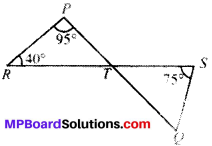
MP Board Class 9th Maths Solutions Chapter 6 Lines and Angles Ex 6.3 img-4
Solution:
Given
∠PRT = 40°
∠RPT = 95°
∠TSQ = 75°
To find. ∠SQT
Calculation:
In ∆PRT
∠P + ∠R + ∠T= 180° (ASP)
95° + 40 ° + ∠T= 180°
∠T = 180° – 135° = 45°
∠T = ∠STQ = 45°
In ∆TSQ
∠STQ + ∠S + ∠Q = 180° (V.O.A’S)
45° + 75° + ∠Q = 180° (ASP)
∠Q = 180° – 120° = 60°

Question 5.
In Fig. given below, if PQ ⊥ PS, PQ ∥ SR, ∠SQR = 28° and ∠QRT = 65°, then find the values of x and y.
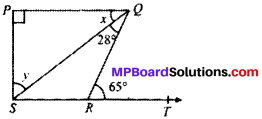
MP Board Class 9th Maths Solutions Chapter 6 Lines and Angles Ex 6.3 img-5
Solution:
Given
PQ ⊥ PS
PQ ∥ SR
∠SQR = 28°
∠QRT = 65°
To find, x and y
Calculation:
PQ ∥ SR and QR is the transversal
x + 28° = 65° (A.I.A’s)
x = 65° – 28° = 37°
In ∆PQS
x + y + 90° = 180° (ASP)
37° + y + 90° = 180°
∴ y = 180° – 127° = 53°

Question 6.
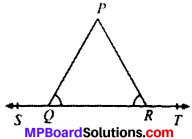
In Fig. given below, the side QR to ∆PQR is produced to a point S. If the bisectors of ∠PQR and ∠PRS meet at point T, then prove that ∠QTR = \(\frac{1}{2}\) ∠QPR.
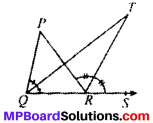
MP Board Class 9th Maths Solutions Chapter 6 Lines and Angles Ex 6.3 img-6
Solution:
Given
∠TQR = \(\frac{1}{2}\)∠PQR
∠TRS = \(\frac{1}{2}\)∠PRS
To prove. ∠QTR = \(\frac{1}{2}\)∠QPR
Proof:
In ∆PQR
∠PRS = ∠P + ∠Q (EAP)
In ∆TQR, ∠TRS = ∠T + ∠TQR (EAP)
\(\frac{1}{2}\)∠PRS = ∠T + \(\frac{1}{2}\)∠PQR
Multiplying both sides by 2
∠PRS = 2∠T+ ∠PQR
From (1) and (2) we get,
∠P + ∠Q = 2∠T + ∠PQR
∠P=2∠T
∠T= \(\frac{1}{2}\)∠P
∠QTR = \(\frac{1}{2}\)∠QPR
Proved.
MP Board Class 9th Maths Solutions

MP Board Class 9th Maths Solutions Chapter 6 Lines and Angles Ex 6.2

MP Board Class 9th Maths Solutions Chapter 6 Lines and Angles Ex 6.2

Question 1.
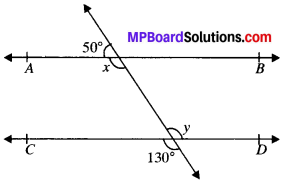
In Fig. given below, find the values of x and y and then showthat AB ∥ CD.
MP Board Class 9th Maths Solutions Chapter 6 Lines and Angles Ex 6.2 img-1
Solution:
∠y = 130° (VOA’s)
x + 50° = 180° (LPA’)
∴ x = 180° – 50° = 130°
∠x and ∠y are alternate interior angles and are equal AB ∥ CD

Question 2.
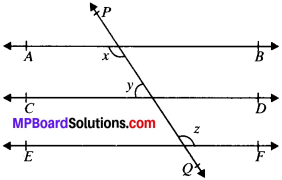
In Fig. given below, if AB ∥ CD, CD ∥ EF and y : z = 3 : 7, find x.
MP Board Class 9th Maths Solutions Chapter 6 Lines and Angles Ex 6.2 img-2
Solution:
Given
AB ∥ CD
CD ∥ EF
y : z = 3 : 7
∴ y = 3k
and z = 7k
To find, x
Solution:
AB ∥ EF and PQ is the transversal
x = z (A. I.A’s)
AB ∥ CD and PQ is the transversal
∴ x + y = 180° (C.I.A.’s)
z + y = 180° (∴ x = z)
7k + 3k = 180°
∴ k = 18°
y = 3 x 18° = 54°
2 = 7 x 18° = 126°
x = z = 126°

Question 3.
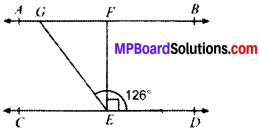
In Fig. given below, if AS ∥ CD, EF ⊥ CD and ∠GED = 126°, find ∠AGE, ∠GEF and ∠FGE.
MP Board Class 9th Maths Solutions Chapter 6 Lines and Angles Ex 6.2 img-3
Solution:
Given
AB ∥ CD
EF ⊥ CD
To find
∠AGE, ∠GEF, ∠FGE
AB ∥ CD and GE is the transversal
∴ ∠AGE = ∠GED = 126°
∠AGE + ∠FGE = 180°
126° + ∠FGE = 180°
∠FGE = 54°
∠GED = ∠GEF + ∠FED
126° = ∠GEF + 90°
126° – 90° = ∠GEF
∠GEF = 36°

MP Board Solutions

Question 4.
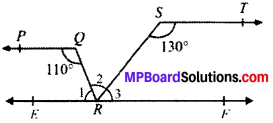
In Fig. given below, if PQ ∥ ST, ∠PQR = 110° and ∠RST = 130°, find ∠QRS.
MP Board Class 9th Maths Solutions Chapter 6 Lines and Angles Ex 6.2 img-4
Solution:
Given
PQ ∥ ST
∠PQR = 110°; ∠TSR = 130°
To find
∠QRS Construction.
Draw a line EF ∥ PQ passing through point R.
Calculation. PQ ∥ EF (by construction)
PQ ∥ ST (Given)
EF ∥ ST (lines ∥ to the same line are parallel to each other)
PQ ∥ EF and QR is the transversal
110° + ∠1 = 180° (CIA’s)
∴ ∠1 = 70°
ST ∥ EF and SR is the transversal
130° + ∠3 = 180° (CIA’s)
∠3 = 50°
∠1 + ∠2 + ∠3 = 180° (angles on the same line)
70° + ∠2 + 50° = 180°
∠2 = 180° – 120°
∴ ∠QRS = 60°

Question 5.
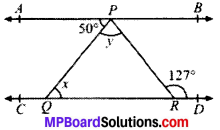
In Fig. given below, if AB ∥ CD, ∠APQ = 50° and ∠PRD = 127°, find x and y.
MP Board Class 9th Maths Solutions Chapter 6 Lines and Angles Ex 6.2 img-5
Given
AB ∥ CD
∠APQ = 50°; ∠PRD = 127°
To find, x and y
Calculation:
AB ∥ CD and PQ is the transversal
∠APQ = x = 50° (AIA’s)
y + 50° = 127°
∴ y = 77°

Question 6.
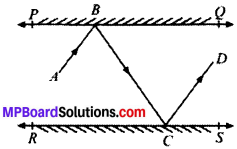
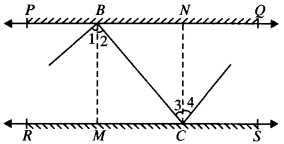
In Fig. given below, PQ and RS are two mirrors placed parallel to each other. An incident ray AB strikes the mirror PQ at B, the reflected ray moves along the path BC and strikes the mirror RS at C and again reflects back along CD. Prove that AB ∥ CD.
MP Board Class 9th Maths Solutions Chapter 6 Lines and Angles Ex 6.2 img-6
Solution:
Given
PQ ∥ RS
To prove:
AB ∥ CD
Construction:
Draw MB and NC normals at point B and C respectively.
Proof:
∠1 = ∠2
(Angle of incident = Angle of reflection)
and ∠3 = ∠4
∠ABC = 2∠2 and ∠BCD = 2∠3
MP Board Class 9th Maths Solutions Chapter 6 Lines and Angles Ex 6.2 img-7
MB ⊥ PQ and NC ⊥ RS
MB ∥ CN (Lines perpendicular to two parallel lines are parallel to each other)
MB ∥ CN and BC is the transversal
∠2 = ∠3 (AIA’s)
⇒ 2∠2 = 2∠3
(on multiplying both sides by 2)
⇒ ∠ABC = ∠BCD
∠ABC and ∠BCD are alternate interior angles and are equal AB ∥ CD

MP Board Solutions

Angle Sum Property of a Triangle:

1. Triangle:
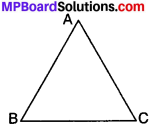
A plane figure bounded by three line segments in a plane is called a triangle. A triangle has six parts –

  • Three sides – AB, BC and AC
  • Three angles – ∠A, ∠B and ∠C

MP Board Class 9th Maths Solutions Chapter 6 Lines and Angles Ex 6.2 img-8
2. Median:
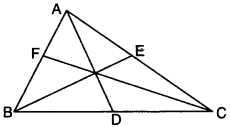
The median of a ∆ corresponding to a particular side is the line segment joining the midpoint of that side to its opposite vertex. In Fig., D, E and F are the midpoints of sides BC, AC and AB respectively. AD, BE and CF are the medians.
MP Board Class 9th Maths Solutions Chapter 6 Lines and Angles Ex 6.2 img-9
3. Incentre of a triangle:
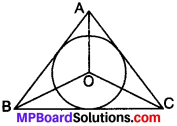
The incentre of a ∆ is the point of intersection of angle bisectors of the triangle. In Fig., OA, OB and OC are the angle bisectors of ∠A, ∠B and ∠C respectively. These angle bisectors intersect at point O. Therefore, point O is the incentre of ∆ABC.
MP Board Class 9th Maths Solutions Chapter 6 Lines and Angles Ex 6.2 img-10
4. Circumcenter of a triangle:
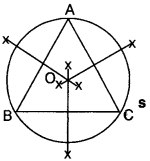
The circumcenter of a triangle is the point of intersection of the perpendicular bisectors of the sides of the triangle. In Fig., O is the circumcenter of ∆ABC where the perpendicular bisectors of AB, BC and AC intersect.
MP Board Class 9th Maths Solutions Chapter 6 Lines and Angles Ex 6.2 img-11

Theorem 1.
The sum of the angles of a triangle is 180°.
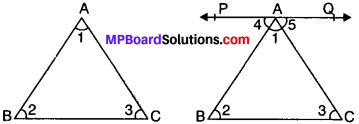
Given
ABC is a ∆ in which ∠1, ∠2 and ∠3 are angles.
To prove:
∠1 + ∠2 + ∠3 = 180°
MP Board Class 9th Maths Solutions Chapter 6 Lines and Angles Ex 6.2 img-12
Construction:
Draw a line PQ passing through point A parallel to BC.
Proof:
PQ is a line.
∠4 + ∠1 + ∠5 = 180° (angles on the same line) …..(i)
PQ ∥ BC and AB is the transversal
∴ ∠4 = ∠2 (AIA’s) …..(ii)
PQ ∥ BC and AC is the transversal
∴ ∠5 = ∠3 (AIA’s) …..(iii)
Putting ∠4 = ∠2 and ∠5 = ∠3 in (i), we get
∠2 + ∠1 + ∠3 = 180°
∴ ∠1 + ∠2 + ∠3 = 180°. Proved

MP Board Solutions

Exterior Angle Property:

Theorem 2.
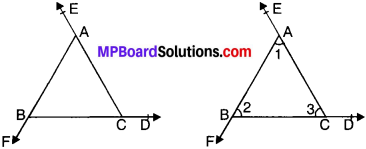
If a side of a triangle is produced, then the exterior angle so formed is equal to the sum of the two opposite interior angles. This is also known as exterior angle property (EAP).
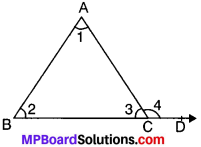
Given
ABC is a ∆ in which side BC is produced to point D.
To prove. ∠4 = ∠1 + ∠2
MP Board Class 9th Maths Solutions Chapter 6 Lines and Angles Ex 6.2 img-13
Proof:
In ∆ABC,
∠1 + ∠2 + ∠3 = 180° (ASP)
∠3 + ∠4 = 180° (LPA)
From (i) and (ii), we get
∠1 + ∠2 + ∠3 = ∠3,+ ∠4
∠1 + ∠2 = ∠4. Proved

Corollary

Theorem 3.
An exterior angle of a triangle is greater than either of the opposite interior angles.
MP Board Class 9th Maths Solutions Chapter 6 Lines and Angles Ex 6.2 img-14
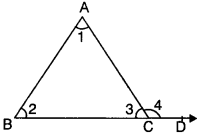
Given
In ∆ABC
∠4 = ∠1 + ∠2 (EAP)
∠4 > ∠1 and ∠4 > ∠2
Hence an exterior angle of A is greater than either of the opposite interior angle.

Lines And Angles:

Example 1.
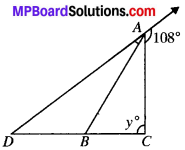
In the Fig., AB divides ∠DAC in the ratio 1 : 3 and AB = DB. Find the value of y.
Solution:
Let ∠DAB = x and ∠BAC = 3x
In ∆ABD
AB = BD
∠ADB = ∠DAB = x
(∴ In a ∆ angles opposite to equal sides are equal)
∠ABC = x + x = 2x
(In a ∆ Exterior angle is equal to sum of two opp. interior angles) In ∆ABC
2x + 3x + y = 180° (ASP)
5x + y = 180° …..(i)
In ∆ADC
x + y = 180° (ASP)
y = 180° – X …..(ii)
MP Board Class 9th Maths Solutions Chapter 6 Lines and Angles Ex 6.2 img-15
Putting y = 180° – x in (i), we get
5x + 108° – x = 180°
4x + 108° = 180°
4x = 180° – 108°
= 72°
∴ x = \(\frac{72}{4}\) = 18°
Putting x = 18° in (ii), we get
y = 108° – 18° = 90°.

Example 2.
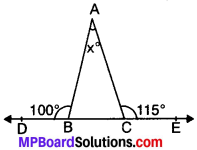
In the Fig., given below, find the value of x.
Solution:
Given
∠ABD = 100°
∠ACE = 115°
MP Board Class 9th Maths Solutions Chapter 6 Lines and Angles Ex 6.2 img-16
To find. x°
∠ABC + ∠ABD = 180° (LPA’s)
∠ABC + 100° = 180°
∠ABC = 180° – 100° = 80°
∠ACB + ∠ACE = 180°
∠ACB + 115° = 180°
∠ACB = 180° – 115° = 65°
Now, ∠A + ∠ABC + ∠ACE = 180° (ASP)
⇒ x° + 80° + 65° = 180°
⇒ x° + 145° = 180°
x° = 180° – 145° = 35°

MP Board Solutions

Example 3.
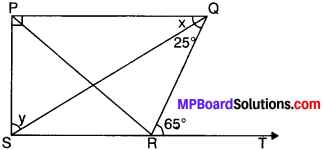
In Fig., PQ ⊥ PS, PQ ∥ SR, ∠SQR = 25° and ∠QRT = 65°.
Solution:
Given
∠SQR = 25°
∠QRT = 65°
MP Board Class 9th Maths Solutions Chapter 6 Lines and Angles Ex 6.2 img-17
To find x and y
In ∆SQR
∠QRT = ∠SQR + ∠QSR (FAP)
⇒ 65° = 25° + ∠QSR
⇒ 65° – 25° = ∠QSR
∠QSR = 40°
PQ ∥ SR and SQ is the transversal.
∴ ∠PQS = ∠QSR (AIA’s)
∴ x = 40°

Example 4.
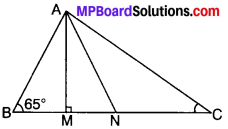
In Fig., AM ⊥ L BC and AN is the bisector of ∠A. Find the measure of ∠MAN.
MP Board Class 9th Maths Solutions Chapter 6 Lines and Angles Ex 6.2 img-18
Solution:
In ∆AMB
∠ABM + ∠AMB + ∠MAB = 180°
65° + 90° + ∠MAB = 180°
155° + ∠MAB = 180°
∠MAB = 180° – 155° = 25°
In ∆BAC
∠A + ∠B + ∠C = 180° (ASP)
∠A + 65° + 30° = 180°
∠A + 95° = 180°
∠A = 180° – 95° = 85°
∠MAN = ∠BAN – ∠MAB
= \(\frac{1}{2}\) ∠A – 25°
= \(\frac{85^{\circ}}{2}\) – 25 = \(\frac{85^{\circ}-50^{\circ}}{2}\)
∠MAN = \(\frac{35^{\circ}}{2}\) = 17.5°

Example 5.
If the sides of a triangle are produced in order, prove that sum of the exterior angles so formed is equal to four right angles.
Solution:
MP Board Class 9th Maths Solutions Chapter 6 Lines and Angles Ex 6.2 img-19
∠EAB = ∠2 + ∠3 (EAP) …..(i)
∠FBC = ∠1 + ∠3 (EAP) …..(ii)
∠ACD = ∠1 + ∠2 (EAP) …(iii)
Adding (i), (ii) and (iii), we get
∠EAB + ∠FBC + ∠ACD = ∠2 + ∠3 + ∠1 + ∠3 + ∠1 + ∠2
= 2(∠1 + ∠2 + ∠3) = 2 x 180° = 360°. Proved

Example 6.
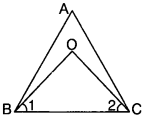
Bisectors of angles B and C of a triangle ABC intersect each other at the point O. Prove that ∠BOC = 90° + \(\frac{1}{2}\) ∠A.
MP Board Class 9th Maths Solutions Chapter 6 Lines and Angles Ex 6.2 img-20
Solution:
Given
∠1 = \(\frac{1}{2}\) ∠ABC
⇒ ∠ABC = 2∠1
∠2 = \(\frac{1}{2}\) ∠ACB
⇒ ∠ACB = 2∠2
To prove:
∠BOC = 90° + \(\frac{1}{2}\) ∠A
Proof:
In ∆BOC ∠O + ∠1 + ∠2 = 180°
∠1 + ∠2 = 180° – ∠O …..(i)
In ∆ABC
∠A + ∠ABC + ∠ACB = 180°
∠A + 2∠1 + 2∠2 = 180°
2∠1 + 2∠2 = 180° – ∠A
2(∠1 + ∠2) = 180° – ∠A
∠1 + ∠2 = \(\frac{180^{\circ}-\angle A}{2}\) = 90° – \(\frac{\angle A}{2}\) …..(ii)
From (i) and (ii) we get
180° – ∠O = 90° – \(\frac{\angle A}{2}\)
180° – 90° + \(\frac{\angle A}{2}\) = ∠O
90° + \(\frac{\angle A}{2}\) = ∠O
∴ ∠BOC = 90° + \(\frac{\angle A}{2}\)

MP Board Solutions

Example 7.
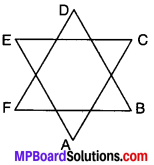
In Fig. show that ∠A + ∠B + ∠C + ∠D + ∠E + ∠F = 360°
Solution:
In ∆ACE
∠A + ∠C + ∠E = 180° (ASP) …..(i)
MP Board Class 9th Maths Solutions Chapter 6 Lines and Angles Ex 6.2 img-21
In ABDF
∠B + ∠D + ∠F = 180° (ASP) …..(ii)
Adding (i) and (ii), we get
∠A + ∠C + ∠E + ∠B + ∠D + ∠F = 180° + 180°
∠A + ∠B + ∠C + ∠D + ∠E + ∠F = 360°

Example 8.
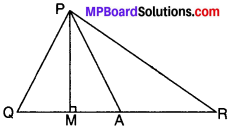
In Fig., ∠Q > ∠R, PA is the bisector of ∠QPR and PM ⊥ QR. Prove that ∠APM = \(\frac{1}{2}\) (∠Q – ∠R)
MP Board Class 9th Maths Solutions Chapter 6 Lines and Angles Ex 6.2 img-22
Solution:
Given
∠Q > ∠R
∠QPA = ∠RPA
PM ⊥ QR
To prove:
∠APM = \(\frac{1}{2}\) (∠Q – ∠R)
Proof:
In ∆PMQ
∠Q + ∠QPM + ∠M= 180° (ASP)
∠Q + ∠QPA – ∠APM + 90° = 180°
(∴ ∠QPM = ∠QPA – ∠APM)
∠Q + ∠QPA – ∠APM = 180° – 90°
∠Q + ∠QPA – ∠APM = 90°
∠Q + ∠QPA – ∠APM = 90° …..(i)
In ∆PMR
∠R + ∠RPM + ∠PMR = 180°
∠R + ∠RPA + ∠APM + 90° = 180°
(∴ ∠RPM = ∠RPA + ∠APM)
∠R + ∠QPA + ∠APM = 180° – 90°
(∴ ∠RPA = ∠QPA)
∠R + ∠QPA + ∠APM = 90° …..(ii)
From (i) and (ii), we get
∠Q + ∠QPA – ∠APM = ∠R + ∠QPA + ∠APM
∠Q – ∠R = ∠APM – ∠QPA + ∠QPA + ∠APM
∠Q – ∠R = 2∠APM
∠APM = \(\frac{1}{2}\) (∠Q – ∠R) Proved

Example 9.
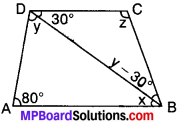
In fig., AB ∥ DC, ∠BDC = 30° and ∠BAD = 80°, find x, y and z.
Solution:
AB ∥ DC and BD is the transversal.
x = 30° (AIA’s)
MP Board Class 9th Maths Solutions Chapter 6 Lines and Angles Ex 6.2 img-23
In ∆ABD
x + y + 80° = 180° (ASP)
30° + y + 80° = 180°
110° + y = 180°
∴ y = 180° – 110° = 70°
y – 30° = 70 – 30° = 40°
In ∆BCD
30° + 40° + z = 180° (ASP)
[∴ y – 30° = 40°]
70° + z = 180°
∴ z = 180° – 70° = 110°

MP Board Class 9th Maths Solutions

MP Board Class 9th Science Solutions Chapter 5 The Fundamental Unit of Life

MP Board Class 9th Science Solutions Chapter 5 The Fundamental Unit of Life

The Fundamental Unit of Life Intext Questions

The Fundamental Unit of Life Intext Questions Page No. 59

Question 1.
Who discovered cells and how?
Answer:
Robert Hooke (1665), by chance observed a slice of cork through a self designed microscope. He observed that it contained many little compartments, like a honey comb, which he named as cells. However, Leeuwenhoek (1674) discovered the free living cells in pond water for the first time, by his improved microscope.

MP Board Solutions

Question 2.
Why is the cell called the structural and functional unit of life?
Answer:
The body of all organisms consists of one or many cells. Therefore, cell is called the structural unit of life. All processes associated with life such as respiration, digestion, excretion etc. are performed by cell. So, cell is also called as functional unit of life.

The Fundamental Unit of Life Intext Questions Page No. 61

Question 1.
How do substances like CO2 and water move in and out of the cell? Discuss.
Answer:
When concentration of CO2 is more inside the cell than outside, CO2 diffuses from the cell to outside of cell. If CO2 concentration inside the cell is less, CO2 moves inside the cell from outside. The water move in and out of the cell by the process of osmosis. Osmosis is the passage of water from a region of high water concentration through semi – permeable membrane (cell membrane) to a region of low concentration of water.

Question 2.
Why is the plasma membrane called a selectively permeable membrane?
Answer:
Plasma membrane permits the entry and exit of some materials in and out of the cell. It also prevents movement of some other materials. So, it is called selectively permeable membrane.

The Fundamental Unit of Life Intext Questions Page No. 63

Question 1.
Fill in the gaps in the following table illustrating differences between prokaryotic and eukaryotic cells.

Prokaryotic CellEukaryotic Ceil
1. Size: Generally, small (1 – 10 μm). (1 μm = 10-6m).1. Size: Generally, large (5 – 100 μm).
2. Nuclear region: ………………
……………………………………………..
…………………… and known as …………. .
2. Nuclear region: Well – defined and surrounded by a nuclear membrane.
3. Chromosome: Single.3. More than one chromosome.
4. Membrane – bound cell organelles absent.4. ………………………………………….. .

Answer:
Prokaryotic cell:
2. Nuclear region is poorly defined due to absence of a nuclear membrane and is known as nucleoid.

Eukaryotic cell:
4. Membrane bound cell organelles are present.

The Fundamental Unit of Life Intext Questions Page No. 65

Question 1.
Can you name the two organelles we have studied that contain their own genetic material?
Answer:

  1. Mitochondria and
  2. Plastid (chloroplast).

Question 2.
If the organisation of a cell is destroyed due to some physical or chemical influence, what will happen?
Answer:
Each cell has got certain specific cell organelles. Each cell organelle performs a special function.
e.g.,

  • making of new material, removal of waste from the cell, release of energy etc. If the organization of a cell is destroyed, the functioning of the cell organelles will be disturbed, control of the nucleus will be lost. Ultimately, cell will die.

Question 3.
Why are lysosomes known as suicide bags?
Answer:
Lysosome is a membrane bound bag – like cell organelle which contains powerful enzymes. If lysosome bursts, its enzymes eat up (digest) other organelles of its own cell. Therefore, they are known as ‘suicide bags’.

MP Board Solutions

Question 4.
Where are proteins synthesised inside the cell?
Answer:
Ribosomes.

The Fundamental Unit of Life NCERT Textbook Exercises

Question 1.
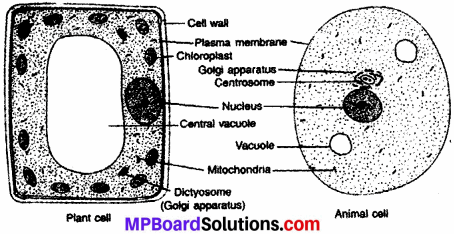
Make a comparison and write down ways in which plant cells are different from animal cells?
Answer:
Difference between plant cell and animal cell is given below:
MP Board Class 9th Science Solutions Chapter 5 The Fundamental Unit of Life 1

Plant CellAnimal Cell
1. The outermost covering of the plant cell is the cell wall which is formed of cellulose.1. The outermost covering is the plasma membrane.
2. Plastids (e.g., chloroplast) present.2. Plastids absent.
3. Large vacuole present.3. No or small vacuoles are present.
4.  Centrioles are absent but plastids caps are present.4. Centrioles are present within centrosome.

Question 2.
How is a prokaryotic cell different from a eukaryotic cell?
Answer:

Prokaryotic CellEukaryotic Cell
1. Cell size is generally small. (1 – 10 mm).1. Cell is generally large. (5 – 100 mm).
2. Nuclear region is called nucleoid is not surrounded by a nuclear membrane.2. Nuclear material is surrounded by a nuclear membrane.
3. Only a single chromosome is present.3. More than one chromosome are present.
4. Nucleolus is absent.4. Nucleolus is present.
5. Membrane bound cell organelles are absent.5. Cell organelles bounded by membrane are present.
6. Cell division by fission or budding (no mitosis).6. Cell division mitotic or meiotic.

Question 3.
What would happen if the plasma membrane ruptures or breaks down?
Answer:
Plasma membrane regulates the movement of substances in and out of the cell. Due to rupture of plasma membrane, there will be no regulation of the movement of molecules. Secondly, contents of the cell may leak out. Because of these two reasons cell will die.

MP Board Solutions

Question 4.
What would happen to the life of a cell if there was no Golgi apparatus?
Answer:
Golgi apparatus is connected to ER. It collects simpler molecules from ER and convert them into more complex molecules. These are then packaged in small vesicles and are stored or transported inside or outside the cell. If Golgi apparatus is not present in the cell, all the above processes of modification, storage and tRansportation will not be possible.

Golgi apparatus is also involved in the formation of lysosomes. If there was no Golgi apparatus in the cell, lysosomes would not be formed and hence, foreign materials like bacteria could easily invade and destroy the cell.

Question 5.
Which organelle is known as the powerhouse of the cell? Why?
Answer:
Mitochondria are known as ‘Power House’ of the cell. They are said so because, the energy required for various life activities is released by mitochondria in the form of ATP molecules. The body uses energy stored in ATP for synthesis of new compounds and for mechanical work. As ATP instantly provide energy, they are called energy currency of the cell.

Question 6.
Where do the lipids and proteins constituting the cell membrane get synthesised?
Answer:

  1. Rough Endoplasmic Reticulum (RER) synthesizes proteins constituting cell membrane.
  2. Smooth Endoplasmic Reticulum (SER) synthesizes and secretes lipids constituting cell membrane.

Question 7.
How does an Amoeba obtain its food?
Answer:
Amoeba has flexible cell membrane. It enables Amoeba to engulf in food by the process called endocytosis.

Question 8.
What is osmosis?
Answer:
The passage of water from a region of its high concentration through a semipermeable membrane to a region of low water concentration is known as osmosis.

Question 9.
Carry out the following osmosis experiment:
Take four peeled potato halves and scoop each one out to make potato cups. One of these potato cups should be made from a boiled potato. Put each potato cup in a trough containing water. Now,
(a) Keep cup A empty.
(b) Put one teaspoon sugar in cup B.
(c) Put one teaspoon salt in cup C.
(d) Put one teaspoon sugar in the boiled potato cup D.

Keep these for two hours. Then observe the four potato cups and answer the following:

  1. Explain why water gathers in the hollowed portion of B and C?
  2. Why is potato A necessary for this experiment ?
  3. Explain why water does not gather in the hollowed out portions of A and D.

Answer:

  1. Water gathers in the hollowed portion of B and C because:
    • Living plasma membrane of potato cells act as semipermeable membrane.
    • There is higher concentration of water in trough than the hollowed portion of B and C.
    • So, water by the process of osmosis moves into hollowed portion of potato cups B and C.
  2. Potato cup A is kept empty to act as control set – up.
    • As the potato cup A, is empty, water does not gather in hollowed out portions of A.
    • In the potato cup D, the potato cell membrane lost quality of semi – permeability due to boiling. So, no water movement occurs from the trough into the potato cup D.

The Fundamental Unit of Life Additional Questions

The Fundamental Unit of Life Multiple Choice Questions

Question 1.
Who coined the term protoplasm for the fluid substance of the cell?
(a) J.E. Purkinje
(b) Robert Brown
(c) W. Flemming
(d) Robert Hooke.
Answer:
(a) J.E. Purkinje

Question 2.
Ribosomes are the centre for __________.
(a) Fat synthesis
(b) Protein synthesis
(c) Starch synthesis
(d) Sugar synthesis.
Answer:
(b) Protein synthesis

Question 3.
The complete break down of glucose in presence of oxygen in a cell takes place in __________.
(a) Mitochondria
(b) Ribosome
(c) Chloroplast
(d) None of these.
Answer:
(a) Mitochondria

Question 4.
Lysosomes contains __________.
(a) Fats
(b) Secretory glycoproteins
(c) Hydrolytic enzymes
(d) RNA.
Answer:
(c) Hydrolytic enzymes

MP Board Solutions

Question 5.
Plant cells have large vacuoles each surrounded by a membrane known as __________.
(a) Plasma membrane
(b) Cell wall
(c) Leucoplast
(d) Tonoplast.
Answer:
(d) Tonoplast

Question 6.
The process of selective movement of substances through semi – permeable membrane is called?
(a) Osmosis
(b) Diffusion
(c) Plasmolysis
(d) Imbibition.
Answer:
(a) Osmosis

Question 7.
What makes to withstand greater changes in the surrounding medium in animal cell?
(a) Plasma membrane
(b) Cell wall
(c) Vacuoles
(d) Plastids.
Answer:
(b) Cell wall

Question 8.
When an animal cell is placed in hypotonic solution, it __________.
(a) Swells up
(b) Shows plasmolysis
(c) Bursts due to over swelling
(d) Shows crenation.
Answer:
(c) Bursts due to over swelling

Question 9.
Which of the following maintains the basic structure (shape) of the plant cell after shrinkage of the cell content during plasmolysis?
(a) Plasma membrane
(b) Vacuole
(c) Plastids
(d) Mitochondria.
Answer:
(d) Mitochondria.

Question 10.
Plasmolysis occurs due to __________.
(a) Endosmosis
(b) Exosmosis
(c) Absorption
(d) None of these.
Answer:
(b) Exosmosis

Question 11.
Who among the following scientists coined the term ‘cell’?
(a) Leeuwenhoek
(b) J.E. Purkinje
(c) Robert Hooke
(d) Robert Brown.
Answer:
(c) Robert Hooke

Question 12.
Which is the largest cell in human body?
(a) Muscle cell
(b) Nerve cell
(c) Kidney cell
(d) Liver cell.
Answer:
(b) Nerve cell

Question 13.
Iodine solution is used to __________.
(a) Stain onion peel cells
(b) Stain human cheek cells
(c) Mount onion peel cells
(d) Mount human cheek cells.
Answer:
(a) Stain onion peel cells

Question 14.
The barrier between the cytoplasm and the outer environment in an animal cell is __________.
(a) Tonoplast
(b) Nuclear membrane
(c) Cell wall
(d) Plasma membrane.
Answer:
(d) Plasma membrane.

Question 15.
The power house of a cell is known as __________.
(a) Golgi apparatus
(b) Chloroplast
(c) Mitochondrion
(d) Vacuole.
Answer:
(c) Mitochondrion

Question 16.
Which of the following organelles possesses its own DNA and Ribosomes?
(a) Mitochondria
(b) Lysosomes
(c) Golgi apparatus
(d) Endoplasmic reticulum.
Answer:
(a) Mitochondria

MP Board Solutions

Question 17.
The functions of which of die organelle include the storage, modification and packaging of products in vesicles:
(a) Lysosome
(b) Vacuoles
(c) Golgi apparatus
(d) SER.
Answer:
(c) Golgi apparatus

Question 18.
Which organelles, like mitochondria, have their own DNA and ribosomes?
(a) Golgi apparatus
(b) Vacuoles
(c) Endoplasmic reticulum
(d) Plastids.
Answer:
(d) Plastids.

Question 19.
Mitochondria and plastids are able to synthesis some of their own proteins because they have?
(a) DNA and nucleolus
(b) RNA and lysosomes
(c) DNA and ribosomes
(d) RNA and ribosomes.
Answer:
(c) DNA and ribosomes

Question 20.
Stroma is present in __________.
(a) Mitochondria
(b) Leucoplast
(c) Endoplasmic reticulum
(d) Lysosomes.
Answer:
(b) Leucoplast

Question 21.
Which of the following cell organelle is called suicide bag of a cell?
(a) Mitochondria
(b) Lysosome
(c) Plastids
(d) Golgi apparatus.
Answer:
(b) Lysosome

Question 22.
Which of the following molecules is known as the energy currency of the cell?
(a) RNA
(b) DNA
(c) ATP
(d) Aminoacid.
Answer:
(c) ATP

Question 23.
ATP stands for __________.
(a) Adenosine triphosphate
(b) Amino triphosphate
(c) Amino triglycerophosphate
(d) Adeninetri – phosphoglyceride.
Answer:
(a) Adenosine triphosphate

Question 24.
Which cell organelle is involved in the formation of lysosomes?
(a) Mitochondria
(b) Golgi apparatus
(c) Plastids
(d) Endoplasmic reticulum.
Answer:
(d) Endoplasmic reticulum.

MP Board Solutions

Question 25.
Which cell organelle plays a crucial role in detoxifying many poisons and drugs?
(a) RER
(b) SER
(c) RNA
(d) DNA.
Answer:
(b) SER

The Fundamental Unit of Life Very Short Answer Type Questions

Question 1.
Which is the longest flowering plant cell?
Answer:
The fibre.

Question 2.
Which is the longest animal cell?
Answer:
The nerve cell.

Question 3.
Name any two single celled animals.
Answer:
Amoeba, paramoecium and euglena etc.

Question 4.
Which is the largest animal cell?
Answer:
An ostrich egg.

Question 5.
Which is the smallest animal cell?
Answer:
Pleuro Pneumonia like organisms (PPLO).

Question 6.
What are cell organelles?
Answer:
The functional units of cell.

Question 7.
Name the process involved in the movement of O2 in and out of the cell.
Answer:
Diffusion.

Question 8.
Which is the outer most covering of the plant cell?
Answer:
Cell wall.

MP Board Solutions

Question 9.
Name is the outer most covering of an animal cell.
Answer:
Plasma membrane.

Question 10.
Which is the largest plant cell?
Answer:
Acetabalaria.

Question 11.
Is plasma membrane living or dead?
Answer:
Living.

Question 12.
Name the process involved in the movement of water from outside into the cell.
Answer:
Osmosis.

Question 13.
By which process CO2 and water (H2O) move in and out of the cell?
Answer:
CO2 by diffusion and water (H2O) by osmosis.

Question 14.
Is cell wall living or dead?
Answer:
Dead.

Question 15.
Name the control centre of the cell.
Answer:
Nucleus is the control centre of the cell.

Question 16.
What is the function of ribosomes?
Answer:
Ribosomes are involved in protein synthesis.

Question 17.
Name the site of photosynthesis.
Answer:
Chloroplast.

Question 18.
Which organelles are called

  1. powerhouse of cell
  2. suicide bags
  3. Kitchen of the cell?

Answer:

  1. Mitochondria
  2. Lysosome and
  3. Chloroplasts.

Question 19.
Which organelle makes endoplasmic reticulum rough?
Answer:
Ribosomes.

Question 20.
Name the scientists who formed primitive microscope in the 17th century.
Answer:
Robert Hooke (1665) formed primitive microscope.

Question 21.
Name the plastid which stores starch, oils and protein granules.
Answer:
Leucoplast.

Question 22.
Name the main substance which nucleolus consists of.
Answer:
Nucleolus, found in nucleus, mainly consists of RNA (Ribonucleic acids).

Question 23.
What are genes?
Answer:
Genes are segments of DNA present linearly on chromosomes. They are the functional units of chromosomes.

MP Board Solutions

Question 24.
What is cytoplasm?
Answer:
The cytoplasm is the fluid content inside the plasma membrane. It contains many specialised cell organelles.

Question 25.
Where are centrioles found?
Answer:
Centrioles are found in centrosome of an animal cell only.

The Fundamental Unit of Life Short Answer Type Questions

Question 1.
Define diffusion.
Answer:
The spontaneous movement of a substance from a region of its high concentration to Che region where its concentration is low, is called diffusion.

Question 2.
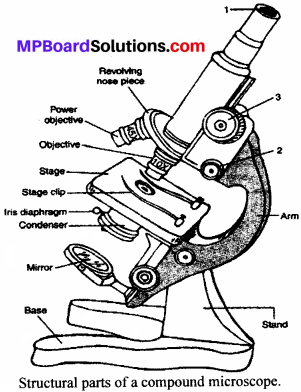
Observe the following diagram and answer the questions given below:
MP Board Class 9th Science Solutions Chapter 5 The Fundamental Unit of Life 2

  1. What is the name of this instrument?
  2. What are the names of the parts marked as 1, 2 and 3 ?
  3. There are two objectives, one is marked as 45X and second one as 10X. Under which objective you would first view the onion peel cells ?

Answer:

  1. Compound microscope.
    • Eye piece
    • Fine adjustment screw
    • Coarse adjustment screw.
  2. Under 10X objective (low power objective).

Question 3.
What is the function of cell wall and plasma membrane?
Answer:

  1. Cell wall: Gives rigidity, shape and protection to plant cell.
  2. Cell membrane: Allows only selected materials to move in and out of the cell.

Question 4.
Define osmosis.
Answer:
The passage of water from a region of higher concentration to a region of lower concentration through a semipermeable membrane is called osmosis.

Question 5.
What is chromatin material?
Answer:
Inside the nucleus a tangled mass of thread – like structure is present which is called chromatin material. It mainly consists of DNA (deoxyribonucleic acid) and protein.

Question 6.
What is the function of centrosome? Name the structure found in plant cell to do the same function.
Answer:
Centrosome helps in cell division in animal cells. The polar caps perform the same function in a plant cell.

MP Board Solutions

Question 7.
What is the function of Mitochondria?
Answer:
In mitochondria, digested food is broken down to release energy. This released energy is stored in the form of ATP.

Question 8.
What is plasmolysis?
Answer:
When a living plant cell loses water through osmosis, there is shrinkage or contraction of the protoplasm away from the cell wall. This phenomenon is called plasmolysis.

Question 9.
What is endocytosis? Give one example.
Answer:
The process in which a cell due to flexible cell membrane engulfs in food and other material from its external environment is known as endocytosis. Amoeba acquires its food through this process.

Question 10.
Who discovered cells in living organisms? Give an example of unicellular organism.
Answer:
Leeuwenhoek (1674) observed free living cells in pond water for the first time. Example of unicellular organisms: Amoeba, chlamydomonas, paramoecium, bacteria etc.

Question 11.
What is the location and main component of cell wall?
Answer:
Cell wall is a rigid structure found outside the plasma membrane of the plant cells. Cellulose (a fibrous polysaccharide) is the main constituent of the cell wall.

Question 12.
What are chromosomes?
Answer:
Chromosomes are rod – shaped structures found in the nucleus of the cell. Chromosome contain information for inheritance of features from parents to next generation in the form of DNA molecule.

Question 13.
What is a eukaryotic cell?
Answer:
A cell that has a definite nucleus with nuclear membrane and also contains membrane bound organelles in its cytoplasm is called eukaryotic cell.

Question 14.
What is nucleoid?
Answer:
In prokaryotes, due to absence of nuclear membrane, nuclear region of the cell is poorly defined. This kind of undefined nuclear region containing only nucleic acid is called a nucleoid.

Question 15.
Give two examples of prokaryotic organisms.
Answer:
Bacteria and cyanobacteria (blue green algae)
e.g.,

  • Nostoc are prokaryotic unicellular organisms.

Question 16.
What is a prokaryotic cell?
Answer:
A cell which lacks nuclear membrane, contains a single chromosome and also lacks membrane bound organelles is called prokaryotic cell.

Question 17.
What is cytoplasm?
Answer:
The part of protoplasm which remains after excluding nucleus, is known as cytoplasm. Cytoplasm contains an aggregate molecules of various chemicals and cell organelles. Most of the biochemical reactions such as protein synthesis, release of energy etc. take place in cytoplasm or organelles present in the cytoplasm.

Question 18.
Write three main points of cell theory as expressed by Schleiden, Schwann and Virchow.
Answer:
Cell Theory: Schleiden and Schwann proposed that:

  1. all the plants and animals are composed of cells and that
  2. the cell is the basic unit of life. Later on, Virchow added that
  3. all cells arise from pre – existing cells.

Question 19.
List four major functions of a cell.
Answer:
Functions of Cell:

  1. Synthesis of substances.
  2. Digestion (lysis) of substances.
  3. Generation of energy for vital functions.
  4. Secretion.

Question 20.
What is the function of an endoplasmic reticulum?
Answer:
Endoplasmic reticulum helps in the transport of substances between various regions of the cytoplasm or between the cytoplasm and the nucleus. Endoplasmic reticulum also functions as a cytoplasmic framework providing a surface for some of the biochemical activities of the cell. In vertebrates, SER present in the liver cells also plays an important role in detoxifying poisons and drugs.

MP Board Solutions

Question 21.
What is lacking in a virus which makes it dependent on a living cell to multiply?
Answer:
Viruses lack selectively .permeable plasma membrane and cell organelles. Thus, they lack a basic structural organisation to perform various life processes effectively and in their own way. After entering a living cell, a virus utilises its own genetic material and machinery of host cell to multiply.

Question 22.
Write one function of each:

  1. rough endoplasmic reticulum and
  2. smooth endoplasmic reticulum.

Answer:

  1. Rough endoplasmic reticulum (RER) has ribosomes on its surface for synthesizing proteins.
  2. Smooth endoplasmic reticulum (SER (without ribosomes) secrete lipids or fats. Some of the proteins and lipids help in building cell membranes.

Question 23.
What is membrane biogenesis?
Answer:
The SER (Smooth Endoplasmic Reticulum) synthesises certain proteins and lipids which help in building the plasma membrane. This building of plasma membrane by SER products is called membrane biogenesis.

Question 24.
What are the leucoplasts and their functions?
Answer:

  1. Leucoplasts: These are colourless plastids which do not contain any pigment.
  2. Function: Leucoplasts are involved in formation and storage of starch, oil drops and proteins granules.
    • For example: Amyloplasts found in potato tuber store starch.

Question 25.
Why mitochondria are referred to as strange organelles?
Answer:
Mitochondria have their own DNA and ribosomes. Therefore, they can make some of their own proteins. So, sometimes they are referred as ‘strange organelles’. On the other hand, they help in cellular respiration and formation of ATP.

Question 26.
Expand the term ATP. What is use of ATP?
Answer:
ATP stands for Adenosine triphosphate.
Use:
ATP molecules are rich in chemical energy. The body cells use the energy stored in ATP for synthesis of new chemical compounds, their transport and for mechanical work done by cells / tissues.

Question 27.
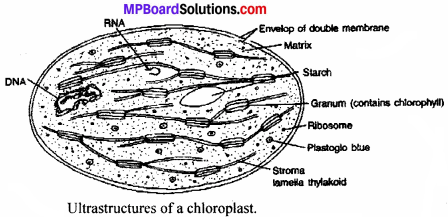
What are plastids?
Answer:
Plastids are double membrane bounded structures which are found in plant cells only. Inside the plastid, a fluid material called stroma is present. In stroma, numerous membrane layers remain scattered. Plastids like mitochondria do not have cristae. They also have extra – nuclear DNA. There are two types of plastids: Leucoplasts and Chromoplasts.

Question 28.
What type of enzymes are present in the lysosomes? What is their functions? Which organelles membrane manufacture these enzymes?
Answer:

  1. Lysosomes contain powerful digestive enzymes capable of breaking down all organic material.
  2. Lysosomes help to keep the cell clean by digesting worn out cell organelles and foreign material such as bacteria or food.
  3. RER (Rough Endoplasmic Reticulum) makes the digestive enzymes present in the lysosomes.

MP Board Solutions

Question 29.
What are the three functional regions of cell?
Answer:
The functional regions of all cells are:

  1. The plasma membrane
  2. The nucleus and
  3. The cytoplasm.

Question 30.
What are vacuoles?
Answer:
Vacuoles are fluid – filled structures surrounded by a membrane known as tonoplast. The fluid in the vacuoles is called cell sap. In animal cells either they are absent or are very small in size but can be many. In most plant cells, vacuole is big and centrally placed which provides turgidity and rigidity to cells.

The Fundamental Unit of Life Long Answer Type Questions

Question 1.
What will happen if an animal or plant cell is put into a solution of sugar and water?
Answer:
The following three things could happen:

  1. If the solution surrounding the cell is very dilute than cytoplasm, the water will move into the cell, i.e., the cell will gain water.
  2. If the solution has exactly similar water concentration as that of cytoplasm of cell, there will be no net movement of water across the cell membrane, i.e., no gain or loss of water from the cell.
  3. If the medium (solution) has a lower concentration of water than the cell i.e., the solution is concentrated, the cell will lose water by osmosis.

Question 2.
What will happen when

  1. an egg without shell is placed in concentrated salt solution for 5 minutes?
  2. an egg without shell is placed in pure I distilled water for 5 minutes? Give reason in brief.

Answer:

  1. The egg loses water and shrinks.
    • Reason: The egg membrane acts as semipermeable membrane. The concentrated salt solution present outside the egg is hypertonic so the egg loses water by osmosis.
  2. The egg gains water and swells.
    • Reason: The pure water is hypotonic (dilute) than egg cells, so water from the outside moves into the egg cells by osmosis. The gain of water results in swelling of egg.

Question 3.
What is the significance of cell wall in plant cell?
Answer:
It performs the following functions in the plant cell:

  1. It gives a definite shape to the cell.
  2. It provides rigidity and strength to the cell.
  3. It protects the plasma membrane and inner cell organelles by bounding the cell from outside.
  4. It allows cells of plants, fungi and bacteria to withstand very dilute external media without bursting.
  5. It helps in transport of the material in and out of the cell.
  6. Cell wall maintains the shape of the cell when cytoplasm shrinks away from cell wall during plasmolysis.
  7. It prevents desiccation of cells.

Question 4.
Explain the structure of nucleus.
Answer:
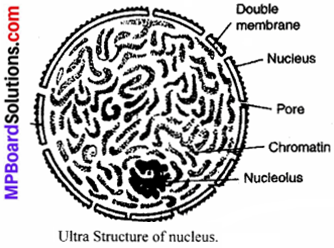
Nucleus is the control centre of the cell. It is covered by a double layered envelope called nuclear membrane. The nuclear membrane has pores which allow the transfer of material from inside the nucleus to cytoplasm. Inside the nuclear membrane an entangled mass of thread – like structures is present. This is called chromatin material (see Fig. given).
MP Board Class 9th Science Solutions Chapter 5 The Fundamental Unit of Life 3
The chromatin material mainly formed of DNA (deoxyribonucleic acid) and proteins. When a cell starts to divide, chromatin material condenses into rod – shaped structures called chromosomes. The chromosomes contain stretches of DNA which are called genes.

Question 5.
Name the cell organelle which are known as:

  1. Control centre of the cell.
  2. Demolition squads / suicidal bags of the cell.
  3. Export firms.
  4. Power house of the cell.
  5. Kitchen of the cell.
  6. Internal transport system.

Answer:

  1. Nucleus.
  2. Lysosomes.
  3. Golgi bodies.
  4. Mitochondria.
  5. Chloroplast.
  6. Endoplasmic reticulum.

Question 6.
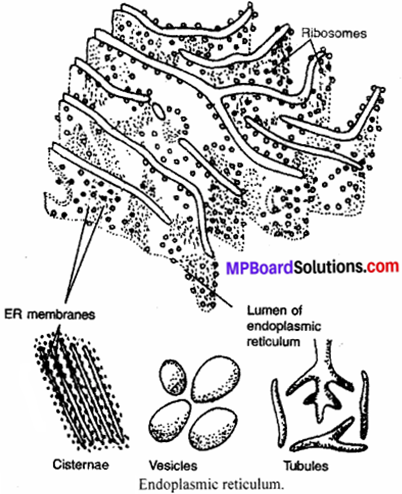
What is endoplasmic reticulum? Write its main functions.
Answer:
Endoplasmic reticulum. It is a membranous network. enclosing a fluid – filled lumen. Its main functions are:

  1. Synthesis of proteins (Rough ER).
  2. Synthesis of lipids and other metabolic products and their secretion (SER).
  3. Helps in formation of cell plate and nuclear membrane during cell division.
  4. ER also produces substance for new cellular parts (especially cell membrane).
  5. ER provides internal support (Mechanical support) to the colloidal cytoplasmic matrix of the cell.
    MP Board Class 9th Science Solutions Chapter 5 The Fundamental Unit of Life 4

Question 7.
(a) What would happen to the life of a cell if there was no Golgi apparatus?
(b) Which cell organelle detoxifies poisons and drugs in the liver of vertebrates?
Answer:
(a) Golgi apparatus is connected to ER. It collects simpler molecules from ER and convert them into more complex molecules. These re then packaged in small vesicles and are stored or transported inside or outside the cell. If Golgi apparatus is not present in the cell, all the above processes of modification, storage and transportation will not be possible. Golgi apparatus is also involved in the formation of lysosomes. If there was no Golgi apparatus in the cell, lysosomes would not hr formed and hence foreign materials like bacteria could easily invade and destroy the cell.

(b) Try yourself.

Question 8.
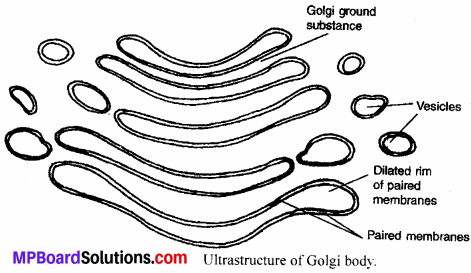
Briefly explain the structure of Golgi apparatus.
Answer:
Golgi apparatus is also known as Golgi body or Golgi complex. It consists of a set of smooth, flattened membranous sac like structures called cisternae. These are placed one above the other (staked) in parallel rows.
MP Board Class 9th Science Solutions Chapter 5 The Fundamental Unit of Life 5
On the outer edge of cisternae (stacks of membrane), tubules and vesicles (small sacs) are present. In plant cells, the Golgi apparatus consists of many unconnected units called dictyosomes.

Question 9.
What are the functions of Golgi apparatus?
Answer:
Functions of Golgi apparatus:

  1. Golgi apparatus is the secretory organelle of the cell. It packages and dispatches the material synthesized in the cell to intracellular (plasma membrane and lysosomes) and extracellular targets.
  2. Golgi complex is also involved in the formation of lysosomes.
  3. Golgi apparatus is also involved in the synthesis of many substances such as polysaccharides, glycoproteins etc.

Question 10.
What are lysosomes?
Answer:
Lysosomes: These are membrane bound vesicles which bud off from Golgi apparatus. They contain powerful enzymes capable of digesting or breaking down all organic material. The enzymes present in lysosome are synthesised on RER.

The membrane that bound lysosomes does not allow the enclosed enzymes to pass freely into the cell cytoplasm. Thus, protects the cell from autolysis (self – dissolution or breakdown). They are absent in RBCs and a few plant cells
for example:

  • yeast
  • fungi and
  • green algae.

MP Board Solutions

Question 11.
Describe the role played by the Lysosomes. Why are these termed as suicidal bags? How do they perform their function?
Answer:
Functions of Lysosomes:

  1. Extracellular digestion: Sometimes lysosome enzymes are released outside the cell to break down extracellular material.
  2. Digestion of foreign material: Lysosomes also destroy any foreign material which enters inside the cell such as bacteria.
  3. Cellular digestion: In damaged cells, ageing cells or dead cells lysosomes get ruptured and enzymes are released. These enzymes digest their own cell.

Lysosomes contain about 40 hydrolytic enzymes. When the cell gets damaged, lysosomes burst and their enzymes digest their own cell. So, lysosomes are called ‘suicide bags’. Foreign materials entering the cell, such as bacteria or food, as well as old organelles end up in the lysosomes, which break them up into small pieces.

Question 12.
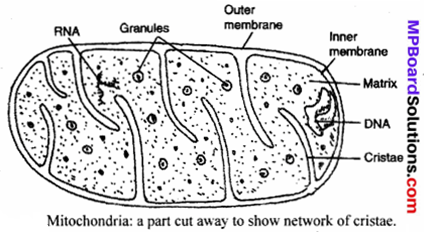
Describe the structure of mitochondria.
Answer:
Mitochondria are rod – shaped cell organelle found in the cytoplasm. Each mitochondrion (singular of mitochondria) is a double membrane bound structure. The outer membrane of mitochondrion is smooth. But the inner membrane of the mitochondrion is folded inwardly, into the matrix of mitochondrion forming finger – like projections.

MP Board Class 9th Science Solutions Chapter 5 The Fundamental Unit of Life 6
The inward finger – like projections of inner membrane are called cristae. Cristae greatly increase the surface area of the inner membrane. Mitochondria contain extra – nuclear DNA.

Question 13.
What are chromoplasts and leucoplasts? Give an example of chromoplasts which has green pigment.
Answer:
Chromoplasts are coloured plastids i.e., they may contain pigment of different colours. For example, Blue green chromoplasts found in blue green algae.
MP Board Class 9th Science Solutions Chapter 5 The Fundamental Unit of Life 7
The most important chromoplasts are chloroplasts which contain green pigment, known as chlorophyll. Chloroplasts are very important for photosynthesis. Other non – green chromoplasts are responsible for characteristic colour of flowers and fruits.

  1. Leucoplast: These are colourless plastids which do not contain any pigment.
  2. Function: Leucoplasts are involved in formation and storage of starch, oil drops and proteins granules.
    • For example: Amyloplasts found in potato tuber store starch.

Question 14.
(a) Name the organelle which provides turgidity and rigidity to the plant cell. Name any two substances which are present in it.
(b) How are they useful in unicellular organisms?
Answer:
(a) Plant cells have big vacuoles full of cell sap that provide them turgidity and rigidity. Plant vacuoles store amino acids, sugars, various organic acids and some proteins.
(b) In unicellular organisms they may serve the following purposes:

  1. Forming food vacuoles: In single celled organisms like Amoeba, the food vacuole contains the food items that the Amoeba has ingested. The food items are digested by the enzymes later on.
  2. Removal of excess water and wastes: In some unicellular organisms, specialised vacuoles play important roles in expelling excess water and some wastes from the cell.

The Fundamental Unit of Life Higher Order Thinking Skills (HOTS)

Question 1.
When we take bath for long time, the skin of our fingers shrink. Give reason.
Answer:
The soaps used are hypertonic as compared to the osmotic concentration of our skin. Exosmosis in skin cells occurs resulting in shrinking of skin of fingers.

MP Board Solutions

Question 2.
‘The Golgi apparatus is also called the secretary organelle of the cell’. Why?
Answer:
Golgi apparatus is called so as its main function is secretion. The secretary proteins and lipids are packed and released on the surface by Golgi via exocytosis.

The Fundamental Unit of Life Value Based Questions

Question 1.
Manjeet is a five year old boy who joined the swimming classes. After the first class, he was worried when he saw his wrinkled fingers. He asked his elder brother about the wrinkling and shrinking of his fingers. His brother explained Manjeet, why it was so.

  1. Why did the fingers wrinkle after swimming?
  2. What caused the shrinking / wrinkling of fingers?
  3. What value of Manjeet is seen in the above case?

Answer:

  1. Fingers wrinkled because the cells of the skin lost some water.
  2. This happened because of the difference in the concentration of water in the skin cells and swimming pool’s water.
  3. Manjeet showed the value of aware person and a good learner who clarifies the doubts.

Question 2.
Kalyan’s mother wanted to use some eggs for incubation. Kalyan helped his mother in separating rotten and spoilt eggs from the good ones. He took a bucket of water to separate them.

  1. How can one separate the rotten eggs from the good ones using water?
  2. What is the shell of an egg made up of?
  3. What value of Kalyan is seen in this act?

Answer:

  1. We can separate the rotten eggs by dipping them in water. The eggs that will float in water are rotten eggs and those that sinks are good one.
  2. The shell of an egg is made up of calcium carbonate.
  3. Kalyan showed the value of being helpful and responsible.

MP Board Class 9th Science Solutions

MP Board Class 7th Science Solutions Chapter 11 Transportation in Animals and Plants

MP Board Class 7th Science Solutions Chapter 11 Transportation in Animals and Plants

Transportation in Animals and Plants Intex Questions

Question 1.
Why is the color of blood red?
Answer:
Because blood contains a red pigment called hemoglobin.

Question 2.
Paheli wonders which side of the heart will have oxygen – rich blood and which side will have carbon dioxide  rich blood?
Answer:
Right side of heart has blood rich in oxygen and left side of heart has blood rich in carbon dioxide.

Question 3.
Paheli wants to know whether other animals also urinate?
Answer:
Yes.

MP Board Solutions

Question 4.
Boojho wants to know why plants absorb a large quantity of water from the soil, then give it off by transpiration?
Answer:
Because transpiration helps in suction of water.

Activities

Activity – 1
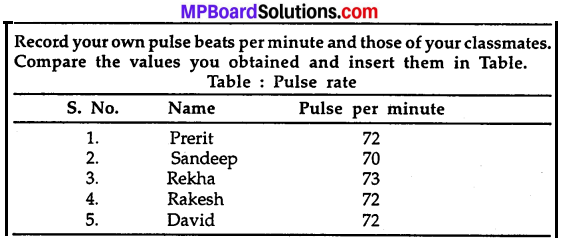
Record your own pulse beats per minute and those of your classmates? Compare the values you obtained and insert them in Table?
Table:
Pulse rate
MP Board Class 7th Science Solutions Chapter 11 Transportation in Animals and Plants img 1

Activity – 2
Record your own pulse rate and heartbeat and that of your friends while resting and after running and record in Table? Do you find any relationship between your heartbeat and pulse rate?
Table:
Heartbeat and pulse rate
MP Board Class 7th Science Solutions Chapter 11 Transportation in Animals and Plants img 2

Transportation in Animals and Plants Text Book Exercises

Question 1.
Match structures given in Column I with functions given in Column II.
MP Board Class 7th Science Solutions Chapter 11 Transportation in Animals and Plants img 3
Answer:

(i) – (b)
(ii) – (d)
(iii) – (a)
(iv) – (c)

Question 2.
Fill in the blanks:

  1. The blood from the heart is transported to all parts of the body by the …………………..
  2. Haemoglobin is present in ……………………….. cells.
  3. Arteries and veins are joined by a network of ………………………..
  4. The rhythmic expansion and contraction of the heart is called …………………………
  5. The main excretory product in human beings is ………………………….
  6. Sweat contains water and ……………………..
  7. Kidneys eliminate the waste materials in the liquid form called ……………………….
  8. Water reaches great heights in the trees because of suction pull caused by ……………………..

Answer:

  1. Arteries
  2. Red blood
  3. Capillaries
  4. Heart beat
  5. Urine
  6. Urea
  7. Urine
  8. Transpiration.

MP Board Solutions

Question 3.
Choose the correct alternative:

Question (a)
In plants, water is transported through?
(a) Xylem
(b) Phloem
(c) Stomata
(d) Root hair.
Answer:
(a) Xylem

Question (b)
Water absorption through roots can be increased by keeping the plants?
(a) In the shade
(b) In dim light
(c) under the fan
(d) covered with a polythene bag.
Answer:
(b) In dim light

Question 4.
Why is transport of materials necessary in a plant or in an animal? Explain.
Answer:
Transport of material is necessary in plant or animal because due to it the nutrients are made available to all the parts of the body. If the transport of necessary nutrients does not take place in the body, the body will not be able to survive. For example, in plants
roots absorb water and leaves prepare food utilising the water.

The food is also required by root. So, there is no utility of water absorbed by the roots if it does not reach leaf or food prepared by leaf if it does not reach root. Thus, the process of transportation is necessary.

MP Board Solutions

Question 5.
What will happen if there are no platelets in the blood?
Answer:
The blood platelets are responsible for the clotting of the blood. Without the platelets, blood cannot be clot. So, if there is any cut, blood will continue to flow out and ultimately the person die.

Question 6.
What are stomata? Give two functions of stomata?
Answer:
The small pores in leaves and stems of plants are called stomata.
Functions of Stomata:

  1. It absorb oxygen from air.
  2. It helps in the transportation of water.

Question 7.
Does transpiration serve any useful function in the plants? Explain.
Answer:
Yes, transpiration is an important function in plants. Plants absorb mineral nutrients and water from the soil. Not all the water absorbed is utilised by the plant. The water evaporates through the stomata present on the surface of the leaves by the process of transpiration. The evaporation of water from leaves generates a suction pull (the same that you produce when you suck water through a straw) which can pull water to great heights in the tall trees. Transpiration also cools the plant.

Question 8.
What are components of blood?
Answer:
Red blood cells (RBC), while blood cells (WBC), plasma and platelets are the components of blood.

Question 9.
Why is blood needed by all the parts of a body?
Answer:
Blood is needed by all the parts of a body because it carries digested food and oxygen to all parts of body. It also carries away the waste products.

MP Board Solutions

Question 10.
What makes the blood look red?
Answer:
A red coloured pigment called hemoglobin gives the blood red color.

Question 11.
Describe the function of the heart?
Answer:
The main function of heart is to collects and distributes blood from and to all parts of the body. The right auricle and ventricle receives blood with carbon dioxide from all the parts of the body. The collected blood is then pumped to the lungs for the purification. In lungs, the exchange of gases take place and purified blood is sent back to the left auricle. After that purified blood is sent to all the parts of the body through arteries.

Question 12.
Why is it necessary to excrete waste products?
Answer:
Waste products are harmful for the body, so it is necessary to excrete waste products.

Question 13.
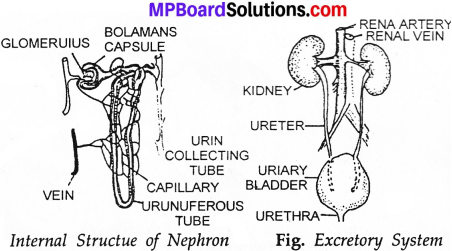
Draw a diagram of the human excretory system and label the various parts?
Answer:
Human Excretory System Diagram:
MP Board Class 7th Science Solutions Chapter 11 Transportation in Animals and Plants img 4.2

Extended Learning – Activities and Projects

Question 1.
Find out about the blood groups and their importance?
Answer:
Carl Landesteiner (1900) discovered that there are two types of antigens present on the plasma membrane of the RBC. These are antigen A and antigen B. These are also called corpuscle factors. There are also two types of antibodies present in the plasma. These are antibody A (Anti – A) and antibody B (Anti – B).

These are also called plasma factors. The blood is classified into four groups on the basis of the presence or absence of these antigens. These groups are A, B, AB and O. This system of classification of blood is called: ‘ABO’ system. The following table shows the types of blood groups and their antigens and antibodies:
MP Board Class 7th Science Solutions Chapter 11 Transportation in Animals and Plants img 5

Along with the A and B antigens or antibodies, many people have another factor called the Rh factor. This is an antigen first found in Rhesus monkey (hence, called the Rh factor). People whose red blood cells contain the Rh antigen are said to be Rh positive (Rh+). People who lack it are called Rh negative (Rh).

A person with Rhblood does not have Rh antibody (which destroys Rh antigen) naturally. But, as and when an Rh antigen enters the blood, it develops Rh antibody and destroys the antigen. If a person with blood group A has Rh antigen, his/her blood is said to be A+(A positive).

Similarly if a person’s blood group is B and he/she does not have Rh antigen, then his/her blood group is B(B negative). So, we have eight blood groups: A+, B+, AB+, O+, A+, B+, AB+ and O+.
MP Board Class 7th Science Solutions Chapter 11 Transportation in Animals and Plants img 6

Question 2.
When a person suffers from chest pain, the doctor immediately takes an ECG? Visit a doctor and get information about ECG? You may even look up an encyclopedia or the internet?
Answer:
An electrocardiogram (ECG or EKG, abbreviated from the German Electrocardiogram) is a graphic produced by an electrocardiograph, which records the electrical activity of the heart over time. Analysis of the various waves and normal vectors of depolarization and repolarization yields important diagnostic information.

  1. It guides therapy and risk stratification for heart patients.
  2. It helps detect electrolyte disturbances. It allows for the detection of conduction abnormalities.
  3. It is used as a screening tool for ischemic heart disease during a cardiac stress test.
  4. It is occasionally helpful with non – cardiac

In 1856, Kollicker and Mueller discovered the electrical activity of the heart when a frog sciatic nerve/gastrocenemius preparation fell onto an isolated frog heart and both muscles contracted synchronously. Alexander muirhead attached wires to a feverish patient’s wrist to obtain a record of the patient’s heartbeat while studying for his DSc (in electricity) in 1872 at St Bartholomew’s Hospital.

This activity was directly recorded and visualized using a Lippmann capillary electrometer by the British physiologist John Burdon Sanderson. The first to systematically approach the heart from an electrical point – of – view was Augustus Waller, working in St Mary’s Hospital in Paddington, London. His electrocardiograph machine consisted of a Lippmann capillary electrometer fixed to a projector.

The trace from the heartbeat was projected onto a photographic plate which was itself fixed to a toy train. This allowed a heartbeat to be recorded in real time. In 1911 he still saw little clinical application for his work. The break through came when Willem Einthoven, working in Leiden, The Netherlands, used the string galvanometer invented by him in 1901, which was much more sensitive than the capillary electrometer that Waller used. Einthoven assigned the letters P, Q, R, S and T to the various deflections, and described the electrocardiographic features of a number of cardiovascular disorders. In 1924, he was awarded the Nobel Prize in Medicine for his discovery.

MP Board Solutions

Transportation in Animals and Plants Additional Important Questions

Objective Type Questions

Question 1.
Choose the correct alternative:

Question (a)
The cells in blood that fight against the disease causing germs are called?
(a) Platelets
(b) White blood cells
(c) Red blood cells
(d) None of these.
Answer:
(b) White blood cells

Question (b)
Which of these is responsible for clotting of blood?
(a) Platelets
(b) White blood cells
(c) Red blood cells
(d) none of these.
Answer:
(a) Platelets

Question (c)
Smallest filtering units in kidneys are called?
(a) ventricles
(b) auricles
(c) vessels
(d) nephrons.
Answer:
(d) nephrons.

MP Board Solutions

Question (d)
Urine is stored in till excreted?
(a) Ureter
(b) Kidney
(c) Urinary bladder
(d) Urethra.
Answer:
(c) Urinary bladder

Question (e)
Instrument used to measure heart beat is called?
(a) thermometer
(b) nanometer
(c) stethoscope
(d) none of these.
Answer:
(c) stethoscope

Question (f)
How many times heart of an healthy person beats in one minute?
(a) 70
(b) 71
(c) 72
(d) 73
Answer:
(c) 72

Question (g)
Which one of the following is not an excretory organ?
(a) Lever
(b) Skin
(c) Kidney
(d) Oesophagus.
Answer:
(d) Oesophagus.

MP Board Solutions

Question (h)
The tube by which all the wastes are thrown out is known as?
(a) ureters
(b) urethra
(c) urinary bladder
(d) none of these.
Answer:
(b) urethra

Question 2.
Fill in the blanks:

  1. The fluid part of the blood is called …………………………
  2. One type of cells are the red blood cells which contain a red pigment called …………………….
  3. There are the ……………………… types of blood vessels in the body.
  4. …………………….. carry oxygen rich blood from the heart to all parts of the body.
  5. The number of pulse beats per minute is called the ………………………
  6.  …………………… are the vessels which carry carbon dioxide rich blood from all parts of the body back to the heart.
  7. The heart has …………………….. chambers.
  8. The walls of the chambers of the heart are made up of ……………………
  9. Your heart is roughly the size of your ……………………………
  10. The English Physician, William Harvey discovered the circulation of ………………………….
  11. The parts involved in excretion forms the …………………… system.
  12. The kidneys, ureters, bladder and urethra form the ……………………………… system
  13. Birds, Insects and lizard excrete ………………………………. in semi – solid form.
  14. A …………………………………. is a group of cells not perform  specialized function in an organism.
  15. The vascular tissue for the transport of water and nutrients in the plant is called the ………………………..
  16. Water and mineral nutrients are absorbed by roots from the ………………………….

Answer:

  1. Plasma
  2. Hemoglobin
  3. Two
  4. Arteries
  5. Pulse rate
  6. Veins
  7. Four
  8. Muscles
  9. Fist
  10. Blood
  11. Excretory
  12. Excretory
  13. Uric acid
  14. Tissue
  15. Xylem
  16. Soil.

MP Board Solutions

Question 3.
Which of the following statements are true (T) or false (F):

  1. Circulatory system consists of the heart and blood vessels.
  2. Oxygenated blood flows in arteries.
  3. Valves are there in inner walls of veins.
  4. White blood cells to not protect our body from diseases.
  5. Blood is red due to platelets.
  6. In humans, blood flows through arteries and veins and the heart acts as a pumping organ.
  7. The heart is protected by a membrane called paracardium.
  8. Veins carry blood from all parts of the body back to the heart.
  9. Artery carry blood from the heart to all parts of the body.
  10. Our body requires at least 2 to 3 litres of water everyday.
  11. In humans, excretion involves the removal of sweat, urea and faces.
  12. All organisms nave same method of waste removal from their body.
  13. The xylem and phloem together make up the vascular system in plants.
  14. In older plants vacuoles contain the excretory products.

Answer:

  1. True
  2. True
  3. True
  4. False
  5. False
  6. True
  7. True
  8. True
  9. True
  10. True
  11. True
  12. False
  13. True
  14. True.

Transportation in Animals and Plants Very Short Answer Type Questions

Question 1.
Name the transport medium in human beings?
Answer:
Blood.

Question 2.
White blood corpuscles is called as soldiers. Why?
Answer:
They have no definite shape. They work in our body like soldiers whenever any harmful micro – organism, virus or foreign body enters inside our body then these corpuseles prevent their entry and destroy them.

Question 3.
If blood does not coagulate after injury, then what will happen?
Answer:
The people can be died.

MP Board Solutions

Question 4.
How does the red blood corpuscles deliver oxygen to each part of body?
Answer:
Hemoglobin reacts with oxygen and forms a temporary compound called as oxyhemoglobin which breaks again in every part of body and donates oxygen.

Question 5.
Write the names of different blood vessels?
Answer:
The names of different blood vessels are arteries, veins and capillaries.

Question 6.
Write functions of hemoglobin?
Answer:
Hemoglobin containing iron and this hemoglobin reacts with oxygen and forms a temporary compound called as oxyhemoglobin which breaks again in every part of body and donates oxygen.

Question 7.
Why is the blood red in color?
Answer:
The blood is red in color due to the presence of an iron containing pigment hemoglobin.

Question 8.
What will happen if the blood rich in oxygen and the blood rich in carbon dioxide mix with each other?
Answer:
The net oxygen content of blood Will be reduced and hence body will suffer from lack of oxygen.

Question 9.
What is pulse rate?
Answer:
The number of beats per minute is called the pulse rate.

Question 10.
What is the resting pulse rate of a normal person?
Answer:
A resting person, usually has a pulse rate between 72 and 80 beats per minute.

MP Board Solutions

Question 11.
Where is heart located?
Answer:
The heart is located in the chest cavity with its lower tip slightly tilted towards the left.

Question 12.
What are the two upper chamber of hearts?
Answer:
Atria.

Question 13.
What are ventricles?
Answer:
The two lower chambers of heart are called ventricles.

Question 14.
Define excretion?
Answer:
Excretion is a process through which the metabolic wastes are excreted out from the body.

Question 15.
Name the various organs of excretion in human?
Answer:
Various excretory organs of humans are skin, lungs and kidneys.

Question 16.
How does excretion occur in unicellular animals?
Answer:
In unicellular animals excretion takes place by diffusion process.

MP Board Solutions

Question 17.
What is transpiration?
Answer:
Transpiration is a process of evaporation of water from the surface of the leaf in the form of water vapours. It helps:

  1. To generate pulling force for the upward movement of water.
  2. To get rid of excess of water.
  3. To maintain the temperature because of cooling effect.

Question 18.
What is excretion?
Answer:
Excretion is the process of the removal of the waste product from the body of a plant or an animal. The different organisms eliminate their waste in different ways.

Question 19.
Write the names exretory materials in plants?
Answer:
The excretory materials in plants are a gum, rain and latex.

Transportation in Animals and Plants Short Answer Type Questions

Question 1.
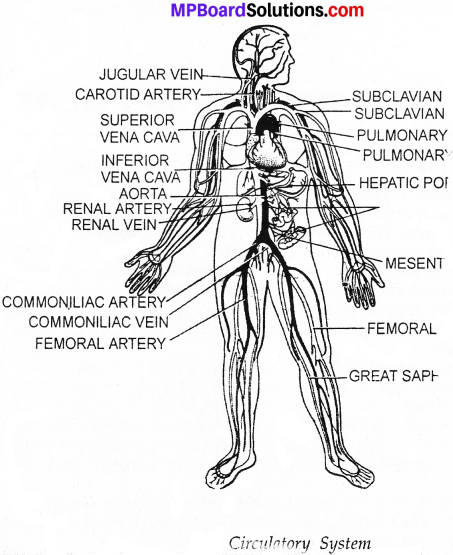
Name the various blood vessels and write their functions?
Answer:
There are three blood vessels:
1. Arteries:
These are the blood vessels which carry or transport oxygenated pure blood from heart to all other parts of the body.

2. Veins:
These are blood vessels which collects the deoxygenated impure blood from the whole body and send it to the heart.

3. Capillaries:
These are the network of thin tube like structures which connect the arteries and veins together.

Question 2.
What is blood? What are the components of blood?
Answer:
Blood is a fluid tissue that circulates and transport the material within the cells. It is red in color due to the presence of a pigment called hemoglobin. Various components of bloods are blood cells and plasma.
MP Board Class 7th Science Solutions Chapter 11 Transportation in Animals and Plants img 7

Question 3.
What is the main difference between artery and a vein?
Answer:
Differences between arteries and veins:
Artery:

  1. It carries pure blood from heart to the different organs of the body.
  2. Blood flows with jerks with high pressures.
  3. They always carry oxygenated rich blood.
  4. It has no valve.
  5. Its wall is thick.

Vein:

  1. It collects impure blood from different parts of the body.
  2. Blood flows smoothly with low pressure.
  3. They always carry carbon dioxide rich blood.
  4. Semilunar valves are present.
  5. Its wall is thin.

MP Board Solutions

Question 4.
What is meant by excretion? Explain its need for the sustenance of the individual?
Answer:
Excretion is a process of removal of metabolic waste materials from the body. If excretory matter is present in the body It will disturb the metabolic activities going or in different parts of the body. It will disturb metabolic activity in body. So it is necessary to excrete out all the metabolic wastes from the body.

Question 5.
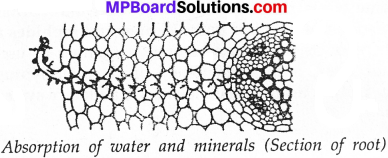
Describe the process of water and mineral absorption in plants?
Answer:
In higher plants root system is well developed. The tertiary roots possess root hairs. They absorb mineral salt and water in the form of dilute solution through endosmosis. The cells of root hair transfer this solution to the epidermal cells. Through diffusion process absorbed solution reaches in the xylem vessels and from it lifts up and then reaches up to the top of the plant.

Question 6.
How do the exchange of gases occur in plants?
Answer:
In case of plants the lower surface of leaves have small pores called stomata. These are provided by two guard cells which control the opening or closing of the stomata. When the concentration of O2 gas increases during photosynthesis the guard cells open and O2 gas is given out and if concentration CO2 gas increases during respiration, the guard cells cause CO2 gas to go out of the cells. This is how the exchange of gases occur in plants.

Question 7.
How does liver help in the process of excretion?
Answer:
Liver plays a major role in excreting waste products of the body. Urea, the chief introgenous waste materials is formed in the liver. The break down of amino acids which takes place in it results in the accumulation of nitrogenous wastes. These nitrogenous wastes break down further into ammonia. Ammonia is a very toxic, therefore, liver converts ammonia along with CO2, into urea with the help of specific enzymes. This urea is eventually thrown out by kidneys.

Question 8.
Why is the process of excretion important for living?
Answer:
As a result of metabolism various toxic substances are continuously formed. These wastes (carbon dioxide, ammonial compounds, other salts) if allowed to accumulate in the body (cells), would disturb the chemical composition of the protoplasm and produce toxic effects, crippling the life activities. Hence their elimination is most important. This is done by the process of excretion.

MP Board Solutions

Question 9.
Why do doctors examine the urine to diagnose a disease? What do they examine in urine?
Answer:
The concentration of various wastes in the urine depends upon the functioning of various organs or organ system in the body. So the examination of urine of a person gives a good idea about his/her general health. The doctors, therefore use the urine test to diagnose disease in the body. For example, presence of excess sugar in urine indicates malfunctioning of pancreas. Presence of excess urea or uric acid indicates the malfunctioning of kidneys.

Transportation in Animals and Plants Long Answer Type Questions

Question 1.
How many types of blood corpuscles are there? Write their functions?
Answer:
There are three types of blood corpuscles:
1. Red blood corpuscles:
They are elliptical or spherical in shape. Hemoglobin containing iron is present in them. This hemoglobin reacts with oxygen and forms a temporary compound called as oxyhemoglobin which breaks again in every part of body and donates oxygen.

2. White blood corpuscles They have no definite shape, They work in our body like soldiers. Whenever any harmful microorganism, virus or foreign body enters inside our body then these corpuscles prevent their entry and destroy them.

3. Blood platelets:
Whenever there is bleeding due to injury, these platelets move there and coagulates the blood, as a result excess blood does not flow.

4. Plasma:
It is the fluid medium which transports digested food as well as metabolic waste products.

MP Board Solutions

Question 2.
Write functions of blood?
Answer:
Various functions of blood are:

  1. The red blood cells carry oxygen to different parts of the body.
  2. The white blood cells fight against the disease causing germs and bacteria and kill them.
  3. The platelets of blood help in clotting of blood.
  4. The plasma carries CO2 from the body.
  5. It regulates our body temperature.
  6. It carries digested and absorbed food and hormones to different organs.
  7. The waste products are taken into excretory organs through blood.

Question 3.
Describe the “pulmonary circulation of blood?”
Answer:
The deoxygenated blood is collected from various organs of the body by two veins called superior and inferior vena cava. They join to form a main vein which empties the blood into the right auricle. From here it enters the right ventricle and is pumped into the right pulmonary artery which caries it to the lungs. Here the carbon – dioxide oxygen exchange takes place. The oxygenated blood is carried by the pulmonary vein to the left auricle. This part of the circulation is called the pulmonary circulation.

Question 4.
Explain structure of heart and draw it’s diagram?
Answer:
Our heart is situated in the left side of our chest. It is divided into four chambers. The upper two chambers collect the blood from veins and are known as auricles. The lower two chambers are meant for distribution of the blood in various parts of the body and are known as the ventricles.
MP Board Class 7th Science Solutions Chapter 11 Transportation in Animals and Plants img 8
Right auricle gets the impure blood which is sent to right ventricle. From right ventricle the blood is thrown to pulmonary arteries which carry this. blood to lungs for put if cation, which is collected by pulmonary veins and now it is in a purified state.

It is brought to left auricle and then to left ventricle from where it is thrown into aorta which is responsible for distribution of this pure blood to various parts of the body. Aorta is divided into various arteries which are divided into five capillaries. After exchange of materials these capillaries form the veins which bring blood to the right auricle.

MP Board Solutions

Question 4.
Define the systematic circulation of blood. Draw the diagram of schematic diagram of circulation?
Answer:
The oxygenated blood from the left auricle enters the left ventricle and is then pumped into the aorta and carried to all parts of the body by arteries and capillaries. This part of the circulation is known as systemic circulation.
MP Board Class 7th Science Solutions Chapter 11 Transportation in Animals and Plants img 9

Question 5.
Describe “blood transfusion?”
Answer:
Blood is a very vital component of our body and we cannot afford to lose it. In case of serious injury, accident or during an operation, we may lose a considerable quantity of blood from our body. In such cases blood from another healthy person is transferred to the patient. This is called blood transfusion. The blood of all human beings falls in any one of the following groups A, B, AB or O. Transfusion should be done carefully and only after checking the blood group of the patient.

Question 6.
“Excretion is process to eliminate the waste by products from the body”. Justify the statement?
Answer:
The nitrogenous waste ammonia is converted into urea by the liver. The renal artery carry the urea of kidneys. Each kidney consists of number of coiled tubes called Nephron. There are about ten million nephron in each kidney of an adult man. The Nephron is the functional unit of the kidney.

One end of the nephron is cup shaped called Bowman’s capsule. The renal artery branches into millions of capillaries in the form of coil in the each Bowman’s capsule. This coil or capillaries of renal artery in the Bowman’s capsule is called Glomerules. The blood is filtered through the walls of capillaries of glomerulus.

This is a selective filteration. The bigger molecules of sugars, salts and nitrogenous wasters are filtered. This selective filteration is termed as dialysis. Thus, the glomerulus acts as dialysis bag of the kidney. The filterate from glomerulur in the Bowman’s capsule passes through the tiny tubule.

Where major part of glucose and other useful substances is reabsorbed. It is sent back into the blood of the renal vein. The waste liquid called urine, containing nitrogenous waste is sent to the urinary bladder through collecting tubule and uretere. From urinary bladder it is eliminated from the body through urethera.
MP Board Class 7th Science Solutions Chapter 11 Transportation in Animals and Plants img 10 and 11

Question 7.
What are the various waste materials excreted from the human body?
Answer:
Excretion is done by following organs:
1. Kidneys:
These excrete urea, salts, water etc. through urine.

2. Skin:
Skin possesses sweat glands. These glands absorb urea, salts and a large quantity of water from the blood capillaries near by and excrete them through their pores on the skin in the form of sweat.

3. Liver:
Liver is not a direct excretory organ. Liver cells convert more toxic ammonia into less toxic urea and uric acid and then pass them to the kidneys through the blood for excretion. Liver also censer toxic substances. It removable salts in bile juice. These bile salts are formed due to break down of hemoglobin. If bile salts are not remove. They cause jaundice. Bile salts are removed through intestine.

MP Board Solutions

Question 8.
Write a short note on “excretion in plants”?
Answer:
Plants, have no special organs for excretion. product of respiration i.e. carbon dioxide is partly us phtosynthesis. The excess amount of carbon dioxide escape the stomata and lenticles. Some of the waste products of photosynthesis an in vacuoles in the leaves and bark of trees. The plant them by sheddingthe leaves and bark.

Some waste products are transformed into harm and stored inside the plant body. Rubber and raphides a of such products. Plants also secrete a number of uses like gum, latex, resin, sandalwood oil and eucalyptus
MP Board Class 7th Science Solutions Chapter 11 Transportation in Animals and Plants img 12

Question 9.
Describe the process of absorption and transportation of water and minerals in plants?
Answer:
The plant root have root hairs which absorb water and minerals in the form of solution from soil. This process is called absorption. This water and minerals are then transported to other parts of plant i.e., stem, leaves and flowers through a special tissue called xylem. Then food is synthesised within leaves of plant and is transported in all parts of plant including roots, through phloem. This produces is called transportation.

Question 10.
Draw a neat diagram to show circulatory system?
Answer:
MP Board Class 7th Science Solutions Chapter 11 Transportation in Animals and Plants img 13

MP Board Class 7th Science Solutions

MP Board Class 9th Maths Solutions Chapter 6 Lines and Angles Ex 6.1

MP Board Class 9th Maths Solutions Chapter 6 Lines and Angles Ex 6.1

Question 1.
In the given fig., lines AB and CD intersect at O. If ∠AOC + ∠BOE = 70° and ∠BOD = 40°, find ∠BOE and reflex ∠COE.
Solution:
Given
∠AOC + ∠BOE = 70°
∠BOD = 40°
To find:
∠BOE and Reflex ∠COE
MP Board Class 9th Maths Solutions Chapter 6 Lines and Angles Ex 6.1 img-1
Calculation:
∠BOD
= ∠AOC = 40° (VOA’s)
∠AOC + ∠BOE = 70°
40° + ∠BOE = 70°
∴ ∠BOE = 30°
∠AOC + ∠COE + ∠BOE = 180°
(∴ Angles on the same line)
70° + ∠COE = 180°
∴ ∠COE – 110°
Reflex ∠COE = 360° – ∠COE
= 360° – 110° = 250°

Question 2.
In Fig. below, lines XY and MN intersect at O. If ∠POY = 90° and a : b = 2 : 3, find c.
MP Board Class 9th Maths Solutions Chapter 6 Lines and Angles Ex 6.1 img-2
Solution:
Given
∠POY= 90°
a : b = 2 : 3
To find. ∠C
Calculation:
a = 2x
b = 3x
b + a + 90° = 180° (∴ Angles on the same line)
3x + 2x + 90° = 180°
5x = 90°
x = 18°
a = 2 x 18° = 36°
b = 3 x 18° = 54°
b + c = 180 (LPA’s)
c = 180° – 54° = 126°

MP Board Solutions

Question 3.
In Fig. below, if ∠PQR = ∠PRQ, then prove that ∠PQS = ∠PRT.
MP Board Class 9th Maths Solutions Chapter 6 Lines and Angles Ex 6.1 img-3
Solution:
Given
∠PQR = ∠PRQ
To prove:
∠PQS = ∠PRT
Proof:
∠PQS + ∠PQR = 180° (LPA’s) …..(1)
∠PRT + ∠PRQ = 180° (LPA’s)
=> ∠PRT + ∠PQR = 180° (∴ ∠PRQ = ∠PQR) …(2)
From (1) and (2), we get
∠PQS + ∠PQR = ∠PRT + ∠PQR
∠PQS = ∠PRT Proved.
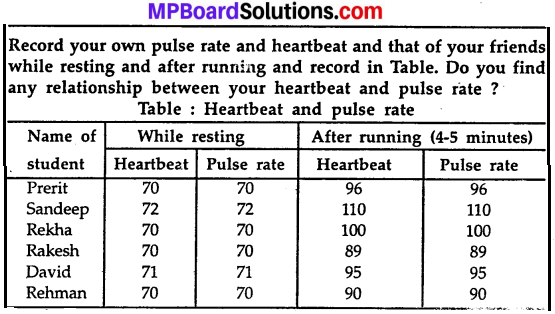
Question 4.
In Fig. below, if x + y = w + z, then prove that AOB is a line.
MP Board Class 9th Maths Solutions Chapter 6 Lines and Angles Ex 6.1 img-4
Solution:
Given
x + y = w + z
To prove
AOB is a line
Proof:
x + y + z + w = 360° (Complete angle)
x + y + x + y = 360° (∴ w + z = x + y)
2(x + y) = 360°
x + y = 180° (LPA’s)
AOB is a line. Proved

Question 5.
In Fig. below. POQ is a line. Ray OR is perpendicular to line PQ. OS is another ray lying between rays OP and OR. Prove that
∠ROS = \(\frac{1}{2}\) (∠QOS – ∠POS).
Solution:
Given
POQ is a line, OR ⊥ PQ
MP Board Class 9th Maths Solutions Chapter 6 Lines and Angles Ex 6.1 img-5
To prove:
∠ROS = \(\frac{1}{2}\) (∠QOS – ∠POS).
Proof:
∠QOS = ∠QOR + ∠ROS
∠QOS = 90° + ∠ROS ….(1)
∠POS = ∠POR – ∠ROS
∠POS = 90° – ∠ROS …..(2)
Subtracting (1) and (2), we get
∠QOS – ∠POS = 90° + ∠ROS – (90° – ∠ROS)
= 90° + ∠ROS – 90° + ∠ROS
∠QOS – ∠POS = 2 ∠ROS
∠ROS = \(\frac{1}{2}\) (∠QOS – ∠POS)

Question 6.
It is given that ∠XYZ = 64° and XY is produced to point P. Draw a figure from the given information. If ray YQ bisects ∠ZYP, find ∠XYQ and reflex ∠QYP.
Solution:
Given
∠XYZ = 64°
To find:
∠XYQ and Reflex ∠QYP
MP Board Class 9th Maths Solutions Chapter 6 Lines and Angles Ex 6.1 img-6
Calculation:
∠XYZ + ∠ZYQ + ∠QYP
= 180° (∴ Angles on the same line)
64° + x + x = 180°
2x = 180° – 64° = 116°
x = 58°
∠XYQ = ∠XYZ + ∠ZYQ
= 64° + 58° = 122°
Reflex ∠QYP = 360° – 58° = 302°

Transversal:
A line which intersects two or more lines at distinct points is called a transversal.
MP Board Class 9th Maths Solutions Chapter 6 Lines and Angles Ex 6.1 img-7

Angles and their Name formed by Transversal:
Line intersects line m and n at point P and Q respectively. So line l is a transversal ftk lines m and n. Observe that four angles are formed at each of the points P and Q. Name these angles ∠1, ∠2, ∠3, ∠4, ∠5, ∠6, ∠7 and ∠8. There are two type of angles: exterior angles and interior angles as shown in Fig. above.

(a) ∠1, ∠2, ∠7 and ∠8 are Exterior angles and
(b) ∠3, ∠4, ∠5 and ∠6 are Interior angles

Same pairs of angles are formed when a transversal intersects two lines. These are given below:

(a) Corresponding angles:

  1. ∠1 and ∠5
  2. ∠2 and ∠6
  3. ∠4 and ∠8
  4. ∠3 and ∠7

(b) Alternate interior angles:

  1. ∠4 and ∠6
  2. ∠3 and ∠5

(c) Alternate exterior angles:

  1. ∠1 and ∠7
  2. ∠2 and ∠8

(d) Interior angles on the same side of the transversal:

  1. ∠4 and ∠5
  2. ∠3 and ∠6

MP Board Solutions

Axiom 3:
If a transversal intersects two parallel lines, then each pair of corresponding angles is equal.
MP Board Class 9th Maths Solutions Chapter 6 Lines and Angles Ex 6.1 img-8
If AB ∥ CD and l is the transversal.
∠1 = ∠5; ∠4 = ∠8
(Corresponding angles)
∠2 = ∠6; ∠3 = ∠7

Axiom 4:
If a transversal intersects two lines such that a pair of correspond-ing angles are equal, then the two lines are parallel to each other.
MP Board Class 9th Maths Solutions Chapter 6 Lines and Angles Ex 6.1 img-9
In Fig., AB and CD are two lines, intersected by transversal ‘l’ such that ∠1 = ∠2 (corresponding angles,) then AB ∥ CD.

Theorem 1.
If a transversal intersects two parallel lines, then each pair of alternate interior angles are equal.
MP Board Class 9th Maths Solutions Chapter 6 Lines and Angles Ex 6.1 img-10
Given. AB ∥ CD and l is the transversal.
To prove:

  1. ∠3 = ∠5
  2. ∠4 = ∠6

Proof:

∠1 = ∠3 (V.O.A’s) ……(i)
∠1 = ∠5 (Corresponding angle’s) …(ii)
From (i) and (ii), we get
∠3 = ∠5
∠4 = ∠2 (V.O.A’s)
∠2 = ∠6 (Corresponding angle’s)
From (iii) and (iv), we get
∠4 = ∠6. Proved.
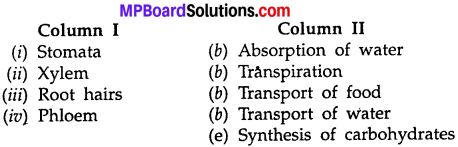
Theorem 3.
if a transversal intersect two lines, such that a pair of alternate interior angle is equal, then the two lines are parallel.
MP Board Class 9th Maths Solutions Chapter 6 Lines and Angles Ex 6.1 img-11
Given
AB and CD are two lines, and l is the transversal.
∠2 = ∠3
To prove:
AB ∥ CD
Proof:
∠2 = ∠3 (V.O.A’s) …..(i)
∠1 = ∠2 (Corresponding angle’s) …(ii)
From (i) and (ii), we get
∠1 = ∠2
∠1 and ∠3 are corresponding angles and are equal.
AB ∥ CD. Proved.
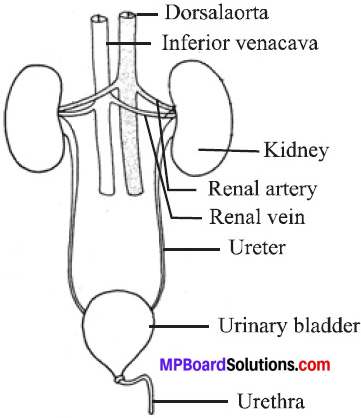
MP Board Solutions

Theorem 4.
If a transversal intersects two parallel lines, then each pair of interior angles on the same side of the transversal is supplementary.
MP Board Class 9th Maths Solutions Chapter 6 Lines and Angles Ex 6.1 img-12
Given
AB ∥ CD and l is the transversal.
To prove:
∠4 + ∠5 = 180° and ∠3 + ∠6 = 180°
Proof
∠3 + ∠4 = 180° (LPA’s) …..(i)
∠3 = ∠5 (AIA’s) …..(ii)
∠4 = ∠6 (AIA’s) …..(iii)
From (i) and (ii) we get
∠5 + ∠4 = 180°
From (i) and (iii), we get
∠3 + ∠6 = 180s.

Theorem 5.
If a transversal intersects two lines, such that a pair of interior angles on the same side of transversal is supplementary, then the two lines are parallel.
MP Board Class 9th Maths Solutions Chapter 6 Lines and Angles Ex 6.1 img-13
Given
AB and CD are two lines, l is the transversal.
∠4 + ∠5 = 180°
To prove
AB ∥ CD
Proof
∠4 + ∠5 = 180° (Given) …..(i)
∠1 + ∠4 = 180° (LPA’s) …..(ii)
From (i) and (ii), we get
∠4 + ∠5 = ∠1 + ∠4
∠5 = ∠1
∠1 and ∠5 are corresponding angles and are equal.
AB ∥ CD. Proved.
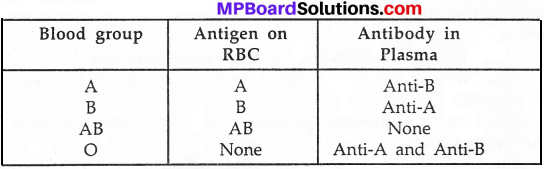
Theorem 6.
Lines which are parallel to the same line are parallel to each other.
MP Board Class 9th Maths Solutions Chapter 6 Lines and Angles Ex 6.1 img-14
Given, p, q and r are three lines
P ∥ r and q ∥ r
To prove
p ∥ q
Proof
p ∥ r and l is the transversal.
∠1 = ∠3 (Corresponding angles) …..(i)
q ∥ r and l is the transversal.
∠2 = ∠3 (Corresponding angles) …..(ii)
From (i) and (ii), we get
∠1 = ∠2
∠1 and ∠2 are corresponding angles and are equal.
p ∥ q. Proved.
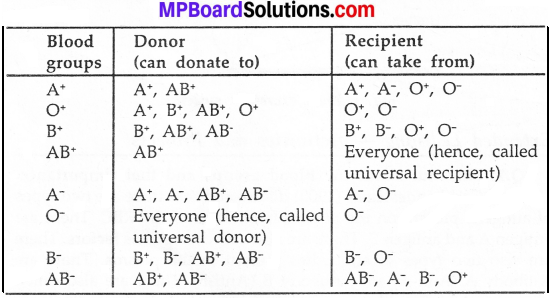
MP Board Class 9th Maths Solutions

MP Board Class 9th Science Solutions Chapter 4 Structure of the Atom

MP Board Class 9th Science Solutions Chapter 4 Structure of the Atom

Structure of the Atom Intext Questions

Structure of the Atom Intext Questions Page No. 47

Question 1.
What are canal rays?
Answer:
Canal rays are positively charged radiations which led to the discovery of positively charged sub-atomic particle called proton. These rays were discovered by E. Goldstein.

MP Board Solutions

Question 2.
If an atom contains one electron and one proton, will it carry any charge or not?
Answer:
The atom will not contain any charge and will be electrically neutral because both electron and proton will balance each other.

Structure of the Atom Intext Questions Page No. 49

Question 1.
On the basis of Thomson’s model of an atom, explain how the atom is neutral as a whole.
Answer:
According to Thomson’s model, an atom consist of a positively charged sphere and electrons are embedded in it. So, both charges are equal which makes the atom electrically neutral.

Question 2.
On the basis of Rutherford’s model of an atom, which sub – atomic particle is present in the nucleus of an atom?
Answer:
Proton is the sub – atomic particle which is present in the nucleus of an atom.
MP Board Class 9th Science Solutions Chapter 4 Structure of the Atom 1

Question 3.
Draw a sketch of Bohr’s model of an atom with three shells.
Answer:
MP Board Class 9th Science Solutions Chapter 4 Structure of the Atom 2

Question 4.
What do you think would be the observation if the a-particle scattering experiment is carried out using a foil of a metal other than gold?
Answer:
The observations would be same as that of gold foil.

Structure of the Atom Intext Questions Page No. 49

Question 1.
Name the three sub – atomic particles of an atom.
Answer:

  1. Positively charged – Protons
  2. Negatively charged – Electrons
  3. No charged – Neutrons.

Question 2.
Helium atom has an atomic mass of 4u and two protons in its nucleus. How many neutrons does it have?
Answer:
Atomic mass = Number of protons + Number of neutrons
∴ 4 = 2 + Number of neutrons
∴ Number of neutrons = 4 – 2 = 2.

Structure of the Atom Intext Questions Page No. 50

Question 1.
Write the distribution of electrons in carbon and sodium atoms.
Answer:
Atomic number of Carbon = 6
MP Board Class 9th Science Solutions Chapter 4 Structure of the Atom 3

Question 2.
If K and L shells of an atom are full, then what would be the total number of electrons in the atom?
Answer:
K shell is the 1 shell
So, n = 1
Then maximum electron’s = 2n2 = 2 × (1)2
= 2 × 1 = 2
and L shell is the second shell.
So, n = 2
Then maximum electrons = 2(n)2
= 2 × (2)2 = 8
∴ Total number of electrons = 2 + 8 = 10.

Structure of the Atom Intext Questions Page No. 52

Question 1.
How will you find the valency of chlorine, sulphur and magnesium?
Answer:
We know that valency is the number of electrons lost, gained or shared by atom to become stable or to complete 8 electrons in the shell.
Now, Chlorine,
Atomic number = 17
MP Board Class 9th Science Solutions Chapter 4 Structure of the Atom 4
Then, it will take 8 – 7 = 1 electron to complete its shell.
∴ Its valency is ‘I’
Sulphur, Atomic number = 16
MP Board Class 9th Science Solutions Chapter 4 Structure of the Atom 5
It will take 8-6 = 2 electrons to complete its shell.
∴ Its valency is ‘2’.
Magnesium, Atomic number = 12
MP Board Class 9th Science Solutions Chapter 4 Structure of the Atom 6
It will lose 2 electrons from its outermost shell to become stable.
∴ Its valency will be ‘2’.

Structure of the Atom Intext Questions Page No. 52

Question 1.
If number of electrons in an atom is 8 and number of protons is also 8 then,
(i) What is the atomic number of the atom? and
(ii) What is the charge on the atom?
Answer:
(i) Number of electrons = 8 and,
Number of protons =8
Then, Atomic number = Number of protons = 8

(ii) Now, total electrons (-) = Total protons (+)
So, atom will be electrically neutral.

MP Board Solutions

Question 2.
With the help of table 4.1 of Textbook, find out the mass number of oxygen and sulphur atom.
Answer:
From the table, we have,
Oxygen,
Mass Number = Number of protons + Number of neutrons
= 8 + 8 = 16
Sulphur,
Mass number = Number of protons + Number of neutrons
= 16 + 16 = 32.

Structure of the Atom Intext Questions Page No. 53

Question 1.
For the symbol H, D, and T tabulate three sub – atomic particles found in each of them.
Answer:
H, D, and T stand for protium, deuterium and tritium as isotopes of hydrogen atom.
Table:
MP Board Class 9th Science Solutions Chapter 4 Structure of the Atom 7

Question 2.
Write the electronic configuration of any one pair of isotopes and isobars.
Answer:
Pair of isotopes: \(_{ 6 }^{ 12 }{ C }\), \(_{ 6 }^{ 14 }{ C }\)
Electronic configuration:
MP Board Class 9th Science Solutions Chapter 4 Structure of the Atom 8

Structure of the Atom NCERT Textbook Exercises

Question 1.
Compare the properties of electrons, protons and neutrons.
Answer:
MP Board Class 9th Science Solutions Chapter 4 Structure of the Atom 10

Question 2.
What are the limitations of J.J. Thomson’s model of the atom?
Answer:
J.J. Thomson’s model explained the existence of positive charge in the form of sphere and electrons embedded in it. But, he was unable to explain the Rutherford’s gold foil experiment in which most of positive α – particles passed straight, existence of electrons in the circular path and protons at the centre of the atom.

MP Board Solutions

Question 3.
What are the limitations of Rutherford’s model of the atom?
MP Board Class 9th Science Solutions Chapter 4 Structure of the Atom 11
Answer:
Rutherford explained that electrons revolve in a circular path which is found contradictory in terms of stability of atom. Because electrons are negatively charged and when they move continuously in circular paths then they should lose their energies and finally, fall into the positively charged nucleus making atoms unstable and collapse.

Question 4.
Describe Bohr’s Model of the atom.
Answer:
Neils Bohr proposed the theory for model of the atom. It is explained as:

  1. Atom is made up of three sub – atomic particles as electrons, protons and neutrons.
    MP Board Class 9th Science Solutions Chapter 4 Structure of the Atom 12
  2. The electrons move round the nucleus in fixed circular paths called orbits or shells.
  3. The orbits are represented by the letters K, L, M, N, or the number n = 1, 2, 3, 4.
  4. Centre of the atom is called the nucleus.
  5. Electrons do not radiate energies while revolving in the orbits.
  6. Electrons gain energy when they jump from lower shell to higher shell and lose energy when they return down from higher energy level to lower energy level.

Question 5.
Compare all the proposed models of an atom given in this chapter.
Answer:
MP Board Class 9th Science Solutions Chapter 4 Structure of the Atom 13

Question 6.
Summarise the rules for writing of distribution of electrons in various shells for the first eighteen elements.
Answer:
Rules:

(a) Maximum electrons present in a shell is given by 2n2 whereas n is the number of that shell.
Like,

  • K Shell, n = 1 → 2n2 = 2 × (1)2 = 2
  • L Shell, n = 2 → 2n2 = 2 × (2)2 = 8
  • M Shell, n = 3 → 2n2 = 2 × (3)2 = 18
  • N Shell, n = 4 → 2n2 = 2 × (4)2 = 32.

(b) The outermost shell can have maximum of 8 electrons.
(c) Electrons cannot be occupied in a shell till its inner shells or orbits are completely filled.
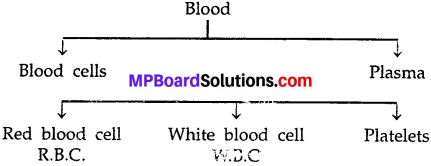
Question 7.
Define valency by taking examples of silicon and oxygen.
Answer:
Valency is the combining capacity of an atom to become electrically stable. Or It means how many electrons are lost or gained by an atom to become stable.
In Silicon,
MP Board Class 9th Science Solutions Chapter 4 Structure of the Atom 30
It has 4 valence electrons.
So, it will lose 4 electrons to become stable.
∴ Its valency is 4.
In Oxygen,
MP Board Class 9th Science Solutions Chapter 4 Structure of the Atom 31
It has 6 valence electrons.
So, it will gain 8 – 6 = 2 electrons to become stable.
∴ Its valency is 2.

Question 8.
Explain with examples:
(i) Atomic number
(ii) Mass number
(iii) Isotopes
(iv) Isobars
Give any two uses of isotopes.
Answer:
(i) Atomic number: It is equal to the total number of
protons in the nucleus of its atom.
E.g.,

  • Carbon has 6 protons. So, its atomic number is 6.

(ii) Mass number: It is equal to the sum of total number of protons and neutrons in the nucleus.
E.g.,

  • Sodium has 11 protons and 12 neutrons. So, its mass number is 11 + 12 = 23

(iii) Isotopes: These are atoms of the same element having same atomic number, but different mass number.
E.g.

  • \(_{ 35 }^{ 79 }{ Br }\), \(_{ 35 }^{ 81 }{ Br }\), \(_{ 6 }^{ 12 }{ C }\), \(_{ 6 }^{ 14 }{ C }\)

(iv) Isobars: These are the atoms of different elements having different atomic number but same mass number.
E.g.

  • \(_{ 18 }^{ 40 }{ Ar }\), \(_{ 20 }^{ 40 }{ Ca }\), \(_{ 11 }^{ 24 }{ Na }\), \(_{ 12 }^{ 24 }{ Mg }\)

Use of Isotopes:

  • Uranium isotope is used as a fuel in nuclear reactor for generating electricity.
  • Sodium isotope is used to detect the blood clots.

MP Board Solutions

Question 9.
Na+ has completely filled K and L shells. Explain.
Answer:
Atomic number of sodium (Na) is 11.
MP Board Class 9th Science Solutions Chapter 4 Structure of the Atom 14
Now, if Na loses 1 electron then it will become Na+.
MP Board Class 9th Science Solutions Chapter 4 Structure of the Atom 15
Now K shell can have maximum of 2 electrons and L shell can have maximum of 8 electrons.
Then, Na+ has completely filled K and L shell.

Question 10.
If bromine atom is available in the form of, say, two isotopes \(_{ 35 }^{ 79 }{ Br }\) (49.7%) and \(_{ 35 }^{ 81 }{ Br }\)Br (50.3%), calculate the average atomic mass of bromine atom.
Answer:
Average atomic mass of bromine atom
= 49.7% of atomic mass of \(_{ 35 }^{ 79 }{ Br }\) + 50.3% of atomic mass of \(_{ 35 }^{ 81 }{ Br }\)
= 49.7% of 79 + 50.3% of 81
= \(\frac { 49.7 }{ 100 }\) × 49 + \(\frac { 450.3 }{ 100 }\) × 81
= (39.263 + 40.743)u = 80.006u

Question 11.
The average atomic mass of a sample of an element X is 16.2u. What are the percentages of isotopes If \(_{ 8 }^{ 16 }{ X }\) and \(_{ 8 }^{ 18 }{ X }\) in the sample?
Answer:
Let the percentage of \(_{ 8 }^{ 16 }{ X }\) in sample be x% and percentage of \(_{ 8 }^{ 18 }{ X }\) in sample be (100 – x)%.
Now,
x% of 16 + (100 – x)% of 18 = 16.2
MP Board Class 9th Science Solutions Chapter 4 Structure of the Atom 16
MP Board Class 9th Science Solutions Chapter 4 Structure of the Atom 17
-2x + 1800 = 16.2 × 100 – 2x + 1800 = 1620
∴ -2x = 1620- 1800 = -180
x = \(\frac {180}{2}\) = 90.
∴ Percentage of  \(_{ 8 }^{ 16 }{ X }\) is 90% and percentage of \(_{ 8 }^{ 18 }{ X }\) is (100 – 90)% = 10%.

Question 12.
If Z = 3, what would be the valency of the element? Also, name the element.
Answer:
Z = 3
So, atomic number = 3 (∵ Z = atomic number)
∴ Electronic configuration = 2, 1
Valency = 1
The name of the element is lithium (Li).

Question 13.
Composition of the nuclei of two atomic species X and Y are given as under
MP Board Class 9th Science Solutions Chapter 4 Structure of the Atom 18
Give the mass number of X and Y. What is the relation between the two species?
Answer:
Mass number of X = Protons + Neutrons = 6 + 6 = 12
And,
Mass number of Y = Protons + Neutrons = 6 + 8 = 14
Both species have same atomic number.
So, they are isotopes of the same element.

Question 14.
For the following statements, write T for True and F for False.

  1. J.J. Thomson proposed that the nucleus of an atom contains only nucleons.
  2. A neutron is formed by an electron and a proton combining together. Therefore, it is neutral.
  3. The mass of an electron is \(\frac {1}{2000}\) times that of proton.
  4. An isotope of iodine is used for making tincture iodine which is used as a medicine.

Answer:

  1. False
  2. False
  3. True
  4. False.

Put tick (✓) against correct choice and cross (✗) against wrong choice in questions 15, 16 and 17.

Question 15.
Rutherford’s alpha – particle scattering experiment was responsible for the discovery of.
(a) Atomic nucleus
(b) Electron
(c) Proton
(d) Neutron.
Answer:
(a) Atomic nucleus

Question 16.
Isotopes of an element have.
(a) the same physical properties
(b) different chemical properties
(c) different number of neutrons
(d) different atomic numbers.
Answer:
(c) different number of neutrons

MP Board Solutions

Question 17.
Number of valence electrons in Cl ion are:
(a) 16
(b) 8
(c) 17
(d) 18
Answer:
(b) 8

Question 18.
Which one of the following is a correct electronic configuration of sodium?
(a) 2, 8
(b) 8, 2, 1
(c) 2, 1, 8
(d) 2, 8, 1.
Answer:
(d) 2, 8, 1.

Question 19.
Complete the following table:

Atomic NumberMass NumberNumber of NeutronsNumber of ProtonsNumber of ElectronsName of the Atomic Species
910
1632Sulphur
2412
21
1010

Answer:

Atomic Number

Mass NumberNumber of
Neutrons
Number of
Pro-­tons
Number of Elec­tronsName of the Atomic Species
9191099Fluorine
16321666Sulphur
1224121212Magnesium
12111Hydrogen
11010Deuterium

Structure of the Atom Additional Questions

Structure of the Atom Multiple Choice Questions

Question 1.
Which is a positive sub – atomic particle?
(a) Proton
(b) Neutron
(c) Electron
(d) None of these.
Answer:
(a) Proton

Question 2.
Electron is discovered by _____ .
(a) J.Chadwick
(b) Neils Bohr
(c) J.J Thomson
(d) Rutherford.
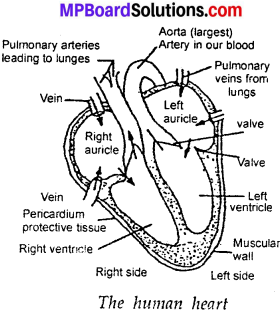
Answer:
(c) J.J Thomson

Question 3.
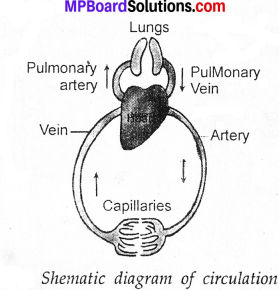
Proton is discovered by _____ .
(a) Rutherford
(b) J. Chadwick
(c) J J. Thomson
(d) E. Goldstein.
Answer:
(d) E. Goldstein.

Question 4.
Neutron is discovered by _____ .
(a) J.J. Thomson
(b) J. Chadwick
(c) Neils Bohr
(d) Rutherford.
Answer:
(b) J. Chadwick

Question 5.
Nucleus is discovered by _____ .
(a) Rutherford
(b) J. Chadwick
(c) J.J. Thomson
(d) Neils Bohr.
Answer:
(a) Rutherford

MP Board Solutions

Question 6.
Mass of electron is _____ .
(a) 9 × 10-25g
(b) 6 × 10-28g
(c) 8 × 10-24g
(d) 9 × 10-28g.
Answer:
(d) 9 × 10-28g.

Question 7.
Mass of Neutron is _____ .
(a) 1.6 × 10⁻²²g
(b) 1.6 × 10⁻²³g
(c) 1.6 × 10⁻²⁵g
(d) 1.6 × 10⁻²⁴g.
Answer:
(d) 1.6 × 10⁻²⁴g.

Question 8.
Charge on an electron is _____ .
(a) -1.8 × 10⁻¹⁸C
(b) -1.7 × 10⁻²⁰C
(c) -1.6 × 10⁻¹⁹C
(d) -1.5 × 10⁻²¹C.
Answer:
(c) -1.6 × 10⁻¹⁹C

Question 9.
The energy paths in an atom in which electrons revolve are called _____ .
(a) Rings
(b) Cycles
(c) Orbits
(d) Circles.
Answer:
(c) Orbits

Question 10.
ass number is the sum of _____ .
(a) Protons and Electrons
(b) Protons and Neutrons
(c) Electrons, Protons and Neutrons
(d) None of these.
Answer:
(c) Electrons, Protons and Neutrons

Question 11.
Atomic number is equal to _____ .
(a) Number of protons
(b) Number of neutrons
(c) Number of electrons
(d) Both (a) and (c).
Answer:
(d) Both (a) and (c)

Question 12.
Maximum number of electrons that can be filled in ‘M’ shell are _____ .
(a) 17
(b) 19
(c) 18
(d) 20.
Answer:
(c) 18

Question 13.
An atom has atomic number ‘17’, then its valency will be _____ .
(a) 7
(b) 2
(c) 1
(d) 8.
Answer:
(c) 1

Question 14.
Isotopes of an element have same number of _____ .
(a) Neutrons
(b) Protons
(c) Electrons
(d) Both (b) and (c).
Answer:
(c) Electrons

Question 15.
Isobars of different elements have same _____ .
(a) Atomic number
(b) Electrons
(c) Mass number
(d) Neutrons.
Answer:
(d) Neutrons

Structure of the Atom Very Short Answer Type Questions

Question 1.
Who discovered canal rays?
Answer:
E. Goldstein.

Question 2.
Name the fruit which resembles J.J. Thomson model of atom.
Answer:
Watermelon.

Question 3.
Who discovered nucleus?
Answer:
Ernest Rutherford.

Question 4.
Who discovered neutrons?
Answer:
James Chadwick.

Question 5.
Name the central part of an atom where protons and neutrons are held together.
Answer:
Nucleus.

MP Board Solutions

Question 6.
What is Alpha Particle?
Answer:
It is a Helium ion (He2+) which has 2 units of positive charge and 4 units of mass.

Question 7.
What are cathode rays?
Answer:
Cathode rays are a beam of fast moving electrons.

Question 8.
What was the main drawback of Rutherford’s model of the atom?
Answer:
Inability to explain the stability of atom.

Question 9.
Write the symbolic representation of an element A with atomic number 10 and mass number 20.
Answer:
\(_{ 10 }^{ 20 }{ A }\)

Question 10.
Name three Isotopes of Hydrogen.
Answer:

  1. Protium (\(_{ 1 }^{ 1 }{ H }\))
  2. Deuterium (\(_{ 1 }^{ 2 }{ H }\))
  3. Tritium (\(_{ 1 }^{ 3 }{ H }\))

Question 11.
Write the electronic configuration of potassium (K).
Answer:
Atomic number of potassium (K) =19
MP Board Class 9th Science Solutions Chapter 4 Structure of the Atom 32

Question 12.
Define valency.
Answer:
It is the combining capacity of an atom to become electrically stable.

Question 13.
What is the charge of a proton?
Answer:
1.6 × 10⁻¹⁹C.

Question 14.
Write the year of discoveries of these sub – atomic particles – electron, proton, neutron and neucleus.
Answer:

  1. Electron – 1897
  2. Proton – 1866
  3. Neutron – 1932
  4. Nucleus – 1911.

Question 15.
Which radioactive Isotope is used in treatment of goitre?
Answer:
Iodine – 131.

Structure of the Atom Short Answer Type Questions

Question 1.
Define:
(a) Canal rays
(b) Cathode rays
(c) Atomic number
(d) Mass number
(e) Energy shells
(f) Valency
(g) Octet
(h) Isotopes
(t) Isobars.
Answer:
(a) Canal rays: These are positively charged radiations which led to the discovery of sub – atomic positively charged particles called protons through an experiment conducted by J.J. Thomson in 1897.

(b) Cathode rays: These are negatively charged radiations which led to the discovery of sub – atomic negatively charged particles called electrons during an experiment conducted by E. Goldstein in 1866.

(c) Atomic number: It is the number of protons present in the nucleus of an atom. It is represented by the letter ‘Z’.

(d) Mass number: It is the total number of protons and neutrons present in an atom of an element.
So, Mass number = Number of protons + Number of neutrons.

(e) Energy Shells: These are fixed circular paths around the nucleus of an atom in which electrons revolve continuously with high speed. These are also called orbits. They are represented by the alphabets K, L, M, N.
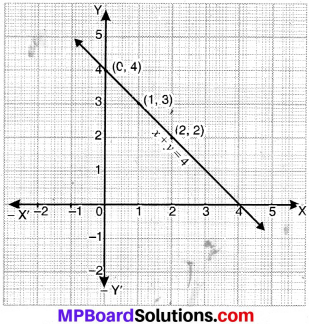
(f) Valency: It is the combining capacity of an atom to become electrically stable, or it also means the number of valency electrons lost or gained by an atom to complete the eight electrons in the valence shell.

(g) Octet: The completely filled outermost shell like L, M or N with 8 electrons is called an octet. When an atom completes its octet, then it become stable.

(h) Isotopes: These are atoms of same element having same atomic number, but different mass number.

E.g.

  • (\(_{ 1 }^{ 1}{ H }\)) , (\(_{ 1 }^{ 2 }{ H }\)), (\(_{ 1 }^{ 3 }{ H }\)) and \(_{ 6 }^{ 12 }{ C }\), \(_{ 6 }^{ 14 }{ C }\)are the isotopes of hydrogen and carbon respectively.

(i) Isobars: These are atoms of different elements having different atomic number but same mass number.
E.g.

  • \(_{ 18 }^{ 40 }{ Ar }\), \(_{ 20 }^{ 40 }{ Ca }\) and \(_{ 11 }^{ 24 }{ Na }\), \(_{ 12 }^{ 24 }{ Mg }\).

Question 2.
Differentiate between:
(a) Electrons and protons.
(b) Atomic number and mass number.
(c) Isotopes and isobars.
(d) Valence electrons and valency.
Answer:
(a)

ElectronsProtons
(i) This is negatively charged sub – atomic particle.(i) This is positively charged sub – atomic particle.
(ii) Its mass is 9 × 1028gms.(ii) Its mass is 1.6 × 10⁻²⁴gms.
(iii) Its symbol is “e”.(iii) Its symbol is “P+”.

(b)

Atomic numberAtomic mass
(i) It is the total number of protons present in the atom.(i) It is the sum of protons and neutrons present in the atom.
(ii) It is represented by ‘Z’.(ii) It is represented by ‘A’.
(iii) It is written on the bottom left as a subscript with the symbol the of element.(iii) It is written on top left as a subscript with the symbol the of element.

(c)

IsotopesIsobars
(i) These are atoms of the same element.(i) These are atoms of the different elements.
(ii) They have same atomic number.(ii) They have different atomic number.
(iii) They have different mass number.(iii) They have same mass number.
(iv) They have same chemical properties.(iv) They have different chemical properties.

(d)

Valence ElectronsValency
(i) These are electrons present in the outermost shell of an atom.(i) These are electrons lost or gained through valence shell of an atom to become stable.
(ii) Valence electrons can be 1, 2, 3 …….. 8 or more.(ii) Valency can be 0, 1, 2, 3, 4 only.

Question 3.
Draw the diagrams of:
(a) J.J. Thomson’s model of atom.
(b) Rutherford’s model of atom.
(c) Neils Bohr’s model of atom.
Answer:
(a) J.J. Thomson’s Model:
MP Board Class 9th Science Solutions Chapter 4 Structure of the Atom 19

(b) Rutherford’s Model:
MP Board Class 9th Science Solutions Chapter 4 Structure of the Atom 20

(c) Neils Bohr’s model of atom.
MP Board Class 9th Science Solutions Chapter 4 Structure of the Atom 21

Question 4.
Write the postulates of J.J. Thomson’s model of the atom.
Answer:
J.J. Thomson’s postulates for model of the atom are as follows:

  1. An atom is a positively charged sphere or ball and negatively charged electrons are embedded in it.
  2. The atom is electrically neutral because negative and positive charges are equal in magnitude.

Question 5.
Write the main points of the theory given by Rutherford for model of atom.
Answer:
Main points of theory of Rutherford regarding model of atom are:

  1. There is an existence of positively charged centre in the atom called as nucleus which contains all the mass of the atom.
  2. The electrons revolve round the nucleus in circular paths called orbits at high speeds.
  3. The size of nucleus (centre of the atom) is very small as compared to size of the atom.
  4. Most of the sphere in an atom is empty.

Question 6.
Write the rules given by Bohr – Bury for arrangement of electrons in different orbits in an atom.
Answer:
Rules given by Bohr – Bury are as follows:

  1. Maximum electrons present in a shell is given by 2n2 where
    • n is the number of that shell.
    • Like, for first shell K, n = 1
    • For second shell L, n = 2
    • third shell M, n = 3
    • fourth shell N, n = 4 called as nucleus which contains all the mass of the atom.
  2. The outermost shell can have maximum of 8 electrons.
  3. Electrons cannot occupy a shell till its inner shells or orbits are completely filled.
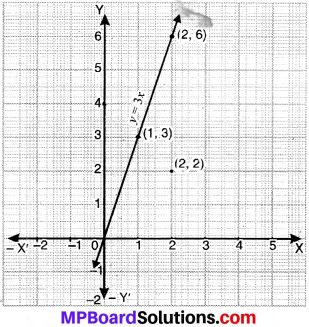
MP Board Solutions

Question 7.
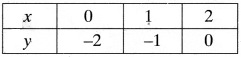
An atom ‘X’ has a mass number ‘23’ and atomic number ‘11’. Find its electrons, protons and neutrons. Also, name the element
Answer:
We know,
Atomic number = Number of protons.
∴ 11 = Number of protons
And, Number of protons = Number of electrons.
∴ Number of electrons = 11
Now, Mass number = Protons + Neutrons.
23 = 11 + Neutrons
∴ Neutrons = 23 – 11 = 12
∴ Atom ‘X’ has 11 electrons, 11 protons and 12 neutrons.
The element is Sodium (Na).

Question 8.
Write the electronic configuration of neon, aluminium, sulphur, argon. Also, find valencies.
Answer:
MP Board Class 9th Science Solutions Chapter 4 Structure of the Atom 22

Question 9.
What are radioactive isotopes? Write down the type of isotopes used in:
(a) Tracing blood clots and tumours in human body
(b) Treatment of cancer
(c) Treatment of Goitre
(d) Nuclear reactor as a fuel.
Answer:
Radioactive isotopes: These are unstable isotopes due to extra neutrons in their nucleus and emits different types of radiations.
Examples:

  • Uranium – 235
  • Cobalt – 60
  • Carbon – 14.

Types of Isotopes used in:
(a) Sodium – 24 to detect blood clots and Arsenic – 72 to detect tumours.
(b) Cobalt – 60
(c) Iodine-131
(d) Uranium – 235.

Question 10.
Draw the atomic structure of:
(a) Fluorine atom (F)
(b) Sodium atom (Na)
(c) Potassium atom (K)
Answer:
(a) Fluorine atom (F):
Atomic number: 9
MP Board Class 9th Science Solutions Chapter 4 Structure of the Atom 23

(b) Sodium atom (Na)
Atomic number: 11
MP Board Class 9th Science Solutions Chapter 4 Structure of the Atom 24

(c) Potassium atom (K)
Atomic number: 19
MP Board Class 9th Science Solutions Chapter 4 Structure of the Atom 25

Question 11.
Write the atomic number, mass number, electrons, protons and neutrons of following atoms:
(a) \(_{ 14 }^{ 24 }{ X }\)
(b) \(_{ 13 }^{ 27 }{ X }\)
Answer:
(a) \(_{ 14 }^{ 24 }{ X }\)
Atomic number = 14
Mass number = 24
Electrons = 14
Protons = 14
Neutrons = 24 – 14 = 10

(b) \(_{ 13 }^{ 27 }{ X }\)
Atomic number = 13
Mass number = 27
Electrons = 13
Protons = 13
Neutrons = 27 – 13 = 14

Question 12.
Pick out the Isotopes and Isobars from the following atoms:
\(_{ 17 }^{ 37 }{ A }\), \(_{ 18 }^{ 40 }{ A }\), \(_{ 17 }^{ 33 }{ A }\), \(_{ 20 }^{ 40 }{ A }\).
Answer:

  1. Isotopes: \(_{ 17 }^{ 37 }{ A }\), \(_{ 17 }^{ 33 }{ A }\)
  2. Isobars: \(_{ 18 }^{ 40 }{ A }\), \(_{ 20 }^{ 40 }{ A }\).

Question 13.
What are noble gases? Why they are stable? Give three examples.
Answer:
Noble gases are the elements which are stable and do not take part in chemical reaction.
They are stable because they have completely filled outer- most shell with 8 electrons
example:
MP Board Class 9th Science Solutions Chapter 4 Structure of the Atom 26
Helium is the only noble gas which has 2 electrons in outermost shell.

Question 14.
Write all the Isotopes of:

  1. Hydrogen
  2. Oxygen
  3. Chlorine
  4. Bromine
  5. Carbon
  6. Neon.

Answer:

  1. Hydrogen (H) – \(_{ 1 }^{ 1 }{ H }\), \(_{ 1 }^{ 2 }{ H }\)
  2. Oxygen (O) – \(_{ 8 }^{ 16 }{ O }\), \(_{ 8 }^{ 17 }{ O }\), \(_{ 8 }^{ 18 }{ O }\)
  3. Chlorine (Cl) – \(_{ 17 }^{ 35 }{ Cl }\), \(_{ 17 }^{ 37 }{ Cl }\)
  4. Bromine (Br) – \(_{ 35 }^{ 79 }{ Br }\), \(_{ 35 }^{ 81 }{ Br }\)
  5. Carbon (C) – \(_{ 6 }^{ 12 }{ C }\), \(_{ 6 }^{ 14 }{ C }\)
  6. Neon (Ne) –  \(_{ 10 }^{ 20 }{ Ne }\), \(_{ 10 }^{ 21 }{ Ne }\), \(_{ 10 }^{ 22 }{ Ne }\)

Question 15.
Why is it wrong to say that atomic number of an atom is equal to its number of electrons?
Answer:
We know that in an atom number of electrons is equal to the number of protons. But, we cannot say that atomic number is equal to number of electrons because number of electrons can be changed after losing or gaining by an atom during chemical reaction. But, number of protons remain constant.

Question 16.
What explanation did Neils Bohr gave on stability of atoms?
Answer:
Neils Bohr explained the stability of atom through following points:

  1. The electrons revolve around the nucleus in fixed orbits or energy levels or shells and each orbit has its fixed radius.
  2. While revolving electrons do not radiate their energies, so they do not fall into the nucleus and make the atom stable.

Question 17.
What are nucleons? What is the name given to the atoms having same number of nucleons?
Answer:
Protons and neutrons together in the nucleus are called nucleons. It means number of nucleons is equal to the sum of protons and neutrons. Atoms having same number of nucleons are called isobars.

Structure of the Atom Long Answer Types Questions

Question 1.
The average atomic mass of a sample of an element X is 13u. What are the percentages of isotopes \(_{ 6 }^{ 12 }{ X }\) and \(_{ 6 }^{ 14 }{ X }\) in the sample?
Answer:
Let, the percentage of isotope \(_{ 6 }^{ 12 }{ X }\) be x%.
So, percentage of isotope \(_{ 6 }^{ 14 }{ X }\) is (100- x) %.
Now, Average atomic mass = Mass of \(_{ 6 }^{ 12 }{ X }\) + Mass of \(_{ 6 }^{ 14 }{ X }\) According to percentages,
∴ 13 = x% of 12 + (100 – x)% of 14
MP Board Class 9th Science Solutions Chapter 4 Structure of the Atom 27
∴ 13 × 100 = 1400 – 2x
1300 = 1400 – 2x
1300 = 1400 – 2x
-100 = -2x
x = \(\frac { 100 }{2 }\) = 50
So, percentage of \(_{ 6 }^{ 12 }{ X }\) is 50% and percentage of \(_{ 6 }^{ 14 }{ X }\) is
= (100 – x)%
= (100 – 50)%
= 50%

MP Board Solutions

Question 2.
Explain Rutherford’s Gold Foil Experiment. Also, explain its observations conclusion, theory proposed and drawback of his model.
Answer:
Ernest Rutherford performed an alpha-particles scattering experiment in which he passed a-particles on the gold foil.
Observation:

  1. Most of α – particles passed straight without any deflection.
  2. Some of the α – particles get deflected from their path.
  3. Very few α – particles get completely bounced back.

Conclusions:

  1. Maximum space in an atom is vacant as most of α – particles passed straight without any deflection.
  2. Some α – particles get deflected from their paths show the existence of positive charge in the atom.
  3. Very few α – particles get completely bounced back indicating the concentration of all mass with positive charge in a small volume at the centre.

Theory proposed:

  1. There is an existence of positively charged centre in the atom called nucleus which contains all the mass of the atom.
  2. The electrons revolve around the nucleus in circular paths called orbits at high speeds.
  3. The size of nucleus (centre of the atom) is very small as compared to size of the atom.
  4. Most of the space in an atom is empty.

Drawback: Rutherford’s model did not explain the stability of the atom. He proposed that electron revolves around the nucleus in circular paths. So, electrons should radiate their energies as they are continuously in circular motion. Then, they should fall into the positively charged nucleus making the atom unstable and collapse.

Question 3.
Draw the electronic structure of sodium and calcium with atomic number 11 and 20 respectively.
Answer:
Sodium has electronic distribution as 2, 8, 1
Calcium has electronic distribution as 2, 8, 8, 2
Electronic structures of sodium and calcium are given:
MP Board Class 9th Science Solutions Chapter 4 Structure of the Atom 28

Question 4.
Both helium (He) and beryllium (Be) have two valence electrons. Whereas ‘He’ represents a noble gas element, ‘Be’ does not. Assign reason.
Answer:
The element He (Z = 2) has two electrons present in the only shell
i.e., K – shell. Since, this shell can have a maximum of two electrons only therefore,
‘He’ is a noble gas element.
The element ‘Be’ (Z = 4) has the electronic configuration as: 2,2.
Although, the second shell has also two electrons but it do not represent a noble gas element.

Structure of the Atom Higher Order Thinking Skills (HOTS)

Question 1.
Which isotope of hydrogen contain same number of electrons, protons and neutrons?
Answer:
Deuterium (\(_{ 1 }^{ 2 }{ D }\))
Number of electron (1) = Number of proton (1)
= Number of neutron (2 – 1 = 1)

Question 2.
Which element of these two would be chemically more reactive: element A with atomic number 18 or element B with atomic number 16 and why?
Answer:
Electric configuration of

  • A – 2,8,8
  • B – 2, 8, 6

Since, the outermost shell of A is complete, it would be inert and will not react. Whereas element B require two atoms to complete its octet. Therefore, B would be more reactive.

Structure of the Atom Value Based Question

Question 1.
Shivek could not solve the following question in the group. His group – mate explained him and solved his difficulty.
The question was as follows:
MP Board Class 9th Science Solutions Chapter 4 Structure of the Atom 29
What information do you get from the given figure about the atomic number, mass number and valency of the given atom ‘X’:

  1. What is the atomic number, the mass number and valency of the atom?
  2. Name the element ‘X’.
  3. What value of Shivek’s friend are reflected in this behaviour?

Answer:

  1. The atomic number is 5, The mass number is 11, The valency is 3.
  2. The element ‘X’ is boron.
  3. Shivek’s friend showed the values of helping and caring nature.

MP Board Class 9th Science Solutions

MP Board Class 9th Maths Solutions Chapter 5 Introduction to Euclid’s Geometry Ex  5.2

MP Board Class 9th Maths Solutions Chapter 5 Introduction to Euclid’s Geometry Ex  5.2

MP Board Solutions

Question 1.
How would you rewrite Euclid’s fifth postulate so that it would be easier to understand?
Solution:
If a line p intersects two lines l and m such that (∠1 + ∠2) is less than 180°, then lines l and m will meet at O, as shown in Fig. below.
MP Board Class 9th Maths Solutions Chapter 5 Introduction to Euclid’s Geometry Ex  5.2 img-1

Question 2.
Does Euclid’s fifth postulate imply the existence of parallel lines? Explain.
Solution:
Yes, Euclid’s fifth postulate is important to express parallel lines. Two lines will never meet if they are not according to Euclid’s fifth postulate.

MP Board Class 9th Maths Solutions

MP Board Class 9th Maths Solutions Chapter 5 Introduction to Euclid’s Geometry Ex  5.1

MP Board Class 9th Maths Solutions Chapter 5 Introduction to Euclid’s Geometry Ex  5.1

Question 1.
Which of the following statements are true and which are false? Give reasons for your answers.

  1. Only one line can pass through a single point.
  2. There are infinite number of lines which pass through two distinct points.
  3. A terminated line can be produced indefinitely on both the sides.
  4. If two circles are equal, then their radii are equal.
  5. In Fig. below, if AB = PQ and PQ = XY, then AB = XY.

MP Board Class 9th Maths Solutions Chapter 5 Introduction to Euclid’s Geometry Ex  5.1 img-1
Solution:

  1. False, infinitely many lines can pass through a given point.
  2. False, only one line can pass through two distinct points.
  3. True, by postulate 2 i.e., a terminated line can be produced indefinitely.
  4. True, equal circles coincide each other. Therefore their radii will be equal.
  5. True, by Euclid’s axiom 1, i.e., things which are equal to the same thing are equal to one another.

MP Board Solutions

Question 2.
Give a definition for each of the following terms. Are there other terms that need to be defined first? What are they, and how might you define them?

  1. parallel lines
  2. perpendicular lines
  3. line segment
  4. radius of a circle
  5. square

Solution:
1. Parallel lines:
Two distinct lines in a plane are called parallel lines if they do not have a common point. Here the undefined terms are lines and plane.

2. Perpendicular lines:
Two lines are perpendicular to each other if they intersect each other at right angle. Here the undefined term is right angle.

3. Line segment:
A part of a line between two points on a line is called a line segment. Here the undefined term is part of a line.

4. Radius of a circle:
Radius of a circle is the distance of a point on the circle from the center of the circle.

5. Square:
A square is a rectangle having all sides equal. Here undefined term is rectangle.

Question 3.
Consider two ‘postulates’ given below:

  1. Given any two distinct points A and B, there exist a third point C which is in between A and B.
  2. There exist at least three points that are not on the same line.

Do these postulates contain any undefined terms? Are these postulates consistent? Do they follow from Euclid’s postulates? Explain.
Solution:
Yes, these postulates contain undefined terms such as point, line, distinct points. They are consistent because they deal with two different situations:

  1. Point C is lying between two distinct points A and B on a line.
  2. Point C is not lying on the line through A and B.

These postulates do not follow from Euclid’s postulates. However they follow from axiom “given two distinct points, there is a unique line that passes through them.

MP Board Solutions

Question 4.
If a point C lies between two points A and B such that AC = BC, then prove that AC = \(\frac{1}{2}\)AB. Explain by drawing the figure.
Solution:
Given: AC = BC
To prove: AC = \(\frac{1}{2}\)AB
Proof:
AC = BC
Adding AC on both sides
AC + AC = BC + AC
2AC = AB
AC = \(\frac{1}{2}\)AB

Question 5.
In Question 4, point C is called a mid-point of line segment AB. Prove that every line segment has one and only one midpoint.
Solution:
If possible, Let us assume that a line segment AB has two mid points C and D when C is the mid point of AB
MP Board Class 9th Maths Solutions Chapter 5 Introduction to Euclid’s Geometry Ex  5.1 img-2
AC = 1/2 AB …(i)
where D is the mid point of AB
AD = 1/2 AB …(ii)
From (i) and (ii), we get
AC = AD
(By Euclid’s axiom, things which are half of the same thing are equal to one another.). This is possible only if C and D coincides.
∴ Our assumption that C and D are two mid points of AB are wrong and hence a line segment has one and only one mid point.

Question 6.
In Fig. below, if AC = BD, then prove that AB = CD.
MP Board Class 9th Maths Solutions Chapter 5 Introduction to Euclid’s Geometry Ex  5.1 img-3
Solution:
Given: AC = BD
To prove: AB = CD
Proof:
AC = BD
Subtracting BC on both sides, we get
AC – BC = BD – BC (By Euclid’s axiom-3)
∴ AB = CD

MP Board Solutions

Question 7.
Why is Axiom 5, in the list of Euclid’s axioms, considered a ‘universal truth’? (Note that the question is not about the fifth postulate).
Solution:
We know that whole is always greater than its part.

MP Board Class 9th Maths Solutions

MP Board Class 9th Maths Solutions Chapter 4 Linear Equations in Two Variables Ex 4.4

MP Board Class 9th Maths Solutions Chapter 4 Linear Equations in Two Variables Ex 4.4

Question 1.
Give the geometric representations of y = 3 as an equation –

  1. In one variable
  2. in two variables.

Solution:
1. Linear equation in one variable
y = 3

2. Linear equation in two variables is
0x + y – 3 = 6
MP Board Class 9th Maths Solutions Chapter 4 Linear Equations in Two Variables Ex 4.4 img-1

Question 2.
Give the geometric representation of 2x + 9 = 0 as an equation –

  1. In one variable
  2. In two variables.

Solution:
1. Linear equation in one variable
2x + 9 = 0
2x = – 9
x = – 4.5

2. Linear equation in two variables
2x + 0y + 9 = 0
MP Board Class 9th Maths Solutions Chapter 4 Linear Equations in Two Variables Ex 4.4 img-2

Equations of a Line Parallel to the x – axis and y – axis:
This is a special case when the given point lies on the axes, either x – axis or y – axis. If the point lies on x – axis, then y – coordinate will be 0 and if the point lies on y-axis, then the x-coordinate will be 0.

MP Board Solutions

Example 1.
Draw the graph of the equation represented by a straight line which is parallel to the x – axis and at a distance 3 units below it. (NCERT Exemplar)
Solution:
The equation of a line which is parallel to the x-axis and at a distance of 3 units below. It is given by
y = – 3
The solutions of the equation are:
MP Board Class 9th Maths Solutions Chapter 4 Linear Equations in Two Variables Ex 4.4 img-3
The graph is shown below.
MP Board Class 9th Maths Solutions Chapter 4 Linear Equations in Two Variables Ex 4.4 img-4

MP Board Class 9th Maths Solutions

MP Board Class 9th Maths Solutions Chapter 4 Linear Equations in Two Variables Ex 4.3

MP Board Class 9th Maths Solutions Chapter 4 Linear Equations in Two Variables Ex 4.3

Question 1.
Draw the graph of each of the following linear equations in two variables:

  1. x + y = 4
  2. x – y = 2
  3. y = 3x
  4. 3 = 2x + y

solution:
1. x + y = 4
Take x = 1
1 + y = 4
∴ y = 3

Take x = 2,
2 + y = 4
∴ y = 2

Take x = 0,
0 + y = 4
∴ y = 4

The solutions are:
MP Board Class 9th Maths Solutions Chapter 4 Linear Equations in Two Variables Ex 4.3 img-1
The graph is shown below.
MP Board Class 9th Maths Solutions Chapter 4 Linear Equations in Two Variables Ex 4.3 img-2

2. x – y = 2
Take x = 1,
1 – y = 2
y = 2 – 1
∴ y = – 1

Take x = 2,
2 – y = 2
– y = 2 – 2
∴ y = 0

Take x = 0,
0 – y = 2
∴ y = – 2
MP Board Class 9th Maths Solutions Chapter 4 Linear Equations in Two Variables Ex 4.3 img-3
MP Board Class 9th Maths Solutions Chapter 4 Linear Equations in Two Variables Ex 4.3 img-4

3. y – 3x
Take x = 0,
y = 3 x 0 = 0

Take x = 1,
y = 3 x 1 = 3

Take x = 2,
y = 3 x 2 = 6
MP Board Class 9th Maths Solutions Chapter 4 Linear Equations in Two Variables Ex 4.3 img-5

4. 3 = 2x + y
Take x = 1,
3 = 2 x 1 + y
3 = 2 + y
3 – 2 = y
∴ y = 1

Take x = 0
3 = 2 x 0 + y
∴ y = 3 – 0 = 3

Take x = -1,
3 = 2 x – 1 + y
3 = – 2 + y
∴ y = 3 + 2 = 5
MP Board Class 9th Maths Solutions Chapter 4 Linear Equations in Two Variables Ex 4.3 img-6
MP Board Class 9th Maths Solutions Chapter 4 Linear Equations in Two Variables Ex 4.3 img-7

Question 2.
Give the equations of two lines passing through (2, 14). How many more such lines are there and why?
Solution:
Two lines passing through point (2, 14)

  1. x + y = 16
  2. 2x + y – 18

Infinitely many lines can be drawn through (2, 14).

MP Board Solutions

Question 3.
If the point (3, 4) lies on the graph of the equation 3y = ax + 7, find the value of a.
Solution:
Putting the value of x = 3 and y = 4 in 3y = ax + 7, we get
3 x 4 = a x 3 + 7
12 = 3a + 7
3a = 12 – 7
a = \(\frac{5}{3}\)

Question 4.
The taxi fare in a city is as follows: For the first kilometer, the fare is ₹ 8 and for the subsequent distance it is ₹ 5 per km. Taking the distance covered as x km and total fare as ₹ y, write a linear equation for this information and draw its graph.
Solution:
Distance covered = x km
Total fare = ₹ y
Fare of 1st km = ₹ 8
Fare for subsequent kms = ₹ 5 per km
MP Board Class 9th Maths Solutions Chapter 4 Linear Equations in Two Variables Ex 4.3 img-8
According to question, y = 8 + 5 (x – 1) = 8 + 5x – 5
y = 3 + 5x
Take x = 0,
y = 3 + 5 x 0
∴ y = 3

Take x = 1,
y = 3 + 5 x 1
y = 3 + 5
∴ y = 8

Take x = 2
y = 3 + 5 x 2
∴ y = 13
MP Board Class 9th Maths Solutions Chapter 4 Linear Equations in Two Variables Ex 4.3 img-9

Question 5.
From the choices given below, choose the equation whose graphs are given in Fig. (a) and Fig. (b)
For Fig. (a)
MP Board Class 9th Maths Solutions Chapter 4 Linear Equations in Two Variables Ex 4.3 img-10

  1. y = x
  2. x + y = 0
  3. y = 2x
  4. 2 + 3y = 7x

For Fig. (b)
MP Board Class 9th Maths Solutions Chapter 4 Linear Equations in Two Variables Ex 4.3 img-11

  1. y = x + 2
  2. y = x – 2
  3. y = – x + 2
  4. x + 2y = 6

Solution:
1. Since (-1, 1), (0, 0) and (1, -1) satisfies the equation x + y = 0.
The equation of the graph is x + y = 0

2. Since (-1,3), (0, 2) and (2, 0) satisfies the equation y = x + 2.
The equation of the graph is y = – x + 2.

MP Board Solutions

Question 6.
If the work done by a body on application of a constant force is directly proportional to the distance traveled by the body, express this in the form of an equation in two variables and draw the graph of the same by taking the constant force as 5 units. Also read from the graph the work done when the distance traveled by the body is:

  1. 2 units
  2. 0 units.

Solution:
Let y be the work done and x be the distance covered. y ∝ x where k is the constant force.
y = kx, (Given)
k = 5
∴ y = 5x

Take x = 0
y = 5 x 0 = 0
MP Board Class 9th Maths Solutions Chapter 4 Linear Equations in Two Variables Ex 4.3 img-12
Take x = 1
y = 5 x 1 = 5

Take = 2
y= 5 x 2 = 10
MP Board Class 9th Maths Solutions Chapter 4 Linear Equations in Two Variables Ex 4.3 img-13
When the distance travelled is –

  1. x = 2 units y = 10 units
  2. x = 0 units y = 0 units.

Question 7.
Yamini and Fatima, two students of class IX of a school, to gether contributed ₹ 100 towards the Prime Minister’s Relief Fund to help the earthquake victims. Write a linear equation which satisfies this data. (You may take their contributions as ₹ x and ₹ y). Draw the graph of the same.
Answer:
Let the contribution of Yamini be ₹ x and that of Fatima be ₹ y.
According to question
x + y = 100
MP Board Class 9th Maths Solutions Chapter 4 Linear Equations in Two Variables Ex 4.3 img-14
Take x = 30,
30 + y = 100
y = 100 – 30
y = 70

Take = 40,
40 + y = 100
y = 100 – 40
y = 60

Take = 50,
50 + y = 100
y = 100 – 50
y = 50
MP Board Class 9th Maths Solutions Chapter 4 Linear Equations in Two Variables Ex 4.3 img-15

Question 8.
In countries like USA and Canada, temperature is measured in Fahrenheit, whereas in countries like India, it is measured in Celsius. Here is a linear equation that converts Fahren-heit to Celsius.
F = (\(\frac{9}{5}\)) C + 32

  1. Draw the graph of the linear equation above using Celsius for x – axis and Fahrenheit for y – axis.
  2. If the temperature is 30°C, what is the temperature in Fahrenheit?
  3. If the temperature is 95°F, what is the temperature in Celsius?
  4. If the temperature is 0°C, what is the temperature in Fahrenheit and if the temperature is 0°F, what is the temperature in Celsius?
  5. Is there a temperature which is numerically the same in both Fahrenheit and Celsius? If yes, find it.

1. F = \(\frac{9}{5}\) + 32
Take C = – 5,
F = \(\frac{9}{5}\) x (- 5) + 32
= – 9 + 32 = 23
C = – 10,
F = \(\frac{9}{5}\) x – 10 + 32 = 14
C = – 15,
F = \(\frac{9}{5}\) x – 15 + 32 = 5

2. From the graph, when temperature is 30°C, temperature in °F is 86°.

3. When F = 95°, C = 35°.
\(\frac{63×5}{9}\) = 35°

4. C = 0°, F = 32°
F = 0°, C = – 17.7°

5. F = – 40°, C = – 40°
MP Board Class 9th Maths Solutions Chapter 4 Linear Equations in Two Variables Ex 4.3 img-16

MP Board Class 9th Maths Solutions