MP Board Class 9th Maths Solutions Chapter 2 Polynomials Ex 2.3

MP Board Class 9th Maths Solutions Chapter 2 Polynomials Ex 2.3

Question 1.
Find the remainder when x3 + 3x3 + 3x + 1 is divided by

  1. x + 1
  2. x – \(\frac{1}{2}\)
  3. x
  4. x + π
  5. 5 + 2x.

Solution:
Let p(x) = x3 + 3x2 + 3x + 1

1. x + 1
x + 1 = 0
x = – 1
Remainder
= p(- 1)= (- 1)3 + 3 (- 1)2 + 3 (-1) +1
= – 1 + 3 – 3 + 1 = 0.

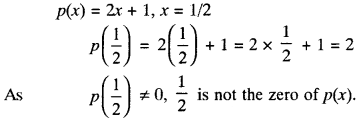
2. x – \(\frac{1}{2}\) = 0
x =π
When p(x) is divided by ( x – \(\frac{1}{2}\)) the remainder is P(\(\frac{1}{2}\))
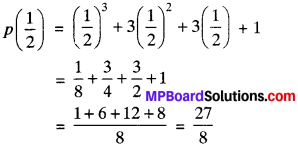
MP Board Class 9th Maths Solutions Chapter 2 Polynomials Ex 2.3 img-1

3. x = 0
When p(x) is divided by x, the remainder is p(0).
p(0) = (0) + 3(0)2 + 3(0) + 1
= 0 + 0 + 0 + 1 = 1

4. x + π = 0
x = – π
When p(x) is divided by (x + π), the remainder is p(- π) p(- K) = (- π)3 + 3 (- π)2 + 3 (- π) + 1
= – π3 + 3π2 – 3π + 1

5. 5 + 2x = 0 x = \(\frac{-5}{2}\)
When p(x) is divided by (5 + 2x), the remainder is p(\(\frac{-5}{2}\))
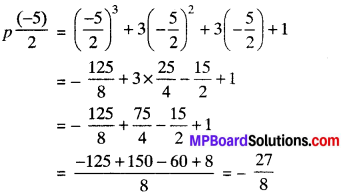
MP Board Class 9th Maths Solutions Chapter 2 Polynomials Ex 2.3 img-2

Question 2.
Find the remainder when x3 – ax2 + 6x – a is divided by x – a.
Solution:
Let p(x) = x2 – ax2 + 6x – 1
x – a = 0
x = a
Remainder = (a)3 – a(a)2 + 6(a) – a
= a2 – a2 + 6a – a
= 5a.

MP Board Solutions

Question 3.
Check whether 7 + 3x is a factor of 3x3 + 7x.
Solution:
p(x) = 3x3 + 7x
7 + 3X = 0
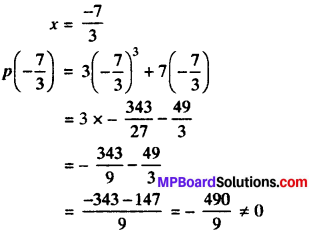
MP Board Class 9th Maths Solutions Chapter 2 Polynomials Ex 2.3 img-3
(7 + 3x) is not a factor of p(x).

Factorization of Polynomials:

Factor Theorem:
Let p{x) be any polynomial of degree equal to or greater than 1 and ‘a’ be any real number such that –

  1. If p(a) = 0, then (x – a) is a factor of p(x)
  2. If (x – a) is a factor then p(a) = 0

Proof:
Let p(x) be a polynomial of degree ≥ 1 and be a real number.

1. If p(a) = 0, then (x – a) is a factor of p(x)
Suppose q(x) be the quotient when p(x) is divided by (x – a). By remainder theorem, remainder = p(a).
P(x) = (x – a) x q(x) + p(a)
p(x) = (x – a) x q(x) (∴ p(a) = 0, given)
= (x – a) is a factor of p(x).

2. If (x – a) is a factor then p(a) = 0
=> p(x) when divided by (x – a) gives remainder = 0 …(i)
But by remainder theorem
When p(x) is divided by (x – a), remainder = p(a) …(ii)
From (i) and (ii), we get
p(a) = 0 Proved.
MP Board Class 9th Maths Solutions

MP Board Class 9th Maths Solutions Chapter 2 Polynomials Ex 2.2

MP Board Class 9th Maths Solutions Chapter 2 Polynomials Ex 2.2

Question 1.
Find the value of the polynomial 5x – 4x2 + 3 at

  1. x = 0
  2. x = – 1
  3. x = 2.

Solution:
Let f(x) = 5x – 4x2 + 3

1. Value of f(x) at x = 0
= f(0) = 5(0) – 4(0)2 + 3 = 3

2. Value of f(x) at x = – 1
= f(- 1) = 5(- 1) – 4(- 1)2 + 3
= – 5 – 4 + 3 = – 6

3. Value of f(x) at x = 2
= f(2) = 5(2) – 4(2)2 + 3
= 10 – 16 + 3 = – 3.

MP Board Solutions

Question 2.
Find p(0), p(1) and p(2) for each of the following polynomials:

  1. p(y) = y2 – y + 1
  2. p(t) = 2 + t + 2t2 – t3
  3. p(x) = x3
  4. p(x) = (x – 1)(x + 1)

Solution:
1. p(y) = y2 – y + 1
P(0) = (0)2 – (0) + 1
= p(1) = (1)2 – (1) + 1 = 1,
and p(2)2 = (2)2 – (2) + 1
= 4 – 2 + 1 = 3.

2. p(t) = 2 + t + 2t2 – t3
p(0) = 2 + 0 + 2(0)2 – (0)2 = 2
p(1) = 2 + 1 + 2(1)2 – (1)2
= 2 + 1 + 2 – 1 = 4
and p(2) = 2 + 2 + 2(2)2 – (2)3
= 2 + 2 + 8 – 8 = 4

3. p(x) = x3
p(0) = (0)2 = 0,
p(1) = (1)2 = 1,
and p(2) = (2)3 = 8.

4. p(x) = (x – 1) (x + 1)
p(0) = (0 – 1) (0 + 1) = (- 1) (1) = – 1
P(1) = (1 – 1) (1 + 1) = (0) (2) = 0 and
p(2) = (2 – 1) (2 + 1) = (1) (3) = 3

Question 3.
Verify whether the following are zero of the polynomial, written against them.

  1. p(x) = 3x + 1, x = – \(\frac{1}{3}\)
  2. p(x) = 5x – π, x = \(\frac{4}{5}\)
  3. p(x) = x2 -1, x = 1, – 1
  4. p(x) = (x + 1) (x – 2), x – 1, 2
  5. p(x) = x2, x = 0
  6. p(x) = lx + m, x = – \(\frac{m}{l}\)
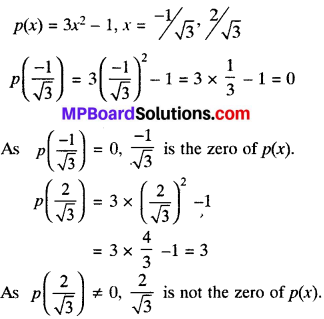
  7. p(x) = 3x2 – 1, x = – \(\frac{1}{\sqrt{3}}\), \(\frac{2}{\sqrt{3}}\)
  8. p(x) = 2x + 1, x = \(\frac{1}{2}\)

Solution:
1. p(x) = 3x + 1
x = – \(\frac{1}{3}\)
p(- \(\frac{1}{3}\)) = 3(- \(\frac{1}{3}\)) + 1 = 0
= – 3 x \(\frac{1}{3}\) + 1 = – 1 + 1 = 0
As p(- \(\frac{1}{3}\)) = 0, – \(\frac{1}{3}\) is the zero of p(x).

2. p(x) = 5x – π
x = \(\frac{4}{5}\)
p(\(\frac{4}{5}\)) = 5 x \(\frac{4}{5}\) – π = 4 – π
As p(\(\frac{4}{5}\)) ≠ 0,
\(\frac{4}{5}\) is not the zero of p(x).

3 p(x) = x2 – 1, x = 1, -1
P(1) = (1)2 – 1 = 1 – 1 = 0
p(-1) = (-1)2 – 1 = 1 – 1 = 0
As p(1) = 0 and p(-1) = 0
Both 1 and -1 are the zeros of p(x).

4. p(x) = (x + 1)(x – 2)
x = – 1, 2
p(- 1) = (-1 + 1) (- 1 – 2)
= (0) (-3) = 0
p( 2) = (2 + 1) (2 – 2)
= 3 x 0 = 0
As p(- 1) = 0 and p(2) = 0,
Both -1 and 2 are the zeros of p(x).

5. p(x) = x2
x = 0
P(0) = (0)2 = 0
As p(0) = 0, 0 is a zero of p(x)

6. p(x) = lx + m, x = – \(\frac{m}{l}\)
p(- \(\frac{m}{l}\)) = l x – \(\frac{m}{l}\) + m
As p(- \(\frac{m}{l}\)) = 0, (-\(\frac{m}{l}\)) is a zero of p(x).

7.
MP Board Class 9th Maths Solutions Chapter 2 Polynomials Ex 2.2 img-1
8.
MP Board Class 9th Maths Solutions Chapter 2 Polynomials Ex 2.2 img-2

Question 4.
Find the zero of the polynomial in each of the following cases:

  1. p(x) = x + 5
  2. p(x) = x – 5
  3. p(x) = 2x + 5
  4. p(x) = 3x – 2
  5. p(x) = 3x
  6. p(x) = ax, a ≠ 0
  7. p(x) = cx + d, c ≠ 0, c, d are real numbers.

Solution:
1. p(x) = x + 5
p(x) = 0
x + 5 = 0
x = – 5
∴ – 5 is a zero of the polynomial p(x).

2. P(x) = x – 5
p(x) = 0
x – 5 = 0 x = 5
∴ 5 is a zero of the polynomial p(x).

3. p(x) = 2x + 5
2x + 5 = 0
x = – \(\frac{5}{2}\)
∴ – \(\frac{5}{2}\) is the zero of p(x).

4. p(x) = 3x – 2
3x – 2 = 0
x = \(\frac{2}{3}\)
∴ \(\frac{2}{3}\) is the zero of p(x)

5. p(x) = 3x
3x = 0
x = \(\frac{0}{3}\)
∴ 0 is the zero of p(x).

6. p(x) = ax where a ≠ 0
ax = 0
x = \(\frac{0}{a}\)
∴ 0 is the zero of p(x).

7. p(x) = cx + d where c ≠ 0, c, d are real numbers
cx + d = 0
x = – \(\frac{d}{c}\)
∴ – \(\frac{d}{c}\) is the zero of p(x).

MP Board Solutions

Remainder Theorem:
If a polynomial p{x) is divided by another polynomial (x – a), the remainder isp(a). Where p(x) is any polynomial of degree greater than or equal to one and also degree p(x) > degree p(a) ‘a’ be any real number.

Dividend = divisor x quotient + remainder

Proof:
Let p(x) be any polynomial with degree greater than or equal to 1, suppose that when p(x) is divided by x – a, the quotient is q(x) and remainder is r(x).
p(x) – (x – a) x q(x) + r(x)
p(x) = (x – a) x q(x) + r(x)…..(i)

Case I:
If r(x) = 0
Equation reduce to
p(x) = (x – a) q(x) ……(ii)
On putting x = a, in (ii),
We get p(a) = (a – a) q(a)
p(a) = 0 = Remainder

Case II:
If r(x) ≠ 0
Equation (i) reduced to
p(x) = (x – a) q(x) + r …..(iii)
On putting x = a in (iii), we get
p(a) =(a – a) x q(x) + r
p(a) = r = Remainder
∴ So the remainder is p(a) when p(x) is divided by (x – a).

MP Board Class 9th Maths Solutions

MP Board Class 9th Science Solutions Chapter 1 Matter in Our Surroundings

MP Board Class 9th Science Solutions Chapter 1 Matter in Our Surroundings

Matter in Our Surroundings Intext Questions

Matter in Our Surroundings Intext Questions Page No. 3

Question 1.
Which of the following are matter? Chair air, love, smell, hate, almonds, thought, cold, cold – drink smell of perfume.
Answer:
Chair, air, almonds and cold – drink.

Question 2.
Give reasons for the following observation: The smell of hot sizzling food reaches you several metres away, but to get the smell from cold food you have to go close.
Answer:
The particles of hot food have more kinetic energy due to higher temperature, so their rate of diffusion is more and they move several meters away as compared to the particles of cold food.

Question 3.
A diver is able to cut through water in a swimming pool. Which property of matter does this observation show?
Answer:
This shows that the particles of matter have space between them and a weak force of attraction between them.

MP Board Solutions

Question 4.
What are the characteristics of the particles of matter?
Answer:
Following are the characteristics of the particles of matter:

  1. Particles of matter are very small.
  2. Particles of matter have space between them.
  3. Particles of matter are continuously moving.
  4. Particles of matter attract each other.

Matter in Our Surroundings Intext Questions Page No. 6

Question 1.
The mass per unit volume of a substance is called density, (density = mass / volume). Arrange the following in order of increasing density: air, exhaust from chimneys, honey, water, chalk, cotton and iron.
Answer:
The order of increasing densities:
air < exhaust from chimneys < cotton < water < honey < chalk < iron.

Question 2.
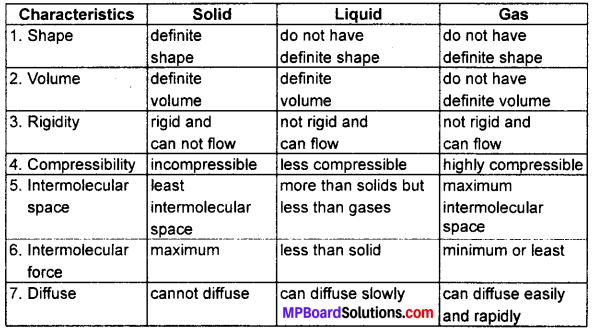
(a) Tabulate the differences in the characteristics of states of matter.
(b) Comment upon the following: Rigidity, Compressibility, Fluidity, Filling a gas container, Shape, Kinetic energy and Density.
Answer:
(a)
MP Board Class 9th Science Solutions Chapter 1 Matter in Our Surroundings 1

(b)
(i) Rigidity: It is the tendency of matter to retain or maintain its shape when an outside force is applied.

  • Solids are rigid in matter

(ii) Compressibility: It is the property of matter due to which it can be compressed to lower volume.

  • Solids have minimum compressibility, but gases have maximum.

(iii) Fluidity: It is the tendency of a matter or particles of a matter to flow.

  • Liquid and gases have fluidity so they are fluids.

(iv) Filling a gas container: Gas particles fill the container completely due to negligible intermolecular force and maximum space between particles.

(v) Shape: It is the property of a matter which indicates its boundaries.

  • Solid have fixed shape but liquids and gases have no fixed shape.

(vi) Kinetic energy: The energy of matter or particles of matter due to their motion is called kinetic energy.

  • Particles of gases have highest kinetic energy and liquids have less kinetic energy than gases but more than solids.

(vii) Density: It is mass per unit volume.

  • Solids have highest density, liquids have low density than solids but greater than gases.

MP Board Solutions

Question 3.
Give reasons:
(a) A gas fills completely the vessel in which it is kept.
(b) A gas exerts pressure on the walls of the container.
(c) A wooden table should be called a solid.
(d) We can easily move our hand in air but to do the same through a solid block of wood, we need a karate expert.
Answer:
(a) The molecules of gas have very less force of attraction and possess high kinetic energy due to which they move in all directions and fill the vessel completely.

(b) The particles of gas move freely and randomly in all directions. So, they collide with each other and also with the walls of the container due to which they exert a Pressure on its walls.

(c) A wooden table has a fixed shape, fixed volume. It is rigid and cannot be compressed. So it should be called a solid.

(d) The particles of Air have very less force of attraction between them, so we can easily move our hand, but particles of wood have strong force of attraction, so we have to apply a greater amount of force to break it and pass through solid wood.

Question 4.
Liquids generally have lower density as compared to solids. But you must have observed that ice floats on water. Find out why.
Answer:
We know that ice is solid and water is liquid but the structure of ice is cage like due to which the molecules of water are not closely packed and have vacant space between them due to which ice has low density than water and floats over it.

Matter in Our Surroundings Intext Questions Page No. 9

Question 1.
Convert the following temperature to celsius scale:
(a) 300 K
(b) 573 K
Answer:
(a) 300 K = (300 – 273)°C = 27°C.
(b) 573 K = (573 – 273)°C = 300°C.

Question 2.
What is the physical state of water at:
(a) 250°C
(b) 100°C?
Answer:
(a) Gaseous state.
(b) Liquid and gaseous both.

Question 3.
For any substance, why does the temperature remain constant during the change of state?
Answer:
During the change of state of any substance, the temperature remains constant because the heat supplied to the substance is used in overcoming the force of attraction between the particles and change its state. This hidden heat is called latent heat.

MP Board Solutions

Question 4.
Suggest a method to liquefy atmospheric gases.
Answer:
The atmospheric gases can be liquefied by cooling and applying pressure on them in a closed chamber or cylinder.

Matter in Our Surroundings Intext Questions Page No. 10

Question 1.
Why does a desert cooler cool better on a hot dry day?
Answer:
On a hot dry day, the rate of evaporation is high because of low humidity. So, water sprinkling on the pads of cooler gets evaporated from outside which results in making its walls cool and then we receive cool air.

Question 2.
How does the water kept in an earthen pot (matka) become cool during summer?
Answer:
The earthen pot has a lot of pores on its surface. So, water comes out and gets evaporated from these pores and cools the water inside the pot.

Question 3.
Why does our palm feel cold when we put some acetone or petrol or perfume on it?
Answer:
When we put acetone, petrol or perfume on our palm, then these liquids absorb energy from our palm and get evaporated which cause cooling effect on our palm.

Question 4.
Why are we able to sip hot tea or milk faster from a saucer rather than a cup?
Answer:
Saucer has a large surface area than a cup. So the rate of evaporation is more in saucer than cup which causes faster cooling of the hot tea. Hence, we can sip hot tea from a saucer faster than cup.

Question 5.
What type of clothes should we wear in summer?
Answer:
Light coloured cotton clothes should be worn in summer because light colour reflects heat and cotton absorbs sweat quickly and evaporates it easily which makes our body feel cool and dry.

Matter in Our Surroundings NCERT Textbook Exercises

Question 1.
Convert the following temperatures to the Celsius scale.
(a) 293 K
(b) 470 K.
Answer:
(a) 293 K into°C
⇒ 993 – 273 = 20°C

(b) 470 K into°C
⇒ 470 – 273 = 197°C

MP Board Solutions

Question 2.
Convert the following temperatures to the Kelvin scale.
(a) 25°C
(b) 373°C
Answer:
(a) 25°C = 25 + 273 = 298 K
(b) 373°C = 373 + 273 = 646 K.

Question 3.
Give reason for the following observations.
(a) Naphthalene balls disappear with time without leaving any solid.
(b) We can get the smell of perfume sitting several metres away.
Answer:
(a) Naphthalene balls disappear with time without leaving any solid, because naphthalene balls sublime and directly change into vapour state without leaving any solid.

(b) We can get the smell of perfume sitting several metres away because perfume contains volatile solvent i.e., gaseous particles, which have high speed and large space between them and diffuse faster and can reach people sitting several metres away.

Question 4.
Arrange the following substances in increasing order of forces of attraction between the particles – water, sugar, oxygen.
Answer:
Oxygen → water → sugar.

Question 5.
What is the physical state of water at:
(a) 25°C
(b) 0°C
(c) 100°C?
Answer:
(a) 25°C is liquid.
(b) 0°C is solid or liquid.
(c) 100°C is liquid and gas.

Question 6.
Give two reasons to justify:
(a) water at room temperature is a liquid.
(b) an iron almirah is a solid at room temperature.
Answer:
(a) Water at room temperature is a liquid because its freezing point is 0°C and boiling point is 100°C.
(b) An iron almirah is a solid at room temperature because melting point of iron is higher than the room temperature.

MP Board Solutions

Question 7.
Why is ice at 273 K more effective in cooling than water at the same temperature?
Answer:
Ice at 273 K will absorb heat energy or latent heat from the medium to overcome the heat of fusion to become water. Hence, the cooling effect of ice is more than the water at same temperature because water does not absorb this extra heat from the medium.

Question 8.
What produces more severe burns, boiling water or steam?
Answer:
Steam at 100°C will produce more severe burns as extra heat is hidden in it called latent heat. Whereas, the boiling water does not have this hidden heat.

Question 9.
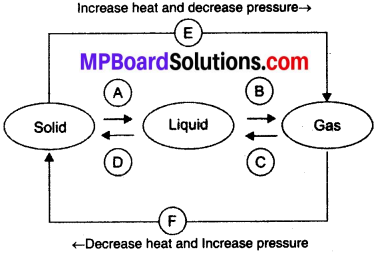
Name A, B, C, D, E and F in the following diagram showing change in its state
MP Board Class 9th Science Solutions Chapter 1 Matter in Our Surroundings 2
Answer:
A → Liquefication / melting / fusion
B → Vaporisation / evaporation
C → Condensation
D → Solidification
E → Sublimation
F → Sublimation

Matter in Our Surroundings Additional Questions

Matter in Our Surroundings Multiple Choice Questions

Question 1.
Which of the following substances is solid?
(a) Plasma
(b) BEC
(c) Wood
(d) Mercury
Answer:
(c) Wood

MP Board Solutions

Question 2.
Fusion is the phenomenon of changing of state of __________ .
(a) Liquid to gas
(b) Solid to liquid
(c) Solid to gas
(d) Gas to plasma.
Answer:
(b) Solid to liquid

Question 3.
Diffusion is not possible in the case of __________ .
(a) Liquid into Solid
(b) Gas into liquid
(c) Gas into Gas
(d) Solid into Solid.
Answer:
(d) Solid into Solid.

Question 4.
Compressibility is highest in __________ .
(a) Liquid
(b) Solid
(c) Gas
(d) Plasma.
Answer:
(c) Gas

Question 5.
We can smell odour of deodrant several metres away due to __________ .
(a) Diffusion
(b) Evaporation
(c) Fusion
(e) None.
Answer:
(a) Diffusion

Question 6.
Which of the following do not exhibit sublimation?
(a) Water
(b) Camphor
(c) Naphthalene
(d) Dry ice.
Answer:
(a) Water

Question 7.
Ice floats on water because of __________ .
(a) Higher density than water
(b) Equal density than water
(c) Lower density than water
(d) None of these.
Answer:
(c) Lower density than water

Question 8.
As the pressure of air increases then boiling point of liquid __________ .
(a) Increases
(b) Decreases
(c) Remains same
(d) None of these.
Answer:
(a) Increases

MP Board Solutions

Question 9.
The atmospheric pressure equals to __________ .
(a) 1.01325 × 10⁸ Pa
(b) 101.3 25 × 104 Pa
(c) 1.01325 × 10⁵ Pa
(d) 1.01325 × 10² Pa.
Answer:
(c) 1.01325 × 10⁵ Pa

Question 10.
Cooking at high altitudes is difficult because __________ .
(a) Boiling point decreases
(b) Boiling point increases
(c) Freezing point reduced
(d) None of the above.
Answer:
(a) Boiling point decreases

Question 11.
Density of water is highest at __________ .
(a) 3°C
(b) 5°C
(c) 4°C
(d) 6°C.
Answer:
(a) 3°C

Question 12.
Dry ice is __________ .
(a) Solid carbon monoxide (CO)
(b) Solid Nitrogen dioxide (NO2)
(c) Solid carbon dioxide (CO2)
(d) Solid Ammonia (NH3).
Answer:
(c) Solid carbon dioxide (CO2)

Question 13.
The amount of heat required to change the state of 1 kg of substance is called __________ .
(a) Calorific heat
(b) Latent heat
(c) Thermal heat
(d) Conversion heat.
Answer:
(b) Latent heat

Question 14.
Evaporation takes place at __________ .
(a) Boiling point
(b) Melting point
(c) Freezing point
(d) At all temperatures.
Answer:
(d) At all temperatures.

Question 15.
Evaporation generally takes place at __________ .
(a) Below boiling point
(b) Above boiling point
(c) At boiling point
(d) None.
Answer:
(a) Below boiling point

Question 16.
Evaporation causes __________ .
(a) Heating effect
(b) Boiling effect
(c) Cooling effect
(d) Absorbing effect.
Answer:
(c) Cooling effect

Question 17.
Latent heat of vaporisation of water is __________ .
(a) 2.25 × 10⁶ J/kg
(b) 3.34 × 10⁶ J/kg
(c) 22.5 × 10⁶ J/kg
(d) 33.4 × 10⁵ J/kg.
Answer:
(a) 2.25 × 10⁶ J/kg

Question 18.
Which factor does not affect the rate of evaporation?
(a) Humidity
(b) Colour
(c) Wind Speed
(d) Surface area.
Answer:
(b) Colour

Question 19.
The rate of evaporation is minimum in __________ .
(a) Dry day
(b) Humid day
(c) Hot day
(d) Stormy day.
Answer:
(b) Humid day

Question 20.
Which of the following processes consumes heat?
(i) Melting
(ii) Freezing
(iii) Vaparisation
(iv) Condensation.

(a) (i) and (ii)
(b) (ii) and (iii)
(c) (i) and (iii)
(d) (ii) and (iv).
Answer:
(c) (i) and (iii)

Matter in Our Surroundings Very Short Answer Type Questions

Question 1.
Define Matter.
Answer:
Matter is defined as something which occupies space and has mass.

Question 2.
What is the melting point of ice?
Answer:
0°C or 273 K.

Question 3.
Name the phenomenon by which two substances intermix with each other.
Answer:
Diffusion.

Question 4.
Name the physical State of matter which can be highly compressed.
Answer:
Gaseous state.

Question 5.
Name the tiny particles of which matter is made up of.
Answer:
Atoms.

MP Board Solutions

Question 6.
Name the process of conversion of solid state into gaseous state directly.
Answer:
Sublimation.

Question 7.
Name the Indian scientist who calculated the fifth state of matter.
Answer:
Satyendra Nath Bose.

Question 8.
Name all the states of matter.
Answer:
Solid, liquid, gas, plasma, BEC (Bose Einstein Condensate).

Question 9.
What is Chemical name of dry ice?
Answer:
Solid Carbon Dioxide.

Question 10.
What is the main effect produced by evaporation?
Answer:
Cooling effect.

Matter in Our Surroundings Short Answer Type Questions

Question 1.
Define diffusion? On which features does it depend?
Answer:
It is the mixing of particles of different matters. It depends on the state, temperature and kinetic energy of particles.

Question 2.
Define:
(a) Latent heat of fusion
(b) Latent heat of vaporisation.
Answer:
(a) Latent heat of fusion is the amount of heat energy required to convert 1 kg of a solid into liquid at its melting point.

(b) Latent heat of vaporisation is the amount of heat energy required to convert 1 kg of liquid into gas at its boiling point.

Question 3.
Explain the following terms:
(a) Sublimation
(b) Evaporation.
Answer:
(a) Sublimation: The phenomenon of change of state directly from solid to gas or vapours or vice-versa without changing into liquid state.
Examples:
Dry ice, camphor.

(b) Evaporation: The process of changing matter from liquid state into the vapour state at any temperature below its boiling point.
Examples:
Drying of clothes, volatile liquids like petrol, kerosene.

Question 4.
What are the different factors on which evaporation of liquids depend?
Answer:
The factors on which evaporation depends are:
(a) Temperature
(b) Surface area
(c) Humidity
(d) Wind speed

Question 5.
Write four substances which show sublimation.
Answer:
(a) Camphor
(b) Naphthalene balls
(c) Dry ice
(d) Ammonium chloride

Question 6.
Why the temperature of ice remains constant when it starts melting?
Answer:
When the ice melts, then it absorbs the latent heat of fusion which changes its states. And, that heat is consumed in changing the state, keeping the temperature constant.

Question 7.
How can we liquefy gas? How is it useful to us?
Answer:
Gases can be liquefied by cooling them and by applying pressure into a closed chamber like cylinder. This property of compressibility is useful for us and we use it through different ways e.g., LPG (Liquefied Petroleum Gas), CNG (Compressed Natural Gas) and Liquefied O2 in welding.

Question 8.
Differentiate between:
(a) Freezing and Melting.
(b) Evaporation and Boiling.
Answer:
(a) Freezing and Melting:

(a) FreezingMelting
1. It is the conversion from liquid state into solid state1. It is the conversion from solid to liquid state.
2. Heat is released.2. Heat is absorbed.

(b) Evaporation and Boiling:

(b) EvaporationBoiling
1. It takes place on the surface of liquid.1. It happens to all liquids.
2. It takes place at all temperatures.2. It happens at a particular temperature.
3. It is slow.3. It is fast.
4. It causes cooling.4. It does not cause cooling.

Question 9.
Why solid carbon dioxide is called dry ice?
Answer:
It is because carbon dioxide is pressurised in the form of solid state which looks cool like ice. But when it is heated, it directly get converted into carbon dioxide gas.

MP Board Solutions

Question 10.
Change the following temperatures accordingly.
(a) -173°C
(b) 250 K
(c) 2°C
(d) 0°K
Answer:
(a) We know that,
Temperature on kelvin = Temperature on Celsius + 273
So, -173°C = (-173 + 273) K = 100 K

(b) 250 K = (250 – 273)°C = -23°C

(c) 2°C = (2 + 273) K = 275 K

(d) 0°K = (0 – 273)°C = -273°C.

Question 11.
Give one example of each: Melting, Vaporisation, Condensation, Sublimation, Evaporation.
Answer:
Melting: Ice to water
Vaporisation: Water to steam
Condensation: LPG
Sublimation: Naphthalene balls, solid iodine
Evaporation: Volatile liquids like petrol.

Matter in Our Surroundings Long Answer Type Questions

Question 1.
Give reasons:
(а) The smell of hot tasty cooked food reaches us from far.
(b) The smell of perfume reaches us several metres away.
(c) The fragrance of an incense stick spreads in entire hall quickly.
(d) Steam is more severe than boiling water.
(e) We see water droplets collected on outer surface of steel glass containing cold water.
(f) We feel lot of perspiration on a humid day.
(g) Evaporation causes cooling.
(h) It is advised to use pressure cooker at high altitudes.
(i) We should wear light colour cotton clothes in summer.
(j) A gas fills the container completely.
(k) Clothes take more time to dry in a humid day.
(l) Kerosene oil is kept in a cool place.
Answer:
(a) The particles of hot tasty food have high kinetic energy due to raised temperature. So, they can easily diffuse and move to long distances.

(b) The particles of perfume are in vapour form. So, they possess high kinetic energy and move randomly and finally reach us several metres away.

(c) The particles of an incense stick are in gaseous state. So, they have high kinetic energy and diffuse quickly into atmosphere and cover the room.

(d) Steam has the heat in the form of latent heat as compared to boiling water. So, it is more severe.

(e) The water vapours present in the atmosphere get condensed when it comes in contact with the chilled container and get deposited in the form of liquid droplets.

(f) The rate of evaporation decreases on humid day as there are sufficient water vapours present in the atmosphere. So, our sweat does not get dried and we perspire a lot.

(g) During the evaporation, the particles on the surface of the fluid take energy and heat from the surface get vaporised which create cooling effect.

(h) It is advised to use pressure cooker at high altitudes because the atmospheric pressure is low and water boils quickly. So, to increase the pressure and to cook the food properly, pressure cooker is required.

(i) Light colour cotton clothes are good reflectors of heat as well as good absorbers of sweat. When sweating occurs, the cotton absorbs it quickly and evaporates it faster.

(j) The particles of gas have very less intermolecular force of attraction and have large intermolecular space. So, they possess high kinetic energy and expand quickly resulting in filling the container completely.

(k) The rate of evaporation is minimum on a humid day. So, cloth takes more time to get dried.

(l) Kerosene a volatile substance and it evaporates quickly and also there is a risk of breaking of bottle due to the pressure created by its particles. So, it is stored in a closed container and kept in a cool place.

Question 2.
(a) What is evaporation? On what factors does it depend?
(b) How is it useful to us?
Answer:
(a) Evaporation:
The phenomenon of changing of a matter from liquid state into the vapour state or gaseous state at any temperature below its boiling point is known as evaporation. The rate of evaporation depends on the following factors:

  1. Surface area: If the surface area of the liquid increases, then evaporation becomes faster.
  2. Temperature: When the temperature of the liquid increases then the kinetic energy of the particles increases which causes faster evaporation.
  3. Wind speed: When the speed of wind increases, it covers the vacant space in the atmosphere created by moving wind, the evaporation gets faster. Also, we have seen that clothes dry faster in a windy day than a normal day.
  4. Humidity: If the humidity is least then rate of evaporation is faster but when humidity is high, then Atmosphere can’t hold much water vapours which causes slow rate of evaporation.

(b) Uses of evaporation:

  1. Drying of clothes.
  2. Separation of different mixtures like water and salt.
  3. Desert coolers etc.

Question 3.
Give one example of each:
(a) Water vapours present in the atmosphere.
(b) Diffusion of a gas into liquid.
(c) Diffusion of a liquid into liquid.
(d) Diffusion of a gas into gas.
(e) Two sublime substances.
Answer:
(a) Presence of water droplets is seen on the outer surface of steel container containing cold water.
(b) Presence of dissolved oxygen in marine water which is used up by aquatic organisms.
(c) Mixing of ink and water.
(d) Burning of incense stick.
(e) Ammonium chloride, Naphthalene balls.

Question 4.
(a) What is matter? What characteristics does a matter possess?
(b) Explain all the five states of matter.
Answer:
(a) Matter: Matter is anything which occupies space and has mass.
(b) Matter has five states:

  1. Solid: It is the state of matter which has a fixed shape, volume, high density, incompressible and cannot flow.
  2. Liquid: It is the state of matter which possesses indefinite shape, definite volume, low compressibility and can flow easily.
  3. Gas: It is the state of matter which possesses indefinite shape, indefinite volume, high compressibility and can flow easily.
  4. Plasma: This state of matter consists of free electrons . and ions in the form of ionised gases.
  5. BEC (Bose – Einstein Condensate): This state of matter is achieved by cooling gas of extremely to low density of about one – hundredth thousand the density of a normal air to super low temperature.

Matter in Our Surroundings Higher Order Thinking Skills (HOTS)

Question 1.
Osmosis is a special kind of diffusion, Comment
Answer:
In diffusion, molecules of a substance move from higher concentration to lower concentration. But, during Osmosis, the water or solvent molecules move from their higher concentration to the place of their lower concentration. Therefore, Osmosis is a special kind of diffusion.

Question 2.
Why does honey diffuse in water at a slower rate than ink?
Answer:
Honey diffuse at a slower rate than ink since the density of honey is greater than that of water.

Matter in Our Surroundings Value Based Questions

Question 1.
Gaurav is preparing for his cricket match in summer camp. He took full sleeves black colour silk shirt for the match. But his mother advised him to wear white half sleeve cotton shirt
(a) Why did mother advise him to wear white cotton shirt?
(b) What type of clothes we should wear in summer?
(c) What values of mother are reflected here?
Answer:
(a) Mother advised him to wear white cotton shirt because white is a good reflector of heat and cotton is a good absorber of sweat and helps in quick evaporation, which will make Gaurav feel cool during the match.

(b) Light coloured cotton clothes should be worn in summer.

(c) Mother showed her values of caring and insightful.

Question 2.
Aakansha parked her scooty in a parking of her society. In the evening, she saw her scooty tyre was burst. Then, she immediately went to mechanic to repair the puncture and advised the mechanic not to inflate the tyres fully.
(а) Why did the scooty punctured?
(b) Why she advised mechanic not to inflate the tyres fully?
(c) What values of Aakansha is reflected here?
Answer:
(a) The scooty got punctured due to bursting of tyre because the particles of air expanded and gained kinetic energy due to heat and pressurised the walls of tyre resulting in bursting.

(b) She advised mechanic not to inflate the tyres fully as the summer days were hot which caused the expansion of inflated air and create excessive pressure in the tyres.

(c) Aakansha showed her values of intelligence and awareness.

MP Board Solutions

Question 3.
Ansh had a “Pooja” in his house. His mother told him to bring camphor required for “Pooja” from the market. On the “Pooja” day when he opened up the packet, he got surprised to see it empty. Then, Ansh got alert and brought a new packet.
(a) Why did the packet got empty?
(b) Name the property of matter mentioned here.
(c) Why did Ansh keep new camphor packet in a closed container?
(d) What values of Ansh are mentioned here?
Answer:
(a) Packet got emptied due to the evaporation of camphor due to its sublime nature.
(b) The property of sublimation is shown here.
(c) To prevent sublimation of camphor.
(d) Ansh shows the values of curiosity, wisdom and duty.

Question 4.
Sanjana went to a farm house with her family to spend her summer vacations. But the farm house faced the frequent problem of power cut. So, the refrigerator was not chilling the water bottles. Then, she brought two earthen pots for making drinking water, cool.
(a) How did the earthern pot, cool the water in it?
(b) Name the phenomenon involved in it
(c) Mention the values of Sanjana depicted here.
Answer:
(a) Earthen pots have small pores through which water gets evaporated making the water cool inside the pot.
(b) The process of evaporation is involved in it.
(c) Sanjana showed her intelligent, caring and responsible behaviour.

MP Board Class 9th Science Solutions

MP Board Class 9th Maths Solutions Chapter 2 Polynomials Ex 2.1

MP Board Class 9th Maths Solutions Chapter 2 Polynomials Ex 2.1

Question 1.
Which of the following expressions are polynomials in one variable and which are not? State reasons for your answer.

  1. 4x2 – 3x + 7
  2. y2 + √2
  3. 3√t + t√2
  4. y + \(\frac{2}{y}\)
  5. x10 + y3 + t50.

Solution:
1. 4x2 – 3x + 7
This expression is a polynomial in one variable .r because in the expression there is only one variable (x) and all the indices of x are whole numbers.

2. y2 + √2
This expression is a polynomial in one variable y because in the expression there is only one variable (y) and all the indices of y are whole numbers.

3. 3√t + t√2
This expression is not a polynomial because in the term 3√t, the exponent of t is \(\frac{1}{2}\), which is not a whole number.

4. y + \(\frac{2}{y}\)
This expression is not a polynomial because in the term \(\frac{2}{y}\) the exponent of y is (-1) which is not a whole number.

5. x10 + y3 + t50
This expression is not a polynomial in one variable because in the expression, three variables (x, y and t) occur.

Question 2.
Write the coefficients of x2 in each of the following:

  1. 2 + x2 + x
  2. 2 – x2 + x3
  3. \(\frac{π}{2}\)x2 + x
  4. \(\sqrt{2x}\) – 1

Solution:
1. 2 + x2 + x
Coefficient of x2 = 1

2. 2 – x2 + x3
Coefficient of x2 = – 1

3. \(\frac{π}{2}\)x2 + x
Coefficient of x2 = \(\frac{π}{2}\)

4. \(\sqrt{2x}\) – 1
Coefficient of x2 = 0.

Question 3.
Give one example each of a binomial of degree 35, and of a monomial of degree 100.
Solution:
One example of a binomial of degree 35 is 3x35 – 4.
One example of a monomial of degree 100 is √2y100

Question 4.
Write the degree of each of the following polynomials:

  1. 5x3 + 4x2 + 7x
  2. 4 – y2
  3. 5x3 – √7
  4. 3

Solution:
1. 5x3 + 4x2 + 7x
Term with the highest power of x = 5x3
Exponent of x in this term = 3
∴ Degree of this polynomial = 3.

2. 4 – y2
Term with the highest power of y = – y2
Exponent of y in this term = 2
∴ Degree of this polynomial = 2.

3. 5t – √7
Term with the highest power of t = 5t
Exponent of t in this term = 1
∴ Degree of this polynomial = 1.

4. 3
It is a non-zero constant. So the degree of this polynomial is zero.

Question 5.
Classify the following as linear, quadratic and cubic polynomials:

  1. x2 + x
  2. x – x3
  3. y + y2 + 4
  4. 1 + x
  5. 3t
  6. r2
  7. 7x3

Solution:

  1. Quadratic
  2. Cubic
  3. Quadratic
  4. Linear
  5. Linear
  6. Quadratic
  7. Cubic.

Zero’s of a Polynomial:
1. A zero of a polynomial p(x) is a number c such that p(c) = 0. Here p(x) = 0 is a polynomial equation and c is the root of the polynomial equation.

2. A non-zero constant polynomial has no zero. Every real number is a zero of the zero polynomial.

Some Observations:

  1. A zero of a polynomial need not be 0.
  2. 0 may be a zero of a polynomial.
  3. Every linear polynomial has one and only one zero.
  4. A polynomial can have more than one zero.

MP Board Class 9th Maths Solutions

MP Board Class 9th Maths Solutions Chapter 1 Number Systems Ex 1.6

MP Board Class 9th Maths Solutions Chapter 1 Number Systems Ex 1.6

Question 1.
find:

  1. 64\(\frac{1}{2}\)
  2. 32\(\frac{1}{5}\)
  3. 125\(\frac{1}{3}\)

Solution:

  1. 64\(\frac{1}{2}\) = (82)\(\frac{1}{2}\)
  2. 32\(\frac{1}{5}\) = (25)\(\frac{1}{5}\)
  3. 125\(\frac{1}{3}\) =(5)3x\(\frac{1}{2}\) = 5

MP Board Solutions

Question 2.
Find:

  1. 9\(\frac{3}{2}\)
  2. 32\(\frac{1}{5}\)
  3. 16\(\frac{3}{4}\)
  4. 125\(\frac{-1}{3}\)

Solution:

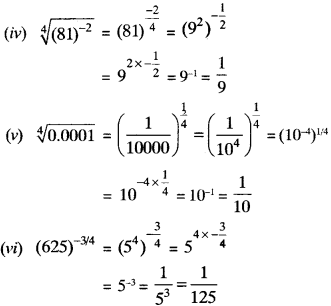
  1. 9\(\frac{3}{2}\) = (32)\(\frac{3}{2}\)
  2. 32\(\frac{2}{2}\) = (25)\(\frac{2}{5}\)
  3. 16\(\frac{3}{4}\) = (24)\(\frac{3}{4}\) = (2)4x\(\frac{3}{4}\) = (2)3 = 8
  4. 125\(\frac{1}{3}\) = (53)\(\frac{-1}{3}\) = (5) 3x\(\frac{-1}{3}\) = (5)-1 = \(\frac{3}{2}\)

Question 3.
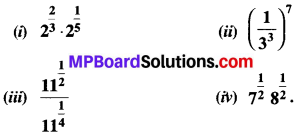
Simplify:
MP Board Class 9th Maths Solutions Chapter 1 Number Systems Ex 1.6 img-1
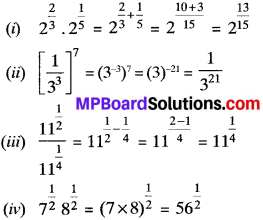
Solution:
MP Board Class 9th Maths Solutions Chapter 1 Number Systems Ex 1.6 img-2

MP Board Class 9th Maths Solutions

MP Board Class 9th Maths Solutions Chapter 1 Number Systems Ex 1.5

MP Board Class 9th Maths Solutions Chapter 1 Number Systems Ex 1.5

Question 1.
Classify the following numbers as rational or irrational –

  1. 2 – √5
  2. (3 + \(\sqrt{23}\) ) – \(\sqrt{23}\)
  3. \(\frac { 2\sqrt { 7 } }{ 7\sqrt { 7 } } \)
  4. \(\frac{1}{sqrt { 2 }}\)

Solution:

  1. 2 – \(\sqrt{5}\) is an irrational number
  2. (3 + \(\sqrt{23}\) ) – \(\sqrt{23}\) = 3 is a rational number
  3. \(\frac { 2\sqrt { 7 } }{ 7\sqrt { 7 } } \) = \(\frac{2}{7}\) is a rational number
  4. \(\frac{1}{\sqrt { 2 }}\) = is an irrational number
  5. 2π is an irrational number.

MP Board Solutions

Question 2.
Simplify each of the following expressions –

  1. (3 + \(\sqrt{3}\) ) (2 +\(\sqrt{2}\))
  2. (3 + \(\sqrt{3}\) ) (3 – \(\sqrt{3}\))
  3. (\(\sqrt{5}\) + \(\sqrt{2}\))2
  4. (\(\sqrt{5}\) – \(\sqrt{2}\)) (\(\sqrt{5}\) + \(\sqrt{2}\))

Solution:
1. (3 + \(\sqrt{3}\) ) (2 +\(\sqrt{2}\))
= 6 + 3\(\sqrt{2}\) + 2\(\sqrt{3}\) + \(\sqrt{6}\)

2. (3 + \(\sqrt{3}\)) (3 – \(\sqrt{3}\))
= (3)2 – (\(\sqrt{3}\) )2 = 9 – 3 = 6

3. (\(\sqrt{5}\) + \(\sqrt{2}\) )2
= (\(\sqrt{5}\))2 + 2\(\sqrt{5}\) x \(\sqrt{2}\) + (\(\sqrt{2}\))2
= 5 + 2\(\sqrt{10}\) + 2 = 7 + 2\(\sqrt{10}\)

4. (\(\sqrt{5}\) – \(\sqrt{2}\)) (\(\sqrt{5}\) + \(\sqrt{2}\))
= (\(\sqrt{5}\))2 – (\(\sqrt{2}\))2 = 5 – 2 = 3

Question 3.
Recall, 7t is defined as the ratio of the circumference (say c) of a circle to its diameter (say d). That is, π = \(\frac{c}{d}\). This seems to contradiet the fact n is irrational. How will you resolve this contradiction?
Solution:
No contradiction will be there. Whenever we measure any length with any device, we only get an approx, rational value and so cannot realise that either c or d is irrational.

MP Board Solutions

Question 4.
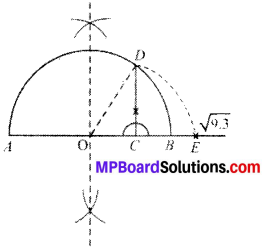
Represent \(\sqrt{9.3}\) on the number line.
Solution:
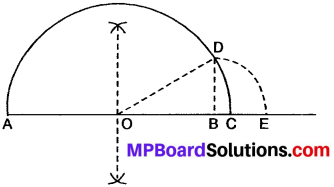
Steps:

  1. Draw a line segment AC = 9.3 cm and extend it to B such that CB – 1 cm.
  2. Draw the perpendicular bisector of AS and mark the mid point O of AB.
  3. With O as centre and OB as radius, draw a semicircle.
  4. At point C, draw perpendicular CD which intersect the semicircle at D such that CD = \(\sqrt{9.3}\).
  5. With C as centre and CD as radius, draw an arc which intersect AB produced at E.

MP Board Class 9th Maths Solutions Chapter 1 Number Systems Ex 1.5 img-1
Proof:
OA = OB = \(\frac{10.3}{2}\) = 5.15cm
OD = 5.15 cm
OC = OB – BC = 5.15 – 1 = 4.15 cm
CD = \(\sqrt { OD^{ 2 }-OC^{ 2 } } \)
= \(\sqrt{9.3}\) cm

Question 5.
Rationalise the denominators of the following:

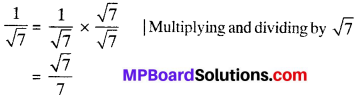
  1. \(\frac{1}{\sqrt { 7 }}\)
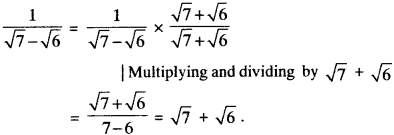
  2. \(\frac{1}{\sqrt{7}-\sqrt{6}}\)
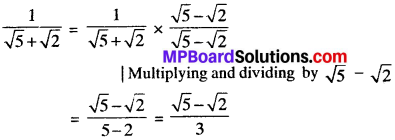
  3. \(\frac{1}{\sqrt{5}+\sqrt{2}}\)
  4. \(\frac{1}{\sqrt{7}-2}\)

Solution:
1. \(\frac{1}{\sqrt { 7 }}\)
MP Board Class 9th Maths Solutions Chapter 1 Number Systems Ex 1.5 img-2

2. \(\frac{1}{\sqrt{7}-\sqrt{6}}\)
MP Board Class 9th Maths Solutions Chapter 1 Number Systems Ex 1.5 img-3

3. \(\frac{1}{\sqrt{5}+\sqrt{2}}\)
MP Board Class 9th Maths Solutions Chapter 1 Number Systems Ex 1.5 img-4

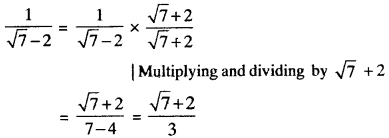
4. \(\frac{1}{\sqrt{7}-2}\)
MP Board Class 9th Maths Solutions Chapter 1 Number Systems Ex 1.5 img-5

Laws of Exponents for real numbers:
If a, n and m are natural numbers, then

  1. am x an = am+n
  2. (am)n = amn
  3. \(\frac { a^{ m } }{ b^{ n } } \) where m > n
  4. am x bm – (ab)m

Example 1.

  1. 23 x 24 = 23+4 = 27
  2. (32)3 = 32×3 = 36
  3. \(\frac { 5^{ 5 } }{ 5^{ 2 } } \) = 55-2 = 53
  4. 23 x 33 = (2 x 3)3 = 63

MP Board Solutions

Example 2.
1. 6\(\frac{2}{5}\) x 6\(\frac{3}{5}\)
Solution:
6\(\frac{2}{5}\) x 6\(\frac{3}{5}\) = 6\(\frac{5}{5}\) = 6

2. 6\(\frac{1}{2}\) x 7\(\frac{1}{2}\)
Solution:
6\(\frac{1}{2}\) x 7\(\frac{1}{2}\) = (6 x 7)\(\frac{1}{2}\) = 42\(\frac{1}{2}\)

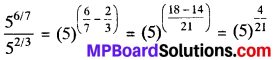
3. \(\frac{5^{6 / 7}}{5^{2 / 3}}\)
Solution:
MP Board Class 9th Maths Solutions Chapter 1 Number Systems Ex 1.5 img-6

Example 3.
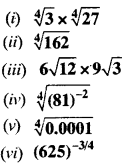
Simplify
MP Board Class 9th Maths Solutions Chapter 1 Number Systems Ex 1.5 img-7
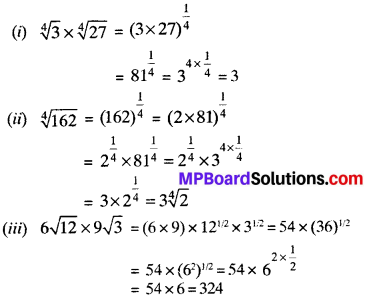
Solution:
MP Board Class 9th Maths Solutions Chapter 1 Number Systems Ex 1.5 img-8
MP Board Class 9th Maths Solutions Chapter 1 Number Systems Ex 1.5 img-9

MP Board Class 9th Maths Solutions

MP Board Class 9th Maths Solutions Chapter 1 Number Systems Ex 1.4

MP Board Class 9th Maths Solutions Chapter 1 Number Systems Ex 1.4

Question 1.
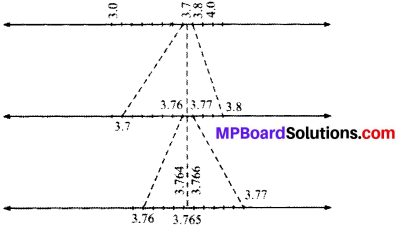
Visualise 3.765 on the number line, using successive magnification.
Solution:
Visualizing 3.765
MP Board Class 9th Maths Solutions Chapter 1 Number Systems Ex 1.4 img-1

Question 2.
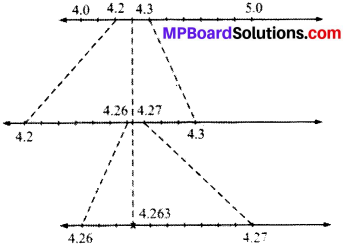
Visualise 4.26 on the number line, up to 4 decimal places.
Solution:
Visualising 4.26 = 4.2626
= 4.263
MP Board Class 9th Maths Solutions Chapter 1 Number Systems Ex 1.4 img-2

Rationalisation of the Denominator of an irrational number having two terms in the Denominator:
To rationalise the denominator of an irrational number having two terms in the denominator, multiply the numerator and denominator of the number by the conjugate of its denominator.

Example 1.
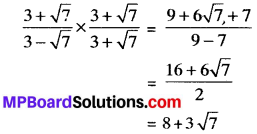
If a and b are rational numbers and \(\frac { 3+\sqrt { 7 } }{ 3-\sqrt { 7 } } \) = a + b√7 find value of a and b.
Solution:
We have \(\frac { 3+\sqrt { 7 } }{ 3-\sqrt { 7 } } \) = a + b√7
Multiply denominator and numerator by 3 + √7 on LHS, then we have
MP Board Class 9th Maths Solutions Chapter 1 Number Systems Ex 1.4 img-3
On comparing LHS and RHS, we get
a = 8, b = 3

Example 2.
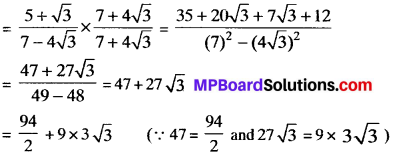
Determine a and b if \(\frac { 5+\sqrt { 3 } }{ 7-4\sqrt { 3 } } \) = 94a + 3 √3b
Multiply numerator and denominator by 7 + 4√3 on LHS, then we have
MP Board Class 9th Maths Solutions Chapter 1 Number Systems Ex 1.4 img-4
On comparing LHS and RHS, we get
a = \(\frac{1}{2}\) and b = 9.

MP Board Solutions

Example 3.
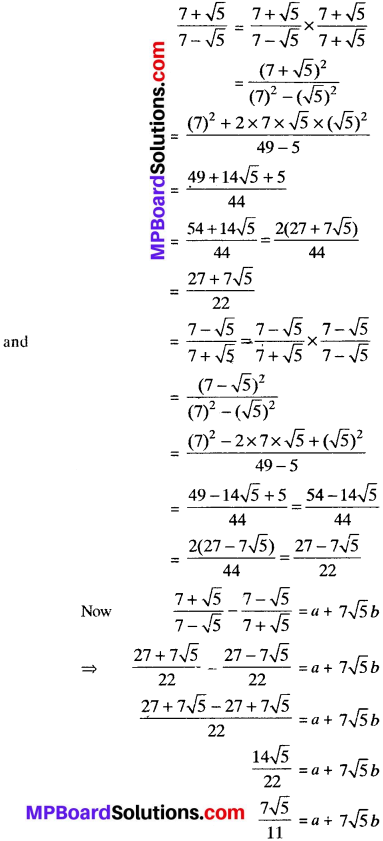
Determine a and 6 if \(\frac { 7+\sqrt { 5 } }{ 7-\sqrt { 5 } } \) – \(\frac { 7-\sqrt { 5 } }{ 7+\sqrt { 5 } } \) = a + 7√5b.
Solution:
We have
MP Board Class 9th Maths Solutions Chapter 1 Number Systems Ex 1.4 img-5
On comparing LHS and RHS, we get
a = 0 and b = \(\frac{1}{11}\).

MP Board Class 9th Maths Solutions

MP Board Class 9th Maths Solutions Chapter 1 Number Systems Ex 1.3

MP Board Class 9th Maths Solutions Chapter 1 Number Systems Ex 1.3

Write the following in decimal form and say what kind of decimal expansion each has:

  1. \(\frac{36}{100}\)
  2. \(\frac{1}{11}\)
  3. 4\(\frac{1}{8}\)
  4. \(\frac{3}{13}\)
  5. \(\frac{2}{11}\)
  6. \(\frac{329}{400}\)

Solution:
1. \(\frac{36}{100}\)
\(\frac{36}{100}\) = 0.36
The decimal expansion is terminating.

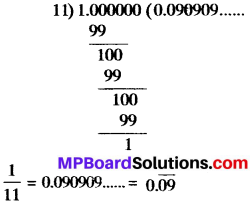
2. \(\frac{1}{11}\)
MP Board Class 9th Maths Solutions Chapter 1 Number Systems Ex 1.3 img-1
The decimal expansion is non-terminating repeating.

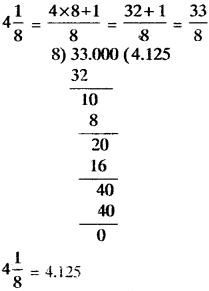
3. 4\(\frac{1}{8}\)
MP Board Class 9th Maths Solutions Chapter 1 Number Systems Ex 1.3 img-2
The decimal expansion is terminating.

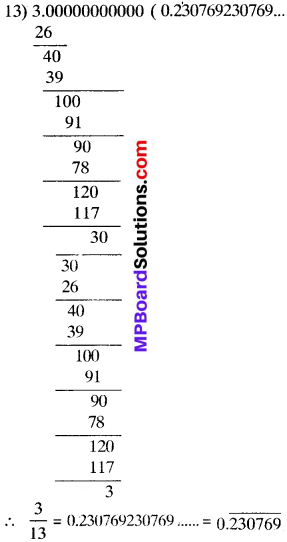
4. \(\frac{3}{13}\)
MP Board Class 9th Maths Solutions Chapter 1 Number Systems Ex 1.3 img-3'
The decimal expansion is non-terminating repeating.

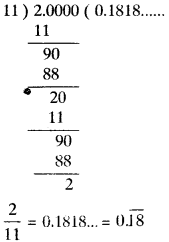
5. \(\frac{2}{11}\)
MP Board Class 9th Maths Solutions Chapter 1 Number Systems Ex 1.3 img-4
The decimal expansion is non-terminating repeating.

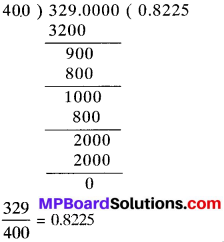
6. \(\frac{329}{400}\)
MP Board Class 9th Maths Solutions Chapter 1 Number Systems Ex 1.3 img-5
The decimal expansion is terminating.

Question 2.
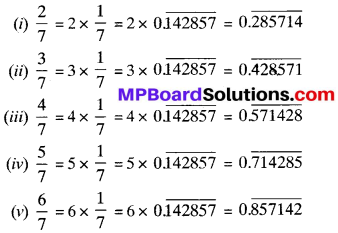
You know that \(\frac{1}{7}\) = \(\overline { 0.142857 } \). Can vou predict what the decimal expansions of \(\frac{2}{7}\), \(\frac{3}{7}\), \(\frac{4}{7}\), \(\frac{5}{7}\), \(\frac{6}{7}\) are, without actually doing the long division? If so, how?
[Hint: Study the remainders while finding the value of \(\frac{1}{7}\) carefully.]
Solution:
\(\frac{1}{7}\) = \(\overline { 0.142857 } \)
MP Board Class 9th Maths Solutions Chapter 1 Number Systems Ex 1.3 img-6

MP Board Solutions

Question 3.
Expressthe following in the form \(\frac{p}{q}\), wherep and q are integers and q ≠ 0.

  1. \(0 . \overline{6}\)
  2. \(0 . \overline{oo1}\)

Solution:
1. \(0 . \overline{6}\)
Let x = \(0 . \overline{6}\) …(i)
10x = \(6 . \overline{6}\)
[Multiplying (i) by 10 on both sides] …(ii)
Subtracting (i) from (ii). we get
9x = 6
x = \(\frac{6}{9}\) = \(\frac{2}{3}\)
∴ \(6 . \overline{6}\) = \(\frac{2}{3}\)

2. \(0 . \overline{oo1}\)
1000x = \(1 . \overline{001}\)
[Multiplying (i) by 1000] …(ii)
Subtracting (i) from (ii), we get
999x = 1
x = \(\frac{1}{999}\)
∴ \(0 . \overline{001}\) = \(\frac{1}{999}\)

Question 4.
Express 0.99999….. in the form \(\frac{p}{q}\). Are you surprised by vour answer? With your teacher and classmates, discuss why the answer make sense.
Solution:
0.99999 = \(0 . \overline{9}\)
Let x = 0.9 …(i)
10x = \(9 . \overline{9}\)
[Multiplying (i) by 10] …(ii)
Subtracting (i) from (ii), we get
9x = 9
x = \(\frac{9}{9}\)
∴ \(9 . \overline{9}\) = 1

Question 5.
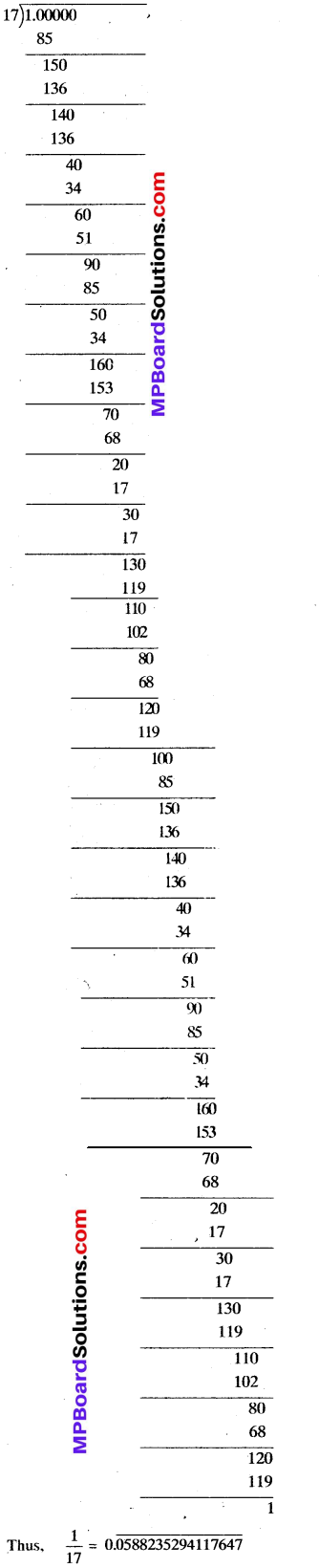
What can the maximum number of digits be in the repeating block of digits in the decimal expansion of \(\frac{1}{17}\)? Perform the division to check your answer.
Solution:
The maximum number of digits in the repeating block of digits in the decimal expansion \(\frac{1}{17}\) can be 16.
0. 05882352941176470588235294117647….
MP Board Class 9th Maths Solutions Chapter 1 Number Systems Ex 1.3 img-7
By Long Division, the number of digits in the repeating block of digits in the decimal expansion of = \(\frac{1}{17}\) = 16
∴ The answer is verified.

Question 6.
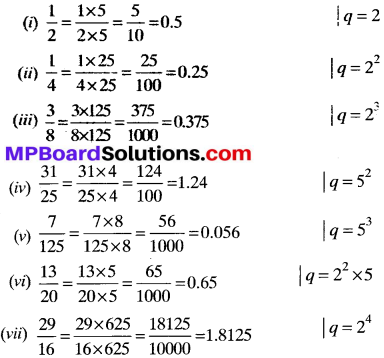
Look at several examples of rational numbers in the form \(\frac{p}{q}\) (q ≠ 0),where p and q are integers with no common factors other than 1 and having terminating decimal representation (expansions). Can you guess what property q must satisfy?
Solution:
Examples:
MP Board Class 9th Maths Solutions Chapter 1 Number Systems Ex 1.3 img-8
The property that q must satisfy is that the prime factorisation of q have only powers of 2 or powers of 5 or both.

Question 7.
Write three numbers whose decimal expansions are non – terminating non – recurring.
Solution:
0. 01001000100001……..,
0. 20200220002200002…….,
0. 003000300003

MP Board Solutions

Question 8.
Find three different irrational numbers between the rational numbers \(\frac{5}{7}\) and \(\frac{9}{11}\).
Solution:
Irrational numbers between \(\frac{5}{7}\) and \(\frac{9}{11}\)
\(\frac{5}{7}\) = 0.71 and \(\frac{9}{11}\) = 0.81
Three irrational numbers between \(\frac{5}{7}\) and \(\frac{9}{11}\) are
0. 7201001000…
0. 7301001000…
0. 7401001000…

Question 9.
Classify the following numbers as rational or irrational:

  1. \(\sqrt{23}\)
  2. \(\sqrt{225}\)
  3. 0. 3796
  4. 7. 478478…
  5. 1. 101001000100001…

Solution:

  1. \(\sqrt{23}\) is an irrational number
  2. \(\sqrt{225}\) = 15, a rational number
  3. 0. 3796 is a rational number
  4. 7. 478478….. is an irrational number
  5. 1. 101001000100001… is an irrational number

MP Board Class 9th Maths Solutions

MP Board Class 9th Maths Solutions Chapter 1 Number Systems Ex 1.2

MP Board Class 9th Maths Solutions Chapter 1 Number Systems Ex 1.2

Question 1.
State whether the following statements are true or false. Justify your answers.

  1. Every irrational number is a real number.
  2. Every point on the number line is of the form √m , where m is a natural number.
  3. Every real number is an irrational number.

Solutions:

  1. True, because all irrational numbers come in the collection of real numbers.
  2. False, because a negative number cannot be the square root of any natural number.
  3. False, because the collection of real numbers contains not only irrational numbers but also rational numbers.

Question 2.
Are the square roots of all positive integers irrational? If not, give an example of the square root of a number that is a rational number.
Solution:
No. For example, √4 = 2 is a rational number.

Question 3.
Show how √5 can be represented on the number line.
Solution:
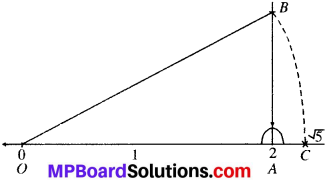
Representing √5 on a number line as shown in fig. below.
MP Board Class 9th Maths Solutions Chapter 1 Number Systems Ex 1.2 img-1

  1. Take OA = 2 units and draw perpendicular AB on A.
  2. Cut AB = 1 unit and join OB.
  3. By taking O as centre and OB as radius, draw an arc which inter-sect the number line at C.

Hence OC = √5
∴ Point C represents ^5 on the number line.
Proof:
OBD is a right angled A.
∴ OD2 = OB2 + BD2
OD2 = (2)2 + (1)2 = 5
OD = √5
MP Board Class 9th Maths Solutions Chapter 1 Number Systems Ex 1.2 img-2

Representation of Real Numbers on Number Line

Real Numbers:
The rational and irrational numbers taken together are known as real numbers. Every real number Is either rational or irrational. Different operations on real numbers are shown below:
For example:

MP Board Solutions

Example 1.
Add (3√2 + 5√3) and (√2 + √3).
Solution:
(3√2+ 5√5)+ (√2+ √3)
= 3√2 + 5√5 + √5 + √5 = (3√5+ √5)+ (5√5+ √5)
= 4√2 + 6√3
= 4√5 + 6√5

Example 2.
Add (√5 + 7√5) and (4√3 + 6√5).
Solution:
(√5 + 7√5) + (4√3 + 6√5)
= √3 + 7√5 + 4√3 + 6√5
= (√3 + 4√3) + (7√5 + 6√5)
= 5√3 + 13√5.

Example 3.
Simplify (3 + √2) (3 – √2).
Solution:
(3)2 – (√2)2
(∴ a2 – b2 = (a + b) (a – b))
= 9 – 2
= 7.

MP Board Solutions

Example 4.
Divide 16√6 by 4√2 .
Solution:
16√6 ÷ 4√2
\(\frac { 16\sqrt { 6 } }{ 4\sqrt { 2 } } \)
4√3.

Example 5.
Simplify the following:
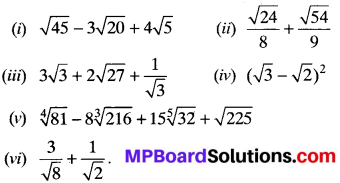
MP Board Class 9th Maths Solutions Chapter 1 Number Systems Ex 1.2 img-3
Solution:
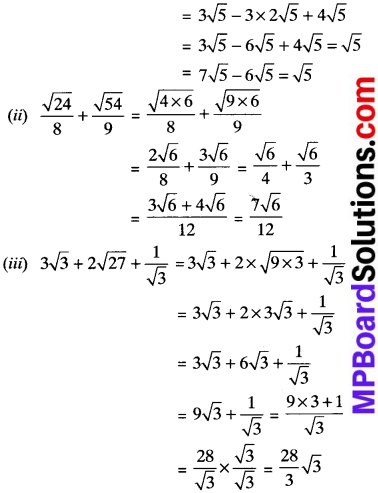
(i) \(\sqrt{45}\) – 3\(\sqrt{20}\) = 4\(\sqrt{5}\) = \(\sqrt{9×5}\) – 3\(\sqrt{4×5}\) + 4\(\sqrt{5}\)
MP Board Class 9th Maths Solutions Chapter 1 Number Systems Ex 1.2 img-4
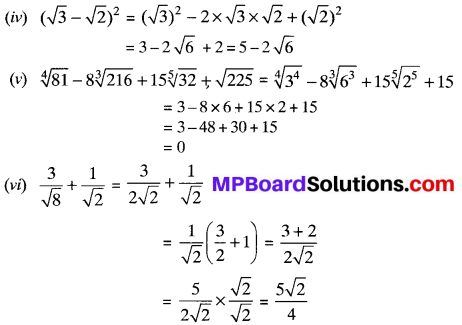
MP Board Class 9th Maths Solutions Chapter 1 Number Systems Ex 1.2 img-5

Example 6.
Simplify by rationalising the denominator of \(\frac { 2+3\sqrt { 5 } }{ 2-3\sqrt { 5 } } \)
Solution:
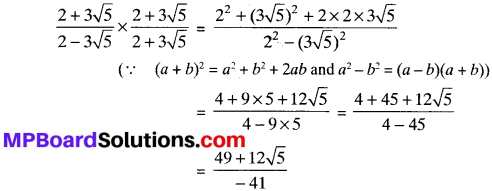
We have 3 \(\frac { 2+3\sqrt { 5 } }{ 2-3\sqrt { 5 } } \), multiply numerator and denominator by 2 + 3√5, we have
MP Board Class 9th Maths Solutions Chapter 1 Number Systems Ex 1.2 img-6

MP Board Class 9th Maths Solutions

MP Board Class 9th Maths Solutions Chapter 1 Number Systems Ex 1.1

MP Board Class 9th Maths Solutions Chapter 1 Number Systems Ex 1.1

Question 1.
Is zero a rational number? Can vou write it in the form \(\frac{p}{q}\), where p and q are integers and
q ≠ 0?
Solution:
Yes. 0 can be written as \(\frac{0}{1}\), \(\frac{0}{2}\).

Question 2.
Find six rational numbers between 3 and 4.
Solution:
\(\frac{3}{1}\) and \(\frac{4}{1}\)
Multiplying N and D by 7, we get
MP Board Class 9th Maths Chapter 1 Number Systems Ex 1.1 1
Six rational numbers between 3 and 4
= \(\frac{22}{7}\), \(\frac{23}{7}\), \(\frac{24}{7}\), \(\frac{25}{7}\), \(\frac{26}{7}\), \(\frac{27}{7}\)

Question 3.
Find five rational numbers between \(\frac{3}{5}\) and \(\frac{4}{5}\).
Solution:
\(\frac{3}{5}\) and \(\frac{4}{5}\)
Multiply N and D by 6, we get,
MP Board Class 9th Maths Chapter 1 Number Systems Ex 1.1 3
Five rational numbers between \(\frac{3}{4}\) and \(\frac{4}{5}\)
= \(\frac{19}{30}\), \(\frac{20}{30}\), \(\frac{21}{30}\), \(\frac{22}{30}\), \(\frac{23}{30}\)

MP Board Solutions

Question 4.
State whether the following statements are true or false. Give reasons for your answers.

  1. Every natural number is a whole number.
  2. Every integer is a whole number.
  3. Every rational number is a whole number.

Solution:

  1. True, every natural number is a whole number.
  2. False, because integers also include the negative numbers like – 2, -5 etc., which are not whole numbers.
  3. False, because rational numbers are of the form \(\frac{2}{3}\), \(\frac{0}{1}\), \(\frac{-3}{2}\) ….are not whole numbers.

Irrational Number:
Anumber which cannot be expressed in the form \(\frac{p}{q}\) wherep and q are integers such that q ≠ 0 are called an irrational numbers.
For example: √5, √3, √5 etc.
Also,
A number is an irrational number if it has a non – terminating and non – repeating decimal representation –
√2 = 1.41421…
√3 = 1.73205…

MP Board Class 9th Maths Solutions