MP Board Class 7th Science Solutions Chapter 13 Motion and Time

MP Board Class 7th Science Solutions Chapter 13 Motion and Time

Motion and Time Intex Questions

Question 1.
Paheli wondered how time was measured when pendulum clocks were not available?
Answer:
Many times measuring devices were used in different parts of the world before the pendulum clocks became popular. Water clocks, sand clocks and sundials are some examples of such devices.

Question 2.
Boojho wants to know whether there is any device that measures the speed?
Answer:
Yes, speedometer.

Activities

Activity – 1
Table gives some common examples of motions. Identify the type of motion in each case?
Answer:
Some examples of different types of motion
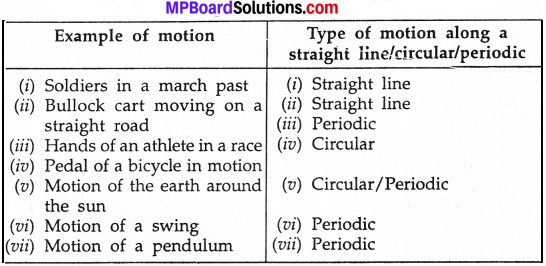
MP Board Class 7th Science Solutions Chapter 13 Motion and Time img 1

Activity – 2
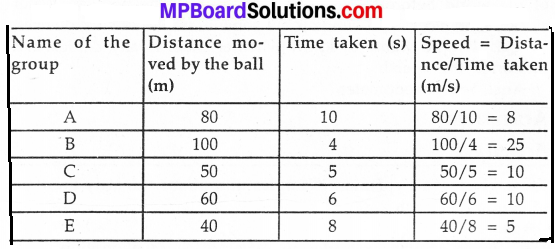
Draw a straight line on the ground with chalk powder or lime and ask one of your friends to stand 1 to 2 m away from it. Let your friend gently roll a ball along the ground in a direction perpendicular to the line. Note the time at the moment the ball crosses the line and also when it comes to rest (Fig.) How much time does the ball take to come to rest? Measure the distance between the point at which the ball crosses the line and the point where it comes to rest. You can use a scale or a measuring tape. Let different groups repeat the activity. Record the measurements in Table. In each case calculate the speed of the ball?
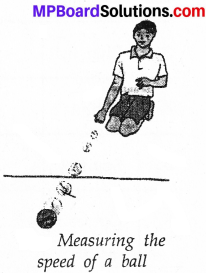
MP Board Class 7th Science Solutions Chapter 13 Motion and Time image 2
Answer:
MP Board Class 7th Science Solutions Chapter 13 Motion and Time img 3

Activity – 3
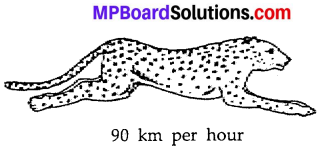
The unit of speed in the given table is in km/h. Change this speed in to m/s?
Answer:
Speed of some animals.
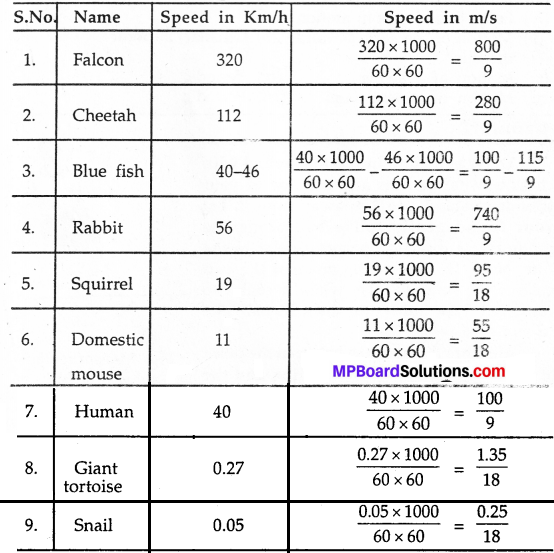
MP Board Class 7th Science Solutions Chapter 13 Motion and Time img 4

Motion and Time Text Book Exercises

Question 1.
Classify the following as motion along a straight line, circular or oscillatory motion:

  1. Motion of your hands while running.
  2. Motion of a horse pulling a cart on a straight road.
  3. Motion of a child in a merry – go – round.
  4. Motion of a child on a see – saw.
  5. Motion of the hammer of an electric bell.
  6. Motion of a train on a straight bridge.

Answer:

  1. Oscillatory
  2. Straight line
  3. Circular
  4. Oscillatory
  5. Oscillatory
  6. Straight line.

MP Board Solutions

Question 2.
Which of the following are not correct?

1. The basic unit of time is second.
2. Every object moves with a constant speed.
3. Distances between two cities are measured in kilometres.
4. The time period of a given pendulum is not constant.
5. The speed of a train is expressed in m/h.

Answer:

2. Every object moves with a constant speed.
5. The speed of a train is expressed in m/h.

Question 3.
A simple pendulum takes 32 s to complete 20 oscillations?What is the time period of the pendulum?
Answer:
Given, time taken to complete 20 oscillations = 32 seconds
∴Time taken to complete 1 oscillation = \(\frac{32}{20}\)s = 1.6 s
Thus, the time period of pendulum is 1.6 s

Question 4.
The distance between two stations is 240 km. A train takes 4 hours to cover this distance. Calculate the speed of the train?
Answer:
Given, distance between two stations = 240 km and time taken to cover this distance = 4 hour
We know that,

MP Board Class 7th Science Solutions Chapter 13 Motion and Time img 5
\(\frac{240}{4}\) = 60 km/hour.
Thus, the speed of the train is 60 km/hour.

Question 5.
The odometer of a car reads 57321.0 km when the clock shows the time 08.30 AM. What is the distance moved by the car, if at 08:50 AM, the odometer reading has changed to 57336.0 km? Calculate the speed of the car in km/min during this time. Express the speed in km/h also?
Answer:
Given, reading of odometer at time 08:30 AM = 57321.0 km and reading of odometer at time 08:50 AM = 57336.0 km.
∴Distance covered by car = (57336.0 – 57321.0) km = 15 km and Time taken = 8.50 – 8.30 = 20 minutes
We know that,
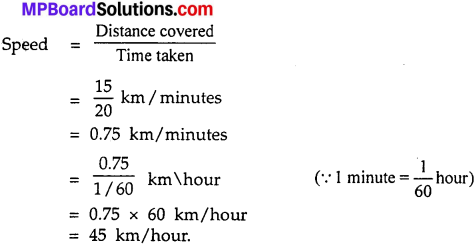
MP Board Class 7th Science Solutions Chapter 13 Motion and Time img 6

Question 6.
The odometer of a car reads 57321.0 km when the clock shows the time 08.30 AM. What is the distance moved by the car, if at 08:50 AM, the odometer reading has changed to 57336.0 km? Calculate the speed of the car in km/min during this time. Express the speed in km/h also?
Answer:
Given, reading of odometer at time 08:30 AM = 57321.0 km and reading of odometer at time 08:50 AM = 57336.0 km
∴Distance covered by car = (57336.0 – 57321.0) km = 15 km and Time taken = 8.50 – 8.30 = 20 minutes We know that,
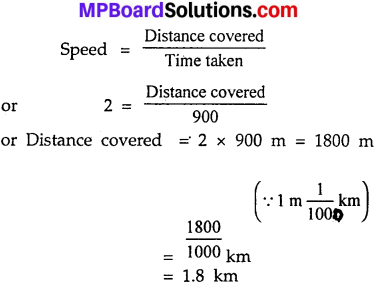
MP Board Class 7th Science Solutions Chapter 13 Motion and Time img 7
Thus, the distance between Salma’s school from her house is 1800 m or 1.8 km.

Question 7.
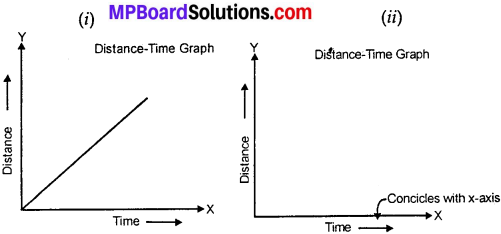
Show the shape of the distance – time graph for the motion in the following cases:

  1. A car moving with a constant speed.
  2. A car parked on a side road.

Answer:
MP Board Class 7th Science Solutions Chapter 13 Motion and Time img 8

Question 8.
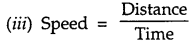
Which of the following relations is correct?

MP Board Class 7th Science Solutions Chapter 13 Motion and Time img 9
Answer:
MP Board Class 7th Science Solutions Chapter 13 Motion and Time img 23

Question 9.
The basic unit of speed is:
(a) 100km.
(b) m/min
(c) km/h
(d) m/s.
Answer:
(d) m/s.

Question 10.
A car moves with a speed of 40 km/h for 15 minutes and then with a speed of 60 km/h for the next 15 minutes. The total distance covered by the car is:
(a) 100 km
(b) 25 km
(c) 15 km
(d) 10 km.
Answer:
(b) 25 km.
Distance travelled in first 15 minutes = Speed x Time = 40 km/h x 15 minutes.
= 40 km/h × \(\frac{15}{60}\) hour
= 10 km
Distance travelled in last 15 minutes = Speed x Time = 60 km/h x 15 minutes
= 60 km/h × 15 minutes
= 60 km/h × \(\frac{15}{60}\) hour
= 15 km.
Total distance = (10 + 15) km = 25 km.

Question 11.
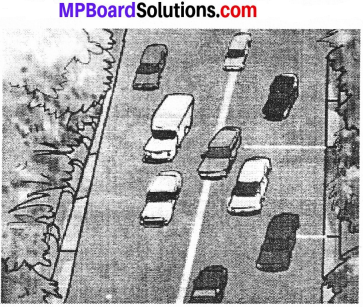
Suppose the two photographs, shown in Fig. (a) and Fig. (b) had been taken at an interval of 10 seconds. If a distance of 100 meters is shown by 1 cm in these photographs, calculate the speed of the blue car?
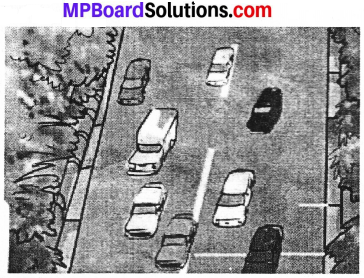
MP Board Class 7th Science Solutions Chapter 13 Motion and Time img 10
MP Board Class 7th Science Solutions Chapter 13 Motion and Time img 11
Answer:
Speed = \(\frac{100 km}{10 h}\) = 10 km/h.

Question 12.
Fig. shows the distance – time graph for the motion of two vehicles A and B. Which one of them is moving faster?
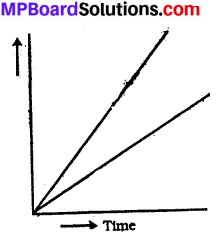
MP Board Class 7th Science Solutions Chapter 13 Motion and Time img 12

Answer:
Car A is moving faster.

Question 13.
Which of the following distance – time graphs shows a truck moving with speed which is not constant?
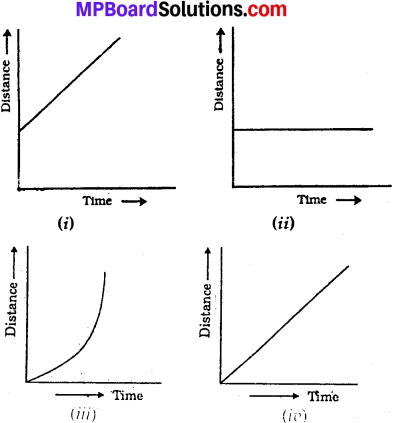
MP Board Class 7th Science Solutions Chapter 13 Motion and Time img 13
Answer:
(iii)

Motion and Time Additional Important Questions

Objective Type Questions

Question 1.
Choose the correct alternative :

Question (a)
The time taken for one oscillation is called its
(a) Pitch
(b) Frequency
(c) Vibration
(d) Time period.
Answer:
(d) Time period.

Question (b)
1 minute has?
(a) 30 second
(b) 60 second
(c) 100 second
(d) None of these.
Answer:
(b) 60 second

MP Board Solutions

Question (c)
The smallest time interval that can be measured with commonly available clocks and watches is?
(a) 1 second
(b) 1 minute
(c) 1 hour
(d) None of these.
Answer:
(c) 1 hour

Question (d)
The ages of stars and planet are often expressed in –
(a) billions of years
(b) days
(c) years
(d) None of these.
Answer:
(a) billions of years

Question (e)
The distance moved by a vehicle can be measured by –
(a) speedometer
(b) odometer
(c) regulator
(d) None of these.
Answer:
(b) odometer

Question (f)
The distance – time graph of a body moving with uniform speed is –
(a) a curve
(b) a straight line
(c) line parallel to x – axis
(d) None of these.
Answer:
(b) a straight line

MP Board Solutions

Question 2.
Fill in the blanks:

  1. We shall use the term speed for average ……………………….
  2. An object moving along a straight line with a constant speed is said to be in …………………………
  3. The to and fro motion of a simple pendulum is an example of a ……………….. or ……………………. motion.
  4. The basic unit of time is a ……………………….
  5. The basic unit of speed is ………………………..
  6. Periodic events are used for the measurement of ……………………….
  7. The distance – time graph for the motion of an object moving with a constant speed is a ……………………
  8. The speedometer records the speed in ……………………..
  9. Odometer is used to measure ………………………
  10. The distance moved by an object is a unit time is called its ………………………….

Answer:

  1. Speed
  2. Uniform speed
  3. Periodic, oscillatory
  4. Second
  5. m/s
  6. Time
  7. Straight line
  8. km/h
  9. Distance
  10. Speed.

Question 3.
Which of the following statements are true (T) or false(F).

  1. The distance moved by objects in a given interval of time can help us to decide which one is faster or slower.
  2. We shall not use the term speed for average speed.
  3. The to and fro motion of a simple pendulum is an example of a periodic motion.
  4. Janter Manter in Delhi and Jaipur have big Sundials.
  5. In non – uniform motion, the speed of an object changes.
  6. Clocks or watches are perhaps the most common time measuring devices.
  7. Different units of time are used depending on the need.

Answer:

  1. True
  2. False
  3. True
  4. True
  5. True
  6. True
  7. True.

MP Board Solutions

Motion and Time Very Short Answer Type Questions

Question 1.
Define motion.
Answer:
Motion is the change in position of a body with respect to line and its surroundings.

Question 2.
What type of motion do the vehicles on a straight road perform?
Answer:
The vehicles perform rectilinear motion on the road.

Question 3.
What type of motion does the wheel of a bicycle perform?
Answer:
The wheel of a bicycle perform rotatory or circular motion.

Question 4.
What is uniform motion?
Answer:
Motion of a body along a straight line covering equal distances in equal intervals of time is called uniform motion.

MP Board Solutions

Question 5.
Give two example of non – uniform motion?
Answer:

  1. Motion of the train when its driver applies breaks.
  2. Motion of the cricket ball when the bowler throws the ball and the ball is hit by the player.

Question 6.
Give two example of periodic motion?
Answer:

  1. Rotation of earth on its axis.
  2. Moon moves around the earth.

Question 7.
What is oscillatory motion?
Answer:
The to and fro motion is called periodic or an oscillatory motion.

Question 8.
An object is hung from a spring is pulled down and left? What type of motion does the object perform?
Answer:
The object perform oscillatory motion which is also a periodic motion.

Question 9.
Write the formula for speed?
Answer:

MP Board Class 7th Science Solutions Chapter 13 Motion and Time img 25a

Question 10.
What is the unit of speed?
Answer:
Unit of speed is meter per second.

Question 11.
A snail covers a distance of 1 meter in 10 sec. What is the speed of the snail?
Answer:
image
= 0.1 ms-1
= 0.1 m per sec.

Question 12.
What happens to the speed of your bicycle when you pedal faster?
Answer:
On pedalling fast the speed of bicycle increase.

Question 13.
“Speed of a car is 8 km/h”. What does it mean?
Answer:
When we say that a car is moving with a speed of 80 kilometer per hour, it implies that it will cover a distance of 80 kilometre in one hour.

Question 14.
Define a day?
Answer:
The time between one sunrise and the next is called a day.

Question 15.
What is month ?
Answer:
A month is measured from one new moon to the next.

Question 16.
What is year?
Answer:
A year is fixed as the time taken by the earth to complete one revolution of the sun.

Question 17.
What is bob?
Answer:
The metallic ball is called bob of the pendulum.

MP Board Solutions

Question 18.
What is the use of stop – watch?
Answer:
Stop – watch is used to measure exact time in case of atheletic events as it can be stopped and started any moment.

Question 19.
When you travel in bus or car then, generally, what kind of motion it is?
Answer:
Linear motion.

Question 20.
There is 100 metres line on which two sprinters have to run, when they run, what kind of motion it will be?
Answer:
Linear motion.

Question 21.
See the picture and tell whose speed is more:
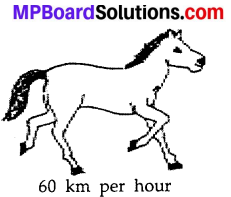
MP Board Class 7th Science Solutions Chapter 13 Motion and Time img 14
MP Board Class 7th Science Solutions Chapter 13 Motion and Time img 15
Answer:
Speed of tiger is more than the speed of horse.

Motion and Time Short Answer Type Questions

Question 1.
Define periodic motion?
Answer:
Periodic motion:
The motion of a body which is repeated at regular intervals of time is called periodic motion. In periodic motion, a body covers equal distances in equal intervals of time; e.g. revolution of earth round the sun, the motion of moon round the earth, the motion of a swing, the motion of a pendulum, etc.

Question 2.
Define non – periodic motion?
Answer:
Non – periodic motion:
The motion of a body which is not repeated at regular intervals of time is called non – periodic motion. In non – periodic motion, a body does not cover equal distances in equal intervals of time; e.g. an athelete running on a track, a moving car on busy road, etc.

Question 3.
Define oscillatory motion?
Answer:
Oscillatory motion:
A body is said to be in oscillatory motion when it moves to and fro about a fixed point; e.g. the pendulum of a wall clock (Fig.), a swing, a wire of sitar when plucked, striking of drum, etc. Mostly the hanging objects show oscillatory motion.
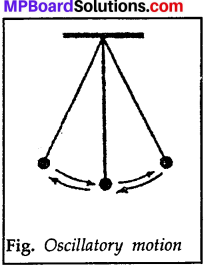
MP Board Class 7th Science Solutions Chapter 13 Motion and Time img 16

Question 4.
How can we make a pendulum of air one? What is the time – period of a pendulum?
Answer:
We can make a pendulum by suspending a metal ball with a cotton thread. The other end of the thread can be tied to same support. The time taken by a pendulum to complete its to and from movement i.e., one oscillation is called the time period of the pendulum.

Question 5.
One student reaches school in 1 hour by travelling a distance of 8 km from his house by a cycle and the other student reaches school in one and half hours by travelling a distance of 12 kms from his house by cycle. Tell whose speed was slow?
Answer:
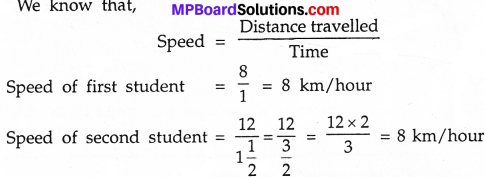
MP Board Class 7th Science Solutions Chapter 13 Motion and Time img 17
From above calculations it is clear that the speed of both the students is same.

Question 6.
What are quartz clocks? Give a diagram of digital clock?
Answer:
Now a days most clocks or watches have an electric circuit with one or more cells. These clocks are called quartz clocks. The time measured by quartz clocks is much more accurate than that by the clocks available earlier.

MP Board Class 7th Science Solutions Chapter 13 Motion and Time img 18

Question 7.
Mark x – axis, y – axis, origin on a graph paper?
Answer:
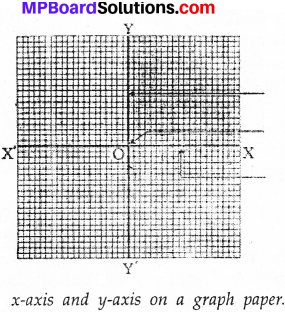
MP Board Class 7th Science Solutions Chapter 13 Motion and Time img 19

Motion and Time Long Answer Type Questions

Question 1.
Write briefly about the development of pendulum clock?
Answer:
There is an interesting story about the discovery that the time period of a given pendulum is constant. You might have heard the name of famous scientist Galileo Galilie (A.D. 1564 – 1642). It is said that once Galileo was sitting in a church. He noticed that a lamp suspended from the ceiling with a chain was moving slowly from one side to the other.

He was surprised to find that his pulse beat the same number of times during the interval in which the lamp completed one oscillation. Galileo experimented with various pendulums to verify his observation. He found that a pendulum of a given length takes always the same time to complete one oscillation. This observation led to the development of pendulum clocks. Winding clocks and wristwatches were refinements of the pendulum clocks.

MP Board Solutions

Question 2.
Discuss in details about the different range to measure time interval?
Or
Discuss the different units for measuring time interval?
Answer:
The smallest time interval that can be measured with commonly available clocks and watches is one second. However, now special clocks are available that can measure time intervals smaller than a second. Some of these clocks can measure time intervals as small as one millionth or even one billionth of a second. We might have heard the terms like microsecond and nanosecond. One microsecond is one millionth of a second. A nanosecond is one billionth of a second.

Clocks that measure such small time intervals are used for scientific research. The time measuring devices used in sports can measure time intervals that are one tenth or one hundredth of a second. On the other hand, times of historical everts are stated in terms of centuries or millenniums. The ages of stars and planet are often expressed in billions of years.

Question 3.
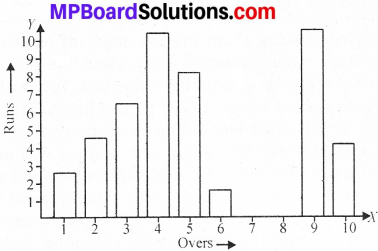
Draw a bar graph to show the runs scored by a team in each over?

MP Board Class 7th Science Solutions Chapter 13 Motion and Time img 24
Answer:
MP Board Class 7th Science Solutions Chapter 13 Motion and Time img 20

Question 4.
Draw a pie chart to show the composition of air?
Answer:
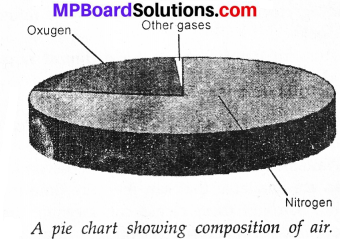
MP Board Class 7th Science Solutions Chapter 13 Motion and Time imageeeeee

Question 5.
Write down the steps to make a distance – time graph?
Answer:
We can make the graph by following steps:
Step 1.
Draw two perpendicular lines to represent the two axes and mark them as OX and OY as shown in figure.

Steps 2.
Decide the quantity to be shown along the x – axis and that to be shown along the y – axis. In this case we show the time along the x – axis and the distance along the y – axis.

Steps 3.
Choose a scale to represent the distance and another to represent the time on the graph. For the motion of the car scales could be
Time : 1 min = 1 cm
Distance : 1 km = 1 cm

Step 4.
Mark values for the time and the distance on the respective axes according to the scale chosen. For the motion of the cat let mark the time 1 min, 2 min,..,on the origin x – axis from the origin Similarly, mark the distance 1 km. 2 km… on the y – axis.

Steps 5.
Now you have to mark the points on the graph paper to represent each set of values for distance and time.

Step 6.
Join all the points on the graph as shown in figure. It is a straight line. This is the distance-time graph for the motion of the car.
Note:
If the distance – time graph is a straight line, it indicates that the object is moving with a constant speed. However, if the speed of the object keeps changing, the graph can be of any shape.
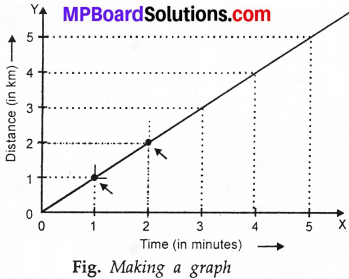
MP Board Class 7th Science Solutions Chapter 13 Motion and Time img 22

MP Board Class 7th Science Solutions

MP Board Class 7th Science Solutions Chapter 2 Nutrition in Animals

MP Board Class 7th Science Solutions Chapter 2 Nutrition in Animals

Nutrition in Animals Intext Questions

Question 1.
Paheli wants to know how food moves in the opposite direction during vomiting?
Answer:
The food pipe runs along the neck and the chest. Food is pushed down by movement of the wall of the food pipe. Actually this movement takes place throughout the alimentary canal and pushes the food downwards. At times the food is not accepted by our stomach and is vomited out.

Question 2.
Paheli wants to know why these animals cannot chew food properly at the time they take it in?
Answer:
The ruminants mainly feed on grass and bush which primarily contain cellulose or roughage. The grass is rich in cellulose, so lot of chewing and saliva are need. Thus, the ruminants need to chew the grass for long time. If they chew for long while eating, they will get less time to eat.

MP Board Solutions

Question 3.
Boojho wants to know why we cannot digest cellulose like the cattle do?
Answer:
Ruminants have a large sac – like structure between the small intestine and large intestine. The cellulose of the food is digested here by the action of certain bacteria which are not present in humans.

Activities
Activity 1
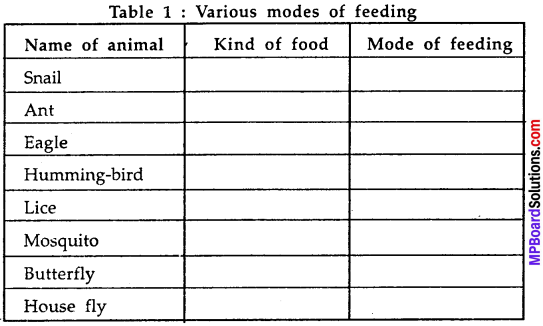
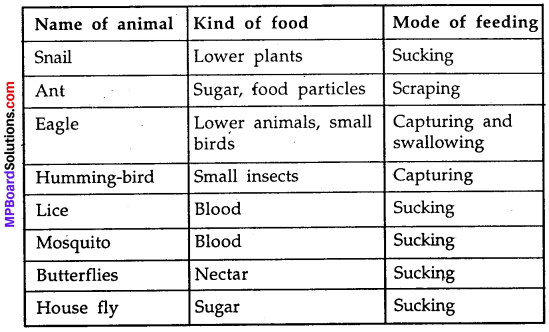
What is the type of food and mode of feeding of the following animals? Write down your observations in the given Table. You may find the list of modes of feeding given below the Table helpful.
Table 1:
Various modes of feeding
MP Board Class 7th Science Solutions Chapter 2 Nutrition in Animals img-1
(Scraping, chewing, brewing, capturing and swallowing, sucking etc.)
Answer:

MP Board Class 7th Science Solutions Chapter 2 Nutrition in Animals img-2

Activity 2
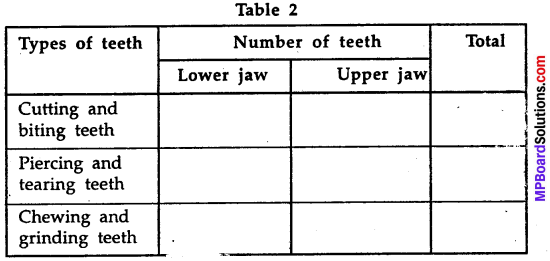
Wash your hands Look into the mirror and count your teeth. Use your index finger to feel the teeth. How many kinds of teeth could you find? Take a piece of an apple or bread and eat it. Which teeth do you use for biting and cutting and which ones for piercing and tearing? Also find out the ones that are used for chewing and grinding?
Record your observations in Table 2.
MP Board Class 7th Science Solutions Chapter 2 Nutrition in Animals img-3
Answer:
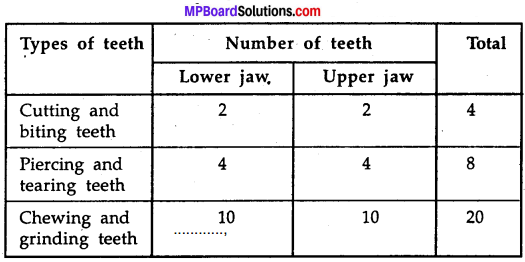
Four.

  1. Incisors are used for biting and cutting.
  2. Canines are used for piercing and tearing.
  3. Premolars and molars are used for chewing and grinding.

MP Board Class 7th Science Solutions Chapter 2 Nutrition in Animals img-4

Nutrition in Plants Text book Exercises

Question 1.
Fill in the blanks:

  1. The main steps of digestion in humans are …………, …………, …………, …………, and …………
  2. The largest gland in the human body is …………
  3. The stomach releases hydrochloric acid and ………… juices which act on food.
  4. The inner wall of the small intestine has many finger – like outgrowths called …………
  5. Amoeba digests its food in the …………

Answer:

  1. Ingestion, digestion, absorption, assimilation and egestion
  2. Liver
  3. Digestive
  4. Villi
  5. Food vacuole.

MP Board Solutions

Question 2.
Mark ‘T’ if the statement is true and ‘F’ if it is false:

  1. Digestion of starch starts in the stomach. (T/F)
  2. The tongue helps in mixing food with saliva. (T/F)
  3. The gall bladder temporarily stores bile. (T/F)
  4. The ruminants bring back swallowed grass into their mouth and chew it for some time. (T/F)

Answer:

  1. False (F)
  2. True (T)
  3. True (T)
  4. True (T)

Question 3.
Tick (S) mark the correct answer in each of the following:

Question (a)
Fat is completely digested in the –
(i) Stomach
(ii) Mouth
(iii) Small intestine
(iv) Large intestine
Answer:
(iii) Small intestine

Question (b)
Water from the undigested food is absorbed mainly in the –
(i) Stomach
(ii) Food pipe
(iii) Small intestine
(iv) Large intestine
Answer:
(iv) Large intestine

Question 4.
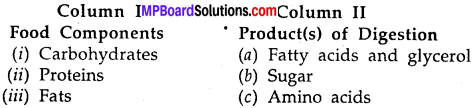
Match the items of Column I with those given in Column II:
MP Board Class 7th Science Solutions Chapter 2 Nutrition in Animals img-5
Answer:

(i) (b)
(ii) (c)
(iii) (a).

MP Board Solutions

Question 5.
What are villi? What is their location and function?
Answer:
The inner walls of the small intestine have thousands of finger – like outgrowths, these are called villi. They are situated in the small intestine.
Functions of Villi:

  1. The villi increase the surface area for absorption of the digested food.
  2. Each villus has a network of thin and small blood vessels close to its surface.
  3. The surface of the villi absorbs the digested food materials.

The absorbed substances are transported via the blood vessels to different organs of the body where they are used to build complex substances such as the proteins required by the body.

Question 6.
Where is the bile produced? Which component of the food does it digest?
Answer:
The liver secretes bile juice that is stored in a sea called gall bladder. Bile juice digests fat.

Question 7.
Name the types of carbohydrate that can be digested by ruminants but not by humans. Give the reason also?
Answer:
The grass is rich in cellulose, a type of carbohydrate. Many animals including humans cannot digest cellulose. The cellulose can be digested by ruminants but not by humans because they have a large sac – like structure between the small intestine and large intestine. The cellulose of the food is digested here by the action of certain bacteria which are not present in humans.

MP Board Solutions

Question 8.
Why do we get instant energy from glucose?
Answer:
We get instant energy from glucose because glucose is the simplest form of carbohydrate which can be broken down easily to give energy.

Question 9.
Which part of the digestive canal is involved in:

  1. Absorption of food ……………….
  2. Chewing of food
  3. ……………….
  4. killing of bacteria …………………..
  5. Complete digestion of food ………………….
  6. Formation of faeces ……………….

Answer:

  1. Small intestine
  2. Buccal cavity
  3. Stomach
  4. Small intestine
  5. Large intestine.

Question 10.
Write one similarity and one difference between the nutrition in Amoeba and human beings?
Answer:
Similarity:
Both amoeba and human use the process of digestion involves ingestion, digestion, absorption, assimilation and egestion.

Difference:
Human needs to chew food whereas in amoeba, there is no chewing.

Question 11.
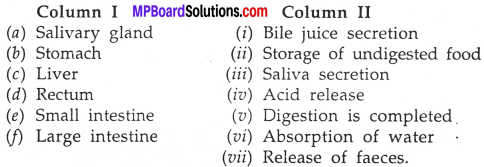
Match the items of Column I with suitable items in Column II
MP Board Class 7th Science Solutions Chapter 2 Nutrition in Animals img-6
Answer:

(a) (iii)
(b) (iv)
(c) (i)
(d) (vii)
(e) (v)
(f) (vi).

MP Board Solutions

Question 12.
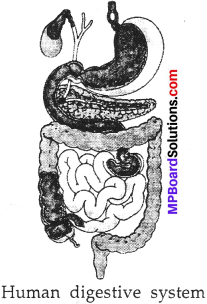
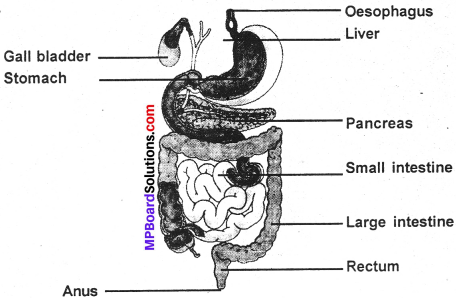
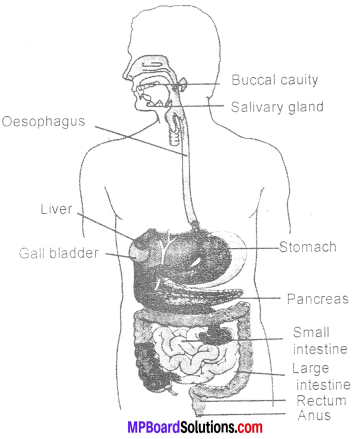
Label Fig of the digestive system
MP Board Class 7th Science Solutions Chapter 2 Nutrition in Animals img-7
Answer:
MP Board Class 7th Science Solutions Chapter 2 Nutrition in Animals img-8

Question 13.
Can we survive only on raw, leafy vegetables/grass? Discuss.
Answer:
No, because to live healthy life we need a complete balance of all nutrients. Raw green vegetables may have cellulose which can not be digested by us. Thus, only green leafy vegetbles will not solve the purpose.

Extended Learning Activities and Project

Question 1.
Visit a doctor and find out:

  1. Under what conditions does a patient need to be on a drip of glucose?
  2. Till when does a patient need to be given glucose?
  3. How does glucose help the patient recover?

Write the answers in your notebook.
Answer:

1. A patient is given glucose. When he/she is unable to eat food, unable to digest food.
2. Till the crisis is over.
3. Glucose chip has the following positive points to recover patient:

  1. It need not be digested
  2. It need not be eaten
  3. It gives instant energy.

Question 2.
Find out what vitamins are and get the following information:

  1. Why are vitamins necessary in the diet?
  2. Which fruits or vegetables should be eaten regularly to get vitamins?

Answer:

  1. Vitamins help to protect against diseases. They also help m proper functioning of body and brain.
  2. All green leafy vegetables, fruits, milk, egg, butter, etc. provide vitamins.

MP Board Solutions

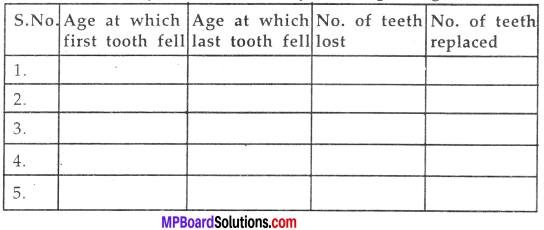
Question 3.
Collect data from your friends, neighbours and classmates to know more about milk teeth?
Tabulate your data. One way of doing it is given below:
MP Board Class 7th Science Solutions Chapter 2 Nutrition in Animals img-9
Find out from at least twenty children and find the average age. at which children lose the milk teeth. You may take help of your friends.
Answer:
Do with the help of your subject teacher.

Nutrition in Plants Additional Important Questions

Objective Type Questions

Question 1.
Choose the correct alternative:

Question (i)
Which one of the following is not an excretory organ –
(a) Oesophagus
(b) Skin
(c) Lever
(d) Kidney.
Answer:
(a) Oesophagus

Question (ii)
How many times heart of an healthy person beats in one minute –
(a) 70
(b) 71
(c) 72
(d) 73.
Answer:
(c) 72

MP Board Solutions

Question (iii)
Which organ produces bile –
(a) Liver
(b) Stomach
(c) Gall bladder
(d) Pancreas.
Answer:
(a) Liver

Question (iv)
The undigested food is eliminated through –
(a) Anus
(b) Lungs
(c) Caecum
(d) Colon.
Answer:
(a) Anus

Question (v)
The teeth which help in biting the food are –
(a) Incisors
(b) Canines
(c) Premolars
(d) Molars.
Answer:
(a) Incisors

Question (vi)
The number of molors present in a adult are –
(a) 2
(b) 4
(c) 6
(d) None of the above
Answer:
(c) 6

Question (vii)
The number of premolors present in a adult are –
(a) 2
(b) 4
(c) 6
(d) None of the above
Answer:
(b) 4

Question 2.
Fill in the blanks:

  1. The breakdown of complex components of food into smaller substances is called …………….
  2. The process of taking food into the body is called …………….
  3. Our mouth has the salivary glands which secrete …………….
  4. The acids gradually damage the teeth, this is called tooth …………….
  5. The digestive juices break down the ……………. into simpler substances.
  6. The bile plays an important role in the digestion of …………….
  7. The grass is rich in …………….

Answer:

  1. Digestion
  2. Ingestion
  3. Saliva
  4. Decay
  5. Proteins
  6. fats
  7. Cellulose.

MP Board Solutions

Question 3.
Which of the following statements are True (T) or False (F):

  1. Animal nutrition includes nutrient requirement, mode of intake of food and its utilisation in the body.
  2. The human digestive system consists of the alimentary canal and secretory glands.
  3. The modes of feeding do not vary in different organisms.
  4. The absorbed substances are transported to different parts of the body.
  5. The undigested and unabsorbed residues are expelled out of the body as faces through the anus.
  6. Amoeba ingests its food with the help of its false feet or pseudopodia.
  7. Gastric juice is secreted by the small intestine.
  8. An adult has 22 permanent teeth.
  9. Mouth cavity contains salivary glands and teeth only.
  10. We can taste food with our tongue.

Answer:

  1. True (T)
  2. True (T)
  3. False (F)
  4. True (T)
  5. True (T)
  6. True (T)
  7. False (F)
  8. False (F)
  9. False (F)
  10. True (T).

MP Board Solutions

Question 4.
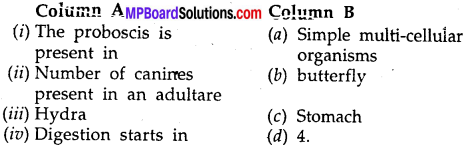
Match the items in Column A with Column B.
MP Board Class 7th Science Solutions Chapter 2 Nutrition in Animals img-10
Answer:

(i) (b)
(ii) (d)
(iii) (a)
(iv) (c).

Nutrition in Plants  Very Short Answer Type Questions

Question 1.
Name the largest gland of the human body?
Answer:
Liver.

Question 2.
Which chemical reaction takes place in internal respiration?
Answer:
Glucose + Oxygen → Carbon – di – oxide + Water + Energy.

Question 3.
Give an example of an oxy respiration?
Answer:
In human beings.

Question 4.
Which organs of plants participate in respiration?
Answer:
There is no special organ in plants for breathing.

Question 5.
Write the names of various stages of digestion?
Answer:
The digestion process is completed in following stages:

  1. Ingestion
  2. Digestion
  3. Absorption
  4. Assimilation
  5. Egestion

Question 6.
Write the name of secretion secreted in human stomach?
Answer:
Gastric juce and hydrochloric acid is secreted in human stomach.

MP Board Solutions

Question 7.
What is the meaning of enzyme?
Answer:
The complex molecules of ingested food are decomposed into smaller molecules. This process takes place in presence of a special substance called as enzyme. Enzyme increases the spread of reaction.

Question 8.
In which part of food canal water is absorbed?
Answer:
Large intestine.

Question 9.
Write the digestive organs given below in proper sequence?
Large intestine → stomach mouth cavity → small intestine → anus oesophagus.
Answer:
Mouth cavity Oesophagus → Stomach → Small intestine → Large intestine →Anus.

Question 10.
Which are the excretory organs in humans?
Answer:
The excretory organs in human are kidney, skin, sweat and lever.

Question 11.
Which is the excretory organ in paramoecium?
Answer:
The contracitile is the excretory organ in paramoecium.

Question 12.
Explain the digestion of food in stomach?
Answer:
The food halts here for longest time. Gastric juice and hydrochloric acid is secreted h£re. Proteins are digested here and food becomes acidic in nature due to presence of hydrochloric acid.

MP Board Solutions

Question 13.
What is called excretion?
Answer:
Excretion is the process of the removal of the waste product from the body of a plant or an animal. The different organisms eliminate their waste in different ways.

Question 14.
What is common between our nose, gills of a fish and stomata of leaves?
Answer:
All these organs are the respiratory organs. The exchange of gases (oxygen and carbon dioxide) takes place through them. Thus they have similarities.

Question 15.
Name five herbivores and five carnivores?
Answer:
Herbivores:
Cow goat, buffalow, horse and deer.

Carnivores:
Lion, frog, wolf, snake, peacock.

Question 16.
What is the function of saliva secreted by salivary glands?
Answer:
The functions of saliva are:

  1. It makes the food soft and easy to swallow.
  2. It also helps in digestion to small extent.

Question 17.
Name the four types of teeth?
Answer:
Incisor, canine, premolar and molar.

Question 18.
Which teeth do you use for biting and cutting?
Answer:
Inscisors are use for biting and cutting.

Question 19.
What is cud ?
Answer:
The partially digested food stored in rumen is called cud.

Question 20.
Write any two functions of villi?
Answer:

  1. Villi provides space for food.
  2. Digestive juice is secreted out from the digestive glands present in the villi in the embedded form.

MP Board Solutions

Question 21.
What is anylase?
Answer:
Saliva contains an enzyme called anylase. Amylase acts on start and changes it into a sugar called maltose.

Question 22.
Define stomach?
Answer:
Stomach is a thick walled bag Its shape is like a flattened U and it is the widest part of the alimentary canal. It received food from the food pipe at one end and opens into the small intestine at the other.

Question 23.
Name all the parts of alimentary canal?
Answer:
The buccal cavity, oesophagus, stomach, small intestine, large intestine and anus.

Nutrition in Plants Short Answer Type Questions

Question 1.
What do you understand by respiration?
Answer:
All the living organism penorm a number of vital activities. The energy is obtained by the oxidation of food or respiration. When the living organisms are completely at the stage of rest, even then they require some minimum amount of energy for the maintenance of cells and tissues. Thus, respiration is one of the most important process for the living organisms.

MP Board Solutions

Question 2.
Write names of organs in sequence through which food passes starting from mouth?
Answer:
First of all food is taken in mouth with help of hands. Food passes further through various organs of food canal. The sequence is as following:
Mouth cavity → Pharynx – Oesophagus → stomach → Large intestine ←Duodenum Ileum

Question 3.
What things in our mouth help in physical and chemical digestion?
Answer:
The teeth and tongue help on physical digestion. The teeth help in cutting, crushing and chewing the food. The tongue helps in mixing the saliva with food. The enzymes and saliva secreted by salivary glands help in chemical digestion.

MP Board Solutions

Question 4.
What makes the food move in digestive organ?
Answer:
The walls of the digestive organs are made of involuntary muscles. When the food enters into the food pope, the inner walls start contracting and expanding. These movements are called peristatic movements. This activity sends the food into digestive organs.

Question 5.
How will you prove that we exhale CO2 gas during respiration?
Answer:
Pass the exhaled air given out by us into lime water. It will turn milky in colour. We know that CO2 gas turn lime water milky. This confirms that we exhale CO2 gas in respiration.

Question 6.
What organ helps amoeba to move from one place to another?
Answer:
In amoeba pseudopodia are present which are locomotory organs. By means of these pseudopodia, amoeba move from one place to another. A protuberance is developed in the direction in which amoeba has to move. Cytoplasm reaches in it, due to which pseudopodium is formed.

MP Board Solutions

Question 7.
What is digestion?
Answer:
Digestion is a chemical process. It involves the conversion of the complex substances of the food into simpler water soluble substances by the action of the enzymes given out by the digestive glands. The body can utilise this food easily. The body absorbs the digested food and utilises it for getting energy.

Question 8.
Define:
1. Incisors
2. Canines.
Answer:
1. Incisors:
These are the flat front teeth. They have a sharp straight edge that help us to cut food and hence they are also called cutting teeth. There are four incisors in each jaw.

2. Canines:
These are the pointed teeth present on either side of the incisors. They help us to tear the food and hence they are called tearing teeth. There are two canines in each jaw.

Question 9.
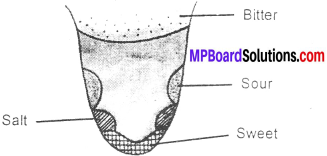
Give a labelled diagram to show the location of taste buds on the tongue?
Answer:
MP Board Class 7th Science Solutions Chapter 2 Nutrition in Animals img-11

Question 10.
Write down some functions of the tongue?
Answer:
We use our tongue for taking. Besides, it mixes saliva with the food during chewing and helps in swallowing food. We also taste food with our tongue. It has so many taste buds that detect different tastes of food

Question 11.
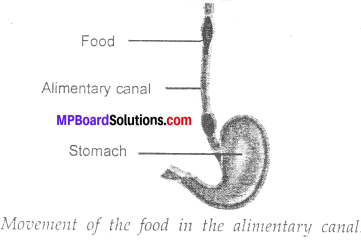
Draw a diagram to show the movement of the food in the alimentary canal?
Answer:
MP Board Class 7th Science Solutions Chapter 2 Nutrition in Animals img-12

Question 12.
What is meant by diarrhoea? Explain.
Answer:
Sometime you may have experienced the need to pass watery stool frequently. This condition is known as diarrhoea. It may be caused by an infection, food poisoning or indigestion. It is very common in India, particularly among children. Under severe conditions it can be fatal. This is because of the excessive loss of water and salts from the body. Diarrhoea should not be neglected. Even before a doctor is consulted the patient should be given plenty of boiled and cooled water with a pinch of salt and sugar dissolved in it. This is called Oral Rehydration Solution (ORS).

Nutrition in Plants  Long Answer Type Questions

Question 1.
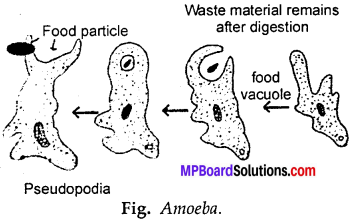
Explain ingestion of food in Amoeba with diagram?
Answer:
The organs which ingests food in pseudopodium. The food is caught by encircling it with Pseudopodia. When it is totally encircled then it is taken inside cell.
MP Board Class 7th Science Solutions Chapter 2 Nutrition in Animals img-13

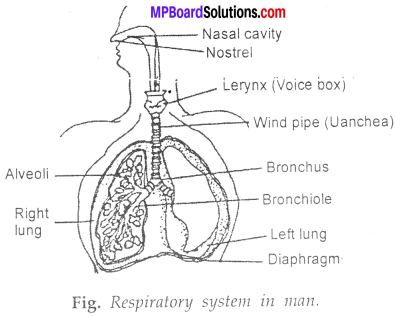
Question 2.
Describe the respiratory system of human beings?
Answer:
The various respiratory organs alongwith their functions are:
Air enters through the nostrils in the nose. The air then enters the nasal cavity which leads to larynx or voice box. From the larynx the air passes into the wind pipe or trachea. The trachea bifurcates into two branches. These are called bronchi. Bronchi further divide into smaller tubes called bronchioles. Later terminate in small thin wall air sacs called alveoli. The thin walls of the alveoli are provided with a network of blood capillaries. It is here that blood absorbs oxygen from alveoli and carbon dioxide from the blood enters the alveoli. From here the carbon dioxide is thrown out from the body. This process is called exhalation.
MP Board Class 7th Science Solutions Chapter 2 Nutrition in Animals img-14

Question 3.
Describe in details the process of digestion in human beings?
Answer:
The various digestive organs and the process of digestion are:
1. Mouth, Teeth and Tongue:
The process of digestion beings with mouth. Food is taken inside the mouth, chewed into smaller pieces by the teeth. Mouth has few salivary glands which secrete saliva. The tongue helps in mixing saliva with food and swallowing the food.

2. Oesophagus:
Then the food enters into food pipe which is also called oesophagus. The wall of the oesophagus undergo peristaltic movements. This sends the food into the stomach.
MP Board Class 7th Science Solutions Chapter 2 Nutrition in Animals img-15

3. Stomach:
Stomach is a bag like structure. Here the digestion of food starts. Here food is thoroughly mixed with the gastric juice secreted by gastric gland present in the stomach.

4. Small Intestine:
The process of digestion continues into small intestine. The upper part of the small intestine is called duodenum. In duodenum food is mixed with bile juice made by the liver and pancreatic juice from pancreas. The digested food is absorbed in the lower part of the small intestine by tiny projections called villi.

5. Large Intestine:
The undigested food now moves to the large intestine. Here water is absorbed and solid residue left behind called faeces.

6. Rectum and Anus:
The faeces then passer to rectum and expelled from the body through the anus.

Question 4.
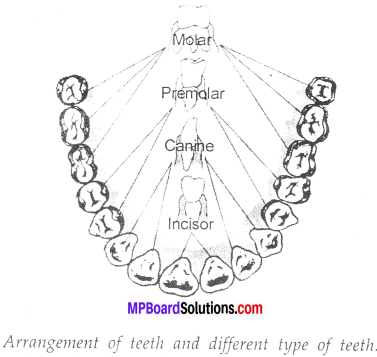
Draw a diagram to show the arrangement of teeth in mouth?
Answer:
MP Board Class 7th Science Solutions Chapter 2 Nutrition in Animals img-16

Question 5.
What is tooth decay? Explain.
Answer:
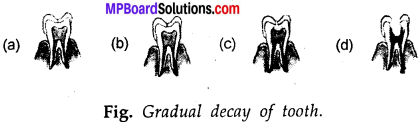
Normally bacteria are present in our mouth but they are not harmful to us. However, if we do not dean our teeth and mouth after eating, many harmful bacteria also begin to live and grow in it. These bacteria break down the sugars present from the leftover food and release acids. The acids gradually damage the teeth (Fig.). This is called tooth decay. If it is not treated in time, it causes severe toothache and in extreme cases results in tooth loss. Chocolates, sweets, cold drinks and other sugar products are the major culprits of tooth decay.
MP Board Class 7th Science Solutions Chapter 2 Nutrition in Animals img-17

Therefore, one should clean the teeth with a brush or dantun and dental floss (a special strong thread which is moved between two teeth to take out trapped food particles) at least twice a day and rinse the mouth after every meal. Also, one should not put dirty fingers or any unwashed object in the mouth.

MP Board Solutions

Question 6.
Explain excretion in human?
Answer:
Excretion is done by following organs:
1. Kidneys:
These excrete urea, salts, water etc., through urine.

2. Skin:
Skin possesses sweet glands. These glands absorb urea, salts and a large quantity of water from the blood capillaries near by and excrete them through their pores on the skin in the form of sweet.

3. Liver:
Liver is not a direct excretory organ. Liver cells convert more toxic ammonia into less toxic urea and uric acid and then pass them to the kidneys through the blood for excretion.

Liver also censer toxic substances. It remove bile salts in bile juice. These bile salts are formed due to break down of heamoglobin. If bile salts are not removed. They cause jaundice. Bile salts are removed through intestine.

4. Lungs:
It excretes gases like carbon dioxide, ammonia and water vapours.

5. Large Intestine:
It excretes undigested solid food waste (faeces).

MP Board Class 7th Science Solutions

MP Board Class 9th Maths Solutions Chapter 7 Triangles Ex 7.4

MP Board Class 9th Maths Solutions Chapter 7 Triangles Ex 7.4

Question 1.
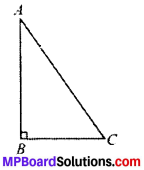
Show that in a right angled triangle, the hypotenuse is the longest side.
Solution:
Given
ABC is a right angle A.
To prove:
AC > AB and AC > BC
MP Board Class 9th Maths Solutions Chapter 7 Triangles Ex 7.4 img-1
Proof:
In ∆ABC
∠B = 90°
∴ ∠A + ∠C = 90° (by ASP)
and so ∠B > ∠A and ∠B > ∠C
AC > BC and AC > AB
(In a A, sides opposite to large angle are always longer).

MP Board Solutions

Question 2.
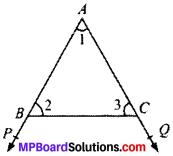
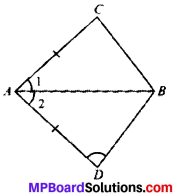
In Fig. given below, sides AB and AC of ∆ABC are extended to points P and Q respectively. Also, ∠PBC < ∠QCB. Show that AC > AB.
Solution:
Given
∠PRC < ∠QCB To prove AC > AB
MP Board Class 9th Maths Solutions Chapter 7 Triangles Ex 7.4 img-2
Proof:
In ∆ ABC
Exterior angle is equal to sum of two opposite angles
∠PBC = ∠1 + ∠3 and
∠QCB = ∠1 + ∠2
∠QCB > ∠PBC (given)
⇒ ∠1 + ∠2 > ∠1 + ∠3
⇒ ∠2 > ∠3
∴ AC > AB
(∴ In a A, side opposite to larger angle is always longer).

Question 3.
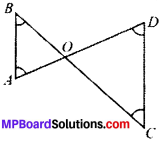
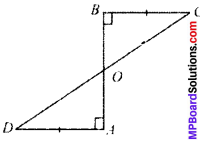
In Fig. below, ∠B < ∠A and ∠C < ∠D. Show that AD < BC.
MP Board Class 9th Maths Solutions Chapter 7 Triangles Ex 7.4 img-3
Solution:
Given
∠B < ∠A i.e., ∠A > ∠B
∠C < ∠D i.e., ∠D> ∠C
To prove: AD > BC
i.e., BC > AD
Proof:
In ∆OCD
∠D > ∠C
OC > OD
(∴ In a ∆, sides opposite to larger angle are always longer) …(1)
In ∆OBA
∠A > AB
OB > OA
(∴ In a A, sides oppositedo larger angle are always longer) …(2)
Adding (1) and (2), we get
OC + OB > OD + OA
BC > AD

MP Board Solutions

Question 4.
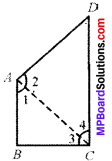
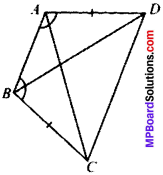
AB and CD are respectively the smallest and longest sides of a quadrilateral ABCD (see Fig. below). Show that ∠A > ∠C and ∠B > ∠D.
Solution:
Given
AB is the smallest siBe and CD is the longest side
To prove:

  1. ∠A > ∠C and
  2. ∠B > ∠D

Construction:
Join AC
MP Board Class 9th Maths Solutions Chapter 7 Triangles Ex 7.4 img-4
1. Proof:
In, ∆ABC
BC > AB (∴ AB is the smallest side) ∠1 > ∠3
(∴ In a ∆ angle opposite to longer side is always larger) …..(1)
In ∆ACD
CD > AD (∴ CD is the largest side) ∠2 > ∠4
(∴ In a ∆ angles opposite to longer side are always larger) …(2)
Adding (1) and (2), we get
∠1 + ∠2 > ∠3 + ∠4
∠A > ∠C

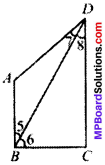
2. To prove: AB > AD
Construction:
Join BD
Proof:
In ∆ABD
AD > AB (AB is the smallest side)
∠5 > ∠7 …(3)
In ∆BCD
CD > BC (CD is the longest side)
MP Board Class 9th Maths Solutions Chapter 7 Triangles Ex 7.4 img-5
∠6 > ∠8 …(4)
Adding (3) and (4), we get
∠5 + ∠6 > ∠7 + ∠8
∠B > ∠D

Question 5.
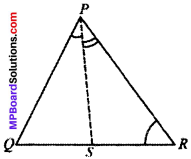
In Fig. below, PR > PQ and PS bisects ∠QPR. Prove that ∠PSR > ∠PSQ.
MP Board Class 9th Maths Solutions Chapter 7 Triangles Ex 7.4 img-6
Sol.
Given:
PR > PQ
∠1 = ∠2
To prove:
∠PSR > ∠PSQ
Proof:
In ∆PSQ
∠PSR = ∠1 + ∠Q (EAP)
In ∆PSR
∠PSQ = ∠2 + ∠R (EAP)
= ∠1 + ∠R (∠1 = ∠2)
In ∆PQR
PR > PQ (given)
∠Q > ∠R
(∴ In a ∆, angle opposite to longer side is always larger)
Adding ∠1 on both sides
∠Q + ∠l > ∠R + ∠1
∴ ∠PSR > ∠PSQ
(∴ ∠PSR = ∠1 + ∠Q and ∠PSQ = ∠1 + ∠R)

MP Board Solutions

Question 6.
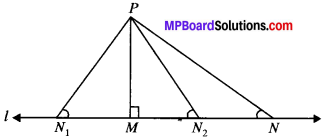
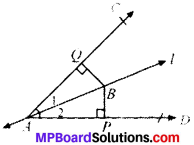
Show that of all the line segments drawn from a give point not on it, the perpendicular line segment is the shortest.
Solution:
Given
Let us consider the ∆PMN such that ∠M = 90°
Since, ∠M + ∠N + ∠P = 180° [Sum of angles of a triangle]
MP Board Class 9th Maths Solutions Chapter 7 Triangles Ex 7.4 img-7

∠M = 90° [PM ⊥ l]
∠N < ∠M
PM < PN …..(1)
Similarly PM < PN1 …..(2)
PM < PN2 …..(3)
From (1), (2) and (3), we have PM is the smallest line segment drawn from P on the line l.
Thus, the perpendicular segment is the shortest line segment drawn on a line from a point not on it.

MP Board Class 9th Maths Solutions

MP Board Class 9th Maths Solutions Chapter 7 Triangles Ex 7.3

MP Board Class 9th Maths Solutions Chapter 7 Triangles Ex 7.3

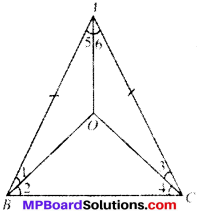
Question 1.
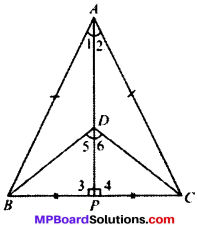
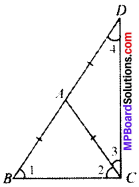
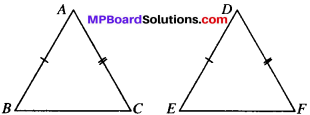
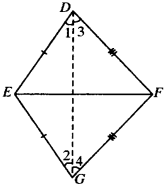
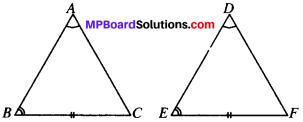
∆ABC and ∆DBC are two isosceles triangles on the same base BC and vertices A and D are on the same side of BC (see Fig. below). If AD is extended to intersect BC at P, show that

  1. ∆ABD = ∆ACD
  2. ∆ABP = ∆ACP
  3. AP bisects ∠A as well as ∠D.
  4. AP is the perpendicular bisector of BC.

Solution:
Given
AB = AC
DB = DC
To prove:

  1. ∆ABD = ∆ACD
  2. ∆ABP = ∆ACP
  3. ∠1 = ∠2 and ∠5 = ∠6
  4. ∠3 = ∠4 = 90° and BP = PC

Proof
1. In ∆ABD and ∆ACD
AB = AC (given)
BD = CD (given)
AD =AD (common)
∆ABD = ∆ACD (by SSS)
and so ∠1 = ∠2 (by CPCT)

2. In ∆ABP and ∆ACP
AB = AC (given)
∠1 = ∠2 (proved)
AP = AP (common)
∆ABP ≅ ∆ACP (by SAS)
and so ∠3 = ∠4
and BP = CP (by CPCT)
MP Board Class 9th Maths Solutions Chapter 7 Triangles Ex 7.3 img-1
∠1 = ∠2 AP bisects ∠A

3. In ∆DBP and ∆DCP
BP = CP (proved)
∠3 = ∠4 (proved)
DP = DP (common)
MP Board Class 9th Maths Solutions Chapter 7 Triangles Ex 7.3 img-2
∆DBP ≅ ∆DCP (by SAS)
and so ∠5 = ∠6 (by CPCT)
∴ AP bisects ∠D.

4. BP = CP (proved)
∠3 = ∠4 (proved)
∠3 + ∠4 = 180° (LPA’s)
∠3 + ∠3 = 180° (∠3 = ∠4)
2∠3 = 180°
∠3 = 90°
∠3 = ∠4 (each 90°)
and therefore, AP is the perpendicular bisector of BC

MP Board Solutions

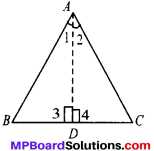
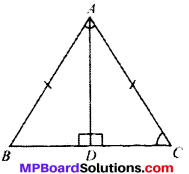
Question 2.
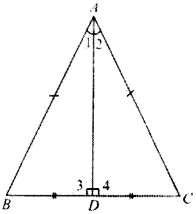
AD is an altitude of an isosceles triangle ABC in which AB = AC. Show that

  1. AD bisects BC
  2. AD bisects ∠A.

MP Board Class 9th Maths Solutions Chapter 7 Triangles Ex 7.3 img-3
Solution:
Given
AB = AC and AD ⊥ BC
To prove
∠1 = ∠2 and
BD = CD
Proof:
In ∆ABD and ∆ACD
AB = AC
AD = AD
∠3 = ∠4
∆ABD = ∆ADC
and so BD = CD and ∠1 = ∠2

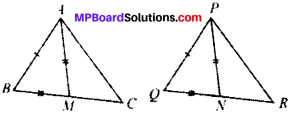
Question 3.
Two sides AS and BC and median AM on one triangle ABC are respectively equal to sides PQ and QR and median PN of ∆PQR (see-Fig. below). Show that:

  1. ∆ABM ≅ ∆PQN
  2. ∆ABC ≅ ∆PQR

MP Board Class 9th Maths Solutions Chapter 7 Triangles Ex 7.3 img-4
Solution:
Given
AB = PQ
BC = QR
AM = PN
To prove:

  1. ∆ABM ≅ ∆PQN
  2. ∆ABC ≅ ∆PQR

Proof:
BC = QR (given)
\(\frac{1}{2}\) BC = \(\frac{1}{2}\)QR
BM = QN

1. In ∆ABM and ∆PQN
AB = PQ (given)
BM = QN (proved)
AM = PN (given)
∆ABM ≅ ∆PQN (by SSS)
and so ∠ABC = ∠PQR (by CPCT)

2. In ∆ABC and ∆PQR
AB = PQ (given)
BC = QR (given)
∠B = ∠Q (proved)
∆ABC ≅ ∆PQR by (SAS)

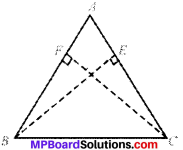
Question 4.
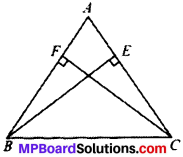
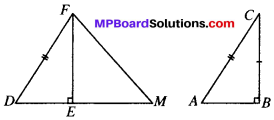
BE and CF are two equal altitudes of a triangle ABC. Using RHS congruence rule, prove that triangle ABC is isosceles.
MP Board Class 9th Maths Solutions Chapter 7 Triangles Ex 7.3 img-5
Solution:
Given
∠E = ∠F
BE = CF
To prove
AB = AC
Proof:
In ∆FBC and ∆ECB
BE = CF (given)
∠F = ∠E (each 90°)
BC = CB (common)
∴ ∆FBC = ∆ECB (by RHS)
and so ∠B = ∠C (by CPCT)
In ∆ABC, ∠B = ∠C
AB = AC
(sides opposite to equal angles of a A are equal)
and so ABC is isosceles.

MP Board Solutions

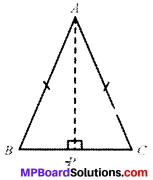
Question 5.
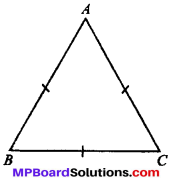
ABC is an isosceles triangle with AB = AC. Draw AP ⊥ BC to show that ∠B = ∠C.
Solution:
Given
AB = AC
∠APB = ∠APC = 90°
To prove:
∠B = ∠C
MP Board Class 9th Maths Solutions Chapter 7 Triangles Ex 7.3 img-6
Proof:
In ∆ABP and ∆ACP
AP = AP (common)
∠APB = ∠APC (each 90°)
AB = AC (given)
∴ ∆ABP = ∆ACP (by RHS)
and ∠B = ∠C (by CPCT)

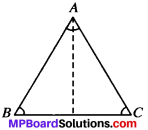
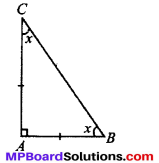
Theorem 7.6.
If two angles of a triangle are equal, then the sides opposite to them are also equal.
Given
In ∆ABC, ∠C = ∠B
MP Board Class 9th Maths Solutions Chapter 7 Triangles Ex 7.3 img-7
To prove: AB = AC
Construction:
Draw the bisector of ∠A and let it meet BC an D
Proof:
In ∆s ABD and ACD, we have ∠B = ∠C (Given)
∠BAD = ∠CAD (Construction)
AD = AD (Common)
∴ ∆ABD ≅ ∆ACD (AAS Cong. Criterion)
Hence, AB = AC (CPCT)

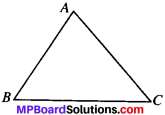
Theorem 7.7.
If two sides of a triangle are unequal, the longest side has greater angle opposite to it.
Given:
In ∆ABC; AC > AB
To prove: ∠ABC > ∠ACB.
MP Board Class 9th Maths Solutions Chapter 7 Triangles Ex 7.3 img-8
Construction:
Mark point D on AC such that AB = AD. Join BD.
Proof:
In ∆ABD,
AB = AD
∴ ∠1 = ∠2 (Const. As opp. equal sides) ….(1)
But ∠2 is an exterior angle of ABCD.
∠2 > ∠ACB (Exterior Angle Theorem) …(2)
From (1) and (2), we have
∠1 > ∠ACB (Const.)
But ∠ABC > ∠1
∴ ∠ABC > ∠ACB

MP Board Solutions

Theorem 7.8. (Converse of Theorem 7.7)
In a triangle the greater angle has the longer side opposite to it.
Given:
In ∆ABC, ∠ABC > ∠ACB
To prove: AC > AB
MP Board Class 9th Maths Solutions Chapter 7 Triangles Ex 7.3 img-9
Proof:
For ∆ABC, there are only three possibilities of which exactly one must be true.

  1. AC = AB
  2. AC < AB (iii) AC > AB.

Case 1:
If AC = AB, then ∠ABC = ∠ACB, which is contrary to what is given.
AB ≠ AC

Case 2:
If AC < AB, the longer side has the greater angle opposite to it.
∴ ∠ACB > ∠ABC.
This is also contrary to what is given.

Case 3:
We are left with the only possibility, namely AC > AB which is true.
AC > AB.

MP Board Class 9th Maths Solutions

MP Board Class 9th Science Solutions Chapter 9 Force and Laws of Motion

MP Board Class 9th Science Solutions Chapter 9 Force and Laws of Motion

Force and Laws of Motion Intext Questions

Force and Laws of Motion Intext Questions Page No. 118

Question 1.
Which of the following has more inertia:

  1. a rubber ball and a stone of the same size?
  2. a bicycle and a train?
  3. a five – rupees coin and a one – rupee coin?

Answer:
As we know, inertia is the calculated value for the mass of the body. It is proportional to mass of the body:

  1. Inertia of the stone is greater than that of a rubber ball as mass of a stone is more than the mass of a rubber ball for the same size.
  2. Inertia of the train is greater than that of the bicycle. As mass of a train is more than the mass of a bicycle.
  3. Mass of a five rupee coin is more than that of a one – rupee coin. Hence, inertia of the five – rupee coin is greater than that of the one – rupee coin.

MP Board Solutions

Question 2.
In the following example, try to identify the number of times the velocity of the ball changes: “A football player kicks a football to another player of his team who kicks the football towards the goal. The goalkeeper of the opposite team collects the football and kick it towards a player of his own team”. Also, identify the agent supplying the force in each case.
Answer:
Four times:

  • First, when a football player kicks to another player. Agent supplying the force: First case – First player. Second when that player kicks the football to the goalkeeper. Agent supplying the force. Second case – Second player.
  • Third when the goalkeeper stops the football. Agent supplying the force: Third case – Goalkeeper.
  • Fourth when the goalkeeper kicks the football towards a player of his own team. Agent supplying the force: Fourth case – Goalkeeper.

Question 3.
Explain why some of the leaves may get detached from a tree if we vigorously shake its branch.
Answer:
When we shake any tree’s branches vigorously some leaves of that tree get detached because branches comes in motion while the leaves tend to remain at rest due to inertia of rest.

Question 4.
Why do you fall in the forward direction when a moving bus brakes to a stop and fall backwards when it accelerates from rest?
Answer:
Due to inertia of motion, we fall in the forward direction when a moving bus brakes to a stop and fall backwards when it accelerates from rest.

  1. Case I: Since the driver applies brakes and bus comes to rest. But, the passenger tries to maintain its inertia of motion. As a result, a forward force is exerted on him.
  2. Case II: The passenger tends to fall backwards when the bus accelerates from rest because when the bus accelerates, the inertia of rest of the passenger tends to oppose the forward motion of the bus.

Force and Laws of Motion Intext Questions Page No. 126

Question 1.
If action is always equal to the reaction, explain how a horse can pull a cart.
Answer:
According to Newton’s third law of motion, a force is exerted by the Earth on the horse in the forward direction while horse pushes the ground in the backward direction. As a result, the cart moves forward.

Question 2.
Explain, why is it difficult for a fireman to hold a hose, which ejects large amounts of water at a high velocity.
Answer:
According to Newton’s third law of motion, a reaction force is exerted over fireman by the ejecting water in the backward direction when a fireman holds a hose, which is ejecting large amounts of water at a high velocity. As a result of the backward force, the stability of the fireman get affected. Hence, it is difficult for him to remain stable while holding the hose.

MP Board Solutions

Question 3.
From a rifle of mass 4kg, a bullet of mass 50g is fired with an initial velocity of 35 ms-1. Calculate the initial recoil velocity of the rifle.
Answer:
Given,
Mass of the rifle, m1 = 4kg
Mass of the bullet, m2 = 50g = 0.05kg
Recoil velocity of the rifle = v1
Bullet is fired with an initial velocity, v2= 35 m/s
Condition:
Initially, the rifle is at rest.
Thus, its initial velocity, v = 0
Total initial momentum of the rifle and bullet system = (m1+ m2)v = 0
Total momentum of the rifle and bullet system after firing = m1v1 + m2v2
= 0.05 × 35 = 4v1 + 1.75
As per law of conservation of momentum:
Total momentum after the firing = Total momentum before the firing
⇒ 4v1 + 1.75 = 0
v1 = –\(\frac { 1.75 }{ 4 }\) = -0.4375 m/s
So, the rifle recoils backwards with a velocity of 0.4375 m/s because value is negative.

MP Board Solutions

Question 4.
Two objects of masses 100g and 200g are moving along the same line and direction with velocities of 2 ms-1 and 1  ms-1, respectively. They collide and after the collision, the first object moves at a velocity of 1.67 ms-1. Determine the velocity of the second object.
Answer:
Given,
m1 = 100g = 0.1kg
m2 = 200g = 0.2kg
Velocity of m1 before collision, v1 = 2 m/s
Velocity of m2 before collision, v2 = 1 m/s
Velocity of m1 after collision, v3 = 1.67 m/s
Velocity of m2 after collision = v4
As per the law of conservation of momentum:
Total momentum before collision = Total momentum after collision
Hence,
m1v1 + m2v2 = m1v3+ m2v4
Putting values
2(0.1) + 1(0.2) = 1.67(0.1) + v4(0.2)
0.4 = 0.167 + 0.2v4
v4 = 1.165 m/s
Velocity of the second object = 1.165 m/s.

Force and Laws of Motion NCERT Textbook Exercises

Question 1.
An object experiences a net zero external unbalanced force. Is it possible for the object to be travelling with a non –  zero velocity? If yes, state the conditions that must be placed on the magnitude and direction of the velocity. If no, provide a reason.
Answer:
Yes, an object may travel with a non – zero velocity even when the net external force on it is zero. A rain drop falls down with a constant velocity. The weight of the drop is balanced by the upthrust and the viscosity of air. The net force on the drop is zero.

Question 2.
When a carpet is beaten with a stick, dust comes out of it Explain.
Answer:
When we beat the carpet with a stick, it comes into motion. But the dust particles continue to be at rest due to inertia and get detached from the carpet.

Question 3.
Why is it advised to tie any luggage kept on the roof of a bus with a rope?
Answer:
Due to sudden jerks or due to the bus taking sharp turn on the road, the luggage may fall down from the roof because of its tendency to continue moving in the original direction. To avoid this, the luggage is tied with a rope on the roof.

MP Board Solutions

Question 4.
A batsman hits a cricket ball which then rolls on a level ground. After covering a short distance, the ball comes to rest The ball slows to a stop because
(a) the batsman did not hit the ball hard enough.
(b) velocity is proportional to the force exerted on the ball.
(c) there is a force on the ball opposing the motion.
(d) there is no unbalanced force on the ball, so the ball would come to rest.
Answer:
(c) there is a force on the ball opposing the motion.

Question 5.
A truck starts from rest and rolls down a hill with a constant acceleration. It travels a distance of 400 m in 20 s. Find its acceleration. Find the force acting on it if its mass is 7 metric tonnes (Hint: 1 metric tonne = 1000 kg.)
Answer:
Here, u = 0, s = 400m, t = 20 s, a = ?, F = ?.
m = 7 tonnes
= 7 × 1000kg
= 7000kg
⇒ s = ut + \(\frac { 1 }{ 2 }\)at2
400 = (0 + 20) + \(\frac { 1 }{ 2 }\)a(20)2
a = \(\frac { 400\times 2 }{ { 20 }^{ 2 } } \)
∴ a = 2 m/s2
Force,
F = ma
= 7000 × 2 = 14,000 N.

Question 6.
A stone of 1kg is thrown with a velocity of 20 ms-1 across the frozen surface of a lake and comes to rest after travelling a distance of 50m. What is the force of friction between the stone and the ice?
Answer:
m = 1kg, u = 20 m/s, s = 50m, v = 0, F = ? a = ?.
⇒ v2 – u2 = 2as
(0)2 – (20)2 = 2a (50)
∴ – 400 = 100a
= \(\frac { 400 }{ 100 }\) – 4 m/s2
Force of friction, F = m × a
= 1kg × -4 m/s2 = -4 N

MP Board Solutions

Question 7.
A 8000kg engine pulls a train of 5 wagons, each of 2000kg, along a horizontal track. If the engine exerts a force of 40,000 N and the track offers a friction force of 5000 N, then calculate:
(a) the net accelerating force;
(b) the acceleration of the train; and
(c) the force of wagon 1 on wagon 2.
Answer:
m = 8,000 + 5 × 2,000 = 18,000kg
(a) The net accelerating force,
F = Engine force – friction force
= 40,000 – 5,000 = 35,000 N.

(b) The acceleration of the train,
a = \(\frac { F }{ m }\) = \(\frac { 35,000 }{ 18,000 }\) = \(\frac { 35 }{ 18 }\) = 1.94 ms-2

(c) The force of wagon 1 on wagon 2
= The net accelerating force – mass of wagon × acceleration
= 35,000 – 2,000 × \(\frac { 35 }{ 18 }\)
= 35,000 – 3888.8 = 31,111.2 N.

Question 8.
An automobile vehicle has a mass of 1500kg. What must be the force between the vehicle and road if the vehicle is stopped with a negative acceleration of 1.7 ms-2?
Answer:
Here, mass = 1500kg
a = -1.7 ms2
F = m × a
= 1500 × (-1.7)
= -2550 N
The force between the vehicle and the road is 2,550 is, m a direction opposite to the direction of the vehicle.

Question 9.
What is the momentum of an object of mass m, moving with a velocity v? Choose correct option.
(a) (mv)2
(b) mv2
(c) \(\frac { 1 }{ 2 }\) × mv2
(d) mv.
Answer:
(d) mv.

Question 10.
Using a horizontal force of 200 N, we intend to move a wooden cabinet across a floor at a constant velocity. What is the friction force that will be exerted on the cabinet?
Answer:
The cabinet will move with constant velocity only when the net force on it is zero.
Force of friction on the cabinet = 200 N, in a direction opposite to the direction of motion of the cabinet.

Question 11.
Two objects, each of mass 1.5kg, ate moving in the same straight line but in opposite directions. The velocity of each object is 2.5 ms-1 before the collision during which they stick together. What will be the velocity of the combined object after collision?
Answer:
Here, m1 = m2 = 1.5kg,
u1 = 2.5 ms-1, u2 = – 2.5 ms-1
Let v be the velocity of the combined object after the collision.
By conservation of momentum,
Total momenta after collision = Total momenta before collision
= (m1 + m2) v = m1u1 + m2u2
= (1.5 + 1.5) v = 1.5 × 2.5 + 1.5 × (-2.5)
= 3.0 v = 0
or
⇒ v = 0 ms-1

Question 12.
According to the third law of motion when we push on an object, the object pushes back on us with an equal and opposite force. If the object is a massive truck parked along the roadside, it will probably not move. A student justifies this by answering that the two opposite and equal forces cancel each other. Comment on this logic and explain why the truck does not move.
Answer:
Action and reaction always act on different bodies, so they cannot cancel each other. When we push a massive truck, the force of friction between its tyres and the road is very large and so, the truck does not move.

Question 13.
A hockey ball of mass 200g travelling at 10 ms-1 is struck by a hockey stick so as to return it along its original path with a velocity at 5 ms-1. Calculate the change of momentum occurred in the motion of the hockey ball by the force applied by the hockey stick.
Answer:
Here, m = 200g = 0.2kg,
u = 10 ms-1,
v = -5 ms-1
change in momentum = m (v – u)
= 0.2 (- 5 – 10) = -3kg ms-1.

MP Board Solutions

Question 14.
A bullet of mass 10g travelling horizontally with a velocity of 150 ms-1 strikes a stationary wooden block and comes to rest in 0.03 s. Calculate the distance of penetration of the bullet into the block. Also calculate the magnitude of the force exerted by the wooden block on the bullet.
Answer:
Here m = 10g = 0.01kg,
u = 150 ms-1,
v = 0, t = 0.03 s
a = \(\frac { v-u\quad }{ t } \) = \(\frac { 0-150\quad }{ 0.03 } \) = -5,000 ms-1
The distance of penetration of the bullet into the block,
s = ut + \(\frac { 1 }{ 2 }\)at2
150 × 0.03 + \(\frac { 1 }{ 2 }\) × (-5,000) × (0.03)
= 4.5 – 2.25 = 2.25
The magnitude of the force exerted by the wooden block on the bullet
= ma = 0.01 × 5,000 = 50 N.

Question 15.
An object of mass 1kg travelling in a straight line with a velocity of 10 ms-1 collides with, and sticks to, a stationary wooden block of mass 5kg. Then, they both move off together in the same straight line. Calculate the total momentum just before the impact and just after the impact. Also, calculate the velocity of the combined object.
Answer:
Here, m1 = 1kg, u1 = 10 ms-1, m2 = 5kg, u2 = 0
Let v be the velocity of the combined object after the collision.
Total momentum just before the impact
= m1u1 + m2u2  = 1 × 10 + 5 × 0 = 10kg ms-1
Total momentum just after the impact = (m1 + m2)v = (1 + 5)v
= 6v kg ms-1 by conservation of momentum,
6v = 10
= v = \(\frac { 10 }{ 6 }\) = \(\frac { 5 }{ 3 }\) ms-1
∴ Total momentum just after the impact
= 6 × \(\frac { 5 }{ 3 }\) = 10 ms-1

Question 16.
An object of mass 100kg is accelerated uniformly from a velocity of 5 ms-1 to 8 ms-1 in 6 s. Calculate the initial and final momentum of the object. Also, find the magnitude of the force exerted on the object.
Answer:
Here, m = 100kg,
u = 5 ms-1,
v = 8 ms-1,
t = 6 s
Initial momentum, P1 = mu = 100 × 5 = 500kg ms-1
Final momentum, P2 = mu = 100 × 8 = 800kg ms-1
The magnitude of the force exerted on the object.
F = \(\frac { { P }_{ 2 }-{ P }_{ 1 } }{ t } \) = \(\frac { 800-500 }{ 6 }\) = \(\frac { 300 }{ 6 }\) = 50 N.

Question 17.
Akhtar, Kiran and Rahul were riding in a motorcar that was moving with a high velocity on an expressway when an insect hit the windshield and got stuck on the windscreen. Akhtar and Kiran started pondering over the situation. Kiran suggested that the insect suffered a greater change in momentum as compared to the change in momentum of the motorcar (because the change in the velocity of the insect was much more than that of the motorcar). Akhtar said that since the motorcar was moving with a larger velocity, it exerted a larger force on the insect And as a result the insect died. Rahul while putting an entirely new explanation said that both the motorcar and the insect experienced the same force and a change in their momentum. Comment on these suggestions.
Answer:
Both, the motorcar and insect experience the equal force and hence, a same change in their momentum. So, we agree with Rahul. But due to smaller mass or inertia, the insect dies.

Question 18.
How much momentum will a dumb – bell of mass 10kg transfer to the floor if it falls from a height of 80cm? Take its downward acceleration to be 10 ms-2.
Answer:
Here, m = 10kg, u = 0,
s = 80cm = 0.80m,
a = 10 m/s-2
Let v be the velocity gained by the dumb-bell as it reaches the floor.
As v2 – u2 = 2as
v2 – 02 = 2 × 10 × 0.80 = 16
or
v = 4 ms-1
Momentum transferred by the dumb-bell to the floor
p = mv = 10 × 4 = 40kg ms-1

Force and Laws of Motion Additional Questions

Force and Laws of Motion Multiple Choice Questions

Question 1.
Which of the following statements is not correct for an object moving along a straight path in an accelerated motion?
(a) Its speed keeps changing.
(b) Its velocity always changes.
(c) It always goes away from the earth.
(d) A force is always acting on it.
Answer:
(c) It always goes away from the earth.

MP Board Solutions

Question 2.
According to the third law of motion, action and reaction ________ .
(a) Always act on the same body.
(b) Always act on different bodies in opposite directions.
(c) Have same magnitude and directions.
(d) Act on either body at normal to each other.
Answer:
(b) Always act on different bodies in opposite directions.

Question 3.
A goalkeeper in a game of football pulls his hands backwards after holding the ball shot at the goal. This enables the goal keeper to ________ .
(a) Exert larger force on the ball.
(b) Reduce the force exerted by the ball on hands.
(c) Increase the rate of change of momentum.
(d) Decrease the rate of change of momentum.
Answer:
(b) Reduce the force exerted by the ball on hands.

Question 4.
The inertia of an object tends to cause the object ________ .
(a) To increase its speed.
(b) To decrease its speed.
(c) To resist any change in its state of motion.
(d) To decelerate due to friction.
Answer:
(c) To resist any change in its state of motion.

Question 5.
A passenger in a moving train tosses a coin which falls behind him. It means that motion of the train is ________ .
(a) Accelerated
(b) Uniform
(c) Retarded
(d) Along circular tracks.
Answer:
(a) Accelerated

Question 6.
An object of mass 2kg is sliding with a constant velocity of 4 ms-1 on a frictionless horizontal table. The force required to keep the object moving with the same velocity is ________ .
(a) 32 N
(b) 0 N
(c) 2 N
(d) 8 N.
Answer:
(b) 0 N

Question 7.
Rocket works on the principle of conservation of ________ .
(a) Mass
(b) Energy
(c) Momentum
(d) Velocity.
Answer:
(c) Momentum

Question 8.
A water tanker filled up to \(\frac { 2 }{ 3 }\) of its height is moving with a uniform speed. On sudden application of the brake, the water in the tank would ________ .
(a) Move backward
(b) Move forward
(c) Be unaffected
(d) Rise upwards.
Answer:
(b) Move forward

Question 9.
Which of the following represents example(s) of potential energy?
(a) A moving car
(b) A moving fan
(c) A book resting on the table
(d) Both (a) and (c).
Answer:
(d) Both (a) and (c).

Question 10.
Unit of force is ________ .
(a) Ampere
(b) Volt
(c) Joule
(d) Hertz.
Answer:
(c) Joule

MP Board Solutions

Question 11.
Product of mass and acceleration of a body is called ________ .
(a) Acceleration
(b) Work
(c) Power
(d) Energy.
Answer:
(b) Work

Question 12.
Which of the following is correct about energy?
(a) Energy is not required to do work.
(b) Work can be expressed as Force × Displacement.
(c) Unit of power is joule.
(d) Power is the amount of work done per unit time.
Answer:
(c) Unit of power is joule.

Question 13.
An object of mass 3kg is falling from the height of 1m. The kinetic energy of the body will be when it touches the ground ________ .
(a) 29.4 N
(b) 29.4 J
(c) 30 N
(d) 15 J
Answer:
(b) 29.4 J

Question 14.
Two objects with masses 1kg and 9kg, and equal momentum. Calculate the ratios of their kinetic energies ________ .
(a) 3 : 1
(b) 9 : 1
(c) 1 : 1
(d) 1 : 2
Answer:
(b) 9 : 1

Question 15.
Considering air resistance negligible, the sum of potential and kinetic energies of the free falling body would be ________ .
(a) zero
(b) infinite
(c) would decrease
(d) remains fixed.
Answer:
(d) remains fixed.

Force and Laws of Motion Very Short Answer Type Questions

Question 1.
What do we call to the product of mass and velocity of an object?
Answer:
Momentum.

Question 2.
Define inertia.
Answer:
The property by which an object tends to remain in the state of rest or of uniform motion unless acted upon by some force is called inertia.

Question 3.
Which property has S.I. unit kilogram metres per second i.e., 1kg m/s?
Answer:
Momentum.

MP Board Solutions

Question 4.
Give an example of scalar quantity.
Answer:
Mass.

Question 5.
Give an example of vector quantity.
Answer:
Momentum.

Question 6.
Calculate the total momentum of the bullet and the gun before firing.
Answer:
For both, it would be zero because both of them are at rest.

Question 7.
Which force slows down a moving bicycle when we try to stop?
Answer:
The force of friction.

Question 8.
Which kind of force of gravity work when an object is under free fall?
Answer:
Unbalanced force.

Question 9.
Which property of an object resist a change in their state of rest or motion?
Answer:
Inertia.

Question 10.
Which law of Newton is also known as Galileo’s law of inertia?
Answer:
First law.

Question 11.
Is force a vector quantity?
Answer:
Yes.

Question 12.
Which force of motion opposes motion of an object?
Answer:
Force of friction.

Question 3.
When action and reaction forces act on two different bodies, what kind of magnitude they have?
Answer:
Action and reaction forces act on two different bodies but they are equal in magnitude.

Question 14.
When gun moves in the backward direction, which kind of velocity is generated?
Answer:
Recoil.

Question 15.
Which factor of body is dependent on its mass?
Answer:
Inertia of a body depends on its mass.

Force and Laws of Motion Short Answer Type Questions

Question 1.
There are three solids made up of aluminium, steel and wood, of the same shape and same volume. Which of them would have highest inertia?
Answer:
Steel has highest inertia because it has greatest density and greatest mass, therefore, it has highest inertia.

Question 2.
Two balls of the same size but of different materials, rubber and iron are kept on the smooth floor of a moving train. The brakes are applied suddenly to stop the train. Will the balls start rolling? If so, in which direction? Will they move with the same speed? Give reasons for your answer.
Answer:
If the breaks are applied suddenly then, the balls will start rolling in the direction in which the train was moving. Due to the application of the brakes, the train comes to rest but due to inertia the balls try to remain in motion, therefore, they begin to roll. Direction and speed of all balls will not be same because the masses of the balls are not the same, therefore, the inertial forces are not same on both the balls. Thus, the balls will move with different speeds.

Question 3.
Two identical bullets are fired, one by a light rifle and another by a heavy rifle with the same force. Which rifle will hurt the shoulder more and why?
Answer:
According to law of conservation of momentum or explanation by Newton’s laws of motion, light rifle will hurt the shoulder more.

MP Board Solutions

Question 4.
A horse continues to apply a force in order to move a cart with a constant speed. Explain why?
Answer:
The force applied by the horse balances the force of friction

Question 5.
Suppose a ball of mass m is thrown vertically upward with an initial speed v, its speed decreases continuously till it becomes zero. Thereafter, the ball begins to fall downward and attains the speed v again before striking the ground. It implies that the magnitude of initial and final momentums of the ball are same. Yet, it is not an example of conservation of momentum. Explain.
Answer:
Law of conservation of momentum is applicable to isolated system (no external force is applied). In this case, the change in velocity is due to the gravitational force of earth.

Question 6.
In which of the following conditions work done will be equal to zero?
Answer:
In the absence of any one of the two conditions given below, work done will be equal to zero, that is work is not considered to be executed:

  1. Force should act on the object.
  2. Object must be displaced.

Question 7.
Define energy and explain its forms.
Answer:

  1. Energy: Energy is the capacity of doing work. More the power, more will be energy and vice – versa. For example, a motorcycle has more energy than a bicycle.
  2. Forms of energy: There are many forms of energy, such as kinetic energy, potential energy, mechanical energy, chemical energy, electrical energy etc.

Force and Laws of Motion Long Answer Type Questions

Question 1.
Give the formulation of work. In which conditions work can occur?
Answer:
Work = Force × Displacement
or W = F × s
where, W is work ‘F’ is force and ‘s’ is displacement.
If force, F = 0
Therefore, work done, W = 0, s = 0
If displacement, s = 0
Therefore, Work done, W = F × 0 = 0
It proves that, there are two conditions for work to occur or be done:

  1. Force should act on the object.
  2. Object must be displaced.

MP Board Solutions

Question 2.
Give the conditions when work done become positive and negative.
Answer:
When force is applied in the direction of displacement, the work done is considered as positive.
i.e., W = F × s
When force is applied in opposite direction of displacement, the work done is considered as negative.
i.e., W = -F × s = -Fs.

Question 3.
Explain positive and negative work.
Answer:
1. Positive work:
If a force displaces the object in its direction, then the work done is positive.
Here,
W = Fd
Example:
Motion of ball falling towards ground where displacement of ball is in the direction of force of gravity.

2. Negative work. If the force and the displacement are in opposite directions, then the work is said to be negative.
Here,
W = -Fd.
Example:
If a ball is thrown in upward direction but the force due to earth’s gravity is in the downward direction.

Question 4.
A cyclist moving along a circular path of radius 63m completes three rounds in 3minutes.
1. The total distance covered by him during this time.
2. Net displacement of cyclist.
3. The speed of the cyclist
Answer:
1. Total distance covered
s = 2πr × t
s = 2πr × 3
= 2 × \(\frac { 22 }{ 7 }\) × 63 × 3 = 1188m

2. Displacement = Zero

3. Speed = \(\frac { Distance }{ Time }\)
= \(\frac { 1188 }{ 180 }\)
= 6.6 m/s.

Force and Laws of Motion Higher Order Thinking Skills (HOTS)

Question 1.
As per Newton’s third law, every force is accompanied by equal and opposite force. How then can anything move?
Answer:
According to the Newton’s third law, action and reaction are two equal and opposite forces but they act on different bodies. This make the motion of a body possible.

MP Board Solutions

Question 2.
The passengers travelling in a bus fall ahead when a speeding bus stops suddenly. Why?
Answer:
When the speeding bus stops suddenly lower part of the body, a long with the bus comes to rest while the upper part tends to remain in motion due to inertia of motion. That is why passengers fall ahead.

Question 3.
A player always runs some distance before taking a jump. Why?
Answer:
A player always runs for some distance before taking a jump because inertia of motion helps him to take a longer jump.

Force and Laws of Motion Value Based Question

Question 1.
Sushil saw his karate expert breaking a slate. He tried to break the slate but Sushil’s friend stopped him from doing so and told him that it would hurt, one needs lot of practice in doing such activity.

  1. How can a karate expert break the slate without any injury to his hand?
  2. What is Newton’s third law of motion?
  3. What value of Sushil’s friend is seen in the above case?

Answer:

  1. A karate expert Sushil applies the blow with large velocity in a very short interval of time on the slate, therefore large force is exerted on the slate and it breaks.
  2. To every action, there is an equal and opposite reaction, both act on different bodies.
  3. Sushil’s friend showed the value of being responsible and caring friend.

MP Board Class 9th Science Solutions

MP Board Class 9th Maths Solutions Chapter 7 Triangles Ex 7.2

MP Board Class 9th Maths Solutions Chapter 7 Triangles Ex 7.2

Question 1.
In an isosceles triangle ABC, with AB = AC, the bisectors of ∠B and ∠C intersect each other at O. Join A to O. Show that:

  1. OB = OC
  2. AO bisect ∠A.

Solution:
Given
AB = AC
∠1 = ∠2, ∠3 = ∠4
To prove:

  1. OB = OC
  2. ∠5 = ∠6

MP Board Class 9th Maths Solutions Chapter 7 Triangles Ex 7.2 img-1
Proof:
In ∆ABC,
AB = AC
∠B = ∠C
\(\frac{1}{2}\) ∠B = \(\frac{1}{2}\) ∠C
∠1 = ∠3 or ∠2 = ∠4
In ∆OBC
∠2 = ∠4
and so OB = OC
(In a A, sides opposite to equal angles are equal)
In ∆ABO and ∆ACO
BO = CO (proved)
∠1 = ∠3 (proved)
AB = AC (given)
∆ABO = ∆ACO (by SAS)
and so ∠5 = ∠6 (by CPCT)

Question 2.
In ∆ABC, AD is the perpendicular bisector of BC (see Fig. below). Show that AABC is an isosceles triangle in which AB =AC.
MP Board Class 9th Maths Solutions Chapter 7 Triangles Ex 7.2 img-2
Solution:
Given
∠ABC = ∠ADC
To prove:
AB = AC
Proof:
In A ABD and A ACD
BD = CD (given)
∠ADB = ∠ADC (given each 90°)
AD = AD (common)
∴ ∆ABD = ∆ACD (BySAS)
and so AB = AC (by CPCT)

Question 3.
ABC is an isosceles triangle in which altitudes BE and CF are drawn to equal sides AC and AB respectively (see Fig. below). Show that these altitudes are equal.
MP Board Class 9th Maths Solutions Chapter 7 Triangles Ex 7.2 img-3
Solution:
Given
AB = AC
∠E = ∠F (each 90°)
To prove: BE = CF
Proof:
In ∆ABE and ∆ACE
∠A = ∠A (common)
∠E = ∠F (each 90°)
AB = AC (given)
∆ABE = ∆ACE (byAAS)
and so BE = CF (by CPCT)

MP Board Solutions

Question 4.
ABC is a triangle in which altitudes BE and CF to sides AC and AB are equal (see Fig. below). Show that:

  1. ∆ABE ≅ ∆ACF
  2. AB = AC,

i. e., ABC is an isosceles triangle.
MP Board Class 9th Maths Solutions Chapter 7 Triangles Ex 7.2 img-4
Solution:
Given
BE = CF
∠E = ∠F (each 90°)
To prove:

  1. ∆ABE = ∆ACE
  2. AB = AC

Proof:
In ∆ABE and ∆ACF
∠A = ∠A (common)
BE = CF (given)
∠E = ∠F (each 90°)
∆ABE = ∆ACF (by AAS)
and so AB = AC (by CPCT)

Question 5.
ABC and DBC are two isosceles triangles on the same base BC (see Fig. below). Show that ∠ABD = ∠ACD.
MP Board Class 9th Maths Solutions Chapter 7 Triangles Ex 7.2 img-5
Solution:
Given
AB = AC
BD = CD
To prove
∠ABD = ∠ACD
Construction: Join AD
Proof:
In ∆ABD and ∆ACD
AD = AD (common)
AB = AC (given)
BD = CD (given)
∆ABD = ∆ACD (by SSS)
and so ∠ABD = ∠ACD (by CPCT)

Question 6.
∆ABC is an isosceles triangle in which AB = AC. Side BA is produced to D such that AD = AB (see Fig. below). Show that ∠BCD is a right angle.
Solution:
Given: AB = AC
AD = AB
To show: ∠BCD = 90°
i.e., ∠2 + ∠3 = 90°
MP Board Class 9th Maths Solutions Chapter 7 Triangles Ex 7.2 img-6
Proof:
AB = AC …..(1)
AB = AD …..(2)
From (1) and (2), we get
AC = AD
In ∆ABC
AB = AC
∠1 = ∠2
(In a A, angles opposite to equal sides are always equal) …p) …(3)
In ∆ACD
AC = AD
∠3 = ∠4
(In a A, angles opposite to equal sides are always equal) …(4)
In ∆BCD
∠1 + ∠2 + ∠3 + ∠4 = 180° (ASP)
∠2 + ∠2 + ∠3 + ∠3 = 180°
(∴ ∠1 = ∠2, ∠3 = ∠4)
2 (∠2 + ∠3) = 180°
(∠2 + ∠3) = 90°
∠BCD = 90°

MP Board Solutions

Question 7.
ABC is a right angled triangle in which ∠A – 90° and AB = AC. Find ∠B and ∠C.
Solution:
In ∆BAC
AB =AC
∠B = ∠C = x
∠A + ∠B + ∠C= 180°
∠B + ∠C = 180° – 90°
∠B + ∠C = 90°
2x = 90°
x = \(\frac{90^{\circ}}{2}\)
MP Board Class 9th Maths Solutions Chapter 7 Triangles Ex 7.2 img-7

Question 8.
Show that the angles of an equilateral triangle are 60° each.
Solution:
Given
ABC is an equilateral ∆
i. e., AB = BC = AC
To prove
∠A = ∠B = ∠C = 60°
Proof:
In ∆BAC
AB = AC
∠B = ∠C
(In a A, angles opposite to equal sides are always equal) ……(1)
AC = BC
∠A = ∠B
(In a A, angles opposite to equal sides are always equal) …..(2)
From (1) and (2), we get,
MP Board Class 9th Maths Solutions Chapter 7 Triangles Ex 7.2 img-8
∠A = ∠B = ∠C = x (say)
∠A + ∠B + ∠C = 180° (ASP)
⇒ x + x + x = 180°
⇒ 3x = 180°
⇒ x = \(\frac{180^{\circ}}{3}\) = 60°
∴ ∠A = ∠B = ∠C = 60

Theorem 7.4.
SSS (Side-Side-Side) Congruence Theorem:
Two triangles are congruent if the three sides of one triangle are equal to the corresponding three sides of the other triangle.
Given
In ∆s ABC and DEF we have,
MP Board Class 9th Maths Solutions Chapter 7 Triangles Ex 7.2 img-9
AB =DE
BC = EE
and AC = DF
To prove:
∆ABC = ∆DEF
Construction:
Suppose BC is the longest side.
Draw EF such that EE = AB and FEG = ∠CBA.
Join GF and DG.
MP Board Class 9th Maths Solutions Chapter 7 Triangles Ex 7.2 img-10
Proof:
In ∆s ABC and GEE, we have
AB = GE (Const.)
∠ABC = ∠GEF (Const.)
and BC = EF (Given)
∴ ∆ABC = ∆GEF (SAS Cong. Axiom)
∠A = ∠G (CPCT) …..(1)
and AC = GF (CPCT) …..(2)
Now AB = EG (Const.)
AB = DE (Given)
∴ DE = EG ……(3)
Similarly, DF = GF ……(4)
In ∆EDG
DE = EG (Proved above)
∴ ∠A = ∠2 (∠s opp. equal side) …..(5)
In ∆DFG
FD = FG (Proved above)
∴ ∠3 = ∠4 (∠s ppp. equal side) …..(6)
∴ ∠1 + ∠3 – ∠2 + ∠4 [From (5) and (6)]
i. e. ∠D = ∠G …..(7)
But ∠G = ∠A [From (1)]
∴ ∠A = ∠D …..(8)
In ∆s ABC and DEF,
AB – DE (Given)
AC = DF (Given)
∠A = ∠D [From (8)]
∆ABC ≅ ∆DEF (SAS Cong. Axiom)

MP Board Solutions

Theorem 7.5.
RHS (Right Angle Hypotenuse Side) Congruence Theorem:
Two right triangles are congruent if the hypotenuse and one side of one triangle are respectively equal to the hypotenuse and the corresponding side of the other triangle.
Given
In ∆s ABC and DEF,
∠B = ∠E = 90°
AC = DF
BC = EF.
MP Board Class 9th Maths Solutions Chapter 7 Triangles Ex 7.2 img-11
∆ABC ≅ ∆DEF
Construction:
Produce DE to M so that
EM = AB, Join ME.
Proof:
In ∆s ABC and MEF
AB = ME (Const.)
BC = EE (Given)
∠B = ∠MEF (each 90°)
∴ ∆ABC = ∆MEF (SAS Cong. Axiom)
Hence ∠A = ∠M (CPCT) …(1)
AC = MF (CPCT) …(2)
Also AC =DF (Given)
∴ DF = MF
∴ ∠D = ∠M (∠s opp. equal side of ADFM) …(3)
From (1) and (3), we have
∠A = ∠D …..(4)
Now, in ∆s ABC and DEF, we have
∠A = ∠D [From (4)]
∠B = ∠E (Given)
∴ ∠C = ∠F …..(5)
Again, in ∆s ABC and DEF, we have
BC = EF (Given)
AC = DF (Given)
∠C = ∠F [From (5)]
∴ ∆ABC = ∆DEF (SAS Cong. Axiom)

MP Board Class 9th Maths Solutions

MP Board Class 7th Science Solutions Chapter 12 Reproduction in Plants

MP Board Class 7th Science Solutions Chapter 12 Reproduction in Plants

Reproduction in Plants Intex Questions

Question 1.
Boojho wants to know if there is any advantage of vegetative propagation?
Answer:
Plants produced by vegetative propagation take less time to grow and bear flowers and fruits earlier than those produced from seeds. The new plants are exact copies of the parent plant, as they are produced from a single parent.

Question 2.
Boojho wants to know how the male gamete in the pollen grain reaches the female gamete present in the ovule?
Answer:
The ovary contains one or more ovules.

MP Board Solutions

Question 3.
Boojho wants to know why flowers are generally so colorful and fragrant. Is it to attract insects?
Answer:
Yes.

Activities

Activity – 1
Take a fresh potato. Observe the scars on it with the help of a magnifying glass. You may find buds in them. These scars are also called “eyes”. Cut a few pieces of a potato, each with an eye and bury them in the soil. Water the pieces regularly for a few days and observe their progress?
Answer:
MP Board Class 7th Science Solutions Chapter 12 Reproduction in Plants img 1
MP Board Class 7th Science Solutions Chapter 12 Reproduction in Plants img 2

Reproduction in Plants Text Book Exercises

Question 1.
Fill in the blanks:

  1. Production of new individuals from the vegetative part of parent is called ……………………….
  2. A flower may have either male or female reproductive parts Such a flower is called …………………….
  3. The transfer of pollen grains from the another to the stigma of the same or of another flower of the same kind is known as ………………………….
  4. The fusion of male and female gametes is termed as ………………………
  5. Seed dispersal takes place by means of …………………………. , ……………………… and …………………………….

Answer:

  1. Vegetative propagation
  2. unisexual flowers
  3. pollination
  4. fertilisation
  5. wind, insects, water.

Question 2.
Describe the different methods of asexual reproduction. Give examples?
Answer:
The various methods of asexual reproduction are:

  1. Vegetative propagation, for example stem cutting of rose or champa.
  2. Budding, for example reproduction in yeast by budding.
  3. Fragmentation, for example fragmentation in spirogyra.
  4. Spore formation, for example reproduction in fern.

MP Board Solutions

Question 3.
Explain what you understand by sexual reproduction?
Answer:
In this type of reproduction male gamete (sperm) combines tie female gamete (ovum) in animals to form zygote.

Question 4.
State the main difference between asexual and sexual reproduction?
Sexual Reproduction:

  1. It occurs both in lower and the higher organisms but mostly in higher plants and animals.
  2. In it, there is fusion of the two (male and female) gametes and for this the sexes are required.
  3. The new individual formed is identical to the parent.

Asexual Reproduction:

  1. Usually occurs in lower organisms.
  2. Only one parent is sufficient in asexual reproduction.
  3. The new individual formed is similar but not identical to the parents.

Question 5.
Sketch the reproductive parts of a flower?
Answer:
MP Board Class 7th Science Solutions Chapter 12 Reproduction in Plants img 3
MP Board Class 7th Science Solutions Chapter 12 Reproduction in Plants img 4

Question 6.
Explain the difference between self – pollination and cross – pollination?
Answer:
self – pollination:
The transfer of pollen from the another to the stigma of a flower is called pollination.
If the pollen lands on the stigma of the same flower it is called self – pollination.

cross – pollination:
When the pollen of a flower lands on the stigma of another flower of the same plant, or that of a different plant of the same kind, it is called cross – pollination.

MP Board Class 7th Science Solutions Chapter 12 Reproduction in Plants img 5 and 6

Question 7.
How does the process of fertilisation take place in flowers?
Answer:
Fertilization is the process in which male and female gametes fuse together. In flowering plants the pollen fuses with ovules present in the overy to form a zygote, which later on develops into seed.
MP Board Class 7th Science Solutions Chapter 12 Reproduction in Plants img 7 and 8

Question 8.
Describe the various ways by which seeds are dispersed?
Answer:
In nature same kind of plants grow at different places. This happens because seeds are dispersed to different places. Sometimes after a walk through a forest or a field or a park, we may have found seeds or fruits sticking to our clothes. Seeds and fruits of plants are carried away by wind, water and animals.

Winged seeds such as those of drumstick and maple [Fig.(a) and (b)], light seeds of grasses or hairy seeds of aak (Madar) and hairy fruit of sunflower [Fig. (a), (b)], get blown off with the wind to far away places. Some seeds are dispersed by water. These fruits or seeds usually develop floating ability in the form of spongy or fibrous outer coat as in coconut. Some seeds are dispersed by animals, especially spiny seeds with hooks which get attached to the bodies of animals and are carried to distant places. Examples are Xanthium and Urena.
MP Board Class 7th Science Solutions Chapter 12 Reproduction in Plants img 8
MP Board Class 7th Science Solutions Chapter 12 Reproduction in Plants img 9
Some seeds are dispersed when the fruits burst with sudden jerks. The seeds are scattered far from the parent plant. This happens in the case of castor and balsam.
MP Board Class 7th Science Solutions Chapter 12 Reproduction in Plants img 10

Question 9.
Match items in Column I with those in Column II
MP Board Class 7th Science Solutions Chapter 12 Reproduction in Plants img 11
Answer:

(a) – (iii)
(b) – (v)
(c) – (ii)
(d) – (i)
(e) – (iv).

Question 10.
Tick the correct answer:

Question (a)
The reproductive part of a plant is the?
(i) leaf
(ii) stem
(iii) root
(iv) flower.
Answer:
(iii) root

Question (b)
The process of fusion of the male and the female gametes is called?
(i) fertilisation
(ii) pollination
(iii) reproduction
(iv) seed formation.
Answer:
(i) fertilisation

Question (c)
Mature ovary forms the?
(i) seed
(ii) pistil
(iii) stamen
(iv) fruit.
Answer:
(iv) fruit.

MP Board Solutions

Question (d)
A spore producing plant is?
(i) rose
(ii) bread mould
(iii) potato
(iv) ginger.
Answer:
(iii) potato

Question (e)
Bryophyllum can reproduce by its?
(i) stem
(ii) leaves
(iii) roots
(iv) flower.
Answer:
(ii) leaves

Extended Learning – Activities and Projects

Question 1.
Make your own cactus garden by collecting pieces cut from different kinds of cacti. Grow the variety in one single flat container or in separate pots?
Answer:
Do yourself.

Question 2.
Visit a fruit market and collect as many local fruits as possible. If many fruits are not available, you can collect tomatoes and cucumbers (these are fruits, though we use them as vegetables). Make drawings of the different fruits. Split the fruits and examine the seeds within. Look for any special characteristics in the fruits and their seeds?
Answer:
Do yourself.

Question 3.
Think of ten different fruit – bearing plants. Remember that many vegetables are also fruits of the plants. Discuss with your teacher, parents, farmers, fruit growers and agricultural experts (if available nearby) and find out the manner of their dispersal. Present your data in the form of a table as shown below:
MP Board Class 7th Science Solutions Chapter 12 Reproduction in Plants img 12
Answer:
Do yourself

Question 4.
Suppose there is one member of a particular kind of organism in a culture dish, which doubles itself in one hour through asexual reproduction. Work out the number of members of that kind of organism which will be present in the culture dish after ten hours. Such a colony of individuals arising from one parent is called a “clone”?
Answer:
Do yourself.

Reproduction in Plants Additional Important Questions

Objective Type Questions

Question 1.
Choose the correct alternative:

Question (a)
………………………… is formed in female reproductive part of plant.
(a) pollen grain
(b) pollination
(c) female gamete
(d) stigma.
Answer:
(d) stigma.

Question (b)
The process of reaching pollen grains to stigma is called as …………………….
(a) pollination
(b) budding
(c) fission
(d) fertilisation.
Answer:
(a) pollination

MP Board Solutions

Question (c)
In plants, male and female reproductive organs are found in ………………………….
(a) leaves
(b) flowers
(c) roots
(d) stem.
Answer:
(b) flowers

Question (d)
Those living beings who have male and female reproductive organs differently are called ………………………….
(a) asexual
(b) bisexual
(c) unisexual
(d) None of these.
Answer:
(c) unisexual

Question (e)
Zygote is formed:
(a) by fusion of two male gamete
(b) by fusion of two female gametes
(c) by fusion of male and female gametes
(d) by all the above methods.
Answer:
(c) by fusion of male and female gametes

Question (f)
Which one of the following organisms shows budding?
(a) Hydra
(b) Spirogyra
(c) Amoeba
(d) Paramecium.
Answer:
(a) Hydra

Question 2.
Fill in the blanks:

  1. ……………………. are parts of flower.
  2. Once the pollen grains reach stigma, they form …………………………..
  3. ……………………… are formed in pollen grains.
  4. The long thread like structure of carpel is called as ………………………
  5. The grain like structure in ovary is called as …………………………
  6. ………………………….. is formed in ovule.
  7. Formation of a new plant from the stem of sugarcane is known as ………………………..
  8. The fusion of sperm and egg is known as ………………………..
  9. We can count the age of a tree through its ……………………….
  10. The cells involved in sexual reproduction are called ………………………….
  11. Fusion of gametes gives rise to a single cells called ……………………….
  12. The process of fusion of gametes is called ………………………….. in animals and plants.
  13. Animals having both reproductive organs are called ………………………….

Answer:

  1. Stamen and carpel
  2. Male gametes
  3. Male gametes
  4. Ovules
  5. Female gametes
  6. Zygote
  7. Vegetative reproduction
  8. Fertilisation
  9. Annual rings
  10. Gametes
  11. Zygote
  12. Fertilisation
  13. Hermaphrodite.

MP Board Solutions

Question 3.
Which of the following statements are true (T) or false (F):

  1. The process of development in human and butterfly are the same because they both start from a zygote.
  2. The most common type of reproduction in amoeba and paramecium is budding.
  3. The common method of reproduction in yeast is budding.
  4. Asexual reproduction is more common than the sexual reproduction.
  5. Reproduction by spores is a method of asexual reproduction.
  6. Cutting and grafting are natural means of reproduction.
  7. A fertilized egg becomes a seed.
  8. Plants can have indefinite growth but animals do not.
  9. Insect pollinated flowers are brightly coloured.
  10. Flowers which possess stamens and carpel are called unisexual.
  11. Wind pollinated flowers produce pollen grains in large quantity.

Answer:

  1. False
  2. False
  3. True
  4. True
  5. True
  6. False
  7. True
  8. True
  9. True
  10. False
  11. True

Question 4.
Match the items in Column A with Column B:
MP Board Class 7th Science Solutions Chapter 12 Reproduction in Plants img 13
Answer:

(i) – (d)
(ii) – (c)
(iii) – (a)
(iv) – (b).

Reproduction in Plants Very short Answer type Questions

Question 1.
Name two organisms which reproduce by two types of asexual methods. What are the methods?
Answer:
Amoeba reproduces by binary fission. Hydra reproduces by budding.

Question 2.
What is meant by reproduction?
Answer:
It is a process by which an organism gives birth to produce its own kind to maintain its species.

Question 3.
What are the two methods of reproduction in plants and animals?
Answer:
The two methods of reproduction in plants and animals are:

  1. Asexual reproduction.
  2. Sexual reproduction.

MP Board Solutions

Question 4.
What is pollination?
Answer:
It is the process of transference of pollen grains from the stamens to the stigma of the carpel of flower.

Question 5.
What do you call for the male reproductive organ of flower?
Answer:
The male reproductive organ of a flower is called ‘stamen’.

Question 6.
What do you call for the female reproductive organ of the flower?
Answer:
The female reproductive organ of the flower is called a “carpel”.

Question 7.
What is growth?
Answer:
The process in which the change in size and shape of the organism along with the increase in weight is called growth.

Question 8.
What kind of development takes place in dog and cat?
Answer:
The development in dog and cat takes place inside the body of female. The female gives birth to young ones after a definite period. This type of development is called internal development.

MP Board Solutions

Question 9.
What is the difference between sperm and ovum?
Answer:
Sperm is a male gamete while ovum is a female gamete. Sperm is mobile while ovum is non-mobile, the movement of sperm is attributed to mitochondria present in sperm.

Question 10.
In which part of the flower is the ovule found?
Answer:
In the ovary part of carpel of the flower the ovule is found.

Question 11.
Where does fertilisation occur in a flowering plant?
Answer:
In flowering plants, the fertilisation occurs in the ovary of the carpel of the flower.

Question 12.
How many types of gametes are there?
Answer:
Gametes are the fundamental units of reproduction. They are of two types :

  1. Male gametes or sperms
  2. Female gametes or ovum.

Question 13.
What is fertilisation process?
Answer:
The fusion of male and female gametes to form a zygote during sexual reproduction is called fertilisation.

Reproduction in Plants short Answer type Questions

Question 1.
How do insects help in cross – pollination?
Answer:
Insects get attracted towards flowers either due to their bright color or fragrance or nectar. In the process of collecting nectar from flowers some of the pollens get stuck to their legs and body. If such an insect visits another flower, he transfers pollens to this flower and thus completes the process of cross-pollination.

Question 2.
What are the organs in human which produce the gametes?
Answer:
In humans the parents are separate as mother and father. Mother (female) possesses the ovary and the father (male) possesses the testes. The ovary produces the ovum (female sex cell) and the testes produces the sperm.

MP Board Solutions

Question 3.
What is budding?
Answer:
Budding is a type of a sexual reproduction in which an individual is produced as an out growth called bud from the parent organism. It takes place in certain animals like Hydra and in non green plant cells of yeast.

Question 4.
How do plants developed from a seed?
Answer:
The embryo inside the seed has two distinct parts. One part produces root system, and the other shoot system under favourable conditions of water, air, light and temperature. The root system developed under the soil and shoot system above the soil. Due to cell division elongation of different parts takes place and a new plant is obtained.

Question 5.
Give some examples of growth in plants and animals?
Answer:
Examples of growth in plants:

  1. A small seedling gets developed into a fully developed tree.
  2. Growth of plant in length.
  3. Growth of stem in thickness.

Examples of growth in animals:

  1. An egg is developed into an organism by the division of cells.
  2. A small child grows into a fully developed adult.
  3. A wound is healed up by the division of cells in the surrounding region.

Question 6.
Explain with examples “fission”?
Answer:
When the body of an individual after a certain period of growth divides mitotically into two or more parts, it is known as fission reproduction. When a fission results in the formation of two daughters, it is known as binary fission. When fission results in the formation of two daughters, it is known as multiple fission.

Question 7.
How does reproduction take place in fungs by budding?
Answer:
A bulb like structure formed on body is known as bud. As the reproduction takes place through this bud, it is called as budding. Such types of buds are formed on the bodies of organisms like hydra, yeast etc. This bud increases gradually and detaches itself from parent body and develops in the form of new organism. In corel and sponge also reproduction takes place by budding.

MP Board Solutions

Question 8.
What is called as vegetative reproduction?
Answer:
The new plant develops when branches of these plants are burried in soil during rainy season. The new saplings are produced from various parts such as root, stem, leaf of plants. This type of propagation or reproduction in plants is called as vegetative propagation.

Question 9.
What is difference between fertilisation and pollination?
Answer:
Pollination is the transference of male gametes (pollen grain) from pollen sac to stigma and the fertilisation is fusion of male gamete (pollen grain) and female gamete (egg cell) in the ovary of a flower. Fertilisation is followed by the formation of embryo. Embryo is enclosed within the seed.

Question 10.
What are the advantages of vegetative reproduction?
Answer:
Advantages of vegetative reproduction:

  1. It helps in rapid propagation of plant species in some region. Examples: bamboo, sugarcane, potato crop etc.
  2. Those plants, whose seeds are not capable of germination, can be reproduced by vegetative reproduction e.g. garlic,
  3. There is 100 percent possibility of survival of plants by this method.
  4. The species having high qualities can be conserved.
  5. The plants reproduced by this method get the fruits earlier.

Reproduction in Plants Long Answer type Questions

Question 1.
What are the different ways in which reproduction in plants can take place?
Ans. Reproduction in plants can be classified in three main groups:

  1. Sexual reproduction,
  2. Asexual reproduction, and
  3. Vegetative reproduction.

In asexual reproduction, the new individuals are reproduced from a single parent. Here one cell undergoes division into two new individuals. In sexual reproduction, two parents are needed to produce one new individual. In vegetative propagation, a few cells of plant body propagate to form a new plant.

MP Board Solutions

Question 2.
Write the various steps involved in the formation of a plant seed, starting from pollination?
Answer:
There are following steps involved from pollination to the formation of the seed:

1. Fertilisation:
The process of fusion of male and female gamete in sexual reproduction is called fertilisation.

2. Pollination:
The male part of plant is stamen. It consists of the filament and the anther. The anther has pollen grains.The female part is made up of stigma, style and ovary. The ovary has ovule. The stigma receives of pollen grains. The process of transfer of pollen from anther to stigma is known as pollination.

3. Seed formation:
The whole ovary after fertilisation is converted into the fruit while the ovule is converted into the seed.

Question 3.
What is meant by the terms external fertilisation and internal fertilisation?
Answer:
Internal fertilisation:
The reproductive process remains incomplete till the male and female gamete do not fuse with each other. In some animals the process of fertilisation occurs inside the female body. This is called internal fertilization. After that female either lay eggs or given birth to young one. For example, dog, cat, bird, human etc.

External fertilisation:
In some animals the female release ovum or egg outside and the male drops sperms on these. This type of fertilization is called external fertilization. The zygote so formal undergoes regular and specific changes with rime to form a new individual.

MP Board Solutions

Question 4.
What are the reproductive organs in a flower? How does pollination take place? What is a seed?
Answer:
The reproductive organs of a plant develop on a special reproductive appendage called flower. The male reproductive, organs are stamen. The stamens bear anthers where pollen grains (the male gametes) are produced. The female reproductive organ is pistil. It consists of stigma, style and ovary. Inside the ovary (the female – gametes) are developed.

Pollination is the transfer of pollen grains from another to stigma of either the same flower (self pollination) or of another flower (cross pollination). The pollen grains are carried to the stigma by air, insects water in aquatic plants or by animals. Seed is the structure formed by the fusion of ovule and pollen grains in the ovary. The seeds germinate after their dispersion, into new plants.

Question 5.
Explain reproduction by spore formation in fungus with neat diagram?
Answer:
Spore formation:
You might have seen white powder like substance on leather objects during rainy season. These small particles are spores of fungus. Small spherical structures are in yeast, fungus, moss, fern and microbes during unfavourable circumstances. They have protective layer around them and remain floating in air. During favourable conditions, the protective layer breaks open and new organism is formed.
MP Board Class 7th Science Solutions Chapter 12 Reproduction in Plants img 14.

Question 6.
What are spores? When do they form?
Answer:
Several plants produce spores which germinate to produce new individual plants e.g., rhizopus, mucus and moss etc. It is the mechanism to overcome the unfavourable conditions.
MP Board Class 7th Science Solutions Chapter 12 Reproduction in Plants img 15

Question 7.
Draw a neat diagram to show reproduction through spore formation in fern?
Answer:
MP Board Class 7th Science Solutions Chapter 12 Reproduction in Plants img 16

MP Board Class 7th Science Solutions

MP Board Class 9th Science Solutions Chapter 7 Diversity in Living Organisms

MP Board Class 9th Science Solutions Chapter 7 Diversity in Living Organisms

Diversity in Living Organisms Intext Questions

Diversity in Living Organisms Intext Questions Page No. 80

Question 1.
Why do we classify organisms?
Answer:
Classification of organism make it easy to study the millions of organisms on this earth. Similarities among them is the basis to classify them into different classes. Classification makes study easier.

MP Board Solutions

Question 2.
Give three examples of the range of variations that you see in life – forms around you.
Answer:
Variations observed in life are:

  1. Size: Organisms vary greatly in size – from microscopic bacteria to elephants, whales and large trees.
  2. Appearance: The colour of various animals is quite different. Number of pigments are found in plants. Their body – built also varies.
  3. Life time: The life span of different organisms is varied.

Diversity in Living Organisms Intext Questions Page No. 82

Question 1.
Which do you think is a more basic characteristic for classifying organisms?
(a) the place where they live.
(b) the kind of cells they are made of. Why?
Answer:
(a) Different organisms may share same habitat but may have entirely different form and structure. So, the place where they live cannot be a basis of classification.

(b) The kind of cells they are. made of. Because placement of organism to other destination can create a easy confusion.

Question 2.
What is the primary characteristic on which the first division of organisms is made?
Answer:
The primary characteristic on which the first division of organisms is made is the nature of the cell – prokaryotic or eukaryotic cell.

Question 3.
On what basis are plants and animals put into different categories?
Answer:
Plants and animals are very different from each other but main basis to differentiate is “Mode of nutrition’’. Plants are autotrophs. They can make their food own while animals are heterotrophs which are dependent on others for food. Locomotion, absence of chloroplasts etc. also make them different.

Diversity in Living Organisms Intext Questions Page No. 83

Question 1.
Which organisms are called primitive and how are they different from the so-called advanced organisms?
Answer:
A primitive organism is the one which has a simple body structure and ancient body design or features that have not changed much over a period of time. As per the body design, the primitive organisms which have simple structures are different from those so – called advanced organisms which have complex body structure and organization.

MP Board Solutions

Question 2.
Will advanced organisms be the same as complex organisms? Why?
Answer:
Yes, they are developed from same ancestor once. They have relatively acquired their complexity recently. There is a possibility that these advanced or ‘younger’ organisms acquire more complex structures during evolutionary time to compete and survive in the changing environment.

Diversity in Living Organisms Intext Questions Page No. 85

Question 1.
What is the criterion for classification of organisms as belonging to kingdom Monera or Protista?
Answer:
The organisms belonging to kingdom Monera are unicellular and prokaryotic whereas the organisms belonging to Kingdom Protista are unicellular and eukaryotic. This is the main criterion of their classification.

Question 2.
In which kingdom will you place an organism which is single – celled, eukaryotic and photosynthetic?
Answer:
Kingdom Protista.

Question 3.
In the hierarchy of classification, which grouping will have the smallest number of organisms with a maximum of characteristics in common and which will have the largest number of organisms?
Answer:
In the hierarchy of classification, “species” will have the smallest number of organisms with a maximum of characteristics in common whereas “the kingdom” will have the largest number of organisms a Arthropoda.

Diversity in Living Organisms Intext Questions Page No. 88

Question 1.
Which division among plants has the simplest organisms?
Answer:
Division thallophyta.

MP Board Solutions

Question 2.
How are pteridophytes different from the phanerogams?
Answer:
1. Pteridophyta: They have inconspicuous or less differentiated reproductive organs. They produce naked embryos called spores.
Examples:

  • Ferns
  • marsilea
  • equisetum, etc.

2. Phanerogams: They have well developed reproductive organs. They produce seeds.
Example:

  • Pinus
  • cycas
  • fir etc.

Question 3.
How do gymnosperms and angiosperms differ from each other?
Answer:
Gymnosperm:

  1. They are non – flowering plants.
  2. Naked seeds not enclosed inside fruits are produced.
  3. Examples:
    • Pinus
    • Cedar
    • Fir
    • Cycas etc.

Angiosperm:

  1. They are flowering plants.
  2. Seeds are enclosed inside fruits.
  3. Examples:
    • Coconut
    • Palm
    • Mango etc.

Diversity in Living Organisms Intext Questions Page No. 94

Question 1.
How do poriferan animals differ from coelenterate animals?
Answer:

PoriferanCoelenterate
1. Mostly marine, non – motile.1. Motile marine animals that either live in colonies or have a solitary life – span.
2. Cellular level of organisation.2. Tissue level of organisation.
3. Spongilla, Euplectella etc.3. Hydra, sea anemone.

Question 2.
How do annelid animals differ from arthropods?
Answer:

AnnelidsArthropods
1. Closed circulatory system1. An open circulatory system
2. The body is divided into several identical segments2. The body is divided into few specialized segments

Question 3.
What are the differences between amphibians and reptiles?
Answer:

AmphibianReptiles
1. They live at land and water both.1. They are completely terrestrial.
2. Scales are absent.2. Skin is covered with scales.
3. They lay eggs in water.3. They lay eggs on land.
4. Example: frogs, toads and salamanders.4. Example: lizards, snakes, turtles, chameleons etc.

Question 4.
What are the differences between animals belonging to the Aves group and those in the mammalia group?
Answer:
Most birds have feathers and they possess a beak.Mammals do not have feathers and the beak is also absent. Birds lay eggs. Hence, they are oviparous. Some mammals lay eggs and some give birth to young ones. Hence, they are both oviparous and viviparous.

Diversity in Living Organisms NCERT Textbook Exercises

Question 1.
What are the advantages of classifying organisms?
Answer:
Advantages of classification:

  1. Better categorization of living beings based on common characters.
  2. Easier study for scientific research.
  3. Better understanding of human’s relation and dependency on other organisms.
  4. Helps in cross breeding and genetic engineering for commercial purposes.

Question 2.
How would you choose between two characteristics to be used for developing a hierarchy in classification?
Answer:
Gross character will form the basis of start of the hierarchy and fine character will form the basis of further steps of single hierarchy.
Examples:

  • Presence of vertebral column in human beings can be taken under vertebrata.
  • Presence of four limbs makes them members of Tetrapoda.
  • Presence of mammary glands keeps them under mammalia.

MP Board Solutions

Question 3.
Explain the basis for grouping organisms into five kingdoms.
Answer:
Basis of classification:

  1. Number of cells: unicellular or multicellular.
  2. Complexity of cell structure: Prokaryote and Eukaryote.
  3. Presence or absence of cell wall.
  4. Mode of nutrition.
  5. Level of organization.

Question 4.
What are the major divisions in the Plantae? What is the basis for these divisions?
Answer:
Major divisions of Kingdom Plantae:

DivisionBasis for classification
1. Thallophyta or Algae1. Thallus like body, plant body is not differentiated into roots, stems etc.
2. Bryophyta2. Body is divided into leaf and stem, lack vascular tissue.
3. Pteridophyta3. Body is divided into root, stem and leaf, lack seeds.
4. Gymnosperm4. Seed bearing, naked seeds, lack flowers.
5. Angiosperm5. Seed bearing covered seeds, produce flowers.

Question 5.
How are the criteria for deciding divisions in plants different from the criteria for deciding the subgroups among animals?
Answer:
In plants, basic structure of their body is a major criteria based on which thallophytes are different from bryophytes. Apart from this, absence or presence of seeds is another important criteria. Gymnosperms and angiosperms are further segregated based on if seeds are covered or not. It is clear that it is the morphological character which makes the basis for classification of plants.

In animal, classification is based on more minute structural variations. So in place of morphology, cytology forms the basis. Animals are classified based on layers of cells, presence or absence of coelom. Further, higher hierarchy animals are classified based on the presence or absence of smaller features, like presence or absence of four legs.

Question 6.
Explain how animals in Vertebrata are classified into further subgroups.
Answer:
Vertebrata is divided into two super classes, viz. Pisces and Tetrapoda. Animals of pisces have streamlined body with fins and tails to assist in swimming. Animals of tetrapoda have four limbs for locomotion.
Tetrapoda is further classified into following classes:

  1. Amphibia: Amphibians are adapted to live in water and on land. They can breathe oxygen through kin when under water.
  2. Reptilia: These are crawling animals. Skin is hard to withstand extreme temperatures.
  3. Aves: Forelimbs are modified into wings to assist in flying. Beaks are present. Body is covered with feathers.
  4. Mammalia: Mammary glands are present to nurture young ones. Skin is covered with hair. Most of the animals are viviparous.

Diversity in Living Organisms Additional Questions

Diversity in Living Organisms Tissues Multiple Choice Questions

Question 1.
Find out incorrect sentence.
(a) Protista includes unicellular eukaryotic organisms.
(b) Whittaker considered cell structure, mode and source of nutrition for classifying the organisms in five kingdoms.
(c) Both Monera and Protista may be autotrophic and heterotrophic.
(d) Monerans have well defined nucleus.
Answer:
(d) Monerans have well defined nucleus.

Question 2.
Which among the following has specialised tissue for conduction of water?
(i) Thallophyta
(ii) Bryophyta
(iii) Pteridophyta
(iv) Gymnosperms
(a) (i) and (ii)
(b) (ii) and (iii)
(c) (iii) and (iv)
(d) (i) and (iv).
Answer:
(c) (iii) and (iv)

Question 3.
Which among the following produce seeds?
(a) Thallophyta
(b) Bryophyta
(c) Pteridophyta
(d) Gymnosperms.
Answer:
(d) Gymnosperms.

MP Board Solutions

Question 4.
Which one is a true fish?
(a) Jellyfish
(b) Starfish
(c) Dogfish
(d) Silverfish.
Answer:
(c) Dogfish

Question 5.
Which among the following is exclusively marine?
(a) Porifera
(b) Echinodermata
(c) Mollusca
(d) Pisces.
Answer:
(b) Echinodermata

Question 6.
Which among the following animals have pores all over their body?
(a) Porifera
(b) Aves
(c) Mollusca
(d) Pisces.
Answer:
(a) Porifera

Question 7.
Which among the following have chi tin as cell wall?
(a) Sycon
(b) Yeast
(c) Jelly fish
(d) Euplectella.
Answer:
(c) Jelly fish

Question 8.
Which among the following is not a Monocotyledonous plant?
(a) Wheat
(b) Rice
(c) Maize
(d) Gram.
Answer:
(d) Gram.

Question 9.
Which among the following is not a dicotyledonous plant?
(a) Wheat
(b) Sunflower
(c) Mango
(d) Gram.
Answer:
(a) Wheat

Question 10.
An organism with a single cell is called _______ .
(a) Thallophyta
(b) Bryophyta
(c) Unicellular
(d) Multicellular.
Answer:
(c) Unicellular

MP Board Solutions

Question 11.
The amphibians of the plant is _______ .
(a) Thallophyta
(b) Bryophyta
(c) Unicellular
(d) Multicellular.
Answer:
(b) Bryophyta

Question 12.
Plant bearing naked seeds are _______ .
(a) Thallophyta
(b) Bryophyta
(c) Unicellular
(d) Gymnosperm.
Answer:
(d) Gymnosperm.

Diversity in Living Organisms Very Short Answer Type Questions

Question 1.
Name a saprophyte and also tell, why are they called so.
Answer:
Aspergillus: They are called so because they obtain their nutrition from dead and decaying matter.

Question 2.
Why are lichens called dual organisms?
Answer:
Lichens are permanent symbiotic association between algae and fungi. Therefore, they are called dual organisms.

Question 3.
State the phylum to which centipede and prawn belong.
Answer:
Arthropoda.

Question 4.
Name one reptile with four – chambered heart.
Answer:
Crocodile.

Question 5.
Identify kingdom in which organisms do not have well defined nucleus and do not show multicellular body designs.
Answer:
Monera.

Diversity in Living Organisms Short Answer Type Questions

Question 1.
Why do we differentiate organism, give two main basis?
Answer:
Due to variation in various characteristics, we differentiate organism. Two main basis are mode of nutrition and habitat.

Question 2.
Which kingdom generate food on earth and initiate food chain?
Answer:
Plantae.

MP Board Solutions

Question 3.
Which kingdom do not have cell wall to their cell?
Answer:
Animalia.

Question 4.
What do you understand by biodiversity?
Answer:
Biodiversity: The variety of living beings found in a particular geographical area is called biodiversity of that area. Amazon rainforests is the largest biodiversity hotspot in the world.

Question 5.
Why classification is required?
Answer:
Classification is necessary for the study of living beings in easy way. Without proper classification, it would be impossible to study millions of organisms which exist on this earth.

Question 6.
What was the basis of classification of Ancient Greek philosopher Aristotle?
Answer:
Aristotle classified living beings on the basis of their habitat. He classified them into two groups, i.e. those living in water and those living on land.

Question 7.
How can we divide organism on the basis of mode of nutrition ?
Answer:
On this basis, organisms can be divided into two broad groups, i.e. autotrophs and heterotrophs.

Question 8.
Define Monocotyledonous plants. Give examples.
Answer:
Monocotyledonous: There is single seed leaf in a seed. A seed leaf is a baby plant.
Examples:

  • wheat
  • rice
  • maize, etc.

Question 9.
Give example of Dicotyledonous plants.
Answer:
Dicotyledonous plants: Mustard, gram, mango etc.

Question 10.
Give one difference between prokaryotes and eukaryotes
Answer:

  1. Prokaryotes: When nucleus is not organized, i.e., nuclear materials are not membrane bound; the organism is called prokaryote.
  2. Eukaryotes: When nucleus is organized, i.e., nuclear materials are membrane bound; the organism is called eukaryote.

Question 11.
What is the difference between unicellular and multicellular organism?
Answer:

  1. Unicellular organism: An organism with a single cell is called unicellular organism.
  2. Multicellular organism: An organism with more than one cell is called multicellular organism.

MP Board Solutions

Question 12.
Write short notes on the following:
(a) Thallophyta
(b) Bryophyta
Answer:
(a) Thallophyta: The plant body is thallus type. The plant body is not differentiated into root, stem and leaves. They are known as algae also.
Examples:

  • Spirogyra
  • chara
  • volvox
  • ulothtrix etc.

(b) Bryophyta: Plant body is differentiated into stem and leaf like structure. Vascular system is absent, which means there is no specialized tissue for transportation of water, minerals and food. Bryophytes are known as the amphibians of the plant kingdom, because they need water to complete a part of their life cycle.
Examples:

  • Moss
  • marchantia.

Question 13.
What are cryptogams and phanerogams?
Answer:
Plant body is differentiated into root, stem and leaf. Vascular system is present. They do not bear seeds and hence are called cryptogams. Plants of rest of the divisions bear seeds and hence are called phanerogams.
Examples:

  • Marsilear
  • ferns
  • horse tails etc.

Question 14.
How gymnosperms are different from angiosperms?
Answer:

  1. Gymnosperms: They bear seeds. Seeds are naked i.e., are not covered. The word ‘gymnos’ means naked and ‘sperma’ means seed.
  2. Angiosperms: The seeds are covered. The word ‘angios’ means covered. There is great diversity in species of angiosperm.

Question 15.
What is porifera?
Answer:
Porifera: These animals have pores all over their body. The pores lead into the canal system. They are marine animals. Examples:

  • Sycon
  • Spongilla
  • Euplectella, etc.

Question 16.
What is coelenterata?
Answer:
Coelenterata: The body is made up of a coelom (cavity) with a single opening. The body wall is made up of two layers of cells (diploblastic).
Examples:

  • Hydra
  • jelly fish
  • sea anemone, etc.

Question 17.
What is Platyhelminthes?
Answer:
The body is flattened from top to bottom and hence the name platyhelminthes. These are commonly known as flatworms. The body wall is composed of three layers of cells (triploblastic).
Example:

  • Planaria
  • liver fluke
  • tapeworm etc.

Question 18.
What is Nematohelminthes and Annelida?
Answer:
Nematohelminthes: Animals are cylindrical in shape and the body is bilaterally symmetric and there are three layers in the body wall.
Example:

  • Roundworms
  • pinworms
  • filarial parasite (Wuchereria) etc.

Annelida: True body cavity is present in these animals. The body is divided into segments and hence the name annelida.
Example:

  • Earthworm
  • leech etc.

MP Board Solutions

Question 19.
Explain the followings:
(a) Arthropoda
(b) Mollusca
(c) Echinodermata
(d) Protochordata
(e) Chordata.
Answer:
(a) Arthropoda: Animals have jointed appendages which gives the name arthropoda. Exoskeleton is present which is made of chitin. This is the largest group of animals; in terms of number of species.
Examples:

  • cockroach
  • housefly
  • spider
  • prawn
  • scorpion etc.

(b) Mollusca: The animal has soft body; which is enclosed in a hard shell. The shell is made of calcium carbonate.
Examples:

  • Snail
  • mussels
  • octopus etc.

(c) Echinodermata: The body is covered with spines, which gives the name echinodermata. Body is radially symmetrical. The animals have well developed water canal system, which is used for locomotion.
Examples:

  • Starfish
  • sea urchins etc.

(d) Protochordata: Animals are bilaterally symmetrical, triploblastic and ceolomate. Notochord is present at least at some stages of life.
Examples:

  • Balanoglossus
  • herdmania
  • amphioxus etc.

(e) Chordata: Animals have notochord, pharyngeal gill slits and post anal tail; for at least some stages of life. Phylum chordata is divided into many sub – phyla; out of which we shall focus on vertebrata.

Diversity in Living Organisms Long Answer Type Questions

Question 1.
What is the different levels of organizations in case multicellular organism?
Answer:
Level of organization: Even in case of multicellular organisms, there can be different levels of organization:
(a) Cellular level of organization: When a cell is responsible for all the life processes, it is called cellular level of organization.

(b) Tissue level of organization: When some cells group together to perform specific function, it is called tissue level of organization.

(c) Organ level of organization: When tissues group together to form some organs, it is called organ level of organization. Similarly organ system level of organization is seen in complex organisms.

Question 2.
“Classification of living organism is based on evolution.” Explain.
Answer:
It is a well – established fact that all the life forms have evolved . from a common ancestor. Scientists have proved that the life begun on the earth in the form of simple life forms. During the course of time, complex organism evolved from them. So, classification is also based on evolution. A simple organism is considered to be primitive while a complex organism is considered to be advanced.

Question 3.
Explain five kingdom classification by Robert Whittaker (1959).
Answer:
Five Kingdom Classification by Robert Whittaker (1959):
This is the most accepted system of classification. The five kingdoms and their key characteristics are given below:

1. Monera: These are prokaryotes; which means nuclear materials are not membrane bound in them. They may or may not have cell wall. They can be autotrophic or heterotrophic. All organisms of this kingdom are unicellular. Examples: bacteria, blue green algae (cyanobacteria) and mycoplasma.
MP Board Class 9th Science Solutions Chapter 7 Diversity in Living Organisms 1

2. Protista: These are eukaryotes and unicellular. Some organisms use cilia or flagella for locomotion. They can be autotrophic or heterotrophic. Examples: unicellular algae, diatoms and protozoans.
MP Board Class 9th Science Solutions Chapter 7 Diversity in Living Organisms 2

3. Fungi: These are heterotrohic and have cell wall. The cell wall is made of chitin. Most of the fungi are unicellular. Many of them have the capacity to become multicellular at certain stage in saprophytic. Some fungi live in symbiotic relationship with other organisms, while some are parasites as well.
Examples:

  • Yeast
  • penicillum
  • aspergillus
  • mucor etc.

4. Plantae: These are multicellular and autotrophs. The presence of chlorophyll is a distinct characteristic of plants, because of which they are capable of doing photosynthesis. Cell wall is present.

5. Animalia: These are multicellular and heterotophs. Cell wall is absent. They feed on decaying organic materials.

Diversity in Living Organisms Higher Order Thinking Skills (HOTS)

Question 1.
What are the differences between Platyhelminthes and Nematohelminthes?
Answer:

PlatyhelminthesNematohelminthes
1. Form: They are flat in shape and are called flat worms.1. They are cylindrical in form and are called round worms.
2. Sexuality: Animals are hermaphrodite.2. Animals are uni – sexual.
3. Coelom: Platyhelminthes are acoelomate.3. Nematohelminthes are pseudocoelomate.
4. Digestive Tract: It is incomplete.4. It is complete

Question 2.
Differentiate between animals belonging to the Mammalia group and those in the Aves group.
Answer:
Differences between mammals and aves.

MammalsAves
1. Give birth to young ones except platypus and the echidna.1. Lay eggs.
2. Mammary glands are present.2. Mammary glands are absent.
3. Body covered with hair.3. Body covered with feathers.
4. Sweat and sebaceous glands are present in the skin.4. Sweat and sebaceous glands are not present in the skin.

Diversity in Living Organisms Value Based Questions

Question 1.
Ashish, a IX class student, was studying chapter, ‘Diversity in Living Organisms’. He thought that all the fungi are harmful as these spoil food and cause various diseases. However, his elder sister Dimple told him that not all fungi are harmful as these are also used in making bread, vitamins and medicines.

  1. Name any fungus which is the source of some medicine.
  2. Name any fungus which is used in bread making.
  3. What value are displayed by Ashish’s sister?

Answer:

  1. Pencillium.
  2. Yeast.
  3. Dimple acted as elder sister and enhanced his younger brother’s scientific knowledge about fungi and their functions.

Question 2.
Coral is getting diminished in all the oceans due to global warming. People in Goa island protects their coral by not allowing people / tourist to take it away.

  1. What is the phylum of coral?
  2. What is coral made up of?
  3. What value of people in Goa island is reflected here?

Answer:

  1. Coelenterates is the phylum of coral.
  2. It is made up of calcium carbonate.
  3. They reflect the value of being responsible citizen, respecting environment and nature.

MP Board Class 9th Science Solutions

MP Board Class 9th Maths Solutions Chapter 7 Triangles Ex 7.1

MP Board Class 9th Maths Solutions Chapter 7 Triangles Ex 7.1

Question 1.
In quadrilateral ABCD, AC = AD and AB bisects ∠A (see below). Show that ∆ABC = ∆ABD. What can you say about BC and BD?
MP Board Class 9th Maths Solutions Chapter 7 Triangles Ex 7.1 img-1
Solution:
Given AC = AD
AB is the bisector of ∠A
i. e., ∠1 = ∠2
To prove: ∆ABC = ∆ABD
Proof:
In ∆ABC and ∆ABD
∠1 = ∠2 (given)
AC = AD (given)
AB = AB (common)
∆ABC ≅ ∆ABD (by SAS)

MP Board Solutions

Question 2.
ABCD is a quadrilateral in which AD = BC and ∠DAB = ∠CBA (see below). Prove that

  1. ∆ABD = ∆BAC
  2. BD = AC
  3. ∠ABD = ∠BAC

MP Board Class 9th Maths Solutions Chapter 7 Triangles Ex 7.1 img-2
Solution:
Given AD = BC
∠DAB = ∠CBA
To prove:

  1. ∆ABD ≅ ∆BAC
  2. BD = AC
  3. ∠ABD = ∠BAC

Proof:
1. In ∆ABD and ∆BAC
AD = BC (Given)
∠DAB = ∠CBA (given)
AB = BA (common)
∆ABD = ∆BAC (by SAS)
and so 2. BD = AC (by CPCT)
and so 3. ∠ABD – ∠BAC (by CPCT)

Question 3.
AD and BC are equal perpendiculars to a line segment AB (see below). Show that CD bisects AB.
MP Board Class 9th Maths Solutions Chapter 7 Triangles Ex 7.1 img-3
Solution:
Given: ∠B = ∠A (each 90°)
AD = BC
To prove: OA = OB
Proof:
In ∆OBC and ∆OAD
∠B = ∠A (each 90°)
BC = AD (given)
∠BOC = ∠AOD (V.O.A’s)
∆OBC = ∆OAD (by SAS)
and so OA = OB (by CPCT)

Question 4.
l and m are two parallel lines intersected by another pair of parallel lines p and q (see below). Show that ∆ABC = ∆CDM.
MP Board Class 9th Maths Solutions Chapter 7 Triangles Ex 7.1 img-4
Solution:
Given: l ∥ m and p ∥ q
To prove:
∆ABC = ∆CDA
Proof:
In quadrilateral ABCD
AB ∥ DC and BC ∥ AD
∴ ABCD is a parallelogram
and so AB = DC [Opposite sides]
BC = AD
In ∆ABC and ∆CDA
AB = CD (proved)
BC = DA (proved)
AC = CA (proved)
∆ABC = ∆CDA (by SSS)

MP Board Solutions

Question 5.
Line l is the bisector of an angle ∠A and B is any point on l. BP and BQ are perpendiculars from B to the arms of ∠A (see below). Show that

  1. ∆APB = ∆AQB
  2. BP = BQ or B is equidistant from the arms of ∠A.

MP Board Class 9th Maths Solutions Chapter 7 Triangles Ex 7.1 img-5
Solution:
Given
∠1 = ∠2
BQ ⊥ AC
and BP ⊥ AD
To prove:

  1. ∆APB ≅ ∆AQB
  2. BP = BQ

Proof:
In ∆APB and ∆AQB
∠2 = ∠1 (given)
∠P = ∠Q (each 90°)
AB = AB (common)
∆APB ≅ ∆AQB (byAAS)
BP = BQ (by CPCT)

Question 6.
In Fig. given below, AC = AE, AB = AD and ∠BAD = ∠EAC. Show that BC = DE.
MP Board Class 9th Maths Solutions Chapter 7 Triangles Ex 7.1 img-6
Solution:
Given
AC = AE
AB = AD
∠BAD = ∠EAC i.e., ∠1 = ∠2
To prove: BC = DE
Proof:
In ∆ABC and ∆ADE
AB = AD (given)
AC = AE (given)
∠1 = ∠2 (given)
Adding ∠3 on both sides
∠1 + ∠3 = ∠2 + ∠3
∠BAC = ∠DAE
∆ABC = ∆ADE , (by SAS)
and so BC = DE (by CPCT)

MP Board Solutions

Question 7.
AB is a line segment and P is its mid-point. D and E are points on the same side of AB such that ∠BAD = ∠ABE and ∠EPA = ∠DPB (see below). Show that

  1. ∆DAP ≅ ∆EBP
  2. AD = BE

MP Board Class 9th Maths Solutions Chapter 7 Triangles Ex 7.1 img-7
Solution:
Given:
AP = BP
∠BAD = ∠ABE
∠EPA = ∠DPB
∠1 = ∠2
To prove:

  1. ∆DAP ≅ ∆EBP
  2. AD = BE

Proof:
∠1 = ∠2 (given)
Adding ∠3 on both sides
∠1 + ∠3 = ∠2 + ∠3
∠APD = ∠BPE
In ∆DAP and ∆EBP
∠APD = ∠BPE (proved)
AP = BP (given)
∠PAD = ∠PBE (given)
∆DAP ≅ ∆EBP (by ASA)
and so AD = BE (by CPCT)

Question 8.
In right triangle ABC, right angled at C, M is the mid-point of hypotenuse AB. C is joined to M and produced to a point D such that DM = CM. Point D is joined to point B (see below). Show that:

  1. ∆AMC = ∆BMD
  2. ∠DBC is a right angle.
  3. ∆DBC = ∆ACB
  4. CM = \(\frac{1}{2}\) AB

MP Board Class 9th Maths Solutions Chapter 7 Triangles Ex 7.1 img-8
Solution:
∠C = 90°
AM = BM
DM = CM
To prove:

  1. ∆AMC ≅ ∆BMD
  2. ∆DBC = 90°
  3. ∆DBC ≅ ∆ACB
  4. CM = \(\frac{1}{2}\) AB

Proof:
1. ∆AMC and ∆BMD
AM = BM (given)
MC = MD (given)
∠1 = ∠2 (V.O.A’s)
∆AMC = ∆BMD (by SAS)
and so AC = DB and ∠4 and ∠3 (by CPCT)

2. ∠4 = ∠3 (proved) [AIA’s]
∴ DB ∥ AC
AC ∥ BD and BC is the transversal
∠C + ∠B = 180° (C.I.A’s)
∠B = 180° – 90° = 90°

3. In DBC and ∆ACB
DB = AC (proved)
∠B = ∠C (each 90°)
BC = CB (common)
∆DBC = ∆ACB (by SAS)
and so DC = AB (by CPCT)

4. DC =AB (proved)
\(\frac{1}{2}\)DC = \(\frac{1}{2}\)AB
CM = \(\frac{1}{2}\)AB.

MP Board Solutions

Theorem 7.3
AAS (Angle-Angle-Side) Congruence Theorem:
If any two angles and a non-included side of one triangle are equal to the corresponding angles and side of another triangle, then the two triangles are congruent.
Given:
In ∆s ABC and DEF, we have
MP Board Class 9th Maths Solutions Chapter 7 Triangles Ex 7.1 img-9
∠A = ∠D
∠B = ∠E
and BC = EF
To prove:
∆ABC = ∆DEF
Proof:
Since the sum of the angles of a triangle is 180°. We have
∠A + ∠B + ∠C = ∠D + ∠E + ∠F
Since ∠A = ∠D and ∠B – ∠E (Given)
∠C = ∠F …..(i)
Now, in ∆ABC and ∆DEF, we have
∠B = ∠E (Given)
∠C = ∠F [From, (i)]
and BC = EF (Given)
∴ ∆ABC ≅ ∆DEF [ASA Cong. Theorem]

MP Board Class 9th Maths Solutions

MP Board Class 9th Science Solutions Chapter 6 Tissues

MP Board Class 9th Science Solutions Chapter 6 Tissues

Tissues Intext Questions

Tissues Intext Questions Page No. 69

Question 1.
What is a tissue?
Answer:
A group of cells that are similar in structure and / or work together to achieve a particular function form a tissue.

Question 2.
What is the utility of tissues in multi – cellular organisms?
Answer:
In multi – cellular organisms, different types of tissues perform different functions. Since a particular group of cells carry out only a particular function, they do it very efficiently. So, multi – cellular organisms possess a specific division of labour.

Tissues Intext Questions Page No. 74

Question 1.
Name types of simple tissues.
Answer:

  1. Parenchyma
  2. Collenchyma and
  3. Sclerenchyma

Question 2.
Where is apical meristem found?
Answer:
At root tip and shoot tip.

Question 3.
Which tissue makes up the husk of coconut?
Answer:
Sclerenchymatous tissue.

Question 4.
What are the constituents of phloem?
Answer:
Phloem is made up of four types of elements: Sieve tubes, companion cells, phloem fibres and the phloem parenchyma.

Tissues Intext Questions Page No. 78

Question 1.
Name the tissue responsible for movement in our body.
Answer:
Muscular, tissue.

Question 2.
What does a neuron look like?
Answer:
A neuron is the unit of nervous tissue. It is elongated in shape and consists of three parts viz., dendrites, cell body and axon.

MP Board Solutions

Question 3.
Give three features of cardiac muscles.
Answer:

  1. Cardiac muscle cells are cylindrical, branched and uninucleate.
  2. They show rhythmic contraction and relaxation throughout life.
  3. They are involuntary muscles.

Question 4.
What are the functions of areolar tissue?
Answer:
Areolar tissue fills space inside the organs, supports internal organs and helps in repair of the tissues.

Tissues NCERT Textbook Exercises

Question 1.
Define the term ‘tissue’.
Answer:
The group of cells similar in structure that work together to achieve a particular function forms a tissue. This group of cells has a common origin.

Question 2.
How many types of elements together make up the xylem tissue? Name them.
Answer:
Xylem is formed of four types of elements.
They are:

  1. tracheids
  2. vessels
  3. xylem parenchyma
  4. xylem fibre.

Question 3.
How are simple tissues different from complex tissues in plants?
Answer:
Simple tissues are made of one type of cells which coordinate to perform a common function.
Complex tissues are made of more than one type of cells. All these coordinate to perform a common function.

Question 4.
Differentiate between parenchyma, collenchyma and sclerenchyma on the basis of their cell wall.
Answer:

Question 5.
What are the functions of the stomata?
Answer:
Functions of stomata:

  1. Exchange of gases, particularly CO2 and O2 with atmosphere.
  2. Loss of water in the form of vapours during transpiration.

Question 6.
Diagrammatically show the difference between the three types of muscle fibres.
Answer:
MP Board Class 9th Science Solutions Chapter 6 Tissues 2

Question 7.
What is the specific function of the cardiac muscle?
Answer:
The specific function of cardiac muscle is to contract and relax rhythmically throughout life.

Question 8.
Differentiate between striated, unstriated and cardiac muscles on the basis of their structure and site / location in the body.
Answer:
MP Board Class 9th Science Solutions Chapter 6 Tissues 3

Question 9.
Draw a labelled diagram of a neuron.
Answer:
MP Board Class 9th Science Solutions Chapter 6 Tissues 4

Question 10.
Name the following:

  1. Tissue that forms the inner lining of our mouth.
  2. Tissue that connects muscle to bone in humans.
  3. Tissue that transports food in plants.
  4. Tissue that stores fat in our body.
  5. Connective tissue with a fluid matrix.
  6. Tissue present in the brain.

Answer:

  1. Squamous epithelium.
  2. Tendons.
  3. Phloem.
  4. Adipose tissue.
  5. Blood.
  6. Nervous tissue.

Question 11.
Identify the type of tissue in the following: skin, bark of tree, bone, lining of kidney tubule, vascular bundle.
Answer:

  1. Skin: Striated squamous epithelium
  2. Bark of tree: Cork (protective tissue)
  3. Bone: Connective tissue
  4. Lining of kidney tubule: Cuboidal epithelium tissue
  5. Vascular bundle: Conducting tissue (xylem and phloem).

Question 12.
Name the regions in which parenchyma tissue is present.
Answer:
Parenchyma is found in cortex and pith of both root and stem. When it contains chlorophyll, it is called chlorenchyma, found in green leaves.

MP Board Solutions

Question 13.
What is the role of epidermis in plants?
Answer:
Cells of epidermis form a continuous layer without intercellular spaces. It protects all the parts of the plant.

Question 14.
How does the cork act as a protective tissue?
Answer:
In older plants, the secondary meristem forms on its outerside several layered thick cork or the bark. Cork acts as a protective tissue because:

  1. Its cells are dead and compactly arranged without intercellular spaces
  2. Its cells also have deposition of suberin in their walls that makes them impervious to gases and water.

Thus, cork protects the underlying tissues from excessive loss of water, adverse external environment and mechanical injuries.

Question 15.
Complete the table:
MP Board Class 9th Science Solutions Chapter 6 Tissues 5
Answer:
MP Board Class 9th Science Solutions Chapter 6 Tissues 6

Tissues Additional Questions

Tissues Multiple Choice Questions

Question 1.
The spindle shaped cells, uninucleated and unbranched are present in muscular tissue of _________.
(a) Striated muscles
(b) Smooth muscles
(c) Cardiac muscles
(d) Both (a) and (b).
Answer:
(b) Smooth muscles

Question 2.
The size of the stem increases in the width due to _________.
(a) Apical meristem
(b) Intercalary meristem
(c) Primary meristem
(d) Lateral meristem.
Answer:
(d) Lateral meristem.

Question 3.
The cells of cork are dead and have a chemical in their walls that makes them impervious to gas and water. The chemical is _________.
(a) Lignin
(b) Suberin
(c) Cutin
(d) Wax.
Answer:
(b) Suberin

Question 4.
The tissue that helps in the movement of our body are _________.
(a) Muscular tissue
(b) Skeletal tissue
(c) Nervous tissue
(d) All of the above.
Answer:
(d) All of the above.

Question 5.
The connective tissue that connects muscle to bone is called _________.
(a) Ligament
(b) Tendon
(c) Cartilage
(d) Areolar.
Answer:
(b) Tendon

Question 6.
Cartilage and bone are types of _________.
(a) Muscular tissue
(b) Connective tissue
(c) Meristematic tissue
(d) Epithelial tissue.
Answer:
(b) Connective tissue

Question 7.
A tissue whose cells are capable of dividing and re – dividingis called _________.
(a) Complex tissue
(b) Connective tissue
(c) Permanent tissue
(d) Meristematic tissue.
Answer:
(d) Meristematic tissue.

Question 8.
The tissue that helps in the secretion and absorption and is found in the inner lining of the alimentary canal is?
(a) Ciliated epithelium
(b) Cuboidal epithelium
(c) Squamous epithelium
(d) Columnar epithelium.
Answer:
(d) Columnar epithelium.

MP Board Solutions

Question 9.
The flexibility in plants is due to a tissue called?
(a) Chlorenchyma
(b) Parenchyma
(c) Sclerenchyma
(d) Collenchyma.
Answer:
(d) Collenchyma.

Question 10.
The tissue present in the lining of kidney tubules and ducts of salivary glands is?
(a) Squamous epithelium tissue
(b) Glandular epithelium tissue
(c) Cuboidal epithelium tissue
(d) Columnar epithelium tissue.
Answer:
(d) Columnar epithelium tissue.

Tissues Very Short Answer Type Questions

Question 1.
Name two main groups of plant tissue.
Answer:
Two groups are:

  1. meristematic tissues and
  2. permanent tissues.

Question 2.
Where will you look for meristematic cells in a plant body?
Answer:
The meristematic cells are present only at the growing regions such as shoot tips, root tips and at the base of the leaves or internodes.

Question 3.
What are simple permanent tissues?
Answer:
Simple permanent tissues consist of one type of cells which look like each other.

Question 4.
Name two types of simple permanent plant tissues.
Answer:
Simple permanent plant tissues are:

  1. Parenchyma
  2. Collenchyma and
  3. Sclerenchyma.

Question 5.
Write four elements of xylem.
Answer:

  1. Tracheids
  2. Vessels
  3. Xylem parenchyma
  4. Xylem fibres.

Question 6.
What are the three types of muscle fibres (muscle cells)?
Answer:
Three types of muscle fibres are:

  1. Striated muscle (skeletal muscle or voluntary muscle).
  2. Unstriated muscle (smooth muscle or involuntary muscle).
  3. Cardiac muscle.

Question 7.
What are the various functions of all types of epithelial tissues?
Answer:
Epithelial tissues help in

  1. protection
  2. absorption
  3. excretion
  4. exchange of respiratory gases
  5. secretion.

Question 8.
What is basement membrane?
Answer:
It is a very thin non – cellular membrane on which cells of epithelial tissue rest. It also separates the epithelial tissue from the underlying tissues.

MP Board Solutions

Question 9.
Of which type of muscles the stomach wall is made of? Whether they are voluntary or involuntary?
Answer:
Smooth or non-striated. They are involuntary muscles.

Question 10.
What is the function of connective tissue?
Answer:
Connective tissue connects different tissues and organs. It provides support to different parts of the body by forming packing around different organs of the body

Question 11.
What are the two main features of connective tissue?
Answer:

  1. Cells are loosely spaced and are embedded in matrix.
  2. Matrix may be jelly – like, fluid, dense or rigid.

Question 12.
Name one animal whose whole skeleton is made of cartilage.
Answer:
Shark fish.

Question 13.
List seven examples of connective tissue.
Answer:

  1. Bone
  2. Cartilage
  3. Tendons
  4. Ligaments
  5. Areolar tissue
  6. Adipose tissue and
  7. Blood.

Question 14.
What are blood platelets?
Answer:
Blood platelets are minute (about 2 to 4μ in diameter), anucleated, disc like bodies. The main function of platelets is to help in clotting of blood.

Question 15.
Name the connective tissue that is found between skin and muscles.
Answer:
Areolar connective tissue fills the space between skin and muscles.

Question 16.
How would you recognize that the slide given to you is of striated muscle? Give only two important points.
Answer:

  1. Striated muscles have light and dark bands (which gives it a striped look).
  2. Striated muscle fibres are not branched like cardiac muscles.

Question 17.
From which part of a nerve cell, dendrites arise?
Answer:
The cell body.

MP Board Solutions

Question 18.
Name the tissue present in the brain.
Answer:
Nervous tissue (formed of neuron cells).

Question 19.
Which cell is the longest in the body of an animal?
Answer:
Neuron (Nerve cell) which may be upto 1m long (in special cases).

Question 20.
Name a fluid, except blood, which circulates in the body.
Answer:
Lymph.

Question 21.
Why are striated muscles generally called skeletal muscles?
Answer:
In general, striated muscles are attached with the bones. They help in the movement of the bones. So, they are also called skeletal muscles.

MP Board Solutions

Question 22.
Name one muscle which does not fatigue and works throughout life in normal conditions.
Answer:
Cardiac muscles.

Question 23.
How are ligaments different from tendons?
Answer:
Ligaments are elastic connective tissues which attach bones with each other to keep them in then placer Tendons arc less elastic connective tissues which attach, muscles to a bone.

Question 24.
What is the main function of meristematic tissue?
Answer:
The mam function of meristematic tissue is to form continuously new cells for increasing cell number, length and the girth of the plant.

Tissues Short Answer Type Questions

Question 1.
How do tissues formed in multicellular organisms?
Answer:
During development from zygote (formed by the union of egg and sperm), a large number of cells are formed. These cells undergo differentiation to produce various specialised tissues to perform different functions in the living body.

Question 2.
What are the characteristics of plant tissues?
Answer:
Plants are stationary or fixed, they do not need much energy. So, most of the tissues they have are supportive, which provide them with structural strength. Most of these tissues are dead; they do not contain living protoplasm.

MP Board Solutions

Question 3.
What are structural and functional differences between plants and animals?
Answer:
As plants do not move, they do not need much energy. So, most of the tissues they have are dead and supportive. But animals need energy as they move around in search of food, mate and shelter. So, most of the animal tissues are living.

Question 4.
Why do meristematic cells lack vacuoles?
Answer:
Meristematic cells divide frequently to give rise to new cells. So, they need dense cytoplasm and soft cell wall. Vacuoles cause hindrance in cell division as they are full of cell sap and provide turgidity and rigidity to the cell.

Question 5.
What are characteristic structural features of meristematic cells ?
Answer:
Meristematic cells have:

  1. Thin cell walls.
  2. Abundant or dense cytoplasm and single large nucleus.
  3. Spherical, oval, polygonal or rectangular shape.
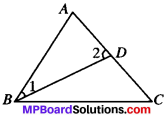
  4. No intercellular spaces between them.
  5. Either no vacuoles at all or a few vacuoles.

Question 6.
List any four salient features of meristematic tissue.
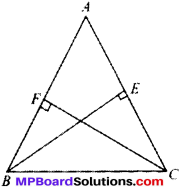
Answer:

  1. This tissue consists of actively dividing cells.
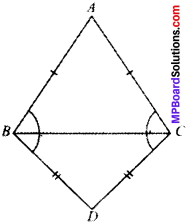
  2. This tissue is present in growing regions of plants.
  3. In this tissue, cells are packed closely without intercellular spaces.
  4. Cells of this tissue have thin cell walls, dense cytoplasm and prominent nuclei.

Question 7.
What are permanent tissues?
Answer:
The cells of meristematic tissue lose the ability to divide and get differentiated into specialised cells. These differentiated cells form different types of tissues which are known as permanent tissues.
Some examples: permanent tissues are

  • parenchyma
  • sclerenchyma etc.

Question 8.
With the help of only schematic line diagram, show classification of main permanent tissues.
Answer:
MP Board Class 9th Science Solutions Chapter 6 Tissues 7

Question 9.
Write the characteristics of collenchyma.
Answer:
The cells in this type of tissue are living, elongated and thickened with cellulose at the corners. There is very little intercellular space. This tissue provides flexibility and mechanical support to plants. It is found in hypodermis of stems and leaf stalks.

Question 10.
What are protective tissues?
Answer:
All parts of plants e.g., leaves, flowers, stems and roots are covered by a single outermost protective layer called epidermis. It consists of rectangular, closely fitted relatively flat cells which lack intercellular spaces. Usually, it is one cell thick and is covered with cutin. Epidermis protects internal tissues of the plant.
MP Board Class 9th Science Solutions Chapter 6 Tissues 8

Question 11.
Does the outer most protective layer is throughout, continuous? If not, what interruptions are usually foundation leaves and herbaceous parts of the plant?
Answer:
Epidermis is the outermost layer of cells in leaves and green herbaceous stems. It is not a continuous layer as it contain numerous minute pores called stomata.

Question 12.
Write major functions of stomata present in the epidermis.
Answer:
Major functions of stomata:

  1. Stomata are essential for exchange of gases – oxygen and carbon dioxide between the plant and the atmosphere.
  2. Normally, plants remove excessive water in the form of vapour through stomata. This process is called transpiration.

Question 13.
What is the main function of vascular tissues in plants?
Answer:
Vascular tissues transport:

  1. Water and dissolved minerals from toots to various parts of the plant (xylem).
  2. Prepared food material from leaves to different plant parts (phloem).

Question 14.
What ire vascular bundles?
Answer:
In plants, complex tissues xylem and phloem altogether constitute a structure called vascular bundle. Their main function is transportation of water, salts and food materials within the plant body.

Question 15.
List four elements of phloem. Which one of them is most important and why?
Answer:
Phloem consists of following four elements:

  1. Sieve tubes
  2. Companion cells
  3. Phloem parenchyma
  4. Phloem fibres.

The most important element of phloem is sieve tubes because they translocate food materials from leaves to other parts of plant.

MP Board Solutions

Question 16.
What is muscular tissue? What is their function?
Answer:
1. Muscular tissue: This is a specialised tissue which is composed of contractile, fibre – like cells. This tissue is responsible for movement in our body.

2. Function: The movement of the body or limbs is brought about by contraction and relaxation of contractile proteins present in the muscle cells.

Question 17.
In desert plants, epidermis is covered by waxy substances. Can you think why?
Answer:
Waxy substances which cover epidermis are waterproof and hence, they check loss of water during transpiration. Besides this, they also aid in protection against mechanical injury and invasion by parasitic fungi.

Question 18.
What are the four important types of tissues found in animals?
Answer:
The four animal tissues found in animals are:

  1. Epithelial tissues.
  2. Connective tissues.
  3. Muscular tissues and.
  4. Nervous tissue.

Question 19.
State one important function of each of the following:

  1. Areolar tissue
  2. Cuboidal epithelium.

Answer:

  1. Areolar tissue: It fills the space inside the organs, supports internal organs and helps in repair of tissues.
  2. Cuboidai epithelium: it forms the lining of kidney tubules and ducts of salivary glands where it provides mechanical support.

Question 20.
What are the two main components of blood? Why is blood considered a type of connective tissue?
Answer:
Blood has two main components:

  1. Fluid (liquid) matrix called plasma.
  2. Suspended red blood cells (RBCs), white blood cells (WBCs) and platelets.

Blood is considered as a connective tissue because:

  1. It has the same Origin as the other connective tissues.
  2. It flows to different parts of the body and thus, connects different parts of the body with one another to exchange materials and gases.

Question 21.
Why do blood and lymph called as connective tissues?
Answer:
The fluid tissue (blood and lymph) connects various parts (cells) of the body. It supplies nutritive materials, oxygen and hormones collected from different organs to the body tissues. It also collects waste materials from different body tissues and delivers to excretory organs.

MP Board Solutions

Question 22.
Why is blood called as fluid connective tissue?
Answer:
Blood is considered as a connective tissue because it connects different parts of the body. It contains plasma as matrix in which blood cells remain suspended. Being matrix (plasma) in liquid state, blood is called fluid connective tissue.

Question 23.
Explain how the bark of a tree is formed. How does it act as a protective tissue?
Answer:
As trees grow old, a strip of secondary meristem replaces the epidermis of the stem. Cells on the outside are cut off from this layer. This forms the several layer thick cork or the bark of the tree. Bark is a mass of dead tissue lying in the peripheral region of the plant body as a hard dry covering. Its function is protection. It protects the inner tissues against the attack of fungi and insects, against loss of water by evaporation etc.

Question 24.
What is the difference between voluntary and involuntary muscles? Give example of each.
Answer:
Voluntary muscles are those which are directly under control of our will
e.g.

  • skeletal muscle.

They work or contract on our command. Involuntary muscles are not under the command of our will. We cannot control contraction and relaxation of these muscles. They are of two types – smooth muscles and cardiac muscles. Smooth muscles are found in stomach, intestine, iris of eye, in ureters and in the bronchi of lungs. Another type of involuntary muscles that is, cardiac muscles are found in heart.

Tissues Long Answer type Questions

Question 1.
The following diagrams are of L.S. of shoot apex and L.S. of root apex. Observe the diagrams and answer the questions given below:

  1. What type of cells shoot apex and root apex consists of?
  2. What are the main characteristics of these cells?
    MP Board Class 9th Science Solutions Chapter 6 Tissues 9

Answer:

  1. Meristematic cells.
    • (a) Cells have big nucleus and dense cytoplasm.
    • (b) These cells lack intercellular spaces and vacuoles.

Question 2.
How many types of meristems are present in plants, on the basis of position?
Answer:
On the basis of location of meristem, it is classified into three types:

1. Apical meristem: It is present at the tip of stem, root and their branches.

2. Intercalary meristem: It is found at the leaf base, above the nodes (i.e. at the base of internodes as in grasses) or below the nodes (i.e. at the upper most region of internode as in mint.)

3. Lateral meristem: Vascular cambium and cork cambium are the examples of lateral meristem. Vascular cambium is found in vascular bundles while cork cambium is found underneath the bark of trees. Both of these cause increase in the girth of plants.

Question 3.
Draw a labelled diagratn of shoot to show location of meristematic tissues in the plant body and write the functions of each of them.
Answer:
Functions:

  1. Apical meristem: It increases the length of the stem and the root.
  2. Lateral meristem (cambium): It increases the girth of the stems and roots.
  3. Intercalary meristem: It is present at the base of the leaves or internode (on either side of the node).

It produces buds which develop in auxiliary branches or auxiliary floral branches.
MP Board Class 9th Science Solutions Chapter 6 Tissues 10

Question 4.
Explain the structure of parenchyma. What are its major modifications?
Answer:
Parenchyma: It is the basic or fundamental tissue found in plants. Cells of this tissue are thin walled, circular or polygonal. They are living with a nucleus and a vacuole. Intercellular spaces are present between the cells of this tissue. Two modifications of parenchyma are chlorenchyma and aerenchyma.

Chlorenchyma: Sometimes cells of the parenchyma contain chlorophyll and perform photosynthesis. This kind of parenchyma is known as chlorenchyma.

Aerenchyma: In aquatic plants, parenchyma contains big air spaces in between them. Such a parenchyma tissue is known
MP Board Class 9th Science Solutions Chapter 6 Tissues 11
(a) Parenchyma with intercellular spaces.
(b) Aerenchyma with big spaces

Question 5.
Write the main functions of parenchyma.
Answer:
Functions of the parenchyma:

  1. They store food.
  2. They provide temporary support by retaining the turgid condition of cells.
  3. Chlorenchyma containing chloroplasts prepare food through photosynthesis.
  4. In aquatic plants, aerenchyma gives buoyancy to plants and hence they can float easily.

Question 6.
Describe the structure of selerenchyma. Write its major functions.
Answer:
Selerenchyma: Selerenchyma is the chief mechanical tissue of plants. The cells of this tissue are usually long, narrow and pointed at both ends. Due to deposition of lignin, their walls are often very highly thickened. Hence, the lumen of cell cavity is nearly obliterated. They are usually provided with simple pits which may be oblique or straight.
The selerenchyma cells are dead cells and their main function is to provide strength and rigidity to the plant.
MP Board Class 9th Science Solutions Chapter 6 Tissues 12

Question 7.
What is xylem? Explain its structure. Which one of its component is very important and why?
Answer:
Xylem is a complex plant tissue which transports water and dissolved minerals from roots to all other plant parts.
MP Board Class 9th Science Solutions Chapter 6 Tissues 13
Structure: Xylem consists of four kinds of cells (also known as elements):
(i) Tracheids: A tracheid is an elongated, hollow cell with its both ends tapering. The walls of these cells are thickened by the deposition of lignin. At certain spots lignin is not present. These spots are termed as pits. The tracheids are dead cells.

(ii) Vessels: These are tube like structures formed by a number of cells placed end to end with their transverse walls dissolved. The side walls of these tubes also have deposition of lignin. The thickening of the walls show various kinds of patterns. They are also dead cells.

(iii) Xylem parenchyma: These are parenchymatous, thin walled, living cells. They help in lateral conduction of water and sap. They also store food.

(iv) Xylem fibres: They are lignified dead fibres which provide mechanical support to plant. The most important element of xylem is vessel because most of the water and minerals are carried upward through this component of xylem.
MP Board Class 9th Science Solutions Chapter 6 Tissues 15

Question 8.
Describe the structure of phloem.
Answer:
Structure of phloem: The main conducting part of the phloem is sieve tube which is formed of elongated cylindrical cells arranged in vertical rows. The walls between the cells have many minute pores through which food material can pass from one cell to the next. The porous walls between the cells is termed as sieve plate. Each sieve tube is supported by a long parenchymatous cell called the companion cell which helps the sieve tubes in the conduction of food material.
MP Board Class 9th Science Solutions Chapter 6 Tissues 16
The above figure shows that phloem also contains phloem fibres, which provide mechanical support. Another component of phloem is parenchyma cells which stores food.

Question 9.
What is epithelial tissue?
Answer:
Epithelial Tissue: Epithelial tissue forms covering of entire surface of the body and lines the internal organs. Because of this, epithelial tissue is also called protective tissue. It also forms a barrier to keep different body systems separate. In this tissue cells are closely associated and arranged on a very thin extracellular fibrous basement membrane. Epithelial tissue may be composed of one (simple epithelium) or more layers of cells (compound epithelium). The skin, lining of mouth and alimentary canal, lung alveoli etc. are made of epithelial tissues.

Question 10.
What are the four main functions of epithelial tissue?
Answer:
The four main functions of epithelial tissue are:

  1. It forms the outer layer of skin and hence it protects the underlying cells from drying, injury, bacterial and chemical effects..
  2. It forms lining of mouth, alimentary canal and other internal organs and thus protects these organs.
  3. It helps in absorption of water and other nutrients in alimentary canal.
  4. Some of them are greatly specialised and perform secretory function.

Question 11.
What are the categories of epithelial tissue depending upon the shape and function of epithelial cells?
Answer:
Depending upon the shape and function of the cells, epithelial tissue is classified as:
MP Board Class 9th Science Solutions Chapter 6 Tissues 17

Question 12.
What are the various forms of epithelial tissues? Describe briefly.
Answer:
(i) Squamous epithelium: The cells of this tissue are thin and flat forming a delicate lining. It is found in the alveoli and blood vessels. Tongue, oesophagus and lining of mouth also made up of squamous epithelium.

(ii) Cuboidal epithelium: The cells of this tissue are cube like in appearance. It is found in the lining of kidney tubules and ducts of salivary glands etc.

(iii) Columnar epithelium: The cells of this tissue are more tall and wide, placed side by side. Their nuclei are situated near the bases. They may have finger like . projections – the microvilli on their free surfaces. This tissue usually lives in the internal surface of stomach and intestine.

(iv) Ciliated epithelium: The cells of this tissue are modifications of columnar epithelial cells. They have many small hair like projections called cilia on their free ends. This type of epithelium is found in trachea and oviduct.

(v) Striated squamous epithelium: Cells of this tissue are similar to squamous epithelial cells but in this tissue they are arranged in many layers to prevent wear and tear of parts. In skin, striated squamous epithelium is found.
MP Board Class 9th Science Solutions Chapter 6 Tissues 18

(vi) Glandular epithelium: In this type of epithelium, cells secrete substances at the epithelial surface. Such type of epithelium is found in glands.
MP Board Class 9th Science Solutions Chapter 6 Tissues 19

Question 13.
Explain the structure of three types of muscle fibres. Also write the locations where they are found in the body.
Answer:
The following are the three types of muscle cells:
(i) Unstriated muscles: (Also known as smooth, involuntary muscles). This type of muscular tissue consists of spindle – shaped, long uninucleate cells. These muscles are present in alimentary canal, blood vessels, iris of eye, in ureters and bronchi of lungs etc.

(ii) Striated muscles: Also known as voluntary muscles because of their function being in our control or will. This type of muscular cells are long multi – nucleated and, enclosed in a membrane known as sarcolemma. Each fibre has several longitudinal filaments embedded in cytoplasm. These filaments give these muscles striated appearance. These muscles are attached to the skeleton; so they are also called skeletal muscles.
MP Board Class 9th Science Solutions Chapter 6 Tissues 20

(iii) Cardiac muscles: These muscles are found in heart. They are not under the control of the will. They contract rhythmically and involuntarily throughout life without the sign of fatigue. Structurally they show the characters of both unstriated and striated muscles. They are made up of branched fibres. These fibres are uninucleated and show alternate light and dark bands (striations).

Question 14.
What are three main categories of connective tissue?
Answer:
Categories of Connective Tissue:
(i) Connective tissue: There is a matrix in which generally two types of (white and yellow) fibres are present. In between these fibres some connective tissue cells are present.
Examples of this kind of connective tissues are

  • areolar tissue and
  • adipose tissue.

(ii) Skeletal tissue: This type of tissue forms the skeleton of an organism. It is of two types – cartilage and bone Cartilage has solid matrix, called chondrin, in which fibres and cells known as chondrocytes are present. Usually, cells are present in clusters of 2 – 3 cells in small spaces called lacunae. Cartilage is found in the regions of pinna, nose, trachea and larynx. In bones, matrix is formed of a protein called ossein impregnated with phosphate and carbonates of calcium and magnesium.

(iii) Fluid tissue: Blood and lymph are examples of fluid connective tissue. These are specialized connective tissues. It consists of liquid matrix with no fibres. In liquid matrix called plasma corpuscles remain suspended. Blood transports food material, gases and other substances to the various parts of the body.

MP Board Solutions

Question 15.
What are fibrous connective tissue?
Answer:
Fibrous connective tissue. It is of two types:
(i) The white fibrous connective tissue: It consists of white, non-elastic, unbranched fibres which unite to form bundles called tendons. Tendons are strong, tough and smooth, rope like structures which serve to attach muscles with the bones.

(ii) The yellow fibrous connective tissue: It also consists of fibres which are fine thread like structures. These fibres are quite elastic. Like white elastic fibres, these fibres also form cords called ligaments. These ligaments connect two bones.

Question 16.
Describe the structure of cartilage and bone.
Answer:
1. Cartilage: It is a solid but semi – rigid and flexible connective tissue. It has large, bluntly angular cartilage cells called chondrocytes. They occur in clusters of 2 or 3 in small spaces (lacunae) scattered in the matrix. Cartilage smoothens bone surfaces at joints and is also present in the nose, ear, trachea and larynx.

2. Bone: Bone is a solid, rigid and strong connective tissue. Its matrix become hard due to the deposition of salts of calcium and phosphorus. Osteocytes or bone cells are present in irregular spaces – lacunae in the matrix, interconnected by fine canals called canaliculi. In this tissue, matrix deposits in concentric rings around narrow longitudinal cavities called Haversian canals. These canal carries blood vessels and nerves.
MP Board Class 9th Science Solutions Chapter 6 Tissues 21

Question 17.
Explain the structure of a fluid connective tissue.
Answer:
Blood is a fluid connective tissue consists of:

  1. Blood plasma: It is the fluid matrix which contains 85% to 90% water, 7% different types of proteins, 0.9% of salts, about 0.1% glucose and a very small amount of hormones, wastes etc. In the plasma, blood corpuscles (cells) are suspended.
  2. Blood cells. Three kinds of blood cells are found suspended in the blood plasma.

These are:
(a) Red blood corpuscles (erythrocytes) or RBC
(b) White blood corpuscles (leucocytes) or WBC and
(c) Blood platelets.

(a) Red blood corpuscles (erythrocytes) or RBC:
The red blood corpuscles are biconcave, disc – like cells which are devoid of nucleus. They contain a substance called haemoglobin because of this they appear red in colour. The most important function of the RBC is the transport of oxygen and carbon dioxide.

(b) White blood corpuscles (leucocytes) or WBC: These cells are comparatively larger in size, colourless and irregular in appearance. They are devoid of haemoglobin. They protect our body from diseases by destroying germs.

(c) Blood platelets: These are small, 2 – 4μ in diameter. They are without nucleus. Their main function is to liberate some substances which helps in blood clotting.
MP Board Class 9th Science Solutions Chapter 6 Tissues 22

Question 18.
What are areolar tissue and adipose tissue? Where are they located?
Answer:

  1. Areolar tissue: It is a connective tissue which consists of matrix, several types of cells, collagen and elastin fibres.
  2. Location: They are found between the skin and muscles, around blood vessels and nerves and in the bone marrow.
  3. Functions: It fills space inside the organs, support internal organs and helps in repair of the tissues.
    MP Board Class 9th Science Solutions Chapter 6 Tissues 23
  4. Adipose tissue: It consists of cells (adipocytes) which are filled with fat globules. These cells remain scattered in a matrix.
  5. Location: It is found below the skin and between internal organs.
  6. Function: It stores fats and act as insulator.
    MP Board Class 9th Science Solutions Chapter 6 Tissues 24

Question 19.
(i) What is a nervous tissue?
(ii) Draw a well labelled diagram of neuron. (label any 4 parts).
Answer:
(i) Nervous Tissue: Nervous tissue is made up of specialised cells called nerve cells or neurons. Each nerve cell is elongated in shape and consists of three parts: cell body, dendrites and axon.The cell body contains a distinct nucleus and has a special kind of granules, called Nissel’s granules in the cytoplasm. From the cell body a single long part called the axon and many branched parts called dendrites arise. In some nerve cells, the axon has a thick white covering called medullary sheath. The terminal end of axon is without sheath and branched. Each nerve cell receives message through the dendrites and sends them to the axon (see Fig. below).
(ii)
MP Board Class 9th Science Solutions Chapter 6 Tissues 14

Tissues Higher Order Thinking Skills (HOTS)

Question 1.
Cutting of rose plant is done timely in gardens, but still it regain its length. Give reason.
Answer:
In rose plant, intercalary meristeim is present at the base of leaves or internodes. The cells of these tissues, therefore divide and increase the length of plant.

MP Board Solutions

Question 2.
Why does water hyacinth floats on water?
Answer:
A type of parenchyma called aerenchyma is present in water hyacinth. This encloses a lot of air and makes the plant lighter than water. Therefore, it floats on water.

Tissues Value Based Question

Question 1.
A patient suffering from paralysis was unable to walk. His family members took the utmost care of him:

  1. Name two tissues responsible for the movement of body?
  2. What are the tissues present in brain and spine?
  3. What value of the family members is seen in the above case?

Answer:

  1. Two tissues responsible for movement of the body are nervous tissue and muscular tissue.
  2. The tissues present in brain and spine are nervous tissues.
  3. His family members showed the value of being kind, caring, dutiful and responsible.

MP Board Class 9th Science Solutions