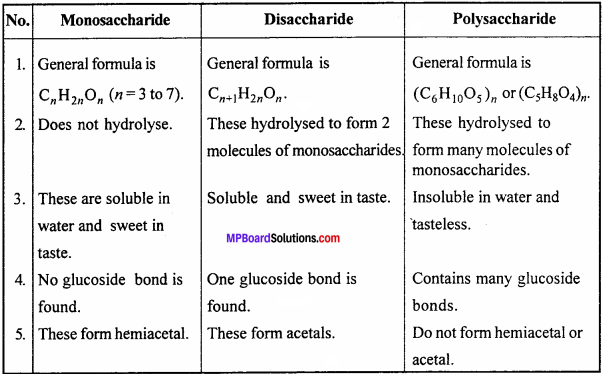
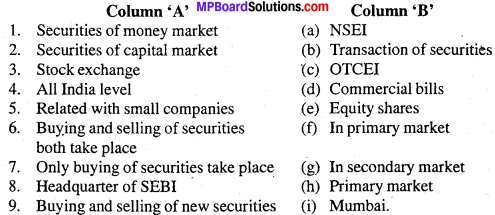
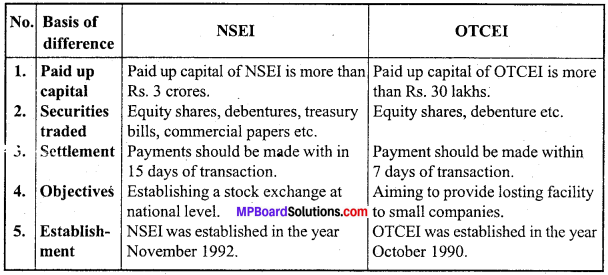
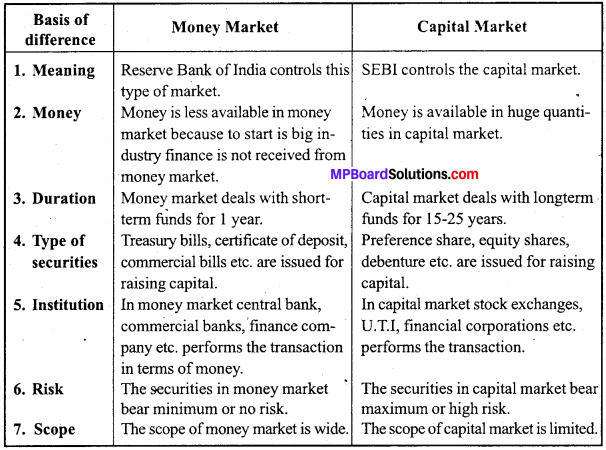
MP Board Class 12th Chemistry Solutions Chapter 15 Polymers

MP Board Class 12th Chemistry Solutions  Chapter 15 Polymers

Polymers NCERT Intext Exercises

Question 1.
What are polymers ?
Answer:
Polymers are high molecular mass substances (103-107u) formed by the combi-nation of a large number of simple molecules. They are also called macro molecules. For example, polyethene, bakelite, PVC, teflon etc.

Question 2.
How are polymers classified on the basis of structure ?
Answer:
On the basis of structure, polymers are classified as:

  • Linear polymers: e.g. polyethene, nylons, polyvinylchloride etc.
  • Branched chain polymers: e.g. low density polythene, glycogen.
  • Cross-linked polymers: e.g. bakelite, melamine, etc.

Question 3.
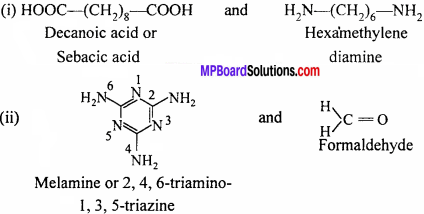
Write the names of monomers of the following polymers:
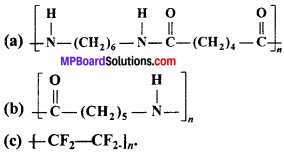
MP Board Class 12th Chemistry Solutions Chapter 14 Chapter 15 Polymers - 4
Answer:

  • Hexamethylenediamine and adipic acid
  • Caprolactum
  • Tetrafluoroethene.

Question 4.
Classify the following as addition and condensation polymers: Terylene, Bakelite, Polyvinyl chloride, Polythene.
Answer:

  • Terylene: Condensation polymer
  • Bakelite: Condensation polymer
  • Polyvinyl chloride: Addition polymer
  • Polyethene: Addition polymer.

MP Board Solutions

Question 5.
Explain the difference between Buna-N and Buna-S.
Answer:
Buna-N is a co-polymer of 1,3-butadiene and acrylonitrile Buna-S is a co-polymer of 1,3-butadiene and styrene.

Question 6.
Arrange the following polymers in increasing order of their inter molecular forces:

  1. Nylon 6,6, Buna-S, Polythene.
  2. Nylon 6, Neoprene, Polyvinyl chloride.

Answer:

  1. Buna-S < Polyethene < Nylon-6,6.
  2. Neoprene < Polyvinyl chloride < Nylon-6.

Polymers NCERT Text-Book Exercises

Question 1.
Explain the terms polymer and monomer.
Answer:
Polymers are high molecular mass substances (103-107u) formed by the combi-nation of a large number of simple molecules. They are also called macromolecules. For example, polyethene, bakelite, PVC, teflon etc.

Monomer:
Monomer is a simple molecule capable of undergoing polymerization to form polymers. For example, polyethene is a polymer and its simple molecule ethene is a monomer.

MP Board Class 12th Chemistry Solutions Chapter 14 Chapter 15 Polymers - 5

Question 2.
What are natural and synthetic polymers ? Give two examples of each type.
Answer:
Natural polymers:
Natural polymers are high molecular mass macro molecules and are found in nature mainly in plants and animals. For example, protein, nucleic acids, starch, cellulose etc.

Synthetic polymer:
Synthetic polymers are man-made high molecular mass macro molecules. For example, plastics (Polyethene, P.V.C.), synthetic fibres (Polyesters, Nylon-6,6), synthetic rubber (Neoprene, Buna-S) etc.

Question 3.
Distinguish between the terms homopolymer and copolymer and give an example of each.
Answer:
Homo polymers are the polymers which are made by addition polymerization of single type of monomeric species.
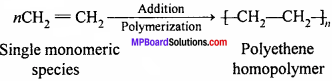
MP Board Class 12th Chemistry Solutions Chapter 14 Chapter 15 Polymers - 6

Co-polymers are the polymers which are made by addition polymerization from two different monomers.
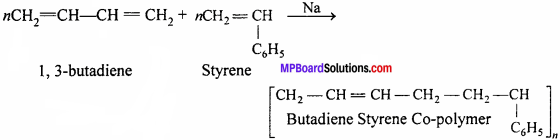
MP Board Class 12th Chemistry Solutions Chapter 14 Chapter 15 Polymers - 7

Question 4.
How do you explain the functionality of a monomer ?
Answer:
Functionality means the number of bonding sites in a molecule. For example, the functionality of ethene, propene, styrene, acrylonitrile is one while that of 1,3 – butadiene, adipic acid, terephthalic acid, hexamethylene diamine is two.

Question 5.
Define the term polymerization.
Answer:
Polymerization is a process of formation of a high molecular mass polymer from one or more types of monomers. Polymerization leads to linkage together of several repeating structural units with covalent bonds.

MP Board Solutions

Question 6.
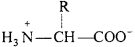
Is (NH – CHR – CO)n a homopolymer or copolymer ?
Answer:
It is a homopolymer because the repeating structural unit has only one type of monomer unit, i.e., NH2 – CHR – COOH.

Question 7.
In which classes, the polymers are classified on the basis of molecular forces ?
Answer:
On the basis of molecular forces present between the chains of various polymers, these are classified as:

  • Elastomers
  • Fibres
  • Thermoplastics
  • Thermo setting plastics.

Question 8.
How can you differentiate between addition and condensation polymeriza-tion ?
Answer:
Addition polymerization:
The molecules of the same or different monomers add together to form a macromolecule. Without elimination of any thing the addition polymers are formed by monomers which are unsaturated compound. For example, formation of polyethene from ethene.

Condensation polymerization:
Two or more bi-functional molecules undergo a se-ries of condensation reactions with the elimination of some simple molecules like H2O, R – OH, NH3, HCl or CO2 etc., to form a macromolecule (Polymer). For example, Nylon-6,6 is a condensation polymer of hexamethylene diamine and adipic acid formed by the elimination of water molecule.

MP Board Solutions

Question 9.
Explain the term co-polymerization and give two examples.
Answer:
When two or more different monomers unite together to polymerize, the result- product is called a co-polymer and the process is termed as copolymerization. Thus, a co-polymer contains a large number of units of each monomer used in the same polymeric chain. For example, Buna-S and Buna-N whereas Buna-S is a copolymer of 1,3-butadiene and styrene while Buna-N is a co-polymer of 1,3-butadiene and acrylonitrile.

Question 10.
Write the free radical mechanism for the polymerization of ethene.
Answer:
In the presence of Benzoyl peroxide the polymerization of ethane can be under¬stand by the free radical mechanism.
Chain initiation step:

MP Board Class 12th Chemistry Solutions Chapter 14 Chapter 15 Polymers - 8
Chain propagation step:
C6H5 + CH2 = CH2 → C6H5 – CH2 – CH2

Chain termination step:
C6H5 – CH2– CH2 + CH2 = CH2 → C6H5 – CH2 – CH2 – CH2 – CH2 → C6H5(- CH2 – CH2-)n CH2 – CH2 – CH2 – CH2(- CH2 – CH2 – )KC6H5 Polythene

Question 11.
Define thermoplastics and thermosetting polymers with two examples of each.
Answer:
Thermoplastics are polymers which can be easily softened repeatedly on heating and hardened on cooling. Therefore, it can be used again and again. For example, polyethene and polyvinyl chloride. Thermosetting polymers are those which undergo permanent change on heating. They become hard and infusible on heating and cannot be softened again. For example, Bakelite, and Melamine formaldehyde.

Question 12.
Write the monomers used for getting the following polymers:

  1. Polyvinyl chloride
  2. Teflon
  3. Bakelite.

Answer:

  1. Vinyl chloride (CH2 = CH – Cl)
  2. Tetrafluoroethylene (CF2 = CF2)
  3. Phenol (C6H5OH) and Formaldehyde (HCHO).

Question 13.
Write the name and structure of one of the common initiators used in free radical addition polymerization.
Answer:
Benzoyl peroxide:
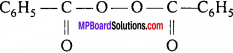
MP Board Class 12th Chemistry Solutions Chapter 14 Chapter 15 Polymers - 9

Question 14.
How does the presence of double bonds in rubber molecules influence their structure and reactivity ?
Answer:
From the structural point of view, the natural rubber is a linear cis- 1,4-poly iso- prene. In this polymer the double bonds are located between C2 and C3 of isoprene units. This cis-configuration about double bonds do not allow the chains to come closer for effective interactions and hence inter molecular forces are quite-weak. Therefore, natural rubber has coiled structure and show elasticity.
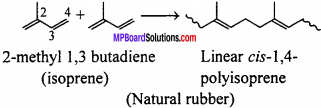
MP Board Class 12th Chemistry Solutions Chapter 14 Chapter 15 Polymers - 10

Question 15.
Discuss the main purpose of vulcanization of rubber.
Answer:
The main purpose of vulcanization of rubber is to improve the following draw-back of natural rubber:

  • At high temperature (T >335K) natural rubber become soft.
  • At low temperature (T< 283K) natural rubber becomes brittle.
  • Natural rubber is soluble in non-polar solvents.
  • It is non-resistant to attack by oxidizing agents.

Question 16.
What are the monomeric repeating units of Nylon-6 and Nylon-6,6 ?
Answer:
Nylon-6: Caprolactum Nylon-6,6: hexamethylenediamine and adipic acid.

MP Board Solutions

Question 17.
Write the names and structures of the monomers of the following poly mers:
(i) Buna-S
(ii) Buna-N
(iii) Dacron
(iv) Neoprene.
Answer:
Names and structures of the monomers:
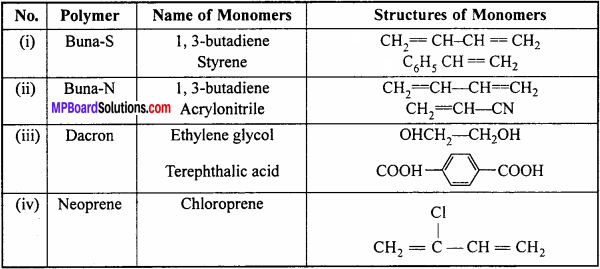
MP Board Class 12th Chemistry Solutions Chapter 14 Chapter 15 Polymers - 11

Question 18.
Identify the monomer in the following polymeric structures:
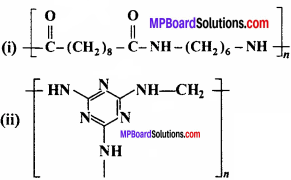
MP Board Class 12th Chemistry Solutions Chapter 14 Chapter 15 Polymers - 12
Answer:
MP Board Class 12th Chemistry Solutions Chapter 14 Chapter 15 Polymers - 13

Question 19.
How is dacron obtained from ethylene glycol and terephthalic acid ?
Answer:
Dacron is obtained by the polymerization of ethylene glycol and terephthalic acid.
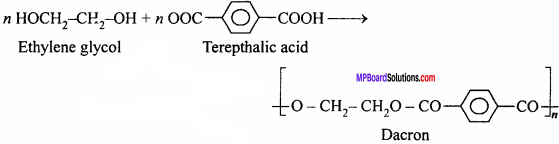
MP Board Class 12th Chemistry Solutions Chapter 14 Chapter 15 Polymers - 14

Question 20.
What is a biodegradable polymer ? Give an example of a biodegradable aliphatic polyester.
Answer:
The polymers which are degraded by micro-organism within a suitable period of time so that the polymers and their degraded products do not cause any serious affects on the environment are called biodegradable polymers. An example of biodegradable aliphatic polyester is PHBV. (Poly-β-hydroxy butyrate – CO – β – hydroxyvalerate)
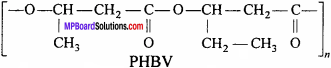
MP Board Class 12th Chemistry Solutions Chapter 14 Chapter 15 Polymers - 15

Polymers Other Important Exercises

Polymers Objective Type Questions

Question 1.
Choose the correct answer:

Question 1.
Which of the following is false:
(a) Artificial silk is derived from cellulose
(b) Nylon-6,6 is an example of elastomer
(c) The repeat unit in natural rubber is isoprene
(d) Both starch and cellulose are polymers of glucose.
Answer:
(b) Nylon-6,6 is an example of elastomer

Question 2.
Formation of polyethylene from calcium carbide takes place as follows:
CaC2 + 2H2O → Ca(OH)2 + C2H2
C2H2 + H2 → C2H4
nC2 H4 → (- CH2 – CH2 -)n
The amount of polyethylene obtained from 64-0 kg CaC2 is:
(a) 7 kg
(b) 14 kg
(c) 21 kg
(d) 28 kg.
Answer:
(d)28 kg.

Question 3.
Which of the following statements about low density polythene is false:
(a) Its synthesis requires high pressure
(b) It is a poor conductor of electricity
(c) Its synthesis requires dioxygen or a peroxide initiator as a catalyst
(d) It is used in the manufacture of buckets, dustbin etc.
Answer:
(d) It is used in the manufacture of buckets, dustbin etc.

MP Board Solutions

Question 4.
Nylon is an example of:
(a) Polyamide
(b) Polythene
(c) Polyester
(d) Polysaccharide.
Answer:
(a) Polyamide

Question 5.
Natural rubber has:
(a) Alternate cis- and tnms-configuration
(b) Random cis- and /ram-configuration
(c) All cis-configuration
(d) All trans-configuration.
Answer:
(c) All cis-configuration

Question 6.
Which of the following is not a condensation polymer :
(a) Melamine
(b) Glyptal
(c) Dacron
(d) Neoprene.
Answer:
(d) Neoprene.

Question 7.
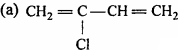
Which is a monomer of neoprene in the following :

MP Board Class 12th Chemistry Solutions Chapter 14 Chapter 15 Polymers - 1
Answer:
MP Board Class 12th Chemistry Solutions Chapter 14 Chapter 15 Polymers - 2

Question 8.
Which of the following is a biodegradable polymer:
(a) Polythene
(b) Bakelite
(c) PHBV
(d) P.V.C.
Answer:
(c) PHBV

Question 9.
Which of the following has ester linkage:
(a) Nylon
(b) Bakelite
(c) Terylene
(d) P.V.C.
(e) Rubber.
Answer:
(c) Terylene

MP Board Solutions

Question 10.
Teflon is a polymer of:
(a) Tetrafluoroethylene
(b) Tetraiodoethylene
(c) Tetrabromoethylene
(d) Tetrachloroethylene.
Answer:
(a) Tetrafluoroethylene

Question 11.
Nylon threads are made up of:
(a) Polyamide polymer
(b) Polyethylene polymer
(c) Polyvinyl polymer
(d) Polyester polymer.
Answer:
(a) Polyamide polymer

Question 12.
Bakelite is a polymer of:
(a) HCHO and acetic acid
(b) HCHO and phenol
(c) C2H5OH and phenol
(d) CH3COOH and benzene,
Answer:
(b) HCHO and phenol

Question 13.
Which of the following is a biodegradable polymer:
(a) Cellulose
(b) Polyethene
(c) Polyvinylchloride
(d) Nylon-6.
Answer:
(a) Cellulose

Question 14.
Nylon-6,6 is not a:
(a) Condensation polymer
(b) Copolymer
(c) Polyamide
(d) Homopolymer.
Answer:
(d) Homopolymer.

MP Board Solutions

Question 15.
Which of the following is a chain-growth polymer:
(a) Starch
(b) Nucleic acid
(c) Poly styrene
(d) Protein
Answer:
(c) Poly styrene

Question 2.
Fill in the blanks:

  1. …………… Is used for the preparation of chloroprene.
  2. Charge on polymers is ……………
  3. Molecular mass of polymers is ……………
  4. Glucose is a monomer of ……………
  5. Cellulose is a …………… polymer.
  6. Polymer of ethylene glycol and phthalic acid is ……………
  7. Rubber is a …………… polymer.
  8. Vulcanisation of rubber is an example of ……………
  9. Bakelite is a …………… polymer.
  10. Polymer used for making pipes is ……………
  11. Nylon 6 is also called ……………
  12. Teflon is a polymer of ……………

Answer:

  1. Synthetic rubber
  2. Nil (zero)
  3. High
  4. Cellulose and starch
  5. Natural
  6. Glyptal
  7. Natural
  8. Elastomer
  9. Heat resistant
  10. PVC
  11. Perlon-L
  12. Tetra fluoro ethylene.

Question 3.
Match the following:
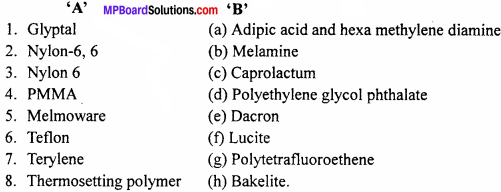
MP Board Class 12th Chemistry Solutions Chapter 14 Chapter 15 Polymers - 3
Answer:

  1. (d) Polyethylene glycol phthalate
  2. (a) Adipic acid and hexa methylene diamine
  3. (c) Caprolactum
  4. (f) Lucite
  5. (b) Melamine
  6. (g) Polytetrafluoroethene
  7. (e) Dacron
  8. (h) Bakelite.

MP Board Solutions

Question 4.
Answer in one word / sentence:

  1. Give two examples of natural polymer.
  2. Give two examples of addition polymer.
  3. Give two examples of condensation polymer.
  4. Write chemical name of Buna rubber.
  5. What is Buna-S ?
  6. Give an example of synthetic rubber.
  7. Monomer of polythylene is.
  8. Give the name of polymer used for formation of tyre thread.
  9. Name the polymerisation which takes place by addition of two or more than two different monomers.
  10. Name the polymer which is formed by condensation of ethylene glycol and dimethyl terephthalic acid.

Answer:

  1. Natural polymer-Rubber, starch
  2. (i) Polythene
    (ii) Polypropylene
  3. (i) Nylon
    (ii) Bakelite
  4. Styrene Butadiene rubber
  5. It is a co-polymer of Butadiene and styrene. Bu is for Butadiene Na for sodium and S-for styrene
  6. Styrene Butadiene rubber (S.B.R.)
  7. Ethylene
  8. Terylene
  9. Co-polymerisation
  10. Terylene.

MP Board Solutions

Polymers Short Answer Type Questions

Question 1.
Can a copolymer be formed both in addition and condensation polymeri-zation ?
Answer:
Yes, it can be formed in both the cases, e.g., buna-S is a copolymer of styrene, 1,3 – butadiene and sodium and is an addition polymer. Nylon-6,6 is a condensation co-polymer in which monomers are different, i.e., adipic acid and hexamethylene diamine.

Question 2.
What is the difference between two notations: nylon-6 and nylon-6,6 ?
Answer:
Nylon-6 is obtained from caprolactum which is obtained from cyclohexane. It has only one compound having 6 carbon atom.
Nylon-6,6 refers to polymer obtained from 6 carbon atom of dicarboxylic acid (adipic acid) and 6 carbon atoms of diamine.

Question 3.
Arrange the following polymers in the increasing order of their intermo – lecular forces. Also classify them as addition and condensation polymer. Nylon-6,6, Buna-S, Polythene.
Answer:

  • Polythene < buna-S < nylon-6,6.
  • Nylon – 6,6 – condensation polymer
  • buna – S, polythene – addition polymer.

Question 4.
How do thermoplastic polymer differ from thermosetting polymer ?
Answer:
Difference between Thermoplastic polymer and Thermosetting polymer:
Thermoplastic:

  • These are linear polymers.
  • Weak van der Waals’ force is present in the form of intermolecular force which on heating becomes soft and melts.
  • It can be remoulded into different shapes again and again. Example: Polystyrene, P.V.C., terylene etc.

Thermosetting:

  • These are cross-linked polymers.
  • Due to presence of chemically cross – linked bonds thermo setting polymers become non-fusible and do not melt on heating.
  • They become hard at the time of mould ing and therefore cannot be remoulded. Example: Formaldehyde, resin, glyptal etc.

MP Board Solutions

Question 5.
Are polyesters and polyacrylates same ? Justify your answer.
Answer:
Polyesters and polyacrylates are different types of polymer and differ in following ways:

  • Polyacrylates are homopolymer, while the polyesters are co-polymer in nature.
  • The mode of synthesis of polyacrylates is addition polymerization, while those of polyester is condensation polymerization.
  • Polymerization occurs across C = C bond in polyacrylates whereas, in polyesters it is through ester linkage.

Question 6.
Why should one always use the purest form of monomer in free radical polymerization reaction ?
Answer:
In free radical polymerization, the impurities can act as chain transfer agent and may combine with the free radical to slow down the reaction or even stop the reaction.

Question 7.
List some important differences between Natural rubber and Vulcanization of rubber.
Answer:
Differences between Natural rubber and Vulcanisation of rubber:
Natural rubber:

  • It is soft and sticky.
  • It has low tensile strength.
  • It has low elasticity.
  • It can be used over a narrow range of temperature (10°C to60°C).

Vulcanisation of rubber:

  • It is hard and non-sticky.
  • It has high tensile strength.
  • It has high elasticity.
  • It can be used over a wide range of temperature (40°C to 100°C).

Question 8.
What are polythene ? Write its two uses.
Answer:
It is prepared by heating ethylene at about 473 K under high pressure (1500-2000 atm) in presence of a very small amount of oxygen.

MP Board Class 12th Chemistry Solutions Chapter 14 Chapter 15 Polymers - 16
Uses:

  • It is used for packaging.
  • It is used as an insulator for electrical wires and cables.
  • In the manufacture of pipes, bottles, etc.

Question 9.
What is neoprene rubber ? Write its uses.
Answer:
Neoprene is a thermoplastic polymer of 2 – chloro – 1, 3 – butadiene (Chloroprene).
Method of preparation: By polymerisation of chloroprene in presence of potassium persulphate.

MP Board Class 12th Chemistry Solutions Chapter 14 Chapter 15 Polymers - 17
Uses:

  • For making petrol delivery pipes.
  • For making conveyer belts used in coal mines.

Question 10.
What is PVC ? Write its uses.
Answer:
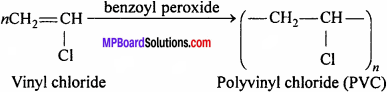
Polyvinyl chloride (PVC) is a higher polymer of vinyl chloride.

Preparation:
It is prepared by heating vinyl chloride in an inert solvent in the presence of benzoyl peroxide
MP Board Class 12th Chemistry Solutions Chapter 14 Chapter 15 Polymers - 18
Uses:
It is used for making plastic pipes, gramophone records, toys, buckets, electric insulators, raincoat, hand bag and water proof substances

Question 11.
What is teflon ? Write its uses.
Answer:
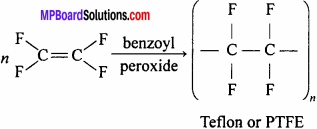
It is a polymer obtained by the polymerization of tetrafluoroethylene in presence of benzoyl peroxide.
MP Board Class 12th Chemistry Solutions Chapter 14 Chapter 15 Polymers - 19
Uses: For making gasket, packing of pump, valve seal, bearing, etc.

MP Board Solutions

Question 12.
What is cellulose ? Write its uses.
Answer:
Cellulose is a natural polysaccharide, molecular formula of cellulose is (C6H10O5)n. It is the main constituent of cell wall of plants and is also found in the tissues of some animals. Wood contain 60% and cotton 90% of cellulose. It is an organic compound found in abundance in nature.
Uses:
It is used to manufacture semi synthetic polymer, artificial thread and plastic.

Question 13.
What is Zieglar – Natta catalyst ? Write its uses.
Answer:
Zieglar – Natta catalyst:
Mixture of titanium tetrachloride and aluminium compound in an inert solvent (hexane) is called Zieglar – Natta catalyst.

Uses:
(i) At low pressure and temperature polythene is formed from ethylene.

MP Board Class 12th Chemistry Solutions Chapter 14 Chapter 15 Polymers - 20
It is used for making toys, radio, T.V., cabinet.

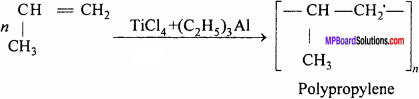
(ii) At low temperature and pressure, propylene in presence of Zieglar – Natta catalyst form polypropylene
MP Board Class 12th Chemistry Solutions Chapter 14 Chapter 15 Polymers - 21
It is used for making bottles, pipes, gramophone records.

Question 14.
Differentiate between Nylon – 6 and Nylon-6,6.
Answer:
Difference between Nylon-6 and Nylon-6,6 polymer:

Nylon-6:

  • This is prepared by the condensation of caprolactam molecules.
  • Caprolactam contains a chain of 6 atoms hence this polymer is nylon-6.
  • It is used in sheets, bristles for brushes. Crinkled nylon is also used in elastic hosiery.

Nylon-6,6:

  • This is obtained by the condensation of hexamethylenediamine and adipic acid monomers.
  • Adipic acid and hexamethylenedi amine both the compounds contain a chain of 6 carbons hence the polymer is called nylon-6, 6.
  • It is used in manufacture of tyres, cords, fabrics and ropes.

Question 15.
Describe the preparation, properties and uses of teflon.
Answer:
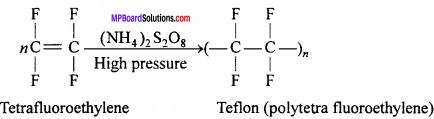
Teflon or Polytetrafluoroethylene (PTFE):
This is obtained by the polymer – ization of tetrafluoroethylene. Tetrafluoroethylene is heated under pressure in the presence of ammonium peroxosuiphate.
MP Board Class 12th Chemistry Solutions Chapter 14 Chapter 15 Polymers - 22
Properties:

  • It is hard, heat resistant and chemically inert. It melts at 330 °C. It is unaffected by concentrated acids (cone. HNO3, cone. H2SO4, cone. HCl), aqua regia and concentrated sodium hydroxide solution even at high temperature.
  • It is bad conductor of electricity.

Uses:

  • It is used in making cans used to store concentrated acid, aqua regia etc.
  • It is used as a non sticky coating on utensils.

Question 16.
How is bakelite prepared ? Write its uses also.
Answer:
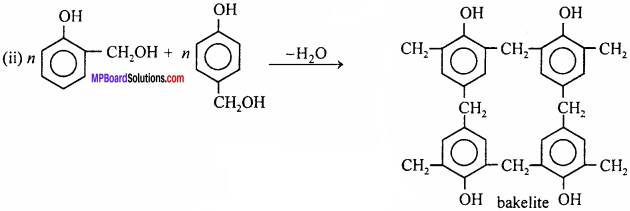
Bakelite is cross – linked polymer. It is prepared by condensation of phenol and formaldehyde in presence of alkali.
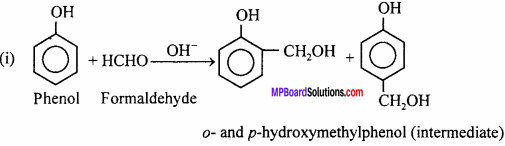
MP Board Class 12th Chemistry Solutions Chapter 14 Chapter 15 Polymers - 23

MP Board Class 12th Chemistry Solutions Chapter 14 Chapter 15 Polymers - 24
Uses:
Soft bakelite formed due to less polymerization are used as binder in wooden items, in varnishes and liquors. Hard bakelite are formed by high degree of polymerization and are used for manufacture of electrical goods, comb, fountain pens, gramophone records, table tops like pharmica, etc.

MP Board Solutions

Question 17.
Write the method of preparation, properties and uses of Nylon-6,6.
Answer:
Preparation:
Nylon is a polymer containing amideMP Board Class 12th Chemistry Solutions Chapter 14 Chapter 15 Polymers - 25Nylon-6,6 is prepared by the polymerization of hexamethylenediamine and adipic acid. The meaning of 6,6 is that in the polymer chain both acid and diamine molecules contain 6-6 carbon atoms.
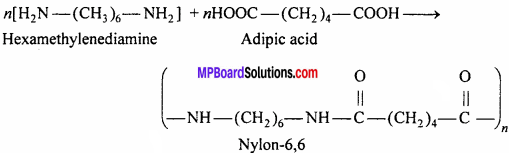
MP Board Class 12th Chemistry Solutions Chapter 14 Chapter 15 Polymers - 26
Properties:

  • Nylon threads possess high tensile strength.
  • They are hard.
  • They are elastic in nature.
  • Structure of nylon is like protein.

Uses:

  • It is used for coating of wire, cables and other electrical goods because PVC is a good insulator of electricity.
  • It is used for making plastic pipes, gramophone records, hand bags, raincoats, inflatable toys, etc.
  • For making vinyl flooring, shower, curtains, false ceiling, wall covering, doors and windows.
  • For making shoes heals and foot wear.
  • For making sheets of tank-linkings, raincoats, lacquers, rods, tubes, packings, table cloths, light fittings, safety helmets, refrigeration components, trays, cycles, motorcycle mudguards, flexible articles such as toys, insulators, leather clothes, dolls, dipped goods such as protective gloves.
  •  It is used in manufacture of types cords, fabrics and ropes.

MP Board Solutions

Polymers Long Answer Type Questions

Question 1.
What are natural polymer ? Explain some polymers with example.
Answer:
Natural polymers:
Those polymers which are found in nature (generally in plants and animals) are called natural polymers. The followings are their example:

(a) Polysaccharides:
Starch and cellulose are important example of polysaccharides. They are the polymers of glucose. Cellulose is the main structural material of plants. Plants store their food in the form of starch.

(b) Proteins:
Proteins are polymers of a-amino acids. They are the main constituents of animal cells. Natural silk, wool and leather are some examples.

(c) Nucleic acids:
The polymers of nucleic acids are called nucleotides. Their impor-tant examples are RNA and DNA.

(d) Natural rubber:
Natural rubber is prepared from latex which is obtained from rubber tree. It is a polymer of 2-methyl-1, 3-butadiene (isoprene). It may be noted that polymers like polysaccharides, nucleic acids, proteins, etc. which control various life processes in plants and animals are also called biopolymers.

MP Board Solutions

Question 2.
On the basis of structure polymers are of how many types ? Explain.
Answer:
Classification based on structure:
This classification is based upon how the monomeric units are linked together. The polymers of this class are of three types:

(i) Linear polymers:
In this type of polymers, the monomer units are linked together to form long linear chains. These linear chains are placed one above the other and are closely packed in space. If A is the monomeric unit then linear chain is formed as given in Fig.

MP Board Class 12th Chemistry Solutions Chapter 14 Chapter 15 Polymers - 27

Characteristics:
Due to close packed structure, they have high densities, high tensile strength and high melting point, e.g., polythene, nylon, polystyrene, etc.

(ii) Branched chain polymers:
In this type of polymers, the monomer units combine to form a long chain which is called the main chain. Many side chains are connected to the main chain. The side chains of different lengths constitute branches, e.g., A is the monomeric unit which forms a straight linear chain (main chain). Side chain of A is connected to main chain as shown in Fig. They are not closely packed.
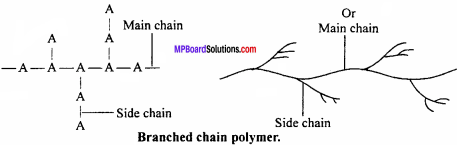
MP Board Class 12th Chemistry Solutions Chapter 14 Chapter 15 Polymers - 28
Characteristics:
Due to irregular packed structure, branched chain polymers have low densities, low tensile strength and low melting point, e.g., low density polythene, amylopectin, glycogen, etc.

(iii) Cross-linked polymers:
In these polymers, the monomer units combine to form a three-dimensional network.
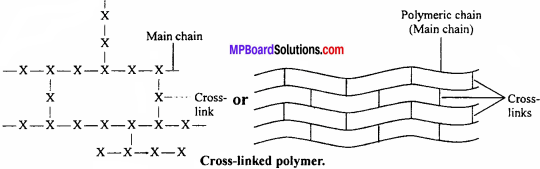
MP Board Class 12th Chemistry Solutions Chapter 14 Chapter 15 Polymers - 29

Characteristics:
They are hard, rigid and brittle due to cross-linked structure, e.g., bakelite, melamine, etc.
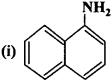
MP Board Class 12th Chemistry Solutions

MP Board Class 12th Economics Important Questions Unit 5 माँग तथा पूर्ति वक्रों के सरल अनुप्रयोग

MP Board Class 12th Economics Important Questions Unit 5 माँग तथा पूर्ति वक्रों के सरल अनुप्रयोग

माँग तथा पूर्ति वक्रों के सरल अनुप्रयोग Important Questions

माँग तथा पूर्ति वक्रों के सरल अनुप्रयोग वस्तुनिष्ठ प्रश्न

प्रश्न 1.
सही विकल्प चुनकर लिखिए –

प्रश्न (a)
प्रशासकीय कीमत है –
(a) कीमत सीमा
(b) कीमत तल
(c) और (b) दोनों
(d) इनमें से कोई नहीं।
उत्तर:
(c) और (b) दोनों

प्रश्न (b)
गेहूँ का न्यूनतम समर्थन मूल्य कहलाता है –
(a) कीमत सीमा
(b) कीमत तल
(c) बाजार कीमत
(d) साम्य कीमत।
उत्तर:
(b) कीमत तल

MP Board Solutions

प्रश्न (c)
साधन, कीमत निर्धारण के निम्न में से कौन – से घटक हैं –
(a) लगान
(b) मजदूरी
(c) ब्याज
(d) उपर्युक्त सभी।
उत्तर:
(d) उपर्युक्त सभी।

प्रश्न (d)
साम्य कीमत का निर्धारण निम्न में से किसके द्वारा स्थापित होता है –
(a) माँग
(b) पूर्ति
(c) (a)और (b) दोनों
(d) इनमें से कोई नहीं।
उत्तर:
(c) (a)और (b) दोनों

प्रश्न (e)
निम्न में से कौन – सा कथन सही है –
(a) श्रम की माँग उत्पादक द्वारा की जाती है
(b) श्रम की माँग उसकी उत्पादकता पर निर्भर करती है
(c) श्रम की सीमान्त उत्पादकता उसकी अधिकतम मजदूरी होती है।
(d) उपर्युक्त सभी।
उत्तर:
(d) उपर्युक्त सभी।

MP Board Solutions

प्रश्न (f)
अधिमाँग देखने को मिलता है –
(a) बाजार निर्धारित कीमत में
(b) निम्नतम निर्धारित कीमत में
(c) उच्चतम निर्धारित कीमत में
(d) इनमें से कोई नहीं।
उत्तर:
(c) उच्चतम निर्धारित कीमत में

प्रश्न 2.
रिक्त स्थानों की पूर्ति कीजिए –

  1. कीमत सीमा तथा कीमत तल को …………………………………. कीमतें भी कहते हैं।
  2. निम्नतम निर्धारित कीमत का दूसरा नाम कीमत ………………………………… है।
  3. आधुनिक विचारधारा के अनुसार, लगान साधन की ………………………………… के कारण उत्पन्न होती है।
  4. FAD सिद्धांत ……………………………. द्वारा प्रस्तुत किया गया।
  5. साधन माँग …………………………… माँग होती है।

उत्तर:

  1. प्रशासकीय
  2. तल
  3. विशिष्टता
  4. प्रो. अमर्त्य सेन
  5. व्युत्पन्न।

MP Board Solutions

प्रश्न 3.
सत्य /असत्य बताइये –

  1. कीमत सीमा निर्धारण का उद्देश्य लाभ प्राप्त करना है।
  2. कीमत तल को निम्नतम निर्धारित कीमत भी कहते हैं।
  3. स्वतंत्र बाजार व्यवस्था में वस्तुओं व सेवाओं की कीमतों का निर्धारण, माँग और पूर्ति शक्तियों के द्वारा होता है।
  4. कीमत सीमा व कीमत तल बाजार उन्मुख कीमतों से भिन्न होती है।

उत्तर:

  1. असत्य
  2. सत्य
  3. सत्य
  4. सत्य।

प्रश्न 4.
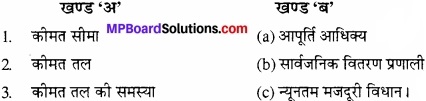
सही जोड़ियाँ बनाइये –
MP Board Class 12th Economics Important Questions Unit 5 माँग तथा पूर्ति वक्रों के सरल अनुप्रयोग 1
उत्तर:

  1. (b)
  2. (c)
  3. (a)

प्रश्न 5.
एक शब्द/वाक्य में उत्तर दीजिये –

  1. साम्य कीमत से अधिक, कीमत निर्धारण क्या कहलाता है?
  2. कीमत सीमा के परिणामस्वरूप कौन-सी समस्या उत्पन्न होती है? कोई एक बताइए।
  3. उत्पादकों के हितों की रक्षा किस कीमत से होती है?
  4. वस्तु की कीमत का निर्धारण किसके द्वारा होता है?

उत्तर:

  1. कीमत तल
  2. कालाबाजारी
  3. कीमत तल
  4. माँग व पूर्ति, द्वारा।

माँग तथा पूर्ति वक्रों के सरल अनुप्रयोग अति लघु उत्तरीय प्रश्न
प्रश्न 1.
प्रशासकीय कीमत किसे कहते हैं?
उत्तर:
किसी वस्तु या सेवा की सरकार द्वारा निर्धारित ऊपरी सीमा या न्यूनतम सीमा पर कीमत निर्धारित की जाती है तो उसे प्रशासकीय कीमत कहते हैं।

प्रश्न 2.
कीमत तल किसे कहते है?
उत्तर:
किसी वस्तु या सेवा की सरकार द्वारा निर्धारित न्यूनतम सीमा को कीमत तल या निम्नतम निर्धारित कीमत कहते हैं।

MP Board Solutions

प्रश्न 3.
सरकार द्वारा उच्चतम निर्धारित कीमतों के दो परिणाम लिखिए?
उत्तर:

  1. लम्बा इन्तजार
  2. बजट या भार।

प्रश्न 4.
कीमत तल के उदाहरण लिखिए?
उत्तर:
कीमत तल का उदाहरण न्यूनतम मजदूरो विधान के अंतर्गत सरकार श्रमिकों को दी जाने वाली मजदूरी की न्यूनतम सीमा को निर्धारित कर देती है।

प्रश्न 5.
एक निश्चित मजदूरी स्तर के बाद श्रम का पूर्ति वक्र बायीं ओर क्यों मुड़ जाता है?
उत्तर:
एक सीमा के पश्चात् मजदूरी दर के बढ़ने पर श्रम की पूर्ति कम होने लगती है क्योंकि एक सीमा से अधिक मजदूरी मिल जाने पर श्रमिक काम की तुलना में आराम अधिक पसन्द करने लगते हैं। ऐसी स्थिति में श्रम का पूर्ति वक्र पीछे की ओर मुड़ता हुआ वक्र बन जाता है।

MP Board Solutions

प्रश्न 6.
प्राकृतिक विपदाएँ भुखमरी कैसे लाती हैं?
उत्तर:
प्राकृतिक विपदाएँ जैसे – बाढ़, सूखा इत्यादि आवश्यक खाद्यान्न उत्पादन में कमी लाती हैं जिसके कारण खाद्यान्न की पूर्ति; माँग की तुलना में गिरती है। पूर्ति के सापेक्ष खाद्यान्न की अतिरिक्त माँग खाद्यान्न की कीमतों में वृद्धि करती है जिसके परिणामस्वरूप गरीब व्यक्ति खाद्यान्न उपलब्धता से वंचित हो जाते हैं और क्षेत्र में भुखमरी की समस्या उत्पन्न हो जाती है।

MP Board Class 12th Economics Important Questions

MP Board Class 12th Chemistry Solutions Chapter 13 Amines

MP Board Class 12th Chemistry Solutions Chapter 13 Amines

Amines NCERT Intext Exercises

Question 1.
Classify the following amines as primary, secondary or tertiary:
MP Board Class 12th Chemistry Solutions Chapter 13 Amines - 1
MP Board Class 12th Chemistry Solutions Chapter 13 Amines - 1-1
(iii) (C2H5)2CHNH2
(iv) (C2H5)2NH.
Answer:

  1. Primary (1°)
  2. Tertiary (3°)
  3. Primary (1°)
  4. Secondary (2°).

Question 2.
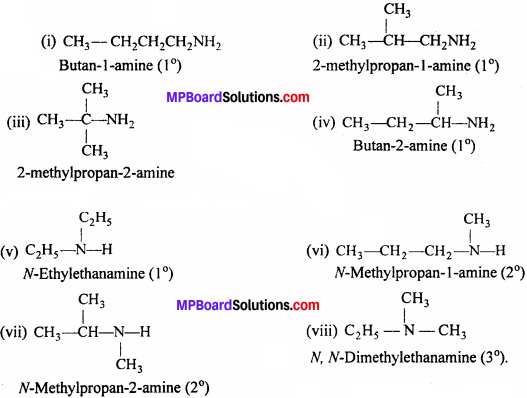
(i) Write structures of different isomeric amines corresponding to the molecular formula, C4H11N.
(ii) Write IUPAC names of all the isomers.
(iii) What type of isomerism is exhibited by different pairs of amines ?
MP Board Class 12th Chemistry Solutions Chapter 13 Amines - 2

Isomerism:
(i)-(iv) and (vi)-(vii) are Position isomers, (v)-(vi) and (v)-(vii) are Metamers, (i)-(ii), (iii)-(iv) and (i)-(iii) are Chain isomers.

MP Board Solutions

Question 3.
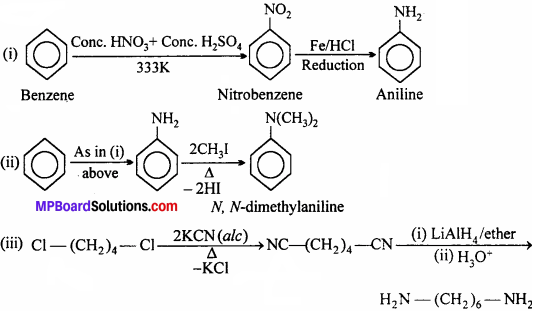
How will you convert:
(i) Benzene into aniline,
(ii) Benzene into N, N-dimethylaniline,
(iii) Cl – (CH2)4 – Cl into hexane -1, 6 – diamine.
Answer:
MP Board Class 12th Chemistry Solutions Chapter 13 Amines - 3

Question 4.
Arrange the following in increasing order of their basic strength:

  1. C2H5NH2, C62H5NH2,NH3, C6H5CH2NH2 and (C2H5)2NH
  2. C2H5NH2, (C2H2)2NH, (C2H5)3N, C6H5NH2
  3. CH3NH2, (CH3 )2NH, (CH3 )3N, C6H5NH2 , C6H5CH2NH2.

Answer:

  1. C6H5NH2 < NH3 < C6H5CH2NH2 < C2H5NH2 < (C2H5)2NH
  2. C6H5NH2 < C2H5NH2< (C2H5)3N < (C2H5)2NH
  3. C2H5NH2 < C6H5CH2NH2 < (CH3)3N < CH3NH2 < (CH3)2NH.

Question 5.
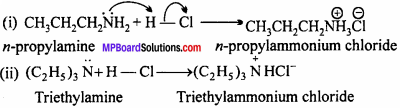
Complete the following acid-base reactions and name the products :
(i) CH3CH2CH2NH2 + HCl → ?
(ii) (C2HCl)3N + HCl → ?
Ans.
MP Board Class 12th Chemistry Solutions Chapter 13 Amines - 4

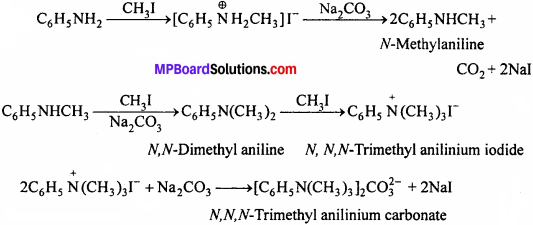
Question 6.
Write reactions of the final alkylation product of aniline with excess of methyl iodide in the presence of sodium carbonate solution.
Answer:
MP Board Class 12th Chemistry Solutions Chapter 13 Amines - 5

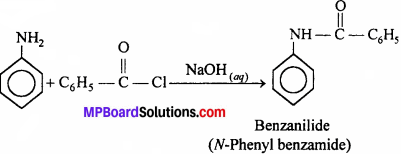
Question 7.
Write chemical reaction of aniline with benzoyl chloride and write the name of the product obtained.
Answer:
MP Board Class 12th Chemistry Solutions Chapter 13 Amines - 6

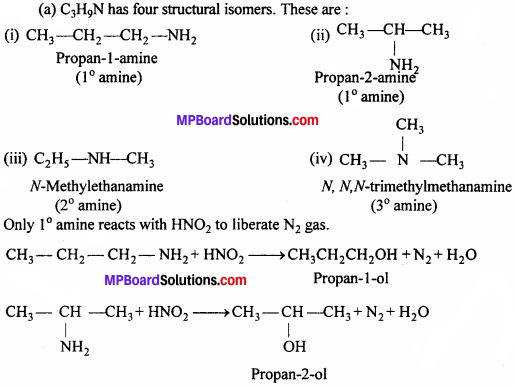
Question 8.
Write structures of different isomers corresponding to the molecular formula, C3H9N. Write IUPAC names of the isomers which will liberate nitrogen gas on treatment with nitrous acid.
Answer:
(a) C3H9N has four structural isomers.
These are:
MP Board Class 12th Chemistry Solutions Chapter 13 Amines - 7

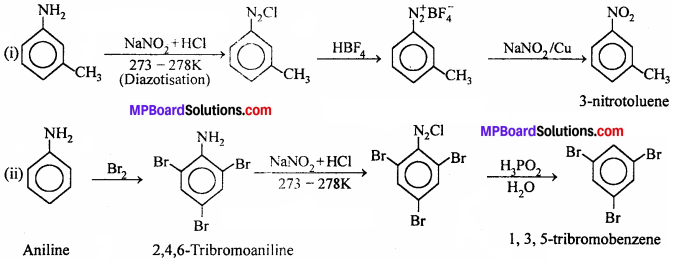
Question 9.
Convert:
(i) 3-Methylaniline into 3 – nitrotoIuene
(ii) Aniline into 1,3, 5 – tribromobenzene
Answer:
MP Board Class 12th Chemistry Solutions Chapter 13 Amines - 8

Amines NCERT Text – Book Exercises

Question 1.
Write IUPAC names of the following compounds and classify them into primary, secondary and tertiary amines:

  1. (CH3)2CHNH3
  2. CH3 (CH2 )2 NH 2
  3. CH3NHCH(CH3)2
  4. (CH3)3CNH2
  5. C6H5NHCH3
  6. (CH3CH2)3NCH3
  7. m – BrC6H4NH3.

Answer:

  1. Propan – 2 – amine (1°)
  2. Propan – 1 – amine (1 °)
  3. N – Methylpropan – 2 – amine (2°)
  4. 2 – MethyIpropan – 2 – amine (3°)
  5. N – Methylbenzenamine or A’-Methylaniline (2°)
  6. N – Ethyl – A – Methylethanamine (3°)
  7. 3 – Bromobenzenamine or 3-Bromoaniline (1°).

MP Board Solutions

Question 2.
Give one chemical test to distinguish between the following pairs of compounds:

  1. Methylamine and dimethylamine,
  2. Secondary and tertiary amines,
  3. Ethylamine and aniline
  4. Aniline and benzylamine
  5. Aniline and N- methylaniline.

Answer:
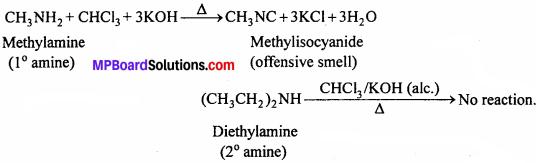
(i) By Carbylamine test:
Methylamine is a primary amine, therefore, it gives carbylamine test. In contrast, diethylamine is a secondary amine and hence does not give this test.
MP Board Class 12th Chemistry Solutions Chapter 13 Amines - 9

(ii) By Libermann Nitrosoamine test:
2° Amines on treatment with HNO2(generates in situ by the action of HCl on NaNO2) give yellow coloured oily N-nitrosoamine. For Example
MP Board Class 12th Chemistry Solutions Chapter 13 Amines - 10

N-Nitrosodiethylamine on warming with phenol and cone. H2SO2 gives a green solu-tion which when made alkaline with aqueous NaOH turns deep blue and then red on dilu-tion. Tertiary amines do not give this test.

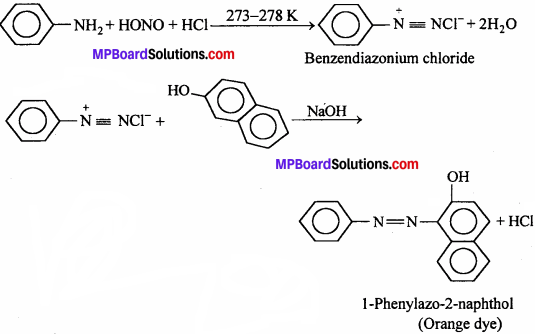
(iii) Azodye test:
It involves the reaction of any aromatic primary amine with HNO2 (NaNO2 + dil. HCl) at 273 – 278 K followed by treatment with an alkaline solution of ( β – naphthol) when a brilliant yellow, orange or red coloured dye is obtained
MP Board Class 12th Chemistry Solutions Chapter 13 Amines - 11
Aliphate primary amines under these conditions give a brisk evolution of N2 gas with the formation of priamary alcohols i.e. the solution remains clear.
MP Board Class 12th Chemistry Solutions Chapter 13 Amines - 30-12
(iv) Aniline gives dye test (see, iii):
Benzyl amine reacts with nitrous acid to form benzyl alcohol and nitrogen gas (seen as bubbles).
C6H5CH2NH2 + NaOH → C6H5CH2OH + N2+ H2O

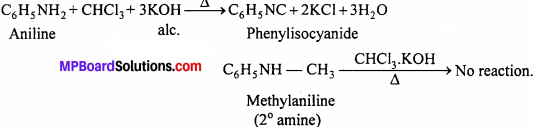
(v) These can be distinguished by carbylamine test:
Aniline being primary amines gives carbylamine test i.e. when heated with an alcoholic solution of KOH and CHCl2, it gives foul smell of phenylisocyanide.
MP Board Class 12th Chemistry Solutions Chapter 13 Amines - 13

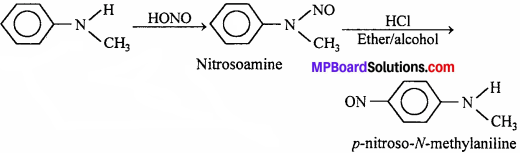
Methylaniline forms nitrosoamine (yellow oily liquid) on treatment with nitrous acid, which is stable at room temperature. However, on reaction with HCl in ether and alcohol, the nitroso (- NO) group migrates to para position.
MP Board Class 12th Chemistry Solutions Chapter 13 Amines - 14

Question 3.
Account for the following:

  1. pKb of aniline is more than that of methylamine.
  2. Ethylamine is soluble in water whereas aniline is not.
  3. Methylamine in water reacts with ferric chloride to precipitate hydrated ferric oxide.
  4. Although amino group is O – and p – directing in aromatic electrophilic substitution reactions, aniline on nitration gives a substantial amount of m-nitroaniline.
  5. Aniline does not undergo Friedel- Crafts reaction.
  6. Diazonium salts of aromatic amines are more stable than those of aliphatic amines.
  7. Gabriel phthalimide synthesis is preferred for synthesizing primary amines.

Answer:

(i) In aniline, the lone pair electrons on the N-atoms are delocalized over the benzene ring thereby decreasing the electron density on the N – atom. In contrast, in CH3NH2, + 1 effect of CH3 increases the electron density on the N-atom. Therefore, aniline is a weaker base than methylamine and hence its pKb value is higher than that of methylamine.

(ii) Ethylamine dissolves in water due to inter molecular H-bonding. In aniline, due to the large hydrophobic part, i.e. hydrocarbon part, the extent of H – bonding decreases considerably and hence, aniline is insoluble in water.

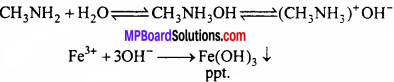
(iii) Methylamine being more basic than water, accepts a proton from water liberating OH ions,
MP Board Class 12th Chemistry Solutions Chapter 13 Amines - 15
These OH ions combine with Fe+3 ions present in H2O to form brown ppt. of hydrated ferric oxide.
FeCl3 → Fe+3+ 3Cl
2Fe+3+ 6OH→ 2Fe(OH)3 or Fe2O3.3H2O
Hydrates ferric oxide (Brown ppt.)

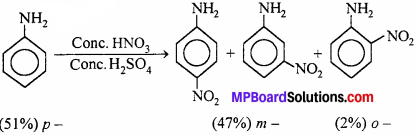
(iv) In strongly acidic medium (cone. HNO3/conc. H2SO4), most of the aniline gets protonated to form anilinium ion \(\left(\stackrel{\ominus}{\mathrm{N}} \mathrm{H}_{3}\right)\) which is m – directing and deactivating while – NH2 group in aniline is o, p – directing and activating. That is why besides the o, p – deriva- tives, significant amount of meta derivative is also formed.
MP Board Class 12th Chemistry Solutions Chapter 13 Amines - 16

(v) Aniline being a Lewis base reacts with Lewis acid AlCl3 to form a salt.
C6H5NH2+AlCl3 → C6H5 N H2 AlCl3
Lewis base    Lewis acid

Consequently, N of aniline acquires positive charge and thus acts a strong deactivating group for electrophilic substitution reaction. As a result, aniline does not undergo Friedel – Crafts reaction.

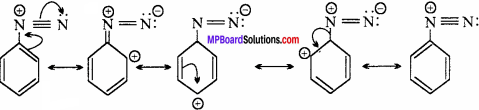
(vi) The diazonium salts of aromatic amines are more stable than those of aliphatic amines due to delocalization of the positive charge on the benzene ring.
MP Board Class 12th Chemistry Solutions Chapter 13 Amines - 17

(vii) Gabriel phthalimide reaction gives pure 1° amines without any contamination of 2° and 3° amines. Therefore, it is preferred for synthesizing 1° amines.

Question 4.
Arrange the following:
(i) In decreasing order of the pKb values:
C6H5NH2, C6H5NHCH3, (C2H5)2NH and C6H5NH2

(ii) In increasing order of basic strength:
C6H5NH2, C6H5N(CH3)2 ,(C2H5)2NH and CH3NH2

(iii) In increasing order of basic strength:
(a) Aniline, p-nitroaniline and p – toluidine
(b) C6H5NH2, C6H5NHCH3, C6H5CH2NH2

(iv) In decreasing order of basic strength in gas phase:
C2H5NH2, (C2H5)2NH, (C2H5)3N and NH3

(v) In increasing order of boiling point:
C6H5OH, (CH3)2NH, C2H5NH2

(vi) In increasing order of solubility in water:
C6H5NH2, (C2H5)2NH, C2H5NH2.

Answer:
(i) Due to delocalization of lone pair of electrons of the N-atom over the benzene ring, C6H5NH2 and C6H5NHCH3 are for less basic than C2H5NH2 and (C2H5)2 NH. Further, due to + I effect of the CH3 group, C6H5NHCH3 is slightly more basic than C6H5NH2.

Among C2H5NH2 and (C2H5)2NH, (C2H5)2NH is more basic than C2H5NH2 due to greater + 1 effect of the two C2H5groups. Combining all these facts, the relative basic strength of these four amines decreases in the order.(C2H2)2NH > C2H2NH2 > C6H5NHCH2> C2H5NH2

Since, a stronger base has lower pKb value, therefore pKb values decreases in the reverse order:
C6H5 NH2 > C6H5NHCH3 > C2H5NH2 > (C2H2)2NH

(ii) As explained in –
Answer:
(a) the relative basic strength of the amines decreases in the order:
(C2H5)2NH > C6H5NHCH3 > C6H5NH2

Among CH3NH2 and (C2H5)2NH, due to the greater + I effect of the two C2H5 groups, (C2H5)2 is more basic than CH3NH2. Thus, the basic strength of the four amines decreases in the order: (C2H5)2NH > CH3NH2> C6H5NHCH3 > C6H5NH2

(iii) (a) The electron-donating groups increases the basic strength of amines while the electron-withdrawing groups decreases the basic strength. Therefore, basicity increases in the order:
p-nitroaniline < aniline < p – toludine.

(b) In C6H5NH2 and C6H5NHCH3, N is directly attached to the benzene ring and thus the lone pair of electrons on the N-atom is delocalized over the benzene ring. Therefore, both C6H5NH2 and C6H5NHCH3 are weaker bases than C6H5C H2NH2. Furthers due to + I effect of CH3 group. C6H5NHCH3 is a stronger base than C6H5NH2.

The basic strength increases in the order:
C6H5NH2 < C6H5NHCH3 < C6H5CH2NH2

(iv) Solvent effects, i.e. stabilization of the conjugate acids due to H-bonding are absent in the gas phase. In the gas phase, basic strength mainly depends upon the + I effect of the alkyl groups. Thus, basic strength in the gas phase decreases in the order:
(C6H5)3N > (C2H5)2NH > C2H5NH2> NH3

(v) Since, the electronegativity of ‘O’ is higher than that of N, alcohols form stronger H-bonds than amines. Further, the extent of H-bonding depends upon the number of H – atoms on the N-atoms. Thus, the inter molecular forces are in the order C2H5 – OH > C5H5NH2 > (CH3)2NH. Therefore, the b.pts of the given three compounds increases in the order:
(CH3)2NH < C2H5NH2 < C2H5OH

(vi) Solubility decreases with:
(a) Increase in molecular mass of amines due to increase in the size of the hydrophobic hydrocarbon part, and.
(b) Decrease in the number of H – atoms on the N-atom which undergo H-bonding.

Among the given compounds, C6H5NH2has the highest molecular mass of 93 followed by (C2H5)5NH with molecular mass of 73 while C2H5NH2 has the lowest molecular mass of 45. Thus, the solubility increases in the order in which molecular mass decreases i.e.,
C6H5NH2 < (C2H5)2NH < C2H5NH2

MP Board Solutions

Question 5.
How will you convert:

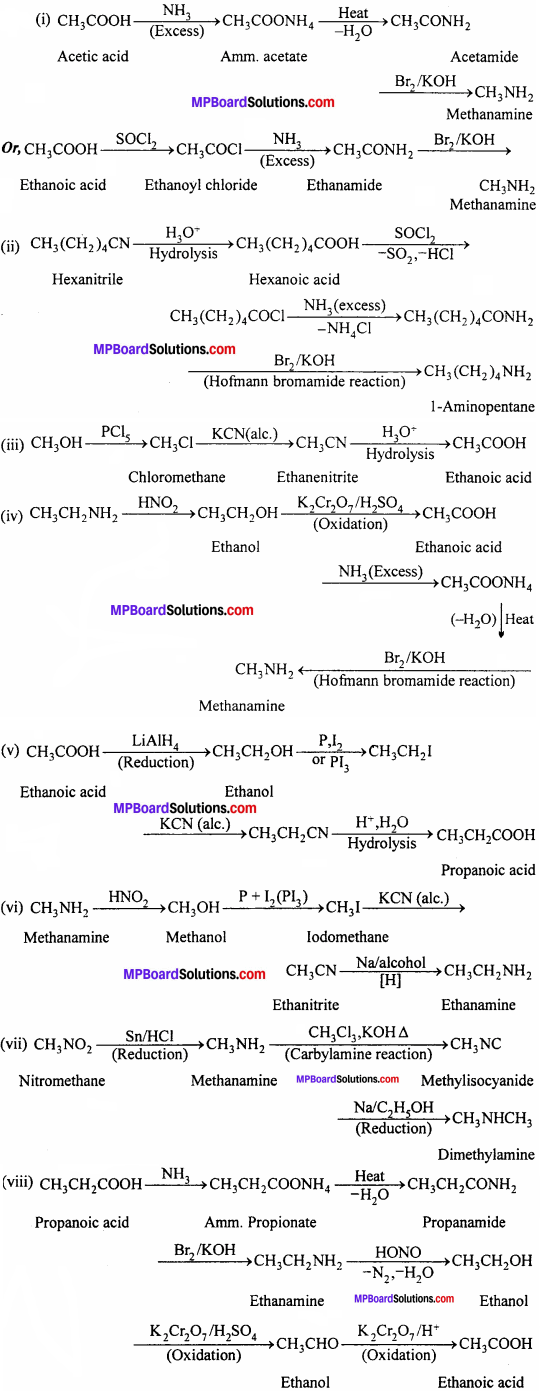
  1. Ethanoic acid into methanamine
  2. Hexanenitrile into 1 – aminopentane
  3. Methanol to ethanoic acid
  4. Ethanamine into methanamine
  5. Ethanoic acid into propanoic acid
  6. Methanamine into ethanamine
  7. Nitromethane into dimethylamine
  8. Propanoic acid into ethanoic acid.

Answer:
MP Board Class 12th Chemistry Solutions Chapter 13 Amines - 18

Question 6.
Describe a method for the identification of primary, secondary and tertiary amines. Also write chemical equations of the reactions involved.
Answer:
Heinsberg’s test:
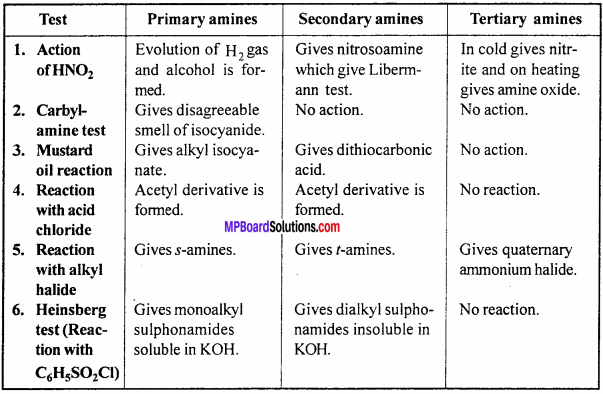
This is a excellent test for distinguishing between primary, secondary and tertiary amines. The amine is treated with benzene sulphonyl chloride (Hinsberg’s reagent) in presence of excess of aqueous potassium hydroxide solution. (Refer text for details)

Question 7.
Write short notes on the following:

  1. Carbylamine reaction
  2. Diazotisation
  3. Hofmann’s bromamide reaction
  4. Coupling reaction,
  5. Ammonolysis
  6. Acetylation
  7. Gabriel phthalimide synthesis.

Answer:

(i) Carbylamine reaction:
Primary aliphatic amine or aniline, when warmed with chloroform in presence of alcoholic KOH, gives iso cyanide or carbylamine, a compound with disagreeable odour. This reaction is known as Carbylamine reaction.
C6H5NH2 (aniline)+ CHCl3 + 3KOH → C6H5N \(\overrightarrow{=}\) C + 3KCl + H2O aniline phenyl isocyanide

(ii) Diazotisation:
By action of NaNO2 solution in ice cooled solution of aromatic amine formed inorganic acid, diazonium salts are obtained.
MP Board Class 12th Chemistry Solutions Chapter 13 Amines - 22

Diazonium salt contains diazo group (- N \(=\) N-) therefore, this process is called diazotization.

(iii) Hofmann’s bromamide reaction:
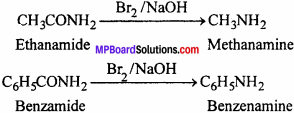
Primary aliphatic and aromatic amines can be prepared from amides by treatment with Br2 and KOH. The amine formed contains one carbon atom less than the parent amide. Therefore, this method is used for stepping down the series in organic conversion. Due to this reason it is also known as Hofmann degradation.
RCONH2 (Alkanamide ) + Br2 + 3NaOH > RNH2 (Alkanamine)+ 2NaBr+NaHCO3 + H2O
MP Board Class 12th Chemistry Solutions Chapter 13 Amines - 23

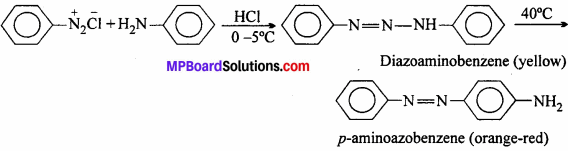
(iv) Coupling reaction:
Aniline reacts with diazonium chloride at ice cold temperature to give bright orange-red dye.
MP Board Class 12th Chemistry Solutions Chapter 13 Amines - 24

(v) Ammonoiysis:
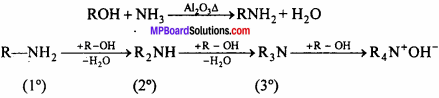
It is a process of replacement of either halogen atom in alkyl halids (or aryl halides) or hydroxyl group in alcohols (or phenols) by amino group. The reagent used for ammonoiysis is alcoholic ammonia. Generally, a mixture of primary, secondary and tertiary Amine is fromed
MP Board Class 12th Chemistry Solutions Chapter 13 Amines - 25

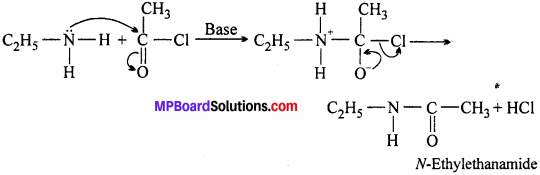
(vi) Acetylation:
Aliphatic and aromatic primary and secondary amines react with acid chlorides, anhydrides and esters by nucleophilic substitution reaction. This reaction is amine is formed. considered as replacement of hydrogen atom of — NH2 or >NH group by acyl group. This reaction is known as acylation.

The reaction is carried out in the presence of a base stronger than amine like pyridine, which removes HCl so formed and shift the equilibrium towards right hand side. The product obtained by acylation reaction is known as amides.
MP Board Class 12th Chemistry Solutions Chapter 13 Amines - 26

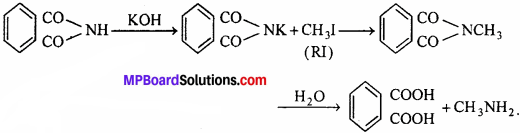
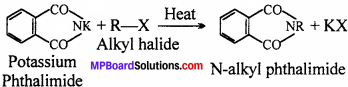
(vii) Gabriel phthalimide synthesis:
In this reaction, potassium phthalimide react with alkyl halide to form N-methyl phthalimide which on hydrolysis give primary amine
MP Board Class 12th Chemistry Solutions Chapter 13 Amines - 27

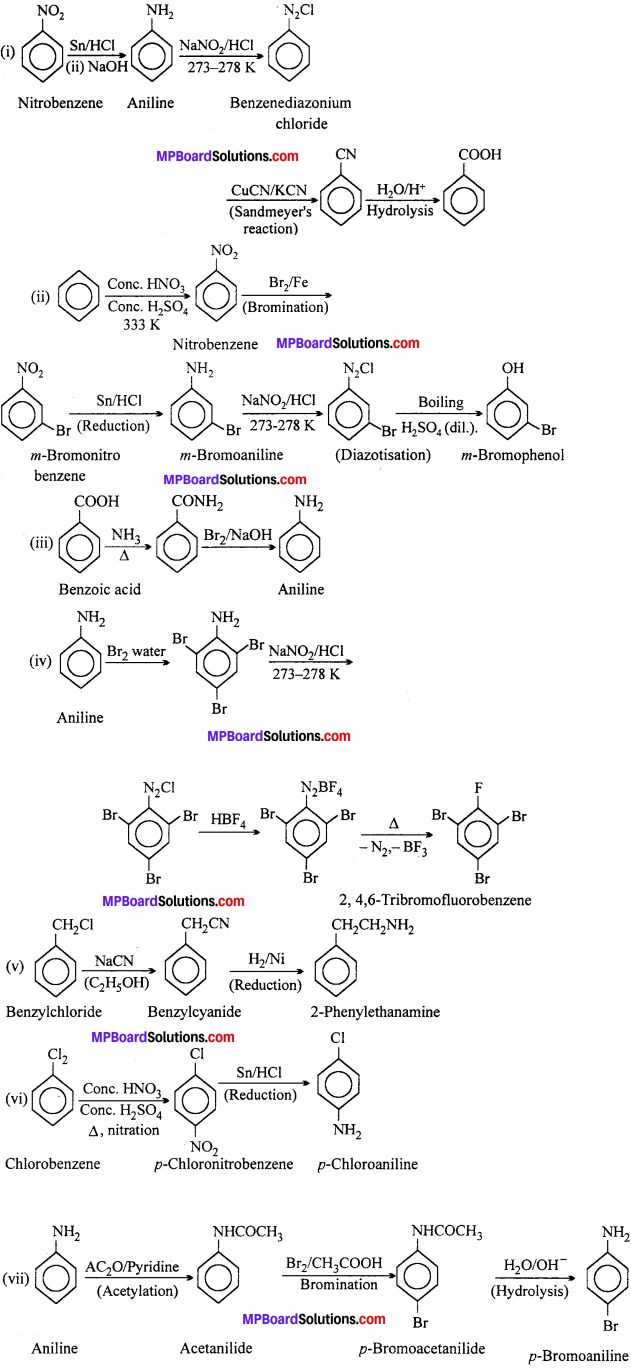
Question 8.
Accomplish the following conversions:

  1. Nitrobenzene to benzoic acid
  2. Benzene to m – bromophenol
  3. Benzoic acid to aniline
  4. Aniline to 2,4,6 – tribromofluorobenzene
  5. Benzyl chloride to 2 – phenylethanamine
  6. Chlorobenzene to p – chloroaniline
  7. Aniline to p – bromoaniline
  8. Benzamide to toluene
  9. Aniline to benzyl alcohol.

Answer:
MP Board Class 12th Chemistry Solutions Chapter 13 Amines - 28

Question 9.
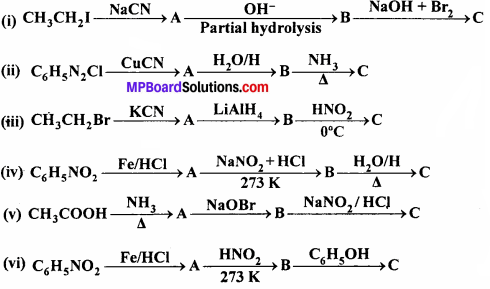
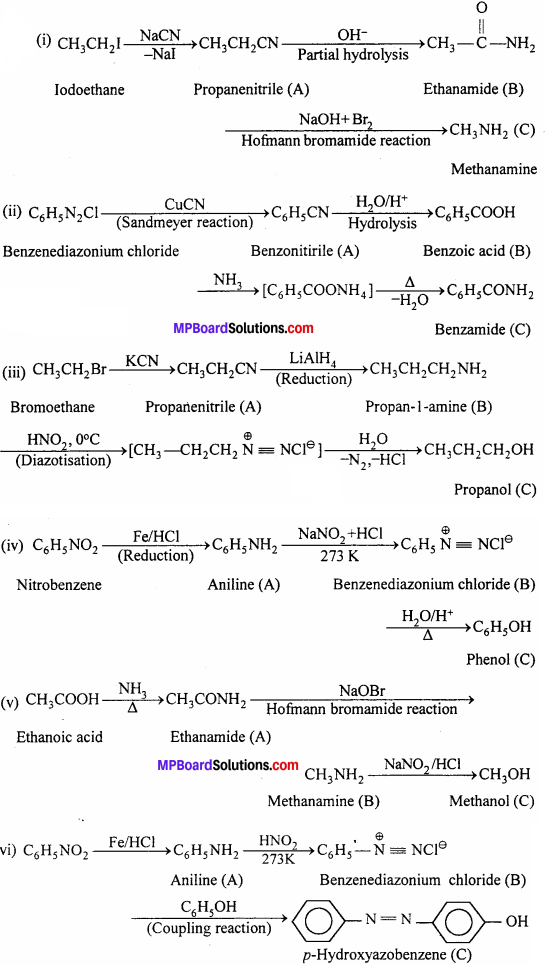
Give the structures of A, B and C in the following reactions:

MP Board Class 12th Chemistry Solutions Chapter 13 Amines - 29
Answer:
MP Board Class 12th Chemistry Solutions Chapter 13 Amines - 30-10

Question 10.
An aromatic compound ‘A’ on treatment with aqueous ammonia and heating forms compound ‘B’ which on heating with Br2 and KOH forms a compound ‘C’ of molecular formula C6H7N. Write the structures and IUPAC names of compounds A, B and C.
Answer:
Structures of compounds ‘B’ and ‘C’:
(i) Since, ‘C’ is formed from ‘B’ on treatment with Br2 + KOH (i.e., Hofmann bromamide reaction), ‘B’ must be an amide and ‘C’ must be an amine. The only amine having the molecular formula C6H5NH2 benzene amine or aniline).

(ii) Since, ‘C’ is aniline, the amide from which it is formed must be benzamide (C6H5CONH2). Thus, compound ‘B’ is benzamide. The chemical equation showing the conversion of‘B’ to ‘C’ is,

MP Board Class 12th Chemistry Solutions Chapter 13 Amines - 29-4
Structure of compound ‘A’:
Since, ‘A’ on treatment with aqueous ammonia and heating forms benzamide ‘A’ must be benzoic acid.

MP Board Class 12th Chemistry Solutions Chapter 13 Amines - 29-5

Question 11.
Complete the following reactions:

(i) C6H5NH2 + CHCl3 + (afc.)KOH →
(ii) C6H5N2Cl + H3PO2+H2O →
(iii) C6H5NH2+H2SO4(Conc.) →
(iv) C6H5N2C1 + C2H5OH →
(v) C6H5NH2 + Br2 →
(vi) C6H5NH2+ (CH3CO)2O →
MP Board Class 12th Chemistry Solutions Chapter 13 Amines - 30
Answer:
MP Board Class 12th Chemistry Solutions Chapter 13 Amines - 30-1

Question 12.
Why cannot aromatic primary amines be prepared by Gabriel phthalimide synthesis ?
Answer:
Gabriel Phthalimide reaction occurs through the nucleophilic attack by the phthalimide anion on the organic halogen compound.
MP Board Class 12th Chemistry Solutions Chapter 13 Amines - 30-4

MP Board Class 12th Chemistry Solutions Chapter 13 Amines - 30-5

Since, aryl halide do not undergo nucleophilic substitution reactions easily aromatic primary amines cannot be prepared by Gabriel phthalimide.

Question 13.
Write the reactions of:

  1. Aromatic
  2. Aliphatic primary amines with nitrous acid.

Answer:
(i) Aromatic primary amines react HNO2 at 273 – 278 K to form aromatic diazonium salts.
MP Board Class 12th Chemistry Solutions Chapter 13 Amines - 30-6

(ii) Aliphatic primary amines also react with HNO2 at 273-278 K to form aliphatic diazonium salt. But these are unstable even at this low temperature and thus decompose readily to form a mixture of compounds consisting of alkyl chlorides, alkenes and alcohols, out of which alcohols generally predominate.

MP Board Class 12th Chemistry Solutions Chapter 13 Amines - 30-7

Question 14.
Give plausible explanation for each of the following:

  1. Why are amines less acidic than alcohols of comparable molecular masses ?
  2. Why do primary amines have higher boiling point than tertiary amines ?
  3. Why are aliphatic amines stronger bases than aromatic amines ?

Answer:
(i) Amines lose a proton to form an amide ion while alcohol lose a proton to give an alkoxide ion.

MP Board Class 12th Chemistry Solutions Chapter 13 Amines - 30-8

Since, ‘O’ is more electronegative than N, RO can accommodate the -ve charge more easily than the RNH ion. In
other words, RO- is more stable than RNH Thus, alcohols are more acidic than amines or amines are less acidic than alcohols.

(ii) Primary amines (R—NH2) have two hydrogen atom on the N atom and so, they undergo extensive intermolecular H-bonding.

MP Board Class 12th Chemistry Solutions Chapter 13 Amines - 30-9

Tertiary amines (R3N) do not have hydrogen atoms on the N-atom and therefore, they do not undergo H-bonding. As a result, primary amines have higher boiling point than tertiary amines of comparable molecular mass. For example, Boiling point of H-butylamine (35 IK) is much higher than that of tertiary butylamine (b.p. 319 K).

MP Board Solutions

Amines  Other Important Exercises

Amines  Objective Type Questions

Question 1.
Choose the correct answer:

Question 1.
Aniline reacts with cold nitrous acid (NaNO2 + HCl) and gives:
(a) C6H5OH
(b) C6H5N2Cl
(C) C6H5NO2
(d) C6H5Cl.
Answer:
(b) C6H5N2Cl

Question 2.
A nitrogen-containing compound, on heating with chloroform and alcoholic KOH give vapours of disagreeable odour. The compound can be:
(a) Nitrobenzene
(b) Benzamide
(c) N-N, dimethylaniline
(d) Aniline.
Answer:
(d) Aniline.

Question 3.
Ethylamine reacts with nitrous acid to form:
(a) Ammonia
(b) Nitrous oxide
(c) Ethane
(d) Nitrogen.
Answer:
(d) Nitrogen.

Question 4.
A compound which gives oily nitrosoamine with nitrous acid at low temperature:
(a) Methyl amine
(b) Dimethyl amine
(c) Trimethyl amine
(d) Triethyl amine.
Answer:
(b) Dimethyl amine

Question 5.
Which of the following has strongest basic character:
(a) C6H5NH2
(b) (CH3)2NH
(C) (CH3)3N
(d) NH3.
Answer:
(b) (CH3)2NH

MP Board Solutions

Question 6.
Benzene diazonium chloride gives on hydrolysis:
(a) Chlorobenzene
(b) Phenol
(c) Alcohol
(d) Benzene.
Answer:
(b) Phenol

Question 7.
In the reaction C6H5CHO + C6H5NH2 → C6H5N = CHC6H5 + H2O + C6H5N = CHC6H5 is known as:
(a) Aldol
(b) Schiff’s reagent
(c) Schiffs base
(d) Benedict reagent.
Answer:
(c) Schiffs base

Question 8.
Nitrobenzene gives N-phenyl hydroxyl amine when it reacts with:
(a) Sn/HCl
(b) C6H5CH2NH-CH3
(c) Zn / NaOH
(d) Zn / NH4Cl.
Answer:
(c) Zn / NaOH

Question 9.
Which of the mixture when reacts with ale. KOH known as Carbyl amine reaction:
(a) Chloroform and Ag powder
(b) Trihalogenated methane and primary amine
(c) Alkyl trihalide and primary amine
(d) Alkyl cyanide and primary amine.
Answer:
(b) Trihalogenated methane and primary amine

Question 10.
Which of the following gas is responsible for Bhopal gas tragedy in 1984:
(a) CH3 – N = C = O
(b) CH3-C=N = S
(c) CHCl3
(d) C6H5COCl.
Answer:
(a) CH3 – N = C = O

Question 11.
Oil of Mirbane is:
(a) Aniline
(b) Nitrobenzene
(c) p-nitroaniline
(d) p-aminoazobenzene.
Answer:
(b) Nitrobenzene

MP Board Solutions

Question 12.
The product of mustard oil reaction is:
(a) Alkyl isothiocyanate
(b) Dithiocarbonamide
(c) Dithioethyl acetate
(d) Thioether.
Answer:
(a) Alkyl isothiocyanate

Question 13.
Aniline is purified by:
(a) Steam distillation
(b) Vacuum distillation
(b) Simple distillation
(d) Solvent extraction.
Answer:
(a) Steam distillation

Question 14.
Amine which will not react with Acetyl chloride, is:
(a) CH3NH2
(b) (CH3)2NH
(c) (CH3)2N
(d) None of these.
Answer:
(c) (CH3)2N

Question 15.
MP Board Class 12th Chemistry Solutions Chapter 13 Amines - 41
(a) Gattermann’s reaction
(b) Sandmayer’s reaction
(c) Wurtz’s reaction
(d) Frankland’s reaction.
Answer:
(b) Sandmayer’s reaction

Question 2.
Fill in the blanks:

  1. Aromatic amines are …………… in water.
  2. Amines are benzolyate in presence of NaOH. This reaction is called ……………
  3. By reacting with nitrous acid 1° amine form alcohol and 2° amine form ……………
  4. Reaction of 2° amine with nitrous acid represent ……………
  5. Aniline on sulphonation with sulphuric acid forms ……………
  6. With metal (Transition metals) ions amine establish co-ordination and form ……………
  7. By reduction, cyanide forms …………… and isocyanide forms ……………
  8. Benzoic acid reacts with hydrozoic acid to form ……………
  9. All aliphatic amines are more …………… than ammonia.
  10. 1° and 2° amine react with Grignard reagent to form ……………
  11. Basic nature of amine is due to the presence of …………… on nitrogen atom.
  12. Primary amines on heating with …………… and …………… form alkyl isocyanides.
  13. C6H5-COOH + …………… C6H5NH2 + N2 + CO2.
  14. Mixture of T.N.T. and ammonium nitrate is known as ……………
  15. On reacting aniline with HCl and NaNO2 at 0°C temperature benzene diazoniu chloride is formed. This is called…………… reaction.
  16. Ethyl amine is a …………… base than ammonia.
  17. Trinitrotoluene is an …………… compound.
  18. On heating alkyl isocyanide to 250°C …………… is formed.

Answer:

  1. Insoluble
  2. Schotten Baumann
  3. Nitrosamine
  4. Libermann nitroso test
  5. Sulphanilic acid
  6. Complex ion
  7. Primary amine, secondary amine
  8. Aniline
  9. Basic
  10. Alkane
  11. lone electron pair
  12. Chloroform and caustic soda
  13. N3H
  14. amytoi
  15. diazotisation
  16. stronger
  17. explosive
  18. Alkyl cyanide.

MP Board Solutions

Question 3.
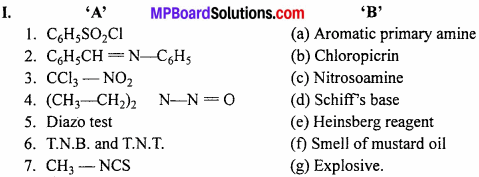
Match the followings:
MP Board Class 12th Chemistry Solutions Chapter 13 Amines - 42

  1. (c) Nitrosoamine
  2. (d) SchifFs base
  3. (b) Chloropicrin
  4. (e) Heinsberg reagent
  5. (a) Aromatic primary amine
  6. (g) Explosive.
  7. (f) Smell of mustard oil

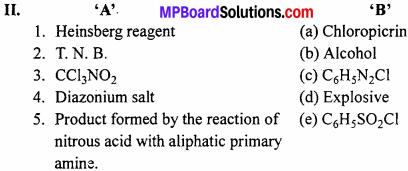
MP Board Class 12th Chemistry Solutions Chapter 13 Amines - 43
Answer:

  1. (e) C6H5SO2Cl
  2. (d) Explosive
  3. (a) Chloropicrin
  4. (c) C6H5N2Cl
  5. (b) Alcohol

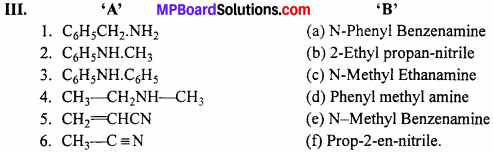
MP Board Class 12th Chemistry Solutions Chapter 13 Amines - 44

  1. (d) Phenyl methyl amine
  2. (e) N-Methyl Benzenamine
  3. (a) N-Phenyl Benzenamine
  4. (c) N-Methyl Ethanamine
  5. (f) Prop-2-en-nitrile.
  6. (b) 2-Ethyl propan-nitrile

Question 4.
Answer in one word/sentence:

  1. Why aniline turns blackish brown in open air ?
  2. Tertiary amine does not acetanilised, why ?
  3. Which isomer of C3H9N is least basic and having lowest b.p. ?
  4. Which amine gives diazotization reaction ?
  5. The compound obtained when primary aromatic amine when heated with CHCl3 and ale. KOH.
  6. Secondary amine can be identified by.
  7. What is nitrating mixture ?
  8. Nitrobenzene is known as.
  9. MP Board Class 12th Chemistry Solutions Chapter 13 Amines - 45
  10. Write the nature of amine.
  11. Primary nitroalkane reacts with nitrous acid to form which compound.
  12. Reagent used for the separation of Primary Secondary and Tertiary amine.
  13. What do 1° and 2° amine form on reacting with phosgene ?
  14. MP Board Class 12th Chemistry Solutions Chapter 13 Amines - 46
  15. What is obtained by reacting amines with chloroform?
  16. In which form is amine used in organic synthesis ?
  17. What does Ethylamine form on oxidation in the presence of KMnO ?
  18. On adding Br2 water in aqueous solution of C6H5NH2which precipitate is obtained ?
  19. Which amine is obtained by the reduction of cyanide in the presence of Pt or Ni ?
  20. Write the formula of X:
    MP Board Class 12th Chemistry Solutions Chapter 13 Amines - 47
  21. Write the name of reaction:
  22. MP Board Class 12th Chemistry Solutions Chapter 13 Amines - 48
  23. What is the name of reaction for preparation of methyl isocyanide ?

Answer:

  1. Aniline oxidizes by air
  2. Active hydrogen is absent
  3. Tertiary amine
  4. All primary aromatic amine
  5. Phenyl isocyanide
  6. By Libermann test
  7. Cone. HNO3 and cone. H2SO4
  8. Oil of Mirbane
  9. Diazotisation
  10. Nitrolic acid
  11. Basic
  12. Heinsberg reagent
  13. Substituted urea
  14. Carbylamine reaction
  15. Alkyl isocyanide
  16. Reagent
  17. Aldehyde
  18. Symmetrical tribromoaniline
  19. 1° amine
  20. C6H5NH2 (Aniline)
  21. Schmidt reaction
  22. Carbylamine reaction.

MP Board Solutions

Amines  Short Answer Type Questions

Question 1.
Aniline is insoluble in water but soluble in HCl. Explain.
Answer:
Being basic nature, aniline forms soluble salts with strong acids like HCl while with water no such salt is formed. Therefore, aniline is insoluble in water but soluble in HCl.

C6H5NH2 + HCl → \(\left[\mathrm{C}_{6} \mathrm{H}_{5} \mathrm{NH}_{3}^{+}\right] \mathrm{Cl}^{-}\)Aniline hydrochloride

Question 2.
Write a short note on Schotten Baumann reaction.
Answer:
Aromatic acid chloride reacts with phenol and aniline in presence of aqueous NaOH or pyridine. The reaction is known as Schotten Baumann reaction.
MP Board Class 12th Chemistry Solutions Chapter 13 Amines - 31

Question 3.
What is ‘aniline black’ ? Write its two uses.
Answer:
When aniline is oxidised by acidic KMnO4, a black substance is formed which is known as aniline black.
Uses:

  • In manufacturing of black colour.
  • In manufacturing of useful compounds.

Question 4.
(i) Boiling point of alkyl cyanides is higher than alkyl halides of nearly same molecular mass. Why ?
(ii) B.P. and M.P. of isocyanides are less than isomeric cyanide compounds. Why ?
Answer:
(i) Cyanide group (- C \(\cong\) N) is polar. Thus dipole moment of alkyl cyanide is higher due to which intermolecular force between them is higher. As a result boiling point of alkyl cyanide is higher than alkyl halides of nearly same molecular mass.

(ii) Isocyanide compounds are less polar than isomeric cyanides. Therefore, the boiling points and melting points of isocyanides are less than cyanides.

Question 5.
Complete the following reactions:
(a) C2H5I + H2N – C2H5
(b)CH2NH2 + (NaNO2 + HC1) →

Answer:
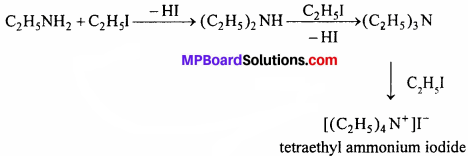
(a) This reaction is alkylation and ultimate product quartemary ammonium salt is formed
MP Board Class 12th Chemistry Solutions Chapter 13 Amines - 32

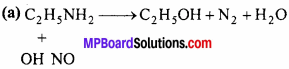
(b) CH3NH2 + (NaNO2 + HCl) → CH3OH + N2 + H2O

Question 6.
Ethyl amine is more basic than ammonia, why ?
Answer:
The value of Ka = 4.5 x 10⁻⁴ for ethyl amine and for ammonia it is 1.8 x 10⁻⁵. Larger is the Kb value, more basic is the amine and vice-versa. In ethyl amine the availabil-ity of lone pair of electrons on nitrogen atom increases due to the +1 inductive effect of the ethyl group. Hence, this lone pair of electrons can easily accept a proton. This explains why ethyl amine is more basic than ammonia.

MP Board Solutions

Question 7.
Write short notes on:

  1. Schmidt reaction
  2. Mustard oil reaction.

Answer:
(i) Schmidt reaction:
When hydrazoic acid dissolved in chloroform or benzene, react with mono carboxylic acid in presence of H2SO4 at 55°C, primary amine is obtained.
MP Board Class 12th Chemistry Solutions Chapter 13 Amines - 33

(ii) Mustard oil reaction:
When aliphatic primary amine is heated with carbon
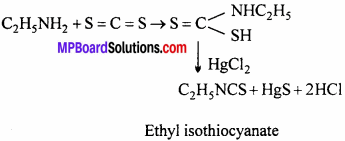
disulphide and HgCl2 alkyl isothiocyanate is formed, which has smell like mustard oil. Therefore, this reaction is called mustard oil reaction.
MP Board Class 12th Chemistry Solutions Chapter 13 Amines - 34

Question 9.
Give a Heinsberg method to identify primary, secondary and tertiary amines.
Answer:
Heinsberg method:
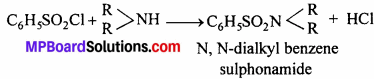
This method is capable to differentiate primary, secondary and tertiary amines. Amines are heated with benzene sulphonyl chloride (Heinsberg reagent) and various product are obtained.

1. Primary amine:
These form sulphonamide which are soluble in KOH.
C6H5SO2Cl + R – NH2 → C6H5SO2(NHRN – alkyl benzene sulphonamide) + HCl

2. Secondary amine:
Secondary amine also form sulphonamide which are insoluble in KOH.
MP Board Class 12th Chemistry Solutions Chapter 13 Amines - 35

3. Tertiary amine : Tertiary amine does not react.
C6H5SO2Cl + R3N → No reaction

Question 9.
What is the difference between Alkyl nitrite and nitroalkane ?
Answer:
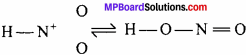
Nitrous acid exist in two isomeric forms:
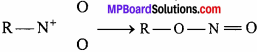
MP Board Class 12th Chemistry Solutions Chapter 13 Amines - 36

Thus, two alkyl derivatives of nitrous acid are formed.
MP Board Class 12th Chemistry Solutions Chapter 13 Amines - 37

Thus, it is clear that in nitroalkane, alkyl radical is linked to nitrogen, whereas in alkylnitrite alkyl radical is linked to oxygen atom. Alkyl nitrite is ester whereas nitroalkane is the derivative of paraffin.

Question 10.
Write only chemical equation for the following conversions:
(i) Conversion of methyl cyanide into C6H5NH2.
(ii) Conversion of C6H5NH2 into chlorobenzene.
Answer:

MP Board Class 12th Chemistry Solutions Chapter 13 Amines - 38

Question 11.
Differentiate between primary, secondary and tertiary nitroalkane.
Answer:
Primary, secondary and tertiary nitroalkanes can be differentiated on the basis of following reaction:
(i) Primary nitroalkanes react with nitrous acid forming nitrolic acid which is soluble in NaOH or KOH forming red colour.
MP Board Class 12th Chemistry Solutions Chapter 13 Amines - 39

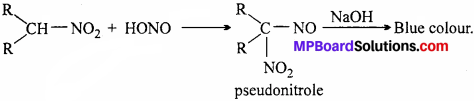
(ii) Secondary nitroalkane reacts with nitrous acid forming pseudonitrole which gives blue colour with NaOH.
MP Board Class 12th Chemistry Solutions Chapter 13 Amines - 40
(iii) Tertiary nitroalkane does not react with nitrous acid because it does not have hydrogen atom.

Question 12.
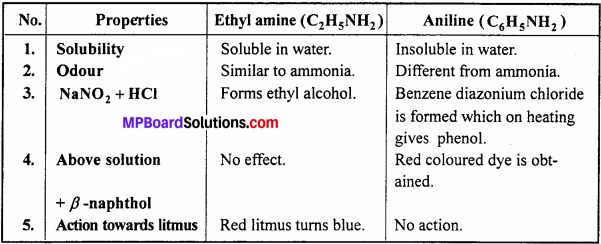
Write the points of difference between Ethyl amine and Aniline.
Answer:
Differences between Ethyl amine and Aniline:
MP Board Class 12th Chemistry Solutions Chapter 13 Amines - 49

Question 13.
Why can aromatic primary amine not be synthesized by Gabriel phthalimide synthesis.
Answer:
In Gabriel Phthalimide reaction potassium salt of phthalimide is formed. It easily reacts with alkyl halide and forms the related alkyl derivative.
MP Board Class 12th Chemistry Solutions Chapter 13 Amines - 50

But aryl halide do not react with potassium phthalimide because in haloarene (aryl halide) due to partial double bond character breaking of C – X bond is difficult. Thus, aromatic amine can not be prepared by Gabriel Phthalimide synthesis.
MP Board Class 12th Chemistry Solutions Chapter 13 Amines - 51

Question 14.
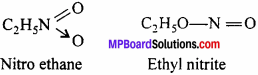
Write any four points to differentiate between Ethyl nitrite and nitro ethane.
Answer:
Difference between nitro ethane and ethyl nitrite.
1. Structure:
MP Board Class 12th Chemistry Solutions Chapter 13 Amines - 52

2. Boiling Point:
Boiling point of nitroethane is higher than Ethyl nitrite.

3. Reduction:
Nitroethane forms primary amine and ethyl nitrite forms ammonia.
MP Board Class 12th Chemistry Solutions Chapter 13 Amines - 53

4. Hydrolysis:
Nitroethane does not form alcohol with NaOH whereas Ethyl nitrite forms alcohol with NaOH.
C2H5 – O – N + NaOH → C2H5OH + NaNO2

Question 15.
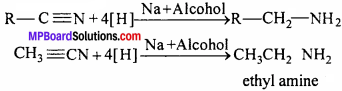
What is Mendius reaction ?
Ans. Reduction of alkyl cyanides by sodium and alcohols yield primary amine. This reaction is called Mendius reaction.
MP Board Class 12th Chemistry Solutions Chapter 13 Amines - 54

Question 16.
How will you obtain:

  1. Ethyl amine from methyl cyanide
  2. Methyl amine from acid amide
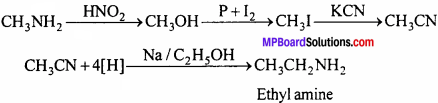
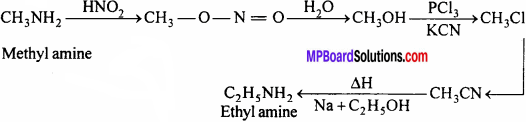
  3. Ethyl amine from ethyl alcohol
  4. Ethyl amine from methyl amine.

Answer:
1. Ethyl amine from methyl cyanide:
MP Board Class 12th Chemistry Solutions Chapter 13 Amines - 55

2. Methyl amine from acid-amide:
CH3CONH2 + Br2 + 4KOH → CH3 – NH2 + 2KBr + K2CO3 + 2H2O

3. Ethyl amine from ethylimg
MP Board Class 12th Chemistry Solutions Chapter 13 Amines - 56

4. Ethyl amine from methyl amine:
MP Board Class 12th Chemistry Solutions Chapter 13 Amines - 57

Question 17.
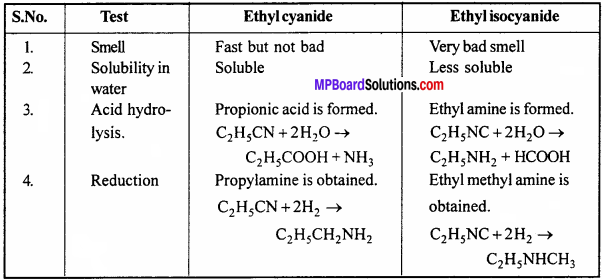
Write any four difference between ethyl cyanide and ethyl iso cyanide.
Answer:
Difference between ethyl cyanide and ethyl iso cyanide:
MP Board Class 12th Chemistry Solutions Chapter 13 Amines - 58

Question 18.
Give reaction of ethyl amine with following:
(a) HNO2
(b) C6H5COCl
(C) CS2.
Answer:
(a) HNO2
MP Board Class 12th Chemistry Solutions Chapter 13 Amines - 59

(b) N-ethyl acetamide is formed
C2H5NH2 + CH3COCl → CH3CONHC2H5 + HCl

(c) Ethyl isothiocyanate is formed. This reaction is also known as mustard oil reaction.
MP Board Class 12th Chemistry Solutions Chapter 13 Amines - 60

Question 19.
Why aniline is less basic than ethyl amine ?
Answer:
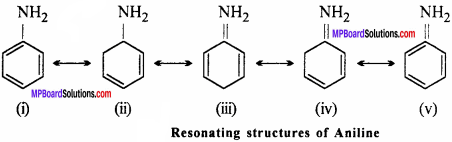
Aniline is less basic than ethyl amine as due to resonance of benzene nucleus, the lone pair of electron of nitrogen atom is attracted towards nucleus and gets delocalised in the ring. Thus, electron pair is liberated with difficulty in aniline than ethyl amine. Hence, its basic property is less than ethyl amine. The delocalisation of electron as a result of resonance is shown as follows:
MP Board Class 12th Chemistry Solutions Chapter 13 Amines - 61

Question 20.
Boiling point of aniline is higher than the hydrocarbons of comparable molecular masses, but lower than corresponding alcohols and carboxylic acids. Clarify the statement
Answer:
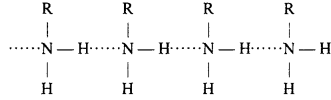
Primary amines are polar and in them dipolar [Nδ- – Nδ+] bond is present, in which molecules of amines are associated by hydrogen bond. That is why their boiling point is higher than alkanes of comparable molecular masses.
MP Board Class 12th Chemistry Solutions Chapter 13 Amines - 62

Due to lesser electronegativity of nitrogen than oxygen, association in alcohols and carboxylic acids occur due to strong H – bonds. Whereas in amines association is due to weak H — bond. Therefore, boiling and melting point of amines is lower than corresponding alcohols and carboxylic acids.

Question 21.
Explain nitration of Aniline.
Answer:
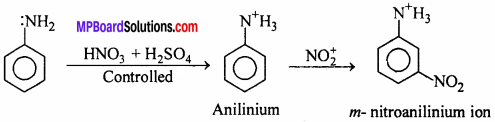
Direct nitration of aniline is not possible because NH3 group gets oxidized by HNO3 but on nitrating under
controlled conditions instead of o- and p- place m – nitroderivative is formed. In acidic medium due to protonation
of — NH2 group, electron attracting tendency of NH3+ formed increases by which instead of o- or p- directing Anilinium ion acts as m — directing.
MP Board Class 12th Chemistry Solutions Chapter 13 Amines - 63

Question 22.
Why is aniline acetylated before nitration ? Give necessary equation.
Or,
Direct nitration of aniline is not possible. Explain and how it is nitrated?
Answer:
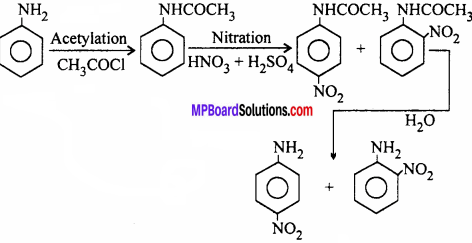
Direct nitration of aniline is not possible because amino group of aniline is oxidised by nitric acid. So for nitration of aniline firstly amino group (- NH2) is protected by acetylation and then nitrated.
MP Board Class 12th Chemistry Solutions Chapter 13 Amines - 64

Question 23.
How will you obtain: (Give only equations)

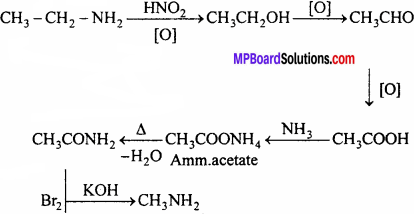
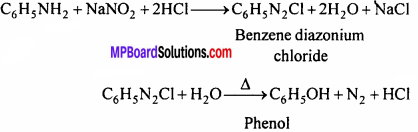
  1. Methyl amine from Ethyl amine.
  2. Phenol from Aniline.
  3. Ethyl amine from methyl amine.

Answer:
1. Methyl amine from Ethyl amine:
MP Board Class 12th Chemistry Solutions Chapter 13 Amines - 65
2. Phenol from Aniline:
MP Board Class 12th Chemistry Solutions Chapter 13 Amines - 66

3. Ethyl amine from methyl amine:
MP Board Class 12th Chemistry Solutions Chapter 13 Amines - 67

Question 24.
Explain the following:

  1. Preparation of pure amine is difficult by the ammonolysis of alkyl halide.
  2. Methyl amine reacts with FeCl3 in water to give precipitate of ferric hydroxide.
  3. AgCl is soluble in methyl amine.

Answer:
1. By the ammonolysis of alkyl halide a mixture of primary, secondary and tertiary amine is obtained.
MP Board Class 12th Chemistry Solutions Chapter 13 Amines - 68

Separation of these amines is difficult; therefore it is difficult to obtain pure amine by ammonolysis of alkyl halide.

2. Methyl amine releases OH ion in water which reacts with FeCl3 as follows to give precipitate of Fe(OH)3.
MP Board Class 12th Chemistry Solutions Chapter 13 Amines - 69

3. Methyl amine forms a soluble complex with AgCl and this way AgCl is soluble in methyl amine.
AgCl + 2CH3NH2 → [Ag(CH3NH2 )2 ]+ ClSoluble complex

Amines Long Answer Type Questions

Question 1.
Write reduction reactions of nitro-benzene:
(a) In acid medium
(b) Neutral medium
(c) In basic medium.

Or,
Describe reduction reactions of nitro-benzene in different conditions.
Answer:
Reduction of Nitro-benzene:
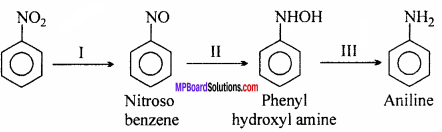
Nitro-benzene is readily reduced. This gives different compounds under different conditions depending upon the pH of the medium and the nature of the reducing agent. The reduction takes place in three steps:
MP Board Class 12th Chemistry Solutions Chapter 13 Amines - 70

(a) Acidic medium:
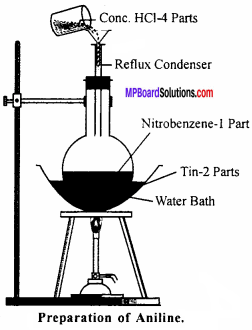
When reduced with Sn + HCl or Fe + HCl, gives aniline.
MP Board Class 12th Chemistry Solutions Chapter 13 Amines - 71

(b) Neutral medium:
When reduced with aluminium mercury couple or zinc dust and ammonium chloride, phenyl hydroxyl amine is formed.
MP Board Class 12th Chemistry Solutions Chapter 13 Amines - 72

(c) In basic medium (Alkaline medium):
(i) Reduction with alkaline sodium arsenite:
Azoxy benzene is formed.

MP Board Class 12th Chemistry Solutions Chapter 13 Amines - 73

(ii) Reduction with zinc dust and caustic soda:
Hydrozo benzene is formed.
MP Board Class 12th Chemistry Solutions Chapter 13 Amines - 74

Question 2.
How will you obtain the following from aniline ? Give only chemical equation:
(a) Phenol
(b) Methane
(c) Tribromoaniline
(d) Phenylisocvanide.
Answer:
(a) Phenol:
MP Board Class 12th Chemistry Solutions Chapter 13 Amines - 76
MP Board Class 12th Chemistry Solutions Chapter 13 Amines - 77

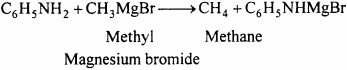
(b) Methane:
MP Board Class 12th Chemistry Solutions Chapter 13 Amines - 78

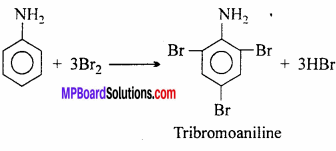
(c) Tribromoaniline:
By treating aniline with bromine water, yellow coloured 2,4,6 – tribromoaniline is formed.
MP Board Class 12th Chemistry Solutions Chapter 13 Amines - 79

(d) Phenylisocyanide:
MP Board Class 12th Chemistry Solutions Chapter 13 Amines - 80

Question 3.
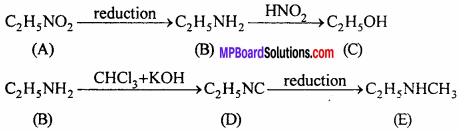
An organic compound [A] having molecular formula C2H5O2 on reduction gives compound [B] which react with HNO2 and form compound [C]. Compound [B] on reaction with chloroform alcoholic KOH, change into bad smelling compound [D]. Which on reduction forms amine [E]. Which formula will you assign for compound [A], [B], [C], [D] and [E] ? Explain reactions also.
Answer:
[A] → C2H5NO2 (Nitro ethane)
[B] → C2H5NH2(Ethyl amine)
[C] → C2H5OH (Ethanol)
[D] → C2H5N = C (Ethyl iso cyanide)
[E] → C2H5NHCH3(N-methyl amino ethane)
Reactions:
MP Board Class 12th Chemistry Solutions Chapter 13 Amines - 81

Question 4.
How will you obtain the following:
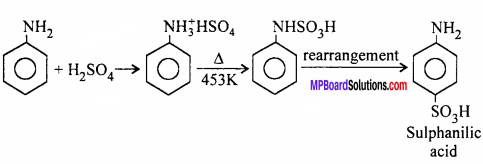
(i) Sulphanilic acid from Aniline
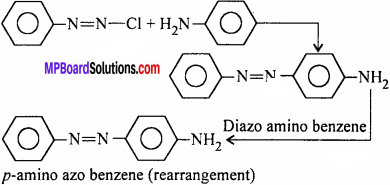
(ii) p-amino azo benzene from aniline.
Answer:
(i) Sulphanilic acid from Aniline
MP Board Class 12th Chemistry Solutions Chapter 13 Amines - 82
(ii) p-amino azo benzene from aniline.
MP Board Class 12th Chemistry Solutions Chapter 13 Amines - 83

Question 5.
What happens when:
(a) Ammonium acetate is made to react with alumina at 500°C.
(b) Methyl cyanide is subjected to alkaline hydrolysis.
(c) Benzamide is treated with P2Os.
(d) H2 gas is passed through phenyl isocyanide in presence of Ni.
(e) Methyl isocyanide is heated at 250°C.
Answer:
(a) Methyl cyanide is formed.
MP Board Class 12th Chemistry Solutions Chapter 13 Amines - 84
(b) Ammonia gas is formed.
MP Board Class 12th Chemistry Solutions Chapter 13 Amines - 85
(c) Phenyl cyanide is formed.
MP Board Class 12th Chemistry Solutions Chapter 13 Amines - 86
(d) N-methyl aniline is formed.
MP Board Class 12th Chemistry Solutions Chapter 13 Amines - 87
(e) Methyl cyanide is formed.
MP Board Class 12th Chemistry Solutions Chapter 13 Amines - 88

Question 6.
How is primary amine obtained from nitro-alkane ? Give equation.
(ii) How is primary alcohol obtained from primary amine ? Give equation.
(iii) Among N-propyl amine and isopropyl amine which is more basic ?
Answer:
(i) Nitro-alkane is reduced by LiAlH4 or by H2 in presence of Ni or Pt to obtain primary amine.
MP Board Class 12th Chemistry Solutions Chapter 13 Amines - 89
(ii) Primary aliphatic amine react with nitrous acid to form primary alcohol.
C2H5NH2 + HONO → C2H5OH + N2 + H2O
(iii) Normal propyl amine is more basic.

Question 7.
How will you obtain the following (Give only equation):
(a) Ethyl amine from nitroethane,
(b) N-methyl hydroxyl amine from nitroethane,
(c) Chloropicrin from nitromethane,
(d) Nitrobenzene from benzene diazonium chloride,
(e) Trinitrobenzene (T.N.B.)from nitrobenzene.
Answer:
MP Board Class 12th Chemistry Solutions Chapter 13 Amines - 90

Question 8.
Explain the laboratory method of preparation of ethyl amine under the following heads:
(a) Procedure
(b) Equation of reaction
(c) Diagram
(d) Physical properties.
Answer:
Laboratory method of preparation of ethyl amine: In laboratory ethyl amine is prepared by Hofmann Bromoamide reaction. In this process reaction of propanamide with bromine and caustic potash solution takes place. All steps in the process are following:
C2H5CONH2 + Br2 → C2H5CONHBr + HBr
KOH + HBr → KBr + H2O
C2H5CONHBr + KOH → C2H5NCO + KBr + H2O KOH-
C2 H5NCO + 2KOH → C2H5NH2+K2CO3
C2 H5 CONH2 + Br2 + 4KOH → C2H5NH2 + 2KBr + K2CO3 + 2H2O
MP Board Class 12th Chemistry Solutions Chapter 13 Amines - 91

Procedure:
In a round bottom distillation flask equivalent quantities of bromine and propanamide is taken and 10% KOH solution is added in it. Now 50% KOH solution is added in excess and the flask is heated on water both up to 57-67°C. When the solution becomes colourless, ethyl amine starts to be distilled which is absorbed in dil. HCl.

Physical properties:
It is a colourless liquid with an odour like ammonia which is soluble in water and organic solvent. It is a combustible substance. Its boiling point is 19°C.

MP Board Solutions

Question 9.
Write laboratory method of preparation of aniline. Give all chemical equations of this process.
Or
Describe commercial method of preparation of aniline.
Answer:
Laboratory Method for the Preparation of Aniline:
Aniline is prepared in the laboratory by the reduction of nitro-benzene with tin and hydrochloric acid.
C6H5NO2 +6[H] C6H5NH2 + 2H2O

Experiment:
Nitro-benzene (20 g) and granulated tin (40 g) are taken in a round-bottom flask and a reflux condenser is fitted. Now hydrochloric acid (100 ml) is added in small amounts (10 ml at a time). The flask is shaken after each addition of acid and the temperature is not allowed to rise above 90° C. The flask is heated on a water bath till the smell of nitro-benzene disappears. On cooling the flask, a solid mass of molecular formula (C6H5 NH2 .HCl)2 .SnCl4 separates out.
Sn + 4HCI → SnCI4 + 4H
C6H5NO2 + 6[H] ) → C6H5NH2 + 2H2O
MP Board Class 12th Chemistry Solutions Chapter 13 Amines - 103
MP Board Class 12th Chemistry Solutions Chapter 13 Amines - 92
The solid mass is treated with concentrated NaOH solution. So that a clear alkaline solution is obtained. Aniline is liberated and floats as a dark brown coloured oil.
MP Board Class 12th Chemistry Solutions Chapter 13 Amines - 104
From this aniline is obtained by steam distillation.
Commercially aniline is manufactured by reduction of nitrobenzene. This is done in presence of Fe water and cone. HCl.
Fe + 2HCl → FeCl2 + 2H
C6H5 NO2 + 6H → C6H5NH2 + 2H2O

Question 10.
Distinguish among p, s and t amines under the following points:

  1. Reaction with HNO2
  2. Carbyl amine reaction
  3. Mustard oil reaction
  4. Reaction with acid halide
  5. Reaction with alkyl halide
  6. Reaction with C6H5SO2Cl.

Answer:
MP Board Class 12th Chemistry Solutions Chapter 13 Amines - 93

Question 11.
Write down the chemical equation representing preparation of nitrobenzene in laboratory and give the following chemical reaction of nitrobenzene:
(a) Nitration
(b) Sulphonation.
Answer:
Preparation of nitrobenzene in laboratory: Nitrobenzene is prepared in laboratory by treating benzene with a mixture of cone. HNO3 and cone. H2SO4 at 60°C.
MP Board Class 12th Chemistry Solutions Chapter 13 Amines - 94
Reaction of nitrobenzene:
MP Board Class 12th Chemistry Solutions Chapter 13 Amines - 95

(a) Nitration:
Nitrobenzene forms m – dinitrobenzene when heated with fuming HNO3 and cone. H2SO4 .

MP Board Class 12th Chemistry Solutions Chapter 13 Amines - 96
(b) Sulphonation:
Nitrobenzene forms m -nitrobenzene sulphonic acid on heating with fuming H2SO4 .

MP Board Class 12th Chemistry Solutions Chapter 13 Amines - 97

Question 12.
Write the possible isomers of C4H11N.
Answer:
(i) Position isomerism:
MP Board Class 12th Chemistry Solutions Chapter 13 Amines - 98

(ii) Chain isomerism:

MP Board Class 12th Chemistry Solutions Chapter 13 Amines - 99

(iii) Metamerism:

MP Board Class 12th Chemistry Solutions Chapter 13 Amines - 100

Question 13.
Write the type of possible isomers of C3H9N.
Answer:
(i) Functional group isomerism:
CH3—CH2—CH2—NH2
n-propyl amine (1°)

MP Board Class 12th Chemistry Solutions Chapter 13 Amines - 101

All functional group are isomers.
(ii) Position Isomerism:
MP Board Class 12th Chemistry Solutions Chapter 13 Amines - 102
All are position isomers.

MP Board Class 12th Chemistry Solutions

MP Board Class 12th Chemistry Solutions Chapter 14 Biomolecules

MP Board Class 12th Chemistry Solutions Chapter 14 Biomolecules

Biomolecules NCERT Intext Exercises

Question 1.
Glucose or sucrose are soluble in water but cyclohexane or benzene (simple six membered ring compounds) are insoluble in water. Explain.
Answer:
Benzene and cyclohexane are neither polar nor possess – OH groups. Therefore, they are not able to form H- bonding with water molecule hence, insoluble in water. Glucose and sucrose are polar molecules. Further, they contain large number of – OH groups (five in case of glucose and eight in case of sucrose). They form extensive H-bonding with water molecule and are thus soluble in water.

Question 2.
What are the expected products of hydrolysis of lactose ?
Answer:
Galactose and glucose are the products of hydrolysis of lactose.
MP Board Class 12th Chemistry Solutions Chapter 14 Biomolecules - 1

Question 3.
How do you explain the absence of aldehyde group in the penta acetate of D-glucose ? ,
Answer:
When glucose (α) or (β) is treated with acetic anhydride it forms a penta acetyl derivative which does not contain a free – OH group at C – l, it cannot be hydrolysed in aqueous solution to give open-chain aldehyde form and hence glucose penta-acetate does not react with NHC2OH to form glucose oxime.
MP Board Class 12th Chemistry Solutions Chapter 14 Biomolecules - 2

Question 4.
The melting points and solubility in water of amino acids are generally higher than that of the corresponding haloacids. Explain.
Answer:
The amino acids exist as Zwitter ionsMP Board Class 12th Chemistry Solutions Chapter 14 Biomolecules - 3Due to this dipolar salt like character they have strong dipole – dipole attractions or electrostatic attractions. There fore, their melting points are higher than haloacids which do not have salt like character. Further, due to salt like character, they interact strongly with H2O. As a result, solubility in water of amino acids is higher than that of the corresponding haloacids which do not have salt like character.

Question 5.
Where does the water present in the egg go after boiling the egg ?
Answer:
When egg is boiled, the denaturation of protein and then coagulation takes place probably through H-bonding. Water present in the egg gets absorbed or adsorbed during denaturation and disappears. In this process, the globular protein in egg changes to insoluble fibrous protein.

Question 6.
Why cannot vitamin C be stored in our body ?
Answer:
Vitamin C is soluble in water. It cannot be stored in our body because it is easily excreted in urine.

Question 7.
What products would be formed when a nucleotide from DNA containing thiamine is hydrolysed ?
Answer:
Hydrolysis products:
2 – deoxy – D – ribose (Sugar) + Thiamine (Base) + Phosphoric acid.

Question 8.
When RNA is hydrolysed, there is no relationship among the quantities of different bases obtained. What does this fact suggest about the structure of RNA ?
Answer:
When RNA is hydrolysed, there is no relationship between the quantities of four bases, i.e., cytosine (C), guanine (G), adenine (A) and uracil (U) are obtained, therefore, the base pairing principle, i.e., (A) pairs with (T) and (C) pairs with (G) is not followed (as in DNA). This suggest that unlike DNA (a double stranded structure), the RNA has a single stranded molecule.

Biomolecules Ncert Textbook Exercises

Question 1.
What are monosaccharides ?
Answer:
Monosaccharides are the carbohydrates which cannot be hydrolysed further to give simpler units of poly hydroxy aldehydes or ketones.

Question 2.
What are reducing sugars ?
Answer:
Reducing sugars are carbohydrates which reduce Fehling solution to red precipitate of CH2O and Tollen’s reagent to shining metallic silver. All monosaccharides (both aldoses and ketoses) and disaccharides, except sucrose are reducing sugar. Thus, D-(+)- glucose, D – (+) galactose, D-(-) fructose, D-(+) -maltose and D-(+) -lactose are reducing sugars.

Question 3.
Write two main functions of carbohydrates in plants.
Answer:

  • Cellulose is a predominant constituent of cell wall of plant cells.
  • Starch is the main food storage polysaccharide of plants.

Starch is stored in seeds and acts as the reserve food material for the small plant unless it is capable of making its own food by photosynthesis.

Question 4.
Classify the following into monosaccharides and disaccharides: Ribose, 2-deoxyribose, maltose, galactose, fructose and lactose.
Answer:
Monosaccharide: Ribose, 2-deoxyribose, galactose and fructose.
Disaccharide: Maltose and lactose.

MP Board Solutions

Question 5.
What do you understand by the term glycosidic linkage ?
Answer:
The oxygen (ethereal) linkage through which two monosaccharide units are joined together by the loss of a water molecule to form a molecule of disaccharide is called glycosidic linkage. For example, sucrose (a disaccharide) is composed of C1 of α – glucose and C2 of β – fructose through the glycosidic linkage.
MP Board Class 12th Chemistry Solutions Chapter 14 Biomolecules - 3

Question 6.
What is glycogen ? How is it different from starch ?
Answer:
(i) The carbohydrates are stored in animal body as glycogen. It is present in liver, muscles and brain. Enzymes break the glycogen down to glucose when the body needs glucose.

(ii) Glycogen is more highly branched than amylopectin (starch) glycogen chain consist of 10-14 glucose units, whereas amylopectin (starch) glycogen chain consist of 20-25 glucose units.

Question 7.
What are the hydrolysis products of:
1. Sucrose
2. Lactose
Answer:
1. Glucose and fructose:
MP Board Class 12th Chemistry Solutions Chapter 14 Biomolecules - 5

2. D-Glucose and D-Galactose:
MP Board Class 12th Chemistry Solutions Chapter 14 Biomolecules - 6

Question 8.
What is the basic structural difference between starch and cellulose ?
Answer:
Starch consists of two components :
amylose and amylopectin. Amyiose is a long linear polymer of 200-1000 α-D-(-) glucose units held by C1 – C4 glycosidic linkage. It is soluble in water. Amylopectin is a branched chain polymer of α-D-(+) glucose linkage whereas branching occurs by C1– C6 glycosidic linkage. It is insoluble in water. On the other hand cellulose is a straight chain polysaccharide composed only of β – D- (+) glucose units which are formed by glycosidic linkage between C1 of one glucose unit and C4 of next glucose unit.

Question 9.
What happens when D – glucose is treated with the following reagents:
(i) HI
(ii) Bromine water
(iii) HNO3?
Answer:
(i) When glucose is treated with HI, it forms n-hexane, suggesting that all the six carbon atoms are linked in straight chain.

MP Board Class 12th Chemistry Solutions Chapter 14 Biomolecules - 33

(ii) On heating glucose with bromine water, it gets oxidized to six carbon carboxylic acid, gluconic acid.
MP Board Class 12th Chemistry Solutions Chapter 14 Biomolecules - 8

(iii) Glucose on treatment with nitric acid gives a dicarboxylic acid, saccharic acid.
MP Board Class 12th Chemistry Solutions Chapter 14 Biomolecules - 9

Question 10.
Enumerate the reactions of D-glucose which cannot be explained by its open chain structure.
Answer:
Following reactions could not be explained by open chain structure of D – glucose:

  1. The penta-acetate of glucose does not react with hydroxylamine indicating the absence of free – CHO group.
  2. Despite having the aldehyde group
    • Glucose does not form the hydrogen sulphide addition product with NaHSO3.
    • Glucose does not give Schifts test.

Question 11.
What are essential and non-essential amino acids ? Give two examples of each type.
Answer:
(a) Essential amino acids:
The amino acids which our body cannot make and must be obtained through diet.
Examples:
Valine, Isoleucine, Arginine, Lysine, Threonine etc.

(b) Non-essential amino acids:
These are the amino acids which our body can make.
Examples:
Glycine, Alanine, Glutamic acid, Aspartic acid, Glutamine, Serine etc.

MP Board Solutions

Question 12.
Define the following as related to proteins :
(i) Peptide linkage
(ii) Primary structure
(iii) Denaturation.
Answer:
(i) Peptide linkage:
A peptide bond is an amide linkage formed between – COOH group of one a-amino acid and NH2 group of the other a-amino acid by loss of a molecule of water. It units two amino acids unit in a peptide bond (molecule).
MP Board Class 12th Chemistry Solutions Chapter 14 Biomolecules - 10

(ii) Proteins are the polymers of a-amino acids. These polymers (also known as polypeptide) consist of amino acids linked with each other in a specific sequence. This sequence of amino acids is known as the primary structure of proteins. Any change in this sequence of amino acids (i.e., primary structure) creates a different proteins.

(iii) A process that changes the physical and biological properties of proteins without affecting the chemical composition of proteins is called denaturation. The denaturation is caused by certain physical and chemical treatment such as changes in pH, temperature, presence of some salts or certain chemical agents.

Question 13.
What are the common types of secondary structure of proteins ?
Answer:
The conformation of polypeptide chain assumed as a result of hydrogen bonding is called secondary structure of proteins. The two types of secondary structures are a-helix and β – pleated sheet structure. (For detail refer your NCERT text-book.)

Question 14.
What type of bonding helps in stabilizing the a-helix structure of proteins ?
Answer:
MP Board Class 12th Chemistry Solutions Chapter 14 Biomolecules - 32
(Refer your NCERT text-book for details and structure.)

Question 15.
Differentiate between globular and fibrous proteins.
Answer:
Difference between globular and fibrous protein:
Globular protein:

  • They have foilded ball like structure.
  • They have three-dimensional structure
  • They are soluble in water and aq. solution of salt and base.
  • These proteins are inactive towards temperature and pH value.

Fibrous protein:

  • These molecule have long threads like structure.
  • They have sheet like structure.
  • These are insoluble in water.
  • Fibrous protein are active towards temperature and pH value.

Question 16.
How do you explain the amphoteric behaviour of amino acids ?
Answer:
Due to dipolar or Zwitter’s ion structure, amino acids are amphoteric in nature. The acidic character of the amino acids is due to the – NH3 group and the basic character is due to the – COOH group as shown below:
Acidic character:
MP Board Class 12th Chemistry Solutions Chapter 14 Biomolecules - 11

Basic character:
MP Board Class 12th Chemistry Solutions Chapter 14 Biomolecules - 12

Question 17.
What are enzymes ?
Answer:
The enzymes are globular proteins which act as bio-catalyst. They are very specific and efficient in their action. Almost all the reactions that occur in the body are catalyzed by enzymes.

Question 18.
What is the effect of denaturation on the structure of proteins ?
Answer:
During denaturation, 2° and 3° structures of proteins are destroyed but 1° structure remains intact. As a result of denaturation, the globular proteins (soluble in H2O) are converted into fibrous proteins (insoluble in H2O)) and their biological activity is lost. The coagulation of egg white on boiling is a common example of denaturation.

MP Board Solutions

Question 19.
How are vitamins classified ? Name the vitamin responsible for the coagulation of blood.
Answer:
On the basis of solubility in water or fat, the vitamins are generally classified into two types:

  • Water soluble vitamins:
    These include vitamin B-complex. (B1 B2, B3, B4, B6, B12 and nicotinic acid etc.) and vitamin C etc.
  • Fat soluble vitamins:
    These include vitamins A, D, E and K. Liver cells are rich in fat soluble vitamins. Vitamin K is responsible for coagulation of blood.

Question 20.
Why are vitamin-A and vitamin-C essential to us ? Give their important sources.
Answer:
Vitamin – A:
It is essential for us because its deficiency causes Night blindness and Xerophthalmia (Hardening of cornea of eye).

Sources:
Carrots, milk, butter, fish liver oil, egg yolk, green and yellow vegetables.

Vitamin – C:
It is essential for us because its deficiency causes Scurvy (bleeding gums), Tooth decay’s and Pyorrhoea etc.

Sources:
Lemon, orange (citrous fruits), amla, tomatoes, potatoes and green leafy vegetables.

Question 21.
What are nucleic acids ? Mention their two important functions.
Answer:
Nucleic acids are long chain polymers of nucleotides. They are also called poly-nucleotides. Nucleic acids are mainly of two types, the deoxyribonucleic acid (DNA) and ribonucleic acid (RNA).

Functions:
(i) DNA is responsible for transmission of hereditary effects from one generation to another. This is due to unique property of replication, during cell division and two identical DNA strands are transferred to the daughter cells.

(ii) DNA and RNA are responsible for synthesis of all proteins needed for the growth and maintenance of our body. Actually, the proteins are synthesized by various RNA molecules (m-RNA and t-RNA etc.) in the cell but the message for the synthesis of a particular protein is present in DNA.

Question 22.
What is the difference between a nucleoside and a nucleotide ?
Answer:
A nucleoside contains only basic component of nucleic acids namely a pentose sugar and a nitrogenous base. A nucleotide contains all the three basic components of nucleic acids namely a phosphoric acid group, a pentose sugar and a nitrogenous base.
MP Board Class 12th Chemistry Solutions Chapter 14 Biomolecules - 15
MP Board Class 12th Chemistry Solutions Chapter 14 Biomolecules - 16

Question 23.
The two strands in DNA are not identical but are complementary. Explain.
Answer:
The two strands in DNA molecule are held together by hydrogen bonds beetween purine base of one strand and pyrimidine base of the other and vice-versa. Because of different sizes and geometries of the bases, the only possible pairing in DNA are G (guanine) and C (cytosine) through three H-bonds i.e., (C = G) and between A (adenine) and T (thiamine) through two H-bonds i.e., (A=T) (for figure refer your NCERT text book). Due to this base pairing principle, the sequence of bases in one strand automatically fixes the sequence of bases in the other strand. Thus, the two strands are complimentary and are not-identical.

MP Board Solutions

Question 24.
Write the important structural and functional differences between DNA and RNA.
Answer:
Differences between DNA and RNA:
DNA:

  • Occurs mainly in the nucleus of the cell.
  • It contains the sugar deoxyribose.
  •  Does not contain nitrogenous base, uracil.
  • It has a double strand helix
  • It is responsible for the transmission of heredity character.
  • Alkaline hydrolysis is quite slow.
  • Ratio A/T = 1 and G/C = 1.

RNA:

  • Occurs in the cytoplasm of the cell.
  • It contains the sugar ribose.
  • Does not contain nitrogenous base thymine.
  • It has double as well as single strand helix.
  • It helps in protein biosynthesis.
  • Alkaline hydrolysis takes place readily.
  • Such ratio is not present.

Question 25.
What are the different types of RNA found in the cell ?
Answer:
There are three types of RNAs:

  • Ribosomal RNA (r-RNA)
  • Messenger RNA (m-RNA)
  • Transfer RNA (t-RNA).

MP Board Solutions

Biomolecules Other Important Exercises

Biomolecules Objective Type Questions

Question 1.
Choose the correct answer:

Question 1.
Which protein transports oxygen in blood flow:
(a) Haemoglobin
(b) Insulin
(c) Albumin
(d) Myoglobin.
Answer:
(d) Myoglobin.

Question 2.
Beri-beri diseases is caused due to deficiency of which vitamin:
(a) Vitamin – A
(b) Vitamin – C
(c) Vitamin – B2
(d) Vitamin – D
Answer:
(c) Vitamin – B2

Question 3.
Enzyme which enhances the conversion of glucose to ethanol is:
(a) Zymase
(b) Invertase
(c) Maltase
(d) Diastase.
Answer:
(a) Zymase

Question 4.
In human body carbohydrate is stored:
(a) In the form of glucose
(b) In the form of glycogen
(c) In the form of starch
(d) In the form of fructose.
Answer:
(b) In the form of glycogen

Question 5.
Change in optical rotation of a freshly prepared solution of sugar after some time is called:
(a) Optical activity
(b) Inversion
(c) Specific rotation
(d) Mutation.
Answer:
(b) Inversion

Question 6.
Formula of most familiar disachharide is:
(a) C10H18O9
(b) C10H20O10
(c)C18H22O11
(d) C12H22O11.
Answer:
(d) C12H22O11.

MP Board Solutions

Question 7.
The following statement is false in relation to Ribose:
(a) It is a polyhydroxy compound
(b) It is a aldehydic sugar
(c) It contain 6 carbon atoms
(d) It has optical rotation.
Answer:
(c) It contain 6 carbon atoms

Question 8.
In the formation of carbohydrate are required:
(a) 2 carbon
(b) 3 carbon
(c) 4 carbon
(d) 6 carbon.
Answer:
(d) 6 carbon.

Question 9.
Haemoglobin is:
(a) Enzyme
(b) Globular protein
(c) Vitamin
(d) Carbohydrate.
Answer:
(d) Carbohydrate.

Question 10.
Which carbohydrate is an essential constituent of plant cells:
(a) Cellulose
(b) Starch
(c) Sucrose
(d) Vitamin.
Answer:
(b) Starch

Question 11.
How many subunits are present in haemoglobin:
(a) 2
(b) 3
(c) 4
(d) 5.
Answer:
(b) 3

Question 12.
Starch is a polymer of:
(a) Glucose
(b) Sucrose
(c) Both (a) and (b)
(d) None of these.
Answer:
(a) Glucose

MP Board Solutions

Question 13.
Which sugar is present in maximum amount in human blood:
(a) d-fructose
(b) d-glucose
(c) Sucrose
(d) Lactose.
Answer:
(b) d-glucose

Question 14.
Element present in Vitamin B12 is:
(a) Pb
(b) Zn
(c) Fe
(d) CO.
Answer:
(d) CO.

Question 15.
Amount of glucose in blood is determined by:
(a) Tollen’s reagent
(b) Benedict solution
(c) Alkaline iodine solution
(d) Bromine water.
Answer:
(b) Benedict solution

Question 16.
Deficiency of which Vitamin causes rickets:
(a) Vitamin C
(b) Vitamin B
(c) Vitamin A
(d) Vitamin D.
Answer:
(d) Vitamin D.

Question 17.
In metabolic processes which of the following provide maximum energy :
(a) Protein
(b) Vitamin
(c) Thiamine
(d) Pyrimidine.
Answer:
(d) Pyrimidine.

Question 18.
Vitamin B1 is:
(a) Riboflavin
(b) Cobaltamine
(c) Thiamine
(d) Pyrimidine.
Answer:
(a) Riboflavin

MP Board Solutions

Question 19.
Deficiency of Vitamin C leads to:
(a) Scurvy
(b) Rickets
(c) Pyorrhoea
(d) Anaemia.
Answer:
(a) Scurvy

Question 20.
Most effective energy reservoir in a living cells is:
(a) A.M.P.
(b) A.T.P.
(c) A.D.P.
(d) U.D.P.
Answer:
(b) A.T.P.

Question 21.
Disaccharide present in milk is:
(a) Sucrose
(b) Lactose
(c) Maltose
(d) Cellulose.
Answer:
(b) Lactose

Question 22.
Which is not glyceroid:
(a) Fat
(b) Oil
(c) Phospholipid
(d) Soap.
Answer:
(d) Soap.

Question 23.
Which is not found in R.N.A.:
(a) Thymine
(b) Uracil
(c) Adenine
(d) Guanine.
Answer:
(a) Thymine

Question 24.
Enzymes are:
(a) Nitrogen containing complex compound
(b) Carbohydrate
(c) Co-ordination compounds
(d) Metallic compound.
Answer:
(a) Nitrogen containing complex compound

Question 25.
Chemical name of vitamin C is:
(a) Cyano cobaltamine
(b) Ascorbic acid
(c) Tocopherol
(d) Biotin.
Answer:
(b) Ascorbic acid

MP Board Solutions

Question 2.
Fill in the blanks:

  1. By the oxidation of glucose …………… molecules of ATP are produced.
  2. The breaking of complex molecules in organisms is known as ……………
  3. In hyperglycaemia the amount of …………… in blood increases.
  4. Deficiency of …………… leads to eye disease.
  5. Deficiency of iodine leads to …………… disease.
  6. Blood …………… the temperature of the entire body.
  7. …………… hormone balances the amount of sugar in blood.
  8. …………… is responsible for the clotting of blood.
  9. Denaturation does not affect …………… structure of protein.
  10. Protein is a polymer of ……………
  11. …………… is the basic unit of protein.
  12. …………… is not present in D.N.A.
  13. Haemoglobin is a …………… compound of iron.
  14. Oil and fats obtained from organisms are known as ……………

Answers:

  1. 38
  2. Catabolism
  3. Sugar
  4. Vitamin A
  5. Goitre
  6. Balance
  7. Insulin
  8. Vitamin K
  9. Primary
  10. Amino acids
  11. Amino acid
  12. Uracil
  13. Complex
  14. Lipid.

MP Board Class 12th Chemistry Solutions Chapter 14 Biomolecules - 19

Question 3.
Match the following:
MP Board Class 12th Chemistry Solutions Chapter 14 Biomolecules - 34
Answer:

  1. (f) Vitamin A
  2. (c) Vitamin D
  3. (b) Vitamin E
  4. (e) Vitamin B
  5. (d) Vitamin B12
  6. (a) Biotin
  7. (g) Lactose.

Question 4.
Answer in one word / sentence:

  1. Write the chemical name of Vitamin C.
  2. Tell the source of Vitamin K.
  3. Is responsible for clotting of blood ?
  4. Which bond links amino acids together ?
  5. How many amino acids are synthesized by human body ?
  6. Cellulose is a linear polymer of which glucose ?
  7. In RNA molecule which pyrimidine is present in place of Thymine ?
  8. Lactose on hydrolysis gives.
  9. Glucose contains Pyranose ring whereas Fructose contain.
  10. In polysaccharides, monosaccharide units are linked to each other by which bond ?
  11. Which protein helpful for clotting of blood known as ?
  12. Write one example of Monosaccharide Carbohydrate.
  13. What is the name of Disaccharides sugar present in milk ?

Answers:

  1. Ascorbic acid
  2. Green leafy vegetables
  3. Vitamin K (Phylloquinone)
  4. Peptide bond
  5. Ten
  6. 2-glucose
  7. Uracil
  8. Glucose and Lactose
  9. Furanose ring
  10. Glycosidic
  11. Fibrinogen
  12. Glucose or Fructose
  13. Lactose.

MP Board Solutions

Biomolecules Short Answer Type Questions

Question 1.
What is the effect of deficiency of proteins on our body ?
Answer:
Deficiency of protein causes following diseases:

  • Anaemia:
    The deficiency of haemoglobin protein in the body creates lack of enough blood which causes paleness in body.
  • Kwashiorkar:
    This disease is mainly found in children, in this body of patient swells up and deforms.

Question 2.
Define carbohydrates.
Answer:
Substances which are polyhydroxy aldehydes or polyhydroxy ketones or which give these compounds on hydrolysis are called carbohydrates.

Question 3.
Write the chemical name formula source and disease caused by Vitamin ‘C
Answer:

  • Chemical name of Vitamin ‘C’:
    Ascorbic acid Source of Vitamin ‘C’: Green vegetables, salad, citrus fruits.
  • Disease caused by Vitamin ‘C’:
    Scurvy, spongy and bleeding gums. Formula of Vitamin ‘C’: C6H8O6.

Question 4.
Write the diseases which caused by the following Vitamins:
(a) Vitamin-A, (b) Vitamin-B, (c) Vitamin-D, (d) Vitamin-E.
Or,
Write the functions of the following vitamins:
(a) Vitamin-A, (b) Vitamin-D, (c) Vitamin-E, (d) Vitamin-K.
Answer:
Diseases caused by the above Vitamins:
(a) Vitamin-A : Night blindness
(b) Vitamin-B : Beri-beri, loss of appetite and vigour
(c) Vitamin-D : Rickets, osteomalacia
(d) Vitamin-E : Loss of reproductive ability.

Functions caused by the above Vitamins :
(a) Vitamin-A : For vision and growth develops resistance against diseases.
(b) Vitamin-D : For bones, control of metabolism of calcium and phosphorus.
(c) Vitamin-E : Virility in man and reproduction.
(d) Vitamin-K : Coagulation of blood.

MP Board Solutions

Question 5.
Give the names and functions of any four proteins.
Answer:
Proteins and their functions:
(1) Haemoglobin : Transport of oxygen from lungs to different tissues of body.
(2) Myosin : For motion of muscles
(3) Pepsin : As a catalyst in bio-chemical reactions
(4) Keratin : Present in hairs, nails and teeth.

Question 6.
What are enzymes ? Give applications.
Answer:
Enzymes are complicated organic molecules which are produced by living cells and are also called biological catalysts. They are complex nitrogenous molecules, unlike inorganic catalysts, they take part in the reaction and get destroyed.
Example:
Enzyme invertase catalyse the hydrolysis of sucrose.
MP Board Class 12th Chemistry Solutions Chapter 14 Biomolecules - 17

Factors affecting the activity of catalyst:

  • Temperature
  • pH
  • Concentration of enzyme
  • Concentration of substance
  • Concentration of the product formed.

Functions of enzymes:
Enzymes play a very important role in many biological reactions. The names of some important enzymes and the biochemical reactions catalysed by them are given below:

1. Role of enzymes in the process of digestion:
Enzymes play an important role in digestion resulting in breakdown of macro molecules into simple molecules.

2. Industrial applications:
Enzymes play an important role in many industrial processes such as manufacture of ethanol from sugar or starch, manufacture of acetic acid, manufacture of cheese, leather, tanning, etc.

Question 7.
What are monosaccharides ? Explain with examples.
Answer:
These are the simplest carbohydrates which cannot be hydrolysed into small molecules. Their general formula is CnH2nOn (there are some exceptions also). Here n = 2 to 10. These are sweet in taste and soluble in water. These contain either one – CHO group or one > C = O group.

Aldopentose – Ribose, Zylose etc. (C5H10O5)
Aldohexose – Glucose, Galactose, Mannose etc. (C6H12O6)
Ketohexose – Fructose, Sorbose etc. (C6H12O6).

MP Board Solutions

Question 8.
What are proteins ?
Answer:
The word protein is derived from the greek word protious (Protious = to take the first) i.e. first or very important. Proteins are high molecular mass nitrogen containing complex organic compounds found in the protoplasm of all animal and plants.
Chemically protein is the condensation polymer of a-amino acid.

Question 9.
What are carbohydrates ? Which unit of carbohydrate provide energy to human body ?
Answer:
Carbohydrates are compound of carbon, hydrogen and oxygen. General formula of carbohydrate is (CxH2O)y where x and y are integers. These compounds have ratio of hydrogen and oxygen 2: 1 like water (H2O). Therefore the name of these compounds is given carbohydrates. Examples of carbohydrates are glucose (C6H12O6), fructose (C6H12O6), sucrose (C12H22O11) etc.

Glucose is the unit of carbohydrates which is responsible to provide energy. Glucose decomposes slowly with the help of oxydase enzyme present in the body into CO2 and water. Energy is released in this process.
MP Board Class 12th Chemistry Solutions Chapter 14 Biomolecules - 18

Question 10.
What are essential and non-essential amino acids ? Give two examples of each type.
Answer:
Essential Amino Acid: Amino acids which are not synthesized in our body but have to be taken in our food are known as essential amino acid.
Example: Valine, Neucline, Alinine etc.

Non-essential Amino Acid: Amino acids which can be synthesized in our body are known as non-essential amino acid.
Example: Glycine, Glutamic acid.

Question 11.
Explain the formation of amide and peptide bonds in the structure of proteins.
Answer:
(1) Amide bond:
Protein is a complicated organic compound which is formed by the combination of different amino acids. When the – CONH – link resulting from the reaction between a compound containing a carboxylic group (- COOH) and that with an amine group (- NH2) it forms a amide bond.
MP Board Class 12th Chemistry Solutions Chapter 14 Biomolecules - 19

(2) Peptide linkage:
When the – CONH – like resulting from the reaction between two molecules of a-amino acids, is called peptide bond. Such a bond involves only the alpha amino and a-carboxylic group. Thus, two molecules of a-amino acid on reaction yields a peptide bond.
MP Board Class 12th Chemistry Solutions Chapter 14 Biomolecules - 20

Question 12.
Define polysaccharides. Give examples also.
Answer:
Polysaccharides are natural isomers which have molecular weight up to many lacks, General formula of polysaccharides is (C6H10O5)n   where value of n is from 12 to thousands. These are complex material which are formed by condensations of monosaccharides. These compounds contain glycocydic bonds.
Example : Starch, cellulose etc.

MP Board Solutions

Question 13.
What is invert sugar ?
Answer:
Cane – sugar is dextro – rotatory [D or +] which gives equimolar mixture of monosaccharides. This mixture is laevorotatory [D or-]. Hence the mixture of glucose and fructose obtained as a result of hydrolysis of cane-sugar is called as invert sugar.
MP Board Class 12th Chemistry Solutions Chapter 14 Biomolecules - 22

Question 14.
What are disaccharides ? Write general formula of disaccharides.
Answer:
Disaccharides are sugar which are formed by combination of two monosaccharides by removal of one molecule of water. Both monosaccharides are of hexose type in which one unit is glucose. Thus, disaccharides are of aldose-aldose or aldose-ketose type. General formula of disaccharides is C12H22O11
Example: Sucrose, maltose, lactose etc.

Question 15.
Give the pyranose structure of sucrose and maltose.
Answer:
In sucrose two monosaccharides (glucose and fructose) are combine through a glycosidic bond which is present between C1 of α-glucose and C2 of β-fructose.
MP Board Class 12th Chemistry Solutions Chapter 14 Biomolecules - 23
Whereas maltose molecule is obtained by the condensation of two glucose molecules.
MP Board Class 12th Chemistry Solutions Chapter 14 Biomolecules - 24

Question 16.
Clarify the structure of protein.
Answer:
Molecule of protein is made up of amino acids. Basically protein molecules are linear polymers of amino acids. Their entire structure can be expressed in four steps:

  1. Primary structure:
    It provides knowledge of mutual combination of various amino acids in a polypeptide chain.
  2. Secondary structure:
    It provides knowledge of conformations of peptide chains of protein.
  3. Tertiary structure:
    It explains how protein molecule coils to obtain a specific shape.
  4. Quarternary structure:
    By this, arrangement of two polypeptide chains with respect to each other is known.

Question 17.
What do you understand by nucleoside and nucleotide ?
Answer:
Nucleoside: When a purine or pyrimidine base joins with a pentose sugar molecule, then it is known as nucleoside.
MP Board Class 12th Chemistry Solutions Chapter 14 Biomolecules - 25

Question 18.
What are carbohydrates ? Explain mono, di and polysaccharides with example.
Answer:
Carbohydrates are polyhydric aldehydes or polyhydric ketones or substances which on hydrolysis produce such compounds. The carbohydrates are classified into three major classes on the basis of hydrolysis.

1. Monosaccharides:
These are the simples carbohydrates. They cannot be hydrolysed further to give more simple carbohydrates. Monosaccharides have the general formula (CH2O)n These are crystalline solids, soluble in water and are sweet in taste. Example: Glucose, Fructose.

2. Disaccharides:
Disaccharides are sugar which are formed by combination of two monosaccharides by removal of one molecule of water. Both monosaccharides are of hexose type – in which one unit is glucose. General formula of disaccharides is C12H22O11.
Example: Sucrose, Maltose etc.

3. Polysaccharides:
General formula of polysaccharides is (C6H10O5)n where value of n is from 12 to thousands. These are complex material which are formed by condensation of monosaccharides. Example: Starch, Cellulose etc.

MP Board Solutions

Question 19.
What happens when protein is denatured ?
Answer:
Denaturation of Protein:
Disruption of tertiary structure of protein is called denaturation. These reactions take place by heating in presence of acids or highly concentrated salts or heavy metals. Denaturation does not affect the primary structure of protein. Denaturation takes place in the rearrangement of secondary and tertiary structures. As a result of this, protein losses its biological actvity.

During denaturation the protein molecule uncoils from an ordered and specific conformation into a more disordered conformation. Denaturation takes place when proteins are heated or treated with acids, bases, alcohols, KI, urea, acetone etc. or when exposed to UV or X-ray radiations.

Question 20.
Write functions of vitamin B and name two diseases caused due to its deficiency.
Answer:
Vitamin B include a group of vitamins which are as follows:
‘Vitamin-B1 (Thiamine), Vitamin – B2 (Riboflavin), Vitamin B3 (Pentothenic acid), Vitamin-B6 (Pyridoxine), Vitamin B12 (Cyano cobalamin)

Vitamin B1 (Thiamine)- Source: husk of rice, green vegetables, egg.
Function: Maintenance of activity of nervous system.

Deficiency disease:
(i) Beri-Beri (swelling in hands and legs).
(ii) Gastric (disorder in digestion).

Vitamin B2 (Riboflavin)- Source: egg yolk, milk etc.
Function: Growth of body.
Deficiency disease: Dermatitis, weakness in eye sight.

Question 21.
What are vitamins ? Name the vitamins whose deficiency lead to following diseases:

  • Haemorrhage (No clotting of blood)
  • Night blindness
  • Anaemia
  • Ricket
  • Pyrohea
  • Loss of reproductive ability
  • Convulsions.

Answer:
Vitamins are complex organic molecules which act as essential nutrients for body. Though these vitamins are not formed in our body but deficiency of these vitamins causes various diseases in our body. The vitamins are classified according to solubility.

  • Fat soluble vitamins: Vitamin A, D, E and K.
  • Water soluble vitamins: Vitamin C and vitamin B complex.

Name the vitamins deficiency lead to following diseases :

  • Haemorrhage (No clotting of blood) : Vitamin K (Phylloquinone)
  • Night blindness: Vitamin A (Retinol)
  • Anaemia: Vitamin B12 (Cyanocobalamin)
  • Ricket: Vitamin D (Calciferol)
  • Pyorrhoea: Vitamin C (Ascorbic acid)
  • Loss of reproductive ability: Vitamin E (a -Tocopherol)
  • Convulsions: Vitamin B6 (Pyridoxine).

MP Board Solutions

Question 22.
Write about the following:

  1. Testosterone
  2. Thyroxine
  3. Insulin
  4. Cortisone.

Answer:

  1. Testosterone:
    Testosterone hormone is secreted by the gland testes and its function is to control the reproductive organs in males.
  2. Thyroxine:
    This hormone is secreted by the thyroid gland. Its function is to control metabolic activity and growth.
  3. Insulin:
    Insulin hormone is secreted by pancreas and its function is to control the amount of glucose in the blood.
  4. Cortisone:
    Cortisone is secreted by adrenal cortex and its function is to control the metabolism of protein and water.

Question 23.
Write the name of two-two diseases caused due to deficiency of retinol, thiamine, ascorbic acid and riboflavin.
Answer:
Retinol: Night blindness, Xerophthalmia
Thiamine : Beri-Beri, growth of body stops
Ascorbic acid: Scurvy, Tooth loss
Riboflavin: Weak eye sight, dermititis.

Question 24.
Write two-two source of vitamin A and C. Write one-one disease caused due to its deficiency.
Answer:

  • Vitamin Source Disease
  • Vitamin-A Milk, butter, cheese Night blindness
  • Vitamin-C Lemon, Tomato Scurvy.

Question 25.
Write the functions of vitamin A, D, E and K.
Answer:

  • Vitamin-A : It participate in the formation of visible pigment named Rhodopsin and Iodopsin.
  • Vitamin-D : It is useful in the formation of bones.
  • Vitamin-E : It prevents the breaking of RBCs.
  • Vitamin-K : It is helpful in the clotting of blood.

Question 26.
Write functions and sources of the following bio-molecules/elements :

  1. Protein
  2. Carbohydrates
  3. Fat
  4. Calcium.

Answer:

  1. Protein:
    Formation of new tissues, and their repairing with the body
    Source: Milk, egg, meat, cheese, fish.
  2. Carbohydrates: Carbohydrates provides energy to the body.
    Source: Rice, potato, fruits, cane sugar etc.
  3. Fats: They provides energy to the body.
    Source: Ghee, oils, milk, egg. etc.
  4. Calcium: Increase the bones and teeth.
    Source: Green leafy vegetables, milk.

MP Board Solutions

Question 27.
Write two Differences between a – Amino acid and Protein.
Answer:
Differences between a – Amino acid and Protein:
α – Amino acid:

  • They are simple compounds having amino and Carboxylic acid group.
  • On combining amino acid gives dipeptide,polypeptide and then protein e.g. glucose, lysine etc.

Protein:

  • Proteins are complex nitrogenous compounds.
  • Protein on hydrolysis gives amino acid. e.g. Haemoglobin, casein etc.

Question 28.
Explain in brief:
(a) Name of two enzymes and their function.
(b) Name of two water soluble enzymes and disease caused due to their deficiency.
Answer:
(a) Name of enzyme and function:
1. Amylase (ptyalin): It converts starch into glucose:
MP Board Class 12th Chemistry Solutions Chapter 14 Biomolecules - 26

2. Pepsin: It converts protein into amino acid:
MP Board Class 12th Chemistry Solutions Chapter 14 Biomolecules - 27

(b) Water soluble vitamin:
1. Vitamin B1: Thiamine
Deficiency disease: Beri-Beri

2. Vitamin C: Ascorbic acid
Deficiency disease: Scurvy Other examples are vitamin B2, B6, B12 and K.

Biomolecules Long Answer Type Questions

Question 1.
Write a note on Nucleic acid.
Answer:
Nucleic acid:
It is found in nucleus of the cell. It has large amount of phosphorus. Nucleic acid are poly nucleotides which is formed by the combination of various nucle otide units. Each nucleotide is formed by three chemical components:

  1. Phosphate group
  2. Pentose ribose sugar or De – oxyribose
  3. Heterocyclic base: Like derivative of pyrimidine (Thiamine, uracil, cytosine) and derivatives of purine (Adinine and Guanine).

Nucleic acid are of two types:
(A) DNA: De-oxy ribonucleic acid.
(B) RNA: Ribonucleic acid.

Components of DNA:

  • De-oxyribose sugar molecule
  • Phosphoric acid molecule
  • Nitrogenous base:

It is of two types:

  1. Pyrimidine base: It includes cytosine (C) and Thymine (T)
  2. Purine base: It includes Adenine (A) and Guanine (G)

Components of RNA:
RNA contains Ribose and nitrogen base like Adenine (A), Guanine (G), Uracil (U) and Cytosine (C).

MP Board Solutions

Question 2.
What are carbohydrates ? Write its classification and four main functions.
Answer:
Definition:
Optically active polyhydroxy aldehydes or ketones or substances which yield these on hydrolysis are known as carbohydrates.
Example: Glucose, starch, cellulose, sucrose etc.

Classification of Carbohydrate:
MP Board Class 12th Chemistry Solutions Chapter 14 Biomolecules - 28

Functions of carbohydrates:

  • It is the main structural component of cell.
  • It acts as a bio-fuel and provides energy to organisms for doing work.

MP Board Class 12th Chemistry Solutions Chapter 14 Biomolecules - 29

  • Carbohydrate is stored in the liver as glycogen, which hydrolysis to provide the energy required.
  • Cellulose is found in grass and plants which provide energy to animals grazing grass because these animals possess specific enzymes which hydrolyses cellulose to glucose.

Question 3.
Give the diseases caused by ascorbic acid, thiamine retinol and nicotinic acid.
Or
Give the source and diseases caused by Vitamin A, B, C and D.
Answer:
Name of Vitamins, its functions and deficiency diseases are given in the ahead chart: Chemical names of Vitamins, their sources, functions and diseases due to deficiency
MP Board Class 12th Chemistry Solutions Chapter 14 Biomolecules - 30

Question 4.
Give differences between monosaccharide, disaccharide and polysaccharide.
Answer:
Difference between monosaccharide, disaccharide and polysaccharide:
MP Board Class 12th Chemistry Solutions Chapter 14 Biomolecules - 31

MP Board Class 12th Chemistry Solutions

MP Board Class 12th Business Studies Important Questions Chapter 10 Finance Market

MP Board Class 12th Business Studies Important Questions Chapter 10 Finance Market

Finance market Important Questions

Finance market Objective Type Questions

Question 1.
Choose the correct answer :

Question 1.
Primary and Secondary market:
(a) Compete with each other
(b) Complement to each other
(c) Functions independently
(d) Control each other
Answer:
(b) Complement to each other

Question 2.
The number of stock exchange in India was :
(a) 20
(b) 21
(c) 24
(d) 23
Answer:
(c) 24

Question 3.
REPO is:
(a) Repurchase agreement
(b) Reliance petroleum
(c) Read and process
(d) None of these
Answer:
(a) Repurchase agreement

Question 4.
NSEI commenced future trading in the year:
(a) 1999
(b) 2000
(c) 2001
(d) 2002
Answer:
(b) 2000

Question 5.
The settlement cycle in NSEI is :
(a) T + 5
(b) T + 3
(c) T + 2
(d) T + 1
Answer:
(c) T + 2

Question 6.
Liquidity is formed by :
(a) Organised market
(b) unorganized market
(c) Primary market
(d) Secondary market
Answer:
(c) Primary market

Question 7.
The headquarter of SEBI is :
(a) Delhi
(b) Mumbai
(c) kolkata
(d) Chennai
Answer:
(b) Mumbai

Question 8.
The foremost stock exchange was established in :
(a) Delhi
(b) London
(c) Tokyo
(d) New york
Answer:
(b) London

Question 9.
In India the main organ of unorganised market is :
(a) Desi banker
(b) Mahajan and Sahukar
(c) Both ‘(a)’ and ‘(b)’
(d) None of these.
Answer:
(c) Both ‘(a)’ and ‘(b)’

Question 10.
The axis of central bank is :
(a) Reserve bank
(b) Commercial bank
(c) Co-operative bank
(d) Desi bank.
Answer:
(a) Reserve bank

Question 11.
NSEI was established in :
(a) 1900
(b) 1991
(c) 1992
(d) 1994.
Answer:
(c) 1992

Question 12.
These are not securities of capital market:
(a) Equity share
(b) Preferential shares
(c) Debentures
(d) Commercial bill.
Answer:
(d) Commercial bill.

Question 13.
The first stock exchange of India was established in the year:
(a) 1857
(b) 1877
(c) 1887
(d) 1987.
Answer:
(c) 1887

Question 14.
Treasury bills are :
(a) Instrument of short term borrowings ‘
(b) Long term borrowings
(c) Both (a) and (b)
(d) None of these.
Answer:
(a) Instrument of short term borrowings

Question 15.
For stock exchange the servies of SEBI is :
(a) Volantary
(b) Essential
(c) Not essential
(d) Compulsory.
Answer:
(d) Compulsory.

Question 16.
In 2004 the number of stock exchange in India was :
(a) 25
(b) 21
(c) 23
(d) 24
Answer:
(d) 24

Question 17.
Only buying security takes place in :
(a) Stock exchange
(b) Primary market
(c) Capital market
(d) Money market.
Answer:
(b) Primary market

MP Board Solutions

Question 2.
Fill in the blanks:

  1. The paid up capital of NSEI is ……………..
  2. OTCEI maintains the liquidity in the securities of…………….. companies.
  3. OTCEI was established in ……………..
  4. NSEI was established in ……………..
  5. Stock exchange which provides nation wide investor base to small companies is ……………..

Answer:

  1. Rs. 3 crores
  2. Small
  3. 1990
  4. 1992
  5. OTCEI.

Question 3.
Write the answer in one word/sentence :

  1. Which market deals with long-term funds ?
  2. Where is the purchase and sale of securities take place ?
  3. In which market dealings of short-term funds take place ?
  4. Which organization is formed to protect and safeguard the interest of investors ?
  5. Write the name of one all India level stock exchange.
  6. Which instrument is issue at discount ?
  7. Which market is regulated and developed by SEBI ?
  8. Which capital market is related with new issues ?
  9. Which Stock Exchange is the greatest stock Exchange of the country ?
  10. What are the two parts of capital market ?

Answer:

  1. Capital market
  2. Stock exchange
  3. Money market
  4. SEBI
  5. NSEI
  6. Treasury bill
  7. Stock exchange
  8. Primary market
  9. Bombay Stock Exchange
  10. Primary, Secondary.

Question 4.
Write true or false :

  1. Sebi is established to protect and safeguard the interest of investors.
  2. In India there are 24 stock exchanges.
  3. Headquarter of SEBI is in Mumbai.
  4. Full form of SEBI is securities and exchange board of India.
  5. In stock exchange transaction of new securities take place.
  6. There is no control of SEBI on Mutual fund.
  7. Money market deals long-term funds.
  8. Money market is controlled by SEBI.
  9. For industrial development healthy capital market is must.
  10. There is difference between the primary market and secondary market.

Answer:

  1. True
  2. True
  3. True
  4. True
  5. True
  6. False
  7. False
  8. False
  9. True
  10. True

Question 5.
Match the columns :
MP Board Class 12th Business Studies Important Questions Chapter 10 Finance Market image - 1
Answer:
1. (d)
2. (e)
3. (b)
4. (a)
5. (c)
6. (g)
7. (f)
8. (i)
9. (h)

Finance Market Very Short Answer Type Questions

Question 1.
Define capital market.
Answer:
“An individual or private firm receiving deposits and dealing in hundies or lending money. Those who do not accept deposits were to be treated as money lenders.”

MP Board Solutions

Question 2.
Write the names of two parts capital market ?
Answer:
There are two parts of capital market:

  1. Capital market.
  2. Money market.

Question 3.
What do you mean by stock exchange ?
Answer:
A stock exchange is a place for the purchase and sale of its industrial and financial curities Shares, debentures, funds etc.) take place.

Question 4.
What is the full form of SEBI ?
Answer:
Full form of SEBI is : Securities and Exchange board of India.

Question 5.
Mfiatdo you mean by money market ?
Answer:
Money market refers to that market where transaction of lending and borrowing of short term funds take place.

Question 6.
What do you mean by Treasery bill ?
Answer:
A treasury bill is basically an instrument of short-term borrowing by the government of India maturing in less than one year.

Question 7.
Write the elements of money market.
Answer:

  1. Central bank.
  2. Commercial banks.
  3. Co-operative banks.
  4. Saving bank.
  5. Acceptance house.

Question 8.
Write two characteristics of Debentures.
Answer:
The characteristics of Debentures are :
(1) Debenture holder has the right to get interest.
(2) Debenture is merely a written instrument signed by the company under its common seal acknowledging the debt due by it to its holders.

Question 9.
Write three characteristics of capital market.
Answer:
The characteristics of capital market are :

  1. SEBI controls the capital market.
  2. In it, transactions in long-term funds take place.
  3. Capital market arranges capital in large scale.

Question 10.
What do you mean by secondary market ?
Answer:
Under secondary market capital is formed or received, from various sources. Generally it is called Stocks Exchange.

Question 11.
Whatis SEBI.
Answer:
SEBI was constituted by government of India in April 1988 as administrative body. It was aseparate body for orderly functioning of capital market.

MP Board Solutions

Question 12.
What do you mean by RAPO rate ?
Answer:
The rate at which reserve bank of India. Repurchase the government securities is  RAPO rate.

Question 13.
Write the name of index of NSE ?
Answer:
The name of index is called NIFTY.

Question 14.
“Blue Chip” shares are of which company ?
Answer:
Shares of a big prosperous company is called “Blue chip”.

Question 15.
In India how many stock exchanges are there ? Which is the oldest one ?
Answer:
There are total 24 stock exchanges in India. Mumbai stock exchange is the oldest one.

Question 16.
When preference shareholders can vote ?
Answer:
Preference shareholders generally don’t have the voting rights but the preference shareholders can use voting rights only in matters pertaining to their interest and not other matters.

Question 17.
What is debenture ?
Answer:
Money received as a loan is called ‘Borrowed capital’. The documents issued to the lender for money borrowed from him by the company is called debenture.
Debenture is merely a written instrument signed by the company under its common seal acknowledging in debt due by it to its holders.

MP Board Solutions

Question 18.
What do you mean by commercial bill ?
Answer:
Commercial bill is a bill of exchange used to finance the working capital requirements of business firms. It is a short term negotiable self liquidating instrument. Which is used to finance the credit sales of firms.

Question 19.
How is value determined in securities in share bazar ?
Answer:
Share market provides a platform for securities here forces of demand and supply work together. Thus value is fixed by securities.

Question 20.
What do you mean by Boli price ?
Answer:
The price which a customer is willing to play for securities is called Boli price.

Question 21.
Write the elements of capital market.
Answer:

  1. Development bank.
  2. Commercial banks
  3. Stock exchange.

Question 22.
Write the objectives of SEBI.
Answer:
The objectives of the establishment of SEBI are as follows :

  1. The main objective of SEBI is to provide security to the investors.
  2. To attract the savings of the people to the capital market.
  3. To keep an eye on activities of the brokers in order to control the capital market.
  4. To promote development of securities market.
  5. To provide efficient services to all the parties operating in the capital market.

Question 23.
What do you mean by Financial assets ?
Answer:
Debentures, Shares, Bills etc. are included into Financial assets.

Finance Market Short Answer Type Questions

Question 1.
Explain the importance of money market.
Answer:
Money market provides important functions and’ services which increases the importance of money market. The importance of money market are as follows :

1. Provides funds: Money market helps financial institutions, business enterprises to meet their short term funds requirement. This ensures smooth operations and functioning of business enterprises.

2. Use of surplus funds: If the capital of any enterprise remains unused that it will lead to business losses. Thus, through capital market the surplus funds are utilised time to time.

3. Helps in financial mobility : By sending the securities from one area to another and by investing money market helps in financial mobility. For the industrial and economical development of a nation financial mobility is essential.

4. Equilibrium between demand and supply : Necessary steps and initiatives are taken by money market time to time for maintaining equilibrium between demand and supply.

5. Economy in the use of cash : The use of cash is properly performed through money market. The procedure of this market is not complex that’s why unnecessary expenses are not incurred for the use of cash funds.

MP Board Solutions

Question 2.
Write the types of capital market.
Answer:
Capital market is two types :

1. Organized capital market: In organised capital market there remain banks and different financial institutions in Indian capital market, Reserve Bank of India, State Bank of India, different nationalized banks, financial institutions, post office, savings bank, stock exchange etc. are included.

2. Unorganized capital market: In an unorganized capital market, indigenous bankers, merchants, personal investment, institutions as chit funds etc. are included.

Question 3.
What do you mean by Treasury bill ?
Answer:
Treasury Bill: A Treasury bill is basically an instrument  on mg by the Government of India maturing in less than one year. They are also known as Zero Coupon Bonds issued by the Reserve Bank of India on behalf of the Central Government to meet its short-term requirement of funds. Treasury bills are issued in the form of a promissory note. They are highly liquid and have assured yield and negligible risk of default. They are issued at a price which is lower than their face value and repaid at par.

The difference between the price at which the treasury bills are issued and their redemption value is the interest receivable on them and is called discount. Treasury bills are available for a minimum amount of Rs 25,000 and in multiples therefore. Example: Suppose an investor purchases a 91 days Treasury bill with a face value of Rs. 1,00,000 for Rs. 96,000. By holding the bill until the maturity date, the investor receives Rs. 1,00,000. The difference of Rs. 4,000 between the proceeds received at maturity and the amount paid to purchase the bill represents the interest received by him.

MP Board Solutions

Question 4.
What do you mean by RAPO and Reverse RAPO Rate.
Answer:
RAPO Rate : RAPO rate is that rate at which RBI gives loans to bank for a particular period of time. A bank repurchase go  securities and is exchange receives wealth. Due to discount in RAPO rate the bank gets money at low rate whereas due to increase in RAPO rate the loan from RBI becomes expensive. If it makes loan cheper to bank it reduces the RAPO rate.
Reverse RAPO rate : It is a rate of transaction of short term loan, at which Reserve Bank of India takes loan from commercial bank within our country.

Question 5.
What do you mean by CD ? or certificate of deposit ?
Answer:
Certificate of deposit: Certificates of deposit (CD) are unsecured, negotiable, short-term instruments in bearer form, issued by commercial banks and development financial institutions. They can be issued to individuals, corporations and companies during periods of tight liquidity when the deposit growth of banks is slow but the demand for credit is high. They help to mobilize a large amount of money for short periods.

Question 6.
Differentiate between NSEI and OTCEI.
Answer:
Differences between NSEI and OTCEI:
MP Board Class 12th Business Studies Important Questions Chapter 10 Finance Market image - 2
Question 7.
What is the difference between Primary and Secondary Market.
Answer:
Differences between Primary and Secondary Market:
MP Board Class 12th Business Studies Important Questions Chapter 10 Finance Market image - 5
Question 8.
How many stock exchanges are there in India ?
Answer:

Recognized Stock Exchange in India :

  1. The Stock Exchange—Bombay (Mumbai)
  2. The Stock Exchange—Ahmedabad
  3. Madras Exchange Ltd.—Madras (Chennai)
  4. The Calcutta Stock Exchange Association Ltd.—Calcutta (Kolkata)
  5. The Delhi Stock Exchange Association Ltd.—New Delhi
  6. The Madhya Pradesh Stock Exchange—Indore
  7. The Hyderabad Stock Exchange Ltd.—Hyderabad
  8. Bangalore Stock Exchange Ltd.—Bangalore
  9. U.P. Stock Exchange Association—Kanpur
  10. Cochin Stock Exchange Ltd.—Cochin
  11. Pune Stock Exchange Ltd.—Pune
  12. The Ludhiana Stock Exchange Ltd.—Ludhiana
  13. Mangalore Stock Exchange Ltd.—Mangalore
  14. The Magadh Stock Exchange Ltd.—Patna (Bihar)
  15. Jaipur Stock Exchange Ltd.—Jaipur (Rajasthan)
  16. The Gohati Stock Exchange Ltd.—Gohati
  17. The Vadodara Stock Exchange Ltd.—Vadodara
  18. Saurashtra Stock Exchange—Rajkot (Gujarat)
  19. Bhubane ishwar Stock Exchange Association Ltd.—Bhubaneshwar
  20. Thiruva nanthapuram Stock Exchange Ltd.—Kerala.

MP Board Solutions

Question 9.
What do you mean by NSEI ? What are its objectives ?
Answer:
The I National Stock Exchange of India (N.S.E.I.) was established in the form of a public limit’ »d company in 30th November 1992 with a paid up capital of Rs. 25 crore. On its recognition as a stock exchange under the securities contracts act 1956 in April 1993 NSEI comment Jed operations in the wholesale debt market segment in June 1994. The capital market segrpent commenced operations in November 1994 and operations in derivatives segment commenced in June 2000.

It is an e exchange where business is carried on in the securities of the medium and large sized compar lies and the government securities. On the basis of the transactions of securities done on NSJ 31, it can be divided into two parts :

(i)Whole sale debt market

(ii) Capital market segment.
NSE i has removed the short comings of traditional share markets. It has attempted to provide be  facilities to investors.

Objectives of NSEI: NSEI is established for the following objectives :

  1. To reduce the transaction costs.
  2. To promote trading facilities for equities and debt instrument throughout the nation
  3. To reform Indian securities market in terms of market practices.
  4. To establish a stock exchange of international level.
  5. It aims at the settlement of securities, deals within short period through easy and quick process.
  6. To set up the agenda for useful and effective change in the securities market.

Question 10.
Write the importance of capital market ?
Answer:
The various characteristics of market

  1. Here transactions in long-term funds take place.
  2. In capital market, shares, debentures and securities are bought and sold.
  3. Capital market is emerging and well-organized.
  4. Capital market consists of different institutions having their own interest and limits dons.
  5. It is a Barometer of national growth and dynamic economy.

Question 11.
Write the importance of capital market ?
Answer:
Following are the importance of capital market:

  1. Capital market assist in national capital formation and development.
  2. Capital market plays important role in capital investors and money savers.
  3. Capital market provides liquidity to investors to invest securities.
  4. A number of financial intermediaries work in capital market such as banks, merchants exchanges etc.
  5. Capital market helps to generate savings in the country channelizing the same into small investments in different fields.
  6. It helps in the mobilization of capital.
  7. The goods- are found in market in the same way long term, medium term and short term loans can be found in capital market.
  8. It creates saving tendency among the public.
  9. The head of capital market is the Reserve Bank of India which is the Banker’s bank, it helps in controlling the credit.
  10. Capital market helps in the agricultural, industrial and commercial development of the nation.
  11. In various areas of business organisation capital is needed and it is fulfilled through capital market.
  12. Interest rates remain same due to organised capital market.
  13. Directors and managers of company also give loans when need
  14. Capital market fulfills the need of capital.

MP Board Solutions

Question 12.
Discuss some characteristics of primary market.
Answer:
The features/characteristics are :

  1. New securities : It deals with new securities only.
  2. Direct issue: Securities can be issued directly by issues on through intermediaries.
  3. Direct promotion of capital market: It promotes capital formatic m by use this funds is investment in plants machinery etc.
  4. Price determination : Prices of securities, generally, are determined by the management of the respective company.
  5. Place : There is no fixed place for primary market.

Question 13.

Explain the functions of Share Market or Stock Exchange.
Answer:
The functions of stock exchange are as follows :

1. Establishing fixed market: Stock exchange establishes a fixed place or market for securities because for the purchase and sale of securities a fixed market is necessary which is provided by stock exchanges.

2. Liquidity of capital : Stock exchange is completely a capital market. Different types of securities are purchased and sold here. That’s why an owner of securities can re convert this investment into cash. In this way stock exchange enhances the liquidity of cap

3. Evaluation: Stock exchange is totally a market of shares. Here there are experts to evaluate the shares and other securities. Correct evaluation of all the secretes are do  by the experts is possible through stock exchanges. Thus investors can safely invest with the help of stock exchanges.

4. Helps in capital formation for new companies : All the new companies need capital, which is difficult for these new companies to form. Thus, through stock exchange it becomes easy to form capital for such type of new firms.

5. Provides business information : Stock exchanges provide necessary information on about securities and capital market to all its members. These information are very useful ft or the member in knowing the general business trends.

6. Contribution to economic growth: Stock exchange encourage the people to their money is securities. This money is invested in industries which helps in the economic development of the nation. Stock exchange acts as a barometer of nation’s economic development and progress.

7. Protection of securities: Various types of securities are transacted in stock exchange. Every transaction takes place under securities contracts (Regulation) Act 1956. The interests of the investors are fully protected. The members of the stock exchange must follows the rules and regulation of stock exchange.

8. Publication : Stock exchange publishes different types of information useful in business. It publishes information in magazines, daily news papers, directories etc. related with stock exchange to common people.

MP Board Solutions

Question 14.
Explain the concepts of primary and secondary markets.
Answer:

1. Primary market : The place from where the public directly receives the capital first time as called primary market. Though this system the company issues new shares and debentures to public and forms capital. The ownership is transferred from company to the buyer. There is no fixed location of primary market. During the establishment of company the shares are issued and capital.is formed which is called primary capital. The capital which is received first time from the public through any medium is called primary capital

2. Secondary market: Under secondary market capital is formed or received from various sources and again it is invested this process is called secondary market. Generally it is known as stocks exchange where shares, securities etc. are bought and sold. Secondary market is located at a specified place. The secondary market creates a cluster of shares and stock brokers, underwriters and other well versed in financial matters.

MP Board Solutions

Question 15.
What services are provided by SEBI investors ?
Answer:
The following services are provided by SEBI to its investors :

1. Liquidity of Investment: A stock exchange ensures liquidity of investment by ready marketability of securities. Investors can avail of services of expert professionals who operate on the stock exchange.

2. Collateral Security : As the securities dealt in stock exchanges are negotiable they can be pledged as ‘collateral security’ for raising loans.

3. Safe and Fair Dealings : A stock exchange ensures safe and fair dealings in securities. It makes scrutiny before listing.

4. Educate the Public : Wide publicity of working of a stock exchange helps to educate the public. Investors are able to find out the market value of their investment. They can make a rational choice among various securities. Some stock exchanges publish data and reports. They serve as clearing house of business information and provide advice and guidance to investors.

5. Quick Disposal: Facility for quick disposal of securities at the stock exchanges helps to minimize the risk of investment in securities. It becomes possibility to diversify investments and risks.

Question 16.
What are its trading process of NSEI ?
Answer:

1. Placing the order : In this the seller or purchaser gives information about securities like name of company, price, number, time etc.

2. Conveying the message to computer : The terminal operator after receiving the order feeds it in the computer. NSEI established in all parts of our country continuous feeds the orders in computer.

3. Starting of matching process : As soon as the computer receives messages or orders, it starts the matching process. While matching orders, the best matching order is sought to be found.

4. Accepting orders : After selecting the best matching of buying and selling orders, its list is obtained on computer screen immediately. It tells us at what rate, time and to whom order has been transacted.

5. Delivery and Payment: The delivery and payment are made according to the rules of NSEI after the transaction has been settled.

MP Board Solutions

Question 17
What do you mean by OTCEI ? What are its objectives ?
Answer:
The OTCEI was established under section 25 of the companies act 1956 in October 1990. Industrial Credit and Investment Corporation of India (ICICI), Unit Trust of India (UTI), Industrial Development Bank of India (IDBI), Industrial Finance Corporation of India (IFCI), General Insurance Corporation of India (GIC), Life Insurance Corporation of India (LIC), SBI capital market limited and Canbank financial services limited are the promoters of OTCEI, The need of OTCEI was felt due to the existance of large number of new and small companies which remain unnoticed and consequently their shares remain largely untraded. The OTCEI is a completely computerised in which buying and selling of securities is absolutely transparent.
Control: The functions and activities of OTCEI is under the supervision of government of India and SEBI.
Objectives : The objects of the establishment of the OTCEI are as follows :

  1. To maintain the liquidity in the securities of small companies.
  2. To provide speedy solution to the problems of investors.
  3. To maintain the transparency of transactions.
  4. To bring the stock exchange within the reach of an ordinary man.
  5. To provide facilities for listing of small companies.

Question 18.
Write the special features of secondary market.
Answer:
Following are the characteristics of secondary market:

1. It creates liquidity: It creates liquidity in securities. By liquidity we mean changing of securities in cash very soon. This work is done by secondary market.

2. It comes after primary market: Under secondary market public do not get the capital first time, under secondary market capital is formed or received from various sources and again it is invested this securities are first sold in primary market and then in secondary market.

3. It has a particular place : Secondary market is located at a particular place which is called an exchanges. It is not compulsory that selling and buying of shares should be done through exchange also. Two persons can do it directly.

4. It encourages new investments : In share market the rates of shares goes on changing. To take advantage of this situation new investors enters this market which encourages industrial sectors.

MP Board Solutions

Question 19.
What is meant by money market ? Discuss its characteristics.
Answer:
Money market refers to that market where transaction of lending and borrowing of short term funds take place. It is divided into two sectors i.e., organised market and unorganised market. Organised market consists of Reserve Bank of India on the other hand unorganised market consist of indigenous bankers and money lender.
The characteristics of money market:

  1. Dealing in short term fund: Money market provides short term funds for use. By short term use means four period up to one year.
  2. Meeting short term financial needs : Money market focuses on meeting the short term financial requirement.
  3. Safety : The securities of money market and normally safe. They have minimum risk of default due to shorter term and financial soundness of the issuers.
  4. High liquidity: These are highly liquid because they can be changed into cash very easily.
  5. Types of Securities : Treasury bills, certificates of deposits, commercial bills etc. are issued for raising capitals.
  6. Control: Reserve Bank of India controls this type of market.

Question 20.
Write the characteristics of Treasury Bill.
Answer:
Following are the characteristics of Treasury Bill :

(1) Treasury bill is basically an instrument of short term borrowing by the government of India maturing in less than one year.

(2) They are also known as zero coupon bonds issued by Reserve Bank of India. On behalf of the central government to meet its short-term requirement of funds.

(3) Treasury bills are issued in the form of promissory note. They are highly liquid and have assured yield and negligible risk of default.

(4) They are issued at a price which is lower than their face value and rapid at par. The difference between the price at which the treasury bills are issued and their redemption value is the interest receivable on them and is called discount.

Question 21.
Write the features of call money.
Answer:
Following are the features of call money :

(1) Call money is short term finance repayable on demand, with a maturity period of
one day to fifteen days, used for inter-bank transactions. .

(2) Commercial banks have to maintain a minimum cash balance known as cash reserve ratio.

(3) The Reserve Bank of India changes the cash reserves ratio from time to time which in turn affects the amount of funds available to be given as loans by commercial bank.

(4) Call money is a method by which banks borrow from each other to maintain the cash reserve ratio. The interest rate paid on call money loans is known as the call rate. It is a highly volatile rate that varies from day to day and sometimes even hour to hour.

(5) There is an inverse relationship between call rates and other short term money market instruments such as certificates of deposits and other commercial papers.

Question 22.
Describe the function of Securities and Exchange Board of India (SEBI).
Answer:
The functions of SEBI are as follows :

  1. To protect the interests of investors in the security market and to properly develops the security market.
  2. 10 regulate the business being done in the security market. .
  3. To check the function of stock brokers, share transfer agents, trustees, sub-brokers etc. and register them.
  4. To register and regulate investment schemes like mutual food.
  5. To carry on research work related with security market.
  6. To restrict and prohibit unfair and fraudster of trade practices related with security market.
  7. To promote and control self regulatory organization.
  8. To provide education to the investors related with securities.
  9. To check insiders trading in securities.

Finance Market Long Answer Type Questions

Question 1.
Discuss the importance of financial management.
Or
“Finance is the life-blood of business.” Explain in any five points.
Answer:

1. Basis of success of enterprise : Irrespective of the size of organization, financial management paves the way for success of any enterprise, as proper management of funds is assured

2. Increases efficiency: Financial management ensures smooth running of enterprise, as it is essential in every stage of business. Finance is not only essential for promotion but marketing and winding-up.

3. Essential for determination of capital sources : Financial management helps identify proper sources of capital and raise appropriate funds required. Hence, it is very essential.

4. Determination of capital structure: Capital structure refers to the combination of various sources, or the ‘mixes’ of various sources of capital. It is the composition of various sources. Financial management helps in deciding the appropriate capital structure.

5. Best utilization of available funds: Financial management ensures best utilization of existing funds. Financial management consists of estimation of capital, raising of capital and use of it in a judicious way. Hence, the available funds are used in the best possible way.

6. Importance to the Shareholders and Investors : Shareholders and other investors always expect the safety of their money. They invest their small savings in shares and other investment channels and they should be informed of the rate of return they will get on their investments. This is possible through financial management only. In the absence proper knowledge about the return on their investments, the investors may suffer loss at the hands of brokers or middlemen.

7. Importance to the Financial Institutes : The fundamental function of financial institutes is finance only. Therefore, these institutes should possess the required knowledge about financial management so that there is a proper balance between the safety of their money (capital) and its liquidity.

8. Importance to the Employees : Finance management leads to growth of an enterprise and it earns more profit. With growth in profit of the enterprise, the employees will be benefited. Therefore, financial management has both direct and indirect importance for the employees.

9. National Importance : Every developed or developing nation must possess the knowledge of proper financial management. This is the reason why a person having financial expertise is chosen as the finance ministry of the country. The importance of financial management becomes even more important in countries like India which have shortage of finance.

10. Importance to other Persons : Knowledge of financial management is also important for other persons like economists, mercantile experts, brokers, middlemen, politicians because every person in a society has to deal with finance. A person may hurt his financial planning in the absence of knowledge of financial management. Therefore, knowledge of financial management is necessary for every member of the society.

MP Board Solutions

Questions 2.
Write the importance of personnel management.
Answer:
The importance of personnel management can be stated as follows :

1. To achieve targets: Targets of an enterprise can be achieved only if the personnel working in any enterprise are fully satisfied. This is possible if there exists a department to look after the requirements and pacify the grievances of personnel.

2. To face competition : In today’s cut throat competition, it is very hard to be ‘the best’. Mentally satisfied and physically strong personnel ensures that the targets are achieved on time and this work is done by personnel management.

3. Overall personality development: Under the guidance of personnel management, the employees live together and work with full cooperation and under proper discipline. It results in the overall development of the employees.

4. Universal need: For proper development of an enterprise and its success, a personnel management is essential. It is also essential for industries, profession, etc.

5. Increase in efficiency of employees: Proper training, good working environment, appraisals, rewards, etc. done by personnel management increases the efficiency of employees which ultimately helps the organization to achieve its predetermined objects.

Question 3.
Discuss the factors determine working capital requirements of a business enterprises.
Answer:
The capital invested in current assets such as stock of material and finished goods, bills receivable, short-term securities and cash at hand and cash at bank. The two senses of working capital are “Gross Working Capital” and “Net Working Capital”.
The factors which govern the amounts of working capital in a business are :

1. Nature of Business : Public utilities and service organizations require little working capital as sales are on cash basis. There is little time gap between production and sales and these enterprises do not maintain large stock of goods. In trading and manufacturing concerns, on the other hand large amount of working capital is needed to maintain stocks.

2. Size of the Business : The volume of business has a direct influence on working capital requirements. Large firms require greater working capital for investment in current assets and to pay current liabilities.

3. Production Cycle : The length or duration or production process also affects working capital requirement. Where production takes longer time, More working capital is required because more funds are needed for raw material, labour and other expenses. On the other hand, smaller production cycle need less working capital.

4. Turnover of Working Capital: Turnover implies the speed with which the working capital circulates in business. The rate of turnover of working capital is measured by the ratio of sales to current assets. More rapid is the flow of working capital, lesser is the need for working capital.

Question 4.
What is the meaning of financial management ? Give one definition of it. Write the main objectives of it.
Answer:
Meaning : Financial management is a functional activity of business management and it is a part of management. Financial management is responsible for the financial activities of a business. This is a group which deals with the finance, decision-making and formulating policies for the finance related activities of an enterprise. Financial management represents the wider interests of an enterprise and in this sense it is a watchdog of the enterprise. Financial management maintains coordination between sources of finance and their uses so that optimum utilization of the available finance could be made. Financial management includes cash flow, budget, credit, profit and loss, income etc.
Definitions : Different experts have defined financial management as under:

1. E.F.L. Breach says, “Financial management is that aspect of management which makes optimum and effective utilization of financial resources.”
According to a narrow view, the immediate objectives of financial management are to arrange for a suitable system for the organization’s liquidity, and profitability. But in a wider perspective, the objectives of financial management are to arrange for maximum financial facilities for the enterprise so that owners of the enterprise get the maximum benefit. Thus, main objectives of financial management have been proposed as under :

I. Profit Maximization : Traditionally, business is considered to be a profit-earning entity and profit has been considered to be the basis of measuring the efficiency and standard of an enterprise. Therefore, the primary objective every business is to earn the maximum profit. No limit has been demarcated as to what is ‘maximum profit’. Therefore, the following points should be kept in mind :

  1. Profit should be rational and justified;
  2. Social welfare should be kept in mind while earning profit;
  3. There should be a standard or decisive policy for earning profit;
  4. The profit earned should be used for social welfare also;
  5. Higher profit is a motivating factor for better business.

II. Maximization of wealth : It is a novel concept that value of wealth be maximized instead of maximizing profit. This will ensure growth of the business thereby benefiting the shareholders, managers, employees etc. With the increase in the value of the wealth of an enterprise, it will enjoy goodwill and will be stronger. Therefore, the objective of financial management should be to maximize the value of wealth.

III. Mobilizing adequate finance at minimum cost: The main objective of financial management is to arrange finance at minimum cost for the business because if cost increases than profit margin will reduce in business.

IV. Maximum rate of return : The objective of financial management is to get maxi¬mum returns on the invested capital so that shareholders can get maximum dividend and more interest can be given on debentures and apart from that various allowances can be given to employees.

Question 5.
What are the steps involves in trading procedure ?
Answer:
The Trading procedure involves the following steps :

1. Selection of a broker : The buying and selling of securities can only be done through SEBI registered brokers who are members of the Stock Exchange. The broker can be an individual, partnership firms or corporate bodies. So the first step is to select a broker who will buy/sell securities on behalf of the investor or speculator.

2. Opening D’mat Account with Depository : D’ mat (Dermaterialized) account refer to an account which an Indian citizen must open with the depository participant (banks or stock brokers) to trade in listed securities in electronic form. Second step in trading procedure is to open a D’mat account.

The securities are held in the electronic form by a depository. Depository is an institution or an organization which holds securities (e.g., Shares, Debentures, Bonds, Mutual Funds etc.). At present in India there are two depositories : NSDL (National securities Depository Ltd.) and CDSL (Central Depository Services Ltd.). There is no direct contact between depository and investor. Depository interacts with investors through depository participants only.
Depository participant will maintain securities account balances of investor and intimate investor about the status of their holdings from time to time.

3. Placing the Order : After opening the D’mat Account, the investor can place the order. The order can be placed to the broker either (DP) personally or through phone, email, etc. Investor must place the order very clearly specifying the range of price at which securities can be bought or sold, e.g., “Buy 100 equity shares of Reliance for not more than Rs 500 per share.

4. Executing the Order : As per the Instructions of the investor, the broker executes the order, i.e., he buys or sells the securities. Broker prepares a contract note for the order executed. The contract note contains the name and the price of securities, name of parties and brokerage (commission) charged by him. Contract note is signed by the broker.

5. Settlement: This means actual transfer of securities. This is the last stage in the trading of securities done by the broker on behalf of their clients. There can be two types of settlement.

(a) On the spot settlement : It means settlement is done immediately and on spot settlement follows. T + 2 rolling settlement’ This means any trade taking place on Monday gets settled by Wednesday :

(b) Forward settlement: It means settlement will take place on some future date. It can be T 5 or T + 7 etc. All trading in stock exchanges takes place between 9-55 am. and 3-30 pm. Monday to Friday.

Question 6.
Explain the various documents or instruments of money market.
MP Board Class 12th Business Studies Important Questions Chapter 10 Finance Market image - 6
1. Treasury BUI: Treasury Bill: A Treasury bill is basically an instrument  on mg by the Government of India maturing in less than one year. They are also known as Zero Coupon Bonds issued by the Reserve Bank of India on behalf of the Central Government to meet its short-term requirement of funds. Treasury bills are issued in the form of a promissory note. They are highly liquid and have assured yield and negligible risk of default. They are issued at a price which is lower than their face value and repaid at par. The difference between the price at which the treasury bills are issued and their redemption value is the interest receivable on them and is called discount.

Treasury bills are available for a minimum amount of Rs 25,000 and in multiples therefore. Example: Suppose an investor purchases a 91 days Treasury bill with a face value of Rs. 1,00,000 for Rs. 96,000. By holding the bill until the maturity date, the investor receives Rs. 1,00,000. The difference of Rs. 4,000 between the proceeds received at maturity and the amount paid to purchase the bill represents the interest received by him. ,

2. Commercial paper: Commercial paper is a short-term unsecured promissory note, negotiable and transferable by endorsement and delivery with a fixed maturity period. It is issued by large and creditworthy companies to raise short-term funds at lower rates of interest than market rates. It usually has a maturity period of 15 days to one year. The issuance of commercial paper is an alternative to bank borrowing for large companies that are generally considered to be financially strong. It is sold at a discount and redeemed at par. The original purpose of commercial paper was to provide short-terms funds for seasonal and working capital needs.

For example, companies use this instrument for purposes such as bridge financing. Example : Suppose a company needs long-term finance to buy some machinery. In order to raise the long term funds in the capital market the company will have to incur flotation costs (costs associated with floating of an issue are brokerage, commission, printing of applications and advertising etc.). Funds raised through commercial paper are used to meet the flotation costs. This is known as Bridge Financing.

3. Call money : Call money is short term finance repayable on demand, with a maturity period of one day to fifteen days, used for inter-bank transactions. Commercial banks have to maintain a minimum cash balance known as cash reserve ratio. The Reserve Bank of India changes the cash reserve ratio from time to time which in turn affects the amount of funds available to be given as loans by commercial banks. Call money is a method by which banks borrow from each other to be able to maintain the cash reserve ratio. The interest rate paid on call money loans is known as the call rate. It is a highly volatile rate that varies from day-to-day and sometimes even from hour-to-hour.

There is an inverse relationship between call rates and other short-term money market instruments such as certificates of deposit and commercial paper. A rise in call money rates makes other sources of finance such as commercial paper and certificates of deposit cheaper in comparison for banks raise funds from these sources.

4. Certificate of deposit:Certificate of deposit: Certificates of deposit (CD) are unsecured, negotiable, short-term instruments in bearer form, issued by commercial banks and development financial institutions. They can be issued to individuals, corporations and companies during periods of tight liquidity when the deposit growth of banks is slow but the demand for credit is high. They help to mobilize a large amount of money for short periods.

5. Commercial bill : A commercial bill is a bill of exchange used to finance the working capital requirements of business firms. It is a short-term, negotiable, self-liquidating instrument-which is used to finance the credit sales of firms. When goods are sold on credit, the buyer becomes liable to make payment on a specific date in future. The seller could wait till the specified date or make use of a bill of exchange. The seller (drawer) of the goods draws the bill and the buyer (drawer) accepts it.

On being accepted, the bill becomes a marketable instrument and is called a trade bill. These bills can be discounted with a bank if the seller needs funds before the bill matures. When a trade bill is accepted by a commercial bank, it is known as a commercial bill.

MP Board Solutions

Question 7.
Write the objectives and functions of SEBI.
Answer:
Objectives : The objectives of the establishment of SEBI are as follows:

  1. The main objective of SEBI is to provide security to the investors.
  2. To attract the savings of the people to the capital market.
  3. To keep an eye on activities of the brokers in order to control the capital market.
  4. To promote development of securities market.
  5. To provide efficient services to all the parties operating in the capital market.

Functions of SEBI: The functions of SEBI are as follows :

  1. To protect the interests of investors in the security market and to properly develops the security market.
  2. To regulate the business being done in the security market.
  3. To check the function of stock brokers, share transfer agents, trustees, sub-brokers etc. and register them.
  4. To register and regulate investment schemes like mutual food.
  5. To carry on research work related with security market.
  6. To restrict and prohibit unfair and fraudster of trade practises related with security market.
  7. To promote and control self regulatory organization.
  8. To provide education to the investors related with securities.
  9. To check insiders trading in securities.

Question 8.
Differentiate between money market and capital market.
Answer;
Differences between Money Market and Capital Market:
MP Board Class 12th Business Studies Important Questions Chapter 10 Finance Market image - 3
Question 9.
What are the factors affecting fixed capital ?
Answer:
The various factors affecting fixed capital are :

1. Nature of industry : Fixed capital requirement largely depends on the nature of industry. When there is a need of land, building, machinery etc. in industry, the need of capital increases.

2. Nature of production : The requirement of fixed capital also depends on the nature of production, whether it is capital based or labour based.

3. Scope of business : If business is only a buyer or only a seller the capital requirement is less and if it is both the capital needed is comparatively more.

4. Expansion of business : If business is to be expanded in future then fixed capital is required in great sum. Due to modem machines and management the expenses increases. So capital requirement increases.

5. Preliminary expenses : The need of fixed capital will increase if the promoters at the time of establishment of company speed more on salary of promoters, establishment expenses, purchase of patent etc.

6. Attitude of management: If the manger wants to enter in the market as a major producer from. The very beginning than more fixed capital will be needed.

Question 10.
Describe the establishment, objects and advantages of Unit Trust of
India (UTI)
Answer:
Unit Trust of India (UTI):
MP Board Class 12th Business Studies Important Questions Chapter 10 Finance Market image - 4
The basic idea underlying the creation of the unit trust, as with similar trusts in other [ countries is to afford the small savers, a means of acquiring a share in the widening prosperity
based on steady industrial growth of the country through providing facilities for investment j which combines the benefit of wide diversification, a reasonable return and expert services I of management talent. The trust commenced its operations with affect from July, 1964.
Objectives of UTI

(i) It mobilizes savings of the community and channelizes them into productive investment. By promising savers triple benefits of safety, liquidity and profitability of investments, the trust encourages individual savings.

(ii) It gives everyone a chance to indirectly own shares and debentures in a large number of select companies and thus enables the investor to share in the widening prosperity of industrial growth.

Management

The trust is managed by a board of trustees consisting of 11 persons including some of the distinguished men in finance and business. The chairman of the board is appointed by the central Govt, in consultation with IDBI. The executive trustee and four other members : are appointed by IDBI. The remaining members are appointed by Reserve bank of India,Life Insurance Corporation and Commercial Banks.

Performance of Unit Trust in the Field of Investment of Funds

Investment of funds constitutes another aspect of operations of UTI. During the past 33 years of its life, the trust has been able to build up sizeable funds. As on 30th June, 1984 aggregating Rs. 1261-33 crores is collected. During the year 1983-84, the investable funds recorded funds recorded a marked rise of Rs. 391 -09 crore.

The cardinal feature of the trust’s investment activity has been to build a balanced flexible investment portfolio composed of corporate securities, Govt, securities and other investments representing fixed deposits with companies, advance deposits for shares and debentures, bridging finance, application money and money at call and short notice so as to ensure reasonable return with safety of capital and capital appreciation.

Units are gaining popularity because they are highly liquid in the sense that an investor can sell them whenever he wants.
Uses of resource : The fund of UTI has been invested in so many ways.
The percentage of investment is as follows :

  1. On shares and debentures of companies 55%
  2. On fixed deposits and other deposits in the bank 45%

MP Board Solutions

Question 11
What is the functions of finance management ?
Answer:
Finance is required in every field like business, industry, commerce, professional service etc. All persons working in these fields need knowledge of financial management. In each field, the person who manages and plans the financial resources is called the finance manager. A finance manager performs the following functions :

(A) Administrative Functions : All these functions relate to decision-making and the finance manager has to perform all these functions as the general functions. These are :

  1. To make prior financial estimates;
  2. To make financial planning;
  3. To organize the financial activities;
  4. To maintain coordination between different departments.

(B) Executive Functions: “The finance manager performs certain executive functions which are as under:

1. Arrange/Organize Finance: A finance manager has to find and arrange the various sources of finance required for the enterprise sd that, on the basis of the finance available, the operations of the enterprise may be carried on.

2. Allotment of Available Funds : The funds available with the finance manager are meant for requirements of the entire enterprise. Therefore, it is the responsibility of the finance manager to allot funds as and where needed in the enterprise.

3. Management of Assets : Under these are covered activities like purchase of current and fixed assets, arrangements for their safety, maintenance etc. Which are carried on under the instructions of the finance manager. The finance manager has also to consider, before allotting funds, the use and justification for the funds in different departments.

4. To Organize Expenditure : The finance manager should prepare budget estimates for expenditure required in the entire enterprise and invest the same in a planned manner. For this, the finance manager has to consider the expenditure on pay, interest, taxes, development activities etc.

5. Profit Planning : The finance manager makes proper planning for increasing the profits. He takes necessary steps to increase the profitability e.g., to fix proper prices, to control the costs, to control the expenditure, to exercise control on unproductive expenditure.

6. To Submit Reports: The finance managers submits various a few important reports from time to time which include report on availability of funds, monthly income and expenditure statement, position of balance of cash, a note indicating the financial position of the enterprise etc.

7. To Maintain Records : The finance manage has to prepare records of the various documents relating to finance and preserve them so that they may be used for future planning.

MP Board Class 12 Business Studies Important Questions

MP Board Class 12th Business Studies Important Questions Chapter 9 Financial Management

MP Board Class 12th Business Studies Important Questions Chapter 9 Financial Management

Financial Management Important Questions

Financial Management Objective Type Questions

Question 1.
Choose the correct answer :

Question 1.
The main function of Financial Management is :
(a)Financial planning
(b) To receive fund .
(c) Distribution of net profit
(d) All the above.
Answer:
(d) All the above.

Question 2.
The cheapest source of finance is :
(a) Debenture
(b) Equity share capital
(c) Preference share
(d) Retained earning.
Answer:
(d) Retained earning.

Question 3.
Fixed assets should be financed through :
(a) A long-term liability
(b) A short-term liability
(c) A mix of long and short-term liabilities
(d) All the above.
Answer:
(c) A mix of long and short-term liabilities

Question 4.
Current assets of a business firm should be financed through :
(a) Current liability only
(b) Long-term liability only
(c) Partly from both types i.e., long and short-term libilities
(d) All the above.
Answer:
(c) Partly from both types i.e., long and short-term libilities

Question 5.
Other things remaining the same, an increase in the tax rate on corporate profit will:
(a) Make debt relatively cheaper
(d) Make debt relatively less cheap home
(c) No impact on cost of debt
(d) We can’t say
Answer:
(a) Make debt relatively cheaper

Question 6.
On equity share the rate of dividend is …………..
(a) Not fixed
(b) Fixed
(c) Both (a) and
(b) (d) None of these.
Answer:
(a) Not fixed

Question 7.
Capital structure refers to the composition of …………..
(a) Long-term funds
(b) Short-term funds
(c) Both (a) and (b)
(d) None of these.
Answer:
(a) Long-term funds

Question 8.
It is a source of working capital …………..
(a) Preference shares
(b) Periodic loan
(c) Public deposit
(d) All the above.
Answer:
(d) All the above.

Question 9.
Determinants of working capital are…………..
(a) Size of organization
(b) Period of construction
(c) Availability of raw material
(d) All the above.
Answer:
(d) All the above.

Question 10.
For joint stock company to pay dividend is ………….
(a) Voluntary
(b) Compulsory
(c) Necessary
(d) None of these.
Answer:
(a) Voluntary

Question 11.
Bonus decision is the determinants of …………..
(a) Quantity of profit
(b) Liquidity of fund
(c) Age of the company
(d) All the above.
Answer:
(d) All the above.

Question 12.
Out of it which is the element of capital structure…………..
(a) Cash flow situation
(b) Interest ratio
(c) Age of the firm
(d) All the above.
Answer:
(d) All the above.

Question 13.
Current assets are those assets which are converted into cash…………..
(a) Within 6 months
(b) Within 1 year
(c) Within a month and 3 years
(d) Within 3 years to 5 years.
Answer:
(d) Within 3 years to 5 years.

Question 14.
Debenture holder of a company is called as …………..
(a) Debtor
(b) Creditor
(c) Owner
(d) Servant.
Answer:
(b) Creditor

MP Board Solutions

Question 15.
Higher dividends per share is associated with :
(a) High earning, high cash flows, unusable earning and higher growth opportunities.
(b) Low earning, high cash flows, stable earning and lower growth opportunities
(c) High earning, high cash flows, stable earning and lower growth opportunities
(d) High earning, low cash flows, stable earning and lower growth opportunities.
Answer:
(c) High earning, high cash flows, stable earning and lower growth opportunities

Question 16.
A decision to acquire a new and modern plan to upgrade an old
(a) Financing decision
(b) Working capital decision
(c) Investment decision
(d) Dividend decision.
Answer:
(c) Investment decision

Question 17.
Companies with higher growth paternal are likely to :
(a) Pay lower dividends
(b) Pay higher dividends
(c) Dividends are not affected by growth consideration
(d) None of these.
Answer:
(a) Pay lower dividends

Question 18.
Which is not the cause of over capitalization :
(a) High promotion expenses
(b) Over capital issue
(c) Formation of company in inflation period
(d) Underestimate of earings.
Answer:
(d) Underestimate of earings.

Question 19.
Which is not the cause of under capitalization :
(a) Formation of business during deflation
(b) Under estimate of capital requirement
(c) Liberal dividend policy
(d) High standard of efficiency.
Answer:
(c) Liberal dividend policy

Question 20.
What is not included in fixed capital:
(a) Machines
(b) Building
(c) Furniture
(d) Stock.
Answer:
(d) Stock.

Question 2.
Fill in the blanks :

  1. In business the form of mixture of capital is called
  2. refers to the act of deciding in advance the quantum of fund requirements of a firm.
  3. If the actual value of assets of a company is less than the book value, it is called
  4. When rate of dividend of equity shares is distributed at a higher rate, such type of situations is called
  5. capital is utilized to maintain day to day activities.

Answer:

  1. Capital structure
  2. Capitalization
  3. Over capitalization
  4. Under-capitalization,
  5. Working capital,

Question 3.
Write the answer in one word/sentence :

  1. Which ensures availability and profitable utilization of acquired funds in less cost ?
  2. What is the result by promotion expenses ?
  3. What is the situation faced by a company when capital is estimated less ?
  4. In which situation more wages are demanded by workers ?
  5. What is the mutual and proportional relation of various sources of long-term in an enterprise called ?
  6. Which is the life blood of business ?
  7. When is the issue of debentures profitable ?
  8. Which is called the heart of financial planning ?
  9. When is asset value more in an organization ?
  10. Which is undesirabile or capitalization or under capitalization ?
  11. What is the financial planning for five years or more than five years called ?
  12. What is the tendency to get more profit on preferential share called ?
  13. Who respresants the quantity of capital ?
  14. Which capital is used to purchase raw material ?
  15. What is the difference between the current asset and current liability known ?
  16. Who makes investment decision ?
  17. What is the period of long-term ferm finance ?
  18. What is the main objective of financial management ?
  19. How finance should be used in financial planning ?
  20. By what control is done on financial work ?

Answer:

  1. Financial management
  2. Over capitalization
  3. Under capitalization
  4. Under capitalization
  5. Capital structure
  6. Finance
  7. In depression
  8. Financial accountancy
  9. When market value of shares are more
  10. Both
  11. Long-term financial objectives
  12. Preferential shares
  13. Capitalization
  14. Working capital
  15. Working capital
  16. Financial Manager
  17. Not more than 12 Months
  18. Profit maximization
  19. Long-term finance
  20. Financial Management.

Question 4.
Write true or false :

  1. Nature of goods affect the requirement of fixed capital.
  2. Financial planning is the main function of financial management.
  3. Financial management is a part of business management.
  4. Need of study of financial management is not for shareholders.
  5. Term “capitalization” is used at all levels of capitalization.
  6. Working capital is required for long-term period.
  7. Fixed assets are arranged through long-term funds.
  8. Equity shareholders enjoy voting rights.
  9. In capital structure working capital is included.
  10. By structure of capital we mean fixed capital.

Answer:

  1. True
  2. True
  3. False
  4. False
  5. False
  6. False
  7. True
  8. True
  9. False
  10. True.

Question 5.
Match the columns :
MP Board Class 12th Business Studies Important Questions Chapter 9 Financial Management image - 1
Answer:
1. (b)
2. (d)
3. (c)
4. (e)
5. (a)
6. (f)
7. (h)
8. (g)
9. (j)
10. (i)

Financial Management Very Short Answer Type Questions

Question 1.
What is the cheapest source of finance ?
Answer:
Loan.

Question 2.
What do you mean by business finance ?
Answer:
Financial management is the part of general management. It is concerned with the managing finance of the business for smooth functioning and successful accomplishment of the enterprise objectives.

Question 3.
Why is finance needed ?
Answer:
Finance is needed for establishing business to run it and for its modernization.

Question 4.
What do you mean by financial risk ?
Answer:
The risk of default of payment is called financial risk.

Question 5.
What do you mean by working capital ?
Answer:
Working capital is aggregate of current assets.

Question 6.
Which is the most expensive capital for a company ?
Answer:
For any company the most expensive capital is equity share capital whereas devident on it is not fixed.

Question 7.
What do you mean by over capitalization ?
Answer:
An enterprise is said to be over capitalized when its long-term funds are more than the amount of proper capitalization as justified by its requirements.

Question 8.
What do you mean by equity trade or trading on equity ?
Answer:
Trading on equity means borrowing funds at reasonable rate with the help of share capital. Trading on equity also affects the capital structure of an enterprise.

Question 9.
What do you mean by capitalization ?
Answer:
Capitalization is an important constituent of Financial plan. Capitalization refers to the act of deciding in advance the quantum of fund requiremets of a firm.

Question 10.
What do you mean by fixed capital ?
Answer:
Fixed capital refers to the amount invested to acquire fixed assets. Fixed capital provides the basic foundation on which the structure of business is laid.

Question 11.
What do you mean by watered capital ?
Answer:
When any assets is purchased more than its actual price then it is called watered capital.

Question 12.
What do you mean by financing decision ?
Answer:
Financing decision is about the quantum of finance to be raised from various long term sources.

Question 13.
Write the names of two factors which affect financial decision.
Answer:
1. Cost
2. Risk

Question 14.
Write the name of two factors which affect the investment decision.
Answer:
(a) Cash flows on project
(b) The rate of return.

Question 15.
What are public deposits ?
Answer:
Public deposit is an important source of business finance. As bank accepts the savings of public so also company does. The company receives funds in the form of public deposits to run their business.

Question 16.
What do you mean by gross working capital and net working capital ?
Answer:
Gross working capital deals with the problems of managing individual current assets in day today operations. The net working capital represents excess of current assets over current liabilites.

Question 17.
Write two needs of working capital.
Answer:
The need of working capital arises for :

  1. For purchasing raw material
  2. For payment of salaries and wages.

Question 18.
“Working capital affect both liquidity and profitability of business” how ?
Answer:
Working capital are more liquid but they contribute less in profitability. Thus with more working capital liquidity increases but profitability decreases.

MP Board Solutions

Question 19.
What do you mean by financial planning ?
Answer:
Financial planing is the process of determine the objective policies, procedures, programmed and budgets to deal with financial activities of enterprise. It is an intellectual process which decides in advance the capital structure and capitalization of enterprise.

Question 20.
When do shareholders get profit ?
Answer:
Shareholders get profit when market value of their shares increases.

Question 21.
What do you means by cash flow ?
Answer:
Cash flows means series of cash receipts and payments over a specific period of time.

Question 22.
What is dividend ?
Answer:
Dividend is that portion of profit which is distributed to the shareholders.

Question 23.
What do you mean by production cycle ?
Answer:
Production cycle means the time gap between receiving the raw material and turning them into finished products.

Question 24.
What do you mean by equity shares ?
Answer:
Equity shares are regarded as comer store of the financial structure of a company without which a company can’t be founded. Management procures debt and preference shares capital against the strength of these shares. Equity shares represent the owner’s equity.

Question 25.
“The main aim of Financial Management is to minimise risk”. Explain.
Answer:
There is always a risk in carrying business activities. These risks may be due to various unforeseen natural economic and physical causes. Future is always uncertain, so element of risk will always remain there in business. Efforts are made so that these risk may be minimised.

Question 26.
What do you mean by capital budgeting ?
Answer:
Capital budgeting is long financial decision making of the firm. It requires decision regarding the purchase of new assets taking into consideration the utility of various other uses of assets.

Question 27.
What do you mean by trading on equity ?
Answer:
Trading on equity means borrowing funds at reasonable rates with the help of share capital. Trading on equity also affects the capital structure of an enterprise. It should be adopted by the enterprise which have regular income and have good will.

MP Board Solutions

Question 28.
What do you mean by divident decision ?
Answer:
Dividend decision is to take decision by the manager how much profit earned by the company (after paying tax) is to be distributed to the share holders and how much of it should be retained in the business.

Question 29.
On what overall financial risk depends ?
Answer:
The overall financial risk depends upon the proportion of debt in the total capital.

Question 30.
What do you mean by floation cost ?
Answer:
The fund raising exercise also costs something which is called floation cost.

Question 31.
Write the meaning of Financial planning ?
Answer:
Financial planning is the process of determining the objectives, policies, procedures, programmes and budgets to deal with financial activities of enterprise.

Question 32.
What do you mean by cash budget ?
Answer:
By cash budget we mean expected incoming and outgoing of cash in a particular time.

Question 33.
Write the meaning of over capitalization.
Answer:
When the earnings of enterprise are not large enough to yield a fair return then it is said to be over capitalization.

Question 34.
What are the main source of funds for a shareholders ?
Answer:
The main sourcess of funds for a firm are shareholders fund and borrowed funds.

Question 35.
What do you mean by borrowed funds ?
Answer:
Borrowed funds refer to finance raised as debentures or other forms of debt. Interest on borrowed funds have to be repaid at a fixed time.

Financial Management Short Answer Type Questions

Question 1.
Define Capital structure.
Answer:
The term ‘Capital Structure’ refers to the composition or make-up of the amount of long-term financing. According to Gerstanberg, “Capital structure means the type of securities to be issued and the proportionate amounts that make up the capitalization.” It includes all long-term capital resources viz., loans, reserves, shares and bonds. Symbolically,Capital structure = Owner’s capital + Debt capital.Owner’s capital consists of long-term funds provided by the company’s owners. Debt capital includes any type of long-term funds obtained through borrowings. The ratio between owner’s capital (equity) and debt capital is decided under capital structure.

Question 2.
Discuss the two objectives of Financial Planning.
Answer:
Financial Planning strives to achieve the following two objectives :

1. To ensure ‘Availability of Funds’ whenever these are required: This includes a proper estimation of the funds required for different purposes such as for the purchase of long term assets or to meet day-to-day expenses of business etc.

2. To see that the Firm does not raise resources unnecessarily : Excess funding is almost as bad as Inadequate funding. Efficient financial planning ensures that funds are not raised unnecessarily in order to avoid unnecessary addition of cost.

Question 3.
What is ‘Financial risk’ ? Why does it arise ?
Answer:
It refers to the risk of company not being able to cover its fixed financial costs The higher level of risks are attached to higher degrees of financial leverage with the increase in fixed financial costs, the company its also required to raise its operating profit (EBIT) to meet financial charges. If the company cannot cover these financial charges, it can be forced into liquidation.

MP Board Solutions

Question 4.
Define a ‘Current assets’ and give four examples.
Answer:
Current assets are those assets of the business which can be converted into cash within a period of one year. Cash in hand or at bank, bills receivable, debtors, finished goods inventory are some of the examples of current assets.

Question 5.
Financial management is based on three broad financial decisions. What are these ?
Answer:
Financial management is concerned with the solution of three major issues relating to the financial operations of a firm corresponding to the three questions of investment, financing and dividend decision. In a financial context, it means the selection of best financing alternative or best investment alternative. The finance function therefore, is concerned with three broad decision which are as follows :

1. Decision : The investment decision relates to how the firm’s funds are invested in different assets.

2. Financing Decision : This decision is about the quantum of finance to be raised from various long term sources and short term sources. It involves identification of various available sources of finance.

3. Dividend Decision : This decision relates to distribution of dividend. Dividend is that portion of profit which is distributed to shareholders, the decision involved here is how much of the profit earned by company is to be distributed to the shareholders and how much of it should be retained in the business for meeting investment requirements.

Question 6.
What is the main objective of financial management ? Explain briefly.
Answer:
Primary aim of financial management is to maximise shareholder’s wealth, which is referred to as the wealth maximisation concept. The wealth of owners is reflected in the market value of shares, wealth maximisation means the maximisation of market price of shares.

According to the wealth maximisation objective, financial management must select those decisions which result in value addition, that is to say the benefits from a decision exceed the cost involved. Such value addition increase the market value of the company’s share and hence result in maximisation of the shareholder’s wealth.

Question 7.
Discuss about working capital affecting both the liquidity as well as profitability of a business.
Answer:
The working capital should neither be more nor less than required. Both these situations are harmful. If the amount of working capital is more than required, it will no doubt increase liquidity but decrease profitability. For instance, if large amount of cash is kept as working capital, then this excessive cash will remain idle arid cause the profitability to fall.

On the contrary, if the amount of cash and other current assets are very little, then lot of difficulties will have to be faced in meeting daily expenses and making payment to the creditors. Thus, optimum amount of both current assets and current liabilities should be determined so that profitability of the business remains intact and there is no fall in liquidity.

MP Board Solutions

Question 8.
What are the functions of Financial Management ?
Answer:
Functions of financial management:

  1. Forecasting financial needs.
  2. Capital budgeting.
  3. Working capital management.
  4. Making finance decision.
  5. Making dividend policy decision.
  6. Appraisal of finance performance.
  7. Communication of finance performance. In addition to the above functions following advisory functions are performed :
    • Management of assets
    • Management of funds.

According to Ernest Dale, the financial management performs the following functions:

  1. Safe custody of funds and investment
  2. General accounting work
  3. Maintenance of books of accounts
  4. Preparation of financial statement and reports
  5. Auditing of books of accounts
  6. Cash management
  7. Cash disbursement system
  8. Calculation of accounting rations
  9. Preparation of cash flow and funds flow statement
  10. Cost accounting
  11. Payroll accounting and disbursement.

MP Board Solutions

Question 9.
Explain the importance of financial planning.
Answer:
The importance of financial planning are as follows :

1. Successful! promotion of business : Before starting any business, it is essential to make a perfect financial plan for achieving success. A financial plan should be made keeping in mind the size and expected expansions of business before the starting of business. Other plans remain incomplete without this plan.

2. Efficient management of business : For each and every activity of business finance is required, without sufficient finance any enterprise cannot be managed properly. Finance is required for establishment of business, purchase of asset raw materials, distribution of salary, etc.

3. Development and expansion of business: To earn more and more profit in business different types of policies related to development are made. To achieve this objective business is expanded. Proper financial plans are helpful in facing the financial problems.

4. Business liquidity : Due to successful financial plan sufficient amount of liquid fund can be kept in business. The important requirement of financial plan is easy liquidity of assets to meet the routine capital needs.

5. For future development of business : A good financial plan is essential for the smooth woking of an enterprise. To attract new industrial units perfect capital planning is compulsory.

6. Proper coordination among capital sources : Through efficient financial planning proper coordination among various sources of capital can be established. This reduces business risk and doesn’t affect goodwill in negative manner.

7. Safety of capital: Effective financial helps in providing safety to capital. It proves very helpful in facing the risks like incirease or decrease in demands, fashion, ups and downs of future, etc.
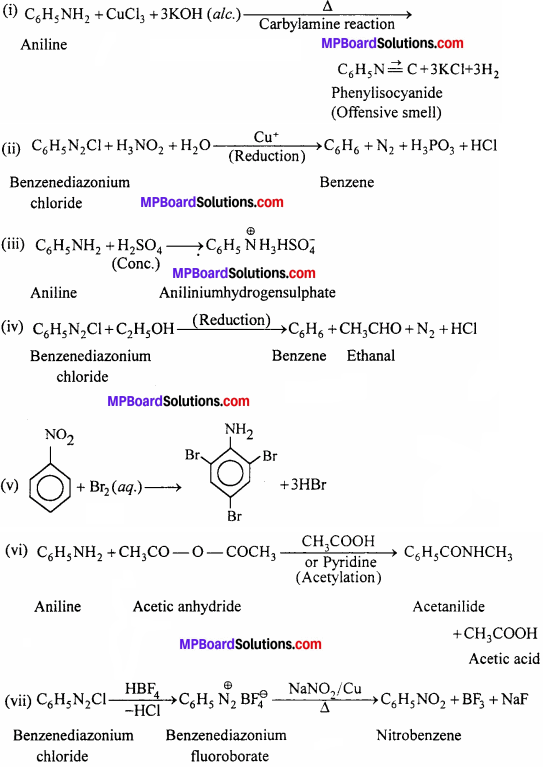
MP Board Solutions

Question 10.
Discuss the aims/object:s of financial management.
Or
Discuss some functions of financial management.
Answer:

1. Increase in profit: A :firm should always increase its revenues in order to maximize its value. It is a normal practice for a firm to formulate and implement all possible plans of expansion and take every opportunity to maximize profit.

2. Reduction in cost: Capital and equity funds are factor inputs in production. A firm has to take every effort to reduce cos t of capital and to launch economy drive in all of its operations.

3. Risk minimization : There Ls always a risk in carrying business activities. Element of risk will always remain in the business. Efforts are made so that these risks may be minimized.

4. Effective utilization of fund s : In financial management efforts are made to utilize the funds properly and to control the misuse of wastage of funds.

Question 11.
Discuss the factors determine working capital requirements of a business enterprises
Answer:
The factors which govern the amounts of working capital in a business are :

1. Nature of Business: Public: utilities and service organizations require little working capital as sales are on cash basis,. There is little time gap between production and sales and these enterprises do not maintain large stock of goods. In trading and manufacturing concerns, on the other hand large amount of working capital is needed to maintain stocks.

2. Size of the Business : The volume of business has a direct influence on working capital requirements. Large firms require greater working capital for investment in current assets and to pay current liabilities.

3. Production Cycle: The length or duration or production process also affects working capital requirement. Where production takes longer time, More working capital is
required because more funds are needed for raw material, labour and other expenses. On the other hand, smaller production cycle need less working capital.

4. Turnover of Working Capital: Turnover implies the speed with which the working capital circulates in business. The rate of turnover of working capital is measured by the ratio of sales to current assets. More rapid is the flow of working capital, lesser is the need for working capital.

5. Terms of Trade : The terms of business also have lot of bearing on working capital requirement. If raw material can be had on credit and finished goods are sold for cash then less working capital is needed. On the other hand., if purchases have to be made cash and sales are on credit, then business will need more working capital. This happens in most of the wholesale trading business where margins are less and to take benefit of cash discount, wholesalers purchase for cash but have to sell on credit to have more sales.

6. Cyclical and Seasonal Fluctuations : Business firms which are subject to business cycles and seasonal demand may need greater working capital. During depression, investment in stock and debtors may be high while in a boom sales tend to be quick and stocks are smaller.

Question 12.
Write any four characteristics of an ideal financial plan.
Answer:
Following should be the characteristics of an ideal financial plan :

  1. Simplicity : Financial plans should be made with the idea of simplicity. This simplicity must not effect working capacity.
  2. Complete: The financial plans must possess quality of compactness and complete.
  3. Cheaper : While making plans for acquiring capital it must be kept in mind that they should be cheap.
  4. Flexibility : For the success of any organization it must be kept in mind that all the plans are flexible in nature.

Question 13.
Write any four executive functions of financial management.
Answer:
Executive Functions : The finance manager performs certain executive functions which are as under.

1. Arrange/Organize Finance : A finance manager has to find and arrange the various sources of finance required for the enterprise so that, on the basis of the finance available, the operations of the enterprise may be carried on.

2. Allotment of Available Funds : The funds. available with the finance manager are meant for requirements of the entire enterprise. Therefore, it is the responsibility of the finance manager to allot funds as and where needed l in the enterprise.

3. Management of Assets : Under these are covered activities like purchase of cur-rent and fixed assets arrangements for their safety’, maintenance etc. which are carried on under the instructions of the finance manager. The finance manager has also to consider, before allotting funds, the use and justification for the funds in different departments.

4. To Organize Expenditure : The finance manager should prepare budget estimates for expenditure required in the entire enterprise and invest the same in a planned manner. For this, the finance manager has to consider the expenditure on pay, interest, taxes, development activities etc.

MP Board Solutions

Question 14.
Explain factors affecting the dividend decision.
Answer:
Dividend decision relates to distribution of profit to the shareholders and its retention in the business for meeting the future investment requirements.
How much of the profits earned by a company will be distributed as profit and how much will be retained in the business is affected by many factors. Some of the important factors are discussed as follows :

1. Earnings : Dividends are paid out of current and past year earnings. Therefore, earnings is a major determinant of the decision about dividend.

2. Stability: Of earnings other things remaining the same, a company having stable earning is in a position to declare higher dividends as against this, a company having unstable earnings is likely to pay. smaller dividend.

3. Growth Opportunities : Companies having good growth opportunities retain more money out of their earnings so as to finance the required investment. The dividend in growth companies is therefore, smaller than that in non-growth companies.

Question 15.
What qualities should be there in an ideal planning ?
Answer:
The success or failure of.any business enterprise depends upon effective financial planning. Following are the characteristics of best financial planning :

1. Simplicity : The financial plan should be such that it should be simple to manage the capital and easier to estimate the formation of capital. In future difficulties may arise in those financial plans where the formation of capital is a complex procedure. Thus financial plans should be understandable to all the persons concerned.

2. Flexibility : The financial plans of an enterprise should not be rigid. According to needs of enterprise and future uncertainties, financial plans should be such that necessary changes can be made.

3. Farsightedness : Financial plans should be made in such a manner that it should run for a long time. Capitalization should be such that fixed and current expenses of enterprise can be properly managed.

4. Liquidity : Financial planning should be such that it should maintain the balance between inflow and outflow of funds. It should make the liquid funds available throughout the year. Financial plan must ensure the maximum utilization of funds.

5. Utility : Whatever capital is invested in business must be properly utilized so that shareholders can receive proper dividend and investors will be attracted towards the enterprise. This will encourage them to invest more in the enterprise. All these provisions are made in the financial planning.

6. Wholeness : It is one of the important characteristic of financial planning that it should have the quality of wholeness. Wholeness means it should pay attention in every area of enterprise. If any area is left than it will cause loss in future.

Question 16.
What is Under Capitalisation ? Write its two causes.
Answer:
Under Capitalisation refers to the situation in which the company’s rate of profit is exceptionally have in relation to the return enjoyed by similar companies. The two causes are as :

  1. The enterprises has made excess provision for depreciation on its assets thereby creating secret reserves.
  2. It may have acquired assets at low prices due to depreciation. “

Question 17.
Capital structure decision is essentially optimization of risk-return relationship. Comment.
Answer:
Capital structure refers to the mix between owners and borrowed funds. It can be calculated as Debt/Equity.

Debt and equity differ significantly in their cost and riskiness for the firm. Cost of debt is lower than cost of equity for a firm because lender’s risk is lower than equity shareholder’s risk, since lenders earn on assured return and repayment of capital and therefore they should require a lower rate of return. Debt is cheaper but it is more risky for a business because payment of interest and the return of principal is obligatory for the business. Any default in meeting these commitments may force the business to go into liquidation. There is no such compulsion in case of equity, which is therefore, considered risk less for the business. Higher use of debt increases the fixed financial charges of a business, as a result increased. Use of debt increases the financial risk of a business.

Capital structure of a business thus, affects both the profitability and the financial risk. A capital structure will be said to be optimal when the proportion of debt and equity is such that it results in an increase in the value of the equity share.

MP Board Solutions

Question 18.
A capital budgeting decision is capable of changing the financial fortune of a business. Do you agree ? Why or why not ?
Answer:
Investment decision can be long term or short term. A long term Investment decision is also called a capital budgeting decision. It involves committing the finance on a long term basis, e.g., making investment in a new machine to replace an existing one or acquiring a new fixed assets or opening a new branch etc. These decisions are very crucial for any business. They affect its earning capacity over the long-term, assets of a firm, profitability and competitiveness, are all affected by the capital budgeting decisions, Moreover, these decisions normally involve huge amounts of investment and are irreversible except at a huge cost.

Therefore, once made, it is almost impossible for a business to wriggle out of such decisions. Therefore, they need to be taken with utmost career decisions must be taken by those who understand them comprehensively. A bad capital budgeting decision normally has the capacity to severely damage the financial fortune of a business.

Question 19.
Discuss the merits of equity shares. Write its characteristics.
Answer:
1. Fixed capital : These shares constitute a good source of fixed capital for a company as the company is not bound to return it during its life.

2. Flexible dividend policy: The rate of dividend on equity shares is not always fixed and definite. The company may skip dividend. A flexible dividend policy can be adopted in the case of equity shares.

3. Safety of the company : Equity share capital is safety wall for the company on the basis of which it can face any financial crisis easily.

4. Arrange additional capital: The company can raise long term loan on the,security of these shares and thus it can arrange additional capital.
Characteristics :

  1. On such shares rate of dividend is not fixed.
  2. Equity shareholders enjoy voting rights over the others.
  3. Equity shares are redeemed only at the time of liquidation.
  4. At the event of liquidation the equity capital is refunded only after the preference shares are paid back.
  5. Dividend of such shares are paid only after the preference dividend is paid.

Question 20.
What do you mean by capital budgeting ?
Answer:
Meaning : Capital budgeting is long financial decision making of the firm. It requires decision regarding the purchase of new assets taking into consideration the utility of various other uses of assets.
Characteristics :

  1. Its nature is to have heavy investment
  2. It increases long term profitability
  3. In its decision the risk factor is more
  4. It becomes difficult to change its decisions. ‘

Question 21.
Distinguish between Fixed capital and Working capital
Answer:
Differences between Fixed capital and Working capital:

Fixed capital

  1. Fixed capital is that capital which more or less remains permanently invested in business.
  2. It is known as long term capital. For example : Land, machine etc.
  3. There is very less liquidity in this capital because these are not easily meant for resale.
  4. Requirement of fixed capital depend on size of the enterprise.

Working capital

  1. This is the capital required to meet day to day expenses of the business.
  2. It is also known as short term capital.Like purchase of raw material, payment of salaries or wages.
  3. It is a liquid capital because flow of this capital does not slop suddenly.
  4. It is invested in production of goods.

Question 22.
What are the factors affecting fixed capital ?
Answer:
The various factors affecting fixed capital are :

  1. Nature of industry : Fixed capital requirement largely depends on the nature of industry. When there is a need of land, building, machinery etc. in industry, the need of capital increases.
  2. Nature of production : The requirement of fixed capital also depends on the nature of production, whether it is capital based or labour based.
  3. Scope of business : If business is only a buyer or only a seller the capital requirement is less and if it is both the capital needed is comparatively more.
  4. Expansion of business : If business is to be expanded in future then fixed capital is required in great sum. Due to modem machines and management the expenses increases. So capital requirement increases.
  5. Preliminary expenses: The need of fixed capital will increase if the promoters at the time of establishment of company speed more on salary of promoters, establishment expenses, purchase of patent etc.
  6. Attitude of management: If the manager wants to enter in the market as a major producer from. The very beginning than more fixed capital will be needed.

MP Board Solutions

Financial Management Long Answer Type Questions

Question 1.
Distinguish between Over capitalization and Under capitalization.
Answer:
Differences between Over capitalization and Under capitalization :

Question 2.
What are the sources of long term working capital ?
Answer:
Sources of Long-Term Working Capital (These are also the Sources of Fixed Capital).
Some part of working capital is permanently required in the organisation and its sources have also to be such which can provide capital for a long time. Following are the sources of long-term or permanent working capital:

1. Issue of shares : For procurement of permanent working capital both equity and preference shares can be issued but equity shares prove better because, unlike on preference shares, no dividend at fixed rate has to be paid.

2. Issue of debentures : Issue of debentures is also a preferred source of long-term working capital. Debentures are issued when it is felt that after sometime there will be lesser need of working capital. Money can be refunded by redeeming redeemable debentures. Equity share capital cannot be returned back during the life time of the company (except by buy back of shares). It proves better to raise permanent working capital partly by issue of equity shares and partly through issue of debentures so that money raised from issue of debentures can be returned back when not required.

3. Publishing back of profits : Reinvestment of profit, called ploughing back of profits, is an important source of raising permanent working capital. It is a free of charge method which does not create a burden on future profits of the business. As the company expands, the need for permanent working capital also increases. This need can be met by reinvesting profits in business; but to do so the management has to adopt a tight or conservative dividend policy and the shareholders have to make a sacrifice. This method can be adopted by profit making companies only.

4. Public deposits : Under this method companies accept deposits from public for medium period at attractive rates of interest. The defect of this method is that public will place deposits only in financially sound companies and there will be rush for withdrawals in cash of financial difficulties.

5. Loans from financial institutions : Various state governments and the central government have set-up specialised financial institutions which provide medium and long term loans to industries. These institutions have become major sources of finance of medium and large scale industries. Industrial Finance Corporation of India (IFCI), State Financial Corporations (SFCs), Industrial Development Bank of India (IDBI), Industrial Credit and Investment Corporation of India (ICICI), Life Insurance Corporation of India (LIC) and Unit Trust of India (UTI) are examples of such financial institutions.

MP Board Solutions

Question 3.
What are the causes of over capitalization ?
Answer:
Following are the causes of over capitalization :

1. More promotion expenditure : When in a company formation, over time is taken and over expences is done on un appropriate promotion then it gives rise to over capitalization promotion expenditure should be in accordance with the trading of company. When amount of capital is fixed more than acquired capital then over capitalization takes place.

2. Issue of over capital: When in a company more than required capital is issued then in a company more than requirement. When it is not used properly the problem of over capitalization.

3. Formation of company during inflation : When any company is formed during the period of inflation. During inflation it is expensive to purchase assets and they are not profitable to purchase in future. Whenever period of inflation is over the problem of over capitalization starts.

4. More income than expected at the time of promotion : When more income is expected at the time of promotion then over capitalization takes place.

Question 4.
Explain the types of working capital.
Answer:
There are two types of working capital:

1. Fixed or regular working capital: Some type of working capital is that which is required for the whole year. Arrangement of such type of capital is done permanantly through long term capital. Regular or working capital is required to maintain minimum stock, to keep minimum amount of cash in banks, wear and tear of business electricity, wages, salary etc. For general working of the business it is essential. By this capital business can make progress.

2. Seasonal or Variable working’capital: It is such type of capital which is used in a specific season in a year. This expenditure is goes on changing. Due to this reason, it is called seasonal or variable working capital.

For example, capital required to purchase woollen clothes in winter season, rainy materials before rainy season. The year in which more rainfall is there or more cold is there such products are sold on large scale. Thus proportion of capital increases.

Question 5.
What is the importance of working capital ?
Answer:

1. Prompt payment to suppliers and others : A business enterprise with sufficient working capital can make prompt payments to its suppliers and meet other liabilities promptly. It increases credit standing or reputation of the enterprise.

2. Can avail benefits of cash discounts : A business with sufficient working capital can avail cash discounts by making prompt payments to its creditors.

3. Garbing business opportunities : Adequate working capital enables Finns to take advantage of any favourable business opportunity like purchasing and storing raw material at low prices or executing special orders.

4. Increase in credit worthiness and goodwill : Availability of sufficient working capital is considered as sign of good financial position by creditors and banks and there is no difficulty in borrowing funds in case of need.

5. Distribution of dividend : If there are sufficient liquid assets with an organisation, it can afford to declare and distribute good dividends. A firm starved of working capital can not do so, it has to plough back its profits in business.

6. Facing emergencies : A company having sufficient working capital can overcome short-term financial difficulties and meet other emergencies.

MP Board Solutions

Question 6.
What are the disadvantages of equity shares ?
Answer:
Disadvantages of Equity Shares are :

1. Disruption in working : By exercising their rights in company meetings equity shareholders may cause disruption in smooth working of the company for their own gains.

2. Loosing benefit of trading on equity : By raising whole the capital through equity shares the company cannot take benefit of trading on equity. .

3. Danger of over capitalization : Excessive issue of equity shares may lead to over capitalization which is harmful for the company.

4. Loss of control on management: With the sale of equity shares, there is transfer of voting right also. If any group is able to acquire a large number of shares in the company, it may gain control over its affairs and the present management may be ousted.

5. Payment of high dividends : To attract investors in equity shares the management has to maintain high rate of divident. Dividend paid is not deductible as a business expense. All this makes equity shares method of raising finance a costly affair.

6. Difficulty in increasing share capital: If the authorised capital of the company has to be increased or some shares with special rights have to be issued, the consent of existing equity shareholders has to be obtained which is not an easy task always.

7. Uncertainty of income : From the viewpoint of investors, equity shares do not guarantee a regular income, the rate of dividend may vary each year and there may be non in some years.

8. Fall in value of shares : Due to speculation and other economic and political factors there may be fall in the value of equity shares which may cause financial loss to investors.

Question 7.
Write the advantages of preferential shares ?
Advantages of Preference Shares :

  1. Trading on equity is possible : As preference shareholders get dividend at fixed rate, trading on equity are available to equity shareholders.
  2. No burden on company : Though rate of dividend is fixed on preference shares but if profits in any year are insufficient, their payment can be postponed.
  3. Retaining control on management: As preference shareholders have limited voting rights, the management can get capital without granting any voting rights and, thus retain control over the company.
  4. No charge over assets of the company : Issue of preference shares creates no charge over assets of the company (as is the case when secured debentures are issued). The company can, therefore, utilize its assets for borrowing later.
  5. Flexibility : To get funds for medium term the company can issue redeemable preference shares adding flexibility to its capital structure.
  6. Cautious investors are attracted : By issuing preference shares, which offer special security, the company can raise capital from cautious investors, not willing to undertake risks.

MP Board Solutions

Question 8.
What is the bad effects of over capitalization on company ?
Answer:
Effects or demerits of over capitalization : The effects or demerits of over capitalization are as follows :

  1. Loss of goodwill
  2. Difficulty in obtaining capital
  3. Difficulty in obtaining loans
  4. It creates artificial high dividend rate
  5. Demand for winding up can be raised
  6. It is difficult to face competition
  7. Shareholders receive dividend at low rate
  8. The face value of shares reduces due to over capitalization
  9. Welfare facilities of employees is reduced
  10. It also affects the society as the prices of products increases
  11. Low quality of goods are provided to consumers
  12. It creates unemployment
  13. Frustration in economic system develops due to over capitalization.

Question 9.
What are the internal factors affecting the capital structure ?
Answer:
Internal Factors : The following internal factors affect capital structure :

1. Nature of business : The nature of business of an enterprise effects the business
most. Enterprises indulged in the process of manufacturing requires more fixed capital compared to working capital. While other business enterprises require more working capital than fixed capital. The enterprises which require more capital can form it through long term loans or shares while working capital can be formed through other sources.

2. Regularity and certainty of income : The regularity and certainty of income also affects the capital structure. Thus, according to estimated incomes capital structure should be formed. If enterprise has certainty of income then capital should be formed by issuing debentures, bonds and preference shares but when there is uncertain income, capital should be formed by issue of equity shares.

3. Future plans : In the capital structure of an enterprise the current needs as well as the future development plans should be also kept in mind, so that in future the required capital can be formed. First of all equity shares are issued and later on according to needs preference shares and debentures are issued. Thus, future plans affects capital structure.

4. Trading on equity : Trading on equity means borrowing funds at reasonable rates with the help of share capital. Trading on equity also affects the capital structure of an enterprise. It should be adopted by the enterprise which have regular income and have goodwill.

5. Structure of commercial assets : The enterprises in which the structure of commercial assets include more fixed capital, in its capital structure consists more share of long term loans and debentures while less share of share capital. But the structure of commercial which includes more current assets, in its capital structure consists of less long term loans.

6. Desire to control the business : Desire to control business also affects the capital structure. If funds are raised by issuing equity shares then the number of owners controlling the company increases. It will not be acceptable to existing shareholders. But when funds are raised through debt capital there is no effect on the control of company because debenture holders have no control over the affairs of enterprise.

7. Age of firm: The goodwill of a new enterprise is very less in the market and extent of risk is more. Thus, it is difficult for these type of firms to raise the capital. So these firms try to raise capital at their own risk. Later on when these enterprise increases the goodwill then it becomes easier to raise the funds.

Question 10.
What are the external factors of affecting capital structure ?
Answer:
External factors: The following external factors also affect the capital structure:

1. Conditions of capital market: The conditions of capital market also affects capital structure up to a certain extent. At the time of depression when rate of interest is low and chances of profit is uncertain then in place of shares, debentures are more popular.

2. Psychological condition of investors : The capital structure of an enterprise is affected by the nature and types of investors. The psychological conditions and risk facing ability of investors affects the capital structure. According to these conditions the various types of securities are issued.

3. Legal Provision : Capital structure is also influenced by the legal provisions or government regulations. The public issue of shares and debentures have to be made under SEBI guidelines.

4. Tax provisions : The tax rules and regulations of any country affects the capital structure.

Question 11.
Write the types of Financial planning.
Answer:
Following are the types of financial planning :

(1) Short term financial planning: Generally in a business planning is made for one year is called short term financial planning. In short term financial planning mainly working capital is used. Short term planning is the part of long term and mid term planning.

(2) Mid term financial planning: Mid term planning is that planning which is made for more than one year and less than five years. This type of planning is made for maintenance of business and for developmental work.

(3) Long term financial planning : Planning which is made for five years or more than five years is called Long-term financial planning. This type of planning is based on broad type of outlook. This type of planning is done for long term problems.

Question 12.
What do you mean by investment decisions ? Write the factors affecting investment decisions.
Answer:
It means the selection of best financing alternative or best investment alternative. Financial decision-making is concerned with three broad decisions. A firm’s resources are
scarce in comparison to the uses to which they can be put. A firm, therefore, has to choose where to invest these resources, so that they are able to earn the highest possible return for their investors.

The investment decision, therefore, relates to how the firm’s funds are invested in different assets. Factors which affect capital budgeting decisions :

(a) Cash flows of the project : When a company takes an investment decision involving huge amount it expects to generate some cash flows over a period. These cash flows are in the form of a series of cash receipts and payments over the life of an investment. The amount of these cash flows should be carefully analysed before considering a capital budgeting decision.

(b) The rate of return : The most important criterion is the rate of return of the project. These calculations are based on the expected returns from each proposal and the assessment of risk involved. Suppose, there are two projects A and B (with the same risk involved) with a rate of return of 10 percent and 12 percent, respectively, then under normal circumstance, project B will be selected.

(c) The investment criteria involved : The decision to invest in a particular project involves a number of calculations regarding the amount of investment, interest rate, cash flows and rate of return. There are different techniques to evaluate investment proposals which are known as capital budgeting techniques.These techniques are applied to each proposal before selecting a particular project.

MP Board Solutions

Question 13.
What is meant by working capital ? How is it calculated ? Discuss five important determinants of working capital requirements.
Answer:
Working capital is that part of total capital which is required to meet day-to-day expenses. To buy raw materials, to pay wages and other expensess of routine nature in the production process or we can say it refers to excess of current assets over current liabilities.
Working Capital = Current Assets-Current Liabilities
Factors affecting working capital requirement are :

(i) Nature of Business : The basic nature of a business influences the amount of working capital required. A trading organisation usually needs a lower amount of working capital compared to a manufacturing organisation. This is because in trading. There is no processing required. In a manufacturing business, however raw materials need to be converted into finished goods. Which increases the expenditure on raw material, labour and other expenses.

(ii) Scale of Operation : The firms which are operating on a higher scale of operations, the quantum of inventory, debtors required is generally high. Such organisations there fore, require large amount of working capital as compared to the organisations which operate on a lower scale.

(iii) Production Cycle : Production cycle is the time span between the receipts of raw materials and their conversion into finished goods. Some businesses have a longer production cycle while some have a shorter one. Working capital requirement is higher in terms with longer processing cycle and lower in firms with shorter processing cycle.

(iv) Credit Allowed : Different firms allow different credit terms to their customers. A liberal credit policy results in higher amount of debtors, increasing the requirements of working capital.

(v) Credit Availed : Just as a firm allows credit to its customers, it also may get credit from its suppliers. The more credit, a firm avails company may be profitable but short on cash. Availability of enough cash in the company is necessary for declaration of dividend by it.

MP Board Class 12 Business Studies Important Questions

MP Board Class 11th Physics Solutions Chapter 2 मात्रक एवं मापन

MP Board Class 11th Physics Solutions Chapter 2 मात्रक एवं मापन

मात्रक एवं मापन अभ्यास के प्रश्न एवं उनके उत्तर

प्रश्न 2.1.
रिक्त स्थान भरिए –

  1. किसी 1 cm भुजा वाले घन का आयतन …………… m3 के बराबर है।
  2. किसी 2 cm त्रिज्या व 10 cm ऊँचाई वाले सिलिंडर का पृष्ठ क्षेत्रफल …………. (mm)2 के बराबर है।
  3. कोई गाड़ी 18 km/h की चाल से चल रही है तो यह 1 s में ………….. m चलती है।
  4. सीसे का आपेक्षिक घनत्व 11.3 है। इसका घनत्व – g cm3 या …………. kg m3 है।.

उत्तर:
1. घन का आयतन = (भुजा)3 = (1 सेमी)3
= 9(\(\frac { 1 }{ 100 }\)मी) [∵ 1 सेमी = \(\frac { 1 }{ 100 }\)मी]

2. सिलिंडर का पृष्ठ क्षेत्रफल
= वक्र पृष्ठ का क्षे० x वृत्तीय सिरों का क्षे०
= 2nr (h + r)
= 2 x 3.14 x 2 सेमी (10 सेमी + 2 सेमी)
= 2 x 3.14 x 2 x 12 वर्ग सेमी
= 150.72 सेमी 2
= 150.72 x (10)2 वर्ग मिमी
= 1.5 x 10⁴ वर्ग मिमी

3. गाड़ी की चाल = 18 किमी/घण्टा
= 18 x 5 मी/सेकण्ड = 5 मीटर/सेकण्ड
∴ 1 सेकण्ड में चली दूरी = चाल x समय
= 5 मी/सेकण्ड x 1 सेकण्ड = 5 मीटर

4. सीसे का घनत्व
= सीसे का आपेक्षिक घनत्व x जल का घनत्व
= 11.3 x 1 ग्राम/सेमी3
= 11.3 ग्राम/सेमी3
= 113( \(\frac { 1 }{ 1000 }\) किग्रा)/(\(\frac { 1 }{ 100 }\)मीटर)3
= 1.13 x 10¹⁴ किग्रा प्रति मीटर3

MP Board Solutions

प्रश्न 2.2.
रिक्त स्थानों को मात्रकों के उचित परिवर्तन द्वारा भरिए

  1. 1 kg m2s2 =………. g cm2s2
  2. 1 m =………. ly
  3. 3.0 ms2 =…….. Kmh2
  4. G = 6.67 x 10¹¹ Nm2 (kg)2 = ……….. (cm)3 s2 g1

उत्तर:
1. 1 kg m2s2 = 1kg x 1 m2s2
= (100 gm) x (100 cm) 2 x 1 s2
= 10 gm cms-2 – 1 ly (light year) = 9.46 x 10¹⁵ मीटर

2. ∵ 1 मीटर = \(\frac { 1 }{ 9.46×10^{ 15 } } \) ly = 1.06 x 10¹⁶ ly

3. 3 m2 = 3 m x 1 s2
MP Board Class 11th Physics Solutions Chapter 2 मात्रक एवं मापन t
= 3.9 x 10⁴ km h2

4. G = 6.67 x 10¹¹ Nm2 (kg)2
= 6.67 x 10¹¹ Nm2 x (\(\frac { 1 }{ kg }\))2)
= 6.67 x 10¹¹ (kg ms2) x 1 m2 x (\(\frac { 1 }{ kg }\)2)
= 6.67 x 10¹¹ x m3s2) x \(\frac { 1 }{ kg }\)
= 6.67 x 10¹¹ x \(\frac { 1 }{ 1000 gm }\) x (100)3 x s2
= 6.67 x 10⁸(cm)3s2g1

प्रश्न 2.3.
ऊष्मा (परागमन में ऊर्जा ) का मात्रक कैलोरी है और यह लगभग 4.2 J के बराबर है। जहाँ 1 J = 1kg m2s2 मान लीजिए कि हम मात्रकों की कोई ऐसी प्रणाली उपयोग करते हैं जिससे द्रव्यमान का मात्रक α kg के बराबर है, लंबाई का मात्रक β m के बराबर है, समय का मात्रक γ s के बराबर है। यह प्रदर्शित कीजिए कि नए मात्रकों के पदों में कैलोरी का परिमाण 4.2 α 1β2 γ2 है।
उत्तर:
कैलोरी = 4.2 जूल = 4.2 किग्रा-मीटर प्रति सेकण्ड।
हम जानते हैं कि ऊर्जा का विमीय सूत्र = [ML2T2]
माना कि दो अलग-अलग मापन पद्धतियों के द्रव्यमान के मात्रक M1 व M2 लम्बाई के मात्रक L1 व L2 एवम् समय के मात्रक T1 व T2 है।

प्रश्नानुसार M1 = 1 किग्रा, L1 = 1 मीटर, T1=1 सेकण्ड, तथा M2 = α किग्रा, L2 = β मीटर, T2 = γ सेकण्ड
इस प्रकार u1 = [M1L21T12]
तथा u2 = [M2L22T22]
n1 = 4.2, n2 = ?
सूत्र n1u1 = n1u2 से,
MP Board Class 11th Physics Solutions Chapter 2 मात्रक एवं मापन 24

अर्थात् दूसरी मापन पद्धति में 1 कैलोरी का मान 4.2 α1 β2 γ2 है।

प्रश्न 2.4.
इस कथन की स्पष्ट व्याख्या कीजिए : तुलना के मानक का विशेष उल्लेख किए बिना “किसी विमीय राशि को बड़ा’ या ‘छोटा’ कहना अर्थहीन है।” इसे ध्यान में रखते हुए नीचे दिए गए कथनों को जहाँ कहीं भी आवश्यक हो, दूसरे शब्दों में व्यक्त कीजिए:

  1. परमाणु बहुत छोटे पिण्ड होते हैं।
  2. जेट वायुयान अत्यधिक गति से चलता है।
  3. बृहस्पति का द्रव्यमान बहुत ही अधिक है।
  4. इस कमरे के अंदर वायु में अणुओं की संख्या बहुत अधिक है।
  5. इलेक्ट्रॉन, प्रोटॉन से बहुत भारी होता है।
  6. ध्वनि की गति प्रकाश की गति से बहुत ही कम होती

उत्तर:
दिया गया कथन सत्य है। सामान्यत: हम कहते हैं कि परमाणु बहुत छोटा पिण्ड है। लेकिन इलेक्ट्रॉन परमाणु से भी छोटा कण है। तब यह भी कह सकते हैं कि इलेक्ट्रॉन की अपेक्षा परमाणु एक बड़ा पिण्ड है। जबकि टेनिस गेंद की तुलना में परमाणु बहुत छोटा पिण्ड है। इस प्रकार हम देखते हैं कि परमाणु को किसी एक वस्तु की अपेक्षा बहुत छोटा कह सकते है जबकि इलेक्ट्रॉन की तुलना में बड़ा पिण्ड का संकेत है।

  1. आलपिन की नोक की तुलना में परमाणु बहुत छोटे पिण्ड होते हैं।
  2. रेलगाड़ी की तुलना में जेट वायुयान अत्यधिक गति से चलता है।
  3. बृहस्पति का द्रव्यमान पृथ्वी की तुलना में बहुत अधिक होता है।
  4. इस कमरे के अन्दर वायु में अणुओं की संख्या वायु के एक ग्राम अणु में उपस्थित अणुओं से काफी अधिक है।
  5. यह कथन सही है।
  6. यह कथन सही है।

MP Board Solutions

प्रश्न 2.5.
लंबाई का कोई ऐसा नया मात्रक चुना गया है जिसके अनुसार निर्वात में प्रकाश की चाल 1 है। लम्बाई के नए मात्रक के पदों में सूर्य तथा पृथ्वी के बीच की दूरी कितनी है, प्रकाश इस दूरी को तय करने में 8 min और 20 s लगाता है।
उत्तर:
प्रश्नानुसार प्रकाश की चाल = 1 मात्रक प्रति सेकण्ड प्रकाश द्वारा लिया गया समय, t = 8 मिनट 20 सेकण्ड
= 8 x 60 + 20 = 500 सेकण्ड
∴ सूर्य एवम् पृथ्वी के मध्य दूरी
= प्रकाश की चाल x लिया गया समय
= 1 मात्रक प्रति सेकण्ड x 500 सेकण्ड
= 500 मात्रक

प्रश्न 2.6.
लंबाई मापने के लिए निम्नलिखित में से कौन – सा सबसे परिशुद्ध यंत्र है:

  1. एक वर्नियर कैलीपर्स जिसके वर्नियर पैमाने पर 20 विभाजन हैं।
  2. एक स्क्रूगेज जिसका चूड़ी अंतराल 1 mm और वृत्तीय पैमाने पर 100 विभाजन है।
  3. कोई प्रकाशिक यंत्र जो प्रकाश की तरंग दैर्ध्य की सीमा के अंदर लंबाई माप सकता है।

उत्तर:
1. वर्नियर कैलीपर्स का अल्पतमांक
MP Board Class 11th Physics Solutions Chapter 2 मात्रक एवं मापन 22

2. स्क्रूगेज की अल्पतमांक
MP Board Class 11th Physics Solutions Chapter 2 मात्रक एवं मापन 23

3. चँकि प्रकाशिक यन्त्र द्वारा प्रकाश की तरंग दैर्ध्य की सीमा के अन्दर लम्बाई मापी जा सकती है।
अतः इसकी अल्पतमांक
= 107 मीटर = 1015 सेमी
अर्थात् प्रकाशिक यन्त्र की अल्पतमांक सबसे कम है। इस कारण यह सर्वाधिक परिशुद्ध यन्त्र है।

प्रश्न 2.7.
कोई छात्र 100 आवर्धन के एक सूक्ष्मदर्शी के द्वारा देखकर मनुष्य के बाल की मोटाई मापता है। वह 20 बार प्रेक्षण करता है और उसे ज्ञात होता है कि सूक्ष्मदर्शी के दृश्य क्षेत्र में बाल की औसत मोटाई 3.5 mm है। बाल की मोटाई का अनुमान क्या है?
उत्तर:
हम जानते हैं कि, सूक्ष्मदर्शी की आवर्धन क्षमता
MP Board Class 11th Physics Solutions Chapter 2 मात्रक एवं मापन 21
अतः बाल की अनुमानित मोटाई = 0.035 मिमी।

प्रश्न 2.8.
निम्नलिखित के उत्तर दीजिए:

  1. आपको एक धागा और मीटर पैमाना दिया जाता है। आप धागे के व्यास का अनुमान किस प्रकार लगाएँगे?
  2. एक स्क्रूगेज का चूड़ी अंतराल 1.0 mm है और उसके वृत्तीय पैमाने पर 200 विभाजन हैं। क्या आप यह सोचते हैं कि वृत्तीय पैमाने पर विभाजनों की संख्या स्वेच्छा से बढ़ा देने पर स्क्रूगेज की यथार्थता में वृद्धि करना संभव है?
  3. वर्नियर कैलीपर्स द्वारा पीतल की किसी पतली छड़ का माध्य व्यास मापा जाना है। केवल 5 मापनों के समुच्चय की तुलना में व्यास के 100 मापनों के समुच्चय के द्वारा अधिक विश्वसनीय अनुमान प्राप्त होने की संभावना क्यों हैं?

उत्तर:
1. एक बेलनाकार छड़ लेकर, इसके ऊपर धागे को सटाकर लपेटते हैं। धागे के फेरों द्वारा घेरी गई छड़ की लम्बाई का मीटर पैमाने द्वारा माप लेते हैं। माना लपेटे गए फेरों की संख्या 20 है।
अत: धागे का व्यास =इस प्रकार धागे का व्यास ज्ञात हो सकता है।

2. हम जानते हैं कि स्क्रूगेज का अल्पतमांक
MP Board Class 11th Physics Solutions Chapter 2 मात्रक एवं मापन 20
प्रश्नानुसार स्क्रूगेज पर बने विभाजनों (भागों) की संख्या बढ़ा देने से, स्क्रूगेज का अल्पतमांक घटेगा अर्थात् यथार्थता बढ़ेगी।

3. हम जानते हैं कि, प्रेक्षणों की माध्य निरपेक्ष त्रुटि,
MP Board Class 11th Physics Solutions Chapter 2 मात्रक एवं मापन 20
उपरोक्त सूत्र के अनुसार प्रेक्षणों की संख्या बढ़ाने से माध्य निरपेक्ष त्रुटि घटेगी। अर्थात् अधिक प्रेक्षणों द्वारा प्राप्त, छड़ का माध्य व्यास अधिक विश्वसनीय होगा।

प्रश्न 2.9.
किसी मकान का फोटोग्राफ 35 mm स्लाइड पर 1.75 cm2 क्षेत्र घेरता है। स्लाइड को किसी स्क्रीन पर प्रक्षेपित किया जाता है और स्क्रीन पर मकान का क्षेत्रफल 1.55 m2 है। प्रक्षेपित्र -परदा व्यवस्था का रेखीय आवर्धन क्या
उत्तर:
दिया है: स्लाइड पर मकान का क्षेत्रफल = 1.75 वर्ग सेमी स्क्रीन पर मकान का क्षेत्रफल
= 1.55 वर्ग मीटर
= 1.55 x (100 सेमी)2
= 1.55 x 10000 सेमी2
= 15500 सेमी2

प्रश्न 2.10.
निम्नलिखित में सार्थक अंकों की संख्या लिखिए:

  1. 0.007 m2
  2. 2.64 x 1024 kg
  3. 0.2370 g cm
  4. 6.320 J
  5. 6.032 Nm2
  6. 0.0006032 m2

उत्तर:

  1. 1
  2. 3
  3. 4
  4. 4
  5. 4
  6. 4

MP Board Solutions

प्रश्न 2.11.
धातु की किसी आयताकार शीट की लंबाई, चौड़ाई व मोटाई क्रमशः 4.234 m, 1.005 m व 2.01 cm है। उचित सार्थक अंकों तक इस शीट का क्षेत्रफल व आयतन ज्ञात कीजिए।
उत्तर:
दिया है:
लम्बाई a = 4.234
मीटर चौड़ाई b = 1.005 मीटर
मोटाई c = 2.01 सेंटीमीटर
शीट का पृष्ठ क्षेत्रफल = 2 (ab + bc + ca)
= 2 [4.234 x 1.005 + 1.005 x 2.01 + 2.01 x 4.234]
= 8.7209478 मी2
= 8.72 मीटर2
चूँकि मोटाई में न्यूनतम सार्थक अंक (i.e., 3) है। शीट का आयतन = a x b x c
= 4.234 x 1.005 x 0.0201 मी3
= 0.0855 मीटर3

प्रश्न 2.12.
पंसारी की तुला द्वारा मापे गए डिब्बे का द्रव्यमान 2.300 kg है। सोने के दो टुकड़े जिनका द्रव्यमान 20.15 g व 20.17g है, डिब्बे में रखे जाते हैं।

  1. डिब्बे का कुल द्रव्यमान कितना है
  2. उचित सार्थक अंकों तक टुकड़ों के द्रव्यमानों में कितना अंतर हैं?

उत्तर:
1. दिया है : डिब्बे का द्रव्यमान m = 2.300 किग्रा
पहले टुकड़े का द्रव्यमान m1 = 20.15 ग्राम
= 0.02015 किग्रा
दूसरे टुकड़े का द्रव्यमान m2 = 20.17 ग्राम
= 0.02017 किग्रा
∴ टुकड़े रखने के बाद डिब्बे का कुल द्रव्यमान
M = m + m1 + m2
= 2.300 + 0.02015 + 0.02017
= 2.34032 किग्रा
चूँकि डिब्बे के द्रव्यमान में न्यूनतम सार्थक अंक 4 है। अतः डिब्बे के कुल द्रव्यमान का अधिकतम चार सार्थक अंकों में पूर्णांक करना चाहिए।
∴ कुल द्रव्यमान = 2.340 किग्रा

2. द्रव्यमानों में अन्तर
∆m = m2 – m1 = 20.17 – 20.15
= 0.02 ग्राम
चूँकि अधिकतम सार्थक अंक 4 हैं। अतः इनके अन्तर का दशमलव के दूसरे स्थान तक अर्थात् 0.02 ग्राम होगा।

प्रश्न 2.13.
कोई भौतिक राशि P, चार प्रेक्षण-योग्य राशियों a, b, c तथा d से इस प्रकार संबंधित हैं:
p = \(\frac { a^{ 3 }b^{ 2 } }{ (\sqrt { c } d) } \)
a, b, c तथा d के मापने में प्रतिशत त्रुटियाँ क्रमशः 1%, 3%,4% तथा 2% हैं। राशि Pमें प्रतिशत त्रुटि कितनी है? यदि उपर्युक्त संबंध का उपयोग करके Pका परिकलित मान 3.763 आता है, तो आप परिणाम का किस मान तक निकटन करेंगे?
उत्तर:
दिया है: P =p =\(\frac { a^{ 3 }b^{ 2 } }{ \sqrt { c } d} \)
P के मान में % त्रुटि
= \(\frac {∆p }{ p }\) x 100
= 3 x \(\frac {∆a }{ a }\) x 100 + 2 x \(\frac {∆b }{ b }\) x 100 + \(\frac { 1}{ 2 }\) x \(\frac {∆c }{ c }\) x 100 x \(\frac {∆d }{ d }\) x 100
= 3 x 1% + 2 x 3% +\(\frac { 1}{ 2 }\) x 4% + 2%
= 3% + 6% + 2% + 2%
= 13%
∴ \(\frac {∆p }{ p }\) = 13
∴ ∆P \(\frac { 13 x p}{ 100 }\)
= \(\frac { 13 x 3.763}{ 100}\)
= 0.4891
= 0.489 (उचित सार्थक अंक तीन तक)
अतः
P के मान में त्रुटि 0.489 है। इससे स्पष्ट है कि P के मान में दशमलव के पहले स्थान पर स्थित अंक ही संदिग्ध है। अर्थात् P के मान को दशमलव के दूसरे स्थान तक लिखना कार्य । अतः P के मान का दशमलव के पहले स्थान तक ही पूर्णांकन रना होगा।

MP Board Solutions

प्रश्न 2.14.
किसी पुस्तक में, जिसमें छपाई की अनेक टियाँ हैं,आवर्त गति कर रहे किसी कण के विस्थापन के चार भन्न सूत्र
दिए गए हैं:

  1. y = a sin 2nt / T
  2. y = a sin vt
  3. y = (a/T) sin tla
  4. y = (av2)(sin 2nt IT + cos 2nt IT)

(a = कण का अधिकतम विस्थापन, y = कण की चाल, “= गति का आवर्त काल)। विमीय आधारों पर गलत सूत्रों को निकाल दीजिए।
उत्तर:
किसी भी त्रिकोणमितीय फलन का कोण एक बमाहीन राशि होती है।

  1. सही है।
  2. ∵ vt विमाहीन नहीं है। अतः यह सूत्र गलत है।
  3. ∵ t / a विमाहीन नहीं है। अत: यह सूत्र गलत है।
  4. सही है।
    ∴ P का निकटतम मान =3.763 =33.8

प्रश्न 2.15.
भौतिकी का एक प्रसिद्ध संबंध किसी कणके ‘चल द्रव्यमान (moving mass)’ m, ‘विराम द्रव्यमान (rest mass) m0 इसकी चाल , और प्रकाश की चाल के बीच है। (यह संबंध सबसे पहले अल्बर्ट आइंस्टाइन के विशेष आपेक्षिकता के सिद्धांत के परिणामस्वरूप उत्पन्न हुआ था।) कोई छात्र इस संबंध को लगभग सही याद करता है लेकिन स्थिरांक c को लगाना भूल जाता है। वह लिखता है:
MP Board Class 11th Physics Solutions Chapter 2 मात्रक एवं मापन 20
अनुमान लगाइए कि c कहाँ लगेगा?
उत्तर:
दिया है:
MP Board Class 11th Physics Solutions Chapter 2 मात्रक एवं मापन 20
(1 – v2)1/2 = \(\frac { m_{ 0 } }{ m } \)
यहाँ दायाँ पक्ष विमाहीन है जबकि बायाँ पक्ष विमापूर्ण है। अतः सूत्र के सही होने के लिए बायाँ पक्ष भी विमाहीन होना है। अर्थात् (1-v2)1/22 के स्थान पर ((1 – v2)/c2)1/2 होना चाहिए।
MP Board Class 11th Physics Solutions Chapter 2 मात्रक एवं मापन 16

प्रश्न 2.16.
परमाण्विक पैमाने पर लम्बाई का सुविधाजनक मात्रक एंगस्ट्रम है और इसे Å : 1 Å= 1010 m द्वारा निर्दिष्ट किया जाता है। हाइड्रोजन के परमाणु का आमाप लगभग 0.5 Å है। हाइड्रोजन परमाणुओं के एक मोल का m’ में कुल आण्विक आयतन कितना होगा?
उत्तर:
हाइड्रोजन के एक अणु में दो परमाणु होते हैं।
∴ एक हाइड्रोजन अणु की त्रिज्या (r) = 1 हाइड्रोजन परमाणु . का आमाप
= 0.5 Å = 0.5 x 10¹⁰ मीटर
∴ एक हाइड्रोजन अणु का आयतन
\(\frac { 4 }{ 3 }\) πr3
= \(\frac { 4 }{ 3 }\) x 3.14 x 10.5 x 1010 मी3
= 5.23 x 1031 मीटर3
∴ 1 मोल हाइड्रोजन गैस में अणुओं की संख्या
= 6.023 x 10²³
∴ 1 मोल हाइड्रोजन गैस में आण्विक आयतन  = अणुओं की संख्या – एक अणु का आ०
= 6.023 x 1023 x 5.23 x 1031 मीटर
= 3.15 x 10⁷ मीटर3

प्रश्न 2.17.
किसी आदर्श गैस का एक मोल (ग्राम अणुक)मानक ताप व दाब पर 22.4L आयतन (ग्राम अणुक आयतन) घेरता है। हाइड्रोजन के ग्राम अणुक आयतन तथा उसके एक मोल के परमाण्विक आयतन का अनुपात क्या है? (हाइड्रोजन के अणु की आमाप लगभग Å मानिए)। यह अनुपात इतना अधिक क्यों है?
उत्तर:
∵1 मोल हाइड्रोजन गैस का NTP पर आयतन
= 22.4 लीटर
= 22.4 x 10³ मीटर3
जबकि 1 मोल हाइड्रोजन गैस का NTP पर परमाण्विक आयतन = 3.15 x 10⁷ मीटर3
MP Board Class 11th Physics Solutions Chapter 2 मात्रक एवं मापन 16
= 7.11 x 10⁴
इस अनुपात का मान अधिक होने का कारण है कि गैस का आयतन उसमें उपस्थित अणुओं के वास्तविक आयतन की अपेक्षा बहुत अधिक होता है। अर्थात् गैस के अणुओं के मध्य बहुत अधिक खाली स्थान होता है।

प्रश्न 2.18.
इस सामान्य प्रेक्षण की स्पष्ट व्याख्या कीजिए : यदि आप तीव्र गति से गतिमान किसी रेलगाड़ी की खिड़की से बाहर देखें तो समीप के पेड़, मकान आदि रेलगाड़ी की गति की विपरीत दिशा में तेजी से गति करते प्रतीत होते हैं, परन्तु दूरस्थ पिण्ड (पहाड़ियाँ, चंद्रमा, तारे आदि) स्थिर प्रतीत होते हैं। (वास्तव में, क्योंकि आपको ज्ञात है कि आप चल रहे हैं, इसलिए, ये दूरस्थ वस्तुएँ आपको अपने साथ चलती हुई प्रतीत होती हैं)।
उत्तर:
किसी वस्तु का हमारे सापेक्ष गति करते हुए प्रतीत होना, हमारे सापेक्ष वस्तु के कोणीय वेग पर निर्भर करता है। जबकि गाड़ी से यात्रा करते समय सभी वस्तुएँ समान वेग से हमारे पीछे की ओर गतिमान रहती है लेकिन समीप स्थित वस्तुओं का हमारे सापेक्ष कोणीय वेग ज्यादा होता है। अर्थात् वे वस्तुएँ तीव्र गति से पीछे की ओर जाती हुई प्रतीत होती हैं जबकि दूर स्थित वस्तुएँ हमारे सापेक्ष, कम कोणीय वेग से चलती हैं। इस प्रकार वे हमें लगभग स्थिर नजर आती हैं।

प्रश्न 2.19.
समीपी तारों की दूरियाँ ज्ञात करने के लिए अनुभाग 2.3.1 में दिए गए’लंबन’ के सिद्धांत का प्रयोग किया जाता है। सूर्य के परितः अपनी कक्षा में छः महीनों के अंतराल पर पृथ्वी की अपनी दो स्थानों को मिलाने वाली, आधार रेखा AB है। अर्थात् आधार रेखा पृथ्वी की कक्षा के व्यास = 3 x 10¹¹ m के लगभग बराबर है। लेकिन, चूँकि निकटतम तारे भी इतने अधिक दूर हैं कि इतनी लंबी आधार रेखा होने पर भी वे चाप के केवल 1′ (सेकंड, चाप का) की कोटि का लंबन प्रदर्शित करते हैं। खगोलीय पैमाने पर लंबाई का सुविधाजनक मात्रक पारसेक है। यह किसी पिण्ड की वह दूरी है जो पृथ्वी से सूर्य तक की दूरी के बराबर आधार रेखा के दो विपरीत किनारों से चाप के 1′ का लंबन प्रदर्शित करती है। मीटरों में एक पारसेक कितना होता है?
उत्तर:
दिए गए चित्र में S सूर्य तथा E पृथ्वी है। पृथ्वी बिन्दु Pसे 1 पारसेक की दूरी पर है। पृथ्वी की कक्षा की त्रिज्या
MP Board Class 11th Physics Solutions Chapter 2 मात्रक एवं मापन 14
प्रश्नानुसार रेखाखण्ड SE, बिन्दु P पर 1′ पर 1′ का कोण अन्तरित करता है।
इस प्रकार, ∠SPE =1” = (\(\frac { 1 }{ 60 x 60}\))0
= \(\frac { 1 }{ 3600}\) x \(\frac { π }{ 180}\) रेडियन
∠SPE के छोटा होने के कारण PS तथा PE लगभग सम्पाती होंगी।
MP Board Class 11th Physics Solutions Chapter 2 मात्रक एवं मापन 13

प्रश्न 2.20.
हमारे सौर परिवार से निकटतम तारा 4.29 प्रकाश वर्ष दूर है। पारसेक में यह दूरी कितनी है? यह तारा (एल्फा सेंटौरी नामक) तब कितना लंबन प्रदर्शित करेगा जब इसे सूर्य के परितः अपनी कक्षा में पृथ्वी के दो स्थानों से जो छः महीने के अन्तराल पर है, देखा जाएगा?
उत्तर:
तारे की सौर परिवार से दूरी = 4.29 प्रकाश वर्ष
= 4.29 x 9.46 x 1015 मीटर
MP Board Class 11th Physics Solutions Chapter 2 मात्रक एवं मापन 12
अभीष्ट लम्बन = 2 Q
= 2 x तारे की सौर परिवार से दूरी
= 1.32 x 2 = 2.64 सेकण्ड चाप का।

प्रश्न 2.21.
भौतिक राशियों का परिशुद्ध मापन विज्ञान की आवश्यकताएँ हैं। उदाहरण के लिए, किसी शत्रु के लड़ाकू जहाज की चाल सुनिश्चित करने के लिए बहुत ही छोटे समय-अंतरालों पर इसकी स्थिति का पता लगाने की कोई यथार्थ विधि होनी चाहिए। द्वितीय विश्व युद्ध में रेडार की खोज के पीछे वास्तविक प्रयोजन यही था। आधुनिक विज्ञान के उन भिन्न उदाहरणों को सोचिए जिनमें लंबाई, समय द्रव्यमान आदि के परिशुद्ध मापन की आवश्यकता होती है। अन्य जिस किसी विषय में भी आप बता सकते हैं, परिशुद्धता की मात्रात्मक धारणा दीजिए।
उत्तर:

  1. द्रव्यमान का मापन – द्रव्यमान स्पेक्ट्रम लेखी द्वारा परमाणुओं के द्रव्यमान का परिशुद्ध मापन किया जाता है।
  2. लम्बाई का मापन – विभिन्न यौगिकों के क्रिस्टलों में परमाणुओं के मध्य की दूरी का मापन करने के लिए लम्बाई के परिशुद्ध मापन की आवश्यकता होती है।
  3. समय का मापन – फोको विधि से किसी माध्यम में प्रकाश की चाल निकालने के प्रयोग में समय के परिशुद्ध मापन की आवश्यकता होती है।

प्रश्न 2.22.
जिस प्रकार विज्ञान में परिशुद्ध मापन आवश्यक है, उसी प्रकार अल्पविकसित विचारों तथा सामान्य प्रेक्षणों को उपयोग करने वाली राशियों के स्थूल आंकलन कर सकना भी उतना ही महत्त्वपूर्ण है। उन उपायों को सोचिए जिनके द्वारा आप निम्नलिखित का अनुमान लगा सकते हैं : (जहाँ अनुमान लगाना कठिन है वहाँ राशि की उपरिसीमा पता लगाने का प्रयास कीजिए।

  1. मानसून की अवधि में भारत के ऊपर वर्षाधारी मेघों का कुल द्रव्यमान।
  2. किसी हाथी का द्रव्यमान।
  3. किसी तूफान की अवधि में वायु की चाल।
  4. आपके सिर के बालों की संख्या।
  5. आपकी कक्षा के कमरे में वायु के अणुओं की संख्या।

उत्तर:
1. भारत में कुल वर्षा का द्रव्यमान = बादल का द्रव्यमान
= औसत वर्षा x भारत का क्षेत्रफल – जल का घनत्व
= 10 सेमी x 3.3 x 10¹² मीटर2 x 10³ किग्रा मीटर3
= 3.3 x 10¹⁴ किग्रा

2. हाथी का द्रव्यमान लीवर के सिद्धान्त द्वारा निकाला जा सकता है। यह लगभग 3000 किग्रा होता है।

3. किसी तूफान की अवधि में वायु द्वारा उत्पन्न दाब को मापकर, वायु की चाल ज्ञात की जा सकती है। तूफान की चाल लगभग 80 किमी प्रति घण्टा होती है। यह चाल 300 किमी प्रति घण्टा से अधिक भी हो सकती है।

4. मनुष्य के बालों की संख्या
MP Board Class 11th Physics Solutions Chapter 2 मात्रक एवं मापन 11
हम जानते हैं : बाल की मोटाई t = 5 x 10³ सेमी तथा मनुष्य के सिर की औसत त्रिज्या =8 सेमी
MP Board Class 11th Physics Solutions Chapter 2 मात्रक एवं मापन 10

5. वायु के 1 मोल का NTP पर आयतन = 22.4 लीटर
= 22.4 x 10³मीटर3
माना कक्षा के कमरे का आयतन = V
= 5 x 4 x 3 (माना)
= 60 मी3
∴ कक्षा के कमरे में गैस अणुओं की संख्या कक्षा के कमरे का आ०
MP Board Class 11th Physics Solutions Chapter 2 मात्रक एवं मापन 9

प्रश्न 2.23.
सूर्य एक ऊष्म प्लाज्मा (आयनीकृत पदार्थ) है। जिसके आंतरिक क्रोड का ताप 107 K से अधिक और बाह्य पृष्ठ का ताप लगभग 6000 K है। इतने अधिक ताप पर कोई भी पदार्थ ठोस या तरल प्रावस्था में नहीं रह सकता। आपको सूर्य का द्रव्यमान घनत्व किस परिसर में होने की आशा है? क्या यह ठोसों, तरलों या गैसों के घनत्वों के परिसर में है? क्या आपका अनुमान सही है, इसकी जाँच आप निम्नलिखित आंकड़ों के आधार पर कर सकते हैं : सूर्य का द्रव्यमान = 2.0 x 1030 kg; सूर्य की त्रिज्या = 7.0 x 10⁸ ml
उत्तर:
दिया है : M = 2 x 1030 किग्रा,
R=7.0 x 10⁸ मीटर
MP Board Class 11th Physics Solutions Chapter 2 मात्रक एवं मापन 8
सूर्य का द्रव्यमान द्रवों/ठोस के घनत्व परिसर में होता है। यह गैसों के घनत्वों के परिसर में नहीं होता है। सूर्य की भीतरी पर्तों के कारण बाहरी पर्तों पर अंतर्मुखी गुरुत्वाकर्षण बल के कारण ही गर्म प्लाज्मा का इतना अधिक घनत्व हो जाता है।

प्रश्न 2.24.
जब बृहस्पति ग्रह पृथ्वी से 8247 लाख किलोमीटर दूर होता है, तो इसके व्यास की कोणीय माप 35.72” की चाप है। बृहस्पति का व्यास परिकलित कीजिए।
उत्तर:
दिया है : पृथ्वी से बृहस्पति की दूरी =d
= 824.7 x 10¹⁶ किमी
θ = 35.72″
= 35.72 x 4.85 x 106 रेडियन
बृहस्पति का व्यास, D = ?
MP Board Class 11th Physics Solutions Chapter 2 मात्रक एवं मापन 7
D = θ x d
= 35.72 x 4.85 x 106 x 824.7 x 106
= 1.429 x 10⁵ किमी।

MP Board Solutions

प्रश्न 2.25.
वर्षा के समय में कोई व्यक्ति चाल के साथ तेजी से चला जा रहा है। उसे अपने छाते को टेढ़ा करके ऊर्ध्व के साथ एकोण बनाना पड़ता है। कोई विद्यार्थी कोण θ व v के बीच निम्नलिखित संबंध व्युत्पन्न करता है:
tan θ = v
और वह इस संबंध के औचित्य की सीमा पता लगाता है : जैसी कि आशा की जाती है यदि v → 0 तो θ → 0 (हम यह मान रहे हैं कि तेज हवा नहीं चल रही है और किसी खड़े व्यक्ति के लिए वर्षा ऊर्ध्वाधरतः पड़ रही है)। क्या आप सोचते हैं कि यह संबंध सही हो सकता है? यदि ऐसा नहीं हो तो सही संबंध का अनुमान लगाइए।
उत्तर:
दिया है : tan θ = v
यह सम्बन्ध असत्य है क्योंकि इस सम्बन्ध में बायाँ पक्ष विमाहीन है जबकि दाएँ पक्ष की विमा [LT1] है। अतः दाएँ पक्ष में वर्षा की बूंदों के वेग से भाग देना चाहिए।
∴सही सम्बन्ध tan θ = \(\frac { v }{ u}\) होगा।

प्रश्न 2.26.
यह दावा किया जाता है कि यदि बिना किसी बाधा के 100 वर्षों तक दो सीज़ियम घड़ियों को चलने दिया जाए, तो उनके समयों में केवल 0.02 s का अंतर हो सकता है। मानक सीज़ियम घड़ी द्वारा 15 के समय अंतराल को मापने में यथार्थता के लिए इसका क्या अभिप्राय है?
उत्तर:
कुल समय = 100 वर्ष
= 100 x 365 x 24 x 60 x 60 सेकण्ड
समय में अन्तर = 0.2 सेकण्ड
∴ 1 सेकण्ड के मापन में त्रुटि
= \(\frac { ∆T}{ T }\)
= \(\frac { 0.2}{ 100 x 365 x 24 x 60 x 60 }\)
= 6.34×1012
= 1011
\(\frac { 1 }{ 10^{ 11 } } \)
अर्थात् सीजियम घड़ी द्वारा 1 सेकण्ड में मापने में, 1011 में से 1 भाग की परिशुद्धता होती है।

प्रश्न 2.27.
एक सोडियम परमाणु का आमाप लगभग 2.5 A मानते हुए उसके माध्य द्रव्यमान घनत्व का अनुमान लगाइए। (सोडियम के परमाण्वीय द्रव्यमान तथा आवोगाद्रो संख्या के ज्ञात मान का प्रयोग कीजिए।) इस घनत्व की क्रिस्टलीय प्रावस्था में सोडियम के घनत्व 970 kg m3 के साथ तुलना कीजिए। क्या इन दोनों घनत्वों के परिमाण की कोटि समान है? यदि हाँ, तो क्यों? ।
उत्तर:
दिया है: सोडियम परमाणु की त्रिज्या (आमाप)
= 2.5 A = 2.5 x 10¹⁰ मीटर
सोडियम का ग्राम परमाणु भार = 23 ग्राम
= 23 x 103 किग्रा
एक ग्राम परमाणु में परमाणुओं की संख्या
= N = 6.023 x 10²³
सोडियम के एक परमाणु का द्रव्यमान
MP Board Class 11th Physics Solutions Chapter 2 मात्रक एवं मापन 6

प्रश्न 2.28.
नाभिकीय पैमाने पर लंबाई का सुविधाजनक मात्रक फर्मी है : (1f= 1015 m)। नाभिकीय आमाप लगभग निम्नलिखित आनुभविक संबंध का पालन करते हैं :
r = r0A1/3
जहाँ नाभिक की त्रिज्या,A इसकी द्रव्यमान संख्या और r0 कोई स्थिरांक है जो लगभग 1.2f के बराबर है। यह प्रदर्शित कीजिए कि इस नियम का अर्थ है कि विभिन्न नाभिकों के लिए नाभिकीय द्रव्यमान घनत्व लगभग स्थिर है। सोडियम नाभिक के द्रव्यमान घनत्व का आंकलन कीजिए।

प्रश्न 2.29.
लेसर (LASER), प्रकाश के अत्यधिक तीव्र एकवर्णी तथा एकदिश किरण – पुंज का स्त्रोत है। लेसर के इन गुणों का लंबी दूरियाँ मापने में उपयोग किया जाता है। लेसर को प्रकाश के स्त्रोत के रूप में उपयोग करते हुए पहले ही चंद्रमा की पृथ्वी से दूरी परिशुद्धता के साथ ज्ञात की जा चुकी है। कोई लेसर प्रकाश किरण-पुंज चंद्रमा के पृष्ठ से परावर्तित होकर 2.56 s में वापस आ जाता है। पृथ्वी के परितः चंद्रमा की कक्षा की त्रिज्या कितनी है?
उत्तर:
दिया है : लेसर प्रकाश द्वारा लिया गया समय, t = 2.56 सेकण्ड
माना चन्द्रमा की कक्षा की त्रिज्या = r
अत: लेसर प्रकाश द्वारा चली दूरी = 2r
प्रकाश की चाल, c = 3 x 10⁸ मीटर/सेकण्ड
MP Board Class 11th Physics Solutions Chapter 2 मात्रक एवं मापन 3
=3.84 x 10⁸ मीटर
=3.8 x 10⁵ किमी

प्रश्न 2.30.
जल के नीचे वस्तुओं को ढूँढ़ने व उनके स्थान का पता लगाने के लिए सोनार (SONAR) में पराश्रव्य तरंगों का प्रयोग होता है। कोई पनडुब्बी सोनार से सुसज्जित है। इसके द्वारा जनित अन्वेषी तरंग और शत्रु की पनडुब्बी से परावर्तित इसकी प्रतिध्वनि की प्राप्ति के बीच काल विलंब 77.0 s है। शत्रु की पनडुब्बी कितनी दूर है? (जल में ध्वनि की चाल
= 1450 ms1)
उत्तर:
दिया है : ध्वनि द्वारा लिया गया समय = 77 सेकण्ड
जल में ध्वनि की चाल = 1450 मीटर/सेकण्ड
माना पनडुब्बी की दूरी = x
∴ ध्वनि तरंगों द्वारा चली गई दूरी = 2x
MP Board Class 11th Physics Solutions Chapter 2 मात्रक एवं मापन l
या
x = \(\frac {1450×77 }{ 2 }\)
= 55825 मीटर
= 55.83 x 10³ मीटर
= 55.83 किमी

प्रश्न 2.31.
हमारे विश्व में आधुनिक खगोलविदों द्वारा खोजे गए सर्वाधिक दूरस्थ पिण्ड इतनी दूर हैं कि उनके द्वारा उत्सर्जित प्रकाश को पृथ्वी तक पहुँचने में अरबों वर्ष लगते हैं। इन पिंडों (जिन्हें क्वासर (Quasar) कहा जाता है) के कई रहस्यमय लक्षण हैं जिनकी अभी तक संतोषजनक व्याख्या नहीं की जा सकी है। किसी ऐसे क्वासर की km में दूरी ज्ञात कीजिए जिससे उत्सर्जित प्रकाश को हम तक पहुँचने में 300 करोड़ वर्ष लगते हों।
उत्तर:
लिया गया समय, t = 3 x 10⁹ वर्ष
= 3 x 109 x 365 x 24 x 60 x 60 सेकण्ड
प्रकाश की चाल c = 3 x 10⁸ मीटर/सेकण्ड
माना क्वासर की पृथ्वी से दूरी = x
∴ x = चाल x समय
= 3 x 108 x 3 x 109 x 365 x 24 x 60 x 60
= 2.84 x 10²² किमी

MP Board Solutions

प्रश्न 2.32.
यह एक विख्यात तथ्य है कि पूर्ण सूर्यग्रहण की अवधि में चंद्रमा की चक्रिका सूर्य की चक्रिका को पूरी तरक ढक लेती है। इस तथ्य और उदाहरण 2.3 और 2.4 से एकत्र सूचनाओं के आधार पर चंद्रमा का लगभग व्यास ज्ञात कीजिए।
उत्तर:
दिया है : चन्द्रमा की पृथ्वी से दूरी
(a) = 3.84 x 10⁸ मीटर
माना चन्द्रमा का व्यास = 2r
सूत्र कोणीय व्यास = 4 से
चन्द्रमा का कोणीय व्यास = \(\frac { d }{ 3.84×10^{ 8 } } \) रेडियन
= \(\frac { d }{ 3.84×10^{ 8 } } \) x \(\frac { 180 }{ π }\) x 60 x 60
प्रश्नानुसार पूर्ण सूर्य ग्रहण की अवधि में चन्द्रमा की चक्रिका सूर्य की चक्रिका को पूरा ढक लेती हैं।
∴ चन्द्रमा का कोणीय व्यास = सूर्य का कोणीय व्यास
∴d = \(\frac { 1920×3.84×10^{ 8 }π }{ 180x60x60 } \) मीटर
= 3.573 x 10⁶ मीटर
= 3573 x 103 मीटर
= 3573 किमी
अतः चन्द्रमा का व्यास 3573 किमी है।

प्रश्न 2.33.
इस शताब्दी के एक महान भौतिकविद (पी० ए० एम० डिरैक) प्रकृति के मूल स्थिरांकों (नियतांकों) के आंकिक मानों के साथ क्रीड़ा में आनंद लेते थे। इससे उन्होंने एक बहुत ही रोचक प्रेक्षण किया। परमाण्वीय भौतिकी के मूल नियतांकों (जैसे इलेक्ट्रॉन का द्रव्यमान, प्रोटॉन का द्रव्यमान तथा गुरुत्वीय नियतांक G) से उन्हें पता लगा कि वे एक ऐसी संख्या पर पहुंच गए हैं जिसकी विमा समय की विमा है। साथ ही, यह एक बहुत ही बड़ी संख्या थी और इसका परिमाण विश्व की वर्तमान आकलित आयु (~1500 करोड़ वर्ष) के करीब है। इस पुस्तक में दी गई मूल नियतांकों की सारणी के आधार पर यह देखने का प्रयास कीजिए कि क्या आप भी यह संख्या (या और कोई अन्य रोचक संख्या जिसे आप सोच सकते हैं) बना सकते हैं? यदि विश्व की आयु तथा इस संख्या में समानता महत्वपूर्ण है, तो मूल नियतांकों की स्थिरता किस प्रकार प्रभावित होगी?
उत्तर:
MP Board Class 11th Physics Solutions Chapter 2 मात्रक एवं मापन 1

MP Board Class 11 Physics Solutions

MP Board Class 12th Business Studies Important Questions Chapter 8 Controlling

MP Board Class 12th Business Studies Important Questions Chapter 8 Controlling

Controlling Important Questions

Controlling Objective Type Questions

Question 1.
Choose the correct answer :

Question 1.
Controlling is which level of management function :
(a) First
(b) Second
(c) Middle
(d) Last
Answer:
(d) Last

Question 2.
Control is related to :
(a) Result
(b) Work
(c) Effects
(d) All the above.
Answer:
(a) Result

Question 3.
Planning and Control are :
(a) Completely different
(b) Adverse to each other
(c) Similar to each other
(d) Interrelated activities.
Answer:
(d) Interrelated activities.

Question 4.
Out of the following which is not a technique of control:
(a) Exceptional control
(b) Budgetary control
(c) Cost control
(d) Punishable control.
Answer:
(d) Punishable control

Question 5.
Control is:
(a) Negative process
(d) Positive process
(c) Re-formative process
(d) None of these.
Answer:
(c) Re-formative process

Question 6.
What is the first step of controlling:
(a) Budget preparation
(b) To lay down proportion
(c) Evaluation of performance
(d) Identification of deviations.
Answer:
(a) Budget preparation

Question 7.
What is the aim of control:
(a) To estimate production
(b) Arrangement of financial resources
(c) Evaluation of actual performance
(d) All the above.
Answer:
(c) Evaluation of actual performance

Question 8.
Control Process is :
(a) Continuous
(b) Primary
(c) Planning
(d) Essential.
Answer:
(a) Continuous

Question 2.
Fill in the blanks :

  1. The work of……………….. is to see whether the works are in conformity to plans or not.
  2. ………………..is forward looking……………….. and is backward looking.
  3. In control process it is……………….. that all the work is processing/done as per plans.
  4. Effective control is related to ………………..
  5. In control standard work is compared with………………..
  6. ………………..steps are taken in controlling process.
  7. In control process……………….. points are marked.
  8. Control is useful in controlling ………………..
  9. Control process of business enterprise is helpful for……………….. operations of business.

Answer:

  1. Control
  2. Planning, Controlling
  3. Evaluating test
  4. Results
  5. Actual work,
  6. Corrective
  7. Weak
  8. Wastage
  9. Skilled.

MP Board Solutions

Question 3.
Write the answer in one word/sentence :

  1. In controlling actual performance is compared with.
  2. Name the remedial measures taken to correct deviations in process of control.
  3. Write the technique of control.
  4. Name the technique of control in which the exceptional works are only informed to managers ?
  5. Which technique of control is adopted for departments related with finance ?
  6. To determine the work standard is which step of control ?
  7. Write one advantage of control by exception.
  8. What is Budgeting ?
  9. What do you mean by control through budgeting ?
  10. On what function of management control depends ?

Answer:

  1. Standard performance
  2. Corrective action
  3. Auditing
  4. Exceptional control
  5. Auditing
  6. To determine the work standard is the 1st step of control
  7. By control by exception time is saved
  8. Budgeting is a process by which budget is controlled.
  9. by controlling through budgeting we mean the comparison between the budget provision and the actual goals set
  10. control depends on planing

Question 4.
Write true or false :

  1. Control is the primary function of management.
  2. In control actual performance is compared with standard performance.
  3. Control is the last function of management.
  4. Control provides security from risk.
  5. Control does not need at all levels of management.
  6. Deviation is always positive.
  7. Control should be rigid.
  8. Control is both positive and negative.
  9. Control is a continuous process.
  10. Control can be done for present and future activities only.

Answer:

  1. True
  2. True
  3. True
  4. True
  5. False
  6. False
  7. False
  8. True
  9. False
  10. True.

Question 5.
Match the columns :
MP Board Class 12th Business Studies Important Questions Chapter 8 Controlling image - 1
Answers:

  1. (e)
  2. (c)
  3. (b)
  4. (a)
  5. (d)
  6. (g)
  7. (f)
  8. (j)
  9. (h)
  10. (i)

Controlling Very Short Answer Type Questions

Question 1.
“Planning is of no use without control.” Explain.
Answer:
Planning and controlling both are interdependent and interrelated activities. They are complementary and supplementary to each other.
The close relationship between planning and controlling can be justified on the following points:

  1. Planning is the origin of controlling
  2. Both are interrelated
  3. Planning is theoretical whereas controlling is practical.

Question 2.
What is control by exception ?
Answer:
A good control system should focus managerial attention on exceptional deviations. This is called ‘Control by exception’. It means if things are going smoothly, management should not interfere. Management should interfere only in exceptional circumstances.

Question 3.
Why is control incomplete without planning ?
Answer:
Control is fully dependent upon planning because it is the work of controlling to see whether the work is in conformity to plans or not, if not give directions for correction.

MP Board Solutions

Question 4.
What is deviation in control ?
Answer:
The difference between actual performance and standard performance is deviation in control.

Question 5.
Ravi Ltd. wants to produce stapler pins in huge quantity. As per the policy of the company 44% of the production can be spoiled. Since last 5 lots 8 to 10% production is spoiled. The reason is the repair in the machine. What will be your suggestion for corrective action ?
Answer:
Current machine repair must be monitored or new machine must be purchased.

Question 6.
Why is control a blank exercise without planning ?
Answer:
Control is fully dependent upon planning because it is the work of controlling to see whether the work is in conformity to plans or not, if not give directions for correction.

Question 7.
What is feedback in control ?
Answer:
A feedback is a common and powerful tool of control process. It helps to take the system output into consideration, which enables the system to adjust the performance by corrective actions.

Question 8.
Define control.
Answer:
Definitions : According to Henri Fayol, “In an undertaking, control consists in verifying whether everything occurs in conformity with the plan adopted, the instructions issued and the principles established.”

Question 9.
Why do you need control ?
Answer:
In the current scenario of industrial revolution technological advancement, market and taste of customers are frequently changing, In this era the management has to work efficiently and effectively to meet the qualitative and quantitative standards. Therefore, control is must.

Question 10.
What is physical standard proportion ?
Answer:
Physical standard proportion includes number of tasks, labour, hours and other physical units.

Question 11.
What is monetary standard proportion ?
Answer:
Monetary standard proportion includes per unit cost, per unit sale, labour expenses and distribution expenses etc.

Question 12,
What do you mean by budget ?
Answer:
A budget is a financial plan for a defined period of time, usually a year, it may also include planned sales, volumes and revenues, resource quantities, cost and expenses, assets, liabilities and cash flows.

Question 13.
How does control improves the future plans ?
Answer:
Control improves future plans by suggestions from past experiences.

Question 14.
What is Budgetary control ?
Answer:
Budgets are quantitative statements of objectives, plans and programmed of an organization. Budgetary control regulates, all these important aspects for better functioning

Question 15.
How are planning and control interrelated and how does they provide to each other ?
Answer:
Relationship Between Planning and Control: Planning and controlling both are interdependent and interrelated activities. They are complementary and supplementary to each other.
The close relationship between planning and controlling can be justified on the following points:

  1. Planning is the origin of controlling
  2. Both are interrelated
  3. Planning is theoretical whereas controlling is practical
  4. Planning is meaningless without controlling and controlling is blind without planning
  5. Controlling ensures realizing planned goals efficiently and provides basis for improvement in future plans
  6. Planning is looking ahead and controlling is looking back.

Interrelation between planning and controlling can be understood from the following
MP Board Class 12th Business Studies Important Questions Chapter 8 Controlling image - 2

Question 16.
What do you understand by negative and positive deviation ?
Answer:
Negative Deviation : This occurs when the actual performance is less than the standard preformance.
Positive Deviation : This occurs when the actual performance is more than the standard performance.

Question 17.
How can control helpful to curtail the dishonest attitude of employees ?
Answer:
Controls can keep constant or steady watch on those employees and can be helpful to curtail dishonest behavior of employees.

MP Board Solutions

Question 18.
Write one point of difference between planning and control.
Answer:
Planning is forward looking and controlling is backward looking.

Question 19.
Give two examples of qualitative standards in the control process.
Answer:

  1. Relationship with employees
  2. Ability of management.

Question 20.
Why should proportion/standard flexible and can be changed anytime ?
Answer:
The internal and external environment keeps changes very frequently so the standards must be flexible.

Question 21.
What is the last step of process of control ?
Answer:
Taking corrective action in the last step of process of control.

Question 22.
What do you mean by management information mechanism ?
Answer:
Management information mechanism is a technique which provide information and assistance to managerial decisions.

Question 23.
“Control is universal.” Explain why ?
Answer:
Control is universal because it is found at all levels of management. Controlling work is neither related to top level nor to lower level but it is required at all levels. In all organizations (Religious, Social, Political etc.) the need of control is felt.

MP Board Solutions

Question 24.
Why is it said that planning is essential for control ?
Answer:
Determination and establishing standards are the first step of control. The object
of establishing standard is to know what consideration are expected from any work and how and through whom the consideration will be achieved. For all this planning is essential.

Question 25.
What do you mean by control ?
Answer:
Control is related to checking whether everything occurs in conformity with the standards stipulated in the plan. It measures and evaluates performance and brings to light the variations if any.

Question 26.
Write names of any four specific methods of control.
Answer:
The four methods are :

  1. Budget control
  2. Cost control
  3. Production control
  4. Quality control
  5. Material control.

Question 27.
What are the general methods of control ?
Answer:
General methods of control:

  1. Actual inspection
  2. Control through auditing
  3. Control through motivation
  4. By sending notices
  5. Return on investment.

Question 28.
Why is control backward looking ?
Answer:
Control is backward looking because in control we see the performance backward which is already performed by the workers and its comparison is done through plan

Question 29.
What is the relation between planning and controlling ?
Answer:
Planning and controlling both are interdependent and interrelated activities. They are complementary and supplementary to each other.
The close relationship between planning and controlling can be justified on the following points :

  1. Planning is the origin of controlling.
  2. Both are interrelated.
  3. Planning is theoretical whereas controlling is practical.

MP Board Solutions

Question 30.
What is control through example ?
Answer:
Under this system of control, the manager himself places an example before his employees by being punctual, working for specific period, good behavior etc. This method is very effective.

Question 31.
Explain the cost control.
Answer:
By exercising cost control as per unit production cost can be ascertained and can find out the method of minimizing the cost in future so as to complete with the other items in the market, e.g., cost raw material, labour cost, direct expenses and indirect expenses etc.

Question 32.
What does control ensure ?
Answer:
Control ensures whether the actual work is going on according to the targets ! determined or not.

Question 33.
How is control full of objectives ?
Answer:
Control is full of objectives because it ensures whether the predetermined objectives of organizations are fulfilled or not by effective and efficient utilization of resources.

Controlling Short Answer Type Questions

Question 1.
Explain two aspects of control.
Answer:
The two aspects of control are :

  1. Political control
  2. Managerial control

1. Political control means to inspect the impact and implementation of rules and plans of the organization.
2. Managerial control means to focus on the managerial and other activities of the organization.

Question 2.
What are points that should be kept in mind while preparing standards/proportion ?
Answer:

  1. Standards must be capable of measuring,
  2. Standard should be such which can be achieved with some efforts.
  3. Standards should be easy and clear.
  4. Standards must be flexible.
  5. While setting standards the deviation limits must be specified.

Question 3.
Explain, briefly, the features of a good control system.
Answer:
A good control system must fulfill the following requirements :

1. Suitability: The control system should be appropriate to the nature and need of the organization. A control system that is good to small organization may be inadequate for a big organization.

2. Objectivity : The control system should focus on the objectives of the organization. The determination of standard measurement of performance and corrective actions thereby, should be objective and impersonal. Subjective and arbitrary control cannot be effective. .

3. Simplicity: A good control system should be clear, easy to understand and operate. Unless the control system is understood fully by those responsible for its operation, it cannot be successful.

4. Economical: A good control system is one which is economical in terms of time and money. Small units may not be able to afford huge cost of control.

5. Flexible : A good control system must be flexible because business conditions are not stable. If the system of control can work only on the basis of one specific plan, it becomes useless if the plan breaks down and another has to be substituted. According to Theo Haimann, “A good control system must keep pace with continuously changing pattern of a dynamic business world. ”

6. Promptness : The control system should be such that actual result and all deviations from standards are quickly reported to the concerned officers. Delay in reporting will make control ineffective. Speed is also required in initiating the corrective actions.

MP Board Solutions

Question 4.
Explain the meaning of control process.
Answer:
Control is a universal and important function of management. It is the power to direct, order or restrain. Managerial control seeks to achieve conformity to plan as closely as possible. It is applied to all activities of the organization like purchases, sales, finance, marketing, personnel management etc.

Meaning: Control is the most important element of management. It is concerned with verifying whether actions are in conformity with the standard stipulated in the plan. It measures and evaluates performance and brings to light the variations, if any, for the purpose of necessary action by the management and to prevent the recurrence of such variations in future. Controlling as a function of management means the measurement and correction of performance of activities of subordinates in order to make sure that enterprise objectives and plans devised to attain them are accomplished.

Question 5.
How should a newly appointed foreman should manage the process of control ?
Answer:
A newly appointed foreman should manage the process of control:

  1. Setting of Standard/Proportion.
  2. Measurement of performance.
  3. Comparison of actual performance with standard performance:
  4. Analysis of deviation.

Question 6.
The ideal control system inspects every aspect of performance. Explain.
Answer:
An ideal control system is one which focuses on important aspect of performance. There may be thousands of jobs related to control but the prime focus must be control on the prime aspects as it is difficult to control all. If we keep controlling all the aspects then we face the problem of control delay, increase in cost and the important points are neglected.

Question 7.
Write the advantages of control by exception.
Answer:
Advantages of control by exception :

  1. It concentrates attention of managers towards important things.
  2. It differentiates between the important and ordinary problems.
  3. It saves the efforts of managers.
  4. There is no wastage of time and energy of managers in solving daily problems.

MP Board Solutions

Question 8.
What do you mean by control ? How does control stimulates action ?
Answer:
Meaning of control:Control is related to checking whether everything occurs in conformity with the standards stipulated in the plan. It measures and evaluates performance and brings to light the variations if any

Control stimulate action : An effective control system stimulates action by spotting the variations from the original plan and highlighting them for the people who can set things right. Control helps in detecting the deviation and their causes. It enables the management to act quickly.

Question 9.
What things should be kept in mind while determine standards ?
Answer:
While determining standards following things should be kept in mind :

  1. Standard should be accurate.
  2. Standard should be lawful.
  3. Determined standard should be able to acquire.
  4. Standard should be according to planning.
  5. Standard should be such which can be measured.

MP Board Solutions

Question 10.
Explain the setting up standards as first step of control.
Answer:
Determination and establishment of standards are the first step of control. The object of establishing standard is to know what consideration are expected from any work and how and through whom the consideration will be achieved. What will be different levels of activating in work and what will be the expenditure ? For all this, a policy is prepared, which is called planning, without planning and policies, work cannot be estimated and standards cannot be established. In this way, for control planning is important.

Question 11.
Controlling is a Dynamic Process”. How its help in achieving the objectives ?
Answer:
Controlling involves view of standard as well a corrective action which may lead to changes in other managerial functions. The control system has to be adapted to the changing conditions and requirement of organization.

Controlling ensures that results of operations conform as closely as possible, to the predetermined objectives. Every organization draw up a plan of action at periodical intervals. The plan indicates the expected behavior and activities of people working in different units of the organization. By keeping a close watch over performance at various levels, controlling tries to correct the deviation between actual results and desired results. Mistakes are located promptly and appropriate remedial actions are initiated. Thus, it helps in achieving the objectives laid down in the plan of action.

MP Board Solutions

Question 12.
Define Net Working Capital.
Answer:
Net Working Capital: It represents the excess of current assets over current liabilities. Current assets include cash in hand, cash at bank, stock, debtors, bills receivables etc. while current liabilities consists of accounts payable, outstanding bills payable, bank overdraft, and outstanding expenses etc. Net working capital is a qualitative concept and it reveals the soundness of current financial position. Working capital may be classified as follows:

  1. Permanent or regular working capital
  2. Temporary or variable working capital
  3. Seasonal working capital and
  4. Special working capital.

Controlling Long Answer Type Questions

Question 1
Describe the salient features of control.
Or
Explain main characteristics of control.
Answer:

1. Control is a management function : Controlling work is done by the line officer and line officer may take advice and help from different experts and colleagues.

2. At all levels of management: Controlling work is neither related to top level nor to the lower level but it is required at all levels. At top level, controlling work is done by the chief manager and at the lower level foreman or other officer does the work of control.

3. Continuous process : Control is a regular activity, required at all levels. It is not an activity in isolation. The management has to be continuously vigilant to ensure that the management is in the right track. If control is withdrawn midway, then it may affect performance and subsequently, the efficiency of the organization.

4. Control is futuristic or Forward looking : The object of control is to wipe away present errors and defects so that no hindrance or defect may arise in future. Necessary steps are to be taken for this before hand. Whatever, faults have occurred in the past, should be examined and care is taken so that it should not be repeated in future.

Question 2.
“Planning and controlling are interrelated.” Explain.
Answer:
Relationship Between Planning and Control: Planning and controlling both are interdependent and interrelated activities. They are complementary and supplementary to each other.
The close relationship between planning and controlling can be justified on the following points:

  1. Planning is the origin of controlling
  2. Both are interrelated
  3. Planning is theoretical whereas controlling is practical
  4. Planning is meaningless without controlling and controlling is blind without planning
  5. Controlling ensures realizing planned goals efficiently and provides basis for improvement in future plans
  6. Planning is looking ahead and controlling is looking back.

Interrelation between planning and controlling can be understood from the following

1. Controlling without planning is blind: Control uses the standards of performance provided by planning as a base of evaluation and comparison.

2. Planning without controlling is meaningless : Controlling monitors the progress of plans implemented, discovers deviation and initiates corrective measures to ensure that activities conform to plans.

3. Planning seeks consistent, integrated and articulated programmed while controlling seeks to compel events to conform to plans.

4. Planning involves thinking and analysis to prescribe and appropriate course of action while controlling checks it prescribed decisions have been translated into desired action and verifies their accuracy and objectivity.

Conclusion : To conclude we can say that planning based on facts makes controlling easier and effective and controlling improves future planning. Therefore, planning is a prerequisite for controlling and the two are inseparable twins of management.

MP Board Solutions

Question 3.
Explain the limitations of control.
Answer:
Though control is essential in every organization, it does suffer from limitations. The following are the main limitations :

1. External factors : Though an effective external control is possible, the management virtually cannot exercise any control over external factors such as government policies, technological changes etc. All these affect planning.

2. Expensive: Control requires deputation of large personnel at various level to analyse deviations. This become an expensive affair for small organization.

3. Problems in fixing standards : There are various areas in management like employee morale, R & D, customer reactions, human relations etc. where standards for performance cannot be set in quantitative terms. In the absence of standards, control is ineffective.

4. Resistance : It is an accepted fact that control techniques are always looked upon as an interference in work by subordinates. Hence, full cooperation for effective control may not be obtained from the subordinates.Thus, these are some of the limitations of control

Question 4.
What are the types of standard ?
Answer:
Types of standard : Standards can be divided into the following parts :
MP Board Class 12th Business Studies Important Questions Chapter 8 Controlling image - 3
1. Physical standard : In it, determination of work is made about per hour, per day, per week, per unit etc.

2. Monetary standard : In it, standard is determined about per unit labor cost, per unit material cost, per unit factory cost. These standards can be measured in money.

3. Tangible standard : In it, standard is determined about per day production cost, per article production cost, per day production quantity and standard of fixed units.

4. Intangible standard : In it, to increase the morale of employees, to increase efficiency and to appreciate good work etc. are determined. Intangible standards cannot be measured in quantity. It can be felt by experience.

5. Revenue standard : In it, such standards are included which can be measured in terms of sales value, e.g., for transport company, income per passenger.

6. Capital standard : The standard capital ratio is two units of capital to one unit of borrowing. Standard of it in capital expenditures are determined for this different ratios are
determined as current ratio, ratio of loan with the owners capital etc. The capital standard should be increased or decreased looking to the size, nature of business.

Question 5.
What are various core areas of control and its methods ?
Answer:
The core areas of control are :

  1. Policy control: Real policy and control policy always vary which leads to deviation.
  2. Employee control: Management gets divided into sub-section management departments to have control on employees.
  3. Wage and salary control: Management controls the wage and salary of employees through the evaluation of their work.
  4. Capital control : The prime task of control is to monitor whether the usage of capital is for achieving the goal or not. If not then corrective measures are taken.
  5. Cost control: Control on various production departments to check and have optimum utilization of resources results in cost control.
  6. Inventory control: In production sufficient inventory must be available. There usage, purchase and storage must be properly monitor and corrective actions must be taken.
  7. Comprehensive control: Under this all the plans are collectively.

Question 6.
What are the various principles of control ?
Answer:
The various principles of control are :

  1. Principle of security of goal: Control process should be such which understands the difference between plans and actual deviation of tasks and take corrective actions.
  2. Principal of ability: Control process should be such which should be in expensive and should also take care of subordinates without hampering the image and confidence of management.
  3. Principle of priority : Control process should prioritize the activities and should focus on the important activities. If there is any deviation then they must be rectified.
  4. Principle of responsibility : Control is the responsibility of management and it cannot be taken lightly.
  5. Principle of flexibility : Control process must have lot of flexibility to amend easily if need be.
  6. Principle of revaluation : For effective control the control process must evaluated at regular intervals to incorporate the changing situations.

MP Board Solutions

Question 7.
What are the essential factors of effective control system ?
Answer:
Essential Factors of Efficient Control System : Following are the essential factors of efficient control system:

1. Suitability : The control system must suit the requirements of an organization. It should be designed after considering the nature, size and functions of organization.

2. Flexibility : The control system should have the flexibility to adjust itself to the changing requirements of the organization. It should not be very rigid and strict.

3. Simple and understandable : The controlling system must be simple and easily understandable to the officials and employees of organization. Controlling system can be effectively applied if it is simple and understandable.

4. Economical: Controlling system should be economical with regard to time and money. It should be within the means of the enterprises.

5. Efficient control techniques: An effective and efficient control system should use efficient control techniques. Through these techniques the uncertainties in business can be easily tackled

Question 8.
Explain the methods of control.
Answer:
(A) General methods :

1. Actual inspection : By actual inspection we mean actual inspection of worker’s performance by taking rounds, visiting the departments.

2. Control through auditing : Internal or external auditing of certain accounts and books are necessary. By auditing we mean stock in going and incoming inventory, fixed assets books, cost accounting etc.

3. Control through motivation : This method is the best method of control. By motivating the labour, the sincere labour is encouraged to do more and more work.

4. By sending notices: Management can be controlled by sending notices, circulars, orders to subordinates for coordinating their work and establishing control thereby.

5. Return on investment (ROI): Return on investment is another wily used management control method of all. It is aimed of measuring profit as return on the capital employed for production. It uses a number of financial variables to arrive at the return on investment.

6. Control by policies : Policies are also one of the sources of control. Policies are
pre-determined for performance of activities. The employees work according to these policies. By these policies the employees get full opportunity to seek direction and they work within their own limits. Thus, control is observed by policies also.

7. Control by exception: Under this method, the controller or manager concentrates only on the exceptional circumstances and tries to remove them. Exceptions are activities which are not supposed to be done i.e., the activities should not be out of the area of activity of the employee. In management, control by exception has been imparted universal acceptance.

8. Control by example : This is specific example of control. The manager, in his leadership role, himself becomes a model example of the employees’ work and behaviour. The ideal behaviour of the manager becomes a ‘norm’ for the employees to follow, which in other words, means that the employees will behave in accordance with the example set by the manager. This method is called control by example.

9. Control by records and reports : The management scrutinizes the records and reports called from various branches from time to time. After scrutiny, the concerned branch or branches are issued necessary instructions or directions. Thus control is observed by scrutinizing the records and report of the concerned branches or offices.

10. Control by fixing of limitation: In an organization, area of activity or operation of an employee is fixed. It is necessary to obtain prior permission of the higher officials to work beyond the area of operation. This permission is granted in the interest of the organization only when it is found necessary. In this way, control is observed over the subordinates.

11. Control by disciplinary action : Disciplinary action along with criticism of an employee is a negative aspect of control. This has an adverse effect on the moral of the employee, reduces his efficiency and initiative. Even so. this method, at times, becomes necessary as a weapon of the last resort. This method is applied to those employees who do not improve in their efficiency in spite of use of all positive methods. This method should, however, be adopted only in instances of serious lapses or shortcomings.

12. Control by written order : Under this method the employees are served with written notice or memorandum. Sometimes, demi-official (D.O.) letters are also issued with instructions to bring improvement in their working using simple and clear language.

13. Control by other methods : In addition to above methods, control is adopted by additional budget, break-even analysis, ratio analysis, self-control, charts and tables, indices etc.

(B) Specific methods:

1. Budgetary control: It is a traditional form of control and it is a widely used device in management. Budgets are used to control the day today operations of an enterprise.

2. Cost control : By exercising cost control the per unit production cost can be ascertained and can find out the method of minimizing the cost in future.

3. Break even analysis: The relationship of sales and expenses is depicted by a break even point chart. This chart shows the volume at which revenues exactly covers expenses.

4. Quality control: The best quality product of same grade and size can be produced at a cheaper rate. Such attractive goods will capture the market.

5. Production control : Under production control, all the activities involved in production are controlled in such a manner that the work of production is accomplished within the fixed time. In production control, control measures like the quality of goods, quantity, cost etc. are also adopted. In production control, the following two factors are kept in mind :

(a) When, how much and by which methods goods are to be produced
(b) Whether production is being accomplished as per per-determined plans or not ?

6. Material control: In cost of production, materials form a major portion. Therefore, the availability of the best material and minimum cost is very essential. Less than required quantity or more than required quantity of material are both considered unsuitable. Whereas production will be affected in the absence of required quantity of material, in case of excess of material, a part of capital! will remain idle. “Therefore, observing required control over all activities of material management is material control.

MP Board Solutions

Question 9.
What is controlling ? Explain its importance.
“Controlling is a continuous activity in an organization.”
Answer:
controlling is a continuous or never-ending process. According to Koontz and O’ Donnell, “Just as the navigator continually takes a planned action, so should the business manager continually take to reading to assure himself that his enterprise or department is on course. ” Controlling never stops. Planning and controlling are two interrelated functions are reinforce each other. Control follows a definite pattern and time-table, month after month and year after year on a continuous basis.
The following are the points due to which control has a great importance :

1. Increasing size of business: At present the size of business is increasing day by day, from sole trader to partnership, from partnership to company. One man cannot control such big organization. So it is necessary to take help from others, therefore, control is necessary to see that no type of irregularity creeps into the organization.

2. Motivation for efficient employee : Efficient employee always welcomes control system because he gets a good opportunity for good work and finds his way to progress. He may be appreciated by managers for good work and so an employee is motivated towards work.’ ‘

3. For complete discipline : Discipline is necessary for any enterprise. To maintain discipline, control is very necessary. So, it can be said where there is control, discipline will come automatically. In the absence of control, indiscipline arises and hence morale of good employees hampers.

4. Helpful in future planning : Through controlling process, managers get full knowledge about the limitations of their objects and their efficiency. On the basis of this knowledge, it becomes easier for managers to prepare future planning. Through the process of controlling, managers get very important information about targets which may be useful in preparing future planning. .

5. Aids efficiency : Basically, control is concerned with ensuring that all activities proceed as per plans. Hence, it brings about efficiency in the organization.

6. Decrease in risk : Generally business and risk cannot be segregated but limitation and obstacles of business can be fully controlled. If it is done, then risk of business may be minimized to a great extent.

7. Helpful in coordination : Coordination has an important place in management, where control is best, the discipline will be best and in the presence of discipline, coordination becomes easier.

8. Helpful in decentralization : Decentralization (Dispersion) of authority is essential in big enterprises. Management cannot delegate authority without ensuring controls management must retain control in its hands to make sure whether authority is being used properly.

9. Helps in further planning : Planning and control are closely related. While planning is forward-looking, control is backward looking. Good control enables to analyse causes for deviations, and if required alter the plans according to circumstances. Thus, control is essentially a review of work done, whereas planning drafts the course of future action. Thus, control helps in further planning.

10. Highlights deviations : Since control is basically a review of past actions, it highlights any deviation while implementing work. This is primarily done by comparing with the standards set. Constant review of actions definitely proves beneficial for the organization.

MP Board Class 12 Business Studies Important Questions

MP Board Class 12th Business Studies Important Questions Chapter 7 Directing

MP Board Class 12th Business Studies Important Questions Chapter 7 Directing

Directing Important Questions

Directing Objective type Questions

Question 1.
Choose the correct answer :
Question 1.
Out of the following which is not a part of direction :
(a) Motivation
(b) Communication
(c) Supervision
(d) Delegation
Answer:
(d) Delegation

Question 2.
Principle of motivation which was sequenced as per necessity, was formulated by :
(a) Ford Louis
(b) Scott
(c) Abraham Maslow
(d) Peter F Drucker.
Answer:
(d) Peter F Drucker.

Question 3.
Out of the following which is monetary motivation :
(a) Promotion
(b) Stock encouragement/incentives
(c) Post/security job
(d) Employee share/co-partnership.
Answer:
(d) Employee share/co-partnership.

Question 4.
Grapevine is :
(a) Formal communication
(b) Barrier/obstacle in communication
(c) Lateral communication
(d) Informal communication.
Answer:
(d) Informal communication.

Question 5.
The software company established by Narayan murthy :
(a) Infosys
(b) Wipro
(c) Satyam
(d) HCL.
Answer:
(a) Infosys

Question 6.
On the path of leadership, specify the handles faced by a leader :
(a) Mistakable behaviour leader
(b) Leader who is unaware of human tendency
(c) Unforeseeable leader
(d) All the above.
Answer:
(d) All the above.

Question 7.
Direction starts from :
(a) Top level
(b) Middle level
(c) Lower level
(d) All the levels
Answer:
(a) Top level

MP Board Solutions

Question 8.
Communication means:
(a) Distribution of work
(b) To formulate information each other
(c) Control of work
(d) To motivate the employee
Answer:
(b) To formulate information each other

Question 9.
When a message is converted into a format it is known as :
(a) Medium
(b) Feed back
(c) encoding
(d) De coding
Answer:
(d) De coding

10. Out of the following, which is not a monetary motivation :
(a) To stop/with hold increase in salary
(b) Increase in salary
(c) Bonus
(d) All the above.
Answer:
(a) To stop/with hold increase in salary

Question 2.
Fill in the blanks :

  1. Direction is the function of …………….
  2. Direction flows from top……………. to……………. level of management.
  3. …………….refers to instructing, guiding, communicating and inspiring people in the organization to achieve the desired goal.
  4. Deduction in salary of employee is motivation.
  5. The act of stimulating someone to set a desired course of action is known as …………….
  6. Supervisor works as a link between……………. and …………….
  7. Written communication is more …………….
  8. Verbal communication is exchange of words mode through …………….
  9. Monetary motivation gives …………….to the employees on the achievement of goals.
  10. In negative motivation employees are……………. if the task is not accomplished with in the given time.
  11. Motivation is …………….

Answer:

  1. Management
  2. Top, bottom
  3. Direction
  4. Negative
  5. Motivation
  6. Management ,worker
  7. Reliable
  8. Conversation
  9. Rewarded
  10. Punished
  11. Internal peace.

Question 3.
Write the answer in one word/sentence :

  1. Which method of communication is suitable in case of emergency ?
  2. What is the name of informal communication ?
  3. Which type of communication spreads rumours and creates misunderstanding ?
  4. What do you mean by economic security ?
  5. What is the ability to influence subordinate called ?
  6. What are the main elements of direction ? ,
  7. How do manager start the work in organization ?
  8. Fill the left reasons :
    Direction = Supervision +……………. + Leadership + Motivation.
  9.  Direction has three elements, supervision, leadership and motivation, which is the fourth element ?
  10. Give four examples of incentives.
  11. What does post means in organization in reference to management ?
  12. Who is a leader ?
  13. Write one example of non-monetary motivation.
  14. Which function of management in called functional management ?
  15. On what the desire to do some specific work by a person depend ?
  16. What is profit sharing ?
  17. Food, clothing and housing are of what type of wants ?
  18. Write one advantage of informal communication.

MP Board Solutions

Answer:

  1. Informal communication
  2. Grapevine network
  3. Informal type of communication
  4. By economic security we mean to secure the employment and to make arrangement for old age
  5. Leadership ability
  6. The main elements of direction are as follows :
    1. Leadership
    2. Motivation
    3. Supervision
    4. Communication
    5. Co-ordination
    6. Training
    7. Command
  7. Manager starts the work by direction
  8. Direction = Supervision + Communication + Leadership + Motivation
  9. Communication is the fourth element
  10. Facility of servant, Education of children, Car,  Free housing
  11. In organization post means position or place of a person in organization
  12. A leader is a person responsible to ensure that all the followers develop positive attitude, posses required skills and knowledge to perform effectively and with harmony
  13. Promotion
  14. Direction
  15. On motivation
  16. Profit sharing is a type of incentive where company decides that if it earns profit over and above a fixed percentage then the excess profit earned will be shared among employees
  17. Economic wants
  18. By informal communication workers get psychological satisfaction.

Question 4.
Write true or false :

  1. Direction is needed at all levels of management.
  2. Supervision, leadership, motivation a communication are important elements of direction.
  3. Direction and supervision is synonyms.
  4. The motivation theory which classifies needs in hierarchical order is developed by Abraham Maslow.
  5. Leadership is required for only less salary workers.
  6. Written communication requires direct contact between both parties.
  7. If employees are efficient, then training is not required.
  8. Leader uses informal means to show his influence.
  9. By communication we mean exchange of ideas.
  10.  All managers are leaders.

Answer:

  1. True
  2. True
  3. False
  4. True
  5. False
  6. False
  7. False
  8. False
  9. True
  10. True.

MP Board Solutions

Question 5.
Match the columns :
MP Board Class 12th Business Studies Important Questions Chapter 7 Directing image - 1
Answer:
1. (g)
2. (a)
3. (b)
4. (c)
5. (d)
6. (e)
7. (f)

Directing Very Short Answer Type Questions

Question 1.
What is the function of management known ? Which directs the organization, provides guidance, suggestions and motivations
Answer:
Direction.

Question 2.
Name two principles of direction.
Answer:

  1. Unity of command
  2. Leadership.

Question 3.
Which element of direction means observing the subordinates at work to ensure that they are working according to the schedules and plans and to help them in solving problems related to work ?
Answer:
Supervision.

Question 4.
How is sound important during the process of communication ? Give example.
Answer:

  1. Loud voice
  2. Problem in internet connection
  3. Disturbance in telephone connection.

Question 5.
Give an example of psychological constraint.
Answer:
Lack of concentration.

Question 6.
Which are positive motivations ?
Answer:
Salary or wages incrementalist, recognition, reward, pension, leave salary etc.

Question 7.
Which are negative motivations ?
Answer:
Threat, punishment.

Question 8.
What is lateral informal communication also known as ?
Answer:
Grapevine communication.

MP Board Solutions

Question 9.
Salary, allowances and bonus are what type of motivation ?
Answer:
Financial motivation.

Question 10.
Which communication spreads rumours and develops misunderstanding ?
Answer:
Informal communication.

Question 11.
What is the aim of direction ?
Answer:
Execution.

Question 12.
How does the management stats/begins its work in an organization ?
Answer:
A management formulates guidelines and directions to begin a work in an organization.

Question 13.
How does motivation work as an inspiration to do a task ?
Answer:
Motivation enhances the level of ability of employees and inspires them to achieve the goal. ‘

Question 14.
Among whom does the leadership shows the relationship ?
Or
The leadership shows the relationship among whom ?
Answer:
The leadership shows the relationship between the leader and followers.

Question 15.
What is the principle of follow up ?
Answer:
The principle of follow up states that the management must supervise its employees to check whether their employees are following the directions given to them.

Question 16.
What are dependency elements to find the status of an employee in the organization ?
Answer:

  1. Rights of the individual
  2. Responsibility
  3. Other benefits.

Question 17.
When does motivation start ?
Answer:
Motivation starts when his desires or wants are unsatisfied because motivation is a psychological element.

Question 18.
When does tension start ?
Answer:
Tension starts when our wants are not satisfied.

Question 19.
When is a person tension free ?
Answer:
A person is tension free when all his needs are satisfied.

Question 20.
“Direction starts function of management”. Explain.
Answer:
Direction starts functioning because it prepares base for other functions of man-agement.

Question 21.
How many elements of direction are there ?
Answer:
There are four elements of direction :

(a) Supervision
(b) Motivation
(c) Leadership
(d) Communication.

MP Board Solutions

Question 22
What is a motive ?
Answer:
Motive literally means stimulating a person for willingness to work.

Question 23.
What is motivation ?
Answer:
Motivation means to provide someone with a motive. It is a complex force inspiring a person to work, to use his capacities willingly for achieving certain objectives. It is a process of arousing action, sustaining the activity in progress and regulating the pattern of activity.

Question 24.
What is motivator ?
Answer:
It is a technique to motivate people in an organization.

Question 25.
How many types of motivators are there ?
Answer:
Motivators are of two types :
(a) Positive
(b) Negative.

Question 26.
In what type of communication rumours are there ?
Answer:
In informal communication rumours are found.

Question 27.
What do you mean by coaching leadership ?
Answer:
Coaching leadership involves teaching and supervising followers.

Question 28.
How many types of communications are there ?
Answer:
There are three types of communication :
(a) Verbal communication
(b) Written communication
(c) Formal communication.

MP Board Solutions

Question 29.
What do you mean by verbal communication ?
Answer:
Verbal communication is that communication in which exchange of words is made through spoken words.

Question 30.
Why a good leader should have the quality of initativeness ?
Answer:
To take opportunity of having profit.

Question 31.
Food, housing and clothings are what type of wants ?
Answer:
Physical wants.

Question 32.
Love, affection and friendship are what type of wants ?
Answer:
Social wants.

Directing Short Answer Type Questions

Question 1.
What is direction ? Write definition
Answer:

After planning, organizing and staffing, for the achievement of managerial objectives directing is one of the most important factor, without proper direction the other functions of management are not having any importance. Through direction only the work of planning, organizing and motivation work can be completed. Directing provides movement to the organization.

Meaning of direction : The word direction literally means moving into action i.e., activating human resources towards attaining the objectives of the business of the business. Direction is the answer to the questions like how the work should begin ? or how the employees should be led ? Direction is the practical aspect of management involving motivation, supervision, communication and effective leadership of human resources.

Definitions : Some eminent scholars had given the following definitions :
According to Kooatg and O’Donnel : “Direction is a complex function that includes all those activities, which are designed to encourage a subordinate”.

MP Board Solutions

Question 2.
Is direction important function of management do you agree give your points in case of difference in opinion.
Answer:
No, I don’t agree. According to me, Direction is the most important function of management because

  1. Starts the task
  2. Way of communication
  3. Creates balance in the organization
  4. Assimilates the efforts of the employees.

Question 3.
Distinguish between leader and manager.
Answer:
Differences between Leader and Manager:
MP Board Class 12th Business Studies Important Questions Chapter 7 Directing image - 2

Question 4.
Write any four functions of direction.
Answer:
Following are the functions of direction :

1. Order: The main function of direction is to give orders to his subordinates.

2. Supervision: The supervisor observes the subordinates at work to ensure that they are working according to schedules and plans.

3. Guidance and training : Guidance and training subordinates is essential. This is done by direction process.

4. Co-ordination : The another function of direction is to maintain co-ordination among the various workers of organization.

Question 5.
Distinguish between Leader and Boss.
Answer:
Differences between Leader and Boss :

Leader

  1. High level leaders are present to control leaders.
  2. Leader always uses the word ‘we’ in his organization.
  3. Social responsibility is having an important place in leadership.
  4. Leader guide their followers through motivation.
  5. Leaders cannot make their followers work through fear or negative motivation.
  6. There is no place for punishment of followers in leadership.
  7. Suggestions or opinions are invited from followers if necessary in leadership and it is also accepted by the leaders.

Boss

  1. No one is above the boss in an enterprise.
  2. Boss always uses the word ‘I’ in his organization.
  3. There is no place for social responsibility in bossism.
  4. It guide their subordinates and employees through orders.
  5. It make their subordinates work through fear and negative motivation.
  6. For the errors committed by the subordinates there is provision of punishment in bossism.
  7. Suggestions or opinions are generally not invited from subordinates and the decision is taken by the management.

MP Board Solutions

Question 6.
Explain the Importance/Elements of direction.
Answer:
Direction is one of the important function of management. On the basis of elements oi direction it is also called as operating management. The elements of direction are as follows:

1. Leadership : Leadership may be defined as the process of influencing the behaviour of other members of the group to attain the objectives of enterprise. Leadership is the ability of the manager to induce subordinates to work with confidence and zeal. According to Tead, “Leadership is that combination of qualities by the possession of which one is able to something done by others, chiefly because through this influence they become willing to do so. “In this way the qualities of leadership is also found in direction.

2. Motivation : Motivation is a Latin word, meaning to move. Human motives are internalized goals within individuals. Motivation is the process of creating organizational conditions which will compel employees to strive to attain company’s goals.
Although motivation has been defined by different persons in different ways, they all have the same meaning. All these management experts have said to arouse dedication towards work, desire, interest etc.

3. Supervision: Supervision means observing the subordinates at work to ensure that they are working according to the schedules and plans and to help them in solving problem related with work. Supervision is a work of higher ability and knowledge. Supervisors provides necessary guidelines to the subordinates for the effective completion of work. Thus, supervision is an element of direction.

4. Communication : Although communication is the secondary function of management, its importance cannot be undermined. That is why some management experts have put it in the primary function of management. Communication is an exchange of facts, ideas, opinions or emotions by two or more persons. Coordination also consists of the qualities of direction.

5. Coordination : Due to the effect of modem contrast views and will to work freely, coordination has been an important task of management. It is called as mutual understanding also. Coordination aims at an orderly arrangement of group effect for the achievement of desired ends. Coordination also consists of some elements of direction.

6. Training : Training is the base of healthy management. Training is a process by which effort is mode to increase the knowledge and skill of employees for the accomplishment of a specific job. It imparts the practical knowledge of work which is given by high level officials. Proper guidelines are given by high official to trainee in process of training. Thus training also consists of some qualities of direction.

7. Command : For the completion of work order or command is given by superiors to subordinates. The subordinates complete the work according to the command given by superiors. Thus, command is also a kind of direction.

Question 7.
How many types of motivations are there ?
Answer:
There may be two broad categories of motivation. They are positive motivation or reinforcement or negative motivation.
MP Board Class 12th Business Studies Important Questions Chapter 7 Directing image - 3

1. Positive motivation : It is the process of attempting to influence others to do your will. They may be further subdivided into two category. These are :

  1. Monetary and
  2. Non-monetary motivation.

a. Monetary : When finance is directly related to motivation, is known as monetary motivation. Thus, motivation in the form of money is monetary motivation. Example of monetary motivation are bonus, extra allowance, a share in profits, increase in wages etc.

b. Non-monetary motivation : When a person is satisfied in any other way a part from money then it is called non-monetary motivation. Non-monetary motivation is not at all connected with money. Non-monetary motivation are the psychic rewards or the rewards of enhanced position that can be secured in the work organization,

2. Negative motivation : Negative motivation is a motivation that prohibits a person from doing some act which may be detrimental to the organization.
Example of negative motivation are :

  1. Deducting salary
  2. Suspension
  3. Issue of show cause notices
  4. Rebukes, monetary penalization
  5. Penal transfer and so on.

Question 8.
Write the functions of a supervisor
Answer:
Functions of a supervisor is as follows :

  1. Supervise the work: Supervisor is a major branch whose main work is to organised, direct and supervise the work.
  2. Co-ordination : It is another important work of the supervisor to make bring and maintain co-ordination in the branch.
  3. To achieve the goal: Directors set the goal for the branch and it is the job of the supervisor to work accordingly and achieve the goal.
  4. Maintain departmental accounts: Supervisor has to maintain records of expenses,incomes of the department, expenses made on the employees etc.

Question 9.
Explain the elements of communication process. :.
Answer:
The element of communication process are :

  1. Sender: Individual who conveys information sender is a source of communication.
  2. Message : It is the content of information intended to be communicated.
  3. Encoding : It is the process of converting the message into communication.
  4. Media: It is the path through which encoded message is transmitted to the receiver.
  5. Decoding : it is the process of converting encoded symbols of the sender.
  6. Receiver : The person who receives communication message of the sender.
  7. Feedback : Information given by receiver to indicate his understanding of the information.
  8. Noise: It is the hindrance or obstruction to communication. It may be the sender, receiver or the message itself.

MP Board Solutions

Question.10
“Motivation is the act of stimulating someone”. Explain.
Answer:
Motivation is something that motivates a person into action and continue him in the course of action willingly to get the results expected of him. It refers to the way in which desires and aspirations direct, control or explain the behaviour of human beings. It also refers to carrying out the task properly and with loyalty to the group that has accepted the task.

The success of management depends on efficiency. In turn, the efficiency of employees depends upon their professional capability and desire to work. In the absence of desire to work, the professional capabilities will not be tapped to its fullest potential. So it is said that motivation is the act of stimulating someone.

Question 11
Explain the importance of supervision.
Answer:
The importance of supervision can be justified from the following points :
1. Supervision is a motive power : Effective direction and supervision motivates the employees to work hard for the enterprise. Without motive power the work cannot be accomplished within the time limit. Thus for the completion of work in time direction plays an important role.
2. To maintain discipline : If proper discipline is not maintained in the organization than enterprise cannot prosper. Since production is a team work therefore disciplined efforts of all the individuals under the command of supervisor is necessary.
3. Improves communication : A situate of quarrel or dispute arises in an organization due to lack of communication “but through supervision directions are given by top level management and in return feedback is given by employees. So supervision improves communication in an organisation.
4. Better utilization of resources : The available resources of organisation like mate-rial, machinery, employees are properly utilized under supervision. All these resources are monitored closely by the supervisors which helps in completion of effective work within the time limit.
5. Feedback : Supervision maintains contact with his subordinates. This helps in receiving the suggestions, ideas, complaints etc. of employees. It facilitates the process of
reviving feed back and helps to take many

Question 12.
Distinguish between : Monetary motivation and Non-monetary motivation. ‘
Answer:
Differences between Monetary and Non-monetary Motivation
Monetary Motivation

  1. It is suitable in case of workers.
  2. Monetary incentives are measured in terms of money.
  3. Monetary motivation includes salary or wages, allowances, bonus, rewards, profit sharing etc.
  4. Monetary motivation helps in satisfying lower level needs like food, shelter and clothing.

Non-monetary Motivation

  1. 1.It is suitable in case of managers.These incentives cannot be measured in terms of money.
  2. 2.Non-monetary motivation includes status, job security, recognition, reward or punishment, responsibility etc.
    Non-monetary motivation helps in satisfying high level needs like love, affection, recognition, status or self system needs like position, fame etc.

Question 13.
Why a leader should have the quality of communication ?
Answer:
A leader should have a quality of communication because of the following reasons:

(1) A leader is a source of information for all the members of his group. Subordinates get the information of their officers through leaders only.

(2) Leader sends the problems of his subordinates to the higher level officers. For this leader should have good communication quality.

(3) To establish friendly relation among the members and the sub ordinate and officers a leader should have quality of communication.

Question 14.
Write the characteristics of leadership.
Answer:
Following are the characteristics of leadership :

1. Existence of followers : The first characteristic of leadership is the existence of followers and followers should accept the leader. If the number of followers will increase than it will also increase the importance of leader.

2. Continuous process : Leadership is not needed on any particular occasion but it is needed all the time. In the day to day business activities effective and continuous leadership is required.

3. Influencing process : Leadership means bringing to under one’s own influence. It is that process through which the people in a group are influenced in such a way that followers automatically start using their ability for the betterment of organization.

4. Develops relationship and Confidence : Leaders develop close relations with the followers. Leader is also required to gain confidence otherwise he will be changing decisions which will be very tough to be followed.

5. Related to particular situation : Leaders always work according to situations because if they are not going to work according to perfect situation, then difficulties will arise.

Question 15.
Explain the terms motive, motivation and motivator.
Answer:

  1. Motive : Motive literally means stimulating a person for willingness to work. It is an internal desire which gives strength person to move forward.
  2. Motivator : It is a technique which is used to motive people in an organization. For example bonus, promotion, etc.
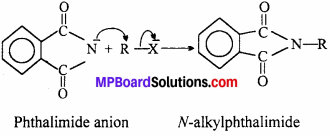
  3. Motivation : Motivation is a psychological phenomenon that inspires a person to perform maximum task and provides maximum satisfaction.

MP Board Solutions

Question 16.
Explain the characteristics of motivation.
Answer:
Following are the characteristics of motivation :

1. Continuous process : Whatever be the motivation, after some times, its effect gradually diminishes. Therefore, in order to maintain a worker’s interest in his job, the process of motivation should be continuous. Motivation is affected by time, place and circumstances. Therefore, these should be kept in mind while motivating.

2. Psychological effect: The famous management expert, McFarland, says, “The concept of motivation is mainly psychological by which the mind is inspired with a fresh idea to do some work”.

3. Motivation is related to human being : Motivation is done by man for man. A company, firm or an organization cannot be motivated. Therefore, motivation is related with human beings. However, even the animals can be motivated.

4. Motivation wholly influences a person : Motivation influences not only a man’s ears, nose, eyes and hands but it affects the whole body of a person and the willingness to work can only be inspired when the whole body of a person is influenced.

5. Important task of management : Motivation is an important function of management by which the human force can be molded in the desired direction. By motivation, the worker is inspired to work which in turn increases his working capacity. For these reasons, motivation has become the important function of management.

6. Motivation is an inspiration : Motivation has a human nature. Inspiration comes from within a man. This inspiration is intrinsic which results in increased working capacity of a man. Thus, motivation is an internal inspiration.

Question 17.
What do you mean by transaction ?
Answer:
Transactional leadership : This is a leadership that maintains or continues the status quo. It is also the leadership that involves an exchange process, whereby followers get immediate, tangible rewards for carrying out the leader’s orders. Transactional leadership can sound rather basic, with its focus on exchange.

Being clear, focusing on expectations, giving feedback are all important leadership skills. According to Boundiess.com, transactional leadership behaviors can included : clarifying what is expected of followers’ performance, explaining how to meet such expectations and allocating rewards that are contingent on meeting objectives.

Question 18.
Write the meaning of facilitative leadership.
Answer:
Facilitative leadership: Facilitative leadership is too dependent on measurements and outcomes-not a skill, although it takes much skill to master. The effectiveness of a group is directly related to the efficacy of its process. If the group is high functioning, the facilitative leader uses a light hand on the process.
On the other hand, if the group is low functioning, the facilitative leader will be more directives in helping the group run its process. An effective facilitative leadership involves monitoring of group dynamics. Offering process suggestions and interventions to help the group stay on track.

Question 19.
Write the features of supervision.
Answer:

  1. Supervision is done at all three levels of management.
  2. It is the main part of direction function of management.
  3. It is a continuous process.
  4. It ensures if the work is going on smoothly or not.
  5. Its main aim is to utilize the resources properly.

MP Board Solutions

Question 20.
Decribe the importance of leadership in organization.
Answer:
The role of leadership is very important in any organization the importance of leadership is clear from the following facts :

1. A good leader defines and explains the objectives of the group to his followers in order to achieve the targets.

2. A good leader develops the spint of cooperation among his followers. He can easily resolve the internal dispute and differences among the followers.

3. A good leader persuade his followers to accept and carry out the desired changes in the present dynamic environment of the structure and working of an enterprise.

4. A competent leader serves as the proper representative of his followers. He protects the interest of his followers and acts as a spokesman.

Question 21.
Explain the term ‘Motivation’ and ‘Leadership’.
Answer:
Motivation : In motivation, there is a psychological element. This element stimulates the mind of a person for willingness to work in. Motivation is a human element of management and it cannot be used like we make a machine to work by the push of a button. A person works only when his willingness to work is stimulated. Motivation is also called encouragement. The term ‘Motivation’ is derived from the work ‘Motive’ which literally means’ stimulating a person for willingness to work. Different management experts have defined motivation differently. Henri Fayol calls it ‘Command’, Koontz and Donnell ‘Direction’ and Likert calls it ‘Heart of Management’. What is mean by them is to maintain the worker’s interest, devotion and spirit to work ?

Leadership : Leadership is the ability to awaken in order the desire to follow a common objective. Leadership is the quality of behavior of individuals, whereby they guide people or their activities in organizing efforts.

Question 22.
Write the characteristics of formal communication.
Answer:
Following are the characteristics of fonnal communication :

  1. Formal communication is generally written.
  2. Communication of messages is through scalar chain.
  3. While moving from one person to another communication has to pass through a definite channel.
  4. The channel of communication in this type’is not established automatically.
  5. It is the result of authorities granted and duty assigned by the organization.

Question 23.
Write the characteristics of supervision.
Answer:
Characteristics are as follows :

  1. It is a main part of direction.
  2. It is an universal process which is done at all levels of management.
  3. It is a continuous process which is required all the time.
  4. It ensures if the work is done properly or not.

Question 24.
Write the characteristics of informal communication or grapevine network.
Answer:
Characteristics of Informal Communication :

  1. It is a direct and verbal communication.
  2. It moves in a zig-zag manner like a grapevine.
  3. It is the result of mutual relationship among employees.
  4. It spreads rumours and creates misunderstanding.
  5. It is difficult to trace its source and direction of flow.
  6. It is not possible to fix responsibility with respect to informal communication.
  7. It may involve work related matters or social matters.

Question 25.
Write the advantages of formal communication.
Answer:
Advantages :

  1. It is an orderly and systematic type of communication.
  2. This system is less expensive for communicating messages.
  3. It can be used as reference in the future.
  4. In this system written messages are complete and clear.
  5. It is generally written so it helps in resolving disputes.
  6. Organization can be controlled effectively through formal communication.

MP Board Solutions

Question 26.
Write the defects of formal communication.
Answer:
Disadvantages:

  1. The suggestions and complaints of employees are overlooked by the officers.
  2. The process of formal communication is time taking hence message is delayed.
  3. Time and money is invested a lot in formal communication.
  4. It is not suitable for small enterprises.
  5. There is lack of personal contact in formal communication.
  6. It overloads higher authorities with work.

Question 27.
What are the defects of informal communication ?
Answer:
Disadvantages:

  1. It spreads rumours and develops misunderstanding.
  2. There is lack of secrecy in this type of communication.
  3. It is not possible to fix the responsibility with respect to informal communication.
  4. It is difficult to trace its source and direction of flow.
  5. There is no proof for sending information in this communication.
  6. It is unreliable and unauthentic type of communication.
  7. It is not possible to trace the origin of informal communication.

Question 28.
What are the advantages of informal communication ?
Answer:
Advantages :

  1. It travels faster than formal communication because it is not required to follow scalar chain.
  2. It is one of the simple, easier and cheap system of communication.
  3. Quick feedback is ascertained in this type of communication.
  4. This method is suitable in case of emergency.
  5. It establishes better human relations.
  6. There is more freedom in informal communication which helps the solution of difficult problems.
  7. It satisfies the social needs of workers.

Question 29.
Write the types of communication on the basis of media, direction and method.
Answer:

1. communication on the basis of media :

  1. Formal
  2. Informal.

2. Communication on the basis of direction :

  1. Towards low
  2. Towards high
  3. Parallel
  4. Slanting.

3. On the basis of method ,:

  1. Oral
  2. Written
  3. Indicator.

Directing Long Answer Type Questions

Question 1.
Give a detailed account of non-monetary incentives that an organization can adopt in motivating employees.
Answer:
Incentives may be extrinsic, intrinsic, monetary and non-monetary which are given as under:

1. Job security : Job security implies that an employee would continue to work for the organization, enjoying economic and social security through health and welfare programs like providing security against sickness, unemployment, disability, old age and death.

2. Opportunities of promotion: Every person desires to promote his career till he reaches the highest authority level and for this he works with full interest and dedication. So, it is the responsibility of the employer that he should make suitable arrangements for promotional prospects. Efficient, able and experienced employees should be given the benefit of promotion.

3. Reward and punishment : Rewards refer to appreciation or recognition and the efficiency of the worker, whereas punishment serves as a negative motivation. In other words, it prohibits a person from performing undesirable actions.

4. Status : Status refers to the social rank of a person. Management often iris to satisfy egoistic needs by establishing status symbols and distinction in its organization. Individuals try hard to gain this status symbol.

5. Favourable work environment : Both physical and mental environment in the organization should be conducive to good work. In the absence of a good work environment, the worker gets disturbed and is not able to put in his / her best. The management should try to remove the irritants which creep in and spoil the environment.

6. Recognition : Recognition satisfies human need for esteem by others and for self-esteem. This recognition may be shown in the form of praise or a pat on the back of the employees or a recommendation for a pay raise, promotion or assignment of more interesting work.

MP Board Solutions

Question 2.
What are the essential qualities of an effective leader ?
Or
Discuss any four qualities of a good leader.
Answer:
The essential qualities of an effective leader are as follows :

1. Intelligent :This is one of the most important quality of a leader. He should be intelligent enough to find out the problems and suggest the solution. Without intelligence a person cannot become a good leader. An intelligent leader can take perfect decisions for the enterprise.

2. Attractive personality : Leader should have such type of personality so that followers or subordinates should get attracted towards him. His work and behaviour should also attract the followers.

3. Self confidence : An effective or good leader should have strong will power and self confidence to lead the followers. He should be brave to face the difficult and extreme situations.

4. Knowledge of rules and regulations : A good leader should have the complete knowledge of rules and regulations related with work. To perform the work systematically he should have the knowledge of rules and it should be communicated to the followers also

5. Honest: Leader should always work with honesty because if they are not performing the work honestly then it is going to effect their reputation and the followers will not support the leader.

6. Forward looking : A good leader should always be forward looking. He should make the plans after studying the previous plans, future plans are made. He should have the quality of forecasting.

7. Scientific outlook : An efficient leader should have scientific outlook. He should not be superstitious. All the information should be collected regarding a problem and it should solved one by one with patience.

Question 3.
Distinguish between : Formal communication and informal communication.
Answer:
Differences between Formal Communication and Informal Communication

Question 4.
Eplain Maslow’s need hierachy theory of Motivation and its assumptions.
Answer:
Since motivation is highly complex, many researchers have studied about motivation from several dimensions and developed some theories. These theories help to develop understanding about motivation phenomenon. Among these, Maslow’s Need Hierarchy Theory is considered fundamental to understanding of motivation. Let us examine it in detail.
Abraham Maslow, a well-known Psychologist in a classic paper published in 1943, outlined the elements of an overall theory of motivation.

His theory was based on human needs. He felt that within every human being, there exists a hierarchy of five needs. These are:

(i) Basic Physiological Needs : These needs are most basic in the hierarchy and corresponds to primary needs. Hunger, thirst, shelter, sleep and sex are some examples of these needs. In the organisational context, basic salary helps to satisfy these needs.

(ii) Safety/Security Needs: These needs provide security and protection from physical and emotional harm. Examples: job security, stability of income, Pension plans etc.,

(iii) Affiliation/Belonging Needs : These needs refer to affection, sense of belonging , acceptance and friendship.

(iv) Esteem Needs : These include factors such as self-respect, autonomy status, recognition and attention.

(v) Self Actualization Needs : It is the highest level of need in the hierarchy. It refers to the drive to become what one is capable of becoming. These needs include growth, self-fulfillment and achievement of goals.

Maslow’s theory is based on the following assumptions:

  1. People’s behaviour is based on their needs. Satisfaction of such needs influences their behaviour.
  2. People’s needs are in hierarchical order, starting from basic needs to other higher level needs.
  3. A satisfied need can no longer motivate a person; only next higher level need can motivate him.
  4. A person moves to the next higher level of the hierarchy only when the lower need is satisfied.

Maslow’s Theory focuses on the needs as the basis for motivation. This theory is widely recognised and appreciated. However, some of his propositions are questioned on his classification of needs and hierarchy of needs. But, despite such criticism, the theory is still relevant because needs, no matter how they are classified, are important to understand the behaviour. It helps managers to realise that need level of employee should be identified to provide motivation to them.

Question 5.
What do you mean by styles of leadership ? How many types are there ?
Answer:
Some leaders cannot work comfortably with a high degree of followers’ participation indecision making. Some employers lack the ability or the desire to assume responsibility. Furthermore, the specific situation helps determine the most effective style of interactions. Sometimes leaders must handle problems that require immediate solutions without consulting followers.

1. Autocratic Leadership: Autocratic leadership style is centered on the boss. In this leadership the leader holds all authority and responsibility. In this leadership, leaders make decisions on their own without consulting subordinates. They reach decisions, communicate them to subordinates and expect prompt implementation. Autocratic work environment does normally have little or no flexibility. In this kind of leadership, guidelines, procedures and policies are all natural additions of an autocratic leader. Statistically, there are very few situations that can actually support autocratic leadership.

2. Decmocratic Leadership : In this leadership style, subordinates are involved in making decisions. Unlike autocratic, this headship is centered on subordinates’ contributions. The democratic leader holds final responsibility, but he or she is known to delegate authority to other people, who determine work projects.
The most unique feature of this leadership is that communication is active upward and downward. With respect to statistics, democratic leadership is one of the most preferred leadership, and it entails the following: fairness, competence, creativity, courage, intelligence and honestly.

3. Laissezfaire Leadership: Laissezfaire leadership gives authority to employees. According azcentral, depaftments or subordinates are allowed to work as they choose with minimal or no interference. According to research, this kind of leadership has been consistently found to be the least satisfying and least effective management style.

4. Strategic Leadership : Strategic leadership is one that involves a leader who is essentially the head of an organization. The strategic leader is not limited to those at the top of the organization. It is geared to a wider audience at all levels who want to create a high performance life, team or organization.
The strategic leader fills the gap between the need for new possibility and the need for practicality by providing a prescriptive set of habits. An effective strategic leadership delivers the goods in terms of what an organization naturally expects from its leadership in times of change. 55% of this leadership normally involves strategic thinking.

5. Transformational Leadership : Unlike other leadership styles, transformational leadership is all about initiating change in organizations, groups, oneself and others.

Transformational leaders motivate others to do more than they originally intended and often even more than they thought possible. They set more challenging expectations and typically achieve higher performance.

Question 6.
Explain the functions of supervisor.
Answer:
For any activity of the organisation, supervisor is responsible. Supervisor per-forms all the basic functions of management like planning, organizing, directing etc. The functions of supervisor is mentioned in American act. The functions are as follows:
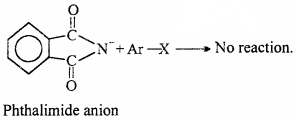
1. Planning the work: Supervisor is one of the important officers of an organisation. He is responsible for the work of organisation. He has to chalk out the daily and weekly programme and present it before the higher officials. Supervisors should be effective planners.

2. Organising the section : Supervisor is required to distribute the work of his department and also regroup the identical functions. He has to seek the effective cooperation and coordination of employees. He works for making the foundation of organization strong.
3. Motivation: Motivation is a power which encourages the employees to work hard. Supervisor motivates employees and creates team spirit. Supervisors create interest of employees towards work of enterprise.

4. Training and Instructions : The labours and lower level employees are having direct and close relationship with supervisors. The preliminary work of training is provided by supervisors. Instructions and guidelines are also given time to time by the supervisors.

5. Achieving the targets : The most important duty of the supervisor to achieve the targets of his department. The supervisors uses the best possible resources of the organisation to achieve the organisational goals.

Question 7.
What do you mean by Financial motivation ? Explain the various type of it,
Answer:
Meaning : When a person is motivated to work with monetary methods, it is called monetary motivation. Thus, a person is satisfied with money. This is also called financial motivation. Under this method, the employer spends money on the various satisfaction needs of the employees by keeping in mind their essential needs.
The following methods have been included in monetary motivation which are all positive:

1. Salary or Wages : An employee is motivated to put in more work when he is paid sufficient wages according to the nature and importance of the job assigned.

2. Allowances and Bonus: The employer grants various allowances to workers. Thus, the employees can be provided satisfaction by granting them necessary allowances depending on the place of work and also by sanctioning one or two bonus during a year. Bonus is like a reward which keeps the employees cheerful and happy.

3. Gratuity and Pension: This two benefits are available after completion of service. The employees are fully satisfied and work harder with loyalty when they are notified during the tenure of service about the facility of pension and gratuity. The employees work with complete devotion when their future is thus secured.

4. Premium and Holiday Salary: Premium means share in economies due to increase in production. When the employees is granted free bonus, gifts and earned leave, he is motivated to work even during leave period. When there is a benefit of overtime allowances in addition to this, it has a positive effect on the performance of the employees.

5. Fringe Benefits and Reward : Fringe benefits are facilities provided free by employers in the absence of which the employees have to bear the expenses e.g., house, car, furniture, domestic servants etc. When they get these fringe benefits, the employees are motivated for higher work as they are satisfied with the comforts of life. Similarly, rewards or gifts granted at the time of Holi, Diwali and other festivals, are also added source of satisfaction for the employees,
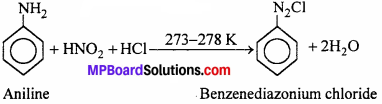
6. Contribution to Provident Fund : This is a fund involving contributions by both the employer and employees which is deposited in the employee’s account in equal monthly installments. In order to motivate the employee for higher work and satisfy his needs, the employer can increase his contribution the fund.

Question 8.
What do you mean by Negative motivation. Explain some of them.
Answer:

Negative motivations may be both monetary and non-monetary. These have negative nature in human behaviour. These encourage extracting work by fear of force as opposed to welfare of human beings. Such motivations are considered suitable for ‘Management by Force’. There is no place for such negative motivations in today’s efficient and competent management system. However, sometimes it becomes necessary to resort to these motivations also. The negative motivations are :

1. Deduction of Salary : A portion or percentage of salary is deducted by way of monetary punishment when an employees does not work properly or to his full capacity. The employees tries to work efficiently for fear of deduction from salary. This negative monetary motivation.

2. Demotion: To post a worker in lower post downgrading him from his original post is called demotion. Workers try to perform efficiently as they are afraid of demotion. This is a negative monetary motivation.

3. Fear: By scaring employees that they will be drive out of job or complaint will be made against them with the top management or by threatening them with any other bodily harm, management compels employees to work harder. This is a negative monetary motivation.

4. Physical Punishment : This is a negative motivation which is applied on workers in the lower level where only physical labour is done. This is a negative motivation.

5. Removal from Job : Removal from job results in unemployment and therefore, the workers try to work harder and with greater efficiency for fear of unemployment. This motivation is adopted in many small or large industries and this is particularly adopted in case of unsuitable and inefficient workers.

6. Insult: Insult is a big blow to those employees who have high self-pride therefore, such employees always try to work efficiently and to their full capacity. This practice is prevalent in private organizations and is negative in nature.

Question 9.
Write the difference between direction and supervision.
Answer:
Differences between Direction and Supervision
The differences between direction and supervision are as follows
MP Board Class 12th Business Studies Important Questions Chapter 7 Directing image - 5
Question 10.
Describe the principles of direction.
Answer:
The principle of direction are as follows :

1. Principle of maximum contribution : According to this principle. The employees should be motivated in such manner that they should give their maximum contribution to the enterprise.

2. Principle of Harmony of objectives: According to this principle there should be harmony among the individual objective of employees and objective of enterprise. Both should work together and should not create hurdles.

3. Principle of unity of command : This principle requires that the employees should receive orders from one superior only for any action or activity. It means workers in a department are required to be accountable to one superior for complying with the orders for performing a job. Multiplicity of command lead to misunderstandings and confusion in the enterprise.

4. Principle of effective communication : According to this principle the hurdles of communication are removed and it is monitored whether sent message is received in the same manner and understood in the same form or not.

5. Principle of Informal organization : Informal organization is used to remove the demerits of formal organization and to creat an environment of free communication. Its aim is to develop an attitude of taking initiative among employees.

6. Principle of leadership : The subordinate should be provided effective leadership by top level executives and through its personality the leader should bring positive (creative) changes in the employees.

MP Board Solutions

Question 11.
Explain briefly the importance of directions.
Answer:
The importance of directing is clear from the following facts :

1. Initiating activities : All the activities of a business enterprise are initiated through directing. The motto of directing is to activate the sub-ordinates to work to achieve the desired goals.

2. Improving efficiency : Motivation and leadership from part of directing which persuade the sub ordinates to work to the best of their ability and contribute maximum to achieve the pre-determined objectives of an enterprise.

3. Facilitating change : The present business environment is subject to frequent charges. An enterprise has to adjust and mould itself according to such changes.

4. Stabilization and Growth : Efficient directing ensures the stability and growth of a business enterprise if can lend it to right direction. Directing helps as making maximum use of ability the efficiency.

Question 12.
Explain importance of supervision.
Answer:
In the older days supervision was not having a lot of importance but nowadays supervision is a must in all the enterprises. The supervision makes the best possible utilisation of physical resources and also directs human effects to desired goals . Supervision exists at every level, location and operation throughout the organization. Top level management supervises the work of middle level while middle level managers supervises the employees. Supervision is the process of checking and comparing the performance of personnel in the organization. The importance of supervision can be justified from the following points :

1. Supervision is a motive power: Effective direction and supervision motivates the
employees to work hard for the enterprise. Without motive power the work cannot be accomplished within the time limit. Thus for the completion of work in time direction plays an important role.

2. To maintain discipline : If proper discipline is not maintained in the organization than enterprise cannot prosper. Since production is a team work therefore disciplined efforts pf all the individuals under the command of supervisor is necessary.

3. Improves communication : A situate of quarrel or dispute arises in an organization due to lack of communication but through supervision directions are given by top level management and in return feedback is given by employees. So supervision improves communication in an organisation.

4. Better utilisation of resources : The available resources of organisation like material, machinery, employees are properly utilized under supervision. All these resources are monitored closely by the supervisors which helps in completion of effective work within the time limit.
5. Feedback : Supervision maintains contact with his subordinates. This helps in receiving the suggestions, ideas, complaints etc. of employees. It facilitates the process of receiving feedback and helps to take managerial decisions.

Question 13.
Write the importance of motivation.
Answer:

1. Development of Human Relations : The thought of establishment of cordial human relations is the keystone of an ideal business enterprise. It will never be easy to achieve the objective in an organization unless cordial relations between management and workers’ groups are established. Human relations can be established by creating an atmosphere of cordial relations between management and labour though motivation. In any organization, it should be accepted that the worker is ‘first human being and then worker’.

2. Achievement of goals within time : The success of any enterprise depends not only in achieving the goals but also achieving them within time. A manager may arrange good quality material and the best machines to produce the product, but the machines and material cannot be properly utilized if the employees working there do not have full dedication and willingness to work. Therefore, motivation is necessary to achieve the goals’

3. Increase in Production : Motivation results in improvement in efficiency as the employees work with increased zeal which in turn results in increased production.

4. Full Utilization of Efficiency: It will not be out of place to agree that “Full utilization of efficiency cannot be achieved without motivation”.

5. For better Organization : To basis of any organization is that it should be better organized. A perfect organization can be established only by satisfying human needs and the basis of human satisfaction is motivation. E.F.L. Breach says, “Organization is the reflection of motivation”.

6. Reduction in Absenteeism : The growing awareness and, for some other reasons, the labour absenteeism etc. is becoming a problem to every organization. The main reason behind absenteeism is monotony. To change this monopoly into zeal and dedication can be achieved only by motivation. Therefore, absenteeism can be prevented by motivation.
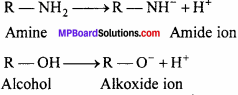
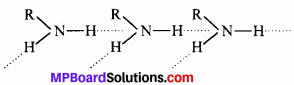
MP Board Solutions

Question 14.
What is meant by managerial leadership? Explain briefly the qualities of a good leader.
Answer:
Leadership may be defined as the process by which influence is made on the behaviour and performance of others in group efforts towards the achievement of specific goals in a given situation. The leader influences the followers in such a way that they willingly strive towards the fulfillment of common objectives.

Definitions : “Leadership is the ability of a manager to induce subordinates to work with confidence and zeal. ” —Koontz and O’ Donnell
“Leadership is the activity of influencing people to strive willingly for mutual objectives. ” —George R. Terry
“Leadership in interpersonal influence exercised in a situation and directed through communication process, towards the attainment of a specified goal or goals. ”
Qualities of a Good Leader :

1. Sound Physique : A good leader must have good health and physical fitness. He requires tremendous stamina and vigor for hard work.

2. Intelligence : A leader should be intelligent enough to examine problems in the right perspective. He should have the ability to assess the pros and cons of his actions in a particular situation.

3. Objectivity : A leader should have and objective outlook, free from bias and prejudice. He should form his opinion and judgement on the basis of facts alone. He needs an open mind, is willing to listen to others and adopt new ideas.

4. Flexibility : A leader should be flexible or open minded i.e., he should be ready to absorb new ideas as may be demanded by the situation. He should be prepared to accommodate other view points and alter his decision if need be.

5. Self-Confidence : Self-Confidence is essential to motivate the subordinates and boast up their morale. He should have confidence in himself whenever he takes any decision or initiates any cause of action.

6. Sense of Responsibility : A leader should be prepared to shoulder the responsibility for the consequences of any steps he takes. He should be aware of the duties and obligations associated with the position held by him.

Question 15.
Distinguish between verbal and written communication.
Answer:
Differences between Verbal and Written communication
MP Board Class 12th Business Studies Important Questions Chapter 7 Directing image - 6
Question 16.
Write the importance of direction.
Answer:
Following are the importance :

1. Direction initiates action : The employees cannot start their work until they are not informed about what to do ? And how to do ? This work is performed by the manager through direction. Thus, direction initiates action in as organization.

2. Helpful in making plans : One of the elements of direction is communication through which the contact is made between different levels of management. Necessary modifications and changes can be brought in plans with the help of direction.

3. Means of motivation : For the achievement of organizational objectives, direction motivates the employees to contribute to the best of their abilities. Motivated employees work with full dedication and with a full of belonging.

4. Necessary at ail levels of management : Direction is performed at all the three levels of management. Direction is required more at the lower level, less at medium level and lesser at top level of management.

5. Provides stability : Direction brings stability and balance is the organization. Stability is brought through effective supervision, motivation, leadership and communication.

6. Facilitates changes : Through effective communication and leadership enterprise can cope with the changing conditions of environment. Effective direction induces the employees to accept changes and challenges.

Question 17.
Distinguish between Monetary motivation and Non-monetary motivation.
Answer:
Differences between Monetary and Non-monetary Motivation

Monetary Motivation

  1. It is suitable in case of workers.
  2. Monetary incentives are measured in terms of money.
  3. Monetary motivation includes salary or wages, allowances, bonus, rewards, profit sharing etc.
  4. Monetary motivation helps in satisfying lower level needs like food, shelter and clothing.
  5. Monetary motivation provides financial burden to the organization or enterprise.
  6. As the monetary incentives are measured in terms of money thus it is visible.
  7. Labour unrest and disputes arises due to the.denial of monetary incentives.
  8. It not only fulfils the physiological needs but also the need for social status and power.

Non-monetary Motivation

  1. It is suitable in case of managers.
  2. These incentives cannot be measured in terms of money.
  3. Non-monetary motivation includes status, job security, recognition
  4. reward or punishment, responsibility etc. Non-monetary motivation helps in satisfying high level needs like love, affection, recognition, status or self esteem needs like position, fame etc.
  5. Non-monetary motivation does not provide any financial burden to the organization.
  6. As the Non-monetary incentives are not measured in terms of money thus it is invisible.
  7. Labour unrest and disputes does not arise due to the denial of non-monetary incentives.
  8. It satisfies the emotional and psychological needs of employees.

Question 18.
Distinguish between Leader and Boss.
Answer:
Difference between Leader and Boss
leader

  1. High level leaders are present to control leaders.
  2. Leader always uses the word ‘we’ in his organization
  3. Social responsibility is having an important place in leadership.
  4. Leader guide their followers through motivation.
  5. Leaders cannot make their followers work through fear or negative motivation.
  6. There is no place for punishment of followers in leadership.
  7. Suggestions or opinions are invited from followers if necessary in leadership and it is also accepted by the leaders.

Boss

  1. No one is above the boss in an enterprise.
  2. Boss always uses the word ‘I’ in his organization.
  3. There is no place for social responsibility in bossism.
  4. Boss guide their subordinates and employees through orders.
  5. Boss make their subordinates work through fear and negative motivation.
  6. For the errors committed by the subordinates there is provision of punishment in bossism.
  7. Suggestions or opinions are generally not invited from subordinates and the decision is taken by the boss himself.

Question 19.
Explain the process of communication.
Answer:
Communication refers to an art of transferring facts, ideas, feelings etc. from one person to another and making him understand them. Communication is the soul of modem large scale enterprises. Communication is a systematic process of creating mutual understanding through creation of messages.
Communication process is required at all stages. According to Kootz O’Doonel, communication process is:

Necessity → Need → Tension Process/act → Satisfaction.
At first when there is necessity of something, then it converts to need. To fulfill this need a person is tension and to get rid of this tension he acts and follows a process and when he achieves the desired target he is satisfied.

Communication helps to make the employee realize the necessity and need to attain the goal. For this motivation and encouragement is given to attain the desired target by which satisfaction is achieved.
This leads to growth of employee and achievements of goals of the organization.

This leads to growth of employee and achievements of goals of the organization.

MP Board Solutions

Question 20.
Describe the barries of an effective communication
or
Discuss any four barriers of the effective communication.
Answer:
The barriers or obstacles to an effective communication are as follows :

1. Barriers to organizational structure : The structure of any organization also affects the communication system. If the organization is big having various level then there will be various obstacles because due to many levels. The message or information will have to move through their levels. Due to many levels correct in information to the right person at right time through right medium becomes difficult.

2. Barriers to language : Language communication is an easy medium of communication. Different languages are spoken in different regions. Technical terms of language causes difficulties in understanding the language is same.

3. Barriers to status : In formal organization there is a formal relation between the officers and employees of top level and lower level. The emotions and behaviours of officers towards employees also effects effective communication.

4. Shortage of time: Due to shortage of time effective communication is not properly performed. Generally its should be kept in mind while sending information that receiver should have enough time to work on the information.

5. Geographical distance : Geographical distance is also an obstacle in the way of communication. Fax, Internet, Satellite system has solved this problems of geographical distance but these facilities are limited to cities and this facility is used by a specific class. These facilities cannot be used by a common man as it is expensive.

MP Board Class 12 Business Studies Important Questions

MP Board Class 12th Accountancy Important Questions Chapter 6 Accounting for Share Capital

MP Board Class 12th Accountancy Important Questions Chapter 6 Accounting for Share Capital

Accounting for Share Capital Important Questions

Accounting for Share Capital Objective Type Questions

Question 1.
Choose the correct answer:

Question 1.
Maximum number of members in a private company is:
(a) 20
(b) 30
(c) 10
(d) None of these.
Answer:
(c) 10

Question 2.
Owners of company are:
(a) Shareholders
(b) Debenture holders
(c) Directors
(d) None of these.
Answer:
(a) Shareholders

Question 3.
While issue the shares the rate of discount should not be more than:
(a) 5%
(b) 10%
(c) 6%
(d) None of these.
Answer:
(b) 10%

Question 4.
On calls in arrears according to Article A, the interest may be charged per annum:
(a) 5%
(b) 6%
(c) 10%
(d) None of these.
Answer:
(a) 5%

MP Board Solutions

Question 5.
On calls paid in advance interest may be charged annum according to article A:
(a) 5%
(b) 8%
(c) 6%
(d) 7%.
Answer:
(c) 6%

Question 6.
Shares on which interest and repayment of money is paid after preference shares are:
(a) Preference shares
(b) Equity shares
(c) Rights share
(d) None of these.
Answer:
(b) Equity shares

Question 7.
The capital beyond which a company cannot issue shares:
(a) Paid Capital
(b) Called up capital
(c) Authorised capital
(d) Issued capital.
Answer:
(c) Authorised capital

Question 8.
When excess application is received than the shares to be issued:
(a) Under subscription
(b) Over subscription
(c) Incomplete subscription
(d) Complete subscription.
Answer:
(b) Over subscription

Question 9.
Part of issued capital without receipt, a public Ltd. company cannot issue shares:
(a) Over subscription
(b) Minimum subscription
(c) Incomplete subscription
(d) Complete subscription.
Answer:
(b) Minimum subscription

MP Board Solutions

Question 10.
Shares can be forfeited:
(a) For non payment of call amount
(b) Due to absence in meeting
(c) Due to inability of paying bank loan
(d) Due to montage of shares as securities.
Answer:
(a) For non payment of call amount

Question 11.
Balance of share forfeiture account is transferred to:
(a) General Reserve
(b) Capital Redemption Reserve
(c) Capital Reserve
(d) Revenue Reserve.
Answer:
(c) Capital Reserve

Question 12.
Written notice regarding forfeiture of shares should be given to the shareholder before:
(a) 21 days
(b) 14 days
(c) 7 days
(d) None of these.
Answer:
(b) 14 days

Question 13.
Part of Issued capital called from shareholder only on the liquidation of a company:
(a) Capital Reserve
(b) Authorized capital
(c) Reserve capital
(d) None of these.
Answer:
(c) Reserve capital

MP Board Solutions

Question 14.
Proposal related to forfeiture of shares is passed in:
(a) Share holder’s meeting
(b) Debenture holder’s meeting
(c) Creditor’s meeting
(d) Director’s meeting.
Answer:
(d) Director’s meeting.

Question 15.
Before the forfeiture of shares, company must serve a notice to shareholders before:
(a) 21 days
(b) 14 days
(c) 7 days
(d) None of these.
Answer:
(b) 14 days

Question 16.
When the company is being liquidated, a part of issued capital is demanded from shareholders, it is called:
(a) Authorized capital
(b) None of these.
(c) Capital gain
(d) None of these.
Answer:
(c) Capital gain

Question 17.
When premium amount is not received in forfeiture of shares, share premium account is:
(a) Debited
(b) Credited
(c) Not written
(d) None of these.
Answer:
(a) Debited

MP Board Solutions

Question 2.
Fill in the blanks:

  1. …………… get first dividend of a company.
  2. When amount to be paid in calls is paid before it is called ……………
  3. That part of authorized capital issued or offered to public for subscription is ……………
  4. A company is said to be …………… if it receives applications for a large number of shares as compared to the  shares offered to public for subscription.
  5. Minimum subscription is mentioned in ……………
  6. Cancellation of share allotted and forfeiture of amount paid is called ……………
  7. As per company Law Board, a company is regarded as on …………… person.
  8. Shares have …………… value while stock have no …………… value.
  9. When a shareholder voluntarily surrender his share to the company, it is known as ……………
  10. Share forfeiture account is shown in …………… side of Balance sheet.
  11. Notice regarding forfeiture of shares must be given to the shareholders before ……………
    days.
  12. When forfeited shares are re-issued at discount, the …………… account is debited.
  13. When the articles contain no provision related to forfeiture of shares, the company can forfeit shares by passing a …………… resolution.
  14. To the absence of provisions for forfeiture of shares in articles of association a company may forfeit shares by passing a resolution.
  15. When a shareholder find its difficult to pay the amount due on calls shares held by him as such he may …………… the shares at his possession.
  16. Balance of share forfeiture A/c is shown in …………… side of balance sheet.
  17. The balance of …………… is utilized to write off preliminary expenses, discount on debentures, etc.

Answer:

  1. Preference
  2. Advance
  3. Issued capital
  4. Over subscription
  5. Prospectus
  6. Forfeiture of shares
  7. Artificial
  8. Face, Face
  9. Surrender of shares
  10. Liability
  11. 14
  12. Share forfeiture
  13. Special
  14. Special
  15. surrender
  16. liability
  17. capital reserve.

MP Board Solutions

Question 3.
Match the columns:
MP Board Class 12th Accountancy Important Questions Chapter 6 Accounting for Share Capital - 1
Answer:

  1. (b) Equity shareholders
  2. (c) Over subscription
  3. (e) Under subscription
  4. (a) Preference shareholders
  5. (d) Unpaid calls account
  6. (f) At time of dissolution. (MP 2015)

MP Board Class 12th Accountancy Important Questions Chapter 6 Accounting for Share Capital - 2
Answer:

  1. (e) Forfeiture of shares.
  2. (c) Shares issued at premium
  3. (b) Shares issued at discount
  4. (a) Surrender of shares
  5. (d) Capital reserve account

Question 4.
Write true or false:

  1. Rate of dividend is fixed in preference shares.
  2. There are more chances of speculation in equity shares.
  3. According to table A, a company cannot call more than 25% of the nominal value of shares at a time.
  4. Between two calls there should be a difference of not less than 15 days.
  5. If shares of Rs. 100 are issued at Rs. 110 then it is said that shares are issued at discount. .
  6. After forfeiture of shares the responsible shareholder becomes free from remaining amount.
    Premium is a type of capital gain.
  7. After reissue of forfeited shares balance of share forfeited A/c is transferred to Reserve capital A/c.
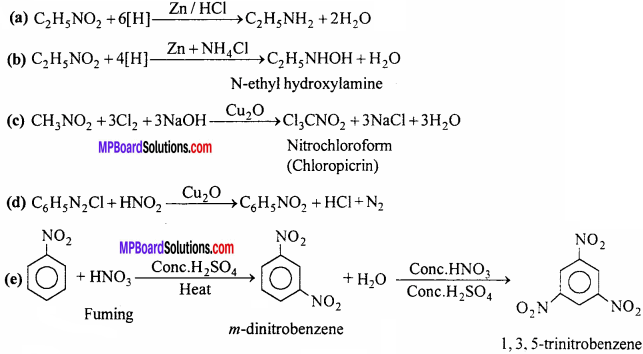
  8. The discount allowed on the reissue of forfeited shares should never exceed the amount actually forfeited on such shares.
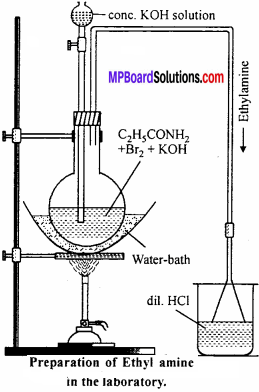
Answer:

  1. True
  2. True
  3. True
  4. False
  5. False
  6. False
  7. True
  8. False
  9. True.

MP Board Solutions

Question 5.
Write the answer in one word / sentence:

  1. Name the part of issued capital without the receipt of which share cannot be allotted.
  2. Name the company if at least 51% of its paid up capital is owned by the central or State governments or both.
  3. Name the company which has acquired more than half number of other company’s share. On which shares rate of dividend is not fixed ?
  4. Name the capital which the company does not issues in whole life of company.
  5. When a shareholder fails to pay the amount called by the company on shares held then the process of cancellation is called ?
  6. How are capital losses written off ?
  7. What is the issue of forfeited shares to public for subscription called ?
  8. Who proposes for the forfeiture of shares ?

Answer:

  1. Minimum subscription
  2. Government companies
  3. Holding companies
  4. Equity shares
  5. Reserve capital
  6. Share forfeiture
  7. Capital reserve
  8. Reissue of shares
  9. Board of Directors.

MP Board Solutions

Accounting for Share Capital Very Short Answer Type Questions

Question 1.
What do you mean by share capital ?
Answer:
The total capital of a company is divided into small units. One unit is called as share and the total amount of the shares are called as share capital. Normally company issue share certificate and get this amount.

Question 2.
What is share ?
Answer:
The capital of a company can be divided into different units with different value, which are known as shares. They are the part of total capital.

Question 3.
What is share certificate ?
Answer:
Share certificate means the certificate issued by a company to its shareholders in which numbers of shares. Purchased its value is written along with the shareholder’s name.

Question 4.
What is equity shares ?
Answer:
They are also known as ordinary shares or risk shares. They get dividend only after paying the dividend or preference shares. If after paying dividend on preference shares, no profit is left, no dividend will be paid on equity shares.

Question 5.
What do you understand by the term ‘Sweet share’ ?
Answer:
Those shares which are issued by the company to its employees and officers at a discounted rate to encourage them to work devotion ally for the betterment of the company are called ‘sweet shares’. Such shares cannot be sold by the holders for at least one year.

MP Board Solutions

Question 6.
Write two characteristics of equity shares.
Answer:

  • Equity shareholders enjoy voting right over the others.
  • On such shares dividend is not fixed.

Question 7.
Write any two merits of equity shares.
Answer:

  • Equity shareholders are actual s owners of company.
  • Shareholders have a full control over management of company.

Question 8.
Define preference shares.
Answer:
Preference shares are the shares on which a fixed rate of dividend is payable before anything is payable to the equality shareholders.

Question 9.
What do you mean by call in arrear ?
Answer:
The amount which is due on shareholders and which is called up by the company but shareholders could not paid till the fixed date (due date) then, such amount is called calls in Arrear.

Question 10.
What do you mean by authorised capital ?
Answer:
Authorised capital refers, to that capital which is stated in the memorandum of association. This is the maximum amount of capital which the company will have during its lifetime unless it is increased. It must be distinctly shown in the balance sheet of the company under the head ‘Share Capital’. It is also known as nominal capital or registered capital.

Question 11.
What do you mean by ‘Issued capital’ ?
Answer:
Issued capital refers to that part of authorised capital which is issued to public for subscription or sale. Issued capital is generally less than authorised capital or at the most, it may be equal to it but can never be more than authorised capital.

Question 12.
What do you mean by ‘Under subscription’ ?
Answer:
Under subscription means subscription by public for a number of shares which is smaller than the number of shares offered by the company for subscription. For example, when a company offers 20,000 shares of Rs. 10 each for public subscription, but the public applies for 19,000 shares such a situation is called ‘Under subscription’.

Question 13.
What is allotment of share ?
Answer:
After getting application from the specified person and institution then distribution of the shares is done on the basis of Application received this is called as allotment of shares.

MP Board Solutions

Question 14.
What is prorata Allotment ?
Answer:
Prorata allotment:
In case of over subscription of shares, the directors allot small number of shares to the applicants. In other words, the directors accept the applications partially. In such cases the excess of application money is utilized against the amount due to allotment and future calls by the transferring the excess amount from the share application account. Thus, when the company allots shares proportionately or rationally to all the applicants, it is known as prorata allotment.

Question 15.
What is dividend ?
Answer:
When the company distributes a part of its profit on a certain rate to its share-holder, it is called dividend. The rate of dividend is fixed for preference shareholders while this facility is not available for equity shareholders. They get their dividend when the company make profit.

Question 16.
Define Company.
Answer:
Section 1 (i) of Indian Companies Act of 1956, defines a company as “Company formed and registered under this Act or an existing company.” An existing company means a company formed and registered under any of the former companies acts.

Question 17.
What do you mean by issue of shares at par ?
Answer:
When the shares of a company are issued at their nominal value (face value), then those are called issue of shares at par. For example if a share of Rs. 100 is issued for Rs. 100, then it is known as issue of shares at par.

MP Board Solutions

Question 18.
What do you mean by issue of shares at premium ?
Answer:
When the shares are issued at a price higher than its face value, it is called issue at premium. From the issued price, the face value of the share is subtracted and the difference excess amount is the premium.

Question 19.
What do you mean by issue of shares at discount ?
Answer:
When the shares are issued at a price less than its face value, it is called issue at discount. For example : If a share of Rs. 100 is issued at Rs. 90 then it is issued at discount and the difference (Rs. 100 – Rs. 90) is the amount of discount i.e., Rs. 10.

Question 20.
What do you mean by forfeiture of shares ?
Answer:
If any shareholder falls to pay the amount due on allotment or any calls within the specified period, the company may cancel them. This is known as forfeiture of shares. In this condition, the amount already paid is taken over by the company.

Question 21.
What do you mean by reissue of forfeiture shares ?
Answer:
When the company reissues the forfeited shares it is known as ‘Reissue of for-feited shares.’ It can be done at par, at premium or at a discount.

Question 22.
What do you understand by surrender of shares ?
Answer:
When the shareholder voluntarily wants to gaining up the rights of being a share-holder and surrenders all his shares (Share certificates) to the company, then it is known as surrender of shares. The accounting of such surrender is alike forfeiture of shares.

MP Board Solutions

Question 23.
What is ‘Reserve Capital’ ?
Answer:
That part of issued capital which is called from the shareholders on the event of dissolution of the company is called Reserve capital. This capital cannot be issued for issuing Bonus shares or writing off capital losses.

Question 24.
What is ‘Capital Reserve’ ?
Answer:
A Reserve fund created out of capital profit other than normal profit of the business is called capital reserve. It is displayed on the liabilities side of company’s Balance sheet. This fund can be utilized for issuing Bonus shares and writing off capital losses of the company.

Question 25.
Is there any provision of cancellation of forfeiture order ?
Answer:
The Articles of Association provides the Board of Directors, the right to forfeiture the shares of defaulting shareholders. The same article also provides the right to Board of Directors for cancellation of forfeiture order only if the defaulting shareholder pay all his previous dues along with interest and any penalty imposed on him.

Question 26.
Why reissue of forfeited shares are not called allotment ?
Answer:
Allotment is made only for ‘Primary’ and new issue of shares. But forfeited shares are existing shares (old). So, these can be reissued only.

MP Board Solutions

Accounting for Share Capital Short Answer Type Questions

Question 1.
Write any four characteristics of a company.
Answer:
Following are the four characteristics of a company:

  • Legal, artificial personality: A company is established by the company law and it has independent legal existence.
  • Voluntary association: Any person by purchasing the shares of a company can become its member.
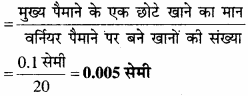
  • Limited liability: The liability of each member is limited to the extent of the paid value of his shares.
  • Representative arrangement: The representatives of the members look after the management of the company, these representatives are called ‘Directors’ of the company.

Question 2.
Differentiate between Shares and Stock. (Three points).
Answer:
MP Board Class 12th Accountancy Important Questions Chapter 6 Accounting for Share Capital - 3

Question 3.
What are the characteristics of preference shares ?
Answer:
The following are the characteristics of preference shares:

  • The rate of dividend on these type of shares is fixed in advance
  • The dividend on these shares are paid first
  • The shareholders of these shares have no voting right
  • The income on these shares are limited and fixed
  • At the time of winding up a company preference shareholders paid first.

MP Board Solutions

Question 4.
Explain any three types of preference shares. (CG 2005 Set A, Supple 13)
Answer:
1.  Cumulative preference shares:
If on such shares in any year dividend is not paid due to less profit, as such in the next year the unpaid arrears of dividend shall be paid before making payment to the holders of any other class of shares.

2. Non – cumulative preference shares:
On these shares, the dividend is paid at a fixed percentage but the arrears of dividend, the dividend shall not accumulate in the coming years.

3. Convertible preference shares:
The holders of such shares have a right to get their preference shares converted into equity shares within a certain period.

Question 5.
Write any three merits of preference share. (CG 2010 Set C, Imp., Supple 13)
Answer:
Following are the three merits of preference share :

  • Easy in management: These shareholders have no right to take part in company’s management. So, only limited persons are involved in management which is a favor for the company.
  • Good sources of income: It is better for those shareholders who want a fixed and regular income.
  • First preference in profit and payment: On these shares the profit is paid first and in the same way in the case of winding up, the share capital of preference shareholder is paid first.

Question 6.
Write any three demerits of equity shares.
Answer:
The following are the three demerits of equity shares :

  • Uncertainty of dividend: It is not suitable for those person who require regular income, because in this shares the income is irregular and uncertain.
  • Payment of dividend: Payment of dividend is made on these shares only after the payment on preference shares.
  • Final payment: In this the shareholders get the payment only at the time of winding up of the company.

MP Board Solutions

Question 7.
Write three demerits of preference shares.
Answer:
The three demerits of preference shares are:

  • Fixed charge: They receive dividend at fixed rate every year. Hence, the burden on account of preference dividend  is fixed on the company.
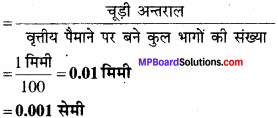
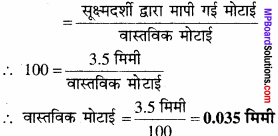
  • No right in the management: The preference shareholders do not enjoy the right to participate in the administration or management of the company.
  • Less dividend: In the years of excessive profits, the preference shareholders receive less profit as compared to those of equity shares.

Question 8.
What is calls in advance ?
Answer:
Sometimes the share amount is paid in advance before the call money becomes due, such type of advance is called call paid in advance. Articles ‘A’ of companies act gives permission regarding it, according to this articles interest will be allowed @ 6% p.a.

Question 9.
What is over-subscription ?
Or
What do you understand by over-subscription ?
Answer:
A company according to its own requirement issues shares. Sometimes company receives applications for a large number of shares than offered by it for subscription. In such case, the work of allotment of shares by directors becomes difficult because all the applicants cannot be allotted on the basis of their applications. In this case, the directors will allot only those shares which are issued by the company. Hence, allotment will be made on the basis of terms decided in the meeting of directors.

Question 10.
What is minimum subscription ?
Answer:
Minimum subscription is that minimum part of the issued capital which is necessary to raise by the way of issue of shares to meet the following expenses:

  • To pay-off the necessary assets purchased for the company.
  • To pay-off the preliminary expenses and commission to under-writers for sale of shares.
  • The amount sufficient as working capital.
  • To pay the loan taken for the purchase of necessary assets and for meeting the preliminary expenses.
  • An amount necessary for any other purpose.

MP Board Solutions

Question 11.
Write the difference between Authorized Capital and Issued Capital.
Answer:
MP Board Class 12th Accountancy Important Questions Chapter 6 Accounting for Share Capital - 4

Question 12.
Briefly explain the types of share capital.
Or
Discuss the kinds of capital of a company.
Answer:
Share capital means the capital raised by a company by the issue of shares. From the accounting point of view, the different kinds of share capital are as follows:

1. Authorised capital:
It is the capital which the company can raise from the public by the issue of shares. It is the maximum amount. It is stated in the memorandum of association. It is separately shown in the balance sheet. It is also known as nominal capital or registered capital. It is the capital on which the company is registered.

2. Issued capital:
It is the part of the authorised capital, that the company offered to the public for subscription.

3. Subscribed capital:
It is that portion of capital issued, which has actually subscribed by the public. It may be equal or less than the issued capital but never be more than the issued capital.

4. Called – up capital:
The company doesn’t require the full value of the shares they subscribed for at one instalment. Thus, the portion of the subscribed capital, which the share¬holders are called to pay is known as ‘Called-up Capital’.

5. Uncalled capital:
That part of the capital which is not called by the company from the shareholders is known as ‘Uncalled Capital’.

6. Paid – up capital:
It is that part of called-up capital, which is actually paid by the shareholders, is called ‘Paid-up capital’.

7. Reserve capital:
Sometimes, a company by means of a special resolution, decides that its uncalled capital will not be called-up; during its existence and that would be avail-able as an additional security to its creditors in the event of its liquidation. This capital is termed to be reserve capital.

MP Board Solutions

Question 13.
When a company can issue its shares at a discount, what journal entries are passed in this regard ?
Answer:
Under section 79 of the companies Act of 1956, a company can issue shares at a discount subject to the following conditions:

  1. The company is completed one year of its business.
  2. The issue of shares at a discount has been authorised by the shareholders in a general meeting of the company and also has been sanctioned by the court.
  3. The rate of discount must not exceed 10% of the face value of the shares which is permitted by the Company Law Board. The maximum rate has to be specified by the share holders resolution permitting the issue.
  4. The shares are issued within two months of the date on which the issue is sanctioned by the Company Law Board or within such extended time as the board may allow.
  5. Shares to be issued at a discount must be of a class already issued.

Journal Entry:
When shares are issued at discount
Share Allotment A/c – Dr.
Discount on Issue of Shares A/c – Dr.
To Share Capital A/c

Question 14.
Discuss the procedure of issue of shares.
Answer:
Following steps are taken by a public company for the issue of shares:
1. Issue of prospectus:
The company issues a prospectus by which it invites public to subscribe to its shares. The prospectus describes the profitability and soundness of the business of the company to attract the investing public.

2. Receipt of application:
All application and the amount of share application money must be deposited by the public in a Company’s Scheduled Bank. After the last day for receipt of share applications the bank sends all applications to the company.

3. Allotment of shares:
The directors of the company have the right to accept application wholly or partially or reject it. Those who are allotted shares are sent ‘Letters of Allotment’ and those who are not allotted shares they are sent ‘Letters of Regret’ along with a cheque for the refund of application money.

MP Board Solutions

Question 15.
Differentiate between equity shares and preference shares. (Any 4)
Answer:
Differences between equity shares and preference shares:
MP Board Class 12th Accountancy Important Questions Chapter 6 Accounting for Share Capital - 5

Question 16.
Write the difference between over subscription and under subscription.
Answer:
Difference between Over subscription & Under subscription:
MP Board Class 12th Accountancy Important Questions Chapter 6 Accounting for Share Capital - 6

Question 17.
What is forfeiture of shares ?
Answer:
If any shareholder fails to pay the amount due on allotment or calls within a specified period, the company may cancel them and the amount paid is taken over by the company. This is called forfeiture of shares.

The following conditions must be satisfied for the forfeiture of shares:

  • The power to forfeit the shares must be given in the Articles of Association
  • If the procedure of forfeiture is not given in the articles, table ‘A’ should be followed
  • There should be default in payment of any allotment or call money by the shareholder
  • Notice must be given to the respective shareholder for 14 days in advance
  • The Board of Directors must pass a resolution for such forfeiture.

MP Board Solutions

Question 18.
Explain the legal procedure of forfeiture of shares.
Answer:
The following are the legal provisions regarding forfeiture of shares:

  • Shares can be forfeited only when the default is made by the shareholders in payments of a valid call
  • Shares can be forfeited only if the power is expressly given by the Articles of the company
  • If provisions are not made in.the Article of the company, then by passing a special resolution company can forfeit the shares
  • The written notice of 14 days mentioning about forfeiture of shares must be given to the shareholders
  • The share can be forfeited on the basis of the resolution passed by the board of directors.

Question 19.
Explain the procedure of forfeiture of shares.
Or
What steps are necessary for forfeiture of shares ?
Answer:
Following are the methods of forfeiture of shares:

1. Preparation of list: Firstly a list of defaulting shareholders is produced by the company secretary in the meeting of the board of directors.

2. Notice for payments: The board of directors orders to serve notice for payment of unpaid calls and interest.

3. Issued reminder: After the issue of above notice if shareholders unable to pay the call money then the board of directors orders again to serve final notice for payment.

4. Passing a resolution for forfeiture of the shares: If the final notice gets no response, the board will then pass a resolution for forfeiture of the shares and the share holders concerned will be intimated of the decision asking them to return to the company the share certificate issued to him on allotment of shares.

MP Board Solutions

Question 20.
Describe the effects of forfeiture of shares.
Answer:
Rights and duties of defaulter shareholder w hen share is forfeited will be affected in the following way:

  • Cancellation of membership:
    At the time of forfeiture of shares, the membership of defaulter shareholder is cancelled.
  • Responsibility of payment:
    Till the date of forfeiture of shares, the shareholders is responsible for the payment of balance amount.
  • No right on dividend:
    The defaulter shareholder who’s shares are forfeited have no right on dividend.

Question 21.
Explain the reissue of forfeited shares.
Answer:
Company has full right to reissue the forfeited shares at proper time. Issue of forfeited shares to public is called reissue of share. There can be reissued at par, at discount or at premium.

Question 22.
Can the forfeited shares be reissued at discount ? Explain.
Answer:
Forfeited shares can be reissued at discount. Board of directors have the right to reissue the forfeited shares at discount, but the amount of discount on reissue should not exceed the amount forfeited on those shares. Thus, discount on reissue can be given maxi-mum up to the amount forfeited and not more than that.

MP Board Solutions

Question 23.
Distinguish between Capital Reserve and Reserved Capital.
Answer:
Differences between capital reserve and reserved capital:
Capital Reserve:

  • It can be utilized only in writing-off the capital losses.
  • It is shown in the liability side of balance sheet.
  • It is represents the amount which has already been received.

Reserved Capital:

  1. It can be utilized only at the time of liquidation of that company.
  2. It is not shown in the book of account.
  3. The amount of reserved capital is not received till the time of liquidation.

Question 24.
Differentiate between forfeiture of Shares and Surrender of Shares.
Answer:
Differences between forfeiture of Shares and Surrender of Shares:
MP Board Class 12th Accountancy Important Questions Chapter 6 Accounting for Share Capital - 8

Accounting for Share Capital Long Answer Type Questions

Question 1.
Show journal entries for the reissue of forfeited shares.
Answer:
Forfeited shares can be reissued at par, at premium or at discount. Journal entries on all the above cases is given below:

(1) Reissue of Forfeited Shares at Par:
MP Board Class 12th Accountancy Important Questions Chapter 6 Accounting for Share Capital - 9

(2) Reissue of Forfeited shares at Discount:
MP Board Class 12th Accountancy Important Questions Chapter 6 Accounting for Share Capital - 10

(3) Reissue of Forfeited Shares at Premium:
MP Board Class 12th Accountancy Important Questions Chapter 6 Accounting for Share Capital - 11

(4) When the balance of Forfeited Shares A/c is transferred to Capital Reserve:
MP Board Class 12th Accountancy Important Questions Chapter 6 Accounting for Share Capital - 12

MP Board Class 12 Accountancy Important Questions