MP Board Class 9th Social Science Solutions Chapter 12 Democracy

MP Board Class 9th Social Science Solutions Chapter 12 Democracy

MP Board Class 9th Social Science Chapter 12 Text Book Questions

Choose the Correct Answer:

Question 1.
Which of the following is not a characteristic of a Democracy?
(a) Government of elected representatives.
(b) Respect of Rights.
(c) Centralization of power in the hands of one person
(d) Free and impartial elections.
Answer:
(c) Centralization of power in the hands of one person

Question 2.
Which is the Democratic concept?
(a) Freedom
(b) Exploitation
(c) Inequality
(d) Individualism.
Answer:
(a) Freedom

Question 3.
Which one of the following is not a demerit of democracy?
(a) Waste of public time and money
(b) Dominance of the wealthy
(c) Partisanship
(d) Public welfare.
Answer:
(b) Dominance of the wealthy

Question 4.
Democracy is a rule of the people, by the people, for the people-
(a) Machaivelle
(b) Lincoln
(c) Roussean
(d) Hautes.
Answer:
(d) Hautes.

Fill in the blank:

  1. Aristotle has called Democracy as the …………….
  2. The propounders of communism was …………… and ………………
  3. A ……………….. constitution is essential for successful Democracy.
  4. There is a wastage of ………….. and …………… in Democracy.

Answer:

  1. Rule of many
  2. Karl Marx and Lenin
  3. written
  4. time, money.

MP Board Solutions

MP Board Class 9th Social Science Chapter 12  Very Short Answer Type Questions

Question 1.
What has been mentioned with reference to democracy in the later Vedic Period?
Answer:
During the later Vedic Period the Republican Form of Government and local self-governing institutions were prevalent.

Question 2.
What was the basic unit of administration in ancient India?
Answer:
In ancient India the basic unit of administration was Panchyat.

Question 3.
What right does the Marxist principle of democracy lay emphasis on?
Answer:
The Marxist principle believe that the political power must be rested in the hands of the entire society but for this it is important that the economic power should be rested in the hands of the entire society. This principle lays emphasis on a classless and stateless society.

MP Board Solutions

MP Board Class 9th Social Science Chapter 12  Short Answer Type Questions

Question 1.
Write any two definitions explaining the meaning of democracy?
Answer:

  • Democracy is a government of the people, by the people and for the people.
  • Democracy is a form of government where the ruling community is a comparatively bigger part of the entire nation.

Question 2.
State the importance of Democracy.
Answer:
Democracy is a system of governance based on freedom, equality, participation and brotherhood. It can also be called a social system. Under this the entire life of man is based on the democratic belief that every individual has equal importance in the society.

In political sphere of man’s life democracy means a political system in which the power to take decisions does not vest is an individual but in the hands of representatives of the people. Therefore the rule is based on the feelings pf the people. In the social sphere of man’s life democracy gives a society where there is no discrimination on the grounds of caste, religion, color, gender, race, creed or wealth.
MP Board Solutions

Question 3.
What do you understand by indirect or representative democracy?
Answer:
When the people participate in the making of law and controlling the working of administration through the elected representatives, it is called indirect democracy. In present times indirect democracy is practiced. In this the people choose their representatives for a definite period who form the legislature and make the laws. In this system the wishes of the people are expressed through the elected representatives.

MP Board Class 9th Social Science Chapter 12 Long Answer Type Questions

Question 1.
What do you understand by democracy. Write down its chief characteristics.
Answer:
The word democracy has been derived from two Greek word ‘Demos’ and ‘Cretin’ which respectively mean ‘people’ and ‘power’. It means a type of governing system where the power to govern rests with the people and administration is either directly done by the people or through their representatives. It is also reformed to as Loktantra’ or ‘Jantantra’.

Characteristics of Democracy:
1. Accountable Ruling System:
The people can make the Government work in an accountable manner by asking question and criticizing it. Here the power to govern is basically with the people which is handed to the representatives for a fixed term. Therefore the accountability of the governing is essential for the people else the people have the right to hand over the power to any alternative in the next elections.

2. Rule based on Equality:
Democracy is based on the principle of equality. In this form of government all citizens without any discrimination have equal civil and political rights. Elections in a fixed time period are essential for democracy. All adult citizens have equal rights to vote and contest elections as candidates in these elections.

The present democracies emphasis on social and economic equality as well. The basic traits of democracy are equal social and economic opportunities and equal importance to an individual personality. Therefore ‘one person one vote’ is the axis of democracy.

3. Strengthening System of Freedom:
In a democracy various types of freedom are given to the criticizers for their all-round development. Besides political freedom rights to various types of religious and cultural freedoms are also given to the citizens. In a democracy elasticize have the right to vote, get elected, hold public offices, give speeches, freedom to express, form associations, organize meetings, address people or practice any profession or trade.

4. Rule of Law:
By rule of law is meant that everyone is equal before law. Similar punishment is given for similar crime, whatever be the status and position.

5. Independent and Impartial Elections:
Conducting elections only is not enough in democracy but elections must be conducted in an independent and impartial manner so that the possibility of winning or losing election for the people in power is also there. There should be no pressure on the voters during elections and the election process should also be impartial.

The will of the people is supreme in a democracy. In this form of Government elections are held from time-to-time. For forming the Government various political parties and independent candidates also have the freedom to participate in these elections.

6. Existence of Written Constitution:
Definite fundamental principles and procedures of administrative organization is the most important feature of Democracy so that any ruling party on the basis of its majority may not define or change it according to its whims and fancies. The constitution of organs of government, procedures etc.

must be clearly defined in the constitution. Therefore, a written constitution is considered to be very important. Democracy is based on equality and freedom of the citizens. Therefore it is necessary to define them in the fundamental laws of the constitution.

7. Independent and Impartial Judiciary:
An independent and impartial judiciary is of paramount importance for putting into practice the provisions of the constitution. The judiciary has been made supreme to make the government work in accordance with the constitution, secure the rights of the citizens and punish those who violate the constitution. Therefore in order to make democracy practical an independent and impartial judiciary is very important.

MP Board Solutions

Question 2.
Describe the merits and demerits of democracy.
Answer:
Merits:
1. Based on Highest Values of Humanity:
Democracy is based on higher values like equality, justice and brotherhood and everyone is treated with equality respecting every individuals dignity. It develops virtues like self-respect and self-reliance in the citizens.

2. Public Welfare:
In a democracy the representatives of the people govern who are elected by the people for a definite period. They are always afraid that if they do not work in accordance with the wishes, feelings and need of the people then they will be defeated in the next elections. Therefore, the government is responsible to the people in a democracy and is always vigilant about their interests. Therefore public welfare is always kept in mind in a democracy.

3. Political Education:
Democracy is the best means of political education. People take interest in political field naturally, due to the right to vote and freedom to hold political position. Freedom of expression and the use of means of communication, promote the tendency to exchange ideas among citizens.

4. Growth of Feeling of Patriotism:
Democracy is the rule of the people for attaining public welfare for the people. People feel associated with the Government and state since they are politically conscious. This association promotes the feelings of love and commitment for the nation. This leads to the cultivation of nationalism.

5. Minimum Possibility of Violent Revolution:
Democracy is a philosophy of peace and tolerance. Its based on understanding and consensus. The opposition also has a right to put forth its views. Therefore, the opposition also criticizes and condemns the Government. If the majority of the people are dissatisfied with the ruling class it can easily remove them through constitutional methods. Therefore there is a least possibility of a violent revolution in the democracy.

Demerits:
1. Emphasis on Quantity rather than on Quality:
In a democracy more importance is given to quantity than quality. Only the votes are counted in this system. The vote of every voter has equal value irrespective of whether he is capable or incapable.

2. Rule of the Incapable:
Governance is an art. For this special knowledge and qualifications are required. The aim of welfare of the entire society cannot be realized if the ruler does not have the knowledge of this art. Only a few people have the art, capability and the potential to govern.

But in a democracy there is a rule of the majority and a capable person is also equated with an incapable. In developing countries the situation is even me e pitiable. Therefore critics also call democracy as a rule of the incapable.

3. Waste of Public Time’ and Money:
Only after a long and complex procedure the legislature is formed. Sometimes it takes years to make important laws. Lot of money is spent on the election process. A lot of money is also spent on the members of parliament.

4. Domination of the Wealthy:
To say that everyone participates in the political process in a democracy is only theoretical. Practically the elections have become so expensive that common people cannot even think of participating in the election for any position. To contest elections on money has become a common features of Democracy system. Candidates contesting elections spend a lot of money in campaigning. This has led to the transformation of Democracy from ‘Rule of the People’ to the ‘Rule of the Rich’.

5. Partisanship:
For the regulation of present Democracy political parties are becoming essential. Political parties are formed on the basis of ideologies but their main aim is to acquire power. To influence people and win popularity political parties levy baseless charges against each other opposition for the sake of opposing and not for principles or values becomes the aim of the political parties.

Political parties become a battling ground for those who influence the feelings of the people through negative campaigning and find ways and means to fulfill their selfish motives and establish their supremacy. Their immoral behavior during elections embitters the entire environment. Partisan interests becomes more important than public welfare and they also use political power to fulfill their selfish interests.

6. Weak during Wars and Emergencies:
There is a need to take quick decisions during a war or an emergency, but democracy proves to be ineffective during such times.

MP Board Solutions

Question 3.
Describe the fundamental principles of democracy.
Answer:
The fundamental principles of democracy are:

1. The Classical Principle of Democracy:
According to this principle the basis of governance is the consent of the people, but if the government does not come up to the expectations of the people, then the people can remove the government through next election. The welfare of the people is the aim of the government. This is also known as the liberal principle of Democracy, because it lays emphasis on the freedom of the people and supremacy of the society.

2. The Elitist Principle of Democracy:
This principle has been propounded in the beginning of the 20th century. It lays emphasis on the basic natural inequalities among man and believes that in all political systems there are two classes the ruling and the ruled. Though the ruling class is in a minority still as a center of power it is an elite class. The power of governing is in the hands of this elite. class.

Generally people think that they are participating in the political process but actually their influence is confined to elections. The basis of elite is selection on the basis of superiority. Their superiority can be on any basis nature, thought, economic status, social and educational background, which makes them different from common people. Elite also consider themselves different and superior but they act and react with the common people.

Secondly this way integration of peoples sovereignty is attained. Elite have an influential role in deciding the policy or in the money and wealth of the society but in a democracy everyone has an equal opportunity to enter this elite class. On the other hand regulated and open election process acts as a hindrance for elite to work for the welfare of the people.

3. Pluralist Principle:
This principle believes that in a democracy a person has the freedom to organize himself into various groups for the fulfillment of various interests. These groups are autonomous in their region and pressurize the Government for fulfillment of their interest. In this way all groups share power to the extent of fulfillment of their interest.

This principle also believes that actually power is divided among these groups therefore its basic concept is decentralization of power. According to this, the state alone does not have the right to supreme power but in a democracy all groups of a society have a share in political power and power to govern.

4. Marxist Principle:
In the later 19th century a new principle of democracy based on the ideology of modern profounder of communism Karl Marx and Lenin came forward. According to this principle for the establishment of true democracy a classless and stateless society should be established first. Resourceful class is empowered with political therefore state itself becomes a group of exploiters.

The Marxist principle believes that the political power must be rested in the entire society but for this it is important that the economic power should be in the hands of the entire society. In such a condition alone will the administration be regulated for all and in the interests of all. This principle of democracy lays more emphasis on economic equality rather than on political and civil equalities. It recognizes that if a person has no food, clothing or shelter then the right to vote or to get elected is meaningless for him.

MP Board Solutions

Question 4.
Describe the form and importance of democracy in India.
Answer:
Democracy and ideas of democratic institutions are not new for India. It is believed that around 3000 B.C. to 1000 B.C. during the Vedic period the tradition of representative consultation was prevalent among Indians. During the later Vedic period the Republican form of Government and local self – governing institutions were prevalent. In Rigveda and Atharvaveda a reference of Sabha and Samiti is found.

After the war of Mahabharat big empires started disappearing and many republican states rose. During the Mahajanpad period there was a birth of sixteen Mahajanpads which included Kashi, Kaushal, Magadh, Matsya etc. Some of the Mahajanpads were monarchical and others republic. Mahavir and Gautam Buddha both came from Republic.

Many rules of Buddhist monasteries resemble the rules of modern parliamentary system. For example Seating arrangement, various types of proposals, calling attention quorum, whip, counting of votes, motion thoughts related to justice etc. In the Vajji union everyone assembled for a meeting.

It was a form of direct democracy. Union of Vajji was formed by association of six republics. There was an elaborate system of self-government in villages and cities during the Mauryan period in India. Indian society was predominantly agrarian when the fundamental unit was self-governing and independent villages. The political structure was based on these village communities.

The village was administered by an elected Panchayat. The center of the village was a Panchayat Ghar where young and the old assembled. All members of the village elected the Panchayat every year. These elected Panchayats had ail rights in the matters of the village and the right to administer justice.

Panchayats distributed the land and collected taxes for the Government from the entire village. Some committees were formed from the elected members of the Panchayats. Each committee was formed for one year if any member misbehaved he could be immediately removed. If a member was unable to give a proper account of public exchequer he was declared incapable.

At the central level the king ruled. The king did not have autocratic rights based on Divine rights like kings in Europe. If the king misbehaved the subjects had the right to remove the king. There was a state council to give advice to the king. The king worked in accordance with the wisbs of the people and the advisors of the king (ministers / officers) respected the Panchas at the local levels. Therefore in ancient India the meaning , of Rule of Kings’ was serving the subjects.

MP Board Solutions

Question 5.
What is the concept of democracy? Describe the present form of Indian democracy.
Answer:
The main concept of democracy is that the entire power of the state vests in the. people and not in any individual, group or dynasty. Therefore participation of the people is the basic , foundation of democracy. All must participate in the taking of such decisions or work which affects everyone.

By democracy is a meant a system of governance where public welfare is of utmost importance. Democracy is not confined to a system of governance. It is a form of state and society. Therefore, it is a mixture of state, society and governance.

Present Form of Indian Democracy:
In present times India is world’s largest democratic country. After getting independence Indian constitution came into force on 26th Jan., 1950. India became a sovereign democratic republic after the enforcement of the constitution. Citizens were given universal adult suffrage in accordance with the fundamental principles of democracy by the constitution.

All adult Indian citizens were given . the right to vote without any discrimination by which the people could elect the representatives of their choice and form a popular Government. Indian citizens have shown an active participation and maturity in all the parliamentary and legislative elections. Barring the exception of emergency (1975-1977) holding of timely and impartial elections is an indicator of perpetual democracy in India.

Besides the elections for Panchayats and in cities municipalities and municipal corporation is also an example of Indian democracy being broad based. There are some challenges to Indian democracy. Indian democracy is getting affected i by illiteracy, caste-ism, linguism, regionalism, separatism, communism, political violence, social and economic inequalities, dominance of money and muscle power corruption and politics of vote banks.

Indian democracy can be freed from these problems by removing social – economic inequalities, expansion of education and establishing moral values. The commitment of Indian people towards democracy is clear from the various time bound elections and through change in power from time – to – time through constitutional methods. Therefore we can hope for perpetuation and success of democracy in India

Project Work

Question 1.
Collect information on the student council elections in your school. Write the process or procedure adopted in the elections of class representatives or student council. Make a beautiful chart of all representatives and office bearers.
Answer:
Attempt yourself.

Question 2.
Collect information on the elections of your village Panchayat. Make a chart of winning and defeated candidates. Write the role of people of the village in the election process of the Panchayat.
Answer:
Attempt yourself.

MP Board Solutions

MP Board Class 9th Social Science Chapter 12  Other Important Questions

Choose the correct answer:

Question 1.
(i) Who called democracy a rule of many’?
(a) Aristotle
(b) Lincoln
(c) Dicey
(d) None of the above.
Answer:
(a) Aristotle

Question 2.
Democratic system believes in –
(a) Inequality
(b) Organised and regular change of the rulers
(c) Classless society
(d) None of the above.
Answer:
(b) Organised and regular change of the rulers

Question 3.
Communism was in practice in Soviet Union till –
(a) 1980
(3) 2000
(c) 1990
(d) 2002.
Answer:
(c) 1990

Question 4.
Direct democracy is possible only in –
(a) States with less population
(b) States with big population
(c) Communist states
(d) Society with big population.
Answer:
(a) States with less population

Question 5.
Democracy is a form of government where the ruling community is a comparatively bigger part of the entire nation. Who is related with this statement?
(a) Aristotle
(b) Dicey
(c) Lincoln
(d) None of the above.
Answer:
(b) Dicey

Fill in the blank:

  1. ………….. means a ruling system in which welfare of people is prominent.
  2. Democracy is of …………………. types.
  3. At present India is the biggest ……………….. country in the world.
  4. After independence Indian constitution came into force on ……………
  5. A group formed by definite geographical area, population, government and sovereignty is called a ………….

Answer:

  1. Democracy
  2. two
  3. democratic
  4. 26 January , 1950
  5. State.

MP Board Solutions

MP Board Class 9th Social Science Chapter 12 Very Short Answer Type Questions

Question 1.
The word democracy has been derived from which two Greek words? What do they refer to?
Answer:
The word democracy has been derived from two Greek word ‘demos’ and ‘cratia’ which respectively mean ‘people’ and ‘power’.

Question 2.
What do you mean by direct democracy?
Answer:
When the people residing in a state themselves directly discuss on public issues on the basis of which policies are decided and laws made, then such a governance is called direct democracy.

Question 3.
Why is the accountability of the governing essential for the people?
Answer:
It is essential otherwise the people have the right to hand over the power to any alternative in the next elections.

Question 4.
Mention some freedoms given to the citizens in a democracy to their all round development.
Answer:
Freedom of holding officer, giving speeches, forming associations, organizing meetings, addressing people or practicing any profession or trade.

Question 5.
In which situation can judiciary give verdict against the Government?
Answer:
Judiciary can give verdict against the Government if it works against the constitution.

MP Board Solutions

Question 6.
Where is direct democracy possible?
Answer:
Direct democracy is possible only in states with less population and small in size.

Question 7.
Where is direct democracy prevalent today?
Answer:
Direct democracy today is prevalent in some cautions of Switzerland and under the Panchyati raj system in the Gram Sabhas in India.

Question 8.
Write any two chief features of democracy.
Answer:

  • Accountable ruling system.
  • Rule based on equality.

Question 9.
On what bases is democratic system established?
Answer:
Democratic system is established on the dignity and equality of citizens, freedom, brotherhood and justice.

Question 10.
What is the fundamental belief of democracy?
Answer:
The fundamental belief of democracy is that the power of the governing must be in the interest of the governed for protecting the rights of the people.

Question 11.
What is democracy?
Answer:
Democracy is a type of governing system where the power to govern rests with the people and administration is either directly done by the people or through their representatives.

MP Board Solutions

Question 12.
Write the main types of democracy?
Answer:
The main types of democracy:

  • Direct Democracy
  • Indirect Democracy.

MP Board Class 9th Social Science Chapter 12  Short Answer Type Questions

Question 1.
What suggestions does Marxism give for the establishment of a real democracy?
Answer:
For the establishment of a real democracy Marxism gives the following suggestions:

  • Social ownership of means of production and distribution.
  • Equal distribution of wealth and fulfillment of everyone’s fundamental needs.
  • For representation of people with similar economic interests the complete power to administer must be in the hands of one party. Marxism believes such a democracy to be actual and best democracy.

Question 2.
What do you know about the pluralist principle of democracy?
Answer:
The pluralist principle believes that in a democracy a person has the freedom to organised himself into various groups for the fulfillment of various interests. These groups are autonomous in their region and pressurize the government for fulfillment of their interest. In this way all groups share power to the extent of fulfillment of their interests.

This principle also believes that actual power is divided among these groups. Therefore its basic concept is decentralization of power. According to this, the state alone does not have the right to supreme power but in a democracy all groups of a society have a share in political power and power to govern.

Question 3.
What is the need and importance of a constitution for a democracy?
Answer:
In the present democratic system the government is formed by the elected representatives of the people. The fundamental belief of democracy is that the power of the governing must be in the interests of the governed for protecting the rights of the people.

In a democracy the common people easily get to know the procedure of formation of the Government and rights and duties of the citizens. There should also be a provision to ensure that the constitution may not be easily changed.

In this manner it is important to have a written constitution for safeguarding democracy. Democracy is therefore called the Rule of Law. Here the Law is above an individual or a group of individuals, which is ensured through written constitution. Therefore a constitution is very important for a Democracy. For strengthening democracies, democratic traditions are also important which give flexibility to a written constitution.

MP Board Solutions

Question 4.
What is the importance of independent and impartial judiciary in the democracy?
Answer:
An independent and impartial judiciary is of paramount importance for putting into practice the provisions of the constitution. The judiciary has been made supreme to make the government work in accordance with the constitution, secure rights of the citizens and punish those who violate the constitution. There fore in order to make democracy practical an independent and impartial judiciary is very important.

MP Board Class 9th Social Science Chapter 12  Long Answer Type Questions

Question 1.
Write in detail the importance of democracy.
Answer:
Democracy is not only a special type of ruling but it is a special perspective towards life. Democracy is a system of governance based on freedom, equality, participation and brotherhood. It can also be called a social system. Under this the entire life of man is based on the democratic belief that every individual has equal importance in the society. If the importance of a person is only in the political field then democracy will remain incomplete.

For realization of true democracy it is important that individual get equal opportunities of growth in political, social and economic sphere of life. In political sphere of man’s life democracy means a political system in which the power to take decisions, does not vest in an individual but in the hands of the elected representatives of the people. Therefore the rule is based on the feelings of the people.

In the social sphere of mans life democracy imply a society where there is no discrimination on the grounds of caste,, religion, color, gender, race, creed or wealth. Everyone must have equal right and opportunities to grow in one’s life equally without any discrimination and the society must have the underlying feeling of brotherhood and mutual cooperation.
In the economic sphere of man’s life by democracy is mean! a system, where every member of the society gets the freedom and the right to choose his means of livelihood or any profession. An effort to establish such a system is made where there is no exploitation of one by the other.

An effort is made to provide basic facilities so that he may fulfill his minimum economics need and live a dignified life, meaning to provide the facilities of food clothing, shelter, health, education, employment is the basis  democracy. Democratic system believes in an organized and regular change of the rulers.

Democracy also believes that whatever changes have to be done in the political, social arid economic spheres can be done in a peaceful manner. This is the only administrative system which ensures the participation of the people in the political process. Therefore it is valued more than any other system of governance.

MP Board Class 9th Social Science Solutions

MP Board Class 9th Social Science Solutions Chapter 11 Major Cultural Trends

MP Board Class 9th Social Science Solutions Chapter 11 Major Cultural Trends

MP Board Class 9th Social Science Chapter 11 Text Book Questions

Choose the Correct Answer:

Question 1.
Where has the chariot driven bronze statue been found from?
(a) Diamabad
(b) Mohen-jo-daro
(c) Kalibanga
(d) Punjab.
Answer:
(b) Mohen-jo-daro

Question 2.
When did the first urbanization take place?
(a) New stone age
(b) Indus Civilization
(c) Mauryan period
(d) Gupta period.
Answer:
(a) New stone age

Question 3.
Who did talk about scientific basis of teaching?
(a) Vatsayan
(b) Asoka
(c) Samudra Gupta
(d) Kumar Gupta.
Answer:
(b) Asoka

Question 4.
Which dynasty did start coins with the Vina emblem?
(a) Maurya dynasty
(b) Gupta dynasty
(c) Vardhan dynasty
(d) Rajput dynasty.
Answer:
(b) Gupta dynasty

Question 5.
Who was the originator of Qauwali?
(a) Akbar
(b) Shahjahan
(c) Tansen
(d) Amir Khusro
Answer:
(d) Amir Khusro

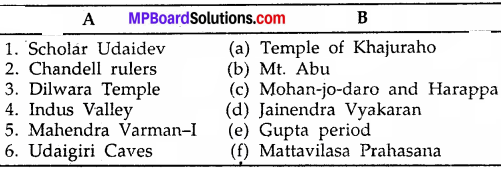
Match the following:
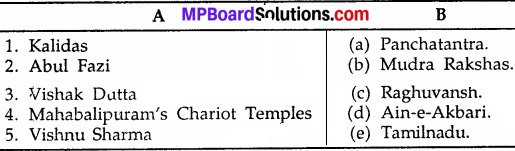
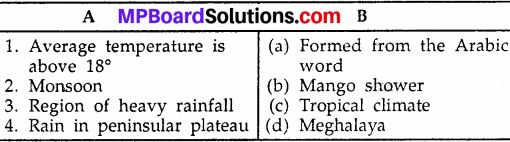
MP Board Class 9th Social Science Solutions Chapter 11 Major Cultural Trends - 1
Answer:
1. (d) Jainendra Vyakaran
2. (a) Temple of Khajuraho
3. (b) Mt. Abu
4. (c) Mohan-jo-daro and Harappa
5. (f) Mattavilasa Prahasana
6. (e) Gupta period

MP Board Solutions

MP Board Class 9th Social Science Chapter 11 Very Short Answer Type Questions

Question 1.
The longest inscription of Indus civilization has how many alphabets there?
Answer:
The longest inscription of Indus civilization has 17 alphabets.

Question 2.
DeepavanSa, Mahavansa and Divyadan are related to which literature?
Answer:
Deepavansa, Mahavansa and Divyadan are related to Buddhist literature.

Question 3.
Kalpa Sutra and Parishishta Pawan are literary creations of which religion?
Answer:
Kalpa Sutra and Parishishta Pawan are literary creations of Jain religion.

Question 4.
Tulsidas, Surdas, Meerabai, Raskhan were follower of which Bhakti worship?
Answer:
Do yourself.

Question 5.
In which period were the Ellora temples constructed?
Answer:
The Ellora temples, were constructed during Gupta period.

MP Board Solutions

Question 6.
Who built the Taj Mahal?
Answer:
Mughal emperor Shahjahan built the Taj Mahal.

Question 7.
Who was Tansen?
Answer:
Tansen was an accomplished singer at Akbar’s court.

MP Board Class 9th Social Science Chapter 11 Short Answer Type Questions

Question 1.
Write the feature of the Gupta period paintings?
Answer:
The features of Gupta period paintings are following:

  • Paintings was based on scientific lines.
  • The finest examples of paintings are in the Ajanta caves. These paintings are mostly based on religious themes.
  • They have depicted Buddha and Bodhisatva.
  • Descriptive scenes from Jataka stories can also be seen.
  • These paintings are original, lively and impressive.
  • During Gupta period beautiful colors in the pictures have been used.

Question 2.
Write the Characteristics of architecture during the Indus civilization.
Answer:
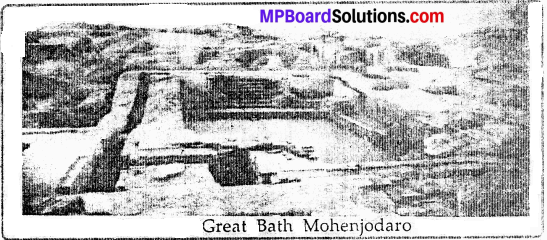
The excavations at Indus valley provide information about the contemporary architecture. People of this period were experts, in the field of architecture. Big granaries, well – planned houses and cities, big palaces, ports, great bath throw suffice . light on the architecture.

Covered drains, doors and windows of buildings, direction away from the main road, kitchen inside the buildings, bathroom, adequate provision of ventilators, construction of ordinary and state buildings etc. are unique examples of architecture of Indus Civilization.

Question 3.
Write a note on Asoka pillars.
Answer:
The best specimen of Mauryan architecture are the pillars of Asoka, which were constructed by him for propagation of Dharma. These pillars are nearly 20 is number and located in various parts of India, Sarnath, Prayag, Kausmbhi in Uttar Pradesh. Pillars have been found in Lumbini and Nigilva in the plains of Nepal. Besides these at Sanchi, Lorya, Nandgarh and at various other places too, Asoka pillars have been found in Sanchi. The capital on the pillars was extremely creative.

MP Board Solutions

Question 4.
Mention the features of temples of Gupta period.
Answer:
The special achievement of the period was in the field of temple construction. Temples were constructed with stones and bricks. The temples constructed during the Gupta period had flat roof. First Shikhar was constructed at Dasavatara in Devgarh temples (Jhansi U.P.).

After the construction of this temple, construction of Shikhars in the temples started. Many of these temples still exist such as Buddhist shrine in Sanchi, in Vidisha district of M.P., Bheetaragaon in Uttar Pradesh and temple at Deogarh are a few examples.

Question 5.
Write the differences between Nagara and Dravidian styles.
Answer:
The temples constructed during the early medieval period are classified into turn styles:

  1. Nagara style
  2. Dravidian style.

Differences between these two styles
1. Nagara style:

  • Nagar style temples were mainly constructed in north India.
  • In Nagar style the Shikhar is nearly spiral.
  • On the top is found around dome and kalash.

2. Dravidian style:

  • Dravidian style temples were constructed is south India.
  • In Dravidian style teiriples
  • the likars re rectangular constructed by placing rectangular blocks one over the other.

Question 6.
Write the differences between Mathura and Gandhara art.
Answer:
Mathura art:

  • Remains of Buddhist, Jain and Brahmanicai ali three religions have been found at Mathura.
  • The statues of Lord Buddha and Bodhisattva have been found in Mathura art.
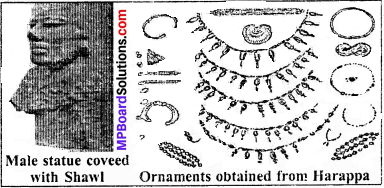
  • The statues of Buddha are covered with drapery.
  • Statues have been constructed using the sand stone.

Gandhara art:

  • The subjects of Gandhara art were Indian while the . technique was Greek.
  • Statues were mostly built of slate.
  • Creased clothes have been shown on the statues.
  • Mahatma Buddha is also shown to be seated on a throne.

MP Board Solutions

Question 7.
State the features of medieval period paintings.
Answer:
Medieval period paintings declined during the Sultanat period. Painting was looked down upon by the Sultans. Still painting remained alive in Gujarat, Rajasthan and regions of Malwa. Scenes related to religious and day-to-day life were presented. The books written on birch barke in Gujarat by Jain monks have a very high quality of small illustrations.

Mughal style painting is the Hamzanana which is also popular as Dastan-e-Amir Hamza. The specialy of these paintings are foreign plants, trees and their leaves and flowers. Fresco painting was started for the first time during Akbar period. During Jehangir’s period portrait painting, natural scenes and paintings related to person’s life started.

MP Board Class 9th Social Science Chapter 11 Long Answer Type Questions

Question 1.
Which are the main cultural trend of India? Write a comparative description of any one with reference to ancient and medieval period. Describe
Answer:
The contemporary social, cultural and political life can be understood through literature, painting, architecture, sculpture, dance and music and other performing arts. By cultural trend we mean the form of Indian culture which includes literature, painting, architecture, sculpture, dance, music and other performing arts. (In this chapter we will study these in a sequential manner.) Comparative description of painting with reference to ancient and medieval period:

Painting:
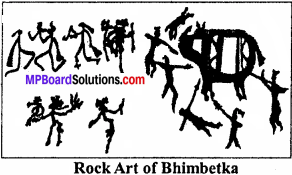
The growth of painting depicts on the expression of man’s thoughts through paintings. The rich tradition of Indian painting reflects the sensitivity of Indian art towards colors. During different periods paintings have been made by the painters of contemporary society. In India paintings of prehistoric times, can be seen on various rocks and stones.
In Bhimbetka caves near Rock Art of Bhimbetka Bhopal we can see a fine examples of this art.

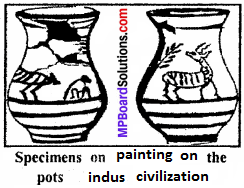
People of Indus valley civilization had knowledge of painting. We have enough evidence of this. Many paintings can be seen in the utensils and seals found here. Painting was also done on the walls of the buildings. In paintings natural scenes and animals both can be seen. Co-lours were also used in the paintings. On the basis of literature it can be said that these people expressed their feelings on walls, utensils and also through embroidery on the clothes.

MP Board Class 9th Social Science Solutions Chapter 11 Major Cultural Trends - 2

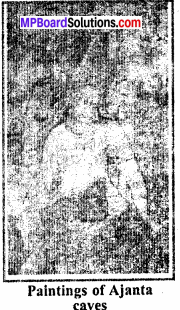
Mayryan period painting grew as folk – art. Paintings were depicted on Mauryan buildings and pillars. Some of the paintings in Ajanta caves belong to the 1st century E.C. The painting of Chhadat Jatak in cave No. 10 is worth mentioning. Painting was based on scientific lines during the Gupta period. The finest examples of paintings are in the Ajanta caves. These . have been included in the world heritage sites.

MP Board Class 9th Social Science Solutions Chapter 11 Major Cultural Trends - 3

These paintings are mostly based on religious themes. They have depicted Buddha and Bodhisattva. Descriptive scenes from Jataka stories can also be seen. These paintings are original, lively and impressive. The paintings of this period can be seen in the caves of Bagh (in M.P. Dhar district). The themes of the pictures in these caves are worldly. During this period beautiful colors in the pictures have been used.

During Harsha’s period paintings were made on the clothes. Reference of skilled painters during marriage celebrations have been found. These painters have painted various scenes. Women on this” occasion painted on utensils of clay. During Rajput period the art of painting had fully developed During this period many regional styles of painting had developed. Such as Gujarat style, Rajputana style etc.

MP Board Class 9th Social Science Solutions Chapter 11 Major Cultural Trends - 4

Gujarat style has scenes depending Jain life style and religion. In Rajputana style, romantic scenes of Radha Krishna have been depicted. Frescoes were made to decorate temples and palaces. The art of Miniature painting also developed during this period. These paintings were made to decorate the books.

MP Board Solutions

Question 2.
How did literature grow from ancient to the medieval period?
Answer:
The Indian literature is as prosperous as glorious in Indian history. It has a vast store of Sanskrit literature. Indus civilization has the knowledge of script. Vedic period literature is very prosperous from the creativity point of view. The literature of this period was a very lively description of ancient life and values. Jain literature has three branches religious books, philosophical and secular writings.

These chiefly have prose, legends, grammar and dramas. Buddhism has greatly enriched the Pali and Sanskrit languages. There are enough evidences of Mauryan period literature. Though the inscriptions of Asoka it seems that two types of scripts were used – Brahmi and Kharosthi. During the Sunga Satvahana period there were scholars like Patanjali who wrote Mahabhasya on Panini’s Ashtadhyas and presented the rules of Sanskrit in revised form.

Gutpa period was the Golden age of literature. This period gave Sanskrit the status of the language. There were literary creations in many fields of Science and knowledge. Nalanda university was established during this period. Kashi, Mathura, Ayodhya and Patliputra were chief centers of education. Harsavardhan respected the scholars. Banabhatta was a great writer of this period ,who wrote two books – Harsha Charita and Kadambari.

Harshavardhan himself wrote three Sanskrit plays Naga Nanda, Ratnavali and Priyadarsika. The creation of literary and extremely flowery work was towards rise during the Rajput period. Literature was predominantly romantic. Rajput rulers were scholars of highest order. King Munja, Bhoja, Amoghvarsha were prominent among them. During this period books were written on medicine, astrology, grammar, sculpture and various other subjects.

Along with North India there was literary creations worth- mentioning in South India as well. Pulkesin’s vassal wrote a book called Shabdavatar. Scholar Udaidev wrote a book called Jainendra Vyakaran. South India had special contribution to Sanskrit literature during the Pallava rule. Mehandra Verman – I wrote a book “Matvilas Prahsan”. There was growth of Tamil language during the Pallavas and Cholas.

The famous writer of the Tamil period was Jaigondar who wrote Kaligtuprani. Kamban wrote Ramayana in Tamil. Karichi was the chief center of learning where people from far off came for education. The growth of literature continued in the medieval period. The creation of religious and secular literature started during the period. Doha’s and puzzles became popular. Compositions of  Namdev, Ramanand, Guru Nanak, Kabir, etc.

have a place of special importance in Hindi. Literary writings were done is Persian and Turkish language during the period. Urdu literature developed the most during the Mughal period.

MP Board Solutions

Question 3.
Write the features of painting from the ancient to the medieval period.
Answer:
The contemporary social, cultural and political life can be understood through literature, painting, architecture, sculpture, dance and music and other performing arts. By cultural trend we mean the form of Indian culture which includes literature, painting, architecture, sculpture, dance, music and other performing arts. (In this chapter we will study these in a sequential manner.) Comparative description of painting with reference to ancient and medieval period:

Painting:
The growth of painting depicts on the expression of man’s thoughts through paintings. The rich tradition of Indian painting reflects the sensitivity of Indian art towards colors. During different periods paintings have been made by the painters of contemporary society. In India paintings of prehistoric times, can be seen on various rocks and stones. In Bhimbetka caves near Rock Art of Bhimbetka Bhopal we can see a fine examples of this art.

People of Indus valley civilization had knowledge of painting. We have enough evidence of this. Many paintings can be seen in the utensils and seals found here. Painting was also done on the walls of the buildings. In paintings natural scenes and animals both can be seen. Co-lours were also used in the paintings. On the basis of literature it can be said that these people expressed their feelings on walls, utensils and also through embroidery on the clothes.

Mayryan period painting grew as folk – art. Paintings were depicted on Mauryan buildings and pillars. Some of the paintings in Ajanta caves belong to the 1st century E.C. The painting of Chhadat Jatak in cave No. 10 is worth mentioning. Painting was based on scientific lines during the Gupta period. The finest examples of paintings are in the Ajanta caves. These . have been included in the world heritage sites.

These paintings are mostly based on religious themes. They have depicted Buddha and Bodhisattva. Descriptive scenes from Jataka stories can also be seen. These paintings are original, lively and impressive. The paintings of this period can be seen in the caves of Bagh (in M.P. Dhar district). The themes of the pictures in these caves are worldly. During this period beautiful colors in the pictures have been used.

During Harsha’s period paintings were made on the clothes. Reference of skilled painters during marriage celebrations have been found. These painters have painted various scenes. Women on this” occasion painted on utensils of clay. During Rajput period the art of painting had fully developed During this period many regional styles of painting had developed. Such as Gujarat style, Rajputana style etc.

Gujarat style has scenes depending Jain life style and religion. In Rajputana style, romantic scenes of Rad-ha Krishna have been depicted. Frescoes were made to decorate temples and palaces. The art of Miniature painting also developed during this period. These paintings were made to decorate the books.

MP Board Solutions

Question 4.
Describe the Mughal period architecture.
Answer:
The influence of Islamic architecture can be dearly seen on the medieval architecture. The buildings constructed during the reign of various Sultans and Mughals. There was intermingling of Indian architecture with Persian, Turkish and Indian styles and architecture prevalent in other Islamic countries. Primarily Mosques, Mausoleums, Palaces, Massive gates (Torans), domes, Mehrabs and minar were constructed in Islamic architecture.

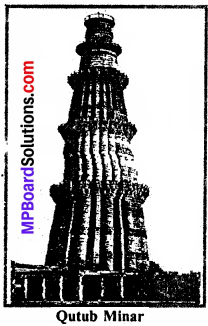
The Qutub-ul-islam mosque ih Mehrauli (Delhi) was constructed in 1139 A.D. and is recognized as the first mosque in India. The Qutub minar was constructed during the Sultanat period. It is 238 ft. tall and narrow towards the top. At various heights there are open balconies, which makes it distinct. The mosques of the period bad minarets four sides.

MP Board Class 9th Social Science Solutions Chapter 11 Major Cultural Trends - 5
There are enough evidences of Mughal period architecture. In the history of architecture a new era started during the period. Scholars have called the new architectural style as Mughal architect. Mughal style developed as a result of fusion between foreign and Indian styles. Hence Mughal period architecture a mixed influence of Jain, Buddhist, Rajput, Persian, Baghdad style can be seen.

The engraving of diamonds in white marble, pietra dura and running water in the palaces are some of the salient features of Mughal architecture. The chief architectural places were Mosque of Qutub Minar Kabuli Bagh, Mosque of Panipat, Babri Mosque at Ayodhya, mosque at Agra fort. Not much progress in the field of achitecture was made during Humayun’s reign. During his reign two mosques were constructed at Ferozabad in Hissar. Shershah showed great interest towards architecture.

The most important architectural structure of Shershah’s period is a mosque constructed on a raised platform in the midst of a lake at Sasaram in Bihar. Beautiful amalgamation of Indian and Islamic architecture can be seen here. During Akbar’s period there was an intermingling of Persian style with Hindu and Buddhist architectural styles. Buildings of Akbar’s period were constructed by red sandstone.

Akbar got Fatehpur Sikri built. The chief features are intermingling of Chapakar and Dharnik styles. Fatehpur Sikri’s Diwan – i – Aam, Diwan – i – Khas, Agra Fort, Palace of Jodhabai, Panch Mahal, Jama Masjid, Buland Darwaza are specimens of Akbar period architecture. Jehangir got Akbars and Itmad – ud – daulas mausoleum built. Raja Manning’s palace at Gwalior and Jaisinghs palace at Jaipur are unparalleled examples of architecture.

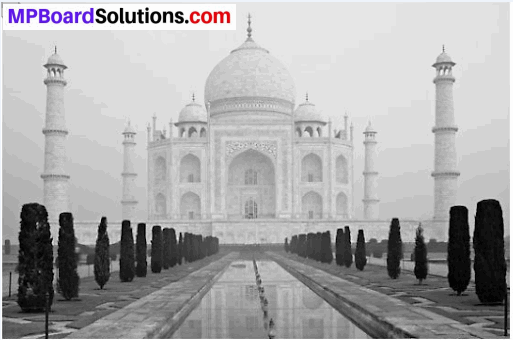
Shahjahan’s period is known as the golden age of Mughal architecture. The chief features of architecture of the period were carved Mehrabs, and Minars. The famous buildings of Shahjahan’s period are Red Fort, at Delhi, Diwan-i-Khas, Jama Masjid and Taj Mahal at Agra. The biggest accomplishment of the period is the Taj Mahal when architecture reached its pinnacle of progress. Taj Mahal is 313 ft.

high square mausoleum made of white marble which has been built on 22 ft. high platform. The four corners 146 of the Mausoleum have a minar. It is two – stored on the top of a dome. In Gurudwaras Harminder at Amritsar is a unique creation of the contemporary period. It was constructed between 588 to 1601 A.D. After Shahjahan Mughal period architecture started declining.

MP Board Solutions

Question 5.
How did sculpture develop in the medieval period?
Answer:
There was a splendid development in the field of sculpture in south India during the medieval period. Statues ‘and sculptures were used to decorate the interiors and outside of the temples. Islam did not believe in idol worship. This affected medieval sculpture. The art of sculpture began during the Akbar’s period. Sculpture was also encouraged during Jahangir’s region.

In Agra Fort, Amar Singh’s and Kama Singh’s statues were put up beneath ‘ the window. Tire palace of Fatehpur Sikri’s Elephant gate entrance is decorated with two massive elephants. The art declined during Aurangzeb’s reign. On the whole sculpture did not receive encouragement during the medieval period which affected it.

Question 6.
Give an analytical description of growth of music and j dance during the medieval period.
Answer:
The tradition of dance and music of ancient period was carried forward in the medieval period. Some of the books were compiled on dance and music. Of these Bhoja, Someshwar and Sarangdev’s Sangeet Ratnakar are very famous books. In the later period many more books on music were written. Jaydev’s Gita Govind in the 13th century can be called an important step in this direction.

Bhakti or devotional music received more importance in the medieval period. People sang with devotion the Bhajans (devotional songs) of Meei ibai, Tulsidas, Kabirdas and Surdas. Hindustani music was introduced to new instruments and Ragas in the Sultanat period. Though Quran prohibits music but it was encouraged from time – to – time by Sultans vassal and Khalifas.

The famous musician of the period was Amir Khusro who has described his music in the book Noor Siphr. The book describes that Indian music touches the heart and the soul. It not only affects human beings but also hypnotizes animals. Deers stand still while listening to the music and are easily hunted. Amir Khusro invented new ragas through the fusion of Indian and Persian music. The originator of Quwali was Amir Khusro.

Due to new trends in music like Khayal and Tarana there were changes in the form of music in the contemporary period. Music was the chief means of recreation. The art of dance and music flourished during the Mughal period. Babur himself was fond of music. In Tuzukh – i – Babri description of music meeting is found. Humayun and Sher Shah Suri were also fond of music. Mughal Emperor Akbar patronized musicians.

He himself played exquisitely on the Indian instrument Naggarah. He was interested in science of music. Of the nine gems at Akbar’s court the most renowned was Miya Tansen who was. an accomplished singer as Abul Fazl writes about Miyan Tansen that ” a singer like him has not been in India for the last thousand years.” Tansen received his education in Gwalior. Baba Haridas of Vrindavan was his Guru.

Besides Tansen 36 other singers received patronage at Akbar’s court. Of these Bazbahadur, Baizbaksh, Gopal, Haridas, Ramdas, Sujan Khan, Mianlal, Baiju Bawara were prominent. In course of time Dhrupad singing was replaced by Khayal singing. During Mughal period in Jehangir’s reign Khurramdad, Makhu ‘Chatur Khan, Hamja etc. were prominent musicians.

Similarly during Shahjahan’s reign Ramdas, Jagannath, Sukhsen and Lai Khan were prominent musicians. After the death of Shahjahan the art of music declined as Aurangzeb was against music. The classical styles of Indian dance can be seen in the medieval period as well of these Bharatnatyam, Kuchipuddi, Kathakali classical styles Were prevalent in south Indian regions.

Bharatnatyam and Kuchipuddi dances were based on Krishnalilas. This was confined to the Bahaman families of south Indian. Whereas Kathak was initially confined to Uttar Pradesh, Rajasthan Punjab and Madhya Pradesh. Dances were based on Krishna Lilas and Puranic stories – in these dances and music was a part of courts.

Question 7.
How did fine arts develop from ancient to medieval period?
Answer:
Fine arts were in practice during the Indus civilization. The ‘Agnivedica’ built on a raised platform found at Rakhigahri, Decorated bricks were found on the floor of Kalibanga made of baked brick, statues, decorated ornaments, glossy paint on the utensils and circle on them. Geometrical lines and depiction of birds and animals, sacred symbols of well being like Swastik, Chakra, sun etc.

throw light on tire practice of performing arts of the contemporary society. Besides a place like theatre has also been mentioned in the contemporary time which was probably used for drama, dance and music. Mention of Fine Art has been mentioned in the Vedic period. During this period folk culture developed along with religion. During this period also sacred symbols, decoration of building art of magic and references of Yagyavedika has been found.

Folk art was prevalent during the Maurya period. There were many people who performed shows for entertaining people. References of dancers, people imitating voices to entertain, dancing on the ropes, people working in dramatize for livelihood have been mentioned. Fine arts were also prevalent in the Gupta period. Beautiful depiction on Gupta period coins is the best example.

Many dramas were written in the contemporary period in Sanskrit literature. Interesting themes have been brought alive throw these dramas, romantic .songs along with these, wood sculpture, stone sculpture, metals sculpture, Talisman, ivory ornaments are examples of contemporary art.

The ornamentation in caves, temples, paintings on the walls, dancing girls,’Sentries with spears, statues with Elaborate hairstyles. Yaksha, birds, animals depiction of fountains etc. are unique example of the same. Theatre was also developed in the contemporary period. Terms like ‘Prekshagraha’ and Rangshala’ have been used for dramatic schools.

Harsh Period:
The growth of fine arts continued in the Harsh period as well. These arts were prevalent in the early medieval period also. References of Nata, Magicians, Craftsmen who worked with ivories are found in context with beautiful art work. In the same way beautiful decoration are found on Rajput coins. Statues made on the walls of temples, Raga-Ragini, pictures of actor-actresses, plants, flowers and animals.

Besides, historical and Puranic dance drama also had an ; important place in the early medieval contemporary art. The creative expression continued during the medieval period. RasLilas were staged in Vrindavan and Mathura. During this period, besides epics, dramas were also based on historical characters. Vijayanagar’s ruler Harihar IPs son Veerupaksha wrote a play narayana Vilas and Unmata Raghav.

Goswami composed Vidaghmodhav, Lalit Madhav and Dankeli Chandrika. In the same j sequence Ramchandra wrote a drama Jagannath Vallabh. In staging dramas social and religious dramas were given preference. Calligraphy also developed during the contemporary period. Besides decorated utensils, decorated walls carvings on minars and mausoleums, clothes of Jari, Kashidakari, art of Pactukari, carved fountains, carpets etc. throw light on the art of the period.

MP Board Solutions

Question 8.
Collect the pictures of Nagar style and Dravid style temples and write the differences. Collect the picture of Buddhist statues and Dravid style temples and write the differences. Teacher can divisive the class into groups and divide the work among them for collecting information on Literature, painting, architecture, sculpture, dance music other performing arts from ancient to Mughal period. Arrange this information in a chronological order and prepare a scrap book on any one which can depict any one cultural trend in a sequential manner.
Answer:
Try yourself

MP Board Class 9th Social Science Chapter 11 Other Important Questions

Choose the correct answer:

Question 1.
Jain literature has –
(a) Two branches
(b) Three branches
(c) Four branches
(d) None of the above.
Answer:
(b) Three branches

Question 2.
Buddhism has greatly enriched –
(a) The Pali language
(b) The Hindi language
(c) The Punjabi language
(d) The English language.
Answer:
(a) The Pali language

Question 3.
Which language developed the most during the Mughal period?
(a) Persian
(b) Urdu
(c) Hindi
(d) Punjabi.
Answer:
(b) Urdu

Question 4.
Who has written Padmavat?
(a) Malik Mohammad Jayasi
(b) Tulsidas
(c) Abul Fazl
(d) Gulbadan.
Answer:
(a) Malik Mohammad Jayasi

Question 5.
Whose period is known as the golden period of’Mughal paintings?
(a) Shahjahan’s
(b) Jehangir’s
(c) Babur’s
(d) Akbar’s
Answer:
(b) Jehangir’s

Match the following:

MP Board Class 9th Social Science Solutions Chapter 11 Major Cultural Trends - 7
Answer:
1. (c) Raghuvansh
2. (d) Ain-e-Akbari
3. (b) Mudra Rakshas
4. (e) Tamilnadu
5. (a) Panchatantra

MP Board Solutions

MP Board Class 9th Social Science Chapter 11 Very Short Answer Type Questions

Question 1.
What do you mean by cultural trend?
Answer:
By cultural trend we mean the form of Indian cultural which includes literature, painting, architecture, sculpture, dance, music and other performing arts.

Question 2.
What does Vedic literature include?
Answer:
Vedic literature includes Vedas, Brahmanas, Aranyaka, Upanishads, Vedants, epics, Smirtis, Purans.

Question 3.
Name the oldest Vedic literature.
Answer:
Rigveda.

Question 4.
Who did write the Arthashastra?
Answer:
Kautilya wrote the Arthashastra.

Question 5.
In which period was Smriti literature composed?
Answer:
Smriti literature was composed during Gupta period.

Question 6.
Name the best specimen of Mauryan architecture.
Answer:
The pillars of Asoka.

MP Board Solutions

Question 7.
Where is the Kalika Devi Temple situated?
Answer:
The Kalika Devi Temple is situated at Chittorgarh.

Question 8.
What is sculpture?
Answer:
Sculpture is an art of making statue.

Question 9.
Turkish Sultans were interested in which literature?
Answer:
Turkish sultans were interested in Persian literature.

Question 10.
Which Mughal emperor did establish a painting school (Chitrashala)?
Answer:
Mughal emperor Jahangir established a painting school (Chitrashala).

Question 11.
What was Aurangzeb’s opinion about painting?
Answer:
Aurangzeb considered painting to be against Islam and banned them.

Question 12.
Where is Raja Mansingh’s palace situated?
Answer:
Raja Mansingh’s palace is situated at Gwalior.

MP Board Solutions

Questionb 13.
Name the mosque which is recognized as the first mosque in India.
Answer:
The Qutab-ul-Islam mosque.

Question 14.
Whose period is known as the golden age of Mughal architecture?
Answer:
Shahjahan’s period is known as the golden age of Mughal architecture.

Question 15.
Name the two dances which are based on Krishnalilas?
Answer:
Bharatnatyam and Kuchipuddi dances.

MP Board Class 9th Social Science Chapter 11 Short Answer Type Questions

Question 1.
Write about Jain literature.
Answer:
Jain literature has three branches – Religious books, philosophical and secular writings. These chiefly have prose, legends, grammar and dramas. Out of these most of the compositions are still in the form of manuscripts and are found in the Chaityas of Gujarat and Rajasthan. The compositions are Angas, Pangas, Prakrin, Cheda, Sutra and Malsutra.

Towards the last stages while writing discourses, Sanskrit language instead of Prakrit was used. The work in grammar and poetry writing in Sanskrit contributed a lot to the growth of this language. The prominent books in Jain literature are Kalpasurta of Bhadrabahu, Parishisht Parwan of Hemachandra.

Question 2.
Describe the Mauryan period art of sculpture.
Answer:
During the Mauryan period the art of sculpture grew. The sculpture of Mauryan period bear Persian influence. Some scholars consider it as Indian influence. The Asoka pillars, the animal statues in the capital and beautifully decorated with plants point towards the sculpture of the stone statues have been found from Patalipurta, Mathura, Vidisha and other regions. A distinct glossy polish can be seen on those. The statues of the Yaksha and Yakshinis are the most beautiful and realistic.

MP Board Solutions

Question 3.
Describe the growth of dance and music during the Gupta period.
Answer:
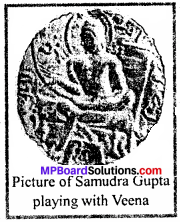
The art dance and music prospered during the Gupta period like earlier period during this period too people were fond of music. Dance and music were practiced in the contemporary period during Vasant Utsav, Kaumidi Utsav, Deepotsav etc. Information of . ‘Ganikas’ in the contemporary period is also found whose job was to dance and sing. Gupta rulers themselves patronized artistes. Samudra Gupta himself was an accomplished Veena player.

In order to keep this memory alive he got coins struck showing him playing flute. In the Bagh caves of Gupta period an important scene of dance and music has been found which is a symbol of splendor of dance and music in the contemporary period.

MP Board Class 9th Social Science Solutions Chapter 11 Major Cultural Trends - 8
From Malvikagnimitra we come to know that there were art buildings for the education in music in towns. There were Acharyas (teachers) in the towns for teaching dance. In Malvikagnimitra Ganadas is referred to as music dance Acharyas (teachers). In this way ample evidence of music and dance during the Gupta period are found.

Question 4.
Describe the progress in the field of architecture made during Akbar’s reign.
Answer:
During Akbar’s period there was an intermingling of Persian style with Hindu and Buddhist architectural styles. Buildings of Akbar’s period were constructed by. red sandstone. Akbar got Fatehpur Sikri built. The chief features are intermingling of Chapakar and Dharmik styles. Fatehpur Sikri’s Diwan – i – Aam, Diwan – i – Khas, Agra Fort, Palace of Jodhabai, Panch Mahal, Jama Masjid, Buland Darwaja are specimens of Akbar’s period architecture.

Question 5.
Gupta period was the golden age of literature.
Answer:
Gupta period was the Golden age of literature. Gupta period gave Sanskrit the status of the language. The form in which literature flourished during the period of Gupta rulers is unparalleled. During this period there were literary creations in many fields of science and knowledge. Smriti literature was composed ‘during this period. Yajanvalkya, Narad Smriti, Kavyava Smriti are chief among them. Ramayana and Mahabharat was written in this period.

Buddhist philosopher Asanga composed the Mahayan Sutrankar and Yogacharya Bhoomi Shastra. Vasubandh composed the Abhidarma Kosha. The chief Jain writers were Jenchandra, Siddhasena and Devnandini. From the Gupta period literature we can understand that prevailing education system must have been excellent. Nalanda University was established during this period. Kashi, Mathura, Ayodhya and Pataliputra were chief centers of education.

MP Board Solutions

MP Board Class 9th Social Science Chapter 11 Long Answer Type Questions

Question 1.
Describe the growth of painting during the Sultanat and Mughal periods.
Answer:
Painting declined during the Sultanat period. Painting was looked down upon by the Sultans. Still painting remained alive in Gujarat, Rajasthan and regions  of Malwa. Scenes related to religious and day – to – day life were presented. Slowly Malwa and Rajasthan School of art developed. The books written on birch barke in Gujarat by Jain monks have a very high quality of small illustrations.

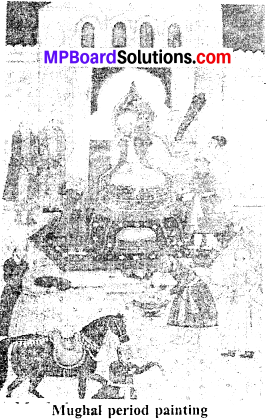
In Bengal and Bihar too manuscripts written by the Buddhist monks had small images drawn by using lives. The paintings drawn on the temples of southern India have also used lives. Mughal paintings were started during the rule of Tumayun. Akbar gave an organised form to Mughal paintings. He established a separate department for the painters and Muglud period painting famous painters were housed there.

The first Mughal period painting collection in Mughal style painting is the Hamzanama which is also popular as Dastan – e – Amir Hamza the speciality of these paintings foreign plants, trees and their leaves and flowers minutest obtain of decoration architecture images of women. Exceptional Rajasthani paintings with decorative elements. Rajmanama, Ramayana and Akbarnama are illustrated manuscripts of the period.

MP Board Class 9th Social Science Solutions Chapter 11 Major Cultural Trends - 9

Fresco painting started for the first time during the Akbar period. Jehangir’s period is known on the golden period of Mughal paintings. Jehangir himself was a painter. Jehangir established a painting school (Chitrashala) under guidance of famous painter Akarizh. During Jehangir’s period Portrait painting, natural scenes and paintings related to persons life started.

Jehangir also gave titles to the forest’painters which includes famous bird specialist painter, Ustad Mansoor and portrait painter Abul Hasan. During Shahjahan’s reign borders and underlines in paintings progressed. Aurangzeb considered painting to be against Islam and banned them. Therefore painting in the courts came to an end and painters settled elsewhere. In this way styles of regional paintings developed.

MP Board Class 9th Social Science Solutions

MP Board Class 9th Social Science Solutions Chapter 10 Medieval India

MP Board Class 9th Social Science Solutions Chapter 10 Medieval India

MP Board Class 9th Social Science Chapter 10 Text Book Questions

Choose the Correct Answer:

Question 1.
Mahmood Ghazani was the ruler of –
(a) Multan
(b) Ghazni
(c) Bahmani
(D) Iraq.
Answer:
(b) Ghazni

Question 2.
The founder of the Slave dynasty was –
(a) Iltutmish
(b) Mohammad Ghori
(c) Qutub-ud-din Aibak
(d) Balban.
Answer:
(c) Qutub-ud-din Aibak

Question 3.
Who injured Ghori in the 1st battle of Tarain –
(a) Prithiviraj
(b) Krishnaraya
(c) Govindraj
(d) Deepakraj.
Answer:
(a) Prithiviraj

Question 4.
Which empire did Harihar and Bukka found –
(a) Bahmani Empire
(b) Vijayanagar Empire
(c) Delhi Sultanate
(D) Mohammad Nagar.
Answer:
(b) Vijayanagar Empire

Question 5.
Who killed Afzal Khan –
(a) Shivaji
(b) Raja Ram
(c) Sahu
(D) Tarabai.
Answer:
(a) Shivaji

MP Board Solutions

Fill in the blank:

  1. The ancient chola rulers have been described in the …………….
  2. The founder of the Parmor Dynasty was ……………….
  3. Mahmood Chaznavi made ……………… successful attacks.
  4. Balban followed the policy of …………………. for regulating his administration.

Answer:

  1. Sangam literature
  2. Upendra Raj
  3. 17
  4. blood and iron.

True or False:

  1. The name of Shivaji’s mother was Jijabhi.
  2. The battle of Haldighati was between Akbar and Rani Durgawati.
  3. After Jehangir, Shahjahan became the emperor.
  4. Humayun was the elder son of “Babur”.
  5. Krishna Dev Rai had write a bok named “Jambvanti Kalyanam. “

Answer:

  1. True
  2. False
  3. True
  4. True
  5. True.

MP Board Solutions

MP Board Class 9th Social Science Chapter 10 Very Short Answer Type Questions

Question 1.
How many times did Mohammad Ghaznavi attack India?
Answer:
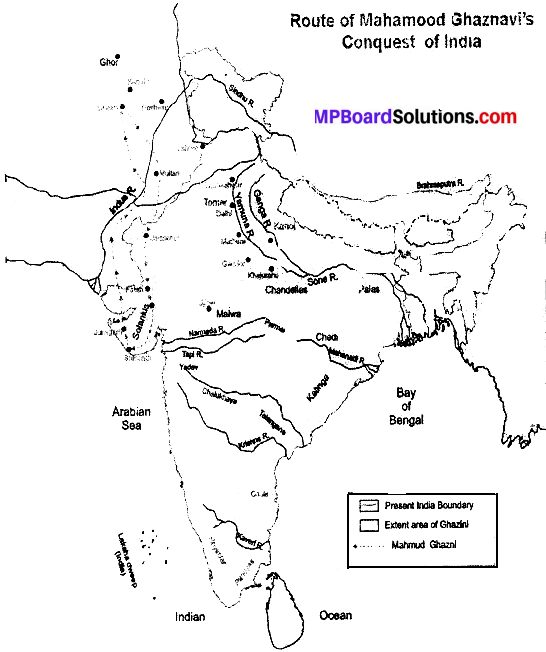
Mohammad Ghaznavi attacked India seventeen times.

Question 2.
Who laid the foundation of Mughal Empire in India?
Answer:
Babur laid the foundation of Mughal Empire in India.

Question 3.
Who founded the Vijayanagar Empire?
Answer:
Two brothers Harihar and Bukka founded the Vijayanagar Empire.

Question 4.
Who was the founder of the Bahmani Empire?
Answer:
The Bahmani Empire was founded by the Muslim Amirs.

Question 5.
Who started the religion “Din-e-Illahi”?
Answer:
Akbar.

MP Board Solutions

Question 6.
Who was Guru Go-bind Singh?
Answer:
Guru Go-bind Singh was the tenth Guru who organized the Sikhs into a military organization to fight against the Mughal Empire.

MP Board Class 9th Social Science Chapter 10 Short Answer Type Questions

Question 1.
Who was Iltutmish? How did he overcome his difficulties?
Answer:
Iltutmish was one of the most efficient rulers of the Slave dynasty. He was an Ilbari Turk. There were many difficulties in front of Iltutmish after coming to the throne. But he was a great diplomat. He formed a union of the Turks to overcome his difficulties, fie saved Delhi from the attacks of the Mongols.

Iltutmish attacked Ranthambor, Mandor, Nagod, Sambhar, Nayana, Jalore and Gwalior to curtain the rising Rajput power. He won the Gwalior fort in 1232 A.D. Then, due to his foresightedness and diplomacy he overcome all his difficulties.

Question 2.
What was the market policy of Allaudin?
Answer:
Allaudin implemented market control in Delhi. He make goods available to common people on less prices. He also implemented the rationing system. He made Government granaries. Keeping in view the sudden change in the weather, he fixed the rates of goods not on the basis of one’s wishes but in accordance to the cost of production. Excessive taxes were imposed on farmers, traders and Hindus. Taxes were collected strictly.

Question 3.
How did the Tughlaq dynasty establish power over the Delhi Sultanate? Examine.
Answer:
In 1320 A.D. Ghiyasuddin Tughlaq removed the last ruler of the Khilji dynasty. Nisir-ud-din Khusro and became the Sultan of Delhi. He led military campaigns to Warangal, Orissa and Bengal after becoming the Sultan. After Ghiyasuddin, his son Muhammad – bin Tughlaq became the Sultan of Delhi. Firozshah Tughlaq became the next Sultan. After coming to the throne Firoz made successful attacks on Bengal, Jainagar, Nagarkot, Thatta etc.

MP Board Solutions

Question 4.
Write the contribution of Shershah’s administrative organisation in Indian History.
Answer:
Shershah ruled for a brief period, no doubt, but it has an important place in Indian history. It was because he rekindled the old administrative system with fundamental reforms which proved to be foundation stones for future. Sher Shah gave out most importance to the welfare of the people and laid the foundation of a strong administration, the advantage of which went to the Mughals.

He started many works in the field of military administration, judicial system and land revenue system which was later adopted by Akbar. Shershah divided his empire into Sarkars and Sarkars into Parganas. He made reforms in the currency system.

Question 5.
Write the contribution of Prithviraj Chauhan in Indian history.
Answer:
Prithviraj Chauhan was an able, brave, valiant and powerful emperor. He had a fine army and army commanders. He faced Ghori in 1191 A.D. on the plains of Ta-rain and made him flee. Ghori managed to escape. But again attacked India the very next year. There was another battle in 1192 in which Prithviraj fought valiantly and compelled the forces of Ghori to retreat.

Question 6.
Describe why Maharana Pratap is famous in Indian history.
Answer:
Maharana Pratap’was the brave son of the Rana Udai Singh of Mewar. When all Rajput princes accepted Akbar’s suzerainty, Maharana Pratap did not do so. After the death of Rana Udai Singh, Maharana Pratap fought against Akbar to defend his state.

A very fierce battle was fought on the plains of Haldi Ghati in 1577 A.D. but Rana Pratap was defeated. He fled away from the battle – field. He wandered from forest to forest, ate bread made of grass, but he did not submit to Akbar. He did not accept Akbar’s dominance. This made Maharana Pratap famous in Indian History.

MP Board Class 9th Social Science Chapter 10 Long Answer Type Questions

Question 1.
What were the objectives of Mahmood Ghaznavi’s and Mohammed Ghori’s attack on India. Write the causes of their success.
Answer:
The objectives of Mahmood Ghaznavi’s attack on India:
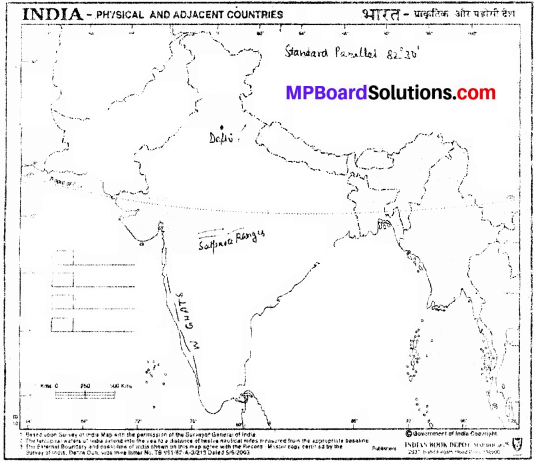
Mahmood was an ambitious ruler of a small principality of Western Asia. He needed money for his army. He had heard many legends about Indian wealth. In order to plunder India’s wealth, he invaded many parts of northern India from about 1000 to 1027 A.D. Mahmood made seventeen attacks on India. He destroyed many religious places and looted and carried immense wealth to Ghazni.
The Objectives of Muhammad Ghori’s attack on India:
Muhammad Ghori was a ruler of a small principality. Ghori in Afghanistan in the north-west India. Taking advantage of the mutual conflicts of the Indian rulers Ghori first invaded India in nearly 1175 A.D. and brought Multan and Sindh under his domination. The objective of Muhammad Ghori’s invasion on India was acquiring wealth and propagating Islam.

The Causes of their successes:
Both of them were ambitious ruler. They needed money which they acquired by plundering India. After having huge wealth they did what they wished and got wonderful success. They also took advantage of the mutual conflicts of hie contemporary rulers. These rulers lacked political unity which ultimately paved the way to Mahmood Ghaznavi and Muhammad Ghori and they remained successful in achieving their goal.

Question 2.
Describe the administrative organization of King Krishna DavRai and its impact on the people.
Answer:
The most efficient ruler of Tulva dynasty was Krishna DevRai. He was the cousin brother of Veer Narsihma. He was a brave soldier, successful military commander and able administrator. He – established peace in his Kingdom and paid attention towards economic progress.

He crushed the revolts and by defeating the neighboring states made his frontiers secure. He waged successful wars against Bahmani states Orissa, Golconda and Bijapur. He established friendly relations with the Portuguese for political reasons and promotion of trade.

He was an admirer of know Ladge. and art. His court had eight finest poets and artists. Portuguese traveler Peida has praised him a lot. Krishna DevRai himself was a great learner of Telugu and Sanskrit. Pie wrote many books of which Ayukta Malyad and Jambvanti Kalyanam are available even today. Due to his admiration of literature he is also called the ‘Bhoja of Andhra’.

He got Mandaps and Gopurams with hundred pillars constructed in various parts of his Empire. He got Vijay Bhavan, Hazarram temple and Vitthal temple constructed. He also founded a city called Naglapur. Krishna DevRai wanted his people to be happy. He wanted to improve agriculture and promote trade. People were very happy with their ruler. They were satisfied and led a contented life.

MP Board Solutions

Question 3.
Examine the Rajput and religious policy of Akbar.
Answer:
Akbar’s Rajput Policy:
When Akbar had captured Gwalior, Ajmer and Malwa he came in close contact with the Rajput kingdoms. He was so far-sighted that he saw clearly that he could rule permanently over India, if he made the Rajputs his friends. So he embarked on a definite policy towards the Rajputs. He entered into marriage alliances with many powerful Rajput kingdoms.

Bhara Mai, the ruler of Amber married his younger daughter. He sent his infant prince Dauyal to Amber to be brought up by Bhara Mai’s wives. He gave mans-ab to Bhara Mai and his son. He treated Bhara Mai with great respect and when he dashed to Gujarat in 1572 he placed Bhara Mai in charge of Agra.

Akbar entered into matrimonial relations with a number of other Rajput kingdoms. But he never insisted upon matrimonial relations as a precondition. He gave very high favor to Hadas of Ranthambhore though he did not enter into any matrimonial relations with him.

Akbar’s Rajput policy was combined his religious policy. The Rajput princesses that he married were given full freedom to profess their own religion. The Rajputs who became so related to him became his trusted friends, advisers and his loyal comrades in the battlefield. Bhagwandas and Man Singh were his Rajput generals.

Akbar’s Religious Policy:
Akbar followed a policy of broad religious toleration. He gave full religious freedom to the people. In 1564 he abolished the Jizyah which was used by the Ulema to humiliate the non-Muslims. He abolished the pilgrim’s tax. He gathered at his court a band of talented people and in his Ibadat Khana,

people of all religions:
Christian, Zoroastrians, Hindus, Jains even atheists gathered. He did not like Mullahs who wrangled, shouted, abused each other. He himself read Khutba. He used a royal order called Majhar. He set up a new religion which consisted of many existing religions Hinduism, Christianity, Zoroastrianism etc. This new religion was known as Din-e-Illahi.
By the policy of religious toleration that Akbar followed, he formed a national state in India.

Question 4.
Who were the Indian Kings and rulers who resisted the Mughal power in India and what role did they play? Describe.
Answer:
Babur had laid the foundation of Mughal empire in India in 1526 A.D. by defeating Ibrahim Lodi. The Mughal empire established in 1526 A.D. continues till 1707 A.D. From 1707 A.D.- 1857 A.D. Mughal empire was only nominal in Delhi. From 1526 to 1707 A.D. Babur, Humayun, Akbar, Jehangir, Shahjahan and Aurangzeb followed all methods and tactics, diplomacy and war, friendship ‘ and alliances in order to keep entire India under their sovereignty.

Kings from different parts of India kept challenging them. In order to deal with the problems of the state Hindu Rajput kings had two options Surrender like other Rajput kings in front of Akbar, and become a part of Mughal organization and live a dependent life. Second option was to maintain their independence and defend the glory of their nation.

For following this policy they had to be prepared for fierce wars and leave the pleasures and family life. To protect their values, thoughts and respect of India some Rajput kings decided to’ fight against the Mughals. They gave tough challenge to the Mughal rulers with bravery. The prominent among them were the rulers of Mewir Ran. Sanga, Maharana Pratap, Rani Durgawati of Gond la, Maratha ruler Shivaji, and Sikh leader Govind Singh.

The Ruler of Mewar Maharana Pratap:
Rana Sanga gave stiff resistance in the plains of Khanna. Unfortunately Rana Sanga was defeated. After Rana Sanga Mughal power was resisted by Maharana Udai Singh. After Udai Singh’s death in 1572 A.D. his son Rana Pratap became the ruler of Mewar. He gave a tough challenge to Akbar till he lived.

Rana Pratap started organizing Mewar to give Mughals a fight. He organised feudal lords (Samants) and Bheels. He shifted his residence from Kumbhalgarh to Gogunde so that Akbar could not attack it easily. Through public relations he created awareness against Mughal power.

These efforts brought unity and the entire Mewar rose against the Mughal power. Akbar never liked the independence of Mewar. But Rana Pratap was not ready to accept the suzerainty, friendship or entering into a matrimonial alliance with Akbar. As a result war started between the two. Akbar’s armies conquered Gogunde. But Rana Pratap did not accept defeat. He carried on war against the Mughals and managed to win back many of the lost areas.

Rani Durgawati:
She was a valiant warrior of medieval history. When Akbar heard about the economic prosperity of the Kingdom of Gorha, he sent Asif Khan with a big army to attack on Gorha state for extending his empire. Rani Durgawati decided to fight than surrendering. She bravely fought against the forces of Asaf Khan but in the end she was wounded seriously. When she lost all hopes of winning the battle, she ended her own life.

Chhatrapati Shivaji:
The strongest opposition to the Mughal Empire, was given by Maratha’s under the leadership of Shivaji. Aurangzeb made several plans to trap Shivaji but was not successful. He sent the famous military commander Raja Jai Singh against Shivaji. But nothing happened in the favor of Aurangzeb. When Shivaji went to meet Aurangzeb with Raja Jai Singh, Aurangzeb treacherously imprisoned him. But, Shivaji managed to escape from there which made Aurangzeb extremely angry.

Sikh:
The Sikh also resisted the Mughal power. Guru Govind Singh, the tenth Guru, organized the Sikhs into a military organization to fight against the Mughal armies. He started the practice of prefixing the word ‘Singh’ among Sikhs. Sikh community put challenges in front of the Mughal Empire.

MP Board Solutions

Question 5.
Write down the causes responsible for the decline of the Mughal Empire.
Answer:
Mughal Empire, the foundation of which was laid by Babur, its decline could be seen from the period of Aurangzeb. After the death of Aurangzeb in 1707 Mughal power declined rapidly. The chief causes of decline of this massive empire were as follows:

Aurangzeb’s Empire, his Policies and War:
Aurangzeb’s responsibility can be placed prominently as a chief of Mughal empires decline. His religious – orthodox policy and anti-Hindu policy was one of the chief cause. Due to his policy of oppression he made Jats, Rajputs, Maratha’s, Sikhs etc. as his enemies.

He oppressed the Hindus due to which he stopped getting the support of the Rajputs. Marathas and Jats gave severe blows to his empire, due to which Mughal Empire declined. To bring the kingdoms of the south under his subordination Aurangzeb fought for 25 years with the different states of South India, in which he had to face severe loss of men and money. These wars shook the foundation of the empire.

Excessive Taxes:
Mughal rulers imposed heavy taxes on the people for their pleasures and wars, paying which became impossible for the people. There were voices of revolt among the common man.

Vastness of Empire:
The vastness of Mughal Empire in and outside India also became a cause of decline of Mughal Empire. A vast Empire could have only been regulated through a centralized authority. Due to weak central authority the Mughal Empire also started breaking up. Akbar had saved the Empire by his diplomacy but his successors were not successful in this.

Revolts of Chieftains and Princes:
Revolts of Loyal Chieftains and Princes also helped in the decline of Mughal Empire. The revolts of royal leaders like Salem, Khusro, Shahjahan and /uirangzeb also gave a blow to the unity of the Empire.

War of Succession:
The war of succession for power also gave a deep wound to the Mughal Empire. There was no certain rule of succession in Muslim royal power. There were many claimants to tire throne due to which the successor was decided on the bayonet point. The war of succession between the sons of Jahangir and among the sons of Shahjahan for power aided the decline of Mughal Empire.

Moral Decline of Mughal Rulers:
Early Mughal rulers were loyal and virtuous towards their state. But the Mughal rulers after Jahangir were pleasure seeking and com-placement.

Religious Policy:
The religious policy of the Mughals was bias. Most of the rulers were staunch followers of Islam. They supported the spread and growth of Islam, whereas harmed other religions and other religion followers, due to which Mughal Empire could not get their support. Rise of Hindu Powers: The rise of new Hindu powers also played a role in the decline of Mughal Empire. Marathas, Jats, Sikhs, Rajputs etc.

reorganized themselves and rose against the Mughal empire which had struck Hindu culture. Continuous wars, autocratic rule decline of military power, moral decline of Amirs (Nobles), groupism and other reasons also aided the decline of Mughal Empire.

MP Board Solutions

MP Board Class 9th Social Science Chapter 10 Other Important Questions

Choose the correct answer:

Question 1.
Pallavo Kings ruled for nearly –
(a) 500 years
(b) 600 years
(c) 700 years
(d) None of the above.
Answer:
(a) 500 years

(ii) Which one is not a rulers of the Chalukya dynasty?
(a) Pulakesin – I
(b) Pulakesin – II
(c) Vishnuwardhan
(d) Aparajit Varman.
Answer:
(d) Aparajit Varman.

Question 2.
The capital of Pandya Kingdom was –
(a) Mankhet
(b) Trivendrum
(c) Madurai
(d) None of the above.
Answer:
(c) Madurai

Question 3.
Humayun sat on the throne in –
(a) 1530 A.D.
(b) 1540 A.D.
(c) 1630 A.D.
(d) None of the above.
Answer:
(a) 1530 A.D.

Question 4.
Khurram was the son of –
(a) Shahjahan
(b) Jahangir
(c) Akbar
(d) Babur.
Answer:
(b) Jahangir

MP Board Solutions

Fill in the blank:

  1. In Mughal Empire ………………. got the land measured.
  2. Mahmood Ghaznavi attacked India ……………… times.
  3. TajMahal was built by …………….
  4. The first battle of Panipat was faught in …………….
  5. The ruler of Mewar was ………………

Answer:

  1. Sher Shah Suri
  2. 17
  3. Shahjahan
  4. 152(A.D.)
  5. Maharana Pratap.

True or False:

  1. The founder of the slave dynasty was Qutab-ud-Din Aibak.
  2. The first battle of Ta-rain was fought between Mohammad Ghori and Prithviraj Chauhan.
  3. Qutab Minor is in Agra.
  4. Guru Govind Singh started an organization called Khaisa.
  5. Jaziya Tax was levied on Hindus.

Answer:

  1. True
  2. True
  3. False
  4. True
  5. True.

MP Board Solutions

MP Board Class 9th Social Science Chapter 10 Very Short Answer Type Questions

Question 1.
Which period is referred to as the medieval period?
Answer:
The period between the ancient and modern’ period is referred to as the medieval period.

Question 2.
What happened after the death of Harshavardhan?
Answer:
After the death of Harshavardhan there came a political vacuum in India.

Question 3.
Where did the Chalukya dynasty rule in India?
Answer:
The Chalukya dynasty ruled in southern India.

Question 4.
Name the two Rashtrakuta rulers.
Answer:
Navajo and Dantidurga.

Question 5.
Where was the capital of Rashtrakutas?
Answer:
The capital of Rashtrakutas was at Mankhet.

Question 6.
Who was Atikeshari Marvarman?
Answer:
Atikeshari Marvarman was a famous Pandya ruler.

MP Board Solutions

Question 7.
Who was the founder of Solanki dynasty of Gujarat?
Answer:
Moolraj was the founder of Solanki dynasty of Gujarat.

Question 8.
Which dynasty later came to be known as the Chauhan dynasty?
Answer:
The Chauhan dynasty later came to be known as the Chauhan dynasty.

Question 9.
Why did Iltutmish appoint his daughter Razia as his successor?
Answer:
The sons of Iltutmish were incapable but his daughter Razia was able Hence Iltutmish appointed her as his successor.

Question 10.
Who established the Khilji dynasty?
Answer:
Sultan Jalal – ud – dirv Khilji established the Khilji dynasty.

Question 11.
What do you know about Sangam dynasty?
Answer:
Vijayanagar was established by two brothers Harihar and Bukka. Their father’s twine was Sangam. Therefore their dynasty came to be known as Sangam dynasty.

Question 12.
What is Tuzukh-i-Baburi?
Answer:
Tuzukh-i-Baburi is a book written by Babur.

MP Board Solutions

Question 13.
Under whose guardianship did Akbar rule in the beginning?
Answer:
In the beginning Akbar ruled under the guardianship of Bairamkhan.

Question 14.
What do you know about Jazia?
Answer:
Jazia was a tax levied on non – Muslims.

Question 15.
Who abolished Jezia tax?
Answer:
Akbar abolished Jezia tax.

Question 16.
Why were there continuous revolts in Aurangzeb’s Kingdom?
Answer:
Aurangzeb made Rajputs, Jats, Sikhs and Maratha’s his rivals due to which there were continuous revolts in his kingdom.

Question 17.
Who led Akbar’s armies against Rana Pratap?
Answer:
Man Singh led Akbar’s armies against Rana Pratap.

MP Board Solutions

MP Board Class 9th Social Science Chapter 10 Short Answer Type Questions

Question 1.
Mention the sources of medieval Indian history.
Answer:
We have adequate archaeological and literary sources to study the history of medieval history.

Literary Sources:

  1. Rajtarangini
  2. Tuzukh-i-Baburi
  3. Prithvi Raj Raso
  4. Padmavat
  5. Akbarnama etc.

Archaeological Sources:

  1. Monuments
  2. Coins
  3. Copper plates
  4. Statues
  5. Temples, Mosques, Miners, Forts
  6. Paintings and Fresco.

Question 2.
Describe the political vacuum in India after the death of Harshavardhan?
Answer:
After the death of Harshavardhan there was a political vacuum in India. The forces of decentralization led to rise of feudal powers which destroyed the political unity of India. There was rise of new ‘dynasties during this period. For example, Gurjar Pratihars, Pala dynasty, Chalukyas, Parmars and Chauhans in the northern India were the chief dynasties. In southern India Pallavas, Rashtrakutas, Chalukyas of Kalyani, Cheras, Pandyas and Cholas were the chief kingdoms.

Question 3.
Describe the characteristics of Chola administration.
Answer:
The characteristics of Chola administration were:

  • King was the highest official of the State.
  • Administration was done with the help of Council of Ministers.
  • Empire was (divided into provinces, Mandalams, Vala nadus (districs).
  • The smallest unit of administration was the Grama and this important unit Grama was divided into 3 parts (assembly of the common people), Sabha (intellecuals) Brahmin, Nagaram (trades, shopkeepers, sculptors). There were several committees for the administrative organization of the Grama.
  • Agriculture and trade was well-developed.
  • The chief source of states income was land revenue and tax on trade.
  • Trade and means of communication were developed’ and there was foreign trade too.

MP Board Solutions

Question 4.
Describe the ups and downs that came during the reign of Raziva Sultan.
Answer:
The sons of litutmish were incapable therefore he appointed his able daughter Razia as his successor. Raziya sat in the court and lead the wars. Crowning a daughter instead of a son was a novel step’m medieval history – In the whole of medieval period history. Raziya was the first and only Muslim woman Sultan of Delhi Amir Turk Sardars could not tolerate a won’.an Sultan and started conspiring against her and revolting.

The most powerful among the revolts was the one led by Altunia of Bhatinda, Raziya attacked Lahore to crush the revolt. In the war her military commander Yakut was killed and Raziya was murdered. After Raziya Bahram Shah, Alauddin Masood Shah and Nasiruddin Mahmood became the name sake rulers of Delhi Sultanat, while the real power was in the hands of Amir Sardras.

Question 5.
Describe the rise and fall of Bahmani kingdom.
Answer:
After the establishment of Delhi Sultanat in the north, the various states of south remained independent. Due to the difficulties in communication and being located in distant regions the Sultans of Delhi remained away from the politics of south. Alauddin Khilji was the first Sultan of Delhi who established his supremacy over the southern states through force.
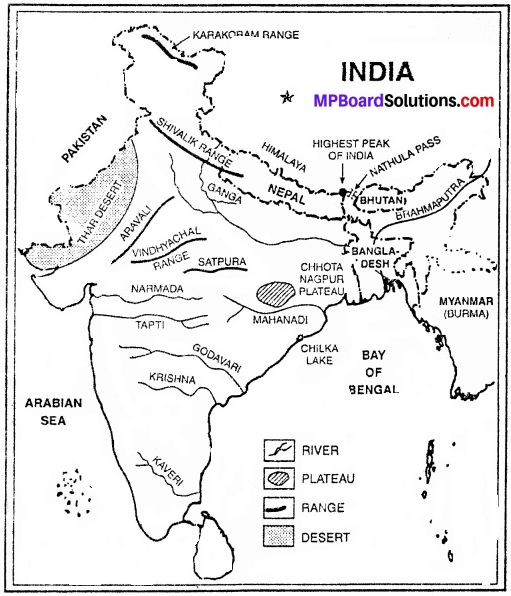
‘But after his death Muhammad-bin-Tughlaq established his supremacy over the southern states, but within a short span of time he had to face continuous revolts. During Muhammad Tughlaq’s reign the Muslim Amirs of south revolted and the Bahmani Kingdom was founded. Bahmani Kingdom emerged as a powerful Muslim state.

The foreign Muslim Am/s of south India became angry with the policies, oppression and plans of the Delhi Sultan Muhammad- bin-Tughlaq and revolted. The amies of Sultan were unsuccessful in crushing the revolt. The revolting people established their control over Devgiri.

In about 1357 A.L Hasan Gangu Kohsan Abdul Muzzafar sat on the throne with the name of Alludin Bahman Shah. Bahmani Kingdom remained in south India from 1347 to 1526 A.D, The inefficiency of Sultans, and torture of the people, continuous wars with the neighboring states, struggle between the southern and foreign Amirs, murder of Mahmood Gavan differences between Amirs and other causes hastened the decline of Bahmani kingdom.
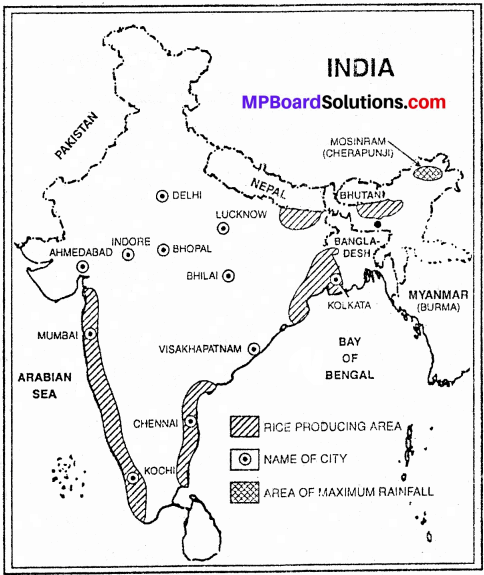
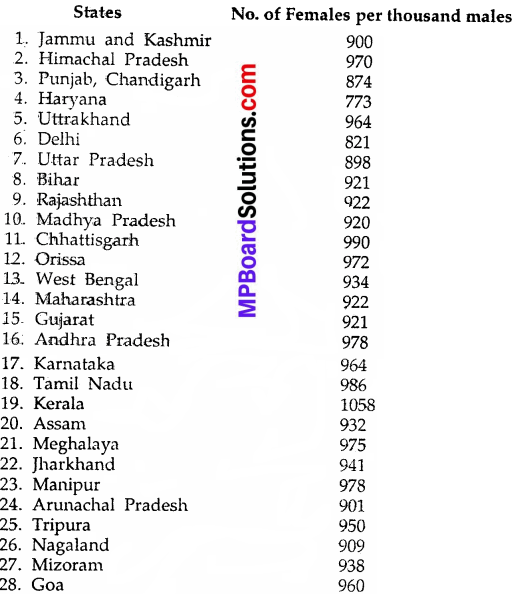
MP Board Solutions

Question 6.
‘Aurangzeb’s reign was full of turmoil Justify it.
Answer:
Aurangzeb’s reign was full of turmoil. Aurangzeb made, Rajputs, Jats, Sikhs and Marathas his rivals due to which there were continuous revolts in the Kingdom. Smvaii encountered him due to his anti-Hindu policy and laid the foundation of an independent Maratha Kingdom.

Sikh Guru Teg Bahadur was killed after torture. After this Guru Gobind Singh organized the Sikh army (Khalsa) to face Aurangzeb. Rajputs like Durgadas Rathor challenged Aurangzeb. Tarabai gave a tough resistance to Aurangzeb for independence of Marathas. Aurangzeb died in 1707 A.D. and with him the decline of Mughal empire also started.

Question 7.
Who were the Sikhs? Write a short account of their emergence as a political power.
Answer:
The Sikhs were the followers of Guru Nanak Dev By the seventeenth century, Sikhism new religion had become the religion of the peasants and artisans in many parts of the Punjab. After Guru Nanak Dev, there were other nine Sikh Gurus. The earlier Gurus concentrated mainly on Sikhism.

But the later Gurus became the military leaders of the Sikhs also. To curb the growing power and strength of .he Sikhs. Aurangzeb ordered the execution of Guru Tegh Bahadur in 1673 A.D. This enraged the.Sikh.

As a result, the tenth and last Guru Govind Singh organised the Sikhs as soldiers and prepared them for a long battle against the Mughals. Like Marathas, the Sikhs; carried out raids in various places, but unlike Marathas, they could not establish an independent state during the reign of Aurangzeb.

MP Board Class 9th Social Science Chapter 10 Long Answer Type Questions

Question 1.
Describe the invasions of Mahmood Ghazni and Mohammad Ghori.
Answer:
Invasions of Mahamood Ghaznavi:
Mahmood was an ambitious ruler of a small principality of Western Asia. He needed money for his army. He had heard many legends about Indian wealth. In order to plunder India’s wealth, he invaded many parts of northern India from about 1000 to 1027 A.D, Mahmood made 17 (seventeen) successful attacks on India.

Punjab, Multan, Bhatinda, Nagarkot, Narainpur, Kashmir, Thanesar, Mathura, Kalinjar and Somnath were prominent centres of invasion. Look at the above places on the given, map. Ghaznavi destroyed many religious places and looted and carried immense wealth to Ghazni.

The famous writer Alberuni who came to India with Mahmood Ghaznavi has written about the carnage of Mahmood’s destruction. His attacks led to great economic and cultural loss to the country. The contemporary Hindu rulers faced Mahmood Ghaznavi but were unsuccessful due to lack of political unity. Mahmood Ghaznavi died ir. 1030 A.D. (approx.)

MP Board Class 9th Social Science Solutions Chapter 10 Medieval India - 1

Mohammad Ghori’s invasion:
After 150 years of Mahmood Ghajnavi’s invasion, Mohammad Ghori ruler of a small principality Ghor in Afghanistan in the north-west India; taking advantage of the mutual conflicts of the Indian rulers Ghori first invaded India in nearly 1175 A.D. and brought Multan and Sindh under his domination.

The objective of Mohammad Ghori’s invasion on India was acquiring wealth and propagating Islam. During this time, Hindu states in northern India included – Chauhan state of Delhi and Ajmer Solanki Kingdom in Kannauj, Sena Kingdom in Bengal-Bihar, and Chandel kingdom in Bundelkhand. In southern India Devgiri and Warangal and Hoysal were prominent states.

MP Board Solutions

Question 2.
Describe the rise of Vijayanagar Kingdom. How did this Kingdom come to an end?
Answer:
The credit for the establishment of Vijayanagar goes to two brothers Harihar and Bukka. Their fathers name was Sangam. Therefore their dynasty is also known as Sangam dynasty. When Muhammed Tughlaq had attacked Warangal and won it, both the brothers were imprisoned and sent to Delhi.

The Sultan was impressed with their ability and service and took them in his army. Both the brothers were sent to South India to crush the revolt. Here they came in contact with the famous Saint Madhav Vidyaranya of South India. Here they were also inspired to protect Hindu Culture. In 1336 A.D; Harihar laid the foundation of Hampi-Hastinavati Kingdom on the southern banks of river Tungabhadra. The city was named Vijayanagar, which later took the form of a big Empire.

Harihar – I:
The first ruler of Vijayanagar was Harihar. He ruled with the help of his brother Bukka and expanded his Empire. In a short span of time he extended his Empire from Krishna river in the north to Kaveri river in the south and till the sea coast in the east and the west. He established a firm administration.

Bukka:
After the death of his brother Harihar he became the ruler of Vijayanagar. Traditional rivalry with Bahmani Kingdom started with Bukkas period. Bukka won the Muslim state of Madurai and expanded his Kingdom to Rameshwaram in farthest-most south.

He did a lot of work for the protection of Hindu culture and took the title of ’Vedmarg-Pratisthan. He gave religious freedom to the believers of Jainism, Buddhism and Islam. He encouraged Telugu literature and centralized administration. He had also sent his ambassador to China.

Harihar – II:
Harihar II became the ruler in about 1377 A.D. He took the title of ‘Maharajadhiraj’. He won the cities of Mysore, Kanijivaram, Chingalpur, Trichnopoly etc. He fought a battle with the Bahmani Kingdom. He invested most of his time in proper organization of administration and religious works.

He got many Hindu temples constructed and donated liberally. Sayan the famous scholar was his Prime Minster. After the death of Harihar II in 1406 A.D. there was a war of succession among his sons Virupaksha – I, Bukka II and Devraya became the rulers. After this Ramchandra and Veer Vijay became the King.

Devraya – II:
Devraya II was the most efficient ruler of Sangam dynastv. There were two terrible wars with Bahmani Kingdom during Devrava’s period in which Vijayanagar had to face severe losses. Devraya attacked Lanka and collected taxes. He promoted sea trade. He patronized literature and Shaivism.

End of Sangria Dynasty:
After Devraya – II Malikarjun (1446-.1465 A.D:) and Virupaksha II (1465-1485 A.D.) were weak rulers. In the end, the feudal leader of Chandragiri Narsingh Sulva in around 1486 A.D. established his control over the Kingdom and laid the foundation of Sulva dynasty” in Vijaynagar.

MP Board Solutions

Question 3.
Describe the administrative organization of Vijayanagar.
Answer:
The form of administration of Vijayanagar Empire was despotic monarchy. Tire powers of the king were uncontrolled and unlimited. The basis of the state was Hindu religion. The administration of Vijayanagar was divided into Central, provincial and local administration. In the Central administration of Vijayanagar the Emperor, minister Council, Kings assembly, Prince played an important role.

The Emperor had the chief position in the State and was called the Raja, All powers of the state were concentrated in his hands. He himself administered the state. Declaration of war and treaty, appointment of officers and workers organization of law and justice etc. were in his hands. There was a central secretariat for the administration of the state in which there were various departments – Chairman, secretaries and officers.

The officials and workers of the state received land in lieu of salaries. This arrangement was called the Naykat arrangement. Military officials were also given cultivable land. Military officers were called Nayak and the land that was given was called Amaram. The king was the highest judge for the administration of justice. He himself appointed the judges. Provincial officers (Prantapati) in the provinces and Panchayats in the village administered justice.

No delay was done in the administration of justice. Hindu code of justice was prevalent. The laws of criminal cases (Faujdari) were severe. Amputation of hands feet and death punishment were mostly given. The state made,efforts for the development of agriculture and irrigation. Spices were exported. The state encouraged irrigation work.

The construction of canals and ponds was considered to be a noble deed. The land revenue was determined according to the fertility of the land. Land revenue was not uniform throughout the state. Grazing tax, marriage tax, property tax, tax on trade, garden tax, tax on handicrafts were improved by the State. The subjects were happy in spite of heavy taxation.

Provincial Administration:
The Empire was divided into Provinces. Provinces were divided into Kottans or Valanadus. Kottam was a district which was divided into Nadus. Nadus were divided into cities. Village was the smallest unit of the state.The responsibility,of the province was in the hands of a member of the royal family or powerful feudal lord.

Local Administration:
The smallest unit of administration was the village. There was representative body (Pratinidhi Sabha) for the administration of the village which had the representatives of the village. The Pradhan (Chief) of the Gram Panchayat was called Iyengar. He was also given some powers of justice and punishment. He also collected royal taxes. Gram Sabha could donate or sell the land under it. Gram Sabha was given the power to decide some diwani (revenue) and Faujdari (criminal) cases.

MP Board Class 9th Social Science Solutions

MP Board Class 9th Social Science Solutions Chapter 9 History of Ancient India

MP Board Class 9th Social Science Solutions Chapter 9 History of Ancient India

MP Board Class 9th Social Science Chapter 9 Text Book Questions

Choose the Correct Answer:

Question 1.
Which of the following cities is not related to Indus civilization?
(a) Mohen-jo-daro
(b) Kalibanga
(c) Lothal
(d) Pataliputra.
Answer:
(d) Pataliputra.

Question 2.
Which of foreign travelers come to India during Chandra Gupta Maurya’s period?
(a) Falien
(b) Arian
(c) Hieun Tsang
(d) Megasthenese.
Answer:
(d) Megasthenese.

Match the following:

MP Board Class 9th Social Science Solutions Chapter 9 History of Ancient India - 1
Answer:
1. (d) Magadh
2. (a) Kautilya
3. (b) Mahatma Buddha
4. (c) Vikrmaditya
5. (e) Kalinga War

Fill in the blank:

  1. The founder of the Jain religion was ……………….
  2. Mahatama Buddha attained enlightenment under the …………… tree.
  3. India’s two great epics are the …………….. and …………….
  4. The founder of the Gupta’s dynasty was …………….

Answer:

  1. Vardhaman Mahavir
  2. Pipal
  3. Mahabharta, Ramayan
  4. Sri Gupta

MP Board Solutions

MP Board Class 9th Social Science Chapter 9 Very Short Answer Type Questions

Question 1.
Write names of Vedas.
Answer:
There are four Vedas:

  1. Rigveda
  2. Samveda
  3. Yajurveda
  4. Atharvaveda.

Question 2.
Write the names of the four chief cities of the Indus civilization.
Answer:
The four chief cities of Indus civilization are:

  1. Mohen-jo-daro
  2. Harappa
  3. Ropar
  4. Kalibanga.

Question 3.
Who was Megasthenese? Name the book written by him.
Answer:
Megasthenese w’as a foreign traveler who came to India during the period of Chandra Gupta Maurya. The name of the book written by him is Indica.

Question 4.
Write the names of chief education institutions of ancient India.
Answer:

  • Taxshila University
  • Nalanda University

Question 5.
Who was Kautilya? Write the name of the book written by him.
Answer:
Kautilya was a famous economist during the period of Chandra Gupta Maurya. The name of the book written by him is Arthashastra.

Question 6.
Which Gupta ruler was successful in repulsing the Huna attacks?
Answer:
Skanda Gupta was successful in repulsing the Huna attacks.

MP Board Solutions

MP Board Class 9th Social Science Chapter 9 Short Answer Type Questions

Question 1.
Who discovered the cities of Mohen-jo-daro and Harappa?
Answer:
The city of Mohen-jo-daro was discovered by Rakhaldas Banerjee and the city of Harappa was discovered by Dr. Day a ram Salmi.

Question 2.
Write about the new information received about river Saraswati.
Answer:
New discoveries have revealed that almost two-thirds of the Indus civilization is spread in the areas of the extinct Saraswati river and its tributaries. The contribution of Dr. Vishnu Shreedhar Wakandar’s research on the river Saraswati is of vital importance. During the Vedic period Saraswati was a very big river.

It is believed that the river Saraswati must have originated from the Shivalik ranges of the Himalayas and from it flowed to Ambala, Thaneser, Kurukshetra, Pahova, Sirsa, Hansi, Agroha, Hanumanganj and via Kalibanga to Anupgarh to Suratgarh. In due course of time due to ecological changes the Saraswati river slowly dried up and became extinct after some time.

Question 3.
What is the importance of Kalinga war in Indian history?
Answer:
The Kalinga war proved to be a turning point in the life of king Asoka. This war changed Asoka’s attitude and he followed a policy of peace rather than that of war. After this war, the era of military conquests or Digvijay was over and an era of spiritual conquest or Dhammavijay began. Asoka finally became a follower of Buddhism. Thus the Kalinga war gave a new direction to Asoka’s life.

Question 4.
State the political significance of matrimonial alliances made by Chandra Gupta – II.
Answer:
Chandra Gupta – II married Kubernaga of the Naga dynasty. This led to friendly relations between both the dynasties. He married his daughter Prabhavati Gupta to Rudrasena – II, the Vakataka King. This relationship secured Chandra Gupta’s control over the Sakas.

These matrimonial alliances proved to be politically very significant. The daughter of Kadama dynasty was also married in the Gupta dynasty. Due to this matrimonial alliances the glory of Chandra Gupta II spread to southern India as well.

Question 5.
Write about the chief features of the administrative organization during the Gupta period.
Answer:
Like Maurya rulers, the Gupta rulers also made public welfare as the basic foundation of their administration. The King was the highest official of the state. The final authority of the state was in his hands. There was a council of ministers and other officials to assist the King. The chief source of income was the land revenue, which was called ‘Bhaga’.

This was generally one sixth of the produce. Gupta Empire was divided into three parts Central, Provincial and Local administration. The chief objective of the Gupta rulers was public welfare. For this they made hospitals, Dharamshalas, or rest-houses, schools, roads, etc.

MP Board Solutions

Question 6.
Write about the expansion of Harsha’s Empire.
Answer:
Emperor Harshavardhan was the son of ruler of Thanesar Prabhakar Vardhan. After Prabhakar Vardhan his son Rajyavardhan ascended the throne. When Rajyavardhan learnt of war between the ruler of Kannauj Grahavarman, husband of his sister Rajshree he fought against the King of Malwa Devgupta who had killed Grahavarman.

Rajyhavardhan defeated Dev Gupta but the King of Bengal Shashank, who was also the friend of Dev Gupta treacherously killed Rajyavardhan. Under these circumstances Harsha became the ruler of Thanesar. He ascended the throne in 606 A.D. at the ate of 16.

Since his sister Rajshree did not have any issue the throne of Kannauj also came in his hands. In this way he became the ruler of both Kannauj and Thanesar. His empire spread from Himalayas in the north to river Narmada in the south. To Bengal in the East to Indus. He had political relations with China and Persia.

MP Board Class 9th Social Science Chapter 9 Long Answer Type Questions

Question 1.
Write about the contribution of the Indus civilization?
Answer:
The contribution of Indus Civilizations:
1. The People of Indus civilization had an artistic bend of mind. They were well-versed in the art of hairstyles, indulged in ornaments and cosmetics. People excelled in singing, music and dance.

2. Ornaments were made of copper, bronze, shells, ivory, clay, beads, etc.

3. Indus civilization paved the way to trade. Internal and external trade were is existence. Indus people had trade relatives with foreign countries. The contact with foreigners was both through land and water route.

4. Indus civilization gave a well – organized city planning system. For maintaining and keeping the city clean waste disposal terracotta pots (dustbins) and tins were placed at different places. Every city must have had an institution similar to Municipality for construction and renovation of roads, bridges, canal, public buildings, for controlling the shop and type of construction of individual homes, buildings, window, drains etc.

5. Indus civilization familiarized with the art of writing.

6. Indus people gave knowledge of efficient water drainage management.

MP Board Solutions

Question 2.
Describe the Vedic civilization.
Answer:
Rigveda, Yajurveda, Samveda, Atharvaveda, these four Vedas together with other contemporary literary works, is known as Vedic civilization. The entire vedic period indicates an extensive time period.

Social Life:
The Indian society during the Vedic period was formed of Aryans. Aryans had thousands of domesticated animals. They settled wherever food and fodder for animal was available. ‘The chief basis of social organization of the’ Aryans was the family or the clan. The oldest male member was the head of the family. Joint family system was prevalent during the period in which people of many generations lived together.

Varna – system was prevalent during the vedic period. There were 4 Varanasi Brahmins, Kshatriyas, Vaishyas and Shudras. These Varanasi were, however not hereditary. For regulation of the social system Aryans considered life expectancy be 100 years and divided it into four Ashrams. These were Brahamcharya, (for learning and education), Grahastha (family life), Vanprastha (retirement from family life), Sannyas (giving up of worldly affairs).

Women enjoyed a high status in the society. Social evils like dowry, purdah system, child marriages were not prevalent. Women took keen interest in dressing up. Rice, Barley, Ghee (processed butter) and, milk formed the chief food of the Aryans. Chariot race, horse riding, hunting, dancing, gambling, game of dice were the chief means of entertainment.

Economic Life:
Vedic civilization was rural and was primarily ‘agrarian. Wheat, Jowar, Urad, Masoor (pulses) and Sesame were basically cultivated. Irrigation system was well developed. Along with agriculture, animal husbandry was the chief occupation. The status in the society was determined by the number of cows one had horse, cow, buffalo, sheep, goat etc. were domesticated.

Domestic systems of production and artisan-ship were highly developed. Carpenter, blacksmith, goldsmith, cobblers, had great importance. Both internal and external trade flourished. Barter system was’ prevalent.

Religious Life:
Aryans made great progress in religious and spiritual sphere. The chief features of their religious lives were as follows:

  • Vedic Aryans was nature worshipers. They worshiped various forms of nature. Sun, moon, wind, clouds (Megh) Usha (Goddess of Light) were chief Gods and Goddesses.
  • There was a provision of ‘Yagyan’ for every Aryan. They believed that Yagyans pleased God and fulfilled all wishes. Yagyans were the chief basis of rites and rituals.
  • Though Aryans worshiped many Gods still they believed in Monotheism.

Political Life:

  • Vedic Aryans were organized into various ‘Janas’ or tribes. A tribe had members of the same clan or family.
  • The basis of political system was the clan. The father was head of the clan. Many clans together formed a ‘tribe or village’.
  • Many villages together formed the ‘Vish’ the head of the Vish was called the Vishapati.
  • Many ‘Vish’ together formed ‘Jana’ the head of which was ‘Gopa – 1.

Rig Vedic people organized themselves into communities which were called ‘Janas’. The chief of the tribe the Pradhan or leader was called ‘Rajan’ or Gopit, who was responsible for the safety of his community and animals. Vedic period administrative system was primarily monarchical. The position of the king was hereditary.

The chief duties of the king were – protection of the subjects waging wars, to maintain peace and give justice to the subjects. There were many subordinates to assist the King. The chief among them were the Purohits or the priest. The commander of the army Senani, Gramin (village officer, Sangrahita or the treasurer, revenue collector, charioteer, Palagal’ (King’s friend and amuser)

Sabha and Samiti:
Sabha and Samiti were important and effective political organizations of the vedic period. Probably they checked the arbitrary decisions of the king. Rigveda refers to these institutions.

Military Organization:
Tire Military Organization and art of warfare were considerably developed during this period. Infantry, cavalry and charioteers formed the main army. The main objective of the wars was self-defense, victory and to destroy the glory of neighboring kingdoms.

Question 3.
State the chief features of Chandra Gupta Maurya’s administrative organization.
Answer:
We learn about Chandra Gupta’s administrative system through Megasthenese’s. Indica and Kautilya’s Arthashastra.

chief features of his administration were as follows:

  1. The King was the highest official of the Empire. He was the head of the army and administrator of justice. He was involved in the works concerning the welfare of his subjects.
  2. There was a council of ministers to assist the King.
  3.  Espionage system, Judicial system and Military organization was strong.
  4. Land revenue was the chief source of states income \(\frac { 1 }{6 }\)th of the produce was taken as the tax.
  5. The officer collecting taxes was called Samaharta.
  6. Empire was divided into provinces. They were governed by Princes or members of royal family.
  7. There were six Boards for city administration. Each had members.
  8. Military system was very strong. It was looked after by six Boards. These were – Admiralty, Infantry, Cavalry, war chariots, elephant army board and commensurate which managed military transport.
  9. Code of punishment were very strict.
  10. From Kautilya’s Arthashastra we come to know that there were two types of Courts – civil (Diwali) and criminal (Faujdari).

MP Board Solutions

Question 4.
Write about Asoka’s Dhamma and mention its chief features.
Answer:
Asoka was the third and most famous Emperor of the Mauryan dynasty. He proved his ability and talent during his father Bindusar’s reign. He was crowned in around 269 3.C. He fought a war with Kalinga which proved to be a turning point in his life. The war gave a new direction to him.

After the Kalinga war, Asoka embraced Buddhism. In his inscriptions he not only propagated the fundamental principles of Buddhism but also moral principles. His Dhamma was the summary of all religions. Asoka’s Dhamma aims for the welfare of all, and aims at mental, moral and spiritual upliftment of all living beings. His Dhamma was extremely simple and practical.

Mercy on all beings, speaking truth, wishing well being of all, respect to parents and teachers, were chief features of Asoka’s Dhamma. He sent for the spread of Buddhism in foreign countries. Asoka got many rock inscriptions and pillar inscriptions made.

His son and daughter Mahendra and Sanghamitra went to Srilanka for propagating Buddhism. He got Stu pas,constructed inscribed religious inscriptions established a department of religion and appointed officers called Dhamma Mahamatras. Most of the inscriptions of Asoka describe him as Devana Priyadasi which means favorite of Gods.

Chief features of Asoka’s Dhamma:

  • Sovereignty
  • Importance given to self-discipline and etiquette.
  • Non-violence and religious toleration.
  • Prominence of moral values.
  • Emphasis on practicing truth in life.

Question 5.
‘Gupta period is known as the golden period of Indian history’Justify the statement.
Answer:
There was an all round development during the Gutpa period. Therefore this period is referred to as the golden period. During this period there were great rulers like Chandra Gupta – I, Samudra Gupta and Chandra Gupta II, Vikramaditya. The rulers paid great attention towards the welfare of their subjects. They maintained peace and good administration. Each ruler made efforts to organize India into one political unit.

There was economic prosperity everywhere. Consequently art and literature saw a remarkable growth. The period produced mathematician and astronomers like Varahmihira, Aryabhatta and Bhramagupta. Aryabhatta in his ‘Surya-Siddhanta’ explained the causes of solar and lunar eclipses. He also declared that the earth revolves round its axis. He also wrote a book ‘Aryabhatiya’.

The invention of zero and decimal system also started during this period. The prominent mathematicians of Gupta period were also skilled in astrology. Besides, astrology and mathematics, literature, painting, architecture, physics, metallurgy and knowledge of astronomical occurrences was at its peak.

The reasons why the Gupta age is called the Golden age.

  1. Era of great rulers.
  2. Era of Peace.
  3. Era of Political unity.
  4. Ear of Econometric prosperity.
  5. Era of Artistic progress.
  6. Era of Literary progress.
  7. Era of Scientific progress.
  8. Security from foreign aggression.

MP Board Solutions

Question 6.
Briefly describe the victory campaign of Samudra Gupta.
Answer:
After Chandra Gupta I his son Samudra Gupta inherited the throne. He extended the boundaries of the Empire inherited by him and gave political unity to India. In his victory campaign Samudra Gupta conquered nine powerful states of northern India and merged them into his Kingdom. He also conquered the Atavika states of central India.

In his conquest of the south ‘Dakshinapath’ he won over 12 states but returned them to the Kings. These states gave annual taxes to the Gupta rulers. Due to his victory over Aryavratai and Dakshinapath the frontier states and republics got scared and they accepted the sovereignty of Samudra Gupta. After his victory he performed the Ashvamedha Yagyan and issued gold currencies. References of his. victory are mentioned in Harisen’s Allahabad pillar inscription.

MP Board Class 9th Social Science Solutions Chapter 9 History of Ancient India - 2

Samudra Gupta was a great Military commander, efficient politician and an invincible warrior. The famous historian Smith has called Samudra Gupta the ‘Indian Napoleon.’ Some of the Indian historians call Samudra Gupta greater and more practical than Napoleon because Samudra Gupta accomplished many victories but never incorporated the won states in his Empire nor did he try to impose his will upon these states. He only took gifts or taxes from’ the rulers and allowed the rulers to be independent but friendly states.

Question 7.
Write about the administrative organisation of Harsha – vardhan.
Answer:
Besides beings a conqueror, Harsha was also an able administrator, with a few changes he followed the Gupta organization. The pattern of Harsha’s administration was monarchical. The Emperor had the most prominent place in the central administration. He was the chief of the army and the highest court of appeal.

Tire main aim of the rule was the welfare of the subjects. There were many ministers and secretaries to assist the Emperor. The King was not bound to the decisions of the Council of Ministers. There were departmental heads like Mahasenapati (Commander in chief) and Maha Sandhivigrahdhikrt (Secretary of war and power).

MP Board Class 9th Social Science Solutions Chapter 9 History of Ancient India - 3

For administrative convenience the vasts .empire was divided into provinces. Province-were called Bhukti or Desh. The administrator of Bhukti was called Uparik. Only the princes of the royal dynasty or members of The royal family were appointed to these positions. Each province was divided into various Vishayas (districts).

The administrators of Vishayas were called Vishayapati. He supervised the various activities of the district. The smallest unit of administration was the village. Harsha had a large army. The code of punishment during Harsha’s period was very strict. There were capital punishments for some crimes. Due to the strict code of punishment the rate of crime was less.

The sources of information on Harsha have been derived from Bana’s Harsha Charita and Chinese traveler Hieun Tsang’s travelogues. The chief source of states income was land revenue. Generally land revenue was one/sixth of the produce. Taxes could be paid in the form of grain. Besides markets river banks tax on traders and fines were chief sources of state income.

The sources of information on Harsha have been derived from Bana’s Harsha Charita and Chinese traveler Hieun Tsang’s travelogues. The chief source of states income was land revenue. Generally land revenue was one / sixth of the produce. Taxes could be paid in the form of grain. Besides markets river banks tax on traders and fines were chief sources of state income.

MP Board Solutions

MP Board Class 9th Social Science Chapter 9 Other Important Questions

Choose the correct answer:

Question 1.
(i) Who did write Rajtarangini?
(a) Kautilya
(b) Panini
(c) Kalhan
(d) None of the above.
Answer:
(c) Kalhan

Question 2.
From geographical point of view the world’s largest civilization is –
(a) Harppan civilization
(b) Vedic civilization
(c) Epic period civilization
(d) None of the above.
Answer:
(a) Harppan civilization

Question 3.
The most ancient epic is –
(a) Yajurveda
(b) Rigvdea
(c) Samveda
(d) Atharvaveda.
Answer:
(b) Rigvdea

Question 4.
Vanprastha means –
(a) family life
(b) retirement from family life
(c) giving up of worldly affairs
(d) None of the above.
Answer:
(b) retirement from family life

Question 5.
The founder of Gupta dynasty was
(a) Sri Gupta
(b) Samudra Gupta
(c) Skanda Gupta
(d) None of the above.
Answer:
(a) Sri Gupta

Question 6.
Which Gupta ruler has been called the ‘Indian Napolean’?
(a) Skanda Gupta
(b) Samudra Gupta
(c) Sri Gupta
(d) Chandragupta
Answer:
(b) Samudra Gupta

Match the following:
MP Board Class 9th Social Science Solutions Chapter 9 History of Ancient India - 4
Answer:
1. (c) Fa-Hein
2. (d) Indica
3. (e) Indian Nepolean
4. (a) Gautam Buddha
5. (b) Kalinga

Fill in the blank:

  1. In ……………….. many janpads are mentioned.
  2. Mohen-jo-dro was discovered in 1922 by …………….
  3. Rigveda, Yajurveda and Samveda are called …………….
  4. ………….. is the oldest work in the world.
  5. Buddha was born at ……………..

Answer:

  1. Mahabharata
  2. Rabhaldas
  3. Vedatriji
  4. Rigveda
  5. Lumbini.

MP Board Solutions

MP Board Class 9th Social Science Chapter 9 Very Short Answer Type Questions

Question 1.
Write the name of two epics.
Answer:
Mahabharata and Ramayan.

Question 2.
What is the literal meaning of ‘Mohen-jo-daro’?
Answer:
The literal meaning of Mohen-jo-daro is ‘The Mound of the Dead.’

Question 3.
What is known as Vedic civilization?
Answer:
Rigveda, Yajurveda, Samveda, Atharvaveda – These four Vedas together with other contemporary literary works is known as vedic civilization.

Question 4.
Name the four varnas.
Answer:
Brahmins, Kshatriya, Vaishyas and Shudras.

Question 5.
What was the commander of the army called during vedic civilization?
Answer:
He was called Senani.

Question 6.
Which two religions emerged during the period 6th century B.C.?
Answer:
Jainism and Buddhism emerged during the period 6th century B.C.

Question 7.
What is the main principle of Jainism?
Answer:
The main principle of Jainism is Ahimsa or nonviolence.

MP Board Solutions

Question 8.
Name three famous rulers of the Mauryan empire?
Answer:
Chandra Gupta Maurya, Bindusar and Asoka-the-Great.

Question 9.
Whom did Chandra Gupta defeat in around 305 B.C.?
Answer:
Chandra Gupta defeated the Greek Commander Seleucus Nicator in around 305 B.C.

Question 10.
Who fought a war with Kalinga?
Answer:
King Asoka fought a war with Kalinga.

Question 11.
What do you know about Asoka’s Dharma?
Answer:
Asoka’s Dharma was the summary of all religions. It aims for the welfare of all. It aims at mental, moral and spiritual upliftment of all living beings.

Question 12.
Who was the last Mauryan ruler?
Answer:
The last Mauryan ruler was Brihadrath.

Question 13.
What happened to him?
Answer:
He was killed by his commander Pushyamitra Sunga.

Question 14.
When did Harsha become ruler of Thanesar?
Answer:
Harsha became the ruler of Thanesar in 606 A.D.

MP Board Solutions

Question 15.
Write the two sources of information on Harsha.
Answer:
The two sources of information on Harsha are Bana’s Harsha Charita – and Chinese traveler Hieun Tsang’s travelogues.

MP Board Class 9th Social Science Chapter 9 Short Answer Type Questions

Question 1.
Mention the chief civilizations and dynasties of Ancient India in Chronological order.
Answer:
MP Board Class 9th Social Science Solutions Chapter 9 History of Ancient India - 6

Question 2.
Describe the literary sources that throw light on ancient Indian history.
Answer:
Indian literature has worldly and religious elements. Vedas (Rigveda, Samaveda, Yajur / eda and Atharvaveda) Aranyakas, Upanishads, Vedangs, Sutras, Epics (Mahabharata and Ramayana) Smrities, Puranas, Buddhist liters Lure, Jain literature, Visakhadutta’s Mudrarakshhas, Kautilya’s Arthashastra, Patanjali’s Mahabhashya, Panini’s Ashtadhyayi, Kalhan’s Rajtarangini and other literary sources are chief sources of information about ancient Indian geographical, political, cultural, religious and economic life.

Question 3.
Write a note on ‘Public Bath’.
Answer:
In the excavations of Mohen – jo – daro a big bath has been found which is rectangular. It has a balcony on all the four sides and there are rooms behind the balconies, swimming pool and big wells to fill water in.

Every corner of the bath has staircase and the bath is made of baked bricks. This bath probably had religious significance and on sacred occasions people bathed in it. The great bath was so well constructed that it exists even today.

MP Board Class 9th Social Science Solutions Chapter 9 History of Ancient India - 7

Question 4.
Write a note on Jainism.
Answer:
Vardharnan Mahavir was the 24th Tirthankar of the Jain religion. Mahavir was born to King Siddharth of Kundgrama. Vardharnan (Mahavir) was thoughtful and sober since childhood. He renounced the world after the death of his father. He attained Kaivalyagyan (highest knowledge) after 12 year’s of penance and meditation.

He was called a Jain (or victor over senses) as he got victory over his senses; and his followers were called Janis. The main principle of Jainism is Ahimsha or non – violence. According to Jainism non – violence it is not enough to refrain from violence but violence in thought, speech and allowing violence by others was also against religion. Mahavira professed the five vows.

Question 5.
Describe the chief features of Asoka’s Dharma.
Answer:
The chief features of Asoka’s Dharma are:

  • Sovereignty.
  • Importance given to self – discipline and etiquette.
  • Non – violence and religious tolerance.
  • Prominence of moral values.
  • Explains on practicing truth in life.

MP Board Solutions

Question 6.
What were the causes of downfall of the Mauryan Empire?
Answer:
There were several causes of downfall of the Mauryan Empire:

  • The successors of Asoka were incapable. They divided the Empire among themselves and could not keep the Empire of their ancestors intact.
  • The oppression of Provincial officers.
  • Lack of nationalism in the subjects.
  • Asoka’s policy of non-.violence made Military administration weak.
  • There was lethargy also in the administrative system.

Question 7.
Some of the Indian historians call Samudra Gupta greater and more practical than Napoleon. Justify it.
Answer:
Samudra Gupta was really greater and more practical than Napoleon beacuse he (Samudra Gupta) accomplished many victories but never incorporated the won states in his empire nor did he try to impose his will upon these states. He only took gifts or taxes from the rulers and allowed the rulers to be independent but friendly states.

Question 8.
How can you say that Harsha was one of the greatest rulers of India?
Answer:
Harsha was one of the greatest rulers of India. It is generally believed that Harshvardhan had control over the entire northern India. He was a great conqueror, able administrator promoted welfare of the people. He was religious person and a patron of learning. Due to his victories and spread of religious works he has been called an assimilation of Samudra Gupta and Asoka.

MP Board Class 9th Social Science Chapter 9 Long Answer Type Questions

Question 1.
Describe the contribution of Chandra Gupta II in consolidating and strengthening the Gupta Empire.
Answer:
Chandra Gupta II, also known as Vikramaditya, was a great ruler of the Gupta Empire. His contribution to the Empire is noteworthy.

1. Chandra Gupta – II married Kubernaga of the Naga dynasty. This led to friendly relations between both the dynasties. He married his daughter Prabhavati Gupta to Rundrasena II the Vakataka King. This relationship secured Chandra Gupta’s control over the Sakas.

These matrimonial alliances proved to be politically very important. The daughter of Kadama dynasty was also married in the Gupta dynasty. Due to this matrimonial alliance the glory of. Chandra Gupta II spread to southern India as well.

2. An important achievement of Chandra Gupta – II’s reign was victory over Sakas. As a result of this victory western Malwa, Gujarat, Saurashtra, states of Kathiawad came under the Gupta Empire. The western boundaries of Gupta empire reached the Arabian sea.

3. Chandra Gupta – II is also described as Vikramaditya. He was an able politician. He was a great victor, able administrator, admirer of knowledge, benevolent, and protector of intellectuals. Among the Navratnas (nine Gems) in his court Kalidas was supreme.

During Chandra Gupta’s period science, architecture, sculpture, saw remarkable progress. The Chinese traveler Fa-Hein came during his reign and stayed in India from 405-411 A.D. In his travelogues he has described the contemporary political, social and economic condition of India.

MP Board Solutions

Question 2.
Describe the social and economic life of the Indus civilization.
Answer:
Social life in the Indus Civilization:
The study of the archaeological sources the Tarappan civilization proves that the society was divided into various groups. The prominent among them were potters, carpenters, weavers, plumbers, masons, artisans, bricks makers, bead-makers and sculptors. During the period, the priests must have occupied an important position and performed special duties. The remains found at Mohen – jo – daro point in this direction.

Besides these bureaucrats, military and government officials, intellectuals and traders and laborers also resided. The people of the Tarappan civilization had an artistic bend of mind. The people of the Harappan civilization were well versed in the art of hairstyles, indulged in ornaments and cosmetics. During this period people excelled in singing, music, dance etc. The statue of a dancing girl found during the excavation certifies the same.

MP Board Class 9th Social Science Solutions Chapter 9 History of Ancient India - 8

Food habits of the period included both vegetarian and non-vegetarian food. Ornaments were made of copper, bronze, shells, ivory, clay beads, beads made of horn and bones, hair clips, finger rings, bangles, necklace, amulets, bracelet, anklets, earrings were worn as ornaments.

They were also fond of hunting. From the remains found at Mohen-jo-daro a Yogi’s image on one of the seal (resembling Pashupatinath – Shiva) Rock Lin – gas (resembling Shiv Linga) can form an idea of the religious beliefs of the people. Besides these evidences of worship of snake, trees, the sun and water have also been found from excavation.

Economic Life in the Indus Civilization:
The economy I of this period was well developed. Agriculture was the main occupation. Besides agriculture, animal rearing, industry, internal and external trade, statue making industry, bricks industry, sculpture etc. were the chief industries. Indus people had trade relations.

MP Board Class 9th Social Science Solutions

MP Board Class 9th Social Science Solutions Chapter 8 Map: Reading and Numbering

MP Board Class 9th Social Science Solutions Chapter 8 Map: Reading and Numbering

MP Board Class 9th Social Science Chapter 8 Text Book Questions

Choose the Correct Answer:

Question 1.
Which element is related in proportion to distance in a map?
(a) Scale
(b) Use of color
(c) Grid of Latitudes and Longitudes
(d) Use of conventional signs
Answer:
(a) Scale

Question 2.
Which is not a type of map?
(a) Physical map of Kerala
(b) Political map
(c) Sketch map of India
(d) Distribution map
Answer:
(c) Sketch map of India

Question 3.
Which scale is a Representative Fraction (R.F.)?
(a) One inch is equal to ten miles
(b) 1 cm = 1 km
(c) One cm for ten km.
(d) 1:10,000
Answer:
(b) 1 cm = 1 km

Question 4.
Conventional signs are certified by
(a) Central Information Department
(b) Indian Constitution
(c) Survey Department
(d) Parliament of India.
Answer:
(c) Survey Department

Match the following:

MP Board Class 9th Social Science Solutions Chapter 8 Map Reading and Numbering - 1
Answer:
1. (d) Industries and trade
2. (c) Administrative boundaries
3. (a) Land Features
4. (b) Town & Country planning

MP Board Solutions

MP Board Class 9th Social Science Chapter 8 Very Short Answer Type Questions

Question 1.
What is a map?
Answer:
A map is a representation of selected features of the whole earth or a part of it on a plane surface, with conventional signs, drawn to a scale and projection so that each and every point corresponds to the actual terrestrial position.

Question 2.
Write the important elements of a map.
Answer:
The important elements of a map are:

  • Direction
  • Title and sub-title
  • Conventional signs.

Question 3.
Name different types of scale.
Answer:

  • Statement scale
  • Linear scale.

Question 4.
What is represented by a physical map?
Answer:
A physical map shows the physical features of the region, for example, hills, mountains, rivers, plain, plateaus etc.

MP Board Class 9th Social Science Chapter 8 Short Answer Type Questions

Question 1.
Differentiate between a sketch map and a map.
Answer:
There are certain points which are necessary in a geographical map called elements of a map. Without these elements (direction, title and sub – title and conventional signs) a map is incomplete and we call it a Sketch map. A map possesses all these elements.

Question 2.
What is the importance of scale in a map?
Answer:
map cannot be drawn without a scale. It is not possible to. draw a map of the whole earth surface on a paper because finding a huge paper is difficult. To draw a suitable map we use scale, according to which some topographic features are drawn on a plane paper in a map. There is a ratio between the distance of two points on a map and the distance between the corresponding points on the actual ground. This ratio is known as scale.

MP Board Solutions

Question 3.
What is Representative Fraction?
Answer:
Scale of a map may also be indicated by a fraction called the Representative Fraction (R,F.) in which numerator is 1. The numerator represents the distance on the map while the denominator indicates the actual distances on the ground.

MP Board Class 9th Social Science Solutions Chapter 8 Map Reading and Numbering - 2 - Copy

For example, the R.F. of a map indicates as 1/1,000,000 or 1 : 100,000. This means one unit of distance on the map is equal to 1,00,000 units on the ground. The unit may be measure of length. Thus the R.F. is independent of any particular unit of measurement. If the R.F. of map is 1:100,000 it means that the scale of a map is 1 cm to 100,000 cm or 1 km.

MP Board Class 9th Social Science Solutions Chapter 8 Map Reading and Numbering - 3 - Copy

Question 4.
Explain statement scale.
Answer:
Scale presented in the form of a statement like 1 cm to 10 km. is called statement scale. This scale shows that 1 cm represents a distance of 10 km. on the ground.

Question 5.
What is the utility of interpretation of a map?
Answer:
We can collect sufficient information of an area from its map by interpretation. We can know about the physical features present in the area depicted in the map. For example, water bodies, hills etc. We can also know about the means of transport – like rail routes, air-routes, roads etc. that join the given area with other places.

Question 6.
What are contour lines?
Answer:
1. Contour Lines. They are imaginary lines drawn on a map. They join places having the same elevation or height above the sea level. These lines are best suited to depict the relief feature – the delineation of hills and plains and distinguishing of high grounds and low grounds.

If so many contour lines are drawn, say showing areas with heights of 400, 600, 800, 1000 feet above sea level, then it is possible to know the shape of the land. But the contour lines have some defects also. They give the height above the sea-level but not the actual height. Moreover, they do not help us in determining certain other features of the geographical data. In this regard their scope is limited.

MP Board Class 9th Social Science Chapter 8 Long Answer Type Questions

Question 1.
How many types of maps are there on the basis of utility?
Answer:
Maps drawn on the basis of utility may be classified into four parts:
1. Physical Map:
On these maps relief features like mountains, plateau, plains, valleys etc. are shown by different colors as brown, yellow and green according to contour lines. As mountainous regions are shown with dark brown color in the given map of Madhya Pradesh.

MP Board Class 9th Social Science Solutions Chapter 8 Map Reading and Numbering - 4 - Copy

2. Political Map:
These maps show different countries, their administrative units, capitals, cities, transportation routes etc. Physical and cultural features are also sometimes seen in the background. In the map (Madhya Pradesh : Administration) given in the right side you can see the location of different districts of Madhya Pradesh, their headquarters and the neighboring states of M.P.

MP Board Class 9th Social Science Solutions Chapter 8 Map Reading and Numbering - 5 - Copy

3. Distribution Map:
These maps display the distribution of elements found on the Earth, Continent, Country or on any part of the country. Distribution of rainfall, temperature, pressure, crop production, minerals, flora, fauna, industries, trade, means of transport, population and tourist places etc. are shown on these maps. In the map (Madhya Pradesh : Tourist Places) you can locate the tourist places of Madhya Pradesh.

MP Board Class 9th Social Science Solutions Chapter 8 Map Reading and Numbering - 6 - Copy
4. Special Maps:
These maps are drawn for some special purpose and are used for specific information. This includes many types of maps as – Relief Map, Geological Map, City Planning Map, Weather Map, Ocean Route and Air Route Map, Military Map, etc.

Question 2.
What are maps? Write the importance of maps.
Answer:
A map is a representation of selected features of the whole earth or a part of it on a plane surface, with conventional signs, drawn to a scale and projection so that each and every point corresponds to the actual terrestrial position.

Importance of Maps:
Importance of maps is increasing in recent times because of the following reasons:

  • Any part of the earth surface can be studied with the help of a map.
  • It is a technique of representing a fact in an interesting manner and in brief.
  • Map is a language of social science which can be under¬stood in every country.
  • A lot of information is provided by the maps in short period of time.
  • Map is an authentic document to solve the boundary dispute between two adjacent countries.
  • Topographical maps are used in regional planning.
  • Maps help in the economic development of a region by showing the location of the available resources on the map.
  • Maps are useful for State Reorganization Commission when the boundary of the new state, district or tensile is marked.
  • Topographical maps are most important for military purposes. At the time of war maps are useful for soldiers.
  • Maps are very useful in Tourism Industry showing tourist places and routes.
  • Maps are also useful in other sciences like Climatology, Oceanography, Botany, Political Science, History, Geology etc.

MP Board Solutions

Question 3.
Explain numbering of maps.
Answer:
The maps of our country are made by National Survey of India. Its head office is in Dehradoon (Uttaranchal). Numbering on map is very essential and useful.

Question 4.
Explain the types of maps on the basis of utility.
Answer:
Maps drawn on the basis of utility may be classified into four parts:
1. Physical Map:
On these maps relief features like mountains, plateau, plains, valleys etc. are shown by different colors as brown, yellow and green according to contour lines. As mountainous regions are shown with dark brown color in the given map of Madhya Pradesh.

MP Board Class 9th Social Science Solutions Chapter 8 Map Reading and Numbering - 7 - Copy

2. Political Map:
These maps show different countries, their administrative units, capitals, cities, transportation routes etc. Physical and cultural features are also sometimes seen in the background. In the map (Madhya Pradesh : Administration) given in the right side you can see the location of different districts of Madhya Pradesh, their headquarters and the neighboring states of M.P.

MP Board Class 9th Social Science Solutions Chapter 8 Map Reading and Numbering - 8 - Copy

3. Distribution Map:
These maps display the distribution of elements found on the Earth, Continent, Country or on any part of the country. Distribution of rainfall, temperature, pressure, crop production, minerals, flora, fauna, industries, trade, means of trans¬port, population and tourist places etc. are shown on these maps. In the map (Madhya Pradesh : Tourist Places) you can locate the tourist places of Madhya Pradesh.

MP Board Class 9th Social Science Solutions Chapter 8 Map Reading and Numbering - 9 - Copy
4. Special Maps:
These maps are drawn for some special purpose and are used for specif information. This includes many types of maps as – Relief Map, Geological Map, City Planning Map, Weather Map, Ocean Route and Air Route Map, Military Map, etc.

Questions Related To Development Of Skills

Question 1.
If the distance between two places is 5 cm and the actual distance between the same places on the ground is 5 km. Then what would be the scale?
Answer:
MP Board Class 9th Social Science Solutions Chapter 8 Map Reading and Numbering - 10 - Copy

Question 2.
Identify and name the relief features in the given contour maps.

MP Board Class 9th Social Science Solutions Chapter 8 Map Reading and Numbering - 11 - Copy

Answer:
(a) Conical hills
(b) Plateau
(c) Lake
(d) River Valley

MP Board Class 9th Social Science Chapter 8 Other Important Questions

Choose the correct answer:

Question 1.
(i) Usually low lands are indicated by shades of –
(a) Brown
(b) Yellow
(c) Green
(d) Grey
Answer:
(c) Green

Question 2.
Heights are indicated in –
(a) Meters
(b) Feet
(c) Meters or feet
(d) Inches.
Answer:
(c) Meters or feet

Question 3.
The head office of National Survey of India is in –
(a) Dehradoon
(b) Nainital
(c) Delhi
(d) Gwalior
Answer:
(a) Dehradoon

Question 4.
On the basis of utility maps are classified into –
(a) Five parts
(b) Four parts
(c) Three parts
(d) Nine parts.
Answer:
(b) Four parts

Question 5.
Which one is not a land form?
(a) Mountains
(b) Plateau
(c) Plains
(d) Wall
Answer:
(d) Wall

Match the following:

MP Board Class 9th Social Science Solutions Chapter 8 Map Reading and Numbering - 12 - Copy
Answer:
1. (c) Round
2. (d) Projection
3. (a) Knowledge of social science is obtained.
4. (b) Conical mountain.

MP Board Solutions

MP Board Class 9th Social Science Chapter 8 Very Short Answer Type Questions

Question 1.
Where can we see maps?
Answer:
We can see maps in the books, atlases and on the walls.

Question 2.
What is map projection?
Answer:
Map projection is a systematic drawing of parallels of latitudes and meridians of longitude (graticule) on a plane paper or cloth for the whole earth or a part of it on a certain scale.

Question 3.
What are conventional signs?
Answer:
There are certain standard signs and symbols to represent the topographical features (mountains, plateau, rivers, etc.) on the map known as conventional signs.

Question 4.
What does a political map show?
Answer:
A political map shows different countries, their administrative units, capitals, cities, transportation routes etc.

Question 5.
What is known as Representation of Relief Features?
Answer:
The three dimensional presentation of various relief features is known as Representation of Relief Features.

MP Board Solutions

Question 6.
What is Datun Plane?
Answer:
The height of the contour lines is measured from the mean sea level. This level is known as Datun Plane.

Question 7.
How are higher elevations represented?
Answer:
Higher elevations are represented by shades of yellow, brown, red and violet.

Question 8.
If contour lines are-closer, what does it indicate?
Answer:
If contour lines are closer it indicates a steep slope.

Question 9.
If contour lines are widely spaced, what does it indicate?
Answer:
If contour lines are widely spaced it indicates gentle slope.

Question 10.
What are known as topographical sheets?
Answer:
The maps in which the relief and other features are represented by conventional signs and symbols are known as topographical sheets.

MP Board Solutions

MP Board Class 9th Social Science Chapter 8 Short Answer Type Questions

Question 1.
What is the importance of a scale’?
Answer:
Scale is the most important item in the study of maps:

  • With the help of scale, we can represent large areas in a reduced shape and size.
  • Without a scale, a map is simply a diagram or sketch. A , map is meaningless without scale.
  • We can measure the distance between two paints on the map without going to the field.
  • A map can be reduced or enlarged with the help of a scale.

Question 2.
What do you mean by conventional signs? Show the following by conventional signs.

  1. Temple,
  2. Metalled road,
  3. Post Office
  4. Broad guage rail line
  5. Settlement

Answer:
The topographical features like mountains, plateau, plains, rivers, and man – made structures like settlements, railway path, roads etc. are shown with the help of pictures in the map. They are called conventional signs.

MP Board Class 9th Social Science Solutions Chapter 8 Map Reading and Numbering - 13

Question 3.
Write short note on ’Layer co-louring’
Answer:
This is a very common method of showing distribution of relief over a wide area. Atlases and wall maps follow this method almost universally. The color scheme adopted in showing the relief or elevation is almost uniformly followed everywhere. The sea is colored blue. Usually deep blue indicated deep sea and light blue stands for shallow sea. Low lying areas are shown in deep f green and as the land rises in elevation, light green, light brown, dark brown, crimson red and white are used in the ascending order.

Question 4.
What are distribution maps? Name its types. Give examples.
Answer:
Distribution maps show the distribution of an element in the form of value, intensity or density. These are of two types – Qualitative and Quantitative. Vegetation maps and Soils maps are Qualitative maps, whereas population maps are Quantitative maps. Population distribution is shown with the help of dots. Each dot represents a specific number of persons.

MP Board Solutions

Question 5.
Explain clearly the difference between the contour pat-terns of a conical hill, a plateau, a ridge and a valley.
Answer:

  • Conical Hill – Contours are concentric circles drawn at uniform interval.
  • Plateau – The top of left flat without contours; on the sides, contours are closed.
  • Ridge – Contours are elongated circles.
  • Valley – Contours are inverted V’ shaped.

MP Board Class 9th Social Science Chapter 8 Long Answer Type Questions

Question 1.
In what ways is the scale represented on a map?
Answer:
There are different methods of representing scale on a map.

1. By a Statement:
The scale, in this method is expressed by a statement. This means that the scale is stated in words such as 1 centimeter to 1 kilometer. This scale would be interpreted as one centimeter on the map corresponds to one kilometer on the surface of the earth. The reason is that this indication of scale would be understood by only those who are familiar with particular unit of measurement.

2. By a Representative Fraction (R.F.):
Scale of a map may also be indicated by a fraction called the Representative Fraction – (R.F.) in which numerator is 1. The numerator represents the distance on the map while the denominator indicated the actual distance on the ground.

MP Board Class 9th Social Science Solutions Chapter 8 Map Reading and Numbering - 14 - Copy

For example, the R.F. of a map indicates as 1/1,00,000 or 1 : 100,000. This means one unit of distance on the map is equal to 100,000 units on the ground. Hie unit may be measured of length. Thus the R.F. is independent of any particular unit of measurement. If the R.F. of map is 1 : 100,000 it means that the scale of a map is 1 cm to 100,000 cm or 1 km.

MP Board Class 9th Social Science Solutions Chapter 8 Map Reading and Numbering - 15

3. By Linear Scale:
The linear scale is a line conveniently divided and sub-divided so that the distance on the map can be directly measured and read out from the map in term of distances on the ground in kilometers. Linear scales are used to measure actual distances between different places on the map.

MP Board Solutions

Question 2.
What are conventional signs? Draw some important conventional signs.
Answer:
Conventional Symbols (Signs) of towns, villages, buildings, railway lines, roads, trees etc. are big features. It is extremely difficult to draw on a map the actual shape and size of these features. Therefore, we use various symbols to show them on the map. All the countries use the same symbol for a particular feature.

These symbols are recognized all the world over and are called Conventional Symbols or Conventional Signs. These symbols are very useful in understanding the features of the lands shown on the map. Roads, towns, buildings, etc. are shown in red color. Black lines show railways. Rivers, canals, tanks, lakes and other water bodies are shown is blue color.

MP Board Class 9th Social Science Solutions Chapter 8 Map Reading and Numbering - 16 - Copy

MP Board Class 9th Social Science Solutions Chapter 8 Map Reading and Numbering - 17 - Copy

Question 3.
Write in detail on ‘Representation of Relief Features.’
Answer:
The surface of the earth is not same everywhere. It has various land forms like mountains, plateau, plains, rivers, valleys etc. The three – dimensional presentation of various relief features is known as Representation-of Relief Features. The height or a depth of a place is measured from the sea level. The imaginary lines joining places having the same elevation above or below the sea level are called contour lines and measured from the mean sea level.

This level is known as Datum Plane. The height at this plane is considered as zero and with reference to this base line the height of the place is measured. In small scale maps like wall maps and atlas maps, relief features are indicated by a scheme of graded colors. Each latitudinal zone is indicated by a particular color. Usually low lands are indicated by shades of green. Higher elevations are represented by shades of yellow, brown, red and violet.

Snow capped peaks are shown as white or left uncolored. Heights are indicated in meters or feet. Depth of the.sea is shown by varying shades of blue. Darker shades indicate greater depth in the Ocean. Means the highest part (mountains) or the deepest part (Oceans) should be indicated by the darker shades and less deeper parts is represented by lighter shades. In this way relief features like mountains, plateau and plains are represented.

On large scale maps, like topographic maps relief features are shown by contour lines. In the maps places of same height above sea level are shown by contour lines. Contour lines are based on a detailed survey of heights of several places in an area. The heights of each one of these places is marked on a map and contour lines are drawn by interpolation. These lines are drawn at definite intervals such as 20, 50 or 100 meters.

It should always be in numbers ending with zero. Spacing of contours gives an idea of the slope or gradient. If contour lines are closer, it indicates a steep slope and gentle slope is indicated when on tours are widely spaced. Contour diagrams of some of the mator land forms are given in the figure which will help you understanding the slopes. The contour diagrams of slopes, hill, plateau, escarpment, cliff, river valley and lake are different from each other.

MP Board Solutions

Mark the following in the outline map of India
Question 1.

  1. Standard Parallel 83°30
  2. Satpura Ranges
  3. River Ganga
  4. Western Ghats
  5. Delhi.

Answer:
MP Board Class 9th Social Science Solutions Chapter 8 Map Reading and Numbering - 18 - Copy

Question 2.
Show the following areas on the outline map of India –

  1. Karakoram range, Satpura (2008, 09, 10), Aravali range . (2008), Nathuia Pass (2012).
  2. Shivalik range (2006), Vindhyachal mountain ranges (2010, 12).
  3. Highest peak of Himalaya in India (Mount Everest) (2009).
  4. Chhotanagpur Plateau, Mahadev Ranges (2010).
  5. Ganga (2008, 09), Tapti, Krishna river (208, 09), Brahmaputra, Kaveri, Narmada (2008, 09).
  6. Thar desert (208, 09).
  7. Godavari river (2007), Mahanadi (2008).
  8. Chilka lake (2009).
  9. Arabian sea (2008, 09), (x) Himalaya (2012).

Answer:

MP Board Class 9th Social Science Solutions Chapter 8 Map Reading and Numbering - 19 - Copy

Question 3.
Show the following areas on the outline map of India:

  1. Delhi (2008, 09), Visakhapatnam, Bhilai, Bhopal (2008, 09, 12), Chennai (2009), Mumbai (2008, 09), Ahmedabad, Kochi, Indore, Lucknow and Kolkata.
  2. Rice producing area.
  3. Area of maximum rainfall (Cherapunji).
  4. Bay of Bengal (2008, 09).

Answer:
MP Board Class 9th Social Science Solutions Chapter 8 Map Reading and Numbering - 20 - Copy

MP Board Class 9th Social Science Solutions


MP Board Class 9th Social Science Solutions Chapter 7 India: Population

MP Board Class 9th Social Science Solutions Chapter 7 India: Population

MP Board Class 9th Social Science Chapter 7 Text Book Questions

Choose the Correct Answer:

Questions 1.
in which of the following period did the growth of population increase steadily?
(a) 1901-21
(b) 1921-51
(c) 1951-81
(d) 1981-2001
Answer:
(b) 1921-51

Questions 2.
According to 2001 census which is the most densely populated state?
(a) Uttar Pradesh
(b) Bihar
(c) Kerala
(d) West Bengal
Answer:
(a) Uttar Pradesh

Questions 3.
Which state has highest percentage of literacy?
(a) Uttar Pradesh
(b) Kerala
(c) Goa
(d) Delhi
Answer:
(b) Kerala

Questions 4.
Which is the most densely populated Union Territory?
(a) Chandigarh
(b) Pondicherry
(c) Delhi
(d) Lakshadweep
Answer:
(c) Delhi

MP Board Solutions

Fill in the blank:

  1. Population density is ……………. in India.
  2. ………………. has the highest percentage of literacy in India.
  3. The president of national population commission is ……………
  4. World population day is celebrated on ………………. every year.
  5. Population wise India is the country in the world.
  6. In India the female population is ………….. ! ………….. then male population.

Answer:

  1. 382
  2. Kerala
  3. Prime Minister
  4. 17 July
  5. Second
  6. Less.

MP Board Class 9th Social Science Chapter 7 Very Short Answer Type Questions

Question 1.
What is birth rate?
Answer:
The number of live births for every thousand persons is called birth rate.

Question 2.
What is death rate?
Answer:
The number of deaths per thousand population in a year is called death rate.

Question 3.
What was the density of population in India in 2011?
Answer:
In the year 2011 population density of India was 382 persons per square km.

Question 4.
What was the sex – ratio in India in 2011?
Answer:
According to census 2011 the sex – ratio of the country was 943 (there are 943 females per thousand males) meaning that the number of females is less than number of males.

Question 5.
Population – wise and Area – wise what is the position of India in the world?
Answer:
Population – wise India is the second largest and area – wise the seventh largest country in the world.

MP Board Solutions

MP Board Class 9th Social Science Chapter 7 Short Answer Type Questions

Question 1.
Write about any three problems resulting from population growth.
Answer:
Due to the population growth many problems are coming up in our country. Among many problems, there are given below:

  • Poverty
  • Unemployment
  • Decline of standard of living

Question 2.
Why is the rate of sex – ratio declining in India? Give reasons.
Answer:
The rate of sex – ratio is declining in India due to the following reasons –

  • Literacy is low among females.
  • High maternal mortality rate.
  • Desire of male child in a male dominating society.
  • Increasing female foeticide.
  • Neglecting girl child and considering girl child as a liability.
  • Dowry system in the society causes female foeticide and encourage females towards suicide.

Question 3.
What do you understand by National Population Commission?
Answer:
Following National Population Policy 2000, National Commission on Population has been established. The Prime Minister is the President of this commission. Chief ministers of all States and Union Territories, administrators and ministers, in charge of all related departments and central ministers, renowned demographers and the representatives of public health and professional organizations and non – government organization are its members.

Following the National Population Policy 2000, state level population commissions like the National level population commission have also been formed. The chief ministers of the respective states are their .presidents.

Question 4.
What do you mean by sex – ratio? Explain its distribution in the country.
Answer:
Sex – ratio means number of females per thousand males. According to census 2001 the sex – ratio for the country was 933 (there are 933 females per thousand males) meaning that the number of females is less than number of males. This means that the sex – ratio in India is adverse. When the number of females is more than males the sex – ratio is said to be favorable.

There are wide regional disparities in sex – ratio in India. When we will go through the map of distribution of male-female ratio we find that Kerala records favorable sex – ratio (1058).whereas in Chandigarh it is adverse (773)
The distribution of male – female ratio are as under:

MP Board Class 9th Social Science Solutions Chapter 7 India Population - 1

MP Board Solutions

MP Board Class 9th Social Science Chapter 7 Long Answer Type Questions

Question 1.
Give the main causes of population growth in India and the measures being taken to control it.
Answer:
The main causes of population growth in India are:

1. Birth – rate and death – rate:
During 1911 to 1921 birth – rale and death – rate were 48.1 and 47.2 respectively, meaning that both were quite high. From 1921 to 1951 though birth – rate decreased slowly but, death rate decreased rapidly. Between 1991 and 2001 difference between the two increased to 17.4 resulting in continuous growth of population. The cause of decline in death – rate was increase in health facilities and adequacy of facilities of livelihood.

2. Increase in Life Expectancy:
The difference between birth – rate and death-rate is called natural growth rate. The average age of life is known as life expectancy. In our country, life expectancy (average age) was 50 years in 1921 which increased to 62 years in 1991. Hence due to longevity population kept on increasing.

3. Lack of Education:
In education gives birth to superstition.. Most of the uneducated people believe that children are gift of God. Believing this they keep on begetting children and hence population also increases. Desire for son is also responsible for many children in one family. The lower class hesitate from adopting family welfare programmer.

4. Other Causes:
Poverty, lack of means of entertainment, low standard of living, child marriage and migration etc. are among the other causes of population growth. Due to population growth many problems are coming up in our country, such as poverty, unemployment, decline of standard of living, hunger, increasing crimes, housing problem, transport problems, lack of medical facilities and increasing pollution etc.

5. Measures to Control Population Growth:
If the population growth is not checked immediately, flow of development will be hampered in the future. Following measures are essential to control the growth of population.

  • Family welfare programmer should be accepted.
  • Spread of education especially women education should be increased.
  • Child marriage should be prevented.
  • Standard of living should be improved.
  • Social security should be rapidly extended.

MP Board Class 9th Social Science Solutions Chapter 7 India Population - 2

Question 2.
Explain with examples the factors affecting the density of population in India.
Answer:
The factors affecting the density of population in India are –

  1. Physical factors.
  2. Socioeconomic and cultural factors.

1. Physical Factors:
Terrain, climate, soil and minerals are main physical factors. Terrain affects distribution of population the most. On one hand, dense population is found in the plains of Ganga – Yamuna and coastal areas, whereas on the other hand in the hilly state of Arunachal Pradesh density of population is the lowest. Climatic condition also influences density and distribution of population.

Suitable climate is helpful to the health and efficiency of man. The dry deserts of western Rajastan and Arunachal Pradesh are sparsely population due to bad climate. Fertile soil is ideal for agricultrue. The agriculture crops are the fundamental bases of livelihood and sustenance.

Therefore, population clusters around the fertile plains of rivers. Availability of minerals and industrial development based on them has attracted population in the mineral areas of Chottanagpur Plateau. Thus population has become very dense in Chottanagpur Plateau region.

2. Socioeconomic and Cultural Factors:
Socioeconomic and cultural factors also play important role in the distribution and density of population. The cultural, social, historical and political factors have together raised the size and density of Do population in the Mumbai-Pune industrial area.

Many years from today Mumbai area was non – significant, but after the advent of Europeans its importance kept increasing and gradually it turned into commercial and industrial center, as a result its population increased. Today a large group of people go to stay from one place to another and from one country to another. This is called population migration. Population migration also affects a country’s population growth.

MP Board Solutions

Question 3.
On the basis of population density, in how many parts India can be divided?
Answer:
India can be divided in four parts on the basis of density.
1. High Density Areas:
If we look at the population density map of India, we find that more than 501 persons reside in per square km. area in Uttar Pradesh, Bihar, West Bengal and Kerala. The fertile land and availability of water provide enough facilities of sustenance. In these areas urbanization and industrialization have provided people with sufficient employment opportunities and services.

2, Medium Density Areas:
These include areas having population density of 251 to 500 persons per sq. km. Andhra Pradesh, Assam, Goa, Maharashtra, Tamilnadu, Jharkhand, Punjab, Haryana, Tripura, Dadra and Nagar Haveli fall under this category. Developed agriculture, availability of minerals and industrial development are some of the reasons for high (medium) population density in these areas.

3. Areas of Normal Density:
These include all those states which have population density ranging from 101 to 250 persons per sq. km. The States included in this category are M.P., Rajasthan, Orissa, Chhattisgarh, Uttaranchal, Meghalaya, Manipur and Nagaland. These are hilly and dissected semi arid, forest covered regions. Here the means of livelihood are quite limited.

4. Low Density Areas:
These include Jammu and Kashmir, Arunachal Pradesh, Mizoram, Sikkim and Andaman and Nicobar Islands. Hilly areas, lack of transport facilities, under – development of agriculture and industries are the responsible factors for low density. The means of livelihood are very limited here. In Arunachal Pradesh, density of population is as low as 13 persons per sq. km.

Question 4.
What is National Population Policy 2000?
Answer:
According to the new population policy, qualitative change of life is essential for socioeconomic development. This will ensure use of man as productive capital for the society. The policy has three objectives.

1. Short term objective:
To develop health and basic infra – structure for the extension of contraceptive measures.

2. Mid term objective:
To reduce the total rate of reproduction till 2010 and onward.

3. Long term objective:
To achieve the target of stable population for sustainable economic development till 2045.
In order to meet the above objectives following socio demographic aims were also declared under the new policy.

  1. To pay attention to the incomplete needs related to basic reproduction and health services, supplies and basic infrastructure.
  2. To impart free and compulsory school education till the age of 14 years. To reduce the number of dropouts among primary and middle standard boy and girl students up to 20%.
  3. To bring down the infant mortality rate below 100 per one lakh live births.
  4. To implement universal vaccination against diseases which are preventive.
  5. To encourage late marriage among girls. To stress the significance of marriage at the age of 20 plus.
  6. To ensure presence of trained midwives at all institutions.
  7. To find out expensive alternatives of contraception.
  8. 100% registration of birth, death, marriage and conception.
  9.  To check the spread of AIDS, encourage integration between Aids control organizations with regards Reproductive Track Infection (RTI) and Venereal Diseases (VD).
  10. To make, ample efforts for prevention’ and control of infectious diseases!
  11. To integrate various types of Indian medicinal systems for providing’ reproductive and child health services at doorstep.
  12. To solidly ‘encourage the norm of small family in order to reduce’ fertility rate.
  13. To develop family welfare as people – oriented programmer.

MP Board Solutions

Question 5.
What is the status of growth in literacy rate in India? Suggest your views to increase female literacy.
Answer:
After independence we had fast development in ail fields hut in the field of literacy continuous efforts are still needed.

The Status of Growth in Literacy Rate in India:
Literacy rate has increased in last hundred years. It is evident from the table of status.’of literacy’ in India given on the next page that in the. beginning of the century in 1911 the literacy rate was about .6%. After Independence in’ 1951 it’has increased to 18.13%. It has increased . from 52.21% in 1991 to 65.38% in 2001 in female Literacy rate was 1.1% in 1911 which has increased to 54.16% in 2001. It is out come of the policy of Central Government aiming at providing free primary education to all.

MP Board Class 9th Social Science Solutions Chapter 7 India Population - 3

MP Board Class 9th Social Science Solutions Chapter 7 India Population - 4
Disparities in Literacy Rates:
There are wide regional dis – parities in literacy rate. See the state – wise distribution of literacy in the map. It varies from 47.5% in Bihar to 90.9 in Kerala. Kerala is closely followed by Lakshadweep (87.5 percent) and Mizoram (88.4 per cent). Bihar ranks last in literacy among the states and union territories of India.

Male – female differentials are also wide. Only 54.16 per cent of the females are literate as against 75.85 per cent of males. There is much difference in the literacy rate of rural and urban population. In 2001 the literacy rate in urban areas was 79.9 per cent, whereas in rural areas it was only 58.7 per cent.

MP Board Class 9th Social Science Chapter 7 Other Important Questions

Choose the correct answer:

Question 1.
(i) India is the second most popular country of the world after –
(a) Australia
(b) China
(c) Japan
(d) None of the above
Answer:
(b) China

Question 2.
The population of Sikkim is –
(a) 2.2 crores
(b) 3.4.crores
(c) 5.4 lacs
(d) 6 crores
Answer:
(c) 5.4 lacs

Question 3.
In our country, life expectancy was 62 in the year –
(a) 1981
(b) 1991
(c) 2001
(d) 1987
Answer:
(b) 1991

Question 4.
Which states ranks first in literacy rate?
(a) West Bengal
(b) Madhya Pradesh
(c) Kerala
(d) Utter Pradesh
Answer:
(c) Kerala

Question 5.
On the basis of population density India can be divided into –
(a) Four Categories
(b) Three Categories
(c) Two Categories
(d) Six Categories
Answer:
(a) Four Categories

MP Board Solutions

Fill in the blank:

  1. The first census of India was held in …………….
  2. Population census is released in ……………. year.
  3. The 500 croreth child was born in ………………..
  4. The state with lowest population density in India is …………….
  5. The density of population in 2011 was ……………. in Madhya Pradesh.

Answer:

  1. 1872
  2. 10
  3. Yugoslavia
  4. Arunachal Pradesh
  5. 236.

MP Board Class 9th Social Science Chapter 7 Very Short Answer Type Questions

Question 1.
Where do we find more population – in the plains or in the hilly or desert – areas?
Answer:
We find more population in the plains.

Question 2.
What is the population of Uttar Pradesh?
Answer:
The population of Uttar Pradesh is 19.9 crores.

Question 3.
Define ‘density of population’?
Answer:
The ratio of population of a country or state and its per unit area (square km.) is called its density.

Question 4.
What is the formula used to calculate density of population of a country or state?
Answer:
The formula is:
MP Board Class 9th Social Science Solutions Chapter 7 India Population - 5
Question 5.
What was the population density of India in 2001?
Answer:
It was 324 persons per square km.

MP Board Solutions

Question 6.
Divide India into four categories on the basis of population density.
Answer:
The four categories are:

  • Areas of high density.
  • Areas of medium density.
  • Areas of normal density.
  • Areas of low density.

Question 7.
Name the areas of high density.
Answer:
Uttar Pradesh, Bihar, West Bengal and Kerala.

Question 8.
Name the areas of low density?
Answer:
Jammu and Kashmir, Arunachal Pradesh, Mizoram, Sikkim and Andman and Nicobar Islands.

Question 9.
What is the natural growth rate?
Answer:
The difference between the birth – rate and tire death – rate is called the natural growth rate per year,

Question 10.
Name the state where we find favorable sex – ratio
Answer:
Kerala.

MP Board Solutions

Question 11.
What was the literacy rate in urban areas in 2001?
Answer:
It was 79.9 per cent.

Question 12.
What will happen if the population growth is not checked?
Answer:
If the population growth is not checked flow of development will be hampered in the future.

Question 13.
Give one term for the number of women per thousand of population.
Answer:
Sex – ratio.

Question 14.
What is the life expectancy in India now?
Answer:
67 years.

Question 15.
Which state has the highest sex – ratio in India?
Answer:
Kerala. It is 1058 females to 1000 males.

Question 16.
What is the main cause of rapid population growth in India after independence?
Answer:
There has been – sharp fall in death – rate but very slow fall in birth – rate.

MP Board Solutions

MP Board Class 9th Social Science Chapter 7 Short Answer Type Questions

Question 1.
What is density of population? How can density of population be calculated?
Answer:
Density of population is the number of people living per square kilometer of area. It represents the land man ratio. It can be calculated by dividing the total population of a region or country or state by its total area. It is expressed as the number of persons per square kilometer as 180 persons per square kilometer.

The distribution of population of India is extremely uneven. The average density for the country as a whole as per the census 1991 in India is 267 persons per sq. km. The density of population in India can be calculated by dividing total population with total area. Thus density of population = Total population s ÷ Total area.

Question 2.
Describe the areas m normal density.
Answer:
These include all the e states which have population density ranging from 101 to 250 persons per sq. km. The states included in this category are M.P. Rajastan, Orissa, Chhattisgarh, Uttaranchal, Meghalaya, Manipur, and Nagaland.

Question 3.
What measures can be taken to control population growth?
Answer:
Following measures can be taken to control the growth of population:

  • Family welfare programmer should be accepted.
  • Spread of education especially women education should be increased.
  • Child marriage should be prevented.
  • Standard of living should be improved.
  • Social security should b’e rapidly extended.

MP Board Solutions

Question 4.
‘Literacy’ rate has increased in last hundred years. Justify it.
Answer:
In the beginning of the century in 1911 the literacy rate was about 6%. After independence in 1951 it has increased to 18.3%. It has increased from 52.21% in 1991 to 65.38% in 2001. Female literacy rate was 1.1% in 1911 which has increased to 54.16% in 2001. Thus we can say that literacy rate has increased in last hundred years.

Question 5.
Mention the objectives of the National Population Policy 2000.
Answer:
The National Population Policy 2000 has three objectives –

  • Short term objectives – To develop health and basic infrastructure for the extension of the contraceptive measures.
  • Mid term objective – To reduce the total rate of reproduction till 2010.
  • Long term objective – To achieve the target of stable population for sustainable economic development till 2045.

MP Board Class 9th Social Science Chapter 7 Long Answer Type Questions

Question 1.
Define birth and death rate. Explain growth rate. Also make a table to show growth rate in India (1901-2001).
Answer:

  1. The birth – rate is calculated in terms of number of live birth per thousand population per year.
  2. The death – rate is known as number of deaths per thousand population per year in a given area.
  3. The difference between these two is called the natural growth rate per year.

Growth rate in India (1901-2001):

MP Board Class 9th Social Science Solutions Chapter 7 India Population - 6

The growth rate of a population may be positive or negative. Positive growth rate means growth in the number of people living in an area, whereas negative growth means the number of people living in that area declines. Find out the population growth rate m India from the table given above and see whenever the growth was negative.

MP Board Solutions

Question 2.
What are the main features of population situation in India?
Answer:
The main features of India’s population can be summarized as below:

1. Size of India’s Population:
India is the second largest populated country in the world, after China. Population of India has been constantly rising since 1921. The following figures indicate the size, of India’s population.
Population of India

MP Board Class 9th Social Science Solutions Chapter 7 India Population - 7
It will be seen from the above table that in just 34 years after independence another India was added while the territorial limit of the country remained unchanged. It is estimated that if we grow with this number, we will be more than 100 crore mark at the end of this century.

2. Second Largest Populated Country:
India has 2.4 per cent of the total land area of the world, India caters to the needs of 15% of the total world population. This means every seventh person in the world is an Indian.

3. Population Increasing at a Fast Rate:
It is not the overall absolute size of population which is the cause of concern, equally important is the fact that India’s population has been rising at a relatively very fast rate. It has gone up by a little over 2.0 per cent annum during the period 1951 to 1991 and about 2.1% presently.

4. Density of Population:
The density of population of India in 1961 was 216 persons per.sq. km. It rose to 267 in 1991. Thus the land man has been declining fast which indicates that the land will fall short for the in habitation of mankind of the population grow in this rate.

5. Uneven Distribution of Population:
The population is unevenly distributed. The northern plains, coastal plains and some river valley in lower Himalayas are densely populated while other areas of scanty rainfall or desert plateau and mountainous areas are sparsely populated. Thus there are areas which have great population pressure while other rare less inhabited.

MP Board Class 9th Social Science Solutions

MP Board Class 9th Social Science Solutions Chapter 6 India: Natural Vegetation and Wild Life

MP Board Class 9th Social Science Solutions Chapter 6 India: Natural Vegetation and Wild Life

MP Board Class 9th Social Science Chapter 6 Text Book Questions

Choose the Correct Answer:

Question 1.
State with the minimum forest area in India is –
(a) Assam
(b) Rajastan
(c) Jharkhand
(d) Haryana.
Answer:
(d) Haryana.

Question 2.
Sundari trees are found in –
(a) Tropical forests
(b) Himalayan forests
(c) Mangrove forests
(d) Tropical deciduous forests
Answer:
(c) Mangrove forests

Question 3.
Natural vegetation of Rajastan is –
(a) Tropical moist evergreen forests
(b) Tropical moist semi-evergreen
(c) Tropical thorny forest
(d) Alpine forests
Answer:
(c) Tropical thorny forest

Question 4.
Natural habitat reserved for Indian Loin is –
(a) Gujarat Gir forest
(b) Kaziranga forest area of Assam
(c) Sundarban of West Bengal
(d) Nilgiri forest area
Answer:
(a) Gujarat Gir forest

MP Board Solutions

MP Board Class 9th Social Science Chapter 6 Very Short Answer Type Questions

Question 1.
What do you mean by natural vegetation?
Answer:
Plants, trees, grasses and bushes that grow naturally without man’s interference is called natural vegetation.

Question 2
What is a forest?
Answer:
A large area covered by plants and shrubs is called a forest.

Question 3.
What are mangrove forests?
Answer:
Mangrove is a type of vegetation with submerged roots. It is found on the coastal areas of India where the tides occur.

Question 4.
What is the meaning of Endemic and Exotic vegetation?
Answer:

1. Endemic Vegetation:
The vegetation which is basically Indian is known as Endemic Vegetation.

2. Exotic Vegetation:
Plants which are brought from out of India are called Exotic Plants.

Question 5.
What is a sanctuary?
Answer:
A sanctuary is dedicated to protect, wild life and conserve species. Without permission hunting is restricted in a sanctuary.

MP Board Solutions

Question 6.
Classify the forests on the basis of administration.
Answer:
Forests are classified in three categories from the administrative viewpoint:

  • Reserved forests
  • Protected forests
  • Unclassified forests.

MP Board Class 9th Social Science Chapter 6 Short Answer Type Questions

Question 1.
What are migratory birds?
Answer:
Birds coming from North Asia to India for a short period of time are called migratory birds.

Question 2.
What is the meaning of forest conservation?
Answer:
Forest is a national wealth. Looking to.the problems originated due to decreasing forest resources, their conservation is very necessary. Human needs are unlimited whereas the natural resources are limited. Hence, efforts for forestation have been encouraged so that forest may be conserved.

Question 3.
Describe the vegetation of Himalayan region of India.
Answer:
Oak and chestnut are found on eastern Himalayas and pine on western Himalayas. At an altitude of 2000 to 3000 meters forests of deodar, silver, fur, and spruce are sparsely attributed. Sal is mainly found at low altitudes. On the slopes of high altitude mountains, where temperatures are low and rain is less than 100 cm dry temperate vegetation is found.

Question 4.
Differentiate between National Park and Sanctuary.
Answer:
A National Park is relatively a large area where different ecosystems exist. Exploitation and acquisition could not change this region. For special scientific, educative and re-creative interests plant and animal species, with their geomorphological sites and habitats are persevered here. Hunting, grazing and human interference are totally banned in national parks.

A Sanctuary is similar to a national park, but is medicated to protect wild-life and conserve species. Without permission hunting is restricted in a Sanctuary but grazing and regular movement of cow and other animals is permitted. Human activities are allowed in a Sanctuary.

Question 5.
Distribution of plants and vegetation depends on which factors in India? Explain.
Answer:
The geographical factors or elements affect the development of vegetation of a particular area. The important elements are rainfall, temperature, humidity, soil, altitude and geological structure.

MP Board Solutions

Question 6.
Differentiate between Evergreen and Deciduous Forest.
Answer:
Differences between Evergreen Forests and Deciduous Forest.

Evergreen Forests:

  1. The forests having trees which remain green throughout the year. This means that seasonal shed – ding of leaves does not take place.
  2. Shedding of leaves and growth of new leaves is continuous process and it goes side by side throughout the year.
  3. Ever green forests are found mainly in equatorial regions where rainfall is very heavy and where there is no dry season.
  4. Trees like eucalyptus, oak, wattle, Mahagony, Man – grove and Rosewood are common in these forests.

Deciduous Forests:

  1. The forests consisting of trees which loose their leaves at some season of the year are called deciduous forests.
  2. Tropical deciduous forests are found in sub – tropical regions with a distinct dry season such as Monsoon regions of Asia, parts of central America, Brazil and North Australia.
  3. These forests have fewer than tropical evergreen forests.
  4. In case of Monsoon forests, the trees shed their leaves during the. hot season. Teak, Oak, Elm and Beach are important timber products.

Question 7.
Explain the chief characteristics of tropical moist ever green forests.
Answer:
The chief characteristics of tropical moist evergreen forests are:

  1. These forests thrive in areas having annual rainfall above 300 cm and dry season is short.
  2. These forests are very dense, length of the trees in 60 m or more.
  3. Layers of different height can be seen in these forests. Shrubs, climbers and creepers are found under tall trees.
  4. Grass is generally not found in this region.
  5. The wood of these trees are hard and heavy,
  6. These forests do not have a distinct season of shedding of leaves, so these forests appear to be evergreen.
  7. The main trees found here are rubber, mahogany, cinchona, bamboo and palm.

Question 8.
Describe how forests are useful to man?
Answer:
Forest is a natural wealth. It has various uses for humans. Forests contribute in the economic development of the country by functioning in two ways production and conservation. we have two types of benefits from the forests – Direct benefit and Indirect benefit.

Direct Benefits:
They give us timber, fuel wood, fodder, raw material for small and cottage industries, valuable minor products (fruits, flower, grass and leaves) and raw material for medicines. It is a main source of livelihood for many people.

Indirect Benefits:

  1. Indirect benefits of forests are more important than direct benefits. They are the essential part of our nature and culture. They increase human values, provide spiritual strength and are the habitat of entertainment ancL recreation.
  2. Forests affect the temperature of the air control the speed of wind and control the climate by rainfall.
  3. Forests control floods and the soil erosion by controlling the flow of rivers.
  4. Forests increase the fertility of soil by adding humus formed due to the decomposition of the leaves and branches of the trees.
  5. Forests are the natural habitat of birds and animals.
  6. Forests are the symbol of natural beauty.
  7. Forests are the source of natural balance.

MP Board Solutions

Question 9.
How are the indirect benefits of forests more important as compared to the direct benefits? Explain.
Answer:
Indirect benefits of forests are more important than direct benefits. We know that forests are the essential part of our nature and culture. They increase human values, provide spiritual strength and are the habitat of entertainment and recreation. Forests affect the temperature of the air. They control the speed of wind. They also control the climate by rainfall. Forests control floods and soil erosion by controlling the flow of rivers. They increase the fertility of soil by adding humus.

MP Board Class 9th Social Science Chapter 6 Long Answer Type Questions

Question 1.
Describe various types of vegetation in India.
Answer:
1. Tropical Evergreen Forests:
These are of two types.

(A) Tropical wet evergreen forests:
The forests thrive in areas having annual rainfall above 300 cm. and dry season is short. These forests are very dense, length of the trees is 60 m or more. Layers of different height can be seen in these forests. Shrubs, climbers and creepers are found under tall trees.

Grass is generally not found in this region. The wood of these trees is hard and heavy’. These forests do not have a distinct season of shedding of leaves, so these forests appear to be evergreen. The main trees found here are Rubber, Mahogony, Cinchona, Bamboo and Palm.

(B) Tropical wet semi-evergreen forests:
These forests are restricted to the areas where annual rainfall is between 200 to 300 cm. So these evergreen forests are found in the Central parts of temperate moist deciduous forests. These forests are found in Mehgalaya, Mizoram and Andaman and Nicobar Islands. They are less dense than wet evergreen forests. The important plants here are Rosewood, Ebony’, Telsur, Champa, Jun, Gurjan, Ice-wood and Laurel.

2. Tropical Deciduous Forests:
This is the largest belt of India, these forests are also known as Monsoon forests. They cover 39% of the total forest area. (See the distribution of these forests in the Vegetation Map) On the basis of availability of water these forests are classified into two parts Moist deciduous forests and Dry deciduous forests.

Moist deciduous forests are found in the area of 100 to 200 cm. rainfall in India, North-east states, foot – hills of Himalayas, Jharkhand, Western Orissa, Chhattisgarh and the eastern slopes of Western Ghats. Teak is the main species of these forests. Other trees are Bamboo, Sal, Shesham, Chandan, Khair, Kusum, Ar-jun and Mulbery.

Trees of these forests shed their leaves during the dry season for 6 to 8 weeks. To fulfill the demand of wood these forests have been exploited and cleared for cultivation. The areas with 70 to 100 cm. rainfall have Dry deciduous forests. The main areas of these forests are Peninsular Plateau, Uttar Pradesh and Bihar. Main trees are Teak, Sal, Pee-pal, Neem and Mango.

3. Mountainous Forests:
(A) Peninsular mountain forests:

  • On the high altitudes of Peninsular Plateau open wavy grasslands are found with the shrubs or undeveloped forests.
  • Dense vegetation is found under tall trees in these forests. Heterotrophic plants, mosses and plants with small leaves are found in these areas.
  •  Maglonia, Laurel, Elm are the common trees whereas Cinchona and Eucalyptus are brought from foreign countries and planted here.
  • There forests are found in Nilgiri, Palni, Annamalai, Western Ghats, Mahabaleshwar and Satpura and Maikal ranges.

(B) Mountainous forests of Himalayan Ranges:
In Himalayan mountainous region due to increasing altitude and decreasing temperature a difference in natural vegetation is seen. In Shivalik ranges, at an altitude of 1000 meters in the foothill region, Bhabar and Tarai tropical deciduous forests are found.

It is then succeeded by temperate moist evergreen forests between 1000 and 20000 meters. These are the dense forests with tall trees. Oak and Chestnut are found on eastern Himalayas and Pine on western Himalayas.

MP Board Class 9th Social Science Solutions Chapter 6 India Natural Vegetation and Wild Life - 1

At an altitude of 2000 to 3000 meters forests of Deodar, Silver fur, and Spruce are sparsely distributed. Sal is mainly found at low altitudes. On the slopes of the high altitude mountains, where temperatures are low and rainfall is less than 100 cm dry temperate vegetation similar to that of Mediterranean vegetation, is found. Olive,. Babool and hard Savanna grass is found with Oak and Deodar trees.

Alpine vegetation is found between the altitude of 3000 to 4000 meters. These are less dense forests and the height of the trees decreases towards Snowline. At higher altitudes alpine pastures are found. Silver fur, Juniper, Birch and Pine are the main species of these forests.

4. Mangrove Forests or Tidal Forests:
Mangrove or Tidal vegetation is found on the coastal areas of India where the tides occur. Mangrove is a type of vegetation with submerged roots. This vegetation is found in the delta region of the Ganga, Bhahmaputra, Mahanadi, Godavari, Krishna and Kaveri rivers. Sundari is a well – known mangrove tree found in the delta region of Ganga-Bhrahmaputra. Coconut, Palm and Agar trees are also found in this region.

Wild Life of Mangrove Forests:
Royal Bengal Tiger is famous in these forests. Tortoise, Crocodile, Alligators and different types of snake are found here.

5.  Tropical Thorny Forests:
The areas with less than 70 cm annual rainfall have thorny forests and shrubs. This type of vegetation is found in the northwestern parts of the Country. It includes Gujarat, Rajasthan, Madhya Pradesh, Uttar Pradesh and semi-arid regions of Haryana. Date, Palms, Babul, Cactus is the main vegetation here. These plants have long roots spread in a radial pattern in search of water.’ Leaves are small to reduce evaporation.

MP Board Solutions

Question 2.
Why is conservation of forest resources necessary? Give examples of different measures for their conservation.
Answer:
Forest conservation is necessary because our life is dependent on it. Forests provide us food. They help in the maintenance of ecosystem. They give oxygen which is necessary for survival of our life. Forests contribute in the economic development of the country. Different measures for their conservation.

Forest is a national wealth. Looking to the problems originated due to decreasing forest resources, their conservation is very necessary. Human needs are unlimited whereas the natural resources are limited. So, efforts for afforestation has been encouraged by the government.

Following measures have been taken for the conservation of forests:

  1. Dangerous tendency of the destruction of forests should be immediately controlled. The main objective of the National Forest Policy is the maintenance of environmental stability and restoration of ecological balance.
  2. Forest Conservation Act, 1980 is to prevent the destruction of forests and to prevent use of forest land for other purposes.
  3. The main objective of Social Forestry and Agro – forestry is to provide fuel wood and minor wooden resources to the farmers. Farmers are encouraged for plantation.
  4. Afforestation and development of waste and degraded land.
  5. Reforestation in the existing forest areas.
  6. Controlled cutting of forests and by scientific method.
  7. Establishment of Watch Towers and surveying to prevent forest fire.
  8. Ban on grazing, poaching and cutting trees and shrubs for fuel wood.
  9. Controlled and limited trade of timber.
  10. Controlled jhuming agriculture.
  11. Controlling harmful insects like termites, cockroaches and gubrela.
  12. Creating awareness in people regarding Agro – forestry, extensive forestry, development of social forestry and forest conservation, Chipko Movement and Van Mahotsava are all included as the measures of forest conservation.

Question 3.
Write about the different measures taken for wild-life conservation.
Answer:
Out of 5 lakh animal species of the world 75,000 are found in India. Similarly about 12,000 species and 900 sub-species of birds are available in India. Beginning of wild – life conservation was an effort of ecologists movement.

1. In 1972 Wild Life Conservation Act was passed in India. This act gives protection and preservation to endangered species of wild – life and ban the trading of related species.

2. Tiger Development Programmer Project was launched in 1973. Today there are 27 Tiger Reserves in 14 slates of the country.

3. Crocodile Breeding and Management Project was started in 1975 to conserve Crocodiles.

4. To increase the number of elephants, Elephant Project was launched-. Economic and scientific assistance was made available for this project.

5. Project Tiger movement was started to conserve the endangered species of Tiger. 17 Tiger Reserves were established for this purpose. The natural habitat of lion in the country is the Gir forest of Gujarat.

6. For the management and upkeep of zoos Central Zoo Authority is established. Responsibility of 200 zoos established in India is given to this authority.

7. There are 14 Biosphere Reserves set up in different regions of the .country. Out of which Sunderbans (West Bengal), Nanda Devi (Uttaranchal), Gulf of Mannar (Tamilnadu), Nilgiri (Kerala, Karnataka and Tamilnadu) are included in the Biosphere Reserves of the world. Other Biosphere Reserves are Nakrak, Great Nicobar, Manas, Simlipal, Dihang – Dibang, Dibru – Saikhova, Augustmalai, Kanchanjunga, Pachmarhi, Achnakmar – Amarkantak. .

Map Work:
Show the following areas in the outline Map of India.

  1. Tropical evergreen forests and tidal forest.
  2. Bharatpur Bird Sanctuary and Silent Valley.
  3. Kanha Kesli and Corbett National Park.
  4. Nanda Devi, Nilgiri and Sundarban Biosphere Reserve.

MP Board Class 9th Social Science Solutions Chapter 6 India Natural Vegetation and Wild Life - 2

Project Work
Collect the medicinal herbs from your surroundings and prepare a list and write the uses of medicinal herbs.
Answer:
Do yourself.

MP Board Solutions

MP Board Class 9th Social Science Chapter 6 Other Important Questions

Question 1.
Choose the correct answer:
(1) What is the percentage of total area of forest in Tripura?
(a) 44%
(b) 55%
(c) 66%
(d) 48%
Answer:
(b) 55%

Question 2.
Highest forest area found in –
(a) North – East India
(b) South – West India
(c) East – West India
(d) None of the above
Answer:
(a) North – East India

Question 3.
Which one is not medicinal herb?
(a) Tulsi
(b) Neem
(c) Sarpgandha
(d) Teak
Answer:
(d) Teak

Question 4.
Wild life Conservation Act was passed in India in –
(a) 1975
(b) 1972
(c) 1980
(d) 1985
Answer:
(b) 1972

Question 6.
From administrative viewpoint forests are classified in –
(a) Four categories
(b) Three categories
(c) Two categories
(d) None of the above.

Fill in the blank:

  1. …………….. % are is under forest in Madhya Pradesh and Chhatitisgarh.
  2. In …………….. year Wild-Life Conservation Act was passed in India.
  3. A large area covered by plants, shrubs etc. growing naturally is called a …………….
  4. Tulsi is used in ……………… and ………………..
  5. Out of 5 lakh animal species of the world …………….. are found in India.

Answer:

  1. 30
  2. 1972
  3. Forest
  4. cold, cough
  5. 75,000.

MP Board Solutions

MP Board Class 9th Social Science Chapter 6 Very Short Answer Type Questions

Question 1.
What is water hyacinth called in West Bengal?
Answer:
Water hyacinth in West Bengal is called the terror of Bengal.

Question 2.
In which areas do we find plants with long roots?
Answer:
In desert areas we find plants with long roots.

Question 3.
Which is the most dominant and widespread natural vegetation belt in India?
Answer:
The tropical deciduous forest or the monsoon forest provide the most dominant and widespread natural vegetation belt of India.

Question 4.
In what part of the country are the evergreen forests confined?
Answer:
The evergreen forests are confined to altitudes ranging form 500 – 1500 meters along the windward side of the Western Ghats and up to 1100 meters in the north eastern part of the country.

Question 5.
Name two important products of Tropical deciduous forests.
Answer:
Sal and Sagon.

Question 6.
Name the most important species of tree found in the Western Ghat regions.
Answer:
Teak.

MP Board Solutions

Question 7.
Which forests are called the monsoon forests?
Answer:
The tropical deciduous forests are also called the monsoon forests.

Question 8.
Where are the moist deciduous forests found?
Answer:
They are found along the Shivaliks, the Piedmont plains of the Bhabar and Tarai regions in the north, the Chhotanagpur,  the South East Deccan Plateau and along north – south strip on the coast on the east of Western Ghats.

Question 9.
Name the few species of the vegetation in the Himalayan Region.
Answer:
Sal, chir, chil, pine, cedar, silver fir and spruce.

Question 10.
What are two important trees of the thorn forests?
Answer:
Babul and Kikar.

Question 11.
Name the type of forests in which the following trees are grown mahogany, chestnut; shisham, chir, sal, sundari, cam phor, rubber, kikar, teak, lawrel, sandal wood, oak, fur, spurce, palm.
Answer:

MP Board Class 9th Social Science Solutions Chapter 6 India Natural Vegetation and Wild Life - 3

Question 12.
Where are the elephants found in India?
Answer:
Elephants in India are found in the Jungles of Assam and those of Kerala and Karnataka.

MP Board Solutions

Question 13.
Name the most endangered species in India?
Answer:
The tiger, the rhino, the bustard and the lion.

Question 14.
Which is the first biological reserve in India?
Answer:
The first biological reserve was set up in the Nilgiries.

Question 15.
Where is the Gulf of Mannar?
Answer:
Tamilnadu.

Question 16.
How many national parks have been established is our country to protect wild – life?
Answer:
Eighty – nine national parks have been established in our country to protect wild – life.

Question 17.
Where is the natural habitat of lion in India?
Answer:
The natural habitat of lion in India is the Gir forest of Gujarat.

Question 18.
Why are national parks and wild-life sanctuaries developed?
Answer:
They are developed to provide safe habitat and to secure species of the wild – life.

MP Board Class 9th Social Science Chapter 6 Short Answer Type Questions

Question 1.
What is bio-reserve?
Answer:
Efforts are being made to protect and preserve every plant and animal species found in India so that this natural heritage can be transmitted to, the future generation in all its natural vigor and glory. With these objectives in mind the biosphere reserve or bio-reserve has been set up.

First such reserve was set up in the Nilgiries consisting of 5500 sq km at the tri junction of the Karnataka, Tamilnadu, and Kerala. Thus protection and conservation of the great biological diversity in its natural form is ‘bio-reserve’. After Nilgiri Bio – reserve, the one at Nanda Devi in U.P., Himalaya was set up in 1988. The other Noktek in Meghalaya was set up in this year itself.

Question 2.
Describe the administrative classification of forests.
Answer:
Forests are classified in three categories from the administrative viewpoint.

1. Reserved Forests:
The forest which are permanently reserved for timber or other forest produce and agriculture and grazing is strictly banned are called Reserved Forests.

2. Protected Forests:
The forests where local inhabitants are allowed to graze their animals and permission of agriculture with normal restrictions is given are called Protected Forests.

3. Unclassified Forests:
The forests, which are neither reserved nor protected, are Unclassified Forests.

MP Board Solutions

Question 3.
Write a short note on medicinal herbs.
Answer:
From the ancient times India is famous for medicinal herbs. 2000 Plants species are described in Ayurveda, out of which at least 500 are in continuous use. Some of important plant species used as medicine are Sarpgandha, Tulsi, Neem, Jamun, Babul, Kachnar, and Arjun, etc.

Sarpgandha is used to control blood pressure, Tulsi is used when we are caught cough and cold, Neem is used as an antibiotic, Jamun is used to improve digestion. It is also useful is diabetes Babul is useful in boils. It is also used to increase physical strength. Kachnar is useful in boils and Asthma and Arjun is used to control blood pressure and ear pain.

Question 4.
Explain the characteristics of tropical deciduous forests.
Answer:
The characteristics of tropical deciduous forests are:

  • They shed leaves seasonally.
  • They are comparatively open with lesser under growth.
  • Teak is the most important species. Others are sandal wood rose wood, shisham and mahua.
  • Trees are of economic significance and well exploited.

MP Board Class 9th Social Science Chapter 6 Long Answer Type Questions

Question 1.
Write a short note on conservation of wild – life
Answer:
The wild-life of a country is a part of its heritage. Every effort should therefore be made to protect – and preserve the wild life. Today there are man – endangered species of wild – life birds and animals. The Indian bustard of Rajasthan and Malwa, number of lions and tigers are some of the endangered species.

In order to conserve this resource, government of India has been taking time-to-time suitable measure, to maintain this great biological diversity of our land. Periodic census undertaken to find out the latest position and trends in this regard. The project tiger has been a great success. Now there are 16 tiger reserves in various parts of the country.

Likewise Rhino Project is being implemented in Assam, The Biosphere Reserves have been set up in the Nilgiries. It consists of 5500 km and is spread at the trijunction of Karnataka, Tamilnadu and Kerala. The other bio – reserves have been set up as Nanda Devi in U.P., Noktek in Meghalaya, Andaman and Great Nicobar etc. The country has 63 national parks, 358 wild life sanctuaries and 35 zoological gardens covering 130000 km2 of area.

MP Board Solutions

Question 2.
Describe the factors affecting vegetation.
Answer:
The geographical factors or elements affect the development of vegetation of a particular area. The important elements are rainfall, temperature, humidity, soil, altitude and geological structure.

1. Earth Surface:
It includes relief features and nature of soil.

Land:
Land affects vegetation directly and indirectly. Mountains, Plateaus and Plains do not have same type of vegetation. Plain surface is useful for agriculture. Forests and grasslands are found on rugged and uneven surface, which are the habitat of wild – life.

Soil:
Different type of soil is found on different places which is a base for different type of Vegetation. Mangrove forests are found in delta region of rivers. Whereas conical forests on the slope of high mountains plain areas are favorable for agriculture – and deciduous forests are found on plateau region normally.

2. Climate:
Temperature Favorable temperature is required for the germination, growth and reproduction of the plants. Variety of plants grow in the tropical zone because of high temperatures and humidity. Increase in temperature by 6°C to 9°C results in the stunted of the plants. Temperatures are low on high mountains therefore the growth period of the vegetation is short

Sunlight:
Duration of sunlight at any place depends on latitude altitude from sea level and the season. Plants grow rapidly in summer season because in Summers the duration of day light is more. As the Southern slopes of the Himalaya mountainous regions receives more sunlight as compare to northern slopes, dense vegetation is found here.

Rainfall:
In the areas of heavy rainfall the forests are very dense with tall trees. In the areas of low rainfall dwarf trees, grasses and shrubs are found sparsely. In desert areas plants have long roots. To prevent the loss of moisture due to transpiration some plants have wax-coated and thorny leaves. Vegetation of Thar desert is thorny due to scanty water.

MP Board Class 9th Social Science Solutions

MP Board Class 9th Social Science Solutions Chapter 5 India: Climate

MP Board Class 9th Social Science Solutions Chapter 5 India: Climate

MP Board Class 9th Social Science Chapter 5 Text Book Questions

Choose the Correct Answer:

Questions 1.
The time of the south – west moons – in India is –
(a) October to November
(b) june to September
(c) March to May
(d) December to February
Answer:
(b) june to September

Questions 2.
Which state does receive the lowest rainfall due to southwest monsoon?
(a) Rajasthan
(b) Karnataka
(c) Tamilanadu
(d) Punjab
Answer:
(a) Rajasthan

Questions 3.
Coromandal coast in India receives maximum rainfall in –
(a) January – February
(b) June – September
(c) March – May
(d) October – November
Answer:
(d) October – November

Questions 4.
Maximum variation in the amount of rainfall is found in –
(a) Maharashtra
(b) Assam
(c) Andhra Pradesh
(d) Rajastan
Answer:
(d) Rajastan

Match the following:
MP Board Class 9th Social Science Solutions Chapter 5 India Climate - 1
Answer:
1. (d) Area of very high rainfall.
2. (c) The region which receives rainfall from retreating monsoon.
3. (b) Area of less then 50 cm. rainfall.
4. (a) Hot winds of the summer season in Northern India.

MP Board Solutions

MP Board Class 9th Social Science Chapter 5 Very Short Answer Type Questions

Question 1.
What do yon mean by climate?
Answer:
The average weather conditions, over a long period of time of a’ particular place are known as climate.

Question 2.
Which type of climate region is India called?
Answer:
India called a monsoon type of climate.

Question 3.
What is the meaning of “Monsoon”?
Answer:
Monsoon means the winds bowing on the earths surface’ which change their direction in Summer and Winter season

Question 4.
What are the main branches of Monsoon?
Answer:
There are two main branches of monsoon:

  • The Arabian sea branch.
  • The Bay of Bengal branch.

MP Board Solutions

MP Board Class 9th Social Science Chapter 5 Short Answer Type Questions

Question 1.
How do the relief features of India affect the climate?
Answer:
The relief features of India influence the temperatures as well as the rainfall. The Himalayas on the northern boundary of the country extending from east to west protect India from cold breeze coming from the North in winter season. They intercept the moisture bearing monsoon winds and help in precipitation.

Question 2.
Why is the climate of northern India uneven?
Answer:
The climate of northern India is of Continental type. Distance from the sea and temperate climate effect its climate. Hence the climate here is uneven.

Question 3.
Why does the Tamilnadu coast receive rainfall in the winter season?
Answer:
Tamilnadu coast receives most of the rainfall by they retreating monsoons. These winds blow in the months of October and November from the land to sea through north – east direction. When they cross over Bay of Bengal they pick up moisture and cause rainfall in Tamilnadu.

Question 4.
Which are the high rainfall areas of India?
Answer:
Bihar, Jharkhand, Orissa, Eastern Uttar Pradesh, Tamilnadu and West Bengal are the highland rainfall areas of India.

Question 5.
Why is Indian agriculture called a gamble of monsoon?
Answer:
In India agriculture depends on monsoon which is most uncertain. Sometimes it arrives on time and it rains in adequate amount. But sometimes it is late and the amount of rainfall is less. It adversely affects the agriculture. That is why Indian agriculture is said to be a gamble of monsoon.

Question 6.
How does climate affect the health?
Answer:
It has been seen that sultry hot weather is followed by widespread rains which give rise to many diseases. Water is stored in the pots and ponds, which becomes the birthplace of mosquitoes and spread diseases. Thus, climate affects our health too.

MP Board Solutions

Question 7.
How do monsoon winds originate?
Answer:
Monsoon winds are related to weather because they blow from land to sea for six months and from sea to land for next six months. There are several concepts of the origin of monsoon but the thermal concept is important. According to this concept, monsoon winds are in fact land and sea breezes on a large scale.

By differential heating of the land and the sea winds blow from sea to land in the daytime and from land to ,sea in the night. Similarly in summer season winds blow’ from high pressure system on sea to low pressure system on lands. During winters, a complete reversal takes place with high pressure on the land and the low pressure over the sea. At this time winds start blowing from land to sea. This is called monsoon.

MP Board Class 9th Social Science Chapter 5 Long Answer Type Questions

Question 1.
Explain the factors influencing the Indian Climate.
Answer:
The factors influencing Indian climate are:
1. Latitude:
India is situated in the northern hemisphere in the south of Asia continent. Tropic of cancer passes through the center of the country. Due to this specific location, its southern part has tropical climate and northern part has continental type of climate.

2. Distance from the sea:
The effect of the distance from the sea is very clearly seen on the distribution of temperature of India. That is northern plains have continental type of climate.

3. Relief features:
Relief features of the country influence the temperatures as well as the rainfall. The Himalayas on the northern boundary of the country extending from east to west protects India from cold breeze coming from the north in winter season. They intercept the moisture bearing monsoon winds and help in precipitation.

4. Distribution of water and land:
India is a part of Asia continent. During summers the north – western plains of India gets more heated and center of low pressure is established here. This low – pressure area attracts the winds coming from the Indian Ocean. During winters this area becomes more colder and center of high pressure develops here and wind starts blowing from land to sea. These winds influence the climate of India. Rainfall occurs due to the winds coming from the sea.

5. Jet streams blowing in the upper atmosphere:
A westerly jet stream blows above northern India in winter season but in rainy season it moves northwards above Tibetan plateau. Easterly jet stream develops at about 15°N latitude. Nature of these jet streams is responsible for summer monsoon. Shifting of jet streams towards north and south is the cause of uncertainty and irregularity of south-west monsoon in India.

6. Monsoon winds:
In India monsoon winds blow in summer from sea to landmass and in winter season from landmass to sea. This change in monsoon winds changes the weather and seasons in India.

MP Board Solutions

Question 2.
Explain the main characteristics of the monsoon and describe the different seasons.
Answer:
Main characteristics of monsoon –

  1. Monsoon winds are seasonal winds. They blow according to season.
  2. Seasonal winds blowing in summer season are called summer monsoon and winds blowing in winter season arc called winter monsoon.
  3. Due to the peninsular shape of India summer monsoon winds divide into two parts. The Arabian Sea Monsoon and the Bay of Bengal Monsoon.
  4. In summer season these winds blow from south – west to north – east and in winters from north – east to south – west in India.
  5. These winds are hot and humid in summer season as they blow from sea to land whereas in winters they are cold and dry because they blow from land to sea.
  6. Rainfall in India is due to monsoon winds. Maximum amount of rainfall is received from south – west monsoon winds.
  7. Time of monsoon and amount of rainfall vary.

Different Seasons Of India:
Four main seasons are:

  1. Cold Weather Season
  2. Hot Weather Season
  3. Advancing Monsoon Season
  4. Retreating Monsoon Season

1. Cold Weather Season:
December to February. The cold weather persists from December to February throughout India. January is the coldest month. Temperature varies from 10°C to 25°C. Temperature is between 10°C to 15°C in the northern plains and 25°C in the southern parts of the country. There is high pressure the northern plains due to the cold climatic conditions. The cold dry winds blow from the high pressure towards the low pressure equatorial regions.

These winds are north – westerly in the Ganga Plains and north- easterly over the Bay of Bengal. Culy two parts of the country receive rain in this season. First is the north – west part of India which receives rainfall from the Mediterranean cyclones. Second is tire Coast of Tamilnadu which gets rainfall in winter because of the north – east winds which blow over the Bay of Bengal. But in other parts of the country, the weather is pleasant with clear skies and bright sun – shine.

2. Hot Weather Season:
March to May. During this period there is a rapid shift of the belt of heat from south to north. In March, April and May the highest day temperatures occur in the Deccan Plateau (38°C), Gujarat (43°C) and North-West of India (48°C) respectively.

In May the rising temperature leads to low pressure in a wider area from the Thar Desert to Chhotanagpur. Because of this low pressure the moisture – laden winds from the Arabian Sea are attracted towards this area and consequently there is (about 158 ems) rainfall in the Rajmahal and Chhotanagpur Hills lying between the Satpuras and the Vindhyas.

Kerala and Western Ghats also experience the pre – monsoons showers. Assam and Bengal also receive some rainfall by means of evening thunderstorms. Bid the north – west areas remains dry, and hot winds, called the too, engulf the whole areas. Sometimes dust storms in Punjab, Haryan and U.P. are followed by light rain and cool breeze.

3. Advancing Monsoon season:
This season runs from June to September. During these mouths Me south – west monsoon winds blow northwards in two branches from the Arabian Sea and the Bay of Bengal. They make rainfall almost in the whole of northern India.

These winds blow from the oceanic high pressure areas towards the low pressure areas of land and make a heavy rainfall. The Arabian Sea branch causes heavy rainfall exceeding 300 ems along the coastal areas of the Western Ghats but this rainfall decreases as the monsoons go further.

As such Kutch receives less than 40 cm of rainfall. The Bay of Bengal branch causes heavy rainfall in the hills of Assam. Cherrapunji receives more than 1,000 cm of rainfall annually. As the monsoon winds take a turn from east to west because of the Himalayas, the rain goes on decreasing. As such when Kolkata gets, a rainfall of 119 cm Allahabad gets 76 cm due to the uncertainty and uneven distribution of rainfall,, floods and droughts are common during this season.

4. Retreating Monsoon Season:
This seasons is in October and November. In this season the monsoons start to retreat back. Passing over from Bay of Bengal they strike on the coast of Tamilnadu and give sufficient rainfall. This rainfall is not certain and equally distributed.

MP Board Solutions

Question 3.
Show the distribution of rainfall in the Map of India and name the different areas.
Answer:
Areas of Very High Rainfall. Assam, the Ganga Delta, the Western Ghats and the Western Coastal Regions and the north mountainous regions (the Himalayas) receive heavy rainfall of 200 cm and above annually.

MP Board Class 9th Social Science Solutions Chapter 5 India Climate - 2

Areas of High Rainfall:
Areas which get annual rainfall between 100 cm to 200 cm roughly come under this group. Madhya Pradesh, Onssa, Chhota Nagpur, Western Bengal, Bihar, Eastern U.P., North Eastern Punjab, Eastern parts of Tamilnadu and the eastern slopes of Western Ghats receive moderate rainfall.

Area of Normal Rainfall:
The areas receiving rainfall between 50 cm and 100 cm come under this category. This category consists of Deccan Plateau, Western U.P., South Eastern Punjab, Eastern Rajasthan and parts of Kashmir.

Areas of Low Rainfall:
Western Rajasthan, Kutch, South Eastern parts of Haryana, North-Eastern Kashmir receive annual rainfall of less than 50 cm and hence called areas of scanty rainfall.

Question 4.
Describe the effect of climate on human life.
Answer:
The climate of a country affects its socioeconomic life. The effect of diversities of climatic conditions can be seen in our country also. Monsoon is said to be the center of Indian Economic life.

  1. Due to the climates of India agriculture is normally possible throughout the year.
  2. Amount of monsoon rainfall is sufficient for agriculture.
  3. Different climates create favorable environment for the production of various crops.
  4. Maximum rainfall is in the months of June, July and August which is beneficial for early ripening crops like jawar, bazra, and maize.
  5. Fodder is also available due to rains which helps in cattle rearing.
  6. The country remains dry or there are no rains for long period of the year, during which the grasses dry up resulting in scarcity of fodder. That is why there is no evergreen pastures or grazing land in the country.
  7. Sultry hot weather is followed by widespread rains, which give rise to many diseases.
  8. The uncertainty of rainfall highly affects the agriculture.
  9. Drought and famine are the serious problems of Indian farmers. Heavy rainfall sometimes causes floods.
  10. ‘Loo’ in the summer season makes the outdoor life very difficult.
  11. Good quality is produced when adequate amount of rain is received in proper time. But if monsoon is late and amount of rainfall is less it adversely affects the agriculture.
  12. Climate diversities result in the diversity in the forest resources, animal resources, industries, transport and human life.

MP Board Solutions

MP Board Class 9th Social Science Chapter 5 Other Important Questions

Choose the correct answer:

Question 1.
Tropic of cancer divides India into –
(a) Two zones
(b) Three zones
(c) Four Zones
(d) Seven zone
Answer:
(a) Two zones

Question 2.
Monsoon winds are related to –
(a) Weather
(b) Climate
(c) Season
(d) None of the above
Answer:
(a) Weather

Question 3.
Retreating, monsoon season ranges from –
(a) March to May
(b) June to September
(c) October to November
(d) May to August
Answer:
(c) October to November

Question 4.
The state which receives sufficient rainfall during retreating monsoon is –
(a) Kerala
(b) Tamilnadu
(c) Bihar
(d) Assam
Answer:
(b) Tamilnadu

Question 5.
Which one is not the area of high rainfall?
(a) Western Ghats
(b) Jharkhand
(c) Bihar
(d) Orissa
Answer:
(a) Western Ghats

MP Board Solutions

Match the – following:

MP Board Class 9th Social Science Solutions Chapter 5 India Climate - 3
Answer:
1. (c) Tropical climate
2. (a) Formed from the Arabic word
3. (d) Meghalaya
4. (b) Mango shower

MP Board Class 9th Social Science Chapter 5 Very Short Answer Type Questions

Question 1.
What is weather?
Answer:
Weather is the study of the atmospheric conditions like temperature, pressure, wind, humidity and rainfall over a short period of time or at a specific time at a particular place.

Question 2.
What is climate?
Answer:
The average weather conditions over a long period of time of a particular place is known as climate.

Question 3.
Name the type of climate found in India?
Answer:
Monsoon type of climate.

Question 4.
What are the factors responsible for a great diversity of climatic conditions?
Answer:
There are two factors which are responsible for a great diversity of climatic conditions.

  • The typical geographical location
  • Vast area of India.

Question 5.
Tropic of Cancer divides India into two zones. Name these zones
Answer:

  • Tropical zone
  • Sub-tropical zone.

Question 6.
Name the three highest rainfall months.
Answer:
June, July and August.

MP Board Solutions

Question 7.
What are ‘Mango Showers’?
Answer:
Towards the end of the summer season, pre – monsoon showers are a common phenomenon in Kerala and the coastal areas of Karnataka. These showers are locally known as ‘Mango Showers’, since they help in early ripening of mangoes.

Question 8.
What is Kalbaishaki?
Answer:
Kalbaishaki in the local nomenclature means Calamity of the month of Baisakh. The north westerly and northerly winds in Bengal and Assam cause very sharp showers. They are essentially evening thunderstorms.

Question 9.
What are ‘Blossom Showers’?
Answer:
Thunderstorms developed in hot weather season cause some rainfall in Kerala. These rains are known as ‘Blossom Showers’ in Kerala because they are beneficial to the coffee plantation of the state.

Question 10.
Which state in India receives bulk of its rainfall from retreating monsoon?
Answer:
Tamilnadu.

Question 11.
Give one most striking characteristic feature of the monsoons?
Answer:
The most striking characteristic feature of the monsoons is the complete reversal of winds.

Question 12.
What is the average annual rainfall of India?
Answer:
It is 105 cm.

MP Board Solutions

Question 13.
Name the areas of very high rainfall?
Answer:
Western Ghats (Kerala, Goa, Coastal Karnataka and Coastal Maharashtra) Assam, Mehgalaya and Eastern Himalayas.

Question 14.
What are jet streams?
Answer:
Jet streams are fast flowing winds blowing in a narrow zone in the upper atmosphere.

MP Board Class 9th Social Science Chapter 5 Short Answer Type Questions

Question 1.
What is meant by western disturbances?
Answer:
The shallow cyclonic depressions which originate over the Mediterranean and travel eastwards across Iran and Pakistan. These winds ultimately reaching the north – west part of India cause rainfall and other weather disturbances.

Question 2.
Name the states on the eastern coast which are frequently – struck by tropical cyclones.
Answer:
The states of Andhra Pradesh, Orissa and Tamilnadu are frequently struck by the tropical cyclones.

Question 3.
Name the four seasons of India.
Answer:
On the basis of the monsoon variations the year is divided into four seasons:

  • The cold weather season – December to February.
  • The hot weather season – March to May.
  • The South-west monsoon season – June to September.
  • The retreating south – west monsoon season – October to November.

Question 4.
Write a note on retreating monsoons.
Answer:
The months of October and November are known for the retreating monsoons. During this season the pressure in north – west India becomes weaker and shifts southward. In the first week of September they withdraw from Rajasthan. In November it is above Karnataka and Tamilnadu. By mid – December it retires completely from the peninsular plateau. Tamilnadu receives sufficient rainfall during retreating monsoon. But the rest part of India remains dry.

MP Board Solutions

Question 5.
Describe the cold weather season or winter season of India,
Answer:
The Cold Weather Season. Cold weather season lasts from December to February. Temperature varies from 10° to 15°C in Northern plains to 22°C in the southern part of the Peninsula. Due to cold, high pressure is created in the plains. So the winds blow out towards the equatorial low pressure.

These winds are dry and cold. Most parts of India experience fine weather with clear skies and bright sunshine. This season is dry season for India except North – west part of India which receives rainfall from the Mediterranean and the coast of Tamilnadu which gets rainfall from the Bay of Bengal.

MP Board Class 9th Social Science Chapter 5 Long Answer Type Questions

Question 1.
Narrate the mechanism of the monsoons.
Answer:
The word ‘monsoon’ is derived from the Arabic word ‘mausim’ which means season. The formation of season is the chief characteristic feature of this climate. The world ‘monsoon denotes a season in which the wind regime is completely reversed. The direction of wind is reversed periodically. The reversal of direction of the monsoon winds is attributed to the difference in annual temperature on the land and on the sea.

Tire variation in temperature on the land and the sea creates high atmospherics pressure on the sea during summer and on the land during winter season which gives rise to the change in direction of the winds with a change in pressure of tire land. Thus, India which basically falls in the Trade winds zone experiences sudden reversal of winds from Indian Ocean to the land area.

This wind picks up moisture from the sea and enters the country through Arabian Sea and the Bay of Bengal. The Arabian Sea branch of the monsoons – is obstructed by the Western Ghats. The windward side of the Sahyadries receive very heavy rain. These winds then cross over the Western Ghats and cause rainfall in the Deccan Plateau, and Madhya Pradesh.

Thereafter they enter tire Ganga Plains and mingle with the Bay of Bengal branch. An other part of the Arabian Sea passes over the west Rajasthan and along the Aravallis, causing only a scanty rainfall. The Bay of Bengal branch moves towards the north – eastern coast and strikes the Arakan Hill along the Burmese coast.

But a big chunk of these winds is deflected and enters into the Indian sub – continent. This branch also splits into two parts, one part moving towards Ganga Plains and other towards Brahmputra Valley. Thus by July the entire country comes under the influence of monsoons.

MP Board Class 9th Social Science Solutions

MP Board Class 9th Social Science Solutions Chapter 4 India: Drainage System

MP Board Class 9th Social Science Solutions Chapter 4 India: Drainage System

MP Board Class 9th Social Science Chapter 4 Text Book Questions

Choose the Correct Answer:

Question 1.
River in its last stage form –
(a) Waterfall
(b) Flood plains
(c) Delta or Estuary
(d) Ox-Bow lake
Answer:
(d) Ox-Bow lake

Question 2.
Which of the following is not the characteristics of the rivers of Northern India?
(a) Less number of Waterfalls
(b) Used for transportation
(c) Meanders are not formed
(d) Receives water from snow and rainfall.
Answer:
(c) Meanders are not formed

Question 3.
Which of the following separates India and Sri Lanka?
(a) Gulf of Cambay
(b) Rann of Kutch
(c) Bay of Bengal
(d) Gulf of Mannar
Answer:
(a) Gulf of Cambay

Question 4.
Which of the following river is known as Dakshin Ganga?
(a) The Narmada
(b) The Krishna
(c) The Kaveri
(d) The Godavari
Answer:
(d) The Godavari

Question 5.
Which states are drained by river Krishna?
(a) Maharashtra, Karnataka, Andhra Pradesh
(b) Maharashtra, Orissa, Andhra Pradesh
(c) Maharashtra, Kerala, Tamil Nadu
(d) Madhya Pradesh, Chhattisagarh, Orissa
Answer:
(a) Maharashtra, Karnataka, Andhra Pradesh

Fill in the blank:

  1. The state of five rives is known as ……………..
  2. The river Ganga rises from ………………. glacier.
  3. The Narmada rises from the …………….. pleatue in Madhya Pradesh.
  4. Hirakund Dam is built on the river ………………
  5. Nagarjun Sagar Dam is built on the river ……………….

Answer:

  1. Punjab
  2. Gangotri
  3. Amarkantak
  4. The Mahanadi
  5. The Krishna

MP Board Solutions

MP Board Class 9th Social Science Chapter 4 Very Short Answer Type Questions

Question 1.
What do you mean by Drainage System?
Answer:
Drainage System means the river system of a particular area.

Question 2.
What do you mean by river capturing?
Answer:
When one river captures the water of the other river it is called river capturing.

Question 3.
Name four tributaries of river Ganga.
Answer:
Yamuna, Ghaghra, Gandak and Kosi.

Question 4.
Name five tributaries of river Indus.
Answer:
Jhelum, Chinab, Ravi, Beas and Satluj.

Question 5.
What are the different names of river Brahmaputra in Bangladesh?
Answer:
Padma and Meghana are the different names of river Brahmaputra in Bangladesh.

Question 6.
Name five major lakes of India.
Answer:
Wular lake, Chilka lake, Koleru lake, Pullicat lake, Lonar lake.

MP Board Solutions

Question 7.
Name two rivers which drain in Arabian sea.
Answer:
The Narmada and the Tapi.

Question 8.
Which place is known as the region of five rivers?
Answer:
Punjab is known as the region of five rivers.

MP Board Class 9th Social Science Chapter 4 Short Answer Type Questions

Question 1.
Explain the Indus river system.
Answer:
Indus river system comprises the Indus and its tributaries. The length of the Indus river is about 2900 km. It rises in Tibet near Mansarovar and flows towards west forming a beautiful 500 meters deep gorge in the Laddakh district of Jammu and Kashmir. From here it flows towards Southwest, enters Pakistan and finally joins the Arabian Sea. The five tributaries of Indus are Jhelum, Chmab, Ravi, Beas and Satluj. This region of five rivers is known as Punjab.

Question 2.
Describe the characteristics of the rivers of Northern India.
Answer:
The characteristics of the rivers of Northern India are:

  • The rivers of Northern India have their origin in Himalayas and the Northern slopes of Peninsular India.
  • Waterfalls are less.
  • They are navigable.
  • These rivers form deep, valleys.
  • These rivers form meanders River courses often shift.
  • Receive water from ice and snow.

Question 3.
How do rivers affect the economy? Explain.
Answer:
Rivers play an important role in the economy of our country. Alluvial plains formed by rivers are used for agriculture. Rivers provide fresh drinking water. In the ancient times villages and cities were located on the bank of the rivers. Religious and cultural Centers are located on the banks. Dams are built for hydro – electricity and irrigation.

Question 4.
Explain the location of adjoining seas of India?
Answer:
Indian Peninsula is surrounded by seas from three sides. In its south lies the Indian Ocean, Arabian sea in the west and Bay of Bengal in the east. Andaman Sea is in the east of Andaman Nicobar Islands. Gulf of Mannar separates India and Sri Lanka. Gulf of Cam-bay and Rann of Kutch are located in the coastal part of Gujarat.

MP Board Solutions

Question 5.
What is river pollution? How could river pollution be prevented?
Answer:
Effluents from industries and sewage from houses are discharged in the rivers. Dead animals are thrown in the rivers. All this pollute the rivers. Spread of Water Hyacinth also pollute the rivers. To overcome the river pollution, it is essential to stop discharging industrial effluents in the rivers. Water of sewage line should be purified. Rivers should be cleaned time – to – time. Public awareness regarding this problem is much more important.

MP Board Class 9th Social Science Chapter 4 Long Answer Type Questions

Question 1.
Describe the drainage system of Northern India.
Answer:
The rivers of Northern India receive water from rainfall as well as melting of snow from ice-capped mountains. As these rivers flow through high mountains they form deep valleys, gorges and waterfalls. In their nature stage deposition in the plains take place. They form meanders, ox-bow lake and flood plains in their middle and lower course. Three large rivers originate from Himalayas:

1. The Indus River System:
This system comprises the Indus and its tributaires. The length of the Indus river is about 2900 km. It rises in Tribet near Mansarovar and flows towards west forming a beautiful 500 meters deep gorge in the Laddakh district of Jammu and Kashmir. From here it flows towards southwest, enters Pakistan and finally joins the Arabian sea. The five tributaries of Indus are Jhelum, Chin’ab, Ravi, Beas and Satluj. This region of five rivers is known as Punjab.

2. The Gangas River System:
The length of river Ganga is more than 2500 km. Its source is near Gangotri. The Ganga enters the plains near Haridwar. Its main tributaries are Yamuna, Ghaghra, Gandak and Kosi. These rivers form a fertile flood plain. They form meanders and ox-bow lakes. Near Ambala a water divide separates the Ganga and the Indus drainage system.

The Ganga receives some of its tributaries like Chambal, Ken, Betwa, Son and Damodar from the peninsular pleteau. Big dams have been built on these rivers which are used for hydro – electricity and irrigation. Flowing southward it forms a delta and finally joins Bay of Bengal. The main stream of the Ganges enters Bangladesh and when it joins Brahmaputra river it is called Meghana.

3. The Brahmaputra River System:
It rises near the Mansarovar iake and the Kailash mountains. It flows parallel to Himalayas and enters Arunachal Pradesh. In India it flows for 1400 km. Its tributaries include Dibang, Luhit, Dhansiri, Kalang etc. River courses often shift during floods. River islands are also formed. It is known as Tsangpo in Tibet, Brahmaputra in India and Padma and Meghana in Bangladesh. It forms a large delta and finally drains into Bay of Bengal.

Question 2.
Compare the rivers of Northern and Southern India.
Answer:
Rivers of Northern India:

  • The rivers of Northern India have their origin in Himalayas and the Northern slopes of Peninsular India.
  • Waterfalls are less.
  • They are navigable.
  • These rivers form deep valleys.
  • These rivers form meanders.
  • Receive water from melting ice and snow.

Rivers of Southern India:

  • The rivers of Southern India have their origin in Western Ghats, Satpura and Peninsular Plateau.
  • Waterfalls are more.
  • They are not navigable.
  • They flow in broad valleys.
  • These rivers do not form meanders.
  • Flow of water depends only on monsoon rainfall.

MP Board Class 9th Social Science Solutions Chapter 4 India Drainage System - 1

Question 3.
What is the importance of rivers in the economy? Explain.
Answer:
Rivers play an important role in the economy of our country. They are the lifeline of a country’s existence. Right from the beginning of the human civilization we have seen that people began to live on the bank of rivers. All the civilizations flourished there. The primary cause for this was that it had been the most convenient and cheapest means of transport. So, the trade and commerce flourished on the bailk of rivers. Most of the industrial towns have been settled along the river banks.

Dams and canals built on the rivers help us in our agriculture, which is the backbone of a country. We produce hydro -electricity from river water. Thus we see that rivers play a significant role in the economy of a country. Hence they must be protected from being polluted at all cost.

MP Board Solutions

Questions related to Skill Development

Show the following in the outline map of India

  1. Nilgiri Mountains
  2. Narmada River
  3. Sardar Sarovar Dam
  4. Krishna River
  5. Hirakud Dam

Or

  1. Himalayan Mountain
  2. Satpura Ranges
  3. The Ganga Drainage System
  4. Chambal River
  5. Gandhi Sagar Dam

Project Work:
1. Students will prepare a model of river originating from Himalayas.
2. Prepare a model or chart of dams / canals or different projects made by man on the rivers and give a classroom presentation.
Answer:
Attempt yourself.

MP Board Class 9th Social Science Chapter 4 other important questions

Choose the correct answer:

Question 1.
The Ganga enters the plains near –
(a) Prayag
(b) Haridwar
(c) Rameshwaram
(d) Kurushetra
Answer:
(b) Haridwar

Question 2.
The two large westward flowing rivers are –
(a) Narmada and Ganga
(b) Tapi and Brahmaputra
(c) Narmada and Tapi
(d) Krishna and Indu.
Answer:
(c) Narmada and Tapi

Question 3.
Hirakund dam has been built on the river –
(a) Mahanadi
(b) Ganga
(c) Brahamputra
(d) Narmada.
Answer:
(a) Mahanadi

Question 4.
Sambhar Lake is in –
(a) Rajasthan
(b) Gujarat
(c) Maharashtra
(d) Utter Pradesh.
Answer:
(a) Rajasthan

Question 5.
Indian Peninsula is surrounded by seas from –
(a) Four sides
(b) Three sides
(c) Two sides
(d) None of the above.
Answer:
(b) Three sides

MP Board Solutions

Fill in the blank:

  1.  ……………… Lake is situated in Orissa a state.
  2. Four tributaries of river Ganga are Yamuna, Ghagra …………… and ……………..
  3. Narmada river originates from ………………… state.
  4. River of Northern India are less …………………….
  5. Sambhar Lake is in ………………..

Answer:

  1. Chilka
  2. Gandak, Kosi
  3. Madhya Pradesh
  4. Waterfalls
  5. Rajasthan.

MP Board Class 9th Social Science Chapter 4 Very Short Answer Type Questions

Question 1.
Which two factors form the drainage system?
Answer:
Amount of rainfall and topography form the drainage system.

Question 2.
What do you know about water divide?
Answer:
When we observe the river map of India we find that any highland like mountains separates two neighboring drainage basins. This highland is known as water divide.

Question 3.
In which two categories are the Indian rivers divided?
Answer:
The Indian rivers are divided in the following two categories:

  • Rivers of Himalayas
  • Rivers of Peninsula India

Question 4.
What is the main feature of the Himalayan rivers.
Answer:
The Himalayan rivers receive water throughout the year.

Question 5.
What is the length of the Indus river?
Answer:
The length of the Indus river is about 2900 km.

MP Board Solutions

Question 6.
Where does the Brahmaputra river system rise?
Answer:
The Brahmaputra river system rises near the Mansarovar Lake and the Kailash mountains.

Question 7.
Name the rivers of Peninsular India?
Answer:
Mahanadi, Godawari, Krishna and Kaveri.

Question 8.
Where does the Narmada river drain?
Answer:
The Narmada river drains in Madhya Pradesh and Gujarat.

Question 9.
Which is the largest river systems of the Peninsular India?
Answer:
The Godavari is the largest river system of the Peninsular India.

Question 10.
Name four tributaries of the Godavari?
Answer:
Wardha, Manjra, Venganga and Penganga.

MP Board Solutions

Question 11.
Why are lakes important?
Answer:
Lakes are important for tourism, fish farming / formation of salt etc.

MP Board Class 9th Social Science Chapter 4 Short Answer Type Questions

Question 1.
Describe the Ganga Drainage System.
Answer:
The length of river Ganga in more than 2500 km. Its source is near Gangotri. The Ganga enters the plains near Haridwar. Its main tributaries are Yamuna, Ghaghara, Gandak and Kosi. These rivers form a fertile flood plain. They form meanders and ox-bow lakes. A water divide separates the Ganga and the Indus drainage system near Ambala.

The Ganga receives some of its tributatries like Chambal, Ken, Betwa, Son and Damodar from the Peninsular Plateau. Big dams have been built on these rivers which are used for hydro – electricity and irrigation. Flowing southward it forms a delta and finally join Bay of Bengal.

Question 2.
What are the main features of the rivers of Peninsular India?
Answer:
The main features of the rivers of Peninsular India are:

  • They are seasonal.
  • They flow frown a dry area.
  • They do not form the plains.
  • Rivers of Peninsular India like Mahanadi, Godawari, Krishna and Kavari flow eastward and drain into Bay of Bengal. They form Delta.
  • The rivers flowing into the west of Western Ghats are small.
  • Narmada and Tapi, the two large westward flowing rivers, flow in a rift valley and forming a tidal mouth it joins Arabian Sea.

Question 3.
What are the main features of the rivers of Southern India?
Answer:
The main features of the rivers of Southern India are:

  • The rivers of Southern India have their origin in Western Ghats, Satpura and Peninsular Plateau.
  • Waterfalls are, more.
  • Not navigable.
  • They flow in broad valleys
  • Meanders are not formed.
  • Flow of water depends only on Monsoon rainfall.

Question 4.
Describe the important lakes of India.
Answer:
Wular lake is the glacial lake of Kashmir. There are few lakes in South India. They are the Lonar in Buldhana district of Maharashtra, the Ghilka in Orissa, the Koleru in Andhra Pradesh ahd the Pullicat in Tamil Nadu. Lakes formed due to glacial erosion in Uttrakhand are Nainital, Bhimtal and Rakshastal etc. Sambhar lake of Rajasthan is famous as salt-water lake.

MP Board Solutions

MP Board Class 9th Social Science Chapter 4 Long Answer Type Question

Question 1.
Describe the rivers of Peninsular India.
Answer:
The rivers of Peninsular India are:

  • The Narmada,
  • The Tapi
  • The Godavari,
  • The Mahanadi
  • The Krishna
  • The Kaveri.

1. The Narmada:
It rises from Amarkantak Plateau in Madhya Pradesh flowing 1312 km. through a rift valley and finally drains in the Arabian Sea. It drains Madhya Pradesh and Gujarat. It forms Dhuandhar fall in the marble rocks of Bheraghat near Jabalpur. Its tributaries are very small.

2. The Tapi:
It rises near Multai in Betul district in Satpura range of Madhya Pradesh. It is 724 km. long. It flows in Madhya Pradesh, Maharashtra and Gujarat and finally reaches Gulf of Cambay.

3. The Godavari:
It rises from Western Ghat near Nasik and flows for 1500 km in Orissa and Andhra Pradesh and drains in Bay of Bengal. Wardha, Manjra, Venganga and Penganga are its tributaries. It is the largest river system in the Peninusular India.

4. The Mahanadi:
It rises in Sihawa, a highland of Chhattisgarh. It is 858 km. long. Its drainage basin lies in Maharashtra, Chhattisgarh, Jharkhand and Orissa, Hirakud Dam is build on this river.

5. The Krishna:
It rises in Maharashtra near Mahabaleshwar. It is 1400 km. long. It flows in Maharashtra, Karnataka and Andhra Pradesh. Its Major tributaries are Koyna, Panchganga, Malprabha, Ghatphrabha, Bhima, Musi and Tungbhadra. Almati and Nagarjun Sagar Dam are built on this river.

6. The Kaveri:
It rises in the Brahmagiri hills in Co-org district. It is 60 km. long. Its tributaries are Hemavati, Amaravati and Bhavani.

MP Board Class 9th Social Science Solutions

MP Board Class 9th Social Science Solutions Chapter 3 India: Location and Physical Divisions

MP Board Class 9th Social Science Solutions Chapter 3 India: Location and Physical Divisions

MP Board Class 9th Social Science Chapter 3 Text Book Questions

Choose the Correct – Answer:

Question 1.
Standard time of India is calculated from –
(a) 72° E. longitude
(b) 80°30′ W. longitude
(c) 82°30′ E. longitude
(d) 8.5° E. longitude.
Answer:
(c) 82°30′ E. longitude

Question 2.
Tropic of cancer does not pass through which state of India?
(a) Gujarat
(b) Maharashtra
(c) Chhattisgarh
(d) Orissa.
Answer:
(b) Maharashtra

Question 3.
Largest Union Territory of India is –
(a) Andaman Nicobar Islands
(b) Dadra and Nagar Haveli
(c) Lakshadweep
(d) Pondicherry.
Answer:
(a) Andaman Nicobar Islands

Question 4.
Indian Peninsular Plateau is made of which type of rocks?
(a) Metamorphic
(b) Sedimentary
(c) Oldest rock
(d) Granite.
Answer:
(c) Oldest rock

MP Board Class 9th Social Science Chapter 3 Very Short Answer Type Questions

Question 1.
What are the different names of India?
Answer:
The different names of India are Aryavarta, Hindustan and Bharat.,

Question 2.
What is the area of India?
Answer:
The area of India is 3’2,87,263 km2.

Question 3.
How many States and Union territories are there in India?
Answer:
India is a union of 28 states and 7 union territories.

Question 4.
Name two neighboring island countries of India.
Answer:
Srilanka and Maldives.

MP Board Solutions

Question 5.
Name any two lakes situated on the East Coast of India.
Answer:
Chilka and Pullical Lakes.

Question 6.
Which islands of India are formed by Corals?
Answer:
Laksha dweep islands of India are formed by corals.

Question 7.
Name two important peaks of the Himalayan range.
Answer:
Mt. Everest and Kanchanjunga.

Question 8.
What is the West-East extent of India? .
Answer:
West – East extent of India is from 68°7′ West to 97°25′ East.

MP Board Class 9th Social Science Chapter 3 Short Answer Type Questions

Question 1.
Explain the importance of the geographical location of India?
Answer:
The geographical location of India gives it a marked advantage for international trade.

Question 2.
Describe the northern Plain of India.
Answer:
The Great Northern Plain extends from the Punjab Plain in the west to the Brahmaputra Valley in the east. This plain lies to the south of the Himalayas. This plain possesses the alluvial deposits of the Ganga, the Indus and the Satluj etc. These rivers are perennial ones and flow down from the Himalayas. The average elevation of this plain is less than 300 meters above sea-level. The Ganga forms the largest part of it.

This region has rich alluvial soil and abundant water-supply so the means of livelihood are easily available here, and the density of population is the highest. The Punjab Plain forms the other part of the Great Northern Plain. The Brahmaputra Valley in Assam forms’ the eastern part of the Great Northern Plain. It is narrower than the Ganga Plain. It is frequently flooded area.

Question 3.
Describe briefly the Southern Plateau.
Answer:
The Southern Plateau lies to the south of the Indogangetic plain. It is triangular in shape. It is bounded in the north by the Vindhyas and Satpura hills while its eastern and western boundaries are formed by the Eastern and Western Ghats. Its surface is uneven and rocky.

The soil is not as fertile as in the northern plain. Since the Southern Plateau is formed of hard igneous and metamorphic rocks, the soil is black and literate. It is not as fertile as the alluvial soil of north plains. The average height of Southern plateau is about 600 feet. This area comparatively receives less rainfall as it is surrounded by mountains from all around.

MP Board Solutions

Question 4.
What is the importance of Himalayas for India? Explain.
Answer:
Himalayas are of great importance to India. They not only provide natural frontiers for the country but protect us from the cold winds blowing from the Siberia. They cause rainfall in India and are the source of timber, herbs and many other useful products. Himalayan peaks are snow covered throughout the year.

As such they are the source of important rivers like Ganga, the Indus, the Brahmaputra. These rivers bring along them the rich fertile alluvial soil and deposit the same in the great Northern Plain. These rivers have been used for irrigation and Hyde power and are thus important renewable natural resources.

Question 5.
Differentiate between Bangar and Khadar land.

Bangar Land:

  • It is the upland of the Northern Plains made by older deposition. Pebbles are also found here.
  • Flood water does not reach here.
  • Water level is deep.
  • It extends mainly in Punjab and the plains of Uttar Pradesh

Khadar Land:

  • It is the lowland of the Northern Plains made by the newer alluvium.
  • This land is submerged in flood water.
  • Underground water level is high.
  • It extends in eastern Uttar Pradesh, Bihar and Bengal.

Question 6.
Describe briefly the east coastal plain.
Answer:
The eastern coastal plain extends in the delta region of rivers Mahanadi, Godavari, Krishna and Kaveri flowing in the Bay of Bengal. Fertile alluvial soil is found here. Chilka, Kolerio and Pullicat lakes are situated on this coast. The northern part of the east coast is known as the Northern Cir-cars and its southern part is called the Coromandel coast.

MP Board Class 9th Social Science Chapter 3 Long Answer Type Questions

Question 1.
Describe the geographical division of India.
Answer:
India can be divided into the following geographical divisions:

  1. The Northern Mountains
  2. The Great Northern Plains
  3. The Peninsular Plateau
  4. The Coastal Region
  5. Islands

1. The Northern Mountains:
The Himalayas in the north are the new fold mountains which extend from Kashmir to Arunachal Pradesh in the north of India. Their length is about 2400 km and width varies from 150 to 400 km. The Himalayas have three main ranges:

  1. The Greater Himalayas,
  2. The Middle Himalayas or the Himachal
  3. Shivalik Ranges.

1.The Creator Himalayas or the Inner Himalayas or Himadri:
The Greater Himalayas are series of ranges which are always snow-capped. These ranges contain several high peaks which exceed, 8,000 meters above sea level. Mount Everest is the highest peak (8848 km) among them. In addition to that the Nanga Parbat, Kanchanjunga, Nanda Devi, etc. are some other high peaks. As these ranges remain always covered with snow so they are also called ’Himadri.

2. The Middle Himalayas or the Himachal:
Parallel to the south of the Greater Himalayas lies the rangers known as Middle Himalaya or Himachal. The height of these mountains varies between 3700 meters to 4500 meters and average width is 50 km. The Kashmir Valley and the Kangra and Kullu Valleys of Himachal are situated in these ranges. Pirpanjal and Dhauladhar are important ranges of this area. Hill stations like Shimla, Mussoorie, Nainital and Darjeeling belong to Middle Himalayas.

3. Shivalik Ranges:
These are the foot-hill ranges of Himalayas. They have an average height of 600 meters above the sea level. These ranges are often discontinuous. They have gentle slopes towards the north and steep slopes towards the . south. They represent the latest phase of folding and uplifting of the Himalayas.

In addition to these ranges, tine Zaskar and Ladakh ranges in Kashmir and the Kailash range in Tibet lie beyond the Himalayas. To the North-Eastern side of India lie the Naga, the Mizo and the Lushai hills. These hills are eastern extension of the Himalayas.

2. The Great Northern Plains:
The Great Northern Plains extend from the Punjab Plains m the west to the Brahmaputra valley in the east. This plain lies to the south of the Himalayas. This plain possesses the alluvial deposits of the Ganga, the Indus and the Satluj, etc. These rivers are perennial ones and flow down from the Himalayas. The average elevation of this plain is less than 300 meters above sea-level. The Ganga forms the largest part of it.

This region has rich alluvial soil and abundant water supply. So the means of livelihood are easily available here and the density of population is the highest. The Punjab plains forms the other part of the Great Norhtem Plain. The Brahmaputra valley in Assam forms the eastern part of the Great Northern Plain. It is narrower than the Ganga Plain. It is frequently flood area.

MP Board Class 9th Social Science Solutions Chapter 3 India Location and Physical Divisions - 1

3. The Peninsular Plateau:
The Plateau has the central high lands in the north and the Deccan Plateau in the south. The Narmada Valley divides it into two major sub – divisions. Tire central high lands comprises the Malwa Plateau, the small plateau of Bundelkhand and the Chhotanagpur plateau. The hills of tire Eastern Ghats extend to the west of the Deccan Plateau.

The north western part of the Deccan Plateau in Maharashtra consists of an extensive ‘lava’ belt called the Deccan trap region. The rest of the Deccan Plateau consists of crystalline me tarn opine rocks The coastal plains lie both on the eastern and the western sides of the Deccan Plateau.

The Eastern Coastal Plain is broad. The alluvial delta plains of the Mahanadi, the Godavari, the Krishna and the Kavery are part of the Eastern Coastal Plains. The Western Coastal plain is, however, not so broad. In fact, the Peninsular Plateau is an old stable block or shield which consists of ancient crystalline rocks.

4. The Coastal Plains:
The Deccan Plateau is flanked by the narrow coastal plains along the Arabian Sea and the Bay of Bengal. The coastal plain on the western coast is narrow and uneven. The fast flowing rivers and streams dissect this strip at many places. It covers the plains of Gujarat in the north.

The eastern coastal plain is relatively wide and more level. It consists of some of the most fertile and well watered deltas of Krishna, Godavari, Mahanadi and Kaveri. The western coast has estuaries in the north and lagoons, the salt water lakes in the south particularly in Kerala.

5. Islands:
The coral islands off the coast of Kerala are Lakshdweep Island each having area of a few kilometers. This is a horse shoe form of island made by the continuous work of coral polyps. In the eastern parts lie Andaman and Nicobar islands in the Bay of Bengal. Some of these Islands are of volcanic origin and are fairly large in shape.

MP Board Class 9th Social Science Solutions Chapter 3 India Location and Physical Divisions - 2

Question 2.
Describe the location and extent of India.
Answer:
India is situated in Northern Hemisphere in the southern part of the continent Asia. Towards its south lies the Indian Ocean. Bay of Bengal is in the east and Arabian sea is in the west. The latitudinal extent of the main land of India is 8°4′ North to 37°6’ North and the longitudinal extent is from 68°7′ East to 97°25′ East. The Tropic of Cancer (23°30’N) divides the country into almost two equal parts.

82°30′ is the standard meridian for Indian Standard Time. Standard time for the country is calculated from the stairdard meridian. Apart from the main land Andaman Nicobar Islands in the Bay of Bengal and Lakshadweep in the Arabian sea are also part of India. Tropic of Cancer divides the country into almost two equal parts.

Less area of India is situated on the eastern part of the standard meridian. The western c-f the country is Gujarat and the eastern state is Arunachal Pradesh. The northern most state of India is Jammu and Kashmir and the southern most state is Tamilnadu. The extreme southern point of India is located in Andman and Nicobar Islands.

MP Board Class 9th Social Science Solutions Chapter 3 India Location and Physical Divisions - 3

India is bounded by Pakistan, Afghanistan in the north-west, China, Nepai and Bhutan in the north, Bangladesh and Myanmar in the east and Sri Lanka in the South. Palk Straight is between India and Sri Lanka. Coastal Boundaries of India , India is the seventh largest country in the world in regard to area. 2.42% area of the world is in India. India covers an area of 32,87,263 km2.

Question 3.
Describe the Himalayan Mountain Range.
Answer:
India can be divided into the following geographical divisions:

  1. The Northern Mountains
  2. The Great Northern Plains.
  3. The Peninsular Plateau
  4. The Coastal Region
  5. Islands.

1. The Northern Mountains:
The Himalyas in the north are the new fold mountains which extend from Kashmir to Arunachal Pradesh in the north of India. Their length is about 2400 km and width varies from 150 to 400 km. The Himalayas have three main ranges:

  1. The Greater Himalayas,
  2. The Middle Himalayas or the Himachal
  3. Shivalik Ranges.

1. The Greater Himalayas or the Inner Himalayas or Himadri:
The Greater Himalayas are series of ranges which are always snow-capped. These ranges contain several high peaks which exceed, 8,000 meters above sea level. Mount Everest is the highest peak (8848 km) among them. In addition to that the Nanga Parbat, Kanchanjunga, Nanda Devi, etc. are some other high peaks. As these ranges remain always covered with snow so they are also called ’Himadri.

2. The Middle Himalayas or the Himachal:
Parallel to the south of the Greater Himalayas lies the rangers known as Middle Himalaya or Himachal. The height of these mountains varies between 3700 meters to 4500 meters and average width is 50 km. The Kashmir Valley and the Kangra and Kullu Valleys of Himachal are situated in these ranges. Pirpanjal and Dhauladhar are important ranges of this area. Hill stations like Shimla, Mussoorie, Nainital and Darjeeling belong to Middle Himalayas.

3. Shivalik Ranges:
These are the foot-hill ranges of Himalayas. They have an average height of 600 meters above the sea level. These ranges are often discontinuous. They have gentle slopes towards the north and steep slopes towards the . south. They represent the latest phase of folding and uplifting of the Himalayas.

In addition to these ranges, tine Zaskar and Ladakh ranges in Kashmir and the Kailash range in Tibet lie beyond the Himalayas. To the North-Eastern side of India lie the Naga, the Mizo and the Lushai hills. These hills are eastern extension of the Himalayas.

2. The Great Northern Plains:
The Great Northern Plains extend from the Punjab Plains m the west to the Brahmaputra valley in the east. This plain lies to the south of the Himalayas. This plain possesses the alluvial deposits of the Ganga, the Indus and the Satluj, etc. These rivers are perennial ones and flow down from the Himalayas. The average elevation of this plain is less than 300 meters above sea-level. The Ganga forms the largest part of it.

This region has rich alluvial soil and abundant water supply. So the means of livelihood are easily available here and the density of population is the highest. The Punjab plains forms the other part of the Great Norhtem Plain. The Brahmaputra valley in Assam forms the eastern part of the Great Northern Plain. It is narrower than the Ganga Plain. It is frequently flood area.

3. The Peninsular Plateau:
The Peninsular Plateau has the central high lands in the north and the Deccan Plateau in the south. The Narmada Valley divides it into two major sub – divisions. Tire central high lands comprises the Malwa Plateau, the small plateau of Bundelkhand and the Chhotanagpur plateau. The hills of tire Eastern Ghats extend to the west of the Deccan Plateau.

The north western part of the Deccan Plateau in Maharashtra consists of an extensive ‘lava’ belt called the Deccan trap region. The rest of the Deccan Plateau consists of crystalline me tarn opine rocks The coastal plains lie both on the eastern and the western sides of the Deccan Plateau.

The Eastern Coastal Plain is broad. The alluvial delta plains of the Mahanadi, the Godavari, the Krishna and the Kavery are part of the Eastern Coastal Plains. The Western Coastal plain is, however, not so broad. In fact, the Peninsular Plateau is an old stable block or shield which consists of ancient crystalline rocks.

4. The Coastal Plains:
The Deccan Plateau is flanked by the narrow coastal plains along the Arabian Sea and the Bay of Bengal. The coastal plain on the western coast is narrow and uneven. The fast flowing rivers and streams dissect this strip at many places. It covers the plains of Gujarat in the north. The eastern coastal plain is relatively wide and more level.

It consists of some of the most fertile and well watered deltas of Krishna, Godavari, Mahanadi and Kaveri. The western coast has estuaries in the north and lagoons, the salt water lakes in the south particulary in Kerala.

5. Islands:
The coral islands off the coast of Kerala are Laksh dweep Island each having area of a few kilometers. This is a horse shoe form of island made by the continuous work of coral polyps. In the eastern parts lie Andaman and Nicobar islands in the Bay of Bengal. Some of these Islands are of volcanic origin and are fairly large in shape.

MP Board Solutions

Question 4.
Describe the Peninsular Plateau.
Answer:
The Peninsular Plateau is a part of the oldest landmass the Gondwanaland. Its average height from the sea level is 600 to 900 meters. It is surrounded by seas from three sides and by landmass from one side so it is also known as Peninsular Plateau.

It is a triangular plateau with its base in the north, from Delhi, and Rajmahal Hills to northern plain. It is bordered by the Eastern Ghats in the east and by the Western Ghats in the west and Kanya Kumari is at the southern tip. Regarding area, the peninsular plateau is the largest physiographic division of the country.

The peninsular plateau is divided into two parts –

  1. The Central Highlands.
  2. The Deccan Plateau.

1. The Central Highlands:
The Northern part of the peninsular plateau comprises of plateaus, uncovered mountain ranges and low mountains. It is made up of hard igneous rocks. In the north-west it is flanked by the Aravallis, which are old folded mountains. On the southern boundary of the Central Highlands lies the Vindhyachal Mountains and it continues to the Kaimur range eastward. The Malwa Plateau lies in between Amrawati and Vindhyachal mountains.

This Plateau is drained by the Betwa, Parvati, Kali Sindh, Chambal and Mahi. The eastern part of the Central Highlands is known as Bundelkhand. The Baghelkhand Plateau is situated in the east of Kaimur Bhander hills. In the central part of Highlands Vindhyachal and Kaimur hills form an escarpment between the valleys of Narmada and Son rivers. The Chhotanagpur Pleteau of Jharkhand is also a part of this region. It is rich in minerals.

MP Board Class 9th Social Science Solutions Chapter 3 India Location and Physical Divisions - 4

2. The Deccan Plateau:
It extends from Satpura, Mahadev and Maikal hills in the north to the southern tip of peninsula. The north-western part of the plateau is mainly made up of volcanic deposit. The Western Ghats, from the western edge of the Deccan plateau, which run discontinuously from north to south almost parallel to the Arabian Sea. In Maharashtra and Karnataka they are called Shayadri.

The Ghats are crossed by three gaps:
Thalghat, Bhorghat and Palghat. They are called the Nilgiri’s in Tamilnadu and along Kerala and Tamilnadu borders, they are known as Anamalai and Cardamon Hills. Palghat gap separates Nilgiri and Anamalai Hills. The highest peak of Southern India, The Anai Mudi is in Palni Hills. The Eastern Ghat is 800 km. long. Its highest peak is Mahendragir.

MP Board Solutions

Question 5.
Write Short notes on Indian Coastal Region, Indian Islands.
Answer:
Indian Coastal Region:
The Peninsular Plateau of India from Kutch to Orisa is flanked by a narrow strip of coastal lowlands ‘or plains. Due to difference in their formation, this coastal plain is divided into two parts:

  1. The West Coastal Plain.
  2. The East Coastal Plains.

1. The West Coastal Plains:
extends from Gujarat to Kerala along with the Arabian Sea. These.plains are narrow and are known as Konkan in the north and Malabar in the south of Goa. The maximum width here is 40 km. Here the rivers are small and fast flowing. This region has very few major river like Narmada and Tapi. The rivers of the west coast form tire tidal mouth. The coastal plains of Kutch and Gujarat are arid.

2. The East Coastal Plain:
extends in the delta region of rivers Mahanadi, Godavari, Krishna and Kaveri flowing in the Bay of Bengal. Fertile alluvial soil is found here. Chilka, Koleru and Pullicat lakes are situated on this coast, the northern part of the East Coast is known as the Northern Circars and its southern part is called the Coromandel Coast.

Indian Islands:
The coral islands off the coast of Kerala are Lakshadweep Islands each having area of a few kilometers. This is a horse shoe form of island made by the continuous work of coral polyps. In the eastern parts lie the Andaman Nicobar Islands in the Bay of Bengal.

These islands are scattered in a large area and are far away from the main land. These islands are the peaks of sub merged hilly ranges. Some of them are of volcanic origin. There are nearly 300 known and unknown islands in Andaman and Nicobar covering an area of about 8249 km2.

Answer the following questions referring to the Map of India.

Question 1.
Latitude of Northern boundary of India.
Answer:
8°4′ North.

Question 2.
Name the states adjoining China.
Answer:
Arunachal Pradesh, Jammu & Kashmir, Himachal Pradesh, Uttarakhand and Sikkim.

Question 3.
Name the States through which Tropic of cancer pass through.
Answer:
Gujarat, Madhya Pradesh, Chhattishgarh, Jharkhand, West Bengal, Tripura and Mizoram.

Question 4.
Name the rivers which join Bay of Bengal.
Answer:
Ganga, Mahanadi, Krishna, Kaveri, Godavari etc.

Question 5.
Name any three gaps located in Himalayas.
Answer:
Shopkila, Nathula and Bomdila.

True or False:

  1. Indian ocean is situated in the south of India.
  2. The seven states of north-west are called “The Seven Sisters”
  3. The Andman and Nicobar Islands are situated in the Arabian Sea.
  4. Largest union territory of Indian is Andaman Nicobar Islands.
  5. The geographical location of India gives it a marked advantage for international trade.

Answer:

  1. True
  2. False
  3. False
  4. True
  5. True

MP Board Class 9th Social Science Solutions Chapter 3 India Location and Physical Divisions - 5

Show the following in the outline map of India.

  1. Tropic of cancer and 82°30′ E. longitude.
  2. Union Territory – Chandigarh and Pondicherry.
  3. Bomdila and Nat-hula passes.
  4. Raipur and Bhopal
  5. Narmada River and Mahanadi.
  6. Himalayas and Vindhyans.

Answer:
Do yourself.

Project Work:
Divide the class in five groups and ask them to prepare a model and give presentation in the class on different physiographic features of India.

MP Board Solutions

MP Board Class 9th Social Science Chapter 3 Other Important Questions

Choose the correct answer:

Question 1.
The western state of India is
(a) Arunachal Pradesh
(b) Gujarat
(c) Madhya Pradesh.
(d) Kerala
Answer:
(b) Gujarat

Question 2.
The extreme southern point of India is located in –
(a) And man and Nicobar Islands
(b) Lakshadweep
(c) Kerala
(d) None of the above.
Answer:
(a) And man and Nicobar Islands

Question 3.
The width of the Himalayas varies from –
(a) 400 km in Kashmir.to 150 km in Arunachal Pradesh
(b) 200 km in Kashmir to 100 km in Arunachal Pradesh
(c) 500 km in Kashmir to 150 km in Arunachal Pradesh
(d) None of the above
Answer:
(a) 400 km in Kashmir.to 150 km in Arunachal: Pradesh.

Question 4.
Mt. Everest the highest peak in the world is located in –
(a) Sri Lanka
(b) Maldives
(c) Nepal
(d) Himachal
Answer:
(c) Nepal

Question 5.
The Chhotanagpur Plateau is in –
(a) Jharkhand
(b) Bihar
(c) Orissa
(d) Uttarakhand
Answer:
(a) Jharkhand

True or False.

  1. Tropic of cancer divides India into two equal parts.
  2. The highest mountain peak in India is Nanda Devi.
  3. The western state of Indian is Kerala.
  4. Largest union territory of Indian is Andaman Nicobar Islands.
  5. The geographical location of India gives it a marked advantage for international trade.

Answers:

  1. True
  2. False
  3. False
  4. True
  5. True.

MP Board Solutions

MP Board Class 9th Social Science Chapter 3 Very Short Answer Type Questions

Question 1.
In which hemisphere does India lie?
Answer:
India is located in the Northern Hemisphere.

Question 2.
Give Geographical location of India.
Answer:
India is situated in the north of Equator. In its south lies a great ocean called Indian Ocean. It is flanked by Pakistan in the West, Myanmar in the East, Bangladesh in East towards Bay of Bengal, China in the North and Sri Lanka in the South.

Question 3.
Name the countries that constitute Indian sub-continent.
Answer:
Pakistan in the north-west, India at the core, Nepal in the north, Bhutan in the north-east.

Question 4.
Name the standard meridian of India.
Answer:
82°5′ east longitude is the standard meridian of India.

Question 5.
Name the largest delta in the Indian sub-continent.
Answer:
The Sundar Ban Delta.

Question 6.
Which is the highest peak in India?
Answer:
The Kanchanjunga in Sikkim was regarded the highest peak in India till Sikkim was not merged with Indian territory,

Question 7.
What are known as the Great Himalayas or Inner- Himalayas or Himadri?
Answer:
The Northern most ranges are known as the Great Himalayas or Inner Himalayas or Himadri.

Question 8.
Name same important passes in Himalayas.
Answer:
Karakoram (Jammu and Kashmir),’Shopkila (Himachal Pradesh), Nathula (Sikkim), Bpmuila (Arunachal Pradesh).

MP Board Solutions

Question 9.
Define ‘Khadar’ and ‘Bangar’.
Answer:
The region where the flood water reaches every year is known as. ‘Khadar’ and where it does not reach is known as ‘Bangar’.

Question 10.
Where does the Malwa Plateau lie?
Answer:
The Malwa Plateau lies in between Amarawati and Vindhyachal mountains.

Question 11.
What is Maharashtra famous for?
Answer:
Maharashtra is famous for growing cotton.

Question 12.
Name some hill resorts located in plateau region.
Answer:
Ootakmand, Pachmarhi and Mahabaleshwar.

MP Board Class 9th Social Science Chapter 3 Short Answer Type Questions

Question 1.
What is a pass? Name some important passes of Indian Sub-continent?
Answer:
Gaps or openings in a mountain range which provide natural routes to pass through them are called Passes. Though Himalayas provide great barrier for the people to cross through from north but these passes made it possible to cross over. The Indian continent has the following important passes: The Karakoram Pass, The Shipkila Pass, The Nathula Pass, The Bomdila Pass.

MP Board Solutions

Question 2.
Why is Central plain called the ‘gift of Himalaya’?
Answer:
Central plain covers approximately one-fourth area of India which supports 45% population of the country. This plain is made up of the alluvial soil of Indus, Satluj, Ganga and Brahmputra rivers and have irrigation facilities. Therefore, it is called the ‘gift of Himalaya.

Question 3.
Describe briefly formation of the Northern Plains.
Answer:
Following the formation of the Himalayas, there started the work of mighty rivers and other agents of denudation. This Work or erosion continued for millions of years and ultimately resulting in deposition of silt. Thus, slowly and steadily were formed the Northern Plains. The work of erosion and deposition’ is still going on.

Question 4.
Distinguish between West Coastal Plain and East Coastal Plain.
Answer:
West Coastal Plain:

  1. They extend along the Arabian Coast.
  2. This plain is narrow.
  3. It is formed due to small but fast flowing rivers.
  4. Deltas are not found on this coast.

East Coastal Plain:

  1. They extend along the Bay of Bengal.
  2. This plain is wider.
  3. It is formed due to the deposition by the rivers Mahanadi, Godavari, Krishna and Kaveri.
  4. Deltas are found here.

MP Board Solutions

MP Board Class 9th Social Science Chapter 3 Long Answer Type Questions

Question 1.
Give an account of Deccan Plateau.
Answer:
The Deccan Plateau lies to the south of the Indogangetic plain. It is triangular in shape. It is bounded in the north by the Vindhyas and Satpura hills while its eastern and western boundaries are formed by the Eastern and Western Ghats. Its surface is uneven and rocky.

The soil is not as fertility as in the northern plain. Since the Deccan Plateau is formed of hard igneous and metamorphic rocks, the soil is black and literate. It is not as fertile as the alluvial soil of north plains. The average height of Deccan Plateau is about 600 feet.

This area comparatively receives less rainfall as it is surrounded by mountains from all around. The Krishna, the Godavari, the Mahanadi and Kaveri are the chief rivers. In this region, these rivers are swift and make waterfalls so they are not navigable. These rivers form big deltas at their mouth. The Deccan plateau has a coastal strip in the east and the west. The west coastal plain extends from Gujarat to Kerala.

The coastal strip along the Arabian Sea in the west is known as Konkan in the north and Malabar in the south. In the south, there are south salt water lakes called Lagoons. The coastal strip along the Bay of Bengal is broad and more leveled. The mountain ranges running from north to south along the Arabian sea coast has many names.

In Maharashtra and Karnataka they are called Sahyadri. Further in south, they are called the Nilgiries, in Tamil Nadu along the Kerala and Tamil Nadu border, they are known as Annamalai and Cardamon Hills. The Deccan Plateau is highest along its western edge and slopes towards the Bay of Bengal.

MP Board Class 9th Social Science Solutions