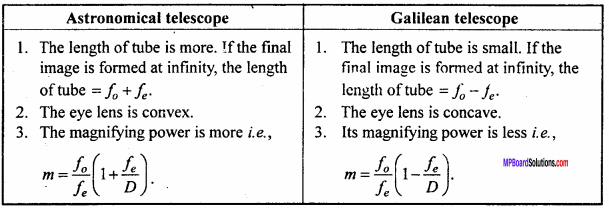
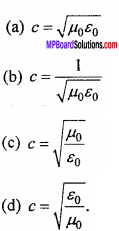
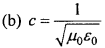
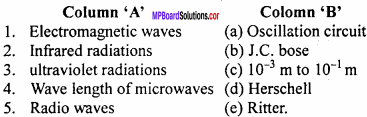
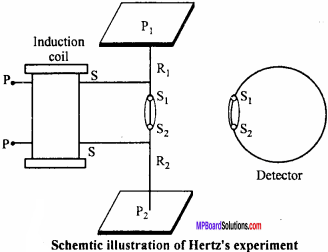
MP Board Class 12th Physics Important Questions Chapter 10 Wave Optics

MP Board Class 12th Physics Important Questions Chapter 10 Wave Optics

Wave Optics Important Questions

Wave Optics Objective Type Questions

Question 1.
Choose the correct answer of the following:

Question 1.
A light ray appears to travel in a straight path because :
(a) It is made up of tiny particles
(b) Its velocity is high
(c) Its wavelength is very small
(d) None of the above.
Answer:
(c) Its wavelength is very small

Question 2.
Which of the following phenomenon does not give evidence of wave nature of light:
(a) Refraction
(b) Reflection
(c) Interference
(d) Polarisation.
Answer:
(b) Reflection

Question 3.
Two coherent sources or light must have the same :
(a) Amplitude
(b) Phase difference
(c) Frequency
(d) Both (b) and (c).
Answer:
(c) Frequency

Question 4.
Which of the following wave can not be polarised :
(a) X – rays
(b) Radio waves
(c) Longitudinal waves
(d) Transverse waves.
Answer:
(c) Longitudinal waves

MP Board Solutions

Question 5.
The intensity of central fringe in Young’s experiment is I. One slit is closed then intensity becomes I0. Which of the following is true :
(a) I = I0
(b) I = 2I0
(c) I = 4I0
(d) No relation between I and I0.
Answer:
(c) I = 4I0

Question 6.
A colourless soap solution in white light appears to be coloured because of :
(a) Reflection
(b) Refraction
(c) Interference
(d) Diffraction.
Answer:
(d) Diffraction.

Question 7.
The ratio of amplitudes of light waves is 2 : 3. Due to their interference, ratio of maximum and minimum intensity of light will be :
(a) 2 : 3
(b) 4 : 9
(c) 5 : 1
(d) 25 : 1.
Answer:
(d) 25 : 1.

Question 8.
Young’s double – slit experiment proves that:
(a) Light rays consist of particles
(b) Light rays are waves
(c) Light rays are neither particles nor waves
(d) None of these.
Answer:
(b) Light rays are waves

MP Board Solutions

Question 9.
Which of the following cannot be explained by wave nature of light : (MP 2009 Set B)
(a) Polarisation
(b) Interference
(c) Diffraction
(d) Photoelectric effect.
Answer:
(d) Photoelectric effect.

Question 10.
Waves are carrier of :
(a) Energy
(b) Amplitude
(c) Wavelength
(d) Matter.
Answer:
(a) Energy

Question 2.
Fill in the blanks :

  1. The light is transverse wave, it is proved by ………………. of light.
  2. In Young’s double slit experiment, the distance between two successive bright fringes is known as ……………….
  3. The phase difference between two coherent sources of light is ……………….
  4. In constructive interference of light path difference is always ………………. multiple of \(\frac {λ}{2}\)
  5. Young’s double – slit experiment proves ………………. theory of light.
  6. Bending of waves around the comers of an obstacle is known as ……………….
  7. The phase difference between two points situated in the same wave front is ……………….
  8. At polarising angle, the angle between reflected and refracted ray is ………………. (MP 2012)
  9. The surface of medium at an instant of time, in which all the particles of medium vibrates with same phase is called ……………….
  10. To take clear photographs of clouds is used before the lens of camera. (MP 2009 Set A)
  11. ………………. rays are used as germs killer. (MP 2009 Set B)
  12. At polarising angle, the angle between the reflected ray and the refracted ray from a surface is ………………. (MP 2011,13)
  13. ip+ r = ………………. (MP 2013)

Answer:

  1. Polarisation
  2. Width of dark fringes
  3. Zero or constant
  4. Even
  5. Wave
  6. Diffraction
  7. Zero
  8. 90°
  9. Wavefront
  10. Polaroids
  11. Ultraviolet rays
  12. 90°
  13. 90°

Question 3.
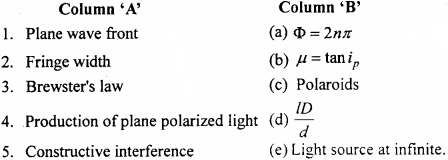
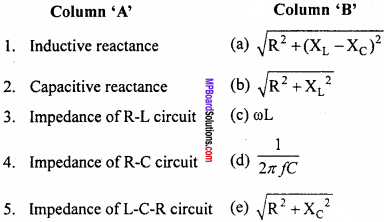
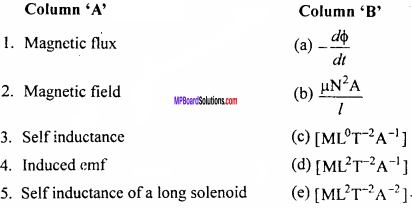
Match the Columns :
I. (MP 2012)
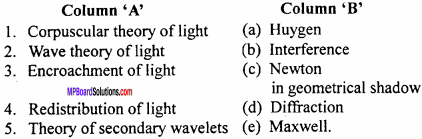
MP Board 12th Physics Important Questions Chapter 10 Wave Optics 1
Answer:

  1. (c)
  2. (e)
  3. (d)
  4. (b)
  5. (a)

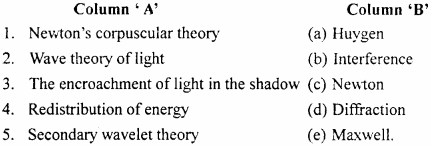
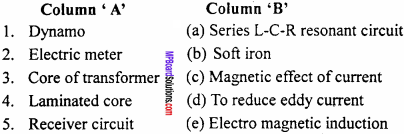
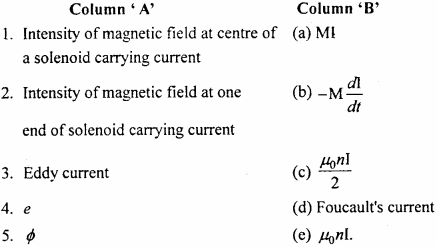
II. (MP 2010)
MP Board 12th Physics Important Questions Chapter 10 Wave Optics 2
Answer:

  1. (e)
  2. (d)
  3. (b)
  4. (c)
  5. (a)

Question 4.
Write the answer in one word/sentence :

  1. What type of wave front will emerge from a point source?
  2. Which phenomenon explains the colours on soap bubble?
  3. What is the effect on fringe width if the distance between the coherent sources is decreases?
  4. How is the wave front related to the direction of corresponding rays.
  5. What is the phase difference corresponding to a path difference of λ?

Answer:

  1. Spherical
  2. Interference
  3. Increases
  4. Perpendicular
  5. 2p.

Wave Optics Very Short Answer Type Questions

Question 1.
What is the phase difference between two points on a wavefront?
Answer:
Zero.

Question 2.
The line perpendicular to wavefront express the direction of what?
Answer:
Direction of propagation of wave.

Question 3.
What is the cause of colours on the thin film of liquid surface?
Answer:
Interference.

Question 4.
What should be the phase difference between two waves producing destructive interference?
Answer:
ϕ = π, 3π, 5π … (2n + 1) π.

Question 5.
Which type of light sources are required for interference of light?
Answer:
Coherent sources.

MP Board Solutions

Question 6.
What should be the order of aperture of slit to obtain diffraction pattern?
Answer:
Of the order of wavelength of light.

Question 7.
Write formula of fringe width in Young’s double slit experiment.
Answer:
β = \(\frac {Dλ}{d}\)
Where
D → Distance between slit and screen
d → Separation between the slits
λ → Wavelength of light.

Question 8.
Two bulbs each of 60 W are kept very closed to each other. Will they produce interference?
Answer:
No, they will not produce interference because the bulbs are two different sources, they never be coherent.

Question 9.
What is angle between reflected ray and refracted ray at the angle of polarization?
Answer:
90°.

Question 10.
What do you mean by crossed polaroids?
Answer:
If the transmission axis of the two polaroids are perpendicular then these polaroids are called as crossed polaroids.

Question 11.
When a small circular obstacle is placed in the path of light coming from a far distance then a bright spot is observed at the centre of shadow of obstacle. Why?
Answer:
When a small circular obstacle is placed in the path of light then the diffraction takes place at its comers (edges). The diffracted wave produce the constructive interferemce at the centre of shadow. So a bright spot is observed.

Question 12.
The longitudinal waves do not show the phenomenon of polarization why?
Answer:
In the longitudinal waves the vibration of particles of medium takes place along the direction of propagation of waves. Hence they
do not show the polarization.

MP Board Solutions

Question 13.
Define crossed polaroids.
Answer:
The two polaroids whose transmission axis are perpendicular to each other are called crossed polaroids.

Question 14.
For which arrangement of polarizer and analyzer in the analysis of polarized light, the intensity of light is minimum?
Answer:
When the axis of polarizer and analyser are mutually perpendicular.

Wave Optics Short Answer Type Questions

Question 1.
What is the principle of superposition of waves?
Answer:
When two or more waves reach to a point of a medium simultaneously, the particle vibrates with the resultant amplitude equal to the vector sum of the individual amplitudes.
Let n waves are reaching to a point and displacement of the particle for each wave is \(\vec { { y }_{ 1 } } \) , \(\vec { { y }_{ 2 } } \) , \(\vec { { y }_{ 3 } } \) , ………….
∴ The resultant displacement, y = \(\vec { { y }_{ 1 } } \) + \(\vec { { y }_{ 2 } } \) + \(\vec { { y }_{ 3 } } \) + …….. + \(\vec { { y }_{ n } } \)

Question 2.
When a white light is incident on the soap bubble or on a thin film of oil on f water surface, the beautiful colours are seen why? The soap bubble appears colourful why?
Answer:
When the sunlight is made to incident on a thin film whose thickness is of order of wavelength of light then some of its part gets reflected from its upper surface and remaining part of light is reflected from its lower surface.The interference of these reflected surface takes place. Since the white light is consist of seven colours, so due to interference of these reflected rays of different colours the film or soap bubble appears to be colourful.

Question 3.
In a Young’s double slit experiment the two slits are illuminated by two different lamps which are emitting the light of same wavelength. Will you observe interference pattern? Give reason.
Answer:
The sustained interference pattern will not be observed because two different source may never be coherent for sustained interference the sources should be coherent.

MP Board Solutions

Question 4.
Explain, interference follows the law of conservation of energy.
Or
When two waves interfere, the energy of few particles become zero, is the energy lost?
Answer:
In the phenomenon of interference the total energy of waves remains constant, only the energy is redistributed. The energy which is lost at destructive interference is gained at the constructive interference. Hence, the energy is conserved.

Question 5.
How would you know that two sources are coherent?
Or
What are coherent sources of light? What are the conditions of two sources being coherent?
Answer:
Coherent sources:
The sources which emit the waves of same frequency with constant phase difference (zero), are called coherent sources.

Conditions:

  1. The frequency of both the sources should be equal.
  2. The phase difference should be constant or zero.

Question 6.
What do you mean by interference of light?
Or
What is interference light? Write its one example.
Answer:
When two light waves of same frequency and approximately same amplitude travel in a medium in the same direction then due to the superimposition the intensity of light changes. This phenomenon is called interference.

Example:
The soap bubble and thin film of oil on the water appear to be coloured.

Question 7.
Can the interference be obtained from white light?
Answer:
Yes, in the white light there are seven colours. The position of central bright fringe for all colours remains same. Hence the central bright fringe is white. For the different colours the positions of bright fringes are different.

Question 8.
In Young’s double slit experiment if the wavelength of monochromatic light is increased, then what will be the effect on fringe width?
Answer:
Now, we know that fringe width, β = \(\frac {λD}{d}\)
If D and d are constants, then β ∝ A.
Therefore, if wavelength is increased, fringe w’idth will also be increased.

Question 9.
In Young’s double slit experiment, what happens if screen is moved away from the slit?
Answer:
From the formula, β = \(\frac {λD}{d}\)
If λ and dare constants, then β ∝D. i.e., Fringe width will be increased.

MP Board Solutions

Question 10.
If the apparatus of Young’s double slit experiment is immersed into water then what will be the effect on fringewidth ?
Answer:
From the formula β = \(\frac {λD}{d}\) it is clear that if D and d are constant then β ∝ λ .
Since the value of λ in the water decreases so the fringe width will decrease.

Question 11.
If the distance between two coherent sources is decreased then what will be the effect on fringe width ?
Answer:
Fringe width will increase because β ∝\(\frac {1}{d}\)

Question 12.
On what factors does the fringe width in Young’s double slit experiment depends? Write only name of factors.
Answer:
According to the formula β = \(\frac {λD}{d}\) the fringe width depends upon

  1. Wavelength of light
  2. Distance of slits from the screen and
  3. Distance between the slits.

Question 13.
What do you mean by diffraction?
Answer:
When an obstacle comes in the path of waves then waves get bent at the obstacle. The bending of the waves around the comers is called diffraction.

Question 14.
How many types of diffraction are there? Write their examples.
Answer:
Diffraction is of two types :

  1. Fresnel class diffraction
  2. Fraunhofer class diffraction.example of Fresnel class diffraction is diffraction from straight edge and example of Fraunhofer diffraction is diffraction from a single slit.

Question 15.
What do you mean by polarization?
Answer:
Polarization of light is the phenomenon in which vibrations of electric vectors are restricted in a certain direction on a plane perpendicular to the direction of propagation

Question 16.
Differentiate plane polarized light and unpolarized light.
Answer:
Difference between plane polarized and unpolarized light:
Plane polarized light:

  • In plane polarized light, the electric vector vibrates in one direction, normal to the direction of propagation of light.
  • When polarized light is passed through a polaroid, which is rotated about the ray, then intensity becomes maximum and minimum.

Unpolarized light:

  • The electric vector vibrates in all the directions normal to the direction of propagation of light.
  • When this light is passed through a polaroid and polaroid is rotated then intensity of light does not change.

Question 17.
Light waves can be polarized but sound waves can’t. Why?
Answer:
Polarization is possible only in transverse waves not in longitudinal waves. Sound waves are longitudinal waves. Since, light waves are transverse waves, hence they can be polarized.

Question 18.
How the phenomenon of polarization is different from interference and diffraction.
Answer:
Interference and diffraction can occur in transverse as well as in longitudinal wave, but the polarization can take place only in transverse waves.

Question 19.
When an aircraft is travelling at low height, then the pictures on the T.V. screen undergo vibration. Why?
Answer:
When the aircraft is travelling at a lower height, then it reflects the T.V. signals. Interference occurs between the incoming signals and the reflected signals. Hence, vibrations are seen on the pictures in the T.V. screen.

Question 20.
Write down why the sun glasses made of polaroids are much useful than the goggles.
Answer:
Light reflected from the objects are partially plane polarized. The polaroid stops the horizontal component of partially plane polarized light decreasing the dazzling effect. But goggles cannot do so.

Question 21.
What will be the effect on interference pattern in a Young’s double slit experiment if one slit is closed?
Answer:
The interference pattern will not be obtained.

MP Board Solutions

Question 22.
In which of the following waves the polarization is possible why?

  1. X – rays
  2. Sound waves
  3. Radio waves.

Answer:
In X – rays and Radio waves polarization is possible because these are transverse waves. In sound waves polarization is not possible because they are longitudinal.

Question 23.
Write two limitations of Huygen’s wave theory.
Answer:

  1. With the help of this theory the photoelectric effect could not be explained.
  2. According to this theory there is a mediam called ‘ether’ but experimentally it could not be verified.

Question 24.
What is the shape of interference fringes in Young’s double slit experiment?
Answer:
The interference fringes in double slit experiment are like the parallel lines. These lines are parallel to the slit and are bright and dark alternately.

Question 25.
Define the following :

  1. Spherical wave front
  2. Plane wavefront

Answer:
1. Spherical wavefront : When the light source is of point type then at any instant at finite distance the locus of all the particles vibrating with same phase is a sphere. It is called spherical wavefront.

2. Plane wavefront : When the source of light is at infinite distance then the wave front formed is called plane wavefront.

Question 26.
Which type of wave do not show the polarization?
Answer:
Longitudinal waves do not show the polarization.

Question 27.
In Young’s double slit experiment if white light is used then only white and dark fringes are obtained. Is this statement true? Why?
Answer:
This statement is not true, because in this condition only central bright fringe is white while the other fringes are coloured.

Question 28.
Two persons separated by a high obstacle like a wall can hear their voice but cannot see each other. Why?
Answer:
For the diffraction of waves it is necessary that the size of obstacle should be of order of the wavelength of wave. The wavelength of sound waves is of order of size of obstacle so the sound waves are diffracted and the person can hear their voice.
The wavelength of light waves is very small while the aperture of obstacle is large so light waves are not diffrected and the persons can not see each other.

Question 29.
On what factors does the diffraction depend?
Answer:
The diffraction depends upon two factors :

  1. Size of aperture and
  2. Wavelength.

Question 30.
What is interference of light? Write the necessary conditions for it.
Or
Write any four necessary conditions for interference of light.
Answer:
Interference:
When two light waves of same frequency and approximately same amplitude travel in a medium in the same direction then due to the superimposition the intensity of light changes. This phenomenon is called interference.

Example:
The soap bubble and thin film of oil on the water appear to be coloured.

Conditions for interference:

  1. Frequencies of light emitted by both sources should be equal.
  2. Amplitudes of both waves should be almost equal.
  3. Both waves should move in the same direction.
  4. Both the sources should be placed close to each other.
  5. Both the light sources should be narrow.
  6. Phase difference of the two waves should be zero or should be constant.
  7. Light sources should be monochromatic.
  8. If light rays are polarized, then their plane of polarization should be parallel.
  9. Both the sources should be coherent (i.e phase difference between the two waves should be zero or constant).

Question 31.
State Huygen’s secondary wavelets theory.
Answer:
Huygen’s secondary wavelets theory : The main postulates of this theory are given below:

1. When a disturbance is created in a medium the particles of the medium starts vibrating. The surface in the medium, on which each particle vibrate in same phase is called the wavefront. If the source is like a point, at a finite distance, the wavefront is always spherical. If the source is in form of a slit at a finite distance the wavefront is cylindrical.

2. Every point of the medium on a given wavefront is a source of originating new
disturbances. These new disturbances are called secondary wavelets.

3. These secondary wavelets advances in the medium with same velocity as of original wave.

4. The common tangential surface drawn on these secondary wavelets at any instant, shows the position of new wavefront at that instant.

Question 32.
Write the path difference for constructive and destructive interference in terms of wavelength l.
Answer:
We know that
Phase difference = \(\frac {2π}{λ}\) x path difference
or ϕ = \(\frac {2π}{λ}\) x y … (1)
For constructive interference ϕ = 2nπ … (2)
From eqns. (1) and (2)
\(\frac {2π}{λ}\) = 2nπ
or
For nth bright fringe (constructive interference)
y = yn
or yn = 2n\(\frac {λ}{2}\)
Hence for constructive interference the path difference should be even multiple of \(\frac {λ}{2}\)
For minimum intensity ϕ = (2n +1 )π
or \(\frac {2π}{λ}\) y = (2n +1 )π
or y = (2n +1) \(\frac {λ}{2}\)
or y = (2n + l) \(\frac {λ}{2}\)
For nth dark fringe y = yn
or yn = (2n + 1)\(\frac {λ}{2}\)

MP Board Solutions

Question 33.
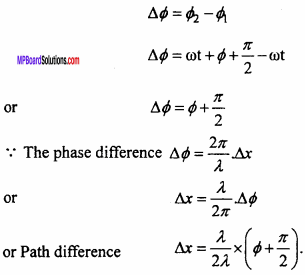
What should be the path difference between the two waves
y1 = a1 sin ωt and y2 = a2 cos(ωt + ϕ)?
Answer:
For first wave y1 = a1 sin ωt
and for second wave y2 = a2 cos(ωt + ϕ)
ory2 = a2 sin (ωt + ϕ + \(\frac {π}{2}\))
The phase difference between first and second wave.
MP Board 12th Physics Important Questions Chapter 10 Wave Optics 3

Question 34.
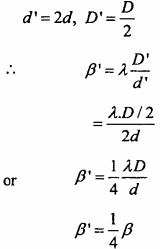
If the distance between the slits is doubled and distance between slit and screen is halved then what will be the effect on fringe width in Young’s double slit experiment?
Answer:
Formula : Fringe width β = \(\frac {Dλ}{2}\)
Let d’, D’ and β’ are changed values of slit separation
Distance between slits and fringe width respectively then
MP Board 12th Physics Important Questions Chapter 10 Wave Optics 4
∴ Fringe width will be one fourth of its previous value.

Question 35.
If angle of polarization is 30° then find out refractive index of medium.
Solution:
Given : Angle of polarization ip = 30°
µ = tanip ⇒ µ = tan30°
µ = \(\frac { 1 }{ \sqrt { 3 } }\)

Question 36.
Define the following:

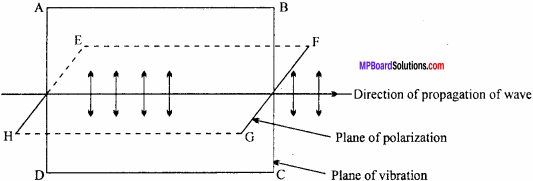
  1. Plane of vibration
  2. Plane of polarization.

Answer:
1. Plane of vibration : Plane of vibration is that plane which contains the vibra-tions of electric vector and direction of propagation of wave.

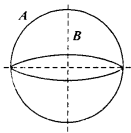
2. Plane of polarization : A plane perpendicular to the plane of vibration and which contains the direction of propagation of waves is called plane of polarization.
MP Board 12th Physics Important Questions Chapter 10 Wave Optics 5
ABCD → Plane of vibration, EFGH → Plane of polarization.

Question 37.
How many types of interference are there? Explain.
Answer:
There are two types of interference.

  1. Constructive interference
  2. Destructive interference.

Interference of light:
When two light waves of same frequency and approximately same amplitude travel in a medium in the same direction then due to the superimposition the intensity of light changes. This phenomenon is called interference.
Example:
The soap bubble and thin fiLm of oil on the water appear to be coloured.

Constructive interference:
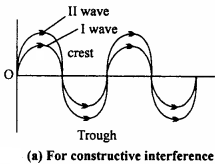
When two wave super imposed together at a point with same phase i.e. the fall on crest and trough on trough then at that point the intensity of light becomes maximum. This interference is called constructive interference.
MP Board 12th Physics Important Questions Chapter 10 Wave Optics 9

Destructive interference:
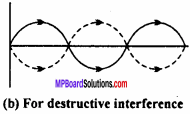
When two waves superimposed together at a point in such a way that there is a phase difference of 180° [or (2n – 1) π] then at those points the intensity of light becomes minimum or zero. This interference is called as destructive interference

Conditions:
For constructive interference the phase difference should zero or even multiple of π i.e. ϕ = 2nπ. For destructive interference the phase difference should be 180° or odd multiple of π. i.e. ϕ = (2n + 1) π, where n = 0, 1, 2, 3, ……
MP Board 12th Physics Important Questions Chapter 10 Wave Optics 10

Question 38.
What do you mean by coherent sources? Can two independent sources of light produce interference ? How can the coherent waves be obtained?
Answer:
Coherent Sources:
The sources which emit the waves of same frequency with constant phase difference (zero), are called coherent sources.

The phase difference between the waves coming from two different sources varies with time. Hence the two different sources cannot produce interference. The coherent waves can be obtained by different methods such as Fresnel’s biprism method, Amplitude division method etc.

Question 39.
What do you mean by diffraction of light? What is essential condition to obtain diffraction? The diffraction of sound w aves is easier than that of light waves. Why?
Answer:
Diffraction of light:
When an obstacle comes in the path of waves then waves get bent at the obstacle. The bending of the waves around the comers is called diffraction.

Condition:
To obtain diffraction the size of obstacle should be of order of wave length of waves.

In case of sound waves the size of obstacle is of order of wavelength while in case of light the obstacle is usually not of order of wavelength of light so the diffraction of sound waves is easier than that of light waves.

Question 40.
What is the difference between interference and diffraction?
Answer:
Difference between interference and diffraction :
Interference:

  • Interference fringes are formed when the two light rays from the coherent sources are superimposed.
  • All bright fringes are equally illuminated.
  • Width of all fringes are always equal.
  • Minimum intensity is zero, so fringes can be distinguished very well.

Diffraction:

  • Fringes are formed due to superimposition of light rays from the same source.
  • Central fringe is brightest and all other fringes have intensity’ in decreasing order.
  • Fringe width decreases when we move away from the centre.
  • Minimum intensity fringes are not perfectly darker so it is relatively difficult to distinguish bright and dark fringes.

Question 41.
What is polaroid? State its applications in daily life.
Answer:
Polaroids are large sized manufactured polarizing films capable of producing plane polarized beam of light

Uses:

  1. These are used in laboratory to produce and analyse plane polarized light.
  2. These are used in sun glasses.
  3. These are used in headlights and windscreen of automobile to cut off the dazzling light.
  4. These are used for viewing three dimensional pictures.

Question 42.
What are polaroids? How will you obtain the plane polarized light by polaroids? How will you distinguish between unpolarized light and plane polarized light?
Answer:
Polariods:
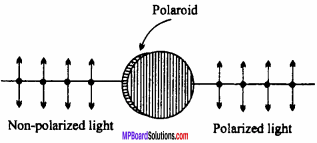
Polaroids are large sized manufactured polarizing films capable of producing plane polarized beam of light. The light obtained from an ordinary source is made to fall on polariod. The light emerging out from the polaroides is plane polarized light. To identify (or distinguish) between polarized and non – polarized light. The beam is made to incident on another polariod. If there is no change in intesity of light on rotating the Polaroid then the light is unpolarized. But if there is variation in the intensity of light then the light is plane polarized.

MP Board Solutions

Question 43.
What is polaroid? Write its construction and working.
Answer:
Polaroid:
Polaroids are large sized manufactured polarizing films capable of producing plane polarized beam of light.

Construction:
It is a thin film whice is sandwiched between two glass plates. To form this film, the crystal of an organic compound ‘herapathite’ or Iodo – quinine sulphate are kept on a thin film of Nitro cellulose in such a way that the axis of all crystals are parallel to each other.

Working:
The polaroid has a characteristic plane called transmission plane. When an unpolarized light falls on it only the vibrations of electric vector, parallel to the plane of transmission get transmitted. Thus the transmitted light obtained is plane polarized.
MP Board 12th Physics Important Questions Chapter 10 Wave Optics 6

Wave Optics Long Answer Type Questions

Question 1.
Explain Huygen’s theory of secondary wavelets.
Answer:
Huygen’s secondary wavelets theory:

1. Each point of wavefront behaves like a new source of light which emits the new waves. These are called secondary wavelets.

2. The secondary wavelets advances in the medium with the velocity same as that of the original waves.

3. The common tangential surface drawn on these secondary wave lets at any in stant shows the position of new wave front at that instant.
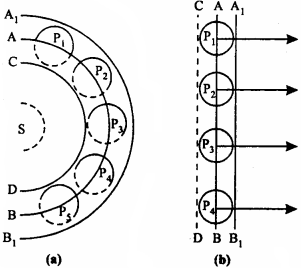
MP Board 12th Physics Important Questions Chapter 10 Wave Optics 7

Let S is point type light source AB is a part of spherical wavefront. After time ‘t’ what will be the position of this wavefront it is to be determined. According to Huygen’s secondary wave. let theory every point of wavefront behaves like a source of light. Take points P1 P2, P3, P4, on this wavefront.

The distance travelled by secondary wavelet in time ‘t’ with velocity V be vt. Now by taking P1 P2, P3, P4, …… as centre draw circles of radius vt. Now draw a comman tangential surface A1B1 It will show the new wavefront.

Question 2.
What do you mean by wavefront? How many types of wavefront are there?
Answer:
Wavefront:
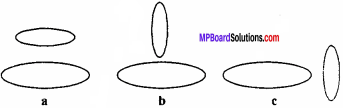
An imaginaiy plane made of medium perpendicular to the direction of propagation of waves in which each particle of medium vibrates with same phase is called wavefront. There are three types of wavefronts :

1. Spherical wavefront : When the light source is point type and at finite distance then the wavefront is called spherical wavefront

2. Cylindrical wavefront : When light source is slit type and at a finite distance then the wavefront is called as cylindrical wavefront.
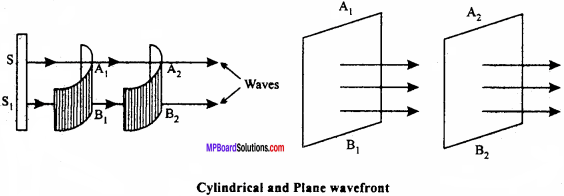
MP Board 12th Physics Important Questions Chapter 10 Wave Optics 8

3. Plane wavefront : When light source is at infinite distance then the wavefront obtained is called plane wavefront.

Question 3.
What is interference of light? Write its essential conditions.
Or
State essential condition for interference of light.
Answer:
Interference:
When two light waves of same frequency and approximately same amplitude travel in a medium in the same direction then due to the superimposition the intensity of light changes. This phenomenon is called interference.

Example:
The soap bubble and thin film of oil on the water appear to be coloured.

Conditions for interference:

  1. Frequencies of light emitted by both sources should be equal.
  2. Amplitudes of both waves should be almost equal.
  3. Both waves should move in the same direction.
  4. Both the sources should be placed close to each other.
  5. Both the light sources should be narrow.
  6. Phase difference of the two waves should be zero or should be constant.
  7. Light sources should be monochromatic.
  8. If light rays are polarized, then their plane of polarization should be parallel.
  9. Both the sources should be coherent (i.e phase difference between the two waves should be zero or constant).

Question 4.
What do you mean by interference of light? Define constructive and de – structive interference and write essential conditions for it
Answer:
Interference of light:
When two light waves of same frequency and approximately same amplitude travel in a medium in the same direction then due to the superimposition the intensity of light changes. This phenomenon is called interference.

Example:
The soap bubble and thin fiLm of oil on the water appear to be coloured.

Constructive interference:
When two wave super imposed together at a point with same phase i.e. the fall on crest and trough on trough then at that point the intensity of light becomes maximum. This interference is called constructive interference.
MP Board 12th Physics Important Questions Chapter 10 Wave Optics 9

Destructive interference:
When two waves superimposed together at a point in such a way that there is a phase difference of 180° [or (2n – 1) π] then at those points the intensity of light becomes minimum or zero. This interference is called as destructive interference

Conditions:
For constructive interference the phase difference should zero or even multiple of π i.e. ϕ = 2nπ. For destructive interference the phase difference should be 180° or odd multiple of π. i.e. ϕ = (2n + 1) π, where n = 0, 1, 2, 3, ……

MP Board 12th Physics Important Questions Chapter 10 Wave Optics 10

Question 5.
How does the diffraction of light take place from a straight edge? Draw energy distribution curve also.
Or
Describe the diffraction of light from a straight edge under the following heads :

  1. Experimental arrangement
  2. Observation
  3. Energy distribution curve.

Answer:
1. Experimental arrangement:
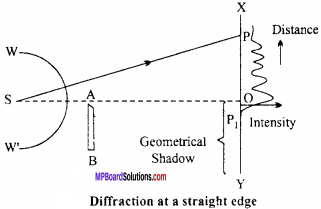
In the fig. S is a narrow slit which is illuminated by a monochromatic light source. A straight edge is placed infront of slit S in such a way that its edge is parallel to the slit. At some distance from the obstacle AB a screen XY is placed. WW’ is a cylindrical wavefront.

2. Observation:
According to geometrical optics above the point O on the screen XY the intensity should be uniform because in this region light rays can reach without any obstruction.
MP Board 12th Physics Important Questions Chapter 10 Wave Optics 11
Below the point O there should be complete darkness because the light rays are obstructed by obstacle AB. But actually if not happens. Actually we get the following pattern:

(a) In the region of geometrical shadow some light is reached. The intensity of light rapidly decreases and at point P, the intensity becomes zero. Thus after point P1 complete darkness is obtained.

(b) In the illuminated region OX the dark and bright of decreasing intensity and width are obtained. Ultimately above point P the fringes vanishes and light of uniform intensity is obtained.

3. Energy distribution curve : It is shown in adjacent fig.

MP Board Solutions

Question 6.
Write any four differences between interference and diffraction.
Answer:
Interference:

  • Interference fringes are formed when the two light rays from the coherent sources are superimposed.
  • All bright fringes are equally illuminated.
  • Width of all fringes are always equal.
  • Minimum intensity is zero, so fringes can be distinguished very well.

Diffraction:

  • Fringes are formed due to superimposition of light rays from the same source.
  • Central fringe is brightest and all other fringes have intensity’ in decreasing order.
  • Fringe width decreases when we move away from the centre.
  • Minimum intensity fringes are not perfectly darker so it is relatively difficult to distinguish bright and dark fringes.

Question 7.
What do you mean by polarization of light? Describe on experiment to prove that light waves are transverse in nature.
Answer:
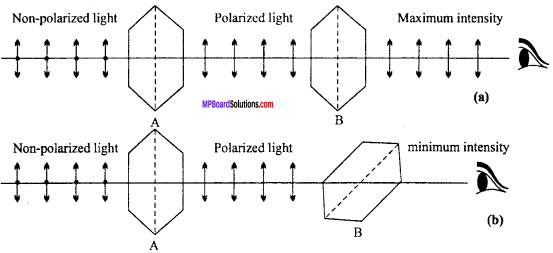
The lack of symmetry about the direction of travel of a wave is called polarization. To demonstrate that light waves are transverse we use two polaroids A and B. These polaroids are placed in such a way that their planes parallel to their vertical axis.

Now beam of light is incident normally on A and the light is seen through B from the other side. In this condition the intensity of light is maximum. Now keeping ‘A’ fixed, the B is rotated by doing this the intensity of light decreases gradually. When the axis of B becomes perpendicular to that of A then the intensity of light becomes minimum. If the ‘B’ is further rotated then the intensity again increases gradually. The intensity becomes maximum again when the axis of A and B again becomes parallel.

By this experiment it is proved that the light waves are transverse in nature
MP Board 12th Physics Important Questions Chapter 10 Wave Optics 12

Question 8.
Explain polarization of light by reflection.
Answer:
When a beam of ordinary light is reflected from a transparent medium such as glass etc. then it get partially polarized. With increase in the value of angle of incident, at a particular value of angle of incidence the reflected light is obtained completely plane polarized. This value of angle of incidence is called as angle of polarization.
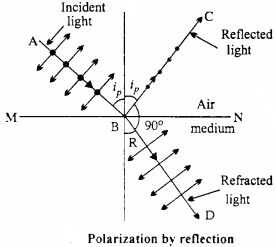
MP Board 12th Physics Important Questions Chapter 10 Wave Optics 13
In the fig. AB is incident ray, BC is reflected ray and BD is refracted ray. MN is the interface of air and medium when the light is incident at angle ip (angle of polarization) then the reflected ray along BC is completely plane polarized. The vibrations of plane polarized light are perpendicular to the plane of paper. Hence they are expressed by dots The light obtained in the direction BD is partially polarized.

Explanation:
In a non – polarized light the electric vectors can be dissociated in two rectangular components

  1. Parallel to the plane of incidence
  2. Perpendicular to the plane of incidence

These are expressed in the fig. by dots and arrows. When the light falls on refracting surface then its electrons vibrates in the two directions. At the angle of polarization the reflected ray and refracted rays are mutually perpendicular. The vibration parallel to the plane of incidence are along the wave. Hence they can not produce transverse waves along the reflected light. As a result the electric vectors vibrates in a plane perpendicular to the plane of incidence and the completely plane polarized light is obtained.

Question 9.
State Brewster’s law. Prove that at angle of polarization, reflected rays and refracted rays are mutually perpendicular.
Or
What is Brewster’s law? Prove that for light incident on a transparent surface at Brewster’s angle the reflected and refracted rays are normal to each other.
Answer:
Brewster’s law:
The refractive index of a medium is equal to the tangent of angle of polarization, i.e.,
μ = tan ip
Let a light ray is incident at the angle of polarization ip, to the medium of refractive index μ.
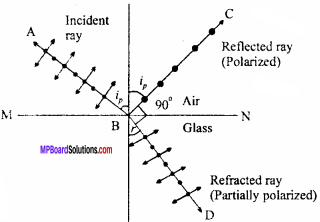
MP Board 12th Physics Important Questions Chapter 10 Wave Optics 14
By Snell’s law, μ = \(\frac { sin{ i }_{ p } }{ sinr }\)
Where, r is the angle of refraction. But, μ = tan ip
From eqns. (1) and (2), we get
tan ip = \(\frac { sin{ i }_{ p } }{ sinr }\)
or \(\frac { sin{ i }_{ p } }{ cos{ i }_{ p } }\) = \(\frac { sin{ i }_{ p } }{ sinr }\)
∴ cos ip = sinr
or sin(90°- ip) = sinr
or 90° – ip = r
or ip + r = 90°
But we have, ip + r + ∠CBD = 180°
or 90°+∠CBD = 180°
or ∠CBD = 180°
Thus, reflected ray and refracted ray are mutually perpendicular.

Question 10.
What do you mean by polarization of light? Why the light get polarized by scattering? Explain.
Answer:
Polarization of light:
In plane polarized light, the electric vector vibrates in one direction, normal to the direction of propagation of light. When polarized light is passed through a polaroid, which is rotated about the ray, then intensity becomes maximum and minimurp.

Explanation of polarization by scattering:
It is observed that the sun light is scattered by the molecules of gases in the atmosphere. Due to scattering light rays gets polarized in the adjacent fig. the polarization of light by scattering due to nitrogen molecule is shown.
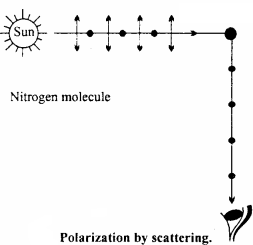
MP Board 12th Physics Important Questions Chapter 10 Wave Optics 15
Light incident from sun is unpolarized in which electric field vector can vibrate in all possible directions perpendicular to the direction of propagation of incident light. All these vibrations can be resolved into two components :

  1. Paralled to plane of paper shown by double arrowed lines.
  2. Perpendicular to plane of papers shown by dots.

When light waves falls on nitrogen molecules then electrons of molecule start vibrating in their perpendicular directions. The vibration parallel to the plane of paper are along the observer. Therefore these vibrations cannot produce transverse waves in the direction of observer. The vibrations perpendicular to the plane of paper can only produce transverse wave in the direction of the observer. Thus the light entering the eye of observer is plane polarized light.

Question 11.
What are polaroids? Write its construction, working and uses?
Answer:
Polaroids are large sized manufactured polarizing films capable of producing plane polarized beam of light

Uses:

  1. These are used in laboratory to produce and analyse plane polarized light.
  2. These are used in sun glasses.
  3. These are used in headlights and windscreen of automobile to cut off the dazzling light.
  4. These are used for viewing three dimensional pictures.

Construction:
It is a thin film whice is sandwiched between two glass plates. To form this film, the crystal of an organic compound ‘herapathite’ or Iodo – quinine sulphate are kept on a thin film of Nitro cellulose in such a way that the axis of all crystals are parallel to each other.

Working:
The polaroid has a characteristic plane called transmission plane. When an unpolarized light falls on it only the vibrations of electric vector, parallel to the plane of transmission get transmitted. Thus the transmitted light obtained is plane polarized.

Question 12.
Obtain the conditions for maximum and minimum intensity of light in Young’s double slit experiment
Or
Find out the conditions for constructive and destructive interference of two waves theoriticaily.
Or
What do you mean by interference of light? Two waves having amplitudes a1, a2 and angular frequencies co are superimposed together. Find out intensity in the constructive and destructive interference.
Answer:
Interference:
When two light waves of same frequency and approximately same amplitude travel in a medium in the same direction then due to the superimposition the intensity of light changes. This phenomenon is called interference.

Example:
The soap bubble and thin film of oil on the water appear to be coloured.

Let two waves having same frequency are propagating in same direction in same medium. Their equation are
y1 = a1Sinωt … (1)
and y2 = a2 sin (ωt + ϕ) … (2)
Where, a1 and a2 are their amplitudes and ϕ is phase difference between them.
If both the wave are superimposed together then by the principle of superposition of waves,
\(\vec { y }\) = \(\vec { { y }_{ 1 } } \) + \(\vec { { y }_{ 1 } } \)
or \(\vec { y }\) = a1 sinωt + a2 sinωt (ωt + ϕ)
or y = a1 sinωt + a2 sinωt cosϕ + a2 cosωt sinϕ
or y = (a1 + a2 cosϕ)sinωt + a2ϕ cosωt … (3)
Now let
a1 = a2 cosϕ = R cosϕ … (4)
and a2 sinϕ = R sinθ … (5)
Where, R and θ are constants
Then by eqn. (3),
y = R cosθ sinωt + R sinθcosωt
or y = R sin(ωt + θ) … (6)
Equation (6) shows the resultant wave. Its amplitude is R
Squaring and adding equations (4) and (5)
R2 cos2θ + R2 sin2θ = (a1 + a2 cosϕ)2 + (a2 sinϕ)2
or R2 (cos2θ + sin2) = a1 + 2a1a2 cosϕ + a22 cos2ϕ + a22 sin2ϕ
or R2 = a12 + 2a1a2 cosϕ + a22
or R2 = a12 + a12+ 2a1a2 cosϕ
∵ Intensity is proportional to the R2
I = K(a12 + a12 + 2a1a2 cosϕ) … (7)
Where K is a proportionality constant.
From equation (7) it is clear that the resultant intensity depends upon the phase difference between the two waves.
Condition for constructive interference : from equation (7) it is clear that for maximum intensity
cosϕ= 1
or ϕ = 2nπ, (where, n = 0, 1,2, 3, )
At the points where the waves with same phase are superimposed, the intensity becomes maximum.
Thus Imax = K(a12 + a12 + 2a1a2)
= K(a1 + a2)2
If the path difference for constructive interference is ∆x, then
∆x = \(\frac {λ}{2π}\) x ϕ
∆x = \(\frac {λ}{2π}\) x 2nπ
∆x = 2n x \(\frac {λ}{2}\) = even mul of \(\frac {λ}{2}\)

Condition for destructive interference : From equation (7) it is clear that for minimum intensity
cosϕ = -1
ϕ = (2n -1)π (where, n = 1,2,3, ……… )
or
Hence if the waves are opposite in phase then the destructive interference takes place. If the path difference for destructive interference is ∆x, then
∆x = \(\frac {λ}{2π}\) x ϕ
∆x = \(\frac {λ}{2π}\)(2n – 1)π
∆x = (2n – 1)\(\frac {λ}{2}\) = odd multiple of \(\frac {λ}{2}\)

Expression for intensity in the constructive interference In equation (7) putting cosϕ = 1
I = K(a12 + a12 + 2a1a2 ) = K(a1 + a2)2
If a1 = a1 = a, then
I = K(a + a)2 or I = 4Ka2.

Expression for intensity in destructive interference
Putting cosϕ= -1 in equation (7)
I = K(a12 + a22 + 2a1a2) = K(a1-a2)2
If a1 = a2 = a, then
If a1 = a1 = a, then
I = K(a – a)2 = 0

Question 13.
Derive formula for the width of fringe in Young’s double – slit experiment.
Or
Prove that β = \(\frac { λD}{d}\), where symbols have their usual meanings.
Answer:
Let S is a source which is illuminated with monochromatic light. S1 and S2 are the two slits placed close to each other which are parallel and equidistant from S. Therefore, Si and S2 behave as coherent sources.
Suppose that S1 S2 = d
Screen is placed at distance D from the sources S1 S2 on which interference fringes are formed.MP Board 12th Physics Important Questions Chapter 10 Wave Optics 16
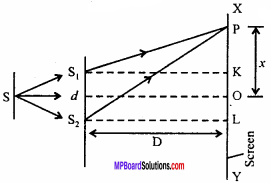
Path difference at point O on screen is
S1O – S2O = 0
∴Intensity at point O will be maximum and will be central fringe.
Let a point P on the screen XY at distance x from the centre.
From S1, drop perpendicular S1K on screen and from S2L, drop perpendicular S2L on screen.
In right angled ∆S1KP,
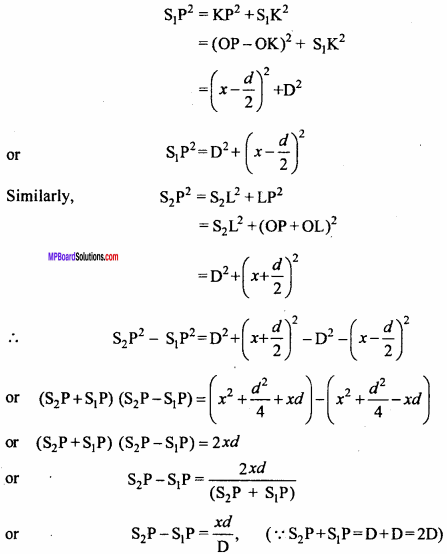
MP Board 12th Physics Important Questions Chapter 10 Wave Optics 17
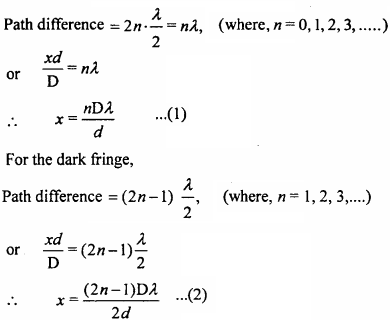
Now, for the bright fringe,
MP Board 12th Physics Important Questions Chapter 10 Wave Optics 18
If distances of nth and (n + 1)th fringes from the centre are xn and xn+x, therefore from equation (1),
xn = \(\frac {nDλ}{d}\)
and xn+1 = \(\frac {(n+1)Dλ}{d}\)
Distance between the two consecutive bright fringes or width of the dark fringe,
xn+1 – xn = \(\frac {(n+1)Dλ}{d}\) – \(\frac {nDλ}{d}\)
and xn+1 – xn = \(\frac {Dλ}{d}\) … (3)
Similarly, distance of nth and (n + l)th dark fringes from the point O are xn and xn+1, therefore from equation (2),
xn = \(\frac {(2n – 1)Dλ}{2d}\)
and xn+1 = \(\frac {(2n + 1)Dλ}{2d}\)
Distance between the two consecutive dark fringes or width of the bright fringe,
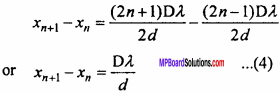
MP Board 12th Physics Important Questions Chapter 10 Wave Optics 19
Hence, it is clear from equations (3) and (4), that the width of the fringes are always equal and is given by
β = \(\frac {Dλ}{d}\)

Question 14.
State law of malus and explain it.
Answer:
Malus law:
If a beam of completely plane polarized light is incident on an analyser, then the resultant intensity (I) of light transmitted from the analyser varies directly as the square of the cosine of the angle between the transmission direction of polariser and analyser. i.e., I ∝ cos2θ
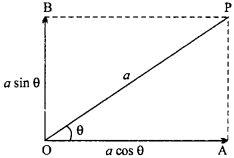
MP Board 12th Physics Important Questions Chapter 10 Wave Optics 20

Derivation:
Let OP and OA are the pass axes of polarizer and analyser respectively. Let the angle between OP and OA be θ and a be the B amplitude of emergent light from polarizer along axis OP. Amplitude a can be resolved in two components :

  • acosθ along pass axis OA of analyzer
  • asinθ along pass axis OB of polarizer

Component acos0 only emerges out of analyzer. Therefore intensity of light emerging out from analyzer
I ∝ (acosθ)2
or I = Ka2 cos2θ
Where, K is proportionality constant
or I = I0 cos2θ
Where I0 = ka2 … (1)
∴ I ∝ cos2θ
This is law of malus.

Wave Optics Numerical Questions

Question 1.
What is the Brewster’s angle for transmission from air to glass? (µ = 1.5) (NCERT)
Solution:
Given µ = 1.5
∵µ = tan ip
∴ 1.5 = tan ip
0r ip = tan-1(1.5) = 56.4°.

Question 2.
In a Young’s double slit experiment of the fringe width is 4 mm. Obtain distance of third dark fringe from central bright fringe.
Solution:
Given: β = 4mm = 4 x 10⁻³ m
For third dark fringe n = 3
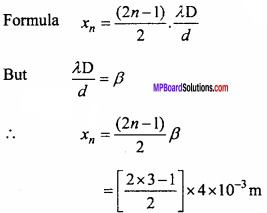
MP Board 12th Physics Important Questions Chapter 10 Wave Optics 21
⇒ xn =10 x 10-3 m
= 10-2 m
= 10 mm.

MP Board Solutions

Question 3.
The angle of polarization for a transparent medium is 60°. Find the angle of refraction and refractive index of medium.
Solution:
Given : Angle of polarization ip = 60°
∴ ip + r = 90°
∴ 60° + r = 90°
r = 90° – 60°
∴ r = 30°.
Again by Brewster’s Law
µ = tan ip = tan 60°
µ = 1.73.

Question 4.
In a Young’s experiment the distance of slits from the screen is 2m. A light of 6000 A is incident on the slits. (i) If the fringe width is 2mm then find distance between the slits. (ii) If the light of wavelenght 4800 Å is incident then find fringe width.
Solution:
Given D = 2m, λ= 6000Å = 6000 x 10-10m = 6 x 10⁻⁷m
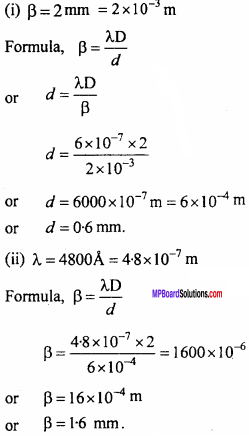
MP Board 12th Physics Important Questions Chapter 10 Wave Optics 22

MP Board Class 12th Physics Important Questions

MP Board Class 12th Physics Important Questions Chapter 9 Ray Optics and Optical Instruments

MP Board Class 12th Physics Important Questions Chapter 9 Ray Optics and Optical Instruments

Ray Optics and Optical Instruments Important Questions

Ray Optics and Optical Instruments Objective Type Questions

Question 1.
Choose the correct answer of the following:

Question 1.
The virtual and smaller image can be obtained by :
(a) Plane mirror
(b) Convex mirror
(c) Concave mirror
(d) None of these
Answer:
(b) Convex mirror

Question 2.
Keeping the incident ray unchanged if the mirror is rotated by 30° angle then the reflected ray will be deviated through :
(a) 30°
(b) 60°
(c) 15°
(d) 45°.
Answer:
(b) 60°

Question 3.
A light ray falls normally on a mirror. The value of angle of reflection will be :
(a) 0°
(b) 90°
(c) 135°
(d) 45°.
Answer:
(a) 0°

Question 4.
The relation between focal length and radius of corvature of a spherical mirror is:
(a) f = 2R
(b) f = R
(c) R = 2f
(d) None of these.
Answer:
(c) R = 2f

Question 5.
Magnified and virtual image can be obtained by :
(a) Convex mirror
(b) Concave mirror
(c) Plane mirror
(d) All the above.
Answer:
(b) Concave mirror

MP Board Solutions

Question 6.
The image formed by a concave mirror cannot be obtained on the screen if the object is placed between :
(a) Pole and focus
(b) Focus and centre of curvature
(c) Centre and infinity
(d) At centre of curvature.
Answer:
(a) Pole and focus

Question 7.
Which of the following statement is false to form a real image by concave mirror:
(a) Object is at focus
(b) Object is at centre of curvature
(c) Object is at infinity
(d) Object is between pole and focus.
Answer:
(d) Object is between pole and focus.

Question 8.
The image formed by a convex mirror is :
(a) Virtual
(b) Real
(c) Magnified
(d) Inverted.
Answer:
(a) Virtual

Question 2.
(I) Fill in the blanks :

  1. The phenomenon of deviation in the path of a light ray while entering from one optical medium to the other optical medium is called ……………..
  2. The ratio of sine of angle of incidence to the sine of angle of refraction is called as ……………..
  3. If the path of a light ray after multiple refractions is reversed then it retraces the path from which it came. This phenomenon is called ……………..
  4. The angle of incidence corresponding to which the angle of refraction becomes 90° is called as ……………..
  5. The illusion of water in desert is called ……………..
  6. In cold countries at the port trust the ship appears to be inverted in air. This illusion is called as ……………..
  7. The prism in which the inverted image can be obtained in same direction in erected position is called ……………..
  8. The is a device which is based on the total internal reflection through which the optial signal can be transmitted from one place to other place by a zig – zag path.
  9. The distance of pole from first principle focus is called ……………..
  10. The limit of resolution of healthy eye is …………….. (MP 2016)
  11. The instruments by which the far distant or nearby object can be seen are called ……………..
  12. The angle subtended by an object at the eye is called ……………..
  13. On increasing the aperture of objective lens of astronomical telescope, its …………….. increases.
  14. The ratio of angle of vision subtended by image to that subtended by object when object is kept at least distance of distinct vision is called …………….. of microscope.
  15. To increase the magnifying power of a microscope, two different lenses are used. This microscope is called ……………..
  16. In a compound microscope the lens towards the object is called and the lens towards the eye is called ……………..
  17. …………….. is an optical instrument with the help of which the far distant object are seen.
  18. With the help of …………….. the astronomical bodies are seen.
  19. With the help of …………….. the far distant objects situated on earth are seen.

Answer:

  1. Refraction of light
  2. Refractive index
  3. Principle of reversibility
  4. Critical angle
  5. Desert mirage
  6. Cold mirage
  7. Inverting prism
  8. Optical fibre,
  9. Angle of vision
  10. Resolving power
  11. Magnifying power
  12. Compound microscope
  13. Objective lens, eyepiece
  14. Telescope
  15. Astronomical telescope
  16. Terrestrial telescope.

Question 3.
Match the Column :
I.
MP Board 12th Physics Important Questions Chapter 9 Ray Optics and Optical Instruments 1
Answer:

  1. (e)
  2. (d)
  3. (b)
  4. (a)
  5. (c)

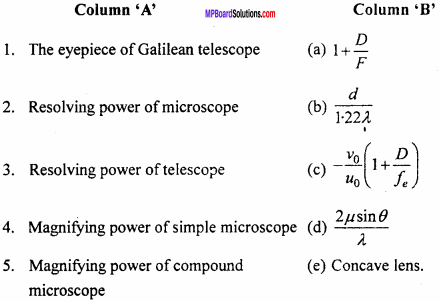
II.
MP Board 12th Physics Important Questions Chapter 9 Ray Optics and Optical Instruments 2
Answer:

  1. (c)
  2. (e)
  3. (d)
  4. (b)
  5. (a)

Question 4.
Write the answer in one word / sentence:

  1. If a ray of light incident normally on a mirror, then what will be angle of reflection?
  2. From which spherical mirror we get magnified image?
  3. From which spherical mirror we get always a virtual and smaller than object?
  4. Write the relation between radius of curvature and focal length for a spherical mirror?
  5. Conjugate foci is true for which type of images?
  6. When a spherical mirror is immersed in water, what changes we get in its focal length?
  7. What will be the magnitude of magnification of a convex mirror for its real image and virtual image?

Answer:

  1. Zero
  2. Concave mirror
  3. Convex mirror
  4. f = \(\frac {R}{2}\).
  5. For real images
  6. There is no changes in focal length
  7. For real image it is negative and for virtual image it is positive.

MP Board Solutions

Question 4.
Write the answer in one word / sentence :

  1. If a ray of light incident normally on a mirror, then what will be angle of reflection?
  2. From which spherical mirror we get magnified image?
  3. From which spherical mirror we get always a virtual and smaller than object?
  4. Write the relation between radius of curvature and focal length for a spherical mirror?
  5. Conjugate foci is true for which type of images?
  6. When a spherical mirror is immersed in water, what changes we get in its focal length?
  7. What will be the magnitude of magnification of a convex mirror for its real image and virtual image?

Answer:

  1. Zero
  2. Concave mirror
  3. Convex mirror
  4. f = \(\frac {R}{2}\)
  5. For real images
  6. There is no changes in focal length
  7. For real image it is negative and for virtual image it is positive.

Ray Optics and Optical Instruments Very Short Answer Type Questions

Question 1.
Which property remain unchanged in the phenomenon of refractions of light?
Answer:
Frequency.

Question 2.
Which property get changed in the phenomenon of refraction of light?
Answer:
Velocity, wavelength and amplitudes.

Question 3.
Write one characteristics of image formed by convex mirror.
Answer:
Image is formed behind the mirror.

MP Board Solutions

Question 4.
If a water tank is seen inclinedly what will its apparent depth will be seen?
Answer:
Its apparent depth will decrease when seen inclinedly.

Question 5.
What are the conditions for total internal reflection?
Answer:

  1. Angle of incidence should be more than critical angles.
  2. Light rays must enter from denser medium to rarer medium.

Question 6.
On which phenomenon optical fibre is depend?
Answer:
Total internal reflection.

Question 7.
When the value of relative refractive index is less than one and more than one?
Answer:
Refractive index of rarer medium with respect to denser medium is less than one and refractive index of denser medium with respect to rarer medium is more than one.

Question 8.
If a concave mirror and convex lens is dipped in water, what will be the changes in their focal length?
Answer:
The focal length of concave mirror will remain unchanged and that of convex lens will increase.

Question 9.
Can a lens be used in that medium from which it is made of?
Answer:
No.

Question 10.
If an object is kept at focus of a concave lens where its image will formed?
Answer:
Image will be formed between focus and optical centre of the lens.

Question 11.
The power of which lens be positive?
Answer:
Convex lens.

Question 12.
The power of which lens is negative?
Answer:
Concave lens.

MP Board Solutions

Question 13.
The power of a lens is more in water or air?
Answer:
Air.

Question 14.
What is focal length and power of a rectangular slab of glass?
Answer:
P = \(\frac {1}{f}\) = \(\frac {1}{∞}\) = 0. Power is zero.

Question 15.
Write the unit of Dispersive power.
Answer:
It has no unit.

Question 16.
Write the formula for Rayleigh’s law.
Answer:
I ∝\(\frac { 1 }{ { \lambda }^{ 2 } }\)

Question 17.
Why sky is seen blue?
Answer:
Sky is seen blue due to scattering of light.

Question 18.
Write the formula for angular dispersion.
Answer:
θ = A(µv – µr)
or θ = A(δv – δr).

Question 19.
When the light rays is parallel to the base of prism?
Answer:
At angle of minimum deviation.

Question 20.
Write the relation between angular dispersion and dispersive power.
Answer:
ω = \(\frac {θ}{δ}\) = θ = ω x δ.

Question 21.
Which microscope is used as reading lens?
Answer:
Simple microscope.

Question 22.
How resolving power of microscope depends on wavelength of light?
Answer:
When wavelength of light decreases, its resolving power increases.

Question 23.
Write the formula of magnification for terrestrial telescope.
Answer:
m = f1 – fe.

Question 24.
The length of which telescope is more among reflective or refractive telescope.
Answer:
The length of refractive telescope is more.

Question 25.
How image is turned of simple microscope?
Answer:
Erect and larger than object.

MP Board Solutions

Question 26.
How final image is formed for compound microscope?
Answer:
Virtual, inverted and larger than object.

Question 27.
If the focal length of eye lens of a microscope is decreased then what will be the effect in its magnifications?
Answer:
Its magnification will increase.

Question 28.
If the focal length of objective lens of microscope and telescope is increased, then what will be the effect in their magnifications?
Answer:
Magnifications of microscope will decrease and that of telescope will get increased.

Ray Optics and Optical Instruments Short Answer Type Questions

Question 1.
What is mirror? What are the types of it?
Answer:
The highly polished reflective surface is called mirror, it is of three types :

  1. Plane mirror
  2. Concave mirror
  3. Convex mirror.

Question 2.
Write the definition of convex mirror and concave mirror.
Answer:
1. Convex mirror:
If the internal surface of a spherical mirror is polished and reflection of light occur from external surface, it is called convex mirrors.

2. Concave mirror:
If the external surface of a spherical mirror is polished and reflection of light occur from internal surface, it is called concave mirror.

Question 3.
Write the formula for focal length of spherical mirror and explain it.
Answer:
\(\frac {1}{f}\) = \(\frac {1}{v}\) + \(\frac {1}{u}\) where f is focal length, v is image distance and u is object distance for a spherical mirror.

Question 4.
Define magnification of a spherical mirror.
Answer:
The ratio of size of image to size of object is known as magnification.
m = \(\frac {h’}{h}\) = \(\frac {v}{u}\)

Question 5.
Concave mirror is used for shaving, why?
Answer:
When the object is within the focal length of the concave mirror then virtual, erect and magnified image is formed. This is the reason that concave mirror is used for shaving.

Question 6.
If a glass slab is kept in alphabet of different colour. Will all the alphabet be seen to be raise uniformly?
Answer:
No, red colour alphabet will be seen to be raised more as its refractive index is less.

Question 7.
What is the cause of brilliance of diamond?
Answer:
Diamond shines due to total internal reflection. Refractive index of diamond is 2.42 and critical angle is 24.41°, which is very less. Diamond is cut in such a way that light is incident on its faces at an angle more than 24.41°. The incident light undergoes total internal reflection repeatedly and hence gets collected inside, but it comes out only through few faces. Hence diamond sparkles when seen in the direction of emergent light.

MP Board Solutions

Question 8.
What will be the effect on the focal length of a concave mirror and convex lens when they are immersed in water?
Answer:
The focal length of concave mirror will remain same but the focal length of convex lens will be increased.

Question 9.
Define refractive Index.
Answer:
When the light rays enter from one conjugate medium to another conjugate medium, the ratio of sine of angle of incidence to sine of angle of refraction is known as refractive index of medium.

Question 10.
Write the reason for twinkling of stars.
Answer:
As we go on higher and higher altitude the density of air goes on decreasing and hence the refractive index. Also, the atmosphere consists of several moving masses of air and the temperature is also changing, because of all these reasons the rays coming from the stars continuously changing the path.

Therefore, the quantity of rays entering the eye of an observer, changes. When these rays enter the eye the star appears brighter and so. Thus, the stars appear twinkling. The moon is very near to the surface of earth. The light coming out of the moon does not undergo much changes when it crosses the earth’s atmosphere. So, moon does not appear twinkling.

Question 11.
Write any two conditions for total internal reflection.
Answer:

  1. The ray of light must travel from denser medium to rarer medium.
  2. The angle of incidence (i.e., critical angle) for which angle of refraction should be 90°.

Question 12.
Write the formula for refraction for a lens.
Answer:
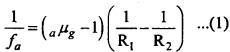
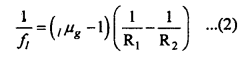
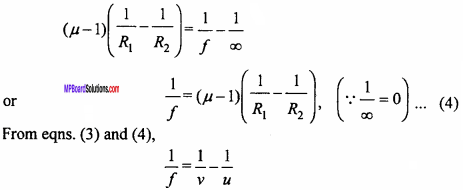
\(\frac {1}{f}\) = (µ – 1)(\(\frac { 1 }{ { R }_{ 1 } } -\frac { 1 }{ { R }_{ 2 } }\))

Question 13.
Define power of a lens.
Answer:
The reciprocal of focal length of a lens in metre is called its power.
p = \(\frac {1}{f}\)(m)

Question 14.
A concave lens and a convex lens of same focal length is kept in contact. What will be the focal length and power of the combination?
Answer:
\(\frac {1}{F}\) = \(\frac { 1 }{ { f }_{ 1 } } +\frac { 1 }{ { f }_{ 2 } }\)
f1 = – f and f2 = f
∴ \(\frac {1}{F}\) = –\(\frac {1}{f}\)+\(\frac {1}{f}\) = 0
or F = 0
and power p = \(\frac {100}{f}\) = \(\frac {100}{∞}\)

Question 15.
What do you mean by magnification? Write its formula.
Answer:
The ratio of sine of image to sine of object is defined as magnifications, its formula is
m = \(\frac {I}{O}\) = \(\frac {v}{u}\)

Question 16.
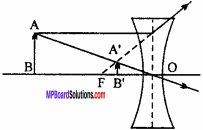
Draw ray diagram of image formation when an object is placed at focus of a convex lens.
Answer:
The image formed at infinity. Image is real and inverted.
MP Board 12th Physics Important Questions Chapter 9 Ray Optics and Optical Instruments 3

Question 17.
A glass prism causes dispersion while a glass plate does not. Why?
Answer:
When white light passes through a prism, it splits up into its constituent colours because refractive index of glass is different for different colours. The angular dispersion is (µV – µR) A and angular deviation is (µ – 1) A. The refracting faces of glass plate are parallel, so, A = 0. Hence, there is neither dispersion nor deviation. All the emergent rays are parallel to incident ray.

Question 18.
Define dispersive power.
Answer:
The ratio of the angular dispersion between the violet and red emergent rays and the deviation suffered by the mean ray (yellow colour) is called dispersive power (ω) of the material of the prism.
MP Board 12th Physics Important Questions Chapter 9 Ray Optics and Optical Instruments 4

Question 19.
Define angular dispersion. On what factors it depends and how?
Answer:
When light rays get dispersed into constituent colours, angle between any two colours (in general violet and red) is called angular dispersion.
If δV is the deviation for violet light and SR for the red light, then angular dispersion (θ) is,
θ = δV – δR.

MP Board Solutions

Question 20.
Danger signals are always red, why?
Answer:
When light falls on the signal, all colours are scattered much more than that of red colour. So it suffers least scattering and reachs directly to the eye of the observer. Hence it can be seen from far – off distances.

Question 21.
Sun appears red during the sunrise and sunset, why?
Answer:
Sunlight has to travel through the longer distances at the time of sunset and sunrise, meanwhile almost all the coloured light waves get scattered except red as its wavelength is more, it is unable to scatter due to atmospheric molecules. Therefore, only red light rays reach our eyes and sun appears red.

Question 22.
What do you mean by dispersion and spectrum?
Answer:
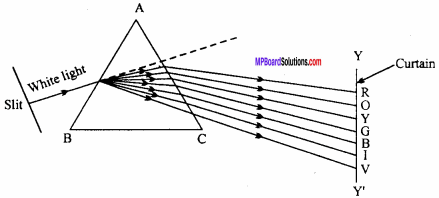
When white light passes through the prism, it gets splitted into its constituent colours. This process is called dispersion. Colours in group is called spectrum. Order of colours in spectrum is violet, indigo, blue, green, yellow, orange, red.
MP Board 12th Physics Important Questions Chapter 9 Ray Optics and Optical Instruments 5

Question 23.
Why does the light rays disperse through prism?
Answer:
White light consists of continuous range of wavelength. Refractive index of prism material is different for different colours and is given by Cauchy relation :
µ = a + \(\frac { b }{ { \lambda }^{ 2 } } +\frac { c }{ { \lambda }^{ 2 } }\)
Where a. b and c are constants. For small angle of prism, the angle of deviation is given by
δ = (µ – 1)A ⇒ δ ∝µ
Now,
λred > λviolet
∴ µred < µviolet
∴ δred < δviolet
i.e., the red colour is deviated less than the violet colour. Other colours are deviated by intermediate angles. So, different colours of white light get dispersed on refraction through prism.

Question 24.
What do you mean by angular dispersion? Derive an expression for it. On “what factors does it depends?
Answer:
The angular dispersion is defined as difference between angle of deviations for any two colours. If angle of deviations for red and violet colours are δr and δv respectively then,
Angular dispersion θ = δv – δr
∴ δv = A(µv – 1), δr = A (µr – 1)
∴ θ = A(µv – 1) – A(µr – 1)
or = θ = A(µv – µr)
This is the required expression for angular dispersion.
θ depends on :

  1. Angle of prism (A) : With increase in A, θ increases.
  2. Material of prism : With increase in ‘µ’ θ also increases.

Question 25.
If the aperture of the objective lens of telescope is increased, then what would be the effect on :

  1. Magnifying
  2. Resolving power

Answer:
1. The magnifying power remains unchanged.

2. Resolving power is increased as
Resolving power = \(\frac {a}{1.22λ}\)
Where, a = aperture.

Question 26.
How the magnifying power of an astronomical telescope is increased?
Answer:
The magnifying power of an astronomical telescope is given by :
m = – \(\frac { { f }_{ 0 } }{ { f }_{ e } }\)
Hence, for greater magnifying power of the value f0, i.e., focal length of objective lens should be large and fe, i. e. focal length of eye lens should be small.

Question 27.
If the telescope is inverted, then the size of the image becomes very small, but it does not happen in microscope. Why?
Answer:
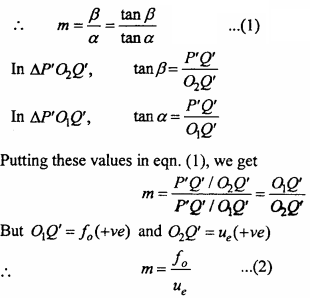
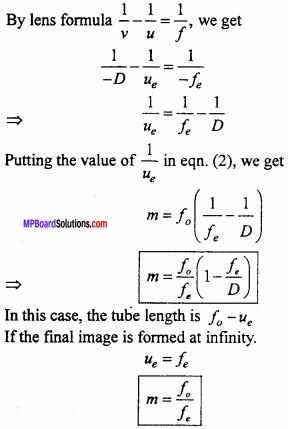
The magnifying power of a telescope is m = – \(\frac { { f }_{ 0 } }{ { f }_{ e } }\). If the telescope is inverted, then the magnification will become m = – \(\frac { { f }_{ 0 } }{ { f }_{ e } }\). As fe << f0 hence, the size of the image will be very less.

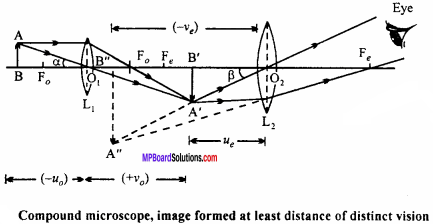
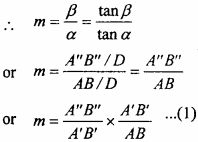
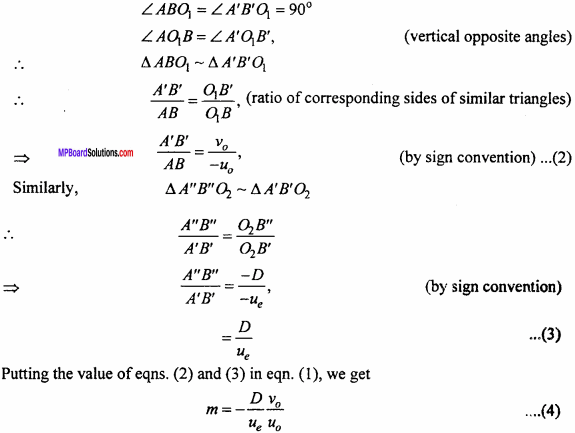
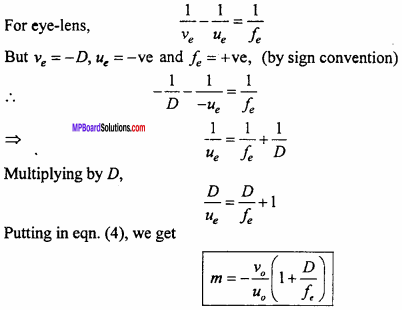
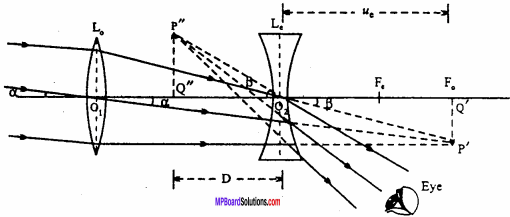
In compound microscope the magnification is m = – \(\frac { { v }_{ 0 } }{ { u }_{ 0 } } \frac { D }{ { f }_{ e } }\) The value of u0 is little more than f0. Hence, the formula for magnification can be written as m = – \(\frac { { v }_{ 0 } }{ { u }_{ e } } \frac { D }{ { f }_{ e } }\) reversing the microscope, the angle subtended by v0 will be the same. So, the magnification remains unchanged.

Question 28.
The moon is several times smaller than sun. Even then at the time of eclipse, the entire sun is covered by moon. How?
Answer:
The distance of sun from the earth is 1000 times much larger than the distance of moon from earth. During solar eclipse, the moon comes in between sun and earth. But the sun and moon subtend equal angle at our eyes. Hence, the moon covers the sun completely.

Question 29.
What do you mean by the resolving power of a microscope?
Answer:
Resolving power:
The resolving power of a microscope is determined by the least distance between two point objects which can be distinguished by the microscope.
Resolving power = \(\frac {2µsinθ }{λ}\) Where, µ is refractive index of the medium between the object and objective, λ is the wavelength of light used to illuminate the object, θ is the semivertical angle of the cone of light from the point object.

Question 30.
What do you mean by the resolving power of a telescope?
Answer:
Resolving power:
The resolving power of a telescope is defined as the reciprocal of the smallest angular separation between two distant objects whose images are separated in the telescope.
i. e., Resolving power = \(\frac {a }{1.22λ}\)
Where, X is wavelength of light and a is the diameter of objective lens.

MP Board Solutions

Question 31.
In compound microscope, why the focal length of objective should be less than that of eyepiece?
Or
Why the focal length of the objective of a compound microscope should be small?
Answer:
The magnifying power of a compound microscope is given by :
m = – \(\frac { { v }_{ 0 } }{ { u }_{ 0 } }\) (1 + \(\frac { D }{ { f }_{ e } }\))
For greater magnifying power u0 should be smaller, but the object should be placed out of the focus of the objective lens. Therefore, the focal length of the objective lens should be small.

Question 32.
What is astronomical telescope?
Answer:
The telescope by which we can observe the objects at space is known as astronomical telescope.

Question 33.
Is it possible that, when a microscope is inverted, it becomes telescope? Give reason.
Answer:
No, because of the difference of focal lengths of objective and eyepiece in microscope is less while in telescope it is greater.

Question 34.
Microscope and telescope must have high magnifying power and resolving power. Why?
Answer:
When magnifying power is high The object is seen big and clear whereas for low resolving power. There is no clearity of objects.

Question 35.
Why the aperture of photographic lens is less?
Answer:
When the aperture of photographic lens is less, the depth of focus of it increases.

Question 36.
What is reflection? Write the laws of reflection.
Answer:
Reflection:
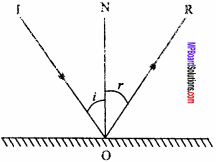
The phenomenon of bouncing back of the part of light in the same medium when light is incident on the polished surface (minor surface) is called reflection of tight.
MP Board 12th Physics Important Questions Chapter 9 Ray Optics and Optical Instruments 6

Laws of reflection :

  1. Angle of incidence is always equal to the angle of reflection (i.e., i = r).
  2. The incident ray, reflected ray and normal at the point of incidence all lie on the same plane.

Question 37.
Show the position, nature and size of image when an object is placed between pole and focus infront of concave mirror.
Answer:
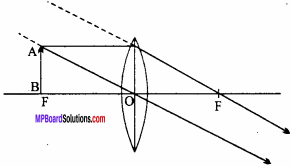
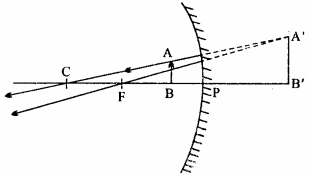
Let a ray parallel to principal axis incident from point A on the mirror and reflected through F. Another ray is incident normally and reflects back tracing the same path. These rays after reflection appears to come from point A’. Hence A ‘B’ be the virtual image of object AB.
MP Board 12th Physics Important Questions Chapter 9 Ray Optics and Optical Instruments 7
Thus image is virtual, erect and larger in size than object.

Question 38.
What are conjugate foci?
Answer:
The pair of points on the principal axis of a spherical mirror, such that the object placed at one of the point forms the image on the another point, are called conjugate foci. It is applicable only for real image.

Question 39.
What is parallax?
Answer:
When two objects are seen on a straight line, they seem to be coincident. If the objects are at different places and the eye is moved sideways then there is a relative displacement between them. Thus, when two objects are seen in a straight line and the eye is moved side ways, then relative displacement is called parallax.

MP Board Solutions

Question 40.
What type of mirror is used in vehicle to observe the traffic at the back?
Answer:
Convex mirror, as the image formed by a convex mirror is virtual, erect and smaller, therefore wider field of view of the traffic is given by the convex mirror.

Question 41.
What are the factor upon which refractive index of the medium depends?
Answer:

  1. On the pair of medium : Refractive index of denser medium with respect to rarer medium is always greater than 1 but refractive index of rarer medium with respect to denser medium is less than 1.
  2. Density of the medium : If optical density of any medium is more than its refractive index will also be more.
  3. Wavelength of light : If the wavelength is less more is the refractive index and more the wavelength less is the refractive index.
  4. Temperature of medium : On increasing temperature, it becomes optically rarer hence refractive index decreases.

Question 42.
What is principle of reversibility? Explain.
Answer:
Principle of reversibility:
If the path of a r’of light after number of reflections or refractions, is reversed, then the ray retraces the same path in opposite direction i.e., it will follow the same path by which it came.
MP Board 12th Physics Important Questions Chapter 9 Ray Optics and Optical Instruments 8
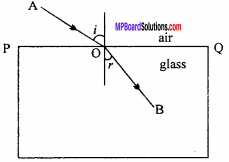
In fig. PQ is a refractive surface (air – glass interface) made of glass.
AO is incident ray and OB is refracted ray. If the path of ray is reversed, then it return back in OA direction.
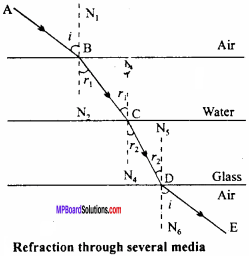
Obviously, aµg= \(\frac {sin i}{sin r}\) … (1)
Where, i is angle of incidence and r is angle of refraction.
Now, if light ray refracts from glass to air, then
a = \(\frac {sin r}{sin i}\) … (2)
From equation. (1) and (2),
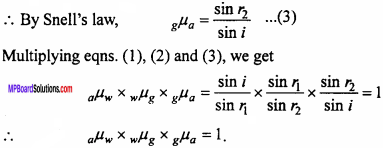
g × gµa = \(\frac {sin i}{sin r}\) × \(\frac {sin r}{sin i}\)
or aµg × gµa = 1
This is principle of reversibility.

Question 43.
Refractive index of diamond is much greater than normal glass. Why?
Answer:
Refractive index of diamond (µ = 2.42) is much greater than normal glass (µ = 1.5) so the critical angle of diamond is approximately 24°. Due to this for diamond. The light rays which incidences between 24° to 90° suffer’s total internal reflection. Number of turns due to which the brilliance of diamond increases.

Question 44.
What do you understand by refraction of light? Write its law.
Answer:
The phenomenon of change in the path of light as it passes obliquely from one transparent medium to another is called refraction of light.
MP Board 12th Physics Important Questions Chapter 9 Ray Optics and Optical Instruments 9
Laws :
1. The incident ray, refracted ray and normal to the surface at the point of incidence all lie on the same plane.

2. For a monochromatic light the ratio of sine of the angle of incident to the sine of angle of refraction is constant for given pair of medium i.e., \(\frac {sin i}{sin r}\) = µ
Where µ is known as refractive index of the medium.

Question 45.
Define the following for lens :

  1. Optical centre
  2. Conjugate foci
  3. First and second principal focus.

Answer:
1. Optical centre:
If the emergent ray from the lens is parallel to incident ray, then the point where the refracted ray intersect principal axis is called optical centre.
MP Board 12th Physics Important Questions Chapter 9 Ray Optics and Optical Instruments 10

2. Conjugate foci:
It is a pair of points on the principal axis such that when an object is placed at one point its image forms at the another and when the object is placed at the second point the image is formed at the first point. Such pair of points are called conjugate foci.
MP Board 12th Physics Important Questions Chapter 9 Ray Optics and Optical Instruments 11

3. First principal focus F1:
It is a point on principal axis of a lens such that the rays of light starting from it (convex lens) or appearing to meet at it (concave lens), after refraction from the lens become parallel to principal axis.

Second principal focus F2:
It is the point on the principal axis of lens such that the rays of light incident parallel to principal axis after refraction from the lens pass through this point (convex lens) or appear to diverge from this point (concave lens).
MP Board 12th Physics Important Questions Chapter 9 Ray Optics and Optical Instruments 12

Question 46.
When an object is kept in between optical centre and focus in front of convex lens draw a ray diagram of image formation.
Answer:
MP Board 12th Physics Important Questions Chapter 9 Ray Optics and Optical Instruments 13

Question 47.
Write Cartesian sign convention for a lens. According to it which lens will have positive and negative focal length?
Answer:

  1. The incident ray is taken from left to right for drawing ray diagram.
  2. All the distance measured in the direction of incident ray is taken as positive and opposite to it is taken as negative.
  3. Height measured perpendicular to principal axis taken as positive and downwards taken as negative.

The focal length of convex lens is taken as positive whereas for concave lens it is negatives.

Question 48.
What do you mean by linear magnification? For a convex lens show that:
\(\frac {I}{O}\) = \(\frac {v}{u}\), where symbols have their usual meanings.
Answer:
The ratio of the size of the image to that of the size of the object measured perpendicular to principal axis is called linear magnification.
MP Board 12th Physics Important Questions Chapter 9 Ray Optics and Optical Instruments 14
Expression for magnification :
MP Board 12th Physics Important Questions Chapter 9 Ray Optics and Optical Instruments 15

MP Board 12th Physics Important Questions Chapter 9 Ray Optics and Optical Instruments 81 -1
This is the required formula.

Question 49.
On which factor the focal length of any lens depends?
Answer:
1. Material of the lens:
\(\frac {1}{f}\) = (µ – 1)(\(\frac { 1 }{ { R }_{ 1 } } -\frac { 1 }{ { R }_{ 2 } }\)) or \(\frac {1}{f}\) ∝ µ or f ∝\(\frac {1}{µ}\) i.e., focal length will be greater for smaller refractive index.

2. Colour of light or wavelength:
The focal length for violet colour is lesser than that of red colour for any lens.

3. Radius of curvature:
For thick lens (R is more) focal length is less whereas for thin lens (R is less) focal length is more.

Question 50.
Explain the formation of image in case of concave lens.
Answer:
Let AB be an object kept perpendicular to principal axis. An incident ray parallel to principal axis appear to passing through principal focus (F). Second rays which passes through optical centre O after refraction moves in straight line. When both refracted ray are traced beyond they meet at point A’ where a vertical image is formed. Hence A’ B’ is the final image of the object.
MP Board 12th Physics Important Questions Chapter 9 Ray Optics and Optical Instruments 16

Question 51.
When a lens is dipped in liquid its focal length increases, why?
Answer:
MP Board 12th Physics Important Questions Chapter 9 Ray Optics and Optical Instruments 80
When a lens is dipped in liquid its focal length increases.

Question 52.
Why does sky appear blue?
Answer:
According to the Rayleigh, light rays with smaller wavelengths are scattered more and we know that blue colour light has smaller wavelength than the red light. There fore, when light falls on atmospheric molecules, blue light waves scatter more and spread into the sky. That is why, sky appears blue. As moon has no atmosphere hence there will be no scattering of light. Hence, sky will appear dark.

Question 53.
What is scattering of light? Explain scattering with the help of theory of electromagnetic waves.
Answer:
Scattering of light:
When light falls on particles of size smaller than wavelengths of light much of the light is picked up by particle and given out in some other direction. This is known as the scattering of light.

Rayleigh’s law:
According to Rayleigh, the intensity of scattered light is inversely proportional to the fourth power of wavelength of light.
i.e I ∝\(\frac { 1 }{ { \lambda }^{ 4 } }\) As the wavelength ofBlue light is less than that of red light, therefore blue light is scattered more than red light.

MP Board Solutions

Question 54.
How refraction of light occur in prism? Explain.
Answer:
As shown in fig., let ABC is a prism, AB and AC are its refracting faces. Suppose a light ray PQ is being incident at point Q of the surface AB. MO is normal drawn at point Q.
MP Board 12th Physics Important Questions Chapter 9 Ray Optics and Optical Instruments 17
As at point Q the light ray is entering from air (rarer medium) to glass (denser medium), so it bends towards normal following the path QR and falls at point R of the surface AC, NO is normal at point R. At point R the refraction of light ray takes place from glass (denser medium) to air (rarer medium), so it goes away from normal and emerges out in RS direction. Obviously PQ be the incident ray, QR be the refracted ray and RS be the emergent ray.

∠PQM = angle of incidence (i), ∠RQO = angle of refraction (r) and SRN = angle of emergence (e). So, it is clear that when light ray passes through prism n gets deviated from us path. The deviation is measured by angle between direction of incident ray and emergent ray. The angle between incident ray and emergent ray is called angle of deviation. It is represented by S. In fig, UTS is an angle of deviation.

Question 55.
What are the factors on which angle of minimum deviation depends?
Answer:
1. Angle of prism:
It is clear from eqn. (6) that δm ∝A , so if the value of angle of prism is greater than the value of minimum angle of deviation will also be greater.

2. Refractive index of material of prism:
δm ∝ (µ – 1), so greater the value of refractive index of material of prism greater will be the value of angle of minimum deviation.

3. Colour of light:
The value of angle of minimum deviation also depends upon colour of light. Refractive index of prism is greater of violet colour and is less for red colour. So, violet colour is deviated most and minimum deviation will be for red.

Question 56.
What is angle of minimum deviation. Draw its graphs.
It has been found by the experiments that the value of angle of deviation depends on the angle of incidence. As the value of angle of incidence is increased, the value of angle of deviation decreases. For a particular value of angle of incidence the angle of deviation becomes minimum, further if the value of angle of incidence is increased, then the value of angle of deviation increases.

The minimum value of angle of deviation is called angle of minimum deviation. It is denoted by δm. In this position the prism is said to be under the position of minimum
MP Board 12th Physics Important Questions Chapter 9 Ray Optics and Optical Instruments 18

Question 57.
Write similarities between Astronomical telescope and Galilean telescope.
Answer:
Similarities:
Astronomical telescope :

  • The focal length of objective lens is greater than of eye lens.
  • When final image is formed at infinity m = \(\frac { { f }_{ 0 } }{ { f }_{ e } }\)
  • The aperture of objective is greater than that of eye lens.

Galilean telescope

  • The focal length of objective lens of this telescope is also greater than that of eye lens.
  • When final image is formed at infinity m = \(\frac { { f }_{ 0 } }{ { f }_{ e } }\)
  • The aperture of objective is greater than that of eye lens.

Question 58.
Write dissimilarities between Astronomical telescope and Galilean telescope.
Answer:
MP Board 12th Physics Important Questions Chapter 9 Ray Optics and Optical Instruments 19

Question 59.
Differentiate between magnifying power and resolving power of the telescope.
Answer:
Difference between magnifying power and resolving power:
Magnifying power:

  • It is defined by the ratio of visual angle of final image to visual angle of object.
  • For greater magnifying power the focal length of objective should be greater and that of eye piece should be small.

Resolving power:

  • It is defined as the reciprocal of the smallest angular separation between two distant objects whose images are separated in the telescope.
  • For greater resolving power the diameter of objective should be greater.

Ray Optics and Optical Instruments Long Answer Type Questions

Question 1.
Establish the relation between focal length and radius of curvature for spherical mirror.
Or
Prove for spherical mirror:
f = \(\frac {R}{2}\)
Establish the relation between focal length and radius of curvature concave mirror.
Answer:
Let MPN be a concave mirror and its pole is P, focus F, centre of curvature is C and PC is principal axis.
Now, a ray AB is incident on the mirror parallel to principal axis. Join CB, which will be the normal to the mirror.
Now, by laws of reflection,
MP Board 12th Physics Important Questions Chapter 9 Ray Optics and Optical Instruments 20
Incident ∠ABC = Reflected ∠CBF = θ (let)
AB ∥ PC and BC is a transversal line
∠ABC = ∠PCB = θ, (alternate angles)
∠CBF = ∠PCB = θ
∴ In ∆BCF, the opposite sides will be equal.
∴ FC = BF
As the aperture of the mirror is small.
∴ BF = PF (approx)
∴ FC = PF
or PC = PF
or R = 2f
or f = \(\frac {R}{2}\)

MP Board Solutions

Question 2.
Define focal length of a spherical mirror. Find out the relation between u, v and f for spherical mirror.
Or
What are conjugate foci? For any spherical mirror prove that:
\(\frac {1}{f}\) = \(\frac {1}{u}\) + \(\frac {1}{v}\)

Or
Establish the relation amongst u, v and f for concave mirror.
Or
What is mirror formula? Derive mirror formula for spherical mirror.
Answer:
Focal length:
The distance between the principal focus and pole of mirror is called focal length of spherical mirror.

Conjugate foci:
The pair of points on the principal axis of a spherical mirror, such that the object placed at one of the point forms the image on the another point, are called conjugate foci. It is applicable only for real image.
Let MPN is a concave mirror, P is pole, F is a focus and C is its radius of curvature.
MP Board 12th Physics Important Questions Chapter 9 Ray Optics and Optical Instruments 79
If A’B’ is an image of any object AB placed on principal axis, before the mirror.
Now, join AP and AP. AP is an incident ray and PA’ is a reflected ray at point P.
Draw a normal on principal axis from Q.
Now, ∆ A’B’F and ∆ QRF are similar.
MP Board 12th Physics Important Questions Chapter 9 Ray Optics and Optical Instruments 21
Question 3.
Prove that aµw x wµg x gµa = 1
Answer:
When a ray of light passes through several parallel media and if the first and last medium is same, then the incident and emergent beam will be parallel to each other but they will be laterally displaced.
Referring to Fig., let AB be an incident beam falling on the air – water interface at an angle of incidence i. It undergoes refraction and bends towards the normal as BC with angle of refraction as r1.
MP Board 12th Physics Important Questions Chapter 9 Ray Optics and Optical Instruments 23
By Snell’s law,
aµw = \(\frac { sini }{ sin{ r }_{ 1 } }\) … (1)
At C, the beam BC undergoes refraction at the water – glass interface and moves as CD.
∠N2BC = ∠BCN3 = r1 (alternate angles)
So, at the water – glass interface, r1 is the incident beam and r2 is the refracted beam. Hence, by Snell’s law,
wµg = \(\frac { sin{ r }_{ 1 } }{ sin{ r }_{ 2 } }\) … (2)
At D, the beam CD strikes the glass-air interface. As the beam moves from denser to rarer medium, so it will bend away from the normal. But all the interfaces are parallel to each other and the first and last medium are the same, hence the angle of emergence is equal to angle of incidence.
MP Board 12th Physics Important Questions Chapter 9 Ray Optics and Optical Instruments 24

Question 4.
Establish relation between real and apparent depth, tns. Let an object P is placed at the bottom of a water tank (denser medium). An observer is observing that object. A light ray PQ coming from object incident at Q and get refracted. Another ray of light falls normally on the water air interface and refracts without deviation. These refracted rays appears to meet at point P’.
∴ ∠OPQ = ∠PQN = i (alternating angles)
∠OPQ = ∠MQR = r (corresponding angles)
Let PO = h(alternating angles)
and P’O = h'(corresponding angles)
MP Board 12th Physics Important Questions Chapter 9 Ray Optics and Optical Instruments 25

Question 5.
What is total internal reflection? Write its conditions. Establish the relation refractive index of the medium and critical angle. On what factors does the critical angle depend?
Or
Establish the relation between critical angle and refractive index of medium.
Answer:
Critical angle:
When ray of light travel from denser medium to rarer medium. It is the angle of incidence for which the angle of refraction is 90°.
Total internal reflection:
When light ray moves towards rarer medium from denser medium and if angle of incidence is greater than the critical angle, light ray cannot pass through the plane joining the two media and gets reflected back to the same medium. This phenomenon is called total internal reflection.
MP Board 12th Physics Important Questions Chapter 9 Ray Optics and Optical Instruments 26
Conditions:

  1. Light ray must travel from the denser medium to rarer medium.
  2. Angle of incidence should exceed the critical angle value.

Relation between critical angle and refractive index:
Let PQ is an incident ray travelling through denser medium to rarer medium and refracted along QR.
∴ Angle of incidence = ic
and angle of refraction = 90°
gµa = \(\frac { sin{ i }_{ c } }{ sin90° }\) = sin ic
or gµa = \(\frac { 1 }{ { _{ a }{ \mu }_{ g } } }\) = sin ic, (by principle of reversibility of light)
gµa = \(\frac { 1 }{ sin{ i }_{ c } }\)
Which is the required relation.

Examples:

  1. Formation of mirage in desert
  2. Brilliance of diamond.

Factors affecting the critical angle :
1. Colour of light ray used : The refractive index for violet ray is greater therefore critical angle will be least for violet colour (because c ∝\(\frac {1}{µ}\)).

2. The nature of pair of media:
The critical angle also depends upon the pair of media used. For glass-air pair its value is 42°. For diamond air pair its value is 24°.

3. Temperature:
With the increase of temperature the refractive index of the material of medium decreases therefore the critical angle increases.

MP Board Solutions

Question 6.
What are optical fibres? Write its construction and working method with diagram. Writfe any two uses of optical fibres.
Or
What afe optical fibres? Write its working principle. How does it transmit light signal? Write its main uses.
Answer:
An optical fibre is a thin strand of highly pure glass or quartz core with outside coating of glass or slightly different chemical composition having different refractive index, as shown in fig.
MP Board 12th Physics Important Questions Chapter 9 Ray Optics and Optical Instruments 27

The main parts of optical fibre are as follows :
1. Central core:
It is the innermost core of the fibre made of thin and fine quality transparent glass. The refractive index of material of core is about 1.7.
MP Board 12th Physics Important Questions Chapter 9 Ray Optics and Optical Instruments 28

2. Cladding:
It is a layer made of glass or plastic which surrounds the central core of optical fibre. Its refractive index is less than that of central core about µ = 1.5.

3. Plastic jacket:
The central core and cladding are enclosed in a protective jacket made of plastic for providing safety and strength to optical fibre.

Working:
When light falls on the interface separating the core and coating at an angle of incidence greater than the critical angle, then the phenomena of total internal reflection takes place because the refractive index of coating is less than the core. This phenomena take place continuously and light travels the entire length of the fibre even if it is curved or twisted.

Uses:

  1. For transmission of light without any loss in its intensity.
  2. In endoscopy, to examine the internal parts of body such as stomach and intestines.

Question 7.
What will be the effect on focal length and nature of a lens when dipped in liquid?
Answer:
Media of both the sides of the lens : If the focal length of a lens in air is fa, then
MP Board 12th Physics Important Questions Chapter 9 Ray Optics and Optical Instruments 29
and if the focal length of a lens in a liquid is f1, than
MP Board 12th Physics Important Questions Chapter 9 Ray Optics and Optical Instruments 30
Dividing equation (1) by equation (2), we get
MP Board 12th Physics Important Questions Chapter 9 Ray Optics and Optical Instruments 31
Hence, in the liquid, focal length of lens increases.

Case I.
If the lens is dipped in a liquid whose refractive index is less than that of lens, i.e.,
MP Board 12th Physics Important Questions Chapter 9 Ray Optics and Optical Instruments 33
Hence, the nature of lens will remain the same.

Case II.
If the lens is dipped in a liquid whose refractive index is more than that of lens, i.e.,
MP Board 12th Physics Important Questions Chapter 9 Ray Optics and Optical Instruments 34
So, the nature of the lens will change i.e., the lens which behaves as convex in air will behave as concave in liquid. This is the reason why an air bubble appears as concave lens in water.

Case III.
If the refractive index of lens is equal to that of liquid, then aµ1 = aµg
MP Board 12th Physics Important Questions Chapter 9 Ray Optics and Optical Instruments 35
Hence, the lens will behave as glass plate.

Question 8.
Prove for any spherical refracting surface :
\(\frac { \mu -1 }{ R }\) = \(\frac { \mu }{ v } -\frac { 1 }{ u }\)
Where symbols have their usual meanings.
Or
Derive an expression \(\frac { \mu }{ v } -\frac { 1 }{ u }\) = \(\frac { \mu -1 }{ R }\) showing relation among p,u, v and R for aconcave spherical refracting surface.
Answer:
Let APB is a cross – section of any spherical refracting surface. P is its pole and C is its centre of curvature. Left of the surface has air as a medium and in right, medium has refractive index µ.
MP Board 12th Physics Important Questions Chapter 9 Ray Optics and Optical Instruments 36
Any point object is placed at point O on the principal axis of which a virtual image is formed at I due to refracting surface APB. According to the figure, angle of incidence,
∠OMC = i
Angle of refraction,
∠LMN = ∠IMC = r
Let ∠MOP= α, ∠MIP = β and ∠MCP = θ.
From Snell’s law,
µ = \(\frac {sin i}{sin r}\)
or µ = \(\frac {i}{r}\), (as i and r are very small)
or i = µr … (1)
From ∆OMC, θ = i + a, (∵exterior angle = sum of opposite interior angles)
or i = θ – α … (2)
and in ∆ IMC, θ = r + β
or r = θ – β … (3)
From eqns. (2) and (3), putting the values of i and r in eqn. (1),
θ – α = µ(θ – β)
or µβ – α = (µ – 1)θ … (4)
MP Board 12th Physics Important Questions Chapter 9 Ray Optics and Optical Instruments 37
This is the required formula.

Question 9.
Two lenses of focal lengths f1 and f2 are kept in contact, if the focal length of the combination is F, then prove that :
\(\frac {1}{F}\) = \(\frac { 1 }{ { f }_{ 1 } } +\frac { 1 }{ { f }_{ 2 } }\)
Or
Establish the formula for the focal length of the combination of two thin lenses.
Or
Two thin convex lenses having focal lengths f1 and f2 respectively are kept in contact. Describe the method to determine the focal length of the system on the basis of following points:

  1. Labelled ray diagram
  2. Derivation of formula used
  3. Two important precautions.

Answer:
L1 and L2 are two convex lenses in contact with each other. P is the object pin whose final image is formed at Q after refracting through lenses L1 and L2. The image of P is formed at R due to lens L1 with optical centre O1 . The image of P at R acts as image for the lens L2 which forms its final image at Q.
MP Board 12th Physics Important Questions Chapter 9 Ray Optics and Optical Instruments 38
The optical centre of L2 is O2 , u is the object distance of the pin P for lens L1 and v’ is the image distance for the lens L1 which acts as the object distance for the lens L2 forming the final image at Q at a distance v from L2.

Determination of formula:
Two lenses of focal length f1 and f2 are in contact with each other. The focal length of the combination is ‘f’ P is the object on the common principal axis of the two lenses. The image formed by L1 is at R. The image by L2 acts as object for the lens L2 which in turn forms the final image at Q.
∴ PO1= u, O1R = v’, O2Q = v
From the relation,
\(\frac {1}{f}\) = \(\frac {1}{v’}\) – \(\frac {1}{u}\)
For L1 of focal length f1,
\(\frac { 1 }{ { f }_{ 1 } }\) = \(\frac {1}{v’}\) – \(\frac {1}{u}\) … (1)
For L2 of focal length f2,
\(\frac { 1 }{ { f }_{ 2 } }\) = \(\frac {1}{v}\) – \(\frac {1}{v’}\) … (2)
Adding eqns. (1) and (2), we get
\(\frac { 1 }{ { f }_{ 1 } }\)+\(\frac { 1 }{ { f }_{ 2 } }\) = \(\frac {1}{v}\) – \(\frac {1}{u}\) … (3)
If the focal length of the combination is F, then
\(\frac {1}{F}\) = \(\frac {1}{v}\) – \(\frac {1}{u}\) … (4)
From eqns. (3) and (4),
MP Board 12th Physics Important Questions Chapter 9 Ray Optics and Optical Instruments 39
By knowing u and v, the focal length of combination of lenses can be determined.

Precautions:

  1. The tips of the pins and optical centres of the lenses must be in one line and also this line must be parallel to the optical bench.
  2. The eye should be placed nearly 25 cm away while removing the parallax.
  3. The lenses must be neat and clean.

Question 10.
Draw the ray diagram of refraction through a lens and derive the refraction formula.
Or
prove for a lens : \(\frac {1}{f}\) = (µ – 1)(\(\frac { 1 }{ { R }_{ 1 } } -\frac { 1 }{ { R }_{ 2 } }\))
Or
Where, the symbols have their usual meanings.
Or
What is lens maker formula? Derive it for a convex lens.
Or
Derive refraction formula for a thin lens.
Answer:
Let any lens is made up of two spherical surfaces AB and CD of radius of curvatures R1 and R2 . Any point object is placed on principal axis at O. Image of an object O is formed at 7, due to AB and this image acts as an object for the second surface CD and image is produced at I1. In this way object’s image through the lens is formed at 7.
Let distance of object O from the lens is u, Image I1 is at distance v1 , Image I is at distance v.
∴ Through the first refracting surface AB,
MP Board 12th Physics Important Questions Chapter 9 Ray Optics and Optical Instruments 40
\(\frac { (\mu -1) }{ { R }_{ 1 } }\) = \(\frac { \mu }{ { v }_{ 1 } }\) – \(\frac {1}{u}\) … (1)
MP Board 12th Physics Important Questions Chapter 9 Ray Optics and Optical Instruments 41
Now, if u = ∞, then v = f
Substituting these values in equation (3), we have
MP Board 12th Physics Important Questions Chapter 9 Ray Optics and Optical Instruments 42
Which is refraction formula.

Question 11.
Draw ray diagram for refraction through a prism and establish a relation between refractive index of material of prism, angle of prism and angle of minimum deviation.
Answer:
Let ABC be a prism, AB and AC are refracting surfaces. A is the angle of prism, PQ is incident ray, QR is refracted ray, RS is emergent ray, MO and NO are normals, i1, is angle of incidence, r1 is angle of refraction, e is angle of emergence, r2 is angle of incidence of AC.
MP Board 12th Physics Important Questions Chapter 9 Ray Optics and Optical Instruments 43
Now, from figure,
Angle of deviation, δ = ∠UTS
or δ = ∠TQR + ∠TRQ,
(exterior angle is sum of interior opposite angles)
= (i1 – r1) + (i2 – r2)
In the position of minimum deviation,
i1 = i2 = i, (say)
and r1 = 2
∴ δm = (i – r) + (i – r) = 2i – 2r … (1)
In quadrilateral AQOR,
∠AQO + ∠ARO= 180°, (each angle is equal to 90°)
∠A + ∠QOR = 180° … (2)
In ∠QOR,
∠QOR + r1 +r2 = 180° … (3)
From eqns. (2) and (3),
∠A + ∠QOR = ∠QOR + r1+ r2
or ∠A = r1 + r2
By condition of minimum deviation,
∠A = r + r = 2r or r = \(\frac {λ}{2}\)
Putting it in equation (1),
MP Board 12th Physics Important Questions Chapter 9 Ray Optics and Optical Instruments 44
This is the required formula

Question 12.
What is angle of minimum deviation? On what factor does it depend?
Answer:
It has been found by die experiments that the value of angle of deviation depends on the angle of incidence. As the value of angle of incidence is increased, the value of angle of deviation decreases. For a particular value of angle of incidence die angle of deviation becomes minimum, further if the value of angle of incidence is increased, then the value of angle of deviation increases.

The minimum value of angle of deviation is called angle of minimum deviation. It is denoted by δm. In this position the prism is said to be under the position of minimum deviation.
MP Board 12th Physics Important Questions Chapter 9 Ray Optics and Optical Instruments 45

Angle of deviation depends upon following factors :
1.Angle of prism:
It is clear that δm∝A , so if the value of angle of prism is greater then the value of minimum angle of deviation will also be greater.

2. Refractive index of material of prism:
δm ∝ (µ – 1), so greater the value of refractive index of material of prism greater will be the value of angle of minimum deviation.

3. Colour of light:
The value of angle of minimum deviation also depends upon colour of light. Refractive index of prism is greater of violet colour and is less for red colour.

So, violet colour is deviated most and minimum deviation will be for red.

Question 13.
What is rainbow? Explain the formation of primary and secondary rainbow with the help of ray diagram.
Answer:
Sometimes, at the time of rain or after a shower, an observer standing with his back towards the sun looks a circular arc of spectrum colours in the sky, called rainbow.

Sometimes two rainbows are seen:

  1. Primary rainbow and
  2. Secondary rainbow.

In primary rainbow, red is seen outside and violet inside, while in secondary rainbow, the violet colour is at outside and red colour inside. In primary rainbow, the red colour emerges out at an angle of 42° and violet rays at an angle of 40°, hence the angular width of the rainbow is 2°. It is comparatively bright. In secondary rainbow, the violet rays emerges out at an angle of 55° and red rays at an angle of 52°. Hence, the angular width of the rainbow is 3°. It is comparatively less bright.

1. Primary rainbow : The primary rainbow is produced by two refractions and one total internal reflection of sun rays by the rain drops. It is shown in the Fig. (a).
MP Board 12th Physics Important Questions Chapter 9 Ray Optics and Optical Instruments 46

2. Secondary rainbow: The secondary rainbow is formed by two refractions along with two internal reflections by the rain drops as shown in Fig. (b).
MP Board 12th Physics Important Questions Chapter 9 Ray Optics and Optical Instruments 47

Question 14.
What are differences between primary and secondary rainbow?
Answer:
Differences between primary and secondary rainbow :
Primary rainbow:

  • In this rainbow, red colour is outside and violet is inside.
  • Its brightness is more.
  • Its angular width is 2°.
  • It lies below the secondary rainbow.
  • It is formed by two refractions and one internal reflection.

Secondary rainbow

  • In this rainbow, violet colour is outside and red is inside.
  • It is less bright.
  • Its angular width is 3°.
  • It lies above the primary rainbow.
  • It is formed by two refractions and two internal reflections.

MP Board Solutions

Question 15.
What is simple microscope? Draw the ray diagram and explain its principle. Write its two uses.
Or
Draw the ray diagram of simple microscope and obtain an expression for its magnifying power.
Or
Describe the working of simple microscope under following points:

  1. Ray diagram for the formation of image when formed at D.
  2. Derivation for the magnifying power when final image formed at D and at infinity.

Answer:
Simple microscope is a device with the help of which magnified image of small objects are seen. It is a convex lens of less focal length.

Principle:
When an object is placed before a convex lens between its focus and optical centre then a virtual, erect and magnified image is formed.

Use:

  1. As reading lens.
  2. To see the magnified image of small objects, example to see biological slides.

Ray diagram:
Ray diagram for a simple microscope is given below.

Expression for magnifying power :
The ratio of the visual angle of image to the visual angle of object, placed at the least distance of distinct vision, is called magnifying power.
MP Board 12th Physics Important Questions Chapter 9 Ray Optics and Optical Instruments 48
Now OB’ = D, (least distance of distinct vision)
By sign convention OB’ = D(-ve) and OB = u(-ve)
∴ m = \(\frac {-D}{-u}\)
m = \(\frac {D}{u}\)
Where, u is the distance of object from the lens.
When the image is formed at the least distance of distinct vision :
MP Board 12th Physics Important Questions Chapter 9 Ray Optics and Optical Instruments 49
When the image is formed at infinity: If the image is formed at infinity, then u = f.
∴ m = \(\frac {D}{u}\) = \(\frac {D}{f}\)
For greater magnification the focal length should be small.

Question 16.
Describe compound microscope on following heads :

  1. Ray diagram of formation of image.
  2. Derivation of formula for magnifying power when the image is formed (a) At least distance of distinct vision, (b) At infinity, (c) Condition for greater magnification.

Or
Write the nature and kind of final image formed by compound microscope. How the magnifying power can be increased?
Answer:
1. Ray diagram :
MP Board 12th Physics Important Questions Chapter 9 Ray Optics and Optical Instruments 50

2. Formula derivation for magnifying power:
The ratio of visual angle of image to the visual angle of object, placed at a distance of least distance of distinct vision is called magnifying power of compound microscope.
MP Board 12th Physics Important Questions Chapter 9 Ray Optics and Optical Instruments 51
If it is assumed that the object AB is kept at least distance of distinct vision D and the visual angle formed at eye is α, then
tan α = \(\frac {AB}{D}\)
The angle formed by final image A”B” is β.
∴ tan β = \(\frac {A”B”}{D}\)
If the angles α and β are very small, then tan α = α and tanβ = β
MP Board 12th Physics Important Questions Chapter 9 Ray Optics and Optical Instruments 52
In Δ ABO1 and ΔA’B’O1
MP Board 12th Physics Important Questions Chapter 9 Ray Optics and Optical Instruments 53

(a) When the final image is formed at least distance of distinct vision :
MP Board 12th Physics Important Questions Chapter 9 Ray Optics and Optical Instruments 54
This is the required formula, – ve sign shows that the image is inverted.

(b) When the final image is formed at infinity :
The eye – lens is so adjusted that the image A’B’ formed by the objective is on the focus of eyepiece, then ue = fe.
From equation (4),
MP Board 12th Physics Important Questions Chapter 9 Ray Optics and Optical Instruments 55

(c) Condition for better magnification :

  1. u0 should be small, i.e., the object should be placed near the objective lens. But the object should be away from the focus, hence the focal length of the objective should be small.
  2. fe should be small, i.e., focal length of eyepiece should be small.
  3. v0 should be greater, i.e., the distance between objective lens and eyepiece should be greater.

Question 17.
Describe terrestrial telescope on following points :

  1. Ray diagram
  2. Calculation of magnifying power when the image is formed at (a) Least distance of distinct vision, (b) Infinity.

Answer:
Terrestrial telescope:
These telescopes are used to observe the far object on the earth. In astronomical telescope image is formed inverted but in terrestrial telescope the image formed is erect. Therefore, these telescopes are used to observe the objects on earth.

1. Ray diagram :

MP Board 12th Physics Important Questions Chapter 9 Ray Optics and Optical Instruments 56
MP Board 12th Physics Important Questions Chapter 9 Ray Optics and Optical Instruments 57

2. Expression for magnifying power:
Magnification is defined as the ratio of the visual angle of final image to that of the visual angle of object. Visual angle of final image to that of the visual angle of object.
MP Board 12th Physics Important Questions Chapter 9 Ray Optics and Optical Instruments 58
From fig. (b),
Angle made by the final image P”Q” on eyepiece Le is
β = ∠P”O”Q” = ∠P’OQ’
Angle formed by object lens is
α = ∠P’OQ’
As the angles α and β are very small, hence
MP Board 12th Physics Important Questions Chapter 9 Ray Optics and Optical Instruments 59

(a) When the image is formed at least distance of distinct vision :
The image formed by the erecting lens lies within the focal length of eyepiece i.e., in between O’ and f, for eyepiece fe = ve and ve = -D.
MP Board 12th Physics Important Questions Chapter 9 Ray Optics and Optical Instruments 60

(b) When the image is formed at infinity : In this case ue = fe
MP Board 12th Physics Important Questions Chapter 9 Ray Optics and Optical Instruments 61

Question 18.
Describe the astronomical telescope on following points :
(i) Ray diagram for the formation of image.
(ii) Formula derivation for magnifying power when the image is formed at (a) Least distance of distinct vision and (b) Infinity.
Length of telescope.
Or
Draw a labelled ray diagram of an astronomical telescope and going only formula for magnification. What are the conditions for maximum magnification?
Answer:
1. Ray diagram for the formation of image:

MP Board 12th Physics Important Questions Chapter 9 Ray Optics and Optical Instruments 62
MP Board 12th Physics Important Questions Chapter 9 Ray Optics and Optical Instruments 63

2. Formula derivation for magnifying power:
Magnification is defined as the ratio of the visual angle of final image to that of the object.
MP Board 12th Physics Important Questions Chapter 9 Ray Optics and Optical Instruments 64
From fig. (b),
Angle made by the final image P”Q” on eyepiece Le is
β = ∠P”O’Q’ = ∠P’OQ’
Angle formed by object on objective lens is
α = ∠P’OQ’
As the angles a and P are very small, hence
MP Board 12th Physics Important Questions Chapter 9 Ray Optics and Optical Instruments 65

(a) When the final image is formed at least distance of distinct vision:
The distance of eye – lens (Le) from final image P”Q” is O’Q” = ve = D(- ve). The object is P’Q’, situated at distance O’Q’ from eyepiece, i.e., ue = O’Q'(- ve).
MP Board 12th Physics Important Questions Chapter 9 Ray Optics and Optical Instruments 66

(b) When the final image is formed at infinity:
The image p’Q’ formed by the objective lens (L0) lies on the first focus of eye – lens (Le) i.e., ue = fe
Putting in eqn. (iv), we get m = \(\frac { { f }_{ 0 } }{ { f }_{ e } }\).

(iii) Tube length is f0 + fe.

Question 19.
Describe Galilean telescope under the following heads :

  1. Ray diagram when final image is formed at least distance of distinct vision.
  2. Expression for magnifying power when final image is formed at least distance of distinct vision D.

Answer:
1. Ray diagram :
MP Board 12th Physics Important Questions Chapter 9 Ray Optics and Optical Instruments 67

2. Formula derivation for magnifying power:
Magnification is defined as the ratio of the visual angle of final image to that of the object.
MP Board 12th Physics Important Questions Chapter 9 Ray Optics and Optical Instruments 68
Angle formed by final image β = ∠P’O2Q” = ∠P’O2Q’
Angle formed by object on objective lens α = ∠P’O1Q’
As angles and are very less, tanα ≈ α and tan β ≈ β
MP Board 12th Physics Important Questions Chapter 9 Ray Optics and Optical Instruments 69
If the final image is formed at least distance of distinct vision : For eye – lens v = – D, u = ue and f = – fe, (By cartesian sign convention)
MP Board 12th Physics Important Questions Chapter 9 Ray Optics and Optical Instruments 70
In this case, the tube length is f0 – fe.

Ray Optics and Optical Instruments Numerical Questions

Question 1.
The focal length of a convex lens is 10 cm. If it is immersed into a liquid of refractive index 1.75, then find out its nature and focal length.
Solution:
Given, fa = 10 cm, aµ1 = 1.75, aµg = 1.5
MP Board 12th Physics Important Questions Chapter 9 Ray Optics and Optical Instruments 71
i.e., The lens behaves like a concave lens.

Question 2.
A lens forms an image of a needle placed at a distance of 45 cm from it, on a screen situated at distance 90 cm on other side of it. Name the kinds of lens. Calculate its focal length. If the size of needle is 5 cm, what will be the size of the image?
Solution:
Given, u = – 45 cm, v = 90 cm, size of object O = 5 cm
MP Board 12th Physics Important Questions Chapter 9 Ray Optics and Optical Instruments 72
∵ Focal length is positive therefore the lens would be a convex lens.
Again, magnification m = \(\frac {I}{O}\) = \(\frac {v}{u}\)
or \(\frac {I}{5}\) = \(\frac {90}{-45}\)
I = – 5 x 2 or I = – 10
(-) sign shows here that the image formed be inverted and real.

MP Board Solutions

Question 3.
Two thin lenses of power + 12D and – 2D respectively are placed in contact. Find the power focal length and nature of the combination.
Solution:
Given,
P1 = + 12D, P2 = – 2D
P = P1 + P2 = + 12D – 2D = 10D
But power = \(\frac {1}{f}\)
∴ f = \(\frac {1}{P}\) = \(\frac {1}{10}\)m = 0.1 m
∵ Focal length is positive so the lens is of converging nature.

Question 4.
Velocity of light in glass (µ = 1.5) is 2 x 10⁸m/s. Find out the velocity of light in air.
Solution:
Formula µ = \(\frac { { V }_{ a } }{ V_{ g } }\) where aµg = 1.5, Vg =2 x 10 8m/s
Va =Vg x aµg = 1.5 x 2 x 108
or  Va = 3.0 x 10⁸ m/s

Question 5.
The refractive index of glass and water are 3/2 and 4/3. Find the ratio of velocity of light in glass and water.
Solution:
MP Board 12th Physics Important Questions Chapter 9 Ray Optics and Optical Instruments 73

Question 6.
The refractive index of material of prism and its refracting angle are and 60° respectively. Find angle of incidence for the position of minimum deviation.
Solution:
MP Board 12th Physics Important Questions Chapter 9 Ray Optics and Optical Instruments 74

Question 7.
Refractive index of water w.r.t. glass is \(\frac {9}{8}\) if the velocity of light in water is 2.25 x 10⁸m/s then find the velocity of light in glass.
Solution:
MP Board 12th Physics Important Questions Chapter 9 Ray Optics and Optical Instruments 75

Question 8.
The refractive indices for red and violet colour of a crown glass prism are 1.513 and 1.523 respectively. Find out dispersive power of crown glass prism.
Solution:
MP Board 12th Physics Important Questions Chapter 9 Ray Optics and Optical Instruments 76

Question 9.
The refractive angle of a prism is 60°. If angle of minimum deviation is 38° then obtain refractive index of material of prism, (sin 49° = 0.7547)
Solution:
MP Board 12th Physics Important Questions Chapter 9 Ray Optics and Optical Instruments 77

Question 10.
If length of astronomical telescope is 80 cm and its magnification is 15, then find focal length of objective lens and eyepiece.
Solution:
Given : f0 + fe = 80 cm … (1)
m = – 15
Formula: m = – \(\frac { { f }_{ 0 } }{ { f }_{ e } }\)
– 15 = – \(\frac { { f }_{ 0 } }{ { f }_{ e } }\)
or f0 = 15 fe
put this value in equation (1),
15 fe + fe = 80
or 16 fe = 80
fe = 5cm
Now f0 + 5 = 80
or f0 = 75 cm.

MP Board Solutions

Question 11.
The magnifying power of an objective lens of a compound microscope is 8, if the magnifying power of the compound microscope is 32. Then calculate magnifying power of an eyepiece lens.
Solution:
Given: m0 = 8, m = 32, me = ?
Formula : m = m0 x me
32 = 8 x me
or me = \(\frac {32}{8}\) = 4
or me = 4

Question 12.
Diameter of an objective lens of a telescopes is 01 m and the wavelength of light is 6000 A. What will be its resolving limit?
Answer:
MP Board 12th Physics Important Questions Chapter 9 Ray Optics and Optical Instruments 78

MP Board Class 12th Physics Important Questions

MP Board Class 12th Maths Important Questions Chapter 9 Differential Equations

MP Board Class 12th Maths Important Questions Chapter 9 Differential Equations

Differential Equations Important Questions

Differential Equations Objective Type Questions

Question 1.
Choose the correct answer:

Question 1.
Degree of the differential equation
\(\frac { d^{ 2 }y }{ d^{ 2 }x } \) + x2 \(\frac{dy}{dx}\) = ex is:
(a) 1
(b) 2
(c) 3
(d) does not exist
Answer:
(c) 3

Question 2.
Solution of differential equation (1 + x) y dx + (1 – y) xdy = 0 is:
(a) log xy + x + y = c
(b) logxy + x – y = c
(c) log xy – x – y = c
(d) log xy – x + y = c.
Answer:
(b) logxy + x – y = c

MP Board Solutions

Question 3.
The differential equation of all circles which passes through the origin whose center lie on the A – axis is:
(a) x2 = y2+ xy \(\frac{dy}{dx}\)
(b) x2 = y2 + 3xy \(\frac{dy}{dx}\)
(c) y2 = x2 + 2xy \(\frac{dy}{dx}\)
(d) y2 = x2 – 2xy \(\frac{dy}{dx}\)
Answer:
(c) y2 = x2 + 2xy \(\frac{dy}{dx}\)

Question 4.
Solution of the differential equation \(\frac{dy}{dx}\) + y = ex, y(o) = 0 is:
(a) y = e-x(x – 1)
(b) y = xex
(c) y = xe-x + 1
(d) y = xe-x
Answer:
(d) y = xe-x

Question 5.
The straight line which satisfies the differential equation \(\frac{dy}{dx}\) = m and cuts an intercept 3 on the positive y – axis is:
(a) y = mx + c
(b) y = mx +3
(c) y = mx – 3
(d) y = – mx + 3.
Answer:
(b) y = mx +3

Question 2.
Fill in the blanks:

  1. The corresponding differential equation of the equation x2 + y2 = a2 is ……………………………
  2. The differential equation of the curve y = ecx is …………………….. where c is arbitrary constant.
  3. The integration factor of the linear differential equation \(\frac{dy}{dx}\) + Py = Q is …………………………….
  4. In the linear differential equation \(\frac{dy}{dx}\) + Py = Q. P and Q are …………………………….
  5. The form of differential equation (x + y + 1) dy = dx is ……………………………
  6. Solution of the differential equation e-x+y \(\frac{dy}{dx}\) = 1 is ……………………………

Answer:

  1. y \(\frac{dy}{dx}\) + x = 0
  2. x \(\frac{dy}{dx}\) = y log y
  3. epdx
  4. constant
  5. linear differential equation
  6. e-y = e-x + c

MP Board Solutions

Question 3.
Write True/False:

  1. Order of differential equation y = x \((\frac { dy }{ dx } )^{ 2 }\) + \(\frac { d^{ 2 }y }{ dx^{ 2 } } \) is 2.
  2. Degree of differential equation \((\frac { d^{ 3 }y }{ dx^{ 3 } } )^{ 4/5 }\) – 2 \((\frac { dy }{ dx } )\) \((\frac { d^{ 2 }y }{ dx^{ 2 } } )^{ 2 }\) = 0 is 5.
  3. The integration factor of linear differential equation x \(\frac{dy}{dx}\) – y = 2x2 is e-x
  4. Solution of differential equation dy = sin xdx is y + cos x – c = 0.
  5. Solution of differential equation ydx + (x – y3) dy = 0 is xy = \(\frac { y^{ 4 } }{ 4 } \) + c.

Answer:

  1. True
  2. False
  3. False
  4. True
  5. True

Question 4.
Write the answer is one word/sentence:

  1. Write the integration factor of differential equation (1 + y2) + (2xy – cot y) \(\frac{dy}{dx}\) = 0.
  2. Find the solution of the differential equation (1 + x2) dy = (1 + y2) dx.
  3. Find the sum of order and degree of the differential equation y = x \((\frac { dy }{ dx } )^{ 3 }\) + \(\frac { d^{ 2 }y }{ dx^{ 2 } } \)
  4. Find the integration factor of the differential equation x logx \(\frac{dy}{dx}\) + y = 2 log x
  5. Find he solution of the differential equation \(\frac{dy}{dx}\) + \(\frac{1}{x}\) = \(\frac { e^{ y } }{ x^{ 2 } } \)

Answer:

  1. 1 + y2
  2. x – y = c(1 + xy)
  3. 3
  4. log x
  5. 2xe-y = cx2 + 1.

Differential Equations Very Short Answer Type Questions

Question 1.
Find the order and degree of \(\frac{dy}{dx}\) + y = e-x?
Answer:
1, 1

Question 2.
Find the degree and order of \((\frac { dy }{ dx } )^{ 3 }\) = \(\sqrt { 1+(\frac { dy }{ dx } )^{ 2 } } \)?
Answer:
1, 6

Question 3.
Find the degree and order of \(\frac { d^{ 2 }y }{ dx^{ 2 } } \) + \(\sqrt { 1+(\frac { dy }{ dx } )^{ 3 } } \) = 0?
Answer:
2, 2

MP Board Solutions

Question 4.
Find the differential equation corresponding to equation of circle x2 + y2 = a2?
Answer:
y \(\frac{dy}{dx}\) + x = 0

Question 5.
Find the differential equation of line y = mx + c?
Answer:
\(\frac{dy}{dx}\) = m

Question 6.
Solve the differential equation \(\frac{dy}{dx}\) = 4y?
Answer:
y = c.e4x

Question 7.
Solve the differential equation x2 \(\frac{dy}{dx}\) = 2?
Answer:
y = c – \(\frac{2}{x}\)

MP Board Solutions

Question 8.
Find the solution of differential equation dy = sinxdx?
Answer:
y + cos x = c

Question 9.
Find the solution of differential equation \(\frac{dy}{dx}\) + Px = Q?
Answer:
xe∫pdy. dy + c

Question 10.
Solve the differential equation (1 – y2) \(\frac{dy}{dx}\) + yx = ay?
Answer:
\(\frac { 1 }{ \sqrt { 1-y^{ 2 } } } \)

Differential Equations Short Answer Type Questions

Question 1.
Solve the differential equation xlog xdy – ydx = 0?
Solution:
x log x dy – ydx = 0 (given)
⇒ x log x = ydx
⇒ \(\frac{1}{y}\) \(\frac{dy}{dx}\) = \(\frac{1}{xlogx}\) dx
⇒ ∫\(\frac{1}{y}\) dy = ∫\(\frac{1}{xlogx}\) dx
⇒ log y = ∫\(\frac{1}{t}\) dt , (let log x = t ⇒ \(\frac{1}{x}\) dx = dt)
⇒ log y = log t + log c
⇒ log y = log log x + log c

Question 2.
Solve the differential equation \(\frac{dy}{dx}\) = ex-y + x.e-y?
Solution:
\(\frac{dy}{dx}\) = ex-y + x.e-y (given)
⇒ \(\frac{dy}{dx}\) = e-y (ex + x)
⇒ eydy = (ex + x) dx
Integrating both sides,
∫eydy = ∫(ex + x) dx
ey = ex + \(\frac { x^{ 2 } }{ 2 } \) + c

MP Board Solutions

Question 3.
Prove that solution of y = 4sin 3x is \(\frac { d^{ 2 }y }{ dx^{ 2 } } \) + 9y = 0?
Solution:
y = 4 sin 3x (given)
Differentiating with respect to x,
∴\(\frac{dy}{dx}\) = 12 cos 3x
Again differentiating with respect to x,
\(\frac { d^{ 2 }y }{ dx^{ 2 } } \) = – 36 sin 3x = – 9 × 4 sin 3x
⇒ \(\frac { d^{ 2 }y }{ dx^{ 2 } } \) = -9y, [from eqn.(1)]
⇒ \(\frac { d^{ 2 }y }{ dx^{ 2 } } \) + 9y = 0. Proved.

Question 4.
Solve the differential equation \(\frac{dy}{dx}\) = sec2 x + 2x?
Solution:
\(\frac{dy}{dx}\) = sec x (sec x + tan x) (given)
⇒ dy = (sec2 x + sec x tan x ) dx
⇒ ∫dy = ∫sec2 dx + ∫sec x tan x dx
∴y = tan x + sec x + c.

Question 5.
Solve the differential equation \(\frac{dy}{dx}\) = sec2 x + 3x2?
Solution:
\(\frac{dy}{dx}\) = sec2 x + 3x2 (given)
⇒ dy = (sec2 x + 3x2) dx
⇒ ∫dy = ∫sec2 xdx + 3∫x2 dx
⇒ y = tan x + \(\frac { 3x^{ 3 } }{ 3 } \) + c
⇒ y = tan x + x3 + c.

Question 6.
Solve the differential equation \(\frac{dy}{dx}\) = sec2 x + 2x?
Solution:
Solve as Q.No . 5

MP Board Solutions

Question 7.
Solve the differential equation \(\frac{dy}{dx}\) = (3x2 x + 2)?
Solution:
\(\frac{dy}{dx}\) = (3x2 + 2) (given)
⇒ dy = (3x2 + 2) dx
⇒ ∫dy = ∫(3x2 + 2) dx
⇒ y = 3 × \(\frac { x^{ 3 } }{ 3 } \) + 2x = c = x2 + 2x + c.

Question 8.
Solve the differential equation x2 \(\frac{dy}{dx}\) = 2?
Solution:
x2 \(\frac{dy}{dx}\) = 2 (given)
⇒ dy = 2.x-2 dx
⇒ ∫dy = 2∫x-2 dx
⇒ y = 2 \((\frac { -1 }{ x } )\) + c

Question 9.
Solve the differential equation \(\frac{dy}{dx}\) = x3 + sin 4x?
Solution:
\(\frac{dy}{dx}\) = x3 + sin 4x (given)
⇒ dy = (x3 + sin 4x) dx
⇒ ∫dy = ∫x3 dx + ∫sin 4x dx
⇒ y = \(\frac { x^{ 4 } }{ 4 } \) + \((\frac { -cos4x }{ 4 } )\) + c
⇒ y = \(\frac { x^{ 4 } }{ 4 } \) – \(\frac { -cos4x }{ 4 } \) + c

Question 10.
Solve the differential equation \(\frac{dy}{dx}\) + 2x = e3x?
Solution:
\(\frac{dy}{dx}\) + 2x = e3x (given)
⇒ \(\frac{dy}{dx}\) = e3x – 2x
⇒ dy = (e3x – 2x) dx
⇒ ∫dy = ∫3x dx – 2∫x dx
⇒ y = e3x. \(\frac{1}{3}\) e3x – x2 + c

MP Board Solutions

Question 11.
Solve the differential equation \(\frac{dy}{dx}\) = \(\frac { cos^{ 2 }y }{ sin^{ 2 }x } \) (given)
⇒ \(\frac { 1 }{ cos^{ 2 }y } \) dy = \(\frac { 1 }{ sin^{ 2 }x } \) dx
⇒ sec2 ydy = cosec2 xdx
⇒ ∫sec2 ydy = ∫cosec2 xdx
⇒ tan y = – cot x + c

Question 12.
Solve the differential equation (x2 + 1) \(\frac{dy}{dx}\) = 1?
Solution:
MP Board Class 12th Maths Important Questions Chapter 9 Differential Equations

Question 13.
Solve the differential equation \(\frac{dy}{dx}\) = sin x sin y?
Solution:
\(\frac{dy}{dx}\) = sin x sin y
⇒ cosec y dy = sin x dx
On integrating,
– loge (cosec y + cot y) = – cos x + c
⇒ cos x – loge (cosec y + cot y) = c

Question 14.
Solve the differential equation \(\frac{dy}{dx}\) = y sin x?
Solution:
\(\frac{dy}{dx}\) = y sin x
⇒ \(\frac{1}{y}\) \(\frac{dy}{dx}\) = sin x
⇒ ∫\(\frac{1}{y}\) dy = ∫sin x dx
⇒ log y = – cos x + c

MP Board Solutions

Question 15.
Solve the differential equation \(\frac{dy}{dx}\) = x cos x?
Solution:
Given:
\(\frac{dy}{dx}\) = x cos x
⇒ dy = x cos x dx
⇒ ∫dy = ∫x cos x dx
⇒ y = xsin x – ∫1. sin x dx + c
⇒ y = xsin x + cos x + c

Question 16.
Solve the differential equation \(\frac{dy}{dx}\) = x3 + sin 4x?
Solution:
\(\frac{dy}{dx}\) = x3 + sin 4x (given)
⇒ dy = (x3 + sin 4x) dx
⇒ ∫dy = ∫x3 dx + ∫sin 4x dx
⇒ y = \(\frac { x^{ 4 } }{ 4 } \) + \((\frac { -cos4x }{ 4 } )\) + c
⇒ y = \(\frac { x^{ 4 } }{ 4 } \) – \(\frac { cos4x }{ 4 } \) + c

Question 17.
Solve the differential equation \(\frac{dy}{dx}\) + 2x = e3x?
Solution:
MP Board Class 12th Maths Important Questions Chapter 9 Differential Equations

Question 18.
Solve the differential equation \(\frac{dy}{dx}\) = \(\frac { cos^{ 2 }y }{ sin^{ 2 }x } \)?
Solution:
\(\frac{dy}{dx}\) = \(\frac { cos^{ 2 }y }{ sin^{ 2 }x } \)
⇒ \(\frac { 1 }{ cos^{ 2 }y } \) dy = \(\frac { 1 }{ sin^{ 2 }x } \) dx
⇒ sec2 ydy = cosec2 xdx
∴∫sec2 ydy = ∫cosec2 xdx + c
tan y = – cotx + c

Question 19.
Solve the differential equation \(\frac{dy}{dx}\) = 1 – x + y – xy?
Solution:
\(\frac{dy}{dx}\) = 1 – x + y – xy (given)
⇒ \(\frac{dy}{dx}\) = (1 – x) + y (1 – x)
⇒ \(\frac{dy}{dx}\) = (1 – x) (1 + y)
⇒ \(\frac{dy}{1+y}\) = (1 – x) dx
⇒ ∫\(\frac{dy}{1+y}\) = ∫(1 – x) dx
⇒ loge (1 + y) = x – \(\frac { x^{ 2 } }{ 2 } \) + c

MP Board Solutions

Question 20.
Solve the differential equation \(\frac{dy}{dx}\) = (1 + x) (1 + y2)?
Solution:
\(\frac{dy}{dx}\) = (1 + x) (1 + y2) (given)
⇒ \(\frac { 1 }{ 1+y^{ 2 } } \) dy = (1 + x) dx
Integrating both sides,
⇒ tan-1y = x + \(\frac { x^{ 2 } }{ 2 } \) + c.

Question 21.
Solve the differential equation:
\(\frac{dy}{dx}\) = cot2 x?
Solution:
\(\frac{dy}{dx}\) = cot2 x (given)
⇒ dy = cot2 x
⇒ ∫dy = ∫cot2 x dx
⇒ y = ∫(cosec2 x – 1) dx
⇒ y = – cot x – x + c

Differential Equations Long Answer Type Questions – II

Question 1.
(A) Solve the differential equation \(\frac{dy}{dx}\) + y tan x = sec x?
Solution:
\(\frac{dy}{dx}\) + y tan x = sec x (given)
Comparing the equation with \(\frac{dy}{dx}\) + Py = Q,
P = tan x, Q = sec x
∴L.F. = e∫P dx = etanx dx = elog secx
⇒ L.F. = sec x
Applying formula
y × (1.F.) = ∫Q × (I.F.) dx + c
⇒ ∫sec2 x dx + c
⇒ y sec x = tan x + c

(B) Solve the differential equation \(\frac{dy}{dx}\) + y tan x = sin x?
Solution:
Solve as Q.No.1 (A).

MP Board Solutions

Question 2.
Solve the differential equation \(\frac{dy}{dx}\) = \(\frac { \sqrt { 1-y^{ 2 } } }{ \sqrt { 1-x^{ 2 } } } \)?
Solution:
MP Board Class 12th Maths Important Questions Chapter 9 Differential Equations

Question 3.
Solve the differential equation 3x2 dy = (3xy + y2)dx?
Solution:
3x2 dy = (3xy + y2) dx (given)
MP Board Class 12th Maths Important Questions Chapter 9 Differential Equations
Putting in eqn. (1),
MP Board Class 12th Maths Important Questions Chapter 9 Differential Equations
⇒ – \(\frac{1}{v}\) = \(\frac{1}{3}\) log x + c
∴- \(\frac{1}{y}\) = \(\frac{1}{3}\) log x + c

Question 4.
Solve the differential equation (1 + x2) \(\frac{dy}{dx}\) + 2xy = 4x2?
Solution:
MP Board Class 12th Maths Important Questions Chapter 9 Differential Equations
The required solution will be:
MP Board Class 12th Maths Important Questions Chapter 9 Differential Equations

Question 5.
Solve the differential equation (1 + x2) \(\frac{dy}{dx}\) + 2xy = cos x?
Solution:
(1 + x2) \(\frac{dy}{dx}\) + 2xy = cos x (given)
⇒ \(\frac{dy}{dx}\) + \(\frac { 2x }{ (1+x^{ 2 }) } \)
Comparing with \(\frac{dy}{dx}\) + Py = Q,
MP Board Class 12th Maths Important Questions Chapter 9 Differential Equations
The required solution of eqn. (1) is:
MP Board Class 12th Maths Important Questions Chapter 9 Differential Equations

Question 6.
Marginal cost price of making anything is given by equation c'(x) = \(\frac{dc}{dx}\) = 2 + 0.15 x. Find the total cost price c(x) for making it? [Given c (0) = 100]
Solution:
c'(x) = \(\frac{dc}{dx}\) = 2 + 0.15 x (given)
Integrating both sides
∫c'(x) dx = ∫ (2 + 0.15 x) dx
c(x) = 2x + 0.15 \(\frac { x^{ 2 } }{ 2 } \) + A …………. (1)
If x = 0
c(0) = 2 × 0 + \(\frac { 0.15 }{ 2 } \) × 02 + A
⇒ c(0) = A
∴ A = 100, [∵ c(0) = 100]
Putting in eqn. (1),
c(x) = 2x + 0.075 x2 + 100

Question 7.
Solve the differential equation x\(\sqrt { 1+y^{ 2 } } \) dx + y \(\sqrt { 1+x^{ 2 } } \) dy = 0?
Solution:
x\(\sqrt { 1+y^{ 2 } } \) dx + y \(\sqrt { 1+x^{ 2 } } \) dy = 0 (given)
⇒ \(\frac { y }{ \sqrt { 1+y^{ 2 } } } \) dy = – \(\frac { x }{ \sqrt { 1+x^{ 2 } } } \) dx
Integrating both sides,
MP Board Class 12th Maths Important Questions Chapter 9 Differential Equations

Question 8.
Solve the differential equation (x + y + 1) \(\frac{dy}{dx}\) = 1?
Solution:
(x + y + 1) \(\frac{dy}{dx}\) = 1 (given)
⇒ \(\frac{dy}{dx}\) = x + y + 1
⇒ \(\frac{dy}{dx}\) – x = y + 1
Comparing the equation with \(\frac{dx}{dy}\) + Px = Q?
P = – 1 and Q = y + 1
∴I.F. = epdy = e-∫dy = e-y
Here the required solution is:
⇒ x.epdy = ∫epdy. Qdy
⇒ x.e-y = ∫e-y (y + 1) dy + c
⇒ x.e-y = – (y + 1)e-y – ∫1(-e-y) dy + c
⇒ x = -(y + 1) -1 + cey
x + y + 2 = cey

Question 9.
Solve the differential equation sec2x tany dx + sec2 y tan xdy = 0?
Solution:
sec2x tany dx + sec2 y tan xdy = 0 (given)
MP Board Class 12th Maths Important Questions Chapter 9 Differential Equations
⇒ log y = – log x + log c
⇒ log x + log y = log c
⇒ log xy = log c
⇒ xy = c

Question 10.
Solve the differential equation \(\frac{dy}{dx}\) = y tanx – 2 sin x?
Solution:
\(\frac{dy}{dx}\) – y tanx = – 2 sin x (given)
Comparing with \(\frac{dy}{dx}\) + Py = Q,
P = – tan x, Q = – 2 sin x
L.F. = epdx = e-∫tanxdx
= elogecosx = cos x
The required solution is:
y.(I.F.) = ∫Q.I.F. dx + c
⇒ ycos x = -2∫sin x cos x dx + c
⇒ ycosx = -∫sin2xdx + c
⇒ ycosx = \(\frac { cos2x }{ 2 } \) + c.

MP Board Solutions

Question 11.
Solve the differential equation \(\frac{dy}{dx}\) + 2y = 4x?
Solution:
Solution:
\(\frac{dy}{dx}\) + 2y = 4x
Comparing with \(\frac{dy}{dx}\) + Py = Q,
P = 2, Q = 4x
I.F. = epdx = e∫2dx = e2x
The required differential solution is:
y. (I.F) = ∫Q.I.F. dx + c
⇒ ye2x = ∫4xe2x dx + c
MP Board Class 12th Maths Important Questions Chapter 9 Differential Equations

Question 12.
Solve the differential equation cos2 x \(\frac{dy}{dx}\) + y = 2?
Solution:
cos2 x \(\frac{dy}{dx}\) + y = 2
⇒ \(\frac{dy}{dx}\) + sec2 x. y = 2 sec2 x
Comparing with \(\frac{dy}{dx}\) + P y = Q,
P = sec2 x, Q = 2 sec2 x
I.F. = e∫sec2 xdx 
Required solution is:
y. (I.F) = ∫Q.I.F. dx + c
⇒ y.etanx = ∫2 sec2 x. etanx dx + c
⇒ y.etanx = 2.∫et dt + c, (Let tan x = t ⇒ sec2 xdx = dt)
= 2.etanx + c
⇒ etanx (y – 2) = c.

MP Board Solutions

Question 13.
Solve the differential equation cos x \(\frac{dy}{dx}\) + y = sin x?
Solution:
cos x \(\frac{dy}{dx}\) + y = sin x
⇒ \(\frac{dy}{dx}\) + sec x.y = tan x
Comparing with \(\frac{dy}{dx}\) + Py = Q,
P = secx, Q = tanx
L.F. = e∫secxdx
= eloge(sec x + tan x) dx + c
Required Solution y.I.F. = ∫Q.I.F. dx + c
⇒ y. (sec x + tan x) = ∫tan x.(sec x + tan x) dx + c
= ∫sec x tan x dx + ∫tan2 xdx + c
= sec x + ∫(sec2 x – 1) dx = sec x + tan x = – x + c.

Question 14.
Solve the differential equation (1 + y2) dx = (tan-1 y – x) dy? (CBSE 2015)
Solution:
(1 + y2) dx = (tan-1 y – x) dy (given)
MP Board Class 12th Maths Important Questions Chapter 9 Differential Equations
The required solution is:
MP Board Class 12th Maths Important Questions Chapter 9 Differential Equations

Question 15.
Solve the differential equation (1 + y2) + ( x – etan-1 y) \(\frac{dy}{dx}\) = 0? (CBSE 2016)
Solution:
The given equation is:
MP Board Class 12th Maths Important Questions Chapter 9 Differential Equations
Comparing with \(\frac{dx}{dy}\) + Px = Q,
MP Board Class 12th Maths Important Questions Chapter 9 Differential Equations
The required solution is:
MP Board Class 12th Maths Important Questions Chapter 9 Differential Equations
Put tan-1 y = t,
MP Board Class 12th Maths Important Questions Chapter 9 Differential Equations

Question 16.
Solve the differential equation (1 + x2) \(\frac{dy}{dx}\) + 2xy = \(\frac { x }{ 1+x^{ 2 } } \). Where, y = 0 and x = 1? (NCERT)
Solution:
MP Board Class 12th Maths Important Questions Chapter 9 Differential Equations
Comparing with \(\frac{dy}{dx}\) + Py = Q,
MP Board Class 12th Maths Important Questions Chapter 9 Differential Equations
The required solution is:
MP Board Class 12th Maths Important Questions Chapter 9 Differential Equations
y = 0 and x = 1 (given)
0 (1 + 1)2 = tan-1 1 + c
⇒ 0 = \(\frac { \pi }{ 4 } \) + c
⇒ c = – \(\frac { \pi }{ 4 } \)
From eqn. (2),
y. (1 + x2) = tan-1 x – \(\frac { \pi }{ 4 } \).

MP Board Solutions

Question 17.
Solve the differential equation \(\frac{dy}{dx}\) + y cot x = 4x cosec x. Given: y = 0 and x = \(\frac { \pi }{ 2 } \)? (NCERT; CBSE, 2012)
Solution:
\(\frac{dy}{dx}\) + y cot x = 4x cosec x (given)
Comparing with eqn. (1) \(\frac{dy}{dx}\) + Py = Q,
P = cot x, Q = 4x cosec x
I.F. = epdx
= ecot xdx = elog(sinx) = sin x
The required solution is:
y.I.F = ∫I.F. × Qdx
⇒ y.sin x = ∫sin x × 4x cosec x dx
⇒ y sin x = 4∫\(\frac { xsinx }{ sinx } \) dx
⇒ y sin x = 4∫xdx
⇒ ysin x = \(\frac { 4x^{ 2 } }{ 2 } \) + c
⇒ y sin x = 2x2 + c
When x = \(\frac { \pi }{ 2 } \) and y = 0,
0 (sin \(\frac { \pi }{ 2 } \)) = 2 ( \(\frac { \pi }{ 2 } \) ) 2 + c
⇒ 0 = \(\frac { 2\pi ^{ 2 } }{ 4 } \) + c
∴ c = \(\frac { -\pi ^{ 2 } }{ 2 } \)
Putting in eqn. (1),
y. sin x = 2x2 – \(\frac { -\pi ^{ 2 } }{ 2 } \).

MP Board Class 12 Maths Important Questions

MP Board Class 12th Maths Important Questions Chapter 8 Application of Integrals

MP Board Class 12th Maths Important Questions Chapter Application of Integrals

Application of Integrals Important Questions

Application of Integrals Objective Type Questions

Question 1.
Choose the correct answer:

Question 1.
The value of \(\int_{0}^{\frac{\pi}{2}} \frac{\sin x}{\sin x+\cos x} d x\) is:
(a) π
(b) \(\frac { \pi }{ 2 } \)
(c) \(\frac { \pi }{ 4 } \)
(d) \(\frac { -\pi }{ 4 } \)
Answer:
(c) \(\frac { \pi }{ 4 } \)

Question 2.
Area of the best quadrant of the ellipse \(\frac { x^{ 2 } }{ a^{ 2 } } \) + \(\frac { y^{ 2 } }{ b^{ 2 } } \) = 1 is:
(a) πab
(b) \(\frac{1}{2}\) πab
(c) \(\frac{1}{4}\) πab
(d) \(\frac{1}{8}\) πab
Answer:
(c) \(\frac{1}{4}\) πab

MP Board Solutions

Question 3.
The value of \(\int_{2}^{4} x^{3} d x\) is:
(a) 60
(b) 50
(c) 70
(d) 256
Answer:
(a) 60

Question 4.
\(\int_{0}^{2 a} f(x) d x=0\), if:
(a) f(2a – x) = f(x)
(b) f(2a – x) = – f(x)
(c) f(x) is an even function
(d) f(x) is an odd function
Answer:
(b) f(2a – x) = – f(x)

Question 5.
The value of \(\int_{0}^{2 \pi}|\sin x| d x\) is equal to:
(a) 2
(b) \(\sqrt{3}\)
(c) 4
(d) 0
Answer:
(d) 0

Question 2.
Fill in the blanks:
MP Board Class 12th Maths Important Questions Chapter 8 Application of Integrals
Answer:

  1. 0
  2. 0
  3. 17
  4. 0
  5. \(\frac { \pi }{ 4 } \)
  6. πa2

Question 3.
Write True/False:
MP Board Class 12th Maths Important Questions Chapter 8 Application of Integrals
Answer:

  1. True
  2. True
  3. False
  4. False
  5. True
  6. True

Question 4.
Match the column:
MP Board Class 12th Maths Important Questions Chapter 8 Application of Integrals
Answer:

  1. (b)
  2. (a)
  3. (d)
  4. (c)
  5. (f)
  6. (e)

Question 5.
Write the answer in one word/sentence:
MP Board Class 12th Maths Important Questions Chapter 8 Application of Integrals
Answer:

  1. 1
  2. \(\frac { -\pi }{ 2 } \) log 2
  3. 2
  4. \(\frac { \pi }{ 2 } \)
  5. -4
  6. \(\frac { \pi }{ 12 } \)

Application of Integrals Long Answer Type Questions – II

Question 1.
Find the area bounded by the parabolas x2 = 8y and y2 = 8x?
Solution:
Equation of given parabolas:
x2 = 8y ………………. (1)
and y2 = 8x ………………….. (2)
Solving eqns. (1) and (2),
MP Board Class 12th Maths Important Questions Chapter 8 Application of Integrals
Coordinate of A(8, 8)
Two parabolas intersect at point O and A.
∴ Required area = Area OBALO – Area OCALO
MP Board Class 12th Maths Important Questions Chapter 8 Application of Integrals

Question 2.
Find the area bounded by the curve y = cos x, the X – axis and x = 0, x = 2π, by integration method?
Solution:
y = f(x) = cos x
When x ∈ [0, \(\frac { \pi }{ 2 } \), cos x ≥ 0;
x ∈ [0, \(\frac { \pi }{ 2 } \), [0, \(\frac { 3\pi }{ 2 } \), cos x ≤ 0;
When x ∈ \(\frac { 3\pi }{ 2 } \), 2π] cos x ≥ 0
MP Board Class 12th Maths Important Questions Chapter 8 Application of Integrals

Question 3.
(A) Find the area between the curves y2 = 4x and y = 2x? (Integral method)
Solution:
Given, Curve and line are y2 = 4x and – y = 2x
(2x)2 = 4x
⇒ 4x2 = 4x
⇒ x2 – x = 0
⇒ x (x – 1) = 0
∴ x = 0 or x = 1
Then y = 2x = 0 or y = 2 × 1 = 2
MP Board Class 12th Maths Important Questions Chapter 8 Application of Integrals
The point of intersections of curve and line are (0, 0) and (1,2).
Area of shaded region = ar (OPAMO) – ar (OQAMO)
MP Board Class 12th Maths Important Questions Chapter 8 Application of Integrals

(B) Find the area bounded by the curves x2 = 4y and x = 4y – 2 by integration method?
Solution:
Given, Curve and line are y2 = 4x and – y = 2x
(2x)2 = 4x
⇒ 4x2 = 4x
⇒ x2 – x = 0
⇒ x (x – 1) = 0
∴ x = 0 or x = 1
Then y = 2x = 0 or y = 2 × 1 = 2
MP Board Class 12th Maths Important Questions Chapter 8 Application of Integrals
The point of intersections of curve and line are (0, 0) and (1,2).
Area of shaded region = ar (OPAMO) – ar (OQAMO)
MP Board Class 12th Maths Important Questions Chapter 8 Application of Integrals

MP Board Solutions

Question 4.
Find the area bounded by lines |x|+|y|= a by using integration method?
Solution:
The given lines are represented by |x|+|y| = a will be
x + y = a ……………. (1)
-x – y = a ……………………. (2)
x – y = a ……………………. (3)
and – x + y = a ………………… (4)
⇒ \(\frac { x }{ a } \) + \(\frac { y }{ a } \) = 1, \(\frac { x }{ -a } \) + \(\frac { y }{ -a } \) = 1
⇒ \(\frac { x }{ a } \) + \(\frac { y }{ -a } \) = 1, \(\frac { x }{ -a } \) + \(\frac { y }{ a } \) = 1
MP Board Class 12th Maths Important Questions Chapter 8 Application of Integrals
The above graph is represented by the PQ, RS, PS and QR respectively.
Hence, the area bounded by these lines
= 4 × ∆Area of OPQ
MP Board Class 12th Maths Important Questions Chapter 8 Application of Integrals

Question 5.
(A) Find the rea of circle x2 + y2 = a2 by using integration method?
Solution:
Given:
x2 + y2 = a2
⇒ y2 = a2 – x2
⇒ y = \(\sqrt { a^{ 2 }-x^{ 2 } } \)
The circle is symmetric about the axes
Area = 4 × area of quadrant OAB
MP Board Class 12th Maths Important Questions Chapter 8 Application of Integrals

(B)
Find the area of the circle x2 + y2 = 25 by using integration method?
Solution:
Solve as Q. No. 5 (A) by putting a = 5.

Question 6.
Find the area included between two parabolas:
y2 = 4 ax and x2 = 4ay, a > 0.
Solution:
The equations of the given parabolas are
y2 = 4ax.
and x2 = 4ay
Putting the value of y from eqn. (2) in eqn. (1), we have
MP Board Class 12th Maths Important Questions Chapter 8 Application of Integrals
From eqn.(2), we have
y = 0, y = \(\frac { (4a)^{ 2 } }{ 4a } \) = 4a
∴The points of intersection of the given parabolas are (0, 0) and (4a, 4a).
Now, Required area = Area OBAL – Area OCAL
MP Board Class 12th Maths Important Questions Chapter 8 Application of Integrals

MP Board Solutions

Question 7.
Find the area enclosed between parabolas y2 = 4x and x2 = 4y?
Solution:
y2 = 4x ……………… (1)
x2 = 4y …………………. (2)
Putting the value of y in eqn.(1), we get
MP Board Class 12th Maths Important Questions Chapter 8 Application of Integrals
∴ At O, x = 0 and at M, x = 4
Hence Required area Area OAPB O
= Area OAPMO – Area OBPMO
MP Board Class 12th Maths Important Questions Chapter 8 Application of Integrals

Question 8.
Find the area between curve y2 = x and x2 = y by integral method?
Solution:
Solve as Q.No. 7.

Question 9.
Find the area enclosed by the ellipse \(\frac { x^{ 2 } }{ a^{ 2 } } \) + \(\frac { y^{ 2 } }{ b^{ 2 } } \) = 1?
Solution:
Equation of the ellipse is
MP Board Class 12th Maths Important Questions Chapter 8 Application of Integrals
∴ Required area = 4 area AOB
MP Board Class 12th Maths Important Questions Chapter 8 Application of Integrals

Question 10.
Find the area of the region bounded by the parabola y2 = 4ax and its latus rectum?
Solution:
Equation of the parabola is
y2 = 4ax or y = ±2 \(\sqrt { ax } \)
In the figure, LSL’ is latus rectum and vertex is O (0, 0)
∴ Required area = 2 × Area OSL
MP Board Class 12th Maths Important Questions Chapter 8 Application of Integrals

Question 11.
Find the area enclosed between parabola y2 = 4ax and straight line y = mx?
Solution:
Equation of the parabola y2 = 4ax ……………. (1)
Equation of straight line y = mx ………………….. (2)
O is the origin (O, O). P is the point of intersection of parabola and the straight line. Solving eqns. (1) and (2) we get,
y2 = 4ax
⇒ (mx)2 = 4ax
⇒ m2x2 – 4ax = 0
⇒ x(m2 – 4a) = 0
∴ x = 0, x = \(\frac { 4a }{ m^{ 2 } } \)
MP Board Class 12th Maths Important Questions Chapter 8 Application of Integrals

Question 12.
Find the area bounded by the curve x2 = 4y, y = 2, y = 4 and Y – axis in the first quadrant? (NCERT)
Solution:
Given equation of curve is:
x2 = 4y
⇒ x = \(2\sqrt { y } \)
Required area = Area of ABCD
MP Board Class 12th Maths Important Questions Chapter 8 Application of Integrals

Question 13.
Find the area of the smaller part of the circle x2 + y2 = a2 cut off by the line x = \(\frac { a }{ \sqrt { 2 } } \)? (NCERT)
Solution:
Given equation of curve is:
x2 + y2 = a2 …………………………. (1)
⇒ y2 = a2 – x2
⇒ y = \(\sqrt { a^{ 2 }-x^{ 2 } } \)
Equation of line is:
MP Board Class 12th Maths Important Questions Chapter 8 Application of Integrals
Point of intersection of circle and line is A \(\frac { a }{ \sqrt { 2 } } \), \(\frac { a }{ \sqrt { 2 } } \)
Coordinates of D is (a, 0).
∴ Required area = Area of ABD
MP Board Class 12th Maths Important Questions Chapter 8 Application of Integrals

MP Board Class 12th Maths Important Questions Chapter 8 Application of Integrals

Question 14.
The area between x = y2 and x = 4 is divided into two equal parts by the line x = a. Find the value of a? (NCERT)
Solution:
Given:
Equation of parabola is
x = y2
⇒ y = \(\sqrt{x}\)
Area bounded by the parabola and the line x = 4 is divided into two equal parts by the line x = a.
Area OEC = Area EFCB
MP Board Class 12th Maths Important Questions Chapter 8 Application of Integrals

MP Board Solutions

Question 15.
Find the area lying in the first quadrant and bounded by the circle x2 + y2 = 4 and the lines x = 0 and x = 2? (NCERT)
Solution:
Given equation of circle is:
x2 + y2 = 4
⇒ y2 = 4 – x2
⇒ y = \(\sqrt { (2)^{ 2 }-x^{ 2 } } \)
MP Board Class 12th Maths Important Questions Chapter 8 Application of Integrals

Question 16.
Find the area enclosed by a circle x2 + y2 = 32, a line y = x and axis of A in the first quadrant?
Solution:
Equation of circle is:
MP Board Class 12th Maths Important Questions Chapter 8 Application of Integrals
Putting the value of x in eqn. (2)
y = 4
The point of intersection of the line and circle are 0(0,0) and A(4,4) coordinates of B are are (4,0) and coordinates of C are (4\(\sqrt{2}\),0).
Required area = Area OACBO
= Area OAB + Area ABC
MP Board Class 12th Maths Important Questions Chapter 8 Application of Integrals

Question 17.
Find the area of triangle whose sides are y = 2x + 1, y = 3x +1 and x = 4? (NCERT)
Solution:
Let the equation of sides AB,AC and BC of & ABC ore respectively.
y = 2x + 1 …………… (1)
y = 3x + 1 ………….. (2)
and x = 4 …………….. (3)
By solving eqns. (1) and (2) we have A (0, 1), by solving eqns. (1) and (3) we have B (4, 9) and by solving eqns. (2) and (3) we have C (4, 13).
Thus required area
MP Board Class 12th Maths Important Questions Chapter 8 Application of Integrals

MP Board Class 12 Maths Important Questions

MP Board Class 12th Maths Important Questions Chapter 7B Definite Integral

MP Board Class 12th Maths Important Questions Chapter 7B Definite Integral

Definite Integral Important Questions

Definite Integral Long Answer Type Questions – II

Question 1.
Evaluate \(\int_{0}^{4 a} \frac{f(x)}{f(x)+f(4 a-x)} d x\)?
Solution:
Let
MP Board Class 12th Maths Important Questions Chapter 7B Definite Integral img 1
Adding eqns.(1) and (2),
MP Board Class 12th Maths Important Questions Chapter 7B Definite Integral img 2

MP Board Solutions

Question 2.
Prove that \(\int_{\pi / 6}^{\pi / 3} \frac{d x}{1+\sqrt{\tan x}}=\frac{\pi}{12}\)? (NCERT)
Solution:
MP Board Class 12th Maths Important Questions Chapter 7B Definite Integral img 3
Adding eqns.(1) and (2),
MP Board Class 12th Maths Important Questions Chapter 7B Definite Integral img 4

Question 3.
Evaluate \(\int_{\frac{\pi}{4}}^{\frac{\pi}{2}} e^{x}(\log \sin x+\cot x) d x\)?
Solution:
MP Board Class 12th Maths Important Questions Chapter 7B Definite Integral img 5

Question 4.
Evaluate \(\int_{-\frac{\pi}{2}}^{\frac{\pi}{2}}|2 \sin | x|+\cos | x|| d x\)?
Solution:
Let
MP Board Class 12th Maths Important Questions Chapter 7B Definite Integral img 6
MP Board Class 12th Maths Important Questions Chapter 7B Definite Integral img 6a

MP Board Solutions

Question 5.
Prove that:
\(\int_{0}^{\pi} \frac{x \tan x}{\sec x+\cos x} d x=\frac{\pi^{2}}{4}\)?
Solution:
MP Board Class 12th Maths Important Questions Chapter 7B Definite Integral img 7
Adding eqns. (1) and (2)
MP Board Class 12th Maths Important Questions Chapter 7B Definite Integral img 8
MP Board Class 12th Maths Important Questions Chapter 7B Definite Integral img 8a

Question 6.
Prove that:
\(\int_{0}^{\pi / 2} \frac{x \sin x \cos x}{\cos ^{4} x+\sin ^{4} x} d x=\frac{\pi^{2}}{16}\)?
Solution:
MP Board Class 12th Maths Important Questions Chapter 7B Definite Integral img 9
Adding eqns.(1) and (2)
MP Board Class 12th Maths Important Questions Chapter 7B Definite Integral img 10

Question 7.
Prove that:
MP Board Class 12th Maths Important Questions Chapter 7B Definite Integral img 11
Solution:
Let
MP Board Class 12th Maths Important Questions Chapter 7B Definite Integral img 11
Adding eqns. (1) and (2)
MP Board Class 12th Maths Important Questions Chapter 7B Definite Integral img 13

Question 8.
Prove that:
MP Board Class 12th Maths Important Questions Chapter 7B Definite Integral img 14
Solution:
MP Board Class 12th Maths Important Questions Chapter 7B Definite Integral img 15
MP Board Class 12th Maths Important Questions Chapter 7B Definite Integral img 15a

Question 9.
Evaluate
MP Board Class 12th Maths Important Questions Chapter 7B Definite Integral img 16
Solution:
MP Board Class 12th Maths Important Questions Chapter 7B Definite Integral img 17
MP Board Class 12th Maths Important Questions Chapter 7B Definite Integral img 17a
MP Board Class 12th Maths Important Questions Chapter 7B Definite Integral img 17b

MP Board Solutions

Question 10.
Prove that:
MP Board Class 12th Maths Important Questions Chapter 7B Definite Integral img 18
Solution:
MP Board Class 12th Maths Important Questions Chapter 7B Definite Integral img 19
Adding eqns.(1) and (2),
MP Board Class 12th Maths Important Questions Chapter 7B Definite Integral img 20

Question 11.
Evaluate
MP Board Class 12th Maths Important Questions Chapter 7B Definite Integral img 21
Solution:
Let
MP Board Class 12th Maths Important Questions Chapter 7B Definite Integral img 22
MP Board Class 12th Maths Important Questions Chapter 7B Definite Integral img 22a
When x = 0, then t = tan 0 = 0
and when x = π, then t = tan \(\frac { \pi }{ 2 } \) = ∞
MP Board Class 12th Maths Important Questions Chapter 7B Definite Integral img 23

MP Board Solutions

Question 12.
Prove that:
MP Board Class 12th Maths Important Questions Chapter 7B Definite Integral img 24
Solution:
MP Board Class 12th Maths Important Questions Chapter 7B Definite Integral img 25
Adding eqns. (1) and (2)
MP Board Class 12th Maths Important Questions Chapter 7B Definite Integral img 26
MP Board Class 12th Maths Important Questions Chapter 7B Definite Integral img 26a

Question 13.
Prove that:
MP Board Class 12th Maths Important Questions Chapter 7B Definite Integral img 27
Solution:
MP Board Class 12th Maths Important Questions Chapter 7B Definite Integral img 28
Adding eqns. (1) and (2)
MP Board Class 12th Maths Important Questions Chapter 7B Definite Integral img 29

MP Board Solutions

Question 14.
Prove that:
MP Board Class 12th Maths Important Questions Chapter 7B Definite Integral img 30
Solution:
MP Board Class 12th Maths Important Questions Chapter 7B Definite Integral img 31

Question 15.
Evaluate
MP Board Class 12th Maths Important Questions Chapter 7B Definite Integral img 32
Solution:
MP Board Class 12th Maths Important Questions Chapter 7B Definite Integral img 33
Adding eqns.(1) and (2)
MP Board Class 12th Maths Important Questions Chapter 7B Definite Integral img 34
MP Board Class 12th Maths Important Questions Chapter 7B Definite Integral img 34a

MP Board Solutions

Question 16.
Evaluate
MP Board Class 12th Maths Important Questions Chapter 7B Definite Integral img 34a
Solution:
Let
MP Board Class 12th Maths Important Questions Chapter 7B Definite Integral img 36
MP Board Class 12th Maths Important Questions Chapter 7B Definite Integral img 36a

MP Board Class 12 Maths Important Questions

MP Board Class 12th Physics Important Questions Chapter 8 Electromagnetic Waves

MP Board 12th Class Physics Important Questions Chapter 8 Electromagnetic Waves

Electromagnetic Waves Important Questions

Electromagnetic Waves Objective Type Questions

Question 1.
Choose the correct answer of the following:

Question 1.
The electromagnetic waves are produced due to :
(a) Accelecrated charge
(b) Charge at rest
(c) A charge moving with uniform speed
(d) Current carrying conduction.
Answer:
(b) Charge at rest

Question 2.
Which of the following is not an electromagnetic wave :
(a) X – ray
(b) Ultraviolet ray
(c) Beta rays
(d) Visible light.
Answer:
(c) Beta rays

MP Board Solutions

Question 3.
Electromagnetic waves were first verified experimentally by :
(a) Maxwell
(b) Hertz
(c) Bose
(d) Marconi.
Answer:
(b) Hertz

Question 4.
The formula for the velocity of electromagnetic wave in vacuum is given by :
MP Board 12th Physics Important Questions Chapter 8 Electromagnetic Waves 1
Answer:
MP Board 12th Physics Important Questions Chapter 8 Electromagnetic Waves 2

Question 5.
The ozonosphere absorbs :
(a) Visible light
(b) Microwaves
(c) Infrared rays
(d) Ultraviolet radiations.
Answer:
(d) Ultraviolet radiations.

Question 6.
If in an electromagnetic wave the electric vector is along X – direction magnetic vector is along Y – direction then the direction of propagation will be :
(a) X – direction
(b) Y – direction
(c) Z – direction
(d) None of these.
Answer:
(c) Z – direction

Question 2.
Fill in the blanks :

  1. The sound waves are the longitudinal waves. The electromagnetic wave is …………….
  2. The electromagnetic waves are sinusoideal oscillations of ……………. and ……………. which are mutually perpendicular.
  3. The colour of visible light depends upon its …………….
  4. The ……………. rays are used as germ killer.
  5. The wave length range of visible light is …………….
  6. The electromagnetic wave having maximum frequency is …………….
  7. The waves having frequency of order of mega hertz are called as …………….

Answer:

  1. Transverse waves
  2. Electric and magnetic fields
  3. Frequency
  4. Ultraviolet
  5. 400 nm to 800 nm
  6. Gamma
  7. Radio waves.

Question 3.
Match the Column :
MP Board 12th Physics Important Questions Chapter 8 Electromagnetic Waves 3
Answer:

  1. (b)
  2. (d)
  3. (e)
  4. (c)
  5. (a)

Question 4.
Write the answer in one word/sentence :

  1. Name the scientist who first predicted the existence of electromagnetic waves.
  2. Write the SI unit of displacement current.
  3. What is displacement current due to?
  4. Is displacement current like conduction current also a source of magnetic field?
  5. Write down Maxwell’s equations for steady magnetic field.
  6. Which of the following has the lowest frequency : microwaves, ultra – violet rays and X – rays?

Answer:

  1. James Clerk Maxwell
  2. The SI unit of displacement current is ampere (A)
  3. Displacement current exists due to a time – varying electric field or changing electric flux
  4. Yes, displacement current also produces a magnetic field
  5. (i) \(\int { \vec { B } .\vec { dS } }\) = 0
    (ii) \(\int { \vec { B } .\vec { dl } }\) = 0.6. Microwaves.

Electromagnetic Waves Very Short Answer Type Questions

Question 1.
Answer the following questions in one word/one sentence :

  1. Who discovered electromagnetic waves?
  2. Are electromagnetic waves deflected by electric or magnetic field?

Answer:

  1. Maxwell
  2. No.

Question 2.
Write the formula by which the speed of electromagnetic waves can be determined in vacuum.
Answer:
Speed of electromagnetic wave is given by the formula :
c = \(\frac { 1 }{ \sqrt { { \mu }_{ 0 }{ \varepsilon }_{ 0 } } }\)
Where, µ0 = Permeability of free space and ε0 = Permittivity of free space.

MP Board Solutions

Question 3.
How do the electric field and magnetic field propagate in space?
Answer:
In the space the electric field and magnetic field travel perpendicular to each othe also perpendicular to the propagation of wave.

Question 4.
What type of oscillation takes place in electromagnetic waves? Are they transverse or longitudinal?
Answer:
In electromagnetic waves, both electric field and magnetic field oscillate perpendicular to each other and also perpendicular to the direction of propagation of waves. They are transverse in nature.

Question 5.

  1. State the relation between the amplitudes of electric field and magnetic field of electromagnetic waves travelling through vacuum.
  2. The electromagnetic waves are transverse in nature, how?

Answer:

  1. c = E/B, where c is the speed of electromagnetic wave, E is amplitude of electric field and B is amplitude of magnetic field.
  2. The electric field and magnetic field are perpendicular to each other and also perpendicular to the direction of propagation of wave. Hence, electromagnetic waves are transverse in nature.

Question 6.

  1. What was the limit of wavelength of electromagnetic waves produced by Hertz?
  2. What was the limit of wavelength of electromagnetic waves produced by J.C. Bose ?

Answer:

  1. About 5 m,
  2. 5 to 25 mm.

Question 7.
Write the frequency of electromagnetic spectrum in ascending order.
Answer:
Radio waves, Microwaves, Infrared rays, Visible light, Ultraviolet rays, X – rays and γ – rays.

Question 8.
Arrange the following electromagnetic waves in ascending order of their wavelength.
Microwaves, γ – rays, radio waves, violet rays.
Answer:
γ – rays, violet rays, microwaves and radio waves.

Question 9.
Answer the following questions :

  1. What is the range of wavelength of visible rays?
  2. What is the wavelength of X – rays?

Answer:

  1. Wavelength of visible rays ranges from 4000 Å to 7800 Å.
  2. 1 Å to 100 Å.

MP Board Solutions

Question 10.
Which waves are used as signals through fog and why?
Answer:
Infrared rays are used for signals through fog because its wavelength is greater and hence the scattering is least.

Question 11.
What is displacement current?
Answer:
When electric flux changes with time in vacuum or in medium, then it is equivalent to an electric current. This current is called displacement current.

Question 12.
What are electromagnetic waves? What is its nature?
Answer:
Electromagnetic waves:
Electromagnetic waves are those waves which are produced by the oscillating magnetic and electric fields perpendicular to one another and also perpendicular to the direction of propagation of waves. The nature of electromagnetic waves are transverse.

Question 13.
Write four properties of electromagnetic waves.
Answer:

  1. The electromagnetic waves are produced by oscillatory or accelerated charge.
  2. They are transverse in nature.
  3. They can propagate through vacuum.
  4. The speed of electromagnetic waves in vacuum is same as the speed of light (= 3 x 10⁸m/s).

Question 14.
Dim red light is used in film developing room, why?
Or
Why red light is used in photographic room?
Answer:
The energy of photons of red light is less therefore, it hardly affects the films.

Question 15.
The bulbs of ultraviolet lamps are made up of quartz, why?
Answer:
The ultraviolet rays are absorbed by glass but not by quartz, therefore ultraviolet rays pass through quartz but not through the glass.

Question 16.
Optical telescope and radio telescopes are used in earth but X – ray telescopes are used in space, why?
Answer:
Visible rays and radio waves are not absorbed by atmosphere of earth while X – rays are absorbed, therefore X – ray telescopes can be used only in space or in satellite.

Question 17.
Had there been no atmosphere near to the surface of the earth, what would have been the surface temperature ? Answer with reasons.
Or
How would the absence of atmosphere affect the temperature of earth surface?
Answer:
The temperature of the earth would be lower because the green house effect of the atmosphere would be absent.

MP Board Solutions

Question 18.
Where is the ozone layer situated in the atmosphere? What role it plays in the survival of human beings?
Or
How, the thin ozone layer is crucial for animal survival on earth?
Answer:
Ozone layer absorbs ultraviolet radiation coming from sun and other heavenly bodies and hence prevents it from reaching to the earth. Ultraviolet radiations cause genetic effect and damage the life of animals. Ozone layer is situated in between 30 to 50 km above the earth.

Question 19.
On what factors does the ionization of atmosphere depend?
Answer:
The state of ionization of atmosphere depends upon the ultraviolet rays coming from the sun and other heavenly bodies and also the height of atmosphere from the surface of earth.

Question 20.
What are the various ways by which radio waves can propagate?
Answer:
Radio waves can propagate from one place to the other on the earth by the following three modes in accordance with their frequency :

  1. By ground wave
  2. By space wave
  3. By sky wave.

Question 21.
What are ground waves?
Answer:
The radio waves transmitted from radio transmission travelling along the earth surface are called ground waves. The wavelength of 200 m and more than that are transmitted as ground waves. This is called as medium wave band.

Question 22.
On what factors does the transmission of ground waves depend?
Answer:
The transmission of ground waves depends upon :
Wavelength:
The wavelength of waves will be 200 m and more are transmitted as ground waves. The wavelengths less than 200 m are absorbed by earth.

The curvature of earth:
The earth surface is curved hence ground waves cannot be transmitted for far distance.

Question 23.
What are sky waves? Explain.
Answer:
Those radio waves which are transmitted through lower atmosphere but reflected by ionosphere are called sky waves. The radio waves in the frequency range from 1500 Hz to 40 MHz are propagated by this mode. This is called short – wave band.

Question 24.
Why artificial satellites are used for long distance T.V. communication?
Answer:
T.V. signals are not reflected by ionosphere, therefore these waves are reflected by satellite.

MP Board Solutions

Question 25.
Write one use of each :

  1. Microwaves
  2. Infrared ray
  3. Ultraviolet rays
  4. Gama rays.

Answer:

  1. Microwaves : In radar.
  2. Infrared ray : Radiation purpose in some diseases.
  3. Ultraviolet rays : For killing germs.
  4. Gama rays : For treatment of cancer.

Question 26.
Write the type of radio wave and write its one use :
Answer:
Waves:

  1. Short radio wave
  2. Wireless wave

Uses:

  1. For propagation of radio and television signal
  2. In navigation and police radio transmission

Electromagnetic Waves Short Answer Type Questions

Question 1.
What are electromagnetic waves? Write their four properties. Draw suitable figure for showing direction of electric field, magnetic field and propagation of wave.
Or
What are electromagnetic waves? Write their main properties.
Answer:
Electromagnetic waves are those waves which are produced by oscillating magnetic and electric field perpendicular to each other and also perpendicular to the direction of propagation.

The properties of electromagnetic waves are :

  1. The electromagnetic waves are transverse in nature.
  2. They can travel through vacuum also.
  3. They are not affected by magnetic field and electric field.
  4. The velocity of electromagnetic waves in vacuum is constant i.e., 3 x10⁸ m/s.
  5. These waves show the properties of reflection, refraction, interference, diffraction, polarization etc.
  6. These waves are produced by oscillating or accelerated charge.
  7. At every point in the space c = E/B, where c = Velocity of wave, E = Electric field and B = Intensity of magnetic field.

Question 2.
Write the differences between sound waves and electromagnetic waves.
Answer:
Differences between sound waves and electromagnetic waves :
Sound waves:

  • They are mechanical waves.
  • They are longitudinal waves.
  • The sound waves do not show the the phenomenon of polarization.
  • For the propagation of sound waves, medium is required.
  • The velocity of sound waves is near about 332 m/s at 0°C in air.

Electromagnetic waves:

  • They are not mechanical waves.
  • They are transverse in nature.
  • Electromagnetic waves show the pheno – menon of polarization.
  • Electromagnetic waves can travel in vacuum. For propagation of electromagnetic waves, medium is not required.
  • Its velocity is very high; about 3 x 10⁸ m/s.

Question 3.
What is electromagnetic spectrum? Write down the name of different type of spectrum and their uses. (One use for each constituent of spectrum)
Answer:
The array obtained on arranging all the electromagnetic waves in order, on the basis of their wavelength is called electromagnetic spectrum. In order of increasing wavelength they are :

  1. Gamma rays
  2. X – rays
  3. Ultraviolet radiation
  4. Visible light
  5. Infrared radiation
  6. Microwaves
  7. Radio waves.

Uses of electromagnetic spectrum :

  1. γ – rays : To kill unwanted cell in the treatment of cancer.
  2. X – rays : To detect broken bones and to study the structure of crystals.
  3. Ultraviolet rays : To kill the germs, to detect the purity of ghee, diamond and jewels.
  4. Visible rays : To see the objects.
  5. Infrared rays : To use as signals during war, in photography at night or in mist or fog, for therapeutic purpose by the doctors.
  6. Microwaves (Hertzian waves) : In Radar, television, microwave oven.
  7. Radio waves (Wireless waves): In television, navigation and polic radio transmission.

MP Board Solutions

Question 4.
Write the uses of different region of electromagnetic spectrum.
Answer:
Uses of electromagnetic spectrum :

  1. γ – rays : To kill unwanted cell in the treatment of cancer.
  2. X – rays : To detect broken bones and to study the structure of crystals.
  3. Ultraviolet rays: To kill the germs, to detect the purity of ghee, diamond and jewels.
  4. Visible rays : To see the objects.
  5. Infrared rays : To use as signals during war, in photography at night or in mist or fog, for therapeutic purpose by the doctors.
  6. Hertzian waves : Radio and T. V. transmission.
  7. Wireless waves : In navigation and police radio transmission.

Question 5.
Why electromagnetic waves when strike a surface exerts pressure on it?
Answer:
Electromagnetic waves carry momentum, so it exerts pressure on surface when strike on it.

Question 6.
What are micro waves? State one of its important uses.
Answer:
The waves whose order of wavelength in few milimetre are called microwaves. It is used in radar system.

Question 7.
Write the names of the scientists who discovered the different constituent of electromagnetic spectrum.
Answer:
The scientists who discovered the different constituents are as follows :

  1. γ – rays : Becquerel
  2. X – rays : Roentgen
  3. Ultraviolet rays : Ritter
  4. Visible rays : Newton

Question 8.
Describe the Hertz’s experiment of the production of electromagnetic waves in following points:

  1. Labelled diagram of apparatus
  2. Experimental arrangement.

Answer:
It consists of two parallel plates P1, and P2 connected to two metal spheres S1 and S2. The distance between P1 and P2 is 60 cm. The gap between S1 and S1 can change by sliding along the rods R1 and R2.R1 and R2 are connected to the terminals of the secondary coil of an induction coil, so that a high voltage can be establi shed between S1 and S2 and spark between the gap is produced, P1 and P2 form a capacitor of low capacitance.
MP Board 12th Physics Important Questions Chapter 8 Electromagnetic Waves 4
D is a detector. When the charge starts oscillating, between the gap, series of sparks are produced. This results in the production of electromagnetic waves. These radiations are received by detector D.

Question 9.
What is displacement current? Why was this concept introduced?
Answer:
Displacement current:
It is that current which comes into existence (in addition to conduction current) whenever the electric field and hence the electric flux changes with time. It is equal to s0 times the rate of change of electric flux through a given surface
Id = ε0\(\frac { d{ \phi }_{ E } }{ dt }\) = ε0A\(\frac {dE}{ dt }\)
Maxwell introduced the concept of displacement current for the following reasons :

  1. To make the Ampere’s circuital law logically consistent.
  2. To satisfy the property of continuity of electric current along any closed path.

Question 10.
Prove that ID = ε0\(\frac {d}{ dt }\)ϕE, where the symbols have usual meaning.
Answer:
MP Board 12th Physics Important Questions Chapter 8 Electromagnetic Waves 5

Question 11.
What conclusion can be drawn between displacement current and conduction current?
Answer:
Like conduction currents displacement current is also a source of magnetic field. Both the current are equal to each other. Displacement current is originated due to charge in electric field between two plates of a condensor. ID current is in between the two plates of condensor whereas conduction current is in the wire connecting both plates and is a source of electromotive force.

Electromagnetic Waves Long Answer Type Questions

Question 1.
Describe different components of electromagnetic spectrum.
Answer:
Electromagnetic waves have a large range of wavelength and frequency. When Maxwell predicted about the existence of electromagnetic waves at that time he was aware of visible light only. Gamma rays, X – rays, UV – rays and infrared rays were discovered at the end of 19th century. Later on radio waves and microwaves came into existence. So, electromagnetic waves have a large frequency or wavelength range.

All these electromagnetic wayes have general properties. But they do have some individual features. So, the classification on the basis of frequency or wavelength is called “Electromagnetic spectrum”. “An orderly arrangement of radiations according to wavelength (or frequency) is called electromagnetic spectrum”. Names of rays in decreasing frequency and increasing wave length are as follows :

  1. Gamma rays (y rays)
  2. X – rays (X – rays)
  3. UV rays
  4. Visible rays
  5. IR rays
  6. Microwaves
  7. Radio waves

Following facts related to electromagnetic spectrum are to be remembered.

1. Gamma rays:
These rays were discovered by Henery Becqurel in 1896. These rays have frequency from 1018 Hz to 1022 Hz (i.e., from wavelength 10-14 m to 10-10 m).

Production / generation:
The rays are produced due to nuclear reactions, radioactive elements like uranium and radium emit these rays by themselves.
Properties:

  1. These rays affect photographic plates.
  2. These rays ionize gases.
  3. These rays produce luminiscence.
  4. These rays have high penetration power.

Uses:

  1. Making polythene from Enelene.
  2. To detect the nuclear structure.
  3. In destroying unwanted celis.
  4. In treatment of cancer.

2. X – rays:
These rays were discovered by Rontegen in 1895. These rays have frequency from 1016 Hz to 1020 Hz (or wavelength from 10-13 m to 102 m).

Production:
These rays are produced by bombarding of electrons on heavy metals.

Properties:

  1. These rays affect photographic plate.
  2. These rays ionize gases.
  3. These rays produce luminiscence.
  4. These rays have less penetration power as compared to Gamma rays.

X – rays can penetrate human body, but can be obstructed by bones and metallic materials.

Uses:
In medical investigation, like in the detection of fractured bone, the presence of metallic things in the body such as coin, bullet etc.

  1. In the study of crystalline structure.
  2. In the treatment of cancer and tumour.
  3. In the engineering field, in detecting cracks and defects etc.
  4. They are used in metal detector in restricted are as to find the prohibited things.

3. Ultraviolet rays:
These rays were discovered by J. W. Ritter in year 1801. These waves have frequency from 7.5 x 10¹⁴ Hz to 5 x 10¹⁷Hz (or wavelength from 6 x 10⁻¹⁰m to 4 x 10⁻⁷m.)

Production:
Ultraviolet rays are generated from discharge tube or carbon arc etc. Sun is an important source of ultraviolet rays. These rays are absorbed by ozone layers before reaching to atmosphere.

Properties:

  1. These rays affect photographic plate and are more active in visible region for chemical changes.
  2. These rays also produce fluorescence.
  3. These rays show photoelectric effect.
  4. These rays ionize the gases.

Uses:

  1. In killing micro-organisms of diseases.
  2. Producing photoelectric effect.
  3. In detection of jewels, gems, fresh eggs and of pure Ghee.
  4. In detection of finger print.
  5. In preservation of food materials.

4. Visible light:
It has frequency from 4 x 10¹⁴ Hz to 7 x 10¹⁹ Hz (or wavelength from 4 x 10⁻⁷ m to 7.8 x 10-77).

Production:
Sun is main source of visible light. The light obtained from electric bulb, candle and eye lamp is visible light. It is emitted when atoms of excited state reach to the ground state. It was first studied by Newton in 1966. The visible spectrum has many colour, the prominent being violet, indigo, blue, green, yellow, orange and red.

Properties:

  1. The visible light produces sight sensitivity.
  2. It shows chemical effect. As a consequence, it affects the photographic plate.
  3. The visible light shows photoelectric effect.

5. Infrared rays:
These rays were discovered by William Herschell in 1800. These rays have frequency from 3 x 10¹¹ Hz to 4.0 x 10¹⁴Hz (or wavelength from 7.8 x 10⁻⁷ to 10-3m).

Production:
Infrared rays are produced by hot bodies and molecules. So, these are also called thermal rays.

Properties:

  1. These rays show thermal effect.
  2. Due to greater wavelength, these rays get less scattered, so these rays can be propagated up to long distances in fog also.
  3. These rays do not affect photographic plate.

Uses:

  1. Infrared lamps are used in treatment of diseases.
  2. These rays are also used in photography in dark because these rays do not affect photographic plate.
  3. To send signals from one place to another in fog and mist, because they have longer wavelength so their scattering is least and penetrating power is high.
  4. These rays are used to produce greenhouse effect.

6. Microwaves:
These waves were discovered in 1888 by Hertz. These rays have frequency from 109 Hz to 1012 Hz (i.e., wavelength from 10-3 m to 0.3 m.). These are short wavelength radio waves.

Production:
These rays are produced in special type of vacuum tube like magnetron, klystron etc.

Properties:
These rays have very short length. So, they do not get diffracted by the obstruction of large size. These rays move forward in the form of a narrow beam of rays. So, these rays can be sent in a certain direction without any expansion.

Uses:

  1. These waves are mainly used in Radar system and Remote communication.
  2. These waves are detected by crystal detectors or semiconductors diode.

7. Radio waves:
These rays were discovered in 1899 by Marconi. Frequency of these waves are generally measured in kHz or MHz. These rays have frequency from 500 kHz to 1000 MHz or wavelength from 0.1 m to 6 x 10² m. These waves are also called wireless rays.

Production:
These waves can be produced by oscillator circuit and can also be produced by passing high frequency alternating current through any conductor.

Properties:
Due to higher wavelength, they get diffracted.

Uses:

  1. These waves are used in radio or TV communication as follows :
  2. 530 kHz to 1710 kHz radio waves are used in amplitude modulation.
  3. 54 MHz high frequency short waves are used in radio bands.
  4. From 50 MHz to 890 MHz waves are used as television rays.
  5. From 88 MHz to 108 MHz waves are used in frequency modulation.

Electromagnetic Waves Numerical Questions

Question 1.
A parallel plate capacitor has circular plates, each of radius 5.0 cm it is being charged so that electric Field in the gap between its plates rises steadily at the rate of 1012 Vm-1 s-1. What is the displacement current? (NCERT)
Solution:
Here r = 5 cm = 5 x 10⁻² m,
\(\frac {d}{ dt }\) = 1012 Vm-1 s-1 dt
Displacement current,
Id = ε0\(\frac { d{ \phi }_{ E } }{ dt }\) = ε0 A \(\frac {dE}{ dt }\)
= ε0.πr2 \(\frac {dE}{ dt }\)
= 8.85 x 10⁻¹² x π x(5 x 10-2) x 1012 A
= 0.07 A.

MP Board Solutions

Question 2.
The voltage between the plates of a parallel – plate capacitor of capacitance 1.0µF is changing at the rate of 5 Vs-1. What is the displacement current in the capacitor? (NCERT)
Solution:
Here C = 1.0µF = 1.0 x 10⁻⁶F,
\(\frac {dV}{ dt }\) = 5Vs-1
Displacement current,
MP Board 12th Physics Important Questions Chapter 8 Electromagnetic Waves 6

Question 3.
Electromagnetic waves travel in a medium at a speed of 2.0 x 10⁸ms-1. The relative permeability of the medium is 1.0. Find the relative permittivity.
Solution:
Speed of an electromagnetic wave in a medium is given by
MP Board 12th Physics Important Questions Chapter 8 Electromagnetic Waves 7

Question 4.
A plane electromagnetic wave of frequency 25 MHz travels in free space along the X – direction. At a particular point in space and time, \(\vec { E }\) = 6.3\(\hat { j }\) Vm-1. What is \(\vec { B }\) at this point?
Solution:
Magnitude of \(\vec { E }\),E = 6.3 Vm-1.
Magnitude of \(\vec { B }\) ,
MP Board 12th Physics Important Questions Chapter 8 Electromagnetic Waves 8
We note that E is along Indirection and the wave propagates along X – direction. Now an electromagnetic wave propagates in the direction of the vector \(\vec { E }\) x \(\vec { B }\). So this vector must point along X – direction.
MP Board 12th Physics Important Questions Chapter 8 Electromagnetic Waves

MP Board Class 12th Physics Important Questions

MP Board Class 12th Maths Important Questions Chapter 7A Integration

MP Board Class 12th Maths Important Questions Chapter 7A Integration

Integration Important Questions

Integration Objective Type Questions:

Question 1.
Choose the correct answer:

Question 1.
The value of \(\int { \frac { sec^{ 2 }x }{ 1+tanx } } \) dx is:
(a) loge (l + tan x) + c
(b) tan x + c
(c) – cot x + c
(c) – cot x + c
(d) loge x + c
Answer:
(a) loge (l + tan x) + c

Question 2.
The value of \(\int { \frac { x }{ 4+x^{ 4 } } } \) dx is:
(a) \(\frac{1}{4}\) x2 + c
(b) \(\frac{1}{4}\) tan-1 \(\frac { x^{ 2 } }{ 2 } \)
(c) \(\frac{1}{2}\) tan-1 \(\frac { x^{ 2 } }{ 2 } \)
(d) None of these
Answer:
(a) \(\frac{1}{4}\) x2 + c

MP Board Solutions

Question 3.
If \(\int \frac{2^{\frac{1}{x}}}{x^{2}}\) dx = k(2)1/x + c, then find the value of k is:
(a) \(\frac { -1 }{ log_{ e }2 } \)
(b) – loge 2
(c) -1
(d) \(\frac { 1 }{ 2 } \)
Answer:
(a) \(\frac { -1 }{ log_{ e }2 } \)

Question 4.
The value \(\int \frac{e^{x}(1+x)}{\cos ^{2}\left(x e^{x}\right)}\) dx is:
(a) 2 logecos(xex) + c
(b) sec(xex) + c
(c) tan(xex) + c
(d) tan(x + ex) + c
Answer:
(c) tan(xex) + c

MP Board Solutions

Question 5.
If \(\int { xsinxdx } \) = -x cos x + α will be:
(a) sin x + c
(b) cos x + c
(c) c
(d) None of these
Answer:
(a) sin x + c

Question 2.
Fill in the blanks :
MP Board Class 12th Maths Important Questions Chapter 7A Integration img 1 - Copy
MP Board Class 12th Maths Important Questions Chapter 7A Integration img 1a - Copy
Answer:

  1. \(\frac{1}{2}\) tan-1 ( \(\frac{x}{a}\) ) + c
  2. log [x + \(\int { \frac { dx }{ \sqrt { x^{ 2 }-a^{ 2 } } } } \) + c
  3. log [x + \(\int { \frac { dx }{ \sqrt { a^{ 2 }-x^{ 2 } } } } \) + c
  4. \(\frac{x}{2}\) \(\int { \frac { dx }{ \sqrt { a^{ 2 }-x^{ 2 } } } } \) + \(\frac { a^{ 2 } }{ 2 } \) sin-1 ( \(\frac{x}{a}\) ) + c
  5. log(sec x + tan x) + c
  6. sin-1 x + \(\sqrt { 1-x } \) + c
  7. tan x + sec x.

Question 3.
Write True/False:
MP Board Class 12th Maths Important Questions Chapter 7A Integration img 2 - Copy
Answer:

  1. True
  2. True
  3. False
  4. True
  5. False
  6. False

Integration Very Short Answer Type Questions

MP Board Class 12th Maths Important Questions Chapter 7A Integration img 3 - Copy
MP Board Class 12th Maths Important Questions Chapter 7A Integration img 3a - Copy
MP Board Class 12th Maths Important Questions Chapter 7A Integration img 3b - Copy
Answer:

  1. \(e^{ tan-1x }\) + c
  2. – cos x + c
  3. sin2 x + c
  4. \(\frac{1}{2a}\) log \(\frac { a+x }{ a-x } \)
  5. \(\frac{1}{2a}\) log \(\frac { x-a }{ x+a } \)
  6. \(\frac { e^{ x } }{ x } \) + c
  7. x log \(\frac { x }{ e } \) + c
  8. 2 tan-1\(\sqrt{x}\)
  9. 1 + log x = t
  10. a = – \(\frac { \pi }{ 4 } \), b = 3
  11. x = t2
  12. – \(\frac{1}{a}\) cos(ax + b)
  13. \(\frac{1}{a}\) log (ax + b)
  14. tan x – x + c
  15. sin-1 \(\frac{x}{a}\)
  16. \(\frac { x^{ 3 } }{ 3 } \) + c
  17. \(\frac { x^{ 3 } }{ 2 } \) + c
  18. exf(x) + c
  19. ex
  20. ex log x + c.

Integration Short Answer Type Questions

Question 1.
Evaluate:
\(\int \frac{\cos 2 x+2 \sin ^{2} x}{\cos ^{2} x} dx\)? (CBSE 2018)
Solution:
Let I = \(\int \frac{\cos 2 x+2 \sin ^{2} x}{\cos ^{2} x} d x\)
MP Board Class 12th Maths Important Questions Chapter 7A Integration img 4 - Copy
= \(\int { sec^{ 2 }xdx } \)
= tan x + c.

Question 2.
Evaluate \(\int { \frac { 1-sinx }{ cos^{ 2 }x } } \) dx? (NCERT)
Solution:
Let I = \(\int { \frac { 1-sinx }{ cos^{ 2 }x } } \)
MP Board Class 12th Maths Important Questions Chapter 7A Integration img 5 - Copy

Question 3.
Evaluate \(\int \frac{2-3 \sin x}{\cos ^{2} x} d x\) dx? (NCERT)
Solution:
Let I = \(\int \frac{2-3 \sin x}{\cos ^{2} x} d x\) dx
MP Board Class 12th Maths Important Questions Chapter 7A Integration img 6 - Copy

Question 4.
Evaluate \(\int \sin ^{-1}(\cos x) d x\) dx? (NCERT)
Solution:
I = \(\int \sin ^{-1}(\cos x) d x\) dx
MP Board Class 12th Maths Important Questions Chapter 7A Integration img 7 - Copy

Question 5.
Evaluate \(\int { \frac { dx }{ 1+cos2x } } \)?
Solution:
Let I =
MP Board Class 12th Maths Important Questions Chapter 7A Integration img 8 - Copy

Question 6.
(A) Evaluate \(\int { tan^{ -1 }xdx } \)?
Solution:
Let
MP Board Class 12th Maths Important Questions Chapter 7A Integration img 9 - Copy

(B) Evaluate \(\int { sin^{ -1 }xdx } \) and \(\int { cos^{ -1 }xdx } \)?
(Do it by yourself)

Question 7.
Evaluate \(\int { sin^{ 2 }xdx } \)?
Solution:
Let
MP Board Class 12th Maths Important Questions Chapter 7A Integration img 10 - Copy

Question 8.
Evaluate \(\int { \frac { cosx }{ cos(x-\alpha ) } } \) dx?
Solution:
MP Board Class 12th Maths Important Questions Chapter 7A Integration img 11

Question 9.
(A) Evaluate \(\int { \frac { 1 }{ \sqrt { 1+cosx } } } \) dx?
Solution:
Let
MP Board Class 12th Maths Important Questions Chapter 7A Integration img 12 - Copy

(B) Evaluate \(\int { \sqrt { 1+cos2xdx } } \)?
Solution:
Solve like Q.No 9 (B)

MP Board Solutions

Question 10.
(A) Evaluate \(\int { \frac { e^{ x }(1+x) }{ cos^{ 2 }(xe^{ x }) } } \) dx?
Solution:
Let
MP Board Class 12th Maths Important Questions Chapter 7A Integration img 13 - Copy

(B) Evaluate \(\int { \frac { e^{ tan-1x } }{ 1+x^{ 2 } } } \) dx?
Solution:
Let
MP Board Class 12th Maths Important Questions Chapter 7A Integration img 14 - Copy

Question 11.
Evaluate \(\int { \frac { dx }{ 1-sinx } } \)?
Solution:
Let
MP Board Class 12th Maths Important Questions Chapter 7A Integration img 15 - Copy

Question 12.
Evaluate \(\int { \frac { logx }{ x } } \) dx?
Solution:
Given:
MP Board Class 12th Maths Important Questions Chapter 7A Integration img 16 - Copy

Question 13.
(A) Evaluate \(\int { \frac { dx }{ 1-cosx } } \)?
Solution:
Let
MP Board Class 12th Maths Important Questions Chapter 7A Integration img 17 - Copy

(B) Evaluate \(\int { \frac { logx }{ x } } \) dx?
Solution:
Let
MP Board Class 12th Maths Important Questions Chapter 7A Integration img 18 - Copy

Question 14.
Evaluate \(\int { \frac { dx }{ 1+sinx } } \)?
Solution:
Let
MP Board Class 12th Maths Important Questions Chapter 7A Integration img 19 - Copy

Question 15.
Evaluate \(\int { \frac { cos\sqrt { x } }{ \sqrt { x } } } \) dx?
Solution:
Let
MP Board Class 12th Maths Important Questions Chapter 7A Integration img 20
MP Board Class 12th Maths Important Questions Chapter 7A Integration img 20a

Question 16.
Evaluate \(\int { \frac { 1-cos2x }{ 1+cos2x } } \) dx?
Solution:
Let
MP Board Class 12th Maths Important Questions Chapter 7A Integration img 21 - Copy

Question 17.
Integrate \(\frac { x^{ 4 } }{ x^{ 2 }+1 } \) with respect to x?
Solution:
Let
MP Board Class 12th Maths Important Questions Chapter 7A Integration img 22

Question 18.
Find the value of \(\int { \frac { sec^{ 2 }(logx) }{ x } } \) dx?
Solution:
Let I = \(\int { \frac { sec^{ 2 }(logx) }{ x } } \) dx
Put, log x = t
⇒ \(\frac { 1 }{ x } \) dx = dt
∴ I = ∫sec2 t dt
⇒ I = tan x + c
⇒ tan(log x) + c

Question 19.
Find the value of \(\int { \frac { sin(logx) }{ x } } \) dx?
Solution:
Let I = \(\int { \frac { sin(logx) }{ x } } \) dx
Put, log x = t
⇒ \(\frac { 1 }{ x } \) dx = dt
∴ I = ∫sin t dt = -cos t + c
⇒ I = – cos (log x) + c

MP Board Solutions

Question 20.
Find the value of \(\int { \frac { cos(logx) }{ x } } \) dx?
Solution:
Solve like Q.No.19

Question 21.
(A) Find the value of \(\int { tan^{ 2 }xdx } \)?
Solution:
Let I = \(\int { tan^{ 2 }xdx } \) = ∫(sec2 x – 1) dx
= ∫sec2 x dx – ∫1dx = tan x – x.

(B) Find the value of \(\int { cot^{ 2 }xdx } \)?
Solution:
Let I = \(\int { cot^{ 2 }xdx } \) = ∫(cosec2 x – 1) dx
= ∫cosec2 x dx – ∫1.dx = – cot x – x.

MP Board Solutions

Question 22.
Find the value of \(\int { \frac { sinx }{ 1+cosx } } \) dx?
Solution:
Let I = \(\int { \frac { sinx }{ 1+cosx } } \) dx
= ∫\(\frac { 1 }{ t } \) dt, (Put 1+cos x = dt ⇒ sin x dx = dt)
= log t
= log (1 + cos x).

Question 23.
Find the value \(\int { \frac { sin^{ -1 }x }{ \sqrt { 1-x^{ 2 } } } } \) dx?
Solution:
MP Board Class 12th Maths Important Questions Chapter 7A Integration img 23

Integration Long Answer Type Questions – I

Question 1.
Find the value of \(\int { \sqrt { \frac { a+x }{ a-x } } } \) dx?
Solution:
Let I = \(\int { \sqrt { \frac { a+x }{ a-x } } } \) dx
Again let x = a cos θ ⇒ dx = – a sin θ dθ
MP Board Class 12th Maths Important Questions Chapter 7A Integration img 24
MP Board Class 12th Maths Important Questions Chapter 7A Integration img 24a

Question 2.
Evaluate \(\int\left[\frac{1}{(\log x)^{2}}-\frac{2}{(\log x)^{3}}\right]\) dx?
Solution:
Let I = \(\int\left[\frac{1}{(\log x)^{2}}-\frac{2}{(\log x)^{3}}\right]\)
Again let log x = t ⇒ x = et ⇒ dx = etdt
MP Board Class 12th Maths Important Questions Chapter 7A Integration img 25

Question 3.
Evaluate \(\int { sin^{ -1 } } \) xdx?
Solution:
Let
MP Board Class 12th Maths Important Questions Chapter 7A Integration img 26
Again let 1 – x2 t ⇒ – 2x dx = dt
MP Board Class 12th Maths Important Questions Chapter 7A Integration img 27
MP Board Class 12th Maths Important Questions Chapter 7A Integration img 27a

Question 4.
Evaluate \(\int { cos^{ -1 }xdx } \)?
Solution:
Let
MP Board Class 12th Maths Important Questions Chapter 7A Integration img 28

Question 5.
(A) Evaluate \(\int { \frac { x^{ 2 } }{ 1+x } } \) dx?
Solution:
Let
MP Board Class 12th Maths Important Questions Chapter 7A Integration img 29

(B) Evaluate \(\int { \frac { x }{ 1+x^{ 4 } } } \) dx?
Solution:
Let
MP Board Class 12th Maths Important Questions Chapter 7A Integration img 30
= \(\frac{1}{2}\) tan-1 t,
= \(\frac{1}{2}\) tan-1 x2

Question 6.
Evaluate \(\int { \frac { 1 }{ sinx-cosx } } \) dx?
Solution:
Let I = \(\int { \frac { 1 }{ sinx-cosx } } \) dx
MP Board Class 12th Maths Important Questions Chapter 7A Integration img 30

Question 7.
Evaluate \(\int { \frac { dx }{ e^{ x }+1 } } \)?
Solution:
Let
MP Board Class 12th Maths Important Questions Chapter 7A Integration img 31

Question 8.
Evaluate \(\int { sec^{ 3 }xdx } \)?
Solution:
Let
MP Board Class 12th Maths Important Questions Chapter 7A Integration img 32
= sec x tan x – ∫sec x tan x tan x dx
= sec x tan x – ∫sec x tan2 x dx
= sec x tan x – ∫sec x (sec2 x – 1) dx
= sec x tan x – ∫sec3 xdx +∫sec x dx
⇒ I = sec x tan x – I + log(sec x + tan x)
⇒ 2I = sec x tan x + log (sec x + tan x)
⇒ I = \(\frac{1}{2}\) [sec x tan x + log (sec x + tan x)].

Question 9.
Evaluate \(\int { \frac { dx }{ x^{ 2 }-a^{ 2 } } } \)?
Solution:
Let
MP Board Class 12th Maths Important Questions Chapter 7A Integration img 33
We have to break the term with partial fraction,
img
MP Board Class 12th Maths Important Questions Chapter 7A Integration img 34

Question 10.
Evaluate \(\int { \frac { 3x }{ (x-2)(x+1) } } \) dx?
Solution:
Let \(\int { \frac { 3x }{ (x-2)(x+1) } } \) = \(\frac { A }{ (x-2) } \) + \(\frac { B }{ (x+1) } \) ………………… (1)
⇒ \(\frac { 3x }{ (x-2)(x+1) } \) = \(\frac { A(x+1)+B(x-2) }{ (x-2)(x+1) } \)
⇒ 3x = A(x + 1) + B (x – 2)
⇒ 3x = (A + B)x + (A – 2B) …………………… (2)
Comparing the coefficient of x from both sides,
3 = A + B
0 = A – 2B
3 = 3B ⇒ B = 1
and A = 2B = 2
image 40 40 40
= 2 log(x – 2) + log (x + 1) + c.

MP Board Solutions

Question 11.
Evaluate \(\int { \frac { x^{ 2 }+1 }{ x^{ 4 }-x^{ 2 }+1 } } \) dx?
Solution:
MP Board Class 12th Maths Important Questions Chapter 7A Integration img 35

Question 12.
Evaluate \(\int { \frac { x^{ 2 }+1 }{ x^{ 4 }+x^{ 2 }+1 } } \) dx?
Solution:
Solve like Q.No.11.
Answer:
MP Board Class 12th Maths Important Questions Chapter 7A Integration img 36

Question 13.
Evaluate \(\int { \frac { dx }{ \sqrt { x^{ 2 }+2x+3 } } } \)?
Solution:
Let
MP Board Class 12th Maths Important Questions Chapter 7A Integration img 37
MP Board Class 12th Maths Important Questions Chapter 7A Integration img 37a

Question 14.
Integrate \(\frac { 1 }{ 1+sin^{ 2 }x } \) with respect to x?
Solution:
Let
MP Board Class 12th Maths Important Questions Chapter 7A Integration img 38

Question 15.
Evaluate \(\int { \frac { cos2x }{ (cosx+sinx)^{ 2 } } } \) dx? (NCERT)
Solution:
Let
MP Board Class 12th Maths Important Questions Chapter 7A Integration img 39
MP Board Class 12th Maths Important Questions Chapter 7A Integration img 39a
Taking cos x + sin x = t
\(\frac { d }{ dx } \) (cosx + sinx) = \(\frac { dt }{ dx } \)
⇒ (-sinx + cos x) = \(\frac { dt }{ dx } \)
∴ I = ∫ \(\frac { dt }{ t } \)
⇒ I = logt + c
⇒ I = log(cos x + sinx) + c.

Question 16.
Evaluate \(\int { \frac { 1+tanx }{ x+logsecx } } \)dx?
Solution:
Let
MP Board Class 12th Maths Important Questions Chapter 7A Integration img 41

Question 17.
Evaluate \(\int { \frac { cotx }{ log(sinx) } } \) dx?
Solution:
Let I = \(\int { \frac { cotx }{ log(sinx) } } \) dx
Again let log(sin x) = t
\(\frac{d}{dx}\) log (sin x) = \(\frac{dt}{dx}\)
Taking sin x = u,
MP Board Class 12th Maths Important Questions Chapter 7A Integration img 42
⇒ I = log t + c
⇒ I = log log(sin x) + c.

Question 18.
Evaluate \(\int { \frac { 2cosx-3sinx }{ 6cosx+4sinx } } \) dx? (NCERT)
Solution:
Let I = \(\int { \frac { 2cosx-3sinx }{ 6cosx+4sinx } } \) dx
Again let 6 cosx + 4 sin x = t,
MP Board Class 12th Maths Important Questions Chapter 7A Integration img 43
MP Board Class 12th Maths Important Questions Chapter 7A Integration img 43a

Question 19.
Evaluate \(\int { e^{ 3logx } } (x^{ 4 }+1)^{ -1 }\) dx? (NCERT)
Solution:
Let I = \(\int { e^{ 3logx } } (x^{ 4 }+1)^{ -1 }\) dx
MP Board Class 12th Maths Important Questions Chapter 7A Integration img 44
Put x4 + 1 = t,
MP Board Class 12th Maths Important Questions Chapter 7A Integration img 45

Question 20.
Evaluate \(\int { \frac { dx }{ x-\sqrt { x } } } \)? (NCERT)
Solution:
Let I = \(\int { \frac { dx }{ x-\sqrt { x } } } \)
MP Board Class 12th Maths Important Questions Chapter 7A Integration img 46
Put \(\sqrt{x}\) – 1 = t
MP Board Class 12th Maths Important Questions Chapter 7A Integration img 47

Question 21.
Evaluate \(\int { \frac { dx }{ 1+3sin^{ 2 }x } } \)?
Solution:
Let I = \(\int { \frac { dx }{ 1+3sin^{ 2 }x } } \)
MP Board Class 12th Maths Important Questions Chapter 7A Integration img 47a
MP Board Class 12th Maths Important Questions Chapter 7A Integration img 48

Integration Long Answer Type Questions – II

Question 1.
Evaluate \(\int \sin ^{-1}\left(\frac{2 x}{1+x^{2}}\right) d x\) dx?
Solution:
Let I = \(\int \sin ^{-1}\left(\frac{2 x}{1+x^{2}}\right) d x\) dx
Again let x = tan θ ⇒ dx = sec2 θ dθ
MP Board Class 12th Maths Important Questions Chapter 7A Integration img 49
MP Board Class 12th Maths Important Questions Chapter 7A Integration img 49a

Question 2.
Integrate \(\frac{e^{m \tan ^{-1} x}}{\left(1+x^{2}\right)^{\frac{3}{2}}}\) with respect to x?
Solution:
Let tan-1 x = t ⇒ x = tan t
dx = sec2 t dt
MP Board Class 12th Maths Important Questions Chapter 7A Integration img 50
= emtsin t – m[emt(-cos t) – \(\int { me^{ mt } } \) (-cos t) dt]
= emtsin t + memtcos t – m2 \(\int { e^{ mt } } \) cos t dt
= emt (sin t + m cos t) – m2 I
MP Board Class 12th Maths Important Questions Chapter 7A Integration img 51

Question 3.
Evaluate \(\int { \frac { x^{ 2 }tan^{ -1 }x }{ 1+x^{ 2 } } } \) dx?
Solution:
Let I = \(\int { \frac { x^{ 2 }tan^{ -1 }x }{ 1+x^{ 2 } } } \) dx
Let x = tan θ ⇒ θ = tan-1 x
⇒ dx = sec2 θdθ
MP Board Class 12th Maths Important Questions Chapter 7A Integration img 52

Question 4.
Evaluate \(\int { tan^{ -1 }\frac { 2x }{ 1+x^{ 2 } } } \) dx?
Solution:
Let I = \(\int { tan^{ -1 }\frac { 2x }{ 1+x^{ 2 } } } \) dx
Let x = tan θ ⇒ dx = sec2 θdθ
MP Board Class 12th Maths Important Questions Chapter 7A Integration img 53

Question 5.
Evaluate \(\int { \frac { xtan^{ -1 }x }{ (1+x^{ 2 })^{ 3/2 } } } \) dx?
Solution:
Let I = \(\int { \frac { xtan^{ -1 }x }{ (1+x^{ 2 })^{ 3/2 } } } \) dx
Let x = tan θ ⇒ dx = sec2 θdθ
MP Board Class 12th Maths Important Questions Chapter 7A Integration img 54
MP Board Class 12th Maths Important Questions Chapter 7A Integration img 54a

Question 6.
Evaluate \(\int { \frac { dx }{ 3+2cosx } } \)?
Solution:
Let I = \(\int { \frac { dx }{ 3+2cosx } } \)
MP Board Class 12th Maths Important Questions Chapter 7A Integration img 55
Again let tan \(\frac { x }{ 2 }\) = t,
MP Board Class 12th Maths Important Questions Chapter 7A Integration img 56

Question 7.
Evaluate \(\int { \frac { dx }{ 4+5cosx } } \)?
Solution:
Solve like Q.No.6.

Question 8.
Evaluate \(\int { \frac { dx }{ 5-3cosx } } \)?
Solution:
Solve like Q.No.6.

Question 9.
Evaluate \(\int { \frac { 1 }{ 4+5sinx } } \) dx?
Solution:
MP Board Class 12th Maths Important Questions Chapter 7A Integration img 57
Let tan \(\frac { x }{ 2 }\) = t ⇒ sec2 \(\frac { x }{ 2 }\).\(\frac { 1 }{ 2 }\).dx = dt
MP Board Class 12th Maths Important Questions Chapter 7A Integration img 57a
MP Board Class 12th Maths Important Questions Chapter 7A Integration img 58

Question 10.
Evaluate \(\int { \frac { e^{ x }(1+sinx) }{ (1+cosx) } } \) dx?
Solution:
Let I = \(\int { \frac { e^{ x }(1+sinx) }{ (1+cosx) } } \) dx
MP Board Class 12th Maths Important Questions Chapter 7A Integration img 59

MP Board Solutions

Question 11.
Evaluate \(\int { \frac { xe^{ x } }{ (1+x)^{ 2 } } } \) dx?
Solution:
Let I = \(\int { \frac { xe^{ x } }{ (1+x)^{ 2 } } } \) dx = \(\int { \frac { (1+x-1)e^{ x } }{ (1+x)^{ 2 } } } \)
MP Board Class 12th Maths Important Questions Chapter 7A Integration img 60

Question 12.
Evaluate \(\int { \frac { 2cosx }{ (1-sinx)(1+sin^{ 2 }x) } } \) dx? (CBSE 2018)
Solution:
Let I = \(\int { \frac { 2cosx }{ (1-sinx)(1+sin^{ 2 }x) } } \) dx
Put sin x = t, cos x dx = dt
MP Board Class 12th Maths Important Questions Chapter 7A Integration img 61
⇒ 2 = A(1 + t2) + (1 – t) (Bt + 1)
⇒ 2 = A + At2 + Bt – Bt2 + 1 – t
⇒ 2 = (A – B)t2 + (B – 1) t + (A + 1)
Comparing the cofficient of like terms
∴ A – B = 0
B – 1 = 0
and A + 1 = 2
∴ B = 1, A = 1
MP Board Class 12th Maths Important Questions Chapter 7A Integration img 62

Question 13.
Evaluate \(\int { \frac { dx }{ e^{ x }-1 } } \)? (NCERT)
Solution:
Let I = \(\int { \frac { dx }{ e^{ x }-1 } } \) = \(\int { \frac { e^{ x }dx }{ e^{ x }(e^{ x }-1) } } \)
Again let ex = t, then exdx = dt
MP Board Class 12th Maths Important Questions Chapter 7A Integration img 63
MP Board Class 12th Maths Important Questions Chapter 7A Integration img 63b

Question 14.
Evaluate \(\int { \frac { dx }{ x(x^{ n }+1) } } \)? (NCERT)
Solution:
Let I = \(\int { \frac { dx }{ x(x^{ n }+1) } } \)
MP Board Class 12th Maths Important Questions Chapter 7A Integration img 64
Put xn = t,
MP Board Class 12th Maths Important Questions Chapter 7A Integration img 65
MP Board Class 12th Maths Important Questions Chapter 7A Integration img 65a
MP Board Class 12th Maths Important Questions Chapter 7A Integration img 65b

Question 15.
Evaluate \(\int { (\sqrt { tanx } +\sqrt { cotx) } } \) dx? (NCERT)
Solution:
Let
MP Board Class 12th Maths Important Questions Chapter 7A Integration img 66
Again let, sin x – cos x = t
(cos x + sin x) dx = dt
(sin x – cos x)2 = t2
sin2x + cos2x – 2sinxcos x = t2
⇒ 1 – sin 2x = t2
⇒ sin 2x = 1 – t2
MP Board Class 12th Maths Important Questions Chapter 7A Integration img 67

MP Board Class 12 Maths Important Questions

MP Board Class 12th Physics Important Questions Chapter 7 Alternating Current

MP Board Class 12th Physics Important Questions Chapter 7 Alternating Current

Alternating Current Important Questions

Alternating Current Objective Type Questions

Question 1.
Choose the correct answer of the following:

Question 1.
The mean value of an A.C. over one complete cycyle is :
(a) \(\frac { { 2I }_{ 0 } }{ \pi }\)
(b) –\(\frac { { 2I }_{ 0 } }{ \pi }\)
(c) Infinite
(d) Zero
Answer:
(d) Zero

Question 2.
The relation between peak value V0 and rms value Vrms of alternating voltage is:
(a) V0 = 0.707 Vms
(b) Vms = 0.707 V0
(c) Vms = 0.637 V0
(d) V0= 0.637 Vms
Answer:
(c) Vms = 0.637 V0

Question 3.
A capacitor allows through it:
(a) Only d.c
(b) Only a.c
(c) a.c and d.c both
(d) Neither a.c nor d.c.
Answer:
(b) Only a.c

Question 4.
In a circuit wattless current flows if it contains :
(a) Only R
(b) R – L
(c) R – C
(d) Only L.
Answer:
(d) Only L.

MP Board Solutions

Question 5.
A device which convert mechanical energy into electrical energy is :
(a) d.c moter
(b) a.c generator
(c) Transformer
(d) Choke coil.
Answer:
(b) a.c generator

Question 6.
The relation between peak value on a.c I0 and virtual value Irms is :
(a) I0 = \(\frac { 1 }{ \sqrt { 3 } }\) = Ims
(b) Ims = \(\sqrt { 3{ I }_{ 0 } }\)
(c) I0 = Ims
(d) I0 = \(\sqrt { 3{ I }_{ ms } }\) Ims
Answer:
(d) I0 = \(\sqrt { 3{ I }_{ ms } }\) Ims

Question 2.
Fill in the blanks :

  1. The cause of production of induced e.m.f. is change in
  2. The dimensional formula of inductance is
  3. In an ideal coupling the value of coupling coefficient K is
  4. The ohmic resistance of an ideal inductor is
  5. Due to eddy currents the decay of electrical energy is in the form of

Answer:

  1. Magnetic flux
  2. [ML2T-2A-2]
  3. One
  4. Zero
  5. Heat energy.

Question 3.
Match the Column :
I.
MP Board 12th Physics Important Questions Chapter 7 Alternating Current 1
Answer:

  1. (c)
  2. (d)
  3. (b)
  4. (e)
  5. (a)

II.
MP Board 12th Physics Important Questions Chapter 7 Alternating Current 2
Answer:

  1. (e)
  2. (c)
  3. (b)
  4. (d)
  5. (a)

Question 4.
Write the answer ¡n one word/sentence:

  1. What is the frequency of direct current?
  2. Which effect is exhibited by alternating current?
  3. What is the magnitude of inductive reactance for direct current?
  4. What ¡s the magnitude of capacitive reactance for direct current?
  5. What is the unit of \(\sqrt { LC }\)?
  6. What ¡s average value of alternating current for one complete cycle?
  7. What will be the magnitude of power coefficient for a L – C – R circuit in resonance state?
  8. How many times the direction of alternating current charges for one complete cycle?
  9. What will be the magnitude of power coefficient for pure inductor or capacitor?
  10. What is the phase difference between e.m.f. and a.c. pure resistance, pure inductor and pure capacitor?

Answer:

  1. Zero
  2. Heating effect
  3. Zero
  4. Infinity
  5. Second
  6. Zero
  7. One
  8. Two times
  9. Zero
  10. Phase difference ϕ = 0

Alternating Current Very Short Answer Type Questions

Question 1.
In direct current circuit contaning pure inductance, what will be the value of inductive reactance?
Answer:
Since XL= ωL for d.c. ω = 0, therefore XL will be zero.

Question 2.
Can battery be charged with alternating current?
Answer:
No, it can’t be charged.

MP Board Solutions

Question 3.
Which is more dangerous a.c. or d.c. at same voltage?
Answer:
Alternating current.

Question 4.
How will you recognize whether the current flowing through the coil of bulb in a.c. or d.c.?
Answer:
If on bringing magnet near the coil, if it vibrate then it will be alternating current.

Alternating Current Short Answer Type Questions

Question 1.
Define rms and peak value of alternating current and state the relation between them.
Answer:
Root mean square value:
Root mean square value of an a.c. is defined as that value of steady current which would generate the same amount of heat in a given resistance in a given time, as is done by the a.c. when passed through the same resistance for the same time. It is also called virtual value.

Peak value:
The maximum value of ax. is called its peak value or amplitude i.e.,
Peak value = \(\sqrt {2}\) x rms value
or I0 = \(\sqrt {2}\) Irms

Question 2.
a.c. does not show magnetic and chemical effects, why?
Answer:
a.c. flows in one direction during the first half cycle and in reverse direction in the second half cycle. Therefore, the average value of current for a complete cycle is zero. Thus, it does not show magnetic and chemical effects.

Question 3.
Why a.c. is more dangerous than d.c. of the same voltage?
Answer:
The maximum value of alternating e.m.f. is \(\sqrt {2}\) times of its virtual e.m.f. If virtual value is 220 V, then the peak value of e.m.f. = 220 x \(\sqrt {2}\) = 311.13 V. Hence, the voltage of ax. fluctuates between +311.13 V to – 311.13 V. Therefore, ax. is more dangerous.

Question 4.
a. c. cannot be measured by moving coil galvanometer, why?
Answer:
Moving coil galvanometer works on the principle of magnetic effect of current. a.c. does riot show magnetic effect because when ax. is passed through the coil, the direction and magnitude of current will frequently change and so the deflecting couple produces. But, in each complete cycle, the average deflecting couple is zero. So, there will be no deflection in the coil.

MP Board Solutions

Question 5.
A bulb and a solenoid are connected in series to an a.c. source. If a soft – iron core is inserted inside the solenoid, what will be its effect on the intensity of light coming out of the bulb?
Answer:
The bulb will glow dimmer i.e., intensity decreases. This is because on introducing soft – iron core in the solenoid, the inductance increases. So, inductive reactance increases (by XL = ωL), hence the current through the bulb decreases.

Question 6.
Write the expression for pure inductive reactance in an a.c. circuit and explain how it depends on the frequency of a.c.? Write its unit.
Answer:
Reactance of pure inductive component,
XL = ωL = 2 πf L
Where, f= Frequency of a.c and L = Inductance of the coil
Clearly, XL ∝ f
i.e., the reactance of pure inductive component is proportional to the frequency of a.c. Unit of reactance is ohm.

Question 7.
Write the expression for reactance of capacitor in an a.c. circuit. Explain how does it depend on frequency of a.c.? Write its unit.
Answer:
Capacitive reactance
MP Board 12th Physics Important Questions Chapter 7 Alternating Current 3
Where, f = Frequency of a.c. and C = Capacitance of the capacitor. i.e., the capacitive impedance is inversely proportional to the frequency of a.c. Unit of capacitive reactance is ohm.

Question 8.
A capacitor stops d.c., why?
Answer:
In an a.c. circuit, reactance offered by capacitor i.e., capacitive reactance is
MP Board 12th Physics Important Questions Chapter 7 Alternating Current 4
Hence, capacitor stops d.c.

Question 9.
What is the resistance of a coil of self – inductance L in a d.c. circuit?
Answer:
Resistance of coil in a.c. circuit i.e., inductive reactance is
XL = ωL = 2πf L
For d.c., f = 0
Hence, resistance offered by the coil in d.c. circuit
XL = 2π.0.L = 0.

MP Board Solutions

Question 10.
In order to reduce the current in a.c. circuit, an inductor is more suitable than a resistance. Why?
Answer:
If a resistance is used in an a.c. circuit, a part of electrical energy is lost in the form of heat. Instead, if we use an inductance, there is no energy loss in the form of heat because power factor for inductive component is zero.

Question 11.
An electric heater is operated by direct current and alternating current respectively on the same potential difference. Will the heat liberated, in these two cases be the same? Give reasons for your answer.
Answer:
An electric heater containing a coil has resistance as well as inductance. So, its resistance is large for a.c. than for d.c.
From the formula for produced heat,
H = \(\frac { { V }^{ 2 } }{ R }\)
We conclude, less heat will therefore be produced by a.c.

Question 12.

  1. What will be the power loss in a pure inductive or pure capacitive circuit when it is joined to a.c. source?
  2. When will voltage and current in an LCR a.c. circuit be in same phase?

Answer:
1. When an inductor is joined to an a.c. source, then voltage is ahead of current by π/2, hence ϕ = π/2.
The power factor is P = VrmsIrms cosϕ
= VrmsIrms cos\(\frac {π}{2}\) = 0
Hence, there is no consumption of power. When a capacitor is joined, then voltage is lagging behind the current by \(\frac {π}{2}\) . Hence ϕ = \(\frac {π}{2}\) = 0
The power factor is P = Vrmslrms cosϕ
= Vrmslrms cos(- \(\frac {π}{2}\)) = 0
= 0
Hence, there is no consumption of power.

2. Voltage and current in an LCR a.c. circuit will be in the same phase when frequency is f = \(\frac { 1 }{ 2\pi \sqrt { LC } }\)

Question 13.
What is Wattless current?
Answer:
In a.c. circuit, when the average consumed power is zero, then that current is called wattless current.
If a pure inductance or pure capacitance is used in a.c. circuit, then the phase difference between current and e.m.f. becomes\(\frac {π}{2}\).
Pav = Vrms x Irms x cosϕ
= Vrms x Irms x cos\(\frac {π}{2}\)
= Vrms x Irms x o = 0
Choke coil is made up of thick copper wire. Its ohmic resistance is negligible. Hence, the phase difference between current and e.m.f. is \(\frac {π}{2}\). Thus, the average consumed power becomes zero. Therefore, the current is called wattless.
By using a choke coil in an alternating circuit, we can obtain a wattless current.

Question 14.
For a circuit used for transporting electric power, a low power factor implies large power loss. Why?
Answer:
The power factor is given by cosϕ = \(\frac {R}{Z}\). Therefore, for low power factor, the resistance R will be less. Hence a large current will flow through the secondary coil of the transformer, which will produce more heat as H x I2. Thus, a large power will be lost.

Question 15.
A transformer works with a.c. supply but not with d.c. Why?
Answer:
It is because transformer works on the principle of mutual induction. The input a.c. changes the flux (through the soft – iron core) linked with the secondary coil. This produces output current in the secondary coil. This is not possible with d.c. supply input.

Question 16.
In houses, electricity is supplied through a.c. but not through d.c. Why?
Answer:
This is because the strength of current in the form of a.c. can be reduced and supplied from one place to another by using a transformer and thus without power loss. Transformer cannot work with d.c.

Question 17.
Why laminated core is used in transformer?
Answer:
Effect of eddy currents is minimized in a transformer by using laminated core. Lamination causes greater resistance to eddy currents produced. Thus, loss of electrical energy in the form of heat is reduced.

Question 18.
Give difference between resistance and reactance.
Answer:
The obstruction to the flow of alternating current or direct current by the conductor is called resistance. The obstruction to the flow of alternating current offered by inductor or capacity is called reactance.

MP Board Solutions

Question 19.
In series resonance L – C – R circuit what is the value of impendence.
Answer:
Since Z =\(\sqrt { { R }^{ 2 }+({ X }_{ L }-{ X }_{ C })^{ 2 } }\)
But in resonance stage XL = XC
∴ Z = R
That is impendence is equal to resistance.

Question 20.
What is the value of peak to peak value of alternating e.m.f.?
Answer:
It will be equal to sum of peak value of e.m.f. in positive half cycle and negative half cycle, i.e., peak to peak value of alternating e.m.f. will be 2Em = 2\(\sqrt { 2 }\) Erms.

Question 21.
What are the reasons of energy losses in transformers? How these losses are renuced?
Answer:
Energy losses and their removal:
1.Copper loss:
Some part of the energy is wasted in the form of heat due to the heating effect of current in primary and secondary coil because the coils have some resistance. The amount of heat produced is I2 Rt. To reduce it, thick coils are used in the primary coil of step – up transformer and in the secondary coil of a step – down transformer.

2. Iron loss:
Eddy current is produced in the iron core of the transformer, causes heating. This loss is called iron loss. To minimize this loss, the core is laminated.

3. Magnetic flux leakage:
All the magnetic flux produced by primary coil may not be transferred to the secondary coil. Therefore, some energy is wasted. To minimize this loss, soft – iron core is used.

4. Hysteresis loss:
Some amount of energy is wasted because the iron core becomes magnetized during the first half and then gets demagnetized during the other half. This wastes loss of magnetic energy is called hysteresis loss. It is minimized by taking soft- iron core which has thin hysteresis loop.

Question 22.
Give differences between step – up and step – down transformer.
Ans.
Differences between a step – up and step – down transformer :
Step – up transformer

  • It increases the voltage.
  • It decreases the current strength.
  • The number of turns in secondary coil is greater than that of primary coil.
  • Its transformation ratio is more than one.

Step – down transformer

  • It decreases the voltage.
  • It increases the current strength.
  • The number of turns in primary coil is greater than that of secondary coil.
  • Its transformation ratio is less than one.

Question 23.
What do you mean by root mean square value of a.c. Obtain expression for Irms.
Answer:
Root mean square value of a.c.:
Root mean square value of an a.c. is defined as that value of steady current which would generate the same amount of heat in a given resistance in a given time, as is done by the a.c. when passed through the same resistance for the same time. It is also called virtual value.

Expression for Irms:
Let the alternating current is given by the equation
I = I0sin ωt
This current flows through a resistance R, for a small interval of time dt, then the small amount of heat dH is produced in the resistance R.
Then dH = I2 Rdt … (2)
For a complete cycle, the total heat produced will be obtained by integrating equation. (2)
MP Board 12th Physics Important Questions Chapter 7 Alternating Current 5
If root mean square value of current is reprsented by Ims then the amount of heat produced in the same resistance R in the same interval of time will be
H = I2rms RT … (5)
Now from equation (4) and (5), we get
MP Board 12th Physics Important Questions Chapter 7 Alternating Current 6
This is required expression.

Question 24.
Prove for an a.c. circuit:
Pav = Vrms x Irms x cosϕ
Where, the symbols have their usual meaning.
Answer:
Let the potential difference and current of a.c. circuit is given by
V=V0sm ωt … (1)
and I = I0sm(ωt – ϕ) … (2)
Where, ϕ is the phase difference between voltage and current.
Here the current lags behind the voltage
Now, instantaneous power, P = V.I
= V0sin ωt.I0sin{ωt – ϕ), [from eqns. (1) and (2)]
= V0I0sinωt.sin(ωt – ϕ) = \(\frac {1}{2}\)V0I0.2sinωt.sin(ωt – ϕ)
= \(\frac {1}{2}\)V0I0[cosϕ – cos(2ωt – ϕ)]
= \(\frac {1}{2}\)V0I0cosϕ – = \(\frac {1}{2}\)V0I0cosϕ(2ωt – ϕ)
But, the value of cos(2ωt – ϕ) for a complete cycle is zero. Therefore, average power for a complete cycle is
Pav = \(\frac {1}{2}\)V0I0cosϕ or Pav = \(\frac { { V }_{ 0 } }{ \sqrt { 2 } }\).\(\frac { { I }_{ 0 } }{ \sqrt { 2 } }\).cosϕ
Pav = Vrms x Irms x c0sϕ
Where, Vrms and Irmsare average alternating e.m.f. and current and cosϕ is called power factor, its value depends upon the nature of the circuit.

MP Board Solutions

Question 25.
What is meant by wattless current? When the current becomes wattless? Why the current flowing through choke coil is wattless?
Answer:
In a.c. circuit, when the average consumed power is zero, then that current is called wattless current.
If a pure inductance or pure capacitance is used in a.c. circuit, then the phase difference between current and e.m.f. becomes \(\frac {π}{2}\)
Pav = Vrms x Irms x c0sϕ
= Vrms x Irms x cos\(\frac {π}{2}\)
= Vrms x Irms x 0= 0
Choke coil is made up of thick copper wire. Its ohmic resistance is negligible. Hence, the phase difference between current and e.m.f. is \(\frac {π}{2}\). Thus, the average consumed power becomes zero. Therefore, the current is called wattless. By using a choke coil in an alternating circuit, we can obtain a wattless current.

Question 26.
What is the principle of choke coil? Explain its use for controlling current. Why is current flowing in choke coil known as wattless current?
Answer:
Principle of choke coil:
A coil of very low resistance and high inductance is used to control current in an a.c. circuit. This coil is known as choke coil. It causes very little loss of energy. If an a.c. circuit contains zero resistance and a pure inductance, the phase difference between e.m.f. and current is 90°. Under this condition, average power
MP Board 12th Physics Important Questions Chapter 7 Alternating Current 7
Pav = Vrms.Irms cosϕ
= Vrms.Irms x cos90°
=0, ( ∵ cos90° = 0)
So, there is no loss of energy. But in actual practice, the resistance in the circuit cannot be zero. Therefore, a small part of electrical energy is lost as heat. A choke coil is made up of a thick copper wire wound around a soft – iron core. Due to soft – iron core and so many turns of wire, the inductance is increased and the thick wire reduces its resistance.

Use:
Current in a.c. circuit can be controlled by using a choke coil in the circuit. Since, impedance of the choke coil is XL = caL. So, the current is reduced if inductance is high and is increased if the inductance is low.

Wattless current:
Current in a choke coil is called wattless current because average power consumed is zero (due to 90° phase difference between e.m.f. and current in the coil). The loss of energy due to small resistance of the coil is negligible.

Question 27.
Give differences between a.c. and d.c.
Answer:
Differences between a.c. and d.c. :
a.c.:

  • Its direction and magnitude both changes.
  • Transformers are used in a.c.
  • It cannot be used for electroplating.
  • It is generally not used for electro – magnet.
  • The measuring instruments are based on its heating effect.
  • It is dangerous.

d.c.:

  • The magnitude may change but direction does not change.
  • Transformers cannot be used.
  • It can be used in electroplating.
  • It is used for electromagnet.
  • Its measuring instruments are based on its magnetic effect.
  • It is less dangerous than a.c.

Question 28.
For a circuit used for transporting electric power, a low power factor implies large power loss. Why?
Answer:
The power factor is given by cosϕ =\(\frac {R}{Z}\). Therefore, for low power factor, the resistance R will be less. Hence a large current will flow through the secondary coil of the transformer, which will produce more heat as H x I2. Thus, a large power will be lost.

Question 29.
An a.c. circuit contains a pure resistive component. Obtain an expression for current. What is the phase difference between current and voltage? Draw current voltage graph.
Answer:
Let an a.c. source be connected with a resistance R as shown in figure. The alternating e.m.f. is given by the equation.
V = V0 sinωt … (1)
MP Board 12th Physics Important Questions Chapter 7 Alternating Current 8
The corresponding value of current at any instant is
I = \(\frac {V}{R}\) = \(\frac { { V }_{ 0 }sin\omega t }{ R }\)
or I = I0 sinωt, (∵ I0 = \(\frac { { V }_{ 0 } }{ R }\) … (2)
Here, V = IR is valid because Ohm’s law is applicable for both a.c. and d.c.
MP Board 12th Physics Important Questions Chapter 7 Alternating Current 9
It is. clear from equation (1) and (2) that the phase of both E and I is cot. Hence, current and voltage are in the same phase. Fig. shows variation of current and voltage in an a.c. circuit with respect to time.

Question 30.
An alternating e.m.f. V = V0 sinωt is applied across a purely inductive a.c. circuit. Calculate the expression for the following :

  1. Current flow
  2. Inductive reactance and
  3. Phase relation between current and voltage and its graph.

Answer:
Suppose an alternating e.m.f. V = V0 sinωt … (1)
is applied across an a.c. circuit of inductance L. At the instant, when the current is maximum, the rate of change of current is zero. Hence, potential difference is zero, so induced e.m.f. = -L \(\frac {dI}{dt}\)
MP Board 12th Physics Important Questions Chapter 7 Alternating Current 10
To maintain the flow of current, the applied voltage must be equal and opposite to the induced e.m.f.
MP Board 12th Physics Important Questions Chapter 7 Alternating Current 11
This is the required expression for current flow.
MP Board 12th Physics Important Questions Chapter 7 Alternating Current 13
Where, aL is called inductive reactance and is denoted by XL.
Thus, XL = ωL = 2πfL
Where, f = Frequency of current.
Phase relation between current and voltage:
From eqns. (1) and (3), we find that the phase of voltage is at, whereas that of current is at ωt – \(\frac {π}{2}\). Hence, current lags behind the voltage by \(\frac {π}{2}\). This is shown in the phaser diagram below.
MP Board 12th Physics Important Questions Chapter 7 Alternating Current 14

Question 31.
An alternating voltage V = V0 sinωt is applied across a capacitor C. Obtain an expression for

  1. Circuit current
  2. Capacitive reactance and
  3. Phase relation between current and voltage.

Answer:
1. Suppose the instantaneous voltage at any instant of time t is
V = V0 sinωt … (1)
If Q is the charge acquired by the capacitor at this instant, c
then
c = \(\frac {Q}{V}\)
or Q = CV or Q = C V0 sinωt
MP Board 12th Physics Important Questions Chapter 7 Alternating Current 15
But the current at any instant is given by
MP Board 12th Physics Important Questions Chapter 7 Alternating Current 16

2. From Equation (3), \(\frac { { V }_{ 0 } }{ { I }_{ 0 } }\) =  \(\frac {1}{ωC}\)
Comparing with Ohm’s law, \(\frac {1}{ωC}\)is called capacitive reactance denoted by Xc.
Xc = \(\frac {1}{ωC}\) =\(\frac {1}{2πfC}\)

3. Phase relation between current and voltage:
From eqns. (1) and (2), we find that the phase of voltage is ωt, whereas of current is ωt + \(\frac {π}{2}\) hence current is ahead of voltage by \(\frac {π}{2}\) or we can say that voltage is lagging behind the current by n! 2. This is shown in the figure below:
MP Board 12th Physics Important Questions Chapter 7 Alternating Current 17

Question 32.
Explain the behaviour of inductor and capacitor towards a.c. and d.c.
Answer:
The reactance offered by an inductor is given by the equation
XL = ωL = 2πfL.
Where f is the frequency of the source and L is the inductance of the inductor
For a d.c. f = 0 thus XL = 0.
For an a.c. f ≠ 0 and XL ∝L.
Flence, an inductor provides no reactance to the flow of d.c. and provide reactance of the a.c. i.e. an inductor by passes d.c. and blocks a.c.
The reactance offered by a capacitor is given by the equation,
Xc = \(\frac {1}{ωC}\) = \(\frac {1}{2πfC}\)
Where C is the capacitance of the capacitor.
For d.c. f = 0 thus, Xc = ∞
For an a.c. f ≠ 0 and Xc ∝\(\frac {1}{f}\)
Hence, a capacitor provides infinite reactance to d.c. and with increasing frequency of an a.c. the reactance decreases, i.e. a capacitor by passes a.c. and blocks d.c.

MP Board Solutions

Question 33.
What is Q – factor? Write the expression for it.
Answer:
In an L – C – R circuit when a capacitor gets charged, electrical energy is stored in it, and when current flows through the conductor, magnetic energy gets stored in it. During the half cycle of a.c. magnetic energy is maximum and electrical energy is zero and in the next half cycle magnetic energy becomes zero and electrical energy is maximum.

Moreover some amount of energy gets dissipated in the form of heat in the ohmic resistor. Less is the dissipation of energy in the circuit, more sharp will be the resonance. The measurement of the sharpness is done by a dimensionless quantity called ‘Quality factor’ or ‘Q – factor’.

Definition:
In an L – C – R circuit, the ratio of resonant frequency to the difference of its neighbouring frequencies so that their corresponding current is \(\frac { 1 }{ \sqrt { 2 } }\) times of the peak value is called Q factor of the circuit. Its expression is Q factor = \(\frac{1}{R} \sqrt{\frac{L}{C}}\)

Q factor to be maximum :

  1. Value of R should be less.
  2. Value of \(\frac {L}{C}\) should be more.

Alternating Current Long Answer Type Questions

Question 1.
Describe the transformer on the basis of follow ing points :

  1. Principle
  2. Types of transformer
  3. Any three energy losses.

Or
Explain construction, principle and working method of transformer.
Answer:
Labelled diagram :
MP Board 12th Physics Important Questions Chapter 7 Alternating Current 18
Construction:
A transformer consists of laminated core, primary coil and secondary coil. The laminated core is obtained by piling a number of laminated rectangular strips of soft iron. Two insulated copper wires are wound on the opposite arms, in the form of coils. The coil connected to the input of a.c. is called primary coil and the other through which output is taken is called secondary coil.

Method of working and principle:
Let the number of turns in primary and secondary coils are NP and Ns respectively. If the magnetic flux linked with the primary coil at any instant is ϕ, then the e.m.f. induced in the primary coil will be
EP = – NP\(\frac {dϕ}{dt}\) … (1)
If there is no loss of flux, the secondary coil will also be linked with the same flux ϕ. So, the e.m.f. induced in the secondary coil will be
Es = – Ns\(\frac {dϕ}{dt}\) … (1)
Dividing equation (2) by equation (1), we get
MP Board 12th Physics Important Questions Chapter 7 Alternating Current 19
If there is no loss of energy in the primary coil, then the induced e.m.f. produced in the primary coil will be nearly equal to the applied potential difference (VP) between its ends. Similarly, because the secondary coil is open, hence the potential difference across its ends will be equal to the e.m.f. induced in it i.e., under ideal conditions
MP Board 12th Physics Important Questions Chapter 7 Alternating Current 20
Let Ip and Is be the current through primary and secondary coils respectively. Then under ideal conditions,
Instantaneous input power = Instantaneous output power
i.e., Power in primary coil = Power in secondary coil
MP Board 12th Physics Important Questions Chapter 7 Alternating Current 21
The quantity r in equation (5) and (7) is called transformation ratio.
For step – up transformer:
MP Board 12th Physics Important Questions Chapter 7 Alternating Current 22
So, a step-up transformer increases the voltage, but decreases the strength of current. Also, the number of turns in the secondary coil is more than that of primary coil.

For step – down transformer:
MP Board 12th Physics Important Questions Chapter 7 Alternating Current 23
So, a step – down transformer decreases the voltage but increases the strength of current. The number of turns in secondary coil is less than that of primary coil.

Energy losses:
1.Copper loss:
Some part of the energy is wasted in the form of heat due to the heating effect of current in primary and secondary coil because the coils have some resistance. The amount of heat produced is I2Rt. To reduce it, thick coils are used in the primary coil of step – up transformer and in the secondary coil of a step – down transformer.

2. Iron loss:
Eddy current is produced in the iron core of the transformer, causes heating. This loss is called iron loss. To minimize this loss, the core is laminated.

3. Magnetic flux leakage:
All the magnetic flux produced by primary coil may not be transferred to the secondary coil. Therefore, some energy is wasted. To minimize this loss, soft – iron core is used.

Effect of eddy currents is minimized in a transformer by using laminated core. Lamination cause greater resistance to eddy currents produced. Thus, loss of electrical energy in the form of heat is reduced.

MP Board Solutions

Question 2.
Describe a transformer on the basis of following points :

  1. Principle
  2. Its types and labelled diagram
  3. Energy losses in transformer.

Or

  1. Working principle
  2. Types and labelled diagram
  3. Energy losses
  4. Equation of transformation ratio.

Answer:
1. Principle :
Let the number of turns in primary and secondary coils are NP and Ns respectively. If the magnetic flux linked with the primary coil at any instant is ϕ, then the e.m.f. induced in the primary coil will be
EP = – NP\(\frac {dϕ}{dt}\) … (1)
If there is no loss of flux, the secondary coil will also be linked with the same flux ϕ. So, the e.m.f. induced in the secondary coil will be
Es = – Ns\(\frac {dϕ}{dt}\) … (1)
Dividing equation (2) by equation (1), we get
MP Board 12th Physics Important Questions Chapter 7 Alternating Current 19
If there is no loss of energy in the primary coil, then the induced e.m.f. produced in the primary coil will be nearly equal to the applied potential difference (VP) between its ends. Similarly, because the secondary coil is open, hence the potential difference across its ends will be equal to the e.m.f. induced in it i.e., under ideal conditions
MP Board 12th Physics Important Questions Chapter 7 Alternating Current 20
Let Ip and Is be the current through primary and secondary coils respectively. Then under ideal conditions,
Instantaneous input power = Instantaneous output power
i.e., Power in primary coil = Power in secondary coil
MP Board 12th Physics Important Questions Chapter 7 Alternating Current 21
The quantity r in equation (5) and (7) is called transformation ratio.

2. Types and labelled diagram :
MP Board 12th Physics Important Questions Chapter 7 Alternating Current 18

3. Energy losses:
(i) Copper loss:
Some part of the energy is wasted in the form of heat due to the heating effect of current in primary and secondary coil because the coils have some resistance. The amount of heat produced is I2Rt. To reduce it, thick coils are used in the primary coil of step – up transformer and in the secondary coil of a step – down transformer.

(ii) Iron loss:
Eddy current is produced in the iron core of the transformer, causes heating. This loss is called iron loss. To minimize this loss, the core is laminated.

(ii) Magnetic flux leakage:
All the magnetic flux produced by primary coil may not be transferred to the secondary coil. Therefore, some energy is wasted. To minimize this loss, soft – iron core is used.

(iv) Hysteresis loss:
Some amount of energy is wasted because the iron core becomes magnetized during the first half and then gets demagnetized during the other half. This wastes loss of magnetic energy is called hysteresis loss. It is minimized by taking soft – iron core which has thin hysteresis loop.

4. Equation of transformation ratio:
Let the number of turns in primary and secondary coils are NP and Ns respectively. If the magnetic flux linked with the primary coil at any instant is ϕ, then the e.m.f. induced in the primary coil will be
EP = – NP\(\frac {dϕ}{dt}\) … (1)
If there is no loss of flux, the secondary coil will also be linked with the same flux ϕ. So, the e.m.f. induced in the secondary coil will be
Es = – Ns\(\frac {dϕ}{dt}\) … (1)
Dividing equation (2) by equation (1), we get
MP Board 12th Physics Important Questions Chapter 7 Alternating Current 19

Question 3.
Obtain an expression for impedance in L – C – R circuit. Under what condition, the current will be maximum?
Or
What is resonant circuit ? Find the resonant frequency of L – C – R circuit.
Or
Obtain the condition of resonant frequency in the L – C – R circuit. Where this circuit is used ?
Or
Explain the resonance of a series L – C – R circuit under the following heads :

  1. Resultant voltage
  2. Impedance of circuit
  3. Frequency of resonance.

Answer:
In L – C circuit or in L – C – R circuit, when the value of impedance is least, the current becomes maximum. This phenomenon is called resonance. In this state, the frequency of the applied e.m.f. is equal to the natural frequency of the L – C circuit called resonant circuit.

Expression for the impedance:
Let inductance L, capacitor C and resistance R are joined in series to an a.c. circuit as shown in the Fig. (a).
Let the instantaneous current is I.
Potential difference across L will be, VL=I.XL … (1)
Potential difference across C will be, VC = I.XC … (2)
and Potential difference across R will be, VR= I. R … (3)
Now, VR and f are in the same phase and VL leads I by 90° and VC lags I by 90°. Hence, the angle between VL and VC will be 180°.
MP Board 12th Physics Important Questions Chapter 7 Alternating Current 24
Now, resultant of VL and VC is VL – VC, then angle between VL – VC and VR is 90°.
Resultant,
V2 = V2R + (VL – VC )2
V2 = I2R2 + I2 (XL – XC)2
or R2 + (XL – XC)2
MP Board 12th Physics Important Questions Chapter 7 Alternating Current 25
By comparing equation (4) with Ohm’s law, we get the resultant resistance also
MP Board 12th Physics Important Questions Chapter 7 Alternating Current 26
∴ Impedance of the circuit,
MP Board 12th Physics Important Questions Chapter 7 Alternating Current 26
This is the equation for impedance from Fig. (a).
If ϕ be the phase difference between V and I, then from Fig. (b). V,
MP Board 12th Physics Important Questions Chapter 7 Alternating Current 27
Now, the current flowing through the circuit will be given by
I = I0 sin(ωt – ϕ)
With respect to voltage, the current is behind ϕ.
MP Board 12th Physics Important Questions Chapter 7 Alternating Current 28
Since, impedance is minimum and current is maximum, therefore this state is called resonance.
Again, under resonance condition,
MP Board 12th Physics Important Questions Chapter 7 Alternating Current 29
This is the required expression.
This circuit is used for tuning the radio receiver.

Alternating Current Numerical Questions

Question 1.
For a L – R circuit, the reactance of inductor is 3Ω and ohmic resistance is 4Ω . Find out impedance of the circuit.
Solution:
MP Board 12th Physics Important Questions Chapter 7 Alternating Current 30

Question 2.
In a transformer, the ratio of number of turns in primary coil to that of secondary coil is 20:1. If it is operated at 200 volt then find out voltage obtained across secondary coil.
Solution:
MP Board 12th Physics Important Questions Chapter 7 Alternating Current 31

Question 3.
Alternating current of \(\sqrt { 2A }\) flows through a circuit, what is the maximum value of current ?
Solution:
Maximum value I0 = \(\sqrt {2}\) × Irms
I0 = \(\sqrt {2}\) × \(\sqrt {2}\) = 2A.

MP Board Solutions

Question 4.
The peak value of alternating current is \(\sqrt { 2A }\) . Find out r. m. s. value of the current.
Solution:
Formula:
Irms = \(\frac { { I }_{ 0 } }{ \sqrt { 2 } }\) = \(\frac { 2\sqrt { 2 } }{ \sqrt { 2 } }\)

Question 5.
In domestic circuit mains voltage is 220 V, find out its maximum value.
Solution:
MP Board 12th Physics Important Questions Chapter 7 Alternating Current 32

Question 6.
The r.m.s. value of current in an a.c. circuit is 10A. Find the peak value of current.
Solution:
Given, Irms = 10A
Formula: Irms = \(\frac { { I }_{ 0 } }{ \sqrt { 2 } }\) or I0 = Irms x \(\sqrt {2}\)
Putting the value in the formula, we get
I0 = 10 x \(\sqrt {2}\) = 10 x 1.414 = 14.1A.

MP Board Solutions

Question 7.
The equation of a alternating voltage is V = 141 sin50πt. Determine r.m.s. value of voltage.
Solution:
Given, V = 141 sin 50πt.
Comparing with the equation V=V0 sinωt, we get
MP Board 12th Physics Important Questions Chapter 7 Alternating Current 33

Question 8.
An e.m.f. of a.c. source is given by E = 300 sin 314t. Obtain the peak voltage and the frequency of the source.
Solution:
Comparing with E = E0 sinωt
∴ Peak voltage E0 = 300 V.
Here, ω = 314
or 2πf = 314
or f = \(\frac {314}{2π}\)
= \(\frac {314}{2×3.14 }\)
= 50 Hz

Question 9.
Self – inductance of a coil is 0.025 henry, calculate the inductive impedance for 50 Hz a.c.
Solution:
Formula: XL= ωL = 2πfL.
Given: f = 50 Hz and L = 0.025 H.
XL = 2 x 3.14 x 50 x 0.025
= 78.5Ω

Question 10.
A 1.5µF capacitor is connected to 220 V, 50 Hz source. Find the capacitive reactance and the current in the circuit. (NCERT)
Solution:
MP Board 12th Physics Important Questions Chapter 7 Alternating Current 34

Question 11.
The potential drops across a resistor, capacitor and inductor in an a.c. circuit are 80 V, 100 V and 40 V respectively. Calculate the e.m.f. of the source of given a.c. circuit.
Solution:
Formula: V2 = V2R + (VL – VC)2
Given : VR = 80 V, VL = 40V and VC = 100V.
Substituting these values in the formula,
V2 =802+(40 – 100)2
= 6400 + 3600 = 10000
∴ V = 100V.

MP Board Solutions

Question 12.
The ratio of number of turns in primary to that of secondary coil of a step up transformer is 1:10. If it is connected to the mains of 220 V, a current of 5 A flows. Calculate the induced e.m.f. and induced current in the secondary coil.
Solution:
MP Board 12th Physics Important Questions Chapter 7 Alternating Current 35

Question 13.
A step – down transformer changes 2200 V to 220 V. The number of turns in primary coil is 5000. If its efficiency is 90% and output power is 8 kW, calculate :

  1. Number of turns in secondary coil and
  2. Input power.

Solution:
MP Board 12th Physics Important Questions Chapter 7 Alternating Current 36

MP Board Class 12th Physics Important Questions

MP Board Class 12th Maths Important Questions Chapter 6 Application of Derivatives

MP Board Class 12th Maths Important Questions Chapter 6 Application of Derivatives

Application of Derivatives Important Questions

Application of Derivatives Objective Type Questions:

Question 1.
Choose the correct answer:

Question 1.
The rate of change of the area of a circle with respect to its radius r when r = 5 is:
(a) 10 π
(b) 12 π
(c) 8 π
(d) 11 π.
Answer:
(b) 12 π

Question 2.
Tangent line of a curve y2 = 4x at y = x + 1 is:
(a) (1,2)
(b) (2, 1)
(c) (1, -2)
(d) (- 1, 2).
Answer:
(a) (1,2)

Question 3.
Approximate change in the volume of a cube of side x metre caused by increasing the side by 2%:
(a) 0.03 x3
(b) 0.02 x3
(c) 0.06 x3
(d) 0.09 x3
Answer:
(c) 0.06 x3

MP Board Solutions

Question 4.
Point on the curve x2 = 2y which lie minimum distance from the point (0,5):
(a) (2\(\sqrt{2}\),4)
(b) (2\(\sqrt{2}\),0)
(c) (0, 0)
(d) (2, 2).
Answer:
(a) (2\(\sqrt{2}\),4)

Question 5.
Minimum value of the function f(x) = x4 – x2 – 2x + 6:
(a) 6
(b) 4
(c) 8
(d) None of these.
Answer:
(b) 4

Question 2.
Fill in the blanks:

  1. The function f(x) = cosx, for 0 ≤ x ≤ π is …………………………..
  2. The radius of circular plate is increasing at the rate of 0.2 cm /sec. when r = 10, then the rate of change of the area of the plate is ………………………………
  3. The function y = x(5 – x) is maximum at x is equal to ……………………………
  4. The minimum value of 2x + 3y is ………………………….. when xy = 6.
  5. The maximum value of sin x + cos x is ……………………………
  6. If line y = mx+ 1 is a tangent line to the curve y2 = 4x. Then value of m will be ……………………………..
  7. Slope of the tangent to the curve y = x2 at the point (1, 1) is ………………………….
  8. Using differential the approximate value of \(\sqrt{0.6}\) is …………………………….

Answer:

  1. Decreasing
  2. 4πcm2/sec
  3. \(\frac{5}{2}\)
  4. 12
  5. \(\sqrt{2}\)
  6. 1,
  7. 2,
  8. 0.8.

MP Board Solutions

Question 3.
Write True/False:

  1. For all real values of x, the function f(x) = ex – e-x is increasing function.
  2. If the length of equal sides of an isosceles traingle be x then its maximum area will be \(\frac{1}{2}\) x2
  3. Function f(x) = 3x2 – 4x is increasing in the interval (- ∞, \(\frac{2}{3}\) )
  4. Function f(x) = x – cot x is always decreasing.
  5. Equation of the normal of the curve y = ex at point (0, 1) is x + y = l.

Answer:

  1. True
  2. True
  3. False
  4. False
  5. True.

Application of Derivatives Short Answer Type Questions

Question 1.
The radius of a circle increases at the rate of 2cm/sec. At what rate the area increases when radius is 10cm?
Solution:
Given:
\(\frac { dr }{ dt } \) = 2cm/sec
Let the area of circle be A
Then,
MP Board Class 12th Maths Important Questions Chapter 6 Application of Derivatives img 1
∵ Area of circle A = πr2
MP Board Class 12th Maths Important Questions Chapter 6 Application of Derivatives img 2
= 40π sq.cm/second

MP Board Solutions

Question 2.
The radius of air bubble is increasing at the rate of 1/2 cm per second. At what rate the volume of the air bubble is increasing when the radius is 1 cm?
Solution:
Let the radius of air bubble be r.
∴ Volume V = \(\frac{4}{3}\) πr3
MP Board Class 12th Maths Important Questions Chapter 6 Application of Derivatives img 3

Question 3.
The radius of a balloon is increasing at the rate of 10 cm/sec? At what rate surface area of the balloon is increasing when radius is 15cm?
Solution:
Let r be the radius of balloon at any time t and its surface be x then
A = 4πr2
Differentiating eqn.(1) w.r.t. t,
MP Board Class 12th Maths Important Questions Chapter 6 Application of Derivatives img 4
Hence, when radius of ballon is 15cm, then its area is increasing at rate of 1200π cm/sec.

Question 4.
Find those intervals in which the function f(x) = 2x3 – 15x2 + 36x + 1 is increasing or decreasing?
Solution:
f(x) = 2x3 – 15x2 + 36x + 1
⇒ f'(x) = 6x2 – 30x + 36
= 6(x2 – 5x + 6)
= 6(x – 2) (x – 3)
For increasing function of f(x),
f'(x) > 0
or (x – 2) (x – 3) > 0
⇒ x – 2 > 0 and x – 3 > 0
⇒ x > 2 and x < 3 ⇒ x > 3
Clearly the function is increasing in interval (3, ∞)
Again, (x – 2) (x – 3) > 0
or x – 2 < 0 and x – 3 < 0
⇒ x < 2 and x < 3
⇒ x < 2
Clearly the function is increasing in interval (-∞, 2)
Hence, the function is increasing in the interval (-∞, 2) ∪ (3, ∞)
Again for decreasing function of f(x),
f'(x) < 0
⇒ (x – 2) (x – 3) < 0
or x – 2 < 0 and x – 3 > 0
⇒ x < 2 and x > 3, which is impossible
or x – 2 > 0 and x – 3 < 0 ⇒ x > 2 and x < 3
⇒ 2 < x < 3
Hence, f(x) is decreasing function in the interval (2, 3).

MP Board Solutions

Question 5.
(A) If x + y = 8, then find maximum value of xy?
Solution:
Let P = xy
⇒ x + y = 8
⇒ y = 8 – x
∴P = x(8 – x) = 8x – x2
⇒ \(\frac { dP }{ dx } \) = 8 – 2x
⇒ \(\frac { d^{ 2 }P }{ dx^{ 2 } } \) = -2
For maximum or minimum value
8 – 2x = 0
⇒ x = 4
Now, x = 4 then \(\frac { d^{ 2 }P }{ dx^{ 2 } } \) = -2, which is negative
∴ at x = 4, then y = 4
Maximum value of P, when x = 4, y = 4
= 4 × 4 = 16.

(B) If x + y = 10 then find maximum value of xy?
Solution:
Solve like Q.No.5(A).

Question 6.
The radius of a circle increases at the rate of 3cm/sec. At what rate the area increases when the radius is 10cm?
Solution:
Let r be the radius and A be the area of circle then,
A = πr2
\(\frac { dA }{ dt } \) = rate of change of area = ?
⇒ \(\frac { dA }{ dt } \) = 2πr \(\frac { dr }{ dt } \)
⇒ \(\frac { dA }{ dt } \) = 2π.(10).3
= 60π cm2/second.

MP Board Solutions

Question 7.
The volume of a cube is increasing at the rate of 9 cm3/sec? If the edge of cube is 10cm then at what rate the surface area of cube is increasing? (NCERT)
Solution:
Let the edge of cube = a dm
Volufne = V= a3
Surface area of cube = s = 6a2
MP Board Class 12th Maths Important Questions Chapter 6 Application of Derivatives img 5
Surface area of cube
MP Board Class 12th Maths Important Questions ChapterMP Board Class 12th Maths Important Questions Chapter 6 Application of Derivati 6 img oo
When a = 10cm, then \(\frac { ds }{ dt } \) = \(\frac { 36 }{ 10 } \) = 3.6 cm2/sec.

Question 8.
(A) A man 180 cm high walks away from a lamp post at a rate of 1.2metre per second. If the height of lamp post is 4.5 metre. Find the rate at which the length of his shadow increases?
Solution:
Let AB be the lamp post of the height 4.5 m, PQ be the position of man at time t, CQ = x and BQ = y
drrf

(B) A man of height 2 metre walking away from a lamp post at a rate of 5km/ sec. If the height of the lamp post 6m. Find the rate at which the length of his shadow is increasing? (NCERT)
Solution:
Solve like Q. No.8(A).
[Ans. \(\frac{5}{8}\) km/sec.]

Question 9.
A ladder 5 metre long is leaning against a wall. The bottom of the ladder is pulled along the ground away from the wall, at the rate of 2 metre per second. How just is its height on the wall decreasing when the foot of the ladder is 4 metre away from the wall? (NCERT)
Solution:
Let at any time t, the bottom of the ladder be at a distance x metre from the wall and the height of the wall bey metre.
QA = xm, OB = ym, AB = 5m (given)
\(\frac { dx }{ dt } \) = 2m/sec.
In ∆OAB,
MP Board Class 12th Maths Important Questions Chapter 6 Application of Derivatives img 8

Question 10.
Find the intervals in which f(x) = 5x3 + 7x – 13 is increasing or decreasing?
Solution:
Given:
f(x) = 5x2 + 7x – 13 (given)
∴ f'(x) = 10x + 7
If f(x) is increasing,
f'(x) > 0
⇒ 10x + 7 > 0
⇒ x > \(\frac{-7}{10}\)
Hence, f(x) is increasing in interval ( \(\frac{-7}{10}\) , ∞)
If f(x) os decreasing, then,
f'(x) < 0
⇒ 10x + 7 < 0
⇒ x < \(\frac{-7}{10}\)
∴ f(x) is decreasing in (-∞, \(\frac{-7}{10}\) ).

MP Board Solutions

Question 11.
Find the intervals in which the function f(x) = 2x3 – 24x + 5 is increasing or decreasing?
Solution:
f(x) = 2x3 – 24x + 5
Differentiating w.r.t x,
f'(x) = 6x2 – 24
⇒ f'(x) = 6(x2 – 4)
⇒ f'(x) = 6(x + 2) (x-2) …………………. (2)
(A) If f(x) in is increasing, then
f'(x) > 0
6(x + 2)(x-2) > 0
∴ f(x), x ∈ (-∞,-2) ∪(2, ∞) is increasing.
(B) If f(x) is decreasing,
f'(x) < 0 ⇒ 6(x + 2) (x – 2) < 0
f(x), x ∈ (-2,2) decreasing.

Question 12.
Show that the function f(x) = x – cos x is always increasing?
Solution:
Given function f(x) = x – cos x
∴ f'(x) = 1 – (- sin x)
⇒ f'(x) = 1 + sin x
We know that -1 ≤ x ≤ 1
-1 + 1 ≤ 1 + sin x ≤ 1 + 1
0 ≤ 1 + sin x ≤ 2
Hence f'(x) = 1 + sin x is always positive for all values of x.
∴ f(x) = x – cos x is always increasing.

MP Board Solutions

Question 13.
Find the least value of a such that the function given by f(x) = x2 + ax + 1 is strictly increasing on (1, 2)? (NCERT)
Solution:
Given:
f(x) = x2 + ax + 1
∴ f'(x) = 2x + a
When, x ∈ (1,2)
∴ 1 < x < 2
⇒ 2 < 2x < 4
⇒ 2 + a < 2x + a < A + a
⇒ 2 + a < f'(x) < 4 + a Since f(x) is increasing function ∴ f'(x) > 0
⇒ 2 + a > 0 ⇒ a > -2
Hence, the least value of a is -2.

Question 14.
Let I be any interval disjoint from [-1, 1] prove that the function f given by f(x) = x + \(\frac{1}{x}\) is strictly increasing on I? (NCERT)
Solution:
f(x) = x + \(\frac{1}{x}\)
MP Board Class 12th Maths Important Questions Chapter 6 Application of Derivatives img 9
x ∈ 1, x ∉ (-1, 1)
x < – 1 0r x > 1
⇒ x2 – 1 > 0
⇒ \(\frac { x^{ 2 }-1 }{ x^{ 2 } } \) > 0
⇒ f'(x) > 0, x ∈ 1
∴ f(x) is increasing on I. Proved.

MP Board Solutions

Question 15.
Find the interval in which the given function is increasing or decreasing:
f(x) = x4 – \(\frac { x^{ 3 } }{ 3 } \)?
Solution:
f(x) = x4 – \(\frac { x^{ 3 } }{ 3 } \)
MP Board Class 12th Maths Important Questions Chapter 6 Application of Derivatives img 10
MP Board Class 12th Maths Important Questions Chapter 6 Application of Derivatives img 10a
Hence, the interval 0 and \(\frac{1}{4}\) on X – axis is divided in three intervals
(- ∞, 0), (0, \(\frac{1}{4}\) ), ( \(\frac{1}{4}\), ∞)
In interval (- ∞, 0)
f'(x) = x2 (4x – 1),
⇒ f'(x) < 0 [x2 = +ve] [4x – 1 > 0]
⇒ f'(x) < 0
∴ In interval (- ∞, 0) the function f(x) decreasing
In interval (0, \(\frac{1}{4}\) ):
f'(x) = x2 (4x – 1),
⇒ f'(x) > 0 [∵ x2 = positive] [4x – 1 > 0]
∴ In interval (0, \(\frac{1}{4}\) ) f(x) is decreasing
In interval ( \(\frac{1}{4}\), ∞):
f'(x) = x2 (4x – 1), [∵ x2 = positive] [4x – 1 > 0]
⇒ f'(x) > 0
In interval ( \(\frac{1}{4}\), ∞) in function f(x) increasing.

MP Board Solutions

Question 16.
The perimeter of a rectangle is 100 cm. Find the length of sides of the rectangle for maximum area?
Solution:
Let length of rectangle be x and breadth be y.
∴Perimeter of rectangle = 2(x + y)
⇒ 2x + 2y = 100
⇒ x + y = 50
Let area of rectangle,
A = xy = x(50 – x) = 50x – x2, [from eqn.(1)]
\(\frac { dA }{ dx } \) = 50 – 2x
and \(\frac { d^{ 2 }A }{ dx^{ 2 } } \) = -2
For maximum or minimum of A,
\(\frac { dA }{ dx } \) = 0
⇒ 50 – 2x = 0 or or x = 25
For any value of x, \(\frac { d^{ 2 }A }{ dx^{ 2 } } \) is -ve
For x = 25, area of rectangle is maximum
Put in eqn.(1),
y = 50 – x = 50 – 25 = 25.

MP Board Solutions

Question 17.
Area of a rectangle is 25 sq.cm. Find its length and breadth when its perimeter is minimum?
Solution:
Let the length and breadth of rectangle be x and y units and A be the area.
xy = 25 ……………………….. (1)
Perimeter of rectangle,
P = 2(x + y)
MP Board Class 12th Maths Important Questions Chapter 6 Application of Derivatives img 11
For maximum or minimum \(\frac { dP }{ dx } \) = 0
MP Board Class 12th Maths Important Questions Chapter 6 Application of Derivatives img 12
Which is positive for x = 5
∴ For Minimum parimeter x = cm.
y = \(\frac{25}{x}\) = \(\frac{25}{5}\) = 5 cm.

Question 18.
Find the maximum value of sin x + cos x = \(\sqrt{2}\)? (NCERT)
Solution:
Given:
f(x) = sin x + cos x …………………. (1)
∴f'(x) = cos x – sin x …………………… (2)
and f”(x) = – sinx – cos x …………………….. (3)
For maxima or minima
f'(x) = 0
∴ cos x – sin x = 0
⇒ sin x = cos x
⇒ tan x = 1
∴ x = \(\frac { \pi }{ 4 } \), \(\frac { 3\pi }{ 4 } \), \(\frac { 5\pi }{ 4 } \)
Put x = \(\frac { \pi }{ 4 } \) in eqn (3)
MP Board Class 12th Maths Important Questions Chapter 6 Application of Derivatives img 13
Hence, at x = \(\frac { \pi }{ 4 } \) the given function is maximum. In the same way for x = \(\frac { 3\pi }{ 4 } \), \(\frac { 5\pi }{ 4 } \) ………………… the function is maximum.
Put x = \(\frac { \pi }{ 4 } \) in eqn.(1),
Maximum value f ( \(\frac { \pi }{ 4 } \) ) = sin \(\frac { \pi }{ 4 } \) + cos \(\frac { \pi }{ 4 } \)
= \(\frac { 1 }{ \sqrt { 2 } } \) + \(\frac { 1 }{ \sqrt { 2 } } \) = \(\frac { 2 }{ \sqrt { 2 } } \) = \(\sqrt{2}\). Proved.

Question 19.
Two positive numbers are such that x +y = 60 and xy3 is maximum. Prove (NCERT)
Solution:
Given:
x + y = 60 …………………….. (1)
Let p = xy3
⇒ P = (60 – y). y3
⇒ P = 60y3 – y4
⇒ \(\frac{dp}{dy}\) = 180 y2 – 4y3 …………………….. (2)
Put \(\frac{dp}{dy}\) = 0
180 y2 – 4y2 = 0
⇒ 4y2 (45 – y) = 0
∴ y = 45
Differentiating eqn. (2) w.r.t y,
\(\frac { d^{ 2 }p }{ dy^{ 2 } } \) = 360y – 12y2
= 12 y(30 – y)
Put y = 45,
\(\frac { d^{ 2 }p }{ dy^{ 2 } } \) = 12 × 45 (30 – 45) = – ve
Hence, at y = 45, p is maximum
From eqn.(1),
x + 45 = 60
⇒ x = 15
∴ The two numbers are 15 and 45.

Question 20.
Find the slope of the tangent to curve y = x3 – x + 1 at the point whose x coordinate is 2? (NCERT)
Solution:
The equation of given curve,
y = x3 – x + 1
MP Board Class 12th Maths Important Questions Chapter 6 Application of Derivatives img 15
Slope of tangent at x = 2,
MP Board Class 12th Maths Important Questions Chapter 6 Application of Derivatives img 16
= 3 × 4 – 1 = 11.

Question 21.
Find the slope of the tangent to the curve y = \(\frac { x-1 }{ x-2 } \), x ≠ 2 at x = 10? (NCERT)
Solution:
The equation of given curve:
MP Board Class 12th Maths Important Questions Chapter 6 Application of Derivatives img 17
MP Board Class 12th Maths Important Questions Chapter 6 Application of Derivatives img 17a
At x = 10 slope of tangent is:
MP Board Class 12th Maths Important Questions Chapter 6 Application of Derivatives img 18

Question 22.
Find the point at which the tangent to curve y = x3 – 3x2 – 9x + 7 is parllel to X – axis? (NCERT)
Solution:
Equation of given curve y = x3 – 3x2 – 9x + 7
\(\frac { dy }{ dx } \) = \(\frac { d }{ dx } \) (x3 – 3x2 – 9x + 7)
⇒ \(\frac { dy }{ dx } \) = 3x2 – 6x – 9
= 3[x2 – 2x – 3]
= 3[x2 – 3x + x – 3]
= 3[x(x – 3) + 1(x – 3)]
⇒ \(\frac { dy }{ dx } \) = 3(x – 3) (x + 1)
Tangent is parllel to X – axis.
∴\(\frac { dy }{ dx } \) = 0
3 (x – 3) (x + 1) = 0
⇒ x = 3,-1
When x = 3, then y = (3)3 – 3(3)2 – 9 × 3 + 7
y = 27 – 27 – 27 + 7
y = – 20
When x = 3, then y = (-1)3 – 3(-1)2 – 9(-1) + 7
y = – 1 – 3 + 9 + 7
y = 12
Hence, the point at which the tangent is parllel to X – axis are (3, -20) and (-1, 12).

MP Board Solutions

Question 23.
Find the equation of the tangent to the parabolas y2 = 4ax at the point (at2, 2at)? (NCERT)
Solution:
Given:
y2 = 4ax ……………………. (1)
MP Board Class 12th Maths Important Questions Chapter 6 Application of Derivatives img 19
Equation of tangent is:
y – y1 = \(\frac { dy }{ dx } \) (x – x1)
Where x1 = at2, y1 = 2at, \(\frac { dy }{ dx } \) = \(\frac { 1 }{ t } \)
y – 2at = \(\frac { 1 }{ t } \) (x – at2)
⇒ yt – 2at2 = x – at2
⇒ x – ty + at2 = 0.

Question 24.
Find the equation of the tangent to the curve x2/3 + y2/3 = 2 at point (1, 1)? (NCERT)
Solution:
Equation of curve:
x2/3 + y2/3 = 2
MP Board Class 12th Maths Important Questions Chapter 6 Application of Derivatives img 20
MP Board Class 12th Maths Important Questions Chapter 6 Application of Derivatives img 20a
Equation of tangent at point (x1, y1) is:
MP Board Class 12th Maths Important Questions Chapter 6 Application of Derivatives img 21
y – 1 = – (x – 1)
⇒ y – 1 = – x + 1
⇒ x + y – 2 = 0

Question 25.
Find the equation of tangent to the curve 2y + x2 = 3 at point (1, 1)? (NCERT)
Solution:
Equation of given curve:
2y + x2 = 3
MP Board Class 12th Maths Important Questions Chapter 6 Application of Derivatives img 22
Equation of tangent at point (x1, y1) is:
MP Board Class 12th Maths Important Questions Chapter 6 Application of Derivatives img 23
⇒ y – 1 = x – 1
⇒ x – y = 0.

Question 26.
(A) Find the equation of tangent to the cure x = cos t, y = sin at t = \(\frac { \pi }{ 4 } \)? (NCERT)
Solution:
Equation of 1st curve:
x = cos t
MP Board Class 12th Maths Important Questions Chapter 6 Application of Derivatives img 24
x = cos t = cos \(\frac { \pi }{ 4 } \) = \(\frac { 1 }{ \sqrt { 2 } } \)
y = sin t = sin \(\frac { \pi }{ 4 } \) = \(\frac { 1 }{ \sqrt { 2 } } \)
Equation of tangent at (x1, y1) is:
MP Board Class 12th Maths Important Questions Chapter 6 Application of Derivatives img 25

(B) Find the equation of tangent and normal to the curve 16x2 + 9y2 = 145 at point (x1, y1), where x1 = 2 and y1 > 0? (CBSE 2018)
Solution:
Given:
16x2 + 9y2 = 145 ……………………. (1)
MP Board Class 12th Maths Important Questions Chapter 6 Application of Derivatives img 26
Put x = 2 in eqn.(1), we get
16.(2)2 +9y2 =145
⇒ 64 + 9y2 =145
⇒ 9y2 = 145 – 64 = 81
⇒ y2 =9, [y ≠ -3 ∵ y1 > 0]
⇒ y = 3
At point (2, 3)
\(\frac { dy }{ dx } \) = – \(\frac { 16 }{ 9 } \). \(\frac { 2 }{ 3 } \) = – \(\frac { 32 }{ 27 } \)
Equation of tangent of curve (1) at point (2, 3),
MP Board Class 12th Maths Important Questions Chapter 6 Application of Derivatives img 27
and equation of normal of curve (1) at point (2, 3) is,
MP Board Class 12th Maths Important Questions Chapter 6 Application of Derivatives img 28

Question 27.
Use differential to approximate (25)1/3? (NCERT)
Solution:
Let y = x1/3
Where, x = 27 and ∆x = -2
MP Board Class 12th Maths Important Questions Chapter 6 Application of Derivatives img 29
MP Board Class 12th Maths Important Questions Chapter 6 Application of Derivatives img 29a
∆y is appromimately equal to dy.
MP Board Class 12th Maths Important Questions Chapter 6 Application of Derivatives img 30
Approximately value of (25)1/3
= 3 + ∆y
= 3 – 0.074 = 2.926.

Question 28.
Use differential to approximate \(\sqrt { 36.6 } \)? (NCERT)
Solution:
Let y = \(\sqrt{x}\), where x = 36 and ∆x = 0.6
MP Board Class 12th Maths Important Questions Chapter 6 Application of Derivatives img 31
∆y is appromimately equal to b,
MP Board Class 12th Maths Important Questions Chapter 6 Application of Derivatives img 32
Approximate value of \(\sqrt { 36.6 } \)
= ∆y + 6
= 0.05 + 6 = 6.05

Question 29.
Use differential to approximate (15)1/4? (NCERT)
Solution:
Let y = x1/4
Where, x = 16 and ∆x = -1
MP Board Class 12th Maths Important Questions Chapter 6 Application of Derivatives img 33
∆y is appromimately equal to dy,
MP Board Class 12th Maths Important Questions Chapter 6 Application of Derivatives img 34
Approximately value of (15)1/4
∆y + 2 = 2 – 0.031 = 1.969.

Question 30.
Use differential to approximate (26)1/3? (NCERT)
Solution:
Let y = x1/3
Where, x = 27 and ∆x = -1
MP Board Class 12th Maths Important Questions Chapter 6 Application of Derivatives img 35
MP Board Class 12th Maths Important Questions Chapter 6 Application of Derivatives img 35a
∆y is appromimately equal to dy
MP Board Class 12th Maths Important Questions Chapter 6 Application of Derivatives img 36
Approximate value of (26)1/3
= ∆y + 3
= 3 – 0.037 = 2.963

MP Board Solutions

Question 31.
If the radius of the sphere is measured as 9cm with an error 0.03 cm then find the approximate error in calculating its surface area? (NCERT)
Solution:
Let the radius of circle = r
Given:
r = 9 cm, ∆r = 0.03 cm
Area of sphere
MP Board Class 12th Maths Important Questions Chapter 6 Application of Derivatives img 37
= (8πr) × 0.03
= 8π × 9 × 0.03 = 2.16 π cm2
The approximate error in caluculating the surface area is = 2.16 π cm2

Question 32.
If the radius of a sphere is measured as 7m with an error of 0.02m then find the approximate error in calculating its volume?
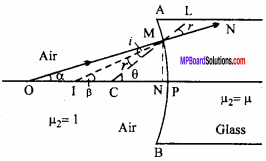
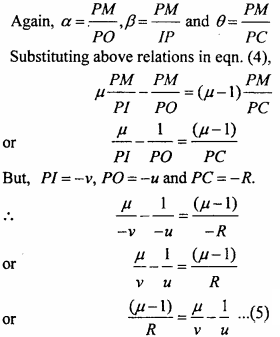
Solution:
Let the radius of sphere = r
and ∆r be the error in measuring the radius.
r = 7m, ∆r = 0.02 m (given)
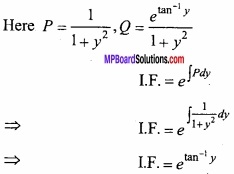
Volume of sphere V = \(\frac{4}{3}\) πr3
MP Board Class 12th Maths Important Questions Chapter 6 Application of Derivatives img 38
The approximate error in calculating the volume is 3.92π m3

MP Board Solutions

Question 33.
Find the approximate change in the volume V of a cube of sides x metre caused by increasing the side by 1%? (NCERT)
Solution:
Let x be the sides of cube.
Volume of cube V = x3, ∆x = 1% of x = \(\frac{x}{100}\)
MP Board Class 12th Maths Important Questions Chapter 6 Application of Derivatives img 39
Change in volume ∆V = ( \(\frac { dV }{ dx } \) ) ∆x
MP Board Class 12th Maths Important Questions Chapter 6 Application of Derivatives img 40
Approximate change in volume = 0.03 x3m3.

Question 34.
Find the approximate change in voume V of a cube of side x metre caused by increasing the side by 2%
Solution:
Let x be the side of cube,
∆x = 2% of x = \(\frac { x\times 2 }{ 100 } \) = 0.02 x
Volume of cube V = x3
\(\frac { dv }{ dx } \) = \(\frac { d }{ dx } \) x3 = 3x2
dV = ( \(\frac { dv }{ dx } \) ) ∆x = 3x2 × 0.02 x = 0.06x3 m3
Thus the approximate change in voume = 0.06 x3m3.

MP Board Class 12 Maths Important Questions

MP Board Class 12th Physics Important Questions Chapter 6 Electromagnetic Induction

MP Board Class 12th Physics Important Questions Chapter 6 Electromagnetic Induction

Electromagnetic Induction Important Questions

Electromagnetic Induction Objective Type Questions

Question 1.
Choose the correct answer of the following:

Question 1.
The SI unit of magnetic flux is :
(a) Weber
(b) Gauss
(c) Oersted
(d) Tesla
Answer:
(a) Weber

Question 2.
The flux linked with a coil can be charged by :
(a) Keeping the coil in a time varying magnetic field
(b) Rotating the coil in a magnetic field
(c) By charging area of coil in the uniform magnetic field
(d) All the above.
Answer:
(d) All the above.

Question 3.
The direction of induced current can be determined by :
(a) Lenz’s law
(b) Flemming’s left hand rule
(c) Right hand palm rule
(d) Ampere’s swimming rule.
Answer:
(a) Lenz’s law

Question 4.
In the phenomenon of elctro magnetic induction :
(a) Electrical energy is transformed into mechanical energy
(b) Mechanical energy is transformed into electrical energy
(c) Electrical energy is transformed into thermal energy
(d) Mechanical energy is transformed into thermal energy.
Answer:
(b) Mechanical energy is transformed into electrical energy

Question 5.
The self inductance of a coil does not depend upon :
(a) Radius of coil
(b) Number of turns in the coil
(c) Lenght of coil
(d) Current through the coil.
Answer:
(d) Current through the coil.

MP Board Solutions

Question 6.
If a core of soft iron is placed between the coil then their mutual inductance :
(a) Decreases
(b) Increases
(c) Remain unchanged
(d) Nothing can be said.
Answer:
(b) Increases

Question 7.
The eddy current are used in :
(a) Electrolysis
(b) Making a galvanometer dead beat
(c) Electroplating
(d) Increasing the sensitivity of galvanometer.
Answer:
(b) Making a galvanometer dead beat

Question 2.
Fill in the blanks :

  1. Lenz’s law is used to find out direction of ……………
  2. The SI unit of magnetic flux is ……………
  3. The core of transformer is made laminated to reduce the loss of energy due to …………… currents.
  4. To make the moving coil galvanometer …………… its coil is wound on the aluminium frame.
  5. Magnetic flux is a …………… quantity.

Answer:

  1. Induced current
  2. Weber
  3. Eddy
  4. Dead beat
  5. Scalar.

Question 3.
Match the Column :
I.
MP Board 12th Physics Important Questions Chapter 6 Electromagnetic Induction 1
Answer:

  1. (d)
  2. (c)
  3. (e)
  4. (a)
  5. (b)

II.
MP Board 12th Physics Important Questions Chapter 6 Electromagnetic Induction 2
Answer:

  1. (e)
  2. (c)
  3. (d)
  4. (b)
  5. (a)

Question 4.
Write the answer in one word/sentence :

  1. What is the unit of magnetic flux?
  2. What is unit of coefficient of self induction?
  3. A straight conductor of length ‘l’ moving with a velocity of ‘V’ in a uniform magnetic field ‘B’ Perpendicular to it. Write the
  4. formula for induced e.m.f. in it.
  5. Write relation between Henry and Micro Henry.
  6. Write the principle of alternating current generator.
  7. Induced electric field is conservative field or non conservative field.
  8. In which form the energy is stored in a coil?
  9. By which law we determine the direction of induced e.m.f.?

Answer:

  1. Weber
  2. Henry
  3. e = Blv
  4. 1H = 106pH
  5. Electro magnetic induction
  6. It is Non conservative field
  7. Magnetic energy
  8. Lenz’s law.

Electromagnetic Induction Very Short Answer Type Questions

Question 1.
When induced current flow in a closed circuit?
Answer:
When there is change in magnetic flux in a closed circuit, then induced current flow over it.

Question 2.
If a iron core is kept at the centre of a coil, then what will be the effect on coefficient of self induction?
Answer:
Coefficient of self induction will increase.

Question 3.
Lenz’s law is accordance to which law?
Answer:
Law of conservation of energy.

Question 4.
If any metal piece is kept in varying magnetic field, will eddy current generate in it?
Answer:
Yes, eddy current generate in the metallic piece.

MP Board Solutions

Question 5.
Why coil with in the resistance box is double coiled?
Answer:
To avoid self – induction phenomenon.

Question 6.
When the magnitude of magnetic flux become maximum and minimum?
Answer:
When magnetic field is perpendicular to the plane, the magnetic flux is maximum and when it is parallel, its value is minimum.

Electromagnetic Induction Short Answer Type Questions

Question 1.
What is magnetic flux? Write its SI units.
Answer:
The number of magnetic lines of force passing normally through any area in a magnetic field, is called magnetic flux linked with that area. It is denoted by ϕ(phi).
MP Board 12th Physics Important Questions Chapter 6 Electromagnetic Induction 3
Where, \(\vec { B }\) is the magnetic field, \(\vec { dS }\) is the normal to the surface and θ is the angle between \(\vec { B }\) and normal to surface. SI unit of fluxs weber.

Question 2.
Write Lenz’s law of electromagnetic induction.
Answer:
According to this law, the nature of induced e.m.f. is such that it opposes the cause which produces it. With the help of this law, the direction of induced e.m.f. can be determined.
∴ e = \(\frac {dϕ}{dt}\)
– ve sign is according to Lenz’s law.

Question 3.
A bird sitting on a wire carrying current at high voltage, flies away. Why?
Answer:
As soon as the current flows through the wire, an induced current is produced in the body of the bird, the direction of the current in the wings are opposite. Hence, they are repelled and the bird flies away.

Question 4.
In the given figure, which plate of the capacitor AB is positive and which plate is negative?
Answer:
MP Board 12th Physics Important Questions Chapter 6 Electromagnetic Induction 4
According to Lenz’s law induced current flows from B to A, therefore plate A is positive and plate B is negative.

Question 5.
A metallic chain touching the ground is attached with the truck carrying explosive matter. Why?
Answer:
During the motion of the truck, the axle cut the magnetic flux of the earth, which causes an induced e.m.f. set up across its axle. This induced charges are earthed by the chain. Which prevent the explosive from the fire.

Question 6.
In metre bridge experiment, the battery’ key is pressed first then galvanometer. Why?
Answer:
If the galvanometer key is pressed first and then battery key, an induced current will be produced in the galvanometer circuit and galvanometer will give deflection even at the position of null point. Thus, the battery key is pressed first.

Question 7.
The resistances in the resistance box are double coiled. Why?
Answer:
In the double coil, the current flows in opposite directions, thus the magnetic fields produced cancel each other and hence induced current is not produced.

Question 8.
When any electric circuit is suddenly cut off, then sparks take place. Why?
Answer:
When the switch is off, the magnetic flux linked with the circuit becomes zero suddenly. Therefore, a strong induced current flows through the circuit in the direction of main current, which causes a high potential difference across the terminal and due to electric discharge, sparks are seen.

MP Board Solutions

Question 9.
What is mutual induction?
Answer:
When the current changes in a coil, then the flux linked with another coil placed near the first changes, hence an induced current is produced in another coil. This phenomenon is known as mutual induction.

Question 10.
A coil in magnetic field is moved

  1. Rapidly and
  2. Slowly.

Are the e.m.f. and work done in the two cases equal or not?
Answer:
No, the e.m.f. induced in the first case will be larger due to larger rate of change of flux. Obviously, in the second case, the rate of change of flux is slow and hence induced e.m.f will be smaller.

Question 11.
Two coils A and B are kept perpendicular to each other as shown in figure. If flow of current in any one coil is change will induced current will generate in the second.
Answer:
When current is flows in use one coil, the induced flux produce will be parallel to second coil and there will be no change in magnetic flux. Hence no induced current will be produced in second coil.
MP Board 12th Physics Important Questions Chapter 6 Electromagnetic Induction 5

Question 12.
A ring is hanging in a wall of room. When the north pole of the magnet is brought closer to the ring. Then what will be the direction of induced current if seen from the direction of magnet?
Answer:
The face of the ring which is toward the north pole of the magnet, in.it the direction of induced current will be anti clockwise. Hence this face become magnetic north pole and resist the magnetic pole to come near it.

Question 13.
Three coils are arranged as shown in the figure :
MP Board 12th Physics Important Questions Chapter 6 Electromagnetic Induction 6
In which coil mutual induction will be maximum?
Answer:
In figure (a), the mutual induction will be maximum before the magnetic lines of force passing in figure (a) is more in comparison to other figure.

Question 14.
What is electromagnetic induction? State Faraday’s laws of electromag neticinduction.
Or
Write down the laws of electromagnetic induction. Find out the expression for the induced electromotive force.
Answer:
When a magnet and a conducting coil are in relative motion, an e.m.f. is induced in the coil. This e.m.f. is called induced e.m.f. If the coil is closed, a current flows in it, then this current is called induced current and the phenomenon is called electromagnetic induction.

Faraday’s laws of electromagnetic induction:
1. Whenever there is a change in magnetic flux linked with an electrical circuit, an e.m.f. is induced in the circuit, therefore an induced current flows in it. The induced current losts so long as there is change in flux.

2. The induced e.m.f. is directly proportional to the rate of change in magnetic flux.

Formula for induced e.m.f.:
Let Φ1 weber be the flux linked with a closed electrical circuit at any instant of time t1. After time ∆t i.e., at time t2 seconds, let the flux be Φ2 weber.
MP Board 12th Physics Important Questions Chapter 6 Electromagnetic Induction 7
This is the required formula.
Hence, the induced e.m.f. is directly proportional to the rate of change of flux.

Question 15.
Write Lenz’s law and explain how it can be used to determine the direction of induced current?
Answer:
Lenz’s law:
According to this law, the direc¬tion of induced current is such that it opposes the very cause producing it. With the help of this law, the direction of induced current can be determined as follows :

1. When N – pole of a bar magnet is brought closer to a coil, a current is induced to develop N – pole on the adjacent face of the coil to oppose the motion of N – pole towards the coil. This means the induced current must be anticlockwise as seen from the magnet, [see Fig.(a)].
MP Board 12th Physics Important Questions Chapter 6 Electromagnetic Induction 8
2. When N – pole of the bar magnet is taken away from the coil, an induced current flows in the coil such that the face of the coil near the magnet becomes south pole which attracts the north pole and thus opposes the cause producing it (i.e., opposes the motion of the magnet away from the coil). So, the direction of the induced current in the coil must be clockwise as seen from the magnet, [see Fig. (b)].
MP Board 12th Physics Important Questions Chapter 6 Electromagnetic Induction 9

Question 16.
Explain that Lenz’s law is in accordance with the law of conservation of eaefgy.
Answer:
When a magnetic north pole is brought near a plane of a coil, the magnetic pole induced in that plane is also north pole causing a repulsive force on the north pole of the magnet. Therefore, work will have to be done against this repulsive force to bring the magnet’s north pole closer to the coil. The work done (mechanical energy) is transformed into electri¬cal energy causing a current induced in the coil.
MP Board 12th Physics Important Questions Chapter 6 Electromagnetic Induction 10
But, on moving the north pole of the magnet away from the coil, a south pole is developed on the face of the coil and an attractive force is developed on the face of the magnet. So, work has to be done in moving the magnet away from the coil. This results in flow of induced current in reverse direction. Thus, Lenz’s law is in accordance with the law of conservation of energy.

Question 17.
Explain self – induction and demonstrate the phenomenon by an experiment.
Answer:
Self – induction:
During the motion of the truck, the axle cut the magnetic flux of the earth, which causes an induced e.m.f. set up across its axle. This induced charges are earthed by the chain. Which prevent the explosive from the fire.

Experiment:
The circuit of the experiment is shown in the figure. It consists of an insulated copper coil L, wound on soft iron core. Cell E, rheostat Rh and a tapping key K are connected in series. A bulb B is connected in parallel with the coil. Now, the key is closed, the bulb glows slowly, then becomes bright and when it is opened, the bulb flashes bright and then goes off.
MP Board 12th Physics Important Questions Chapter 6 Electromagnetic Induction 11
As the key is pressed, the flux linked with coil changes and an induced current flows in the opposite direction of main current, because of this the current grows slowly in the circuit.But when the key is opened, the flux suddenly decreases to zero, therefore a strong induced current flows in the same direction of circuit current makes the bulb very bright for a moment.

Question 18.
What is self – induction? What is meant by self-induction of coil? Explain. WritgTts unit.
Answer:
Self – inductance:
When the current flowing through a circuit, an induced e.m.f. is set up in the same circuit, which opposes the main current. This phenomenon is called self – induction.
When the current increases in the circuit, induced current flows in the opposite direc¬tion and when the current decreases in the circuit, the induced current flows in the same direction of circuit current.
Let ϕ be the flux linked with a circuit when a current (l) flows through it. Then,
ϕ ∝I
or ϕ = LI …(1)
Where, L is a constant, called self – inductance of the coil.
Now, if I = 1, then by eqn. (i), we get
ϕ = L
Thus, the self-inductance of a coil is numerically equal to the magnetic flux linked with the coil, produced by unit current.
By Faraday’s law, e = –\(\frac {dϕ}{dt}\)
Putting the value of ϕ from eqn. (i), e = –\(\frac {d(LI)}{dt}\)
or e = -L\(\frac {dI}{dt}\)
If \(\frac {dI}{dt}\) = 1
Then, e = – L
Therefore, the self – inductance of a coil is numerically equal to the opposing e.m.f. produced in the coil due to a unit rate of change of current in the circuit.
Unit : Unit of self-inductance is henry (H).

MP Board Solutions

Question 19.
Explain mutual inductance. Give its unit. On what factors does it depend?
or
Write down the definition, unit and dimensional formula of mutual inductance.
Answer:
Mutual inductance is defined in two ways :
1. Let the flux linked with secondary coil be ϕ due to current l in primary coil.
∴ ϕ ∝ I
or ϕ = MI
Where, M is constant called mutual inductance.
If l = 1, then ϕ = M.
Hence, mutual inductance is defined by numerical value of flux linked with secondary coil, with unit current flows through primary coil.

2. When current changes in primary coil, then flux changes in secondary coil. Thus, by second law of Faraday
Induced e.m.fi, e = –\(\frac {dϕ}{dt}\)
or e = –\(\frac {d(MI)}{dt}\)
or e = ML\(\frac {dI}{dt}\)
If \(\frac {dI}{dt}\) = 1
Then, e = – M
Thus, the mutual inductance of two coils is numerically equal to the induced e.m.f. set up in secondary coil at that moment, when the rate of change of current in primary coil is unity.

Unit : Its unit is Henry in SI system.
Dimensional formula :
MP Board 12th Physics Important Questions Chapter 6 Electromagnetic Induction 12

It depends upon:

  1. Number of turns of both the coils : As the number of turns increases, mutual inductance also increases.
  2. Area of cross – section of both the coils : As the area increases, the mutual inductance increases.
  3. Material of core : In presence of soft – iron core, the inductance is greater than that of air.

Question 20.
Give differences between self – induction and mutual induction.
Answer:
Difference between self – induction and mutual induction :
Self – induction:

  • This phenomenon happens in the same coil when the current flowing through the coil changes.
  • One coil is used in this phenomenon.
  • Induced current affects the main current.

Mutual induction:

  • This phenomenon happens in the another coil placed nearby a coil in which the current is changing.
  • Two coils are used in this phenomenon.
  • The induced current produced in the second coil, therefore main current is not affected.

Question 21.
What are eddy currents? Show an experiment to demonstrate eddy currents.
Or
What are eddy currents? What are their disadvantages ? Write any two uses of eddy currents.
Answer:
Eddy currents:
When a metallic plate is moved in a magnetic field or placed in a changing magnetic field, then flux linked with the conductor changes, hence an induced current is produced in the plate. This induced current is called eddy current.
MP Board 12th Physics Important Questions Chapter 6 Electromagnetic Induction 13
Demonstration:
A rectangular copper plate is free to oscillate about a horizontal axis, passing through O. It is placed between the pole pieces of an electromagnet NS. Oscillate the plate, when no current is flowing in the circuit, the plate will oscillate for a long time and due to air resistance finally its amplitude of oscillation decreases.

Now, oscillate and pass the current. It is observed that the oscillations of the plate will be damped soon. Just as eddies are produced on water surface, the change of flux through the metal plate develops induced current known as eddy currents.

Uses : Eddy currents are used in :

  1. Making a galvanometer dead beat.
  2. Induction furnace.
  3. Electric break.
  4. Induction motor, etc.

Disadvantages of eddy currents:
Production of eddy currents causes loss of electrical energy in the form of heat. In order to prevent this, soft-iron core is laminated in a transformer. Lamination increases resistance and decreases eddy currents. So, there is very little dissipation of electrical energy in the form of heat.

MP Board Solutions

Question 22.
The self – inductance of two coils P and S are L1 and L2 respectively. If the coupling between them is ideal, then prove that the mutual inductance between these coils is M = \(\sqrt { { L }_{ 1 }{ L }_{ 2 } }\)
Answer:
Let coil P is having N1 total number of turns, length of coil is l and I is the current flowing.
MP Board 12th Physics Important Questions Chapter 6 Electromagnetic Induction 14

Question 23.
Obtain an expression for the self – inductance of two coils when they are joined in parallel.
Answer:
Consider two inductors of self – inductance L1 and L2and joined in parallel.
If I1 and L2, be the current flow through L1and L2 respectively, then
I = I1 + I2
MP Board 12th Physics Important Questions Chapter 6 Electromagnetic Induction 15
Where 1 is the total current in the circuit differentiating both sides, we get
\(\frac {dI}{dt}\) = \(\frac { { dI }_{ 1 } }{ dt }\) + \(\frac { { dI }_{ 2 } }{ dt }\) … (2)
In parallel combination, the induced e.m.f, across each coil remains the same.
MP Board 12th Physics Important Questions Chapter 6 Electromagnetic Induction 21
Putting the value of \(\frac {dI}{dt}\) From eqns. (1) and (3), we get
MP Board 12th Physics Important Questions Chapter 6 Electromagnetic Induction 16
Equation (4) is the required expression

Electromagnetic Induction Long Answer Type Questions

Question 1.
Derive an expression for mutual inductance ¡n between two circular plane coils. Write the factors affecting mutual inductance between circular plane colts.
Answer:
Consider two circular plane coils P and S kept coaxially close to each other. Thenumber of turns in the primary coil P is n1 and in the secondary coil S is n2. The radius of primary coil P is r1 and that of the secondary coil is r2. Due to flow of current l in the primary coil, the magnetic field produced at its centre is
B = \(\frac { { \mu }_{ 0 } }{ 4\pi } \frac { 2\pi { n }_{ 1 }I }{ { r }_{ 1 } }\) = \(\frac { { \mu }_{ 0 }{ n }_{ 1 }I }{ 2{ r }_{ 1 } }\)
The magnetic flux linked with secondary coil S due to this magnetic field.
ϕ = nBA
=n1 \(\frac { { \mu }_{ 0 }{ n }_{ 1 }I }{ 2{ r }_{ 1 } }\) πr22 … (1)
But, ϕ = MI … (2)
From eqns. (1) and (2),
\(\frac { { \mu }_{ 0 }{ n }_{ 1 }{ n }_{ 2 } }{ 2{ r }_{ 1 } }\).πr22
If some other medium is placed inside the coils in place of air or vacuum of perme – ability µ, then
M = µ\(\frac { { n }_{ 1 }{ n }_{ 2 } }{ 2{ r }_{ 1 } }\).πr22 … (4)

The mutual inductance between circular plane coils depends on following factors :

  1. The mutual inductance increases on increasing the number of trims in primary coil and secondary coil.
  2. On increasing the radius of primary coil r1, the mutual inductance decreases.
  3. On increasing the area of secondary coil, mutual inductance increases.
  4. If a medium other than air is kept between the coil Mincreases.

Question 2.
Derive an expression for self – inductance of a long solenoid. On what factors does it depend?
Answer:
Expression for self – inductance of a long solenoid:
Let the length and radius of a solenoid be l and r respectively. Also n be the number of turns per unit length.
MP Board 12th Physics Important Questions Chapter 6 Electromagnetic Induction 17
∴ Area of cross – section, A = πr2
and total number of turns = nl = N.
If current l flows through the solenoid, then the intensity of magnetic field inside the solenoid will be given by
B = µ0nI, [∵B = \(\frac { { \mu }_{ 0 } }{ 4\pi }\)2πnl(cos00 – cos1800)]
(for unit length if l > >r)
Where, µ0 is the permeability of the medium.
∴ Magnetic flux linked with the total length of solenoid.
MP Board 12th Physics Important Questions Chapter 6 Electromagnetic Induction 18
If the permeability of soft – iron core inside the solenoid is µr, then
L = \(\frac { { \mu }_{ 0 }{ \mu }_{ 1 }{ N }^{ 2 }A }{ l }\) … (3)
Equation (3) is the expression for self – inductance of a long solenoid. From this equation, it is clear that the self – inductance of a solenoid depends upon the following :

1. Area of cross – section of solenoid or radius of the solenoid : The self – inductance of a solenoid increases with radius and hence with the area of cross – section.

2. No. of turns : Self – inductance of a solenoid increases with number of turns.

3. Length of the solenoid : Self – inductance of a solenoid decreases on increasing the length of the solenoid.

4. Relative permeability of the core : The self – inductance of a solenoid increases on placing a core of higher permeability. This is the reason, that self-inductance of a solenoid with soft – iron core is greater than that of air core solenoid.

Equation (3) can be written in terms of radius as follows :
L = \(\frac { { \mu }{ N }^{ 2 }\pi { { r }^{ 2 } } }{ l }\)

MP Board Solutions

Question 3.
Obtain an expression for mutual inductance of two long solenoids. What are the factors on which mutual inductance depends?
Answer:
Let S1, and S2 be the two long coaxial solenoids such that S1, is completely surrounded by S2. The lengths of both the solenoids are l. n1 and n2 are the number of turns per unit length respectively.
MP Board 12th Physics Important Questions Chapter 6 Electromagnetic Induction 20
Case :
1. Let S1 be taken as primary and S2 as secondary solenoid. If I1 is the current flowing through S1 then the intensity of field inside S1 will be
B1 = μ0n1I1
∴The magnetic field B1 will superpose on solenoid S2 and hence, magnetic flux linked with S2 per turn = B1A. Where, A is the area of cross – section of S1.
Hence, net flux associated with S2 will be
Φ21 = n2lB1A
Where, n2l is the total number of turns in solenoid S2 and Φ21 is magnetic flux on S2 due to S1
Substituting the value of B, from eqn. (1), we get
Φ21 = μ0n1I1n2A = μ0n1n2lAI1 … (2)
But, Φ21 = M21I1 … (3)
From eqns. (2) and (3),
M21 = μ0n1n2Al
This is the equation of mutual inductance of two solenoids. … (4)

2. Let S2 be taken as primary and S1 as secondary. If I2 is the current through S2, then the intensity of field inside S2 will be
B2 = μ0n2I2 … (5)
∴ The magnetic field of S2 i.e., B2 will superpose on solenoid S, and hence, magnetic flux linked with each turn of S1 = B2A.
Hence, the total flux associated with S1
Φ12 =n1lBn2A … (6)
Where, n1l is the total number of turns of solenoid S1, and Φ12 is magnetic flux on S1, due to S2.
Putting the value of B2 from eqn. (5), we get
Φ12 = μ0n2I2An1l = μ0n1n2lAI2 … (7)
But, Φ12 = μ12I2 … (8)
From eqns. (7) and (8), we have
M12 = μ0n1n2Al … (9)
From eqns. (4) and (9), we have
M21 = M12
This is called reciprocity theorem.
It is clear that the mutual inductance of two solenoids remains the same whether cur¬rent flows in one or the other.
Thus, mutual inductance of two long solenoids is given by.
M = μ0n1n2Al .
M = μ0μr\(\frac { { N }_{ 1 } }{ l } \frac { { N }_{ 2 } }{ l }\)Al
μ0μr\(\frac { { N }_{ 1 } }{ l } \frac { { N }_{ 2 } }{ l }\)Al

Mutual inductance depends upon :
1. Number of turns of both the coils : As the number of turns increases, the mutual inductance also increase.

2. Area of cross – section of both the coils : As the area increases, the mutual inductance increases.

3. Material of core : If the permeabilities of the cores in the solenoid are large, then mutual inductance increases. In presence of soft – iron core, the inductance is greater than that of air.

4. Length of the solenoid : For larger solenoids, mutual inductance is less.

Electromagnetic Induction Numerical Questions

Question 1.
The magnetic flux linked with a closed loop is given by the equation ϕB = 6t2 + 7t +1, where ϕB is in milliweber and t is in second. Find the electromotive force induced at time t = 2 second.
Solution:
Formula: e = – \(\frac {dϕ}{dt}\)
Given : ϕ = 6t2 + 7t +1
∴ = – latex]\frac {d}{dt}[/latex](6t2 + 7t +1) = – 12t – 7
At t = 2 sec,
e = – 12 x 2 – 7
= – 31 milli volt.

Question 2.
An aircraft with a wing span of 40 m flies with a speed of 1080 km hr-1 towards East where vertical component of Earth’s magnetic field is 1.75 x 10⁻⁵ tesla. Find the e.m.f. developed between the tip of the wings. (NCERT)
Solution:
l = 40m, Bv, Bv = 1.75 x 10⁻⁵T V = 1080\(\frac {Km}{hr}\)
= 1080 x \(\frac {5}{18}\) = 300 m/sec
e = Bvlv = 1.75 x 10-5 x 40 x300
= 0.21 volt

Question 3.
The flux linked with a coil changes from 1 Wb to 0.1 Wb in 0.1 sec. Calculate the induced e.m.f.
Solution:
Formula : e = – \(\frac {dI}{dt}\)
Given : dl = (0.1 – 1) and dt = 0.1.
e = – \(\frac {(0.1 – 1) }{0.1}\)
or e = \(\frac {(0.9) }{0.1}\)

MP Board Solutions

Question 4.
A current is flowing through a coil having 800 turns. The flux linked with it is 1.5 x 10-s Wb. Find the self-inductance of the coil.
Sol. Formula : = LI
Flux linked with one turn = 1.5 x 10⁻⁵ Wb,
∴ Flux linked with 800 turns = 800 x 1.5 x 10-5Wb
Substituting the values, we get
800 x 1.5 x 10-5 = L x 1.5
∴ L = 800×10-5
= 8.0 x 10⁻³H
= 8.0 mH.

Question 5.
An air – core solenoid with length 30 cm area of cross – section 25 cm2 and number of turns 500 carries a current of 2.5A. Current is switched off for 1 m sec. Find the average back emf induced across the ends of the open switch in the circuit. (NCERT)
Solution:
l = 30 cm = 0.3 m, A = 25 cm2 = 25 x 10-4m2
N = 500, dt = 10-3sec., dl = 0 – 2.5 = – 2.5A
Back emf
MP Board 12th Physics Important Questions Chapter 6 Electromagnetic Induction 19

MP Board Class 12th Physics Important Questions