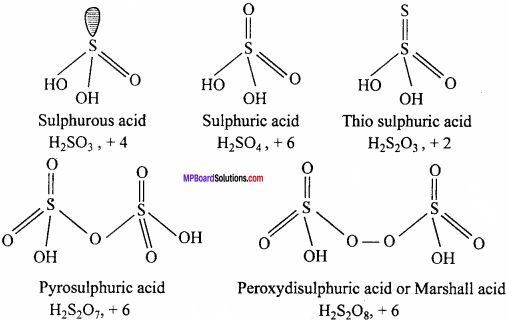
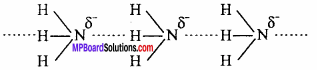
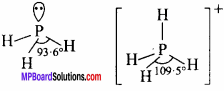
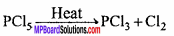
MP Board Class 11th Chemistry Important Questions Chapter 11 p – Block Elements

MP Board Class 11th Chemistry Important Questions Chapter 11 p – Block Elements

p – Block Elements Important Questions

p – Block Elements Objective Type Questions

Question 1.
Choose the correct answer:

Question 1.
Boric acid is a polymer because:
(a) It is acidic in nature
(b) It contains H – bond
(c) Its basicity is one
(d) It has sheet like geometry
Answer:
(b) It contains H – bond

Question 2.
Which acid is not a protonic acid:
(a) H3BO3
(b) H3PO3
(c) H2SO3
(d) HCl3
Answer:
(a) H3BO3

Question 3.
Al2O3 can be converted to anhydrous AlCl3 by heating:
(a) Al2O3 with Cl2 gas
(b) Al2O3 with HCl gas
(c) Al2O3 with NaCl in solid state
(d) A mixture of Al2O3 and Carbon in dry Cl2 gas
Answer:
(d) A mixture of Al2O3 and Carbon in dry Cl2 gas

MP Board Solutions

Question 4.
Which one of the following is the correct statement:
(a) B2H6.2H3 is known as Inorganic benzene
(b) Boric acid is a protonic acid
(c) Beryllium exhibits co – ordination number of six
(d) Chlorides of both berylium and aluminium have bridged chloride structure in solid phase
Answer:
(d) Chlorides of both berylium and aluminium have bridged chloride structure in solid phase

Question 5.
Shape and hybridization of BF3 is:
(a) Linear, sp
(b) Planar, sp2
(c) Tetrahedral, sp3
(d) Pyrimidal, sp3
Answer:
(b) Planar, sp2

Question 6.
Reason for the formation of addition product between NH3 and BF3 is:
(a) Formation of H – bond between them
(b) Formation of ionic bond between them
(c) Formation of covalent bond between them
(d) Similar structure
Answer:
(c) Formation of covalent bond between them

Question 7.
Dry ice is:
(a) Solid ice without water
(b) Solid sulphur dioxide
(c) Solid carbon dioxide
(d) Solid benzene
Answer:
(c) Solid carbon dioxide

Question 8.
Which halide does not dissociate by water:
(a) CCl4
(b) SiCl4
(c) GeCl4
(d) SnCl2
Answer:
(a) CCl4

MP Board Solutions

Question 9.
Whose important constituent is silicon:
(a) Chlorophyll
(b) Haemoglobin
(c) Rocks
(d) Amalgam.
Answer:
(c) Rocks

Question 10.
Silicones are used:
(a) In the preparation of water proof cloth
(b) In the preparation of insulating material
(c) In preparing high elastic rubber
(d) All the above
Answer:
(d) All the above

Question 11.
Poisonous gas found in the smoke released from car:
(a) CH4
(b) C2H2
(C) CO
(d) CO2
Answer:
(C) CO

Question 2.
Fill in the blanks:

  1. When formic acid is heated with cone. H2SO4, ………………………. is formed.
  2. Bauxite ore containing ferric oxide as impurity is purified by ……………………… method.
  3. Alumina containing both Fe2O3 and SiO2 as impurity is subjected to purification by ………………………… process.
  4. To obtain cent percent pure aluminium, it is refined by ………………………….. process.
  5. Melting point of pure alumina is very high (about 2050°C), to melt it at low temperature ………………………… and ………………………………. are added due to which melting point reduces to ……………………………..
  6. When bauxite contains more of silica as impurity then the ore is purified by ………………………………….. process.
  7. Process of catenation is maximum in ……………………………..
  8. Fullerene is an aliotrope of ……………………………
  9. Lamp black is an ………………………………. aliotrope of carbon.
  10. Maximum covalency of carbon is ………………………… whereas of Si is …………………………
  11. Graphite is a ……………………… of electricity where as silicon is a ……………………..
  12. Silicon carbide is called …………………………….

Answer:

  1. Carbon mono – oxide
  2. Baeyer’s
  3. Hall’s
  4. Hoope’s
  5. Cryolite, Fluorspar, 870°C
  6. Serpeck
  7. Carbon
  8. Carbon
  9. Amorphous
  10. 4, 6
  11. Conductor, semiconductor
  12. Carborundum

MP Board Solutions

Question 3.
Answer in one word/sentence:

  1. Which type of oxides are formed by elements of Group 13?
  2. +1 oxidation state of T1 is more stable as compared to +3?
  3. Aluminium reacts with base to form?
  4. What are hydrides of boron known as?
  5. Boron is m .inly found in which form?
  6. What is “Two electron three centre bond” known as?
  7. What will happen if excess of ammonia solution is added to copper sulphate solution?
  8. What is formed when diborane react with ammonia?

Answer:

  1. M2O3
  2. Inert pair effect
  3. Sodium metaaluminate
  4. Borane
  5. Borax (Na2B4O7.10H2O)
  6. Diborane
  7. Complex compound of cupric ammonium sulphite is formed
  8. Borazine

Question 4.
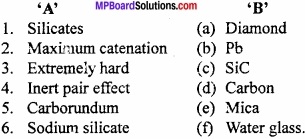
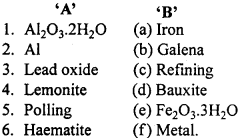
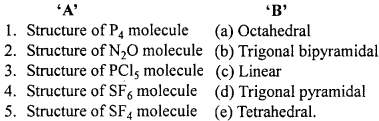
Match the following:
[I]
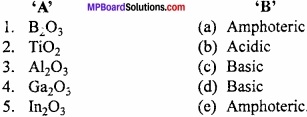
MP Board Class 11th Chemistry Important Questions Chapter 11 p - Block Elements img 1
Answer:

  1. (b)
  2. (c)
  3. (e)
  4. (a)
  5. (d)

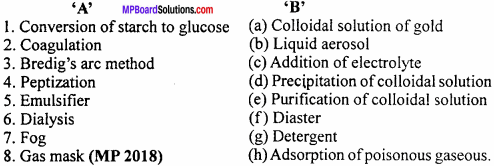
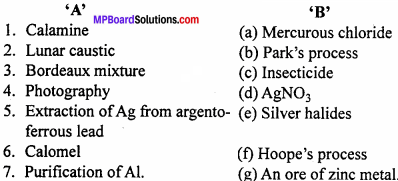
[II]
MP Board Class 11th Chemistry Important Questions Chapter 11 p - Block Elements img 2
Answer:

  1. (e)
  2. (d)
  3. (a)
  4. (b)
  5. (c)
  6. (f)

p – Block Elements Very Short Answer Type Questions

Question 1.
The +1 oxidation state of Tl is stable than +3 state?
Answer:
Inert pair effect.

Question 2.
What the hydride of boron is called?
Answer:
Borane.

Question 3.
Who is called “Two electron three centre bond”?
Answer:
Diborane.

Question 4.
What happens when ammonia solution is added in excess in CuSO4 solution?
Answer:
Complex compound of Cupric ammonium sulphate.

MP Board Solutions

Question 5.
What is the formula of Alum?
Answer:
K2SO4.Al2(SO4)3.24H2O.

Question 6.
What is the name of C60 carbon atom?
Answer:
Buckmister fullerenes.

Question 7.
Which carbide is harder than diamond?
Answer:
Boron carbide.

Question 8.
For which property of carbon, it have large number of compounds?
Answer:
Catenation.

Question 9.
What is the good conductor allotrope of carbon?
Answer:
Graphite.

Question 10.
What is water glass?
Answer:
Sodium silicate.

Question 11.
What is the hybridization of B in diborane?
Answer:
sp2.

Question 12.
What is carborundum?
Answer:
SiC (Silicon carbide).

MP Board Solutions

Question 13.
Which is electron deficient halide?
Answer:
BCl3.

Question 14.
What is the property of B2O3?
Answer:
Acidic nature.

Question 15.
What is dry ice?
Answer:
Solid CO2.

Question 16.
What is the formula of dimer of aluminium chloride?
Answer:
Al2Cl6.

Question 17.
What is used in welding as oxy acetylene flame?
Answer:
C2H2 (Acetylene).

Question 18.
What is Inorganic benzene?
Answer:
Borazene.

Question 19.
Which type of bond is present in diborane?
Answer:
2 electron 3 centre bond (Banana bond).

MP Board Solutions

Question 20.
Which type of hybridization in carbon atom found in diamond?
Answer:
sp2 hybridization.

Question 21.
Which is the most abundant metal found on earth surface?
Answer:
Aluminium.

p – Block Elements Short Answer Type Questions – I

Question 1.
How can you explain the higher stability of BCl3 as compared to TICI?
Answer:
Boron exhibits +3 oxidation state and can form stable BCl3. Thallium shows oxidation state of +1 as well as +3 but +1 oxidation state is more stable than +3 because of inert pair effect. Therefore, TlCl3 is not stable. It can form stable TlCl.

Question 2.
Consider the compounds, BCl3 and CCl4. How will they behave with water? Justify?
Answer:
The B atom in BCl3 has only six electrons in the valence shell and hence is an electron deficient molecule. It easily accepts a pair of electrons donated by water and hence BCl3 undergoes hydrolysis to form boric acid (H3BO3) and HCl.
BCl3 + 3H2O → H3BO3 + 3HCl
In contrast, C atom in CCl4 has 8 electrons in the valence shell. Therefore, it is an electron precise molecule. As a result, it neither accepts nor donates a pair of electrons from H2O molecule and hence CCl4 does not undergo hydrolysis in water.

Question 3.
Why caustic alkali like NaOH are not stored in aluminium vessel?
Answer:
Aluminium can easily dissolve in alkali and form sodium meta aluminate due to this reason caustic alkali like NaOH not stored in aluminium vessel.
2Al + 2NaOH + 2H2O → 2NaAlO2 + 3H2.

MP Board Solutions

Question 4.
What at normal temperature Al does not react with water?
Answer:
In the presence of air, a transparent protective oxide layer is formed on its surface, due to this at normal temperature it does not react with water.

Question 5.
Write the formula of Double salt or Alum?
Answer:
The general formula of double salt is R2SO4M2(SO4)3 where R = monovalent metal like Na, K, Rb, Cs or NH4+ ion and M is a trivalent metal like Fe+3, Al+3 or Cr+3.
Example: K2SO4.Al2(SO4)3.24H2O
(Potash Alum)

Question 6.
Write name of ores of aluminium? Write formulae also?
Answer:
Ores of aluminium are:

  1. Oxides: Corundum, ruby, sapphire (Al2O3), emerald.
  2. Hydrated oxides: Diaspore (Al2O3.H2O), bauxite (Al2O3.2H2O), gibbsite (Al2O3 – 3H2O).
  3. Fluoride: Cryolite (Na3AlF6).
  4. Sulphate: Alunite or alum stone [K2SO4.Al2(SO4)3.4Al(OH)3].
  5. Silicates: Felspar (K2O.Al2O3.6SiO2).
  6. Phosphate: Phiroza or turquoise [AlPO4. Al(OH)3]H2O.

Question 7.
Why aluminium is a strong reducing agent?
Answer:
Those elements which gives electron in the chemical reaction forms cations, and called reducing agent. The reducing power depends upon the electrode potential. (MPBoardSolutions.com) More the negative value of electrode potential more will be the reducing power. The electrode potential of A1 is – 1.67, so it behaves as a strong reducing agent.

Question 8.
Why gallium is a liquid at room temperature?
Answer:
Gallium changes into liquid when the room temperature is above 30°C. In solid state, its lattice energy is very less due to which the metallic bond can break easily at low temperature.

MP Board Solutions

Question 9.
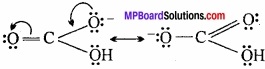
Write the resonating structure of CO32- and HCO3?
Answer:
The resonance structure of CO32- is:

MP Board Class 11th Chemistry Important Questions Chapter 11 p - Block Elements img 3
Resonating structure of HCO3
MP Board Class 11th Chemistry Important Questions Chapter 11 p - Block Elements img 4

Question 10.
Why the melting point and boiling point cf Boron is high?
Answer:
The crystal of Boron is formed by the covalent bond between the atoms. 2 atoms combines to form Icosahedron network which have 20 triangular faces and 12 comers. It makes boron very hard. Due to this it have high melting and boiling point.

Question 11.
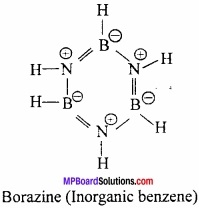
What is Inorganic benzene? Why it is called Inorganic benzene?
Answer:
When diborane reacts with ammonia at 120°C forming an addition compound diammoniate of diborane B2H6.2NH3. When this diammoniate of diborane is heated at 200°C, a stable cyclic compound B3N 3H6 is formed.
Borazine B3N3H6 has cyclic structure similar to benzene and thus it is called inorganic benzene.

MP Board Class 11th Chemistry Important Questions Chapter 11 p - Block Elements img 5
MP Board Class 11th Chemistry Important Questions Chapter 11 p - Block Elements img 5a

Question 12.
What is corundum?
Answer:
Al is found in more than one crystalline forms. The most hardest crystal is known as corundum, which is used as abrasive.

Question 13.
Write the ores of Boron and write formula also?
Answer:
The ores of Boron are as follows:

  1. Borax – Na2B4O7.10H2O
  2. Kemite – Na2B4O7.2H2O
  3. Colemanite – Ca2[B3O4.(0H)3]2.2H2O
  4. Orthoboric acid – H3BO3.

Question 14.
Prove that Tl+3 is an oxidizing agent but Al+3 not?
Answer:
Due to inert pair effect, in boron family the stability of +1 oxidation state increases from top to bottom in a gap but the stability of +3 oxidation state decreases. (MPBoardSolutions.com) That is why in comparison to Tl+1 is more stable than Tl+3. Tl+3 + 2e \(\underrightarrow { \Delta } \) Tl+1
It is clear that reduction of Tl+3 is occur. Therefore, Tl+3 is an oxidizing agent but the oxidation state of Al+3 is not possible.

MP Board Solutions

Question 15.
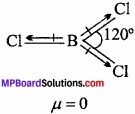
If B – Cl bond has a dipole moment, explain why BCl3 molecule has zero dipole moment?
Answer:
BCl3 has polar B – Cl bond, BCl3 is planar triangular molecule in which three B – Cl bonds are inclined at an angle of 120°. The resultant dipole moment of two B – Cl bonds is cancelled by the dipole moment of third B – Cl bond. The vector sum of the dipole moments of three B – Cl bond is zero.
MP Board Class 11th Chemistry Important Questions Chapter 11 p - Block Elements img 6

Question 16.
Boric acid is not protic acid? Why?
Answer:
Protic acid is the one that gives protons in solutions. Boric acid not a protic acid because it does not ionize in water to give proton but it behaves as Lewis acid by accepting electron pair from hydroxide ion.
B(OH)3 + H2O ⇄ [B(OH)4] + H+

Question 17.
How borax is obtained from colemanite?
Answer:
Colemanite is boiled with concentrated sodium carbonate solution to get borax.
Ca2B6O11 + 2Na2CO3 → Na2B4O7 +2NaBO2 + 2CaCO3
On concentrating the product, crystals of borax is obtained. On passing CO2 in mother liquor, borax is obtained.
4NaBO2 + CO2 → Na2B4O7 + Na2CO3.

Question 18.
Why cryolite is used for the extraction of aluminium from alumina?
Answer:
The melting point of pure alumina is very high 2050°C, but in the presence of cryolite and fluorspar it melts at 870°C. In this way cryolite decreases the melting point of alumina. It also act as an electrolyte.

MP Board Solutions

Question 19.
Write the uses of carbon monoxide?
Answer:

  1. It is main constituent of water gas (CO + H2) and producer gas (CO + N2).
  2. Used for the preparation of some metal carbonyls.
  3. It is used as reducing agents.

Question 20.
Why diamond is found rare in nature than graphite?
Answer:
The formation of diamond occurs at very high pressure and in liquid state of carbon converts into crystal. But in nature this state is very rare. That is why diamond is found rare in nature.

Question 21.
What is dry ice? Write its main uses?
Answer:
Solid carbon dioxide is called dry ice because its crystal looks like ice but they did not wet the paper and clothes. (MPBoardSolutions.com) At – 78.5°C it converts into solid without changing into liquid. It is used as coolant for preserving edibles and as anaesthetic agent in surgery.

Question 22.
What is carborundum? Write its main use?
Answer:
The structure of silicon carbide is hard like diamond. It is known as carborundum. It is used as abrasive for cutting tools.

Question 23.
Write the name of the compound used as coolant, anaesthetic and solvent, and write formula also?
Answer:

MP Board Class 11th Chemistry Important Questions Chapter 11 p - Block Elements img 7

Question 24.
Write the uses of graphite?
Answer:
The uses of graphite are as follows:

  1. It is used in lead pencils in place of lead.
  2. It is used as moderate in nuclear reactor.
  3. Used as electrode in electrolytic and dry cells.

Question 25.
Write the different types of coal?
Answer:
The following types of coal are:

  1. Pit: 60% carbon
  2. Lignite: 70% carbon
  3. Bituminous: 80% carbon
  4. Anthracite: 90% carbon.

Question 26.
Write the uses of diamond?
Answer:
The uses of diamond are:

  1. It is used for cutting or grinding of hard rocks.
  2. It is used in high precision thermometer because it is a good conductor of heat.
  3. For making windows of spaceships as it cuts off harmful radiations.

MP Board Solutions

Question 27.
Why CO2 is acidic? Explain with equation?
Answer:
The aqueous solution of CO2 is acidic:
CO2 + H2O → H2CO3
Carbonic acid
It turns blue litmus red and forms salt with base.
2NaOH + CO2 → Na2 CO3 + H2O
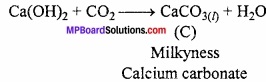
Ca(OH)2 + CO2 → CaCO3 + H2 O.

Question 28.
Why should not be sleep in a closed room keeping burning sigri?
Answer:
Sigri should not be bum in closed room, as in the smoke from sigri contains large amount of CO. This CO inhaled through respiration combines with the haemoglobin of blood and forms carboxyhaemoglobin which interrupt the blood flow and so the death occurs.

Question 29.
What are carbides?
Answer:
Carbides are those binary compounds of carbon which are formed by carbon with less electronegative atom.
They are of many types:

  1. Ionic carbides
  2. Metallic carbides
  3. Interstitial carbides
  4. Covalent carbides.

Question 30.
Write the use of silica gel?
Answer:
Silica gel is an amorphous solid which have 4% moisture. It is used as catalyst in petroleum industries. It is also used in chromatography.

Question 31.
What is Thixotropy?
Answer:
The viscosity of any liquid decreases by shaking it. This property is called Thixotropy. When SiCl4 is hydrolyzed at high temperature then a thixotropic silica is obtained.

MP Board Class 11th Chemistry Important Questions Chapter 11 p - Block Elements img 8

Question 32.
What are interstitial carbides?
Answer:
When carbon atom get inserted in the interstitial places of crystal lattice of transition elements then the compound formed are called interstitial carbides. They are very hard and have high melting point.

Question 33.
What are methonides and acetanilides?
Answer:
Methonides:
The carbides after hydrolysis give methane are called methonides.
Al4C3 + 12H2O → 4Al(OH)3 + 3CH4
Acetanilides:
The carbides after hydrolysis gives acetylene are called acetanildes.
CaC2 + 2H2O → Ca(OH)2 + C2H2

Question 34.
Be and Ca are member of same group, but Ca forms CaC2 but Be forms Be2 C. Why?
Answer:
After the hydrolysis of CaC2 acetylene is formed, so its structure is CaC2 whereas after hydrolysis of Be2 C, methane is formed therefore it is in the form of Be2 C.

MP Board Solutions

Question 35.
What is silane and germane?
Answer:
The hydrides of Si and Ge are called silane and germane respectively. They are shown by Mn H2n+2 where M = Si and Ge. In silane n = 1 to 8 and in germane n = 1 to 5.

Question 36.
What is activated charcoal?
Answer:
Charcoal is soft and porous. It adsorbs coloured compounds and gases. It is heated in vapour up to 1100°C then its adsorption power increases and it is known as activated charcoal.

p – Block Elements Short Answer Type Questions – II

Question 1.
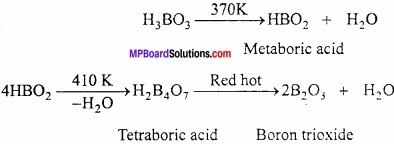
What happens when boric acid is heated?
Answer:
Boric acid releases three molecules of water at different temperature and forms boron trioxide.
MP Board Class 11th Chemistry Important Questions Chapter 11 p - Block Elements img 9

Question 2.
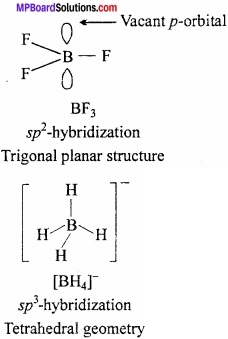
Explain the structure of BF3 and BH4, also show the hybridization of B in them?
Answer:
In BF3, there are 3 bonded electron pairs are present in B, so it is of sp2 hybridized and have trigonal planar structure whereas in [BH4] the number of bonding electron = 4. So, the hybridization is sp3 and structure is tetrahedral.
MP Board Class 11th Chemistry Important Questions Chapter 11 p - Block Elements img 10

Question 3.
What is Alum? Write its general formula, method of preparation, properties and uses?
Answer:
Alums:
Double salts which can be represented by the general formula R2SO4. M2 (SO4)3. 24H2O are called Alums.
Here, R = A monovalent metal like Na, K, Rb, Cs or NH4+ radical.
M = Trivalent metal like Fe, A1 or Cr.
Alums in which trivalent metal is Al, are named as the alums of monovalent metal or radical present in them like:
Potash alum K2SO4. Al2(SO4)3.24H2O
Methods of preparation:
On crystallizing a mixture of equimolecular proportion of potassium sulphate and aluminium sulphate solution.
K2SO4 + Al2(SO4)3 + 24H2O → K2SO4. Al2(SO4)3.24H2O

Properties:
1. Colourless, octahedral crystals are formed whose aqueous solution is acidic due to hydrolysis. Solid alum is soluble in water but insoluble in alcohol. Its one molecule contains 24 molecules of crystallized water.

2. On heating it melts at 92°C, on heating up to 200°C all the water of crystallization is lost and alum swells up and becomes porous. This type of alum is known as burnt alum.

MP Board Class 11th Chemistry Important Questions Chapter 11 p - Block Elements img 11

Uses:

  1. To stop the flow of blood and in medicines. Blood contains negative charge and due to positive charge of Al3+ coagulation takes place which stops bleeding.
  2. In dyeing and printing cloth, in sizing of paper.
  3. In purifying water.
  4. In special foam extinguishers.

Question 4.
Aluminium is a less electrical conductor than copper but aluminium wire is used to make transmission cable. Why?
Answer:
Copper is better conductor, but aluminium is lighter metal, its density is very’ low, so it is better conductor in comparison to copper.

Question 5.
Boron forms only covalent compounds. Why?
Answer:
Due to smaller size and high ionization energy, it has very less tendency to form positive ion. Therefore B cannot release three electrons to form positive ion. (MPBoardSolutions.com) For attaining stable configuration it shares electrons with other atoms and form S covalent bond.

MP Board Solutions

Question 6.
Why does boron trihalides behave as a Lewis acid?
Answer:
In BX3 molecule 3 electrons of Boron atom shared with 3 electrons one each from halogen atom. Thus, total number of electrons in the outermost shell of boron trihalides are six which is short of 2 electrons than noble gas electronic configuration. (MPBoardSolutions.com) Thus, BX3 is electron deficient compound and have strong tendency to accept lone pair donated by electron rich compound and form addition compound. Thus, Boron trihalides act as Lewis acid.

Question 7.
Why aluminium cannot be obtained by reduction method from its ore?
Answer:
Aluminium is highly electropositive and behaves as reducing agent. So it can be oxidized easily. On the basis of ionization energy and electron affinity that aluminium behaves as electron donor not electron acceptor. Therefore, it cannot be reduced.

Question 8.
Why is CO gas poisonous?
Answer:
CO combines with haemoglobin of blood and forms a stable compound carbo xyhaemoglobin in which the ability to carry the oxygen of blood is destroyed, due to which the person may become unconscious or even die due to suffocation.

Question 9.
Explain inert pair effect in Boron family?
Answer:
Reason for Inert Pair effect:
As mentioned earlier that tendency to show +1 oxidation state increases down the group. It means the tendency of r – electrons of valence shell to participate in bond formation decreases as we move down the group. (MPBoardSolutions.com) This reluctance of j – electron is termed as inert pair effect. This is due to poor shielding effect of the ns2 electrons by the intervening d – and f – electrons. Another reason for the inert pair effect is that as the size of atom increases from Al to Tl.

The energy required to unpair the ns2 electrons is not compensated by the energy released in forming the two additional bonds. The inert pair effect becomes more predominant as we go down the group because of increased nuclear charge which outweighs the effect of the corresponding increase in atomic size. The electrons thus becomes more tightly hold (more penetrating) and therefore, becomes more reluctant to participate in bond formation.

MP Board Solutions

Question 10.
How boric acid is prepared from colemanite ?
Answer:
SO2 gas passed in concentrated aqueous solution of colemanite (Ca2B6O11).
Ca2B6O11 + 2SO2 + 9H2O → 6H3BO3 + 2CaSO3.

Question 11.
What is Borax glass?
Answer:
The anhydrous sodium tetraborate Na2B4O7 is called Borax glass. This is obtained by heating normal boron above its melting point. It is a colourless glass like substance. On absorbing moisture from air converted into decahydrate.
Na2B4O7 + 2H2O ⇄ H2B4O7 + 2NaOH.

Question 12.
What is the effect of heat on borax?
Answer:
Borax when heated strongly loses molecules of water of crystallization and changes into transparent bead.

MP Board Class 11th Chemistry Important Questions Chapter 11 p - Block Elements img 12

Question 13.
How is excessive amount of CO2 responsible for global warming?
Answer:
We know that CO2 is very much essential for plants to carry photosynthesis. The gas is produced during various types of combustion reactions and is released into the atmosphere. It is taken up by plants as pointed above. (MPBoardSolutions.com) Thus, a carbon dioxide cycle works in the atmosphere and its percentage remains nearly constant.

However, over the years, combustion reactions have enormously increased. As a result, CO2 gas is now present in excess in the atmosphere. Like methane, it also behaves like a green house gas and absorbs heat radiated by the earth. Some of the heat is released into the atmosphere while the rest is radiated back to earth. This has resulted in global warming over the years and has brought about major climatic changes.

MP Board Solutions

Question 14.
What is the test for Borate radical?
Answer:
Test of Borate radical:
For testing acidic radical borate BO3-3 in laboratory, die given salt is heated with ethanol and concentrated sulphuric acid. Vapours oftriethylborate formed bums with green edged flame. Actually, the salt is first converted into boric acid which then reacts with ethanol forming triethylborate.

MP Board Class 11th Chemistry Important Questions Chapter 11 p - Block Elements img 13

Question 15.
Explain the structure of AlCl3?
Answer:
Aluminium trichloride is obtained as a dimer Al2Cl6. There are three electrons in the valence shell of aluminium. These electrons get shared with three electrons of chlorine and form AlCl3. In the valence shell of Al six electrons are present. To complete its octet it requires two electrons. In this condition the Al of AlCl3 takes electrons of Cl of other AlCl3 and octet is completed.
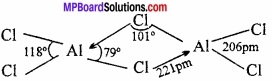
MP Board Class 11th Chemistry Important Questions Chapter 11 p - Block Elements img 14

Question 16.
What is borax bead test? Explain?
Answer:
In qualitative analysis borax bead test is used for the detection of some coloured ions like Cu2+, Ni2+, CO2+ etc. On heating strongly borax loses water molecule of crystallization and ultimately melts into a transparent bead.

MP Board Class 11th Chemistry Important Questions Chapter 11 p - Block Elements img 15
B2O3 reacts with certain metal to form metaborates having specific colours. The transparent bead is touched with the speck of the salt. It is then heated in an oxidizing flame and then in reducing flame from the colour of bead in hot and in cold, the basic radical can be predicted.
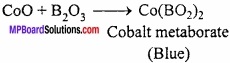
MP Board Class 11th Chemistry Important Questions Chapter 11 p - Block Elements img 16

Question 17.
Give reason why CCl4 is immiscible in water, whereas SiCl4 is easily hydrolyzed?
Answer:
CCl4 is immiscible in water as it is a covalent compound and is not hydrolysed by water because carbon does not have d – orbitals and hence cannot expand its coordination number beyond 4. However, silicon can expand its coordination number beyond 4 due to availability of d – orbitals.
CCl4 + H2O → No reaction
SiCl4 + 4H2O → Si(OH)4 + 4HCl
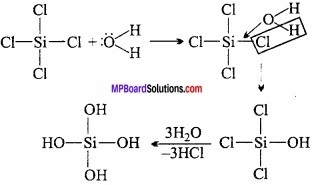
MP Board Class 11th Chemistry Important Questions Chapter 11 p - Block Elements img 17

Question 18.
Explain why CO2 is a gas whereas SiO2 is a solid. Or, Explain the structure of CO2 and SiO2?
Answer:
The structure of CO2 is linear. The C is sp hybridized and the molecules of CO2 are attached with weak vander Waals forces. That is why at normal temperature CO2 is a gas.
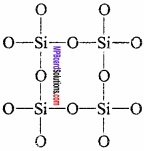
MP Board Class 11th Chemistry Important Questions Chapter 11 p - Block Elements img 18
MP Board Class 11th Chemistry Important Questions Chapter 11 p - Block Elements img 18a
SiO2 is solid. Its structure is like lattice crystal. Every Si is joined with O atom tetrahedrally. Covalent single bond is present between Si – O. This bond is stronger than vander Waals forces. That is why SiO2 is solid and have high m.p.

Question 19.
Explain back – bonding with example?
Answer:
There are six electrons in the valence shell of BCl3. Due to electron acceptor BF3 behaves as Lewis acid. It should be a strong Lewis acid but it works as weak Lewis acid.

In BF3 the B is sp2 hybridized, so BF3 is a planar molecule. In this molecule 2p, orbital of B is completely vacant. In the 2pz orbital of fluorine two electrons are present. The 2pz orbitals of B and 2pz orbitals of fluorine overlap and form a bond. This is called back – bonding.

Question 20.
(a) BCl3 is stable but B2Cl6 was not found whereas AlCl3 is unstable. Why?
(b) AlCl3 is unstable, Al2Cl6 is stable? Give the reason?
Answer:
(a) BCl3 is stable as in the valence shell of BCl3 electrons are present but due to back – bonding the resonating structure gives stability to BCl3. In B2Cl6 the d – orbitals of B is not vacant so it cannot accept the electron from chlorine and so it is impossible to form B2Cl6

(b) In valence shell of AlCl3 six electrons are present and due to incomplete octet AlCl3 is unstable. But Al2Cl6 dimer, the vacant d – orbital of Al accept the electrons from chlorine and so octet gets completed. So Al2Cl6 is stable.

Question 21.
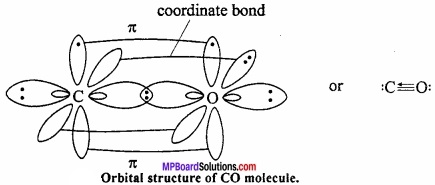
Explain the orbital structure of carbon monoxide?
Answer:
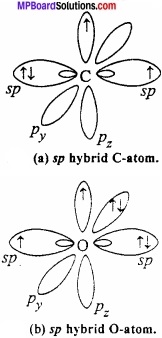
Orbital structure of carbon monoxide: Both C and O in CO is in sp hybrid state.
MP Board Class 11th Chemistry Important Questions Chapter 11 p - Block Elements img 19
One of the sp hybrid orbital of carbon overlaps with sp hybrid orbital of oxygen to form σ bond. One sp – orbital each of carbon and oxygen carries lone pair of electrons which remains non – bonded. Half – filled pz orbital of carbon and oxygen overlaps laterally to form π bond. Now, filled py orbital of oxygen overlaps with vacant py orbital of carbon to form coordinate bond.
MP Board Class 11th Chemistry Important Questions Chapter 11 p - Block Elements img 20

Question 22.
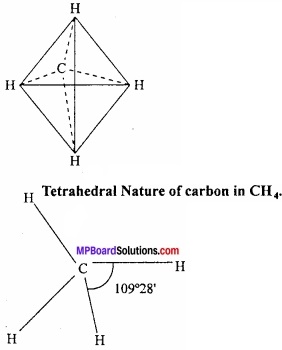
What is tetrahedral nature of carbon?
Answer:
The atomic number of C is 6. On the basis of this two electrons are present in first shell and four electrons in second shell. So its valency is 4. (MPBoardSolutions.com) According to Levat and van’t Hoff, if in a centre of tetrahedral it is considered to be C atom then H at four comers covalency of C can be shown. The angle between the two valencies is 109°28′. According to Henry’s experiment the covalencies of C is symmetrical. It is presented as tetrahedral in space not in one plane.
MP Board Class 11th Chemistry Important Questions Chapter 11 p - Block Elements img 21

Question 23.
Why is graphite used as lubricant?
Answer:
Graphite has layered structure in which the different layers are held together by weak van der Waals forces and hence can be made to slip over one another. Therefore graphite acts as a lubricant.

Question 24.
Why diamond is used as an abrasive?
Answer:
Every carbon in diamond is sp3 hybridized and each carbon form strong covalent bond with other four carbon atoms. In this way the structure of diamond is tetrahedral three dimensional which is very hard. Due to this, diamond is the most hardest element known, therefore it is used as abrasive.

Question 25.
What is silica garden?
Answer:
In sand, crystals of copper sulphate, ferrous sulphate, nickel sulphate, cadmium nitrate, sulphate and cobalt nitrate etc. are added to a saturated solution of sodium silicate in a tube, then after two or three days coloured plants seen to grow in the solution and is known as silica garden.

MP Board Solutions

Question 26.
Carbon monoxide exist but silicon monoxide does not. Why?
Answer:
Carbon can form a n bond after forming a a (sigma) bond with oxygen. At the same time vacant 2p, orbital of carbon can overlap with 2p: orbital of oxygen containing a lone pair of electron. (MPBoardSolutions.com) This is possible because carbon possess some electronegativity to gain a lone pair of electron of oxygen. On the other hand, Si atom is bigger in size and its electronegativity is also less due to which it cannot form 3pz – 2pz π bond. That is why SiO is not possible.

Question 27.
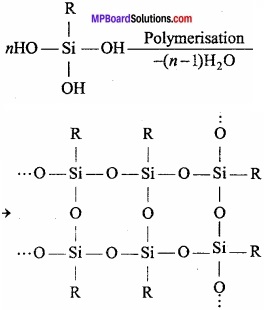
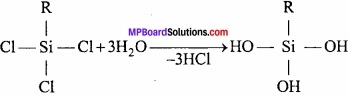
If the initial compound in the formation of silicone is RSiCl3, then give the structure of the product?
Answer:
After the hydrolysis of alkyl trichlorosilane and after its polymerisation, chain isomers (silicones) are obtained.
MP Board Class 11th Chemistry Important Questions Chapter 11 p - Block Elements img 22
MP Board Class 11th Chemistry Important Questions Chapter 11 p - Block Elements img 23

Question 28.
What is catenation and in which compound it is found maximum?
Answer:
It is the ability of like atoms to link with one another through covalent bonds. This is found maximum in carbon. This is due to smaller size and higher electronegativity of carbon and unique strength of carbon – carbon bond.

Question 29.
Write the structure of graphite?
Answer:
Structure of graphite:
Carbon atoms in graphite are in sp2 hybrid state. Carbon atoms get bonded to each other forming hexagonal structure. (MPBoardSolutions.com) Layer of hexagonal arrangement of carbon is held together by vander Waals forces. Carbon – carbon bond distance in hexagonal ring is 142 pm while between carbon of two layers it is 340 pm. These layers can slide over each other due to the presence of weak bond.
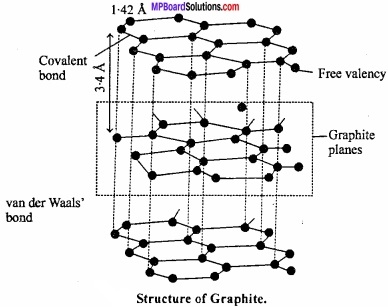
MP Board Class 11th Chemistry Important Questions Chapter 11 p - Block Elements img 24

Question 30.
Write the balanced equation for preparation of water gas, carburated water gas and producer gas?
Answer:
Water gas:
This is a mixture of CO and H2
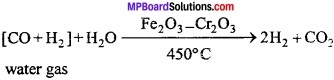
C + H2O \(\underrightarrow { 1160^{ \circ }C } \) [CO + H2] – 29,000 calories.
Carburated water gas:
On passing the water gas into hot bricks present in oil, acetylene and ethylene forms and it mixes with water gas and form carburated water gas. In this, the amount of constituents are: CO = 30%, H2 = 35%, Saturated hydrocarbon = 15.20%, Hydrocarbons = 10%, N2 = 2.5-5%, CO2 = 2%.
Producer gas:
Mixture of CO and N2.
2C + air (O2 + N2) → 2CO + N2

Question 31.
Why carbon cannot form complex compounds whereas other member of group 14 can form? Account for it?
Answer:
The tendency of an element to form complex is favoured by it:

  1. High charge density
  2. Small size
  3. Availability of vacant d – orbital.

From the valence shell electronic configuration of carbon atom it is cleared that it can accompanied maximum of eight electrons in its valence shell while forming covalent bond since carbon atom does not have vacant d – orbital in these tetravalent compound so it cannot form complexes by accomodating any more electron. (MPBoardSolutions.com) On the other hand, in case of other member of group IV are available to their tetracovalent compounds and consequently they can form complexes by accepting lone pair of electron.

p – Block Elements Long Answer Type Questions – I

Question 1.
What is Borane? Write its characteristics and uses?
Answer:
Boron Hydrides or Hydrides of Boron:
Boron forms two series of hydrides. One of its nidoborane with general formula BnHn+4 and other is arachnoborane with general formula BnHn+6. Nidoborane series (BnHn+6): Its first member BH2 does not exist. Second member B2H6 is very important and called as diborane. Other important members are pentaborane (9) B5H6, hexaborane (10) B6H10, octaborane (12) B8H12.

Arachnoborane series (BnHn+6):
Tetraborane B4H10, pentaborane (11) B5H11, hexaborane (12) B6H12 etc. are important members of this series.
Diborane (B2H6):
Diborane is the simplest borane.
Preparation:
(I) By the action of lithium aluminium hydride on boron trichloride in the presence of ether.

MP Board Class 11th Chemistry Important Questions Chapter 11 p - Block Elements img 25

(II) By passing the silent electric discharge at low pressure through a mixture of boron trichloride or tribromide and excess of hydrogen.

MP Board Class 11th Chemistry Important Questions Chapter 11 p - Block Elements img 26

(III) Lab preparation:
By the action of iodine on sodium borohydride in diethylene glycol dimethyl ether (diglyme) as solvent.
2NaBH4 + I2 → B2H6 + 2NaI + H2

(IV) Industrial preparation:
Diborane is obtained on large scale by the reduction of BF3 with NaH at 175°C.
2BF3 + 6NaH \(\underrightarrow { 175^{ \circ }C } \) B2H6 + 6NaF

Physical properties:
It is a colourless gas with foul smell and highly toxic in nature. Uses:

  1. As rocket fuel
  2. As catalyst in polymerisation reaction.

Question 2.
Explain the structure of diborane? Or, What are electron deficient compounds? Or, What are 2 electron 3 centre compounds?
Answer:
Diborane is prepared by reduction of BF3 with LiH at 450 K.
2BF3 + 6LiH \(\underrightarrow { 400^{ \circ }C } \) B2H6 + 6LiF
Diborane is also prepared by treatment of BCl3 with LiAlH4.
4BCl3 + 3LiAlH4 → 2B2H6 + 3LiCl + 3AlCl3.

Structure of diborane:
The structure of diborane is determined by electron diffraction studies. According to this structure sixteen electrons are required for the formation of conventional covalent bond whereas in diborane there are only twelve valence electron three from each boron and six from hydrogen. In this way it is an electron deficient compound.
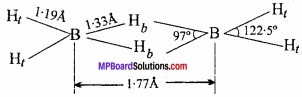
MP Board Class 11th Chemistry Important Questions Chapter 11 p - Block Elements img 27
Diborane has two coplanar BH2 groups and the remaining two hydrogen atoms lie centrally between BH2 group. In the structure four hydrogen atoms are terminal hydrogen and two hydrogens are bridge hydrogen. The two BH2 groups lie in the same plane while the two bridging hydrogen atoms lie in a plane perpendicular to this plane. (MPBoardSolutions.com) Each bridged hydrogen is bonded to the two atoms only by sharing of two electrons. Such covalent bond is called three centre electron pair bond or multi centre bond.

Question 3.
What happens when:

  1. Borax is heated strongly.
  2. Boric acid is added to water.

Answer:
1. Borax when heated strongly loses molecules of water of crystallization and changes into a transparent bead.

MP Board Class 11th Chemistry Important Questions Chapter 11 p - Block Elements img 28

2. It is weak monobasic acid. Boric acid is not a proton donor (i.e protic acid). It accepts a pair of electron from water and acts as a Lewis acid (electron acceptor).
B(OH)3 + 2HOH → [B(OH)4] + H3O+

Question 4.
A certain salt X, gives the following results:

  1. Its aqueous solution is alkaline to litmus.
  2. It swells up to glassy material Y on strong heating.
  3. When cone. H2SO4 is added to a hot solution of X, white crystal of an acid Z separates oct?

Write equation for all the above reaction and identify X, Y and Z?
Answer:
1. Since the aqueous solution of salt (X) is alkaline to litmus, it must be the salt of strong base and a weak acid.

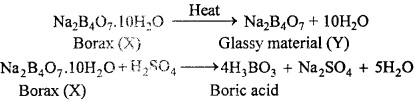
2. Since the salt (X) swells up to glassy material Y on strong heating, therefore X must be Borax and Y must be a mixture of sodium metaborate and boric anhydride.

3. When cone. H2SO4 is added to hot solution of X, white crystals of an acid Z separates out. Therefore Z must be orthoboric acid.
Equation for the all above reactions are as follows:

4.  MP Board Class 11th Chemistry Important Questions Chapter 11 p - Block Elements img 29

MP Board Class 11th Chemistry Important Questions Chapter 11 p - Block Elements img 30

Question 5.
Explain the following reaction:

  1. Silicon is heated with methyl chloride at high temperature in the presence of copper.
  2. Silicon dioxide is treated with hydrogen fluoride.
  3. CO is heated with ZnO.
  4. Hydrated alumina is treated with aqueous NaOH solution.

Answer:
1. A mixture of m ono, di and trimethylchlorosilances along with a small amount of tetra – methylsilance is formed.

MP Board Class 11th Chemistry Important Questions Chapter 11 p - Block Elements img 31

2. SiO2 + 4HF → SiF4 + 2H2O
SiF4 + 2HF → H2SiF6

3. ZnO is reduced to zinc metal.
ZnO + CO → Zn + CO2

4. Aluminium dissolves to form sodium meta – aluminate.

MP Board Class 11th Chemistry Important Questions Chapter 11 p - Block Elements img 32

Question 6.
Compare Boron and Carbon?
Answer:
Similarities:

  1. Boron and carbon are non – metals.
  2. Both show allotropy.
  3. Both form more than one type of hydride
  4. Both form covalent compounds
  5. Compounds of both the elements are soluble in organic solvents.

2NaOH + CO2 → Na2CO3 + H2O
2NaOH + B2O3 → Na2B2O3 + H2O

Dissimilarities:

Dissimilarities between Boron and Carbon:
Boron:

  1. Electronic configuration is 1s2,2s2,2p1.
  2. Valency is 3.
  3. Not formed double and triple bond.
  4. Electron deficient compounds

Carbon:

  1. Electronic configuration is 1s2,2s2,2p1.
  2. Valency is 4.
  3. It forms double and triple bond.
  4. Not electron deficient compounds.

MP Board Solutions

Question 7.
Compare the structure of BCl3 and AlCl3?
Answer:
BCl3 is an electron deficient compound which present always as monomer. In BCl3, the B is sp2 hybridized. Therefore, its structure is triagonal and bond angle is 120°. The atomic radius of Boron is small and Chlorine bridge is unstable, therefore, it will not form dimer.
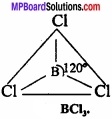
MP Board Class 11th Chemistry Important Questions Chapter 11 p - Block Elements img 33
AlCl3 is always present as dimer. In this structure, the A1 atom accept lone pair of electron from the Cl atom of another Al atom and octate is completed and attain stability.
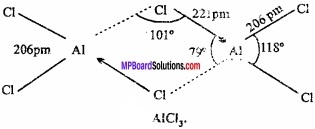
MP Board Class 11th Chemistry Important Questions Chapter 11 p - Block Elements img 34

Question 8.
Explain the structure of diborane and boric acid?
Answer:
Structure of diaborane:
Diborane LS an example of ‘three centre two electron pair bond’ or banana bond in which two boron atom and one hydrogen atom has only 2 electrons available for bonding. These are two banana bonds of this type in diborane.

Two boron atoms and two hydrogen atoms (Total four hydrogen atom) forming covalent bond with each boron atom lies in the same plane. (MPBoardSolutions.com) Among remaining two hydrogen atom one lies above and other below the plane of boron atoms forming banana bond. These hydrogens are called bridging hydrogen.
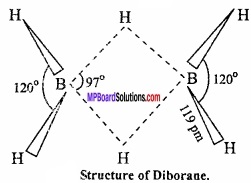
MP Board Class 11th Chemistry Important Questions Chapter 11 p - Block Elements img 35
Bond length of regular B – H covalent bond is 119 pm.
Bond length of banana B – H bond is 134 pm.
Interatomic distance between two boron atom is 178 pm. The reason for the formation of banana bond is that there are only 12 electrons in diborane (6 from two boron and 6 from six hydrogen) while, for the formation of 8 covalent bonds between 2 boron and 6 hydrogen, total 16 electrons are required. Thus, diborane is an electron deficient compound.
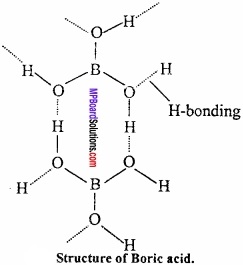
MP Board Class 11th Chemistry Important Questions Chapter 11 p - Block Elements img 36
Structure:
Crystal of boric acid are soapy in touch and have layer like structure similar to graphite
BO33- is bonded to hydrogen covalentlly and through hydrogen bond.

Question 9.
Describe abnormal behaviour of boron with respect to other elements of group – 13?
Answer:
The first element boron of group-13 differs from the rest elements due to its:

  1. Small size
  2. High electronegativity
  3. Absence of d – orbitals

Abnormal behaviour:

  1. Boron is non – metal and others are metals.
  2. Boron exhibits allotropy while others do not.
  3. Oxides and hydroxides of B are acidic in nature. Oxides of A1 and Ga are amphoteric while articles and hydroxides of In and T1 are basic.
  4. Melting point of B is higher in comparison to rest of other elements.
  5. Boron combines with metals to form borides. Whereas others do not form borides.
  6. B does not form alum, but Al, Ga and In form alums. ,
  7. B does not form B+3 but others elements of this group form m+3 ions.
  8. B generally forms covalent compounds whereas other elements of the group -13 form both covalent and electrovalent compounds.

Question 10.
Write a not on fullerene?
Answer:
After 1985, new allotropes of carbon were discovered which contains cluster of C32, C30, C60, C70 etc. they are known as fullerene. C60 cluster is of special importance which is known as Buck – minister fullerene.

The structure of fullerene resembles with that of a soccer ball with six membered as well as five membered rings the carbon atom in fullerene have been found to be equivalent and are connected by both single bond and double bond. These are called Bucky Ball. Physical Properties:

  1. It is soluble in organic solvent.
  2. Its molecule is sufficiently stable.
  3. It forms complex with platinum.

Chemical properties:
1. Combustion:
In limited supply of air it forms CO and in complete combustion it forms CO2.
2C + O2 → 2CO + 52 Kcal
C + O2 → CO2 + 94 Kcal

2. Action with metal:
It reacts with metal at high temperature to form carbides.
Ca + 2C → CaC2
4AI + 3C → Al4C3

3. Oxidizing property:
Oxides of many metals are reduced to metal at high temperature.
ZnO + C → Zn + CO
Fe2O3 + 3C → 2Fe + 3CO.

Uses:

  1. As Lubricant
  2. As conductor.

MP Board Solutions

Question 11.
Why carbon shows dissimilarity with the other members of its group?
Answer:
Carbon shows dissimilarity with the other members because the reason is:

  1. Atomic radius and ionic radius is small.
  2. High ionisation energy.
  3. High electron affinity.
  4. Absence of d – orbital.

Anomalous behaviour:

  1. The melting and boiling points of C is high in comparison to other members.
  2. Property of catenation is high.
  3. Carbon forms multiple bonds, but other members don’t.
  4. Mono – oxide of C is known, but of other members are not found.
  5. The maximum valency of C is 4, but other members 6.
  6. Carbon does not form compounds like other members.
  7. Carbon forms more than one type of hydride.
  8. CO2 is a gas, but dioxide of other members are solid.

p – Block Elements Long Answer Type Questions – II

Question 1.
Write short notes on following:

  1. Freon
  2. Silicone.

Answer:
1. Freon: Dichloro – difluoro methane is known as freon. Freon is formed by the reaction of CCl4 with HF or SbF3 in presence of SbCl5. Freon is used as coolent in refrigerators and A.C.
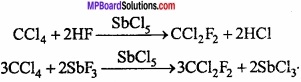
MP Board Class 11th Chemistry Important Questions Chapter 11 p - Block Elements img 37

2. Silicone:
Silicones are polymers containing R2SiO units. Name silicone is given to it because of the resemblance of formula of its basic unit with that of ketones R2CO. Silicones are also found in form of polymers while ketones can exist as independent molecule as well as polymer.
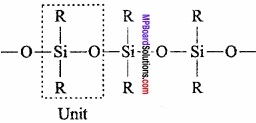
MP Board Class 11th Chemistry Important Questions Chapter 11 p - Block Elements img 38

Preparation:
Alkyl chloride is heated with silicon in presence of copper powder to produce dialkyl – dichloro – silane.
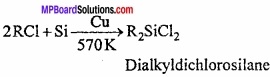
MP Board Class 11th Chemistry Important Questions Chapter 11 p - Block Elements img 39

This compound on hydrolysis produces dihydroxysilane.
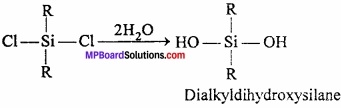
MP Board Class 11th Chemistry Important Questions Chapter 11 p - Block Elements img 40
Due to the presence of two – OH group on a silicone atom, these molecules condenses together to form polymers.
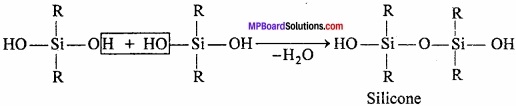
MP Board Class 11th Chemistry Important Questions Chapter 11 p - Block Elements img 41
In this way, due to condensation of large number of units, unite together. Cross – linking occurs if, trihydroxysilane units are involved and a two – dimensional polymer is formed.
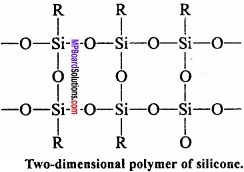
MP Board Class 11th Chemistry Important Questions Chapter 11 p - Block Elements img 42
Uses:

  1. Silicones are insulators, heat resistant, non-reactive and water repellant. Due to this, it is used for making waterproof cloth and paper.
  2. As a lubricant.
  3. As insulators in electric appliances.
  4. Silicone oil is used in high temperature thermostate and vacuum pumps.

Question 2.
Explain Cold – schmidt alumino thermic process with a labelled diagram? Or, Explain the thermite welding process?
Answer:
Thermite process:
It is also called Gold – schmidt aluminothermic process. In this process, refractory crucible is filled with oxide of the metal to be reduced, aluminium powder and barium peroxide. After filling magnesium ribbon it is fixed in sand. (MPBoardSolutions.com) Now, the magnesium ribbon is set on fire. A very high temperature is produced at which metal oxide get reduced by aluminium and collected in molten state. Reaction is extremely exothermic and the 02 required is supplied by barium peroxide. Selection of reducing metal is done on the basis of nature of ore.
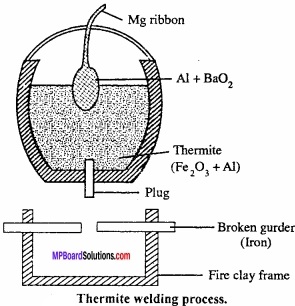
MP Board Class 11th Chemistry Important Questions Chapter 11 p - Block Elements img 43
Cr2O3 + 2Al → Al2O3 + 2Cr + Heat
Fe2O3 + 2Al → 2Fe + Al2O3

Question 3.
Write short notes on zeolites?
Answer:
These are micro porous aluminosilicate having general formula Mx/nn+[AlO2]x[SiO2]yx- mH2O. Aluminosilicates are obtained by substituting some of the silicon atoms in the three dimensional network of silicon – dioxide by Al atoms. The negative charge carried by aluminosilicate, framework is neutralized by exchangeable cations such as Na+, K+ or Ca2+ of valence n, while m water molecule (mH2O) fill the voids.
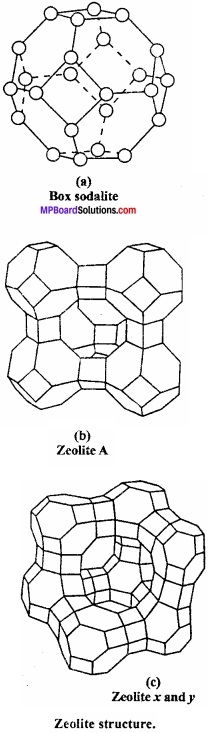
MP Board Class 11th Chemistry Important Questions Chapter 11 p - Block Elements img 44
Uses:

  1. For the manufacture of cement and bricks.
  2. In porcelain and glass industries.
  3. In pottery industries.

Question 4.
Write similarities and dissimilarities between Boron and Aluminium?
Answer:
Similarities:
1. Both possess similar outer electronic configuration ns2np1.

2. B and Al both are trivalent due to presence of 3 electron in outermost shell.

3. Both form trioxide with oxygen.
4B + 3O2 → 2B2O3
4Al + 3O2 → 2Al2O3.

4. Boron and aluminium both react with base and form H2 gas.
2B + 6NaOH → 2Na3BO3 + 3H2
2Al + 2NaOH + 2H2O → 2NaAlO2 + 3H2.

5. Boron and aluminium both form similar type of compounds with alkyl radicals.
2BCl3 + 3Zn (CH3)2 → 2B(CH3)3 + 3ZnCl2
2Al + 3Hg(CH3)2 → 2Al(CH3)3 + 3H2.

6. Nitride of both are hydrolyzed and give ammonia.
BN + 3H2O → H3BO3 + NH3
AIN + 3H2O → Al(OH)3 + NH3.

Dissimilarities:

Boron:

  1. It is a non – metal with three dimensional structure.
  2. It exhibits allotropy.
  3. It does not form tripositive B+3 ion.
  4. B2O3 is acidic in nature.
  5. It forms stable hydride.
  6. It reacts with metals and form borides.
  7. It is bad conductor of electricity.
  8. Maximum covalency of boron is 4.

Aluminium:

  1. Aluminium is a metal with metallic structure.
  2. It does not exhibit allotropy.
  3. It forms tripositive Al+3 ion.
  4. Al2O3 is amphoteric.
  5. It forms unstable hydride.
  6. It forms alloys.
  7. It is good conductor of electricity.
  8. Maximum co valency of Aluminium is 6.

MP Board Solutions

Question 5.
Write short notes on:

  1. Sodium zeolite
  2. Sodium silicate.

Answer:

1. Sodium zeolite:
Sodium zeolite is also known as sodium permutit. Permutit is mixed silicate of sodium and aluminium. Its formula is:
Na2[Al3Si2O8.xH2O]
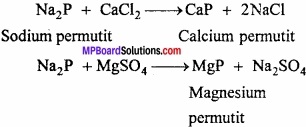
Sodium zeolite is used in converting hard water into soft water. Water containing calcium and magnesium ion is known as hard water. (MPBoardSolutions.com) When hard water is passed through permutit kept in a column then calcium and magnesium ions are displaced by sodium. Sodium salts do not make water hard and this way soft water is obtained. If sodium permutit is represented by Na2P then the following reaction can be written for softening of water.
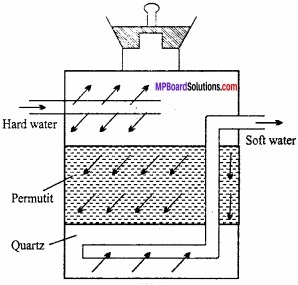
MP Board Class 11th Chemistry Important Questions Chapter 11 p - Block Elements img 45
MP Board Class 11th Chemistry Important Questions Chapter 11 p - Block Elements img 46

2. Sodium silicate or water glass:
It is bright like glass and soluble in water, therefore, it is known as water glass. It contains sodium meta – silicate and silica in excess and its formula is Na2SiO3. SiO2 or Na2SiO3.3SiO2.
It is obtained by fusing a mixture of sodium carbonate and sand.
Na2CO3 + 2SiO2 → Na2SiO3.SiO2 + CO2
The product obtained is hard, solid like glass and is soluble in water.
If sand, crystals of copper sulphate, ferrous sulphate, nickel sulphate, cadmium nitrate, manganese sulphate and cobalt nitrate etc. are added to a saturated solution of sodium silicate in a tube, then after two or three days coloured plants seem to grow in the solution and this is known as silica garden.

Question 6.
Describe, diagonal relationship between B and Si?
Answer:
B and Si show resemblances in properties. The resemblances arise due to the fact that both B and Si are non-metals and have small difference in size. Their following properties are similar:

  1. Both are non – metal, non – conductors unable to form cations and possess high melting point.
  2. B and Si both do not exist in free state in nature and only exist in the form of their oxides.
  3. Both do not react with dilute acid.
  4. Both react with nitrogen at high temperature to form nitrides.
    2B + N2 → 2BN
    Si + 2N2 → SiN4
  5. Both form covalent hybride.
  6. Both react with metals to form boride and silicates.
  7. Both form covalent chlorides which are hydrolyzed in aqueous solution.
    BCl3 + 3H2O → H3BO3 + 3HCl
    SiCl4 + 3H2O → H2SiO3 + 4HCl
  8. H3BO3 and H4Si4 are very weak acids.

Question 7.
What is Alum? Write its general formula, method of preparation and properties?
Answer:
Double salts which can be represented by the general formula R2SO4.M2(SO4)3. 24H2O are called alums.
Here, R = Monovalent metal, like: Na, K, NH4+
M = Trivalent metal, like Fe, Cr, Al Nomenclature of alum:

1. The alum which contains trivalent ion aluminium is called by name of monovalent ion.
K2SO4.Al2(SO4)3.24H2O (Potash alum)

2. The alum which does not contain aluminium as trivalent ion is called by name of both ion.
K2SO4.Fe2(SO4)3.24H2O (Potash ferric alum)

Preparation method:
The crystal of alum are obtained when hot solution of equimolecular quantities of K2SO4 and Al2(SO4)3 are mixed and resulted solution is cooled.
K2SO4 + Al2(SO4)3 + 24H2O → K2SO4.Al2(SO4)3.24H2O

Properties:
Alums are octahedral crystalline compounds. Potash alum is milky in colour. It forms acidic solution in water. It is soluble in water but insoluble in organic solvent.

Effects of heat:
On heating at 365 K it looses water molecule. Its water of crystallization is lost and alum swells up and becomes porous. This type of alum is known as burnt alum.

MP Board Class 11th Chemistry Important Questions Chapter 11 p - Block Elements img 47

Uses:

  1. As blood coagulates.
  2. In purifying water.
  3. In dyeing and printing clothes.
  4. In sizing of paper.

MP Board Solutions

Question 8.
Write the diagonal relationship between Be and Al?
Answer:
Diagonal Relationship of Beryllium with Aluminium; Beryllium shows diagonal relationship with aluminium which is present in third period and third group (13) of periodic table.
Diagonal relationship between beryllium and aluminium is due to the following reason:
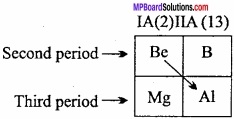
MP Board Class 11th Chemistry Important Questions Chapter 11 p - Block Elements img 48

  1. Nearly equal atomic and ionic radius.
  2. Similar electronegativity.
  3. Nearly equal electropositivity.
  4. Nearly equal polarization power.

Similarities between Be and Al are as follows:
1. Be and Al forms covalent compounds which are soluble in organic solvents.

2. Be and Al oxides are solids having high melting point. They react both with acid and base to produce salt and water due to their amphoteric nature.
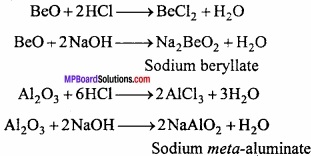
MP Board Class 11th Chemistry Important Questions Chapter 11 p - Block Elements img 49

3. Be and Al reacts with carbon on heating to form respective carbides which are covalent in nature. Be2C and Al4C3.

4. Carbides of Be and Al forms methane on hydrolysis.
Be2C + 4H2O → CH4 + 2Be(OH)2
Al4C3 + 12H2O → 3CH4 + 4Al(OH)3

5. Be and A1 forms complex fluoro ion in solution.
[BeF4]2- and [AlF6]3-

6. Polymeric structure are found in BeCl2 and AlCl3

7. Solubility of halide of Be and Al is same.
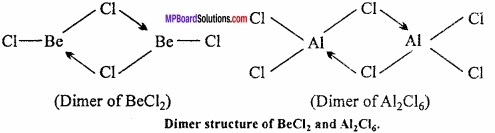
MP Board Class 11th Chemistry Important Questions Chapter 11 p - Block Elements img 50

8. Be and A1 develops a protective oxide layer on the surface when treated with nitric acid. Due to this, they are not easily attacked by acids.

9. Hydroxide of Be and Al are amphoteric in nature. They react with acid and base to produce salt and water.
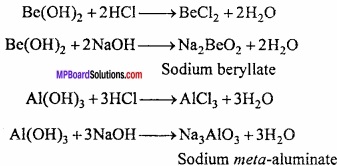
MP Board Class 11th Chemistry Important Questions Chapter 11 p - Block Elements img 51

Question 9.
What do you mean by:

  1. Inert pair effect.
  2. Allotropes.
  3. Catenation.

Answer:
1. Inert pair effect:
When the tendency of 5 – electrons to be with 5 – electrons and they do not take part in reactions then this tendency is called inert pair effect. The reason is that the tendency to show +1 oxidation state increases down the group. (MPBoardSolutions.com) It means the tendency of 5 – electron of valence shell to participate in bond formation. Thus, among the heavier elements of p – block, the electron pair in the outer 5 – orbitals is reluctant to take part in chemical bonding. It is called inert pair effect.

2. Allotropes:
If an element exists in different physical forms having different properties than the various forms are called allotropes and the phenomenon is called allotropy.
Example:
Crystalline allotropes of C are diamond, graphite and fullerene.

3. Catenation:
It is the ability of like atoms to link with one another through cova¬lent bonds. This is due to smaller size and higher electronegativity of carbon atom and unique strength of C – C bond.
C >> Si > Ge > Sn >> Pb
MP Board Class 11 Chemistry Important Questions

MP Board Class 12th Chemistry Important Questions Chapter 7 The p-Block Elements

MP Board Class 12th Chemistry Important Questions Chapter 7 The p-Block Elements

The p-Block Elements Important Questions

The p-Block Elements Objective Type Questions

Question 1.
(A) Choose the correct answer :

Question 1.
In which compound oxygen exhibits +2 oxidation state :
(a) H2O
(b) Na2O
(c) OF2
(d) MgO.
Answer:
(c) OF2

Question 2.
Reddish brown gas is formed, when nitric oxide oxidizes by air. This gas is :
(a) Na2O2
(b) Na2O4
(c) NO2
(d) N2O3.
Answer:
(c) NO2

Question 3.
H3PO3 is :
(a) Dibasic acid
(b) Monobasic acid
(c) Tribasic acid
(d) Tetrabasic acid.
Answer:
(c) Tribasic acid

Question 4.
Oxide which shows paramagnetic character :
(a) N2O4
(b) NO4
(C) P4O6
(d) N2O5
Answer:
(b) NO4

Question 5.
Ammonia can be dried by :
(a) H2SO4
(b) P2O5
(c) Anhydrous CaCl2
(d) CaO.
Answer:
(d) CaO.

Question 6.
Nitric acid change iodine into :
(a) Iodic acid
(b) Hydroiodic acid
(c) Iodine pentaoxide
(d) Iodine nitrate.
Answer:
(a) Iodic acid

MP Board Solutions

Question 7.
NH3 is a Lewis base which forms complex salt with cations. Following cation does not form complex salt with NH3 :
(a) Ag+
(b) Cu2+
(c) Cd2+
(d) Pb2+.
Answer:
(d) Pb2+.

Question 8.
Ammonia is soluble in :
(a) Hg2Cl2
(b) PbCl2
(c) Agl
(d) Cu(OH)2.
Answer:
(d) Cu(OH)2.

Question 9.
Bleaching action of SO2 is due to :
(a) Reduction
(b) Oxidation
(c) Hydrolysis
(d) Acidic nature.
Answer:
(a) Reduction

Question 10.
What happens when SO2 is passed through acidic K2Cr2O7 :
(a) Solution turns blue
(b) Solution turns colourless
(c) SO2 reduced
(d) Green chromic sulphate is formed.
Answer:
(d) Green chromic sulphate is formed.

Question 11.
P2O2 forms which of the following acid :
(a) H4P2O7
(b) H3PO4
(c) H3PO3
(d) HPO3.
Answer:
(c) H3PO3

Question 12.
Most acidic halide is :
(a) PCl5
(b) SbCl3
(c) BrCl3
(d) CCl4
Answer:
(a) PCl5

Question 13.
The catalyst used in manufacturing of H2SO4 is :
(a) Al2O3
(b) CrO3
(c) V2O5
(d) MnO2
Answer:
(c) V2O5

Question 14.
The hydrolysis of phosphorus triha lides give:
(a) One monobasjc acid and one dibasic acid
(b) One monobasjc acid and one tribasic acid
(c) One monobasjc acid and a salt
(d) Two dibasic acids.
Answer:
(a) One monobasjc acid and one dibasic acid

Question 15.
In the following reaction:
P4 + 3NaOH + 3H2O → PH3 + 3NaH2 PO2
(a) P oxidises
(b) P oxidises and reduces
(c) P reduces
(d) Na oxidises.
Answer:
(b) P oxidises and reduces

Question 16.
Laughing gas is:
(a) NO
(b) N2O
(c) N2O3
(d) N2O5.
Answer:
(b) N2O

Question 17.
White phosphorus does not contain:
(a) 6 P – P single bond
(b) 4 P – p single bond
(c) 4 lone pair of electron
(d) Bond angle of P – P – P is 600.
Answer:
(b) 4 P – p single bond

MP Board Solutions

Question 18.
On heating NH4CI and NaNO2 solution gives :
(a) N2O
(b) N2
(c) NO2
(d) NH3.
Answer:
(b) N2

Question 19.
Formula of metaphosphoric acid is:
(a) H3PO3
(b) HPO3
(c) H3PO3
(d) H2PO3.
Answer:
(b) HPO3

Question 20.
Gas which cannot be collected on water:
(a) Na
(b) O2
(c) SO3
(d) PH3.
Answer:
(c) SO3

(B) Choose the correct answer:

Question 1.
Chlorine shows bleaching property in the presence of :
(a) Dry air
(b) Moisture
(c) Sunlight
(d) Pure oxygen.
Answer:
(b) Moisture

Question 2.
Which of the following element forms least number of compounds :
(a) He
(b) Ar
(c) Kr
(d) Xe.
Answer:
(a) He

Question 3.
Which is used for bright advertisement display :
(a) Xe
(b) Ar
(c) Ne
(d) He.
Answer:
(c) Ne

Question 4.
Monazite is a source of:
(a) Ne
(b) Ar
(c) Kr
(d) He.
Answer:
(d) He.

MP Board Solutions

Question 5.
Which of the following is not obtained by the direct reactions of the constituents :
(a) XeF2
(b) XeF4
(c) XeO3
(d) XeF6.
Answer:
(d) PbI4.

Question 6.
Which of the following halides are least stable and whose existence is suspicious :
(a) CI4
(b) Gel2
(c) Snl4
(d) PbI4.
Answer:
(d) PbI4.

Question 7.
Which of the following is the strongest acid :
(a) HBr
(b) HCl
(c) HF
(d) HI.
Answer:
(d) HI.

Question 8.
Most electronegative element is :
(a) F
(b) Cl
(c) Br
(d) I.
Answer:
(a) F

Question 9.
Which halogen is solid at room temperature :
(a) Cl2
(b) I2
(c) Br2
(d) F2.
Answer:
(d) F2.

MP Board Solutions

Question 10.
Which has maximum electron affinity :
(a) F
(b) Cl
(c) Br
(d) I.
Answer:
(b) Cl

Question 11.
Electronic configuration of valence shell of halogen is :
(a) s2p5
(b) s2p3
(c) s2p6
(d) s2p4.
Answer:
(a) s2p5

Question 12.
Which element is most alkaline:
(a) F
(b) Cl
(c) Br
(d) I.
Answer:
(d) I.

Question 13.
The strongest reducing agent is:
(a) F
(b) Br
(c) I
(d) Cl
Answer:
(c) I

Question 14.
Which of the following is weakest acid:
(a) HF
(b) HCl
(c) HBr
(d) HI.
Answer:
(a) HF

Question 15.
Oxidizing property is highest of:
(a) 12
(b) Br2
(c) F2
(d) Cl2.
Answer:
(c) F2

MP Board Solutions

Question 16.
Which Noble gas does not have octet complete:
(a) Helium
(b) Neon
(c) Argon
(d) Krypton.
Answer:
(a) Helium

Question 17.
Which Halogen sublimates :
(a) Chlorine
(b) Bromine
(c) Iodine
(d) Fluorine.
Answer:

Question 18.
12 easily dissolve in Kl solution to form :
(a) I
(b) KI2
(c) KI
(d) KI3
Answer:
(d) KI3

Question 19.
Gas mixed in oxygen which is used in respiration for asthma patients :
(a) N2
(b) Cl2
(c) He
(d) Ne.
Answer:
(c) He

Question 20.
Deacon’s process is used for manufacture of :
(a) Bleaching powder
(b) Chlorine
(c) Nitric acid
(d) Sulphuric acid.
Answer:
(b) Chlorine

Question 21.
Sea grass is the source of industrial manufacture of :
(a) Chlorine
(b) Bromine
(c) Iodine
(d) Fluorine.
Answer:
(c) Iodine

Question 2.
(A) Fill in the blanks :

  1. N2O is a ……………….. oxide.
  2. Formula of Caro’s acid is ………………..
  3. Concentrated nitric acid has brown colour due to the dissolution of ……………….. gas.
  4. Out of nitrogen oxides ……………….. and ……………….. are paramagnetic.
  5. Pyrophosphoric acid is ……………….. basic acid.
  6. H2S gas cannot be dried by cone. H2SO4 because H2S ……………….. it.
  7. Fuming sulphuric acid dissolves in SO3 to form ………………..
  8. Oxidation state of S in H2S2O8 (Marshall gas) is ………………..
  9. NH3 gives white fumes of ……………….. when it combines with HCl.
  10. Elements of 16th group are known as ………………..
  11. ……………….. is used as a refrigerant.

Answer:

  1. Neutral
  2. H2SO5
  3. NO2
  4. NO
  5. NO2
  6. Tetra
  7. Reduces
  8. Oleum
  9. +6
  10. NH4Cl
  11. Chalcogen
  12. Liquid NH3.

MP Board Solutions

(B) Fill in the blanks :

  1. …………………. has the highest electron affinity.
  2. In the presence of moisture, chlorine acts as a ………………… agent.
  3. Bleaching powder is also called as …………………
  4. At ordinaiy temperature bromine is a …………………
  5. Inter halogen compound AX5 has ………………… structure.
  6. Chlorine was discovered by …………………
  7. Neil Bertlett forms first noble compound which is …………………
  8. Element with highest electron affinity is …………………
  9. In oxy acid halogen present in ………………… hybride state.
  10. Gas which is light due to which it is filled in aircraft tyres is …………………
  11. ………………… inert gas is mostly used in advertisements.
  12. Elements of Group 17th are commonly known as …………………
  13. ………………… is a radioactive inert gas.

Answer:

  1. Chlorine
  2. Bleaching
  3. Calcium chlorohypochloride
  4. Liquid
  5. Square pyramidal
  6. Scheele
  7. Xe [PtF6]
  8. Chlorine,
  9. sp3
  10. Helium
  11. Ne (Neon)
  12. Halogen
  13. Radon.

Question 3.
(A) Answer in one word / sentence :

  1. Who protects earth from ultraviolet rays?
  2. Give the chemical name of oil of vitriol or king of chemical.
  3. Which gas is used for refrigeration?
  4. At which temperature water has maximum density?
  5. Give the name of compound formed by the dissolution of S03 in sulphuric acid.
  6. Write name of an antichlor.
  7. Which gas is used for bleaching of oil and elephant teeth?
  8. Ammonium salts react with Nessler’s reagent to give which coloured precipitate?
  9. On moving down from N to Bi, +3 oxidation state of Bi becomes more stable than +5. Why?
  10. State the percentage of N2 by volume in nature.

Answer:

  1. Ozone layer
  2. H2SO4
  3. NH3
  4. 4°C
  5. Oleum
  6. SO3
  7. Ozone
  8. Brown
  9. Due to Inert pair effect
  10. 80%.

(B) Answer in one word / sentence :

  1. Give the name of radioactive halogen.
  2. Which noble gas is used in bulb with nitrogen? (MP 2018)
  3. Write the name of noble gas which is used in treatment of cancer.
  4. Write the formula of Camalite.
  5. Which noble gas is maximum available in the atmosphere?
  6. What is the shape of XeF6?
  7. Write one use of fluorine.
  8. Which type of hybridization is present in XeO3?
  9. Write the oxidation state of F.
  10. Write only equation for the preparation of chlorine in the lab.
  11. What is the shape of AX3 type of Interhalogen compound?
  12. Write the correct order of strength of halogen acid.
  13. Which noble gases do not form compounds?
  14. With which noble gas does F form compounds?
  15. Sea weeds are the source of which halogen?

Answer:

  1. Astatine
  2. Ar
  3. Rn
  4. KCl.MgCl2.6H2O
  5. Argon
  6. Distorted octahedron
  7. In preparing fluorocarbon, which is used in refrigeration
  8. sp3
  9. -1
  10. MnO2 + 4HCl → MnCl2 + 2H2O + Cl2
  11. T – shape
  12. HF < HCl < HBr < HI
  13. He, Ne and Ar
  14. Xe
  15. Iodine.

Question 4.
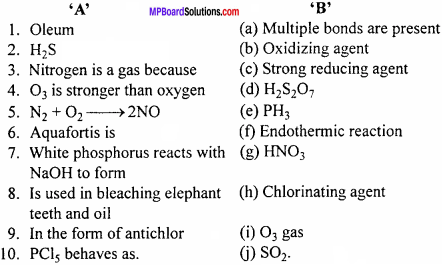
Match the following :
I.
MP Board Class 12th Chemistry Important Questions Chapter 7 The p-Block Elements 1
Answer:

  1. (d)
  2. (c)
  3. (a)
  4. (b)
  5. (f)
  6. (g)
  7. (e)
  8. (i)
  9. (j)
  10. (h).

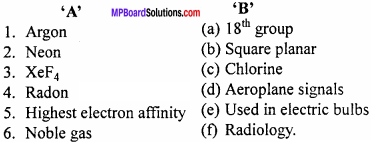
II.
MP Board Class 12th Chemistry Important Questions Chapter 7 The p-Block Elements 2
Answer:

  1. (e)
  2. (c)
  3. (b)
  4. (a)
  5. (d)

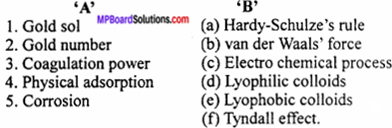
III.
MP Board Class 12th Chemistry Important Questions Chapter 7 The p-Block Elements 3
Answer:

  1. (e)
  2. (d)
  3. (b)
  4. (f)
  5. (c)
  6. (a)

General Principles and Processes of Isolation of Elements Very Short Answer Type Questions

Question 1.
What are clathrate compounds?
Answer:
In the cavity or space of crystal lattice of a compound small sized elements like noble gases get trapped within. Such compounds are called clathrate compounds.
Example : Kr3 (β – quinol).

Question 2.
Why is BiH3 the strongest reducing agent amongst all the hydrides of Group 15 elements? (NCERT)
Answer:
Among the hydrides of Group – 15, BiH3 is the least stable because Bi has largest size in group and has least tendency to form covalent bond with small hydrogen atom. Therefore, it can readily lost H atom and has strongest tendency to act as reducing agent.

Question 3.
Why is N2 less reactive at room temperature? (NCERT)
Answer:
In N2 molecule, there is a strong pπ – pπ overlap that results in the formation of triple bond between N atoms (N ≡ N). As a consequence, the bond dissociation energy of N2 is very high and N2 is less reactive at room temperature.

MP Board Solutions

Question 4.
Why is Helium used in diving apparatus? (NCERT)
Answer:
Helium is used as a diluent for oxygen is modem diving apparatus because of its very low solubility in blood.

Question 5.
Noble gases are inert. Why?
Answer:
Noble gases are inert due to following reasons :
Noble gases are inert because octet of these gases are complete. It is the most stable state and do not have unpaired electrons. Ionisation energy of noble gases are high and electronegativity and electron affinity are zero. Therefore, these gases neither accept electron nor release electron. Thus, noble gases are inert in nature.

Question 6.
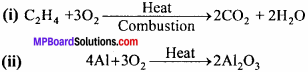
Complete the following reactions: (NCERT)
(i) C2H2 + O2 →
(ii) 4AI + 3O2
Answer:
MP Board Class 12th Chemistry Important Questions Chapter 7 The p-Block Elements 38

Question 7.
Arrange the following in the order of property indicated for each set: (NCERT)
(i) F2, Cl2, Br2,I2 – increasing bond dissociation enthalpy.
(ii) HF, HCl, HBr, HI – increasing acid strength.
(iii) NH3, PH3, ASH3, SbH3, BiH3 – increasing base strength.
Answer:
(i) I2 < F2 < Br2 < Cl2
MP Board Class 12th Chemistry Important Questions Chapter 7 The p-Block Elements 37
Here F2 has very less bond dissociation energy inspite of having small size. It is due to repulsion between the lone pair of electrons on small size F – atoms.

(ii) HF < HCl < HBr < HI
It depends upon their bond dissociation enthalpy, which decreases from H – F to H – I as the size of atom increases from F to I.

(iii) BiH3 < SbH3 < AsH3 < PH3 < NH3.
They are Lewis bases due to presence of lone pair of electrons on central atom of hydrides. The availability of lone pair of electrons is maximum in nitrogen owing to its small size therefore, NH3 is maximum basic and as the size of central atom increases availability decreases.

Question 8.
Describe the laboratory preparation of chlorine.
Answer:
Laboratory preparation:
HCl and MnO2 is taken in a round bottom flask. Cone. HCl is added from thistle funnel. The flask is heated slowly so that green yellow colour of Cl2 gas evolved.
MnO2 + 4HCl → MnCl2 + 2H2O + Cl2

Question 9.
Fluorine is strong oxidizing agent as compared to chlorine. Why?
Answer:
Because of following points, fluorine is strong oxidizing agent:

  1. The size of F atom is smaller than Cl atom.
  2. Electronegativity of fluorine is higher than Cl atom.
  3. Dissociation energy of fluorine is less than that of chlorine.
  4. E° value of fluorine is more than chlorine.

Question 10.
F2O is not considered to be the oxide of fluorine. Why?
Answer:
Fluorine is the most electronegative element. Its electronegativity is higher than oxygen. In naming a compound less electronegative elements are first and then more electronegative elements are written, Therefore, F2O or OF2 is known as oxygen difluoride and not fluorine oxide.

MP Board Solutions

Question 11.
Interhalogen compounds are more reactive than halogen. Why?
Answer:
X – Y bonds of interhalogen compounds are more polar due to difference in the electronegativities of halogen and are generally weaker than X – Y bonds of pure halogen. Therefore, interhalogen compounds are more reactive than halogens.

Question 12.
Helium and Neon do not form compounds with Fluorine. Why?
Answer:
Due to absence of d – orbitals in the valence shell of He and Ne, their electrons cannot get excited into higher energy d – sub – shells. Therefore, He and Ne do not form compounds with fluorine.
Question 13.
Explain why NH3 is basic while BiH3 is only feebly basic. (NCERT)
Answer:
Atomic size of N(70pm) is much smaller than that of Bi (148 pm). Therefore, electron density on the N – atom is much higher than that on Bi – atom. Consequently, the tendency of N in NH3 to donate the pair of electrons is much higher than that of Bi in BiH3. Thus, NH3 is basic while BiH3 is only feebly basic.

The p – Block Elements Short Answer Type Questions

Question 1.
Explain with reason :

  1. HF is liquid while other hydrides of halogens are gases at normal temperature.
  2. Fluorine does not form polyhalide.

Answer:
1. The electronegativity of fluorine is maximum than other halogens. Therefore, HF molecule is conjugated by H – bond and the boiling point of HF is more to other halogen acids therefore HF is liquid while halides of other halogens are gases at room temperature.
H – z….H – F….H – F….H – F

2. The electronic configuration of fluorine is 1s2, 2s2, 2p5. Due to absence of orbital in its valency shell it does not show higher oxidation state and so it does not made polyhalide.

Question 2.
How is SO2 an air pollutant? (NCERT)
Answer:
SO2 dissolves in rain water and produces acid rain. The acid rain contains sulphuric acid.
MP Board Class 12th Chemistry Important Questions Chapter 7 The p-Block Elements 36
In addition to H2SO4, acid rain also contains HNO3.

MP Board Solutions

Question 3.
Why are halogens strong oxidising agents? (MP 2018, NCERT)
Answer:
Halogens are strong oxidising agents due to their low bond dissociation enthalpy, high electronegativity and large negative electron gain enthalpy. Halogens have a strong tendency to accept electrons and thus get reduced.
X2 + 2e → 2X
As a result, halogen acts as strong oxidising agents. Their oxidising power however decreases from F2 to I2 as is evident from their electrode potentials :
F2/F = + 2.87 V
Cl2/Cl = + 1.09 V
Br2/Br = +1.09 V
Br2/I = + 0.54 V

Question 4.
Why does the reactivity of nitrogen differ from phosphorus? (NCERT)
Answer:
Molecular nitrogen exist as a diatomic molecule having a triple bond between the two nitrogen atoms, N ≡ N (due to it stability to form pπ – pπ multiple bonding). The bond dissociation energy is very high (941.4 kJ mol-1). Thus, under ordinary conditions, nitrogen behaves as an inert gas. On the other hand, white and yellow phosphorus exists as a triatomic molecule (P4) having single bonds. The dissociation energy of P – P bond is low (213 kJ mol-1). Thus, phosphorus is much more reactive than nitrogen.

Question 5.
Give the reason for bleaching action of Cl2. (NCERT)
Answer:
Bleaching action of chlorine is due to its oxidation. In the presence of moisture, chlorine gives nascent oxygen.
Cl2 + H2O → 2HCl + [O]
Because of nascent oxygen, it bleaches colouring substance as
Colouring substance + [O] → Colourless substance.
It bleaches vegetables or organic matter. The bleaching action of chlorine is permanent.

Question 6.
Explain, why:

  1. Noble gases are monoatomic?
  2. Atomic radii of noble gases are largest?
  3. Ionisation energy of noble gases are highest?

Answer:

  1. There is no any unpaired electron in electronic configuration of noble gases. So these do not form chemical bonds and are monoatomic.
  2. Outermost shell of noble gases are completely filled so atomic radii of noble gases are maximum.
  3. All electrons in outermost orbit of noble gases are paired and energy required to make them unpaired is very high. Thus, noble gases have maximum ionisation energy in respective periods.

Question 7.
Why does nitrogen show catenation properties less than phosphorus? (NCERT)
Answer:
The catenation properties depends upon the strength of the element – element bond. The N – N bond strength is much weaker (due to repulsion of lone pairs on nitrogen because of its small size) than the P – P bond strength, therefore, nitrogen shows catenation less than phosphorus.

MP Board Solutions

Question 8.
Write the formulae and structure of any five oxy – acids of sulphur.
Answer:
Main oxyacids of sulphur and oxidation state of sulphur in them are as follows :
MP Board Class 12th Chemistry Important Questions Chapter 7 The p-Block Elements 4

Question 9.
Contact process of manufacturing of H2SO4 is supposed to be more advance than lead chamber process. Why?
Answer:

  1. The acid obtained by contact process is pure while the acid obtained by lead chamber process is impure.
  2. The plant for lead chamber process requires large area while plant used in contact process occupies comparatively less area.
  3. The catalyst used in contact process is platinised asbestos while in lead chamber process catalyst is gaseous (NO2 gas) and to maintain its flow regular is tedious.
  4. In contact process concentrated sulphuric acid is obtained while in lead chamber process dilute acid is obtained.
  5. In contact process running of the plant is less costly while in lead chamber process running of the plant is costly.

Question 10.
Why does NH3 form hydrogen bond but PH3 does not? (NCERT)
Answer:
The N – H bond in ammonia is quite polar as nitrogen is highly electronegative in nature. As a result, NH3 molecules are linked by intermolecular hydrogen bonding.
MP Board Class 12th Chemistry Important Questions Chapter 7 The p-Block Elements 5
On the other hand, P – H bond is non – polar as both P and H have same electronegativity. Hence in phosphine no hydrogen bonding is present.

Question 11.
Bond angle in PH4+ is higher than that in PH3. Why? (NCERT)
Answer:
PH4+ is a regular tetrahedral structure, thus bond angle is 109°28′.
PH3 molecule has a pyramidal structure. The bond angle is 93°. Hence, bond angle in PH4+ ion is higher.
MP Board Class 12th Chemistry Important Questions Chapter 7 The p-Block Elements 6

Question 12.
What happens when white phosphorus is heated with concentrated NaOH solution in an inert atmosphere of CO2? (NCERT)
Answer:
When white phosphorus is heated with cone. NaOH solution in an inert atmosphere of CO2, phosphine gas is prepared.
MP Board Class 12th Chemistry Important Questions Chapter 7 The p-Block Elements 7

Question 13.
What happens when PCl5 is heated? (NCERT)
Answer:
PCl5 has three equatorial and two axial bonds. Since axial bonds are weaker than equatorial bonds, therefore, when PCl5 is heated, the less stable axial bond breaks to form PCl3.
MP Board Class 12th Chemistry Important Questions Chapter 7 The p-Block Elements 8

When heated, it sublimes but decomposes on stronger heated.

Question 14.
How are Xenon fluorides XeF2, XeF2 and XeF6 prepared?
Answer:
Xenon Fluorides:
Three fluorides of xenon are important. These are xenon difluoride (XeF2), xenon tetrafluoride (XeF4) and xenon hexafluoride (XeF6).The fluorides of xenon can be prepared by the direct combination between xenon and fluorine under different conditions.
MP Board Class 12th Chemistry Important Questions Chapter 7 The p-Block Elements 9
Question 15.
Write the difference between the bleaching action of SO2 and Cl2.
Or,
Bleaching of flowers by Cl2 is permanent while bleaching by SO2 is temporary, why?
Answer:
Bleaching action of SO2:
Bleaching by SO2 is due to the process of reduction in the presence of moisture.
SO2 + 2H2O →H2SO4 + 2 [H] (nascent)
The nascent hydrogen liberated in the reaction is responsible for bleaching flower but when the flower comes in contact with air. It gets oxidized and become coloured.
Coloured substance + [H] → Colourless \(\underrightarrow { air }\)Colour

Bleaching action of Cl2:
Bleaching by Cl2 is due to the process of oxidation in the presence of moisture.
Cl2 + H2O → 2HCl + [O ] (nascent)
Coloured substance + [O] > Colourless
The oxygen liberated in the reaction is responsible for bleaching, colour bleached by Cl2 is permanent and original colour cannot be restored on exposure to air.

MP Board Solutions

Question 16.
Write main differences between the properties of white phosphorus and red pljosfrtiorus. (NCERT)
Answer:
Comparison of properties of White and Red phosphorus :
MP Board Class 12th Chemistry Important Questions Chapter 7 The p-Block Elements 10

Question 17.
Give equations for the reaction of chlorine with the following :

  1. NH3
  2. NaOH
  3. H2O
  4. Bleaching property.

Answer:
Reaction of chlorine :

1. With NH3 :
(a) Cl2 reacts with excess of NH3 and form NH4Cl and N2.
MP Board Class 12th Chemistry Important Questions Chapter 7 The p-Block Elements 11

(b) When chlorine is taken in excess, an explosive product nitrogen trichloride is formed.
NH3 +3C12 → NC13 +3HCl

2. With NaOH :
(a) Cold and dilute NaOH reacts with Cl2 and form chloride and hypochlorite.
Cl2 + 2NaOH → NaCl + NaClO + H2O

(b) Hot and concentrated caustic soda reacts with Cl2 and form chloride and chlorate.
3Cl2 + 6NaOH → NaC1O3 + 5NaCl + 3H2O

3. With H2O :
Cl2 reacts with water and form chlorine water which is called hypochlorous acid which decomposes into HCl.
MP Board Class 12th Chemistry Important Questions Chapter 7 The p-Block Elements 12

4. Bleaching action:
In presence of moisture chlorine bleaches coloured object and vegetables. It decolourises the coloured substance. This property is due to oxidation.
MP Board Class 12th Chemistry Important Questions Chapter 7 The p-Block Elements 13
Thus, bleaching by chlorine is a permanent process.

MP Board Solutions

Question 18.
Give reason :

  1. Iodine exhibits some metallic property.
  2. Halogens are strongly oxidizing, Why? (MP 2018)

Answer:
1. Ionization energy of iodine is small so it gives out one electron from its valence shell. In some reaction Iodine gives I+ ion so it has some metallic property.
I → I+ + e

2. Halogens are only one electron short to complete their octet and attaining stable structure. So halogens have strong tendency to accept electron. Thus, halogens are strong oxidising agents because of accepting electrons in reduction, oxidising power of halogens decreases from fluorine to iodine.
F2 > Cl2 > Br2 > I2

The p-Block Elements Long Answer Type Questions

Question 1.
What are interhalogen compounds? How many types are they? Give one example of each type with structure.
Or,
Explain hybridization in ABS and AB? type of interhalogen compounds and draw their structures.
Answer:
Because of difference in the electronegativity value of halogen member it is possible to combine to form compound. When two different halogen combine together to form binary compound, then it is known as interhalogen compound. There are four types of interhalogen compound, which has general formula XYn, where n = 1, 3, 5 or 7.
MP Board Class 12th Chemistry Important Questions Chapter 7 The p-Block Elements 14
Structure of interhalogen compound:
1. AB Type :
Like ClF, BrCl, IBr, ICl. Their geometry is linear. In the ground state electronic configuration of chlorine it is clearly observed that there is one unpaired electron which forms covalent bond with other halogen atom.
MP Board Class 12th Chemistry Important Questions Chapter 7 The p-Block Elements 15

2. AB3 Type :
It is T – shaped. Like ClF3molecule, Its central atom X shows sp3 hybridization.
MP Board Class 12th Chemistry Important Questions Chapter 7 The p-Block Elements 16

3. AB5 (IF5 ,BrF5 )TyPe :
These type of compounds show sp3 d2 hybridization. Then structure is square pyramidal in which there is lone pair of electron at one place. Like in the figure formation of IF5 molecule is shown.
MP Board Class 12th Chemistry Important Questions Chapter 7 The p-Block Elements 17

4. AB7(IF7) Type :
Its geometry is pentagonal bipyramidal which is formed by sp3d2 hybridization. Hybridization in IF7 molecule is sp3d3.
MP Board Class 12th Chemistry Important Questions Chapter 7 The p-Block Elements 18

Question 2.
Write the uses of Noble gases.
Answer:
Uses of Noble Gases :
Uses of Helium :

  1. It is used in filling air ships and balloons for weather study as it is light and non – inflammable.
  2. Helium is used in research work for maintaining very low temperatures.
  3. It is used in producing inert atmosphere, for food preservation and as filler in electric transformer.
  4. Sea divers use mixture of helium and oxygen for deep sea diving.

This is due to the fact that under high pressure helium is less soluble in blood as compared to nitrogen. If for breathing in deep sea diving air is used then more nitrogen will dissolve in blood under pressure and when the diver comes back at the surface of the sea, the solubility of nitrogen in blood decreases due to decrease in pressure and changes into nitrogen bubbles. This causes severe pain in diver’s body. It may also cause blisters and vomiting.

Uses of Neon:
Neon lights are used for commercial advertisements. It consists of a long tube fitted with electrodes at both ends. On filling the tube with neon gas and passing electric discharge of about 1000 volt potential, a bright red light is produced. Different colours can be obtained by mixing neon with other gases. For producing blue or green light neon is mixed with mercury vapours.

Uses of Argon:

  1. Like helium, it is also used to create inert atmosphere in welding of aluminium and stainless steel.
  2. It is filled in electric bulbs along with 25% nitrogen.
  3. It is also used in radio valves.
  4. Argon alone or its mixture with neon is used in tubes for producing lights of different colours.

Uses of Krypton and Xenon:

  1. They are also used in electric bulbs in place of argon, but they are costly.
  2. Both are used in flash photography.
  3. Krypton is mainly used in producing fluorescence, incandescence and electric lights.
  4. Krypton lamp is used as indicator at aeroplane terminals for landing of the aeroplane.

Uses of Radon:

  1. In treatment of malignant growths (cancer) and non – healing wounds. Also, used in researches associated with radioactivity.
  2. Used as a substitute for X – rays in radiology.
  3. Radon is soluble in fatty compounds and recently a radon containing ointment has been manufactured for radiotherapy.

MP Board Solutions

Question 3.
Explain manufacture of chlorine under the following heads :
Answer:

  1. Labelled diagram of Nelson cell
  2. Principle
  3. Deacon’s process.

Answer:
1. Nelson cell:
In Nelson cell, graphite anode is suspended in a perforated cylindrical steel cathode provided with asbestos. Brine solution is taken in steel cathode. On electrolysis, chlorine gas is liberated at anode and is drawn off through the outlet at the top. Na reacts with H2O at bottom to form NaOH and H2. Hydrogen escapes through the exit.
MP Board Class 12th Chemistry Important Questions Chapter 7 The p-Block Elements 19

2. Principle:
Nelson method or By electrolysis:
Chlorine is manufactured by electrolysis of NaCl solution, chlorine is obtained as by product.
NaCl ⇌ Na+ + Cl

At cathode : 2Na+ + 2e → 2Na
2Na+ + 2H2O → 2NaOH + H2

At anode : cl+ + e → Cl
Cl + Cl → Cl2

Deacon’s process:
Previously chlorine was manufactured by Deacon’s process. In this process, HCl gas is heated with oxygen at 450°C in presence of CuCl2 catalyst.
MP Board Class 12th Chemistry Important Questions Chapter 7 The p-Block Elements 20

Question 4.
Explain Siemen – Halskey ozonizer processor the manufacture of ozone and draw labelled diagram.
Answer:
For commercial production of ozone Siemen – Halskey ozonizer is used. It consists of an iron box fitted with 6 to 8 glass cylinders. Each cylinder is 3 ft high and 10″ in width. The box is divided into three compartments. Cold water flows through the central compartment for cooling. Each cylinder is fitted with an aluminium rod which are resting on insulating glass slab in the lower compartment.
MP Board Class 12th Chemistry Important Questions Chapter 7 The p-Block Elements 21
There is annular space between rod and sides of cylinder. A current of air flows through this annular space. The aluminium rods are subjected to high potential of 8,000 to 10,000 volts. The air which enters at bottom escapes at the top and contains about 5% of ozone. If pure oxygen is used in place of oxygen then ozonized oxygen contains about 15% of ozone.

Question 5.
Explain the structures of XeF2 and XeF4.
Answer;
Structure of XeF2:
In XeF2 molecule Xe atom is in sp3d hybrid state hence, its structure is trigonal bipyramidal but its geometry is linear.
MP Board Class 12th Chemistry Important Questions Chapter 7 The p-Block Elements 22

Structures of XeF4:
XeF4 formed under second excited state of Xe where two of sp – orbitals are unpaired and 4 unpaired electron develop. Being sp3d2 hybridization involved, the structure is octahedral but due to presence of two lone pair of electron geometry molecules get distorted and becomes square planar.
MP Board Class 12th Chemistry Important Questions Chapter 7 The p-Block Elements 23

Question 6.
Dtim labelled diagram of laboratory method of phosphine and give chemical emurfion.
Answer:
Phosphine is prepared in laboratory by heating white phosphorus with NaOH in an inert atmosphere of CO2 and oil gas. Phosphine produced is highly inflammable due to the presence of phosphorus dehydride as impurity. Vapour of phosphine form vortex noing of smoke in contact with air. Alcoholic KOH can be used in place of NaOH.
MP Board Class 12th Chemistry Important Questions Chapter 7 The p-Block Elements 24

Question 7.
Describe Brodie’s Ozonizer with diagram.
Answer:
It is U – shaped glass tube, consists Pt wire with dil. H2SO4. The whole apparatus is put into glass utensil, outer utensil also contain H2SO4 and Pt electrode. Dry O2 is passed through U – tube under the influence of high electric discharge oxygen gets converted to ozonised oxygen, the outcoming gas contains 20% of ozone.
MP Board Class 12th Chemistry Important Questions Chapter 7 The p-Block Elements 25

Question 8.
Give chemical reaction of ozone with

  1. K2MnO4
  2. I2
  3. Ag2O
  4. CH2 ≡ CH2 and (v) PbS.

Answer:
1. With K2MnO4 : Potassium permangnate is formed.
2K2MnO4 + H2O + O3 → 2KMnO4 + 2KOH + O2

2. With I2 : Iodic acid is formed.
I2 + H2O + 503 → 2HIO3 + 5O2

3. With Ag2O : Silver is formed.
Ag2O + O3 → 2Ag + 2O2

4. With CH2 = CH2 : Ethene ozonide is formed.
MP Board Class 12th Chemistry Important Questions Chapter 7 The p-Block Elements 26

5. With PbS : PbS04 is formed.
PbS + 4O3 → PbSO4 + 4O2

Question 9.
Explain Ostwald’s process of manufacture of nitric acid drawing labelled diagram.
Answer:
MP Board Class 12th Chemistry Important Questions Chapter 7 The p-Block Elements 27
Principle of Ostwald’s process:
The mixture of ammonia and air when passed over platinum gauze catalyst at 750 – 900°C, ammonia gets oxidized to nitric oxide.
MP Board Class 12th Chemistry Important Questions Chapter 7 The p-Block Elements 28
The reaction is exothermic and the heat liberated maintains the temperature of the catalyst. The nitric oxide is then oxidised to nitrogen dioxide by air which is cooled to 50°C and absorbed by water to produce nitric acid.

Question 10.
Describe the manufacture of H2SO4 by contact process. (NCERT)
Answer:
Manufacture of sulphuric acid:
Sulphuric acid is prepared on large scale by contact process. The basic raw material used is either sulphur or iron pyrites.

Principle of contact process:
When pure and dry SO2 mixed with air is passed over V2O5 catalyst it gets oxidised to SO3 which is absorbed by H2SO4 to form oleum i.e,, H2S2O7.
2SO2 + O2 → 2SO3 + 45.2 cal
SO3 + H2SO4 → H2S2O7
MP Board Class 12th Chemistry Important Questions Chapter 7 The p-Block Elements 29

Details of the process are given below :
(a) Sulphur or pyrite burners : SO2 is produced by burning sulphur or roasting pyrites in pyrite burners.

(b) Purification unit: This unit is an assembly of various parts like.
(i) Dust chamber : SO2 gas produced is passed through dust chamber through which steam is sprayed from top. Dust particles absorb moisture, become heavy and settle down.

(ii) Cooling pipes : Now, the gaseous mixture is passed through cooling pipes to lower the temperature to 100°C.

(iii) Washing tower or scrubbers : It is filled with quartz and showers of cold water continue from top. Dust particles as well as soluble impurities settle down and are removed.

(iv) Drying tower : It is a high tower full of quartz pieces. Cone. H2SO4 is sprayed from the top. Gases enter the tower from bottom and get dried in contact with cone. H2SO2.

(v) Arsenic purifier : It is filled with shelves containing freshly prepared ferric hydroxide which absorb the impurities of arsenic purified and dried.

(c) Testing box:
Before sending the gaseous mixture to contact chamber it is tested here. A strong beam of light is thrown into the testing box, if the gaseous mixture contains dust or any other particles they become visible, hence gaseous mixture is repurified. The completely pure gas is then sent to the contact chamber.

(d) Preheater:
Pure gas free from dust particle is heated in preheater to 450°C and then passed into contact tower, where SO2 gets oxidized to SO3. This reaction is exothermic due to which temperature of contact tower raises to 450°C. After this the pure gases are pumped directly into the contact tower.

(e) Contact tower:
It consists of a big iron container containing several pipes filled with vanadium pentoxide or platinized asbestos or any other suitable catalyst. Temperature is maintained at 450°C. Pure and dry SO2 reacts with air in these pipes to form sulphur trioxide.
MP Board Class 12th Chemistry Important Questions Chapter 7 The p-Block Elements 30
On account of exothermic nature of reaction, sufficient heat is available.

(f) Absorption tower:
The sulphur trioxide is then passed into a tower in which cone, sulphuric acid flows down in the form of spray. Sulphuric acid absorbs SO3 and becomes more concentrated. This acid, due to excess of SO3 produces a fog in the tower. The acid obtained is called fuming sulphuric acid or oleum.
MP Board Class 12th Chemistry Important Questions Chapter 7 The p-Block Elements 31
Oleum is mixed with calculated quantity of water to form acid of a particular strength.
H2S2O7 + H2O → 2H2SO4
It may be noted that sulphur trioxide is not directly absorbed in water to form sulphuric acid because it forms a dense fog of sulphuric acid which does not condense easily.

MP Board Solutions

Question 11.
Write formula, structure and oxidation state of any three oxy – acids of chlorine
Answer:
MP Board Class 12th Chemistry Important Questions Chapter 7 The p-Block Elements 32

Structure:

Structure of HClO:
The central atom Cl in CIO ion of HCIO, forms four hybrid orbitals by sp3 hybridization. On three orbitals lone pair of electron is present and fourth orbital forms σ – bond by overlapping with d – orbital of oxygen atom. It’s structure is linear.
MP Board Class 12th Chemistry Important Questions Chapter 7 The p-Block Elements 33

Structure of HClO3 :
MP Board Class 12th Chemistry Important Questions Chapter 7 The p-Block Elements 34

Structure of HClO4 :
sp3 hybridization is found in it’s central atom Cl, hence structure of ClO4 ion is tetrahedral.
MP Board Class 12th Chemistry Important Questions Chapter 7 The p-Block Elements 35
MP Board Class 12th Chemistry Important Questions

MP Board Class 12th Chemistry Important Questions Chapter 6 General Principles and Processes of Isolation of Elements

MP Board Class 12th Chemistry Important Questions Chapter 6 General Principles and Processes of Isolation of Elements

General Principles and Processes of Isolation of Elements Important Questions

General Principles and Processes of Isolation of Elements Objective Type Questions

Question 1.
Choose the correct answer :

Question 1.
In the extraction of Fe from haematite, lime stone acts as :
(a) Reducing agent
(b) Slag
(c) Gange
(d) Flux.
Answer:
(d) Flux.

Question 2.
Cupellation is used in the metallurgy of:
(a) Cu
(b) Ag
(c) Al
(d) Fe.
Answer:
(b) Ag

Question 3.
Which is the essential part of photographic plates and Films :
(a) AgNO3
(b) Ag2S2O3
(c) AgBr
(d)Ag2CO3
Answer:
(c) AgBr

Question 4.
Malachite is :
(a) Cu2S
(b) CUCO3.CU(OH)2
(c) Cu2O
(d) CuCO3.
Answer:
(b) CUCO3.CU(OH)2

MP Board Solutions

Question 5.
AgBr is soluble in hypo because its forms :
(a) Ag2SO3
(b) Ag2S2O3
(c) [Ag(S2O3)3]
(d) [Ag(S2O3)2]3-
Answer:
(c) [Ag(S2O3)3]

Question 6.
AgCl is soluble in ammonia due to the formation of:
(a) [Ag(NH3)4]+
(b) [Ag(NH3)3]2+
(c) [Ag(NH3)4]3+
(d) [Ag(NH3)2]+
Answer:
(d) [Ag(NH3)2]+

Question 7.
When KI mixed with solution of CuSO4, it forms :
(a) Cul2
(b) Cul2-2
(c) K2[CuI4]
(d) Cu2& I2 + I2
Answer:
(d) Cu2& I2 + I2

Question 8.
When KCN reacts with solution of CuSO4, it forms :
(a) CU(CN)2
(b) CuCN
(c) K2[Cu(CN)4]
(d) K3[Cu(CN)4]
Answer:
(d) K3[Cu(CN)4]

Question 9.
Na2S2O3 used in photography as a :
(a) Reducing agent
(b) Developer
(c) Fixer
(d) Toning agent
Answer:
(c) Fixer

Question 10.
Calomel is :
(a) Hg2 Cl2
(b) HgCl2
(c) Hg2 Cl2 +Hg
(d) Hg + Hgcl2
Answer:
(a) Hg2 Cl2

Question 11.
German silver is an alloy of :
(a) Cu, Zn and Ni
(b) Cu, Zn and Sn
(c) Ag, Cu and Au
(d) Fe, Cr, Ni
Answer:
(a) Cu, Zn and Ni

Question 12.
Heating pyrites to remove sulphur is called :
(a) Roasting
(b) Liquation
(c) Calcination
(d) Smelting
Answer:
(a) Roasting

Question 13.
Reducing agent in the extraction of Iron from haematite is :
(a) CO
(b) C
(c) CO2
(d) FeO
Answer:
(a) CO

Question 14.
The Chemical Composition of “Cryolite” mineral is :
(a) Al2O3
(b) Al2O3.12H2O
(c) KAl Si3O8
(d) Na3AlF6
Answer:
(d) Na3AlF6

Question 15.
In Photography we use :
(a) Agl
(b) NH3
(c) AgCl
(d) AgBr
Answer:
(d) AgBr

MP Board Solutions

Question 16.
Blister copper is :
(a) Ore of copper
(b) Alloy of copper
(c) Pure copper
(d) Copper containing 1% empuritis.
Answer:
(d) Copper containing 1% empuritis.

Question 2.
Fill in the blanks :

  1. Malachite is an ore of …………………
  2. In stainless steel, along with iron ………………… and ………………… metals form alloys.
  3.  ………………… is used as a purgative.
  4. Colloidal solution of ………………… is used as a medicine of eyes.
  5. AgNO3 is known as …………………
  6. Chemical formula of corrosive sublimate is …………………
  7. Froath floatation process is generally employed for ………………… ores.
  8. The process in which metal oxide is reduced by Al is known as …………………
  9. Is used for drying ammonia …………………
  10.  ………………… is called lunar caustic.
  11. The chemical formula of fluorspar is …………………
  12. Alkaline solution of HgCl2 and Kl is known as …………………
  13. Red hot steel is slowly cooled when it gets converted to soft steel, this is known as …………………

Answer:

  1. Cu
  2. Cr, Ni
  3. Calomel
  4. Ag
  5. Lunar caustic,
  6. HgCl2
  7. Sulphide
  8. Aluminothermic
  9. CuO
  10. Silver Nitrate
  11. CaF2
  12. Nesseler’s reagent
  13. Annealing.

Question 3.
Match the following :
I
MP Board Class 12th Chemistry Important Questions Chapter 6 General Principles and Processes of Isolation of Elements 1
Answer:

  1. (g)
  2. (d)
  3. (c)
  4. (e)
  5. (b)
  6. (a)
  7. (f)

II.
MP Board Class 12th Chemistry Important Questions Chapter 6 General Principles and Processes of Isolation of Elements 2
Answer:

  1. (d)
  2. (f)
  3. (b)
  4. (e)
  5. (c)
  6. (a)

MP Board Solutions

Question 4.
Answer in one word / sentence :

  1. The mixture of Cu2S and FeS obtained from blast furnace is known as.
  2. Which metal is purified by polling?
  3. After developing which solution is used for the fixing of photographic films? Chemical formula of philosophers’s wool is.
  4. Chemical formula of horn silver.
  5. Which compound is normally used for toning in photography?
  6. Which are known as coinage metals?
  7. Give the name of ore used for extraction of Cu.
  8. Give the name of ore used for extraction of Iron.
  9. What is the name of graph which is drawn between the absolute temperature and standard free energy change for
  10. formation of metal oxide?
  11. What is the name of iron obtained after the removal of impurities from cast iron?
  12. What is the method of slow cooling of hot hard steel known as?
  13. What is the method of heating hard steel known as?
  14. What is the method of heating steel in pressure of ammonia known as?
  15. What is Lunar Caustic?

Answer:

  1. Matte
  2. Copper
  3. Hypo solution (Na2S2O3)
  4. ZnO
  5. AgCl
  6. Aurric chloride
  7. Cu, Ag and Au
  8. Copperpyrite
  9. Haematite
  10. Ellinghum diagram
  11. Wrought iron
  12. Annealing
  13. Softening
  14. Nitriding
  15. AgNO3

MP Board Class 12th Chemistry Important Questions

MP Board Class 11th Chemistry Important Questions Chapter 10 s – Block Elements

MP Board Class 11th Chemistry Important Questions Chapter 10 s – Block Elements

s – Block Elements Important Questions

s – Block Elements Objective Type Questions

Question 1.
Choose the correct answer:

Question 1.
Plaster of Paris is :
(a) (CaSO4)2.H2O
(b) CaSO4.2H2O
(c) CaSO4.H2O
(d) CaSO4
Answer:
(a) (CaSO4)2.H2O

Question 2.
Lowest melting point compound:
(a) LiCl
(b)NaCl
(c) KCl
(d) RbCl
Answer:
(a) LiCl

Question 3.
Active constituent of Bleaching powder:
(a) CaOCl2
(b) Ca(OCl)Cl
(c) Ca(O2Cl2)
(d) CaCl2O2
Answer:
(b) Ca(OCl)Cl

MP Board Solutions

Question 4.
Hydration energy of Mg2+ ion will be more than:
(a) Al3+
(b) Na+
(c) Be2+
(d) Mg3+
Answer:
(b) Na+

Question 5.
Which magnetic property is present in alkaline earth metals:
(a) Diamagnetic
(b) Paramagnetic
(c) Ferro – magnetic
(d) Anti – magnetic
Answer:
(a) Diamagnetic

Question 6.
Solubility of which sulphate is the least:
(a) BaSO4
(b) MgSO4
(c) SrSO4
(d) CaSO4
Answer:
(a) BaSO4

Question 7.
Compounds of which element are mainly covalent:
(a) Ba
(b) Sr
(c) Ca
(d) Be
Answer:
(d) Be

MP Board Solutions

Question 8.
Important ore of magnesium is:
(a) Malachite
(b) Kaesiterite
(c) Camallite
(d) Galena.
Answer:
(c) Camallite

Question 2.
Fill in the blanks:

  1. Radius of Ca2+ ion is less than K+ because of ……………………………
  2. On heating Rb(ICl2) decomposes to form ………………………….. and ………………………….
  3. Be(OH)2 is soluble in both acid and base because it is of ……………………… nature.
  4. Lithium resembles ………………………… element of group 2.
  5. Sodium metal gives blue colour in liquid ammonial this is because of ………………………………
  6. Potassium forms three oxides ………………………. and …………………………..

Answer:

  1. High positive charge
  2. RbCl, ICI
  3. Amphoteric
  4. Mg
  5. e(NH3)2
  6. K2O, K2O2, KO2

MP Board Solutions

Question 3.
Answer in one word/sentence:

  1. Sodium metals are kept in kerosene oil. Why?
  2. What is lithopone?
  3. Which element is present in teeth and bones?
  4. What is Caustic soda?
  5. What is Sorrel cement?
  6. Write formula of Plaster of Paris?

Answer:

  1. Highly reactive
  2. BaSO4 and ZnS
  3. Calcium
  4. NaOH
  5. Mixture of MgCl2 and MgO
  6. (CaSO4)2H2O

s – Block Elements Very Short Answer Type Questions

Question 1.
Arrange the alkali metals in the increasing order of their reactivity?
Answer:
The reactivity of alkali metals increases from top to bottom.
Be < Mg < Ca < Sr < Ba < Ra.

Question 2.
Write the name of two ores of lithium with formula?
Answer:
Ores of lithium are:

  1. Spodumene LiAl(SiO3)2
  2. Lepidolite Li2Al2(SiO3)3.F(OH)2.

Question 3.
Write the name of two ores of magnesium?
Answer:

  1. Camolite
  2. Dolomite.

Question 4.
Why alkali metals are kept in kerosene oil?
Answer:
Due to high reactivity.

MP Board Solutions

Question 5.
What is the formula of global salt?
Answer:
Na2SO4.10H2O.

Question 6.
What is Lithophone?
Answer:
BaSO4 + ZnS.

Question 7.
What is the formula of hydrolite?
Answer:
CaH2.

Question 8.
Carnolite is ore of which metal?
Answer:
Magnesium (Mg).

Question 9.
Which alkali metal show radioactivity?
Answer:
Radium.

Question 10.
Which compound is useful in purification of air in aircrafts?
Answer:
Potassium superoxide.

MP Board Solutions

Question 11.
Name one mineral in which Ca and Mg both are present?
Answer:
Name: Dolomite, Formula: MgCO3.CaCO3.

Question 12.
Which flux is used for the removal of acidic impurities in metallic processes?
Answer:

  1. Limestone CaCO3
  2. Magnesite MgCO3.

Question 13.
Formula of Nitrolium is?
Answer:
CaCN2 and C.

Question 14.
Which forms curtain of smoke?
Answer:
SiCl4.

MP Board Solutions

Question 15.
What is used to join the fractured bone and make statues?
Answer:
Plaster of paris.

Question 16.
What is the order of stability of carbonates of alkali metals?
Answer:
BeCO3 < MgCO3 < CaCO3 < SrCO3.

Question 17.
Write the configuration of alkali metals?
Answer:
ns1-2.

Question 18.
What is the formation of Apsum and Gypsum salt?
Answer:
Magnesium sulphate (MgSO4.2H2O) and Calcium sulphate (CaSO4.2H2O).

s – Block Elements Short Answer Type Questions – I

Question 1.
Why alkali metal do not found in free state?
Answer:
Alkali metals are highly reactive and electropositive because the value of ionization energy is very low due to larger size thus alkali metals easily donate electron and form positive ion. (MPBoardSolutions.com) These positive ion easily combine with oxygen, moisture and other electronegative element present in nature and form ionic compound.

Question 2.
Explain, why sodium is less reactive than potassium?
Answer:
The ionization enthalpy of sodium is higher than that of potassium. Therefore, sodium lose electron less readily as compared to potassium. Hence, sodium is less reactive than potassium.

Question 3.
Potassium carbonate cannot be prepared by Solvay process. Why?
Answer:
Potassium carbonate cannot be prepared by Solvay process because potassium bicarbonate being more soluble than sodium bicarbonate and does not get precipitated when CO2 is passed through a concentrated solution of KCl with NH3.

MP Board Solutions

Question 4.
Why is Li2CO3 decomposed at a lower temperature whereas Na2CO3 at higher temperature?
Answer:
Lithium is less electropositive than sodium and therefore, carbonates of lithium is less stable than that of sodium. Li2CO3 is not so stable to heat and therefore, decomposes at lower temperature. (MPBoardSolutions.com) This is because lithium being veiy small in size polarizes a large. CO32- ion leading to the formation of Li2O and CO2. On the other hand, Na2CO3 is very stable and decomposes at higher.

Question 5.
I – A and II – A group is called s – block elements. Why?
Answer:
I – A and II – A group elements have their electronic configuration of ns1 and ns2. So the last electron fill in 5 – block so the I – A and II – A group is called 5 – block elements.

Question 6.
What is Soral cement and write its uses?
Answer:
When MgCl2 solution reacts with MgO and product is formed as MgCl2.2MgO. nH2O. It is a white paste and called as Soral cement.
Uses:

  1. It is used to fill the teeth cavity.
  2. They use in porcelain in point.

Question 7.
Find the oxidation state (O.S.) of Na in Na2O2?
Answer:
Let the O.S. of Na in Na2O2 = x
One peroxide bond (Na – O – O) is present in Na2O2 where the O.S. of O = -1
MP Board Class 11th Chemistry Important Questions Chapter 10 s - Block Elements img 1
So, in Na2O2 the O.S. of Na = +1.

Question 8.
How calcium sulphate is prepared? Write its uses?
Answer:
In the lab, calcium sulphate is formed by Ca oxide, carbonate, chloride. They react with dil. H2SO4 to form calcium sulphate.
CaO + H2SO4 → CaSO4 + H2
Ca(OH)2 + H2SO4 → CaSO4 + 2H2O
CaCl2 + H2SO4 → CaSO4 + 2HCl
CaCO3 + H2SO4 → CaSO4 + H2O + CO2

Question 9.
What is Gypsum? How plaster of Paris is formed by gypsum?
Answer:
Calcium sulphate CaSO4.2H2O is called gypsum. Gypsum is heated at 120° – 130°C and 3 parts of water molecule are released and plaster of Paris is formed.
MP Board Class 11th Chemistry Important Questions Chapter 10 s - Block Elements img 2
The plaster of Paris again absorb the water molecule and again get converted to calcium sulphate (Gypsum).

Question 10.
Why during the formation of quick lime the temperature of furnance is not kept more than 1000°C? Explain with equation?
Answer:
During the formation of quick, lime the temperature is maintained at 1000°C because at high temperature the clay present as impurity in the limestone combines with lime producing fusible silicate which fill the pores of lime. Due to this reason slaking of lime become very difficult.
1000°C.
CaO + SiO2 \(\underrightarrow { 1000^{ \circ }C } \) CaSiO3.

MP Board Solutions

Question 11.
Why sodium kept in kerosene oil?
Answer:
Alkali metals are very reactive specially against electronegative elements like oxygen, moisture and CO2. These are oxidized quickly from oxide and hydroxide due to their reactivity. Sodium is kept in kerosene oil to prevent oxidation on exposure to air.
4Na + O2 → 2Na2O
2Na + H2O → Na2O + H2
Na2O + H2O → 2NaOH.

Question 12.
Write the formula of lime water. What happens when CO2 passes through it?
Answer:
The formula of lime water is Ca(OH)2. Due to the flow of the CO2 gas in Ca(OH)2 it becomes milky due to formation of a white precipitate of calcium carbonate. (MPBoardSolutions.com) On passing excess of CO2, milkyness disappears and calcium bicarbonate is formed which is soluble in water.
Ca(OH)2 + CO2 → CaCO3 + H2O
CaCO3 + CO2 + H2O → Ca(HCO3)2.

Question 13.
Why K2CO3 is not prepared by Solvay method?
Answer:
Potassium carbonate cannot be prepared by Solvay method because the potassium salt analogous to NaHCO3 is KHCO3 which is much soluble and hence, cannot be obtained by crystallization.

Question 14.
Which metal is used in photochemical cell and why?
Answer:
In photochemical cell potassium and caesium metals are used, as their ionization energy is very low.

Question 15.
Why the extraction of sodium from sodium chloride cannot be done by general reducing agents?
Answer:
Sodium is a strong reducing agent. In electrochemical series, it is present at top position. Due to new availability of strong reducing agent than sodium, it cannot be reduced by normal reducing agents. It can only be reduced by electrolytes.

MP Board Solutions

Question 16.
Why Li and Be have the tendency to form covalent compounds? Explain?
Answer:
Due to small size of Li and Be atoms and their high ionization energy, the electrons of the valence shell are firmly bound to their nuclei. The polarizing power of their ions is also high due to high charge density, hence Li and Be form covalent compounds.

Question 17.
Write the Lewis structure of O2 ion and write the O.N. of each O atom. In this ion what is the average oxidation state of O?
Answer:
Lewis structure of O2 ion = MP Board Class 11th Chemistry Important Questions Chapter 10 s - Block Elements img 3
Oxygen without charge have 6 electrons. So, its O.S. = 0, but oxygen with -1 oxidation state have 7 electrons so its O.S. = —1.
Oxidation state of each oxygen atom = \(\frac{-1}{2}\)
O2 = 2x = -1
x = \(\frac{-1}{2}\)

Question 18.
In Solvay’s process, can be obtain sodium carbonate by direct reaction of ammonium carbonate and sodium chloride?
Answer:
No, because the reaction between ammonium carbonate and NaCl.
(NH4)2CO3 + 2NaCl ⇄ Na2CO3 + 2NH4Cl
As the products obtained are highly soluble the equilibrium will not shift to,yards forward direction. This is the reason why NaCO3 cannot be prepared by reaction of (NH4)2CO3 and NaCl in Solvay’s process.

MP Board Solutions

Question 19.
AH compounds of alkali metals are easily soluble in water but lithium compounds are more soluble in organic solvents? Explain?
Answer:
The size of LT ion is small and thus, it has high polarizing power. This brings covalent character in lithium compounds. Due to covalent character, Li compounds are soluble in organic solvents.

Question 20.
Why are potassium and caesium rather than lithium used n photoelectric cells?
Answer:
Potassium and caesium have much lower ionization enthalpy than that of lithium. Therefore, these metals on exposure to light, easily emit elec arm but lithium does nN. Therefore, K and Cs rather than Li are used in photoelectric cells.

Question 21.
Beryllium chloride (BeCl2) produces smoke when kept in air. Why?
Answer:
Normally air contains moisture, thus beryllium halide hydrolyses in water and releases HCl due to which it produces smoke in air.
BeCl2 + 2H4O → Be(OH)2 + 2HCl.

Question 22.
On moving downward in the first group the hardness of the elements increases. Why?
Answer:
In the first group on moving downwards along with the increase in size cf the elements their density also increases and the force of attraction between its atoms increases due to which there is an increase in their hardness.

s – Block Elements Short Answer Type Questions – II

Question 1.
Why s – block and p – block elements are called representative elements?
Answer:
The elements present in the s and p-block are called normal or representative elements.

  1. The elements of group 1 and 2 constitute the s – block of the periodic table. These are known as s – block elements because the last electron in them enters the s – orbital of the valence shell.
  2. The elements of p group of the periodic table these are known as p – block elements because the last electron in them enters the p-orbital of the valence shell.

Question 2.
Why alkaline metals are strong or reducing agents?
Answer:
Due to less ionization energy of alkali metals. They have tendency to loose electron (Get oxidized) and form positive ion (M+) also alkali metals have negative value of standard reduction potential. (MPBoardSolutions.com) Therefore, alkali metals are good reducing agent.

MP Board Solutions

Question 3.
Why are BeSO4 and MgSO4 readily soluble in water while CaSO4, SrSO2 and BaSO4 are insoluble?
Answer:
The hydration energy of SO4 of alkaline earth metals decreases down the group. The high hydration energy of Be2+ and Mg2+ diminishes the lattice energy due to this their SO2 are soluble in water. But in case of Ca2+, Sr2+ and Ba2+ the hydration energy is low due to this the SO4 are insoluble in water.

Question 4.
Why the reducing power of lithium is high in solution?
Answer:
Electrode potential is a measure of the tendency of an element to loose electron in aqueous solution. It may depend on the following three factors:
MP Board Class 11th Chemistry Important Questions Chapter 10 s - Block Elements img 4
With the small size of its ion, Li has the highest hydration enthalpy. However, ionization enthalpy of Li is highest among alkali metals but hydration (MPBoardSolutions.com) enthalpy predominates over I.P. Therefore, Li is the strongest reducing agent in aqueous solution.

Question 5.
Explain, why can alkali and alkaline earth metals not be obtained by chemical reduction method?
Answer:
The s – block elements themselves are good reducing agents therefore, reducing agent better than s – block elements are not available. Therefore, the chlorides, oxides etc. of s – block elements cannot be reduced to obtain metal.

Question 6.
Explain why alkaline metals form M+ cation not M+2 type of cation?
Answer:
There is one electron in the valence shell of alkali metals. The ionization energy is very low due to bigger size. So they can easily donate electron and can form M+ cation. (MPBoardSolutions.com) In the M+ state the electronic configuration becomes similar to nobel gases and stable so in this state they become unreactive and the ionization energy become high. So they did not form M2+ ion.

Question 7.
In alkali metals, which metal is strongest reducing agent. Why?
Answer:
The reducing character increases from sodium to caesium. However, lithium is the strongest reducing agent among all the alkali metals. Inspite of its highest I.P. This is because of extensive hydration of Li+ ions and large amount of energy released during hydration more than compensates the higher I.P. value of Lithium.

MP Board Solutions

Question 8.
Why alkali metals are not found in free state in nature? Or, Why alkali metals always form ionic compounds?
Answer:
Due to bigger size of alkali metals, the ionization energy is very low. So they can easily donate electron and form positive ion. So due to positively charge and highly reactive nature they combine with the (MPBoardSolutions.com) electronegative elements in the nature like moisture, CO2 etc. and form ionic compounds. Therefore, they cannot be found in free state in nature.

Question 9.
Why alkali metal give flame test?
Answer:
The ionization energy of alkali metal is very low. When these elements or their compounds are heated in Bunsen flame electron present in valency shell absorb energy and easily goes to higher energy level. When these excited electron comes to ground state they emit energy in the form of radiation in visible region and give characteristic colour to flame.

Question 10.
Why Be and Mg do not give flame test?
Answer:
Beryllium and Magnesium atoms in comparison to other alkaline earth metals are comparatively smaller and their ionization energy are very high. (MPBoardSolutions.com) Hence, the energy of the flame is not sufficient to excite their electrons to higher energy levels. These elements therefore do not give any colour in Bunsen flame temperature.

Question 11.
When an alkali metal dissolves in liquid ammonia, the solution acquires different colours? Explain the reason for this type colour change?
Answer:
All alkali metals dissolve in liquid ammonia giving highly conducting deep blue solutions.
M + (x + y )NH3 M+ (NH3) → x + e (NH3 )y
When ordinary light falls on these ammoniated electrons. They get excited and jump to higher energy levels by absorbing energy corresponding to red region of the visible light. (MPBoardSolutions.com) As a result transmitted light is blue which imparts blue colour to the solution. However, when the concentration increases the ammoniated metal ion may get bound by free electrons and colour becomes copper bronze.

MP Board Solutions

Question 12.
Why Be and Mg do not give flame test but other metals give? Why?
Answer:
Except beryllium and magnesium all the alkaline earth metals impart characteristic colours to Bunsen flame. Due to small size of Be and Mg atom, the energy required to excite the valency electrons is very high which is not obtained in Bunsen flame. That is why Be and Mg do not impart any colour to flame.

Question 13.
Give two uses of each:

  1. Caustic soda
  2. Sodium carbonate
  3. Quick lime.

Answer:
1. Uses of Caustic soda:

  • In soap and paper industry.
  • For mercerization of cotton thread.

2. Uses of Sodium carbonate:

  • Washing soda is used for washing clothes.
  • Removes permanent hardness of water.

3. Uses of Quick lime:

  • For making statues, floor, buildings in the form of marble.
  • For manufacture of lime, cement, glass and washing soda.

Question 14.
Alkali metals form blue coloured solution when dissolved in ammonia, which is a strong electrolyte. Give reason with equation?
Answer:
Alkali metals dissolve in liquor ammonia to form deep blue coloured solution of high electrical conductivity.
M + (x+y) NH3 → [M(NH3)x] + [e(NH3)y]
The blue colour of the solution is due to ammoniated electrons positive ion and electrons are responsible for the conductivity.

Question 15.
Na is alkaline or Na2O? Clarify the statement?
Answer:
Monoxide of all alkali metals are alkaline and form strongly alkaline solution in water.
MP Board Class 11th Chemistry Important Questions Chapter 10 s - Block Elements img 5
Na2O is alkaline because it reacts with water to form NaOH. Na also react with water to form NaOH but it first forms Na2O and then NaOH, thus Na2O us alkaline not Na.
4Na + 2H2O → 2Na2O + 2H2
Na2O + H2O → 2NaOH

MP Board Solutions

Question 16.
Compare Alkali metals and Alkaline earth metals on the basis of following points:

  1. Reaction of heat on carbonate
  2. Reaction with nitrogen
  3. Solubility of sulphates in water.

Answer:
Comparison of Alkali metals and Alkaline earth metals:
MP Board Class 11th Chemistry Important Questions Chapter 10 s - Block Elements img 6

Question 17.
Hydroxides and Carbonates of (Sodium and Potassium) Alkali metals are completely soluble in water whereas that of (Magnesium and Calcium) Alkaline earth metals are partially soluble?
Answer:
All alkali metal carbonates are soluble in water because the value of their Lattice energy is less than their hydration energy.
Lattice energy < Hydration energy (Compound soluble)
Alkaline earth metal carbonates are insoluble because the value of their Lattice energy is more than their hydration energy.
Lattice energy < Hydration energy (Compound insoluble)
∆Hsolution = ∆HHydrogen energy + ∆HLattice energy

Question 18.
Why are lithium salts commonly hydrated and those of the other alkali ions usually anhydrous?
Answer:
Because of smallest size among alkali metals, Li+ can polarize water molecule more easily than the other alkali metal ions and hence get attached to lithium salts as water of crystallization.

Question 19.
Why is LiF almost soluble in water whereas LiCI soluble not only in water but also in acetone?
Answer:
To make compound water soluble, its lattice energy should be low and hydration energy should be high. Lattice energy of LiCl is less than that of LiF. The difference in these two energies for LiCl and LiF is 31 and 14 kJ/mol respectively. (MPBoardSolutions.com) The difference is larger for LiCl, which is soluble in water. Moreover, lattice energy of LiF is much higher than that of LiCl. It makes LiF sparingly soluble in water. Moreover, LiCl is largely covalent, so it is soluble in organic solvent such as acetone.

Question 20.
If the alkali metals are kept open in the air, after sometime the metallic brightness is lost. Why?
Answer:
On exposure to moist air alkali metals soon get covered with a thick crust of their oxide, hydroxides and carbonate hence, their surface get tarnished. For this reason these metals are stored under kerosene and which prevents them from coming in contact with air and moisture.
4M + O2 → 2M2O
M2O + H2O → 2MOH
2MOH + CO2 → M2CO3 + H2O
Here, M is any alkali metal.

MP Board Solutions

Question 21.
Among LiCl and RbCl which will ionize more. Why?
Answer:
Among LiCI and RbCl, RbCl is more reactive because LiCl is slightly covalent in nature due to which it is soluble in organic solvent like pyridine and alcohol.

Question 22.
Among alkali metals and alkaline earth metals whose carbonates are soluble in water? Or, The carbonates of alkali metals are souble in water but that of alkaline metals are insoluble?
Answer:
Carbonates of alkali metals are soluble in water because its hydration energy is greater than lattice energy. Whereas alkaline earth metals are smaller in size and have high density, so its hydration energy is lower than lattice energy. So the carbonates of alkaline earth metals are insoluble in water.

Question 23.
Give the differences between the 8eCl2 and other chlorides of alkaline earth metals?
Answer:
1. Anhydrous halide are deliquescent and they absorb moisture or water forming hydrated salt.
Example: MgCl2.6H2O, CaCl2.6H2O, BaCl2.2H2O, etc.

2. BeCl2 fumes on hydrolysis in moist air.
BeCl2 + 2H2O → Be(OH)2 + 2HCl

3. BeCl2 has different structure in solid and in vapour state. In solid state, it exists as polymeric chain in which each Be atom is surrounded by four chlorine atom. Two of the chlorine atom are covalently bonded while, other two are bonded through co – ordinate bond. In vapour state, at a temperature above 1200 K it has linear monomeric structure with zero dipole moment. Below 1200 K it exist as a dimer.

4. Except BeCl2 and MgCl2 other metal chloride give characteristic colour to the flame.
MP Board Class 11th Chemistry Important Questions Chapter 10 s - Block Elements img 7

5. Anhydrous CaCl2 has strong affinity for water therefore, it is used as dehydrating agent.

Question 24.
Why solubility of BaSO4 is less than CaSO4?
Answer:
The solubility of sulphates decreases from top to bottom as lattice energy is same. But as we move top to bottom the atomic size increases and hydration energy decreases so solubility decreases.

Question 25.
Why ionization energy of Be is more than B?
MP Board Class 11th Chemistry Important Questions Chapter 10 s - Block Elements img 8
These orbitals of Be is full – filled so this element is stable but orbitals of B is not full – filled (Completely), so this element is not stable.

Question 26.
How sodium carbonate is formed by soda process? Write its principle?
Answer:
Solvay method or Ammonia soda process: It has replaced Le – Blanck process and is most commonly employed.
Principle:
In this process, concentrated solution of sodium chloride (Brine) is saturated with NH3 to form ammoniacal sodium chloride. On passing CO2 gas to this solution, ammonium bicarbonate is formed which reacts with sodium chloride and forms sodium bicarbonate.
MP Board Class 11th Chemistry Important Questions Chapter 10 s - Block Elements img 9

Question 27.
How will you prepare

  1. Sodium bicarbonate
  2. Sodium hydroxide
  3. Sodium silicate from sodium carbonate?

Answer:
1. In sodium carbonate (Aqueous solution) pass CO2 gas and sodium bicarbonate is formed (White precipitate).
Na2CO3 + H2O + CO2 → 2NaHCO3

2. Sodium carbonate is boiled with limewater then sodium hydroxide is formed.
Na2CO3 + Ca(OH)2 → 2Na0H + CaCO3

3. Sodium carbonate is treated with silica to form sodium silicate.
MP Board Class 11th Chemistry Important Questions Chapter 10 s - Block Elements img 10

Question 28.
What is Baking soda? Write its method of preparation, properties and uses?
Answer:
Sodium Bicarbonate (NaHCO3):
It is also known as sodium hydrogen carbonate or baking soda.

Method of preparation:
Sodium bicarbonate is obtained as an intermediate in the manufacture of sodium carbonate by Solvay’s process. It can be also obtained by passing carbon dioxide through aqueous solution of sodium carbonate.
Na2CO3 + H2O + CO2 → 2NaHCO3

Physical property:
It is a white, crystalline solid, slightly soluble in water.

Chemical properties:
1. Effect of heat:
When heated to 373 K it decomposes into Na2CO3 and CO2 is set free.
MP Board Class 11th Chemistry Important Questions Chapter 10 s - Block Elements img 11

2. Action of water:
Sodium bicarbonate hydrolyses when dissolved in water. Its aqueous solution is alkaline.
MP Board Class 11th Chemistry Important Questions Chapter 10 s - Block Elements img 12

Uses:

  1. As a source of carbon dioxide in fire extinguisher.
  2. It acts as mild antiseptic for skin infection.
  3. As a component of baking powder.
  4. As a digestive powder to remove acidity of stomach.

Question 29.
Describe the Le – Blanck method of preparation of sodium carbonate with chemical equation? How Solvay method is better than this?
Answer:
Le – BIanck method:
Sodium chloride when heated with cone. H2SO4 produces sulphates and HCl gas. Mixture of sodium sulphate, calcium carbonate and coke on heating provide sodium carbonate and calcium sulphide. This mixture is called blanck ash. (MPBoardSolutions.com) Now in this mixture water is added and filtered. Gas is removed as residue while sodium carbonate being soluble goes into filtrate. Evaporation of filtrate provide solid sodium carbonate.
2NaCl + H2SO4 → Na2SO4 + 2HCl
Na2SO4 + 4C → Na2S + 4CO
Na2S + CaCO3 → Na2CO3 + CaS

Advantages of Solvay method:

  1. It is cheap
  2. Pure Na2CO3 is formed
  3. No harmful smoke is obtained
  4. In the middle of reaction NaHCO3 is formed which is a useful compound.

s – Block Elements Long Answer Type Questions – I

Question 1.
Describe the manufacture of caustic soda by Nelson cell on the following point: Labelled diagram, Chemical reactions.

Answer:
It consists of perforated steel tube Graphite anode lined inside with asbestos act as cathode. It is fitted with NaCl solution (brine) and is suspended in the steel tank. Here asbestos lining separates cathode from anode.

One passing current electrolysis of NaCl takes place. (MPBoardSolutions.com) Chlorine is liberated at anode and escapes out. Sodium ions passed through asbestos and is liberated at cathode they reacts with steam for caustic soda.
MP Board Class 11th Chemistry Important Questions Chapter 10 s - Block Elements img 14
MP Board Class 11th Chemistry Important Questions Chapter 10 s - Block Elements img 13
At anode:
MP Board Class 11th Chemistry Important Questions Chapter 10 s - Block Elements img 15
At cathode:
2Na+ + 2e → 2Na (Reduction)
2Na + 2H2O → 2NaOH + H2

Question 2.
Ions of an element of group 1 participate in the transmission of nerve signals and transport of sugars and amino acids into ceils. This element imparts yellow colour to the flame in flame test and forms an oxide and a peroxide with oxygen. Identify the element and write chemical reaction to show the formation of its peroxide. Why does the element impart colour to the flame?
Answer:
The element is sodium. This imparts yellow colour to the flame. Na+ ions participate in the transmission of nerve signals and transport of sugars and amino acids to cell. It forms a monoxide (Na2O) and a peroxide (Na2O2).
MP Board Class 11th Chemistry Important Questions Chapter 10 s - Block Elements img 16

The reason for flame colouration is, ionisation energy of Na is low. (MPBoardSolutions.com) Therefore, when Na metal or its salts is heated in Bunsen flame, its valence shell electron is excited to higher energy levels by absorption of energy. When the excited electron returns to the ground state, it emits extra energy in the yellow region of electromagnetic spectrum. Therefore, Na imparts yellow colour to the flame.

MP Board Solutions

Question 3.
Write the diagonal relationship between Be and Al?
Answer:
Diagonal relationship between Beryllium and Aluminium:
Beryllium resembles aluminium of group 3 in the following properties:

  1. Both beryllium and aluminium form covalent compounds.
  2. Both metals are passive towards reaction with concentrated HN03, because they are covered with a layer of oxide on their surface.
  3. Both the metals are of weak electropositive nature.
  4. Both do not form hydride quickly.
  5. Carbides of both the metals react with water to form methane.

Be2C + 2H2O → 2BeO + CH4
Al4C3 + 6H2O → 2AlCl3 + 3CH4

6. Oxides of both are soluble in water and form hydroxides which are amphoteric in nature and react with acid and base to form salt.

BeO + 2HCl → BeCl2 + H2O
Al2O3 + 6HCl → 2AlCl3 + 3H2O
BeO + 2NaOH → Na2BeO2 + H2O
Al2O3 + 2NaOH → 2NaAlO2 + H2O

7. Both Be and Al do not give colour to the flame.

Question 4.
When water is added to compound (A) of calcium, solution of compound (B) is formed. When carbon dioxide is passed into the solution, it turns milky due to the formation of compound (C). (MPBoardSolutions.com) If excess of carbon dioxide is passed into the solution milkiness disappears due to the formation of compound (D). Identify the compounds A, B, C and D. Explain why the milkyness disappears in the last step?
Answer:
The compound (A) is quick lime, CaO. This combines with water and forms calcium hydroxides Ca(OH)2.
MP Board Class 11th Chemistry Important Questions Chapter 10 s - Block Elements img 17
When CO2 is passed through the solution having Ca(OH)2, the solution turns milky due to formation of calcium carbonate, CaCO3.
MP Board Class 11th Chemistry Important Questions Chapter 10 s - Block Elements img 18
When excess of CO2 is passed into milky solution the milkiness disappears due to formation of calcium bicarbonate Ca(HCO3)2 which is soluble.
MP Board Class 11th Chemistry Important Questions Chapter 10 s - Block Elements img 19

Question 5.
How is lithium different from other members of its group?
Answer:
Anomalous behaviour of Lithium:
Properties of lithium are different than other members of the group due to the following reasons:

  1. Size of lithium atom and ion is very small.
  2. Due to small size, polarizing power of lithium ion is high, due to w hich compounds possess covalent character.
  3. In comparison to other alkali metals its electropositive nature is less and ionization energy is high.

Lithium differ from alkali metals of group I due to following properties:

    1. Lithium is comparatively harder than the other alkali metals.
    2. Melting and boiling point of lithium is comparatively high.
    3. Lithium reacts with oxygen to form only normal oxide (Li2G), whereas other metals form peroxide (M2O2) and superoxide (MO2).
    4. Lithium hydride (LiH) is more stable as compared to hydrides of other metals.
    5. Lithium hydroxide (LiOH) is a weak base and is partially soluble in water, but hydroxides of other metals of the group are more soluble in water.
    6. Lithium forms nitride (Li3N) with nitrogen, whereas other metals of the group do not form nitride.
    7. Lithium nitrate when heated decomposes to nitrogen dioxide and oxygen.

4LiNO3 \(\underrightarrow { \Delta } \) 2Li2O + 4NO2 + O2

Whereas sodium nitrate and potassium nitrate when heated strongly form corresponding nitrate with the release of oxygen.

2NaNO3 \(\underrightarrow { \Delta } \) 2NaNO2 + O2

Question 6.
What happens when:

  1. Magnesium is burnt in air –
  2. Quick lime is heated with silica –
  3. Chlorine reacts with slaked lime –
  4. Calcium nitrate is heated?

Answer:
MP Board Class 11th Chemistry Important Questions Chapter 10 s - Block Elements abc

s – Block Elements Long Answer Type Questions – II

Question 1.
How is sodium carbonate manufactured by Solvay process?
Answer:
Principle:
In this process, first concentrated solution of sodium chloride (Brine) is saturated with NH3 to form ammanica sodium chloride.(MPBoardSolutions.com) On passing CO2 gas to this, ammonium bicarbonate is formed which reacts with sodium chloride and forms sodium bicarbonate. Precipitate of sodium bicarbonate is filter ed which on calcination gives sodium carbonate.
NH3 + CO2 + H2O → NH4HCO3
NH4CO3 + 2NaCl → NaHCO3 + NH4Cl
Na2HCO3 → Na2CO3 + H2O + CO2

CO2 formed is used agiain for carbonation NH4Cl formed on treatment with slaked lime gives NH3 which is used for saturation of brine.
2NH4CL + Ca(OH)2 → CaCl2 + 2H2O + 2NH3

The various steps and reactions involved are given below:

1. Saturating tank:
In this tank brine (NaCl) is saturated with ammonia. NaCl solution is introduced from the top while ammonia is introduced from bottom so that ammonium brine is formed and which collects at bottom. Calcium and magnesium salts are present as impurity in sodium chloride solution. They get precipitated as hydroxides by ammonium hydroxide.

2. Filter:
Ammonical brine is filtered to removed the precipitated hydroxides of calcium and magnesium.

3. Cooler:
The filtrate is cooled by passing through condenser. Cooling is necessary because when ammonia dissolves in brine a lot of heat is produced.

4. Carbonating tower:
The cold solution of brine saturated with ammonia is introduced into the carbonating tank from top. Carbonating tower is fitted with a number of compound diaphragms each made of a horizontal iron plate. Following reactions take place here:
2NH3 + CO2 + H2O → (NH4)2CO3
(NH4)2CO3 + 2NaCl → Na2CO3 + 2NH4Cl
Na2CO3 + H2O + CO2 → 2NaHCO3

5. Vacuum filter:
The precipitated sodium bicarbonate along with solution of traces of ammonium carbonate and ammonium chloride is passed through rotatory vacuum filter at the bottom of tower where sodium bicarbonate separates leaving behind mother liquor containing ammonium chloride.

6. Limekiln:
Here limestone is burnt to produce quick lime and carbon dioxide.
CaCO3 \({ \underrightarrow { \Delta } }\) CaO + CO2
Formed CaO reacts with water to form slaked lime.
CaO + H2O → Ca(OH)2

7. Ammonia recovery tower:
The mother liquor obtained from rotatory filter pump containing ammonium chloride is introduced into the ammonia recovery tank from the top part while the milk of lime is introduced from the top of lower part and steam is introduced into the tower from the bottom, ammonium chloride reacts with milk of lime to produce ammonia.
2NH4Cl + Ca(OH)2 → 2NH3 + CaCl2 + 2H2O
Sodium bicarbonate obtained from rotatory filters is ignited in a specially constructed cylindrical vessels when sodium carbonate is formed and CO2 evolved is collected and used again.
2NaHCO3 → Na2CO3 + H2O + CO2

MP Board Solutions

Question 2.
What happens when:

  1. Reaction of NaOH with Zn or A1
  2. Reaction of NaOH with S
  3. Reaction of NaOH with halogen
  4. Reaction of NaOH with metal oxides
  5. Reaction of NaOH with metal salts.

Answer:
1. Zn + 2NaOH → Na2ZnO2 + H2
2Al + 2NaOH + 2H2O → 2NaAlO2 + 3H2

2. 4S + 6NaOH → Na2S2O3 + 2Na2S + 3H2O Hypo
8S + 2Na2S → 2Na2S5

3. 2NaOH + Cl2 → NaCl + NaCIO + H2O
(Cold) Sodium hypochlorate
6NaOH + 3Cl2 → 5NaCl + NaClO3 + 3H2O
(Warm)

4. ZnO + 2NaOH → Na2ZnO2 + H2O

5. CuSO4 + 2NaOH → Na2SO4 + Cu(OH)2
3NaOH + FeCl3 → Fe(OH)3 + 3NaCl
2NaOH + 2 AgNO3 → Ag2O + 2NaNO3 + H2O.

Question 3.
How Lithium show similarity with Magnesium?
Answer:
In the periodic table some elements differ from elements of the same period but show diagonal similarity with elements of next period.
Example:
Elements of second period show similarities with elements of third period. Like Lithium (second) period with magnesium (third period), Beryllium with A1 and Boron shows similarity with Si.

The relationship between Li and Mg:

  1. The Li atomic radius is 1.34 Å and atomic radius of Mg is 1.36 Å .
  2. The polar capacity of Li and Mg is equal.
  3. Li and Mg is harder elements.
  4. The Li and Mg is electronegativity is equal to (1.0 and 1.2).
  5. The melting and boiling point of Li and Mg is very high.
  6. Li and Mg reacts with N2 and they form nitrite.
  7. Li and Mg reacts with O2 and they form monoxide.
  8. Li and Mg reacts with water to release of hydrogen gas.
  9. Li and Mg carbonate is heated and release CO2 gas.
  10. LiOH and Mg(OH)2 is the weak basicity.

Question 4.
Write the formation of calcium oxide and write its properties and uses?
Answer:
Manufacture:
Commercially, calcium oxide is manufactured by heating limestone.

This process is exothermic and reversible. In order to get good yield of lime, carbon dioxide is to be removed from time to time. (MPBoardSolutions.com) The temperature of the reaction should not exceed 900°C because at higher temperature lime and clay reacts to form fusible silicate.

Furnace used for the manufacture of lime contain two fire boxes, one each on each side. Lime stone is added from the top. It decomposes on reach¬ing down. CO2 produced is collected and stored in cylinders in liquid state. Lime farmed gets collected at the bottom of the furnace.
Physical properties:

  1. It is a white solid.
  2. Its melting point is high i.e., 2870K.
  3. It is highly stable and it does not decompose in oxy-hydrogen flame but produces a brilliant white light called lime light.

Chemical properties:
1. It reacts with moist air absorbing CO2 to form Ca(OH)2 and CaCO3
CaO + H2O → Ca(OH)2 (Slaked lime)
CaO + CO2 → CaCO3 (Lime stone)

2. When heated with ammonium salt, ammonia gas evolved.
2NH4Cl + CaO → CaCl2 + H2O + 2NH3

3. When heated with coke at high temperature, calcium carbide is produced.

4. It forms calcium chloride when chlorine gas is passed over hot and dry calcium oxide.
2CaO + 2Cl2 → 2CaCl2 + O2

5. Calcium oxide is a strong basic oxide. It reacts with acid to form salt and water while, with acidic oxide it forms respective salt.
CaO + 2HCl → CaCl2 + H2O
CaO + H2SO4 → CaSO4 + H2O
CaO + CO2 → CaCO3 (Calcium carbonate)
CaO + SiO2 → CaSiO3 (Calcium silicate)
CaO + SO2 → CaSO3 (Calcium sulphite)
3CaO + P2O5 → Ca3(PO4)2 (Calcium phosphate)

6. It forms slaked lime when dissolved in water. It is an exothermic reaction.
CaO + H2O → Ca(OH)2 + 15,000 cal.

Uses:

  1. For making basic lining in furnaces.
  2. For drying alcohol and gases.
  3. Lime water is used as laboratory reagent and in medicine.
  4. For purification of coal gas and in paper industry.
  5. As flux in metallurgical process.
  6. For producing lime light.
  7. For manufacture of ammonia, sodalime, calcium carbide, cement and glass.

Question 5.
Differentiate between Alkali metals and Alkaline earth metals?
Answer:
Differences between Alkali metals and Alkaline earth metals:
Alkali metals:

  1. They show +1 oxidation state.
  2. Their hydroxides are strong bases.
  3. Their carabonate, sulphate and phosphate compounds of alkaline earth plate are soluble in water.
  4. Their ionisation energy is comparatively less.
  5. They are melleable, ductile and lustrous.

Alkaline earth metals:

  1. These show +2 oxidation state.
  2. Their hydroxides are comparatively weaker bases.
  3. These compounds of alkaline earth metals are insoluble in water.
  4. Their ionization energy is high.
  5. These are comparatively less.

MP Board Solutions

Question 6.
Explain the Castner – Kellner cell with diagram to obtained sodium hydroxide?
Answer:
Castner – Kellner Cell:
It consists of rectangular iron tank which is fitted with three slate portion which do not touch the bottom but fit into grooves at bottom. The bottom of cell is covered with mercury and this is brought into circulation with the help of an eccentric wheel. (MPBoardSolutions.com) The outer compartmentA is filled with brine and inner Graphite compartment B with caustic soda solution. Two slot graphite electrode project from the ceiling of the outer compartment of the vessel and act anode. The iron cathode consisting of several rods is filled in middle compartment.

There are exit pipes fitted in compartment and for removal of hydrogen in central compartment. On passing current sodium chloride (brine) solution is electrolyzed in the two outer compartment. Chlorine is liberated at anode. (MPBoardSolutions.com) Sodium amalgam formed is pushed by the help of eccentric wheel into the central compartment. In the central compartment B when caustic soda is electrolyzed OH move to the mercury layer which act as anode and after discharge react with the sodium of Na – Hg to form caustic soda with the release of H2 gas. Simultaneously an equivalent amount of sodium liberated at cathode reacts with water to produce more caustic soda.
2Na – Hg + 2H2O → 2NaOH + 2Hg + H2

The mercury obtained can again be used in the cell. Caustic soda solution is evaporated to obtain solid caustic soda which is fused and cast into flakes or sticks.
Cell reactions are as follows:

1. In outer compartments:
Ionization:
2 NaCl ⇄ 2Na+ + 2Cl; (Ionization)

At cathode:
2Na+ + 2e → 2Na (Reduction)
2Na + xHg → HgxNa2 (Sodium amalgam)

At anode:
2Cl → 2Cl + 2e; (Oxidation)
2Cl → Cl2-

2. In central compartment:
Ionization:
NaOH ⇄ Na+ + OH; (Ionization)

At cathode:
2Na – Hg + 2H20 2NaOH + 2Hg + H2
Na+ + e → Na, (Reduction)
2Na +2H2O 2NaOH + H2(g)

At anode:
2OH → 20H + 2e, (Oxidation)
HgxNa2 + 20H → 2NaOH + xHg

MP Board Class 11 Chemistry Important Questions

MP Board Class 12th Chemistry Important Questions Chapter 5 Surface Chemistry

MP Board Class 12th Chemistry Important Questions Chapter 5 Surface Chemistry

Surface Chemistry Important Questions

Surface Chemistry Objective Type Questions

Question 1.
Choose the correct answer :

Question 1.
In the adsorption process of acetic acid on activated charcoal, acetic acid is :
(a) Adsorber
(b) Absorber
(c) Adsorbent
(d) Adsorbate.
Answer:
(d) Adsorbate.

Question 2.
Cause of stability of lyophobic sol is :
(a) Brownian movement
(b) Tyndall effect
(c) Electric charge
(d) Brownian movement and Electric charge
Answer:
(d) Brownian movement and Electric charge

Question 3.
In the coagulation of As2S3 colloidal solution value of whose coagulating power will be minimum :
(a) NaCl
(b) KCl
(c) BaCl2
(d) AlCl3.
Answer:
(d) AlCl3.

Question 4.
Adsorption process is :
(a) Endothermic
(b) Exothermic
(c) No heat change
(d) None of these.
Answer:
(b) Exothermic

Question 5.
Size of colloidal particles in the range of:
(a) 10-7 to 10-9 cm
(b) 10-9 to 10-1 cm
(c) 10-5 to 10-7 cm
(d) 10-2 to 10-8 cm.
Answer:
(c) 10-5 to 10-7 cm

Question 6.
Which of the following is not used for the preparation of lyophilic colloid :
(a) Starch
(b) Gum
(c) Gelatin
(d) Metal sulphide.
Answer:
(d) Metal sulphide.

MP Board Solutions

Question 7.
Sol which can act like a protective colloid :
(a) As2S3
(b) Gelatin
(c) Au
(d) Fe(OH)3.
Answer:
(b) Gelatin

Question 8.
Fog is an example of colloidal system of:
(a) Liquid dispersed in gas
(b) Gas dispersed in gas
(c) Solid dispersed in gas
(d) Solid dispersed in liquid.
Answer:
(a) Liquid dispersed in gas

Question 9.
Gelatin is mostly used in making ice creams in order to :
(a) Prevent forming a colloidal sol.
(b) Enrich the fragrance
(c) Prevent crystallization and stabilize the mixture
(d) Modify the taste.
Answer:
(c) Prevent crystallization and stabilize the mixture

MP Board Class 12th Chemistry Important Questions Chapter 5 Surface Chemistry 1
(a) Auto catalyst
(b) Poison
(c) Negative catalyst
(d) Positive catalyst.
Answer:
(b) Poison

Question 11.
The migration of colloidal particles under the influence of electric fields is :
(a) Cataphoresis
(b) Electrodialysis
(c) Electrophoresis
(d) Electrical dispersion.
Answer:
(c) Electrophoresis

MP Board Solutions

Question 12.
Hardy – Schulze law is related with :
(a) Solution
(b) Coagulation
(c) Solids
(d) Gases.
Answer:
(b) Coagulation

Question 13.
How many phases are present in a colloidal solution :
(a) 1
(b) 2
(c) 3
(d) 4.
Answer:
(b) 2

Question 14.
Which is an emulsion among the following :
(a) Air
(b)Wood
(c) Butter
Answer:
(d) Milk.

Question 15.
Butter is :
(a) A gel
(b) An emulsion
(c) A sol
(d) Not a form of colloid.
Answer:
(a) A gel

Question 16.
Sol which acts as protective colloid is :
(a) Gelatin
(b) Au
(c) As2S3
(d) Fe(OH)3
Answer:
(a) Gelatin

Question 17.
Which is not correct for physisorption :
(a) A reversible process
(b) Needs low heat of adsorption
(c) Needs activation energy
(d) Needs low temperature.
Answer:
(c) Needs activation energy

Question 18.
In which among the following is Tyndall effect not expected :
(a) Suspension
(b) Emulsion
(c) Sugar solution
(d) Gold sol.
Answer:
(c) Sugar solution

Question 2.
Answer in one word/sentence :

  1. Conversion of precipitate into colloidal solution is known as. (MP 2016)
  2. Dissociation of emulsion into its constituent liquid is known as.
  3. The catalyst which is used for hydrogenation of oils.
  4. In dissociation of H2O2, phosphoric acts as which type of catalyst?
  5. Which catalyst converts glucose into alcohol?
  6. Cleansing action of soap based on which principle? (MP 2013)
  7. Who used the word catalyst for the first time? (MP 2013)
  8. Write the size of colloidal particles.
  9. What is the effect of temperature on chemical adsorption?
  10. Why does colloidal particle show Tyndall effect? (MP 2013)
  11. Movement of particles of colloids is called …………….
  12. Give an examples of catalytic poisoning.
  13. Colloidal Solution of liquid in liquid is known as …………… (MP 2012 Supply 18)

Answer:

  1. Peptization
  2. Demulsification
  3. Ni
  4. Negative
  5. Zymase
  6. Emulsification
  7. Berzellius
  8. 10-5 to 10-7 cm
  9. Increases
  10. Scattering of light by colloidal particles
  11. As2O3 is contect process
  12. Brownian movement
  13. Emulsion.

MP Board Solutions

Question 3.
Fill in the blanks :

  1. Rate of physical adsorption ………………. with the increase in temperature.
  2. Particles of As2O3 sol are ……………….
  3. In the contact process of manufacture of H2SO4 for Pt catalyst ………………. act as
  4. Oxidation of oxalic acid by KMnO4 is an example of ……………….
  5. Biological catalysts are necessarily ……………….
  6. Movement of colloidal particles under the effect of electric field is called ……………….
  7. Scattering of light by colloidal particles under the effect of electric field is called ……………….
  8. Intermediate compound theory is applicable to ………………. catalyst.
  9. The substance on whose surface adsorption takes place is called an ……………….
  10. Milk is an example of ……………….
  11. Blood is a ………………. charged colloid.
  12. Adsorption is an ………………. process.
  13. Colloidal solution of solid in liquid is called ……………….
  14. Catalytic promoter substance is ……………….
  15. On adding electrolyte, precipitation of colloidal particles is known as ……………….
  16. According to Hardy Schulze law, coagulating capacity of ions depend on the ………………. of ions.

Answer:

  1. Decreases
  2. Negatively charged
  3. As2O3, poison
  4. Auto catalysis
  5. Enzyme
  6. Electrophoresi
  7. Tyndall effect
  8. Homogeneous
  9. Adsorbent
  10. Emulsion
  11. Negatively
  12. Exothermic
  13. Gel
  14. Molybdenum
  15. Coagulation
  16. Charge.

Question 4.
Match the following :
I.
MP Board Class 12th Chemistry Important Questions Chapter 5 Surface Chemistry 2
Answer:

  1. (f)
  2. (d)
  3. (a)
  4. (c)
  5. (g)
  6. (e)
  7. (b)
  8. (h).

II.
MP Board Class 12th Chemistry Important Questions Chapter 5 Surface Chemistry 3
Answer:

  1. (c)
  2. (d)
  3. (a)
  4. (b)
  5. (c)

III.
MP Board Class 12th Chemistry Important Questions Chapter 5 Surface Chemistry 4
Answer:

  1. (e)
  2. (d)
  3. (a)
  4. (b)
  5. (c)

Surface Chemistry Very Short Answer Type Questions

Question 1.
Why does physisorption decreases with the increase of temperature? (NCERT)
Answer:
It is an exothermic process
Solid + Gas ⇌ Gas/Solid + Heat
Thus, when temperature is raised, reaction proceeds in backward direction and gas adsorbed gets released. It is accordance to Le – Chatelier’s principle.

Question 2.
Why is it necessary to remove CO when ammonia is obtained by Haber’s process? (NCERT)
Answer:
For the preparation of ammonia in Haber’s process solid catalyst is used. It is necessary to remove the CO produced because the gas reacts with iron and forms Fe(CO)5 which exist in liquid state at the temperature of the chamber and obstructs in the production of NH3 because at high temperature CO and H2 react by which production of ammonia decreases. In short CO acts as poison for the iron catalyst used in the process. It is therefore, necessary to remove CO.

Question 3.
Why is adsorption always exothermic? (NCERT)
Answer:
Adsorption leads to decrease in disorder, thus ∆S = +ve. For the process to be performed value of ∆G should be -ve. Thus, in equation ∆G = AH – T ∆S, ∆G will be negative when ∆H will be negative i.e., exothermic. Thus, adsorption is an exothermic process.

MP Board Solutions

Question 4.
What is adsorbent?
Answer:
Solid substances which adsorb the gases or solution are called adsorbent. Like : animal charcoal, silica etc.

Question 5.
What are adsorbate?
Answer:
Gas molecules, vapours or ions which are adsorbed on the surface of solids are called adsorbate.

Question 6.
Delta is formed when river water meets sea water. Explain.
Answer:
In the river water negatively charged particles of soil and sand are present. When river water meets sea – water, various ions Na+, K+ or Mg++ present in sea water causes coagulation and soil particles etc. are settle down. Thus a delta is formed.

Question 7.
How is rain possible by spraying silver iodide on clouds?
Answer:
Clouds are charged due to colloidal nature. Silver iodide is an electrolyte. Spraying it on clouds lead to coagulation by which it rains.

Question 8.
How is the adsorption of a gas related to its critical temperature?
Answer:
Higher is the critical temperature of a gas, greater is the ease of liquification of gas i.e., larger are the van der Waals’ forces of attraction. Therefore, greater is the adsorption.

Question 9.
What happen when a freshly precipitated Fe(OH)3 is shaken with little amount of dilute solution of FeCI3?
Answer:
A reddish brown colloidal solution of Fe(OH)3 is obtained. This process is called peptization. The Fe+3 ions from FeCl3 are absorbed on the surface of the precipitate and form positively charged colloidal solution.
Fe(OH)3 + Fe+3 → [Fe(OH)3] Fe+3

Question 10.
Why is sky blue in colour?
Answer:
Dust particles present in air forms colloidal solution whose particles shows Tyndall effect and hence sky appears blue in colour.

MP Board Solutions

Question 11.
KMnO4 decolourises slowly initially and then rapidly when added to oxalic acid. Why?
Answer:
Addition of KMn04 to oxalic acid oxidises it. Mn+2 ion produced in this reaction acts as autocatalyst and hence decolourisation occur rapidly.
2MnO4 + 5C2O4-2 + 16H → 2Mn+2 + 10CO2 + 8H2O

Question 12.
How does emulsifier provide stability to emulsion? Write the name of two emulsifiers?
Answer:
For the stability of emulsion, emulsifier is added. Emulsifier forms an interfacial film between the emulsifying medium and the suspended particles. For an oil/water emulsion, protein, gum acts as an emulsifier and for water/oil emulsion salts of fatty acids and heavy metals are the main emulsifier.

Surface Chemistry Short Answer Type Questions

Question 1.
What are emulsions? What are their different types? Give examples of each type. (NCERT)
Answer:
The colloidal system in which dispersed phase and dispersion medium both are liqvid, is called emulsion.

Types of emulsions :
1. Oil in Water type (O/W) : In this type of emulsion small droplets of oil are dispersed in the water or dispersion medium, example Milk, Vanishing cream.
MP Board Class 12th Chemistry Important Questions Chapter 5 Surface Chemistry 5

2. Water in Oil (W/O) : In this type of emulsion, small quantity of water is dispersed in the form of droplets in oil (dispersion medium), example Butter, Cod – liver.

Question 2.
What is the difference between multimolecular and macromolecular colloids? Give one example of each. How are associated colloids different from these two types of colloids?
Answer:
1. Multimolecular collodis:
In this type of colloids the colloidal particles consist of aggregates of atoms or small molecules with diameter of less than 1 nm. For example, a gold sol may contain particles of different sizes having several atoms of gold. Similarly sulphur sol contains about one thousand of S8 molecules. These are held together by van derwaals forces.

2. Macromolecular colloids:
In macromolecular colloids the dispersed particles themselves are big molecules, usually polymers. The molecular masses of these macromolecules range from thousands to millions. Synthetic compounds e.g. polyethylene, polystrene, nylon, rubber etc. are macromolecules. Since these molecules have dimensions comparable to those of colloidal particles, there dispersions are known as macromolecular colloids. Most lyophillic sols are of this category.

3. Associated colloids (Micelles):
There are certain substances which behave as normal, strong electrolytes at low concentration, but exhibit colloidal properties at higher concentrations due to the formation of aggregated particles. These are called Micelles. These substances are also called Associated Colloids. Surface active agents like soaps and detergents are of this class.

MP Board Solutions

Question 3.
Explain, what is observed :

  1. when a Deam oi ngnt is passed through a colloidal sol?
  2. An electrolyte, NaCI is added to hydrated ferric oxide sol?
  3. Electric current is passed through a colloidal sol?

Answer:

  1. Scattering of light by colloidal particles takes place and path of the. light becomes visible (Tyndall effect).
  2. The positively charged colloidal particles of Fe(OH)3 get coagulated by the oppositely charged CF ions provided by NaCI.
  3. On passing electric current, the colloidal particles move towards the oppositely charged electrode where, they lose their charge and get coagulated. This is electrophoresis process.

Question 4.
What do you understand by protective colloids?
Answer:
Protective colloid:
On adding small quantity of electrolyte, Lyophobic colloids easily coagulated but if some quantity of hydrophillic colloid is added in Lyophobic colloids, it minimize the effect of addition of electrolyte and coagulation is prevented or very slowly coagulated. This process is called protection of colloid. The hydrophillic colloid which is responsible for protection against coagulation is called protective colloid.

Example:
If a small amount of gum, gelatin or starch is added to As2S3sol, its coagulation of NaCI solution is prevented. Thus starch, gum or gelatin protects the As2S3 sol.

Question 5.
Give the method of preparation of colloidal solution of ferric hydroxide and sulphur in water.
Answer:
1. To prepare sol of ferric hydroxide, FeCl3 solution is added in the boiling water dropwise with shaking. Excess of FeCl3 and HCl are separated by electrodialysis and sol is also stablized by this.
FeCl3 + 3H3O → Fe(OH)3 + 3HCl

2. H2S gas is passed in the solution of nitric acid (oxidising agent) and colloidal solution of sulphur is obtained.
2HNO3 + H2S → S + 2H2O + 2NO2.

Question 6.
What is catalysis? Explain induced catalysis with an example.
Answer:
Catalysis:
A catalyst is a substance which alters the rate of chemical reaction without being used in the reaction and the phenomenon is known as catalysis.

Induced Catalysis:
In induced catalysis, one reaction already taking place, catalyse the other reaction also which does not occur separately.

Example:
Sodium sulphite (Na2SO3) oxidise in the atmosphere easily while sodium arsenite (Na2AsO3) does not oxidise in atmosphere separately. When (Na2SO3) and Na3AsO3 both are kept together, both are oxidised.

MP Board Solutions

Question 7.
What is coagulation? Write Hardy – Schulze’s law.
Answer:
Coagulation:
Colloidal particles are either positively charged or negatively charged. It is seen that on adding some oppositely charged ions or electrolyte, which cancels the charge of colloidal particles and these particles aggregate and change into precipitates. Precipitation of colloidal particles by electrolytes is called coagulation.

Hardy – Schulze’s law:
Coagulating power of an ion is governed by this law according to which, “Greater the valency of an ion greater will be its coagulating power.”

Thus, to coagulate negative sol, the coagulating power of different cations are found to be in the order :
Al3+ > Ba2+ > Na+

Similarly, for the coagulation of a positive sol of Fe(OH)3, the coagulating power of different anions is found to be in the order :
PO43- > SO42- > Cl

Question 8.
What do you understand by catalytic promoter and catalytic poison? Give an example of each.
Answer:
Catalytic promoter : Chemical substances which are used to increase the activity of the catalyst are known as Catalytic promoter.
Example :
MP Board Class 12th Chemistry Important Questions Chapter 5 Surface Chemistry 6
Catalytic poison : Substances which are used to reduce the activity of catalyst are known.

Question 9.
What do you understand by Electro – dialysis?
Answer:
Electro – dialysis:
Particles of true solutions pass through parchment paper or cellophane but sol particles cannot pass through such membranes. In dialysis, the sol filled in a bag of parchment or cellophane is suspended in pure water. This process is very slow and takes a long time for completion. However, it can be quickened under the influence of an electric field and the process is known as Electro – dialysis.
MP Board Class 12th Chemistry Important Questions Chapter 5 Surface Chemistry 7
Artificial kidney used in medical science works on the principle of dialysis.

Question 10.
What is homogeneous and heterogeneous catalysis? Explain with example.
Answer:
Homogeneous catalysis:
The chemical reaction in which reactants and cata¬lysts are in same physical state, are example of homogeneous catalysis.
Example : In lead chamber process of manufacturing of sulphuric acid reactant and catalyst NO are in same physical state – gaseous.

MP Board Class 12th Chemistry Important Questions Chapter 5 Surface Chemistry 8
MP Board Class 12th Chemistry Important Questions Chapter 5 Surface Chemistry 9

Heterogeneous catalysis:
The chemical reactions in which reactants and catalysts are in different physical state, are examples of heterogeneous catalysis.
Example : In Haber process manufacture of Ammonia.

Question 11.
What is ‘Gold number’? Explain with example.
Answer:
Gold Number:
Protective actions of different lyophilic colloids are compared with gold number. Gold number can be defined as:
“Gold number is the number of miligrams of protective colloid (Lyophilic) which on adding prevents the coagulation of 10 ml. standard gold sol by addition of 1 ml. of 10% NaCl solution.” Thus smaller the value of gold number, higher is it’s protecting action. For example, gold number of gelatin and gum arobic are 0.005 and 0.15 respectively. It means gelatin is better protective colloid because it’s only 0 005 mg quantity is required to prevent coagulation if 10 ml Au sol by addition of 1 ml. 10% NaCl.

Question 12.
What is the importance of emulsifying agents in emulsifications?
Answer:
The process of making emulsions is called emulsification. Emulsions are formed when suitable liquids are mixed and shaked, but the emulsions are thus formed are not stable. To make these emulsions stable some other substances are added, which are known as emulsifying agents. Soap, gum, starch etc. act as emulsifying agents. In absence of emulsifying agents, disperse drops of liquid meet each other to distroy emulsion state. It is supposed that emulsifying agents form membrane at interphase of oil and water which checks the union of droplets.

Question 13.
Give reason :

  1. Milk turns sour on adding acid to it.
  2. Alum is added to purify water.
  3. Delta is formed where river water meets sea.

Answer:
1. Milk is an emulsion of fats dispersed in water. Albumin and caesin are emulsifiers. Addition of acid destroys emulsifiers and hence milk gets coagulated.

2. In impure water, soil particles, bacteria and other soluble impurities are dissolved. When alum is added, the Al+3 ion present in alum destroys the negative charge of impure water. Due to neutralization of charge the impurities are coagulated and settle down.

3. In the river water negatively charged particles of soil and sand are present. When river water meets sea – water, various salts present in sea water causes coagulation and soil particles etc. are settle down. Thus a delta is formed.

MP Board Solutions

Question 14.
Explain positive and negative catalysis with example.
Answer:
Positive Catalysis:
When the velocity of any chemical reaction increases with the presence of catalyst, this type of catalysis is called positive catalysis.
MP Board Class 12th Chemistry Important Questions Chapter 5 Surface Chemistry 10

Negative Catalysis:
Catalysts when decrease the velocity of chemical reaction are called negative catalysts or retarders and the process is known as negative catalysis.
MP Board Class 12th Chemistry Important Questions Chapter 5 Surface Chemistry 11

Question 15.
What is peptization? Explain.
Answer:
Peptization:
Peptization is a good method of preparing colloidal sols from precipitates. A fresh precipitate is taken for the purpose and a suitable reason or peptizing agents are added. These peptizing agents are generally dilute solutions of electrolytes of common ion. Peptization process is opposite of the process of coagulation.
MP Board Class 12th Chemistry Important Questions Chapter 5 Surface Chemistry 12
Example:
When fresh precipitate of aluminium hydroxide is boiled with dilute HCl mixed water, colloidal solution of Al(OH)3 is obtained. When an electrolyte is added to a fresh precipitate then the particles of the electrolyte preferentially adsorbs an ion and due to electrostatic repulsion undergo in colloidal state. On adding electrolyte ferric chloride to ferric hydroxide precipitate, sol of ferric hydroxide is obtained.

Question 16.
Write difference between Lyophilic and Lyophobic colloids. (MP2016)
Answer:
Differences between Lyophilic and Lyophobic colloids :
MP Board Class 12th Chemistry Important Questions Chapter 5 Surface Chemistry 13
Question 17.
What is Brownian motion?
Answer:
Continuous and zig – zag motion of colloidal particles is called Brownian motion. Such movement was first observed by Robert Brown in 1827, hence it is called Brownian motion. Brownian movement is due to the unequal collision at between molecules of dispersed phase and colloidal particles. On increase of size of colloidal particles or decrease in temperature the motion becomes slower.
Example:

  1. Zig – zag motion of dust particles entering through ventilator is Brownian motion.
  2. Lycopodium powder particles move in water due to Brownian motion.

MP Board Solutions

Question 18.
Write difference between Physical adsorption and Chemical adsorption.
Answer:
Differences between Physical adsorption and Chemical adsorption :
Physical adsorption:

  • Low value of enthalpy of adsorption (20 – 40 kJ mol-1)
  • This type of adsorption involves weak ‘van der Waals’ forces between adsorbent and adsorbate.
  • Usually takes place at low tempera¬ture and decreases with increase in temperature.
  • It is reversible in nature.
  • The extent of adsorption is approxi-mately related to the case of liquification of the gas.
  • Forms multimolecular layers.
  • On increasing pressure, adsorption also increases.

Chemical adsorption:

  • High value of enthalpy of adsorption (40 – 400kJmol-1)
  • This type of adsorption involves strong forces of attraction due to chemical bond formation.
  • Takes place at high temperature.
  • It is irreversible.
  • No such correlation.
  • Forms monomolecular layers.
  • No any effect of pressure.

MP Board Class 12th Chemistry Important Questions

MP Board Class 12th Chemistry Important Questions Chapter 4 Chemical Kinetics

MP Board Class 12th Chemistry Important Questions Chapter 4 Chemical Kinetics

Chemical Kinetics Important Questions

Chemical Kinetics Objective Type Questions

Question 1.
Choose the correct answer :

Question 1.
For most of the reactions, the value of temperature coefficient lies in between :
(a) 1 and 3
(b) 2 and 3
(c) 1 and 4
(d) 2 and 4.
Answer:
(b) 2 and 3

Question 2.
For First order reaction value of tm is : (MP 2012 Supp.)
(a) \(\frac { 0.693 }{ { k }_{ 1 } }\)
(b) \(\frac { 2.303 }{ { k }_{ 1 } }\)
(c) \(\frac { 0.303 }{ { k }_{ 1 } }\)
(d) \(\frac {0.693}{t}\)
Answer:
(a) \(\frac { 0.693 }{ { k }_{ 1 } }\)

Question 3.
A first order reaction gets completed to 75% in 32 minutes. How much time would have been required for 50% completion :
(a) 24 minute
(b) 16 minute
(c) 8 minute
(d) 4 minute.
Answer:
(b) 16 minute

Question 4.
Hydrolysis of sucrose to glucose and fructose is :
MP Board Class 12th Chemistry Important Questions Chapter 4 Chemical Kinetics 1
an example of:
(a) First order reaction
(b) Second order reaction
(c) Third order reaction
(d) Zero order reaction.
Answer:
(a) First order reaction

Question 5.
Plants prepare starch in the process of:
(a) Flash photolysis
(b) Photolysis
(c) Photosynthesis
(d) None of these.
Answer:
(c) Photosynthesis

MP Board Solutions

Question 6.
For first order reaction the specific reaction constant depends upon :
(a) Concentration of reactants
(b) Concentration of products
(c) Time
(d) Temperature.
Answer:
(d) Temperature.

Question 7.
In the reaction between A and B to form C, A represents first order and B represents second order. Rate equation will be written as :
(a) Rate = k [A]2[B]
(b) Rate = k [A] [B]2
(c) Rate = k [A]1/2[B]
(d) Rate = k [A] [B]1/2
Answer:
(b) Rate = k [A] [B]2

Question 8.
The rate of chemical reaction depends upon : (MP 2017)
(a) Active mass
(b) Atomic mass
(c) Equivalent weight
(d) Molecular mass.
Answer:
(a) Active mass

Question 9.
Arrhenius equation is :
(a) k = e-EaRT
(b) k = \(\frac { { E }_{ a } }{ RT }\)
(c) k = log\(\frac { { E }_{ a } }{ RT }\)
(d) k = Ae-Ea/RT
Answer:
(d) k = Ae-Ea/RT

Question 10.
Unit of velocity constant of first order reaction :
(a) mol litre-1 sec-1
(b) mol-1 litre+1 sec-1
(c) sec-1
(d) mol litre-1 sec
Answer:
(c) sec-1

Question 11.
Unit of velocity constant of zero order reaction :
(a) mol-1 litre-1 sec-1
(b) mol-1 litre+1 sec-1
(c) sec-1
(d) mol litre-1 sec
Answer:
(a) mol-1 litre-1 sec-1

MP Board Solutions

Question 12.
Rate constant of a reaction increased with the increase of which of the following factor as :
(a) Pressure
(b) Temperature
(c) Concentration of reaction
(d) All of these.
Answer:
(b) Temperature

Question 13.
Factor on which the rate constant of the 1st order reaction does not depend :
(a) Temperature
(b) Catalyst
(c) Activation energy
(d) Concentration of reactant.
Answer:
(d) Concentration of reactant.

Question 14.
Minimum energy required for molecules to react is called :
(a) Potential energy
(b) Kinetic energy
(c) Nuclear energy
(d) Activation energy.
Answer:
(d) Activation energy.

Question 15.
Law of mass action prepared by :
(a) Dalton
(b) Guddberg and Waaje
(c) Hunds and Mulliken
(d) Arrhenius.
Answer:
(b) Guddberg and Waaje

Question 16.
Unit of reaction rate is:
(a) mol litre-1 sec-1
(b) mol-1 litre sec-1
(c) mol-1 litre-1 sec
(d) mol litre sec
Answer:
(a) mol litre-1 sec-1

Question 2.
Fill in the blanks :

  1. The rate of a reaction does not depends on the concentration of the reacting species, then the reaction is of ……………………
  2. Half life period of a radioactive element is 140 days. On taking 1 gm element initially the amount left after 560 days will be ……………………
  3. Fast reactions are completed in less than …………………… seconds.
  4. Unit of rate constant for third order reaction is ……………………
  5. Difference in the minimum and maximum energy state of reactants is called ……………………
  6. Reactions which take place by the absorption of radiations are called …………………… (MP 2016)
  7. The total number of molecules which participate in a reaction is called ……………………
  8. In the mechanism of a reaction, the slowest step is called ……………………

Answer:

  1. Zero
  2. \(\frac {1}{2}\) gm
  3. 10-9
  4. mol-2 Litre2 second-1
  5. Activation energy
  6. Photo chemical reaction
  7. Molecularity
  8. Rate determining step.

Question 3.
Answer in one word / sentence :

  1. What is the relation between threshold energy and activation energy?
  2. What is the expression of rate constant for first order reaction?
  3. Write alternative form of Arrhenius equation.
  4. Write an example of zero order reaction.
  5. What is Quantum Efficiency?
  6. Write the expression of half life period for first order reaction.
  7. Explain Threshold energy.

Answer:
MP Board Class 12th Chemistry Important Questions Chapter 4 Chemical Kinetics 55
7. The Number of photons absorbed minimum amount of energy which the reactant molecules should possess for effective collision.

Chemical Kinetics Very Short Answer Type Questions

Question 1.
What is the effect of rate constant on temperature? How can this effect of temperature be measured quantitatively? (NCERT)
Answer:
Rate of reaction increases with increase in temperature and with 10°C rise in
temperature its value becomes two times. Arrhenius equation expresses the effect of temperature on constant
K = Ae-E /RT
Where A is frequency factor and Ea is activation energy of the reaction.

MP Board Solutions

Question 2.
The rate of reaction for A + 2B → Product, will be equal to it\(\frac {-d[A]}{dt}\) = k[A] [B]2 if B is present in excess amount then what will be the order of reaction?
Answer:
It will be 1st order of reaction.

Question 3.
Write alternative form of Arrhenius equation.
Answer:
MP Board Class 12th Chemistry Important Questions Chapter 4 Chemical Kinetics 8

Question 4.
For a zero order reaction t1/2is proportional to what?
Answer:
Initial concentration of reactant [A].

Question 5.
What is Energy Barrier?
Answer:
The minimum energy achieved by the reactant only after which it can be converted to product is known as energy barrier. Reactant molecules cannot form activated complex till they reach this height (activation energy) and cannot be converted to form product

Question 6.
Explain the rate determining step.
Answer:
Some chemical reactions complete in one or more steps. Rate of reaction is determined by the slowest step which is known as rate determining step.

Question 7.
If unit of rate constant is litre/mole/sec. then what will be the order of reaction?
Answer:
Order of reaction = Second.

Question 8.
Order of a reaction is zero can its molecularity be zero?
Answer:
Molecularity of a reaction is always a whole number. Thus, it cannot be zero.

MP Board Solutions

Question 9.
What is specific reaction rate?
Answer:
Specific reaction rate of a reaction at a given temperature is equal to that rate of a reaction when concentration of each reactant is unity.
Reaction : A2(g) + B2(g) → 2ABg
Rate of reaction ∝ [A2][B2]
If [A2] = [B2] = 1, then
Rate of reaction = k, where k = Specific reaction rate constant.

Question 10.
When is the average rate of the reaction equal to its instantaneous rate?
Answer:
When value of time interval is nearly zero or when time by infinite form is minute then the average rate of reaction is comparable to its instantaneous rate.
MP Board Class 12th Chemistry Important Questions Chapter 4 Chemical Kinetics 9

Question 11.
What are pseudo unimolecular reactions?
Answer:
There are some reactions in which molecularity is more than one i.e. two or more molecules are present, but in the chemical reaction concentration of only one reactant molecule is changed and it is only responsible for rate of reaction. Thus, order is one. These reactions are called pseudo unimolecular reactions.
Example:
MP Board Class 12th Chemistry Important Questions Chapter 4 Chemical Kinetics 10
Above reaction is bimolecular but concentration of water does not affect the rate of reaction, thus, rate of reaction is proportional to the concentration of sucrose only.
Rate = k[C12H22O11]
Thus, inversion of sucrose is a first order reaction. It is known as pseudo unimolecular reaction.

Question 12.
What is temperature coefficient?
Answer:
Generally, rate of any reaction increases due to increase in temperature. On increasing temperature by 10°C, velocity of reaction is increased up to 2 – 3 times. If velocity constant of a reaction is and it is increased to increasing temperature by 10°C, the ratio of these two constant is called temperature coefficient, i.e.,
\(\frac { { k }_{ t+10 } }{ { k }_{ t } }\) ≈ 2 to 3
Thus, at various time the ratio of rate of reaction which differ by 10°C is known as temperature coefficient.

Question 13.
As compared to water, gasoline vaporizes faster. Why?
Answer:
Value of activation energy of vaporization of gasoline is less than the value of activation energy of water.

Chemical Kinetics Short Answer Type Questions

Question 1.
The conversion of molecules x to y follows second order kinetics. If concetration of x is increased to three times how will it affect the rate of formation of y? (NCERT)
Solution:
For the reaction x → y
Rate of reaction (r) = k[x]2 …. (1)
If concentration of x is increased three times, now
Rate of reaction (r)1 = k[3x]2 = k[9x2 ] …. (2)
Dividing equation (2) by Question (1),
\(\frac { { r }^{ 1 } }{ r }\) = \(\frac { k[9{ x }^{ 2 }] }{ k[{ x }^{ 2 }] }\) = 9
Thus, the rate of reactions will become 9 times.

Question 2.
Write down the expression representing the rate of reaction.
Answer:
Rate of reaction is the rate of change in concentration of reactant or concentration of product in unit time interval.
MP Board Class 12th Chemistry Important Questions Chapter 4 Chemical Kinetics 11
Unit of rate of reaction depend on the units of concentration and time. If concentration is represented in mole per litre and time in second, then unit of rate of reaction is mol per litre per second. If time is expressed in minute then unit of reaction rate is mole per litre per minute.

MP Board Solutions

Question 3.
What is the meaning of instantaneous rate of reaction?
Answer:
The rate of reaction does not remain constant during the whole time interval because rate of reaction depends upon the concentration of reactants. As the concentration of reactants decreases with time, the rate of reaction also decreases with time.
In order to express the reaction rate as accurately as possible, the instantaneous rate of reaction is expressed. For this the time interval (∆t) is taken as small as possible.
Instantaneous rate of reaction = –[\(\frac {∆A}{∆t}\)∆t → o
= – \(\frac {d[A]}{dt}\)
Where, d [A] is a change in concentration of reactant A.

Question 4.
What do you know about molecularity of any reaction?
Answer:
Molecularity of Reaction:
‘Number of moles of reactant participating in elementary step of chemical reaction is called molecularity of the reaction.’
There are many reactions which proceed through the number of steps and each step being independent is called elementary step. The rate of reaction is determined by slowest step and it is known as rate determining step. Here molecularity can be defined as “Number of molecules/atoms or ions participating in rate determining step is called molecularity.”
Example:
(i) Unimolecular reaction :
O3 → O3 + O
(ii) Bimolecular reaction:
NO + O3 → NO2 + O2

Question 5.
Differentiate between molecularity and order of reaction. (MP 2018)
Answer:
Differences between Molecularity and Order of reaction :
Molecularity:

  • It is the total number of molecules which participate in the reaction.
  • It is a theoretical concept.
  • It is always a whole number.
  • Its value is never zero.
  • It does not provide any information about mechanism of reaction.

Order of reaction:

  • It is the number of molecules which participate in reaction and whose concentration is changed.
  • Order of reaction is determined by experimentally.
  • Fractional values are also possible.
  • Zero value is possible.
  • It provides information about mechanisms of reaction.

Question 6.
Write any four factors which affects rate of a chemical reaction.
Answer:
The rate of reaction depends upon the following factors:
1. Concentration of reactants:
At constant temperature, the rate of a reaction increases by increasing the concentration of the reactants.

2. Temperature of the system:
If the concentration of the reactants are constant then the rate of reaction increases by increasing temperature. For 10 degree rise of temperature, the reaction rate becomes double or triple.

3. Presence of catalyst:
Positive catalyst increases the rate of reaction and negative catalyst decreases the reaction rate.

4. Nature of the reactants:
Nature of reactants also affect the reaction rate. In any chemical reaction some old bonds are broken and new bonds are formed. Thus, in case of more simple molecules the lesser is the number of bond breaking and the rate of reaction increase whereas in case of complex molecules more bonds are broken and rate decreases.

5. Exposure to radiations:
The rate of some reactions increases due to some special radiations. For example: In the absence of light the reaction between hydrogen and chlorine is slow, but in the presence of light, the reaction proceeds at a faster rate.

MP Board Solutions

Question 7.
How does rate of any reaction depend on temperature? Explain.
Answer:
Generally, rate of any reaction increases due to increase in temperature. On increasing temperature by 10°C, velocity of reaction is increased up to 2 – 3 times. If velocity constant of a reaction is and it is increased to increasing temperature by 10°C, the ratio of these two constant is called temperature coefficient, i.e.,
\(\frac { { k }_{ t+10 } }{ { k }_{ t } }\) ≈ 2 to 3
Arrhenius provide the following relation for showing the effect of temperature on velocity constant.
k = A.e-Ea

Question 8.
Write a short note on activation energy?
Answer:
According to Arrhenius, any chemical reaction is only possible when reacting molecules are activated with minimum energy which is called threshold energy. Kinetic energy of most of the molecules are less than this minimum energy. The excess energy which is required to activate reactant molecules, is called activation energy.
Activation energy can be determined by the use of Arrhenius equation
MP Board Class 12th Chemistry Important Questions Chapter 4 Chemical Kinetics 12

Question 9.
Write four differences between Rate of reaction and Rate constant. (MP 2018)
Answer:
Differences between Rate of reaction and Rate constant:
Rate of reaction:

  • It is expressed in terms of consumption of reactants or formation of product per unit time.
  • It depends on concentration of reactant at particular moment.
  • It generally decreases with the progress of reaction.
  • Its unit is mol L-1 cm-1.

Rate constant:

  • It is proportionality constant in differential form in rate law or rate equation.
  • It is independent of concentration of reactant.
  • It does not depend on the progress of reaction.
  • It changes according to order of reaction.

Question 10.
Prove that half – life period is independent of the initial concentration for the firsforder reaction.
Solution:
Half – life period for the reaction is that period in which the initial concentration of reactant is reduced to half.
For first order reaction :
MP Board Class 12th Chemistry Important Questions Chapter 4 Chemical Kinetics 13
Thus, the half – life period is independent of the initial concentration for the first order reaction.

Question 11.
(i) 2N2O5 → 4N02 +02
(ii) H2 +I2 → 2HI
Reaction (i) is first order reaction and (ii) is second order reaction. Why?
Answer:
(i) In reaction 2N2O5 → 4NO2 + O2, when graph is plotted between rate of reaction and then again graph is plotted between rate of reaction and [N2O5]2, it is shown that in the first graph straight line is obtained i.e.
rate ∝ [N2O5]
or rate = k[N2O5]
Therefore, 2N2O5 → 4NO2 + O2 is first order reaction.

(ii) In reaction H2+I2 → 2HI when graph is plotted between rate of reaction and (H2) (I2), it is seen that straight line is obtained.
Therefore rate ∝ [H2][I2]
Hence, this reaction is of 2nd order reaction.

MP Board Solutions

Question 12.
What do you understand by order of reaction? Give example. (MP 2011,12,16)
Answer:
Order of reaction:
The order of a reaction is defined as the sum of all the powers to which concentration terms in the rate law are raised to express the observecfrate of the reaction. Suppose there is a general reaction,
aA + bB + cC → product
For which the rate law is
Rate = – \(\frac {dx}{dt}\) = k[A]p[B]q[C]r
Then the order of the reaction n = p + q + r, where, p, q and r are the orders with
respect to individual reactants and overall order is the sum of the exponents i.e.,p + q + r.
When n = 1 the reaction is of first order, if n = 2 the reaction is of second order and so on.
For example : Decomposition of ammonium nitrite occurs as follows :
NH4NO2 → N2 +2H2O
Rate of reaction = – \(\frac {dx}{dt}\) = k [NH4NO2]
Thus, order of this reaction will be 1.

Question 13.
Write unit of rate constant k for the zero order, first order and second order reaction (MP 2012)
Answer:
MP Board Class 12th Chemistry Important Questions Chapter 4 Chemical Kinetics 14

Chemical Kinetics Long Answer Type Questions

Question 1.
Determine the expression for zero order reaction.
Answer:
Reactions in which rate of reaction does not depend on the concentration of the rede tan ts are called zero order reactions. Consider a zero order reaction
A → B
Where, A and B are concentration of reactants and products. Since in this type of reaction, rate of reaction does not depend on the concentration of reactant therefore, rate of change in concentration of reactant remains constant.
Rate of reaction = Constant.
Let initial cone, of reactants be a moles /It and after time‘t’ x moles are converted into product. Then cone, of A after time t will be (a – x) mol /It.
\(\frac {-d[A]}{dt}\) or \(\frac {dx}{dt}\) ∝(a – x)0
or \(\frac {dx}{dt}\) = k0(a – x)(a – x)0 … (1)
Where, k0 is velocity constant of a zero order reaction.
\(\frac {dx}{dt}\) ∝ (a-x)(a – x)0 … (2)
dx = k0dt … (3)
Integrating equation. (2), we get
x = k0t + c … (4)
Where, c = integration constant
When, t = 0 then x = 0
Substituting it in equation. (4), we get
0 = k0 x O + C
or C = 0  …(5)
Substituting this in equation. (4), we get
x = k0t  … (6)
or k0 = \(\frac {x}{t}\) = … (7)
Thus, equation. (7) is the velocity equation for zero order reaction. Unit of k
k0 = \(\frac {x}{t}\)
= \(\frac {mole/litre}{second}\) = mole litre-1 second-1

MP Board Solutions

Question 2.
Write the Arrhenius equation in the form of equation of straight line. What will be the slope of a graph using this equation? Calculate the activation energy for the decomposition in a decomposition reaction in which the value of slope obtained is – 9920 when log k is plotted against \(\frac {1}{T}\)
Solution:
Arrhenius equation : Arrhenius gave a relation between rate constant of reaction and temperature which is known as Arrhenius equation, i.e.,
k = Ae-Ea/RT
Where, k = Rate constant of reaction, A = Frequency factor, Ea= Activation energy, R = Gas constant and T = Absolute temperature.
MP Board Class 12th Chemistry Important Questions Chapter 4 Chemical Kinetics 15
Taking logarithm both sides of above equation, we get
loge k = – \(\frac { { E }_{ a } }{ RT }\) + loge A
or log10 k = log10 A – \(\frac { { E }_{ a } }{ 2.303RT }\) .. (i)
This is a straight line equation. If log10 k and \(\frac {1}{T}\) is plotted at different temperatures, a straight line is obtained whose slope = \(\frac { { -E }_{ a } }{ 2.303RT }\) From the graph, value of slope = \(\frac { { E }_{ a } }{ 2.303RT }\) can be calculated and activation energy (Ea ) can be calculated.
Slope = \(\frac { { -E }_{ a } }{ 2.303RT }\) (Activation energy)
Or Ea = Slope x 2.303 x R
Or Ea = – 9920 x 2.303 x (-4.58)
∴ Ea = 104633.5808 calorie per gm molecule

MP Board Solutions

Question 3.
Derive an expression for rate constant of first order reaction.
Answer:
The reaction in which rate of reaction depends upon the concentration of one mole, are called first order reaction.
Let this reaction is
A → product
Suppose intial concentration of A is a gram mole and after t second x mole consumed and remaining concentration is (a – x) gram mole.
So after t time, the rate of reaction will be proportional to (a – x)
\(\frac {dx}{dt}\) ∝(a – x)
or \(\frac {dx}{dt}\) = k (a – x) (k = Velocity constant) … (1)
or \(\frac {dx}{(a – x)}\) = kdt … (2)
on intergating this equation,
∫\(\frac {dx}{(a – x)}\) = ∫ kdt
or -ln(a – x) = kt + c
Where c is intergating constant, …. (3)
If t = 0 then x = 0
Putting the value of c from eqn. (3),
-ln a = c .. (4)
Putting the value of c from eqn. (4), into eqn. (3).
-ln(a – x) = kt – ln a
or ln a – ln (a – x) = kt
ln \(\frac {a}{(a – x)}\) = kt
or k = \(\frac {1}{(t)}\)ln\(\frac {a}{(a – x)}\)
charging the base of log,
k = \(\frac {2.303}{(t)}\) log \(\frac {a}{(a – x)}\)
It is the desired expression for first order of reaction

Chemical Kinetics Numerical Questions

Question 1.
A first order reaction has a rate constant 1.15 x 10⁻³ s-1 How long will 5g of this reactant take to reduce to 3g? (NCERT)
Solution:
According to question,
MP Board Class 12th Chemistry Important Questions Chapter 4 Chemical Kinetics 16
Applying first order kinetic equation
MP Board Class 12th Chemistry Important Questions Chapter 4 Chemical Kinetics 17

Question 2.
The rate of the chemical reaction doubles for an increase of 10K in absolute temperature from 298K. Calculate Ea.
Solution:
MP Board Class 12th Chemistry Important Questions Chapter 4 Chemical Kinetics 18

Question 3.
The reaction between A and B is first order with respect to A and zero order with respect to B. Fill in the blanks in the following table: (NCERT)
MP Board Class 12th Chemistry Important Questions Chapter 4 Chemical Kinetics 19
Solution:
Given that the reaction between A and B is first order w.r.t. A and zero order w.r.t. B.
Rate = k [A]1[B]0 but [B]0 = I.
Rate = k [A]
From experiment I,
2 x 10-2 = k (0. 1) ⇒ k = 0.2 min-1
From experiment II,
4 x 10-2 = 0.2 [A] ⇒[A] = 0.2 min L-1
From experiment III,
Rate = (0.2) (0.4) = 0 08 mol L-1 min-1
From experiment IV,
2 x 10-2= 0.2 [A] ⇒ [A] = 0.1 mol L-1.

MP Board Solutions

Question 4.
For a first order reaction, show that time required for 99% completion is twice the time required for the completion of 90% of reaction. (NCERT)
Solution:
MP Board Class 12th Chemistry Important Questions Chapter 4 Chemical Kinetics 20
If 90% reaction is getting completed

MP Board Class 12th Chemistry Important Questions Chapter 4 Chemical Kinetics 21
If 99% reaction is getting completed
MP Board Class 12th Chemistry Important Questions Chapter 4 Chemical Kinetics 22
Dividing equation (1) by equation. (2),
MP Board Class 12th Chemistry Important Questions Chapter 4 Chemical Kinetics 23

Question 5.
A first order reaction takes 40 min for 30% decomposition. Calculate tm. [CBSE (Delhi) 2013], (NCERT)
Solution:
30% decomposition means that x = 30% of a = 0.30 a
As reaction is of first order
MP Board Class 12th Chemistry Important Questions Chapter 4 Chemical Kinetics 24
For a first order reaction,
MP Board Class 12th Chemistry Important Questions Chapter 4 Chemical Kinetics 25

Question 6.
Show that time required for completing 99.9% of a first order reaction is 10 times of its half life period.
Solution:
If initial concentration of reactant is a, then t = ? for x = 0.999 a
We know that for a first order reaction
MP Board Class 12th Chemistry Important Questions Chapter 4 Chemical Kinetics 26

MP Board Class 12th Chemistry Important Questions

MP Board Class 11th Chemistry Important Questions Chapter 9 Hydrogen

MP Board Class 11th Chemistry Important Questions Chapter 9 Hydrogen

Hydrogen Important Questions

Hydrogen Very Short Answer Type Questions

Question 1.
In which compound the oxidation state of hydrogen is negative?
Answer:
CaH2.

Question 2.
The bleaching property of H2O2 is due to oxidation or reduction?
Answer:
H2O2 easily gives oxygen therefore, it is used as bleaching agent. This is due to oxidation property it is used in bleaching.
H2O2 → H2O + [O].

Question 3.
Who discovered hydrogen?
Answer:
Henry Cavendish.

MP Board Solutions

Question 4.
What is used as moderator in atomic reactors?
Answer:
Heavy water (D2O).

Question 5.
H2O2 reduces Cl2 in which compound?
Answer:
In HCl.

Question 6.
The bleaching property of H2O2 depends upon?
Answer:
Oxidation.

Question 7.
Which oxide forms H2O2 with dii. HCI?
Answer:
Na2O2 and BaC2.

MP Board Solutions

Question 8.
Why the vapourisation of ethanol takes place faster than water?
Answer:
Due to weak hydrogen bonding.

Question 9.
Which type of compounds formed lattice carbides?
Answer:
d and f – block elements.

Question 10.
What is the use of lattice hydrides?
Answer:
For storage of H2 and to catalyze the hydrogenation reaction.

Question 11.
Which acts as propellant in rockets?
Answer:
H2O2 (Hydrogen peroxide).

Question 12.
What is known as the absorbtion of hydrogen by palladium?
Answer:
Absorption.

MP Board Solutions

Question 13.
Which chemical compound is called calgon?
Answer:
Sodium hexa metaphosphate.

Question 14.
What is main difference between ortho and meta hydrogen?
Answer:
Nuclear Spin.

Question 15.
What is prepared by the combustion of kerosene?
Answer:
Oil gas.

Question 16.
What is used as trace to study the processes occuring in organisms?
Answer:
Heavy water.

Question 17.
What is the radioactive isotope of hydrogen?
Answer:
Tritium.

Question 18.
What is formed by the reaction of calcium phosphate with water?
Answer:
Phosphene.

MP Board Solutions

Question 19.
What is the bond angle in H – O – O in H2O2?
Answer:
97°.

Question 20.
Which hydrides are not in simple proportion?
Answer:
Interfacial hydrides.

Hydrogen Short Answer Type Questions – I

Question 1.
What is the reason for the temporary and permanent hardness of water? Explain?
Answer:
The temporary hardness of water is due to calcium and magnesium carbonate and the permanent hardness is due to presence of calcium chloride, magnesium chloride, calcium sulphate and magnesium sulphate.

Question 2.
Write an expression to show the amphoteric nature of water?
Answer:
Water has amphoteric nature. It behaves both as acid and base. With strong acid it behaves as base and with strong bases it behaves as acid.
MP Board Class 11th Chemistry Important Questions Chapter 9 Hydrogen img 1

Question 3.
How the impure hydrogen is purified?
Answer:
When hydrogen gas is passed on platinum black or palladium metal, the hydrogen gas is adsorbed this is called adsorption. The impure hydrogen gets purified.

Question 4.
Write the disadvantages of hard water?
Answer:

  1. Hard water cannot be used in laboratory and for injection in medical.
  2. Much quantity of soap is wasted if clothes are cleaned with hard water due to the formation of insoluble calcium and magnesium soap.
  3. Hard water is unuseful in dyeing and printing.
  4. Cooking with hard water take longer time and spoil the taste and quality of food.

MP Board Solutions

Question 5.
Explain the Lane’s method to prepare hydrogen?
Answer:
By passing alternate currents of steam and water gas over red hot iron. The oxidation and reduction processes are alternatively carried out.

Oxidizing stage:
Superheated steam is passed over red hot iron at about 1023 K and 1073K, hydrogen gas is produced and magnetic oxides of iron (Fe3O4) is left.
3Fe + 4H2O → Fe3O4 + 4H2↑.

Question 6.
Write the method of removal of permanent as well as temporary hardness of water?
Answer:
By adding washing soda (Na2C03) when permanent hard water is treated with calculated quantity of sodium carbonate solution calcium and magnesium salts present in water get precipitated as insoluble carbonate. Soft water is then decanted off.
CaCl2 + Na2CO3 → CaCO3 + 2NaCl
MgSO4 + Na2CO3 → MgCO3 + Na2SO4
MgCl2 + Na2CO3 → MgCO3 + 2NaCl
CaS04 + Na2CO3 → Na2SO4 + CaCO3.

Question 7.
How the strength of H2O2 is expressed?
Answer:
Strength of Hydrogen Peroxide Solution:
The strength of hydrogen peroxide solution is expressed in terms of the volume of oxygen obtained from it. For example, 10 volume, 20 volume etc. (MPBoardSolutions.com) The strength is equal to the volume of oxygen produced at NTP which is obtained by heating one unit of that solution. The ‘10 volume’ solution of hydrogen peroxide will give 10 ml oxygen at NTP when 1 ml of the sample is heated.

Question 8.
Write the uses of hydrogen?
Answer:
Uses of hydrogen:

  1. As a reducing agent.
  2. On account of its lighter nature, it was previously used in filling of balloons and aeroplanes but due to its combustible nature, a mixture of inert gas helium (85%) and hydrogen (15%) is used now.
  3. In the manufacture of methyl alcohol, ammonia, synthetic petrol and fertilizers.
  4. For preparing vegetable ghee: Hydrogenation of vegetable oil gives vegetable ghee.
  5. Oxyhydrogen flame: Hygrogen produces high temperature when bums with oxygen which is used for welding and cutting purposes.
  6. Hydrogen is used as a rocket propellent.

MP Board Solutions

Question 9.
What is the difference between the terms “hydrolysis” and “hydration”?
Answer:
Hydrolysis:
Hydrolysis is the interaction of H+ and OH ions of water with the anion and cation of salt respectively to form acid and base.
Example:
MP Board Class 11th Chemistry Important Questions Chapter 9 Hydrogen img 2

Hydration:
Hydration is the interaction of water with the salts to form co – ordinated or hydrated ions or hydrated salts.
Example:
1. Water molecules are co-ordinated to metal ion in a complex.
[Cr(H2O)6]Cl3.

2. Water occupying interstitial sites in the crystal lattice.
BaCl2.2H2O.

Question 10.
What is oil gas? How it is prepared?
Answer:
Coal gas is a mixture of many gases. When a thin layer of kerosene is dropped on red hot retort, then big molecules break and converts into methane, ethylene, acetylene. It is used in burners.

Question 11.
What is coal gas? Write its constituent?
Answer:
Coal gas is mixture of many gases where hydrogen gas is main element.
H2 = 43.55%, N2 = 2.12%, CH4 = 25.35%, CO2 = 0.3%, CO = 4.11%, O2 = 0 – 1.5%.

Question 12.
When sodium reacts with water, which gas is released? Write name and formula?
Answer:
The more reactive metals (Na, K, Ca) react with water and metal hydroxide are formed and H2 gas is released.
2Na + 2H – OH → 2NaOH + H2
Ca + 2H – OH → Ca(OH)2 + H2
2K + 2H – OH → 2K—OH + H2↑.

Question 13.
Write the reason for hardness of water and how many types of hardness are there?
Answer:
Water which does not readily produce lather with soap solution and cause of hardness of water. It is due to the presence of bicarbonate, sulphates and chlorides of calcium and magnesium in it. These salts get dissolved in it as it passes through the rock or ground.
Types of hardness:

  1. Temporary hardness: It is due to the presence of bicarbonates of calcium, magnesium ion dissolved in water.
  2. Permanent hardness: It is due to the presence of chlorides and sulphates of calcium, magnesium and iron in water.

Question 14.
What are hard and soft water?
Answer:
Hard water:
Water which does not readily produce lather with soap solution is known as hard water.
Soft water:
Water which readily produce lather with soap solution is known as soft water.

MP Board Solutions

Question 15.
What is distilled water? Give its one use?
Answer:
The water which is formed with the help of distillation, this water is called distilled water. Its main use is in medicines and to prepare reagents in laboratory.

Question 16.
Write the uses of heavy water?
Answer:
Deuterium oxide is known as heavy water, its chemical formula is D20. It contains two deuterium atom in place of normal hydrogen atom.
Uses of heavy water:
1. Heavy water is used in nuclear reactors to slow down the speed of neutrons to carry out many important reactions. It is also used in the preparation of deuterium D2. It is employed as a tracer in the study of reactions occurring in living organisms.

2. D2O is used in atomic reactors where it serves two purposes:

  • It acts as a coolant and
  • Act as a moderator.

3. The water of some rivers like the Ganga remains clear and pure even when kept for years. It is due to presence of heavy water in it.

Question 17.
Explain the oxidising and reducing nature of H2O2?
Answer:
1. H2O2 liberates oxygen atom easily so it is strong oxidising agent but when it reacts with other oxidising agent it easily extracts oxygen atom from them hence it possesses reducing property too.
Oxidising nature:

  1. PbS + 4H2O2 → PbSO4 + 4H2O
  2. NaNO2 + H2O2 → NaNO3 + H2O
  3. Na2SO3 + H2O2 → Na2SO4 + H2O

Reducing nature:

  1. H2O2 + O3 → H2O + 2O2
  2. H2O2 + Na2O2 → Na2O + H2O + O2
  3. Ag2O + H2O2 → 2Ag + H2O + O2.

Question 18.
Why the solution H2O2 did not concentrated on heating? How it can be concentrated?
Answer:
Hydrogen peroxide obtained by any method is dilute. It cannot be concentrated by boiling because it decomposes at a temperature below its boiling point. Therefore it is concentrated by following step:
1. Evaporation:
Evaporation of dilute solution of H2O2 on water bath at 70°C gives 45 – 50% H2O2 solution.

2. Vacuum evaporation:
The evaporation is further carried on, in a vacuum desiccator over concentrated sulphuric acid. In this way 66% solution of hydrogen peroxide is obtained.

3. Distillation under reduced pressure:
66% solution of hydrogen peroxide on distillation under reduced pressure, yields hydrogen peroxide of 99% concentration.

4. Crystallization:
H2O2 solution obtained in the above step is placed in a freezing mixture of solid CO2 and ether. Crystals of H2O2 formed are separated and melted to obtain pure H2O2.

MP Board Solutions

Question 19.
For the manufacture of hydrogen peroxide from peroxides, phosphoric acid is more useful than sulphuric acid why?
Answer:
H2SO4 acts as catalyst in the decomposition of H2O2. So for the manufacture of H2O2 from peroxides instead of H2SO4, weak acids like H3PO4, H2CO3 etc. are more useful.
3BaO2 + 2H3PO4 → Ba3(PO4)2 + 3H2O2
insoluble.

Question 20.
An ionic crystal of an alkali metal has significant covalent character and is almost unreactive towards oxygen and chlorine. This is used in the synthesis of other useful hydrides. Write the formula of this hydride? Write its reaction with Al2Cl6?
Answer:
The hydride is LiH. Due to Li it behaves as covalent compound. It is highly stable.
8LiH + Al2Cl6 → 2LiAlH4 + 6LiCl

Question 21.
Why hard water does not give fast lather with soap?
Answer:
In hard water bicarbonate, chlorides and sulphates of Ca and Mg are present. Soaps are sodium salt of higher fatty acids e,g., sodium stearate (C17H35COONa). (MPBoardSolutions.com) Salts of calcium and magnesium react and form precipitates of calcium and magnesium stearate.
2C17 H35 COONa + M2+ → (CH17 H35 COO)2 M + 2Na+
Until all the salts are precipitated, no lather is formed with soap and this soap is wasted.

Question 22.
Write four uses of H2O2?
Answer:

  1. It has antiseptic properties and hence used cleaning teeth, ears, wounds, etc.
  2. It is used for bleaching hair, silk, wool, feathers, ivory, etc.
  3. As oxidizing agent in laboratory.
  4. In the preservation of milk, wine and some other drinks.
  5. As a rocket fuel (as propellant) by producing oxygen.

Question 23.
Write the method of production of hydrogen from water gas?
Answer:
Process of preparation of hydrogen from water gas is known as Bosch process. Bosch process : In this process, hydrogen is obtained by separating it from water gas. Water gas is produced by passing steam over red hot coke.
MP Board Class 11th Chemistry Important Questions Chapter 9 Hydrogen img 3

Water gas is mixed with steam and heated at a temperature of 450 °C in presence of Fe2O3 as catalyst and chromic oxide as promoter when carbon monoxide gets oxidized to carbon dioxide.
MP Board Class 11th Chemistry Important Questions Chapter 9 Hydrogen img 4

The mixture of hydrogen and carbon dioxide is passed through water under 25 atmospheric pressure. Carbon dioxide gets dissolved leaving behind hydrogen. (MPBoardSolutions.com) Hydrogen so obtained still contains some carbon monoxide. It is removed by passing the gas through ammoniacal solution of cuprous chloride. The hydrogen so obtained contains nitrogen as impurity.

Question 24.
What is conducting water? Write their uses?
Answer:
Kohlrausch distilled the water 42 times at low pressure in an aperture made up of quartz. This water is called conducting water. This is used for
conductivity.

Question 25.
Write the redox reaction between fluorine and water?
Answer:
Fluorine is strong oxidising agent. It oxidizes H2O into O2 and O3.
2F2(g) + 2H2O(l) → O2(g) + 4H+(aq) + 4F(aq) 3F2(g) + 3H2O(l) → O3(g) + 6H+(aq) + 6F(aq).

MP Board Solutions

Question 26.
Explain why HCI is a gas and HF is a liquid?
Answer:
F is smaller and more electronegative than Cl, so it forms stronger H – bonds as compared to Cl. As a consequence, more energy is needed to break the H – bonds in HF than HCI and hence the boiling point of HF is higher than that of HCI. That’s why HF is liquid and HCI is a gas.

Question 27.
Write an equation for the manufacturing of D2O2?
Answer:
On reaction of D2SO4 with BaO2, D2O2 is prepared.
BaO2 + D2SO4 → BaSO4 + D2O2

Question 28.
Why H2O2 cannot be kept for a longer time?
Answer:
Since hydrogen peroxide decomposes on storage, therefore H2O2 is stored in brown bottle to avoid the effect of light. This is because the light cause the decomposition of H2O2. (MPBoardSolutions.com) A small quantity of acetanilide is also added which retard the decomposition of H2O2. Here acetanilide acts as an inhibitor.

Question 29.
Why H2O2 is called Antichlor?
Answer:
In neutral medium H202 reduce halogen to acid, metal oxides to metals and ozone to 02.
Cl2 + H2O2 → 2HCl + O2
Br2 + H2O2 → 2HBr + O2.
Due to its ability to reduce chlorine it acts as an Antichlor in bleaching by destroying the unreacted chlorine.

Question 30.
When the temporary hard water is boiled with lime water, it becomes soft Why?
Answer:
This method is called Clark method. When temporary hard water is treated with calculated quantity of lime, bicarbonate present in water change to insoluble carbonates which settle down. Soft water is then decanted off.
Ca(HCO3)2 + Ca(OH)2 → 2CaCO3 + 2H2O
Mg(HCO3)2 + Ca(OH)2 CaCO3 + MgCO3 + 2H2O

MP Board Solutions

Question 31.
Do you expect the carbon hydrides of the type (Cn H2n+2) to act as Lewis acid or base? Justify your answer?
Answer:
CnH2n+2 such as CH4, C2H6 etc. neither act as Lewis acid nor Lewis base. It is because octet of all the carbon atoms are completed.

Question 32.
Explain the effect of high enthalpy of H – H bond on reactivity of dihydrogen?
Answer:
Due to high enthalpy of dissociation of H – H bond. Hydrogen is unreactive at room temperature. But at high temperature and in presence of catalyst it forms hydrides with metals and non – metals.

Question 33.
In which compound the oxidation number of hydrogen is negative?
Answer:
When hydrogen reacts with higher metal or highly reactive metals like Na, K, Ca etc then electrovalent hydrides are formed. In this hydride the hydrogen has negative oxidation state.

Hydrogen Short Answer Type Questions – II

Question 1.
What is deuterium? Write its two uses?
Answer:
Deuterium is obtained by electrolysis of heavy water. It is collected at cathode and shows reaction similar to hydrogen like its form heavy ammonia (ND3) with nitrogen heavy water (D2O) with oxygen.
MP Board Class 11th Chemistry Important Questions Chapter 9 Hydrogen img 5
Uses:

  1. Chemical and Biological reaction.
  2. It is used in artificial transmutation as target particle.

MP Board Solutions

Question 2.
Give reason:

  1. Lakes freeze from top towards bottom.
  2. Ice floats on water.

Answer:

  1. Water has maximum density at 4°C. In severe cold, the surface of the lake almost freezes but below the surface, there is water at a temperature about 4°C. This property is extremely helpful for animals living under lake water.
  2. Ice floats on liquid water as its density is less than liquid water.

Question 3.
If same mass of liquid water and a piece of ice is taken, then why is the density of ice less than that of liquid water?
Answer:
The mass per unit volume (i.emass/volume) is called density. Since water expands on freezing, therefore, volume of ice for the same mass of water is more than liquid water. In other words, density of ice is lower than liquid water and hence ice floats on water.
MP Board Class 11th Chemistry Important Questions Chapter 9 Hydrogen img 6

Question 4.
How is the detection of hydrogen peroxide is performed?
Answer:
Test for hydrogen peroxide:

  1. When few drops of H2O2 is added to acidified potassium dichromate solution containing ether, blue colour solution is formed which confirms the presence of H2O2.
  2. Titanium dioxide is mixed with hot and cone. H2SO4 and then cooled followed by addition of few drops of hydrogen peroxide, yellow – orange pertitanic acid is produced.
  3. On adding few drops of H2O2 to acidified glycol solution, blue colour is obtained.
  4. Addition of few drops of H2O2 to a solution of FeSO4 and starch and potassium iodide solution gives blue colour.
  5. Addition of few drops of H2O2 to a mixture of aniline and potassium chlorate in dilute sulphuric acid give violet solution.

Question 5.
On the basis of electronic configuration justify the position of hydrogen in periodic table?
Answer:
Hydrogen is the first and the lightest element of the periodic table. It is not a metal but a non – metallic element. But on the basis of electronic configuration it is kept in first group of 5 – block. It is found in atomic form only at high temperature. (MPBoardSolutions.com) In elemental form it is found as diatomic molecule i.e., as H2 and is also called as dihydrogen. One proton and one electron is found in hydrogen atom. Hydrogen forms large number of compounds and is an element of high industrial importance.

Hydrogen is the first element of periodic table with one proton in the nucleus and one electron in the first shell (K – shell). It is not possible to assign a to hydrogen in Mendeleev’s and modem periodic table because it shows similarities and dissimilarities with alkali metals (IA group), halogens (VIIA group) and carbon group (IV A group). This makes position of hydrogen very controversial. Because of this it is also known as Rogue element.

MP Board Solutions

Question 6.
H2O2 is used for shining the old oil paintings?
Answer:
Old oil paintings contain basic lead oxide, H2S present in atmosphere change lead oxide into lead sulphide. Thus, white paintings become black.
MP Board Class 11th Chemistry Important Questions Chapter 9 Hydrogen img 7
When the paintings are washed with hydrogen peroxide black lead sulphide oxidised into lead sulphate and painting shine again.
MP Board Class 11th Chemistry Important Questions Chapter 9 Hydrogen img 8

Question 7.
Draw the atomic structures of all isotopes of hydrogen?
Answer:
Atoms of an element having same atomic number but different atomic mass is known as isotope. Hydrogen has three isotopes :

  1. Protium or ordinary hydrogen \(_{ 1 }^{ 1 }\)H
  2. Deuterium or heavy hydrogen \(_{ 1 }^{ 1 }\)H
  3. Tritium or radioactive hydrogen \(_{ 1 }^{ 3 }\)H

Structural diagram:
MP Board Class 11th Chemistry Important Questions Chapter 9 Hydrogen img 9
Isotopic effect:
The difference in properties mass is called isotopic effect.

Question 8.
On the basis of structure and chemical reactions? Explain, what are the characteristics of electron deficient hydrides?
Answer:
Electron deficient hydrides do not have sufficient number of electrons to form normal covalent bonds. They generally exist in polymeric forms such as B2H6, B4H10, (AlH3)n etc.
Due to deficiency of electrons, these hydrides act as Lewis acids and thus, form complex entities with Lewis bases such as NH3, H ions.
B2H6 + 2NH3 → BH2(NH3)2]+(BH4)
B2H6 + 2NaH → 2Na+(BH4)
MP Board Class 11th Chemistry Important Questions Chapter 9 Hydrogen img 10

Question 9.
Describe ortho and para hydrogen. How will you obtain para hydrogen?
Answer:
Hydrogen atom consists of one proton in the nucleus and one electron in the extra nuclear part. Both electron and nucleus spin about their own axis. (MPBoardSolutions.com) When two atoms of hydrogen combine to form a hydrogen molecule, the spins of electron should be in opposite direction but the spins of nuclei may either be in the same direction or in opposite directions. When nuclear spins are in same direction, it is called ortho hydrogen. When nuclear spins are in opposite directions, it is called para hydrogen.
MP Board Class 11th Chemistry Important Questions Chapter 9 Hydrogen img 11
Preparation of para hydrogen:
Para hydrogen can be obtained from ordinary hydrogen by keeping it in a quartz vessel with active charcoal at 20K for about 3 to 4 hours.

Question 10.
Why, hard water does not used in boiler?
Answer:
1. Hard water is not used in boiler because compound of calcium and magnesium are deposited on internal side of boiler. This coating is bad conductor of heat so wastes of fuel take place. Due to this coating boiler have to the heated very much for heating water.

2. The boiler may burst if sudden cracks appear in boiler scale. Due to these sudden cracks, the water that comes in contact with the heated boiler is at once converted into steam and the sudden increase in pressure may cause the boiler to burst.

3. Hydrogen is volatile gas therefore, it is risk for explosion.

MP Board Solutions

Question 11.
How the production of dihydrogen obtained from coal gasification can be increased?
Answer:
The gasification of producing syn gas from coal or coke is called coal gasification.
MP Board Class 11th Chemistry Important Questions Chapter 9 Hydrogen img 12
This is called water gas shift reaction. The CO2 thus produced is removed by scrub-bing with sodium arsenite solution.

Question 12.
Expiain the structure of hydrogen peroxide?
Answer:
Dipole moment of H2O2 is 2.1 D, it indicates that structure of H2O2 is non – planar. By X – rays and other physical methods it is known that structure of H2O2 is like open book. (MPBoardSolutions.com) In gaseous state planes form an angle of 111.5°. In the axis, there are two oxygen atoms and one hydrogen in each plane.

The H – O and O – O bond lengths are 0.95Å and 147Å respectively. There is a slight change in the crystalline state due to hydrogen bonding. The angle between the planes is 90.2°, angle O – O – H = 101.9°, bond length H – O = 0.99Å and O – O is 1.46Å.
MP Board Class 11th Chemistry Important Questions Chapter 9 Hydrogen img 13
According to modem and latest belief probably both forms occur in equilibrium in aqueous solutions involving ionisation which explains the feeble acidic nature of hydrogen peroxide.

Question 13.
What is water gas? Write its constituents and uses?
Answer:
Bosch processes:
When steam is passed over red hot coke, water gas is produced.
MP Board Class 11th Chemistry Important Questions Chapter 9 Hydrogen img 14
Water gas is mixed with steam and passed over Fe2O3 oxidized to CO2.
MP Board Class 11th Chemistry Important Questions Chapter 9 Hydrogen img 15
This mixture of CO2 and H2 is passed in water at 25 atmospheric pressure CO2 gas is absorbed and H2 gas remains.
Constitution:
H2 = 49%, N2 = 4%, CO = 44%, CO2 = 2.7%, CH4 = 0.3%
Uses:

  1. As fuel in furnaces
  2. For preparation of carbonated water gas
  3. For manufacturing of ammonia.

Question 14.
What do you understand by the term “non – stoichiometric” hydrides? Do you expect this type of the hydrides to be formed by alkali metals? Justify your answer?
Answer:
The hydrides in which the ratio of the metal and hydrogen is found to be fractional are called non – stoichiometric hydrides. It is also observed that this fractional ratio is not fixed but varies with the temperature and pressure. (MPBoardSolutions.com) Such hydrides are formed by d and f – block elements. Usually all the holes are not occupied i.e., some holes always remain vacant and thus, these compounds are non – stoichiometric. Alkali metals do not form non – stoichiometric hydrides as each sodium atom loses its valency electron which is accepted by hydrogen atom to form H ion. In this way, an ionic compound, Na+ H, is formed.

MP Board Solutions

Question 15.
What is Calgon? How hardness of water is removed by using it?
Answer:
Calgon is a trade name for the complex salt (NaPO3)6 as Na2 [Na4 (PO3)6]. When calgon is added to hard water are rendered ineffective due to the formation of water soluble complex ion. This is known as sequstration.
Na2[Na4(PO3)6] + 2CaCl2 → Na2[Ca2(PO3)6] + 4NaCl
Na2 [Na4(PO3)6] + 2MgSO4 → Na2[Mg2 (PO3)6] + 2Na2SO4
The complex calcium and magnesium ion do not form any precipitate with soap. Therefore, they readily form lather with soap solution. Modem detergent contains sodium hexa – meta phosphate to remove the hardness of water due to Ca2+ and Mg2+ ion hence wastage of soap is checked.

Question 16.
Explain that H2O2 acts as both oxidizing and reducing agent. Why?
Answer:
H2O2 liberates oxygen atom easily, so it is strong oxidizing agent, but when it reacts with other oxidizing agent, it easily extracts oxygen atom from them hence, it possesses reducing property too.
Oxidizing nature:
1. 2KI + H2O2 → 2KOH + I2
MP Board Class 11th Chemistry Important Questions Chapter 9 Hydrogen img 16
Reducing nature:
(a) In basic medium, it converts ferricyanide to ferrocyanide.
2[Fe(CN6)]3- + 20H + H2O2 → 2[Fe(CN)6]4- + 2H2O + O2

(b) In acidic medium; it reduces permanganate to manganese (II) salt.
2MnO4 + 6H+ + 5H2O2 → Mn2+ + 8H2O + 5O2

Question 17.
Consider a reaction of water with F2 and suggest, in terms of oxidauon and reduction, which species will oxidized/reduced?
Answer:
2F2(g) + 2H2O(l) → O2(g) + 4H+(aq) + 4F(aq)
3F2(g) + 3H2O(l) → O2(g) + 6H+(aq) + 6F(aq)
In these reactions, water acts as a reducing agent as it gets oxidized to either O2 or O3 while fluorine acts as an oxidizing agent as it is reduced to F ion.

Question 18.
How does H2O2 behave as bleaching agent?
Answer:
Hydrogen peroxide acts as a bleaching agent due to the release of nascent oxygen.
H2O2 → H2O + [0]
The nascent oxygen combines with colouring matter which in turn gets oxidized. The bleaching action of H2O2 is due to the oxidation of colouring matter by nascent oxygen. It is used for bleaching materials like jury, silk, wool, feathers etc.

Question 19.
Why the density of water is maximum at 4°C?
Answer:
Maximum density of water:
Melting of ice decreases hydrogen bonds because cage – like structure is broken. With increase in temperature from 0°C to 4°C with the cleavage of H – bonds, water molecules starts moving closer to each other as a result volume decreases while density increases. (MPBoardSolutions.com) When the temperature becomes greater than 4°C, kinetic energy of H2O molecule increases resulting in expansion of water. As a result of this volume increases while density decreases. That is at 4°C, density of water is maximum.

MP Board Solutions

Question 20.
What do you understand by

  1. Electron deficient
  2. Electron precise and
  3. Electron rich compounds of hydrogen? Provide justification with suitable examples?

Answer:
1. Electron deficient hydride:
Electron deficient hydrides are those which do not have sufficient number of electrons to form normal covalent bond.
Examples: BH3, AlH3
To makeup their deficiency they generally exist in polymeric form such as B2H6, Al2H6.

2. Electron precise hydride:
Electron precise hydrides are those which have suffi-cient number of electrons required for forming covalent bond.
Examples:
CH4, SiH4 etc.

3. Electron rich hydride:
Electron rich hydrides are those which have excesses electron as required to form normal covalent bond. The excesses electron present as lone pair.
Examples: NH3, PH3 etc.

Question 21.
Tell the group of hydrides which include H2O, B2H6 and NaH?
Answer:

  • H2O: Covalent or molecular hydride (Electron rich hydride)
  • B2H6: Covalent or molecular hydride (Electron deficient hydride)
  • NaH: Ionic or salt hydride.

Hydrogen Long Answer Type Questions

Question 1.
Explain Permutit process of removal of hardness of water?
Answer:
Permutit process or Zeolite process:
The water is passed over such substances which readily replace the Ca2+ and Mg2+ ions of hard water by sodium ions. The water does not become hard in presence of sodium salts. Ofcourse too much of sodium salts also make it hard just as in sea water. (MPBoardSolutions.com) The water thus obtained is soft. These products are called as zeolites. Zeolite is a technical name given to certain hydrated silicates of aluminium and sodium. It is also known as permutit. It is obtained by fusing sodium carbonate with alumina and silica.
MP Board Class 11th Chemistry Important Questions Chapter 9 Hydrogen img 17
Na2CO3 + Al2O3 + 2SiO2 → Na2Al2Si2O8 + CO2
Na2Al2Si2O8 is known as sodium zeolite and Al2Si2O8 is zeolite and can be represented by Z. Sodium zeolite reacts with chlorides, sulphates of Ca and Mg as given below and hardness is removed.
CaCl2 + Na2 → CaZ + 2NaCl
MgSO4 + Na2 → MgZ + Na2SO2
Reactions have been given by representing sodium zeolite as Na2Z.
After sufficient use permutit gets exhausted and cannot be used further. It is regenerated and made usable by passing 10% solution of sodium chloride.
CaZ + 2NaCl → CaCl2 + Na2Z
MgZ + 2NaCl → MgCl2 + Na2Z

Question 2.
What happens when:

  1. Calcium hydride reacts with water
  2. H2O2 is added in acidic KMnO4 solution
  3. Reaction of potassium ferricyanide with H202
  4. Reaction of H2 with N2 at high temperature and pressure in presence of Fe?

Answer:

  1. On reaction of calcium hydride with water, H2 is formed
    CaH2 + 2H2O → Ca(OH)2 + 2H2
  2. The pink colour disappear of KMnO4
    2KMnO4 + 3H2SO4 + 5H2O2 → K2SO4 + 2MnSO4 + 8H2O + 5O2
  3. On adding H2O2 in potassium ferricyanide, it reduces to potassium ferrocyanide
    2K3[Fe(CN)6] + 2KOH + H2O2 → 2K4[Fe(CN)6] + 2H2O + O2
  4. Ammonia is formed when hydrogen reacts with N2 200 atm. pressure

MP Board Class 11th Chemistry Important Questions Chapter 9 Hydrogen img 18

Question 3.
Explain the processes of formation of hydrogen in laboratory?
Answer:
Preparation of hydrogen (laboratory method):
Hydrogen is prepared in laboratory by action of dil. H2SO4 on granulated Zn. Zn is taken into woulf bottle fitted with thistle funnel and a outlet tube.
Hydrogen formed by this method is collected over water by displacement method.
Zn + H2SO4 → ZnSO4 + H2
Purification of hydrogen : Hydrogen prepared by this method contains following impurities:

  1. Arsine (AsH3) and phosphene (PH3)
  2. H2S
  3. SO2, CO2 and oxides of nitrogen (NO2)
  4. Water vapours.

MP Board Class 11th Chemistry Important Questions Chapter 9 Hydrogen img 19
In order to remove these impurities, gas is passed in a series of U – tubes containing different solutions:

  1. Passed in tube filled with AgNO3 solution to absorb AsH3 and PH3.
  2. Passed in the tube containing lead nitrate solution to remove H2S.
  3. Passed in the tube filled with cone. KOH solution to remove SO2, CO2 and NO2.

Question 4.
Rohan heard that instructions were given to the laboratory attendent to store a particular chemical Le., keep it in the dark room, add some urea in it, and keep it away from dust This chemical acts as an oxidizing as well as a reducing agent in both acidic and alkaline media. This chemical is important for use in the pollution control treatment of domestic and industrial effluents?

  1. Write the name of this compound.
  2. Explain, why such precautions are taken for storing this chemical?

Answer:

  1. H2O2 (Hydrogen peroxide).
  2. The following precautions must be taken while storing hydrogen peroxide:
  3. It must be kept in wax lined coloured bottles because the rough glass surface, light and dust particles are responsible for its decomposition.
  4. A small amount of negative catalyst such as urea, glycerol, phosphoric acid etc. is generally added which retards its decomposition.

MP Board Solutions

Question 5.
Calculate the strength of 5 volume of H2O2 solution?
Answer:
5 volumes 2O2 solution means that 1 volume of this solution will decompose to give 5 volumes of oxygen at S.T.P.
MP Board Class 11th Chemistry Important Questions Chapter 9 Hydrogen img 20
5 L oxygen is obtained from \(\frac{68×5}{22.4}\) g H2O2 = 15.17 g H2O2
i.e. 15g H2O2 is present in 1L solution. Thus, strength of the solution = 15 g/L.

Question 6.
Complete the following reactions:

  1. PbS(s) + H2O2(aq)
  2. MnO4(aq) + H2O2(aq)
  3. CaO(s) + H2O(g)
  4. AlCl3(g) + HzO(l)
  5. Ca3N2(s) + H2O(l)

above

  1. Hydrolysis
  2. Redox
  3. Solvation process.

Answer:
MP Board Class 11th Chemistry Important Questions Chapter 9 Hydrogen img 21

MP Board Class 11 Chemistry Important Questions

MP Board Class 11th Chemistry Important Questions Chapter 8 Redox Reactions

MP Board Class 11th Chemistry Important Questions Chapter 8 Redox Reactions

Redox Reactions Important Questions

Redox Reactions Objective Type Questions

Question 1.
Choose the correct answer:

Question 1.
Metals used in Daniel cell are:
(a) N and Cu
(b) Zn and Ag
(c) Ag and Cu
(d) Zn and Cu
Answer:
(d) Zn and Cu

Question 2.
Which of the following is strongly reducing:
(a) r
(b) cr
(c) Bf
(d) r
Answer:
(d) r

Question 3.
Oxidation in electrolyte occurs:
(a) At anode
(b) At cathode
(c) At both the electrodes
(d) None of these
Answer:
(a) At anode

MP Board Solutions

Question 4.
Which of the following statement is correct? Galvanic cell converts:
(a) Chemical energy to electrical energy
(b) Electrical energy to chemical energy
(c) Electrical state of metal to combined state
(d) Electrolytes to ions
Answer:
(b) Electrical energy to chemical energy

Question 5.
Oxidation number of chlorine in HOCl is:
(a) – 1
(b) 0
(c) +I
(d) +2
Answer:
(c) +I

Question 6.
Oxidation number of Mn in K2MnO4 is:
(a) +2
(b) +6
(c) +7
(d) 0
Answer:
(b) +6

Question 7.
Oxidation number of Cr in K2Cr2O7 is:
(a) -6
(b) +6
(c) +2
(d) -2.
Answer:
(b) +6

Question 8.
Oxidation number of Ni in Ni(CO)4 is:
(a) 0
(b) +2
(c) +1
(d) – 1.
Answer:
(a) 0

MP Board Solutions

Question 9.
Unit of cell constant is:
(a) ohm-1cm-1
(b) ohm cm
(c) cm
(d) cm-1
Answer:
(d) cm-1

Question 10.
Oxidation state of nitrogen is maximum in:
(a) N3H
(b) NH2OH
(c) N2H4
(d) NH3
Answer:
(a) N3H

Question 11.
Oxidation state of oxygen is zero in:
(a) CO
(b) O3
(c) SO2
(d) H2O2
Answer:
(b) O3

Question 12.
Oxidation state of Fe in K4[Fe(CN)6] is:
(a) +2
(b) +6
(c) +3
(d) +4
Answer:
(a) +2

Question 13.
Oxidation state of S In H2S2O8 is:
(a) +2
(b) +4
(c) +6
(d) +7
Answer:
(c) +6

MP Board Solutions

Question 14.
Oxidation state of Mn in KMnO4 is:
(a) +4
(b) +6
(c) +7
(d) +5
Answer:
(c) +7

Question 15.
oxidation state of chlorine is in:
(a) HCl
(b) HClO4
(c) ICI
(d) Cl2O
Answer:
(d) Cl2O

Question 16.
Oxidation state of Cl in ClO3 ion is:
(a) +4
(b) +5
(c) +3
(d) +2
Answer:
(b) +5

Question 17.
Halogen which is reduced most easily is:
(a) I2
(b) Br2
(c) Cl2
(d) F2
Answer:
(a) I2

Question 18.
Oxidation state of C in CCl4 is:
(a) +4
(b) -4
(c) +6
(d) – 6
Answer:
(a) +4

Question 19.
Oxidation state of S in S04-2 is:
(a) +6
(b) -6
(c) +5
(d) – 5
Answer:
(a) +6

MP Board Solutions

Question 20.
Oxidizing agent are:
(a) Electron acceptor
(b) Electron donor
(c) Proton acceptor
(d) Neutron acceptor
Answer:
(a) Electron acceptor

Question 2.
Fill in the blanks:

  1. Process of loss of electrons is called ……………………..
  2. Process of gain of electrons is called …………………….
  3. The deterioration of metals in presence of atmospheric gases and moisture is called …………………………
  4. A device in which electric energy gets converted to chemical energy is called …………………….. cell
  5. In electrochemical series the ability to reduce ………………………… on moving down
  6. Most strong reducing element is ………………………….
  7. Most strong oxidizing element is ………………………..
  8. Theory of dissociation of electrolyte was proposed by ……………………….

Answer:

  1. Oxidation
  2. Reduction
  3. Corrosion
  4. Electrochemical cell
  5. Decreases
  6. Lithium
  7. Fluorine
  8. Arrhenius

MP Board Solutions

Question 3.
Answer in one word/sentence:

  1. What is balanced redox reaction?
  2. Why does iron displaced copper from its salt solution?
  3. What is the oxidation state of chlorine in Cl2O?
  4. Why does an electrolyte dissociate into ions when dissolved in water?
  5. A saturated solution of KNO3 is used for the formation of salt bridge. Why?
  6. In SnCl2 + 2 FeCl3 → SnCl4 + 2 FeCl2, reaction which element is oxidizing agent?
  7. What is oxidation state of Xe in XeO3?

Answer:

  1. Redox reaction in which amount of oxidation and reduction is to the same extent.
  2. Because standard eletrode potential value of iron is less then the standard electrode potential of copper.
  3. +1
  4. Because the electrostate attractive force between the ions break due to water.
  5. Because the speed of K+ and NO3 and is almost same.
  6. FeCl3
  7. +6

Question 4.
Match the following:
MP Board Class 11th Chemistry Important Questions Chapter 8 Redox Reactions img 1
Answer:

  1. (c)
  2. (d)
  3. (a)
  4. (b)
  5. (e)

Redox Reactions Very Short Answer Type Questions

Question 1.
Why iron displaces copper from its salt solution?
Answer:
Because the standard electrode potential of iron is less than copper.

Question 2.
What is the oxidation number of Cl in Cl2O?
Answer:
+1.

Question 3.
When an electrolyte is dissolved in water, it dissociates into ions? Why?
Answer:
Because due to water the electrostatic attraction force between the ions breaks.

Question 4.
Why the saturated solution of KNO3 is used to prepare salt bridge?
Answer:
Because the speed of K+ and NO3 ions is similar.

MP Board Solutions

Question 5.
In SnCl2 + 2FeCl3 → SnCl4 + 2FeCl2, which is oxidizing agent?
Answer:
FeCl3.

Question 6.
What is the oxidation number of Xe in XeO3?
Answer:
+6.

Question 7.
Which metal is used in Daniel cell?
Answer:
Lithium.

Question 8.
What is the oxidation state of Mn in K2MnO4?
Answer:
+6.

Question 9.
Which is the most reducing element?
Answer:
Lithium.

Question 10.
Who maintains the neutrality among the two half cells?
Answer:
Salt bridge.

MP Board Solutions

Question 11.
What is the standard electrode potential of SHE?
Answer:
0.00V (Zero).

Question 12.
Which is the best conducting metal?
Answer:
Silver (Ag).

Question 13.
The reaction 3ClOaq → Cl3 + 2Cl is an example of?
Answer:
Disproportionation reaction.

Question 14.
Which halogen reduces very easily?
Answer:
F2.

MP Board Solutions

Question 15.
Which reaction is called electron acceptance reaction?
Answer:
Reduction.

Question 16.
Where oxidation occurs in electrolysis?
Answer:
At anode.

Redox Reactions Short Answer Type Questions – I

Question 1.
What is oxidation process? Explain redox reaction with example?
Answer:
Oxidation state of an element is defined as “The residual charge left on its atom”. When all the other atoms are removed from the molecule as ion.
MP Board Class 11th Chemistry Important Questions Chapter 8 Redox Reactions img 2
2Mg + O2 → 2MgO [Addition of oxygen]
2FeCl2 → 2FeCl3 [Addition of electronegativity element]
H2S + Cl2 → S + 2HCl [Removal of hydrogen]
2Ki + H2O2 → 2KOH + I2 [Removal of electropositive element]

Question 2.
What is reduction process? Explain with example?
Answer:
The ability of any substance to accept hydrogen atom or +ve electrolytic element or to release oxygen or – ve element is called reduction process.
CuO + H2 → Cu + H2O [Remove of oxygen]
2FeCl3 + H2 S → 2FeCl2 + 2HCl + S [Removal of electromagnetive element]
Cl2 + H2S → 2 HCl + S [Addition of H]
S + Fe → Fes [Addition of electropositive element]

Question 3.
AgF2 is unstable compound, but if it is formed then it will acts as strong oxidising agent Why?
Answer:
In AgF2, Ag has oxidation state +2, it is highly unstable, it very easily accept electron and forms oxidation state +1. Because Ag+ has stable configuration so it is stable.
Ag2+ + e → Ag+
This is the reason why AgF2 behaves as a strong oxidizing agent.

MP Board Solutions

Question 4.
By the structure of S4O62-clarify that the oxidation state of S is +5?
Answer:
The oxidation state of two central sulphur atom is 0. As the electron pair remains in the centre cf the bond. So the remaining sulphur atom has oxidation state 4 – 5.
MP Board Class 11th Chemistry Important Questions Chapter 8 Redox Reactions img 3
⇒ 6(-2) + 2x = -2
⇒ -12 + 2x = -2
⇒ 2x = -2 + 12 = 10
⇒ x = \(\frac{10}{2}\) = 5.

Question 5.
What is electrochemical series?
Answer:
Electrochemical series:
When different elements and ions are arranged in increasing order of their standard electrode potential, a series is obtained which is called electrochemical series as activity series.

Question 6.
What is salt bridge? Write its two uses?
Answer:
1. It connects the solution in two half ceil and completes the cell circuit

2. The salt bridge which contains the solution of an electrolyte say K+NO3 maintains the electrical neutrality by diffusion of ion through it. As positive ion begins to be formed in oxidation half cell negative ion from the salt bridge diffuse out into this half cell. Similarly, as the positive Ion begin to be consumed in the reduction.

Hair cell positive:
On from the salt bridge diffuse out into this half cell. As a result the solution in the two half cell remain electrically neutral and the current continous to flow.

Question 7.
On the basis of electron transfer explain oxidation and reduction reactions?
Answer:
Reactions involving exchange of electrons are called redox reaction. Reaction given below
2FeCl3 + SnCl2 → 2FeCl2 + SnCl4
It is an example of redox reaction in which FeCl3 is oxidizing agent while SnCl2 is a reducing agent.
MP Board Class 11th Chemistry Important Questions Chapter 8 Redox Reactions img 4
According to electronic concept during oxidation substance loses one or more electron and its positive oxidation number increases while negative oxidation number decreases. (MPBoardSolutions.com) On the other hand, during reduction substance gains one or more electron and is positive oxidation number decreases while negative oxidation number increases.

Question 8.
What is electrochemical equivalent?
Answer:
According to Faraday’s first law:
The mass of any substance deposited at any electrode is directly proportional to the quantity of electricity passed.

Thus, if W gm substance is deposited on passing Q coulomb electricity, then W ∝ Q or W = ZQ
Where, Z is a constant of proportionality and is called electrochemical equivalent of the substance deposited. If a current of I ampere is passed for t second, then Q = I × t. (MPBoardSolutions.com) So that, W = Z × Q = Z × I × r

Thus, if, Q = 1 coulomb, 1=1 ampere and t = 1 second, then W = Z. Hence, electrochemical equivalent of a substance may be defined as, “The mass of the substance deposited when a current of one ampere is passed for one second”.

As one Faraday (96500 C) deposits one gram equivalent of the substance, hence, electrochemical equivalent can be calculated from the equivalent mass.
\(\frac { Equivalentmassofthesubstance\quad }{ 96500 } \)

MP Board Solutions

Question 9.
What happens when Zn is kept in CuS04 solution? Explain with equation?
Answer:
The reaction occurring in the beaker may be written as
MP Board Class 11th Chemistry Important Questions Chapter 8 Redox Reactions img 5
Cancelling the common S042+ ions
Zn(s) + Cu2+(eq) → Zn2+(eq) + Cu(s)
In this case Zinc metal loses electron and gets oxidised to Zn++ ions which goes into the solution. Due to this, weight of zinc plate gradually decreases. On the other hand, electrons lost by Zinc atom are taken up by Cu2+ ions of CuS04 solution.

Question 10.
What do you mean by standard electrode potential?
Answer:
Standard electrode potential: Standard electrode potential (E°) of a half cell (electrode) is the potential difference which is produced when one electrode is dipped in the solution of molar concentration of its ion at 298 K. (MPBoardSolutions.com) If electrode is gaseous, the pressure of gas must be one atmosphere.
In IUPAC system reduction potentials are known as standard electrode potential.

Question 11.
The reaction Cl2(g) + 2OH(aq) → ClO(aq) + Cl(aq) + H2O(l) represents the process of bleaching. Identify and name species that bleaches the substances due to its oxidizing action?
Answer:
MP Board Class 11th Chemistry Important Questions Chapter 8 Redox Reactions img 6
In this reaction, O. N. of Cl increases from 0 in Cl2 to +1 in ClO and decreases to -1 in Cl. Therefore, Cl2 is both oxidized to ClO and reduced to Cl (Disproportionation reaction). Since, Cl ion cannot act as oxidizing agent (Because it cannot decrease its O.N. lower than -1) therefore, Cl2 bleaches substance due to oxidizing action of ClO (Hypochlorite) ion.

Question 12.
Define oxidizing agent and reducing agent?
Answer:
Oxidizing agent:
A substance which brings oxidation is called oxidising agent. On the basis of electronic theory, an oxidizing agent may be defined as an electron acceptor. i.e. (MPBoardSolutions.com) in the reaction between Zn atom and Cu2+ ion in aqueous solution of Cu2+ salt, Cu2+ ion is the oxidizing agent as it brings about the oxidation of Zn atom by gaining the electron lost by it.
Zn + Cu2+ → Zn2 + Cu
(Gains e)
(∴ Oxidising agent)
Thus, oxidizing agent or oxidant undergoes gain of electrons during the reaction.
Reducing agent:
A substance which brings about reduction is called a reducing agent. On the basis of electronic theory, a reducing agent may be defined as an electron donor, e.g., in reaction between Zn atom (MPBoardSolutions.com) Cu2+ ion in an aqueous salt solution of Cu2+, Zn atom is the reducing agent as it brings about reduction of Cu2+ ion by losing the electrons.
Zn + Cu2+ → Zn2+ + Cu
(Loses e)
(∴Reducing agent)

MP Board Solutions

Question 13.
If iron rod is dipped in CuS04 solution then copper is displaced from its solution by iron but when copper rod is dipped in FeS04 solution. Why iron is not displaced by copper? Explain?
Answer:
Fe occupies higher position in electrochemical series than Cu. So, Fe is more active than Cu. That is why Fe displaces Cu from CuS04 solution, but Cu is not able to displace Fe from FeS04 solution.
MP Board Class 11th Chemistry Important Questions Chapter 8 Redox Reactions img 7

Question 14.
What is oxidation number?
Answer:
Oxidation number of an element is defined as, “The residual charge left on its atom when all the other atoms are removed from the molecule as ions.” Atoms can have positive, negative or zero oxidation state depending upon their state of combination. (MPBoardSolutions.com) In fact, oxidation number is the charge assigned to the atom in a species according to some rules. It is also known as oxidation state.

Question 15.
In electrochemical series, the activity of metals increases or decreases in which sequence?
Answer:
Species present in the right of electrochemical series are reducing agent. Smaller the value of E°, stronger is the reducing agent. The activity of metals decrease on going down the electrochemical series.

Question 16.
What is E° value be + ve shows in Galvanic cell?
Answer:
The positive value of E° shows:

  1. Oxidation occurs at anode and
  2. The electrode where reduction occurs can be taken as cathode.

Question 17.
What is electrode potential? Its value depends on what factors?
Answer:
The electrical potential difference setup between the metal and its solution is known as electrode potential.
The electrode potential depends upon:

  1. Concentration of ions in the solution
  2. Temperature.

MP Board Solutions

Question 18.
On the basis of standard electrode potential given below, arrange the metals in their increasing reducing power?
K+/ K = – 2.93V, Ag+/ Ag = 0.80V, Hg2+/ Hg = 0.79V, Mg2+/ Mg = -2.37V, Cr3+/ Cr = -0.74V?
Answer:
Less the value of E°, the reducing power increases of the metal. So the sequence is Ag < Hg < Cr < Mg < K.

Question 19.
Among MgO, ZnO, CuO and CaO which oxide will reduce by hydrogen?
Answer:
Mg, Zn and Ca are more reactive than H in electrochemical series. So they will not reduced by H. Cu is present below H, so the reactivity of Cu is less than H. So CuO will easily get reduced by H.

Question 20.
The electrode potential (E°) of Ag, Ba, Mg and Au are +0.80, -2.90, -2.37 and +1.42 volt. Among these metals which will displace H from acids and which will not?
Answer:
Those metals which have E° value negative they are more reactive than hydrogen and can easily displace H from weak acids. So, Ba and Mg can displace H from acid solution.

Question 21.
Can be put CuSO4 solution in silver container? Why?
Answer:
In electrochemical series Ag comes below Cu, so reactivity of Ag is less than Cu. There Ag will not displace Cu from CuSO4 solution. CuSO4 can be kept in Ag container.

Redox Reactions Short Answer Type Questions – II

Question 1.
Fluorine reacts with ice as follows:
H2O(s) → HF(g) + HOF(g)
Justify that, this reaction is a redox reaction.
Answer:
MP Board Class 11th Chemistry Important Questions Chapter 8 Redox Reactions img 8
Since, fluorine can undergo oxidation as well as reduction, it is an example of redox reaction.

Question 2.
In acidic medium MnO42- shows disproportionation reaction but MnO4 does not show why?
Answer:
In oxidation state of Mn in MnO4-2 is +6. It can increase oxidation state (+7) and decrease (+4, +3, +2, 0 etc.). So in acidic medium it shows disproportionation reaction.
MP Board Class 11th Chemistry Important Questions Chapter 8 Redox Reactions img 9
In MnO4, Mn has maximum oxidation state (+7). It can only decrease its oxidation state. Due to which it cannot show disproportionation reaction.

Question 3.
In the following reaction whose oxidation and whose reduction occur:
PbS + 4H2O2 → PbSO4 + 4H2O
Answer:
In this reaction PbS is oxidized as PbSO4 and H2O2 is reduced to form H2O.

MP Board Solutions

Question 4.
Differentiate between oxidation number and valency?
Answer:
Differences between Oxidation number and Valency:
Oxidation:

  1. It is the residual charge left on the atom of an element when all other atoms are removed from molecule or ion.
  2. It refers to charge and can be positive, negative or zero, e.g., oxidation number of C in CO2 is +4 and that of oxygen is -2.
  3. It may have fractional value.
  4. Elements like C, N, O have variable oxidation number.

Valency:

  1. It is the combining capacity of the element expressed as number of H – atom or double the number of oxygen atoms which combine with one atom of the element.
  2. It refers to number only and does not carry any sign, e.g., in CO2 valency of carbon is 4 and that of oxygen is 2.
  3. It is always a whole number.
  4. Elements like C, N, O exhibit constant valency.

Question 5.
Why fluorine doesn’t show disproportionation reaction?
Answer:
Like chlorine, bromine and iodine also undergo similar disproportionation reactions but fluorine does not. The reason for this anomalous behaviour is that fluorine being the strongest oxidizing agent does not show positive oxidation states. It, therefore, reacts in a different way forming oxygen difluoride (OF2).
2F2(g) + 2OH(g) → 2F(aq) + OF2(g) + H2O(l)

Question 6.
Show that galvanic cell where following reaction occurs:
Zn(s) + 2Ag+(aq) → Zn2+(aq) + 2 Ag(s)
Now explain :

  1. Which electrode is -ve?
  2. What is the motive of electricity in cell?
  3. What is the reaction occurring on each electrode?

Answer:
Galvanic cell Zn(s) ∥ Zn2+(aq)Ag(aq) ∥ Ag+(aq) ∥ Ag(s)

  1. Zn electrode is negatively charged. Zn is oxidized into Zn+2.
  2. Electricity flows from Ag electrode to Zn electrode and electrons flow from Zn to Ag electrode.
  3. Reactions on electrode:

Cathode — Zn(s) → Zn+2(s) + 2e
Anode — 2Ag+(aq) + 2e → 2Ag(s)

MP Board Solutions

Question 7.
Write the definition of electrochemical cell? Write the chemical reactions of Daniel cell?
Answer:
An electrochemical cell (Galvanic cell) is a device in which the redox reaction takes place indirectly and the decrease in free energy appears in the form of electrical work i.e. chemical energy is converted into electrical energy.
MP Board Class 11th Chemistry Important Questions Chapter 8 Redox Reactions img 10

Question 8.
Write the factors affecting electrode potential?
Answer:
The factors affecting electrode potential are:

  1. Tendency of metal to donate electrons: More the tendency to release electron more will be electrode potential.
  2. Temperature: With increasing temperature electrode potential increases.
  3. Concentration of solution: More the concentration of solution more will be electrode potential.

Question 9.
Determine the oxidation number of following:

  1. Cr in K2Cr2O7
  2. Mn in KMnO4
  3. S in Na2S4O6.

Solution:
1. Cr in K2Cr2O7
2 (+1) + 2x + 7 (-2) = 0
or 2 + 2x – 14 = 0
or 2x = 12
or x = +6.

2. Mn in KMnO4
1 (+1) + 1x + 4(-2) = 0
or 1 + x – 8 = 0
or x = +7.

3. S in Na2S4O6
2 (+1) + 4x + 6 (-2) = 0
or 2 + 4x – 12 = 0
or 4x = 10
or x = 2.5.

Question 10.
Why does the following reactions occur:
XeO6(aq)4- + 2F(aq) + 6H+(aq) → XeO3(g) + F2(g) + 3H2O(l)?
What conclusion about the compound Na4XeO6 (of which XeO64- is a part) K2MnF6 can be drawn from the reaction?
Answer:
MP Board Class 11th Chemistry Important Questions Chapter 8 Redox Reactions img 11
O.N. of Xe decreases from +8 to +6. This shows that XeO64- is an oxidizing agent. It oxidises F to F2. This reaction shows that Na2XeO6 (or XeO6) is a stronger oxidizing agent than F2.

Question 11.
Chlorine is used to purify drinking water. Excess of chlorine is harmful. The excess chlorine is removed by treating with sulphur dioxide. Present a balanced equation for this redox change taking place in water?
Answer:
MP Board Class 11th Chemistry Important Questions Chapter 8 Redox Reactions img 12
Multiplying Cl by 2 (As 2 atoms are in Cl2)
Cl2(aq) + SO2(aq) + H2O(l) → 2Cl(aq) + SO42-(aq)
On adding 4H+ in left side and multiplying in H2O by 2,
Cl2(aq) + SO2(aq) + 2H2O(l) → 2Cl(aq) + SO42- + 4H+
It is a balanced disproportionation reaction.

Question 12.
Differentiate between electrochemical cell and electrolytic cell?
Answer:
Differences between electrochemical cell and electrolytic cell:
Electrochemical (Galvanic) cell:

  1. In Galvanic cell, chemical energy is changed into electrical energy.
  2. Reaction in Galvanic cell is spontaneous.
  3. Oxidation and reduction occurs in different half cell.
  4. Anode is negative while cathode is positive terminal.
  5. The electrons move from anode to cathode in the external circuit.

Electrolytic cell:

  1. In electrolytic cell, electrical energy is changed into chemical energy.
  2. Reaction in electrolytic cell is non – spontaneous.
  3. Oxidation and reduction occurs in same container.
  4. Anode is positive while cathode is negative terminal.
  5. The electrons are supplied by the external circuit which enter through the cathode and came out through anode.

MP Board Solutions

Question 13.
What is Nernst equation? Derive relation between E and E°?
Answer:
In Standard cell, the concentration of the solution used is 1M and the temperature is maintained at 25°C (For 298K). But the Galvanic cells are often constructed under non standard condition. In such cases the cell voltage (or EMF) is calculated by Nernst equation as follows:
E = E° – \(\frac{RT}{nF}\) loge \(\frac { M_{ (s) } }{ M^{ n+ }_{ (aq) } } \)
or E = E° + \(\frac{RT}{nF}\) loge \(\frac { M^{ n+ }_{ (aq) } }{ M_{ (s) } } \)
In changing loge in log10
or E = E° + \(\frac{2.303}{nF}\) log10 \(\frac { M^{ n+ }_{ (aq) } }{ M_{ (s) } } \) [M(s) = 1]
or E = E° + \(\frac{2.303RT}{nF}\) log10[Mn+(aq)]
or E = E° + \(\frac{0.0591}{nF}\) log10 [Mn+(aq)].

Question 14.
Consider the reactions:
2S2O32-(aq) + I2(s) → S4O62-(aq) + 2I(aq)
S2O32-(aq) → 2SO42-(aq) + 4Br(aq) + 10H+(aq)
Why does the same reductant, thiosulphate reacts differently with iodine and bromine?
Answer:
Br2 is stronger oxidizing agent than I2, it oxidises SO32- to SO42- i. e. from +2 state to +6 state of sulphur. However, I2 being weaker oxidizing agent, oxidises S2O32- to S4O62- ion i.e. from + 2 to + 2.5 state of sulphur.

Redox Reactions Long Answer Type Questions – I

Question 1.
What is standard hydrogen electrode? How it is prepared?
Answer:
Standard hydrogen electrode: This consists of gas at 1 atmospheric pressure bubbling over a platinum electrode immersed in 1 M HCl at 25°C (298 K) as shown in figure. The platinum electrode is coated with platinum black to atmospheric increase its surface. (MPBoardSolutions.com) The hydrogen electrode thus Pressure constructed forms a half cell which on coupling with any other half cell begins to work on the principle of oxidation or reduction. Electrode depending upon the 1 M H+solution circumstances works both as anode or cathode.
MP Board Class 11th Chemistry Important Questions Chapter 8 Redox Reactions img 13
Cell reaction of standard hydrogen electrode platinum electrode (SHE) when it acts as anode is
H2(g) → 2H+ + 2e
It is represented as
H2(g)(1 atm) Pt | H3O+(aq)(1.0 M)
When it acts as cathode, the cell reaction is
2H+ + 2e → H2(aq)
and it is represented as
H3O+(aq) (1.0 M) | H2(g) (1 atm) Pt
Standard hydrogen electrode (SHE) is arbitarily assigned a potential of zero.

Question 2.
On the basis of electrode potential explain which reaction is feasible:
Cu2+/Cu = 0.34 V, E°Zn2+/Zn = -0.76 V, E°Mg2+/Mg = 2.37 V, E°Fe2+/Fe = -0.74V

  1. Cu + Zn2+ → Cu2+ + Zn
  2. Mg + Fe2+ → Mg2+ + Fe.

Solution:
1. Cu + Zn2+ → Cu2+ + Zn
Cu2+/Cu = 0.34 V and E°Zn2+/Zn = – 0.76 V
In given cell, Cu oxidised to Cu2+. So Cu2+/Cu will act as anode and Zn2+/Zn acts as cathode.
cell = E°cathode – E°anode
cell = – 0.74 – (-2.37) = +1.63V
cell = +Ve, shows that the reaction is feasible.

2. Mg + Fe2+ → Mg2+ + Fe
Mg2+/Mg = 2.37 V and E°Cu2+/Cu = – 0.74 V
Mg oxidised to Mg2+ and acts as anode Mg2+/Mg.
Fe2+ reduced to Fe and acts as cathode Fe2+/Fe.
cell = E°cathode – E°anode
cell = – 0.74 – (-2.37) = +1.63 V

MP Board Solutions

Question 3.
While sulphur dioxide and hydrogen peroxide can act as oxidizing as well as reducing agents in their reactions, ozone and nitric acid act only as oxidants, why?
Answer:
In sulphur dioxide (SO2) and hydrogen peroxide (H2O2), the oxidation states of sulphur and oxygen are +4 and -1 respectively. Since, they can increase as well as decrease when there compounds take part in chemical reaction, they can act as oxidizing as well as reducing agents. For example,
Increase in O.N.
MP Board Class 11th Chemistry Important Questions Chapter 8 Redox Reactions img 14
In ozone (O3), the oxidation state of oxygen is zero while in nitric acid (HNO3), the oxidation state of nitrogen is +5. Since, both of them can undergo decrease in oxidation state and not an increase in its value, they can act only as oxidizing agents and not as reducing agents.

In ozone (O3), the oxidation state of oxygen is zero while in nitric acid (HNO3), the oxidation state of nitrogen is + 5. Since both them can undergo decrease in oxidation state and not an increase in its value, they can act only as oxidizing agents and not as reducing agents.
MP Board Class 11th Chemistry Important Questions Chapter 8 Redox Reactions img 15

Question 4.
How do you count for the following observation though alkaline potassium permanganate and acidic potassium permanganate both are used as oxidants, yet in manufacture of benzoic acid from toluene we use alcoholic potassium permanganate as an oxidant, why? Write a balanced redox equation for the reaction?
Answer:
Toluene can be oxidized to benzoic acid in acidic, alkaline and neutral medium by using potassium permanganate.

1. In acidic medium:
[MnO4(aq) + 8H+(aq) + 5e → Mn2+(aq) + 4H2O(l)] × 6
MP Board Class 11th Chemistry Important Questions Chapter 8 Redox Reactions img 16
In the manufacture of benzoic acid alcoholic KMnO4 is more useful.
Alcohol if used as solvent will help in the formation of a homogeneous mixture between toluene (non – polar) and KMnO4 (ionic). Actually alcohol has non – polar alkyl group as well as polar OH group.

Question 5.
How the redox reactions are balanced by ion – electron method?
Answer:
The redox reactions are balanced by ion – electron method are as follows:
1. Indicate oxidation number of each element and identify the elements which undergoes change in oxidation number.

2. Indicate increase and decrease in oxidation number per atom. Multiply the increase or decrease in oxidation number with number of atoms undergoing the change.

3. Multiply the formula with suitable integer to equalise the increase and decrease in oxidation number.

4. Balance O atoms:
K2Cr2O7 + 6HCl + xHCl → 2KCl + 2CrCl3 + yCl2 + H2O + 6H2O

5. Balance H atoms:
K2Cr2O7 + 6HCl + 8 HCl → 2KCl + 2CrCl3 + 3Cl2 + 7H2O
Here x = 8 and y = 3 to balance Cl atoms
K2Cr22-O7 + 14 HCl → 2KCl + 2rCl3 + 3Cl2 + 7H2O.
Example 2. Cr2O72- + Fe2+ + H+ → Cr3+ + Fe3+ + H2O.
Solution:
Step 1. (Cr2O7)2- + Fe2+ + H+ → Cr3+ + Fe3+ + H2O.

Step 2.
MP Board Class 11th Chemistry Important Questions Chapter 8 Redox Reactions img 17

Step 3.
Multiply Fe by 6 to equalise increase or decrease in O.N.
Cr2O72- + 6Fe2+ + H+ → Cr3+ + Fe3+ + H2O

Step 4.
Balance atoms other than O and H
Cr2O72- + 6Fe2+ + H+ → 2Cr3+ + 6Fe3+ + H2O

Step 5.
Balance O atoms
Cr2O72- + 6Fe2+ + H+ → 2Cr3+ + 6Fe3+ + H2O + 6H2O

Step 6.
Balance H atoms
Cr2O72- + 6Fe2+ + 14H+ → 2Cr3+ + 6Fe3+ + 7H2O.

Question 6.
On the basis of electrode potential values given below? Determine reaction between reactants will occur or not?
MP Board Class 11th Chemistry Important Questions Chapter 8 Redox Reactions img 18
Answer:
For feasibility of any reaction E° = +ve.
cell = E°cathode – E°anode
(a) Fe3+(aq) and I(aq):
2Fe3+ + 2I(aq) → 2Fe2+(aq) + 2I2g
Half cell reaction (oxidation)
2I(aq) → I2(g) + 2e E° = – 0.54 V
Reducion half cell,
2Fe3+(aq) + 2e → 2Fe2+(aq) E° = +0.77 V
Complete reaction,
2Fe3+(aq) + 2I(aq) → 2Fe2+(aq) + I2(g)cell = +0.23 V
E° = +ve, reaction is feasible.

(b) Ag+(aq) and Cu(s)2+:
2Ag(aq) + Cu(s) → Cu2+(aq) + 2Ag(aq)
Oxidation half reaction,
Cu(s) → Cu2+(aq) + 2e E° = – 0.34 V
Reduction half reaction,
2Ag+(aq) + 2e → 2Ag(s) E° = – 0.80 V
Complete reaction,
Cu(s) + 2Ag+(aq) → Cu2+(aq) + 2Ag(s)cell = +0.46 V

MP Board Solutions

Question 7.
Give the main characteristics of electrochemical series?
Answer:
The main characteristics of electrochemical series are:

  1. Tendency to loose electron becomes greater and the corresponding element or ion behaves as strong reducing agent if it has greater negative value of E°.
  2. The substances above hydrogen are weak oxidising agents and substances below it are strong oxidising agents.
  3. If the reducing agent of electrode pair is strong reducing agent, its oxidising agent is weak and when reducing agent of electrode pair is weak, its oxidising agent is strong.
  4. In series the reducing efficiency decreases from above to downwards.
  5. The more the positive value of E°(MPBoardSolutions.com) the stronger is its oxidising properties. In the series the oxidising power of cation decreases as we move upwards from downwards.
  6. In series the electropositive character of metals decreases from upwards to downwards.
  7. Along the series the electronegative character of non – metal increases from upward to downwards.
  8. The metals which come prior to hydrogen displaces hydrogen from acids,
  9. The metals which occupy higher position in the series displaces metals which come later in series from their salt solution.

Question 8.
Balance the equation by oxidation number method and identify the oxidising agent and reducing agent?
Cl2O7(g) → ClO2(aq) + O2(g).
Answer:
Oxidation number method:
MP Board Class 11th Chemistry Important Questions Chapter 8 Redox Reactions img 19
Balance the increase and decrease in O.N. multiply H2O2 by 4,
Cl2O7 + 4H2O2 → ClO2 + O2
Balance atom other,
Cl2O7(g) + 4H2O2(aq) → 2ClO2(aq) + 4O2(g)
Balance ‘H’,
Cl2O7(g) + 4H2O2(aq) + 2OH(aq) → 2ClO2(aq) + 4O2(g) + 5H2O.

Question 9.
Whenever a reaction between an oxidizing agent and a reducing agent is carried out compound of lower oxidation state is formed if the reducing agent is ¡n excess and compound of higher oxidation state is formed if the oxidising agent is in excess. Justify this statement by giving three illustrations?
Answer:
1. Let us consider the reaction between carbon and oxygen.
Reducing agent + Oxidising agent
MP Board Class 11th Chemistry Important Questions Chapter 8 Redox Reactions img 20

2. Let us consider the reaction between white phosphorous (P4) and Cl2(g)
MP Board Class 11th Chemistry Important Questions Chapter 8 Redox Reactions img 21

3. Let us consider the reaction between sulphur and oxygen.
Reducing agent + Oxidising agent
MP Board Class 11th Chemistry Important Questions Chapter 8 Redox Reactions img 22

Redox Reactions Long Answer Type Questions – II

Question 1.
Balance the following reaction by ion – electron method:
Cr2O72- + Fe2+ + H+ → Cr+3 + Fe+3.
Solution:
Cr2O72- + Fe2+ → Cr+3 + Fe+3 + H2O

1. Write the oxidation number of each atom in skeleton equation.
MP Board Class 11th Chemistry Important Questions Chapter 8 Redox Reactions img 23
Species undergo change is Cr and Fe.

2. Dividing the equation into two half reaction.
Cr2O72- → Cr+3 (Reduction half)
Fe+2 → Fe+3 (Oxidation half)

3. Balancing reduction half:
(a) Balancing Cr atom,
Cr2O72- → 2Cr+3

(b) Adding e to make up the difference in O.N.
MP Board Class 11th Chemistry Important Questions Chapter 8 Redox Reactions img 25
(Since each Cr atom gain 3e ∴ for 2 Cr atom 6e)

(iv) Balancing oxidation half:
(a) Balancing Fe atom (Balanced)
(b) Adding e to make up the difference in O.N.
Fe+2 → Fe+3 + e

(v) Balancing ‘O’ atom,
Cr2O72- + 6e → 2Cr+3 + 7H2O
Fe+2 → Fe+3 + e

(vi) Balancing H by adding H+ ions to the side which is deficient on H atoms.
Cr2O72- + 6e + 14H+ → 2Cr+3 + 7H2O
Fe2+ → Fe+3 + e

(vii) Equalising e,
MP Board Class 11th Chemistry Important Questions Chapter 8 Redox Reactions img 27

Question 2.
To determine the oxidising power/reducing power in a solution which method is used? Explain with example?
Answer:
Determination of standard electrode potential ; To determine electrode potential of an electrode, a cell is setup using this electrode and standard hydrogen electrode. The EMF of the cell is measured with the help of a voltameter (or more accurately by potentiometer). (MPBoardSolutions.com) The electrode potential of hydrogen electrode is taken as zero. Therefore, the E.M.F. of such a cell will directly give the value for electrode potential for the given electrode at standard condition (298 K, 1M, 1 atm pressure).

1. If the deflection in galvanometer is towards metal electrode (experimental electrode) then it is anode (-ve terminal) of the cell. It is allotted negative value of standard reduction electrode potential.
For example, in the determination of E° value of zinc, zinc acts as anode and has got negative value of E°.
MP Board Class 11th Chemistry Important Questions Chapter 8 Redox Reactions img 28
cell = E°cathode – E°anode
∴ 0.76 V = 0.00V – E°zn+2/Zn = -0.76V

Question 3.
What is oxidation number? Write its main rules of determination?
Answer:
Oxidation number of an element is defined as, “The residual charge left on its atom when all the other atoms are removed from the molecule as ions”. Atoms can have positive, negative or zero oxidation state depending upon their state of combination. (MPBoardSolutions.com) In fact, oxidation number is the charge assigned to the atom in a species according to some rules. It is also known as oxidation state.

Rules for assigning oxidation number:
The assignment of oxidation numbers is arbitrary and is usually governed by the following conclusions:

1. The oxidation number of an element in free state i. e., elementary state is regarded as zero. For example,
Oxidation state of hydrogen in H2 = 0
Oxidation state of helium in He = 0
Oxidation state of sulphur in S8 = 0
Oxidation state of sodium in Na = 0
Oxidation state of magnesium in Mg = 0

2. In a compound, the more electronegative elements are assigned negative (-) oxidation state and less electronegative elements are assigned positive (+) values. For example, in HCl as chlorine is more electronegative than hydrogen its oxidation state will have negative value while that of hydrogen will be positive.

3. In the formula of a compound, the sum of the negative oxidation states is equal to the sum of the positive oxidation states.

4. The sum of oxidation number of all the atoms in a neutral molecule is taken as zero.

5. Hydrogen has an oxidation state +1 in compounds like H2S, H2O, HCl, etc. Exceptionally it has the oxidation number -1 in metallic hydrides, such as NaH, CaH2, etc.

6. Oxygen is usually assigned oxidation number -2, except in H2O2 and in oxide of fluorine [F2O], in which the oxidation number -1 and +2 respectively. In all, oxidation number of oxygen is -1.

7. Fluorine being the most electronegative element is assigned oxidation number -1 in all its compounds. Other halogens also show -1 oxidation number.

8. The number of monoatomic ion in an ionic compound is equal to its electric charge. Thus, the elements of group IA of the periodic table (Li, Na, K, Rb, Cs) all have oxidation number + 1, while the alkaline earth metals of group IIA (Ca, Sr, Ba) have oxidation number + 2.

MP Board Solutions

Question 4.
Balance the following reaction by ion – electron method?
Answer:
Ion – electron method:
Oxidation half equation is:
MP Board Class 11th Chemistry Important Questions Chapter 8 Redox Reactions img 29
The oxidation number is balanced by adding 2 electrons as:
H2O2(aq) → O2(g) + 2e
The charge is balanced by adding 2OH ions as:
H2O2(aq) + 2OH(aq) → O2(g) + 2e
The oxygen atoms are balanced by adding 2H2O as:
H2O2(aq) + 20H(aq) → O2(g) + 2H2O(s) + 2e ……………… (1)
The reduction half equation is:
MP Board Class 11th Chemistry Important Questions Chapter 8 Redox Reactions img 30
The Cl atoms are balanced as:
Cl2O7(g) → 2ClO2(aq)
The oxidation number is balanced by adding 8 electrons as:
Cl2O7(g) + 8e → 2ClO2(aq)
The charge is balanced by adding 6OH as:
Cl2O7(g) + 8e → 2ClO2(aq) + 6OH(aq) ………………………… (2)
The balancing equation can be obtained by multiplying equation (1) with 4 and adding equation (2) to it as:
Cl2O7(g) + 4H2O2(aq) + 2OH(aq) → 2ClO2(aq) + 4O2(g) + 5H2O(l)

Question 5.
Write the main uses of electrochemical series?
Answer:
Electrochemical series:
When different elements and ions are arranged in increasing order of their standard electrode potentials, a series is obtained which is called electrochemical series or activity series.
The uses of electrochemical series are:
1. Electropositive character of metal:
Metal which loses electron easily from its outermost shell shows high electropositive character while the atom which loses electron with difficulty shows least electropositive character. In electrochemical series, Li shows maximum electropositive character while fluorine shows least electropositive character.

2. Comparison of reactivity of metals:
Metal having negative value of E° loses electron easily. Hence, greater the negative value of E° more is the reactivity and reducing character of a metal.

3. Knowledge of oxidizing agent and reducing agent:
Substance which gains electron and shows maximum value of standard electrode potential E° is strongest oxidizing agent. On the basis of this F is strongest oxidizing agent while Li is weakest oxidizing agent.

4. Displacement of elements:
Metal having greater tendency to form ion displaces others. Therefore, elements getting priority in the series displace ions of the elements following them. For example. When Cu turnings are added to AgNO3 solution, Ag gets precipitated.
2AgNO3(aq) + Cu(s) → Cu(NO3)2(aq) + 2Ag(s)

5. Electroplating:
Process of depositing layer of gold or silver on copper, brass, iron etc. is called electroplating. It makes articles lustrous and attractive.

6. Metallurgy:
More reactive metal displaces less reactive metal from their aqueous salt solution.

7. Corrosion of metals:
Destruction of metals due to action of chemicals, air and moisture is called corrosion.
e.g., iron rust in moist air. To prevent this a layer of more reactive metal like Sn or Zn is deposited on iron. Coating iron with zinc is called galvanization.

MP Board Solutions

Question 6.
What information did you get from the following reaction:
(CN)2(g) + 20H(aq) → CN(aq) + CNO(aq) + H2O(l)
Answer:
(CN)2(g) + 2OH(aq) → CNO(aq) + H2O(l).
1. Let the O.N. of C in (CN)2 = x
2x + 2 (-3) = 0
or x = +3.

2. Let the O.N. of C in CN = x
x + (-3) = -1
or x = +2.

3. Let the O.N. of C in CNO = x
x + (-3) + (-2) = -1 or
x = +4.
MP Board Class 11th Chemistry Important Questions Chapter 8 Redox Reactions img 31
Following informations obtained from above equation:

  1. It is a disproportionation reaction.
  2. The reaction occurs in basic medium.
  3. O.N. of N in (CN)2 is -3 and that in CN is -2 and in CNO it is -5.
  4. Cyanogen (CN)2 gets simultaneously reduced to CN ion as well as oxidized to cyanate, CNO ion.

Question 7.
The Mn3+ ion is unstable in solution and undergoes disproportionation to give Mn2+, MnO2 and H+ ion. Write a balanced ionic equation for the reaction?
Answer:
The reaction is:
Mn3+(aq) → Mn2+(aq) + MnO2(s) + H+(aq)
Reduction half cell:
Mn3+(aq) + e → Mn2+ …………. (1)
Oxidation half cell:
Mn3+(aq) → Mn+4 + O2(s) + e
To balance the equation added 4H+ in right and in left 2H2O is added:
Mn3+(aq) + 2H2O(l) → MnO2(s) + e + 4H+(aq) ……………….. (2)
Adding eqns. (1) and (2),
2Mn3+(aq) + 2H2O(l) → Mn2+ + MnO2(s) + 4H+(aq)
This is last equation balanced (disproportionation reaction).

MP Board Class 11 Chemistry Important Questions

MP Board Class 12th Chemistry Important Questions Chapter 3 Electrochemistry

MP Board Class 12th Chemistry Important Questions Chapter 3 Electrochemistry

Electrochemistry Important Questions

Electrochemistry Very Short Answer Type Questions

Question 1.
Can you store copper sulphate solutions in a zinc pot? (NCERT)
Answer:
No, copper sulphate solution cannot be stored in a zinc container because value of standard electrode potential of zinc is less than of copper. Thus, zinc is a stronger reducing agent than copper.
Zn + Cu2+ → Zn2+ + Cu.
Ecell = Fcathode – Fanode
= 0.34-(-0.76)
= +1.1V.

Question 2.
Why does the conductivity of a solution decrease with dilution? (NCERT)
Answer:
Because number of ions per cm3 decreases.

Question 3.
Explain, how rusting of iron is envisaged as setting up of an electrochemical cell? (NCERT)
Answer:
Formation of carbonic acid takes place on the surface of iron
MP Board Class 12th Chemistry Important Questions Chapter 3 Electrochemistry 1

Question 4.
Arrange the following metals in the order in which they displace each other from the solution of their salts. Al, Cu, Fe, Mg and Zn. (NCERT)
Answer:
A metal with lesser standard potential (more reactive) can displace the other metal from solution of its salts.
MP Board Class 12th Chemistry Important Questions Chapter 3 Electrochemistry 2

Question 5.
Write the definition of Electrochemical cell.
Answer:
System in which chemical energy is converted to electrical energy by oxidation reduction is known as electrochemical cell or voltaic cell.

Question 6.
What is Electrode potential?
Answer:
The potential difference developed between the electrodes and electrolyte of an electrolytic cell is known as Electrode potential.

Question 7.
What is a strong electrolyte ? Write two examples.
Answer:
Electrolyte which completely dissociate in aqueous solution are known as strong electrolyte.
Example : NaCl, KCl, NH4Cl etc.

MP Board Solutions

Question 8.
What is meant by standard electrode potential?
Answer:
Standard electrode potential (E°) of a half cell is the potential difference when one electrode is dipped in molar solution of its ion at 298 K. If electrode is gaseous the pressure of gas must be one atmosphere. In IUPAC system, reduction potential are known as standard electrode potential.

Question 9.
Write Ohm’s law.
Answer:
According to Ohm’s law, “It states that potential difference across the conductor is directly proportional to the current (I) flowing through it” i.e.,
Mathematically, it can be written as:
I ∝ V
V = IR (R = Resistance, unit = ohm, Q)

Question 10.
What is cell constant?
Answer:
For a conductivity cell, the ratio of distance between two electrodes (l) and area of cross-section of electrode (A) is called as cell constant.
Cell constant = \(\frac {1}{A}\) or x = \(\frac {1}{A}\)
Unit of cell constant = cm-1

Question 11.
What is galvanization? Explain.
Answer:
Iron is coated with the layer of zinc to protect it from rusting. This process is known as galvanization. The galvanized iron articles keep their lustre due to the coating of invisible protective layer of basic zinc carbonate, (ZnCO3) or zinc hydroxide (Zn(OH)2).

Question 12.
Why is it not possible to determine the Electrode potential of a single half cell?
Answer:
Because Electromotive force of two electrodes containing a complete circuit can be measured.

MP Board Solutions

Question 13.
Write the unit of specific conductance.
Answer:
ohm-1metre-1= Ω-1m-1 = Sm-1

Question 14.
What is the relation between equivalent conductance and specific conductance?
Answer:
Λceq = \(\frac {1ooo×k}{c}\)

Electrochemistry Short Answer Type Questions

Question 1.
Define conductivity and molar conductivity for the solution of an electrolyte. Discuss their variation with concentration. (NCERT)
Answer:
Conductivity:
Conductivity of a solution is defined as the conductance of a solution of 1 cm length and having 1 sq. cm as the area of cross-section.

Molar conductivity:
Molar conductivity of a solution at a dilution (V) is the conductance of all the ions produced from one mole of the electrolyte dissolved in V cm3 of the solution when the electrodes are one cm apart and area of cross – section of the electrodes is so large that the whole of the solution is contained between them. It is usually represented by Λm.

Variation with concentration:
The conductivity of a solution (Both for strong and weak electrolytes) decreases with decrease in concentration of the electrolyte i.e., on dilution. This is due to the decrease in the number of ions per unit volume of the solution on dilution. The molar conductivity of a solution increase in the decrease in concentration of the electrolyte i.e., on dilution. This is due to the decrease in the number of ions per unit volume of the solution on dilution.

The molar conductivity of a solution increases with decrease in concentration of the electrolyte. This is because both number of ions as well as mobility of ions increases with dilution. When concentration approaches zero, the molar conductivity is known as limiting molar conductivity.

Question 2.
What is salt bridge ? Write its two functions.
Answer:
‘U’ shaped tube filled with KCl or KNO3 in Agar – Agar solution or gelatin, is known as salt bridge. It connects the two half cell.

Functions:

  1. It allows the flow of current by completing the circuit.
  2. It maintains the electrical neutrality.

Question 3.
Write difference between Metallic conduction and Electrolytic conduction.
Answer:
Differences between Metallic conduction and Electrolytic conduction:
Metallic conduction:

  • Metallic conduction takes place by movement of electrons.
  • There is no chemical change.
  • There is no transfer of matter.
  • In metallic conduction conductivity decreases with increase in temperature.

Electrolytic conduction:

  • Electrolytic conduction takes place by movement of ions.
  • Due to chemical change decomposition of electrolyte takes place.
  • Transfer of matter takes place as ions.
  • In electrolytic conduction conductivity
  • increases with increase in temperature.

Question 4.
What are the difference between emf (Cell potential) and potential difference:
Answer:
Differences between EMF (Cell potential) and Potential difference
EMF (Cell potential):

  • It is the potential difference between the two terminals of the cell when no current is flowing in the circuit, i.e., in an open circuit.
  • It is the maximum voltage which can be obtained from a cell.
  • It can be measured by potentiaometrie method.
  • Work performed by electromotive force is the maximum work done by a cell.
  • It is responsible for continuous flow of current in electric circuit.

Potential difference:

  • It is the difference of the electrodes potentials of the two electrodes when the cell is sending current through the circuit.
  • It is the less than the maximum voltage as it is the difference of electrode potential.
  • It can be measured by simple voltmeter also.
  • Work performed by potential difference is less than the maximum work done by a cell.
  • It is not responsible for the continuous flow of current in circuit.

Question 5.
What is specific conductance? Give its unit.
Answer:
Specific conductivity:
The reciprocal of resistivity is called specific conductivity. It is defined as the conductance between the opposite faces of one centimeter cube of a conductor. It is denoted by K (kappa).
Thus.
K = \(\frac {1}{ρ}\) (∵ ρ = \(\frac {RA}{l}\)
K = \(\frac {1}{R}\) × \(\frac {1}{A}\)
where, R = Resistance, A = Cross – sectional area of electrodes and l = Length between the electrodes.
Unit = K = \(\frac {1}{ohm}\) × \(\frac { cm }{ { cm }^{ 2 } } \) = ohm-1 cm-1
S.I. Unit Scnf1 or Ohm-1 cm-1.

MP Board Solutions

Question 6.
What is resistivity of any solution?
Answer:
Resistivity:
When current flow in the solution through two electrodes the resistance is proportional to length and inversely proportional to cross – sectional area A.
R ∝\(\frac {l}{A}\)
or R = ρ\(\frac {l}{A}\)
or ρ = R × \(\frac {A}{l}\)
The constant p (rho) is called resistivity or specific resistance.
Unit: If Z is expressed in cm, A in cm2 and R in ohm, the unit of resistivity will be
\(\frac { c{ m }^{ 2 }\times ohm }{ { cm } }\) = ohm cm
If l = 1 cm and A = 1 cm2 then ρ = R
or Resistivity of any solution is the resistance of 1 cm cube.

Question 7.
What is equivalent conductance?
Answer:
Equivalent conductance:
“Conductance of total ion produced by one gram equivalent of electrolyte in the solution is called equivalent conductance.” It is denoted by Λeq.
MP Board Class 12th Chemistry Important Questions Chapter 3 Electrochemistry 3

Question 8.
What is molar conductance?
Answer:
Molar Conductivity:
The molar conductivity of a solution at definite concentration of (or dilution) and temperature is the conductivity of that volume which contains one mole of the solute and is placed between two parallel electrodes 1 cm apart and having sufficient area to hold whole of the solution. It is denoted by Λm.
Mathematically,
Λ m=k × V .. (1)
Where, V is the volume in ml in which one gram mole of substance is dissolved.
If M is molarity or m moles are dissolved in 1000 ml.
MP Board Class 12th Chemistry Important Questions Chapter 3 Electrochemistry 4

Question 9.
Define cell constant. Develop a relation between specific conductance and cetfconstant.
Answer:
Cell constant:
In any conductive cell, the distance between two electrodes and surface area of .electrode A are constant. The ratio of l and a is called cell constant i.e.
cell constant = \(\frac { l(cm) }{ a{ ({ cm) }^{ 2 } } }\)
Unit of cell constant is cm-1 and it is generally expressed by x.

Relation between specific conductance and cell constant:
For a conductor, the resistance R is directly proportional to length R and inversely proportional to area of crosssection of electrolyte.
MP Board Class 12th Chemistry Important Questions Chapter 3 Electrochemistry 5

Question 10.
What are the factors which influence the electrical conductance of electrolytes?
Answer:
The main factor which influence the electrical conductivity are following :
1. Temperature : It influence following interactions.

  • Interionic attractions : It depends upon the solute-solute interactions. Which is found between the ions of solute.
  • Solvation of ions : It depends upon solute-solvent interactions. It is relation between ions of solute and solvent molecules.
  • Viscosity of solvent : It depends upon solvent-solvent interactions. Solvent molecules are related with each other.

With increase in temperature all these three effects decrease and average kinetic energy of ions increases. Thus, with increase of temperature, resistance of solution decreases and hence conductance increases.

2. Nature of electrolyte:
The conductance of solution depends upon the nature of electrolyte. On the basis of conductance measurement electrolytes are classified as strong electrolyte and weak electrolyte. Strong electrolytes have high value of conductance even at higher concentration also.

3. Dilution or concentration:
It is main factor which influence electrical conductance. Effect of dilution or concentration can be studied indivisually in equivalent conductance, specific conductance and molar conductance. But for a general concept of electrical conductance of solution as the concentration is lowered or dilution increases, electrical conductance of whole solution increases.

Question 11.
What is an Electrolytic cell and how does it work?
Answer:
Electrolytic cells:
In these cells electric current is supplied through an external source, as a result of which chemical reactions take place which is called electrolysis like Electrolysis of water, NaCl, Al2O2 etc. For example in Solvay trough cell electrode is immersed in sodium chloride solution and electric current is passed due to which NaCl electrolyses. At mercury cathode sodium is released and at anode chlorine is released. Sodium forms amalgam with mercury and is taken out of the cell.
MP Board Class 12th Chemistry Important Questions Chapter 3 Electrochemistry 6
Electrolysis : NaCl → Na+ + Cl

At cathode : Na+ + e → Na
Na + Hg → (Na – Hg) Amalgam

At anode : Cl – e → Cl
Cl + Cl → Cl2
In electrolytic cell, electricity is supplied through an external source. Thus, positive pole is anode and negative pole is cathode.

MP Board Solutions

Question 12.
What is meant by electromotive force of an electrochemical cell?
Answer:
The difference in electrode potentials of the two electrodes of an electrochemical cell is known as electromotive force or cell potential. It is expressed in volt. Due to difference in potential electric current flows from an electrode of lower potential to an electrode of higher potential. EMF of the cell can be expressed in terms of reduction potential as :

Cell potential = Standard electrode potential of R.H.S. electrode – Standard electrode potential of L.H.S. electrode
Thus, Ecell = Eredn. (right) – Eredn. (left)
Ecell = Eredn.(cathode) – Eredn.(anode)
EMF of a cell is measured by connecting the voltmeter between the two electrodes of a cell. EMF of a cell depend on the concentration of solutions of both half cells and nature of the two electrodes. For example, In Daniel cell, concentration of CuSO4 and ZnSO4 solutions in the two half cells is 1M and at 298 K EMF of the cell is 1.10 volt.

Question 13.
What is electrochemical series? Write its application.
or, Write application and characteristics of Electrochemical series.
Answer:
The series in which elements are arranged in increasing order of standard electrode potential is known as electrochemical series.

Applications of Electrochemical Series :

1. Determination of EMF of cell:
EMF of a cell is the difference between standard reduction potential E° of its cathode and anode.
cell = E°cathode – E°anode
If e.m.f. is positive, then the cell reaction proceeds in the required direction and if e.m.f of the cell is negative the cell reaction proceeds in the opposite direction.

2. Calculation of Equilibrium constant of cell:
Equilibrium constant k of the cell can be calculated by determining the e.m.f of the cell by the help of Electrochemical series.
Characteristics:

  • Metals which are above hydrogen in the series react with acids to produce hydrogen gas.
  • This series represents the standard electrode potential elements i.e, tendency to accept electrons. Elements of negative E° possess the tendency to loose electron.
  • Elements which come before in the series displace the metals placed below the series, from their salts.
  • At the top of the series strongly reducing elements are present because they possess the tendency to loose electrons.
  • Example : Li and below strongly oxidizing like F possess the tendency to accept electron.

Question 14.
What do you understand by standard potential of a half cell? How is the standard potential of a half cell determined?
Answer:
Standard electrode potential E° of an electrode (half cell) is that value of potential when all the substances are at one atmospheric pressure and activity of the species present in the form of reactant and product is one unit. Standard electrode potential (E°) is measured by the use of potentiometer.
cell = E°R – E°L = E°half cell – E°ref

Question 15.
Differentiate between Electrochemical cell (Galvanic cell) and Electrolytic cell.
Answer:
Differences between Electrochemical and Electrolytic cells:
Electrochemical cell:

  • It is a device to convert chemical energy into electrical energy.
  • It consists of two electrodes in different compartments joined by a salt bridge.
  • Redox reactions occurring in the cell are spontaneous.
  • Free energy decreases with operation of cell, i.e., ∆G <0.
  • Useful work is obtained from the cell.
  • Anode works as negative and cathode as positive electrodes.
  • Electrons released by oxidation process at anode go into external circuit and pass to cathode.
  • To set – up this cell, a salt bridge/porous pot is used.

Electrolytic cell:

  • It is a device to convert electrical energy into chemical energy.
  • Both the electrodes are in same solution.
  • Redox reactions occurring in the cell are non – spontaneous.
  • Free energy increases with operation of cell, i.e., ∆G >0.
  • Work is done on the system.
  • Anode is positive and cathode is negative.
  • Electrons enter into cathode electrode from external source and leave the cell at anode.
  • No salt bridge is used in this cell.

Electrochemistry Long Answer Type Questions

Question 1.
What is standard hydrogen electrode? How is it prepared?
Answer:
Standard hydrogen electrode:
This consists of gas at 1 atmospheric pressure bubbling over a platinum electrode immersed in 1 M HCl at 25°C (298 K) as shown in figure. The platinum electrode is coated with platinum black to increase its surface. The hydrogen electrode thus constructed forms a half cell which on coupling with any other half cell begins to work on the principle of oxidation or reduction. Electrode depending upon the circumstances works both as anode or cathode.
MP Board Class 12th Chemistry Important Questions Chapter 3 Electrochemistry 7
Cell reaction of standard hydrogen electrode (SHE) when it acts as anode is
H2(g) → 2H2+ + 2e
It is as represented as
H2(g)(1 atm) Pt |H3O+aq(1.0M)
When it acts as cathode, the cell reaction is
2H+ + 2e → H2(aq)
and it is represented as
H3O+(aq)(1.0M)|(latm)Pt
Standard hydrogen electrode (SHE) is arbitrarily assigned a potential of zero.

Question 2.
Derive Nernst Equation for single electrode potential.
Answer:
Value of standard electrode potential given in electrochemical series is applicable only when the concentration of electrolyte is 1M and temperature is 298 K. But in electrochemical cells the concentration of electrolyte is not definite and electrode potential depends on concentration and temperature. In such condition single electrode potential can be expressed by Nernst equation.
For a reduction half reaction, Nernst equation can be expressed as follows:
MP Board Class 12th Chemistry Important Questions Chapter 3 Electrochemistry 8
Where, E = Reduction electrode potential
E° = Standard electrode potential (Mn++concentration 1M and at 298 K)
R = Gas constant = 831 JK-1mol-1, T = Temperature (in Kelvin) = 298 K
n = Valency of metal ion, F = 1 Faraday (96,500 coulomb)
On substituting the values : E = E°+\(\frac {0.059}{n}\) log10[M+] … (2)
Equation (2) is Nemst equation for single electrode potential.

Question 3.
Write the Faraday’s laws of electrolysis.
Answer:
Faraday’s first law of electrolysis:
The law states that, “The mass of any substance deposited or liberated at any electrode is directly proportional to the quantity of electricity passed.”
Thus, if W gm of the substance is deposited on passing Q coulomb of electricity, then W ∝Q or W = ZQ
Where, Z is a constant of proportionality and is called electrochemical equivalent of the substance deposited. If a current of I ampere is passed for t second, then Q = I x t. So that,
W = Z x Q = Z x l x t
Thus, if Q = 1 coulomb, I = 1 ampere and t = 1 second, then W = Z. Hence, electrochemical equivalent of a substance may be defined as, “The mass of the substance deposited when a current of one ampere is passed for one second.”
As one Faraday (96500 C) deposits one gram equivalent of the substance, hence electrbchemical equivalent can be calculated from the equivalent mass.
i.e., Z = \(\frac {Equivalent mass of the substance}{96500}\)

Faraday’s second law of electrolysis:
It states that, “When the same quantity of electricity is passed through solutions of different electrolytes connected in series, the weight of the substances produced at the electrodes are directly proportional to their equivalent mass.”

For example, for CuSO4 solution and AgNO3 solution connected in series, if the same quantity of electricity is passed, then
MP Board Class 12th Chemistry Important Questions Chapter 3 Electrochemistry 9

Question 4.
What is rusting of iron? Describe Electrochemical theory of rusting. An^Corrosion : Process by which the layers of undesirable compounds are formed on the surface of a metal on its exposure to atmospheric condition are called corrosion. Rusting of iron is an example of corrosion, chemically it is Fe2O3xH2O.

Electrochemical theory of rusting :
Anode reaction:
On one spot of iron sheet, oxidation takes place and this spot behaves as an anode.
Fe(s) → Fe2+(aq) + 2e; E° = + 0.44 V.
The electrons which are released at this spot travel through the metal and reach another spot on the metal which acts as cathode. These electrons cause the reduction of oxygen in the presence of hydrogen ions (H+). H+ ions are formed due to decomposition of carbonic acid formed by dissolution of CO2 in H2O.
H2O + CO2 → H2CO3
H2CO3 ⇌ 2H+ +CO32-+

Cathode reaction:
O2(g) + 4H+(aq) → 2H2O; E° = 1.23V

Overall reaction:
2Fe(s) + O2(g) + 4H+(aq) → 2Fe2+ +2H2O(l); E°cell = 1.67V

Fe2Fe2+ ion formed travel on the surface of article and react with more oxygen in the presence of H2O. This results in the formation of ferric oxide.

4Fe2+aq + O2(g) + 4H2O(l) → 2Fe2O3 + 8H+aq

Water present causes the hydration of ferric oxide formed.
Fe2O3 + XH2O → Fe2O3.xH2O (rust) Thus, rust is formed.

MP Board Solutions

Question 5.
What is Kohlrausch law? Give its two applications.
Answer:
Kohlrausch in 1875 gave a generalisation known as Kohlrausch’s law, “At infinite dilution when the dissociation of the electrolyte is complete, each ion makes a definite contribution towards molar conductance of the electrolyte irrespective of the nature of the other ion with which it is associated.”
Or
“The value of molar conductance at infinite dilution is given by the sum of the contributions of ions (cation and anion).”
Mathematically,
MP Board Class 12th Chemistry Important Questions Chapter 3 Electrochemistry 10
Where, λ+ and λ are ionic contributions or ionic conductances of cation and anion while v+ and vare the number of cations and anions in the formula unit of electrolyte.

Applications of Kohlrausch’s law:
(i) Calculation of molar conductance at infinite dilution for weak electrolytes :
Molar conductance or equivalent conductance of weak electrolytes cannot be obtained graphically by extrapolation method, since these are feebly ionized. Kohlrausch’s law enables indirect evaluation in such cases. For example, molar conductances of acetic acid can be obtained from the knowledge of molar conductances at infinite dilution of HCl, CH3COONa and NaCl which are strong electrolytes. From Kohlrausch’s law, it is clear that
MP Board Class 12th Chemistry Important Questions Chapter 3 Electrochemistry 11

(ii) Determination of degree of dissociation:
MP Board Class 12th Chemistry Important Questions Chapter 3 Electrochemistry 12

Question 6.
Draw a labelled diagram of Daniel cell and explain ceLl reaction.
Or, Draw a labelled diagram of electrochemical cell and write cell reaction.
Answer:
Electrochemical cell:
In the redox reactions, the transfer of electrons between oxidizing and reducing agents occurs through wire and thus chemical energy changes into electrical energy. The device on which chemical energy changes into electricaL energy is called electrochemical cell. These are also known as galvanic or voltaic cells. Working of these cells can be understood with the example of Daniel cell.
MP Board Class 12th Chemistry Important Questions Chapter 3 Electrochemistry 13
Daniel çell:
In this cell, Zn rod is dipped in ZnSO4 solution and Cu rod in copper sulphate solution. Both solutions are connected through KCL salt bridge. When Zn and Cu electrodes are connected by wire and galvanometer, flow of electrons from Zn to Cu occurs. Zinc atoms change into Zn2+ and electrons reach at Cu electrode, where Cu2+ changes into Cu metal and this copper deposits on electrode.
MP Board Class 12th Chemistry Important Questions Chapter 3 Electrochemistry 14

Electrochemistry Numerical Questions

Question 1.
Calculate the potential of hydrogen electrode in contact with a solution whose pH is 10. (NCERT)
Solution:
If pH of solution is 10 means its [H+] ion concentration is 10-10 M.
Using, Ecell = E°cell – \(\frac {0.059}{n}\) log\(\frac { 1 }{ [{ H }^{ + }] }\)
Here E°cell = 0, n =2, [H+] = 10-10
∴Ecell = 0 – \(\frac {0.059}{2}\) log \(\frac { 1 }{ [{10}^{ -10 }] }\) = -0.59V

Question 2.
Calculate the standard cell potentials of galvanic cells in which the following reactions take place : (NCERT)
1. 2Cr(s) + 3Cd2+(aq) → Cr3+(aq) + 3Cd
2. Fe2+(aq) +Ag+(aq) → Fe3+(aq) + Ag(s). Calculate the ∆rG°, and equilibrium constant of the reactions.
Solution:
1. E°cell = E°Ecathode – E°Eanodg
= – 0.40 -(-0.74) = +0.34V
∆G° = -nFE° = -6 x 96500 x 0.34
= -196860J = -196.86kJmol-1
∆G° =-2.303 RT log K
– 196860 =-2.307 x 8.314 x 298 log K
or log K = 35.5014 or K
= Antilog 34.5014 = 3.19 x 1034

2. E°cell = E°Ecathode – E°Eanodg
= 0.80 – (0.77) = +0.03V
∆G° = -nFE° = -1 x 96500 x 0.03
= -2895Jmol-1
= – 2-895 kJmol-1
∆G° = -2-303 RT log K
– 2895 Jmol-1 = -2.303 x 8.314 x 298 log K or
or K = Antilog of 0.5074 = 3.22.

MP Board Solutions

Question 3.
Using the standard electrode potentials given in Table 3.1 (in your Text-book), predict if the reaction between the following is feasible : (i) Fe3+(aq) and I(aq)
(ii) Ag+(aq) and Cus
(iii) Fe3+(aq) and Br(aq)
(iv) Agsand Fe3+(aq)
(v) Br2(aq) and Fe2+(aq). (NCERT)
Answer:
A reaction is feasible if EMF of the cell is +ve.
Cathode : At which reduction occurs.
Anode : At which oxidation occurs.
MP Board Class 12th Chemistry Important Questions Chapter 3 Electrochemistry 15

Question 4.
If specific conductance of 0.02 mol L-1 KCI solution at 298 K is 2.48 x 10⁻²-1cm-1, then calculate its molar conductance.
Solution:
K = 2.48 x 10⁻² cm-1, C = 0.02 mol L-1
Λm = \(\frac { 1000k }{ { C }_{ m } }\)
= \(\frac { 1000×2.48×{ 10 }^{ -2 } }{ 0.02 }\)
= 124 Scm2 mol-1

Question 5.
What are weak electrolytes? Give one example. Find out molar conductivity of LiBr aqueous solution infinite dilution when joint conductance of Li-1 ion and Br-1 ion are 38.7 Scm2 mol-1 and 78.40 Scm2 mol-1 respectively.
Solution:
Weak electrolytes : These are the substances which dissociate only to a small extent.
Examples: CH3COOH,NH4OH
Λ LiBr = Λ Li+ + Λ Br
Given that,
Λ Li+ = 38.7Scm2 mol-1
Λ Br = 78.40 Scm2 mol-1
Λ LiBr = 38.7 + 78.40
Λ LiBr = 117.10Scm2mol-1

MP Board Solutions

Question 6.
What are strong electrolytes? Find out the molar conductivity of aqueous solution of BaCl2 at infinite dilution when ionic conductance of Ba+2 ion and Cl ion are 127.30 Scm2 mol-1 and 76.34 Scm2 mol-1 respectively.
Solution:
Strong electrolytes : These are substances which dissociate almost completely into ions under all dilutions.
Examples : NaCl,HCl,CH3COONa
Λ BaCl2 = Λ Ba2+ + 2 Λ Cl
Given that,
Λ = 127.30Scm2+mol-1
Λ Cl-1 = 76.34Scm2+mol-1
Λ BaCl2 =127.30+2(76.34)
= 127.30 + 152.68
= 279.98 Scm2+mol-1

MP Board Class 12th Chemistry Important Questions


MP Board Class 12th Chemistry Important Questions Chapter 2 Solutions

MP Board Class 12th Chemistry Important Questions Chapter 2 Solutions

Solutions Important Questions

Very Short Answer Type Questions

Question 1.
Write formula of van’t Hoff factor ‘i’
Answer:
van’t Hoff factor, i = \(\frac {Observed value of colligative property}{Calculated value of colligative property}\)

Question 2.
Write down van’t Hoff equation. Give formula used for calculating molecular mass with its help.
Answer:
van’t Hoff equation, πV = nRT
or π = \(\frac { nRT}{V}\)
or π = \(\frac { WRT}{MV}\)
or π = \(\frac { WRT}{πV}\)
Where, W is mass of solute, R is Solution constant, T is temperature, n is osmotic pressure and V is volume of Solution.

Question 3.
Define Normality.
Answer:
Number of gram equivalent of solute present in one litre of Solution: is called normality. It is represented by N.
Normality (N) = \(\frac {Number of gram equivalent of solute}{Volume of Solution: in litres}\)
or N = \(\frac {Mass of solute in grams }{Equivalent mass of solute}\) x \(\frac { 1000}{ Volume of Solution: in ml }\)
∵ [No. of gram equivalent =\(\frac {Mass of solute in grams}{Equivalent mass of solute}\)]
Normality of a Solution changes with temperature as it is based on mass – volume relationship and volume changes with change in temperature.

MP Board Solutions

Question 4.
Differentiate between Molarity and Molality.
Answer:
Differences between Molarity and Molality :
Molarity (M):

  • Molarity involves the total volume of Solution.
  • In molarity, gram moles of solute are dissolved in 1 litre of Solution:.
  • Molarity changes with temperature because volume changes with temperature.

Molality (m):

  • Molality involves the mass of solvent.
  • In molality, gram moles of solute are dissolved in 1 kg of solvent. Here volume of Solution is not considered.
  • Molality is independent of temperature as it takes mass into consideration.

Question 5.
Explain the following term : Parts per million.
Answer:
Parts per million:
When a solute is present in very minute amounts (in traces), the concentration is expressed in parts per million abbreviated as ppm. The parts may be of mass or volume. It is the parts of a component per million parts of the Solution.
i.e., ppm = \(\frac {Mass of component A}{Total mass of Solution:}\) x 106
or ppm = \(\frac {Volume of component A}{Total volume of Solution:}\) x 106
Where, ppm. is the concentration of component A in parts per million.

Question 6.
What role does the molecular interaction play in a Solution: of alcohol and water? (NCERT)
Answer:
Alcohols dissolve in water due to formation of inter – molecular H – bonding with water.

Question 7.
Why do gases always tend to be less soluble in liquids as the temperature is raised? (NCERT)
Answer:
Gas + Liquid ⇌ Dissolved gas   ∆ H = – ve
The dissolution of a gas in a liquid is exothermic process. Therefore in accordance with Le – Chatelier’s principle with increase in temperature, the equilibrium shifts in back-ward direction. Therefore, the solubility of gas in Solution decreases with the rise in temperature.

Question 8.
State Henry’s. (NCERT)
Answer:
Henry’s law:
According to this law, ‘The mass of a gas dissolved per unit volume of a solvent at constant temperature, is proportional to the pressure of the gas with which the solvent is in equilibrium’. Let in unit volume of solvent, mass of the gas dissolved is m and equilibrium pressure be P, then m ∝P or m = KP, where K is a constant.

Question 9.
What are colligative properties?
Answer:
The physical properties of Solution which depend on the number of total particles present in Solution and the ratio of number of particles of solute not on the nature of solute particles are known as colligative properties.

Question 10.
Give an example of Solution: of solid in solid.
Answer:
Mixture of copper and gold is an example of solid in solid.

Question 11.
On dissolving ethanoic acid in benzene, experimental molecular mass of ethanoic acid is generally found to be double. Why?
Answer:
On dissolving ethanoic acid in benzene, it dimerizes due to the formation of hydrogen bond. Thus, its experimental value is generally found to be double.

Question 12.
What is vapour pressure? What is the effect of temperature on it?
Answer:
Pressure exerted by the vapours on the surface of a liquid at the state of equilibrium is known as vapour pressure. On increasing the temperature vapour pressure increases.

Question 13.
What type of deviation is represented by acetone and CS2 Solution?
Answer:
Positive deviation.

MP Board Solutions

Question 14.
Why is CaCl2 used for clearing off snow from the roads?
Answer:
On adding CaCl2, freezing point of water decreases. Therefore, CaCl2 is used for clearing off snow from the roads.

Question 15.
Based on solute – solvent interactions, arrange the following in order of increasing solubility in n – octane and explain :
Cyclohexane, KCl, CH3OH, CH3CN.
Answer:
For solubility we know Tike dissolves like’, n – octane is a non – polar solvent, hence non-polar compounds will be more soluble.
KCl < CH3OH < CH3CN < Cyclohexane.

Question 16.
What is transition temperature?
Answer:
The temperature at which the nature of solubility changes (i.e., first it increases, then decreases) is known as transition temperature. Solubility of sodium sulphate in water increases upto 32.4, then it starts decreasing. Thus, 32.4°C is the transition temperature of sodium sulphate.

Question 17.
Define molarity and molality. (NCERT)
Answer:
Molarity “is defined as number pf gram mole§ of solute dissolved in a litre of Solution. It is denoted by M.
Molality (M) = \(\frac {Mass of solute in gram per litre}{ Molecular mass of solute}\)

Molality is defined as number of moles of solute present in a kilogram (1000 gram) of solvent. It is denoted by m.
Molality (m) = \(\frac {Mass of solute in kg of solvent}{Gram molecular mass of solute}\)

Solutions Short Answer Type Questions

Question 1.
Write down Raoult’s law.
Answer:
The vapour pressure of a solution containing non – volatile solute is directly pro – portional to the mole fraction of the solute.
Mathematically,
\(\frac { { X }_{ A } }{ { X }_{ A }+{ X }_{ B } } \) = \(\frac { P{ A }^{ 0 } }{ { P }_{ A }+{ P }_{ B } } \)
Where, P0A = Vapour pressure of pure solvent, PA = Vapour pressure of solvent in solution, XB = Mole fraction of solute.

Question 2.
What is Azeotropic mixture? They are of how many types? (MP 2018)
Answer:
Azeotropic mixture is the mixture of liquids which boil at one temperature with-out any change in composition. For example, at the composition of 95 6% alcohol and 4.4% water. It form an azeotropic mixture which boils at 78.13°C. Components of this mixture cannot be separated fully by fractional distillation.

They are of two types :
1. Low boiling azeotropic mixture:
Such Solutions which represent positive deviation towards Raoulfs law i.e. their vapour pressure is high thus their boiling point is low are known as low boiling azeotropic mixture.

Example:

  • CS2 + Acetone
  • C2 H5 OH + n – hexane.

2. High boiling azeotropic mixture:
Such Solutions which represent negative deviation towards Raoult’s law i.e. their vapour pressure is low thus their boiling point is high are known as high boiling azeotropic mixture.

Example:

  • Acetone + Chloroform
  • Ether + Chloroform.

Question 3.
What are ideal and non – ideal Solutions? Explain with example.
Answer:
Ideal Solutions:
Ideal Solutions are those Solutions in which Raoult’s law can be applied completely for all concentrations of the Solutions and at all temperatures.

Condition for ideal Solutions are following :

  1. PA = PA0 X A and PB= P0B X B
  2. ∆Vmixing = 0 and
  3. ∆Hmixing = 0 and

Example:
C2H5Br + C2H5Cl, C6H6 + C6H5CH3, CCl4 + SiCl4etc.

Non – ideal Solutions:
Solutions in which Raoult’s law cannot be applied completely for all concentrations and temperatures are called non – ideal Solutions.
For these Solutions:

  1. PA ≠ P0A XA and pB ≠ P0BX
  2. ∆Vmixing ≠ 0 and
  3. ∆Hmixing ≠ 0 and

Example:
Benzene + Acetone, CHCl3 + HNO3 etc.

MP Board Solutions

Question 4.
Establish van’t Hoff Solution: equation. (MP 2018)
Answer:
Osmotic pressure of dilute Solution of a non – volatile solute is proportional to absolute temperature of the Solution at constant concentration. This is known as van’t Hoff law.
π ∝ T .. (1)
Derivation : Osmotic pressure n of a Solution: is directly proportional to a molar concentration.
π ∝ C
By eqn.(l) and eqn.(2) π ∝ C (T is constant) .. (2)
or π = RCT .. (3)
Where, R = Gas constant
or
C = \(\frac {1}{V}\)
π = \(\frac {RT}{V}\) .. (4)
πV = RT .. (5)
This is known as van’t Hoff Ideal Solution equation.

Question 5.
Define the following:

  1. Molal elevation boiling point constant.
  2. Molal freezing point depression constant. (MP 2018)

Answer:
1. Molal elevation boiling point constant : Molal elevation constant can be defined as “The elevation in boiling point of the Solution in which 1 gm of solute is dissolved in 1000 gm of solvent.”
∴ Elevation in boiling point
∆ Tb ∝ m
∆ Tb = Kbm
m= 1, ∆ Tb = Kb
Where Kb = Molal boiling point elevation constant.

2. Molal freezing point depression constant : Molal depression constant may be defined as “The depression in freezing point for 1 molal Solution: i.e., Solution: in which 1gm mole of solute is dissolved in 1000 gm of solvent.”
∴ Depression in freezing point
∆ Tf ∝ m
∆ Tf = kf
If m = 1, ∆ Tf = kf
Where Kf = Molal freezing point depression constant.

Question 6.
What is Raoult’s law? Establish its mathematical expression.
Or,
What is Raoult’s law? How can molar mass of a non – volatile solute be determined with its help?
Answer:
Raoult’s law:
For a Solution in which solute is non – volatile, the Raoulf s law may be stated as following :
“At any constant temperature, vapour pressure of solvent collected above the Solution of non – volatile solute, is directly proportional to the mole fraction of solute.” If a non – volatile solute is added to a volatile solvent, the vapour pressure of the solvent decreases. The vapour pressure of the solvent is directly proportional to its mole fraction. As the solute is non – volatile, the vapour pressure of the Solution (P) will be equal to the vapour pressure of the solvent (PA).
P = PA ∝ XA
or PA=KXA .. (1)
Where, K = Proportionality constant.
Apply eqn. (1) for pure solvent if XA= 1 and PA = P0A
Then, P0A = K x 1 .. (2)
Where, p0A= Vapour pressure of pure solvent.
Putting the value of K from eqn. (2) in eqn. (1),
PA=P0AXA .. (3)
Where, XA is the mole fraction of the solvent in the Solution.
The mole fraction of solute is represented as XB.
So, XA+XB=1
or XA= 1 – XB .. (4)
From eqns. (3) and (4),
PA= P0A(1-XB) = P0 – P0AXB
XB = \(\frac { { P }_{ A\quad }^{ 0 }-\quad { P }_{ A } }{ { P }_{ A }^{ 0 } } \)
P0A is lowering in vapour pressure and \(\frac { { P }_{ A\quad }^{ 0 }-\quad { P }_{ A } }{ { P }_{ A }^{ 0 } } \) is relative lowering in vapour pressure.

On the basis of equation (5) Raoult’s law can be defined as “The relative lowering in vapour pressure of a Solution containing non – volatile solute is equal to mole fraction of solute”.

MP Board Solutions

Question 7.
Give relation between elevation in boiling point and molecular mass of solute.
Answer:
Relation between elevation in boiling point and molecular mass of solute:
Suppose, WB gram of non – volatile solute dissolve in WA gram of solvent and the molecular mass of non – volatile solute is MB gram. Then, molality, m will be
MP Board Class 12th Chemistry Important Questions Chapter 2 Solutions 1

Question 8.
What is van’t Hoff factor? How does it equation?
Answer:
van’t Hoff Equation : van’t Hoff equation
MP Board Class 12th Chemistry Important Questions Chapter 2 Solutions 2

Question 9.
What are constant boiling mixture? Write three differences in Ideal solution and Non – ideal Solutions. (MP 2011,15,16)
Answer:
Constant boiling mixtures or azeotropic mixture. A Solution which distils with out change in composition is called azeotropic mixture.
Differences between Ideal and Non – ideal Solution:
MP Board Class 12th Chemistry Important Questions Chapter 2 Solutions 3

Question 10.
Define the following :

  1. Reverse osmosis
  2. Isotonic Solution
  3. Semi – permeable membrane.

Answer:
1. Reverse osmosis:
It may be noted that if a pressure higher than the osmotic pressure is applied on the Solution the solvent will flow from the Solution into the pure solvent through the SPM. The process is called reverse osmosis.

2. Isotonic Solutions:
The Solution:s which have same osmotic pressure are called as isotonic Solution:s. For example, 0.91% Solution of NaCl called as saline water is isotonic with human blood corpuscles. That is why medicines are mixed with saline water before intravenous injections.

Osmotic pressure is a colligative property and depends on the number of solute particles in a Solution So, the isotonic Solution:s must have same number of solute particles in a given volume of Solution Consequently, the isotonic Solution:s are those which have same molality, if that the solute neither associate nor dissociate in the Solution.

3. Semipermeable membrane:
These are the membrane which allow the movement of the solvent molecules through them. The membrane appear to be continuous sheets or films. But they have very tiny holes or pores which are semimicro in nature. Through the holes, only the molecules of solvent can pass while those of bigger solute molecules cannot pass through.

Solutions Long Answer Type Questions

Question 1.
Write five differences in Solution: having Positive deviation and Negative deviation.
Answer:
Differences between Positive deviation and Negative deviation :
MP Board Class 12th Chemistry Important Questions Chapter 2 Solutions 4

Question 2.
Explain in brief Berkeley and Hartley’s method of osmotic pressure measurement and state its uses.
Answer:
Berkeley and Hartley’s method:
In this method, pressure is applied over the Solution to stop the flow of solvent. This pressure is equivalent to osmotic pressure.
In this method, the apparatus consists of a strong vessel made up of steel in which porous pot is fitted. In the porous pot, copper ferrocyanide semipermeable membrane is deposited. The porous pot is fitted with a capillary tube on one side and a water reservoir on the other side. A piston and pressure gauge are fitted to the steel vessel.
MP Board Class 12th Chemistry Important Questions Chapter 2 Solutions 5
The porous pot and steel vessel are filled with water and Solution respectively. Osmosis takes place and water moves into the steel vessel from the porous pot through the semipermeable membrane. This is shown by fall in water level in the capillary tube. This flow of water is stopped by applying external pressure on the Solution with the help of piston.

This method has the following advantages :

  1. It takes comparatively lesser time to determine osmotic pressure.
  2. Concentration of Solution: does not change, hence better results are obtained.
  3. As high pressure is not exerted over semipermeable membrane, it does not break.
  4. High osmotic pressure can be measured.

Question 3.
What is molal freezing point depression constant? Derive the formula to establish relation between molal freezing point depression constant and molecular mass of solute.
Or,
What is molal freezing point depression constant? Show that depression in freezing point is a colligative property. How can molecular mass of solute be determined from depression in freezing point?
Answer:
Molal freezing point depression constant is equal to depression in freezing point of the Solution when 1 gm mole is dissolved in 1000 gm of solvent. It is represented by i.e.,
Kf = \(\frac {depression in freezing point}{Number of moles}\)
or ∆ Tf = Kf x m
As Kf is molal freezing point depression constant, then
∆ Tf ∝m
Where, m = Number of moles dissolved in 1000 gm solvent.
Thus, depression in freezing point is proportional to molality of Solution. Molality is directly proportional to number or molecules of solute substance. Therefore, depression in freezing point is a colligative property.
Calculation of molecular mass of solute:
By determination of depression in freezing point, the Molecular mass of non – volatile solute can be determined.
For a Solution: of non – volatile solute,
∆Tf = Kf x m .. (1)
Let WB gram non – volatile solute is dissolved in wA gram solvent and molecular mass of solute is MB.
MP Board Class 12th Chemistry Important Questions Chapter 2 Solutions 6

Question 4.
What is elevation in boiling points? How addition of a non – volatile solute elevates the boiling point of a solvent? Explain it with the help of graph diagram.
Answer:
The vapour pressure of the Solution:
containing a non – volatile solute is always less than that of pure solvent. Therefore, the Solution has to be heated to higher temperature so that its vapour pressure become equal to the atmospheric pressure. Thus, the boiling point of Solution (Tb)is always higher than the boiling point of solvent (Tb0). The difference Tb – Tb0 is called elevation in boiling point.
MP Board Class 12th Chemistry Important Questions Chapter 2 Solutions 7
If we plot graph between temperature and vapour pressure of a pure solvent and its Solution, then following curve is obtained. Curve AB gives the vapour pressure for the pure solvent and the curve CD gives the vapour pressure of the Solution: at different temperature. At temperature Tb0 the vapour pressure of the solvent becomes equal to the atmospheric pressure hence it boils at Tb0.

Now, by the addition of non – volatile solute, lowering of vapour pressure of the Solution takes place. And to increase the vapour pressure of the Solution to become equal to atmospheric pressure, the temperature rises. Hence, at Tb the Solution boils. Thus, the boiling point is now elevated from Tb0 to Tb. The rise in temperature that results by the addition of a non – volatile solute in a solvent is termed as elevation in boiling point. It is represented by ∆Tb.
So, elevation in boiling point (∆Tb) = Tb – Tb0.

Question 5.
What are Non – Ideal Solution? How many types of are they? Explain with giving examples.
Answer:
Non – ideal Solutions:
Solutions in which Raoult’s law cannot be applied completely for all concentrations and temperatures are called non – ideal Solutions.
For these Solutions:

  1. PA ≠ P0A XA and pB ≠ P0BXB,
  2. ∆Vmixmg ≠ 0 and
  3. ∆Hmixmg ≠ 0 and

Non – ideal Solution are of two types :

1. Solutions showing positive deviations:
For such Solutions the total vapour pressure will be greater than the corresponding vapour pressure according to the Raoult’s law. The boiling point of such Solutions are lowered. Because interactions between the mol-ecules of Solution: is less than the interactions between pure solvents and solutes. Thus the vapour pressure greater than expected. In these type of Solution formed enthalpy and volume increases.
Characteristics:

  • PA > P0A XA and PB > P0B XB
  • ∆Vmixlng > 0
  • ∆Hmixlng > 0

Example:
Solution of Cyclohexane and Ethanol:
In Ethanol, its molecules are held together by hydrogen bond
MP Board Class 12th Chemistry Important Questions Chapter 2 Solutions 8
On adding cyclohexane, the molecules tend to occupy the space between ethyl alcohol molecules. As a result the attractive forces between alcohol molecules becomes less. Thus, formation of such Solution: is slight increase in vapour pressure, endothermic and an increase in volume.

2. Solutions showing negative deviations:
For such Solutions the total vapour pressure becomes less than expected according to the Raoult’s law. Because interaction between molecules of Solution is greater than interaction between the pure solvent or solute molecules. Thus the vapour pressure of Solution is less. In these type of Solutions formed enthalpy and volume decreases.
Characteristics:

  • PA < P0A XA and PB < P0B XB
  • ∆Vmixlng < 0
  • ∆Hmixlng < 0

Example:
Solution of Acetone and Chloroform:
When acetone and chloroform are mixed, there are new attractive forces due to intermolecular hydrogen bonding. These force become stronger. Thus the formation of such Solution:s is an exothermic and the vapour pressure of Solution is less and decrease in volume.
MP Board Class 12th Chemistry Important Questions Chapter 2 Solutions 9

Solutions Numerical Questions

Question 1.
Calculate the mass of urea (NH2 CONH2 ) required in making 2.5 kg of 0.25 molal aqueous Solution. (NCERT)
Solution:
0.25 molal aqueous Solution means that
Moles of urea = 0.25 mole
Mass of solvent (water) = 1 kg = 1000 g
Molar mass of urea = 14+ 2 +12+ 16 +14+ 2 = 60 g mol-1
∴ 0 .25 mole of urea = 60 x 0.25 mole = 15 g
Total mass of the Solution = 1000 + 15 g
= 1015 g = 1.015 g
∵ 1.015 kg of Solution contain urea = 15 g
∴ 2.5 kg of Solution will require urea = \(\frac {1.5}{1.015}\) x 2.5 kg = 37 g.

Question 2.
Henry’s law constant for CO2 in water is 1.67 x 10⁸ Pa at 298 K. Calculate the quantity of CO2 in 500 ml of soda water when packed under 2.5 atm CO2 pressure at 298 K. (NCERT)
Solution:
According to Henry’s law,
P = KHX .. (1)
P = 2.5 atm = 2.5 x 101325 Pa, KH= 1.67 x 10⁸ Pa
Putting these values in equation (1), we get
MP Board Class 12th Chemistry Important Questions Chapter 2 Solutions 10

Question 3.
Calculate the mass of ascorbic acid (Vitamin C, C6H8O6) to be dissolved in 75 g of acetic acid to lower its melting point by 1.5°C. KfK kg mol-1. (NCERT)
Solution:
We know that ∆Tf = Kf x \(\frac{\mathrm{W}_{\mathrm{B}} \times 1000}{\mathrm{M}_{\mathrm{B}} \times \mathrm{W}_{\mathrm{A}}}\) .. (1)
Given ∆Tf = 1.5, Kf = 3.9 K kg mol-1, WA = 75g, MB (ascorbic acid, C6H8O6)
= 6 x 12 + 8 x l + 16 x 6 = 176
Putting, these values in equation (1),
1.5 = 3.9 x \(\frac{\mathrm{W}_{\mathrm{B}} \times 1000}{176 \times 75}\)
WB = 5.077g.

MP Board Solutions

Question 4.
Calculate the osmotic pressure in pascals exerted by a Solution prepared by dissolving 1.0 g of polymer of molar mass 1,85,000 in 450 ml of water at 37°C. (NCERT)
Solution:
π = CRT
= \(\frac {n}{V}\) RT
Here, number of moles of solute dissolved (n)
= \(\frac {1.0}{185,000}\) mol-1
= \(\frac {1}{185,000}\) g mol-1
v = 450mL = 0.450 L
T = 37°C = 37 + 273 = 310 K
R = 8.314 K Pa LK-1 mol-1
= 8.314 x 10³ Pa LK-1 mol-1
Substituting these values we get,
MP Board Class 12th Chemistry Important Questions Chapter 2 Solutions 11

Question 5.
Concentrated nitric acid used in laboratory work is 68% nitric acid by mass in aqueous Solution. What should be the molarity of such a sample of the acid if the density of the Solution is 1.504 g ml-1? (NCERT)
Solution:
68% nitric acid by mass means that
Mass of nitric acid = 68 g
Mass of Solution = 100 g
Molar mass of HNO3 = 63 g mol-1
∴ 68 g HNO3 = \(\frac {68}{63}\) mole = 1.079 mole
Density of solution = 1.504 g mL-1
∴ Volume of solution = \(\frac {100}{1.504}\)mL = 66.5 mL = 0 0665 L
Molarity of the solution = \(\frac {Moles of the solute}{Volume of Solution in L}\)
= \(\frac {1.079}{0.0665}\) M = 16.23 M.

Question 6.
Vapour pressure of water at 293 K is 17.535 mm Hg. Calculate the vapour pressure of water at 293K when 25g of glucose is dissolved in 450g of water. (NCERT)
Solution:
\(\frac { { p }^{ 0 }-{ p }^{ 0 } }{ { p }^{ 0 } } \) = X2 = \(\frac { { W }_{ B }{ M }_{ A } }{ { M }_{ B }{ W }_{ A } } \)
or \(\frac { 17.535-{ P }_{ s } }{ 17.535 }\) = \(\frac { 25×18 }{ 180×450 }\)
or \(\frac { 17.535-{ P }_{ s } }{ 17.535 }\) = 5.56×10⁻³
17.535 – ps = 0.0975
Ps = 17.438 mm Hg.

Question 7.
Henry’s law constant for the molality of methane in benzene at 298 K is 4.27 x 105mm Hg. Calculate the solubility of methane in benzene at 298K under 760 mm Hg. (NCERT)
Solution:
Here, KH = 4.27 x 105 mm, P = 760 mm
Applying Hemy’s law, P = KHX
\(\mathrm{X}=\frac{\mathrm{P}}{\mathrm{K}_{\mathrm{H}}}=\frac{760}{4 \cdot 27 \times 10^{5}}\) =1.78 x 10⁻³
∴ Mole fraction of methane in benzene = 1.78 x 10⁻³

MP Board Solutions

Question 8.
Benzene and toluene form ideal solution over the entire range of composition. The vapour pressure of pure benzene and toluene at 300K are 50.71 mm Hg and 32.06 mm Hg respectively. Calculate the mole fraction of benzene in vapour phase if 80 g of benzene is mixed with 100 g of toluene. (NCERT)
Solution:
A → Benzene (C6H6); B —> Toluene (C7H8)
Number of moles of benzene nA = \(\frac {80}{78}\)
Number of moles of toluene = nB = \(\frac {100}{92}\)
XA = \(\frac { { n }_{ A } }{ { n }_{ A }+{ n }_{ B } } \quad\) = \(\frac {1.026}{1.026+1.087}\) = 0.486
XB = 1 – XA = 1 – 0.486 = 0.514
Given P°A = 50.71 mm Hg and P°B = 32.06 mm Hg
We know, P = PA + PB
= P°AXA + P°AXB
= (50.71 x 0.486) + (32.06 x 0.514)
= 24.65+ 16.48 = 41-13
Mole fraction of components in vapour phase may be calculated by using Dalton’s law,
PA = yA x P
yA = \(\frac { { P }_{ A } }{ p } \quad \) = \(\frac {24.65}{41.13}\) = 0.60

Question 9.
Determine the osmotic pressure of 5% glucose Solution at 25°C. Molecular mass of glucose = 180, R = 0.0821 litre atmosphere. (MP 2013,16)
Solution:
∴5 gm glucose is dissolved in 100 ml.
∴ 180 gm glucose will be dissolved in \(\frac {100}{5}\) x 180
= 3600 ml = 3.6 litre.
We know that,
PV = RT
P x 3.6 = 0.0821 x (25 + 273) = 298
or P = \(\frac {0.52×12.5×1000}{0.63×170}\)
= 6.80 atmospheres.

MP Board Solutions

Question 10.
12.5 gm of urea dissolved in 170 gm of water. The elevation in boiling point was found to be 0.63 K. If KA for water = 0.52 Km1, calculate the molecular mass of urea. (MP 2010)
Solution:
Formula: MB\(\frac { { K }_{ b }x{ W }_{ B }x1000 }{ ∆{ T }_{ b }x{ W }_{ A } }\)
Given: WA = 170gm,WB= 12.5gm, ∆TB=0.63K, Kb=0.52Km-1
MB = \(\frac {0.52×12.5×1000}{0.63×170}\)
MB = 60.7 gm mol-1

Question 11.
If 6.84 gram sucrose is dissolved in 100 ml. Solution then what will be its osmotic pressure at 20°C? (R = 0.082 litre atmosphere K-1mol-1) (Molecular mass of sucrose MB = 342)
Solution:
Given : Weight of solute (WB) = 6.84 gm
Molecular mass of solute (MB) = 342
Volume of Solution: (V) =\(\frac {100}{1000}\) =0.1 litre
Temperature (T) = 20° C = 273 + 20 = 293 K
Solution constant R = 0.082 litre atmosphere K-1 mol-1
Osmotic pressure π = \(\frac { { W }_{ B }RT }{ { M }_{ B }V } \)
= \(\frac {6.84×0.082×293}{342×0.1}\)
= 4.8 atmosphere.

MP Board Class 12th Chemistry Important Questions