MP Board Class 12th Chemistry Important Questions Chapter 12 Aldehydes, Ketones and Carboxylic Acids

MP Board Class 12th Chemistry Important Questions Chapter 12 Aldehydes, Ketones and Carboxylic Acids

Aldehydes, Ketones and Carboxylic Acids Important Questions

Aldehydes, Ketones and Carboxylic Acids Short Answer Type Questions

Question 1.
Arrange the following compounds in increasing order of their boiling points :
CH3CHO, CH3CH2OH, CH3OCH3, CH3CH2CH3. (NCERT)
Answer:
CH3CH2CH3 < CH3O CH3 < CH3CHO < CH3CH2OH.
This order can be predicted on the basis of inter-molecular force operating between them, these are having comparable molecular mass. CH3CH2OH undergoes the strongest H – bonding. In CH3OCH3 and CH3CHO dipole – dipole attraction is more in CH3CHO, since CH3CHO is more polar than CH3OCH3 therefore its boiling point is more than CH3 – O – CH3. Propane being non – polar therefore, weak van der Waals’ forces exist between them.

Question 2.

  1. Why ketones are less reactive than aldehydes?
  2. Benzaldehyde is less reactive than Acetaldehyde. Why?

Answer:
1. Ketones are less reactive than aldehydes because in ketones there are two alky group attached with carbonyl group, due to the positive inductive effect (+I) of both the alkyl group the positive charge on carbon atom decreases. Hence, the sensitivity of ketones to the nucleophilic reagents decreases. In aldehydes, they have only one alkyl group so they are more reactive than ketones.

2. – CHO group of benzaldehyde becomes stable due to resonance with benzene ring whereas resonance is not found in acetaldehyde. Benzaldehyde is aromatic and alde – hyde is aliphatic.

MP Board Solutions

Question 3.
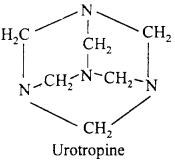
How is urotropine obtained from formaldehyde? Write its chemical name and structural formula.
Answer:
When formaldehyde is treated with ammonia, urotropine is formed. Its chemical name is hexamethylene tetra ammine or hexa ammine.

MP Board Class 12th Chemistry Important Questions Chapter 12 Aldehydes, Ketones and Carboxylic Acids 1
MP Board Class 12th Chemistry Important Questions Chapter 12 Aldehydes, Ketones and Carboxylic Acids 2

Question 4.
Write a short note on Tollen’s reagent.
or,
What is Tollen’s reagent? Write its reaction with acetaldehyde.
Answer:
Tollen’s Reagent:
Ammoniacal silver nitrate solution is known as Tollen’s reagent. When Tollen’s reagent is heated with aldehyde, aldehyde reduces Ag+ to Ag and forms a bright silver mirror on the wall.

MP Board Class 12th Chemistry Important Questions Chapter 12 Aldehydes, Ketones and Carboxylic Acids 3
Ketones do not give this test.

Question 5.
Why boiling point of carboxylic acid is higher than alcohols having same molecular mass?
Answer:
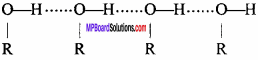
Carboxylic acid exist as dimer due to hydrogen bond. These bonds are more stronger in acids compared to alcohols, therefore boiling point of carboxylic acid is higher than alcohol.
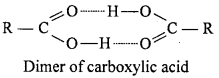
MP Board Class 12th Chemistry Important Questions Chapter 12 Aldehydes, Ketones and Carboxylic Acids 4

Question 6.
Explain Fehling reaction with equation.
Answer:
Fehling Reaction:
Sodium, Potassium tartarate associated with alkaline CuSO4 is known as Fehling solution. When aldehyde is heated with Fehling solution, then aldehyde is oxidized and red precipitate of cuprous oxide is obtained. This is known as Fehling test.

MP Board Class 12th Chemistry Important Questions Chapter 12 Aldehydes, Ketones and Carboxylic Acids 5
Ketones do not give this test.

Question 7.
Why is the boiling point of ketone little higher than its corresponding isomeric aldehyde?
Answer:
Ketones are comparatively more polar than their corresponding isomeric alde – hyde because the >C=O group in ketone is linked with two electron releasing alkyl group. Thus, the dipole attractive force of ketone is comparatively higher. This is the reason that the boiling point of ketone is comparatively higher than its corresponding isomeric aldehyde.

MP Board Solutions

Question 8.
Among formaldehyde, acetaldehyde and acetone which is more reactive and why? Explain.
Answer:
Among HCHO, CH3CHO and CH3COCH3, HCHO is more reactive. This can be explained on the basis of:
1. Electron releasing effect:
Alkyl groups are electron releasing in nature due to which magnitude of positive charge on carbonyl carbon decreases and hence it becomes less susceptible to nucleophilic attack.

2. Steric effect:
The bulkier groups in ketones hinders approach of the nucleophile to the carbonyl carbon. This is known as steric effect. Thus, HCHO with negligible electron releasing effect as well as steric effect is more reactive.

MP Board Class 12th Chemistry Important Questions Chapter 12 Aldehydes, Ketones and Carboxylic Acids 6

Question 9.
Compare acidic strength of acetic acid, formic acid and chloroacetic acid.
Answer:
Chlorine atom present in chloroacetic acid has strong negative inductive effect (-I). Due to this, electrons of O – H bond easily displaced towards oxygen and it releases H+ easily. CH3 group present in CH3COOH which produces (+I) effect causes decrease in acidic nature.

In formic acid there is no such group which produces (+1) or (-1) effect. Hence, formic acid is stronger than acetic acid and chloroacetic acid is stronger than acetic acid. In short chloroacetic acid is stronger than formic acid and formic acid is stronger than acetic acid.

Question 10.

  1. What is Hell – Volhard – Zelinsky (HVZ) reaction?
  2. What happens when formic acid is heated?

Answer:
1. Hell – Volhard – Zelinsky Reaction:
When carboxylic acid is treated with Cl2 or Br2 in presence of phosphorus, α – halogenated carboxylic acid is formed. This reaction is known as Hell – Volhard – Zelinsky reaction (HVZ).

MP Board Class 12th Chemistry Important Questions Chapter 12 Aldehydes, Ketones and Carboxylic Acids 7

2. When formic acid is heated to 160°C it dissociates into CO and H2O.

MP Board Class 12th Chemistry Important Questions Chapter 12 Aldehydes, Ketones and Carboxylic Acids 8

MP Board Solutions

Question 11.
Although phenoxide ion has more number of resonating structures than carboxylate ion, carboxylic acid is a stronger acid than phenol. Why? (NCERT)
Answer:
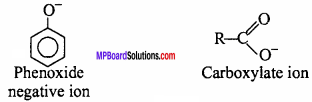
MP Board Class 12th Chemistry Important Questions Chapter 12 Aldehydes, Ketones and Carboxylic Acids 9
In carboxylate ion negative charge is delocalised over two oxygen atoms which are highly electronegative whereas in phenoxide ion negative charge is delocalised over only one oxygen atom. Carboxylate ion is more stable than phenoxide ion that is why carboxylic acid is more acidic than phenols.

Question 12.
Give chemical equation of the following :

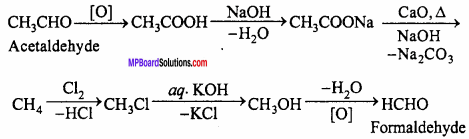
  1. Acetaldehyde from formaldehyde.
  2. Formaldehyde from acetaldehyde.
  3. Acetic acid from formic acid.

Answer:
1. Acetaldehyde from formaldehyde :
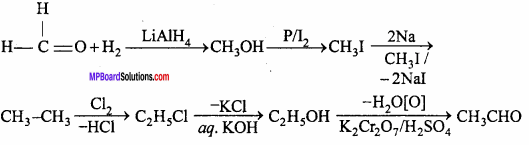
MP Board Class 12th Chemistry Important Questions Chapter 12 Aldehydes, Ketones and Carboxylic Acids 10

2. Formaldehyde from acetaldehyde :
MP Board Class 12th Chemistry Important Questions Chapter 12 Aldehydes, Ketones and Carboxylic Acids 11

3.

MP Board Class 12th Chemistry Important Questions Chapter 12 Aldehydes, Ketones and Carboxylic Acids 12

Question 13.
Write down the difference between formic acid and acetic acid on the basis of following points :

  1. Effect of heat.
  2. Reaction with acidified KMnO4.
  3. Distillation of Ca salt.
  4. Reaction with ammoniacal silver nitrate solution.
  5. Reaction with PCl5.

Answer:
Differences between Formic Acid and Acetic Acid :
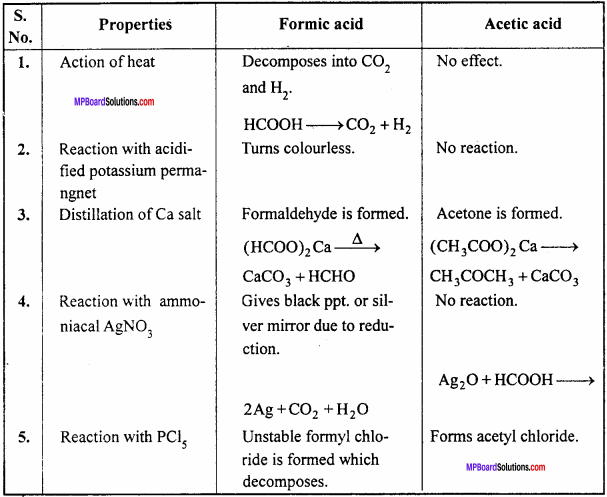
MP Board Class 12th Chemistry Important Questions Chapter 12 Aldehydes, Ketones and Carboxylic Acids 13

Question 14..
Explain Stephen’s reaction and Benzoin condensation with example.
Answer:
stephen’s reaction:
Alkyl cyanide on reduction with acidified stannous chloride (i.e., SnCl2 + HCl) at room temperature forms aldimine hydrochloride, which on hydrolysis with boiling water gives aldehyde. This specific type of reduction of cyanide is known as Stephen’s reaction.
SnCl2 + 2HCl → SnCl4 + 2H
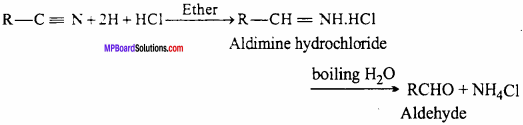
MP Board Class 12th Chemistry Important Questions Chapter 12 Aldehydes, Ketones and Carboxylic Acids 14

Benzoin condensation:
Two molecules of benzaldehyde in presence of alcoholic KCN or NaCN condenses to form benzoin.
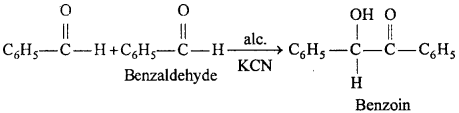
MP Board Class 12th Chemistry Important Questions Chapter 12 Aldehydes, Ketones and Carboxylic Acids 15

Question 15.

  1. Write a short note on Perkin’s reaction.
  2. What happens when acetone is heated with H2SO4?

Answer:
1. Perkin’s reaction:
When aromatic aldehyde is heated in presence of sodium salt of aliphatic acid with anhydride of aliphatic acid, then α, β unsaturated acid is obtained.

MP Board Class 12th Chemistry Important Questions Chapter 12 Aldehydes, Ketones and Carboxylic Acids 16

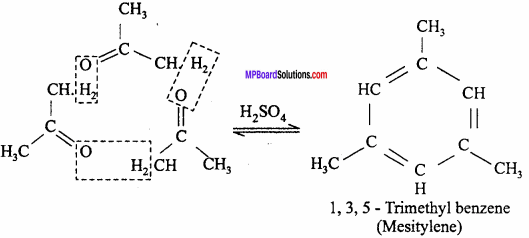
2. In presence of H2SO4 three molecules of acetone get condensed and form mesitylene.
MP Board Class 12th Chemistry Important Questions Chapter 12 Aldehydes, Ketones and Carboxylic Acids 17

Aldehydes, Ketones and Carboxylic Acids Long Answer Type Questions

Question 1.
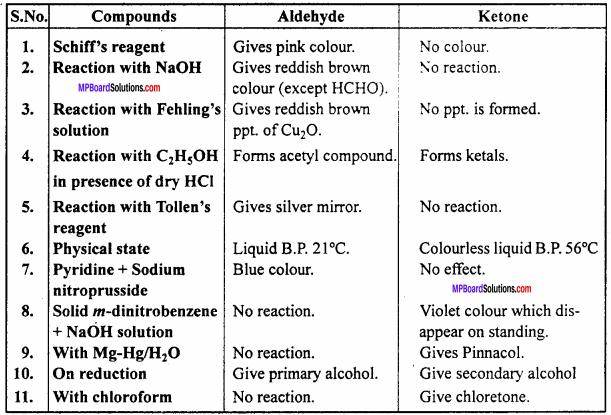
Write down the difference between compounds containing aldehydic group and ketonic group.
Answer:
Differences between Aldehydic group and Ketonic group :
MP Board Class 12th Chemistry Important Questions Chapter 12 Aldehydes, Ketones and Carboxylic Acids 18

Question 2.
Describe the following: (NCERT)

  1. Acetylation
  2. Cannizzaro reaction
  3. Cross – aldol condensation
  4. Decarboxylation.

Answer:
1. Acetylation:
The introduction of an acetyl functional group into an organic compound is known as acetylation. It is usually carried out in the presence of a base such as pyridine, dimethylaniline, etc. This process involves the substitution of an acetyl group for an active hydrogen atom. Ecetyl chloride and acetic anhydride are commonly used as acety – lating agents.
For example, acetylation of ethanol produces ethyl acetate.
CH2CH2OH + CH3COCl → CH3COOC2H5 + HCl

2. Cannizzaro reaction:
Aldehydes which do not contain α – hydrogen like HCHO, C6H5CHO react with cone. NaOH solution to form methyl alcohol and formic acid. This reaction is called Cannizzaro reaction.

MP Board Class 12th Chemistry Important Questions Chapter 12 Aldehydes, Ketones and Carboxylic Acids 19

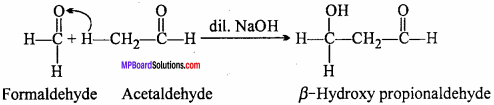
3. Cross – aldol condensation:
When aldol condensation is carried out between different aldehydes or two different ketones or an aldehyde and a ketone, then the reaction is called a Cross – aldol condensation. If both the reactants contain α – hydrogens, four compounds are obtained as products.
MP Board Class 12th Chemistry Important Questions Chapter 12 Aldehydes, Ketones and Carboxylic Acids 20

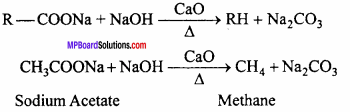
4. Decarboxylation:
Decarboxylation refers to the reaction in which carboxylic acids lose carbon dioxide to form hydrocarbons when their sodium salts are heated with soda – lime.
MP Board Class 12th Chemistry Important Questions Chapter 12 Aldehydes, Ketones and Carboxylic Acids 21
Decarboxylation also takes place when aqueous solutions of alkali metal salts of carboxylic acids are electrolysed. This electrolytic process is known as Kolbe’s electrolysis.

MP Board Solutions

Question 3.
Describe the laboratory method of preparation of acetone. Draw labelled diagram and write down chemical equations.
Answer:
In laboratory, acetone is prepared by dry distillation of anhydrous calcium acetate.

MP Board Class 12th Chemistry Important Questions Chapter 12 Aldehydes, Ketones and Carboxylic Acids 22
Method 30 – 40 gm of calcium acetate mixed with equal amount of sodium acetate is heated in a glass retort fitted with a condenser and receiver. Acetone is collected in the receiver. The acetone so obtained is not pure. To purify this, it is shaken with saturated solution of sodium bisulphite then crystals of acetone sodium bisulphite salt separate out. The crystal is washed and heated with sodium carbonate and then dried over anhydrous and CaCl2 then distilled at 56°C to get pure acetone.
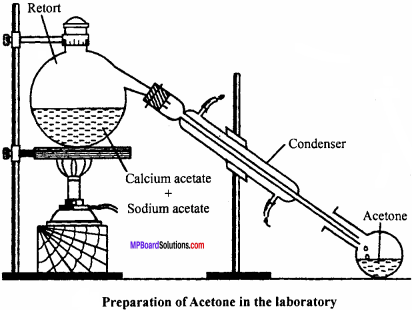
MP Board Class 12th Chemistry Important Questions Chapter 12 Aldehydes, Ketones and Carboxylic Acids 23
(CH3)2C = O + NaHSO3 → (CH3)2C(OH)SO3Na
2(CH3)2C(OH)SO3Na + Na2CO3 → 2(CH3)2C = O + 2Na2SO3 + H2O + CO2.

Question 4.
Write down the following reaction giving example and equation :

  1. Iodoform reaction
  2. Tischenko reaction
  3. Gattermann – Koch synthesis
  4. Rosenmund’s reaction.

Answer:
1. Iodoform (Haloform) reaction:
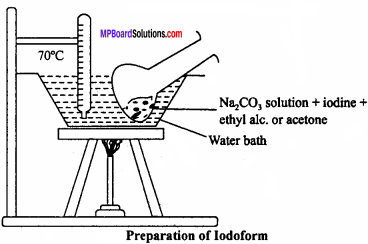
Acetaldehyde or methyl ketone reacts with iodine in presence of alkali to form yellow coloured iodoform. This reaction is known as Iodoform test.
2NaOH + I2 → NaI + NaOI + H2O

MP Board Class 12th Chemistry Important Questions Chapter 12 Aldehydes, Ketones and Carboxylic Acids 24

2. Tischenko reaction:
Two molecules of benzaldehyde is coupled together in presence of aluminium ethoxide or isopropoxide then benzylbenzoate (ester) is formed.
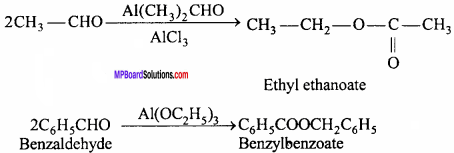
MP Board Class 12th Chemistry Important Questions Chapter 12 Aldehydes, Ketones and Carboxylic Acids 25

3. Gattermann – Koch synthesis:
Mixture of CO and HCl bubbled through a solution of aromatic hydrocarbon in ether solution in the presence of anhydrous AlCl3, then benzaldehyde is formed.

MP Board Class 12th Chemistry Important Questions Chapter 12 Aldehydes, Ketones and Carboxylic Acids 26

4. Rosenmund’s reaction:
Aldehydes are obtained by the reduction of acid chloride with hydrogen in boiling xylene in presence of a catalyst Pd suspended in BaSO4.
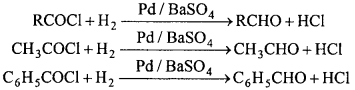
MP Board Class 12th Chemistry Important Questions Chapter 12 Aldehydes, Ketones and Carboxylic Acids 27
This reaction is called Rosenmund reaction.

Question 5.
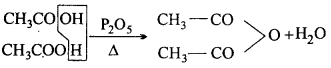
Give quick vinegar method of preparation of acetic acid. Give its reaction with phosphorus pentaoxide and phosphorus pentachloride and write its two uses.
Answer:
In this process, a dilute aqueous solution of ethyl alcohol is oxidized in presence of enzyme Mycoderma aceti.

MP Board Class 12th Chemistry Important Questions Chapter 12 Aldehydes, Ketones and Carboxylic Acids 28
In this process, a wooden vat is fitted with two wooden plates having holes. Between these plates is filled by beech wood savings, moistened with old vinegar solution which is the chief source of Mycoderma aceti. A 10% aqueous solution of ethyl alcohol is dropped slowly from the top of the vat and air is passed at a controlled rate through the holes near the bottom of the vat. Ethyl alcohol is oxidized to acetic acid. This process is called quick vinegar process because vinegar is formed very quickly.
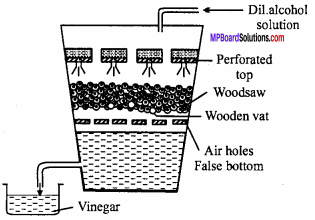
MP Board Class 12th Chemistry Important Questions Chapter 12 Aldehydes, Ketones and Carboxylic Acids 29

(a) Reaction with P2O5:
MP Board Class 12th Chemistry Important Questions Chapter 12 Aldehydes, Ketones and Carboxylic Acids 30

(b) Reaction with PCl5:
CH3CHOOH + PCl5 → CH3COCl + POCl3 + HCl

Uses:

  1. As a reagent and solvent in the lab.
  2. As vinegar in the preparation of pickel, chutney etc.
  3. In the preparation of methyl acetate, ethyl acetate and other esters.

MP Board Solutions

Question 6.
Write a brief note on :

  1. Claisen condensation
  2. Benzoin condensation.

Answer:
1. Claisen condensation:
When aromatic aldehyde reacts with aliphatic alde – hyde or ketone with α – hydrogen, in presence of weak base, α, β unsaturated aldehyde or ketone is formed. This type of condensation is called Claisen condensation.
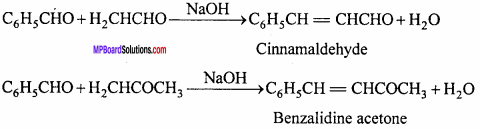
MP Board Class 12th Chemistry Important Questions Chapter 12 Aldehydes, Ketones and Carboxylic Acids 31

2. Benzoin condensation:
Two molecules of benzaldehyde in presence of alcoholic KCN or NaCN condenses to form benzoin.
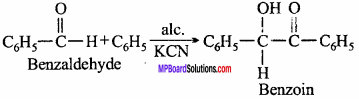
MP Board Class 12th Chemistry Important Questions Chapter 12 Aldehydes, Ketones and Carboxylic Acids 32

Question 7.
How will you convert ethanal into the following compounds : (NCERT)
(i) Butan – 1,3 – diol
(ii) But – 2 – enal
(iii) But – 2 – enoic acid.

Answer:
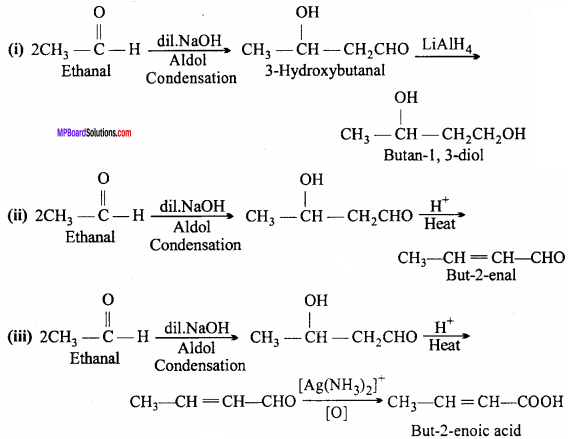
MP Board Class 12th Chemistry Important Questions Chapter 12 Aldehydes, Ketones and Carboxylic Acids 33

Question 8.
What happens when, (only equation):

  1. On reacting acetone with Grignard reagent?
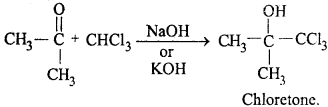
  2. Reaction of acetone with chloroform in presence of KOH?
  3. Benzaldehyde reacts with aniline?
  4. On heating sodium salt of carboxylic acid with soda lime?
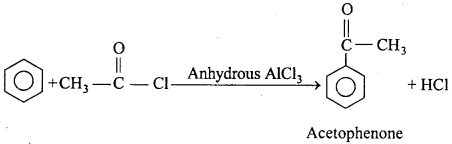
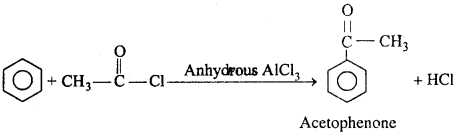
  5. Benzene reacts with acetyl chloride in presence of anhydrous AlCl3?

Answer:
1. Reaction of acetone with Grignard reagent.
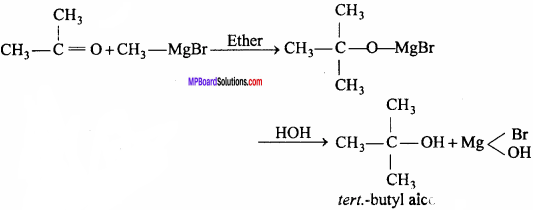
MP Board Class 12th Chemistry Important Questions Chapter 12 Aldehydes, Ketones and Carboxylic Acids 34
2. Reaction of acetone with chloroform.
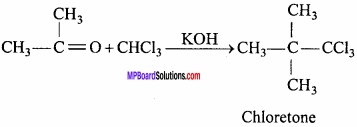
MP Board Class 12th Chemistry Important Questions Chapter 12 Aldehydes, Ketones and Carboxylic Acids 35
3. Reaction of benzaldehyde with aniline

MP Board Class 12th Chemistry Important Questions Chapter 12 Aldehydes, Ketones and Carboxylic Acids 36
4. Reaction of sodium salt of carboxylic acid with soda lime.
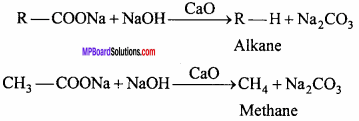
MP Board Class 12th Chemistry Important Questions Chapter 12 Aldehydes, Ketones and Carboxylic Acids 37
5. Reaction of benzene with CH3COCl.
MP Board Class 12th Chemistry Important Questions Chapter 12 Aldehydes, Ketones and Carboxylic Acids 38

Question 9.
How will you obtain the following from acetic acid (Give only equations):

  1. Acetamide
  2. Ethyl acetate
  3. Acetic Anhydride
  4. Trichloro acetic acid.

Answer:
1. Acetamide:

MP Board Class 12th Chemistry Important Questions Chapter 12 Aldehydes, Ketones and Carboxylic Acids 39

2. Ethyl acetate:
MP Board Class 12th Chemistry Important Questions Chapter 12 Aldehydes, Ketones and Carboxylic Acids 40

3. Acetic anhydride:
MP Board Class 12th Chemistry Important Questions Chapter 12 Aldehydes, Ketones and Carboxylic Acids 41

4. Trichloro acetic acid:
CH3 – COOH + 3Cl2 → CCl3 – COCH + 3HCl
MP Board Class 12th Chemistry Important Questions

MP Board Class 12th Maths Important Questions Chapter 2 Inverse Trigonometric Functions

ΨMP Board Class 12th Maths Important Questions Chapter 2 Inverse Trigonometric Functions

Inverse Trigonometric Functions Important Questions

Inverse Trigonometric Functions Objective Type Questions:

Question 1.
Choose the correct answer:

Question 1.
If sin-1x – cos -1 x = \(\frac { \pi }{ 6 } \), then the value of x is equal to:
(a) \(\frac{1}{2}\)
(b) \(\frac { \sqrt { 3 } }{ 2 } \)
(c) \(\frac{-1}{2}\)
(d) None of these
Answer:
(a) \(\frac{1}{2}\)

Question 2.
If tan-13 + tan-1 8, then the value of x is equal to:
(a) \(\frac { \pi }{ 2 } \)
(b) \(\frac { \pi }{ 3 } \)
(c) \(\frac { \pi }{ 4 } \)
(d) \(\frac { -3\pi }{ 4 } \)
Answer:
(b) \(\frac { \pi }{ 3 } \)

Question 3.
tan-1 \(\frac{x}{y}\) + tan-1 \(\frac{x-y}{x+y}\) is equal to:
(a) \(\frac { \pi }{ 2 } \)
(b) \(\frac { \pi }{ 3 } \)
(c) \(\frac { \pi }{ 4 } \)
(d) \(\frac { -3\pi }{ 4 } \)
Answer:
(c) \(\frac { \pi }{ 4 } \)

MP Board Solutions

Question 4.
The value of 2 tan-1 {cosec (tan-1 x ) – tan (cot-1 x)} is equal to:
(a) cot-1x
(b) cot-1\(\frac{1}{x}\)
(c) tan-1x
(d) tan-1\(\frac{1}{x}\)
Answer:
(c) tan-1x

Question 5.
The value of tan{cos-1\(\frac { 1 }{ 5\sqrt { 2 } } \) – sin-1 \(\frac { 4 }{ \sqrt { 17 } } \)} is equal to:
(a) \(\frac { \sqrt { 29 } }{ 3 } \)
(b) \(\frac{29}{3}\)
(c) \(\frac { \sqrt { 3 } }{ 29 } \)
(d) \(\frac{3}{29}\)
Answer:
(d) \(\frac{3}{29}\)

Question 2.
Fill in the blanks:

  1. tan-1(1) + tan-1(2) + tan-1 (3) = …………………………..
  2. tan-1(2) – tan-1 (1) = …………………………..
  3. cot-1 3 + cosec-1 \(\sqrt { 5 } \) = ……………………………
  4. sin(sin-1 x + 2 cos-1 x) = ……………………………….
  5. If sin-1(\(\frac { 2a }{ 1+a^{ 2 } } \)) + sin-1 (\(\frac { 2b }{ 1+b^{ 2 } } \)) = 2 tan-1 x, then x = ……………………….
  6. If tan-1 \(\frac{1-x}{1+x}\) = \(\frac{1}{2}\) tan-1 x ( When x > 0), then x = ………………………..
  7. tan-1\(\frac{a-b}{1+ab}\) + tan-1\(\frac{b-c}{1+bc}\) + tan-1c = ………………………….

Answer:

  1. π
  2. tan-1\(\frac{1}{3}\)
  3. \(\frac{π}{4}\)
  4. x
  5. \(\frac{a+b}{1-ab}\)
  6. \(\frac { 1 }{ \sqrt { 3 } } \)
  7. tan-1 (a)

MP Board Solutions

Question 3.
Write True/False:

  1. tan-1x + tan-1 y = tan-1\(\frac{x+y}{1-xy}\)
  2. cos-1(-x) = – cos-1 x
  3. sin-1(3x – 4x3) = sin-1 \(\frac{x}{3}\)
  4. cos-1 (\(\frac { 1-x^{ 2 } }{ 1+x^{ 2 } } \)) = 2 tan-1x
  5. sin-1x – sin-1[xy – \(\sqrt { 1-x^{ 2 } } \) \(\sqrt { 1-y^{ 2 } } \)]

Answer:

  1. True
  2. False
  3. False
  4. True
  5. False

Question 4.
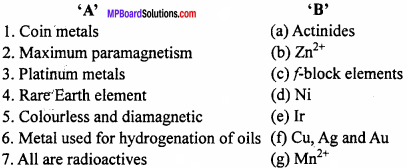
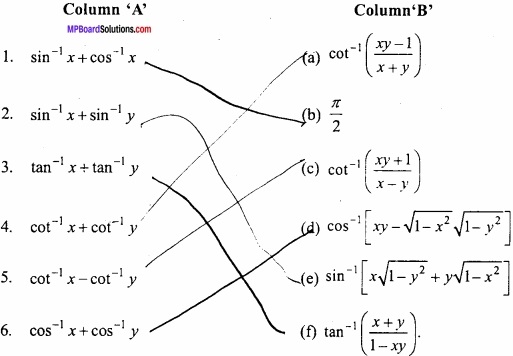
Match the column:
MP Board Class 12th Maths Important Questions Chapter 2 Inverse Trigonometric Functions img 1
Answer:

  1. (b)
  2. (e)
  3. (f)
  4. (a)
  5. (c)
  6. (d)

MP Board Solutions

Question 5.
Write the answer in one word/sentence:

  1. Find the value of tan-1\(\frac{1}{2}\) + tan-1\(\frac{3}{2}\)
  2. Find the value of tan-1\(\frac { x }{ \sqrt { 1-x^{ 2 } } } \)
  3. Find the value of sin ( 2 sin-1\(\frac{3}{5}\))
  4. Solve the equation: sin-1\(\frac{x}{5}\) + cosec -1\(\frac{5}{4}\) = \(\frac { \pi }{ 2 } \)
  5. Write the principal value of cos-1 (cos \(\frac { 7\pi }{ 6 } \))
  6. If cos-1 (\(\frac{1}{x}\)) = θ, then find the value of tan θ

Answer:

  1. tan-1 8
  2. sin-1x
  3. \(\frac{24}{25}\)
  4. x = 3
  5. \(\frac { 5\pi }{ 6 } \)
  6. \(\sqrt { x^{ 2 }-1 } \)

Inverse Trigonometric Functions Very Short Answer Type Questions

Question 1.
Find the principle value of the following?

  1. tan-1[sin(- \(\frac { \pi }{ 2 } \)) ] (CBSE 2014)
  2. cot [ \(\frac { \pi }{ 2 } \) – 2 cot-1 \(\sqrt{3}\) ] (CBSE 2014)
  3. tan-1(- \(\sqrt{3}\) )
  4. sec-1 ( \(\frac{-2}{3}\) \(\sqrt{3}\) ) (NCERT)
  5. cosec-1(2) (NCERT)

Solution:
1. Let, tan-1[ sin(- \(\frac { \pi }{ 2 } \) ) = θ
⇒ tan-1 [-sin \(\frac { \pi }{ 2 } \) ] = θ
⇒ tan-1 (-1) = θ
⇒ tan θ = 1
⇒ tan θ = – tan \(\frac { \pi }{ 4 } \)
⇒ tan θ = tan ( \(\frac { -\pi }{ 4 } \) )
θ = \(\frac { -\pi }{ 4 } \)
∴ The principle value is \(\frac { -\pi }{ 4 } \)

2. cot(\(\frac { -\pi }{ 2 } \) – cot-1 \(\sqrt{3}\))
Let cot-1 \(\sqrt{3}\) = θ
⇒ cot θ = \(\sqrt{3}\)
⇒ cot θ = cot \(\frac { \pi }{ 6 } \)
∴ θ = \(\frac { \pi }{ 6 } \)
∴ cot ( \(\frac { \pi }{ 2 } \) – cot-1\(\sqrt{3}\) ) = cot (\(\frac { \pi }{ 2 } \) – 2 × \(\frac { \pi }{ 6 } \))
= cot ( \(\frac { \pi }{ 2 } \) – \(\frac { \pi }{ 3 } \) )
= cot \(\frac { \pi }{ 6 } \)
= \(\sqrt{3}\)
∴ The principal value is \(\sqrt{3}\)

3. Let tan(- \(\sqrt{3}\)) = θ
⇒ tan θ = – \(\sqrt{3}\)
⇒ tan θ = – tan (\(\frac { \pi }{ 3 } \))
⇒ tan θ = tan (- \(\frac { \pi }{ 3 } \))
⇒ θ = – \(\frac { \pi }{ 3 } \)
Hence the principle value is – \(\frac { \pi }{ 3 } \)

4. Let sec-1( \(\frac{-2}{3}\) \(\sqrt{3}\) ) = θ
⇒ sec-1( \(\frac { -2 }{ \sqrt { 3 } } \) ) = θ
⇒ sec θ = \(\frac { -2 }{ \sqrt { 3 } } \)
⇒ sec θ = – sec ( \(\frac { \pi }{ 6 } \) )
⇒ sec θ = sec (π – \(\frac { \pi }{ 6 } \) )
⇒ sec θ = sec \(\frac { 5\pi }{ 6 } \)
∴θ = \(\frac { 5\pi }{ 6 } \)
The principle value is \(\frac { 5\pi }{ 6 } \)

5. Let cosec-1(2) = θ
⇒ cosec θ = 2
⇒ cosec θ = cosec \(\frac { \pi }{ 6 } \) θ ∈ [- \(\frac { \pi }{ 2 } \), \(\frac { \pi }{ 2 } \) ]
The principle value is \(\frac { \pi }{ 6 } \).

MP Board Solutions

Question 2.
Prove the following:

  1. 2 cos-1(\(\frac{4}{5}\)) = cos-1( \(\frac{7}{25}\) )
  2. 2 sin-1( \(\frac{5}{13}\) ) = sin-1( \(\frac{120}{169}\) )
  3. 2 sin-1( \(\frac{3}{5}\) ) = sin-1( \(\frac{24}{25}\) )

Solution:
1. 2 cos-1( \(\frac{4}{5}\) ) = cos-1( \(\frac{7}{25}\) )
Formula 2 cos-1 x = cos-1(2x2 – 1)
∴ L.H.S = 2 cos-1( \(\frac{4}{5}\) )
= cos-1 (2 \(\frac{16}{25}\) – 1)
= cos-1 ( \(\frac{32}{25}\) – 1)
= cos-1( \(\frac{32-25}{25}\) )
= cos-1\(\frac{7}{25}\)
= R.H.S.

2. 2 sin-1\(\frac{3}{5}\) = sin-1\(\frac{24}{25}\)
Formula 2 sin-1(x) = sin-1(2x\(\sqrt { 1-x^{ 2 } } \))
∴ 2 sin-1 \(\frac{3}{5}\) = sin-1[2. \(\frac{3}{5}\) \(\sqrt { 1-\frac { 9 }{ 25 } } \)]
= sin-1[ \(\frac{6}{5}\) \(\sqrt { \frac { 16 }{ 25 } } \) ]
= sin-1[ \(\frac{6}{5}\) . \(\frac{4}{5}\) ]
= sin-1[ \(\frac{24}{25}\) ]
= R.H.S. Proved.

3. 2 sin-1(\(\frac{5}{13}\)) = sin-1\(\frac{120}{169}\)
Solve like Q.2(b)

MP Board Solutions

Question 3.
Find the value of tan-1{2 cos(2 sin-1\(\frac{1}{2}\)} (CBSE 2013, NCERT)
Solution:
tan-1[2 cos(2 sin-1\(\frac{1}{2}\)) ]
= tan-1[ 2 cos (2 sin-1 sin \(\frac { \pi }{ 6 } \)) ]
= tan-1[ 2 cos (2. \(\frac { \pi }{ 6 } \)) ]
= tan-1[ 2 cos \(\frac { \pi }{ 3 } \) ]
= tan-1 [ 2. \(\frac{1}{2}\) ]
= tan-1 1
= \(\frac { \pi }{ 4 } \).

Question 4.
Find the value of sin [ \(\frac { \pi }{ 3 } \) – sin-1( \(\frac{-1}{2}\) ) ]? [CBSE 2008, 2013]
Solution:
sin[ \(\frac { \pi }{ 3 } \) – sin-1(\(\frac{-1}{2}\) ) ] = sin-1 [ \(\frac { \pi }{ 3 } \) – ( – sin-1\(\frac{1}{2}\) ) ]
= sin-1 [ \(\frac { \pi }{ 3 } \) + sin-1 sin\(\frac { \pi }{ 6 } \) ]
= sin-1 [ \(\frac { \pi }{ 3 } \) + \(\frac { \pi }{ 6 } \) ]
= sin-1 ( \(\frac { \pi }{ 2 } \) )
= 1.

Question 5.
Prove that:
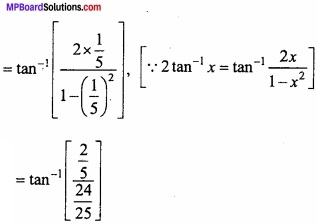
2 tan-1\(\frac{1}{5}\) = tan-1 ( \(\frac{5}{12}\) )
Solution:
2 tan-1( \(\frac{1}{5}\) ) = tan-1 ( \(\frac{5}{12}\) )
L.H.S. = 2 tan-1 ( \(\frac{1}{5}\) )
MP Board Class 12th Maths Important Questions Chapter 2 Inverse Trigonometric Functions img 2
= tan-1 [ \(\frac{2×25}{5×24}\) ]
= tan-1 [ \(\frac{5}{12}\) ]
= R.H.S. Proved.

Question 6.
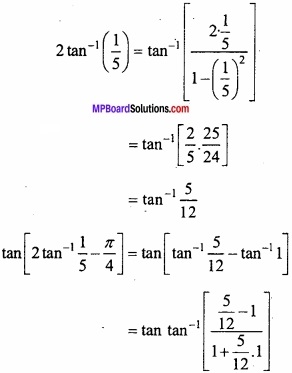
Find the value of tan [ 2 tan-1 \(\frac{1}{5}\) – \(\frac { \pi }{ 4 } \) ]?
solution:
MP Board Class 12th Maths Important Questions Chapter 2 Inverse Trigonometric Functions img 3
= tan tan-1( \(\frac{-7}{17}\) )
= \(\frac{-7}{17}\).

Question 7.
Prove that: 3 sin-1 x = sin-1 (3x – 4x3)? (NCERT, CBSE 2018)
Solution:
Let sin-1 x = θ
⇒ x = sin θ
We know that sin 3θ = 3 sinθ – 4 sin3 θ
= 3x – 4x3
⇒ 3θ = sin-1 ( 3x – 4x3)
⇒ 3.sin-1 x = sin-1(3x – 4x3). proved.

MP Board Solutions

Question 8.
Prove that: 3 cos-1 x = cos-1 (4x3 – 3x)? (NCERT)
Solution:
Let cos-1 x = cos θ
⇒ x = cos θ
We know that cos 3θ = 4 cos3θ – 3 cos θ
= 4x3 – 3x
⇒ 3θ = cos-1 (4x3 – 3x)
⇒ 3 cos-1x = cos-1 (4x3 – 3x). Proved.

Question 9.
Prove the following:

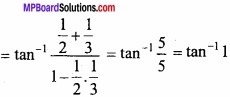
  1. tan-1 \(\frac{1}{2}\) + tan-1 \(\frac{1}{3}\) = \(\frac { \pi }{ 4 } \)
  2. cos-1 \(\frac{12}{13}\) = tan-1 \(\frac{5}{12}\)
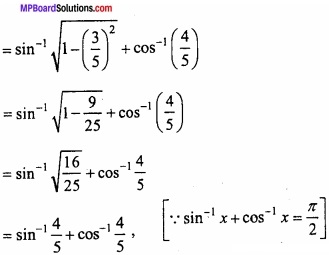
  3. cos-1 \(\frac{3}{5}\) = sin-1 \(\frac{4}{5}\)

Solution:
1. tan-1 \(\frac{1}{2}\) + tan-1 \(\frac{1}{3}\) = \(\frac { \pi }{ 4 } \)
L.H.S = tan-1 \(\frac{1}{2}\) + tan-1 \(\frac{1}{3}\)
MP Board Class 12th Maths Important Questions Chapter 2 Inverse Trigonometric Functions img 4
∴ A = tan-1 \(\frac{5}{12}\)
\(\frac { \pi }{ 4 } \) = R.H.S. Proved

2. cos-1 \(\frac{12}{13}\) = tan-1 \(\frac{5}{12}\)
Let cos-1 \(\frac{12}{13}\) = A
\(\frac{12}{13}\) = cos A
sin A = \(\sqrt { 1-cos^{ 2 }A } \) = \(\sqrt { 1-\frac { 144 }{ 169 } } \)
= \(\sqrt { \frac { 25 }{ 169 } } \) = \(\frac{5}{13}\)
tan A = \(\frac { sinA }{ cosA } \) = \(\frac { 5/13 }{ 12/13 } \) = \(\frac{5}{12}\)
A = tan-1 \(\frac{5}{12}\)
From eqns. (1) and (2), L.H.S = R.H.S. Proved.

3. cos-1 \(\frac{3}{5}\) = sin-1 \(\frac{4}{5}\)
Let cos-1 \(\frac{3}{5}\) = A ……………… (1)
⇒ cos A = \(\frac{3}{5}\)
⇒ sin A = \(\sqrt { 1-cos^{ 2 }A } \)
= \(\sqrt { \frac { 16 }{ 25 } } \) = \(\frac{4}{5}\) ……………… (2)
A = sin-1 \(\frac{4}{5}\).
From eqns. (1) and (2), L.H.S = R.H.S. Proved.

Question 10.
Prove that:

  1. sec-1 x + cosec-1 x = \(\frac { \pi }{ 2 } \)
  2. sin-1x + cos-1x = \(\frac { \pi }{ 2 } \)
  3. tan-1x + cot-1x = \(\frac { \pi }{ 2 } \)

Solution:
1. sec-1 x + cosec-1x = \(\frac { \pi }{ 2 } \)
Let sec -1 x = θ
∴x = sec θ
⇒ x = cosec ( \(\frac { \pi }{ 2 } \) – θ)
⇒ cosec -1 x = \(\frac { \pi }{ 2 } \) – θ. Proved.

2. sin-1 x + cos-1 x = \(\frac { \pi }{ 2 } \)
Let sin-1 x = θ ……………………. (1)
⇒ x = sin θ
⇒ x = cos ( \(\frac { \pi }{ 2 } \) – θ)
⇒ cos -1 x = \(\frac { \pi }{ 2 } \) – θ ………………. (2)
Adding eqns (1) and (2),
sin -1 x + cos -1 x = θ + \(\frac { \pi }{ 2 } \) – θ
⇒ sin -1 x + cos-1 x = \(\frac { \pi }{ 2 } \) Proved.

3. tan -1 x + cot-1 x = \(\frac { \pi }{ 2 } \)
Let tan -1 x = θ
⇒ x = tan θ
⇒ x = cot ( \(\frac { \pi }{ 2 } \) – θ)
⇒ cot -1 x = \(\frac { \pi }{ 2 } \) – θ
Adding eqns. (1) and (2),
tan -1 x + cot -1 x = \(\frac { \pi }{ 2 } \). Proved.

MP Board Solutions

Question 11.
Prove the following:

  1. tan-1 5 – tan-1 3 = tan-1 \(\frac{1}{8}\)
  2. tan-1 3 – tan-1 2 = tan-1 \(\frac{1}{7}\)
  3. tan-1 7 – tan-1 5 = tan-1 3 = tan-1 \(\frac{1}{18}\)

Solution:
1. tan-1 5 – tan-1 3 = tan-1 \(\frac{1}{8}\)
L.H.S. = tan-1 5 – tan-1 3
= tan-1 \(\frac{5-3}{1+5.3}\) = tan-1 \(\frac{2}{16}\) = tan-1 \(\frac{1}{8}\)
= R.H.S. Proved.

2. Solve like Q.No. 11 (A).

3. Solve like Q.No. 11(A).

Question 12.
Prove that:

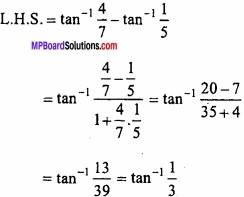
  1. tan-1 \(\frac{4}{7}\) – tan-1 \(\frac{1}{5}\) = tan-1 \(\frac{1}{3}\)
  2. tan-1 \(\frac{1}{2}\) – tan-1 \(\frac{2}{9}\) = tan-1 \(\frac{1}{4}\)
  3. tan-1 \(\frac{1}{7}\) + tan-1 \(\frac{1}{8}\) = tan-1 \(\frac{3}{11}\)

Solution:
1. tan-1 \(\frac{4}{7}\) – tan-1 \(\frac{1}{5}\) = tan-1 \(\frac{1}{3}\)
MP Board Class 12th Maths Important Questions Chapter 2 Inverse Trigonometric Functions img 5

2. Solve like Q.No. 12 (A).

3. Solve like Q.No. 12 (A).

Question 13.
tan-1 1 + tan-1 2 + tan-1 3 = π?
Solution:
L.H.S. = tan-1 1 + (tan-1 2 + tan-1 3)
= tan-1 (1) + π + tan-1 ( \(\frac{2+3}{1-2×3}\) ),
[∵ tan-1 x + tan-1 y = π + tan-1 \(\frac{x+y}{1-xy}\), if x > 0, y > 0, xy > 1 Here xy = 6 > 1]
= tan-1 )1) + π + tan-1( \(\frac{5}{1-6}\) )
= tan-1 (1) + π + tan-1 (-1)
= tan-1 (1) + π – tan-1 (1), [∵tan-1 (-x) = – tan-1 x]
= π = R.H.S. Proved.

MP Board Solutions

Question 14.
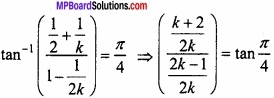
(A) If tan-1 ( \(\frac{1}{2}\) ) + tan-1 ( \(\frac{1}{k}\) ) = \(\frac { \pi }{ 4 } \) then find the value of k?
Solution:
tan-1 ( \(\frac{1}{2}\) ) + tan-1 ( \(\frac{1}{k}\) ) = \(\frac { \pi }{ 4 } \)
MP Board Class 12th Maths Important Questions Chapter 2 Inverse Trigonometric Functions img 6
⇒ \(\frac{k+2}{2k – 1}\) = 1
⇒ k + 2 = 2k – 1
⇒2 + 1 = 2k – k
⇒ k = 3.

(B) If tan -1 ( \(\frac{1}{2}\) ) + tan-1 ( \(\frac{1}{k}\) ) = \(\frac { \pi }{ 4 } \) then find the value of k?
Solution:
Solve like Q.No. 14 (A).
[Answer: k = -1]

(C) If tan -1 ( \(\frac{4}{5}\) ) + tan-1 ( \(\frac{1}{k}\) ) = \(\frac { \pi }{ 4 } \) then find the value of k?
Solution:
Solve like Q.No. 14 (A).
[Answer: k = 9]

Question 15.
Prove that:
tan -1 \(\sqrt { x } \) = \(\frac{1}{2}\) cos-1 ( \(\frac{1-x}{1+x}\) )?
Solution:
R.H.S = \(\frac{1}{2}\) cos -1 ( \(\frac{1-x}{1+x}\) )
Let \(\sqrt { x } \) = tan θ
⇒ x = tan2 θ
⇒ \(\frac{1-x}{1+x}\) = \(\frac { 1-tan^{ 2 }\theta }{ 1+tan^{ 2 }\theta } \) = cos 2θ
∴ R.H.S. = \(\frac{1}{2}\) cos -1(cos 2θ)
= \(\frac{1}{2}\) × 2θ = θ
= tan-1 ( \(\sqrt { x } \) ) [∵\(\sqrt { x } \) = tan θ ⇒ tan-1 ( \(\sqrt { x } \) ) = θ]
= L.H.S. Proved.

MP Board Solutions

Question 16.
Prove that:
sin (cos-1 x ) = cos (sin-1 x)?
Solution:
L.H.S. = sin(cos-1 x)
= sin [ \(\frac { \pi }{ 2 } \) – sin -1 x],
[∵ sin-1 x + cos-1x = \(\frac { \pi }{ 2 } \) , cos-1x = \(\frac { \pi }{ 2 } \) – sin-1 x]
= cos (sin-1 x), [ ∵sin (90° – θ) = cos θ ]
= R.H.S. Proved.

Question 17.
(A) Prove that:
tan-1 ( \(\frac{b-c}{1+bc}\) ) + tan-1 \(\frac{b-c}{1+bc}\) + tan-1 c = tan-1 b?
Solution:
L.H.S = tan-1 ( \(\frac{b-c}{1+bc}\) ) + tan-1 \(\frac{c-a}{1+ca}\) + tan-1 a
= (tan-1 a – tan-1 b ) + (tan-1 b – tan-1 c) + tan-1 c
= tan-1 b – tan-1 c + tan-1 c – tan-1 a + tan-1 a
= tan-1 b = R.H.S. Proved.

(B) Prove that:
tan-1 ( \(\frac{a-b}{1+ab}\) ) + tan-1 \(\frac{b-c}{1+bc}\) + tan-1 c = tan-1 a?
Solution:
L.H.S = tan-1 ( \(\frac{a-b}{1+ab}\) ) + tan-1 \(\frac{b-c}{1+bc}\) + tan-1 c
= (tan-1 a – tan-1 b) + (tan-1 b – tan-1c) + tan-1 c
= tan-1 a = R.H.S. Proved.

(C) Prove that:
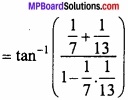
tan-1 \(\frac{1}{7}\) + tan-1 \(\frac{1}{13}\) = tan-1 \(\frac{2}{9}\)?
Solution:
tan-1 \(\frac{1}{7}\) + tan-1 \(\frac{1}{13}\) = tan-1 \(\frac{2}{9}\)
L.H.S = tan-1 \(\frac{1}{7}\) + tan-1 \(\frac{1}{13}\)
MP Board Class 12th Maths Important Questions Chapter 2 Inverse Trigonometric Functions img 7
= tan-1 \(\frac{20}{91}\) × \(\frac{91}{90}\) = tan-1 \(\frac{20}{90}\) = tan-1 \(\frac{2}{9}\)
= R.H.S. Proved.

Question 18.
Solve the equation:
sin-1 \(\frac { 2a }{ 1+a^{ 2 } } \) + sin-1 \(\frac { 2b }{ 1+a^{ 2 } } \) = 2 tan-1x?
Solution:
sin-1 \(\frac { 2a }{ 1+a^{ 2 } } \) + sin-1 \(\frac { 2b }{ 1+a^{ 2 } } \) = 2 tan-1x, (given)
⇒ 2 tan-1 a + 2 tan-1 b = 2 tan-1 x [∵sin-1 \(\frac { 2x }{ 1+a^{ 2 } } \) = 2 tan-1 x]
⇒ tan-1 a + tan-1 b = tan-1 x
⇒ tan-1 \(\frac{a+b}{1-ab}\) = tan-1 x
∴ x = \(\frac{a+b}{1-ab}\).

MP Board Solutions

Question 19.
solve the equation:
cos-1 ( \(\frac { 1-a^{ 2 } }{ 1+a^{ 2 } } \) ) – cos-1 ( \(\frac { 1-b^{ 2 } }{ 1+b^{ 2 } } \) ) = 2 tan-1x?
Solution:
cos-1 ( \(\frac { 1-a^{ 2 } }{ 1+a^{ 2 } } \) ) – cos-1 ( \(\frac { 1-b^{ 2 } }{ 1+b^{ 2 } } \) ) = 2 tan-1x, (given)
⇒ 2 tan-1 a – 2 tan-1 b = 2 tan-1 x
⇒ tan-1a – tan-1 b = tan-1 x
⇒ tan-1 \(\frac{a-b}{1+ab}\) = tan-1 x
∴ x = \(\frac{a-b}{1+ab}\).

Question 20.
(A) Prove the following:
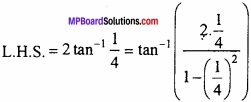
2 tan-1 \(\frac{1}{4}\) = tan-1 \(\frac{8}{15}\)?
Solution:
∵ 2 tan-1 x = tan-1 ( \(\frac { 2x }{ 1-x^{ 2 } } \) )
MP Board Class 12th Maths Important Questions Chapter 2 Inverse Trigonometric Functions img 8
L.H.S = tan-1 \(\frac{16}{2.5}\)
= tan-1 \(\frac{8}{15}\) = R.H.S. Proved.

(B) Prove the following:
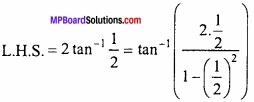
2 tan-1 \(\frac{1}{2}\) = tan-1 \(\frac{4}{3}\)?
Solution:
We know that 2 tan-1 x = tan-1 ( \(\frac { 2x }{ 1-x^{ 2 } } \) )
MP Board Class 12th Maths Important Questions Chapter 2 Inverse Trigonometric Functions img 9
= tan-1 ( \(\frac{4}{3}\) )
= R.H.S. Proved.

Question 21.
Write in simplest form
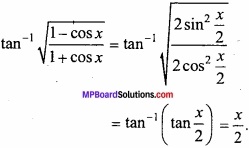
tan-1 \(\sqrt { \frac { 1-cosx }{ 1+cosx } } \)?
Solution:
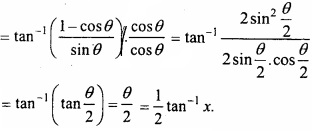
MP Board Class 12th Maths Important Questions Chapter 2 Inverse Trigonometric Functions img 10

Question 22.
Write in simplest form:
cos-1 \(\sqrt { \frac { 1 }{ 2 } (1+cosx) } \)?
Solution:
cos-1 \(\sqrt { \frac { 1 }{ 2 } (1+cosx) } \) = cos-1 \(\sqrt { \frac { 1 }{ 2 } .2cos^{ 2 }\frac { x }{ 2 } } \)
= cos-1 (cos \(\frac{x}{2}\) ) = \(\frac{x}{2}\).

Question 23.
If tan-1 a + tan-1 b + tan-1 c = \(\frac { \pi }{ 2 } \) then prove that ab + bc + ca = 1?
Solution:
tan-1 a + tan-1 b + tan-1 c = \(\frac { \pi }{ 2 } \) , given
⇒ tan-1 a + tan-1 b + tan -1 c = tan-1 a + cot-1 a, [∵tan-1 a + cot -1 a = \(\frac { \pi }{ 2 } \) ]
⇒ tan-1 b + tan-1c = cot-1 a
⇒ tan-1 ( \(\frac{b+c}{1+bc}\) ) = \(\frac{1}{a}\)
⇒ ab + ca = 1 – bc
⇒ ab + bc + ca = 1. Proved.

MP Board Solutions

Question 24.
Prove that:
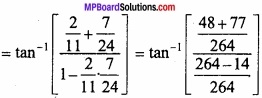
tan-1 \(\frac{2}{11}\) + cot-1 \(\frac{24}{7}\) = tan-1 \(\frac{1}{2}\)?
Solution:
L.H.S. = tan-1 \(\frac{2}{11}\) + cot-1 \(\frac{7}{24}\)
= tan-1 \(\frac{2}{11}\) + tan-1 \(\frac{7}{24}\)
MP Board Class 12th Maths Important Questions Chapter 2 Inverse Trigonometric Functions img 11
tan-1 = \(\frac{125}{250}\) = tan-1 \(\frac{1}{2}\) = R.H.S.

Question 25.
Prove that:
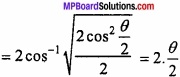
cos-1 x = 2 cos-1 \(\sqrt { \frac { 1+x }{ 2 } } \)?
Solution:
R.H.S. = 2 cos-1 \(\sqrt { \frac { 1+x }{ 2 } } \)
= 2 cos-1 \(\sqrt { \frac { 1+cos\theta }{ 2 } } \)
MP Board Class 12th Maths Important Questions Chapter 2 Inverse Trigonometric Functions img 12
= cos-1 x
= L.H.S. Proved.

Question 26.
Prove that:
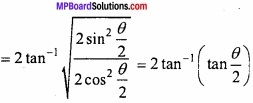
cos-1 x = 2 tan-1\(\sqrt { \frac { 1-x }{ 1+x } } \)?
Solution:
R.H.S. = 2 tan-1 \(\sqrt { \frac { 1-x }{ 1+x } } \)
= 2 tan-1 \(\sqrt { \frac { 1-cos\theta }{ 1+cos\theta } } \) (putting x = cos θ)
MP Board Class 12th Maths Important Questions Chapter 2 Inverse Trigonometric Functions img 13
= 2. \(\frac { \theta }{ 2 } \) = θ = cos-1 x = L.H.S. Proved.

Question 27.
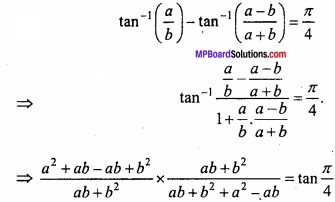
tan-1 ( \(\frac{a}{b}\) ) – tan-1 ( \(\frac{a-b}{a+b}\) ) = \(\frac { \pi }{ 4 } \)?
Solution:
tan-1 ( \(\frac{a}{b}\) ) – tan-1 ( \(\frac{a-b}{a+b}\) ) = \(\frac { \pi }{ 4 } \)
MP Board Class 12th Maths Important Questions Chapter 2 Inverse Trigonometric Functions img 14
⇒ 1 = tan\(\frac { \pi }{ 4 } \)
or tan\(\frac { \pi }{ 4 } \) = 1. Proved.

Inverse Trigonometric Functions Long Answer Type Questions – I

Question 1.
(A) Prove that:
sin-1 \(\frac { 1 }{ \sqrt { 5 } } \) + sin-1 \(\frac { 1 }{ \sqrt { 10 } } \) = \(\frac { \pi }{ 4 } \)?
Solution:
Let sin-1 \(\frac { 1 }{ \sqrt { 5 } } \) = A, sin-1 \(\frac { 1 }{ \sqrt { 10 } } \) = B
∴ A + B = \(\frac { \pi }{ 4 } \)
⇒ sin (A + B) = sin\(\frac { \pi }{ 4 } \)
⇒ sin A cos B + cos A sin B = \(\frac { 1 }{ \sqrt { 2 } } \)
L.H.S = sin A \(\sqrt { 1-sin^{ 2 }B } \) + \(\sqrt { 1-sin^{ 2 }A } \). sin B
= \(\frac { 1 }{ \sqrt { 5 } } \). \(\sqrt { 1-\frac { 1 }{ 10 } } \) + \(\sqrt { 1-\frac { 1 }{ 5 } } \). \(\frac { 1 }{ \sqrt { 10 } } \)
= \(\frac { 3 }{ \sqrt { 5.\sqrt { 10 } } } \) + \(\frac { 2 }{ \sqrt { 5.\sqrt { 10 } } } \)
= \(\frac { 5 }{ \sqrt { 5.\sqrt { 10 } } } \) = \(\sqrt { \frac { 5 }{ 10 } } \) = \(\frac { 1 }{ \sqrt { 2 } } \)
= R.H.S. Proved.

(B) Solve the following equation:
sin-1 x + sin-1 (1 – x) = sin-1 \(\sqrt { 1-x^{ 2 } } \)?
Solution:
Let sin-1 x = α ∴ x = sin α
Here α + sin-1 ( 1 – sin α) = sin-1 \(\sqrt { 1-sin^{ 2 }\alpha } \)
⇒ α + sin-1 ( 1 – sin α) = sin-1 cos α
⇒ α + sin-1 ( 1 – sin α) = sin-1. sin ( \(\frac { \pi }{ 2 } \) – α)
⇒ α + sin-1 ( 1 – sin α) = \(\frac { \pi }{ 2 } \) – α
⇒ sin-1 ( 1 – sin α) = \(\frac { \pi }{ 2 } \) – 2α
⇒ 1 – sin α = sin ( \(\frac { \pi }{ 2 } \) – 2α)
⇒ 1 – sin α = cos 2α
⇒ 1 – cos 2α = sin α
⇒ 2 sin2α = sin α
⇒ sin α = \(\frac{1}{2}\) ∴α = \(\frac { \pi }{ 6 } \)
or x = \(\frac { \pi }{ 6 } \)

MP Board Solutions

Question 2.

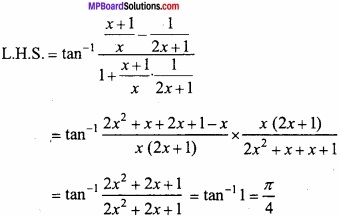
  1. tan-1 \(\frac{x+1}{x}\) – tan-1 \(\frac{1}{2x+1}\) = \(\frac { \pi }{ 4 } \)?
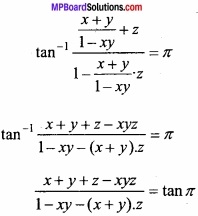
  2. If tan-1 x + tan-1 y + tan-1 z = π then prove that x + y + z = xyz?
  3. If tan-1 x + tan-1 y + tan-1 z = \(\frac { \pi }{ 2 } \) then prove that xy + yz + zx = 1?

Solution:
1. tan-1 \(\frac{x+1}{x}\) – tan-1 \(\frac{1}{2x+1}\) = \(\frac { \pi }{ 4 } \)
MP Board Class 12th Maths Important Questions Chapter 2 Inverse Trigonometric Functions img 15
= R.H.S.

2. tan-1 x + tan-1 y + tan-1 z = π
⇒ tan-1 \(\frac{x+y}{1-xy}\) + tan-1 z = π
MP Board Class 12th Maths Important Questions Chapter 2 Inverse Trigonometric Functions img 16
⇒ x + y + z – xyz = 0, [∵ tan π = 0]
∴ x + y + z = xyz. Proved.

3. Solve like Q.2(B), take tan \(\frac { \pi }{ 4 } \) = ∞ = \(\frac{1}{0}\)

Question 3.
Write in simplest form:
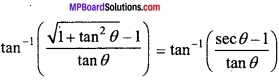
tan-1 [ \(\frac { \sqrt { 1+x^{ 2 }-1 } }{ x } \) ]?
Solution:
tan-1 [ \(\frac { \sqrt { 1+x^{ 2 }-1 } }{ x } \) ]
Let x = tan θ
MP Board Class 12th Maths Important Questions Chapter 2 Inverse Trigonometric Functions img 17
MP Board Class 12th Maths Important Questions Chapter 2 Inverse Trigonometric Functions img 17a

Question 4.
(A) Prove the following:
\(\frac{1}{2}\) sin-1 x = cot-1 [ \(\frac { \sqrt { 1+x^{ 2 }-1 } }{ x } \) ]?
Solution:
R.H.S = cot-1 [ \(\frac { \sqrt { 1+x^{ 2 }-1 } }{ x } \) ]
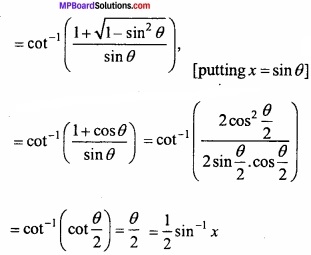
MP Board Class 12th Maths Important Questions Chapter 2 Inverse Trigonometric Functions img 18
= L.H.S. Proved.

(B) Prove that:
\(\frac{1}{2}\) cot-1 x = cot-1 ( \(\sqrt { 1+x^{ 2 }+x } \) )?
Solution:
\(\frac{1}{2}\) cot-1 x = cot-1 ( \(\sqrt { 1+x^{ 2 }+x } \) )
R.H.S = cot-1 ( \(\sqrt { 1+x^{ 2 }+x } \) )
Let x = cos θ
R.H.S = cot-1 ( \(\sqrt { 1+cot^{ 2 }\theta } \) + cot θ )
= cot-1 ( \(\sqrt { cosec^{ 2 }\theta } \) + cot θ )
= cot-1 (cosec θ + cot θ)
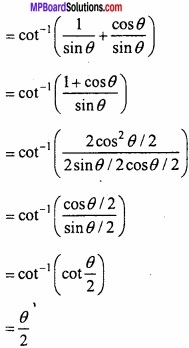
MP Board Class 12th Maths Important Questions Chapter 2 Inverse Trigonometric Functions img 19
= \(\frac{1}{2}\) cot-1 x
= L.H.S. Proved.

Question 5.
Solve the following equation:
tan-1 (x + 1) + tan-1 (x – 1) = tan-1 ( \(\frac{6}{17}\) )?
Solution:
Given: tan-1 (x + 1) + tan-1 (x – 1) = tan-1 ( \(\frac{6}{17}\) )
⇒ tan-1 (x + 1) + tan-1 (x – 1) = tan-1 ( \(\frac{6}{17}\) )
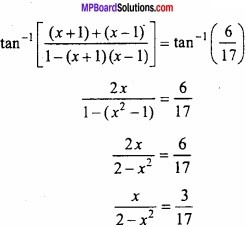
MP Board Class 12th Maths Important Questions Chapter 2 Inverse Trigonometric Functions img 20
⇒ 17 x = 6 – 3x2
⇒ 3x2 + 17x – 6 = 0
⇒ 3x2 + 18x – x – 6 = 0
⇒ 3x (x + 6) – 1 (x + 6) = 0
⇒ (x+6) (3x – 1) = 0
∴ x = – 6, x = \(\frac{1}{3}\)

MP Board Solutions

Question 6.
Prove that cos-1 \(\frac{3}{5}\) + cos-1 \(\frac{4}{5}\) = \(\frac { \pi }{ 2 } \)?
Solution:
L.H.S = cos-1 \(\frac{3}{5}\) + cos-1 \(\frac{4}{5}\),
MP Board Class 12th Maths Important Questions Chapter 2 Inverse Trigonometric Functions img 21
= \(\frac { \pi }{ 2 } \) = R.H.S Proved.

Question 7.
If cos-1 x + cos-1 y + cos-1 z = π then prove that:
x2 + y2 + z2 + 2xyz = 1?
Solution:
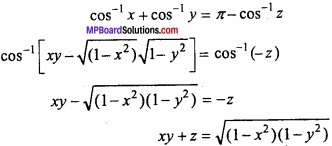
Given: cos-1 x + cos-1 z = π
⇒ cos-1 x + cos-1 y = π- cos-1 z
MP Board Class 12th Maths Important Questions Chapter 2 Inverse Trigonometric Functions img 22
Squaring on both sides
x2y2 + z2 + 2xyz = (1 – x2) (1 – y2)
⇒ x2y2 + z2 + 2xyz = 1 – y2 – x2 + x2y2
⇒ z2 + 2xyz = 1 – y2 – x2
⇒ x2 + y2 + z2 + 2xyz = 1. Proved.

Question 8.
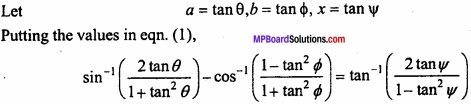
If sin-1 \(\frac { 2a }{ 1+a^{ 2 } } \) – cos-1 \(\frac { 1-b^{ 2 } }{ 1+b^{ 2 } } \) = tan-1 \(\frac { 2x }{ 1-x^{ 2 } } \) then prove that:
x = \(\frac{a-b}{1+ab}\)?
Solution:
MP Board Class 12th Maths Important Questions Chapter 2 Inverse Trigonometric Functions img 23
MP Board Class 12th Maths Important Questions Chapter 2 Inverse Trigonometric Functions img 24
⇒ sin-1 (sin 2θ) – cos-1 (cos 2ϕ) = tan-1 (tan 2Ψ)
⇒ 2θ – 2ϕ = 2Ψ
⇒ θ – ϕ = Ψ
⇒ tan-1 a – tan-1 b = tan-1 x
⇒ tan-1 ( \(\frac{a-b}{1+ab}\) ) = tan-1 x
⇒ x = \(\frac{a-b}{1+ab}\). Proved.

Question 9.
Prove the following
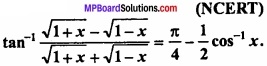
MP Board Class 12th Maths Important Questions Chapter 2 Inverse Trigonometric Functions img 25
Solution:
Let x = cos θ, then θ = cos-1 x.
MP Board Class 12th Maths Important Questions Chapter 2 Inverse Trigonometric Functions img 26
\(\frac { \pi }{ 4 } \) – \(\frac{1}{2}\) cos-1 x.

Question 10.
Write in simplest form:
tan-1 ( \(\frac { x }{ \sqrt { 1+x^{ 2 }-1 } } \) )?
Solution:
tan-1 ( \(\frac { x }{ \sqrt { 1+x^{ 2 }-1 } } \) )
Putting x = tan θ, we get
MP Board Class 12th Maths Important Questions Chapter 2 Inverse Trigonometric Functions img 27
MP Board Class 12th Maths Important Questions Chapter 2 Inverse Trigonometric Functions img 27a

Question 11.
Prove that:
tan-1 \(\sqrt{x}\) = \(\frac{1}{2}\) cos-1 ( \(\frac{1-x}{1+x}\) )? (NCERT)
Solution:
tan-1 \(\sqrt{x}\) = \(\frac{1}{2}\) cos-1 ( \(\frac{1-x}{1+x}\) )
R.H.S = \(\frac{1}{2}\) cos-1 ( \(\frac{1-x}{1+x}\) )
MP Board Class 12th Maths Important Questions Chapter 2 Inverse Trigonometric Functions img 28
Let tan-1 \(\sqrt{x}\) = θ
\(\sqrt{x}\) = tan θ
R.H.S. = \(\frac{1}{2}\) cos-1(cos 2θ)
= \(\frac{1}{2}\). 2θ
= θ
= tan-1 \(\sqrt{x}\)
= L.H.S. Proved.

MP Board Solutions

Question 12.
Prove that:
MP Board Class 12th Maths Important Questions Chapter 2 Inverse Trigonometric Functions img 29
Solution:
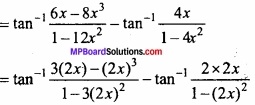
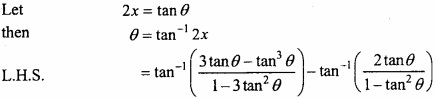
MP Board Class 12th Maths Important Questions Chapter 2 Inverse Trigonometric Functions img 30
MP Board Class 12th Maths Important Questions Chapter 2 Inverse Trigonometric Functions img 30a
= tan-1 (tan 3θ) – tan-1 (tan 2θ)
= 3θ – 2θ
= θ
= tan-1 2x
= R.H.S. Proved.

Question 13.
Prove that:
cos-1 \(\frac{4}{5}\) + cos-1 \(\frac{12}{13}\) = cos-1 \(\frac{33}{65}\)?
Solution:
Let cos-1 \(\frac{4}{5}\) = A
∴ \(\frac{4}{5}\) = cos A
∴ sin A = \(\sqrt { 1-cos^{ 2 }A } \) = \(\sqrt { 1-\frac { 16 }{ 25 } } \) = \(\sqrt { \frac { 9 }{ 25 } } \)
⇒ sin A = \(\frac{3}{5}\)
Let cos-1 \(\frac{12}{13}\) = B
⇒ \(\frac{12}{13}\) = B
∴ sin B = \(\sqrt { 1-cos^{ 2 }B } \) = \(\sqrt { 1-\frac { 144 }{ 169 } } \) = \(\sqrt { \frac { 25 }{ 169 } } \)
⇒ sin B = \(\frac{5}{13}\)
A + B = cos-1 \(\frac{33}{65}\)
⇒ cos (A + B) = \(\frac{33}{65}\)
⇒ cos A.cos B – sin A.sin B = \(\frac{33}{65}\)
L.H.S. = \(\frac{4}{5}\). \(\frac{12}{13}\) – \(\frac{3}{5}\). \(\frac{5}{13}\)
= \(\frac{48}{65}\) – \(\frac{15}{65}\)
= \(\frac{33}{65}\)
= R.H.S. Proved.

MP Board Class 12 Maths Important Questions

MP Board Class 12th Chemistry Important Questions Chapter 11 Alcohols, Phenols and Ethers

MP Board Class 12th Chemistry Important Questions Chapter 11 Alcohols, Phenols and Ethers

Alcohols, Phenols and Ethers Important Questions

Alcohols, Phenols and Ethers Very Short Answer Type Questions

Question 1.
What is Ether?
Answer:
Compounds formed by the substitution of hydrogen atom of hydrocarbon by alkoxy group are called Ethers.

Question 2.
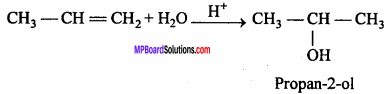
What will be the type of alcohol formed by the hydration of propene in the presence of acid?
Answer:
MP Board Class 12th Chemistry Important Questions Chapter 11 Alcohols, Phenols and Ethers 1

Question 3.
What is the special name of Phenol and from what was it first isolated?
Answer:
Phenol is also known as carbolic and it was first isolated from coal tar.

MP Board Solutions

Question 4.
Picric acid is a strong acid. Why?
Answer:
In picric acid, acidic character increases due to the presence of three electron attracting – NO2 groups because these groups are helpful in the release of H+. Thus picric acid is a strong acid.

Question 5.
Write the reagent required for the preparation of tertiary butyl alcohol starting from propanone.
Answer:
Methyl magnesium bromide.

Question 6.
What type of isomerism is exhibited between alcohol and ether?
Answer:
Alcohol and ether exhibit Functional isomerism.

Question 7.
Write the equation of catalytic reduction of Butanols.
Answer:
MP Board Class 12th Chemistry Important Questions Chapter 11 Alcohols, Phenols and Ethers 2

Question 8.
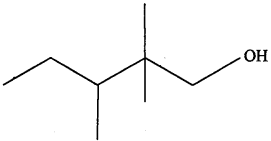
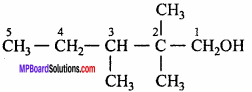
Write IUPAC name of the following compound.
MP Board Class 12th Chemistry Important Questions Chapter 11 Alcohols, Phenols and Ethers 3
Answer:
MP Board Class 12th Chemistry Important Questions Chapter 11 Alcohols, Phenols and Ethers 4
IUPAC name of this compound is 2,2, 3 – trimethyl pentan – 1 – ol.

Question 9.
Why do ethers have low boiling points?
Answer:
Molecules of ether do not possess H – bonding, therefore boiling points of ethers are low.

Alcohols, Phenols and Ethers Short Answer Type Questions

Question 1.
What is Lucas reagent? How are primary, secondary and tertiary alcohol identified by it? Explain.
Answer:
Mixture of anhydrous ZnCl2 and cone. HCl is known as Lucas reagent.
1. Tertiary Alcohol : On adding Lucas reagent in alcohol at normal temperature, immediately white oily precipitate of Alkyl chlorides is formed, then it is tertiary alcohol.

2. Secondary Alcohol : If on adding Lucas reagent in alcohol, at normal temperature, a white oily precipitate of alkyl chloride is obtained after 5 minutes, then it is secondary alcohol.

3. Primary Alcohol : Primary alcohol does not show any reaction with Lucas reagent at normal temperature.

MP Board Solutions

Question 2.
Why the b.p. of alcohol are higher than ethers and alkene?
Or C3H5OH and CH3OCH3 both have same molecular formula (C2H6O) but the b.p. of alcohol is 78.4°C and b.p. of ether is – 240°C. Explain the reason.
Answer:
In case of C2H5OH there is strong intermolecular hydrogen bonding between the molecules of alcohol. So alcohols (C2H5OH) required much energy to evaporate than ether molecules. In other words, we can say that the C2H5OH molecules are in associated form due to H – bonding so the b.p. of C2H5OH is very higher than ether and alkene.
MP Board Class 12th Chemistry Important Questions Chapter 11 Alcohols, Phenols and Ethers 5

Question 3.
Boiling point of alcohol higher than corresponding alkane. Why?
Answer:
Boiling point of alcohols is much higher than hydrocarbons of nearly similar molecular mass due to inter molecular hydrogen bond. Alcohols molecules associate kilo calories mole-1. Thus, extra energy is required for the separation of these molecules, which lead to increase in boiling point. Hydrocarbons do not form hydrogen bond, thus their boiling point is comparatively less.

Question 4.

  1. How can we obtain phenol from benzene diazonium chloride?
  2. What is the reaction of diethyl ether with HI acid?

Answer:
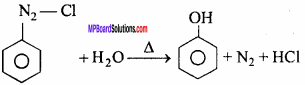
1. Phenols are prepared by hydrolysis of diazonium salts by water, dil. acids etc.
MP Board Class 12th Chemistry Important Questions Chapter 11 Alcohols, Phenols and Ethers 6

2. The reaction of diethyl ether with cone. HI acid, on heating gives one molecule of ethyl iodide and one molecule of ethyl alcohol.
MP Board Class 12th Chemistry Important Questions Chapter 11 Alcohols, Phenols and Ethers 7
Diethyl ether Ethyl iodide Ethyl alcohol

Question 5.
Write the equations involved in the following reactions :

  1. Reimer – Tiemann reaction (NCERT, MP2018)
  2. Kolbe’s reaction.

Answer:
1. Reimer – Tiemann reaction:
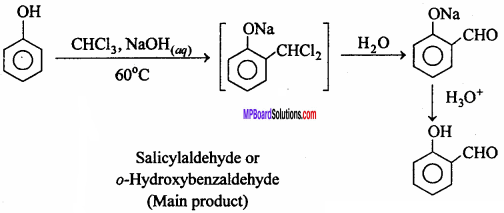
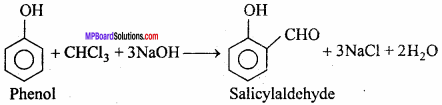
When phenol is treated with chloroform in presence of aqueous sodium hydroxide at 60°C, oHydroxy benzaldehyde (Salicylaldehyde) and p – Hydroxy benzaldehyde are formed. The ortho – isomer is the major product. This reaction is called Reimer-Tiemann reaction.
MP Board Class 12th Chemistry Important Questions Chapter 11 Alcohols, Phenols and Ethers 8
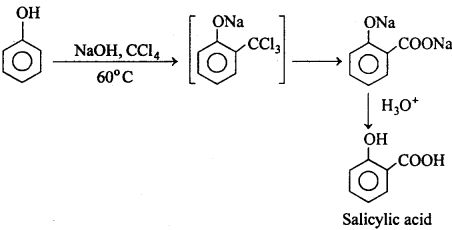
If carbon tetrachloride is used in place of chloroform, salicylic acid is obtained as the main product.
MP Board Class 12th Chemistry Important Questions Chapter 11 Alcohols, Phenols and Ethers 9

2. Kolbe – Schmidt reaction:
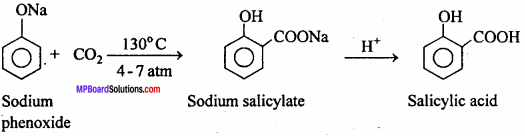
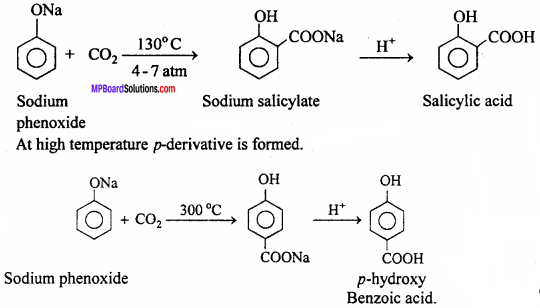
When sodium salt of a phenol is heated with CO2 at 130°C. (403K) and 4 – 7 atm pressure, sodium salicylate is formed. This on acidification gives salicylic acid.
MP Board Class 12th Chemistry Important Questions Chapter 11 Alcohols, Phenols and Ethers 10
At high temperature p – derivative is formed.
MP Board Class 12th Chemistry Important Questions Chapter 11 Alcohols, Phenols and Ethers 11

Question 6.
Name the reagents used in the following reactions: (NCERT)

  1. Oxidation of a primary alcohol to carboxylic acid.
  2. Oxidation of a primary alcohol to aldehyde.
  3. Bromination of phenol to 2,4,6 – tribromo – phenol.
  4. Benzyl alcohol to benzoic acid.
  5. Dehydration of propan – 2 – ol to propene.
  6. Butan – 2 – one to butan – 2 – ol.

Answer:

  1. Acidified K2Cr2O7 or neutral acidic or alkaline KMnO4.
  2. Pyridinium chlorochromate (pcc) in CH2Cl2 or Cu at 573K.
  3. Bromine water (Br2/H2O)
  4. Acidified or alkaline KMnO4
  5. Conc. H2SO4 at 443K or 85% phosphoric acid at 443K.
  6. Ni/H2 or NaBH4 or LiAlH4.

Question 7.
Explain, how does the – OH group attached to a carbon of benzene ring activate it towards electrophilic substitution? (NCERT)
Answer:
The – OH group exerts +R effect on the benzene ring under the effect of attacking electrophile. As a result, there is an increase in the electron density in the ring particularly at ortho and para positions, therefore electorphilic substitution occurs mainly at o – and p – positions.

MP Board Solutions

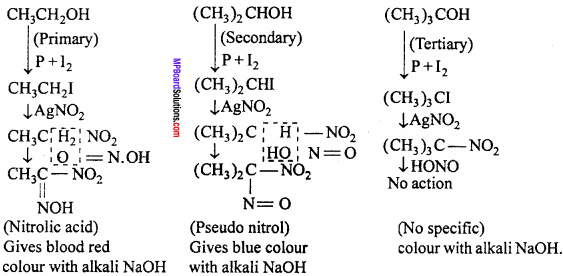
Question 8.
Write Victor Meyer method to distinguish primary, secondary and tertiary alcohol.
Answer:
Victor Meyer’s method:

1. The given alcohol is converted into an iodide by concentrated HI or red phosphorus and iodine.

2. The iodide is treated with silver nitrite to form nitroalkane.

3. Nitroalkane is finally treated with nitrous acid (NaNO2 + H2SO4) and made alkaline with KOH.

  • If a blood red colour is obtained, the original alcohol is primary.
  • If a blue colour is obtained, the alcohol is secondary.
  • If no colour is produced, the alcohol is tertiary.

MP Board Class 12th Chemistry Important Questions Chapter 11 Alcohols, Phenols and Ethers 12

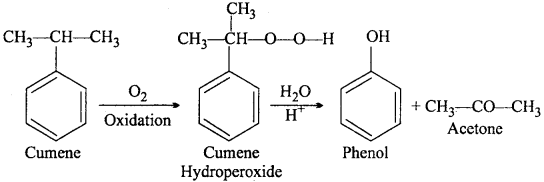
Question 9.
Give the equations of reactions for the preparation of phenol from cumene.
Answer:
MP Board Class 12th Chemistry Important Questions Chapter 11 Alcohols, Phenols and Ethers 13

Question 10.
Differentiate between Phenol and Alcohol and write Libermann’s reaction related to phenol.
Answer:
Differences between Phenol and Alcohol:
Phenol:

  • Physical properties – Characteristic phenolic odour, sparingly soluble in water.
  • It is acidic and dissolve in bases to form salt.
  • On oxidation, hybrid coloured product is formed.
  • Produce characteristic colour with Ferric chloride.
  • It does not react with halogen acid.
  • With PC15, mainly form triaryl phosphate.

Alcohol:

  • Pleasant odour, fairly soluble in water.
  • It is neutral and do not reacts with bases.
  • It can easily oxidize to Aldehydes and ketones.
  • It does not reacts with ferric chloride.
  • Forms Alkyl halide.
  • Alkyl chloride are formed.

Libermann’s Reaction:
On adding few drops of concentrated sulphuric acid and little sodium nitrite in phenol first dark blue colour is produced on adding water colour becomes red and on adding an alkali red colour again changes to blue colour.

MP Board Solutions

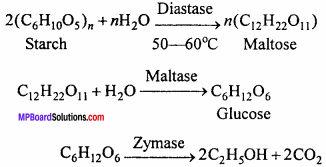
Question 11.
Give equations for the preparation of ethyl alcohol by starch and write name of enzymes.
Answer:
MP Board Class 12th Chemistry Important Questions Chapter 11 Alcohols, Phenols and Ethers 14

Enzymes:

  • Diastase
  • Maltase
  • Zymase.

Question 12.
Explain, why propanol has higher boiling point than that of the hydrocarbon, butane? (NCERT)
Answer:
The molecules of butane are held together by weak van der Waals’ force of attraction while those of propanol are held together by stronger intermolecular hydrogen bonding.
MP Board Class 12th Chemistry Important Questions Chapter 11 Alcohols, Phenols and Ethers 15
Therefore, the b.p. of propanol is much higher than that of butane.

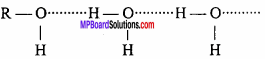
Question 13.
Alcohols are comparatively more soluble in water than hydrocarbons of comparable molecular masses. Explain this fact. (NCERT)
Answer:
Alcohols can form hydrogen bonds with water and break the H – bond exist between water molecules. Hence, they are soluble in water.
MP Board Class 12th Chemistry Important Questions Chapter 11 Alcohols, Phenols and Ethers 55
On the other hand, hydrocarbons cannot form hydrogen bonds with water molecules and hence are insoluble in water.

Question 14.
What is meant by hydroboration – oxidation reaction? Illustrate it with an example. (NCERT)
Answer:
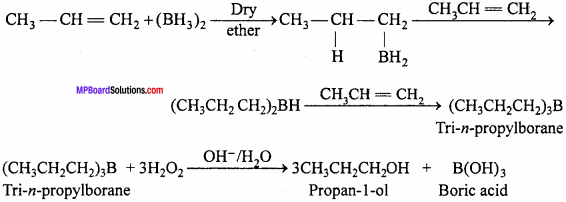
The addition of diborane to alkene to form trialkyl boranes followed by their oxidation with alkaline hydrogen peroxide to form alcohol is called hydroboration – oxidation. For example:
MP Board Class 12th Chemistry Important Questions Chapter 11 Alcohols, Phenols and Ethers 16
The alcohols obtained by this process appear to have been formed by direct addition of water to the alkene against Markownikoffs rule.

Question 15.
Ethyl alcohol and phenol both contain – OH group. What is the reason that phenoffs acidic and alcohol has alkaline effect? (MP 2015)
Or
Ethyl alcohol and phenol both contain – OH group. What is the reason that phenol is acidic and alcohol is neutral in nature? (MP 2013)
Answer:
Explanation of acidic nature of phenol:
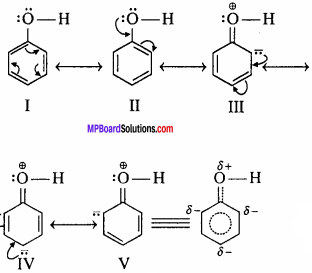
One possible explanation why phenols are stronger acids as compared to alcohols is that phenols exist as a resonance hybrid.
MP Board Class 12th Chemistry Important Questions Chapter 11 Alcohols, Phenols and Ethers 17

Due to resonance, the oxygen atom gets a positive charge and attracts the electron pair of the O – H bond and thus facilitates the release of a proton. The phenoxide ion formed after the release of a proton is also stabilized by resonance.
MP Board Class 12th Chemistry Important Questions Chapter 11 Alcohols, Phenols and Ethers 18
In alcohols, no resonance is possible hence the hydrogen atom is more firmly linked to the oxygen.

MP Board Solutions

Question 16.
Pure phenol is a colourless solid but why it is converted into pink after some time?
Or
What change in colour is observed in phenol in presence of oxygen? Explain with reaction. (MP2011)
Answer:
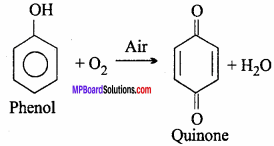
In the presence of air pure phenol oxidises into quinone.
MP Board Class 12th Chemistry Important Questions Chapter 11 Alcohols, Phenols and Ethers 19
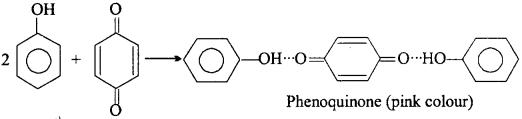
This quinone again combines with two molecules of phenol by H – bond and gives pink phenoquinone.

MP Board Class 12th Chemistry Important Questions Chapter 11 Alcohols, Phenols and Ethers 20

Question 17.
Explain the manufacture of CH3OH by water gas.
Answer:
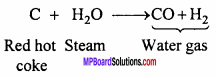
From water gas : Steam is passed over red hot coke when water gas is formed.

MP Board Class 12th Chemistry Important Questions Chapter 11 Alcohols, Phenols and Ethers 21
Water gas is mixed with half its volume of hydrogen, compressed to about 200 atm and passed over a catalyst which is a mixture of oxides of copper, zinc and chromium at 300°C.

MP Board Class 12th Chemistry Important Questions Chapter 11 Alcohols, Phenols and Ethers 22

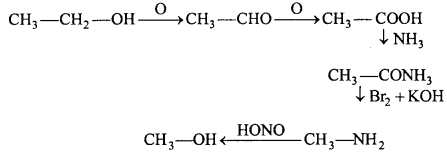
Alcohols, Phenols and Ethers Long Answer Type Questions

Question 1.
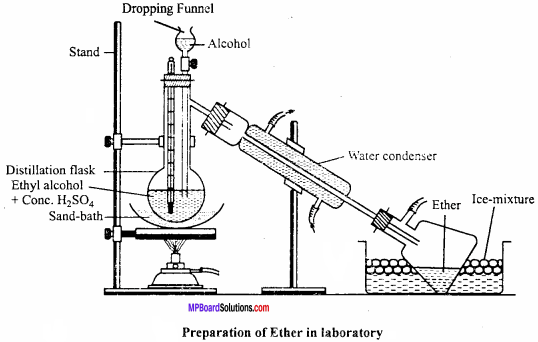
What is Williamson continuous etherification process? Is it a continuous process? Explain. Give labelled diagram.
Or,
Describe the laboratory method of preparation of diethyl ether. How ether thus obtained is purified?
Answer:
Laboratory Method for the Preparation of Diethyl Ether (Sulphuric Ether):
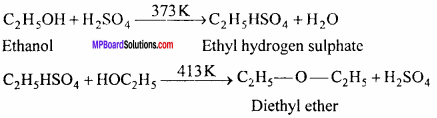
Diethyl ether is prepared in the laboratory and industry by the Williamson continuous etherification process, i.e., by heating ethanol (in excess) with concentrated sulphuric acid.
MP Board Class 12th Chemistry Important Questions Chapter 11 Alcohols, Phenols and Ethers 23
Sulphuric acid is regenerated in the reaction hence, it appears as if only a small amount of acid may convert an excess of alcohol into ether. So, this method is called Williamson continuous etherification process but actually we cannot get ether continuously.

This is due to the following two reasons :

  • Water formed in the reaction dilutes the acid and its reactivity decreases.
  • A part of sulphuric acid is reduced by alcohol into sulphur dioxide.

Method:
Ethanol and H2SO4 (2:1) are taken in a flask and heated on sand bath at 140°C. Ethanol is added at the same rate at which ether distilled over and is collected in a receiver cooled in ice – cold water.
MP Board Class 12th Chemistry Important Questions Chapter 11 Alcohols, Phenols and Ethers 24

Purification:
Ether contain ethanol, water and sulphuric acid as impurities. It is washed with NaOH to remove sulphuric acid and then agitated with 50% solution of calcium chloride to remove alcohol. It is then washed with water, dried over anhydrous calcium chloride and redistilled.

Question 2.
How can you change the following:

  1. Methanol to ethanol
  2. Ethanol to methanol.

Answer:
1. Methanol to ethanol :
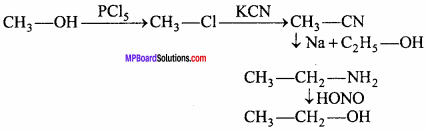
MP Board Class 12th Chemistry Important Questions Chapter 11 Alcohols, Phenols and Ethers 25

2. Ethanol to methanol :
MP Board Class 12th Chemistry Important Questions Chapter 11 Alcohols, Phenols and Ethers 26

Question 3.
Differentiate primary, secondary and tertiary alcohol by oxidation and dehydrogenations method. (MP 2011)
Answer:
1. Oxidation:
The oxidizing agents generally used for oxidation of alcohols are acid dichromate, acid or alkaline KMnO4 and dilute HNO3.
(i) A primary alcohol is easily oxidized to an aldehyde and then to an acid both containing the same number of carbon atoms as the original alcohol.
MP Board Class 12th Chemistry Important Questions Chapter 11 Alcohols, Phenols and Ethers 27

(ii) A secondary alcohol on oxidation gives a ketone with the same number of carbon atoms as the original alcohol, ketones are oxidized with difficulty but prolonged action of oxidizing agents produce carboxylic acids containing fewer number of carbon atoms than the original alcohol.
MP Board Class 12th Chemistry Important Questions Chapter 11 Alcohols, Phenols and Ethers 28

(iii) A tertiary alcohol is resistant to oxidation in neutral or alkaline solutions but is readily oxidized by an acid oxidizing agent giving a mixture of ketone and acid each having lesser number of carbon atoms than the original alcohol.

MP Board Class 12th Chemistry Important Questions Chapter 11 Alcohols, Phenols and Ethers 29

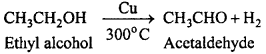
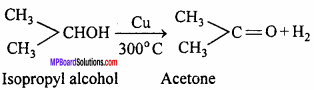
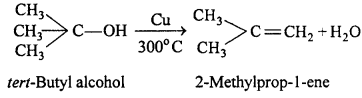
2. Dehydrogenation (Action of hot reduced copper at 300 °C):
Different types of alcohols give different products when their vapours are’passed over Cu gauze at 300°C.

Primary alcohols lose hydrogen and yield an aldehyde.
MP Board Class 12th Chemistry Important Questions Chapter 11 Alcohols, Phenols and Ethers 30

Secondary alcohols lose hydrogen and yield a ketone.
MP Board Class 12th Chemistry Important Questions Chapter 11 Alcohols, Phenols and Ethers 31

Tertiary alcohols are not dehydrogenated but lose a water molecule to give alkenes.
MP Board Class 12th Chemistry Important Questions Chapter 11 Alcohols, Phenols and Ethers 32

Question 4.
Explain the mechanism of dehydration of alcohol.
Answer:
Dehydration of alcohol :
(i) When ethyl alcohol is heated in excess of cone. H2SO4 molecule of water is eliminated and alkene is formed.
MP Board Class 12th Chemistry Important Questions Chapter 11 Alcohols, Phenols and Ethers 33

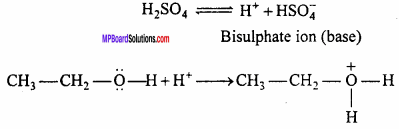
Mechanism :
(i) Protonation of alcohol by H2SO4
MP Board Class 12th Chemistry Important Questions Chapter 11 Alcohols, Phenols and Ethers 34

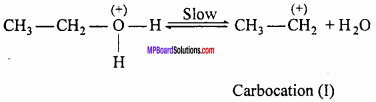
(ii) Removal of water
MP Board Class 12th Chemistry Important Questions Chapter 11 Alcohols, Phenols and Ethers 35

(iii) Elimination of β – hydrogen in the form of proton by base (bisulphate ion)
MP Board Class 12th Chemistry Important Questions Chapter 11 Alcohols, Phenols and Ethers 56
Stability of the carbocation (I) determines the case of dehydration and order of stability of carbocation is:
CH3 < C2H5 < Isopropyl < Tertiary butyl

Question 5.
How is ethyl alcohol obtained by molasses? Explain in brief.
Or,
What are molasses? How is alcohol obtained by fermentation? Explain. Tell favourable conditions of fermentation. Draw labelled diagram of coffee still.
Answer:
From molasses:
Molasses is the syrupy solution of sugar left after the separation of cane sugar or beet sugar crystals from the concentrated juice.

The different steps of the manufacture processes are :
1. Dilution:
The molasses is diluted with water so that a concentration of 8 – 10 percent sugar is obtained in solution. This is acidified with dilute sulphuric acid to retard other bacterial growth. A solution of ammonium salts is also added which acts as food for the ferment.

2. Alcoholic fermentation:
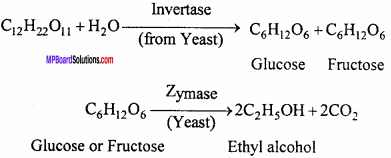
The dilute solution obtained above [From step (a)] is taken in big fermentation tanks and some yeast is added. The mixture is kept for a few days and the temperature is maintained at about 30°C. The fermentation reaction starts and the enzyme Invertase (From Yeast) converts sucrose into glucose and fructose which are then converted into
MP Board Class 12th Chemistry Important Questions Chapter 11 Alcohols, Phenols and Ethers 36
The fermentation is completed in about 3 days. The carbon dioxide is collected as a by product.

3. Distillation:
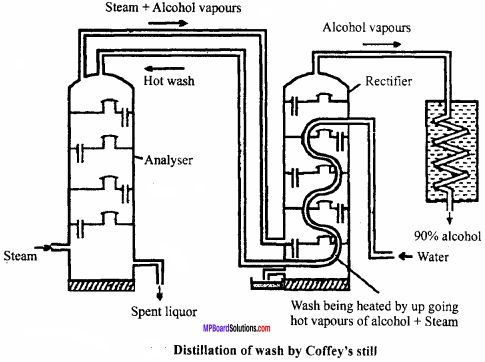
The fermented liquor is technically called wash or wort which contains about 9 – 10 percent ethanol. It is then distilled in a continuous still called Coffey’s still. It consists of two tall fractionating columns which are called analyser and the rectifier. It works on the counter current principle and the steam and wash travel in opposite directions through the still.
MP Board Class 12th Chemistry Important Questions Chapter 11 Alcohols, Phenols and Ethers 37
The steam goes upwards in the analyser and takes away the alcohol vapours from the downcoming dilute alcohol. The mixture leaves the analyser from the top and enters the rectifier at the base. Here it heats the wash flowing through the pipes on its way to the analyser. Most of the steam condenses and the alcohol vapours condenses in the condenser. The distillate contain 90% alcohol.

4. Rectification : Wash is rectified by fractional distillation.

MP Board Solutions

Question 6.
Give equations for three methods of preparation of phenol.
Answer:
Methods of preparation of phenol:
1. By the hydrolysis of Benzene diazonium salts:
Benzene diazonium salt is formed by aromatic primary amine (aniline) with nitrous acid at 0 – 5°C. On boiling aqueous solution of this salt phenol is formed.
MP Board Class 12th Chemistry Important Questions Chapter 11 Alcohols, Phenols and Ethers 38

2. By alkaline fusion of sodium benzene sulphonate:
On fusing sodium benzene sulphonate with NaOH, sodium phenoxide is formed which on acidification forms phenol.
MP Board Class 12th Chemistry Important Questions Chapter 11 Alcohols, Phenols and Ethers 39

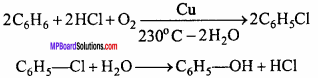
3. Rasching method:
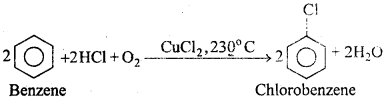
On heating benzene with mixture of HCl and air to 230°C in the presence of Cu catalyst chlorobenzene is formed which on hydrolysis form phenol.
MP Board Class 12th Chemistry Important Questions Chapter 11 Alcohols, Phenols and Ethers 40

Question 7.
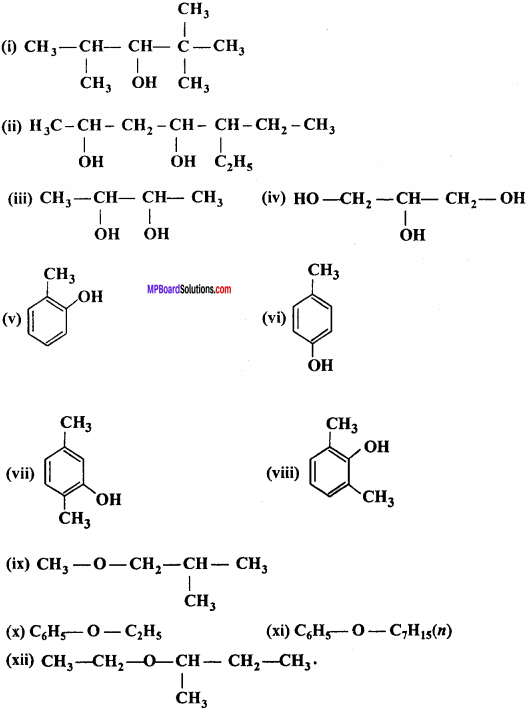
Write IUPAC names of the following compounds: (NCERT)
MP Board Class 12th Chemistry Important Questions Chapter 11 Alcohols, Phenols and Ethers 41
Answer:

  1. 2,2,4 – Trimethyl pentan – 3 – ol
  2. 5 – Ethylheptane – 2,4 – diol
  3. Butan – 2,3 – diol
  4. Propane – 1,2,3 – triol
  5. 2 – Methylphenol
  6. 4 – Methylphenol
  7. 2,5 – Dimethylphenol
  8. 2,6 – Dimethylphenol
  9. 1 – Methoxy – 2 – methylpropane
  10. Ethoxybenzene
  11. 1 – Phenoxyheptane
  12. 2 – Ethoxybutane.

Question 8.
How can you obtained following compounds from phenol: (MP 2012; Supp. 14,16)

  1. 4, 6 – Tribromophenol
  2. Picric acid
  3. Aniline
  4. Benzene
  5. Phenolp – hthalene
  6. p – cresol, o – cresol.

Answer:
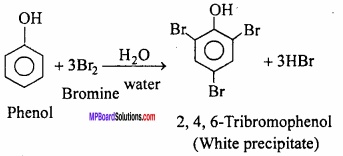
1. Phenol to Tribromophenol : Phenols readily react with halogens to give polyhalogen substituted compounds. Phenol gives white precipitate of 2, 4, 6 – tribromo – phenol with bromine water.

MP Board Class 12th Chemistry Important Questions Chapter 11 Alcohols, Phenols and Ethers 43

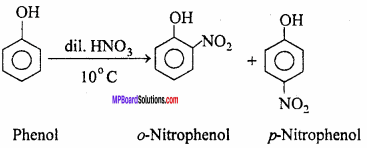
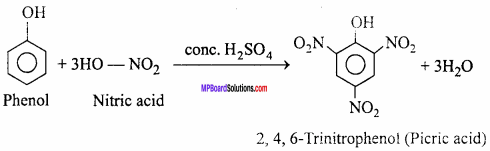
2. Phenol to Picric acid : Nitration : On nitration, phenols give a variety of products depending upon the conditions.

MP Board Class 12th Chemistry Important Questions Chapter 11 Alcohols, Phenols and Ethers 44

Nitration of phenol with cone. HNO3 in presence of cone. H2SO4 gives, 2,4,6 – Trini – trophenol (Picric acid). (MP 2014)

MP Board Class 12th Chemistry Important Questions Chapter 11 Alcohols, Phenols and Ethers 45

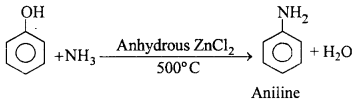
3. Phenol to Aniline:
MP Board Class 12th Chemistry Important Questions Chapter 11 Alcohols, Phenols and Ethers 46

4. Phenol to Benzene :
MP Board Class 12th Chemistry Important Questions Chapter 11 Alcohols, Phenols and Ethers 47

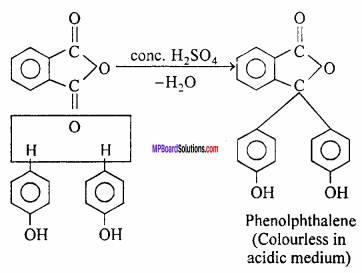
5. Phenol to Phenolphthalene : Phenol condenses with phthalic anhydride in presence of cone. H2SO4 to give phenolphthalein which is an indicator for acid – base titrations and is used as a laxative in medicine.
MP Board Class 12th Chemistry Important Questions Chapter 11 Alcohols, Phenols and Ethers 48

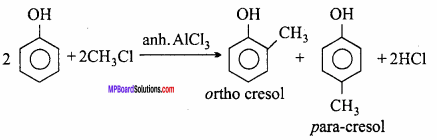
(vi) Phenol to para cresol :
MP Board Class 12th Chemistry Important Questions Chapter 11 Alcohols, Phenols and Ethers 49

MP Board Class 12th Chemistry Important Questions

MP Board Class 12th Chemistry Important Questions Chapter 10 Haloalkanes and Haloarenes

MP Board Class 12th Chemistry Important Questions Chapter 10 Haloalkanes and Haloarenes

Haloalkanes and Haloarenes Important Questions

Haloalkanes and Haloarenes Very Short Answer Type Questions

Question 1.
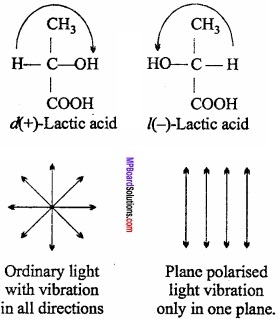
What is plane polarized light?
Answer:
Light which vibrates in one specific plane is known as plane polarized light. On passing normal light through a Nicol prism, plane polarized light is obtained.

Question 2.
Write an example of 3° alkyl chloride.
Answer:
Tertiary butyl chloride
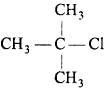
MP Board Class 12th Chemistry Important Questions Chapter 10 Haloalkanes and Haloarenes 1
(2-chloro-2-methyl propane)

Question 3.
What is the order of boiling points of alkyl halides for the same alkyl group?
Answer:
Decreasing order of boiling points : RI > RBr > RCl > RF.

MP Board Solutions

Question 4.
Write the equation of Swart’s reaction.
Answer:
MP Board Class 12th Chemistry Important Questions Chapter 10 Haloalkanes and Haloarenes 2

Question 5.
What are Enantiomers?
Answer:
The stereoisomers related to each other as non – superimposable mirror images are called Enantiomers.

Question 6.
What are polyhalogen compounds? Give two examples.
Answer:
Carbon compounds which contain more than one halogen atom are known as polyhalogen compounds like CHCl3, CCl4 etc.

Haloalkanes and Haloarenes Short Answer Type Questions

Question 1.

  1. Write Iodoform reaction.
  2. Iodoform gives yellow ppt. with AgNO3 solution but chloroform doesn’t Why?
  3. What happens when ethyl bromide is heated with alcoholic KOH?

Answer:
1. Iodoform reaction:
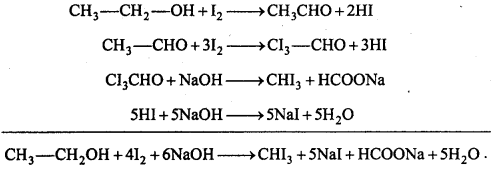
When ethyl alcohol or acetone is heated with iodine and NaOH, yellow crystals of iodoform are formed.
C2H5OH + 4I2 + 6NaOH → 5Naf + HCOONa + 5H2O + CHI3

2. When iodoform is heated with AgNO3 solution a yellow ppt. (Agl) is obtained but chloroform doesn’t give this reaction because in chloroform C – CI bond is more stable than C – I bondin iodoform.

3. On boiling Ethyl bromide with alcoholic KOH ethylene is formed.
MP Board Class 12th Chemistry Important Questions Chapter 10 Haloalkanes and Haloarenes 3

Question 2.
Explain the Sandmeyer reaction with example.
Answer:
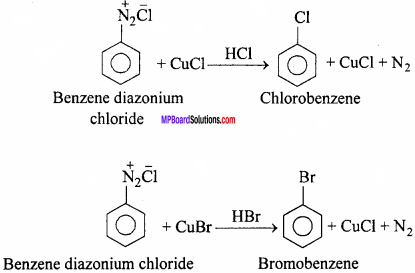
Decomposition of diazonium salts (Sandmeyer reaction):
When a diazonium salt solution is added to a solution of cuprous halide dissolved in the corresponding halogen acid, the diazo group is replaced by a halogen atom.
MP Board Class 12th Chemistry Important Questions Chapter 10 Haloalkanes and Haloarenes 4

Question 3.
Give chemical reaction between chlorobenzene and chloral in presence of cone. H2SO4.
Or, How is D.D.T. formed? Write its one application.
Answer:
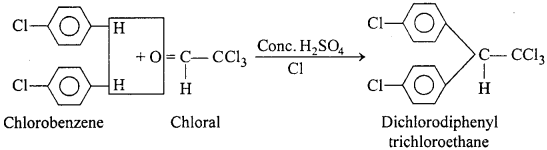
DDT (Dichlorodiphenyl trichloroethane) is formed by the condensation of one molecule of chloral with two molecules of chlorobenzene in presence of cone, H2SO4.
MP Board Class 12th Chemistry Important Questions Chapter 10 Haloalkanes and Haloarenes 5
Application : It is an important pesticide.

Question 4.
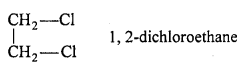
What are Gem – dihalide and Vicinal – dihalide?
Answer:
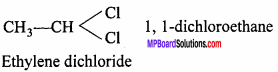
When both halogen atoms are linked to one carbon atom of hydrocarbon then it is known as Gem-dihalide. Gem means geminal i. e., same position.
MP Board Class 12th Chemistry Important Questions Chapter 10 Haloalkanes and Haloarenes 6
When both halogen atoms are connected to two different neighbouring carbon atoms, then it is known as vicinal dihalide. Vic means vicinal which means adjacent position.
MP Board Class 12th Chemistry Important Questions Chapter 10 Haloalkanes and Haloarenes 7

Question 5.
What is Lucas reagent? Give its application.
Answer:
Solution of ZnCl2 in cone. HCl is known as Lucas reagent.
Application:
It is used to differentiate primary, secondary and tertiary alcohols.
On adding the alcohol to Lucas reagent, a tertiary alcohol reacts immediately forming a ppt. of alkyl chloride. If the ppt. appears after few minutes, then the alcohol is secondary. If no ppt. is obtained in cold the alcohol is primary.

MP Board Solutions

Question 6.
Explain, Carbylamine reaction and give one application of this reaction. (MP 2018)
Answer:
Carbylamine reaction: On heating chloroform with primary amine (e.ganiline) and alcoholic KOH solution, phenylisocyanide or carbylamine is formed which has a very bad smell and is poisonous.
MP Board Class 12th Chemistry Important Questions Chapter 10 Haloalkanes and Haloarenes 8
Application : Chloroform and primary amine can be tested by this reaction.

Question 7.
What is 666 (lindane)? Explain its preparation and use in agriculture.
Answer:
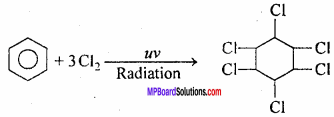
It is 1, 2, 3, 4, 5, 6 – HexachIorocyciohexane. It is obtained by heating benzene with chlorine in presence of sunlight.

Preparation : It is prepared by the chlnncriUiv benzene in the presence of ultraviolet light.
MP Board Class 12th Chemistry Important Questions Chapter 10 Haloalkanes and Haloarenes 9
1,2, 3,4, 5, 6 – Hexachlorocyclohexane (B.H.C.)

Uses:
Benzene hexachloride is an addition compound and its γ – isomer is called gammexane. It is an important pesticide used in agriculture. It is also called lindane or 666.

Question 8.
Explain the following reaction of chlorobenzene:

  1. Ration with chlorine in the presence of FeCI3 in dark
  2. Fittig reaction.

Answer:
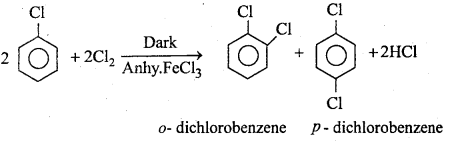
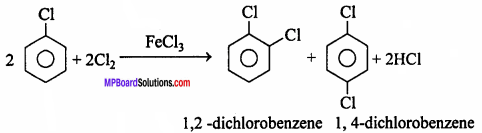
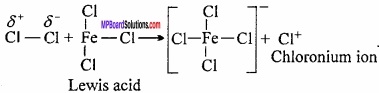
1. When Chlorobenzene reacts with Cl2 hi the presence of FeCl3 in dark. o – dichlorobenzene and p – dichlorobenzene is obtained.
MP Board Class 12th Chemistry Important Questions Chapter 10 Haloalkanes and Haloarenes 10

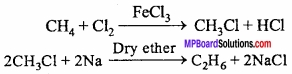
2. Fittig reaction : When Chlorobenzene is heated at 200°C with Cu powder in a sealed tube Diphenyl is formed.
MP Board Class 12th Chemistry Important Questions Chapter 10 Haloalkanes and Haloarenes 11
When two molecules of aryl halide reacts with sodium metal in presence of dry ether, then diphenyl is formed. This reaction is known as Fittig reaction.
MP Board Class 12th Chemistry Important Questions Chapter 10 Haloalkanes and Haloarenes 12

Question 9.
Write short notes on :

  1. Hunsdiecker method and
  2. Raschig process.

Answer:
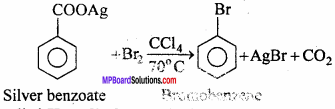
1. Hunsdiecker method : When silver salt of a carboxylic acid is heated with bromine, in the presence of an inert solvent like CCl4, aryl bromide is formed.
MP Board Class 12th Chemistry Important Questions Chapter 10 Haloalkanes and Haloarenes 13
This method is called Hunsdiecker method.

2. Raschig process : When benzene vapours mixed with air and HCl gas is passed over CuCl2 (catalyst) at 230°C, chlorobenzene is formed.

MP Board Class 12th Chemistry Important Questions Chapter 10 Haloalkanes and Haloarenes 14

Question 10.
Write method of preparation, properties and uses of Freon.
Answer:
Freon : Dichloro, Difluoro methane.
it is formed by the action of SbF3 with CCl3 in presence of SbCl5.
MP Board Class 12th Chemistry Important Questions Chapter 10 Haloalkanes and Haloarenes 15
It has very low boiling point due to which by increasing the pressure at room temperature it can be liquefied. It is a non – poisonous, non – combustible and inactive substance which is used as a cooling agent in the refrigerator. It is used in aerosol and foam.
MP Board Solutions

Question 11.

  1. B.P. of ethyl iodide is higher than b.p. of ethyl bromide. Give reason.
  2. Explain why the m.p. of para dichlorobenzene is higher than its ortho arid meta derivatives.

Answer:

  1. In alkyl halides containing same alkyl group boiling point increases with increase in atomic weights of halogen atoms. Molecular weight of ethyl iodide is more than ethyl bromide and therefore boiling point of ethyl iodide is also high.
  2. Para derivatives of dichlorobenzene is more symmetrical than its ortho and meta derivatives therefore its m.p. is higher.

Question 12.
Explain Friedel – Craft’s reaction with chemical equation,
Answer:
Friedel – Craft’s reaction (alkylation) : Alkyl halides react with benzene in presence of anhydrous aluminium chloride to give alkyl benzene.
MP Board Class 12th Chemistry Important Questions Chapter 10 Haloalkanes and Haloarenes 16

Acetylation:
Acetyl chloride reacts with benzene in presence of anhydrous aluminium chloride to give acetophenone.
MP Board Class 12th Chemistry Important Questions Chapter 10 Haloalkanes and Haloarenes 17

Question 13.
Give the uses of freon – 12, D.D.T., Carbon tetrachloride and Iodoform. (NCERT)
Answer:
It is an important pesticide.
Freon – 12:
Since freons have been found to be one of the factors responsible for the depletion of ozone layer, they are being replaced by other harmless compounds in many countries.

D.D.T:
DDT is highly toxic and has strong insecticidal properties and thus it was widely used as an insecticide and pesticide.

Carbon Tetrachloride:
It is produced in large quantities for use in the manufacture of refrigerants and propellants for aerosol cans. It is used as feed stock in the synthesis of chlorofluorocarbons and other chemicals, pharmaceutical manufacturing and general solvents use. Until the mid 1960’s, it was widely used as a cleaning fluid both in industry as a degreasing agent and in the home, as a spot remover and as fire extinguisher.

Iodoform:
It was earlier used as an antiseptic but the antiseptic properties are due to the liberation of free iodine and not due to iodoform itself. Due to its objectionable smell, it has been replaced by other formulations containing iodine.

Question 14.
Name of the following halides according to IUPAC system and classify them as alkyl, allyl, benzyl (primary, secondary, tertiary), vinyl or aryl halides : (NCERT)

  1. (CH3)2CHCH(CI)CH3
  2. CH3CH2CH(CH3)CH(C2H)CI
  3. CH3CH2C(CH3)2CH2I
  4. (CH3)3CCH2CH(Br)C6H5
  5. CH3CH(CH3)CH(Br)CH3
  6. CH3C(C2H5)2CH2Br
  7. CH3C(CI)(C2H5)CH2CH3
  8. CH3CHC(Cl)CH2CH(CH3)2
  9. CH3CH=CHC(Br)(CH3)2
  10. p – ClC6H4CH2CH(CH3)2
  11. m – ClCH2C6H4CH2C(CH3)3
  12. o – Br – C6H4CH(CH3)CH2CH3.

Answer:

  1. 2 – Chloro – 3 – methylbutane (2° alkyl)
  2. 3 – Chloro – 4 – methyIhexane (2° alkyl)
  3. 1 – Iodo – 2,2 – dimethylbutane (1° alkyl)
  4. 1 – Bromo – 3,3 – dimethyl – 1 – phenylbutane (2° benzylic)
  5. 2 – Bromo – 3 – methylbutane (2° alkyl)
  6. 3 – Bromomethyl – 3 – methylpentane (1° alkyl)
  7. 3 – Chloro – 3 – methylpentane (3° alkyl)
  8. 3 – Chloro – 5 – methylhex – 2 – ene (vinyl)
  9. 4 – Bromo- 4 – methylpent – 2 – ene (allylic)
  10. 1 – Chloro – 4 – (2′-methylpropyl) benzene (aryl) or p – Chloro isobutyl benzene
  11. 1 – Chloromethyl-3-(2’2′-diethylpropyl) benzene (benzylic) or m – Neopentyl benzyl chloride
  12. 1 – Bromo – 2 – (l’ – methylpropyl) benzene (aryl).

Question 15.
Identify ‘A’, ‘B’, ‘C’ and ‘D’.
MP Board Class 12th Chemistry Important Questions Chapter 10 Haloalkanes and Haloarenes 18
Answer:
MP Board Class 12th Chemistry Important Questions Chapter 10 Haloalkanes and Haloarenes 19

Question 16.
Write the equation of following reactions of chlorobenzene : (MP 2015)

  1. Halogenation
  2. Nitration
  3. Sulphonation
  4. Alkylation.

Answer:
1. Halogenation : Haloarene reacts with halogen in presence of halogen carrier like FeCl3 to form ortho and para substituted dihaloarene.
MP Board Class 12th Chemistry Important Questions Chapter 10 Haloalkanes and Haloarenes 20

2. Nitration : Haloarenes react with nitrating mixture to form o – nitro and p – nitro substituted haloarenes.
MP Board Class 12th Chemistry Important Questions Chapter 10 Haloalkanes and Haloarenes 21

3. Sulphonation : On heating with cone. H2SO4, 2 – Chlorobenzene sulphonic acid and 4-Chlorobenzene sulphonic acid are formed.
MP Board Class 12th Chemistry Important Questions Chapter 10 Haloalkanes and Haloarenes 22
4. Alkylation : Alkylation takes place with alkyl halide in presence of anhydrous A1C13.
MP Board Class 12th Chemistry Important Questions Chapter 10 Haloalkanes and Haloarenes 23

Haloalkanes and Haloarenes Long Answer Type Questions

Question 1.
Explain the nucleophilic substitution reaction in alkyl halide by SN1 and SN2 medianism.
Answer:
Nucleophilic substitution reaction:
In the carbon halogen bond ofhaloalkane. halogen atom is more electronepativ0 as compared to the carbon atom hence, the shared pair of electrons between carbon and halogen is more attracted by the halogen atom. As a result a small negative charge and an equivalent positive charge develops on halogen atom and carbon atom respectively.

Nucleophile attacks the electron deficient carbon due to the presence of partial positive charge on it and replaces the weaker nucleophilic ion i.e. the halide ion. Thus, the reaction is known as nucleophilic substitution reaction.
MP Board Class 12th Chemistry Important Questions Chapter 10 Haloalkanes and Haloarenes 24
The order of reactivity of different alkyl halide towards nucleophilic substitution reaction is:
RI > RBr > RC1 > RF

Mechanism of Nucleophilic substitution reactions :
Nucleophilic substitution reaction occurs through two different mechanism :

(1) SN1 Mechanism (Unimolecular nucleophilic substitution) : In this mechanism following steps are involved :
(a) Formation of carbocation by dissociation of substrate i.e., reactant molecule.
MP Board Class 12th Chemistry Important Questions Chapter 10 Haloalkanes and Haloarenes 25

(b) Attack of nucleophile on carbocation forming the product.
MP Board Class 12th Chemistry Important Questions Chapter 10 Haloalkanes and Haloarenes 26

(2) SN2 mechanism (Bimolecular nucleophilic substitution):
Reactions of this type occur in one step i.e. they are concerted reactions. These reaction nucleophilic attack results in a transition state in which both the reactant molecules are partially bonded to each other and then the halide ion escapes out forming the product.
ROH + CH3X → CH3OH + RX
MP Board Class 12th Chemistry Important Questions Chapter 10 Haloalkanes and Haloarenes 27
Rate of reaction = K[(RX)OH]
Order of reactivity of alkyl halide is : Primary > Secondaxy > Tertiary.

MP Board Solutions

Question 2.
Draw labelled diagram of laboratory method for preparation of iodoform from akfohol. Write related chemical equation.
Answer:
MP Board Class 12th Chemistry Important Questions Chapter 10 Haloalkanes and Haloarenes 28

Chemical reaction:
MP Board Class 12th Chemistry Important Questions Chapter 10 Haloalkanes and Haloarenes 29

Question 3.
Write the structure of the major organic product in each of the following reactions: (NCERT)
MP Board Class 12th Chemistry Important Questions Chapter 10 Haloalkanes and Haloarenes 30
Answer:
MP Board Class 12th Chemistry Important Questions Chapter 10 Haloalkanes and Haloarenes 58

Question 4.
Give the laboratory method for the preparation of chloroform. Describe the formation of chloroform by ethanol with labelled diagram, equation and principle.
Answer:
Laboratory method : Chloroform is prepared in the laboratory by the action of water and bleaching powder on ethyl alcohol or acetone.

Method:
About 100 gm of bleaching powder made into a paste by adding about 200 ml of water and taken in a flask fitted with a condenser. Now, 25 ml of alcohol or acetone is added and the mixture is distilled, chloroform collects as a heavy liquid under water.

It is washed with dilute NaOH solution then with water, dried over fused calcium chloride and redistilled. The available chlorine of bleaching powder acts as oxidising as well as chlorinating agent during the preparation of chloroform from alcohol and acetone.
CaOCl2 + H2O → Ca(OH)2 + Cl2
MP Board Class 12th Chemistry Important Questions Chapter 10 Haloalkanes and Haloarenes 33
The chemistry involved in the conversion of alcohol and acetone into chloroform is as shown below:

(A) From alcohol: The steps involved are :
(i) Ethyl alcohol is oxidized by chlorine to acetaldehyde.
MP Board Class 12th Chemistry Important Questions Chapter 10 Haloalkanes and Haloarenes 34

(ii) Acetaldehyde reacts with chlorine to give chloral, i.e. trichloro acetaldehyde.
MP Board Class 12th Chemistry Important Questions Chapter 10 Haloalkanes and Haloarenes 35

(iii) Two moles of chloral react with one mole of calcium hydroxide to produce chloroform.
MP Board Class 12th Chemistry Important Questions Chapter 10 Haloalkanes and Haloarenes 36
Calcium hydroxide Chloral Chloroform Calcium formate.

MP Board Solutions

Question 5.
MaloaIkanes are more reactive than haloarenes. Give reason.
or,
Why, aryl halides are less reactive than alkyl halides?
Answer:
In aryl halides, halogen atom is attached more strongly to the nucleus therefore the nucleophilic substitution takes slowly than alkyl halides. There is two reasons for the less reactivity of aryl halides.
(i) In aryl halides sp3hybridization takes place whereas in alkyl halides sp2 hybridization is present due to sp2 hybridization in haloarenes the halogen are attached to nucleus more strongly.
MP Board Class 12th Chemistry Important Questions Chapter 10 Haloalkanes and Haloarenes 37

(ii) Due to the presence of resonance in aryl halides there is some double bond character in C – Cl bond. Thus, the bond length of C – Cl bond is lesser than C – Cl bond in haloalkanes. Therefore, it is difficult to replace the halogen of haloarenes.
MP Board Class 12th Chemistry Important Questions Chapter 10 Haloalkanes and Haloarenes 38

Question 6.
What product is formed by the reduction of chloroform? Give the chemical equation when it reacts to nitric acid and acetone.
Answer:
Reduction:
1. On heating with Zn and HCl, it reduces to form methylene dichloride.
MP Board Class 12th Chemistry Important Questions Chapter 10 Haloalkanes and Haloarenes 39
2. On heating with zinc dust and water, methane is formed.
MP Board Class 12th Chemistry Important Questions Chapter 10 Haloalkanes and Haloarenes 40

Reactions of Chloroform :
1. With Conc.HNO3:
On treating chloroform with concentrated nitric acid, the hydrogen atom of chloroform is replaced by nitro group and nitro chloroform (or chloropicrin) is formed. It is a liquid (b.p. 112°C) which is used in war as a poisonous gas.
MP Board Class 12th Chemistry Important Questions Chapter 10 Haloalkanes and Haloarenes 41

2. With Acetone:
Chloroform condenses with acetone in presence of sodium hydroxide to form chloretone which is a hypnotic (sleep inducing drug) of high grade.
MP Board Class 12th Chemistry Important Questions Chapter 10 Haloalkanes and Haloarenes 42

Question 7.
Give the Chemical reaction when chloroform reacts with following:

  1. Oxidation
  2. Carbylamine reaction
  3. Ag powder
  4. Nitration
  5. Reimer – Tiemann reaction.

Or
How will you obtain the following from chloroform:

  1. Carbonyl chloride
  2. Acetylene
  3. Chloropicrin
  4. Phenyl isocyanide
  5. Chloretone
  6. Salicylaldehyde.

How trichloro methane reacts with :

  1. Atmospheric air
  2. Aniline and ale. KOH
  3. Ag powder
  4. Cone. HNO3
  5. Phenol
  6. Acetone.

Answer:
(a) Action of air and light (Oxidation):
Chloroform oxidizes in presence of sunlight and air and forms a poisonous gas, phosgene (carbonyl chloride).
MP Board Class 12th Chemistry Important Questions Chapter 10 Haloalkanes and Haloarenes 43
Ordinary chloroform contains phosgene gas and is used as a solvent. Pure chloroform which is used as an anaesthetic does not contain even traces of phosgene. While preserving chloroform which is to be used as an anaesthetic, the following precautions are taken:
(i) The chloroform is filled in blue or brown coloured bottle up to the neck. After putting a stopper, the bottle is kept in dark. As there is no empty space in the bottle, it is also to from air

(ii) One percent ethyl alcohol is added in the bottle. If phosgene gas is formed, alcohol reacts with it to form diethyl carbonate, a non – toxic substance, i.e. (C2H5)2CO3
MP Board Class 12th Chemistry Important Questions Chapter 10 Haloalkanes and Haloarenes 44

(b) Carbylamine reaction:
On heating chloroform with primary amine (example aniline) and alcoholic KOH solution, phenylisocyanide or carbylamine is formed which has a very bad smell and is poisonous.
MP Board Class 12th Chemistry Important Questions Chapter 10 Haloalkanes and Haloarenes 45

(c) Reaction with Ag powder or Dehalogenation: On heating chloroform with silver powder, pure acetylene gas is formed.
CHC13 + 6Ag + CI3CH → HC ≡ CH + 6 AgCl

(d) Nitration:
Haloarenes react with nitrating mixture to form o – nitro and p – nitro substituted haloarenes.
MP Board Class 12th Chemistry Important Questions Chapter 10 Haloalkanes and Haloarenes 21

(e) Reimer – Tiemann reaction:
On heating chloroform with concentrated alkali and phenol at 60 – 70°C, o – hydroxy benzaldehyde (salicylaldehyde) is formed. Traces of p- hydroxybenzaldehyde are also formed.
MP Board Class 12th Chemistry Important Questions Chapter 10 Haloalkanes and Haloarenes 48

(f) Acetone :
Chloroform condenses with acetone in presence of NaOH to form chloretone which is a hypnotic of high grade.
MP Board Class 12th Chemistry Important Questions Chapter 10 Haloalkanes and Haloarenes 46

Question 8.
An alcohol ‘A’ on reaction with cone. H2SO4 gives an alkene ‘B’. ’B’ after bromination with sodamide gives dehydrogenated compound ‘C’. ‘C’ on reaction of H2SO4 in presence of H2SO4 gives ‘D’. Identify ‘A’, ‘B% ‘C’, and ‘D’. (MP 2017)
Answer:
MP Board Class 12th Chemistry Important Questions Chapter 10 Haloalkanes and Haloarenes 47

MP Board Class 12th Chemistry Important Questions

MP Board Class 12th Maths Important Questions Chapter 1 Relations and Functions

MP Board Class 12th Maths Important Questions Chapter 1 Relations and Functions

Relations and Functions Important Questions

Relations and Functions Objective Type Questions:

Question 1.
Choose the correct answer:

Question 1.
Let f : R → R te a function defined as f(x) = 8x:
(a) f is one – one onto (c) / is one-one but not onto
(b) f is many – one onto
(c) f is one – one but not onto
(d) f is neither one – one nor onto
Answer:
(a) f is one – one onto (c) / is one-one but not onto

Question 2.
Let f : R → R be a function is defined as f (x) = \(\frac { e^{ x^{ 2 } }-e^{ -x^{ 2 } } }{ e^{ x^{ 2 } }+e^{ -x^{ 2 } } } \):
(a) f is one – one but not onto
(b) f is one – one onto
(c) f is neither one – one nor onto
(d) f is many one onto
Answer:
(a) f is one – one but not onto

Question 3.
If f : R → R be given by f(x) = \((3-x^{ 3 })^{ 1/3 }\) then (fof) x is:
(a) x \(x^{ 1/3 }\)
(b) x\(x^{ 3 }\)
(c) x
(d) \((3-x^{ 3 })\)
Answer:
(c) x

MP Board Solutions

Question 4.
Consider a binary operation * on N defined as a*b = \(a^{ 3 }\) + \(b^{ 3 }\):
(a) Is * both associative and commulative
(b) Is * commutative but not associative
(c) Is * associative but not commutative
(d) Is * neither commutative nor associative
Answer:
(b) Is * commutative but not associative

Question 5.
Number of binary operations on the set {a,b} are:
(a) 10
(b) 16
(c) 20
(d) 8
Answer:
(b) 16

Question 2.
Fill in the blanks:

  1. Number of equivalance relation in the set {1, 2, 3} containing (1,2) is …………………………….
  2. If f : R → R, when f(x) = 5x – 7,∀x∈R, then value of \(f^{ -1 }\) (7) is ……………………….
  3. If f : R → R, be defined by f(x) = x2 – 3x + 2, then f {f(x)} ……………………………
  4. If f : R → R, be defined by f(x) = 2x + 5, then \(f^{ -1 }\) (y) ………………………………
  5. If f : R → R, be defined by f(x) = x3 the f is ………………………………….

Answer:

  1. 2
  2. 0
  3. x4 – 6x3 + 10x2 – 3x
  4. \(\frac{1}{2}\) (y – 5)
  5. Is one – one

Question 3.
Write True/False:

  1. Let R = {(1, 3), (3, 1), (3, 3)} be a relation defined on A = {1, 2, 3}. Then R is symmetric, transitive but not reflexive.
  2. If f : A → B is bijective function, then the inverse of \(f^{ -1 }\) of f is unique.
  3. The composition of funtion is commutative
  4. Every function is invertible
  5. Let a binary operation * on the set Q+ of positive rational numbers be defined by a*b = \(\frac{ab}{3}\), ∀a,b ∈ Q+. Then the inverse of 4*6 is \(\frac{9}{8}\)

Answer:

  1. False
  2. True
  3. False
  4. False
  5. True

MP Board Solutions

Question 4.
Write the answer in one word/sentence:

  1. Write the identity relation on the set A = {a, b, c}
  2. What is the range of the function f(x) = \(\frac{|x – 1|}{x – 1}\)?
  3. Write the domain of real valued function f defined by f(x) = \(\sqrt { 25-x^{ 2 } } \)
  4. Let * be a binay operation defined by a*b = 3a + 4b – 2, then find 4*5
  5. Let fg : R → R, defined f(x) = 2x + 1 and g(x) = x2 – 2, ∀x ∈ R respectively. Then find fog.

Answer:

  1. {(a,a), (b,b), (c,c)}
  2. {-1,1}
  3. [-5,5]
  4. 30
  5. 4x2 + 4x – 1

Relations and Functions Long Answer Type Questions – I

Question 1.
Show that the relation R in set Z of integers given by R = {(a, b) : 2 divides a – b} is an equivalence relation? (NCERT)
Solution:
R is reflexive as 2 divides (a – a) for all Z.
Let (a,b) ∈ R ⇒ 2, divides (a – b)
⇒ 2,divides – (b – a)
(a,b) e R ⇒ (b,a) ∈ R
∴R is symmetric.
Let (a,b) ∈ R ⇒ 2, divides (a -b)
(b,c) ∈ R ⇒ 2, divides (b – c)
(a – b) and (b – c), are divisible by 2
(a – b) + (b – c), are divisible by 2
Hence (a – c) is also divisible by 2
∴ (a,b) ∈ R,(b,c) ∈ R ⇒ (a,c) ∈ R
∴ R is transitive.
∴ R is reflexive, symmetric and transitive. Therefore R is an equivalence relation in Z. Proved.

Question 2.
Let R be the relation defined in the set A = {1,2,3,4, 5,6,7} by R = {(a, b): both a and b are either odd or even}
Show that R is an equivalence relation. Further, show that all the elements of the subset {1,3,5,7} are related to each other and all the elements of the subset {2,4,6} are related to each other but no element of the subset {1,3,5, 7} is related to any element of the subset {2,4, 6}? (NCERT)
Solution:
Given any element a in A, both a and a must be either odd or even. So that (a, a) ∈ R .
Further (a,b) ∈ R ⇒ both a and b must be either odd or even (a,b) ∈ R
Similarly (a,b) ∈ R (b,c) ∈ R ⇒ all the elements of the a, b, c must be either even or odd simultaneously ⇒ (a,c) ∈ R .
Hence R is an equivalence relation.
All elements of {1,3,5,7} are related to each other, as all the elements of this subset are odd. Similarly, all the elements of the subset {2, 4, 6} are related to each other(MPBoardSolutions.com) as all of them are even. Also no elements of the subset{ 1, 3, 5, 7} can be related to any elements of {2,4, 6} as elements of {1, 3, 5, 7} are odd, while elements of {2, 4, 6} are even.

Question 3.
Let N is set of natural numbers. If R is a relation defined in set N × N such that (a, b) R (c, d). If ad (b + c) = bc (a + d). Prove that R is an equivalence? (CBSE 2015)
Solution:
Reflexive: For every (a,b) ∈ N × N
ab (b + a) = ba (a + b)
⇒ (a, b) R {a, b)
∴ R is reflexive.
Symmetric: Let (a,b) (c,d) ∈ N × N
(a,b) R (c,d) ⇒ ab(b + c) = bc (a + d)
⇒ bc (a + d) = ab(b + c)
(a,b) R (c,d) ⇒ (c,d) R (a,b)
∴ R is symmetric.
Transitive:
Let (a, b) R(c,d) and (c, d) R (e,f)
⇒ ad (b + c) = bc (a + d)
and cf (d + e) = de (c+f)
⇒ \(\frac{ad (b+c)}{abcd}\) = \(\frac{bc (a+d)}{abcd}\)
and \(\frac{cf(d+e)}{cdef}\) = \(\frac{de(c+f)}{cdef}\)
⇒ \(\frac{1}{c}\) + \(\frac{1}{b}\) = \(\frac{1}{d}\) + \(\frac{1}{a}\)
and \(\frac{1}{e}\) + \(\frac{1}{d}\) = \(\frac{1}{f}\) + \(\frac{1}{c}\)
⇒ \(\frac{1}{c}\) + \(\frac{1}{b}\) + \(\frac{1}{e}\) + \(\frac{1}{d}\) = \(\frac{1}{d}\) + \(\frac{1}{a}\) + \(\frac{1}{f}\) + \(\frac{1}{c}\), (by adding)
⇒ \(\frac{1}{b}\) + \(\frac{1}{e}\) = \(\frac{1}{a}\) + \(\frac{1}{f}\)
⇒ \(\frac{b+e}{be}\) = \(\frac{a+f}{af}\)
⇒ af (b+e) = be (a+f)
(a,b) R (c,d) R (e,f) ⇒ (a,b) R (e,f)
∴ R is transitive
∴ R is reflecxive, symmetric and transitive, hence, equivalence.

MP Board Solutions

Question 4.
Let A = {1,2,3,4,5} and R = {(a, b) : |a – b| is divided by 2}. Prove that R is an equivalence relation. Also form equivalence class?
Solution:
A = { 1, 2, 3,4, 5 } and R = {(a, b ) : |(a – b) is divisible by 2}
R = {(1, 1), (2,2), (3,3), (4,4), (5,5), (1,3), (1,5), (2,4), (3,5), (3,1) (5,1), (4,2),(5,3)}
∀a eA(a,a) E R R is reflexive.
Since (1, 1), (2, 2), (3, 3), (4, 4), (5, 5) ∈ R
(a,b) ∈ R ⇒ (b,a) ∈ R
(1, 3), (1, 5), (2,4), (3, 5), (3, 1), (5, 1), (4, 2), (5, 3) ∈ R
∴ R is symmetric.
∀(a,b) ∈ R, (b,c) ∈ R ⇒ (a,c) ∈ R
Since (1,3), (3,1) ∈ R ⇒ (1,1) ∈ R
R is transitive.
R is reflexive, symmetric and transitive, hence R is equivalence. Proved.
Equivalence class:
[1] = { a : a and 2 is divided by |a – 1|}
[1] = {a : a ∈ A and a – 1 = 2 k}
[1] = {1, 3, 5}
[2] = { a : a and 2, is divided by |a – 2 |}
[2] = {a : a and a – 2 = 2k}
[2] = {2,4}. Proved.

Question 5.
Let for all n ∈ N
MP Board Class 12th Maths Important Questions Chapter 1 Relations and Functions img 1
defines a function f : N → N.
Tell, is the function f one – one onto? Justify your answer also? (NCERT)
Solution:
In f : N → N
MP Board Class 12th Maths Important Questions Chapter 1 Relations and Functions img 2
f (1) = \(\frac{1+1}{2}\) = 1
f (2) = \(\frac{2}{2}\) = 1
Here, f (1) = f (2) ⇒ 1 ≠ 2.
In co – domain there is only one image 1 of the two elements 1 and 2 of domain. Hence, f is not an one – one function.

Case I.
When n is odd
n = 2r + l, r ∈ N
Then, 4r + 1 ∈ N exists such that,
f (4r + 1) = \(\frac{4r+1+1}{2}\) = \(\frac{4r+2}{2}\) = 2r + 1.
Clearly, there is a pre – image in domain of the each element of co – domain. Hence, f is onto function.

Case II.
When n = 2r (even number)
Then, 4r ∈ N exists such that,
f (4r) = \(\frac{4r}{2}\) = 2r
Clearly, there is a pre – image in domain of the each element of co – domain.
Hence, f is onto function.
Thus, f is one – one onto function

Question 6.
Let A = R – {3} and B = R – {1}. Discuss the function f : A → B defined by f (x) = \(\frac{x-2}{x-3}\), is the function is one – one and onto? Justify your answer also? (NCERT)
A = R – {3} and B = R – {1}.
Solution:
f: A → B, f(x) = \(\frac{x-2}{x-3}\) , A = R – {3} and B = R – {1}.
Let x,y ∈ A is such that,
f (x) = f (y)
⇒ \(\frac{x-2}{x-3}\) = \(\frac{y-2}{y-3}\)
⇒ (x – 2) (y – 3) = (y – 2) (x – 3)
⇒ xy – 3x – 2y + 6 = xy – 3y – 2x + 6
⇒ – 3x – 2y = – 3y – 2x
⇒ x = y
Here, f(x) = f(y) ⇒ x = y.
∴ f is one – one function.
Let y ∈ B = R – {1}
f is onto if, x ∈ A is such that,
f (x) = y
\(\frac{x-2}{x-3}\) = y
⇒ x – 2 = y (x-3)
⇒ x – 2 = xy – 3y
⇒ xy – x = xy – 3y – 2
⇒ x (y – 1) = 3y – 2
⇒ x = \(\frac{3y-2}{y-1}\) ∈ A
For each y ∈ B, x ∈ A, then
MP Board Class 12th Maths Important Questions Chapter 1 Relations and Functions
f (x) = y
∴ f(x) is onto function,
∴ f is one – one function.

Question 7.
Prove that function defined below f : N → N is one – one and onto: (NCERT)
MP Board Class 12th Maths Important Questions Chapter 1 Relations and Functions img 4
Solution:
Let f(x1) = f(x2)
If x1 is odd and x2 is even, then
x1 + 1 = x2 – 1
x1 – x2 = – 2
Which is impossible.
There is no chance that x1 is even and x2 is odd.
Hence either x1 and x2 both are even or odd.
Let x1, x2 both are odd.
f(x1) = f(x2)
⇒ x1 + 1 = x2 + 1
⇒ x1 = x2
Let x1 and x2 both are even.
f(x1) = f(x2)
⇒ x1 – 1 = x2 – 1
⇒ x1 = x2
∴ f is one – one
Odd number 2r + 1 of co – domain N is image of number 2r + 2 of N and any even number of co – domain N. i.e; 2r is image of number 2r – 1 of N.
∴ f is onto.

MP Board Solutions

Question 8.
Discuss on function given by f(x) = 4x + 3, f : R →R. Prove that f is invertible. Find also the inverse of f? (NCERT)
Solution:
f : R → R, f(x) = 4x + 3
Domain and co – domain of the function is R.
Let, x,y ∈R are such that,
f(x) = f(y)
4x + 3 = 4y + 3
⇒ 4x = 4y
∴ x = y
Thus, f(x) = f(y) ⇒ x = y
f is one – one.
Let y is any element of co – domain R.
∴ y = f(x)
y = 4x + 3
⇒ 4x = y – 3
⇒ x = \(\frac{y – 3}{4}\)
y is real. Then, x = \(\frac{y – 3}{4}\) is also real. i.e., there is pre – image in domain of each of the element in co – domain.
i.e., range = co – domain
f is onto.
Hence, f is one – one and onto.
Let f – image of x is y. Then,
y = f(x)
y = 4x + 3, y ∈R
4x = y – 3, [f(x) = y ∴x \(f^{ -1 }\) (y)]
⇒ \(f^{ -1 }\) (y) = \(\frac{y – 3}{4}\)
∴ \(f^{ -1 }\) (x) = \(\frac{x – 3}{4}\)

Question 9.
Let y = {n2: n ∈ N] ⊂ N consider f : N → y as f(n) = n2 Show that/is invertible. Find the inverse of f? (NCERT)
Solution:
y = f(n) = n2
n = \(\sqrt { y } \)
From g(y) = \(\sqrt { y } \) is defined g : y → N.
gof (n) = g[f(n)]
= g[n2]
= \(\sqrt { n^{ 2 } } \). [ ∵g (n) = \(\sqrt { n } \) ⇒ g(n2) = \(\sqrt { n^{ 2 } } \) = n]
(gof) n = n
and (fog) y = f [g(y)]
= f \(\sqrt { y } \), [ ∵f (n) = n2 ⇒ f ( \(\sqrt { y } \)) = ( \(\sqrt { y } \))2 = y]
= y
Clearly, gof = In and fog = Iy
Hence, f is invertibel and f-1 = g. Proved.

Question 10.
If f : R → R and g : R → R are defined as f(x) = cosx and g(x) = 3x2. Find gof and fog. Prove that gof ≠ fog? (NCERT)
Solution:
Given:
f(x) = cosx
g(x) = 3x2
(gof) x = g[ f(x)]
(gof) x = g [cosx]
Given: f(x) = cos x …………….. (1)
g (x) = 3x2
g(cosx) = 3 cos2x
From eqns. (1) and (2)
(gof) x = 3 cos2x ………………. (2)
(fog) = f [g(x)]
= f [3x2] …………………….. (3)
Given: g(x) = 3x2
f (x) = cosx
f [3x2] = cos3x2 ………………………… (4)
From eqns. (3) and (4),
(fog)x = cos 3x2
For x = 0
3 cos2x ≠ cos 3x2
Hence, gof ≠ fog.

MP Board Solutions

Question 11.
Let f : {1,2,3} → {a,b,c} given by f(1) = a, f(2) = b, f(3) = c. Find f-1 and show that (f-1)-1 = f?
Solution:
Given:
f : {1,2,3} → {a,b,c}
f(1) = a, f(2) = b, f(3) = c
Let g: {a,b,c} → {1,2,3}
g(a) = 1, g(b) = 2, g(c) = 3
(fog)a = f[g(a)]
= f[1] = a
(fog)b = f[g(b)]
= f(2) = b
(fog)c = f[g(b)]
= f(3) = c
and (gof) (1) = g[f(1)]
= g(a) = 1
(gof) (2) = g[f(2)]
= g(b) = 2
(gof) (3) = g[f(3)]
= g(c) = 3
Hence gof = Ix and fog = Iy
Where x = {1,2,3} and y = {a,b,c}
Inverse of f exists
and f-1 = g
∴ f-1 → {a,b,c} {1,2,3}
f-1(a) = 1, f-1(b) = 2, f-1(c) = 3
Now, find inverse of f-1 i.e.,g.
Let h : {1,2,3} → {a,b,c}
h(1) = a, h(2) = b, h(3) = c
(goh) 1 = g [h(1)] = g(a) = 1
(goh) 2 = g [h(2)] = g(b) = 2
(goh) 3 = g [h(3)] = g(c) = 3
and (hog) a = h[g(a)] = h(1) = a
(hog) b = h [g(b)] = h(2) = b
(hog) c = h [g(c)] = h(3) = c
∴ goh = Ix and hog = Iy
Where, x = {1,2,3} and y = {a,b,c}
Inverse of g exists and g-1 = h = (f-1)-1 = f
∴ h = f
∴ (f-1)-1 = f. Proved.

Question 12.
Show that the relation defined in the set A of all polygons as R = {(P1,P2): P1 and P2 have same number of sides } is an equivalence relation. (MPBoardSolutions.com) What is the set of all elements in A related of the right angle triangle T with sides 3,4 and 5? (NCERT)
Solution:
Given, A = set of all polygons
R = {(P1, P2): P1 and P2 have same number of sides}
In each polygon P the number of sides of polygon P are equal.
(P,P) ∈ R, ∀P ∈ A
Let (P1,P2) ∈ R
⇒ The number of sides in polygon P1 and Polygon P2 are same.
⇒ The sides of polygon P2 and polygon P1 are same.
(P1,P2) ∈ R ⇒ P2P1 ∈ R
∴ R is a symmetric relation.
Let (P1,P2) ∈ R and P2,P3) ∈ R.
The number of sides of polygon P1 and P2) are same.
∴ (P1,P2) ∈ R , (P2,P3) ⇒ (P1,P3) ∈ R
∴ Relation R is transitive.
The number of polygon realated with right angle traingle with sides 3, 4, 5 be three. Hence polygon realted with right angles traingle with sides 3, 4, 5 is a traingle. Proved.

Question 13.
If f(x) = \(\frac{4x+3}{6x-4}\) , x ≠ \(\frac{2}{3}\) then, prove that for all x ≠ \(\frac{2}{3}\), fof(x) = x. What is inverse function of f?
Solution:
MP Board Class 12th Maths Important Questions Chapter 1 Relations and Functions img 5
Let, inverse function of f-1 (x) = y .
Then f(y) = x
∴ \(\frac{4y+3}{6y-4}\) = x
⇒ 4y +3 = 6xy – 4x
⇒ 6xy – 4y = 3 + 4x
⇒ y (6x – 4) = 3 + 4x
⇒ y = \(\frac{3+4x}{6x-4}\)
⇒ f-1 (x) = \(\frac{3+4x}{6x-4}\) = f(x)
∴ f-1 = f.

Question 14.
Prove that the function given by f : [-1,1] → R, f(x) = \(\frac{x}{x+2}\) is one – one. Find the inverse function of function f : [-1,1] → (Range of f).
Solution:
f(x) = \(\frac{x}{x+2}\)
f : [-1,1] → R
Here f(x) = f(y)
⇒ \(\frac{x}{x+2}\) = \(\frac{y}{y+2}\)
⇒ xy + 2x = xy + 2y
⇒ 2x = 2y
⇒ x = y
∴ f is one – one
Let f-1(x) = y
∴ f(y) = x
⇒ \(\frac{y}{y+2}\) = x
⇒ y = xy + 2x
⇒ y (1 – x) = 2x
∴y = \(\frac{2x}{1-x}\)
⇒ f-1(x) = \(\frac{2x}{1-x}\).

MP Board Solutions

Question 15.
If f(x) = \(\frac{x}{1+|x|}\), ∀x ∈ R and g(x) = \(\frac{x}{1-|x|}\) , ∀x ∈ R where -1 < x < 1, then find gof and fog? Show that fog = gof?
Solution:
Given: f(x) = \(\frac{x}{1+|x|}\)
MP Board Class 12th Maths Important Questions Chapter 1 Relations and Functions img 6
MP Board Class 12th Maths Important Questions Chapter 1 Relations and Functions img 6a
∴ gof (x) = x
∴ From eqns. (1) and (2),
fog = gof.

Question 16.
Consider f : N → N, g : N → N and h : N → R defined as f(x) = 2x, g(y) = 3y + 4 and h(z) = sin z ∀ x, y and z ∈ N. Show that ho(gof) = (hog)of? (NCERT)
Solution:
ho(gof) x = h[gof(x)]
= h[g[f(x)]
= h(g(2x))
= h[3(2x) + 4]
= h[6x + 4]
= sin (6x + 4) ……………………. (1)
Similarly, ((hog)of)x = (hog) f(x)
= (hog) 2x
= h(g(2x))
= h[3(2x) + 4]
= h [6x + 4]
= sin (6x + 4) ……………………… (2)
From eqns. (1) and (2),
ho(gof) = (hog)of. Proved.

MP Board Class 12 Maths Important Questions

MP Board Class 12th Chemistry Important Questions Chapter 9 Coordination Compounds

MP Board Class 12th Chemistry Important Questions Chapter 9 Coordination Compounds

Coordination Compounds Important Questions

Coordination Compounds Objective Type Questions

Question 1.
Choose the correct answer:

Question 1.
The correct structural formula of Zeise’s salt is :
(a) K+ [PtCl3(C2H4)]
(b) K+[PtCl22 – C2H4)]Cl
(c) K+[PtCl32 – C2H4)]
(d) K+PtCl32 – C2H4)]
Answer:
(a) K+ [PtCl3(C2H4)]

Question 2.
AgCl is soluble in aqueous ammonia due to formation of:
(a) [Ag(NH3)2]2+
(b) [Ag(NH4)2]+
(c) [Ag(NH3)4]+
(d) [Ag(NH3)2]+.
Answer:
(d) [Ag(NH3)2]+.

Question 3.
Which of the following gives a white precipitate in aqueous solution with silver nitrate:
(a) [Cr(NH3)5Cl](NO2)2
(b) [Pt(NH3)3Cl2]
(c) [Pt(CN)2Cl2]
(d) [Pt(NH3)2]Cl2.
Answer:
(d) [Pt(NH3)2]Cl2.

MP Board Solutions

Question 4.
Correct nomenclature of Fe4[Fe(CN)6]3 is :
(a) Ferroso ferric cyanide
(b) Ferric ferrous hexacyanate
(c) Iron (III) Hexacyanoferrate
(d) Hexacyanoferrate (III-II).
Answer:
(c) Iron (III) Hexacyanoferrate

Question 5.
In which of the following compounds oxidation state of metal is zero :
(a) [Pt(NH3)2Cl2]
(b) [Cr(CO)6]
(c) [Cr(NH3)3Cl3]
(d) [Cr(CN)2Cl2]
Answer:
(b) [Cr(CO)6]

Question 6.
Example of dsp2 hybridization is :
(a) [Fe(CN)6]-3
(b) [Ni(CN)4]-2
(c) [Zn(NH3)4]+2
(d) [FeF6]-3
Answer:
(b) [Ni(CN)4]-2

Question 7.
Which of the following complex is used as anti-cancer agent:
(a) Trsns[CO(NH3)2Cl3]
(b) cis[Pt(NH3)2Cl2]
(c) cisK2[PtCl2Br2]
(d) Na2CO3.
Answer:
(b) cis[Pt(NH3)2Cl2]

Question 8.
Oxidation state of Fe in [Fe(CO)3] complex is :
(a) -1
(b) +2
(c) + 4
(d) 0
Answer:
(d) 0

Question 9.
Grignard reagent is :
(a) Organometallic compound
(b) Complex compound
(c) Double salt
(d) Neutral compound.
Answer:
(c) Double salt

Question 10.
Structure of complex salt was proposed by :
(a) Berzelius
(b) Werner
(c) Raoult
(d) Faraday.
Answer:
(b) Werner

MP Board Solutions

Question 11.
Mohr’s salt is :
(a) Double salt
(b) Complex salt
(c) Neutral salt
(d) Reagent.
Answer:
(a) Double salt

Question 12.
The formula of nitroprusside is :
(a) Na4[Fe(CN)5NO5]
(b) Na2[Fe(CN)5NO]
(c) NaFe[Fe(CN)6]
(d) Na2[Fe(CN)6NO2].
Answer:
(b) Na2[Fe(CN)5NO]

Question 13.
Which of the following is not an organometallic compound : (MP 2018)
(a) C2H5MgBr
(b) (C2H5)4Pb
(c) C2H5ONa
(d) (CH3)4Al.
Answer:
(b) (C2H5)4Pb

Question 14.
Zeigler Natta catalyst is :
(a) (Ph3P)3RhCl
(b) K[PtCl3(C2H4)]
(c) [Al2(C2H6)6]
(d) [Fe(C2H5)2].
Answer:
(a) (Ph3P)3RhCl

Question 15.
The I.U.P.A.C. name of [Ni(CO)4] is :
(a) Tetracarbonyl nickelate (0)
(b) Tetracarbonyl nickelate (II)
(c) Tetracarbonyl nickel (0)
(d) Tetracarbonyl nickel (II)
Answer:
(c) Tetracarbonyl nickel (0)

Question 2.
Fill in the blanks :

  1. Cis [Pt(NH3)2Cl2] complex is used as an ……………. agent.
  2. Haemoglobin is a ……………. compound of iron.
  3. Geometrical isomerism is found in both ……………. and ……………. complexes.
  4. Oxidation state of Ni in Ni(CO)4 is …………….
  5. Diethyl zinc is a ……………. compound.
  6. The correct I.U.P.A.C. name of K4[Fe(CN)6] is …………….
  7. Oxidation state of Co in [Co (E.D.T.A)] is …………….
  8. The formula of dibromo chlorotriaquo chromium (III) is …………….
  9. [COF6]-3 is a ……………. spin complex.
  10. The formula of antiknock organometallic substance is …………….
  11. E. D. T. A is ……………. ligand.
  12. Example of hexadentate ligand is …………….

Answer:

  1. Anti – cancer
  2. Complex
  3. Tetrahedral, Octahedral
  4. Zero
  5. Organometallic compound
  6. Potassium hexacyano ferrate (II)
  7. +3,8. [Cr(H2O)3Cl Br2]
  8. High
  9. Tetraethyl lead (C2H5)4Pb
  10. Hexadentate
  11. E.D.T.A.

Question 3.
Match the following :
MP Board Class 12th Chemistry Important Questions Chapter 9 Coordination Compounds 1
Answer:

  1. (h)
  2. (g)
  3. (f)
  4. (e)
  5. (b)
  6. (d)
  7. (a)
  8. (c)
  9. (i)

MP Board Solutions

Question 4.
Answer in one word/sentence :

  1. Which type of isomerism is found in [CO(NH3)5Br]SO4 and [CO(NH3)5SO4]Br?
  2. Name the organometallic compound which is used as an antiknock compound in petrol. (MP2018)
  3. Complexes of E.D.T.A. formed with calcium is used to remove the poisoning caused due to which metal?
  4. How is the structure of dibenzene?
  5. What type of hybridization is found in [Ni(CO)4]?
  6. Which type of isomerism is represented by [Cr(H2O)5SCN]2+ and [Cr(H2O)5NCS]2+?

Answer:

  1. Ionization isomerism
  2. Tetraethyl lead
  3. Lead
  4. Sandwich
  5. sp3
  6. Linkage isomerism.

Coordination Compounds Very Short Answer Type Questions

Question 1.
Among the following ions, whose magnetic moment value will be maximum. (NCERT)

  1. [Cr(H2O)6]3+
  2. [Fe(H2O)6]2+
  3. [Zn(H20)6]2+.

Answer:
2. [Fe(H2O)6]2+.

Question 2.
Write two examples of monodentate ligands.
Answer:
NO+ (Nitrosonium), NH2NH3 (Hydrazinium).

Question 3.
What will be the geometry of [Cr(NH3)6]3+ complex ion?
Answer:
Tetrahedral.

Question 4.
Write IUPAC name of the complex : [Pt(NH3)4][PtCl4].
Answer:
Tetraammine platinum (II) tetrachloridoplatinate (II).

Question 5.
What is the hybridization of Fe in the complex ion [Fe(CN)6]3-?
Answer:
Hybridization of Fe in the complex [Fe(CN)6]3- is d2sp3.

MP Board Solutions

Question 6.
State the full name of EDTA.
Answer:
Ethylene diammine tetraacetate ion.

Question 7.
Which are eg orbitals?
Answer:
dx2 – y2 and dz2 are eg orbitals.

Question 8.
Give an example of a neutral bidentate ligand.
Answer:
Ethylene diamine
MP Board Class 12th Chemistry Important Questions Chapter 9 Coordination Compounds 23

Question 9.
Why is geometrical isomerism not possible in tetrahedral complexes having two different types of unidentate ligand co – ordinated with the central metal ion?
Answer:
Tetrahedral complexes do not show geometrical isomerism because the relative positions of the unidentate ligands attached to the central metal atom are the some with respect to each other.

Question 10.
State the magnetic property and hybridization of [Ni(CO)4J.
Answer:
Diamagnetic (All electrons paired) and sp3 hybridization.

Coordination Compounds Short Answer Type Questions

Question 1.
Explain double salt and complex salt. Give one – one example of each.
Answer:
Double salt: Double salts are additive compounds which are stable in the crystal lattice but when dissolved in water break into different compounds.
Example : Ferrous ammonium sulphate is a double salt which ionise in water as
FeSO4 (NH4)2 SO4 . H2O ⇌ Fe2+ + SO42- + 2(NH4)+ + SO42- + H2O

Complex salt:
The compounds in which ligand with lone-pair electron are linked with any metal atom or metal ion by coordinate bonds, are called coordination compounds. In these compounds metal ion and ligand in combined state act as complex ion and thus these compounds are also known as complex compounds.
Example: K4[Fe(CN)6].

Question 2.
What do you understand by ligand ? Explain giving example.
Answer:
Ligand:
Any atom, ion or molecule which can donate electron pair to central ion and forms co – ordinate bond are called ligand.
Example : In K4[Fe(CN)6], CN is ligand. (MPBoardSolutions.com) In ligand the specific atom which donates the electron pair is known as donor atom.
On the basis of number of donor atoms in a ligand, they are classified as monodentate, bidentate, tridentate, polydentate ligands. Some such ligands are given below :
MP Board Class 12th Chemistry Important Questions Chapter 9 Coordination Compounds 2
In the ligand the asterisk atom is donor atom.

MP Board Solutions

Question 3.
What is meant by the chelate effect? Give an example. (NCERT)
Answer:
When a ligand attaches to the metal ion in a manner that forms a ring, then the metal – ligand association is found to be more stable. In other words, we can say that complexes containing chelate rings are more stable than complexes without rings. This is known as the chelate effect for example :
MP Board Class 12th Chemistry Important Questions Chapter 9 Coordination Compounds 3

Question 4.
A solution of [Ni(H2O)6]2+ is green but a solution of [Ni(CN)4]2- is colourless. Explain. (NCERT)
Answer:
H2O is a weak ligand [Ni(H2O)6]2+ is a outer orbital complex. The complex has two unpaired electron. The d – d transition is possible. It absorbs red light and complementary green light is emitted.
MP Board Class 12th Chemistry Important Questions Chapter 9 Coordination Compounds 4
CNis a strong ligand. The unpaired electrons are paired up. The central atoms undergoes dsp2 hybridization. Square planar complex is formed. No unpaired electrons are present i.e. d – d transition is not possible, hence the complex is colourless.

Question 5.
[Fe(CN)6]4+ and [Fe(H2O)6]2+ are of different colours in dilute solutions, why? (NCERT)
Answer:
In both the complexes, Fe is in +2 state with the configuration 3d6 i.e., it has four unpaired electrons. As the ligand H2O and CN possess different crystal field splitting energy (Δ0), they absorb different components of the visible light (VIBGYOR) for d – d transition. Hence, the transmitted colours are different.

Question 6.
Discuss the nature of bonding in metal carbonyls. (NCERT)
Answer:
The metal carbon bonds in metal carbonyls have both s nad p characters. M – C σ – bond is formed by the donation of lone pair of electrons on the carbonyl carbon into a vacant orbital of the metal. M – C π – bond is formed by the donation of a pair of electrons from the filled metal d orbital into the vacant anti – bonding π * orbital of carbon monoxide. (MPBoardSolutions.com)
This is also known as back bonding of the carbonyl group. The metal to ligand bonding creates a synergic effect which strengthens the bond between CO and the metal. This synergic effect strengthens the bond between CO and the metal.

Question 7.
Give evidence that [CO(NH3)5Cl]SO4 and [CO(NH3)5SO4]Cl are ionization isomers. (NCERT)
Answer:
Ionisation isomers when dissolved in water furnish different ions which can be tested.
MP Board Class 12th Chemistry Important Questions Chapter 9 Coordination Compounds 5
White precipitate of AgCl indicates that the isomer has Cl ion outside the co – ordination sphere.
MP Board Class 12th Chemistry Important Questions Chapter 9 Coordination Compounds 6
White precipitate of BaSO4 indicates the isomer has SO42- ion outside the co – ordination sphere.

Question 8.
Explain optical isomerism in co – ordination compounds.
Answer:
Optical isomerism:
This type of isomerism is observed in such similar compounds which are the mirror images of each other and are non- superimposable. They rotate the path of plane polarized light to the left (l) or to the right (d).
MP Board Class 12th Chemistry Important Questions Chapter 9 Coordination Compounds 7

Question 9.
What is complex ion?
Answer:
Complex Ion:
A complex ion is an electrically charged redical or a species, carrying either positive or negative charge, in which the central metal ion is surrounded through co – ordinate bond by a suitable number of ligands (neutral molecules or negative ions).
Example:
Complex ferrocyanide ion[Fe(CN)6]4- is formed by the union of six CNions with one Fe2+ ion. While writing the formula of a complex ion, the co – ordinating groups are written inside the bracket ( ), and the whole of the complex ion in a square bracket [ ]. The net charges is written on right hand top comer of the square bracket. The square bracket is known as co – ordination sphere.
MP Board Class 12th Chemistry Important Questions Chapter 9 Coordination Compounds 8

Question 10.
Give example of bidentate and hexadentate ligand.
Answer:
Bidentate ligand :
MP Board Class 12th Chemistry Important Questions Chapter 9 Coordination Compounds 9

Hexadentate ligand:
MP Board Class 12th Chemistry Important Questions Chapter 9 Coordination Compounds 10

Question 11.
What is co – ordination number? Give any two examples.
Answer:
Co – ordination number:
Number of ligands which are directly linked with central metal or metal ion by co – ordinate bonds, are co – ordination number.
Example:

  • [CO(NH3)6]Cl3 co – ordination number of CO3+ ion is 6.
  • In [Ag(CN)2] co – ordination number of Ag is 2.

MP Board Solutions

Question 12.
What are organometallic compounds? Write its two applications
Answer:
Those compounds in which the carbon atom of organic groups are directly bonded to metal atoms are called organometallic compounds. The compound of element such as boron, phosphorus, silicon, germanium and antimony with organic groups are also included in the organometallics.

Applications of organometallic compounds :

  1. Tetraethyl lead (C2H5)4Pb is used as an antiknock compound.
  2. Ziegler – Natta catalysis is used in the polymerization of ethylene or other alkenes.
  3. Ethyl mercuric chloride (C2H5HgCl) is used in agriculture as an insecticide.
  4. Willkinson catalyst is used in the hydrogenation of some alkenes.

Question 13.
Explain geometrical isomerism with an example.
Answer:
Geometrical isomerism:
When the ligands are situated at different position around the metal it gives rise to geometrical isomerism. The isomer in which similar groups are in adjacent position (making an angle 90° with metal ion) is called cis – isomer. The isomer in which the similar group occupy the opposite position (making an angle of 180° with metal ion) is called transisomer. This type of isomerism is observed in square planar (CN = 4) and octahedral (CN = 6) type of complexes.
MP Board Class 12th Chemistry Important Questions Chapter 9 Coordination Compounds 11

Question 14.
[NiCl4]2- is paramagnetic while [Ni(CO)4] is diamagnetic though both are tetrahedral. Why? (NCERT)
Answer:
[NiCl4]2- has 2 unpaired electrons and is paramagnetic (See Q. No. 4 for details). Like CN, CO is also strong field ligand, same like CO, it causes pairing of electrons. No unpaired electrons left, hence it is diamagnetic.

Question 15.
[Fe(H4O)6 is strongly paramagnetic whereas [Fe(CN)6]3- is weakly paramagnetic. Explain. (NCERT)
Answer:
In both the complexes Fe is in +3 oxidation state with the configuration 3d5. CN is a strong ligand. In its presence, 3d – electrons pair up leaving only one unpaired electron. The hybridization is d2sp3 forming inner orbital complex. H4O is a weak ligand. In its presence, 3d – electrons do not pair up. The hybridization is sp3 d2 forming an outer orbital complex containing five unpaired electrons. Hence, it is strongly paramagnetic.

MP Board Solutions

Question 16.
Explain [CO(NH3)6]3+ is an inner orbital complex whereas [Ni(NH3)6]2+ is an outer orbital complex. (NCERT)
Answer:
In [CO(NH3)6]3+, CO is in +3 oxidation state with the configuration 3d6. In the presence of NH3, 3d – electrons pair up leaving two d – orbitals empty. Hence, the hybridization is d2sp3 forming an inner orbital complex.

In [Ni(NH3)6]2+, Ni is in +2 oxidation state with the configuration 3d6. In presence of NH3, the 3d – electrons do not pair up. The hybridization involved is sp3d2 forming outer orbital complex.

Question 17.
Write the IUPAC names of the following co – ordination compounds : (NCERT)

  1. [CO(NH3)6]C13
  2. [CO(NH3)5CI]C12
  3. K3[Fe(CN)6]
  4. K3[Fe(C2O4)3]
  5. K2[PdCl4]
  6. [Pt(NH3)2Cl(NH2CH3)]Cl.

Answer:

  1. Hexaammine cobalt(III) chloride
  2. Pentaamminechloridocobalt(III) chloride
  3. Potassium hexacyanoferrate(III)
  4. Potassium trioxalatoferrate(III)
  5. Potassium tetrachloridopalladate(II)
  6. Diamminechlorido(methanamine)platinum(II) chloride.

Question 18.
Explain the structure of [Ni(CO)4] on the basis of valence bond theory.
Answer:
Complexes in which the metal ion is sp3 hybridized represent tetrahedral geometry.
For example : Formation of tetracarbonylnickel (0) Can be explained by sp3 hybridization.
In [Ni(CO)4], Nickel is in zero oxidation state. Thus, outer electronic configuration of nickel is 3d8 4s3. CO is a strong ligand, thus due to the effect of ligand the 4s electrons move to 3d and make all the 3d electrons paired. This way, one 4s and three 4p become vacant and intermix to form equivalent
MP Board Class 12th Chemistry Important Questions Chapter 9 Coordination Compounds 12

sp3 hybridization of [Ni(CO)4]
MP Board Class 12th Chemistry Important Questions Chapter 9 Coordination Compounds 13

sp3 hybrid orbitals which are tetrahedrally oriented. These four hybrid orbitals overlap with lone electron pairs of
4CO and form sigma bond.
MP Board Class 12th Chemistry Important Questions Chapter 9 Coordination Compounds 14
[Ni(CO)4] does not contain unpaired electron. Thus, it is diamagnetic and tetrahedral.

Question 19.
Explain the structure of [Zn(NH3)4]2+ on the basis of valence bond theory.
Answer:
Structure of [Zn(NH3)4]2+ Tetraammine zinc (II) ion:
Outer electronic configuration of zinc (Z = 30) in ground state is 3d104s2. In this complex zinc is in +2 oxidation state with the outer electronic configuration of 3d10.
The 3d orbital being completely filled does not take part in hybridization. The vacant 4s and 4p orbitals hybridize and form four hybridized sp3orbitals directed
MP Board Class 12th Chemistry Important Questions Chapter 9 Coordination Compounds 15
towards the four comers of a tetrahedron. The four lone pairs from four NH3 overlap with these sp3 orbitals and forms four σ – bonds. The compound is diamagnetic as it does not contain unpaired electrons.

MP Board Solutions

Question 20.
Write IUPAC name of the following :

  1. [Pt(NH3)3 Cl2]
  2. K3[Fe(CN)6]
  3. [CO(NH3)6] Cl3
  4. Pt[(NH3)6] Cl4
  5. CuCl3.

Answer:

  1. Dichlorodiammine platinum (II)
  2. Potassium hexacyanoferrate (III)
  3. Hexaammine cobalt (III) chloride
  4. Hexaammine platinum (IV) chloride
  5. Tetrachlorocuprate (II)

Question 21.
1. Write I.U.P.A.C. name of
MP Board Class 12th Chemistry Important Questions Chapter 9 Coordination Compounds 16
2. Write the ligands and co – ordination number of the complex [Cr (NH3)4(ONO) CI]NO3.
3. Write chemical formula of carbonate pentaammine cobalt (III) chloride.
Answer:
1. µ – amido – µ -hydroxobis – (tetraammine cobalt) (III) ion.
2. Ligands :

  • NH3
  • ONO
  • Cl

Thus, number of ligands are 3 and co – ordination number is 6.

3. [CO(NH3)5CO3]Cl.

Question 22.
Using IUPAC norms write the formulas for the following :

  1. Tetrahydroxozincate(II)
  2. Potassium tetrachloridopalladate(II)
  3. Diamminedichloridoplatinum(II)
  4. Potassium tetracyanonickelate(II)
  5. Pentaamminenitrito-o-cobalt(III)
  6. Hexaamminecobalt(III) sulphate
  7. Potassium tri-(oxalato)chromate(III)
  8. HexaamminepIatinum(IV)
  9. Tetrabromidocuprate(II)
  10. Pentaamminenitrito-N-cobalt(III).

Answer:

  1. [Zn(OH]2
  2. K2[PdCl4]
  3. [Pt(NH3)3Cl2]
  4. K2[Ni(CN)4]
  5. [CO(NH3)5(ONO)]2+
  6. [CO(NH3)6]2 (SO4)3
  7. K3[Cr(C2O4)3]
  8. [Pt(NH3)6]4+
  9. [Cu(Br)4]2-
  10. [CO(NH3)5(NO2)]2+.

Question 23.
Write the I.U.P.A.C. names of the following compounds:
(i)
(a) [HgI4]2-
(b) [Ag (CN)2]
(c) [Fe (C5H5)2]
(d) K [Ag (CN)2].

(ii) What is Zeise’s Salt and Ferrocene? Explain with structure.
Answer:
(i)
(a) Tetraiodomercurate (II) ion.
(b) Dicyanoargentate (I) ion.
(c) Bis (cyclopentadienyl) iron (II).
(d) Potassium dicyano argentate (I).

(ii)
(a) Zeise’s salt K [PtCl3 – η2(C2 H4 ) :
This salt was prepared by Danish pharmacist Zeise in 1830. It is one of the compound of transition metals which was prepared earlier. The plane of ethylene molecule and the C = C axis are perpendicular to the expected bond direction of the central atom.

(b) Ferrocene Fe (η5 – C5H5)2:
It is an orange yellow coloured compound. Kealy and Pauson reported it in 1951. It has sandwich structure in which iron atom is in between two cyclopentadienyl rings. The planes of the rings are parallel so that all the carbon atoms are equidistant from iron atom.
MP Board Class 12th Chemistry Important Questions Chapter 9 Coordination Compounds 22

Question 24.
Explain Linkage and Ionisation isomerism with example.
Answer:
Linkage isomerism:
Linkage isomerism occurs when different atoms of the ligand are attached to the central metal ion. The structure obtained are called linkage isomers. Such type of ligands are called ambidentate ligand.
MP Board Class 12th Chemistry Important Questions Chapter 9 Coordination Compounds 17
In structure I Ni2+ is linked by thiocyanate sulphur and in structure II it is linked by nitrogen atom.

Ionization Isomerism:
This type of isomerism is shown by such compounds which have same composition but liberate different ions in solution.
[CO(NH3)5Br] SO4 – It liberates SO2- ions.
[CO(NH3)5SO4]Br – It liberates Br ions.

MP Board Solutions

Question 25.
What is the difference between primary and secwraary valency? Give example also.
Answer:
Primary valency is ionisable while secondary valency does not ionise. Primary valency is represented in figure by solid lines and secondary valency by broken or dotted lines.
MP Board Class 12th Chemistry Important Questions Chapter 9 Coordination Compounds 18
Example:
[CO (NH3)6] Cl3, primary valency is 3 and secondary valency is 6. Co – Central metal, NH3, Cl – Ligand.

Question 26.
What is effective atomic number (EAN)?
Answer:
In co – ordination compounds, sum of electrons present in central metal ion and electrons received in bond formation is called effective atomic number.
EAN = Atomic number – Electrons lost in ion formation + Electrons obtained in bond formation
In K4[Fe(CN)6] EAN for Fe = 26 – 2 + 12 = 36.

Coordination Compounds Long Answer Type Questions

Question 1.
Explain the bonding in co – ordination compounds in terms of Werner’s postulates. (NCERT)
Answer:
Werner’s co – ordination theory:
Alfred Werner gave his co – ordination theory in 1893. The important postulates of this theory are :
1. All metals in atomic or ionic form exhibit two types of valencies in co – ordination compounds :

  • Primary or principal or ionic valency ( ….. )
  • Secondary or auxiliary or non-ionic valency (-).

The primary valency is ionizable and it is shown by dotted lines. The secondary valency is non – ionizable and it is shown by continuous line.

2. Primary valency represents oxidation states of metal atom or ion and secondary valency represents co – ordination number of metal ion which is fixed for a particular atom.

3. The primary valencies are satisfied by negative ions whereas the secondary valencies may be satisfied either by negative ions (Example Cl, Br, CN etc.) or neutral molecules (Example H2O).

4. Secondary valencies are directed towards fixed position in space.

5. Every element tends to satisfy both its primary and secondary valencies. For this
purpose a negative ion may often act a dual behaviour i.e., it may satisfy primary as well as secondary valency ( ).

Example:
Luteo cobaltic chloride COCl3.6NH3 or [CO(NH3)6]Cl3.
Purpureo cobaltic chlorideq COCl3.5NH3 or [CO(NH3)5Cl]Cl2
MP Board Class 12th Chemistry Important Questions Chapter 9 Coordination Compounds 19

Question 2.
List various types of isomerism possible for co – ordination compounds, giving an example of each. (NCERT)
Answer:
Isomerism in Co – ordination Compounds:
Two or more compounds having the same molecular formula but different arrangement of atoms are called isomers.
Isomerism in Co – ordination Compounds is given below:
MP Board Class 12th Chemistry Important Questions Chapter 9 Coordination Compounds 20

1. Structural Isomerism
This type of isomerism arises due to the difference in structures of co-ordination compounds. It is further sub divided into four different types as explained below :

(a) Ionization Isomerism:
This type of isomerism is shown by such compounds which have same composition but liberate different ions in solution.
[CO(NH3)5Br] SO4 – It liberates SO2- ions.
[CO(NH3)5SO4]Br – It liberates Br ions.

(b) Co – ordination isomerism:
This type of isomerism is shown by such compound which contain both cationic and anionic species and it arises from the interchange of ligands between cationic and anionic entities of different metal ions present in a complex.
For example, [CO(NH3)6][Cr(CN)6 and [Cr(NH3)6][CO(CN)6]
hexaamminecobalt (III) hexacyano chromate (III) and hexaamminechromium (III) hexacyanocobalt (III).

(c) Linkage isomerism:
Linkage isomerism occurs when different atoms of the ligand are attached to the central metal ion. The structure obtained are called linkage isomers. Such type of ligands are called ambidentate ligand.

(d) Hydrate Isomerism:
This isomerism arises when different number of water molecules are present within and outside the co-ordination sphere. For example, three hydration isomer of CrCl3.6H2O are :

(i) [Cr(H2O)6]Cl3 All the six water molecules act as ligand
(Violet)
(ii) [Cr(H2O)5Cl]Cl2.H2O Five water molecules acts as ligand while one molecule
(Green)
of water as crystallization.
(iii) [Cr(H2O)4Cl2]Cl.2H2O Four water molecules acts as ligand, while the two molecules of water as crystallization.
(Green)

2. Stereoisomerism:
Two compounds are called stereoisomers when they contain the same ligand in their co – ordination sphere but differ in their spatial arrangement. Stereoisomerism is further classified as geometrical and optical isomerism.

(a) Geometrical Isomerism:
When the ligands are situated at different position around the metal it gives rise to geometrical isomerism. The isomer in which similar groups are in adjacent position (making an angle 90° with metal ion) is called cis – isomer. (MPBoardSolutions.com) The isomer in which the similar group occupy the opposite position (making an angle of 180° with metal ion) is called transisomer. This type of isomerism is observed in square planar (CN = 4) and octahedral (CN = 6) type of complexes.
MP Board Class 12th Chemistry Important Questions Chapter 9 Coordination Compounds 11

(b) Optical Isomerism:
This type of isomerism is observed in such similar compounds which are the mirror images of each other and are non- superimposable. They rotate the path of plane polarized light to the left (l) or to the right (d).
MP Board Class 12th Chemistry Important Questions Chapter 9 Coordination Compounds 7

Question 3.
Explain crystal field theory.
Answer:
This theory was proposed by Bethe and Von Black. According to this theory bonding between central metal ion and ligand is due to pure electrostatic attraction. If ligand is anion then attraction towards cation, is just like the attraction between two oppositely charged particles. If ligand is neutral molecule then the anionic end of this dipole is attracted to central positive ion. Thus, bonding between them is due to ion – ion attraction or ion dipole attraction.
MP Board Class 12th Chemistry Important Questions Chapter 9 Coordination Compounds 21
In crystal field theory due to approaching ligands the d – orbitals split into different energy levels on the basis of extent of splitting (depend on metal ion and nature of ligand) structure and properties of complex can be discussed. (MPBoardSolutions.com) Colour of transition metal complex is due to absorption of visible light which leads to excitation of electron from one d – orbital to the other d – orbital (d – d transition). This way this theory is easy and successfully explains maximum properties of the complexes.

MP Board Class 12th Chemistry Important Questions

MP Board Class 11th Chemistry Important Questions Chapter 14 Environmental Chemistry

MP Board Class 11th Chemistry Important Questions Chapter 14 Environmental Chemistry

Environmental Chemistry Important Questions

Environmental Chemistry Objective Type Questions

Question 1.
Choose the correct answer:

Question 1.
Source of non – pollution energy:
(a) Fossil fuel
(b) Sun
(c) Gasoline
(d) Nuclear energy
Answer:
(b) Sun

Question 2.
Which radiations manufacture O3:
(a) Ultra – violet
(b) Visible
(c) Infra – red
(d) Radio waves
Answer:
(a) Ultra – violet

Question 3.
Which radiations provide Green house effect:
(a) Infra – red
(b) Visible
(c) Ultra – violet
(d) X – rays
Answer:
(c) Ultra – violet

MP Board Solutions

Question 4.
PAN is responsible for:
(a) Depletion of ozone layer
(b) For smog
(c) For Acid rain
(d) Poisonous food
Answer:
(b) For smog

Question 5.
Which is not an air pollutant:
(a) H2
(b) H2S
(c) NO2
(d) O3
Answer:
(a) H2

Question 6.
Air pollutant released from jet aeroplanes in the form of an air pollutant:
(a) Photochemical oxidant
(b) Photochemical reductant
(c) Aerosol
(d) Physical pollutant
Answer:
(c) Aerosol

Question 7.
Is not present in Acid rain:
(a) H2SO4
(b) HNO3
(c) H2SO3
(d) CH3COOH
Answer:
(d) CH3COOH

MP Board Solutions

Question 8.
Is responsible for disease of lungs:
(a) O2
(b) N2
(c) CO2
(d) SO2
Answer:
(d) SO2

Question 9.
O3 is manufactured in:
(a) Troposphere
(b) Stratosphere
(c) Mesosphere
(d) Thermosphere
Answer:
(b) Stratosphere

Question 10.
For acid rain ‘sink’ is:
(a) Leaves
(b) Reservoir
(c) Lime stone
(d) CO2
Answer:
(c) Lime stone

Question 11.
Primary pollutant is:
(a) SO3
(b) NO2
(c) N2O
(d) NO
Answer:
(d) NO

MP Board Solutions

Question 12.
Most dangerous is:
(a) Smoke
(b) Dust
(c) Smog
(d) NO
Answer:
(c) Smog

Question 2.
Fill in the blanks:

  1. The air pollutant released by jet aeroplanes in the form of fluro carbon is …………………………..
  2. D.D.T. is …………………….. poisonous pollutant as compared to B.H.C.
  3. O3 is formed in the ……………………… level of atmosphere.
  4. A definite tolerable level of pollutants in the environment is expressed by …………………………….
  5. Maximum air pollutants are present in …………………………….. level of the atmosphere.
  6. Ozone layer prevent us from …………………………….. rays.
  7. Oxides of …………………………. and …………………………….. cause acid rain.
  8. …………………………… is the main cause of ozone layer depletion.
  9. ………………………….. gas is responsible for Green house effect.
  10. Substance produces pollution is known as ……………………………..
  11. ……………………………… is responsible for lung diseases.
  12. SO2 pollutant is responsible for the disease of ……………………………..

Answer:

  1. Aerosol
  2. More
  3. Stratosphere
  4. T.L.V.
  5. Troposphere
  6. Ultra – violet
  7. Nitrogen, sulphur
  8. C.F.C
  9. CO2
  10. Pollutant
  11. Photochemical smog
  12. Asthma

MP Board Solutions

Question 3.
Answer in one word/sentence:

  1. Name the person who started Chipko Aandolan for the conservation of forest?
  2. Region of the atmosphere where living beings exist is known as?
  3. What is the name of compound responsible for hole in ozone layer?
  4. What is smoke containing fog known as?
  5. What is rain water containing small amount of sulphuric acid and nitric acid known as?
  6. Which chemistry produces environment friendly chemicals having minimum contribution in pollution?
  7. What is decrease in density of ozone gas due to chlorofluorocarbon compound in atmosphere known as?
  8. What is the maximum quantity of pollutant having no effect on receptor known as?
  9. When do we celebrate World Environment Day?
  10. What is PAN?
  11. Name the largest sink of earth?
  12. When does Bhopal Gas Tragedy occured?
  13. Name the disease due to water pollution?

Answer:

  1. Sunderlal Bahuguna
  2. Troposphere
  3. Chlorofluorocarbon
  4. Smog
  5. Acid rain
  6. Green chemistry
  7. Ozone hole
  8. Threshold limit value
  9. 5th June
  10. Peroxyacetyl nitrite/ photochemical smog
  11. Ocean
  12. Midnight of 2nd and 3rd December 1984
  13. Jaundice, Diarrhoea

Question 4.
Match the following:
[I]
MP Board Class 11th Chemistry Important Questions Chapter 14 Environmental Chemistry img 1
Answer:

  1. (e)
  2. (c)
  3. (b)
  4. (d)
  5. (a)

[II]
MP Board Class 11th Chemistry Important Questions Chapter 14 Environmental Chemistry img 2
Answer:

  1. (c)
  2. (d)
  3. (a)
  4. (b)
  5. (e)

[III]
MP Board Class 11th Chemistry Important Questions Chapter 14 Environmental Chemistry img 3
Answer:

  1. (b)
  2. (a)
  3. (d)
  4. (c)

Environmental Chemistry Very Short Answer Type Questions

Question 1.
Write the definition of pollutants?
Answer:
Such substances whose amount in the environment increases more than required and cause harmful effect on human, animal and plant kingdom are called pollutants. Like: CO, CO2, NO, NO2, SO2 etc.

Question 2.
Write names of two air pollutants?
Answer:
SO2, SO3.

Question 3.
Name two pollutants which depletes ozone layer?
Answer:

  1. Cycle of nitric oxide (NO) and
  2. C.F.C. (Chlorofluoro carbon), in which C.F.C. is main.

Question 4.
Ozone is found in?
Answer:
Stratosphere.

MP Board Solutions

Question 5.
Write the two health problems caused by SO2?
Answer:

  1. SO2 affects the respiratory canal and lungs due to which various health diseases are caused like cancer.
  2. Acid rain caused due to SO2 produces boils on the skin.

Question 6.
What is Acid rain?
Answer:
Various gaseous pollutant present in the atmosphere like SO2, SO3, NO2, NO dissolve in rain drop.
These drops fall with rain and are called acid rain.
SO2 + H2O → 2HSO3
SO3 + H2O → H2SO4.

Question 7.
Name any two green house gases?
Answer:
C.F.C. and CO2.

Question 8.
What is P.A.N.?
Answer:
It is peroxy acyl nitrate which is a photochemical smog.

Question 9.
What is C.F.C.?
Answer:
It is chlorofluoro carbon which is the main cause of depletion of ozone layer.

MP Board Solutions

Question 10.
What is green chemistry?
Answer:
A technique to check pollution in which such chemical reactions are suggested which do not cause pollution and if pollution spreads then it can be destroyed. This is called green chemistry.

Question 11.
What is TLV?
Answer:
A definite value of pollutants can be tolerated. This is expressed by TLV. TLV means ‘Threshold Limit Value’.

Question 12.
What are particulate pollutants?
Answer:
The pollutants mixed up with air in liquid or solid state in such a manner that the remain suspended for a long time is called particulates.

MP Board Solutions

Question 13.
What is specimasion?
Answer:
Many pollutants can be made from element. The method of determining which of the product is more dangerous is called specimasion.

Question 14.
What is sink?
Answer:
Sink is that in which the substance totally gets consumed and then also there is no effect on sink.

Question 15.
Name the biggest sink of the earth?
Answer:
The biggest sink of the earth is the sea.

Question 16.
What is green house effect?
Answer:
The heating of atmosphere due to absorption of infrared radiation by carbon dioxide and other gases is called green house effect.

Question 17.
Explain the mechanism of acid rain?
Answer:
All pollutant gases spread as pollutant particles in the form of smoke by the burning of fossil fuels and other fuels. Due to high temperature of industries and other engines, oxides of nitrogen spread in the atmosphere by the combination of N2 and O2. These gases mix in rain drops form acid and then fall on the earth as acid rain drops. This is called acid rain.

MP Board Solutions

Question 18.
The gas which gets leak in 1984 in Bhopal is?
Answer:
CH3 – N = C = O Methyl isocyanate.

Question 19.
What is the main component for the depletion of ozone layer?
Answer:
Chlorofluorocarbon.

Question 20.
Name the person who started “Chipko Andolan” for forest conservation?
Answer:
Sunderlal Bahuguna.

Question 21.
Write the name of disease caused by water pollution?
Answer:
Cholera, Typhoid, Joindiss etc.

Question 22.
Name the medicinal plant which is helpful in controlling pollution and useful in skin diseases?
Answer:
Neem (Azaderecta indica).

Question 23.
Which gas is responsible for green house effect?
Answer:
Carbon dioxide (CO2).

MP Board Solutions

Question 24.
What is the main sink of CO pollutant?
Answer:
Biological molecules present in soil.

Question 25.
Write the name of four methods useful in Green chemistry?
Answer:

  1. Use of sunlight
  2. Micro oven
  3. Micro waves
  4. Sound waves
  5. Use of enzyme.

Question 26.
Which pollutant is responsible for smog?
Answer:
PAN (Peroxy acyl nitrate).

Question 27.
What is sink for acid rain?
Answer:
Lime stone (Marble).

Question 28.
Which sphere is present near to earth?
Answer:
Troposphere.

Question 29.
Full form of B.H.C. is?
Answer:
Benzene Hexa chloride.

Question 30.
Which light is responsible for skin cancer?
Answer:
Ultra – violet light (UV – light).

MP Board Solutions

Question 31.
What is responsible for lung diseases?
Answer:
Sulphur dioxide (SO2).

Question 32.
What is the main source of emmision of CO?
Answer:
Vehicles.

Question 33.
Oxides of which elements are responsible for acid rain?
Answer:
Oxides of nitrogen and sulphur.

Question 34.
Maximum pollution occurs in which sphere?
Answers:
Troposphere.

MP Board Solutions

Question 35.
What is the main constituent for ozone depletion?
Answer:
C.F.C. (Chlorofluoro carbon).

Question 36.
Which radiation give green house effect?
Answer:
Infrared radiations (IR).

Question 37.
The formation of ozone takes place where in the atmosphere?
Answer:
Stratosphere.

Environmental Chemistry Short Answer Type Questions – I

Question 1.
Define Green Chemistry?
Answer:
Green chemistry is the branch of science in which study of effects of chemicals (like : Origin, transportation, reactions etc.) on environment is studied.

Question 2.
Explain Tropospheric pollution?
Answer:
Tropospheric pollution occurs due to unwanted solids and gas particles present in the air. The pollution occurs due to following two substances:

1. Gaseous air pollutants:
They are sulphur, nitrogen and CO2, H2S, hydrocarbon, ozone and other oxidising agents.

2. Particulates:
They are dust, fog, smoke etc.

MP Board Solutions

Question 3.
Which gases are responsible for green house effect?
Answer:
Main gases are CO2, methane, water vapour, nitrous oxide, chlorofluoro carbon (CFC) and ozone.

Question 4.
What do you mean by BOD (Biochemical oxygen demand)?
Answer:
The total amount of oxygen consumed by microorganism in decomposing the wastes present in a certain volume of a sample of water.

Question 5.
Due to green house effect temperature of the earth is increasing? Which substances are responsible for it?
Answer:
Green house gases like CO, methane, nitrous oxide, ozone and chlorofluoro carbons are responsible for green house effect.

Question 6.
Ozone is a toxic gas and is a strong oxidizing agent even then its presence in the stratosphere is very important Explain what would happen if ozone from this region completely removed?
Answer:
The ozone layer acts as a protective umbrella and does not allow the harmful UV radiations to reach the earth’s surface.(MPBoardSolutions.com) If ozone is completely removed from the stratosphere, the UV radiations will fall directly on the humans, causing skin cancer and on the plants affecting plant proteins.

Question 7.
What are the sources of dissolved oxygen in water?
Answer:

  1. Photosynthesis
  2. Natural aeration
  3. Artificial aeration.

MP Board Solutions

Question 8.
Dissolved Oxygen in water is very important for aquatic life. What processes are responsible for the reduction of dissolved oxygen in water?
Answer:
Dissolve oxygen is essential for sustaining animal and plant life in any aquatic system. The wastes such as domestic, industrial and biodegradable organic compounds are oxygen demanding wastes. These are decomposed by the bacterial population which in turn decreases the oxygen from water.

Question 9.
What are Biodegradable and non – biodegradable pollutants?
Answer:

  • Biodegradable pollutants: They can be degrade by microorganisms.
  • Example: Sewage, dungs of animals, fruits and vegetable peels etc.
  • Non – biodegradable pollutants: They cannot degrade by microorganisms.
  • Example: Mercury, Lead, DDT, glass, plastic etc.

Question 10.
What is pollution?
Answer:
Environmental pollution is the effect of undesirable changes in our surroundings that have harmful effects on plants, animals and human beings.

Question 11.
What is pollutant?
Answer:
A substance present in the environment in greater proportion than its natural abundance and resulting into harmful effects, is called a pollutant.

Question 12.
What are contaminants?
Answer:
Some substances which are not present in the environment, but are released in the environment as a result of chemical activities lead to pollution. Such substances are called contaminants. Example: Methyl isocyanate gas (CH3NCO).

Question 13.
Write the chemical name of the gases depleting ozone?
Answer:
Nitric oxide, atmospheric oxygen and chlorofluoro carbon are responsible.

MP Board Solutions

Question 14.
Which are green house gases?
Answer:
CO2, ozone and water vapours are green house gases. They have the tendency to absorb IR radiations.

Question 15.
What is polluted air?
Answer:
If some underisable substances get added in the air which affects the health of the organisms, then such air is called polluted air.

Question 16.
Why there is ozone depletion over Antarctica?
Answer:
In the stratosphere compounds formed are converted back into chlorine free radical which deplete ozone layer.

Question 17.
What is the importance of BOD measurement of any water sample?
Answer:
BOD is the measurement of pollution caused by organic biodegradable substances in water sample. The less value of BOD tells that less amount of organic effluent is present in water.

Question 18.
Oxidation of sulphur dioxide into sulphur trioxide in the absence of a catalyst is a slow process but this oxidation occurs easily in the atmosphere. Explain how does this happen. Give chemical reaction for the conversion of SO2 into SO3
Answer:
The oxidation of sulphur dioxide into sulphur trioxide can occur both photochemically or non – photochemically. In the near ultraviolet region, the SO2 molecules react with ozone photochemically.
SO2 + O3 \(\underrightarrow { h\nu } \) SO3 + O2
2SO2 + O2 \(\underrightarrow { h\nu } \) 2SO3
Non – photochemically, SO2 may be oxidised by molecular oxygen in presence of dust and soot particles.
2SO2 + O2 \(\underrightarrow { Particulates } \) 2SO3

MP Board Solutions

Question 19.
How is ozone formed in stratosphere?
Answer:
Ozone in the stratosphere is a product of (UV) radiations acting on dioxygen (O2) molecules. The (UV) radiations split apart molecular oxygen into free oxygen (O) atoms. These oxygen atoms combine with the molecular oxygen to form ozone.
MP Board Class 11th Chemistry Important Questions Chapter 14 Environmental Chemistry img 7

Question 20.
What is chlorosis?
Answer:
Chlorophyll in plants is formed slowly. This is due to presence of SO. This pollution is called chlorosis.

Question 21.
What is Metathesis?
Answer:
Metathesis is the name of that science, in which the study of application of chemical methods for general persons is studied.

Question 22.
What are primary and secondary air pollutants?
Answer:
Primary air pollutants are those which remain as such after their formulation e.g. NO, while secondary pollutants are formed as a result of chemical interaction between primary air pollutants. Example: PAN.

Question 23.
What is photochemical smog?
Answer:
Photochemical smog:
It is formed by photochemical reactions involving solar radiations. The principal constituents are O3, NO2 and some photochemical oxidants. It is also called Los Angeles smog.

Question 24.
What is acid rain?
Answer:
Acid rain:
It is the rain water containing sulphuric acid, nitric acid and small amount of hydrochloric acid which are formed from the oxides of sulphur and nitrogen present in the air as pollutants and has a pH of 4 – 5.
CO2 + H2O → H2CO3
SO3 + H2O → H2SO4

Question 25.
When CO2 is called harmful gas?
Answer:
Normal amount of CO2 in atmosphere is not harmful. Whereas organisms and plants prepare their food with the help of it. But, when the amount of CO2 increases due to various process then it alters the environmental balance and become harmful.

MP Board Solutions

Question 26.
What is the role of CO2 in the “Green house effect”?
Answer:
Water vapours are present only near the earth atmosphere but ozone found very far from the earth and CO2 is found everywhere in the atmosphere. (MPBoardSolutions.com) So for green house effect, CO2 is more responsible because CO2 has the tendency to absorb IR radiations. Due to this green house effect produced.

Question 27.
Why acid rain is harmful for Tajmahai?
Answer:
Tajmahai is made up of marbles (CaCO3). Acid rain contains H2SO4 in dilute state. It reacts with marble of Tajmahai and make it discoloured and lustreless.
MP Board Class 11th Chemistry Important Questions Chapter 14 Environmental Chemistry img 5

Question 28.
What is Fly ash pollution?
Answer:
The smaller ash particles are formed when fossil fuel is burnt. Gases produced during burning take the ash particles and pollute the atmosphere. The pollution is called fly ash pollution.

Question 29.
What is contaminated water? Name of diseases occurs due to it?
Answer:
The water which contains dissolved organic matters and salts and micro – organisms is called contaminated water.
Diseases are:

  1. Diarrhoea
  2. Typhoid
  3. Skin diseases etc.

Question 30.
What is Global warming?
Answer:
This increase in average temperature of global air due to increased green house effect is called ‘global warming’.

Question 31.
What is Ionosphere?
Answer:
It is also 40 km thick layer at an altitude of 50 km from the earth surface. It is also called mesosphere. Various ionic reactions taking place in ionosphere is:
O2 + \(\overset { \bullet }{ O } \) → O2+ + O
O+ + N2 → NO+ + N
N2+ + O2 → N2 + O2+

Environmental Chemistry Short Answer Type Questions – II

Question 1.
How is the poisonous effect of CO produced on man and animals?
Answer:
CO has poisonous effect on man and plants.
1. It combines with haemoglobin of the blood more strongly than oxygen.
CO + Hb → CO – Hb (Carboxy haemoglobin).

As a result of this amount of haemoglobin available in the blood for the transport of oxygen to the body cells decreases. The normal metabolism is thus, impaired due to less O2 level. This will cause suffocation and will ultimately lead to death. (MPBoardSolutions.com) Carbon monoxide if present in air can cause mental impairment, respiratory problems, muscular weakness and dizziness.

2. A high concentration of CO (100 ppm or more) will harmfully affect the plants causing leaf drop; reduction of leaf size and premature aging etc.

MP Board Solutions

Question 2.
Write the harmful effects of SO2 (Sulphur dioxide)?
Answer:
Harmful effects of SO2 are:

1. SO, affects respiratory tract producing nose, eye and lung irritation. It has been reported that lower concentration of SO2 causes respiratory weakness.
If present at a concentration of only 2.5 ppm in the environment, then also it leads to dangerous diseases like bronchitis and lung cancer etc.

2. SO3 produce harmful effect on buildings made of marble and lime stones (CaCO3). The gas released from Mathura oil refinery is harmful for the Tajmahal.

3. High concentration of SO2, leads to stiffness of flower buds which eventually fall off from plants.

4. Air polluted by oxides of sulphur enhances the corrosion of metals like copper, zinc, iron etc.

Question 3.
Write the harmful effects of nitrogen dioxide?
Answer:
Nitrogen dioxide is harmful and poisonous. It produces the following harmful effects:

  1. It reacts with the ozone present in the atmosphere and decreases its density.
  2. Oxides of nitrogen are responsible for the production of photochemical smog.
  3. Oxides of nitrogen cause harmful effects on textile fibres like nylon, rayon, cotton fibres etc. NO2 causes cracks in rubber.
  4. Increase in concentration of NO2 in the atmosphere is harmful for plants. It leads to leaf spotting, retards photosynthetic activity, retards plant growth etc.
  5. NO2 creates problems in human respiration and leads to bronchitis.

Question 4.
A farmer was using pesticides on his farm. He used the product of his farm as food for rearing fishes. He was told that fishes were not fit for human consumption because large amount of pesticides had accumulated in the tissues of Fishes. Explain, how did this happen?
Answer:
Pesticides are organic compounds which are used to protect plants from pests. These are mild poisons. These pesticides stick to the plants and also flow into lakes along with the rain water. (MPBoardSolutions.com) Rearing fishes when consume these plants as their food the poisonous pesticides accumulate in the tissues of fishes. Thus, these fishes are not fit for human consumption.

MP Board Solutions

Question 5.
For dry cleaning, in the place of tetrachloroethene, liquefied carbon dioxide with suitable detergent is an alternative solvent. What type of harm to the environment will be prevented by stopping use of tetrachloroethane? Will use of liquefied carbon dioxide with detergent be completely safe from the point of view of pollution? Explain?
Answer:
1. Tetrachloroethene (Cl2C = CCl2) is suspected to be carcinogenic and contaminates the ground water. This harmful effect will be prevented by using liquefied CO2 along with suitable detergent.

2. Use of liquefied CO2 along with detergent will not be completely safe because detergents also cause pollution as most of the detergents are non – biodegradable. Also, liquefied CO2 will ultimately enter into the atmosphere and contribute to the green house effect.

Question 6.
What are the harmful effect of Green house effect?
Answer:
Though green house effect was beneficial in maintaining a livable temperature on earth. But excessive CO2 in the atmosphere due to deforestation and large scale burning of fossil fuel has disturbed the natural balance in favour of higher green house effect. This has led to an increase in average temperature of the earth from 0.3 to 0.6°C over the past century. This increase in average temperature of global air due to increased green house effect is called ‘Global warming’.

The atmospheric CO2 level is expected to become double sometimes between 2050 – 2150 with a corresponding increase in global temperature from 1 to 3°C. Besides CO2, other green house gases are methane, water vapour, nitrous oxides, CFCs (Chlorofluorocarbons) and ozone. Methane is produced naturally when vegetation is burnt, digested or rotted in the absence of oxygen. (MPBoardSolutions.com) Large amount of methane are released in paddy fields, coal mines, from rotting garbage dumps and by fossil fuels.

CFCs are man made industrial chemicals used in air conditioning etc. CFCs are also damaging the ozone layer. Nitrous oxide occurs naturally in the environment. In recent years, their quantities have increased significantly due to use of chemicals, fertilizers and the burning of fossil fuels.

Harmful Effects of Global Warming:

  • There will be rise in sea level due to increased rate of melting of glaciers. Sea level may rise by 0.5 to 1.5 m during the next 50 to 100 years if present rise in CO2 continues. This will result in flood and loss of soil particularly in coastal areas.
  • Higher global temperature is likely to effect the whole ecosystem by disturbing the life cycle of certain micro and macro organisms.
  • Higher temperature is likely to increase incidence of infectious diseases such as malaria, dengue, yellow fever and sleeping sickness.

Question 7.
Write the reasons of water pollution?
Answer:
The sources of water pollution are as follows:

  1. Organic pollutants like manure wastes from food processing, rags, paper discards etc.
  2. Industrial wastes.
  3. Detergents and Fertilizers: The detergents are best available mode for the growth of bacteria.
  4. Pollution of water takes place through acids.

MP Board Solutions

Question 8.
How is artificial green house prepared?
Answer:
Synthetic green house:
In nature, coating of CO2 is forming green house, but synthetic green house can be synthesized by studying its mechanism.
MP Board Class 11th Chemistry Important Questions Chapter 14 Environmental Chemistry img 6
Actually the transparent glass roof and wall of the glass house allow sun rays to pass through and strike the surface of the house. The reflected radiation is of longer wavelength than the incident radiation. A significant portion of reflected radiation absorbed by glass. (MPBoardSolutions.com) As radiation of longer wavelength (Infrared radiation) generates heat, this causes rise in temperature inside the glass house. An effect similar to one in glass house is responsible for keeping the earth’s surface warmer.

Question 9.
For your agricultural field or garden you have developed a compost producing pit Discuss the process in the light of bad odour, flies and recycling of wastes for a good produce?
Answer:
The compost is very useful for agriculture as a fertilizer. But the compost pro-ducing pits may give bad odour and flies. Therefore, the compost producing pit should be set up at a suitable place or in a bin to protect ourselves from bad odour and flies. It must be kept covered so that flies cannot enter into it and there is not much a bad odour.

Question 10.
How house effluents can be used as manure?
Answer:
Waste Management of Household waste:
All the solid household waste should be put in the household garbage box/bin. This should be then put into the community bins so that the municipal workers can take it in their vehicles to the disposable site. Here, the garbage is separated into biodegradable and non – biodegradable materials. (MPBoardSolutions.com) The biodegradable waste is deposited in the land fills. With the passage of time, it is converted into manure compost. Remember that if the waste is not collected in the garbage bins, it may find its way to sewers and some may to eaten up by the cattle.

The non – biodegradable waste like polythene bags, metal scrap, etc. choke the sewers. The polythene bags, if swallowed by cattle, can result into their death. The best way to manage domestic waste is to keep two garbage bins, one for the biodegradable (Non – recyclable) and the other for non – biodegradable (Recyclable) which can be sold to the vendor/dealer.

Question 11.
What do you mean by green chemistry? How will it help in decrease environmental pollutions?
Answer:
By green chemistry we mean a strategy to design chemical process which neither use toxic chemicals nor release the same to the atmosphere. It also means to develop methods of using raw materials more efficiently and generating less wastes.

The creative and innovative skills of green chemistry has developed many new environmental friendly processes, analytical tools, reaction conditions and catalysts etc. A few of these achievement may be listed as follows:

  1. Development of new method to improve the yield of ibuprofen upto 99%.
  2. Chlorofluorocarbon used as blowing agents for polystyrene foam (Thermocol) sheets have been replaced by CO2.
  3. A new technique of catalytic dehydrogenation of ‘diethanolamine’ produces an environment friendly herbicide. This process has avoided the use of highly toxic cyanide and formaldehyde.
  4. Organotin: A common antifouling compound used by sea marines has been replaced by a rapidly degradable compound called ‘sea nine’.

MP Board Solutions

Question 12.
Carbon monoxide gas is more dangerous than carbon dioxide gas. Why?
Answer:
Carbon monoxide is highly poisonous in nature. It combines readily with haemoglobin (It has more affinity than oxygen). Due to the formation of carboxyhaemoglobin, the quantity of oxygen to the body cell get reduced i.e. (MPBoardSolutions.com) CO reduces the oxygen carrying capacity of the blood and this leads to oxygen starvation (Anoxia). The deficiency of oxygen produces headache, dizziness, choking cardiac and pulmonary complications leading to paralysis and death. CO2 does not combine with haemoglobin. However, it is a green house gas and helps in global warming. Hence, it is less dangerous pollutant.

Question 13.
What would have happened if the green house gases were totally missing in the earth’s atmosphere? Discuss?
Answer:
The solar energy radiate back from earth surface is absorbed by the green house gases (i.e. CO2, CH4, O3, CFC and water vapour) present near the earth surface. Thus, they heat up the atmosphere near the earth’? surface and keep it warm. (MPBoardSolutions.com) As a result, they keep the temperature of the earth constant and help in the growth of plants and existence of life on the earth. If there were no green house gases, there would have no vegetation and life on the earth.

Question 14.
Statues and monuments in India are affected by acid rain. How?
Answer:
Statues and monuments are generally made of marble (Taj Mahal). The acid rain contains H2SO4 which attacks the marble.
CaCO3 + H2SO4 → CaSO4 + H2O + CO2
As a result, the monuments (Taj mahal) are being slowly corroded and the marble is getting discoloured and lustreless.

MP Board Solutions

Question 15.
What are the harmful effect of water pollution? How they can be controlled?
Answer:
The harmful effects of water pollution are:

  1. Due to intake of polluted water many diseases like typhoid, dysentry etc. occur.
  2. Due to effluents the amount of dissolved oxygen in water decreases.
  3. Due to presence of soap and detergent effluents the water become poisonous for fishes.

Control of water pollution:
We have seen that the two sources of water pollution are: Sewage and industrial wastes. They should be removed from water before it is put to use.

Treatment of sewage:
1. Sewage must be churned by machines so that the large pieces may break into smaller ones and may get mixed thoroughly. The churned sewage is passed into a tank with a gentle slope. Heavier particles settle and the water flowing down is relatively pure.

2. Water must be sterilized with the help of chlorination. It kills microbes of sewage fungus as well as some pathogens, spores or cytes. Chlorination is very essential particularly in rainy season.

3. Treatment of water with alum, lime etc, also helps in its purifications.

Treatment of industrial wastes:
The treatment of industrial waste depends upon the nature of the pollutants present. In order to ascertain it, the pH of the medium is first determined and the wastes is then neutralised with the help of suitable acid or alkalis. (MPBoardSolutions.com) The chemical substances present in the industrial wastes dissolve in water can be precipitated by suitable chemical reaction and removed later on from water quite recently. Photocatalysed and ion – exchanges have been developed for the treatment of industrial wastes.

MP Board Solutions

Question 16.
What is soil pollution? Write down methods of prevention of soil pollution?
Answer:
Soil pollution:
Change in physical and chemical property of soil due to humans and natural cause is known as soil pollution.
Soil pollution can be prevented by the following methods:

  1. Solid and unusable substances like iron, copper, glass, polythene, etc. should not be hurried under soil.
  2. Banning cutting of forest and uncontrolled grazing. Crop cycle to be adopted. Suitable arrangement for irrigation to be made. Control on flood and appropriate use of chemical fertilizers and insecticides.
  3. Minimum use of chemical fertilizers, insecticides and pesticides.
  4. Special attention on recycling of solid waste on melting.
  5. Emphasis on the use of cow – dung and human excreta as bio – gas.
  6. Biological insecticides to be used.
  7. Using closed mines for disposal off waste.
  8. Methods of soil erosion to be checked.
  9. Soil management to be adopted.
  10. Encouraging the use of biofertilizers.

Question 17.
Write the effects of depletion of ozone layer?
Answer:
Sunlight contains ultraviolet radiations and ozone layer present in the atmosphere prevents ultraviolet radiation to reach the earth surface. Continuous depletion of ozone layer cannot prevent ultraviolet radiations from reaching the earth surface and following disadvantages will occur.

  1. Intensity of sunlight will increase and temperature of the environment will become intolerable.
  2. Increase in skin diseases.
  3. Skin cancer becomes common.
  4. Immune system will turn weak.
  5. Germination and development of seed slows down.

MP Board Class 11 Chemistry Important Questions

MP Board Class 11th Chemistry Important Questions Chapter 13 Hydrocarbons

MP Board Class 11th Chemistry Important Questions Chapter 13 Hydrocarbons

Hydrocarbons Important Questions

Hydrocarbons Very Short Answer Type Questions

Question 1.
Full form of T.E.L?
Answer:
Tetra Ethyl Lead.

Question 2.
What is obtained when ethylene dibromide is heated with Zn dust?
Answer:
Ethylene.

Question 3.
The smelling substance in L.P.G is?
Answer:
Ethyl mercaptan.

MP Board Solutions

Question 4.
What is the name of the method in which by electrolysis of potassium acetate, methane is formed?
Answer:
Kolbe’s reaction.

Question 5.
Write the name of the reaction
MP Board Class 11th Chemistry Important Questions Chapter 13 Hydrocarbons img 1
Answer:
Sabatier and Senderens reaction

Question 6.
Write the names of the products formed in following reaction:
MP Board Class 11th Chemistry Important Questions Chapter 13 Hydrocarbons img 2
Answer:
(A) CH E= CH
(B) CH3 – CHO
(C) CH3 – CH2 – OH

Question 7.
Write the reaction in which alkane is formed by alkyl halide and sodium
Answer:
Wurtz – Fittig reaction

Question 8.
What is number of a and n bonds in ethene?
Answer:
5o and 1 n.

MP Board Solutions

Question 9.
In benzene, carbon has which hybridization?
Answer:
sp2 hybridization

Question 10.
In HC = CH, which hybridization is present in C – C?
Answer:
sp – sp2 hybridization

Hydrocarbons Short Answer Type Questions – I

Question 1.
Trans – alkene is formed by the reduction of alkyne by liquor ammonia. Is butene show geometrical isomerism obtained by reduction of 2 – butyne?
MP Board Class 11th Chemistry Important Questions Chapter 13 Hydrocarbons img 3
2 – butene shows geometrical isomerism.

Question 2.
Despite their I – effect, halogens are o – and p – directing in haloarenes. Explain?
Answer:
Halogen have (-1) and (+R) effect, these groups are deactivating due to their (-1) effect and they are ortho and para directing due to (+R) effect.

Question 3.
Alkenes are more reactive than alkanes. Why?
Answer:
In alkanes there is only σ – bond between C – C but in alkenes there is one and one σ – bond between C = C. Due to lateral overlapping the π – bond is weaker than the σ – bond. Hence, alkenes are more reactive than alkanes. (MPBoardSolutions.com) The bond energy of π – bond lower than the bond energy of π – bond. Due to this difference of bond energy alkenes are more reactive as compared to alkanes.

Question 4.
What are asymmetric carbon?
Answer:
The carbon atom in which four different groups are attached is called asymmetric carbon. Due to this property, compound shows optical activity.

MP Board Solutions

Question 5.
What do you mean by Chirality?
Answer:
Those molecules which are not superimposable on their mirror images are chiral molecules and this property is called chirality. They are optically active. The Chirality due to presence of asymmetric carbon in the molecule.

Question 6.
What are Alkanes? Which type of bonds are present in it?
Answer:
Alkanes are saturated hydrocarbons because of their low reactivity, they are also called paraffin. The general formula is CnH2n+2, In alkanes each carbon atom is sp3 hybridized. Single σ – bonds are present between C – C and C – H.
Example: Methane CH4, Ethane C2H6.

Question 7.
What are Alkenes? In Alkenes C is present in which hybridized state?
Answer:
A saturated hydrocarbon becomes unsaturated when two hydrogens are less in it. Such hydrocarbons are called olefins. In IUPAC system these olefins are called alkenes. Such alkenes are unsaturated and they contain C = C double bond. General formula is
The hybridization of carbon in C = C is sp2.
Example: Ethene CH2 = CH2, Propylene CH3 – CH = CH2.

Question 8.
What are Alkynes? What type of bonds are present in them?
Answer:
Decrease in four hydrogens in saturated hydrocarbons result in the formation of triple bonds between two carbon atoms. The unsaturated hydrocarbon produced known as alkynes. (MPBoardSolutions.com) Their general formula is CnH2n-2. Carbon atom of alkyne is sp3 hybridized. Alkynes are also called acetylenes. They contain carbon – carbon triple bond.
Example: Acetylene CH2 = CH2, Propyne CH3 – C = CH2.

MP Board Solutions

Question 9.
Why Cyclopropane is more reactive than cyclohexane?
Answer:
In cyclopropane the bond angle in C – C – C is 60° due to which ring feelstrain, and so it is reactive and less stable. Whereas in cyclohexane C – C – C have 109°28 and have less strain in the ring, therefore it is stable and less reactive.

Question 10.
Explain functional isomerism with example?
Answer:
The compound having same molecular formula but different functional groups in the molecule are called functional group isomers.
Example:
1. Alcohols and ethers (C2H2n+2 – O)
MP Board Class 11th Chemistry Important Questions Chapter 13 Hydrocarbons img 4

Question 11.
What is dissociation?
Answer:
The method of separation of dor l image isomers from racemic mixture is called dissociation. This is done through biochemical or chemical methods.

Question 12.
How will you obtain nitrobenzene from acetylene?
Answer:
MP Board Class 11th Chemistry Important Questions Chapter 13 Hydrocarbons img 5

Question 13.
What is Prototrophy?
Answer:
By hydration of Propyne, enol and keto forms are obtained. It shows tautomerism and this type of isomerism is present in that compounds which have at least one hydrogen. This isomerism is due to the transfer of proton from one place to another. This is called prototrophy.
MP Board Class 11th Chemistry Important Questions Chapter 13 Hydrocarbons img 6

Question 14.
What is conformational stereioisomerism?
Answer:
The phenomenon of easily interconvertibility at room temperature due to free rotation around the carbon – carbon single bond in alkanes and its derivatives is called conformational stereioisomerism.

Question 15.
Explain the process of polymerisation?
Answer:
In polymerisation many simple molecules of a substance combine together to form a big molecule. The simple molecule is called monomer and the big molecule as polymer or macromolecule. Rubber, nylon, bakelite, P.V.C. are examples of high polymers. (MPBoardSolutions.com) Polymerisation of alkenes takes place in presence of Lewis acid BF3, AlCl3 or organic and inorganic peroxides.
MP Board Class 11th Chemistry Important Questions Chapter 13 Hydrocarbons img 7
Polyethylene is used as electrical insulator and as packing materials.

Hydrocarbons Short Answer Type Questions – II

Question 1.
What is Cracking? Write a note on cracking and its uses?
Answer:
Cracking or Pyrolysis:
Higher hydrocarbons when heated to high temperature decomposes into smaller hydrocarbons (lower carbon atom containing molecule). This type of thermal decomposition is known as cracking or pyrolysis.
MP Board Class 11th Chemistry Important Questions Chapter 13 Hydrocarbons img 8
Pyrolysis is related to free radical reaction. Manufacture of oil gas or petrol gas is based on the concept of pyrolysis. For example, dodecane when heated to 973 K gives a mixture of heptane and pentene. Platinum, palladium or nickel is used as catalyst.
MP Board Class 11th Chemistry Important Questions Chapter 13 Hydrocarbons img 9
Steam phase cracking, catalytic cracking and liquid phase cracking are the different methods of cracking.

Uses of alkanes:

  1. Alkanes are used for making carbon black which is used for making ink, black paints and polish.
  2. As a gaseous fuel in industries and as L.P.G.
  3. Higher alkanes like petrol, kerosene, lubricant, oil, paraffin, wax, etc.obtained from petroleum are useful.
  4. Some halogen derivatives like chloroform and carbon tetrachloride are useful in laboratories and industries.
  5. Catalytic oxidation of alkanes give important compounds like alcohol, aldehyde, acid, etc.

MP Board Solutions

Question 2.
Explain Dehydrohalogenation and Dehalogenation with example?
Answer:
Dehydrohalogenation:
When alkyl halide is heated with alcoholic KOH, molecule of hydrogen halide is eliminated forming alkene. This reaction is known as dehydro – halogenation.
Example:
CH3 – CH2 – CH2 – Cl + KOH CH3 – CH = CH2 + KCl + H2O.

Dehalogenation:
Vicinal dihalogen derivatives of alkanes are compounds in which halogen atoms are present on adjacent carbon atoms. They are also called, 1,2 – dihalogen derivative. They form alkenes when heated with Zn dust.
This reaction is known as dehalogenation:
MP Board Class 11th Chemistry Important Questions Chapter 13 Hydrocarbons img 10

Question 3.
Write notes on Friedei – Crafts reaction?
Answer:
Alkylation:
When benzene or its higher homologous are heated with alkyl halide in presence of anhydrous AlCl3 alkyl derivatives of benzene are formed.
MP Board Class 11th Chemistry Important Questions Chapter 13 Hydrocarbons img 11

Acetylation:
When benzene or its higher homologous are treated with acid chloride in presence of anhydrous AlCl3, acyl benzene or aromatic ketones are formed.
MP Board Class 11th Chemistry Important Questions Chapter 13 Hydrocarbons img 12

Question 4.
What is Lindlar’s Catalyst? Write its uses?
Answer:
Lindlar catalyst is a palladium supported mixture of calcium carbonate and poisoned with sulphur or quinoline.

Uses:
Aikynes react with hydrogen in presence of nickel powder or platinum or palladium catalyst to form alkenes. This process is known as catalytic hydrogenation.

Question 5.
Geometrical isomerism is found in which type of compounds? Explain with example?
Answer:
Geometrical isomers and Geometrical isomerism or cis – trans isomerism:
This type of isomerism is shown by those alkene derivatives in which different groups are attached with carbons linked with double bond. (MPBoardSolutions.com) For example: compound like abc = cba. When similar atom or group is on same side of bond, it is called cis – isomer and when they are on opposite side of bond, it is called trans – isomer. This type of isomerism is called cis – trans isomerism.
MP Board Class 11th Chemistry Important Questions Chapter 13 Hydrocarbons img 13
Following compounds does not show geometrical isomerism.
MP Board Class 11th Chemistry Important Questions Chapter 13 Hydrocarbons img 14

Question 6.
What are Dienes, write their types? Explain with example?
Answer:
Diene is an unsaturated hydrocarbon. In this, two double bonds are present between carbon – carbon chain. On the basis of position of double bonds dienes are of three types:
1. Isolated dienes:
Dienes in which more than one single bonds are present between two double bonds in C – C chain.
CH2 = CH – CH2 – CH = CH2

2. Conjugated dienes:
In these dienes the double bonds are present in alternate position in carbon – carbon chain.
MP Board Class 11th Chemistry Important Questions Chapter 13 Hydrocarbons img 15

3. Cumulative dienes:
In these dienes the double bonds are present continuously on two C atoms.
CH3 = C = CH – CH3
CH3 – CH = C = CH2.

Question 7.
Write Diel’s – Alder reaction with equation?
Answer:
When a conjugated diene is heated with ethene, then a cyclic compound is formed. This is called Diel’s – Alder reaction.
MP Board Class 11th Chemistry Important Questions Chapter 13 Hydrocarbons img 16

Question 8.
What is Huckel’s Rule?
Answer:
According to it, all those planar cyclic compounds exhibit aromatic character, whose ring contain (4n + 2) n electrons. Where n is an integer. Therefore, planar cyclic compounds in which there are 2 (n = 0), 6(n = 1), 10 (n = 2), 14 (n = 3) π electrons exhibit aromatic property.
MP Board Class 11th Chemistry Important Questions Chapter 13 Hydrocarbons img 17
Benzene and Naphthalene are aromatic compounds on the basis of Huckel’s rules several heterocyclic compounds should also show aromatic properties.
MP Board Class 11th Chemistry Important Questions Chapter 13 Hydrocarbons img 18

Question 9.
Write Kolbe’s method for manufacuture of alkanes?
Answer:
When sodium or potassium salt of carboxylic acids are electrolysed, alkanes are obtained at anode.
CH3COONa ⇄ CH3COO + Na+

At anode:
CH3COO – e → CH3COO\(\overset { \bullet }{ C } \)
CH3 – COO. → \(\overset { \bullet }{ C } \)H3 + CO2
\(\overset { \bullet }{ C } \) H3 + \(\overset { \bullet }{ C } \) H3 → C2H6

At cathode:
Na+ + e → Na
2Na + 2H2O → 2NaOH + H2

Question 10.
Why does benzene undergo electrophilic substitution reactions easily and nucleophilic substitution reactions with difficulty?
Answer:
The orbital structure of benzene shows that the π electrons cloud lying above and below the benzene ring is loosely held and therefore it is likely to be attacked by electrophiles which subsequently bring about substitution. The nucleophiles would be repelled by the n – electron ring and hence benzene ring reacts with nucleophiles with difficulty.

MP Board Solutions

Question 11.
Why do alkenes prefer to undergo electrophilic addition reactions while arenes prefer electrophilic substitution reactions? Explain?
Answer:
Alkenes are source of loosely held π – bonds. Due to which they show electrophilic addition reactions. There occurs a tremendous change in the energy during the electrophilic addition of electrons to alkenes therefore they show electrophilic addition reactions.

In Arenes, during the electrophilic addition reactions the aromatic nature of benzene destroyed, but in electrophilic substitution reactions it remains constant. (MPBoardSolutions.com) So the electrophilic substitution reactions are more stable in order of energy.

Question 12.
What is tautomerism? Explain with example?
Answer:
Tautomerism:
This is a special type of functional isomerism in which the isomers differ in the arrangement of atoms but they exist in dynamic equilibrium with each other. For example, acetaldehyde and vinyl alcohol are tautomers which exist in equilibrium as:
MP Board Class 11th Chemistry Important Questions Chapter 13 Hydrocarbons img 19
It is of different types but the most common among them is the keto – enol tautomerism. This arises due to 1, 3 – migration of a hydrogen atom from one polyvalent atom to other within the same molecule.
MP Board Class 11th Chemistry Important Questions Chapter 13 Hydrocarbons img 20

Conditions for the molecule to show tautomerism:
1. Presence of electron withdrawing groups such as:
MP Board Class 11th Chemistry Important Questions Chapter 13 Hydrocarbons img 21

2. Presence pf α – hydrogen:
MP Board Class 11th Chemistry Important Questions Chapter 13 Hydrocarbons img 22

Question 13.
What is Newman projection formula?
Answer:
Newman projection:
Named after M.S. Newman, who first proposed this method of representing the three – dimensional structure on paper, this is easier to visualize than the one described before. In this projection, the molecule is viewed at the C – C bond head on. (MPBoardSolutions.com) In this formula, front carbon atom is shown by dot and rear carbon atom by a circle. Three hydrogen atoms bonded to the carbon atoms are shown by lines making an angle of 120° with each other.

Newman’s projection formula of ethane shown in fig. gives a planar representation for two – dimensional (2 – D) representation of the molecule. (MPBoardSolutions.com) Staggered form changes into eclipsed form when rotated through 60°. Similarly, eclipsed form also changes into staggered form.
MP Board Class 11th Chemistry Important Questions Chapter 13 Hydrocarbons img 23

Question 14.
What is Markownikoff s rule?
Answer:
During the addition across unsymmetrical double bond, the negative part of the adding molecule attaches itself to the carbon atom carrying less number of hydrogen atoms.
MP Board Class 11th Chemistry Important Questions Chapter 13 Hydrocarbons img 24
Markownikoffs rule can be explained on the basis of the mechanism of addition reaction. Stability of intermediate decides the yield of the product. Consider the attacks of H+ (an electrophile) on the propene molecule. The two inter – mediate carbocations are formed.
MP Board Class 11th Chemistry Important Questions Chapter 13 Hydrocarbons img 25
Since, a 2° carbocation (I) is more stable than 1° carbocation (II), therefore, carbocation (I) is predominantly formed. (MPBoardSolutions.com) This carbocation then rapidly undergoes nucleo – philic attack by the Br ion forming 2 – bromopropane as the major product. Thus, MarkownikofFs addition occurs through the more stable carbocation intermediate. .

Question 15.
Draw the cis and trans structures of hex – 2 – ene? Which isomer will have higher boiling point and why?
Answer:
MP Board Class 11th Chemistry Important Questions Chapter 13 Hydrocarbons img 26
As cis isomer is more polar than trans therefore magnitude of dipole – dipole interaction is more than trans. Hence boiling point of cis isomer is more than trans.

Question 16.
An alkene, ‘A’ on ozonolysis gives a mixture of ethanal and pentan – 3 – one. Write structure and IUPAC name of ‘A’? Write structure and IUPAC name of ‘A’?
Answer:
The product of ozonolysis are –
MP Board Class 11th Chemistry Important Questions Chapter 13 Hydrocarbons img 27
Remove the oxygen atom (= 0) and join the two ends by a double bond, the structure of the alkene ‘A’ is
MP Board Class 11th Chemistry Important Questions Chapter 13 Hydrocarbons img 28

Question 17.
Explain Racemic mixture with example?
Answer:
The mixture of equal amount of two optical isomers is called Racemic mixture. The rotation of these two isomers are in opposite directions. So it is represented by dl or ±.
Example:

Optical isomerism or Enantiomerism:
This type of isomerism is shown by unsymmetrical compounds. Structural, physical and chemical properties of optical isomers are nearly similar but optical properties are different.(MPBoardSolutions.com) Isomer which rotates plane of polarised light in clockwise direction is called dextrorotatory and one which rotates in anti – clockwise direction is called laevo – rotatory. These two forms are represented as d – and l – or (+) and (-) respectively.
Optical isomers have unsymmetrical i.e., chiral carbon in the molecule.
MP Board Class 11th Chemistry Important Questions Chapter 13 Hydrocarbons img 29

Question 18.
What is B.H.C.? What is its uses?
Answer:
It is prepared by the chlorination of benzene in the presence of ultraviolet light.
MP Board Class 11th Chemistry Important Questions Chapter 13 Hydrocarbons img 30
Benzene hexachloride is an addition compound and its y isomer is called Gammaxene. It is an important pesticide. It is also called Lindane or 666.

Question 19.
How will you do the following conversion?

  1. Methane to Ethane
  2. Ethane to Methane
  3. Acetylene to Benzene.

Answer:
1. Methane to Ethane:
MP Board Class 11th Chemistry Important Questions Chapter 13 Hydrocarbons img 31

2. Ethane to Methane:
MP Board Class 11th Chemistry Important Questions Chapter 13 Hydrocarbons img 32

3. Acetylene to Benzene:
MP Board Class 11th Chemistry Important Questions Chapter 13 Hydrocarbons img 33

Question 20.
Write the name of the organic compounds which show geometrical isomerism in cyclic compounds?
Answer:
Some of the cyclic compounds also show geometrical isomerism.
Example:
MP Board Class 11th Chemistry Important Questions Chapter 13 Hydrocarbons img 34

Question 21.
What is Saytzeff’s rule? Explain with example?
Answer:
Saytzeff’s rule:
According to this:
“If an alkyl halide can eliminate the hydrogen in two different ways, that alkene will be formed in excess in which carbon atoms joined by double bond are more alkylated.
MP Board Class 11th Chemistry Important Questions Chapter 13 Hydrocarbons img 35

Question 22.
What are the essential conditions for a compound to show aromaticity?
Answer:
The property which gives extra stability to benzene and benzene like compounds is called aromaticity.
Aromaticity is decided by Huckel’s rule. According to Huckel’s rule, a compound will be aromatic if it fulfills the following four conditions:

  1. Compound shall be cyclic.
  2. Compound should be planar or nearly planar (sp2 hybridisation)
  3. Compound should be conjugated.
  4. Compound should have (4n + 2) π electrons. Where n is a whole number and it may be n = 0, 1, 2, 3,4, 5, 6, …

MP Board Solutions

Question 23.
What is cis and trans isomerism? Explain with example?
Answer:
cis and trans isomerism is also called geometrical isomerism. This isomerism is shown by that compounds which have carbon atoms attached to two different atoms. When the two same groups or hydrogen atoms are present at one side of double bond then the compound is called cis isomer. (MPBoardSolutions.com) But when the groups or H – atoms are present in opposite side of the C double bond then such isomers are called trans isomers.
Example:
MP Board Class 11th Chemistry Important Questions Chapter 13 Hydrocarbons img 36

Question 24.
Arrange benzene, n – hexane and ethyne in decreasing order of their acidic behaviour? What is the reason for this behaviour?
Answer:
The hybridised state of C in the given compounds are:
MP Board Class 11th Chemistry Important Questions Chapter 13 Hydrocarbons img 37
The acidic character increases with increase of s – character. So the decreasing order of acidty is:
Ethyne > Benzene > n – hexane.

Question 25.
How would you convert the following compounds into benzene:

  1. Ethyne
  2. Ethene
  3. Hexane.

Answer:
Ethyne:

MP Board Class 11th Chemistry Important Questions Chapter 13 Hydrocarbons img 38
Ethene:

MP Board Class 11th Chemistry Important Questions Chapter 13 Hydrocarbons img 39

Hexane:

MP Board Class 11th Chemistry Important Questions Chapter 13 Hydrocarbons img 40

Question 26.
Explain why the following systems are not aromatic?
MP Board Class 11th Chemistry Important Questions Chapter 13 Hydrocarbons img 41
Answer:
(i)
MP Board Class 11th Chemistry Important Questions Chapter 13 Hydrocarbons img 42 = CH2 does not have six electrons i.e., (4n + 2) π – electrons in the ring. Therefore, it is not an aromatic compound.

(ii)
MP Board Class 11th Chemistry Important Questions Chapter 13 Hydrocarbons img 43
Reason: Due to sp3 hybridisation the molecule is not planar. It contains 4π – electrons, So, molecule is not aromatic.

(iii)
MP Board Class 11th Chemistry Important Questions Chapter 13 Hydrocarbons img 44
It is a conjugated system but does not have (4n + 2) π – electrons.

Hydrocarbons Long Answer Type Questions – I

Question 1.
Explain the conformation of n – butane?
Answer:
Conformations of n – butane:
n – Butane can be considered as dimethyl derivative ethane which is produced when terminal hydrogen of each carbon is replaced by methyl group. To assign conformations to n – butane is a difficult task because it has three carbon – carbon single bonds (one in the middle and two at the ends) which undergo free rotation.
MP Board Class 11th Chemistry Important Questions Chapter 13 Hydrocarbons img 45
Various conformations of n – butane can be obtained by rotating C2 or C3 through 360° in six steps (60° each time). Staggered and eclipsed forms are obtained alternately on rotating C2 or C3 by 60°. These conformations are shown below. (MPBoardSolutions.com) Fully eclipsed form is shown in (I) and other eclipsed forms are shown in II and III. On rotation of C2 – C3 bond by 120°. The completely staggered form is shown in (IV). It is called Antiform also. Other staggered forms shown in V and VI are called skew or gauche forms. The staggered form IV and gauche forms V and VI are termed conformational diastereoisomers.
MP Board Class 11th Chemistry Important Questions Chapter 13 Hydrocarbons img 46
MP Board Class 11th Chemistry Important Questions Chapter 13 Hydrocarbons img 47

Question 2.
Give any four points in favour of Kekule’s formula to show its resonance structures?
Answer:
Factors in favour of Kekule’s structure:
1. Benzene reacts with three molecules of hydrogen to form cyclohexane which proves presence of three double bonds.
MP Board Class 11th Chemistry Important Questions Chapter 13 Hydrocarbons img 48

2. Benzene reacts with three molecules of chlorine to form benzene hexachloride.
MP Board Class 11th Chemistry Important Questions Chapter 13 Hydrocarbons img 49
MP Board Class 11th Chemistry Important Questions Chapter 13 Hydrocarbons img 49a

3. Three molecules of acetylene polymerize in a red hot tube to form benzene.
3CH ≡ CH → C6H6
MP Board Class 11th Chemistry Important Questions Chapter 13 Hydrocarbons img 50

4. Oxidation of benzene with air in presence of V2O5 gives maleic acid which loses a molecule of water to form maleic anhydride.

Question 3.
A hydrocarbon ‘A’ vapour density is 14, makes the Baeyer’s reagent colourless and perform following reaction:
MP Board Class 11th Chemistry Important Questions Chapter 13 Hydrocarbons img 51
Write the name and formula of A, B, C and D?
Answer:
MP Board Class 11th Chemistry Important Questions Chapter 13 Hydrocarbons img 52
(A) → Ethylene
(B) → 1, 2 – dibromoethane or ethylene bromide
(C) → Acetylene
(D) → Acetaldehyde.

Question 4.
Explain the laboratory method of formation of alkene with figure?
Answer:
Laboratory preparation of alkene (ethylene):
Ethylene is obtained in laboratory by heating ethyl alcohol with excess of cone. H2SO4 at 170°C.
1. Requirements:
Ethyl alcohol, cone. H2SO4, sand bath. Thistle funnel, potassiumm hydroxide, gas jar, stand etc.

2. Chemical equation:
C2H5OH + H2SO4 → C2H5HSO4 + H2O
MP Board Class 11th Chemistry Important Questions Chapter 13 Hydrocarbons img 53

3. Method:
50 cc of ethyl alcohol and 100 cc of conc.H2SO4 is taken in a flask, then 8 gm anhydrous Al2 (SO4)3 and 50 gm of sand is added. The mixture of Al2 (SO4)3 and sand checks up formation of foam and facilitates the reaction to take place at 140° C.

Now the flask is fitted with a thermometer, an exit tube and a dropping funnel. Flask is placed on a sand bath and fixed with a stand. The other end of exit tube dips in wash bottle containing NaOH. Another tube from wash bottle leads to a behive shelf placed in a trough of water. (MPBoardSolutions.com) A water jar is Inverted over behive shelf. Flask is heated at a temperature of 150° C and simultaneously mixture of alcohol and cone. H2SO4 is added dropwise into the flask. Along with ethylene, CO2 (by oxidation of alcohol) and SO2 (by reduction of H2SO4) are also present as impurities in flask. These impurities get adsorbed in NaOH solution and pure ethylene is collected in gas jars by downward displacement of water. Ethylene prepared by this method is pure.

4. Labelled diagram:
MP Board Class 11th Chemistry Important Questions Chapter 13 Hydrocarbons img 54

Question 5.
Explain the Laboratory method of preparation of acetylene? Or, Explain the Laboratory method of preparation of acetylene on following points:

  1. Method and Chemical reaction
  2. Labelled figure.

Answer:
Preparation of acetylene in laboratory:
Acetylene is prepared by dropping water on calcium carbide. Acetylene obtained by this method contains impurities of PH3 and NH3. These are removed by passing the gas through CuSO4 solution.
MP Board Class 11th Chemistry Important Questions Chapter 13 Hydrocarbons img 55
MP Board Class 11th Chemistry Important Questions Chapter 13 Hydrocarbons img 56

Precautions:
Before experiment, air in flask is replaced by oil gas because acetylene forms explosive mixture with air.

Reaction of acetylene with water:
In presence of 1% HgSO4 and 42% H2SO4, acetaldehyde is formed.
MP Board Class 11th Chemistry Important Questions Chapter 13 Hydrocarbons img 57

Reaction with ammoniacal silver nitrate solution:
When acetylene is passed through ammoniacal AgNO3 solution, white precipitate of silver acetylide is obtained.
MP Board Class 11th Chemistry Important Questions Chapter 13 Hydrocarbons img 58

Question 6.
Out of benzene, m – dinitrobenzene and toluene which will undergo nitration most easily, why?
Answer:
CH3 group is electron releasing while NO2 group is electron withdrawing. Therefore, maximum electron density will be in Toluene followed by in benzene and least in m – nitrobenzene. Therefore, the ease of nitration decreases in the order:
Toluene > Benzene > m – dinitrobenzene.

Question 7.
How will you obtain:

  1. B.H.C. from benzene
  2. Acetophenone from benzene
  3. P.V.C. from chloroethene
  4. Teflon from tetrafluoroethene.

Answer:
1. B.H.C. from benzene:
MP Board Class 11th Chemistry Important Questions Chapter 13 Hydrocarbons img 59

2. Acetophenone from benzene:
MP Board Class 11th Chemistry Important Questions Chapter 13 Hydrocarbons img 60

3. P.V.C from chloroethene:
MP Board Class 11th Chemistry Important Questions Chapter 13 Hydrocarbons img 61

4. Teflon from tetrafluoroethene:
MP Board Class 11th Chemistry Important Questions Chapter 13 Hydrocarbons img 62

Question 8.
Write notes on following:

  1. Sabatier and Senderens reaction
  2. Wurtz reaction
  3. Duma’s reaction,
  4. Swart reaction.

Answer:
1. Sabatier and Senderens reaction:
The reaction of alkene with hydrogen in presence of Ni or Pt, after hydrogenation alkane is obtained.
MP Board Class 11th Chemistry Important Questions Chapter 13 Hydrocarbons img 63

2. Wurtz reaction:
Reaction of two molecules of alkyl halide with sodium in presence of dry ether, alkane is obtained.
MP Board Class 11th Chemistry Important Questions Chapter 13 Hydrocarbons img 64

3. Duma’s reaction:
Reaction of sodium salt of monocarboxylic acid with soda lime, after decarboxylation alkanes are formed.
MP Board Class 11th Chemistry Important Questions Chapter 13 Hydrocarbons img 65

4. Swart reaction:
Reaction of alkyl halide with mercuric chloride, chloroalkanes are obtained. During this reaction the substitution of halogen of alkyl halide occur by Cl.
2C2H5 – I + HgF2 → 2C2H5 – F + HgI2

Question 9.
An unsaturated hydrocarbon ‘A’ adds two molecules of H2 and on reductive ozonolysis gives butane – 1, 4 – dial, ethanal and propanone. Give the structure of ‘A’. Write its IUPAC name and explain the reaction involved?
Answer:
MP Board Class 11th Chemistry Important Questions Chapter 13 Hydrocarbons img 66
Thus, the structure of compound ‘A’ may be written as:
MP Board Class 11th Chemistry Important Questions Chapter 13 Hydrocarbons img 67

Hydrocarbons Long Answer Type Questions – II

Question 1.
Write the equations for the following reactions:

  1. Reaction of calcium carbide with water.
  2. Reaction of bromine water on ethylene.
  3. Heating of ethylene with alkaline KMnO4.
  4. Heating benzene with cone. HNO3 and cone. H2SO4.
  5. Heating benzene with methyl chloride in presence of anhydrous AlCl3

Answer:
1. Reaction of calcium carbide with water:
CaC2 + 2H.OH → CH = CH + Ca(OH)2

2. Reaction of ethylene with bromine water:
MP Board Class 11th Chemistry Important Questions Chapter 13 Hydrocarbons img 68

3. Heating ethylene with alkaline KMnO4:
MP Board Class 11th Chemistry Important Questions Chapter 13 Hydrocarbons img 69

4. Heating benzene with cone. HNO3 and cone. H2SO4:
MP Board Class 11th Chemistry Important Questions Chapter 13 Hydrocarbons img 70

5. Heating benzene with methyl chloride in presence of anhydrous AlCl3:
MP Board Class 11th Chemistry Important Questions Chapter 13 Hydrocarbons img 71

Question 2.
How will you obtain following:

  1. Acetaldehyde from Acetylene.
  2. Mustard gas from Ethylene.
  3. Ethane from Grignard reagent
  4. Cuprous acetylide from Acetylene.
  5. Methane from Aluminium carbide.

Answer:
1. Acetaldehyde from Acetylene:
MP Board Class 11th Chemistry Important Questions Chapter 13 Hydrocarbons img 72

2. Mustard gas from Ethylene:
MP Board Class 11th Chemistry Important Questions Chapter 13 Hydrocarbons img 73

3. Ethane from Grignard reagent:
MP Board Class 11th Chemistry Important Questions Chapter 13 Hydrocarbons img 74

4. Cuprous Acetylide from Acetylene:
CH ≡ CH + Cu2Cl2 +2NH4OH → Cu – C ≡ C – Cu + 2NH4Cl + 2H2O

5. Methane from Aluminium carbide:
Al4C3 + 12H2O → 3CH4 + 4Al(OH)3.

MP Board Solutions

Question 3.
What is conformation? Describe conformation found in ethane?
Answer:
In alkane the C – C bond is formed by the axial overlapping of sp3 hybrid orbitals of the adjacent carbon atoms. The electron distribution in molecular orbitals of sp3 – sp3 sigma bond is cylindrically symmetrical around the inter nuclear axis. This symmetry permits the free rotation about the bond axis without rupture of the molecule. (MPBoardSolutions.com) This result in a large number of different spatial arrangement of atom or group attached to the carbon atom. Thus, “The different spatial arrangement obtained by the free rotation around the bond axis of a C – C cr bond are called conformers and the molecular geometry corresponding to a conformer is known as conformation.

Conformation of ethane:
If the position of one carbon atom of ethane is fixed in space and the other carbon atom is rotated around the C – C bond, then various conformations of ethane are possible. Out of these the conformers which has the lowest energy is called staggered and the one having highest energy is called eclipsed conformation.

1. Staggered conformation:
In staggered conformation, the hydrogen atom of the two carbon atoms are oriented in such a way that they lie far apart from one another. In other words, they are staggered away with respect to one another.

2. Eclipsed conformation:
In eclipsed conformation, the hydrogen atoms of one carbon are lying directly behind the hydrogen atoms of the other. In other words, hydrogen atoms of one carbon are eclipsing the hydrogen atoms of the other.(MPBoardSolutions.com) The conformations of ethane do not have same stability. The staggered conformation is relatively more stable than the other conformation. The difference in the energy content of staggered and eclipsed conformation is 12.5 kJ mol-1.
MP Board Class 11th Chemistry Important Questions Chapter 13 Hydrocarbons img 75

Question 4.
An alkane C8H18 is obtained as the only product on subjecting a primary alkyl halide to Wurtz reaction. On monobromination this alkane yields a single isomer of a tertiary bromide. Write the structure of alkane and tertiary bromide?
Answer:
From Wurtz reaction of an alkyl halide gives an alkane with double the number of carbon atoms present in the alkyl halide. Here, Wurtz reaction of a primary alkyl gives an alkene (C8H16), therefore, the alkyl halide must contain four carbon atoms. Now the two possible primaiy alkyl halides having four carbon atoms each are, I and II.
MP Board Class 11th Chemistry Important Questions Chapter 13 Hydrocarbons img 76
Since, alkane C8H18 on monobromination yields a single isomer of tertiary alkyl bromide, therefore, the alkene must contain tertiary hydrogen. This is possible, only if primary alkyl halide (which undergoes Wurtz reaction) has a tertiary hydrogen.
MP Board Class 11th Chemistry Important Questions Chapter 13 Hydrocarbons img 77

Question 5.
Explain the free radical mechanism of halogenation of alkane?
Answer:
Mechanism of halogenation of alkane:
Halogenation of alkanes proceed through the formation of free radicals. Therefore, it is also called free radical substitution. The reaction proceeds in the following steps:

1. Chain initiation step:
The first step involves the homolytic fission of chlorine molecule to form chlorine free radicals. This fission takes place in the presence of light or heat.
MP Board Class 11th Chemistry Important Questions Chapter 13 Hydrocarbons img 78
Note that Cl – Cl bond being weaker than C – H bond and the C – C bonds. Therefore, undergo cleavage first.

2. Chain propagation:
Chlorine free radical is produced in the first step, attacks methane molecule forming methyl free radical and HCl. Methyl free radical reacts with other chlorine molecule forming methyl chloride and chlorine free radical.
MP Board Class 11th Chemistry Important Questions Chapter 13 Hydrocarbons img 79
When sufficient amount of methyl chloride has been formed, the Cl produced in reaction (ii) has a greater chance of colliding with a molecule of CH3Cl rather than a molecule of CH4. If such a collision occurs, a new free radical (CH2Cl) is produced.
CH3Cl + \(\overset { \bullet }{ C } \) l → CH2Cl + HCl
This \(\overset { \bullet }{ C } \)H2 Cl then reacts with Cl2 to give CH2Cl2 and another \(\overset { \bullet }{ C } \) l free radical.
\(\overset { \bullet }{ C } \)H2Cl + Cl2 → CH2Cl2 + \(\overset { \bullet }{ C } \) l
This process continues till all the hydrogen is removed.

3. Chain termination:
The chain reaction steps if two or different free radicals combine amongst themselves without producing new free radicals. The possible termination steps are as follows:
\(\overset { \bullet }{ C } \) l + \(\overset { \bullet }{ C } \) l → Cl2
\(\overset { \bullet }{ C } \) H3 + \(\overset { \bullet }{ C } \) H3 → CH3 – CH3
\(\overset { \bullet }{ C } \) H3 + \(\overset { \bullet }{ C } \) l → CH3Cl

Question 6.
Explain the conformational isomerism in cyclohexane?
Answer:
Conformations of Cyclohexane:
Like alkanes cyclohexane (a cycloalkane) also exhibits conformational isomerism. Sachse (1890) suggested that if cyclohexane has a planar cyclic hexagonal structure, then it will be highly stable due to the presence of angular strain of the ring composed of sp2 hybrid carbon atoms. (MPBoardSolutions.com) However, cyclohexane is quite stable. Sachse suggested that two non – planar models are possible which are free from angular strain. These are called chair and boat conformations as shown in Fig.
MP Board Class 11th Chemistry Important Questions Chapter 13 Hydrocarbons img 80

These are in a staggered way and eclipsed conformation of alkanes. The chain form is more stable that the boat form by an energy equal to about 7 kcal/mol. In the boat form, like the eclipsed form of ethane, the hydrogen atoms being very close repel each other and the system becomes unstable. (MPBoardSolutions.com) In the boat form there is considerable non – bonded interaction between the flagpole hydrogens and also between other eclipsed hydrogens. As a consequence, this form of cyclohexane can flex into what is known as twist boat form (flexible form) which is stable by about 1.8 kcal/mol than regular boat.
MP Board Class 11th Chemistry Important Questions Chapter 13 Hydrocarbons img 81
MP Board Class 11th Chemistry Important Questions Chapter 13 Hydrocarbons img 82
MP Board Class 11th Chemistry Important Questions Chapter 13 Hydrocarbons img 83
In the chain form, the hydrogen atoms are situated quite far apart from one another. As a result the force of repulsion between the nearest (v icinal) hydrogen atoms is minimum. Thus, out of two main conformations, chair and boat, the chair form is more stable and cyclohexane exists mainly in chair form.

Question 7.
Explain the electrophilic substitution reactions in aromatic hydrocarbons giving two examples?
Answer:
Mechanism of monosubstitution in benzene:
Study of many monosubstitution reactions of benzene show that these reactions follow mechanism of electrophilic substitution. In thesi 40% H2SO4tie reagent is an electrophile (E+). It can be understood in the following steps:

Step I.
Generation of electrophile:
Dissociation of attacking reagent results in the formation of electrophile (E+).
E – Nu → E+ + Nu

Step II.
Attack of the electrophile on the ring:
MP Board Class 11th Chemistry Important Questions Chapter 13 Hydrocarbons img 84

Step III.
Abstraction of a proton by the base:
Nucleophile displaces proton from the hybrid in fast step forming desired substituted products. In this way elimination takes place in this step.
MP Board Class 11th Chemistry Important Questions Chapter 13 Hydrocarbons img 85
In this way in electrophilic substitution reaction of benzene, electrophile is added in first step and then H+ ion is eliminated.

Example 1.
Mechanism of nitration of benzene:
Nitration of benzene is done in the ahead steps by treating with a nitrating mixture of concentrated nitric acid and concentrated sulphuric acid:

Step I.
Generation of electrophile (NO2+):
MP Board Class 11th Chemistry Important Questions Chapter 13 Hydrocarbons img 86

Step II.
Attack of the electrophile on the ring:
Electrophile attacks on the benzene ring forming carbocation. It attains stability by ion resonance.
MP Board Class 11th Chemistry Important Questions Chapter 13 Hydrocarbons img 87

Step III.
Abstraction of H+ ion by the base:
Nucleophile HSO4 ion substitutes H+ ion of the ring in fast step forming nitrobenzene.
MP Board Class 11th Chemistry Important Questions Chapter 13 Hydrocarbons img 91

Example 2.
Mechanism of halogenation of benzene:
Mechanism ofhalogenation of benzene can be explained by the action of chlorine on benzene in presence of Lewis acid FeCl3.

Step I.
Generation of electrophile (Cl+):
MP Board Class 11th Chemistry Important Questions Chapter 13 Hydrocarbons img 89

Step II.
Attack of the electrophile on the ring:
Electrophile attacks on the ring forming carbocation intermediate which is resonance stabilised.
MP Board Class 11th Chemistry Important Questions Chapter 13 Hydrocarbons img 90

Step III.
Abstraction of H+ ion by the base:
FeCl4 ion is a base here and it displaces H+ ion from hybrid forming desired products in the fast step.
MP Board Class 11th Chemistry Important Questions Chapter 13 Hydrocarbons img 91

MP Board Class 11 Chemistry Important Questions

MP Board Class 11th Chemistry Important Questions Chapter 12 Organic Chemistry: Some Basic Principles and Techniques

MP Board Class 11th Chemistry Important Questions Chapter 12 Organic Chemistry: Some Basic Principles and Techniques

Organic Chemistry: Some Basic Principles and Techniques

Organic Chemistry: Some Basic Principles and Techniques Objective Type Questions

Question 1.
Choose the correct answer:

Question 1.
Aniline is generally purified by:
(a) Steam distillation
(b) Simple distillation
(c) Distillation under reduced presence
(d) Sublimation
Answer:
(a) Steam distillation

Question 2.
Glycerol boils at 290°C with slight decomposition. Impure glycerol is purified by:
(a) Steam distillation
(b) Simple distillation
(c) Vacuum distillation
(d) Extraction with solvent
Answer:
(c) Vacuum distillation

Question 3.
The blue or green colour obtained in Lassaigne’s test is due to the formation of:
(a) NaCN
(b) Na4[Fe(CN)6]4
(c) Fe3[Fe(CN)6]4
(d) Fe4[Fe(CN)0]3
Answer:
(d) Fe4[Fe(CN)0]3

MP Board Solutions

Question 4.
In qualitative analysis of organic compound by Lassaigne’s test the violet colour obtained with sodium nitroprusside indicate the presence of:
(a) Nitrogen
(b) Sulphur
(c) Oxygen
(d) Halogen.
Answer:
(b) Sulphur

Question 5.
The blood red colour compound formed during the qualitative analysis of nitrogen and sulphur together is:
(a) Fe4[Fe(CN)6]2
(b) Fe(SCN)3
(c) KSCN
(d) Na2S.NaCN.
Answer:
(b) Fe(SCN)3

Question 6.
Kjeldahl’s as method is used for estimation of:
(a) Sulphur
(b) Netrogen
(c) Halogen
(d) Oxygen
Answer:
(b) Netrogen

MP Board Solutions

Question 7.
A compound with empirical formula C2H5O had molecular mass 90. The formula of compound is:
(a) C4H10O2
(b) C2H5O
(c) C3H6O3
(d) C5H14O
Answer:
(a) C4H10O2

Question 8.
The amount of sulphur present in an organic compound is estimated by changing into:
(a) H2S
(b) SO2
(c) H2SO4
(d) H2SO4
Answer:
(d) H2SO4

Question 9.
The reagent used in Carius method to estimate halogen is:
(a) HNO3 and HCl
(b) HNO3 and H2SO4
(c) Fuming HNO3 and BaCl2
(d) Fuming HNO3 and AgNO3
Answer:
(d) Fuming HNO3 and AgNO3

Question 10.
The gas collected in Duma’s method to estimate of nitrogen in organic compound is:
(a) N2
(b) NO
(c) NH3
(d) None of these
Answer:
(a) N2

MP Board Solutions

Question 11.
An organic compound contain C = 80% and H = 20%. The compound shall be:
(a) C6H6
(b) C2H5 – OH
(c) C2H6
(d) CHCl3
Answer:
(c) C2H6

Question 12.
An organic compound contain C = 39-9%, H = 6‘7% and O = 53.4%. The graphical formula shall be:
(a) CHO
(b) CHO2
(c) CH2O2
(d) CH2O
Answer:
(d) CH2O

Question 13.
In an organic compound the ratio of mass is C:H:O = 4:1:5. Its empirical formula shall be:
(a) C2HO
(b) C2H4O4
(c) CH4O2
(d) CH3O
Answer:
(d) CH3O

Question 14.
The main source of organic compound is:
(a) Coaltar
(b) Petroleum
(c) Both
(d) None of these
Answer:
(c) Both

MP Board Solutions

Question 15.
But – 1,2 diene contains:
(a) Only sp – hybridized carbon atom
(b) Only sp2 – hybridized carbon atom
(c) sp and sp2 hybridized carbon atom
(d) sp, sp2 and sp3 hybridized carbon atom
Answer:
(d) sp, sp2 and sp3 hybridized carbon atom

Question 16.
I.U.P.A.C. name of
MP Board Class 11th Chemistry Important Questions Chapter 12 Organic Chemistry Some Basic Principles and Tech1
(a) 2 – Ethyibut – 2ene
(b) 3 – Ethylbut – 2 – ane
(c) 2 – Methylpent – 3 – ene
(d) 3 – Methylpent – 2 – ene
Answer:
(d) 3 – Methylpent – 2 – ene

Question 17.
The I.U.P.A.C. name of the compound having the formula of Cl3 – CCH2CHO is:
(a) 3,3,3 – trichloropropan – l – al
(b) 1,1,1 – trichloropropan – l – al
(c) 2,2,2 – trichloropropan – 1 – al
(d) Chloral.
Answer:
(a) 3,3,3 – trichloropropan – l – al

Question 2.
Fill in the blanks:

  1. Paper chromatography is based on the law of …………………………….
  2. Column chromatography is based on the law of …………………………….
  3. Aniline is purified by ………………………… method.
  4. Hybridisation of central carbon atom of a carbocation is ……………………………..
  5. Benzoic acid is purified by …………………………….
  6. Before test of halogen, sodium extract is heated with ……………………………
  7. Isomerism found in organic compounds of same series is ………………………………..
  8. Chemical name of freon organic compound which is used in air conditions and refrigerators is ………………………….. and its chemical formula is ……………………..
  9. ……………………….. ratio of elements in a compound is called its empirical formula.
  10. The process of fractional crystallization of separation of two substances depending on the difference of ……………………………….
  11. In Lassaigne’s test, blue or green colour is due to the formation of ……………………………….
  12. On adding FeCl3 solution to sodium extract ……………………………. colour is obtained. The name of the compound is …………………………..
  13. In organic compound, presence of amount of halogen can be detected by converting it into …………………………………….
  14. A compound contain 80% carbon and 20% hydrogen, its formula will be ……………………………………
  15. …………………………. gas is produced by the action of water on calcium carbide.
  16. R – CONH2 is an ……………………………
  17. Marsh gas mainly contain …………………………….. gas.

Answer:

  1. Distribution
  2. Adsorption
  3. Steam distillation
  4. Sp2
  5. Sublimation
  6. Cone. HNO3,
  7. Metamerism
  8. Difluorodichloro methane CF2Cl2
  9. Simplest
  10. Solvent
  11. Ferri – ferro cyanide
  12. Red, ferric sulphocyanite
  13. Silver halide
  14. C2H6
  15. Acetylene
  16. Amide
  17. Methane.

MP Board Solutions

Question 3.
Answer in one word/sentence:

  1. Method used for separation of components on the basis of adsorption is known as?
  2. What is conversion of solid substance on heating into vapours without changing into liquid known as?
  3. Which element is detected by Duma’s method?
  4. What is method of obtaining pure substance by vaporisation of impure liquid followed by condensation of vapours known as?
  5. What is the charge on carbon in carbanion?
  6. Which formula represents ratio of atoms of elements present in a molecule of a substance?
  7. What is the nature of nucleophile?
  8. What are cations carrying positive charge on carbon known as?
  9. What is the nature of electrophile?
  10. Which effect is responsible for the displacement of electrons of covalent bond towards or aways from carbon atom in an organic molecule?
  11. Mixture of KMnO4 and KOH is known as?

Answer:

  1. Chromatography
  2. Sublimation
  3. Nitrogen
  4. Distillation
  5. Negative
  6. Empirical formula
  7. Electronegative
  8. Carbocation
  9. Electropositive
  10. Inductive effect
  11. Baeyer’s reagent.

MP Board Solutions

Question 4.
Match the following:
[I]
MP Board Class 11th Chemistry Important Questions Chapter 12 Organic Chemistry Some Basic Principles and Tech2
Answer:

  1. (d)
  2. (a)
  3. (b)
  4. (e)
  5. (c)

[II]
MP Board Class 11th Chemistry Important Questions Chapter 12 Organic Chemistry Some Basic Principles and Tech3
Answer:

  1. (b)
  2. (d)
  3. (e)
  4. (a)
  5. (c)

[III]
MP Board Class 11th Chemistry Important Questions Chapter 12 Organic Chemistry Some Basic Principles and Tech4
Answer:

  1. (a)
  2. (d)
  3. (b)
  4. (c)

Organic Chemistry: Some Basic Principles and Techniques Very Short Answer Type Questions

Question 1.
What is the chemical name of CH3 – CH2 – CHCl – CH3?
Answer:
iso – butyl chloride.

Question 2.
What is the mixture of KMnO4 and KOH called?
Answer:
Bayer’s reagent.

Question 3.
IUPAC name of Vinegar?
Answer:
Ethanoic acid.

Question 4.
What is the IUPAC name of grain alcohol?
Answer:
Ethanol.

MP Board Solutions

Question 5.
For the mixture of CuSO4 and Camphor, Camphor is separated by?
Answer:
Sublimation.

Question 6.
How purification of naphthalene was done?
Answer:
By sublimation.

Question 7.
The purification by Column chromatography occur because?
Answer:
Different absorption.

Question 8.
Purification of petroleum?
Answer:
Fractional distillation.

Question 9.
Balsentein test performed for?
Answer:
In halogen detection.

MP Board Solutions

Question 10.
Free radicals are formed by?
Answer:
Homolytic fission.

Question 11.
Main source of organic compounds are?
Answer:
Coaltar and petroleum.

Question 12.
General formula of alcohol is?
Answer:
CnH2n+1OH.

Question 13.
What is Chiral molecule?
Answer:
Those which are not superimposable on their mirror images.

Question 14.
What is the name of the compound Cl – CH2 – CH2 – COOH?
Answer:
3 – Chloro propanoic acid.

Question 15.
Write the structural formula of iso – butyl chloride?
Answer:
CH3CH2CHClCH3.

Question 16.
CnH2n-2 is formula of?
Answer:
Alkynes.

MP Board Solutions

Question 17.
What is Bayer’s reagent?
Answer:
Alkaline KMnO4.

Question 18.
Compounds different in configuration are called?
Answer:
Stereo isomers.

Question 19.
What is the IUPAC name of Cl3C.CH2CHO?
Answer:
3,3,3 – trichloro propanol.

Question 20.
Which type of isomerism is found in nitro ethane?
Answer:
Tautomerism.

Question 21.
Write the name and formula of Freon?
Answer:
Difluoro – dichloro methane (CF2Cl2).

Question 22.
The mixture of o – nitrophenol and p – nitrophenol is separated by which method?
Answer:
Vapour distillation method.

Question 23.
Which gas is present in Marsh gas?
Answer:
Methane.

Question 24.
The decomposition of glycerine occurs before its b.p., by which method it can be purified?
Answer:
Low pressure distillation.

MP Board Solutions

Question 25.
Formalin is formed by which compound?
Answer:
HCHO.

Question 26.
What is the structural formula of gem – dihalide?
Answer:
MP Board Class 11th Chemistry Important Questions Chapter 12 Organic Chemistry Some Basic Principles and Tech5

Question 27.
What is the mechanism of this reaction:
CH3CH2I + KOH(aq) → CH3CH2OH + KI.
Answer:
Nucleophilic substitution.

Question 28.
Kjeldahl’s method is used for estimation of which element?
Answer:
Nitrogen.

Question 29.
What is Elution ?
Answer:
The process of separation of products by different absorption rate is called elution

Question 30.
Which is the latest and better technique for the separation and purification of organic compounds?
Answer:
Chromatography method.

Organic Chemistry: Some Basic Principles and Techniques Short Answer Type Questions

Question 1.
Why is it necessary to use acetic acid and not sulphuric acid for acidification of sodium extract for testing sulphur by lead acetate test?
Answer:
For testing sulphur, the sodium extract is acidified with acetic acid because lead acetate is soluble and does not interfere with the test. If H2SO4 were used, lead acetate itself will react with H2SO4 to form white ppt. of lead sulphate which interfere the test.
MP Board Class 11th Chemistry Important Questions Chapter 12 Organic Chemistry Some Basic Principles and Tech6

Question 2.
Why is a solution of potassium hydroxide used to absorb carbon dioxide evolved during the estimation of carbon present in an organic compound?
Answer:
Carbon dioxide is acidic and it reacts with strong base KOH to form potassium carbonate
2KOH + CO2 K2CO3 + H2O

This results in increase in mass of potassium hydroxide from the increase in mass of CO2 produced, the amount of carbon in the organic compound can be calculated by using the formula:
MP Board Class 11th Chemistry Important Questions Chapter 12 Organic Chemistry Some Basic Principles and Tech7

MP Board Solutions

Question 3.
What is homologous series? Write its characteristics?
Answer:
Homologous series is a series of similarly constituted organic compounds in which the members possess the same functional group, have similar or almost similar chemical characteristics, can be represented by the same general formula and the two consecutive members differ by CH2 group in their molecular formulae.

The various members of a particular homologous series are called homologues. A few homologues of alcohol series (containing straight chain alcohols) are as follows: General formula CnH2n+1OH
MP Board Class 11th Chemistry Important Questions Chapter 12 Organic Chemistry Some Basic Principles and Tech8

Characteristics of homologous series:

  1. All the members of a series can be represented by the general formula. For example, general formula of alcohol family is CnH2n+1OH.
  2. The two successive members of a particular family is differ by – CH2 group or by 14 atomic mass unit (12 + 2 × 1).
  3. Different members in a family have common functional group, for example, alcohol family given above.
  4. The members of a particular family have almost identical chemical properties and their physical properties such as melting point, boiling point, density, solubility etc. show a proper gradation with the increase in the molecular mass.
  5. The members present in a particular series can be prepared almost by similar methods known as the general methods of preparation.

Question 4.
What are primary, secondary, tertiary and quarternary C of organic compound?
Answer:
Primary carbon atom:
Carbon atom in the organic compound which is linked with only one carbon atom is called primaty (p) or (1°) carbon atom.

Secondary carbon atom:
Secondary carbon atom is that carbon atom which is linked with two more carbon atoms in the compound. It is also represented by (2°) or (s) carbon atom.

Tertiary carbon atom:
The carbon atom which is linked with three more carbon atoms, is called tertiary (3°) or (t) carbon atom.

Quarternary carbon atom:
The carbon atom which is linked with four other carbon atoms, is called quartemary carbon atom. It is denoted by 4° or q.
In the following example primary (p), secondary (s) and tertiary (t) carbon atoms are represented:
MP Board Class 11th Chemistry Important Questions Chapter 12 Organic Chemistry Some Basic Principles and Tech9
Where, p = primary, s = secondary, t = tertiary and q = quartemary.

MP Board Solutions

Question 5.
What is resonance? Write its applications?
Answer:
Sometimes it is found that all the known properties of a compound cannot be explained by one structure and for such compounds we draw two or more structures. (MPBoardSolutions.com) Such structures are called resonating structures or canonical forms or contributing structures and the phenomenon is called resonance or mesomeric effect. This is a permanent effect. This effect is transmitted through the chain. There are two types of resonance or mesomeric effect:

1. + R or + M effect:
A group is said to have +R or +M effect when the displacement of the electron pair is away from it. For example,
MP Board Class 11th Chemistry Important Questions Chapter 12 Organic Chemistry Some Basic Principles and Tec10

2. – R or – M effect:
A group is said to have – R or – M effect when the displacement of the electron patr is towards it. For example,
MP Board Class 11th Chemistry Important Questions Chapter 12 Organic Chemistry Some Basic Principles and Tec11

Uses:

  1. For determination of structure of benzene.
  2. To explain dipole moment.
  3. To explain the strength of acids and bases.

Question 6.
What is the reason, that carbon forms large number of compounds?
Or, Explain the special properties of carbon,
Answer:
Anomalous behaviour of First Element of the Group (Carbon):
Carbon the first member of group – 14 shows an anomalous behaviour i.e., differ from the rest of the members of its family. The main reasons for this difference are:

  1. Small atomic and ionic size
  2. Higher electronegativity
  3. Higher ionisation enthalpy
  4. Absence of d – orbital in the valence shell

The main points of difference are:

1. It is an important component of animal kingdom.

2. It is also found in free state in nature.
3. It possesses the property of catenation because C – C bond energy is very high 353.3 kJmol-1.

4. Carbon exist in various allotropic form. Its three crystalline form are diamond, graphite and fullerene.

5. Carbon atom has tendency to form pπ – pπ bond with other carbon atom and also with oxygen, nitrogen, sulphur etc. Due to this, carbon – carbon, carbon – oxygen, carbon – nitrogen, etc. double and triple bonds are possible.

6. Carbon is the only element which forms highly stable open chain, cyclic hydrocarbon and aromatic hydrocarbon with hydrogen.

It is due to its property called catenation. It is the ability of like atoms to link with one another through covalent bonds. This is due to smaller size and higher electronegativity of carbon atom and unique strength of carbon – carbon bond. (MPBoardSolutions.com) Since the bond energy of C – C bond is very large (348 kJ mor1). Carbon forms long straight or branched C – C chains or rings of different size and shape. However, as we move down the group the element – element bond energies decreases rapidly viz C – C (348 kJ mol-1), Si – Si (297 kJ mol-1), Ge – Ge (260 kJ mol-1), Sn – Sn (240 kJ mol-1), Pb – Pb (81 kJ mol-1), and therefore, the tendency for catenation decreases in the order:
C >> Si > Ge = Sn > Pb.

7. Carbon forms three types of oxide, monoxide, dioxide and suboxide. Bond energy of carbon monoxide is highest among diatomic molecules.

8. Carbon atom can link with other metals directly through covalent bonds compound formed are called organometallic compound.

MP Board Solutions

Question 7.
Explain metamerism and tautomerism with example?
Answer:
Metamerism:
The compounds having same molecular formula but different number of carbon atoms (or alkyl group) on either side of the functional group are called metamers and phenomenon is called metamerism.
MP Board Class 11th Chemistry Important Questions Chapter 12 Organic Chemistry Some Basic Principles and Tec12

Tautomerism:
This is a special type of functional isomerism in which the isomers differ in the arrangement of atoms but they exist in dynamic equilibrium with each other. For example, acetaldehyde and vinyl alcohol are tautomers.
MP Board Class 11th Chemistry Important Questions Chapter 12 Organic Chemistry Some Basic Principles and Tec13

Question 8.
What are Nucleophile? Explain with example?
Answer:
Nucleophiles:
The species having an atom, unshared or ione pair of electron and seeking positive sets are called nucleophiles.
Neutral nucleophiles: NH3, H2O, R – O – R.
Negative nucleophiles: Cl, OH, NH2, CN.

MP Board Solutions

Question 9.
What are Electrophiles? Explain with example?
Answer:
Electrophiles:
The positively charged or neutral species which are deficient of electron and can accept, lone pair of electron are called electrophiles.

Neutral electrophiles:
BF3, AlCl3, FeCl3.

Negative electrophiles:
H3O+, Cl+, NO2+.

Question 10.
How nitrogen is tested in any organic compound by Lassaingen’s method?
Answer:
Take 2 ml of Sodium extract, add a 2 ml of freshly prepared solution of ferrous sulphate along with 1 – 2ml of NaOH. Heat and then cool the solution. (MPBoardSolutions.com) Green precipitate of Fe(OH)3 is obtained. Add cone. HCl so that green precipitate of ferrous sulphate goes into solution. Then 2 – 3 drops of ferric chloride solution is added. If green or blue colour is obtained then the substance contain nitrogen.
MP Board Class 11th Chemistry Important Questions Chapter 12 Organic Chemistry Some Basic Principles and Tec14

Question 11.
How will you test the presence of sulphur in any organic compounds?
Answer:
Sulphur test:
1. Sodium nitropruside solution is added to the sodium extract if violet colour appears. Confirms the presence of sulphur in given organic compound.
MP Board Class 11th Chemistry Important Questions Chapter 12 Organic Chemistry Some Basic Principles and Tec15

2. Sodium extract is acidified with acetic acid and lead acetate solution is added. If black precipitate is obtained confirms the presence of sulphur in organic compound.
MP Board Class 11th Chemistry Important Questions Chapter 12 Organic Chemistry Some Basic Principles and Tec16

Question 12.
A sample of 0.50g of an organic compound was treated according to Kjeldahl’s method. The ammonia evolved was absorbed in SO ml of 0.5M H2SO4. The residual acid required 60 mL of 0.5 M solution of NaOH for neutralization.Find the percentage composition of nitrogen in the compound?
Solution:
Volume of acid taken = 50 ml of 0.5 M H2SO4
= 25 ml of 1.0 M H2SO4
Volume of base used for neutralization of acid
= 60 ml 0.5 M NaOH
= 30 ml 0.1 M NaOH
MP Board Class 11th Chemistry Important Questions Chapter 12 Organic Chemistry Some Basic Principles and Tec17
∴ 30 ml of 1.0 M NaOH = 15 ml of 1.0 M H2SO4
∴Volume of acid used by ammonia = 25 – 15 = 10 ml
% Amount of Nitogen = image 17
% N = \(\frac{1.4 × 2 × 10}{0.5}\) = 5 gmN.

MP Board Solutions

Question 13.
Steam distillation is useful for which organic compounds? Explain with example?
Answer:
Steam distillation:
Steam distillation is used to purify those organic compounds which are practically immiscible with water, volatile in steam and has fairly high vapour pressure (low boiling point). In this method, the impure liquid is taken in a heated flask and steam is passed over it with the help of a steam generator (Fig.). (MPBoardSolutions.com) The mixture of steam and the volatile organic compound is condensed and collected in a receiver. From this mixture, water is removed by using separating funnel.
MP Board Class 11th Chemistry Important Questions Chapter 12 Organic Chemistry Some Basic Principles and Tec18

During steam distillation, a liquid boils only when the sum of vapour pressure of the liquid (P1) and of water (P2) becomes equal to the atmospheric pressure than its boiling point e.g., a mixture of water and a steam volatile insoluble substance will vaporise close below 373K. (MPBoardSolutions.com) This above technique is used for separating aniline from aniline water mixture and also for separation of p – nitro phenol from p – nitro phenol (o – nitrophenol is steam volatile).

Question 14.
What is the principle of Adsorption chromatography? Explain?
Answer:
Chromatography:
The process by which different components of a mixture are separated by distributing in stationary or mobile phases on the basis of difference in adsorption abilities on any adsorbent, is called chromatography.

Adsorption chromatography:
It is also known as column chromatography. It is based on the fact that when solution of mixture comes in contact with some adsorbent, different components of a mixture get adsorbed to different extent on account of difference in power of adsorption.
MP Board Class 11th Chemistry Important Questions Chapter 12 Organic Chemistry Some Basic Principles and TechA

Question 15.
0.2 gm of chlorine containing organic substance gave in Carius method 0.2870 gm of AgCl. Determine the percentage of chlorine in the compound?
Weight of organic substance = 0.2 gm.
Weight of AgCl = 0.2870 gm.
Percentage of Chlorine = \(\frac{35.5}{143.5}\) × MP Board Class 11th Chemistry Important Questions Chapter 12 Organic Chemistry Some Basic Principles and TechG
= \(\frac{35.5}{143.5}\) × \(\frac{0.2870 × 100}{0.2}\)
= 35.5%

MP Board Solutions

Question 16.
What is principle of vaccum distillation or distillation under reduced pressure 7 Explain with figure?
Answer:
Distillation under reduced pressure:
Many substances decompose at their boiling points. Hence, they cannot be purified by simple distillation. These compounds are distilled at low temperatures and low pressures. This is known as reduced pressure distillation. (MPBoardSolutions.com) Boiling point of a liquid is the temperature at which the vapour pressure of the liquid is equal to the atmospheric pressure. This means that by lowering the pressure to which a liquid is subjected, the boiling points of the liquid can be lowered. Similarly, if the pressure is increased, the boiling point also increases. This means that a liquid can be made to boil any temperature by varying the pressure.
MP Board Class 11th Chemistry Important Questions Chapter 12 Organic Chemistry Some Basic Principles and Tec20

As shown in the figure distillation under reduced pressure is carried out in a specially designed flask called Claisen flask. (MPBoardSolutions.com) Pressure in the receiver is reduced by vacuum pump which reduces pressure in distillation flask also and liquid begins to boil at low temperature. For example, glycerol is also distilled under reduced pressure. Its b.p. is 290°C, but using 12 mm pressure it can be distilled at 180°C.

Question 17.
How halogens are detected in organic compound?
Answer:
AgNO3 Test:
If on adding HNO and AgNO3 in sodium extract, white ppt. comes, then AgCl is present. If the white ppt. is soluble in excess of NH4C1 than Cl is present. On adding dil. HNO3 and AgNO3 in sodium extract, if yellow ppt. appears than bromine and iodine is present.
MP Board Class 11th Chemistry Important Questions Chapter 12 Organic Chemistry Some Basic Principles and Tec21

Question 18.
Write the difference between Inductive effect and Electrometric effect:
Inductive effect:

  1. It is a permanent effect.
  2. This arises due to displacement or σ – bond.
  3. Partial negative or positive charge develops.
  4. Displacement reaction occurs.
  5. Always present in molecule.

Electrometric effect:

  1. It is temperory effect.
  2. Arises due to displacement of or π – bond.
  3. Complete positive and negative charge develops.
  4. Addition reaction occurs.
  5. This effect arises due to presence of attacking reagent.

Organic Chemistry: Some Basic Principles and Techniques Long Answer Type Questions:

Question 1.
How halogen is detected in an organic compound?
Answer:
Estimation of Halogens Carius method:
In this method estimation of halogens (Cl, Br and I) is done. A known weight of organic compound containing halogen is heated with AgNO3 and fuming nitric acid. Carbon, hydrogen and sulphur present in the compound gets oxidized and halogens form AgX (Silver halide).
MP Board Class 11th Chemistry Important Questions Chapter 12 Organic Chemistry Some Basic Principles and Tec22
MP Board Class 11th Chemistry Important Questions Chapter 12 Organic Chemistry Some Basic Principles and Tec23

Caluculations:
Suppose = W gm
Weight of organic substance = m gm
Weight of silver halide = x gm
Molecular mass of silver halide = (108 + x) gm
Molecular mass of silver halide = x gm
∴ m gm of silver halide contain halogen = \(\frac{x}{(108 + x)}\) × m gm
W gm of substance contain halogen = \(\frac{x × m}{(108 + x)}\) gm
∴ 100 gm of organic substance contains = \(\frac{x × m × 100}{(108 + x)}\) × W
Hence, percentage of halogen
MP Board Class 11th Chemistry Important Questions Chapter 12 Organic Chemistry Some Basic Principles and Tec24

MP Board Solutions

Question 2.
Write short notes on carbanion?
Answer:
Carbanion:
Carbanions may be defined as negatively charged ions, in which carbon is having negative charge and it has eight electrons in the valence shell e.g.,
MP Board Class 11th Chemistry Important Questions Chapter 12 Organic Chemistry Some Basic Principles and Tec25
Generation of carbanions:
These are mostly generated in the presence of a base by heterolytic cleavage.
MP Board Class 11th Chemistry Important Questions Chapter 12 Organic Chemistry Some Basic Principles and Tec26
Types of alkyl Carbions:
Depending on the carbon bearing negative charge carbions may be of threee types,
MP Board Class 11th Chemistry Important Questions Chapter 12 Organic Chemistry Some Basic Principles and Tec27

Orbital structure of carbanion:
The negatively charged carbon atom in a carbanion is spl hybridized. It is expected to have a tetrahedral geometry. The three hybridized orbitals with one electron each are involved in the σ – bonds with the orbitals of other atom or groups. (MPBoardSolutions.com) The fourth hybridized orbital has overlapped. It is responsible for the negative charge on carbanion and also for the distortion of its geometry. The H actual shape of the carbanion is pyramidal.
MP Board Class 11th Chemistry Important Questions Chapter 12 Organic Chemistry Some Basic Principles and Tec28

Stability of carbanion:
The stability of carbanion can be discussed with the help of inductive effect.

Question 3.
What is Inductive effect? Write its uses?
Answer:
Inductive effect:
In a covalent band between two disimilar atoms having different electro negativities the electron pair does not remain in the centre but gets attracted towards the more elecronegative atoms. (MPBoardSolutions.com) The bond becomes some what polar due to unequal sharing of the electron pair. For example, in the bond
MP Board Class 11th Chemistry Important Questions Chapter 12 Organic Chemistry Some Basic Principles and Tec29
if X is more electronegative than C, the electron pair gets attracted towards S. This shifting of electrons develops a partial negative charge denoted by on δ on X and C attains a partial positive charge doneted by δ+. Thus,

MP Board Class 11th Chemistry Important Questions Chapter 12 Organic Chemistry Some Basic Principles and Tec30
Now consider a log chain of carbon atoms with a more electronegative element say chlorine attached at one end.
MP Board Class 11th Chemistry Important Questions Chapter 12 Organic Chemistry Some Basic Principles and Tec31

The electron pair of the bond between C1 and X gets displaced towards electronegative chlorine atom. This results in developing of partial negative charge on chlorine and partial charge on carbon. This displacement is further transmitted to other carbon atoms of the chain but the magnitude of displacement goes on decreasing with the increases in the distance of the carbon atoms from the chlorine atom as shown below:
MP Board Class 11th Chemistry Important Questions Chapter 12 Organic Chemistry Some Basic Principles and Tec32

Thus, it can be concluded that a polar bond induces polarity in the other covalent bonds in a chain. This type of displacement of electrons is referred to as inductive effect (or I effect) or transmission effect. (MPBoardSolutions.com) Thus, inductive effect may be defined as, the permanent displacement of electrons along the chain of carbon atoms due to presence of polar covalent bond in the chain.

Types of inductive effect:
There are two type of inductive effects:

1. Electron withdrawing inductive effect (- I effect):
If the substantiates attached to the end the carbon chain is electron withdrawing, the effect is called – I effect. The decreasing order or – I effect of some atoms or groups is as follows:
MP Board Class 11th Chemistry Important Questions Chapter 12 Organic Chemistry Some Basic Principles and Tec33

2. Electron releasing inductive effect (+1 effect):
If the substantiates attached to the end of the carbon chain is electron releasing, the effect is called +I effect. Alkyl groups are electron releasing in nature. Thus, the decreasing order of +I effect is as follows:
MP Board Class 11th Chemistry Important Questions Chapter 12 Organic Chemistry Some Basic Principles and Tec34

MP Board Solutions

Question 4.
Write the differences between electrophilic and nucleophilic reagents?
Electrophilic Reagent:

  1. Deficient electrons.
  2. Generally electrons are present in valence shell.
  3. They are positive ions.
  4. Neutral molecules with incomplete octet accept electrons.
  5. They are Lewis acids.

Nucleophilic Reagents:

  1. More electron present.
  2. Generally 8 electrons are present in valence shell.
  3. Negatively charged ion.
  4. They are electron pair donor.
  5. They are Lewis base.

Question 5.
Explain the Column chromatography technique for purification of organic compounds?
Answer:
Column chromatography:
It is based on the fact that when solution of mixture comes in contact with some adsorbent, different components of a mixture get adsorbed to different extent on account of difference in power of adsorption.

Column chromatography:
There are three steps of column chromatography:

1. Preparation of adsorbent column:
A long tube like burette is filled with a paste of a suitable adsorbent like activated Solvent Separation Continue elution magnesia, alumina, gypsum, silica gel, kieselguhr, etc. in a suitable organic solvent. The paste is prepared in that solvent in which the solution of the mixture to be separated, is prepared. When adsorbent is set, solvent is allowed to flow down.
MP Board Class 11th Chemistry Important Questions Chapter 12 Organic Chemistry Some Basic Principles and Tec35

2. Process of adsorption:
The substance or the mixture to be adsorbed is dissolved in least quantity of the nonpolar solvent like petroleum ether, benzene, etc. The solution is allowed to flow down the column. The different components of mixture get adsorbed in different parts of column. (MPBoardSolutions.com) The compound which is strongly adsorbed remains in the upper part of the column forming a band. Each component of mixture forms a separate band at a definite place. The coloured band formed are seen clearly. In case the bands are not seen due to being colourless, they are made visible by using a suitable indicator.

3. Elution:
In this process the adsorbed substance is extracted by a suitable solvent. The solvent used for this purpose is called eluent and the process is called elution. The solvents are used in the order of increasing polarity. Solvent in the increasing order of polarity are petroleum ether, petroleum ether containing benzene, alcohol with ether and pure ether.

These solvents are added one after the other. The substance which has been least adsorbed gets extracted with a solvent which is least polar while the component which has been adsorbed more strongly than others, is extracted by more polar solvent like alcohol. (MPBoardSolutions.com) By this way various components of mixture can be separated on several steps.

The various components can be separated from solvent by distillation or by using separating funnel. This technique is employed for separation of complex compounds like vitamins and hormones. The method is also employed for determination of purity of substance.

MP Board Solutions

Question 6.
Write the IUPAC name of following compounds:
MP Board Class 11th Chemistry Important Questions Chapter 12 Organic Chemistry Some Basic Principles and Tec36
Answer:
MP Board Class 11th Chemistry Important Questions Chapter 12 Organic Chemistry Some Basic Principles and Tec37

Question 7.
Difference betweeen Aliphatic compound and Aromatic compound?
Answer:
Aliphatic compound:

  1. These are open chain compound.
  2. Generally C – C bond present.
  3. Highly reactive.
  4. Halogenation, nitration, sulphonation easily not occur.
  5. Combustion energy high.
  6. – OH group is neutral.

Aromatic compound:

  1. These are closed chain compound.
  2. Conjugated single and double bond present.
  3. Less reactive.
  4. Halogenation, nitration, sulphonation occur.
  5. Combustion energy low.
  6. – OH group is acidic in nature.

Question 8.
Explain the Duma’s method of determination of nitrogen in organic compound?
Answer:
Duma’s method:
This method can be used for estimation of nitrogen in all types of nitrogenous compounds. A known amount of nitrogen containing organic compound is heated with cupric oxide (CuO) in an atmosphere of CO2. C and H2O are oxidised to CO2 and H2O while N2 gas is set free.
C + 2Cuo → CO2 + 2Cuo
H2 + Cuo → H2O + Cu (in organic substance)
Nitrogen + CuO → N2 + Some amounts of some oxides of N2
A general equation for nitrogen containing compound is given below:
CxHyNz + (2x + \(\frac{y}{2}\)) CuO → xCO2 + \(\frac{y}{2}\) H2O + \(\frac{z}{2}\) N2 + (2x + \(\frac{y}{2}\)) Cu
If sulphur is present in the organic compound. It is converted into S02. During the above reaction, some oxides of nitrogen also be formed. (MPBoardSolutions.com) Therefore, the gaseous mixture is passed over heated reduced copper gauze which converts oxides of nitrogen back to nitrogen.
2NO + 2Cu → 2CuO + N2
2NO2 + 4Cu → 4CuO + N2
The gaseous mixture containing CO2, H2O, SO2 and N2 is collected in a graduated nitrometer containing KOH solution. Water vapours are condensed whereas CO2 and SO2 are absorbed by KOH solution. Nitrogen is collected in the upper part of nitrometer. Volume of nitrogen is noted at room temperature and pressure.

Apparatus:
The main part of apparatus is combustion tube. It is a long tube, open at both the ends. The tube is packed with

  1. Oxidized copper gauze which prevents backward diffusion of gases produced during combustion
  2. CuO containing weighed amount of organic compound
  3. Coarse CuO which oxidises the organic compound into CO2, H2O, SO2 etc.,
  4. A reduced copper oxide i.e., copper which converts oxides of nitrogen (NO, NO2 etc.) back to nitrogen.

MP Board Class 11th Chemistry Important Questions Chapter 12 Organic Chemistry Some Basic Principles and Tec38
Oxides of nitrogen when passed over hot reduced copper gauze change to nitrogen by losing their oxygen.
Oxides of nitrogen + Cu → N2 + CuO

The nitrogen set free is passed through SchifFs nitrometer filled with 40% solution of caustic potash. Caustic potash solution absorbs CO2 while water formed gets condensed.
After the completion of combustion again CO2 is passed through combustion tube to drive out all the remaining nitrogen gas to nitrometer.

The apparatus is cooled. Reservoir bulb of nitrometer is raised so that level of KOH becomes the same in reservoir bulb and nitrometer which means pressure becomes equal to atmospheric pressure. (MPBoardSolutions.com) Now, the volume of nitrogen in nitrometer is noted. Temperature of reaction and atmospheric pressure is noted from barometer. Aqueous tension at that temperature is noted from tables.

Observations and calculation:
Let,

  1. Weight of organic substance = W gm
  2. Volume of moist N = V ml
  3. Temperature = t°C
  4. Atmospheric pressure = P mm of Hg
  5. Aqueous tension at t°C = p mm
  6. Pressure of dry nitrogen = (P – p) mm

Calculation of volume of nitrogen at N.T.P.:
MP Board Class 11th Chemistry Important Questions Chapter 12 Organic Chemistry Some Basic Principles and Tec39
MP Board Class 11th Chemistry Important Questions Chapter 12 Organic Chemistry Some Basic Principles and Tec40

MP Board Solutions

Question 9.
In an organic compound C = 40%, O = 53.34 % and H = 6.66%. If the vapour density is 30. Determine the molecular formula?
Or
In an organic compound A, C = 40% and H = 6.66%. The vapour density of A is 30. It turns blue litmus red and can react with ash. When its sodium salt is heated with soda lime, the first member of paraffin series obtained. What is A?
Solution:
C = 40%, H = 6.66%
O = 100 – [40 + 6.66] = 100 – 46.66 = 53.34%
In organic compound A:
MP Board Class 11th Chemistry Important Questions Chapter 12 Organic Chemistry Some Basic Principles and Tec41
Empirical formula of A = H2O
Empirical formula mass = 12 + 2 + 16 = 30
Molecular mass = 2 × Vapour density
= 2 × 30 = 60
MP Board Class 11th Chemistry Important Questions Chapter 12 Organic Chemistry Some Basic Principles and Tec42 = \(\frac{60}{30}\) = 2
∴ Molecular formula = (CH2O)2
= C2H4O2 or CH3COOH.
It is CH3COOH
MP Board Class 11th Chemistry Important Questions Chapter 12 Organic Chemistry Some Basic Principles and Tec43

Question 10.
Explain the following with example:

  1. Simple distillation
  2. Chromatography
  3. Crystallization.

Answer:
1. Simple distillation:
This method is employed for the purification of those liquids which boil without decomposition and are associated with non – volatile impurities. Liquids which have a difference of 30 – 40°C in their boiling points are purified by this method. On heating the mixture, vapours of pure substance are formed which condenses as they pass through the air or water condenser. (MPBoardSolutions.com) The pure liquid collects in the receiver while the non – volatile impurities are left behind in the flask. Some glass beads are also added to the distillation flask to avoid bumping.
MP Board Class 11th Chemistry Important Questions Chapter 12 Organic Chemistry Some Basic Principles and Tec44

2. Chromatography:
The process by which different components of a mixture are separated by distributing in stationary or mobile phases on the basis of difference in adsorption abilities on any adsorbent, is called chromatography.
MP Board Class 11th Chemistry Important Questions Chapter 12 Organic Chemistry Some Basic Principles and TechA

Adsorption chromatography:
It is also known as column chromatography. It is based on the fact that when solution of mixture comes in contact with some adsorbent, different components of a mixture get adsorbed to different extent on account of difference in power of adsorption.

The mixture to be separated and purified is first dissolved in a suitable nonpolar organic solvent like petroleum ether, benzene, chloroform, alcohol, etc. This solution is allowed to flow down an absorption column.

For using this technique there should be proper adsorption column. Adsorbents like activated magnesia, alumina, calcium carbonate, gypsum, etc. is filled in a hard vertical tube (adsorbent column.).

3. Crystallization:
The method by which crystals of a substance can be made is called crystallization. Solids can be separated and purified by crystallization. e.g., nitre, alum, copper sulphate, etc. Some impure solids which differ in solubility in the same solvent, their separations can be achieved by fractional crystallization. (MPBoardSolutions.com) “If two or more components of a mixture which differ in their solubilities are dissolved in a solvent in which their solubilities slightly differ, they can be separated by fractional crystallization.”

Suppose, two solids A and B are dissolved in a solvent. If solubility of A is less as compared to B, then first saturated solution of the mixture is prepared and is allowed to cool. During crystallization first less soluble substance A will crystallize out. (MPBoardSolutions.com) It is separated by filtration. After this crystals of more soluble substance B will separate out. By this technique, crystals of both can be separated. The substances so separated are further crystallized many times to get pure substances.

MP Board Solutions

Question 11.
Write the IUPAC name of following compounds:

(a) CH3CH = C(CH3)2
(b) CH2 = CH – C = C – CH2
(c) MP Board Class 11th Chemistry Important Questions Chapter 12 Organic Chemistry Some Basic Principles and TechB
(d) MP Board Class 11th Chemistry Important Questions Chapter 12 Organic Chemistry Some Basic Principles and TechC
(e) MP Board Class 11th Chemistry Important Questions Chapter 12 Organic Chemistry Some Basic Principles and TechD

Answer:
MP Board Class 11th Chemistry Important Questions Chapter 12 Organic Chemistry Some Basic Principles and TechF

MP Board Class 11 Chemistry Important Questions


MP Board Class 12th Chemistry Important Questions Chapter 8 The d-and f-Block Elements

MP Board Class 12th Chemistry Important Questions Chapter 8 The d-and f-Block Elements

The d-and f-Block Elements Important Questions

The d-and f-Block Elements Objective Type Questions

Question 1.
Choose the correct answer:

Question 1.
General electronic configuration of transition element is :
(a) (n – 1)d1 – 10 ns1
(b) (n – 1)d10ns2
(c) (n – 1)d1d1 – 10ns2
(d) (n – 1)d5ns1.
Answer:
(c) (n – 1)d1d1 – 10ns2

Question 2.
Reason of Lanthanide contraction is :
(a) Negligible screening effect of f – orbitals
(b) Increasing nuclear charge
(c) Decreasing nuclear charge
(d) Decreasing screening effect.
Answer:
(a) Negligible screening effect of f – orbitals

Question 3.
Chromyl chloride test confirms the presence of :
(a) Cl
(b) SO42-
(c) Cr3+
(d) Cr3and Cl.
Answer:
(a) Cl

MP Board Solutions

Question 4.
Formula of Mohr’s salt is :
(a) FeSO4.7H2O
(b) FeSO4.(NH4)2SO4.6H2O
(c) CU(OH)2.CUCO3.6H2O
(d) Fe2O3.3H2O.
Answer:
(b) FeSO4.(NH4)2SO4.6H2O

Question 5.
The outer electronic configuration of chromium is :
(a) 4s1, 3d5
(b) 4s2, 3d4
(c) 4s0, 3d6
(d) 4s2,3d5.
Answer:
(a) 4s1, 3d5

Question 6.
The equivalent weight of KMnO4 is alkaline medium will be :
(a) 31.60
(b) 52.66
(c) 79.00
(d) 158.00.
Answer:
(d) 158.00.

Question 7.
The Lanthanide which is widely used :
(a) Lanthanum
(b) Nobelium
(c) Thorium
(d) Cesium.
Answer:
(d) Cesium.

Question 8.
Electronic configuration of Gadolinium is :
(a) [Xe]4f6,5d9,6s2
(b) [Xe]4f7,5d16s2
(c) [Xe]4f3,5d5,6s2
(d) [Xe]4f6,5d2,6s2.
Answer:
(b) [Xe]4f7,5d16s2

Question 9.
In 3d series which element shows highest oxidation state :
(a) Mn
(b) Fe+2
(c) Ni
(d) Cr.
Answer:
(a) Mn

Question 10.
Fe, Co, Ni are magnetic substance of which type : (MP 2018)
(a) Paramagnetic
(b) Ferromagnetic
(c) Diamagnetic
(d) Antiferromagnetic.
Answer:
(b) Ferromagnetic

MP Board Solutions

Question 11.
Number of unpaired electrons in Fe+2 ion is :
(a) 0
(b) 4
(c) 6
(d) 3.
Answer:
(b) 4

Question 12.
In which of the compounds Mn shows highest oxidation state :
(a) K2MnO4
(b) KMnO4
(c) MnO2
(d) Mn3O4.
Answer:
(b) KMnO4

Question 13.
The atomic radius and ionic radius of Zr and Hf are similar due to :
(a) Diagonal relationship
(b) Both are present in same group
(c) Lanthanide contraction
(d) Similar chemical properties.
Answer:
(c) Lanthanide contraction

Question 14.
Transition elements are coloured due to :
(a) Paired electron in d – orbital
(b) Paired electron in f – orbital
(c) Unpaired electron in d – orbital
(d) None of these
Answer:
(c) Unpaired electron in d – orbital

Question 15.
Stability of ferric ion is due to :
(a) Half filled d – orbital
(b) Half filled f – orbital
(c) Completely filled d – orbital
(d) Completely filled f – orbital.
Answer:
(a) Half filled d – orbital

Question 2.
Fill in the blanks :

  1. Metals Fe, Co, Ni are known as …………………….
  2. Ionic size of trivalent cations are ……………………. with increase in atomic numbers.
  3. The transition metals having lower oxidation state shows ……………………. nature.
  4. K2Cr2O7 is a strong ……………………. agent, which gives nascent oxygen.
  5. Zn shows only ……………………. oxidation state.
  6. f – block elements are known as ……………………. elements.
  7. Transition elements and their compounds act as …………………….
  8. General electronic configuration of inner transition element is …………………….
  9. Chemical form of Potassium manganate is …………………….
  10. d – block elements are also known as …………………….

Answer:

  1. Ferrous metals
  2. Decreases
  3. Basic
  4. Oxidising, 3
  5. +2
  6. Inner transition,
  7. Catalyst
  8. (n – 2)f1 – 14 (n – 1)d1 – 2(n – 1)d1 – 2ns2
  9. K2MnO4
  10. Transitional Elements.

Question 3.
State true or false :

  1. Mercury is liquid and its oxidation state is +1 and +2.
  2. Higher oxidation state of transition elements are acidic in nature.
  3. Lanthanides and Actinides both are transition elements.
  4. In all transition elements normal oxidation state is +2.
  5. Zn, Cd, Hg represent variable oxidation state.
  6. Cu+2 ion is colourless and diamagnetic.
  7. Plutonium used as fuel in nuclear reaction and in formation of atomic bomb.
  8. Transition elements easily form interstitial compounds.

Answer:

  1. True
  2. True
  3. False
  4. True
  5. False
  6. False
  7. True
  8. True.

Question 4.
Match the following :
MP Board Class 12th Chemistry Important Questions Chapter 8 The d-and f-Block Elements 1
Answer:

  1. (f)
  2. (g)
  3. (e)
  4. (c)
  5. (b)
  6. (d)
  7. (a)

MP Board Solutions

5. Answer in one word / sentence :

  1. Which is colourless Cu2+or Cu+?
  2. In a reaction KMnO4 is replaced by K2MnO4 then what will be change in oxidation state of Mn?
  3. Which series shows higher oxidation state lanthanides or actinides?
  4. Which oxidation state of lanthanum is most stable?
  5. Write the equivalent weight of K2Cr2O7 in acidic medium.
  6. How many unpaired electrons are present in Fe3+?
  7. Give the name of oxidising agent used in chromyl chloride test.
  8. Out of d – block elements, Zn does not show variable valencies, why?
  9. Which is the most important oxidation state of Cu?
  10. d – block elements can be divided into how many series?
  11. What is Lunar caustic?
  12. In d – block elements Zn does not exhibit variable oxidation state. Why?
  13. What is the alkaline solution of HgCl2 and KI known as?

Answer:

  1. Cu+2
  2. 1
  3. Actinides
  4. +3
  5. 49
  6. 5
  7. K2Cr2O7
  8. Completely filled ‘d’ orbitals
  9. +2
  10. 2
  11. AgNO3 (Silver nitrate)
  12. Due to fully filled d – orbitals
  13. Nessler’s reagent.

The d-and f-Block Elements Very Short Answer Type Questions

Question 1.
Actinide contraction is greater from element to element than lanthanide contraction. Why? (NCERT)
Answer:
This is due to poor shielding effect by 5f electrons in the actinoids than that of 4f electrons in the lanthanoids.

Question 2.
Explain Cu+ is colourless while Cu+2 is coloured.
Answer:
If a transition metal contain unpaired electron, it shows paramagnetism and forms coloured compound. In Cu+d – orbital is partially filled (3d9) thus Cu+ is colourless and diamagnetic while Cu+2 is coloured and paramagnetic.

Question 3.
Why are Mn2+ compounds more stable than Fe2+ towards oxidation to their +3 oxidation state? (NCERT)
Answer:
Mn+2 has stable electronic configuration [Ar]4r03d5 and they do not easily change to Mn+3, Fe+2 [Ar] 4s03d6 on oxidation forms Fe+3 [Ar] 4s03d5 a more stable configuration.

Question 4.
What are interstitial compounds? Why are such compounds well known for transition metals? (NCERT)
Answer:
Most of the transition elements form interstitial compounds at high temperature with atoms of non – metallic elements like H,B,C,N, Si etc. Small atoms of these non – metallic elements fit in the interstitial voids of crystal lattice of transition elements. These are called interstitial compounds.

MP Board Solutions

Question 5.
What are alloys? Name an important alloy which contains some of the lanthanoid metals. Mention its uses. (NCERT)
Answer:
An alloy is a homogeneous mixture of two or more metals or metals and non – metals. An important alloy contains lanthanoid metal is mischmetal which contains 50% Cerium and 25 % Lanthanum, with small amounts of Nd (Neodymium) and Pr (Praseodymium). It is used in Mg – based alloy to produce bullets, shell and lighter flints.

Question 6.
Ti2+, V2+ and Cr2+ are strong reducing agents. Why?
Answer:
For Ti2+, V2+ and Cr2+, values of M2+/M is negative which justify that they are strongly reducing.

Question 7.
Write the unit of magnetic moment.
Answer:
Bohr Magneton (BM).

The d-and f-Block Elements Short Answer Type Questions

Question 1.
Wnat is lanthanoid contraction? What are the consequents of lanthanoid contraction? (NCERT)
Answer:
Interesting feature of the atomic size of lanthanides is that on moving down the group steady decrease in atomic size is observed. The shape of f – orbital is in such a way that its shielding effect is minimum, there fore on addition of extra electron in f – subshell only attractive force increases. The steady decrease (contraction) in size of fourteen lanthanide elements (La3+1.06 Å to Lu3+ 0.8 Å) by a value of about 0.2Å is known as lanthanide contraction.
MP Board Class 12th Chemistry Important Questions Chapter 8 The d-and f-Block Elements 2

Reason:
1. The new electrons in lanthanides instead of going to outermost shell enters (n – 2)f – suborbital as a result of which force of attraction increases between electron and nucleus due to which atom or ion contracts.

2. Electron entering in (n – 2)f – suborbital have negligible or zero shielding effect over electrons present in the last orbit. In addition the shape of f – suborbital is not favourable for the shielding effect of electrons. Thus, lanthanide contraction occur.

Consequences of lanthanide contraction :
1. Change in the properties of lanthanides : Due to lanthanide contraction, little change occurs in the properties of lanthanides. So it is very difficult to obtain them in pure state.

2. Influence over the properties of other elements : Lanthanide contraction have an important influence over the element present before and after it e.g., there is difference in properties of Ti and Zr while Zr and Hf have similar properties.

Question 2.
What are Transition elements? They show metallic character. Why?
Answer:
Elements whose atoms in their ground state or ions in their common oxidation states have incomplete or partially filled d – orbitals are called transitional elements. They are in group 2 to 13. Example : Fe, Ni, Co, etc.
General formula : (n – 1)d1 – 10ns1 – 2

Metallic character of an element depends on its tendency to form cation by loosing one or more electrons from its atom. All transitional elements are metals because they contain one or two electrons in their outermost shell which can be easily lost due to low ionisation energy. Thus, they are metallic in nature.

MP Board Solutions

Question 3.
Why do transition metals exhibit variable oxidation states?
Answer:
Transition metals exhibit variable valency because the energy subshell (n – 1 )d and ns are very close. Thus, possibility to lose electrons from ns subshell as well as from (n -1 )d subshell is very much if there are unpaired electrons. So oxidation states of these metals may increase. In these elements Mn shows maximum variable valencies.

Question 4.
Transition elements form alloy easily. Explain.
Answer:
It is the homogeneous mixture of two or more metals or metals with non – metals. Alloys are made to confer the property of metals. Transition elements have great tendency to form alloys because these elements have similar atomic size and can mutually substitute their positions in their crystal lattice. Alloys are comparatively hard and have higher m.p. than the elements from which they are made.

Question 5.
The radius of Fe2+ ion is smaller than the radius of Mn2+ion, why?
Answer:
The atomic number of Fe (26) is more than the atomic number of Mn (25). Due to higher value of atomic number, iron nucleus contains more protons. Hence the force of attraction between the nucleus and the electrons of outermost orbit is more. Due to strong attractive force of the nucleus the electron cloud is pulled inwards which results in smaller size of Fe2+ ion as compared to Mn2+ ion.

Question 6.

  1. Transition metals possess the ability to form complex compounds. Explain.
  2. Zn, Cd and Hg do not show the properties of Transition elements.
  3. Why is Ti known as a wonder metal?

Answer:
1. Cause of formation of complex compounds by Transition metals :

  • Small size of ions of these elements and high nuclear charge due to which these ions attract ligands.
  • They possess vacant d – orbitals in order to accomodate the electron pair donated by ligand.

2. Elements in which (n – 1) d – orbital is partially filled are known as Transition elements Whereas in Zn [3d104s2], in Cd [4d10 5s2] and in Hg [5d106s2] state is found. Therefore, these do not show the properties of Transition elements.

3. Titanium is a shining white metal. It is extended strong (harder than steel), has high m.p. Good conductor of electric current resistant to corrosion and light metal. Due to all these qualities, it is called wonder metal.

Question 7.

TiO2 is white whereas TiCl3 is violet, why?
In first transitional series paramagnetism increases till Cr then it starts de – creasing. Why?

Answer:
1. In TiO2, Ti is in +4 oxidation state (3d04s0) having a vacant rf-orbital hence there is no d – d transition and it is white. On the other hand, in TiCl3, Ti is in +3 oxidation state (3d14s0) having one unpaired electron in its 3d – orbital, hence it is coloured.

2. In first transitional series, the number of unpaired electrons till Cr (3d5) increases and then due to pairing the number of unpaired electrons decreases. Thus, due to this at first paramagnetismjacreases till Cr and then it decreases.

MP Board Solutions

Question 8.
Write five differences between Lanthanide and Actinide.
Answer:
Differences between Lanthanides and Actinides Elements :
Lanthanides Elements:

  • Lanthanides show oxidation state of + 3 mainly and +2 and +4 in few compounds.
  • Tendency to form complex compound is low.
  • Lanthanide compounds are less basic than actinide compounds.
  • These do not form oxo – ions.
  • Except promethium all are non – radioactive elements.
  • Last electron enters in 4f – subshell.

Actinides Elements:

  • Actinides show + 3 oxidation state together with + 4, + 5 and +6 in all compounds.
  • Tendency to form complex compund is more than lanthanides.
  • Actinide compounds are more basic.
  • Actinides form oxo – ions as UO2+, NpO+, PuO2+, etc.
  • All actinides are radioactive.
  • Last electron enters in 5f – subshell.

Question 9.
Write chromyl chloride test with equation.
Answer:
Chromyl Chloride Test:
1. When a metal chloride is heated with solid potassium dichromate and cone. H2SO4 orange coloured vapours of chromyl chloride are formed.
K2Cr2O7 + 6H2SO4 + 4KCl → 2CrO2Cl2 ↑ + 6KHSO4 + 3H2O

2. When these fumes are passed in sodium hydroxide solution, yellow solution of sodium chromate is obtained. When lead acetate is added to it in presence of acetic acid yellow precipitate of lead chromate is obtained.
MP Board Class 12th Chemistry Important Questions Chapter 8 The d-and f-Block Elements 3

Question 10.
Write any five main differences between d – and f – Block elements.
Answer:
Differences between d and f – Block Elements :
d – Block Elements:

  • Two shells n and (n – 1) are incomplete.
  • Last electron enters the d – orbital of penultimate shell.
  • d – block elements are normally called Transitional element.
  • d – block elements are available in nature.
  • These elements exhibit variable oxidation state.
  • These elements are stable.

f – Block Elements:

  • Three shells n, (n – 1) and (n – 2) are incomplete.
  • Last electron enters the orbital of antipenultimate (n – 2) shell.
  • f – block elements are normally called Inner Transitional element.
  • f – block elements are very rare. Therefore, they are known as Rare Earth elements.
  • These elements also exhibit variable oxidation state.
  • These elements are less stable and many are radioactive.

MP Board Solutions

Question 11.
Explain giving reasons: (NCERT)

  1. Transition metals and many of their compounds show paramagnetic behaviour.
  2. The enthalpies of atomisation of the transition metals are high.
  3. The transition metals generally form coloured compounds.
  4. Transition metals and their many compounds act as good catalyst.

Answer:
1. Paramagnetic substance is one which is attracted by magnetic field. It arises due to presence of unpaired electron in atom, ion or molecule. Most of the transition elements and compounds are paramagnetic in nature. This is due to fact that transition elements involve partially filled d – subshell and their atom and ion contain unpaired electron.

2. Transition elements have high effective nuclear charge and a large number of valence electrons. Therefore, they form very strong metallic bonds. As a result, the enthalpy of atomization of transition metals is high.

3. The colour of transitional metal ions is due to partially filled (n – 1 )d orbitals. In transitional metal ions which contain unpaired d electrons, transition of electrons takes place from one d – orbital to another d – orbital. During this transition it absorbs some radiation of visible light and reflects the remaining radiation in the form of coloured light. Thus, the colour of the ion is complementary to the colour absorbed by it.
For example:
[Cu(H2O)6]2+ ion appears blue because it absorbs the red colour of the visible light for electron promotion and reflects its complementary blue colour.
Colour of some ions:
MP Board Class 12th Chemistry Important Questions Chapter 8 The d-and f-Block Elements 4

4. Transition elements act as good catalysts in chemical reaction in the hydrogenation of Ni metal, in contact process of manufacture of SO3, Pt and in manufacture of NH3 by Haber process Fe acts as catalyst. In the method of preparation of O2 by heating KClO3, MnO2 acts as catalyst.

Question 12.
How would you account for the following : (NCERT)

  1. Of the d4 species, Cr2+ is strongly reducing while manganese(III) is strongly oxidising.
  2. Cobalt(II) is stable in aqueous solution but in the presence of complexing reagents it is easily oxidised.
  3. The d1 configuration is very unstable in ions.

Answer:
1. Cr+2 is reducing in nature as its configuration changes from d4 to d3 (A stable configuration having half filled t2g orbitals). On the other hand, Mn+3 is oxidising in nature as the configuration changes from d4 to d5 (A stable configuration having half filled t2gto e orbitals)

2. Strong ligands force Cobalt (II) to lose One more electron from 3d – subshell and thereby induce d2sp3 – hybridisation.

3. The ions with dl configuration try to lose the only electron on d – subshell in order to acquire stable inert gas configuration.

Question 13.
Compare the chemistry of actinoids with that of the lanthanoids with special reference to: (NCERT)

  1. Electronic configuration
  2. Atomic and ionic sizes
  3. Oxidation state and
  4. Chemical roactivity.

Answer:
Differences between Lanthanoids and Actinoids :
Lanthanoids:

  • Differentiating or last electrons enter in 4f – sub – shell of (n – 2) orbit.
  • These elements come after lanthanum so these are called lanthanoids.
  • Common oxidation state is +3, other oxidation states are +2 and +4 also.
  • Atomic or ionic radius decreases gradually and this is called lanthanide contraction.
  • Lanthanoids have smaller tendency to form complexes.
  • Lanthanoids do not form oxo – ions.
  • Compounds of lanthanoids exhibit less basic in nature.
  • Lanthanoids are not radioactive except Promethium.
  • Except Pm, other lanthanoids are present in nature in abundance comparatively more than iodine.

Actinoids:

  • Differentiating or last electrons enter in 5f – sub – shell of (n – 2) orbit.
  • These elements come after actinium so these are called actinoids.
  • Common oxidation state in actinoids is also +3 but other oxidation states are higher, example  +4, +5, +6 and +7.
  • Atomic or ionic radius also decreases gradually and steadily and this is qallejj actinoid contraction.
  • Actinoids have comparatively higher tendency of complex formation.
  • Oxo – ions are formed. example UO2+,PuO2+, UO+, etc.
  • Compounds of actinoids are more basic in nature.
  • All the actinoids are radioactive.
  • Most of these are not found in nature and are artificially prepared.

Question 14.
What are Inner Transition elements? (NCERT)
Answer:
These are the elements which contain (n-2)f and (n-1)d incomplete orbitals or in which electron enter in the antipenultimate (two energy levels below the outermost orbital) orbital. These are so called because these are found within the transition elements. There are two types of inner transition elements :
(i) Lanthanides series :
The 14 elements after Lanthanum (La57)
i.e., 58Ce – 71Lu are called lanthanides.

(ii) Actinide series : 14 elements after Actinide (AC89) i.e., Th90 to LW103.

The d-and f-Block Elements Long Answer Type Questions

Question 1.
Describe the preparation of K2Cr2O7 from chromite ore and explain the reactions of K2Cr2O7 with acidic FeSO4, KI and H2S.
Answer:
(A) Preparation:
It is prepared from chromite ore or ferrochrome of chrome iron FeCr2O4 (FeO.Cr2O3). Different steps involved in the process are as follows :

1. Preparation of sodium chromate:
The ore is finely powdered, mixed with sodium carbonate and quick lime and then roasted (heated to redness) in a reverberatory furnace in presence of excess of air when sodium chromate (yellow in colour) is formed with the evolution of CO2. Quick lime is added to keep the mass porous and thus facilitates oxidation.
MP Board Class 12th Chemistry Important Questions Chapter 8 The d-and f-Block Elements 5
The roasted mass is the extracted with water when sodium chromate dissolves com-pletely leaving behind ferric oxide.

2. Conversion of sodium chromate to sodium dichromate:
Sodium chromate is extracted with water and acidified with sulphuric acid to get sodium dichromate.
2Na2CrO4 + H2SO4 → Na2Cr2O7 + Na2SO4 + H2O
On concentration the less soluble sodium sulphate Na2SO4.10H2O crystallizes out. This is filtered hot and allowed to cool when sodium dichromate Na2Cr2O7.2H2O separates on standing.

3. Conversion of sodium dichromatic into potassium dichromate:
Hot concentrated solution of sodium dichromate is treated with requisite amount of potassium chloride when potassium dichromate being less soluble crystallizes out on cooling.
Na2Cr2O7 + 2KCl → K2Cr2O7 + 2NaCl

(B) Reaction of K2Cr2O7 with acidic FeSO4, KI and H2S :
(i) It oxidizes ferrous sulphate to ferric sulphate.
MP Board Class 12th Chemistry Important Questions Chapter 8 The d-and f-Block Elements 6
(ii) It liberates I2 from KI.
MP Board Class 12th Chemistry Important Questions Chapter 8 The d-and f-Block Elements 8
These reactions are used in the estimation of iodine and ferrous ion in volumetric an-alysis.
(iii) It oxidizes SO2 to sulphuric acid.
MP Board Class 12th Chemistry Important Questions Chapter 8 The d-and f-Block Elements 9

(iv) It oxidizes H2S to sulphur.
MP Board Class 12th Chemistry Important Questions Chapter 8 The d-and f-Block Elements 10

Question 2.
Explain the oxidizing property of KMnO4 in acidic, neutral and alkaline medium giving two examples each.
Answer:
KMnO4 acts as strong oxidizing agent in acidic, neutral and alkaline medium. In acidic medium : It oxidizes in presence of dilute H2SO4 and get reduced.
2KMnO4 +3H2SO4 → K2SO4 +2MnSO4 +3H2O + 5[O]
Example:
1. It oxidizes ferrous salt into ferric salt.
MP Board Class 12th Chemistry Important Questions Chapter 8 The d-and f-Block Elements 11

2. It oxidizes oxalate to CO2 :
2KMnO4 + 3H2SO4 + 5C2H2O4 → K2SO4 + 2MnSO4 + 8H2O + 10CO2

3. It oxidizes iodide ion to iodine :
2KMnO4+10KI+8H2SO4 → 6K2SO4 + 2MnSO4+ 8H2O + 5I2

4. It oxidizes nitrites to nitrates :
2KMnO4 + 3H2SO4 + 5NaNO2 → 2MnSO4 + K2SO4 + 5NaNO3 + 3H2O

In neutral medium:
In this medium, the reaction begins with neutral ethylene glycol but this does not give neutral reaction because KOH formed in the reaction makes basic in nature.
2KMnO4 + H2O → 2KOH + 2MnO2 + 3[O]
Example:
1. It oxidizes manganous sulphate to manganese dioxide.
2KMnO4 + 3MnSO4 + 2H2O → 5MnO2 + K2SO4 + 2H2SO4

2. It oxidizes hydrogen sulphide to sulphur.
2KMnO4 + 4H2S → 2MnS + K2SO4 + 4H2O + S

In alkaline medium:
In alkaline medium, reduces to MnO2 and gives 3 nascent oxygen.
Example:
1. It oxidizes ethylene to ethylene glycol
MP Board Class 12th Chemistry Important Questions Chapter 8 The d-and f-Block Elements 12

2. It oxidizes iodide to iodate.
MP Board Class 12th Chemistry Important Questions Chapter 8 The d-and f-Block Elements 13
KMnO4 gives more number of nascent oxygen in acidic medium than in alkaline medium due to which it acts as stronger oxidizing agent in acidic medium.

MP Board Solutions

Question 3.
Describe the preparation of KMnO4 from pyrolusite and explain its oxidising properties in acidic, basic and neutral medium by suitable example. (MP 2009 Set B, 17)
Answer:
Preparation:
Potassium permanganate is prepared from manganese dioxide. On a large scale, it is prepared from the mineral pyrolusite. The process involves the following steps:

1. Conversion of MnO2 into potassium manganate:
The finely powdered pyrolusite mineral is fused with potassium carbonate or potassium hydroxide in presence of atmospheric oxygen or an oxidising agent such as potassium nitrate or potassium chlorate. The fused mass turns green due to the formation of potassium manganate.

The fused mass turns green due to the formation of potassium manganate.
2MnO2 + 2K2CO3 + O2 → 2K2MnO4 + 2CO2
2MnO2 + 4KOH + O2 → 2K2MnO4 + 2H2O
MnO2 + 2KOH + KNO3 → K2MnO4 + KNO2 + H2O
3MnO2 + 6KOH + KClO3 → 3K2MnO4 + KCl + 3H2O

2. Oxidation of potassium manganate into potassium permanganate :
(i) Chemical oxidation:
The fused mass is extracted with water and the solution is filtered. The green solution is then converted to potassium permanganate by bubbling carbon dioxide, chlorine or oxygen through it.
3K2MnO4 + 2CO2 → 2KMnO4 + MnO2 ↓ + 2K2CO3
2K2MnO4+ Cl2 → 2KMnO4 + 2KCl
2K2MnO4 + H2O + O3 → 2KMnO4 + 2KOH + O2
The purple solution of potassium permanganate thus obtained is concentrated when it deposits dark purple, needle like crystals having a metallic lustre.

(ii) Electrolytic oxidation: Nowadays, it is largely manufactured by the electrolytic oxidation of the manganate. The manganate solution is electrolysed between iron electrodes separated by diaphragm. The oxygen evolved at the anode converts manganate to permanganate.
2K2MnO4 + H2O + [O] → 2KMnO4 + 2KOH
MnO42- + e Oxidation (At anode)
2K+ + 2e→ 2K Reduction (At cathode)
2K + 2H2O →  2KOH + H2

After the oxidation is completed, the solution is filtered and evaporated under controlled condition to obtain the crystals of potassium permanganate.
(i) Acidified KMnO4 solution oxidizes Fe(II) ions to Fe(III) ions i.e. ferrous ions to ferric ions.
MP Board Class 12th Chemistry Important Questions Chapter 8 The d-and f-Block Elements 14
(ii) Acidified potassium permanganate oxidizes SO2 to sulphuric acid.
MP Board Class 12th Chemistry Important Questions Chapter 8 The d-and f-Block Elements 15
(iii) Acidified potassium permanganate oxidizes oxalic acid to carbon dioxide.
MP Board Class 12th Chemistry Important Questions Chapter 8 The d-and f-Block Elements 16

MP Board Class 12th Chemistry Important Questions