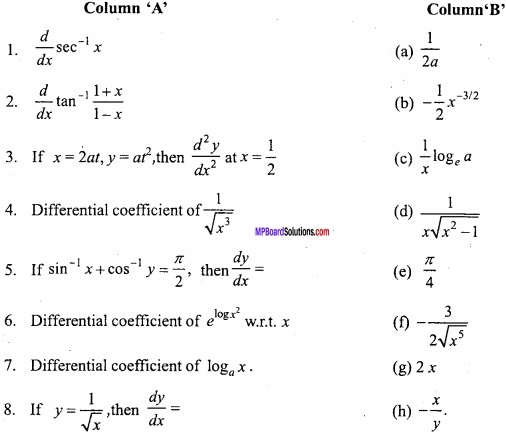
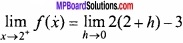
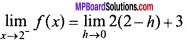
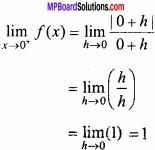
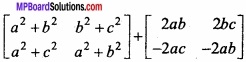
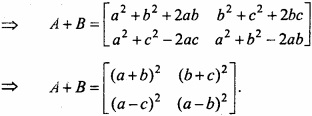
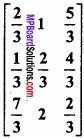
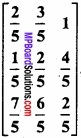
MP Board Class 12th Physics Important Questions Chapter 5 Magnetism and Matter

MP Board Class 12th Physics Important Questions Chapter 5 Magnetism and Matter

Magnetism and Matter Important Questions

Magnetism and Matter Objective Type Questions

Question 1.
Choose the correct answer of the following:

Question 1.
If a bar magnet is placed with its north pole pointing towards geographical north and south pole pointing towards geographical south, then the neutral point will be:
(a) Situated on the axial line
(b) Situated on the equatorial line
(c) Situated at a place where is neither axial line nor equatorial line
(d) Not formed at all.
Answer:
(b) Situated on the equatorial line

Question 2.
Magnetic moment is which type of physical quantity :
(a) Scalar
(b) Vector
(c) Neutral
(d) None of these.
Answer:
(b) Vector

MP Board Solutions

Question 3.
If a bar magnet of magnetic moment M is divided in two equal parts, the magnetic moment of each part will be :
(a) 2M
(b) \(\frac {M}{2}\)
(c) M
(d) Zero
Answer:
(b) \(\frac {M}{2}\)

Question 5.
‘weber’ is the unit of:
(a) Magnetic moment
(b) Magnetic induction
(c) Magnetic field
(d) Magnetic flux
Answer:
(d) Magnetic flux

Question 6.
The two magnetic lines of force :
(a) Meet each other at the poles
(b) Meet at the neutral point
(c) Never meet
(d) All the above statements are correct.
Answer:
(c) Never meet

Question 7.
The intensity of magnetic field is defined as :
(a) Magnetic moment per unit volume
(b) Magnetic induction force acting on unit magnetic pole
(c) Number of magnetic lines of force passing per unit area
(d) Number of lines of force passing through unit volume.
Answer:
(c) Number of magnetic lines of force passing per unit area

Question 8.
A magnetic needle is placed in a non – uniform magnetic field. The needle will experience :
(a) A force without any torque
(b) A torque without any force
(c) A force and a torque
(d) Neither a torque nor a force.
Answer:
(c) A force and a torque

Question 9.
The ratio of magnetic field intensities at equal distance in end on position and broadside on position of a small bar magnet is :
(a) 1 : 4
(b) 1 : 2
(c) 1 : 1
(d) 2 : 1.
Answer:
(d) 2 : 1.

Question 10.
A magnetic dipole of magnetic moment M is placed in a magnetic field of intensity B with its axis along the magnetic field. The work done in rotating it by 180° is :
(a) -MB
(b) MB
(c) Zero
(d) +2 MB
Answer:
(d) +2 MB

MP Board Solutions

Question 11.
If the net magnetic moment of individual atom of a substance is zero, the substance is :
(a) Diamagnetic
(b) Paramagnetic
(c) Ferromagnetic
(d) Non – magnetic.
Answer:
(a) Diamagnetic

Question 12.
Electromagnets are made up of:
(a) Paramagnetic substances
(b) Soft iron
(c) Steel
(d) Diamagnetic substances.
Answer:
(b) Soft iron

Question 13.
At equator the total intensity of earth’s magnetic field is equal to :
(a) V
(b) H
(c) Both
(d) None of these.
Answer:
(b) H

Question 14.
The resultant intensity of earth’s magnetic field at a place is given by :
(a) \(\frac {H}{V}\)
(b) \(\frac {V}{H}\)
(c) \(\sqrt { { H }^{ 2 }+V^{ 2 } }\)
(d) \(\sqrt { { H }^{ 2 }-V^{ 2 } }\)
Answer:
(c) \(\sqrt { { H }^{ 2 }+V^{ 2 } }\)

Question 15.
The value of angle of dip near the magnetic poles is :
(a) 90°
(b) 45°
(c) 30°
(d) Zero.
Answer:
(a) 90°

Question 16.
The south pole of earth’s magnet is :
(a) Near the geographic north pole
(b) Near the geographic south pole
(c) In geographic east
(d) In geographic west.
Answer:
(a) Near the geographic north pole

Question 17.
The angle of dip at equator is :
(a) 90°
(b) 30°
(c) 0°
(d) 45°
Answer:
(c) 0°

Question 18.
In a plane perpendicular to the magnetic meridian, a dip needle :
(a) Will be horizontal
(b) Will be vertical
(c) Will be inclined at angle of dip at that place
(d) Will be inclined at any angle.
Answer:
(b) Will be vertical

Question 2.
Fill in the blanks :

  1. The SI unit of pole strength is ……………………….
  2. The direction of magnetic moment of a magnet is always from ………………………. to ………………………. pole.
  3. The SI unit of magnetic moment is ……………………….
  4. The magnetic lines of force are ………………………. curve.
  5. The tangent drawn at any point of a magnetic line of force gives ……………………….
  6. The magnetic field produced due to a solenoid is same as that produced by a ……………………….
  7. A magnet is also called a ……………………….
  8. At same distance, magnetic field intensity in broadside on position is ………………………. the intensity in end on position.
  9. Nowadays magnetic lines of force are called ……………………….
  10. At ………………………. point the resultant intensity of magnetic field is zero.
  11. The temperature at which ferromagnetic substance is converted into paramagnetic substance is known as ……………………….
  12. The strength of ………………………. magnet can be changed.
  13. The vertical component of earth’s magnetic field at a place becomes zero where angle of dip is ……………………….
  14. The angle of dip from equator to poles lies between ………………………..
  15. ………………………. substances can easily be magnetized.

Answer:

  1. ampere x metre
  2. south; north
  3. ampere x metre2
  4. Closed
  5. Direction of magnetic field
  6. Bar magnet
  7. Magnetic dipole
  8. Half
  9. Magnetic field line
  10. Neutral
  11. Curie temperature
  12. Electro
  13. Zero
  14. Zero to 90°
  15. Ferro – magnetic.

Question 3.
Match the Columns :
I.
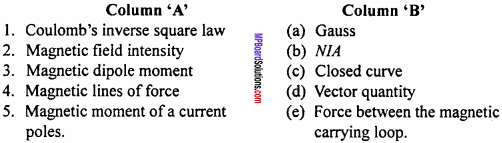
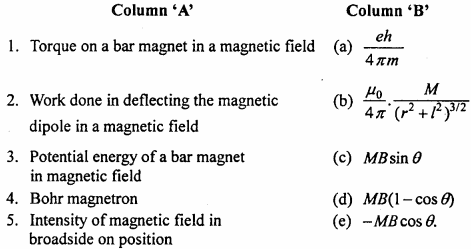
MP Board 12th Physics Important Questions Chapter 5 Magnetism and Matter 1
Answer:

  1. (e)
  2. (a)
  3. (d)
  4. (c)
  5. (b).

II.
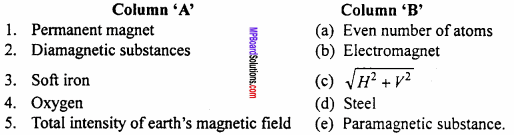
MP Board 12th Physics Important Questions Chapter 5 Magnetism and Matter 2
Answer:

  1. (c)
  2. (d)
  3. (e)
  4. (a)
  5. (b).

III.
MP Board 12th Physics Important Questions Chapter 5 Magnetism and Matter 3
Answer:

  1. (d)
  2. (a)
  3. (b)
  4. (e)
  5. (c)

Question 4.
Write the answer in one word / sentence :

  1. Name the elements or parameters of earth’s magnetic field.
  2. What is the value of angle of dip at poles and equator?
  3. How is the relative permeability (μr) ofthe material related to susceptibility (xm)?
  4. Give two examples of diamagnetic substance.
  5. Name any two paramagnetic substances.

Answer:

1.

  • Declination
  • Angle of dip
  • Horizontal component of earth’s magnetic field

2. Angle of dip at poles is 90° and at equator it is 0°

3. μr = 1 + xm

4. Zinc and Bismuth

5. Aluminium and Manganese.

Magnetism and Matter Very Short Answer Type Questions

Question 1.
Define effective length of a magnet?
Answer:
The distance between two poles of magnet is called its effective length.

Question 2.
What do you mean by intensity of magnetic field? Write its SI unit. Is it scalar or vector?
Answer:
Intensity of magnetic field:
The intensity of field at a point is defined by the force experienced by a unit north pole, placed-at that point.
Its SI unit is tesla or weber metre-2. Magnetic field is a vector.

MP Board Solutions

Question 3.
Define magnetic lines of force.
Answer:
1st definition:
The magnetic lines of force are the curves in the magnetic field, on which if a unit north pole is placed, then it will follow the imaginary curve drawn.

2nd definition:
“A magnetic line of force is a smooth curve in a magnetic field such that the tangent at any point on it gives the direction of the magnetic field at that point.”

Question 4.
Can two magnetic lines of force intersect?
Or
Magnetic lines of force do not intersect each other, why?
Answer:
No. If the two magnetic lines of force intersect, then there will be two tangents and hence two directions of magnetic field at the point of intersection. This is impossible.

Question 5.
Define magnetic moment. Write its SI unit. Is it a scalar or a vector?
Answer:
The product of pole strength (m) and effective length (2l) of the magnet is called magnetic moment (M).
If m be the pole strength and 2l be the effective length, then
M = m x 2l
SI unit of magnetic moment is weber x metre. It is a vector quantity having a direction from south pole to north pole.

Question 6.
What is a diamagnetic substance?
Answer:
A substance which when placed in a magnetizing field develops very weak magnetization in the opposite direction of the applied field is called diamagnetic substance.

Question 7.
What is paramagnetic substance?
Answer:
A substance which when placed in a magnetizing field develops weak magnetism in the direction of the applied field is called paramagnetic substance.

Question 8.
What is paramagnetism?
Answer:
The atoms or molecules of some materials (e.g., Al, CuCl2) have non – zero magnetic moment. When such a substance is placed in a magnetic field \(\vec { B }\), the individual magnetic dipoles align in the direction of \(\vec { B }\). There is net magnetization in the direction of \(\vec { B }\) and proportional to \(\vec { B }\) This is called paramagnetism.

Question 9.
What are ferromagnetics or ferromagnetic substances?
Answer:
Ferromagnetics are the substances, which when placed in a magnetic field are strongly magnetized in the direction of the magnetizing field. Example Fe. Ni, Co etc.

MP Board Solutions

Question 10.
Write about the number of electrons in diamagnetic and paramagnetic substances.
Answer:
The number of electrons in diamagnetic substances are in even number and in paramagnetic substances electrons are in odd numbers.

Question 11.
Does the magnetism of paramagnetic salts depend upon temperature? Give reason.
Answer:
Yes, with the increase of temperature its magnetism decreases. When a paramagnetic salt is placed in a magnetic field then on each elementary magnet, a torque acts which tends to bring them in the direction of magnetic field. When the temperature is increased the thermal agitation opposes this tendency, hence the paramagnetism is decreased.

Question 12.
Define magnetic intensity. Give its SI unit.
Answer:
Magnetic intensity is the ability of a magnetizing field to magnetize a material and is defined as the number of ampere turns flowing around unit length of solenoid required to produce magnetic induction B0 inside it.
H = \(\frac { { B }_{ 0 } }{ { \mu }_{ 0 } }\)
SI unit of H is Am-1

Question 13.
Define magnetic permeability. State its SI unit.
Answer:
Magnetic permeability is defined as the ratio of magnetic induction B to the magnetizing field intensity H ie., μ = \(\frac {B}{H}\)
SI unit is TmA-1.

Question 14.
Why the magnetic property increases in paramagnetic substances with cooling?
Answer:
When a paramagnetic substances is kept in an external magnetic field, then on each elementary magnet a torque acts which tries to bring them parallel to the direction of magnetic field. The thermal vibrations opposes it. If the temperature is decreased, then thermal vibrations decreases, hence the magnetic property increases.

Question 15.
Why is diamagnetism independent of temperature?
Answer:
The induced magnetic moment in diamagnetic sample is always opposite to the magnetizing field, no matter what the internal motion of atom is.

Question 16.
What is Curie point?
Answer:
Curie point is the temperature above which a ferromagnetic substance becomes paramagnetic.

Question 17.
At any point on the surface of earth, horizontal component of earth magnetic field and vertical component of it are equal. What will be the angle of dip at that point?
Solution:
According to question H = V
Or BH = Bv
But tanθ = \(\frac { { B }_{ v } }{ { B }_{ H } }\)
Or tanθ = \(\frac { { B }_{ v } }{ { B }_{ v } }\)= 1 =tan45°
θ = 45°
Angle of dip will be 45°.

Question 18.
When a bar magnet is cut into two equal pieces perpendicular to its axis, then what will be its charge in magnetic moments.
Answer:
In this position, magnetic moment of each pieces will be M’ = m’ x 2l
But m’= \(\frac {M}{2}\)
∴ M’ = \(\frac {m}{2}\) x 2l
= \(\frac {M}{2}\)
Therefore magnetic moment will become half of its initial value.

Magnetism and Matter Short Answer Type Questions

Question 1.
Write Coulomb’s law of magnetism and define the unit magnetic pole with its help.
Answer:
Coulomb’s law:
The force of attraction or repulsion between two magnetic poles is directly proportional to the product of pole strength and inversely proportional to the square of the distance between them and acts along the line joining the roles.
Let m1 and m2 be the pole strengths and d be the distance between them, then
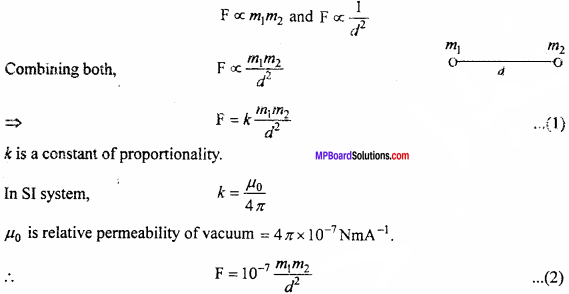
MP Board 12th Physics Important Questions Chapter 5 Magnetism and Matter 4

Unit pole:
If F = 10-7N, d = 1m and m1=m2 = m, then putting the values in eqn. (2),
we get
10-7 = 10-7\(\frac { { m }^{ 2 } }{ 1 } \) ⇒ m = ±1
Thus, if two similar poles are kept 1m apart in vacuum and repei each other by a force of 10-7N, then the poles are called unit poles.

MP Board Solutions

Question 2.
What is end – on – position or axial position? Derive an expression for the intensity of field at a point on the axis of a bar magnet. What is the direction of resultant field?
Or
Derive an expression for the intensity of field at a point on the axial position of a bar magnet.
Answer:
End – on – position:
The point where the intensry of the magnetic field is to be found, is on the magnetic axis, then this point is called end – on – position.
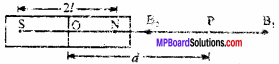
MP Board 12th Physics Important Questions Chapter 5 Magnetism and Matter 5
Let NS be a bar magnet of pole strength m and effective length 2l. Consider a point P on its axis at a distance d from the centre of the magnet O. Magnetic field at P has to be found out.
Now, the intensity of field at P due to N – pole :
B1 = \(\frac { { \mu }_{ o } }{ 4\pi } .\frac { m }{ N{ P }^{ 2 } }\),(along\(\vec { NP } \))
NP = OP – ON =d – l
∴ B1 =\(\frac { { \mu }_{ o } }{ 4\pi } .\frac { m }{ (d-1)^{ 2 } }\) … (1)
Similarly, the intensity of field at P due to S – pole :
B2 = \(\frac { { \mu }_{ o } }{ 4\pi } .\frac { m }{ S{ P }^{ 2 } } \),(along\(\vec { PS }\))
or ∴ B1 =\(\frac { { \mu }_{ o } }{ 4\pi } .\frac { m }{ (d+1)^{ 2 } }\) … (2)
Since, B1 and B2 are acting in opposite direction and B1 > B2
∴Resultant field B = B1 – B2 (along \(\vec { NP }\))
Putting the values from eqns. (1) and (2),
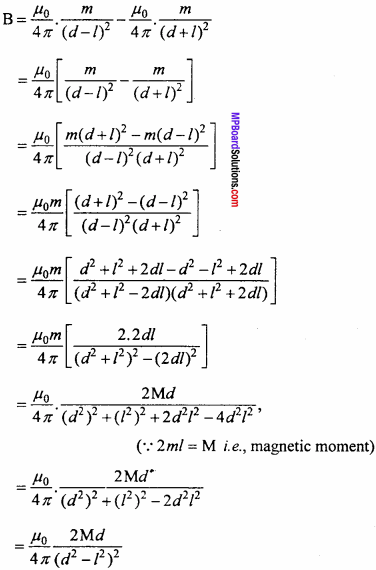
MP Board 12th Physics Important Questions Chapter 5 Magnetism and Matter 6
This is the required expression for the intensity of field on the axis.
Again, if the magnet is small i.e., I << d
By neglecting l.
\(\frac { { \mu }_{ o } }{ 4\pi } .\frac { 2m }{ ({ d }^{ 2 })^{ 2 } }\)
or \(\frac { { \mu }_{ o } }{ 4\pi } .\frac { 2M }{ ({ d })^{ 3 } }\)
In CGS units, B = \(\frac { 2M }{ ({ d })^{ 3 } }\)
The direction of resultant field is along the magnetic axis from south pole to north pole.

Question 3.
What is broad – side – on position or equatorial position? Derive an expression for the intensity at a point on broad – side – on position of a bar magnet. What will be the direction of resultant field?
Or
Determine the force on a unit north pole, kept on the broad-side-on position of a small bar magnet.
Answer:
Broad – side – on position:
When the point where the intensity of the magnetic field has to be found lies on the perpendicularbisector of magnetic axis, i.e., on the neutral axis, then it is called broad – side – on position.
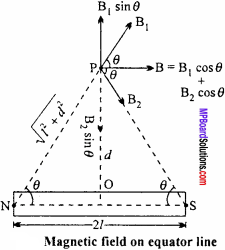
MP Board 12th Physics Important Questions Chapter 5 Magnetism and Matter 7
Magnetic field is the force experienced by unit north pole placed at that point.
Hence, B = \(\frac {F}{m}\)
If m = 1, then B = F.
Let NS be a bar magnet of pole strength m and effective length 2l and magnetic moment M = m2l.
Consider a point P at a distance d from the centre O of a magnet on its neutral axis. Let unit north pole be placed at P.
Now, the intensity of field at P, due to N – pole will be :
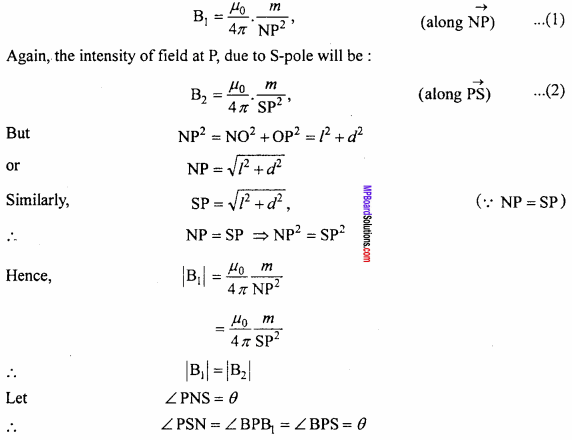
MP Board 12th Physics Important Questions Chapter 5 Magnetism and Matter 8
Resolving B1 and B2 into its components, we have B1, cosθ along NS and B2sinθ⊥ to NS along OP. Also B2 cosθ along NS and B2 sinθ⊥ to NS along PO.
But B1 = B2
⇒ B1 sinθ= B2 sinθ
Since, their directions are opposite and their magnitudes are equal, hence they cancel each other.
The resultant field is therefore
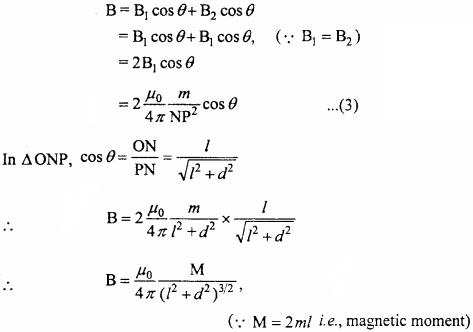
MP Board 12th Physics Important Questions Chapter 5 Magnetism and Matter 9

Question 4.
What are magnetic lines of force ? Write down its properties.
Answer:
Magnetic lines of force :
1st definition:
The magnetic lines of force are the curves in the magnetic field, on which if a unit north pole is placed, then it will follow the imaginary curve drawn.

2nd definition:
“A magnetic line of force is a smooth curve in a magnetic field such that the tangent at any point on it gives the direction of the magnetic field at that point.”
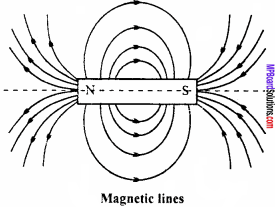
MP Board 12th Physics Important Questions Chapter 5 Magnetism and Matter 10

Properties of lines of force :

  1. They are closed and continuous curves.
  2. Outside the magnet the direction is from north to south and inside the magnet the direction is from south to north.
  3. The tangent drawn at any point on the curve gives the direction of the resultant field at that point.
  4. They do not intersect each other. If two lines of force intersect at a point, then there would be two tangents at that point hence, the resultant force would have two directions; which is not possible, therefore the lines of force do not intersect.
  5. They are dense near the poles where the magnetic field is strong and get separated where the magnetic field is weak.
  6. They repel each other in the direction, perpendicular to it, therefore the like poles repel each other.
  7. They experience tension along the lines of force therefore, unlike poles attract each other.
  8. They behave just like a stretched elastic string.

Question 5.
Derive an expression for the torque acting on a bar magnet placed in a uniform magnetic field, making angle 0with the field and hence define magnetic moments with its help.
Answer:
Let NS be a bar magnet, placed in a uniform magnetic field of intensity B, making an angle θ with the field. Suppose m be the pole strength and 2l be the effective length, Force acting on each pole will be mB.
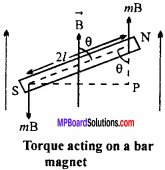
MP Board 12th Physics Important Questions Chapter 5 Magnetism and Matter 11
On the N – pole this force will be along the direction of field, whereas on S – pole this will be opposite to the direction of field. As two equal and opposite forces are acting on it along different line of action, hence a couple acts on it which tries to bring the magnet along the direction of magnetic field. This couple is called ‘restoring couple’ or ‘restoring torque’.

Restoring torque is defined as the product of magnitude of any one of the forces and the perpendicular distance between them.
∴ τ = Force x Perpendicular distance
or Torque, τ = mB x SP … (1)

Also, in ANPS, we get sinθ = \(\frac {SP}{NS}\)
or SP = NSsinθ = 2lsinθ
Putting the value of SP in eqn. (1),
τ = mB x 2l sinθ
But m x 2l = M (magnetic moment)
∴ τ = mB sinθ
In vector form :
\(\vec { τ }\) = \(\vec { M }\) x \(\vec { B }\)
and the direction of \(\vec { τ }\) will be perpendicular to the plane containing \(\vec { M }\) and \(\vec { B }\).

Definition of magnetic moment :
As τ = MBsinθ
If the magnet is held perpendicular to the field, then 0= 90° or sinθ = 1 then the torque acting on the magnet will be maximum, if the strength of the applied field is 1 i.e., B = 1,then
τmax = M
Hence, magnetic moment is numerically equal to the maximum torque acting on the bar magnet when it is held perpendicular in a uniform magnetic field of unit intensity.

MP Board Solutions

Question 6.
Compare to a bar magnet and a current – carrying solenoid.
Answer:
Comparison of a bar magnet and a solenoid :
Bar magnet:

  • It attracts magnetic substances.
  • When it is suspended freely it rests in the direction of N – S.
  • It has two poles.
  • Like poles of magnet repel and unlike poles attract.

Solenoid:

  • It also attracts magnetic substances.
  • It also rests in N – S direction if suspended freely.
  • It has also two poles.
  • Like poles of solenoid also repel and unlike poles attract.

Question 7.
Explain how does an atom behave as a magnetic dipole. Derive an expression for the magnetic dipole moment of the atom. Also define Bohr magneton.
Or
Deduce the expression for the magnetic dipole moment of an electron orbiting around the central nucleus.
Answer:
Magnetic dipole moment of a revolving electron:
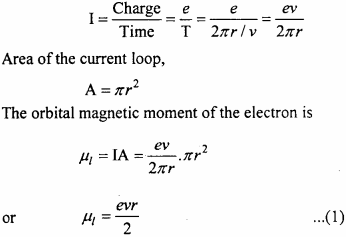
In hydrogen – like atoms, an electron revolves around the nucleus. Its motion is equivalent to a current loop which possesses a magnetic dipole moment = IA. As shown in Fig., consider an electron revolving anticlockwise around a nucleus in an orbit of radius r with speed v and time – period T.
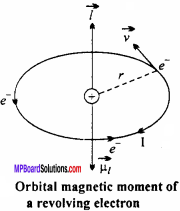
MP Board 12th Physics Important Questions Chapter 5 Magnetism and Matter 12
Equivalent current,
MP Board 12th Physics Important Questions Chapter 5 Magnetism and Matter 14
According to right hand thumb rule, the direction of the magnetic dipole moment of the revolving electron will be perpendicular to the plane of its orbit and it the downward direction, as shown in Fig.
Also, the angular momentum of the electron due to its orbital motion is
I = mevr  … (2)
The direction of / is normal to the plane of the electron orbit and in the upward direction, as shown in Fig.
Dividing equation. (1) by equation. (2), we get
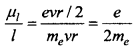
MP Board 12th Physics Important Questions Chapter 5 Magnetism and Matter 13
The above ratio is a constant called gyromagnetic ratio. Its value is 8.8 x 10¹⁰Ckg-1.
So
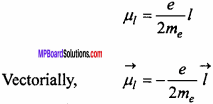
MP Board 12th Physics Important Questions Chapter 5 Magnetism and Matter 15
The negative sign shows that the direction of \(\vec { l }\) is opposite to that of \(\vec { { \mu }_{ 1 } }\) According to Bohr’s quantization condition, the angular momentum of an electron in any permissible orbit is,
l = \(\frac { nh }{ 2π }\) , where n =1,2 ,3, ………….
∴ µ1 = n(\(\frac { eh }{ 4\pi { m }_{ e } }\))
This equation gives orbital magnetic moment of an electron revolving in nth orbit.

Bohr magneton:
It is defined as the magnetic moment associated with an electron due to its orbital motion in the first orbit of hydrogen atom. It is the minimum value of µ1, which can be obtained by putting n = 1 in the above equation. Thus Bohr magneton is given by
µB= (µ1)min = \(\frac { eh }{ 4\pi { m }_{ e } }\) = 9.27 x 10⁻²⁴Am2.

Question 8.
Derive an expression for work done in rotating a bar magnet in uniform magnetic field through 8 angle.
Answer:
Let a bar magnet of effective length 2l and of magnetic moment M be kept in uniform magnetic field B. When a bar magnet is rotated through some angle in the magnetic field then some work has to be done against moment of restoring couple.
If magnet is rotated through dQ angle then work done, dW = τ dθ,
(where τ is moment of restoring couple)
or dW = MB sinθ dθ … (1)
When magnet is rotated from θ1 to θ2, then work done is given by :
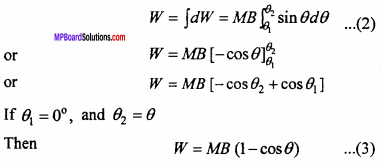
MP Board 12th Physics Important Questions Chapter 5 Magnetism and Matter 16
This is the required expression.

Question 9.
Establish the expression for potential energy of a bar magnet placed in a uniform magnetic field.
Answer:
The potential energy of the bar magnet in any orientation is the work done by the external agent to turn the dipole from its zero position (θ = 90°) to that orientation (θ = θ°)
dW = MB sinθ dθ … (1)
Amount of work done to rotate the bar magnet from zero position (θ = π/2) to an arbitrary position (θ = θ) will be obtained by integrating equation  (1) under proper limit.
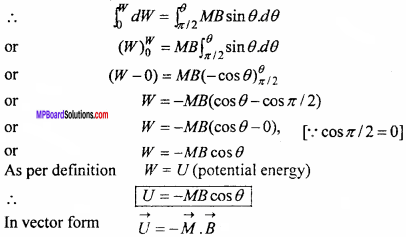
MP Board 12th Physics Important Questions Chapter 5 Magnetism and Matter 17

Question 10.
Define the magnetic elements of earth’s magnetic field at a place.
Or
Establish relation between element of earth’s magnetic field?
Answer:
Elements of earth’s magnetic field:
The earth’s magnetic field at a place can be completely described by three parameters which are called elements of earth’s magnetic field. They are declination, dip and horizontal component of earth’s magnetic field.

1. Magnetic declination:
The angle between the geographical meridian and the magnetic meridian at a place is called the magnetic declination (α) at that place, Or, it is the angle which a compass needle (free to swing in a horizontal planb) makes with the geographic north – south direction.

2. Angle of dip or magnetic inclination:
The angle made by the earth’s total magnetic field \(\vec { B }\) with the horizontal direction in the magnetic meridian is called angle of dip (δ) at any place. Or, it is the angle which a dip needle (free to swing in the plane of the magnetic meridian) makes with the horizontal.

At the magnetic equator, the dip needle rests horizontally so that the angle of dip is zero at the magnetic equator. The dip needle rests vertically at the magnetic poles so that the angle of dip is 90° at the magnetic poles. At all other places, the dip angle lies between 0° and 90°.

3. Horizontal component of earth’s magnetic field:
It is the component of the earth’s total magnetic field \(\vec { B }\) in the horizontal direction in the magnetic meridian. If δ is the angle of dip at any place, then the horizontal component of earth’s field \(\vec { B }\) at that place is given by
BH = Bcosδ
At the magnetic equator,
δ = 0°,BH = Bcos0°= B
At the magnetic poles,
δ = 90°,BH =5cos90°= 0
Thus the value of BH is different at different places on the surface of the earth.

MP Board Solutions

Question 11.
Prove tanδ = \(\frac { { B }_{ v } }{ { B }_{ H } }\) and B = \(\sqrt { { B }_{ H }^{ 2 }+{ B }_{ v }^{ 2 } }\) where symbol have there usual meaning.
Answer:
Relations between elements of earth’s magnetic field:
Fig. shows the three elements of earth’s magnetic field. If 8 is the angle of dip at any place, then the horizontal and vertical components of earth’s magnetic field B at that place will be
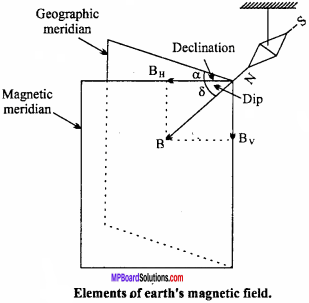
MP Board 12th Physics Important Questions Chapter 5 Magnetism and Matter 18
BH = Bcosδ .. (1)
and Bv = Bsinδ
\(\frac { { B }_{ v } }{ { B }_{ H } }\) = \(\frac { Bsinδ }{ Bcosδ}\)
\(\frac { { B }_{ v } }{ { B }_{ H } }\) =tanδ .. (2)
Also
B2H + B2v = B2(cos2δ + sin2δ) = B2
or B = \(\sqrt { { B }_{ H }^{ 2 }+{ B }_{ v }^{ 2 } }\) .. (3)
Equations (1), (2) and (3) are the different relations between the elements of earth’s magnetic field.

Question 12.
Compare the magnetic properties of soft iron and steel.
Answer:
Comparison of magnetic properties of soft iron and steel:
Soft iron:

  • In soft iron, greater magnetism can be produced, than steel. Its magnetic nature is greater than steel.
  • Soft iron does not retain magnetism for longer time. Its retaintivity is less.
  • The magnetization and demagnetization of soft iron are easy.
  • Temporary magnets are made by soft iron.

Steel:

  • In steel, less magnetism can be produced than soft iron, its magnetic nature is less than soft iron.
  • Steel retains magnetism for longer time. Its retaintivity is greater than soft iron.
  • The magnetization and demagnetization of steel are difficult.
  • Permanent magnets are made by soft steels.

Magnetism and Matter Long Answer Type Questions

Question 1.
Answer the following regarding terrestrial magnetism quantities :

  1. Three quantities are required to express a vector completely write the name of that there independent quantity.
  2. At which place of south India the angle of dip in 18° will you expect more value of angle of dip at britain ?
  3. If you draw lines of forces at Melbourne city of Austrilia. This lines of forces will go inside the earth or outside.
  4. The magnetic needle which is free to revolve in vertical plane. If it is kept at geographical north or south pole then in which direction it will revolve?

Answer:
1.

  • Angle of declination
  • Angle of dip
  • Horizontal component of Earth magnetic field.

2. Britain is near magnetic pole of earth, therefore angle of dip at Britain is more than the angle of dip at south India (approx. 70°).

3. The magnetic lines of force at Melbourne city of Austrilia will go outside.

4. Geographical North pole or South pole is just situated vertically to the direction of earth magnetic field. Therefore the magnetic needle will be independent to revolve in vertical plane

Question 2.
Compare the magnetic properties of paramagnetic substance and ferromagnetic substance on any three points.
Answer:
Comparison :
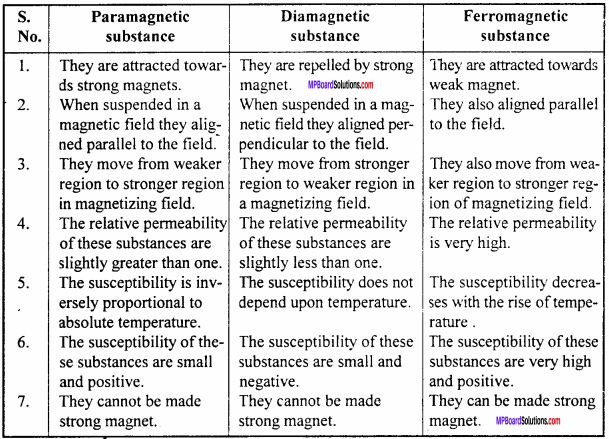
MP Board 12th Physics Important Questions Chapter 5 Magnetism and Matter 19

Question 3.
What do you mean by magnetic field intensity. Derive an expression for magnetic field due to a bar magnet in general position. How is this formula used to find magnetic field in

  1. Axial position
  2. Equatorial position.

Answer:
The force experienced by unit north pole at any point in the magnetic field is known as magnetic field intensity. NS is a bar magnet of magnetic moment \(\vec { M }\), we have to find out magnetic field intensity at P, which is situated at θangle from axis of magnet.

Now, we divide M into two components

  • Mcosθ
  • Msinθ

For Mcosθ point ‘P’ lies in axial position, therefore magnetic field at P due to M cos G component is :
B1 = \(\frac { { \mu }_{ 0 } }{ 4\pi } \frac { 2Msin\theta }{ { d }^{ 3 } }\) … (1)
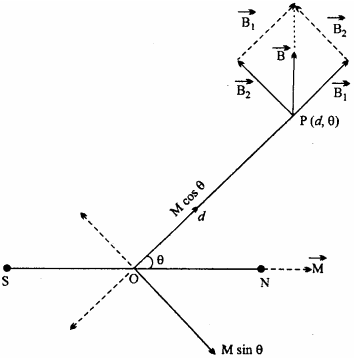
MP Board 12th Physics Important Questions Chapter 5 Magnetism and Matter 21
For M sinθ point P lies on equatorial position :
B2 = \(\frac { { \mu }_{ 0 } }{ 4\pi } \frac { Msin\theta }{ { d }^{ 3 } }\) … (2)
∵ B1is perpendicular to B2 , the resultant of B1 and B2 is given by :
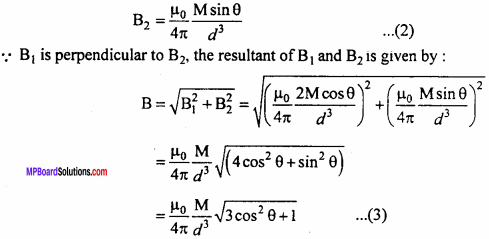
MP Board 12th Physics Important Questions Chapter 5 Magnetism and Matter 22
This is the required expression.
(i) For axial position θ = 0° => cos 0°= 1
∴From eqn. (3),
B = \(\frac { { \mu }_{ 0 } }{ 4\pi } \frac { 2M }{ { d }^{ 3 } } \)
From equatorial position θ = 90° ⇒ cos90° = 0
B = \(\frac { { \mu }_{ 0 } }{ 4\pi } \frac { M }{ { d }^{ 3 } } \)

Magnetism and Matter Numerical Questions

Question 1.
Magnetic wire of magnetic moment ‘M’ is bent in the shape of L, at one third of its length. What will be the new magnetic moment.
Solution:
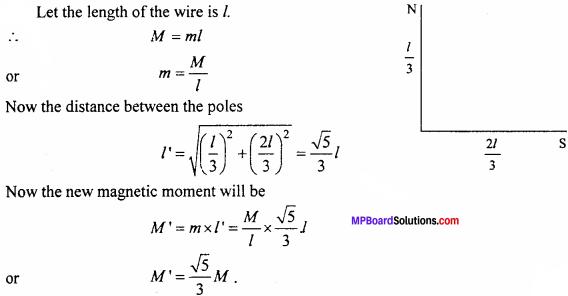
MP Board 12th Physics Important Questions Chapter 5 Magnetism and Matter 23

Question 2.
The length of magnetic wire is L and its magnetic moment is M. If it is bent in the form of semi – circle then what will be its new magnetic moment?
Solution:
Initial magnetic moment of magnetic wire M = mL
If it is bent in the form of semi – circle then
L = πr ⇒ r = \(\frac {L}{π}\)
New magnetic moment M’ = m x 2r
M’ = m x \(\frac {2L}{π}\)
or M’ = \(\frac {2M}{π}\)
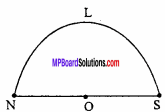
MP Board 12th Physics Important Questions Chapter 5 Magnetism and Matter 24

Question 3.
The distance between two magnetic poles of pole strengths ‘m’ and ‘4m’ is 3m. Find the distance of point in between them at which magnetic field intensity is zero.
Solution:
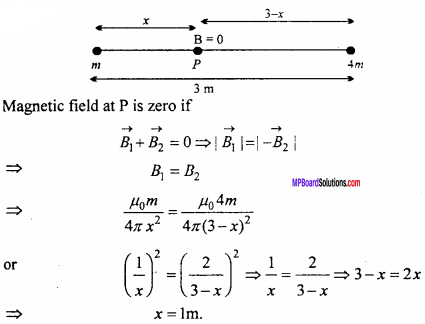
MP Board 12th Physics Important Questions Chapter 5 Magnetism and Matter 25

Question 4.
If the pole strength of each pole of two similar magnetic poles is made two times and distance between them becomes half of its initial value then how will magnetic force acting between them change?
Solution:
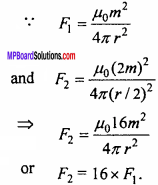
MP Board 12th Physics Important Questions Chapter 5 Magnetism and Matter 26
Force becomes 16 times its initial value.

Question 5.
Obtain the earth’s magnetization. Assume that the earth’s field can be approximated by a giant bar magnet of magnetic moment 8.0 x 10²²Am2. The earth’s radius is 6400 km. [NCERT]
Solution:
Here magnetic moment m = 8.0 x 10²² Am2
Radius of the Earth R = 6400 km = 6.4 x 10⁶m
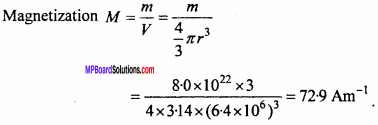
MP Board 12th Physics Important Questions Chapter 5 Magnetism and Matter 27

Question 6.
A solenoid has a core of a material with relative permeability 400. The windings of the solenoid are insulated from the core and carry a current of 2A. If the number of turns is 1000 per metre, calculate (a) H, (b) M, (c) B and (d) the magnetizing current IM. [NCERT]
Solution:
Here n = 1000 tums/m, I = 2A, μr = 400
1. H = nI = 1000 x 2 = 2x 10³ Am-1

2. M = xmH = (μr -1)H
= (400 – 1) x 2 x 103 ≈ 8 x 10⁵Am-1

3. B = μH = μrμ0H
= 400 x 4π x 10-7 x 2 x 103 T = 1.0T .

4. As M = nIM
∴ IM = \(\frac {M}{n}\)
= \(\frac { 8\times { 10 }^{ 5 } }{ 1000 }\)
= 8 x 10² A.

MP Board Solutions

Question 7.
A short bar magnet placed with its axis at 30° experiences a torque of 0.016 Nm in an external field of 800G

  1. What is the magnetic moment of the magnet?
  2. What is the work done by an external force in moving it from its most stable to most unstable position?
  3. What is the work done by the force due to the external magnetic field in the process mentioned in part (b)?
  4. The bar magnet is replaced by a solenoid of cross – sectional area 2 x 10⁻⁴ and 1000 turns, but the same magnetic moment Determine the current flowing through the solenoid. [NCERT]

Solution:
1. Here θ = 30°, B = 800G = 800 x 10-4T, τ = 0.016Nm
Magnetic moment,
m = \(\frac {τ }{B sinθ}\) =\(\frac { 0.016 }{ 800\times { 10 }^{ -4 }\times sin30° }\)
= 0.40 Am2.

2. For most stable position θ = 0°and for most unstable position θ = 180°. So the required work done by the external force,
W = mB (cos 180°- cos0°) = 2mB
= 2 x 0.40 x 800 x 10-4
=0.064J

3. Here the displacement and the torque due to the magnetic field are in opposition. So the work done by the magnetic fied due to the external magnetic field is,
WB = 0.064J

4. Here A =2 x 10⁻⁴m2, N = 1000
Magnetic moment of solenoid,
ms = m = 0.40 Am2
But ms = NIA.
∴ current, I = \(\frac { { m }_{ s } }{ NA }\) = \(\frac { 0.40 }{ 1000\times 2\times { 10 }^{ -4 } }\)

MP Board Solutions

Question 8.
In the magnetic meridian of a certain place, the horizontal component of the earth’s magnetic field is 0.26G and the dip angle is 60°. What is the magnetic field of the Earth in this location?
Solution:
Here BH= 0.26G, δ = 60°
As BH = Bcosδ
∴ B = \(\frac { { B }_{ H } }{ cos\delta }\)
= \(\frac {0.26}{cos60°}\)
= \(\frac {0.26}{0.5}\)
= 0.52G

Question 9.
What is the magnitude of the equatorial and axial fields due to a bar magnet of length 5 cm at a distance of 50 cm from its mid – point? The magnetic moment of the bar magnet is 0.40 Am2. [NCERT]
Sol. Here m = 0.40 Am2
r = 50 cm = 0-50 m, 21 = 5-0 cm
Clearly, the magnet is a short magnet (l<<r)
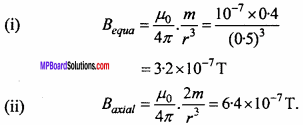
MP Board 12th Physics Important Questions Chapter 5 Magnetism and Matter 28

Question 10.
A planar loop of irregular shape encloses an area of 7.5 x 10⁻⁴ m2 and carries a current of 12 A. The sense of flow of current appears to be clockwise to an observer. What is the magnitude and direction of the magnetic moment vector associated with the current loop? [NCERT]
Solution:
Here A = 7.5 x 10⁻⁴m2, l = 12A
Magnetic moment associated with the loop is
m = IA = 12 x 7.510-4 = 9.0 x 10⁻³ JT-1
Applying right hand rule, the direction of magnetic moment is along the normal to the plane of the loop away from the observer.
MP Board Class 12th Physics Important Questions

MP Board Class 12th Maths Important Questions Chapter 5B Differentiation

MP Board Class 12th Maths Important Questions Chapter 5B Differentiation

Differentiation Important Questions

Differentiation Short Answer Type Questions

Question 1.
Differentiate the function sin(cos x2) with respect to x? (NCERT)
Solution:
Let y = sin (cosx2)
\(\frac { dy }{ dx } \) = \(\frac { d }{ dx } \) sin (cos x2)
= \(\frac { d }{ dx } \) sin t, [Putting cos x2 = t]
= \(\frac { d }{ dt } \) sin t \(\frac { dt }{ dx } \)
= cos t \(\frac { d }{ dx } \) cos x2
= cos (cos x2) \(\frac { d }{ dx } \) cos u, [Putting x2 = u]
= cos (cos x2) \(\frac { d }{ du } \) cos u \(\frac { du }{ dx } \)
= – cos (cos x2) sin u \(\frac { d }{ dx } \) x2
= – 2x cos (cos x2). sin x2.

Question 2.
Differentiate the function y = sec [tan \(\sqrt { x } \) ] with respect to x? (NCERT)
Solution:
Given:
y = sec [tan \(\sqrt { x } \) ]
\(\frac { dy }{ dx } \) = \(\frac { d }{ dx } \) sec [tan \(\sqrt { x } \) ]
= \(\frac { d }{ dx } \) sec t, [Putting tan \(\sqrt { x } \) = t]
= \(\frac { d }{ dt } \) sec t \(\frac { dt}{ dx } \)
= sec t tan t \(\frac { d }{ dx } \) tan \(\sqrt { x } \)
= sec (tan \(\sqrt { x } \)) tan (tan \(\sqrt { x } \)) \(\frac { d }{ dx } \) tan u, [Putting \(\sqrt { x } \) = u]
= sec (tan \(\sqrt { x } \)) tan (tan \(\sqrt { x } \)) sec2 u \(\frac { d }{ dx } \) \(\sqrt { x } \)
= sec (tan \(\sqrt { x } \)) tan (tan \(\sqrt { x } \)) sec2\(\sqrt { x } \) × \(\frac { 1 }{ 2\sqrt { x } } \)

MP Board Solutions

Question 3.
Differentiate the function y = log [cos ex] with respect to x? (NCERT)
Solution:
Given:
y = log [cos ex]
\(\frac { dy }{ dx } \) = \(\frac { d }{ dx } \) [log (cos ex)]
\(\frac { dy }{ dx } \) = \(\frac { d }{ dx } \) log t, [Putting cos ex = t]
= \(\frac { d }{ dt } \) log t \(\frac { dt }{ dx } \)
= \(\frac { 1 }{ t } \). \(\frac { d }{ dx } \) cos ex
= \(\frac { 1 }{ cose^{ x } } \) × \(\frac { d }{ dx } \) cos u, [Putting ex = u]
= \(\frac { 1 }{ cose^{ x } } \). \(\frac { d }{ du } \) cos u \(\frac { du }{ dx } \)
= \(\frac { -sinu }{ cose^{ x } } \). \(\frac { d }{ dx } \) ex
= \(\frac { -(sine^{ x })e^{ x } }{ cose^{ x } } \)
= – ex tan ex

Question 4.
Differentiate the function y = cos [log x + ex] with respect to x? (NCERT)
Given:
y = cos [log x + ex]
\(\frac { dy }{ dx } \) = \(\frac { d }{ dx } \) cos (log x + ex)
\(\frac { dy }{ dx } \) = \(\frac { d }{ dx } \) cos t, [Putting log x + ex = t]
= \(\frac { d }{ dt } \) cos t \(\frac { dt }{ dx } \)
= – sin t \(\frac { d }{ dx } \) (log x + ex)
= – sin (log x + ex) (\(\frac{1}{x}\) + ex)
= – \(\frac { (xe^{ x }+1)sin(logx+e^{ x }) }{ x } \)

Question 5.
Differentiate the function y = cos-1(ex) with respect to x? (NCERT)
Solution:
Given:
y = cos-1 (ex)
∴\(\frac { dy }{ dx } \) = \(\frac { d }{ dx } \) cos-1 (ex)
Putting ex = t,
= \(\frac { d }{ dx } \) cos-1 t = \(\frac { d }{ dt } \) cos-1 t \(\frac { dt }{ dx } \)
= \(\frac { 1 }{ \sqrt { 1-t^{ 2 } } } \) \(\frac { d }{ dx } \) ex
= – \(\frac { e^{ x } }{ \sqrt { 1-e^{ 2x } } } \)

MP Board Solutions

Question 6.
If y + sin y = cos x then find the value of \(\frac { dy }{ dx } \)? (NCERT)
Solution:
Given:
y + sin y = cos x
Differentiating both sides with respect to x,
\(\frac { d }{ dx } \) (y + siny) = \(\frac { d }{ dx } \) cos x
⇒ \(\frac { dy }{ dx } \) + cos y \(\frac { dy }{ dx } \) = – sin x
⇒ \(\frac { dy }{ dx } \) (1 + cos y) = -sin x
⇒ \(\frac { dy }{ dx } \) = \(\frac { -sinx }{ 1+cosy } \)

Question 7.
If 2x + 3y = sin x then find the value of \(\frac { dy }{ dx } \)? (NCERT)
Solution:
Given:
2x + 3y = sin x
Differentiating both sides with respect to x,
\(\frac { d }{ dx } \) (2x + 3y) = \(\frac { d }{ dx } \) sin x
2 \(\frac { d }{ dx } \) x + 3 \(\frac { dy }{ dx } \) = cos x
⇒ 2 + 3 \(\frac { dy }{ dx } \) = cos x – 2
∴ \(\frac { dy }{ dx } \) = \(\frac{cos x – 2}{3}\)

MP Board Solutions

Question 8.
If x = a cos θ, y = a sin θ then find the value of \(\frac { dy }{ dx } \)? (NCERT)
Solution:
Given:
x = a cos θ
y = a sin θ
Differentiating eqn. (1) with respect to θ.
We get, \(\frac { dx }{ d\theta } \) = – a sin θ
Again, \(\frac { dy }{ dx } \) = \(\frac { \frac { dy }{ d\theta } }{ \frac { dx }{ d\theta } } \)
⇒ \(\frac { dy }{ dx } \) = – \(\frac { acos\theta }{ asin\theta } \)
⇒ \(\frac { dy }{ dx } \) = – cot θ.

Question 9.
If x = at2 and y = 2at then find the value of \(\frac { dy }{ dx } \)? (NCERT)
Solution:
Given:
x = at2
\(\frac { dx }{ dt } \) = 2at
y = 2at
\(\frac { dy }{ dt } \) = 2a
Again, \(\frac { dy }{ dx } \) = \(\frac { \frac { dy }{ dt } }{ \frac { dx }{ dt } } \) = \(\frac{2a}{2at}\)
⇒ \(\frac { dy }{ dx } \) = \(\frac { 1 }{ t} \).

Question 10.
If y = x2 + 3x + 2 then find the value of \(\frac { d^{ 2 }y }{ dx^{ 2 } } \)? (NCERT)
Solution:
Given:
y = x2 + 3x + 2
∴ \(\frac { dy }{ dx } \) = 2x + 3.1 + 0
\(\frac { dy }{ dx } \) = 2x + 3
Again differentiating with respect to x,
We get, \(\frac { d }{ dx } \) ( \(\frac { dy }{ dx } \) ) = 2.1 + 0
⇒ \(\frac { d^{ 2 }y }{ dx^{ 2 } } \) = 2.

MP Board Solutions

Question 11.
If y = x3 + tan x then find the value of \(\frac { d^{ 2 }y }{ dx^{ 2 } } \)? (NCERT)
Solution:
Given:
y = x3 + tan x
\(\frac { dy }{ dx } \) = \(\frac { d }{ dx } \) [x3 + tan x]
= \(\frac { d }{ dx } \) x3 + \(\frac { d }{ dx } \) tan x
⇒ \(\frac { dy }{ dx } \) = 3x2 + sec2 x
Again, differentiating with respect to x,
⇒ \(\frac { d }{ dx } \) ( \(\frac { dy }{ dx } \) ) = \(\frac { d }{ dx } \) [3x2 + sec2x]
\(\frac { d^{ 2 }y }{ dx^{ 2 } } \) = 3 \(\frac{d}{dx}\) x2 + \(\frac{d}{dx}\) sec2 x
⇒ \(\frac { d^{ 2 }y }{ dx^{ 2 } } \) = 6x + \(\frac{d}{dx}\) t2, [Putting sec x = t]
= 6x + \(\frac { d }{ dt } \) t2 \(\frac { dt }{ dx } \)
= 6x + 2t \(\frac { d }{ dx } \) sec x
= 6x + 2 sec x.secx tanx
⇒ \(\frac { d^{ 2 }y }{ dx^{ 2 } } \) = 6x + 2 sec2x tan x.

Differentiation Long Answer Type Questions – I

Question 1.
If y = tan-1 \(\frac { x }{ \sqrt { 1+x^{ 2 } } } \) then find the value of \(\frac { dy }{ dx } \)?
Solution:
Given:
y = tan-1 \(\frac { x }{ \sqrt { 1+x^{ 2 } } } \)
Now putting \(\frac { x }{ \sqrt { 1+x^{ 2 } } } \) = t
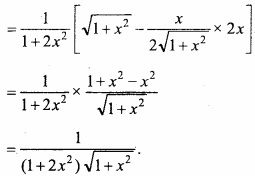
\(\frac { dy }{ dx } \) = \(\frac { d }{ dt } \) tan-1t. \(\frac { dt }{ dx } \)
= \(\frac { 1 }{ 1+t^{ 2 } } \). \(\frac { d }{ dx } \) \(\frac { x }{ \sqrt { 1+x^{ 2 } } } \)

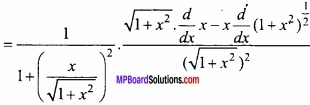
MP Board Class 12th Maths Important Questions Chapter 5B Differentiation
Again Putting 1 + x2 = u,
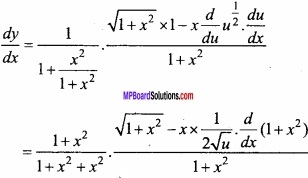
MP Board Class 12th Maths Important Questions Chapter 5B Differentiation img 2
MP Board Class 12th Maths Important Questions Chapter 5B Differentiation img 2a

Question 2.
If x = a (t + sin t) and y = a(1 – cost) then find the value of \(\frac { dy }{ dx } \)?
Solution:
Given:
x = a (t + sin t)
∴\(\frac { dx }{ dt } \) = a(1 + cos t)
Again y = a (1 – cos t)
∴\(\frac { dy }{ dt } \) = a (0 + sint) = a sin t
Hence \(\frac { dy }{ dx } \) = \(\frac { \frac { dy }{ dt } }{ \frac { dx }{ dt } } \) = \(\frac { asint }{ a(1+cost) } \)
= \(\frac { sint }{ a(1+cost) } \) = \(\frac { 2sint/2cost/2 }{ 2cos^{ 2 }t/2 } \)
⇒ \(\frac { dy }{ dx } \) = tan \(\frac{t}{2}\).

MP Board Solutions

Question 3.
If x = a(2θ – sin 2θ) and y = a(1 – cos 2θ) then find the value of \(\frac { dy }{ dx } \) where θ = \(\frac { \pi }{ 3 } \)? (CBSE 2018)
Solution:
Given:
x = a (2θ – sin 2θ) ………………… (1)
y = a (1 – cos 2θ) ………………………. (2)
Differentiating eqn. (1) with respect to θ, we get
\(\frac { dx }{ d\theta } \) = a(2.1 – cos 2θ.2)
= 2a (1 – cos 2θ)
= 2a.2 sin2θ
= 4a sin2θ
Differentiating eqn. (2) with respect to θ, ………………… (3)
\(\frac { dy }{ d\theta } \) = a (0 + sin 2θ.2)
= 2a sin 2θ
= 2a.2 sin θ cos θ ……………………….. (4)
= 4a sin θ cos θ
Divinding eqn.(4) by eqn.(3),
\(\frac { dy }{ d\theta } \) + \(\frac { dx }{ d\theta } \) = \(\frac { 4asin\theta cos\theta }{ 4asin^{ 2 }\theta } \)
⇒ \(\frac { dy }{ dx } \) = cot θ
When θ = \(\frac { \pi }{ 3 } \), then
\(\frac { dy }{ dx } \) = cot \(\frac { \pi }{ 3 } \) = \(\frac { 1 }{ \sqrt { 3 } } \).

Question 4.
If y = a sin mx + b cos mx then prove that:
\(\frac { d^{ 2 }y }{ dx^{ 2 } } \) + m2y = 0?
Solution:
Given:
y = a sin mx + b cos mx ……………………. (1)
Differentiating eqn. (2) with respect to x,
\(\frac { dy }{ dx } \) = am cos mx – bm sin mx
Differentiating eqn. (2) with respect to x,
\(\frac { d^{ 2 }y }{ dx^{ 2 } } \) = – am2 sin mx – bm2 cos mx
⇒ \(\frac { d^{ 2 }y }{ dx^{ 2 } } \) = – m2 y
∴ \(\frac { d^{ 2 }y }{ dx^{ 2 } } \) + m2 y = 0. Proved.

MP Board Solutions

Question 5.
(A) If y = emsin-1x then prove that (1 – x2) y2 – xy1 – m2y = 0?
Solution:
Given:
y = emsin-1x
\(\frac { dy }{ dx } \) = y1 = emsin-1x. \(\frac { d }{ dx } \) (msin-1x)
⇒ y1 = y.m. \(\frac { 1 }{ \sqrt { 1-x^{ 2 } } } \)
⇒ \(\sqrt { 1-x^{ 2 } } \) y1 = my …………………………. (1)
Again, differentiating with respect to x,
\(\sqrt { 1-x^{ 2 } } \). y2 + y1. \(\frac{1}{2}\) (1 – x2)1/2 (- 2x) = my1
⇒ \(\sqrt { 1-x^{ 2 } } \). y2 – \(\frac { x }{ \sqrt { 1-x^{ 2 } } } \) y1 = m\(\frac { my }{ \sqrt { 1-x^{ 2 } } } \). [from eqn.(1)]
⇒ (1 – x2) y2 – xy1 = m2y
⇒ (1 – x2) y2 – xy1 – m2y = 0. Proved.

Question 5.
(B) If y = emtan-1x then prove that (1 + x2) y2 + (2x – m) y1 = 0?
Solution:
Solve like Q.5 (A)

Question 5.
(C) If y = emcos-1x then prove that (1 – x2) y2 – xy1 – m2 y = 0?
Solution:
Solve like Q.5 (A)

MP Board Solutions

Question 6.
Differentiate sin-1 \(\frac { 2x }{ 1+x^{ 2 } } \) with respect to x?
Solution:
Let y = sin-1 ( \(\frac { 2x }{ 1+x^{ 2 } } \) )
Again let x = tan θ ⇒ θ = tan-1 x
y = sin-1 ( \(\frac { 2tan\theta }{ 1+tan^{ 2 }\theta } \) )
= sin-1 (sin 2θ) = 2θ = 2 tan-1 x
∴\(\frac { dy }{ dx } \) = 2 \(\frac { d }{ dx } \) (tan-1 x) = \(\frac { 2 }{ 1+x^{ 2 } } \)

Question 7.
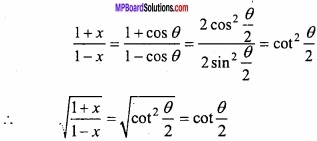
If y = cot-1 \(\sqrt { \frac { 1+x }{ 1-x } } \) then find \(\frac { dy }{ dx } \)?
Solution:
Given:
y = cot-1 \(\sqrt { \frac { 1+x }{ 1-x } } \)
Let x = cos θ
MP Board Class 12th Maths Important Questions Chapter 5B Differentiation img 3
Putting in eqn.(1), we get
y = cot-1 (cot \(\frac{θ}{2}\))
⇒ y = \(\frac{θ}{2}\) = \(\frac{1}{2}\) cos-1 x, [∵x = cos θ ⇒ ∴θ = cos-1 x]
Differentiating both sides w.r.t. x,
\(\frac { dy }{ dx } \) = – \(\frac { 1 }{ 2\sqrt { 1-x^{ 2 } } } \)

Question 8.
If y = tan-1 \(\sqrt { \frac { 1+x }{ 1-x } } \) then find \(\frac { dy }{ dx } \)?
Solution:
Solve like Q.No.7
Answer:
\(\frac { dy }{ dx } \) = \(\frac { 1 }{ 2\sqrt { 1-x^{ 2 } } } \)

Question 9.
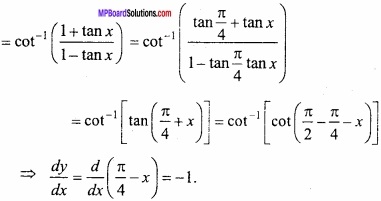
If y = cot-1 ( \(\frac { cosx+sinx }{ cosx-sinx } \) ) then find the value of \(\frac { dy }{ dx } \)?
Solution:
Given:
y = cot-1 ( \(\frac { cosx+sinx }{ cosx-sinx } \) )
MP Board Class 12th Maths Important Questions Chapter 5B Differentiation img 4
⇒ \(\frac { dy }{ dx } \) = \(\frac { d }{ dx } \) ( \(\frac { \pi }{ 4 } \) – x) = -1.

Question 10.
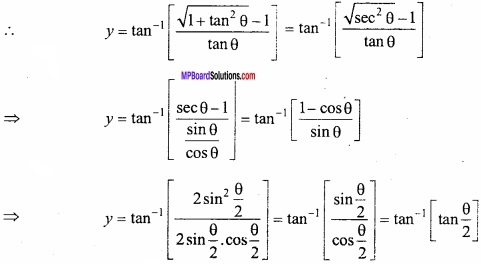
y = tan-1 \(\frac { \sqrt { 1+x^{ 2 }-1\quad } }{ x } \) Differentiate with respect to x?
Solution:
Given:
y = tan-1\(\frac { \sqrt { 1+x^{ 2 }-1\quad } }{ x } \) ……………….. (1)
Put x = tan θ in eqn. (1)
∴ θ = tan-1 x
MP Board Class 12th Maths Important Questions Chapter 5B Differentiation img 5

⇒ y = \(\frac { \theta }{ 2 } \) = \(\frac{1}{2}\) tan-1 x
∴\(\frac { dy }{ dx } \) = \(\frac{1}{2}\) tan-1 x
∴\(\frac { dy }{ dx } \) = \(\frac{1}{2}\) \(\frac { d }{ dx } \) (tan-1 x ) = \(\frac{1}{2}\) \(\frac { 1 }{ (1+x^{ 2 }) } \)

Question 11.
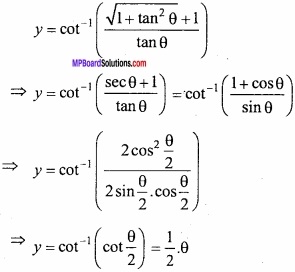
If y = cot-1 \(\left[\frac{\sqrt{1+x^{2}}+1}{x}\right]\) then find the value of \(\frac { dy }{ dx } \)?
Solution:
y = cot-1 \(\left[\frac{\sqrt{1+x^{2}}+1}{x}\right]\)
Put x = tan θ,
MP Board Class 12th Maths Important Questions Chapter 5B Differentiation img 6
⇒ y = \(\frac{1}{2}\) tan-1x
⇒ \(\frac { dy }{ dx } \) = \(\frac{1}{2}\). \(\frac { 1 }{ 1+x^{ 2 } } \).

Question 12.
If y = xsinx then find the value of \(\frac { dy }{ dx } \)?
Solution:
Given:
y = xsinx
Taking log on both sides with respect to x.
\(\frac { 1 }{ y } \) \(\frac { dy }{ dx } \) = sin x × \(\frac{1}{x}\) + logx cos x
∴\(\frac { dy }{ dx } \) = y.[ \(\frac{sinx}{x}\) + log x.cos x]

MP Board Solutions

Question 13.
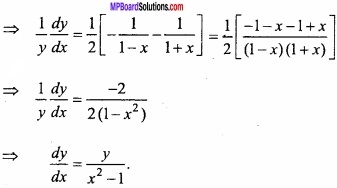
If y = \(\sqrt { \frac { 1-x }{ 1+x } } \) then prove that \(\frac { dy }{ dx } \) = \(\frac { y }{ x^{ 2 }-1 } \)?
Solution:
Given:
y = \(\sqrt { \frac { 1-x }{ 1+x } } \)1/2
By taking log , log y = log \(\sqrt { \frac { 1-x }{ 1+x } } \)1/2
⇒ log y = \(\frac{1}{2}\) [log (1 – x) – log (1 + x)]
Differentiating both sides with respect to x,
MP Board Class 12th Maths Important Questions Chapter 5B Differentiation img 7

Question 14.
If y = (sin x)sinxsinx ………. ∞ then find the value of \(\frac { dy }{ dx } \)?
Solution:
Given:
y = (sin x)sinxsinx ………. ∞
⇒ y = (sin x)y
⇒ log y = y log sin x
Differentiating both sides with respect to x,
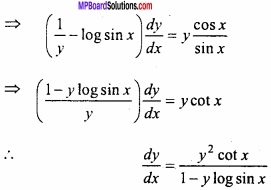
\(\frac{1}{y}\) \(\frac{dy}{dx}\) = y \(\frac{d}{dx}\) (log sin x) + log sin x \(\frac{dy}{dx}\)
MP Board Class 12th Maths Important Questions Chapter 5B Differentiation img 8

Question 15.
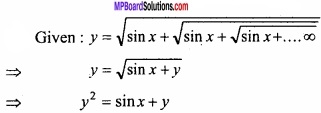
(A) If y = \(\sin x+\sqrt{\sin x+\sqrt{\sin x+\ldots+\infty}}\) then prove that:
\(\frac{dy}{dx}\) = \(\frac{cos x}{2y – 1}\)
Solution:
MP Board Class 12th Maths Important Questions Chapter 5B Differentiation img 9
Differentiating both sides with respect to x,
2y \(\frac{dy}{dx}\) = cos x + \(\frac{dy}{dx}\)
⇒ 2y \(\frac{dy}{dx}\) – \(\frac{dy}{dx}\) = cos x
⇒ (2y – 1) \(\frac{dy}{dx}\) = cos x
∴\(\frac{dy}{dx}\) = \(\frac{cos x}{2y – 1}\).

(B) If y = \(\cot x+\sqrt{\cot x+\sqrt{\cot x+\ldots+\infty}}\) then prove that:
\(\frac{dy}{dx}\) = \(\frac { cosec^{ 2 }x }{ 1-2y } \)
Solution:
Solve like Q.No. 15 (A).

(C) If y = \(\begin{aligned}
&x+\sqrt{\tan x+\sqrt{\tan x+\ldots \infty}}\\
\end{aligned}\) then find the value of \(\frac{dy}{dx}\)?
Solution:
Solve like Q.No 15 (A)

Question 16.
If y = e\($x+e^{x+e^{x+e}}-$\) then prove that:
\(\frac{dy}{dx}\) = \(\frac{y}{1-y}\)?
Solution:
Given: y = e\(x+e^{x+e^{x+e}}-x\)
⇒ y = ex+y
Taking log on both sides,
log y = log ex+y
log y = x + y
Differentiating both sides with respect to x,
\(\frac{1}{y}\) \(\frac{dy}{dx}\) = 1 + \(\frac{dy}{dx}\)
⇒ \(\frac{dy}{dx}\) ( \(\frac{1}{y}\) – 1) = 1
⇒ \(\frac{dy}{dx}\) ( \(\frac{1-y}{y}\) ) = 1
⇒ \(\frac{dy}{dx}\) = \(\frac{y}{1-y}\) Proved.

MP Board Solutions

Question 17.
Differentiate \(\frac { 1 }{ (x+a)(x+b)(x+c) } \) with respect to x?
Solution:
Let y = \(\frac { 1 }{ (x+a)(x+b)(x+c) } \)
Applying log on both sides,
log y = log 1 – log(x + a) – log (x + b) – log(x + c)
Differentiating both sides with respect to x,
\(\frac{1}{y}\) \(\frac{dy}{dx}\) = 0 – \(\frac{1}{x + a}\) – \(\frac{1}{x + b}\) – \(\frac{1}{x + c}\)
⇒ \(\frac{dy}{dx}\) = – y [ \(\frac{1}{x + a}\) + \(\frac{1}{x + b}\) + \(\frac{1}{x + c}\) ]
⇒ \(\frac{dy}{dx}\) = \(\frac { 1 }{ (x+a)(x+b)(x+c) } \) × { \(\frac { 1 }{ x+a } +\frac { 1 }{ x+b } +\frac { 1 }{ x+c } \) }

Question 18.
Differentiate log ( \(\sqrt{x}\) + \(\frac { 1 }{ \sqrt { x } } \) ) with respect to x?
Solution:
Let y = log ( \(\sqrt{x}\) + \(\frac { 1 }{ \sqrt { x } } \) ) ⇒ y = log ( \(\frac { x+1 }{ \sqrt { x } } \) )
⇒ y = log (x + 1) – log \(\sqrt{x}\)
⇒ y = log (x + 1) – \(\frac{1}{2}\) log x
Differentiating both sides with respect to x,
\(\frac{dy}{dx}\) = \(\frac{d}{dx}\) log (x + 1) – \(\frac{1}{2}\). \(\frac{d}{dx}\) log x
⇒ \(\frac{dy}{dx}\) = \(\frac{1}{x + 1}\) – \(\frac{1}{2}\).\(\frac{1}{x}\) = \(\frac{2x-x-1}{2x(x+1)}\)
⇒ \(\frac{dy}{dx}\) = \(\frac{x – 1}{2x(x + 1)}\).

MP Board Solutions

Question 19.
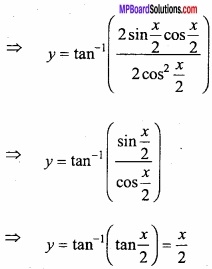
Differentiate y = tan-1 ( \(\frac { sinx }{ 1+cosx } \) ) with respect to x?
Solution:
y = tan-1 ( \(\frac { sinx }{ 1+cosx } \) )
MP Board Class 12th Maths Important Questions Chapter 5B Differentiation img 10
⇒ y = tan-1 (tan \(\frac{x}{2}\) ) = \(\frac{x}{2}\)
Differentiating both sides with respect to x,
\(\frac{dy}{dx}\) = \(\frac{d}{dx}\) ( \(\frac{x}{2}\) ) = \(\frac{1}{2}\).

Question 20.
Verify Rolle’s theroem for the function f(x) = x2 interval [-1, 1]. (NCERT)
Solution:
Given:
f(x) = x2, a = – 1, b = 1.

  1. f(x) = x2 is a polynomial, hence, f(x) is continous in [-1, 1].
  2. f'(x) = 2x exist for every value of x, Hence it is differentiable in (-1, 1).
  3. f(-1) = (-1)2 = 1, f(1) = (1)2 = 1.

∴ f(-1) = f(1)
There exists a value c in (-1, 1) such that:
∴ f'(c) = 0
⇒ 2c = 0, [∵f'(x) = 2x]
⇒ c = 0 ∈ (-1, 1)
Hence, Rolle’s theorem is verified. Proved.

MP Board Solutions

Question 21.
Verify Rolle’s theroem for the function f(x) = x2 + 2x – 8, x ∈ [-4, 2]? (NCERT)
Solution:
Given:
f(x) = x2 + 2x – 8, a= – 4, b = 2.

  1. f(x) = x2 + 2x – 8 is a polynomial hence f(x) is continous in [-4, 2].
  2. f'(x) = 2x + 2 exist for every value of x, hence it is differentiable in (-4, 2).
  3. f(-4) = (-4)2 + 2 (-4) – 8

= 16 – 8 – 8 = 0
f(2) = (2)2 + 2 × 2 – 8 = 4 + 4 – 8 = 0
∴ f(-4) = f(2).
There exists a value c in (-4, 2),
∴ f'(c) = 0
⇒ 2c + 2 = 0
⇒ c = – 1 ∈ (-4, 2)
Hence, Rolle’s theorem is verified.

Question 22.
Verify Rolle’s theorem for the function f(x) = 2x3 + x2 – 4x – 2?
Solution:
Given:
f(x) = 2x3 + x2 – 4x – 2 …………………… (1)
We know that polynomial functions are continuous for all real values.
∴ f(x) = o
⇒ 2x3 + x2 – 4x – 2 = 0
⇒ x2 (2x + 1) – 2(2x + 1) = 0
⇒ (x2 – 2) (2x + 1) = 0
⇒ x2 = 2, 2x + 1 = 0
⇒ x = ±\(\sqrt { 2 } \), x = – \(\frac{1}{2}\)
⇒ x = – \(\sqrt { 2 } \), \(\sqrt { 2 } \), \(\frac{-1}{2}\)
∴ Interval [-\(\sqrt { 2 } \), \(\sqrt { 2 } \) ].
1. f(x) is continuous in [-\(\sqrt { 2 } \), \(\sqrt { 2 } \) ]
2. f'(x) = 6x2 + 2x – 4 is differentiable in [-\(\sqrt { 2 } \), \(\sqrt { 2 } \)].
3. f(-\(\sqrt { 2 } \)) = 2( \(\sqrt { 2 } \) )3 + (-\(\sqrt { 2 } \) ) 2 – 4 (- \(\sqrt { 2 } \) ) – 2 = 0
and f ( \(\sqrt { 2 } \) ) = 2( \(\sqrt { 2 } \) )3 + ( \(\sqrt { 2 } \) ) 2 – 4( \(\sqrt { 2 } \) ) – 2 = 0
∴ f(- \(\sqrt { 2 } \) ) = f( \(\sqrt { 2 } \) )
There exists a value c in (-\(\sqrt { 2 } \), \(\sqrt { 2 } \) )
∴ f'(c) = 0
⇒ 6c2 + 2c – 4 = 0, [∵f'(x) = 6x2 + 2x – 4]
∴ c = \(\frac { -2\pm \sqrt { 2^{ 2 }-4\times 6\times (-4) } }{ 2\times 6 } \)
c = \(\frac { -2\pm \sqrt { 4+96 } }{ 12 } \)
⇒ c = \(\frac { -2\pm 10 }{ 12 } \)
⇒ c = \(\frac{-2-10}{12}\) and c = \(\frac{-2+10}{12}\)
⇒ c = -1, \(\frac{2}{3}\) ∈ (- \(\sqrt { 2 } \), \(\sqrt { 2 } \) )
Hence, Rolle’s theroem is verified.

MP Board Solutions

Question 23.
Verify Lagrange’s mean value theorem for the function f(x) = x + \(\frac{1}{x}\) on [1, 3].
Solution:
Given:
f(x) = x + \(\frac{1}{x}\) = \(\frac { x^{ 2 }+1 }{ x } \), x ∈ [1, 3]

  1. f(x), x ≠ 0 hence it is a continous function in [1, 3].
  2. f'(x) = 1 – \(\frac { 1 }{ x^{ 2 } } \) is differentiable in (1, 3).
  3. f(1) = 2 and f(3) = \(\frac{10}{3}\)

Hence, f(1) ≠ f(2)
For mean value theorem,
∴ \(\frac { f(b)-f(a) }{ b-a } \) = f'(c)
⇒ \(\frac { f(3)-f(1) }{ 3-1 } \) = 1 – \(\frac { 1 }{ c^{ 2 } } \)
⇒ \(\frac { \frac { 10 }{ 3 } -2 }{ 2 } \) = 1 – \(\frac { 1 }{ c^{ 2 } } \)
⇒ 1 – \(\frac { 1 }{ c^{ 2 } } \) = \(\frac{2}{3}\)
⇒ \(\frac { 1 }{ c^{ 2 } } \) = \(\frac{3-2}{3}\) = \(\frac{1}{3}\)
⇒ c2 = 3
⇒ c = \(\sqrt{3}\) = 1.732 ∈ (1, 3)
Hence, Langrange’s mean value theorem is verified. Proved.

Question 24.
Verify Lagrange’s mean value theorem for the following function f(x) = log x on [1, e]?
Solution:
f(x) = logx, x ∈ [1, e], x > 0.
1. As f(x) = log x, x > 0 is a continuous function, hence f(x) is continuous in [1, e],

2. f'(x) = \(\frac{1}{x}\),
∴ f(x) is differentiable in (1, e).

3. f(1) = log 1 = 0, f(e) = log e = 1.
Now by mean value theorem,
∴ \(\frac{f(e) – f(1)}{e-1}\) = f'(c)
⇒ \(\frac{1-0}{e-1}\) = \(\frac{1}{e}\)
⇒ c = e – 1 ∈ (1, e)
Hence, Langrange’s mean value theorem is verified. Proved.

MP Board Solutions

Question 25.
With the help of Langrange’s value thoerem for the function y = \(\sqrt{x-2}\) in the interval [2, 3]. Find the point where the tangent is parallel to be chord joining the points?
solution:
Given:
f(x) = \(\sqrt{x-2}\), a = 2, b = 3

1. As f(x) = \(\sqrt{x-2}\), x ∈ [2, 3] is defined.
∴ f(x) is continous function for [2, 3].

2. f'(x) = \(\frac { 1 }{ 2\sqrt { x-2 } } \) is defined in interval (2, 3).
∴ f(x) is differentiable in [2, 3]

3. f(2) = 0, f(3) = 1
f(2) ≠ f(3)
Now, by Langrange’s mean value theorem,
∴ \(\frac{f(3)-f(2)}{3-2}\) = f'(c)
⇒ \(\frac{1-0}{1}\) = \(\frac { 1 }{ 2\sqrt { c-2 } } \)
⇒ \(\frac { 1 }{ 2\sqrt { c-2 } } \) = 1
⇒ \(\frac { 1 }{ \sqrt { c-2 } } \) = 2
⇒ \(\sqrt{c-2}\) = \(\frac{1}{2}\)
⇒ c – 2 = \(\frac{1}{4}\)
⇒ c = \(\frac{1}{4}\) + 2 = \(\frac{9}{4}\) = 2.25 ∈ (2,3)
∴ f(c) = \(\sqrt { \frac { 9 }{ 4 } -2 } \) = \(\frac{1}{2}\)
Required points ( \(\frac{9}{4}\), \(\frac{1}{2}\) ).

Differentiation Long Answer Type Questions – II

Question 1.
Differentiate sin-1 [ \(\frac { 2^{ x+1 } }{ 1+4^{ x } } \) ] with respect to x? (NCERT)
Solution:
y = sin -1 [ \(\frac { 2^{ x+1 } }{ 1+4^{ x } } \) ]
⇒ y = sin-1 [ \(\frac { 2.2^{ x } }{ 1+2^{ 2x } } \) ]
Putting 2x = tan θ
Then, θ = tan-1 2x
⇒ y = sin-1 [ \(\frac { 2tan\theta }{ 1+tan^{ 2 }\theta } \) ]
⇒ y = sin-1 [sin 2θ], [∵sin 2θ = \(\frac { 2tan\theta }{ 1+tan^{ 2 }\theta } \) ]
⇒ y = 2θ
⇒ y = 2 tan-1 (2x), [θ = tan-1(2x)]
∴ \(\frac{dy}{dx}\) = 2 \(\frac{d}{dx}\) tan-1 (2x)
Putting 2x = t
⇒ \(\frac{dy}{dx}\) = 2 \(\frac{d}{dx}\) tan-1 t
= 2 \(\frac{d}{dt}\) tan-1 t\(\frac{dt}{dx}\)
⇒ \(\frac{dy}{dx}\) = \(\frac { 2 }{ 1+t^{ 2 } } \) \(\frac{d}{dx}\) (2x),
= \(\frac { 2 }{ 1+2^{ 2x } } \) × 2x log 2
⇒ \(\frac{dy}{dx}\) = \(\frac { 2^{ x+1 }log2 }{ 1+4^{ x } } \)

MP Board Solutions

Question 2.
If y = sin-1 x then prove that: (NCERT)
(1 – x2) \(\frac { d^{ 2 }y }{ dx^{ 2 } } \) – x \(\frac{dy}{dx}\) = 0? (NCERT)
Solution:
Given:
y = sin-1 x ……………………………. (1)
\(\frac{dy}{dx}\) = \(\frac{d}{dx}\) (sin-1 x)
\(\frac{dy}{dx}\) = \(\frac { 1 }{ \sqrt { 1-x^{ 2 } } } \)
\(\frac{d}{dx}\) ( \(\frac{dy}{dx}\) ) = \(\frac{d}{dx}\) t-1/2
Putting 1 – x2 = t
\(\frac { d^{ 2 }y }{ dx^{ 2 } } \) = \(\frac{d}{dx}\) t-1/2
= \(\frac{d}{dt}\) t-1/2 \(\frac{dt}{dx}\)
= – \(\frac{1}{2}\) t-1/2-1 \(\frac{d}{dx}\) (1 – x2)
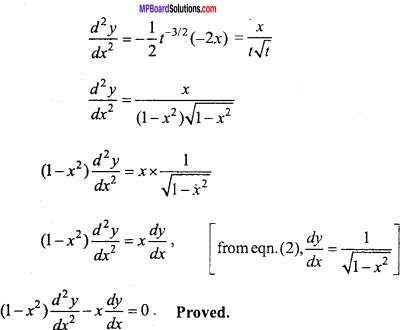
MP Board Class 12th Maths Important Questions Chapter 5B Differentiation img 11

Question 3.
If y = tan x + sec x then prove that:
\(\frac { d^{ 2 }y }{ dx^{ 2 } } \) = \(\frac { cosx }{ (1-sinx)^{ 2 } } \)?
Solution:
y = tan x + sec x (given)
\(\frac{dy}{dx}\) = sec2 x + sec x tan x
⇒ \(\frac{dy}{dx}\) = sec x(sec x + tan x)
⇒ \(\frac{dy}{dx}\) = \(\frac{1}{cosx}\) [ \(\frac{1}{cosx}\) + \(\frac{sinx}{cosx}\) ]
= \(\frac { 1+sinx }{ cos^{ 2 }x } \) = \(\frac { 1+sinx }{ 1-sin^{ 2 }x } \)
= \(\frac { 1+sinx }{ (1+sinx)(1-sinx) } \)
⇒ \(\frac{dy}{dx}\) = \(\frac{1}{1-sinx}\)
Again differentiating both sides with respect to x,
\(\frac{d}{dx}\) ( \(\frac{dy}{dx}\) ) = \(\frac{d}{dx}\) ( \(\frac{1}{1-sinx}\)
\(\frac { d^{ 2 }y }{ dx^{ 2 } } \) = \(\frac { (1-sinx).0-1.(0-cosx) }{ (1-sinx)^{ 2 } } \)
⇒ \(\frac { d^{ 2 }y }{ dx^{ 2 } } \) = \(\frac { cosx }{ (1-sinx)^{ 2 } } \)

MP Board Solutions

Question 4.
If y = sin(sinx) then prove that:
y2 + y1 tan x + y cos2 x = 0? (CBSE 2018)
Solution:
y = sin(sin x)
Differentiating w.r.t. x,
y2 = cos (sinx) \(\frac{d}{dx}\) (cos x) + cos x \(\frac{d}{dx}\) {cos (sin x)}
= cos (sin x) (- sinx) + (cos x) [-sin(sin x)] cos x
⇒ y2 = – sin x cos (sin x) – cos2 x sin (sin x)
⇒ y2 = -sin x cos(sin x) – y cos2 x, [from eqn.(1)]
⇒ y2 = [ \(-\frac { sinx }{ cosx } \). cos x] cos(sin x) – y cos2 x
⇒ y2 = – tan x {cos (sin x) cos x} – y cos2
⇒ y2 = -tan x {cos(sin x) cos x} – y cos2 x [from eqn.(2)]
⇒ y2 = (-tan x) y1 – y cos2 x, Proved.
⇒ y2 + y1 tan x + y cos2 x = 0.

Question 5.
If (x2 + y2)2 = xy then find \(\frac{dy}{dx}\)? (CBSE 2018)
Solution:
(x2 + y2)2 = xy
Differentiating with respect to x,
2(x2 + y2) (2x + 2y \(\frac{dy}{dx}\) ) = x \(\frac{dy}{dx}\) + y.1
⇒ 2(x2 + y2). 2x + 2(x2 + y2). 2y \(\frac{dy}{dx}\) = x \(\frac{dy}{dx}\) + y
⇒ [4y(x2 + y2) – x] \(\frac{dy}{dx}\) = y – 4x (x2 + y2)
⇒ \(\frac{dy}{dx}\) = \(\frac { y-4x(x^{ 2 }+y^{ 2 }) }{ 4(x^{ 2 }+y^{ 2 })y-x } \)

MP Board Solutions

Question 6.
If y = 500e7x + 600e-7x then prove that:
\(\frac { d^{ 2 }y }{ dx^{ 2 } } \) = 49 y? (NCERT)
Solution:
Given:
y = 500e7x + 600e-7x …………………….. (1)
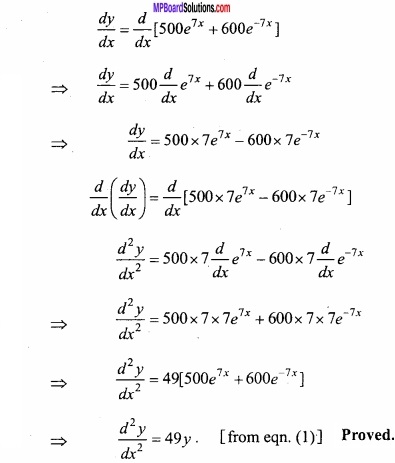
MP Board Class 12th Maths Important Questions Chapter 5B Differentiation img 12

Question 7.
If y = (tan-1 x)2 then prove that:
(x2 + 1)2 y2 + 2x (x2 + 1) y1 = 2? (NCERT)
Solution:
Given:
y = (tan-1 x)2
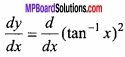
MP Board Class 12th Maths Important Questions Chapter 5B Differentiation img 13
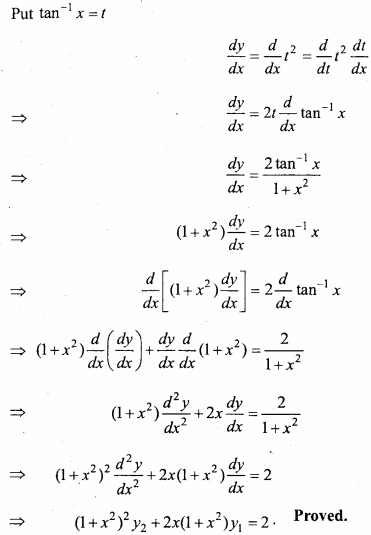
MP Board Class 12th Maths Important Questions Chapter 5B Differentiation img 13a

Question 8.
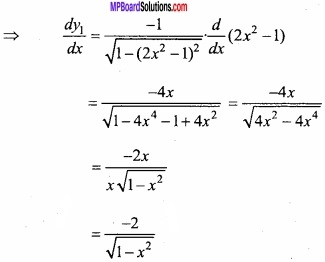
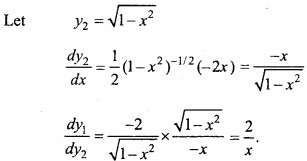
Differentiate sec-1 ( \(\frac { 1 }{ 2x^{ 2 }-1 } \) ) with respect to: \(\sqrt { x^{ 2 }-1 } \)?
Solution:
Let y1 = sec-1 ( \(\frac { 1 }{ 2x^{ 2 }-1 } \) )
⇒ y1 = cos-1 (2x2 – 1)
MP Board Class 12th Maths Important Questions Chapter 5B Differentiation img 14
MP Board Class 12th Maths Important Questions Chapter 5B Differentiation img 14a

Question 9.
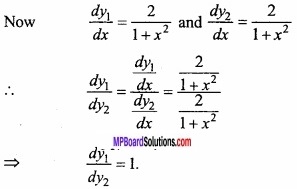
Differentiate tan-1 ( \(\frac { 2x }{ 1-x^{ 2 } } \) ) with respect to:
sin-1 ( \(\frac { 2x }{ 1-x^{ 2 } } \) )
Solution:
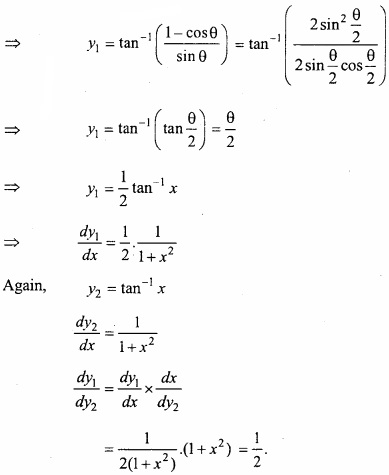
Let y1 = tan-1 \(\frac { 2x }{ 1+x^{ 2 } } \) and y2 = sin-1 \(\frac { 2x }{ 1+x^{ 2 } } \)
Let x = tan θ, then θ = tan-1 x

⇒ y1 = tan-1 (tan 2θ) and y2 = sin-1 (sin 2θ)
⇒ y1 = 2θ and y2 = 2θ
⇒ y1 = 2 tan-1 x and y2 = 2 tan-1 x
MP Board Class 12th Maths Important Questions Chapter 5B Differentiation img 15

Question 10.
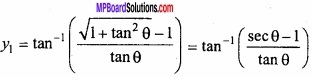
Differentiate tan-1 ( \(\frac { \sqrt { 1+x^{ 2 }-1 } }{ x } \) ) with respect to x?
Solution:
Let y1 = tan-1 ( \(\frac { \sqrt { 1+x^{ 2 }-1 } }{ x } \) )
Put x = tan θ,
MP Board Class 12th Maths Important Questions Chapter 5B Differentiation img 16
MP Board Class 12th Maths Important Questions Chapter 5B Differentiation img 16a

Question 11.
If x \(\sqrt { 1+y } \) + y \(\sqrt { 1+x } \) = 0 then prove that:
\(\frac{dy}{dx}\) = -(1 + x)-2
Solution:
Given:
x\(\sqrt { 1+y } \) + y \(\sqrt { 1+x } \) = 0
⇒ x \(\sqrt { 1+y } \) = -y\(\sqrt { 1+x } \)
Squaring both sides,
x2 (1 + y) = y2 (1 + x)
⇒ x2 + x2y = xy2 + y2
⇒ x2 – y2 + x2y – xy2 = 0
⇒ (x – y) (x + y) + xy (x – y) = 0
⇒ (x – y)(x + y + xy) = 0
⇒ x – y = 0
⇒ x = y
But x ≠ y
∴ x + y + xy = 0
⇒ y (l + x) = – x
∴ y = – \(\frac{x}{1+x}\)
Differentiating both sides with respect to x,
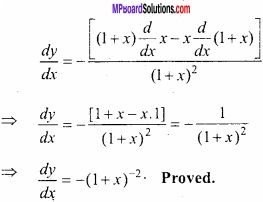
MP Board Class 12th Maths Important Questions Chapter 5B Differentiation img 17

Question 12.
If xy = ey-x then prove that:
\(\frac{dy}{dx}\) = \(\frac { 2-log_{ e }x }{ (1-log_{ e }x)^{ 2 } } \)
Solution:
Given: xy = ey-x
Applying log on both sides,
∴ loge xy = loge(ey-x)
⇒ y loge x = (y – x) loge e
⇒ y loge x – y = -x
⇒ y(1 – loge x) = x
⇒ y = \(\frac { x }{ 1-log_{ e }x } \)
Differentiating with respect to x,
Again,
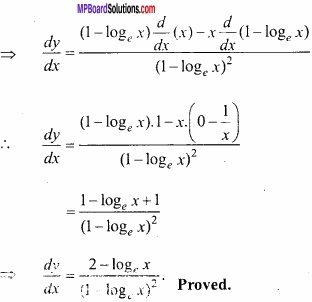
MP Board Class 12th Maths Important Questions Chapter 5B Differentiation img 18

Question 13.
If y\(\sqrt { 1-x^{ 2 } } \) + x \(\sqrt { 1-y^{ 2 } } \) then prove that:
\(\frac{dy}{dx}\) + \($\sqrt{\frac{1-y^{2}}{1-x^{2}}}$\) = 0?
Solution:
Given:
y\(\sqrt { 1-x^{ 2 } } \) + x \(\sqrt { 1-y^{ 2 } } \) = 1.
Let x = sin θ and y = sin ϕ,
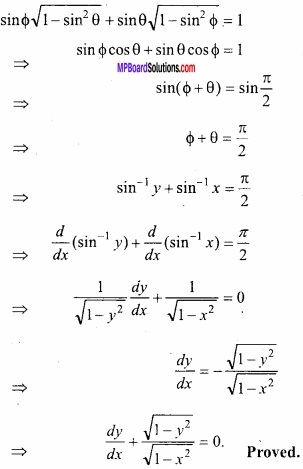
MP Board Class 12th Maths Important Questions Chapter 5B Differentiation img 19

Question 14.
(A) If y = xsin-1x + xx then find the value of \(\frac{dy}{dx}\)?
Solution:
Given:
y = xsin-1x + xx
y = u + v
∴\(\frac{dy}{dx}\) = \(\frac{du}{dx}\) + \(\frac{dv}{dx}\) ……………………. (1)
Where, u = xsin-1x
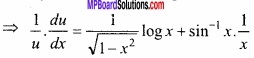
∴ log u = sin-1 x log x, (taking log both sides)
Differentiating both sides with respect to x,
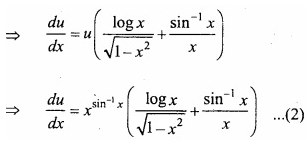
MP Board Class 12th Maths Important Questions Chapter 5B Differentiation img 20
MP Board Class 12th Maths Important Questions Chapter 5B Differentiation img t
and v = xx
∴ log v = x log x
Differentiating both sides with respect to x,
\(\frac{1}{v}\). \(\frac{dv}{dx}\) = 1.log x + x. \(\frac{1}{x}\)
⇒ \(\frac{dv}{dx}\) = v(log x + 1)
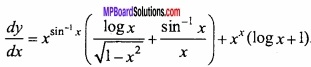
⇒ \(\frac{dv}{dx}\) = xx (log x + 1) ………… (3)∴ From eqn.(1),
MP Board Class 12th Maths Important Questions Chapter 5B Differentiation img 23

(B) If y = x-1x + xx, then find the value of \(\frac{dy}{dx}\)?
Solution:
Solve like Q.No. 14(A).

Question 15.
If sin y = x sin (a + y) then prove that:
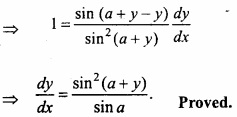
\(\frac{dy}{dx}\) = \(\frac { sin^{ 2 }(a+y) }{ sina } \)?
Solution:
Given:
sin y = x sin (a + y)
⇒ x = \(\frac { siny }{ sin(a+y) } \)
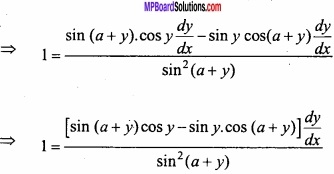
Differentiating with respect to x,
MP Board Class 12th Maths Important Questions Chapter 5B Differentiation img 24
MP Board Class 12th Maths Important Questions Chapter 5B Differentiation img 24a

Question 16.
If xy = ex-y then prove that:
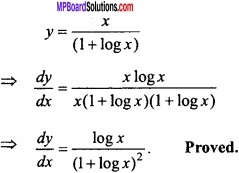
\(\frac{dy}{dx}\) = \(\frac { logx }{ (1+logx)^{ 2 } } \)?
Solution:
Given: xy = ex-y
Applying log on both sides,
y log x = (x – y) logea
⇒ y log x = (x – y).1 = x – y
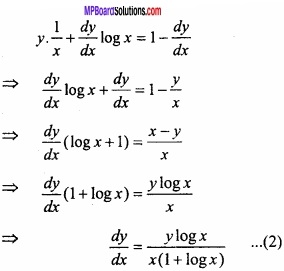
Differentiating both sides with respect to x,
MP Board Class 12th Maths Important Questions Chapter 5B Differentiation img 25
From eqn.(1),
y log x = x – y
⇒ y log x + y = x
⇒ y(logx + 1) = x
Put the value of y in eqn.(2)
MP Board Class 12th Maths Important Questions Chapter 5B Differentiation img 25a

MP Board Class 12 Maths Important Questions

MP Board Class 12th Physics Important Questions Chapter 4 Moving Charges and Magnetism

MP Board Class 12th Physics Important Questions Chapter 4 Moving Charges and Magnetism

Moving Charges and Magnetism Important Questions

Moving Charges and Magnetism Objective Type Questions

Question 1.
Choose the correct answer of the following:

Question 1.
The magnetic effect of electric current was discovered by :
(a) Flemming
(b) Faraday
(c) Ampere
(d) Oersted.
Answer:
(d) Oersted.

Question 2.
A moving charge produces :
(a) Only electric field
(b) Only magnetic field
(c) Both electic and magnetic field
(d) Neither electric nor magnetic field.
Answer:
(c) Both electic and magnetic field

Question 3.
The SI unit of magnetic field intensity is :
(a) N/m
(b) Gauss or oersted
(c) N/A – m
(d) weber x metre .
Answer:
(c) N/A – m

MP Board Solutions

Question 4.
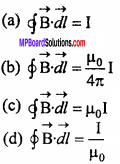
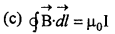
Amperes circuital rule is :
MP Board 12th Physics Important Questions Chapter 4 Moving Charges and Magnetism 1
Answer:
MP Board 12th Physics Important Questions Chapter 4 Moving Charges and Magnetism 2

Question 5.
The magnetic field produced at the centre of a circular coil carrying current is :
(a) In the plane of plane
(b) Perpendicular to the plane of coil
(c) At 45° from the plane of coil
(d) At 60° from the plane of coil.
Answer:
(b) Perpendicular to the plane of coil

Question 6.
The force on a charge moving in a uniform magnetic field is zero if the direction of motion of charge is :
(a) Perpendicular to the magnetic field
(b) At 45° from magnetic field
(c) At 60° from the magnetic field
(d) Parallel to the magnetic field.
Answer:
(d) Parallel to the magnetic field.

Question 7.
The torque on a current carrying loop in a uniform magnetic field is maximum when the plane of loop is :
(a) Parallel to the magnetic field
(b) Perpendicular to the magnetic field
(c) At 45° from the magnetic field
(d) At 60° from the magnetic field.
Answer:
(a) Parallel to the magnetic field

Question 8.
To measure the current in a circuit we use :
(a) Voltmeter
(b) Galvanometer
(c) Ammeter
(d) Voltameter.
Answer:
(c) Ammeter

Question 2.
Fill in the blanks :

  1. The SI unit of permeability is ……………..
  2. SI unit of magnetic field is ……………..
  3. Dimensional formula of magnetic field is ……………..
  4. A current carrying solenoid behaves like a ……………..
  5. The lorentz force on a charged particle in a uniform magnetic field is given as ……………..
  6. The force between two parallel conductors carrying current in same direction is …………….. in nature.
  7. The resistance of an ideal ammeter is ……………..

Answer:

  1. ampere2
  2. newton/ampere
  3. [MT-2 A-1 ]
  4. Bar magnet
  5. q\(\vec { (v } ×\vec { B) } \)
  6. Attractive
  7. Infinite

Question 3.
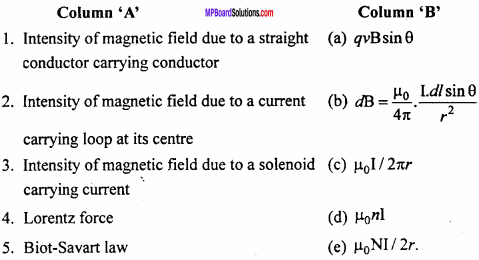
Match the Column :
I.
MP Board 12th Physics Important Questions Chapter 4 Moving Charges and Magnetism 3
Answer:

  1. (c)
  2. (e)
  3. (d)
  4. (a)
  5. (b)

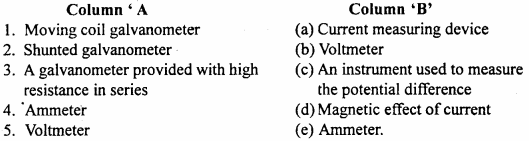
II.
MP Board 12th Physics Important Questions Chapter 4 Moving Charges and Magnetism 4
Answer:

  1. (d)
  2. (e)
  3. (b)
  4. (a)
  5. (c)

MP Board Solutions

Question 4.
Write the answer in one word/sentence

  1. State Ampere’s circuital law.
  2. Which material is used for the suspension wire of a moving coil galvanometer and why?
  3. What should be the resistance of an ideal voltmeter and ammeter?
  4. What happens if a voltmeter is connected in series to the circuit?
  5. What is a cyclotron?
  6. What do you mean by magnetic effect of current?
  7. State Maxwell’s right – hand screw rule.
  8. What happens if a voltmeter is connected in series to the circuit?

Answer:
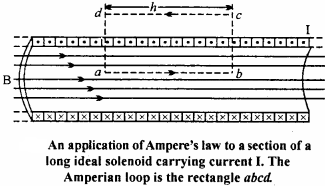
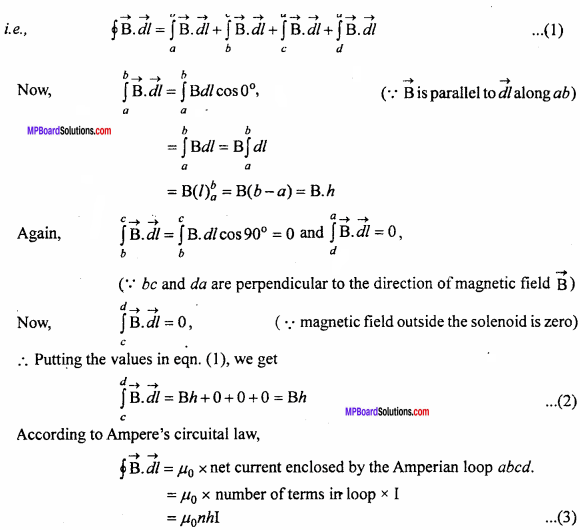
1. Ampere’s circuital law states that the line integral of magnetic field \(\vec { B }\) around any closed path is equal to Mo times the total current I enclosed by the path. Mathematically \(\oint { \vec { B. } } \vec { dl }\) = µ0I

2. Phosphor bronze alloy is used as suspension wire because it has small restoring torque per unit twist and has a high tensile strength

3. An ideal voltmeter should have infinite resistance and the resistance of an ideal ammeter should be zero

4. The resistance of voltmeter is very high, therefore current will be decreased to almost zero

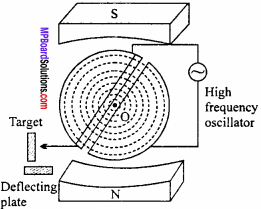
5. Cyclotron is a device used to accelerate positively charged particles (like protons, a particles). So that they can acquire sufficient energy to carry out nuclear disintegrations

6. When current is passed through any conductor, a magnetic field is produced around it. This phenomenon is called magnetic effect of current.

7. If a cork screw is turned so that it advances in the direction of current along the wire, then the direction in which the thumb rotates gives the direction of magnetic lines of force.

8. The resistance of voltmeter is very high, therefore current will be decreased to almost zero.

Moving Charges and Magnetism Very Short Answer Type Questions

Question 1.
Write practical unit of current and define it.
Answer:
The practical unit of current is ampere. One ampere of current is that current which produces a field of 10-7 Wb/m2, at the centre of the conductor of length 1m, placed in the form of an arc of a circle of radius 1 m.

Question 2.
Write S.I. unit of magnetic field intensity and define it.
Answer:
The S.I. unit of magnetic field intensity is newton / ampere x metre.
The intensity of the magnetic field is 1 newton ampere-1 metre-1. If 1 newton force acts on a conductor of length lm carrying a current of 1 ampere and held perpendicular to the magnetic field.

Question 3.
Write an expression for force acting on current – carrying conductor placed in magnetic field. Give the meaning of symbols used.
Answer:
The force on current – carrying conductor kept in magnetic field is given by :
F = IBl sinθ
Where, I = Current, l = Length of conductor, B = Field intensity and θ = Angle between the direction of magnetic field and the conductor.

MP Board Solutions

Question 4.
What is the practical unit of current? Give its definition.
Answer:
If two parallel conductors situated at a perpendicular distance of 1 metre carry equal current in the same direction and exert an attractive force of 2 x 10⁻⁷ newton on each other in air or vacuum, then the current on each conductor is equal to one ampere.

Question 5.
Why a soft iron core is kept in moving coil galvanometer?
Answer:
The magnetic lines of force crossed through the soft iron core. This increases the magnetic field and hence sensitivity of galvanometer. The soft iron core helps to make the magnetic field radial.

Question 6.
The pole pieces of magnet are cut concave in a galvanometer. Why?
Answer:
So that the magnetic field becomes radial, hence the plane of the coil becomes parallel to the magnetic field. Under this condition, the deflecting torque on the coil is maximum.

Question 7.
What happens if an ammeter is connected in parallel to the circuit? What is the resistance of an ideal ammeter?
Answer:
The resistance of an ammeter is very less, hence almost all the current will flow through the ammeter which may damage the ammeter. The resistance of an ideal ammeter is zero.

Question 8.
Why an ammeter is connected in series in an electric field?
Answer:
An ammeter measures the electric current of the circuit, hence all the current should pass through the ammeter. Therefore, it is connected in series.

Question 9.
The resistance of ammeter should be very small. Why?
Or
The resistance of an ideal ammeter is zero. Why?
Answer:
An ammeter measures the current of an electric circuit, therefore it is connected in series. If the resistance of ammeter is large, then it will decrease the current in the circuit. Thus, the resistance of an ammeter should be less or zero.

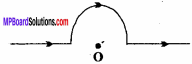
Question 10.
What will be the resultant magnetic field intensity of point O as shown in the figure?
MP Board 12th Physics Important Questions Chapter 4 Moving Charges and Magnetism 5
Answer:
Due to the straight portion of the wire the resultant field will be zero and due to semi circle. The resultant field intensity will be
B = \(\frac { { µ }_{ 0 }I }{ 4R }\)

Moving Charges and Magnetism Short Answer Type Questions

Question 1.
What is second right – hand palm rule? Write its uses.
Answer:
Stretch out the palm of your right – hand such that the fingers are perpendicular to the direction of thumb.
MP Board 12th Physics Important Questions Chapter 4 Moving Charges and Magnetism 6
If the thumb points the direction of current and the fingers point the direction of magnetic field, then the force acting on conductor will be in upward direction perpendicular to Direction i the palm.

Uses:
By it’s we can find out intensity of magnetic filed due topufrent carrying conductor.

Question 2.
Write Biot – Savart law for the magnetic field produced due to an element of a current – carrying conductor and explain the term used in it. Define the unit of current with the help of it
Answer:
Let AB be a conductor carrying current I. Consider a small line element dl of the conductor, due to which the magnetic field dB is produced at point P, then the strength of the magnetic field \(\vec { (dB) }\) depends on the following factors :

1. The field is directly proportional to current I.
i.e., dB ∝I

2. The field is directly proportional to the length of element,
i.e., dB ∝ dl
MP Board 12th Physics Important Questions Chapter 4 Moving Charges and Magnetism 7

3. The field is directly proportional to the sine of angle between the line joining the point and dl.
i.e., dB ∝ sinθ

4. The field is inversely proportional to the square of the distance between the observation point and line element.
i.e.,
dB ∝ \(\frac { 1 }{ { r }^{ 2 } }\)
Combining all the four points,we get
dB ∝ \(\frac { Idl sinθ }{ { r }^{ 2 } }\)
or dB ∝ K\(\frac { Idl sinθ }{ { r }^{ 2 } }\) … (1)
Where, K is constant of proportionality. Its value depends upon the system of units
In C.G.S system, k = 1
∴ dB ∝ K\(\frac { Idl sinθ }{ { r }^{ 2 } }\) gauss … (2)
In M.K.S. system, K = \(\frac { { μ }_{ 0 } }{ 4π }\)
Where, μ0 = Permeability of free space.
∴ dB = \(\frac { { μ }_{ 0 } }{ 4π }\) \(\frac { Idl sinθ }{ { r }^{ 2 } }\) Wb/m2 … (3)
or dB =10-7 [/latex] \(\frac { Idl sinθ }{ { r }^{ 2 } }\) Wb/m2 … (4)
The relations given by eqns. (2), (3) and (4) are called Biot – Savart law.
The direction of the magnetic field \(\vec { dB }\) is always perpendicular to the plane containing \(\vec { dl }\) and \(\vec { r }\) and is given by the right – hand screw rule for the cross product of vectors.

Unit of electric current:
1. In C.GS. system : If dl= 1cm, r= 1cm, sinθ = 1 i.e., 9 = 90° and dB = 1 gauss, then from eqn. (2) I = 1 electromagnetic unit (e.m.u.).
For 9= 90°, the conductor should be taken as a part of circle, as the radius is always perpendicular to the circumference. Thus, 1 e.m.u. of current is that current which produces a field of 1 oersted at the centre of the conductor of length 1 cm, kept in the form of an arc of a circle of radius 1 cm.

2. In M.K.S. system: If dl =1m, r = 1m, sinθ = 1 and dB = 10-7 Wb/m2, then from eqn. (4)
I = 1 ampere.
Thus, 1 ampere of current is that current which produces a field of 10-7 Wb/m2, at the centre of tWconductor of length 1m.

MP Board Solutions

Question 3.
Find the expression for magnetic field intensity for a Toroid.
Answer:
A solenoid bent into the form of closed ring is called toroidal solenoid to fig. (a).
In a toroidal solenoid, the magnetic field \(\vec { B }\) has a constant magnitude everywhere inside the toroid while it is zero in the open space interior (point P) and exterior (point Q) to the toroid.
MP Board 12th Physics Important Questions Chapter 4 Moving Charges and Magnetism 8
The direction of magnetic field in – side is clockwise as per the right hand thumb rule for circular loops. Three circular Amperian loops are shown by dashed lines.
MP Board 12th Physics Important Questions Chapter 4 Moving Charges and Magnetism 9
By symmetry, the magnetic field should be tangential to them and constant in magnitude for each of the loops.

1. For points in the open space interior to the toroid:
Let B1 be the magnitude of the magnetic field along the Amperian loop 1 of radius r1
Length of the loop L1 = 2πr1
As the loop encloses no current, I = 0
Applying Ampere’s circuital law.
B1L1 = μ0I
or B12πr1 = μ0 × 0
Thus, the magnetic field at any point P in the open space interior to the toroid is zero.

2. For points inside the toroid:
Let B be the magnitude of the magnetic field along the Amperian loop 2 of radius r.
Length of loop 2, L2 = 2π r
If N is the total number of turns in the toroid and I the current in the toroid, then total I the current enclosed by the loop 2 = NI.
Applying Ampere’s circuital law.
B × 2πr = μ0 NI
or B = \(\frac { { μ }_{ 0 }NI }{ 2πr }\)
If r be the average radius of the toroid and n the number of turns per unit length, then
N = 2πrn
∴ B = \(\frac { { μ }_{ 0 }I }{ 2πr }\).2πrn
or B = μ0I n.

3. For points in the open space exterior to the toroid:
Each turn of the torpid passes twice through the area enclosed by the Amperian loop 3. For each turn, the current coming out of the plane of paper is cancelled by the current going into the plane of paper.
Thus, I = 0 and hence B3 = 0.

Question 4.
Write four similarities between Biot – savart law and coloumb’s inverse square law.
Answer:
The four similarities between both are :

  1. Both laws obey inverse square law.
  2. Wide range of field is given by both the law’s.
  3. Principle of superpositions held for both the law.
  4. Both the law is effected by the medium of surrounding of the conductor.

MP Board Solutions

Question 5.
State and prove Ampere’s circuital law.
Answer:
Ampere’s circuital law:
Ampere’s circuital law states that the line integral of magnetic field B around any closed path is equal to μ0 times the total current I enclosed by the path.
MP Board 12th Physics Important Questions Chapter 4 Moving Charges and Magnetism 10
Mathematically \(\oint { \vec { B. } } \vec { dl }\) = µ0I
Proof:
Consider an infinitely long straight conductor carrying current I. The magnetic lines of force are produced around the conductor as concentric circles.
The magnetic field due to this current – carrying infinite conductor at a distance a is given by
B = \(\frac { { μ }_{ 0 } }{ 4π }\) \(\frac {2I}{a}\), … (1)
(from Biot – Savart law)

Consider a circle of radius a. Let XY be a small element of length dl. \(\vec { dl }\) and \(\vec { B }\) are in
the same direction because direction of [/latex] and \(\vec { B }\) is along the tangent to the circle.
The line integral for the closed path will be
MP Board 12th Physics Important Questions Chapter 4 Moving Charges and Magnetism 11
This proves Ampere’s circuital law.

Question 6.
Obtain an expression for the magnetic field due to a long straight current carrying conductor using Ampere’s circuital law.
Answer:
Consider an infinite long to conductor XY carrying current I as shown in the figure.
Magnetic field at P has to be found out. Distance between P and the wire is ‘a’. Draw an Amperian loop of radius a. Consider a line element RS = \(\vec { dl }\).
MP Board 12th Physics Important Questions Chapter 4 Moving Charges and Magnetism 12
Let \(\vec { B}\) be the magnetic field at P; then the line integral of magnetic field along the circular path = \(\oint { Bdl }\) By Ampere’s circuital law,
\(\oint { Bdl }\) = µ0
Where, I is the total current flowing in the Amperian loop.
Angle between \(\vec { B }\) \(\vec { dl }\) = 0
MP Board 12th Physics Important Questions Chapter 4 Moving Charges and Magnetism 13
This is the strength of the magnetic field due to the conductor at a distance a.

MP Board Solutions

Question 7.
Derive on expression for force acting on a current carrying conductor in a magnetic field.
Answer:
We know that a moving charge experiences a magnetic force in a uniform magnetic field. It can be extended for a current conductor placed in a uniform magnetic field, because electric current is the flow of free electrons. Let l be the length of a conductor, A its area of cross – section and n be the number density of free electrons.
MP Board 12th Physics Important Questions Chapter 4 Moving Charges and Magnetism 14
Then no. of free electrons in the conductor N=nAl
Let conductor be lying along Y – axis and magnetic field B lying in YY – plane makes angle 6 with Y – axis. Current flows through the coil along the direction of X – axis. Electric current flows through a conductor due to unidirectional flow of free electrons. Therefore, magnetic force acting on each free electron
\(\oint { f }\) = -e\((\vec { { v }_{ d } } \times \vec { B } )\)
Where \(\vec { { v }_{ d } }\) is the drift velocity of electron and e is the charge on an electron. Therefore, total magnetic force acting on the conductor
MP Board 12th Physics Important Questions Chapter 4 Moving Charges and Magnetism 15
I \(\vec { l }\) is a current element directed along the direction of current. I \(\vec { l }\) and vd are directed in opposite directions. Therefore, eqn. (2) may be written as
MP Board 12th Physics Important Questions Chapter 4 Moving Charges and Magnetism 16
Case I : If θ = 0° , then sinθ = sin 0° = 0
Then from eqn. (4), F = 0
Thus, no magnetic force acts on a current carrying conductor lying parallel to magnetic field.

Case II : If θ = 90° ⇒ sinθ = sin90° = 1
Then p = JlB sin 90° or F = IlB (maximum)
Thus, a current carrying conductor placed perpendicular to a magnetic field experiences maximum magnetic force.

Question 8.
State Fleming’s left – hand rule.
Answer:
Stretch the forefinger, the middle finger and the thumb of your left – hand so that they are mutually perpendicular to each other. If the forefinger points the direction of magnetic field, the middle finger points the direction of current then the thumb indicates the direction of force acting on the conductor.
MP Board 12th Physics Important Questions Chapter 4 Moving Charges and Magnetism 17

Question 9.
For circular motion of a charged particle in a uniform magnetic field obtain the expression for radius of path and periodic time of revolution.
Or
Discuss the motion of the charged particle in a uniform magnetic field with the initial velocity perpendicular to magnetic field.
Answer:
Consider a charged particle with charge q which is moving with a velocity v in a magnetic field of intensity B. Then, the maximum Lorentz force acting on the charged particle will be
F = qvB
and the direction of the force is perpendicular to v and B which is according to Fleming’s left – hand rule. So, no work will be done by the force on the charge because d W = Fd cosθ, here 0= 90°, hence d W = 0. It means that kinetic energy or the speed of the charged particle will be constant. So, the charge will move on a circular path.
MP Board 12th Physics Important Questions Chapter 4 Moving Charges and Magnetism 18
Now, for circular motion Lorentz force provides the necessary centripetal force.
Let the mass of the charged particle be m and the radius of circular path be r.
Then, Lorentz force = Centripetal force
or qvB = \(\frac { { mv }^{ 2 } }{ r }\)
or r = \(\frac { mv}{ qB }\) … (1)
or r = \(\frac { p}{ qB }\) … (2)
Where, mv = p = Momentum of the particle.
Hence, from eqn. (2), the radius of circular path is directly proportional to the momentum.
Again, angular velocity, w = \(\frac { v}{ r }\) = \(\frac { qB}{ m }\)
Frequency, v = \(\frac { w}{ 2π }\) = \(\frac { qB}{ 2πm }\)
and T = \(\frac { 1}{ v }\)
= \(\frac {2πm}{qB}\)

Question 10.
When the current flows in opposite direction in two parallel wires, both repel each other, why?
Answer:
If direction of current are opposite in the conductor then according to Fleming left hand rule the direction of force acting on the conductor CD will be in the plane of the paper and opposite to conductor AB. The direction of force acting on AB due to CD will be perpendicular to AB and opposite to CD on the plane of paper. Obviously the conductor will be repel each other.
MP Board 12th Physics Important Questions Chapter 4 Moving Charges and Magnetism 19

Question 11.
When the current flows in the same direction in two “ parallel wires. Both attract each other, why?
Answer:
In the direction of the current in both the conductors are same, then according to Fleming left hand rule, the direction of force acting on the conductor CD carrying current will be in the plane of paper perpendicular to conductor CD toward the conductor AB on the other hand the direction of force acting in conductor AB will be in the plane of paper perpendicular to conductor AB toward the conductor CD. Obviously the conductor AB and CD will attract each other.
MP Board 12th Physics Important Questions Chapter 4 Moving Charges and Magnetism 20

Question 12.
Given two parallel wires carrying currents I1 and I2 are kept at a distance d apart. Obtain the expression for force exerted by one on (nt length of another. When will this force be attractive and when will it be repulsive?
Answer:
Let AB and CD be two parallel conductors kept at a distance d apart, current flowing through them is I1 and I2 respectively.
A magnetic field due to current I, is produced around AB.
∴ Intensity of magnetic field due to AB at a distance d is
B1 = \(\frac { { \mu }_{ 0 } }{ 4\pi } .\frac { { 2I }_{ 1 } }{ d }\) Wb/m2
According to right – hand palm rule, the direction of this field is downwards, normal to the plane of the paper.
MP Board 12th Physics Important Questions Chapter 4 Moving Charges and Magnetism 21
If another conductor CD carrying current I2 in the same direction of I1 is situated in the magnetic field of AB, then force on length l of CD is given by
F = I2 /B1 sin 90° = I2/B1
or F = I2l.\(\frac { { \mu }_{ 0 } }{ 4\pi } .\frac { { 2I }_{ 1 } }{ d }\)
or F = \(\frac { { \mu }_{ 0 } }{ 4\pi } .\frac { { 2I }_{ 1 }{ I }_{ 2 }l }{ d } \).
Force acting per unit length on CD will be
\(\frac { F}{ l }\) = \(\frac { { \mu }_{ 0 } }{ 4\pi } .\frac { { 2I }_{ 1 }{ I }_{ 2 }}{ d } \).
This is the required expression.
The direction of magnetic field B, on wire CD is acting inwards. Hence, by Fleming’s left – hand rule, the force F2 acting on CD will be directed towards AB, hence CD will come near to AB. So, the conductors attract each other, [see Fig. (a)] And when the current flows in opposite direction, they will repel each other, [see Fig. (b)].

Question 13.
Obtain an expression for the torque or the couple acting on a current loop, when it is placed in a magnetic field.
Or
Prove that the torque \(\oint { τ }\) acting bn a rectangular loop is given by \(\oint { τ }\) = \(\oint { m }\) \(\oint { B }\), where \(\oint { m}\) is the magnetic moment of the loop.
Answer:
Consider a rectangular coil ABCD of length ‘l’ and breadth ‘ b’ kept in a magnetic field of strength \(\oint { B }\). Let I be the amount of current flowing through the coil.
Force acting on AB is F1 = BI/sin90° = BIL. By Fleming’s left hand rule, it comes out of the plane of paper.
Force acting on CD is F2 = Bl/ sin 90° = Bll. By Fleming’s rule, it goes into the plane of paper.
MP Board 12th Physics Important Questions Chapter 4 Moving Charges and Magnetism 22
The forces, F1 and F2 are equal in magnitude but act along different line of action, hence they constitute a torque or couple.
At any instant of time, the normal to the coil makes an angle θ w.r.t. magnetic field B. The perpendicular distance between the forces F1 and F2 is bsinθ.
Torque acting on the coil is
τ = Magnitude of force × Perpendicular distance between the forces
= BIl x b sinθ
= BI(lb)sinθ
τ = BIAsinθ (∵ lb = A = area of coil)
If the coil consists of N circles, then
τ = NBIAsinθ
This is the expression for the torque acting on a current loop when placed in a magnetic field.
But NIA = m, the magnetic moment of loop.
So τ = mBsinθ
In vector notation, torque r is given by
\(\oint { τ }\) = \(\oint { m }\) \(\oint { B }\), where \(\oint { m}\)
The direction of the torque r is such that it rotates the loop clockwise along the axis of suspension.

Question 14.
Explain the construction of moving coil galvanometer by drawing its diagram; Why is a soft – iron core kept in the moving-coil galvanometer ? Why the pole pieces are made concave?
Answer:
1. A permanent strong horseshoe magnet is taken. Its pole pieces NS are made of cylindrical soft – iron, cut in concave shape. A coil A, is suspended between the pole pieces, by a phosphor bronze wire F. The other end of the coil is connected to a spring Sp. The coil consists of insulated copper wire wound on an aluminium frame and a soft iron cylinder C is fixed within the coil, so that the coil can freely turn around it.
MP Board 12th Physics Important Questions Chapter 4 Moving Charges and Magnetism 23
The wire F and spring Sp is connected to the terminals T1 and T2. Aconcave mirror M is attached to the wire F, so that the deflection of the coil can be measured with the help of lamp and scale arrangement. All the above arrangement is kept inside a non – magnetic box to protect it by dust, air, etc. The front portion of the box is made of glass and the base is provided by levelling screws.

2. Soft – iron core is used in moving coil galvanometer because :

  • The permeability of soft – iron is very high, hence the field intensity increases.
  • It makes the field radial.

3. By making pole pieces of magnet concave, the field is made radial, so that the plane of the coil becomes parallel to the magnetic field in all the positions.

Question 15.
Explain the principle of moving – coil galvanometer and find the expression for the current.
Or
What is the principle of moving – coil galvanometer? Prove that the current is proportional to the deflection of the coil.
Answer:
Principle:
Whenever a current is made to pass through a coil placed in a uniform magnetic field, then a torque acts on it which rotates the coil and tries to make it perpendicular to the direction of the field. Let ABCD be a rectangular coil, which is kept in a magnetic field B. such that the sides AB and CD are perpendicular, to field. Let the length of the coil AB be l and breadth BC be b. If I is the current flowing in the coil, then Lorentz force acting on AB and CD will be F = BIl.
MP Board 12th Physics Important Questions Chapter 4 Moving Charges and Magnetism 24
The force acting on AB is F1 which comes out of the plane of paper and on CD is F2 which goes inside the plane of paper. As the forces are equal in magnitude and opposite in direction along different line of action, hence they produce a couple.

At any instant of time, the axis of coil (i.e., the normal to the coil) makes an angle θ with respect to the magnetic field, then the perpendicular distance between two forces F1 and F2 is bsinθ.

Now, torque = Magnitude of force x Perpendicular distance between two forces
= BIl × bsinθ = BIAsinθ
Where, A =lb = Area of the coil.
If N is the number of turns on the coil, then
τ = NBI Asin θ
Initially, when the plane of the coil lies parallel to the magnetic field, then the angle between the magnetic field and normal to the coil is 90°, i.e., θ = 90° therefore sinθ= 1.
∴τmax =NBIA
This torque is the deflecting torque. Which rotates the coil. As a result, a restoring torque gets developed in the suspension wire which tries to restore the coil back to the initial position.
Let ϕ be the angle of twist and C is the couple for unit twist.
Restoring torque produced = Cϕ
Under equilibrium, deflecting torque = Restoring torque.
∴ NBIA = Cϕ
or I = \(\frac {C}{NBA}\)ϕ
or I = kϕ (where, k = \(\frac {C}{NBA}\)
or I ∝ϕ
This is the principle of moving – coil galvanometer.

MP Board Solutions

Question 16.
What do you understand by the sensitivity of moving – coil galvanometer? Write its expression. On what factors does it depend and how?
Answer:
The current sensitivity of a moving coil galvanometer is defined as the deflection produced by unit current through the coil.
Let ϕ be the deflection produced due to current I, then
I = \(\frac {C}{NBA}\)ϕ
If the current through the galvanometer is I, which produces a deflection ϕ, then
\(\frac {ϕ}{I}\) = \(\frac {NBA}{C}\)
Sensitivity of galvanometer s = \(\frac {ϕ}{I}\)
= \(\frac {NBA}{C}\)

Sensitivity depends on the following factors :

  1. N (No. of turns) should be greater. As the nufnber of turns increases, sensitivity increases.
  2. For greater sensitivity, magnetic field should be greater. To increase the magnetic field B, a permanent horseshoe magnet must be used. By increasing B, sensitivity increases.
  3. Area of the coil : If area increases, sensitivity increases.
  4. C (Couple per unit twist) : The value of C should be less for more sensitivity.

Question 17.
What is meant by shunt? If the resistance of a galvanometer is Rg, then calculate the value of the shunt carrying current nth part of total current to pass through the galvanometer.
Answer:
Shunt:
A shunt is a thick copper wire which is joined in parallel with the coil of the galvanometer. It has very low resistance.
Let Rg be the resistance of galvanometer and S be the value of the shunt resistance.
MP Board 12th Physics Important Questions Chapter 4 Moving Charges and Magnetism 25
Let I be the total current flow in the circuit. It gets divided as Ig and Is: where Ig is the current flowing in galvanometer and I, in the shunt resistance (S).
∴ I = Ig + Is … (1)
Now, potential difference across galvanometer = Ig.Rg
and Potential difference across shunt = Is.S.
As galvanometer and shunt are in parallel, hence potential difference will be equal
i.e.,
MP Board 12th Physics Important Questions Chapter 4 Moving Charges and Magnetism 26
This is the value of shunt resistance.
Adding 1 to both sides of eqn. (2), we get
MP Board 12th Physics Important Questions Chapter 4 Moving Charges and Magnetism 27
The above equation gives the value of current flow through the galvanometer in turns of total current.
If the current passing through the galvanometer is nth part of the total current, then
\(\frac { { I }_{ g } }{ I }\) = \(\frac {1}{n}\)
Eqn. (4) becomes
\(\frac {1}{n}\) = \(\frac { s }{ { R }_{ g }+S }\)
or nS = Rg + S
or nS – S = Rg
or S(n -1) = Rg
or S = \(\frac { { R }_{ g } }{ (n-1) }\) … (6)
Hence, for the nth part of total current to pass through the galvanometer, the resistance of the shunt should be (n – l)th of the resistance of galvanometer.

Question 18.
How a galvanometer can be converted to ammeter and voltmeter?
Answer:
Conversion of galvanometer into ammeter:
Since, the coil of the galvanometer has low resistance, so to convert it into ammeter, a low resistance (called shunt) is joined in parallel, so that most of the current passes through the shunt and very less current passes through the coil of galvanometer.
MP Board 12th Physics Important Questions Chapter 4 Moving Charges and Magnetism 28
Derive up to eqn. (3) from Short Ans. Type Q. No. 17.
Hence, by joining a shunt resistance of value
S = \(\frac { { I }_{ g }{ R }_{ g } }{ I-{ I }_{ g } }\)
So, the galvanometer gets converted to an ammeter.

Conversion of galvanometer into voltmeter:
The resistance of voltmeter is high, So to convert a galvanometer into a voltmeter, a high resistance wire is connected wire is connected in series to the coil of galvanometer, [see fig.(b)].
MP Board 12th Physics Important Questions Chapter 4 Moving Charges and Magnetism 29
Suppose Rg be the resistance of galvanometer and R is the resistance of wire connected A in series. Let I be the current flowing in the galvanometer.
In order to convert a galvanometer into a voltmeter of range (0 – V) volts, we have from adjacent figure
The total potential difference between A and B will be
V = Ig(Rg + R)
or Rg + R = \(\frac { V }{ { I }_{ g } }\)
or R = \(\frac { V }{ { I }_{ g } }\) – Rg.
This is the expression and the value of the resistance required to convert the galvanometer to voltmeter of range 0 to V.

Question 19.
What is a shunt? Write its uses. What are advantages and disadvantages of shunt?
Answer:
Shunt:
It is a wire of low resistance, connected in parallel to the coil of a galvanometer.

Uses:
A galvanometer is converted into an ammeter by using a shunt.

Advantages:

  1. It protects the coil of the galvanometer from burning as well as the breaking of the pointer.
  2. As the shunt is connected in parallel, the resultant resistance becomes less. So, when the shunted galvanometer (ammeter) is joined in series, then the value of the current does not change.

Disadvantages:
Due to shunt, the sensitivity of galvanometer is reduced. So, it should be removed from the galvanometer when we have to obtain null point.

Moving Charges and Magnetism Long Answer Type Questions

Question 1.
Derive an expression for the intensity of magnetic field at a point on the axis of a circular current loop.
Or
Obtain an expression for the intensity of the magnetic field at a point on the axis of a circular coil.
Answer:
Magnetic field at a point on the axis of a circular current loop:
Let a be the radius of a circular loop and current 1 is flowing through it in the direction shown in the figure. A point P is considered on the axis of the loop, at a distance x from the centre O, at which the intensity of the magnetic field is to be determined.
MP Board 12th Physics Important Questions Chapter 4 Moving Charges and Magnetism 30
The plane of the loop is normal to the plane of the paper and its axis OP lies on the plane of the paper. Let the loop be divided into so many small elements, each of length dl, let one of such small part is AB.
∴ The intensity of the magnetic field at P, due to dl, is given by

MP Board 12th Physics Important Questions Chapter 4 Moving Charges and Magnetism 31
The direction of dB is along PR, normal to CP. Let ∠CPO = ϕ
Resolving dB in two parts, we get

  1. dB sinϕ, along OP and
  2. dB cosϕ, along PN, normal to OP.

If another small element dl is considered, diametrically opposite to AB, i.e., A’B’.
∴ Intensity of magnetic field at P, due to A’B’ will be
dB = \(\frac { { \mu }_{ 0 } }{ 4\pi } .\frac { I.dl }{ { r }^{ 2 } }\)
Again, resolving dB, we get

  1. dB sin0, along OP and
  2. dB cos0, along PN’, normal to OP.

As the directions of PN and PN’, are opposite, hence they will cancel the effect of each other. Similarly, all the resolved parts, perpendicular to OP will be cancelled out. But the components along the direction AP, will be summed up.
∴ Intensity of magnetic field due to the circular loop at point P will be
MP Board 12th Physics Important Questions Chapter 4 Moving Charges and Magnetism 32

Question 2.
State Biot – Savart law and with the help of it derive an expression for magnetic field intensity at a point situated at a distance from a current carrying straight wire of infinite length.
Answer:
Biot – Savart law:
Let AB be a conductor carrying current I. Consider a small line element dl of the conductor, due to which the magnetic field dB is produced at point P, then the strength of the magnetic field \(\vec { (dB) }\) depends on the following factors :
(i) The field is directly proportional to current I.
i.e., dB ∝I
(ii) The field is directly proportional to the length of element,
i.e., dB ∝ dl
MP Board 12th Physics Important Questions Chapter 4 Moving Charges and Magnetism 34
(iii) The field is directly proportional to the sine of angle between the line joining the point and dl.
i.e., dB ∝ sinθ
(iv) The field is inversely proportional to the square of the distance between the observation point and line element.
i.e.,
dB ∝ \(\frac { 1 }{ { r }^{ 2 } }\)
Combining all the four points,we get
dB ∝ \(\frac { Idl sinθ }{ { r }^{ 2 } }\)
or dB ∝ K\(\frac { Idl sinθ }{ { r }^{ 2 } }\) … (1)
Where, K is constant of proportionality. Its value depends upon the system of units
In C.G.S system, k = 1
∴ dB ∝ K\(\frac { Idl sinθ }{ { r }^{ 2 } }\) gauss … (2)
In M.K.S. system, K = \(\frac { { μ }_{ 0 } }{ 4π }\)
Where, μ0 = Permeability of free space.
∴ dB = \(\frac { { μ }_{ 0 } }{ 4π }\) \(\frac { Idl sinθ }{ { r }^{ 2 } }\) Wb/m2 … (3)
or dB =10-7 [/latex] \(\frac { Idl sinθ }{ { r }^{ 2 } }\) Wb/m2 … (4)
The relations given by eqns. (2), (3) and (4) are called Biot – Savart law.
The direction of the magnetic field \(\vec { dB }\) is always perpendicular to the plane containing \(\vec { dl }\) and \(\vec { r }\) and is given by the right – hand screw rule for the cross product of vectors.

Unit of electric current:
1. In C.GS. system : If dl= 1cm, r= 1cm, sinθ = 1 i.e., 9 = 90° and dB = 1 gauss, then from eqn. (2) I = 1 electromagnetic unit (e.m.u.).
For 9= 90°, the conductor should be taken as a part of circle, as the radius is always perpendicular to the circumference. Thus, 1 e.m.u. of current is that current which produces a field of 1 oersted at the centre of the conductor of length 1 cm, kept in the form of an arc of a circle of radius 1 cm.

2. In M.K.S. system: If dl =1m, r = 1m, sinθ = 1 and dB = 10-7 Wb/m2, then from eqn. (4)
I = 1 ampere.
Thus, 1 ampere of current is that current which produces a field of 10-7 Wb/m2, at the centre of tWconductor of length 1m.

Consider a long straight conductor XY which is on the plane Y of paper and current flow through it is I, which flows from X to Y. c Then magnetic field has to be found at position P, which is situated t at a distance a (distance measured perpendicularly from the wire) from the wire.
∴PC = a
To find out the total magnetic field at P, we have to first find out the magnetic field due to small line element \(\vec { dl }\), which is situated at a distance l from C. On integrating the magnetic field due to line element \(\vec { dl }\) , we can get the total magnetic field.
Let \(\vec { r }\) be the position vector of P with respect to the line element \(\vec { dl }\) and θ is the angle
between the line element \(\vec { dl }\) and \(\vec { r }\).
By Biot – Savart law,
dB = \(\frac { { \mu }_{ 0 } }{ 4\pi } .\frac { I.dl }{ { r }^{ 2 } }\)
We have to find out the magnetic field due to line element \(\vec { dl }\) at P, which is situated at r from \(\vec { dl }\) . The position of \(\vec { dl }\) can vary, hence θ can change, so we have to find out the value of sinθ and dl. For that, consider right angled triangle POC.
MP Board 12th Physics Important Questions Chapter 4 Moving Charges and Magnetism 35
Putting the values of sinθ, r and dl from eqns. (2), (3) and (4) respectively in eqn. (1), we get
MP Board 12th Physics Important Questions Chapter 4 Moving Charges and Magnetism 36
Eqn. (5) is the magnetic field due to line element dl. To find out the total magnetic field, integrating both sides under limits from ϕ1 to ϕ2 (-ϕ1 is taken because it is clock wise or below the line joining CP and ϕ2 is taken because it is anticlockwise or above the line joining CP).
MP Board 12th Physics Important Questions Chapter 4 Moving Charges and Magnetism 37
For an infinitely long conductor and if the observation point is very near, then
MP Board 12th Physics Important Questions Chapter 4 Moving Charges and Magnetism 38

Question 3.
Describe the cyclotron under the following points :

  1. Construction
  2. Principle and working process.

Or
What is a cyclotron? Write its principle. Obtain the expression for the cyclotron frequency and the maximum energy of the charged particle when it hits the target.
Answer:
Principle:
It is based on the principle that when a positively charged particle is made to move again and again in a high frequency electric field and using strong magnetic field, then it gets accelerated and acquires sufficiently large amount of energy.

Construction:
It consist of two hollow D – shaped metallic chambers D1 and D2 called dees. These dees are separated by a small gap where a source of positively charged particle is placed. Dees are connected to a high frequency oscillator, which provide high frequency electric field across the gap of the dees. This arrangement is placed between two poles of a strong electromagent. The magnetic field due to this electromagnet is perpendicular to the plane of the dees.

Working:
If a positively charged particle (proton) is emitted from O, when D2 is negatively charged and the dee D1, is positively charged, it will accelerate towards D2. As soon as it enters D2, it is shielded from the electric field by metallic chamber (enclosed space). Inside D2, it moves at right angles to the magnetic field and hence describes a semi – circle inside it. After completing the semicircle, it enters the gap between the dees at the time when the polarities of the dees have been reversed.
MP Board 12th Physics Important Questions Chapter 4 Moving Charges and Magnetism 39
Now, the proton is further accelerated towards D1. Then it enters D1 and again describes the semicircle due to the magnetic field which is perpendicular to the motion of the proton. This motion continues till the proton reaches the periphery of the dee system. At this stage, the proton is deflected by the deflecting plate which then comes out through the window and hits the target.

Theory:
When a proton (or any other positively charged particle) moves at right angle to the magnetic field B inside the dees, Lorentz force acts on it.
i. e., F = qvB sin 90° = qvB
Where, q = Charge of particle and v = Velocity of particle.
The force provides the necessary centripetal force \(\frac { m{ v }^{ 2 } }{ r }\) to the charged particle to move in a circular path of radius r.
∴ qvB = { m{ v }^{ 2 } }{ r }[/latex]
or r = \(\frac {mv}{qB}\) … (1)
Time taken to complete one semicircle inside a dee,
t = \(\frac {Distance}{Speed}\) = \(\frac { πr}{v}\)
or t = \(\frac { π}{v}\) × \(\frac { mv}{qB}\) [from eqn.(1)]
t = \(\frac { πm}{qB}\) … (2)
Thus, time taken to complete one semicircle does not depend upon radius of path. If T is the time – period of the alternate electric field, then the polarities of the dees changes in time 772.
i.e., \(\frac {T}{2}\) = t = \(\frac {πm}{qB}\)
or T = \(\frac {2πm}{qB}\) … (3)
So, cyclotron frequency or magnetic resonance frequency,
v = \(\frac {1}{T}\) = \(\frac {qB}{2πm}\) … (4)
Energy gained by a positively charged particle is given by
E = \(\frac {1}{2}\)mv2
From eqn (1), v = \(\frac {qBr}{m}\)
so, E = \(\frac {1}{2}\)m\(\frac { { q }^{ 2 }{ B }^{ 2 }{ r }^{ 2 } }{ { m }^{ 2 } } \)
= \(\frac { { q }^{ 2 }{ B }^{ 2 }{ r }^{ 2 } }{ { 2m } }\)
Maximum energy is gained by the positively charged particle when it is at the periphery of the dees (r is maximum), i.e.,
Emax = \(\frac { { q }^{ 2 }{ B }^{ 2 } }{ { 2m } }\) r2max

MP Board Solutions

Question 4.
Obtain an expression for magnetic field due to a solenoid using Ampere’s circuital law.
Answer:
Consider a very long solenoid having n turns per unit length carrying current I. The magnetic field inside the solenoid is uniform and directed along the axis of solenoid.
MP Board 12th Physics Important Questions Chapter 4 Moving Charges and Magnetism 40
Consider a rectangular Amperian loop abed in a solenoid. Magnetic field B is uniform within the solenoid. Let the length of the Amperian loop be h.
∴Total number of turns in Amperian loop = nh.
The integral \(\oint { \vec { B } .\vec { dl } }\) is basically equal to the sum of four integrals
MP Board 12th Physics Important Questions Chapter 4 Moving Charges and Magnetism 41
Comparing eqns.(2) and (3)
Bh = µ0nhI
⇒ B = µ0nI.

Question 5.
Explain the experiment to find reduction factor of a tangent galvanometer under following points :

  1. Formula
  2. Circuit diagram
  3. Observation table
  4. Any two precautions.

Answer:
1. Formula : i = ktanθ or k = \(\frac {i}{tanθ}\)
Where i = Current flowing through coil, and
θ = Deflection in magnetic needle.
MP Board 12th Physics Important Questions Chapter 4 Moving Charges and Magnetism 42
2. Circuit diagram :
TG = Tangent Galvanometer,
K = Reversing key,
B = Cell, Rh = Rheostat,
A = Ammeter.

3. Observation table:
MP Board 12th Physics Important Questions Chapter 4 Moving Charges and Magnetism 43

4. Precautions :

There should be no magnet near tangent galvanometer.
After aligning in magnetic meridian, the tangent galvanometer should not be moved.

Moving Charges and Magnetism Numerical Questions

Question 1.
The frequency of a cyclotron oscillator is 10 MHz.What should be the magnetic field required to accelerate a proton (e = 1.6 x 10⁻¹⁹C, m =1.67 x 10⁻²⁷kg)
Solution:
f = \(\frac {qB}{2πm}\)
or B = \(\frac {2πmf}{q}\)
Given : m = 1.67 x 10⁻²⁷kg, f = 10 x 106Hz, q = e = 1.6 x 10⁻¹⁹
MP Board 12th Physics Important Questions Chapter 4 Moving Charges and Magnetism 44

Question 2.
A particle having 100 times charge of an electron is revolving in a circle of radius 0-8 metre in each second. Calculate the intensity of magnetic field.
Solution:
Formula: B = \(\frac { { \mu }_{ 0 } }{ 4\pi } .\frac { 2\pi I }{ R }\)
Given : q = 100 x 1.6 x 10-19
= 1.6 x 10⁻¹⁷ coulomb, R = 0.8 metre
Putting the value in formula, we get I = \(\frac {q}{t}\)
\(\frac { 1.6\times { 10 }^{ -17 } }{ 1 }\) = 1.6 x 10⁻¹⁷
B = \(\frac { { \mu }_{ 0 } }{ 4\pi } .\frac { 2\pi \times 1.6\times { 10 }^{ -17 } }{ 0.8 }\) or B = 10-2µ0

Question 3.
Calculate the torque on a 20 turns square coil of side 10 cm carrying a current of 12 A, when placed, making an angle of 30° with the magnetic field of 0.8 T.
Solution:
Given : A = 100cm2 100 x 10-4m2 = 10-2m2 n = 20, I = 12A, B = 0.8T, ϕ = 30°
Formula: τ = nIABsinϕ
= 20 x 12 x 102 x 0. 8sin30°
= 20 x 12 x 0.8 x 102 x \(\frac {1}{2}\)
= 96 x 102 = 0.96 N – m.

MP Board Solutions

Question 4.
Resistance of a Galvanometer is 50 ohms, when 0.01 Acurrent flows through it, full scale defections is obtained. How it can be converted into

  1. 5 A range ammeter and
  2. 5 volts range voltmeter.

Solution:
1. Given : G = 50 ohm, ig = 0.01 A, I = 5A
Formula : S = \(\frac { { I }_{ g }G }{ I-{ I }_{ g } }\)
Putting the value in the formula are get = \(\frac {0.01 x 50}{5-0.01}\) = \(\frac {0.5}{4.99}\)

2. Given : V = 5 vol
Formula : R = \(\frac { V }{ { I }_{ g } }\) – G
Putting the value in the formula are get
R = \(\frac {5}{0.01}\) – 50 = 500 – 50 = 450 ohms.

Question 5.
Find the magnitude of magnetic field at the centre of a circular coil of radius 10 cm having 100 turns. Current flowing through the coil is 1A. (NCERT Solved Example)
Solution:
Given, R = 10 cm = 10 x 10-2m; N = 100; I = 1A;
B = \(\frac { { \mu }_{ 0 }NI }{ 2R }\) = \(\frac { 4\pi \times { 10 }^{ -7 }\times 100\times 1 }{ 2\times 10\times { 10 }^{ -2 } }\)
B = 2π x 10-4
= 6.28 x 10⁻⁴ tesla.

Question 6.
10 A current is flowing through a straight conductor. Determine the intensity of magnetic field at a distance 10 m from it.
Solution:
Formula :B = \(\frac { { \mu }_{ 0 } }{ 4\pi } .\frac { 2I }{ d }\)
Given: I = 10 Aandd = 10m.
Substituting the values in the formula, we get
B = 10-7 x \(\frac {2×10}{10}\)
∴B = 2 x 10⁻⁷Wb/m2.

Question 7.
An ammeter of resistance 99 Ω, gives full – scale deflection with 10-4A current. What arrangement is required to measure a current of 1A by it? Calculate the resistance of ammeter.
Solution:
MP Board 12th Physics Important Questions Chapter 4 Moving Charges and Magnetism 45

Question 8.
A solenoid of length 0.5 m has a radius of 1 cm and is made up of 500 turns. It carries a current of 5A. What is the magnitude of the magnetic field inside the solenoid? (NCERT)
Solution:
Given, l = 0.5 m, r = 1 cm = 1 x 10⁻² m, N = 500; I = 5A Number of turns per unit length
Number of turns per unit length
n = \(\frac {N}{l}\) = \(\frac {500}{0.5}\)
Here l >> r
∴Magnetic field inside the solenoid
B = µ0nI
= 4π x 10-7 x \(\frac {500}{0.5}\) x 5
B = 6.28 x 10⁻³tesla.

MP Board Solutions

Question 9.
A wire through which a current of 8A is flowing makes an angle of 30° with the direction of magnetic field of 0.15 tesla. Calculate the force acting per unit length of wire.
Solution:
Given : I = 8A, B = 0.15T, θ = 30°, F =?
formula: F = BIlsinθ
⇒ \(\frac {F}{l}\) = BIlsinθ
= 0.15 x 8 x sin30°
= 0.15 x 8 x \(\frac {1}{2}\) = 0.6N/m.

Question 10.
Two parallel wires A and B are carrying currents 10 A and 2 A respectively, in opposite directions. If the length of the wire A is infinite and length of B is 1 metre, calculate the force on B situated at a normal distance of 10 cm from A.
Solution:
Formula : \(\frac { { \mu }_{ 0 } }{ 4\pi } \frac { 2{ I }_{ 1 }{ I }_{ 2 } }{ d } \times l\)
= 10-7\(\frac { 2{ I }_{ 1 }{ I }_{ 2 } }{ d } \times l\)
Given : I1 = 10 A, I2 = 2A , l = 1 m, d = 0.1 m
∴ F = 10-7 × \(\frac {2×10×2×1}{0.1}\)
= 400 x 10-7= 4.0 x 10⁻⁵N.

MP Board Class 12th Physics Important Questions

MP Board Class 12th Maths Important Questions Chapter 5A Continuity and Differentiability

MP Board Class 12th Maths Important Questions Chapter 5A Continuity and Differentiability

Continuity and Differentiability Important Questions

Continuity And Differentiability Objective Type Questions:

Question 1.
Choose the correct answer:

Question 1.
If x = at2, y = 2at, then \(\frac{dy}{dx}\) will be:
(a) t
(b) t2
(c) \(\frac{1}{t}\)
(d) \(\frac { 1 }{ t^{ 2 } } \)
Answer:
(c) \(\frac{1}{t}\)

Question 2.
If y = 2\(\sqrt { cot(x^{ 2 }) } \) ,then \(\frac{dy}{dx}\) will be:
MP Board Class 12th Maths Important Questions Chapter 5A Continuity and Differentiability
Answer:
(a) MP Board Class 12th Maths Important Questions Chapter 5A Continuity and Differentiability

Question 3.
The value of \(\frac{d}{dx}\) (x3 + sin x2) is to be:
(a) 3x2 + cos x2
(b) 3x2 + x sin x2
(c) 3x2 + 2x cos x2
(d) 3x2 + x cos x2
Answer:
(c) 3x2 + 2x cos x2

Question 4.
The value of \(\frac{d}{dx}\) ax is to be:
(a) ax
(b) ax loga e
(c) ax loge a
(d) \(\frac { a^{ x } }{ log_{ e }a } \)
Answer:
(c) ax loge a

Question 5.
If y = 500e7x + 600e-7x, then the value of \(\frac { d^{ 2 }y }{ dx^{ 2 } } \) will be:
(a) 45 y
(b) 47 y
(c) 49 y
(d) 50 y
Answer:
(c) 49 y

Question 2.
Fill in the blanks:

  1. Differential coefficient of cos x0 w.r.t x is ……………………………..
  2. Differential coefficient of elogea w.r.t x is ……………………………….
  3. Differential coefficient of loge a w.r.t x is ………………………………
  4. Differential coefficient of ax w.r.t x is ……………………………….
  5. Differential coefficient of sin 3x w.r.t x is ……………………………….
  6. If y = sin-1 (2x \(\sqrt { (1-x^{ 2 }) } \)), then \(\frac{dy}{dx}\) = ………………………………
  7. Differential coefficient of sin x w.r.t. cos x is …………………………………..
  8. The value of \(\frac{d}{dx}\) (log tan x) is ………………………………………
  9. Differential coefficient of log (log sin x) ………………………………
  10. If x = y\(\sqrt { (1-y^{ 2 }) } \), then \(\frac{dy}{dx}\) will be …………………………………
  11. nth differentiation of sin x will be ………………………………………
  12. If y = \(\sqrt { x+\sqrt { x+……..\infty } } \), then \(\frac{dy}{dx}\) will be ……………………………….
  13. If x = r cos θ, y = r sin θ, then \(\frac{dy}{dx}\) will be ………………………..
  14. Differential coefficient of ex w.r.t \(\sqrt { x } \) will be ………………………….

Answer:

  1. – \(\frac { \pi }{ 180 } \) sin x0
  2. 0
  3. 0, 4
  4. loge a.ax
  5. cos 3x
  6. \(\frac { 2 }{ \sqrt { 1-x^{ 2 } } } \)
  7. – cot x
  8. 2 cosec 2x
  9. \(\frac { cotx }{ logsinx } \)
  10. \(\frac { \sqrt { 1-y^{ 2 } } }{ 1-2y^{ 2 } } \)
  11. sin (\(\frac { n\pi }{ 2 } \) + x)
  12. \(\frac { 1 }{ 2y-1 } \)
  13. – cot θ
  14. 2\(\sqrt { x } \)ex.

Question 3.
Write True/False:

  1. Differential coefficient of elogex is \(\frac{1}{x}\)?
  2. If f(x) = \(\sqrt { x } \); x>0, then value of f'(2) is \(\frac { 1 }{ 2\sqrt { 2 } } \)?
  3. Any function f(x) is said to be differentiatiable at any point x = a when Lf'(a) ≠ Rf'(a)?
  4. Differential coefficient of sec-1a w.r.t x is 0?
  5. If y = Aemx + Be-mx, then \(\frac { d^{ 2 }y }{ dx^{ 2 } } \) = – m2y?
  6. If y = sin-1( \(\frac { x-1 }{ x+1 } \) ) + cos-1 ( \(\frac { x-1 }{ x+1 } \) ), then \(\frac{dy}{dx}\) = 0?
  7. Every differentiatiable function is continous?
  8. Differential coefficient of a2x is a2x logea?

Answer:

  1. Flase
  2. True
  3. Flase
  4. False
  5. True
  6. True
  7. True
  8. Flase

Question 4.
Match the Column:
MP Board Class 12th Maths Important Questions Chapter 5A Continuity and Differentiability
Answer:

  1. (d)
  2. (e)
  3. (a)
  4. (f)
  5. (h)
  6. (g)
  7. (c)
  8. (b)

Question 5.
Write the answer in one word/sentence:

  1. Find differential coefficient of \(\frac { 6^{ x } }{ x^{ 6 } } \) w.r.t. x?
  2. Find differential coefficient of y = logetanxw.r.t x?
  3. Find nth derivative of ax?
  4. If y = sin(ax + b), then find the value of \(\frac { d^{ 2 }y }{ dx^{ 2 } } \)?
  5. If x2 + y2 = sin xy, then find the value of \(\frac{dy}{dx}\)?
  6. Find differential coefficient of log tan \(\frac{x}{2}\) w.r.t. x?
  7. Find differential coefficient of sin-1 \(\frac { 2x }{ 1+x^{ 2 } } \) w.r.t. x?
  8. Find differential coefficient of e-logex w.r.t x?

Answer:

  1. \(\frac { 6^{ x } }{ x^{ 6 } } \) [log 6 – \(\frac{6}{x}\) ]
  2. sec2 x
  3. ax(logea)n
  4. -a2y
  5. \(\frac { ycosxy-2x }{ 2y-xcosxy } \)
  6. cosec x,
  7. \(\frac { 2 }{ 1+x^{ 2 } } \)
  8. – \(\frac { 1 }{ x^{ 2 } } \)

Continuity And Differentiability Short Answer Type Questions

Question 1.
Find all the points of discontinuity of f, when f is defined as:
f(x) = \(\left\{\begin{array}{lll}
{2 x+3,} & {\text { if }} & {x \leq 2} \\
{2 x-3,} & {\text { if }} & {x>2}
\end{array}\right.\) (NCERT)
Solution:
For x< 2, f(x) = 2x + 3 is polynomial function.
Hence, for x < 2, f(x) is continuous function. For x > 2, f(x) = 2x – 3 is polynomial function.
Hence, x > 2, f(x) is continous.
Now, we shall examine the continuty of f(x) at x = 2 only.
Put x = 2 + h,
When x → 2, then h → 0
MP Board Class 12th Maths Important Questions Chapter 5A Continuity and Differentiability
= 2(2 + 0) – 3 = 4 – 3 = 1.
Put x = 2 – h,
When x → 2, then h → 0
MP Board Class 12th Maths Important Questions Chapter 5A Continuity and Differentiability
= 2(2 – 0) + 3 = 7
f(2) = 2(2) + 3 = 7
MP Board Class 12th Maths Important Questions Chapter 5A Continuity and Differentiability
Hence, f(x) is discontinous at x = 2 only.

Question 2.
Find all the points of discontunity of f, when f is defined as follow:
f(x) = \(\left\{\begin{array}{ccc}
{\frac{|x|}{x},} & {\text { if }} & {x \neq 0} \\
{0} & {\text { if }} & {x=0}
\end{array}\right.\). (NCERT)
Solution:
Hence, we shall examine the continuty of f(x) at x = 0 only,
Put x = 0 + h,
When x → 0, then h → 0
MP Board Class 12th Maths Important Questions Chapter 5A Continuity and Differentiability
Put x = 0 – h,
When x → 0, then h → 0
MP Board Class 12th Maths Important Questions Chapter 5A Continuity and Differentiability
= -1
Given: f(0) = 0
MP Board Class 12th Maths Important Questions Chapter 5A Continuity and Differentiability
Hence, the given function f(x) is discontinous at x = 0.

Question 3.
Examine the continuty of function f(x) at point x = 0?
f(x) = \(\left\{\begin{array}{cc}
{\frac{1-\cos x}{x^{2}},} & {x \neq 0} \\
{\frac{1}{2},} & {x=0}
\end{array}\right.\)
Solution:
f(x) = \(\frac { 1-cosx }{ x^{ 2 } } \), when x ≠ 0.
Put x = 0 + h, when x → 0, then h → 0
MP Board Class 12th Maths Important Questions Chapter 5A Continuity and Differentiability
Again, put x = 0 – h, when x → 0, then h → 0
MP Board Class 12th Maths Important Questions Chapter 5A Continuity and Differentiability
Hence, f(x) is continous at x = 0.

Question 4.
Function f is defined as:
f(x) = \(\left\{\begin{aligned}
\frac{|x-4|}{x-4} ; & x \neq 4 \\
0 ; & x = 4
\end{aligned}\right.\)
Then prove that function f is continous function for all points except x = 4?
Solution:
MP Board Class 12th Maths Important Questions Chapter 5A Continuity and Differentiability
Hence, for x = 4 the function f(x) is dicontinous
MP Board Class 12th Maths Important Questions Chapter 5A Continuity and Differentiability
When x < 4 then f(x) = -1 which is constant function Hence, it is continous function when x > 4 then f(x) = 1 which is constant function.
Hence, it is continous function
The given functions f is continous at all points except x = 4. Proved.

Question 5.
Find the value of k for which the function
f(x) = \(\left\{\begin{array}{c}
{\frac{k \cos x}{\pi-2 x}, \text { if } x \neq \frac{\pi}{2}} \\
{3, \text { if } x=\frac{\pi}{2}}
\end{array}\right.\)
is contionuous at x = \(\frac { \pi }{ 2 } \). (NCERT)
Solution:
Put x = \(\frac { \pi }{ 2 } \) + h,
When x → \(\frac { \pi }{ 2 } \), then h → 0
MP Board Class 12th Maths Important Questions Chapter 5A Continuity and Differentiability
\(\frac{k}{2}\) × 1 = \(\frac{k}{2}\)
Put x = \(\frac { \pi }{ 2 } \) – h
When x → \(\frac { \pi }{ 2 } \), then h → 0
MP Board Class 12th Maths Important Questions Chapter 5A Continuity and Differentiability
\(\frac{k}{2}\) × 1 = \(\frac{k}{2}\)
Given that f ( \(\frac { \pi }{ 2 } \) ) = 3
The given function is continous,
MP Board Class 12th Maths Important Questions Chapter 5A Continuity and Differentiability
\(\frac{k}{2}\) = \(\frac{k}{2}\) = 3
k = 6.

Question 6.
Find the value of k, if function
f(x) = \(\left\{\begin{array}{lll}
{k x+1,} & {\text { if }} & {x \leq \pi} \\
{\cos x,} & {\text { if }} & {x>\pi}
\end{array}\right.\) is continous at x = π? (NCERT)
Solution:
Put x = π + h,
When x → π, then h → 0
MP Board Class 12th Maths Important Questions Chapter 5A Continuity and Differentiability
= cos (π + 0)
= -1.
Put x = π – h,
When x → π, then h → 0
MP Board Class 12th Maths Important Questions Chapter 5A Continuity and Differentiability
= k(π – 0) + 1
= πk + 1
f(π) = kπ + 1
∴ The given function is continous at x = π
MP Board Class 12th Maths Important Questions Chapter 5A Continuity and Differentiability
-1 = kπ + 1 = kπ + 1
kπ = -2
k =- \(\frac { 2 }{ \pi } \)

Question 7.
Function f is continous at x = 0:
f (x) = \(\left\{\begin{array}{c}
{\frac{1-\cos k x}{x \sin x} ; x \neq 0} \\
{\frac{1}{2} \quad ; x=0}
\end{array}\right.\) Find the value of k?
Solution:
Given:
f(x) = \(\frac { 1-coskx }{ xsinx } \), x ≠ 0
MP Board Class 12th Maths Important Questions Chapter 5A Continuity and Differentiability
Given: f(0) = \(\frac{1}{2}\)
MP Board Class 12th Maths Important Questions Chapter 5A Continuity and Differentiability

Question 8.
Find the relationship between a and b so the following function f defined by:
f(x) = \(\left\{\begin{array}{lll}
{a x+1,} & {\text { if }} & {x \leq 3} \\
{b x+3,} & {\text { if }} & {x>3}
\end{array}\right.\) is continous at x = 3. (NCERT; CBSE 2011)
Solution:
Put x = 3 + h,
When x → 3, then h → 0
MP Board Class 12th Maths Important Questions Chapter 5A Continuity and Differentiability
= b(3 + 0) + 3
= 3b + 3
Put x = 3 – h,
When x → 3, then h → 0
MP Board Class 12th Maths Important Questions Chapter 5A Continuity and Differentiability
= a(3 – 0) + 1
= 3a + 1
f(3) = 3a + 1
The given function is continous at x = 3.
MP Board Class 12th Maths Important Questions Chapter 5A Continuity and Differentiability
3b + 3 = 3a + 1 = 3a + 1
3a + 1 = 3b + 3
3a = 3b + 2
a = b + \(\frac{2}{3}\).

Question 9.
Prove that the funcion f(x) = |x – 1|, x ∈ R is not differentiable at x = 1? (NCERT)
Solution:
Given:
MP Board Class 12th Maths Important Questions Chapter 5A Continuity and Differentiability
f(1) = 1 – 1 = 0
Put x = 1 – h, when x → 1, then h → 0
MP Board Class 12th Maths Important Questions Chapter 5A Continuity and Differentiability
Put x = 1 + h, when x → 1, then h → 0
MP Board Class 12th Maths Important Questions Chapter 5A Continuity and Differentiability
Lf'(1) ≠ Rf'(1)

Question 10.
Show that the function:
f(x) = \(\left\{\begin{aligned}
x-1, & \text { if } x<2 \\
2 x-3, & \text { if } x \geq 2
\end{aligned}\right.\), is not differentaible at point x = 2?
Solution:
We know that:
RHD =
MP Board Class 12th Maths Important Questions Chapter 5A Continuity and Differentiability
From the above, it is clear that,
LHD at x = 2 ≠ RHD at x = 2
∴ f(x) is not differentiable at x = 2. Proved.

Question 11.
Determine the function of defined by
f(x) = \(\left\{\begin{array}{cc}
{x^{2} \sin \frac{1}{x},} & {\text { when } x \neq 0} \\
{0,} & {\text { when } x=0}
\end{array}\right.\) in continous function? (NCERT)
Solution:
Here, f(0) = 0
MP Board Class 12th Maths Important Questions Chapter 5A Continuity and Differentiability
= 0 × a finite quantiy, [∵ sin \(\frac{1}{h}\) is between -1 and 1]
= 0
MP Board Class 12th Maths Important Questions Chapter 5A Continuity and Differentiability
Hence, the given function is continous at x = 0.

MP Board Class 12 Maths Important Questions

MP Board Class 12th Maths Important Questions Chapter 4 Determinants

MP Board Class 12th Maths Important Questions Chapter 4 Determinants

Determinants Structure Important Questions

Determinants Structure Objective Type Questions:

Question 1.
Choose the correct answer:

Question 1.
If A is a square matrix of order 3 × 3, then value of |Adj. A| will be:
(a) |A|
(b) |A|2
(c) |A|3
(d) 3|A|
Answer:
(b) |A|2

Question 2.
If a, b, c are in Arithematic series, then value of determinant \(\left|\begin{array}{ccc}
{x+2} & {x+3} & {x+2 a} \\
{x+3} & {x+4} & {x+2 b} \\
{x+4} & {x+5} & {x+2 c}
\end{array}\right|\) will be:
(a) 0
(b) 1
(c) x
(d) 2x
Answer:
(a) 0

MP Board Solutions

Question 3.
Matrix A = \(\begin{bmatrix} 2 & 3 \\ 1 & 2 \end{bmatrix}\), then A-1 will be:
(a) A-1 = \(\begin{bmatrix} 2 & -3 \\ -1 & 2 \end{bmatrix}\)
(b) A-1 = \(\begin{bmatrix} 2 & -3 \\ 1 & -2 \end{bmatrix}\)
(c) A-1 = \(\begin{bmatrix} -2 & 3 \\ -1 & 2 \end{bmatrix}\)
(d) A-1 = \(\begin{bmatrix} -2 & 3 \\ 1 & -2 \end{bmatrix}\)
Answer:
(a) A-1 = \(\begin{bmatrix} 2 & -3 \\ -1 & 2 \end{bmatrix}\)

Question 4.
If ω is the cube roots of unitary, then \(\left|\begin{array}{ccc}
{\mathbf{1}} & {\omega} & {\omega^{2}} \\
{\omega} & {\omega^{2}} & {1} \\
{\omega^{2}} & {1} & {\omega}
\end{array}\right|\) =
(a) 1
(b) 0
(c) ω
(d) ω2
Answer:
(b) 0

Question 5.
Determinat \(\left|\begin{array}{ccc}
{a+b} & {a+2 b} & {a+3 b} \\
{a+2 b} & {a+3 b} & {a+4 b} \\
{a+4 b} & {a+5 b} & {a+6 b}
\end{array}\right|\) =
(a) a2 + b2 + c2 – 3abc
(b) 0
(c) a3 + b3 + c3
(d) None of these
Answer:
(b) 0

MP Board Solutions

Question 2.
Fill in the blanks:

  1. If \(\begin{vmatrix} 3 & m \\ 4 & 5 \end{vmatrix}\) = 3, then m = ………………………..
  2. In determinant \(\begin{vmatrix} 2 & -3 \\ 1 & -2 \end{vmatrix}\), the cofactor of element – 3 is ………………………..
  3. If A = \(\left|\begin{array}{lll}{1} & {0} & {1} \\ {0} & {1} & {2} \\ {0} & {0} & {4}\end{array}\right|\), then the value of |3A| is …………………………..
  4. The value of determinant \(\begin{vmatrix} 1 & log_{ b }a \\ log_{ a }b & 1 \end{vmatrix}\) will be ……………………………
  5. The value of determinant \(\begin{vmatrix} cos70^{ \circ }\quad & sin20^{ \circ } \\ sin70^{ \circ } & cos20^{ \circ } \end{vmatrix}\) will be ………………………

Answer:

  1. 3
  2. -1
  3. 27A
  4. 0
  5. 0

Question 3.
Write True/False

  1. The value of determinant \($\left|\begin{array}{ccc}{0} & {a} & {-b} \\ {-a} & {0} & {-c} \\ {b} & {c} & {0}\end{array}\right|$\) is abc?
  2. The maximum value of determinant
    \(\left|\begin{array}{ccc}
    {1} & {1} & {1} \\
    {1} & {1+\sin \theta} & {1} \\
    {1} & {1} & {1+\cos \theta}
    \end{array}\right|\) is \(\frac{1}{2}\)?
  3. If A is the matrix of order 3 × 3, then find the value of |kA| will be k2|A|2?
  4. If \(\begin{vmatrix} x\quad & 2 \\ 18 & x \end{vmatrix}\) = \(\begin{vmatrix} 6\quad & 2 \\ 18 & 6 \end{vmatrix}\), then find the value of x is ± 3?
  5. The value of the determinant \(\begin{vmatrix} 1\quad & \omega \\ \omega & -\omega \end{vmatrix}\) is 1?

Answer:

  1. True
  2. True
  3. Flase
  4. Flase
  5. True

MP Board Solutions

Question 4.
Write the answer in one word/sentence:

  1. How many number of value k for which the linear equation 4x+ ky + 2z = 0, kx + 4y + z = 0, 2x + 2y + z = 0 passes a non – zero solution?
  2. If α, β are the roots of equation 2x2 + 3x + 5 = 0, then find the value of \(\left|\begin{array}{lll}
    {0} & {\beta} & {\beta} \\
    {\alpha} & {0} & {\alpha} \\
    {\beta} & {\alpha} & {0}
    \end{array}\right|\)?
  3. If area of the traingle with vertices (2, -6), (5, 4) and (k, 4) be 35 square units, then find the value of k?
  4. If x ∈ N and A = \(\begin{vmatrix} x+3\quad & -2 \\ -3x & 2x \end{vmatrix}\) = 8, then find the value of x?
  5. Find the value of determinant \(\left|\begin{array}{ccc}
    {1^{2}} & {2^{2}} & {3^{2}} \\
    {2^{2}} & {3^{2}} & {4^{2}} \\
    {3^{2}} & {4^{2}} & {5^{2}}
    \end{array}\right|\)?

Answer:

  1. 2
  2. \(\frac{-15}{4}\)
  3. 12
  4. 2
  5. -8

Determinants Structure Very Short Answer Type Questions

Question 1.
Find the value of \(\begin{vmatrix} 2\quad & 20 \\ 1 & 6 \end{vmatrix}\)?
Answer:
-8.

Question 2.
Find the value of y if \(\begin{vmatrix} -6\quad & 2 \\ 3 & y \end{vmatrix}\) = 24?
Answer:
-5.

Question 3.
Find x if \(\begin{vmatrix} 2\quad & 4 \\ x & 0 \end{vmatrix}\) = -16?
Answer:
4.

Question 4.
If \(\begin{vmatrix} a\quad & b \\ c & d \end{vmatrix}\) = 5, then find the value of \(\begin{vmatrix} 3a\quad & 3b \\ 3c & 3d \end{vmatrix}\)?
Answer:
45.

MP Board Solutions

Question 5.
If \(\begin{vmatrix} a\quad & ω \\ ω & -ω \end{vmatrix}\) = 1, then value of a will be?
Answer:
1.

Question 6.
If \(\begin{vmatrix} 3\quad & m \\ 4 & 5 \end{vmatrix}\) = 3, then find the value of m?
Answer:
3.

Question 7.
If \(\begin{vmatrix} 2\quad & x \\ 4 & 9 \end{vmatrix}\) = 30, then find the value of x?
Answer:
– 3.

Question 8.
If \(\begin{vmatrix} 4\quad & -3 \\ m & m \end{vmatrix}\) = 21, then find the value of x?
Answer:
3.

Question 9.
If \(\begin{vmatrix} 2\quad & 4 \\ 3 & x \end{vmatrix}\) = 0, then find the value of x?
Answer:
6.

Question 10.
If \(\begin{vmatrix} 4\quad & -3 \\ -m & m \end{vmatrix}\), then find the value of m?
Answer:
21.

MP Board Solutions

Question 11.
If \(\begin{vmatrix} -6\quad & 2 \\ 3 & m \end{vmatrix}\) = 12, then find the value of m?
An.swer:
-3.

Question 12.
If \(\begin{vmatrix} 4\quad & -6 \\ -2 & x \end{vmatrix}\) = 20, then find the value of x?
Answer:
8.

Question 13.
If ω, ω2 are the cube root of unity, then find the value of \(\begin{vmatrix} 1\quad & \omega \\ \omega & -\omega \end{vmatrix}\)?
Answer:
1.

Question 14.
Find the value of \(\left|\begin{array}{ccc}
{224} & {777} & {32} \\
{735} & {888} & {105} \\
{812} & {999} & {116}
\end{array}\right|\)?
Answer:
0.

MP Board Solutions

Question 15.
If \(\begin{vmatrix} x\quad & 4 \\ 3 & 3 \end{vmatrix}\) = 0 then find the value of x?
Answer:
4.

Question 16.
If \(\begin{vmatrix} 2+3i\quad & 4 \\ 1 & 2-3i \end{vmatrix}\) find its value?
Answer:
9.

Question 17.
In determinants \(\begin{vmatrix} 2\quad & -3 \\ 1 & -2 \end{vmatrix}\) then find the co – factor of element – 3?
Answer:
1.

Question 18.
If \(\begin{vmatrix} 3\quad & -2 \\ -4 & x \end{vmatrix}\) = 16, then find the value of x?
Answer:
8.

Question 19.
The value of \(\begin{vmatrix} 1\quad & log_{ b }a \\ log_{ a }b & 1 \end{vmatrix}\)?
Answer:
0.

Question 20.
Find the value of 2 from determinant \(\begin{vmatrix} 1\quad & 3 \\ 2 & 4 \end{vmatrix}\)?
Answer:
3.

MP Board Solutions

Question 21.
Find the value of \(\begin{vmatrix} 2+5i\quad & 5 \\ 4 & 2-5i \end{vmatrix}\)?
Answer:
9.

Question 22.
Find the value of \(\begin{vmatrix} cot x\quad & cosec x \\ cosec x & cot x \end{vmatrix}\)?
Answer:
-1.

Question 23.
Find the value of \(\begin{vmatrix} cos70^{ \circ }\quad & sin20^{ \circ } \\ sin70^{ \circ } & cos20^{ \circ } \end{vmatrix}\)?
Answer:
0.

Determinants Long Answer Type Questions – I

Question 1.
Prove that:
\(\left|\begin{array}{ccc}
{a+b+2 c} & {a} & {b} \\
{c} & {b+c+2 a} & {b} \\
{c} & {a} & {c+a+2 b}
\end{array}\right|\) = 2 (a + b + c)3?
Solution:
Let ∆ =
MP Board Class 12th Maths Important Questions Chapter 4 Chemical Bonding and Molecular Structure
= 2 (a + b + c) . 1. [(a + b + c)2 – 0]
= 2 (a + b + c)3. Proved.

MP Board Solutions

Question 2.
Prove that:
\(\left|\begin{array}{ccc}
{a^{2}+1} & {a b} & {a c} \\
{a b} & {b^{2}+1} & {b c} \\
{a c} & {b c} & {c^{2}+1}
\end{array}\right|\) = 1 + a2 + b2 + c2? (NCERT, CBSE 2016)
Solution:
Let ∆ =
MP Board Class 12th Maths Important Questions Chapter 4 Determinants
= (1 + a2 + b2 + c2) . 1 \(\begin{vmatrix} 1\quad & 0 \\ 0 & 1 \end{vmatrix}\)
∆ = (1 + a2 + b2 + c2). Proved.

Question 3.
Prove that \(\left|\begin{array}{ccc}
{a^{2}} & {b c} & {a c+c^{2}} \\
{a^{2}+a b} & {b^{2}} & {a c} \\
{a b} & {b^{2}+b c} & {c^{2}}
\end{array}\right|\) = 4a2 b2 c2 ?(NCERT, CBSE 2015)
Solution:
Let ∆ =
MP Board Class 12th Maths Important Questions Chapter 4 Determinants
= abc.2c. \(\begin{vmatrix} a-b\quad & -a \\ a+b & -a \end{vmatrix}\)
= 2abc2 [-a(a – b) + a (a + b)]
= 22bc2[-a + b + a + b]
= 2a2bc2.2b = 4a2b2c2. Proved.

Question 4.
Solve the following determinant:
\(\left|\begin{array}{ccc}
{x+1} & {3} & {5} \\
{2} & {x+2} & {5} \\
{2} & {3} & {x+4}
\end{array}\right|\) = 0?
Solution:
MP Board Class 12th Maths Important Questions Chapter 4 Determinants
⇒ (x + 9) × 1 \(\begin{vmatrix} x-1\quad & 0 \\ 0 & x-1 \end{vmatrix}\) = 0
⇒ (x + 9) (x – 1)2 = 0
∴ (x + 9) = 0 or (x – 1)2 = 0
⇒ x = -9 or x = 1, 1.

Question 5.
Prove that:
\(\left|\begin{array}{ccc}
{\alpha} & {\beta} & {\lambda} \\
{\alpha^{2}} & {\beta^{2}} & {\lambda^{2}} \\
{\beta+\lambda} & {\lambda+\alpha} & {\alpha+\beta}
\end{array}\right|\) = (α – β) (β – λ) (λ – α) (α + β + λ)?
Solution:
Let ∆ =
MP Board Class 12th Maths Important Questions Chapter 4 Determinants
⇒ ∆ = (α + β + λ) (α – β) (β – λ) (β + λ – α – β)
⇒ ∆ = (α – β) (β – λ) (λ – α) (α + β + λ)
= R.H.S. Proved.

Question 6.
Prove that:
\(\left|\begin{array}{ccc}
{1+a} & {1} & {1} \\
{1} & {1+b} & {1} \\
{1} & {1} & {1+c}
\end{array}\right|\) = (abc) (1 + \(\frac{1}{a}\) + \(\frac{1}{b}\) + \(\frac{1}{c}\) )? (NCERT; CBSE 2012, 14)
Solution:
Let
MP Board Class 12th Maths Important Questions Chapter 4 Determinants
R.H.S. Proved.

Question 7.
Prove that:
\(\left|\begin{array}{ccc}
{-a^{2}} & {a b} & {a c} \\
{a b} & {-b^{2}} & {b c} \\
{a c} & {b c} & {-c^{2}}
\end{array}\right|\) = 4a2b2
c2?
Solution:
MP Board Class 12th Maths Important Questions Chapter 4 Determinants
= a2b2c2[2 (1 + 1)]
= a2b2c2.4 = 4a2b2c2. Proved.

Question 8.
Solve the equation:
\(\left|\begin{array}{ccc}
{3 x-8} & {3} & {3} \\
{3} & {3 x-8} & {3} \\
{3} & {3} & {3 x-8}
\end{array}\right|\) = 0?
Solution:
MP Board Class 12th Maths Important Questions Chapter 4 Determinants
⇒ (3x – 2) (3x – 11) [1. (1 – 0)] = 0
⇒ (3x – 2) (3x – 11) = 0
∴x = \(\frac{2}{3}\), \(\frac{11}{3}\).

Question 9.
Solve the equation \(\left|\begin{array}{lll}
{a+x} & {a-x} & {a-x} \\
{a-x} & {a+x} & {a-x} \\
{a-x} & {a-x} & {a+x}
\end{array}\right|\) = 0?
Solution:
MP Board Class 12th Maths Important Questions Chapter 4 Determinants
⇒ (3a – x).1.(4x2 – 0) = 0
⇒ 3a – x = 0, 4x2 = 0
⇒ x = 3a, 0.

MP Board Solutions

Question 10.
Prove that:
\(\left|\begin{array}{ccc}
{a} & {a+b} & {a+b+c} \\
{2 a} & {3 a+2 b} & {4 a+3 b+2 c} \\
{3 a} & {6 a+3 b} & {10 a+6 b+3 c}
\end{array}\right|\) = 0?
Solution:
Let ∆ =
MP Board Class 12th Maths Important Questions Chapter 4 Chemical Bonding and Molecular Structure
MP Board Class 12th Maths Important Questions Chapter 4 Determinants
= a2 [7a + 3b – 6a – 3b]
= a2(a)
= a3. Proved.

Question 11.
Prove that:
\(\left|\begin{array}{ccc}
{x} & {x+y} & {x+2 y} \\
{x+2 y} & {x} & {x+y} \\
{x+y} & {x+2 y} & {x}
\end{array}\right|\) = 9y2 (x + y)? (CBSE 2017)
Solution:
Let ∆
MP Board Class 12th Maths Important Questions Chapter 4 Determinants
⇒ ∆ = 9y(x + y) [-x – y + x+ 2y]
⇒ ∆ = 9y2 (x + y). Proved.

Question 12.
Prove that:
\(\left|\begin{array}{ccc}
{x+4} & {2 x} & {2 x} \\
{2 x} & {x+4} & {2 x} \\
{2 x} & {2 x} & {x+4}
\end{array}\right|\) = (5x + 4) (4 – x)2? (NCERT)
Solution:
Let
MP Board Class 12th Maths Important Questions Chapter 4 Determinants
= (5x + 4) (x – 4) (2x – x – 4)
= (5x + 4) (x – 4) (x – 4)
= (5x + 4) (x – 4)2. [∵(a – b)2 = (b – a)2]
⇒ ∆ = (5x + 4) (4 – x)2. Proved.

MP Board Solutions

Question 13.
Prove that:
\(\left|\begin{array}{ccc}
{x} & {y} & {x+y} \\
{y} & {x+y} & {x} \\
{x+y} & {x} & {y}
\end{array}\right|\) = -2(x3 + y3). (NCERT)
Solution:
Let ∆ =
MP Board Class 12th Maths Important Questions Chapter 4 Determinants
= 2 (x + y) (x2 – xy + y2)
⇒ ∆ = – 2(x2 + y2). Proved.

Question 14.
Prove that:
\(\left|\begin{array}{ccc}
{a^{2}+2 a} & {2 a+1} & {1} \\
{2 a+1} & {a+2} & {1} \\
{3} & {3} & {1}
\end{array}\right|\) = (a – 1)3? (CBSE 2017)
Solution:
Let ∆ =
MP Board Class 12th Maths Important Questions Chapter 4 Determinants
⇒ ∆ = (a – 1)2 (a + 1 – 2)
⇒ ∆ = (a – 1)2 (a – 1)
⇒ ∆ = (a – 1)3. Proved.

MP Board Solutions

Question 15.
Prove that:
\(\left|\begin{array}{ccc}
{1} & {1} & {1+3 x} \\
{1+3 y} & {1} & {1} \\
{1} & {1+3 z} & {1}
\end{array}\right|\) = 9(3 xyz + xy + yz + zx)? (CBSE 2018)
Solution:
Let ∆ =
MP Board Class 12th Maths Important Questions Chapter 4 Determinants
= 9[x{(1 + y) (1 + 3z) – (1 + z)} – z{(x – y) – 0}]
= 9[x{1 + y + 3z + 3yz – 1 – z} – zx + zy]
= 9 [xy + 3xz + 3xyz – xz – zx + zy]
= 9 [3xyz + xy + yz + zx]. Proved.

MP Board Class 12 Maths Important Questions

MP Board Class 12th Chemistry Important Questions Chapter 16 Chemistry in Everyday Life

MP Board Class 12th Chemistry Important Questions Chapter 16 Chemistry in Everyday Life

Chemistry in Everyday Life Important Questions

Chemistry in Everyday Life Short Answer Type Questions

Question 1.
Why should not medicines be taken without consulting doctors? (NCERT)
Answer:
The drugs or medicines have side effects also. These side effects arise because the drug may bind to more than one type of receptor. Further their wrong choice and over – dose can cause havoc and even may cause death. Therefore, it is must that the medicines should not be given without consulting doctors.

Question 2.
Explain the term, target molecules or drug targets as used in medicinal chemistry. (NCERT)
Answer:
Drugs taken by a patient interact with macromolecules such as proteins, carbo-hydrates, lipids and nucleic acids and these are called drug targets. These macromolecules or drug targets are known to perform several role in the body. The drugs are designed to interact with specific targets so that these have least chances of effecting the other targets. This minimises the side effects and localises the action of the drug.

Question 3.
While antacids and antiallergic drugs interfere with the function of histamines, why do these not interfere with the function of each other? (NCERT)
Answer:
They do not interfere with the functioning of each other because they work on different receptors in the body. Secretion of histamine causes allergy and acidity while ant-acid removes only acidity.

MP Board Solutions

Question 4.
Low level of noradrenaline is the cause of depression. What type of drugs are needed to cure this problem? Name two drugs. (NCERT)
Answer:
Noradrenaline induces a feeling of well being and helps in changing the mood. If the level of noradrenaline is low, then the signal sending activity of the hormone becomes low and the person suffers from depression. In such cases, the patient needs anti – depressant drugs which inhibit the enzymes which catalyses the degradation of noradrenaline. The common drugs used as anti – depressant are iproniazid and phenelzine.

Question 5.
Sleeping pills are recommended by doctors to the patients suffering from sleeplessness but it is not advisable to take its doses without consultation with the doctor. Why? (NCERT)
Answer:
Sleeping pills contain drugs that may be tranquilizers or anti – depressant. They affect the nervous system, relieve anxiety, stress, irritability or excitement. But they should strictly be used under the supervision of a doctor. If not, the uncontrolled and overdose can cause harm to the body and mind because in higher doses, these drugs act as poisons.

Question 6.
With reference to which classification has the statement, “ranitidine is an antacid” been, given? (NCERT)
Answer:
This statement refers to the classification of drugs according to pharmacological effects of the drugs because any drug which is used to neutralise the excess acid present in the stomach will be called an antacid and ranitidine prevents the interaction of histamine with the receptors present in the stomach wall. Histamine stimulates the secretion of pepsin and HCl in the stomach.
MP Board Class 12th Chemistry Important Questions Chapter 16 Chemistry in Everyday Life 1

Question 7.
What are germicides?
Answer:
Germicides are substances which possess the power Aspirin to destroy germs. Sulphur compounds, mercury compounds (mercuric iodide) and phenolic compounds are used as germicides. Sulphur compounds in soap protect the skin from pimples, dandruff and skin infection. Phenolic compounds are mostly used as germicides. Cresyclic acid which is a mixture of m – cresol and p – cresol is mixed in soap as a germicide.

Question 8.
How are synthetic detergents better than soaps? (NCERT)
Answer:

  1. Soaps cannot be used in hard water but detergents can be used.
  2. Soaps cannot be used in acidic water but detergents can be used.

Question 9.
Explain the following terms with suitable examples: (NCERT)

  1. Cationic detergents
  2. Anionic detergents and
  3. Non – ionic detergents.

Answer:
1. Cationic detergents are those which have cationic hydrophilic group. These are mostly acetates, chlorides or bromides of quaternary ammonium salts. For example, cetyltrimethyl ammonium chloride.
[CH3(CH2)15N(CH3)3]++Cl

2. Anionic detergents are those which have anionic hydrophilic group. These are of two types:

  • Sodium alkyl sulphate example sodium lauiyl sulphate CH3(CH2)10CH3OSO3Na+
  • Sodium alkyl benzene sulphonate example sodium 4 – (1 – dodecyl) benzene sulphonate (SDS)
    MP Board Class 12th Chemistry Important Questions Chapter 16 Chemistry in Everyday Life 2

3. Non – ionic or neutral detergents are esters of high molecular mass alcohols as in fatty acids. For example, polyethylene glycol stearate
CH3(CH2)16COO(CH2CH2O)nCH2CH2OH
Polyethylene glycol stearate.

Question 10.
What are bio – degradable and non – biodegradable detergents? Give one example of each. (NCERT)
Answer:
1. Bio – degradable detergents are degraded by bacteria. In them, hydrocarbon chain is unbranched. They do not cause water pollution and are bitter.
Example : Sodium lauryl sulphate.

2. Non – biodegradable detergents possess highly branched hydrocarbon chain so bacteria cannot degrade them easily. They cause water pollution.
Example : Sodium 4 – (1, 3, 5, 7 – tetramethyl – actyl) benzene sulphonate.

MP Board Solutions

Question 11.
Why do soaps not work in hard water? (NCERT)
Answer:
Hard water contains calcium and magnesium salts. Therefore, in hard water, soaps get precipitated as insoluble calcium and magnesium soaps which being insoluble stick to the cloth as gummy mass and blocks the ability of soap to move oil or grease from the cloth.

Question 12.
Explain each with an example.

  1. Antibiotics
  2. Analgesic (Pain Killer).

Answer:
1. Antibiotics:
Chemical substance which are produced by micro – organism and used to destroy micro – organism are called antibiotics.

These are of two types :

  • Broad spectrum Antibiotic : Example : Tetracycline, chloramphenicol, Penicillin
  • Narrow Spectrum Antibiotic : Example : Niastatin, Penicillin antibiotic medicines are used for the treatment of typhoid, whooping cough, Pneumonia.

2. Analgesic:
Drugs which give relief from pain or reduced pain are called analgesics.
Types and Examples :

  • Narcotics : Morphine, Codeine.
  • Non – Narcotics : Aspirin, Analgin, Paracetamol.

Question 13.
What is preservative? Give the name and formula of any two preservatives.
Answer:
A preservative is defined as “A substance added to food, capable of retarding the growth of micro – organism which deteriorate the food within no time.
The preservative may be natural compounds such as sugars, salt, acids, etc. as well as they may be synthetic i.e. Sodium benzoate.
Example:

  1. Vinegar or acetic acid : CH3 – COOH
  2. Sodium benzoate : C6H5COONa.

Question 14.
What are the main differences between soap and detergents?
Answer:
Differences between Soap and Detergents :
Soap:

  • Soaps are sodium salts of higher fatty acids.
  • These cannot be used with hard water.
  • Their aqueous solution is alkaline in nature.
  • These contain oil and are not good cleansing agent.
  • These cannot be used for soft and delicate cloth.

Detergents:

  • Detergents are sodium salt of alkyl benzene sulphonate.
  • These can be used with hard water.
  • Their aqueous solution is neutral in nature.
  • These do not contain oil and are better cleansing agent.
  • These can be used for soft and delicate cloth.

Question 15.
What do you understand by antipyretics?
Answer:
These are used to lower down the body temperature in high fever. These drugs are used both as antipyretic and as analgesic, example aspirin (acetylsalicylic acid), paracetamol (4 – acetamido phenol), phenacetin (4 – ethoxy acetanilide), analgin, etc.
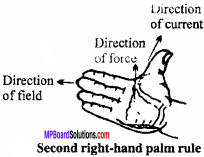
MP Board Class 12th Chemistry Important Questions Chapter 16 Chemistry in Everyday Life 3

Question 16.
What are Antibiotics? Write name of any two antibiotics. (MP 2018)
Answer:
Antibiotics:
are chemical substances which are produced by micro – organisms like bacteria, fungi, actinomycetes and destroy some other micro – organisms are like, virus, ricketsia or obstruct their growth.
Example : Penicillin, Streptomycin etc.

Question 17.
What is Immune system? How does it develop?
Answer:
For the destruction of bacteria or antigen in our body, lymphocytes are developed which are known as Immune. These are a specific type of white blood cells. These prepare and release a special type of protein called globulin to destroy the poison. These proteins destroy the attacking virus, bacteria and poisonous substances. Lymphocyte bind the antigen and themselves divide fast by which immunization increase and effect of antigen is destroyed.

Question 18.
What are antiseptics?
Answer:
Antiseptics:
An antiseptic kills the bacteria or prevents the multiplication of bacteria. These also prevent pus formation. Antiseptics do not harm living tissues. Tincture iodine, phenol (0 – 2%), dettol, chloroxylenol, etc. are applied on skin and bactrim, septran, etc. are taken orally as pills. Bad odour coming out of the wounds due to bacterial decomposition on the body or in the mouth are also reduced by the use of antiseptics. For such purposes, antiseptics are usually incorporated in face powder, breath purifiers, deodorants, etc. to reduce the intensity of bad odour.

Neem soaps containing the extract of neem seeds are also used as antiseptic soaps. Dettol is a mixture of chloroxylenol and terpineol in a suitable solvent is commonly used antiseptic. Bithionol antiseptic is added to soap to provide antiseptic properties to it. Tincture iodine is 2 – 3% solution of iodine in alcohol and water.
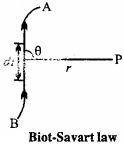
MP Board Class 12th Chemistry Important Questions Chapter 16 Chemistry in Everyday Life 4

Question 19.
What do you mean by Antibiotics? Name the first antibiotic.
Answer:
Chemical substances which are produced by mirco – organism and are used to destroy other micro-organism, are called antibiotics. These chemicals checks the life cycle of bacteria and stop reproduction resulting in release from disease. Antibiotics are almost specific for kinds of illness.

The first antibiotic penicillin was discovered by Alexander Fleming in 1928. He was awarded Nobel prize in 1945 for this important discovery. General formula of penicillin is C9H11N2O4S – R. It is a narrow spectrum drug and used in bronchitis, pneumonia, sore throat and abcesses. Before administration, tolerance has to be tested.
MP Board Class 12th Chemistry Important Questions Chapter 16 Chemistry in Everyday Life 5
By changing the group R, different penicillin are prepared.

MP Board Solutions

Question 20.
What are artificial sweetening agents? Give two examples. (MP2018)
Answer:
Artificial sweetening agents are the substances produced wholly or partially by chemical synthesis, which are added to food to impart sweet taste.
Example:

  1. Sucrose
  2. Saccharin.

Question 21.
Give definition of antihistamine drug with name and uses.
Answer:
These are amines which controls the allergy effect produced by histamines. Histamine is found in all body tissue and is also released in allergic conditions due to which allergic responses such as tissue inflammation, asthma, itching etc. are introduced in the body. Drugs which prevent the production of histamine and fight against the allergy effects are called antihistamines.
Example:
1. Entergon : It is used in strong allergic conditions.
MP Board Class 12th Chemistry Important Questions Chapter 16 Chemistry in Everyday Life 6

2. Benadryl:
MP Board Class 12th Chemistry Important Questions Chapter 16 Chemistry in Everyday Life 7

Chemistry in Everyday Life Long Answer Type Questions

Question 1.
Write short notes on:

  1. Antifertility drugs (MP 2108),
  2. Detergents
  3. Antacids (MP 2018)
  4. Sedatives
  5. Sulpha drugs.

Answer:
1. Antifertility drugs:
Drugs which are used to check pregnancy in women are called antifertility drugs. Actually, these drugs control the female menstrual cycle and ovu-lation. The antifertility agent in these drugs are steroids and these drugs are used in the form of oral pills. A mixture of synthetic estrogen and progesterone derivative are used as birth control pill. These are more effective than the natural hormone. Ethynylestradiol and nore- thindrone are the content of common contraceptive pills.
MP Board Class 12th Chemistry Important Questions Chapter 16 Chemistry in Everyday Life 8

2. Detergents:
Unsaturated hydrocarbon of ethylene type containing 10 to 18 carbon atoms on treatment with sulphuric acid forms organic acid. Sodium salt of organic acid have moisture absorbing and purification property. This compound is called synthetic detergent. Example : Sodium n – dodecyl benzene sulphonate, Sodium n – dodecyl sulphate.
MP Board Class 12th Chemistry Important Questions Chapter 16 Chemistry in Everyday Life 9

Synthetic detergents have two parts :

  • A long chain of hydrocarbon which is hydrophobic (Water repellent).
  • Small ionic chain is hydrophilic (Water attracting). Ionic chain is generally of sul- phonate (SO3Na) or sodium sulphate (SO4Na).

Detergents are surface active compounds which decreases surface tension of water. When these compounds are dissolved in water they scatter dirt particles leaving the surface clean.
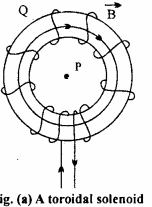
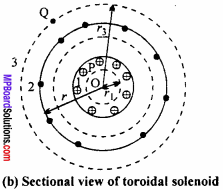
Properties of detergents : Detergents are superior to soap.

  • Detergents can be used in hard as well as soft water because they do not form insoluble salt with calcium and magnesium ions of hard water while soap cannot be used in hard water.
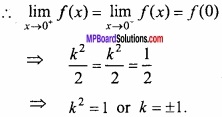
  • Aqueous solution of detergent is neutral. Therefore, detergents can clean soft fibres without damaging them. Soap solution is alkaline due to hydrolysis and is harmful for washing soft fibres.

Uses of detergents:
Detergensts act as cleansing agent. Like soap it can be used for cleaning cotton, woollen, silky and synthetic fibre cloth and for cleaning other domestic items.

3. Antacids:
Substance which remove the excess acid in the stomach and raise the pH to appropriate level are called antacid Calcium carbonate, Sodium bicarbonate, Magnesium hydroxide or Aluminium hydroxide is used in the form of aqueous suspension or tablets to treats hyperacidity. These substances react with excess hydrochloride acid and neutralizes it partially. Nowadays Omeparazole and Lansoparazole are prescribed as antacids.
MP Board Class 12th Chemistry Important Questions Chapter 16 Chemistry in Everyday Life 10

4. Sedatives:
These are given to those patients who are violent and mentally agitated.
Example:

  1. Equanil
  2. Barbituric acid.

MP Board Class 12th Chemistry Important Questions Chapter 16 Chemistry in Everyday Life 11

5. Sulpha drugs:
Like antibiotics, sulpha drugs are used to kill micro – organism. These are prepared in laboratory. Sulphadiazine, sulphanilamide, sulphathiazole, sulpha guanidine, etc. are important sulpha drugs.

MP Board Solutions

Question 2.
Write notes on the following:

  1. Tranquillizers and Hypnotics (MP2018)
  2. Antidepressant

Answer:
1. Tranquillizers:
Tranquillizers are the chemical substances which affect higher centres of central nervous systems and reduce anxiety and tension. Tranquillizers are also called psychotherapeutic drugs. These drugs make the patient passive temporarily so that emotional distress or depression is reduced. The patient restores confidence. These drugs if taken for long – time make the person habitual. Luminal, Barbituric acid, seconal, equanil, etc. are the drugs of this class. These are components of sleeping pills.
MP Board Class 12th Chemistry Important Questions Chapter 16 Chemistry in Everyday Life 12

2. Antidepression:
These are given to patient for boosting their morals in the stage of acute depressions. Some mood elevator drugs are vitellin, methadone, cocaine, etc. These act on the central nervous system. Person becomes healthy by its use and de-velop confidence. These should be taken by the advice of doctor. Tophrenil is one such medicine. The amphetemin group of medicine help to upraise the mental level. Its common example is benzedine.
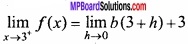
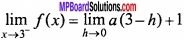
Question 3.
Write example of the following chemicals :

  1. Two Analgesics
  2. Two Antiseptic
  3. Two Antiseptic chemical
  4. Two Antibiotic
  5. Two Anaesthetic
  6. Two Sulpha drug
  7. Two Rocket propellant
  8. Two uses of chloramphenicol antibiotic.

Answer:

  1. Two Analgesic : (i) Morphine, (ii) Aspirin.
  2. Two Antiseptic : (i) Dettol, (ii) Bithional.
  3. Two Antiseptic Chemical: (i) Boric acid, (ii) Gention violet.
  4. Two Antibiotic : (i) Terramycin, (ii) Streptomycin.
  5. Two Anaesthetic : (i) Cyclopropane, (ii) Pelledyne.
  6. Two sulpha drug : (i) Sulphonide, (ii) Sulphadyne.
  7. Two Rocket Propellant: (i) Polyurethane, (ii) Ammonium perchlorate.
  8. Two use of Chloramphenicol Antibiotic : (i) In Typhoid, (ii) High fever and diarrhoea.

Question 4.
Write two differences between Dyes and Pigments.
Answer:
Differences between Dyes and Pigments :
Dyes:

  • These are organic substance.
  • They colour fibres and food materials also.

Pigments:

  • These are inorganic substance.
  • Mixed with safeda (white lead) it is used to colour metals and wood.

Question 5.
Give one example of Acidic dye and Basic dye.
Answer:
Acidic dye:
In these, acidic group like phenolic, sulphonic (S03H) are in the form of sodium salts. These colour animal fibre like wool, silk etc. Example : Orange – I and II.
MP Board Class 12th Chemistry Important Questions Chapter 16 Chemistry in Everyday Life 13

  • Acidic dye : Methyl orange , Methyl red.
  • Basic dye : Malachite green, Aniline yellow.

MP Board Solutions

Question 6.
What is meant by the term ‘broad spectrum antibiotics’? Explain. (NCERT)
Answer:
The range of bacterias or other micro – organisms that are affected by a certain antibiotic is expressed as its spectrum of action. The term broad spectrum antibiotics means an antibiotic which kills or inhibits a wide range of Gram negative and Gram -positive bacteria.

MP Board Class 12th Chemistry Important Questions

MP Board Class 12th Chemistry Important Questions Chapter 15 Polymers

MP Board Class 12th Chemistry Important Questions Chapter 15 Polymers

Polymers Important Questions

Polymers Objective Type Questions

Question 1.
Choose the correct answer :

Question 1.
The polymerization in which two or more chemically different monomers take part is called :
(a) Addition polymerization
(b) Copolymerization
(c) Chain polymerization
(d) Homogeneous polymerization.
Answer:
(b) Copolymerization

Question 2.
Natural rubber is mainly a polymer of:
(a) Chloroprene
(b) Neoprene
(c) Isoprene
(d) Butadiene.
Answer:
(c) Isoprene

Question 3.
Which is a heat resistant polymer :
(a) P.V.C.
(b) P.V.A.
(c) Bakelite
(d) Rubber.
Answer:
(c) Bakelite

Question 4.
Is not a polymer :
(a) Orlon
(b) Teflon
(c) Neoprene soprene.
(d) Isoprene
Answer:
(d) Isoprene

Question 5.
Which among the following is a thermosetting polymer :
(a) P.V.C.
(b) P.V.A.
(c) Bakelite
(d) Perspex.
Answer:
(c) Bakelite

MP Board Solutions

Question 6.
Which substance is used as ‘non stick’ in cooking utencils :
(a) P.V.C.
(b) Polystyrene
(c) Poly ethylene Pterephthalate
(d) Poly tetrafluoro ethylene.
Answer:
(d) Poly tetrafluoro ethylene.

Question 7.
Out of the following which polymer contain nitrogen :
(a) Nylon
(b) Polythene
(c) P.V.C.
(d) Terylene.
Answer:
(a) Nylon

Question 8.
Is a natural polymer :
(a) Starch
(b) Nylon
(c) Teflon
(d) Buna – S – Rubber
Answer:
(a) Starch

Question 9.
Is a polymer :
(a) Macro molecule
(b) Micromolecule
(c) Submicro molecule
(d) None of these
Answer:
(a) Macro molecule

Question 10.
P.V.C is a polymer of the following :
(a) CH2 = CH2
(b) CH2 = CHCl
(c) ClCH2 = CH2Cl
(d) Cl – C ≡ C – Cl
Answer:
(b) CH2 = CHCl

Question 11.
Teflon is a polymer of:
(a) Vinyl chloride
(b) Ethylene
(c) Acetylene
(d) Tetrafluroethene
Answer:
(d) Tetrafluroethene

Question 12.
Example of condensation polymeris :
(a) Polythene
(b) P.V.C.
(c) Orion
(d) Terylene
Answer:
(d) Terylene

MP Board Solutions

Question 13.
Intermolecular force in elastomer is :
(a) Not present
(b) Weak
(c) Strong
(d) Extremely strong.
Answer:
(b) Weak

Question 14.
Complete hydrolysis of cellulose gives :
(a) D – Fructose
(b) D – Ribose
(c) D – Glucose
(d) L – Glucose
Answer:
(c) D – Glucose

Question 15.
Cellulose is a :
(a) Protein
(b) Fat
(c) Hormone
(d) Polysaccharide
Answer:
(d) Polysaccharide

Question 16.
Which of the following is a natural polymer :
(a) Starch
(b) Nylon
(c) Teflon
(d) Buna – s – Rubber
Answer:
(a) Starch

Question 17.
Nylon is an example of:
(a) Polyamide
(b) Polythene
(c) Polyester
(d) Polysaccharide
Answer:
(a) Polyamide

Question 18.
Nylon 6,6 is not a :
(a) Condensation polymer
(b) Co – Polymer
(c) Polyamide Bakelite is a polymer of:
(d) Homopolymer
Answer:
(d) Homopolymer

Question 19.
Bakelite is a polymer of :
(a) HCHO and acetic acid
(b) HCHO and phenol
(c) C2H5 – OH and phenol
(d) CH3 – COOH and benzene.
Answer:
(b) HCHO and phenol

Question 20.
Which of the following is a biodegradable polymer :
(a) Cellulose
(b) Polythene
(c) Polyvinyl chloride
(d) Nylon 6.
Answer:
(a) Cellulose

Question 2.
Fill in the blanks :

  1. ……………… is used for the preparation of chloroprene.
  2. Charge on polymers is ………………
  3. Polymer ……………… the light.
  4. Molecular mass of polymers is ………………
  5. Glucose is a monomer of ………………
  6. Cellulose is a ……………… polymer. (MP 2015)
  7. Polymer of ethylene glycol and phthalic acid is ………………
  8. Rubber is a ……………… polymer.
  9. Vulcanisation of rubber is an example of ………………
  10. Bakelite is a ……………… polymer.
  11. Nylon 6 is also called ……………… (MP 2011)
  12. Teflon is a polymer of ……………… (MP 2103)

Answer:

  1. Synthetic rubber
  2. Nil (zero)
  3. Scatter
  4. High
  5. Cellulose and starch
  6. Natural
  7. Glyptal
  8. Natural
  9. Elastomer
  10. Heat resistant
  11. Perlon – L
  12. Tetra fluoro ethylene.

Question 3.
Make correct pairs :
MP Board Class 12th Chemistry Important Questions Chapter 15 Polymers 1
Answer:

  1. (d)
  2. (a)
  3. (c)
  4. (f)
  5. (b)
  6. (g)
  7. (e)
  8. (h)

MP Board Solutions

Question 4.
Answer in one word / sentence :

  1. Give two examples of natural polymer.
  2. Give two examples of addition polymer.
  3. Give two examples of condensation polymer.
  4. Write chemical name of Buna rubber.
  5. Give an example of synthetic rubber.
  6. Monomer of polythene is. (MP 2011)
  7. Name the polymer which is formed by condensation of ethylene glycol and dimethyl teraphthalic acid. (MP 2011)
  8. Name the polymerisation which takes place by addition of two or more than two different monomers. (MP 2010)
  9. Give the name of polymer used for formation of tyre thread. (MP 2010)
  10. Which polymer obtained by polymerisation of caprolactum?

Answer:

  1. Natural polymer – Rubber, starch
  2. Polythene, Polypropylene
  3. Nylon – 6, Bakelite
  4. Styrene Butadiene rubber
  5. Styrene Butadiene rubber (S.B.R.)
  6. Ethylene
  7. Terylene
  8. Copolymerisation
  9. Nylon – 6
  10. Nylon – 6

MP Board Class 12th Chemistry Important Questions

MP Board Class 12th Maths Important Questions Chapter 3 Matrices

MP Board Class 12th Maths Important Questions Chapter 3 Matrices

Matrices Important Questions

Matrices Objective Type Questions:

Question 1.
If A = \(\begin{bmatrix} cos\alpha & -sin\alpha \\ sin\alpha & cos\alpha \end{bmatrix}\) and A + A’ = I, then the value of α is:
(a) \(\frac { \pi }{ 6 } \)
(b) \(\frac { \pi }{ 3 } \)
(c) π
(d) \(\frac { 3\pi }{ 2 } \)
Answer:
(b) \(\frac { \pi }{ 3 } \)

Question 2.
If A = \(\left[\begin{array}{lll}
{2} & {0} & {0} \\
{0} & {2} & {0} \\
{0} & {0} & {2}
\end{array}\right]\), then A5 is equal to:
(a) 5 A
(b) 10 A
(c) 16 A
(d) 32 A
Answer:
(c) 16 A

Question 3.
If a matrix is both symmetric and skew – symmetric, then:
(a) A is a diagonal matrix
(b) A is zero matrix
(c) A is a square matrix
(d) None of these
Answer:
(b) A is zero matrix

MP Board Solutions

Question 4.
If A = \(\begin{bmatrix} \alpha & \beta \\ \lambda & -\alpha \end{bmatrix}\) is such that A2 = I, then:
(a) 1 + α2 + βλ = 0
(b) 1 – α2 + βλ = 0
(c) 1 – α2 – βλ = 0
(d) 1 + α2 – βλ = 0
Answer:
(c) 1 – α2 – βλ = 0

Question 5.
If A = \(\begin{bmatrix} 2 & -1 \\ 3 & -2 \end{bmatrix}\), then An = ………………………:
(a) A = \(\begin{bmatrix} 1 & 0 \\ 0 & 1 \end{bmatrix}\), if n is even natural number
(b) A = \(\begin{bmatrix} 1 & 0 \\ 0 & 1 \end{bmatrix}\), if n is odd natural number
(c) A = \(\begin{bmatrix} -1 & 0 \\ 0 & 1 \end{bmatrix}\), if n ∈ N
(d) None of these
Answer:
(a) A = \(\begin{bmatrix} 1 & 0 \\ 0 & 1 \end{bmatrix}\), if n is even natural number

Question 2.
Fill in the blanks:

  1. If A = \(\begin{bmatrix} 2 & 4 \\ 3 & 2 \end{bmatrix}\) and B = \(\begin{bmatrix} 1 & 3 \\ 2 & 5 \end{bmatrix}\), then AB = …………………………….
  2. If A = diag [1, -1, 2] and B = diag [2, 3, -1], then value of 3A + 4B will be ……………………
  3. A matrix A is said to be idempotent if ………………………
  4. A matrix A is said to be orthogonal if ……………………..
  5. If [x, 1] \(\begin{bmatrix} 1 & 0 \\ -2 & 0 \end{bmatrix}\) = 0, then find the value of x will be …………………………….

Answer:

  1. \(\begin{bmatrix} 10 & 26 \\ 7 & 19 \end{bmatrix}\)
  2. diag [11, 9, 2]
  3. A2 = A
  4. AA’ = A’A = I
  5. x = 2

MP Board Solutions

Question 3.
Write True/False:

  1. Multiplication of matrix is always commutative?
  2. Two matrix are said to be comparable if they have same number of rows and columns?
  3. If A is a square matrix, then A. adj A = |A| I?
  4. A square matrix A is said to be symmetric if A = – AT?
  5. Matrix A and B are inverse of each other if AB = BA?

Answer:

  1. False
  2. True
  3. True
  4. False
  5. False

Question 4.
Match the Column:
MP Board Class 12th Maths Important Questions Chapter 3 Classification of Elements and Periodicity in Properties
Answer:

  1. (d)
  2. (e)
  3. (a)
  4. (b)
  5. (c)

Question 5.
Write the answer in one word/sentence:

  1. If A and B are two square matrix of same order, then what is the value of Adj (AB)?
  2. A square matrix A is said to be Involountary matrix if?
  3. If A = \(\begin{bmatrix} 0 & i \\ i & 0 \end{bmatrix}\), then find the value of A2?
  4. If A = [1, 2, 3], then find the value of AAT?
  5. If X + Y = \(\begin{bmatrix} 1 & -2 \\ 3 & 4 \end{bmatrix}\) and X – Y = \(\begin{bmatrix} 3 & 2 \\ -1 & 0 \end{bmatrix}\), then find the value of X?

Answer:

1. Adj.(AB) = (Adj B). (Adj A)
2. A2 = I
3. -I
4. [1, 4]
5. \(\begin{bmatrix} 2 & 0 \\ 1 & 2 \end{bmatrix}\)

Matrices Short Answer Type Questions

Question 1.
If A = \(\begin{bmatrix} a^{ 2 }+b^{ 2 } & b^{ 2 }+c^{ 2 } \\ a^{ 2 }+c^{ 2 } & a^{ 2 }+b^{ 2 } \end{bmatrix}\) and B = \(\begin{bmatrix} 2ab & 2bc \\ -2ac & -2ab \end{bmatrix}\), then find the value of A + B? (NCERT)
Solution:
A + B = MP Board Class 12th Maths Important Questions Chapter 3 Matrices
MP Board Class 12th Maths Important Questions Chapter 3 Matrices

Question 2.
If A = \(\begin{bmatrix} cos^{ 2 }x & sin^{ 2 }x \\ sin^{ 2 }x & cos^{ 2 }x \end{bmatrix}\) and B = \(\begin{bmatrix} sin^{ 2 }x & cos^{ 2 }x \\ cos^{ 2 }x & sin^{ 2 }x \end{bmatrix}\), then find A + B? (NCERT)
Solution:
A + B = \(\begin{bmatrix} cos^{ 2 }x & sin^{ 2 }x \\ sin^{ 2 }x & cos^{ 2 }x \end{bmatrix}\) + \(\begin{bmatrix} sin^{ 2 }x & cos^{ 2 }x \\ cos^{ 2 }x & sin^{ 2 }x \end{bmatrix}\)
MP Board Class 12th Maths Important Questions Chapter 3 Matrices
⇒ A + B = \(\begin{bmatrix} 1 & 1 \\ 1 & 1 \end{bmatrix}\)

Question 3.
If A = MP Board Class 12th Maths Important Questions Chapter 3 Matrices and B = MP Board Class 12th Maths Important Questions Chapter 3 Matrices then find 3A – 5B? (NCERT)
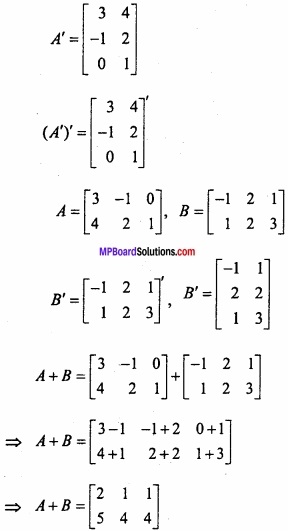
Solution:
MP Board Class 12th Maths Important Questions Chapter 3 Classification of Elements and Periodicity in Properties
MP Board Class 12th Maths Important Questions Chapter 3 Matrices

Question 4.
Simplify: cos θ \(\begin{bmatrix} cos\theta & sin\theta \\ -sin\theta & cos\theta \end{bmatrix}\) + sinθ \(\begin{bmatrix} sin\theta & -cos\theta \\ cos\theta & sin\theta \end{bmatrix}\)
Solution:
cos θ \(\begin{bmatrix} cos\theta & sin\theta \\ -sin\theta & cos\theta \end{bmatrix}\) + sinθ \(\begin{bmatrix} sin\theta & -cos\theta \\ cos\theta & sin\theta \end{bmatrix}\)
MP Board Class 12th Maths Important Questions Chapter 3 Matrices

Question 5.
From the following equation find the value of x and y?
2 \(\begin{bmatrix} x & 5 \\ 7 & y-3 \end{bmatrix}\) + \(\begin{bmatrix} 3 & -4 \\ 1 & 2 \end{bmatrix}\) = \(\begin{bmatrix} 7 & 6 \\ 15 & 14 \end{bmatrix}\)? (NCERT)
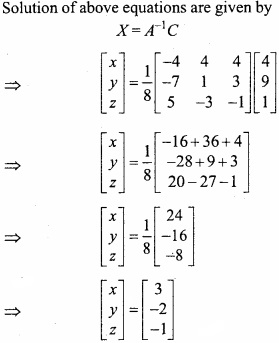
Solution:
MP Board Class 12th Maths Important Questions Chapter 3 Matrices
From defnition of matrix,
2x + 3 = 7
⇒ 2x = 4 ⇒ x = 2
⇒ 2y – 4 = 14
⇒ 2y = 18 ⇒ y = 9
∴x = 2, y = 9.

Question 6.
Find the value of X and Y if X + Y = \(\begin{bmatrix} 5 & 2 \\ 0 & 9 \end{bmatrix}\) and X – Y = \(\begin{bmatrix} 3 & 6 \\ 0 & -1 \end{bmatrix}\)? (NCERT)
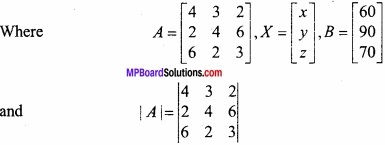
Solution:
Given X + Y = \(\begin{bmatrix} 5 & 2 \\ 0 & 9 \end{bmatrix}\) ……………….. (1)
and X – Y = \(\begin{bmatrix} 3 & 6 \\ 0 & -1 \end{bmatrix}\) ………………….. (2)
adding eqns. (1) and (2),
2X = \(\begin{bmatrix} 5 & 2 \\ 0 & 9 \end{bmatrix}\) + \(\begin{bmatrix} 3 & 6 \\ 0 & -1 \end{bmatrix}\)
⇒ 2X = \(\begin{bmatrix} 5+3 & 2+6 \\ 0+0 & 9-1 \end{bmatrix}\)
⇒ 2X = \(\begin{bmatrix} 8 & 8 \\ 0 & 8 \end{bmatrix}\)
⇒ X = \(\frac{1}{2}\) \(\begin{bmatrix} 8 & 8 \\ 0 & 8 \end{bmatrix}\) = \(\begin{bmatrix} 4 & 4 \\ 0 & 4 \end{bmatrix}\)
Substracting eqn. (2) from eqn. (1),
2Y = \(\begin{bmatrix} 5 & 2 \\ 0 & 9 \end{bmatrix}\) – \(\begin{bmatrix} 3 & 6 \\ 0 & -1 \end{bmatrix}\)
⇒ 2Y = \(\begin{bmatrix} 5-3 & 2-6 \\ 0-0 & 9+1 \end{bmatrix}\)
⇒ Y = \(\frac{1}{2}\) \(\begin{bmatrix} 2 & -4 \\ 0 & 10 \end{bmatrix}\) = \(\begin{bmatrix} 1 & -2 \\ 0 & 5 \end{bmatrix}\)

MP Board Solutions

Question 7.
Find the value of x and y
2 \(\begin{bmatrix} 1 & 3 \\ 0 & x \end{bmatrix}\) + \(\begin{bmatrix} y & 0 \\ 1 & 2 \end{bmatrix}\) = \(\begin{bmatrix} 5 & 6 \\ 1 & 8 \end{bmatrix}\) (NCERT)
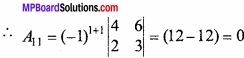
Solution:
Given:
2 \(\begin{bmatrix} 1 & 3 \\ 0 & x \end{bmatrix}\) + \(\begin{bmatrix} y & 0 \\ 1 & 2 \end{bmatrix}\) = \(\begin{bmatrix} 5 & 6 \\ 1 & 8 \end{bmatrix}\)
⇒ \(\begin{bmatrix} 2 & 6 \\ 0 & 2x \end{bmatrix}\) + \(\begin{bmatrix} y & 0 \\ 1 & 2 \end{bmatrix}\) = \(\begin{bmatrix} 5 & 6 \\ 1 & 8 \end{bmatrix}\)
⇒ \(\begin{bmatrix} 2+y & 6+0 \\ 0+1 & 2x+2 \end{bmatrix}\) = \(\begin{bmatrix} 5 & 6 \\ 1 & 8 \end{bmatrix}\)
⇒ \(\begin{bmatrix} 2+y & 6 \\ 1 & 2x+2 \end{bmatrix}\) = \(\begin{bmatrix} 5 & 6 \\ 1 & 8 \end{bmatrix}\)
By defnition of matrix,
2 + y = 5 ⇒ y = 3
2x + 2 = 8
⇒ x + 1 = 4
⇒ x = 3
∴ x = 3, y = 3.

Question 8.
If \(\left[\begin{array}{c}
{x+y+z} \\
{x+z} \\
{y+z}
\end{array}\right]\) = [ \(\begin{matrix} 9 \\ 5 \\ 7 \end{matrix}\) ] find the value of x, y, and z?
Solution: Given \(\left[\begin{array}{c}
{x+y+z} \\
{x+z} \\
{y+z}
\end{array}\right]\) = [ \(\begin{matrix} 9 \\ 5 \\ 7 \end{matrix}\) ]
By defnition of matrix,
x + y + z = 9
x + z = 5
y + z = 7
From eqns. (1) and (2),
x + y + z = 9
⇒ 5 + y = 9 ⇒ y = 4
From eqns. (1) and (3),
x + (y + z) = 9
⇒ x + 7 = 9
⇒ x = 2
Putting the value of x in eqn. (2),
2 + z = 5
⇒ z = 3
∴ x = 2, y = 4, z = 3.
MP Board Solutions

Question 9.
If \(\begin{bmatrix} x+y & 2 \\ 5+z & xy \end{bmatrix}\) = \(\begin{bmatrix} 6 & 2 \\ 5 & 8 \end{bmatrix}\), then fund the value of x, y and z? (NCERT)
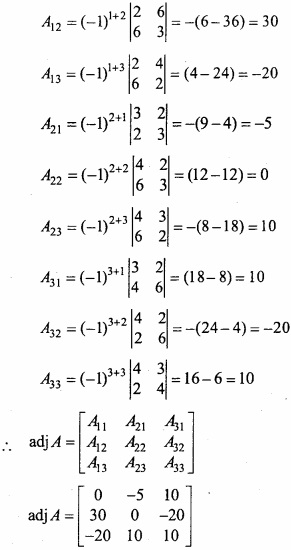
Solution:
Given:
\(\begin{bmatrix} x+y & 2 \\ 5+z & xy \end{bmatrix}\) = \(\begin{bmatrix} 6 & 2 \\ 5 & 8 \end{bmatrix}\)
By defnition of matrix,
x + y = 6 ……………….. (1)
xy = 8 ………………. (2)
5 + z = 5
⇒ z = 0
From eqn. (1), y = 6 – x
xy = 8
⇒ 6x – x2 = 8
⇒ x2 – 6x + 8 = 0
⇒ x2 – 4x – 2x + 8 = 0
⇒ x (x – 4) – 2 ( x – 4) = 0
⇒ ( x – 2) (x – 4) = 0
⇒ x = 2, 4
When x = 2 then y = 6 – 2 = 4
When x = 4 then y = 6 – 4 = 2
So x = 2, y = 4, z = 0
x = 4, y = 2, z = 0.

Question 10.
If A = \(\begin{bmatrix} 1 & -1 \\ 2 & 3 \end{bmatrix}\) then prove that A2 – 4A + 5I = 0?
Solution:
Given:
A = \(\begin{bmatrix} 1 & -1 \\ 2 & 3 \end{bmatrix}\)
A2 = A.A = \(\begin{bmatrix} 1 & -1 \\ 2 & 3 \end{bmatrix}\) \(\begin{bmatrix} 1 & -1 \\ 2 & 3 \end{bmatrix}\)
= \(\begin{bmatrix} 1.1+(-1)2 & 1(-1)+(-1).3 \\ 2.1+3.2 & 2(-1)+3.3 \end{bmatrix}\)
= \(\begin{bmatrix} 1-2 & -1-3 \\ 2+6 & -2+9 \end{bmatrix}\)
= \(\begin{bmatrix} -1 & -4 \\ 8 & 7 \end{bmatrix}\)
4A = 4\(\begin{bmatrix} 1 & -1 \\ 2 & 3 \end{bmatrix}\) = \(\begin{bmatrix} 4 & -4 \\ 8 & 12 \end{bmatrix}\)
5I = 5\(\begin{bmatrix} 1 & 0 \\ 0 & 1 \end{bmatrix}\) = \(\begin{bmatrix} 5 & 0 \\ 0 & 5 \end{bmatrix}\)
= \(\begin{bmatrix} 0 & 0 \\ 0 & 0 \end{bmatrix}\)
= 0. Proved.

MP Board Solutions

Question 11.
If A = \(\begin{bmatrix} 2 & -3 \\ 3 & 4 \end{bmatrix}\) then prove that A2 – 6A + 17I = 0?
Solution:
A = \(\begin{bmatrix} 2 & -3 \\ 3 & 4 \end{bmatrix}\)
A2 = A.A = \(\begin{bmatrix} 2 & -3 \\ 3 & 4 \end{bmatrix}\) \(\begin{bmatrix} 2 & -3 \\ 3 & 4 \end{bmatrix}\)
= \(\begin{bmatrix} 4-9 & -6-12 \\ 6+12 & -9+16 \end{bmatrix}\) = \(\begin{bmatrix} -5 & -18 \\ 18 & 7 \end{bmatrix}\)
∴ L.H.S = A2 – 6A + 17I
= \(\begin{bmatrix} -5 & -18 \\ 18 & 7 \end{bmatrix}\) – 6 \(\begin{bmatrix} 2 & -3 \\ 3 & 4 \end{bmatrix}\) + 17 \(\begin{bmatrix} 1 & 0 \\ 0 & 1 \end{bmatrix}\)
= \(\begin{bmatrix} -5 & -18 \\ 18 & 7 \end{bmatrix}\) – \(\begin{bmatrix} 12 & -18 \\ 18 & 24 \end{bmatrix}\) + \(\begin{bmatrix} 17 & 0 \\ 0 & 17 \end{bmatrix}\)
= \(\begin{bmatrix} -5-12+17 & -18+18+0 \\ 18-18+0 & 7-24+17 \end{bmatrix}\)
= \(\begin{bmatrix} 0 & 0 \\ 0 & 0 \end{bmatrix}\) = 0 = R.H.S. proved.

Question 12.
If A = \(\begin{bmatrix} 3 & 1 \\ -1 & 2 \end{bmatrix}\) then prove that A2 – 5A + 7I = 0. (NCERT)
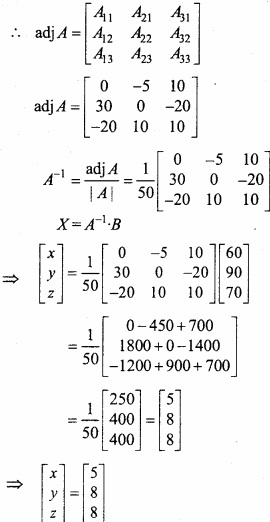
Solution:
A2 = A.A = \(\begin{bmatrix} 3 & 1 \\ -1 & 2 \end{bmatrix}\) × \(\begin{bmatrix} 3 & 1 \\ -1 & 2 \end{bmatrix}\)
⇒ A2 = \(\begin{bmatrix} 3\times 3-1\times 1 & 3\times 1+1\times 2 \\ -1\times 3+2\times -1 & -1\times 1+2\times 2 \end{bmatrix}\)
⇒ A2 = \(\begin{bmatrix} 8 & 5 \\ -5 & 3 \end{bmatrix}\)
5A = 5\(\begin{bmatrix} 3 & 1 \\ -1 & 2 \end{bmatrix}\)
⇒ 5A = \(\begin{bmatrix} 15 & 5 \\ -5 & 10 \end{bmatrix}\)
7I = 7\(\begin{bmatrix} 1 & 0 \\ 0 & 1 \end{bmatrix}\)
⇒ 7I = \(\begin{bmatrix} 7 & 0 \\ 0 & 7 \end{bmatrix}\)
∴ A2 – 5A + 7I = \(\begin{bmatrix} 8 & 5 \\ -5 & 3 \end{bmatrix}\) – \(\begin{bmatrix} 15 & 5 \\ -5 & 10 \end{bmatrix}\) + \(\begin{bmatrix} 7 & 0 \\ 0 & 7 \end{bmatrix}\)
⇒ A2 – 5A + 7I = \(\begin{bmatrix} 8-15+7 & 5-5+0 \\ -5+5+0 & 3-10+7 \end{bmatrix}\)
⇒ A2 – 5A + 7I = \(\begin{bmatrix} 0 & 0 \\ 0 & 0 \end{bmatrix}\)
⇒ A2 – 5A + 7I = 0.

MP Board Solutions

Question 13.
If A = \(\begin{bmatrix} 3 & -2 \\ 4 & -2 \end{bmatrix}\) and I = \(\begin{bmatrix} 1 & 0 \\ 0 & 1 \end{bmatrix}\) then find the value of k if A2 = kA – 2I? (NCERT)
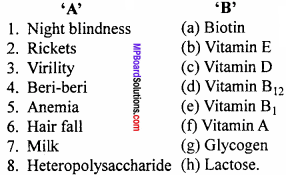
Solution:
Given:
A2 = kA – 2I
⇒ kA = A2 + 2I
⇒ k \(\begin{bmatrix} 3 & -2 \\ 4 & -2 \end{bmatrix}\) = \(\begin{bmatrix} 3 & -2 \\ 4 & -2 \end{bmatrix}\) × \(\begin{bmatrix} 3 & -2 \\ 4 & -2 \end{bmatrix}\) + 2 \(\begin{bmatrix} 1 & 0 \\ 0 & 1 \end{bmatrix}\)
⇒ \(\begin{bmatrix} 3k & -2k \\ 4k & -2k \end{bmatrix}\) = \(\begin{bmatrix} 3\times 3-2\times 4 & 3\times -2+2\times 2 \\ 4\times 3-2\times 4 & 4\times -2+2\times 2 \end{bmatrix}\) + \(\begin{bmatrix} 2 & 0 \\ 0 & 2 \end{bmatrix}\)
= \(\begin{bmatrix} 3k & -2k \\ 4k & -2k \end{bmatrix}\) = \(\begin{bmatrix} 1 & -2 \\ 4k & -4 \end{bmatrix}\) + 2\(\begin{bmatrix} 2 & 0 \\ 0 & 2 \end{bmatrix}\)
⇒ \(\begin{bmatrix} 3k & -2k \\ 4k & -2k \end{bmatrix}\) = \(\begin{bmatrix} 1+2 & 2+0 \\ 4+0 & -4+2 \end{bmatrix}\)
⇒ \(\begin{bmatrix} 3k & -2k \\ 4k & -2k \end{bmatrix}\) = \(\begin{bmatrix} 3 & -2 \\ 4 & -2 \end{bmatrix}\)
⇒ 2k = 2
⇒ k = 1.

Question 14.
If f(x) = x2 – 2x – 3, then find the value of f(A) if A = \(\begin{bmatrix} 1 & 2 \\ 2 & 1 \end{bmatrix}\)
Solution:
f(x) = x2 – 2x – 3
∴ f(A) = A2 – 2A – 3I
⇒ f(A) = \(\begin{bmatrix} 1 & 2 \\ 2 & 1 \end{bmatrix}\) × \(\begin{bmatrix} 1 & 2 \\ 2 & 1 \end{bmatrix}\) – 2 \(\begin{bmatrix} 1 & 2 \\ 2 & 1 \end{bmatrix}\) – 3 \(\begin{bmatrix} 1 & 0 \\ 0 & 1 \end{bmatrix}\)
MP Board Class 12th Maths Important Questions Chapter 3 Matrices
⇒ f(A) = \(\begin{bmatrix} 5 & 4 \\ 4 & 5 \end{bmatrix}\) – \(\begin{bmatrix} 2 & 4 \\ 4 & 2 \end{bmatrix}\) – \(\begin{bmatrix} 3 & 0 \\ 0 & 3 \end{bmatrix}\)
⇒ = \(\begin{bmatrix} 5 & 4 \\ 4 & 5 \end{bmatrix}\) – \(\begin{bmatrix} 5 & 4 \\ 4 & 5 \end{bmatrix}\) = \(\begin{bmatrix} 0 & 0 \\ 0 & 0 \end{bmatrix}\)
⇒ = 0.

Question 15.
If matrix A = \(\left[\begin{array}{ccc}
{0} & {a} & {-3} \\
{2} & {0} & {-1} \\
{b} & {1} & {0}
\end{array}\right]\) skew – symmetric matrix, then find the value of ‘a’ and ‘b’? (CBSE 2018)
Solution:
If A is skew symmmetric matrix then A’ = -A
Given:
A = \(\left[\begin{array}{ccc}
{0} & {a} & {-3} \\
{2} & {0} & {-1} \\
{b} & {1} & {0}
\end{array}\right]\)
A’ = \(\left[\begin{array}{ccc}
{0} & {2} & {b} \\
{a} & {0} & {1} \\
{-3} & {-1} & {0}
\end{array}\right]\)
– A = \(\left[\begin{array}{ccc}
{0} & {-a} & {3} \\
{-2} & {0} & {1} \\
{-b} & {-1} & {0}
\end{array}\right]\)
∵ A’ = – A
\(\left[\begin{array}{ccc}
{0} & {2} & {b} \\
{a} & {0} & {1} \\
{-3} & {-1} & {0}
\end{array}\right]\) = \(\left[\begin{array}{ccc}
{0} & {-a} & {3} \\
{-2} & {0} & {1} \\
{-b} & {-1} & {0}
\end{array}\right]\)
∴ 2 = -a or a = -2
-3 = -b or b = 3.

MP Board Solutions

Question 16.
If A = \(\begin{bmatrix} cos\alpha & -sin\alpha \\ sin\alpha & cos\alpha \end{bmatrix}\), then prove that AA-1 = I?
Solution:
Given:
A = \(\begin{bmatrix} cos\alpha & -sin\alpha \\ sin\alpha & cos\alpha \end{bmatrix}\)
A-1 = \(\frac { adjA }{ |A| } \)
|A| = |\(\begin{bmatrix} cos\alpha & -sin\alpha \\ sin\alpha & cos\alpha \end{bmatrix}\)|
= cos2α – (-sin2 α)
= cos2α + sin2α = 1 ………………………… (1)
∴|A| = 1
We know adj A = \(\begin{bmatrix} C_{ 11 } & C_{ 21 } \\ C_{ 12 } & C_{ 22 } \end{bmatrix}\)
Where C11 = (-1)2 cos α = cos α
C12 = (-1)3 sin α = -sin α
C21 = (-1)3 (-sin α ) = sin α
C22 = (-1)4cos α = cos α
∴ adj A = \(\begin{bmatrix} cos\alpha & -sin\alpha \\ sin\alpha & cos\alpha \end{bmatrix}\) …………….. (2)
∴ A-1 = \(\frac { adjA }{ |A| } \) = \(\begin{bmatrix} cos\alpha & -sin\alpha \\ sin\alpha & cos\alpha \end{bmatrix}\)
∴ A.A-1 = \(\begin{bmatrix} cos\alpha & -sin\alpha \\ sin\alpha & cos\alpha \end{bmatrix}\) \(\begin{bmatrix} cos\alpha & -sin\alpha \\ sin\alpha & cos\alpha \end{bmatrix}\)
MP Board Class 12th Maths Important Questions Chapter 3 Matrices
= \(\begin{bmatrix} 1 & 0 \\ 0 & 1 \end{bmatrix}\) = I. Proved.

Question 17.
If A = \(\begin{bmatrix} cos\alpha & -sin\alpha \\ sin\alpha & cos\alpha \end{bmatrix}\) then prove that:
A. (Adj A) = |A| I?
Solution:
Given A = \(\begin{bmatrix} cos\alpha & -sin\alpha \\ sin\alpha & cos\alpha \end{bmatrix}\)
A11 = cos α, A12 = sin α, A21 = – sin α, A22 = cos α
Adj A = \(\begin{bmatrix} A_{ 11 } & A_{ 21 } \\ A_{ 12 } & A_{ 22 } \end{bmatrix}\) = \(\begin{bmatrix} cos\alpha & -sin\alpha \\ sin\alpha & cos\alpha \end{bmatrix}\)
A.(Adj A) = \(\begin{bmatrix} cos\alpha & -sin\alpha \\ sin\alpha & cos\alpha \end{bmatrix}\) \(\begin{bmatrix} cos\alpha & -sin\alpha \\ sin\alpha & cos\alpha \end{bmatrix}\)
MP Board Class 12th Maths Important Questions Chapter 3 Matrices
∴ A.(Adj A) = I = |A| I. Proved.

Question 18.
Prove that the square matrix A = \(\begin{bmatrix} cos\theta & sin\theta \\ -sin\theta & cos\theta \end{bmatrix}\) is orthogonal matrix?
Solution:
Given:
A = \(\begin{bmatrix} cos\theta & sin\theta \\ -sin\theta & cos\theta \end{bmatrix}\)
∴ A’ = \(\begin{bmatrix} cos\theta & sin\theta \\ -sin\theta & cos\theta \end{bmatrix}\)
Now A.A’ = \(\begin{bmatrix} cos\theta & sin\theta \\ -sin\theta & cos\theta \end{bmatrix}\) \(\begin{bmatrix} cos\theta & sin\theta \\ -sin\theta & cos\theta \end{bmatrix}\)
MP Board Class 12th Maths Important Questions Chapter 3 Matrices
= \(\begin{bmatrix} 1 & 0 \\ 0 & 1 \end{bmatrix}\) = I
Similarly A’.A = I
Then A.A’ = A’A = I
So A is orthogonal matrix.
Proved.

Question 19.
If A = \(\begin{bmatrix} 3 & 2 \\ 7 & 5 \end{bmatrix}\) and B = \(\begin{bmatrix} 6 & 7 \\ 8 & 9 \end{bmatrix}\), then find the value of (AB)-1?
Solution:
Given:
A = \(\begin{bmatrix} 3 & 2 \\ 7 & 5 \end{bmatrix}\), B = \(\begin{bmatrix} 6 & 7 \\ 8 & 9 \end{bmatrix}\)
= \(\begin{bmatrix} 3.6+2.8 & 3.7+2.9 \\ 7.6+5.8 & 7.7+5.9 \end{bmatrix}\) = \(\begin{bmatrix} 34 & 39 \\ 82 & 94 \end{bmatrix}\)
|AB| = \(\begin{bmatrix} 34 & 39 \\ 82 & 94 \end{bmatrix}\)
= \(\begin{bmatrix} 34 & 39 \\ 82 & 94 \end{bmatrix}\) = 3196 – 3198 = -2 ≠ 0
AB11 = 94, AB12 = -82, AB21 = -39, AB22 = 34
adj AB = \(\begin{bmatrix} 94 & -39 \\ -82 & 34 \end{bmatrix}\)
(AB)-1 = \(\frac { adjAB }{ |AB| } \) = \(\frac{1}{ -2}\) \(\begin{bmatrix} 94 & -39 \\ -82 & 34 \end{bmatrix}\)
= \(\begin{bmatrix} -47 & \frac { 39 }{ 2 } \\ 41 & -17 \end{bmatrix}\)

MP Board Solutions

Question 20.
If A = \(\begin{bmatrix} 2 & -3 \\ -4 & 7 \end{bmatrix}\) then prove that:
2A-1 = 9I – A? (CBSE 2018)
Solution:
Given:
A = \(\begin{bmatrix} 2 & -3 \\ -4 & 7 \end{bmatrix}\)
∴ A11 = 7, A12 = – (- 4), A21 = – (- 3), A22 = 2
∴ adj A = \(\begin{bmatrix} A_{ 11 } & A_{ 21 } \\ A_{ 12 } & A_{ 22 } \end{bmatrix}\) = \(\begin{bmatrix} 7 & 3 \\ 4 & 2 \end{bmatrix}\)
Now |A| = \(\begin{vmatrix} 2 & -3 \\ -4 & 7 \end{vmatrix}\) = 14 – 12 = 2
∴ A-1 = \(\frac { adjA }{ |A| } \) = \(\frac{1}{2}\) \(\begin{bmatrix} 7 & 3 \\ 4 & 2 \end{bmatrix}\)
⇒ 2A-1 = \(\begin{bmatrix} 7 & 3 \\ 4 & 2 \end{bmatrix}\)
Again, 9I – A = 9 \(\begin{bmatrix} 1 & 0 \\ 0 & 1 \end{bmatrix}\) – \(\begin{bmatrix} 2 & -3 \\ -4 & 7 \end{bmatrix}\)
= \(\begin{bmatrix} 9 & 0 \\ 0 & 9 \end{bmatrix}\) – \(\begin{bmatrix} 2 & -3 \\ -4 & 7 \end{bmatrix}\) = \(\begin{bmatrix} 9-2 & 0+3 \\ 0+4 & 9-7 \end{bmatrix}\)
∴ 9I – A = \(\begin{bmatrix} 7 & 3 \\ 4 & 2 \end{bmatrix}\)
From eqns. (1) and (2),
2A-1 = 9I – A. proved.

MP Board Solutions

Question 21.
For matrix A and B prove that (AB)’ = B’A’ where A = [ \(\begin{matrix} 1 \\ -4 \\ 3 \end{matrix}\) ], B = [-1 2 1]? (NCERT)

Solution:
AB = [ \(\begin{matrix} 1 \\ -4 \\ 3 \end{matrix}\) ]3×1 [-1 2 1]1×3
AB = \(\left[\begin{array}{rrr}
{-1 \times 1} & {1 \times 2} & {1 \times 1} \\
{-4 \times-1} & {-4 \times 2} & {-4 \times 1} \\
{-3 \times 1} & {3 \times 2} & {3 \times 1}
\end{array}\right]\)
⇒ AB = [ \(\begin{matrix} -1 & 2 & 1 \\ 4 & -8 & -4 \\ -3 & 6 & 3 \end{matrix}\) ]
(AB)’ = [ \(\begin{matrix} -1 & 4 & -3 \\ 2 & -8 & 6 \\ 1 & -4 & 3 \end{matrix}\) ] …………………… (1)
B = [ -1 2 1]’
B’ = [ \(\begin{matrix} -1 \\ 2 \\ 1 \end{matrix}\) ]
A’ = [ \(\begin{matrix} -1 \\ -4 \\ 3 \end{matrix}\) ]
A’ = [1 -4 3]1 ×3
B’A’ = [ \(\begin{matrix} -1 & 4 & -3 \\ 2 & -8 & 6 \\ 1 & -4 & 3 \end{matrix}\) ]
From eqns. (1) and (2),
(AB)’ = B’A’. proved.

Matrices Long Answer Type Questions – II

Question 1.
If A = \(\begin{bmatrix} 1 & 4 \\ 3 & 5 \end{bmatrix}\) then prove that:
A.adj A = (adj A). A = |A| I?
Solution:
Given:
A = \(\begin{bmatrix} 1 & 4 \\ 3 & 5 \end{bmatrix}\)
Then, |A| = \(\begin{bmatrix} 1 & 4 \\ 3 & 5 \end{bmatrix}\) = 5 – 12 = -7
A11 = 5, A12 = -3, A21 = -4, A22 = 1
∴ adj A = \(\begin{bmatrix} A_{ 11 } & A_{ 21 } \\ A_{ 12 } & A_{ 22 } \end{bmatrix}\) = \(\begin{bmatrix} 5 & -4 \\ -3 & 1 \end{bmatrix}\)
⇒ A. adj A = \(\begin{bmatrix} 1 & 4 \\ 3 & 5 \end{bmatrix}\) × \(\begin{bmatrix} 5 & -4 \\ -3 & 1 \end{bmatrix}\)
MP Board Class 12th Maths Important Questions Chapter 3 Matrices
⇒ A.adj A = \(\begin{bmatrix} -7 & 0 \\ 0 & -7 \end{bmatrix}\) = -7\(\begin{bmatrix} 1 & 0 \\ 0 & 1 \end{bmatrix}\)
∴ A.adjA = |A| I
and (adj A) . A = \(\begin{bmatrix} 5 & -4 \\ -3 & 1 \end{bmatrix}\) × \(\begin{bmatrix} 1 & 4 \\ 3 & 5 \end{bmatrix}\)
MP Board Class 12th Maths Important Questions Chapter 3 Matrices
⇒ (adj A).A = \(\begin{bmatrix} -7 & 0 \\ 0 & -7 \end{bmatrix}\)
⇒ (adj A).A = – 7 \(\begin{bmatrix} 1 & 0 \\ 0 & 1 \end{bmatrix}\)
⇒ (adj A).A = |A| I
From eqns. (1) and (2),
A.adj A = (adj A) .A = |A| I. Proved.

Question 2.
If A = \(\begin{bmatrix} 1 & 2 \\ 3 & 4 \end{bmatrix}\) then prove that:
A.(adj A) = (adj A). A = |A| I?
Solution:
Solve like Q.No. 1.

Question 3.
If matrix A = [ \(\begin{matrix} 0 & 0 & 1 \\ 0 & 1 & 0 \\ 1 & 0 & 0 \end{matrix}\) ] then prove that: A-1 = A?
Solution:
Given:
A = [ \(\begin{matrix} 0 & 0 & 1 \\ 0 & 1 & 0 \\ 1 & 0 & 0 \end{matrix}\) ]
By formula A-1 = \(\frac { adjA }{ |A| } \)
Then, |A| = [ \(\begin{matrix} 0 & 0 & 1 \\ 0 & 1 & 0 \\ 1 & 0 & 0 \end{matrix}\) ] = 1.(0-1) = -1
A11 = (-1)2 (0 – 0) = 0
A12 = (-1)3 (0 – 0) = 0
A13 = (-1)4 ( 0 – 1) = -1, A21 = (-1)3 (0 – 0) = 0
A22 = (-1)4 ( 0 – 1) = -1, A23 = (-1)5 (0 – 0) = 0
A31 = (-1)4 ( 0 – 1) = -1, A32 = (-1)5 (0 – 0) = 0
A33 = (-1)6 ( 0 – 0) = 0
adj A = \(\left[\begin{array}{ccc}
{A_{11}} & {A_{21}} & {A_{31}} \\
{A_{12}} & {A_{22}} & {A_{32}} \\
{A_{13}} & {A_{23}} & {A_{33}}
\end{array}\right]\) = [ \(\begin{matrix} 0 & 0 & -1 \\ 0 & -1 & 0 \\ -1 & 0 & 0 \end{matrix}\) ]
= [- \(\begin{matrix} 0 & 0 & 1 \\ 0 & 1 & 0 \\ 1 & 0 & 0 \end{matrix}\) ]
∴ image 14 = [ \(\begin{matrix} 0 & 0 & 1 \\ 0 & 1 & 0 \\ 1 & 0 & 0 \end{matrix}\) ]
∴ A-1 = A.

MP Board Solutions

Question 4.
Matrix A = [ \(\begin{matrix} 2 & 3 & 1 \\ 3 & 4 & 1 \\ 3 & 7 & 2 \end{matrix}\) ], find inverse of matrix A?
Solution:
Given A = [ \(\begin{matrix} 2 & 3 & 1 \\ 3 & 4 & 1 \\ 3 & 7 & 2 \end{matrix}\) ]
∴ |A| = 2 (4 × 2 – 7 × 1) – 3 (3 × 2 – 3 × 1) + 1 (3 × 7 – 3 × 4)
= 2 ( 8 – 7) – 3 ( 6 – 3) + 1 (21 – 12)
= 2(1) – 3(3) + 1(9)
= 2 – 9 + 9 = 2
If |A| ≠ 0 then A-1 will exist.
Now, A11 = + (8 – 7) = 1, A12 = – (6 – 3) = -3
A13 = + (21 – 12), A21 = – (6 – 7) = 1
A22 = +(4 – 3) = 1, A23 = – (14 – 9) = -5
A31 = + (3 – 4) = -1, A32 = – (2 – 3) = 1
A33 = + (8 – 9) = -1
∴ adj A = \(\left[\begin{array}{ccc}
{A_{11}} & {A_{21}} & {A_{31}} \\
{A_{12}} & {A_{22}} & {A_{32}} \\
{A_{13}} & {A_{23}} & {A_{33}}
\end{array}\right]\) = [ \(\begin{matrix} 1 & 1 & -1 \\ -3 & 1 & 1 \\ 9 & -5 & -1 \end{matrix}\) ]
∵ A-1 = \(\frac { adjA }{ |A| } \)
∴A-1 = \(\frac{1}{2}\) [ \(\begin{matrix} 1 & 1 & -1 \\ -3 & 1 & 1 \\ 9 & -5 & -1 \end{matrix}\) ]
⇒ A-1 = \(\left[\begin{array}{ccc}
{\frac{1}{2}} & {\frac{1}{2}} & {\frac{-1}{2}} \\
{\frac{-3}{2}} & {\frac{1}{2}} & {\frac{1}{2}} \\
{\frac{9}{2}} & {\frac{-5}{2}} & {\frac{-1}{2}}
\end{array}\right]\)

Question 5.
If A = [ \(\begin{matrix} 1 & 2 & 3 \\ 2 & 1 & 2 \\ 2 & 2 & 1 \end{matrix}\) ], then find the value of A-1?
Solution:
Solve like Q.No.4.
Answer:
[ \(\begin{matrix} 1 & -3 & 2 \\ -3 & 3 & -1 \\ 2 & -1 & 0 \end{matrix}\) ]

Question 6.
If A = [ \(\begin{matrix} 1 & 2 & 2 \\ 2 & 1 & 2 \\ 2 & 2 & 1 \end{matrix}\) ], then find the value of A-1?
Solution:
Given:
A = [ \(\begin{matrix} 1 & 2 & 2 \\ 2 & 1 & 2 \\ 2 & 2 & 1 \end{matrix}\) ]
|A| = [ \(\begin{matrix} 1 & 2 & 2 \\ 2 & 1 & 2 \\ 2 & 2 & 1 \end{matrix}\) ]
⇒ |A| = 1 (1 – 4) + 2 ( 4 – 2) + 2 ( 4 – 2)
= – 3 + 4 + 4 = 5
If |A| ≠ 0, then A-1 exists
A11 = \(\begin{vmatrix} 1 & 2 \\ 2 & 1 \end{vmatrix}\) = 1 – 4 = -3
A12 = – \(\begin{vmatrix} 2 & 2 \\ 2 & 1 \end{vmatrix}\) = – ( 2 – 4) = 2
A13 = \(\begin{vmatrix} 2 & 1 \\ 2 & 2 \end{vmatrix}\) = 4 – 2 = 2
A21 = – \(\begin{vmatrix} 2 & 2 \\ 2 & 1 \end{vmatrix}\) = – ( 2 – 4) = 2
A22 = \(\begin{vmatrix} 1 & 2 \\ 2 & 1 \end{vmatrix}\) = 1 – 4 = – 3
A23 = – \(\begin{vmatrix} 1 & 2 \\ 2 & 2 \end{vmatrix}\) = – ( 2 – 4) = 2
A31 = \(\begin{vmatrix} 2 & 2 \\ 1 & 2 \end{vmatrix}\) = 4 – 2 = 2
A32 = – \(\begin{vmatrix} 1 & 2 \\ 2 & 2 \end{vmatrix}\) = – (2 – 4) = 2
A33 = \(\begin{vmatrix} 1 & 2 \\ 2 & 1 \end{vmatrix}\) = 1 – 4 = -3
∴adj A = \(\left[\begin{array}{ccc}
{A_{11}} & {A_{21}} & {A_{31}} \\
{A_{12}} & {A_{22}} & {A_{32}} \\
{A_{13}} & {A_{23}} & {A_{33}}
\end{array}\right]\)
= [ \(\begin{matrix} -3 & 2 & 2 \\ 2 & -3 & 2 \\ 2 & 2 & -3 \end{matrix}\) ]
∴A-1 = \(\frac { adjA }{ |A| } \) = \(\frac{1}{5}\) [ \(\begin{matrix} -3 & 2 & 2 \\ 2 & -3 & 2 \\ 2 & 2 & -3 \end{matrix}\) ]

MP Board Solutions

Question 7.
If A = \(\begin{bmatrix} 2 & 3 \\ -1 & 0 \end{bmatrix}\) then prove that: A2 – 2A + 3I = 0?
Solution:
Given:
A = \(\begin{bmatrix} 2 & 3 \\ -1 & 0 \end{bmatrix}\)
A2 = A.A = \(\begin{bmatrix} 2 & 3 \\ -1 & 0 \end{bmatrix}\) \(\begin{bmatrix} 2 & 3 \\ -1 & 0 \end{bmatrix}\)
= \(\begin{bmatrix} 2.2+3(-1) & 2.3+3.0 \\ -1.2+0(-1) & -1.3+0.0 \end{bmatrix}\)
= \(\begin{bmatrix} 1 & 6 \\ -2 & -3 \end{bmatrix}\)
2A = \(\begin{bmatrix} 4 & 6 \\ -2 & 0 \end{bmatrix}\)
3I = \(\begin{bmatrix} 3 & 0 \\ 0 & 3 \end{bmatrix}\)
∴ A2 – 2A + 3I = \(\begin{bmatrix} 1 & 6 \\ -2 & -3 \end{bmatrix}\) – \(\begin{bmatrix} 4 & 6 \\ -2 & 0 \end{bmatrix}\) + \(\begin{bmatrix} 3 & 0 \\ 0 & 3 \end{bmatrix}\)
= \(\begin{bmatrix} 4 & 6 \\ -2 & 0 \end{bmatrix}\) – \(\begin{bmatrix} 4 & 6 \\ -2 & 0 \end{bmatrix}\) = \(\begin{bmatrix} 0 & 0 \\ 0 & 0 \end{bmatrix}\)
= 0. Proved.

Question 8.
If A = \(\begin{bmatrix} 2 & -3 \\ 3 & 4 \end{bmatrix}\) then prove A2 – 6A + 17I = 0 and find A-1?
Solution:
Given:
A = \(\begin{bmatrix} 2 & -3 \\ 3 & 4 \end{bmatrix}\)
A2 = A.A = \(\begin{bmatrix} 2 & -3 \\ 3 & 4 \end{bmatrix}\) \(\begin{bmatrix} 2 & -3 \\ 3 & 4 \end{bmatrix}\)
= \(\begin{bmatrix} 4-9 & -6-12 \\ 6+12 & -9+16 \end{bmatrix}\) = \(\begin{bmatrix} -5 & -18 \\ 18 & 7 \end{bmatrix}\)
∴L.H.S = A2 – 6A + 17I
= \(\begin{bmatrix} -5 & -18 \\ 18 & 7 \end{bmatrix}\) – 6 \(\begin{bmatrix} 2 & -3 \\ 3 & 4 \end{bmatrix}\) + 17\(\begin{bmatrix} 1 & 0 \\ 0 & 1 \end{bmatrix}\)
= \(\begin{bmatrix} -5 & -18 \\ 18 & 7 \end{bmatrix}\) – \(\begin{bmatrix} 12 & -18 \\ 18 & 24 \end{bmatrix}\) + \(\begin{bmatrix} 17 & 0 \\ 0 & 17 \end{bmatrix}\)
= \(\begin{bmatrix} -5-12+17 & -18+18+0 \\ 18-18+0 & 7-24+17 \end{bmatrix}\) = \(\begin{bmatrix} 0 & 0 \\ 0 & 0 \end{bmatrix}\)
= 0 = R.H.S. Proved.
Then |A| = \(\begin{bmatrix} 2 & -3 \\ 3 & 4 \end{bmatrix}\) = 8 + 9 = 17
∴ A11 = (-1)1+1 4 = 4
A12 = (-1)1+2 (3) = -3
A21 = (-1)2+1 (-3) = 3
A22 = (-1)2+2 (2) = 2.
and adj A = \(\begin{bmatrix} A_{ 11 } & A_{ 12 } \\ A_{ 12 } & A_{ 22 } \end{bmatrix}\) = \(\begin{bmatrix} 4 & 3 \\ -3 & 2 \end{bmatrix}\)
∴A-1 = \(\frac { adjA }{ |A| } \)
= \(\frac{1}{17}\) \(\begin{bmatrix} 4 & 3 \\ -3 & 2 \end{bmatrix}\)

MP Board Solutions

Question 9.
If A = \(\begin{bmatrix} -8 & 5 \\ 2 & 4 \end{bmatrix}\), then prove A2 + 4A – 42 I = 0 and find A-1?
Solution:
Solve like Q.No. 8.
Answer:
A-1 = \(\frac{1}{42}\) \(\begin{bmatrix} -4 & 5 \\ 2 & 0 \end{bmatrix}\).

Question 10.
(A) Solve the following equations by matrix method:
x + y + z = 3
2x – y + z = 2
x – 2y + 3z = 2.
Solution:
If A = [ \(\begin{matrix} 1 & 1 & 1 \\ 2 & -1 & 1 \\ 1 & -2 & 3 \end{matrix}\) ], X = [ \(\begin{matrix} x \\ y \\ z \end{matrix}\) ] and B = [ \(\begin{matrix} 3 \\ 2 \\ 2 \end{matrix}\) ]
|A| = \(\left|\begin{array}{ccc}
{1} & {1} & {1} \\
{2} & {-1} & {1} \\
{1} & {-2} & {3}
\end{array}\right|\)
= 1( – 3 + 2) – 2 (3 + 2) + 1(1 + 1)
= -1 – 10 + 2 = -9
A11 = \(\begin{vmatrix} -1 & 1 \\ -2 & 3 \end{vmatrix}\) = – 3 + 2 = – 1
A12 = – \(\begin{vmatrix} 2 & 1 \\ 1 & 3 \end{vmatrix}\) = – ( 6 – 1) = – 5
A13 = \(\begin{vmatrix} 2 & -1 \\ 1 & -2 \end{vmatrix}\) = – 4 + 1 = – 3
A21 = – \(\begin{vmatrix} 1 & 1 \\ -2 & 3 \end{vmatrix}\) = – (3 + 2) = – 5
A22 = \(\begin{vmatrix} 1 & 1 \\ 1 & 3 \end{vmatrix}\) = 3 -1 = 2
A23 = – \(\begin{vmatrix} 1 & 1 \\ 1 & -2 \end{vmatrix}\) = – ( -2 -1) = 3
A31 = \(\begin{vmatrix} 1 & 1 \\ -1 & 1 \end{vmatrix}\) = 1 + 1 = 2
A32 = – \(\begin{vmatrix} 1 & 1 \\ 2 & 1 \end{vmatrix}\) = – (1 – 2) = 1
A33 = \(\begin{vmatrix} 1 & 1 \\ 2 & -1 \end{vmatrix}\) = -1 -2 = -3
and adj A = [ \(\begin{matrix} -1 & -5 & 2 \\ 5 & 2 & 1 \\ -3 & 3 & -3 \end{matrix}\) ]
∴ A-1 = \(\frac { adjA }{ |A| } \)
⇒ A-1 = \(\frac{-1}{9}\) [ \(\begin{matrix} -1 & -5 & 2 \\ 5 & 2 & 1 \\ -3 & 3 & -3 \end{matrix}\) ]
⇒ A-1 = image 14
X = A-1B
MP Board Class 12th Maths Important Questions Chapter 3 Matrices
∴ x = 1, y = 1, z = 1.

Question 10.
(B) Solve the following equations by matrix method:
x + y + z = 6
x + 2y = 3z = 14
x + 4y + 9z = 36
Solution:
x + y + z = 6
x + 2y + 3z = 14
x + 4y + 9z = 36.
Where
A = [ \(\begin{matrix} 1 & 1 & 1 \\ 1 & 2 & 3 \\ 1 & 4 & 9 \end{matrix}\) ], B = [ \(\begin{matrix} 6 \\ 14 \\ 36 \end{matrix}\) ] , X = [ \(\begin{matrix} x \\ y \\ z \end{matrix}\) ]
= 6 – 6 + 2 = 2
MP Board Class 12th Maths Important Questions Chapter 3 Matrices
X = A-1 B
⇒ [ \(\begin{matrix} x \\ y \\ z \end{matrix}\) ] = [ \(\begin{matrix} 1 \\ 2 \\ 3 \end{matrix}\) ]
∴ x = 1, y = 2, z = 3.

Question 11.
If A’ = \(\left[\begin{array}{rr}
{3} & {4} \\
{-1} & {2} \\
{0} & {1}
\end{array}\right]\) and B = \(\left[\begin{array}{rrr}
{-1} & {2} & {1} \\
{1} & {2} & {3}
\end{array}\right]\) then prove the following:
(i) (A + B)’ = A’ + B’
(ii) (A – B)’ = A’ – B’. (NCERT)
Solution:
(i) Given

MP Board Class 12th Maths Important Questions Chapter 3 Matrices

Question 12.
If A = \([latex]\left[\begin{array}{rrr}
{-1} & {2} & {3} \\
{5} & {7} & {9} \\
{-2} & {1} & {1}
\end{array}\right]\)[/latex] and B = \(\left[\begin{array}{rrr}
{-4} & {1} & {-5} \\
{1} & {2} & {0} \\
{1} & {3} & {1}
\end{array}\right]\) then prove that:
(i) (A + B)’ = A’ + B’
(ii) (A – B)’ = A’ – B’. (NCERT)
Solution:
solve like Q.No.11.

Question 13.
Express matrix A = \(\begin{bmatrix} 3 & 5 \\ 1 & -1 \end{bmatrix}\) as sum of a symmetric and a skew symmetric matrix? (NCERT)
Solution:
MP Board Class 12th Maths Important Questions Chapter 3 Matrices
Given:
MP Board Class 12th Maths Important Questions Chapter 3 Matrices
Eqn. (1) and symmetric matrix and eqn. (2) is skew symmetric matrix.

Question 14.
(A) By using elementary operations, find the inverse of matrix A = \(\begin{bmatrix} 2 & 3 \\ 5 & 7 \end{bmatrix}\)
Solution:
Using A = AI
MP Board Class 12th Maths Important Questions Chapter 3 Matrices

Question 14.
(B) By using elementary operation, find the inverse of matrix A = \(\begin{bmatrix} 3 & 10 \\ 2 & 7 \end{bmatrix}\)?
Solution:
Solve like Q.No. 14 (A).
Answer:
\(\begin{bmatrix} 7 & -10 \\ -2 & 3 \end{bmatrix}\)

Question 15.
Solve the following system of equations by using matrix method: (NCERT, CBSE 2011)
\(\frac{2}{x}\) + \(\frac{3}{y}\) + \(\frac{10}{z}\) = 4
\(\frac{4}{x}\) – \(\frac{6}{y}\) + \(\frac{5}{z}\) = 1
\(\frac{6}{x}\) + \(\frac{9}{y}\) – \(\frac{20}{z}\) = 2, x, y, z, ≠ 0.
Solution:
Let \(\frac{1}{x}\) = u,
\(\frac{1}{y}\) = v
\(\frac{1}{z}\) = w, then
2u + 3v + 10w = 4
4u – 6v + 5w = 1
6u + 9v – 20 w = 2
Applying formula AX = B
where
MP Board Class 12th Maths Important Questions Chapter 3 Matrices
⇒ |A| = 2 × (120 – 45) -3 (- 80 – 30) + 10 (36 + 36)
⇒ |A| = 150 + 330 + 720 = 1200
⇒ |A| ≠ 0, hence A-1 exists.
Applying formula
X = A-1B
MP Board Class 12th Maths Important Questions Chapter 3 Matrices
As \(\frac{1}{x}\) = u, \(\frac{1}{y}\) = v, and \(\frac{1}{z}\) = \(\frac{1}{z}\) = w
∴\(\frac{1}{x}\) = \(\frac{1}{2}\), \(\frac{1}{y}\) = \(\frac{1}{3}\) and \(\frac{1}{z}\) = \(\frac{1}{5}\)
⇒ x = 2, y = 3 and z = 5. is required solution.

Question 16.
Find A-1 where A = \(\left[\begin{array}{ccc}
{1} & {2} & {-3} \\
{2} & {3} & {2} \\
{3} & {-3} & {-4}
\end{array}\right]\), corresponding equation is:
x + 2y – 3z = -4
2x + 3y + 2z = 2
3x – 3y – 4z = 11. (CBSE 2008, 10, 12)
Solution:
Given:
A = \(\left[\begin{array}{ccc}
{1} & {2} & {-3} \\
{2} & {3} & {2} \\
{3} & {-3} & {-4}
\end{array}\right]\)
∴ |A| = \(\left[\begin{array}{ccc}
{1} & {2} & {-3} \\
{2} & {3} & {2} \\
{3} & {-3} & {-4}
\end{array}\right]\)
⇒ |A| = 1(- 12 + 6) – 2 (- 8 – 6) – 3 (- 6 – 9)
⇒ |A| = 1 (-12 + 6) -2 (-8 -6) -3 (-6 -9)
⇒ |A| ≠ 0
⇒ Hence A-1 exists.
Hence
MP Board Class 12th Maths Important Questions Chapter 3 Matrices
Equation of above matrix
x + 2y – 3z = – 4
2x + 3y + 2z = 2
3x – 3y – 4z = 11
Solution of above equations
AX = B
Where A = \(\left[\begin{array}{ccc}
{1} & {2} & {-3} \\
{2} & {3} & {2} \\
{3} & {-3} & {-4}
\end{array}\right]\), X = [ \(\begin{matrix} x \\ y \\ z \end{matrix}\) ] , B = [ \(\begin{matrix} -4 \\ 2 \\ 11 \end{matrix}\) ]
Applying formula
X = A-1B
MP Board Class 12th Maths Important Questions Chapter 3 Matrices

Question 17.
Find the product of matrix \(\left[\begin{array}{ccc}
{-4} & {4} & {4} \\
{-7} & {1} & {3} \\
{5} & {-3} & {-1}
\end{array}\right]\) \(\left[\begin{array}{ccc}
{1} & {-1} & {1} \\
{1} & {-2} & {-2} \\
{2} & {1} & {3}
\end{array}\right]\) and with the help of product of matrix solve the equations? (CBSE 2012)
x – y + z = 4
x – 2y – 2z = 9
2x + y + 3z = 1.
Solution:
Let
MP Board Class 12th Maths Important Questions Chapter 3 Matrices
Writing above equation in matrix form
AX = C
Where
MP Board Class 12th Maths Important Questions Chapter 3 Matrices
⇒ x = 3, y = -2, z = -1, (by equating of two matrix)

Question 18.
The cost of 4 kg onion, 3 kg wheat and 2 kg rice is Rs. 60. The cost of 2 kg onion, 4 kg wheat and 6 kg rice is Rs. 90. The cost of 6 kg onion, 2 kg wheat and 3 kg rice is Rs. 70. Find the cost of each item per kg by matrix method?
Solution:
Let the cost of 1 kg onion = Rs. x
1 kg wheat = Rs. y
and 1 kg rice = Rs. z
According to equation
4x + 3y + 2z = 60
2x + 4y + 6z = 90
6x + 2y + 3z = 70
Matrix form will be
AX = B
Where
MP Board Class 12th Maths Important Questions Chapter 3 Matrices
⇒ Hence A-1 exist.
Applying formula
X = A-1 B

MP Board Class 12th Maths Important Questions Chapter 3 Matrices
∴ x = Rs. 5, y = Rs. 8, z = Rs. 8.

MP Board Class 12 Maths Important Questions


MP Board Class 12th Chemistry Important Questions Chapter 14 Biomolecules

MP Board Class 12th Chemistry Important Questions Chapter 14 Biomolecules

Biomolecules Important Questions

Biomolecules Objective Type Questions

Question 1.
Choose the correct answer :

Question 1.
Which protein transports oxygen in blood flow :
(a) Haemoglobin
(b) Insulin
(c) Albumin
(d) Myoglobin.
Answer:
(a) Haemoglobin

Question 2.
Enzyme which enhances the conversion of glucose to ethanol is :
(a) Zymase
(b) Invertase
(c) Maltase
(d) Diastase.
Answer:
(a) Zymase

Question 3.
In human body carbohydrate is stored :
(a) In the form of glucose
(b) In the form of glycogen
(c) In the form of starch
(d) In the form of fructose.
Answer:
(b) In the form of glycogen

MP Board Solutions

Question 4.
Change in optical rotation of a freshly prepared solution of sugar after some time is called :
(a) Optical activity
(b) Inversion
(c) Specific rotation
(d) Mutation.
Answer:
(b) Inversion

Question 5.
Formula of most familiar disachharide is :
(a) C10H18O9
(b) C10H12O10
(c) C18H22O11
(d) C12H22O11.
Answer:
(d) C12H22O11.

Question 6.
The following statement is false in relation to Ribose :
(a) It is a polyhydroxy compound
(b) It is a aldehydic sugar
(c) It contain 6 carbon atoms
(d) It has optical rotation.
Answer:
(c) It contain 6 carbon atoms

Question 7.
How many subunits are present in haemoglobin :
(a) 2
(b) 3
(c) 4
(d) 5.
Answer:
(b) 3

Question 8.
Starch is polymer of :
(a) Glucose
(b) Sucrose
(c) Both (a) and (b)
(d) None of these.
Answer:
(a) Glucose

Question 9.
Which sugar is present in maximum amount in human blood :
(a) Fructose
(b) d – glucose
(c) Sucrose
(d) Lactose.
Answer:
(b) d – glucose

Question 10.
Element present in vitamin B12 is :
(a) Pb
(b) Zn
(c) Fe
(d) Co.
Answer:
(d) Co.

Question 11.
Amount of glucose in blood is determined by :
(a) Tollen’s reagent
(b) Benedict’s solution
(c) Alkaline iodine solution
(d) Bromine water.
Answer:
(b) Benedict’s solution

Question 12.
Vitamin B, is : (MP2014)
(a) Riboflavin
(b) Cobaltamine
(c) Thiamine
(d) Pyrimidine.
Answer:
(c) Thiamine

Question 13.
Deficiency of Vitamin C leads to :
(a) Scurvy
(b) Rickets
(c) Pyorrhoea
(d) Anaemia.
Answer:
(a) Scurvy

Question 14.
Most effective energy reservoir in all living cells is :
(a) A.M.P.
(b) A.T.P.
(c) A.D.P.
(d) U.D.P.
Answer:
(b) A.T.P.

Question 15.
Disaccharide present in milk is :
(a) Sucrose
(b) Lactose
(c) Maltose
(d) Cellulose.
Answer:
(b) Lactose

MP Board Solutions

Question 16.
Which is not glyceroid : (MP2018)
(a) Fat
(b) Oil
(c) Phospholipid
(d) Soap.
Answer:
(d) Soap.

Question 17.
Which is not found in R.N.A.: (MP 2016)
(a) Thymine
(b) Uracil
(c) Adenine
(d) Guanine.
Answer:
(a) Thymine

Question 18.
Deficiency of which vitamin causes Rickets :
(a) Vitamin C
(b) Vitamin B
(c) Vitamin A
(d) Vitamin D.
Answer:
(d) Vitamin D.

Question 2.
Fill in the blanks :

  1. By the oxidation of glucose ……………… molecules of ATP are produced.
  2. The breaking of complex molecules in organisms is known as ………………
  3. In hyperglycemia the amount of ……………… in blood increases.
  4. Deficiency of ……………… leads to eye disease.
  5. Deficiency of iodine leads to ……………… disease.
  6. Blood ……………… the temperature of the entire body.
  7. ……………… hormone balances the amount of sugar in blood.
  8. ……………… is responsible for the clotting of blood.
  9. Denaturation does not affect the ……………… structure of protein.
  10. Protein is a polymer of ……………… (MP 2018)
  11. ……………… is the basic unit of protein.
  12. ……………… is not present in D.N.A.
  13. Haemoglobin is a ……………… compound of iron.
  14. Oils and fats obtained from plants and animals (organisms) are called ………………

Answer:

  1. 38
  2. Catabolism
  3. Sugar
  4. Vitamin A
  5. Goitre
  6. Balance
  7. Insulin
  8. Vitamin K
  9. Primary
  10. Amino acids
  11. Amino acid
  12. Uracil
  13. Complex
  14. Lipids.

Question 3.
(A) Match the following :

MP Board Class 12th Chemistry Important Questions Chapter 14 Biomolecules 1
Answer:

  1. (f)
  2. (c)
  3. (b)
  4. (e)
  5. (d)
  6. (a)
  7. (h)
  8. (g)

Question 4.
Answer in one word/sentence :

  1. Write the chemical name of Vitamin C.
  2. Tell the source of Vitamin K.
  3. Is responsible for clotting of blood?
  4. Which bond links amino acids together?
  5. How many amino acids are synthesized by human body?
  6. Cellulose is a linear polymer of which glucose?
  7. In RNA molecule which pyrimidine is present in place of Thymine?
  8. Lactose on hydrolysis gives.
  9. Glucose contains Pyranose ring whereas Fructose contain.
  10. In polysaccharides, monosaccharide units are linked to each other by which bond?
  11. Which protein helpful for clotting of blood known as? (MP 2018)
  12. Write one example of Monosaccharide Carbohydrate.
  13. What is the name of Disaccharides sugar present in milk?

Answer:

  1. Ascorbic acid
  2. Green leafy vegetables
  3. Vitamin K (Phylloquinone)
  4. Peptide bond
  5. Ten
  6. β – glucose
  7. Uracil
  8. Glucose and Lactose
  9. Furanose ring
  10. Glycosidic
  11. Fibrinogen
  12. Glucose or fructose
  13. Lactose.

Biomolecules Very Short Answer Type Questions

Question 1.
Write the reaction of hydrolysis of sucrose.
Answer:
MP Board Class 12th Chemistry Important Questions Chapter 14 Biomolecules 2

Question 2.
What type of compounds are bases?
Answer:
Bases are heterocyclic compounds.

Question 3.
What is the formula of peptide bond?
Answer: Formula of peptide bond is – CO – NH -.

Question 4.
Which are the main biomolecules found in the biological system?
Answer:
Carbohydrates, proteins, nucleic acids and lipids etc. are found in the biological system.

MP Board Solutions

Question 5.
What are oligosaccharides?
Answer:
Carbohydrates that yield 2 to 10 oligosaccharides monosaccharide units are called oligosaccharides.

Question 6.
Write two examples of fibrous protein.
Answer:
Keratin and myosin are the examples of fibrous protein.

Question 7.
What are biomolecules?
Answer:
Molecules which take part in the formation of living system are known as bio – molecules. Like : Proteins, carbohydrates.

Biomolecules Short Answer Type Questions

Question 1.
Where does the water present in the egg go after boiling the egg? (NCERT)
Answer:
When egg is boiled, the denaturation of protein and then coagulation takes place probably through H – bonding. Water present in the egg gets absorbed or adsorbed during denaturation and disappears. In this process, the globular protein in egg changes to insoluble fibrous protein.

Question 2.
Why cannot vitamin C be stored in our body? (NCERT)
Answer:
Vitamin C is soluble in water. It cannot be stored in our body because it is easily excreted in urine.

Question 3.
What are proteins?
Answer:
The word protein is derived from the Greek word protious (Protious = to take the first) i.e. first or very important. Proteins are high molecular mass nitrogen containing complex organic compounds found in the protoplasm of all animal and plants.
Chemically protein is the condensation polymer of α – amino acid.

Question 4.
What are essential and non – essential amino acids? Give two examples of each type. (NCERT)
Answer:
Essential amino acids:
The amino acids which our body cannot make and must be obtained through diet.
Examples : Valine, Isoleucine, Arginine, Lysine, Threonine etc.

Non – essential amino acids:
These are the amino acids which our body can make.
Examples : Glycine, Alanine, Glutamic acid, Aspartic acid, Glutamine, Serine etc.

Question 5.
What are the common types of secondary structure of proteins? (NCERT)
Answer:
The conformation of polypeptide chain assumed as a result of hydrogen bonding is called secondary structure of proteins. The two types of secondary structures are α – helix and β – pleated sheet structure. (For detail refer your NCERT text – book.)

Question 6.
What is the effect of denaturation on the structure of proteins? (NCERT)
Answer:
During denaturation, 2° and 3° structures of proteins are destroyed but 1° structure remains intact. As a result of denaturation, the globular proteins (soluble in H2O) are converted into fibrous proteins (insoluble in H2O) and their biological activity is lost. The coagulation of egg white on boiling is a common example of denaturation.

Question 7.
Differentiate between globular and fibrous proteins. (NCERT)
Answer:
Differences between globular and fibrous protein :
Globular protein:

  • They have coiled ball like structure.
  • They have three – dimensional structure.
  • They are soluble in water and aq. solution of salt and base.
  • These proteins are inactive towards temperature and pH value.

Fibrous protein:

  • These molecule have long threads like structure.
  • They have sheet like structure.
  • These are insoluble in water.
  • Fibrous protein are active towards temperature and pH value.

Question 8.
What are monosaccharides? (NCERT)
Answer:
Monosaccharides are the carbohydrates which cannot be hydrolysed further to give simpler units of polyhydroxy aldehydes or ketones.

Question 9.
What are disaccharides? Write general formula of disaccharides.
Answer:
Disaccharides are sugar which are formed by combination of two monosaccharides by removal of one molecule of water. Both monosaccharides are of hexose type in which one unit is glucose. Thus, disaccharides are of aldose – aldose or aldose – ketose type. General formula of disaccharides is C12H22O11.
Example : Sucrose, maltose, lactose etc.

Question 10.
What is the basic structural difference between starch and cellulose? (NCERT)
Answer: Starch consists of two components : amylose and amylopectin. Amylose is a long linear polymer of 200 – 1000 α – D – (+) glucose units held by C1 – C4 glycosidic linkage. It is soluble in water. Amylopectin is a branched chain polymer of α – D – (+) glucose linkage whereas branching occurs by C1 – C6 glycosidic linkage. It is insoluble in water.

On the other hand cellulose is a straight chain polysaccharide composed only of β – D – (+) glucose units which are formed by glycosidic linkage between C1 of one glucose unit and C4 of next glucose unit.

Question 11.
What do you understand by the term glycosidic linkage? (NCERT)
Answer:
The oxygen (ethereal) linkage through which two monosaccharide units are joined together by the loss of a water molecule to form a molecule of disaccharide is called glycosidic linkage. For example, sucrose (a disaccharide) is composed of C1 of α – glucose and C2 β – fructose through the glycosidic linkage.
MP Board Class 12th Chemistry Important Questions Chapter 14 Biomolecules 11

Question 12.
What is glycogen? How is it different from starch? (NCERT)
Answer:
1. The carbohydrates are stored in animal body as glycogen. It is present in liver, muscles and brain. Enzymes break the glycogen down to glucose when the body needs glucose.

2. Glycogen is more highly branched than amylopectin (starch) glycogen chain consist of 10 – 14 glucose units, whereas amylopectin (starch) glycogen chain consist of 20 – 25 glucose units.

MP Board Solutions

Question 13.
Write two Differences between α – Amino acid and Protein.
Answer:
Differences between α – Amino acid and Protein :
α – Amino acid:

  • They are simple compounds having amino and Carboxylic acid group.
  • On combining amino acid gives dipeptide, polypeptide and then protein. example glucose, lysine etc.

Protein:

  • Proteins are complex nitrogenous compounds.
  • Protein on hydrolysis gives amino acid. example Haemoglobin, casein etc.

Question 14.
What are carbohydrates? Which unit of carbohydrate provide energy to human body?
Answer:
Carbohydrates are compound of carbon, hydrogen and oxygen. General formula of carbohydrate is where x and y are integers. These compounds have ratio of hydrogen and oxygen 2 : 1 like water (H2O). Therefore the name of these compounds is given carbohydrates. Examples of carbohydrates are glucose (C6H12O6), fructose (C6H12O6), sucrose (C6H12O6) etc.

Glucose is the unit of carbohydrates which is responsible to provide energy. Glucose decomposes slowly with the help of oxydase enzyme present in the body into CO2 and water. Energy is released in this process.

MP Board Class 12th Chemistry Important Questions Chapter 14 Biomolecules 3

Question 15.
Define polysaccharides. Give examples also.
Answer:
Polysaccharides are natural isomers which have molecular weight upto many lacks, general formula of polysaccharides is (C6H10O5)nwhere value of n is from 12 to thousands. These are complex material which are formed by condensations of mono-saccharides. These compounds contain glycocydic bonds.
Example : Starch, cellulose etc.

Question 16.
What is invert sugar?
Answer:
Cane – sugar is dextro – rotatory [D or +] which gives equimolar mixture of monosaccharides. This mixture is laevorotatory [L or -]. Hence the mixture of glucose and fructose obtained as a result of hydrolysis of cane sugar is called as invert sugar.
MP Board Class 12th Chemistry Important Questions Chapter 14 Biomolecules 4

Question 17.
Define the following as related to proteins :

  1. Peptide linkage
  2. Primary structure and
  3. Denaturation.

Answer:
1. Peptide linkage:
A peptide bond is an amide linkage formed between – COOH group of one α – amino acid and NH2 group of the other α – amino acid by loss of a molecule of water. It units two amino acids unit in a peptide bond (molecule).

MP Board Class 12th Chemistry Important Questions Chapter 14 Biomolecules 5

2. Proteins are the polymers of aramino acids. These polymers (also known as polypeptide) consist of amino acids linked with each other in a specific sequence. This sequence of amino acids is known as the primary structure of proteins. Any change in this sequence of amino acids (i.e., primary structure) creates a different proteins.

3. A process that changes the physical and biological properties of proteins without affecting the chemical composition of proteins is called denaturation. The denaturation is caused by certain physical and chemical treatment such as changes in pH, temperature, presence of somegalts or certain chemical agents.

Question 18.
Give the names and functions of any four proteins.
Answer:
Proteins and their functions :

  1. Haemoglobin : Transport of oxygen from lungs to different tissues of body.
  2. Myosin : For motion of muscles
  3. Pepsin : As a catalyst in bio-chemical reactions
  4. Keratin : Present in hairs, nails and teeth.

Question 19.
What are nucleic acids? Mention their two important functions. (NCERT)
Answer:
Nucleic acids are long chain polymers of nucleotides. They are also called poly-nucleotides. Nucleic acids are mainly of two types, the deoxyribonucleic acid (DNA) and ribonucleic acid (RNA).

Functions :
1. DNA is responsible for transmission of hereditary effects from one generation to another. This is due to unique property of replication, during cell division and two identical DNA strands are transferred to the daughter cells.

2. DNA and RNA are responsible for synthesis of all proteins needed for the growth and maintenance of our body. Actually, the proteins are synthesized by various RNA molecules (m – RNA and f – RNA etc.) in the cell but the message for the synthesis of a particular protein is present in DNA.

Question 20.
What is the difference between a nucleoside and a nucleotide? (NCERT)
Answer:
A nucleoside contains only basic component of nucleic acids namely a pentose sugar and a nitrogenous base. A nucleotide contains all the three basic components of nucleic acids namely a phosphoric acid group, a pentose sugar and a nitrogenous base.

MP Board Class 12th Chemistry Important Questions Chapter 14 Biomolecules 6

Question 21.
The two strands in DNA are not identical but are complementary. Explain. (NCERT)
Answer:
The two strands in DNA molecule are held together by hydrogen bonds between purine base of one strand and pyrimidine base of the other and vice – versa. Because of different sizes and geometries of the bases, the only possible pairing in DNA are G (guanine) and C (cytosine) through three H – bonds i.e., (C = G) and between A (adenine) and T (thiamine) through two H – bonds i.e., (A = T) (for figure refer your NCERT text – book). Due to this base pairing principle, the sequence of bases in one strand automatically fixes the sequence of bases in the other strand. Thus, the two strands are complimentary and are not – identical.

Question 22.
Write the important structural and functional differences between DNA and RNA. (NCERT)
Answer:
Differences between DNA and RNA:
DNA :

  • Occurs mainly in the nucleus of the cell.
  • It contains the sugar deoxyribose.
  • Does not contain nitrogenous base, uracil.
  • It has a double strand helix.
  • It is responsible for the transmission of heredity character.
  • Alkaline hydrolysis is quite slow.
  • Ratio A/T = 1 and G/C = 1.

RNA:

  • Occurs in the cytoplasm of the cell.
  • It contains the sugar ribose.
  • Does not contain nitrogenous base thymine.
  • It has double as well as single strand helix.
  • It helps in protein biosynthesis.
  • Alkaline hydrolysis takes place readily.
  • Such ratio is not present.

Question 23.
How are vitamins classified? Name the vitamin responsible for the co – agulation of blood. (NCERT)
Answer:
On the basis of solubility in water or fat, the vitamins are generally classified into two types:
1. Water soluble vitamins:
These include vitamin B – complex. (B1, B2, B3, B4, B6, B12 and nicotinic acid etc.) and vitamin C etc.

2. Fat soluble vitamins:
These include vitamins A, D, E and K. Liver cells are rich in fat soluble vitamins. Vitamin K is responsible for coagulation of blood.

MP Board Solutions

Question 24.
What happens when protein is denatured ?
Or, Explain the denaturation of protein. (MP 2016)
Answer:
Denaturation of Protein:
Disruption of tertiary structure of protein is called denaturation. These reactions take place by heating in in presence of acids or highly concentrated salts or heavy metals. Denauration does not affect the primary structure of protein. Denaturation takes place in the rearrangement of secondary and tertiary structures. As a result of this, protein losses its biological actvity.

During denaturation the protein molecule uncoils fro an ordered and specific conformation into a more disordered conformation. Denaturation takes place when proteins are heated or treated with acids, bases, alcohols, KI, urea, acetone etc. or when exposed to UV or X – ray radiations. Denaturation is of two types :

  1. Reversible and
  2. Irreversible.

Reversible denaturation of proteins takes place in presence of denaturating agents like salts. But on removal of denaturating agent protein acquires its original structure. In irreversible denaturation protein cannot change to its original state. For example, white of example, i.e., yolk is a globulin and soluble protein. On putting it into boiling water it changes to white rubber like solid which is insoluble in water. Similarly, addition of an acid generally lemon juice to milk results in denaturation and milk coagulates to form cheese.

Question 25.
Write functions and sources of the following bio – molecules/elements : (MP 2011)

  1. Protein
  2. Carbohydrates
  3. Fat
  4. Calcium.

Answer:
1. Protein : Formation of new tissues and their repairing with the body.
Source : Milk, egg, meat, cheese, fish.

2. Carbohydrates : Carbohydrates provides energy to the body.
Source : Rice, potato, fruits, cane sugar etc.

3. Fats : They provides energy to the body.
Source : Ghee, oils, milk, egg. etc.

4. Calcium : Increase the bones and teeth.
Source : Green leafy vegetables, milk.

Biomolecules Long Answer Type Questions

Question 1.
Write a note on Nucleic acid.
Answer:
Nucleic acid:
It is found in nucleus of the cell. It has large amount of phosphorus. Nucleic acid are polynucleotides which is formed by the combination of various nucleotide units.

Each nucleotide is formed by three chemical components:

  1. Phosphate group
  2. Pentose ribose sugar or De – oxyribose
  3. Heterocyclic base : Like derivative of pyrimidine (Thiamine, uracil, cytosine) and derivatives of purine (Adenine and Guanine).

Nucleic acids are of two types :

  1. DNA : De – oxyribonucleic acid.
  2. RNA : Ribonucleic acid.

Components of DNA:

(a) De – oxyribose sugar molecule
(b) Phosphoric acid molecule
(c) Nitrogenous base : It is of two types :

  • Pyrimidine base : It includes Cytosine (C) and Thymine (T)
  • Purine base : It includes Adenine (A) and Guanine (G)

Components of RNA:
RNA contains Ribose and nitrogen base like Adenine (A), Guanine (G), Uracil (U) and Cytosine (C).

Question 2.
What are carbohydrates? Write its classification and four main functions.
Answer:
Definition:
Optically active polyhydroxy aldehydes or ketones or substances which yield these on hydrolysis are known as carbohydrates.
Example : Glucose, starch, cellulose, sucrose etc.

Classification of Carbohydrate:
MP Board Class 12th Chemistry Important Questions Chapter 14 Biomolecules 7

Functions of Carbohydrates:
1. It is the main structural component of cell.

2. It acts as a bio – fuel and provides energy to organisms for doing work.MP Board Class 12th Chemistry Important Questions Chapter 14 Biomolecules

3. Carbohydrate is stored in the liver as glycogen, which hydrolysis to provide the energy required.

4. Cellulose is found in grass and plants which provide energy to animals grazing grass because these animals possess specific enzymes which hydrolyses cellulose to glucose.

MP Board Solutions

Question 3.
Write the functions of the following vitamins : (MP 2014)

  1. Vitamin – A
  2. Vitamin – D
  3. Vitamin – E
  4. Vitamin – K.

Answer:
Functions caused by the above Vitamins :

  1. Vitamin – A : For vision and growth develops resistance against diseases.
  2. Vitamin – D : For bones, control of metabolism of calcium and phosphorus.
  3. Vitamin – E : Virility in man and reproduction.
  4. Vitamin – K : Coagulation of blood.

Question 4.
Give the diseases caused by ascorbic acid, thiamine retinol and nicotinic
Or,
Give the source and diseases caused by Vitamin A, B, C and D.
Answer:
Name of Vitamins deficiency diseases are given in the ahead chart:
Chemical names of Vitamins , their sources and diseases due to deficiency:

MP Board Class 12th Chemistry Important Questions Chapter 14 Biomolecules 9

Question 5.
Give differences between monosaccharide, disaccharide and polysaccharide.
Answer:
Difference between monosaccharide, disaccharide and polysaccharide :

MP Board Class 12th Chemistry Important Questions Chapter 14 Biomolecules 10

MP Board Class 12th Chemistry Important Questions

MP Board Class 12th Chemistry Important Questions Chapter 13 Amines

MP Board Class 12th Chemistry Important Questions Chapter 13 Amines

Amines Important Questions

Amines Objective Type Questions

Question 1.
Choose the correct answer :

Question 1.
A compound which gives oily nitrosoamine with nitrous acid at low temperature:
(a) Methyl amine
(b) Dimethyl amine
(c) Trimethyl amine
(d) Triethyl amine.
Answer:
(b) Dimethyl amine

Question 2.
Which of the following has strongest basic character :
(a) C6H5NH2
(b) (CH3)2NH
(c) (CH3)3NH
(d) NH3.
Answer:
(b) (CH3)2NH

Question 3.
Benzene diazonium chloride gives on hydrolysis :
(a) Chlorobenzene
(b) Phenol
(c) Alcohol
(d) Benzene.
Answer:
(b) Phenol

MP Board Solutions

Question 4.
In the reaction C6H5CHO + C6H5NH2 → C6H5N = CHC6H5 + H2O + C6H5N = CHC6H5 is known as :
(a) Aldol
(b) Schiff’s reagent
(c) Schiff’s base
(d) Benedict reagent.
Answer:
(c) Schiff’s base

Question 5.
Nitrobenzene gives N – phenyl hydroxyl amine when it reacts with :
(a) Sn/HCl
(b) C6H5CH2NH – CH3
(c) Zn/NaOH
(d) Zn/NH4Cl.
Answer:
(c) Zn/NaOH

Question 6.
Which of the mixture when reacts with ale. KOH known as Carbylamine reaction :
(a) Chloroform and Ag powder
(b) Trihalogenated methane and primary amine
(c) Alkyl trihalide and primary amine
(d) Alkyl cyanide and primary amine.
Answer:
(b) Trihalogenated methane and primary amine

Question 7.
Which of the following gas is responsible for Bhopal gas tragedy in 1984 :
(a) CH3 – N = C = O
(b) CH3 – N = C = S
(c) CHCl3
(d) C6H5COCl.
Answer:
(a) CH3 – N = C = O

Question 8.
Aniline reacts with cold nitrous acid (NaNO2 + HCl) and gives :
(a) C6H5 – OH
(b) C6H5 – N, – Cl
(C) C6H5 – NO2
(d) C6H5 – Cl.
Answer:
(b) C6H5 – N, – Cl

Question 9.
The product of mustard oil reaction is : (MP 2013,16)
(a) Alkyl isothiocyanate
(b) Dithiocarbonamide
(c) Dithioethyl acetate
(d) Thioether.
Answer:
(c) Dithioethyl acetate

Question 10.
A nitrogen containing compound, on heating with chloroform and alcoholic KOH gives vapours of disagreeable odour, the compound can be :
(a) Nitrobenzene
(b) Benzamide
(c) N, – N – dimethyl aniline
(d) Aniline.
Answer:
(d) Aniline.

Question 11.
Ethyl amine reacts with nitrous acid to form :
(a) Ammonia
(b) Nitrous oxide
(c) Ethane
(d) Nitrogen.
Answer:
(d) Nitrogen.

Question 12.
Oil of mirbane is :
(a) Aniline
(b) Nitrobenzene
(c) p – Nitroaniline
(d) p – Aminoazobenzene.
Answer:
(b) Nitrobenzene

Question 13.
Aniline is purified by :
(a) Steam distillation
(b) Vacuum distillation
(c) Simple distillation
(d) Solvent extraction.
Answer:
(a) Steam distillation

MP Board Solutions

Question 14.
Amine which will not react with acetyl chloride is :
(a) CH3 – NH2
(b) (CH3)2NH
(c) (CH3)3N
(d) None of these.
Answer:
(c) (CH3)3N

Question 15.
MP Board Class 12th Chemistry Important Questions Chapter 13 Amines 1
(a) Gattermann’s reaction
(b) Sandmeyer’s reaction
(c) Wurtz’s reaction
(d) Frankland reaction.
Answer:
(b) Sandmeyer’s reaction

Question 2.
Fill in the blanks :

  1. With transition metal ion amine establish co – ordination and form …………….
  2. By reduction cyanides form ……………. and isocyanides form
  3. Benzoic acid reacts with hydrazoic acid to form …………….
  4. All aliphatic amines are more ……………. than ammonia.
  5. 1° and 2° amine react with Grignard reagent to form …………….
  6. C6H6 – COOH + ……………. → C6H5NH2 + N2 + CO2
  7. Trinitrotoluene is an ……………. substance. (MP 2011)
  8. Methyl amine is ……………. basic than ammonia. (MP 2011,15)
  9. Aromatic amines are ……………. in water.
  10. Amines are benzolate in presence of NaOH. This reaction is called …………….
  11. By reaction with nitrous acid 1° amine forms alcohol and 2° amine form …………….
  12. Reaction of 2° amine with nitrous acid represent …………….
  13. Basic nature of amine is due to presence of ……………. on nitrogen atom. (MP 2009)
  14. Primary amine on heating with ……………. and ……………. form alkyl isocyanides. (MP 2009)
  15. Mixture of T.N.T. and ammonium nitrate is known as …………….
  16. On reacting aniline with HCl and NaNO2 at 0°C temperature benzene diazonium chloride is formed. This is called ……………. reaction.
  17. On heating alkyl isocyanide at 250°C ……………. is formed. (MP 2014)

Answer:

  1. Complex ion
  2. Primary amine, secondary amine
  3. Aniline
  4. Basic
  5. Alkane
  6. N3H
  7. Explosive
  8. More
  9. Insoluble
  10. Schotten Baumann
  11. Nitrosamine
  12. Libermann nitroso test
  13. Lone electron pair
  14. Chloroform and caustic soda
  15. Amatol
  16. Diazotisation
  17. Alkyl isocyanate

Question 3.
Match the followings:
I.
MP Board Class 12th Chemistry Important Questions Chapter 13 Amines 2
Answer:

  1. (e)
  2. (d)
  3. (b)
  4. (c)
  5. (a)
  6. (g)
  7. (f)
  8. (h)

II.
MP Board Class 12th Chemistry Important Questions Chapter 13 Amines 3
Answer:

  1. (e)
  2. (d)
  3. (a)
  4. (c)
  5. (b)

III.
MP Board Class 12th Chemistry Important Questions Chapter 13 Amines 4
Answer:

  1. (d)
  2. (e)
  3. (a)
  4. (c)
  5. (f)
  6. (b)

Question 4.
Answer in one word/sentence:

  1. Why aniline turns blackish brown in open air? (MP 2013)
  2. Tertiary amine does not acetanilised, why?
  3. Which isomer of C3H9N is least basic and having lowest b.p.?
  4. Which amine gives diazotization reaction?
  5. The compound obtained when primary aromatic amine when heated with CHCl3 and ale. KOH.
  6. Secondary amine can be identified by.
  7. Primary nitroalkane reacts with nitrous acid to form which compound?
  8. What is the nature of amines? (MP 2010)
  9. Write the name and formula of Hinsberg’s reagent. (MP 2011)
  10. What is nitrating mixture?
  11. Nitrobenzene is known as.
  12. MP Board Class 12th Chemistry Important Questions Chapter 13 Amines 5
    Write the name of reaction.
  13. What is the name of reaction for preparation of methyl isocyanide?
  14. What do 1° and 2° amine form on reaction with phosgene?
  15. Write the name of reaction :
    MP Board Class 12th Chemistry Important Questions Chapter 13 Amines 6
  16. MP Board Class 12th Chemistry Important Questions Chapter 13 Amines 8
  17. What is obtained by reacting amine with chloroform?
  18. In which form is amine used in organic synthesis ?
  19. What does ethylamine form on oxidation in the presence of KMnO4?
  20. On adding Br2 water in aqueous solution of C6H5NH2 which precipitate is obtained?
  21. Which amine is obtained by the reduction of cyanide in the presence of Pt or Ni?
  22. MP Board Class 12th Chemistry Important Questions Chapter 13 Amines 8
    Write the formula of x.
  23. MP Board Class 12th Chemistry Important Questions Chapter 13 Amines 9
    Write the formula of x.
  24. Write the formula of Benzene diazonium chloride.

Answer:

  1. Aniline gets oxidised by air
  2. Active hydrogen is absent
  3. Tertiary amine
  4. All primary aromatic amines
  5. Phenyl isocyanide
  6. By Liebermann’s nitroso test
  7. Nitrolic acid
  8. Basic
  9. Benzene sulphonyl chloride (C6H5SO2Cl)
  10. Conc. HNO3 + conc. H2SO4
  11. Oil of mirbane
  12. Diazotisation
  13. Carbyl – amine reaction
  14. Substituted urea
  15. Carbylamine reaction
  16. Sand – meyer’s reaction
  17. Alkyl isocyanide
  18. Reagent alkane
  19. Aldehyde
  20. Symmetrical tribromoaniline
  21. 1°amine
  22. C6H5NH2
  23. Schmidt reaction
  24. C6H5 – N2 – Cl.

Amines Very Short Answer Type Questions

Question 1.
What is Hinsberg reagent?
Answer:
Aryl sulphonyl chloride like Benzene sulphonyl chloride (C6H5SO2Cl) is called Hinsberg reagent.

Question 2.
Which group linked in Aniline increases basic strength?
Answer:
Groups like – OCH3, – CH3 etc. linked in aniline increases the basic strength.

Question 3.
Write the structure of Phthalimide.
Answer:
MP Board Class 12th Chemistry Important Questions Chapter 13 Amines 10

Question 4.
How is the structure of amines and why?
Answer:
Structure of amines is pyramidal because of the presence of lone electron pair on nitrogen.

MP Board Solutions

Question 5.
What is the use of Benadryl? Tell the functional group present in it.
Answer:
Benadryl is used as an antihistamine and tertiary amine group is present in it.

Question 6.
Why are amines soluble in dilute mineral acids?
Answer:
Amines form ionic crystalline salts in dilute mineral acids.
R – NH2 + HCl > [R – \(\overset { + }{ N }\) H3s]Cl

Question 7.
Write the formula and IUPAC name of Sulphonic acid.
Answer:
MP Board Class 12th Chemistry Important Questions Chapter 13 Amines 11

Question 8.
In what are amines found in nature?
Answer:
In nature, amines are found in proteins, vitamins, alkaloids and hormones.

Question 9.
What is the bond angle in trimethyl amine?
Answer:
Bond angle in trimethyl amine (CH3)3N is 108°.

Question 10.
Write the equation of formation of iodobenzene from aniline.
Answer:
MP Board Class 12th Chemistry Important Questions Chapter 13 Amines 12

Amines Short Answer Type Questions

Question 1.
Aniline is insoluble in water but soluble in HCl. Explain.
Answer:
Being basic nature, aniline forms soluble salts with strong acids like HCl while with water no such salt is formed. Therefore, aniline is insoluble in water but soluble in HCl.
MP Board Class 12th Chemistry Important Questions Chapter 13 Amines 13

Question 2.
Write a short note on Schotten Baumann reaction.
Answer:
Aromatic acid chloride reacts with phenol and aniline in presence of aqueous NaOH or pyridine. The reaction is known as Schotten Baumann reaction.
MP Board Class 12th Chemistry Important Questions Chapter 13 Amines 14

Question 3.
How will you convert: (NCERT)
(i) Benzene into aniline
(ii) Benzene into N, N – dimethylaniline
(iii) Cl – (CH2)4 – Cl into hexane – 1, 6 – diamine.
Answer:
MP Board Class 12th Chemistry Important Questions Chapter 13 Amines 15

Question 4.
Arrange the following in increasing order of their basic strength: (NCERT)

  1. C2H5NH2,C6H5NH2,NH3,C6H5CH2NH2 and (C2H5)2NH
  2. C2H5NH2,(C2H5)2NH,(C2H5)3N, C6H5NH2
  3. CH3NH2, (CH3)2NH, (CH3)3N, C6H5NH2, C6H5CH2NH2.

Answer:

  1. C6H5NH2 < NH3 < C6H5CH2NH2 < C2H5NH2 < (C2H5)2NH
  2. C6H5NH2 < C2H5NH2 < (C2H5)3N < (C2H5)2NH
  3. C6H5NH2 < C6H5CH2NH2 < (CH3)3N < CH3NH2 < (CH3)2NH.

MP Board Solutions

Question 5.
Describe a method for the identification of primary, secondary and tertiary amines. Also write chemical equations of the reactions involved. (NCERT)
Answer:
Hinsberg’s test:
This is a excellent test for distinguishing between primary, secondary and tertiary amines. The amine is treated with benzene sulphonyl chloride (Hinsberg’s reagent) in presence of excess of aqueous potassium hydroxide solution. (Refer text for details)

Question 6.
What is Mendius reaction?
Answer:
Reduction of alkyl cyanides by sodium and alcohols yield primary amine. This reaction is called Mendius reaction.
MP Board Class 12th Chemistry Important Questions Chapter 13 Amines 16

Question 7.
Ethyl amine is more basic than ammonia, why?
Answer:
The value of Ka = 4.5 x 10⁻⁴ for ethyl amine and for ammonia it is 1.8 x 10⁻⁵. Larger is the Kb value, more basic is the amine and vice – versa. In ethyl amine the availability of lone pair of electrons on nitrogen atom increases due to the +I inductive effect of the ethyl group. Hence, this lone pair of electrons can easily accept a proton. This explains why ethyl amine is more basic than ammonia.

Question 8.
Write short notes on :

  1. Chmidt reaction
  2. Mustard oil reaction.

Answer:
1. Schmidt reaction:
When hydrazoic acid dissolved in chloroform or benzene, react with mono carboxylic acid in presence of H2SO4 at 55°C, primary amine is obtained.
MP Board Class 12th Chemistry Important Questions Chapter 13 Amines 17

Mustard oil reaction:
When aliphatic primary amine is heated with carbon disulphide and HgCl2, alkyl isothiocyanate is formed, which has smell like mustard oil. Therefore, this reaction is called mustard oil reaction.
MP Board Class 12th Chemistry Important Questions Chapter 13 Amines 18

Question 9.
Give a Hinsberg method to identify primary, secondary and tertiary amines.
Answer:
Hinsberg method:
This method is capable to differentiate primary, secondary and tertiary amines. Amines are heated with benzene sulphonyl chloride (Hinsberg reagent) and various products are obtained.

1. Primary amine : These form sulphonamide which are soluble in KOH.
MP Board Class 12th Chemistry Important Questions Chapter 13 Amines 19

2. Secondary amine : Secondary amine also form sulphonamide which are insoluble in KOH.
MP Board Class 12th Chemistry Important Questions Chapter 13 Amines 20

3. Tertiary amine : Tertiary amine does not react.
C6H5SO2Cl + R3N → No reaction.

Question 10.
Write the points of difference between Ethyl amine and Aniline.
Answer:
Differences between Ethyl amine and Aniline:
MP Board Class 12th Chemistry Important Questions Chapter 13 Amines 21

Question 11.
Why aniline is less basic than ethyl amine?
Answer:
Aniline is less basic than ethyl amine as due to resonance of benzene nucleus, the lone pair of electron of nitrogen atom is attracted towards nucleus and gets delocalised in the ring Thus, electron pair is liberated with difficulty in aniline than ethyl amine. Hence, its basic property is less than ethyl amine.

The delocalisation of electron as a result of resonance is shown as follows :
MP Board Class 12th Chemistry Important Questions Chapter 13 Amines 22

Question 12.
Convert: (NCERT)

  1. 3 – Methylaniline into 3 – nitrotoluene
  2. Aniline into 1,3,5 – tribromobenzene.

Answer:
MP Board Class 12th Chemistry Important Questions Chapter 13 Amines 23

Amines Long Answer Type Questions

Question 1.
Write reduction reactions of nitro – benzene :

  1. In acid medium
  2. Neutral medium
  3. In basic medium.

Or,
Describe reduction reactions of nitro – benzene in different conditions.
Answer:
Reduction of Nitro – benzene:
Nitro – benzene is readily reduced. This gives different compounds under different conditions depending upon the pH of the medium and the nature of the reducing agent. The reduction takes place in three steps :
MP Board Class 12th Chemistry Important Questions Chapter 13 Amines 25
(a) Acidic medium : When reduced with Sn + HCl or Fe + HCl, gives aniline.
MP Board Class 12th Chemistry Important Questions Chapter 13 Amines 26

(b) Neutral medium : When reduced with aluminium mercury couple or zinc dust and ammonium chloride, phenyl hydroxyl amine is formed.
MP Board Class 12th Chemistry Important Questions Chapter 13 Amines 27

(c) In basic medium (Alkaline medium):
(i) Reduction with alkaline sodium arsenite : Azoxy benzene is formed.
MP Board Class 12th Chemistry Important Questions Chapter 13 Amines 28

(ii) Reduction with zinc dust and caustic soda : Hydrozo benzene is formed.
MP Board Class 12th Chemistry Important Questions Chapter 13 Amines 29

Question 2.
Distinguish among p, s and t amines under the following points:

  1. Reaction with HNO2
  2. Carbyl amine reaction
  3. Mustard oil reaction
  4. Reaction with acid halide
  5. Reaction with alkyl halide
  6. Reaction with C6H5SO2Cl

Answer:
Differences among p, s and t amines :
MP Board Class 12th Chemistry Important Questions Chapter 13 Amines 30

Question 3.
Explain the laboratory method of preparation of ethyl amine under the following heads:

  1. Procedure
  2. Equation of reaction
  3. Diagram
  4. Physical properties.

Answer:
Laboratory method of preparation of ethyl amine:
In laboratory ethyl amine is prepared by Hofmann Bromoamide reaction. In this process reaction of propanamide with bromine and caustic potash solution takes place. All steps in the process are following:
MP Board Class 12th Chemistry Important Questions Chapter 13 Amines 31
C2H5CONH2 + Br2 → C2H5CONHBr + HBr
KOH + HBr → KBr + H2O
C2H5CONHBr + KOH → C2H5NCO + KBr + H2O
C2H5NCO + 2KOH → C2H5NH2 + K2CO3
C2H5CONH2 + Br2 + 4KOH → C2H5NH2 + 2KBr + K2CO3 + 2H2O

Procedure:
In a round bottom distillation flask equivalent quantities of bromine and propanamide is taken and 10% KOH solution is added in it. Now 50% KOH solution is added in excess and the flask is heated on water bath upto 57.67°C. When the solution becomes colourless, ethyl amine starts to be distilled which is absorbed in dil. HCl.

Physical properties:
It is a colourless liquid with an odour like ammonia which is soluble in water and organic solvent. It is a combustible substance. Its boiling point is 19°C.

MP Board Solutions

Question 4.
Write laboratory method of preparation of aniline. Give all chemical equations of this process.
Or,
Describe commercial method of preparation of aniline.
Answer:
Laboratory Method for the Preparation of Aniline:
Aniline is prepared in the laboratory by the reduction of nitro – benzene with tin and hydrochloric acid.
C6H5NOZ +6[H] → C6H5NH2 + 2H2O

Experiment:
Nitrobenzene (20 g) and granulated tin (40 g) are taken in a round – bottom flask and a reflux condenser is fitted. Now hydrochloric acid (100 ml) is added in small amounts (10 ml at a time). The flask is shaken after each addition of acid and the temperature is not allowed to rise above 90°C. The flask is heated on a water bath till the smell of nitro – benzene disappears. On cooling the flask, a solid mass of molecular formula
(C6H5NH2.HCl)2.SnCl4 separates out.
MP Board Class 12th Chemistry Important Questions Chapter 13 Amines 32
Sn + 4HCl → SnCl4 +4H
C6H5NO2 + 6[H] → C6H5NH2 + 2H2O
MP Board Class 12th Chemistry Important Questions Chapter 13 Amines 33

The solid mass is treated with concentrated NaOHsolution. So that a clear alkaline solution is obtained. Aniline is liberated and floats as a dark brown coloured oil.
MP Board Class 12th Chemistry Important Questions Chapter 13 Amines 34
From this aniline is obtained by steam distillation.

Question 5.
Write down the chemical equation representing preparation of nitrobenzene in laboratory and give the following chemical reaction of nitrobenzene:

  1. Nitration
  2. Sulphonation.

Answer:
Preparation of nitrobenzene in laboratory : Nitrobenzene is prepared in laboratory by treating benzene with a mixture of cone. HNO3and cone. H2SO4at 60°C.
MP Board Class 12th Chemistry Important Questions Chapter 13 Amines 35

Reaction of nitrobenzene:
1. Nitration : Nitrobenzene forms m – dinitrobenzene when heated with fuming HNO3 and cone. H2SO4.
MP Board Class 12th Chemistry Important Questions Chapter 13 Amines 36

2. Sulphonation : Nitrobenzene forms m – nitrobenzene sulphonic acid on heating with fuming H2SO4.
MP Board Class 12th Chemistry Important Questions Chapter 13 Amines 37

Question 6.
Write short notes on the following : (NCERT)

  1. Carbylamine reaction
  2. Diazotisation
  3. Hofmann’s bromamide reaction,
  4. Coupling reaction
  5. Ammonolysis
  6. Acetylation
  7. Gabriel phthalimide synthesis.

Answer:
1. Carbylamine reaction:
Primary aliphatic amine or aniline when warmed with chloroform in presence of alcoholic KOH gives isocyanide or carbylamine, a compound with disagreeable odour. This reaction is known as Carbylamine reaction.
MP Board Class 12th Chemistry Important Questions Chapter 13 Amines 38

2. Diazotisation:
By action of NaNO2 solution in ice cooled solution of aromatic amine formed inorganic acid, diazonium salts are obtained.
MP Board Class 12th Chemistry Important Questions Chapter 13 Amines 39
Diazonium salt contains diazo group (- N = N -) therefore, this process is called diazotization.

3. Hofmann’s bromamide reaction:
Primary aliphatic and aromatic amines can be prepared from amides by treatment with Br2 and KOH. The amine formed contains one carbon atom less than the parent amide. Therefore, this method is used for stepping down the series in organic conversion. Due to this reason it is also known as Hofmann degradation.
MP Board Class 12th Chemistry Important Questions Chapter 13 Amines 40

4. Coupling reaction:
Aniline reacts with diazonium chloride at ice cold temperature to giveoright orangered dye.
MP Board Class 12th Chemistry Important Questions Chapter 13 Amines 41

5. Ammonolysis:
It is a process of replacement of either halogen atom in alkyl halides (or aryl halides) or hydroxyl group in alcohols (or phenols) by amino group. The reagent used for ammonolysis is alcoholic ammonia. Generally, a mixture of primary, secondary and tertiary amine is formed.
MP Board Class 12th Chemistry Important Questions Chapter 13 Amines 42

6. Acetylation:
Aliphatic and aromatic primary and secondary amines react with acid chlorides, anhydrides and esters by nucleophilic substitution reaction. This reaction is considered as replacement of hydrogen atom of – NH2 or >NH group by acyl group.
MP Board Class 12th Chemistry Important Questions Chapter 13 Amines 43
This reaction is known as acylation. The reaction is carried out in the presence of a base stronger than amine like pyridine, which removes HCl so formed and shift the equilibrium towards right hand side. The product obtained by acylation reaction is known as amides.

7. Gabriel phthalimide synthesis:
In this reaction, potassium phthalimide react with alkyl halide to form N – methyl phthalimide which on hydrolysis give primary amine.
MP Board Class 12th Chemistry Important Questions Chapter 13 Amines 44

Question 7.
Complete the following reactions
(i) C6H5NH2+ CHCl3+ (alc.)KOH →
(ii) C6H5N2Cl + H3PO2+H2O →
(iii) C6H5NH2+ H2SO4(Conc.) →
(iv) C6H5N2Cl + C2H5OH →
(v) C6H5NH2+Br2(aq)
(vi) C6H5NH2+ (CH3CO)2O →
(viii) MP Board Class 12th Chemistry Important Questions Chapter 13 Amines 45
Answer:
MP Board Class 12th Chemistry Important Questions Chapter 13 Amines 46-1

MP Board Class 12th Chemistry Important Questions