MP Board Class 12th Hindi Swati Solutions पद्य Chapter 2 वात्सल्य और स्नेह

MP Board Class 12th Hindi Swati Solutions पद्य Chapter 2 वात्सल्य और स्नेह

वात्सल्य और स्नेह अभ्यास

वात्सल्य और स्नेह अति लघु उत्तरीय प्रश्न

प्रश्न 1.
कृष्ण ने दही का दोना कहाँ छिपा लिया?
उत्तर:
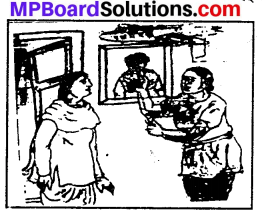
बालकृष्ण ने दही का दोना अपनी पीठ के पीछे छिपा लिया है।

प्रश्न 2.
दूध पीने से चोटी बढ़ती है, यह सुझाव कृष्ण को किसने दिया था?
उत्तर:
गाय का दूध पीने से चोटी बढ़ती है, यह सुझाव यशोदा माता ने बालकृष्ण को दिया था।

प्रश्न 3.
सूरदास किस भाषा के कवि हैं?
उत्तर:
सूरदास ब्रजभाषा के कवि हैं।

प्रश्न 4.
‘मोसों कहत मोल को लीनो’ यह कथन किसने कहा है? (2016)
उत्तर:
यह कथन बलदाऊ की शिकायत करते हुए कृष्ण यशोदा माता से कहते हैं कि बलदाऊ उन्हें मोल का खरीदा हुआ बताते हैं।

प्रश्न 5.
“घर का पहरे वाला” से कवि का क्या आशय है? (2015)
उत्तर:
“घर का पहरे वाला” से कवि का तात्पर्य घर के रखवाले से है अर्थात् देश की रक्षा करने वाला प्रहरी।

प्रश्न 6.
‘ममता की गोद’ किसे कहा गया है?
उत्तर:
बहन को ‘ममता की गोद’ कहा गया है।

वात्सल्य और स्नेह लघु उत्तरीय प्रश्न

प्रश्न 1.
अपने को निर्दोष सिद्ध करने के लिए कृष्ण ने यशोदा को क्या-क्या तर्क दिए? (2013)
उत्तर:
अपने को निर्दोष सिद्ध करने के लिए कृष्ण ने निम्न तर्क दिए-

  1. मैंने दही नहीं खाया है,बल्कि ग्वालवालों ने मेरे मुँह पर लपेट दिया है।
  2. तेरा दधि का बर्तन इतने ऊँचे छींके पर लटका हुआ है।
  3. मेरे छोटे-छोटे हाथ हैं जो उस छींके तक नहीं पहुँच सकते।

प्रश्न 2.
“गोरे नन्द जसोदा गोरी, तुम कत स्याम सरीर” यह पंक्ति किसने किससे और क्यों कही?
उत्तर:
उक्त पंक्ति बलदाऊ ने कृष्ण से कहीं। उन्होंने यह पंक्ति अपने इस पक्ष को दृढ़ करने के लिए कहीं कि तुझे तो मोल लिया है। यदि तू नन्द और यशोदा माँ का पुत्र होता तो काला क्यों होता ? वे दोनों तो गोरे हैं। यहाँ इस तथ्य को उजागर किया गया है कि गोरे माता-पिता की सन्तान भी गोरी होती है।

प्रश्न 3.
मुँह से मिट्टी निकालने के लिए यशोदा ने कौन-सा उपाय किया?
उत्तर:
कृष्ण के मुँह से मिट्टी निकालने के लिए यशोदा ने कसकर उनकी बाँह पकड़ ली और मारने के लिए एक हाथ में डंडी उठा ली। उनका भाव यह था कि डर के मारे कृष्ण अपने मुख से मिट्टी बाहर निकाल देगा।

प्रश्न 4.
‘मेरा जीवन क्रीड़ा-कौतुक तू प्रत्यक्ष प्रमोद भरी’ से कवि का क्या आशय है?
उत्तर:
कवि कहता है कि भाई का जीवन तो क्रीड़ा-कौतूहल आदि से भरा रहा, लेकिन बहन गम्भीर रहते हुए भी आनन्द देने वाली बनी रही। बहन के होते हुए कभी भी भाई के प्रेम और आनन्द में कमी नहीं आई।.

प्रश्न 5.
बहन को भाई का ध्रुवतारा’ क्यों कहा गया है? (2009, 11, 14, 17)
उत्तर:
भाई तो एक अल्हड़ जीवन या यों कहें कि लापरवाह जीवन बिताता रहा, लेकिन बहन अपने लक्ष्य के लिए ध्रुवतारे की तरह अटल खड़ी हुई दिखाई दी। बहन ने भाई को मुसीबतों के समय उत्साह दिया और उसकी देश-भक्ति को जाग्रत कर देश के प्रति अपने कर्तव्य को पूर्ण करने में सहयोग दिया।

वात्सल्य और स्नेह दीर्घ उत्तरीय प्रश्न

प्रश्न 1.
कृष्ण माता यशोदा से बलदाऊ की क्या-क्या शिकायतें करते हैं?
उत्तर:
कृष्ण माता यशोदा से शिकायत करते हैं कि बलदाऊ मुझे बहुत चिढ़ाते हैं। मझसे यह कहते हैं कि तुझे यशोदा माता ने जन्म नहीं दिया है,बल्कि तुझे किसी से मोल लिया है। में इस गुस्से में खेलने भी नहीं जाता हूँ। बार-बार मुझसे पूछते हैं कि तेरे माता-पिता कौन हैं और कहते हैं कि नन्द बाबा और यशोदा तो दोनों गोरे हैं,यदि तू उनका पुत्र है तो साँवला क्यों है? फिर सभी ग्वालों को सिखा देते हैं और मेरी तरफ देखकर ताली मारकर हँसते हैं और मुझे खिझाते हैं और तू मुझे ही मारना जानती है,बलदाऊ को कभी नहीं मारती।

प्रश्न 2.
‘सूर वात्सल्य के चितेरे हैं’ इस कथन पर अपने विचार व्यक्त कीजिए।
उत्तर:
‘सूर वात्सल्य के चितेरे हैं’ यह कथन अक्षरशः सत्य है। इनका वात्सल्य वर्णन अद्वितीय है। कृष्ण के बाल रूप और उनकी बाल-सुलभ क्रीड़ाओं का जैसे विशद वर्णन सूरदास ने किया है, वैसा सम्पूर्ण विश्व साहित्य में कहीं नहीं मिलता। कृष्ण का घुटनों चलना,मणियों के खम्भ में अपने प्रतिबिम्ब को माखन खिलाना, माँ से जिद करना,खेलते समय खिसिया जाना आदि विविध बाल क्रीड़ाओं का वर्णन सूरसागर में चित्रित है। उदाहरण देखिए-
“मैया मैं तो चंद खिलौना लैहों।
जैहों लोटि धरनि पै अब ही तेरी गोद न ऐहौं।”

बच्चों की पारस्परिक होड़ का चित्रण भी सूरदास ने अनूठे रूप में किया है। माता यशोदा उनसे कहती है कि दूध पीने से चोटी बढ़ती है तो वह इस लालच में रोज दूध पी लेते हैं। जब उन्हें चोटी बढ़ती हुई दिखाई नहीं देती तो वह कहते हैं-
“मैया कबहि बढ़ेगी चोटी।
काचो दूध पियाबति पचि-पचि देत न माखन रोटी ॥
कितनी बार मोहि दूध पिबत भई यह अजहूँ है छोटी॥”

प्रश्न 3.
बहन को ‘चिनगारी’ तथा भाई को ‘ज्वाला’ बताने के पीछे कवि का क्या आशय (2009)
उत्तर:
गोपाल सिंह नेपाली राष्ट्रीय चेतना जाग्रत करने वाले कवि हैं। उन्होंने भाई-बहन के प्रेम को राष्ट्रीय प्रेम के रूप में अभिव्यक्त किया है। अपनी मातृभूमि की रक्षार्थ बहन चिनगारी के रूप में कार्य करेगी तो भाई ज्वाला बन कर देश की रक्षार्थ तत्पर रहेगा। बहन की क्रोध रूपी चिनगारी जलकर भयानक ज्वाला का रूप ले लेगी और मातृभूमि के दुश्मन को जलाकर राख कर देगी। दूसरी ओर भाई का क्रोध तो स्वयं ज्वाला बनकर देश की रक्षा करेगा। भाई बहन को कहता है कि देश की रक्षा के लिए हम दोनों को सजग और सक्रिय रहना है। कवि आश्वस्त है कि भाई और बहन दोनों मिलकर अपने देश की रक्षा के लिए सतर्क रहेंगे और देश के दुश्मन के लिए ज्वाला बनकर उसका सर्वनाश करने में सक्षम होंगे।

प्रश्न 4.
कवि ने भाई-बहन के स्नेह को किन-किन प्रतीकों के माध्यम से अभिव्यक्त किया है?
उत्तर:
कवि ने भाई-बहन के स्नेह को देश-प्रेम में परिवर्तित कर नये-नये प्रतीकों का सहारा लिया है। बहन के प्रेम के प्रतीक हैं-चिनगारी,हहराती गंगा,बसन्ती चोला,कराल क्रान्ति, राधारानी, आँगन की ज्योति,ममता की गोद, बहन की बुद्धि, नदी की धारा, ध्रुवतारा के रूप में बताया है। दूसरी तरफ भाई के प्रेम को ज्वाला, बेहाल झेलम, सजा हुआ लाल, विकराल, वंशीवाला, घर का पहरेदार,प्रेम का पुतला, जीवन का क्रीड़ा कौतुक, क्रियाशीलता, एक लहर बताया है। इन प्रतीकों के माध्यम से कवि ने राष्ट्रीय चेतना के साथ-साथ मानवीय जीवन की ऊष्मापूर्ण अनुभूतियों का प्रभावशाली वर्णन किया है। इस कविता में कवि ने देश-प्रेम का उच्च आदर्श उद्घाटित किया है।

प्रश्न 5.
भाई-बहन’ कविता के माध्यम से कवि क्या संदेश देना चाहता है?
उत्तर:
भाई-बहन’ कविता के माध्यम से कवि ने नये-नये प्रतीकों के द्वारा भाई बहन के प्रेम को राष्ट्रीय प्रेम के परिवेश में व्यक्त किया है। भाई अपनी बहन को सम्बोधित कर कहता है कि हम दोनों को देश की रक्षा के लिए सजग और सक्रिय होना है। बहन की बुद्धि और भाई की क्रियाशीलता मिलकर जीवन और राष्ट्र को आनन्दमय बना देगी। भाई-बहन दोनों मिलकर आजादी के गीत गाकर लोगों में देश की रक्षा के प्रति जागति पैदा कर देश के प्रति अपने कर्तव्य को पूरा कर सकते हैं। भाई-बहन के प्रेम को राष्ट्रीय प्रेम से जोड़कर उदात्त बना दिया गया है। कवि संदेश दे रहा है कि हम अपने आनन्द में ही मस्त होकर देश की रक्षा के अपने कर्त्तव्य को कहीं भूल न जाएँ। यहाँ सभी को सजग रहकर एक सच्चे देशभक्त प्रहरी की तरह अपने देश की रक्षा करनी है।

देश के लिए बसन्ती चोला धारण करना पड़े तो करें और विकराल स्वरूप धारण करना पड़े तो करें तथा अपनी बुद्धि और बल के सहारे देश के लिए अपना बलिदान कर दें। जब देश की आजादी का प्रश्न हो, तो अपनी क्रोध रूपी ज्वाला को जलाकर सामने आये अरि (दुश्मन) को नष्ट कर दें। किसी भी कीमत पर देश की आजादी को बचाना है। यदि मातृभूमि तुम्हें अपनी रक्षा के लिए आवाज दे, तो सभी सुख-सम्पत्ति को भूल कर एक सच्चे देश-भक्त की तरह आगे आयें और अपना सर्वस्व अर्पण करके भी अपनी मातृभूमि की रक्षा करें। कवि देश में एकता बनाये रखने का भी संदेश देता है।

प्रश्न 6.
सन्दर्भ सहित व्याख्या कीजिये
(अ) मैया मैं नाही……. शिव विरंचि बौरायो।
(ब) मैया कबहिं बढ़ेगी……. हरि हलधर की जोटी।
(स) भाई एक लहर ……. भाई का ध्रुवतारा है।
उत्तर:
(अ) सन्दर्भ :
प्रस्तुत पद ‘वात्सल्य और स्नेह’ से सूरदास द्वारा रचित ‘सूर के बालकृष्ण’ नामक शीर्षक से उद्धृत किया गया है।

सन्दर्भ :
इसमें बालकृष्ण अपनी माता यशोदा से अपने प्रति की गई दही खाने की शिकायत को नकारते हुए बड़े ही बुद्धिकौशल से बाल सुलभ उत्तर देते हैं।

व्याख्या :
श्रीकृष्ण माता यशोदा से कहते हैं कि, हे माता! मैंने दही नहीं खाया है। मुझे याद आ रहा है कि इन सभी सखाओं ने मिलकर मेरे मुख पर दही लपेट दिया था। तू जानती है कि इतने ऊँचे टँगे हुए छींके पर दही का बर्तन रखा हुआ है। तू देख सकती है कि मेरे छोटे-छोटे हाथ हैं। इन छोटे हाथों से मैं कैसे उस दही के बर्तन को प्राप्त कर सकता हूँ। फिर नन्दकुमार बालकृष्ण ने दोने को पीठ के पीछे छिपाते हुए और मुख पर लगे हुए दही को पोंछते हुए उपर्युक्त बातें कहीं। यहाँ उनकी बाल सुलभ चतुरता का प्रदर्शन किया गया है। उन्हें भान है कि मुख पर लगे हुए दही से और हाथ में लगे दोने से उनकी चोरी पकड़ी जाएगी, अतः मुख को साफ कर लिया और दोने को पीठ के पीछे छुपा लिया।

यशोदा जी सब समझ गईं, लेकिन पीटने वाली लकड़ी को फेंक कर मुस्कराने लगी और मनमोहन बालकृष्ण को अपने गले से लगा लिया। श्रीकृष्ण के बाल विनोद के आनन्द ने माता यशोदा के मन को मोहित कर लिया। यहाँ श्रीकृष्ण के प्रति उनकी भक्ति का प्रताप दर्शाया गया है। सूरदास कहते हैं कि यशोदा जी और बालकृष्ण के सख को देखकर शिव और ब्रह्मा भी विवेक रहित होकर मोहित हो गए। अर्थात् श्रीकृष्ण यशोदा जी को अपनी बाल लीलाओं का जो सुख दे रहे हैं उससे किसी को भी ईर्ष्या हो सकती है और वह भ्रमित हो सकता है। निरंजन निराकार परब्रह्म साकार रूप में आकर यशोदा जी के आँगन में उनके प्रमोद के लिए जो क्रीड़ाएँ कर रहे हैं, ऐसा सुख शिव-विरंचि को भी दुर्लभ है।

(ब) सन्दर्भ :
पूर्ववत्।

प्रसंग :
प्रस्तुत पंक्तियों में बालकृष्ण अपनी माता यशोदा से यह शिकायत कर रहे हैं कि उनको कितने ही दिन दूध पीते हो गए, लेकिन उनकी चोटी बड़ी नहीं हुई है।

व्याख्या :
बालकृष्ण यह जानने को उत्सुक हैं कि उनकी चोटी कब बढ़ेगी। उनकी माता उन्हें यह भरोसा दिलाकर दूध पिलाती थीं कि दूध पीने से उनकी चोटी बढ़ जाएगी। वह माता से पूछते हैं कि हे माता मुझे कितनी ही बार (बहुत समय) दूध पीते हुए हो गईं, लेकिन यह चोटी अभी तक छोटी है। तेरे कथनानुसार मेरी चोटी बलदाऊ की चोटी के समान लम्बी और मोटी हो जाएगी, काढ़ते में, गुहते में,नहाते समय और सुखाते समय नागिन के समान लोट जाया करेगी। तू मुझे कच्चा दूध अधिक मात्रा में पिलाती है तथा माखन और रोटी नहीं देती है। माखन और रोटी बालकृष्ण को प्रिय हैं, लेकिन वे नहीं मिलते और चोटी बढ़ने की लालसा से उन्हें गाय का कच्चा दूध पीना पड़ता है। सूरदास कहते हैं कि माता बलाएँ लेने लगी और कहने लगी कि हरि हलधर दोनों भाइयों की जोड़ी चिरंजीव हो।

(स) सन्दर्भ :
पूर्ववत्।

प्रसंग :
भाई और बहन एक-दूसरे के सहायक हैं। हर उन्माद में बहन को भाई का ही सहारा है। दोनों मिलकर आजादी के गीत गाकर मातृभूमि के प्रति अपने कर्तव्य को पूर्ण कर सकते हैं।

व्याख्या :
कवि गोपाल सिंह नेपाली कहते हैं कि यहाँ पर भाई एक लहर के रूप में है, तो बहन नदी की एक धारा है। दोनों साथ-साथ रहकर कल्याण के मार्ग पर चलकर सभी का सहारा बनेंगे। गंगा-यमुना के संगम में पानी की अधिकता होने से कभी बाढ़ जैसी स्थिति हो जाती है और किनारे डूबने लगते हैं। ऐसे पागलपन भरे अवसर पर बहन को भाई का ही एकमात्र सहारा है। बेफिक्री के समय में भी भाई अपनी बहन के लिए ध्रुवतारे की तरह अडिग है। कुछ समय ऐसे आते हैं जब हमें अपने संयम को दृढ़ रखना है। भाई और बहन दोनों मिलकर आजादी के गीत गाकर ही मातृभूमि के प्रति अपने कर्तव्य को पूरा कर सकते हैं। अपनी मुसीबतों को झेलकर और बलिदानों के माध्यम से पत्थर-हृदय देश के दुश्मनों को चेतावनी देते हैं कि हम हर हाल में देश की रक्षा के लिए तत्पर हैं।

वात्सल्य और स्नेह काव्य सौन्दर्य

प्रश्न 1.
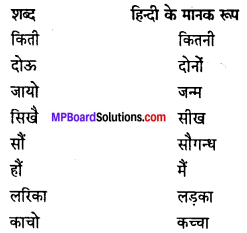
निम्नलिखित शब्दों के मानक रूप लिखिए
उत्तर:
MP Board Class 12th Hindi Swati Solutions पद्य Chapter 2 वात्सल्य और स्नेह img-1

प्रश्न 2.
निम्नलिखित पंक्तियों में अलंकार पहचान कर लिखिए
(अ) काढ़त गुहत न्हवावत ओछत, नागिन सी भुई लोटी।
(ब) मेरा जीवन क्रीड़ा-कौतुक तू प्रत्यक्ष प्रमोद भरी।
(स) काचो दूध पिआवत पचि-पचि, देत न माखन रोटी।
उत्तर:
(अ) उपमा अलंकार
(ब) अनुप्रास अलंकार
(स) पुनरुक्तिप्रकाश अलंकार।

प्रश्न 3.
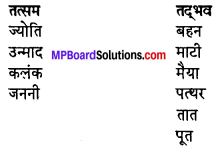
निम्नलिखित शब्दों में से तत्सम और तद्भव शब्द छाँटकर लिखिए
ज्योति, उन्माद, बहन, कलंक, जननी,माटी,मैया, पूत,तात, पत्थर।
उत्तर:
MP Board Class 12th Hindi Swati Solutions पद्य Chapter 2 वात्सल्य और स्नेह img-2

प्रश्न 4.
गोद राखि चचुकारि दुलारति पुन पालति हलरावति।
आँचर ढाँकि बदन विधु सुंदर थन पय पान करावति॥
उपर्युक्त पंक्तियों में प्रयुक्त रस बताइये।
उत्तर:
वात्सल्य रस।

प्रश्न 5.
इस पाठ में से पुनरुक्ति प्रकाश और अनुप्रास अलंकार के उदाहरण छाँट कर लिखिए।
उत्तर:
(i) पुनरुक्तिप्रकाश-तू चिनगारी बनकर उड़ री,जाग-जाग मैं ज्वाल बनूँ।
(ii) अनुप्रास अलंकार-तू भगिनी बन क्रान्ति कराली,मैं भाई विकराल बनूँ।

सूर के बालकृष्ण भाव सारांश

‘सूर के बालकृष्ण’ नामक पदों के रचयिता भक्त कवि ‘सूरदास’ हैं। सूरदास ने शिशु सुलभ मुद्राओं, क्रीड़ाओं और शिशु के स्वभावगत सौन्दर्य को भी अपनी उदात्त और आकर्षक छवियों में प्रकट किया है।

वात्सल्य प्रेम में प्रेम का निश्छल,उदार और शिशु सुलभ स्वभाव प्राप्त होता है। शिशु के सुन्दर स्वरूप, आकर्षक मुद्राओं और उसके अबोध व्यवहारों के प्रदर्शन से यह वात्सल्य भाव दर्शक के हृदय में संचरित होता है। हिन्दी साहित्य में वात्सल्य भाव की रचनाओं की कमी है, किन्तु जितनी भी रचनाएँ प्राप्त होती हैं, वे वत्सलता के प्रभावी स्वरूप को प्रकट करती हैं। सूरदास ने शिशु सुलभ भुद्राओं,क्रीड़ाओं को तो अपने काव्य में स्थान दिया ही है साथ ही शिश के स्वभावगत सौन्दर्य को भी अपनी आकर्षक छवियों में प्रस्तुत किया है। शिशु कृष्ण अपने वाक्यचातुर्य से अपने दही खाने वाली बात को काट देते हैं। शिशु सहज विश्वासी होता है। शिशु कृष्ण से यदि माँ ने कह दिया कि गाय का दूध पीने से चोटी बढ़ती है तो कृष्ण खूब दूध पीते हैं और रोज-रोज माँ से पूछते हैं कि चोटी क्यों नहीं बढ़ रही? यहाँ शिशु की अधीरता दिखाई देती है। बच्चों में पारस्परिक चिढ़ाने का भाव है। कृष्ण अपनी माँ से बलराम के चिढ़ाने की शिकायत करते हैं। बाल सुलभ चेष्टाओं में मिट्टी खाने की प्रवृत्ति भी समाहित है। सूरदास ने इस तथ्य का आकर्षक वर्णन अपने पदों में किया है। सूरदास की भाषा में चमत्कृत कर देने वाला प्रवाह इन पदों में उपलब्ध है।

सूर के बालकृष्ण संदर्भ-प्रसंग सहित व्याख्या

(1) मैया मैं नाहीं दधि खायो।
ख्याल परे ये सखा सबै मिलि, मेरे मुख लपटायो।
देखि तही सीके पर भाजन, ऊँचे धर लटकायो।
तुही निरखि नान्हे कर अपने, मैं कैसे करि पायो।
मुख दधि पोंछि कहत नंदनंदन, दोना पीठि दुरायो।
डारि सॉट मुसुकाई तबहि, गहि सुत को कंठ लगायो।
बाल विनोद मोद मन मोह्यो, भक्ति प्रताप दिखायो।
सूरदास प्रभु जसुमति के सुख, शिव विरंचि बौरायो।

शब्दार्थ :
ख्याल परे = याद आया; लपटायो = लपेट दिया है; भाजन = बर्तन; निरखि = देख; नान्हे = छोटे,कर = हाथ; दोना = पत्तों का बना पात्र; साँटि = पीटने की डंडी; सुत = पुत्र; कंठ = गला; मोद = प्रसन्नता; मोह्यो = मोहित हो गया; विरंचि = ब्रह्माजी।

सन्दर्भ :
प्रस्तुत पद ‘वात्सल्य और स्नेह’ से सूरदास द्वारा रचित ‘सूर के बालकृष्ण’ नामक शीर्षक से उद्धृत किया गया है।

सन्दर्भ :
इसमें बालकृष्ण अपनी माता यशोदा से अपने प्रति की गई दही खाने की शिकायत को नकारते हुए बड़े ही बुद्धिकौशल से बाल सुलभ उत्तर देते हैं।

व्याख्या :
श्रीकृष्ण माता यशोदा से कहते हैं कि, हे माता! मैंने दही नहीं खाया है। मुझे याद आ रहा है कि इन सभी सखाओं ने मिलकर मेरे मुख पर दही लपेट दिया था। तू जानती है कि इतने ऊँचे टँगे हुए छींके पर दही का बर्तन रखा हुआ है। तू देख सकती है कि मेरे छोटे-छोटे हाथ हैं। इन छोटे हाथों से मैं कैसे उस दही के बर्तन को प्राप्त कर सकता हूँ। फिर नन्दकुमार बालकृष्ण ने दोने को पीठ के पीछे छिपाते हुए और मुख पर लगे हुए दही को पोंछते हुए उपर्युक्त बातें कहीं। यहाँ उनकी बाल सुलभ चतुरता का प्रदर्शन किया गया है। उन्हें भान है कि मुख पर लगे हुए दही से और हाथ में लगे दोने से उनकी चोरी पकड़ी जाएगी, अतः मुख को साफ कर लिया और दोने को पीठ के पीछे छुपा लिया।

यशोदा जी सब समझ गईं, लेकिन पीटने वाली लकड़ी को फेंक कर मुस्कराने लगी और मनमोहन बालकृष्ण को अपने गले से लगा लिया। श्रीकृष्ण के बाल विनोद के आनन्द ने माता यशोदा के मन को मोहित कर लिया। यहाँ श्रीकृष्ण के प्रति उनकी भक्ति का प्रताप दर्शाया गया है। सूरदास कहते हैं कि यशोदा जी और बालकृष्ण के सख को देखकर शिव और ब्रह्मा भी विवेक रहित होकर मोहित हो गए। अर्थात् श्रीकृष्ण यशोदा जी को अपनी बाल लीलाओं का जो सुख दे रहे हैं उससे किसी को भी ईर्ष्या हो सकती है और वह भ्रमित हो सकता है। निरंजन निराकार परब्रह्म साकार रूप में आकर यशोदा जी के आँगन में उनके प्रमोद के लिए जो क्रीड़ाएँ कर रहे हैं, ऐसा सुख शिव-विरंचि को भी दुर्लभ है।

काव्य सौन्दर्य :

  1. बालकृष्ण की बाल सुलभ चतुरता दर्शनीय है।
  2. ब्रजभाषा का प्रयोग।
  3. अनुप्रास अलंकार का प्रयोग।
  4. वात्सल्य रस है।

(2) मैया कबहिं बढ़ेगी चोटी।
किती बार मोहि दूध पिअत भई, यह अजहूँ है छोटी।
तू जो कहति बल की बेनी, ज्यौं, है है लॉबी मोटी।
काढ़त गुहत न्हवावत ओछत, नागिन सी भुइँ लोटी।
काचो दूध पिआवत पचि-पचि देत न माखन रोटी।
सूर श्याम चिरजीवौ दोऊ भैया, हरि हलधर की जोटी।। (2010, 15)

शब्दार्थ :
किती बार = कितनी बार; बल = बलदाऊ; बेनी = चोटी; काढ़त गुहत = काढ़ते में और गुहते में; न्हवावत = नहाने में; ओछत = सुखाने में; पचि-पचि = खूब; हरि हलधर = कृष्ण बलराम; जोटी = जोड़ी।

सन्दर्भ :
पूर्ववत्।

प्रसंग :
प्रस्तुत पंक्तियों में बालकृष्ण अपनी माता यशोदा से यह शिकायत कर रहे हैं कि उनको कितने ही दिन दूध पीते हो गए, लेकिन उनकी चोटी बड़ी नहीं हुई है।

व्याख्या :
बालकृष्ण यह जानने को उत्सुक हैं कि उनकी चोटी कब बढ़ेगी। उनकी माता उन्हें यह भरोसा दिलाकर दूध पिलाती थीं कि दूध पीने से उनकी चोटी बढ़ जाएगी। वह माता से पूछते हैं कि हे माता मुझे कितनी ही बार (बहुत समय) दूध पीते हुए हो गईं, लेकिन यह चोटी अभी तक छोटी है। तेरे कथनानुसार मेरी चोटी बलदाऊ की चोटी के समान लम्बी और मोटी हो जाएगी, काढ़ते में, गुहते में,नहाते समय और सुखाते समय नागिन के समान लोट जाया करेगी। तू मुझे कच्चा दूध अधिक मात्रा में पिलाती है तथा माखन और रोटी नहीं देती है। माखन और रोटी बालकृष्ण को प्रिय हैं, लेकिन वे नहीं मिलते और चोटी बढ़ने की लालसा से उन्हें गाय का कच्चा दूध पीना पड़ता है। सूरदास कहते हैं कि माता बलाएँ लेने लगी और कहने लगी कि हरि हलधर दोनों भाइयों की जोड़ी चिरंजीव हो।

काव्य सौन्दर्य :

  1. बच्चों को बहाने से दूध पिलाने के तथ्य को उजागर किया गया है।
  2. ब्रजभाषा का सुन्दर प्रयोग हुआ है।
  3. पुनरुक्तिप्रकाश,उपमा अलंकार का प्रयोग।

(3) मैया, मोहिं दाऊ बहुत खिझायो।
मोसों कहत मोल को लीनो, तोहि जसुमति कब जायो।
कहा कहौं यहि रिस के मारे, खेलन हौं नहिं जात।
पुनि-पुनि कहत कौन है माता, को है तुमरो तात।।
गोरे नन्द जसोदा गोरी, तुम कत स्याम सरीर।
चुटकी दै दै हँसत ग्वाल सब, सिखे देत बलवीर।।
तू मोही को मारन सीखी, दाऊ कबहुँ न खीझै।
मोहन को मुख रिस समेत लखि, जसुमति सुनि-सुनि रीझै।।
सुनहु कान्ह बलभद्र चबाई, जनमत ही को धूत।
सुर-श्याम मो गोधन की सौं, हों माता तू पूत।।

शब्दार्थ :
खिझायो = चिढ़ाना; जायो = पैदा किया; लखि = देखकर, रिसके = गुस्से में; तात = पिता; चबाई = चुगलखोर; धूत = धूर्त; सौं = सौगन्ध।

सन्दर्भ :
पूर्ववत्।

प्रसंग :
बलदाऊ और कृष्ण अन्य ग्वाल-बालों के साथ बाहर खेलने जाते हैं तो बलदाऊ भिन्न-भिन्न प्रकार से उन्हें चिढ़ाते हैं। यहाँ यही शिकायत कृष्ण माता यशोदा जी से कर रहे हैं।

व्याख्या:
श्रीकृष्ण अपने बड़े भाई बलभद्र की शिकायत करते हुए अपनी माता से कहते हैं कि हे माता बलभद्र भाई मुझे बहुत चिढ़ाते हैं। मुझसे कहते हैं कि तुझे यशोदा जी ने जन्म नहीं दिया है, तुझे तो किसी से मोल लिया है। मैं क्या बताऊँ इस गुस्से के कारण मैं खेलने भी नहीं जाता। मुझसे बार-बार पूछते हैं कि तेरे माता-पिता कौन हैं। तू नन्द-यशोदा का पुत्र तो हो नहीं सकता क्योंकि तू साँवले रंग का है जबकि नन्द और यशोदा दोनों गोरे हैं। ऐसी मान्यता है कि गोरे माता-पिता की सन्तान भी गोरी होती है। यह तर्क बलदाऊ ने इसलिए दिया ताकि कृष्ण इसको काट न सके। इस बात पर सभी ग्वाल-बाल ताली दे-देकर हँसते हैं।

सभी ग्वाल-बालों को बलदेव सिखा देते हैं और सभी हँसते हैं, तब मैं खीझ कर रह जाता हूँ। तू सिर्फ मुझे ही मारना सीखी है दाऊ से कभी कुछ भी नहीं कहती कृष्ण के गुस्से से भरे मुख को बार-बार देखकर उनकी रिस भरी बातें सुन-सुनकर यशोदा जी अत्यन्त प्रसन्न होती हैं। मोद भरे मुख से यशोदा जी बोलीं, हे कृष्ण! बलदाऊ तो चुगलखोर है और जनम से ही धूर्त है। सूरदास जी कहते हैं, यशोदाजी कहने लगीं-मुझे गोधन (अपनी गायों) की सौगन्ध है,मैं माता हूँ और तू मेरा पुत्र है। इस कथन ने कृष्ण के गुस्से को दूर कर दिया।

काव्य सौन्दर्य :

  1. ब्रजभाषा में अनूठा माधुर्य भर दिया है।
  2. माता और पुत्र के प्रश्नोत्तर तार्किक दृष्टि से उत्तम हैं।
  3. अनुप्रास व पुनरुक्तिप्रकाश अलंकार का प्रयोग है।

4. मो देखत, जसुमति तेरे ढोटा, अबहिं माटी खाई।
यह सुनिकै रिसि करि उठि धाई, बांह पकरि लै आई।।
इन कर सों भज गहि गाढ़े, करि इक कर लीने सांटी।
मारति हौ तोहिं अबहिं कन्हैया, वेग न उगिलौ माटी॥
ब्रज लरिका सब तेरे आगे, झूठी कहत बनाई।
मेरे कहे नहीं तू मानति, दिखरावौं मुख बाई॥ (2016)

शब्दार्थ :
ढोटा = पुत्र; भुइँ = भूमि; मुख बाई = मुख फैलाकर; गहि गाढ़े = जोर से पकड़कर।

सन्दर्भ :
पूर्ववत्।

प्रसंग :
ग्वाल-बालों ने यशोदा माँ से यह शिकायत की है कि कान्हा ने मिट्टी खाई है। उनका विश्वास कर माँ उसे पकड़ लेती है।

व्याख्या :
कृष्ण के साथ खेलने वाले बालकों ने माता यशोदा से शिकायत की कि कान्हा ने मिट्टी खाई है। यह सुनकर माता को बड़ा क्रोध आया और कृष्ण को बाँह से पकड़ लिया। उनके हाथ से कहीं छूट कर भाग न जाय इसलिए कसकर बाँह पकड़ ली और एक हाथ में मारने के लिए एक डंडी ले ली। माता यशोदा ने कृष्ण से कहा हे कृष्ण ! मैं तुझे अभी मारूँगी नहीं तो जल्दी से मुँह से मिट्टी उगल दो। यह सुनकर बालकृष्ण ने डरते हुए अपनी माँ से कहा-ये सब ब्रज के ग्वाल-वाल तेरे पास आकर मेरी झूठी शिकायत लगाते हैं। मैं जानता हूँ कि तू मेरा कहना तो मानेगी नहीं इसलिए में अपना मुंह खोलकर दिखाता हूँ कि मुँह में माटी कहाँ है।

काव्य सौन्दर्य :

  1. बाल सुलभ चेष्टाओं का सुन्दर वर्णन है।
  2. ब्रजभाषा का सुन्दर प्रयोग किया है।
  3. बच्चों के माटी खाने के तथ्य को उजागर किया गया है।
  4. अनुप्रास अलंकार प्रयुक्त हुआ है।

भाई-बहन भाव सारांश

प्रस्तुत कविता ‘भाई-बहन’ सुप्रसिद्ध कवि ‘गोपाल सिंह नेपाली’ द्वारा रचित है। इसमें कवि ने भाई बहन के प्रेम को राष्ट्रीय प्रेम के परिवेश में व्यक्त किया है।

गोपाल सिंह नेपाली ने राष्ट्रीय चेतना के साथ-साथ जीवन की अनुभूतियों का वर्णन अपनी कविताओं में किया है। प्रस्तुत कविता में भाई-बहिन के प्रेम को राष्ट्र-प्रेम के रूप में व्यक्त किया है। यहाँ भाई अपनी बहन को सम्बोधित कर राष्ट्र की रक्षा हेतु समर्पित होने का आग्रह कर रहा है। इस कविता में अनेक प्रतीकों के माध्यम से राष्ट्र-प्रेम को उजागर किया गया है। बहन की बुद्धि और भाई की क्रियाशीलता मिलकर ही जीवन और राष्ट्र को आनन्दमय बना सकेगी। दोनों मिलकर आजादी के गीत गाकर अपने राष्ट्र के प्रति अपने प्रेम को प्रकट कर सकते हैं। कविता में दिए गए प्रतीक और बिम्ब मौलिक हैं।

भाई-बहन संदर्भ-प्रसंग सहित व्याख्या

1. तू चिनगारी बनकर उड़ री, जाग-जाग मैं ज्वाल बनें,
तू बन जा हहराती गंगा, मैं झेलम बेहाल बून,
आज बसन्ती चोला तेरा, मैं भी सज लूं लाल बनूँ
तू भगिनी बन क्रान्ति कराली, मैं भाई विकराल बनूँ
यहाँ न कोई राधारानी, वृन्दावन, वंशीवाला;
तू आँगन की ज्योति बहन री, मैं घर का पहरेवाला।

शब्दार्थ :
हहराती गंगा = कलकल ध्वनि करती गंगा; चोला = वेश; भगिनी = बहन; विकराल = भयानक।

सन्दर्भ :
प्रस्तुत पंक्तियाँ ‘वात्सल्य और स्नेह’ पाठ के ‘भाई-बहन’ शीर्षक कविता से ली गई हैं। इसके रचयिता गोपाल सिंह नेपाली हैं।

प्रसंग :
यहाँ पर भाई अपनी बहन से अपने देश की रक्षा के लिए बसन्ती चोला पहनने और अपने हृदय के अन्दर की ज्वाला को जलाए रखने को प्रेरित कर रहा है।

व्याख्या :
कविवर गोपाल सिंह नेपाली कहते हैं कि एक भाई अपनी बहन से देश की रक्षा के लिए जाग्रत रहने का आह्वान कर रहा है। भाई कहता है कि हे बहन! तू चिनगारी बनकर आकाश में उड़ और मैं ज्वाला बनकर देश-रक्षा के लिए जाग्रत रहूँ। तू कल-कल ध्वनि करती हुई गंगा बनकर बह और मैं बेहाल की तरह चलने वाली झेलम नदी बन कर बहूँ तू देश की रक्षा के लिए बसन्ती रंग के वस्त्र पहन ले और मैं भी देश के वीरों के रूप में सज जाऊँ। तू दुश्मन के लिए भयंकर क्रान्ति बन जा और मैं भयानक वीर बन जाऊँ ताकि उसकी दृष्टि हमारे देश पर न पड़े। यहाँ सिर्फ देश की रक्षा का सवाल है, सभी की एकता का प्रश्न है। यहाँ न तो वृन्दावन अलग है,न राधारानी अलग है और न नन्दलाल अलग है। सभी देश की रक्षा के लिए उद्यत हैं। भाई अपनी बहन से कहता है कि वह आँगन की ज्योति बनकर प्रकाश करे और वह घर का पहरेदार बनेगा। हम दोनों अपने प्रेम को देश-प्रेम पर न्यौछावर करते हैं।

काव्य सौन्दर्य :

  1. भाषा साहित्यिक होने के साथ-साथ व्यावहारिक है।
  2. देश-भक्ति का अनूठा समर्पण है।
  3. अनुप्रास अलंकार है।
  4. कविता में मधुरता है।

(2) बहन प्रेम का पुतला हूँ मैं, तू ममता की गोद बनी;
मेरा जीवन क्रीड़ा-कौतुक तू प्रत्यक्ष प्रमोद भरी;
मैं भाई फूलों में भूला, मेरी बहन विनोद बनी;
भाई की गति, मति भगिनी की दोनों मंगल-मोद बनी
यह अपराध कलंक सुशीले, सारे फूल जला देना।
जननी की जंजीर बज रही, चल तबियत बहला देना।

शब्दार्थ :
पुतला = मूर्ति; विनोद = मनोरंजन; प्रमोद = आनन्द; भगिनी = बहन।

सन्दर्भ :
पूर्ववत्।

प्रसंग :
यहाँ पर भाई अपनी बहन को इस बात के लिए प्रेरित करता है कि यदि अपने देश की परतन्त्रता पुकार रही हो तो अपने सारे सुख भुलाकर उसकी रक्षा के लिए तैयार हो जाना।

व्याख्या :
भाई कहता है कि मैं तो प्रेम की मूर्ति बनकर रहा हूँ और तू ममता की गोद बनकर रही है। अर्थात् तूने हर किसी को अपनी ममता की छाँव में बैठाया है। मेरा जीवन क्रीड़ा और कौतूहल बनकर रहा है और तू साक्षात् आनन्दमयी बन कर रही है। मैं अपने जीवन के सुखों में खोया रहा और मेरी बहन मनोरंजन में डूबी रही। भाई की क्रियाशीलता और बहन की बुद्धि दोनों मिलकर आनन्द का साधन बनीं। भाई अपनी बहन को चेतावनी देते हुए कहता है कि हे बहन! हमारे सुख और आनन्द कहीं अपराध और कलंक न बन जायँ, इसलिए सभी सुखों को तिलांजलि देकर भारतमाता की परतन्त्रता की बेड़ियों की आवाज को सुन और चलकर उसे धैर्य दिला कि हम सब मिलकर उसे स्वतन्त्र करेंगे। हम सभी सुखों को अपने देश की रक्षा के लिए अर्पण कर देंगे।

काव्य सौन्दर्य :

  1. अनेक प्रतीकों के माध्यम से कवि ने इस कथ्य को प्रकट किया है।
  2. अनुप्रास अलंकार की छटा दृष्टव्य है।
  3. वीर रस का पुट दिया गया है।

(3) भाई एक लहर बन आया, बहन नदी की धारा है।
संगम है, गंगा उमड़ी है, डूबा कूल-किनारा है;
यह उन्माद बहन को अपना, भाई एक सहारा है;
यह अलमस्ती, एक बहन ही भाई का ध्रुवतारा हैं;
पागल घड़ी, बहन-भाई है, वह आजाद तराना है।
मुसीबतों से बलिदानों से पत्थर को समझाना है। (2009)

शब्दार्थ :
तराना = ताल स्वर; अलमस्त = मतवाला, बेफ्रिक; उन्माद = पागलपन।

सन्दर्भ :
पूर्ववत्।

प्रसंग :
भाई और बहन एक-दूसरे के सहायक हैं। हर उन्माद में बहन को भाई का ही सहारा है। दोनों मिलकर आजादी के गीत गाकर मातृभूमि के प्रति अपने कर्तव्य को पूर्ण कर सकते हैं।

व्याख्या :
कवि गोपाल सिंह नेपाली कहते हैं कि यहाँ पर भाई एक लहर के रूप में है, तो बहन नदी की एक धारा है। दोनों साथ-साथ रहकर कल्याण के मार्ग पर चलकर सभी का सहारा बनेंगे। गंगा-यमुना के संगम में पानी की अधिकता होने से कभी बाढ़ जैसी स्थिति हो जाती है और किनारे डूबने लगते हैं। ऐसे पागलपन भरे अवसर पर बहन को भाई का ही एकमात्र सहारा है। बेफिक्री के समय में भी भाई अपनी बहन के लिए ध्रुवतारे की तरह अडिग है। कुछ समय ऐसे आते हैं जब हमें अपने संयम को दृढ़ रखना है। भाई और बहन दोनों मिलकर आजादी के गीत गाकर ही मातृभूमि के प्रति अपने कर्तव्य को पूरा कर सकते हैं। अपनी मुसीबतों को झेलकर और बलिदानों के माध्यम से पत्थर-हृदय देश के दुश्मनों को चेतावनी देते हैं कि हम हर हाल में देश की रक्षा के लिए तत्पर हैं।

काव्य सौन्दर्य :

  1. भाषा सरल और मधुर है।
  2. भाई-बहन का स्नेह देश-प्रेम से मिलकर उदात्त बन गया है।
  3. बिम्ब और प्रतीक नवीन रूप में दर्शाए गए हैं।
MP Board Class 12th Hindi Solutions

MP Board Class 6th Special English Solutions Chapter 8 Robin Hood and the Sheriff

Students who wish to prepare the English Subject can rely on the MP Board Solutions for Class 6 English Chapter 8 Robin Hood and the Sheriff Questions and Answers prevailing. Become perfect with the concepts of Class 6 English Chapter 8 Robin Hood and the Sheriff Questions and Answers, Grammar, Summary, Notes, Guide, Pdf, by preparing you can score highest grade in your exams. Here, You Can Download MP Board Class 6 English Solutions. Detailed Solutions are provided to the concepts by experts keeping in mind the latest edition textbooks and syllabus.

MP Board Class 6th Special English Solutions Chapter 8 Robin Hood and the Sheriff

Ace up your preparation by referring to the Madhya Pradesh State Board Solutions for Class 6 Chapter 8 Robin Hood and the Sheriff Questions and Answers and learn all the topics within. Click on the topic you want to prepare from the Class 6 English and prepare it easily. You can understand your strengths and weaknesses by learining the Questions and Answers in MP Board Solutions for Class 6 English PDF.

Robin Hood and the Sheriff Text Book Exercise

Word Power

(a) Make new words by using prefixes.
Example:
un – uneasy, unable.

(a, al, en, dis, im, in, un, mis)
Answer:
a    : alike, affix
al   : altogether, already
en  : enforce, encourage
dis  : disqualify, discontentment
in   : impose, impossible
un  : unseen, unknown
mis : misfortune, misconduct

(b) Make adverb as shown in the example.
Example:
near – nearly

second ………..
easy ………..
last ………..
quick ………….
happy ………..
kind ………..
loud ………..
slow ………….
Answer:
secondly
easily
lastly
quickly
happily
kindly
loudly
slowly

Comprehension

(a) Answer these questions

Class 6 English Chapter 8 Robin Hood And The Sheriff MP Board Question 1.
Why were the Sheriffs feared some persons?
Answer:
Some persons were afraid of Sheriffs because they used to hang a person on a little or no offence.

Robin Hood Was The Leader Of Rich Travellers MP Board Question 2.
Who were ‘outlaws’?
Answer:
Outlaws were the men who ran away from the cities for the fear of being punished the Sheriffs. There they joined the company of other men like them.

Robin Hood And The Sheriff MP Board  Question 3.
How did the outlaws make their living?
Answer:
The outlaws used to rob the travellers on the highways. They also killed the deer in the forest to earn money and make their living.

Robin Hood Was The Leader Of Rich Travellers True Or False MP Board Question 4.
Why was Robin Hood a terror to the rich people?
Answer:
The rich people were afraid of Robin Hood, because he often robbed them of their money. He helped the poor with the booty.

Lesson 8 Robin Hood And The Sheriff MP Board Question 5.
How did the Sheriff show that he was very eager to catch Robin Hood?
Answer:
The Sheriff announced to give half of his wealth to the man who helped him to catch Robin Hood. It shows his eagerness to catch Robin Hood.

Robin Hood And The Sheriff Question Answer MP Board Question 6.
What was Robin Hood going to the town for?
Answer:
Robin Hood was going to the town with a view to meet and teach Sheriff a good lesson.

Question 7.
How did Robin Hood get into the disguise of a butcher?
Answer:
Robin Hood purchased meat, apron and a horse from a butcher. He wore his clothes and got into the disguise of a butcher.

Question 8.
Why didn’t the Sheriff allow Robin Hood to pay for the food and drinks?
Answer:
The Sheriff was the host. Therefore, he did not let Robin Hood pay for the dinner, for he was the Sheriffs guest.

(b) Answer these questions

Question 1.
‘Mr. Sheriff’ you have forgotten two things, Robin Hood said. When did Robin Hood say this? What two things had the Sheriff ‘forgotten’?
Answer:
The Sheriff had finished his dinner and was about to leave for his town. Then Robin Hood said these words. The things that Sheriff had forgotten were:

  1. he had to buy the animals.
  2. he had to pay for the dinner, he had enjoyed at the Green Wood Inn.

Question 2.
Why was the Sheriff not able to buy the animals?
Answer:
The Sheriff did not have enough money with him. Therefore, he was not able to purchase those animals.

Question 3.
When did Robin Hood let the Sheriff go?
Answer:
Robin Hood allowed the Sheriff to leave only after snatching all the money he had.

Question 4.
What did Robin Hood do when he and the Sheriff reached the highway?
Answer:
On reaching the highway, Robin Hood stopped and kicked the Sheriffs horse, which set it running as fast as it could.

(c) Tick (✓) for the correct statements and (✗) the incorrect statements.

  1. In olden days in England, the law was very cruel.
  2. The Sheriff were lawyers.
  3. Robin Hood was the leader of rich travellers.
  4. Robin Hood put on the butcher’s apron and took the load of meat to the town.
  5. The Sheriff was frightened while he rode out to Sherwood forest.

Answer:

  1. (✓)
  2. (✓)
  3. (✗)
  4. (✓)
  5. (✓)

Grammar in Use

(a) Read these sentences.

1. The Sheriff has been looking for a chance to catch me.
2. I have been living in this house since 1960.

The verb in italics are in the present perfect continuous tense.
They express actions/which took place over a period of time in the past and may possibly be continuing still.
For example the sentence – means;
Some time ago the Sheriff started looking for a chance to catch me.
He is still looking for a chance.
The sentence (2) means;
I started living in this hour in 1960.
I am still living in it.

Now express the meaning of each pair of sentences below in one sentence, using the present perfect continuous tense (has/have + been + verb – ing)

  1. These girls started learning French three years ago. They continue to learn French. (Use ‘for three years’).
  2. Shyam started doing his homework at 7”o clock. He is still doing it. (Use -‘Since’)
  3. It started raining at 5’o clock yesterday morning. It is still raining. (Use ‘Since’)
  4. Our English teacher started teaching in this school in 1964. (Use ‘Since’)
  5. “The poor Sheriff started waiting for me a long time ago.”
    “He is still waiting for me” (Use ‘for a long time’).

Answer:

  1. These girls have been learning French for three years.
  2. Shyam has been doing his homework since To clock.
  3. It has been raining since 5’o clock yesterday morning.
  4. Our English teacher has been teaching in this school since 1964.
  5. The poor Sheriff has been waiting for me for a long time.

(b) Fill in the blanks with phrases given.

(as kindly as, as quickly as, as often as, as soon as, as fast as, as much as)

  1. Uma goes to pictures …………. her mother allows her.
  2. The boys decided to start for the picnic …………. possible.
  3. When the police arrived, the thief ran ………….. his legs could carry him.
  4. The teacher spoke to the child …………… she could, but the child kept on crying.
  5. “Type this letter ………….. you can. But don’t make any mistake.” said the officer to the typist.
  6. During the war people freely gave ……………. they could for the National Defence Fund.

Answer:

  1. as often as
  2. as soon as
  3. as fast as
  4. as kindly as
  5. as quickly as
  6. as much as

Let’s Write

Question 1.
Write down 10 sentences about Robin Hood on the basis of qualities listed above.
Answer:

  1. Robin Hood was an outlaw.
  2. He lived in the forest of Sherwood.
  3. He was the enemy of the rich and friend to the poor.
  4. He used to rob the cruel landlords to help the poor.
  5. He provided shelter to the people who suffered at the hands of the cruel, wicked and foolish Sheriffs.
  6. The Sheriff of that city was his bitter enemy and wanted to catch him.
  7. On hearing it, Robin Hood decided to teach him a lesson. At the end he renowned successful in his mission.
  8. Rich people were afraid of him but the poor loved him to the core of their hearts.
  9. He was kind and just.
  10. We appreciate him for his heroic deeds and adventurous nature.

Robin Hood and the Sheriff Word Meanings 

Class 6 English Chapter 8 Robin Hood And The Sheriff MP Board

Hope the data shared has shed some light on you regarding the MP Board Solutions of Class 6 English Chapter 8 Robin Hood and the Sheriff Questions and Answers. Do leave us your queries via the comment section and we will guide you at the earliest with help seeked. Stay connected with our website and avail the latest information in a matter of seconds.

MP Board Class 10th Social Science Solutions Chapter 9 Freedom Movement and Related Events

In this article, we will share MP Board Class 10th Social Science Book Solutions Chapter 9 Freedom Movement and Related Events Pdf, These solutions are solved subject experts from the latest edition books.

MP Board Class 10th Social Science Solutions Chapter 9 Freedom Movement and Related Events

MP Board Class 10th Social Science Text Book Exercise

Objective Type Questions

Mp Board Class 10th Social Science Chapter 9 Question 1.
Multiple Choice Questions:
(Choose the correct answer from the following)

Question (a)
Main objective of division of Bengal was? (MPBord 2011)
(a) To establish administrative system in Bengal
(b) To suppress nationalist feelings
(c) To promote nationalist feelings
(d) None of the above.
Answer:
(b) To suppress nationalist feelings

Question (b)
Congress was split in? (MP Bord 2011)
(a) Nagpur session
(b) Surat session
(c) Lahor session
(d) Mumbai session.
Answer:
(b) Surat session

Question (c)
Why did Gandhiji support ‘Khilafat Movement’?
(a) Because of Khalifa favoured freedom struggle of India
(b) Because Gandhiji wanted support of the Muslims against the Britishers.
(c) Because the Khalifa loved Indian civilisation.
(d) Because Turky supported India’s freedom.
Answer:
(b) Because Gandhiji wanted support of the Muslims against the Britishers.

Question (d)
The objective of the Rowlett Act was?
(a) To declare illegal all strikes.
(b) To supress the volunteers of the movement.
(c) To establish equality among all.
(d) All the above.
Answer:
(d) All the above.

Question (e)
Which programme is not there in the Civil Disobedience Movement?
(a) The people of the country should prepare salt.
(b) To burn foreign cloth.
(c) To violate laws through violent means.
(d) Picketing before the liquor shops.
Answer:
(a) The people of the country should prepare salt.

Question (f)
Who did found the Forward Block? (MP Bord 2009, 2011)
(a) Bhagat Singh
(b) Ras Bihari Bose
(c) Chandrashekhar Azad
(d) Subhash Chandra Bose.
Answer:
(d) Subhash Chandra Bose.

Question (g)
In July 1947 the British Parliament passed the Indian Independent Act, according to which following two independent countries came into being? (MP Bord 2011, 2013)
(a) India – Bangladesh
(b) India – Pakistan
(c) India – Srilanka
(d) India – Nepal.
Answer:
(d) India – Nepal.

Chapter 9 Social Science Class 10 Question 2.
Fill in the blanks:

  1. In 1905 Bengal, ……………………. , Orissa were included in the Bengal Province.
  2. The call (slogan) for ‘Do or Die’ was given in ………………….. movement.
  3. In 1928 the revolutionaries formed ………………………
  4. At the time of independence of India …………………….. was the viceroy. (MP Board 2009)
  5. Under the leadership of the merger of …………………….. princely states was done.

Answer:

  1. Bihar
  2. Quit India
  3. Hindustan Republican Association
  4. ilord Mount Batton
  5. Sardar Patel.

MP Board Class 10th Social Science Very Short Answer Type Questions

Class 10th Social Science Chapter 9 Question 1.
Why was the partition of Bengal cancelled?
Answer:
Due to aggressive movement of Indians the partition of Bengal cancelled.

Class 10 Social Science Chapter 9 Question 2.
Why was the ‘Non – cooperation Movement’ abruptly suspended?
Answer:
In February 1922, Gandhiji decided to launch a movement to not to pay tax in Bardoli district. But on 4th February in a place called Chouri – Choura in UttarPradesh, the people got frenzied and burnt a Police Station. 22 police men died in the incident. Gandhi shocked with the event and decided abruptly to suspend the movement.

Freedom Movement Class 10 Question 3.
What were the objectives of the ‘Khilafat’ and ‘Non – cooperation Movement?
Answer:
Mohammed Ali and Shoakat Ali of India started Khilafat movement programme to achieve Swaraj. Congress adopted a new programme of ‘Non – cooperation’ in 1920, in the leadership of Ghandhiji. Protest against Jalianwallah Bagh Massacre, Rollet Act, breach of promise from British Government and achieving Swaraj were the main objectives of Non – cooperation movement.

Mp Board Sst Solution Class 10 Question 4.
Which places were freed by the Azad Hind Army from the Britishers by attacking them?
Answer:
Ramu, Kohima, Polem and Tiddim were freed by the Azad Hind Army from the Britishers.

MP Board Class 10th Social Science Short Answer Type Questions

Mp Board Class 10 Social Science Chapter 9 Question 1.
What were the objectives of the British Government behind partition of Bengal?
Or
What was the aim of partition of Bangal? Write? (MP Board 2009)
Answer:
The most imprudent decision taken in the regime of Lord Curzon was the partition of Bengal. Bihar, Assam and Orissa were also included in Bengal. Lord Curzon was of the opininon that, it was difficult to provide effective rule by only one Lieutenant Governer from the administrative point of view. In order to justify his view, he made a plan to divide Bengal into two parts.

Freedom Movement 10th Class Notes Question 2.
Division of Congress proved to be fatal from the point of view of Indian National Movement? Explain?
Answer:
After the incident of Surat, the moderates and aggressive nationalists were forced to think of a common agenda but, many leaders did not agree upon concluding the differences and, finally there was a divide in Congress. This divide in Congress is known as “Divide of Surat”.

This event proved to be potentially damaging for the national movement. British Government considered it as their Victory. Infact “Surat Divide” harbingered a new chapter in the freedom movement. A new consciousness was taking place not only in the select few people of middle class.

Freedom Movement 10th Class Textbook Question 3.
What is the importance of Lahore session of 1929 in the history of freedom struggle?
Answer:
A Congress convention started in Lahore in December 1929. Pandit Jawaharlal Nehru was the president of the convention. He declared that “there is only one. aim before us and that is of total independence.” In this convention, Congress accepted the proposal of Total independence, on the mid night of 31st December, 1929, Congress President, in front of a huge crowd, hoisted the flag of “Total independence” on the bank of river Ravi. Congress took the decision of observing 26th January, 1930 as the total independence day. Thus independence day was celebrated with zeal and enthusiasm, in all over the country.

Freedom Movement Class 10 Notes Question 4.
What were the reasons of conducting Civil Disobedience Movement? (MP Board 2009)
Answer:
In December 1929, in the Lahore convention, the working committee of Congress got the approval to start the “Civil Disobedience Movement”. The viceroy, Lord Irwin had refused to, accept the proposal of total independence but, Gandhiji was still hopeful about an agreement. He declared that if demands were not met, the Civil Disobedience Movement will be started.

Gandhiji wanted that Government should consider the reduction in the rate of exchange, reduction of land revenue, should force total ban on drinking liquor, should give licences to keep guns, withdrawal on tax on salt, release political prisoners who refrain from violence, keep control on Secret Service Department, 50% reduction in military expenses and reduce the import of cloth. Since Viceroy rejected all the demands, Gandhiji started Civil Disobedience Movement, as per plan.

Freedom Movement Class 10 Notes Pdf Question 5.
How was ‘Quit India Movement’ different from the initial movements launched by Gandhiji? (MP Board 2009)
Answer:
’’Quit India Movement” was literally a Mass Movement. This was truly a self – inspired and self – driven mass movement, which was the result of intense desire of Indians to gain freedom.

On the night of 8th of August “Quit India” proposal was passed in Bombay with majority. On this occasion Gandhiji said, “Each and every individual should consider himself a free individual. He/she should, in order to achieve the freedom in reality try hard and be prepared to lay the life”. Ghandhiji said “I am not going to accept anything less than total independence, we shall either do or die.”

Class 10 Social Science Mp Board Solution Question 6.
Which methods Gandhiji advised to adopt during the freedom movement?
Answer:
Ghandhiji led a very simple life. He talked to people in a language which they would understand. That’s why soon he was called “Mahatma”. Gandhiji incorporated highest, moral values in the freedom movement and succeeded in converting it into a mass movement.

His life was based on principles of truth and non – violence. For all the political problems, he provided a solution which was in conformity with truth and non – violence. He also reiterated that means were more important to achieve an objective. The methodology which he employed to struggle against the British Rule is called ‘Satyagrah’.

Class 10 Sst Solution Mp Board Question 7.
Explain the importance of revolutionary movements in the history of India?
Answer:
The revolutionary movement started in the 20th century had spared its roots in many parts of India. The Government strictly suppressed their activities, hundreds of revolutionaries were hanged and many more were sent to jail. Although gradually the revolutionary movement slowed down but it has gone in the History of Freedom Struggle as very important chapter.

Indian people hold them in very high regard because these revolutionaries had no selfish motive behind their actions. They were setting an example of sacrifice and selflessness before the youth. Whenever a revolutionary was hanged people used to be sad and angry and a sense of patriotism was arousing in them. This promoted public awakening. The Indian National Army and the Navy revolt also have a place of significance in the history of freedom struggle.

Sst Solution Class 10 Mp Board Question 8.
What was the objective of the Cabinet Mission? To what extent it succeeded in its mission? (MP Board 2009, Set D)
Answer:
Cabinet Mission (1946) came to India to grant independence to the India. The Cabinet Mission proposed the formation of a Union of India with four zonal provinces, with their own constitution and autonomy except in areas. Cabinet Mission also proposed the formation of a constitution making body elected by the provincial legislatures on the basis of communal electorates. Congress accepted the Cabinet Mission proposals to avoid delay in independence.

The Recommendation of the Cabinet Mission:

1. There should be a federation of India comprising both from Indian States and British India. Matters like foreign affairs, defence and communications should be dealt with this federation at the central level.

2. It proposed the formation of a constitution making body not elected by the people but the provincial legislature.

3. An interim government of all the parties should be set up in the centre pending the completion of the constitution.

MP Board Class 10th Social Science Long Answer Type Questions

National Movement In India Class 9 Notes Question 1.
What is the meaning of Quit India Movement and when did it start? Write the importance of this movement in the history of Indian Independence?
Answer:
There are many reasons for starting of this movement. India was not willing to be take part in the Second World War but, was forced to join without any consent. The economy of the country worsened, the running expenditure went up threefolds. Profiteering and exploitation continued. In such a dire condition, Congress decided to start non-cooperation movement.

Even before the movement started, on the night of 9th August, 1942, Government arrested leaders like Mahatma Gandhi, Moulana Azacl, Sardar Patel, Jawaharlal Nehru, Sarojini Naidu and other members of working committee and sent them to Pune. This hastened action on the part of Government started off the movement, without any effort. The mob came on road. There were strikes, demonstrations and public meetings all over the country. Bombay, Ahmedabad, Pune, Delhi, Kanpur, Allahabad, Varanasi, Jabalpur, Patna, even in the smaller towns and districts, people organized themselves for the struggle.

The importance of Quit India movement is that, this made Freedom for the country an instant demand of national movement. The movement was successful on one account that British Government realised that the demand for freedom by Indians can not be ignored for a long time. Because of this movement, the international opinion was formed against England. That’s why, after the movement ended, the only question to be addressed was of transfer of government.

Question 2.
What do you know about the revolutionaries? What methods did they adopt against the British Administration?
Answer:
The revolutionaries believed that political rights cannot be achieved through non – violent and constitutional means. The revolutionaries were of the view that independence and self – rule can be got by violence and threats to the British Rule. To achieve these objectives, the revolutionaries formed secret organisations of revolutionaries imparted them military training, collected arms and ammunition and propagated revolutionary ideology through newspapers and other means.

In Uttar Pradesh and Delhi, Rasbehari Bose and Shachindra Sanyal organised the revolutionaries. In 1912 a bomb was hurled at the Viceroy in Delhi but he narrowly escaped. The revolutionaries who were arrested were tried in ’Delhi Conspiracy’ case. Several revolutionaries were hanged.

During those days the active revolutionaries in Maharashtra were Shyamji Krishna Verma, Vasudev Balwant Phadke, Chafekar brothers and Savarkar brothers. Revolutionary feelings gathered momentum in Punjab in 1907. Here Shri Parmanand and Lala Hardayal and other leadersled the revolutionaries. In 1909 Madanlal Dhingra killed Sir Villiam Curzon Bailey and Anant Kanhere killed the sessions Judge Mr. Jackson in Nasik.

The revolutionaries needed money to carry out their activities and therefore planned to loot Government treasuries on 9th August, 1925 they stopped a train at a place called ‘Kakori’ near Lucknow and looted the Government money. In Punjab, Bhagat Singh organised ‘Naujawan Bharat Sabha’. This organisation was set up to arouse partition among the youths.

The British Government wanted to pass ‘Public Safety Bill’. To prevent , the passing of this Bill the revolutionaries planned to throw a bomb in the Central Assembly. Sardar Bhagat Singh and Batukeshwar Dutt were entrusted ‘this work. When this bill was being discussed in the assembly on 9th August, 1929 Bhagat Singh hurled a bomb in the assembly.

Question 3.
Why was the Indian National Army set up? Write about its contribution in the freedom struggle of India? (MP Board 2009)
Answer:
Popularly known as Indian National Army was formed by Netaji Subhash Chandra Bose in 1940 A.D. It consisted of the Indian soldiers and officers captured by the Japanese in Burma. The purpose of organising such an army was to liberate India from British Rule.

On October 1943, Netaji proclaimed the setting up of the provisional Government of Free India. In 1944, some units of INA moved close to the Indian borders. The attack was repulsed but the INA did strengthen the anti – imperialist struggle in India.

Subhash Chandra Bose was associated with the Indian Independence League. In this work he got cooperation from the famous revolutionary Rashbehari Bose. In the year 1943, in the capacity of Commander of the Indian National Army he formed fin interim Government of Independent India in Singapore and took oath to fight for achieving Independence till the last drop of the blood.

Subhash Chandra Bose started war on the Indo – Burrna border. In February 1944 Indian National Army launched another attack and freed Ramu, Kohima Palem, Tiddim areas from the possession of the British. In April 1944 the Indian National Army surrounded Imphal but due to heavy rains and shortage of supplies it had to withdraw from there. Unfortunately the position of Germany and Japan weakened and from May 1944 the position of the Indian National Army went on becoming weak due to adverse circumstance and shortage of supplies.

Question 4.
How background for formation of Pakistan was created by the action of the Muslim – League? Explain.
Answer:
In the beginning of the 20th Century the feelings of communalism became strong. One section, of the Muslims started feeling Congress to be anti – Muslim. The British rulers also viewed the Congress movements as anti – British. Therefore they wanted to promote an anti – Congress organisation.

Looking to the indications of the British rulers a delegation of the Muslims under the leadership of Agakhan met the Viceroy of India Lord Minto in October 1906 and put fourth certain demands through a memorandum.

Main objectives of the Muslim League were:

  • To arouse a sense of devotion towards the British Raj amongst the Muslims of India.
  • To put forth demand before the Britishers for the political rights and interests of Muslims.
  • Without jeopardising the interests of the league, keep good relations with other communities.

In the elections of 1937 Congress got good success but the Muslim League fared badly. The relations between the Congress and the League became bitter after the elections. The working committee of the Muslim League in its meeting of 20 March, 1938 alleged that the Congress is doing injustices and victimising the Muslims.

Congress was helpless before the obstinate attitude of Jinnah. Later on the Muslim League claimed that Muslims are not a Community but a nation and they have right to self – decision. Muslim League observed 22 December, 1939 as ‘Liberation Day’.

Demand for Pakistan by the League:
The idea of a separate nation, Pakistan did not occur to the Muslim leaders abruptly; it gr a dully developed in their minds In the Allahabad Convention of the Muslim League in 1930, Dr. Mohammad Iqbal mooted the idea of formation of Pakistan.

The idea of a separate nation of Pakistan was due to the feelings for ‘All Muslims’. According to the English encyclopedia, the idea of Pakistan was the brain child of Punjabi of muslim Rahmat Ali. Earlier a nationalist Mr. Jinnah ultimately became communal and in October 1938 he demanded two nations.

In 1941, the Muslim League in its Madras convention, made formation of Pakistan as its important objectives. In 1942, the Crip’s Mission by supporting the claim of Pakistan added fuel to the fire. Thus, the Congress had to try for unanimity on the issue of partition of India.

Question 5.
Under what circumstances partition of India was made? Why did Congress accept the partition?
Answer:
The factors which were responsible for partition of India were, helplessness of the Interim Government and the Congress serious communal riots, obstinacy of Muslim League and the British diplomacy. The plan presented by Mountbatten comprised partition of India into two parts viz.

India and Pakistan and transfer of powers to take place on 15th August, 1947. In the plan, policy regarding Punjab, Bengal, Sindh, Assam and Baluchistan was also made clear. Congress consented to the Mountbatten Plan. Muslim League wanted whole of Bengal, Assam, North – West Frontier province to be merged in Pakistan but had to yield to the pressure of Mountbatten and accepted his freedom.

After ariving the Crips Mission in India 22nd March, 1942 and had discussions with the leaders of all the prominent political parties. The proposal of Crips were in two parts: proposal to be made applicable during the war and post – war proposals.

Congress was not satisfied with these proposals because it proposed giving independence within the colonial rule and the demand of the Congress was total independence. The League was not satisfied because nothing was mentioned clearly about its demand for separate Pakistan:

Further, the Cabinet Mission (1946) submitted a plan in which a mention was made about the picture of India that will emerge after granting independence to India. The plan was mainly in two parts: Short term plan of establishment of interim Government and long term plan of formulation of the Constitution.

On 2nd September, 1946 the Interim Government under the leadership of Jawaharlal Nehru was sworn in. The League joined the interim Government but started putting hindrances in the smooth working of the Government.

Mountbatten Plan and Partition of India:
On 23 March, 1947 Lord Mountbatten took over as new Governor General of India in place of Lord Wavel. The British Government had fully authorised him to operationalise the plan of transfer of power to the Indians through the interim Legislative Assembly constituted under the Cabinet Mission.

The Congress did not want partition but the League was
not willing to accept any thing less than partition. Therefore to avert further communal bitterness, Congress agreed for partition.

Project Work

Question 1.
Collect pictures of Indian National Movement and prepare an album for the school?
Answer:
Do yourself with the help of your teacher.

Question 2.
Draw a line of period between 1905 to 1922 and show important events of the freedom struggle there in?
Answer:
Do yourself with the help of your teacher.

Question 3.
Organise an exhibitoin on the ‘The Histroy of Freedom Movement’ with the help of your teachers, guardians and colleagues and include in it the pictures of leaders, events related with them and reports from newspapers.
Answer:
Do yourself with the help of your teacher.

MP Board Class 10th Social Science Additional Important Questions

Objective Type Questions

Question 1.
Multiple Choice Questions:
(Choose the correct answer from the following)

Question (a)
The slogan ‘Inqalab Zindabad’ was given by:
(a) Chandrashekhar Azad
(b) Bhagat Singh
(c) Batukeshwar Dutt
(d) Rajendra Lahiri.
Answer:
(b) Bhagat Singh

Question (b)
Who was the Prime Minister of Britain during the World War II:
(a) Glad Stone
(b) Churchill
(c) Ataly
(d) Walpole.
Answer:
(b) Churchill

Question (c)
Muslim League was formed in:
(a) 1904
(b) 1905
(c) 1906
(d) 1907.
Answer:
(c) 1906

Question (d)
Indians were given to the right of formation of constituent assembly under the provisions of:
(a) Crips Mission
(b) Cabinet Mission
(c) Uevel Plan Mission Cabinet
(d) Shimla Pact.
Answer:
(b) Cabinet Mission

Question (e)
Who shot dead the Governor of Punjab O’Dyre?
(a) Bhagat Singh
(b) Chandrashekar Azad
(c) Udham Singh
(d) Mangal Pandey (MP Board 2009)
Answer:
(c) Udham Singh

Question (f)
Who divide Bengal into two parts:
(a) Lord Curbon
(b) Lord Rippon
(c) William Bentinck
(d) Queen Victoria
Answer:
(a) Lord Curbon

Question 2.
Fill in the blanks:

  1. Khudiran Bose was related to the Muzaffarpur Bomb case in ……………………..
  2. ……………………… was known as the Frontier Gandhi.
  3. ………………….. visited India on 17th Novemeber, 1921.
  4. Kasturba Gandhi, the wife of Gandhiji died in
  5. In 1942 ……………………. Mission came in India. (MP Board 2009)
  6. The slogan of Jai Hind was given by …………………… (MP Board 2009)
  7. Mohammedan Anglo Oriental College was established by …………………….. (MP Board 2009)
  8. People protested against portition of Bengal through demonstration on roads with changing the ………………………. Poem. (MP Board 2012)

Answer:

  1. 1908
  2. Khan Abdul Gaffar Khan
  3. Prince of Wales
  4. 1944
  5. Crips
  6. Netaji Subhash Chandra Bose
  7. Sir Sayyad Ahmed Khan
  8. Vande Mataram.

Question 3.
True and False type questions:

  1. Mohammad Ali was the leader of Khilafat Movement
  2. Partition of Congress took place in 1907 at Surat.
  3. Communal award was declared in 1935.
  4. ‘Do or Die’ the slogen was given by Bhagat Singh.
  5. First World War ended in 1920. (MP Board 2009)
  6. Congress conference of Lahore was held in December, 1929. (MP Board 2009)
  7. Second World War started on 3 September, 1939. (MP Board 2009)
  8. Muslim League was established in 1906. (MP Board 2009)
  9. Subhash Chandra Bose became the President of Congress in 1938. (MP Board 2009)
  10. India did not become Independent on 15 August, 1947. (MP Board 2009)
  11. The proposal of Total Independence was passed in Lahore convention in 1929.(MP Board 2009)
  12. Ras Behari Bose founded the “Forward Block”. (MP Board 2009)

Answer:

  1. True
  2. True
  3. False
  4. False
  5. True
  6. True
  7. True
  8. True
  9. True
  10. False
  11. True
  12. False.

Question 4.
Match the column:
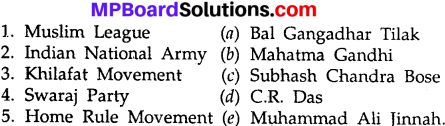
MP Board Class 10th Social Science Solutions Chapter 9 Freedom Movement and Related Events img 1
Answer:

  1. (e)
  2. (c)
  3. (b)
  4. (d)
  5. (a)

Answer in One – Two Words or One Sentence

Question 1.
When and by whom the partition of Bengal was made?
Answer:
The partition of Bengal was made in 1905 by Lord Curzon. Q.l. When was Rowlett Act applied? (MP Board 2009)

Question 2.
In which year Forward Block organisation was established by Subhash Chandra Bose?
Answer:
In 1939.

Question 3.
Name two revolutionaries who were associated with the Lahore conspiracy case of 1929?
Answer:
Chandrashekhar and Bhagat Singh.

Question 4.
Name any three places associated with the Indian National Movement?
Answer:
Bombay, Surat and Lahore.

Question 5.
When was the Gandhi – Irwin pact signed?
Answer:
In March, 1931.

Question 6.
When did Cripp’s mission arrive in India? (MP Board 2012)
Answer:
22nd March 1947.

Question 7.
What is the importance of Quit India movemnt?
Answer:
The importance of Quit India movement is that this made freedom for the country an instant demand.

Question 8.
When was first meeting of constitutional Assembly held? (MP Board 2009)
Answer:
In the mid – night of 14-15 August, 1947 a special session of the Constituent Assembly was held in Delhi.

Question 9.
When did Kasturba die?
Answer:
On 23rd February, 1944.

Question 10.
When did Gandhiji start fast for 3 weeks?
Answer:
On 10th February,, 1943.

Question 11.
Who did organise “Swaraj Dal”?
Answer:
Swaraj Dal was organised by Chittaranjan Das.

Question 12.
Who did establish Mohammedan Anglo – oriental College in Aligarh?
Answer:
Sir Sayyad Ahmed Khan.

Question 13.
Who founded the forword block? (MP Board 2013)
Answer:
Subhash Chandra Bose.

MP Board Class 10th Social Science Very Short Answer Type Questions

Question 1.
Which important resolution was passed in the Lahore session of the Congress?
Answer:
The Lahore session of the Congress passed the ‘purna swaraj’ or complete independence revolution and a pledge to be taken on January 20, 1930 for making all efforts to obtain independence.

Question 2.
Mention the two chief features of the Gandhi – Irwin pact?
Answer:

  1. The British government promised to release all political prisoners except those charged with acts of violence.
  2. The Congress agreed to participate in the Second Round Table conference which had been called to consider a scheme for a new constitution of India.

Question 3.
What is Communalism?
Answer:
Communalism means that the interest of different religious communities are separate and different from one – another. It also implies that interests of one community are antagonistic to the other.

Question 4.
By whom was Congress Khilafat Swarajya Party or Swarajya Party formed?
Answer:
The Congress Khilafat Swarajya Party or Swarajya Party was formed by the people like Motilal Nehru and C.R. Das after the withdrawal of the non-cooperation movement by Garrdhiji.

Question 5.
Why did Gandhiji called off the Non – Cooperation Movement in 1922?
Or
Why did the non – cooperation movement suddenly come to an end in 1922?
Answer:
Gandhiji called off the Non – Cooperation Movement because an angry mob had attacked and set on fire to a police station at Chauri Chaura (U.P.) killing 22 policemen. This act of violence was against Gandhiji’s belief of Ahimsa.

Question 6.
State any two decisions made as the Lahore session of the Indian National Congress in 1929?
Answer:

  1. The Indian National Congress declared at its Lahore session in 1929 the attainment of complete independence as its aim.
  2. Launching of a Civil Disobedience Movement under the leadership of Mahatma Gandhi.

MP Board Class 10th Social Science Short Answer Type Questions

Question 1.
Where is Jallianwala Bagh situated? What for is it known?
Answer:
Jallianwala Bagh is in Amritsar. General Dyer of British Government had orderd the shooting of innocent people who had gathered for the meeting, being held to resist the arrest of its two leaders. Children, women and old people were also present there. Hence it is known for Jallianwala Bagh massacre.

Question 2.
Write a short note on the Lucknow Pact of 1916?
Answer:
Lucknow’Pact is an expression of Hindu-Muslim unity. As the Pact brought Hindu and Muslims on a common platform. The Indian National Congress and the Muslim League unitedly made the demand of self – government ‘swaraj’ to the British Government. So the Lucknow Pact enjoys great importance, in the Histroy of freedom movement as both the communities had decided to move unitedly for ‘Swaraj’.

Question 3.
Explain briefly the defects of the Montford reforms?
Answer:
Defects in the Chelmsford – Montague Reforms:

  1. The introduction of ‘diarchy’ or dual government system in Province was not good but it was totally defective.
  2. The franchise was only allowed to rich people and it was based on property which very few people could fulfill.
  3. To make separate electorates possible on the basis of Communalism, Sikhs, Scheduled Castes, Anglo – Indians, European were separated.
  4. The central and provincial legislative councils have been more powers but still Viceroy and Governors could reject any bill passed by councils.

Question 4.
When and why was the Simon Commission sent in India? Why the Indians opposed it?
Answer:
The Simon Commission was sent to India in 1928. The Commission was sent to examine the working of the Act of 1919, especially the dyarchy part. The Indians opposed the Commission because it was wholly constituted by the English. The Indians had no hope that it would make a favourable report, in their favours.

Question 5.
When and where was the slogan of complete independence adopted?
Answer:
The National Congress held a historic session in Lahore in 1929 under the chairmanship of Jawaharlal Nehru. It was in this session, a resolution declaring Purna Swaraj (Complete Independence) was mooted, passed and adopted. This Congress session also announced the launching of a civil disobedience movement.

MP Board Class 10th Social Science Long Answer Type Questions

Question 1.
What do you know about revolutionaries?
Answer:
Due to the reactionary policy of the British Rule, Revolutionary nationalism started in India from the last decade of the 19th century. After the partition of Bengal, revolutionary feelings developed amongst Indians. The revolution aries believed that political rights cannot be achieved through non – violent and constitutional means. The revolutionaries were of the view that independence and self rule can be got by voilence and threats to the British rule.

They wanted to free the motherland from the shackles of foreign rule as early as possible. Ter achieve these objectives the revolution aries formed secret organisation and imparted them military training, collected arms and ammunitions and propagted revolutionary ideology through newspaper and other means.To achieve these objectives the revolutionaries set up communities for follow up in Bengal. These committees oriented the yout’s about India’s history . and culture and aroused feeling for freedom in them.

Question 2.
Which national and international events after World War I made India’s struggle for independence a mass movement?
Answer:
The Home Rule League Movements launched by Annie Besant and Bal Gangadhar Tilak and the emergence of Gandhiji on the chess – board of Indian politics were such national events which made India’s struggle for independence a mass and country – wide movement.

Similarly, the rise of fascist powers in Italy, Germany and Japan also led the Congress and the Indian leaders feel that if they had to face the mighty English, they would have to make the freedom movement a mass movemnet and not only of the middle class educated Indians. Gandhiji launched various movements with this aim in view.

Such movements were Non – co – operation Movement (1920 – 1922), the Civil Disobedience Movement (1930 – 1934), the Individual. Satyagraha (1940), Quit Indian Movement’ (1942). By launching these; movements,, Gadhiji made the nationalist movement a Congress movement and the Congress movement a mass movement.

Question 3.
What did the slogan ‘Swaraj’ mean? How was the slogan of complete independence different from it?
Answer:
’Self – Government’ was the meaning given to the term Swaraj. It did not mean complete independence from the foreign rule. But it meant that Indian people should have a system of government as was prevailing in the self – governed colonies of Britishers.

The difference between swaraj and complete independence is that the swaraj was self – government within the perview of the foreign rule but complete independence means freedom from all internal and external control. The slogan of complete independence was adopted by the Congress in its session at Madras, while the team ‘swaraj’ was used by Dada Bhai Naoroji in 1906 in his presidential speech at Calcutta.

Question 4.
What is Independence of India Act ? Write its main provisions? (MP Board 2009)
Answer:
Independence of India Act 1947:
As per the plan of Mountbatten, the Government prepared the draft of ‘Independence of India Act’ and sent to the Congress and the League for consent. After acceptance the British Government passed the Bill and it became an Act on 18th July, 1947.

Main provisions of the Act:
The Act had 20 sections and 2 schedules. Main provisions of the Act were:

  1. India was to be divided into two sovereign states India and Pakistan. The responsibilities of the Government of India were to be handed over to Indian leaders.
  2. As per the Act there would be a Governor General to be appointed by the Emperor of Britain in each of the sovereign states India and Pakistan.
  3. Borders of both the sovereign states were decided. It was stated in it that Bengal, Punjab and Assam were to be divided and their borders were to be, demarcated.
  4. Legislative Assemblies of both the states will have the right to formulate their constitution. Pending formulation of the constitutions by both the states, the states shall be governed as per the provisions of the Government of India Act.
  5. The post of Secretary of India was to be abolished and in its place a Secretary of the common wealth shall be appointed.

No Act passed by the British Parliament after 15th August, 1947 was to be applicable to India. Thus India got independence from the British Control after the Independence Act became operational. Indian independence was the dawn of a new era and the Indians were to decide their own fate.

MP Board Class 8th Sanskrit Solutions Chapter 17 कवित्वं कालिदासस्य

MP Board Class 8th Sanskrit Solutions Surbhi Chapter 17 कवित्वं कालिदासस्य

MP Board Class 8th Sanskrit Chapter 17 अभ्यासः

Class 8 Sanskrit Chapter 17 MP Board प्रश्न 1.
एकपदेन उत्तरं लिखत(एक शब्द में उत्तर लिखो-)
(क) काव्येषु किं रम्यम्? (काव्यों में क्या सुन्दर है?)
उत्तर:
नाटकम्। (नाटक)

(ख) दुष्यन्तशकुन्तलयोः पुत्रस्य किं नाम? (दुष्यन्त और शकुन्तला के पुत्र का नाम क्या था?)
उत्तर:
भरतः। (भरत)

(ग) अभिज्ञानशाकुन्तलनाट्ये कति अङ्काः सन्तिः? (अभिज्ञान शाकुन्तल नाटक में कितने अंक हैं?)
उत्तर:
सप्त। (सात)

(घ) मेघदूतस्य कविः कः? (मेघदूत का कवि कौन है?)
उत्तर:
कालिदासः। (कालिदास)

(ङ) रघुवंशमहाकाव्ये कति सर्गाः सन्ति? (रघुवंश महाकाव्य में कितने सर्ग हैं?)
उत्तर:
नवदश। (उन्नीस)

(च) कालिदासेन कति नाटकानि विरचितानि? (कालिदास ने कितने नाटक रचे?)
उत्तर:
त्रीणि। (तीन)

Mp Board Class 8 Sanskrit Chapter 17 प्रश्न 2.
एकवाक्येन उत्तरं लिखत (एक वाक्य में उत्तर लिखो-)
(क) कालिदासेन विरचितानां नाट्यग्रन्थानां नामानि लिखत। (कालिदास के द्वारा विरचित नाट्य ग्रन्थों के नाम लिखो।)
उत्तर:
कालिदासेन विरचितानां नाट्यग्रन्थानां नामानि मालविकाग्निमित्रम्, विक्रमोर्वशीयम्, अभिज्ञानशाकुन्तलम् चेति सन्ति। (कालिदास के द्वारा विरचित नाट्य-ग्रन्थों के नाम मालविकाग्निमित्र, विक्रमोर्वशीय और अभिज्ञानशाकुन्तल हैं।)

(ख) अस्माकं देशस्य नाम “भारतवर्षम्” इति कथम् प्रसिद्धम्? (हमारे देश का नाम “भारतवर्ष” कैसे प्रसिद्ध हुआ?)
उत्तर:
भरतस्य नाम्ना एव अस्माकं देशस्य नाम “भारतवर्षम्” इति प्रसिद्धिम्। (भरत के नाम से ही हमारे देश का नाम “भारतवर्ष” प्रसिद्ध हुआ।)

(ग) ऋतुसंहारे केषां वर्णनम् अस्ति? (ऋतुसंहार में किनका वर्णन है?)
उत्तर:
ऋतुसंहारे षड्ऋतुणाम् वर्णनम् अस्ति। (ऋतुसंहार में छह ऋतुओं का वर्णन है।)

(घ) कालिदासेन विरचितमहाकाव्यद्वयस्य नाम लिखत। (कालिदास के द्वारा विरचित दो महाकाव्यों के नाम लिखो।)
उत्तर:
कालिदासेन विरचितमहाकाव्यद्वयस्य नाम कुमारसम्भवम् रघुवंशम् चेति स्तः। (कालिदास के द्वारा विरचित दो महाकाव्यों के नाम कुमारसम्भव और रघुवंश हैं।)

(ङ) कालिदासेन विरचितखण्डकाव्यद्वयस्य नाम लिखत। (कालिदास के द्वारा विरचित दो खण्डकाव्यों के नाम लिखो।)
उत्तर:
कालिदासेन विरचितखण्डकाव्यद्वयस्य नाम मेघदूतम् ऋतुसंहारञ्च स्तः। (कालिदास के द्वारा विरचित दो खण्डकाव्यों के नाम मेघदूत और ऋतुसंहार हैं।)

(च) कालिदास-महोत्सवः कदा आयोज्यते? (कालिदास महोत्सव कब आयोजित किया जाता है?)
उत्तर:
कालिदास-महोत्सवः देवप्रबोधन्याम् आयोज्यते। (कालिदास महोत्सव देवप्रबोधनी को आयोजित किया जाता है।)

Class 8 Sanskrit Chapter 17 Mp Board प्रश्न 3.
उचितशब्देन रिक्तस्थानम् पूरयत(उचित शब्द के द्वारा रिक्त स्थान की पूर्ति करो-)
(क) प्रवर्तताम् ………. पार्थिवः। (स्वहिताय/प्रकृतिहिताय)
(ख) सर्वः ……… नन्दतु। (अन्यत्र/सर्वत्र)
(ग) सर्वो ………” पश्यतु। (अभद्राणि/भद्राणि)
(घ) काव्येषु …..” रम्यम्। (कथा/नाटकम्)
(ङ) ……… सार्थवती बभूव। (कनिष्ठिका/अनामिका)
उत्तर:
(क) प्रकृतिहिताय
(ख) सर्वत्र
(ग) भद्राणि
(घ) नाटकम्
(ङ) अनामिका।

Mp Board Class 8 Sanskrit Solution Chapter 17 प्रश्न.4.
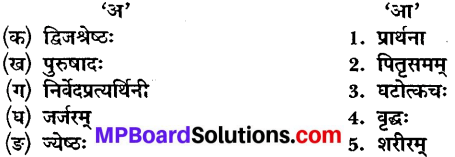
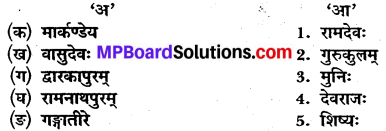
उचितं योजयत (उचित को जोड़ो-)
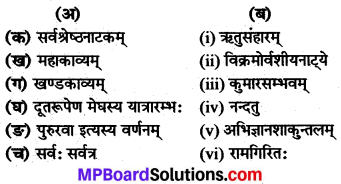
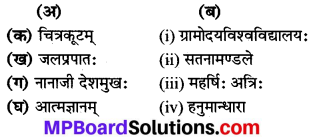
Sanskrit Chapter 17 MP Board
उत्तर:
(क) → (v)
(ख) → (iii)
(ग) → (i)
(घ) → (iv)
(ङ) → (ii)
(च) → (vi)

Sanskrit Class 8 Chapter 17  प्रश्न 5.
शुद्धवाक्यानां समक्षम् “आम्” अशुद्धवाक्यानां समक्षं “न” इति लिखत (शुद्ध वाक्यों के सामने “आम्” (ही) और अशुद्ध वाक्यों के सामने “न” (नहीं) लिखो-)
(क) अभिज्ञानशाकुन्तलनाट्ये सप्त-अङ्का सन्ति।
(ख) ‘सरस्वतीश्रुतिमहतीमहीयताम्’ विक्रमोर्वशीय नाट्यस्य भारतवाक्यम् अस्ति।
(ग) ‘सर्वः सर्वत्र नन्दतु’ इति भरतवाक्यम् अभिज्ञान ‘शाकुन्तलस्य अस्ति।
(घ) कालिदासस्य उपमा विश्वप्रसिद्धा अस्ति।
(ङ) गणमाप्रसङ्गे कालिदासः अनामिकाधिष्ठितः अस्ति।
(च) कालिदासस्य भार्यायाः नाम विद्योत्तमा अस्ति।
(छ) कालिदासमहोत्सवः देवप्रबोधिन्याम् आयोज्यते।
(ज) कुमारसम्भवग्रन्थं खण्डकाव्यम् अस्ति।
(झ) मालविकाग्निमित्रनाट्ये सप्त-अङ्का सन्ति।
(ञ) ऋतुसंहारं महाकाव्यम् अस्ति।
उत्तर:
(क) आम्
(ख) न
(ग) न
(घ) आम्
(ङ) न
(च) आम्
(छ) आम्
(ज) न
(झ) न
(ञ) न

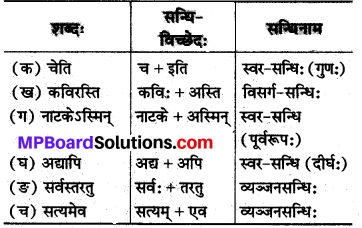
Chapter 17 Sanskrit Class 8 MP Board प्रश्न 6.
नामोल्लेखपूर्वकं सन्धिविच्छेदं कुरुत(नाम का उल्लेख करते हुए सन्धि विच्छेद करो-)
(क) चेति
(ख) कविरस्ति
(ग) नाटकेऽस्मिन्
(घ) अद्यापि
(ङ) सर्वस्तरतु
(च) सत्यमेव।
उत्तर:
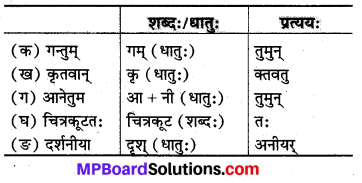
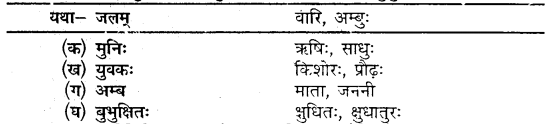
Mp Board Class 8 Sanskrit Solution

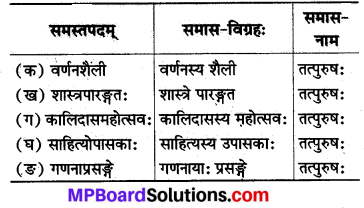
Sanskrit Chapter 17 Class 8 प्रश्न 7.
नामोल्लेखपूर्वकं समासविग्रहं कुरुत(नाम का उल्लेख करते हुए समास-विग्रह करो-)
(क) वर्णनशैली
(ख) शास्त्रपारङ्गतः
(ग) कालिदासमहोत्सवः
(घ) साहित्योपासकाः
(ङ) गणनाप्रसङ्गे।
उत्तर:
Class 8 Sanskrit Chapter 17 MP Board

Class 8 Sanskrit Chapter 17 Question Answer प्रश्न 8.
स्थूलपदान्यधिकृत्य प्रश्ननिर्माणं कुरुत(मोटे शब्दों के आधार पर प्रश्न निर्माण करो-)
(क) कालिदासस्य उपमा विश्वप्रसिद्धाः (कालिदास की उपमा विश्व प्रसिद्ध है।)
उत्तर:
कस्य उपमा विश्वप्रसिद्धा? (किसकी उपमा विश्वप्रसिद्ध है?)

(ख) तेन मेघदूतं विरचितम्। (उनके द्वारा मेघदूत रचा गया?)
उत्तर:
केन मेघदूतं विरचितम्। (किनके द्वारा मेघदूत रचा गया?)

(ग) कालिदासः सर्वश्रेष्ठ: कविरस्ति। (कालिदास सर्वश्रेष्ठ कवि हैं।)
उत्तर:
कः सर्वश्रेष्ठिः कविरस्ति? (कौन सर्वश्रेष्ठ कवि हैं?)

(घ) मेघः दूतरूपेण अलकापुरीं गच्छति। (मेघ दूत के रूप में अलकापुरी जाता है।)
उत्तर:
कः दूतरूपेण अलकापुरीं गच्छति? (कौन दूत के रूप में अलकापुरी जाता है?)

(ङ) यक्षव्याजेन महाकवि आत्मव्यथाम् प्रस्तुतवान्। (यक्ष के बहाने से महाकवि ने अपनी व्यथा प्रस्तुत की है।)
उत्तर:
यक्षव्याजेन कः आत्मव्यथाम् प्रस्तुतवान्? (यक्ष के बहाने से किसने अपनी व्यथा प्रस्तुत की है?)

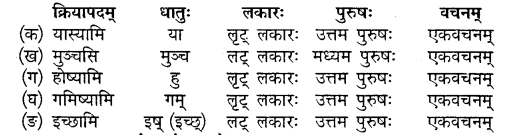
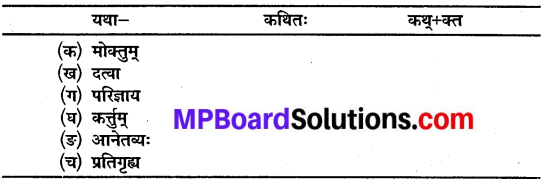
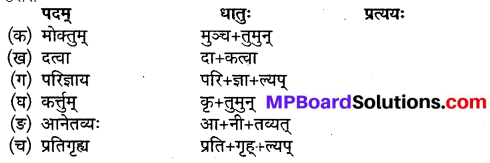
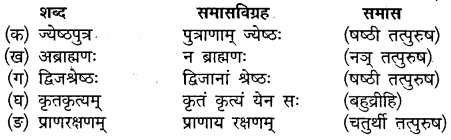
कवित्वं कालिदासस्य हिन्दी अनुवाद

महाकविः कालिदासः संस्कृतसाहित्यस्य सर्वश्रेष्ठः कविरस्ति। तेन विरचितानि मालविकाग्निमित्रम्, विक्रमोर्वशीयम्, अभिज्ञानशाकुन्तलम् चेति त्रीणि नाटकानि सन्ति। एतेषु नाटकेशु अभिज्ञानशाकुन्तलमं तु न केवलं संस्कृतसाहित्यस्य अपितु विश्वस्य सर्वश्रेष्ठं नाटकमस्ति।

उच्यते यत्-
“काव्येषु नाटकं रम्यं तत्र रम्या शकुन्तला।”

अनुवाद :
महाकवि कालिदास संस्कृत साहित्य के सर्वश्रेष्ठ कवि हैं। उनके द्वारा विरचित मालविकाग्निमित्रम्, विक्रमोर्वशीयम् और अभिज्ञानशाकुन्तलम् ये तीन नाटक हैं। इन नाटकों में अभिज्ञानशाकुन्तलम् तो न केवल संस्कृत साहित्य का बल्कि विश्व का सर्वश्रेष्ठ नाटक है।

कहा जाता है कि-
“काव्यों में नाटक रम्य (सुन्दर) हैं, उनमें भी अभिज्ञानशाकुन्तलम् रम्य है।”

शाकुन्तलनाटकस्य वैशिष्ट्यविषये जर्मनकवेः गेटे महोदयस्य भावम् द्योतयता एकेन विदुषा कथितं यत्-

“एकीभूतमभूतपूर्वमथवा स्वर्लोकभूलोकयोः
ऐश्वर्यं यदि वाञ्छसि प्रियसखे! शाकुन्तलं सेव्यताम्॥”

अनुवाद :
शाकुन्तल नाटक के वैशिष्ट्य के विषय में जर्मन कवि गेटे के भाव को प्रकट करते हुए एक विद्वान के द्वारा कहा गया है कि
“यदि स्वर्ग लोक एवं भू-लोक दोनों का एकत्र या अभूतपूर्व आनन्द को यदि चाहते हो तो हे मित्र! अभिज्ञान शाकुन्तलम् का सेवन (पढ़ना या देखना) कीजिए।”

सप्त-अङ्कात्मके नाटकेऽस्मिन् दुष्यन्तशकुन्तलयोः कथा तथा तयोः शिशोः भरतस्य शौर्यं वर्णितम्। तस्य भरतस्य नाम्ना एव अस्माकं देशस्य नाम “भारतवर्षम्” इति प्रसिद्धम् अस्ति। नाट्येस्मिन् भरतवाक्यमाध्यमेन महाकविः कथयति”प्रवर्तताम् प्रकृतिहिताय पार्थिवः सरस्वती श्रुतिमहतीमहीयताम्। ममापि च क्षपयतु नीललोहितः, पुनर्भवम् परिगतशक्तिरात्मभः॥”

अनुवाद :
सात अंक के इस नाटक में दुष्यन्त और शकुन्तला की कथा तथा उन दोनों के शिशु भरत की वीरता का वर्णन है। उस भरत के नाम से ही हमारे देश का नाम “भारतवर्ष” प्रसिद्ध है। इस नाटक में भरतवाक्य (नाटक के अन्त में सूत्रधार द्वारा कथित आशीर्वचन) के माध्यम से महाकवि (कालिदास) कहते हैं-

“राजा सर्वहित हेतु प्रवृत्त हों, श्रुति (वेद) स्वरूपा महान् सरस्वती देवी (अर्थात् सत्साहित्य) की प्रतिष्ठा होवे और व्यापक शक्तिमान् स्वयम् उत्पन्न नील और गाढ़े लाल वर्ण वाले शिवजी मेरे पुनर्जन्म को नष्ट करें। (अर्थात् भगवान शिव की कृपा से मेरा जन्म-मरण रूप संसार का बन्धन हमेशा के लिए छूट जाये।)”

मालविकाग्निमित्रनाटकम् पञ्चाङ्कात्मकमस्ति। अत्र मालविका-अग्निमित्रयोः कथा वर्णितास्ति। विक्रमोर्वशीयनाटके उर्वशी-पुरूरवसोः कथा पञ्चाङ्केषु वर्णिता। अस्मिन् नाटके भरतवाक्यमाध्यमेन कामयते कविः यत्

“सर्वस्तरतु दुर्गाणि, सर्वो भद्राणि पश्यतु।
सर्वः कामानवाप्नोतु, सर्वः सर्वत्र नन्दतु॥”

अनुवाद :
मालविकाग्निमित्र नाटक पाँच अंक वाला है। यहाँ मालविका और अग्निमित्र की कथा वर्णित है। विक्रमोर्वशीय नाटक में उर्वशी और पुरूरवा की कथा पाँच अंकों में वर्णित है। इस नाटक में भरतवाक्य के माध्यम से कवि चाहता है कि

“सभी (मनुष्य) कष्टों को पार करें, सभी सुखों को देखें, सभी इच्छाओं को प्राप्त करें, सभी जगह प्रसन्न हों।”

तस्य कुमारसम्भवम्, रघुवंशम् चेति नामके द्वे महाकाव्ये प्रसिद्ध स्तः। कुमारसम्भवमहाकाव्ये सप्तदशसर्गेषु स्वामिकार्तिकेयस्य अवतारकथा तारकासुरस्य वधवृत्तान्तञ्चास्ति। रघुवंशमहाकाव्ये नवदशसु सर्गेषु रघुवंशीयानाम् पराक्रमवर्णनं तथा तेषाम् उदात्तचरित्रनिरूपणं तेन कृतम्।

तेन मेघूदतम् ऋतुसंहारञ्च द्वे खण्डकाव्ये विरचिते। मेघदूते पूर्वमेघः उत्तरमेघश्चेति द्वौ भागौ स्तः। अस्मिन् काव्ये मेघः यक्षस्य दूतः अभवत्। सः मेघः दूतरूपेण रामगिरितः हिमालयस्थाम् अलकापुरी गच्छति। दूतमार्गस्य वर्णनं। नैसर्गिकम् अतीवरमणीयं चास्ति।

अनवाद :
उनके कुमारसम्भव और रघुवंश नामक दो महाकाव्ये प्रसिद्ध हैं। कुमारसम्भव महाकाव्य में सत्रह सर्गों में स्वामी कार्तिकेय की जन्म की कथा और तारकासुर के वध की कथा है। रघुवंश महाकाव्य में उन्नीस सर्गों में रघुवंशियों के पराक्रम का वर्णन तथा उनके उदात्त चरित्र का निरूपण उनके द्वारा किया गया है।

उनके द्वारा मेघदूत और ऋतुसंहार दो खण्डकाव्य भी रचे गये हैं। मेघदूत में पूर्वमेघ और उत्तरमेघ ये दो भाग हैं। इस काव्य में मेघ यक्ष का दूत बना। वह मेघ दूत के रूप में रामगिरि से हिमालय पर स्थित अलकापुरी को जाता है। दूत के मार्ग का वर्णन स्वाभाविक और अत्यन्त रमणीय (सुन्दर) है।

ऋतुसंहारे षड्ऋतूणाम् प्राकृतिकसौन्दर्यम् मनोवैज्ञानिकञ्च वर्णितम्। कालिदासस्य उपमा विश्वप्रसिद्धा। उच्यते च “उपमा कालिदासस्य।” कथावर्णने चरित्रचित्रणे च सः प्रवीणः। तस्य वर्णनशैली सरसा-सरला परिष्कृता चास्ति। तस्य भाषा भावानुगामिनी।

भार्या विद्योत्तमा तस्य परोक्षप्रेरिका आसीत् परन्तु एषः कालिदासः परवर्तिसाहित्योपासकानां। कविकुलगुरुः अस्ति। कालिदास्य ग्रन्थानामनुवादः प्रायः विश्वस्य सर्वासु भाषासु सञ्जातः।

अनवाद :
ऋतुसंहार में छह ऋतुओं का प्राकृतिक सौन्दर्य और मनोवैज्ञानिक वर्णन है। कालिदास की उपमा (तुलना) विश्व प्रसिद्ध है और कहा जाता है “उपमा कालिदास की.।” कथा के वर्णन में और चरित्र-चित्रण में वह प्रवीण थे। उनकी वर्णन शैली सरस, सरल और परिष्कृत है। उनकी भाषा भावों का अनुगमन करने वाली है।

पत्नी विद्योत्तमा उनको अप्रत्यक्ष रूप से प्रेरित करने वाली थी परन्तु यह कालिदास उत्तरकालीन (बाद के) साहित्यकारों के कविकुलगुरु हैं। कालिदास के ग्रन्थों का अनुवाद प्रायः विश्व की सभी भाषाओं में हुआ है।

उज्जयिनी तस्य जन्मस्थली इति केचित् अन्ये विदर्भमपि मन्यन्ते वैदर्भीरीतितर्केण मेघदूतप्रमाणेन च अद्यापि उज्जयिन्याम् अन्यत्र च प्रतिवर्ष देवप्रबोधन्यां कालिदास-महोत्सवः विशिष्टरूपेण आयोज्यते। यतः तस्य मेघदूते यक्षस्य शाममोक्षः देवप्रबोधन्यामेव जातः। यक्षव्याजेन महाकविः आत्मव्यथाम् प्रस्तुतवान् इति विदुषाम् मतम्। अतः देवप्रबोधिनी तिथिः महाकवेः उत्सवदिवसः न तु जन्मदिवसः।। जन्मदिवस्तु शोधविषयो वर्तते।

अपि च उक्तम्-
पुराकवीनांगणनाप्रसङ्गे कनिष्ठिकाधिष्ठितकालिदासः।
अद्यापि तत्तुल्यकवेरभावादनामिका सार्थवती बभूवः॥

अनुवाद :
उज्जयिनी उनकी जन्मस्थली थी, कुछ अन्य विदर्भ भी मानते हैं वैदर्भी रीति के तर्क से और मेघदूत के प्रमाण से। आज भी उज्जयिनी में और अन्यत्र प्रतिवर्ष देव प्रबोधनी (देव उत्थान एकादशी) को कालिदास महोत्सव विशेष रूप से आयोजित किया जाता है क्योंकि उनके मेघदूत में यक्ष की शाप से मुक्ति देव प्रबोधनी को ही हुई। यक्ष के बहाने से महाकवि ने अपनी व्यथा को प्रस्तुत किया ऐसा विद्वानों का मत है। इसलिए देवप्रबोधनी तिथि महाकवि का उत्सव दिवस है न कि जन्मदिन। जन्मदिन तो शोध का विषय है।

और कहा भी गया है-
प्राचीनकाल में कवियों की गणना के प्रसंग में कनिष्ठिका पर स्थापित हो जाने पर (अर्थात् सबसे छोटी उँगली पर आ जाने पर) आज भी उनके समान कवि के अभाव के कारण अनामिका (बिना नाम वाली) उँगली सार्थक हुई।

कवित्वं कालिदासस्य शब्दार्थाः

भरतवाक्यम् = नाटक के अन्त में सूत्रधार द्वारा कथित आशीर्वचन। कामानवाप्नोतु = (कामान् + अवाप्नोतु) इच्छाओं को प्राप्त करें। क्षपयतु नष्ट करें। प्रवर्तताम् = प्रवृत्त हों। परिगत = व्यापक। प्रकृतिहिताय = सर्वहित हेतु। नन्दतु = प्रसन्न हों। पार्थिवः = राजा। आत्मभूः = स्वयम् उत्पन्न। अवतारः = जन्म। सरस्वतीश्रुतिमहतीमहीयताम् = श्रुतिस्वरूपा महान् सरस्वती देवी (अर्थात् सत्साहित्य) की प्रतिष्ठा होवे। वधवृत्तान्तम् = वध की कथा। परवर्तीसाहित्योपासकानाम् = उत्तरकालीन साहित्यकारों के। एकीभूतमभूतपूर्वमथवा = (एकीभूतम् + अभूतपूर्वम् + अथवा)। दुर्गाणि = कष्टों को। नीललोहितः = नील और गाढ़े लाल वर्ण वाले शिवजी। एकीभूतम् = एकत्रीकरण। अभूतपूर्वम् = जो पहले कभी नहीं हुआ। तत्तुल्य = उसके समान। कवेः = कवि के। स्वलॊकभूलोकयोः = स्वर्गलोक एवं भूलोक दोनों का। अभावात् = अभाव से। सार्थवती = सार्थक। वाञ्छसि = चाहते हो। बभूव = हुई। सेव्यताम् = सेवन कीजिए। अनामिका = कनिष्ठिका से द्वितीय क्रम की अंगुली/बिना नाम वाली। कनिष्ठिकाधिष्ठित = (कनिष्ठिका + अधिष्ठित)। परिष्कृता = अलंकृत। भावानुगामिनी = भावों का अनुगमन करने वाली। कनिष्ठिका = सबसे छोटी अँगुली। अन्यतमः = श्रेष्ठ। अधिष्ठित = स्थापित।

MP Board Class 8th Sanskrit Solutions

MP Board Class 8th Sanskrit Solutions Chapter 12 चित्रकूटम्

MP Board Class 8th Sanskrit Solutions Surbhi Chapter 12 चित्रकूटम्

MP Board Class 8th Sanskrit Chapter 12 अभ्यासः

Mp Board Class 8 Sanskrit Solution Chapter 12 प्रश्न 1.
एकपदेन उत्तरं लिखत (एक शब्द में उत्तर लिखो-)
(क) चित्रकूट कस्मिन् मण्डले अस्ति? (चित्रकूट किस जिले में है?)
उत्तर:
सतनामण्डले। (सतना जिले में।)

(ख) चित्रकुटे सर्वत्र किंराजते? (चित्रकूट में सब जगह क्या सुशोभित होती है?)
उत्तर:
हरीतिमा। (हरियाली।)

(ग) रामघट्टः कस्माः तटे वर्तते? (रामघाट किसके किनारे स्थित है?)
उत्तर:
मन्दाकिनीतटे। (मन्दाकिनी (गंगा) के किनारे।)

(घ) चित्रकूटे जलप्रपातस्य किं नाम? (चित्रकूट में जलप्रपात का क्या नाम है?)
उत्तर:
हनुमान्धारा। (हनुमान धारा।)

(ङ) जयन्तः सीताचरणे किं कृतवान्? (जयन्त ने सीता के चरणों में क्या किया?)
उत्तर:
चञ्चुप्रहारम्। (चोंच का प्रहार।)

Mp Board Class 8 Sanskrit Chapter 12 प्रश्न 2.
एकवाक्येन उत्तरं लिखत(एक वाक्य में उत्तर लिखो-)
(क) चित्रकूटं कीदृशं स्थलम् अस्ति? (चित्रकूट कैसा स्थल है?)
उत्तर:
चित्रकूटनगरकोलाहलरहितं प्राकृतिकसौन्दर्यसम्पन्न स्थलम् अस्ति। (चित्रकूट नगर के शोरगुल से रहित प्राकृतिक सौन्दर्य से सम्पन्न स्थान है।)

(ख) निर्झराः कीदृशाः वर्तन्ते? (झरने कैसे हैं?)
उत्तर:
निर्झराः कल-कलनादपूरिताः वर्तन्ते। (झरने कल-कल के स्वर से भरपूर हैं।)

(ग) हनुमान्धारा इति नाम कथम् प्रसिद्धम्? (हनुमान धारा यह नाम कैसे प्रसिद्ध हुआ?)
उत्तर:
लङ्कादहनान्तरं रामाज्ञया हनुमान अत्रैव शीतलत्वं प्राप्तवान् अतः एतस्य हनुमान्धारा इति नाम प्रसिद्धम्। (लंका के दहन के बाद राम की आज्ञा से हनुमान् ने यहीं ठण्डक प्राप्त की, अतः इसका हनुमान् धारा नाम प्रसिद्ध हुआ।)

(घ) चित्रकूटे कः विश्वविद्यालयः अस्ति? (चित्रकूट में कौन-सा विश्वविद्यालय है?)
उत्तर:
अत्र महात्मागान्धिग्रामोदयविश्वविद्यालयः अस्ति। (यहाँ महात्मा गान्धी ग्रामोदय विश्वविद्यालय है।)

Class 8 Sanskrit Chapter 12 Mp Board प्रश्न 3.
रिक्त स्थानं पूरयत(रिक्त स्थान की पूर्ति करो-)
(क) चित्रकूटं …………. मध्ये स्थितम्।
(ख) रामचन्द्र: …………. यावत् निवासं कृतवान्।
(ग) चित्रकूटे द्वे ………….. स्तः।
(घ) सघनवनमध्ये ……….. विद्यते।
(ङ) चित्रकूटे …………. नंदी प्रसिद्धा।
उत्तर:
(क) विन्ध्यपर्वतमालायाः
(ख) एकादशवर्षाणि
(ग) नैसर्गिके गुहे
(घ) अनुसूयाश्रमः
(ङ) मन्दाकिनी।

Class 8 Sanskrit Chapter 12 प्रश्न 4.
उचितपदेन योजयत(उचित शब्द जोड़ो-)
Mp Board Class 8 Sanskrit Solution Chapter 12
उत्तर:
(क) → (ii)
(ख) → (iv)
(ग) → (i)
(घ) → (iii)

क्लास 8 संस्कृत चैप्टर 12 MP Board प्रश्न 5.
कोष्ठकात् शब्दान् चित्वा प्रश्ननिर्माणं कुरुत (कोष्ठक से शब्दों को चुनकर प्रश्न निर्माण करो-)
(कस्मिन्, कस्याः, कीदृशानि, कस्मात्, के) (किसमें, किसका, कैसे, किसके, कौन)

(क) चित्रकूट सतना मण्डले अस्ति। (चित्रकूट सतना मण्डल में है।)
उत्तर:
चित्रकूटं कस्मिन् मण्डले अस्ति? (चित्रकूट किस मण्डल में है?)

(ख) रामघट्टः मन्दाकिन्याः तटे अस्ति। (रामघाट मन्दाकिनी के तट पर है।)
उत्तर:
रामघट्टः कस्याः तटे अस्ति? (रामघाट किसके तट पर है?)

(ग) चित्रकूटे संघनानि वनानि सन्ति। (चित्रकूट में सघन वन हैं।)
उत्तर:
चित्रकूटे कीदृशनि वनानि सन्ति? (चित्रकूट में कैसे वन हैं?)

(घ) रामघट्टात् नातिदूरं जानकीकुण्डम्। (रामघाट के पास में जानकी कुण्ड है।)
उत्तर:
कस्मात् नातिदूरं जानकीकुण्डम्? (किसके पास में जानकीकुण्ड है?)

(ङ) चित्रकूटे द्वे नैसर्गिके गुहे स्तः। (चित्रकूट में दो प्राकृतिक गुफाएँ हैं।)
उत्तर:
चित्रकूटे के नैसर्गिक गुहे स्तः? (चित्रकूट में कितनी प्राकृतिक गुफाएँ हैं?)

Class 8 Mp Board Sanskrit Book  प्रश्न 6.
शब्दं/धातुं प्रत्ययं च लिखत(शब्द या धातु और प्रत्यय लिखो-)
उत्तर:
Mp Board Class 8 Sanskrit Chapter 12

Sanskrit Class 8 Chapter 12 MP Board प्रश्न 7.
विभक्तिं, लिङ्ग, वचनं च लिखत(विभक्ति, लिंग और वचन लिखो-)
उत्तर:
Class 8 Sanskrit Chapter 12 Mp Board

चित्रकूटम् हिन्दी अनुवाद

मध्यप्रदेशस्य सतनामण्डले विन्ध्यपर्वतमालायाः मध्ये नैसर्गिकेऽतरिमणीये विस्तृते क्षेत्रे तीर्थस्थलं चित्रकूटं स्थितम् अस्ति। इदं स्थलं नगरकोलाहलरहितम् प्राकृतिकसौन्दर्यसम्पन्नम् अस्ति। अत्र आगमनेन दर्शनेन च सहजतया आनन्दानुभूतिः जायते। चित्रकूटे सघनानि वनानि सन्ति, अत्र कल-कलनादपूरिताः निर्झराः अपि वर्तन्ते। सर्वत्र हरीतिमा राजते। चित्रकूटस्य धार्मिक, सांस्कृतिक, नैसर्गिकम् अपि महत्त्वं विद्यते। कथ्यते यत्-भगवान् रामचन्द्रः वनवानसकाले सीतालक्ष्मणाभ्यां सह एकादशवर्षाणि यावत् चित्रकूटे एवं निवासं कृतवान्। महर्षिः अत्रिः, साध्वी अनुसूया च अत्रैव तपस्यां कृत्वा आत्मज्ञानम् अलभेताम्। जनश्रुत्यनुसारम् अत्रैव अनसूया ब्रह्म-विष्णु-महेशानाम् स्वतपसा बालरूपेण साक्षात्कारं कृतवती। अत्र अनेकानि दर्शनीयानि स्थलानि सन्ति। यथा.

अनुवाद :
मध्य प्रदेश के सतना जिले में विन्ध्य पर्वतमाला के बीच में प्राकृतिक अति मनोहर विस्तृत क्षेत्र में तीर्थस्थल चित्रकूट स्थित है। यह स्थल नगर के शोरगुल से रहित प्राकृतिक सौन्दर्य से सम्पन्न है। यहाँ आने और देखने से स्वाभाविक रूप से आनन्द की अनुभूति होती है। चित्रकूट में घने वन हैं, यहाँ कल-कल के स्वर से भरपूर झरने भी हैं। सब जगह हरियाली सुशोभित होती है। चित्रकूट का धार्मिक, सांस्कृतिक और स्वाभाविक महत्व भी है। कहा जाता है कि भगवान् रामचन्द्र ने वनवास के समय में सीता और लक्ष्मण के साथ ग्यारह वर्ष तक चित्रकूट में ही निवास किया। महर्षि अत्रि और साध्वी अनुसूया ने यहीं तपस्या करके आत्मज्ञान प्राप्त किया। जनश्रुति के अनुसार यहीं अनुसूइया ने ब्रह्मा, विष्णु और महेश का अपनी तपस्या से बालरूप में साक्षात्कार किया। यहाँ अनेक देखने योग्य स्थल हैं। जैसे-

रामघट्टः-मन्दाकिन्याः तटे रामघट्टः अस्ति। अयम् अतीवरमणीयः घट्टः। अत्र साधूनां महात्मनां तीर्थयात्रिणांच प्रायःसम्मर्दः भवति। सूर्योदयात् सूर्यास्तंयावत्मन्त्रोच्चारणेन वातावरणं गुञ्जायितं भवति। सन्ध्याकाले नीराजनसमये। मनोरमदृश्यं भवति। अत्र नौकाविहारस्य आनन्दाः अपि यात्रिभिः लभ्यन्ते।

Mp Board Class 8 Sanskrit  अनुवाद :
रामघाट-मन्दाकिनी के तट पर रामघाट। है। यह बहुत सुन्दर घाट है। यहाँ साधुओं, महात्माओं और तीर्थयात्रियों की प्रायः भीड़ होती है। सूर्योदय से सूर्यास्त तक मन्त्रों के उच्चारण से वातावरण गूंजता रहता है। शाम को आरती के समय मनोरम दृश्य होता है। यहाँ नौका विहार का आनन्द भी यात्रियों के द्वारा लिया जाता है।

कामदगिरिः-कामदगिरिस्थलस्य धार्मिकम् महत्त्वं लोकप्रसिद्धम्। एतत् स्थलं हरीतिमाच्छादितम् अस्ति। अत्र श्रद्धालवः भगवतः रामस्य प्रतीकस्वरूपं चरणचिह्नम् पूजयन्ति। मान्यता अस्ति यद् भरतः अयोध्यावासिभिः सह रामं पुनः अयोध्याम् आनेतुम् अत्रैव प्रार्थितवान्। अत्रैव समीपे भरतमिलापमन्दिरम् अस्ति। कामदगिरेः प्रदक्षिणाः जनैः क्रियते।

Mp Board Class 8 Sanskrit Solution अनुवाद :
कामदगिरि-कामदगिरि स्थल का धार्मिक महत्व संसार में प्रसिद्ध है। यह स्थल हरियाली से ढका है। यहाँ श्रद्धालु भगवान् राम के प्रतीक स्वरूप चरण चिन्ह को पूजते हैं। मान्यता है कि भरत ने अयोध्यावासियों के साथ राम से पुनः अयोध्या आने के लिए यहीं प्रार्थना की थी। यहीं पास में भरतमिलाप मन्दिर है। कामदगिरि की प्रदक्षिणा (परिक्रमा) लोगों के द्वारा की जाती है।

जानकीकुण्डम्-रामघट्टात् नातिदूरम् एव जानकीकुण्डम् अस्ति। तत्र नौकया अपि गन्तुं शक्यते। अत्र मन्दाकियाः शान्तं जलम् अतीतस्मृतिपूरितम् इव स्थिरम् भाति। वनवासे सीता अत्रैव स्नानं करोति स्म। अत एव एतस्य नाम जानकीकुण्डम् इति प्रसिद्धम्।

Class 8 Chapter 12 Sanskrit MP Board अनुवाद :
जानकी कुण्ड-रामघाट से पास में ही जानकी कुण्ड है, वहाँ नाव से भी जाया जा सकता है। यहाँ मन्दाकिनी का शान्त जल प्राचीन स्मृतियों (यादों) से भरा सा स्थिर सुशोभित होता है। वनवास में सीता यहीं स्नान करती थीं। इसलिए ही इसका नाम जानकी कुण्ड प्रसिद्ध हुआ।

अनुसूयाश्रमः-सघनवनमध्ये अनुसयाश्रमः विद्यते। अत्र पक्षिणां कलरवः, निर्झरझर्झरध्वनिः शीतलवायुः च मनांसि रञ्जयन्ति। मन्दाकिन्याः उद्गमस्थलम् एतदेव। अत्र ब्रह्म-विष्णु-महेशात्रि-अनसूयादयः तपस्यां अकुर्वन्।

Class 8 Sanskrit Book Mp Board अनुवाद :
अनुसूया का आश्रम-घने वन के बीच में अनुसूया का आश्रम है। यहाँ पक्षियों की आवाज, झरने की झर-झर ध्वनि और शीतल वायु मन को प्रसन्न करती है। मंदाकिनी का उद्गम स्थल यही है। यहाँ ब्रह्मा, विष्णु, महेश, अत्रि, अनुसूया आदि ने तपस्या की।

स्फटिकशिला-जानकीकुण्डसमीपे एव विशाल शिला दर्शनीया वर्तते। अत्रैव जयन्तः काकरूपेण सीताचरणे चञ्चुप्रहारं कृतवान् आसीत् इति प्रसिद्धम्।

8 वीं कक्षा संस्कृत गाइड In Hindi Chapter 12 MP Board अनुवाद :
स्फटिकशिला-जानकी कुण्ड के पास में ही विशाल शिला देखने योग्य है। यहीं जयन्त (इन्द्र का पुत्र, काक रूप धारी) ने काक के रूप में सीता के चरणों में चोंच से प्रहार किया था। ऐसा प्रसिद्ध है।

गुप्तगोदावरी-चित्रकूटतः पञ्चकोशदूरं नयनाभिरामं सौन्दर्ययुक्तं गुप्तगोदावरीस्थलं वर्तते। अत्र द्वे नैसर्गिक गुहे स्तः। अत्र निरन्तरं जलम् प्रवहति।

Sanskrit Chapter 12 Class 8 MP Board अनुवाद :
गुप्त गोदावरी-चित्रकूट से पाँच कोश दूर नयनाभिराम (आँखें को प्रसन्न करने वाले) सौन्दर्य से युक्त गुप्त गोदावरी स्थल है। यहाँ दो स्वाभाविक गुफाएँ हैं। यहाँ लगातार जल बहता है।

हनुमान्धारा-अत्र उच्चस्थलात् जलम्पतति। जलप्रपातः अत्र खलु द्रष्टव्यः एव। लङ्कादहनानन्तरं रामाज्ञया हनुमान् अत्रैव शीतलत्वं प्राप्तवान् अतः एतस्य नाम हनुमान्धारा इति जनश्रुतिः।

Class 8 Sanskrit Chapter 12 Question Answer MP Board अनुवाद :
हनुमान धारा-यहाँ ऊँचे स्थान से पानी गिरता है। निश्चित ही जल प्रपात यहाँ देखने योग्य है। लंका दहन के बाद राम की आज्ञा से हनुमान ने यहीं ठण्डक प्राप्त की थी। इसलिए इसका नाम हनुमान धारा है ऐसा लोकापवाद है।

ग्रामोदयविश्वविद्यालयः-अत्र राष्ट्रसेवकेन नानाजीदेशमुखेन ग्रामोद्धारभावनया नवीनः प्रकल्पः स्थापितः। चित्रकूटग्रामोदयविश्वविद्यालयः। साम्प्रतं सः महात्मागान्धिग्रामोदयविश्वविद्यालयः इति नाम्ना। प्रसिद्धः। अत्र प्राकृतिकचिकित्साप्रकल्पः अपि वर्तते। कृषेः-अनुसन्धानकार्येषु अत्र महती प्रगतिः दृश्यते।

Class 8th Sanskrit Chapter 12 MP Board अनुवाद :
ग्रामोदय विश्वविद्यालय-यहाँ राष्ट्रसेवक नानाजी देशमुख ने गाँव के उद्धार की भावना से नवीन प्रकल्प स्थापित किया। ‘चित्रकूट ग्रामोदय विश्वविद्यालय’, इस समय वह ‘महात्मा गान्धी ग्रामोदय विश्वविद्यालय’ नाम से प्रसिद्ध है। यहाँ प्राकृतिक चिकित्सा प्रकल्प भी है। कृषि के अनुसन्धान के कार्यों में यहाँ बहुत प्रगति दिखाई देती है।

चित्रकूटम् शब्दार्थाः

मण्डले = जिले में। नैसर्गिके = प्राकृतिक रूप में। अतीतस्मृतिपूरितम् = प्राचीन स्मृतियों (यादों) से भरा। सहजतया = स्वाभाविक रूप से। कल-कलनादपूरिताः = कल-कल स्वर से भरपूर। जयन्तः = इन्द्र का पुत्र (काक रूप -धारी)।सम्मर्दः=भीड़ (समूह)। चञ्चुप्रहारम्=चोंचसे प्रहार। गुंजायितम् = गुंजित हुआ। गुहे = दो गुफाएँ। नीराजनासमये = आरती के समय। प्रकल्पः = विचार। यात्रिभिः = यात्रियों के द्वारा।

MP Board Class 8th Sanskrit Solutions

MP Board Class 8th Social Science Solutions Chapter 4 National Integration

MP Board Class 8th Social Science Solutions Chapter 4 National Integration

MP Board Class 8th Social Science Chapter 4 Text Book Exercise

Choose the correct option of the following.

Mp Board Class 8 Social Science Solution Chapter 4 Question 1.
Which feeling inspires citizen in national integration?
(a) Nationalism
(b) Religion
(c) Casteism
(d) None of the above
Answer:
(a) Nationalism

Mp Board Class 8 Social Science Chapter 4 Question 2.
How many Indian languages have been mentioned in the constitution?
(a) 14
(b) 18
(c) 22
(d) 26.
Answer:
(c) 22

Fill up the blanks:

  1. There are provisions of …………. fundamental rights in Indian constitution.
  2. Symbol of Asoka is …………. emblem.
  3. In ancient period varna system was based on ………..
  4. India was divided in the year …………

Answer:

  1. six
  2. National
  3. Karma
  4. 1947

MP Board Class 8th Social Science Chapter 4 Very Short Answer Type Questions

National Integration Class 8 MP Board Question 1.
What do you mean by National Integration?
Answer:
National integration is feeling of oneness among the people. irrespective of caste. religion and language.

Class 8 Social Science Chapter 4  Question 2.
what do you mean by secularism?
Answer:
In secularism every religion has the right to practice his own religion.

Class 8 Social Science Chapter 4 Mp Board Question 3.
What do you mean by unity in diversity?
Answer:
Despite numerous religions. regions. languages, castes in our country India is a unit. This is unity in diversity.

MP Board Class 8th Social Science Chapter 4 Short Answer Type Questions

Chapter 4 Social Science Class 8 MP Board Question 1.
Explain the major defects of caste system?
Answer:
Major defects of caste system:

  • Caste system demanded society into high and low classes.
  • Upper castes exploit the lower caste people.
  • Caste system creates trouble in the economic progress and unity of nation.
  • Pressure of castes influence the politics

Social Science Class 8 Chapter 4 MP Board Question 2.
Which are our National Symbols?
Answer:
National Flag. National Anthem. National emblem are our national symbols

MP Board Class 8th Social Science Chapter 4 Long Answer Type Questions

Class 8 Social Science Chapter 4 Question Answer MP Board Question 1.
Write notes on fundamental rights and duties?
Answer:
Indian constitution has provision of six Fundamental rights. The rights are enjoyed by all Indian without any discrimination. Provisions have been made in the constitution to provide opportunity for the development of citizens like equality, freedom and social justice etc. The interest of weaker sections of the society has been protected and safeguarded.

Fundamental Duties:
The duties have also been mentioned in the constitution it is duty of all citizens to respect the principles of the constitution. institutions, national flag and national anthem Every citizen mam-tam the the integrate and of country the citizen should project propriety and create brother hood

Class 8 Chapter 4 Social Science MP Board Question 2.
elaborate separation in detail?
Answer:
Regionalism give birth to separatism To Demand a independent state out of the country is called separatism sevent cast and languages are prevalent in country this diver-city leads to dissatisfaction and leads to a demand for separate state. the border states are often influenced by such feelings and creates a stage for separation the external force support. this in country this en-comics of country and fundamental lists choose to follow the path of violence and terrorism the feeling of separation could be avoided by social justice decentralization and balanced development.

Question 3.
Describe the chief constituents of National integration?
Answer:
There are numerous forces which lead to the promotion of national integration. Some of these forces can be summed up as under:

  • Secularism is one force That unites people. a state ought not to favor any religion and should respect all  the religions alike this will ornate feeling of togetherness.
  • uniformity of Law means that same law should apply on all the individual irrespective of any distinction the Whole country should be under the same law.
  • national festivals and symbols together with a long liberation struggle gives the people feelings of oneness.
  • climantio conditions conman economic problems, development issues, etc, etc, alike, faced by the Indian in conman.

Question 4.
mention the disruptive factions of national integration?
Answer:
the factors which hamper national integration are:
1. communal-ism:
communal-ism has always been a major threat to our country unity. it is based on ignorance and selfish interests of different sections. it leads to communal riots in the country it was communal-ism which split India into two country India and Pakistan in 194.

2. Linguism:
Linguism means love for ones own language. its but natural language that people love their language should not breed narrow mildness and hatred for the language of others. there should be not conflict between people of different state s and culture.

3. Caste-ism:
Caste feelings also Weaken country s unity people with strong caste feeling forget the interest of their country and try to serve their caste only Cast-rem is no less a danger to national unity and integrity.

MP Board Class 8th Social Science Solutions

MP Board Class 8th Social Science Solutions Chapter 13 North America-Geographical Features

MP Board Class 8th Social Science Solutions Chapter 13 North America-Geographical Features

MP Board Class 8th Social Science Chapter 13 Text Book Exercise

Choose the correct option of the following

Mp Board Class 8 Social Science Solution Chapter 13 Question 1.
Due to the meeting of which current near New Found-land thick fog develops?
(a) Gulf stream and Alaska current.
(b) Gulf stream and California.
(c) Gulf stream and Labrador current.
(d) Labrador and Alaska current.
Answer:
(c) Gulf stream and Labrador current.

Mp Board Class 8 Social Science Chapter 13 Question 2.
Which of the following climate is known for winter rain?
(a) Desert climate
(b) Mediterranean climate
(c) Tundra climate
(d) Equatorial climate
Answer:
(c) Tundra climate

MP Board Class 8th Social Science Chapter 13 Very Short Answer Type Questions

North America Geographical Features Class 8 Question 1.
Write the latitude and longitude expense of North America?
Answer:
North America is situated in Northern Hemisphere. North America lies entirely in the Northern Hemisphere. It lies between 10° N and 70°N latitudes and 50° W and 170° W longitudes.

Class 8 Social Science Chapter 13 Question 2.
Which is the highest mountain peak of North America?
Answer:
Mt. McKinley is the highest mountain peak of North America. It is 6194 meters above sea level.

Class 8 Social Science Chapter 13 Mp Board Question 3.
Write the names of great lakes of Northern America?
Answer:

  1. Superior
  2. Michigan
  3. Hurin
  4. Eris
  5. Ontario are famous great lakes of Northern America.

North America Extends From East To West Question 4.
Name the four ocean currents which influence the climate of North America?
Answer:
Gulf Stream, Labrador Current, California Current and the Alaska Current are the four currents which influence the climate of’ North America.

Mp Board Class 8 Science Solution Chapter 13 Question 5.
Write two qualities of Coniferous forests?
Answer:

  •  In this area mostly the land is covered with snow so big trees can not grow.
  • The top of the trees which are in one shape cannot hold the snow and it falls down on the earth and so the branches are stooped. Spruce, pine, larch, oak and redwood tree are main trees.

MP Board Class 8th Social Science Chapter 13 Short Answer Type Questions

Mp Board Class 8 Science Chapter 13 Question 1.
Write names of three plateaus of North America with their locations.
Answer:

  • In the east lies Rocky mountain range, Sierra Nevada in central and coastal range in western area. Among these mountains ranges there is inter-mountain Plateau Great Basin. The Plateau of Colorado lies in South of Great Britain.
  • Eastern Highlands include the Appalachian Mountains and their extensions. In the east there is Labrador plateau.
  • To the South east of the Eastern Highlands lies the plateau of Appalachian. These ancient plateaus are deposits of minerals.

Question 2.
Write the reasons of diversities in the vegetation of North America.
Answer:
Climate and physical features have great influence on natural vegetation, as the origin and growth both depends on the climate. North America is a continent where barring Mediterranean vegetation, all types of vegetation of world are found. Due to diversity in climate and uneven distribution in rainfall, diversity is seen in vegetation also. North America is rich in forest wealth.

Question 3.
Write the three characteristics of Mediterranean vegetation?
Answer:
The Western Central areas have Mediterranean vegetation. Here trees of Oaks, Cheer, Olive, Redwood, Cork and juicy fruits grow in larger number. The valley of California is famous for fruits production. The bark of trees and leaves are thick, soft and wide fine trees are thorny which protects trees from dying

Question 4.
What is the difference be Cordilleras and Canyon?
Answer:
Mp Board Class 8 Social Science Solution Chapter 13

MP Board Class 8th Social Science Chapter 13 Long Answer Type Questions

Question 1.
Write the names of North America’s physical features and define in brief?
Answer:
Major Physical Divisions of North America:
North America may be divided into three major physical divisions. They are Western Cordilleras the Eastern Highlands and the Central Lowlands.

1. The Western Cordilleras:

  • The vast mountainous area in the western part of the continent is known as Western Cordillera.
  • They extend from north to south along the entire length of the continent.
  • The highest peak of the Western Cordillera is Mt. Mckinley.
  • Most of the rivers of North America rise in Western Cordilleras.
  • These mountains consist of several parallel ranges. The Rocky Mountain is the most prominent among them.
  • The coastal range and the Sierra Nevada are the two other ranges.
  • The plateaus between these range are called inter montane plateau. Colorado plateau is an important  inter montane plateau of North America.
  • There are many active volcanoes in Alaska and Mexico.

2. The Eastern Highlands:

  • These highlands consist of Appalachian Mountains and their extensions in Labrador and New Found land.
  • They are much older. These old mountains have been worn down by agents of gradation for the long period of time. They are now very low in height.

3. The Great Central Plains:

  1. They lie between the Western Cordillera and the Eastern Highlands.
  2. They have two distinct parts:
    • In the north it is occupied by the Canadian Shield and the basin of the river Mackenzie,
    • The Central and Southern part is very low and flat basin of the river Missouri-Mississippi.
  3. The Great Central Plain has a very fertile river basin.
  4. There is Hudson Bay surrounding by the Canadian Shield.
  5. To the south of the Canadian Shield are five great lakes of fresh water. They are Lake Superior, Lake Huron,
  6. Lake Erie, Lake Michigan and Lake Ontario.
  7. The famous Niagara falls lie between Lake Erie and Lake Ontario.
  8. River St. Lawrence is an important river of this region.

Question 2.
Mention about the Coniferous forest and wildlife?
Answer:
In the south of Tundra, the wide stretch of last to west experiences very cold winter and the summer is normal. In this entire area the coniferous forest belts are found these forests contain trees of Chir, Larche, Spruce and Fir. The woods of these forests are very soft and they are used as pulp for paper and furniture. These forests have wild life like bear, polar bear, fox, wolfs, rabbits and stags.

Question 3.
Elaborate the factors that affect climate of North America?
Answer:
1. These are four factors which affect the climate of North America:
The latitudinal expansion of continents. North America extends from the Tropics in the South to the Sub-tropical in the Central and South to the Arctic in the North. Therefore, the southern part is comparatively hot, the central part alternatively hot and cold and the northern part very cold. Most of the North America is in Temperate Zone.

2. Surface diversities:
In the West cordillera holds the Western winds and brings excess rain while the east slope gets very less rain due to rain shadow area. That is why the plains of Prahie receive very less rain but as we move from the plains of Praries to east, southeast plateaus and mountains, the rains increase gradually. In the north of the continent it rains in the form of snowfall and it is less because this area is low-lying area. .

3. Permanent winds:
In the west Cordilleras and high lands in the east, both extending from North to South have very vast plain. The polar winds from north in winter and the hot summer winds from south affects the vast plains. Therefore, it is cold in winter and hot in the summer. The southern and the southeastern coasts of the continent come in the region of the trade winds and the north-western coast falls in the region of the westerlies.

These parts therefore receive heavy rains. The westerlies start blowing over Western California. This brings winter rains to California. The Monsoon winds affect the Mexican region. Therefore, it receives rains in the summer. Due to trade winds the Gulf of Mexico and south-eastern Coastal area receive the rains throughout the year.

4. Effect of Currents:
The hot and cold currents flowing near coasts affect the climate mostly. The Gulf Stream flows along the south-eastern coast of the continent and the Alaska current flows along the north western coast. The cold Labrador current passes by the northeastern part and the California current flows along the south-western part. So the climate is very cold. Near New Found land the cold and hot currents meet and this causes dense fig. So it is very helpful for fishing. This area is known as fishing banks.

Project Work
Show the following in the map of North America.

  1. All pachian Mountain, Rocky Mountain.
  2. Mississippi, St Lawrence, Colorado rivers.
  3. Great Lakes and Winnipeg.
  4. Mexico, Hudson and California.
  5. Prairie plains.
  6. Arizona Desert.
  7. Plataea of Labrador.
  8. Gulf-stream, Labrador Currents.
  9. Tropic of Cancer.
  10. Western island, Greenland, New Found land.

Answer:

Mp Board Class 8 Social Science Chapter 13

MP Board Class 8th Social Science Solutions

MP Board Class 10th Sanskrit Solutions Chapter 5 कुटुम्बानुरक्तिः

MP Board Class 10th Sanskrit Solutions Durva Chapter 5 कुटुम्बानुरक्तिः (नाट्यांशः) (मध्यमव्यायोगात्)

MP Board Class 10th Sanskrit Chapter 5 पाठ्यपुस्तक के प्रश्न

कक्षा 10 संस्कृत पाठ 5 MP Board प्रश्न 1.
एकपदेन उत्तरं लिखत-(एक पद में उत्तर लिखिए-)।
(क) घटोत्कचः कया आज्ञप्तः? (घटोत्कच ने किससे आज्ञा ली?)
उत्तर:
जनन्या (माता से)

(ख) किमहमब्राह्मणः इति कः उक्तवान्? (‘क्या मैं ब्राह्मण नहीं यह किसने कहा?)
उत्तर:
वृद्धः (बूढ़े व्यक्ति ने)

(ग) पुरुषादः कः आसीत्? (मनुष्य को खाने वाला कौन था?)
उत्तर:
घटोत्कचः (घटोत्कच)।

(घ) कुलं का रक्षितुमिच्छति? (कुल को कौन बचाना चाहती है?)
उत्तर;
ब्राह्मणी (ब्राह्मण की पत्नी)

(ङ) ज्येष्ठः पितृसमः इति कैः उक्तम्? (बड़ा भाई पिता के समान है-यह किसने कहा?)
उत्तर:
ब्रह्मवादिभिः (ब्रह्मज्ञों द्वारा)

You can download MP Board 10th sanskrit solution to help you to revise complete syllabus and score more marks in your examinations.

Mp Board Class 10 Sanskrit Chapter 5 प्रश्न 2.
एकवाक्येन उत्तरं लिखत- (एक वाक्य में उत्तर लिखिए-)
(क) ब्राह्मणपरिवारः केन समासादितः? (ब्राह्मण परिवार किसके द्वारा पकड़ा गया?)
उत्तर:
ब्राह्मणपरिवारः घटोत्कचेन समासादितः। (ब्राह्मण परिवार घटोत्कच के द्वारा पकड़ा गया।)

(ख) सुतापेक्षी कः आसीत्? (पुत्र की अपेक्षा वाला कौन था?)
उत्तर:
सुतापेक्षी वृद्धः आसीत्। (पुत्र की अपेक्षा वाला बूढ़ा व्यक्ति था।)

(ग) पितॄणां सुसम्प्रियः कः भवति? (पिता को सबसे प्यारा कौन होता है?)
उत्तर:
पितृणां सुसम्प्रियः ज्येष्ठः श्रेष्ठः भवति।। (पिता को सबसे प्यारा बड़ा तथा श्रेष्ठ बेटा होता है।)

(घ) घटोत्कचः कति पुत्रान् विसर्जयितुं कथयति? (घटोत्कच कितने पुत्रों को छोड़ने के लिए कहता है?)
उत्तर:
घटोत्कचः एकं पुत्रं विसर्जयितुं कथयति। (घटोत्कच एक पुत्र को छोड़ने के लिए कहता है।)

(ङ) घटोत्कचः अन्ते किं कथयति? (घटोत्कच अन्त में क्या कहता है?)
उत्तर:
घटोत्कचः अन्ते कथयति-‘अहो स्वजनवात्सल्यम्। (घटोत्कच ने अन्त में कहा-‘वाह, अपने लोगों के प्रति कितना स्नेह ।’)

Chapter 5 Sanskrit Class 10 Mp Board प्रश्न 3.
अधोलिखितप्रश्नानाम् उत्तराणि लिखत-(नीचे लिखे प्रश्नों के उत्तर लिखिए)

(क) ब्राह्मणी वृद्धं किं कथयति? (ब्राह्मणी वृद्ध से क्या कहती है?)
उत्तर:
ब्राह्मणी वृद्धं कथयति-“पतिमात्रधर्मिणी पतिव्रतेति नाम गृहीतफलेनैतेन शरीरेणार्यं कलं च रक्षितमिच्छामि।”

(ब्राह्मणी ने बूढ़े व्यक्ति को कहा-पति के धर्म का पालन करने वाली मैं पतिव्रता हूँ। गृहीत फल वाले इस शरीर से आर्य, स्वामी तथा कुल की रक्षा करना चाहती हूँ।)

(ख) द्वितीयः पुत्र स्वभ्रातरं किं कथयति? (दूसरे पुत्र ने अपने भाई से क्या कहा?)
उत्तर:
द्वितीयः पुत्रः स्वभ्रातरं कथयति-“कुले, लोके पितृणां च ज्येष्ठः श्रेष्ठः सुसंप्रियः ततः गुरुवृत्तिम् अनुस्मरन् अहमेव यास्यामि।”

(दूसरे पुत्र ने अपने भाई से कहा-इस संसार में, कुल में पिता का ज्येष्ठ पुत्र से अधिक स्नेह होता है। अतः पूर्वजों के आदर्श को निभाते हुए मैं ही जाऊँगा।)

(ग) तृतीयः पुत्रः स्वभ्रातरौ किं कथयति? (तीसरे पुत्र ने अपने भाइयों को क्या कहा?)
उत्तर:
तृतीयः पुत्रः स्वभ्रातरौ कथयति-“ब्रह्मवादिभिः ज्येष्ठो भ्राता पितृसमः कथितः ततः गुरुणां प्राणरक्षणं कर्तुम् अहम् अर्हः अस्मि।

(तीसरे पुत्र ने दोनों भाइयों से कहा- “ब्राह्मणों द्वारा बड़ा भाई पिता समान कहा गया है, तो बड़ों के प्राणों की रक्षा करने के लिए मैं योग्य हूँ।”)

Class 10 Sanskrit Chapter 5 MP Board प्रश्न 4.
प्रदत्तशब्दैः रिक्तस्थानानि पूयरत-(दिए गए शब्दों से रिक्त स्थान भरिए-)
(परिणामेन, पतिव्रतेति, बलाबलं, श्रेष्ठः, पितृसमः)
(क) पतिमात्रधर्मिणी………….नाम।
(ख) ज्येष्ठः ……………कुले लोके।
(ग) कृतकृत्यं शरीरं मे…………….जर्जरम्।
(घ) ज्येष्ठो भ्राता………!
(ङ) ……….परिज्ञाय पुत्रमेकं विसर्जय।
उत्तर:
(क) पतिव्रतेति
(ख) श्रेष्ठः
(ग) परिणामेन
(घ) पितृसमः
(ङ) बलाबलं

Class 10th Sanskrit Chapter 5 MP Board प्रश्न 5.
यथायोग्यं योजयत-(उचित क्रम से जोडिए-)
Mp Board Class 10th Sanskrit Chapter 5
उत्तर:
(क) 4
(ख) 3
(ग) 1
(घ) 5
(ङ) 2

Sanskrit Class 10 Chapter 5 Mp Board प्रश्न 6.
शुद्धवाक्यानां समक्षम् ‘आम्’ अशुद्धवाक्यानां समक्षं ‘न’ इति लिखत–
(शुद्ध वाक्यों के सामने ‘आम्’ और अशुद्ध वाक्यों के सामने ‘न’ लिखिए-)
(क) घटीत्कचः जनन्या आज्ञप्तः।।
(ख) किमहमब्राह्मणः इति प्रथमः पुत्रः कथयति।
(ग) कुले लोके च अनुजः श्रेष्ठः भवति।
(घ) ज्येष्ठो भ्राता पितृसमः इति ब्रह्मवादिभिः कथितः।
(ङ) ब्राह्मणी पतिमात्रधर्मिणी आसीत्।
उत्तर:
(क) आम्
(ख) न
(ग) न
(घ) आम्
(ङ) आम्।

Sanskrit Chapter 5 Class 10 Mp Board प्रश्न 7.
अधोलिखित शब्दानां मूलशब्दं विभक्तिं वचनं च लिखत-
(नीचे लिखे शब्दों के मूलशब्द, विभक्ति व वचन लिखिए-)
Class 10 Sanskrit Chapter 5 Solutions
(क) गुरुणाम्
(ख) तया
(ग) पल्या
(घ) भवन्तम्
(ङ) पितृणाम्
उत्तर:
Class 10 Sanskrit Chapter 5 Mp Board

Class 10 Sanskrit Chapter 5 Question Answer प्रश्न 8.
निम्नलिखितक्रियापदानां धातुं लकारं पुरुषं वचनं च लिखत
(नीचे लिखे क्रियापदों के धातु, लकार, पुरुष और वचन लिखिए।)
Sanskrit Chapter 5 Class 10
उत्तर:
Sanskrit Class 10 Chapter 5 Pdf

Chapter 5 Sanskrit Class 10  प्रश्न 9.
उदाहरणानुसारं धातुं प्रत्ययं च पृथक् कुरुत
(उदाहरण के अनुसार धातु और प्रत्यय अलग कीजिए-)
Class 10th Sanskrit Chapter 5 Solution
उत्तर:
Sanskrit Class 10 Chapter 5 In Hindi

Sanskrit Class 10th Chapter 5 प्रश्न 10.
अधोलिखितसमासानां विग्रहं कृत्वा समासनाम लिखत
(नीचे लिखे समासों के विग्रह कर समास का नाम लिखिए।)
उत्तर:
Class 10th Sanskrit Chapter 5 Question Answer

योग्यताविस्तार –

संस्कृतभाषायां रूपकाणां दश भेदाः भवन्ति। ते च, नाटकम्, प्रकरणम्, भाणः, प्रहसनम्, डिमः, व्यायोगः, समवकारः, वीथी, अङ्कः, ईहामृगः। संस्कृत भाषा में रूपक के दस भेद होते हैं। वे हैं-नाटक, प्रकरण, भाण, प्रहसन, डिम, व्यायोगह, समवकार, वीथी, अङ्क, ईहामृग।

नाट्यांशस्य सामूहिकम् अभिनयं कुरुत। (नाट्यांश का सामूहिक अभिनय कीजिए।)

कुटुम्बानुरक्तिः पाठ का सार

प्रस्तुत पाठ महाकवि भास द्वारा रचित ‘मध्ययव्यायोगः’ नामक ग्रन्थ का एक अंश है। इस पाठ में घटोत्कच जब बलि के लिए एक ब्राह्मण परिवार को पकड़ता है, तब उस परिवार के सभी सदस्य अपने परिवार वालों के अन्य सदस्यों को छुड़ाने के लिए अपने प्राण देने के लिए आगे बढ़ते हैं। इस प्रकार अपने परिवार के प्रति समर्पण व प्रेम भाव इस पाठ में दर्शाया गया है।

कुटुम्बानुरक्तिः  पाठ का अनुवाद

1. वृद्धः-हन्त निराशाः स्मः। भवतु पुत्र व्यपाश्रयिष्ये तावदेनम्।
प्रथमः (पुत्रः)-अलमलं परिश्रमेण।
वृद्धः-पुत्र! निर्वेदप्रत्यर्थिनी खलु प्रार्थना। भवतु पश्यामस्तावत्। भो भोः पुरुष! अस्त्वस्माकं मोक्षः?
घटोत्कचः-मोक्षोऽस्ति समयतः।
वृद्धः-कः समयः।

घटोत्कच :
अस्ति मे तत्रभवती जननी। तयाऽहमाज्ञप्तः। पुत्र! ममोपवासनिसर्गार्थमस्मिन्वनप्रदेशे कश्चिन्मानुषः प्रतिगृह्यानेतव्य इति। ततो मयाऽऽसादितो भवान्।।

शब्दार्था :
व्यपाश्रयिष्ये-निवेदन करते हैं-appeal, submit; निर्वेदप्रत्यर्थिनी-मुक्ति की याचना-appeal for freedom, मोक्षः-मुक्ति-freedom, समयतः-शर्त पर/से–on one condition, निसर्गार्थम्-पूर्ति के लिए-for the perfection, प्रतिगृह्यानेतव्य-पकड़कर लाओ-catch and bring, आसादितः-पकड़ा है-have caught.

अनुवाद :
वृद्ध पुरुष-हाय! हम निराश हो गये हैं। अच्छा पुत्र, तब निवेदन करते हैं। प्रथम पुरुष-अधिक परिश्रम मत करो।
वृद्ध-पुत्र, मुक्ति के लिए प्रार्थना करनी पड़ेगी। ठीक है, तब देखते हैं। हे पुरुष! हमें छोड़ दो।
घटोत्कच-एक शर्त पर छोड़ सकता हूँ।
वृद्ध-कैसी शर्त?

घटोत्कच :
मेरी आदरणीय माता है। उनके द्वारा मुझे आज्ञा दी गई है। पुत्र! मेरे उपवास की पूर्ति के लिए इस वन प्रदेश से कोई मनुष्य पकड़कर लाओ। इसलिए मेरे द्वारा आपको पकड़ा गया है।

English :
The old man asked Ghatotkach to leave him and his sons. Ghatotk. ch told them that he has been ordered by his mother to bring some man for perfection of her fast.

2. घटोत्कचः- पत्न्या चारित्रशालिन्या द्विपुत्रो मोक्षमिच्छसि।
बलाबलं परिज्ञाय पुत्रमेकं विसर्जय।।1॥

अन्वय :
(हे वृद्धः!) चारित्रशालिन्या पत्न्या (सह) द्विपुत्रः मोक्षम् इच्छसि (तर्हि) बलावलं परिज्ञाय एकं पुत्रं विसर्जय।

शब्दार्था :
बलाबलम्-प्रिय और अप्रिय-dear or not dear, परिज्ञाय-जानकरconsidering

अनुवाद :
हे वृद्ध ! चरित्रशाली पत्नी के साथ दो पुत्रों की मुक्ति चाहते हो, तो प्रिय और अप्रिय जानकर एक पुत्र को छोड़ दो।

English :
Consider the merits and demerits-leave one of the sons.

3. वृद्धः-हे भो राक्षसापसद! किमहमब्राह्मणः।
ब्राह्मणः श्रुतवान्वृद्धः पुत्रं शीलगुणान्वितम्।
पुरुषादस्य दत्त्वाहं कथं निवृत्तिमाप्नुयाम्॥2॥

अन्वय :
(अहम्) वृद्धः ब्राह्मणः श्रुतवान् शीलगुणान्वितं पुत्रं पुरुषादस्य दत्वा क्थं निर्वृत्तिम् आप्नुयाम्।

शब्दार्था :
राक्षसापसद-नीच राक्षस-Mean demon; श्रुतवान्-शास्त्रज्ञ-having knowledge of scriptures, पुरुषादस्य-मनुष्य को खाने के लिए-to be eaten by man, निर्वृत्तिम्-शान्ति को-peace.

अनुवाद :
(वृद्धः-अरे, नीच राक्षस! क्या मैं ब्राह्मण नहीं हूँ (अर्थात् नीच हूँ।) मैं बूढ़ा ब्राह्मण अपने शास्त्रज्ञ, शील व गुणों से युक्त पुत्र को मनुष्य को खाने के लिए देकर कैसे शान्ति प्राप्त करूँगा।

English :
I am not so mean. How can I seek peace by leaving my learned and virtuous son to be eaten.

4. घटोत्कच :
यद्यर्थितो द्विजश्रेष्ठ! पुत्रमेकं न मुञ्चसि।
सकुटुम्बः क्षणेनैव विनाशमुपयास्यसि॥3॥

अन्वय :
द्विजश्रेष्ठः ! यदि अर्थितः एकं पुत्रं न मुञ्चसि (तर्हि) सकुटुम्बः क्षणेनैव विनाशम् उपयास्यसि।

शब्दार्था :
अर्थितः-धन के लिए/प्रार्थना किए जाने पर-for money, on our words, मुञ्चसि-छोड़ते हो-leave, उपयास्यसि-प्राप्त हो जाओगे-will attain.

अनुवाद :
घटोत्कच कहता है-हे ब्राह्मण श्रेष्ठ! यदि धन के कारण (हमारे कहने से) एक पुत्र को नहीं छोड़ते हो, तो कुटुम्ब सहित क्षण भर में ही विनाश को प्राप्त हो जाओगे।

English :
If you fail to leave one of the sons, you will soon be destroyed along with your family.

5. वृद्धः-एष एव मे निश्चयः
कृतकृत्यं शरीरं मे परिणामेन जर्जरम्।
राक्षसाम्नौ सुतापेक्षी होष्यामि विधिसंस्कृतम्॥4॥

अन्वय :
सुतापेक्षी (अहम्) परिणामेन जर्जरं विधिसंस्कृतं कृतकृत्यं मे वृद्धस्य शरीरं राक्षसाम्नौ होष्यामि।

शब्दार्था :
सुतापेक्षी-पुत्र की अपेक्षा वाला- expectation of boy, विधिसंस्कृतम्अनुष्ठानों द्वारा पवित्र-purified by observance of sacraments, कृतकृत्यम्-जिसके द्वारा समस्त कार्य पूर्ण कर लिए गए हों-who has finished all the activities.

अनुवाद :
वृद्धः-यह ही मेरा निश्चय है। पुत्र की अपेक्षा वाले, वृद्धावस्था के कारण थके हुए, अनुष्ठानों के कारण पवित्र, सभी कार्यों को पूर्ण करने वाले अपने बूढ़े शरीर की मैं राक्षस की अग्नि में आहुति दे दूंगा।

English :
The old man said, “My old and exhausted body will be burnt in the fire of the demon” for the sake of my son.

6. ब्राह्मणी-आर्य, वा मैवम्। पतिमात्रधर्मिणी पतिव्रतेति नाम। गृहीतफलेनैतेन शरीरेणार्यं कुलं च रक्षितुमिच्छामि।
घटोत्कचः-भवति! न खलु स्त्रीजनोऽभिमतस्तत्रभवत्या।
वृद्धः-अनुगमिष्यामि भवन्तम्।
घटोत्कचः-आः वृद्धस्त्वमपसर।
प्रथमः (पुत्र)-भोस्तात-ब्रवीमि खलु तावत्किञ्चित्।
वृद्धः-ब्रूहि, ब्रूहि शीघ्रम्।
शब्दार्थाः-अपसर-दूर हटो-keepaside, ब्रूहि-कहो-say, अभिमतः-उचित-proper.

अनुवाद :
ब्राह्मणी-ऐसा मत कहो।मैं केवल पति के धर्म का पालन करने वाली पतिव्रता हूँ। इस फल प्राप्त किए हुए शरीर के द्वारा आर्य और कुल की रक्षा करना चाहती हूँ।

घटोत्कच-देवी! उनके आदेश के अनुसार स्त्री नहीं चाहिए।
वृद्ध-तुम्हारे साथ मैं चलूँगा।
घटोत्कच-तुम वृद्ध हो, तुम दूर हटो।
प्रथम (पुत्र)-हे पिता! तो मैं कुछ कहूँ।
वृद्ध-कहो, शीघ्र कहो।

English :
The Brahmin woman and the old man offered themselves to save the family. Ghatotkach asked them to keep aside. The first son desired to say something.

7. प्रथमः (पुत्र)- मम प्राणैर्गुरुप्राणानिच्छामि परिरक्षितम्।
रक्षणार्थ कुलस्यास्य मोक्तुमर्हति मां भवान॥5॥

अन्वय :
(अहं प्रथमः पुत्रः) मम प्राणैः गुरुप्राणान् परिरक्षितुम इच्छामि (अतः) भवान् अस्य कुलस्य रक्षणार्थं मां मोक्तुम अर्हति।

शब्दार्था :
परिरक्षितुम्-रक्षा करने के लिए-toprotect, गुरु-(पूर्वजों) बड़ों के-of the elderly people.

अनुवाद :
(मैं, पहला पुत्र) अपने प्राणों के द्वारा बड़ों के प्राणों की रक्षा करना चाहता हूँ। इसलिए आप इस कुल की रक्षा के लिए मुझे छोड़ दीजिए।

English :
The first son desired that he should be left to protect the lives of the elderly people in the family.

8. द्वितीयः (पुत्रः) आर्य! मा मैवम् ।
ज्येष्ठः श्रेष्ठ कुले लोके पितृणां च सुसंप्रियः।
ततोऽहमेव यास्यामि गुरुवृत्तिमनुस्मरन॥6॥

अन्वय :
(भो जनक!) कुले, लोके पितॄणां च ज्येष्ठः श्रेष्ठः सुसंप्रियः (भवति) ततः गुरुवृत्तिम् अनुस्मरन् अहमेव यास्यामि।।

शब्दार्था :
सुसंप्रियः-अच्छा व प्यारा-mostloving,गुरुवृत्तिम्-पूर्वजों के आदर्श को-the ideals of the ancestors, अनुस्मरन्-चलाते हुए, याद करते हुए-following, recalling, यास्यामि-जाऊँगा-shall go.

अनुवाद :
दूसरा (पुत्र)-आर्य! ऐसा मत कहो।
हे पिता! इस संसार में, कुल में सबसे बड़ा व श्रेष्ठ ही माता-पिता को अच्छा व प्यारा लगता है। तब पूर्वजों के आदर्श का अनुकरण करते हुए मैं ही जाऊँगा।

English :
Second son : Being the elder, the better and the more loving son, I would go in accordance with the ancestral practice.

9. तृतीयः (पुत्रः)-आर्य! मा मैवम्।
ज्येष्ठो भ्राता पितृसमः कथितो ब्रह्मवादिभिः।
ततोऽहं कर्तुमस्म्य) गुरुणां प्राणरक्षणम्॥7॥
घटोत्कचः-अहो स्वजनवात्सल्यम्।
(इति निष्क्रान्ताः सर्वे)

अन्वयः-ज्येष्ठः भ्राता ब्रह्मवादिभिः पितृसमः कथितः ततः गुरुणां प्राणरक्षणं कर्तुम् अहम् अर्हः अस्मि।

शब्दार्था :
पितृसमः-पिता के समान-like a father, ब्रह्मवादिभिः-ब्रह्मज्ञों ने-by the brahmins, अर्हः-योग्य-capable, वात्सल्यम्-प्रेम-affection.

अनुवाद :
तृतीय (पुत्र) – आर्य! ऐता मत कहो।
ब्रह्मज्ञों के अनुसार बड़े भाई को पिता के समान कहा गया है। तो बड़ों की प्राणरक्षा करने के लिए मैं योग्य हूँ।
घटोत्कच-वाह! अपने लोगों के लिए कितना स्नेह।
(सब निकल जाते हैं)

English :
Eldest son is like a father-Hence Iam capable of saving my elderly people-filial affection praised (appreciated)

MP Board Class 10th Sanskrit Solutions

MP Board Class 10th Sanskrit Solutions Chapter 6 यशः शरीरम्

MP Board Class 10th Sanskrit Solutions Durva Chapter 6 यशः शरीरम् (कथा) (सङ्कलिता)

MP Board Class 10th Sanskrit Chapter 6 पाठ्यपुस्तक के प्रश्न

कक्षा 10 संस्कृत पाठ 6 MP Board प्रश्न 1.
एकपदेन उत्तरं लिखत-(एक पद में उत्तर लिखिए-)।
(क) मार्कण्डेयः नाम ऋषिः कुत्र वसति स्म? (मार्कण्डेय ऋषि कहाँ रहते थे?)
उत्तर:
गङ्गातीरे (गङ्गा के किनारे)

(ख) वासुदेवः कस्य प्रियशिष्यः आसीत्? (वासुदेव किसका प्रिय शिष्य था?)
उत्तर:
मार्कण्डेयस्य (मार्कण्डेय का)।

(ग) वासुदेवः प्रथमं कस्य गृहं प्रति प्रस्थितः? (वासुदेव पहले किसके घर गया?)
उत्तर:
देवराजस्य (देवराज के)

(घ) रामदेवः कस्मिन् ग्रामे वसति स्म? (रामदेव किस गाँव में रहता था?)
उत्तर:
रामनाथपुरे (रामनाथ पुर में)

(ङ) जनाः प्रतिदिनं कं स्मरन्ति स्म? (लोग प्रतिदिन किसको याद करते थे?)
उत्तर:
रामदेवम् (रामदेव को)

You can download MP Board 10th sanskrit solution to help you to revise complete syllabus and score more marks in your examinations.

Class 10 Sanskrit Chapter 6 MP Board प्रश्न 2.
एकवाक्येन उत्तरं लिखत- (एक वाक्य में उत्तर लिखिए-)
(क) कः मृतोऽपि जीवति? (कौन मरकर भी जीवित है?)
उत्तर:
यः समाजहितं चिन्तयति सः मृतोऽपि जीवति।।
(जो समाज के हित की सोचता है, वह मरकर भी जीवित है।)

(ख) कः जीवन्नपि मृतः एव? (कौन जीते हुए भी मृत है?)
उत्तर:
यः स्वार्थमात्रं चिन्तयति सः जीवन्नपि मृतः एव।
(जो केवल अपने विषय में सोचता है, वह जीवित होकर भी मृत है।)

(ग) देवालये किं प्रचलति स्म? (मंदिर में क्या चल रहा था?)
उत्तर:
देवालये प्रसादत्वेन भोजनवितरणं प्रचलति स्म। (मंदिर में प्रसाद के रूप में भोजन बँट रहा था।)

(घ) जलं दत्वा माता किम् अपृच्छत? (जल देकर माता ने क्या पूछा?)
उत्तर:
जलं दत्वा माता अपृच्छत्-भवता कुत्र गम्यते?” इति। (जल देकर माता ने पूछा- “आप कहाँ जा रहे हैं?)

(ङ) भोजनपरिवेषकाः किं कृतवन्तः? (भोजन परोसने वालों ने क्या किया?)
उत्तर:
भोजनपरिवेषकाः वासुदेवाय अन्नं पायसादिकं न परिविष्टवन्तः। (भोजन परोसने वालों ने वासुदेव के लिए अन्न-खीर आदि नहीं परोसा।)

Mp Board Class 10 Sanskrit Chapter 6 प्रश्न 3.
अधोलिखितप्रश्नानाम् उत्तराणि लिखत-(नीचे लिखे प्रश्नों के उत्तर लिखिए।)
(क) कोपेन देवराजः किम् उक्तवान् ? (क्रोध में देवराज ने त्म्या कहा?)
उत्तर:
कोपेन देवराजः उक्तवान्–“किं धनं याचयितुम् आगतं भवता? मया कस्मैचित् किमपि न दीयते। मम विश्रान्तिः नाशिता भवता। निर्गम्यताम इतः” इति।

(क्रोध में देवराज ने कहा-“क्या तुम धन माँगने आए हो? मैं किसी को कुछ नहीं दूंगा। मेरा आराम भंग कर दिया तुमने। चले जाओ यहाँ से।”)

(ख) पुत्रः वासुदेवं विषादेन किमुक्तवान् ? (पुत्र ने वासुदेव को दुख से क्या कहा?)
उत्तर:
पुत्रः वासुदेवं विषादेन उक्तवान्-“मम पिता विंशति वर्षेभ्यः पूर्वम् एव दिवं गतः। इदानीं लोके तस्य स्मृतिमात्रम् अस्ति।” इति।

(पुत्र ने वासुदेव को दुख से कहा-“मेरे पिता 20 वर्ष पहले ही स्वर्ग चले गए। अब संसार में उनकी केवल याद ही है।”)

(ग) यदा वासुदेवस्य अध्ययनं समाप्तं तदा गुरुः तमाहूय किमवदत्? (जब वासुदेव का अध्ययन समाप्त हो गया, तब गुरु ने उसे बुलाकर क्या कहा?)
उत्तर:
यदा वासुदेवस्य अध्ययनं समाप्तं तदा गुरुः तमाहूय अवदत्-“शिष्य! अधुना भवान सर्वविद्यापारङ्गतः अस्ति। अतः इतः परं स्वग्रामं गन्तुम् अर्हति भवान्। गमनात् पूर्वं भवता द्वारकापुरस्य देवराजस्य गृहं दृष्ट्वा आगन्तव्यम्। किन्तु गृहस्यान्तः न गन्तव्यम्’ इति।

(जब वासुदेव का अध्ययन समाप्त हुआ तब गुरु ने उसे बुलाकर कहा, शिष्य! अब तुम समस्त विद्याओं में निपुण हो। अब तुम यहाँ से अपने गाँव जाने योग्य हो। जाने से पूर्व तुम द्वारकापुर के देवराज के घर जाकर देखकर आओ। पर घर के अन्दर नहीं जाना।”)

Sanskrit Class 10 Chapter 6 Mp Board प्रश्न 4.
प्रदत्तशब्दैः रिक्तस्थानानि पूयरत
(दिए गए शब्दों से रिक्त स्थान भरिए-)
(बहवः, भोजनम्, मध्येमार्गम्, रामदेवस्य, देवालयम्)
(क) तत्र प्रसादत्वेन ………………. प्रचलति स्म।
(ख) वासुदेवः कञ्चित्………………. अपश्यत।
(ग) मया……………….जीवनम् एव अनुसरणीयम्।
(घ) गुरुकुले……………….शिष्याः आसन्।
(ङ) …………….तेन सोमपुरं प्राप्तम्।
उत्तर:
(क) भोजनम्
(ख) देवालयम्
(ग) रामदेवस्य
(घ) बहवः
(ङ) मध्येमार्गम्।

Class 10th Sanskrit Chapter 6 MP Board प्रश्न 5.
यथायोग्यं योजयत-(उचित क्रम से मिलाइए-)
कक्षा 10 संस्कृत पाठ 6 MP Board
उत्तर:
(क) 3
(ख) 5
(ग) 4
(घ) 1
(ङ) 2

Chapter 6 Sanskrit Class 10 Mp Board प्रश्न 6.
शुद्धवाक्यानां समक्षम् “आम्” अशुद्धवाक्यानां समक्ष “न” इति लिखत
(शुद्ध वाक्यों के सामने ‘आम्’ और अशुद्ध वाक्यों के सामने ‘न’ लिखिए-)
(क) गुरुकुले बहवः शिष्याः आसन्।
(ख) मध्येमागं तेन रत्नपुर प्राप्तम्।।
(ग) ग्रामे सर्वे देवराजं सगौरवं स्मरन्ति स्म।
(घ) रामदेवः प्रातः स्मरणीयः आसीत्।
(ङ) रामदेवस्य गृहं वैभवोपेतम् आसीत्।
उत्तर:
(क) आम्
(ख) न
(ग) न
(घ) आम्
(ङ) न।।

Sanskrit Class 10 Chapter 6  प्रश्न 7.
अधोलिखितपदानां विभक्तिं वचनं च लिखत
(नीचे लिखे पदों की विभक्ति व वचन लिखिए।)
Class 10 Sanskrit Chapter 6 MP Board
उत्तर:
Mp Board Class 10 Sanskrit Chapter 6

Class 10 Sanskrit Chapter 6 Solutions MP Board प्रश्न 8.
उदाहरणानुसारं पदानां प्रकृतिं प्रत्ययं च पृथक्कुरुत
(उदाहरणानुसार पदों की प्रकृति व प्रत्यय अलग करके लिखिए-)
(क) गन्तव्यम्
(ख) प्रस्थितवान्
(ग) प्राप्तवान्
(घ) उक्त्वा
(ङ) सत्कृत्व
(च) आगत्य
(छ) यात्विा
(ज) वदन्दः
उत्तर:
Sanskrit Class 10 Chapter 6 Mp Board

Sanskrit Class 10th Chapter 6 MP Board प्रश्न 9.
अधोलिखितशब्दानां पर्यायशब्दान् लिखत।
(नीचे लिखे शब्दों के पर्यायवाची शब्द लिखिए।)
(क) मुनिः
(ख) युक्कः
(ग) अम्ब
(घ) बुभुक्षितः।
उत्तर:
Class 10th Sanskrit Chapter 6 MP Board

Class 10 Sanskrit Chapter 6 Question Answer MP Board प्रश्न 10.
अधोलिखितवाक्यानां कथानुसारेण क्रमसंयोजनं कुरुत
(नीचे लिखे वाक्यों को कथा के अनुसार क्रम से लिखिए।)
(क) ततः वासुदेवः रामनाथपुरं प्राप्य रामदेवस्य गृहम् अगच्छत्।
(ख) गङ्गातीरे मार्कण्डेयः नाम कश्चन मुनिः वसति स्म।
(ग) मया रामदेवस्य जीवनम् एव अनुसरणीयम्
(घ) किञ्चिदने गतः वासुदेवः किञ्चित् देवालयम् अपश्यत्।
(ङ) शिष्यः अनन्तरं रामनाथपुरं प्रति प्रस्थितवान्।
(च) वासुदेवः तस्य प्रियशिष्यः आसीत्।
उत्तर:
(क) गङ्गातीरे मार्कण्डेयः नाम कश्चन मुनिः वसति स्म।
(ख) वासुदेवः तस्य प्रियशिष्यः आसीत्।
(ग) किञ्चिदग्रे गतः वासुदेवः किञ्चित् देवालयम् अपश्यत्।
(घ) शिष्यः अनन्तरं रामनाथपुरं प्रति प्रस्थितवान्।
(ङ) ततः वासुदेवः रामनाथपुरं प्राप्य रामदेवस्य गृहम् अगच्छत्।
(च) मया रामदेवस्य जीवनम् एव अनुसरणीयम्।

Mp Board Class 10th Sanskrit Chapter 6 प्रश्न 11.
प्रदत्तं चित्रम् अवलम्ब्य पञ्चवाक्यानि रचयत।
(दिए गए चित्र को देखकर पाँच वाक्य बनाइए।)
Chapter 6 Sanskrit Class 10 Mp Board
उत्तर:
(क) अस्मिन् चित्रे द्वे स्त्रियौ स्तः।
(ख) ते वार्तालापं कुरुतः।
(ग) गवेषणेन बालकः पश्यति।
(घ) आकाशे वायुयानं गच्छति।।
(ङ) द्वे स्त्रियौ गृहात् बहिः तिष्ठतः।

योग्यताविस्तार –

संस्कृतसाहित्यस्य अन्याः कथाः अन्विष्य पठत।
(संस्कृत साहित्य की अन्य कथाएँ ढूँढ़कर पढ़ो।)

अन्ये ये महापुरुषाः यशः शरीरेण ख्याताः सन्ति तेषां जीवनवृत्तान्तं कथारूपेण लिखत।
(अन्य जो महापुरुष यशरूपी शरीर से प्रसिद्ध हैं, उनके जीवन-वृत्तान्त को कथा रूप में लिखो।)

यशः शरीरम् पाठ का सार

प्रस्तुत पाठ में यश की महत्ता को एक कथा के माध्यम से सिद्ध किया गया है। इस पाठ में दो विशेष पात्रो का वर्णन है जिनमें से एक धनी होते हुए भी जीवित होने पर अपयश के कारण मृत के समान व घृणित है, तथा दूसरा जीवित न होने पर भी यश रूप शरीर से लोगों के हृदयों में जीवित है। अतः मनुष्य को सदा यश-प्राप्ति के लिए अच्छे कार्य करने चाहिएं।

यशः शरीरम् पाठ का अनुवाद

1. गङ्गातीरे मार्कण्डेयः नाम कश्चन मुनिः वसति स्म। तस्य गुरुकुले बहवः शिष्याः आसन्। वासुदेवः तस्य प्रिय शिष्यः। तस्य द्वादशवर्षात्मकम् अध्ययनं यदा समाप्तं तदा गुरुः तम् आहूय अवदत्-“शिष्य! अधुना भवान् सर्वविद्यापारङ्गतः अस्ति। अतः इतः परं स्वग्रामं गन्तुम् अर्हति भवान्। गमनात् पूर्वं भवता द्वारकापुरस्य देवराजस्य गृहं दृष्ट्वा आगन्तव्यम्। किन्तु गृहस्यान्तः न गन्तव्यम्” इति।।

वासुदेवः तस्मिन् एव दिने द्वारकापुरं प्रति प्रस्थितवान्। दिनत्रयात्मकस्य प्रयाणस्य अनन्तरं तं ग्रामं प्राप्य सः ग्रामद्वारे स्थितान् जनान् अपृच्छत्-“देवराजस्य गृहं कुत्र?” इति। “वृथा किमर्थं गम्यते तत्र?” इति उपेक्षया वदन्तः ते देवराजगृहस्थलं सूचितवन्तः। अग्रे गतः सः कूपात् जलम् उद्धरन्तीं महिला याचित्वा जलं प्राप्य तत् पिबन् ताम् अपृच्छत्-“देवराजगृहं कुत्र?” “तस्य पापिनः नाम किमर्थं मम पुरतः उच्चारयति भवान्?” इति वदन्ती सा महिला ततः निरगच्छत् एव।

शब्दार्था :
आहूय-बुलाकर-caling; सर्वविद्यापारङ्गतः-समस्त विद्याओं में निपुण-skilled in all types of learning; प्रस्थितवान्-गया-started, वृथा-व्यर्थ में-in vain, वदन्तः-बोलते हुए-speaking, उद्धरन्तीम्-निकालती हुई को-drawing.

अनुवाद :
गङ्गा के किनारे मार्कण्डेय नाम के कोई मुनि रहते थे। उनके गुरुकुल में बहुत सारे शिष्य थे। वासुदेव उनका प्रिय शिष्य था। उसका बारह वर्ष तक का अध्ययन जब समाप्त हुआ, तब गुरु ने उसको बुलाकर कहा-“शिष्य! अब आप समस्त विद्याओं में निपुण हो गए हो। इसलिए यहाँ से दूर अपने गाँव में जाने योग्य हो गए हो । जाने से पहले तुम्हारे द्वारा द्वारकापुर के देवराज के घर को देखकर आना होगा। पर घर के अन्दर मत जाना।”

वासुदेव उसी दिन ही द्वारकापुर की ओर चला गया। तीन दिन की यात्रा के बाद उस गाँव में पहुँचकर उस गाँव के द्वार पर खड़े लोगों से पूछा-“देवराज का घर कहाँ है?” “व्यर्थ में वहाँ क्यों जा रहे हो?” इस प्रकार गुस्से में बोलते हुए उन्होंने देवराज का घर बता दिया। आगे जाते हुए उसने कुएँ से जल निकालती हुई महिला से माँगकर जल लेकर व पीकर उससे पूछा-“देवराज का घर कहाँ है?” “उस पापी का नाम मेरे सामने क्यों बोला, आपने?” ऐसा कहते हुए वह महिला वहाँ से चली ही गई।

English :
Vasudev learnt all subjects. Directed by Guru Markandeya to locate the house of Devraj at Dwakrapur-went to the village and learnt that Devraj was an evil-minded person.

2. किञ्चिदग्रेगतः वासुदेवः कञ्चित् देवालयम् अपश्यत्। तत्र प्रसादत्वेन भोजनवितरणं प्रचलति स्म। नितरां बुभुक्षितः वासुदेवः जनानां पङ्क्तौ उपाविशत्। भोजनसमये स्वपार्श्वे उपविष्टवन्तं कञ्चित् जनम् अपृच्छत् वासुदेवः-“देवराजः किं धनिक?” इति। तदा सः पार्श्वस्थः जनः-“धिक् भवन्तम्। भोजनकाले तस्य पापिनः नाम स्मारितम्” इति वदन् भोजनं परित्यज्य उत्थितः एव। एतत् दृष्ट्वा परिवेषकाः वासुदेवाय अन्नं पायसादिकं न परिविष्टवन्तः एव। अपूर्णोदरः एव सः ततः उत्थितवान्।

शब्दार्था :
प्रसादत्वेन–प्रसाद के रूप में-as; नितराम्-बहुत अधिक-excessively, extremely; बुभुक्षितः-भूखा-hungry,स्वपार्श्वे अपने पास में-near him, उपविष्टवन्तः-बैठे हुए-sitting, धिक-धिक्कार है-fie, वदन-बोलते हुए-saying,परित्यज्य-छोड़कर-leaving, परिवेषकाः-खाना परोसने वाले-servers of food, पायसादिकम्-खीर इत्यादि-porridge etc, परिविष्टवन्तः-परोसा-served, अपूर्णोदरः-खाली पेट-empty bellied.

अनुवाद :
कुछ आगे जाने पर वासुदेव ने एक मन्दिर देखा। वहाँ प्रसाद के रूप में भोजन बँट रहा था। बहुत अधिक भूखा वासुदेव लोगों की पंक्ति में बैठ गया। भोजन के समय अपने पास में बैठे किसी व्यक्ति से वासुदेव ने पूछा-“देवराज क्या धनी है?’ तब पास में बैठा वह व्यक्ति बोला, “आपको धिक्कार है। भोजन के समय उस पापी का नाम याद किया।” ऐसा कहते हुए भोजन छोड़कर उठ ही गया। यह देखकर खाना परोसने वालों ने वासुदेव के लिए अन्न खीर आदि परोसा ही नहीं। खाली पेट ही वह वहाँ से उठ गया।

English :
Vasudev reached a temple-sat in the line to receive ‘Prasad’-asked somebody about Devraj-The fellow cursed him and stood up ‘Vasudev also remained hungry-Prasad was net served to him.”

3. दूरात् एव देवराजस्य गृहं दृष्ट्वा प्रत्यागतः सः दिनद्वयस्य अनन्तरं गुरुकुलं प्राप्तवान्। गुरुः तं पुनः अवदत्-‘रामनाथपुरं गत्वा रामदेवस्य गृहं ज्ञात्वा आगन्तव्यम्” इति। शिष्यः अनन्तरदिने एव रामनाथपुरं प्रति प्रस्थितवान्। मध्येमागं तेन सोमपुरं प्राप्तम्। तत्र स्वगृहस्य पुरतः उपविष्टां काञ्चित् मातरम् अवदत् सः-“अम्ब! किञ्चित् जल ददातु” इति।

जलं दत्वा माता अपृच्छत्-“भवता कुत्र गम्यते?” इति।
‘रामदेवस्य गृहं प्रति’ इति अवदत् वासुदेवः।

“अहो, प्रातः स्मरणीयः सः” इति उक्त्वा सा माता वासुदेवं सस्नेहम् अन्तः नीत्वा भोजनादिकं दत्वा सत्कृतवती। ततः निर्गतः वासुदेवः रामनाथपुरं प्राप्य ‘रामदेवस्य गृहं कुत्र?’ इति कञ्चित् अपृच्छत् । सः अपि सत्कृत्य स्वयम् आगत्य रामदेवगृहं प्रादर्शयत् । दूरात् एव तत् दृष्टवा वासुदेवः गुरुकुलं प्रत्यगच्छत्।

शब्दार्था :
प्रत्यागतः-लौट आया-returned, ज्ञात्वा-जानकर-knowing; मध्येमार्गम्-रास्ते के बीच में-on the way; पुरतः-सामने-in front of; नीत्वा-ले जाकर-taking; सत्कृत्य-सत्कार करके-honouring, welcoming, प्रादर्शयत्-दिखाया-showed.

अनुवाद :
दूर से ही देवराज का घर देखकर वह लौट आया। वह दो दिन बाद गुरुकुल पहुँचा। गुरु ने उसे फिर कहा-रामनाथपुर जाकर रामदेव का घर जानकर आओ।” शिष्य दूसरे दिन ही रामनाथपुर की ओर चला गया। रास्ते के बीच में वह सोमपुर पहुंचा। वह अपने घर के सामने बैठी हुई किसी माता (वृद्ध स्त्री) से बोला-“माता! थोड़ा जल दे दो।”
जल देकर माता ने पूछा-“आप कहाँ जा रहे हो?
“रामदेव के घर की ओर।” वासुदेव बोला।

“वाह, वह प्रातः याद करने योग्य है।” ऐसा कहकर उस माता ने वासुदेव को प्रेम से अन्दर ले जाकर भोजन आदि देकर सत्कार किया ! वहाँ से निकल कर वासुदेव रामनाथ पुर पहुँचकर ‘रामदेव का घर कहाँ है?” किसी से पूछा। उसने भी सत्कार करके स्वयं आकर रामदेव का घर दिखाया। दूर से ही वह देखकर वासुदेव गुरुकुल लौट आया।

English :
Vasudev was again directed to learn about Ramdev’s house at Ramnathpur. Vasudev left for the place-Reached Sompur on the way. Asked a woman about Ramdev. She welcomed him-Reached Ramnathpur-Somebody greeted him and showed Ramdev’s house-Viewing the house from a distance Vasudev returned to the Gurukul.

5. दिनद्वयस्य अनन्तरं गुरुः अकथयत्-‘वासुदेव! भवान् इतः स्वगृह गन्तुम् अर्हति। गमनात् पूर्वं भवता देवराज-रामदेवयोः पूर्णः परिचयः प्राप्तव्यः” इति। एतम् आदेशं पालयन् वासुदेवः पुनरपि द्वारकापुरं प्राप्य देवराजस्य गृहम् अगच्छत्। वैभवोपेतं गृहं तत्। द्वाररक्षकः तस्य प्रवेशं निषिद्धवान्। बहुधा प्रार्थना यदा कृता तदा सः अन्तः गत्वा देवराजं वासुदेवागमनं निवेदितवान्। कोपेन एव बहिः आगत्य देवराजः-“किं धनं याचितुम् आगतं भवता? मया कस्मैचित् किमपि न दीयते । मम विश्रान्तिः नाशिता भवता। निर्गम्यताम् इतः” इति तर्जयित्वा तं प्रेषितवान्।

शब्दार्था :
वैभवोपेतम्-वैभव, विशालता से युक्त को-grand, splendid, निषिद्धवान्-रोका-refused, checked; निर्गम्यताम्-निकल जाओ-go away, तर्जयित्वा-डाँटकर-scolding, snubbing.

अनुवाद :
दो दिन बाद गुरु ने कहा-“वासुदेव! तुम यहाँ से अपने घर जाने योग्य हो.। जाने से पहले तुम देवराज व रामदेव का पूरा परिचय प्राप्त करना।”

इस आदेश को पालते हुए वासुदेव फिर द्वारकापुर पहुँचकर देवराज के घर गया। उसका घर विशालता से युक्त था। द्वारपाल ने उसे अन्दर जाने से रोका। बहुत प्रार्थना जब की तब उसने अन्दर जाकर देवराज को वासुदेव के आने की बात बताई। क्रोध में ही बाहर आकर देवराज ने-“क्या तुम धन माँगने आए हो? मैं किसी को कुछ नहीं दूंगा। मेरे आराम को भंग कर दिया तुमने। यहाँ से चले जाओ।” डाँटकर उसे निकाल (भेज) दिया।

English :
Guru asked Vasudev to gather detailed information about Devraj and Ramdev. Vasudev was not allowed to enter Devraj’s building. Devraj came out-called him a beggar-turned him awaysnubbed him also for robbing him of his rest.

7. ततः वासुदेवः रामनाथपुरं प्राप्य रामदेवस्य गृहम् अगच्छत्। पर्णेः निर्मितं प्राचीनं गृहं तत्। कश्चन् युवकः तं सादरं स्वागतीकृत्य पानीयभोजनादिभिः तं सत्कृत्य विश्रान्त्यर्थं व्यवस्थाम् अकरोत्। विश्रान्तेः अनन्तरं सः ‘अहं रामदेवस्य पुत्रः’ इति स्वपरिचयम् उक्त्वा आगमनकारणम् अपृच्छत्। यदा वासुदेवः रामदेवस्य दर्शनेच्छा प्राकटयत् तदा पुत्रः एक भावचित्रं प्रदर्श्य-“मम पिता विंशति वर्षेभ्यः पूर्वम् एव दिवं गतः। इदानीं तस्य स्मृतिमात्रम् अस्ति लोके” इति विषादेन अवदत्। रामदेवः ग्रामस्य विकासाय देवालय-चिकित्सालय-विद्यालय-ग्रन्थालय-धर्मशालोद्यानानि यानि कारितवान तत्सर्वम अपश्यत् वासुदेवः। ग्रामे सर्वे रामदेवं सगौरवं स्मरन्ति स्म।

‘देवराजे जीवति सति अपि कोऽपि तस्मिन् आदरवान् न । रामदेवः तु विंशतिवर्षेभ्यः पूर्वम् एव दिवं गतः चेदपि जनाः प्रतिदिनं तं स्मरन्ति । यः समाजहितं चिन्तयति सः मृतोऽपि जीवति। यः स्वार्धमात्रं चिन्तयति सः तु जीवन्नपि मृतः एव’ इति अवगतवान् वासुदेवःमया रामदेवस्य जीवनम् एव अनुसरणीयम्’ इति सङ्कल्प्य स्वग्रामम् अगच्छत्।

शब्दार्था :
पर्णैः-पत्तों से-leaves, दर्शनेच्छाम्-देखने की इच्छा को-adesire to see, भावचित्रम्-छायाचित्र को-photo, प्रदर्श्य-दिखाकर-showing, विषादेन-दुःख से-with grief.

अनुवाद :
तब वासुदेव रामनाथपुर पहुँचकर रामदेव के घर गया। वह पत्तों का बना पुराना घर था। किसी युवक ने उसका आदर सहित स्वागत कर, पानी भोजन आदि से उसका सत्कार कर आराम करने की व्यवस्था की। आराम करने के बाद उसने, “मैं रामदेव का पुत्र हूँ।” ऐसा अपना परिचय देकर आने का कारण पूछा। जब वसुदेव ने रामदेव को देखने की इच्छा प्रकट की तब पुत्र ने एक छायाचित्र दिखाकर– “मेरे पिता बीस वर्ष पहले ही स्वर्ग चले गए। अब इस संसार में उनकी केवल स्मृति ही रह गई है।” दुःख से कहा। रामदेव ने गाँव के विकास के लिए जो मंदिर-चिकित्सालयविद्यालय-ग्रन्थालय-धर्मशाला, उद्यान आदि बनवाये, वह सब वासुदेव ने देखे। गाँव में रामदेव को गर्व से याद करते थे।

“देवराज जीवित होते हुए भी कोई उसका आदर नहीं करता। रामदेव तो बीस वर्ष पूर्व ही स्वर्ग चले गए, फिर भी लोग उन्हें प्रतिदिन याद करते हैं। जो समाज के हित की सोचता है, वह मरकर भी जीवित है। जो स्वार्थ की ही सोचता है, वह तो जीवित होते हुए भी मृत ही है।” यह जानकर वासुदेव, “मेरे द्वारा रामदेव के जीवन का ही अनुसरण करना चाहिए,” यह सङ्कल्प कर अपने गाँव को चला गया।

English :
Vasudev then reached Ramnathpur. Ramdev’s son greeted him-served food and drink Ramdev had built a temple, a dispensary, a school, a library and an inn before his death. All the villagers remembered him with honour, Vasudev learnt the difference between a selfish and egoistic richman and a poor social workerVasudev resolved to follow Ramdev’s path of social service.

MP Board Class 10th Sanskrit Solutions

MP Board Class 6th Special English Solutions Chapter 10 Birbal Visits Heaven

Students who wish to prepare the English Subject can rely on the MP Board Solutions for Class 6 English Chapter 10 Birbal Visits Heaven Questions and Answers prevailing. Become perfect with the concepts of Class 6 English Chapter 10 Birbal Visits Heaven Questions and Answers, Grammar, Summary, Notes, Guide, Pdf, by preparing you can score highest grade in your exams. Here, You Can Download MP Board Class 6 English Solutions. Detailed Solutions are provided to the concepts by experts keeping in mind the latest edition textbooks and syllabus.

MP Board Class 6th Special English Solutions Chapter 10 Birbal Visits Heaven

Ace up your preparation by referring to the Madhya Pradesh State Board Solutions for Class 6 Chapter 10 Birbal Visits Heaven Questions and Answers and learn all the topics within. Click on the topic you want to prepare from the Class 6 English and prepare it easily. You can understand your strengths and weaknesses by learining the Questions and Answers in MP Board Solutions for Class 6 English PDF.

Birbal Visits Heaven Text Book Exercise

Word Power

(a) Fill in the blanks with the words given.
Class 6 English Chapter 10 Birbal Visits Heaven MP Board

  1. There was a wind blowing; so the fire …………. fast and a large number of huts were burnt down.
  2. Cinderella was a poor girl. A prince married her. Her sisters who were wicked, became ………….. of her and tried to do her harm.
  3. When his enemies attacked the palace, the king escaped through a ………….. passage.
  4. Mrs. Prasad’s diamond ring was missing. The police came. They ………….. Mrs. Prasad’s maidservant. But Mrs. Prasad told them, “I don’t have any ………….. about my maidservant. She is very honest person.
  5. A. Do you know the difference between a star and a planet.
    B. Yes, I do. A star has a ………….. a planet has not.
  6. In the story you read in lesson I, Kassim …………… Ali in the end.
  7. The Buddha met a robber chief in the forest. By his love and words of advice he ………….. change in the robber chief. And the robber became a good man.
  8. In the forests of Kerala, elephants are used for lifting and ………….. up heavy logs of wood.

Answer:

  1. caught on
  2. jealous
  3. secret
  4. suspected, suspicion
  5. twinkle
  6. outwits
  7. brought about
  8. Piling.

(b) Match the columns.

Birbal Was Greatly Disturbed In Mind MP Board
Answer:
1. → (b)
2. → (d)
3. → (e)
4. → (c)
5. → (a)

Comprehension

(a) Mark (✓) or (✗) according to the information provided in this lesson:

  1. Akbar was a minister at the court of Birbal.
  2. The other courtiers were always making plans tobring about Akbar’s downfall.
  3. The barber’s friend was ready to send a message to heaven.
  4. Barber bribed the courtiers to cooperate with him.
  5. Birbal was greatly disturbed in mind.

Answer:

  1. (✗)
  2. (✗)
  3. (✓)
  4. (✗)
  5. (✓)

(b) Answer these questions.

Class 6 English Chapter 10 Birbal Visits Heaven MP Board Question 1.
Why were the Emperor’s courtiers jealous of Birbal?
Answer:
The courtiers felt very jealous of Birbal as he was in the good books of the Emperor Akbar and enjoyed his favour.

Birbal Was Greatly Disturbed In Mind MP Board Question 2.
How did the courtiers get the barber’s cooperation for their plan?
Answer:
The courtiers paid a large bribe to the barber to get his cooperation for their plan.

Birbal Visits Heaven Class 6 MP Board Question 3.
What did the Emperor think of the barber of first?
Answer:
At first the Emperor thought that the barber was talking foolishly. The Emperor had really no intention of sending any messenger to heaven. Besides, how could he spare his favourite minister for the unpleasant task.

Class 6 English Chapter 10 Mp Board  Question 4.
Did the Emperor really want a messenger to be sent to heaven?
Answer:
No, the Emperor did not want a messenger to be sent to heaven. He did so only to please the barber.

Birbal’s Wit Is A Hit Class 6 Question Answer MP Board Question 5.
What kind of man should be sent to the heaven according to the barber?
Answer:
According to the barber only a wise man should be sent to the heaven.

Birbal Was A King True Or False MP Board Question 6.
Why did Akbar agree to the plan of Birbal’s enemies?
Answer:
Akbar agreed to barber’s proposal, and the plan of his enemies as he had a deep faith in the cleverness and wisdom of Birbal.

Birbal Was Greatly Disturbed In Mind True Or False MP Board Question 7.
What arrangements did the barber and his friends make on the appointed day?
Answer:
On the appointed day, Birbal was made to sit on a chair in the burial place. Then sandal wood logs were heaped upon all the sides of the chair and it was set on fire.

Class 6th Special English Solution MP Board Question 8.
How did Birbal escape death?
Answer:
Birbal managed to save his life. He had already got dug an underground passage
from the burial place to his house. He escaped through the passage before the chair was set on fire.

Question 9.
What did Birbal say after returning from heaven?
Answer:
After returning from heaven Birbal said to Akbar that his ancestors had no barbers in heaven and they needed one immediately

Question 10.
Why did Akbar want to sent the barber to heaven?
Answer:
Akbar wanted to send the barber to heaven to punish him because he (barber) had plotted against Birbal’s life.

Grammar in Use

(a) Make five meaningful sentences from table A using the clause given under B.
Birbal Visits Heaven Class 6 MP Board
B
1. I was in the playground.
2. He hoped to get more money there.
3. Vehicles come here from all sides.
4. It should not be hot there.
5. Don’t change your place.
Answer:
1. I must have dropped my pen where I was playing.
2. The beggar sits where many people pass by.
3. The accident took place where the four roads met.
4. I like to live where the climate is cool.
5. Go and sit where you sat yesterday.

(b) Fill in the blanks with the prepositions given. Use each preposition more than once.
(with, at, by)

  1. My father is being treated ………… Dr. Karunakar.
  2. Everyone at home is pleased ………….. his treatment.
  3. The school was inspected ………….. the District Education Officer last week.
  4. The D.E.O. was pleased ………….. everything he saw at the school.
  5. Everyone was surprised …………. the boy’s cleverness.
  6. The door was fitted ………….. a new handle.
  7. When the sailors saw two birds flying over the sea, they were filled …………… hope that land must be near.

Answer:

  1. by
  2. with
  3. by
  4. with
  5. at
  6. with
  7. with

Let’s Talk

Have a conversation with your friend. He is a shopkeeper and you wait for him to buy a few items i.e., sugar, toothpaste, soap. etc.
Answer:
Do yourself.

Let’s Write

Question 1.
Write a paragraph on what Birbal narrated about the condition of Akbar’s ancestors in heaven. Use the following clue words:
(beards, ancestors, barbers, fall over, recognize)
Answer:
Birbal told the Emperor that his ancestors were happy in the heaven, but they were in trouble for their long beards. They needed a barber immediately. Their beards were very long and touched the ground. He would not recognize them if he saw them sometimes they stepped on their beards and fell over.

Birbal Visits Heaven Word Meanings

Class 6 English Chapter 10 Mp Board

Hope the data shared has shed some light on you regarding the MP Board Solutions of Class 6 English Chapter 10 Birbal Visits Heaven Questions and Answers. Do leave us your queries via the comment section and we will guide you at the earliest with help seeked. Stay connected with our website and avail the latest information in a matter of seconds.