MP Board Class 6th Sanskrit Solutions Chapter 21 सुभाषितानि

MP Board Class 6th Sanskrit Solutions Surbhi Chapter 21 सुभाषितानि

MP Board Class 6th Sanskrit Chapter 21 अभ्यासः

Class 6 Sanskrit Shlok MP Board प्रश्न 1.
एकपदेन उत्तरं लिखत (एक शब्द में उत्तर लिखो)
(क) कस्मिन् काले काकपिकयोः मध्ये अन्तर दृश्यते? (किस समय कौए और कोयल के मध्य अन्तर दिखाई पड़ता है?)
उत्तर:
वसन्तकाले

(ख) नरस्य आभरणं किम् अस्ति? (मनुष्य का आभूषण क्या है?)
उत्तर:
रूपम्

(ग) कार्याणि केन सिध्यन्ति? (कार्य सिद्ध किससे होता है?)
उत्तर:
उद्यमेन

(घ) धीमताम् कालः कथं गच्छति? (विद्वानों का समय किस तरह व्यतीत होता है?)
उत्तर:
काव्यशास्त्रविनोदेन।

Class 6th Sanskrit Shlok MP Board प्रश्न 2.
एकवाक्येन उत्तरं लिखत (एक वाक्य में उत्तर लिखिए)
(क) गुणस्य आभरणं किम्? (गुण का आभूषण क्या है?)
उत्तर:
गुणस्य आभरणं ज्ञानम्। (गुण का आभूषण ज्ञान है।)

(ख) मूर्खाणां कालः कथं गच्छति? (मूर्ख लोग अपना समय कैसे व्यतीत करते हैं?)
उत्तर:
मूर्खाणां तु कालो व्यसनेन, निद्रया, कलेहन वा गच्छति।. (मूर्ख लोग अपना समय बुरी आदतों से, सोते हुए अथवा लड़ाई-झगड़ा करके व्यतीत करते हैं।)

(ग) केन सर्वे जन्तवः तुष्यन्ति? (किसके कारण सभी प्राणी सन्तुष्ट हो जाते हैं?)
उत्तर:
प्रियवाक्यन प्रदानेन सर्वे जन्तवः तुष्यन्ति। (प्रिय वचन बोलने से सभी प्राणी सन्तुष्ट हो जाते हैं।)

Class 6 Sanskrit Chapter 21 MP Board प्रश्न 3.
श्लोकांशान् यथोचितं योजयत (श्लोक के अंशों को उचित रूप में जोडिए)
(क) येषां न विद्या न तपो न दानं – (1) को भेदः पिककाकयोः॥
(ख) लोचनाभ्याम् विहीनस्य – (2) रूपास्याभरणं गुणः॥
(ग) काकः कृष्णः पिकः कृष्णः – (3) ज्ञानं न शीलं न गुणो न धर्मः॥
(घ) न हि सुप्तस्य सिंहस्य – (4) दर्पण: किं करिष्यति॥
(ङ) नरस्याभरणं रूपम् – (5) प्रविशन्ति मुखे मृगाः॥
उत्तर:
(क) → 3
(ख) → 4
(ग) → 1
(घ) → 5
(ङ) → 2

सुभाषितानि Class 6 MP Board प्रश्न 4.
रिक्तस्थानानि पूरयत (रिक्त स्थानों को पूरा करो)
(क) काकचेष्टो बकध्यानी…………॥
(ख) ………… कालो गच्छति धीमताम्॥
(ग) वसन्तकाले सम्प्राप्ते …………..॥
(घ) ……….. शास्त्रं तस्य करोति किम्॥
(ङ) ……….. मनुष्यरूपेण मृगाश्चरन्ति॥
उत्तर:
(क) श्वाननिद्रस्तथैव च। अल्पाहारी, गृहत्यागी, विद्यार्थी पञ्चलक्षणः॥
(ख) काव्यशास्त्र विनोदेन।
(ग) काकः काकः पिक: पिकः॥
(घ) यस्य नास्ति स्वयं प्रज्ञा।
(ङ) ते मृत्युलोके भुवि भारभूताः॥

सुभाषितानि श्लोक अर्थ सहित Class 6 MP Board प्रश्न 5.
शुद्धकथनानां समक्षम् “आम्” अशुद्धकथनानां समक्षं “न” इति लिखत (शुद्ध कथनों के समक्ष ‘हाँ’ व अशुद्ध कथनों के सामने ‘न’ लिखो)
(क) सर्वदा प्रियवाक्यं वक्तव्यम्। (सदा प्रिय वाक्य बोलना चाहिए।)
(ख) विद्वान् सर्वत्र पूज्यते। (विद्वान् सभी जगह पूजे जाते हैं।)
(ग) काव्यशास्त्रविनोदेन मूर्खाणां कालः गच्छति। (काव्यशास्त्र के विनोद से मूों का समय व्यतीत होता है।)
(घ) नरस्याभरणं रूपं भवति। (मनुष्य का आभूषण रूप होता है।)
(ङ) उद्यमेन कार्याणि न सिद्धयन्ति। (उद्यम करने से कार्य सिद्ध नहीं होते हैं।)
उत्तर:
(क) आम्
(ख) आम्
(ग) न
(घ) आम्
(ङ) न।

6th Class Sanskrit Shlok MP Board प्रश्न 6.
उदाहरणानुगुणम् अन्वयपूर्ति कुरुत (उदाहरण के अनुसार अन्वय की पूर्ति करो)
(क) काकः ……….. , ………… कृष्णः कः भेदः ………….. , काले सम्प्राप्ते काकः ……….. पिकः।
(ख) येषां न ……….. न ………… न दानं, ज्ञानं न ………… न …………. न धर्मः, ते ………… लोके भुवि ………. मनुष्यरूपेण ………. चरन्ति।
उत्तर:
(क) कृष्णः, पिकः, पिक काकयोः, वसन्त, काकः, पिकः।
(ख) विद्या, तपो, शीलं, गुणो, मृत्यु भारभूता, मृगाः।

Subhashitani Shlok Class 6 MP Board योग्यताविस्तारः

1. पाठे दत्तानां श्लोकानां सस्वरवाचनं कण्ठस्थीकरणं च कुरुत।
(पाठ में दिये गये श्लोकों का सस्वर वाचन और उनको कण्ठाग्र करो)

2. विद्यार्थिनः पञ्च लक्षणानि कानि? तानि लिखत, पठत, स्मरत च।
(विद्यार्थियों के पाँच लक्षण क्या हैं? उन्हें लिखो, पढ़ो और याद रखो)
उत्तर:
विद्यार्थियों के पाँच लक्षण-
(1) काकचेष्टा
(2) बकध्यानी
(3) श्वान निद्रा
(4) अल्प आहारी
(5) गृहत्यागी।

सुभाषितानि हिन्दी अनुवाद

उद्यमेन हि सिध्यन्ति, कार्याणि न मनोरथैः।
न हि सुप्तस्य सिंहस्य, प्रविशन्ति मुखे मृगाः ॥ 1 ॥

अनुवाद :
परिश्रम करने से कार्य सिद्ध होते हैं केवल इच्छा करने से नहीं। क्योंकि सोते हुए शेर के मुख में पशु स्वयं प्रवेश नहीं करते अर्थात् उसे अपना शिकार परिश्रमपूर्वक ही करना पड़ता है।

काकः कृष्णः पिकः कृष्णः को भेदः पिककाकयो:
वसन्तकाले सम्प्राप्ते काकः काकः पिकः पिकः ॥ 2 ॥

सुभाषितानि अर्थ सहित Class 6 MP Board अनुवाद :
कौआ काला होता है और कोयल भी काली होती है। इस तरह कोयल ओर कौए में कौन सा भेद है अर्थात् रंग और आकृति के समान होने से उनमें भेद कर पाना मुश्किल है। परन्तु वसन्त ऋतु के आगमन पर कौआ कौआ है और कोयल कोयल ही होती है अर्थात् वसन्त के आने पर कौआ और कोयल का भेद उनके स्वर से स्पष्ट हो जाता है।

नरस्याभरणं रूपं, रूपस्याभरणं गुणः।
गुणस्याभरणं ज्ञानं, ज्ञानस्याभरणं क्षमा ॥ 3 ॥

Sanskrit Shlok Class 6 MP Board अनुवाद :
मनुष्य का आभूषण रूप-सौन्दर्य है तथा रूप का आभूषण गुण हुआ करता है। गुण का आभूषण ज्ञान होता है तथा ज्ञान का आभूषण क्षमा है अर्थात् क्षमाशीलता मनुष्य का सबसे बड़ा आभूषण होता है।

काकचेष्टो बकध्यानी श्वाननिद्रस्तथैव च।
अल्पाहारी गृहत्यागी, विद्यार्थी पञ्चलक्षणः ॥ 4 ॥

Sanskrit Class 6 Chapter 21 MP Board अनुवाद :
कौए की तरह चेष्टावान्, बगुले की तरह ध्यान मग्नता तथा कुत्ते जैसी निद्रा (अर्थात् नींद में भी सावधानता), स्वल्प (कम) आहार करने वाला तथा घर का त्याग करने वाला-इस प्रकार विद्यार्थी के ये पाँच लक्षण होते हैं।

काव्यशास्त्रविनोदेन, कालो गच्छति धीमताम्।
व्यसनेन तु मूर्खाणां, निद्रया कलेहन वा ॥ 5 ॥

अनुवाद :
बुद्धिमान लोग अपना समय काव्यशास्त्र से विनोद करते हुए (मनोरंजन करते हुए) व्यतीत करते हैं जबकि मूर्ख लोग बुरी आदतों से, सोते हुए होने से, अथवा लड़ाई-झगड़े करते रहने के द्वारा अपना समय व्यतीत करते हैं।

यस्य नास्ति स्वयं प्रज्ञा, शास्त्र तस्य करोति किम्।
लोचनाभ्यां विहीनस्य, दर्पणः किं करिष्यति ॥ 6 ॥

संस्कृत श्लोक 6 वीं कक्षा MP Board अनुवाद :
जिसके पास स्वयं बुद्धि नहीं है, उसका शास्त्र भला क्या कर सकते हैं? आँखों से अन्धे व्यक्ति के लिए भला शीशा क्या कर सकता है?

प्रियवाक्यप्रदानेन सर्वे तुष्यन्ति जन्तवः।
तस्मात् प्रियं हि वक्तव्यं वचने का दरिद्रता ॥ 7 ॥

अनुवाद-प्रिय वचन बोलने से तो सभी प्राणी सन्तुष्ट हो जाते हैं, इसलिए प्रिय ही बोलना चाहिए। (प्रिय) वचन बोलने से कौन सी दरिद्रता आती है? अर्थात् प्रिय वचन बोलने से किसी भी प्रकार की धनहीनता नहीं आ सकती।

येषां न विद्या न तपो न दानं, ज्ञानं न शीलं न गुणो न धर्मः।
ते मृत्युलोके भुवि भारभूताः, मनुष्यरूपेण मृगाश्चरन्ति॥8॥

कार्याणि केन सिध्यन्ति Meaning MP Board अनुवाद :
जिसमें न विद्या, न तपस्या, न दान, न ज्ञान, न शील, न गुण और न ही धर्म है, ऐसे वे व्यक्ति मृत्युलोक में पृथ्वी पर भारस्वरूप हैं और मनुष्य के रूप में पशु के समान रहते हैं।

सुभाषितानि शब्दार्थाः

काकः = कौआ। बकः = बगुला। पञ्चलक्षणः = पाँच लक्षण वाला। श्वानः = कुत्ता। पिकः = कोयल। नरस्य = मनुष्य का। आभरणं = आभूषण। उद्यमेन = परिश्रम से। मनोरथैः = इच्छा करने से। प्रविशन्ति = प्रवेश करते हैं। विनोदेन = मनोरंजन से। धीमताम् = बुद्धिमानों का। व्यसनेन = बुरी आदतों से। प्रज्ञा = बुद्धि। लोचनाभ्याम् = नेत्रों से। तुष्यन्ति = सन्तुष्ट होते हैं। मृगाः = पशु।
MP Board Class 6th Sanskrit Solutions

MP Board Class 7th General English Solutions Chapter 7 The Lost Camel

Get Updated MP Board Solutions for Class 7 General English Chapter 7 The Lost Camel Questions and Answers in PDF Format and download them free of cost. These are provided as per the latest exam pattern and syllabus. Access the topics of Chapter wise and communication skills, grammer part through the direct links available depending on the need. You can Download MP Board Class 7 English Solutions and can score highest grade in examination. Clear all your queries on the Mp Board Solutions for Class 7 English Chapter 21 Tansen Questions and Answers Subject by using the Madhya Pradesh State Board Solutions for existing.

MP Board Class 7th General English Solutions Chapter 7 The Lost Camel

If you are eager to know about the Madhya Pradesh State Board Solutions for Class 7 English you will find all of them here. You can identify the knowledge gap using these MP Board Solutions for English PDF and plan accordingly. Don’t worry about the accuracy as they are given after extensive research by people having subject knowledge along side from the latest English Syllabus.

The Lost Camel Textual Exercises

Read and Learn (पढ़ो और याद करो) :
Students should do themselves.
(छात्र स्वयं करें।)

Comprehension (बोध प्रश्न) :

(A) Answer the following questions :
(निम्न प्रश्नों के उत्तर लिखिए।)

The Lost Camel Story Questions And Answers MP Board Class 7th Question 1.
Why were the two merchants surprised at the old man’s questions?
(व्हाइ वर द टू मर्चेन्ट्स सरप्राइज्ड ऐट दि ओल्ड मैन्स क्वैश्चन्स?)
बूढ़े आदमी के प्रश्नों पर दो सौदागरों को क्यों अचम्भा हुआ?
Answer:
The two merchants were surprised at the old man’s questions as they thought how he could know about their camel that it was lame, blind in the left eye, carrying wheat on one side and honey one the other side of its back.
(द टू मर्चेन्ट्स वर सरप्राइज्ड ऐट दि ओल्ड मैन्स क्वेश्चन्स एज़ दे थौट हाउ ही कुड नो एबाउट देअर कैम्ल दैट इट वॉज़ लेम, ब्लाइन्ड इन दि लैफ्ट आई, कैरीइंग व्हीट ऑन वन साइड एण्ड हनी ऑन दि अदर साइड ऑफ इट्स बैक।)
दोनों सौदागर बूढ़े आदपी के प्रश्नों पर अचम्भित हुए, क्योंकि उन्होंने सोचा कि वह किस तरह उनके ऊँट के विषय में जान सका कि वह लँगड़ा, बार्से आँख से अन्धा तथा अपनी पीठ के एक ओर गेहूँ और दूसरी ओर शहद ले जा रहा था।

The Lost Camel Questions And Answers MP Board Class 7th Question 2.
Why did the merchants think that the old man had seen the camel ?
(व्हाइ डिड द मर्चेन्ट्स थिंक दैट दि ओल्ड मैन हैड सीन द कैम्ल ?)
सौदागरों ने क्यों सोचा कि बूढ़े आदमी ने ऊँट देखा है?
Answer:
The merchants thought that the old man had seen the camel because he gave the real information to the merchants about their camel.
(दी मर्चेन्ट्स थॉट दैट दि ओल्ड मैन हैड सीन द कैम्ल बिकॉज़ ही गेव द रीअल इनफॉर्मेशन टू द मर्चेन्ट्स अबाउट देअर कैमल।)
सौदागरों ने सोच लिया कि बूढ़े आदमी ने ऊँट को देखा है, क्योंकि उसने उनके ऊँट के बारे में सौदागरों को वास्तविक सूचना दे दी थी।

The Lost Camel Question Answer MP Board Class 7th Question 3.
Why did they take the old man to the Khalifa?
(व्हाइ डिड दे टेक दि ओल्ड मैन टू द खलीफा?)
वे बूढ़े आदमी को खलीफा के पास क्यों ले गये?
Answer:
They took the old man to the Khalifa because they thought that he had stolen the goods and killed the animal.
(दे टूक दि ओल्ड मैन टू द खलीफा बिकॉज दे थॉट दैट ही हैड स्टोलन द गुड्स एण्ड किल्ड दि ऐनीमल।)
वे बूढ़े आदमी को खलीफा के पास ले गये क्योंकि उन्होंने सोच लिया था कि उसने सामान चुराकर पशु को मार दिया था।

Lesson 7 The Lost Camel MP Board Question 4.
How did the old man know that the camel was blind ? .
(हाउडिड दि ओल्ड मैन नो दैट दि कैम्ल वॉज़ ब्लाइण्ड?) बूढ़े आदमी ने यह कैसे जान लिया कि ऊँट अन्धा था?
Answer:
The old man knew that the camel was blind in the left eye because it had eaten the leaves of bushes on only one side of the road.
(दि ओल्ड मैन न्यू दैट द कैम्ल वॉज़ ब्लाइन्ड इन द लैफ्ट आइ बिकॉज़ इट हैड ईटन द लीव्ज़ ऑफ बुशेज़ ऑन ओनली वन साइड ऑफ द रोड।)
बूढ़े आदमी ने जान लिया कि ऊँट बायीं आँख से अन्धा था क्योंकि उसने सड़क के एक ओर की ही झाड़ियों की पत्तियाँ खायी थीं।

The Lost Camel Class 7 MP Board Question 5.
Why were the bees flying on one side of the road ?
(व्हाइ वर् द बीज़ फ्लाइंग ऑन वन साइड ऑफ द रोड?) सड़क के एक ओर मधुमक्खियाँ क्यों उड़ रही थी?
Answer:
The camel was carrying honey on one side of its back so the bees were attracted to it and were flying on one side of the road.
(द कैम्ल वॉज़ कैरीइंग हनी ऑन वन साइड ऑफ इट्स बैक सो द बीज़ वर अट्रैक्टेड टू इट एण्ड वर फ्लाइंग ऑन वन साइड ऑफ द रोड।)
ऊँट अपनी पीठ के एक ओर शहद ले जा रहा था, इसलिए मधुमक्खियाँ इसकी ओर आकर्षित हो गई थीं तथा सड़क के एक ओर उड़ रही थीं।

The Lost Camel Class 7th MP Board Question 6.
Why did the Khalifa not punish the old man?
(व्हाइ डिड द खलीफा नॉट पनिश दि ओल्ड मैन?) खलीफा ने बूढ़े आदमी को दण्ड क्यों नहीं दिया?
Answer:
The Khalifa did not punish the old man because he had made wise use of his eyes to look at things.
(द खलीफा डिड नॉट पनिशद ओल्ड मैन बिकॉज़ ही हैड मेड वाईज़ यूज़ ऑफ हिज़ आईज़ टू लुक ऐट थिंग्स।)
खलीफा ने बूढ़े आदमी को दण्डित नहीं किया क्योंकि उसने वस्तुओं को देखने के लिए अपनी आँखों का बुद्धिमतापूर्ण उपयोग किया था।

(B) Complete the following sentences using the correct option:
(सही विकल्प चुनकर निम्न वाक्यों को पूर्ण कीजिए।)

Mp Board Class 7th English Chapter 7 Question 1.
The two merchants were looking …………..
(a) for their friend
(b) for their lost camel
(c) for their family members.
Answer:
(b) for their lost camel.

The Lost Camel Answer Key MP Board Class 7th Question 2.
The old man’s answers were in the form of …………..
(a) silence
(b) statements
(c) questions.
Answer:
(c) questions.

The Lost Camel Class 3 MP Board Class 7th Question 3.
The old man asked whether …………..
(a) The camel could not walk fast
(b) the camel carried a heavy load
(c) the camel was lame.
Answer:
(c) the camel was lame.

Question 4.
The merchants were angry because …………..
(a) They thought that the old man had stolen the goods and killed the camel.
(b) They thought that the old man was making fun of them.
(c) They thought that they would never get their camel back.
Answer:
(a) They thought that the old man had stolen the goods and killed the camel.

Question 5.
The old man knew the camel was lame because …………..
(a) one of its footprints could hardly be seen.
(b) the ants carried fallen grains from one side of the road.
(c) he had seen the camel before.
Answer:
(a) one of its footprints could hardly be seen.

Question 6.
The Khalifa said that the old man knew so much about the camel because …………..
(a) he was an expert
(b) he had killed the camel
(c) he used his eyes to look at things carefully.
Answer:
(c) he used his eyes to look at things carefully.

Question 7.
The merchants went to …………….
(a) the camel
(b) the Khalifa
(c) the king.
Answer:
(b) The Khalifa.

Question 8.
The camel was …………..
(a) lame in one leg
(b) blind in one eye
(c) both lame in one leg and blind in one eye.
Answer:
(c) both lame in one leg and blind in one eye.

Question 9.
The Khalifa said to the merchants …………….
(a) use your ears
(b) use your eyes
(c) use your mouth
Answer:
(b) use your eyes.

Question 10.
The old man had….
(a) stolen the camel
(b) killed the camel
(c) never seen the camel.
Answer:
(c) never seen the camel.

Word Power (शब्द समर्थ) :

(A) Match the words with their meanings :
(शब्दों का उनके अर्थ से मिलान कीजिए)
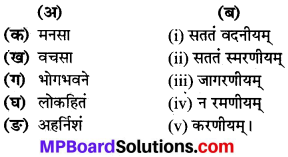
MP Board Class 7th General English Chapter 7 The Lost Camel
Answers:

  1. → (a)
  2. → (e)
  3. → (b)
  4. → (c)
  5. → (d)

(B) Fill in the blank spaces using the given words or phrases:
(दिये शब्दों या वाक्यांशों का प्रयोग कर रिक्त स्थानों को भरिए।)
(carrying, understand, searching, the ship of the desert, a lame excuse, foolproof, to work hard, to turn a blind eye, leave footprint, angry)

1. Bhola was ………… for his ball.
2. The truck was ………… bags of onions.
3. The teacher was ………… because Suraj did not do his work.
4. No one could ………… the story told by Ramesh.
5. The police ………… When they saw the thief was running away.
6. The camel is known as …………
7. Ramesh had not done his homework so he made ………… of falling sick.
8. Some products in the market claim to be a ………… remedy for illness.
9. Shyama has ………… to secure good marks.
10. If you ………… on the sand at a beach, the sea is sure to wash them away.
Answer:
1. searching
2. carrying
3. angry
4. understand
5. turned a blind eye
6. the ship of the desert
7. a lame excuse
8. foolproof
9. to work hard
10. leave footprint.

Grammar in Use (व्याकरण प्रयोग):

(A) Fill in the blank spaces with correct form of given verbs :
(दी गई क्रियाओं के सही रूप से खाली स्थान भरिए।)
Answer:
Two boys were playing in the ground with a ball. A few boys watched them. All of them were enjoying their free time. Suddenly it started raining. Now all of them ran back to their rooms. One of them picked up the ball.

(B) Make questions to get the following answers. Start with the ‘Wh’ word given in front of each sentence.
(निम्न उत्तरों को पाने के लिए प्रश्न बनाइए। प्रत्येक वाक्य को आगे ‘Wh’ शब्द से शुरू करिए।)
Answer:

  1. When does she have her lunch?
  2. What does she have for lunch ?
  3. Where did she have dinner last night?

Let’s Talk (आओ बात करें):

You are talking to a friend on telephone who has returned from a journey during vacation. Ask five questions about his/her journey.
(आप अपने मित्र से टेलीफोन पर बात कर रहे हैं जो अवकाश के दौरान यात्रा से वापिस आया है। उसकी यात्रा के बारे में पाँच प्रश्न पूछिएँ।)
Answer:
You may ask the following questions to your friend :

  1. Where did you go?
  2. When did you leave ?
  3. How was the weather there?
  4. How was your journey?
  5. How was the place you visited ?

Let’s Write (आओ लिखें)

1. Imagine that you are the camel in the story. Write the story using the following words:
(कल्पना करो कि आप कहानी में ऊँट हैं। निम्नलिखित शब्दों का प्रयोग कर कहानी लिखिए।)
Lake, tracks, footprints, went back, happy, leaves, lost, sand.

2. Give a title to your story.
Answer:
Camel in desert
I (Camel) have to walk on the sandy tracks. I leave my footprints. These are erased and lost by strong winds. The widespread sand area looks like a lake of water. I went there thinking I could get water there but I didn’t, so I went back. In that sandy land I got some leaves and I was very happy.

Let’s Do It (आओ इसे करें):

(A) Write names of the given animals/birds :
(दिए गए जानवरों/पक्षियों के नाम लिखिए।)

  1. Elephant
  2. Zebra
  3. Penguin
  4. Giraffe.

Write at least four sentences about each of the four pictures shown in the text. Use the clues given in the boxes.
Answer:
1. Elephant

  1. Elephant is the largest land animal.
  2. It has a long trunk.
  3. It is greyish black in colour.
  4. It eats leaves, fruits and sugarcane.

2. Zebra

  1. Zebra is a wild animal.
  2. It has black and white stripes on its body.
  3. It is a herbivorous animal i.e., it eats leaves and plants.
  4. It lives in the forest.

3. Penguin

  1. Penguin is a flightless bird.
  2. It is white and black in colour.
  3. It eats fishes.
  4. Penguin is an inhabitant of Arctic region.

4.Giraffe

  1. Giraffe is the tallest animal.
  2. It has a long neck and slender body.
  3. It has patched skin.
  4. It eats leaves and plants.

(B) Read the given passage and answer the questions given below it:
(दिये गए गद्यांश को पढ़िए और नीचे दिए प्रश्नों के उत्तर लिखिए।)

Question 1.
In what ways can the camel help us in agriculture ?
(इन व्हॉट वेज़ द कैमल हैल्प अस इन एग्रीकल्चर ?)
ऊँट हमारी खेती में किस प्रकार सहायता कर सकता है?
Answer:
Camels pull ploughs, turn wheels to irrigate fields and carry goods to the market, thereby helping in agriculture.
(कैमल्स पुल प्लाउज़, टर्न व्हील्स टू इरीगेट फील्ड्स एण्ड ‘कैरी गुड्स टू द मार्केट, देयरबाइ हैल्पिंग इन एग्रीकल्चर।)
ऊँट हल जोतते हैं, रहट के चक्र घुमाकर खेतों की सिंचाई करते हैं और सामान बाजार तक ढो कर ले जाते हैं, इस तरह खेती में सहायता करते हैं।

Question 2.
What’s the use of the camel’s hump?
(व्हॉट्स् द यूज़ ऑफ द कैमल्स् हम्प ?)
ऊँट के कूबड़ का क्या उपयोग है ?
Answer:
Camel’s hump is used as a source of energy when food and water are scarce.
(कैमल्स् हम्प इज़ युज्ड एज़ अ सोर्स ऑफ एनर्जी व्हेन फूड एण्ड वॉटर आर स्कार्स।)
ऊँट का कूबड़ ऊर्जा के स्रोत के रूप में उपयुक्त होता है जब खाने व पानी की कमी होती है।

Question 3.
How is the camel’s body suited to desert’s hard conditions ?
(हाउ इज़ द कैमल्स् बॉडी सूटिड टू द डेज़र्ट्स हार्ड कण्डीशन्स् ?)
ऊँट का बदन रेगिस्तान की मुश्किल परिस्थितियों के लिए कैसे उपयुक्त है?
Answer:
Camel has a hump which acts as a source of energy when food and water are scarce. It has broad, soft feet for a steady grip in the sand. A thick skin protects it from sun and cold nights. Its eyes have three eyelids to keep out sand. Its ears and nose are adapted to keep out sand storms.
(कैमल हैज़ अहम्प व्हिच ऐक्ट्स एज़ अ सोर्स ऑफ एनर्जी व्हेन फूड एण्ड वॉटर आर स्कार्स। इट हैज़ ब्रॉड, सॉफ्ट फीट फॉर अ स्टेडी ग्रिप इन द सैण्ड। अ थिक स्किन प्रोटेक्ट्स इट फ्रॉम सन एण्ड कोल्ड नाईट्स। इट्स आईज़ हैव थ्री आइलिड्स टू कीप आऊट सैण्ड। इट्स ईयर्स एण्ड नोज़ आर अडैप्टेड टू कीप आऊट सैण्ड स्टॉर्मू।)
ऊँट के एक कूबड़ होता है जो खाने और पानी की कमी के वक्त ऊर्जा के स्रोत की तरह कार्य करता है। उसके चौड़े व मुलायम पैर उसे रेत में चलने में सहायता करते हैं। उसकी आँखों की तीन पलकें रेत से बचाव करती हैं। उसके कान व नाक रेत के तूफान से बचाव करते हैं।

Question 4.
What does the camel eat?
(व्हॉट डज़ द कैमल ईट?)
ऊँट क्या खाता है?
Answer:
Camel eats grass, dates and grain when available. Deep in the desert it eats dry leaves and seeds.
(कैमल ईट्स ग्रास, डेट्स एण्ड ग्रेन व्हेन अवेलेब्ल। डीप इन द डैज़र्ट इट ईट्स ड्राइ लीव्स एण्ड सीड्स्।)
ऊँट घास, खजूर व अनाज खाता है जब वह उपलब्ध होते हैं। रेगिस्तान में वह सूखी पत्तियाँ व बीज खाता है।

Question 5.
Give a suitable title to the passage.
(गिव अ सूटेबल टालटल टू द पैसेज।)
अनुच्छेद को उपयुक्त शीर्षक दीजिए।
Answer:
Camel – the ship of the desert.
(कैमल्-द शिप ऑफ द डैज़र्ट)
ऊँट – रेगिस्तान का जहाज।

Pronunciation & Translation

Two merchants were searching for their lost camel in a desert. They met an old man on the way They asked him whether he had seen a camel.
(टू मर्चेन्ट्स वर सचिंग फॉर देअर लॉस्ट कैमेल इन अ डेजर्ट दे मैट एन ओल्ड मैन ऑन द वे दे आस्क्ड हिम वेदर ही हैड सीन अ कैमेल.)
अनुवाद – दो व्यापारी एक रेगिस्तान में अपना खोया हुआ ऊँट तलाश कर रहे थे। उन्हें रास्ते में एक वृद्ध मिला। उन्होंने उससे पूछा कि क्या उसने ऊँट देखा है।

The old man in turn asked more question. “Is it an old animal ?” he asked. The owners said it was. “Is it lame in one leg ?” asked the old man. The merchants sait it was. “Is it blind in the left eye ?”, the old man asked again. The owners were a little surprised; they said the animal was indeed blind in the left eye. “Have you seen the animal ?”, they asked the old man.
(द ओल्ड मैन इन टर्न आस्क्ड मोर क्वेश्चन्स. “इज इट एन ओल्ड ऐनिमल?” ही आस्क्ड. द ओनर्स सेड इट वॉज़. “इज इट लेम इन वन लैग?”आस्क्ड द ओल्ड मैन. द मर्चेन्ट्स सैड इट वॉज. “इज इट ब्लाइण्ड इन द लेफ्ट आई?'”, दि ओल्ड मैन आस्क्ड अगेन. दि ओनर्स वर अ लिटल सरप्राइज्ड; दे सैड दि ऐनिमल वाज इन्डीड ब्लाइण्ड इन द लेफ्ट आई. “हैव यू सीन दि ऐनिमल?” दे आस्क्ड दि ओल्ड मैन.)
अनुवाद – वृद्ध ने बदले में बहुत से प्रश्न पूछे. “क्या यह एक बूढ़ा जानवर है?” मालिकों ने कहा, हाँ ऐसा ही था। “क्या वह एक पैर से लंगड़ा है?” बूढ़े व्यक्ति ने पूछा। व्यापारियों ने कहा, हाँ ऐसा ही था। “क्या वह बांयी आँख से अन्धा है?” बूढ़े व्यक्ति ने फिर से पूछा। मालिक (व्यापारी) कुछ आश्चर्यचकित थे; उन्होंने कहा कि जानवर वास्तव में बांयी आँख से अन्धा था। “क्या तुमने जानवर को देखा है?” उन्होंने बूढ़े व्यक्ति से पूछा।

Without answering, The old man said to them, “Is the camel carrying wheat on one side of its back? The owners said that it was true. Now they were sure that the old man had seen the animal and perhaps taken the goods. The old man continued “Isn’t the camel carrying honey on the other side ?”
(विदआउट आन्सरिंग, दि ओल्ड मैन सैड टू दैम,“इज द कैमेल कैरिंग व्हीट ऑन वन साइड ऑफ इट्स बैक? दि ओनर्स – सैड दैड दैट इट वॉज टू. नाउ दे वर श्योर दैट दि ओल्ड मैन हैड सीन दि ऐनिमल एण्ड परहेप्स टेकन दि गुड्स. द ओल्ड मैन कन्टीन्यूड. “इजन्ट द कैमेल कैरिंग हनी ऑन दि अदर साइड?”)
अनुवाद-बिना उत्तर दिए बूढ़े व्यक्ति ने उनसे कहा, “क्या ऊँट अपनी पीठ के एक ओर गेहूँ ले जा रहा है?” मालिकों ने कहा कि यह सच था। अब उन्हें यकीन था कि वृद्ध ने ऊँट को देखा था और शायद उसने उस पर लदा सामान ले लिया था। बूढ़े व्यक्ति ने कहना जारी रखा, “क्या ऊँट दूसरी ओर शहद ले जा रहा है?

The owners caught hold of the old man and asked him angrily, “Have you stolen the goods and killed the animal ?” “I have not even seen the animal” said the old man calmly.
(दि ओनर्स कॉट होल्ड ऑफ दि ओल्ड मैन एण्ड आस्क्ड हिम ऐंग्रिली, “हैव यू स्टोलन द गुड्स एण्ड किल्ड दि ऐनिमल?”आइ हैव नॉट इवन सीन दि ऐनिमल, “सैड दि ओल्ड मैन कामली.)
अनुवाद – ऊँट के मालिकों ने वृद्ध को पकड़ लिया और उससे क्रोधपूर्वक पूछा, “क्या तुमने सामान चुरा लिया है और जानवर को मार दिया है?””मैंने तो उस जानवर को देखा तक नहीं है,” वृद्ध ने शांतिपूर्वक कहा।

The merchants asked him, “Do you think we are fools to believe your story ?” And they dragged him to the Khalifa’s court.
(द मर्चेन्ट्स आस्क्ड हिम, “डू यू थिंक वी आर फूल्स टू बिलीव योर स्टोरी?” एण्ड दे ड्रेग्ड हिम टू द खलीफा ‘ज कोर्ट.)
अनुवाद – व्यापारी उससे बोले, “क्या तुम समझते हो कि हम मूर्ख हैं जो तुम्हारी कहानी पर विश्वास करें?” और वे उसे खलीफा के दरबार में खींच कर ले गये।

The Khalifa listened to the marchants’ story. Then he turned to the old man and asked him whether he had seen the camel. The old man said he had never seen it in his life. “How do you know the camel is lame in one leg ?”, The Khalifa asked.
(द खलीफा लिसन्ड टू द मर्चेन्ट्स स्टोरी. दैन ही टन्ड टू दि ओल्ड मैन एण्ड आस्क्ड हिम वेदर ही हैड सीन द कैमेल. दि ओल्ड मैन सैड ही हैड नेवर सीन इट इन हिज लाइफ. “हाउ डू यू नो द कैमेल इज लेम इन वन लेग,?”द खलीफा आस्क्ड़.)
अनुवाद – खलीफा ने व्यापारियों की कहानी सुनी। तब वह वृद्ध की ओर मुड़ा और उससे पूछा कि क्या उसने ऊँट को देखा है? वृद्ध ने कहा कि उसने अपने जीवन में कभी उसे नहीं देखा है। “आप यह कैसे जानते हो कि ऊँट एक पैर से लंगड़ा है,? खलीफा ने पूछा।

“I looked at the footprints on the sand,” said the old man. “And one of them could hardly be seen.”
(“आइ लुक्ड ऐट द फुटप्रिंट्स ऑन द सेन्ड्” सैड दि ओल्ड मैन. “एण्ड वन ऑफ दैम कुड हार्डली बी सीन.”)
अनुवाद-“मैंने रेत पर उसके पद-चिन्ह देखे”, बूढ़े व्यक्ति ने कहा, “और उनमें से एक पैर के चिन्ह मुश्किल से दिखाई दे रहे थे।”

The Khalifa smiled and asked why the old man thought the camel was blind in one eye.
(द खलीफा स्माइल्ड एण्ड आस्क्ड व्हाई दि ओल्ड मैन थॉट द कैमेल वॉज ब्लाइण्ड इन वन आई.)
अनुवाद-खलीफा मुस्कराया और पूछा कि बूढ़े व्यक्ति ने क्यों सोचा कि ऊँट एक आँख से अन्धा है।

“The animal had eaten the leaves of the bushes only one one side of the road,” said the old man.
(“दि ऐनिमल हैड ईटन द लीज ऑफ द बुशेज ऑनली ऑन वन साइड ऑफ द रोड,” सैड दि ओल्ड मैन.)
अनुवाद-जानवर ने केवल सड़क के एक ओर की झाड़ियों की पत्तियों को खाया था।” बूढ़े व्यक्ति ने कहा।

“Why did you think the camel was carrying wheat and honey?”, asked the Khalifa.
(“व्हाई डिड यू थिंक द कैमल वॉज कैरिंग व्हीट एण्ड हनी?” आस्क्ड द खलीफा.)
अनुवाद-“आपने यह क्यों सोचा कि ऊँट गेहूँ और शहद ले जा रहा था?” खलीफा ने पूछा।

“I saw ants carrying fallen grains of wheat from one side of the road.” said the old man.
(“आइ सॉ आन्ट्स कैरिंग फॉलन ग्रेन्स ऑफ व्हीट फ्रॉम वन साइड ऑफ द रोड.” सैड दि ओल्ड मैन.)।
अनुवाद-मैंने सड़क के एक ओर से चीटियों को गिरे हुए गेहूँ के दानों को ले जाते हुए देखा।” बूढ़े व्यक्ति ने कहा।

“And there were bees flying around on the other side, I suppose.” Said the Khalifa.
(“एण्ड देअर वर बीज फ्लाइंग अराउण्ड ऑन दि अदर साइड, आइ सपोज.” सैड द खलीफा.)
अनुवाद-“और मेरे अनुमान से दूसरी ओर मधुमक्खियाँ | उड़ रही थीं,” खलीफा ने कहा।

“Yes, Your Honour.” Said the old man.
(“येस, योर ऑनर” सैड दि ओल्ड मैन.)
अनुवाद-“हाँ, मालिक” बूढ़े व्यक्ति ने कहा।
The Khalifa then turned to the merchants and said, “This man has made use of his eyes to look at things. You have eyes too. Use them. You’ll find your animal.” And he sent them away.
(द खलीफा देंन टन्ड टू द मर्चेन्ट्स एण्ड सैड, “दिस मैन हैज मेड यूज ऑफ हिज़ आइज टू लुक ऐट थिंग्स. यू हैव आइज टू. यूज दैम यू विल फाइण्ड योर ऐनिमल.” एण्ड ही सेन्ट दैम अवे.)
अनुवाद-तब खलीफा व्यापारियों की ओर मुड़ा और कहा, “इस व्यक्ति ने वस्तुओं को देखने में अपनी आँखों का प्रयोग किया है। आपके पास भी आँखें हैं। उन्हें प्रयोग करो। आपको आपका जानवर मिल जाएगा।”

The Lost Camel Word Meanings

Camel (कैमल्)-ऊँट.; Duck (डक)-बतख; Elephant (ऐलीफेन्ट)-हाथी; Lion (लायन)-शेर; Merchants (मर्चेन्ट्स)-सौदागर; Searching (सचिंग) -खोज रहे; Lost (लॉस्ट)-खोया हुआ; Desert (डेजर्ट) -रेगिस्तान; Drag (ड्रेग)-खींचना; Owners (ओनर्स) -मालिकों; Lame (लेम)-लंगड़ा Blind (ब्लाइन्ड) -अन्धा; Surprised (सरप्राइज्ड)-अचम्भित हुए; Indeed (इन्डीड)-वास्तव में; Sure (श्योर)-निश्चित; Honey (हनी)-शहद; Caught hold of (कॉट होल्ड ऑफ)-पकड़ लिया; Angrily (एन्ग्रीली)-नाराजगी से; Calmly (कामली)-चुपचाप; Listened (लिसन्ड)-सुना; Footprints (फुटप्रिन्ट्स)-पदचिह्न; Smiled (स्माइल्ड) -मुस्कुराया; Animal (एनीमल)-पशु; Bees (बीज़) -मधुमक्खियाँ।

We believe the information shared regarding MP Board Solutions for Class 7 English Chapter 21 Tansen Questions and Answers as far as our knowledge is concerned is true and reliable. In case of any queries or suggestions do leave us your feedback and our team will guide you at soonest possibility. Bookmark our site to avail latest updates on several state board Solutions at your fingertips.

MP Board Class 8th Sanskrit Solutions Chapter 1 लोकहितं मम करणीयम्

MP Board Class 8th Sanskrit Solutions Surbhi Chapter 1 लोकहितं मम करणीयम्

MP Board Class 8th Sanskrit Chapter 1 अभ्यासः

Mp Board Class 8 Sanskrit Solution Chapter 1 प्रश्न 1.
एकपदेन उत्तरं लिखत (एक शब्द में उत्तर लिखो-)
(क) मनसा किं करणीयम्? (मन से क्या करना चाहिए?)
उत्तर:
स्मरणीयम्। (स्मरण करना चाहिए।)

(ख) वचसा किं करणीयम्? (वाणी से क्या करना चाहिए?)
उत्तर:
वदनीयम्। (बोलना चाहिए।)

(ग) कस्मिन् न रमणीयम्? (किसमें नहीं रहना चाहिए?)
उत्तर:
भोगभवने। (सुख देने वाले घर में।)

(घ) किंन गणनीयम्? (क्या नहीं ध्यान रखना चाहिए?)
उत्तर:
दुःखम्। (दुःख को।)

(ङ) किंन मननीयम्? (क्या नहीं सोचना चाहिए?)
उत्तर:
निजसौख्यम्। (अपने सुख को।)

Lokhitam Mam Karniyam MP Board Class 8th प्रश्न 2.
एकवाक्येन उत्तरं लिखत (एक वाक्य में उत्तर लिखो)
(क) कुत्र त्वरणीयम्? (कहाँ शीघ्रता करनी चाहिए?)
उत्तर:
कार्यक्षेत्रे त्वरणीयम्। (कार्य के क्षेत्र में शीघ्रता करनी चाहिए।)

(ख) कस्मिन् तरणीयम्? (किसमें तैरना चाहिए?)
उत्तर:
दुःखसागरे तरणीयम्। (दुःख रूपी सागर में तैरना चाहिए।)

(ग) कुत्र चरणीयम्? (कहाँ चढ़ना चाहिए?)
उत्तर:
कष्टपर्वते चरणीयम्। (कष्टरूपी पर्वत पर चढ़ना चाहिए।)

(घ) विपत्ति-विपिने किं करणीयम्? (संकट रूपी वन में क्या करना चाहिए?)
उत्तर:
विपत्ति-विपिने भ्रमणीयम्। (संकट रूपी वन में घूमना चाहिए।)

(ङ) मम किं करणीयम्? (मुझे क्या करना चाहिए?)
उत्तर:
मम लोकहितं करणीयम्। (मुझे संसार का कल्याण करना चाहिए।)

Mp Board Class 8 Sanskrit Chapter 1 प्रश्न 3.
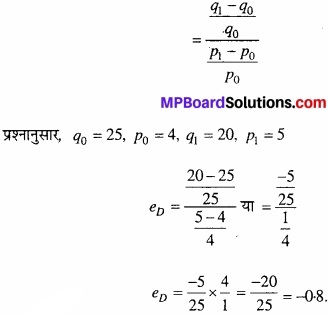
उचितं योजयत (उचित को जोड़ो-)
MP Board Class 8th Sanskrit Solutions Chapter 1 लोकहितं मम करणीयम् 1
उत्तर:
(क) → (ii)
(ख) → (i)
(ग) → (iv)
(घ) → (v)
(ङ) → (iii)

Class 8 Sanskrit Chapter 1 Mp Board प्रश्न 4.
शुद्धवाक्यानां समक्षम् ‘आम्’ अशुद्धवाक्यानां समक्षं’न’ इति लिखत
(शुद्ध वाक्यों के सामने ‘आम्’ (हाँ) तथा अशुद्ध वाक्यों के सामने ‘न’ (नहीं) लिखो-)
(क) कष्टपर्वते चरणीयम्।
(ख) दु:खसागरे न तरणीयम्।
(ग) न जातु दुःखं गणनीयम्।
(घ) विपत्ति-विपिने न भ्रमणीयम्।
(ङ) अहर्निशं जागरणीयम्।
उत्तर:
(क) आम्
(ख) न
(ग) आम्
(घ) न
(ङ) आम्।

Lok Hitam Mam Karniyam MP Board Class 8th प्रश्न 5.
उचितपदेन रिक्तस्थानं पूरयत(उचित शब्द द्वारा रिक्त स्थानों को भरो-)
(क) बन्धुजना ये स्थिता ……………..। (सागरे/गह्वरे)
(ख) लोकहितं ……………। (वदनीयम्।करणीयम्)
(ग) भोगभवने …………… । (रमणीयम्/न रमणीयम्)
(घ) कार्यक्षेत्रे ……………। (तरणीयम्/त्वरणीयम्)
(ङ) कष्टपर्वते …………….। (करणीयम्/चरणीयम्)
उत्तर:
(क) गह्वरे
(ख) करणीयम्
(ग) न रमणीयम्
(घ) त्वरणीयम्
(ङ) चरणीयम्।

Lokhitam Mam Karniyam In Hindi MP Board Class 8th प्रश्न 6.
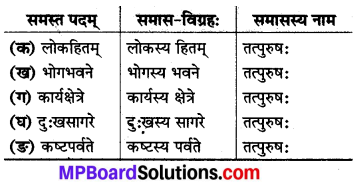
नामोल्लेखपूर्वक समासविग्रहं कुरुत(नाम का उल्लेख करते हुए समास विग्रह करो-)
(क) लोकहितम्
(ख) भोगभवने
(ग) कार्यक्षेत्रे
(घ) दुःख-सागरे
(ङ) कष्टपर्वते।
उत्तर:
Mp Board Class 8 Sanskrit Solution Chapter 1

मनसा सततं स्मरणीयम् Meaning In Hindi MP Board Class 8th प्रश्न 7.
रिक्तस्थानम् पूरयत (खाली जगह भरो-)
उत्तर:
(क) न जातु दुःखं गणनीयम्, न च निज सौख्यं मननीयम्।
कार्यक्षेत्रे त्वरणीयम्, लोकहितम् मम करणीयम्

(ख) दुःख सागरे तरणीयम्, कष्टपर्वते चरणीयम्
विपत्ति-विपिने भ्रमणीयम्, लोकहितम्मम करणीयम्॥

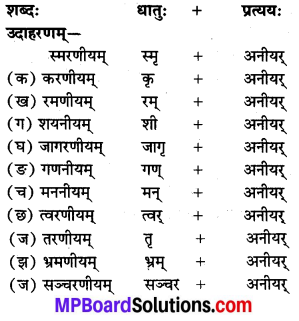
प्रश्न 8.
उदाहरणानुसारं धातुं प्रत्ययं च पृथक्कुरुत(उदाहरण के अनुसार धातु और प्रत्यय अलग करो-)
Lokhitam Mam Karniyam MP Board Class 8th

प्रश्न 9.
“मम कर्त्तव्यम्” इति विषयमवलम्ब्य संस्कृते दशवाक्यानि लिखत।
(“मेरा कर्तव्य” इस विषय पर संस्कृत में दस वाक्य लिखो।)
उत्तर:
व्याकरण भाग में निबन्ध रचना देखें।

प्रश्न 10.
“लोकहितं मम करणीयम्” इत्यस्मिन् पाठे आगतानि अव्ययानि चित्वा लिखत।
(“लोकहितं मम करणीयम्” इस पाठ में आये हुए अव्ययों को चुनकर लिखो।)
उत्तर:
(क) सततम्
(ख) न
(ग) च
(घ) अहर्निशम्
(ङ) जातु
(च) दुःखम्
(छ) निज
(ज) तत्र।

लोकहितं मम करणीयम् हिन्दी अनुवाद 

मनसा सततं स्मरणीयम्, वचसा सततं वदनीयम्।
लोकहितमम करणीयम्, लोकहितं मम करणीयम्॥१॥

अनुवाद :
मन से सदा (मुझे) स्मरण (सोचना) करना चाहिए, वाणी (मुँह) से सदा (मुझे) बोलना चाहिए (कि) संसार का कल्याण मुझे करना चाहिए, संसार का कल्याण मुझे करना चाहिए।

न भोगभवने रमणीयम, न च सखशयने शयनीयम।
अहर्निशं जागरणीयम्, लोकहितं मम करणीयम्॥२॥

अनुवाद :
(मुझे) न सुख देने वाले घर में रहना चाहिए और न सुख देने वाले बिस्तर पर सोना चाहिए। (मुझे) दिन-रात जागना चाहिए (और) संसार का कल्याण मुझे करना चाहिए।

न जातु दुःखंगणनीयम्, न च निज सौख्यम् मननीयम्।
कार्यक्षेत्रे त्वरणीयम्, लोकहितं मम करणीयम्॥३॥

अनुवाद :
(मुझे) कभी भी दुःख का ध्यान नहीं रखना चाहिए और न अपने सुख को सोचना चाहिए। (अपने) कार्य के क्षेत्र में शीघ्रता करनी चाहिए, (और) संसार का कल्याण मुझे करना चाहिए।

दुःखसागरे तरणीयम्, कष्टपर्वते चरणीयम्।
विपत्ति-विपिने भ्रमणीयम्, लोकहितंमम करणीयम्॥४॥

अनुवाद :
(मुझे) दुःख रूपी सागर में तैरना चाहिए, कष्ट रूपी पर्वत पर चढ़ना चाहिए, संकट रूपी वन में घूमना चाहिए (और) संसार का कल्याण मुझे करना चाहिए।

गहनारण्ये घनान्धकारे, बन्धुजना ये स्थिता गह्वरे।
तंत्र मया सञ्चरणीयम् लोकहितं मम करणीयम्॥५॥

अनुवाद :
जो भाई-बन्धु घने अन्धकार में, गहन वन में गुफाओं में रहते हैं, वहाँ मुझे जाना चाहिए (और) संसार का कल्याण मुझे करना चाहिए।

लोकहितं मम करणीयम् शब्दार्याः

करणीयम् = करना चाहिए। त्वरणीयम् = शीघ्रता करनी चाहिए। दुःखसागरे = दुःख रूपी सागर में। कष्टपर्वते = कष्ट रूपी पर्वत पर। गहनारण्ये = गहन वन में। गह्वरे = गुफा में।

MP Board Class 8th Sanskrit Solutions

MP Board Class 8th Special English Solutions Chapter 12 The Cherry Tree

Guys who are planning to learn the fundamentals of English can avail the handy study material using MP Board Solutions for Class 8 English Chapter 12 The Cherry Tree Questions and Answers. You Can Download MP Board Class 8 English Solutions Questions and Answers, Notes, Summary, Guide, Pdf. Refer to the Madhya Pradesh State Board Solutions for English PDF available and score better grades. Simply click on the quick links available for MP Board Solutions for Class 8 English Chapter 12 The Cherry Tree Questions and Answers and prepare all the concepts in it effectively. Take your preparation to the next level by availing the Madhya Pradesh State Board Solutions for Class 8 English prepared by subject experts.

MP Board Class 8th Special English Solutions Chapter 12 The Cherry Tree

Do you feel the concept of English is difficult to understand? Not anymore with our MP Board Solutions for Class 8 English Chapter 12 The Cherry Tree Questions and Answers. All the Solutions are given to you with detailed explanation and you can enhance your subject knowledge. Use the Madhya Pradesh State Board Solutions for Class 8 English PDF for free of cost and prepare whenever you want.

The Cherry Tree Textual Exercise

Word Power

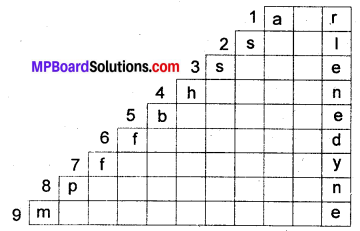
(A) Arrange the above words in alphabetical order.
Answer:

  1. breeze
  2. bulging
  3. haunches
  4. mantis
  5. outskirts
  6. pebbles
  7. plod
  8. promptly
  9. scramble
  10. scythe
  11. sprinkling
  12. swish
  13. tang
  14. whisper

(B) Complete the spellings of the words that have the following meanings:
Class 8 Chapter 12 English MP Board

  1. mixture of gases surrounding the earth
  2. upper layer of the earth in which plants grow
  3. surface that is at an angle of less than 90
  4. take place
  5. take air into the lungs and send it out again
  6. wood used for lighting fires or as fuel
  7. the ability of land to produce crops
  8. people living in an area, city or country
  9. make on a large scale using machinery

Answer:

  1. air
  2. soil
  3. slope
  4. happen
  5. breath
  6. fire wood
  7. fertility
  8. population
  9. manufacture.

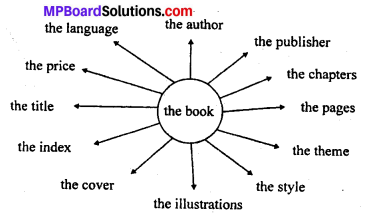
(C) Read this web chart containing words related to the expression ‘the story book’. (Once you have selected a particular book, know everything related to that book-the title, the author, etc.)
English Chapter 12 Class 8 MP Board
Now collect related information and complete these two web charts.
Answer:
The Cherry Tree Question Answers Class 8 MP Board

Comprehension

The Cherry Tree Question Answers Class 8 MP Board Question 1.
Where did Rakesh live?
Answer:
Rakesh lived on the outskirts of Mussoorie.

Mp Board Class 8 English Chapter 12 Question 2.
What did Rakesh do to the seed?
Answer:
Rakesh planted the seed.

Class 8 English Chapter 11 The Cherry Tree MP Board Question 3.
What happened to the plant when it was two feet high?
Answer:
A goal entered the garden and ate all the leaves of the plant.

Class 8 English Chapter 12 MP Board Question 4.
Why did grandfather scold the woman?
Answer:
Grandfather scolded the woman because she had cut the plant into two.

Class 8 English Chapter 12 Question Answer MP Board Question 5.
Why did Rakesh like the tree so much?
Answer:
Rakesh liked the tree so much because he planted it himself.

The Cherry Tree Class 8 MP Board Question 6.
Why did he encircle the small cherry plant with pebbles?
Answer:
Do yourself.

Class 8 English Chapter 12 Mp Board Question 7.
How does the cherry tree prove the creative power of nature?
Answer:
It did not die even though its leaves were all eaten by a goat and it was cut into two with a scythe by a woman. It lived and grew in due course.

Lesson 12 The Cherry Tree MP Board Question 8.
“Nothing is lucky if you put it away. If you want luck, you must put it to some use.” What did grand-father means by these words.
Answer:
Grandfather meant to say that the seed of the cherry should be planted.

Let’s Learn

  • We use the simple past tense to talk about actions that happened in the past.
  • To make the simple past tense of regular verbs, we add-ed to the verb, for example walk-walked. If the verb ends in-e we just add-d. e.g., save-saved.
  • Many verbs in the simple past tense are irregular. This means that we not add-ed or -d to them even though they are in the past tense. For instance, the simple past form of “begin’ is ‘began’.
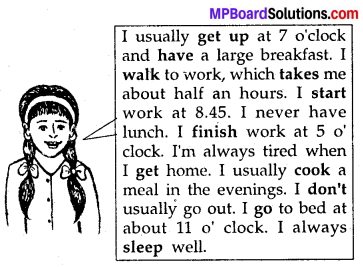
  • Read what Sheelu says about her daily routine:

Mp Board Class 8 English Chapter 12

Yesterday was a typical working day for Sheelu. Write what she did or didn’t do yesterday.

  1. Sheelu _________ up at 70′ clock.
  2. She _________ a large breakfast
  3. She _________ to work.
  4. It _________ her about half an hour to get to work.
  5. She _________ work at 8.45.
  6. She _________ (not) lunch.
  7. She _________ her work at 5 ‘o’ clock.
  8. She was tired when she _________ home.
  9. She _________ a meal yesterday evening.
  10. She _________ (not) out yesterday evening.
  11. She _________ bed at 11 ‘o’ clock.
  12. She _________ well last night

Answers:

  1. got
  2. ate
  3. began
  4. took
  5. finished
  6. didn’t take
  7. began
  8. reached
  9. ate
  10. did’nt go
  11. went
  12. slept.

Let’s talk

(A) You see a man who is felling a tree for firewood. Discuss among your group how you’ll convince him not to cut down the tree.
Convince him by telling him the importance of trees, as –
Answer:

(a) Trees provide us many things of daily use.
(b) They give us cool shade.
(c) They give us many types of fruits.
(d) They give us wood which is used in construction work.
(e) There are many trees which are known for their medicine.
(f) Tree maintains balance in our eco system.
(g) They bring rain in abundance.
(h) Our happiness lies in the survival of the trees.

(B) Read carefully the conversation between Anju & Mrs. Ahuja, then follow the instructions given below.

Anju : Hello! Can I talk to Mrs. Ahuja?
Mrs.Ahuja : Hello! Mrs. Ahuja speaking.
Anju : Good morning mam, I want to know about some medicinal trees.
Mrs.Ahuja : Good morning. There are some medicinal trees like Neem, Amla, Bilva or Bel and Tulsi.
Anju : Does the Neem tree have a medicinal value?
Mrs.Ahuja : Yes, it does. Ayurveda says that the roots, bark, leaves, fruit and gum of Neem have amazing cura tive powers.
Anju : How are they used?
Mrs.Ahuja : They are used as fungi cides and medicines, countless Indians today use Neem twigs as tooth brush.
Anju : Mam, I haven’t seen this natural brush. Will you show me one please?
Mrs.Ahuja : Yes, why not?
Anju : Mam, how are the leaves used?
Mrs.Ahuja : Dried Neem leaves are put in stored grain, clothes and books to pro tect them from pests.
Anju : I have heard that Neem is also used to cure skin ailments.
Mrs.Ahuja : Yes, of course. It is a good antiseptic too.
Anju : Thanks a lot mam for such useful information.
Mrs.Ahuja: O.K. Next time we’ll talk about other medicinal plants and trees.

Work in pairs. Converse with your teacher to know more about other medicinal plants and trees found around you. Record the conversation.
Answer:
Do it yourself.

Let’s read

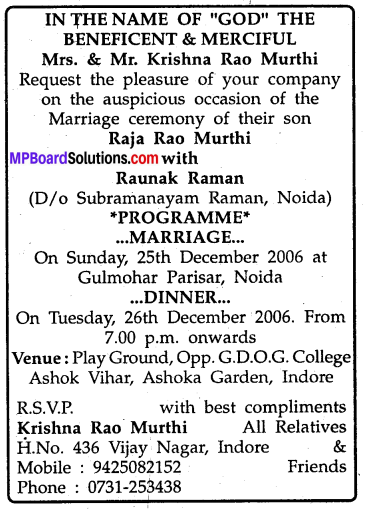
Read the given invitation-card for a marriage ceremony. And answer the ques/tion given below it.
Class 8 English Chapter 11 The Cherry Tree MP Board

Question 1.
Name the parents of the bride groom.
Answer:
Mrs. and Mrs. Krishna Rao Murthi.

Question 2.
What’s the name of the bride’s father?
Answer:
Subramanayam Raman.

Question 3.
When is the marriage ceremony going to take place?
Answer:
On Sunday, 25th December 2006.

Question 4.
Write the address of the venue for the dinner.
Answer:
Play ground, opp. G.D.O.G. College. Ashok Vihar, Ashoka Garden, Indore.

Question 5.
Where will the marriage ceremony be organized at?
Answer:
Gulmohar Praisar, Noida.

Question 6.
Which specific expression (s) in the . invitation card appeal to you and why?
Answer:
The expression “In the name of God’ the beneficent & merciful”. I liked this expression because I’m atheiest. I believe that every auspicious work should be started with the name of Almighty.

Let’s Write

Read the passage and do the activity as suggested.
CLEAN means ‘NO DIRT’

1. TIDY means “neat every thing in place”. If you bathe, A you become clean. But if you do not comb your hair, would you look nice? No! You would be clean but not tidy. If you dress neatly and comb your hair after a bath, you look clean and tidy.
Class 8 English Chapter 12 MP Board
2. Everyone likes children who are clean and tidy. But this is not enough. You also have to keep your things tidy. Then, you do not have to search for things when you need them. You can do every thing quickly. You will have more time to study ad play.
Class 8 English Chapter 12 Question Answer MP Board
3. If you try, it becomes easy to be clean and tidy everyday.

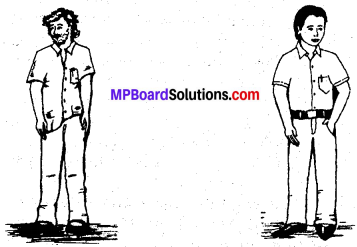
Now do some activity and have fun. With the help of your teacher draw Mr. clean and Mr. dirty on the black board.
MP Board Class 8th Special English Chapter 12 The Cherry Tree 8
Write comments on both types of men. What do you think about them. Write sentences using the clue words:

impressive, untidy, good looking, uncombed hair, well dressed, badly dressed etc

Example : Mr. Clean is impressive.
Answer:

  1. He is good looking.
  2. He is well dressed.
  3. Mr. Untidy is badly dressed.
  4. He has kept uncombed hair.
  5. He is not at all impressive.

Let’s do it

Question 1.
If you get the seed of such a tree as is rarely found, sow it in your garden. Take proper care of it and water it timely.
Answer:
Do it yourself.

Question 2.
Describe in a paragraph how a plant makes food. Use the clues given below. Work in pairs or groups.

Water, salt and other things ………………. suck from the earth ………………. through roots ………………. reaches leaves ………………. using sunlight ………………. makes food ………………. sends to other parts of the plant.
Answer:
Plants suck water, salt and other things through roots. All these things reach in the leaves where the plant makes food using sunlight and sends to other parts of the plant.

The Cherry Tree Word Meanings

MP Board Class 8th Special English Chapter 12 The Cherry Tree 9

MP Board Class 8th Special English Chapter 12 The Cherry Tree 10

MP Board Class 8th Special English Chapter 12 The Cherry Tree 11

We wish the knowledge shared regarding MP Board Solutions for Class 8 English Chapter 12 The Cherry Tree Questions and Answers has been helpful to you. If you need any further help feel free to ask us and we will get back to you with the possible solution. Bookmark our site to avail the latest updates on different state boards solutions in split seconds.

MP Board Class 6th Special English Solutions Chapter 3 A Boy Judge

Students who wish to prepare the English Subject can rely on the MP Board Solutions for Class 6 English Chapter 3 A Boy Judge Questions and Answers prevailing. Become perfect  with the concepts of Class 6 English Chapter 3 A Boy Judge Questions and Answers, Grammar, Summary, Notes, Guide, Pdf, by preparing you can score highest grade in your exams. Here, You Can Download MP Board Class 6 English Solutions. Detailed Solutions are provided to the concepts by experts keeping in mind the latest edition textbooks and syllabus.

MP Board Class 6th Special English Solutions Chapter 3 A Boy Judge

Ace up your preparation by referring to the Madhya Pradesh State Board Solutions for Class 6 Chapter 3 A Boy Judge Questions and Answers and learn all the topics within. Click on the topic you want to prepare from the Class 6 English and prepare it easily. You can understand your strengths and weaknesses by learining the Questions and Answers in MP Board Solutions for Class 6 English PDF.

A Boy Judge Text Book Exercise

Word Power

(a) Match the words with opposite meaning.

Example:
long – short
busy – idle

(night, long, here, oldest, best, trust, busy, foolish, distrust, short, clever, careful, youngest, there, disagree, idle, day, agree, careless, worst.)
Answer:
night – day
long – short
here – there
oldest – youngest
best – worst
trust – distrust
busy – idle
foolish – clever
careful – careless
disagree – agree

(b) Make adverbs from the words given in the box as in the example:

Example:
eager – eagerly

(quiet, careful, sure, safe, clever)
Answer:
quiet – quietly
careful – carefully
sure – surely
safe – safely
clever – cleverly

(c) Fill in the blanks with the words given below.

(curds, busy, keeping, clay, search, intelligent, accused of, lodging, packed with)

  1. When Lucy did not come home in the evening, her parents went in …………… of her.
  2. Somu is very …………. Ask him a riddle and he will come out with the answer in a minute.
  3. Have you watched a potter making a pot ? He puts a ball of ………….. on a wheel and turns the wheel. As the wheel keeps turning, he shapes the pot with his fingers.
  4. The Minister came to our school yesterday. The hall was …………. boys. Many had to stand in the verandah.
  5. If you add a little lime juice to warm milk, it turns into …………. after a few hours.
  6. A new man to town : Is there a good hotel here? I want ………… for the night.
  7. The prisoner was ………….. stealing a radio.
  8. When Mrs. Sampath went abroad, she left all her jewels with her bank for safe……………..
  9. The Minister was very …………… All day he had no time to see any visitors.

Answer:

  1. Search
  2. intelligent
  3. clay
  4. packed with
  5. curds
  6. lodging
  7. accused of ling
  8. Keeping
  9. busy.

(d) Fill in the blanks with the words given below.

(Sealed, approached, chief, trial, companions, careless, narrated, carelessness, otherwise)

  1. In the old days, every village had a ………….. or Elder. He heard the villager’s complaints and acted as a judge.
  2. Father : How is my son at mathematics?
    Teacher : He is very intelligent, but …………… He makes very silly mistakes. I have warned him several times about his ……………. Please tell him to be more careful, ……………. he may fail in his examination.
  3. The shopkeeper was accused of selling kerosene at a high price. The police caught him, locked and ………….. his shop, and brought him to …………. before a magistrate. He was fined two hundred rupees.
  4. Ravi kumar was one of a group of students who climbed a twelve-thousand-foot peak in the Himalayas. He gave a talk at our school today and …………. his own experiences and those of his ………….
  5. We want to start a reading room in our village. Everyone we ………… for money liked the idea and helped us.

Answer:

  1. Chief
  2. careless, carelessness, otherwise
  3. sealed, trial
  4. narrated, companions
  5. approached.

Comprehension

(a) Who says to whom? And why?

Class 6th English Chapter 3 A Boy Judge Question 1.
Let’s stay for the night in some house here in this town.
Answer:
The chief said this to others because their own village was far away.

Class 6 English Chapter 3 A Boy Judge Question 2.
Let’s have the pot we gave you to keep.
Answer:
The youngest thief said this to the old woman because he wanted to get the pot of gold for himself.

Class 6 English Chapter 3 A Boy Judge Question Answer Question 3.
Your chief has asked me not be give the pot till all of you ask for it together.
Answer:
The old woman said this to the youngest thief because she wanted to be in a safe position.

(b) Answer these questions:

A Boy Judge Question Answer MP Board Class 6th Question 1.
Why did the thieves have to stay in the town for the night?
Answer:
The thieves had to stay in the small town at night because their own village was far away. They had a pot of gold with them. It was very risky for them to travel at night.

Class 6 English Chapter 3 Mp Board Question 2.
Why did the thieves decide to give the pot into the old woman’s keeping?
Answer:
The thieves decided to give the pot to the woman for safe keeping as they did not trust one another. All of them were afraid lest the other one should run way with the pot of gold.

Mp Board Class 6 English Chapter 3 Question 3.
To whom was the old woman told to give the pot?
Answer:
The old woman was told to give back the pot when all the three thieves asked for it together.

Mp Board Class 6th English Chapter 3 Question 4.
Why did the old woman give the pot to the young thief and not to all three of the thieves?
Answer:
The old woman gave the pot to the young thief because she thought that the young thief had come to take the pot with the consent of the other two. Before handing over the pot to the young thief she had confirmed it from the chief.

A Boy Judge Class 6 Question Answer Question 5.
What did the old woman go to the king for?
Answer:
The chief abused and cursed the old woman for her carelessness. The two thieves demanded of her, the price of gold. The old woman pleaded them for mercy. But the chief was not ready to forgive or leave her. Therefore, the old woman went to the king for justice.

The Boy Judge Story In Hindi MP Board Class 6th Question 6.
Who tried the case?
Answer:
An intelligent boy named Ramanna tried the case.

The Boy Judge Story In English MP Board Class 6th Question 7.
How did Ramanna decide the case?
Answer:
Ramanna said to the thieves, “Bring your third companion and the pot will be delivered only to all three of you together. The thieves could not locate their companion. They withdrew their case. In this way^he decided the case in the old woman’s favour.

Question 8.
How did the decision help the old woman?
Answer:
As the thieves could not produce the third companion, they had to give up the case. Thus the decision saved the old woman from making payment for the pot of gold.

Grammar in Use

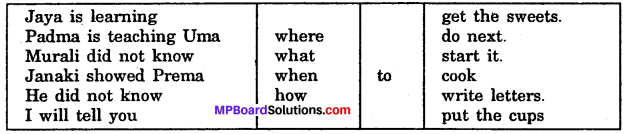
(a) Read the questions under A and make suitable answers for them from the table under B. The answer to the first question is given, and. the beginning of the other answers has also been given.
A
Example:
Can Jaya cook?
No, but Java is learning how to cook.

  1. Can Uma write a letter?
    No, but …………
  2. Did Murali buy the sweets?
    No, because ………….
  3. Did Prema put the cups back in the right place?
    Yes, ………….
  4. What did Anand do next?
    He did not do anything, because ………..
  5. Shall I start the car now ?
    No, ………..

Class 6th English Chapter 3 A Boy Judge
Answer:

  1. Padma is teaching Uma how to write letters.
  2. Murali did not know where to get the sweets.
  3. Janaki showed Prema where to put the cups.
  4. He did not know what to do next.
  5. because I will tell you when to start it.

(b) Read this sentence.

The old woman asked the thieves, “Will you take the pot back tomorrow morning?” We can rewrite this in indirect speech in this way:
The old woman asked the thieves if they would take the pot back the next morning.

Now rewrite the following in indirect speech, as shown above.

  1. “Shall I give the pot to this young man?” the old woman asked the thieves from inside the house.
  2. “Will you have tea or coffee?” I asked the guest.
  3. “Is Leela going with you to the cinema or with me for a walk?” Mr. Prasad asked Skekhar.
  4. “Do the boys want to go to Chennai or to Delhi for the excursion?” the headmaster asked the class teacher.
  5. “Will Diwali fall on the Monday or Tuesday?” I asked mother.
  6. “Have you had your lunch?” the boy asked his friend.

Answer:

  1. The old woman asked the thieves from inside the house whether she should give the pot to that young man.
  2. I asked the guest whether he would have tea or coffee.
  3. Mr. Prasad asked Shekhar whether Leela was going with him (Shekhar) to the cinema or with him (Mr. Prasad) for a walk.
  4. The headmaster asked the class-teacher whether the boys wanted to go to Chennai or Delhi for the excursion.
  5. I asked mother whether Diwali fell on Monday or Tuesday.
  6. The boy asked his friend whether he had his lunch.

(c) The phrasal verb ‘give up’ has been used in the lesson. It means – to stop trying to do something.

Some other phrasal verbs with their meanings are given below:
give up : to admit that you have been defeated.
give out : to come to an end.
give off : to produce something such as a smell, heat, light etc.
Answer:
Do yourself.

Let’s Write

Write a paragraph on each of the following:
Question 1.
How the youngest of the thieves got the pot of gold for himself.
Answer:
The thieves took the dinner. Then they sat under a tree talking together. A woman came there selling curd. The youngest thief said, “We should buy some curd.” The chief said, “Go and have a pot from the old woman”. He at once went to the old woman and asked her to give him the pot they had given her to keep. Being very busy, she shouted from inside the house to ask if she would give the pot to the young man. The chief shouted back to her to give it to him. The old woman thus gave the pot to the young thief. The thief quietly left the place in this way he got the pot of gold for himself.

Question 2.
How Ramanna decided the case of the pot of gold?
Answer:
On the day of trial, Ramanna asked the thieves to narrate the story first. They accused the old woman of her carelessness. The old woman asked them to forgive her as she was very poor. Then Ramanna asked the thieves if they had told that woman to give back the pot only to all three of them together. The chief said, “Yes, we did, we told her not to give it otherwise.” Ramanna said, “In that case, you will have to bring your third friend and the pot will be given to all of you together. Hearing this the thieves did not know what to do they gave up the case. In this way, the case of the pot was decided in the farvour of the old woman.

A Boy Judge Word Meanings

Class 6 English Chapter 3 A Boy Judge

Hope the data shared has shed some light on you regarding the MP Board Solutions of Class 6 English Chapter 3 A Boy Judge Questions and Answers. Do leave us your queries via the comment section and we will guide you at the earliest with help seeked. Stay connected with our website and avail the latest information in a matter of seconds.

MP Board Class 7th Social Science Solutions Chapter 1 India and the World

MP Board Class 7th Social Science Solutions Chapter 1 India and the World

MP Board Class 7th Social Science Chapter 1 Text Book Questions

Mp Board Class 7 Social Science Solution Fill in the Blanks:

  1. The Medieval period in India begins from ………………..
  2. The Chola Kingdom had trade relations with ………….. countries.
  3. Compass was invented in …………….

Answer:

  1. 8th century
  2. South Asian
  3. China


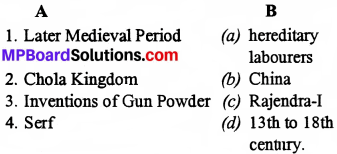
Mp Board 7th Class Social Science Book Match the Following:

Mp Board Class 7th Social Science Solution
Answers:
1. (d) 13th to 18th
2. (c) Rajendra – I
3. (b) China
4. (a) hereditary

MP Board Class 7th Social Science Chapter 1 Short Answer Type Questions

Mp Board Class 7th Social Science Solution In English Question 1.
Into how many parts have we divided the Medieval Indian History? Write their names and period.
Answer:
The Medieval Indian History has been divided into two parts:

  • Early Medieval Period (8th to 13th century AD)
  • Later Medieval Period (13th to 18th century AD).

Class 7 Social Science Chapter 1 India And The World Question 2.
Name the literary sources of medieval period.
Answer:
A great variety of literary sources are available to know about the medieval period. They are writings on palm leaves and birch bark.

India And The World Class 7 Question 3.
Describe the life style of the Feudal Lords of Medieval civilization.
Answer:
The Feudal Lords used to live in castles. They had absolute power over their peasants and workers. They lived a luxurious life and used to treat the peasants very badly.

India And The World Book Class 7 Solutions Question 4.
Mention the territories conquered by the Arabs.
Answer:
The Arabs conquered many parts of Western Asia,-Jordan, Syria, Iraq, Turkey, Persia and Egypt. They also conquered territories in Northern Africa and reached Spain. Finally they extended their territory up to North Western part of India.

MP Board Class 7th Social Science Chapter 1 Long Answer Type Questions

Mp Board Class 7 Social Science Book Question 1.
Mention the contributions of the Arabs in the development of the Medieval civilization.
Answer:
The Arabs made great contribution in the development of the Medieval civilization. They were expert traders. Trade had made them rich and they used the wealth for the development of art, science and literature.

They spread knowledge, which they acquired from the countries with which they had trade relations, to distant lands. They also made important contribution in the field of Geometry, Algebra, Geography and Astronomy. They also carried new inventions of China like Gun Powder, Paper and Compass to countries of Europe.

MP Board Class 7th Social Science Solutions

MP Board Class 8th Sanskrit Solutions Chapter 18 सत्कर्म एव धर्मः

MP Board Class 8th Sanskrit Solutions Surbhi Chapter 18 सत्कर्म एव धर्मः

MP Board Class 8th Sanskrit Chapter 18 अभ्यासः

Class 8 Sanskrit Chapter 18 Mp Board प्रश्न 1.
एकपदेन उत्तरं लिखत(एक शब्द में उत्तर लिखो-)
(क) विक्रमादित्यः नगरभ्रमणसमये किं दृष्टवान्? (विक्रमादित्य ने नगर भ्रमण के समय क्या देखा?)
उत्तर:
रुग्णम्। (रोगी को)

(ख) विक्रमादित्यः महामन्त्रिणि राज्यभारं समर्प्य कुत्र अगच्छत्? (विक्रमादित्य महामन्त्री पर राज्यभार को समर्पित करके कहाँ गये?)
उत्तर:
वनम्। (वन में)

(ग) महात्मा कस्य समीपे तपस्यारतः आसीत्? (महात्मा किसके पास तपस्यारत थे?)
उत्तर:
विक्रमादित्यस्य। (विक्रमादित्य के)

(घ) महात्मा योगबलेन तत्र कस्य दृश्यं दर्शितवान्? (महात्मा ने योग के बल से वहाँ किसका दृश्य दिखाया?)
उत्तर:
यमलोकस्य। (यमलोक का)

(ङ) कर्मणां लेखनं कस्य पार्वे अस्ति? (कर्मों का लेखा किसके पास है?)
उत्तर:
चित्रगुप्तस्य। (चित्रगुप्त के)

(च) श्रेष्ठाचरणस्य प्रतिज्ञां कृत्वा विक्रमादित्यः कुत्रः आगतवान्? (श्रेष्ठ आचरण की प्रतिज्ञा करके विक्रमादित्य कहाँ आये?)
उत्तर:
उज्जयिनीम्। (उज्जयिनी में)

Mp Board Class 8 Sanskrit Chapter 18 प्रश्न 2.
एकवाक्येन उत्तरं लिखत(एक वाक्य में उत्तर लिखो-)
(क) महात्मा विक्रमादित्यं किम् उपदिष्टवान्? (महात्मा ने विक्रमादित्य को क्या उपदेश दिया?)
उत्तर:
महात्मा विक्रमादित्यं उपदिष्टवान् यत्-“राजन्! भवान् तु यथानीति राजधर्मस्य पालनं करोतु। धर्मानुकूलं शासनम् अपि धर्म एव भवति” इति। (महात्मा ने विक्रमादित्य को उपदेश दिया कि-“हे राजन्! आप तो नीति के अनुसार राजधर्म का पालन करो। धर्म के अनुसार शासन भी धर्म ही होता है।)
(ख) कर्म-तपस्योः कः भेदः? (कर्म और तपस्या में क्या भेद है?)
उत्तर:
कर्मणः स्थानम् भिन्नम् परं तपस्या स्वर्गप्राप्तेः साधनम्।” इति कर्म-तपस्ययोः भेदः। (“कर्म का स्थान भिन्न है परन्तु तपस्या स्वर्ग प्राप्ति का साधन है।” ऐसा कर्म और तपस्या का भेद है।)

(ग) विक्रमादित्यः अन्ते किं ज्ञातवान्? (विक्रमादित्य ने अन्त में क्या जाना?)
उत्तर:
विक्रमादित्यः अन्ते ज्ञातवान् यद्-‘सदाचारः एव तपस्या, सत्कर्म एव धर्म’ इति। (विक्रमादित्य ने अन्त में यह जाना कि-“सदाचार ही तपस्या है, सत्कर्म ही धर्म है”।)

(घ) विक्रमादित्यः लोके कथं प्रसिद्धः? (विक्रमादित्य संसार में कैसे प्रसिद्ध हैं?)
उत्तर:
विक्रमादित्यः लोके सत्कर्मणा एव प्रसिद्धः। (विक्रमादित्य संसार में सत्कर्म से ही प्रसिद्धः हैं।)

(ङ) विक्रमादित्यस्य ध्येयवाक्यं किम् आसीत्? (विक्रमादित्य का ध्येय वाक्य क्या था?)
उत्तर:
विक्रमादित्यस्य ध्येयवाक्यं ‘सत्कर्म एव धर्मः’ इति आसीत्। (विक्रमादित्य का ध्येय वाक्य ‘सत्कर्म ही धर्म है’ यह था।)

(च) विक्रमादित्यस्य मनसि केन वैराग्यम् उद्भूतम्? (विक्रमादित्य के मन में किससे वैराग्य उत्पन्न हुआ?)
उत्तर:
विक्रमादित्यस्य मनसि रुग्णदर्शनेन वैराग्यम् उद्भूतम्। (विक्रमादित्य के मन में रोगी को देखने से वैराग्य उत्पन्न हुआ।)

(छ) “सत्कर्म एव धर्मः” कथायाः सारः कः? (“सत्कर्म ही धर्म है” कथा का सारांश क्या है?)
उत्तर:
अस्याः कथायाः सारः यत् ‘मनुष्यः उत्तमानि कर्माणि कृत्वा अपि परलोकं साधयितुम् शक्नोति’ इति। (इस कथा का सारांश है कि ‘मनुष्य अच्छे कार्य करके भी परलोक सिद्ध कर सकता है।)

Sanskrit Class 8 Chapter 18 Mp Board प्रश्न 3.
रिक्तस्थानानि पूरयत(रिक्त स्थान भरो-)
(क) विक्रमादित्यस्य समीपे एकः ……….. तपस्यारतः आसीत्। (महात्मा/दुरात्मा)
(ख) तपस्या ……… साधनम्। (स्वर्गप्राप्ते/राज्यप्राप्तेः)
(ग)यमराजः …………. आदिष्टवान्। (विक्रमादित्यम्/दूतेभ्यः)
(घ) वने सः कठिनां …………. आरब्धवान्। (दिनचर्यां/तपस्याम्)
(ङ) प्रजापालनं धर्म …….. अस्ति। (तपस्वीनाम्/राज्ञाम्)
उत्तर:
(क) महात्मा
(ख) स्वर्गप्राप्तेः
(ग) दूतेभ्यः
(घ) तपस्याम्
(ङ) राज्ञाम्।।

Class 8 Sanskrit Chapter 18 Mp Board प्रश्न 4.
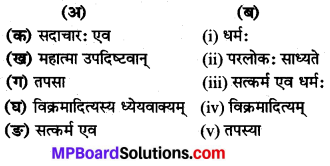
उचितं मेलयत(उचित को मिलाओ-)
Class 8 Sanskrit Chapter 18 Mp Board
उत्तर:
(क) → (v)
(ख) → (iv)
(ग) → (ii)
(घ) → (iii)
(ङ) → (i)

Mp Board Class 8 Sanskrit Solution Chapter 18 प्रश्न 5.
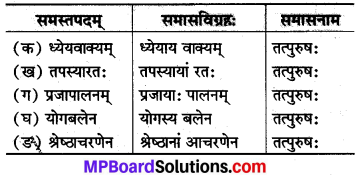
नामोल्लेखपूर्वकं समासविग्रहं कुरुत(नाम का उल्लेख करते हुए समास विग्रह करो-)
(क) ध्येयवाक्यम्
(ख) तपस्यारतः
(ग) प्रजापालनम्
(घ) योगबलेन
(ङ) श्रेष्ठाचरणेन।
उत्तर:
Mp Board Class 8 Sanskrit Chapter 18

Sanskrit Chapter 18 Class 8 Mp Board प्रश्न 6.
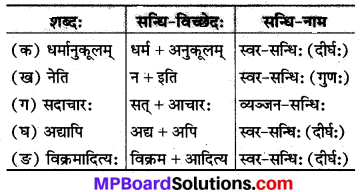
नामोल्लेखपूर्वकं सन्धिविच्छेदं कुरुत(नामे का उल्लेख करते हुए सन्धि विच्छेद करो-)
(क) धर्मानुकूलम्
(ख) नेति
(ग) सदाचारः
(घ) अद्यापि
(ङ) विक्रमादित्यः।
उत्तर:
Sanskrit Class 8 Chapter 18 Mp Board

Chapter 18 Sanskrit Class 8 Mp Board प्रश्न 7.
रेखाङ्कितशब्दानाम् आधारेण प्रश्ननिर्माणं कुरुत (रेखांकित शब्दों के आधार पर प्रश्न निर्माण करो-)
(क) विक्रमः अवदत्। (विक्रम बोला।)
उत्तर:
कः अवदत्? (कौन बोला?)

(ख) तपस्या तु महात्मनां कर्म इति। (तपस्या तो महात्माओं का काम है।)
उत्तर:
तपस्या तु केषाम् कर्म इति? (तपस्या तो किनका काम है?

(ग) तत्रैव यमलोकस्य दृश्यं दर्शितवान्। (वहीं यमलोक का दृश्य दिखाया?)
उत्तर:
कुत्र यमलोकस्य दृश्यं दर्शितवान्? (कहाँ यमलोक का दृश्य दिखाया?)

(घ) यमराजः दूतान् पृच्छति? (यमराज दूतों से पूछते हैं।)
उत्तर:
यमराजः कान् पृच्छति? (यमराज ने किनसे पूछा?)

(ङ) राज्ञः धर्म प्रजापालनम्। (राजा का धर्म प्रजा का पालन है।)
उत्तर:
कस्य धर्मः प्रजापालनम्? (किसका धर्म प्रजा का पालन है?)

सत्कर्म एव धर्मः हिन्दी अनुवाद

एकदा विक्रमादित्यः नगरभ्रमणसमये एकम् मरणासन्नं रुग्णं दृष्टवान्। तस्य दर्शनेन मनसि उद्भूतम्। अतः मायामोहमयं संसारं ज्ञात्वा सः महामन्त्रिणि राज्यभारं समर्प्य वनम् अगच्छत्।

Mp Board Class 8 Sanskrit Solution अनुवाद :
एक बार विक्रमादित्य ने नगर में भ्रमण के समय एक मरणासन्न (मरने के निकट) रोगी को देखा। उसको देखने से मन में वैराग्य उत्पन्न हुआ। इसलिए माया मोह से भरे संसार को जानकर वह महामन्त्री को राज्यभार सौंपकर वन चले गये।

वने सः कठिना तपस्याम् आरब्धवान्। तस्य समीपे एव एकः महात्मा अपि तपस्यारतः आसीत्। महात्मा तम् अवदत्, “राजन्! भवान् तु यथानीति राजधर्मस्य पालनं करोतु। धर्मानुकूलं शासनम् अपि धर्म एव भवति” इति स महात्मा विक्रमादित्यम् उपदिष्टवान्। विक्रमः अवदत्-“नहि महात्मन्! तपसा एव परलोकः साध्यते, कर्मणा नेति।” महात्मा अवदत्, “राजन! राज्ञः धर्मः प्रजापालनं, शासनम् एव अस्ति तपस्या तु महात्मानां कर्म इति।” इत्युक्त्वा महात्मा राजानाम् पृष्टवन्-कर्म-तपस्ययोः कः भेदः?

Samas Vigrah In Sanskrit Class 8 अनुवाद :
वन में उन्होंने कठिन तपस्या आरम्भ कर दी। उनके पास में एक महात्मा भी तपस्यारत (तपस्या में लगे) थे। महात्मा ने उनसे कहा, “हे राजन्! आप तो नीति के अनुसार राजधर्म का पालन करो। धर्म के अनुकूल शासन भी धर्म ही होता है।” इस प्रकार उस महात्मा ने विक्रमादित्य को उपदेश दिया। विक्रम ने कहा-“नहीं महात्मन्! तपस्या से ही परलोक प्राप्त होता है, कर्म से नहीं।” महात्मा ने कहा, “हे राजन्! राजा का धर्म प्रजा का पालन और शासन ही है, तपस्या तो महात्माओं का काम है।” ऐसा कहकर महात्मा ने राजा से पूछा-कर्म और तपस्या में क्या भेद है?

राजा अवदत्-कर्मणः स्थानम् भिन्नम् परं तपस्या स्वर्गप्राप्तेः साधनम्। एतच्छ्रुत्वा महात्मा हसन् अवदत्-“राजन् ! मनुष्यः उत्तमानि कर्माणि कृत्वा अपि परलोकं साधयितुम् शक्नोति।” अनन्तरम् महात्मा योगबलेन तत्रैव यमलोकस्य दृश्यं विक्रमं दर्शितवान्। दृश्ये यमराजः दूतान् पृच्छति-“एतस्य कर्म कीदृशम् ?” एकः दूतः अवदत्-“कर्मणां लेखनं तु चित्रगुप्तस्य पार्वे अस्ति।” क्षणं विचार्य यमराजः दूतान् आदिष्टवान् यत्-“यदि एतस्य कर्माणि उत्तमानि सन्ति तर्हि स्वर्गस्य द्वारम् उद्घाटयतु यदि कर्माणि अधमानि, तदा बलात् नरके पातयतु।”

संस्कृत कक्षा 8 Mp Board अनुवाद :
राजा ने कहा-कर्म का स्थान भिन्न है परन्तु तपस्या स्वर्ग प्राप्ति का साधन है। ऐसा सुनकर महात्मा हँसते हुए बोले-“हे राजन्! मनुष्य अच्छे कर्म करके भी परलोक सिद्ध कर सकता है।” इसके बाद महात्मा ने योग के बल से वहीं यमलोक का दृश्य विक्रम को दिखाया। दृश्य में यमराज दूतों से पूछ रहे हैं-“इसका कर्म कैसा है? एक दूत ने कहा-“कर्मों का लेखा तो चित्रगुप्त के पास है।” कुछ देर विचार करके यमराज ने दूतों को आदेश दिया कि-यदि इसके कर्म अच्छे हैं तो स्वर्ग का द्वार खोल दो यदि कर्म बुरे हैं तो जबरदस्ती नरक में डाल दो।”

इदं दृश्यं दृष्ट्वा विक्रमः ज्ञातवान् यद्-‘सदाचारः एव तपस्या, सत्कर्म एव धर्म’ इति। अनन्तरं सः तम् महात्मानम् प्रणम्य, श्रेष्ठाचरणस्य प्रतिज्ञां कृत्वा राजधानीम् उज्जयिनीम् आगतवान्। आगत्य धर्मानुकूलंनीतिपूर्वकम् प्रजापालनपुरस्सरं शासनं कृतवान्। सः अद्यापि लोके सत्कर्मणा एव प्रसिद्धः। तस्य जीवनस्य ध्येयवाक्यम् आसीत्-‘सत्कर्म एव धर्मः।’

8 वीं कक्षा संस्कृत गाइड 2021 Mp Board अनुवाद :
इस दृश्य को देखकर विक्रम जान गये कि-“सदाचार (अच्छा व्यवहार) ही तपस्या है और सत्कर्म (अच्छे कर्म) ही धर्म।” इसके बाद वह उन महात्मा को प्रणाम करके, श्रेष्ठ आचरण की प्रतिज्ञा करके राजधानी उज्जयिनी आ गये। आकर धर्म के अनुसार नीतिपूर्वक प्रजा पालन को प्रमुखता देते हुए शासन किया। वह आज भी संसार में अच्छे कर्म से ही प्रसिद्ध हैं। उनके जीवन का ध्येय वाक्य था-‘सत्कर्म ही धर्म है।’

सत्कर्म एव धर्मः शब्दार्थाः

बलात् = बलपूर्वक। साधयितुम् = सिद्ध करने लिए। पार्वे = पास में। प्रजापालनपुरस्सरम् = प्रजापालन को प्रमुखता देते हुए। मरणासन्न = मरने के निकट। उद्भूतम् = उत्पन्न हुआ। पातयतु = गिराओ। एतच्छ्रुत्वा = ऐसा सुनकर।

MP Board Class 8th Sanskrit Solutions

MP Board Class 8th Special English Solutions Chapter 8 English is Amazing

Guys who are planning to learn the fundamentals of English can avail the handy study material using MP Board Solutions for Class 8 English Chapter 8 English is Amazing Questions and Answers. You Can Download MP Board Class 8 English Solutions Questions and Answers, Notes, Summary, Guide, Pdf. Refer to the Madhya Pradesh State Board Solutions for English PDF available and score better grades. Simply click on the quick links available for MP Board Solutions for Class 8 English Chapter 8 English is Amazing Questions and Answers and prepare all the concepts in it effectively. Take your preparation to the next level by availing the Madhya Pradesh State Board Solutions for Class 8 English prepared by subject experts.

MP Board Class 8th Special English Solutions Chapter 8 English is Amazing (Poem)

Do you feel the concept of English is difficult to understand? Not anymore with our MP Board Solutions for Class 8 English Chapter 8 English is Amazing Questions and Answers. All the Solutions are given to you with detailed explanation and you can enhance your subject knowledge. Use the Madhya Pradesh State Board Solutions for Class 8 English PDF for free of cost and prepare whenever you want.

English is Amazing Textual Exercise

Word Power

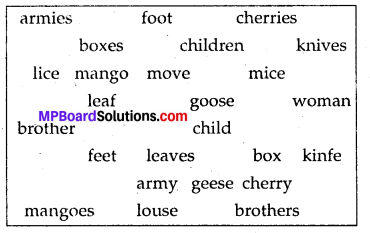
(A) Read the words given in the box :
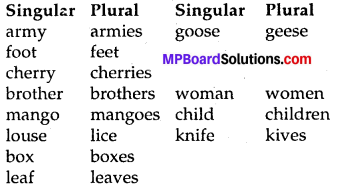
English Is Amazing Summary MP Board Chapter 8

Now classify them in the following table :

Mp Board Class 8 English Chapter 8

(B) Complete the following sentences by choosing the right word from the words given in the brackets :

  1. A knife is ………………. (difficult, dangerous).
  2. It was raining heavily ………………. (because, so) we did not go for the picnic.
  3. An iron ball will ………………. (sink,float) into the water.
  4. People did not have computer in ………………… (old, ancient) times.
  5. The girl had a blue belt around her ………………. (waste/waist)

Answer:

  1. dangerous
  2. so
  3. sink
  4. ancient
  5. waist

Comprehension

(A) Choose the correct answer :

Summary Of English Is Amazing Class 8 MP Board Question 1.
The poem speaks about
(a) geese and cows
(b) why English spelling is so difficult to learn.
(c) a child reading a book.
(d) a box.
Answer:
(b) why English spelling is so difficult to learn.

Mp Board Class 8 English Chapter 8 Question 2.
The poet is complaining
(a) that making plurals in English is very easy.
(b) that there are feminine pro nouns.
(c) that English is a tricky language.
(d) that making plurals in English is difficult.
Answer:
(c) that English is a trickey language.

English Is Amazing Summary MP Board Chapter 8 Question 3.
Which two difficult areas of English are discussed in the poem?
(a) nouns and adjectives
(b) clauses and prepositions
(c) nouns and pronouns
(d) verbs and adverbs.
Answer:
(c) nouns and pronouns

English Is The Trickiest Language True Or False Question 4.
The feminine pronouns are :
(a) he, his and him.
(b) she, shis and shim.
(c) she, her and hers.
(d) he, she and it.
Answer:
(c) she, her and hers.

(B) Read the poem and mark the following statements as true or false :

  1. The plural of cow may also be kine.
  2. English is called an easy language.
  3. Making plurals in English is easy.
  4. The singular form of feet is foot.
  5. English is the trickiest language.

Answers:

  1. true
  2. false
  3. false
  4. false
  5. true

Let’s Read

Read the following passage :

The mother tongue is the first language that the child learns and picks up from the people around him. A foreign language is a language that one uses for a limited purpose. The mother tongue comes in a natural way, whereas a foreign language is learned so that one may be able to write and speak it. A language is learned with its structure, grammar and vocabulary. The mother tongue may have a different sentence structure. Often the method of translation is adopted for easy understanding of a foreign language. This is the main fault area of learning a foreign language. This may not be the right approach. So instead of learning a foreign language through translation one should know the way it really goes. The exposure to a language is the most important factor in learning.

Now answer the following questions :

Summary Of Poem English Is Amazing Class 8 Question 1.
Which is the first language that a child learns?
Answer:
The mother tongue is the first language that a child learns.

Class 8 English Chapter 8 English Is Amazing Question 2.
What is the purpose of a foreign language?
Answer:
A foreign language is used for a limited purpose. It is learned so that one may be able to write and speak it.

English Is Amazing Summary Class 8 MP Board Question 3.
How is the language learned?
Answer:
The language is learned with its structure, grammar and vocabulary.

English Is Amazing Poem MP Board Question 4.
Which method is ofter adopted to learn a foreign language?
Answer:
The method of translation is adopted for easy understanding of a foreign language.

Mp Board Solution Class 8 English Question 5.
Which is the most important factor in learning a language?
Answer:
The exposure to a language is the most important factor in learning.

Let’s Write

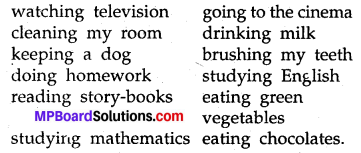
(A) Here is a list of the likes and dislikes. Choose the five things you like and five things you dislike.
Summary Of English Is Amazing Class 8 MP Board
Answer:
I am Mona. I study in class VIII. I like cleaning my room, doing homework, reading story books, brushing my teeth and eating green vegetables, but the things I dislike watching television, going to cinema, studying mathematics, going to cinema and eating chocolates.

English is Amazing Word Meanings

Page-72: fowl – a bird that is kept for its meat and eggs – बाज। Moose – an ell (a large deer) of North America – उत्तर अमेरिका का एक बड़ा हिरण। Vow – make a serious promise- शपथ लेना। Lone – alone, without any other people or things – अकेला। Trickiest – difficult to do or deal with – क्लिष्ट।

We wish the knowledge shared regarding MP Board Solutions for Class 8 English Chapter 8 English is Amazing Questions and Answers has been helpful to you. If you need any further help feel free to ask us and we will get back to you with the possible solution. Bookmark our site to avail the latest updates on different state boards solutions in split seconds.

MP Board Class 7th General English Chapter 1 The Rainbow

Get Updated MP Board Solutions for Class 7 General English Chapter 1 The Rainbow Questions and Answers in PDF Format and download them free of cost. These are provided as per the latest exam pattern and syllabus. Access the topics of Chapter wise and communication skills, grammer part through the direct links available depending on the need. You can Download MP Board Class 7 English Solutions and can score highest grade in examination. Clear all your queries on the Mp Board Solutions for Class 7 English Chapter 21 Tansen Questions and Answers Subject by using the Madhya Pradesh State Board Solutions for existing.

MP Board Class 7th General English Solutions Chapter 1 The Rainbow

If you are eager to know about the Madhya Pradesh State Board Solutions for Class 7 English you will find all of them here. You can identify the knowledge gap using these MP Board Solutions for English PDF and plan accordingly. Don’t worry about the accuracy as they are given after extensive research by people having subject knowledge along side from the latest English Syllabus.

The Rainbow Textual Exercise

Listen and Repeat (सुनो और दुहराओ)

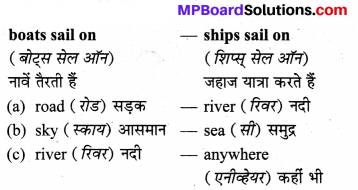
(A) You have read the poem. Find out which lines end with similar sounds.
(तुमने कविता पढ़ ली है। उन पंक्तियों को ढूढ़ों जो समान स्वर से समाप्त हुईं हैं।)
Answer:
Seas – These
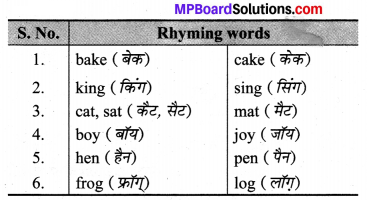
Please – Trees – these

(B) Listen to the sentences given below carefully and then choose the words that rhyme and write them in the table given.
(नीचे लिखे वाक्यों को ध्यानपूर्वक सुनो और तब समान तुक (ध्वनि) वाले शब्दों को दी गई सारिणी में लिखो।)

  1. I like to bake a birthday cake.
  2. Once a king learnt how to sing.
  3. A cat sat on a mat.
  4. The little boy danced with joy.
  5. A hen wrote with a pen.
  6. The frog sat on a log.

Answer:
कक्षा 7 की इंग्लिश की किताब MP Board

Comprehension (बोध प्रश्न)

Choose the correct option (सही विकल्प चुनो।) :

The Rainbow Class 7 MP Board Question 1.
What do you think the poem is about ?
(व्हॉट डू यू थिंक द पोऍम इज़ अबाउट?)
कविता किसके बारे में है, तुम क्या सोचते हो?
The poem is about –
(द पोऍम् इज़ अबाउट)
कविता बारे में है –
(a) clouds (क्लाउड्स) बादल
(b) bridges (ब्रिजिज़) पुल
(c) rainbow (रेनबो) इन्द्रधनुष
Answer:
(d) rainbow (रेनबो) इन्द्रधनुष।

Mp Board Class 7th English Chapter 1 Question 2.
Where do boats and ships sail ?
(व्हेयर डू बोट्स एण्ड शिप्स सेल् ?)
नावें व जहाज कहाँ तैरते हैं ?
The Rainbow Poem In Hindi MP Board
Answer:
(c) Boats sail on river.
(बोट्स सेल ऑन रिवर।)
नावें नदी में तैरती हैं।
(b) Ships sail on sea.
(शिप्स सेल ऑन सी।)
जहाज समुद्र में यात्रा करते हैं।

Class 7 English Chapter 1 The Rainbow MP Board Question 3.
The rainbow makes a bridge
(द रेनबो मेक्स् अ ब्रिज)
इन्द्रधनुष पुल बनाता है –
(a) Over trains
(ओवर ट्रेन्स्) रेलगाड़ियों पर।
(b) From the earth to the sky
(फ्रॉम द अर्थ टू द स्काय) पृथ्वी से आसमान तक।
(c) Over tall buildings
(ओवर टॉल बिल्डिंग्स) ऊँची इमारतों के ऊपर।
Answer:
(b) From the earth to the sky.
(फ्राम् दॉ अर्थ टू द स्काय) पृथ्वी से आसमान तक।

Lesson 1 The Rainbow MP Board Question 4.
The prettiest bridge is –
(द प्रिटिऐस्ट् ब्रिज इज़) –
सबसे सुन्दर पुल है –
(a) made by clouds.
(मेड बाइ क्लाउड्स)
बादलों द्वारा बनाया गया।
(b) made by a rainbow.
(मेड बाइ अ रेनबो)
इन्द्रधनुष द्वारा बनाया गया
(c) made over rivers.
(मेड ओवर रिवर्स)
नदियों पर बना हुआ।
Answer:
(b) Made by a rainbow.
(मेड बाइ अ रेनबो)
इन्द्रधनुष द्वारा बनाया गया।

(v) The rainbow is the
(द रेनबो इज़ द) –
इन्द्रधनुष है –
(a) Prettier (प्रिटिअ) काफी सुन्दर
(b) pretty (प्रिटि) सुन्दर
(c) prettiest (प्रिटिऐस्ट्) सबसे सुन्दर
Answer:
(b) prettiest (प्रिटिऐस्ट्) सबसे सुन्दर।

Word Power (शब्द सामर्थ्य)

(A) Pick the odd word out and encircle it :
(भिन्न शब्द को छाँटो और इसके चारों ओर गोला करें।)
Answer:
Mp Board Class 7th English

(B) Use the following words appropriately in the sentences given below :
(नीचे दिये शब्दों का उचित प्रयोग नीचे दिये गये वाक्यों में करे)
(pretty, pleases, rainbow, clouds, sail)

  1. Ships ……………… on seas
  2. I saw a ……………… in the sky yesterday.
  3. ……………… are often seen in the sky in the rainy season.
  4. Namrata is a ……………… girl.
  5. Natural beauty always ……………… me.

Answer:

  1. sail
  2. rainbow
  3. Clouds
  4. pretty
  5. pleases

कक्षा 7 की अंग्रेजी की किताब MP Board 4.
Grammar in Use (व्याकरण का प्रयोग ) :
Make sentences using the adjectives given below :
(नीचे दिये विशेषणों से वाक्य बनाओ।)
Example – Shubhra is pretty. Her sister is prettier than her.

  1. great – greater
  2. wise – wiser
  3. bright – brighter
  4. fresh – fresher
  5. high – higher

Answer:

  1. Jawaharlal Nehru was great. Mahatma Gandhi was greater than him.
  2. Ram is wise. His brother is wiser than him.
  3. This lamp is bright. That lamp is brighter than this.
  4. This bread is fresh. That bread is fresher than this one.
  5. These mountains are high. Mt. Everest is higher than these.

Let’s Talk (आवो बात करें)

कक्षा 7 इंग्लिश MP Board Chapter 1 (A)
Ask your friends the following questions and find answers. In which season is a rainbow often seen in the sky ? How many colours are there in a rainbow ?
(अपने मित्र से निम्न प्रश्न पूछे तथा उनके उत्तर खोजें। किस ऋतु में इन्द्रधनुष आकाश में अक्सर दिखाई देता है? इन्द्रधनुष में कितने रंग होते हैं ?)
Answer:
You will get the answers as, the rainbow is often seen in the rainy season in the sky. There are seven colours in a rainbow.

(B) Work in pairs or groups of four and match the two columns :
(चार के जोड़े या समूह में कार्य करें और दोनों कॉलमों का मिलान करें)
7th Class English Book Rainbow MP Board
Answer:

  1. → (b)
  2. → (C)
  3. → (e)
  4. → (a)
  5. → (d)

Let’s Write (आओ लिखें)

Write a paragraph on ‘rainbow’ using the words given below :
(नीचे दिये गये शब्दों का प्रयोग करते हुए इन्द्रधनुष पर एक अनुच्छेद लिखें।)
(rainbow, sky, rainy season, clouds, beautiful, pretty, colours, violet, indigo, blue.)
Answer:
A rainbow is seen in the sky in rainy season. Clouds that sail across the sky are pretty but rainbow is even prettier than these. It consists of seven beautiful colours like violet, indigo, blue, green, yellow, orange and red.

Let’s Do It (आओ इसे करें)

Draw a picture of a rainbow and colour it. Also write the names of the colours you have used.
(इन्द्रधनुष का एक चित्र बनाएँ और रंग भरें। रंगों के नाम भी लिखें जो तुमने प्रयोग किये हैं।)
Answer:
Students should themselves draw a picture of rainbow and colour it.
(विद्यार्थी स्वयं इन्द्रधनुष का चित्र बनाएँ और इसमें रंग भरें।)

Names of the colours :

  1. Violet
  2. Indigo
  3. Blue
  4. Green
  5. Yellow
  6. Orange
  7. Red

Pronunciation & Translation

Boats sail on the rivers,
And ships sail on the seas;
But clouds that sail across the sky
Are prettier far than these.

(बोट्स सेल ऑन द रिवर्स,
एण्ड शिप्स सेल ऑन द सीज;
बट क्लाउड्स दैट सेल अक्रॉस द स्काई
आर प्रिटिअ फार दैन दीज)

अनुवाद – नावें नदी पर तैरती हैं,
और जहाज समुद्र पर तैरते हैं;
परन्तु बादल जो आकाश में तैरते हैं,
वे उनसे कहीं अधिक सुन्दर हैं।

There are bridges on the rivers,
As pretty as you please,
But the bow that bridges heaven,
And overtops the trees,
And builds a road from earth to sky,
Is prettier far than these.
…. Christina Georgina Rossetti

(देयर आर ब्रिजेज ऑन द रिवर्स,
एज प्रिटि एज यू प्लीज,
बट द बो दैट ब्रिजिज़ हेवन
एण्ड ओवरटॉप्स द ट्रीज,
एण्ड बिल्ड्स अ रोड फ्रॉम अर्थ टू स्काई,
इज प्रिटिअ फार दैन दीज.)
क्राइस्टिना जॉर्जीना रोसेटी

अनुवाद – “नदियों पर पुल होते हैं;
इतने सुन्दर जो तुम्हें अच्छे लगते हैं,
लेकिन इन्द्रधनुष जो आकाश पर पुल बनाता है,
और पेड़ों के ऊपर से जाता है,
और पृथ्वी से आसमान तक एक रास्ता बनाता है,
इनसे कहीं अधिक सुन्दर हैं।

The Rainbow Word Meanings

Boats (बोट्स)-नावें; Sail (सेल्)-जल पर यात्रा करना; Rivers (रिवर्स)-नदियाँ; Seas (सीज़)- समुद्र; Clouds (क्लाउड्स)-बादल; Across (एक्रॉस)-आर-पार; Bridges (ब्रिजिज़) पुल; Heaven (हैव्न्)-स्वर्ग; Overtops (ओवरटॉप्स्)-शिखर के ऊपर चढ़ जाना; Earth (अर्थ)-पृथ्वी; Pretty (प्रिटि)-सुन्दर; Please (प्लीज) -खुश होना; Bow (बो)-कमान (धनुष); Trees (ट्रीज़)-पेड़; Builds (बिल्ड्स् )-निर्माण करना; Road (रोड)-रास्ता।

We believe the information shared regarding MP Board Solutions for Class 7 English Chapter 21 Tansen Questions and Answers as far as our knowledge is concerned is true and reliable. In case of any queries or suggestions do leave us your feedback and our team will guide you at soonest possibility. Bookmark our site to avail latest updates on several state board Solutions at your fingertips.

MP Board Class 12th Economics Important Questions Unit 2 उपभोक्ता व्यवहार एवं माँग

MP Board Class 12th Economics Important Questions Unit 2 उपभोक्ता व्यवहार एवं माँग

उपभोक्ता व्यवहार एवं माँग Important Questions

उपभोक्ता व्यवहार एवं माँग वस्तुनिष्ठ प्रश्न

प्रश्न 1.
सही विकल्प चुनकर लिखिए –

प्रश्न (a)
उपभोक्ता का संतुलन होता है –
(a) MUx = Px
(b) MUx > Px
(c) MUx < Px
(d) MUx ÷ Px
उत्तर:
(a) MUx = Px

प्रश्न (b)
मार्शल ने सम – सीमांत उपयोगिता नियम का कथन दिया है –
(a) वस्तु के संबंध में
(b) मुद्रा के संबंध में
(c) उपर्युक्त दोनों के संबंध में
(d) उपर्युक्त में से कोई नहीं।
उत्तर:
(a) वस्तु के संबंध में

प्रश्न (c)
बजट रेखा को कितने अनधिमान वक्र स्पर्श करते हुए हो सकते हैं –
(a) एक
(b) दो
(c) अनेक
(d) तटस्थता मानचित्र के आधार पर निर्भर करता है।
उत्तर:
(a) एक

प्रश्न (d)
तटस्थता वक्रों का प्रयोग सर्वप्रथम 1881 में किया गया था –
(a) एजवर्थ द्वारा
(b) पेरिटो द्वारा
(c) मेयर्स द्वारा
(d) हिक्स द्वारा।
उत्तर:
(a) एजवर्थ द्वारा

प्रश्न (e)
एक वस्तु की माँग के बारे में कोई भी वक्तव्य पूर्ण माना जाता है, जब उसमें निम्नलिखित का जिक्र हो –
(a) वस्तु की कीमत
(b) वस्तु की माँग
(c) समय अवधि
(d) उपर्युक्त सभी।
उत्तर:
(d) उपर्युक्त सभी।

प्रश्न (f)
यदि वस्तु की कीमत गिरने से, वस्तु की माँग बढ़ती है, तो दोनों वस्तुएँ परस्पर हैं –
(a) प्रतिस्थापी
(b) पूरक
(c) संबंधित नहीं
(d) प्रतियोगी।
उत्तर:
(b) पूरक

प्रश्न (g)
व्यय विधि द्वारा एक वस्तु की माँग को बेलोच उस स्थिति में कहा जाता है, जब यदि –
(a) वस्तु की कीमत गिरती है तो इस पर व्यय बढ़ता है
(b) वस्तु की कीमत गिरती है तो इस पर व्यय घटता है
(c) वस्तु की कीमत गिरती है तो इस पर व्यय वही रहता है
(d) वस्तु की कीमत बढ़ती है तो इस पर व्यय घटता है।
उत्तर:
(b) वस्तु की कीमत गिरती है तो इस पर व्यय घटता है

प्रश्न 2.
रिक्त स्थानों की पूर्ति कीजिए –

  1. उपभोक्ता एक …………………… व्यक्ति होता है।
  2. यदि प्रतिस्थापन वस्तु की कीमत में वृद्धि होता है, तो वस्तु की माँग वक्र …………………… खिसक जाता है।
  3. उपयोगिता ह्रास नियम का प्रतिपादन ……………………. ने किया था।
  4. मार्शल के अनुसार उपयोगिता को ……………………. रूपी पैमाने से मापा जा सकता है।
  5. तटस्थता वक्र पर उपभोक्ता को ……………………….. संतुष्टि की प्राप्ति होती है।
  6. कार तथा पेट्रोल …………………………… वस्तुएँ हैं।
  7. मूल्य व माँग में …………………………… संबंध होता है।
  8. उपभोक्ता संतुलन वह स्थिति होती है जिसमें उपभोक्ता ……………………………. संतुष्टि प्राप्त करता है।

उत्तर:

  1. विवेकशील
  2. दायीं ओर
  3. गोसेन
  4. मुद्रा
  5. समान
  6. पूरक
  7. विपरीत
  8. अधिकतम।

प्रश्न 3.
सत्य/असत्य का चयन कीजिए –

  1. उपयोगिता एक आत्मनिष्ठ धारणा है।
  2. दो वस्तुओं की कीमत का अनुपात बजट रेखा के ढाल को मापता है।
  3. माँग वक्र सामान्यतः धनात्मक ढाल वाला होता है।
  4. बजट समुच्चय उन सभी बंडलों का संग्रह है, जिन्हें एक उपभोक्ता अपनी आय से बाजार कीमत पर क्रय करती है।
  5. वस्तु के माँग की लोच एवं वस्तु पर होने वाले व्यय में घनिष्ठ संबंध होता है।

उत्तर:

  1. सत्य
  2. सत्य
  3. असत्य
  4. सत्य
  5. सत्य।

प्रश्न 4.
सही जोड़ी बनाइए –
MP Board Class 12th Economics Important Questions Unit 2 उपभोक्ता व्यवहार एवं माँग img 1
उत्तर:

  1. (b)
  2. (d)
  3. (a)
  4. (e)
  5. (c).

प्रश्न 5.
एक शब्द/वाक्य में उत्तर दीजिए –

  1. कौन – सा वक्र उद्गम की ओर उन्नतोदर होता है?
  2. किस स्तर के बाद सीमान्त उपयोगिता तथा कुल उपयोगिता घटने लगती है?
  3. उपभोक्ता को प्राप्त होने वाली उपयोगिता के अधिकतमीकरण का बिन्दु क्या कहलाता है?
  4. विलासिता की वस्तुओं की माँग की लोच किस प्रकार की होती है?
  5. उत्पादन के साधनों की माँग किस प्रकार की होती है?

उत्तर:

  1. तटस्थता वक्र
  2. शून्य स्तर पर
  3. उपभोक्ता संतुलन
  4. अत्यधिक लोचदार
  5. व्युत्पन्न माँग।

उपभोक्ता व्यवहार एवं माँग अति लघु उत्तरीय प्रश्न

प्रश्न 1.
माँग का नियम क्या है?
उत्तर:
माँग के नियम का अर्थ:
माँग का नियम यह बतलाता है कि मूल्य और वस्तु की माँगी गयी मात्रा में विपरीत संबंध होता है दूसरे शब्दों में वस्तु की कीमत में वृद्धि होने पर माँग घट जाती है तथा वस्तु की कीमत में कमी आने पर माँग बढ़ जाती है।

प्रश्न 2.
पूरक वस्तुएँ क्या हैं?
उत्तर:
पूरक वस्तुएँ वे वस्तुएँ हैं जिनका उपयोग एक साथ किया जाता है, जैसे – डबलरोटी व मक्खन, कार व पेट्रोल, पेन व स्याही इत्यादि। अगर इनमें से किसी भी एक वस्तु की कीमत में वृद्धि हो जाती है तो इसके फलस्वरूप दूसरी वस्तु की माँग घट जाएगी।

प्रश्न 3.
माँग की लोच क्या है?
उत्तर:
माँग की लोच का अर्थ – माँग की लोच मूल्य एवं माँगी गयी मात्रा के बीच पारस्परिक संबंध की मात्रा को बताती है। माँग की लोच वह दर है जो मूल्य में परिवर्तन के साथ वस्तु की माँगी जाने वाली मात्रा में परिवर्तन को बताती है।

प्रश्न 4.
अधिक लोचदार माँग से क्या आशय है?
उत्तर:
जब किसी वस्तु की माँगी गयी मात्रा में परिवर्तन, उसके मूल्य में परिवर्तन की तुलना में अधिक अनुपात में होता है, तो उस वस्तु की माँग की लोच अधिक लोचदार होती है।

प्रश्न 5.
पूर्णतया बेलोचदार माँग किसे कहते हैं?
उत्तर:
जब किसी वस्तु के मूल्य में बहुत अधिक परिवर्तन होने पर भी उसकी माँग में कोई परिवर्तन नहीं होता तो उसे पूर्णतया बेलोचदार माँग (Ep = 0) कहते हैं।

प्रश्न 6.
माँग और आवश्यकता में अन्तर स्पष्ट कीजिए।(कोई दो)?
उत्तर:
माँग और आवश्यकता में अन्तर –
MP Board Class 12th Economics Important Questions Unit 2 उपभोक्ता व्यवहार एवं माँग img 2

प्रश्न 7.
मांग की कीमत लोच किसे कहते हैं?
उत्तर:
माँग की कीमत लोच, किसी वस्तु के मूल्य में परिवर्तन के कारण उसकी माँगी गयी मात्रा में परिवर्तन की दर बताती है।
MP Board Class 12th Economics Important Questions Unit 2 उपभोक्ता व्यवहार एवं माँग img a

प्रश्न 8.
स्थानापन्न वस्तुएँ क्या हैं?
उत्तर:
यह वह वस्तुएँ हैं जिनका प्रयोग एक – दूसरे के बदले में किया जाता है। उदाहरण के लिए चाय और कॉफी, कॉमप्लान और बोर्नविटा एक – दूसरे के स्थानापन्न वस्तुएँ हैं । एक वस्तु के मूल्य में वृद्धि होने से दूसरी वस्तु सस्ती हो जाती है। इससे दूसरी वस्तु की माँग बढ़ जाती है।

प्रश्न 9.
उपभोक्ता संतुलन से आप क्या समझते हैं?
उत्तर:
जब उपभोक्ता को अपनी आय से अधिकतम संतुष्टि प्राप्त हो रही हो तो संतुलन से आशय उपभोक्ता को आय की तुलना में प्राप्त अधिकतम संतुष्टि से है। जिस बिन्दु पर कीमत रेखा तटस्थता वक्त को स्पर्श करती है वही बिन्दु संतुलन बिन्दु कहलाता है।

प्रश्न 10.
आय स्तर बढ़ने तथा घटने से माँग की लोच पर क्या प्रभाव पड़ता है?
उत्तर:
आय का स्तर बढ़ने से माँग बढ़ जाती है तथा आय का स्तर घटने से माँग में कमी आ जाती है।

प्रश्न 11.
उपभोक्ता बजट समूह (सेट) से आप क्या समझते हैं?
उत्तर:
उपभोक्ता द्वारा अपनी आय से प्रचलित बाजार मूल्य पर दो वस्तुओं के उन सभी बंडलों को क्रय करने की क्षमता ही बजट (सेट) समूह कहलाता है। इस प्रकार बजट सेट उन सभी बंडलों का समूह होता है जिन्हें वर्तमान बाजार कीमतों पर कोई उपभोक्ता खरीद सकता है।

प्रश्न 12.
बजट रेखा किसे कहते हैं?
उत्तर:
बजट रेखा का आशय उस रेखा से है जिस पर उपभोक्ता अपनी संपूर्ण आय को सभी बंडलों पर व्यय कर देता है। संक्षेप में यह रेखा उन सभी बंडलों का प्रतिनिधित्व करती है जिन पर उपभोक्ता की संपूर्ण आय, व्यय हो जाती है। इसके अंतर्गत वे सभी बंडल आते हैं जिनकी कीमत उपभोक्ता की आय के ठीक बराबर होती है।

प्रश्न 13.
उदासीनता वक्र क्या है?
उत्तर:
उदासीनता अथवा तटस्थता अथवा अनधिमान वक्र वह है जिसके विभिन्न बिन्दु दो वस्तुओं के ऐसे संयोगों को दर्शाते हैं, जो उपभोक्ता को समान संतुष्टि प्रदान करते हैं।

प्रश्न 14.
बाजार माँग वक्र किसे कहते हैं?
उत्तर:
बाजार माँग वक्र बाजार में सभी उपभोक्ताओं की माँग को वस्तु की कीमत के विभिन्न स्तरों पर समग्र दृष्टि से देखकर माँग को प्रदर्शित करता है।

प्रश्न 15.
शून्य माँग की लोच से आप क्या समझते हैं?
उत्तर:
जब कीमत में परिवर्तन होने पर माँग में कोई परिवर्तन नहीं होता है, तो उसे शून्य माँग की लोच अथवा पूर्णतया बेलोचदार माँग कहते हैं।

प्रश्न 16.
बाजार माँग वक्र किसे कहते हैं?
उत्तर:
बाजार माँग वक्र अन्य बातें समान रहने पर विभिन्न कीमतों पर उपभोक्ता द्वारा एक वस्तु की खरीदी गई मात्रा को दर्शाता है।

प्रश्न 17.
गिफिन वस्तुएँ क्या होती हैं? अथवा अर्थशास्त्र में घटिया वस्तु का क्या अर्थ है?
उत्तर:
घटिया वस्तु वह वस्तु होती है जिनकी माँग उपभोक्ता की आय बढ़ने से घट जाती है तथा आय में कमी आने पर इन वस्तुओं की माँग बढ़ जाती है, जैसे गुड़ व मोटा वस्त्र आदि।

प्रश्न 18.
कीमत प्रभाव किसे कहते हैं?
उत्तर:
वस्तुओं की कीमतों में परिवर्तन के फलस्वरूप क्रयशक्ति में परिवर्तन के कारण वस्तुओं की इष्टतम मात्रा में जो परिवर्तन होता है, उसे कीमत प्रभाव कहते हैं।

प्रश्न 19.
“एकदिष्ट अधिमान’ से आप क्या समझते हैं?
उत्तर:
एकदिष्ट अधिमान – उपभोक्ता किन्हीं दो बंडलों में से उस बंडल को अधिमान देता है, जिसमें इन वस्तुओं में से कम – से – कम एक वस्तु की अधिक मात्रा हो और दूसरे बंडल की तुलना में दूसरी वस्तु की भी कम मात्रा न हो, अधिमानों के इस प्रकार को एकदिष्ट अधिमान कहा जाता है।

प्रश्न 20.
सामान्य वस्तु से आप क्या समझते हैं?
उत्तर:
वे वस्तुएँ सामान्य वस्तुएँ कहलाती हैं जिनकी माँग उपभोक्ता की आय बढ़ने पर बढ़ती है तथा आय घटने पर कम हो जाती है।

प्रश्न 21.
पूरकों को परिभाषित कीजिए। ऐसी दो वस्तुओं के उदाहरण दीजिए, जो एक – दूसरे के पूरक हैं?
उत्तर:
पूरक वस्तुएँ – ऐसी वस्तुएँ जिनका उपयोग एक – दूसरे के साथ पूरक के रूप में किया जाता है। दूसरे शब्दों में, वे वस्तुएँ जिनका उपयोग एक साथ किया जाता है एवं एक – दूसरे के अभाव में जिनका उपभोग नहीं किया जा सकता पूरक वस्तुएँ कहलाती हैं।
उदाहरण:

  1. कार व पेट्रोल
  2. पेन व स्याही।

प्रश्न 22.
माँग वक्र D(p) = 10 – 3p को लीजिए। कीमत \(\frac{5}{3}\) पर लोच क्या है?
उत्तर:
q = a – bp
दिया हुआ समीकरण q = 10 – 3p
यहाँ a = 10, b = 3, p = \(\frac{5}{3}\) है।
अतः
eD = \(\frac{ – bp}{a – bp}\)
= – (3 x \(\frac{5}{3}\)) ÷ (10 – 3 x \(\frac{5}{3}\))
= – (5) ÷ (10 – 5) = -5 ÷ 5 = -1
अत:
कीमत लोच (eD) = – 1 है।

प्रश्न 23.
माँग के नियम तथा माँग की लोच में अन्तर लिखिए? (कोई दो)?
उत्तर:
माँग के नियम और माँग की लोच में अन्तर –
MP Board Class 12th Economics Important Questions Unit 2 उपभोक्ता व्यवहार एवं माँग img 3

प्रश्न 24.
आय माँग का क्या आशय है?
उत्तर:
आय माँग से तात्पर्य, वस्तुओं एवं सेवाओं के उन विभिन्न मात्राओं से है जो अन्य बातें समान होने पर उपभोक्ता एक निश्चित समय में आय के विभिन्न स्तरों पर खरीदने को तैयार रहता है, अर्थात् आय बढ़ने से माँग बढ़ती है तथा आय घटने से माँग घटती है।

प्रश्न 25.
माँग की आय लोच की परिभाषा दीजिये?
उत्तर:
माँग की आय लोच, उपभोक्ता की आय में थोड़े से परिवर्तन के फलस्वरूप वस्तु की माँगी गई मात्रा में परिवर्तन के अंश को बताती है। वाटसन के शब्दों में – “माँग की आय लोच, आय के प्रतिशत परिवर्तन से माँगी गई मात्रा के प्रतिशत का अनुपात है।”

प्रश्न 26.
माँग की आड़ी लोच से आपका क्या आशय है?
उत्तर:
वस्तु की माँग में अन्य संबंधित वस्तुओं के मूल्यों में होने वाले परिवर्तनों का प्रभाव पड़ता है। उदा. के लिये चाय की कीमत में होने वाले परिवर्तनों का कॉफी की माँग पर प्रभाव पड़ता है। अतः “माँग की आड़ी लोच एक वस्तु के मूल्य में परिवर्तन के फलस्वरूप दूसरी वस्तु की माँगी गई मात्रा में परिवर्तन की दर को बताती है।” स्थानापन्न वस्तुओं की माँग की आड़ी लोच धनात्मक होती तो पूरक वस्तुओं की माँग की आड़ी लोच ऋणात्मक होती है।

उपभोक्ता व्यवहार एवं माँग लघु उत्तरीय प्रश्न

प्रश्न 1.
उपयोगिता का क्या अर्थ है? परिभाषा द्वारा समझाइए?
उत्तर:
दैनिक जीवन में हम विभिन्न वस्तु का उपयोग करते हैं और जिससे हमारी आवश्यकता की पूर्ति होती है या हमें सन्तुष्टि मिलती है। अर्थशास्त्र की भाषा में किसी वस्तु के जिस गुण से मानवीय आवश्यकताओं की सन्तुष्टि होती है उसे उपयोगिता कहते हैं। प्रो. बाघ के अनुसार – मानवीय आवश्यकताओं को सन्तुष्ट करने की क्षमता ही उपयोगिता है।”

प्रश्न 2.
उपयोगिता की विशेषताओं का वर्णन कीजिए?
उत्तर:
उपयोगिता की प्रमुख विशेषताएँ निम्नलिखित हैं –

1. उपयोगिता व्यक्तिगत होती है:
उपयोगिता व्यक्ति से सम्बन्धित होती है। एक वस्तु, एक व्यक्ति के लिए उपयोगी हो सकती है, दूसरे के लिए नहीं। इसके अतिरिक्त एक ही वस्तु की उपयोगिता भिन्न – भिन्न व्यक्तियों के लिए भिन्न – भिन्न हो सकती है।

2. उपयोगिता मनोवैज्ञानिक धारणा है:
उपयोगिता को भावनात्मक रूप से अनुभव किया जा सकता है। इसका कोई भौतिक रूप नहीं होता है। यह मनुष्य की मानसिक संरचना पर निर्भर करती है।

3. उपयोगिता आवश्यकता की तीव्रता पर निर्भर करती है:
उपयोगिता आवश्यकता की तीव्रता पर निर्भर करती है। इसीलिए उपयोगिता को तीव्र इच्छा भी कहते हैं। जैसे – भूखे व्यक्ति को भोजन की आवश्यकता अधिक हो सकती है, पर जो संतृप्त रूप से भोजन कर चुका हो उसे भोजन की आवश्यकता नहीं रह जाती है।

प्रश्न 3.
उपयोगिता के विभिन्न प्रकारों को लिखिए?
उत्तर:
उपयोगिता प्रमुख रूप से तीन प्रकार की होती है –

1. कुल उपयोगिता:
उपभोक्ता द्वारा उपभोग की जाने वाली वस्तु की सभी इकाइयों से प्राप्त उपयोगिता के सम्पूर्ण योग को कुल उपयोगिता कहते हैं।

2. औसत उपयोगिता:
उपभोक्ता द्वारा उपभोग की जाने वाली वस्तु की कुल उपयोगिता में वस्तु की कुल इकाइयों की संख्या से भाग देने से जो भागफल आता है, उसे औसत उपयोगिता कहते हैं।

3. सीमान्त उपयोगिता:
किसी वस्तु की एक अतिरिक्त इकाई के उपभोग से प्राप्त अतिरिक्त उपयोगिता को सीमांत उपयोगिता कहते हैं।

प्रश्न 4.
सीमान्त उपयोगिता को प्रभावित करने वाले तत्व कौन – से हैं?
उत्तर:

1. सीमान्त उपयोगिता अग्र तत्व से प्रभावित होती है:
वस्तु की मात्रा – व्यक्ति के पास वस्तु अधिक मात्रा में है, तो उनकी सीमान्त उपयोगिता कम तथा। वस्तु कम मात्रा में है, तो वस्तु की सीमान्त उपयोगिता अधिक होती है।

2. स्थानापन्न वस्तुएँ:
(किसी वस्तु की स्थानापन्न वस्तु होने की दशा में वस्तु की सीमान्त उपयोगिता कम होती है। जैसे चाय के स्थान पर कॉफी का प्रयोग और जिन वस्तुओं की कोई स्थानापन्न वस्तु नहीं होती, उनकी सीमान्त उपयोगिता अधिक होती है।

3. व्यक्ति की आय:
व्यक्ति की आय अधिक होने पर भी वस्तुओं की सीमान्त उपयोगिता कम होती है तेथा व्यक्ति की आय कम होने पर वस्तु की सीमान्त उपयोगिता अधिक होती है।

प्रश्न 5.
उपभोक्ता संतुलन की मान्यताएँ लिखिए?
उत्तर:
उपभोक्ता संतुलन की प्रमुख मान्यताएँ निम्न प्रकार है –

1. अधिकतम संतुष्टि की प्राप्ति:
उपभोक्ता संतुलन की पहली मान्यता यह है कि उपभोक्ता एक विवेकशील प्राणी है और वह दो वस्तुओं को खरीदकर अपनी अधिकतम संतुष्टि को प्राप्त कर लेता है।

2. विश्लेषण के दौरान उपभोक्ता की रुचि एवं आदत में कोई परिवर्तन नहीं:
यह मान्यता है कि एक उपभोक्ता संतुलन की स्थिति के विश्लेषण के दौरान अपनी रुचियों एवं आदतों में समानता पाता है अर्थात् इन दोनों तथ्यों में कोई परिवर्तन दृष्टिगोचर नहीं होता है।

3. बाजार में पूर्ण प्रतियोगिता की दशा विद्यमान:
ऐसी मान्यता है कि बाजार में पूर्ण प्रतियोगिता की दशा विद्यमान:
होती है अर्थात् क्रेता एवं विक्रेता में पूर्ण एवं स्वतंत्र प्रतिस्पर्धा के साथ बाजार मूल्यों का उपभोक्ता को ज्ञान होता है।

4. वस्तुओं के मूल्यों में परिवर्तन का अभाव:
उपभोक्ता संतुलन की एक मान्यता यह भी है कि वस्तुओं की कीमतों में कोई परिवर्तन नहीं होता है अर्थात् मूल्यों में परिवर्तन का अभाव दृष्टिगोचर होता है।

5. तटस्थता मानचित्रों की जानकारी:
एक उपभोक्ता को तटस्थता वक्रों एवं मानचित्रों की पूर्ण जानकारी होती है, इस विश्लेषण की सहायता से वह दो विभिन्न संयोगों से समान संतुष्टि प्राप्त कर सकता है। इन्हीं वक्रों की सहायता से वह वस्तु विशेष की कितनी मात्रा को खरीदेगा यह निश्चित करता है।

प्रश्न 6.
सीमान्त उपयोगिता ह्रास नियम के तीन महत्व बताइए?
उत्तर:
सीमान्त उपयोगिता ह्रास नियम के महत्व –

1. माँग के नियम का आधार:
यह नियम बताता है कि माँग वक्र बायें से दायें क्यों झुका होता है? एक व्यक्ति जैसे – जैसे किसी वस्तु का अधिकाधिक उपभोग करता है, वैसे – वैसे उस वस्तु से मिलने वाली उपयोगिता कम होती जाती है।

2. उपभोक्ता की बचत में महत्व:
यह नियम बताता है कि एक उपभोक्ता किसी वस्तु को उस बिन्दु तक क्रय करता है, जहाँ पर उस वस्तु की सीमांत उपयोगिता उसके मूल्य के बराबर होती है।

3. सम – सीमांत उपयोगिता नियम का आधार:
चूँकि प्रत्येक व्यक्ति अपनी सीमित आय से अधिकतम संतुष्टि चाहता है, अत: इसके लिए सम-सीमांत उपयोगिता नियम की सहायता ली जाती है, किन्तु सम – सीमांत उपयोगिता नियम स्वयं सीमान्त उपयोगिता ह्रास नियम पर आधारित है।

प्रश्न 7.
सीमान्त उपयोगिता ह्रास नियम के दोष लिखिए?
उत्तर:
सीमान्त उपयोगिता ह्रास नियम के प्रमुख दोष निम्नांकित हैं –

1. उपयोगिता का मापन कठिन:
आलोचकों के अनुसार सीमांत उपयोगिता ह्रास नियम के अन्तर्गत उपयोगिता को मापनीय माना गया है, जबकि उपयोगिता मानसिक स्थिति का आभास है जिसको मापना कठिन है।

2. व्यक्तिगत विचारों एवं विवेक को अधिक महत्व:
सीमांत उपयोगिता ह्रास नियम में व्यक्तिगत विचारों को अधिक महत्व दिया गया है, जो उचित नहीं है। व्यक्ति सदैव विवेक से कार्य नहीं करता, बल्कि वह सामाजिक रीति – रिवाज, फैशन एवं मन के उमंग के बहाव में वस्तुएँ खरीदता और उनका उपभोग करता है।

3. उपयोगिता पूरक एवं स्थानापन्न वस्तु पर भी निर्भर:
उपयोगिता वस्तु की मात्रा के अतिरिक्त उसकी पूरक एवं स्थानापन्न वस्तु पर भी निर्भर करती है, लेकिन नियम इसके प्रभाव की उपेक्षा करता है।

4. मुद्रा की सीमांत उपयोगिता स्थिर नहीं:
आलोचकों के अनुसार मुद्रा की सीमांत उपयोगिता स्थिर नहीं रहती है।

5. आवश्यकता की पूर्ण संतुष्टि संभव नहीं:
आवश्यकता विशेष की पूर्ण संतुष्टि की मान्यता ही गलत है। उपभोग की अवधि लम्बी होने पर मानवीय आवश्यकता की पूर्ण संतुष्टि संभव नहीं हो पाती।

6. यह नियम सूक्ष्मता प्रधान है:
सीमांत उपयोगिता ह्रास नियम, नियम सूक्ष्मता प्रधान है, क्योंकि इसमें व्यक्तिगत उपयोगिता का ही अध्ययन किया जाता है।

प्रश्न 8.
माँग के आवश्यक तत्वों की व्याख्या कीजिये?
उत्तर:
माँग के आवश्यक तत्व निम्नलिखित हैं –

1. वस्तु की इच्छा का होना:
माँग के लिये किसी भी वस्तु को प्राप्त करने की इच्छा होना चाहिए। जब तक किसी भी वस्तु को पाने की लालसा नहीं होगी वह माँग में नहीं बदल सकती।

2. क्रय करने के लिये पर्याप्त साधन या धन:
वस्तु को प्राप्त करने के लिये उपभोक्ता के पास पर्याप्त धन होना चाहिये। तभी वह उसे क्रय कर सकता है।

3. व्यय करने की तत्परता:
उपभोक्ता उस वस्तु को क्रय करने के लिये उस पर व्यय करने को तत्पर रहना चाहिये।

4. निश्चित मूल्य पर प्रस्तुतीकरण:
माँग को एक निश्चित मूल्य पर.व्यक्त कर प्रस्तुत किया जाना चाहिये क्योंकि निश्चित मूल्य पर प्रदर्शित एवं माँगी गई मात्रा ही माँग कहलाती है।

5. निश्चित समय एवं संदर्भ पर प्रस्तुतीकरण:
माँग को निश्चित समय एवं संदर्भ पर व्यक्त कर प्रस्तुत किया जाना चाहिये क्योंकि एक निश्चित अवधि एवं समय पर निश्चित मूल्य पर वस्तु की मात्रा का माँगा जाना माँग के आवश्यक तत्वों में से एक है। इस प्रकार प्रभावोत्पादक इच्छा आवश्यकता कहलाती है एवं निश्चित अवधि पर निश्चित मूल्य पर वस्तु की माँगी जाने वाली मात्रा माँग कहलाती है|

प्रश्न 9.
सीमांत उपयोगिता एवं कुल उपयोगिता में अन्तर स्पष्ट कीजिए?
उत्तर:
सीमान्त उपयोगिता एवं कुल उपयोगिता में अन्तर –
MP Board Class 12th Economics Important Questions Unit 2 उपभोक्ता व्यवहार एवं माँग img 4

प्रश्न 10.
बजट रेखा की प्रवणता नीचे की ओर क्यों होती है? समझाइए?
उत्तर:
बजट रेखा की प्रवणता नीचे की ओर इसलिए होती है क्योंकि बजट रेखा पर स्थित प्रत्येक बिन्दु एक ऐसे बंडल को दर्शाता है जिस पर उपभोक्ता की पूरी आय व्यय हो जाती है। ऐसी दशा में यदि उपभोक्ता वस्तु 1 – 2 इकाई अधिक लेना चाहता है तब वह ऐसा तभी कर सकता है जब वह वस्तु दूसरी वस्तु की कुछ मात्रा छोड़ दे। वस्तु 1 की मात्रा कम किए बिना वह वस्तु 2 की मात्रा को बढ़ा नहीं सकता है। वस्तु 1 की एक अतिरिक्त इकाई पाने के लिए उसे वस्तु 2 की कितनी इकाई छोड़नी पड़ेगी यह दो वस्तुओं की कीमत पर निर्भर करेगा।

प्रश्न 11.
उपयोगिता ह्रास नियम के तीन अपवाद बताइए?
उत्तर:
उपयोगिता ह्रास नियम के प्रमुख अपवाद निम्नलिखित हैं –

1. दुर्लभ एवं अप्राप्य वस्तुओं के संग्रह परलागून होना:
दुर्लभ एवं अप्राप्य वस्तुओं के संग्रह पर उपयोगिता ह्रास नियम लागू नहीं होता क्योंकि इन वस्तुओं के उत्तरोतर इकाइयों से अधिक उपयोगिता का अनुभव होता है।

2. मादक पदार्थ के उपभोग में इस नियम का लागू न होना:
यदि कोई व्यक्ति शराब का उपभोग करता है तो उसे हर एक प्याले से प्राप्त होने वाली उपयोगिता बढ़ती जाती है तथा वह एक के बाद एक नये प्याले शराब को पीने की इच्छा करता है।

3. वस्तु की छोटी इकाइयों पर लागू न होना:
यदि उपभोग की जाने वाली वस्तु की इकाइयाँ अत्यन्त छोटी हों तो लगातार इकाइयों के व्यवहार से उपयोगिता अधिक मिलेगी। जैसे किसी प्यासे को एक चम्मच पानी दिया जाये तो ऐसी स्थिति में दूसरे व तीसरे चम्मच से प्यासे को प्राप्त होने वाली उपयोगिता क्रमशः बढ़ती जायेगी।

प्रश्न 12.
एक उपभोक्ता दो वस्तुओं का उपभोग करने के लिए इच्छुक है? दोनों वस्तुओं की कीमत क्रमशः 4 रु. तथा 5 रु. हैं। उपभोक्ता की आय 20 रु. है निम्न को ज्ञात कीजिए?

  1. बजट रेखा समीकरण लिखिए
  2. उपभोक्ता यदि अपनी संपूर्ण आय को वस्तु 1 पर व्यय कर देता है तो वह उसकी कितनी मात्रा का उपभोग कर सकता है?
  3. यदि वह अपनी संपूर्ण आय वस्तु 2 परव्यय कर दे तो वह उसकी कितनी मात्रा का उपभोग कर सकता है?
  4. बजट रेखा की प्रवणता क्या होगी?

उत्तर:

1. बजट रेखा समीकरण निम्न प्रकार होगा
PxQx + PyQy ≤ Y, 4Qy ≤ 20

2. यदि वह अपनी संपूर्ण आय वस्तु 1 पर व्यय कर देता है तो Q y= 0 y होगा इसे बजट समीकरण में अनुण्यन्सित करने पर,
4Q x + 4(0) = 20, 4Q x= 20

3. यदि वह अपनी संपूर्ण आय वस्तु 2 पर व्यय कर देता है तो
Qx = O होगा इसे बजट समीकरण में अनुण्यन्सित करने पर,
4(0) + 5Qy = 20,
SQy = 20
Q y = \(\frac{20}{5}\),
= 4 इकाई

4. बजट रेखा की प्रवणता (Gradient of BudgetLine)
Gradient of Budget Line = \(\frac{- px}{py}\)
= \(\frac{- 4}{5}\)
= – 0.8.
इसे इस चित्र से अधिक स्पष्ट किया जा सकता है।
MP Board Class 12th Economics Important Questions Unit 2 उपभोक्ता व्यवहार एवं माँग img 5

प्रश्न 13.
यदि उपभोक्ता की आय बढ़कर 40 रुपये हो जाती है, परन्तु कीमत अपरिवर्तित रहती है तो बजट रेखा में क्या परिवर्तन नई बजट रेखा होता है?
उत्तर:
यदि आय 20 रुपये से बढ़कर 40 रुपये हो जाती है तो – उपभोक्ता की बजट रेखा ऊपर की ओर खिसक जाएगी उपभोक्ता अब पहले की तुलना में वस्तु की अधिक इकाइयों का उपभोग कर सकेगा। क्योंकि वस्तु की कीमत में कोई परिवर्तन नहीं होता है।

अत:
आय में परिवर्तन के फलस्वरूप बजट रेखा में हुए परिवर्तन को पार्श्व रेखा चित्र के माध्यम से समझा जा सकता है।
MP Board Class 12th Economics Important Questions Unit 2 उपभोक्ता व्यवहार एवं माँग img 6

प्रश्न 14.
यदि वस्तु 2 की कीमत में एक रुपये की गिरावट। आ जाए परन्तु वस्तु 1 की कीमत में तथा उपभोक्ता की आय में कोई परिवर्तन नहीं हो, तो बजट रेखा में क्या परिवर्तन आएगा?
उत्तर:
यदि वस्तु 2 की कीमत में एक रुपये की गिरावट आ जाए तथा वस्तु 1 की कीमत तथा आय में कोई परिवर्तन न होने पर बजट रेखा की प्रवणता में कमी आ जाएगी क्योंकि अब उपभोक्ता वस्तु 2 की अधिक मात्रा उपभोग कर सकता है, इसे हम पाव रेखाचित्र द्वारा वस्तु 2 दर्शा सकते हैं।
MP Board Class 12th Economics Important Questions Unit 2 उपभोक्ता व्यवहार एवं माँग img 7

प्रश्न 15.
मान लीजिए कि कोई उपभोक्ता अपनी पूरी आय का व्यय करके वस्तु 1 की 6 इकाइयाँ तथा वस्तु 2 की 8 इकाइयाँ खरीद सकता है। दोनों वस्तुओं की कीमतें क्रमशः 6 रुपए तथा 8 रुपए हैं। उपभोक्ता की आय कितनी है?
उत्तर:
उपभोक्ता के बजट सेट के द्वारा उपभोक्ता की आय निम्न प्रकार से ज्ञात की जा सकती है –
वस्तु 1 की कीमत = ₹ 6
वस्तु 1 की इकाइयाँ = 6
वस्तु 2 की कीमत =₹ 8
वस्तु 2 की इकाइयाँ = 8
बजट सेट = C1 X1 + C2 = X2 = I
6 x 6 + 8 x 8 = I
36 + 64 = I
100 = I
अतः उपभोक्ता की आय (I) = ₹ 100 है।

प्रश्न 16.
एक वस्तु की माँग पर विचार करें।4 रुपये की कीमत पर इस वस्तु की 25 इकाइयों की माँग है। मान लीजिए वस्तु की कीमत बढ़कर 5 रुपये हो जाती है तथा परिणामस्वरूप वस्तु की माँग घटकर 20 इकाइयाँ हो जाती हैं, कीमत लोच की गणना कीजिए?
उत्तर:
e D = MP Board Class 12th Economics Important Questions Unit 2 उपभोक्ता व्यवहार एवं माँग img 8
MP Board Class 12th Economics Important Questions Unit 2 उपभोक्ता व्यवहार एवं माँग img 10

प्रश्न 17.
माँग वक्र की मान्यताओं को लिखिए?
उत्तर:
माँग वक्र की मान्यताएँ – माँग वक्र की प्रमुख मान्यताएँ निम्नांकित हैं –

  1. उपभोक्ता की आय, रुचि, स्वभाव आदि में किसी प्रकार का परिवर्तन नहीं होना चाहिए।
  2. जिन सम्बन्धित वस्तुओं के उपभोग में उपभोक्ता रुचि रख सकता है, उन वस्तुओं की कीमतें भी स्थिर मान ली जाती हैं।
  3. कीमत तथा माँग के पारस्परिक सम्बन्ध में निरन्तरता एवं अति सूक्ष्म परिवर्तनों का होना मान लिया जाता है।
  4. माँग वक्र एक स्थिर स्थिति को बताता है, इस प्रकार यह किसी समय विशेष में माँग परिवर्तनों को नहीं बताता है।
  5. वस्तु को छोटी – छोटी इकाइयों में बाँटा जा सकता है, जिसके कारण माँग में सूक्ष्म परिवर्तन सम्भव है।
  6. बाजार में पूर्ण प्रतियोगिता पायी जाती है।
  7. कोई भी उपभोक्ता व्यक्तिगत रूप से किसी वस्तु के मूल्य को प्रभावित करने की स्थिति में नहीं होता, बल्कि उसे बाजार में प्रचलित मूल्यों पर ही अपनी माँग को समायोजित करना पड़ता है।

प्रश्न 18.
मान लीजिए किसी वस्तु की माँग की कीमत लोच – 0.2 है, यदि वस्तु की कीमत में 5% की वृद्धि होती है, तो वस्तु के लिए माँग में कितनी प्रतिशत कमी आएगी?
उत्तर:
MP Board Class 12th Economics Important Questions Unit 2 उपभोक्ता व्यवहार एवं माँग img b
वस्तु के लिए माँग में प्रतिशत परिवर्तन = 5 x – 0.2 = – 1
अतः
वस्तु की माँग में एक प्रतिशत की कमी आएगी।

उपभोक्ता व्यवहार एवं माँग दीर्घ उत्तरीय प्रश्न

प्रश्न 1.
माँग के नियम के लागू होने के पाँच कारण लिखिए?
अथवा
माँग वक्र का ढाल नीचे की ओर क्यों होता है?
उत्तर:
माँग के नियम के लागू होने के पाँच कारण निम्नांकित हैं

1. सीमांत उपयोगिता ह्रास नियम:
माँग का नियम सीमांत उपयोगिता ह्रास नियम पर आधारित है। सीमांत उपयोगिता ह्रास नियम के कारण उपभोक्ता कम कीमत पर वस्तु की अधिक माँग और अधिक कीमत पर वस्तु की कम माँग करता है।

2. मूल्य – प्रभाव:
वस्तु के मूल्य में कमी या वृद्धि होने से उस वस्तु की माँग में वृद्धि या कमी होती है। इसके कारण माँग वक्र बाँयें से दाँयें नीचे की ओर गिरता है।

3. आय प्रभाव:
कीमत में कमी के कारण उपभोक्ता की वास्तविक आय में वृद्धि हो जाती है। अत: वह कम कीमत पर अधिक मात्रा में वस्तु क्रय करता है। ऊँची कीमत होने पर वास्तविक आय में कमी हो जायेगी। इसलिए वह कम मात्रा में वस्तु क्रय करेगा।

4. प्रतिस्थापन प्रभाव:
जब किसी वस्तु की कीमत में कमी आती है, तो वह अन्य वस्तुओं के मुकाबले में सस्ती हो जाती है। इसके कारण उपभोक्ता अन्य वस्तुओं के स्थान पर इस सस्ती वस्तु को खरीदना पसंद करेगा।

5. वस्तु के वैकल्पिक प्रयोग:
वस्तुओं के वैकल्पिक प्रयोग होने के कारण भी वस्तु की कीमत घटने पर उस वस्तु की विभिन्न प्रयोगों में माँग बढ़ जाती है तथा वस्तु की कीमत में वृद्धि होने पर माँग घट जाती है।

प्रश्न 2.
माँग के नियम के कोई पाँच अपवादों को लिखिए?
उत्तर:
माँग के नियम के प्रमुख अपवाद निम्नांकित हैं

1. गिफिन वस्तुएँ:
ऐसी वस्तु की कीमत कम हो जाये, तो उपभोक्ता उस वस्तु की ही माँग घटा देता है। और उससे जो धनराशि उसके पास बच जाती है, उसको श्रेष्ठ वस्तु पर खर्च कर देता है। इसे गिफिन का विरोधाभास कहा जाता है।

2. अज्ञानता प्रभाव:
अज्ञानता के कारण भी वस्तु के मूल्यों में बढ़ोत्तरी होने पर उसकी माँग बढ़ जाती है और मूल्यों में कमी होने पर वस्तु की माँग कम हो जाती है।

3. वस्तु की दुर्लभता:
यदि उपभोक्ता को किसी वस्तु के भविष्य में दुर्लभ हो जाने की आशंका है, तो कीमत के बढ़ जाने पर भी उनकी माँग बढ़ जायेगी, जैसे – खाड़ी युद्ध के कारण तेल व खाद्यान्नों के सम्बन्ध में यह बात सिद्ध हो चुकी है।

4. रुचि व फैशन में परिवर्तन:
उपभोक्ताओं की रुचि तथा फैशन में परिवर्तन के फलस्वरूप वस्तुओं की माँग में भी परिवर्तन हो जाता है। जिस वस्तु का फैशन नहीं रहता, उसकी कीमत कम होने पर भी माँग नहीं बढ़ती है।

5. अनिवार्यताएं:
अनिवार्य आवश्यकता की वस्तुओं के मूल्य में वृद्धि होने के बावजूद भी इनकी माँग कम नहीं होती है। अत: ऐसी दशा में माँग का नियम लागू नहीं होता।

प्रश्न 3.
माँग की लोच को प्रभावित करने वाले कोई पाँच तत्व लिखिए?
उत्तर:
माँग की लोच को प्रभावित करने वाले प्रमुख तत्व निम्नलिखित हैं –

1. स्थानापन्न वस्तुएँ:
जिन वस्तुओं की अनेक स्थानापन्न वस्तुएँ होती हैं, उनकी माँग अधिक लोचदार होती है और जिन वस्तुओं की स्थानापन्न वस्तुएँ नहीं होतीं, उन वस्तुओं की माँग बेलोचदार होती है।

2. व्यय राशि का अनुपात:
जिन वस्तुओं पर आय का अधिकांश भाग खर्च किया जाता है, उन वस्तुओं की माँग की लोच लोचदार होगी और जिन वस्तुओं पर आय का थोड़ा – सा भाग व्यय होता है, उन वस्तुओं की माँग बेलोचदार होगी।

3. वस्तु का स्वभाव:
जो वस्तुएँ जीवन के लिए अनिवार्य होती हैं, उन वस्तुओं की माँग बेलोचदार होती हैं। आरामदायक वस्तुओं की लोचदार तथा विलासिता की वस्तुओं की माँग अधिक लोचदार होती हैं।

4. वस्तु के उपभोग को स्थगित करने की सम्भावना:
जिन वस्तुओं के उपभोग को थोड़े समय के लिए टाला जा सकता है, उन वस्तुओं की माँग लोचदार होती है, जबकि उन वस्तुओं की माँग बेलोचदार होती है, जिनके उपभोग को स्थगित नहीं किया जा सकता है।

5. वस्तु के वैकल्पिक प्रयोग:
यदि किसी वस्तु के एक से अनेक उपयोग हो सकते हैं, तो उसकी माँग लोचदार होगी, जैसे – बिजली।

प्रश 4.
माँग को प्रभावित करने वाले कोई पाँच तत्व लिखिए?
उत्तर:
माँग को प्रभावित करने वाले प्रमुख तत्व निम्नांकित हैं –

1. उपभोक्ता की आय:
माँग को प्रभावित करने वाली प्रमुख बात उपभोक्ता की आय है। आय के बढ़ने से क्रय – शक्ति बढ़ती है। अतः क्रय-शक्ति के बढ़ने – घटने पर माँग बढ़ती – घटती है।

2. धन का वितरण:
धन के वितरण का भी माँग पर प्रभाव पड़ता है। यदि धन का वितरण समान है, तो माँग बढ़ेगी। अन्यथा माँग में कमी हो जायेगी।

3. उपभोक्ता की रुचि:
माँग पर उपभोक्ताओं की रुचि का भी प्रभाव पड़ता है। जिन वस्तुओं के उपभोग के प्रति उपभोक्ताओं की रुचि बढ़ेगी या जिन वस्तुओं का फैशन बढ़ेगा, उन वस्तुओं की माँग उत्तरोत्तर बढ़ेगी।

4. भौगोलिक वातावरण:
भौगोलिक वातावरण विशेषकर जलवायु का प्रभाव माँग पर पड़ता है। जैसे – गर्मियों की अपेक्षा जाड़ों में गर्म कपड़े, गर्म खाना, गर्म पेय आदि की माँग का बढ़ना।

5. वस्तुओं का मूल्य:
जब किसी वस्तु के मूल्य में कमी आती है, तब उस वस्तु की माँग में वृद्धि होती है और मूल्य के बढ़ने पर माँग घटती है।

प्रश्न 5.
माँग की कीमत लोच के प्रकार समझाइए?
उत्तर:
माँग की कीमत लोच के प्रमुख प्रकार निम्नांकित हैं –

1. पूर्णतया लोचदार माँग:
किसी वस्तु के मूल्य में कोई परिवर्तन न होने पर भी वस्तु की माँग में भारी परिवर्तन हो जाये, तो ऐसी वस्तु माँग को पूर्णतया लोचदार माँग कहते हैं। अत: माँग की लोच अनंत होती है। जैसे – वस्तु की कीमत में कोई परिवर्तन नहीं हुआ है, लेकिन उसकी माँग में 10% की वृद्धि या 10% की कमी हुई है, तो माँग की लोच का गणितीय परिणाम अनंत होगा।

2. अधिक लोचदार माँग:
जब किसी वस्तु की माँगी गयी मात्रा में परिवर्तन, उसके मूल्य में परिवर्तन की तुलना में अधिक अनुपात में होता है, तब उस वस्तु की माँग की लोच अधिक लोचदार होती है। उदाहरण के लिए, किसी वस्तु की कीमत में 10% की कमी आने पर उस वस्तु की माँग में 20% की वृद्धि हो जाती है, तो ऐसी वस्तु की माँग की लोच, अधिक लोचदार अर्थात् Ep होगी।

3. लोचदार माँग:
जब किसी वस्तु की माँग में परिवर्तन ठीक उसी अनुपात में होता है जिस अनुपात में मूल्य में परिवर्तन होता है, तब ऐसी वस्तु की माँग लोचदार माँग कहलाती है। उदाहरण के लिए, किसी वस्तु के मूल्य में 25% की वृद्धि होने पर वस्तु की माँग में 25% की कमी हो जाती है तो माँग की लोच, लोचदार कही जायेगी। आरामदायक आवश्यकता की वस्तुओं की माँग लोचदार होती है।

4. बेलोचदार माँग:
जिस अनुपात में मूल्य में परिवर्तन होता है उसकी तुलना में वस्तु की माँग में कम अनुपात में परिवर्तन होता है, तो वस्तु की माँग बेलोचदार कहलाती है। उदाहरण के लिए, यदि वस्तु की मूल्य में 25% वृद्धि होने पर वस्तु की माँग में केवल 5% की कमी आती है, तो माँग में बेलोचदार या लोचदार इकाई से कम (Ep < 1) होगी। अनिवार्य आवश्यकता की वस्तुओं की माँग बेलोचदार होती है।

5. पूर्णतया बेलोचदार माँग:
जब किसी वस्तु के मूल्य में बहुत अधिक परिवर्तन होने पर भी उसकी माँग में कोई परिवर्तन नहीं होता, तब ऐसी वस्तु की माँग को पूर्णतया बेलोचदार माँग कहते हैं। इस प्रकार की वस्तु की माँग की लोच शून्य के बराबर (Ep = 0) होती है। ऐसी वस्तु की माँग रेखा आधार पर एक लम्ब के समान होती है।

प्रश्न 6.
माँग के नियम को उदाहरण व रेखाचित्र की सहायता से स्पष्ट कीजिए?
उत्तर:
माँग का नियम वस्तु के मूल्य और माँग के संबंध को स्पष्ट करता है। किसी वस्तु के मूल्य में वृद्धि होने पर उसकी माँग कम एवं किसी वस्तु के मूल्य में कमी होने पर उसकी माँग बढ़ जाती है।
उदाहरण द्वारा स्पष्टीकरण –
MP Board Class 12th Economics Important Questions Unit 2 उपभोक्ता व्यवहार एवं माँग img 13

उपर्युक्त सारणी से स्पष्ट है कि जैसे – जैसे वस्तु के मूल्य में वृद्धि होती जाती है, वैसे – वैसे उसकी माँग कम हो जाती है।
अतः स्पष्ट है कि वस्तु के मूल्य व वस्तु की माँग में विपरीत संबंध होता है। जब वस्तु का मूल्य ₹ 1 प्रति इकाई होता है तो वस्तु, की 80 इकाइयों की माँग की जाती है। वस्तु का मूल्य बढ़ने पर। (क्रमश: 2, 3, 4, 5) उसकी माँग भी (क्रमश: 70, 60, 50, 40) कम हो जाती है।

चित्र द्वारा स्पष्टीकरण:
रेखाचित्र से स्पष्ट है कि DD माँग रेखा ऊपर से नीचे की ओर गिरती हई होती है, जो स्पष्ट करती माँग है कि वस्तु की कीमत के बढ़ने पर उसकी माँग कम होती जाती है।
MP Board Class 12th Economics Important Questions Unit 2 उपभोक्ता व्यवहार एवं माँग img 14

प्रश्न 7.
क्रमागत (ह्रासमान) सीमांत उपयोगिता नियम की सचित्र व्याख्या अनुसूची की सहायता से कीजिए?
उत्तर:
यह सर्वविदित है कि उपभोक्ता ‘स्व – हित’ की भावना से प्रेरित होकर ही अपने सीमित साधनों से अपनी असीमित. आवश्यकताओं की संतुष्टि करने का प्रयास करता है और समय – समय पर इन असीमित आवश्यकताओं में से कुछ आवश्यकताओं को पूरा कर लेता है, जैसे – भूख लगने पर खाना खाकर, प्यास लगने पर पानी पीकर वह इन आवश्यकताओं को संतुष्ट करता है। इस प्रकार हम देखते हैं कि किसी वस्तु की उत्तरोत्तर इकाइयों के निरन्तर उपभोग से उससे प्राप्त उपयोगिता क्रमशः घटती जाती है। इस प्रवृत्ति को अर्थशास्त्र में ‘उपयोगिता ह्रास नियम’ कहते हैं।
उपयोगिता ह्रास नियम को तालिका एवं रेखाचित्र की सहायता से समझा जा सकता है –
तालिका द्वारा स्पष्टीकरण –
MP Board Class 12th Economics Important Questions Unit 2 उपभोक्ता व्यवहार एवं माँग img 15
उपर्युक्त तालिका से स्पष्ट है कि जैसे – जैसे रोटी की इकाइयाँ बढ़ती जाती हैं, उनसे प्राप्त होने वाली सीमांत उपयोगिता क्रमश: घटती जाती है। छठवीं रोटी के उपभोग करने पर उसे शून्य उपयोगिता प्राप्त हो रही है। अतः रोटी के खाने पर उपभोक्ता की भूख पूरी तरह से तृप्त हो गयी है, इसलिये इसे पूर्ण संतुष्टि का बिन्दु भी कहते हैं। सातवीं एवं आठवीं रोटी के उपभोग से ऋणात्मक सीमांत उपयोगिता प्राप्त हो रही है। यद्यपि उपभोक्ता की कुल उपयोगिता 5 इकाई तक बढ़ रही है, किन्तु कुल उपयोगिता घटती हुई दर से बढ़ रही है। छठवीं रोटी के उपभोग करने पर कुल उपयोगिता अधिकतम हो गई है तथा सातवीं एवं आठवीं रोटी का उपभोग करने पर कुल उपयोगिता क्रमशः घटती जा रही है।

रेखाचित्र द्वारा स्पष्टीकरण:

प्रस्तुत चित्र में, OX आधार रेखा पर रोटी की इकाइयाँ तथा OY लम्ब रेखा पर सीमांत उपयोगिता को दिखाया गया है। रेखाचित्र से स्पष्ट है कि पहली रोटी की इकाई से 10, दूसरी से 8 तीसरी से 6, चौथी से 4, पाँचवीं से 2, छठवीं से 0 और सातवीं रोटी की इकाई से -2 (ऋणात्मक) उपयोगिता मिलती है।
MP Board Class 12th Economics Important Questions Unit 2 उपभोक्ता व्यवहार एवं माँग img 16

प्रश्न 8.
गिफिन विरोधाभास क्या है?
उत्तर:
साधारणतया वस्तु की कीमत में वृद्धि होने से वस्तु की माँग कम होने लगती है इसीलिये माँग एवं मूल्य में विपरीत संबंध के कारण माँग वक्र बायें से दाहिने नीचे की ओर गिरता हुआ दिखाई देता है। लेकिन कुछ दशाएँ ऐसी भी होती हैं जब माँग वक्र नीचे की ओर झुकने के बजाय ऊपर उठता है। गिफिन विरोधाभास वस्तुओं पर भी यह माँग का नियम लागू नहीं होता है।

सर रॉबर्ट गिफिन:
ने निम्न या निकृष्ट वस्तुओं को गिफिन वस्तुओं की संज्ञा दी है। उनका मत है कि एक उपभोक्ता अपनी आय का एक बड़ा भाग घटिया किस्म की वस्तुओं पर व्यय करता है अतएव उस वस्तु की कीमत में कमी आ जाने पर भी उपभोक्ता वस्तु की अधिक इकाइयों को खरीदने के स्थान पर श्रेष्ठ वस्तुओं को क्रय करने पर व्यय करता है। उदाहरण के लिये, गेहूँ की तुलना में ज्वार – बाजरा एक निम्न श्रेणी की वस्तु है। एक निर्धन श्रमिक अपनी आय का एक भाग ज्वार – बाजरे पर व्यय करता है किन्तु बाजरे की कीमत कम हो जाने के बाद भी वह श्रमिक अधिक बाजरा खरीदने के स्थान पर श्रेष्ठ किस्म की वस्तु अर्थात् गेहूँ पर खर्च करने लगेगा, जिससे बाजार में ज्वार-बाजरे की माँग कम हो जावेगी। यही गिफिन विरोधाभास कहलाता है।

प्रश्न 9.
उपभोक्ता के संतुलन की सचित्र व्याख्या कीजिए?
उत्तर:
एक उपभोक्ता संतुलन की स्थिति में अधिकतम संतुष्टि तब प्राप्त होगा जबकि निम्न शर्ते पूरी हों –

1. तटस्थता वक्र की कीमत रेखा को स्पर्श करना – उपभोक्ता के संतुलन के लिए पहली शर्त यह है कि तटस्थता वक्र जिस बिन्दु के ऊपर कीमत रेखा को Y स्पर्श करेगा, वही संतुलन बिन्दु होगा। इस बिन्दु पर । उपभोक्ता को सबसे अधिक संतुष्टि मिलेगी। इसे पार्श्व रेखाचित्र के माध्यम से स्पष्ट किया जा सकता है।

रेखाचित्र में AB कीमत रेखा है तथा IC1, IC2, IC3, ये तीन तटस्थता वक्र हैं। ये वक्र X और Y वस्तु के है संयोग को प्रदर्शित कर रहे हैं। IC, तथा IC, तटस्थता । वक्र कीमत रेखा के क्रमशः ऊपर – नीचे हैं अर्थात् एक उपभोक्ता की सीमित आय है और एक उपभोक्ता अपनी सीमित आय से क्रय नहीं कर सकता और IC1 कम संतुष्टि को व्यक्त करता है, लेकिन IC2, वक्र एक ऐसा वक्र है जो P बिन्दु पर कीमत रेखा को स्पर्श करता है।
वस्तुत: P बिन्दु उपभोक्ता का संतुलन बिन्दु होगा।

2. कीमत रेखा का ढाल तटस्थता वक्र के ढाल के समान हों:
उपर्युक्त चित्र में P बिन्दु पर कीमत तथा तटस्थता वक्र पर ढाल एकसमान या एक बराबर है।

3. सीमान्त प्रतिस्थापन की दर घटती हुई हो:
उपभोक्ता के संतुलन के लिए यह आवश्यक है कि X और Y के लिए सीमान्त प्रतिस्थापन की दर घटती हुई तथा तटस्थता वक्र मूलबिन्दु के प्रति उन्नतोदर हो।
MP Board Class 12th Economics Important Questions Unit 2 उपभोक्ता व्यवहार एवं माँग img 17

प्रश्न 10.
तटस्थता वक्र क्या है? इसकी विशेषताएँ बताइये?
उत्तर:
तटस्थता वक्र दो वस्तुओं के ऐसे संयोगों को दर्शाती हैं। जिनसे उपभोक्ता को एक समान संतुष्टि प्राप्त होती है। इस वक्र की सहायता से एक उपभोक्ता संयोगों से समान संतुष्टि प्राप्त करता है।
विशेषताएँ –

  1. तटस्थता वक्र बाएँ से दाहिने ओर ढालू होता है।
  2. यह वक्र मूल बिन्दु के उन्नतोदर होता है।
  3. यह वक्र उपभोक्ता को प्राप्त समान संतुष्टि की माप है।
  4. किसी उच्च तटस्थता वक्र में उच्च संतुष्टि के स्तर को। दर्शाने की क्षमता होती है।
  5. दो तटस्थता वक्रों का न तो स्पर्श हो सकता है और न ही वे एक – दूसरे को विच्छेदित कर सकते हैं।
  6. तटस्थता वक्र दो वस्तुओं के संयोग पर ही बन सकता है।

MP Board Class 12th Economics Important Questions Unit 2 उपभोक्ता व्यवहार एवं माँग img 18

प्रश्न 11.
तटस्थता मानचित्र क्या है?
उत्तर:
तटस्थता मानचित्र से अभिप्राय संतुष्टि के विभिन्न स्तरों पर संतुष्टि को प्रदर्शित करने वाले तटस्थता वक्रों को ही तटस्थता मानचित्र कहते हैं। यह मानचित्र तटस्थता वक्रों का एक समूह होता है जो । उपभोक्ता की दो वस्तुओं की संतुष्टि के विभिन्न स्तरों का एक चित्र प्रस्तुत करता है। ऐसा चित्र (वक्र) जो सबसे ऊँचाई पर होता है उसे तटस्थता मानचित्र कहते हैं जो सर्वाधिक संतुष्टि के स्तर को प्राप्त करता है।
MP Board Class 12th Economics Important Questions Unit 2 उपभोक्ता व्यवहार एवं माँग img 19

प्रश्न 12.
माँग वक्र पर संचलन तथा माँग वक्र में स्थानांतरण (खिसकाव)से आप क्या समझते हैं?
उत्तर:
माँग वक्र पर संचलन से अभिप्राय वस्तु की अपनी कीमत में परिवर्तन के कारण माँगी गई मात्रा में परिवर्तन को प्रकट करता है। जबकि जब वस्तु की अपनी कीमत में कीमत के अतिरिक्त अन्य कारकों से माँग में परिवर्तन होता है तो इसे माँग वक्र में खिसकाव कहते हैं। दूसरे शब्दों में माँग वक्र पर संचलन का आशय माँग के विस्तार एवं माँग के संकुचन से है। माँग का विस्तार तब होता है जब वस्तु के मूल्य में कमी होने से वस्तु की माँगी गई मात्रा में वृद्धि होती है। माँग का संकुचन तब होता है जब वस्तु के मूल्य में वृद्धि होने पर वस्तु की माँगी गई मात्रा में कमी होती है।

माँग वक्र में खिसकाव (स्थानांतरण) से अभिप्राय माँग में वृद्धि अथवा कमी से है। कीमत के अतिरिक्त अन्य कारणों से वस्तु की माँग बढ़ जाती है तो माँग में वृद्धि कहते हैं। जब कीमत के अतिरिक्त किसी अन्य कारण से वस्तु की माँग कम हो जाती है तो उसे माँग में कमी कहते हैं । इन दोनों ही दशाओं को निम्न चित्रों की सहायता से अधिक स्पष्ट किया जा सकता ह –

MP Board Class 12th Economics Important Questions Unit 2 उपभोक्ता व्यवहार एवं माँग img 20

MP Board Class 12th Economics Important Questions