MP Board Class 8th Special English Solutions Chapter 4 The Narmada: The Lifeline of Madhya Pradesh

Guys who are planning to learn the fundamentals of English can avail the handy study material using MP Board Solutions for Class 8 English Chapter 4 The Narmada: The Lifeline of Madhya Pradesh Questions and Answers. You Can Download MP Board Class 8 English Solutions Questions and Answers, Notes, Summary, Guide, Pdf. Refer to the Madhya Pradesh State Board Solutions for English PDF available and score better grades. Simply click on the quick links available for MP Board Solutions for Class 8 English Chapter 4 The Narmada: The Lifeline of Madhya Pradesh Questions and Answers and prepare all the concepts in it effectively. Take your preparation to the next level by availing the Madhya Pradesh State Board Solutions for Class 8 English prepared by subject experts.

MP Board Class 8th Special English Solutions Chapter 4 The Narmada: The Lifeline of Madhya Pradesh

Do you feel the concept of English is difficult to understand? Not anymore with our MP Board Solutions for Class 8 English Chapter 4 The Narmada: The Lifeline of Madhya Pradesh Questions and Answers. All the Solutions are given to you with detailed explanation and you can enhance your subject knowledge. Use the Madhya Pradesh State Board Solutions for Class 8 English PDF for free of cost and prepare whenever you want.

The Narmada: The Lifeline of Madhya Pradesh Textual Exercise

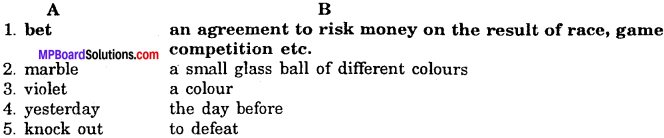
Word Power

(A) Make words by adding suffixes as given in the example.

(i) grace – gracefully
furious – furiously
anxious – anxiously

(ii) pure – purity
serene – serenity
rare – rarity

(iii) meditate – meditation
create – creation
generate – generation

(iv) consider – consideration
specific – specification
limit – limitation

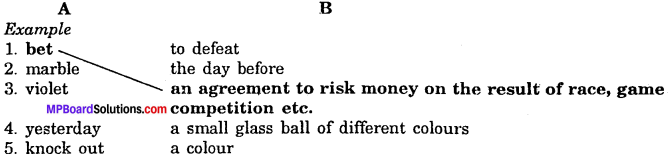
(b) Rearrange the jumbled letters to form words:

dorna a _ _ _ _
slebs _ _ _ _
hylo _ _ _ _
wob _ _ _ _
girion _ _ _ _

Answers:

adorn
bless
holy
bow
origin.

Comprehension

(A) Answer the following questions :

The Narmada The Lifeline Of Madhya Pradesh MP Board Class 8th Question 1.
Name some of the holy rivers of the country mentioned in the lesson.
Answer:
The Ganga, the Yamuna, the Brahmaputra, the Sindhu, the Godawari, the Kavari, the Krishna, the Satluj.

Class 8 English Chapter 4 The Narmada The Lifeline Of Madhya Pradesh Question 2.
Why does the Narmada say that she feels proud ?
Answer:
The Narmada say that she feels proud because she flows in India where a river is considered as a living being and is worshipped as goddess.

Mp Board Class 8 English Chapter 4 Question 3.
Why do we call the Narmada the lifeline of Madhya Pradesh ?
Answer:
The Narmada irrigates the major part of the state with her abundant water. Hence we call her the lifeline of Madhya Pradesh.

The Lifeline Of Madhya Pradesh MP Board Class 8th Question 4.
What is the meaning of ‘Narmada’?
Answer:
The word ‘Narmada’ means one who soothes and gives pleasures to all.

Class 8 English Chapter 4 Mp Board Question 5.
What blessing did Lord Shiva give to Narmada?
Answer:
Lord Shiva granted Narmada’s wishes. He blessed her that she would remain maiden and would flow free and pure forever.

Class 8 English Chapter 4 The Narmada Mp Board Question 6.
What are the places the Narmada flows through ?
Answer:
Narsinghpur, Raisen, Hoshangabad, Handia and Nemawar.

Narmada The Lifeline Of Madhya Pradesh MP Board Class 8th Question 7.
What is Maheshwar famous for ?
Answer:
The humble palace of Devi Ahilya Bai is located at the ghat of Maheshwar.

The Narmada: The Lifeline Of Madhya Pradesh Class 8 Question 8.
What do people from all over the world, come to see at Bheraghat near Jabalpur ?
Answer:
People from all over the world come to see how the Narmada flows gracefully through the colourful marble rocks at Bheraghat near Jabalpur.

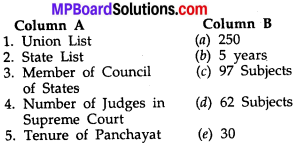
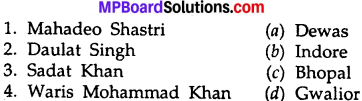
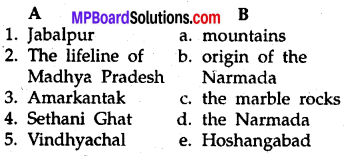
(B) Match the columns :
The Narmada The Lifeline Of Madhya Pradesh MP Board Class 8th
Answers:

  1. c
  2. d
  3. b
  4. e
  5. a.

Let’s Learn

(A) See the use of ‘among’ and ‘between’ in the following sentences:

  1. I am one among the main rivers of Madhya Pradesh.
  2. I flow between the Vindhyachal and the Satpura mountains.
  • among is used when three or more people or things are involved.
  • between is used for: two on either side of something.
  • when two people or things are involved.

Now fill in the blanks with between or among:

  1. We distributed sweets ________ the children.
  2. Rani is standing ________ Shreya and Sonal.
  3. Everest is one ________ the mountains of the Himalayas.
  4. Nepal lies ________ India and China.
  5. Wild animals live ________ the words.

Answer:

  1. among
  2. between
  3. among
  4. between
  5. among.

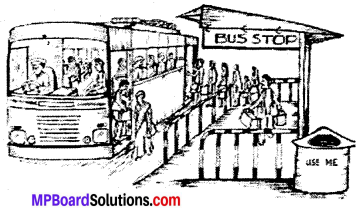
(B) See the picture given below carefully and fill in the blanks in the paragraph given below with appropriate prepositions given in the box. Some prepositions may need to be repeated.

into, in, on, for, from, of, to, with
Class 8 English Chapter 4 The Narmada The Lifeline Of Madhya Pradesh
This is the scene ____ 1 ____ a bus station. There is a dustbin ____ 2 ____ the corner ____ 3 ____ the bus station. The passengers who went to go ____ 4 ____ Mhow ____ 5 ____ Pithampur can catch the bus ____ 6 ____ here. The passengers are waiting ____ 7 ____ their turn to board the bus. Some passengers are already ____ 8 ____ the bus. There is some luggage ____ 9 ____the roof ____ 10 ____ the bus Some Passengers are carrying small bags, lunch boxes tec. ___ 11 ___ their hands. No one should break the queue to get ___ 12 ___ the bus. Travelling ____ 13 ____ a lot of luggage may cause trouble.

Answer:

  1. of
  2. in
  3. to
  4. of
  5. from
  6. from
  7. for
  8. in
  9. on
  10. of
  11. in
  12. into
  13. with

Let’s Talk

Choose any one river and talk about it in your group, with the help of the following clues :

Name of the river of your choice
The ______
It originates from ______
It is about kms long. ______
It flows through ______
There are ______
(important places on its banks)
There are ______
dams built across it.
It flows/does not flow ______
It’s ________
Answer:
The Ganga
It originates from Gangotri.
It is about 1560 miles long
It flows through Kanpur, Allahabad, Varanasi, Patna and Kolkata.
There are places like Haridwar, Varanasi, etc. on its banks.
There are two major (e.g. Farakka) dams built across it.
It flows into the Bay of Bengal.
It’s a holy river.

Let’s Read

Read the passage carefully.

According to Indian mythology, King Sagar, an ancestor of Lord Ram decided to perform a hundred Ashwamedha Yagnas. He completed ninetynine Yagnas and it was the hundredth when the horse of the Yagna got stolen by Devraja Indra. A great search for the horse was made. Ultimately Indra left the horse in the ashram of Kapil Muni. It was found by the sones of King Sagar. They insulted the Muni, thinking that it was he who had brought the horse there. Kapil Muni rose from his deep meditation and his anger soon turned down the sons of Sagar into ashes.

King Sagar had one more son Anshuman from his second queen. After his father, King Anshuman decided to make the Ganga descend on earth and immerse in it the ashes of his brothers so that their souls could rest in heaven. He started great Tapa, (severe penance) for this. After his death, his son King Dilip did similar Tapa to please the Ganga but could not succeed. After king Dilip his King Bhagirath continued the Tapa. Thus it was the third generation undergoing penance to please the Ganga.

The fierce penance of King Bhagirath pleased the Ganga. She appeared before him, and, blessing him, asked who would bear her force and current. King Bhagirath prayed to Lord Shiva to come for his help. Lord Shiva caught the powerful current of the Ganga in the locks of hair on his head. He tied her too tight to come out Again Bhagirath prayed to him to release the holy current. When she was released, she violently flowed after the chariot of Bhagirath. On her way came the ashram of Janhu Muni, and it too was swept away in the strong current. The Muni got furious and drank the whole of its water and dried the river up. Once again King Bhagirath had to pray to the Muni, and he released the Ganga from his thigh. Thus she was called Janhavi, the daughter of Janhu Muni.

Onward she continued her journey to the Gangasagar and ultimately reached the ashes of the sons of King Sagar.

Answer the following questions.

The Narmada The Lifeline Of Madhya Pradesh In Hindi Question 1.
Who was king Sagar ?
Answer:
King Sagar was an ancestor of Lord Ram who decided to perform a hundred Ashwamedha Yagnas.

Question 2.
What happened when Kapil Muni was insulted by the sons of King Sagar ?
Answer:
The sons of King Sagar were turned down into ashes.

Question 3.
Why did King Anshuman, King Dilip and King Bhagirath want to bring the Ganga on earth?
Answer:
They wanted to bring the Ganga on earth and immerse in it the ashes of King Sagar’s sons so that their souls could rest in heaven.

Question 4.
What happened when the Ganga descended ?
Answer:
The Ganga descended and began to flow with powerful current

Question 5.
Why do we call it the Janhavi ?
Answer:
We call it the Janhavi because it was released from the thigh of Janhu Muni.

Question 6.
Give another title to the above passage.
Answer:
The Ganga and the sons of King Sagar.

Let’s Write

You know that the rivers are very much polluted these days. Even the Ganga needs to be cleaned. Suggest how we can keep the rivers clean. Use the following clues :

  • People throw garbage, wastes and other things in the river.
  • Some orthodox people leave the dead bodies of the members of their families in the water of the river to perform the last rites.
  • Factories leave their chemical wastes in the river.
  • Drainage is merged in the river in most of the cities, towns and villages. Some people in the villages excrete near the river.
  • People, while bathing in the rivers, wash clothes and make the water dirty. They even make their cattle bathe in the rivers.
  • People immerse the idols made of clay and plaster of paris in the river. Now write in your own words

Answer:

People pollute the rivers by throwing, garbage, wastes and other things in them Some orthodox people immerse the dead bodies of their family members into the river water to perform the last rites. The chemical wastes of the factories are also thrown into the river water. Village people excrete near the river. People, make the river water dirty by washing their clothes on the bank. They also let their cattle bathe in the rivers.

At times idols of clay and plaster of paris are immersed in the river, which make the water dirty.

Let’s Do It

Question.
See the map of Madhya Pradesh. Find out the names of the rivers shown in it and list them below.
Answer:
Narmada Tapi Chambal.

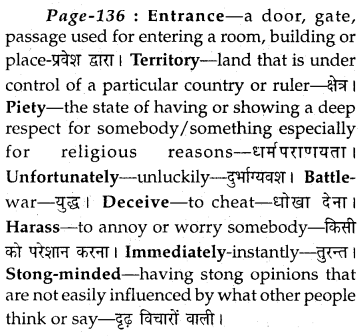
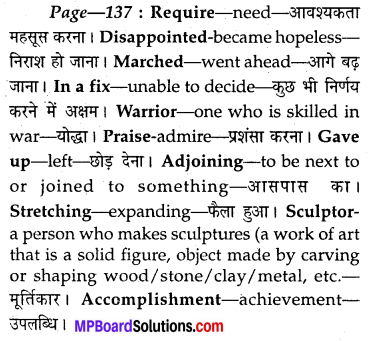
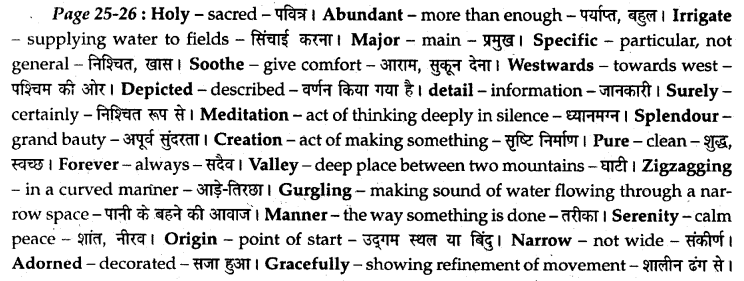
The Narmada: The Lifeline of Madhya Pradesh Word Meanings
Mp Board Class 8 English Chapter 4The Lifeline Of Madhya Pradesh MP Board Class 8th

We wish the knowledge shared regarding MP Board Solutions for Class 8 English Chapter 4 The Narmada: The Lifeline of Madhya Pradesh Questions and Answers has been helpful to you. If you need any further help feel free to ask us and we will get back to you with the possible solution. Bookmark our site to avail the latest updates on different state boards solutions in split seconds.
MP Board Class 10th Sanskrit Solutions Chapter 10 आह्वानम्

MP Board Class 10th Sanskrit Solutions Durva Chapter 10 आह्वानम् (गीतम्) (सङ्कलितम्)

MP Board Class 10th Sanskrit Chapter 10 पाठ्यपुस्तक के प्रश्न

Mp Board Class 10 Sanskrit Chapter 10 प्रश्न 1.
एकपदेन उत्तरं लिखत-(एक पद में उत्तर लिखिए)।
(क) भारतस्य पुरातनः सखा कः विद्यते? (भारत का पुराना मित्र कौन है?)
उत्तर:
चीनः (चीन)

(ख) कस्मिन् प्रवर्तितुं कदापि न खिद्यते? (किसमें प्रवृत्त होने के लिए दुख नहीं होता?)
उत्तर:
स्वकर्मणि (अपने कर्म में)

(ग) पापसिन्धवः शत्रवः का प्रयान्तु? (पापरूपी समुद्र/शत्रु किसको प्राप्त हो?)
उत्तर:
अशेषताम् (समाप्ति को)

(घ) वयं कया स्वदेशरक्षणोद्यताः? (हम किससे अपने देश की रक्षा के लिए तैयार हों?)
उत्तर:
सत्यनिष्ठया (सत्य निष्ठा से)

(ङ) भारतीयकेतवः कां वृत्तिं स्फुरन्तु? (भारतीय झण्डे किस वृत्ति को स्फुरित करें?)
उत्तर:
अरातिनीवृतिम् (शत्रु को सब ओर से पकड़कर मारने के भाव को)

कक्षा 10 संस्कृत पाठ 10 MP Board प्रश्न 2.
एकवाक्येन उत्तर लिखत-(एक वाक्य में उत्तर लिखिए-)
(क) कृषीबलैः काः समेधिताः भवन्तु? (किसानों के द्वारा वया वृद्धि को प्राप्त हो?
उत्तर:
कृषीबलैः धान्यवृद्धयः समेधिताः भवन्तु। (किसानों के द्वारा धानअदि वृद्धि को प्राप्त हों।)

(ख) ऊर्जितं यशः कैः अर्जितम्? (तेजस्वितापूर्ण यश किसके द्वारा अर्जित किया गया?)
उत्तर:
ऊर्जितं यशः पूर्वपुरुषैः अर्जितम्। (तेजस्वितापूर्ण यश पूर्वजों द्वारा अर्जित किया गया।)

(ग) अखर्वगर्ववृत्तिना केन वीक्षितम्? (बड़े घमण्डी आचरण वाले किराको देखा गया?)
उत्तर:
अखर्वगर्ववृत्तिना अरिणा वीक्षितम्।
(बड़े धमण्डी आचरण वाले शत्रु के द्वारा देखा गया।)

(घ) भारतीयाः केषां वंशजाः सन्ति? (भारतीय किसके वंशज हैं?)
उत्तर:
भारतीयाः वसिष्ठ-याज्ञवल्क्य-गौतम-अत्रि एतेषाम् वंशजाः सन्ति। (भारतीय वसिष्ठ-याज्ञवल्क्य-गौतम व अत्रि के वंशज हैं।)

(ङ) शत्रवः द्रुतं किं फलं प्राप्नुवन्तु? (शत्रु शीघ्र किस फल को प्राप्त हों?)
उत्तर:
शत्रवः द्रुतं निजप्रवञ्चनाफलं प्राप्नुवन्तु। (शत्रु शीघ्र अपने उगी रूपी कर्म के फल को प्राप्त हों।)

Class 10 Sanskrit Chapter 10 MP Board प्रश्न 3.
अधोलिखितप्रश्नानाम् उत्तराणि लिखत-(नीचे लिखे प्रश्नों के उत्तर लिखिए)
(क) वीरबन्धवः किं कुर्वन्तु? (वीर बन्धु क्या करें?)
उत्तर:
वीरबन्धवः पापसिन्धवः शत्रवः अशेषतां प्रयान्तु।। (वीरबन्धु पाप रूपी समुद्र जैसे शत्रुओं को समाप्त करें।)

(ख) अद्य कं स्मरन्तु? (आज किसको याद करें?)
उत्तर:
अद्य पूर्वपुरुषैः समस्तदिक्षुविश्रुतं अर्जितम् ऊर्जितम् यशः स्मरन्तु। (आज पूर्वजों के द्वारा, सारी दिशाओं में विख्यात, अर्जित तेजस्वीपूर्ण यश को स्मरण करें।)

(ग) भवत्सु जीवितेषु के नदन्ति? (आप सब में जीवित रहते हुए कौन अस्पष्ट बोल रहे हैं?)
उत्तर:
भवत्सु जीवितेषु दस्यवः नदन्ति। (आप सब में जीवित रहते हुए लुटेरे अस्पष्ट बोल रहे हैं।)

Sanskrit Class 10 Chapter 10 Mp Board प्रश्न 4.
उचितशब्देन रिक्तस्थानानि पूरयत (उचित शब्दों से रिक्त स्थान भरिए-)
(क) स्वकर्मणि प्रवर्तितुं ………………. नैव खिद्यते। (अद्यापि/कदापि)
(ख) पुरातनं स्वपौरुष ………………. वीरबन्धवः। (विस्मरन्तु/स्मरन्तु)
(ग) यथा विहाय ………………. आचरन्तु तेऽद्भुतम् ।(कूटनीतिम्/राजनीतिम्)
(घ) समस्तदिक्षु ………………. तदद्य यावदूर्जितम्। (श्रुतं/विश्रुत)
(ङ) कदा प्रदर्शयिष्यते द्विषां ………………. बलस्य वः। (बलं/फल)
उत्तर:
(क) कदापि
(ख) स्मरन्तु
(ग) कूटनीतिम्
(घ) विश्रुतं
(ङ) फलं

Class 10th Sanskrit Chapter 10 प्रश्न 5.
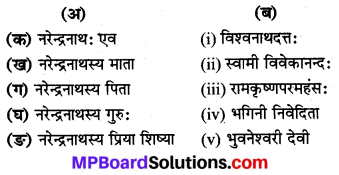
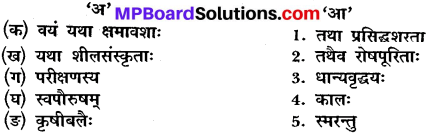
यथायोग्यं योजयत-(उचित क्रम से जोड़िए)
Mp Board Class 10 Sanskrit Chapter 10
उत्तर:
(क) 2
(ख) 1
(ग) 4
(घ) 5
(ङ) 3

Mp Board Class 10th Sanskrit Chapter 10 प्रश्न 6.
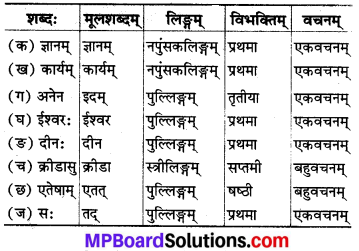
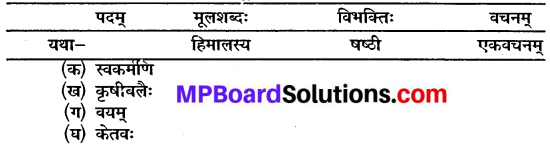
अधोलिखितपदानां मूलशब्दं विभक्तिं वचनञ्च लिखत (नीचे लिखे पदों के मूलशब्द विभक्ति और वचन लिखिए)
कक्षा 10 संस्कृत पाठ 10 MP Board
उत्तर:
Class 10 Sanskrit Chapter 10 MP Board

Chapter 10 Sanskrit Class 10 MP Board प्रश्न 7.
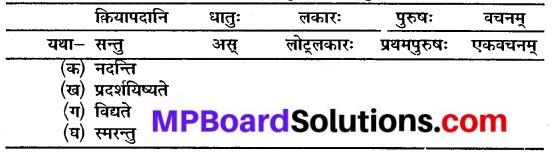
अघोलिखितक्रियापदानां धातुं लकारं पुरुषं वचनञ्च लिखत (नीचे लिखे क्रियापदों के धातु, लकार, पुरुष व वचन लिखिए-)
Sanskrit Class 10 Chapter 10 Mp Board
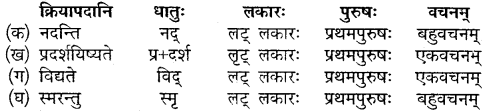
उत्तर:
Class 10th Sanskrit Chapter 10

Sanskrit Chapter 10 Class 10 Mp Board प्रश्न 8.
विलोमशब्दान् लिखत-(विलोम शब्द लिखिए)
यथा – स्वदेशः – विदेशः
(क) स्मरन्तु
(ख) पुरातनम्
(ग) अशेषताम्
(घ) सत्यनिष्ठया
उत्तर:
(क) स्मरन्तु – विस्मरन्तु
(ख) पुरातनम् – नवीनम्
(ग) अशेषताम् – शेषताम्
(घ) सत्यनिष्ठया – असत्यनिष्ठया

Class 10 Sanskrit Chapter 10 Solutions MP Board प्रश्न 9.
पर्यायशब्दान् लिखत-(पर्यायशब्द लिखिए)
यथा – सूर्य दिवाकरः, भास्करः
(क) कालः
(ख) क्षितौ
(ग) शत्रवः
(घ) जगत्सु
उत्तर:
(क) कालः – समयः
(ख) क्षितौ – पृथिव्याम्, धरायाम्
(ग) शत्रवः – रिपवः, अरयः
(घ) जगत्सु – संसारेषु, विश्वेषु

Class 10 Sanskrit Chapter 10 Question Answer MP Board प्रश्न 10.
रेखाङ्कितपदान्याधृत्य प्रश्ननिर्माणं कुरुत (रखाङ्कित पदों के आधार पर प्रश्न बनाइए)
(क) दस्यवः नदन्ति
(लुटेरे अस्पष्ट बोल रहे हैं।)
उत्तर:
के नदन्ति? (कौन अस्पष्ट बोल रहे हैं?)

(ख) वयं हिमालयस्य रक्षणे समुद्यताः। (हम सब हिमालय की रक्षा के लिए तैयार हों।)
उत्तर:
वयं कस्य रक्षणे समुद्यताः? (हम किसकी रक्षा के लिए तैयार हों?)

(ग) पापसिन्धवः शत्रवः अशेषतां प्रयान्तु। (पाप रूपी समुद्र शत्रु समाप्ति को प्राप्त हों।)
उत्तर:
के शत्रवः अशेषतां प्रयान्तु? (कौन से शत्रु समाप्ति को प्राप्त हों?)

(घ) ते कूटनीतिं विहाय आचरन्तु। (वे कुटनीति को छोड़कर आचरण करें।)
उत्तर:
ते किं विहाय आचरन्तु? (वे किसको छोड़कर आचरण करें?)

(ङ) नदीषु यन्त्रयानलौहमार्गसेतवः सन्तु। (नदियों पर मशीनों द्वारा चलने वाले वाहन, लोहे की पटरी वाले रास्ते तथा पुल हों।)
उत्तर:
केषु यन्त्रयान लौह मार्ग सेतवः सन्तु?
(किन पर मशीनों द्वारा चलने वाले वाहन, लौहे की पटरी वाले रास्ते तथा पुल हों।)

योग्यताविस्तार –

पाठे आगतं गीतं लयबद्धं गायत।
(पाठ में आए गीत को लयबद्ध करके गाओ।)

अन्यदेशभक्तिविषयकं संस्कृतगीतम् अन्विष्य गायत।
(अन्य देश भक्ति के संस्कृत गीत ढूंट कर गाओ।)

आह्वानम् पाठ का सार

प्रस्तुत पाठ एक गीत है जो श्री दयाशङ्कर वाजपेयी के द्वारा रचा गया है, जिसमें भारत और चीन के मध्य हुए युद्ध में भाग लेने वाले सैनिकों के साथ प्रत्यक्ष चर्चा करके लिखा गया है।

आह्वानम् पाठ का अनुवाद

1. युवान एष वः परीक्षणस्य काल आगतः हिमालयस्य रक्षणे समुद्यताः स्थ सर्वतः।
अयं सखा पुरातनोऽस्य भातरस्य विद्यते स्वकर्मणि प्रवर्तितुं कदापि नैव खिद्यते॥1॥

अन्वयः :
युवान! एषः कालः वः परीक्षणस्य आगतः (अस्ति), सर्वतः, हिमालयस्य रक्षणे समुद्यताः स्थ। अयम् अस्य भारतस्थ पुरातनः सखा विद्यते स्वकर्मणि प्रवर्तितुं कदापि न एव खिद्यते।

शब्दार्थाः :
युवान!-हे युवको!-oh young men; वः-तुम्हारा-yours; समुद्यताःतैयार-ready; स्थ-हों-be; खिद्यते-दुखी होता है-is aggrieved.

अनुवाद :
हे युवको! यह समय तुम्हारी परीक्षा का है, सब ओर से हिमालय की रक्षा के लिए तैयार हो। यह इस भारत का पुराना मित्र है। अपने कर्म में प्रवृत्त होने के लिए कभी भी दुखी नहीं होता है।

English :
Young men, be ready to defend Himalaya-India’s oldest friend never aggrieved in getting inclined to self duties.

2. अखर्वगर्ववृत्तिनारिणात्र येन वीक्षितं सहेक्षणेन तत्क्षणन्तु तच्छिरः क्षितौ धृतम्।
यथा क्षमावशा वयं तथैव रोषपूरिताः यथैव शीलसंस्कृतास्तथा प्रसिद्धशूरताः॥2॥

अन्वयः :
अत्र येन अखर्वगर्ववृत्तिना अरिणा वीक्षितम् (तदा) तत् क्षणं तु ईक्षणेन सह तच्छिरः क्षितौ धृतम्, वयं यथा क्षमावशाः (स्मः) तथैव वयं रोषपूरिता (अपि स्मः), (एवमेव) यथा शील-संस्कृता एव तथा प्रसिद्धशूरताः (स्मः)।

शब्दार्थाः :
अखर्वगर्ववृत्तिना-बड़े घमण्डी आचरण वाले के द्वारा-of proud conduct (arrogant);अरिणा-शत्रु के द्वारा-by enemy; वीक्षितम्-देखा गया-seen; सहेक्षणेन-देखने के साथ ही-at the very sight; धृतम्-रख दिया-placed.

अनुवाद :
यहाँ जिस, बड़े घमण्डी आचरण वाले शत्रु के द्वारा देखा गया, तब उस क्षण तो देखने के साथ ही पृथ्वी पर गिरा दिया, हम जितने क्षमाशील हैं, उतने ही क्रोध से भरे हुए भी हैं। इस प्रकार जैसे हमारी शील संस्कृति प्रसिद्ध है वैसे ही वीरता भी।

English :
We beheaded the proud enemy for his evil intentions-We are both forgiving and equally brave.

3.पुरातनं स्वपौरुषं स्मरन्तु वीरबन्धवः अशेषतां प्रयान्तु शत्रवोऽद्य पापसिन्धव। – निजप्रवञ्चनाफलं समाप्नुवन्तु ते द्रुतं यथा विहाय कूटनीतिमाचरन्तु तेऽद्भुतम्॥3॥

अन्वयः :
वीरबन्धवः! पुरातनं स्वपौरुषं स्मरन्तु अद्य पापसिन्धवः शत्रवः अशेषतां प्रयान्तु। ते द्रुतं निजप्रवञ्चनाफलं समाप्नुवन्तु, यथा ते अद्भुतं कूटनीतिं विहाय आचरन्तु।।

शब्दार्थाः :
स्वपौरुषम्-अपने पुरुषत्व को-own valour; पापसिन्धवः-पापरूपी समुद्र-ocean in the form of sin; अशेषताम्-समाप्ति का-completion; निजप्रवञ्चनाफलम्-अपने ठगी रूपी कर्म के फल को-fruitof their trickery;समाप्नुवन्तु-प्राप्त करें-obtain; विहाय-छोड़कर-leaving.

अनुवाद :
हे वीर बन्धुओ! अपने पुराने पुरुषत्व को याद करो, आज पापरूपी समुद्र से शत्रु समाप्ति को प्राप्त हो। वे शीघ्र अपने ठगी रूपी कर्म के फल को प्राप्त करें, जिससे वे अपनी अजीब सी कूटनीति को छोड़कर अच्छा आचरण करें।

English :
Remember your chivalry-Bring an end to sinful enemies-tell them suffer the fruit of their trickery and leave diplomacy.

4. कृषीबलैः समेधिता भवन्तु धान्यवृद्धयः श्रमेण सन्तु साधितास्तु वीरसाहसर्द्धयः।
स्मरन्तु पूर्वपूरुषैर्जगत्सु यद् यशोऽर्जितम् समस्तदिक्षु विश्रुतं तदद्य यावदूर्जितम्॥4॥

अन्वयः :
कृषीबलैः धान्यवृद्धयः समेधिताः भवन्तु श्रमेण साधिताः तु वीरसहासर्द्धयः सन्तु। पूर्वपुरुषैः जगत्सु, समस्तदिक्षुविश्रुतं यावद् ऊर्जितं यशः अर्जितं, तद् अद्य स्मरन्तु।

शब्दार्थाः :
कृषीवलैः-किसानों के द्वारा-By farmers; समेधिताः-वृद्धि को प्राप्त-attain propserity; वीरसाहसर्द्धय-पराक्रम-उत्साह की वृद्धि-increase invalour and courage; दिक्षु-दिशाओं में-indirections; विश्रुतम्-विख्यात-famous; अर्जितम्-तेजस्विता पूर्ण-full of bu’stre; स्मरन्तु-स्मरण करें-remember.

अनुवाद :
किसानों के द्वारा धान्य-वृद्धि से वृद्धि को प्राप्त हो, परिश्रम से प्राप्त । पराक्रम व उत्साह की वृद्धि हो। संसार में पूर्वजों के द्वारा समस्त दिशाओं में विख्यात, जो तेजस्वितापूर्ण यश प्राप्त किया है, उसे आज याद करो।

English :
Let farmers flourish-let there be advancement in courage-remember the renown of your ancestors through the world.

5. वयं तु सत्यनिष्ठया स्वदेशरक्षणोधताः प्रवञ्चनैकदक्षशत्रुपक्षतक्षणव्रताः।
नदीषु सन्तु यन्त्रयानलौहमार्गसेतवः अरातिनीवृतिं स्फुरन्तु भारतीयकेतवः॥5॥

अन्वयः :
वयं तु सत्यनिष्ठया स्वदेशरक्षणोद्यताः प्रवञ्चनैकदक्षशत्रुपक्षतक्षणव्रताः (स्मः), नदीषु यन्त्रयानलौहमार्गसेतवः भारतीय केतवः अरातिनीवृत्तिं स्फुरन्तु।

शब्दार्थाः :
सत्यनिष्ठया-सत्यनिष्ठा से-with sincere loyalty; उद्यताः-तैयार -ready; केतवः-झण्डे-flags; अरातिनीवृत्तिम्-शत्रु को सब ओर से पकड़कर मारने के भाव को-enemies by grabbing them all over.

अनुवाद :
हम सब तो सत्यनिष्ठा से अपने देश की रक्षा के लिए तैयार हैं, एकमात्र छल-कपट में निपुण शत्रुओं के पक्ष को काटने का वृत धारण करने वाले हैं, नदियों पर मशीनों द्वारा चलने वाले वाहन, लोहे की पटरी वाले रास्ते तथा पुल हों, भारतीय पताकाएँ शत्रु को सब ओर से पकड़कर मारने के भाव को स्फुरित करें।

English :
We are ready to serve our country honestly. We will sever the heads of deceitful enemies-let there be machines and iron rails. Let the Indian flags be unfurled around the enemies.

6. अये वशिष्ठ-याज्ञवल्क्य-गौतमात्रिवंशजाः तथैव सूर्यचन्द्रपावकान्ववायतल्लजाः। – भवत्सु जीवितेषु हन्त! किं नदन्ति दस्यवः? कदा प्रदर्शयिष्यते द्विषां फलं बलस्य वः॥6॥

अन्वयः :
हन्त! अये वसिष्ठ-याज्ञवल्क्य-गौतम-अत्रि वंशजा (सन्ति), तथैव सूर्यचन्द्रपावकान्ववायतल्लजाः भवत्सु जीवितेषु दस्यवः किंनदन्ति? वः बलस्य फलं द्विषां (कृते) कदा प्रदर्शयिष्यते।

शब्दार्थाः :
हन्त!-खेद है-Alas! fie; अन्ववायतल्लजाः-कुल में सर्वश्रेष्ठ-of noblest family; भवत्सु-आप सब में-in you all; जीवितेषु-जीवित रहते हुए-while living; दस्यवः-लुटेरे-robbers; नदन्ति-अस्पष्ट बोल रहे हैं -speaking vaguely; वः-तुम्हारे-yours; द्विषाभ्-शत्रुओं के-of enemies.

अनुवाद :
खेद है। अरे, वसिष्ठ, याज्ञवल्क्य, गौतम अत्रि के वंश में आप उत्पन्न हुए हैं। वैसे ही, सूर्य और चन्द्र से पवित्र, कुल में सर्वश्रेष्ठ आप सब के जीवित रहते हुए लुटेरे अस्पष्ट बोल रहे हैं। तुम्हारे बल का फल शत्रुओं को कब दिखाओगे।

English :
You are the descendants of rishis and of noble birth show your valour to let down robberr.

MP Board Class 10th Sanskrit Solutions

MP Board Class 11th Chemistry Solutions Chapter 4 रासायनिक आबंधन तथा आण्विक संरचना

MP Board Class 11th Chemistry Solutions Chapter 4 रासायनिक आबंधन तथा आण्विक संरचना

रासायनिक आबंधन तथा आण्विक संरचना NCERT अभ्यास प्रश्न

रासायनिक आबंधन तथा आण्विक संरचना MP Board Class 11th Chemistry प्रश्न 1.
रासायनिक आबंध के बनने की व्याख्या कीजिए।
उत्तर:
समान और भिन्न तत्वों के परमाणु आपस में मिलकर रासायनिक आबंध बनाते हैं। इस प्रकार बने रासायनिक आबंधों को विभिन्न सिद्धांतों द्वारा वर्णित किया गया है। जब समान या भिन्न तत्वों के परमाणु संयोग करते हैं तब वे अपने संयोजी कोश में अष्टक पूरा करते हैं। अष्टक पूरा करके तत्व आदर्श गैस के विन्यास को ग्रहण करते हैं। ऐसे परमाणु या तो इलेक्ट्रॉन का साझा करके या दान करके करते हैं। एक अन्य सिद्धांत के अनुसार जब परमाणु आबंध बनाते हैं तब प्रक्रम का ऊर्जा स्तर निम्नतम होता है जिससे स्थायित्व ग्रहण करते हैं।

रासायनिक आबंधन तथा आण्विक संरचना Pdf MP Board Class 11th Chemistry प्रश्न 2.
निम्नलिखित तत्वों के परमाणुओं के लुईस बिंदु प्रतीक लिखिए –
Mg, Na, B, O, N, Br.
उत्तर:
MP Board Class 11th Chemistry Solutions Chapter 4 रासायनिक आबंधन तथा आण्विक संरचना - 1

प्रश्न 3.
निम्नलिखित परमाणुओं तथा आयनों के लुईस बिन्दु प्रतीक लिखिए –
P और P3-, Na और Na+, S और S2-, Al और Al3+, H और H.
उत्तर:
MP Board Class 11th Chemistry Solutions Chapter 4 रासायनिक आबंधन तथा आण्विक संरचना - 2

प्रश्न 4.
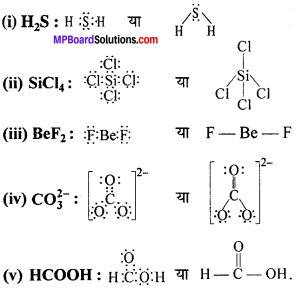
निम्नलिखित अणुओं तथा आयनों की लुईस संरचनाएँ लिखिए –
H2S, SiCl4, BeF4, CO32-, HCOOH.
उत्तर:
MP Board Class 11th Chemistry Solutions Chapter 4 रासायनिक आबंधन तथा आण्विक संरचना - 3

प्रश्न 5.
अष्टक नियम को परिभाषित कीजिए तथा इस नियम के महत्व और सीमाओं को लिखिए।
उत्तर:
अष्टक नियम-इस नियम का प्रतिपादन लुईस ने किया था। उनके अनुसार यदि किसी तत्व के संयोजी कोश में आठ इलेक्ट्रॉन हैं तब तत्व रासायनिक रूप से निष्क्रिय होता है। लेकिन यदि बाहरी कोश में इलेक्ट्रॉन न हों तो परमाणु या अणु का निर्माण करते समय इलेक्ट्रॉन का आदान-प्रदान या साझा करके आठ इलेक्ट्रॉन पूर्ण करने का प्रयास करता है, यही अष्टक नियम कहलाता है।
उदाहरण:
SF6, PCl5, तथा IF7, जैसे यौगिकों के संयोजी कोश में 12, 10 तथा 14 इलेक्ट्रॉन हैं। दूसरी ओर BF3, तथा BeCl2 के संयोजी कोश में क्रमशः 6 तथा 4 इलेक्ट्रॉन हैं।

आवर्त सारणी के दूसरे तत्व जो संयोजी कक्षा में आठ से कम इलेक्ट्रॉन रखते हैं रासायनिक सक्रिय है। अतः जिनके संयोजी इलेक्ट्रॉन आठ से कम होते हैं सक्रिय होते हैं।
अष्टक नियम की सीमाएँ

  1. केन्द्रीय परमाणु का अपूर्ण अष्टक – कुछ यौगिकों में केन्द्रीय परमाणु के चारों ओर उपस्थित इलेक्ट्रॉनों की संख्या आठ से कम होती है। जैसे-H : H, Li : Cl, H : Be : H.
  2. विषम इलेक्ट्रॉन अणु – उन अणुओं जिनमें इलेक्ट्रॉनों की कुल संख्या विषम होती है ये सभी परमाणु अष्टक नियम का पालन नहीं कर पाते।
    MP Board Class 11th Chemistry Solutions Chapter 4 रासायनिक आबंधन तथा आण्विक संरचना - 4
  3. प्रसारित अष्टक – इन तत्वों के अनेक यौगिकों में केन्द्रीय परमाणु के चारों ओर आठ से अधिक इलेक्ट्रॉन होते हैं इसे प्रसारित अष्टक कहते हैं।
    MP Board Class 11th Chemistry Solutions Chapter 4 रासायनिक आबंधन तथा आण्विक संरचना - 5
  4. उदासीन परमाणु से संबंधित धनायनों एवं ऋणायनों के बनने की सरलता।
  5. धनायनों एवं ऋणायनों को ठोस में व्यवस्थित होने की विधि अर्थात् क्रिस्टलीय यौगिक का जालक निर्मित होने की विधि।

प्रश्न 6.
आयनिक आबंध बनाने के लिए अनुकूल कारकों को लिखिए।
उत्तर:
आयनिक आबंध बनाने हेतु अनुकूल कारक निम्न हैं –

  1. धनायन बनाने वाले तत्व का आयनन विभव निम्न होना चाहिए।
  2. ऋणायन बनाने वाले तत्व की उच्च इलेक्ट्रॉन ग्रहण एन्थैल्पी।
  3. आयनिक यौगिक की उच्च जालक ऊर्जा होना।

प्रश्न 7.
निम्नलिखित अणुओं की आकृति की व्याख्या वी.एस.ई.पी.आर. सिद्धान्त के अनुरूप कीजिए –
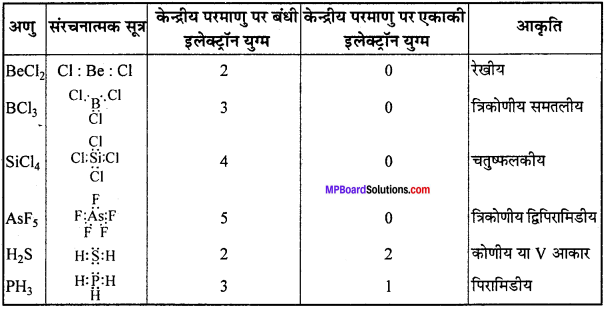
BeCl2, BCl3, SiCl4, AsF5, H2S, PH3.
उत्तर:
सहसंयोजक अणुओं की आकृति VSEPR सिद्धान्त के अनुसार निम्नानुसार होगी –
MP Board Class 11th Chemistry Solutions Chapter 4 रासायनिक आबंधन तथा आण्विक संरचना - 6

प्रश्न 8.
यद्यपि NH3 तथा H2O दोनों अणुओं की ज्यामिति विकृत चतुष्फलकीय होती है, तथापि जल में आबंध कोण अमोनिया की अपेक्षा कम होता है। विवेचना कीजिए।
उत्तर:
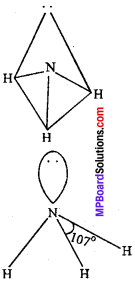
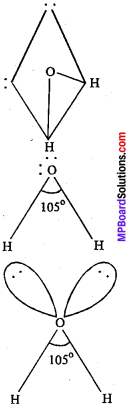
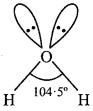
H2O के अणु में 2 एकाकी इलेक्ट्रॉन युग्म एवं NH3 में 1 एकाकी इलेक्ट्रॉन युग्म होता है। VSEPR सिद्धान्त के अनुसार दो एकक इलेक्ट्रॉन युग्मों में ज्यादा प्रतिकर्षण होता है जिससे बंध कोण का मान कम हो जाता है अत: H2O में बन्ध कोण 104.5° तथा NH3 में 107° का होता है।

प्रश्न 9.
आबंध प्रबलता को आबंध-कोटि के रूप में आप किस प्रकार व्यक्त करेंगे? उत्तर-आबंध कोटि बढ़ने पर आबंध प्रबलता का मान भी बढ़ता है। प्रश्न 10. आबंध लंबाई की परिभाषा दीजिए।
उत्तर:
किसी अणु की बंध लम्बाई अणु में आबंधित परमाणुओं के नाभिकों के मध्य साम्यावस्था पर दूरी का मान होता है।

प्रश्न 11.
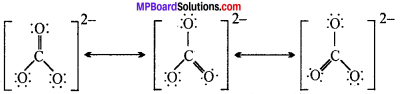
Coआयन के संदर्भ में अनुनाद के विभिन्न पहलुओं को स्पष्ट कीजिए।
उत्तर:
कार्बन तथा ऑक्सीजन परमाणुओं के मध्य दो एकल आबंध तथा एक द्वि-आबंध वाली लुईस संरचना कार्बोनेट आयन की वास्तविक संरचना को निरूपित करने के लिए अपर्याप्त है क्योंकि इसके अनुसार तीन कार्बन-ऑक्सीजन आबंधों की लम्बाई भिन्न-भिन्न होनी चाहिए।

कार्बोनेट आयन (CO32-) – 24 इलेक्ट्रॉन निकाय (अनुनादी संरचनाएँ) –
MP Board Class 11th Chemistry Solutions Chapter 4 रासायनिक आबंधन तथा आण्विक संरचना - 7

प्रश्न 12.
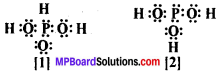
नीचे दी गई संरचनाओं (1 तथा 2) द्वारा H3PO3 को प्रदर्शित किया जा सकता है। क्या ये दो संरचनाएँ H3PO3 के अनुनाद संकर के विहित (कैनोनिकल) रूप माने जा सकते हैं? यदि नहीं, तो उसका कारण बताइए।
MP Board Class 11th Chemistry Solutions Chapter 4 रासायनिक आबंधन तथा आण्विक संरचना - 8
उत्तर:
नहीं, H3PO3 की दी गई संरचनाएँ अनुनादी संकर के विहित (कैनोनिकल) रूप नहीं माने जा सकते क्योंकि इन संरचनाओं में परमाणुओं के स्थान परिवर्तित हो रहे हैं।

प्रश्न 13.
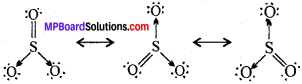
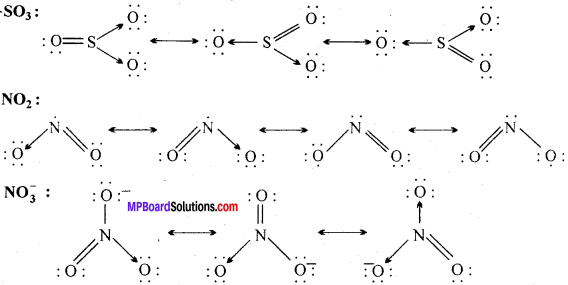
SO3, NO2, तथा NO3 की अनुनादी संरचनाएँ लिखिए।
उत्तर:
1. SO3 की अनुनादी संरचनाएँ –
MP Board Class 11th Chemistry Solutions Chapter 4 रासायनिक आबंधन तथा आण्विक संरचना - 9
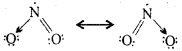
2. NO2 की अनुनादी संरचनाएँ –
MP Board Class 11th Chemistry Solutions Chapter 4 रासायनिक आबंधन तथा आण्विक संरचना - 10
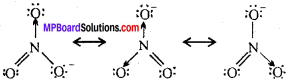
3. NO3 की अनुनादी संरचनाएँ –
MP Board Class 11th Chemistry Solutions Chapter 4 रासायनिक आबंधन तथा आण्विक संरचना - 11

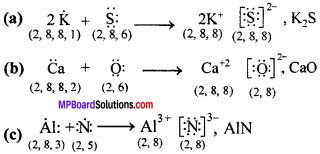
प्रश्न 14.
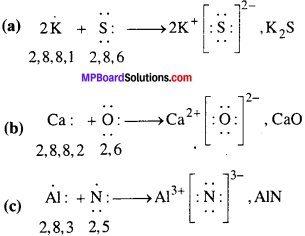
निम्नलिखित परमाणुओं से इलेक्ट्रॉन स्थानांतरण द्वारा धनायनों तथा ऋणायनों में विरचन को लुईस बिन्दु-प्रतीकों की सहायता से दर्शाइए
(a) K तथा S
(b) Ca तथा O
(c) Al तथा N.
उत्तर:
MP Board Class 11th Chemistry Solutions Chapter 4 रासायनिक आबंधन तथा आण्विक संरचना - 12

प्रश्न 15.
हालाँकि CO2 तथा H2O दोनों त्रिपरमाणुक अणु है, परंतु H2O अणु की आकृति बंकित होती है, जबकि CO2 की रैखिक आकृति होती है। द्विध्रुव आघूर्ण के आधार पर इसकी व्याख्या कीजिए।
उत्तर:
CO2 की संरचना रैखिक होने के कारण CO2 में दो समान बंध आघूर्ण विपरीत दिशा में कार्य करते हैं और एक-दूसरे के प्रभाव को समाप्त कर देते हैं।
MP Board Class 11th Chemistry Solutions Chapter 4 रासायनिक आबंधन तथा आण्विक संरचना - 13
जबकि H2O की कोणीय (मुड़ी हुई) संरचना के कारण O-H के द्विध्रुव एक-दूसरे को उदासीन या निष्क्रिय नहीं कर पाते हैं।
MP Board Class 11th Chemistry Solutions Chapter 4 रासायनिक आबंधन तथा आण्विक संरचना - 14

प्रश्न 16.
द्विध्रुव आघूर्ण के महत्वपूर्ण अनुप्रयोग बताइए।
उत्तर:
द्विध्रुव आघूर्ण के महत्वपूर्ण अनुप्रयोग निम्नलिखित हैं –
1. आबंध की घूर्णता ज्ञात करने में:
जैसा कि µ = e x d का मान जितना अधिक होगा द्विध्रुव आघूर्ण का मान उतना ही ज्यादा होगा, यह एकल घूर्णन आबंध पर लागू होता है। जैसे – HCl, HBr आदि। आघूर्ण अणु जैसे H2, O2, N2, आदि की द्विध्रुव घूर्णता शून्य होता है। क्योंकि इन अणुओं में आवेश विभाजित नहीं होता है। अतः द्विध्रुव आघूर्ण, ध्रुवीय व अध्रुवीय अणुओं में अन्तर बताता है।

2. आयनिक प्रतिशतता ज्ञात करने में:
उदाहरण – HCl में = 1.03D यदि HCl 100% आयनित है तब प्रत्येक इकाई पर एक इकाई आवेश होगा अर्थात् 4.8 x 10⁻¹⁰-10 + 5.4 आबंध दूरी (H-Cl) = 1.275 Å
∴ 100% आयनन गुणधर्म के लिए
= 4.8 x 10-10 x 1.275 x 10-8
= 6.12 x 10⁻¹⁸ e.s.u. = 6.12D
% आयनन = \(\frac{1.03}{6.12}\) x 100 = 1686.

3. अणुओं की आकृति ज्ञात करने में:
अणुओं की आकृति ज्ञात करने में द्विध्रुव आघूर्ण महत्वपूर्ण गुणधर्म होता है। ऐसा अणु जिसमें तीन या अधिक परमाणु होते हैं, के लिए द्विध्रुव आघूर्ण महत्वपूर्ण है। यदि किसी अणु में एक या अधिक ध्रुव आबंध होते हैं और वह रेखीय नहीं है यदि एक द्विध्रुव आघूर्ण होता है जैसा कि जल के अणु H2O के लिए µ = 1.84D है और अमोनिया µ = 1.49D होता है के लिए आकृति बंकित होती है जिन अणुओं में µ = 0 होता है वे अणु रेखीय आकृति के होते हैं। जैसे – CO2, BF3, CH4 या CCl4 आदि।

प्रश्न 17.
विद्युत्-ऋणात्मकता को परिभाषित कीजिए। यह इलेक्ट्रॉन ग्रहण एन्थैल्पी से किस प्रकार भिन्न है?
उत्तर:
सहसंयोजी आबंध में किसी परमाणु की वह क्षमता जिसके कारण आबंधी इलेक्ट्रॉन को अपनी ओर आकर्षित करता है, विद्युत्-ऋणात्मकता कहलाती है। विद्युत्-ऋणात्मकता अणु में परमाणु के इस गुण धर्म को दर्शाती है, जबकि इलेक्ट्रॉन ग्रहण एन्थैल्पी एकल परमाणु के गुणधर्म को दर्शाता है।

इलेक्ट्रॉन ग्रहण एन्थैल्पी:

  1. इलेक्ट्रॉन ग्रहण एन्थैल्पी एक परिमाणात्मक मान है एवं उस ऊर्जा को व्यक्त करती है, जो एक विलगित गैसीयपरमाणु के अंतिम कक्ष में एक इलेक्ट्रॉन को प्रविष्ट कराने पर मुक्त होती है।
  2. ये विलगित अणु का गुण है।
  3. एक अणु की इलेक्ट्रॉन ग्रहण एन्थैल्पी का निरपेक्ष मान होता है।
  4. परिमाणात्मक होने के कारण इसका मात्रक होता है एवं इसे eV प्रति परमाणु या kJ प्रति मोल में व्यक्त करते हैं।

विद्युत्-ऋणात्मकता:

  1. विद्युत्-ऋणात्मकता सहसंयोजी आबंधी इलेक्ट्रॉन युग्म को परमाणु द्वारा अपनी ओर आकर्षित करने की प्रवृत्ति होती है।
  2. ये बंधित अणु का गुण है।
  3. विद्युत्-ऋणात्मकता का मान बंध पर निर्भर करता है।
  4. यह तत्वों के बीच आपेक्षिक होती है इसलिए इसकी कोई इकाई नहीं होती।

प्रश्न 18.
ध्रुवीय सहसंयोजी आबंध से आप क्या समझते हैं? उदाहरण सहित व्याख्या कीजिए।
उत्तर:
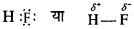
दो असमान परमाणुओं के मध्य बनने वाला सहसंयोजी बंध में इनके विद्युत्-ऋणात्मकता में अन्तर के कारण ध्रुवीय गुण होता है क्योंकि आबंधित इलेक्ट्रॉन युग्म अधिक विद्युत्-ऋणात्मक परमाणु की ओर विस्थापित हो जाता है। ऐसा बंध ध्रुवीय सहसंयोजी बंध कहलाता है।
उदाहरणार्थ –
MP Board Class 11th Chemistry Solutions Chapter 4 रासायनिक आबंधन तथा आण्विक संरचना - 15
आबंधी इलेक्ट्रॉन बंध का F परमाणु की ओर आकर्षित होना ध्रुवीय सहसंयोजी बंध का निर्माण करना है।

प्रश्न 19.
निम्नलिखित अणुओं को आबंधों की बढ़ती आयनिक प्रकृति के क्रम में लिखिए –
LiF, K2O, N2, SO2, तथा CIF3.
उत्तर:
N2 < SO2 < CIF3 < K2O < LiF.

प्रश्न 20.
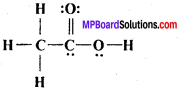
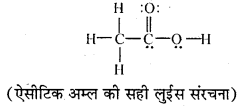
CH3COOH की नीचे दी गई ढाँचा-संरचना सही है, परंतु कुछ आबंध त्रुटिपूर्ण दर्शाए गए हैं। ऐसीटिक अम्ल की सही लुईस-संरचना लिखिए –
MP Board Class 11th Chemistry Solutions Chapter 4 रासायनिक आबंधन तथा आण्विक संरचना - 16
उत्तर:
MP Board Class 11th Chemistry Solutions Chapter 4 रासायनिक आबंधन तथा आण्विक संरचना - 17

प्रश्न 21.
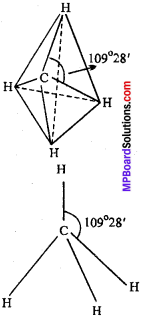
चतुष्फलकीय ज्यामिति के अलावा CH4 अणु की एक और संभव ज्यामिति वर्गसमतलीय है, जिसमें हाइड्रोजन के चार परमाणु एक वर्ग के चारों कोनों पर होते हैं। व्याख्या कीजिए कि CH4 का अणु वर्ग-समतलीय नहीं होता है।
उत्तर:
वर्ग समतलीय ज्यामिति में बंध कोण 90° का होता है जिसमें चतुष्फलकीय ज्यामिति बंध कोण 109°28′ की तुलना में अधिक प्रतिकर्षण (कम स्थायित्व) होता है। अत: अधिक स्थाई अवस्था (कम प्रतिकर्षण)वाली अवस्था चतुष्फलकीय ज्यामिति ही CH4 की वास्तविक अवस्था होगी।

प्रश्न 22.
यद्यपि Be-H आबंध ध्रुवीय है, तथापि BeH2 अणु का द्विधुव आघूर्ण शून्य है। स्पष्ट कीजिए।
उत्तर:
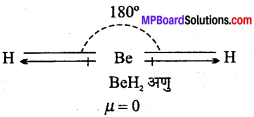
चूँकि BeH2, अणु की संरचना रेखीय होती है अतः इसके दो Be – H आबंध एक-दूसरे के प्रभाव को समाप्त कर देते हैं एवं BeH2 का द्विध्रुव आघूर्ण शून्य होता है।
MP Board Class 11th Chemistry Solutions Chapter 4 रासायनिक आबंधन तथा आण्विक संरचना - 18

प्रश्न 23.
NH3 तथा NF3 में किस अणु का द्विध्रुव-आघूर्ण अधिक है और क्यों?
उत्तर:
MP Board Class 11th Chemistry Solutions Chapter 4 रासायनिक आबंधन तथा आण्विक संरचना - 19
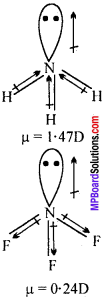
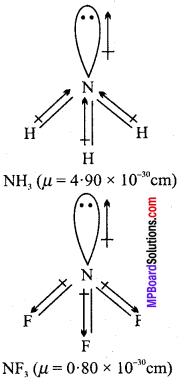
NH2 तथा NF3 के द्विध्रुव आघूर्ण की तुलना-इन दोनों में नाइट्रोजन में एक एकाकी युग्म के कारण इनका आकार पिरामिडीय होता है। फ्लुओरीन की विद्युत्ऋणात्मकता हाइड्रोजन से अधिक होने के कारण N – F बंध, N – H बंध की तुलना में अधिक ध्रुवीय होता है अत: NF3 का परिणामी द्विध्रुव आघूर्ण NH3 से अधिक होनी चाहिए परन्तु NH4 का द्विध्रुव आघूर्ण (µ = 1.47D), NF3 (µ = 0.24D) से अधिक होता है। इस असामान्य व्यवहार को नाइट्रोजन पर उपस्थित एकाकी इलेक्ट्रॉन युग्म द्वारा समझा जा सकता है। NH3 में एकाकी इलेक्ट्रॉन युग्म के कारण कक्षीय द्विध्रुव तथा तीन N – H बंध का बंध आघूर्ण एक ही दिशा में होता है। अतः परिणामी द्विध्रुव आघूर्ण N – H बंध में जुड़ते हैं जबकि NF3 में कक्षीय द्विध्रुव आघूर्ण की दिशा तीन N – F बंध के परिणामी द्विध्रुव आघूर्ण के विपरीत होती है। अतः एकाकी युग्म का आघूर्ण परिणामी N – F बंध आघूर्ण को चित्र में दिखाये अनुसार निरस्त कर देते हैं। अत: NF3 का द्विध्रुव आघूर्ण कम होता है।

प्रश्न 24.
परमाणु-कक्षकों के संकरण से आप क्या समझते हैं? sp, sp2 तथा sp3 संकर कक्षकों की आकृति का वर्णन कीजिए।
उत्तर:
संकरण:
परमाणु कक्षक संयोजित होकर समतुल्य कक्षकों का समूह बनाते हैं। इन कक्षकों को संकर कक्षक कहते हैं। आबंध विचरन में परमाणु शुद्ध कक्षकों के स्थान पर संकरित कक्षकों का प्रयोग करते हैं। इस परिघटना को संकरण कहते हैं। लगभग समान ऊर्जा वाले कक्षकों के आपस में मिलकर ऊर्जा के पुनर्वितरण द्वारा समान ऊर्जा तथा आकार वाले कक्षकों को बनाने की प्रक्रिया को संकरण कहते हैं।

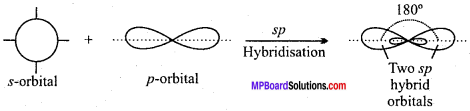
1. sp संकरण – इस प्रकार के संकरण में एक s तथा एक p कक्षक संकरित होकर दो समान sp संकरण कक्षकों का निर्माण करते हैं।
MP Board Class 11th Chemistry Solutions Chapter 4 रासायनिक आबंधन तथा आण्विक संरचना - 20
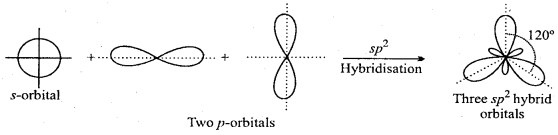
2. sp2संकरण – इस प्रकार के संकरण में एक s तथा दो p कक्षक संकरित होकर तीन समान sp संकर कक्षकों का निर्माण करते हैं।
MP Board Class 11th Chemistry Solutions Chapter 4 रासायनिक आबंधन तथा आण्विक संरचना - 21
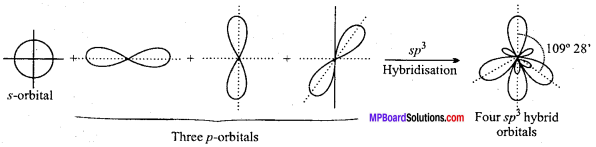
3. sp3 संकरण – इस संकरण में एक ऽ तथा तीन p कक्षक संकरित होकर चार समान sp’ संकर कक्षकों का निर्माण करते हैं।
MP Board Class 11th Chemistry Solutions Chapter 4 रासायनिक आबंधन तथा आण्विक संरचना - 22

प्रश्न 25.
निम्नलिखित अभिक्रिया में AI परमाणु की संकरण अवस्था में परिवर्तन (यदि होता है, तो) को समझाइए –
AlCl3 + Cl → AlCl4
उत्तर:
AlCl3 में Al, sp2 संकरित अवस्था में है जबकि [AlCl4] में Al, sp3 संकरित होता है।

प्रश्न 26.
क्या निम्नलिखित अभिक्रिया के फलस्वरूप B तथा N परमाणुओं की संकरण अवस्था में परिवर्तन होता है
BF3 + NH3 → F3B.NH3
उत्तर:
उपर्युक्त अभिक्रिया में N का संकरण अपरिवर्तित रहता है जबकि B का संकरण sp2 से sp3 हो जाता है।

प्रश्न 27.
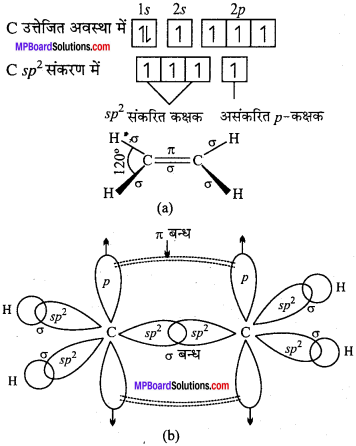
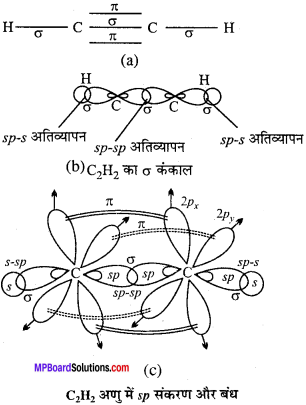
C2H4, तथा C2H2, अणुओं में कार्बन परमाणुओं के बीच क्रमशः द्वि-आबंध तथा त्रिआबंध के निर्माण को चित्र द्वारा स्पष्ट कीजिए।
उत्तर:
ऐथीन (एथिलीन, C2H4) अणु:
संकरित कार्बन परमाणु के एक s कक्षक तथा दो p कक्षक मिश्रित होकर तीन sp2 संकरित कक्षकों का निर्माण करते हैं। तीसरा p कक्षक, जो संकरण में भाग नहीं लेता, एक अक्ष की दिशा में ही स्थित रहता है तथा उसी स्थिति में बंध बनाता है। तीन sp2संकरित कक्षक एक समत्रिभुज के तीन शीर्षों की ओर इंगित करते हुए होते हैं। पहले कार्बन परमाणु का एक sp कक्षक दूसरे कार्बन परमाणु के एक sp कक्षक से अक्षीय अतिव्यापन (Axial overlapping) करके C – C बंध बनाता है। प्रत्येक कार्बन पर स्थित शेष दो sp2 कक्षक जो 120° का कोण बनाते हैं, हाइड्रोजन के 1s कक्षक के साथ अतिव्यापन करके C – H बन्ध बनाते हैं। इस प्रकार कुल चार C – H बन्ध बनते हैं। इसके अतिरिक्त प्रत्येक कार्बन परमाणु पर एक-एक असंकरित p कक्षक हैं जो पार्श्व अतिव्यापन करके दूसरा C – C बन्ध बनाते हैं। इस प्रकार C2H4 बनता है जिसमें कार्बन परमाणुओं के मध्य द्विबन्ध (Double bond) होता है। sp2 संकरण से C2H4, अणु का बनना चित्र में दर्शाया गया है।
MP Board Class 11th Chemistry Solutions Chapter 4 रासायनिक आबंधन तथा आण्विक संरचना - 23
एसीटिलीन (C2H2) अणु:
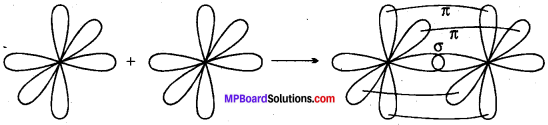
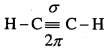
C2H2, अणु में sp संकरण होता है। एथाइन अणु के बनने में दोनों कार्बन परमाणु sp संकरण दर्शाते हैं। उन पर दो-दो संकरित (2p, तथा 2p.) कक्षक होते हैं। एक कार्बन परमाणु का sp संकर कक्षक दूसरे कार्बन परमाणु के sp संकर कक्षक से अक्षीय अतिव्यापन द्वारा C – C सिग्मा आबंध बनाता है। बचे हुए संकर कक्षक हाइड्रोजन के अर्धवृत्त 1s कक्षकों से अक्षीय अतिव्यापन द्वारा सिग्मा आबंध बनाते हैं दोनों कार्बन परमाणुओं पर उपस्थित दो-दो असंकरित कक्षक पार्श्व अतिव्यापन द्वारा दो पाई-आबंध बनाता है।
MP Board Class 11th Chemistry Solutions Chapter 4 रासायनिक आबंधन तथा आण्विक संरचना - 24

प्रश्न 28.
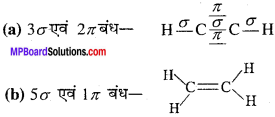
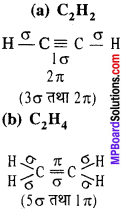
निम्नलिखित अणुओं में सिग्मा (σ) तथा पाई (π) आबंधों की कुल संख्या कितनी है –
(a) C2H2
(b) C2H4
उत्तर:
MP Board Class 11th Chemistry Solutions Chapter 4 रासायनिक आबंधन तथा आण्विक संरचना - 25

प्रश्न 29.
X-अक्ष को अंतर्नाभिकीय अक्ष मानते हुए बताइए कि निम्नलिखित में कौन-से कक्षक सिग्मा (σ) आबंध नहीं बनाएँगे और क्यों –
(a) 1s तथा 1s
(b) 15 तथा 2px
(c) 2py तथा 2py
(d) 1s तथा 2s.
उत्तर:
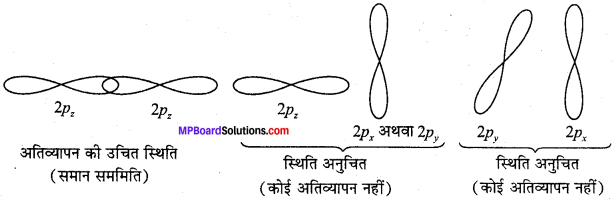
(c) को छोड़कर सभी बन्ध बनाएँगे, चूँकि 2p,-2p, के मध्य पार्श्व अतिव्यापन होगा जिससे गबन्ध बनेगा।

प्रश्न 30.
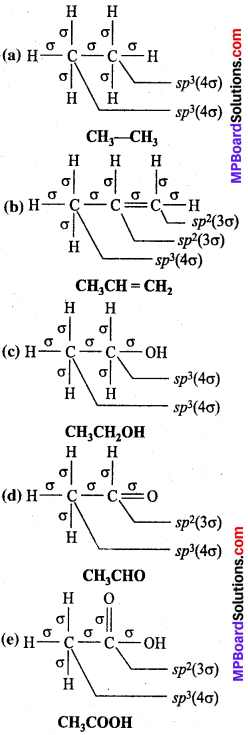
निम्नलिखित अणुओं में कार्बन परमाणु कौन-से संकर कक्षक प्रयुक्त करते हैं –
(a) CH3 – CH3
(b) CH3 – CH = CH2
(c) CH3 – CH2 – OH
(d) CH3CHO
(e) CH3COOH
उत्तर:
(a) sp3 – sp3
(b) sp3 – sp2 – sp3
(c) sp3 – sp3
(d) sp2 – sp2
(e) sp3 – sp2

प्रश्न 31.
इलेक्ट्रॉनों की आबंधी युग्म तथा एकाकी युग्म से क्या समझते हैं? प्रत्येक को एक-एक उदाहरण द्वारा स्पष्ट कीजिए।
उत्तर:
इलेक्ट्रॉनों के वे युग्म आबन्धी युग्म कहलाते हैं जो दो परमाणुओं के मध्य साझा करके बन्ध बनाते हैं जबकि परमाणु पर उपस्थित वो इलेक्ट्रॉन युग्म जो बन्ध बनाने में भाग नहीं लेते हैं एकाकी इलेक्ट्रॉन युग्म कहलाते हैं।
उदाहरणार्थ:
MP Board Class 11th Chemistry Solutions Chapter 4 रासायनिक आबंधन तथा आण्विक संरचना - 26

प्रश्न 32.
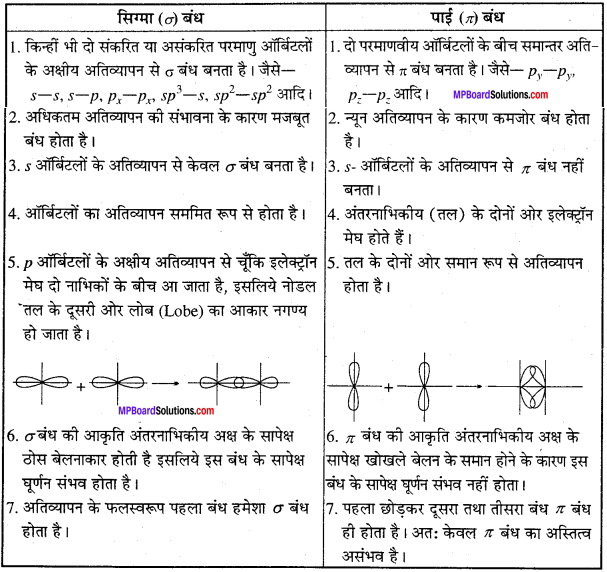
सिग्मा बंध तथा पाई आबंध में अंतर स्पष्ट कीजिए।
उत्तर:
>MP Board Class 11th Chemistry Solutions Chapter 4 रासायनिक आबंधन तथा आण्विक संरचना - 27

प्रश्न 33.
संयोजकता आबंध सिद्धांत के आधार पर H2 अणु के विरचन की व्याख्या कीजिए।
उत्तर:
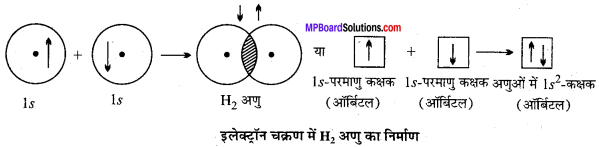
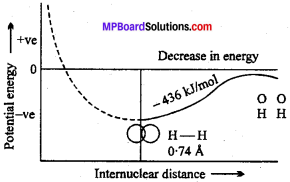
H2 अणु का बनना (s – s अतिव्यापन, σ बंध):
जब एक H – परमाणु का 1s ऑर्बिटल दूसरे H – परमाणु के 1s ऑर्बिटल, जिसके इलेक्ट्रॉन का चक्रण विपरीत हों, अतिव्यापन करते हैं तो अक्षीय अतिव्यापन होने के कारण मजबूत बंध (σ बंध) बनता है।
MP Board Class 11th Chemistry Solutions Chapter 4 रासायनिक आबंधन तथा आण्विक संरचना - 28

प्रश्न 34.
परमाणु कक्षकों के रैखिक संयोग से आण्विक कक्षक बनने के लिए आवश्यक शर्तों को लिखिए।
उत्तर:
परमाणु कक्षकों के रैखिक संयोग के लिए आवश्यक शर्ते निम्नानुसार हैं –

  1. संयोग करने वाले परमाणु कक्षकों की ऊर्जा लगभग समान होनी चाहिए।
  2. संयोग करने वाले परमाणु कक्षकों की आण्विक कक्ष के परितः समान सममिति होनी चाहिए।
  3. संयोग करने वाले परमाणु कक्षकों के मध्य अतिव्यापन पर्याप्त होना चाहिए।

प्रश्न 35.
आण्विक कक्षक सिद्धान्त के आधार पर समझाइए कि Be2 का अणु अस्तित्व क्यों नहीं होता?
उत्तर:
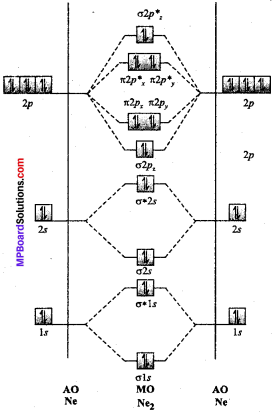
MOT के अनुसार Be2 अणु का अस्तित्व नहीं होता क्योंकि इस अणु के लिए बन्ध कोटि का मान शून्य प्राप्त होता है चूंकि Be का परमाणु क्रमांक 4 है अतः इसके अणु में 8 इलेक्ट्रॉन होंगे जिनका विन्यास अग्रानुसार होगा –
σls2, σ*1s2, σ2s2, σ*2s2
∴ बन्ध कोटि = \(\frac{1}{2}\) [Nb – Na] = \(\frac{1}{2}\) [4 – 4] = 0 बन्ध कोटि का मान शून्य है अत: Be2 अणु का अस्तित्व नहीं होगा।

प्रश्न 36.
निम्नलिखित स्पीशीज़ के आपेक्षिक स्थायित्व की तुलना कीजिए तथा उनके चुंबकीय गुण इंगित कीजिए –
O2, O2+, O2 (सुपर ऑक्साइड) तथा O (परऑक्साइड)।
उत्तर:
MOT के अनुसार O2 O2+, O2, एवं O22- के बन्ध कोटि का मान क्रमश: 2, 2.5, 1.5 एवं 1 है। अत: इनके स्थायित्व का आपेक्षिक क्रम O2+ > O2 > O2 > O22- इनमें से O2, O22-; एवं O2, अनुचुम्बकीय होंगे क्योंकि इनमें क्रमश: 2, 1, 1 अयुग्मित इलेक्ट्रॉन हैं। जबकि O, प्रतिचुम्बकीय होगा क्योंकि इसके सभी इलेक्ट्रॉन युग्मित हैं।

प्रश्न 37.
कक्षकों के निरूपण में प्रयुक्त धन (+) तथा ऋण (-) चिन्हों का क्या महत्व होता है?
उत्तर:
इलेक्ट्रॉन तरंग फलन में धन एवं ऋण चिन्ह, नाभिक से तरंग फलन की दिशा दर्शाते हैं। समान चिन्ह वाले तरंग फलनों के योग से आबंधी आण्विक कक्षक बनते हैं जबकि विपरीत चिन्ह वाले तरंग फलनों के योग से विपरीत बन्धी आण्विक कक्षक बनते हैं।

प्रश्न 38.
PCl5 अणु में संकरण का वर्णन कीजिए। इसमें अक्षीय आबंध विषुवतीय आबंधों की अपेक्षा अधिक लंबे क्यों होते हैं?
उत्तर:
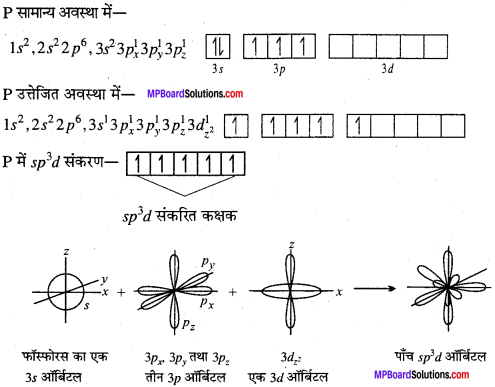
sp3d संकरण – PCl5 का बनना:
PCl5 की आकृति त्रिकोणीय द्विपिरामिडीय है। स्पष्टतः इसमें एक,s, तीन p तथा एक d (यह dz2 होगा) संकरित होते हैं। पाँच नये spid संकरित ऑर्बिटलों में से तीन एक तल में 120° का कोण बनाते हुए तथा दो ऑर्बिटल, तल के ऊपर एवं नीचे 90° का कोण बनाते हुए रहेंगे।
फॉस्फोरस का इलेक्ट्रॉनिक विन्यास – (P का परमाणु क्रमांक 15 है तथा विन्यास 2, 8, 5 है)
MP Board Class 11th Chemistry Solutions Chapter 4 रासायनिक आबंधन तथा आण्विक संरचना - 29
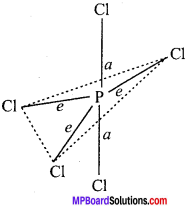
इस प्रकार से PCl5 में तीन P – Cl सिग्मा बंध एक तल में होते हैं, इन्हें निरक्षीय बंध तथा दो P – Cl बंध तल के लंबवत् ऊपर तथा नीचे होते हैं, इन्हें अक्षीय बंध कहते हैं।
MP Board Class 11th Chemistry Solutions Chapter 4 रासायनिक आबंधन तथा आण्विक संरचना - 30
P – Cl विषुवतीय आबंध की लंबाई 2.04Å है जबकि P – Cl अक्षीय आबंध 2.19Å है। अक्षीय आबंध की लंबाई ज्यादा होने का कारण एकल-एकल इलेक्ट्रॉन युग्म में प्रतिकर्षण अधिक होता है। अतः प्रतिकर्षण के कारण अक्षीय आबंध की लंबाई अधिक है।

प्रश्न 39.
हाइड्रोजन आबंध की परिभाषा दीजिए। यह वाण्डर वाल्स बलों की अपेक्षा प्रबल होते हैं या दुर्बल?
उत्तर:
हाइड्रोजन बंध H – परमाणु व विद्युत्ऋणी परमाणु (N, O, F) के मध्य आकर्षण बल है। हाइड्रोजन बंध, वाण्डर वाल्स बलों की तुलना में प्रबल होता है क्योंकि हाइड्रोजन बंध में प्रबल द्विध्रुव-द्विध्रुव अन्योन्य क्रिया होती है जबकि वाण्डर वाल्स बल प्रकीर्णन का दुर्बल बल है।

प्रश्न 40.
‘आबंध कोटि’ से आप क्या समझते हैं? निम्नलिखित में आबंध-कोटि का परिकलन कीजिए –
N2, O2, O2+ तथा O2.
उत्तर:
आबंध कोटि-अणु या आयन के दो परमाणुओं के बीच उपस्थित बंधों की संख्या आबंध कोटि (Bond order) कहलाती है।
MP Board Class 11th Chemistry Solutions Chapter 4 रासायनिक आबंधन तथा आण्विक संरचना - 31
उपर्युक्त सूत्र के आधार पर बंध कोटि के मान N2(3.0), O2(2.0), O2+(2.5) एवं O2 (1.5) होगा।

रासायनिक आबंधन तथा आण्विक संरचना अन्य महत्वपूर्ण प्रश्न

रासायनिक आबंधन तथा आण्विक संरचना वस्तुनिष्ठ प्रश्न

प्रश्न 1.
सही विकल्प चुनकर लिखिए –

प्रश्न 1.
समान परमाणुओं में सामान्यतः किस प्रकार का बन्ध बनता है
(a) आयनिक
(b) सहसंयोजक
(c) उप-सहसंयोजक
(d) धात्विक।
उत्तर:
(b) सहसंयोजक

प्रश्न 2.
अधिकतम द्विध्रुव आघूर्ण वाला अणु है –
(a) CH4
(b) CHCl3
(c) CHI3
(d) CCl4
उत्तर:
(b) CHCl3

प्रश्न 3.
अमोनिया में संकरण है –
(a) dsp2
(b) sp3
(c) sp2d
(d) d2sp.
उत्तर:
(b) sp3

प्रश्न 4.
जल का उच्च क्वथनांक निम्न कारण से होता है –
(a) जल के अणुओं का कम वियोजित होना
(b) जल के अणुओं के मध्य H-बंध होना
(c) जल की विशिष्ट ऊष्मा
(d) जल का उच्च डाइ-इलेक्ट्रिक स्थिरांक।
उत्तर:
(b) जल के अणुओं के मध्य H-बंध होना

प्रश्न 5.
किसका द्विध्रुव आघूर्ण शून्य है –
(a) H2O
(b) CO2
(c) SO2
(d) NO2
उत्तर:
(b) CO2

प्रश्न 6.
निम्न में से किस यौगिक में sp संकरित कक्षकों का उपयोग हुआ है –
(a) BCl3
(b) CH4
(c) NH3
(d) BeH2
उत्तर:
(a) BCl3

प्रश्न 7.
निम्न में से किसकी संरचना रैखिक है –
(a) CO2
(b) H2O
(c) SO2
(d) H2O2
उत्तर:
(a) CO2

प्रश्न 8.
PCI5 अणु निम्नलिखित संकरण का परिणाम है –
(a) sp2d2
(b) sp3d
(c) spd3
(d) sp2d3
उत्तर:
(b) sp3d

प्रश्न 9.
किस अणु में केन्द्रीय परमाणु के साथ बना बन्ध कोण अधिकतम होगा –
(a) NH3
(b) NH4
(c) PCl3
(d) SCl2
उत्तर:
(b) NH4

प्रश्न 10.
H-बंध उपस्थित है –
(a) CH4
(b) NaCl
(c) H2O
(d) CHCl3
उत्तर:
(c) H2O

प्रश्न 2.
रिक्त स्थानों की पूर्ति कीजिए –

  1. CH4 में ………….. संकरण पाया जाता है।
  2. LCAO का पूर्ण नाम है …………….।
  3. NH3 का क्वथनांक PH3 के क्वथनांक से …………. होता है।
  4. s – s अतिव्यापन से ……………….. बंध बनता है।
  5. जल के अणु में H – O – H बन्ध कोण …………….. होता है।
  6. p – p पाीय अतिव्यापन से …………….. बंध बनता है।
  7. रासायनिक बन्धों के निर्माण के साथ ऊर्जा में ……………. होती है।
  8. हीरा विद्युत् का ……………. है जबकि ग्रेफाइट ……………… है।
  9. ग्रेफाइट तथा हीरे में ……….. संकरण होता है।
  10. जल के अणु में …………….. संकरण होता है।

उत्तर:

  1. sp3
  2. लीनियर कॉम्बिनेशन ऑफ एटॉमिक ऑर्बिटल
  3. उच्च
  4. 6
  5. 104.5°
  6. 7
  7. कमी
  8. कुचालक, सुचालक
  9. sp2 व sp3
  10. sp3

प्रश्न 3.
उचित संबंध जोड़िए –
MP Board Class 11th Chemistry Solutions Chapter 4 रासायनिक आबंधन तथा आण्विक संरचना - 32
उत्तर:

  1. (c)
  2. (d)
  3. (e)
  4. (b)
  5. (a)

प्रश्न 4.
एक शब्द/वाक्य में उत्तर दीजिए –

  1. किस प्रकार के आबन्ध दिशात्मक होते हैं?
  2. सल्फर टेट्राफ्लोराइड की आकृति कैसी होती है?
  3. सोडियम क्लोराइड में किस प्रकार का रासायनिक बंध होता है?
  4. चीनी कार्बनिक यौगिक है फिर भी जल में विलेय है।
  5. जल के अणु का आबंध कोण है।
  6. BF अणु का द्विध्रुव आघूर्ण होता है।

उत्तर:

  1. सहसंयोजक बन्ध
  2. वर्ग पिरामीडीय
  3. विद्युत् संयोजी
  4. हाइड्रोजन बन्ध के कारण
  5. 104°5
  6. शून्य।

रासायनिक आबंधन तथा आण्विक संरचना अति लघु उत्तरीय प्रश्न

प्रश्न 1.
रासायनिक बंध किसे कहते हैं?
उत्तर:
सभी पदार्थों में परमाणु संयुक्त अवस्था में पाये जाते हैं तथा परमाणुओं के संयोग से विद्युत् आवेश रहित कण बनते हैं, वे अणु कहलाते हैं तथा किसी भी अणु में पाये जाने वाले परमाणुओं के मध्य पाये जाने वाला आकर्षण ही रासायनिक बंध कहलाता है।

प्रश्न 2.
संयोजकता का इलेक्ट्रॉनिक सिद्धांत क्या है? इसके मुख्य अभिगृहीत लिखिये।
उत्तर:
संयोजकता का इलेक्ट्रॉनिक सिद्धांत तथा इसके मुख्य अभिगृहीत निम्नलिखित हैं –

  1. किसी भी तत्व की संयोजकता उसके परमाणु के संयोजी कोश में उपस्थित इलेक्ट्रॉनों की संख्या पर निर्भर करती है।
  2. सभी तत्वों के परमाणुओं में अक्रिय गैस के समान स्थायी इलेक्ट्रॉनिक विन्यास प्राप्त करने की प्रवृत्ति होती है।
  3. किसी भी तत्व के संयोजी कोश में उपस्थित इलेक्ट्रॉन को संयोजी इलेक्ट्रॉन कहते हैं तथा जब इस संयोजी कोश से इलेक्ट्रॉन निकल जाते हैं तो बचा हुआ रिक्त कक्ष कर्नेल कहलाता है।
  4. यदि परमाणु अस्थायी हो तो वह स्थायित्व प्राप्त करने का प्रयास करता है।

इसके लिये वह इलेक्ट्रॉन का आदान-प्रदान या साझा करता है। इस आधार पर बंध तीन प्रकार के होते हैं –

  1. आयनिक बंध
  2. सहसंयोजी बंध
  3. उप-सहसंयोजी बंध।

प्रश्न 3.
आयनिक बंध बनाने के लिए अनुकूल कारकों को लिखिए।
उत्तर:
आयनिक आबंध बनाने के लिए अनुकूल कारक निम्न है –

  1. धनायन बनने वाले तत्व की आयनन एन्थैल्पी निम्न हो।
  2. ऋणायन बनने वाले तत्व की अधिक ऋणात्मक इलेक्ट्रॉन लब्धि एन्थैल्पी (इलेक्ट्रॉन बंधुता)।
  3. बनने वाले आयनिक यौगिक की उच्च जालक एन्थैल्पी।

प्रश्न 4.
निम्नलिखित अणुओं तथा आयनों की लुईस संरचनाएँ लिखिए –
H2S, SiCl4, BeF2, CO32-, HCOOH.
उत्तर:
MP Board Class 11th Chemistry Solutions Chapter 4 रासायनिक आबंधन तथा आण्विक संरचना - 33

प्रश्न 5.
निम्नलिखित तत्वों के परमाणुओं के लुईस बिंदु प्रतीक लिखिए –
Mg, Br, Na, O.
उत्तर:
MP Board Class 11th Chemistry Solutions Chapter 4 रासायनिक आबंधन तथा आण्विक संरचना - 34

प्रश्न 6.
निम्नलिखित परमाणुओं से इलेक्ट्रॉन स्थानांतरण द्वारा धनायनों और ऋणायनों में विरचन को लुईस बिन्दु प्रतीकों की सहायता में दर्शाइए –
(a) K तथा S
(b) Ca तथा O
(c) AI तथा N.
उत्तर:
MP Board Class 11th Chemistry Solutions Chapter 4 रासायनिक आबंधन तथा आण्विक संरचना - 35

प्रश्न 7.
लुईस प्रतीक क्या है? निम्नलिखित में से प्रत्येक तत्व का लुईस प्रतीक लिखिए –
Na, Ca, B, Br, Xe, C, A, O.
उत्तर:
गिलबर्ट न्यूटन लुईस ने परमाणु में उपस्थित संयोजकता इलेक्ट्रॉन को दर्शाने के लिये लुईस प्रतीक का उपयोग किया। इस विधि में किसी परमाणु के संयोजी कोश में उपस्थित इलेक्ट्रॉन को दर्शाने के लिये उस तत्व के प्रतीक के चारों ओर उतने ही बिन्दु दर्शाते हैं, जितने इलेक्ट्रॉन उसके बाह्य संयोजी कोश में उपस्थित रहते हैं।
MP Board Class 11th Chemistry Solutions Chapter 4 रासायनिक आबंधन तथा आण्विक संरचना - 36

प्रश्न 8.
एकाकी इलेक्ट्रॉन युग्म से क्या समझते हैं?
उत्तर:
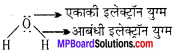
किसी परमाणु के संयोजी कोश में उपस्थित इलेक्ट्रॉन युग्म जो बंध निर्माण में भाग नहीं लेता है। अर्थात् बंध निर्माण के पश्चात् संयोजी कोश में उपस्थित इलेक्ट्रॉन युग्म जो परमाणु में शेष रहता है, एकाकी इलेक्ट्रॉन युग्म कहलाता है। जैसे – H2O अणु में केन्द्रीय परमाणु ऑक्सीजन के पास दो एकाकी इलेक्ट्रॉन युग्म होते हैं।
MP Board Class 11th Chemistry Solutions Chapter 4 रासायनिक आबंधन तथा आण्विक संरचना - 37
बंध युग्म = 2, एकाकी इलेक्ट्रॉन युग्म = 2

प्रश्न 9.
द्विध्रुव आघूर्ण से क्या समझते हैं?
उत्तर:
किसी बंध का द्विध्रुव आघूर्ण परमाणुओं पर उपस्थित आवेश की मात्रा तथा उनके बीच की दूरी के गुणनफल के बराबर होता है। यह एक सदिश राशि है तथा इसकी सहायता से किसी बंध की आयनिक प्रतिशतता की गणना की जा सकती है। इसे µ से दर्शाते हैं।
µ = e x d
जहाँ µ = द्विध्रुव आघूर्ण
e = आवेश की मात्रा
d = परमाणुओं के बीच की दूरी।
इसकी इकाई डिबाई होती है, इसे D से दर्शाते हैं।
ID = 10-18 cm-e.s.u.

प्रश्न 10.
आबंध ऊर्जा या बंध ऊर्जा किसे कहते हैं?
उत्तर:
किसी द्विपरमाणुक अणु की बंधन ऊर्जा वह ऊर्जा है जो दो उदासीन परमाणुओं के बंधित होकर उसके एक ग्राम अणु को गैसीय अवस्था में आने पर मुक्त होता है।
A + B → A – B + ऊर्जा
दूसरे शब्दों में, एक ग्राम अणु पदार्थ की गैसीय अवस्था में दो परमाणुओं के बीच बने सहसंयोजक बंध को तोड़ने के लिये जितनी ऊर्जा की आवश्यकता होती है, उसे बंधन ऊर्जा कहते हैं। आबन्ध ऊर्जा का मात्रक किलो कैलोरी प्रति जूल या किलो जूल प्रति मोल है।

प्रश्न 11.
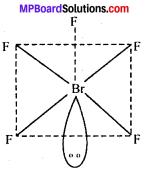
BrF5 की आकृति की व्याख्या कीजिए।
उत्तर:
BrF5 में केन्द्रीय परमाणु Br (35Br = 2, 8, 18, 7) के संयोजी कोश में सात इलेक्ट्रॉन उपस्थित होते हैं, जिनमें से पाँच इलेक्ट्रॉन, पाँच फ्लुओरीन (F) परमाणुओं के साथ आबंध बनाते हैं तथा शेष दो इलेक्ट्रॉन एकाकी युग्म के रूप में रहते हैं। अतः कुल छः युग्म (पाँच आबंधी युग्म तथा एक एकाकी युग्म) उपस्थित होते हैं। एकाकी युग्म और आबंधी युग्म के मध्य प्रतिकर्षण को न्यूनतम करने के लिए, इसकी आकृति वर्ग-पिरामिडीय हो जाती है।
MP Board Class 11th Chemistry Solutions Chapter 4 रासायनिक आबंधन तथा आण्विक संरचना - 38

प्रश्न 12.
कक्षकों के निरूपण में उपयुक्त धन (+) तथा ऋण (-) चिह्नों का क्या महत्व होता है?
उत्तर:
परमाणु कक्षक तरंग फलन के रूप में दर्शाये जाते हैं। कक्षक में धन (+) चिह्न, धन तरंग फलन को तथा ऋण चिह्न (-), ऋण तरंग फलन को प्रदर्शित करता है। समान चिह्न वाले दो तरंग फलनों के संयोग से आबंध आण्विक बंध बनते हैं। जबकि विपरीत चिह्न वाले दो तरंग फलनों के संयोग से प्रति आबंध आण्विक कक्षक बनते हैं।

प्रश्न 13.
निम्नलिखित अणुओं में सिग्मा (σ) तथा पाई (π) आबंधों की कुल संख्या कितनी है –
(a) C2H2
(b) C2H4
उत्तर:
MP Board Class 11th Chemistry Solutions Chapter 4 रासायनिक आबंधन तथा आण्विक संरचना - 39

प्रश्न 14.
हाइड्रोजन बंध से क्या समझते हैं?
उत्तर:
किसी अणु में उपस्थित सहसंयोजी बंध द्वारा जुड़े हाइड्रोजन परमाणु और उसी यौगिक के अन्य अणु के प्रबल ऋण विद्युती तत्व के बीच कार्य कर रहे स्थिर वैद्युत आकर्षण बल को हाइड्रोजन बंध कहते हैं, इसे बिन्दुकित रेखा द्वारा दर्शाते हैं। हाइड्रोजन बंध दो प्रकार के होते हैं –

  1. अन्तर अणुक हाइड्रोजन बंध,
  2. अन्तःअणुक हाइड्रोजन बंध।

प्रश्न 15.
सामान्य ताप पर जल द्रव होता है, जबकि हाइड्रोजन सल्फाइड गैस है, क्यों?
उत्तर:
H2O तथा H2S, ऑक्सीजन तथा सल्फर के हाइड्रोजन के साथ बने यौगिक हैं। जल में उपस्थित ऑक्सीजन प्रबल ऋणविद्युती तत्व है। इसलिये साधारण ताप पर जल के अणुओं के मध्य अन्तर अणुक हाइड्रोजन बंध का बनना संभव है। इस अंतर अणुक हाइड्रोजन बंध के कारण जल के अणु संगुणित होते हैं जिसके कारण साधारण ताप पर जल द्रव है तथा इसके क्वथनांक उच्च होते हैं।

H2S में उपस्थित (S) के बड़े आकार के कारण ऋणविद्युतता कम होती है इसलिये H2S अणु के मध्य हाइड्रोजन बंध का बनना संभव नहीं है इसलिये इनके अणुओं के मध्य केवल दुर्बल वाण्डर वाल्स आकर्षण बल होता है अत: H2S साधारण ताप पर गैस है।

प्रश्न 16.
ग्लिसरॉल की श्यानता एथेनॉल से अधिक है, क्यों?
उत्तर:
एथेनॉल अणु में एक हाइड्रॉक्सिल समूह होता है जबकि प्रत्येक ग्लिसरॉल में तीन OH समूह होते हैं जो तीन हाइड्रोजन बंध बनाते हैं अर्थात् ग्लिसरॉल में हाइड्रोजन बंध बनाने की प्रवृत्ति एथेनॉल से अधिक है। इसलिये ग्लिसरॉल की श्यानता एथेनॉल से अधिक है।

प्रश्न 17.
सल्फ्यूरिक अम्ल के उच्च क्वथनांक तथा उच्च श्यानता का कारण स्पष्ट कीजिए।
उत्तर:
H2SO4 अणु में उच्च ऋणविद्युतता होने के कारण हाइड्रोजन बंध बनाने की प्रवृत्ति होती है। H-बंध के कारण H2SO4 के अणु संगुणित अवस्था में होते हैं। इस अंतर अणुक हाइड्रोजन बंध के कारण ये सरलता से वाष्पित नहीं होते हैं इसलिये इनके क्वथनांक तथा श्यानता उच्च होती है।

प्रश्न 18.
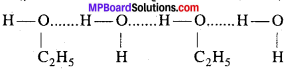
एथिल एल्कोहॉल की जल में विलेयता का क्या कारण है?
उत्तर:
एथिल एल्कोहॉल जल के अणुओं के साथ सरलता से अंतर अणुक हाइड्रोजन बंध का निर्माण कर सकते हैं इस हाइड्रोजन बंध बनाने की प्रवृत्ति के कारण एथिल एल्कोहॉल जल में सरलता से विलेय है।
MP Board Class 11th Chemistry Solutions Chapter 4 रासायनिक आबंधन तथा आण्विक संरचना - 40

प्रश्न 19.
किसी अणु द्वारा हाइड्रोजन बंध निर्माण के लिये प्रमुख शर्ते क्या हैं?
उत्तर:
किसी अणु द्वारा हाइड्रोजन बंध बनने की शर्ते निम्नलिखित हैं –

  1. किसी अणु में हाइड्रोजन से जुड़े सहसंयोजी बंध द्वारा जुड़े परमाणु की ऋणविद्युतता अत्यधिक उच्च होनी चाहिए।
  2. हाइड्रोजन से सहसंयोजी बंध द्वारा जुड़े परमाणु की परमाणु त्रिज्या कम होनी चाहिये।

प्रश्न 20.
जालक ऊर्जा और जलयोजन ऊर्जा से क्या समझते हैं?
उत्तर:
1. जालक ऊर्जा:
किसी आयनिक ठोस की जालक ऊर्जा, वह ऊर्जा है जो एक-दूसरे से अनन्त दूरी पर स्थित अवयवी गैसीय आयनों से एक मोल ठोस क्रिस्टल बनने से उत्सर्जित होती है। दूसरे शब्दों में, किसी भी क्रिस्टल के निर्माण में निकलने वाली ऊर्जा को जालक ऊर्जा कहते हैं।

2. जलयोजन ऊर्जा:
किसी आयन को जल में विलेय करने पर या आयन के साथ जल के संयुक्त होने पर निकलने वाली ऊर्जा जलयोजन ऊर्जा कहलाती है।

प्रश्न 21.
परमाण्वीय कक्षकों के अतिव्यापन के लिये किन परिस्थितियों का होना आवश्यक है?
उत्तर:
परमाण्वीय कक्षकों के अतिव्यापन के लिये निम्नलिखित परिस्थितियों का होना आवश्यक है –

  1. दोनों परमाण्वीय कक्षकों की ऊर्जा लगभग समान होनी चाहिए।
  2. दोनों परमाणुओं के नाभिकों की अक्ष पर एक-सी सममिति होनी चाहिये।
  3. किसी भी संयोग के लिये अतिव्यापन की एक निश्चित सीमा आवश्यक है अर्थात् अतिव्यापन की सीमा अधिकतम होनी चाहिये।

प्रश्न 22.
(सिग्मा) σ बंध किसे कहते हैं?
उत्तर:
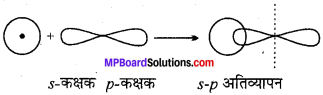
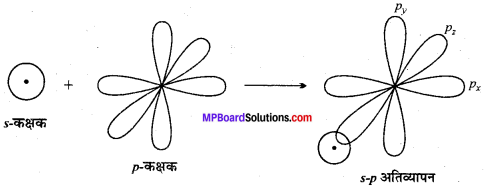
जब अर्धपूर्ण कक्षक एक-दूसरे के साथ सम्मुख अतिव्यापन करते हैं तो बंध बनता है। इस प्रकार का बंध s – s, S – p तथा p – p कक्षकों के सम्मुख अतिव्यापन के फलस्वरूप बनते हैं। यह प्रबलतम बंध है तथा इलेक्ट्रॉनों का घनत्व अंतः नाभिकीय अक्ष पर अधिकतम होता है।

प्रश्न 23.
σ – बंध, π – बंध की तुलना में प्रबल होता है, क्यों?
उत्तर:
किसी भी बंध की प्रबलता अतिव्यापन की सीमा पर निर्भर करती है। σ बंध सम्मुख अतिव्यापन के फलस्वरूप बनते हैं जबकि π बंध पार्श्व अतिव्यापन के फलस्वरूप बनते हैं। इसलिये बंध में अतिव्यापन की सीमा बंध से अधिक होती है क्योंकि अणु में उपस्थित बंध की उपस्थिति के कारण दोनों परमाणुओं के मध्य एक न्यूनतम दूरी निर्धारित होती है। जिसके कारण ग बंध निर्माण के दौरान कक्षक अधिकतम अतिव्यापन नहीं कर सकते हैं। इसलिये π बंध, σ बंध की तुलना में दुर्बल हैं।
MP Board Class 11th Chemistry Solutions Chapter 4 रासायनिक आबंधन तथा आण्विक संरचना - 41

प्रश्न 24.
HCl एक सहसंयोजी यौगिक है, फिर भी इसका जलीय विलयन आयनित क्यों हो जाता है?
उत्तर:
HCl सहसंयोजी यौगिक है लेकिन HCl में क्लोरीन की ऋणविद्युतता H से अधिक है जिसके कारण साझे का इलेक्ट्रॉन युग्म क्लोरीन की ओर विस्थापित हो जाता है, जिसके फलस्वरूप H पर आंशिक धन आवेश तथा Cl पर आंशिक ऋण आवेश उत्पन्न हो जाता है। अर्थात् HCl अणु में ध्रुवता उत्पन्न हो जाती है एवं बंध दुर्बल हो जाते हैं। HCl को जल में घोलने पर जल के अणु H+ और Cl के बीच आकर्षण बल को कम कर देते हैं और HCl सरलता से आयनित हो जाता है।

प्रश्न 25.
विद्युत् संयोजी तथा सहसंयोजी यौगिकों में से किनके क्वथनांक उच्च होते हैं, और क्यों?
उत्तर:
विद्युत् संयोजी यौगिकों के क्रिस्टल आयनों से मिलकर बने होते हैं तथा इन आयनों के बीच प्रबल स्थिर वैद्युत आकर्षण बल होता है, जिसके कारण ये दृढ़ता से बँधे रहते हैं तथा इनको पृथक् करने के लिये तथा वाष्पित करने के लिये अधिक ऊर्जा की आवश्यकता होती है। इसलिये वैद्युत संयोजी यौगिकों के क्वथनांक सहसंयोजी यौगिक से उच्च होते हैं क्योंकि सहसंयोजी यौगिक परमाणु के संयोजन से बनते हैं तथा इनके मध्य केवल दुर्बल वाण्डर वाल्स आकर्षण बल होता है।

प्रश्न 26.
BaSO4, जल में अविलेय है, क्यों?
उत्तर:
किसी आयनिक यौगिक की जल में विलेयता जालक ऊर्जा तथा जलयोजन ऊर्जा पर निर्भर करती है। यदि किसी यौगिक की जालक ऊर्जा जलयोजन ऊर्जा से अधिक हो, तो वह आयनिक यौगिक जल में अविलेय होता है। BaSO4, की जालक ऊर्जा का मान जलयोजन ऊर्जा के मान से अधिक है, इसलिये BaSO4 जल में अविलेय है।

प्रश्न 27.
SO3, NO2, तथा NO3 की अनुनाद संरचनाएँ लिखिए।
उत्तर:
MP Board Class 11th Chemistry Solutions Chapter 4 रासायनिक आबंधन तथा आण्विक संरचना - 42

प्रश्न 28.
सोडियम एक प्रबल विद्युत् धनात्मक तत्व है, क्यों?
उत्तर:
सोडियम का परमाणु क्रमांक 11 है तथा इनका इलेक्ट्रॉनिक विन्यास 2, 8, 1 है। इसके बड़े आकार के कारण इनकी आयनन ऊर्जा का मान अत्यन्त कम होता है, जिसके फलस्वरूप ये सरलता से इलेक्ट्रॉन का त्याग कर धनायन बनाते हैं। इसलिये ये प्रबल धनविद्युती तत्व हैं।

प्रश्न 29.
विद्युत् संयोजक बंध किस प्रकार के यौगिकों के मध्य बनता है?
उत्तर:
प्रबल धन विद्युतीय तत्व तथा प्रबल ऋणविद्युती तत्वों के मध्य आयनिक बंध बनता है क्योंकि प्रबल धन विद्युती तत्व सरलता से इलेक्ट्रॉन त्याग कर धनायन बनाते हैं जबकि प्रबल ऋणविद्युती तत्व सरलता से इलेक्ट्रॉन ग्रहण कर ऋणायन बनाते हैं। ये धन आयन तथा ऋण आयनों के मध्य प्रबल स्थिर वैद्युत आकर्षण बल होता है। इस प्रबल स्थिर वैद्युत आकर्षण बल को ही वैद्युत संयोजी या आयनिक बंध कहते हैं।
उदाहरण – Na2,8,1 + Cl2,8,7 → Na2,8+ Cl2,8,8

प्रश्न 30.
HF अणु HI अणु से अधिक ध्रुवीय है, क्यों?
उत्तर:
फ्लुओरीन की ऋणविद्युतता आयोडीन से अधिक होती है, इसलिये साझे के इलेक्ट्रॉनों का विस्थापन-HF में HI की तुलना में अधिक होता है, जिसके फलस्वरूप HF में आवेश का विभाजन HI से अधिक है, इसलिये HF अणु HI से अधिक ध्रुवीय है।

प्रश्न 31.
C – CI बंध ध्रुवीय होता है, किन्तु CCl4 अध्रुवीय होता है। कारण स्पष्ट कीजिए।
उत्तर:
C – CI बंध में क्लोरीन की ऋणविद्युतता C की तुलना में उच्च है, जिसके कारण साझे के इलेक्ट्रॉन क्लोरीन की ओर विस्थापित हो जाते हैं जिससे C पर आंशिक धन आवेश तथा CI पर आंशिक ऋण आवेश आ जाता है और यह बंध ध्रुवीय प्रकृति दर्शाता है।
जबकि CCl4 अणु की संरचना सममित होती है, जिसके कारण C – Cl बंधों के द्विध्रुव आघूर्ण एकदूसरे को निरस्त कर देते हैं, इसलिये CCl4 का अणु अध्रुवीय होता है।

प्रश्न 32.
अनुनाद से क्या समझते हैं?
उत्तर:
जब किसी अणु को एक निश्चित संरचना सूत्र द्वारा व्यक्त नहीं किया जा सकता अर्थात् उस संरचना सूत्र के द्वारा उसके समस्त गुणों का स्पष्टीकरण नहीं किया जा सकता बल्कि अणु के अभिलाक्षणिक गुणों की व्याख्या दो या दो से अधिक विभिन्न संरचना सूत्रों द्वारा की जाये तो इस घटना को अनुनाद कहते हैं तथा ये सभी संरचना सूत्र अनुनाद संरचना सूत्र या कैलॉनिकल रूप कहलाते हैं।

प्रश्न 33.
अनुनाद की प्रमुख शर्ते क्या हैं?
उत्तर:
अनुनाद के लिये आवश्यक शर्ते निम्नलिखित हैं –

  1. सभी अनुनादी रूपों की संभवन ऊष्माएँ लगभग बराबर होती हैं।
  2. प्रत्येक सूत्र में परमाणुओं की व्यवस्था समान होनी चाहिये।
  3. सभी अनुनादी रूपों में अयुग्मित इलेक्ट्रॉनों की संख्या बराबर होनी चाहिये।

प्रश्न 34.
अनुनाद ऊर्जा से क्या समझते हैं?
उत्तर:
अणु की वास्तविक ऊर्जा और सूत्र द्वारा गणना की गयी ऊर्जाओं में अंतर होता है। इन दोनों ऊर्जाओं के अंतर को अनुनादी ऊर्जा कहते हैं। दूसरे शब्दों में, अनुनाद संकर और सर्वाधिक स्थायी अनुनाद संरचना की ऊर्जा का अंतर, अनुनाद ऊर्जा कहलाता है। अनुनाद ऊर्जा का मान जितना अधिक होता है, अणु उतना ही अधिक स्थायी होता है।

प्रश्न 35.
N2 के बंध कोटि की गणना कीजिए।
उत्तर:
N2 (14 इलेक्ट्रॉन) का इलेक्ट्रॉनिक विन्यास –
σ1s, σ*1s2, σ2s2, σ*2s2, (π2px2 = π2py2), σ2pz2
आबंध कोटि = =(Nb – Na) = x (10 – 4) = 3

प्रश्न 36.
संकरण की परिभाषा लिखिये।
उत्तर:
परमाणु के संयोजी कोश में उपस्थित लगभग समान ऊर्जा वाले कक्षक आपस में ऊर्जा का पुनर्विन्यास कर समान ऊर्जा तथा समान आकार वाले उतनी ही संख्या में नये कक्षकों का निर्माण करते हैं, यह प्रक्रिया संकरण कहलाती है।

प्रश्न 37.
s तथा p कक्षक में अंतर लिखिये।
उत्तर:
s तथा p कक्षक में अंतर:
s – कक्षक:

  1. ये कक्षक गोलतः सममित होते हैं।
  2. ये अदिशात्मक होते हैं।
  3. इनके लिये l = 0 तथा m = 0 होता है।

p – कक्षक:

  1. ये कक्षक डम्बल के आकार के होते हैं तथा अपने अक्ष पर सममित होते हैं।
  2. ये दिशात्मक होते हैं।
  3. इनके लिये l = 1 तथा m = -1, 0, +1 होता है।

प्रश्न 38.
जल का क्वथनांक HF से उच्च होता है जबकि फ्लुओरीन की ऋणविद्युतता ऑक्सीजन से अधिक है। कारण स्पष्ट कीजिए।
उत्तर:
HF के एक अणु में एक फ्लुओरीन के साथ एक H जुड़ा है जिसके कारण प्रत्येक HF अणु दो हाइड्रोजन बंध बना सकता है जबकि HO के अणु में ऑक्सीजन परमाणु दो हाइड्रोजन के साथ जुड़ा है जिसके कारण प्रत्येक जल का अणु चार हाइड्रोजन बंध बना सकता है। इस प्रकार जल में H बंध बनाने की प्रवृत्ति HF से अधिक है। इसलिये जल का क्वथनांक HF से अधिक है।

प्रश्न 39.
उपसहसंयोजी यौगिकों के गुण लिखिए।
उत्तर:
उपसहसंयोजी यौगिकों के गुण निम्नलिखित हैं –

  1. यह प्रायः जल में अविलेय होते हैं किन्तु कार्बनिक विलायकों में विलेय होते हैं।
  2. उपसहसंयोजक बंध दृढ़ और दिशात्मक होते हैं।
  3. इनके क्वथनांक एवं गलनांक वैद्युत संयोजी यौगिक से कम लेकिन सहसंयोजी यौगिकों से अधिक होते हैं।

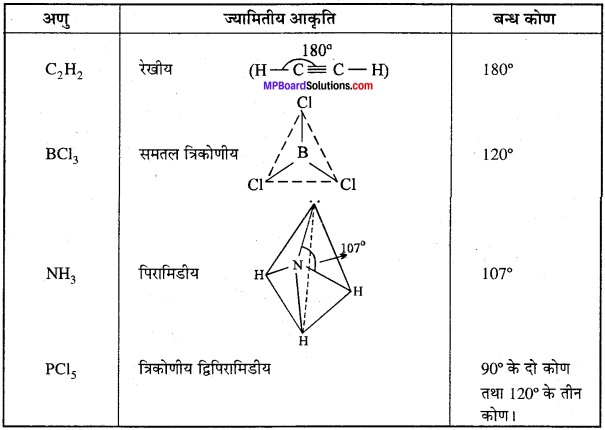
प्रश्न 40.
निम्नांकित अणुओं की ज्यामितीय आकृति का प्रकार तथा बन्ध कोण का मान लिखिए –
1. C2H2,
2. BCl3
3. NH3
4. PCl5
उत्तर:
ज्यामितीय आकृति का प्रकार तथा बन्ध कोण का मान –
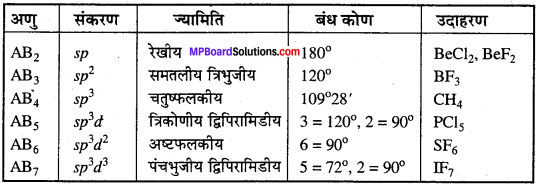
MP Board Class 11th Chemistry Solutions Chapter 4 रासायनिक आबंधन तथा आण्विक संरचना - 43

प्रश्न 41.
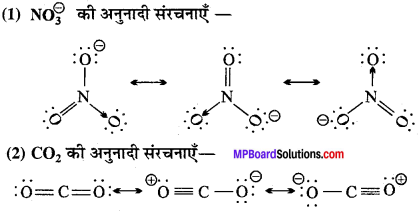
निम्नांकित की अनुनादी संरचनाएँ बनाइये –
1. NO3
2. CO2
उत्तर:
MP Board Class 11th Chemistry Solutions Chapter 4 रासायनिक आबंधन तथा आण्विक संरचना - 44

रासायनिक आबंधन तथा आण्विक संरचना लघु उत्तरीय प्रश्न

प्रश्न 1.
आयनिक बंध का बनना किन कारकों पर निर्भर करता है?
उत्तर:
आयनिक बंध का बनना निम्नलिखित कारकों पर निर्भर करता है –

  1. ऋणविद्युतता – संयोग करने वाले दोनों परमाणुओं की ऋणविद्युतता में अत्यधिक अंतर होना चाहिये। इस अंतर का मान जितना अधिक होगा, बंध का आयनिक गुण उतना ही अधिक होगा।
  2. आयनन ऊर्जा – इलेक्ट्रॉन दान करने वाले परमाणु अर्थात् धातु की आयनन ऊर्जा का मान अत्यन्त कम होना चाहिये, जिससे धातु सरलता से इलेक्ट्रॉन दान कर धनायन बनायेगा।
  3. इलेक्ट्रॉन बंधुता – इलेक्ट्रॉन ग्रहण करने वाले परमाणु की इलेक्ट्रॉन बंधुता उच्च होनी चाहिये, जिससे परमाणु सरलता से इलेक्ट्रॉन ग्रहण कर ऋणायन बनायेगा।
  4. जालक ऊर्जा – यौगिक की जालक ऊर्जा का मान जितना अधिक होगा यौगिक की आयनिक प्रवृत्ति उतनी ही अधिक होगी।

प्रश्न 2.
संकरण के नियम लिखिए।
उत्तर:
संकरण के नियम –

  1. संकरण में भाग लेने वाले कक्षकों की ऊर्जा लगभग समान होनी चाहिए।
  2. संकरण के पश्चात् प्राप्त होने वाले संकरित कक्षकों की संख्या संकरण में भाग लेने वाले कक्षकों की संख्या के बराबर होती है।
  3. संकरण में केवल कक्षक भाग लेते हैं इलेक्ट्रॉन नहीं।
  4. अर्धपूर्ण, पूर्ण तथा अपूर्ण कक्षक संकरण में भाग लेते हैं।
  5. किसी भी अणु की ज्यामिति, बंध कोण संकरण पर निर्भर करता है।
  6. संकरण एक परिकल्पना है, जिसका उपयोग प्रायोगिक तथ्यों के स्पष्टीकरण के लिये किया जाता है।

प्रश्न 3.
सहसंयोजी बंध को उदाहरण सहित समझाइये।
उत्तर:
दो या दो से अधिक परमाणुओं के मध्य इलेक्ट्रॉनों की साझेदारी से जो बंध बनते हैं, सहसंयोजी बंध कहलाते हैं। साझे के इलेक्ट्रॉन दोनों परमाणुओं के केन्द्र में रहते हैं तथा इन पर दोनों परमाणुओं का समान अधिकार रहता है। एक-एक, दो-दो या तीन-तीन इलेक्ट्रॉनों के साझे से क्रमशः एकल बंध, द्विबंध तथा त्रिबंध बनता है।
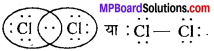
उदाहरण – Cl2 अणु का बनना –
क्लोरीन का इलेक्ट्रॉनिक विन्यास 2, 8, 7 है। इसके संयोजी कोश में 7 इलेक्ट्रॉन हैं, इसे अपना अष्टक पूर्ण करने के लिये एक अतिरिक्त इलेक्ट्रॉन की आवश्यकता है। यह क्लोरीन दूसरे क्लोरीन परमाणु के साथ एक इलेक्ट्रॉन का साझा करके अपना अष्टक पूर्ण करता है । इस प्रकार क्लोरीन अणु (Cl,) में दो क्लोरीन परमाणु के मध्य एकल बंध होता है।
MP Board Class 11th Chemistry Solutions Chapter 4 रासायनिक आबंधन तथा आण्विक संरचना - 45

प्रश्न 4.
अध्रुवीय और ध्रुवीय सहसंयोजी बंध में क्या अंतर है?
उत्तर:
अध्रुवीय सहसंयोजी बंध:
जब सहसंयोजी बंध दो ऐसे परमाणुओं के मध्य बनता है, जिनकी ऋणविद्युतता बराबर है तो साझे के इलेक्ट्रॉन युग्म दोनों परमाणुओं के केन्द्र में रहते हैं, इस प्रकार बने बंध को अध्रुवीय सहसंयोजी बंध कहते हैं।
उदाहरण –
MP Board Class 11th Chemistry Solutions Chapter 4 रासायनिक आबंधन तथा आण्विक संरचना - 46
ध्रुवीय सहसंयोजी बंध:
जब सहसंयोजी बंध दो ऐसे परमाणुओं के मध्य बनता है, जिनकी ऋणविद्युतता में अंतर है तो साझे के इलेक्ट्रॉन अधिक ऋणविद्युती तत्व की ओर विस्थापित होता है, जिसके फलस्वरूप अधिक ऋणविद्युती तत्व पर आंशिक ऋण आवेश तथा कम ऋणविद्युती तत्व पर आंशिक धन आवेश आ जाता है। इस प्रकार के सहसंयोजी बंध को अध्रुवीय सहसंयोजी बंध कहते हैं।
MP Board Class 11th Chemistry Solutions Chapter 4 रासायनिक आबंधन तथा आण्विक संरचना - 47

प्रश्न 5.
सहसंयोजी यौगिक के विशिष्ट गुण बताइये।
उत्तर:
सहसंयोजी यौगिक के गुण निम्नलिखित हैं –

  1. सहसंयोजी यौगिक सामान्यतः गैस या द्रव अवस्था में होते हैं लेकिन उच्च अणुभार वाले यौगिक ठोस होते हैं।
  2. इनके गलनांक एवं क्वथनांक निम्न होते हैं।
  3. ये अध्रुवीय विलायकों में विलेय होते हैं।
  4. ये विद्युत् के कुचालक होते हैं।
  5. ये बंध दृढ़ एवं दिशात्मक होते हैं।
  6. इनके अणुओं के मध्य रासायनिक अभिक्रिया मंद होती है क्योंकि बंधों के टूटने में तथा नये बंधों के बनने में समय लगता है।

प्रश्न 6.
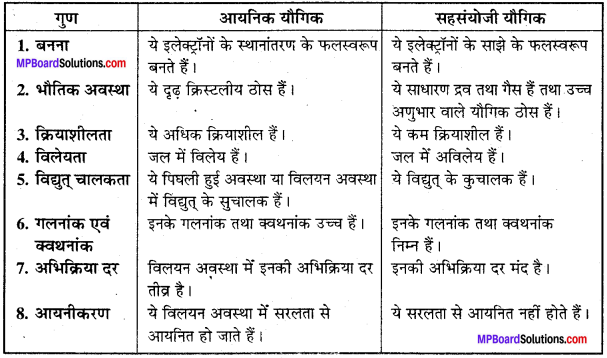
विद्युत् संयोजी (आयनिक) यौगिक एवं सहसंयोजी यौगिक में अंतर लिखिये।
उत्तर:
विद्युत् संयोजी (आयनिक) यौगिक एवं सहसंयोजी यौगिक में अंतर –
MP Board Class 11th Chemistry Solutions Chapter 4 रासायनिक आबंधन तथा आण्विक संरचना - 48

प्रश्न 7.
बर्फ जल से हल्की होती है, क्यों? समझाइये।
अथवा,
बर्फ का घनत्व जल से कम है, क्यों?
उत्तर:
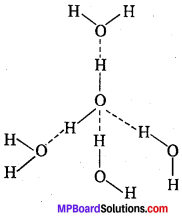
बर्फ के क्रिस्टल बनते समय अणुओं में परस्पर हाइड्रोजन बंध इस प्रकार व्यवस्थित होते हैं कि जल का एक अणु चार अणुओं के साथ चतुष्फलकीय रूप से घिरा रहता है जिसमें दो H सहसंयोजी बंध द्वारा तथा अन्य दो H, हाइड्रोजन बंध द्वारा जुड़े रहते हैं, जिसके फलस्वरूप खुले पिंजरे जैसी संरचना बनती हैं और जालक के मध्य खाली स्थान रहता है, ho इसलिये बर्फ का घनत्व जल से कम होता है, जिसके कारण बर्फ जल से H हल्की होती है।
MP Board Class 11th Chemistry Solutions Chapter 4 रासायनिक आबंधन तथा आण्विक संरचना - 49

प्रश्न 8.
उपसहसंयोजी बंध को उदाहरण सहित समझाइये।
उत्तर:
उपसहसंयोजी बंध एक विशिष्ट प्रकार का सहसंयोजी बंध है जिसमें साझे का इलेक्ट्रॉन जोड़ा एक परमाणु या अणु का होता है जिसका अष्टक पूर्ण होता है तथा दूसरा परमाणु या अणु जिसका अष्टक अपूर्ण होता है वह बिना साझे में योगदान के इस इलेक्ट्रॉन युग्म को ग्रहण करता है। इस जोड़े पर दोनों परमाणु का समान अधिकार होता है। इलेक्ट्रॉन जोड़ा दान देने वाले परमाणु या अणु को दाता कहते हैं और ग्रहण करने वाले परमाणु को ग्राही कहते हैं। इस प्रकार बने बंध को उपसहसंयोजी बंध या दाता-ग्राही बंध कहते हैं तथा तीर (-) चिन्ह द्वारा दर्शाते हैं।

उदाहरण – O3 का बनना:
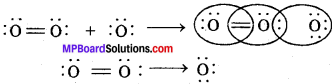
O2, अणु में दोनों ऑक्सीजन अणुओं का अष्टक पूर्ण रहता है तथा दोनों ऑक्सीजन के पास दो इलेक्ट्रॉन युग्म हैं जबकि तीसरे ऑक्सीजन परमाणु के संयोजी कोश में 6 इलेक्ट्रॉन हैं तथा इसे अष्टक पूर्ण करने के लिये 2 इलेक्ट्रॉन की आवश्यकता होती है। इसलिये O2 अणु अपना एक एकाकी इलेक्ट्रॉन इस ऑक्सीजन परमाणु को दान कर उपसहसंयोजी बंध बनाता है।
MP Board Class 11th Chemistry Solutions Chapter 4 रासायनिक आबंधन तथा आण्विक संरचना - 50

प्रश्न 9.
क्या निम्नलिखित अभिक्रिया के फलस्वरूप B तथा N परमाणुओं की संकरण-अवस्था में परिवर्तन होता है?
BF3 + NH3 + F3B.NH3
उत्तर:
BF3 में 3 आबंध युग्म तथा O एकाकी युग्म होते हैं। जिनके कारण बोरॉन sp2 संकरित होती है तथा NH3 में 3 आबंध युग्म तथा 1 एकाकी युग्म की उपस्थिति के कारण, नाइट्रोजन sp3 संकरित होता है। अभिक्रिया के पश्चात् बोरॉन का संकरण sp3 में परिवर्तित हो जाता है परन्तु नाइट्रोजन का संकरण समान ही रहता है क्योंकि N अपने एकाकी युग्म को इलेक्ट्रॉनों की कमी वाले B के साथ साझेदारी करता है।

प्रश्न 10.
निम्नलिखित अभिक्रिया में Al परमाणु की संकरण अवस्था में परिवर्तन ( यदि होता है, तो) को समझाइए।
AlCl3 + Cl → AlCl4
उत्तर:
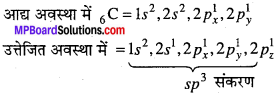
Al का इलेक्ट्रॉनिक विन्यास निम्नलिखित है –
आद्य (सामान्य) अवस्था में 13A1 = 1s2, 2s2 2p6, 3s23px1
उत्तेजित अवस्था में = 1s2, 2s22p6, 3s2, 3px1,3py1
AlCl3 के निर्माण में Al sp2 संकरित होता है तथा इसकी ज्यामितीय त्रिकोणीय समतलीय होती है। दूसरी ओर AlCl4 के निर्माण में रिक्त 3pz कक्षक सम्मिलित होने के कारण, Al sp3 संकरित होता है तथा इसकी ज्यामितीय चतुष्फलकीय होती है।

प्रश्न 11.
धात्विक बंध क्या है? उदाहरण देकर स्पष्ट कीजिए।
उत्तर:
धात्विक बंध की व्याख्या करने के लिये धातुओं में उपस्थित बंध के दो सिद्धांत हैं –

1. स्वतंत्र इलेक्ट्रॉन सिद्धांत:
यह सिद्धांत सन् 1900 में ड्रड द्वारा दिया गया था तथा सन् 1916 में लारेन्ज द्वारा विकसित किया गया। इस सिद्धांत के अनुसार, “धात्विक ठोस धनायनों का वह समूह है जो गतिशील इलेक्ट्रॉनों के द्रव अथवा समुद्र में व्यवस्थित ढंग से डूबा हुआ है तथा वह बल जो इन धनायनों को इलेक्ट्रॉन समुद्र में बाँधे रखता है, धात्विक बंध कहलाता है।”

उदाहरण – Mg धातु का प्रत्येक परमाणु 2 इलेक्ट्रॉन दान करके Mg+2 आयनों का जालक बनाता है तथा इसके संयोजी इलेक्ट्रॉनों से इलेक्ट्रॉन समुद्र बनता है।

2. संयोजकता बंध सिद्धांत:
इस सिद्धांत के अनुसार, “ धातुओं में बंध सहसंयोजी प्रकृति का होता है तथा उनमें अनुनाद पाया जाता है।”
उदाहरण:
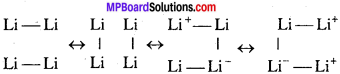
प्रत्येक Li परमाणु आठ अन्य Li परमाणु द्वारा घिरा रहता है तथा यह बारी-बारी से प्रत्येक Li के साथ सहसंयोजी बंध बनाता है, इस प्रकार कई अनुनादी संरचनाएँ प्राप्त होती हैं ।
MP Board Class 11th Chemistry Solutions Chapter 4 रासायनिक आबंधन तथा आण्विक संरचना - 51

प्रश्न 12.
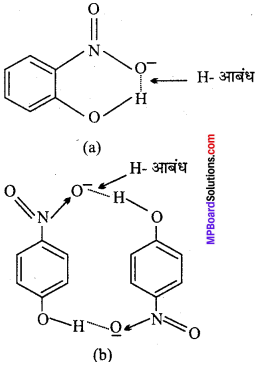
अन्तराअणुक तथा अन्तःअणुक हाइड्रोजन बंध को उदाहरण सहित समझाइये।
उत्तर:
अंतराअणुक हाइड्रोजन बंध:
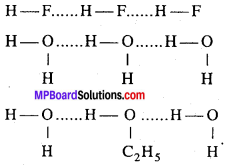
जब दो या अधिक समान अथवा भिन्न अणुओं के मध्य हाइड्रोजन बंध बनता है तो इसे अन्तराअणुक हाइड्रोजन बंध कहते हैं। इसमें एक अणु का हाइड्रोजन दूसरे अणु के प्रबल ऋण विद्युती परमाणु के साथ हाइड्रोजन बंध बनाता है।
MP Board Class 11th Chemistry Solutions Chapter 4 रासायनिक आबंधन तथा आण्विक संरचना - 93
अन्तःअणुक हाइड्रोजन बंध:
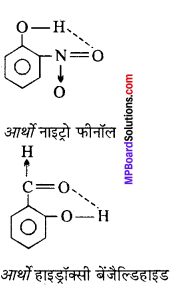
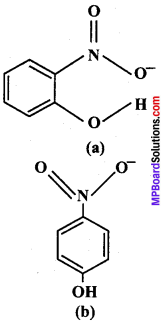
जब एक ही यौगिक के एक ही अणु के भिन्न-भिन्न स्थिति पर भिन्नभिन्न बंधों से जुड़े परमाणुओं के मध्य H बंध बनता है, तो उसे अन्तःअणुक हाइड्रोजन बंध कहते हैं।
MP Board Class 11th Chemistry Solutions Chapter 4 रासायनिक आबंधन तथा आण्विक संरचना - 52

प्रश्न 13.
NH3 तथा NF3 में किस अणु का द्विध्रुव-आघूर्ण अधिक है और क्यों?
उत्तर:
NH3 तथा NF3 दोनों अणुओं का आकार पिरामिडीय होता है, परन्तु NH3 का द्विध्रुव आघूर्ण NF3 की अपेक्षा अधिक होता है। NH3 में एकाकी युग्म इलेक्ट्रॉन युग्म का द्विध्रुव, तीन N – H बन्धों की दिशा में ही होता है, जबकि NF, में एकाकी युग्म का द्विध्रुव, तीन N – F बन्धों की विपरीत दिशा में होता है जिसके कारण NF3 का द्विध्रुव आघूर्ण का मान घट जाता है।
MP Board Class 11th Chemistry Solutions Chapter 4 रासायनिक आबंधन तथा आण्विक संरचना - 53

प्रश्न 14.
यद्यपि Be-H आबंध ध्रुवीय है, तथापि BeH2 अणु का द्विध्रुव आघूर्ण शून्य है। स्पष्ट कीजिए।
उत्तर:
BeH2 अणु रेखीय होता है। विपरीत दिशाओं में स्थित दो समान आबंध द्विध्रुव, एक दूसरे के प्रभाव को समाप्त कर देते हैं। यही कारण है कि BeH, अणु का द्विध्रुव आघूर्ण शून्य होता है।
MP Board Class 11th Chemistry Solutions Chapter 4 रासायनिक आबंधन तथा आण्विक संरचना - 54

प्रश्न 15.
सहसंयोजी बंध के परमाणु कक्षक अतिव्यापन सिद्धांत की प्रमुख अभिधारणाएँ कौनकौन सी हैं?
उत्तर:
इस सिद्धांत के अनुसार:

  1. जब एक परमाणु का कक्षक दूसरे परमाणु के कक्षक से अतिव्यापन करता है तो सहसंयोजी बंध बनते हैं।
  2. बंध बनने पर बंधी इलेक्ट्रॉन दोनों परमाणुओं के नाभिक से सम्बन्धित होता है।
  3. आबंधी इलेक्ट्रॉनों का चक्रण विपरीत दिशा में होना चाहिये।
  4. बंध का सामर्थ्य अतिव्यापन की मात्रा पर निर्भर करता है।
  5. अतिव्यापन के आधार पर बंध दो प्रकार के होते हैं- बंध तथा 7 बंध।
  6. किसी भी तत्व की संयोजकता उसके संयोजी कोश में उपस्थित अयुग्मित इलेक्ट्रॉनों की संख्या पर निर्भर करती है।
  7. अतिव्यापन उन्हीं कक्षकों में होता है जो बंध निर्माण में भाग लेते हैं।
  8. एक से अधिक अयुग्मित इलेक्ट्रॉनों वाले कक्षकों के अतिव्यापन से बहु आबन्ध बनते हैं।

प्रश्न 16.
कारण स्पष्ट करते हुए निम्न यौगिकों को उनके बढ़ते हुए आयनिक व्यवहार के क्रम में व्यवस्थित कीजिए –
N – H, F – H, C – H तथा O – H
MP Board Class 11th Chemistry Solutions Chapter 4 रासायनिक आबंधन तथा आण्विक संरचना - 55
अत: आयनिक व्यवहार का सही क्रम निम्न होगा
C – H < N – H < O – H < F – H

प्रश्न 17.
स्पष्ट कीजिए कि PCl5 त्रिकोणीय द्विपिरामिडीय तथा IF, वर्ग पिरामिडीय क्यों है?
उत्तर:
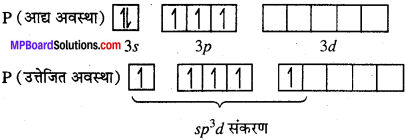
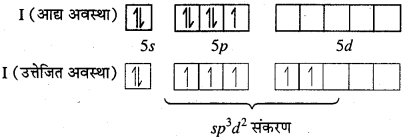
PCl5 – इसमें फॉस्फोरस (Z = 15) केन्द्रीय परमाणु है जिसके आद्य अवस्था तथा उत्तेजित अवस्था में इलेक्ट्रॉनिक विन्यास निम्नवत हैं।
MP Board Class 11th Chemistry Solutions Chapter 4 रासायनिक आबंधन तथा आण्विक संरचना - 56
PCl5 में, फॉस्फोरस spid संकरित है अतः इसकी ज्यामितीय त्रिकोणीय द्विपिरामिडीय होगी।
IF5 – इसमें केन्द्रीय परमाणु आयोडीन (z = 53) है जिसके आद्य (Ground) अवस्था तथा उत्तेजित अवस्था में इलेक्ट्रॉनिक विन्यास अग्रवत है –
MP Board Class 11th Chemistry Solutions Chapter 4 रासायनिक आबंधन तथा आण्विक संरचना - 57
IF5 में, आयोडीन spid संकरित है अतः इसकी ज्यामितीय वर्ग पिरामिडीय होगी। विकृति एकाकी इलेक्ट्रॉन के कारण होती है।

प्रश्न 18.
σ बंध और n बंध किसे कहते हैं? उदाहरण देकर समझाइये।
उत्तर:
σ बंध:
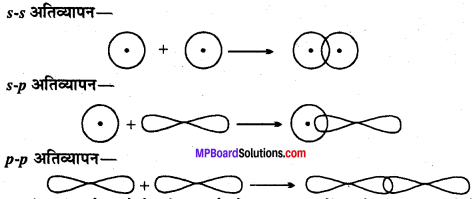
जब दो अर्धपूर्ण कक्षक एक ही अक्ष पर कक्षकों के सम्मुख अतिव्यापन करते हैं तो बनने वाले बंध को बंध कहते हैं। σ बंध में इलेक्ट्रॉन घनत्व अंतर नाभिकीय अक्ष पर अधिकतम होता है, यह प्रबलतम बंध है। σ – बंध s – s अतिव्यापन, s – p अतिव्यापन तथा p – p कक्षकों के सम्मुख अतिव्यापन के फलस्वरूप बनता है।
MP Board Class 11th Chemistry Solutions Chapter 4 रासायनिक आबंधन तथा आण्विक संरचना - 58

π बंध:
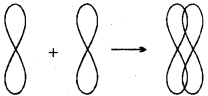
जब दो या दो से अधिक अर्धपूर्ण कक्षक आपस में पार्श्व अतिव्यापन करते हैं तो सबंध बनता है। यह बंध दुर्बल बंध है। 1 बंध का बनना तभी संभव है जब अणु में पहले से बंध उपस्थित होता है।
MP Board Class 11th Chemistry Solutions Chapter 4 रासायनिक आबंधन तथा आण्विक संरचना - 59

प्रश्न 19.
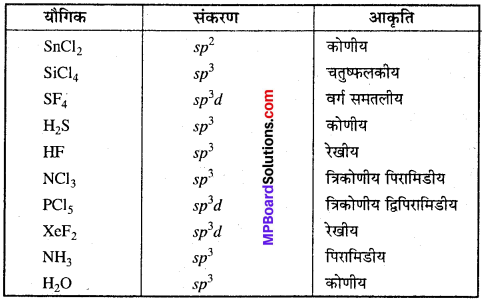
VSEPR सिद्धांत के आधार पर निम्नलिखित यौगिकों के संकरण एवं आकृतियाँ बताइये –
SnCl2, SiCl4, SF4, H2S, HF, NCl3, PCI5, XeF2, NH3, H2O.
MP Board Class 11th Chemistry Solutions Chapter 4 रासायनिक आबंधन तथा आण्विक संरचना - 60

प्रश्न 20.
निम्नलिखित अणुओं में कार्बन परमाणु कौन-से संकर कक्षक प्रयुक्त करते हैं –
(a) CH3 – CH3
(b) CH3CH = CH2
(c) CH3CH2OH
(d) CH3CHO
(e) CH2COOH.
उत्तर:
MP Board Class 11th Chemistry Solutions Chapter 4 रासायनिक आबंधन तथा आण्विक संरचना - 61

प्रश्न 21.
इलेक्ट्रॉनों के आबंधी युग्म तथा एकाकी युग्म से आप क्या समझते हो? प्रत्येक को एक उदाहरण द्वारा स्पष्ट कीजिए।
उत्तर:
सहसंयोजी आबंध इलेक्ट्रॉनों की आपसी साझेदारी द्वारा बनता है। आबंधित परमाणुओं के मध्य साझे का इलेक्ट्रॉन युग्म, आबंधी युग्म कहलाता है। वे इलेक्ट्रॉन जो आबंध निर्माण में भाग नहीं लेते हैं, एकाकी युग्म कहलाते हैं।

उदाहरण – अमोनिया (NH3) में 3 आबंध युग्म तथा 1 एकाकी इलेक्ट्रॉन युग्म उपस्थित होते हैं। जल (H2O) में 2 आबंध युग्म तथा 2 एकाकी इलेक्ट्रॉन युग्म उपस्थित होते हैं। मेथेन (CH4) में केवल 4 आबंध युग्म इलेक्ट्रॉन उपस्थित होते हैं।
MP Board Class 11th Chemistry Solutions Chapter 4 रासायनिक आबंधन तथा आण्विक संरचना - 62

प्रश्न 22.
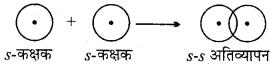
S – s अतिव्यापन क्या है? उदाहरण सहित समझाइये।
उत्तर:
जब एक परमाणु का अर्धपूर्ण s – कक्षक दूसरे परमाणु के अर्धपूर्ण s-कक्षक के साथ सम्मुख अतिव्यापन कर σ बंध बनाता है तो इसे S – S अतिव्यापन कहते हैं। यह बंध नाभिकीय अक्ष के चारों ओर सममित होता है।
उदाहरण – H2 अणु का बनना – H परमाणु का परमाणु क्रमांक 1 है। इसका सामान्य इलेक्ट्रॉनिक विन्यास 1s1 है। H2 अणु निर्माण के दौरान H परमाणु का अर्धपूर्ण s – कक्षक, दूसरे H परमाणु के अर्धपूर्ण sकक्षक के साथ सम्मुख अतिव्यापन कर σ बंध बनाता है।
MP Board Class 11th Chemistry Solutions Chapter 4 रासायनिक आबंधन तथा आण्विक संरचना - 63

प्रश्न 23.
s – p अतिव्यापन क्या है? उदाहरण सहित समझाइये।
उत्तर:
जब किसी एक परमाणु का अर्धपूर्ण s – कक्षक किसी दूसरे परमाणु के अर्धपूर्ण p कक्षक के साथ सम्मुख अतिव्यापन कर – बंध बनाता है तो इसे s – p अतिव्यापन कहते हैं।

उदाहरण – HCl अणु का बनना – Cl का इलेक्ट्रॉनिक विन्यास 1s22s22p63s23p5 है। HCl अणु के निर्माण के दौरान Cl परमाणु का अर्धपूर्ण pz कक्षक H के अर्धपूर्ण s-कक्षक के साथ सम्मुख अतिव्यापन कर σ बंध बनाता है।
MP Board Class 11th Chemistry Solutions Chapter 4 रासायनिक आबंधन तथा आण्विक संरचना - 64

प्रश्न 24.
कार्बन के दो अपरूप हीरा और ग्रेफाइट के गुणों में अंतर का कारण स्पष्ट कीजिए।
उत्तर:
हीरा तथा ग्रेफाइट दोनों कार्बन के अपरूप हैं लेकिन C की व्यवस्था में भिन्नता के कारण इनके गुणों में अंतर होता है। हीरा में C परमाणु sp2 संकरित अवस्था में है तथा प्रत्येक C अन्य चार कार्बन परमाणुओं के साथ जुड़कर चतुष्फलकीय संरचना बनाता है। इस प्रकार यह एक त्रिविमीय संरचना बनाता है इसलिये हीरा कठोर है तथा इसका गलनांक उच्च है।

ग्रेफाइट में प्रत्येक C, sp2 संकरित अवस्था में है अर्थात् प्रत्येक अन्य तीन C परमाणु द्वारा घिरा रहता है तथा प्रत्येक C की चौथी संयोजकता असंतृप्त रहती है। ग्रेफाइट में विभिन्न परतें होती हैं जो आपस में दुर्बल वाण्डर वाल्स आकर्षण बल द्वारा जुड़ी रहती हैं इसलिये ग्रेफाइट कोमल है तथा मुक्त इलेक्ट्रॉन की उपस्थिति के कारण यह विद्युत् का सुचालक है।

प्रश्न 25.
x – अक्ष को अंतर्नाभिकीय अक्ष मानते हुए बताइए कि निम्नलिखित में कौन-से कक्षक सिग्मा (σ) आबंध नहीं बनाएँगे और क्यों?
(a) 1s तथा 1s
(b) 1s तथा 2p
(c) 2py तथा 2pz
(d) 1s तथा 25
उत्तर:
केवल (c), σ आबंध नहीं बनाएँगे क्योंकि X – अक्ष को अंतर्नाभिकीय अक्ष लेने पर 2p, तथा 2p, अक्षों के मध्य पार्श्व अतिव्यापन होता है जिसके फलस्वरूप T- आबंध बनता है।

प्रश्न 26.
चतुष्फलकीय ज्यामिति के अलावा CH4 अणु की एक और संभव ज्यामिति वर्गसमतलीय है, जिसमें हाइड्रोजन के चार परमाणु एक वर्ग के चार कोनों पर होते हैं। व्याख्या कीजिए कि CH4 का अणु वर्ग-समतलीय नहीं होता है।
उत्तर:
कार्बन का इलेक्ट्रॉनिक विन्यास निम्नलिखित है –
MP Board Class 11th Chemistry Solutions Chapter 4 रासायनिक आबंधन तथा आण्विक संरचना - 65
CH4 अणु में, कार्बन sp3 संकरित होता है जिसके कारण इसकी ज्यामिति चतुष्फलकीय होती है। वर्गसमतलीय ज्यामिति के लिए dsp2 संकरण आवश्यक होता है। परन्तु कार्बन में d – कक्षकों की अनुपस्थिति के कारण यह संभव नहीं है। साथ ही, VSEPR सिद्धान्त के अनुसार, कार्बन परमाणु के परितः चार आबन्ध इलेक्ट्रॉन चतुष्फलकीय ज्यामिति में स्थित होते हैं। चतुष्फलकीय संरचना में, आबंध कोण 109° 28′ तथा वर्गसमतलीय ज्यामिति में 90° का होता है। अतः चतुष्फलकीय ज्यामिति में आबंध इलेक्ट्रॉनों का प्रतिकर्षण वर्गसमतलीय ज्यामिति की तुलना में कम होता है।

प्रश्न 27.
संकरण के आधार पर स्पष्ट कीजिये कि BeCl2 अणु की संरचना रेखीय होती है।
उत्तर:
BeCl2 में Be, sp संकरित अवस्था में है।
sp संकरण:
जब s का एक कक्षक तथा p उपकोश का 1 कक्षक आपस में ऊर्जा के पुनर्विन्यास द्वारा दो संकरित कक्षकों का निर्माण करते हैं तो इसे sp संकरण कहते हैं।

BeCl2 अणु की आकृति:
BeCl2 में Be केन्द्रीय परमाणु है, इसका सामान्य इलेक्ट्रॉनिक विन्यास 1s22s22p0 है। उत्तेजित अवस्था में 25 कक्षक का एक इलेक्ट्रॉन उत्तेजित होकर रिक्त 2p उपकोश में चला जाता है। 2s का 1 कक्षक तथा 2p का 1 कक्षक आपस में ऊर्जा के पुनर्विन्यास द्वारा दो संकरित कक्षकों का निर्माण करते हैं जो एक-दूसरे से 180° का कोण बनाते हुये व्यवस्थित रहते हैं। ये दोनों संकरित कक्षक दो क्लोरीन परमाणु के साथ सम्मुख अतिव्यापन कर दो बंध बनाते हैं इसलिये BeCl2 की संरचना रेखीय होती है।
MP Board Class 11th Chemistry Solutions Chapter 4 रासायनिक आबंधन तथा आण्विक संरचना - 66

प्रश्न 28.
sp3 संकरण क्या है? उदाहरण देकर स्पष्ट कीजिये।
उत्तर:
sp3 संकरण:
जब 5 उपकोश का कक्षक तथा p उपकोश के तीन कक्षक आपस में ऊर्जा के पुनर्विन्यास द्वारा चार संकरित कक्षकों का निर्माण करते हैं तो इसे sp3 संकरण कहते हैं। प्रतिकर्षण के कारण ये चारों त्रिविम में एक-दूसरे के साथ 109°28′ का कोण बनाते हैं अर्थात् ये चारों कक्षक समचतुष्फलक के चारों कोनों की ओर निर्देशित रहते हैं।
MP Board Class 11th Chemistry Solutions Chapter 4 रासायनिक आबंधन तथा आण्विक संरचना - 67
उदाहरण – CH4 – कार्बन का परमाणु क्रमांक 6 है तथा इसका सामान्य इलेक्ट्रॉनिक विन्यास 1s22s42p2 है। उत्तेजित अवस्था में 2s का एक इलेक्ट्रॉन उत्तेजित होकर रिक्त 2pz कक्षक में चला जाता है। इस प्रकार उत्तेजित अवस्था में C के पास चार अयुग्मित इलेक्ट्रॉन होते हैं। कार्बन का 2s कक्षक तथा 2p उपकोश के तीनों कक्षक आपस में ऊर्जा के पुनर्विन्यास द्वारा चार संकरित कक्षकों का निर्माण करते हैं, जो चार हाइड्रोजन परमाणुओं के H साथ सम्मुख अतिव्यापन कर चार बंध बनाते हैं। sp3 संकरण के कारण मेथेन अणु की संरचना समचतुष्फलकीय होती है तथा बंध कोण का मान 109°28′ होता है।
MP Board Class 11th Chemistry Solutions Chapter 4 रासायनिक आबंधन तथा आण्विक संरचना - 68

प्रश्न 29.
उपसहसंयोजी बंध के आधार पर HNO3 तथा H2SO4 की संरचना समझाइये।
उत्तर:
MP Board Class 11th Chemistry Solutions Chapter 4 रासायनिक आबंधन तथा आण्विक संरचना - 69

प्रश्न 30.
परमाणु कक्षकों के रैखिक संयोग से आण्विक कक्षक बनने के लिए आवश्यक शर्तों को लिखें।
उत्तर:
परमाणु कक्षकों के रैखिक संयोग से आण्विक कक्षकों के निर्माण के लिए निम्नलिखित शर्ते आवश्यक है –

1. संयोग करने वाले परमाणु कक्षकों की ऊर्जा समान या लगभग समान होनी चाहिए। उदाहरण के लिए 1s – कक्षक केवल 1s – कक्षक में संयोग करेगा, 25 कक्षक से नहीं क्योंकि 2s – कक्षक की ऊर्जा, 1s – कक्षक की अपेक्षा अधिक होती है। इस प्रकार का संयोग तभी संभव है जबकि संयोग करने वाले परमाणु भिन्न हो (अंतर्नाभिकीय द्विपरमाणुक अणु)

2. संयोग करने वाले परमाणु कक्षकों की आण्विक कक्ष के परितः समान सममिति होनी चाहिए। उदाहरण के लिए, किसी परमाणु का 2pz कक्षक दूसरे परमाणु के 2px कक्षक से ही संयोग करेगा, परन्तु यह 2py तथा 2pz से ही नहीं कर सकता है क्योंकि उनकी सममितियाँ समान नहीं है।

3. संयोग करने वाले परमाणु कक्षकों को अधिकतम अतिव्यापन करना चाहिए। कक्षकों के मध्य जितना अधिक अतिव्यापन होगा, उनके नाभिकों के बीच इलेक्ट्रॉन घनत्व उतना ही अधिक होगा।
MP Board Class 11th Chemistry Solutions Chapter 4 रासायनिक आबंधन तथा आण्विक संरचना - 70

प्रश्न 31.
कक्षक सिद्धांत या अतिव्यापन के आधार पर N2 अणु का बनना समझाइये।
उत्तर:
N परमाणु का परमाणु क्रमांक 7 है, इसका सामान्य इलेक्ट्रॉनिक विन्यास 1s22s22p3 है। इसके संयोजी कोश के p उपकोश में तीन अयुग्मित इलेक्ट्रॉन हैं तथा इसे अपना अष्टक पूर्ण करने के लिये तीन अतिरिक्त इलेक्ट्रॉन की आवश्यकता है। N परमाणु का px कक्षक, दूसरे N परमाणु के py कक्षक के साथ सम्मुख अतिव्यापन कर σ बंध बनाता है तथा दोनों नाइट्रोजन के px तथा py कक्षक आपस में पार्श्व अतिव्यापन कर दो π बंध बनाते हैं, इस प्रकार N अणु में दोनों N परमाणु के मध्य त्रिक बंध बनता है।
MP Board Class 11th Chemistry Solutions Chapter 4 रासायनिक आबंधन तथा आण्विक संरचना - 71
प्रश्न 32.
अणु कक्षक सिद्धांत के मुख्य बिन्दुओं को स्पष्ट कीजिए।
उत्तर:
अणु कक्षक सिद्धांत के मुख्य बिन्दु:

  1. परमाणुओं के परमाणु कक्षक संयोग करके अणु कक्षक बनाते हैं।
  2. परमाणु कक्षकों के रेखीय संयोग से आण्विक कक्षक का बनना माना जाता है।
  3. आण्विक कक्षक दो प्रकार के होते हैं –
    • बंधी आण्विक कक्षक (Bonding molecular orbital) यह तरंग फलनों के योग से बनते हैं।
    • विपरीत बंधी आण्विक कक्षक (Anti-bonding molecular orbital) ये तरंग फलनों के अन्तर से बनते हैं।
  4. आण्विक कक्षक बहुकेन्द्रीय (Polycentric) होते हैं अत: इलेक्ट्रॉन दो या दो से अधिक नाभिकों के द्वारा प्रभावित होते हैं।
  5. अन्दर की कक्षाओं के परमाणु कक्षक (संयोजी कक्षक के अतिरिक्त) भी संयोग करके आण्विक कक्षक बनाते हैं।

इन्हें सामान्यतया अनाबंधी (Non-bonding) आण्विक कक्षक कहते हैं। आण्विक कक्षक का बनना अतिव्यापन के द्वारा होता है। इलेक्ट्रॉनों के भरने में ऑफबाऊ सिद्धांत, हुण्ड के नियम एवं अन्य नियमों का पालन होता है।

प्रश्न 33.
निम्नलिखित यौगिकों में उपस्थित संकरण, ज्यामिति तथा बंध कोण लिखिये।
उत्तर:
यौगिकों में संकरण,ज्यामिति तथा बंध कोण –
MP Board Class 11th Chemistry Solutions Chapter 4 रासायनिक आबंधन तथा आण्विक संरचना - 72

रासायनिक आबंधन तथा आण्विक संरचना दीर्घ उत्तरीय प्रश्न

प्रश्न 1.
द्विध्रुव आघूर्ण के महत्वपूर्ण अनुप्रयोग बताइए।
उत्तर:
द्विध्रुव आघूर्ण के महत्वपूर्ण अनुप्रयोग निम्न हैं –
1. द्विध्रुव आघूर्ण की सहायता से ज्ञात होता है कि दिया गया अणु ध्रुवीय है अथवा अध्रुवीय। द्विध्रुव आघूर्ण का मान (µ = e x d) जितना अधिक होता है, अणु उतना ही अधिक ध्रुवीय होता है। अध्रुवीय अणुओं के लिए, द्विध्रुव आघूर्ण का मान शून्य होता है।
उदाहरण – CO2

2. इसकी सहायता से आयनिक व्यवहार का प्रतिशत निम्न प्रकार से ज्ञात कर सकते हैं –
MP Board Class 11th Chemistry Solutions Chapter 4 रासायनिक आबंधन तथा आण्विक संरचना - 73

3. सममित अणुओं का द्विध्रुव आघूर्ण शून्य होता है। यद्यपि उनमें दो या अधिक ध्रुवीय बंध होते हैं। अतः अणु के सममितता के मापन में प्रयोग होता है।

4. इसकी सहायता से समपक्ष (Cis) तथा विपक्ष (Trans) समावयवियों में विभेद किया जा सकता है। सामान्यतः विपक्ष समावयवी की तुलना में समपक्ष समावयवी का द्विध्रुव आघूर्ण अधिक होता है।

5. ऑर्थो (Ortho), मेटा (Meta), तथा पैरा (Para) समावयवियों में विभेद करने में भी इसका प्रयोग होता है। पैरा समावयवी का द्विध्रुव आघूर्ण शून्य होता है। ऑर्थो समावयवी का द्विध्रुव आघूर्ण, मेटा समावयवी की अपेक्षा अधिक होता है।

6. अणुओं के आकार के बारे में जानकारी प्राप्त होती है।

प्रश्न 2.
संयोजकता कोश इलेक्ट्रॉन युग्म प्रतिकर्षण सिद्धांत क्या है? इसकी सीमायें बताइये। अथवा, संयोजकता कोश इलेक्ट्रॉन युग्म प्रतिकर्षण सिद्धांत को उदाहरण सहित समझाइये।
उत्तर:
सहसंयोजी अणुओं की ज्यामिति VSEPR सिद्धांत के आधार पर स्पष्ट की जा सकती है। इस सिद्धांत के अनुसार –

1. किसी अणु की ज्यामिति केन्द्रीय परमाणु के संयोजी कोश में उपस्थित बंधी तथा एकाकी इलेक्ट्रॉन युग्म या अनआबन्धी इलेक्ट्रॉन युग्म की संख्या पर निर्भर करती है।

2. अणु के केन्द्रीय परमाणु के संयोजी कोश में केवल बन्धित इलेक्ट्रॉन युग्म होने पर अणु की ज्यामितीय सममित होती है तथा अणु की ज्यामिति संकरण के प्रकार पर निर्भर करती है। यदि संयोजकता कोश में क्रमशः 2, 3, 4, 5, 6 तथा 7 बंधी इलेक्ट्रॉन युग्म हैं तो अणु की ज्यामिति क्रमशः रेखीय, समतलीय त्रिभुजीय, समचतुष्फलकीय, त्रिभुजीय द्विपिरामिडीय, अष्टफलकीय तथा पंचभुजीय द्विपिरामिडीय होती है।

3. यदि अणु के केन्द्रीय परमाणु के संयोजी कोश में बंधी तथा एकाकी इलेक्ट्रॉन युग्म उपस्थित हो तो अणु की ज्यामितीय सममित नहीं रहती है क्योंकि इलेक्ट्रॉन युग्म की उपस्थिति के कारण बंधी तथा एकाकी इलेक्ट्रॉन युग्म में अधिक प्रतिकर्षण होता है, जिसके कारण अणु की ज्यामिति नष्ट हो जाता है, विभिन्न इलेक्ट्रॉन युग्मों में प्रतिकर्षण का क्रम निम्नलिखित होता है,
Lone pair – Lone pair > Lone pair – Bond pair > Bond pair – Bond pair.

4. केन्द्रीय परमाणु पर एकाकी इलेक्ट्रॉन युग्मों की संख्या में वृद्धि करने पर बंधी इलेक्ट्रॉन युग्मों के मध्य बंध कोण का मान कम हो जाता है।

5. केन्द्रीय परमाणु के संयोजकता कोश में यदि इलेक्ट्रॉन पूर्ण भरा है तो उसके बन्धित इलेक्ट्रॉन युग्मों में प्रतिकर्षण अपूर्ण संयोजकता कोश के बन्धित इलेक्ट्रॉन युग्मों के प्रतिकर्षण से अधिक होता है।

सीमायें:

  1. इस सिद्धांत के आधार पर संक्रमण धातुओं के जटिल लवणों के आकृतियों की घोषणा नहीं की जा सकती है।
  2. इस सिद्धांत की सहायता से ऐसे अणुओं की आकृतियों को नहीं समझाया जा सकता जिसमें बहुत अधिक सीमा में विस्थानीकृत π इलेक्ट्रॉन है। अत्यधिक ध्रुवीय यौगिक जैसे, Li2o की आकृति की व्याख्या नहीं की जा सकती है।

उदाहरण:
MP Board Class 11th Chemistry Solutions Chapter 4 रासायनिक आबंधन तथा आण्विक संरचना - 74

प्रश्न 3.
निम्नलिखित स्पीशीज के आपेक्षिक स्थायित्व की तुलना कीजिए तथा उनके चुंबकीय गुण इंगित कीजिए –
O2, O2+, O2 (सुपर ऑक्साइड) तथा O22- (पर ऑक्साइड)
उत्तर:
स्पीशीज के इलेक्ट्रॉनिक विन्यास निम्न है –
(a) O2(16 e) →
MP Board Class 11th Chemistry Solutions Chapter 4 रासायनिक आबंधन तथा आण्विक संरचना - 75
O2+ में दो अयुग्मित इलेक्ट्रॉन होने के कारण यह अनुचुम्बकीय है।

(b) O2+ आयन O2 अणु में से 1 इलेक्ट्रॉन निकलने के कारण बनता है।
MP Board Class 11th Chemistry Solutions Chapter 4 रासायनिक आबंधन तथा आण्विक संरचना - 76
O2+ में एक इलेक्ट्रॉन अयुग्मित है अत: अनुचुम्बकीय होगा।

(c) O2 (सुपर ऑक्साइड) आयन – O2, अणु में 1 इलेक्ट्रॉन के योग से बनता है।
MP Board Class 11th Chemistry Solutions Chapter 4 रासायनिक आबंधन तथा आण्विक संरचना - 77
O2 आयन में 1 अयुग्मित इलेक्ट्रॉन उपस्थित होने के कारण अनुचुम्बकीय होता है।

(d) O2-2 (परऑक्साइड) आयन O2 अणु में 2 इलेक्ट्रॉन के योग से बनता है।
MP Board Class 11th Chemistry Solutions Chapter 4 रासायनिक आबंधन तथा आण्विक संरचना - 78
O2 में सभी इलेक्ट्रॉन युग्मित होने के कारण यह प्रतिचुम्बकीय है।
स्थायित्व का घटता क्रम – हम जानते हैं कि आबंध कोटि स्थायित्व
अतः स्थायित्व का घटता हुआ क्रम निम्न है – O2+ > O2 > O2 > O2-2

प्रश्न 4.
हाइड्रोजन आबन्धन किसे कहते हैं ? यह यौगिकों के गुणों को किस प्रकार प्रभावित करता है?
उत्तर:
किसी अणु के हाइड्रोजन परमाणु तथा किसी समान अथवा विभिन्न प्रकार के दूसरे अणु के प्रबल विद्युत् ऋणात्मक परमाणु जैसे – O, F तथा N के बीच आकर्षण बल को हाइड्रोजन बंध कहते हैं। दूसरे शब्दों. में, वह स्थिर वैद्युत आकर्षण बल जो किसी यौगिक के अणु में उपस्थित सहसंयोजी बंध द्वारा जुड़े हाइड्रोजन परमाणु और उसी यौगिक के अन्य अणु के प्रेबल विद्युत् ऋणात्मक परमाणु के बीच बनता है। इसे बिन्दुकित रेखा द्वारा दर्शाते हैं, यह बंध सहसंयोजक बंध की तुलना में दुर्बल है।

हाइड्रोजन बंध का प्रभाव:
हाइड्रोजन बंध यौगिकों के भौतिक एवं रासायनिक गुणों जैसे-क्वथनांक, विलेयता इत्यादि को प्रभावित करता है। अंतराअणुक हाइड्रोजन बंध के कारण अणु संगुणित होते हैं इसलिये इनके गलनांक तथा क्वथनांक उच्च होते हैं। जबकि अन्तः अणुक हाइड्रोजन बंध के कारण यौगिकों के गलनांक, क्वथनांक, विलेयता इत्यादि कम हो जाते हैं।
उदाहरण:
भौतिक अवस्था:
1. H2O में हाइड्रोजन बंध के कारण जल के अणु संगुणित अवस्था में होते हैं इसलिये साधारण ताप पर H2O द्रव है जबकि H2S में के कम ऋणविद्युती होने के कारण हाइड्रोजन बंध का बनना संभव नहीं है। इनके अणुओं के मध्य दुर्बल वाण्डर वाल्स आकर्षण बल होता है इसलिये साधारण ताप पर H2S गैस है।

2. विलेयता:
एल्कोहॉल तथा कार्बोक्सिलिक अम्ल सरलता से जल के साथ अंतरा अणुक हाइड्रोजन बंध बना लेते हैं इसलिये ये जल में विलेय हैं।

प्रश्न 5.
सहसंयोजी बंध के बनने को स्थिर वैद्युत आकर्षण तथा प्रतिकर्षण बल के आधार पर समझाइये।
अथवा
हाइड्रोजन अणु के लिये सहसंयोजी क्वाण्टम सिद्धांत क्या है? समझाइये।
उत्तर:
सहसंयोजी बंध निर्माण के दौरान जब दो परमाणु एक-दूसरे के निकट आते हैं तो उनके मध्य दो प्रकार के बल कार्य करते हैं।

  1. दोनों परमाणुओं के नाभिकों के द्वारा एक-दूसरे के इलेक्ट्रॉन अणु के प्रति आकर्षण।
  2. दोनों परमाणुओं के नाभिकों के मध्य तथा दोनों परमाणुओं के इलेक्ट्रॉनों के मध्य प्रतिकर्षण बल।

जब कार्यशील आकर्षण बल एवं प्रतिकर्षण बल का परिणामी बल आकर्षण होता है तो ऊर्जा में कमी आती है और इस स्थिति में आबन्धन बनना संभव है। लेकिन कार्यशील आकर्षण बल एवं प्रतिकर्षण बल का परिणामी बल प्रतिकर्षण है तो ऊर्जा में वृद्धि होती है और आबन्धन बनना संभव नहीं होता है।
उदाहरण:
H2 अणु का बनना-जब दोनों H परमाणु एक-दूसरे से काफी दूरी पर स्थित हों तो उनके मध्य न तो कोई आकर्षण बल होता है और न ही कोई प्रतिकर्षण बल होता है। लेकिन जब दोनों H परमाणु को एक-दूसरे के पास लाया जाता है तो निम्नलिखित दो । परिस्थितियाँ हो सकती हैं
MP Board Class 11th Chemistry Solutions Chapter 4 रासायनिक आबंधन तथा आण्विक संरचना - 79
1. जब दो H परमाणु जिनके इलेक्ट्रॉन का चक्रण एक-दूसरे के समांतर है जब ये एक-दूसरे के निकट आते हैं तो स्थितिज ऊर्जा लगातार बढ़ती है क्योंकि दोनों इलेक्ट्रॉन -ve के मध्य प्रबल प्रतिकर्षण होता है। इसलिये यह आबन्धन अस्थिर होगा।

2. यदि विपरीत चक्रण वाले H परमाणु को पास-पास लाते हैं तो उनके बीच प्रबल आकर्षण बल होता है जिससे ऊर्जा में कमी आती है। विपरीत चक्रण के कारण दोनों नाभिकों के बीच इलेक्ट्रॉन घनत्व बढ़ जाता है जो दोनों नाभिकों को स्थिर वैद्युत आकर्षण बल द्वारा बांध लेता है, यह बंध सहसंयोजी बंध कहलाता है। इस न्यूनतम दूरी के पश्चात् यदि दोनों H परमाणुओं को और अधिक पास लाया जाता है तो नाभिक-नाभिक के मध्य प्रतिकर्षण बल बढ़ने लगता है जिससे ऊर्जा में लगातार वृद्धि होने लगती है और बंध पुनः अस्थिर होने लगता है।

प्रश्न 6.
दो अणुओं की संरचनाएँ दी गई हैं –

  1. इनमें से किस यौगिक में अंतर-अणुक हाइड्रोजन आबंध तथा अंतरा-अणुक हाइड्रोजन आबंध उपस्थित हैं?
  2. किसी यौगिक का गलनांक अन्य तथ्यों के अतिरिक्त, हाइड्रोजन आबंध पर भी निर्भर करता है। इसके आधार पर स्पष्ट कीजिए कि इन दोनों यौगिकों में से किसका गलनांक अधिक होगा?
  3. किसी यौगिक की जल में विलेयता, उसकी जल के साथ हाइड्रोजन आबंध बनाने की क्षमता पर निर्भर है। इनमें से कौन-सा यौगिक जल के साथ हाइड्रोजन आबंध सुगमतापूर्वक बनाकर इसमें अधिक विलेय रहेगा?

MP Board Class 11th Chemistry Solutions Chapter 4 रासायनिक आबंधन तथा आण्विक संरचना - 80
उत्तर:
1. यौगिक – (a) अंतरा-अणुक हाइड्रोजन आबंध बनायेगा। जब एक ही अणु में उपस्थित हाइड्रोजन परमाणु दो अधिक विद्युत्ऋणात्मक परमाणुओं (O, F, N आदि) के मध्य स्थित होता है तो अंतराअणुक हाइड्रोजन-आबंध बनाता है। ऑर्थो-नाइट्रोफिनॉल (यौगिक a) में, हाइड्रोजन परमाणु दो ऑक्सीजन परमाणुओं के मध्य स्थित होता है।
MP Board Class 11th Chemistry Solutions Chapter 4 रासायनिक आबंधन तथा आण्विक संरचना - 81
(b) यौगिक (b) अन्तर आण्विक हाइड्रोजन आबंध बनाता है। p – नाइट्रोफिनॉल (ii) में, – NO2 तथा – OH समूह के मध्य रिक्त स्थान है। अतः एक अणु के हाइड्रोजन परमाणु तथा दूसरे अणु के ऑक्सीजन परमाणु के मध्य अंतर-अणुक हाइड्रोजन आबंध बनाता है।

2. यौगिक (b) का गलनांक उच्च होगा क्योंकि इसके अनेक अणु परस्पर H – आबंध द्वारा जुड़ते हैं।

3. अंतरा-आण्विक H – आबंध के कारण, यौगिक (a) जल के साथ, H – आबंध नहीं बना पाता है जिसके कारण यह जल में कम विलेय है। जबकि यौगिक (b) के अणु जल के साथ सरलता से H – आबंध बना लेते हैं। जिसके कारण यह जल में विलेय है।

प्रश्न 7.
VSEPR सिद्धांत के आधार पर निम्न अणुओं की आकृति स्पष्ट कीजिए –

  1. CH4
  2. NH3
  3. H2O

उत्तर:
1. CH4 की आकृति:
मेथेन में केन्द्रीय परमाणु C, sp3 संकरित अवस्था में होता है तथा मेथेन का केन्द्रीय C परमाणु चार इलेक्ट्रॉन युग्म से घिरा रहता है तथा इसमें चार समान C – H बंध होते हैं। इसलिये अणु सममित तथा समचतुष्फलकीय होता है तथा C – Hबंधों में परस्पर प्रतिकर्षण बल न्यूनतम लगने के लिये ये चार बंध चतुष्फलकीय रूप में व्यवस्थित हो जाते हैं। यहाँ बंध कोण 109°28′ होता है।
MP Board Class 11th Chemistry Solutions Chapter 4 रासायनिक आबंधन तथा आण्विक संरचना - 82
2. NH3 की आकृति:
अमोनिया में केन्द्रीय परमाणु N, sp3 संकरित अवस्था में होता है तथा यह चार इलेक्ट्रॉन जोड़ों से घिरा रहता है। इसलिये अणु की ज्यामिति सममित चतुष्फलकीय होनी चाहिये। लेकिन यहाँ केन्द्रीय परमाणु तीन इलेक्ट्रॉन युग्म तथा एक एकाकी इलेक्ट्रॉन युग्म से घिरा रहता है। इसलिये Lone pair – Bond pair में प्रतिकर्षण अधिक होता है जिसके कारण NH3 की संरचना त्रिकोणीय पिरामिडीय होती है और बंध कोण का मान 109°28′ से कम होकर 107° होता है।
MP Board Class 11th Chemistry Solutions Chapter 4 रासायनिक आबंधन तथा आण्विक संरचना - 83

3. H2O की आकृति:
जल में केन्द्रीय परमाणु O, sp3 संकरित अवस्था में होता है तथा संकरित कक्षकों में से दो संकरित कक्षकों में युग्मित इलेक्ट्रॉन तथा अन्य दो संकरित कक्षकों में अयुग्मित इलेक्ट्रॉन होते हैं। ये अर्धपूर्ण संकरित कक्षक 2 हाइड्रोजन परमाणु के साथ अतिव्यापन कर H2O का निर्माण करते हैं। इसलिये H2O अणु की ज्यामिति spसंकरण के कारण चतुष्फलकीय होनी चाहिये तथा बंध कोण का मान 109°28′ होना चाहिये। यहाँ पर O दो बंधी इलेक्ट्रॉन युग्म तथा दो एकाकी इलेक्ट्रॉन युग्म द्वारा घिरा रहता है। इस एकाकी इलेक्ट्रॉन युग्म की उपस्थिति से अणु की ज्यामिति में विकृति उत्पन्न हो जाती है। इसलिये H2O की संरचना सममित चतुष्फलकीय न होकर – आकृति की होती है तथा बंध कोण का मान 109°28′ से घटकर 105° हो जाता है।
MP Board Class 11th Chemistry Solutions Chapter 4 रासायनिक आबंधन तथा आण्विक संरचना - 84

प्रश्न 8.
निम्नलिखित के कारण स्पष्ट कीजिए –

  1. सहसंयोजी आबंध दिशात्मक होते हैं जबकि आयनिक आबंध अदिशात्मक होते हैं।
  2. जल के अणु की रचना कोणीय होती है जबकि कार्बन-डाइऑक्साइड का अणु रेखीय होता है।
  3. एथाइन अणु रेखिक होता है।

उत्तर:
1. सहसंयोजी आबंध, आण्विक कक्षकों के अतिव्यापन द्वारा बनता है। अतिव्यापन की दिशा, आबंध की दिशा बताती है। आयनिक यौगिकों में, आयन का स्थिर वैद्युत क्षेत्र अदिशात्मक होता है। प्रत्येक धनायन ऋणायन के आकार के आधार पर, इनके किसी भी दिशा में घिरा हुआ होता है। इसी प्रकार ऋणायन, धनायनों से घिरे हुए होते हैं। यही कारण है कि सहसंयोजी आबंध दिशात्मक तथा आयनिक आबंध अदिशात्मक होते हैं।

2. H2O में, ऑक्सीजन दो एकाकी युग्मों के साथ sp3 संकरित होता है। sp3 संकरित कक्षक चतुष्फलक के चार शीर्षों की ओर सम्मुख रहते हैं। इनमें दो शीर्ष, हाइड्रोजन परमाणुओं द्वारा घेरे जाते हैं जबकि शेष दो शीर्ष, एकाकी युग्मों द्वारा घेरे जाते हैं। अतः एकाकी युग्म – एकाकी युग्म प्रतिकर्षण बल के कारण आबंध कोण 109.5° से घटकर 104.5° हो जाता है – जिसके कारण अणु ज्यामिति V – आकार अथवा मुड़ी हुई हो जाती है (कोणीय रचना)।
MP Board Class 11th Chemistry Solutions Chapter 4 रासायनिक आबंधन तथा आण्विक संरचना - 85
CO2 अणु में, कार्बन परमाणु sp- संकरित होता है। दो sp- संकरित कक्षक एक-दूसरे से विपरीत दिशाओं में 108° कोण बनाते हुए स्थित होते हैं।
MP Board Class 11th Chemistry Solutions Chapter 4 रासायनिक आबंधन तथा आण्विक संरचना - 86
यही कारण है कि H2O अणु की रचना कोणीय जबकि CO2 की रचना रैखिक होती है।

3. एथाइन में, दोनों कार्बन परमाणु sp- संकरित होते हैं तथा इनके दो (2px तथा 2py) कक्षक असंकरित होते हैं । ये दो sp- संकरित कक्षक एक-दूसरे से विपरित दिशाओं में 180° का कोण बनाते हुए स्थित होते हैं जिसके कारण एथाइन की रचना रैखिक होती है।
MP Board Class 11th Chemistry Solutions Chapter 4 रासायनिक आबंधन तथा आण्विक संरचना - 87

प्रश्न 9.
संयोजकता बंध सिद्धांत की प्रमुख अवधारणायें लिखिए एवं इस सिद्धांत की सीमायें बताइये।
उत्तर:
संयोजकता बंध सिद्धांत का प्रतिपादन हिटलर और लंदन ने किया था जिसे पॉलिग एवं स्लेटर ने आधुनिक स्वरूप प्रदान किया। इस सिद्धांत की प्रमुख अवधारणायें इस प्रकार हैं –

  1. इस सिद्धांत के अनुसार परमाणुओं के मध्य सहसंयोजक बंध उनके संयोजी कोश के अर्धपूरित परमाणु कक्षकों के आंशिक अतिव्यापन से बनते हैं।
  2. अतिव्यापन में भाग लेने वाले परमाणु कक्षकों में विपरीत चक्रण वाले इलेक्ट्रॉन स्थित होते हैं।
  3. बंध की प्रबलता अतिव्यापन की सीमा पर निर्भर होती है। अधिक अतिव्यापन होने पर प्रबल बंध बनता है।
  4. समान स्थायित्व, समान ऊर्जा तथा समान सममिति वाले दो कक्षकों के मध्य अधिक दिशात्मक दृढ़ बंध बनता है।
  5. अतिव्यापन तथा इलेक्ट्रॉन के युग्मन के फलस्वरूप ऊर्जा मुक्त होती है तथा निकाय निम्न ऊर्जा अवस्था को प्राप्त कर लेता है।
  6. दोनों में से प्रत्येक कक्षक का पूर्ण बंध कक्षक प्राप्त होता है और इस प्रकार उसे दोनों परमाण्वीय नाभिकों की संपत्ति माना जाता है।

संयोजकता बंध सिद्धांत की सीमायें:

  1. इस सिद्धांत के अनुसार O2 के अणु में कोई अयुग्मित इलेक्ट्रॉन नहीं हैं। अतः ऑक्सीजन की प्रकृति प्रतिचुम्बकीय होनी चाहिए परन्तु वास्तव में O, अणु अनुचुम्बकीय होता है।
  2. उपसहसंयोजक बंध के निर्माण के विषय में कोई व्याख्या नहीं करता है।
  3. H2 जैसे आयनों के निर्माण की व्याख्या करने में यह सिद्धांत असफल है।
  4. यह अनुनाद के विषय में कोई जानकारी देने में असमर्थ है।

प्रश्न 10.
आबंध कोटि किसे कहते हैं? आबंध कोटि से प्राप्त होने वाली जानकारियाँ लिखिए।
उत्तर:
आबंध कोटि-बंधी आणविक कक्षक में इलेक्ट्रॉन की संख्या तथा प्रतिबंधी आण्विक कक्षक में इलेक्ट्रॉन की संख्या के अंतर के आधे को आबंध कोटि कहते हैं।
MP Board Class 11th Chemistry Solutions Chapter 4 रासायनिक आबंधन तथा आण्विक संरचना - 88
जानकारी:

  1. यदि आबंध कोटि का मान धनात्मक हो तो अणु स्थायी होता है और यदि आबंध कोटि का मान ऋणात्मक या शून्य है तो अणु अस्थायी होता है।
  2. आबंध कोटि अणु में उपस्थित सहसंयोजी बंधों की संख्या के बराबर होती है।
  3. यदि आण्विक कक्षक में उपस्थित इलेक्ट्रॉन युग्मित है तो अणु प्रति चुम्बकीय होता है और यदि आण्विक कक्षक में उपस्थित इलेक्ट्रॉन अयुग्मित है तो अणु अनुचुम्बकीय होता है।
  4. आबंध कोटि बंध वियोजन ऊर्जा के समानुपाती होती है।
  5. आबंध कोटि बंध लम्बाई के व्युत्क्रमानुपाती होती है।

प्रश्न 11.
आण्विक ऊर्जा स्तर के आधार पर N,अणु के आरेख चित्र द्वारा प्रदर्शित कीजिए।
उत्तर:
N2अणु:
एक नाइट्रोजन परमाणु में 7 इलेक्ट्रॉन होते हैं। 1s2,2s22p3 अत: N2 अणु में 14 इलेक्ट्रॉन होगें और उसका आण्विक कक्षक आरेख दर्शाये अनुसार होगा।
MP Board Class 11th Chemistry Solutions Chapter 4 रासायनिक आबंधन तथा आण्विक संरचना - 89
नाइट्रोजन अणु का बन्धक्रम निम्न प्रकार से ज्ञात किया जा सकता है –
बन्धी इलेक्ट्रॉन की संख्या = 10
विपरीत बन्धी इलेक्ट्रॉन की संख्या = 10
अत: बन्धक्रम = \(\frac{1}{2}\)(Nb – Na) = (10 – 4) = 3
MP Board Class 11th Chemistry Solutions Chapter 4 रासायनिक आबंधन तथा आण्विक संरचना - 90

प्रश्न 12.
आण्विक कक्षक ऊर्जा स्तर आरेख का प्रयोग करते हुए दर्शाइए कि निऑन का द्विपरमाणुक अणु की प्रकृति में अस्तित्व नहीं है।
उत्तर:
10Ne का इलेक्ट्रॉनिक विन्यास – 10Ne = 1s2, 2s2, 2px2 2py2 2pz2
आण्विक कक्षक ऊर्जा स्तर आरेख –
MP Board Class 11th Chemistry Solutions Chapter 4 रासायनिक आबंधन तथा आण्विक संरचना - 91
आबंध कोटि = \(\frac{1}{2}\)(Nb – Na) = \(\frac{1}{2}\) (10 – 10) = 0
आबंध कोटि शून्य का अर्थ है कि दो Ne परमाणुओं के मध्य कोई आबंध नहीं बनता है। अतः Ne2 (द्विपरमाणुक अणु) का प्रकृति में कोई अस्तित्व नहीं होता है।

प्रश्न 13.
O2 अणु के लिए आण्विक कक्षक आरेख बनाइये।
उत्तर:
ऑक्सीजन अणु-एक ऑक्सीजन परमाणु में 8 इलेक्ट्रॉन होते हैं –
1s2, 2s2 2p4 अत: O2 अणु में 16 इलेक्ट्रॉन होंगे और उसका आण्विक कक्षक आरेख दर्शाये अनुसार होगा।
MP Board Class 11th Chemistry Solutions Chapter 4 रासायनिक आबंधन तथा आण्विक संरचना - 92
बन्ध क्रम = \(\frac{1}{2}\)[Nb – Na] = \(\frac{1}{2}\)[10 – 6] =2
ऑक्सीजन अणु के आण्विक कक्षकों में दो अयुग्मित इलेक्ट्रॉन होने से अणु अनुचुम्बकीय (Paramagnetic) होता है।

MP Board Class 11th Chemistry Solutions

MP Board Class 12th Hindi Makrand Solutions Chapter 1 सूर के बालकृष्ण

MP Board Class 12th Hindi Makrand Solutions Chapter 1 सूर के बालकृष्ण (कविता, सूरदास)

Students can also download MP Board 12th Model Papers to help you to revise the complete Syllabus and score more marks in your examinations.

सूर के बालकृष्ण पाठ्य-पुस्तक पर आधारित प्रश्न

सूर के बालकृष्ण लघु उत्तरीय प्रश्न

Sur Ke Balkrishna Class 12 Mp Board प्रश्न 1.
बालक कृष्ण वृंदावन जाने को लालायित क्यों हैं?
उत्तर:
बालक कृष्ण वृंदावन जाने के लिए इसलिए लालायित हैं क्योंकि वह वृंदावन में अनेक प्रकार के फलों को अपने हाथों से तोड़कर खाना चाहते हैं।

Sur Ke Balkrishna Summary In Hindi MP Board प्रश्न 2.
गोचारण हेतु जाने के लिए कृष्ण क्या तर्क देते हैं?
उत्तर:
गोचारण हेतु जाने के लिए कृष्ण तर्क देते हैं कि माँ मुझे तेरी सौगंध कि मुझे न तो गर्मी लगती है, न ही भूख-प्यास सताती है। मैं तो गोचारण के लिए अवश्य जाऊँगा।

Mp Board Solution Class 12 Hindi प्रश्न 3.
यशोदा अपने आपको कृष्ण की धाय क्यों कहती हैं?
उत्तर:
यशोदा ने कृष्ण को जन्म नहीं दिया था। उन्होंने केवल उनका पालन-पोषण किया था इसलिए वह स्वयं को कृष्ण की धारा कहती हैं।

सूर के बालकृष्ण दीर्घ उत्तरीय प्रश्न

Hindi Class 12th Mp Board प्रश्न 1.
यशोदा ने कृष्ण को वन की क्या-क्या कठिनाइयाँ बताईं? (M.P. 2010)
उत्तर:
यशोदा ने कृष्ण को वन की निम्नलिखित कठिनाइयाँ बताईं –

  1. वन बहुत दूर है। तुम छोटे-छोटे पाँवों से चलकर कैसे जाओगे।
  2. वन से घर लौटते हुए रात हो जाती है।
  3. अतः घर से जाओगे और रात को घर लौटोगे। भूख-प्यास से व्याकुल्हो जाओगे।
  4. धूप में गायों के पीछे-पीछे घूमते रहने के कारण तुम्हारा कमल के समान कोमल शरीर मुरझा जाएगा।

स्वाति (हिन्दी विशिष्ट), कक्षा-12 Solution MP Board प्रश्न 2.
बालकृष्ण को देखकर माता यशोदा के हृदय में कौन-कौन-सी अभिलाषाएँ जागती हैं?
उत्तर:
बालकृष्ण को देखकर माता यशोदा के हृदय में कई अभिलाषाएँ जगती हैं, जैसे-कृष्ण घुटनों के बल चलें, उनके दूध के दो दाँत निकलें, तोतली बोली में वे नंद को बाबा और उन्हें माता कहकर पुकारें, आँचल पकड़कर बालहठ करें, अपने हाथों से थोड़ा-थोड़ा खाकर अपना मुख भरें, सभी दुखों को दूर करने वाली अपनी मधुर हँसी बिखेरें।

Makrand Hindi Book Class 12 Solutions MP Board प्रश्न 3.
यशोदा ने देवकी को क्या संदेश भेजा? (M.P. 2009, 2012)
उत्तर:
यशोदा ने देवकी से संदेश में कहा कि मैं तो कृष्ण का पालन-पोषण करने वाली धाय हूँ। मैं तमसे विनती करती हैं कि तुम बालक कृष्ण पर ममता, दया करती रहना। उसके प्रति कठोरता का व्यवहार मत करना। श्रीकृष्ण को प्रातःकाल माखन-रोटी अच्छी लगती है इसलिए उसे प्रातःकाल माखन रोटी ही देना। वह बड़ी मुश्किल से स्नान करता है। तुम उसकी सभी फरमाइशों को पूरा करके उसे स्नान के लिए मनाना, तभी वह तेल, उबटन और गर्म पानी से स्नान करेगा अर्थात् उसकी रुचियों और आदतों का ध्यान रखना। कृष्ण संकोची स्वभाव का है, अतः वह अपने मुख से कुछ नहीं कहेगा। देवकी तुम्हें ही उसकी रुचियों और आदतों का ध्यान रखना पड़ेगा।

सूर के बालकृष्ण भाव-विस्तार/पल्लवन

Mp Board Class 12 Hindi Book Makrand Pdf प्रश्न 1.
निम्नलिखित हाव्य-पंक्तियों की व्याख्या कीजिए –

संदेसौ देवकी सौं कहियौ।
हौं तो धाइ तिहारे सुत की, मया करत ही रहियौ॥
जदपि टेव तुम जानति उनकी, तऊ मोहिं कहि आवै।
प्रात होत मेरे लाड़ लडैते, माखन रोटी भावै॥

प्रसंग:
प्रस्तुत पद्यांश भक्तिकालीन सगुण कृष्णभक्ति धारा के सर्वश्रेष्ठ कवि सूरदास द्वारा रचित ‘सूरसागर’ के मथुरागमन प्रसंग से लिया गया है। उद्धव जब वृंदावन से मथुरा वापस जाते समय यशोदा से मिलने जाते हैं तो यशोदा उन्हें देवकी के नाम संदेश भेजती हैं। यशोदा उद्धव से कहती हैं –

Mp Board 12th Hindi Book Pdf Download व्याख्या:
हे. राहगीर! कृष्ण की जननी देवकी को मेरा यह संदेश देना कि मैं तो कृष्ण का पालन-पोषण करने वाली धाय मात्र हूँ, कृष्ण की माता तो तुम ही हो। धाय, बच्चे के संबंध में उसकी माँ से कुछ कहे यह उचित नहीं लगता। परंतु फिर भी मैं यह विनती करती हूँ कि तुम बालक पर ममता, दया करती रहना। अर्थात् उसके प्रति कठोरता का व्यवहार मत करना। यद्यपि मैं जानती हूँ कि तुम कृष्ण की सभी रुचियों-आदतों से भली-भाँति परिचित हो, परंतु फिर भी मुझसे रहा नहीं जाता, इसलिए कह रही हूँ कि प्रातःकाल मेरे लाड़ले बालक कृष्ण को माखन-रोटी का नाश्ता ही अच्छा लगता है। अतः प्रातःकाल नाश्ते में उसे माखन-रोटी ही देना।

विशेष:

  1. यशोदा मातृ हृदय का अत्यंत मनोवैज्ञानिक चित्रण हुआ है।
  2. लाड़ लडैतें में अनुप्रास अलंकार है।
  3. पद्यांश में ब्रजभाषा तथा गेयता है।

सूर के बालकृष्ण भाषा-अनुशीलन

Class 12 Mp Board Hindi Solution MP Board प्रश्न 1.
निम्नलिखित शब्दों के तीन-तीन समानार्थी शब्द लिखिए –
पग, कमल, जननी, गगन।
उत्तर:

  • पग – पैर, पाद, चरण।
  • कमल – राजीव, जलज, पंकज।
  • जननी – माता, माँ, अम्बा।
  • गगन – आकाश, नभ, अम्बर।

Mp Board Hindi Book Class 12 Pdf प्रश्न 2.
दिए गए मुहावरों के अर्थ लिखते हुए उनका वाक्यों में प्रयोग कीजिए –
बाल-बाल बचना, सर धुनना, कान का कच्चा, नाक में दम करना, मुँह की. खाना, पेट में चूहे दौड़ना, पाँचों अंगुली घी में होना। (M.P. 2011)
उत्तर:
Sur Ke Balkrishna Class 12 Mp Board

Mp Board Class 12th Hindi Solution प्रश्न 3.
निम्नलिखित शब्दों में से तत्सम, तद्भव और देशज शब्दों को छाँटिए –
मुख, दाँत, दूध, घर, जननी, साँझ, जनि, तनक, कमल, पथिक, गैया, टेव।
उत्तर:
Sur Ke Balkrishna Summary In Hindi MP Board

सूर के बालकृष्ण योग्यता-विस्तार

स्वाति (हिन्दी विशिष्ट) कक्षा-12 Pdf Download MP Board प्रश्न 1.
गाय चराते हुए कृष्ण का एक सुन्दर चित्र बनाने का प्रयास कीजिए तथा उसे चित्र प्रदर्शनी में प्रदर्शित कीजिए।
उत्तर:
छात्र स्वयं करें।

Sur Ke Balkrishna Class 12 Question Answer MP Board प्रश्न 2.
वात्सल्य विषयक अन्य कवियों की रचनाओं का संकलन कीजिए।
उत्तर:
छात्र तुलसीदास, सुभद्रा कुमारी चौहान आदि की कविताओं का संकलन कर सकते हैं।

Class 12th Hindi Mp Board प्रश्न 3.
कृष्ण की बाल लीलाओं से संबंधित चित्रों का संकलन कर एलबम बनाइए।
उत्तर:
कृष्ण की बाल लीलाओं के चित्र बाजार में उपलब्ध हैं। छात्र उनको प्राप्त कर एलबम स्वयं बना सकते हैं।

Class 12 Hindi Book Solution Mp Board प्रश्न 4.
आधुनिक काल के उन कवियों की सूची बनाइए जिन्होंने कृष्ण-चरित्र को अपने काव्य का विषय बनाया।
उत्तर:
छात्र अपने विषय अध्यापक की सहायता से सूची स्वयं बनाएँ।

सूर के बालकृष्ण परीक्षोपयोगी अन्य महत्वपूर्ण

I. वस्तुनिष्ठ प्रश्नोत्तर

Hindi Solution Class 12 Mp Board प्रश्न 1.
‘आजु मैं गाइ चरावन जैहौं’ पद के रचयिता हैं –
(क) नन्ददास
(ख) मीराबाई
(ग) सूरदास
(घ) तुलसीदास
उत्तर:
(ग) सूरदास।

(घ) चौक में
प्रश्न 2.
ब्रज के लोग अत्यंत भयभीत क्यों हो गए?
(क) कंस की ललकार सुनकर
(ख) श्रीकृष्ण की चीख सुनकर
(ग) वादलों की गर्जना सुनकर
(घ) कालिया नाग की फुफकार सुनकर
उत्तर:
(ग) बादलों की गर्जना सुनकर।

प्रश्न 3.
सूरदास किसके अनन्य भक्त थे?
(क) श्रीकृष्ण के
(ख) श्रीराम के
(ग) भगवान विष्णु के
(घ) भगवान महादेव के
उत्तर:
(क) श्रीकृष्ण के।

प्रश्न 4.
यशोदा श्रीकृष्ण को अकेला कहाँ छोड़कर गईं?
(क) आँगन में
(ख) णलने में
(ग) नंद के पास
उत्तर:
(क) ऑगन में।

प्रश्न 5.
‘पर्यो आपनी टेक’ में ‘टेक’ शब्द का अर्थ है –
(क) टिकना
(ख) ठिकाः
(ग) हठ
(घ) हटा
उत्तर:
(ग) हठ।

प्रश्न 6.
‘लाड़ लडैतें’ का अर्थ है –
(क) प्यार से लड़ना
(ख) लाड़ला बालक
(ग) लाड़-प्यार करना
(घ) लाड़ लड़ाना
उत्तर:
(ख) लाड़ला बालक।

प्रश्न 7.
यशोदा श्रीकृष्ण को नहाने के लिए कैसे मनाती हैं?
(क) माखन-रोटी देकर
(ख) जो कुछ माँगते उसे देकर
(ग) लाड़-प्यार से पुचकारकर
(घ) जबरदस्ती पकड़कर
उत्तर:
(ख) जो कुछ माँगते उसे देकर।

II. रिक्त स्थानों की पूर्ति करें:

  1. सूरदास ने श्रीकृष्ण के ………. का वर्णन किया है। (बालरूप/यौवनरूप)
  2. माँ ……… ने श्रीकृष्ण का पालन-पोषण किया था। (देवकी/यशोदा)
  3. बड़े होने पर श्रीकृष्ण ………. के राजा बन गए। (बनारस/मथुरा)
  4. श्रीकृष्ण को खाने में ………. पसंद था। (माखन-रोटी/दही-रोटी)
  5. सूरदास ने अपनी कविता में …….. भाषा का प्रयोग किया है। (अवधी/ब्रज)
  6. सूरदास ………. अनन्य भक्त थे। (श्रीराम के/श्रीकृष्ण के)

उत्तर:

  1. बालरूप
  2. यशोदा
  3. मथुरा
  4. माखन-रोटी
  5. ब्रज
  6. श्रीकृष्ण के।

III. निम्न कथनों में सत्य/असत्य छाँटिए:

  1. श्रीकृष्ण स्नान करने के बड़े शौकीन थे।
  2. माँ देवकी, उद्धव के माध्यम से यशोदा को संदेश भेजती हैं।
  3. माँ यशोदा श्रीकृष्ण को बहुत प्यार करती थीं।
  4. श्रीकृष्ण इतने संकोची थे कि माँ यशोदा की हर बात चुपचाप मान – लेते थे।
  5. श्रीकृष्ण गाय चराने के लिए बन जाने को लालायित थे।
  6. सोइ-सोइ, क्रम-क्रम में पुनरुक्ति प्रकाश अलंकार है।
  7. ब्रज के लोग बादलों की गर्जना सुनकर अत्यंत भयभीत हो गए। (M.P. 2009)

उत्तर:

  1. असत्य
  2. असत्य
  3. सत्य
  4. असत्य
  5. सत्य
  6. सत्य
  7. सत्य।

IV. निम्न के सही जोड़े मिलाइए:

प्रश्न 1.
Hindi Class 12th Mp Board
उत्तर:

  1. (घ)
  2. (ग)
  3. (क)
  4. (ङ)
  5. (ख)।

V. निम्न प्रश्नों के उत्तर एक शब्द अथवा एक वाक्य में दीजिए:

  1. श्रीकृष्ण की असली माँ कौन थीं?
  2. श्रीकृष्ण का स्वभाव कैसा था?
  3. माँ यशोदा किसके माध्यम से देवकी के पास संदेश भेजती हैं?
  4. ‘कमल बदन’ में कौन-सा अलंकार है?
  5. श्रीकृष्ण ने क्या निश्चय कर लिया है?

उत्तर:

  1. श्रीकृष्ण की असली माँ देवकी थीं।
  2. श्रीकृष्ण का स्वभाव संकोची था।
  3. उद्धव के माध्यम से।
  4. रूपक अलंकार।
  5. श्रीकृष्ण ने वन जाकर गाय चराने का निश्चय कर लिया है।

VI. निम्न कथन के लिए सही विकल्प चुनिए:

प्रश्न 1.
श्रीकृष्ण ने माता यशोदा को अपनी गाय चराने के लिए वन में जाने का निश्चय सुनाया ताकि –
(क) अपने साथियों के साथ खेलकूद सकें।
(ख) अपनी मनमानी कर सकें।
(ग) अनेक प्रकार के फल अपने हाथों से तोड़कर खा सकें।
(घ) उन्हें किसी प्रकार की चिन्ता न हो सके।
उत्तर:
(ग) अनेक प्रकार के फल अपने हाथों से तोड़कर खा सकें।

सूर के बालकृष्ण लघु उत्तरीय प्रश्न.

प्रश्न 1.
सूरदास ने श्रीकृष्ण के किस रूप का वर्णन किया है?
उत्तर:
सूरदास ने श्रीकृष्ण के बाल-रूप का वर्णन किया है।

प्रश्न 2.
‘जसुमति मन अभिलाष करै’ पद में यशोदा की किन अभिलाषाओं का चित्रण किया गया है?
उत्तर:
इस पद में यशोदा की शिशुपरकी अभिलाषाओं का चित्रण किया है।

प्रश्न 3.
यशोदा किसके द्वारा किसे संदेश भेजती हैं?
उत्तर:
यशोदा कृष्ण के अनन्य मित्र उद्धव के द्वारा देवकी को संदेश भेजती हैं।

प्रश्न 4.
कृष्ण अपनी किस बात पर अड़े हुए हैं?
उत्तर:
कृष्ण गाय चराने के लिए जाने की बात पर अड़े हुए हैं।

प्रश्न 5.
माता यशोदा कृष्ण की किस प्रकार की हँसी की अभिलाषा करती हैं?
उत्तर:
माता यशोदा कृष्ण के समस्त दुखों को दूर करने वाली मधुर हँसी की अभिलाषा करती हैं।

प्रश्न 6.
श्रीकृष्ण की हँसीयुक्त छवि की क्या विशेषता है?
उत्तर:
श्रीकृष्ण की हँसीयुक्त छवि की यह विशेषता है कि उससे सारे दुख दूर हो जाते हैं।

प्रश्न 7.
श्रीकृष्ण क्या देखकर भाग जाया करते थे और क्यों?
उत्तर:
श्रीकृष्ण तेल, उबटन और गर्म पानी देखकर भाग जाया करते थे ताकि नहाना न पड़े।

प्रश्न 8.
यशोदा ने श्रीकृष्ण का निश्चय सुनकर क्या किया?
उत्तर:
यशोदा ने श्रीकृष्ण का निश्चय सुनकर उन्हें समझाने का प्रयास किया।

सूर के बालकृष्ण दीर्घ उत्तरीय प्रश्न

प्रश्न 1.
मथुरा जाकर कृष्ण राजा हो गए, फिर भी. माता का हृदय उन्हें किस रूप में अनुभव करता है?
उत्तर:
मथुरा जाकर कृष्ण राजा बन गए। निस्संदेह वे बड़े हो गए। पूरी मथुरा की जिम्मेदारी उन्होंने अपने कंधों पर उठा ली लेकिन माता का हृदय उन्हें कभी भी बड़ा स्वीकार नहीं करता। उनका हृदय तो सदैव अपने पुत्र को शिशु रूप में ही अनुभव करता है। माता यशोदा के लिए तो वे सदैव बच्चे ही रहते हैं।

प्रश्न 2.
यशोदा और देवकी में से कृष्ण पर किसका अधिकार अधिक है औरक्यों?
उत्तर:
यशोदा और देवकी में से कृष्ण पर यशोदा का अधिकार अधिक है। देवकी ने कृष्ण को जन्म दिया था, परंतु उनका पालन-पोषण करने के लिए उन्हें यशोदा नर से नारायण के पास भेज दिया था। यशोदा ने बड़े लाड़-प्यार से कृष्ण का पालन-पोषण किया। इस कारणं कृष्ण पर उनका अधिकार अधिक है, न कि देवकी का।

प्रश्न 3.
यशोदा ने देवकी को क्या संदेश भेजा? (M.P. 2009, 2012)
उत्तर:
यशोदा ने देवकी को यह संदेश भेजा कि मैं तो कृष्ण का पालन-पोषण करने वाली धाय थी, लेकिन तुम तो वास्तविक माँ हो इसलिए उस पर दया करते रहना। कृष्ण को मक्खन-रोटी बहुत पसंद है। वह गर्म जल से स्नान नहीं करना चाहता है। वह तेल-उबटन देखकर भागने लगता है। मैं तो उसकी इच्छानुसार उसे सारी चीजें देती थी। तुम भी उसकी इच्छाओं का ध्यान रखना।

प्रश्न 4.
श्रीकृष्ण ने माता यशोदा से क्या हठ किया?
उत्तर:
श्रीकृष्ण ने माता यशोदा से यह हठ किया कि वह वन में अवश्य जाएँगे। उन्होंने तर्क देकर कहा-माँ! तेरी कसम, वंन में मुझे न गरमी, न भूख, न प्यास और न ही कोई चीज परेशान करेगी। इसलिए मैं वन में अवश्य जाऊँगा।

सूर के बालकृष्ण कवि-परिचय

प्रश्न 1.
सूरदास का संक्षिप्त जीवन-परिचय देते हुए उनकी साहित्यिक विशेषताओं पर प्रकाश डालिए।
उत्तर:
जीवन-परिचय:
सूरदासजी भक्तिकाल की सगुण भक्तिधारा के प्रमुख कवि थे। वे कृष्ण भक्त थे। उनका जन्म वैशाख शुक्ल पंचमी को विक्रम संवत 1535 (सन् 1478 ई०) रुनकता नामक गाँव में हुआ था। कुछ विद्वानों का मत है कि सूर का जन्म दिल्ली के पास सीही नामक ग्राम में एक निर्धन सारस्वत ब्राह्मण परिवार में हुआ था। सूरदासजी विट्ठलनाथ द्वारा स्थापित अष्टछाप के अग्रणी कवि थे। वे वृंदावन के गऊघाट पर जाकर रहने लगे थे। वहाँ वे भक्तिमय विनय के पद गाते थे, जिनमें दैन्य भाव की प्रधानता थी। वल्लभाचार्य ने इन्हें पुष्टिमार्ग में दीक्षित किया और भगवद्लीला से परिचित कराया। उनके आदेश से आप ‘गोकुल में श्रीनाथजी के मंदिर में कीर्तन करने लगे और आजन्म वहीं रहे। उनका देहावसान विक्रम संवत 1642 में हो गया।

साहित्यिक विशेषताएँ:
कहा जाता है कि सूरदास जन्मांध थे। वे बहुश्रुत, अनुभव संपन्न, विवेकशील और संवेदनशील व्यक्तित्व के स्वामी थे। परंतु उनके काव्य में प्रकृति और श्रीकृष्ण की लीलाओं आदि का वर्णन देखकर ऐसा प्रतीत नहीं होता कि वे जन्मांध थे। उन्होंने कृष्ण के जन्म से लेकर मथुरा जाने तक की कथा और कृष्ण की विभिन्न लीलाओं से संबंधित अत्यंत मनोहर पदों की रचना की है। श्रीकृष्ण की बाल-लीलाओं का वर्णन उनकी सहजता, मनोवैज्ञानिकता और स्वाभाविकता के कारण अद्वितीय है। वे मुख्यतः वात्सल्य एवं शृंगार के कवि थे। उनके काव्य में वात्सल्य, माधुर्य एवं सख्य भाव की धारा सतत प्रवाहमान रही है।

रचनाएँ:
सूरसागर, सूर सारावली और साहित्य लहरी।

1. भाषा-शैली:
कवि सूरदास की भाषा ब्रजभाषा है। साधारण बोलचाल की भाषा को परिष्कृत कर उन्होंने उसे साहित्यिक रूप प्रदान किया है। उनके काव्य में ब्रजभाषा का स्वाभाविक, सजीव एवं भावानुकूल प्रयोग है।

2. अलंकार विधान:
सूर का अलंकार विधान उत्कृष्ट है। उसमें शब्द चित्र उपस्थित . करने एवं प्रसंगों की वास्तविक अनुभूति कराने को पूर्ण क्षमता है। उनके काव्य में अन्य अनेक अलंकारों के साथ उपमा, उत्प्रेक्षा और रूपक का कुशल प्रयोग हुआ है। उनकी भाषा में मुहावरों और लोकोक्तियों का सहज प्रयोग हुआ है।

3. शैली:
सूर के सभी पद गेय हैं और किसी न किसी राग से संबंधित हैं। उनके पदों में काव्य और संगीत का अपूर्व संगम है।

4. महत्त्व:
हिंदी साहित्य में सूरदास का महत्त्वपूर्ण स्थान है। वे सगुण कृष्ण भक्ति-धारा के सर्वाधिक महत्त्वपूर्ण कवि थे। उनके काव्य में भक्ति, काव्य और संगीत की त्रिवेणी के दर्शन होते हैं। उन्होंने कृष्ण की बाल छवि, स्वभाव, बाल क्रीड़ाओं आदि का सरल, सहज, माधुर्यपूर्ण वर्णन किया है। उनके काव्य में बालक कृष्ण के प्रति नन्द-यशोदा के स्नेह का हृदयग्राही चित्रण दृष्टिगोचर होता है। उनका वात्सल्य वर्णन विश्व साहित्य की अमूल्य निधि है। हिंदी साहित्यजगत् में सूरदासजी सदा सूर्य की भाँति प्रकाशमान रहेंगे।

सूर के बालकृष्ण’ पाठ का सारांश

प्रश्न 1.
‘सूरदास के बालकृष्ण’ पदों का सार लिखिए।
उत्तर:
पहले पद में माँ यशोदा की शिशुपरक अभिलाषा का वर्णन किया गया है। माँ यशोदा की अभिलाषा है कि कब कृष्ण घुटनों के बल चलेंगे, कब उनके दूध के दाँत दिखेंगे, कब वे तोतली बोली में बोलेंगे और नंदजी को बाबा कहकर और उन्हें माँ कहकर संबोधित करेंगे, कब वे आँचल खींचकर झगड़ा करेंगे, हठ ठानेंगे, कब अपनी मधुर हँसी बिखेरेंगे और कब अपने मुँह को अपने हाथों से भरेंगे। इस बीच यशोदाजी श्रीकृष्ण को आँगन में अकेला छोड़कर कुछ काम करने चली गईं और आकाश में बादल गरजने लगे। सूरदासजी कहते हैं कि गर्जना सुनकर ब्रज के सभी लोग बहुत भयभीत हो गए।

दूसरे पद में श्रीकृष्ण थोड़े बड़े हो जाते हैं और अपनी माँ से वन में गाय चराने के लिए जाने की हठ करते हैं। माँ उन्हें समझाती हैं कि तुम छोटे-छोटे पैरों से कैसे चलोगे, सुबह जाओगे और शाम को घर लौटोगे। धूप-गर्मी में तुम्हारा कोमल शरीर कुम्हला जाएगा। लेकिन श्रीकृष्ण के भी अपने तर्क हैं। वे उन तर्कों का हवाला देकर गाय चराने के लिए वन जाने की बात दोहराते हैं।

तीसरे पद में माँ यशोदा, उद्धव के माध्यम से देवकी को संदेश भेजती हैं। यद्यपि कृष्ण अब राजा हैं किंतु माँ का हृदय तो सदैव अपने पुत्र को शिशु रूप में अनुभव करता है। वे संदेश भेजती हैं कि कृष्ण को सुबह माखन-रोटी अच्छी लगती है। उबटन करके, उसे गर्म पानी से नहाना अच्छा नहीं लगता। वे जो कुछ माँगते हैं, उन्हें देती हैं। इसमें माँ का वात्सल्य भाव प्रकट हुआ है।

सूर के बालकृष्ण संदर्भ-प्रसंगसहित व्याख्या

प्रश्न 1.
जसुमति मन अभिलाष करै।
कब मेरो लाल घुटुरुवनि रेंगै, कब धरनी पग द्वैक धरै॥
कब द्वै दाँत दूध के देखों, कब तोतरै मुख बचन झरे।
कब नंदहिं बाबा कहि बोलें, कब जननी कहि मोहि ररै॥
कब मेरो अँचरा गहि मोहन, जोइ-सोइ कहि मोसौं झगरे।
कब धौं तनक-तनक कछु खैहैं, अपने कर सौं मुखहिं भरै।
कब हँसि बात कहैगौ मोसौं, जा छबि तैं दुख दूर हरै।
स्याम अकेले आँगन छाँडै, आपु गई कछु काजु धरै॥
इहि अंतर अँधवाइ उठ्यो इक, गरजत गगन सहित घहरै।
सूरदास ब्रज-लोग सुनत धुनि, जो जहँ-तहँ सब अतिहि डरै॥ (Page 1)

शब्दार्थ:

  • जसुमति – माता यशोदा।
  • अभिलाष – इच्छा, चाहना।
  • लाल – पुत्र (श्रीकृष्ण)।
  • घुटुरुवनि – घुटनों के बल।
  • धरनी – पृथ्वी।
  • पग – पैर।
  • द्वैक – दो, एक।
  • तोतरें – तोतला।
  • झरै – निकलें।
  • अँचरा गहि – आँचल पकड़कर।
  • मोसौं – मुझसे।
  • तनक-तनक – छोटे-छोटे।
  • कर – हाथ।
  • काजु – काम।
  • अंतर – बीच।
  • अँधवाइ – आँधी।
  • गगन – आकाश।
  • सुनत – सुनना।
  • अतिहि – अत्यधिक।

प्रसंग:
प्रस्तुत पद भक्तिकाल के कृष्णभक्त कवि सूरदास द्वारा रचित ‘सूरसागर’ से लिया गया है। इस पद में माता यशोदा की शिशुपरक अभिलाषा का चित्रण किया है। माता यशोदा चाहती हैं कि श्रीकृष्ण घुटनों के बल चलें और वे बोलना सीखकर उन्हें तोतली भाषा में संबोधित करें। अपनी मधुर हँसी बिखेरें। माँ की इन आकांक्षाओं, शिशु की भाव-भंगिमाओं और चेष्टाओं में वात्सल्य भाव व्यक्त हुआ है।

व्याख्या:
श्रीकृष्ण की आयु सात-आठ मास की होगी। माता यशोदा उन्हें देखकर अपने मन में अभिलाषा करती हैं, वह चाहती हैं कि कब उनका पुत्र कृष्ण घुटनों के बल रेंगना सीखेगा और कब पृथ्वी पर अपने दो-एक पग धर कर चलेगा। अर्थात्! माता यशोदा की आकांक्षा है कि श्रीकृष्ण जल्दी से घुटनों के बल चलें फिर खड़े होकर अपने पैरों से चलें। माता यशोदा चाहती हैं कि बालकृष्ण के मुख में दूध के दो दाँत दिखाई दें अर्थात् श्रीकृष्ण के दूध के दाँत निकलें और उनके मुख से तोतली भाषा में शब्द निकलें। वे अपनी तोतली भाषा में नंद को बाबा कहकर पुकारें और उन्हें तोतली बोली में माता कहकर संबोधित करें।

कब वे मेरा आँचल पकड़कर, जोइ-सोइ कहकर मुझसे झगड़ा करेंगे अर्थात् माता यशोदा की इच्छा है कि श्रीकृष्ण अपनी तोतली बोली में नंद को बाबा और मुझे माता कहकर पुकारें तथा मेरा आँचल पकड़कर मुझसे झगड़ा करें, बाल-हठ करें। कब वे हँसकर मुझसे अपनी बात कहेंगे अर्थात् कब अपनी मधुर हँसी बिखेरेंगे, उनकी हँसीयुक्त छवि को देखकर मेरे समस्त दुख दूर हो जाएंगे। यह अभिलाषा करती हुई माता यशोदा श्रीकृष्ण को घर के आँगन में खेलता हुआ छोड़कर, घर का कुछ काम करने के लिए अंदर चली गईं। इसी बीच एक आँधी उठी और आकाश में गर्जना करते हुए बादल छा गए। कवि सूरदास कहते हैं कि ब्रज के लोग बादलों की गर्जना को सुनकर, जो जहाँ था वहीं सब अत्यंत भयभीत हो उठे।

विशेष:

  1. इस पद में माँ की शिशुपरक अभिलाषाओं का बड़ा यथार्थ चित्र हुआ है। प्रत्येक माता चाहती है कि उसका बाल अथवा पुत्र जल्दी से घुटनों के बल चले, फिर पैदल चले। उसके दूध के दाँत निकलें और वह तोतली बोली में उसे पुकारे, आँचल पकड़कर बालहठ करे तथा अपने हाथों से अपना मुँह । यहाँ माता के हृदय का यथार्थ
    वर्णन हआ है।
  2. मनोविज्ञान की सुंदर अवधारणा हुई है।
  3. अंतिम पंक्तियों में प्रकृति की कठोरता का भी चित्रण हुआ है।
  4. द्वै दाँत दूध के देखों, दुख दूर, अकेले आँगन, कछु काजु, अंतर अँधवाइ, गरजत गगन में अनुप्रास अलंकार है।
  5. ‘तनक-तनक’ में पुनरुक्ति अलंकार है।
  6. ब्रजभाषा की सरसता, सरलता तथा पद में गेयता है।
  7. माँ की आकांक्षाओं, शिशु की भाव-भंगिमाओं और चेष्टाओं में वात्सल्य भाव का चित्रण है।

काव्यांश पर आधारित विषय-वस्तु से संबंधित प्रश्नोत्तर

प्रश्न (i) यशोदा अपने मन में क्या-क्या अभिलाषा करती हैं?
उत्तर:
यशोदा की उत्कट अभिलाषा है कि उनका पुत्र घुटनों के बल चले, फिर अपने पैरों के बल। उसके दूध के दाँत निकलें और वह अपने मुख से तोतली भापा बोले और नंद को बाबा कहकर तथा मुझे माता कहकर पुकारे।

प्रश्न (ii)
श्रीकृष्ण की हँसीयुक्त छवि का क्या प्रभाव होता है?
उत्तर:
श्रीकृष्ण की हँसीयुक्त छवि से सारे दुख दूर हो जाते हैं।

प्रश्न (iii)
आकाश में बादल गरजने का ब्रज के लोगों पर क्या प्रभाव पड़ा?
उत्तर:
आकाश में बादल गरजने से ब्रज के सभी लोग बहुत भयभीत हो गए।

काव्यांश पर आधारित सौंदर्य-बोध संबंधी प्रश्नोत्तर

प्रश्न (i)
काव्यांश का भाव-सौंदर्य स्पष्ट कीजिए।
उत्तर:
इस पद में माता यशोदा की शिशुपरक अभिलाषा का चित्रण किया गया है। माँ यशोदा चाहती हैं कि उनका कृष्ण जल्दी से जल्दी घुटनों के बल चले, तोतली बोली में उन्हें माँ कहकर और नंद को बाबा कहकर संबोधित करे, और अपना बाल सुलभ हठ दिखाए। दुखों को दूर करने वाली हँसी बिखेरे। माँ की इन आकांक्षाओं, शिशु की भाव-भंगिमाओं, चेष्टाओं द्वारा वात्सल्य भाव व्यक्त हुआ है।

प्रश्न (ii)
पद का शिल्प-सौंदर्य स्पष्ट कीजिए।
उत्तर:
इस पद में माँ यशोदा की शिशुपरक इच्छा तथा अंतिम पंक्तियों में प्रकृति के कठोर रूप का चित्रण हुआ है। द्वै दाँत दूध के देखों, दुख दूर, अकेले आँगन, कछ काजु, अंतर अँधवाइ, गरजत गगन में अनुप्रास अलंकार है। ‘तनक-तनक’ में पुनरुक्ति प्रकाश अलंकार है। सरल, सरस तथा स्वाभाविक ब्रजभाषा है। पद में गेयता, लय और तुक का प्रयोग किया गया है।

प्रश्न 2.
आजु मैं गाइ चरावन जैहौं।
वृंदावन के भाँति-भाँति फल अपने कर मैं खैहौं।
ऐसी बात कहौ जनि बारे, देखो अपनी भाँति।
तनक-तनक पग चलिहौं कैसें, आवत है है राति।
प्रात जात गैया लै चारन, घर आवत हैं साँझ।
तुम्हरौ कमल बदन कुम्हिलैहैं, रेंगति घामहिं माँझ।
तेरी सौं मोहि धाम न लागत, भूख नहीं कछु नेक।
सूरदास प्रभु को न मानत पर्यो आपनी टेक। (Page 2)

शब्दार्थ:

  • आजु – आज।
  • गाइ – गाय।
  • चरावन – चराने के लिए।
  • जैही – जाऊँगा।
  • कर – हाथ।
  • खैहौं – खाऊँगा।
  • जनि – मत।
  • बारे – बालक।
  • भाँति – तरह।
  • तनक – छोटे, लघु।
  • पग – पैर।
  • आवत – आना।
  • कमल बदन – कमल के समान कोमल शरीर।
  • कुम्हिलैहैं – मुरझाना, थक जाना।
  • रेंगति – धीरे-धीरे चलना।
  • माँझ – मध्य।
  • सौं – शपथ, सौगंध, कसम।
  • घाम – धूप, गर्मी।
  • टेक – हट।

प्रसंग:
प्रस्तुत पद भक्तिकाल के कृष्णभक्त कवि सूरदास द्वारा रचित ‘सूरसागर’ से लिया गया है। इस पद में कवि ने श्रीकृष्ण की बालसुलभ इच्छा का, माँ की ममता और बच्चे को समझाकर रोकने के प्रयास के साथ-साथ बालहठ का भी सुन्दर चित्रण किया है। श्रीकृष्ण अपनी माँ यशोदा से ‘अपनी इच्छा एवं निश्चय व्यक्त करते हुए कहते हैं –

व्याख्या:
माँ, मैंने निश्चय कर लिया है कि आज मैं वन में गौएँ चराने जाऊँगा। आज मुझे वह अवसर उपलब्ध होगा जिससे मैं वृंदावन के अनेक प्रकार के फल अपने हाथ से तोड़कर खाऊँगा। श्रीकृष्ण के उक्त निश्चय को सुनते ही यशोदा बोलीं-मेरे लाड़ले! तुम अभी बच्चे हो, अपनी उम्र देखो। बड़ों की देखा-देखी करने की अभी मत सोचो। वन के कष्टों का वर्णन करती हुई यशोदा बोलीं-तुम्हारे पैर छोटे-छोटे हैं और वन बहुत दूर तुम चलकर कैसे जा पाओगे? फिर आने के समय काफी गहरी रात और घना अँधेरा छा चुका होता है। ऐसा कभी-कभार नहीं होता, अपितु प्रतिदिन होता है।

प्रतिदिन ही ग्वाल-बाल प्रातःकाल गायों को लेकर जाते हैं और सायंकाल बहुत देर से लौटते हैं। जिस प्रकार ग्वाल-बाल प्रतिदिन गायों के पीछे-पीछे धूप-गर्मी में चलते हैं, उस प्रकार चलने से तो तुम्हारा कमल जैसा कोमल शरीर एक ही दिन में कुम्हला जाएगा। यशोदा द्वारा वर्णित कठिनाइयों को सुनकर श्रीकृष्ण बोले-माँ, मुझे तेरी कसम, मुझे गर्मी, भूख, प्यास, कुछ भी परेशान नहीं करेगी। मैं तो आज गोचारण के लिए वन में अवश्य जाऊँगा। सूरदासजी कहते हैं कि भगवान् कृष्ण माँ का कहना नहीं मानते। वे अपने हठ पर अडिग भाव से टिके हुए हैं।

विशेष:

  1. इस पद में बाल मनोविज्ञान का बड़ा ही यथार्थ वर्णन हुआ है। बच्चे बड़ों की नकल करने अथवा उसकी देखा-देखी करने को उत्सुक रहते हैं। ग्वाल-बाल जब सायंकाल घर लौटने पर दिनभर के वन-विहार के अनुभव सुनाते होंगे तो श्रीकृष्ण का मन भी उन्मुक्त विहार के लिए मचलता होगा। इसकी प्रतिध्वनि इस पंक्ति में हुई है-“वृंदावन के भाँति-भाँति फल अपने कर मैं खैहौं।” इसके साथ ही मातृ हृदय का भी यथार्थ वर्णन हुआ है। माँ की दृष्टि में बच्चा कितना ही बड़ा हो जाए, वह बच्चा ही रहता है। इस प्रकार बाल मनोविज्ञान और मातृ मनोविज्ञान दोनों का ही सुंदर चित्रण हुआ है।
  2. पद में माँ-बेटे के मध्य संवादात्मकता ने कथ्य को सजीव एवं चित्रात्मक बना दिया है।
  3. ‘तेरी सौं’ के द्वारा तत्कालीन समाज में माँ की कसम की महत्ता को अंतिम निर्णय की सूचना के रूप में चित्रित किया गया है।
  4. ‘कमल बदन’ में रूपक अलंकार है।
  5. भाँति-भाँति, तनक-तनक में पुनरुक्ति प्रकाश अलंकार है।
  6. पद में ब्रजभाषा की मधुरता एवं गेयता है।

काव्यांश पर आधारित विषय-वस्तु से संबंधित प्रश्नोत्तर

प्रश्न (i)
श्रीकृष्ण ने अपना कौन-सा निश्चय माता यशोदा को बताया और क्यों?
उत्तर:
श्रीकृष्ण ने माता यशोदा को गाय चराने के लिए वन में जाने का अपना निश्चय बताया ताकि वे वन में जाकर वृंदावन के अनेक प्रकार के फल अपने हाथ से तोड़कर खा सकें।

प्रश्न (ii)
श्रीकृष्ण का निश्चय सुनकर यशोदा की क्या प्रतिक्रिया हुई?
उत्तर:
श्रीकृष्ण का गाय चराने के लिए वन में जाने का निश्चय सुनकर माँ यशोदा की चिंतायुक्त प्रतिक्रिया हुई। उन्होंने श्रीकृष्ण को वन में जाने से रोकने के लिए उनकी कोमलता और प्रकृति की कठोरता की बात बता उन्हें समझाने का प्रयास किया।

प्रश्न (iii)
कवि ने श्रीकृष्ण की किस हठ का वर्णन किया है?
उत्तर:
कवि ने श्रीकृष्ण की बालहठ का वर्णन किया है। वे गायें चराने के लिए वन में जाने की जिद पर अड़े हुए हैं।

काव्यांश पर आधारित सौंदर्य-बोध संबंधी प्रश्नोत्तर

प्रश्न (i)
काव्यांश का भाव-सौंदर्य स्पष्ट कीजिए।
उत्तर:
श्रीकृष्ण थोड़े बड़े होने पर गाय चराने के लिए वन में जाना चाहते हैं। वे वन में जाकर अपने हाथों से फल तोड़कर खाना चाहते हैं। वे अपना निश्चय माँ यशोदा को बताते हैं। माँ यशोदा उन्हें रोकने के लिए उनकी कोमलता और प्रकृति कठोरता का तर्क देती हैं तो श्रीकृष्ण अपने तर्क देते हैं कि उन्हें धूप, भूख कुछ नहीं लगेगी। वे वन अवश्य जाएँगे।

प्रश्न (ii)
काव्यांश के शिल्प-सौंदर्य पर प्रकाश डालिए।
उत्तर:
पद में बाल मनोविज्ञान और मातृ-स्नेह का सुंदर चित्रण हुआ है। बालहठ का सजीव एवं आकर्षक चित्रण हुआ है। माँ-बेटे के मध्य हुए संवाद ने कथ्य को सजीव एवं चित्रात्मक बना दिया है। ‘तेरी सौं’ के द्वारा तत्कालीन समाज में माँ की कसम के महत्त्व को रेखांकित किया गया है। ‘कमल बदन’ में रूपक अलंकार है। भाँति-भाँति और तनक-तनक में पुनरुक्ति प्रकाश अलंकार है। ब्रजभाषा माधुर्य गुण संपन्न सरल एवं सरस है। पद में गेयता, लय और तुक का समावेश है।

प्रश्न 3.
संदेसौ देवकी सौं कहियौ। (M.P. 2011)
हौं तो धाइ तिहारे सुत की, मया करत ही रहियौ॥
जदपि टेव तुम जानति उनकी, तऊ मोहिं कहि आवै।
प्रात होत मेरे लाड़ लडैतें, माखन रोटी भावै॥
तेल उबटनौ अरु तातौ जल, ताहि देखि भजि जाते।
जोइ-जोइ माँगत सोइ-सोइ देती, क्रम-क्रम करि कै न्हाते॥
सूर पथिक सुनि मोहि रैन-दिन, बढ्यो रहत उर सोच।
मेरौ अलक लडेतो मोहन, है हैं करत संकोच ॥ (Page 2)

शब्दार्थ:

  • संदेसौ – संदेश।
  • सौं – से।
  • हौं – मैं।
  • धाइ-(धाय) – पालन-पोषण करने वाली दासी।
  • तिहारे – तुम्हारे।
  • मया – ममता, दया।
  • टेव – आदत, स्वभाव, पसंद-नापसंद।
  • लाड़ लडैतें – लाड़ले, प्यार से पले बालक कृष्ण।
  • भावै – अच्छी लगती है।
  • तातो – गर्म।
  • भजि जाते – भाग जाना।
  • क्रम-क्रम करि कै – नखरे करते हुए।
  • पथिक – राहगीर।
  • रैन-दिन – रात-दिन।
  • उर – हृदय।
  • सोच – चिंता।
  • संकोच – हिचकिचाहट।

प्रसंग:
प्रस्तुत पद भक्तिकाल के कृष्णभक्त कवि सूरदास द्वारा रचित ‘सूरसागर’ के मथुरागमन प्रसंग से लिया गया है। श्रीकृष्ण मथुरा जाने के बाद अपने अनन्य मित्र उद्धव को गोपियों तथा नंद-यशोदा को समझाने, उन्हें ढाढ़स बँधाने के लिए ब्रज भेजते हैं। उद्धव ब्रज से वापस मथुरा जाते समय यशोदा से मिलने जाते हैं तो यशोदा उन्हें देवकी के नाम जो संदेश देती हैं, उसमें मातृ हृदय के ममत्व का अत्यंत सूक्ष्म मनोवैज्ञानिक चित्रण कवि ने किया है। यशोदा उद्धव से कहती हैं –

व्याख्या:
हे राहगीर! कृष्ण की जननी देवकी को यशोदा का यह संदेश देना कि मैं तुम्हारे पुत्र पर अपना अधिकार नहीं जता रही हूँ। मैं यह स्वीकार करती हूँ कि. कृष्ण की माँ तुम ही हो, मैं तो केवल उसका पालन-पोषण करने वाली धाय हूँ। धाय, बच्चे के संबंध में उसकी माँ से कुछ कहे यह सर्वथा अनुचित ही लगेगा। फिर भी मैं यह विनती करती हूँ कि तुम बालक पर ममता, दया करती रहना अर्थात् उसके प्रति कठोरता का व्यवहार मत करना। यद्यपि मैं यह जानती हूँ कि तुम कृष्ण की सभी रुचियों-आदतों से भली प्रकार परिचित हो परंतु फिर भी मुझसे रहा नहीं जाता, इसलिए कह रही हूँ कि प्रातःकाल मेरे लाड़ले बालक कृष्ण को माखन-रोटी का नाश्ता ही अच्छा लगता है। अतः उसे प्रातःकाल माखन-रोटी ही देना।

यहाँ मैं यह भी बता दूँ कि तेल, उबटन और गरम पानी आदि स्नान करने की चीज़ों को देखकर वह दूर भाग जाता है। अर्थात् वह मुश्किल से ही स्नान करता है। फिर अपनी फरमाइशें रखता है। वह जो कुछ माँगता है, उसे वह सब देती हूँ। इस प्रकार अनेक नखरे करने के बाद तेल, उबटना लगवाता है और नहाता है। अतः यदि वह स्नान करने से इनकार करे तो तुम खीझना नहीं अपितु उसको मनाना, उसकी माँगों को पूरा करके उसे नहाने के लिए तैयार करना।

सूरदास कहते हैं कि यशोदा उद्धव को संबोधित करती हुई कहती हैं-हे राहगीर! रात-दिन मेरे हृदय में यही चिंता रहती है कि मेरा लाड़ला पुत्र कृष्ण अत्यंत संकोचशील स्वभाव का है। वह अपने मुँह से कुछ नहीं कहेगा। वह देवकी की रुचि-प्रवृत्ति के अनुसार अपने मन को मारकर चलेगा। यह उचित नहीं होगा। इसी कारण मैं रात-दिन चिंता में रहती हूँ। चिंता के कारण न तो मुझे नींद आती है और न ही दिन में मुझे चैन पड़ता है।

विशेष:

  1. यशोदा के मातृ हृदय का अत्यंत मनोवैज्ञानिक चित्रण हुआ है अपने को धाय कहना और अधिकार न जताते हुए भी उसके प्रति चिंतित होना मातृ-स्नेह का बड़ा गहन, सूक्ष्म और यथार्थ चित्रण सूरदास ने किया है।
  2. लाड़ लडैतें, क्रम-क्रम करि कै, है हैं’ में अनुप्रास अलंकार है।
  3. जोइ-जोइ, सोइ-सोइ में पुनरुक्ति प्रकाश अलंकार है।
  4. पद में प्रवाहपूर्ण ब्रजभाषा तथा गेयता है।

काव्यांश पर आधारित विषय-वस्त से संबंधित प्रश्नोत्तर

प्रश्न (i)
माता यशोदा किसके माध्यम से किसे संदेश भेजती हैं और क्यों?
उत्तर:
माता यशोदा श्रीकृष्ण के मित्र उद्धव के माध्यम से देवकी को संदेश भेजती हैं क्योंकि माता यशोदा ने श्रीकृष्ण का पालन-पोषण कर बड़ा किया है और अब वे अपनी माता देवकी के पास मथुरा में रहने लगे हैं। माता यशोदा को श्रीकृष्ण की सभी आदतों का पता है इसीलिए वे उद्धव के माध्यम से श्रीकृष्ण की आदतों के बारे में जानकारी देने के लिए संदेश भेजती हैं।

प्रश्न (ii)
श्रीकृष्ण को प्रातःकाल खाने में क्या अच्छा लगता है?
उत्तर:
श्रीकृष्ण को प्रातःकाल माखन-रोटी खाना अच्छा लगता है।

प्रश्न (iii)
यशोदा देवकी को श्रीकृष्ण की कौन-कौन-सी आदतों से परिचित कराती है?
उत्तर:
यशोदा देवकी को श्रीकृष्ण की खाने, स्नान करने, रूठने और मनाने की आदतों से परिचित कराती हैं।

काव्यांश पर आधारित सौंदर्य-बोध संबंधित प्रश्नोत्तर

प्रश्न (i)
काव्यांश का भाव-सौंदर्य स्पष्ट कीजिए।
उत्तर:
यद्यपि कृष्ण अब मथुरा के राजा हैं किंतु माता का हृदय तो अपने पुत्र को सदैव शिशु रूप में ही अनुभव करता है। वे अपने संदेश में कृष्ण के खाने-पीने, स्नान करने, रूठने-मनाने की आदतों से देवकी को परिचित कराती हैं। इस पद में माँ का वात्सल्य भाव व्यक्त हुआ है।

प्रश्न (ii)
काव्यांश का शिल्प-सौंदर्य स्पष्ट कीजिए।
उत्तर:
यशोदा के मातृ हृदय का अत्यंत प्रभावपूर्ण एवं मनोवैज्ञानिक चित्रण हुआ है, कवि ने मातृ-विज्ञान का गहन, सुक्ष्य और यथार्थ चित्रण कर अपनी सूक्ष्म निरीक्षण शक्ति का परिचय दिया है। लाड़-लडैतें, क्रम-क्रम करि कै, है हैं, में अनुप्रास अलंकार है। जोइ-जोइ, सोइ-सोइ, क्रम-क्रम में पुनरुक्ति प्रकाश अलंकार हैं, ब्रजभाषा माधुर्य गुण संपन्न है। पद में गेयता, लय और तुक समाहित है।

MP Board Class 12th Hindi Solutions

MP Board Class 10th Social Science Solutions Chapter 13 Functioning of Indian Democracy

In this article, we will share MP Board Class 10th Social Science Book Solutions Chapter 13 Functioning of Indian Democracy Pdf, These solutions are solved subject experts from the latest edition books.

MP Board Class 10th Social Science Solutions Chapter 13 Functioning of Indian Democracy

MP Board Class 10th Social Science Chapter 13 Textbook Exercises

Objective Type Questions

Mp Board Class 10th Social Science Chapter 13 Question 1.
Multiple Choice Questions
(Choose the correct Answer from the following)

Chapter 13 Social Science Class 10 MP Board Question (i)
Number of members of the Legislative Assembly of Madhya Pradesh – (MP Board 2009, 2013)
(a) 320
(b) 270
(c) 250
(d) 230
Answer:
(d) 230

Functioning Of Indian Democracy Class 10 MP Board Question (ii)
Who is empowered to nominate members to the Council of States –
(a) The President
(b) Prime Minister
(c) Governor
(d) Supreme Court.
Answer:
(a) The President

Class 10 Social Science Chapter 13 Mp Board Question (iii)
Who from amongst the following is empowered to promulgate ordinance in a State –
(a) Governor
(b) Home Minister
(c) Judiciary
(d) Council of States.
Answer:
(a) Governor

Social Science Class 10 Chapter 13 Question (iv)
Governor of a State is an integral part of –
(a) Parliament
(b) Legislative Assembly
(c) Judiciary
(d) Council of States.
Answer:
(a) Parliament

Functioning Of Indian Democracy Meaning In Hindi MP Board Question 2.
Match the coloumn:
Mp Board Class 10th Social Science Chapter 13
Answer:

1. (c)
2. (a)
3. (b)
4. (e)
5. (d)

MP Board Class 10th Social Science Chapter 13  Very Short Answer Type Questions

Functioning Of Indian Democracy In Hindi MP Board Question 1.
What is the age of retirement of a Justice of the Supreme Court? (MP Board 2009)
Answer:
65 years.

10th Class Social 13th Lesson Questions And Answers MP Board Question 2.
What is the number of members of Parliament from Madhya Pradesh?
Answer:
29.

Functioning Of Indian Democracy Hindi Meaning MP Board Question 3.
Who elect the Speaker of the House of People?
Answer:
The House of People (Lok Sabha) elects the Speaker and Deputy Speaker from among its members.

MP Board Class 10th Social Science Chapter 13 Short Answer Type Questions

Functioning Of Indian Democracy In Hindi Meaning MP Board Question 1.
Write qualifications of a members of the House of People?(MP Board 2009)
Answer:
Qualifications of Members of the House of People: He/She –

  1. Should be citizen of India.
  2. Should be 25 years or more.
  3. Should not be on any office of profit in the Central or State Governments.
  4. Is not declared insane or insolvent by any competant court of Law.
  5. Has not been declared disqualified to contest election by any law of Parliament.

Mp Board Class 10th Social Science Chapter 14  Question 2.
Describe functions of District Panchayat? (MP Board 2009, 2013)
Answer:
Functions of the District Panchayat:

  1. To exercise control over the Janpad Panchayats and Village Panchayats, ensure coordination among them and guide them.
  2. To coordinate the schemes of Janpad Panchayats.
  3. To forward to the State Government, demands for grant for special purposes.
  4. To implement such schemes of the district which fall in the area of  two or more Janpad Panchayat.
  5. To advise the State Government in the matters of development related activities, social forestry, family and child welfare and games and sports.
  6. To do such other work which the State Government directs.

10th Class Social 13th Lesson MP Board Question 3.
Write functions of the Prime Minister? (MP Board 2009, 2013)
Answer:
In position Prime Minister is the strongest of all the Minister in the Central Council of Ministers. His functions can be summed lip as under.

  1. He makes and reshuffles the other Ministers.
  2. He presides over the meetings of the Council of Ministers.
  3. He coordinates the work of the other ministries. The bills presented in the House are prepared under the direction of the Prime Minister.
  4. He is the link between the President and the Council of Ministers.
  5. He is the chief advisor to the President.
  6. He is the leader of the Lok Sabha and as such, of the nation and accordingly the ultimate government authority.

Question 4.
Write Functions of the Council of States? (MP Board 2011)
Answer:
Functions of the Council of States:
Except financial matters the Council of States normally enjoys all the powers of the House of People.

1. Legislative Powers:
The Council of States enjoys the powers of Legislation which vest in the House of People. Any Bill can be initiated in either of the House but unless both the Houses pass a Bill it cannot become an Act.

2. Financial Powers:
Any Finance Bill is initiated only in the House of People. In respect of financial matters, powers of the Council of States are negligible. Any money bill is sent to the Council of States only for consideration after it is presented in the House of People and it has to be passed by it within 14 days.

3. Control over the Executive:
The members of the Council of States exercise control over the Cabinet of Ministers by asking questions on the matters of public interest.

4. Like the members of the House of People:
The members of the Council of States have the right to participate in the elections of the President and the Vice – President.

Question 5.
Write four functions of the Governor? (MP Board 2010, 2011)
Answer:
1. Functions in respect of the Executive:
The Governor appoints the Chief Minister. He appoints the leader of the party which has won by majority as Chief Minister. He appoints other ministers at the advice of the Chief Minister and allocates works to them. The Governor appoints the Advocate General, Chairman of the Public Service Commission and other senior officers of the State.

2. Legislative Functions:
The Governor is an essential part of the government. He summons meetings of the Legislative Assembly, suspends them and adjourns them. He can dissolve the Assembly on the advice of the Chief Minister. After the elections and in the beginning of a Session of the Legislative Assembly he addresses it. As per need he can send messages to the Legislatures.

Governor’s assent is essential on the bills passed by the Legislative Assembly for reconsideration. If again the Bill is passed by the Legislative Assembly and sends it to the Governor, it is necessary for the Governor to give assent to it.

3. To Promulgate Ordinance:
When the Assembly is not in session the Governor can promulgate ordinance. Approval of the Legislative Assembly is necessary within 6 weeks of the promulgation of the ordinance.

4. Financial Powers:
The governor causes the State budget to be presented every year in the Legislative Assembly. He also causes to be presented the Report of the Comptroller and Auditor General in the House.

MP Board Class 10th Social Science Chapter 13 Long Answer Type Questions

Question 1.
Describe the special features of Federal Form of Government? (MP Board 2009)
Answer:
The following are the special features of Federal Government:

1. Dual Governments:
In the Indian Union there are both the Governments viz. Union Government and the State Governments. There is an Executive in the Union where there is a Council of Ministers and there are President, the Prime Minister and there is a Legislature (Parliament) of peoples’ representatives. Similarly in the states also there is Executive and Legislature wherein there are Governor and Council of Ministers under the Chief Minister, and a Legislative Assembly of Peoples representatives. This arrangement is known as Dual form of Government.

2. Division of Powers:
There is a division of power between the Union and the States under the Constitution. Accordingly the Centre and the States make laws and rim the administration as per the subjects under their Jurisdiction. The powers have been allocated in the Constitution in the manner of union rist, state list and concurrent list.

3. Supremacy and Written form of Constitution:
Under the Federal form of Government written Constitution is a necessity. Constitution is supreme and Basic Law of the Land. The Union and State Governments follow the Constitution under this System of Governments. To ensure supremacy of the Constitution the procedure of its amendments has been made difficult.

4. Supremacy of Judiciary:
Under the Federal form of Government Supremacy of Judiciary is important. The Supreme Court is the protector of the Constitution. Laws framed and decisions taken contrary to the constitution can be declared null and void by the Supreme Court. Necessary provisions have been made in the Constitution to ensure independence of the Judiciary.

5. Two Houses of the Legislature:
As per Federal form of Government Indian Legislature has two houses. First house is called the Parliament and the Second one is called the Council of States. The Council of States (Rajya Sabha) represents the States.

Question 2.
How has division of administrative powers been made between the Central Government and State Government?
Answer:
Inspite of clear division of powers between the Union and the States, it is necessary that there should be proper cooperation between the Union and the States for successful administration. There are certain provisions in the Constitution through which the Union exercises effective control over the States.

1. Directions to the State Governments:
The Central Government gives directions to the State Governments on Subjects of national importance and the States follow these directions. Subjects like national defence, political relations with foreign countries, come under this category.

2. Entrust Some Works out of Union Subjects:
The Union executive can entrust some works to State Governments. The Union can give directives to the States to follows any international treaty or agreement. Such instructions can also be given in respect of subjects like security of railway tracks, etc.

3. All India Services:
In India certain services are All India Service like the Indian Administrative Service (I.A.S.), the Indian. Police Service (I.P.S.) etc. Selection to these services is made by the Union Public Service Commission. The service conditions of these services are decided by the Central Government. Besides serving in their respective States, these officers serve in the Centre from time – to – time. Thus, the Central Government exercise control over the States.

4. Financial Assistance:
The money State Governments receive from taxes is insufficient. Important sources of income are with the Central Government. The Centre gives grants to State Government from time-to-time. Through such grants the Centre exercises control over the States.

5. Powers of Parliament:
The Parliament has powers to divide a State or form one State by integrating two States or some parts of these states and form a new State. Parliament has power to increase or decrease the area of a State or change the boundaries of a State.

Question 3.
Write the procedure of passing a bill in the Parliament?
Answer:
The procedure of passing a Bill:
1. First Reading or Presentation of the Bill:
Any member of Parliament after giving one month’s notice can present a bill with prior permission of the chairman of council of States/Speaker of the House of People. At the time of the first reading only the Caption of the Bill is read. Normally no discussions take place at the time of first reading i.e., mere presentation of the bill is its first reading. After presentation of the bill it is published in the Gazette of India.

2. Second reading:
Before the commencement of second reading copies of the bill are distributed among the members. At this stage every section of the bill is not discussed in details, only the basic features of the bill are discussed. At that stage no amendments are suggested either. If necessary the bill is sent to the combined Select Committee.

3. Committee Stage:
For deliberations the House is divided into small committees. Members of the Committee study minutely every article/para of the bill and deliberate on it. The committee may consult subject specialists if needed. The Committee has also the powers to make amendments in the bill. After due consideration the committee submits its report to the Chairman of the Legislative Council/Speaker of House of People (as the case may be).

4. Report Stage:
Copies of the Report of the Committee along with the amendments suggested are given to the members of the House. The House may accept the report of the Committee as it is. Discussion takes place in the House on the Bill. Detailed discussion take place on every sections of the Bill. In the end voting takes place. If the bill is passed after voting, then this stage is deemed to be over.

5. Third Reading:
After the report stage, the stage of passing of the bill is called the last stage or the third reading. At this stage deliberations take place only on the main features of the bill and not on every section of the Bill. At this stage no changes are made in the draft bill. If the bill is passed by the House it is sent to another House under the signature of the Speaker or Chairman of the House.

6. Sending Bill in the Second House:
When a bill is passed in one House it is sent to another House in die aforesaid manner.

7. Assent of the President:
When the bill is passed, in both the Houses of Parliament, it is sent to the President for assent. After the assent of the President the bill becomes the Law, and it is published in the Government Gazette. On ordinary bills the President may give assent or send it for reconsideration of both the Houses. If both the Houses again pass the bill the President has to give assent.

Question 4.
Write the emergency powers of the President? (MP Board 2009, 2010)
Answer:
Emergency Powers of the President:

1. The President may declare emergency in the Country in cases of external aggression, internal armed uprisings, constitutional failures in States or financial crises. The emergency can be declared by the President only on the advice of the cabinet, ratification of both the houses of Parliament is necessary within two months of such declaration.

Under such circumstances the Parliament acquires the powers of enacting Laws for the whole country or a part there of the Union Government can under such circumstance give directions to the states.

2. From the Report of the Governor or from any other source when the President has reason to believe that the administration of a State is not running as per the provisions of the Constitution then the President, with prior approval of the Central Cabinet, may impose Presidents rule in that State. Approval of both of the Houses of Parliament is necessary on any such declaration within two months of such declaration.

During this period complete or partial administration of that State comes in the hands of the President. He/she may delegate the power of administration to the Governor. During such period the power of framing laws vests in the Parliament. During this period the governor enjoys all the administrative powers of the State save the powers of the High Court.

3. When the President has reason to believe that severe financial emergency has arisen in the country he/she may impose financial emergency in the country.

Question 5.
Describe functions of the Council of Ministers?
Answer:
Functions of the Council of Ministers:
1. Formulation of Policies:
With regard to the problems and matters relating to economic, social foreign and political, the Council of Ministers frame suitable policy for their solution.

2. Matters Relating to Appointments:
All important appointments in the Country and outside, like the Governors, Ambassadors, Chairmen and members of various commissions. Attorney General etc. are made by the Council of Ministers.

3. Matters Relating to Finance:
The Council of Ministers exercises control over the income and expenditure of the country. The Finance minister drafts the budget, presents it before the Council of Ministers and after its approval it is presented in the House. If the budget is not passed by the Parliament the whole Cabinet has to tender resignation. .

4. Advice to the President:
The Council of Ministers advises the President from time – to – time. The President has to accept the advice of the Cabinet.

Question 6.
Describe the powers of the Supreme Court of India?
Answer:
The powers of the Supreme Court are as under:

1. Original Jurisdiction:
Such disputes which do not go in other courts of the country are put up only in the Supreme Court of India. It decides centre – state (s) disputes. It decides disputes between two or more states. The Supreme Court has power to take action for protection of fundamental rights of citizens.

2. Appelate Jurisdiction:
The Supreme Court is the highest and final court of appeal of the country. The Supreme Court has the power to hear Constitutional appeals, Civil appeals, Criminal appeals, Special appeals.

3. Consultative Function:
Under Article 143 of the Constitution in the President seeks advice on any constitutional or legal matter, the Supreme Court may give such advice to the President.

4. Jurisdiction as to Judicial Review:
The Supreme Court has the power to examine the validity of laws and administrative orders passed by Parliament and State Assemblies and see whether they are in accordance with the constitutional provisions or not. Through this power the Supreme Court protects the”constitution.

5. Court of Record:
Supreme Court is also acts as Court of Record, i.e. all its Judgements and records are in writing and published, and they are kept as record. In the subordinate courts these judgments are produced as examples and the subordinate courts follow them.

6. Other Works:
The Supreme Court, besides the above, does following work:

  • Inspections and enquiry of subordinate courts.
  • To decide service conditions, promotion and termination of services of its own staff as well as subordinate officers and staff.
  • Power to punish any person found guilty of contempt of court.

Question 7.
Explain the Panchayat Raj System and describe the functions of local bodies.
Answer:
The Local Government system is not uniform in rural and urban areas. In our country the local government institutions in rural and urban areas are of three types. In rural areas there are Village Panchayats, Block (level) Panchayats and District Panchayats. In town areas, ‘Nagar Panchayat’ municipalities and municipal corporations are there. These units of local administration work under the guidance and control of the elected representatives who are elected by the people. This arrangement of local government is known as Local Self – Government.

Panchayati Raj System for Rural India:
Gram Panchayats have been formed for the villages of the state for maintaining cleanliness, providing health services, lighting, drinking water and other similar facilities. If the size of the villages is small then one Gram Panchayat is formed for two or more villages. The people of rural areas manage the affairs of their villages through the Gram Panchayats.

Such arrangements is popularly known as Panchayati Raj System. The local government in different states of the country has been organised according to the laws framed in this respect by the Legislative Assemblies of the respective states. Therefore, the System of Local Government in all the States is of different type and not uniform.

The system of Panchayat Raj in Madhya Pradesh is as under:

  1. Gram Sabhas and Gram Pranchayats for villages.
  2. A Janpad Panchyat for every development block.
  3. A Zila Panchayat or District Panchayat for every district.

MP Board Class 10th Social Science Chapter 13 Additional Important Questions

Objective Type Questions

Question 1.
Multiple Choice Questions.
(Choose the correct Answer from the following)

Question (i)
Which of the following is not included in the Indian Administrative System –
(a) Central Government
(b) State Government
(c) Local Government
(d) Federal Government
Answer:
(d) Federal Government

Question (ii)
The number of members in Rajya Sabha is –
(a) 300
(b) 275
(c) 250
(d) 350
Answer:
(c) 250

Question (iii)
Council of Ministers consist of the categories of –
(a) One
(b) Two
(c) Three
(d) Four
Answer:
(c) Three

Question (iv)
The organs  of Government are –
(a) Legislative
(b) Executive
(c) Judiciary
(d) All of them.
Answer:
(d) All of them.

Question (v)
The local self – government system is divided into –
(a) Two parts
(b) Three parts
(c) Four parts
(d) Five Parts
Answer:
(b) Three parts

Question (vi)
Minimum age limit for the candidate of President post is – (MP Board 2009)
(a) 45 years
(b) 35 years
(c) 40 years
(d) 21 years
Answer:
(b) 35 years

Question (vii)
Mininum age of the Rajya Sabha membership is – (MP Board 2009)
(a) 25 years
(b) 30 years
(c) 35 years
(d) 50 years
Answer:
(b) 35 years

Question 2.
Fill in the blanks:

  1. The Prime Minister is elected by the ……………..
  2. There are ………… states and …………. union territories in Indian union.
  3. Upper House is called ……………..
  4. Lok Sabha can bring a oaotion of impeachment of the ……………..
  5. Maximum number of Members of Council of States is ………….
  6. Maximum number of Member of House of People is …………… (MP Board 2009)
  7. Number of member of the Lagistative Assembly of Madhya Pradesh is ………… (MP Board 2009)
  8. The ………….. is a small but effective part of the council of ministers.(MP Board 2009)

Answer:

  1. President
  2. 22, 7
  3. Council of States
  4. President
  5. 250
  6. 545
  7. 230

Question 3.
True and False type questions

  1. The age limit for the member of the house of people is 30 years.
  2. The tenure of the member of the Council of States is 6 years.
  3. The President of India is the Supreme Commander of army.
  4. The Chief Justice of India is elected by the Prime Minister.
  5. Money Bills are introduced in the House of People. (MP Board 2009)
  6. Supreme Court is the protector of fundamental rights. (MP Board 2009)
  7. On the advice of Prime Minister, President can dissolve Parliament. (MP Board 2009)
  8. There are 29 Judges and a Chief Justice in the Supreme Court. (MP Board 2009)
  9. Maximum numbers of the members of council of Stat is 250.

Answer:

  1. False
  2. True
  3. True
  4. False
  5. True
  6. True
  7. True
  8. True
  9. True.

Question 4.
Match the Column:
MP Board Class 10th Social Science Solutions Chapter 13 Functioning of Indian Democracy img 2

Answer:

  1. (c)
  2. (d)
  3. (a)
  4. (e)
  5. (b)

Answer in One – Two Words or in One Sentence

Question 1.
Which are the constituents that combine to make a Parliament?
Answer:
The Lok Sabha, the Rajya Sabha, the President.

Question 2.
How many members are there in the Lok Sabha?
Answer:
Lok Sabha has a total strength of 545 members.

Question 3.
Which class of people are nominated in the Rajya Sabha?
Answer:
People belonging to arts, literature, science and social work.

Question 4.
Who decides that a particular bill is a money bill?
Answer:
The speaker of the Lok Sabha decides that a particular bill is a money bill.

Question 5.
In what name the majority leader of the Lok Sabha is called?
Answer:
The majority leader of the Lok Sabha is called the Prime Minister.

Question 6.
Mention the retirement age of High Court Judge. (MP Board 2009)
Answer:
62 years.

Question 7.
What is minimum age for the Parliament Membership? (MP Board 2009)
Answer:
25 years.

Question 8.
Who elects the Speaker of the Lok Sabha? (MP Board 2013)
Answer:
The Speaker of the Lok Sabha is elected by the Lok Sabha members.

Question 9.
Who has the power to dissolve the Lok Sabha?
Answer:
The President has the power to dissolve the Lok Sabha.

Question 10.
Who does preside over the joint session of the Parliament?
Answer:
The Speaker of the Lok Sabha presides over the joint session of the Parliament.

Question 11.
Who does conduct the proceedings of the Rajya Sabha?
Answer:
The Vice – President conducts the proceeding, of the Rajya Sabha and in his absence, the Vice – Chairman of the Rajya Sabha.

Question 12.
Which body makes laws for India?
Answer:
The Parliament of India makes laws for India.

Question 13.
On what conditions the Prime Minister has to tender his resignation?
Answer:
When the Prime Minister loses confidence of the Lok Sabha, he resigns from his office.

Question 14.
What is the minimum age required for the Parliament?
Answer:
The minimum age required for the President is 35 years of age.

Question 15.
Why are Union Territories not given the status of full – fledged states?
Answer:
The Union Territories are not given the status of full – fledged status because they usually have small areas and population.

MP Board Class 10th Social Science Chapter 13  Short Answer Type Questions

Question 1.
How many members are nominated in the Lok Sabha and by whom?
Answer:
The President nominated two members in the Lok Sabha. These members belong to the Anglo – Indian community. The President does so when he is satisfied that the Anglo-Indian community has not been adequately represented in the Lok Sabha.

Question 2.
Describe the composition of the Lok Sabha?
Answer:
The maximum strength of the Lok Sabha is 550. Out of this 530 members are taken from the numerous states whereas 20, from the union territories. The whole country, statewise, is divided into as many constituencies as are the seats. Each constituency elects its own representation. Any candidate obtaining the largest number of votes is declared elected.

Question 3.
How is the Rajya Sabha constituted?
Answer:
The Rajya Sabha is the upper house of the Indian Parliament. It consists of a maximum strength of 250. Out of this, 12 members are nominated by the President who have excelled in art, literature, science and social work. The remaining 238 members are elected by the respective legislative assemblies of the states.

Question 4.
Explain the characteristics of federal form of Government?
Answer:

  1. Dual Governments.
  2. Division of Powers.
  3. Constitution to be supreme and in written form.
  4. Supremacy of Judiciary.
  5. Two Houses of Legislators.

Question 5.
What are three non – legislative functions of Parliament?
Answer:

  1. The Member of Parliament can ask and Answer the questions.
  2. The Parliament can give approval to emergency proclamations.
  3. It can consider the no – confidence motions.

Question 6.
What grade of ministers are in the Central Council of Ministers?
Answer:

  1. Ministers of Cabinet rank.
  2. Ministers of States.
  3. Deputy Minsiters.

Question 7.
How is the Chief Minister of the State appointed?
Answer:
The Chief Minsiter of the State is appointed by the Governor. The Governor appoints the leader of the political party that obtains majority in the Legislative Assembly as the Chief Minister of a State.

Question 8.
What do you mean by Contempt of Court?
Answer:
The Contempt of Court meAnswer that the court can publish any one who does not abide by the decision/judgement of the Supreme Court of other Courts. The Court has the authority to fine and imprison for the contempt of itself.

MP Board Class 10th Social Science  Chapter 13 Short Answer Type Questions

Question 1.
What are the legislative powers of the President?
Answer:
The legislative powers of the President are:

  1. The President calls the sessions of both the Houses and prorogues them. He can dissolve the Lok Sabha on the recommendations of the Prime Minister.
  2. He inaugurates the Parliament by addressing the Lok Sabha.
  3. No bill can become law without his assent.
  4. He can issue ordinances during the intervals of the sessions of the Parliament.

Question 2.
Describe the minimum qualifications for the post of the President. What is the term of office?
Answer:
The minimum qualifications for the post of the President are:

  1. He should be a citizen of India.
  2. He should be of 35 years at least.
  3. He should possess qualifications required for the member of the Lok Sabha.
  4. He should not hold any office of profit. He is elected for a period of five years with the provision of re-election.

Question 3.
Write any four functions of chairman of Parliament. (MP Board 2009, 2012)
Or
What are the main functions of the speaker of the Lok Sabha?
Answer:
Main functions are:

1. He presides over the meetings of the Lok Sabha. If need be, he can call the joint session of both the Houses of Parliamnet. He also presides over their joint sitting.

2. He can adjourn the House if it lacks quorum (1/10 of its total strength).

3.He decides whether a bill is a money bill or an ordinary bill.

4. He maintains order and discipline in the House.

5.  He conducts the business of the house in accordance with the rules. No member can speak without his permission. All members, weather of the treasury benches or the opposition have to obey his authority.

Question 4.
Write the main legislative powers of the Government. (MP Board 2009)
Answer:
Legislative Power of the Government:

1. He summons, prorogues and dissolves the Lower House of the State Assembly lpefore its terms finishes, on the advice of the Chief Minister.

2. He issues ordinances during the intervals of the session of the state legislature. Such ordinance would remain in fource 6 weeks after the next session of the legislature commences, unless they are reviewed earlier.

3. He gives assent to the Bills passed by the State Legislative. Without his approval the bill cannot become a law.

4. The budget is presented to the Legislative on his name.

5. He has the power to nominate 1/6 of the members of the Legislative Council from among persons who are renowned one’s in various fields.

Question 5.
What do you understand by the supremacy of Parliament ?
Answer:
The Indian Parliament is the creation of the constitution of India which have specified its power. The Parliament is the highest law making body of the country. It is the legislative organ of the Union Government and comprises the representatives of the people. It cari remove the Council of Minister by withdrawing confidence in it. It has a full control over the national finance. The above account proves its supermacy. However, it is not a soverigh body uncontrolled with unlimited powers.

MP Board Class 10th Social Science  Chapter 13 Long Answer Type Questions

Question 1.
Discuss briefly the powers and functions of the Parliament of India?
Answer:
The Parliament of India is the legislative organ of the Union Government.
It has two Houses the Lok Sabha, and the Rajya Sabha. The powers and functions of the Parliament are:

1. Ordinary bills can be introduced is any of the two Houses. Each bill has to pass through various stages before it becomes a law. After the bill is passed by both the Houses, it is presented to the President for his assent.

2. The Parliament is empowered to approve the, budget. It is on the approval of the Parliament that the taxes are collected and expenditure are made.

3. The Parliament’s members ask questions and supplementary questions. The Parliament can pass vote of no confidence, cut in motions, adjournment motion against the executive.

4. The Parliament participates in the amendment of the constitution. It also participates in the elections of the President and the Vice – President.

5. The Parliament approves proclamation of emergency issued by the President and can extend its period six monthly.

6. It participates in the impeachment proceedings to remove the President or the judges of the Supreme High Courts.

Question 2.
Describe the relationship between the President and the Council of Ministers.?
Answer:
India has adopted a parliamentary system. Under this system, the executive is in constant touch with the legislature. Actually it is a part of it there are, in parliamentary system two types of executive nominal and real. In India nominal executive is the President and the real executive is the Council of Ministers. The President is the Head of the State whereas the Chairman of the Council of Ministers, i.e., the Prime Minister, is the Head of the Government. The President does what the Council of Ministers wants him to do.

He has to act on the aid and advice of the Cabinet. At most, he can ask the cabinet (the Council of Ministers) the reconsider the decision. If the cabinet makes the same decision, the President has to accept it. Like the king (Queen) of England, the President governs but does not rule. The ruling authority, in India, is the Council of Ministers headed by the Prime Minister.

Question 3.
Describe the executive powers of the President
Answer:
The executive powers of the President are vast. Some of these are:

1. The President appoints the Prime Minister and on his advice, he appoints other members of Council of Ministers.

2.All government’s decisions are taken in the name of the President.

3. The President appoints Chief Justice and other Judges of the Supreme Court and the High Courts.

4. He appoints the State Governor, the Attorney General, the Comptroller and Auditor General, Chairman and members of the UPSC and ambassadors to other’ countries.

5. He is the Supreme Commander of the armed forces.

Question 4.
Write the Right of Constitutional review of the Supreme Court of India?
Answer:
Supreme Court avails the five varieties of right regarding constitution review that are as follow:

Habeas Corpus:
Habeas Corpus is a writ issued by the Supreme Court/High Court to release the detained person and bring him before the court. The court does so because it is continued that it is wrong to detain the person.

Mandamus:
Through,mandamus, the Supreme Court or the High Court can force a lower court, a person, or an institution to discharge specific duty. If, for example, the election of a particular institution is not held, the Supreme Court can order such election.

Prohibition:
Prohibition is issued by the Supreme Court to the subordinate court for refraining it to do anything. It is a writ which stalls the proceedings of the lower court on the ground that the case in question does not fall under its jurisdiction.

Certiorari:
Is a writ issued by the Supreme Court/High Court when it wants.to hear itself any case which is being heard in some lower court. After this writ has been issued, the hearing in the lower court is suspended, and the case is forwarded to the higher court.

Quo Warranto:
Quo Warranto is a writ which forbid an erring and individual to assume office and can ask him to relinguish office wrongfully held by him. The individual concerned has to comply with the orders.

Question 5.
Discuss the composition, jurisdiction and position of the Supreme Court of India?
Answer:
The Supreme Court of India is the highest court in the country. It is also called the apex court. It consists of 26 judges, including the Chief Justice. The Chief Justice is appointed by the President and the other Judges in consultation with the Chief Justice. A judge of the Supreme Court retires at the age of 64, unless removed earlier by impeachment on grounds of misbehaviour and incapacity. The jurisdiction of the Supreme Court can be stated as under:

1. Its original jurisdiction extends to disputed in which the Union or the States are parties.

2. Its appellate jurisdiction relates to constitutional, civil and criminal appeals; constitutional when interpretation of any article of the constitution is involved civil when a substantial question of law is involved; criminal when death penalty is instituted.

3. It can review its own decisions.

4. It acts as a courts of records.

5. It has jurisdiction of advisory opinion in so far as it gives the President advice on any legal matter. But it is binding on the President to accept the advice. The Supreme Court is the protector of the constitution, the federal scheme and of the fundamental rights of the citizens of India.

MP Board Class 8th Special English Solutions Chapter 15 Ahilyabai – A Great Indian Queen

Guys who are planning to learn the fundamentals of English can avail the handy study material using MP Board Solutions for Class 8 English Chapter 15 Ahilyabai – A Great Indian Queen Questions and Answers. You Can Download MP Board Class 8 English Solutions Questions and Answers, Notes, Summary, Guide, Pdf. Refer to the Madhya Pradesh State Board Solutions for English PDF available and score better grades. Simply click on the quick links available for MP Board Solutions for Class 8 English Chapter 15 Ahilyabai – A Great Indian Queen Questions and Answers and prepare all the concepts in it effectively. Take your preparation to the next level by availing the Madhya Pradesh State Board Solutions for Class 8 English prepared by subject experts.

MP Board Class 8th Special English Solutions Chapter 15 Ahilyabai – A Great Indian Queen

Do you feel the concept of English is difficult to understand? Not anymore with our MP Board Solutions for Class 8 English Chapter 15 Ahilyabai – A Great Indian Queen Questions and Answers. All the Solutions are given to you with detailed explanation and you can enhance your subject knowledge. Use the Madhya Pradesh State Board Solutions for Class 8 English PDF for free of cost and prepare whenever you want.

Ahilyabai – A Great Indian Queen Textual Exercise

Word Power

Solve the crossword puzzle with the help of the clues given. These words have been used in the lesson:

Clues:
Left to right
1. a door or gate
4. land that is under the control of a ruler
5. men, women and children
6. to help a particular person by giving him money
8. the state of having deep respect for God and religion
Class 8 English Chapter 13 Ahilyabai A Great Indian Queen MP Board

Downwords
2. To be next to or joined to something
3. a company or business
7. a person who makes figures by carving or shaping wood

Comprehension

Answer the following questions:

Class 8 English Chapter 13 Ahilyabai A Great Indian Queen MP Board Question 1.
Who taught Ahilyabai?
Answer:
Ahilyabai’s father taught her.

Mp Board Class 8 English Chapter 15  Question 2.
Where did Malhar Rao first see Ahilyabai?
Answer:
Malhar Rao first saw Ahilyabai at Chondi at the temple service in the village.

Class 8 English Chapter 15 MP Board Question 3.
When did Ahilyabai’s husband die?
Answer:
Ahilyabai’s husband died in 1754.

Ahilyabai Palace Was Situated At MP Board Question 4.
What did Gangadhar suggest to Ahilyabai after the death of her son?
Answer:
Gangadhar suggested Ahilyabai to adopt a son when her own son died.

Ahilyabai Husband Name Was MP Board Question 5.
What was Ahilyabai’s reply to her Chief Minister?
Answer:
Ahilyabai replied to her Chief Minister that she didn’t require his advice, as she could look after the state very well.

Ahilya Bai Palace Was Situated At MP Board Question 6.
What message did Ahilyabai send to Raghoba Dada?
Answer:
She sent a message to Raghoba Dada that as soon as he dared to cross the river Kshipra, he would have to fight her army.

Ahilya Bai’s Palace Was Situated At MP Board Question 7.
Why did Raghoba Dada give up the idea of fighting and went back?
Answer:
Raghoba Dada was afraid that if he lost a battle against a woman, he would lose his name and fame as a warrior on the other hand, nobody would praise him even if he won the battle. Hence, he gave up the idea of fighting and went back

Question 8.
What did Ahilyabai build and renovate? Write atleast five names.
Answer:
Ahilyabai built and renovated a number of temples, ghats, wells, tanks and rest houses.

  1. The Vishwanath temple of Varanasi
  2. The Vishnupad temple of Gaya
  3. Ghats
  4. Wells
  5. Tanks

Question 9.
Ahilyabai was not only a great ruler but a great human being also.’ How do you know?
Answer:
Ahilyabai Cared for the poor in her state. She heard every complaint in person. Craftsmen, sculptors, and artists-all received due respect in her state.

Question 10.
Fill in the blanks with the correct answer to complete the sentence.
(i) Ahilyabai’s palace was situated at…

(a) Chondi
(b) Indore
(c) Maheshwar
(d) Beed

(ii) Ahilyabai’s husband’s name was…

(a) Malhar Rao
(b) Mankaji
(c) Gangadhar
(d) Khande Rao

Answer:
(i) c. Maheshwar
(ii) d. khande Rao.

Let’s Learn

Question 1.
Read the following sentences carefully:

  1. Great deeds are remembered even after hundreds of years.
  2. Ahilyabai’s husband was killed in a battle in 1754.
  3. Ahilyabai is remembered with love and respect in all parts of the country.

We often prefer passive when the subject of a sentence is not important.
Also observe changes in the main verb.
For example the active voice form of sentence No. 1 given above will be:
People remember great deeds even after hundreds of years.
When changed to passive form; ‘remember’ becomes ‘remembered’ and ‘are’ is added before it; in sentence No. 3 ‘is’ is added. That is because of the number of the subject.

Now write the following sentences without the agent. (Passive Voice)

  1. Somebody built this house in 1986.
  2. We clean this room everyday.
  3. Somebody cleaned this room yesterday.
  4. People don’t use this road very often.
  5. They cancelled all flights because of fog.
  6. Last night someone broke into our house.
  7. They don’t pay Mohan very much.

Answer:

  1. This house was built in 1986.
  2. This room is cleaned everyday.
  3. This room was cleaned yesterday.
  4. This road is not used very often.
  5. All flights were cancelled because of fog,
  6. Our house was broken out last night.
  7. Mohan is not paid very much.

2. We often use ‘can’ expressing possibilty or ability to do something.
Example: I can speak four languanges.

  • The negative is ‘can’t. (cannot)
  • Could is the past form of can.
  • We use could’ for general ability in the past. But if we talk about what happened in a particular situation, we use ‘was/were able to…or managed to ……….

Example:

  1. A house caught fire yesterday but everybody was able to escape.
  2. Raju was an excellent football player. He could beat anybody.

But negative ‘couldn’t’ is possible in all situations.

Now complete the sentences using can/ could/can’t/couldn’t

  1. Mohan belongs to a well educated family. He ……………… Speak English very well.
  2. My uncle was a very intelligent man. He ……………… speak five languages.
  3. I looked for the book everywhere but I ……………… find it.
  4. Monica ……………… drive but she hasn’t got a car.
  5. I can’t meet you on Saturday but I ……………… meet you Sunday evening.
  6. My grandmother loved music. She ……………… play the piano very well.
  7. Mala wasn’t at home when I phoned but I ……………… contact her at her office.
  8. I’m afraid. I ……………… come to your party.

Answers:

  1. can
  2. could
  3. couldn’t
  4. can
  5. can’t
  6. could
  7. could
  8. can’t

(C) We often use ‘will’ in these situations:

(i) offering to do something
Example: Is your trunk very heavy? I’ll help you.
(ii) When we decide to do something at the time of speaking.
Example: (a) What would you like to eat?
(b) I’ll have fruit, please.
(iii) Promising to do something
Example: I won’t tell any body what you have said.
(iv) Asking somebody to do something
Example: Will you shut the windows, please? ‘Would’ is used in these situations:
(i) offering an invitation
Example: Would you like a cup of tea?
(ii) ‘Would’ is the past form of ‘will’.
Example: I promised I wouldn’t go out.

Now complete the sentences with ‘will would/won’t/wouldn’t.

  1. ………….. you like tea or coffee? I …………. have coffee, please.
  2. You arranged to play football today. Now you decide not to play. You say. I don’t think I …………. play.
  3. You are on a bus. You have a seat but an elderly man is standing. You after him your seat. …………. you like to sit down?
  4. A friend of yours is interested in one of your books, you offer it. Friend: This book is very interesting. You: Yes, it’s very good …………. you like to borrow it.
  5. Did you phone Mona? Oh no, I forgot. I. …………. phone her now.
  6. Don’t worry about your exam. I’m sure you …………. pass.
  7. I’m sorry about what happened yesterday. It …………. happen again.

Answer:

  1. would, will
  2. would
  3. would
  4. would
  5. will
  6. will
  7. won’t.

Let’s Talk

Two students will come forward. Using the clues, they will ask questions and answer to each other using correct forms of the verbs:

A: you/go through/the lesson/?
B: Yes/Ahilyabai/do/marvellous work/
A: When/she/get/marry/?
B: Perhaps/at the age of 8 or 9.
A: How/old/she/when/her/ husband/die/?
B: She/29/.
A: She/afraid of /Raghoba Dada?
B: No/She/challenge/him/.
A: Sheldo/all the work/in her state only?
B: No/she/build/renovate/roads/ temples/over Indial.
A: Yes/she/was/great queen/?
B: Yes/she/was/.

Answers:

A: Did you go through the lesson?
B: Yes. Ahilyabai did marvellous work.
A: When did she get marry?
B: Perhaps she got married at the age of 8 or 9.
A: How old was she when her husband died?
B: She was 29.
A: Was she afraid of Raghoba Dada?
B: No, she challanged him.
A: Did she do all the work in her state only?
B: No, she built and renovate roads and temples all over India.
A: Yes, was she a great queen?
B: Yes, she was.

Let’s Read

Students! you must have seen the picture of an old lady, hardly five feet tall, with high check-bones, thin lips and a wrinkled face, clad in a white saree with a blue border covering the head. This is Mother Teresa often called the Gentle Mother’ or the ‘Angel of Mercy.’

Mother Teresa was born in Skopje, Macedonia on August 27, 1910. Her family was of Albanian descent. Her original name was Agnes Gonxha Bojaxhiu. At the age of eighteen, she renounced the world and joined the Loreto nuns in Ireland. She used to work from 4 a.m. to late at night. The dying in Kolkata, the wounded in Vietnam, the straving in Ethopia-all turned to this frail looking woman for support. She always embraced the needy and the suffering all over the world. The mission established by her is still busy in doing the same even after her death. She received a number of awards and distinctions, including the Pope John XXIII Peace Prize in 1971 and the Nobel peace prize in 1979.

Answer the following questions:

Question 1.
Why was Mother Teresa called the Angel of Mercy?
Answer:
Mother Teresa was called ‘the Angerl of Mercy’ because she embraced the needy and the suffering all over the world.

Question 2.
What do you understand by the word ‘renounced’? Explain.
Answer:
Renounced-It means to give up something.

Question 3.
Explain the phrase ‘frail looking woman.’
Answer:
‘Frail looking woman-Mother Teresa was very lean and thin.

Question 4.
Fill in the blank, choosing the correct word.
Mother Teresa’ was born in ……………………
(a) Ireland
(b) Kolkata
(c) Albania
(d) Macedonia
Answer:
Mother Teresa was born in Macedonia.

Question 5.
Which award did she get in 1971?
Answer:
She got the Pope John XXIII peace prize in 1971.

Question 6.
Write five adjectives occurring in the passage.
Answer:
Five adjectivies-high, thin, wrinkled, white and blue.

Let’s Write

Look at these pictures describing a recipe for a fruit custard. Read the clue words below the pictures. Write out the recipe listing the ingredients and the process of making fruit custard. Things you will need:
Mp Board Class 8 English Chapter 15

1 tablespoon of cornflour
3 cups milk
2 tablespoons sugar
1/2 teaspon vanilla
2 bananas
2 apples
2 pomegranates
1 pine apple
few grapes
few raisins and chopped nuts yellow colour
Class 8 English Chapter 15 MP Board
Ahilyabai Palace Was Situated At MP Board
Begin like this:

Take milk in a saucepan and boil it.
Answer:
Add sugar and cornflour. Mix, and stir well till it turns into thick and creamy. Take it off. Let it cool. Then add some chopped fruits. Add vanilla drops and colour. Pour bowl. Decorate it with nuts and raisins and then put in freezer.

Ahilyabai – A Great Indian Queen Word Meanings

Ahilyabai Husband Name Was MP Board

Ahilya Bai Palace Was Situated At MP Board

We wish the knowledge shared regarding MP Board Solutions for Class 8 English Chapter 15 Ahilyabai – A Great Indian Queen Questions and Answers has been helpful to you. If you need any further help feel free to ask us and we will get back to you with the possible solution. Bookmark our site to avail the latest updates on different state boards solutions in split seconds.
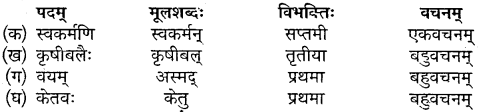
MP Board Class 10th General English The Spring Blossom Solutions Chapter 3 Salutation to the Nation

Are you seeking for the Madhya Pradesh Board Solutions 10th General English The Spring Blossom Solutions Chapter 3 Salutation to the Nation Questions and Answers PDF? If yes, then read this entire page. Here, we are giving a direct link to download MP Board Class 10th English Solutions Questions and Answers PDF which contains the chapter wise questions, solutions, and grammar topics. You can also get the shortcuts to solve the grammar related questions on this page.

MP Board Class 10th General English The Spring Blossom Solutions Chapter 3 Salutation to the Nation

For the sake of students we have gathered the complete 10th General English The Spring Blossom Solutions Chapter 3 Salutation to the Nation Questions and Answers can provided in pdf Pattern. Refer the chapter wise MP Board Class 10th English Solutions Questions and Answers Topics and start the preparation. You can estimate the importance of each chapter, find important English grammar concepts which are having more weightage. Concentrate on the important grammar topics from Madhya Pradesh Board Solutions for 10th English Chapter 3 Salutation to the Nation Questions and Answers PDF, prepare well for the exam.

Salutation to the Nation Textual Exercises

Word Power

A. Use the following words in your own sentences.
(निम्न शाब्दों से वाक्य बनाइए)
Answer:
treacherous – The treacherous acts of Raj created a barrier in our friendship.
jovial mood – Our class teacher was in jovial mood today.
reluctant – Mohan was reluctant to go to his friend’s birthday party.
embrace – When Ram stood first in the class his father embraced him.
flock – A large flock gathered at the accident spot.

B. Give one word for the following expressions.
(एक शब्द दीजिए)
Answer:

  1. a room for one or more prisoners in a prison or police station. – dungeon
  2. the act of killing somebody especially · as a legal punishment. – execution
  3. a person who suffers very much or is killed because of their religious political beliefs. – martyr
  4. a word or phrase that is easy to remember, used by politicians, advertisers etc. in order to attract people’s attention. – slogan

How Much Have I Understood?

A. Answer the following questions. (One or two sentences)
(निम्न प्रश्नों के उत्तर एक या दो वाक्यों में दीजिए।)

Salutation To The Nation MP Board Question 1.
Who is known as Shaheed-e-Azam?
(हू इज़ नोन एज़ शहीद-ए-आजम?)
शहीद-ए-आजम के नाम से कौन जाना जाता है?
Answer:
Bhagat Singh is known as Shaheed-eAzam.
(भगतसिंह इज़ नोन एज़ शहीद-ए-आजम।)
भगतसिंह को शहीद-ए-आजम के नाम से जाना जाता है।

Salutation To The Nation Questions And Answers MP Board Question 2.
Name three patriots who sacrificed their lives for the freedom of motherland, same day at Lahore.
(नेम थ्री पेट्रिअट्स हू सैक्रिफाइस्ड देअर लाइव्स फॉर द फ्रीडम ऑफ मदरलैण्ड, सेम डे एट लाहौर.)
तीन क्रान्तिकारियों के नाम लिखिए जिन्होंने मातृभूमि की आजादी के लिए एक साथ लाहौर में आत्मबलिदान दिया।
Answer:
Bhagat Singh, Sukhdev and Rajguru were the three patriots who sacrificed their lives for the freedom of motherland, same day at Lahore.
(भगतसिंह, सुखदेव एण्ड राजगुरु वर दी थ्री पेट्रिअट्स हू सैक्रिफाइस्ड देअर लाइव्स फॉर द फ्रीडम ऑफ मदरलैण्ड, सेम डे एट लाहौर.)
भगतसिंह, सुखदेव व राजगुरु तीन क्रान्तिकारी थे जिन्होंने अपनी मातृभूमि की आजादी के लिए एक साथ लाहौर में आत्मबलिदान दिया।

Class 10 English Chapter 3 Salutation To The Nation MP Board Question 3.
Bhagat Singh said, “One revolutionary is meeting another revolutionary”. Who was the other revolutionary?
(भगतसिंह सेड, “वन रिवॉल्यूशनरी इज़ मीटिंग एनदर रिवॉल्यूशनरी।” हू वॉज़ द अदर रिवॉल्यूशनरी?)
भगतसिंह ने कहा, “एक क्रान्तिकारी दूसरे क्रान्तिकारी से मुलाकात कर रहा है।” दूसरा क्रान्तिकारी कौन था?
Answer:
The other revolutionary was Lenin, whose biography Bhagat Singh was reading.
(द अदर रिवॉल्यूशनरी वॉज़ लेनिन, हूज़ बायोग्राफी भगत सिंह वॉज़ रीडिंग.)
दूसरा क्रान्तिकारी लेनिन था, जिसकी आत्मकथा भगत सिंह पढ़ रहे थे।

Mp Board Class 10 English Chapter 3 Salutation To The Nation Question 4.
What slogans were raised by the three revolutionaries?
(व्हॉट स्लोगन्स वर रेज्ड बाइ द थ्री रिवॉल्यूशनरीज़?)
तीनों क्रान्तिकारियों द्वारा क्या नारे लगाये गये?
Answer:
The three revolutionaries raised the slogan, ‘Inqualab Zindabad, Samrajyavad Murdabad’.
(द थ्री रिवॉल्यूशनरीज़ रेज्ड द स्लोगन, ‘इंकलाब जिन्दाबाद, साम्राज्यवाद मुर्दाबाद’।)
तीनों क्रान्तिकारियों ने नारा लगाया, ‘इंकलाब जिन्दाबाद, साम्राज्यवाद मुर्दाबाद।’

Salutation To The Nation Class 10 MP Board Question 5.
What did the Britishers do with the bodies of the three revolutionaries?
(व्हॉट डिड द ब्रिटिशर्स डू विद द बॉडीज़ ऑफ द थ्री रिवॉल्यूशनरीज़?)
अंग्रेजों ने तीनों क्रान्तिकारियों के शरीर के साथ क्या किया?
Answer:
The Britishers mercilessly chopped off the bodies of the three revolutionaries, filled them in the sacks and carried them to the bank of the river Sutlej at Ferozpur. Kerosene was spilled over them and set ablaze in the most cruel manner.
(द ब्रिटिशर्स मसीलेसली चॉप्ड ऑफ द बॉडीज़ ऑफ द थ्री रिवॉल्यूशनरीज़, फिल्ड् देम इन द सैक्स एण्ड कैरिड देम टू द बैंक ऑफ द रिवर सतलज एट फिरोजपुर कैरोसीन वॉज़ स्पिल्ड् ओवर देम एण्ड सेट अब्लेज़ इन द मोस्ट क्रूअल मैनर।)
अंग्रेजों ने तीनों क्रान्तिकारियों के मृत शरीरों को काटकर, बोरों में भरा व फिरोजपुर में सतलज नदी के तट पर ले गए। उन पर मिट्टी का तेल छिड़ककर अत्यन्त क्रूरतापूर्वक जलाया।

Lesson 3 Salutation To The Nation MP Board Question 6.
What did Mahatma Gandhi say on the death of Bhagat Singh?
(व्हॉट डिड महात्मा गाँधी से ऑन द डेथ ऑफ भगत सिंह?)
महात्मा गाँधी ने भगतसिंह की मृत्यु पर क्या कहा?
Answer:
Mahatma Gandhi on the death of Bhagat Singh said, “It has increased our power for winning freedom for which Bhagat Singh and his comrades died.”
(महात्मा गाँधी ऑन द डेथ ऑफ भगतसिंह सेड, “इट हैज़ इंक्रीप्ड अवर पावर फॉर विनिंग फ्रीडम फॉर व्हिच भगत सिंह एण्ड हिज़ कॉमरेड्स डाइड।”)
महात्मा गाँधी ने भगतसिंह की मृत्यु पर कहा, “भगत सिंह व उनके साथियों की मृत्यु ने हमारी स्वतन्त्रता पाने की क्षमता को बढ़ा दिया है।”

Mp Board Class 10 English Chapter 3  Question 7.
What did Bhagat Singh say to the Deputy Commissioner of Lahore?
(व्हॉट डिड भगतसिंह से टू द डैप्यूटी कमिश्नर ऑफ लाहौर?)
भगतसिंह ने लाहौर के डैप्यूटी कमिश्नर से क्या कहा?
Answer:
Bhagat Singh said to the Deputy Commissioner that he was fortunate to be able to see how Indian revolutionaries can embrace death with pleasure for the sake of their supreme ideal.
(भगतसिंह टू द डैप्यूटी कमिश्नर दैट ही वॉज़ फॉरच्यूनेट टू बी एबल टू सी हाउ इण्डियन रिवॉल्यूशनरीज़ कैन एम्बेस डेथ विद प्लैज़र फॉर द सेक ऑफ देअर सुप्रीम आइडियल.)
भगतसिंह ने डैप्यूटी कमिश्नर से कहा कि वह सौभाग्यशाली है कि वह देख पा रहा है कि किस प्रकार भारतीय क्रान्तिकारी खुशी-खुशी अपनी मातृभूमि के लिए मृत्यु को गले लगा सकते हैं।

B. Answer the following questions. (Three or four sentences)
(निम्न प्रश्नों के उत्तर तीन या चार वाक्यों में दीजिए।)

Bhagat Singh Called The Magistrate Answer MP Board Question 1.
What did the three revolutionaries do while going towards the place of execution?
(व्हॉट डिड द थ्री रिवॉल्यूशनरीज़ डू व्हाइल गोइंग टुवर्ड्स। द प्लेस ऑफ एग्जीक्यूशन?)
तीनों क्रान्तिकारियों ने फाँसी के तख्ने तक जाते हुए क्या किया?
Answer:
The three revolutionaries sang patriotic songs and moved towards the place of execution steadily and stood boldly. They raised the slogan, “Inqualab Zindabad, Samrajyavad Murdabad’.
(द थ्री रिवॉल्यूशनरीज़ सँग पैट्रिऑटिक साँग्स एण्ड मूव्ड टुवर्ड्स द प्लेस ऑफ एग्जीक्यूशन स्टैडिली एण्ड स्टुड बोल्डली। दे रेज्ड द स्लोगन, ‘इंकलाब जिन्दाबाद, साम्राज्यवाद मुर्दाबाद.)
तीनों क्रान्तिकारी निर्भीकता से देशप्रेम के गीत गाते हुए फाँसी के तख्ते की तरफ बढ़े। उन्होंने नारा लगाया, ‘इंकलाब जिन्दाबाद, साम्राज्यवाद मुर्दाबाद।’

Mp Board Class 10th English Chapter 3 Question 2.
Describe how the three revolutionaries embraced death for the cause of India’s freedom.
(डिस्क्राइब हाउ द थ्री रिवॉल्यूशनरीज़ एम्ब्रेस्ड डेथ फॉर द कॉज़ ऑफ इण्डियाज़ फ्रीडम.)
तीनों क्रान्तिकारियों ने भारत की स्वतन्त्रता के लिए किस प्रकार मृत्यु को गले लगाया इसका वर्णन करो।
Answer:
The three revolutionaries refused to get executed with their faces covered, wear the cap and get handcuffed. They walked along singing patriotic songs in a jovial mood. They raised the slogan, ‘Inqualab zindabad, Samrajyavad Murdabad’ loudly, pulled the hangman’s rope, kissed it and put it round their necks and faced death boldly.

(द थ्री रिवॉल्यूशनरीज़ रिफ्यूज्ड टू गेट एग्जीक्यूटिड विद देयर फेसेस कवर्ड, वेयर द कैप एण्ड गेट हैण्डकपड। दे वॉक्ड अलौग सिंगिंग पेट्रिऑटिक साँग्स इन अ जोविअल मूड। दे रेज्ड द स्लोगन, ‘इंकलाब ज़िन्दाबाद, साम्राज्यवाद मुर्दाबाद’ लाऊड्ली, पुल्ड् द हैंगमैन्स रोप, किस्ड् इट एण्ड पुट इट राउण्ड देयर नेक्स एण्ड फेस्ट डेथ बोल्डली.)

तीनों क्रान्तिकारियों ने मुँह ढंककर व बेड़ियाँ लगवाकर फाँसी लगवाने से मना कर दिया। वे खुशी होकर देशप्रेम के गीत गाते हुए फाँसी के तख्ते की तरफ बढ़े। उन्होंने नारा लगाया, ‘इंकलाब जिन्दाबाद, साम्राज्यवाद मुर्दाबाद’, फाँसी की रस्सी खींची, उसे चूमा व अपनी गर्दन में लपेटकर निर्भीकता से मृत्यु को गले लगाया।

Question 3.
How did Bhagat Singh’s parents react at the execution of their beloved son?
(हाउ डिड भगतसिंह ‘स् पेरेन्ट्स रिएक्ट एट द एग्जीक्यूशन ऑफ देयर बिलवड सन?)
भगतसिंह के माता-पिता ने अपने पुत्र की फाँसी पर क्या प्रतिक्रिया जताई?
Answer:
Bhagat Singh’s parents reacted boldly at the execution of their beloved son. His father, Sardar Kishan Singh drove away the crowd from the place of execution and went alone with a few people to fetch his dead body. He did not want that other innocent people may revolt and be shot dead along with his son.

(भगतसिंह ‘स् पेरेन्ट्स रिएक्टिड बोल्डलि एट द एग्जीक्यूशन ऑफ देयर बिलव्ड सन। हिज़ फादर, सरदार किशन सिंह ड्रोव अवे द क्राऊड फ्रॉम द प्लेस ऑफ एग्जीक्यूशन एण्ड वेन्ट् अलोन विद अ फ्यू पीपल टू फेच हिज़ डेड बॉडी। ही डिड नॉट वॉन्ट् दैट अदर इनोसेन्ट पीप्ल् मे रिवोल्ट एण्ड बी शॉट डेड अलाँग विद हिज़ सन।)

भगतसिंह के माता-पिता ने अपने प्रिय पुत्र की फाँसी पर निर्भीक प्रतिक्रिया जताई। उनके पिता, सरदार किशन सिंह भीड़ को फाँसी की जगह से दूर ले गए और कुछ ही लोगों के साथ उसका शव लेने गए। वे नहीं चाहते थे कि दूसरे मासूम लोग जोश में आयें व अपनी जान गँवाएँ।

Question 4.
What did Sardar Kishan Singh do to avoid any untoward incident?
(व्हॉट डिड सरदार किशन सिंह डू टू एवॉइड एनी अनटुवर्ड इन्सीडेन्ट?)
सरदार किशन सिंह ने किसी अनचाही घटना से बचने के लिए क्या किया?
Answer:
Sardar Kishan Singh drove away the crowd from the place of execution to avoid any untoward incident. He also went to fetch his son’s dead body only with a few people.
(सरदार किशन सिंह ड्रोव अबे द क्राऊड फ्रॉम द प्लेस ऑफ एग्जीक्यूशन टू एवॉइड. एनी अनटुवर्ड इन्सीडेन्ट ही ऑल्सो वेन्ट टू फेच हिज़ सन्स डेड बॉडी ओनलि विद अ फ्यू पीप्ल.)
सरदार किशन सिंह किसी अनचाही घटना से बचने के लिए भीड़ को फाँसी की जगह से दूर ले गए। वे अपने पुत्र के शव को लेने भी कुछ ही व्यक्तियों के साथ गए।

Question 5.
What did the village people do when they heard the news of Bhagat Singh’s execution?
(व्हॉट डिड द विलेज पीपल ड्र व्हेन दे हर्ड द न्यूज़ ऑफ भगतसिंह’ स् एग्जीक्यूशन?)
गाँव के लोगों ने भगतसिंह की मृत्यु की खबर सुनने पर क्या किया?
Answer:
When the village people heard that Bhagat Singh’s dead body has been chopped and burnt in a heartless manner by the Britishers they reached the place in the neighbouring village with torches. The English officers threw the shreds of the bodies in the river water and ran away. The humble villagers gathered the shreds of the half burnt bodies from the river and performed the last rites with full devotion and love.

(व्हेन द विलेज पीप्ल् हर्ड दैट भगतसिंह’स् डेड बॉडी हैज़ बीन चॉप्ड् एण्ड बर्ट इन अ हार्टलेस मैनर बाइ द ब्रिटिशर्स दे रीच् द प्लेस इन द नेबरिंग विलेज विद टॉर्चेस. द इंग्लिश ऑफिसर्स श्रू द श्रेड्स् ऑफ द बॉडीज़ इन द रिवर वॉटर एण्ड रैन अवे. दहम्बल विलेजर्स गैदर्ड द श्रेड्स् ऑफ द हाफ बर्ट बॉडीज़ फ्रॉम द रिवर एण्ड परफॉर्ड द लास्ट राइट्स विद फुल डिवोशन एण्ड लव.)

जब गाँव वालों ने सुना कि भगतसिंह का शव अंग्रेजों द्वारा पास के गाँव में क्रूरता से काटकर जलाया गया है तो वह वहाँ लालटेन लेकर पहुँच गये। अंग्रेजों ने उन्हें देखकर शव के टुकड़े नदी में फेंक दिये व भाग गये। गाँव वालों ने नदी में से उनके शरीर के अधजले टुकड़े एकत्रित किये व उनका पूर्ण श्रद्धा व प्रेम से अन्तिम संस्कार किया।

Question 6.
How did Mahatma Gandhi and Pandit Jawaharlal Nehru pay tribute to Shaheed-eAzam?
(हाउ डिड महात्मा गाँधी एण्ड पण्डित जवाहरलाल नेहरू पे ट्रिब्यूट टू शहीद-ए-आज़म?)
महात्मा गाँधी व पं. जवाहरलाल नेहरू ने शहीद-ए-आज़म को किस प्रकार श्रद्धांजलि दी?
Answer:
Mahatma Gandhi in his tribute to Bhagat Singh said, “It has increased our power for winning freedom for which Bhagat Singh and his comrades died”. Pandit Jawaharlal Nehru said, “Their magnificent courage and sacrifice has been an inspiration to the youth of India.”

(महात्मा गाँधी इन हिज़ ट्रिब्यूट टू भगतसिंह सेड, “इट हैज़ इंक्रीज्ड् आवर पावर फॉर विनिंग फ्रीडम फॉर व्हिच भगत सिंह एण्ड हिज़ कॉमरेड्स डाइड” पण्डित जवाहरलाल नेहरू सेड, “देयर मैग्नीफिसेन्ट करेज एण्ड सैक्रिफाइस हैज़ बीन एन इन्स्पिरेशन टू द यूथ ऑफ इण्डिया.”)

महात्मा गाँधी ने भगतसिंह को अपनी श्रद्धांजलि में कहा कि, “भगतसिंह व उनके साथियों की मृत्यु ने हमारी स्वतन्त्रता प्राप्ति की क्षमता को बढ़ा दिया है।” पण्डित जवाहरलाल नेहरू ने कहा, “उनकी बहादुरी व बलिदान ने भारत के युवाओं को प्रेरणा दी है।”

Question 7.
We got the freedom after a lot of struggle and many sacrifices. What should we do to maintain the freedom of our nation?
(वी गॉट द फ्रीडम आफ्टर अ लॉट ऑफ़ स्ट्रगल एण्ड मैनी सैक्रिफाइसेस। व्हॉट शुड वी डू टू मेन्टेन द फ्रीडम ऑफ अवर नेशन?)
हमें काफी संषर्घ व बलिदान के बाद स्वतन्त्रता मिली है। हमें अपनी स्वतन्त्रता को बरकरार रखने के लिए क्या करना चाहिए?
Answer:
We have got freedom after a lot of struggle and many sacrifices. We should maintain it by serving our country and being honest in our deeds. By being good citizens and contributing in its progress we can remain independent.
(वी हैव गॉट फ्रीडम आफ्टर अ लॉट ऑफ स्ट्रगल एण्ड मैनी सैक्रिफाइसेस वी शुड मेन्टेन इट बाइ सर्विंग आवर कण्ट्री एण्ड बीइंग ऑनेस्ट इन आवर डीड्स् बाइ बीइंग गुड सिटीजन्स एण्ड कॉन्ट्रिब्यूटिंग इन इट्स् प्रोग्रेस वी कैन रिमेन इन्डिपेन्डेन्ट.)
हमें बहुत संघर्ष के पश्चात् आज़ादी मिली है। हम उसे अपने देश की सेवा करके, अपने कार्यों में ईमानदार रहकर, अच्छे नागरिक बनकर व उसके विकास में योगदान देकर बरकरार रख सकते हैं।

C. Choose the correct alternative and fill in the blanks.
(रिक्त स्थान भरो।)

1. Rajguru and Sukhdev refused to…………
(i) go to the gallows
(ii) get their faces covered
(iii) be hanged
(iv) to come out of their cells.
Answer:
(ii) get their faces covered

2. Bhagat Singh called the magistrate ………
(i) unfortunate
(ii) fortunate
(iii) lucky
(iv) unlucky.
Answer:
(ii) fortunate

3. The Britishers took the dead bodies of the revolutionaries to the bank of the river …………
(i) Sutlej
(ii) Ganga
(iii) Yamuna
(iv) Narmada
Answer:
(i) Sutlej

4. By offering his supreme sacrifice to his motherland Bhagat Singh became a symbol of ………..
(i) progress
(ii) love
(iii) patriotism
(iv) kindness.
Answer:
(iii) patriotism

Language Practice

A. Fill in the blanks with past continuous form of the verbs given in brackets.
(रिक्त स्थान भरो।)

  1. The revolutionaries ………. (sing) a patriotic song.
  2. The crowd ……… (raise) loud slogAnswer:
  3. Bhagat Singh ………. (stand) between Rajguru and Sukhdev.
  4. Sardar Kishan Singh ………… (deliver) his speech.
  5. The people ………… (not, move) from their place.

Answer:

  1. were singing
  2. was raising
  3. was standing
  4. was delivering
  5. were not moving.

B. Combine the pairs of sentences using past perfect tense to express the earlier action or event.
(निम्न वाक्यों को जोड़े।)

1. (a) The sun rose.
(b) I woke up some time later.
Answer:
When I woke up, the sun had already rose.

2. (a) The fire burnt down all the huts.
(b) The fire brigade arrived later.
Answer:
When the fire brigade arrived, the fire had already burnt down all the huts.

3. (a) I did not see him for many years.
(b) I did not recognize him at once.
Answer:
I did not recognize him at once since I had not seen him for many years.

4. (a) The match began at 10 a.m.
(b) The spectators packed the stadium at 9 a.m.
Answer:
When the match began the spectators had already packed the stadium.

5. (a) The teacher said they could go home.
(b) They did not complete the assignment.
Answer:
Since they did not complete the assignment, the teacher asked them to go home.

C. Fill in the blanks using correct form of the verbs.
(रिक्त स्थान भरो।)

  1. By the time, the doctor …………. (arrive), the patient ……… (die).
  2. We ………….. (understand) the poem after the teacher ………… (explain).
  3. When we ……… (reach) the cinema hall, the film …….. (begin).
  4. Mother ………… (make) tea when we ………… (wake) up
  5. I thought you ………… (submit) your application by the due date.

Answer:

  1. arrived, had died
  2. understood, had explained
  3. reached, had begun
  4. made, woke
  5. had submitted.

Listening Time

The teacher will read out the following words and students will repeat them :
(निम्न शब्दों को पढ़ो।)
Answer:
MP Board Class 10th General English The Spring Blossom Solutions Chapter 3 Salutation to the Nation 1

Speaking Time

Frame sentences on seeing the pictures given in the text carefully.
(पुस्तक में दी गई तस्वीरों को देखकर वाक्य बनाइए।)
Answer:
Students can frame the sentences as follows:

  1. Rajesh is waking up at 6 o’clock in the morning.
  2. He is brushing his teeth.
  3. His mother is serving him breakfast.
  4. He is then going to school.
  5. The teacher is teaching him mathematics in the school.
  6. He is playing football in the games period.
  7. He is playing flute under the tree after the school.
  8. He is taking dinner with his father.
  9. He is then watching T. V.
  10. Mother is giving him milk to drink.
  11. He is brushing his teeth at night.
  12. He is going to bed at night.

Writing Time

Write a message to your mother. You can’t wait till 3 p.m. as you have to go to play a match. You are Shantanu.
(अपनी मॉं के नाम सन्देश लिखो)
Answer:
11 December, 2007

Ma, Got your message. I am sorry I won’t be able to wait till 3 p.m. as I have to go to play a football match. I will be back by 6 p.m. Bye.

Shantanu

Things to do

A. Collect the pictures of some martyrs and write about them in the given format.
(कुछ शहीदों के चित्र एकत्रित करो व उनके विषय में दिए गए प्रकार से लिखो।)
Answer:
Students may themselves find the pictures of some martyrs and collect information about them.(छात्र स्वयं करें।)

B. Collect some patriotic slogans:
(कुछ क्रान्तिकारी नारे लिखो।)
Answer:
Students should do it themselves.
(छात्र स्वयं करें।)

Salutation to the Nation Difficult Word Meanings 

Dungeon (डन्जन)-a dark underground room used as a prison (अन्धकारपूर्ण तहखाना जो कारागार के रूप में काम अता है); Hurl (हले)-to throw something/ somebody violently in a particular direction (जोर से कुछ फेंकना); Jovial (जोविअल)- very cheerful and friendly (प्रसन्नचित); Reluctant (रिलक्टेन्ट)hesitating before doing something because you do not want to do it or because you are not sure that it is the right thing to do (कोई कार्य करने को अनिच्छुक); Untoward (अनटुवर्ड)-unusual and unexpected and usually unpleasant (अप्रत्याशित, दुर्भाग्यपूर्ण); Gallows (गैलोज़)-a structure on which people (criminals) are killed by hanging (फाँसी देने का लकड़ी का ढांचा); Embrace (एम्बेस)- to put your arms around somebody as a sign of love or friendship; to accept something (here death) with enthusiasm (गले लगाना); Delirious (डेलिरिअस)-in an excited state – and not able to think or speak clearly (अत्यन्त उत्तेजित व प्रसन्न); Budge (बज)-to move slightly (धीरे से चलना); Treacherous (ट्रेचरस) – that cannot be trusted (अविश्वसनीय); Sack (सैक)-a large bag (एक बड़ा थैला); Flock (फ्लॉक)-to go or gather together somewhere in large numbers (व्यक्तियों का बहुत बड़ा झुण्ड); Shred (श्रेड)-a small thin piece that has been torn or cut from something (कपड़े का दुकड़ा)

Salutation to the Nation Summary, Pronunciation & Translation

Bhagat Singh was busy reading the biography of Lenin. In fact, he had just read a few pages when the door of the dungeon opened and let in a jail officer.

“Sardarji, please be ready, we have been ordered to carry out the execution,” said the officer.

Bhagat Singh was reading the book; he told the officer without raising his eyes from the book, “Wait, one revolutionary is meeting another revolutionary.”

The officer was stunned by the tone of Bhagat Singh’s voice and stood still.

(भगतसिंह वॉज़ विज़ी रीडिंग द बायोग्राफी ऑफ लेनिन. इन फैक्ट, ही हैड जस्ट रेड : अ फियु पेजिस व्हेन द डोर ऑफ द डन्जिअन ओपन्ड ऐण्ड लेट इन अ जेल ऑफिसर.

“सरदारजी, प्लीज बी रेडी, बी हैव बीन ऑर्डर्ड टू कैरी आऊट द एक्जिक्यूशन” सेड द ऑफिसर.

भगतसिंह वॉज़ रीडिंग द बुक; ही टोल्ड द ऑफिसर विदाऊट रेजिंग हिज़ आईज, फ्रॉम द बुक, “वेट, वन रिवोल्युशनरी इज़ मीटिंग एनदर रिवोल्युशनरी।”

द ऑफिसर वॉज़ स्टन्ड बाई द टोन ऑफ भगतसिंहज़ वॉयस एण्ड स्टुड स्टिल.)

अनुवाद :
भगतसिंह लेनिन की जीवनी पढ़ने में व्यस्त थे। असल में उन्होंने बस कुछ ही पृष्ठ पढ़े थे जब काल कोठरी का दरवाजा खुला और जेल अधिकारी अन्दर आया।

“सरदारजी, कृपया तैयार हो जाइए। हमें आदेश मिला है कि आपको फाँसी दे दी जाए” अधिकारी ने कहा।

भगतसिंह जीवनी पढ़ रहे थे; उन्होंने बिना आँखें उठाए (अधिकारी की तरफ देखे बिना) अधिकारी से कहा, “रुको, अभी एक क्रान्तिकारी दूसरे क्रान्तिकारी से मिल रहा है।”

अधिकारी उनके लहजे से अवाक रह गया और चुपचाप खड़ा हो गया।

Bhagat Singh resumed reading the book. All of a sudden he hurled the book in the air, stood forth and said, “Let’s go!”

Rajguru and Sukhdev also came out of their cells. They had refused to get their faces covered, wear the cap and get handcuffed.

The three revolutionaries walked along singing a patriotic song in a jovial mood and were followed by the jail officials on all sides.

(भगतसिंह रिज्यूम्ड रीडिंग द बुक. ऑल ऑफ अ सडन ही हल्ड द बुक इन द एयर, स्टुड फॉर्थ ऐण्ड सेड, “लैट्स गो!”

राजगुरु ऐण्ड सुखदेव ऑल्सो केम आऊट ऑफ देयर सेल्स दे हैड रिफ्यूज्ड टू गैट देयर फेसिस कवर्ड, वीयर द कैप ऐण्ड गैट हैण्डकपड.

द थ्री रिवोल्युशनरीज़ वॉक्ड अलौंग सिंगिंग अ पैट्रियोटिक सॉन्ग इन अ जोवियल मूड ऐण्ड वर फौलोड बाई द जेल ऑफिशियल्स ऑन ऑल साइड्स.)

अनुवाद :
भगतसिंह पुनः पुस्तक पढ़ने लगे। अचानक उन्होंने पुस्तक को हवा में उछाल दिया, झटके से खड़े हुए और बोले “चलो चलें!”

राजगुरु और सुखदेव भी अपनी-अपनी कोठरियों से बाहर आ गए। उन्होंने अपने चेहरों को ढकने, टोपी पहनने और हाथों में हथकड़ियाँ डलवाने से इन्कार कर दिया था।

तीनों क्रान्तिकारी बड़े प्रसन्नचित्त अन्दाज़ में देशभक्ति का गीत गाते हुए चल रहे थे और उनके पीछे-पीछे जेल अधिकारी चल रहे थे उनको घेरे में लिए हुए।

A huge crowd had assembled at the gate consisting of photographers, reporters, the public and the members of Bhagat Singh’s family.

The crowd was becoming unmanageable, loud slogans were being raised both inside and outside the jail. Bhagat Singh’s father, Sardar Kishan Singh, realized that the police might fire at or lathi-charge the people any moment and many innocent people would die.

(अ यूज क्राऊड हैड असेम्बल्ड ऐट द गेट कन्सिसटिंग। ऑफ फोटोग्राफर्स, रिपोर्टर्स, द पब्लिक ऐण्ड द मेम्बर्स ऑफ। भगतसिंहज़ फैमिली.

दक्राऊड वॉज़ विकमिंग अनमैनेजेबल, लाऊड स्लोगन्स वर बीईंग रेज्ड बोथ इन्साईड ऐण्ड आऊटसाईड द जेल.भगतसिंहज़ फादर, सरदार किशन सिंह, रियलाईज्ड दैट द पुलिस माईट फायर ऐट और लाठी-चार्ज द पीपल ऐनी मोमेण्ट एण्ड मैनी एनोसेण्ट पीपल वुड डाई.)

अनुवाद :
जेल (कारागार) के द्वार पर विशाल भीड़ जमा हो चुकी थी। फोटोग्राफर, रिपोर्टर, भगतसिंह के परिवार के लोग तथा आम जनता के लोग।

भीड़ को संभाल पाना मुश्किल होता जा रहा था। ऊँची आवाज़ में नारे लग रहे थे जेल के अन्दर भी और बाहर भी। भगतसिंह के पिताजी सरदार किशन सिंह जी को यह एहसास हो गया कि पुलिस किसी भी वक्त गोली चला सकती है अथवा लाठी चार्ज कर सकती है और बहुत से बेकसूर लोग मारे जाएँगे।

He aksed his wife, “Let us go, lest some misfortune should befall the harmless, innocent people.”

Bhagat Singh’s mother was reluctant to leave place but she had to give in to her husband’s plea.

Sardar Kishan Singh managed to drive away the crowd a little further from the gate to avoid some untoward incident and started delivering a speech to divert their mind from the gallows.

(ही आस्क्ड हिज़ वाईफ़ “लैट अस गो, लेस्ट सम मिस्फॉरचून शुड बिफॉल द हार्मलैस, इनोसेण्ट पीपल.”

भगतसिंहज़ मदर वॉज़ रिलक्टैण्ट टू लीव द प्लेस बट शी हैड टू गिव इन टू हर हस्बैण्ड्स प्ली.

सरदार किशन सिंह मैनेज्ड टू ड्राईव अवे द क्राऊड अ लिटल फर्दर फ्रॉम द गेट टू अवॉइड सब अन्टुवर्ड इन्सिडेण्ट ऐण्ड स्टार्टिड डेलिवरिंग अ स्पीच टू डाईवर्ट देयर माईन्ड फ्रॉम द गैलोज़.)

अनुवाद :
उन्होंने अपनी पत्नी से कहा “हमें चले जाना चाहिए इससे पहले कि निरीह बेकसूर लोगों पर दुर्भाग्य टूट पड़े।”

भगतसिंह की माँ वहाँ से जाना नहीं चाहती थीं परन्तु अन्ततोगत्वा उन्होंने अपने पति की दलील मान ली।

सरदार किशन सिंह जी भीड़ को जेल के दरवाजे से थोड़ा अलग ले जाने में सफल हो गए। किसी प्रकार की अप्रिय घटना न हो तथा लोगों का ध्यान फाँसी से हटाने के लिए उन्होंने एक भाषण देना शुरू किया।

The wardon proceeded towards the platform with the three valiant revolutionaries. The Deputy Commissioner of Lahore was surprised and terrified to see that the convicts were not shackled. Bhagat Singh read the fear in his eyes and said, “Well, Mr. Magistrate, you are fortunate to be able to see how Indian revolutionaries can embrace death with pleasure for the sake of their supreme ideal.”

Bhagat Singh, along with Sukhdev and Rajguru, climbed the stairs of the platform steadily and stood boldly.

Bhagat Singh stood in the centre with Sukhdev on his left and Rajguru on his right.

(द वार्डन प्रोसीडिड टुवर्ड्स द प्लैटफॉर्म विद द थ्री वैलियण्ट रिवॉल्युशनरीज़. द डेप्युटि कमिश्नर ऑफ लाहौर वॉज़ सरप्राईज्ड ऐण्ड टेरिफाईड टू सी दैट कन्विक्ट्स वर नॉट शैकल्ड. भगतसिंह रेड द फीयर इन हिज़ आईज़ ऐण्ड सेड, “वैल मिस्टर मैजिस्ट्रेट, यू आर फॉरचुनेट टू बी एबल टू सी हाऊ इण्डियन रिवॉल्युशनरीज़ कैन एम्ब्रेस डेथ विद प्लेज़र फॉर द सेक ऑफ देयर सुप्रीम आईडियल.”

भगत सिंह, अलॉन्ग विद सुखदेव एण्ड राजगुरु, क्लाइम्बड द स्टेअर्स ऑफ द प्लैटफॉर्म स्टेडिली ऐण्ड स्टुड बोल्डली।

भगतसिंह स्टुड इन द सेण्टर विद सुखदेव ऑन हिज़ लेफ्ट ऐण्ड राजगुरू ऑन हिज़ राईट.)

अनुवाद :
जेलर तीनों बहादुर क्रान्तिकारियों के साथ फाँसी के लिए बने चबूतरे की तरफ बढ़ने लगा। लाहौर के उपायुक्त (डिप्टी कमिश्नर) तीनों को हथकड़ी के बिना देखकर हैरान और भयभीत थे। भगतसिंह ने उनकी आँखों में डर देख लिया और कहा “मैजिस्ट्रेट महोदय आप बहुत भाग्यशाली हैं क्योंकि आप यह देख पा रहे हैं कि कैसे भारतीय क्रान्तिकारी अपने उच्चतम आदर्शों की खातिर खुशी-खुशी मौत को गले लगा सकते हैं।”

सुखदेव और राजगुरु के साथ भगतसिंह चबूतरे की सीड़ियाँ सधे कदमों के साथ चढ़ गए और तीनों निडर भाव से खड़े हो गए।

भगतसिंह बीच में खड़े हुए, उनकी बायीं ओर सुखदेव और दाहिनी तरफ राजगुरु।

They raised the slogan ‘Inqualab Zindabad, Samrajyavad Murdabad’ in a loud, clear and distinct voice, pulled the hangman’s rope, kissed it and put it round their necks. Bhagat Singh told the hangman, “Now you may set it right, if you please.”

The hangman, who must have been a very tough man, was moved to the core of his heart. He set the rope around the necks of the noble and brave young men with tears welling in his eyes and turned the spindle.

(दे रेज्ड द स्लोगन ‘इन्कलाब जिन्दाबाद, साम्राज्यवाद मुर्दाबाद’ इन अ लाऊड, क्लीयर ऐण्ड डिस्टिंक्ट वॉयस, पुल्ड द हैंगमैन्स रोप, किस्ड इट ऐण्ड पुट इट राऊण्ड देयर नेक्स. भगतसिंह टोल्ड द हैंगमैन, “नाऊ यू मे सेट इट राईट, इफ यू प्लीज़.”

द हैंगमैन, हू मस्ट हैव बीन अ वेरी टफ मैन, वॉज़ मूव्ड टू द कोर ऑफ हिज़ हार्ट. ही सेट द रोप अराऊण्ड द नेक्स ऑफ द नोबल ऐण्ड ब्रेव यंग मेन विद टीयर्स वेलिंग इन हिज़ आईज़ ऐण्ड टन्ड द स्पिन्डल)

अनुवाद :
उन्होंने ऊँची, साफ और स्पष्ट आवाज़ में नारा लगाया ‘इन्कलाब ज़िन्दाबाद, साम्राज्यवाद मुर्दाबाद’फिर जल्लाद के हाथ से फांसी का फंदा लेकर उनको चूमा और अपने-अपने गलों में डाल लिया। भगतसिंह ने जल्लाद से कहा “अब तुम इन फंदों को सही कर सकते हो यदि उचित समझो तो।”

जल्लाद जो कि एक सख्त कठोर व्यक्ति रहा होगा विचलित और द्रवित हो उठा। अश्रुपूरित नेत्रों से उसने तीनों बहादुर युवाओं के गलों में पड़े फंदों को सही किया और तख्ता सरकाने वाली तकली को घुमा दिया।

The board fell and the three revolutionaries offered their homage to their motherland with their lives at 7.33 in the evening.

Sardar Kishan Singh was on the verge of losing his nerve. He continued delivering his speech in a delirious manner, when the milkman ran towards them and gave the dreaded news that the execution was over.

(द बोर्ड फेल ऐण्ड द थ्री रिवोल्युशनरीज़ ऑफर्ड देयर होमेज टू देयर मदरलैण्ड विद देयर लाईव्स ऐट 7.33 (सेवन थर्टी थ्री) इन द ईवनिंग.

सरदार, किशन सिंह वॉज़ ऑन द वर्ज ऑफ लूजिंग हिज़ नर्व. ही कन्टिन्यूड डेलिवरिंग हिज़ स्पीच इन अ डेलिरियस मैनर, व्हेन द मिल्कमैन रैन टुवर्ड्स देम ऐण्ड गेव द ड्रैडिड न्यूज़ दैट द एक्ज़िक्यूशन वॉज़ ओवर।)

अनुवाद :
फाँसी का तख्ता सरक गया और तीनों क्रान्तिकारियों ने अपनी मातृभूमि को अपनी अन्तिम श्रद्धान्जलि अपने जीवन के रूप में शाम सात बजकर तैतीस मिनट पर प्रदान की।

सरदार किशन सिंह जी अपना धैर्य और मानसिक सन्तुलन खोने के कगार पर थे। वे बिल्कुल उन्मादी अवस्था में लगातार भाषण दिए जा रहे थे, जब दूधवाला दौड़कर उनको फाँसी हो चुकी है यह खबर देने आया।

Sardar Kishan Singh announced to the crowd, “Bhagat Singh has been executed. I am going to fetch his body. None of you should budge from here. I don’t wish that in taking away the body of Bhagat Singh I shall have to take away many more.”

Sardar Kishan Singh went ahead with a heavy heart with a few people and knocked at the gate. The gate of the jail was not opened. Continuous knocking went unheeded.

The police officers were heard laughing loudly inside the gate.

Someone came and whispered, informing them that the bodies had been taken away through another gate.

(सरदार किशन सिंह अनाऊन्सड टू द क्राऊड, “भगत सिंह हैज़ बीन एक्जिक्यूटिड. आई ऐम गोईंग टू फेच हिज़ बॉडी. नन ऑफ यू शुड बज फ्रॉम हिअर. आई डोण्ट विश दैट इन टेकिंग अवे द बॉडी ऑफ भगतसिंह आई शैल हैव टू टेक अवे मैनी मोर.”

सरदार किशन सिंह वेण्ट अहेड विद अ हैवी हार्ट विद अ फ्यू पीपल ऐण्ड नॉक्ड ऐट द गेट. द गेट ऑफ द जेल वॉज़ नॉट ओपन्ड. कन्टिन्यूअस नॉकिंग वेण्ट अनहीडिड.

द पुलिस ऑफिसर्स वर हर्ड लाफिंग लाऊड्ली इन्साइड द गेट।

समवन केम ऐण्ड ह्विस्पर्ड, इन्फॉर्मिंग देम दैट द बॉडीज़ हैड बीन टेकन अवे श्रू ऐनदर गेट.)

अनुवाद :
सरदार किशन सिंह जी ने भीड़ को सम्बोधित कर कहा “भगतसिंह को फाँसी दे दी गई है। मैं उनके पार्थिव शरीर को लेने जा रहा हूँ। आप लोगों में से कोई भी यहाँ से हिलना नहीं चाहिए। मैं नहीं चाहता कि भगतसिंह के शव के साथ मुझे और भी शवों को अपने साथ ले जाना पड़े।”

सरदार किशन सिंह जी कुछ लोगों के साथ लेकर भारी हृदय से आगे बढ़े और जेल के दरवाजे पर जाकर दस्तक दी। जेल का दरवाज़ा नहीं खुला। लगातार खटखटाना बेकार गया।

पुलिस अधिकारियों के जेल के अन्दर से ज़ोर-ज़ोर से हँसने की आवाज़ आ रही थी।

कोई आया 3 धीमी आवाज़ में बुदबुदाकर यह सूचना दी कि शवों को दूसरे द्वार से ले जाया जा चुका है।

The British were bent upon their treacherous way. The bodies of the valiant leaders were mercilessly chopped off, filled in the sacks and carried away to the bank of the river Sutlej at Ferozepur through a back gate. The last rites were to be performed by a Sikh granthi and a Hindu pandit.

The sacks containing the parts of the bodies were taken off the truck. Kerosene was spilled over them and set ablaze in the most cruel and heartless manner.

When the news reached the neighbouring village, the people flocked to the sacred spot carrying torches with them.

The English officers saw the approaching crowd and threw away the half burnt shreds of the bodies into the river-water, sat in the truck and sped away to save their lives.

(द ब्रिटिश वर बेन्ट अपॉन देयर ट्रैचरस वे. द बॉडीज़ ऑफ द वैलिएण्ट लीडर्स वर मरसिलैसली चॉप्ड ऑफ, फिल्ड इन द सैक्स ऐण्ड कैरिड अवे टू द बैंक ऑफ द रिवर सतलज ऐट फिरोज़पुर श्रू अ बैक गेट. द लॉस्ट राईट्स वर टू बी परफॉर्ड बाई अ सिक्ख ग्रन्थी ऐण्ड अ हिन्दु पण्डित।

द सैक्स कन्टेनिंग द पार्ट्स ऑफ द बॉडीज़ वर टेकन ऑफ द ट्रक. केरोसिन वॉज़ स्पिल्ड ओवर देम ऐण्ड सेट अब्लेज़ इन द मोस्ट क्रूएल ऐण्ड हार्टलैस मैनर.

व्हेन द न्यूज़ रीच्ड द नेबरिंग विलेज, द पीपल फ्लॉक्ड टू द सेकरेड स्पॉट कैरीईंग टॉर्चेस विद दैम.

द इंग्लिश ऑफिसर्स सॉद अप्रोचिंग क्राऊड ऐण्ड थ्रियु अवे द हाफ बर्ट ग्रैड्स ऑफ द बॉडीज़ इन्टू द रिवर-वॉटर, सैट इन द ट्रक ऐण्ड स्पेड अवे टू सेव देयर लाईव्ज.)

अनुवाद :
अंग्रेज़ पूरी तरह से अमानवीय कपटपूर्ण तरीकों पर उतरे हुए थे। उन बहादुर क्रान्तिकारी योद्धाओं के शवों के निर्ममतापूर्वक टुकड़े किए गए, फिर बोरों में भरकर पिछले दरवाजे से फिरोज़पुर में सतलज नदी के घाट पर ले जाया गया। अन्तिम क्रिया एक सिक्ख ग्रन्थी व एक हिन्दू पण्डित द्वारा की जानी थी।

शवों के टुकड़ों वाले बोरों को ट्रक से उतारा गया। उन पर मिट्टी का तेल छिड़का गया और अत्यन्त क्रूर एवं निर्मम तरीके से आग लगा दी गई।

जब “यह खबर पास के गाँव में पहुँची तो लोग हाथों में मशालें ले-लेकर उस पवित्र स्थल की तरफ आने लगे।

अंग्रेज़ अफसरों ने आती हुई भीड़ को देखकर अधजले शवों के टुकड़ों को नदी में फेंक दिया और ट्रक में बैठकर अपनी जान बचाने को भाग लिए।

The humble villagers gathered the shreds of the half burnt bodies from the river and performed the last rites with full devotion and love.

In this way the great martyr Bhagat Singh happily embraced death to liberate his motherland and became immortal in the hearts of Indians. He was 24 when he was executed. He became a legendary hero for the masses. Innumerable songs were composed about him, and the youth throughout the country made him their ideal. He became a symbol of bravery and inspired the people to free India.

(द हम्बल विलेजर्स गैदर्ड द शैड्स ऑफ द हाफ बर्ट बॉडीज़ फ्रॉम द रिवर ऐण्ड परफॉर्ड द लास्ट राईट्स विद फुल डिवोशन ऐण्ड लव.

इन दिस वे द ग्रेट मार्टर भगत सिंह हैप्पिली ऐम्ब्रेस्ड डेथ टू लिबरेट हिज़ मदरलैण्ड ऐण्ड बिकेम इम्मॉर्टल इन द हार्ट्स ऑफ इण्डियन्स. ही वॉज़ ट्वेन्टी फोर व्हेन ही वॉज़ ऐक्जिक्यूटिड. ही बिकेम अ लेजेण्डरी हीरो फॉर द मासिस इन्नयुमिरेबल सॉन्ग्स वर कम्पोज्ड अबाऊट हिम, ऐण्ड द यूथ श्रूआऊट द कंट्री मेड हिम देयर आइडीयल ही बिकेम अ सिम्बल ऑफ ब्रेवरी ऐण्ड इन्स्पायर्ड द पीपल टू फ्री इण्डिया.)

अनुवाद :
सरल हृदयी गाँव वालों ने नदी में अधजले शवों के टुकड़ों को निकालकर इकट्ठा किया और पूर्ण श्रद्धा व प्रेम के साथ उनकी अन्त्येष्टि की।

इस तरह महान शहीद भगतसिंह ने मातृभूमि को दासता से मुक्त कराने के लिए हँसते-हँसते मौत को गले लगा लिया और भारतीयों के हृदयों में अमर हो गये। वह केवल चौबीस वर्ष के थे जब उनको फाँसी दी गई। वह आम जनता के लिए एक प्रसिद्ध नायक बन गए। उनकी यशगाथा का बखान करने वाले अनेक गीत रचे गए और सम्पूर्ण देश के युवाओं ने उन्हें अपना आदर्श मान लिया। वह बहादुरी का प्रतीक बन गए और लोगों को भारत को आज़ाद कराने के लिए प्रेरित किया।

Bhagat Singh is justly remembered as ‘Shaheede-Azam’ by his grateful countrymen for making the supremę sacrifice. He infused life into the youth and became their hero. “It has increased our power for winning freedom for which Bhagat Singh and his comrades died,” said Mahatma Gandhi: “Their magnificent courage and sacrifice has been an-inspiration to the youth of India,” said Pandit Jawaharlal Nehru, the then president of the Indian National Congress, in his tribute, “These valiant young men died so that India may live.”

(भगतसिंह इज़ जस्टलि रिमेम्बर्ड ऐज़ ‘शहीद-ए-आजम’ बाई हिज़ ग्रेटफुल कंट्रीमेन फॉर मेकिंग द सुप्रीम सैक्रिफाईस. ही इन्फ्यूज्ड लाईफ इन्टू द यूथ ऐण्ड बिकेम देयर हीरो “इट हैज़ इन्क्रीज्ड आवर पावर फॉर विनिंग फ्रीडम फॉर व्हिच, भगतसिंह ऐण्ड हिज़ कॉमरेड्स डाईड,” सेड महात्मा गाँधी. “देयर मैग्निफिसेन्ट करेज एण्ड सेक्रिफाईस हैज बीन ऐन इन्सपिरेशन ट्र द यूथ ऑफ इण्डिया,” सेड पण्डित जवाहरलाल नेहरु, द देन प्रेसीडेण्ट ऑफ द इण्डियन नेशनल कांग्रेस, इन हिज़ ट्रिब्यूट, “दीज़ वैलिएण्ट यंग मैन डाईड सो दैट इण्डिया मे लिव.”)

अनुवाद :
भगतसिंह को उनके सर्वोच्च त्याग के कारण ‘शहीद-ए-आज़म’ के रूप में याद किया जाता है। उन्होंने भारत के युवाओं में जीवन का संचरण किया और उनके आदर्श बन गए। महात्मा गांधी ने कहा “भगतसिंह और उनके साथियों की शहादत ने आज़ादी हासिल करने की हमारी शक्ति को बढ़ा दिया है।” पण्डित जवाहरलाल नेहरू जो उस समय भारतीय राष्ट्रीय कांग्रेस के अध्यक्ष थे ने कहा, ” उनकी बेमिसाल बहादुरी और त्याग भारतीय युवाओं के लिए प्रेरणा का स्रोत है। ये बहादुर युवा इसलिए मरे ताकि भारत ज़िन्दा रहे।”

Hope that the above shaped information regarding the Madhya Pradesh Board Solutions for 10th English Chapter 3 Salutation to the Nation Questions and Answers is useful for making your preparation effective. View our website regularly to get other subjects solutions.

MP Board Class 8th Sanskrit Solutions Chapter 6 स्वामी विवेकानन्दः

MP Board Class 8th Sanskrit Solutions Surbhi Chapter 6 स्वामी विवेकानन्दः

MP Board Class 8th Sanskrit Chapter 6 अभ्यासः

Class 8 Sanskrit Chapter 6 Mp Board  प्रश्न 1.
एकपदेन उत्तरं लिखत(एक शब्द में उत्तर लिखो-)
(क) स्वामी विवेकानन्दस्य बाल्यकालस्य नाम किम् आसीत्? (स्वामी विवेकानन्द के बचपन का नाम क्या था?)
उत्तर:
नरेन्द्रनाथः। (नरेन्द्रनाथ)

(ख) स्वामी विवेकानन्दस्य मातुः नाम किम् आसीत्? (स्वामी विवेकानन्द की माता का नाम क्या था?)
उत्तर:
भुवनेश्वरी देवी। (भुवनेश्वरी देवी)

(ग) नरेन्द्रनाथस्य पितुः नाम किम् आसीत्? (नरेन्द्रनाथ के पिता का नाम क्या था?)
उत्तर:
विश्वनाथदत्तः। (विश्वनाथदत्त)

(घ) नरेन्द्रनाथस्य जन्म कस्मिन् नगरे अभवत्? (नरेन्द्रनाथ का जन्म किस नगर में हुआ?)
उत्तर:
कोलकातानगरे। (कोलकाता नगर में)

(ङ) नरेन्द्रनाथस्य गुरोः नाम किम् अस्ति? (नरेन्द्रनाथ के गुरु का नाम क्या है?)
उत्तर:
रामकृष्णपरमहंसः। (रामकृष्णपरमहंस)

Mp Board Class 8 Sanskrit Solution Chapter 6 प्रश्न 2.
एकवाक्येन उत्तरं लिखत(एक वाक्य में उत्तर लिखो-)
(क) नरेन्द्रनाथस्य जन्म कदा अभवत्? (नरेन्द्रनाथ का जन्म कब हुआ?)
उत्तर:
नरेन्द्रनाथस्य जन्म जनवरी मासस्य द्वादशे दिनांके १८६३ खिस्ताब्दे (१२ जनरवरी, १८६३)अभवत्। (नरेन्द्रनाथ का जन्म जनवरी महीने की बारह तारीख को 1863 ईस्वी (12 जनवरी, 1863) में हुआ।)

(ख) शिकागोनगरे विश्वधर्मसम्मेलने भारतस्य प्रतिनिधिः कः अभवत्? (शिकागो नगर में विश्वधर्म सम्मेलन में भारत के प्रतिनिधि कौन हुए?)
उत्तर:
शिकागोनगरे विश्वधर्मसम्मेलने भारतस्य प्रतिनिधिः स्वामी विवेकानन्दः अभवत्। (शिकागो नगर में विश्वधर्म सम्मेलन में भारत के प्रतिनिधि स्वामी विवेकानन्द हुए।)

(ग) स्वामी विवेकानन्दः कदा ब्रह्मलीनोऽभवत्? (स्वामी विवेकानन्द कब ब्रह्मलीन हुए?)
उत्तर:
स्वामी विवेकानन्दः जुलाई मासस्य चतुर्थे दिनांके १८०२ खिस्ताब्दे (४ जुलाई, १९०२) ब्रह्मलीनोऽभवत्। (स्वामी विवेकानन्द जुलाई महीने की चार तारीख 1902 ईस्वी (4 जुलाई, 1902) में ब्रह्मलीन हुए।)

(घ) रवीन्द्रनाथटैगोर किम् कथनम् अस्ति? (रवीन्द्रनाथ टैगोर का क्या कहना है?)
उत्तर:
रवीन्द्रनाथटैगोरस्य कथनम् अस्ति यत् कोऽपि भारतीयसंस्कृतिं ज्ञातुमिच्छति तर्हि प्रथमः तेन स्वामी विवेकानन्दविषये पठितव्यः। (रवीन्द्रनाथ टैगोर का कहना है कि कोई भी भारतीय संस्कृति को जानना चाहता है तो पहले उसे स्वामी विवेकानन्द के विषय में पढ़ना चाहिए।)

(ङ) यूनाम् प्रेरकः पथप्रदर्शकश्च कः? (युवाओं के प्रेरक और पथ-प्रदर्शक कौन हैं?)
उत्तर:
यूनाम् प्रेरकः पथप्रदर्शकश्च स्वामी विवेकानन्दः। (युवाओं के प्रेरक और पथ-प्रदर्शक स्वामी विवेकानन्द हैं।)

Mp Board Class 8 Sanskrit Chapter 6 प्रश्न 3.
उचितं योजयत(उचित को जोड़ो-)
Class 8 Sanskrit Chapter 6 Mp Board
उत्तर:
(क) → (ii)
(ख) → (v)
(ग) → (i)
(घ) → (iii)
(ङ) → (iv)

संस्कृत कक्षा 8 पाठ 6 MP Board प्रश्न 4.
शुद्धवाक्यानां समक्षम आम्’ अशुद्ध वाक्यानां समक्षं’न’ इति लिखत
(शुद्ध वाक्यों के सामने ‘आम्’ (हाँ) तथा अशुद्ध वाक्यों के सामने ‘न’ (नहीं) लिखो-)
(क) पौरुषं कुरु।
(ख) आत्मभावस्य विकासः एव कर्म।
(ग) जीवनस्यार्थः उन्नतिः नास्ति।
(घ) स्वार्थभावः एव मृत्युः।
(ङ) परोपकारः अपवित्रम् कार्यमस्ति।
उत्तर:
(क) आम्
(ख) आम्
(ग) न
(घ) आम्
(ङ) न।

8 वीं कक्षा संस्कृत गाइड In Hindi Chapter 6 MP Board प्रश्न 5.
उचितपदेन रिक्तस्थानं पूरयत(उचित शब्द द्वारा रिक्त स्थान भरो-)
(क) प्रतिग्रहणस्य कामना …………..। (कुरु/मा कुरु)
(ख) चारित्र्यबलं…………..। (वारयत/धारयत)
(ग) नरेन्द्रनाथस्य पिता ………….. आसीत्। (भाषक:/अभिभाषक:)
(घ) अनात्मभावस्य विकासः एव …………. । (कर्म/अकर्म)
(ङ) स्वामीविवेकानन्दस्य जन्म ………….. अभवत्। (कोलकातानगरे/मुम्बईनगरे)
उत्तर:
(क) मा कुरु
(ख) धारयत
(ग) अभिभाषकः
(घ) अकर्म
(ङ) कोलकातानगरे।

Class 8 Sanskrit Chapter 6 MP Board प्रश्न 6.
नामोल्लेखपूर्वकं सन्धि विच्छेदं कुरुत(नाम का उल्लेख करते हुए सन्धि-विच्छेद करो-)
(क) दीक्षानन्तरम्
(ख) प्रसिद्धोऽभवत्
(ग) एवाकर्म
(घ) तस्यावधारणा
(ङ) अनेनैव
(च) कार्यमस्ति।
उत्तर:
Mp Board Class 8 Sanskrit Solution Chapter 6

कक्षा 8 संस्कृत पाठ 6 MP Board प्रश्न 7.
नामोल्लेखपूर्वकं समासविग्रहं कुरुत(नाम का उल्लेख करते हुए समास-विग्रह करो-)
(क) लोकसेवकः
(ख) परोपकारः
(ग) परिव्राजकदीक्षाम्
(घ) जीवनगतिः
(ङ) ईश्वर प्राप्तिः।
उत्तर:
Mp Board Class 8 Sanskrit Chapter 6

क्लास 8 संस्कृत चैप्टर 6 MP Board प्रश्न 8.
मूलशब्दं, लिङ्ग, विभक्तिं, वचनं च लिखत(मूल शब्द, लिंग, विभक्ति और वचन लिखो-)
(क) ज्ञानम्
(ख) कार्यम्
(ग) अनेन
(घ) ईश्वरः
(ङ) दीनः
(च) क्रीडासु
(छ) एतेषाम्
(ज) सः।
उत्तर:
संस्कृत कक्षा 8 पाठ 6 MP Board

स्वामी विवेकानंद पर 10 वाक्य संस्कृत में MP Board प्रश्न 9.
अव्ययानां वाक्य प्रयोगं कुरुत(अव्ययों का वाक्यों में प्रयोग करो-)
(क) च
(ख) एवम्
(ग) मा
(घ) तदा
(ङ) यदि।
उत्तर:
8 वीं कक्षा संस्कृत गाइड In Hindi Chapter 6 MP Board

कक्षा 8 संस्कृत पाठ 6 के प्रश्न उत्तर MP Board प्रश्न 10.
‘स्वामी विवेकानन्दः’ इति विषयमवलम्ब्य संस्कृते दशवाक्यानि लिखत
(‘स्वामी विवेकानन्द’ इस विषय के आधार पर संस्कृति में दस वाक्य लिखो-)
उत्तर:

  1. स्वामी विवेकानन्दस्य बाल्यकालस्य नाम ‘नरेन्द्रनाथः’ आसीत्।
  2. स्वामी विवेकानन्दस्य जन्म कोलकातानगरे अभवत्।
  3. स्वामी विवेकानन्दस्य पिता ‘विश्वनाथदत्तः’ आसीत्।
  4. स्वामी विवेकानन्दस्य माता ‘भुवनेश्वरी देवी’ आसीत्।
  5. स्वामी विवेकानन्दस्य गुरुः ‘रामकृष्णपरमहंसः’ आसीत्।
  6. स्वामी विवेकानन्दस्य शिष्या ‘भगिनी निवेदिता’ आसीत्।
  7. स्वामी विवेकानन्दः यूनां कृते पथप्रदर्शकः आसीत्।
  8. स्वामी विवेकानन्दः संस्कृतानुरागी आसीत्।
  9. नरेन्द्रनाथः ‘स्वामी विवेकानन्दः’ इति नाम्ना प्रसिद्धोऽभवत्।
  10. स्वामी विवेकानन्दस्य बहवः शिष्याः अभवन्।

स्वामी विवेकानन्दः हिन्दी अनुवाद

‘बहुजनहिताय, बहुजन सुखाय’ इत्यमका रोलानस्थ स्वामी विवेकानन्दस्य बाल्यकालस्य नार नरेन्द्रनाथ:’ आसीत्। तस्य जन्म जनवरीमासस्य द्वादशे दिनांक १८६३ ख्रिस्ताब्दे (१२ जनवरी, १८६३) कोलकातानगरे अभवत्। तस्य मातुः नाम ‘भुवनेश्वरी देवी’ आसीत्। तस्य पिता विश्वनाथदत्तः लब्धप्रतिष्ठः, अभिभाषकः आसीत्। नरेन्द्रनाथः बाल्यकालादेव संस्कृतानुरागी, कुशाग्रबुद्धि, मल्लविद्यादिसु क्रीडासु पारङ्गतः धार्मिकश्चासीत्।

अनुवाद :
‘बहुत लोगों के हित के लिए, बहुत लोगों के सुख के लिए’ इस कार्य में लगे हुए स्वामी विवेकानन्द का बचपन का नाम ‘नरेन्द्रनाथ’ था। उनका जन्म जनवरी महीने की बारह तारीख को 1863 ईस्वी में (12 जनवरी, 1863) कोलकाता (कलकत्ता) नगर में हुआ। उनकी माता का नाम ‘भुवनेश्वरी देवी’ था। उनके पिता विश्वनाथदत्त ख्याति प्राप्त वकील थे। नरेन्द्रनाथ बचपन से ही संस्कृत के प्रेमी, तीव्र, बुद्धि वाले, मल्ल (कुश्ती) विद्या आदि खेलों में पारंगत और धार्मिक थे।

तस्मिन् काले रामकृष्ण परमहंसः अद्वितीयाध्यात्मिक-ज्ञानपुञ्जस्य स्रोतः आसीत्। तस्य प्रभावेण प्रभावितः नरेन्द्रनाथः तेनैव परिव्राजकदीक्षा प्राप्नोत्। दीक्षानन्तरं सः स्वामी विवेकानन्दः इति नाम्ना प्रसिद्धोऽभवत्। ततः सः स्वकीयज्ञानदीप्त्या सदुपेदेशः जनान् अध्यात्मपरायणमकरोत्। तस्वावधारणा आसीत् यत् प्रम्णा, सत्येन, पराक्रमेण च कार्याणि सिद्धयन्ति। तत्कुरु पौरुषम्। आत्मभावस्य विकासः एव कर्म। अनात्मभावस्य विकासः एवाकर्म। दौर्बल्येन किमपि न भवति। अतः सबलो भव।

कक्षा 8 विषय संस्कृत पाठ 6 के प्रश्न उत्तर MP Board अनुवाद :
उस समय रामकृष्ण परमहंस अद्वितीय आध्यात्मिक ज्ञान पुंज के स्रोत थे। उनके प्रभाव से प्रभावित नरेन्द्रनाथ ने उनसे ही संन्यास की दीक्षा प्राप्त की। दीक्षा के बाद वह ‘स्वामी विवेकानन्द’ के नाम से प्रसिद्ध हुए। उसके बाद उन्होंने अपनी ज्ञान की ज्योति द्वारा सद् उपदेशों से लोगों को अध्यात्म की ओर अभिमुख किया। उनकी अवधारणा (निश्चय) थी कि प्रेम, सत्य और पराक्रम से कार्य पूरे होते हैं। उसका प्रयत्न करो। आत्म भाव का विकास ही कर्म है। अनात्म भाव का विकास ही अकर्म है। दुर्बलता से कुछ भी नहीं होता। इसलिए बलवान होओ।

जीवनस्यार्थः उन्नतिरस्ति। उन्नतेः तात्पर्य हृदयस्यौदार्यमास्ति। परोपकारः एव जीवनगतिः। स्वार्थभावः एव मृत्युः। प्रेमभावः एव जीवनम्। द्वेषभाव एवं मृत्युः। प्रेमभावः एव भक्तिः ज्ञानं मुक्तिश्चास्ति। प्रेम बिना नेदं यदिदमुपासते।

Sanskrit Chapter 6 Class 8 MP Board अनुवाद :
जीवन का अर्थ उन्नति है। उन्नति का तात्पर्य हृदय का औदार्य (उदारता का गुण) है। परोपकार ही जीवन की गति (चाल) है। स्वार्थभाव ही मृत्यु है। प्रेमभाव ही जीवन है। द्वेषभाव ही मृत्यु है। प्रेमभाव ही भक्ति, ज्ञान और मुक्ति है। प्रेम के बिना वह नहीं है जिसकी उपासना करते हैं।

सर्वथा दरिद्रनारायणो सेवितव्यः। यतोहि बुभुक्षितः, दीनः, उपेक्षितः, विकलाङ्गजनः, दुर्बलः एव साक्षादीश्वरः। अतः एतेषामुपासना एव ईश्वरस्याराधना अस्ति।

अनुवाद :
हमेशा दरिद्रनारायण (गरीब) की सेवा करनी चाहिए। क्योंकि भूखा, दीन, उपेक्षित, विकलांग, दुर्बल व्यक्ति ही साक्षात् ईश्वर हैं। इसलिए ऐसों की उपासना ही ईश्वर की आराधना है।

चारित्र्यबलं धारयत। अनेनैव सर्वत्र विजयो भविष्यति। दाता भव। प्रतिग्रहणस्य कामनां मा कुरु। वसन्तवल्लोकहितं चरत। परोपकारः परमपवित्रं कार्यमस्ति। परोपकारेण चित्तं शुद्धयति। अनेनैव ईश्वरप्राप्तिः सम्भवा।

अनुवाद :
चरित्र की शक्ति को धारण करो। इससे ही सब। जगह विजय होगी। दाता होओ। प्रतिग्रहण (दान के बदले ग्रहण) की कामना मत करो। बसन्त के समान संसार का कल्याण करो। परोपकार परम पवित्र कार्य है। परोपकार से मन शुद्ध होता है। इससे ही ईश्वर की प्राप्ति सम्भव है।

सः वेदान्तप्रचाराय स्वीकायाखिलं जीवनं समर्पयामास। तेन हिन्दुधर्मः संस्कृतिश्च प्रसारिते। सः न केवलं परिव्राजकः अपतुि परोपकारी, दाता, लोकसेवकः महान् देशभक्तश्चासीत्। शिकागोनगरे विश्वधर्मसम्मेलने सः भारतस्य प्रतिनिधिः अभवत्। देशविदेशेषु तस्य बहवः शिष्याः अभवन्। आङ्ग्लदेशीय “कुमारी नोबल” या अनन्तर ‘भगिनी निवेदिता’ इति नाम्ना प्रसिद्धा, तस्य प्रिया शिष्या अभवत्। सः यूनां कृते विशिष्टप्रेरकः पथप्रदर्शकश्चासीत्। भारतीयस्वतन्त्रतासंग्रामेऽपि तस्य ऊर्जस्वलानि भाषणानि स्वाधीनतासैनिकानां कृते प्रेरणास्पदानि। ‘उत्तिष्ठत जाग्रत प्राप्य वरान्निबोधत’ इत्युपनिषदः ध्येयवाक्यं सः जीवनेऽधारयत्।

अनुवाद :
उन्होंने वेदान्त प्रचार के लिए अपना सम्पूर्ण जीवन समर्पित कर दिया। उनके द्वारा हिन्दू धर्म और संस्कृति का प्रसार किया गया। वह न केवल संन्यासी, अपितु परोपकारी, दाता, लोक सेवक और महान देशभक्त थे। शिकागो नगर में विश्वधर्म सम्मेलन में वह भारत के प्रतिनिधि हुए। देश-विदेशों में उनके बहुत से शिष्य हुए। इंग्लैण्ड देश की “कुमारी नोबल” जो बाद में बहन निवेदिता’ के नाम से प्रसिद्ध हुई, उनकी प्रिय शिष्या हुई। वह युवाओं के लिये विशेष प्रेरक और मार्ग-प्रदर्शक थे। भारतीय स्वतन्त्रता संग्राम में भी उनके तेजस्वी भाषण स्वाधीनता के सैनिकों के लिए प्रेरणादायक थे। ‘उठो, जागो और श्रेष्ठ (मनुष्यों) को पाकर (उनसे) ज्ञान प्राप्त करो।’ इस उपनिषद् के ध्येय वाक्य को उन्होंने जीवन में धारण किया।

अहर्निशं ब्रह्मकर्मसाधनां साध्यमानः एव जुलाई मासस्य चतुर्थे दिनांके १९०२ ख्रिस्ताब्दे(४ जुलाई,१९०२) सः ब्रह्मलीनो जातः। सः न केवलं भारते अपितु, विदेशेष्वपि प्रसिद्धः। तेन भारतस्य प्राचीनगौरवं विदेशेषु स्थापितम्। रवीन्द्रनाथटैगोरः कथयति यत् यदि कोऽपि भारतीयसंस्कृतिं ज्ञातुमिच्छति तहिं प्रथमः तेन स्वामी विवेकानन्दविषये पठितव्यः।

अनुवाद :
दिन-रात ब्रह्म कर्म साधना को करते हुए जुलाई महीने की चार तारीख 1902 ईसवी (4 जुलाई, 1902) में वह ब्रह्म में लीन हो गये। वह न केवल भारत में अपितु विदेशों में भी प्रसिद्ध थे। उनके द्वारा भारत का प्राचीन गौरव विदेशों में स्थापित किया गया। रवीन्द्रनाथ टैगोर कहते हैं कि यदि कोई भी भारतीय संस्कृति को जानना चाहता है तो पहले उसे स्वामी विवेकानन्द के विषय में पढ़ना चाहिए।

स्वामी विवेकानन्दः शब्दार्थाः

लब्धप्रतिष्ठः = ख्याति प्राप्त। अभिभाषक = वकील। कुशाग्रबुद्धिः = तीव्र बुद्धि। मल्लविद्यादिषु = कुश्ती आदि विद्याओं में। परिव्राजकदीक्षाम् = संन्यास की दीक्षा को। स्वकीयज्ञानदीप्त्या=अपनेज्ञान के प्रकाशसे।अध्यात्मपरायणम् = अध्यात्म की ओर अभिमुख। प्राप्य वशन्निबोधत = श्रेयस्कर लक्ष्य को प्राप्त कर शान्त हो। बुभुक्षिताः = भूखे। औदार्यम् = उदारता का गुण। प्रतिग्रहणस्य = दान के बदले ग्रहण करने की/का। ऊर्जस्वलानि = तेजस्वी। ब्रह्मलीनः = ब्रह्म में लीन । वसन्तवल्लोकहितं = वसन्त के समान लोक कल्याणकारी।

स्वामी विवेकानन्दः व्याकरणम्

(क) धार्मिकश्चासीत् = धार्मिकः + च + आसीत्।
(ख) अध्यात्मपरायणमकरोत् = अध्यात्मपरायणम् + अकरोत्।
(ग) हृदयस्यौदार्यमस्ति = हृदयस्य + औदार्यम् + अस्ति।
(घ) मुक्तिश्चास्ति = मुक्तिः + च + अस्ति।
(ङ) यदिदमुपासते = यत् + इदम् + उपासते।
(च) वसन्तवल्लोकहितम् = वसन्तवत् + लोकहितम्।

MP Board Class 8th Sanskrit Solutions

MP Board Class 10th Social Science Solutions Chapter 10 Contribution of Madhya Pradesh in Freedom Struggle

In this article, we will share MP Board Class 10th Social Science Book Solutions Chapter 10 Contribution of Madhya Pradesh in Freedom Struggle Pdf, These solutions are solved subject experts from the latest edition books.

MP Board Class 10th Social Science Solutions Chapter 10 Contribution of Madhya Pradesh in Freedom Struggle

MP Board Class 10th Social Science Text Book Exercise

Objective Type Questions

Mp Board Class 10th Social Science Chapter 10 Question 1.
Multiple Choice Questions:
(Choose the correct answer from the following)

Students can also download MP Board 10th Model Papers to help you to revise the complete Syllabus and score more marks in your examinations.

Contribution Of Madhya Pradesh In Freedom Movement MP Board Class 10 Question (a)
Which freedom fighter of Madhya Pradesh had the honour of becoming President of India:
(a) Dr. Shankar Dayal Sharma
(b) Pt. Sunderlal
(c) Pt. Dwarika Prasad Mishra
(d) Pt. Shambhunath Shukla.
Answer:
(a) Dr. Shankar Dayal Sharma

Contribution Of Mp In Freedom Movement MP Board Class 10 Question (b)
After which freedom fighter’s name, Bhopal University has been named:
(a) Seth Govinddas
(b) Barkatullah
(c) Harisingh Gaud
(d) Rani Durgavati.
Answer:
(b) Barkatullah

Class 10th Social Science Chapter 10 MP Board Question (c)
From which city of Madhya Pradesh the ‘Jhanda Satyagraha’ begin: (MP Board 2010)
(a) Indore
(b) Sagar
(c) Jabalpur
(d) Bhopal.
Answer:
(c) Jabalpur

Class 10 Social Science Chapter 10 MP Board Question 2.
Fill in the blanks:

  1. ……………………. (name) lived in village Dhimarpura by the name Harishankar Bhramachari.
  2. Rani Avantibai was queen of Ramgarh of ………………….. district.
  3. Rani Laxmibai captured Gwalior with the help of ……………………. (name).

Answer:

  1. Chandrashekhar Azad
  2. Manda
  3. Tatya Tope

Contribution Of Madhya Pradesh In Freedom Struggle MP Board Class 10 Question 3.
Match the column:
Mp Board Class 10th Social Science Chapter 10
Answer:

  1. (iv)
  2. (i)
  3. (ii)
  4. (iii)

MP Board Class 10th Social Science Very Short Answer Type Questions

Class 10 Social Science Mp Board  Question 1.
Where was Chandrashekhar Azad born?
Answer:
Village Bhabhra of Jhabua District.

Contribution Of Mp In Freedom Struggle MP Board Class 10 Question 2.
Name the places of organisations set up in Madhya Pradesh?
Answer:
‘Gurukul’ 1929 (Satna), Hindustani Seva Dal 1931, Charkha Sangh (Rewa), Gwalior Rajya Seva Sangh and Harijan Sevak Sangh 1935 (Gwalior), Lok Sevak Sangh 1939, (Khargone), Gram Seva Kutir 1935 (Sendhwa), Seva Samiti (Betul). Seva Samiti (Betul), Seva Mandal (Ratlam) Jnyan Prakash Mandal (Indore) etc.

Mp Board Solution Class 10 Social Science Question 3.
Which freedom fighter’s name (soldier) of Indian National Army was associated with Shivpur?
Answer:
Colonel Gurbax Singh Dhillon.

MP Board Class 10th Social Science Short Answer Type Questions

Question 1.
Name the newspapers published from Madhya Pradesh to arouse awemess for national awakening? (MP Board 2012)
Answer:
During that period many newspaper like Karmaveer, Ankush, Subodh Sindhu, Nyaya Sudha, Arya Vaibhav, Lokmat, Praja Mandat Patrika, Sarswati Vilas, Saptahik Awaz and Subaha Watan were published, which raised voice against the oppressive and unjust policies of the British. This helped in arousing nationalist feelings.

Question 2.
In what way the people of Madhya Pradesh made their contribution in the Civil Disobedience Movement?
Answer:
The people of Madhya Pradesh made their contribution in the Civil Disobedience Movement in several ways. Some of the main movements are as:

  1. The forest struggle (satyagraha) of Turia Jungle.
  2. Jungle Satyagraha of Ghodadongri.
  3. The Firing Incidence of Charanpaduka.

During the freedom movement many political and social service institutions were set up; their ways of working and policies, though different, their contribution in the movement was remarkable. Thus contribution of the people of Madhya Pradesh was memorable.

Question 3.
What was Jungle Satyagraha? (MP Board 2013)
Answer:
When in 1930 Gandhiji marched to Dandi and led the ‘Namak Satyagraha’, at the time the Congress workers of Seoni, under the leadership of Durga Shankar Mehta carried out the ‘Jungle Satyagraha’. About 9 – 10 kms from Seoni, a movement to cut grass from the Government Sandalwood Gardens, was started.

In continuation of the above movement another movement to cut grass in the jungles of Turia 28 kms from Seoni. It was planned to enter Turia jungle on 9th October, 1930. The police and range officers insulted the freedom fighters and the public who had assembled there in support of the freedom fighters.

The Deputy Commissioner, Seoni ordered police to open fire on them to ‘teach a lesson’. On the spot four tribals viz. Guddobai, Ramabai, Bemabai and Birju Gond died. This incidence is a proof of the fact that the freedom movement spread even among the tribals. The bodies of these martyrs were not handed over to their families.

Question 4.
How did ‘Jhanda Satyagraha’ take place? Explain?
Answer:
During the freedom movement, tricolour with spinning wheal (charkha) in the centre was having the status of national flag. During 1923 an incident with regard to its honour occurred that the whole nation stood for it and even the British administration had to recognize that fact.

This incidence has gone in the history of freedom struggle and is known as ’Jhanda Satyagraha’. The Congress party constituted a committee under the leadership of Hakim Ajmal Khan to assess the extent of mental preparedness of the people in favour of the Non – Cooperation Movement.

The Jabalpur Congress Committee decided to honour Mr. Khan and hoist the tricolour on the building of Jabalpur Municipality. The British Government took this act of honouring Mr. Khan as an insult of the British rule and ordered the police to not only remove the flag but insult is by crushing it under feet. Consequently the people were extremely annoyed. They agitated and this agitation became a national agitation only after few months.

MP Board Class 10th Social Science Long Answer Type Questions

Question 1.
Describe the contribution of freedom fighters of Madhya Pradesh in the freedom struggle of 1857?
Answer:
From every part of Madhya Pradesh fighters took part in the freedom struggle. There was hardly any area where freedom fighters were not there. Everyone from almost all the areas of Madhya Pradesh took part in the struggle. Only because of these people that we are breathing in free atmosphere. Although freedom fighters did not confine themselves to a specific area; they considered the nation above everything.

Central character of struggle for freedom of 1857 was Rani Laxmi Bai, who belonged to Jhansi, fought her important battle in Madhya Pradesh posed challenge to British and won the war. She caputred the Gwalior fort with the help of Tatya Tope. When English capton Hughes approached Gwalior fort, she fought bravely and on 18th June, 1858 near Gwalior she sacrificed her life in the Baba Gangadas Bag.

Tatya Tope, the great, fighter of first freedom struggle helped Rani Laxmi Bai to capture Gwalior. Even after the death of Rani Laxmi Bai, Tatya Tope continued guerilla fighting with the British for two years in Madhya Pradesh and other parts of India. A friend betrayed Tatya Tope and he was imprisoned and later hanged in Shivpuri. Some other main freedom fighters were Virangana Rani Avantibai, Raja Bakhtawar Singh, Raja Shankar Singh and Raghunath Shah, Thakur Ranmat Singh, etc.

Question 2.
What impact ‘Civil Disobedience Movement’ and ‘Quit India Movement’ had on Madhya Pradesh?
Answer:
The trible district Betul was also a centre of freedom struggle and the tribals here also participated in the freedom movement. After the ‘Jungle Movement’ of 1930 the tribal freedom fighters also took the reigns of the freedom movement in their hands under the leadership of Ganjan Singh Korku of Banjari Dhal.

When the police reached Banjari Dhal to arrest Shri Ganjan Singh the local tribals strongly opposed. The police opened fire and in the firing Koma Gond died and became a martyr. Ganjan Singh however escaped. In a place named Jambada a crowd gathered to free the arrested tribals, police opened fire on the crowd, Ramu and Makdu Gond died and became martyrs.

In August 1942 a new chapter in the freedom struggle of India was added, popularly known as ‘Quit India Movement’. The All India Congress Committee passed are solution, in the meeting of Indian Congress Committee held on 8th August, 1942 in Bombay. On the 9th August many big leaders including Mahatma Gandhi were arrested.

In this situation, many big leaders of Madhya Pradesh like Pt. Ravi Shankar Shukla, Dwarka Prasad Mishra returned to Madhya Pradesh to fight against such oppressive activities of the British Rule. People organised themselves in every village, tehsil and town, thus a beginning of the struggle was made. In Betul the struggle assumed serious form and the police opened fire.

In places like Mandla, Sagar, Hosharigabad, Chhindwara Jabalpur etc. people attacked Government offices and burnt Government records, railway, postal and transport services were disrupted. The police took recourse to oppression were disrupted. Seth Govindas was arrested in Jabalpur. As a consequence of this the struggle gathered momentum. The people participated in the struggle with great enthusiasm in places like Khandwa, Khargone, Narsinghpur, Damoh, Balaghat etc.

Question 3.
Write notes on:

  1. Barkatullah Bhopali
  2. Chandrashekhar Azad
  3. Tantya Bhil
  4. Kunwar Chain Singh
  5. Virangana Avantibai
  6. Thakur Ranmat Singh.

1. Barkatullah Bhopali:
Mohammad Barkatullah continuously made efforts of Independence of India, while living in foreign countries. He was made the Prime Minister of the interim Government of India set up in Kabul. Political activities started in Bhopal from the year 1934.

In this very year publication of two weekly papers were started viz. ‘Subahe Watan’ in Urdu by Shakir Ali Khan and ‘Praja Pukar’ by the Hindu Mahasabha of Bhopal State. In 1938 the Hindu and Muslim population together, set up ‘Praja Mandal’.
Contribution Of Madhya Pradesh In Freedom Movement MP Board Class 10

2. The Great Martyr Chandrashekhar Azad:
He was born in village Bhabhra of Jhabua district (Madhya Pradesh). He joined the Non-cooperation Movement in the early age of 14 years. When he was arrested he told in the court of law, ‘Azad’ as his name, ‘Independence’ as father’s name and ‘Prison’ as his address. Since then suffix ‘Azad’ added to his name.

For the Britishers, Azad’s name was the synonym for terror. The credit or arousing a sense of patriotism and prepare people foi armed revolution and preparing a generation of revolutionaries goes to Azad. Between the year 1926 to 1931, Azad was associated in almost all the revolutionary activities and associated himself in about 100 incidences of fight against the Britishers and became General Officer in Command of the Indian Socialist Republican Party.

He set up his headquarters in a village named Dhimarpura on the Bank of the river Satar in Jhansi. During day hours he used to narrate the story of Lord Ram, arrange for meals for the people and from there used to direct revolutionary activities in Jhansi.

He somehow reached Allahabad, hiding himself from the police and on 27 February, 1931, he was sitting in the Alfred Park. The police rounded him there at 10 a.m. in the morning. Firing started from both the sides, when only one bullet was left in his pistol he shot himself by firing a bullet neaiythe ear.
Contribution Of Mp In Freedom Movement MP Board Class 10

3. Tantya Bhil:
After the freedom struggle of 1857 Tantya Bhil became a symbol of terror for the Britishers. Dopia and Bijamija, his associates were also his partners in the Revolutionary activities. For years they were living amongst the local people and at the same time conducted revolutionary activities as a result of which they became a big challenge for the Britishers. Tantya Bhil was arrested under a conspiracy and was hanged in the year 1886. Tantya is a hero even today among Bhils.
Class 10th Social Science Chapter 10 MP Board

4. Kunwar Chain Singh:
Prince Chain Singh of Narsinghgarh was insulted by political Agent Maddoc of Sehore Cantonment. Hence Chain Singh started agitation against the British. In 1824 there was a fierce battle between Chain Singh and the British on a sport which is presently known as Tehsil Chouraha. Chain Singh and handful of brave soldiers sacrificed their lives while fighting with British soldiers in Sehore’s Dussehra Bagh.

5. Virangana Rani Avantibai:
The queen of Ramgarh of Mandla district also showed extra ordinary love for her motherland and fought bravely. Ramgarh is a small town in Mandla district. In 1850 after the death of Raja Lakshman Singh his only son Vikramjeet Singh was declaired mentally sick and unfit to rule.

British Government took the regions of administration in their hands and appointed their officer. The royal family was sanctioned annual subsistence allowance. Rani Avantibai (Wife of Raja Laxman Singh) of Ramgarh was very able and intelligent lady who wanted to rule the state in her son’s name but at the time the ’policy of annexation’ (Hadap Neeti) was being strictly implemented.

Rani Avantibai opposed this, fought with the officer who was appointed by the Britisher there and took the reigns of administration in her hands. She contacted the thakurs and malguzars of the district and sought their cooperation. Many Zamindars promised to lend their support.

The Rani used to lead her soldiers in battlefield in soldier’s uniform. In April 1858, the Britishers attacked Ramgarh, the Rani assessed her strength and vacated the fort and went into the adjoining forests. From there she constantly attacked the Britishers but one of these attacks proved to fatal.

When she saw that she is surrounded and will be surely caught, this brave lady instead of courting arrest, got down from the horse, seized sword from her body – guard and pierced it in-her chest and laid her life bravely for her motherland.
Class 10 Social Science Chapter 10 MP Board

6. Thakur Ranmat Singh:
Thakur Ranmat Singh of village Manakhari of Satna district also gave tough fight to the Britishers in the struggle of 1857. The Thakur was unhappy with the activities of the political Agent Maddoc and decided to fight with Britishers. He along with his companions organised an army in the jungles of Chitrakoot and attacked the Residency in Nagod. The resident fleed.

Thakur Ranmat Singh attacked the Naogaon cantonment also, after a few days and a British platoon of Barodha was killed. A prize of Rs. 2000 was declared on the Thakur. After fighting with the Britishers for a long times, he was arrested by the Britishers on day when he was resting in his friend’s house, he was caught unaware and was hanged in the year 1859.

MP Board Class 10th Social Science Additional Important Questions

Objective Type Questions

Question 1.
Multiple Choice Questions:
(Choose the correct answer from the following)
Question (a)
Bundela revolt was started in the period of:
(a) 1740 – 1742
(b) 1840 – 1842
(c) 1892 – 1897
(d) 1940 – 1942.
Answer:
(b) 1840 – 1842

Question (b)
Jhanda Satyagraha was started in the year of:
(a) 1920
(b) 1921
(c) 1922
(d) 1923.
Answer:
(d) 1923.

Question (c)
Chandrashekhar Azad was bom at:
(a) District Jhabua
(b) District Mandsour
(c) District Harda
(d) District Bhopal (MP Board 2009)
Answer:
(a) District Jhabua

Question (d)
Who fought with British by Guerilla system?
(a) Raja Laxman Singh
(b) Bakntawar Singh
(c) Tatya Tope
(d) Ganjan Sing Korku
Answer:
(c) Tatya Tope

Question 2.
Fill in the blanks:

  1. Namak Satyagrah was started by …………………….
  2. Jungle Satyagrah was the satyagrah of …………………….

Answer:

  1. Mahatma Gandhi
  2. Triblals.

Question 3.
True and False type questions.

  1. Chandrashekhar Azad was bom in Sagar district.
  2. In Madhya Pradesh, Quit India Movement was started under the leadership of Mahatma Gandhi.

Answer:

  1. False
  2. False.

Question 4.
Match the Column:
Contribution Of Madhya Pradesh In Freedom Struggle MP Board Class 10
Answer:

  1. (d)
  2. (a)
  3. (b)
  4. (c)

Answer in One – Two Words or One Sentence

Question 1.
What is known as Jalianwala Bagh of M.P.? (MP Board 2009)
Answer:
The firing incidence of Charanpaduka on 14th January 1931.

Question 2.
Who were killed in firing of Madhya Pradesh’s Jalianwala Bagh?
Answer:
Seth Sunderlal, Dharamdas Khirwa, Chirku, Halke Kurmi, Ramlal Kurmi and Raghuraj Singh.

Question 3.
Write the name of queen of Ramagarh of Mandla District? (MP Board 2009)
Answer:
Gondwana queen, Rani Durgavati shah Maravi ruled Mandla province and fought against Akbar in her valiant effort to save her.

Question 4.
What slogan was given by Gandhiji on 8th August 1942?
Answer:
Do or Die.

Question 5.
When was a meeting organised at Talak Bhoomi Talaliya in Jabalpur?
Answer:
On 9th August 1942.

Question 6.
Write the name of main revolutionaries of Jaipur?
Answer:
Raja Shankar Singh and Raghunath Shah.

Question 7.
Name the main centre of revolt?
Answer:
The main centre of revolt were Gwalior, Bhopal and Indore.

MP Board Class 10th Social Science Very Short Answer Type Questions

Question 1.
What do you mean by Bundela revolt?
Answer:
Bundela, Rajput, Gond and Lodhi rulers and landlords revolted against the British and fought against the British rule in Narmada Sagar region of Buridelkhand.

Question 2.
Why did Prince Chain Singh started revolt against the Britishers?
Answer:
Prince Chain Singh of Narsinghgarh was insulted by political Agent Maddoc of Sehore Cantonment. Hence Chain Singh started agitation against the British. In 1824 there was a fierce battle between Chain Singh and the British on a sport which is presently known as Tehsil Chouraha.

Question 3.
Who was the hero of 1857 from Indore?
Answer:
In the freedom struggle of 1857 Sadat Khan and Bhagirath Silawat of Indore played an important role. They gave tough fight to the Britishers but were caught and hanged in Indore. Their sacrifice is also worth mentioning.

Question 4.
Who did plan to loot of Punjab Mail?
Answer:
Three freedom fighters Veer Yashwant Singh, Devnarayan Tiwari and Dalpatrao prepared a plan to loot the rifles and other belonging of the officers who travelled by Pubjab Mail.

MP Board Class 10th Social Science Short Answer Type Questions

Question 1.
What do you mean by Bundela Movement?
Answer:
In the land of Madhya Pradesh second flame of revolt flickered in 1840-1842 when in Narmada Sagar region of Bundelkhand. Bundela, Rajput, Gond and Lodhi rulers and landlords revolted against the British and fought against the British rule. Dhillan Shah of Madanpur, Hirde Shah of Heerapur, Raja Parinit of Jaitpur, Rao Basant Singh of Chirgaon and Deewan Bundela of Jheejhaon were heroes of this agitation, but because of lack of unity and power of British army the revolt could not succeed.

Question 2.
What were the main centres of 1857 in Madhya Pradesh?
Answer:
There was mass intolerance in public and in 1857 the feeling became widespread. Like other parts of India there were many small Riyasats in Madhya Pradesh of the rulers and Nababs were faithful to British but the soldiers of their army after hearing the news of revolt, were eager to help their fellow soldiers.

Main centre of revolt were Gwalior, Bhopal and Indore. The places where the flame of revolt flared were Sagar, Jabalpur, Narsinghpur, Hoshangabad, Nangaon, Gwalior, Jhansi, Shivpuri, Bhopal, Neemuch, Indore, Mahidpur, Mandsaur etc.

Question 3.
When did the Gwalior – Goa conspiracy take place?
Answer:
Gwalior was the seat of the revolutionaries. Gendalal and Chandrashekhar Azad were hiding in various parts of Gwalior. In 1930 an organisation was set up in Gwalior for boycott of foreign textiles. The Gwalior – Goa conspiracy took place in 1932. Under this movement arms were brought from foreign countries and were being made available to the revolutionaries. Those who were punished in this regard were Balkrishna Sharma, Girdharilal the main.

MP Board Class 10th Social Science Long Answer Type Questions

Question 1.
Describe the contribution of Madhya Pradesh in the national movement?
Answer:
All sections of the population of Madhya Pradesh actively participated in the national movement. The tribals played their role, the ruling families and their subjects also participated in the struggle. The peasants also made their contribution in their own way. Thus people of all sections participated in the ‘Non – cooperation movement’, ‘Civil Disobedience’, Salt Movement’, ‘Jungle Satyagrah’ and the movement of 1942.

The centre of activities of the great revolutionary, Chandrashekhar Azad was Orcha. The Red Army of Maganlal Bagdi took lead as an armed revolutionary. The people of Madhya Pradesh participated in the non cooperation movement and took part in the activities like movement against in the activities like movement against consumption of liquor, Tilak Swaraj fund, boycott of foreign cloth, boycott of Government schools and establishment of national educational institutions, handloom industry etc.

The advocates abandoned their practice. Those advocates who went to courts wore Gandhi caps. District committees ignored Government orders and hoisted national flag. The police arrested all the leaders. Pandit Sunderlal was tried in the court of law and imprisoned for six months. All the members of Jabalpur Municipality the leaders Second batch comprising Premchandra, Sitaram Jadhav, Chhigelal Swarnkar and Todermal hoisted flag on the town hall. The ‘Jhanda Movement’ spread in other parts of India including Nagpur.

Question 2.
Discuss the role of Bhils in 1857?
Answer:
The Bhils of Malwa and Nimad area were freedom lovers. To supress them the Britishers had formed an army called the Malwa Bhil Cops. Khajya and Bhima were working in the army in the capacity of ’Nayak1. Against the oppressive policy of the Britishers these two soldiers increased their activities of opposition (associating with the 1857 Freedom Struggle).

Worried by their activities the Britishers launched a campaign to arrest them, Khajya was killed in 1860 (by deception) while Bhima continued his struggle. He was also arrested in 1867. Besides these, the role of Rao Khalak Singh Daua of Sevdha (Datia), Daulat Singh of Raghogarh (Dewas) Waris Mohammad Khan of Bhopal, Nawab Adil Mohammad Khan of Ambapani (Bhopal) and Phajil Mohammad Khan Sohagpur (Shahdol), Garrul Singh etc. was also important in the freedom struggle of 1857.

MP Board Class 6th Special English Solutions Chapter 1 Kassim and Ali

Students who wish to prepare the English Subject can rely on the MP Board Solutions for Class 6 English Chapter 1 Kassim and Ali Questions and Answers prevailing. Become perfect with the concepts of Class 6 English Chapter 1 Kassim and Ali Questions and Answers, Grammar, Summary, Notes, Guide, Pdf, by preparing you can score highest grade in your exams. Here, You Can Download MP Board Class 6 English Solutions. Detailed Solutions are provided to the concepts by experts keeping in mind the latest edition textbooks and syllabus.

MP Board Class 6th Special English Solutions Chapter 1 Kassim and Ali

Ace up your preparation by referring to the Madhya Pradesh State Board Solutions for Class 6 Chapter 1 Kassim and Ali Questions and Answers and learn all the topics within. Click on the topic you want to prepare from the Class 6 English and prepare it easily. You can understand your strengths and weaknesses by learining the Questions and Answers in MP Board Solutions for Class 6 English PDF.

Kassim and Ali Text Book Exercise

Word Power

Match the Columns
Class 6 English Chapter 1 Kassim And Ali MP Board
Answer:
Kassim And Ali Story Questions And Answers MP Board Class 6

Comprehension

(a) Write yes/no in the given boxes.

  1. Ali had read a book of riddles.
  2. Kassim knew the answer of the riddle asked by Ali.
  3. Ali showed Kassim a blue and red pencil.
  4. Kassim and Ali bet of money.
  5. Kassim said ‘magic’ words over the pencil.

Answer:

  1. no
  2. no
  3. yes
  4. no
  5. yes.

(b) Answer these questions:

Class 6 English Chapter 1 Kassim And Ali MP Board Question 1.
Why was Kassim eager to take a bet with Ali?
Answer:
Kassim was eager to take a bet with Ali, because he was very sure of his success. Moreover his mind was full of riddles. He had nothing to do that day.

Kassim And Ali Story Questions And Answers MP Board Class 6 Question 2.
Who won the first bet? How did he win it?
Answer:
Kassim won the first bet. He won it because he knew the two meanings of the word ‘bark’ (the skin of the tree and cry of the dog). It was their agreement.

Kassim And Ali Had A Of Marbles MP Board Class 6 Question 3.
How is NOISE the correct answer to Kassim’s second questions?
Answer:
NOISE is the correct answer of Kassim’s second question because on taking out its ‘I’, from NOISE only NOSE is left.

Class 6th English Chapter 1 Kassim And Ali MP Board Question 4.
How is SMILES the correct answer to Kassim’s third question?
Answer:
‘SMILES’ is the correct answer to Kassim’s third question because in between ‘S’ and ‘S’ of the word SMILES there is a mile, (the word MILE).

Kassim And Ali Had A Bet Of Money MP Board Class 6 Question 5.
Why did Kassim think that Ali had cheated him?
Answer:
Kassim thought that Ali had cheated him. Ali had won nine marbles by asking him a riddle to which he himself did not know the answer. Kassim had given ten marbles to Ali and Ali returned one marble and saved nine.

Kassim And Ali Chapter 1 MP Board Class 6 Question 6.
What kind of pencil did Kassim say he had?
Answer:
Kassim said that he had a pencil which could write any colour that he liked.

Class 6 English Chapter 2 Kassim And Ali MP Board Question 7.
What kind of pencil did Kassim really have?
Answer:
In reality, Kassim had only an ordinary pencil.

Class 6 English Chapter 1 Kassim And Ali Question Answer MP Board Question 8.
How did Kassim get back his ten marbles from Ali?
Answer:
Kassim said that his pencil could not write any colour. Ali made a bet for ten marbles with him. Kassim took out his pencil. He recited some magic words. He wrote red, blue, yellow, green orange on a piece of paper. Ali lost the bet. In this way, Kassim got back his ten marbles from Ali.
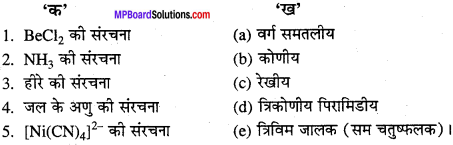
Grammar in Use

(а) Read this sentence
Anand said. “I have posted the letters.”
This is in direct speech. It can be rewritten in indirect speech thus:
Anand said that he had posted the letters.
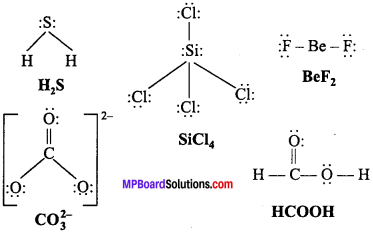
Note that the verb have posted become had posted in indirect speech, when the . reporting verb (here ‘say’) is in the past tense.
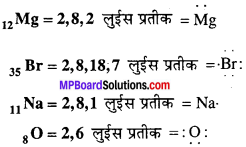
Here is another example:
Direct Speech : Kamla said, “I have already paid my fees.”
Indirect Speech : Kamla said that she had already paid her fees.

Now rewrite the following in indirect speech, as shown above.

  1. The teacher said to Anil, “You have not answered the first question correctly.”
  2. The typist said, “I have just finished typing the letters.”
  3. “All the boys have left,” Rakesh said to the teacher.
  4. “Kassim has cheated me,” Ali thought.
  5. “I have had my lunch and I am not hungry,” Ravi said to his friend.

Answer:

  1. The teacher said to Anil that he had not answered the first-question correctly.
  2. The typist said that he had just finished typing the letters.
  3. Rakesh said to the teacher that all the boys had left.
  4. Ali thought that Kassim had cheated him.
  5. Ravi said to his friend that he had his lunch and he was not hungry.

(b) The phrasal verb “Come up with” has been used in this lesson which mean- “to find an answer, money etc.” Some other phrasal verbs with their meanings are given below:
come down : to break or fall on the ground
come off : to be able to be removed.
come out with : to say something surprising or rude.
come across : to be understood.
come apart : to break into pieces.

Now make sentences with the phrasal verbs given above so as to bring out their meanings.
(come down, come off, come out with, come across, come apart)
Answer:
come down : Ramesh came down from the tree.
come off : I came off the task with difficulty.
come out with : My son came out with the news of his result.
come across : Have you came across this breaking news.
come apart : Suddenly my specs came apart.

Let’s talk

Class 6 English Chapter 1 Mp Board  Question 1.
Share some more riddles in the class with your friends.
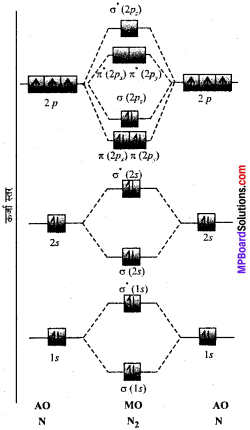
Answer:
Do yourself.

Mp Board Class 6 English Solution Question 2.
Write a paragraph on a wise man/woman.
Answer:
A wise man means a man with wisdom Wisdom gives perfection. It means a wise man knows everything. He does everything perfectly. He can teach the world. He can preach well. He lives his life with all bliss. He is above all worldly affairs. Certainly he is an adorable person.
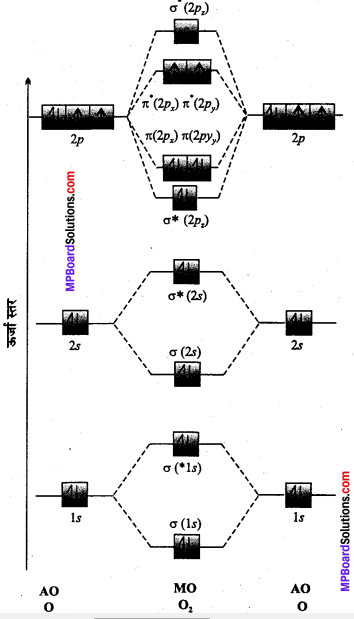
Question 3.
In this lesson a word ‘bet’ had come as a noun and a verb both. Find out some more similar words with the help of dictionary.
Answer:
1.Water – (n) – We should drink clean water.
Water – (v) – The gardener watered the plants.

2. Pen – (n) – I have bought a new pen.
Pen – (v) – I penned down a letter.

3. Fan – (n) – The fan is moving.
Fan – (v) – My mother fanned me.

4. Handle – (n) – The handle has been broken.
Handle (v) – He handled the problem wisely.

5. Plant – (n) – The plant is green.
Plant – (v) – I planted a tulsi plant.

Kassim and Ali Word Meanings

Kassim And Ali Had A Of Marbles MP Board Class 6

Hope the data shared has shed some light on you regarding the MP Board Solutions of Class 6 English Chapter 1 Kassim and Ali Questions and Answers. Do leave us your queries via the comment section and we will guide you at the earliest with help seeked. Stay connected with our website and avail the latest information in a matter of seconds.