MP Board Class 8th Maths Solutions Chapter 9 बीजीय व्यंजक एवं सर्वसमिकाएँ Ex 9.2

MP Board Class 8th Maths Solutions Chapter 9 बीजीय व्यंजक एवं सर्वसमिकाएँ Ex 9.2

प्रश्न 1.
निम्नलिखित एकपदी युग्मों का गुणनफल ज्ञात कीजिए –

  1. 4, 7p
  2. – 4p, 7p
  3. – 4p, 7pq
  4. 4p3 – 3p
  5. 4p, 0.

हल:

  1. 4 x 7p = 28pq
  2. – 4p x 7p = – 28p2
  3. – 4p x 7pq = – 28p2q
  4. 4p3 x (-3p) = – 12p4
  5. 4p x 0 = 0

MP Board Solutions

प्रश्न 2.
निम्नलिखित एकपदी युग्मों के रूप में लम्बाई एवं चौड़ाई रखने वाले आयतों का क्षेत्रफल ज्ञात कीजिए:
(p, q) ; (10m, 5n) ; (20x2, 5y2) ; (4x, 3x2) ; (3mn, Anp).
हल:
क्षेत्रफल = लम्बाई x चौड़ाई
∴ क्षेत्रफल = p x q = pq
= 10m x 5n = 50mn
= 20x2 × 5y2 = 100x2y2
= 4x × 3×2 = 12x3
= 3mn x 4np = 12mn2p

प्रश्न 3.
गुणनफलों की सारणी को पूरा कीजिए।
हल:
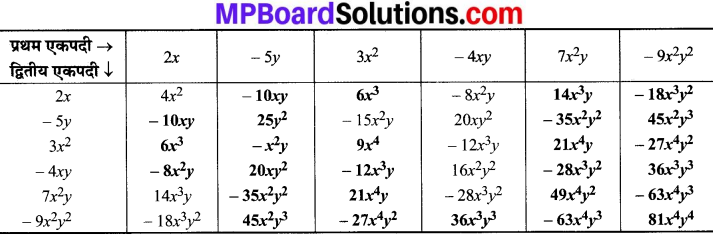
MP Board Class 8th Maths Solutions Chapter 9 बीजीय व्यंजक एवं सर्वसमिकाएँ Ex 9.2 img-1

प्रश्न 4.
ऐसे घनाकार बक्सों का आयतन ज्ञात कीजिए जिनकी लम्बाई, चौड़ाई और ऊँचाई क्रमशः निम्नलिखित है –

  1. 5a, 3a2, 7a4
  2. 2p, 4q, 8r
  3. xy, 2x2y, 2xy2
  4. a, 2b, 3c.

हल:
घनाकार बक्से का आयतन = लम्बाई x चौड़ाई x ऊँचाई

  1. आयतन = 5a x 3a2 x 7a4 = 105 a1 + 2 + 4 = 105a7
  2. आयतन = 2p x 4qx 8r = 64pqr
  3. आयतन = xy × 2x2y × 2xy2 = 4x1+2+1y1+1+2 = 4x4y4
  4. आयतन = a x 2b x 3c = 6abc

MP Board Solutions

प्रश्न 5.
निम्नलिखित का गुणनफल ज्ञात कीजिए –

  1. xy, yz, zx
  2. a, – a2, a3
  3. 2, 4y, 8y2, 16y3
  4. a, 2b, 3c, 6abc
  5. m, – mn, mnp.

हल:
1. गुणनफल = xy × yz × zx = x1+1y1+1z1+1
= x2y2z2

2. गुणनफल = a x – a2 x a3 = (1 x (-1) x 1)(a1+2+3)
= (-1)a6 = – a6

3. गुणनफल = 2 x 4y x 8y2 x 16y3
= (2 x 4 x 8 x 16) (1,1 + 2 + 3) = 102476

4. गुणनफल = a x 2b x 3c x 6abc
= (1 x 2 x 3 x 6)(a x b x c x abc)
= 36a2b2c2

5. गुणनफल = m x – mn x mnp
= (1x (-1)x 1)(m x mn x mnp)
= (-1) (m3n2p) = – m3n2p

पाठ्य-पुस्तक पृष्ठ संख्या # 153

प्रयास कीजिए (क्रमांक 9.7)

प्रश्न 1.
गुणनफल ज्ञात कीजिए:

  1. 2x(3x + 5xy)
  2. a2(2ab – 5c).

हल:
1. 2x(3x + 5xy) = 2x × 3x + 2x × 5xy
= 6x2 + 10x2y

2. a2(2ab – 5c) = a2 x 2ab – a2 x 5c
= 2a3b – 5a – ca

MP Board Solutions

प्रयास कीजिए (क्रमांक 9.8)

प्रश्न 1.
(4p2 + 5p + 7) x 3p का गुणनफल ज्ञात कीजिए।
हल:
(4p2 + 5p + 7) x 3p
= 4p2 x 3p + 5p x 3p + 7 x 3p
= 12p3 + 15p2 + 21p
MP Board Class 8th Maths Solutions

MP Board Class 6th Maths Solutions Chapter 1 अपनी संख्याओं की जानकारी Intext Questions

MP Board Class 6th Maths Solutions Chapter 1 अपनी संख्याओं की जानकारी Intext Questions

MP Board Class 6th Maths Solutions Chapter 1 पाठान्तर्गत प्रश्नोत्तर

पाठ्य-पुस्तक पृष्ठ संख्या # 02

प्रयास कीजिए

प्रश्न 1.
क्या आप तुरन्त ज्ञात कर सकते हैं कि प्रत्येक पंक्ति में कौन-सी संख्या सबसे बड़ी है और कौन-सी संख्या सबसे छोटी है ?
(1) 382, 4972, 18, 59785, 750
(2) 1473, 89423,100, 5000, 310
(3) 1834, 75284, 111, 2333, 450
(4) 2853, 7671, 9999, 12002, 124
उत्तर :
(1) 59785 सबसे बड़ी है और 18 सबसे छोटी है।
उत्तर : …………
उत्तर: ………..
उत्तर : ……….
क्या यह सरल था? यह सरल क्यों था?
हल :
(2) 89423 सबसे बड़ी है और 100 सबसे छोटी है।
(3) 75284 सबसे बड़ी है और 111 सबसे छोटी है।
(4) 12002 सबसे बड़ी है और 124 सबसे छोटी है।
हाँ, सबसे बड़ी और सबसे छोटी संख्या पहचानने के लिए सरल था क्योंकि एक संख्या जिसमें अंकों की संख्या ज्यादा हो दूसरी संख्या से बड़ी होती है।

प्रश्न 2.
इसी प्रकार के पाँच और प्रश्न बनाइए और उन्हें हल करने के लिए अपने मित्रों को दीजिए।
(1) 400, 5183, 31, 75032, 854
(2) 2584, 86478, 200, 5000, 323
(3) 3295, 153, 8173, 7777, 13003
(4) 21, 705, 1111, 227, 50094
(5) 4697, 9989, 2078, 543, 12175
हल :
(1) 75032 सबसे बड़ी है और 31 सबसे छोटी है।
(2) 86478 सबसे बड़ी है और 200 सबसे छोटी है।
(3) 13003 सबसे बड़ी है और 153 सबसे छोटी है।
(4) 50094 सबसे बड़ी है और 21 सबसे छोटी है।
(5) 12175 सबसे बड़ी है और 543 सबसे छोटी है।
MP Board Solutions

पाठ्य-पुस्तक पृष्ठ संख्या # 03

प्रयास कीजिए

प्रश्न 1.
प्रत्येक समूह में सबसे बड़ी और सबसे छोटी संख्या ज्ञात कीजिए:
(a) 4536, 4892, 4370, 4452
(b) 15623, 15073, 15189, 15800
(c) 25286, 25243, 25270, 25210
(d) 6895, 23787, 24569, 24659.
इसी प्रकार के पाँच प्रश्न और बनाइए और हल करने के लिए अपने मित्रों को दीजिए।
हल :
(a) यहाँ प्रत्येक संख्या में 4 अंक हैं और हजार के स्थान पर दिए गए अंक समान हैं। अब, प्रत्येक संख्या में अगले अंक की तुलना करने पर,
4536 4892 4370 4452
8>5 >4>3
∴ सबसे बड़ी संख्या 4892 और सबसे छोटी संख्या 4370 है।

(b) यहाँ प्रत्येक संख्या में 5 अंक है और बाएँ के दो स्थानों के अंक (अर्थात् 1, 5) समान हैं।
अब, तीसरे स्थान के अंक की तुलना करने पर,
15623 15073 15189 15800
8>6 >1>0
∴सबसे बड़ी संख्या 15800 और सबसे छोटी संख्या 15073 है।

(c) यहाँ प्रत्येक संख्या में 5 अंक हैं और बाएँ के तीन स्थानों के अंक (अर्थात् 2, 5 और 2) समान हैं।
अब, चौथे स्थान के अंक की तुलना करने पर,
25286 25243 25270 25210
8>7>4>1
∴ सबसे बड़ी संख्या 25286 और सबसे छोटी संख्या 25210 है।

(d) यहाँ संख्या 6895 में 4 अंक हैं और 23787, 24569 और 24659 में 5 अंक हैं।
∴सबसे छोटी संख्या 6895 है।
शेष संख्याओं में 5वें स्थान का अंक (2) समान है अतः दूसरे स्थान के अंक की तुलना करने पर,
23787 24569 24659 में हम पाते हैं, 4>3
अब, संख्याओं 24569 और 24659 के तीसरे स्थान के अंकों की तुलना करने पर, 6>5
∴सबसे बड़ी संख्या 24659 और सबसे छोटी संख्या 6895 है।
MP Board Solutions

पाँच और प्रश्न
(a) 5668, 5904, 5443, 5536
(b) 26738, 26174, 26300, 26915
(c) 46397, 46356, 46363, 46340
(d) 8901, 34743, 35675, 35821
(e) 68252, 65245, 65270, 65210
हल :
(a) यहाँ प्रत्येक संख्या में 4 अंक हैं और हजार के स्थान पर दिया अंक 5 समान है। अतः दूसरे अंक के स्थान की तुलना करने पर,
5668 5904 5443 5536
हम पाते हैं, 9>6>5>4
∴सबसे बड़ी संख्या 5904 और सबसे छोटी संख्या 5443 है।

(b) यहाँ, प्रत्येक संख्या में 5 अंक हैं और बाएँ के दो स्थानों के अंक (अर्थात् 2, 6) समान हैं। अतः तीसरे स्थान के अंक की तुलना करने पर,
26738 26174 26300 26915
हम पाते हैं, 9>7>3>1
∴सबसे बड़ी संख्या 26915 और सबसे छोटी संख्या 26174 है।

(c) यहाँ, प्रत्येक संख्या में 5 अंक हैं और बाएँ के तीन स्थानों के अंक (अर्थात् 4, 6, 3) समान हैं। अत: चौथे स्थान के अंक की तुलना करने पर,
46397 46356 46363 46340
हम पाते हैं, 9>6>5>4
∴सबसे बड़ी संख्या 46397 और सबसे छोटी संख्या संख्या 46340 है।

(d) यहाँ, संख्या 8901 में चार अंक हैं तथा शेष संख्याओं में 5 अंक हैं।
∴8901 सबसे छोटी संख्या है।
शेष संख्याओं में पाँचवें स्थान का अंक (3) समान है, अतः दूसरे स्थान के अंक की तुलना करने पर,
34743 35675 35821 हम पाते हैं, 5>4
अब, तीसरे स्थान के अंकों की तुलना करने पर,
35675 35821 ; 8>6
∴सबसे बड़ी संख्या 35821 और सबसे छोटी संख्या 8901 है।

(e) यहाँ प्रत्येक संख्या में 5 अंक हैं और पाँचवें स्थान का अंक (6) समान है, अत: दूसरे स्थान के अंक की तुलना करने पर,
68252 65245 65270 65210
हम पाते हैं 8>5
∴सबसे बड़ी संख्या 68252 है।
अब, तीसरे स्थान पर प्रत्येक संख्या में अंक (2) समान है, अत: चौथे स्थान के अंक की तुलना करने पर,
65245 65270 65210 हम पाते हैं, 7>4>1
अतः 65210 सबसे छोटी संख्या है।
∴सबसे बड़ी संख्या 68252 और सबसे छोटी संख्या 65210 है।

प्रयास कीजिए

प्रश्न 1.
बिना पुनरावृत्ति किए हुए अंकों का प्रयोग करके चार अंकों की सबसे बड़ी और सबसे छोटी संख्या बनाइए:
(a) 2, 8, 7, 4
(b) 9, 7, 4, 1
(c) 4, 7, 5, 0
(d) 1, 7, 6, 2
(e) 5, 4, 0, 3
(संकेतः 0754 तीन अंकों की संख्या है।)
हल :
(a) दिए हुए अंक 2, 8, 7, 4 हैं;
अंकों का आरोही क्रम है : 2, 4, 7, 8
∴4 अंकों की सबसे बड़ी संख्या = 8742
और 4 अंकों की सबसे छोटी संख्या = 2478

(b) दिए हुए अंक हैं, 9,7,4,1; अंकों का आरोही क्रम है: 1,4,7,9
∴4 अंकों की सबसे बड़ी संख्या = 9741
और 4 अंकों की सबसे छोटी संख्या = 1479

(c) दिए हुए अंक हैं : 4, 7, 5, 0; अंकों का आरोही क्रम है : 0, 4, 5, 7
∴4 अंकों की सबसे बड़ी संख्या = 7540
अब 0 को बाएँ से दूसरे स्थान पर रखने पर,
4 अंकों की सबसे छोटी संख्या = 4057

(d) दिए हुए अंक 1, 7, 6, 2 हैं; अंकों का आरोही क्रम है : 1, 2, 6, 7
∴4 अंकों की सबसे बड़ी संख्या = 7621
और 4 अंकों की सबसे छोटी संख्या = 1267

(e) दिए हुए अंक हैं : 5, 4, 0, 3; अंकों का आरोही क्रम है : 0, 3, 4,5
∴4 अंकों की सबसे बड़ी संख्या = 5430
अब 0 को बाएँ से दूसरे स्थान पर रखने पर,
4 अंकों की सबसे छोटी संख्या = 3045
MP Board Solutions

प्रश्न 2.
किसी एक अंक का दो बार प्रयोग करके चार अंकों की सबसे बड़ी और सबसे छोटी संख्याएँ बनाइए:
(a) 3,8,7
(b) 9,0,5
(c) 0, 4,9
(d) 8, 5, 1
(संकेतः प्रत्येक स्थिति में सोचिए कि आप किस अंक का दो बार प्रयोग करेंगे।)
हल :
(a) दिए हुए अंक 3, 8 और 7 हैं। दिए हुए अंकों का आरोही क्रम है: 3, 7, 8
∴4 अंकों की सबसे छोटी संख्या = 3378
(सबसे छोटा अंक 3 दो बार लेने पर)
अंकों का अवरोही क्रम है : 8, 7, 3
∴4 अंकों की सबसे बड़ी संख्या = 8873
(सबसे बड़ा अंक 8 दो बार लेने पर)

(b) दिए हुए अंक 9, 0 और 5 हैं। दिए हुए अंकों का आरोही क्रम है : 0, 5, 9
0 के स्थान पर 5 रखने पर तथा सबसे छोटे अंक 0 को दो बार लेने पर,
4 अंकों की सबसे छोटी संख्या = 5009
अंकों का अवरोही क्रम है : 9, 5, 0
∴4 अंकों की सबसे बड़ी संख्या = 9950
(सबसे बड़ा अंक 9 दो बार लेने पर)

(c) दिए हुए अंक 0, 4 और 9 हैं। अंकों का आरोही क्रम है: 0, 4, 9
∴4 अंकों की सबसे छोटी संख्या = 4009
(सबसे छोटा अंक 0 दो बार लेने पर)
अंकों का अवरोही क्रम है : 9,4,0
∴4 अंकों की सबसे बड़ी संख्या = 9940
(सबसे बड़ा अंक 9 दो बार लेने पर)

(d) दिए हुए अंक 8, 5 और 1 हैं। दिए हुए अंकों का आरोही क्रम है: 1, 5, 8
∴4 अंकों की सबसे छोटी संख्या = 1158
(सबसे छोटा अंक 1 दो बार लेने पर)
अंकों का अवरोही क्रम है : 8, 5, 1
∴4 अंकों की सबसे बड़ी संख्या = 8851
(सबसे बड़ा अंक 8 दो बार लेने पर)

प्रश्न 3.
दिए हुए प्रतिबन्धों के साथ, किन्हीं चार अंकों का प्रयोग करके, 4 अंकों की सबसे बड़ी और सबसे छोटी संख्या बनाइए:
(a) अंक 7 सदैव इकाई सबसे बड़ी
MP Board Class 6th Maths Solutions Chapter 1 अपनी संख्याओं की जानकारी Intext Questions image 1
के स्थान पर रहे।
(ध्यान दीजिए, अंक 0 से संख्या प्रारम्भ सबसे छोटी
MP Board Class 6th Maths Solutions Chapter 1 अपनी संख्याओं की जानकारी Intext Questions image 2
नहीं हो सकती। क्यों?)

(b) अंक 4 सदैव दहाई के सबसे बड़ी
MP Board Class 6th Maths Solutions Chapter 1 अपनी संख्याओं की जानकारी Intext Questions image 3
स्थान पर रहे।
सबसे छोटी
MP Board Class 6th Maths Solutions Chapter 1 अपनी संख्याओं की जानकारी Intext Questions image 3

(c) अंक 9 सदैव सौ के सबसे बड़ी
MP Board Class 6th Maths Solutions Chapter 1 अपनी संख्याओं की जानकारी Intext Questions image 4
स्थान पर रहे।
सबसे छोटी
MP Board Class 6th Maths Solutions Chapter 1 अपनी संख्याओं की जानकारी Intext Questions image 4
MP Board Solutions

(d) अंक 1 सदैव हजार सबसे बड़ी
MP Board Class 6th Maths Solutions Chapter 1 अपनी संख्याओं की जानकारी Intext Questions image 5
के स्थान पर रहे।
सबसे छोटी
MP Board Class 6th Maths Solutions Chapter 1 अपनी संख्याओं की जानकारी Intext Questions image 5
हल :
अंकों का आरोही क्रम है : 0, 1, 2, 3, 4, 5, 6, 7, 8 और 9; लेकिन संख्या 0 से प्रारम्भ नहीं हो सकती अन्यथा संख्या 3 अंकों की ही रह जाएगी।
अंकों का अवरोही क्रम है : 9, 8, 7, 6, 5, 4, 3, 2, 1 और 0
(a) अंक 7 को इकाई के स्थान पर रखने पर, हम प्राप्त करते हैं :
MP Board Class 6th Maths Solutions Chapter 1 अपनी संख्याओं की जानकारी Intext Questions image 6
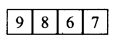
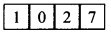
∴4 अंकों की सबसे बड़ी संख्या = 9867
और 4 अंकों की सबसे छोटी संख्या = 1027

(b) अंक 4 सदैव दहाई के स्थान पर रखने पर, हम प्राप्त करते हैं
MP Board Class 6th Maths Solutions Chapter 1 अपनी संख्याओं की जानकारी Intext Questions image 7
∴4 अंकों की सबसे बड़ी संख्या = 9847
और 4 अंकों की सबसे छोटी संख्या = 1042

(c) अंक 9 को सौ के स्थान पर रखने पर, हम प्राप्त करते हैं
MP Board Class 6th Maths Solutions Chapter 1 अपनी संख्याओं की जानकारी Intext Questions image 8
∴4 अंकों की सबसे बड़ी संख्या = 8976
और 4 अंकों की सबसे छोटी संख्या = 1902

(d) अंक 1 को हजार के स्थान पर रखने पर, हम प्राप्त करते हैं :
MP Board Class 6th Maths Solutions Chapter 1 अपनी संख्याओं की जानकारी Intext Questions image 9
∴4 अंकों की सबसे बड़ी संख्या = 1987
और 4 अंकों की सबसे छोटी संख्या = 1023

प्रश्न 4.
मान लीजिए, आप दो अंक 2 और 3 लेते हैं। इन अंकों को समान बार दोहराते हुए, चार अंकों की संख्याएँ बनाइए। कौन-सी संख्या सबसे बड़ी है ? कौन-सी संख्या सबसे छोटी है ? आप ऐसी कुल कितनी संख्याएँ बना सकते हैं ?
हल :
दिए हुए अंक 2 और 3 से 4 अंकों की संख्या बनाने के लिए हम अंकों को समान बार दोहराते हैं।
∴4 अंकों की सम्भव संख्याएँ हैं- 2233, 3322, 2323, 3232, 3223 और 2332
(i) इनमें सबसे बड़ी संख्या = 3322
(ii) सबसे छोटी = 2233
(iii) हम ऐसी 6 विभिन्न संख्याएँ बना सकते हैं।

पाठ्य-पुस्तक पृष्ठ संख्या # 04

उचित क्रम में खड़े होना

प्रश्न 1.
इनमें कौन सबसे लम्बा है ?
प्रश्न 2. इनमें कौन सबसे छोटा है ?
(a) क्या आप इन्हें इनकी लम्बाइयों के बढ़ते हुए क्रम में खड़ा कर सकते हैं ?
(b) क्या आप इन्हें इनकी लम्बाइयों के घटते हुए क्रम में खड़ा कर सकते हैं?
हल :
1. ∴160 > 159> 158 > 154
∴रामहरि सबसे लम्बा है।

2. ∴154 < 158 < 159 < 160
∴डोली सबसे छोटी है।
(a) हाँ, हम इन्हें लम्बाइयों के बढ़ते हुए क्रम में खड़ा कर सकते हैं।
इनकी लम्बाइयों का बढ़ता हुआ क्रम है: डोली, मोहन, शशि, रामहरि।
(b) हाँ, इन्हें लम्बाइयों के घटते हुए क्रम में खड़ा कर सकते हैं।
इनकी लम्बाइयों का घटता हुआ क्रम है : रामहरि, शशि, मोहन, डोली।
MP Board Solutions

क्या खरीदें?

प्रश्न 1.
सोहन और रीता एक अलमारी खरीदने गए। वहाँ कई अलमारियाँ उपलब्ध थीं जिन पर उनके मूल्यों की पर्चियाँ लगी हुई थीं।
(a) क्या आप इनके मूल्यों को बढ़ते हुए क्रम में व्यवस्थित कर सकते हैं ?
(b) क्या आप इनके मूल्यों को घटते हुए क्रम में व्यवस्थित कर सकते हैं ?
हल :
(a) हाँ, इनके मूल्यों को बढ़ते हुए क्रम में इस प्रकार व्यवस्थित कर सकते हैं :
Rs 1788, Rs 1897, Rs 2635, Rs 2854 और Rs 3975

(b) हाँ, इनके मूल्यों को घटते हुए क्रम में इस प्रकार व्यवस्थित कर सकते हैं :
Rs 3975, Rs 2854, Rs 2635, Rs 1897 और Rs 1788

प्रयास कीजिए

प्रश्न 2.
इसी प्रकार की पाँच और स्थितियों को सोचिए जहाँ आप तीन या अधिक राशियों की तुलना करते हैं।
हल :
पाँच स्थितियाँ :
(i) कक्षा 6 के 4 विद्यार्थियों का वजन : 36 किग्रा, 33 किग्रा, 38 किग्रा, और 35 किग्रा।
(ii) चार खिलाड़ियों द्वारा बनाए गए रन : क्रमश: 93,17, 39 और 69
(iii) गणित विषय में 4 विद्यार्थियों द्वारा 100 में से प्राप्त अंक: 92, 89, 68 और 35
(iv) 4 राज्यों का क्षेत्रफल : मध्य प्रदेश 3,08,245 वर्ग किमी, उत्तर प्रदेश 2,40,928 वर्ग किमी, हिमाचल प्रदेश 55,673 वर्ग किमी, हरियाणा 44,212 वर्ग किमी।
(v) कपड़ों की सिलाई : कमीज Rs 125, पैण्ट Rs 250, कोट Rs 500, पायजामा Rs 75.

पाठ्य-पुस्तक पृष्ठ संख्या # 05

प्रयास कीजिए

प्रश्न 1.
निम्नलिखित संख्याओं को आरोही क्रम में व्यवस्थित कीजिए:
(a) 847, 9754, 8320, 571
(b) 9801, 25751, 36501, 38802.
हल :
(a) संख्याओं 847, 9754, 8320, 571 को आरोही क्रम में व्यवस्थित करने पर-571, 847, 8320, 9754 उत्तर
(b) संख्याओं 9801, 25751, 36501, 38802 को आरोही क्रम में व्यवस्थित करने पर-9801, 25751, 36501, 38802

प्रश्न 2.
निम्नलिखित संख्याओं को अवरोही क्रम में व्यवस्थित कीजिए :
(a) 5000, 7500, 85400, 7861
(b) 1971, 45321,88715, 92547
हल :
(a) संख्याओं 5000, 7500, 85400 और 7861 को अवरोही क्रम में व्यवस्थित करने पर-85400, 7861, 7500, 5000
(b) संख्याओं 1971, 45321, 88715 और 92547 को अवरोही क्रम में व्यवस्थित करने पर-92547, 88715, 45321, 1971

प्रश्न 3.
आरोही/अवरोही क्रमों के ऐसे ही दस उदाहरण और बनाइए और उन्हें आरोही/अवरोही क्रम में व्यवस्थित कीजिए।
निम्न संख्याओं को आरोही क्रम में व्यवस्थित कीजिए :
1.3715, 955, 4328,617
2.98423,97136,98361,98298
3.46204,45698,49119,45304
4.75310, 75413, 75000, 75719
5. 84312, 84327, 84380, 84511
निम्न संख्याओं को अवरोही क्रम में व्यवस्थित कीजिए
1. 15532, 15546, 15955, 15733
2. 9446,9440,9449,9428
3. 16264, 16725, 16554, 16388
4. 32730, 32318, 32397, 32600
5. 14127, 14098, 14999, 14808
हल :
संख्याओं को आरोही क्रम में व्यवस्थित करने पर,
1.617,955, 3715, 4328
2.97136, 98298, 98361, 98423
3. 45304, 45698, 46204, 49119
4.75000, 75310, 75413, 75719
5. 84312, 84327, 84380, 84511.
संख्याओं को अवरोही क्रम में व्यवस्थित करने पर,
1. 15955, 15733, 15546, 15532
2.9449.9446.9440.9428
3. 16725, 16554, 16388, 16264
4. 32730, 32600, 32397, 32318
5. 14999, 14808, 14127, 14098
MP Board Solutions

अंकों का स्थानान्तरण

प्रश्न 1.
यही प्रक्रिया 391 के साथ कीजिए।
हल :
बड़ी संख्या = 931 और छोटी संख्या = 139

प्रश्न 2.
अब आगे दिए हुए प्रश्नों पर ध्यान दीजिए। तीन भिन्न-भिन्न अंकों की कोई संख्या लीजिए और सौ के स्थान के अंक को इकाई के स्थान के अंक में बदलिए।
(a) क्या नई संख्या पहली संख्या से बड़ी है ?
(b) क्या नई संख्या पहली संख्या से छोटी है ?
इस प्रकार बनने वाली संख्याओं को आरोही और अवरोही दोनों क्रमों में लिखिए।
हल :
माना कि संख्या 469 है।
नई संख्या = 964
(a) हाँ, नई संख्या पहली संख्या से बड़ी है।
(b) नहीं, नई संख्या पहली संख्या से छोटी नहीं है। आरोही क्रम-469, 964; अवरोही क्रम-964, 469

प्रश्न 3.
विभिन्न अंक लेकर यदि आप पहली और तीसरी टाइलों (अंकों) को परस्पर बदलते हैं, तो
(1) किस स्थिति में संख्या बड़ी हो जाती है ?
(2) किस स्थिति में संख्या छोटी हो जाती है ?
हल :
माना कि टाइलें हैं : पहले 8 4 3
पहली और तीसरी टाइलों को परस्पर बदलने पर, बाद में 3 4 8
∴पहले की स्थिति में संख्या बड़ी हो जाती है।
दूसरी स्थिति में संख्या छोटी हो जाती है।

प्रश्न 4.
यह प्रक्रिया चार अंकों की कोई संख्या लेकर दोहराइए।
हल :
माना कि संख्या पहले 2 3 4 5 है।
पहली और चौथी टाइलों को परस्पर बदलने पर,
बाद में 5 3 4 2
इस स्थिति में संख्या बड़ी हो जाती है।

प्रयास कीजिए

प्रश्न 1.
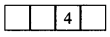
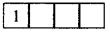
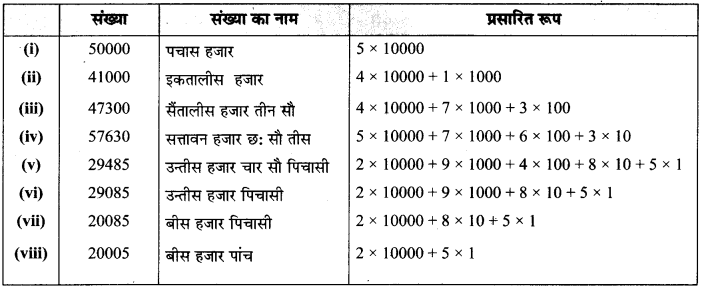
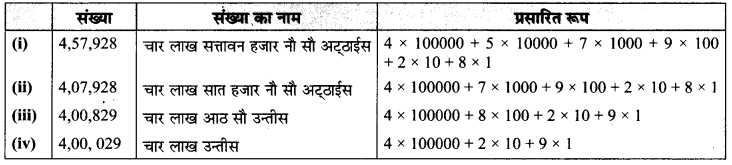
संख्याओं को पढ़िए और जहाँ-जहाँ रिक्त स्थान हैं उनके नाम लिखिए और प्रसारित रूप में लिखिए :
हल:
MP Board Class 6th Maths Solutions Chapter 1 अपनी संख्याओं की जानकारी Intext Questions image 10

प्रश्न 2.
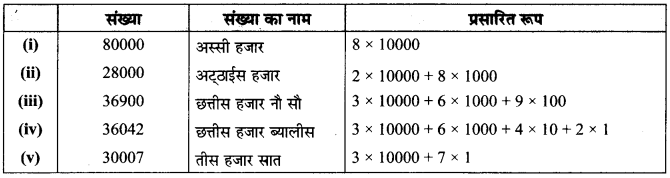
पाँच अंकों वाली पाँच और संख्याएँ लिखिए, उन्हें पढ़िए और उनको प्रसारित रूप में लिखिए।
हल :
MP Board Class 6th Maths Solutions Chapter 1 अपनी संख्याओं की जानकारी Intext Questions image 11
MP Board Solutions

पाठ्य-पुस्तक पृष्ठ संख्या # 08

प्रयास कीजिए

प्रश्न 1.
संख्याओं को पढ़कर उन्हें रिक्त स्थानों में प्रसारित रूप में और उनके नाम लिखिए :
हल:
MP Board Class 6th Maths Solutions Chapter 1 अपनी संख्याओं की जानकारी Intext Questions image 12

प्रश्न 2.
प्रतिरूप को पूरा कीजिए :
हल:
9 + 1 = 10
99 + 1 = 100
999 + 1 = 1,000
9,999 + 1 = 10,000
99,999 + 1 = 1,00,000
9,99,999 + 1 = 10,00,000
99,99,999 + 1 = 1,00,00,000

प्रयास कीजिए

प्रश्न 1.
1. 10 -1 क्या है ?
2. 100 -1 क्या है ?
3. 10,000 -1 क्या है ?
4. 1,00,000 -1 क्या है ?
5. 1,00,00,000 -1 क्या है ?
(संकेत : प्रतिरूप को पहचानिए)
हल:
10 – 1 = 9 दो अंकों की सबसे छोटी संख्या – 1 = एक अंक की सबसे बड़ी संख्या
100 – 1 = 99 तीन अंकों की सबसे छोटी संख्या – 1 = दो अंकों की सबसे बड़ी संख्या
10,000 – 1 = 9999 पाँच अंकों की सबसे छोटी संख्या – 1 = चार अंकों की सबसे बड़ी संख्या
100000 – 1 = 99999 छः अंकों की सबसे छोटी संख्या – 1 = पाँच अंकों की सबसे बड़ी संख्या
10000000 – 1 = 9999999 आठ अंकों की सबसे छोटी संख्या – 1 = सात अंकों की सबसे बड़ी संख्या।
MP Board Solutions

पाठ्य-पुस्तक पृष्ठ संख्या # 09.

प्रश्न 1.
क्या आप अपने राज्य में रहने वाले लोगों की संख्या के बारे में जानते हैं ?
उत्तर-
हाँ, यह करोड़ों में होगी।

प्रश्न 2.
इस संख्या में कितने अंक होंगे?
उत्तर-
इस संख्या में 10 अंक होंगे।

प्रश्न 3.
गेहूँ से भरी एक बोरी में दानों (grains) की संख्या क्या होगी? यह एक 5 अंकों की संख्या या 6 अंकों की संख्या या और बड़ी संख्या होगी?
उत्तर-
गेहूँ से भरी एक बोरी में दानों की संख्या 6 अंकों की संख्या से और बड़ी संख्या होगी।

प्रयास कीजिए

प्रश्न 1.
ऐसे पाँच उदाहरण दीजिए जहाँ गिनी जाने वाली वस्तुओं की संख्या 6 अंकों की संख्या से अधिक होगी।
हल :
6 अंकों की सबसे छोटी संख्या है-100000 (एक लाख)
∴उदाहरण-जहाँ पर गिनी जाने वाली वस्तुओं की संख्या एक लाख से अधिक होगी :
(i) साफ आसमान में तारों की संख्या।
(ii) एक बड़े शहर में कारों की संख्या।
(iii) अनाज से भरी हुई बोरी में अनाज के दानों की संख्या।
(iv) दिल्ली के सभी विद्यालयों के विद्यार्थियों की संख्या।
(v) एक बड़े शहर के विद्यार्थियों की कुल उत्तर पुस्तिकाओं के पृष्ठों की संख्या।

प्रश्न 2.
6 अंकों की सबसे बड़ी संख्या से प्रारम्भ करते हुए, अवरोही क्रम में पिछली पाँच संख्याएँ लिखिए।
हल :
6 अंकों की सबसे बड़ी संख्या है : 9,99,999
∴पहली पिछली संख्या = 9,99,999 – 1 = 9,99,998
दूसरी पिछली संख्या = 9,99,998 – 1 = 9,99,997
तीसरी पिछली संख्या = 9,99,997 – 1 = 9,99,996
चौथी पिछली संख्या = 9,99,996 – 1 = 9,99,995
पाँचवीं पिछली संख्या = 9,99,995 – 1 = 9,99,994
संख्याओं का अवरोही क्रम है
9,99,998, 9,99,997,9,99,996,9,99,995,9,99,994.
MP Board Solutions

प्रश्न 3.
8 अंकों की सबसे छोटी संख्या से प्रारम्भ करते हुए आरोही क्रम में अगली पाँच संख्याएँ लिखिए और उन्हें पढ़िए।
हल :
8 अंकों की सबसे छोटी संख्या = 10000000
∴पहली अगली संख्या = 10000000 + 1 = 10000001
दूसरी अगली संख्या = 10000001 + 1 = 10000002
तीसरी अगली संख्या = 10000002 + 1 = 10000003
चौथी अगली संख्या = 10000003 + 1 = 10000004
पाँचवर्वी अगली संख्या = 10000004 + 1 = 10000005
आरोही क्रम में व्यवस्थित करने पर,
10000001, 10000002, 10000003, 10000004, 10000005.
10000001 – एक करोड़ एक
10000002 – एक करोड़ दो
10000003 – एक करोड़ तीन
10000004 – एक करोड़ चार
10000005 – एक करोड़ पाँच

पाठ्य-पुस्तक पृष्ठ संख्या # 10

प्रश्न 1.
इसी रूप में पांच और संख्याओं को लिखिए और फिर उन्हें पढ़िए।
हल :
(i) 7,08,03, 593 – सात करोड़ आठ लाख तीन हजार पाँच सौ तिरानवे
(ii) 5,43,50,681 – पाँच करोड़ तैंतालीस लाख पचास हजार छ: सौ इक्यासी
(iii) 8,17,04,073 – आठ करोड़ सत्रह लाख चार हजार तिहत्तर
(iv) 6,15,14,416 – छः करोड़ पन्द्रह लाख चौदह हजार चार सौ सोलह
(v) 9, 96, 66, 888 – नौ करोड़ छियानवे लाख छियासठ हजार आठ सौ अठासी
MP Board Solutions

पाठ्य-पुस्तक पृष्ठ संख्या # 11

प्रयास कीजिए

प्रश्न 1.
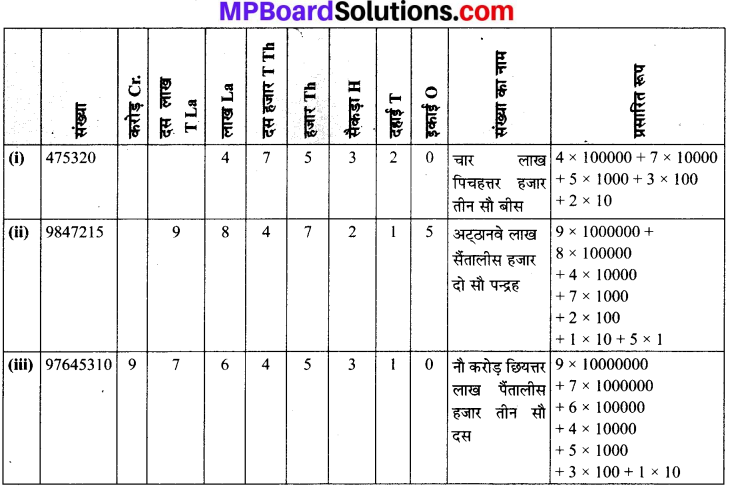
इन संख्याओं को बक्सों का प्रयोग करते हुए लिखिए और फिर प्रसारित रूप में लिखिए :
(i) 475320
(ii) 9847215
(iii) 97645310
(iv) 30458094.
(a) इसमें कौन-सी संख्या सबसे छोटी है ?
(b) इनमें कौन-सी संख्या सबसे बड़ी है ?
(c) इन संख्याओं को आरोही और अवरोही क्रमों में व्यवस्थित कीजिए।
हल :

MP Board Class 6th Maths Solutions Chapter 1 अपनी संख्याओं की जानकारी Intext Questions 1d.1
(a) सबसे छोटी संख्या = 475320
(b) सबसे बड़ी संख्या = 97645310
(c) संख्याओं का आरोही क्रम : 475320, 9847215, 30458094, 97645310
संख्याओं का अवरोही क्रम : 97645310, 30458094, 9847215, 475320

प्रश्न 2.
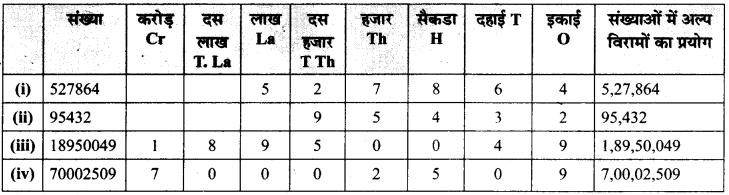
निम्नलिखित संख्याओं को देखिए :
(i) 529864
(ii) 95432
(iii) 18950049
(iv) 70002509
(a) इन संख्याओं को बक्सों का प्रयोग करते हुए लिखिए और फिर अल्प विरामों का प्रयोग करते हुए लिखिए।
(b) इन संख्याओं को आरोही और अवरोही क्रमों में व्यवस्थित कीजिए।
हल :
(a)
MP Board Class 6th Maths Solutions Chapter 1 अपनी संख्याओं की जानकारी Intext Questions image 14
अन्तर्राष्ट्रीय पद्धति में संख्याओं में अल्प विरामों का प्रयोग-527,864; 95,432; 18,950,049; 70,002,509

(b) संख्याओं का आरोही क्रम : 95,432; 5,27, 864; 1,89,50,049; 7,00,02,509
संख्याओं का अवरोही क्रम : 7,00,02,509; 1,89,50,049; 5,27,864; 95, 432.

MP Board Solutions

प्रश्न 3.
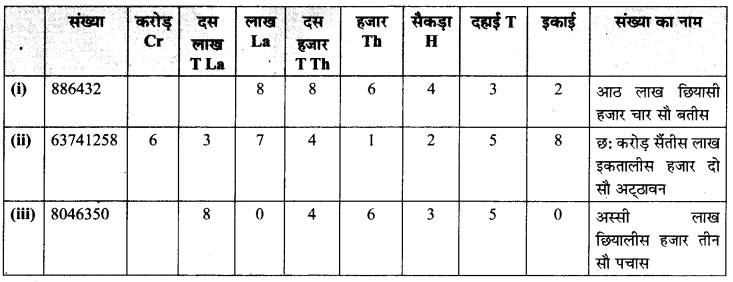
ऐसी ही तीन और बड़ी संख्याएँ लेकर इस प्रक्रिया को दोहराइए।
हल :
माना कि संख्याएँ 886432, 63741258 और 8046350 हैं।
MP Board Class 6th Maths Solutions Chapter 1 अपनी संख्याओं की जानकारी Intext Questions image 15
(a) संख्याओं का प्रसारित रूप-
(i) 8 x 100000 + 8 x 10000 + 6 x 1000 + 4 x 100 + 3 x 10 + 2 x 1
(ii) 6 x 10000000 + 3 x 1000000 + 7 x 100000 + 4 x 10000 + 1 x 1000 + 2 x 100 + 5 x 10 + 8 x 1
(iii) 8 x 1000000 + 4 x 10000 + 6 x 1000 + 3 x 100 + 5 x 10

(b) सबसे छोटी संख्या = 886432,
(c) सबसे बड़ी संख्या = 63741258
(d) संख्याओं का आरोही क्रम : 8,86,432; 80,46, 350; 6,37,41,258
(e) संख्याओं का अवरोही क्रम : 6,37,41,258; 80,46,350; 8,86,432
(f) संख्याओं में अल्प विराम :
(i) भारतीय पद्धति-8,86,432; 6,37,41,258; 80,46,350
(ii) अन्तर्राष्ट्रीय पद्धति-886,432; 63,741,258; 8,046,350

पाठ्य-पुस्तक पृष्ठ संख्या # 12

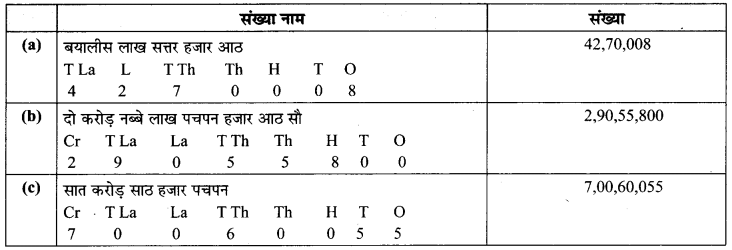
क्या आप संख्यांक लिखने में मेरी सहायता कर सकते हैं ?
एक संख्या के संख्यांक लिखने के लिए आप पुनः बक्सों का प्रयोग कर सकते हैं। .

प्रश्न 1.
(a) बयालीस लाख सत्तर हजार आठ।
(b) दो करोड़ नब्बे लाख पचपन हजार आठ सौ।
(c) सात करोड़ साठ हजार पचपन।
हल :
MP Board Class 6th Maths Solutions Chapter 1 अपनी संख्याओं की जानकारी Intext Questions image 16

प्रयास कीजिए

प्रश्न 1.
आपके पास 4, 5, 6, 0, 7 और 8 के अंक हैं। इनका प्रयोग करते हुए 6 अंकों की पाँच संख्याएँ बनाइए।
(a) पढ़ने में सरलता के लिए अल्प विराम लगाइए।
(b) इन्हें आरोही और अवरोही क्रमों में व्यवस्थित कीजिए।
हल :
माना कि 6 अंकों की संख्याएँ हैं :
(i) 867540
(ii) 876540
(iii) 876450
(iv) 867405
(v) 876045

(a) संख्याओं में अल्प विराम लगाने पर,
(i) 8,67,540
(ii) 8,76,540
(iii)8,76,450
(iv) 8,67,405
(v) 8,76,045

(b) संख्याओं का आरोही क्रम : 8,67,405; 8,67,540; 8,76,045; 8,76,450; 8,76,540.
संख्याओं का अवरोही क्रम : 8,76,540; 8,76,450; 8,76,045; 8,67,540; 8,67,405.
MP Board Solutions

प्रश्न 2.
अंकों 4, 5, 6, 7, 8 और 9 का प्रयोग कर 8 अंकों की कोई तीन संख्याएँ बनाइए। पढ़ने में सरलता के लिए अल्प विरामों का प्रयोग कीजिए।
हल :
8 अंकों की तीन संख्याएँ :
(i) 9,88,77,654,
(ii) 4,65,98,877,
(iii) 7,89,86,547

प्रश्न 3.
अंकों 3, 0 और 4 का प्रयोग कर 6 अंकों की पाँच संख्याएँ बनाइए। अल्प विरामों का भी प्रयोग कीजिए।
हल :
6 अंकों की संख्याएँ :
(i) 3,30,044;
(ii) 4,40,033;
(iii) 3,40,043;
(iv)4,03,043;
(v) 4,30,034.

MP Board Class 6th Maths Solutions

MP Board Class 8th Maths Solutions Chapter 9 बीजीय व्यंजक एवं सर्वसमिकाएँ Ex 9.1

MP Board Class 8th Maths Solutions Chapter 9 बीजीय व्यंजक एवं सर्वसमिकाएँ Ex 9.1

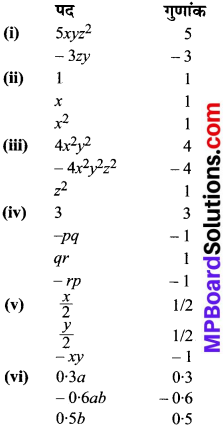
प्रश्न 1.
निम्नलिखित व्यंजकों में से प्रत्येक के पदों एवं गुणांकों को पहचानिए –

(i) 5xyz2 – 3ry
(ii) 1 + x + 2
(iii) 4xy2 – 4x2y2z2 + z2
(iv) 3 – pq + qr – rp
(v) \(\frac{x}{2}\) + \(\frac{y}{2}\) – xy
(vi) 0.39 – 0.6ab + 0.5b.

उत्तर:
MP Board Class 8th Maths Solutions Chapter 9 बीजीय व्यंजक एवं सर्वसमिकाएँ Ex 9.1 img-1

प्रश्न 2.
निम्नलिखित बहुपदों को एकपदी, द्विपद एवं त्रिपद के रूप में वर्गीकृत कीजिए। कौन-सा बहुपद इन श्रेणियों में से किसी में भी नहीं है?
x + y, 1000, x + x2 + x3 + 14, 7 + y + 5x, 2y – 3y2, 2y – 3y2 + 4y2, 5x – 4y + 3xy, 4z – 15z2,
ab + be + cd + da, pqr, p2q + pq2, 2p + 2q.
हल:

  • एकपदी: 1000, Pqr
  • द्विपदी: x + y, 2y – 3y2, 4 – 15z2, P2q – pq2, 2p + 24
  • त्रिपदी: 7 + y + 5x, 2y – 3y2 + 4y3, 5x – 4y + 3xy

वे बहुपद जो उपर्युक्त श्रेणियों में नहीं आते हैं:
x + x2 + x3 + x4, ab + bc + cd + da

MP Board Solutions

प्रश्न 3.
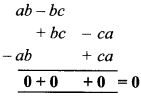
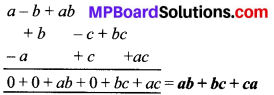
निम्नलिखित का योग ज्ञात कीजिए –

  1. ab – bc, bc – ca, ca – ab
  2. a – b + ab, b – c + bc, c – a + ac
  3. 2p2 – q2 – 3pq + 4, 5 + 7pq – 3pq2
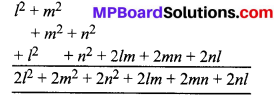
  4. l2 + m2, m2 + n2, n2 + l2, 2lm + 2mn + 2nl

हल:

1.
MP Board Class 8th Maths Solutions Chapter 9 बीजीय व्यंजक एवं सर्वसमिकाएँ Ex 9.1 img-2
2.
MP Board Class 8th Maths Solutions Chapter 9 बीजीय व्यंजक एवं सर्वसमिकाएँ Ex 9.1 img-3
3.
MP Board Class 8th Maths Solutions Chapter 9 बीजीय व्यंजक एवं सर्वसमिकाएँ Ex 9.1 img-4
4.
MP Board Class 8th Maths Solutions Chapter 9 बीजीय व्यंजक एवं सर्वसमिकाएँ Ex 9.1 img-5
अथवा = 2(l2 + m2 + n2 + lm + mn + nl)

प्रश्न 4.

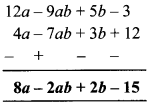
  1. 2a – 9ab + 5b – 3 में से 4a – 7ab + 3b + 12 को घटाइए।
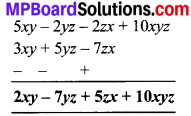
  2. 5xy – 2yz – 2x + 10xyz में से 3xy + 5ye – 7zx को घटाइए।
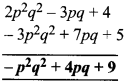
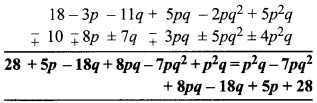
  3. 18 – 3p – 11q + 5pq – 2pq2 + 5p2q में से 4p2q – 3pq + 5pq2 – 8p + 7q – 10 को घटाइए।

हल:
1.
MP Board Class 8th Maths Solutions Chapter 9 बीजीय व्यंजक एवं सर्वसमिकाएँ Ex 9.1 img-6
2.
MP Board Class 8th Maths Solutions Chapter 9 बीजीय व्यंजक एवं सर्वसमिकाएँ Ex 9.1 img-7
3.
MP Board Class 8th Maths Solutions Chapter 9 बीजीय व्यंजक एवं सर्वसमिकाएँ Ex 9.1 img-8

पाठ्य-पुस्तक पृष्ठ संख्या # 150

प्रयास कीजिए (क्रमांक 9.5)

प्रश्न 1.
क्या आप ऐसी और दो परिस्थितियों के बारे में सोच सकते हैं जहाँ हमें बीजीय व्यंजकों को गुणा करना पड़ सकता है?
उत्तर:
हाँ, सोच सकते हैं, जहाँ हमें बीजीय व्यंजकों का गुणा करना पड़ सकता है।

  1. चाल और समय (∴ x समय या d = s x t)
  2. साधारण ब्याज (∴ S.I. = \(\frac{PxRxT}{100}\))

पाठ्य-पुस्तक पृष्ठ संख्या # 151

MP Board Solutions

प्रयास कीजिए (क्रमांक 9.6)

प्रश्न 1.
4x × 5y × 7. ज्ञात कीजिए:
सर्वप्रथम 4x × 5y ज्ञात कीजिए और फिर उसे 7z से गुणा कीजिए, अथवा सर्वप्रथम 5y × 7. ज्ञात कीजिए और इसे 4x से गुणा कीजिए। क्या परिणाम एक जैसा है? आप क्या विचार करते हैं? क्या गुणा करते समय क्रम का महत्व है?
हल:
4x × 5y × 7z = (4x × 5y) × 7z
= 20xy × 7z = 140xy
और 4x × 5y × 7z = 4x × (5y × 7z)
= 4x × 35yz = 140xyz
(4x × 5y) × 7z = 4x × (5y × 7z) = 140xyz
हाँ, परिणाम एक जैसा है।
यहाँ, स्पष्ट है कि बहुपदों का गुणनफल साहचर्य है।
गुणा करते समय क्रम का कोई महत्व नहीं है।

प्रश्न 2.
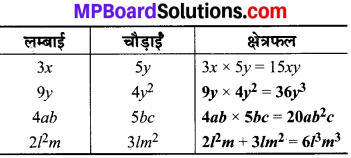
एक आयत के, जिसकी लम्बाई और चौड़ाई दी हुई है, क्षेत्रफल की सारणी को पूरा कीजिए।
हल:
MP Board Class 8th Maths Solutions Chapter 9 बीजीय व्यंजक एवं सर्वसमिकाएँ Ex 9.1 img-9

MP Board Class 8th Maths Solutions

MP Board Class 7th Social Science Solutions Chapter 14 The Age of Magnificence

MP Board Class 7th Social Science Solutions Chapter 14 The Age of Magnificence

MP Board Class 7th Social Science Chapter 14 Text Book Questions

Choose the correct alternatives from the following:

Question 1.
Just after ascending the throne Jahangir had to face the revolt of:
(a) Khusrau
(b) Khurrum
(c) Salim
(d) Shiya
Answer:
(a) Khusrau

Question 2.
Tajmahal was built by:
(a) Akbar
(b) Jahangir
(c) Shahjahan
(d) Aurangzeb
Answer:
(c) Shahjahan

Question 3.
The ninth Guru of Sikhs was:
(a) AijunDev
(b) Teg Bahadur
(c) Govind Singh
(d) Ranjeet Singh
Answer:
(b) Teg Bahadur

MP Board Solutions

Fill in the blanks:

  1. Sir Thomas Roe and Captain Hawkins came to India during the reign of ………………
  2. ………………………. was studded in the peacock.
  3. ………………………. pirated in the Bay of Bengal.
  4. ………………………… was die famous warrior and able statesman.

Answer:

  1. Jahangir
  2. Koh-i-noor
  3. Portuguese
  4. Mallik Amber

MP Board Class 7th Social Science Chapter 14 Short Answer Type Questions

Question 1.
Why did Jahangir execute Guru Arjun Dev?
Answer:
Jahangir was angry with Gum Arjun Dev (Sikh Gum) because he had financially helped prince Khusrau to revolt against him. So he arrested him and tortured him to death.

MP Board Solutions

Question 2.
What did Jahangir do so that the common people received justice?
Answer:
Jahangir was famous for his judicial system. He put a gold chain with bells on it outside the palace. Anybody could appeal to the king for justice by pulling the chain.

Question 3.
What effect had Nurjahan on the administration?
Answer:
In 1611 4D Nurjahan was married to Jahangir. She was very beautiful and intelligent woman. She set new codes and ideologies for the court and even new fashion began from there. She was capable and looked after the administration very effectively. Jahangir used to take her advice in all important matters. Later Nurjahan’s influence in administration increased to such an extent that the royal firmans were issued in her name.

Question 4.
Mention the important buildings made by Shahjahan.
Answer:
The important buildings made by Shahjahan are, die Red Fort of Delhi, Diwan-i- Aaam, Diwan-i-Khas, JamaMasjid, Taj MahaL

MP Board Solutions

MP Board Class 7th Social Science Chapter 14 Long Answer Type Questions

Question 1.
Why is the reign of Jahangir and Shahjahan known as the age of magnificence?
Answer:
The reign of Jahangir and Shahjahan had die most peaceful region. This was so because Akbar set up a vast empire on the basis of his power and good policies and gave it stability. So during the reign of Jahangir and Shahjahan the life was quite comfortable. They encouraged art and literature. Many beautiful and magnificent buildings were built The Royal family and the Aristocracy lived a life of great luxury. It was therefore the reign of Jahangir and Shahjahan is known as the age of magnificence.

MP Board Class 7th Social Science Solutions

MP Board Class 8th Social Science Solutions Miscellaneous Questions 3

MP Board Class 8th Social Science Solutions Miscellaneous Questions 3

Write the correct options to the following questions:

Question 1.
Who was the President of Congress?
(a) W.C. Banerjee
(b) Motilal Nehru
(c) Surendra Nath Banerjee
(d) Gopal Krishna Gokhale
Answer:
(a) Motilal Nehru

Question 2.
Which woman revolutionary first on English Club?
(a) Cromilla
(b) Prti Lata
(c) Shantighosh
(d) Sunita Chaudhary
Answer:
(b) Prti Lata

Question 3.
Who gave the slogan of ‘Do or Die’?
(a) Mahatma Gandhi
(b) Subhash Chandra Bose
(c) Pt. Jawaharlal Nehru
(d) Bhimrao Ambedkar
Answer:
(b) Subhash Chandra Bose

Question 4.
At present in which state is the Nathular Puss?
(a) Jammu and Kashmir
(b) Sikkim
(c) Maharashtra
(d) Himachal Pradesh
Answer:
(b) Sikkim

Question 5.
Which international organization comes in force after First World War?
(a) United Nations
(b) League of Nations
(c) Non-Aligned Movement
(d) None of die above
Answer:
(b) League of Nations

Question 6.
The Coral rocks covers an area of along the North-East Coast of Australia?
(a) 920 kms
(b) 209 kms
(c) 1920 kms
(d) 9120 kms
Answer:
(c) 1920 kms

Question 7.
The tool used by Australian aboriginals is?
(a) Arrow-bow
(b) Boomrang
(c) Spears
(d) Cage
Answer:
(b) Boomrang

MP Board Solutions

Fill in the blanks:

  1. Maulana Abul Kalam Azad started …………… Newspapers
  2.  ……………….. was founders of Forward Block
  3. The International Monetary Fund’s office is at ……………
  4. The areas surrounded by the three sides by sea is called ……………
  5. The labours who rear sheep are called …………….

Answer:

  1. Al Hilal
  2. Subhash Chander Bose
  3. Washington D.C.
  4. peninsula
  5. Jack aroobs

MP Board Class 8th Social Science Miscellaneous Questions 3 Very Short Answer Type Questions

Question 1.
Which states comprised Bengal during the division?
Answer:
At that time Bengal comprised of Bihar and Orissa.

Question 2.
What was the slogan of second phase revolutionaries?
Answer:
We do not beg mercy. Our war is till the last verdict. And the verdict is success or death was the slogan of second phase revolutionaries.

Question 3.
Write about objectives of the International Labour Organisation?
Answer:
ILO became a specialised agency of the United Nations in 1946. Its objectives are to promote social justice and to improve conditions of labourers.

Question 4.
What is an Island?
Answer:
An Island is the land surrounded by sea from all sides.

MP Board Solutions

Question 5.
Opal metal is used air which industry?
Answer:
Opal metal is used in an industry which makes bangles and rings.

MP Board Class 8th Social Science Miscellaneous Questions 3 Short Answer Type Questions

Question 1.
Elaborate about the importance of Surat Sesson of Congress?
Answer:
In 1907 the Surat Session of Congress failed to see the moderates and extremist on the one form. This time Ras Behari Bose was elected President. The extremists, wanted Bal Gangadhar Tilak as their President. The created difference and Tilak and his followers were separated.

Question 2.
What were the announcement made by Bhikaji Camma?
Answer:
Madan Cama was first to unfurl the Indian flag in Internation Socialist Conference in Germany, the announced that this is the flag of India independence. It is purified by the blood of Indian martyrs. The appealed to Indians worldwide to unite and cooperate to achieve freedom from British rule.

Question 3.
What was the commercial front ? Explain.
Answer:
British Prime Minsiter Mac Donald declared award in 1932 making separate electorate board for Harijans in India. It was a diplomatic move by British Govt.

To devide castes in India. It was a major set back for congress in Indira Gandhi and Baba Sahib Ambedkar trial to solve this through the Pooma Pact.

MP Board Solutions

Question 4.
Describe the major factors of air pollutions?
Answer:

  1. Smokes and poisonous gases emitted from factories pollute the air vehicles, emit poisoners gases
  2. Cutting of trees increase CO2, it pollutes the air. Aeroplanes also give out gases like arosole.

Question 5.
Which are the main rivers of Australia?
Answer:
Murray and Darling are the major rivers of Australia.

Question 6.
Which are the major Cities and parts of Australia?
Answer:
Sydney, Melbourne, Perth, Adelaide, Brisbane, Canberra Hobart, Wellington etc. are the major cities of Australia. Sydney is the biggest city of Australia, capital of the country and a first class harbour.

MP Board Class 8th Social Science Miscellaneous Questions 3 Long Answer Type Questions

Question 1.
Explain the works done for social reforms by Gandhiji?
Answer:
Gandhiji was a great critic of untouchability. He had set up, during the freedom struggle, organisations which included the Anti-Untouchability Leauge. He called them, “Harijans”, or the people of God. Gandhiji, thought it in human to consider a class of people untouchable simply because they have been treated so by the society in the past.

Question 2.
Write notes:

  1. Basudev Phadke,
  2. Khudiram Bose
  3. Simon Commission.

Answer:

1. Basudev Phadke:
Basudev Phadke was the leader of revolutionary movement in Maharashtra. With the help of few people he occupied Dhamri, Balte Palspe villages in 1879. Later on, he was arrested same year and was sent to Cellular Jail in Andaman Island.

2. Khudiram Bose:
Barindra Ghosh, Khudiram Bose, Profulla Chaki, Narendra Gosai, Hemchandra Das were the prominent revolutionaries in Bengal. P. Mitra. In 1908, Khudiram Bose and Profulla Chaki threw a bomb on the carriage of the defamed judge Kingsford thinking that the judge was in it but their guess was wrong.

Actually, two British women were killed in this incident. Soon after Chaki shot himself dead and Khudiram Bose arrested tried and hanged to death.

3. Simon Commission:
An act was passed by the British govt, in 1919. The British govt, had declared that the functioning of Commission will be revised after ten years. But a Commission was set up in Nov. 1927. Sur John Simon was its President.

All the seven members of it were English. This is known a Simon Commission. The Congress, and the Muslim League boycotted the Simon Commission in India on 3rd Feb. 1928.

MP Board Solutions

Question 3.
Write about the relations between India and Sri Lanka?
Answer:
Since the ancient time India has deep relation with Sri Lanka. Emperor Ashoka had gone to Sri Lanka to spread the message of Buddhism. We have good trade relations with Sri Lanka. In recent years, ethnic crises in Sri Lanka is matter of concern.

Tamils settled there are in minority. They are demanding separate state. This is the Tamil problem. In July 1987 Indian peace-keeping forces helped the govt, of Sri Lanka to resolve her ethnic problem.

Question 4.
Explain about the Social and Financial’s Councils of United Nations?
Answer:
The Economic and Social Council (ECOSOC) coordinates the social and economic work of United Nations. It is concerned with the welfare of children and women’s rights. It promotes higher standard of living. It aims at solving international economic, social and health problems.

It promotes respect and observance of human rights for all. It has 54 members. Eighteen members are elected every year by the General Assembly.

Question 5.
Review the role of India in U.N.?
Answer:
From the very beginning India has supported the United Nations and its programmes. India always played a leading role in the United Nations in opposing the colonial rule in different parts of the world. India supported the cause of freedom in the countries like Indonesia, Libya, Ghana etc. She protested racist regime in South Africa. India sent its peace-keeping forces to Korea, Congo, Cyprus etc.

Question 6.
Write about the life of Aboriginals of Australia.
Answer:
The original people of Australia are known as Aboriginals while the people of New Zealand are called Maories. They use Boomerang tool for hunting. This tool when targeted for attack comes back to the man after hunting. The Aboriginals worship Yuluroo a red colour in the middle of Australia.

MP Board Class 8th Social Science Solutions

MP Board Class 8th Maths Solutions Chapter 9 बीजीय व्यंजक एवं सर्वसमिकाएँ Intext Questions

MP Board Class 8th Maths Solutions Chapter 9 बीजीय व्यंजक एवं सर्वसमिकाएँ Intext Questions

MP Board Class 8th Maths Chapter 9 पाठान्तर्गत प्रश्नोत्तर

पाठ्य-पुस्तक पृष्ठ संख्या # 145

व्यंजक क्या है?

प्रश्न 1.
y के कुछ अन्य दिए हुए मानों के लिए व्यंजक 2y – 5 के मान ज्ञात कीजिए।
उत्तर:

  1. जब y = 1, 2y – 5 = 2 (1) – 5 = – 3
  2. जब y = – 2, 2y – 5 = 2 (-2) – 5 = – 9
  3. जब y = 3, 2y – 5 = 2 (3) – 5 = 1
  4. जब y = – 3, 2y – 5 = 2 (-3) – 5 = – 11
  5. जब y = 5, 2y – 5 = 2 (5) – 5 = 5

पाठ्य-पुस्तक पृष्ठ संख्या # 146

प्रयास कीजिए (क्रमांक 9.1)

MP Board Solutions

प्रश्न 1.
एक चर वाले और दो चरों वाले व्यजकों के पाँच-पाँच उदाहरण दीजिए।
उत्तर:
एक चर वाले व्यंजक:

  1. 4y
  2. 7 + y
  3. 6 – x
  4. 12x + 3
  5. -25x + 9

दो चर वाले व्यंजक:

  1. x + 4y
  2. x – 3y
  3. 6x + y
  4. 7x – y
  5. 11x + 9y

प्रश्न 2.
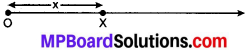
x, x – 4, 2x + 1, 3x – 2 को संख्या रेखा पर दर्शाइए।
उत्तर:
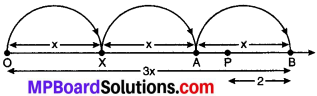
1. x संख्या रेखा पर चर x की स्थिति X है।
MP Board Class 8th Maths Solutions Chapter 9 बीजीय व्यंजक एवं सर्वसमिकाएँ Intext Questions img-1
2. x – 4
x – 4 का मान X के बाईं ओर 4 इकाई की दूरी पर होगा। इसे p से निरूपित किया गया है।
MP Board Class 8th Maths Solutions Chapter 9 बीजीय व्यंजक एवं सर्वसमिकाएँ Intext Questions img-2
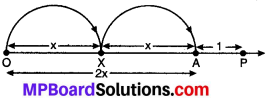
3. 2x + 1
MP Board Class 8th Maths Solutions Chapter 9 बीजीय व्यंजक एवं सर्वसमिकाएँ Intext Questions img-3
यहाँ 2x की स्थिति A पर होगी। मूल बिन्दु O से A की दूरी
X की दूरी से दो गुना होगी। 2x + 1 की स्थिति P, A के दायीं तरफ 1 इकाई की दूरी पर होगी।

4. 3x – 2
MP Board Class 8th Maths Solutions Chapter 9 बीजीय व्यंजक एवं सर्वसमिकाएँ Intext Questions img-4
यहाँ, 3x की स्थिति बिन्दु B पर होगी। मूल बिन्दु 0 से B की दूरी X की दूरी की तीन गुना होगी। 3x – 2 की स्थिति P, B के बायीं तरफ 2 इकाई दूरी पर होगी।

पद, गुणनखण्ड और गुणांक

प्रयास कीजिए (क्रमांक 9.2)

प्रश्न 1.
व्यंजक x2 y2 – 10x2y + 5xy2 – 20 के प्रत्येक पद के गुणांक को पहचानिए।
हल:

  • पद x2y2 में x2y2 गुणांक = 1
  • पद – 10x2y में xy का गुणांक = – 10
  • पद 5xy2 में xy का गुणांक = 5

एकपदी, द्विपद एवं बहुपद

प्रयास कीजिए (क्रमांक 9.3)

प्रश्न 1.
निम्नलिखित बहुपदों को एकपद, द्विपद एवं त्रिपद के रूप में वर्गीकृत कीजिए:
z + 5, x + y + z, y + x + 100, ab – ac, 17.
हल:

  • एकपदी: 17
  • द्विपद: z + 5, ab – ac
  • त्रिपद: x + y + z, y + z + 100

MP Board Solutions

प्रश्न 2.
बनाइए:

  1. तीन ऐसे द्विपद जिनमें केवल एक चर x हो।
  2. तीन ऐसे द्विपद जिनमें x और चर हों।
  3. तीन एकपद जिनमें x और y पद हों।
  4. चार अथवा अधिक पदों वाले 2 बहुपद।

हल:

  1. ऐसे द्विपद जिनमें केवल एक चर x है: 3x – 3, 2x + 5, 7 – x
  2. ऐसे द्विपद जिनमें x और y चर हैं: 3x + 5y, xy – 8, 11x – 3y
  3. एक पद जिनमें x और y पद हैं: xy, 13x2y, – 4xy2
  4. चार एवं अधिक पदों वाले बहुपद: x3 – 3x2 + 4x + 3, 7 – 5x + x2 – 3x3 – 8x4

पाठ्य-पुस्तक पृष्ठ संख्या # 147

प्रश्न 1.
7x एवं 7y समान पद क्यों नहीं हैं?
हल:
क्योंकि 7x और 7y में चर समान नहीं हैं, अतः ये समान पद नहीं हैं।

प्रश्न 2.
7x और 7xy समान पद क्यों नहीं हैं?
हल:
क्योंकि 7x और 77y में चर समान नहीं हैं, अतः ये समान पद नहीं हैं।

MP Board Solutions

प्रश्न 3.
7x और 5x2 समान पद क्यों नहीं हैं?
हल:
क्योंकि 7x और 5x2 में चर समान नहीं हैं, अतः ये समान पद नहीं हैं।

प्रयास कीजिए (क्रमांक 9.4)

प्रश्न 1.
निम्नलिखित में से प्रत्येक के दो समान पद लिखिए –

  1. 7xy
  2. 4mn2
  3. 2l

हल:

  1. 7xy के समान पद: 9xy, – 17xy
  2. 4mn2 के समान पद: – 7n – m, 11mn2
  3. 21 के समान पद: 4l, -3l

MP Board Class 8th Maths Solutions

MP Board Class 7th Social Science Solutions Miscellaneous Questions 1

MP Board Class 7th Social Science Solutions Miscellaneous Questions 1

Choose the correct alternative from the following:

Question 1.
The medieval period in India begins form:
(a) The 13th century
(b) 7th century
(c) 8th century
(d) 12th century
Answer:
(c) 8th century

Question 2.
The famous Raja Rajeshwara temple of Tanjavur was built by:
(a) Raja raja – I
(b) Rajendra -I
(c) Krishna – I
(d) Krishna – II
Answer:
(a) Raja raja – I

Question 3.
The President of the constituent assembly was:
(a) Dr. Harising Gaur
(b) Dr. Bhimrao Ambedekar
(c) Dr. Rajendra Prasad
(d) Pt. Jawaharlal Nehru.
Answer:
(c) Dr. Rajendra Prasad

Question 4.
The total no. of the members of the Rajya Sabha is:
(a) 238
(b) 250
(c) 230
(d) 260
Answer:
(c) 230

Question 5.
Day and night are equal on:
(a) 21 March and 25th Dec
(b) 21 June and 22 Dec
(c) 25 Dec & 25 June
(d) none of the above
Answer:
(d) none of the above

Question 7.
The percentage of oxygen percent in the atmosphere is:
(a) 78%
(b) 21%
(c) 28%
(d) 71%
Answer:
(b) 21%

MP Board Solutions

Fill in the blanks:

  1. India was in continuous contact with …………… through trade.
  2. ……………. translated Ramayana into Tamil
  3. The ancient name of the capital of Madhya Pradesh was …………….
  4. The Constitution of India is a written and ……………. Constitution.
  5. The earth’s axis makes an angle of ……………… from its plane.

Answer:

  1. Arabs
  2. Kamban
  3. Bhojpal
  4. Comprehensive
  5. 23 \(\frac { 1 }{2 }\)°

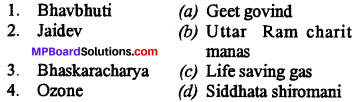
Make correct pairs:

MP Board Class 7th Social Science Solutions Miscellaneous Questions-1
Answer:
1. (b) Uttar Ram charit
2. (a) Geetgovind
3. (d) Siddhata shiromani
4. (c) Life saving gas

Answer the following in brief:

Question 1.
Write the names of the important rulers of the Chouhan dynasty.
Answer:
Ajayraj Chouhan and Prithiviraj Chouhan.

Question 2.
Write any three features of the Chola administration.
Answer:

  • The king was the head of the government
  • The empire was divided into provinces.
  • The village was the lowest unit of administration.

Question 3.
What do you understand by Secularism?
Answer:
Secularism means that from point of view of the government all religious are equal and the state shall not discriminate between the people of different facilities.

Question 4.
Write any three qualifications required to be a member of the RajyaSabha.
Answer:
A person must be 30 years or above in age.

  • His name must be in the voter is list of the constituency to which he belongs.
  • He must not be insolvent, bankrupt and must be same.

Question 5.
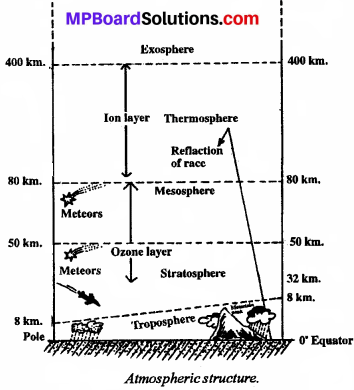
What do you know about die Ionosphere?
Answer:
It is one of the layers of gases found in thermosphere. It is found at a height of 80 to 400 km from the earth.

MP Board Solutions

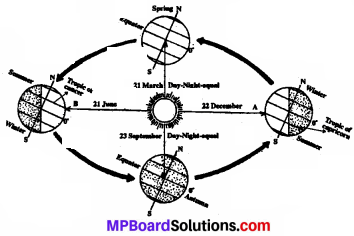
Question 6.
What do you mean by the axis of the earth?
Answer:
The axis of the earth is the point on which die earth rotates.

Question 7.
What is meant by change of season?
Answer:
Because of the title of the earth’s axis one hemisphere comes to face to the sun first and then comes the other hemisphere. Therefore variations in the weather phenomenon occur. Change in temperature is die bases for change in seasons. The earth gets heat from sun. Due to its tilt of 23\(\frac { 1 }{2 }\)° degrees on its axis and its revolution round the sun the quantity of temperature received differs. This brings about changes in seasons.

Question 8.
Which season does India experience when die sun is directly on the tropic of Cancer?
Answer:
Summer season.

Answer the following questions in detail:

Question 1.
Describe die political condition of India in the beginning of the early part of the medieval period.
Answer:
The Arabs made great contribution in the development of the Medieval civilization. They were expert traders. Trade had made them rich and they used the wealth for the development of art, science and literature.

They spread knowledge, which they acquired from the countries with which they had trade relations, to distant lands. They also made important contribution in the field of Geometry, Algebra, Geography and Astronomy. They also carried new inventions of China like Gun Powder, Paper and Compass to countries of Europe.

Question 2.
Write about the main features of the Pallava dynasty.
Answer:
Main features of the Pallava dynasty:

  1. Pollar administration was well – managed.
  2. Education, literature and art flourished greatly.
  3. The local language was Tamil in which high quality literature was produced.
  4. The Pollar kings were Shaivas and the Hindu religion flourished there well.
  5. The Pollar as got many famous temples built there. Some of the very famous are ‘Dharmraj’ and Kailashnath temple at Kanchi, the rock – cut Rathmandir at the sea coast of Mahabalipuram.

MP Board Solutions

Question 3.
Describe the freedoms given in the Rights to freedom.
Answer:
Right to freedom guarantees six basic freedoms. Two freedoms are given here:

1. Freedom to express thoughts – All die citizens of India has the freedom to express his / her thoughts, to give speech and to know about the thought of others and to propagate it The citizens have the freedom to write articles etc. in newspapers.

2. Freedom to live and settle in any part of India – All the citizens of India have die freedom to settle in any part of the country permanently or temporarily as per their wish.

Question 4.
Explain the process of framing a law.
Answer:
Every bill has to go through three stages in the Parliament. These stages are:

  • The first reading of the bill – In it, copies of the bill are given to the members. The person or minister who introduces the bill in the House, gives a speech explaining die purpose of die bill.
  • The second reading – In the second reading, a clause / by – clause discussion takes place on the bill.
  • The third reading – in the third reading the bill as a whole is finally discussed and put to vote.

If the majority of the members are in its favor, the bill is passed. Now the bill is sent to the other House. After the bill is sent to the other House, it goes through all the three stages as mentioned above. After toe other House passes toe bill, it is sent to toe President for his assent The bill becomes a law after it is signed by toe President

Question 5.
Describe die composition of die atmosphere
Answer:
The changes in temperature at various attitudes divide the atmosphere into 5 layers.
1. Troposphere
2. Stratosphere
3. Mesosphere
4. Thermosphere
5. Exosphere

1. Troposphere:
It extends to a height of 8 km at the poles and 18 km on equator. Dust particles and water vapor are found in this layer. All kinds of weather phenomenon like clouds, rainstorm etc. is observed in this layer. All types of life forms are found in this layer. This layer is also known as dynamic layer.

2. Stratosphere:
The second layer of the atmosphere is known as stratosphere. The temperature in this layer is constant till 20 kms. height and then slowly increases.

3. Mesosphere:
The height of this layer is 50 to 80 km from the sea level. The variation in temperature is less in this layer as water vapor, clouds and dust are found less and fast wind blows here.

MP Board Class 7th Social Science Solutions Miscellaneous Questions-1 - 2

4. Thermosphere:
The thermosphere starts from the height of 80 km from sea level. The density of air is very less in this layer. The
temperature increases with height in this layer. Two layers of gases are found here. One is the ozone layer and the other is the ion layer.

The ozone layer is spread at a height of 32 to 80 km from the earth. The ion layer is found at a height of 80 to 400 km. from earth. The electrically charged particles stop the radio waves transmitted from the earth and return it back to the earth. In this way we can listen to various radio programmers.

5. Exosphere:
This is the outermost layer of die atmosphere the upper limit of this layer is uncertain. The density of air is the least here.

MP Board Solutions

Question 6.
Describe the different types of permanent winds.
Answer:
Winds are the natural horizontal movement of air over the earth’s surface.

Difference between air and wind:

  • When air moves vertically downwards or upwards, it is known as air. But when it moves horizontally, it is known as wind.
  •  Airis calm-but when it becomes dynamic it take / the form of wind. Wind always blows from high pressure to low pressure.

Question 7.
Explain with the help of a diagram the changing seasons of the earth.
Answer:
The earth’s axis forms an angle of 66 \(\frac { 1 }{2 }\) with the plane of the earths orbit and the earth tilts at 23 1/2 degree on its axis. Let us understand how seasons occurs on earth.
MP Board Class 7th Social Science Solutions Miscellaneous Questions-1 - 3

MP Board Class 7th Social Science Solutions

MP Board Class 8th Maths Solutions Chapter 8 राशियों की तुलना Ex 8.3

MP Board Class 8th Maths Solutions Chapter 8 राशियों की तुलना Ex 8.3

प्रश्न 1. निम्नलिखित के लिए कुल राशि एवं चक्रवृद्धि ब्याज ज्ञात कीजिए

  1. ₹ 10,800 पर 3 वर्ष के लिए 12\(\frac{1}{2}\)% वार्षिक दर से वार्षिक रूप से संयोजित करने पर।
  2. ₹ 18,000 पर 2\(\frac{1}{2}\) वर्ष के लिए 10% वार्षिक दर से वार्षिक रूप से संयोजित करने पर।
  3. ₹ 62,500 पर 1\(\frac{1}{2}\) वर्ष के लिए 8% वार्षिक दर से अर्धवार्षिक रूप से संयोजित करने पर।
  4. ₹ 8000 पर 1 वर्ष के लिए 9% वार्षिक दर से अर्धवार्षिक रूप से संयोजित करने पर।
    (आप सत्यापन करने के लिए साधारण ब्याज के सूत्र का उपयोग करते हुए एक के बाद दूसरे वर्ष के लिए परिकलन कर सकते हैं।)
  5. ₹ 10,000 पर 1 वर्ष के लिए 8% वार्षिक दर से अर्धवार्षिक रूप से संयोजित करने पर।

हल:
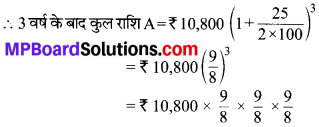
1. यहाँ, P = ₹ 10,800
R = 12\(\frac{1}{2}\)% = 25%
वार्षिक, n= 3 वर्ष
MP Board Class 8th Maths Solutions Chapter 8 राशियों की तुलना Ex 8.3 img-1
= ₹ 15,377.34
∴ चक्रवृद्धि ब्याज = मिश्रधन – मूलधन
= ₹ 15,377.34 – ₹ 10,800
= ₹ 45,77.34
अतः 3 वर्ष बाद कुल राशि = ₹ 15,377.34 तथा चक्रवृद्धि ब्याज = ₹ 45,77.34

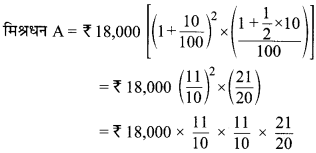
2. यहाँ, P= ₹ 18,000,
R = 10%
वार्षिक, n = 2\(\frac{1}{2}\) वर्ष
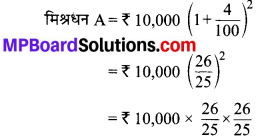
MP Board Class 8th Maths Solutions Chapter 8 राशियों की तुलना Ex 8.3 img-2
= ₹ 22,869
चक्रवृद्धि ब्याज = ₹ 22,869 – ₹ 18,000
= ₹ 4,869
अतः मिश्रधन = ₹ 22,869 तथा चक्रवृद्धि ब्याज = ₹ 4,869

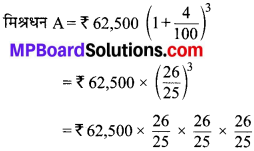
3. यहाँ, P = ₹ 62500,
R = 8%
वार्षिक = 4% प्रति छमाही,
n = 1\(\frac{1}{2}\) वर्ष = 3 अर्धवर्ष (3 छमाही)
MP Board Class 8th Maths Solutions Chapter 8 राशियों की तुलना Ex 8.3 img-3
= ₹ 70,304
चक्रवृद्धि ब्याज = ₹ 70,304 – ₹ 62,500
= ₹ 7,804
अतः मिश्रधन = ₹ 70,304 तथा चक्रवृद्धि ब्याज = ₹ 7,804

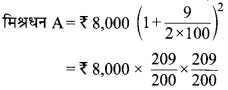
4. यहाँ, P = ₹ 8000
R = 9%
वार्षिक = \(\frac{9}{2}\)%
प्रति अर्धवार्षिक, n = 1 वर्ष = 2 छमाही
MP Board Class 8th Maths Solutions Chapter 8 राशियों की तुलना Ex 8.3 img-4
= ₹ 8,736.20
चक्रवृद्धि ब्याज = ₹ 8,736.20 – ₹ 8,000
= ₹ 736.20
अतः मिश्रधन = ₹ 8,736-20 तथा चक्रवृद्धि ब्याज = ₹ 736.20

5. यहाँ, P = ₹ 10,000
R = 8%
वार्षिक = 4%
प्रति छमाही, n = 1 वर्ष = 2 छमाही
MP Board Class 8th Maths Solutions Chapter 8 राशियों की तुलना Ex 8.3 img-5'
= ₹ 10,816
चक्रवृद्धि ब्याज = ₹ 10,816 – ₹ 10000
= ₹ 816
अत: मिश्रधन = ₹ 10,816 तथा चक्रवृद्धि ब्याज = ₹ 816

MP Board Solutions

प्रश्न 2.
कमला ने एक स्कूटर खरीदने के लिए किसी बैंक से ₹ 26,400, 15% वार्षिक दर से उधार लिए जबकि ब्याज वार्षिक संयोजित होना है। 2 वर्ष और 4 महीने के अन्त में उधार चुकता करने के लिए उसे कितनी राशि का भुगतान करना पड़ेगा?
(संकेत: ब्याज को वार्षिक संयोजित करते हुए पहले 2 वर्ष के लिए A ज्ञात कीजिए और दूसरे वर्ष की कुल राशि पर + वर्ष का साधारण ब्याज ज्ञात कीजिए।)
हल:
यहाँ, P = ₹ 26,400
समय n = 2 वर्ष 4 महीने
R= 15%
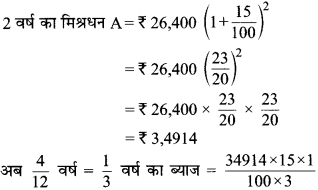
MP Board Class 8th Maths Solutions Chapter 8 राशियों की तुलना Ex 8.3 img-6
= ₹ 1,745.70
कुल मिश्रधन = ₹ 34,914 + ₹ 1,745.70
= ₹ 36,659.70
अतः कमला को उधार चुकता करने के लिए ₹ 36,659.70 का भुगतान करना पड़ेगा।

प्रश्न 3.
फैबिना ने ₹ 12,500, 3 वर्ष के लिए 12% वार्षिक दर से साधारण ब्याज पर उधार लिए और राधा ने उतनी ही राशि उतने ही समय के लिए 10% वार्षिक दर से चक्रवृद्धि ब्याज पर उधार ली जबकि ब्याज वार्षिक रूप से संयोजित होना है। किसे अधिक ब्याज का भुगतान करना है और कितना अधिक करना है?
हल:
फैबिना के लिए
मूलधन P = ₹ 12,500
समय T = 3 वर्ष
दर = 12% वार्षिक
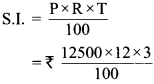
MP Board Class 8th Maths Solutions Chapter 8 राशियों की तुलना Ex 8.3 img-7
= ₹ 4,500
राधा के लिए
मूलधन P = ₹ 12,500
दर R = 10%
वार्षिक, समय, n = 3 वर्ष
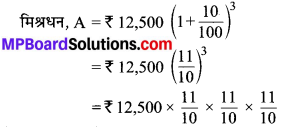
MP Board Class 8th Maths Solutions Chapter 8 राशियों की तुलना Ex 8.3 img-8
= ₹ 16,637.50
∴ चक्रवृद्धि ब्याज = ₹ 16,637.50 – ₹ 1,2500
= ₹ 4,137.50
अतः फैबिना को ₹ 4,500 – ₹ 4,137.50 = ₹ 362.50 अधिक भुगतान करना है।

MP Board Solutions

प्रश्न 4.
मैंने जमशेद से ₹ 12,000, 2 वर्ष के लिए 6% वार्षिक दर से साधारण ब्याज पर लिए। यदि मैंने यह राशि 6% वार्षिक दर से चक्रवृद्धि ब्याज पर ली हुई होती तो मुझे कितनी अतिरिक्त राशि का भुगतान करना पड़ता?
हल:
यहाँ, P = ₹ 12,000
समय = 2 वर्ष
दर = 6% वार्षिक
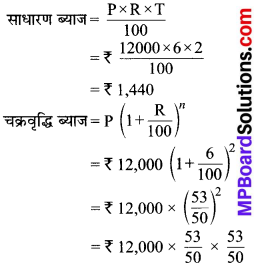
MP Board Class 8th Maths Solutions Chapter 8 राशियों की तुलना Ex 8.3 img-9
= ₹ 13,483.20
∴ चक्रवृद्धि ब्याज = ₹ 13,483.20 – ₹ 12,000
= ₹ 1,483.20
अतः मुझे ₹ 1,483.20 – ₹1,440 = ₹ 43.20 का अतिरिक्त भुगतान करना पड़ता।

प्रश्न 5.
वासुदेवन ने 12% वार्षिक दर पर ₹ 60,000 का निवेश किया। यदि ब्याज अर्धवार्षिक संयोजित होता है तो ज्ञात कीजिए कि वह –

  1. 6 महीने के अन्त में
  2. एक वर्ष के अन्त में, कुल कितनी राशि प्राप्त करेगा?

हल:
यहाँ, P = ₹ 60,000
दर = 12%
वार्षिक = 6% प्रति अर्धवार्षिक,

1. 6 महीने = 1 अर्धवर्ष
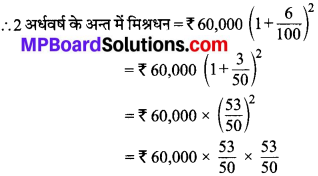
∴ 1 अर्धवर्ष के बाद मिश्रधन = ₹ 60,000 (1 + \(\frac{6}{100}\))1
= ₹ 60,000 (1 + \(\frac{3}{50}\))
= ₹ 60,000 x \(\frac{53}{50}\)
= ₹ 63,600
अत: वासुदेवन 6 महीने के अन्त में ₹ 63,600 प्राप्त करेगा।

2. समय = 1 वर्ष = 2 अर्धवर्ष
MP Board Class 8th Maths Solutions Chapter 8 राशियों की तुलना Ex 8.3 img-10
= ₹ 67,416
अतः वासुदेवन 1 वर्ष के अन्त में ₹ 67,416 प्राप्त करेगा।

प्रश्न 6.
आरिफ ने एक बैंक से ₹ 80,000 का कर्ज लिया। यदि ब्याज की दर 10% वार्षिक है, तो 1\(\frac{1}{2}\) वर्ष पश्चात् उसके द्वारा भुगतान की जाने वाली राशियों में अन्तर ज्ञात कीजिए यदि ब्याज –

  1. वार्षिक संयोजित होता है
  2. अर्धवार्षिक संयोजित होता है।

हल:
1. यहाँ, P = ₹ 80,000
दर = 10%
वार्षिक, समय = 1\(\frac{1}{2}\) वर्ष
MP Board Class 8th Maths Solutions Chapter 8 राशियों की तुलना Ex 8.3 img-11
= ₹ 92,400

2. जब कि ब्याज अर्धवार्षिक संयोजित होता है।
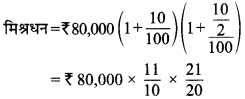
समय = 1\(\frac{1}{2}\) वर्ष = \(\frac{3}{2}\) x 2 = 3 अर्धवर्ष,
दर = 10% वार्षिक = 5% प्रति अर्धवार्षिक
MP Board Class 8th Maths Solutions Chapter 8 राशियों की तुलना Ex 8.3 img-12
= ₹ 92,610
∴ मिश्रधन में अन्तर = ₹ 92,610 – ₹ 92,400 = ₹ 210

MP Board Solutions

प्रश्न 7.
मारिया ने किसी व्यापार में ₹ 8000 का निवेश किया। उसे 5% वार्षिक दर से चक्रवृद्धि ब्याज का भुगतान किया जाएगा। यदि ब्याज वार्षिक रूप से संयोजित होता है, तो –

  1. दो वर्ष के अन्त में उसके नाम से जमा की गई राशि ज्ञात कीजिए।
  2. तीसरे वर्ष का ब्याज ज्ञात कीजिए।

हल:
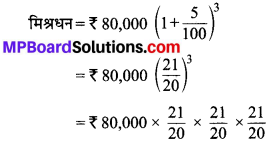
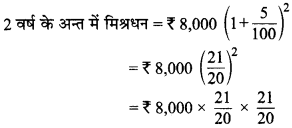
1. यहाँ, P = ₹ 8,000
दर = 5%
वार्षिक, समय = 2 वर्ष
MP Board Class 8th Maths Solutions Chapter 8 राशियों की तुलना Ex 8.3 img-13
= ₹ 8,820
∴ 2 वर्ष के अन्त में उसके नाम से जमा की गई राशि = ₹ 8,820

2. यहाँ तीसरे वर्ष के लिए मूलधन = ₹ 8,820
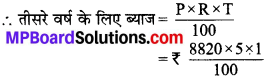
MP Board Class 8th Maths Solutions Chapter 8 राशियों की तुलना Ex 8.3 img-14
= ₹ 441
∴ तीसरे वर्ष का ब्याज = ₹ 441

प्रश्न 8.
₹ 10,000 पर 19 वर्ष के लिए 10% वार्षिक दर से चक्रवृद्धि ब्याज और कुल राशि ज्ञात कीजिए जबकि ब्याज अर्धवार्षिक संयोजित होता है। क्या यह ब्याज उस ब्याज से अधिक होगा जो उसे वार्षिक रूप से संयोजित करने पर प्राप्त होगा?
हल:
यहाँ, P = ₹ 10,000
समय = 1\(\frac{1}{2}\) वर्ष = 3 अर्धवर्ष
दर = 10%
वार्षिक = 5% प्रति अर्धवार्षिक
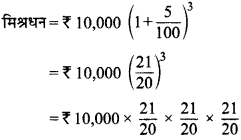
MP Board Class 8th Maths Solutions Chapter 8 राशियों की तुलना Ex 8.3 img-15
= ₹ 11,576.25
चक्रवृद्धि ब्याज = ₹ 11,576.25 – ₹10,000
= ₹1576-25
अतः कुल राशि = ₹ 11,576.25 तथा चक्रवृद्धि ब्याज = ₹ 1,576.25
हाँ, यह ब्याज उस ब्याज से अधिक होगा जो उसे वार्षिक रूप से संयोजित करने पर प्राप्त होगा।

प्रश्न 9.
यदि राम ₹ 4,096, 18 महीने के लिए 125% वार्षिक दर पर उधार देता है और ब्याज अर्धवार्षिक संयोजित होता है तो ज्ञात कीजिए कि राम कुल कितनी राशि प्राप्त करेगा?
हल:
यहाँ, P = ₹ 4,096
समय = 18
महीने = 1\(\frac{1}{2}\) वर्ष = 3 अर्धवर्ष
दर = 12\(\frac{1}{2}\)%
वार्षिक = 25% प्रति अर्धवार्षिक
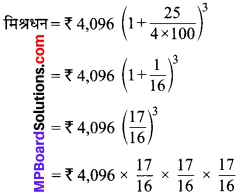
MP Board Class 8th Maths Solutions Chapter 8 राशियों की तुलना Ex 8.3 img-16
= ₹ 4,913
राम कुल ₹ 4,913 प्राप्त करेगा।

प्रश्न 10.
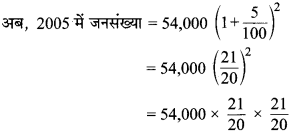
5% वार्षिक दर से बढ़ते हुए वर्ष 2003 के अन्त में एक स्थान की जनसंख्या 54,000 हो गई निम्नलिखित को ज्ञात
कीजिए –

  1. वर्ष 2001 में जनसंख्या
  2. वर्ष 2005 में कितनी जनसंख्या होगी?

हल:
1. वर्तमान जनसंख्या = 54,000
दर = 5%
माना कि 2001 में जनसंख्या = P थी (दो वर्ष पूर्व)
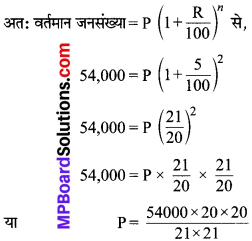
MP Board Class 8th Maths Solutions Chapter 8 राशियों की तुलना Ex 8.3 img-17
= 48,979.59 (लगभग 48,980)
अतः 2001 में जनसंख्या लगभग 48,980 थी।

2. माना कि वर्तमान जनसंख्या = 54000 (2003 में जनसंख्या)
MP Board Class 8th Maths Solutions Chapter 8 राशियों की तुलना Ex 8.3 img-18
= 59,535
अतः वर्ष 2005 में जनसंख्या 59,535 होगी।

MP Board Solutions

प्रश्न 11.
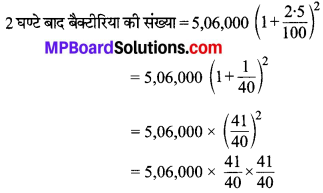
एक प्रयोगशाला में किसी निश्चित प्रयोग में बैक्टीरिया की संख्या 2.5% प्रति घण्टे की दर से बढ़ रही है। यदि प्रयोग के शुरू में बैक्टीरिया की संख्या 5,06,000 थी तो 2 घण्टे के अन्त में बैक्टीरिया की संख्या ज्ञात कीजिए।
हल:
यहाँ, वर्तमान बैक्टीरिया की संख्या P = 5,06,000,
दर = 2.5%
प्रति घण्टा, समय = 2 घण्टे
MP Board Class 8th Maths Solutions Chapter 8 राशियों की तुलना Ex 8.3 img-19
= 5,31,616.25
= 5,31,616 (लगभग)
अत: 2 घण्टे बाद बैक्टीरिया की संख्या = 5,31,616

प्रश्न 12.
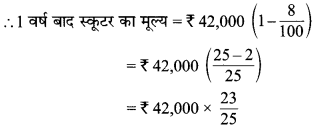
एक स्कूटर ₹ 42,000 में खरीदा गया। 8% वार्षिक दर से इसके मूल्य का अवमूल्यन हो गया। 1 वर्ष बाद स्कूटर का मूल्य ज्ञात कीजिए।
हल:
स्कूटर का वर्तमान मूल्य = ₹ 42,000
अवमूल्यन दर = 8% वार्षिक
MP Board Class 8th Maths Solutions Chapter 8 राशियों की तुलना Ex 8.3 img-20
= ₹ 38,640
अतः 1 वर्ष बाद स्कूटर का मूल्य = ₹ 38,640

MP Board Class 8th Maths Solutions

MP Board Class 8th Sanskrit Solutions Chapter 13 अन्तर्जालम्

MP Board Class 8th Sanskrit Solutions Surbhi Chapter 13 अन्तर्जालम्

MP Board Class 8th Sanskrit Chapter 13 अभ्यासः

प्रश्न 1.
एकपदेन उत्तरं लिखत (एक पद में उत्तर लिखिए)
(क) का शुभसन्देशम् प्राप्तवान्?
उत्तर:
विवेकः

(ख) सन्देशः केन माध्यमेन प्राप्तः?
उत्तर:
अन्तर्जालमाध्यमेन

(ग) विवेकाग्रजस्य किम् अध्येतुं जाबालिपुरस्य अभियान्त्रिकमहाविद्यालये चयनं जातम्?
उत्तर:
सङ्गणकाभियान्त्रिकविद्याम्

MP Board Solutions

(घ) अधुना व्यापारिणः केन माध्यमेन व्यापारं कुर्वन्ति?
उत्तर:
अन्तर्जालमाध्यमेन

(ङ) अधिकोषाणां कार्याणि अधुना केन माध्यमेन भवन्ति?
उत्तर:
अन्तर्जालमाध्यमेन

(च) सङ्गणकाचार्यं के अभिवादयन्ति?
उत्तर:
छात्राः।

प्रश्न 2.
एकवाक्येन उत्तरं लिखत (एक वाक्य में उत्तर लिखिए)
(क) अन्तर्जालं किं भवति?
उत्तर:
अन्तर्जालं क्षणेन एव सूचना-सम्प्रेषणस्य साधनमस्ति।

(ख) जनाः अन्तर्जाले विज्ञानं दृष्ट्वा किं कुर्वन्ति?
उत्तर:
जनाः अन्तर्जाले विज्ञापनं दृष्ट्वा गृहे स्थिता एव क्रय-विक्रयादिकं कुर्वन्ति।

(ग) वैद्युत-वाणिज्यसेवाया: उपयोगेन कानि कार्याणि भवन्ति?
उत्तर:
वैद्यत वाणिज्य सेवायाः उपयोगेन कस्मिन्नपि समये निविदामुद्रा विनिवेशाहीनां कार्याणि भवन्ति।

(घ) अन्तर्जाले कानि-कानि दृष्टव्यानि?
उत्तर:
अन्तर्जाले मनोरञ्जनार्थं स्वरुचिकराणि चलचित्राणि, वर-वधूनां कृते वैवाहिक विज्ञपनानि अपि दृष्टव्यानि।

(ङ) छात्राः किम् उद्घोषयन्ति?
उत्तर:
छायाः उद्घोषयन्ति-वयमपि अन्तर्जालस्य उपयोगं ज्ञानवृद्धयर्थं करिष्यामः।

MP Board Solutions

प्रश्न 3.
उचितशब्देन रिक्तस्थानम् पूरयत (उचित शब्द द्वारा रिक्त स्थान की पूर्ति कीजिए)
(क) सम्प्रति …….. मुद्रा विनिवेशादीनांकार्याणि भवन्ति। (अन्तर्दृष्ट्या/अन्तर्जालेन)
(ख) अन्तर्जाल विज्ञापनं दृष्ट्वा जनाः गृहे स्थिता एव ………. कुन्ति। (क्रय-विक्रयादीन/भोजनादयः)
(ग) अन्तर्जालेन वयम् …….. सूचनां लभामहे। (यदाकदा/अहर्निशम्)
(घ) दूरसञ्चारतन्तुभिः सह ……… संयोज्य अन्तर्जालस्य संरचना भवति। (गणकम्/सङ्गणकम्)
(ङ) सर्वाः कला: ………. दृश्यन्ते। (ऊर्णनाभजाले/अन्तर्जाले)
उत्तर:
(क) अन्तर्जालेन
(ख) क्रय-विक्रयादीन
(ग) अहर्निशम्
(घ) सङ्गणकम्
(ङ) अन्तर्जाले

प्रश्न 4.
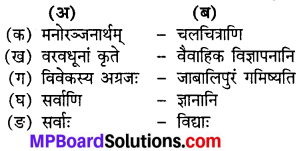
उचितं योजयत- (सही जोड़ी जमाइए)
उत्तर:
MP Board Class 8th Sanskrit Solutions Chapter 13 अन्तर्जालम् 1

प्रश्न 5.
रेखाङ्कितशब्दान् आधृत्य प्रश्ननिर्माणं कुरुत (रेखांकित शब्दों के आधार पर प्रश्न बनाइए)
(क) अन्तर्जालेन लाभः भवति।
(ख) जनाः समाचारपत्राणां वाचनं कुर्वन्ति।
(ग) अहं सन्देशम् प्राप्तवान्।
(घ) एषः मम अग्रजः अस्ति।
(ङ) सः प्रात: विद्यालयं गच्छति।
उत्तर:
(क) केन लाभः भवति?
(ख) जनाः केषां वाचनं कुर्वन्ति?
(ग) अहं कम् प्राप्तवान्?
(घ) एषः कस्य अग्रजः अस्ति?
(ङ) सः कदा विद्यालयं गच्छति?

प्रश्न 6.
नामोल्लेखपूर्वकं सन्धिविच्छेदं कुरुत (नाम का उल्लेख करते हुए सन्धि-विच्छेद कीजिए)
उत्तर:
(क) वयमपि – वयम् + अपि (स्वर सन्धि)
(ख) सङ्गणकाचार्यः – सङ्गणक + आचार्यः (दीर्घ स्वर सन्धि)
(ग) ज्ञानवृद्ध्यर्थम् – ज्ञानवृद्धि + अर्थम् (अयादि स्वर सन्धि )
(घ) अन्तर्जालम् – अन्तः + जालम् (विसर्ग सन्धि)
(ङ) प्रसन्नोऽसि – प्रसनः + असि (अवग्रह सन्धि)

प्रश्न 7.
पाठे ‘इक’, प्रत्ययान्त पदानि चित्वा लिखिए (पाठ में आये ‘इक’ प्रत्ययान्त पद चुनकर लिखिए)
उत्तर:
सङ्गणकाभिषान्त्रिक, वैवाहिक, साहित्यिक, ऐतिहासिक, पुरातात्त्विक भौगोलिक, आयुर्वेदिक इत्यादि।।

MP Board Solutions

अन्तर्जालम् पाठ का सरांश

प्रस्तुत पाठ में सन्देश भेजने के आधुनिक माध्यम ‘इंटरेनट’ के विषय में बताया गया है। इसके माध्यम से बहुत दूर तक भी सूचना भेजी जा सकती है। यह कम्प्यूटर में जोड़कर प्रयोग किया जाता है। व्यापार के इलैक्ट्रॉनिक्स व वाणिज्य सम्बन्धी मूल्य-सूची, मुद्रा विनिवेश आदि सभी क्रय-विक्रय के कार्य इसके माध्यम से सरलतापूर्वक हो जाते हैं। विभिन्न विज्ञापनों तथा मनोरजंन के साधन के रूप में भी यह प्रयुक्त होता है।

अन्तर्जालम् शब्दार्थ (Word-Meanings)

सङ्गणकाभियान्त्रिकविद्याम्-सङ्गणक+अभियान्त्रिकविद्याscience of computer and engineering; अन्तर्जालमाध्यमेन- इंटरनेट के माध्यम से through the media of internet; सङ्गणकम्-कम्प्यू टर को of computer; निविदा-मूल्य-सूची price list; वाञ्छितसूचनाम्- चाही गई जानकारी को desired information; वैद्युत-इलेक्ट्रानिक electronic; अहर्निशम्-रात दिन day and night; मभाग्रजस्य-मेरे बड़े भाई का of myelder brother; अध्येतुं-पढ़ने के लिए to study; सम्प्रेषणस्थ-भेजने का of sending.

संपूर्ण पाठ का हिन्दी सरलार्थ
1. व्योमः :
भो विवेक! अद्य त्वं किमर्थम् अतिप्रसन्नोऽसि?

विवेकः :
अद्य अहम् एकं शुभसन्देशम् प्राप्तवान्।

ऋचा :
कः सन्देशः अस्ति?

विवेकः :
ममाग्रजस्य सङ्गणकाभियान्त्रिक विद्याम् अध्येतुं जाबालिपुरस्य अभियान्त्रिक महाविद्यालये चयनं जातम्।

व्योमः :
एतत् तु अतिशोभन्।

अनुवाद :
व्योम :
हे विवेक! आज तुम किसलिए अति प्रसन हो?

विवेक :
आज मैंने एक शुभ सन्देश प्राप्त किया है।

ऋचा :
क्या सन्देश है? विवेक, मेरे बड़े भैय्या का कम्प्यूटर इंजिनियरिंग विद्या का अध्ययन करने के लिए जबलपुर के इंजिनियरिंग कॉलेज में चयन हो गया है।

व्योम :
यह तो बड़ी अच्छी बात है।

MP Board Solutions

2. ऋचा :
सन्देशः केन माध्यमेन प्राप्तः?

विवेकः :
अहं सन्देशम् अन्तर्जालमाध्यमेन प्राप्तवान्।

ऋचा :
अन्तर्जालं किम् भवति?

विवेकः :
अन्तर्जालं क्षणेन एव

सूचना :
सम्प्रेषणस्य साधनमस्ति।

व्योमः :
अन्तर्जालं कीदृशी संरचना?

विवेकः :
मॉडेम्, नाम एकं सहायक लघुयन्त्रोपकरणम् अस्ति। तद् ‘नेट’ सुविधायुक्तदूरसञ्चारतन्तुभिः सङ्गणकं संयोज्य अन्तर्जालस्य संरचना भवति।

व्योमः :
अन्तर्जालने कः लाभः? (तस्मिन्नेव समये कक्षायां सङ्गणकाचार्यः प्रविशति, छात्राः तम् अभिवादयन्ति।)

अनुवाद :
ऋचा :
सन्देश किस माध्यम से प्राप्त हुआ?

विवेक :
मैंने सन्देश इन्टरनेट के माध्यम से प्राप्त किया है।

ऋचा :
इन्टरनेट क्या होता है?

विवेक :
इन्टरनेट क्षणभर में ही सूचना भेजने का साधन है।

व्योम :
अन्तर्जालया इंटरनेट कैसी संरचना है।

विवेक :
मॉडेम नाम का एक सहायक लघुयन्त्र उपकरण होता है। उसे ‘नेट’ सुविधा जनक दूर संचार सूत्र से कम्प्यूटर को जोड़कर इन्टरनेट की संरचना होती है।

व्योम :
इन्टरनेट से क्या लाभ होता है? (उसी समय कक्षा में कम्प्यूटर शिक्षक का प्रवेश होता है। छात्र उन्हें प्रणाम करते हैं।)

MP Board Solutions

3. आचार्यः :
छात्राः! भवन्तः सङ्गणकयन्त्रविषये तु जानन्ति एव। अद्य वयम् अन्तर्जालविषये चर्चा कुर्मः।

छात्राः :
शोभनम् आचार्य!

आचार्यः :
तदधुना अन्तर्जालस्य लाभान् शृण्वन्तु। अन्तर्जालेन अधुना व्यापारिणाः व्यापारं कुर्वन्ति। वैद्युद्-वाणिज्यसेवायाः उपयोगेन कस्मिनपि समये निविदामुद्राविनिवेशादीनांकार्याणि भवन्ति। जनाः अन्तर्जाले विज्ञापनं दृष्ट्वा गृहे स्थिता एव क्रय-विक्रयादिकं कुर्वन्ति। अधिकोषाणां कार्याणि अपि अनेन माध्यमेन भवन्ति।

अनुवाद :
आचार्य :
छात्रो! तुम कम्प्यूटर के सम्बन्ध में तो जानते ही हो। आज हम इन्टरनेट के विषय में चर्चा करते हैं।

छात्र :
अच्छी बात है, आचार्य जी!

आचार्य :
तो अब तुम इन्टरनेट के लाभ सुनो। इन्टरनेट के माध्यम से आजकल व्यापारी व्यापार करते हैं। इलेक्ट्रानिक वाणिज्य सेवा के उपयोग से किसी भी समय निविदा, मुद्रा, विनिवेश आदि के कार्य होते हैं। लोग इन्टरनेट पर विज्ञापन देखकर घर बैठे ही क्रय-विक्रय आदि कार्य करते हैं। बैंकों के कार्य भी इसी माध्यम से होते हैं।

4. जनाः समाचारपत्राणां वाचनम् अनुसन्धानम् अध्ययनम् अपि अन्तर्जालेन कुर्वन्ति। सांख्यकीयं ज्ञानं तथा सङ्गणकयन्त्रस्य ‘साफ्टवेयर’ इति कार्यक्रमः अपि अन्तर्जाले उपलब्धः भवति।

अनुवाद :
लोग समाचारपत्रों का वाचन, अनुसन्धान और अध्ययन भी इन्टरनेट के माध्यम से करते हैं। सांख्यकीय ज्ञान तथा कम्प्यूटर का ‘साफ्टवेयर’ कार्यक्रम भी इन्टरनेट पर उपलब्ध होता है।

MP Board Solutions

5. मनोरञ्जनार्थं स्वरुचिकराणि चलचित्राणि, वरवधूनां कृते वैवाहिकविज्ञापनानि अपि जनाः अन्तर्जाले पश्यन्ति। साहित्यिकैतिहासिक पुरातात्त्विक- भौगोलिकायुर्वैदि कखगोल शास्रीयप्र भृतिविविधविषयाणां ज्ञानं वाञ्छितसूचनां वा अन्तर्जाले अहर्निशं वयं लभामहे।

किमधिकम् अस्मिन् अन्तर्जाले तु सर्वाणि ज्ञानानि, सर्वाः विद्याः, सर्वाः कलाश्च द्रष्टुं शक्यन्ते।

(वयमपि अन्तर्जालस्य उपयोगं ज्ञानवृद्धयर्थं करिष्यामः इति सर्वे छात्राः उद्घोषयन्ति।)

अनुवाद :
मनोरंजन के लिए अपनी रुचि के चलचित्र, वर-वधू के लिए वैवाहिक विज्ञापन भी लोग इन्टरनेट पर देखते हैं। साहित्यिक, ऐतिहासिक, पुरातात्त्विक, भौगोलिक, आयुर्वेदिक, ज्योतिषशास्त्र आदि विविध विषयों का ज्ञान अथवा वांछित सूचना इन्टरनेट पर हम दिन-रात प्राप्त करते हैं।

अधिक क्या कहें, इस इन्टरनेट पर तो सभी ज्ञान, सभी विद्याएँ, सभी कलाएँ देखी जा सकती हैं।

(हम भी इन्टरनेट का उपयोग ज्ञान की वृद्धि के लिए करेंगे, ऐसा सभी छात्र घोषित करते हैं।)

MP Board Class 8th Sanskrit Solutions

MP Board Class 8th Social Science Solutions Chapter 26 Study of Local Map

MP Board Class 8th Social Science Solutions Chapter 26 Study of Local Map

MP Board Class 8th Social Science Chapter 26 Text Book Exercise

MP Board Class 8th Social Science Chapter 26 Very Short Answer Type Questions

Question 1.
Which are the three main landforms of surface?
Answer:
Mountains, Plains and Plateaus are the major landforms.

Question 2.
Which are the two methods to show the landform?
Answer:

There are two methods to show the landforms:

  1. Colour method
  2. Contours method.

MP Board Solutions

Question 3.
What are contour lines?
Answer:
Contour:
A contour is an imaginary line drawn on a map which joins the points of the same height above sea-level. Contrours are the most accurate and common form of showing the landforms.

Question 4.
In what colours plain, platform and mountain are shown in a map?
Answer:
Plains are shown in green colour, Dark green colour shows the high plains. The high rising places are shown in yellow colour, while the colour of high plateau is grey. The low height mountains is of dark grey or light brown colours and the high mountains are shown with the darkbrown colour.

Question 5.
Show the conical hill and plateau through contour lines?
Answer:
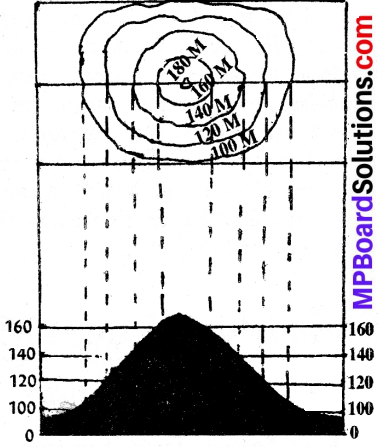
Conical hills:
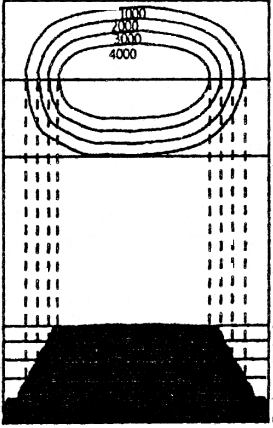
The contour lines are also of equal distance and equal round. If you see such contour lines in the map you will easily know that this is conical hill.

MP Board Class 8th Social Science Solutions Chapter 26 Study of Local Map

Plateau:
The top of plateau is more or less flat is represented by very few contours but its sides are steep and they are shown by closely spaced contours on a map.

MP Board Class 8th Social Science Solutions Chapter 26 Study of Local Map 2

Question 6.
What do the light blue and dark blue colours indicate?
Answer:
Depth of sea is shown by various shades. The sea is shown in map by blue colour, sea nearby land surface is shown by light blue colour. As the depth of sea increases the blue colour becomes darker. The deep and trenches of sea is indicated by the very dark blue colour.

MP Board Solutions

Project Work

Make a local map of your village or city and then discuss with colleagues in class.

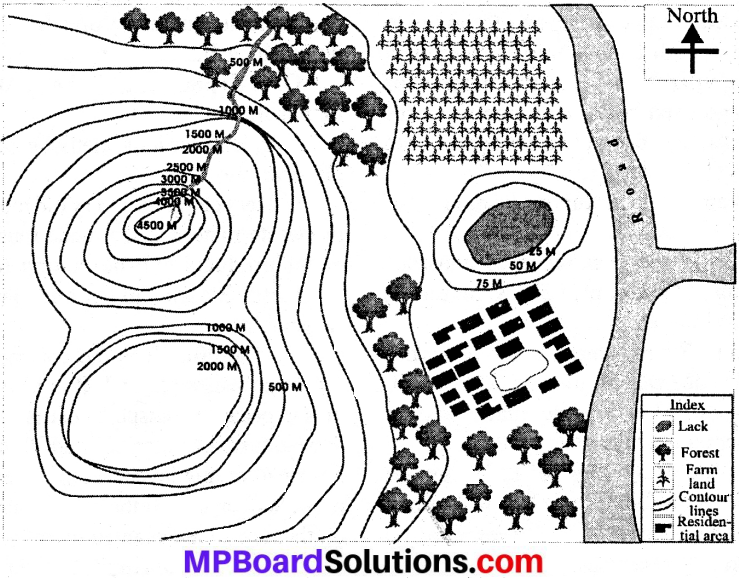
The local map contains following conventional signs.

  1. Contour lines
  2. Road
  3. Forest
  4. Field
  5. Pond
  6. River
  7. Residential areas.

With the help of local map, write in your exercise book.

Question 1.
Which landforms are being shown by the contour lines?

Question 2.
In which direction river is flowing?

Question 3.
Which landform is near forest?

Question 4.
Which is the landform between field and residential area?

Mp Board Class 8th Social Science Solutions Chapter 26 Studies image 3

MP Board Class 8th Social Science Solutions