MP Board Class 10th Maths Solutions Chapter 6 Triangles Ex 6.6

In this article, we will share MP Board Class 10th Maths Book Solutions Chapter 6 Triangles Ex 6.6 Pdf, These solutions are solved subject experts from the latest edition books.

MP Board Class 10th Maths Solutions Chapter 6 Triangles Ex 6.6

Question 1.
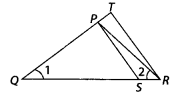
In the figure, PS is the bisector of ∠QPR of ∆PQR. Prove that \(\frac{Q S}{S R}=\frac{P Q}{P R}\).
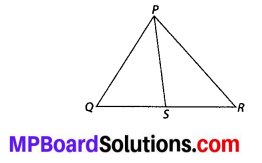
MP Board Class 10th Maths Solutions Chapter 6 Triangles Ex 6.6 1
Solution:
We have, ∆PQR in which PS is the bisector of ∠QPR.
∴ ∠QPS = ∠RPS
Let us draw RT || PS to meet QP produced at T, such that
∠1 = ∠RPS [Alternate angles]
Also, ∠3 = ∠QPS [Corresponding angles]
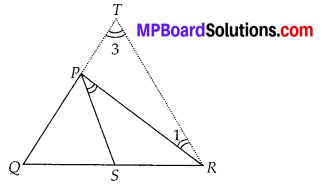
MP Board Class 10th Maths Solutions Chapter 6 Triangles Ex 6.6 2
But ∠RPS = ∠QPS [Given]
∴ ∠1 = ∠3
∴ PT = PR
Now, in ∆QRT, PS || RT [By construction]
∴ Using the Basic Proportionality Theorem, we have
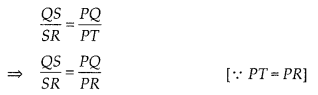
MP Board Class 10th Maths Solutions Chapter 6 Triangles Ex 6.6 3

Question 2.
In the figure, D is a point on hypotenuse AC of ∆ABC, such that BD ⊥ AC, DM ⊥ BC and DN ⊥ AB. Prove that
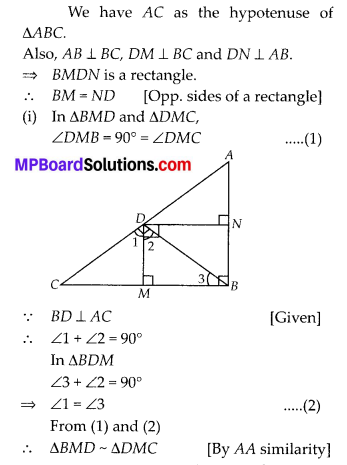
(i) DM2 = DN.MC
(ii) DN2 = DM.AN
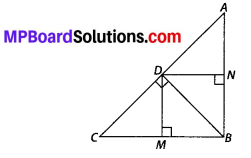
MP Board Class 10th Maths Solutions Chapter 6 Triangles Ex 6.6 4
Solution:
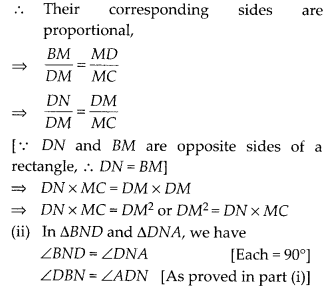
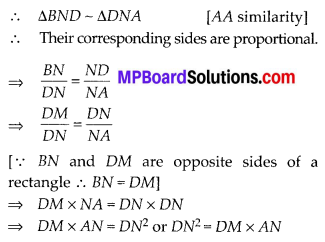
MP Board Class 10th Maths Solutions Chapter 6 Triangles Ex 6.6 5
MP Board Class 10th Maths Solutions Chapter 6 Triangles Ex 6.6 6
MP Board Class 10th Maths Solutions Chapter 6 Triangles Ex 6.6 7

Question 3.
In the figure, ABC is a triangle in which ∠ABC > 90° and AD ⊥ CB produced. Prove that AC2 – AB2 + BC2 + 2BC.BD
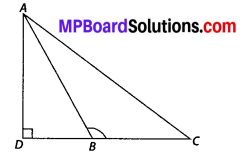
MP Board Class 10th Maths Solutions Chapter 6 Triangles Ex 6.6 8
Solution:
∆ABC is a triangle in which ∠ABC > 90° and AD ⊥ CB produced.
∵ In ∆ADB, ∠D = 90°
∴ Using Pythgoras Theorem, we have
AB2 = AD2 + DB2 ….. (1)
In right ∆ADC, ∠D = 90°
∴ Using Pythagoras Theorem, we have
AC2 = AD2 + DC2
= AD2 + [BD + BC]2
= AD2 + [BD2 + BC2 + 2BD.BC]
⇒ AC2 = [AD2 + DB2] + BC2 + 2BC – BD
⇒ AC2 = AB2 + BC2 + 2BC – BD [From (1)] Thus, AC2 = AB2 + BC2 + 2 BC.BD

MP Board Class 10th Maths Solutions Chapter 6 Triangles Ex 6.6

Question 4.
In the figure, ABC is a triangle in which ∠ABC < 90° and AD ⊥ BC. Prove that AC2 = AB2 + BC2 – 2BC.BD.
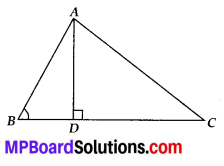
MP Board Class 10th Maths Solutions Chapter 6 Triangles Ex 6.6 9
Solution:
We have ∆ABC in which ∠ABC < 90°
and AD ⊥ BC
In right ∆ADB, ∠D = 90°
Using Pythagoras Theorem, we have
AB2 = AD2 + BD2 …… (1)
Also in right ∆ADC, ∠D = 90°
Using Pythagoras Theorem, we have AC2 = AD2 + DC2
= AD2 + [BC – BD]2 = AD2 + [BC2 + BD2 – 2BC.BD]
= [AD2 + BD2] + BC2 – 2BC.BD = AB2 + BC2 – 2BC.BD [From (1)]
Thus, AC2 = AB2 + BC2 – 2BC.BD, which is the required relation.

Question 5.
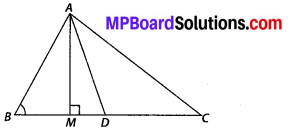
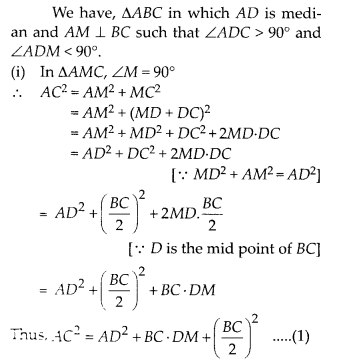
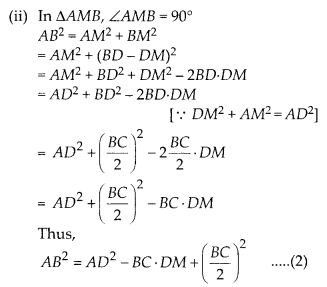
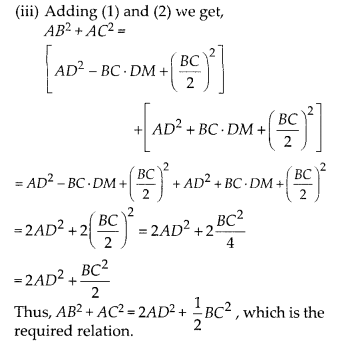
In the figure, AD is a median of triangle ABC and AM ⊥ BC. Prove that
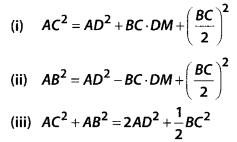
MP Board Class 10th Maths Solutions Chapter 6 Triangles Ex 6.6 10
MP Board Class 10th Maths Solutions Chapter 6 Triangles Ex 6.6 11
Solution:
MP Board Class 10th Maths Solutions Chapter 6 Triangles Ex 6.6 12
MP Board Class 10th Maths Solutions Chapter 6 Triangles Ex 6.6 13
MP Board Class 10th Maths Solutions Chapter 6 Triangles Ex 6.6 14

Question 6.
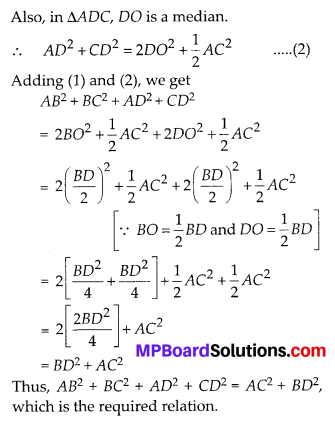
Prove that the sum of the squares of the diagonals of parallelogram is equal to the sum of the squares of its sides.
Solution:
We have a parallelogram ABCD.
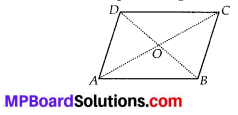
MP Board Class 10th Maths Solutions Chapter 6 Triangles Ex 6.6 15
AC and BD are the diagonals of parallelogram ABCD.
∵ Diagonals of a parallelogram bisect each other.
∴ O is the mid-point of AC and BD.
Now, in ∆ABC, BO is a median.

MP Board Class 10th Maths Solutions Chapter 6 Triangles Ex 6.6 16
MP Board Class 10th Maths Solutions Chapter 6 Triangles Ex 6.6 17

Question 7.
In the figure, two chords AB and CD intersect each other at the point P. Prove that:
(i) ∆APC – ∆DPB
(ii) AP.PB = CP.DP
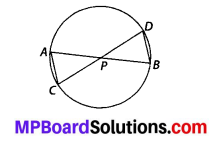
MP Board Class 10th Maths Solutions Chapter 6 Triangles Ex 6.6 18
Solution:
We have two chords AB and CD of a circle. AB and CD intersect at P.
(i) In ∆APC and ∆DPB,
∴ ∠APC = ∠DPB ….. (1)
[Vertically opp. angles]
∠CAP = ∠BDP …… (2)
[Angles in the same segment]
From (1) and (2) and using AA similarity, we have
∆APC ~ ∆DPB

(ii) Since, ∆APC ~ ∆DPB [As proved above]
∴ Their corresponding sides are proportional,

MP Board Class 10th Maths Solutions Chapter 6 Triangles Ex 6.6 19
⇒ AP.BP = CP.DP, which is the required relation.

Question 8.
In the figure, two chords AB and CD of a circle intersect each other at the point P (when produced) outside the circle. Prove that
(i) ∆PAC – ∆PDB
(ii) PA.PB = PC.PD
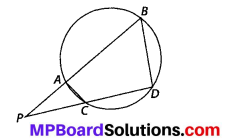
MP Board Class 10th Maths Solutions Chapter 6 Triangles Ex 6.6 20
Solution:
We have two chords AB and CD when produced meet outside the circle at P.
(i) Since in a cyclic quadrilateral, the exterior angle is equal to the interior opposite angle,
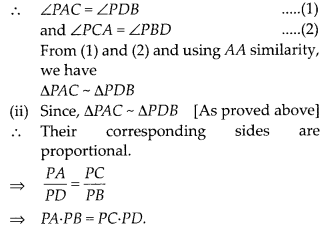
MP Board Class 10th Maths Solutions Chapter 6 Triangles Ex 6.6 21

Question 9.
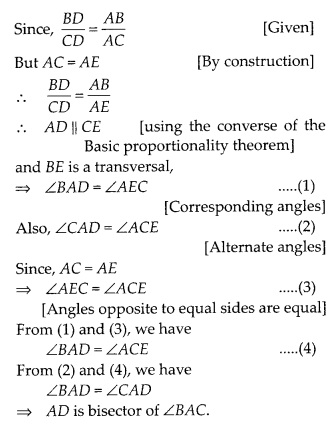
In the figure, D is a point on side BC of ∆ABC such that \(\frac{B D}{C D}=\frac{A B}{A C}\). Prove that AD is the bisector of ∠BAC.
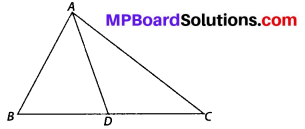
MP Board Class 10th Maths Solutions Chapter 6 Triangles Ex 6.6 22
Solution:
Let us produce BA to E such that AE = AC
Join EC.
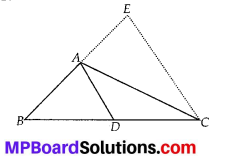
MP Board Class 10th Maths Solutions Chapter 6 Triangles Ex 6.6 23
MP Board Class 10th Maths Solutions Chapter 6 Triangles Ex 6.6 24

MP Board Class 10th Maths Solutions Chapter 6 Triangles Ex 6.6

Question 10.
Nazima is fly fishing in a stream. The tip of her fishing rod is 1.8 m above the surface of the water and the fly at the end of the string rests on the water 3.6 m away and 2.4 m from a point directly under the tip of the rod. Assuming that her string (from the tip of her rod to the fly) is taut, how much string does she have out (see figure)? If she pulls in the string at the rate of 5 cm per second, what will be the horizontal distance of the fly from her after 12 seconds ?
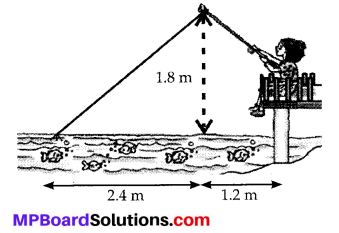
MP Board Class 10th Maths Solutions Chapter 6 Triangles Ex 6.6 25
Solution:
Let us find the length of the string that Nazima has out.
In right ∆OAB, OB2 = OA2 + AB2
∴ OB2 = (2.4)2 + (1.8)2
⇒ OB2 = 5.76 + 3.24 = 9.00
\(\Rightarrow \quad O B=\sqrt{9.00}=3 \mathrm{m}\)
i.e., Length of string she has out = 3 m
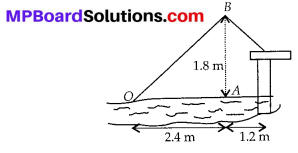
MP Board Class 10th Maths Solutions Chapter 6 Triangles Ex 6.6 26
Since, the string is pulled in at the rate of 5 cm/sec,
∴ Length of the string pulled in 12 seconds
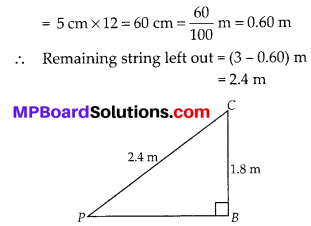
MP Board Class 10th Maths Solutions Chapter 6 Triangles Ex 6.6 27
In the ∆PBC, let PB be the required horizontal distance of fly.
Since, PB2 = PC2 – BC2 [By Pythagoras theorem]
∴ PB2 = (2.4)2 – (1.8)2 = 5.76 – 3.24 = 2.52
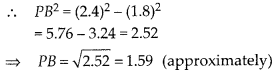
MP Board Class 10th Maths Solutions Chapter 6 Triangles Ex 6.6 28
Thus, the horizontal distance of the fly from Nazima after 12 seconds
= (1.59 + 1.2) m (approximately)
= 2.79 m (approximately)
MP Board Class 10th Maths Solutions Chapter 14 Statistics Ex 14.2

In this article, we will share MP Board Class 10th Maths Book Solutions Chapter 14 Statistics Ex 14.2 Pdf, These solutions are solved subject experts from the latest edition books.

MP Board Class 10th Maths Solutions Chapter 14 Statistics Ex 14.2

Question 1.
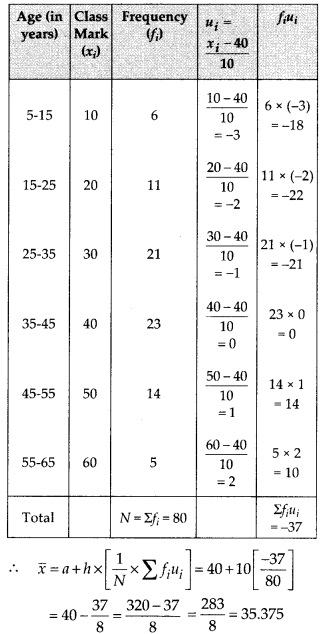
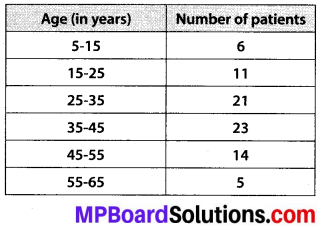
The following table shows the ages of the patients admitted in a hospital during a year:
MP Board Class 10th Maths Solutions Chapter 14 Statistics Ex 14.2 1
Find the mode and the mean of the data given above. Compare and interpret the two measures of central tendency.
Solution:
Mode:
Here, the highest frequency is 23.
The frequency 23 corresponds to the class interval 35 – 45.
∴ The modal class is 35 – 45
Now, class size, h = 10
Lower limit, l = 35
Frequency of the modal class (f1) = 23
Frequency of the class preceding the modal class (f0) = 21
Frequency of the class succeeding the modal class (f2) = 14
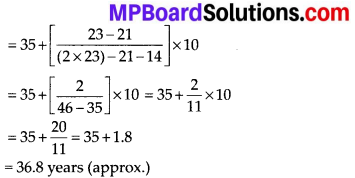
∴ Mode = l + \(\left[\frac{f_{1}-f_{0}}{2 f_{1}-f_{0}-f_{2}}\right]\) × h
MP Board Class 10th Maths Solutions Chapter 14 Statistics Ex 14.2 2
Mean: Let assumed mean, a = 40
Class size, h = 10
∴ ui = \(\frac{x_{i}-a}{h}=\frac{x_{i}-40}{10}\)
MP Board Class 10th Maths Solutions Chapter 14 Statistics Ex 14.2 3
∴ Required mean = 35.38 years.
Interpretation:
The maximum number of patients admitted in the hospital are of age 36.8 years while the average age of patients is 35.37 years.

MP Board Class 10th Maths Solutions Chapter 14 Statistics Ex 14.2

Question 2.
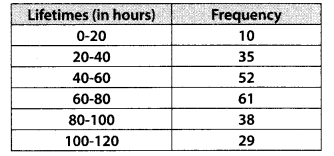
The following data gives the information on the observed lifetimes (in hours) of 225 electrical components:
MP Board Class 10th Maths Solutions Chapter 14 Statistics Ex 14.2 4
Determine the modal lifetimes of the components.
Solution:
Here, the highest frequency = 61.
∵ The frequency 61 corresponds to class 60 – 80
∴ The modal class is 60 – 80
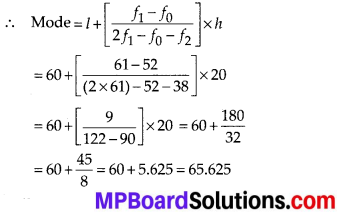
∴ We have l = 60, h = 20, f1 = 61, f0 = 52, f2 = 38
MP Board Class 10th Maths Solutions Chapter 14 Statistics Ex 14.2 5
Thus, the modal lifetimes of the components is 65.625 hours.

Question 3.
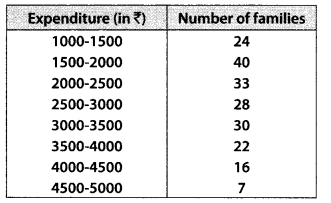
The following data gives the distribution of total monthly household expenditure of 200 families of a village. Find the modal monthly expenditure of the families. Also, find the mean monthly expenditure:
MP Board Class 10th Maths Solutions Chapter 14 Statistics Ex 14.2 6
Solution:
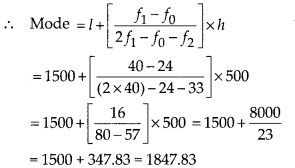
Mode:
∵ The maximum number of families i.e., 40 have their total monthly expenditure is in interval 1500 – 2000.
∴ The modal class is 1500 – 2000 and l = 1500, h = 500, f1 = 40, f0 = 24, f2 = 33
MP Board Class 10th Maths Solutions Chapter 14 Statistics Ex 14.2 7
Thus, the required modal monthly expenditure of the families is ₹ 1847.83.
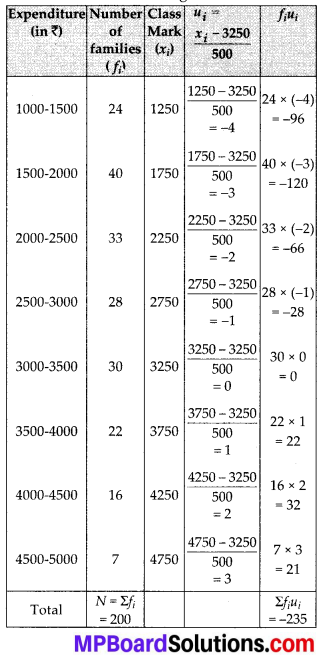
Mean: Let assumed mean, a = 3250
and class size, h = 500
∴ ui = \(\frac{x_{i}-a}{h}=\frac{x_{i}-3250}{500}\)
∴ We have the following table;
MP Board Class 10th Maths Solutions Chapter 14 Statistics Ex 14.2 8
∴ \(\overline{x}\) = a + h × [\(\frac{1}{N}\) Σfiui] = 3250 + 500 × \(\left[\frac{-235}{200}\right]\)
= 3250 – \(\frac{1175}{2}\) = 3250 – 587.50 = 2662.5
Thus, the mean monthly expenditure = ₹ 2662.50

Question 4.
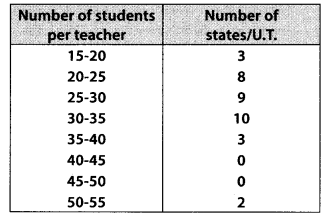
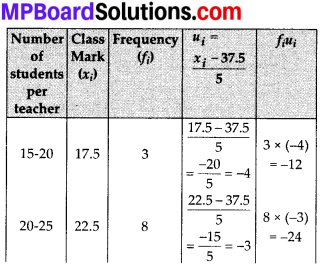
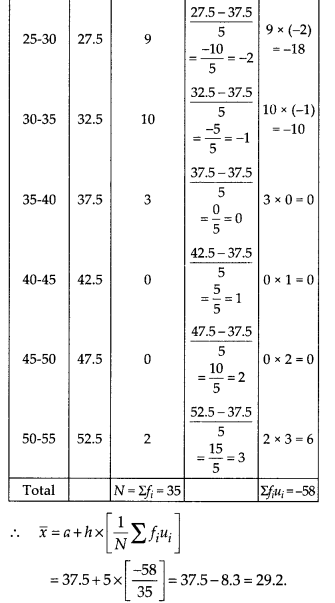
The following distribution gives the state-wise teacher-student ratio in higher secondary schools of India. Find the mode and mean of this data. Interpret the two measures.
MP Board Class 10th Maths Solutions Chapter 14 Statistics Ex 14.2 9
Solution:
Mode : Since greatest frequency i.e., 10 corresponds to class 30 – 35.
∴ Modal class = 30 – 35 and h = 5, l = 30, f1 = 10, f0 = 9, f2 = 3
∴ Mode = l + \(\left[\frac{f_{1}-f_{0}}{2 f_{1}-f_{0}-f_{2}}\right]\) × h
= 30 + \(\left[\frac{10-9}{20-9-3}\right]\) × 5
= 30 + \(\left[\frac{10-9}{20-9-3}\right]\) × 5 = 30 + 0.625 = 30.6 (approx)
Mean: Let the assumed mean, a = 37.5 and class size, h = 5
∴ ui = \(\frac{x_{i}-a}{h}=\frac{x_{i}-37.5}{5}\)
∴ We have the following table:
MP Board Class 10th Maths Solutions Chapter 14 Statistics Ex 14.2 10
MP Board Class 10th Maths Solutions Chapter 14 Statistics Ex 14.2 11
Interpretation:
The maximum teacher-student ratio is 30.6 while average teacher-student ratio is 29.2

MP Board Class 10th Maths Solutions Chapter 14 Statistics Ex 14.2

Question 5.
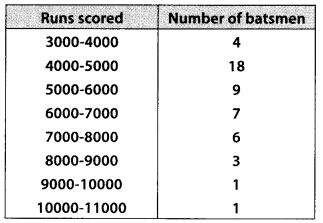
The given distribution shows the number of runs scored by some top batsmen of the world in one-day international cricket matches.
MP Board Class 10th Maths Solutions Chapter 14 Statistics Ex 14.2 12
Find the mode of the data
Solution:
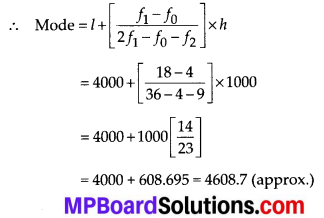
∵ The class 4000 – 5000 has the highest frequency i.e., 18
∴ Modal class = 4000 – 5000.
Also, h = 1000, l = 4000, f1 = 18, f0 = 4, f2 = 9
MP Board Class 10th Maths Solutions Chapter 14 Statistics Ex 14.2 13
Thus, the required mode is 4608.7 runs.

Question 6.
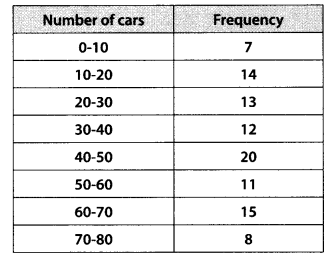
A student noted the number of cars passing through a spot on a road for 100 periods each of 3 minutes and summarised it in the table given below. Find the mode of the data:
MP Board Class 10th Maths Solutions Chapter 14 Statistics Ex 14.2 14
Solution:
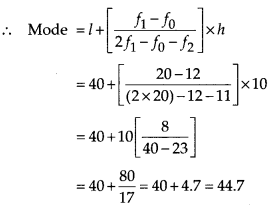
∵ The class 40 – 50 has the maximum frequency i.e., 20
∴ Modal class = 40 – 50
∴ f1 = 20, f0 = 12, f1 = 11 and l = 40. Also, h = 10
MP Board Class 10th Maths Solutions Chapter 14 Statistics Ex 14.2 15
Thus, the required mode is 44.7 cars.

MP Board Class 10th Maths Solutions Chapter 8 Introduction to Trigonometry Ex 8.2

In this article, we will share MP Board Class 10th Maths Book Solutions Chapter 8 Introduction to Trigonometry Ex 8.2 Pdf, These solutions are solved subject experts from the latest edition books.

MP Board Class 10th Maths Solutions Chapter 8 Introduction to Trigonometry Ex 8.2

Question 1.
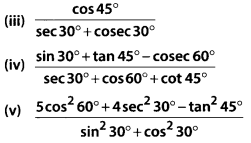
Evaluate the following:
(i) sin60° cos30° + sin 30° cos 60°
(ii) 2tan2 45° + cos230° – sin260°
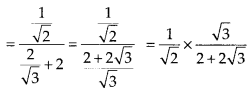
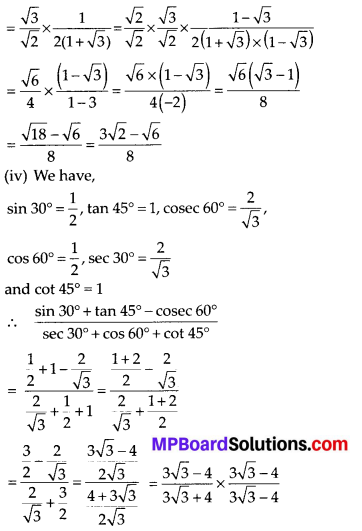
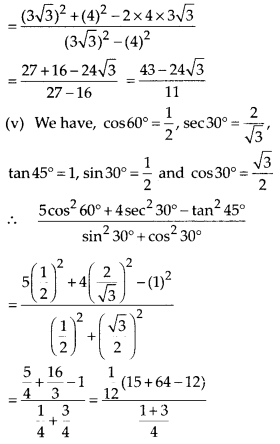
MP Board Class 10th Maths Solutions Chapter 8 Introduction to Trigonometry Ex 8.2 1
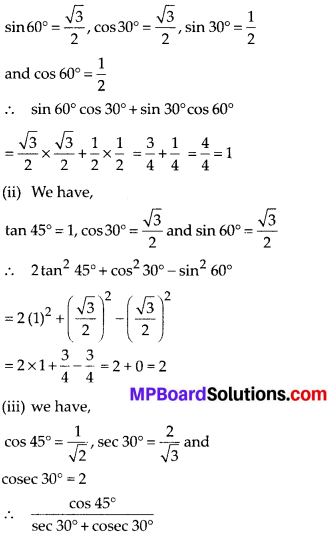
Solution:
(i) We have
MP Board Class 10th Maths Solutions Chapter 8 Introduction to Trigonometry Ex 8.2 2
MP Board Class 10th Maths Solutions Chapter 8 Introduction to Trigonometry Ex 8.2 3
MP Board Class 10th Maths Solutions Chapter 8 Introduction to Trigonometry Ex 8.2 4
MP Board Class 10th Maths Solutions Chapter 8 Introduction to Trigonometry Ex 8.2 5
= \(\frac{\frac{1}{12}\times67}{\frac{4}{4}}=\frac{67}{12}\)

Question 2.
Choose the correct option and justify your choice:
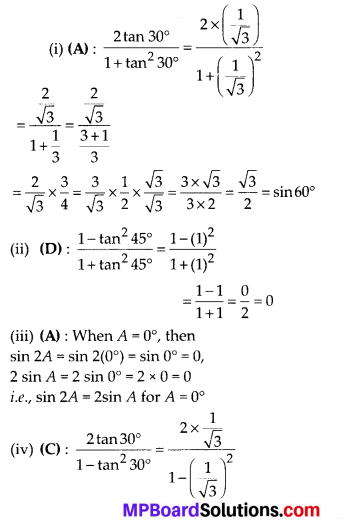
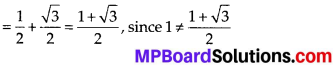
(i) \(\frac{2 \tan 30^{\circ}}{1+\tan ^{2} 30^{\circ}}=\)
(A) sin 60°
(B) cos 60°
(C) tan 60°
(D) sin 30°

(ii) \(\frac{1-\tan ^{2} 45^{\circ}}{1+\tan ^{2} 45^{\circ}}=\)
(A) tan 90°
(B) 1
(C) sin 45°
(D) 0

(iii) sin 2A = 2sin A is true when A =
(A) 0°
(B) 30°
(C) 45°
(D) 60°

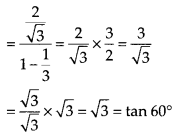
(iv) \(\frac{2 \tan 30^{\circ}}{1-\tan ^{2} 30^{\circ}}=\)
(A) cos 60°
(B) sin 60°
(C) tan 60°
(D) sin 30°
Solution:
MP Board Class 10th Maths Solutions Chapter 8 Introduction to Trigonometry Ex 8.2 6
MP Board Class 10th Maths Solutions Chapter 8 Introduction to Trigonometry Ex 8.2 7

MP Board Class 10th Maths Solutions Chapter 8 Introduction to Trigonometry Ex 8.2

Question 3.
If tan (A + B) = \(\sqrt{3}\) and tan (A – B) = \(\frac{1}{\sqrt{3}}\) 0°< A + B ≤ 90°; A > B, find A and B.
Solution:
We have,
tan 60° = \(\sqrt{3}\), tan 30° = \(\frac{1}{\sqrt{3}}\) ……………. (1)
Also, tan(A + B) = \(\sqrt{3}\) and tan (A – B) = \(\frac{1}{\sqrt{3}}\) …………… (2)
From (1) and (2), we get
A + B = 60° …………… (3)
and A – B = 30° ………….. (4)
On adding (3) and (4), we get
2A = 90° ⇒ A =45°
On subtracting (4) from (3), we get
2B = 30° ⇒ B = 15°

Question 4.
State whether the following are true or false. Justify your answer.
(i) sin (A + B) = sin A + sin B.
(ii) The value of sin6 increases as θ increases.
(iii) The value of cosθ increases as θ increases.
(iv) sin θ = cos θ for all values of θ.
(v) cot A is not defined for A = 0°.
Solution:
(i) False:
Let us take A = 30° and B = 60°, then
L.H.S = sin (30° + 60°) = sin 90° = 1
MP Board Class 10th Maths Solutions Chapter 8 Introduction to Trigonometry Ex 8.2 8
∴ L.H.S. ≠ R.H.S.
(ii) True:
Since, the values of sin θ increases from 0 to 1 as θ increases from 0° to 90°.
(iii) False:
Since, the value of cos θ decreases from 1 to 0 as θ increases from 0° to 90°.
(iv) False:
Let us take θ = 30°
sin 30° = \(\frac{1}{2}\) and cos 30° = \(\frac{\sqrt{3}}{2}\)
⇒ sin 30° ≠ cos 30°
(v) True:
We have, cot 0° = not defined

MP Board Class 10th Maths Solutions Chapter 6 Triangles Ex 6.3

In this article, we will share MP Board Class 10th Maths Book Solutions Chapter 6 Triangles Ex 6.3 Pdf, These solutions are solved subject experts from the latest edition books.

MP Board Class 10th Maths Solutions Chapter 6 Triangles Ex 6.3

Question 1.
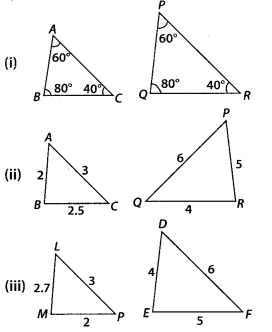
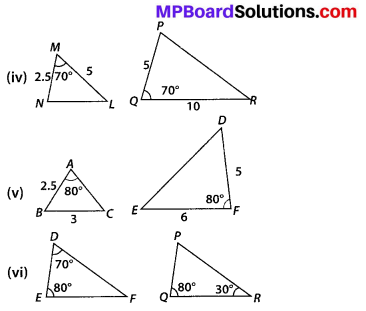
State which pairs of triangles in the given figures are similar. Write the similarity criterion used by you for answering the question and also write the pairs of similar triangles in the symbolic form.
MP Board Class 10th Maths Solutions Chapter 6 Triangles Ex 6.3 1
MP Board Class 10th Maths Solutions Chapter 6 Triangles Ex 6.3 2
Solution:
(i) In ∆ABC and ∆PQR,
We have : ∠A = ∠P = 60°
∠B = ∠Q = 80°
∠C = ∠R = 40°
∴ The corresponding angles are equal.
∴ Using the AAA similarity rule,
∆ABC ~ ∆PQR

(ii) In ∆ABC and ∆QRP,
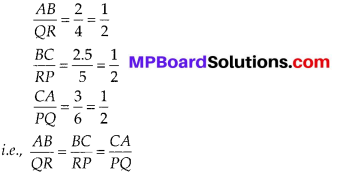
MP Board Class 10th Maths Solutions Chapter 6 Triangles Ex 6.3 3
i.e., Using the SSS similarity, ∆ABC ~ ∆QRP

(iii) In ∆LMP and ∆DEF,
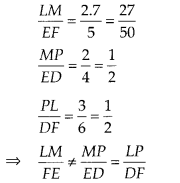
MP Board Class 10th Maths Solutions Chapter 6 Triangles Ex 6.3 4
∴ Triangles are not similar,

(iv) In ∆MNL and ∆QPR,
\(\frac{M L}{Q R}=\frac{M N}{Q P}\) [\(\frac{1}{2}\) each]
and ∠NML = ∠PQR
∴ Using SAS similarity, we have
∆MNL ~ ∆QPR.

(v) In ∆ABC and ∆FDE,
\(\frac{A B}{D F}=\frac{B C}{E F}\) [\(\frac{1}{2}\) each]
Now, angle between DF and EF is 80°. But angle between AB and BC is unknown.
∴ Triangles are not similar.

(vi) In ∆DEF and ∆PQR,
∠D = ∠P = 70°
[∵ ∠P = 180° – (80° + 30°) = 180° – 110° = 70°]
∠E = ∠Q = 80°
∠F = ∠R = 30° [∵∠F = 180°]
∴ Using the AAA similarity rule,
∆DFE ~ ∆PRQ.

Question 2.
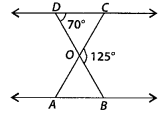
In the figure, ∆ODC ~ ∆OBA, ∠BOC = 125° and ∠CDO = 70°. Find ∠DOC, ∠DCO and ∠OAB.
MP Board Class 10th Maths Solutions Chapter 6 Triangles Ex 6.3 5
Solution:
We have, ∠BOC = 125° and ∠CDO = 70°
since, ∠DOC + ∠BOC = 180° [Linear pair]
⇒ ∠DOC = 180° – 125° = 55° ……………… (1)
In ∆DOC,
Using the angle sum property for ∆ODC, we get
∠DOC + ∠ODC + ∠DCO = 180°
⇒ 55° + 70° + ∠DCO = 180°
⇒ ∠DCO = 180° – 55° – 70° = 55°
Again,
∠DOC = ∠BOA ……………. (2) [vertically opposite angles]
and ∠OCD = ∠OAB = 55° ………….. (3)
[corresponding angles of similar triangles]
Thus, from (1), (2) and (3)
∠DOC = 55°, ∠DCO = 55° and ∠OAB = 55°.

MP Board Class 10th Maths Solutions Chapter 6 Triangles Ex 6.3

Question 3.
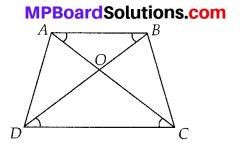
Diagonals AC and BD of a trapezium ABCD with AB || DC intersect each other at the point O. Using a similarity criterion for two triangles, show that \(\frac{O A}{O C}=\frac{O B}{O D}\).
Solution:
We have a trapezium ABCD in which AB || DC. The diagonals AC and BD intersect at O.
MP Board Class 10th Maths Solutions Chapter 6 Triangles Ex 6.3 6
In ∆OAB and ∆OCD,
∠OBA = ∠ODC (Alternate angles)
and ∠OAB = ∠OCD(Alternate angles)
Using AA similarity rule, ∆OAB ~ ∆OCD
So, \(\frac{O B}{O D}=\frac{O A}{O C}\) (Ratios ot corresponding sides of the similar triangles)
⇒ \(\frac{O A}{O C}=\frac{O B}{O D}\)

Question 4.
In the figure, \(\frac{Q R}{Q S}=\frac{Q T}{P R}\) and ∠1 = ∠2. show that ∆PQS ~ ∆TQR.
MP Board Class 10th Maths Solutions Chapter 6 Triangles Ex 6.3 7
Solution:
In ∆PQR
∵ ∠1 = ∠2 [Given]
∴ PR = QP ……………… (1)
[∵ In a ∆ sides opposite to equal angles are equal]
MP Board Class 10th Maths Solutions Chapter 6 Triangles Ex 6.3 8
and ∠SQP = ∠RQT = ∠1
Now, using SAS similarity rule,
∆PQS ~ ∆TQR.

Question 5.
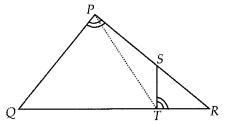
S and T are points on sides PR and QR of ∆PQR such that ∠P = ∠RTS. Show that ∆RPQ ~ ∆RTS.
Solution:
In ∆PQR,
T is a point on QR and S is a point on PR such that ∠RTS = ∠P.
MP Board Class 10th Maths Solutions Chapter 6 Triangles Ex 6.3 9
Now in ∆RPQ and ∆RTS,
∠RPQ = ∠RTS [Given]
∠PRQ = ∠TRS [Common]
Using AA similarity, we have ∆RPQ ~ ∆RTS.

Question 6.
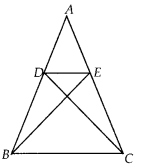
In the figure, if ∆ABE ≅ ∆ACD, show that ∆ADE ~ ∆ABC.
Solution:
We have,
∆ABE ≅ ∆ACD
Their corresponding parts are equal, i.e.,
AB = AC, AE = AD
MP Board Class 10th Maths Solutions Chapter 6 Triangles Ex 6.3 10
MP Board Class 10th Maths Solutions Chapter 6 Triangles Ex 6.3 11
and ∠DAE = ∠BAC (common)
∴ Using the SAS similarity, we have ∆ADE ~ ∆ABC.

MP Board Class 10th Maths Solutions Chapter 6 Triangles Ex 6.3

Question 7.
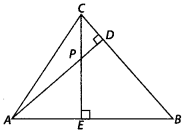
In the figure, altitudes AD and CE of ∆ABC intersect each other at the point P. Show that:
(i) ∆AEP ~ ∆CDP
(ii) ∆ABD ~ ∆CBE
(iii) ∆AEP ~ ∆ADB
(iv) ∆PDC ~ ∆BEC
MP Board Class 10th Maths Solutions Chapter 6 Triangles Ex 6.3 12
Solution:
We have a ∆ABC in which altitude AD and CE intersect each other at P.
⇒ ∠D = ∠E = 90° …………. (1)
(i) In ∆AEP and ∆CDP,
∠AEP = ∠CDP [From (1)]
∠EPA = ∠DPC [Vertically opp. angles]
∴ Using AA similarity, we get
∆AEP ~ ∆CDP

(ii) In ∆ABD and ∆CBE,
∠ADB = ∠CEB [From (1)]
Also, ∠ABD = ∠CBE [Common]
Using A A similarity, we have
∆ABD ~ ∆CBE

(iii) In ∆AEP and ∆ADB,
∵ ∠AEP = ∠ADB [From (1)]
Also, ∠EAP = ∠DAB [Common]
∴ Using AA similarity, we have
∆AEP ~ ∆ADB

(iv) In ∆PDC and ∆BEC,
∵ ∠PDC = ∠BEC [From (1)]
Also, ∠DCP = ∠ECB [Common]
∴ Using AA similarity, we have
∆PDC ~ ∆BEC

Question 8.
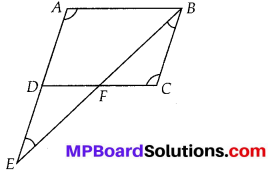
E is a point on the side AD produced of a parallelogram ABCD and BE intersects CD at F. Show that ∆ABE ~ ∆CFB.
Solution:
We have a parallelogram ABCD in which AD is produced to E and BE is joined such that BE intersect CD at F.
MP Board Class 10th Maths Solutions Chapter 6 Triangles Ex 6.3 13
Now, in ∆ABE and ∆CFB
∠BAE = ∠FCB [Opp. angles of a || gm are always equal]
∠AEB = ∠CBF [∵ Parallel sides are intersected by the transversal BE]
Now, using AA similarity, we have ∆ABE ~ ∆CFB.

Question 9.
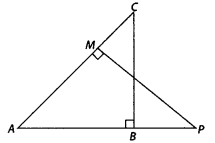
MP Board Class 10th Maths Solutions Chapter 6 Triangles Ex 6.3 14
Prove that:
(i) ∆ABC ~ ∆AMP
(ii) \(\frac{C A}{P A}=\frac{B C}{M P}\)
Solution:
We have ∆ABC, right angled at B and ∆AMP, right angled at M.
∴ ∠B = ∠M = 90°
(i) In ∆ABC and ∆AMP,
∠ABC = ∠AMP [From (1)]
and ∠BAC = ∠MAP [Common]
∴ Using AA similarity, we get
∆ABC ~ ∆AMP

(ii) ∵ ∆ABC ~ ∆AMP [As proved above]
∴ Their corresponding sides are proportional.
⇒ \(\frac{C A}{P A}=\frac{B C}{M P}\)

Question 10.
CD and GH are respectively the bisectors of ∠ACB and ∠EGF such that 0 and H lie on sides AB and FE of ∆ABC and ∆EFG respectively. If ∆ABC ~ ∆FEG, show that:
CD AC
(i) \(\frac{C D}{G H}=\frac{A C}{F G}\)
(ii) ∆DCB ~ ∆HGE
(iii) ∆DCA ~ ∆HGF
Solution:
We have, two similar ∆ABC and ∆FEG such that CD and GH are the bisectors of ∠ACB and ∠FGE respectively.
MP Board Class 10th Maths Solutions Chapter 6 Triangles Ex 6.3 15
(i) In ∆ACD and ∆FGH,
Since ∆ABC ~ ∆FEG
∠A = ∠F …………….. (1)
and ∠ACB = ∠FGE ⇒ \(\frac{1}{2}\) ∠ACB = \(\frac{1}{2}\) ∠FGE
⇒ ∠ACD = ∠FGH ……………. (2)
From (1) and (2),
∆ACD ~ ∆FGH [AA similarity]
∴ Their corresponding sides are proportional,
∴ \(\frac{C D}{G H}=\frac{A C}{F G}\)

(ii) In ∆DCB and ∆HGE,
Since ∆ABC ~ ∆FEG
⇒ ∠B = ∠E …………….. (1)
and ∠ACB = ∠FGE
∴ \(\frac{1}{2}\)∠ACB = \(\frac{1}{2}\)∠FGE
⇒ ∠DCB = ∠HGE ……………. (2)
From (1) and (2),
∆DCB ~ ∆HGE [AA similarity]

(iii) From (i) part, we get
∆ACD ~ ∆FGH
⇒ ∆DCA ~ ∆HGF

MP Board Class 10th Maths Solutions Chapter 6 Triangles Ex 6.3

Question 11.
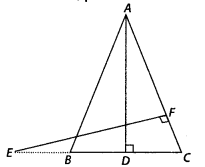
In the figure, E is a point on side CB produced of an isosceles triangle ABC with AB = AC. If AD⊥BCand EF⊥AC, prove that ∆ABD ~ ∆ECF.
MP Board Class 10th Maths Solutions Chapter 6 Triangles Ex 6.3 16
Solution:
We have an isosceles ∆ABC in which
AB = AC.
⇒ Angles opposite to them are equal
∠ACB = ∠ABC ……………. (1)
In ∆ABD and ∆ECF,
∠ECF = ∠ABD [from (1)]
and AD⊥BC and EF⊥AC
⇒ ∠ADB = ∠EFC = 90°
∴ ∆ABD ~ ∆ECF [AA similarity]

Question 12.
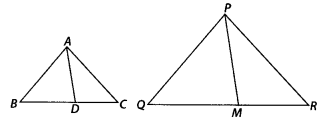
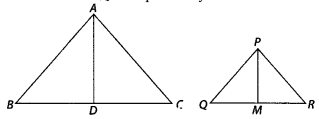
Sides AB and BC and median AD of a triangle ABC are respectively proportional to sides PQ and QR and median PM of ∆PQR (see figure). Show that ∆ABC ~ ∆PQR.
MP Board Class 10th Maths Solutions Chapter 6 Triangles Ex 6.3 17
Solution:
We have ∆ABC and ∆PQR in which AD and PM are medians corresponding to sides BC and QR respectively such that
\(\frac{A B}{P Q}=\frac{B C}{Q R}=\frac{A D}{P M}\)
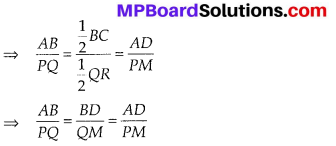
MP Board Class 10th Maths Solutions Chapter 6 Triangles Ex 6.3 18
∴ Using SSS similarity, we have ∆ABD ~ ∆PQM
∴ Their corresponding angles are equal.
⇒ ∠ABD = ∠PQM ⇒ ∠ABC = ∠PQR
Now, in ∆ABC and ∆PQR, \(\frac{A B}{P Q}=\frac{B C}{Q R}\) …………. (1)
Also, ∠ABC = ∠PQR …………… (2)
From (1) and (2),
∆ABC ~ ∆PQR. (SAS similarity)
Question 13.
O is a point on the side BC of a triangle ABC such that ∠ADC = ∠BAC. Show that CA2 = CB CD.
Solution:
We have a ∆ABC and a point D on its side BC such that ∠ADC = ∠BAC.
MP Board Class 10th Maths Solutions Chapter 6 Triangles Ex 6.3 19
In ∆BAC and ∆ADC,
∵ ∠BAC = ∠ADC [Given]
and ∠BCA = ∠DCA [Common]
Using AA similarity, we have
∆BAC ~ ∆ADC.
∴ Their corresponding sides are proportional.
⇒ \(\frac{C A}{C D}=\frac{C B}{C A}\)
⇒ CA × CA = CB × CD
⇒ CA2 = CB × CD

Question 14.
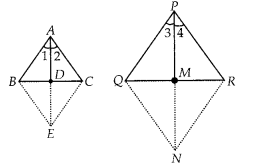
Sides AB and AC and median AD of a triangle ABC are respectively proportional to sides PQ and PR and median PM of another triangle PQR. Show that ∆ABC ~ ∆PQR.
Solution:
Given : ∆ABC and ∆PQR in which AD and PM are medians.
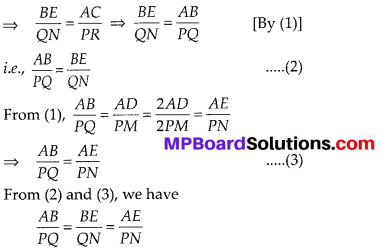
Also, \(\frac{A B}{P Q}=\frac{A C}{P R}=\frac{A D}{P M}\) …………….. (1)
To Prove: ∆ABC ~ ∆PQR
Construction: Produce AD to E and PM to N such that AD = DE and PM = MN. Join BE, CE, QN and RN.
MP Board Class 10th Maths Solutions Chapter 6 Triangles Ex 6.3 20
Proof: Quadrilaterals ABEC and PQNR are parallelograms, since their diagonals bisect each other at point D and M respectively.
⇒ BE = AC and QN = PR
MP Board Class 10th Maths Solutions Chapter 6 Triangles Ex 6.3 21
⇒ ∆ABE ~ ∆PQN ⇒ ∠1 = ∠3 …………. (4)
Similarly, we can prove
⇒ ∆ACE ~ ∆PRN ⇒ ∠2 = ∠4 …………….. (5)
From (4) and (5)
⇒ ∠1 + ∠2 = ∠3 + ∠4
⇒ ∠A = ∠P ………….. (6)
Now, in ∆ABC and ∆PQR, we have
\(\frac{A B}{P Q}=\frac{A C}{P R}\) [From (1)]
and ∠A = ∠P [From (6)]
∴ ∆ABC ~ ∆PQR

MP Board Class 10th Maths Solutions Chapter 6 Triangles Ex 6.3

Question 15.
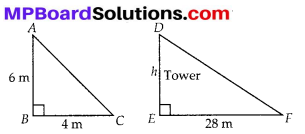
A vertical pole of length 6 m casts a shadow 4 m long on the ground and at the same time a tower casts a shadow 28 m long. Find the height of the tower.
Solution:
Let AB = 6 m be the pole and BC = 4 m be its shadow (in right ∆ABC), whereas DE and EE denote the tower and its shadow respectively.
∵ EF = Length of the shadow of the tower = 28 m
and DE = h = Height of the tower
MP Board Class 10th Maths Solutions Chapter 6 Triangles Ex 6.3 22
In ∆ABC and ∆DEF, we have ∠B = ∠E = 90°
∠C = ∠F [∵ Angular elevation of the sun at the same time is equal]
∴ Using AA similarity, we have
∆ABC ~ ∆DEF
∴ Their sides are proportional i.e., \(\frac{A B}{D E}=\frac{B C}{E F}\)
⇒ \(\frac{6}{h}=\frac{4}{28}\) ⇒ h = \(\frac{6 \times 28}{4}\) = 42
Thus, the required height of the tower is 42 m.

Question 16.
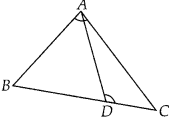
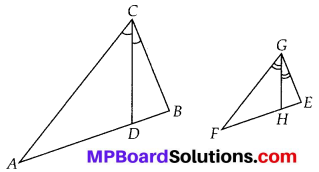
If MD and PM are medians of triangles ABC and PQR, respectively where, ∆ABC ~ ∆PQR, prove that \(\frac{A B}{P Q}=\frac{A D}{P M}\).
Solution:
We have ∆ABC ~ ∆PQR such that AD and PM are the medians corresponding to the sides BC and QR respectively.
MP Board Class 10th Maths Solutions Chapter 6 Triangles Ex 6.3 23
∵ ∆ABC ~ ∆PQR
And the corresponding sides of similar triangles are proportional.
∴ \(\frac{A B}{P Q}=\frac{B C}{Q R}=\frac{C A}{R P}\) ……………. (1)
∵ Corresponding angles are also equal in two similar triangles.
∴ ∠A = ∠P, ∠B = ∠Q and ∠C = ∠R …………… (2)
Since, AD and PM are medians.
∴ BC = 2BD and QR = 2QM
∴ From (1) \(\frac{A B}{P Q}=\frac{2 B D}{2 Q M}=\frac{B D}{Q M}\) ………… (3)
And ∠B = ∠Q ⇒ ∠ABD = ∠PQM
∴ From (3) and (4), we have
∆ABD ~ ∆PQM (SAS similarity)
∴ Their corresponding sides are proportional.
⇒ \(\frac{A B}{P Q}=\frac{A D}{P M}\)
MP Board Class 10th Maths Solutions Chapter 8 Introduction to Trigonometry Ex 8.1

In this article, we will share MP Board Class 10th Maths Book Solutions Chapter 8 Introduction to Trigonometry Ex 8.1 Pdf, These solutions are solved subject experts from the latest edition books.

MP Board Class 10th Maths Solutions Chapter 8 Introduction to Trigonometry Ex 8.1

Question 1.
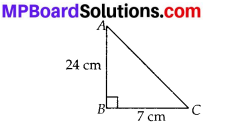
In ∆ABC, right-angled at B, AB = 24 cm, BC = 7 cm. Determine:
(i) sin A, cos A
(ii) sin C, cos C
Solution:
In right angle ∆ABC, we have
AB = 24 cm, BC = 7 cm
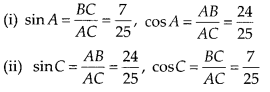
MP Board Class 10th Maths Solutions Chapter 8 Introduction to Trigonometry Ex 8.1 1
∴ Using Pythagoras theorem,
AC2 = AB2 + BC2
⇒ AC2 = 242 + 72 = 576 + 49 = 625 = 252
⇒ AC = 25 cm
MP Board Class 10th Maths Solutions Chapter 8 Introduction to Trigonometry Ex 8.1 2

Question 2.
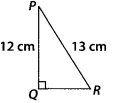
In the figure, find tan P – cotR?
MP Board Class 10th Maths Solutions Chapter 8 Introduction to Trigonometry Ex 8.1 3
Solution:
In right angle ∆PQR
Using the Pythagoras theorem, we get
QR2 = PR2 – PQ2
⇒ QR2 = 132 – 122 = (13 – 12)(13 + 12) = 1 × 25 = 25
∴ QR = \(\sqrt{25}\) = 5 cm
Now, tanP = \(\frac{Q R}{P Q}=\frac{5}{12}\) , cotR = \(\frac{Q R}{P Q}=\frac{5}{12}\)
∴ tanP – cotR = \(\frac{5}{12}-\frac{5}{12}\) = 0.

MP Board Class 10th Maths Solutions Chapter 8 Introduction to Trigonometry Ex 8.1

Question 3.
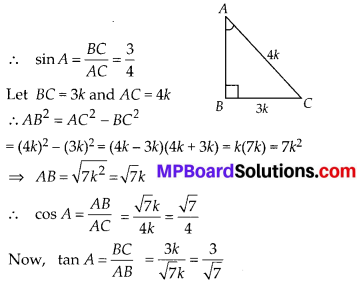
If sinA = \(\frac{3}{4}\), calculate cosA and tanA.
Solution:
Let us consider, the right angle ∆ABC, we have
Perpendicular = BC and Hypotenuse = AC
MP Board Class 10th Maths Solutions Chapter 8 Introduction to Trigonometry Ex 8.1 4

Question 4.
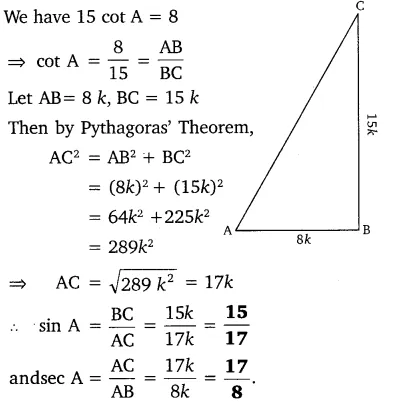
Given 15 cot A = 8, find sin A and sec A.
Solution:
In the right angle triangle ABC, we have 15 cot A = 8
MP Board Class 10th Maths Solutions Chapter 8 Introduction to Trigonometry Ex 8.1 5

Question 5.
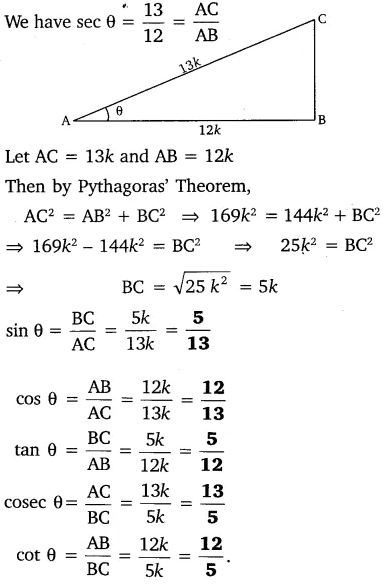
Given sec θ = \(\frac { 13 }{ 12 } \), calculate all other trigonometric ratios.
Solution:
MP Board Class 10th Maths Solutions Chapter 8 Introduction to Trigonometry Ex 8.1 6

Question 6.
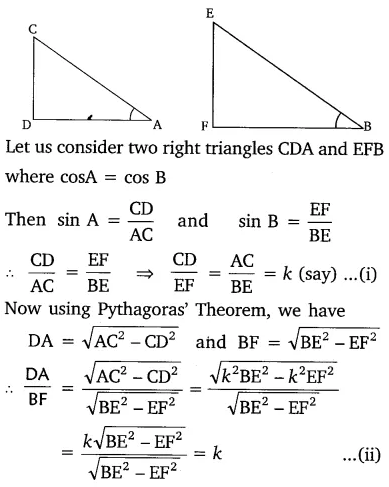
If ∠A and ∠B are acute angles such that cos A = cos B, then show that ∠A = ∠B.
Solution:
MP Board Class 10th Maths Solutions Chapter 8 Introduction to Trigonometry Ex 8.1 7
From equations (i) and (ii) we get:
\(\frac{\mathrm{CD}}{\mathrm{EF}}=\frac{\mathrm{AC}}{\mathrm{BE}}=\frac{\mathrm{AD}}{\mathrm{BF}}\)
⇒ ∆CDA ~ ∆EFB [By SSS similarity]
⇒ ∠A = ∠B Hence Proved

MP Board Class 10th Maths Solutions Chapter 8 Introduction to Trigonometry Ex 8.1

Question 7.
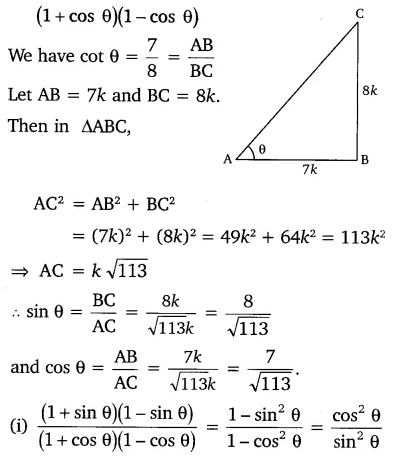
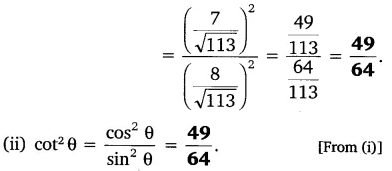
If cot θ = \(\frac { 7 }{ 8 }\), evaluate:
(i) \(\frac { \left( 1+sin\theta \right) \left( 1-sin\theta \right) }{ \left( 1+cos\theta \right) \left( 1-cos\theta \right)}\)
(ii) cot²θ
Solution:
MP Board Class 10th Maths Solutions Chapter 8 Introduction to Trigonometry Ex 8.1 8
MP Board Class 10th Maths Solutions Chapter 8 Introduction to Trigonometry Ex 8.1 9

Question 8.
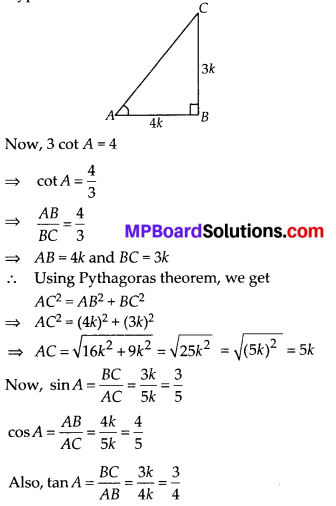
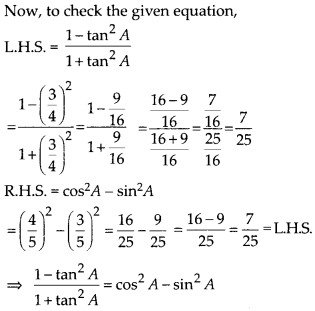
If 3 cot A = 4, check whether \(\frac { 1-tan^{ 2 }A }{ 1+tan^{ 2 }A }\) = cos² A – sin² A or not.
Solution:
In right angled ∆ABC, ∠B = 90°
For ∠A, we have:
Base = AB and perpendicular = BC. Also, Hypotenuse = AC
MP Board Class 10th Maths Solutions Chapter 8 Introduction to Trigonometry Ex 8.1 10
MP Board Class 10th Maths Solutions Chapter 8 Introduction to Trigonometry Ex 8.1 11

Question 9.
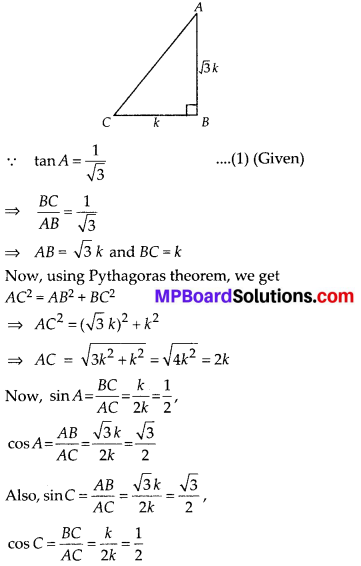
In triangle ABC, right angled at B, if tan A = \(\frac{1}{\sqrt{3}}\) find the value of:
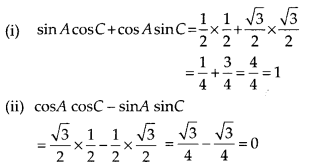
(i) sin A cos C + cos A sin C
(ii) cos A cos C – sin A sin C
Solution:
In right ∆ABC, ∠B = 90°
For ∠A, we have
Base = AB, Perpendicular = BC,
Hypotenuse = AC
MP Board Class 10th Maths Solutions Chapter 8 Introduction to Trigonometry Ex 8.1 12
MP Board Class 10th Maths Solutions Chapter 8 Introduction to Trigonometry Ex 8.1 13

MP Board Class 10th Maths Solutions Chapter 8 Introduction to Trigonometry Ex 8.1

Question 10.
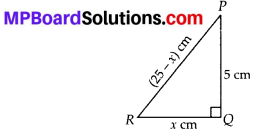
In ∆PQR, right-angled at Q, PR + QR = 25 cm and PQ = 5 cm. Determine the values of sinP, cosP and tanP.
Solution:
In right ∆PQR, Q = 90°
MP Board Class 10th Maths Solutions Chapter 8 Introduction to Trigonometry Ex 8.1 14
PR + QR = 25 cm and PQ = 5 cm
Let QR = x cm ⇒ PR = (25 – x) cm
∴ By Pythagoras theorem, we have
PR2 = QR2 + PQ2
⇒ (25 – x)2 = x2 + 52
⇒ 625 – 50x + x2 = x2 + 25
⇒ – 50x = – 600
⇒ x = \(\frac{-600}{-50}\) = 12 i.e., QR = 12 cm
⇒ RP = 25 – 12 = 13 cm
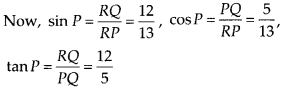
MP Board Class 10th Maths Solutions Chapter 8 Introduction to Trigonometry Ex 8.1 15

Question 11.
State whether the following are true or false. Justify your answer.
(i) The value of tan A is always less than 1.
(ii) secA = \(\frac{12}{5}\) for some value of angle A.
(iii) cosA is the abbreviation used for the cosecant of angle A.
(iv) cot A is the product of cot and A.
(v) sinθ = \(\frac{4}{3}\) for some angle θ.
Solution:
(i) False
∵ A tangent of an angle is the ratio of sides other than hypotenuse, which may be equal or unequal to each other.
(ii) True
∵ cos A is always less than 1.
∴ \(\frac{1}{\cos A}\) i.e., sec A will always be greater than 1.
(iii) False
∵ ‘cosine A’ is abbreviated as ‘cosA’
(iv) False
∵ ‘cot A’ is a single and meaningful term whereas ‘cot’ alone has no meaning.
(v) False
∵ \(\frac{4}{3}\) is greater than 1 and sinθ cannot be greater than 1

MP Board Class 10th Maths Solutions Chapter 12 Areas Related to Circles Ex 12.1

In this article, we will share MP Board Class 10th Maths Book Solutions Chapter 12 Areas Related to Circles Ex 12.1 Pdf, These solutions are solved subject experts from the latest edition books.

MP Board Class 10th Maths Solutions Chapter 12 Areas Related to Circles Ex 12.1

Unless stated otherwise, use π = \(\frac{22}{7}\).

Question 1.
The radii of two circles are 19 cm and 9 cm respectively. Find the radius of the circle which has circumference equal to the sum of the circumferences of the two circles.
Solution:
We have, r1 = 19 cm and r2 = 9 cm
∴ Circumference of circle – I = 2πr1 = 2π(19) cm
and circumference of circle – II = 2πr2 = 2π(9) cm
Sum of the circumferences of circle-I and circle-II
= 2π(19) cm + 2π(9) cm
= 2π(19 + 9) cm
= 2π(28) cm
Let R be the radius of the circle – III.
∴ Circumference of circle – III = 2πR
According to the condition, 2πR = 2π(28)
⇒ R = \(\frac{2 \pi(28)}{2 \pi}\) = 28 cm
Thus, the radius of the new circle = 28 cm.

MP Board Class 10th Maths Solutions Chapter 12 Areas Related to Circles Ex 12.1s

Question 2.
The radii of two circles are 8 cm and 6 cm respectively. Find the radius of the circle having area equal to the sum of the areas of the two circles.
Solution:
We have,
Radius of circle – I, r1 = 8 cm
Radius of circle – II, r2 = 6 cm
∴ Area of circle – I = πr12 = π(8)2 cm2
Area of circle-II = πr22 = π(6)2 cm2
Let the radius of the circle – III be R cm.
∴ Area of circle-III = πR2
Now, according to the condition,
πr12 + πr22 = πR2
⇒ π(8)2 + π(6)2 = πR2
⇒ π(82 + 62) = πR2
⇒ 82 + 62 = R2
⇒ 64 + 36 = R2
⇒ 100 = R2
⇒ 102 = R2 ⇒R = 10
Thus, the radius of the new circle = 10 cm.

Question 3.
The given figure depicts an archery target marked with its five scoring regions from the centre outwards as Gold, Red, Blue, Black and White. The diameter of the region representing Gold score is 21 cm and each of the other bands is 10.5 cm wide. Find the area of each of the five scoring regions.
MP Board Class 10th Maths Solutions Chapter 12 Areas Related to Circles Ex 12.1 1
Solution:
Diameter of the innermost (Gold scoring) region = 21 cm
Radius of the innermost (Gold scoring) region = \(\frac{21}{2}\) = 10.5 cm
∴ Area of Gold scoring region = π(10.5)2 cm2
= \(\frac{22}{7} \times\left(\frac{105}{10}\right)^{2} \mathrm{cm}^{2}=\frac{22}{7} \times \frac{105}{10} \times \frac{105}{10} \mathrm{cm}^{2}\)
= \(\frac{22 \times 15 \times 105}{100}\) cm2 = 346.50 cm2
Since, each band is 10.5 cm wide.
∴ Radius of Red scoring region
= 10.5 cm + 10.5 cm
= 21 cm
Area of Red scoring region
= π(10.5 + 10.5)2 cm2 – π(10.5)2 cm2
= [π(21)2 – π(10.5)2] cm2
= π[(21)2 – (10.5)2] cm2
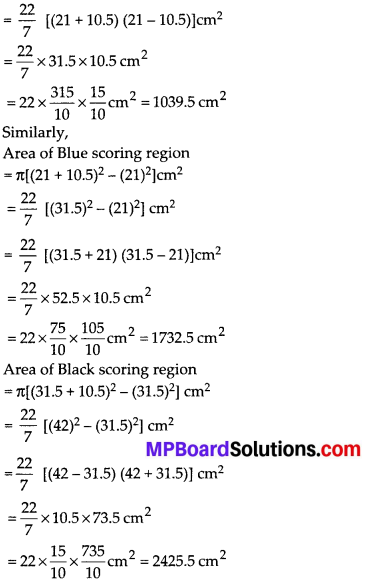
MP Board Class 10th Maths Solutions Chapter 12 Areas Related to Circles Ex 12.1 2
Area of White scoring region
= π[(42 + 10.5)2 – (42)2] cm2
= π[(52.5)2 – (42)2] cm2
= π[(52.5 + 42)(52.5 – 42)] cm2
= \(\frac{22}{7}\) × 94.5 × 10.5 = 22 × \(\frac{945}{10} \times \frac{15}{10}\)
= 3118.5 cm2

Question 4.
The wheels of a car are of diameter 80 cm each. How many complete revolutions does each wheel make in 10 minutes when the car is travelling at a speed of 66 km per hour?
Solution:
Diameter of a wheel = 80 cm
∴ Radius of the wheel = \(\frac{80}{2}\) cm = 40 cm
So, circumference of the wheel
= 2πr = 2 × \(\frac{22}{7}\) × 40 cm
⇒ Distance covered by a wheel in one revolution = \(\frac{2 \times 22 \times 40}{7}\) cm
Distance travelled by the car in 1 hour (i.e., in 60 mins)
= 66 km = 66 × 1000 × 100 cm
∴ Distance travelled in 10 minutes
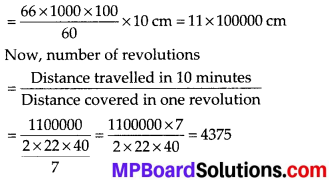
MP Board Class 10th Maths Solutions Chapter 12 Areas Related to Circles Ex 12.1 3
Thus, the required number of revolutions = 4375

MP Board Class 10th Maths Solutions Chapter 12 Areas Related to Circles Ex 12.1s

Question 5.
Tick the correct answer in the following and justify your choice: If the perimeter and the area of a circle are numerically equal, then the radius of the circle is
(A) 2 units
(B) π units
(C) 4 units
(D) 7 units
Solution:
(A): We have
Numerical area of the circle
= Numerical circumference of the circle
⇒ πr2 = 2πr
⇒ πr2 – 2πr = 0
⇒ r2 – 2r = 0
⇒ r(r – 2) = 0
⇒ r = 0 or   r = 2
But r cannot be zero
∴ r = 2
Thus, the radius of circle is 2 units.

MP Board Class 12th Maths Book Solutions Chapter 11 प्रायिकता Ex 11.2

In this article, we share MP Board Class 12th Maths Book Solutions Chapter 11 प्रायिकता Ex 11.2 Pdf, These solutions are solved by subject experts from the latest MP Board books.

MP Board Class 12th Maths Book Solutions Chapter 11 प्रायिकता Ex 11.2

प्रश्न 1.
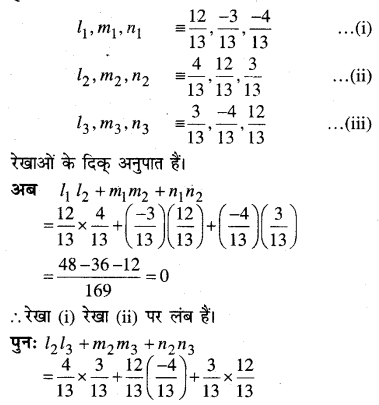
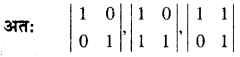
दर्शाइए कि दिक् कोसाइन \(\frac{12}{13}, \frac{-3}{13}, \frac{-4}{13}\) \(\frac{4}{13}, \frac{12}{13}, \frac{3}{13} ; \frac{3}{13}, \frac{-4}{13}, \frac{12}{13}\) वाली तीन रेखाएँ परस्पर लम्बवत्
हल:
माना
MP Board Class 12th Maths Book Solutions Chapter 11 प्रायिकता Ex 11.2 1
MP Board Class 12th Maths Book Solutions Chapter 11 प्रायिकता Ex 11.2 2
अतः तीनों रेखाएँ परस्पर लंब हैं।

प्रश्न 2.
दर्शाइए कि बिन्दुओं (1, – 1, 2), (3, 4, – 2) से होकर जाने वाली रेखा बिन्दुओं (0, 3, 2) और (3, 5, 6) से जाने वाली रेखा पर लंब है।
हल:
बिन्दुओं (1, – 1, 2) तथा (3, 4, – 2) से होकर जाने वाली रेखा के दिक् अनुपात 3 – 1, 4 + 1, – 2, – 2 या 2, 5, – 4
माना a1 = – 2, b1 = 5 तथा C1 = – 4
अब बिन्दु (0, 3, 2) तथा (3, 5, 6) से होकर जाने वाली रेखा के दिक् अनुपात
3 – 0, 5 – 3, 6 – 2 या 3, 2, 4
अब a1 a2 + b1 b2 + c1 c2
= 2 x 3 + 5 x 2 + (- 4) x 4
= 6 + 10 – 16 = 0
∴ रेखाएँ परस्पर लंब हैं।

प्रश्न 3.
दर्शाइए कि बिन्दुओं (4, 7, 8) (2, 3, 4) से होकर जाने वाली रेखा बिन्दुओं (- 1, – 2, 1), (1, 2, 5) से जाने वाली रेखा के समांतर है।
हल:
बिन्दुओं (4, 7, 9), (1, 2, 5) से जाने वाली रेखा के दिक् अनुपात 2, – 4, 3 – 7, 4 – 8 या – 2, – 4, – 4
माना a1 = – 2, b1 = – 4 तथा c1= – 4
अब बिन्दुओं (- 1, – 2, 1) (1, 2, 5) से होकर जाने वाली रेखा के दिक् अनुपात 1 + 1, 2 + 2, 5 – 1 या 2, 4, 4
माना a1 = 2, b2 = 4, C2 = 4
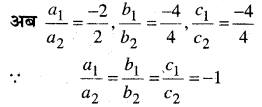
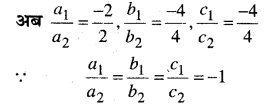
MP Board Class 12th Maths Book Solutions Chapter 11 प्रायिकता Ex 11.2 3
∴ रेखाएँ परस्पर समांतर हैं।

प्रश्न 4.
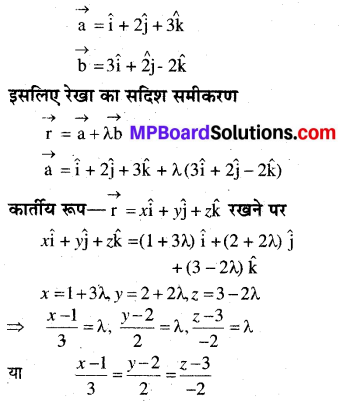
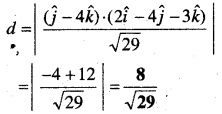
बिन्दु (1, 2, 3) से गुजरने वाली रेखा का समीकरण ज्ञात कीजिए जो सदिश \(3 \hat{\mathbf{i}}+2 \hat{\mathbf{j}}-2 \hat{\mathbf{k}}\) के समांतर है।
हल:
दिया है
MP Board Class 12th Maths Book Solutions Chapter 11 प्रायिकता Ex 11.2 4
यही रेखा के समी० का कार्तीय रूप है।

प्रश्न 5.
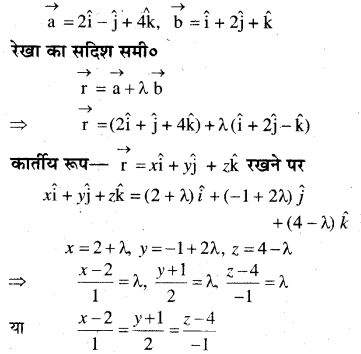
बिन्दु जिसकी स्थिति सदिश \(2 \hat{\mathbf{i}}-\hat{\mathbf{j}}+4 \hat{\mathbf{k}}\) से गुजरने व सदिश \(\hat{\mathbf{i}}+2 \hat{\mathbf{j}}-\hat{\mathbf{k}}\) की दिशा में जाने वाली रेखा का सदिश और कार्तीय रूपों में समी० ज्ञात कीजिए।
हल:
दिया है
MP Board Class 12th Maths Book Solutions Chapter 11 प्रायिकता Ex 11.2 5
यही रेखा के समी०का कार्तीय रूप हैं।

प्रश्न 6.
उस रेखा का कार्तीय समीकरण ज्ञात कीजिए जो बिन्दु (- 2, 4, – 5) से जाती है और \(\frac{x+3}{3}=\frac{y-4}{5}=\frac{z+8}{6}\) के समांतर हैं।
हल:
बिन्दु (- 2, 4, – 5 ) से होकर जाने वालों और रेखा
\(\frac{x+3}{3}=\frac{y-4}{5}=\frac{z+8}{6}\) के समांतर रेखा के समीकरण का
कार्तीय समीकरण
\(\frac{x+3}{3}=\frac{y-4}{5}=\frac{z+5}{6}\) हैं।

प्रश्न 7.
उस रेखा का कार्तीय समीकरण \(\frac{x-5}{3}=\frac{y+4}{7}=\frac{z-6}{2}\) है। इसका सदिश समीकरण ज्ञात 37 2 कीजिए।
हल:
दी गई रेखा का कार्तीय समीकरण
\(\frac{x-5}{3}=\frac{y+4}{7}=\frac{z-6}{2}\)
इससे स्पष्ट होता है कि रेखा बिन्दु A (+ 5, – 4, 6) से होकर जाती है तथा यह सदिश \(\vec{a}=3 \hat{i}+7 \hat{j}+2 \hat{k}\) के समांतर है। तथा A का स्थिति सदिश \(\hat{\mathbf{i}}+2 \hat{\mathbf{j}}-\hat{\mathbf{k}}\)
∴ रेखा का सदिश समी० \(\vec{r}=\vec{a}+\lambda \vec{b}\)
या \(\vec{r}=(5 \hat{i}-4 \hat{j}+6 \hat{k})+l(3 \hat{i}+7 \hat{j}+\hat{2} \hat{k})\)

प्रश्न 8.
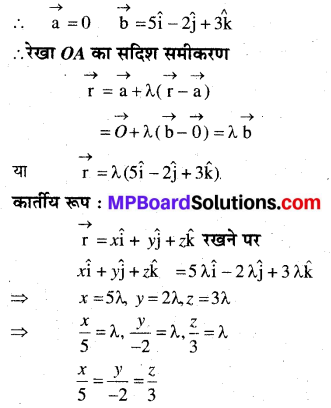
मूल बिन्दु और (5, – 2, 3) से जाने वाली रेखा का सदिश तथा कार्तीय रूपों में समी० ज्ञात कीजिए।
हल:
माना O(0, 0,0) तथा A (5, – 2, 3) दो बिन्दु है।
MP Board Class 12th Maths Book Solutions Chapter 11 प्रायिकता Ex 11.2 6
जोकि रेखा का कार्तीय रूप है।

प्रश्न 9.
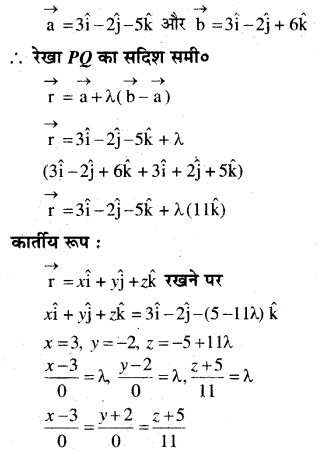
बिन्दुओं (3, – 2, – 5) और (3, – 2, 6) से गुजरने वाली रेखा का सदिश तथा कार्तीय रूपों में समीकरण ज्ञात कीजिए।
हल:
माना P(3, – 2, – 5) और Q(3, – 2, 6) दो बिन्दु स्थिति सदिश हैं।
MP Board Class 12th Maths Book Solutions Chapter 11 प्रायिकता Ex 11.2 7
यही अभीष्ट कार्तीय समीकरण है।

प्रश्न 10.
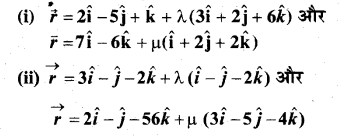
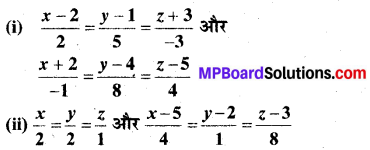
निम्न रेखायुग्मों के बीच का कोण ज्ञात कीजिए–
MP Board Class 12th Maths Book Solutions Chapter 11 प्रायिकता Ex 11.2 8
हल:
MP Board Class 12th Maths Book Solutions Chapter 11 प्रायिकता Ex 11.2 9
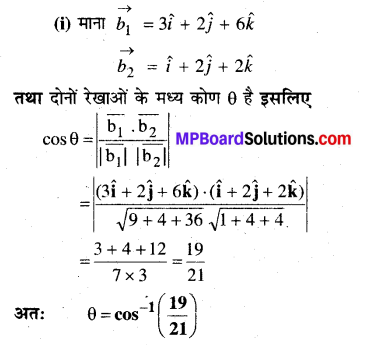
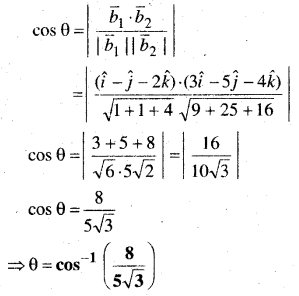
(ii) माना \(\overline{b}_{1}=\hat{i}-\hat{j} \times 2 \hat{k}\), \(\overline{b}_{2}=3 \hat{i}-5 \hat{j}-4 \hat{k}\) तथा दोनों रेखाओं के मध्य कोण θ है इसलिए
MP Board Class 12th Maths Book Solutions Chapter 11 प्रायिकता Ex 11.2 10

प्रश्न 11.
निम्नलिखित रेखायुग्मों के बीच का कोण ज्ञात कीजिए
MP Board Class 12th Maths Book Solutions Chapter 11 प्रायिकता Ex 11.2 11
हल:
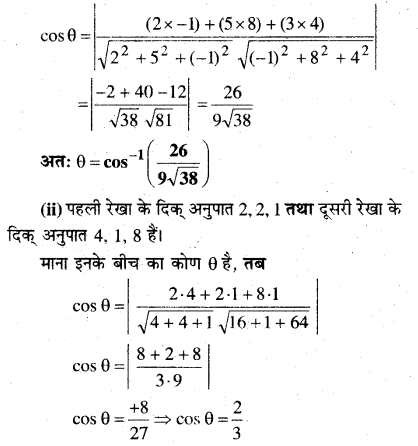
(i) पहली रेखा के दिक् अनुपात 2, 5, – 3 तथा दूसरी रेखा के दिक् अनुपात – 1, 8, 4 हैं।
माना इनके बीच का कोण θ है, तब
MP Board Class 12th Maths Book Solutions Chapter 11 प्रायिकता Ex 11.2 12
या θ = \(\cos ^{-1}\left(\frac{2}{3}\right)\)

प्रश्न 12.
p का मान ज्ञात कीजिए ताकि रेखायें \(\frac{1-x}{3}=\frac{7 y-14}{2 p}=\frac{z-3}{2}\) और \(\frac{7-7 x}{3 p}=\frac{y-5}{1}=\frac{6-z}{5}\) परस्पर लम्ब हों।
हल:
समी० को व्यापक रूप में लिखने पर
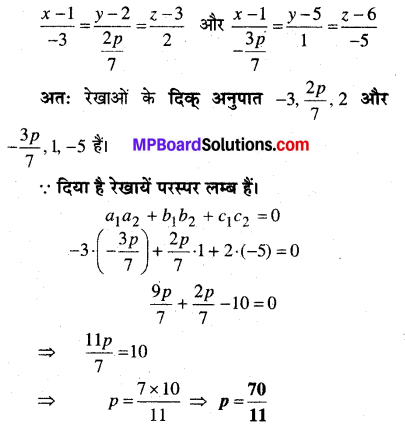
MP Board Class 12th Maths Book Solutions Chapter 11 प्रायिकता Ex 11.2 13

प्रश्न 13.
दिखाइये कि रेखाएँ \(\frac{x-5}{7}=\frac{y+2}{-5}=\frac{z}{1}\) और \(\frac{x}{1}=\frac{y}{2}=\frac{z}{3}\)
हल:
पहली व दूसरी रेखा के दिक् अनुपात 7, – 5, 1 तथा 1, 2, 3 हैं।
तब a1 a2 + b1 b2 + c1 c2 = 7 · 1 + 2 · – 5 + 3 · 1
= 7 – 10 + 3 = 10 – 10 = 0
अतः रेखायें परस्पर लम्ब हैं।

प्रश्न 14.
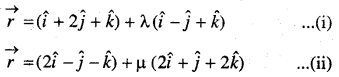
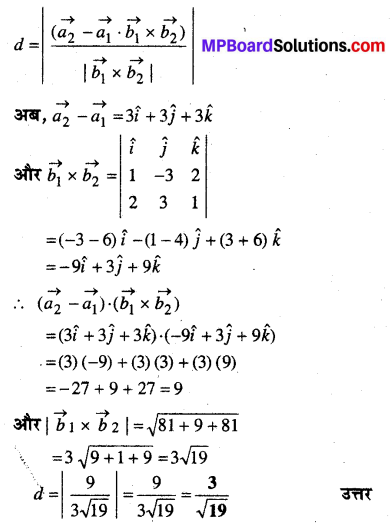
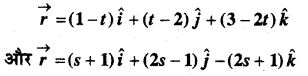
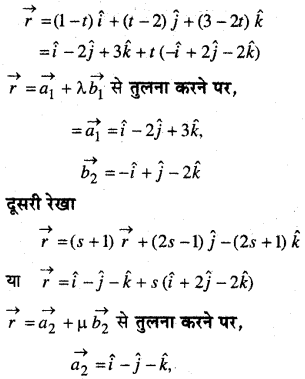
रेखाओं \(\vec{r}=(\hat{i}+2 \hat{j}+\hat{k})+\lambda(\hat{i}-\hat{j}+\hat{k})\) और \(\vec{r}=2 \hat{i}-\hat{j}-\hat{k}=\mu(2 \hat{i}+\hat{j}+2 \hat{k})\) के बीच की न्यूनतम दूरी ज्ञात कीजिए।
हल:
दी गई रेखाएँ-
MP Board Class 12th Maths Book Solutions Chapter 11 प्रायिकता Ex 11.2 14
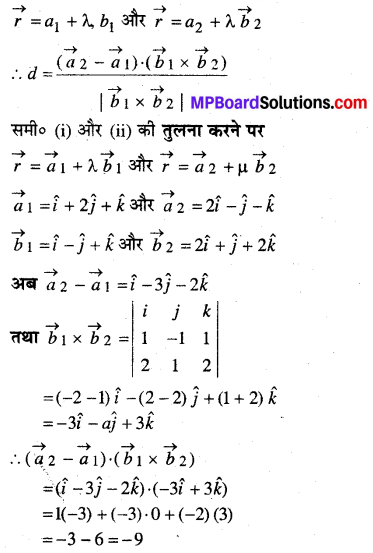
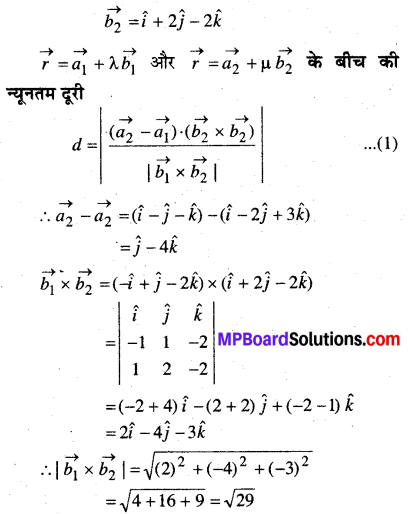
रेखाओं के बीच की दूरी
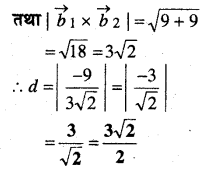
MP Board Class 12th Maths Book Solutions Chapter 11 प्रायिकता Ex 11.2 15
MP Board Class 12th Maths Book Solutions Chapter 11 प्रायिकता Ex 11.2 16

प्रश्न 15.
रेखाओं \(\frac{x+1}{7}=\frac{y+1}{-6}=\frac{z+1}{1}\) और \(\)\frac{x-3}{1}=\frac{y-5}{-2}=\frac{z-7}{1} के बीच की न्यूनतम दूरी ज्ञात कीजिए।
हल:
MP Board Class 12th Maths Book Solutions Chapter 11 प्रायिकता Ex 11.2 17
MP Board Class 12th Maths Book Solutions Chapter 11 प्रायिकता Ex 11.2 18

प्रश्न 16.
रेखाएँ, जिनके सदिश समीकरण निम्नलिखित हैं, के बीच की न्यूनतम दूरी ज्ञात कीजिए।
MP Board Class 12th Maths Book Solutions Chapter 11 प्रायिकता Ex 11.2 19
हल:
MP Board Class 12th Maths Book Solutions Chapter 11 प्रायिकता Ex 11.2 20
MP Board Class 12th Maths Book Solutions Chapter 11 प्रायिकता Ex 11.2 21

प्रश्न 17.
रेखाएँ जिनकी सदिश समीकरण निम्नलिखित हैं, के बीच की न्यूनतम दूरी ज्ञात कीजिए।
MP Board Class 12th Maths Book Solutions Chapter 11 प्रायिकता Ex 11.2 22
हल:
पहली रेखा का समीकरण
MP Board Class 12th Maths Book Solutions Chapter 11 प्रायिकता Ex 11.2 23
MP Board Class 12th Maths Book Solutions Chapter 11 प्रायिकता Ex 11.2 24
इसका मान (1) में रखने पर
MP Board Class 12th Maths Book Solutions Chapter 11 प्रायिकता Ex 11.2 25

MP Board Class 12th Maths Book Solutions Chapter 13 प्रायिकता Ex 13.2

In this article, we share MP Board Class 12th Maths Book Solutions Chapter 13 प्रायिकता Ex 13.2 Pdf, These solutions are solved by subject experts from the latest MP Board books.

MP Board Class 12th Maths Book Solutions Chapter 13 प्रायिकता Ex 13.2

प्रश्न 1.
यदि P (A) = \(\frac{3}{5}\), P (B) = \(\frac{1}{5}\) और A तथा B स्वतंत्र घटनाएँ हैं तो P (ARB) ज्ञात कीजिए।
हल:
∵ A तथा B स्वतंत्र घटनाएँ हैं
∴ P(A ∩ B) = P (A)x P (B)
= \(\frac{3}{5} \times \frac{1}{5}=\frac{3}{25}\)

प्रश्न 2.
52 पत्तों की एक गड्डी में से यादृच्छया बिना प्रतिस्थापित किए गए दो पत्ते निकाले गए। दोनों पत्तों के काले रंग का होने की प्रायिकता ज्ञात कीजिए।
हल:
पत्तों की कुल संख्या = 52
गड्डी में काले पत्तों की कुल संख्या = 26
∴ एक पत्ता यादृच्छया खींचने पर काले पत्ते की प्रायिकता
= \(\frac{26}{52}\)
P(E1) = \(\frac{1}{2}\)
एक पत्ता खींचने पर शेष पत्तों की संख्या = 52 – 1 = 51
तथा काले पत्तों की संख्या = 26 – 1 = 25
∴ दूसरा काला पत्ता होने की प्रायिकता F2 = \(\frac{25}{51}\)
अतः दोनों पत्ते काले रंग के होने की प्रायिकता
= E1 x E2
= \(\frac{1}{2} \times \frac{25}{51}=\frac{25}{102}\)

प्रश्न 3.
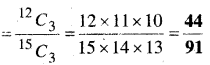
संतरों के एक डिब्बे का निरीक्षण उसमें से तीन संतरों को यादृच्छया बिना प्रतिस्थापित किए हुए निकाल कर किया जाता है। यदि तीनों निकाले गए संतरे अच्छे हों तो डिब्बे को बिक्री के लिए स्वीकृत किया जाता है अन्यथा अस्वीकृत कर देते हैं। एक डिब्बा जिसमें 15 संतरे हैं जिनमें से 12 अच्छे व 3 खराब संतरे हैं, के बिक्री के लिए स्वीकृत होने की प्रायिकता ज्ञात कीजिए।
हल:
डिब्बा जिसमें 12 अच्छे और 3 खराब सन्तरे हैं।
12 संतरों में से 3 अच्छे संतरे निकालने के प्रकार = 12C3
15 सन्तरों में से 3 सन्तरे निकालने के प्रकार = 15C3
स्वीकृत होने की प्रायिकता =3 अच्छे सन्तरों को चुनने की प्रायिकता
MP Board Class 12th Maths Book Solutions Chapter 13 प्रायिकता Ex 13.2 img 1

प्रश्न 4.
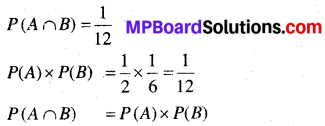
एक न्याय्य सिक्का और एक अभिनत पासे को उछाला गया। मान लें A घटना ‘सिक्के पर चित प्रकट होता है’ और B घटना ‘पासे पर सख्या 3 प्रकट होती है’ को निरूपित करते हैं। निरीक्षण कीजिए कि घटनाएँ A और B स्वतन्त्र हैं या नहीं?
हल:
घटना A पर, चित आने की प्रायिकता P(A) = \(\frac{1}{2}\)
घटना B पर 3 प्रकट होने की प्रायिकता P(B) = \(\frac{1}{6}\) जब पासे और सिक्के को उछाला जाता है, तब कुल संख्या
= [HI, H2, H3. H4, Hz, H6 ]
= [TI,T2,T3,TA,TH,T6]
अब H3 का प्रकट होना एक ही तरीके से हो सकता है।
3 और चित आने की प्रायिकता = \(\frac{1}{12}\)
MP Board Class 12th Maths Book Solutions Chapter 13 प्रायिकता Ex 13.2 img 2
अतः A और B स्वतन्त्र घटनाएँ हैं।

प्रश्न 5.
एक पासे पर 1,2,3 लाल रंग से और 4, 5, 6 हरे रंग से लिखे गए हैं। इस पासे को उछाला गया। मान लेंA घटना ‘संख्या सम है’ और Bघटना संख्या लाल रंग से लिखी गई है’ को निरूपित करते हैं। क्या A और B स्वतन्त्र हैं?
हल:
पासे पर सम संख्याएँ 2, 4, 6 हैं।
घटना A पर सम संख्या आने की प्रायिकता
P(A) = \(\frac{3}{6}=\frac{1}{2}\)
पासे पर दो रंग लाल और हरा है।
घटना (B) पर लाल रंग आने की प्रायिकता P(B) = \(\frac{1}{2}\)
लाल रंग में सम संख्या 2 है।
लाल रंग और सम संख्याएँ होने की प्रायिकता
P(A ∩ B) = \(\frac{1}{6}\)
≠P(A ∩ B)
A और B स्वतन्त्र घटना नहीं है।

प्रश्न 6.
मान लें E तथा F दो घटनाएँ इस प्रकार हैं कि P(E) = \(\frac{3}{5}\), P(F) = \(\frac{3}{10}\) और P(E ∩ F) = \(\frac{1}{5}\) तब क्या E तथा F स्वतन्त्र हैं।
हल:
∵ P(E) = \(\frac{3}{5}\) तथा P(F) = \(\frac{3}{10}\) तथा P(E ∩ F) = \(\frac{1}{5}\)
∴ P(E) x P(F) = \(\frac{3}{5} \times \frac{3}{10}=\frac{9}{50}\)
∵ P(E ∩ F) ≠ P(E) x P(F)
अतः E तथा F स्वतन्त्र घटनाएँ नहीं हैं।

प्रश्न 7.
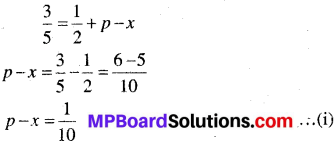
A और B ऐसी घटनाएँ दी गई हैं जहाँ P(A)= \(\frac{1}{2}\), P(AUB) = \(\frac{3}{5}\) तथा P(B) = P
p का मान ज्ञात कीजिए यदि
(i) घटनाएँ परस्पर अपवर्जी हैं
(ii) घटनाएँ स्वतन्त्र हैं।
हल:
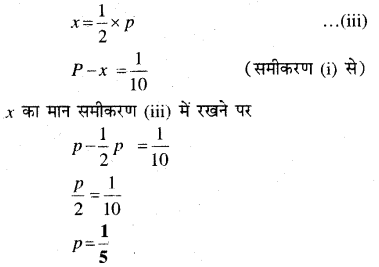
माना P(A ∩ B) =x
अब P(A) = \(\frac{1}{2}\), P(A ∪ B) = \(\frac{3}{5}\), P(B) = P
P(A U B) = P(A) + P(B) – P(A ∩ B)
MP Board Class 12th Maths Book Solutions Chapter 13 प्रायिकता Ex 13.2 img 3
(i) जब घटनाएँ A और B परस्पर अपवर्जी हैं x = 0
∴ P = \(\frac{1}{10}\)
(ii) जब घटनाएँ A और B स्वतन्त्र हैं
P(A ∩ B) = P(A) x P(B)
MP Board Class 12th Maths Book Solutions Chapter 13 प्रायिकता Ex 13.2 img 4

प्रश्न 8.
मान लें A और B स्वतन्त्र घटनाएँ हैं तथा P(A) = 0.3 और P(B) = 0.4 तब .
(i) P(A ∩ B)
(ii) P(A U B)
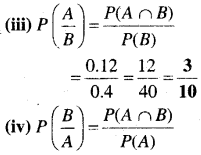
(iii) \(P\left(\frac{A}{B}\right)\)
(iv) \(P\left(\frac{B}{A}\right)\) ज्ञात कीजिए।
हल:
(i) दिया है :
P(A) = 0.3, P(B) = 0.4
जब A और B स्वतन्त्र घटना है
P(A ∩ B) = P(A) x P(B)
= 0.3 x 0.4 = 0.12
(ii) P(A U B) = P(A) + P(B) – P(A ∩ B)
= 0.3 + 0.4 – 0.12
= 0.7 – 0.12 = 0.57
MP Board Class 12th Maths Book Solutions Chapter 13 प्रायिकता Ex 13.2 img 5
= \(\frac{0.12}{0.3}=\frac{12}{30}=\frac{2}{5}\)

प्रश्न 9.
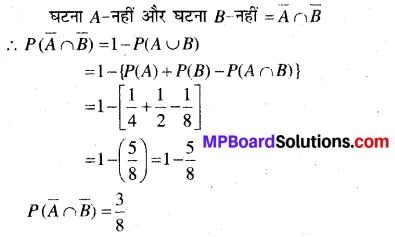
दी गई घटनाएँ A और B ऐसी हैं, जहाँ P(A) = \(\frac{1}{4}\), P(B) =\(\frac{1}{2}\) और P(A ∩ B) = तब P(A – नहीं और B – नहीं) ज्ञात कीजिए।
हल:
MP Board Class 12th Maths Book Solutions Chapter 13 प्रायिकता Ex 13.2 img 6
अत: P(A – नहीं और B – नहीं) = \(\frac{3}{8}\)

प्रश्न 10.
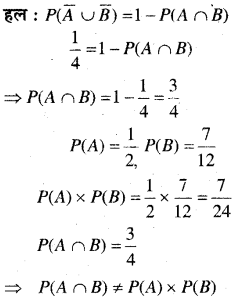
मान लें A तथा B स्वतन्त्र घटनाएँ हैं और P(A) = \(\frac{1}{2}\) तथा P(B) = \(\frac{7}{12}\) और P(A – नहीं और B – नहीं) = \(\frac{1}{4}\) क्या A और B स्वतन्त्र घटनाएँ हैं?
MP Board Class 12th Maths Book Solutions Chapter 13 प्रायिकता Ex 13.2 img 7
A और B स्वतन्त्र घटनाएँ नहीं हैं।

प्रश्न 11.
A और B स्वतन्त्र घटनाएँ दी गई हैं जहाँ P(A) = 0.3, P (B)= 0.6 तो
(i) P(A और B)
(ii) P(A और B – नहीं)
(iii) P(A या B)
(iv) P(A और B में कोई भी नहीं ) का मान ज्ञात कीजिए।
हल:
दिया है : A और B स्वतन्त्र घटनाएँ हैं
(i) ∴ P (A और B) = P(A ∩ B)
=P(A) × P (B) [∵P (A)= 0.3, P (B)= 0.6]
= 0.3 x 0.6 = 0.18
(ii) P (A और B नहीं)
=P(A ∩ \(\overline{\mathbf{B}}\))
= P(A) – P(A ∩ B)
= 0.3 – 0.18 [∵ P(A ∩ B) = 0.18]
= 0.12
(iii) यहाँ P (A) = 0.3, P (B) = 0.6,
P (A ∩ B) = 0.18
∴ P(A ∪ B) = P (A) + P (B) – P (A ∩ B)
= 0.3 + 0.6 – 0.18
= 0.72
⇒ P(A या B) = 0.72
(iv) P(A और B में कोई नहीं) = P(\(\overline{\mathbf{A}}\) ∩ \(\overline{\mathbf{B}}\))
= P(\(\overline{\mathbf{A}}\))x P (\(\overline{\mathbf{B}}\))
∴ P(\(\overline{\mathbf{A}}\) ∩ \(\overline{\mathbf{B}}\)) = P (\(\overline{\mathbf{A}}\)) x P(\(\overline{\mathbf{B}}\))
= [1 – P (A)] x [1 – P (B)]
=[1 – 0.3] x [1 – 0.6]
= 0.7 x 0.4
= 0.28

प्रश्न 12.
एक पासे को तीन बार उछाला जाता है तो कम-से-कम एक बार विषम संख्या प्राप्त होने की प्रायिकता ज्ञात कीजिए।
हल:
पासे को एक बार उछालने पर विषम संख्या प्राप्त होने की प्रायिकता = \(\frac{3}{6}=\frac{1}{2}\)
तथा सम संख्या प्राप्त होने की प्रायिकता = \(\frac{3}{6}=\frac{1}{2}\)
इसलिए पासे को तीन बार उछालने पर सम संख्या प्राप्त होने की प्रायिकता = \(\frac{1}{2} \times \frac{1}{2} \times \frac{1}{2}=\frac{1}{8}\)
अतः पासे को तीन बार उछालने पर कम से कम 1 बार विषम संख्या प्राप्त होने की प्रायिकता = \(1-\frac{1}{8}=\frac{7}{8}\)

प्रश्न 13.
दो गेंद एक बॉक्स से बिना प्रतिस्थापित किए निकाली जाती है। बॉक्स में 10 काली और 8 लाल गेंदें हैं तो प्रायिकता ज्ञात कीजिए-(i) दोनों गेंदें लाल हों, (i) प्रथम काली एवं दूसरी लाल हो, (iii) एक काली तथा दूसरी लाल
हो।
हल:
(i) प्रथम गेंद लाल होने की प्रायिकता
= \(\frac{C_{1}}{^{18} C_{1}}=\frac{8}{18}=\frac{4}{9}\)
दूसरी गेंद भी लाल प्राप्त होने की प्रायिकता = \(\frac{4}{9}\)
दोनों गेंद लाल प्राप्त होने की प्रायिकता
= \(\frac{4}{9} \times \frac{4}{9}=\frac{16}{81}\)
(ii) प्रथम गेंद काली प्राप्त होने की प्रायिकता
= \(\frac{10}{18} C_{1}=\frac{10}{18}=\frac{5}{9}\)
दूसरी गेंद लाल प्राप्त होने की प्रायिकता
= \(\frac{^{8} C_{1}}{^{18} C_{1}}=\frac{8}{18}=\frac{4}{9}\)
प्रथम काली एवं दूसरी लाल गेंद प्राप्त होने की प्रायिकता
= \(\frac{5}{9} \times \frac{4}{9}=\frac{20}{81}\)
(iii) प्रथम गेंद काली और दूसरी लाल प्राप्त होने की प्रायिकता
= \(\frac{10}{18} \times \frac{8}{18}=\frac{5}{9} \times \frac{4}{9}=\frac{20}{81}\)
प्रथम गेंद लाल औ दूसरी गेंद काली प्राप्त होने की प्रायिकता
= \(\frac{8}{18} \times \frac{10}{18}=\frac{4}{9} \times \frac{5}{9}=\frac{20}{81}\)
∴ एक काली तथा दूसरी लाल गेंद प्राप्त होने की प्रायिकता
= \(\frac{20}{81}+\frac{20}{81}=\frac{40}{81}\)

प्रश्न 14.
एक विशेष समस्या को A और B द्वारा स्वतन्त्र रूप से हल करने की प्रायिकताएँ क्रमशः \(\frac{1}{2}\) और \(\frac{1}{3}\) हैं। यदि दोनों, स्वतंत्र रूप से, समस्या हल करने का प्रयास करते हैं तो प्रायिकता ज्ञात कीजिए कि –
(i) समस्या हल हो जाती है।
(ii) उनमें से तथ्यतः कोई एक समस्या हल कर लेता है।
हल:
(i) A द्वारा समस्या हल करने की प्रायिकता =\(\frac{1}{2}\) = P(A)
∴ A के द्वारा समस्या हल न होने की प्रायिकता
= \(1-\frac{1}{2}=\frac{1}{2}\) = P(A)
तथा B के द्वारा समस्या हल करने की प्रायिकता
= \(\frac{1}{3}\) =P(B)
∴ समस्या हल न करने की प्रायिकता = \(1-\frac{1}{3}=\frac{2}{3}\) = P(B)
स्वतन्त्र रूप से प्रश्न हल नहीं होने की प्रायिकता
= \(\frac{1}{2} \times \frac{2}{3}=\frac{1}{3}\)
इसलिए समस्या हल हो जाने की प्रायिकता = \(1-\frac{1}{3}=\frac{2}{3}\)
अत: दोनों द्वारा समस्या हल होने की प्रायिकता = \(\frac{2}{3}\)
(ii) उनमें से तथ्यत: कोई एक प्रश्न हल करने की प्रायिकता
= P(A\(\overline{B}\)) + P(\(\overline{A}\)B)
= P(A).P(\(\overline{B}\)) + P(\(\overline{A}\)).P(B) (∵A तथा B स्वतन्त्र घटनाएँ हैं)
= \(\frac{1}{2} \times \frac{2}{3}+\frac{1}{2} \times \frac{1}{3}=\frac{1}{3}+\frac{1}{6}=\frac{1}{2}\)

प्रश्न 15.
ताश के 52 पत्तों की एक सुमिश्रित गड्डी से एक पत्ता यादृच्छया निकाला जाता है।
निम्नलिखित में से किन दशाओं में घटनाएँ E और F स्वतन्त्र हैं?
(i) E : ‘निकाला गया पत्ता हुकुम का है’
F : ‘निकाला गया पत्ता इक्का है’
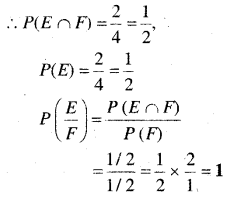
(ii) E : ‘निकाला गया पत्ता काले रंग का है’
F : ‘निकाला गया पत्ता एक बादशाह है’
(iii)E : ‘निकाला गया पत्ता एक बादशाह या एक बेगम है’
F: “निकाला गया पत्ता एक बेगम या एक गुलाम है’
हल:
ताश के 52 पत्तों की एक गड्डी है।
(i) हुकुम के पत्तों की संख्या = 13
∴ निकाले गए हुकुम के पत्ते की प्रायिकता
= \(\frac{13}{52} \frac{C_{1}}{C_{1}}=\frac{13}{52}\)
∴ P (E) = \(\frac{13}{52}=\frac{1}{4}\)
ताशों की एक गड्डी में चार इक्के हैं।
निकाला गया पत्ता इक्का की प्रायिकता
= \(\frac{^{4} C_{1}}{^{52} C_{1}}=\frac{4}{52}=\frac{1}{13}\)
⇒ P(F) = \(\frac{1}{13}\)
केवल एक पत्ता है जिसमें हुकुम का एक इक्का है।
निकाला गया हुकुम का इक्का की प्रायिकता = \(\frac{1}{52}\)
∴ P(E ∩ F) = \(\frac{1}{52}=\frac{1}{4} \times \frac{1}{13}\)
= P(E) x P(F)
⇒ P(E ∩ F) = P(E) x P(F)
E तथा F स्वतन्त्र घटनाएँ हैं।
(ii) ताश के 52 पत्तों की गड्डी में 26 काले रंग के पत्ते हैं।
एक काला पत्ता खींचने की प्रयिकता = \(\frac{26}{52} \frac{C_{1}}{C_{1}}=\frac{26}{52}=\frac{1}{2}\)
∴ P(E) = \(\frac{1}{2}\)
ताश के 52 पत्तों की एक गड्डी में 4 पत्ते बादशाह हैं।
∴ एक बादशाह खींचने की प्रायिकता
= \(\frac{^{4} C_{1}}{^{52} C_{1}}=\frac{4}{51}=\frac{1}{13}\)
∴ P(F) = \(\frac{1}{13}\)
यहाँ काले रंग में दो बादशाह हैं।
∴ काले रंग की एक बादशाह खींचने की प्रायिकता
= P(E ∩ F) = \(\frac{2}{52}=\frac{1}{26}\)
अब, P(E) x P(F) = \(\frac{1}{2} \times \frac{1}{13}=\frac{1}{26}\)
= P(E ∩ F)
अतः P(E ∩ F) = P(E) x P(F)
⇒ E और F स्वतन्त्रघटनाएँ हैं।
(iii) यहाँ 4 बेगम और 4 बादशाह के पत्ते हैं।
∴ एक बादशाह या एक बेगम खींचने की प्रायिकता
= \(\frac{^{8} C_{1}}{^{52} C_{1}}\)
= \(\frac{8}{52}=\frac{2}{13}\)
∴ P(E) = \(\frac{2}{13}\)
यहाँ 4 बेगम और 4 गुलाम के पत्ते हैं।
∴ एक बेगम या एक गुलाम की प्रायिकता = \(\frac{8}{52}=\frac{2}{13}\)
यहाँ दोनों ही दशाओं में 4 बेगम उभयनिष्ठ हैं।
∴ एक बेगम का पत्ता खींचने की प्रायिकता = \(\frac{4}{52}=\frac{1}{13}\)
= P(E ∩ F)
P(E) x P(F) = \(\frac{2}{13} \times \frac{2}{13}\)
= \(\frac{4}{169}\) ≠ P(E ∩ F)
अतः E और F स्वतन्त्र घटनाएँ नहीं हैं।

प्रश्न 16.
एक छात्रावास में 60% विद्यार्थी हिन्दी का, 40% अंग्रेजी का और 20% दोनों अखबार पढ़ते हैं। एक छात्रा को यादृच्छया चुना जाता है।
(a) प्रायिकता ज्ञात कीजिए कि वह न तो हिन्दी और न ही अंग्रेजी का अखबार पढ़ती है।
(b) यदि वह हिन्दी का अखबार पढ़ती है तो उसके अंग्रेजी का अखबार भी पढ़ने वाली होने की प्रायिकता ज्ञात कीजिए।
(c) यदि वह अंग्रेजी का अखबार पढ़ती है तो उसके हिन्दी का अखबार भी पढ़ने वाली होने की प्रायिकता ज्ञात कीजिए।
हल:
(a) माना छात्रों के हिन्दी और अंग्रेजी के अखबार पढ़ने की घटनाओं को क्रमश: H और E से निरूपित करते हैं।
P(H) = 60% = \(\frac{60}{100}\) =0.6
P(E) = 40% = \(\frac{10}{100}\) = 0.4
P(H ∩ E) = 20% = \(\frac{20}{100}\) = 0.2
छात्रों के कम से कम एक अखबार पढ़ने की प्रायिकता
=P(H U E)
P(H) = 0.6, P(E) = 0.4, P(H U E) = 0.2
∴ P(H U E) = 0.6 + 0.4 – 0.2
=1 – 0.2 = 0.8
∴ छात्रों के न तो हिन्दी और न ही अंग्रेजी का अखबार पढ़ने की प्रायिकता
=1 – P(H U E) = 1 – 0.8
= 0.2 = 20%
स्पष्ट है कि 20% विद्यार्थी अखबार नहीं पढ़ते
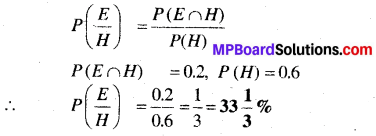
(b) यदि वह हिन्दी का अखबार पढ़ती है तो उसमें अंग्रेजी का अखबार भी पढ़ने वाली होने की प्रायिकता
MP Board Class 12th Maths Book Solutions Chapter 13 प्रायिकता Ex 13.2 img 8
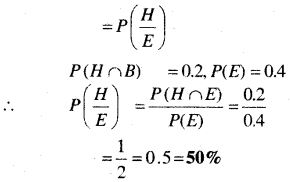
(c) यदि वह अंग्रेजी का अखबार पढ़ती है तो उसके हिन्दी | का अखबार भी पढ़ने वाली होने की प्रायिकता
MP Board Class 12th Maths Book Solutions Chapter 13 प्रायिकता Ex 13.2 img 9

प्रश्न 17.
यदि पासों का एक जोड़ा उछाला जाता है तो प्रत्येक पासे पर सम अभाज्य संख्या प्राप्त करने की प्रायिकता निम्नलिखित में से क्या है?
(A) 0
(B) \(\frac{1}{3}\)
(C) \(\frac{1}{12}\)
(D) \(\frac{1}{36}\)
हल:
यहाँ समअभाज्य संख्या केवल 2 है। जब पासा उछाला जाता है तब सम अभाज्य संख्या प्राप्त होने की प्रायिकता = \(\frac{1}{6}\)
जब पासों का एक जोड़ा उछाला जाता है तब समअभाज्य संख्या प्राप्त करने की प्रायिकता
= \(\frac{1}{6} \times \frac{1}{6}=\frac{1}{36}\)
अतः विकल्प (D) सही है।

प्रश्न 18.
दो घटनाओंA और B को परस्पर स्वतन्त्र कहते हैं, यदि
(A) A और B परस्पर अपवर्जी हैं
(B) P (A’B’ ) = [1 – P(A)][1 – P(B)]
(C) P (A) = P(B)
(D) (A) + P(B)=1
हल:
दो घटनाएँ स्वतन्त्र हैं।
यदि P(A ∩ B) = P(A)x P(B)
या P(A’ ∩ B’) = P(A’). P(B’)
= [1 – P(A)] [1 – P(B)]
अतः विकल्प (B) सही है।

MP Board Class 12th Maths Book Solutions Chapter 13 प्रायिकता Ex 13.1

In this article, we share MP Board Class 12th Maths Book Solutions Chapter 13 प्रायिकता Ex 13.1 Pdf, These solutions are solved by subject experts from the latest MP Board books.

MP Board Class 12th Maths Book Solutions Chapter 13 प्रायिकता Ex 13.1

प्रश्न 1.
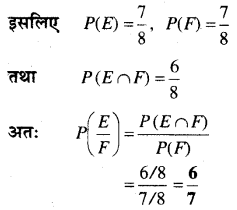
यदि E और F इस प्रकार की घटनाएँ हैं कि P(E) = 0.6, P (F) == 0.3 और P(E ∩F) = 0.2, तो \(\boldsymbol{P}\left(\frac{\boldsymbol{E}}{\boldsymbol{F}}\right)\) और \(\boldsymbol{P}\left(\frac{\boldsymbol{F}}{\boldsymbol{E}}\right)\) ज्ञात कीजिए।
हल:
ज्ञात है
P(E) = 0.6
P(F) =03
तथा P(EMF) = 0.2
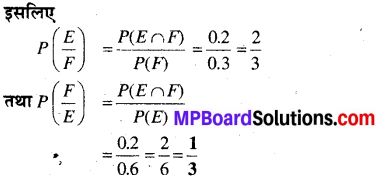
MP Board Class 12th Maths Book Solutions Chapter 13 प्रायिकता Ex 13.1 img 1

प्रश्न 2.
\(P\left(\frac{A}{B}\right)\) ज्ञात कीजिए, यदि P (B) = 0.5 और P(A ∩ B) = 0.32
हल:
∵ P(B) =0.5
तथा P (A ∩ B) =0.32
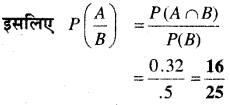
MP Board Class 12th Maths Book Solutions Chapter 13 प्रायिकता Ex 13.1 img 2

प्रश्न 3.
यदि P(A) = 0.8, P(B) = 0.5 और \(P\left(\frac{B}{A}\right)\) = 0.4 ज्ञात कीजिए।
(i) P (A ∩ B)
(ii) P\(P\left(\frac{A}{B}\right)\)
(iii) P(AUB)
हल:
दिया है :
P(A) = 0.8, P(B) = 0.5
और \(P\left(\frac{B}{A}\right)\)=0.4
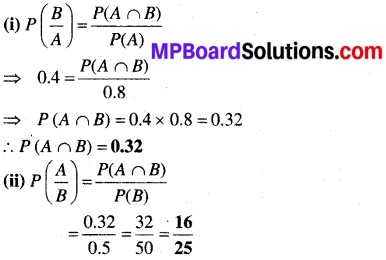
MP Board Class 12th Maths Book Solutions Chapter 13 प्रायिकता Ex 13.1 img 3
(iii) ∵ P(A U B) = P(A) + P(B) – P(A ∩B)
= 0.8 + 0.5 – 0.32
=1.3 – 0.32
= 0.98

प्रश्न 4.
P (AUB) ज्ञात कीजिए यदि 2P (A) = P(B) = \(\frac{5}{13}\) और \(P\left(\frac{A}{B}\right) = \frac{2}{5}\)
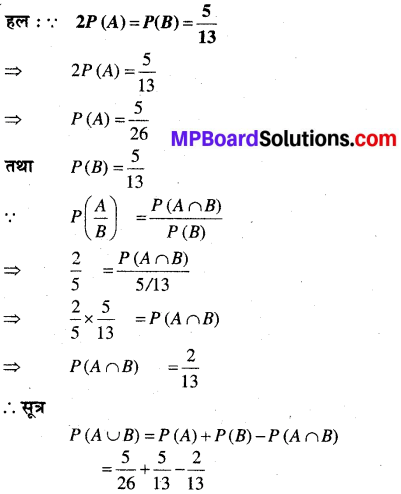
MP Board Class 12th Maths Book Solutions Chapter 13 प्रायिकता Ex 13.1 img 4
MP Board Class 12th Maths Book Solutions Chapter 13 प्रायिकता Ex 13.1 img 25

प्रश्न 5.
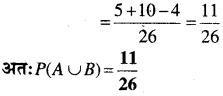
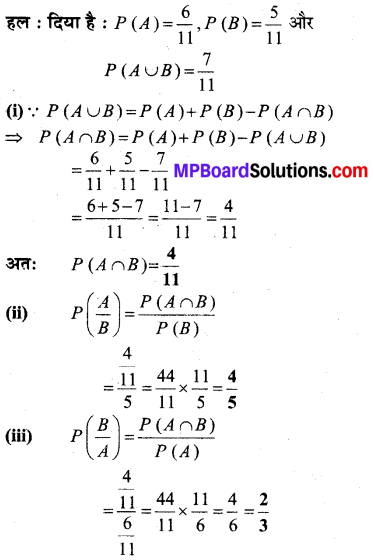
यदि P(A) = \(\frac{6}{11}\) P (B) = \(\frac{5}{11}\) और P(AUB) = \(\frac{7}{11}\) तो ज्ञात कीजिए
(i) P (A∩B)
(ii) \(P\left(\frac{A}{B}\right)\)
(iii) \(P\left(\frac{B}{A}\right)\)
MP Board Class 12th Maths Book Solutions Chapter 13 प्रायिकता Ex 13.1 img 5

निम्नलिखित प्रश्न 6 से 9 तक \(P\left(\frac{E}{F}\right)\) ज्ञात कीजिए।

प्रश्न 6.
एक सिक्के को तीन बार उछाला गया है-
(i) E : तीसरे उछाल पर चित F : पहली दोनों उछालों पर चित।
(ii) E : न्यूतनम दो चित F : अधिकतम एक चित।
(iii) E : अधिकतम दो पट F : न्यूनतम एक पट।
हल:
सम्भावित परिणाम =8
(i) E = {HHH, HTH, THH, TTH}
तथा F = {HHH, HHT}
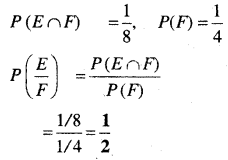
E∩F = {HHH}
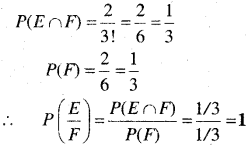
⇒P(E∩F) = \(\frac{1}{8}\) , P(F) = \(\frac{1}{4}\)
MP Board Class 12th Maths Book Solutions Chapter 13 प्रायिकता Ex 13.1 img 6
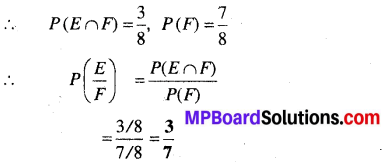
(ii) ∵ E : न्यूनतम दो चित
∴ E = {HHH, HTH, THH, HHT}
F: अधिकतम दो चित
∴ F = {TTT, HTT, THT, HTT, HHT, HTH,THH}
∴ E ∩ F = {HHT, HTH, THH}
MP Board Class 12th Maths Book Solutions Chapter 13 प्रायिकता Ex 13.1 img 7
(iii) E : अधिकतम दो पट
∴ E = {HTT, THT, TTH, HHT, HTH,THH, HHH}
F : न्यूनतम दो पट
F = {THH, HTH, HHT, TTH, THT, HTT, TTT}
∴ E ∩ F = {HTT,THT,TTH,THH, HTH, HHT}
MP Board Class 12th Maths Book Solutions Chapter 13 प्रायिकता Ex 13.1 img 8

प्रश्न 7.
दो सिक्कों को एक बार उछाला गया है –
(i) E : एक सिक्के पर पट प्रकट होता है F : एक सिक्के पर चित प्रकट होता है।
(ii)E : कोई पट प्रकट नहीं होता F: कोई चित प्रकट नहीं होता है।
हल : (i) E = एक सिक्के पर पट प्रकट होता है।
= {TH, HT}
F = एक सिक्के पर चित प्रकट होता है।
= {HT, TH}
∴ E ∩F = {TH, HT}
MP Board Class 12th Maths Book Solutions Chapter 13 प्रायिकता Ex 13.1 img 9
(ii) E = कोई पट प्रकट नहीं होता है
= {H, H}
F = कोई चित प्रकट नहीं होता है
= {TT}
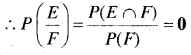
∴ E ∩ F=ϕ
MP Board Class 12th Maths Book Solutions Chapter 13 प्रायिकता Ex 13.1 img 10

प्रश्न 8.
एक पासे को तीन बार उछाला गया है
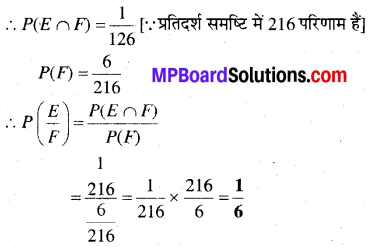
E : तीसरी उछाल पर संख्या 4 प्रकट होना
F : पहली दो उछालों पर क्रमशः 6 तथा 5 प्रकट होना।
हल:
E = तीसरी उछाल पर संख्या 4 प्रकट होना
= (1, 1, 4), (1, 2, 4), (1, 3, 4), …(1, 6, 4)
=(2, 1, 4), (2, 2, 4), (2, 3, 4), …(2, 6, 4)
= (3, 1, 4), (3, 2, 4), (3, 3, 4), …(3, 6, 4)
= (4,1, 4), (4, 2, 4), (4, 3, 4), …(4, 6, 4)
= (5, 1, 4), (5, 2, 4), (5, 3, 4), …(5, 6, 4)
=(6, 1, 4), (6, 2, 4), (6, 3, 4), … (6, 6, 4)
= 36 परिणाम
F = पहली दो उछालों पर क्रमश: 6 तथा 5 प्रकट होना
= {(6, 5, 1), (6, 5, 2), ( 6, 5, 3), ( 6, 5, 4), ( 6, 5, 5), (6, 5, 6)} = 6 परिणाम
∴ E ∩ F = {6, 5, 4}
MP Board Class 12th Maths Book Solutions Chapter 13 प्रायिकता Ex 13.1 img 11

प्रश्न 9.
एक पारिवारिक चित्र में माता, पिता व पुत्र या यादृच्छया खड़ें हैं –
E : पुत्र एक सिरे पर खड़ा है F : पिता मध्य में खड़े हैं।
हल:
माना पुत्र (s), पिता (f) तथा माता (m) यादृच्छया खड़े है।
E = पुत्र एक सिरे पर खड़ा है।
= {smf, sfm, fms, mfs}
तथा F : पिता मध्य में खड़े हैं।
∴ F = { mfs, sin}
⇒ E ∩ F = {mfs, sfm}
MP Board Class 12th Maths Book Solutions Chapter 13 प्रायिकता Ex 13.1 img 11

प्रश्न 10.
एक काले और एक लाल पासे को उछाला गया हैं –
(a) पासों पर प्राप्त संख्याओं का योग 9 से अधिक होने की सप्रतिबन्ध प्रायिकता ज्ञात कीजिए यदि यह ज्ञात हो कि काले पासे पर 5 प्रकट हुआ है।
(b) पासों पर प्राप्त संख्याओं का योग 8 होने की सप्रतिबन्ध प्रायिकता ज्ञात कीजिए यदि यह ज्ञात हो कि लाल पासे पर प्रकट संख्या 4 से कम है।
हल:
(a) जब दो पासे उछाले जाएँ तो उनका योग 9 से अधिक हो
A = {(4, 6), (5, 5), (6, 4), (5, 6), (6, 5), (6, 6)}
B = काले पासे पर 5 प्रकट हुआ है।
= {(5,1), (5, 2), (5, 3), (5, 4), (5, 5), (5, 6)}
A∩B = {(5, 5), (5, 6)}
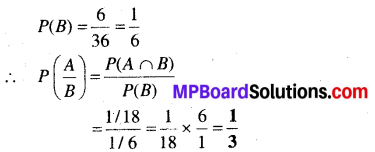
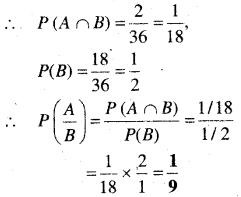
P(A∩B) = \(\frac{2}{36}\)= \(\frac{1}{18}\)
MP Board Class 12th Maths Book Solutions Chapter 13 प्रायिकता Ex 13.1 img 13
(b) A = प्राप्त संख्याओं का योग 8 है।
= {(2, 6), (3, 5), (4, 4), (5, 3), (6, 2)}
B = लाल पासे पर प्रकट संख्या 4 से कम है।
B = {(1, 1), (1, 2), (1, 3), (1, 4), (1, 5), (1, 6), (2, 1), (2, 2), (2, 3), (2, 4), (2, 5), (2, 6), (3, 1), (3, 2), (3, 3), (3, 4), (3, 5), (3, 6)}
A ∩ B = {(2, 6), (3, 5)}
MP Board Class 12th Maths Book Solutions Chapter 13 प्रायिकता Ex 13.1 img 14

प्रश्न 11.
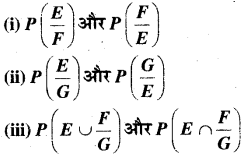
एक न्याय्य पासे को उछाला गया है। घटनाओं E = {1, 3, 5}, F = {2, 3} और G = {2, 3, 4,5} के लिए
निम्नलिखित ज्ञात कीजिए –
MP Board Class 12th Maths Book Solutions Chapter 13 प्रायिकता Ex 13.1 img 15
MP Board Class 12th Maths Book Solutions Chapter 13 प्रायिकता Ex 13.1 img 26
MP Board Class 12th Maths Book Solutions Chapter 13 प्रायिकता Ex 13.1 img 16
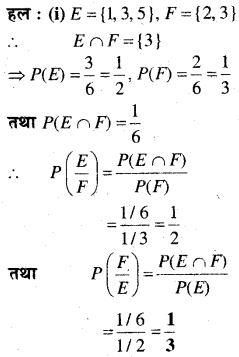
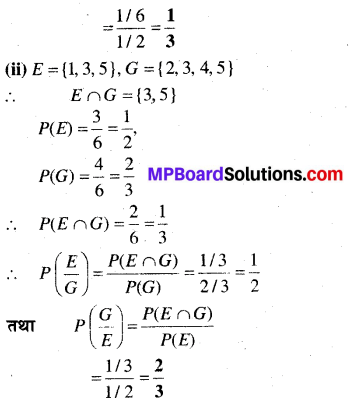
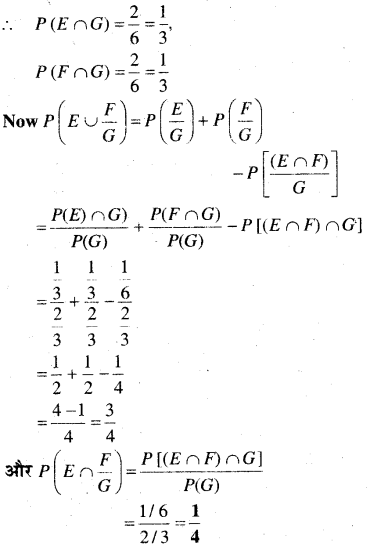
(iii) E = {1, 3, 5}, F = {2, 3}, G = {2, 3, 4, 5}
⇒E ∩ G = {3, 5} E ∩ G = {2, 3},
(E ∩ F) ∩ G = {3}
MP Board Class 12th Maths Book Solutions Chapter 13 प्रायिकता Ex 13.1 img 17

प्रश्न 12.
मान लें कि जन्म लेने वाले बच्चे का लड़का या लड़की होना समसंभाव्य है। यदि किसी परिवार में दो बच्चे हैं तो दोनों बच्चों के लड़की होने की सप्रतिबन्ध प्रायिकता क्या है, यदि यह दिया गया है कि
(i) सबसे छोटा बच्चा लड़की है
(ii) न्यूनतम एक बच्चा लड़की है।
हल:
माना पहले तथा दूसरे बच्चे, लड़कियाँ G1,G2, तथा लड़के B1, B2 हैं।
∴ S = {(G1.G2), (G1, B2), (G2, B1), (B1, B2)}
माना A = दोनों बच्चे लड़कियाँ हैं।
= {G1G2}
B = सबसे छोटा बच्चा लड़की है।
= {G1G2. B1G2}
C = न्यूनतम एक बच्चा लड़की है।
= {G1B2,G1G2, B1G2}
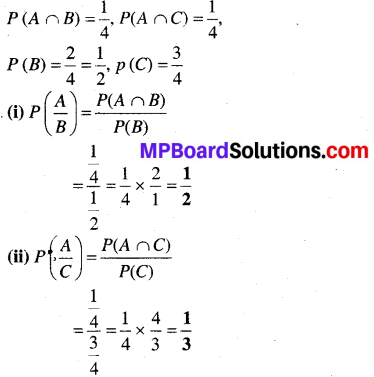
A ∩ B = {G1G2}, A ∩ C = {G1G2}
MP Board Class 12th Maths Book Solutions Chapter 13 प्रायिकता Ex 13.1 img 18

प्रश्न 13.
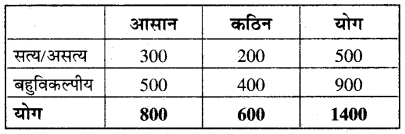
एक प्रशिक्षक के पास 300 सत्य/असत्य प्रकार के आसान प्रश्न, 200 सत्य/असत्य प्रकार के कठिन प्रश्न, 500 बहुविकल्पीय प्रकार के आसान प्रश्न और 400 बहुविकल्पीय प्रकार के कठिन प्रश्नों का संग्रह है। यदि प्रश्नों के संग्रह से एक प्रश्न यादृच्छया चुना जाता है तो एक आसान प्रश्न की बहुविकल्पीय होने की प्रायिकता क्या होगी?
हल:
दिए गए आँकड़ों की टेबिल निम्न प्रकार है –
MP Board Class 12th Maths Book Solutions Chapter 13 प्रायिकता Ex 13.1 img 19
माना E = सरल प्रश्न, D = कठिन प्रश्न, T = सत्य/असत्य प्रश्न, M = बहुविकल्पीय प्रश्न
सरल बहुविकल्पीय प्रश्नों की संख्या = 500
कुल प्रश्नों की संख्या = 1400
P(E ∩ M) = आसन और बहुविकल्पीय प्रश्नों की प्रायिकता
\( = \frac{500}{1400} = \frac{5}{14}\)
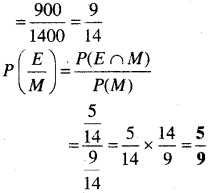
बहुविकल्पीय प्रश्नों की कुल संख्या = 500 + 400 = 900
P(M) = एक बहुविकल्पीय प्रश्नों की प्रायिकता
MP Board Class 12th Maths Book Solutions Chapter 13 प्रायिकता Ex 13.1 img 20

प्रश्न 14.
यह दिया गया है कि दो पासों को फेंकने पर प्राप्त संख्याएँ भिन्न-भिन्न हैं। दोनों संख्याओं का योग 4 होने की प्रायिकता ज्ञात कीजिए।
हल:
दो पासों को फेंकने से प्रतिदर्श समष्टि के परिणाम
= 6 x 6 =36
माना A = दो संख्याओं का योग 4
= [(1,3), (2, 2), (3,1)]
दो पासों को फेंकने पर समान संख्या वाले परिणाम
= {(1, 1), (2, 2), (3,3),(4, 4) (5,5), (6, 6)}
B = जब संख्या भिन्न हो तो ऐसे परिणाम
=36 – 6 = 30
A∩B = [(1, 3), (3, 1)]
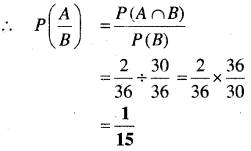
P(A∩B) = \(\frac{2}{36}\),
P(B) =\(\frac{30}{36}\)
MP Board Class 12th Maths Book Solutions Chapter 13 प्रायिकता Ex 13.1 img 21

प्रश्न 15.
एक पासे को फेंकने के परीक्षण पर विचार कीजिए। यदि पासे पर प्रकट संख्या 3 का गुणज है तो पासे को पुनः फेंकें और यदि कोई अन्य संख्या प्रकट हो तो एक सिक्के को उछालें। घटना न्यूनतम एक पासे पर संख्या 3 प्रकट होना’ दिया गया है तो घटना ‘सिक्के पर पट प्रकट होने’ की सप्रतिबन्ध प्रायिकता ज्ञात कीजिए।
हल:
माना यहाँ 3 का गुणज प्रत्येक समय n बार फेंका गया।
एक उछाल में 3 के गुणज की प्रायिकता प्राप्त होगी = \(\frac{2}{6}=\frac{1}{3}\)
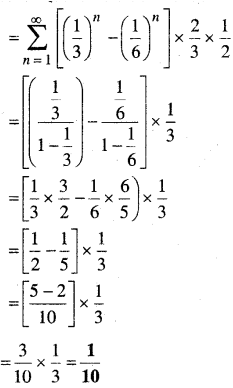
n उछालों में 3 के गुणज की प्रायिकता प्राप्त होगी = \(=\left(\frac{1}{3}\right)^{n}\)
एक उछाल में 6 की प्रायिकता प्राप्त होगी = \(\frac{1}{6}\)
∴ n उछालों में 6 की प्रायिकता प्राप्त होगी = \(\left(\frac{1}{6}\right)^{n}\)
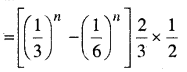
⇒n उछालों में कम-से-कम 3 की प्रायिकता प्राप्त होगी
= \(\left(\frac{1}{3}\right)^{n}-\left(\frac{1}{6}\right)^{n}\)
∴ (n +1)th उछाल में 1, 2, 3, 4, 5 (3 का गुणज नहीं है) की प्रायिकता प्राप्त होगी
=\(\frac{4}{6}=\frac{2}{3}\)
अगली उछाल में एक सिक्का उछाला गया और पट आया।
∴ पट आने की प्रायिकता = \(\frac{1}{2}\)
अन्त में (n + 2)th उछाल में कम-से-कम 3 और पट प्राप्त होने की प्रायिकता
MP Board Class 12th Maths Book Solutions Chapter 13 प्रायिकता Ex 13.1 img 27
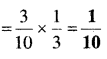
यदि n→∞; एक पासे पर संख्या 3 प्रकट होना, दिया गया है तो सिक्के पर पट होने की सप्रतिबन्ध प्रायिकता
MP Board Class 12th Maths Book Solutions Chapter 13 प्रायिकता Ex 13.1 img 28
MP Board Class 12th Maths Book Solutions Chapter 13 प्रायिकता Ex 13.1 img 29

निम्नलिखित प्रश्नों में से प्रत्येक में सही उत्तर चुनें।

प्रश्न 16.
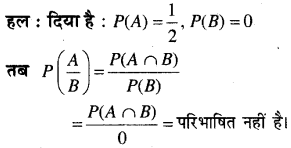
यदि P(A) = \(\frac{1}{2}\), P(B) = 0 तब \(P\left(\frac{A}{B}\right)\) है –
(A) 0
(B) \(\frac{1}{2}\)
(C) परिभाषित नहीं
(D) 1
हल:
MP Board Class 12th Maths Book Solutions Chapter 13 प्रायिकता Ex 13.1 img 23

प्रश्न 17.
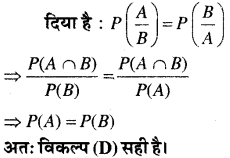
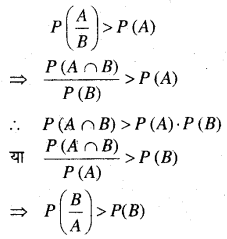
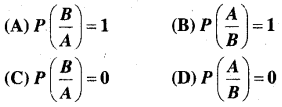
यदि A और B दो घटनाएँ इस प्रकार हैं कि \(\boldsymbol{P}\left(\frac{\boldsymbol{A}}{\boldsymbol{B}}\right)^{\prime}=\boldsymbol{P}\left(\frac{\boldsymbol{B}}{\boldsymbol{A}}\right)\) ≠ 0 तब
(A) A ⊂ B
(B) A = B
(C) A ∩B = ϕ
(D) P(A)=P(B)
हल:
MP Board Class 12th Maths Book Solutions Chapter 13 प्रायिकता Ex 13.1 img 24

MP Board Class 12th Maths Book Solutions Chapter 13 प्रायिकता विविध प्रश्नावली

In this article, we share MP Board Class 12th Maths Book Solutions Chapter 13 प्रायिकता विविध प्रश्नावली Pdf, These solutions are solved by subject experts from the latest MP Board books.

MP Board Class 12th Maths Book Solutions Chapter 13 प्रायिकता विविध प्रश्नावली

प्रश्न 1.
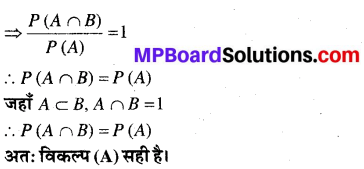
A और B इस प्रकार घटनाएँ हैं कि P(A) ≠ 0.
p\(\left(\frac{\boldsymbol{B}}{\boldsymbol{A}}\right)\) ज्ञात कीजिए यदि
(i) A, समुच्चय B का उपसमुच्चय है।
(ii) A ∩ B = ϕ
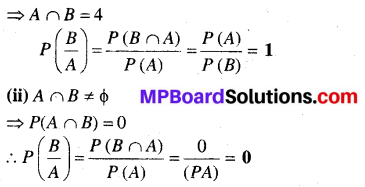
हल:
(i) B का उपसमुच्चय A है।
MP Board Class 12th Maths Book Solutions Chapter 13 प्रायिकता विविध प्रश्नावली img 1

प्रश्न 2.
एक दम्पति के दो बच्चे हैं–
(i) दोनों बच्चों के लड़का होने की प्रायिकता ज्ञात कीजिए यदि यह ज्ञात है कि दोनों बच्चों में से कम-से-कम एक बच्चा लड़का है।
(ii) दोनों बच्चों के लड़की होने की प्रायिकता ज्ञात कीजिए यदि यह ज्ञात है कि बड़ा बच्चा लड़की है।
हल:
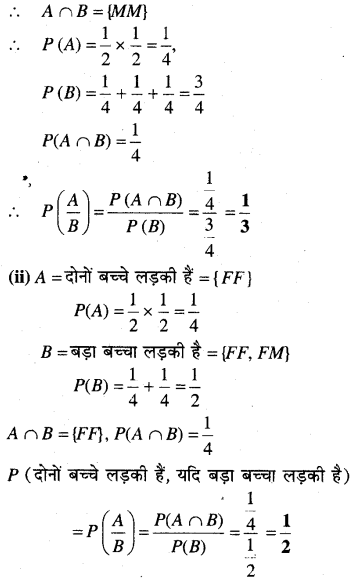
(i) माना A = दोनों बच्चे लड़के हैं = {MM}
B = कम-से-कम एक बच्चा लड़का है
={MF, FM, MM }
MP Board Class 12th Maths Book Solutions Chapter 13 प्रायिकता विविध प्रश्नावली img 2

प्रश्न 3.
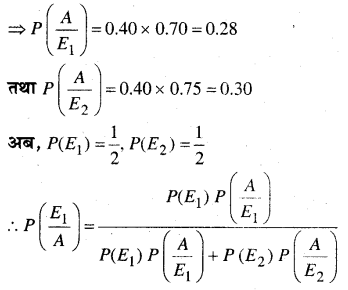
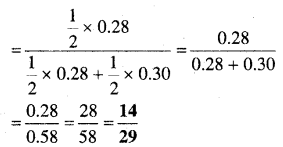
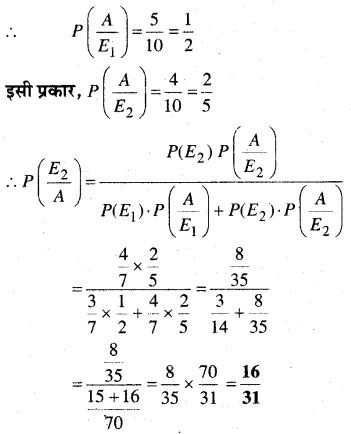
कल्पना कीजिए कि 5% पुरुषों और 0.25% महिलाओं के बाल सफेद हैं। एक सफेद बालों वाले व्यक्ति को यादृच्छिक चुना गया है। इस व्यक्ति के पुरुष होने की प्रायिकता क्या है? यह मान लें कि पुरुषों और महिलाओं की संख्या समान है।
हल:
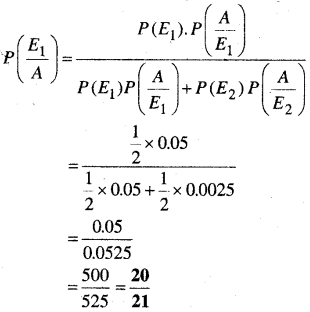
माना घटना E1 – पुरुष का होना तथा घटना
E2 – महिला का होना
तथा घटना A – सफेद बाल का होना
∴ 1 पुरुष चुनने की प्रायिकता = P (E1) = \(\frac{1}{2}\)
1 महिला चुनने की प्रायिकता = P (E2) = \(\frac{1}{2}\)
5% पुरुषों के बाल सफेद हैं
∴ P\(\left(\frac{A}{E_{1}}\right)\) = 5% = 0.05
∵ 0.25% महिलाओं के बाल सफेद हैं
∴ P\(\left(\frac{A}{E_{2}}\right)\) = 0.25% = 0.0025
इसलिए सफेद बालों वाला पुरुष होने की प्रायिकता
MP Board Class 12th Maths Book Solutions Chapter 13 प्रायिकता विविध प्रश्नावली img 3

प्रश्न 4.
मान लीजिए कि 90% लोग दाहिने हाथ से काम करने वाले हैं। इसकी प्रायिकता क्या है कि 10 लोगों में से यादृच्छया चुने गए अधिक-से-अधिक 6 लोग दाहिने हाथ से काम करने वाले हों?
हल : 90% लोग दाहिने हाथ से काम करते हैं।
p = \(\frac{9}{10}\)
10% लोग बायें हाथ से काम करते हैं।
q = \(\frac{1}{10}\), n = 10
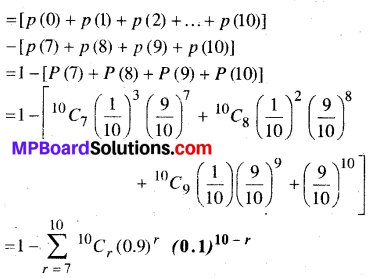
P (अधिक-से-अधिक 6 लोग दाहिने हाथ से काम करने वाले हों)
= p(O) + p (1) +…+ p (6)
MP Board Class 12th Maths Book Solutions Chapter 13 प्रायिकता विविध प्रश्नावली img 4

प्रश्न 5.
एक कलश (पात्र) में 25 गेंदें हैं, जिनमें से 10 गेंदों पर चिन्ह ‘x’ अंकित है और शेष 15 पर चिन्ह ‘Y’ अंकित है। कलश में से एक गेंद यादृच्छया निकाली जाती है और उस पर अंकित चिन्ह को नोट (लिख) करके उसे कलश में तिस्थापित कर दिया जाता है। यदि इस प्रकार से 6 गेंदें नेकाली जाती हों तो निम्नलिखित प्रायिकताएँ ज्ञात कीजिए।
(i) सभी पर चिन्ह ‘X’ अंकित हो।
(ii) 2 से अधिक पर चिन्ह ‘Y’ नहीं अंकित हो।
(iii) कम-से-कम 1 गेंद पर चिन्ह ‘Y’ अंकित हो।
(iv) ‘x’ तथा ‘x’ चिन्हों से अंकित गेंदों की संख्याएँ नमान हों।
हल:
गेंदों की कुल संख्या = 25
X अंकित गेंदों की संख्या =10
माना X अंकित गेंदों की घटना X से व्यक्त करते हैं।
Y = Y गेंद की घटना
∴ P(X) = \(\frac{10}{25}=\frac{2}{5}\) = P
∴ P(Y) = \(1-\frac{2}{5}=\frac{3}{5}\) = q
अब 6 गेंद खींचते हैं।
(i) P (सभी पर चिन्ह X अंकित हो) = \(\left(\frac{2}{5}\right)^{6}\)
(ii) P (2 0से अधिक पर चिन्ह Y नहीं अंकित हो)
= P (6) + P (5) + P (4)
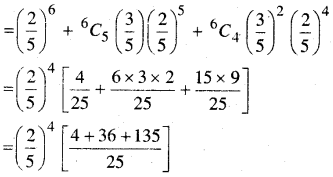
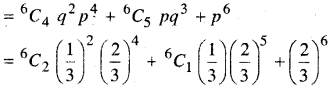
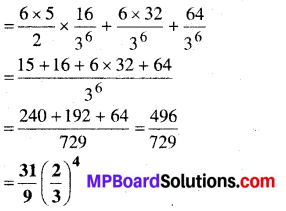
MP Board Class 12th Maths Book Solutions Chapter 13 प्रायिकता विविध प्रश्नावली img 5
= \(\left(\frac{2}{5}\right)^{4}\left[\frac{175}{25}\right]=7\left(\frac{2}{5}\right)^{4}\)
(iii) P (कम-से-कम 1 गेंद पर चिन्ह Y अंकित हो)
= 1 – (चिन्ह Y अंकित न हो)
= 1 – P (सभी गेंदों पर x अंकित हो)
= 1 – \(\left(\frac{2}{5}\right)^{6}\)
(iv) P(X तथा Y चिन्हों से अंकित गेंदों की संख्याएँ समान हों)
MP Board Class 12th Maths Book Solutions Chapter 13 प्रायिकता विविध प्रश्नावली img 6

प्रश्न 6.
एक बाधा दौड़ में एक प्रतियोगी को 10 बाधाएँ पार करनी हैं। इसकी प्रायिकता कि वह प्रत्येक बाधा को पार कर \(\frac{5}{6}\) लेगा है। इसकी क्या प्रायिकता है कि वह 2 से कम बाधाओं को गिरा देगा (नहीं पार कर पाएगा)?
हल:
दौड़ प्रतियोगिता में कुल बाधाएँ = 10
∵ बाधा को पार करने की प्रायिकता = \(\frac{5}{6}\)
∴ बाधा को पार न करने की प्रायिकता = \(1-\frac{5}{6}=\frac{1}{6}\)
अतः 2 से कम बाधाओं को गिराने की प्रायिकता
= P (10) + P (2)
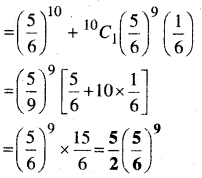
MP Board Class 12th Maths Book Solutions Chapter 13 प्रायिकता विविध प्रश्नावली img 7

प्रश्न 7.
एक पासे को बार-बार तब तक उछाला जाता है जब तक कि उस पर 6 का अंक तीन बार प्राप्त नहीं हो जाता। इसकी प्रायिकता ज्ञात कीजिए कि पासे पर तीसरा 6 का अंक उसे छठी बार उछालने पर प्राप्त होता है।
हल:
एक पासे को बार-बार उछाला जाता है।
एक उछाल में 6 का अंक आने की प्रायिकता = \(\frac{1}{6}\)
एक उछाल में 6 का अंक न आने की प्रायिकता
= \(1-\frac{1}{6}=\frac{5}{6}\)
पासे पर 5 उछालों पर 2. बार 6 और 3 बार 6 न आने की प्रायिकता
= 5C2
छठी बार उछालने में 6 आने की प्रायिकता = \(\frac{1}{6}\)
∴ पासे पर तीसरा 6 का अंक उसे छठी बार उछालने पर प्राप्त प्रायिकता
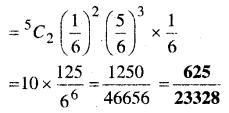
MP Board Class 12th Maths Book Solutions Chapter 13 प्रायिकता विविध प्रश्नावली img 9

प्रश्न 8.
यदि एक लीप वर्ष को यादृच्छया चुना गया हो तो इसकी क्या प्रायिकता है कि उस वर्ष में 53 मंगलवार होंगे।
हल:
∵ एक लीप वर्ष में होते हैं = 366 दिन
अर्थात् 52 सप्ताह तथा 2 दिन (अलग से)
अतिरिक्त दो दिन हो सकते हैं
= (Mon, Tue), (Tue, Wed), (Wed, Thu), (Thu, Fri), (Fri, Sat), (Sat, Sun), (Sun, Mon)
सम्भावित परिणाम = 7
अनुकूल परिणाम = 2 (Mon, Tue) (Tue, Wed)
अतः 53 मंगलवार होने की प्रायिकता = \(\frac{2}{7}\)

प्रश्न 9.
एक प्रयोग के सफल होने का संयोग उसके असफल होने से दो गुना है। प्रायिकता ज्ञात कीजिए कि अगले छः परीक्षणों में कम-से-कम 4 सफल होंगे।
हल:
माना सफल होने की प्रायिकता p तथा असफल होने की प्रायिकता q है।
एक प्रयोग के सफल होने का संयोग उसके असफल होने से दो गुना है।
⇒ p = 2q = 2 (1 – p) = 2 – 2p
∴ 3p = 2 या p = \(\frac{2}{3}\)
∴ q = \(\frac{1}{3}\)
अगले छ: परीक्षणों में कम-से-कम 4 सफल होने की प्रायिकता
= P(4) + P(5) + P(6)
MP Board Class 12th Maths Book Solutions Chapter 13 प्रायिकता विविध प्रश्नावली img 10
MP Board Class 12th Maths Book Solutions Chapter 13 प्रायिकता विविध प्रश्नावली img 11

प्रश्न 10.
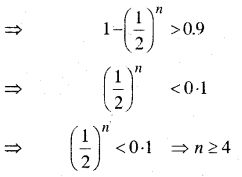
एक व्यक्ति एक न्याय्य सिक्के को कितनी बार उछाले कि कम-से-कम एक चित की प्रायिकता 90% से अधिक हो?
हल:
माना सिक्के को x बार उछाला गया है।
चित आने की प्रायिकता = \(\frac{1}{2}\)
तथा चित न आने की प्रायिकता = \(\left(\frac{1}{2}\right)^{n}\)
∴ कम-से-कम एक चित आने की प्रायिकता = \(1-\left(\frac{1}{2}\right)^{n}\)
इसलिए हम कम-से-कम एक चित की प्रायिकता ज्ञात करेंगे जो कि 90% (0.9) से अधिक हो।
अतः कम-से-कम एक चित आने की प्रायिकता > 0.9
MP Board Class 12th Maths Book Solutions Chapter 13 प्रायिकता विविध प्रश्नावली img 12
अतः एक न्याय्य सिक्के को कम-से-कम 4 बार उछालना पड़ेगा।

प्रश्न 11.
एक खेल में किसी व्यक्ति को एक न्याय्य पासे को उछालने के बाद छः प्रकट होने पर एक रुपया मिलता है और अन्य कोई संख्या प्रकट होने पर वह एक रुपया हार जाता है। एक व्यक्ति यह निर्णय लेता है कि वह पासे को तीन बार फेंकेगा लेकिन जब भी छः प्राप्त होगा वह खेलना छोड़ देगा। उसके द्वारा जीती/हारी गई राशि की प्रत्याशा ज्ञात कीजिए।
हल:
जब पासे को उछालते हैं, तब 6 प्रकट होने की प्रायिकता
= \(\frac{1}{6}\) = p (माना)
∴ q = \(1-\frac{1}{6}=\frac{5}{6}\)
(i) छ: प्रकट होने की प्रायिकता = \(\frac{1}{6}\)
(ii) पहली उछाल में 6 प्रकट न हो किन्तु दूसरी उछाल में 6 प्रकट होने की प्रायिकता
= \(\frac{5}{6} \times \frac{1}{6}=\frac{5}{36}\)
पहली दो उछाल में 6 न प्रकट होने की तथा तीसरी उछाल में 6 प्रकट होने की प्रायिकता
= \(\frac{5}{6} \times \frac{5}{6} \times \frac{1}{6}=\frac{25}{216}\)
तीनों उछालों में 6 न प्रकट होने की प्रायिकता
= \(\left(\frac{5}{6}\right)^{3}=\frac{125}{216}\)
पहली उछाल में 6 प्रकट होने पर एक रुपया मिलता है।
दूसरी उछाल में 6 प्रकट होने पर (1 – 1) रुपये = 0 रुपये मिलते हैं।
तीसरी उछाल में 6 प्रकट होने पर प्राप्त होता है
= ( – 1 – 1 + 1) रुपये
=( – 1) Rs. = 1 रुपया कम
MP Board Class 12th Maths Book Solutions Chapter 13 प्रायिकता विविध प्रश्नावली img 13

प्रश्न 12.
मान लीजिए हमारे पास A, B, Cऔर D बक्से हैं जिसमें रखी संगमरमर की लाल, सफेद और काली टुकड़ियों का विवरण निम्न तरीके से है यादृच्छया एक बॉक्स चुना जाता है तथा इससे एक टुकड़ा निकाला जाता है। यदि टुकड़ा लाल हो तो इसे बॉक्स A; बॉक्स B, बॉक्स C से निकाले जाने की क्या प्रायिकता है?
MP Board Class 12th Maths Book Solutions Chapter 13 प्रायिकता विविध प्रश्नावली img 14
हल:
माना एक बॉक्स चुने जाने की घटना F है और लाल गेंद चुनने की घटना A है।
MP Board Class 12th Maths Book Solutions Chapter 13 प्रायिकता विविध प्रश्नावली img 15
MP Board Class 12th Maths Book Solutions Chapter 13 प्रायिकता विविध प्रश्नावली img 16
MP Board Class 12th Maths Book Solutions Chapter 13 प्रायिकता विविध प्रश्नावली img 17

प्रश्न 13.
मान लीजिए किसी रोगी को दिल का दौरा पड़ने का संयोग 40% है। यह मान लिया जाता है कि ध्यान ओर योग विधि दिल का दौरा पड़ने के खतरे को 30% कम कर देता है और दवा द्वारा खतरे को 25% कम किया जा सकता है। किसी भी समय रोगी इन दोनों में से किसी एक विकल्प का चयन करता है। यह दिया गया है कि उपरोक्त विकल्पों से किसी एक का चुनाव करने वाले रोगियों से यादृच्छया चुना गया रोगी दिल के दौरे से ग्रसित हो जाता है। रोगी द्वारा ध्यान और योग विधि का उपयोग किए जाने की प्रायिकता ज्ञात कीजिए।
हल:
माना E1 = ध्यान और योग विधि का इलाज
E2 = दवा द्वारा खतरे को कम किए जाने का इलाज
A = दिल के दौरे से रोगी
P(E1) =\(\frac{1}{2}\), P(E2) = \(\frac{1}{2}\)
माना P(A) = 40% = 0.40
दवा द्वारा दिल का दौरा पड़ने का 25% खतरा कम हो जाता है।
⇒ दवा द्वारा दिल का दौरा पड़ने से खतरा 75% है।
MP Board Class 12th Maths Book Solutions Chapter 13 प्रायिकता विविध प्रश्नावली img 18
MP Board Class 12th Maths Book Solutions Chapter 13 प्रायिकता विविध प्रश्नावली img 19

प्रश्न 14.
यदि 2 कोटि के एक सारणिक के सभी अवयव शून्य या एक हों तो सारणिक का धनात्मक मान होने की क्या प्रायिकता है। (मान लीजिए कि सारणिक के प्रत्येक अवयव स्वतन्त्र रूप से चुने जा सकते हैं तथा प्रत्येक की चुने जाने की प्रायिकता 1 है।)
हल:
यहाँ 2 कोटि के सारणिक में चार अवयव हैं।
∴ सारणिकों द्वारा बनाई गई संख्या = 24 =16
सारणिक का मान धनात्मक है।
MP Board Class 12th Maths Book Solutions Chapter 13 प्रायिकता विविध प्रश्नावली img 20
सारणिक का धनात्मक मान होने की प्रायिकता = \(\frac{3}{16}\)

प्रश्न 15.
एक इलेक्ट्रॉनिक एसेंबली के दो सहायक निकाय A और B हैं। पूर्ववर्ती निरीक्षण द्वारा निम्न प्रायिकताएँ ज्ञात हैं
P(A के असफल होने की) = 0.2
P(B के अकेले असफल होने की) = 0.15
P(A और B के असफल होने की) = 0.15
तो, निम्न प्रायिकताएँ ज्ञात कीजिए
(i) P(A असफल / B असफल हो चुकी हो)
(ii) P(A के अकेले असफल होने की)
हल:
MP Board Class 12th Maths Book Solutions Chapter 13 प्रायिकता विविध प्रश्नावली img 21
= 0.20 – 0.15 = 0.05

प्रश्न 16.
थैला I में 3 लाल तथा 4 काली गेंदें हैं तथा थैला II में 4 लाल और 5 काली गेंदें हैं। एक गेंद को थैला 1 से थैला II में स्थानान्तरित किया जाता है और तब एक गेंद थैला II से निकाली जाती है। निकाली गई गेंद लाल रंग की है। स्थानान्तरित गेंद की काली होने की प्रायिकता ज्ञात कीजिए।
हल:
थैला I में 3 लाल तथा 4 काली गेंदें हैं।
थैला II में 4 लाल तथा 5 काली गेंदें हैं।
माना E1 = थैला I में लाल गेंद निकालने की घटना।
E2 = थैला I में काली गेंद निकालने की घटना
∴ P(E1) = \(\frac{3}{7}\), P(E2) = \(\frac{4}{7}\)
माना लाल गेंद निकालने की घटना A है।
MP Board Class 12th Maths Book Solutions Chapter 13 प्रायिकता विविध प्रश्नावली img 22

निम्नलिखित प्रश्नों में सही उत्तर का चुनाव कीजिए-
प्रश्न 17.
यदि A और B दो ऐसी घटनाएँ हैं कि P(A) ≠ 0 और P\(\left(\frac{\boldsymbol{B}}{\boldsymbol{A}}\right)\) = 1, तब
(A) A ⊂ B
(B) B ⊂ A
(C) B = ϕ
(D) A = ϕ
हल:
P\(\left(\frac{\boldsymbol{B}}{\boldsymbol{A}}\right)\) = 1v
MP Board Class 12th Maths Book Solutions Chapter 13 प्रायिकता विविध प्रश्नावली img 23

प्रश्न 18.
यदि P\(\left(\frac{\boldsymbol{A}}{\boldsymbol{B}}\right)\) > P(A), तब निम्न में से कौन सही है।
(A) P \(\left(\frac{\boldsymbol{B}}{\boldsymbol{A}}\right)\) < P(B)
(B) P(A ∩ B) < P (A). P (B) (C) P\(\left(\frac{\boldsymbol{B}}{\boldsymbol{A}}\right)\) > P(B)
(D) P\(\left(\frac{\boldsymbol{B}}{\boldsymbol{A}}\right)\) = P(B)
हल:
MP Board Class 12th Maths Book Solutions Chapter 13 प्रायिकता विविध प्रश्नावली img 24
अतः विकल्प (C) सही है।

प्रश्न 19.
यदि A और B ऐसी दो घटनाएँ हैं कि P(A) + P (B) – P(A और B) = P(A), तब
MP Board Class 12th Maths Book Solutions Chapter 13 प्रायिकता विविध प्रश्नावली img 25
हल:
P (A) + P (B) – P(A ∩ B) = P (A)
⇒ P(B) – P (A ∩ B) = 0
या P(A ∩ B) = P (B)
MP Board Class 12th Maths Book Solutions Chapter 13 प्रायिकता विविध प्रश्नावली img 26
अतः विकल्प (B) सही है।