MP Board Class 9th Science Solutions Chapter 13 Why do we Fall Ill

MP Board Class 9th Science Solutions Chapter 13 Why do we Fall Ill

Why do we Fall Ill Intext Questions

Why do we Fall Ill Intext Questions Page No. 178

Question 1.
State any two conditions essential for good health.
Answer:
Two conditions essential for good health are:

  1. Balanced diet and good nutrition.
  2. Good social surrounding and economic wellness.

MP Board Solutions

Question 2.
State any two conditions essential for being free of disease.
Answer:
Two conditions essential for being disease – free are:

  1. Personal and community hygiene.
  2. Proper diet and economic growth.

Question 3.
Are the conditions essential for maintaining good health and being free of diseases same or different? Why?
Answer:
Yes, to some extent they are the similar, because if the conditions that are essential for good health are maintained, then the chances of getting a disease will be minimized. But at the same time, we can say that they are different because being health or good health means physical, mental and social well-being while being disease-free means not suffering from a particular disease.

Why do we Fall Ill Intext Questions Page No. 180

Question 1.
List any three reasons why you would think that you are sick and ought to see a doctor. If only one of these symptoms were present, would you still go to the doctor? Why or why not?
Answer:
Common symptoms which indicate sickness are:

  1. Headache
  2. Cough
  3. Dysentery

If only one of these symptoms is present, we usually do not visit a doctor. This is because such symptoms do not have much effect on our general health and ability to work. However, if a person is experiencing these symptoms for quite sometime, then he needs to visit a doctor for proper treatment.

Question 2.
In which of the following case do you think the long – term effects on your health are likely to be most unpleasant?

  1. If you get jaundice
  2. If you get lice
  3. If you get acne.
    Why?

Answer:
Jaundice is a disease that can cause long – term effects on our health. It is a chronic disease that lasts for a long period of time. Jaundice does not spread rapidly, but it develops slowly over a period of time.

Why do we Fall Ill Intext Questions Page No. 187

Question 1.
Why are we normally advised to take bland and nourishing food when we are sick?
Answer:
When we are sick, the normal body functions get disturbed. In such a situation, food that is easily digestible and contains adequate nutrients are required for the speedy recovery. Thus, bland and nourishing food is given during sickness.

MP Board Solutions

Question 2.
What are the different means by which infectious diseases spread?
Answer:
The different modes of transmission of infectious diseases are:

  1. Through Air: Certain disease – causing micro – organisms are expelled in air by coughing, sneezing, talking etc. These micro-organisms can travel through dust particles or water droplets in air to reach other people. For example, tuberculosis, pneumonia etc. spread through air.
  2. Through Water: Sometimes causal micro – organisms get mixed with drinking water and spread water borne diseases. Cholera, for example is a water borne disease.
  3. Through Sexual Contact: Sexual act between two people can lead to the transfer of diseases such as syphilis, gonorrhoea, AIDS etc.
  4. Through Vectors: Certain diseases spread by animals called vectors. For example, mosquitoes spread malaria.

Question 3.
What precautions can you take in your school to reduce the incidence of infectious diseases?
Answer:
Precautions to reduce incidence of infectious diseases are:

  1. Staying away from the infected person.
  2. Covering mouth or nose while coughing or sneezing to prevent the spread of disease.
  3. Drinking safe water.
  4. Keeping the school environment clean to prevent multiplication vectors.

Question 4.
What is immunisation?
Answer:
Immunisation is defined as protection of the body from communicable diseases by administration of some agent that mimics the pathogen.

Question 5.
What are the immunisation programmes available at the nearest health centre in your locality? Which of these diseases are the major health problems in your area?
Answer:
The immunisation programmes available at the nearest health centre are DPT (Diphtheria, Pertusis, and Tetanus), polio vaccine, hepatitis B, MMR (Measles, Mumps, and Rubella), jaundice, typhoid etc. Of all these diseases, jaundice and typhoid are major health problems.

Why do we Fall Ill NCERT Textbook Exercises

Question 1.
How many times did you fall ill in the last one year? What were the illnesses?

  1. Think of one change you could make in your habits in order to avoid any of/most of the above illnesses.
  2. Think of one change you would wish for in your surroundings in order to avoid any of / most of the above illnesses.

Answer:
The illness was 2 – 3 times common – cold, occurred in a year:

  1. One change I would make in my habits in order to avoid the above illness is that I would take proper diet rich in vitamin C and would avoid too cold food.
  2. The surroundings should be neat and clean.

Question 2.
A doctor / nurse / health – worker is exposed to more sick people than others in the community. Find out how she / he avoids getting sick herself / himself.
Answer:
The following precautions must be taken by a doctor / nurse / health – worker:

  1. Wearing a mask when in contact with a diseased person.
  2. Keeping yourself covered while moving around an infected place.
  3. Drinking safe water.
  4. Eating healthy and nutritious food.
  5. Ensuring proper cleanliness and personal hygiene.

MP Board Solutions

Question 3.
Conduct a survey in your neighbourhood to find out what the three most common diseases are. Suggest three steps that could be taken by your local authorities to bring down the incidence of these diseases.
Answer:
Common diseases are dysentry, malaria, viral fever / jaundice. Preventive Measures:

  1. Cleanliness of surrounding neighbourhood i.e, removal of garbage from the streets / house and storage in a covered place till it is disposed off. Proper cleaning of drains and proper disposal of sewer water.
  2. Removal of breeding places of mosquitoes like ditches with stagnant water.
  3. Ensure supply of safe drinking water.

Or
Periodical programmes to educate people about prevention of disease.

Question 4.
A baby is not able to tell her / his caretakers that she / he is sick. What would help us to find out

  1. that the baby is sick?
  2. what is the sickness?

Answer:

  1. The baby is sick can be determined by his / her behavioural changes such as constant crying of baby, improper intake of food, frequent mood changes etc.
  2. The sickness is determined by symptoms or indications that can be seen in the baby. The symptoms include vomiting, fever, loose motion, paleness in the body etc.

Question 5.
Under which of the following conditions is a person most likely to fall sick?
(a) when she is recovering from malaria.
(b) when she has recovered from malaria and is taking care of someone suffering from chicken – pox.
(c) when she is on a four – day fast after recovering from malaria and is taking care of someone suffering from chicken – pox. Why?
Answer:
(c) A person is more likely to fall sick when she is on a four day fast after recovering from malaria and is taking care of someone who is suffering from chicken pox. This is because she is fasting during recovery and her immune system is so weak that it is not able to protect its own body from any foreign infection. If she is taking care of someone suffering from chicken pox, then she has more chances of getting infected from chicken pox virus and will get sick again with this disease.

MP Board Solutions

Question 6.
Under which of the following conditions are you most likely to fall sick?
(a) when you are taking examinations.
(b) when you have travelled by bus and train for two days.
(c) when your friend is suffering from measles. Why?
Answer:
(c) You are more likely to fall sick when your friend is suffering from measles. This is because measles is highly contagious and can easily spread through respiration i. e., through air. Thus, if your friend is suffering from measles, stay away from him otherwise you might easily get infected with the disease.

Why do we Fall Ill Additional Questions

Why do we Fall Ill Multiple Choice Questions

Question 1.
Community health is related to:
(a) Social health
(b) Physical health
(c) Mental health
(d) All.
Answer:
(d) All.

Question 2.
Every disease have particular:
(a) Body weight
(b) temperature
(c) Sign
(d) Appearance change.
Answer:
(c) Sign

Question 3.
Condition for good community health is by maintaining:
(a) Cleanliness
(b) Pollution less atmosphere
(c) Economic growth
(d) All.
Answer:
(d) All.

MP Board Solutions

Question 4.
Malaria is caused by:
(a) Vibrio cholerae
(b) Plasmodium vivax
(c) Andies
(d) H. pylori.
Answer:
(b) Plasmodium vivax

Question 5.
Vibrio cholerae is a:
(a) Agent
(b) Host
(c) Vector
(d) None.
Answer:
(a) Agent

Question 6.
Which one of the following is water born infectious disease?
(a) Common cold
(b) Peptic ulcers
(c) Cholera
(d) AIDS.
Answer:
(c) Cholera

Question 7.
Which one among the following is a viral disease?
(a) AIDS
(b) Cholera
(c) TB
(d) Typhoid.
Answer:
(a) AIDS

Question 8.
Which one among the following is a chronic disease?
(a) Cold
(b) Malaria
(c) Elephantiasis
(d) None.
Answer:
(c) Elephantiasis

MP Board Solutions

Question 9.
In malaria disease, which one of the following is vector?
(a) Plasmodium vivax
(b) Mosquito
(c) Human
(d) Dog.
Answer:
(b) Mosquito

Question 10.
Which one of the following is mechanical cause of disease?
(a) Injury
(b) Microbes
(c) Heat
(d) All.
Answer:
(a) Injury

Question 11.
HIV – AIDS is transmitted by:
(a) Microbes
(b) Sexual contact
(c) Water
(d) All.
Answer:
(b) Sexual contact

Question 12.
Main factors which can help in public health hygiene:
(a) Availability of safe drinking water.
(b) Availability of clean environment.
(c) Spacious condition for living.
(d) All.
Answer:
(d) All.

Question 13.
Penicillin is a / an:
(a) Antigen
(b) Antibody
(c) Pathogen
(d) Host.
Answer:
(a) Antigen

Why do we Fall Ill Very Short Answer Type Questions

Question 1.
Write symptoms of a disease.
Answer:
Discomfort pain and tiredness is symptoms of a disease.

Question 2.
Is mental discomfort a disease?
Answer:
Yes.

Question 3.
When a part of body is hurt, can it affect all body? Why?
Answer:
Yes, because all body parts are connected internally.

MP Board Solutions

Question 4.
Write name of two diseases caused by virus.
Answer:
AIDS, common cold.

Question 5.
Write name of two diseases caused by worms.
Answer:
Elephantiasis, intestine infection.

Question 6.
Write name of two deficiency diseases.
Answer:
Beri – Beri, Rickets.

Question 7.
What is a vector?
Answer:
Organism which transfer a disease is called a vector.

Question 8.
What is a host?
Answer:
Organism which bear disease and their causative agents is called host.

Question 9.
Name one genetical disorder.
Answer:
Haemophilia.

Question 10.
How malaria and dengue are spread?
Answer:
By species of mosquito.

Question 11.
Name two communicable diseases.
Answer:

  1. AIDS
  2. cold.

MP Board Solutions

Question 12.
What become vector for a communicable disease?
Answer:
Host itself.

Question 13.
What kind of disease is AIDS?
Answer:
AIDS is a fatal viral disease.

Question 14.
Name two air born diseases.
Answer:

  1. Influenza
  2. pneumonia.

Question 15.
Name a disease against which vaccines are available.
Answer:
Typhoid.

Why do we Fall Ill Short Answer Type Questions

Question 1.
Define congenital diseases. Give some examples of such disease.
Answer:
Diseases or abnormalities present since birth are called congenital diseases. It is due to gene mutations (genetic factor) or environmental factors.
Examples:

  • Colour blindness
  • Cleft lip or palate.

Question 2.
Name the agent and vector which cause rabies.
Answer:
The causative agent of rabies is rabies virus (RV). The animals included humans can be infected and all of them can spread the disease.
Causes:

  • Dogs
  • rats
  • cats
  • monkeys
  • squirrels
  • cattle
  • wolves
  • racoons
  • bears etc. can spread this disease.

MP Board Solutions

Question 3.
What are acquired diseases?
Answer:
The diseases which develop after birth are called acquired diseases. It is categorized into

  • Communicable Diseases(Infectious Diseases): malaria, influenza etc. and
  • Non – Communicable Diseases: diabetes, scurvy, high blood pressure.

Question 4.
Write some common signs and symptoms of a disease if a brain is affected.
Answer:
Headache, fits, vomitting, unconsciousness etc.

Question 5.
What are infectious agents?
Answer:
The microorganisms which spread the disease from one person to other are called infectious agents.

Question 6.
Define ‘germ theory of disease’?
Answer:
Louis Pasteur proposed ‘germ theory of disease’ also called pathogenic theory of medicine. He stated that micro – organisms are the causes of many diseases.

MP Board Solutions

Question 7.
What happen when kidneys of a person do not filter urine properly?
Answer:
If the kidneys of a person do not filter urine properly then the toxic substances which disturbs metabolism could be fatal.

Question 8.
Is skin, hairs, saliva form the first line of defence against diseases? If yes, then how?
Answer:
Yes, skin, nose hairs, saliva act as the first line of defence.

  • Skin: It prevents the entry of microbes.
  • Hairs: These prevent the entry of dust particles and germs.
  • Saliva: It washes away bacterial growth from teeth and mouth.

Question 9.
What is immunity?
Answer:
Immunity refers to ability of the body to be resistant towards injury, poison or harmful pathogens. It is part of the defence reaction in the body. There are two types of immunity – natural or innate immunity and acquired or specific immunity.

Question 10.
Why are kids and elderly people more vulnerable to cold / flu?
Answer:
Kids are more vulnerable to cold and flu because their immune systems haven’t fully developed. Elderly people also more prone to catch a cold because of their poor health.

MP Board Solutions

Question 11.
Define antibiotic. Explain how it is able to control bacterial infections but not viral infections.
Answer:
Antibiotics (anti means against and biotic means living) are types of medications which slows and destroy the growth of bacteria. They commonly block biochemical pathways important for bacteria. Many bacteria, for example, make a cell – wall to protect themselves. The antibiotic penicillin blocks the bacterial processes that build the cell wall. Thus, bacteria fail to build their cell – wall, stop multiplying and die out.

Question 12.
Name infectious diseases that are spread through air.
Answer:
Infectious diseases that spread through air are – sneezing, coughing, open pneumonia, tuberculosis, measles, SARS, chicken – pox.

Question 13.
How infectious diseases are spread through water? Give two examples.
Answer:
Open defecation, consuming contaminated water, inadequate hand washing causes infectious diseases through water. Water – borne diseases are cholera, typhoid etc.

Question 14.
Give few examples of direct and indirect contact diseases.
Answer:

  1. Direct Contact Diseases: Examples of diseases spread by direct contact are common cold, tuberculosis, chicken pox, warts etc. Sexual Transmitted Diseases (STD) are Syphilis, AIDS, gonorrhoea.
  2. Indirect Contact Diseases: Examples of diseases spread by indirect contact are Flu, TB, Chickenpox, urinal infections etc.

Why do we Fall Ill Long Answer Type Questions

Question 1.
Becoming exposed to or infected with an infectious microbe does not necessarily mean developing noticeable disease. Explain.
Answer:
Infected with a microbe does not mean developing a disease because an infectious microbe is able to cause a disease only. If the immune system of the person is weak but a person with strong immune system normally fights off microbes. We have cells which are specialised to kill the pathogenic microbes. These cells are active when infecting microbes enter the body and if they are successful in removing the pathogen, we remain disease – free. So, even if we are exposed to infectious microbes, the person will not catch the disease.

MP Board Solutions

Question 2.
Give any four factors necessary for a healthy person.
Answer:
Factors necessary for a healthy person are as follows:

  1. A clean environment with proper public health services.
  2. Personal hygiene prevents infectious diseases.
  3. A proper balanced diet and sufficient nourishment are necessary for good immune system of our body.
  4. Immunisation / vaccination against severe diseases.

Question 3.
Why is AIDS considered to be a ‘Syndrome’ and not a disease?
Answer:
AIDS is considered a syndrome and not a disease because AIDS causing virus – HIV comes into the body via the sexual organs or any other means like blood transfusion and spread to lymph nodes all over the body. The virus damages the immune system of the body and the body can no longer fight off many minor infectious. Instead, every small cold can become pneumonia, or minor get infection can become severe diarrhoea. The effect of disease becomes very severe and complex, at times killing the person suffering from AIDS. Hence, there is no specific disease symptoms for AIDS but it results in a complex disease and symptoms.

Question 4.
(a) The signs and symptoms of a disease depend upon the tissues or organ the microbe targets. Explain giving any two examples.
(b) How does the immune system work against microbes?
(c) Name two diseases against which vaccines are available.
Answer:
(a) Disease – causing microbes enter the body through different means. These disease – causing micro – organisms are tissues specific or we can say that they target a specific organ.  If these microbes enter the body via the nose, the lungs are target and the symptoms are:

  1. cough
  2. breathlessness.

This is seen in the bacteria causing tuberculosis. If brain is targetted by these microbes, the symptoms will be headache, vomitting, fits or unconsciousness. This is seen in the bacteria causing meningitis.

(b) Immunisation is most important and effective way to raise resistance against the disease. Immunity may be two types:

  1. Active immunity
  2. Passive Immunity (artificial).

In active immunity, the body responds against disease – causing microbes and produces antibodies. The antibodies attack organ and kill the disease – causing microbes. In passive immunity, prepared antibodies are used against disease – causing microbes.

(c) We have vaccine against polio and tuberculosis.

Why do we Fall Ill Higher Order Thinking Skills (HOTS)

Question 1.
Why we cannot destroy virus?
Answer:
Virus attacks our body and consume proteins and RNA only. They do not have any metabolic pathway while other pathogens have their metabolic pathways. Our medicines stops the metabolic activity of pathogens and hence they get destroyed, but it is not possible in case of virus.

MP Board Solutions

Question 2.
How vaccine stops disease while it is, itself a low dose of similar causative agent?
Answer:
Our body has a very strong immune system and it develops antigen to subside the effect of any new high quantity antibody entering in the body. Presence of chemical in small harmless quantity initiate development of antigen in body and when actually agent enters in the body, antigen fights easily with it.

Why do we Fall Ill Value Based Questions

Question 1.
Anya got vaccination, she told her friend Sakshi. Sakshi got scared and doubted if it was safe as it contains weakened pathogens which cause diseases. Later, Anya explained her the concept of vaccination and immunity. Answer the following questions:

  1. What did Anya explain Sakshi?
  2. What values did Anya possess?

Answer:

  1. Anya explained that vaccine or weakened pathogen are not harmful to the body. Rather, they boost the person immunity against the same pathogen when it is actually encountered by the body is attacked by it leading to its destruction.
  2. Anya possess the values of helpfulness and intelligence. She is practical.

MP Board Solutions

Question 2.
Akash found in a blood test that his brother was HIV positive. His brother, due to this was expelled from the job. Only after intervention of NGO, he got it back.

  1. Which disease is his brother suffering from?
  2. Write its modes of transmission.
  3. Write your views about the NGO and the organization where his brother worked.

Answer:

  1. AIDS (caused by HIV).
    • Mother to child (during pregnancy).
    • Using infected syringes.
    • Blood transfusion.
    • Sexual contact with infected person.
  2. NGO has taken correct step and has helped Akash in fighting for injustice. While, organisation was wrong in its step as it does not spread by touching or by working with the infected person.

MP Board Class 9th Science Solutions

MP Board Class 9th Science Solutions Chapter 14 Natural Resources

MP Board Class 9th Science Solutions Chapter 14 Natural Resources

Natural Resources Intext Questions

Natural Resources Intext Questions Page No. 193

Question 1.
How is our atmosphere different from the atmospheres on Venus and Mars?
Answer:
Earth’s atmosphere has mixture of nitrogen (79%), oxygen (20%), and a small fraction of carbon dioxide, water vapours and other gases which makes the existence of life possible on Earth while the atmospheres on Venus and Mars mainly has carbon dioxide. Approximately, 95% to 97% is carbon dioxide is present on these planets which do not support existence of life.

MP Board Solutions

Question 2.
How does the atmosphere act as a blanket?
Answer:
Atmosphere is a mixture of various gases along with vapour and submerged particles. It surrounds the earth and separates it from outer space. As a blanket stop interaction between body covered inside and atmosphere outside, in similar way atmosphere stops interaction between earth and space.
The most important isolations done by atmosphere are:

  1. It keeps the average temperature of the Earth fairly constant during day time and even during the course of whole year.
  2. It prevents a sudden increase in the temperature during day time.
  3. It slows down the escape of heat from the surface of the Earth into outer space during night time.

Question 3.
What causes winds?
Answer:
Atmospheric pressure and temperature difference generates wind. As earth surface is not similar everywhere even at some places it is occupied by huge water bodies, lava emitting volcanoes, moist forest etc., a difference in temperature and pressure arises and to maintain equilibrium wave of pressure moves which we feel or notice as wind.

Question 4.
How are clouds formed?
Answer:
During day time, a large amount of water evaporates from various water bodies and of earth surface and through biological activities such as transpiration and respiration and mix up into the air. This causes the air in the atmosphere to heat up and since air is a bad conductor of heat, when this heated air rises, it expands and cools, which results in the condensation and formation of water droplets. The presence of dust and other suspended particles in air also facilitates cloud formation. The gathering of water droplets leads to the formation of clouds.

MP Board Solutions

Question 5.
List any three human activities that you think would lead to air pollution.
Answer:
Three human activities leading to air pollution are:

  1. Smoke from industrial and manufacturing activities etc.
  2. Burning of fossil fuels for household and commercial purpose.
  3. Spreading farming chemicals such as crop dusting, insect / pest killers, fertilizer dust etc.

Natural Resources Intext Questions Page No. 194

Question 1.
Why do organisms need water?
Answer:
Water is the major component of living organism some of the living organism has up to 90% of water of their body weight. Water is a wonderful liquid, it helps in performing most of the functions of our body like digestion, cell sap and oilier content formation, transportation of substance from one place to another inside the body etc.

Question 2.
What is the major source of fresh water in the city’town/ village where you live?
Answer:
The major source of fresh water near me is river.

Question 3.
Do you know of any activity which may be polluting this water source?
Answer:
Dumps from industrial activities, household works for various purpose in the fresh water sources are main activities which causes pollution. Air pollution which generates acid rain and spread submerged dust is also responsible for polluting water resources.

Natural Resources Intext Questions Page No. 196

Question 1.
How is soil formed?
Answer:
The process of soil formation is termed ‘paedogenesis’. Soil is formed mainly by the weathering of rocks through various physical chemical and biological processes with the help of various factors such as the sun, water, wind, and living organisms. It is made up of mineral particles, organic materials, air, water and living organisms. During day time, the rocks are heated up by solar rays. This causes the rocks to expand. During night time, these rocks cool down and contracts. It causes weathering of rock and formation of soil.

  1. Water: It helps in breaking of rocks in two ways:
    • It goes into the cracks and crevices formed in the rocks. When this water freezes, its volume increases. As a result, the size of the cracks also increases. This helps in the weathering of rocks.
    • Water moving at fast speed carries big and small particles of rock downstream. These rocks rub against each other, resulting in breaking down of rocks. These smaller particles are carried away by running water and deposited down its path.
  2. Wind: Strong winds carry away rocks, which causes rubbing of rocks. This results in the breaking down of rocks into smaller and smaller particles.
  3. Living Organism: Some living organisms like lichens help in the formation of soil. Lichens grow on rock surfaces and converts them into powdery form and make soil layer. In the same way, the plants like moss also helps in the making of fine soil particles.

Question 2.
What is soil erosion?
Answer:
The blowing away or washing away of land surface by wind or water is known as soil erosion.

MP Board Solutions

Question 3.
What are the methods of preventing or reducing soil erosion?
Answer:
The methods of preventing or reducing soil erosion are:

  1. Plantation of tress and plants.
  2. Prevention of deforestation.
  3. Prevent excessive grazing.

Natural Resources Intext Questions Page No. 201

Question 1.
What are the different states in which water is found during the water cycle?
Answer:
Water is found in three different states during the water cycle:

  1. Solid (snow, ice).
  2. Liquid water (ground water, river water, etc.)
  3. Gaseous state (water vapours).

Question 2.
Name two biologically important compounds that contain both oxygen and nitrogen.
Answer:
Two biologically important compounds that contain both oxygen and nitrogen are:

  1. Amino acids.
  2. Deoxyribonucleic acid (DNA) and Ribonucleic acid (RNA).

Question 3.
List any three human activities which would lead to an increase in the carbon dioxide content of air.
Answer:
Three Human activities are:

  1. Burning of fuels in various processes like heating, cooking, transportation and industry.
  2. Human induced forest fires.
  3. The process of deforestation includes the cutting down of trees. This decreases the uptake of carbon dioxide for photosynthesis. Eventually, the content of carbon dioxide increases.

Question 4.
What is the greenhouse effect?
Answer:
Some gases like carbon dioxide, methane, nitrous oxide prevent the escape of heat from the Earth’s surface by trapping it. This increases the average temperature of the Earth. This is called the green house effect.

MP Board Solutions

Question 5.
What are the two forms of oxygen found in the atmosphere?
Answer:
The two forms of oxygen found in the atmosphere are:

  1. Diatomic molecular form with chemical formula O2.
  2. Triatomic molecular form with chemical formula O3 known as ozone.

Natural Resources NCERT Textbook Exercise

Question 1.
Why is the atmosphere essential for life?
Answer:
The atmosphere is essential for life because it maintains an appropriate climate for the sustenance of life by carrying out the following activities:

  1. Atmosphere keeps the average temperature of the earth fairly constant during day time.
  2. It prevents a sudden increase in temperature during day time.
  3. It also slows down the escape of heat from the surface of the earth into outer space during night time.

Question 2.
Why is water essential for life?
Answer:
Water is essential for life because of the following reasons:

  1. Most biological reactions occur when substances are dissolved in water. Thus, all cellular processes need water as a medium to take place.
  2. Transportation of biological substances needs water as a medium.

Question 3.
How are living organisms dependent on the soil?
Or
Are organisms that live in water totally independent of soil as a resource?
Answer:
Almost all living organisms are dependent on soil. Some depends directly, while some depends indirectly. Plants need soil for getting support as well as nutrients to prepare their food. On the other hand, organisms depend on plants for food and other substances that are essential for life. Herbivores depend directly upon plants and carnivores depend upon animals, which in turn depend upon plants for food. This makes them depend on soil indirectly.

Organisms that live in water are not totally independent of soil as a resource. These organisms depend on aquatic plants for food and other substances. These aquatic plants in turn require minerals for their sustenance. These minerals are carried to water bodies from soil by rivers, rain water etc. Without the supply of minerals from the soil to the water bodies, it is impossible to imagine aquatic life.

MP Board Solutions

Question 4.
You have seen weather reports on television and in newspapers. How do you think we are able to predict the weather?
Answer:
The meteorological department of the government collects data on the elements of weather such as maximum and minimum temperatures, maximum and minimum humidity, rainfall, wind speed etc. They are able to study these elements using various instruments. The maximum and minimum temperature of a day is measured by a thermometer known as the maximum – minimum thermometer. Rain fall is measured by an instrument known as the rain gauge. Wind speed is measured by anemometers. There are various instruments used to measure humidity.

Question 5.
We know that many human activities lead to increasing levels of pollution of the air, water-bodies and soil. Do you think that isolating these activities to specific and limited areas would help in reducing pollution?
Answer:
Yes. Isolating human activities to specific areas would help in reducing levels of pollution. For example, setting up of industries in isolated regions will control pollution to some extent. The pollution caused by these industries will not contaminate water resources, agriculture land, fertile land, etc.

Question 6.
Write a note on how forests influence the quality of our air, soil and water resources.
Answer:
Forests influence the quality of our air, soil, and water resources in various ways. Some of them are:

  1. Forests balance the percentages of carbon dioxide and oxygen in the atmosphere. The increasing amount of carbon dioxide caused by human activities is balanced by a larger intake of carbon dioxide by plants during
    the process of photosynthesis. Simultaneously, a large amount of oxygen is released.
  2. Forests prevent soil erosion. Roots of plants bind the soil tightly in a way that the surface of the soil cannot be eroded away by wind, water etc.
  3. Forests help in the replenishment of water resources. During the process of transpiration, a huge amount of water vapour goes into the air and condenses to form clouds. These clouds cause rainfall that recharge water bodies.

Natural Resources Additional Questions

Natural Resources Multiple Choice Questions

Question 1.
The atmosphere of the earth is heated by radiations which are mainly ___________ .
(a) radiated by the sun
(b) re – radiated by land
(c) re – radiated by water
(d) re – radiated by land and water.
Answer:
(d) re – radiated by land and water.

Question 2.
If there were no atmosphere around the earth, the temperature of the earth will ___________ .
(a) increase.
(b) go on decreasing.
(c) increase during day and decrease during night.
(d) be unaffected.
Answer:
(c) increase during day and decrease during night.

Question 3.
What would happen, if all the oxygen present in the environment is converted to ozone?
(a) We will be protected more.
(b) It will become poisonous and kill living forms.
(c) Ozone is not stable, hence it will be toxic.
(d) It will help harmful sun radiations to reach earth and damage many life forms.
Answer:
(b) It will become poisonous and kill living forms.

MP Board Solutions

Question 4.
One of the following factors does not lead to soil formation in nature ___________ .
(a) the sun
(b) water
(c) wind
(d) polythene bags.
Answer:
(d) polythene bags.

Question 5.
The two forms of oxygen found in the atmosphere are ___________ .
(a) water and ozone
(b) water and oxygen
(c) ozone and oxygen
(d) water and carbon – dioxide.
Answer:
(c) ozone and oxygen

Question 6.
The process of nitrogen – fixation by bacteria does not take place in the presence of ___________ .
(a) molecular form of hydrogen
(b) elemental form of oxygen
(c) water
(d) elemental form of nitrogen.
Answer:
(b) elemental form of oxygen

Question 7.
Rainfall patterns depend on ___________ .
(a) the underground water table.
(b) the number of water bodies in an area.
(c) the density pattern of human population in an area.
(d) the prevailing season in an area.
Answer:
(b) the number of water bodies in an area.

Question 8.
Among the given options, which one is not correct for the use of large amount of fertilisers and pesticides?
(a) They are eco – friendly.
(,b) They turn the fields barren after sometime.
(c) They adversely affect the useful component from the soil.
(d) They destroy the soil fertility.
Answer:
(a) They are eco – friendly.

Question 9.
The nitrogen molecules present in air can be converted into nitrates and nitrites by ___________ .
(a) a biological process of nitrogen fixing bacteria present in soil.
(b) a biological process of carbon fixing factor present in soil.
(c) any of the industries manufacturing nitrogenous compounds.
(d) the plants used as cereal crops in field.
Answer:
(a) a biological process of nitrogen fixing bacteria present in soil.

Question 10.
One of the following processes is not a step involved in the water – cycle operating in nature ___________ .
(a) evaporation
(b) transpiration
(c) precipitation
(d) photosynthesis.
Answer:
(d) photosynthesis.

Question 11.
The term “water – pollution” can be defined in several ways. Which of the following statements does not give the correct definition?
(a) The addition of undesirable substances to water – bodies.
(b) The removal of desirable substances from water – bodies.
(c) A change in pressure of the water bodies.
(d) A change in temperature of the water bodies.
Answer:
(c) A change in pressure of the water bodies.

Question 12.
Which of the following is not a green house gas?
(a) Methane
(b) Carbon dioxide
(c) Carbon monoxide
(d) Ammonia.
Answer:
(d) Ammonia.

MP Board Solutions

Question 13.
Which step is not involved in the carbon – cycle?
(a) Photosynthesis
(b) Transpiration
(c) Respiration
(d) Burning of fossil fuels.
Answer:
(b) Transpiration

Question 14.
‘Ozone – hole’ means
(a) a large sized hole in the ozone layer.
(b) thinning of the ozone layer.
(c) small holes scattered in the ozone layer.
(d) thickening of ozone in the ozone layer.
Answer:
(b) thinning of the ozone layer.

Question 15.
Ozone – layer is getting depleted because of ___________ .
(a) excessive use of automobiles.
(b) excessive formation of industrial units.
(c) excessive use of man – made compounds containing both fluorine and chlorine.
(d) excessive deforestation.
Answer:
(c) excessive use of man – made compounds containing both fluorine and chlorine.

MP Board Solutions

Question 16.
Which of the following is a recently originated problem of environment?
(a) Ozone layer depletion.
(b) Green house effect.
(c) Global warming.
(d) All of the above.
Answer:
(d) All of the above.

Question 17.
When we breathe in air, nitrogen also goes inside along with oxygen. What is the fete of this nitrogen?
(a) It moves along with oxygen into the cells.
(b) It comes out with the CO2 during exhalation.
(c) It is absorbed only by the nasal cells.
(d) Nitrogen concentration is already more in the cells so it is not at all absorbed.
Answer:
(b) It comes out with the CO2 during exhalation.

Question 18.
Top – soil contains the following ___________ .
(a) Humus and living organisms only.
(b) Humus and soil particles only.
(c) Humus, living organisms and plants.
(d) Humus, living organisms and soil particles.
Answer:
(d) Humus, living organisms and soil particles.

Question 19.
Choose the correct sequences ___________ .
(a) CO2 in atmosphere → decomposers → organic carbon in animals → organic carbon in plants.
(b) CO2  in atmosphere → organic carbon in plants → organic carbon in animals → inorganic carbon in soil.
(c) Inorganic carbonates in water → organic carbon in plants → organic carbon in animals → scavengers.
(d) Organic carbon in animals → decomposers → CO2 in atmosphere → organic carbon in plants.
Answer:
(b) CO2  in atmosphere → organic carbon in plants → organic carbon in animals → inorganic carbon in soil.

MP Board Solutions

Question 20.
Major source of mineral in soil is the ___________ .
(a) parent rock from which soil is formed.
(b) plants.
(c) animals
(d) bacteria.
Answer:
(a) parent rock from which soil is formed.

Natural Resources Very Short Answer Type Questions

Question 1.
Name the factor responsible for rainfall patterns in India.
Answer:
North – East or South – West Monsoons.

Question 2.
Name any two organisms. Which play important role in nitrogen – fixation.
Answer:
Rhizobium and Nitrosomonas.

Question 3.
State the process and the form by which carbon enters in the living system.
Answer:
Respiration.

Question 4.
Write any one difference between oxygen and ozone.
Answer:
Oxygen is diatomic (O2) whereas ozone is triatomic (O3).

MP Board Solutions

Question 5.
What is the temperature range on the surface of moon?
Answer:
-190°C to 110°C.

Natural Resources Short Answer Type Questions

Question 1.
Rivers from land, add minerals to sea water. Discuss, how?
Answer:
Water is wonderful solvent. As water flows over the rocks which containing soluble minerals and these mineral get dissolved in the water. Thus, Rivers from land, add minerals to sea water.

Question 2.
How can we prevent the loss of top soil?
Answer:
Loss of top soil can be prevented by stopping the falling of trees and excessive grazing by animals, growing more the vegetation cover.

MP Board Solutions

Question 3.
How is the life of organisms living in water affected when water gets polluted?
Answer:
When water gets polluted, oxygen does not dissolves in water properly, which effects the aquatic organisms adversely. Also, due to undesirable chemicals and waste discharge from factories and households cause diseases to the aquatic organisms.

Question 4.
During summer, if you go near the lake, you feel relief from the heat, why?
Answer:
Due to evaporation of water, air nearby water bodies become cooler.

Question 5.
In coastal area, wind current moves from the sea towards the land during day; but during night it moves from land to the sea. Discuss the reason.
Answer:
Air above the land gets heated quickly during day and starts rising. This creates a region of low pressure as a result air over sea rushes into this area of low pressure. This movement of air from one region to the other creates winds. During night, as water cools down slowly, the air above water is warmer than the air on land. So, air moves from land to sea creating winds.

Question 6.
Following are a few organisms: (a) lichen (b) mosses (c) mango tree (d) cactus.
Which among the above can grow on stones; and also help in formation of soil? Write the mode of their action for making soil.
Answer:
Lichens and Mosses: (a) and (b).
Lichens and mosses release materials which break down the stones causes formation of soil.

Question 7.
Soil formation is done by both abiotic and biotic factors. List the names of these factors by classifying them as abiotic and biotic?
Answer:

  1. Sun, water and wind are abiotic factors that forms soil.
  2. Lichens, mosses and trees are biotic factors which form soil.

Question 8.
All the living organisms are basically made up of C, N, S, P, H and O. How do they enter the living forms? Discuss.
Answer:
In 1952, Stanley Miller along with Harold C. Urey designed an experiment to see how complex organic molecules might have formed under the conditions of early Earth. From long experimental method he developed organic matter from non living things. And, concluded that on specific environmental conditions non living things grow up to living form.

MP Board Solutions

Question 9.
Why does the percentage of gases like oxygen, nitrogen and carbon dioxide remain almost the same in the atmosphere?
Answer:
The percentage of gases like oxygen, nitrogen and carbon dioxide remain almost the same in the atmosphere because cycling of these gases maintains consistency.

Question 10.
Why does moon have very cold and very hot temperature variations e.g., from -190°C to 110°C even though it is at the same distance from the sun as the earth is?
Answer:
No atmosphere exists on the moon thus, moon have very cold and very hot temperature variations e.g., from -190°C to 110°C even though it is at the same distance from the sun as the earth.

Question 11.
Why do people love to fly kites near the seashore?
Answer:
People love to fly kites near the seashore because air gets heated quickly during day and creates wind, which helps them to fly kites easily.

Question 12.
Why does Mathura refinery pose problems to the Taj Mahal?
Answer:
Polluted environment of Mathura due to refinery and other infrastructural facilities, industries etc. release toxic gases (like oxides of sulphur) which causes acid rain and corrode the marbles of Taj Mahal.

Question 13.
Why does water need conservation even though large oceans surround the land masses?
Answer:
Marine water is not useful for human and plant life directly. Hence fresh water need conservation. Uneven distribution of limited fresh water resources need conservation to ft ever rising demands.

Question 14.
There is mass mortality of fishes in a pond. What ma) the reasons?
Answer:

  1. Thermal pollution
  2. Addition of poisonous (mercury) compounds in water
  3. Due to blockage of gills with any pollutant.

Natural Resources Long Answer Type Questions

Question 1.
How do fossil fuels cause air pollution?
Answer:
Most of air pollution of our environment is caused by the burning of fossil fuels, such as coal, oil natural gas and gasoline to produce electricity and power out vehicles. Carbon dioxide (CO2) is a good indicator of how much fossil fuel is burnt and how much of other pollutants are emitted as a result. When fossil fuels are burnt, they release primarily nitrogen oxides into the atmosphere, which leads to the formation of smog and simultaneously acid rain.

The most common nitrogen – related compounds emitted into the air by human activities are collectively referred to as nitrogen oxides. Ammonia is also a harmful nitrogen compound emitted to the air, agricultural activities also contribute in air pollution but fossil fuels are most common reason for its increase day by day.

MP Board Solutions

Question 2.
What are the causes of water pollution? Discuss how you can contribute in reducing water pollution.
Answer:
Domestic and industrial waste dump to water – bodies are main reason of water pollution. Industries produce huge amount of waste which contains toxic chemicals and pollutants which can cause air pollution and damage us and our environment. They contain pollutants such as lead, mercury, sulphur, asbestos, nitrates and many harmful chemicals.

Prevention of water pollution:
Stop dumping waste in water – bodies is the only way to get clear water resources. Do not throw chemicals, oils, paints and medicines down the sink drain or the toilet. If you use chemicals and pesticides for your gardens and farms, be mindful not to overuse pesticides and fertilizers. This will reduce run offs of the chemical into nearby water sources.

Natural Resources Higher Order Thinking Skills (HOTS)

Question 1.
If decomposers are removed completely from the Earth, what will be the result? Give reasons.
Answer:
Decomposers are the organisms that feed on dead and decaying matter present on the Earth. These organisms decompose the dead plants and animals returning the complex nutrients present in them in available form to the nature.

Question 2.
Why is nitrogen – fixing bacteria found only in the roots of leguminous plants?
Answer:
The roots of leguminous plants contains root nodules. These nodules provide shelter to nitrogen fixing bacteria like Rhizobium.

Natural Resources Value Based Questions

Question 1.
Manisha lived near industrial area in Delhi. During winters . she saw that the smoke has reduced the visibility in the area. Manisha requested the industries to fit in chimney the precipitators that would not release smoke particulates in air.

  1. What is smog?
  2. Name two disease caused due to air pollution.
  3. What values are displayed by Manisha?

Answer:

  1. When smoke is added to fog, smog is formed.
  2. Air – pollution causes respiratory problem and allergies.
  3. Manisha showed the value of self-awareness, and responsible behaviour.

Question 2.
Radha saw a child sleeping in a car parked with closed doors and glass rolled up in the open area on a sunny day near the market. She immediately raised an alarm and with the help of police, she got the window glass rolled down.

  1. Why was it not safe to keep the doors with window glass rolled Up for a child inside the car?
  2. Name two gases that can lead to above effect.
  3. What values are exhibited by Radha?

Answer:

  1. It was not safe for the child in the car with locked doors and window rolled up, the sunlight would result in the green house effect in the car. This would increase the temperature in the car and also result in the increase in CO2 level which would lead to suffocation.
  2. Carbon dioxide gas and methane gas can lead to green house effect.
  3. Radha displayed the value of aware citizen and responsible behaviour.

MP Board Class 9th Science Solutions

MP Board Class 9th Science Solutions Chapter 15 Improvement in Food Resources

MP Board Class 9th Science Solutions Chapter 15 Improvement in Food Resources

Improvement in Food Resources Intext Questions

Improvement in Food Resources Intext Questions Page No. 204

Question 1.
What do we get from cereals, pulses, fruits and vegetables?
Answer:
We get carbohydrates from cereals and proteins from pulses. Fruits and vegetables give us lots of vitamins and minerals.

Improvement in Food Resources Intext Questions Page No. 205

Question 1.
How do biotic and abiotic factors affect crop production?
Answer:
Biotic factors like pests, insects etc. reduce the crop production. Pests harm crops by feeding over them. Weeds also reduce crop productivity by competing with the main crop for nutrients and light. Abiotic factors like wind, rain, temperature etc. impact the overall crop production. For example, droughts and floods almost completely destroy the whole crop of a particular area.

MP Board Solutions

Question 2.
What are the desirable agronomic characteristics for crop improvements?
Answer:
The desirable agronomic characteristics for crop improvements are:

  1. Tallness and profuse branching in any fodder crop.
  2. Dwarf characteristics in cereals.

Improvement in Food Resources Intext Questions Page No. 206

Question 1.
What are macro – nutrients and why are they called macro – nutrients?
Answer:
Macro – nutrients are those nutrients which are required in large quantities for growth and development of plants. Since they are required in large quantities, they are known as macro – nutrients. The six macro – nutrients required by plants are nitrogen, phosphorus, potassium, calcium, magnesium and sulphur.

Question 2.
How do plants get nutrients?
Answer:
Plants consume nutrients from air, water and soil. Soil is one of the important sources of nutrients. Plants get thirteen nutrients from soil. The remaining three nutrients (carbon, oxygen, and hydrogen) are obtained from air and water.

Improvement in Food Resources Intext Questions Page No. 207

Question 1.
Compare the use of manure and fertilizers in maintaining soil fertility.
Answer:
Manures are biodegradable substances which increase soil fertility by enriching the soil with organic matter and nutrients as it is prepared by the decomposition of animal excreta and plant wastes.

On the other hand, fertilizers are mostly artificially developed inorganic compounds whose excessive use is harmful to ecosystems components and soil fertility. Hence, fertilizers are considered good only for short term use.

Improvement in Food Resources Intext Questions Page No. 208

Question 1.
Which of the following conditions will give the most benefits? Why?
(а) Farmers use high – quality seeds, do not adopt irrigation or use fertilizers.
(b) Farmers use ordinary seeds, adopt irrigation and use fertilizer.
(c) Farmers use quality seeds, adopt irrigation, use fertilizer and use crop protection measures.
Answer:
(c) Farmers using good quality seeds, adopting irrigation, using fertilizers and using crop protection measures will get most benefits.
Reasons are as follows:

  1. Increases the total crop production as good quality seeds, then a majority of the seeds will germinate properly, and will grow into a healthy plants.
  2. Proper irrigation will improve the water availability to crops.
  3. Fertilizers promote high growth and development in plants by providing the essential nutrients such as nitrogen, phosphorus, potassium etc.
  4. Crop protection measures include various methods to control weeds, pests and infectious agents.

Improvement in Food Resources Intext Questions Page No. 209

Question 1.
Why should preventive measures and biological control methods be preferred for protecting crops?
Answer:
Preventive measures and biological control methods should be preferred for protecting crops because excessive use of chemicals leads to environmental problems. Biological methods harm neither crops nor environment.

MP Board Solutions

Question 2.
What factors may be responsible for losses of grains during storage?
Answer:
Factors causing loss of grains during storage:

  1. Biotic Factors: Insects, rodents, fungi and bacteria etc.
  2. Abiotic Factors: moisture content and temperature etc.

Improvement in Food Resources Intext Questions Page No. 210

Question 1.
Which method is commonly used for improving cattle breeds and why?
Answer:
Cross breeding is commonly used for improving cattle breeds. Cross breeding between two good varieties of cattle will produce a new improved variety. For example, the cross between foreign breeds such as Jersey Brown, Swiss and Indian breeds such as Red Sindhi, Sahiwal produces a new variety having qualities of both breeds.

Improvement in Food Resources Intext Questions Page No. 211

Question 1.
Discuss the implications of the following statement: “It is interesting to note that poultry is India’s most efficient converter of low fibre food stuff (which is unfit for human consumption) into highly nutritious animal protein food.”
Answer:
Poultry in India is the most efficient converter of low fibre food stuff in nutritious animal protein food. In poultry farming, domestic fowls are raised to produce eggs and chicken. For this, the fowls are given animal feeds in the form of roughage, which mainly consists of fibres. Thus, by feeding animals a fibre rich diet, the poultry gives highly nutritious food in the form of eggs and chicken.

Question 2.
What management practices are common in dairy and poultry farming?
Answer:
Common management practices in dairy and poultry farming are:

  1. Proper shelter facilities and their regular cleaning.
  2. Some basic hygienic conditions such as clean water, nutritious food etc.
  3. Animals are kept in spacious, airy and ventilated place.
  4. Prevention and cure of diseases at the right time is ensured.

MP Board Solutions

Question 3.
What are the differences between broilers and layers and in their management?
Answer:
Layers are meant for egg production, whereas broilers are meant for poultry meat. Nutritional, environmental and housing conditions required by broilers are different from those required by egg layers. A broiler chicken, for their proper growth, requires vitamin rich supplements especially vitamin A and K. Also, their diet includes protein rich food and enough fat. They also require extra care and maintenance to increase their survival rate in comparison to egg layers.

Improvement in Food Resources Intext Questions Page No. 213

Question 1.
How are fish obtained?
Answer:
Fish can be obtained by two ways:

  1. Capture fishing: It is the process of obtaining fish from natural resources.
  2. Culture fishery: It is the practice of farming fishes. Farming can be done in both freshwater ecosystem (which includes river water, pond water) and marine ecosystem.

Question 2.
What are the advantages of composite fish culture?
Answer:
The advantages of composite fish culture are:

  1. Fish can be grown in crop fields especially paddy.
  2. Intensive fish farming is possible because plenty of water is available during crop seasons.
  3. In this system, both local and imported fish species can be cultivated.

Question 3.
What are the desirable characters of bee varieties suitable for honey production?
Answer:
Bee varieties having the following desirable characters are suitable for honey production:

  1. They should yield high quantity of honey.
  2. They should not sting much.
  3. They should stay in the beehive for long durations.
  4. They should breed very well.

MP Board Solutions

Question 4.
What is pasturage and how is it related to honey production?
Answer:
Pasturage is the availability of flowers from which bees collect nectar and pollen. It is related to the production of honey as it determines the taste and quantity of honey.

Improvement in Food Resources NCERT Textbook Exercises

Question 1.
Explain any one method of crop production which ensures high yield.
Answer:
Inter – cropping method ensures high yield of crop production. It is a practice of growing two or more crops simultaneously in the same field in rows. In inter – cropping, definite row patterns are followed such as one row of main crop is followed by two rows of inter – crop. In inter – cropping, there is a greater utilisation of the inter – spaced area, light, nutrients, water and air. As a result, productivity per unit area is increased.

Question 2.
Why are manures and fertilizers used in fields?
Answer:
Manures and fertilizers are used in fields to enrich the soil with the required nutrients. Manure helps in enriching the soil with organic matter and nutrients. This improves the fertility and structure of the soil. On the other hand, fertilizers ensure a healthy growth and development in plants. They are a good source of nitrogen, phosphorus and potassium. To get an optimum yield, it is instructed to use a balanced . combination of manures and fertilizers in the soil.

Question 3.
What are the advantages of inter-cropping and crop rotation?
Answer:
Inter – cropping and crop rotation, both are used to get maximum benefit on limited land. Inter – cropping helps in preventing pests and diseases to spread throughout the field. It also increases soil fertility, whereas crop rotation prevents soil depletion, increases soil fertility and reduces soil erosion. Both of these methods reduce the need for fertilizers. They also helps in controlling weeds and the growth of pathogens and pests in crops.

MP Board Solutions

Question 4.
What is genetic manipulation? How is it useful in agricultural practices?
Answer:
Genetic manipulation is a process where the gene for a particular character is introduced inside the chromosome of a cell. When the gene for a particular character is introduced in a plant cell, a transgenic plant is produced. These transgenic plants exhibit characters governed by the newly introduced gene.

Genetic manipulation is useful in developing varieties with higher yield, good quality, biotic and abiotic resistance, short maturity period, wider adaptability and desirable agronomic characteristics.

Question 5.
How do storage grain losses occur?
Answer:
There are many biotic and abiotic factors that harm stored grains and result in degradation, poor germinability, discolouration etc. which leads to storage grain losses. Biotic factors like insects or pests cause direct damage by feeding on seeds.

They also deteriorate and contaminate the grain, making it unfit for further consumption.  Abiotic factors such as temperature, light, moisture etc., also affect storage food. They decrease the germinating ability of the seeds and make them unfit for future use by farmers. Unpredictable occurrence of droughts and floods also causes destruction of crops.

Question 6.
How do good animal husbandry practices benefit farmers?
Answer:
Cattle farming is one of the methods of animal husbandry that is most beneficial for farmers. Better breeds of draught animals can be produced. Such draught animals are engaged in agricultural fields for labour such as carting, irrigation, tilling, etc.

Question 7.
What are the benefits of cattle farming?
Answer:
Benefits of cattle farming:

  1. Good quality and quantity of dairy products can be produced.
  2. Draught labour animals can be raised for agricultural work.
  3. New breed of animals that are resistant to diseases can be raised by crossing two breeds with the desired traits.

Question 8.
For increasing production, what is common in poultry, fisheries and bee – keeping?
Answer:
Proper management techniques are the common factors for increasing production in poultry, fisheries and bee keeping. Regular cleaning of farms is of importance. Also, maintenance of temperature and prevention and cure of diseases in farming is also required to increase the growth of animals.

MP Board Solutions

Question 9.
How do you differentiate between capture fishing, mariculture and aquaculture?
Answer:

  1. Capture fishing is the method to obtain fishes from natural resources like rivers, ponds, waterfalls etc.
  2. Mariculture is the culture of marine fishes for commercial use.
  3. Aquaculture involves the production of aquatic animals that are of high economic value such as prawns, lobsters, fishes, crabs etc.

Improvement in Food Resources Additional Questions

Improvement in Food Resources Multiple Choice Questions

Question 1.
Which one is an oil yielding plant among the following?
(a) Lentil
(b) Sunflower
(c) Cauliflower
(d) Hibiscus.
Answer:
(b) Sunflower

Question 2.
Which one is not a source of carbohydrate?
(a) Rice
(b) Millets
(c) Sorghum
(d) Gram.
Answer:
(d) Gram.

Question 3.
Find out the wrong statement from the following:
(a) White revolution is meant for increase in milk production.
(b) Blue revolution is meant for increase in fish production.
(c) Increasing food production without compromising with environmental quality is called as sustainable agriculture.
(d) None of the above.
Answer:
(d) None of the above.

MP Board Solutions

Question 4.
To solve the food problem of the country, which among the following is necessary?
(a) Increased production and storage of food grains.
(b) Easy access of people to the food grain.
(c) People should have money to purchase the grains.
(d) All of the above.
Answer:
(d) All of the above.

Question 5.
Find out the correct sentence.
(i) Hybridisation means crossing between genetically dissimilar plants.
(ii) Cross between two varieties is called as inter specific hybridisation.
(iii) Introducing genes of desired character into a plant gives genetically modified crop.
(iv) Cross between plants of two species is called as inter varietal hybridisation.
(a) (i) and (ii)
(b) (ii) and (iv)
(c) (ii) and (iii)
(d) (iii) and (iv).
Answer:
(a) (i) and (ii)

Question 6.
Weeds affect the crop plants by
(a) killing of plants in field before they grow.
(b) dominating the plants to grow.
(c) competing for various resources of crops (plants) causing low availability of nutrients.
(d) all of the above.
Answer:
(c) competing for various resources of crops (plants) causing low availability of nutrients.

Question 7.
Which one of the following species of honey bee is an Italian species?
(a) Apis dorsata
(b) Apis florae
(c) Apis cerana indica
(d) Apis mellifera.
Answer:
(d) Apis mellifera.

Question 8.
Find out the correct sentence about manure
(ii) Manure contains large quantities of organic matter and small quantities of nutrients.
(ii) It increases the water holding capacity of sandy soil.
(iii) It helps in draining out of excess of water from clayey soil.
(iv) Its excessive use pollutes environment because it is made of animal excretory waste.
(a) (i) and (iii)
(b) (i) and (ii)
(c) (ii) and (iii)
(d) (iii) and (iv).
Answer:
(b) (i) and (ii)

Question 9.
Cattle husbandry is done for the following purposes:
(i) Milk production
(ii) Agricultural work
(iii) Meat production
(iv) Egg production.
(a) (i), (ii) and (iii)
(b) (ii), (iii) and (iv)
(c) (iii) and (iv)
(d) (i) and (iv).
Answer:
(a) (i), (ii) and (iii)

MP Board Solutions

Question 10.
Which of the following are Indian cattle?
(i) Bos indicus
(ii) Bos domestica
(iii) Bos bubalis
(iv) Bos vulgaris.
(a) (i) and (iii)
(b) (i) and (ii)
(c) (ii) and (iii)
(d) (iii) and (iv).
Answer:
(a) (i) and (iii)

Question 11.
Which of the following are exotic breeds?
(i) Brawn
(ii) Jersey
(iii) Brown Swiss
(iv) Jersey Swiss.
(a) (i) and (iii)
(b) (ii) and (iii)
(c) (i) and (iv)
(d) (ii) and (iv).
Answer:
(b) (ii) and (iii)

Question 12.
Poultry farming is undertaken to raise the following:
(a) Egg production
(b) Feather production
(c) Chicken meat
(d) Milk production.
Answer:
(a) Egg production

Question 13.
Poultry fowl are susceptible to the following pathogens:
(a) Viruses
(b) Bacteria
(c) Fungi
(d) All of the above.
Answer:
(d) All of the above.

Question 14.
Which one of the following fishes is a surface feeder?
(a) Rohus
(b) Mrigals
(c) Common carps
(d) Catlas.
Answer:
(d) Catlas.

Question 15.
Animal husbandry is the scientific management of ___________ .
(i) animal breeding
(ii) culture of animals
(iii) animal livestock
(iv) rearing of animals
(a) (i), (ii) and (iii)
(b) (ii), (iii) and (iv)
(c) (i), (ii) and (iv)
(d) (i), (iii) and (iv).
Answer:
(d) (i), (iii) and (iv).

Improvement in Food Resources Very Short Answer Type Questions

Question 1.
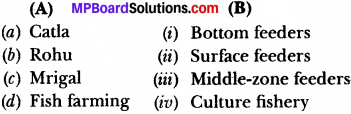
Match the column A with the column B
MP Board Class 9th Science Solutions Chapter 15 Improvement in Food Resources 1
Answer:
(a) (ii)
(b) (iii)
(c) (i)
(d) (iv).

Question 2.
Fill in the blanks.

  1. Pigeon pea is a good source of ___________ .
  2. Berseem is an important ___________ crop.
  3. The crops which are grown in rainy season are called ___________ crops.
  4. ___________ are rich in vitamins.
  5. ___________ crop grows in winter season.

Answer:

  1. protein
  2. fodder
  3. Kharif
  4. vegetables
  5. Rabi.

Question 3.
State any one importance of photoperiod in agriculture.
Answer:
Photoperiod is important for growth of plants and flowering.

MP Board Solutions

Question 4.
What are desirable traits for fodder crop?
Answer:

  1. Profused branching.
  2. Tall Plants.

Question 5.
White revolution in India has made us self – sufficient in a product. Name it.
Answer:
Milk.

Improvement in Food Resources Short Answer Type Questions

Question 1.
What is a GM crop? Name any one such crop which is grown in India.
Answer:
Crop developed artificially with the help of modern biotechnology to obtain the desired character is called as genetically modified(GM) crop. But, cotton and egg plant are examples of GM crops which are resistant to many harming biological factors.

Question 2.
List out some useful traits in improved crop.
Answer:
Useful traits in improved crops are as follows:

  1. better yield.
  2. improved quality.
  3. resistance to biotic and abiotic factors.
  4. better adaptability.
  5. better economically.

Question 3.
Why is organic matter important for crop production?
Answer:
Organic matter is important for crops because a fertile and healthy soil is the basis for healthy plant’s growth and soil organic matter works as a foundation for healthy and productive soils.
It helps soil by:

  1. improving soil structure.
  2. increasing water holding capacity of soil.
  3. drainage and in avoiding water logging.
  4. giving shelter to number of animals which also improve soil’s nutrients value.

Question 4.
Why is excessive use of fertilizers detrimental for environment?
Answer:
Excessive use of fertilizers is harmful because it is artificial in origin and accumulate in biological cycle and disturb its balance which causes environmental pollution as their residual and unused amounts will become pollutants for air, water and soil.

Question 5.
Give one word for the following:

  1. Farming without the use of chemicals as fertilizers, herbicides and pesticides is known as ___________ .
  2. Growing of wheat and groundnut on the same field is called as ___________ .
  3. Planting soyabean and maize in alternate rows in the same field is called as ___________ .
  4. Growing different crops on a piece of land in preplanned succession is known as ___________ .
  5. Xanthium and Parthenium are commonly known as ___________ .
  6. Causal organism of any disease is called as

Answer:

  1. organic farming
  2. mixed farming
  3. inter – cropping
  4. crop rotation
  5. weeds
  6. pathogens

Question 6.
Match the following A and B:

(A)(B)
(a) Cattle used for tilling and carting(i) Milk producing female
(b) Indian breed of chicken(ii) Broiler
(c) Sahiwal, Red Sindhi(iii) Draught animals
(d) Milch(iv) Local breed of cattle
(e) Chicken better fed for obtaining(v) Aseel

Answer:
(a) (iii)
(b) (v)
(c) (iv)
(d) (i)
(e) (ii).

Question 7.
Define the term hybridization and photoperiod.
Answer:

  1. Hybridization: Hybridization is the process in which two genetically different individuals are crossed to result generally into an individual with a desired trait.
  2. Photoperiod: Photoperiod in plants is defined as the developmental responses towards the comparative lengths of light and dark periods in its region.

Question 8.
Fill in the blanks:

  1. Photoperiod affects the ___________ .
  2. Kharif crops are cultivated from ___________ to ___________ .
  3. Rabi crops are cultivated from ___________ to ___________ .
  4. Paddy, maize, green gram and black gram are ___________ crops.
  5. Wheat, gram, pea, mustard are ___________ crops.

Answer:

  1. flowering
  2. June to October
  3. November to March,
  4. Kharif
  5. Rabi

Question 9.
Cultivation practices and crop yield are related to environmental condition. Yes/No? Give reasons.
Answer:
Environmental conditions are the components which influence plant growth and genetic factors. Environmental factors include everything in our surrounding i.e. air, water, temperature, atmospheric pressure, surrounding gases etc. When we cultivate any plant or consider crop growth, we check all the above environmental factors before sowing. Hence yes, cultivation practices and crop yield are related to environmental condition.

MP Board Solutions

Question 10.
Fill in the blanks:

  1. A total of ___________ nutrients are essential to plants.
  2. ___________ and ___________ are supplied by air to plants.
  3. ___________ is supplied by water to plants.
  4. Soil supplies ___________ nutrients to plants.
  5. nutrients are required in large quantity and called as ___________ .
  6. nutrients are needed in small quantity for plants and are called ___________ .

Answer:

  1. sixteen
  2. Oxygen and carbon
  3. Hydrogen
  4. thirteen
  5. Six, macro – nutrients
  6. Seven, micronutrients

Improvement in Food Resources Long Answer Type Questions

Question 1.
Define:

  1. Vermicompost
  2. Green manure
  3. Bio fertilizer.

Answer:

  1. Vermicompost: Vermicomposting is the process in which worms and micro – organisms are used to turn organic waste into a black, earthy – smelling, nutrient – rich humus.
  2. Green manure: When crop or plant that is grown and then intentionally plowed under to improve the underlying soil, it is called green manure.
  3. Bio fertilizer: Fertilizer created from biological components as small plants.

Question 2.
Discuss various methods for weed control.
Answer:
Unwanted plants which grow along with crops are called weeds. They compete with the crop plants for light, water, space and minerals, and harm their growth and yield. Some of them produce poisonous substances which can harm the growth of the crop or poison the produce.

Removing weeds from a field is called weeding. It can be done Manually or by using an implement like a trowel, hoe or rake. A third way of getting rid of weeds is by spraying chemicals called weedicides. These chemicals destroy the weeds but not the crop plants.

Improvement in Food Resources Higher Order Thinking Skills (HOTS)

Question 1.
Why should our food contain cereals, pulses, fruits and vegetables?
Answer:

  1. Cereals provide carbohydrates for energy requirements.
  2. Pulses give proteins.
  3. Fruits and vegetables provide various vitamins and minerals.

MP Board Solutions

Question 2.
Why moisture level of food grains should be checked before their storage?
Answer:
Before storage, moisture level of food grains should not be more than 9% otherwise growth of micro – organisms (bacteria and fungi) will take place causing either discolouration or complete spoilage of food grains.

Improvement in Food Resources Value Based Questions

Question 1.
A group of Eco Club students made a compost pit in the school. They collected all bio – degradable waste from the school canteen and used it to prepare the compost

  1. Name two waste that can be used for the compost and two wastes obtained from canteen which cannot be used for the compost making.
  2. What is the other important compound required for making the compost?
  3. State the values of Eco Club students.

Answer:

  1. Two waste used for compost are vegetable peels, fruit peels and pulps. Two waste materials that cannot be used as compost are pickels and curd.
  2. Bacteria present in soil are used as component for making compost.
  3. Eco club students reflect the value of group workers and responsible citizens.

MP Board Solutions

Question 2.
In a poultry farm, large number of birds died. Farm owner was unable to identify the reason and thought someone has done it intentionally. Aryan living nearby his farm noticed that the conditions in the farm were very unhygienic and poor ventilation was there.

  1. What do you think can be the reason for these deaths?
  2. What measures can be followed to prevent this in future?
  3. What values are shown by Aryan?

Answer:

  1. The conditions of the farm were unhygienic and ventilation was also poor. These may be the possible reasons.
  2. These conditions should be improved. Proper food, hygiene practices and good ventilation should be there to prevent this.
  3. The values of awareness and carefullness are shown by Aryan.

MP Board Class 9th Science Solutions

MP Board Class 9th Maths Solutions Chapter 9 Areas of Parallelograms and Triangles Ex 9.1

MP Board Class 9th Maths Solutions Chapter 9 Areas of Parallelograms and Triangles Ex 9.1

Question 1.
Which of the following figures lie on the same base and between the same parallels. In such a case, write the common base and the two parallels.
MP Board Class 9th Maths Solutions Chapter 9 Areas of Parallelograms and Triangles Ex 9.1 img-1
Solution:
(i) Base DC, Parallels DC and AB
(iii) Base QR, Parallels QR and PS
(v) Base AD, Parallels AD and BQ.

MP Board Class 9th Maths Solutions

MP Board Class 9th Maths Solutions Chapter 8 Quadrilaterals Ex 8.2

MP Board Class 9th Maths Solutions Chapter 8 Quadrilaterals Ex 8.2

Question 1.
ABCD is quadrilateral in which P, Q, R and S are mid-point^jf the sides AB, BC, CD and DA (see Fig.). AC is a diagonal. Show that:

  1. SR ∥ AC and SR = \(\frac{1}{2}\) AC
  2. PQ = SR
  3. PQRS is a parallelogram.

MP Board Class 9th Maths Solutions Chapter 8 Quadrilaterals Ex 8.2 img-1
Solution:
Given
ABCD is in which P, Q, R and S are the mid-points of sides AB,BC, CD and DA.
To prove.

  1. SR ∥ AC and SR= \(\frac{1}{2}\) AC
  2. PQ = SR
  3. PQRS is a parallelogram.

MP Board Class 9th Maths Solutions Chapter 8 Quadrilaterals Ex 8.2 img-2
Proof:
In ∆ABC. P is the mid point of AB and Q is the midpoint of BC.
∴ PQ ∥ AC and PQ = \(\frac{1}{2}\) AC (by MPT)…(1)
In ∆ADC, S is the mid-point of AD and R is the mid – point of DC.
SR ∥ AC and SR = \(\frac{1}{2}\) AC (by MPT)…(2)

1. SR ∥ AC and SR = \(\frac{1}{2}\) AC (proved)
2. PQ ∥ AC and SR = \(\frac{1}{2}\) AC
∴ PQ = SR
3. From (1) and (2), we get
PQ ∥ SR and PQ = SR
∴ PQRS is a parallelogram

MP Board Solutions

Question 2.
ABCD is a rhombus and P, Q, R and S are the mid-points of the sides AB, BC, CD and DA respectively. Show that the quadrilateral P&RS is a rectangle.
Solution:
Given
ABCD is rhombus and P, Q and R and S are the mid-points of sides AB, BC, CD and DA.
To prove
PQRS is a rectangle.
Construction:
Join AC and BD).
MP Board Class 9th Maths Solutions Chapter 8 Quadrilaterals Ex 8.2 img-3
Proof:
In ∆ABC, P is the midpoint of AB and Q is the midpoint of BC.
∴ PQ ∥AC (By MPT) …(1)
In ∆ADC, S is the midpoint of AD and R is the midpoint of DC.
SR ∥ AC (By MPT) …(2)
From (1) and (2), we get
PQ ∥ SR …(3)
In ∆ABD, P is the midpoint of AB and S is the midpoint of AD.
PS ∥ BD …(4)
In ABCD, Q is the midpoint of BC and R is the midpoint of CD
∴ QR ∥ BD (ByMPT) …(5)
From (4) and (5), we get
PS ∥ QR …(6)
In quadrilateral PQRS, PQ ∥ SR and PS ∥ QR
∴ PQRS is a parallelogram.
In quadrilateral OESF
SF ∥ EO (∴ SR ∥ AO …(7)
SE ∥ FO (∴ SP ∥ BD) …(8)
SEOF is a parallelogram.
We know that, that in a parallelogram opposite angles are equal.
∴ ∠ESF = ∠EOF= 90°
(∴ In a rhombus, diagonals intersect each other at right angles)
Hence, PQRS is a rectangle.

Question 3.
ABCD is a rectangle and P,Q,R and S are mid-points of the sides AB, BC, CD and DA respectively. Show that the quadrilateral PQRS is a rhombus.
Given
ABCD is a rectangle P,Q,R and S are the mid-points of AB, BC, CD and DA.
To prove.
PQRS is a rhombus.
Proof:
In ∆ABC, P is the midpoint of AB and Q is the midpoint of BC.
MP Board Class 9th Maths Solutions Chapter 8 Quadrilaterals Ex 8.2 img-4
PQ ∥ AC and PQ = \(\frac{1}{2}\) AC (By MPT) ….(1)
In ∆ADC, S is the midpoint of AD and R is the midpoint of DC.
∴ SR ∥ AC and SR = \(\frac{1}{2}\) AC (By MPT)…(2)
From (1) and (2),we get
PQ ∥ SB and PQ = SR
PQRS is a parallelogram
AD = BC (∴ ABCD is a rectangle)
⇒ \(\frac{1}{2}\) AD = \(\frac{1}{2}\) BC
AS = BQ
In ∆PAS and ∆PBQ, AS = BQ (proved)
AP = BP P is the mid-point of AB
∠A = ∠B (each 90°)
and so PS = PQ (ByCPCT)
In a ∥gm, if adjacent sides are equal, then it a rhombus.
∴ PQRS is a rhombus.

Question 4.
ABCD is a trapezium in which AB ∥ DC, BD is a diagonal and E is the mid-point of AD. A line is drawn through E parallel to AB intersecting BC and F (see Fig. below). Show that F is the mid-point of BC.
MP Board Class 9th Maths Solutions Chapter 8 Quadrilaterals Ex 8.2 img-5
Solution:
Given
AB ∥ DC, DE = AE and EF ∥ AS.
To prove
F is the mid-point of BC
Proof:
AB ∥ DC (given) …(1)
AB ∥ EF (given) …(2)
MP Board Class 9th Maths Solutions Chapter 8 Quadrilaterals Ex 8.2 img-6
From (1) and (2) we get,
DC ∥ EF
In ∆ABD, E is the mid – point of AD
EP ∥ AB (∴ EF∥AB)
∴ P is the mid – point of BD (By CMPT)
In ∆BCD, P is the midpoint of BD.
PF ∥ DC (∴ EF ∥ DC)
F is the midpoint of BC (By CMPT).

MP Board Solutions

Question 5.
In a parallelogram ABCD, E and F are the mid-point of sides AB and CD respectively (See Fig.). Show that the line segments AD and EC trisect the diagonal BD.
MP Board Class 9th Maths Solutions Chapter 8 Quadrilaterals Ex 8.2 img-7
Solution:
Given
ABCD is a ∥gm, E and F are the mid-point of AB and CD.
To prove:
BQ = PQ = DP
Proof:
AB ∥ DC and AB = DC (∴ ABCD is a ∥gm)
⇒ \(\frac{1}{2}\) ∥ AB \(\frac{1}{2}\) DC and \(\frac{1}{2}\) AB = \(\frac{1}{2}\)DC
⇒ AE ∥ FC and AE = FC (∴ \(\frac{1}{2}\) AB = AE and \(\frac{1}{2}\) DC = FC)
AECF is a parallelogram (∴ AECF is a ∥gm)
In ∆ABP, E is the mid – point of AB,
EQ ∥AP (∴ AECF is a ∥<sup<gm)
MP Board Class 9th Maths Solutions Chapter 8 Quadrilaterals Ex 8.2 img-8
∴ Q is the midpoint of BP (∴ by CMPT) …(1)
BQ = PQ
In ∆DQC, F is the midpoint of DC
EF ∥ CQ AECF is a ∥<sup<gm)
P is the midpoint of DQ
i.e., DP = PQ
From (1) and (2), we get BQ = PQ = DP.

Question 6.
Show that the line segments joining the mid-points of the opposite sides of a quadrilateral bisect each other.
Solution:
Given
ABCD is a in which P, Q.R and S are the mid-points of AB, BC, CD and DA respectively.
To prove
PR and SQ bisect each other.
Construction:
Join AC. Join PQ, QR, RS and SP.
MP Board Class 9th Maths Solutions Chapter 8 Quadrilaterals Ex 8.2 img-9
Proof:
In ∆ABC, P is the midpoint of AB and Q is the midpointof BC.
PQ ∥ AC and PQ = \(\frac{1}{2}\) AC (By MPT) …..(1)
In ∆ADC, S is the midpoint of AD and R is the midpoint of DC.
SR ∥ AC and SR = \(\frac{1}{2}\) AC (by MPT) …(2)
Form (1) and (2), we get
PQ ∥ SR and PQ = SR
∴ PQRS is a parallelogram in which PR and SQ are diagonals^ and so PR and SQ bisect each other (In a ∥gm, diagnaols bisect each other)

MP Board Solutions

Question 7.
ABC is a triangle right angled at C. A line through the mid-point M of hypotenuse AB and parallel to BC intersects AC at D. Show that

  1. D is the mid – point of AC
  2. MD ⊥ AC
  3. CM = MA = \(\frac{1}{2}\) AB.

MP Board Class 9th Maths Solutions Chapter 8 Quadrilaterals Ex 8.2 img-10
Solution:
Given
ABC is a right ∆. ∠C = 90°
AM = BM and MD ∥ BC.
To prove:

  1. D is the mid-point of AC, i.e., AD – CD
  2. MD ⊥ AC
  3. CM = MA = \(\frac{1}{2}\) AB

Proof:
1. In ∆ACB, M is the mid-point of AB and MD ∥ BC
∴ D is the mid – point of AC (By CMPT)
i.e., AD = CD

2. MD ∥ BC and AC is the transversal
∴ ∠ADM = ∠ACB (CA’s)
⇒ ∠ADM = 90° (∠ACB = 90°)
∴ MD ⊥ AC

3. In ∆ADM and ∆CDM,
AD = CD (proved)
∠ADM = ∠CDM (each 90°)
[∴ ∠ADM + ∠CDM = 180° (LPA’s); 90° + ∠CDM= 180°; ∠CDM = 90°]
MD = MD (common)
∴ ∆ADM = ∆CDM (By SAS)
and so MA = MC (By cpct) …(1)
MA = \(\frac{1}{2}\) AB (Given) …(2)
Form (1) and (2), we get MA = MC = \(\frac{1}{2}\) AB.

MP Board Class 9th Maths Solutions

MP Board Class 9th Science Solutions Chapter 8 Motion

MP Board Class 9th Science Solutions Chapter 8 Motion

Motion Intext Questions

Motion Intext Questions Page No. 100

Question 1.
An object has moved through a distance. Can it have zero displacement? If yes, support your answer with an example.
Answer:
Yes, if an object start from a point and finally, reaches the same point. Then, it has distance but displacement is zero.

MP Board Solutions

Question 2.
A farmer moves along the boundary of a square field of side 10 m in 40 s. What will be the magnitude of displacement of the farmer at the end of 2 minutes 20 seconds?
Answer:
MP Board Class 9th Science Solutions Chapter 8 Motion 1
Suppose farmer starts from A of the square field.
Now, he covered 10 m in 40 sec.
Now, 2 minutes 20 seconds =140 sec.
So, he cover in 140 seconds = \(\frac { 10 }{ 40 }\) × 140 m
= \(\frac { 140 }{ 4 }\)m
= 35 m.
Now, in square field = 35m
AB + BC + CD + DE (\(\frac { 1 }{ 2 }\)AD)
So, he will reach at E.
Then, his displacement is AE = 5 m.

Question 3.
Which of the following is true for displacement?

  1. It cannot be zero.
  2. Its magnitude is greater than the distance travelled by the object.

Answer:

  1. False
  2. False.

Motion Intext Questions Page No. 102

Question 1.
Distinguish between speed and velocity.
Answer:

SpeedVelocity
1. it is the distance covered by a body per unit time.

2.  It is a scalar quantity.

1. It is the displacement covered by a body per unit time.

2.  It is a vector quantity.

Question 2.
Under what condition (s) is magnitude of average velocity of an object equal to its average speed?
Answer:
When a body is moving in a straight line in a particular direction.

Question 3.
What does the odometer of an automobile measure?
Answer:
It measures the distance travelled by the vehicle.

MP Board Solutions

Question 4.
What does the path of an object look like when it is in uniform motion?
Answer:
Straight line.

Question 5.
During an experiment, a signal from a spaceship reached the ground station in five minutes. What was the distance of the spaceship from the ground station? The signal travels at the speed of light, that is 3 × 10⁸ m/s.
Answer:
Time taken by signal to reach ground station = 5 minutes
= 5 × 60 sec.
= 300 seconds.
Speed of the signal = 3 × 10⁸ m/s.
∴ Distance between spaceship and ground station = speed × time
= 3 × 108 × 300
= 9 × 10¹⁰ m.

Motion Intext Questions Page No. 103

Question 1.
When will you say a body is in

  1. Uniform acceleration?
  2. Non – uniform acceleration?

Answer:

  1. A body is in uniform acceleration if its velocity changes uniformly with equal intervals of time. Example: Freely falling object.
  2. A body is in non – uniform acceleration if its velocity changes non – uniformly with equal intervals of time. Example: A bus running in a city.

Question 2.
A bus decreases its speed from 80 km/h-1 to 60 km/h-1 in 5 s. Find the acceleration of the bus.
Answer:
Initial velocity of the bus, u = 80 km/h
= \(\frac { 80\times 100 }{ 60\times 60 } \) m/s
u = \(\frac { 800 }{ 36} \) m/s
Final velocity of the bus, v = 60 km/h
= \(\frac { 60\times 100 }{ 60\times 60 } \) m/s
v = \(\frac { 600 }{ 36 } \) m/s
Time taken by bus to change its speeds, t = 5 seconds
∴ Acceleration, a = \(\frac { v-u }{ t } \)
= \(\frac { 600 }{ 36 } \) – \(\frac { 800 }{ 36 } \) ÷ 5
= \(\frac { 600-800 }{ 36 } \) ÷ 5
= \(\frac { 200 }{ 36 } \) × \(\frac { 1 }{ 5 } \) m/s2
= \(\frac { -10 }{ 9 } \) m/s2
a = -1.11 m/s2.

MP Board Solutions

Question 3.
A train starting from a railway station and moving with uniform acceleration attains a speed of 40 km/h-1 in 10 minutes. Find its acceleration.
Answer:
Initial velocity, u = 0
Final velocity, v = 40 km/h
= \(\frac { 40\times 1000 }{ 60\times 60 } \) m/s
= \(\frac { 400 }{ 36 } \) m/s
= \(\frac { 200 }{ 18 } \) m/s.
Time taken, t = 10 minutes
= 10 × 10 seconds = 100 seconds
a = \(\frac { v-u }{ t } \)
= \(\frac { 200 }{ 18 } \) – 0 ÷ 100
= \(\frac { 200 }{ 18 } \) ÷ 100
= \(\frac { 200 }{ 18 } \) × \(\frac { 1 }{ 100 } \) m/s2
= \(\frac { 1 }{ 9 } \) m/s2
a = 0.018 m/s2.

Motion Intext Questions Page No. 107

Question 1.
What is the nature of the distance – time graphs for uniform and non – uniform motion of an object?
Answer:
For uniform motion, it is a straight line.
MP Board Class 9th Science Solutions Chapter 8 Motion 2
For non – uniform motion, it is a curved line.
MP Board Class 9th Science Solutions Chapter 8 Motion 3

Question 2.
What can you say about the motion of an object whose distance – time graph is a straight line parallel to the time axis?
Answer:
It shows the body at rest.
MP Board Class 9th Science Solutions Chapter 8 Motion 4

Question 3.
What can you say about the motion of an object if its speed – time graph is a straight line parallel to the time axis?
Answer:
It means body has constant speed or uniform motion with zero acceleration.
MP Board Class 9th Science Solutions Chapter 8 Motion 5

Question 4.
What is the quantity which is measured by the area occupied below the velocity-time graph?
Answer:
Distance travelled.

Motion Intext Questions Page No. 109 – 110

Question 1.
A bus starting from rest moves with a uniform acceleration of 0.1 m/s2 for 2 minutes. Find
(a) the speed acquired,
(b) the distance travelled.
Answer:
Initial velocity, u = 0
Acceleration, a = 0.1 m/s2
Time, t = 2 min = 2 × 60 seconds
= 120 seconds
(a) Velocity, v = ?
We know, v = u + at
v = 0 + 0.1 × 120 m/s
= 12 m/s.

(b) Distance, s = ?
We Know, s = ut + \(\frac { 1 }{ 2 }\) at2
= 0 × 120 + \(\frac { 1 }{ 2 }\) × 0.1 × 120 × 120
= \(\frac { 1 }{ 2 }\) × \(\frac { 0.1 }{ 10 }\) × 120 × 120 m
= 720 m.

Question 2.
A train is travelling at a speed of 90 km/h-1. Brakes are applied so as to produce a uniform acceleration of – 0.5 m/s2. Find how far the train wilt go before it is brought to rest.
Answer:
Initial velocity, u = 90 km/h
= \(\frac { 90\times 5 }{ 18 } \) m/s
= 25 m/s
Final velocity, v = 0
Acceleration, a = -0.5 m/s2.
Distance, s = ?
We know,
v2 = u2 + 2as
02 = (25)2 + 2 × (-0.5) × s
0 = 625 – 1 × s
= 625 – 1 × s
= 625 – s
∴ s = 625 m.
∴ Distance travelled by the train = 625 m.

Question 3.
A trolley while going down an inclined plane, has an acceleration of 2 cm/s2. What will be its velocity in 3 s after the start?
Answer:
Acceleration, a = 2 cm/s2
Time, t = 3 sec.
Initial velocity, u = 0
Final velocity, v = ?
Now, v= u + at
v = 0 + 2 × 3
= 6 cm/s.

MP Board Solutions

Question 4.
A racing car has a uniform acceleration of 4 m/s2. What distance will it cover in 10 s after start?
Answer:
Acceleration, a = 4 m/s2
Time, t = 10 sec,
Initial velocity, u = 0
Distance, s = ?
Now, s = ut + \(\frac { 1 }{ 2 }\) at2
s = 0 × 10 + \(\frac { 1 }{ 2 }\) × 4 × (10)2
s = \(\frac { 1 }{ 2 }\) × 4 × 100 m
s = 200 m.
So, the distance covered is 200 m.

Question 5.
A stone is thrown in a vertically upward direction with a velocity of 5 m/s-1. If the acceleration of the stone during its motion is 10 m/s-2 in the downward direction, what will be the height attained by the stone and how much time will it take to reach there?
Answer:
Initial velocity, u = 5 m/s
Final velocity, v = 0
Acceleration, a = -10 m/s2 (∴ It is from opposite direction)
Height attained, s = ?
Time taken, t = ?
Now, V2 = u2 + 2 as
(0)2 = (5)2 + 2 × (-10) × s
0 = 25 – 20s
⇒ 20s = 25
∴ s = \(\frac { 25 }{ 20 }\) = \(\frac { 5 }{ 4 }\) = 1025m
Now, v = u + at
0 = 5 + (-10) × t
0 = 5 – 10 × t
-5 = -10 × t
∴ t = \(\frac { -5 }{ -10 }\) = \(\frac { 1 }{ 2 }\) = 0.5 sec
So, height attained by the stone is 1.25 m and time taken to reach there is 0.5 sec.

Motion NCERT Textbook Exercises

Question 1.
An athlete completes one round of a circular track of diameter 200 m in 40 s. What will be the distance covered and the displacement at the end of 2 minutes 20 s?
Answer:
MP Board Class 9th Science Solutions Chapter 8 Motion 6
Diameter of the track = 200 m
So, radius = \(\frac { 200 }{ 2 }\) m
= 100m
Circumference = 2πr
= 2 × \(\frac { 22 }{ 7 }\) × 100 m
= \(\frac { 4400 }{ 7 }\) m.
Now, athlete covers 200 m in 40 s.
So, rounds covered in 40 seconds = 1
Rounds covered in 1 sec = \(\frac { 1 }{ 40 }\)
Rounds covered in 140 sec = \(\frac { 1 }{ 40 }\) × 140
= 3.5 rounds
So, distance covered = 3.5 × circumference
= \(\frac { 3.5 }{ 10 }\) × \(\frac { 4400 }{ 7 }\) m
= 2200 m.
And, displacement after 3.5 rounds
= Diameter of track
= 200 m.

Question 2.
Joseph jogs from one end A to the other end B of a straight 300 m road in 2 minutes 30 seconds and then turns around and jogs 100 m back to point C in another 1 minute. What are Joseph’s average speeds and velocities in jogging (a) from A to B and (b) from A to C?
Answer:
MP Board Class 9th Science Solutions Chapter 8 Motion 7
(a) A to B,
Time taken, t = 2 min, 30 sec
= 150 sec.
MP Board Class 9th Science Solutions Chapter 8 Motion 8
= \(\frac { 300 }{ 150 }\) m/s = 2 m/s
MP Board Class 9th Science Solutions Chapter 8 Motion 9
= \(\frac { 300 }{ 150 }\) m/s = 2 m/s.

(b) A to C,
Time taken = Time from A to B + Time from B to C
= 2 min 30 sec + 1 min
= 150 sec + 60 sec
= 210 sec.
Total distance covered (AB + BC) = (300 + 100) m
= 400 m
Displacement = AC = (300 – 100) m
= 200 m
MP Board Class 9th Science Solutions Chapter 8 Motion 10
= \(\frac { 400 }{ 210 }\) m/s = 1.9 m/s
MP Board Class 9th Science Solutions Chapter 8 Motion 11
= \(\frac { 200 }{ 210 }\) m/s = 0.95 m/s.

Question 3.
Abdul, while driving to school, computes the average speed for his trip to be 20 kmh-1. On his return trip along the same route, there is less traffic and the average speed is 30 kmh-1. What is the average speed for Abdul’s trip?
Answer:
Let the distance between Abdul’s home and school = x km.
Lets time taken from home to school = t1 hr.
and time taken from school to home = t2 hr.
Now,
MP Board Class 9th Science Solutions Chapter 8 Motion 31
∴ t1 = \(\frac { x }{ 20 }\) hr.
t2 = \(\frac { x }{ 30 }\) hr.
Now,
MP Board Class 9th Science Solutions Chapter 8 Motion 12
∴ Average Speed = \(\frac { 120 }{ 5 }\) 24 km/h.

Question 4.
A motorboat starting from rest on a lake accelerates in a straight line at a constant rate of 3.0 ms-2 for 8.0 s. How far does the boat travel during this time?
Answer:
Initial velocity, u = 0
Acceleration, a = 3.0 m/s2
= 3 m/s2
Time, t = 8 sec
Now,
s = ut + \(\frac { 1 }{ 2 }\) at2
s = 0 × 8 + \(\frac { 1 }{ 2 }\) × 3 × (8)2
= 0 + \(\frac { 1 }{ 2 }\) × 3 × 64
s = 96 m.
∴ Distance Travelled by Boat is 96 m.

Question 5.
A driver of a car travelling at 52 kmh-1 applies the brakes and accelerates uniformly in the opposite direction. The car stops in 5 s. Another driver going at 34 kmh-1 in another car applies his brakes slowly and stops in 10 s. On the same graph paper, plot the speed versus time graphs for the two cars. Which of the two cars travelled farther after the brakes were applied?
MP Board Class 9th Science Solutions Chapter 8 Motion 13
Answer:
We have,
Speed of first driver = 52 km/h
= \(\frac { 52\times 1000 }{ 60\times 60 } \) m/s = 14.4 m/s
Speed of second driver = 3 km/h
= \(\frac { 3\times 1000 }{ 60\times 60 } \) m/s = 0.83 m/s
Now, distance covered by first driver = Area of ΔAOB
= \(\frac { 1 }{ 2 }\) × OA × OB
= \(\frac { 1 }{ 2 }\) × 14.4 × 5 = 36.1 m
Distance covered by second driver = Area of ΔMON
= \(\frac { 1 }{ 2 }\) × OM × ON
= \(\frac { 1 }{ 2 }\) × O.83 × 10 = 4.16 m
So, first driver covers more distance.

Question 6.
Figure below shows the distance-time graph of three objects A, B and C. Study the graph and answer the following questions:
MP Board Class 9th Science Solutions Chapter 8 Motion 14

  1. Which of the three is travelling the fastest?
  2. Are all three ever at the same point on the road?
  3. How far has C travelled when B passes A?
  4. How far has B travelled by the time it passes C?

Answer:

  1. B is travelling the fastest.
  2. No.
  3. C was at around 9 km from origin when B passes A.
  4. B travelled around 5.5 km when it passes C.

MP Board Solutions

Question 7.
A ball is gently dropped from a height of 20 m. If its velocity increases uniformly at the rate of 10 ms-2, with what velocity will it strike the ground? After what time will it strike the ground?
Answer:
Distance, s = 20 m
Initial velocity, u = 0
Acceleration, a = 10 m/s2
Now, s = ut +\(\frac { 1 }{ 2 }\) at2
20 = 0 × t + \(\frac { 1 }{ 2 }\) × 10 × t2
20 = 5 × t2
∴ t2 = \(\frac { 20 }{ 5 }\) = 4
∴ t = 2 sec.
Also, v = u + at
v = 0 + 10 × 2
y = 20 m/s.
So, it will strike the ground after 2 seconds with the velocity of 20 m/s.

Question 8.
The speed – time graph for a car is shown in figure below:
MP Board Class 9th Science Solutions Chapter 8 Motion 15
(a) Find how far does the car travel in the first 4 seconds. Shade the area on the graph that represents the distance travelled by the car during the period.
(b) Which part of the graph represents uniform motion of the car?
Answer:
(a) The distance travelled by car in first 4 seconds
= Area of triangular like region OAB
= \(\frac { 1 }{ 2 }\) × AB × OB = \(\frac { 1 }{ 2 }\) × 6.9 × 4
= 12 m (approximately).

(b) Part of the graph after 5.5 seconds shows the uniform motion.

Question 9.
State which of the following situations are possible and give an example for each of these:

  1. an object with a constant acceleration but with zero velocity.
  2. an object moving in a certain direction with an acceleration in the perpendicular direction. Both are possible.

Answer:

  1. Freely falling.
  2. Motion of an object in a circular path.

Question 10.
An artificial, satellite is moving in a circular orbit of radius 42250 km. Calculate its speed if it takes 24 hours to revolve around the earth.
Answer:
Radius of the orbit = 42250 km = 42250 × 1000 m.
Time taken to complete one revolution = 24 hours.
= 24 × 60 × 60 sec
Distance covered by satellite to complete 1 revolution = 2πr
= 2 × \(\frac { 22 }{ 7 }\) × 42250 × 1000 m
MP Board Class 9th Science Solutions Chapter 8 Motion 16

Motion Additional Questions

Motion Multiple Choice Questions

Question 1.
Deceleration of a body is expressed in _______ .
(a) m
(b) ms-1
(c) ms-2
(d) -ms-2
Answer:
(c) ms-2.

Question 2. A car goes from town A to another town B with a speed of 40 km/h and returns back to the town A with a speed of 60 km/h. The average speed of the car during the complete journey is _______ .
(a) 48 km/h
(b) 50 km/h
(c) Zero
(d) None of these.
Answer:
(a) 48 km/h

Question 3.
A ball is thrown vertically upwards. It rises to a height of 50 m and comes back to the thrower, _______ .
(a) The total distance covered by the ball is zero.
(b) The net displacement of the ball is zero.
(c) The displacement is 100 m.
(d) None of the above.
Answer:
(b) The net displacement of the ball is zero.

Question 4.
The SI unit of velocity is _______ .
(a) ms-1
(b) ms-2
(c) ms-3
(d) Nm-1.
Answer:
(a) ms-1

Question 5.
In 12 minutes a car whose speed is 35 km/h travels a distance of _______ .
(a) 7 km
(b) 3.5 km
(c) 14 km
(d) 28 km.
Answer:
(a) 7 km

Question 6.
A 50 m long train passes over a 250 m long bridge at a velocity of 60 km/h. How long will it take to pass completely over the bridge?
(a) 18 s
(b) 20 s
(c) 24 s
(d) none of these.
Answer:
(a) 18 s

MP Board Solutions

Question 7.
The initial velocity of a train which is stopped in 20 s by applying brakes (retardation due to brakes being 1.5 ms-2) is _______ .
(a) 30 ms-1
(b) 30 cm-1
(c) 20 cm-1
(d) 24 ms-1.
Answer:
(a) 30 ms-1

Question 8.
A wooden slab starting from rest, slides down a 10 m long inclined plane with an acceleration of 5 ms2. What would be its speed at the bottom of the inclined plane?
(a) 10 ms-1
(b) 12 ms-1
(c) 10 cm s-1
(d) 12 cm s-1.
Answer:
(a) 10 ms-1

Question 9.
m/s2 is the SI unit of _______ .
(a) Distance
(b) Displacement
(c) Velocity
(d) Acceleration.
Answer:
(d) Acceleration.

Question 10.
A car increases its speed from 20 km/h to 50 km/h in 10 seconds. Its acceleration is _______ .
(a) 30 m/s2
(b) 3 m/s2
(c) 18 m/s2
(d) 0.83 m/s2.
Answer:
(d) 0.83 m/s2.

Motion Very Short Answer type Questions

Question 1.
Define uniform motion.
Answer:
When an object covers equal distances in equal intervals of time: it is said to be in uniform motion.

Question 2.
Define speed.
Answer:
It is defined as the distance travelled by an object in unit time. Its unit is m/s.

Question 3.
Define average speed.
Answer:
The total distance travelled by an object divided by the total time taken.

Question 4.
Define velocity.
Answer:
Velocity is the speed of an object moving in definite direction.

Question 5.
Define acceleration.
Answer:
Change in the velocity of an object per unit time.
a = \(\frac { v-u }{ t } \), S.I. unit is m/s2.

Motion Short Answer type Questions

Question 1.
While plotting a distance – time graph, why do we plot time on x – axis.
Answer:
While plotting a distance – time graph, we should plot time on x – axis as, all independent quantities are plotted on x – axis.

Question 2.
What is odometer?
Answer:
Odometer is a device fitted in the automobiles to show the distance travelled.

Question 3.
Draw a distance – time graph that represents uniform speed.
Answer:
MP Board Class 9th Science Solutions Chapter 8 Motion 17

Question 4.
With the help of distance – time graph show that the object is stationary.
Answer:
MP Board Class 9th Science Solutions Chapter 8 Motion 18

Question 5.
What does the area under velocity – time graph represent?
Answer:
The area under the velocity – time graph represents the displacement.

Question 6.
A body travels a distance from A to B, its physical quantity is measured to be -15 m/s. Is it speed or velocity? Give reason for the answer.
Answer:
The physical quantity is -15 m/s. It represents velocity because sign of speed cannot be a negative. Negative sign indicates the opposite direction.

Question 7.
What type of velocity – time graph will you get for a particle moving with a constant acceleration?
Answer:
For a particle moving with a constant acceleration velocity – time graph will be a straight line inclined to x – axis.

Question 8.
Define uniform circular motion.
Answer:
When a body moves in a circular path with uniform speed, its motion is called uniform circular motion.

Question 9.
What is deceleration?
Answer:
When the speed of an object decreases, the object is said to be decelerating. In this case, the direction of acceleration is opposite to the velocity of the object.

Question 10.
What conclusion do you draw about acceleration of the particle in motion from given velocity – time graphs?
MP Board Class 9th Science Solutions Chapter 8 Motion 19
Answer:
(a) No acceleration.
(b) Uniform acceleration.
(c) Non – uniform acceleration.

Question 11.
With the help of graph, show the uniform acceleration and uniform retardation of a body.
Answer:
MP Board Class 9th Science Solutions Chapter 8 Motion 20

  • OA – Shows uniform acceleration.
  • CB – Shows uniform retardation.

Question 12.
Give difference between acceleration and velocity.
Answer:
table

Motion Long Answer Type Questions

Question 1.
How can we get speed from distance – time graph?
Answer:
Let us assume that an object moves with a uniform speed. The distance – time graph will be a straight line.
Let d1 be the distance covered in time t1.
Let d2 be the distance covered in time t2.
∴ d2 – d1 will be the distance covered in t2 – t2.
MP Board Class 9th Science Solutions Chapter 8 Motion 21
But, here \(\frac { BC }{ AC }\) = slope of the graph.
Conclusion:
To find the speed from distance – time graph, we can get its slope which is equal to the speed of the object.

Question 2.
Represent a graph that shows the following:
(a) Uniform speed
(b) Non – uniform speed
(c) Stationary object.
Answer:
Time is taken on x – axis as it is independent quantity and all dependent quantities are taken along y – axis.
MP Board Class 9th Science Solutions Chapter 8 Motion 22

Question 3.
(a) What is motion?
(b) State types of motion.
(c) Derive the unit for acceleration.
Answer:
(a) Motion: An object is said to be in motion when its position changes with time. We describe the location of an object by specifying a reference point. Motion is relative. The total path covered by an object is said to be the distance travelled by it.

(b) There are two types of motion: Uniform motion and non – uniform motion

  • Uniform motion: When an object covers equal distances in equal intervals of time, it is said to be in uniform motion.
  • Non – uniform motion: Motion where object cover unequal distances in equal intervals of time.

(c) Acceleration, ‘a’ is change in velocity per unit time.
MP Board Class 9th Science Solutions Chapter 8 Motion 23

Question 4.
(a) What is uniform circular motion?
(b) An athlete runs on a circular track, whose radius is 50 m with a constant speed. It takes 50 seconds to reach point B from starting point A. Find:

  1. the distance covered.
  2. the displacement.
  3. the speed.

Answer:
(a) When a body moves in a circular path with uniform speed, its motion is called uniform circular motion.

(b) Radius = 50 m
Time = 50 s
The distance covered by an athlete A to B i.e., semicircle of the track
∴ Circumference = 2πr
circumference half of = πr.

Question 5.
Derive the equation for velocity – time relation (v = u + at) by graphical method.
Answer:
MP Board Class 9th Science Solutions Chapter 8 Motion 24
Let, the initial velocity of a body be, u = OA = CD.
The final velocity of a body be, v = OE = CB
Time, t = OC = AD
AD is parallel to OC
BC = BD + DC
= BD + OA
v = BD + u
∴ BD =v – u …….. (1)
In velocity – time graph, slope gives acceleration.
∴ a = \(\frac { BD }{ AD }\) = \(\frac { BD }{ OC }\) = OC = t
we get, a = \(\frac { BD }{ t }\)
∴ BD = at …….. (2).

Question 6.
A car accelerates uniformly from 20 km/h to 35 km/h in 5 s. Calculate (i) the acceleration and (ii) the distance covered by the car in that time.
Answer:
u =20 km/h = 5.5 m/s
v =35 km/h = 9.72 m/s
t = 5 s
a = \(\frac { v-u }{ t } \)
= \(\frac { 9.7-5.5 }{ 5 } \)
a = \(\frac { 4.2 }{ 5 } \)
= 0.84 m/s2.

(ii) The distance covered by the car s = ut + \(\frac { 1 }{ 2 }\) at2
= 5.5 × 5 + \(\frac { 1 }{ 2 }\)(0.84)(5)2
= 27.5 + \(\frac { 1 }{ 2 }\) × 0.84 × 25
= 27.5 + 10.5
s = 38 m.

Question 7.
Draw graph to show the following:
(a) Uniform acceleration.
(b) Non – uniform acceleration.
(c) Uniform motion.
Answer:
MP Board Class 9th Science Solutions Chapter 8 Motion 28
Uniform acceleration – A body travels equal distances in equal intervals of time.

MP Board Class 9th Science Solutions Chapter 8 Motion 30
Non – uniform acceleration – A body travels unequal distances in equal intervals of time.

MP Board Class 9th Science Solutions Chapter 8 Motion 29
Uniform motion or zero acceleration A body moves with constant speed in same line.

Question 8.
How can you get the distance travelled by an object from its speed – time graph?
Answer:
MP Board Class 9th Science Solutions Chapter 8 Motion 27
Suppose an object is moving with a same speed v, the distance covered by this object when it was at (point A) t1 to t2 is:
AB = t2 – t1
AD = BC = v
MP Board Class 9th Science Solutions Chapter 8 Motion 26
= AD . AB
∴ s = Area of rectangle ABCD
∴ To find the distance travelled by a body from its speed – time graph, we need to find the area enclosed by the graph.

Motion Higher Order Thinking Skills (HOTS)

Question 1.
A blacksmith strikes a nail with a hammer of mass 500 g moving with a velocity of 20 ms-1. The hammer comes to rest in 0.02 s after striking the nail. Calculate the force exerted by the nail on the hammer.
Answer:
m = 500 g = \(\frac { 1 }{ 2 }\) kg
u = 20 ms-1 , v = 0
t = 0.02 s, F = ?
MP Board Class 9th Science Solutions Chapter 8 Motion 25
Therefore, force exerted by nail on the hammer = 500 N.

Motion Value Based Question

Question 1.
A jeep was moving at a speed of 120 km/h on an highway. All of a sudden tyre of the jeep got punctured and burst The driver of the jeep did not apply sudden brakes but he slowed down its speed and finally stopped it at the road side. All the passengers in the jeep were shocked but happy with the driver’s decison.

  1. What would have happened if the driver applied sudden brakes?
  2. On applying brakes in which direction would the passengers fall?
  3. What value of driver is reflected in this act?

Answer:

  1. If the driver would have applied sudden brakes, then all the passengers would get hurt and even other vehicles moving on the highway would have collided with this jeep from behind.
  2. On applying brake, the passengers would fall in the forward direction.
  3. The driver showed the presence of mind, concern and responsible behaviour and quick decision taking capability.

MP Board Class 9th Science Solutions

MP Board Class 9th Maths Solutions Chapter 8 Quadrilaterals Ex 8.1

MP Board Class 9th Maths Solutions Chapter 8 Quadrilaterals Ex 8.1

Question 1.
The angles of quadrilateral are in the ratio 3 : 5 : 9 : 13. Find all Ijbe angles of the quadrilateral.
MP Board Class 9th Maths Solutions Chapter 8 Quadrilaterals Ex 8.1 img-1
Solution:
∠A = 3x, ∠B = 5x, ∠C = 9x, ∠D = 13x
In quadrilateral ABCD
∠A + ∠B + ∠C + ∠D = 360°
(∴ Sum of all the angles of ♢ is equal to 360°)
MP Board Class 9th Maths Solutions Chapter 8 Quadrilaterals Ex 8.1 img-2
3x + 5x + 9x + 13x = 360°
30x = 360°
x = \(\frac{360^{\circ}}{30^{\circ}}\)
Let angle in ratio be x then angles are x= 12°
∠A = 3 x 12° = 36°
∠B = 5 x 12° = 60°
∠C = 9 x 12° = 108°
∠D = 13 x 12° = 156°

Question 2.
If the diagonals of a parallelogram are equal, then show that it is a rectangle.
Solution:
Given
ABCD is a parallelogram in which
AC =DB
To prove:
ABCD is a rectangle.
Proof
In ∆DAB and ∆CBA
DB = CA (given)
AB = BA (common)
AD = BC (∴ opposites sides of ∥gm are equal)
∆DAB = ∆CBA (by SSS)
and so ∠DAB = ∠CBA
AD∥BC and AB is the transversal (by CPCT)
∴ ∠A + ∠B = 180° (CIA’s)
⇒ ∠A + ∠A = 180° (∴ ∠A = ∠B)
∴ ∠A = 90°
∠A = ∠C = 90°
and ∠B = ∠D = 90°
In ∥gm ABCD, all the angles are right angles.
ABCD is a rectangle.

MP Board Solutions

Question 3.
Show that if the diagonals ofa quadrilateral bisect each other at right angles, then it is a rhombus.
Solution:
Given
OA = OC, OB = OD and ∠AOD = 90°
To prove:
ABCD is a rhombus.
Proof:
In ∆AOD and ∆COB
MP Board Class 9th Maths Solutions Chapter 8 Quadrilaterals Ex 8.1 img-3
OA = OC (given)
OD = OB (given)
∠1 = ∠2 (V.O.A.’s)
∴ ∆AOD = ∆COB (by SAS)
and so AD = CB (by CPC 7)
∠3 = ∠4 (by CPCT)
∠3 and ∠4 are A.I.A.’s and are equal
∴ AD ∥ PC (proved)
AD = BC
∴ ABCD is a parallelogram
In ∆AOD and ∆COD,
OA = OC (given)
OD = OD (common)
∠1 = ∠5 = 90°
(∴ ∠1 + ∠5 = 180° ⇒ 90° + ∠5 = 180° ∴ ∠5 = 90°)
∴ ∠AOD = ∠COD (by SAS)
and so AD = CD (by CPCT)
In ∥gm APCD, all the sides are equal.
ABCD is rhombus.

Question 4.
Show that the diagonals of a square are equal and bisect each other at right angles.
Solution:
Given
ABCD is a square.
To prove:

  1. AC = BD
  2. OA = OC and OB = OD
  3. ∠AOD = 90°

Proof:
In ∆DAB and ACBA,
DA = CB (given)
AB = BA (common)
∠A = ∠B (each 90°)
∴ ∆DAB = ∆CBA (by SAS)
and so BD =AC (by CPCT)

2. In ∆AOD and ∆COB, AD = CB(given)
MP Board Class 9th Maths Solutions Chapter 8 Quadrilaterals Ex 8.1 img-4
∠4 = ∠5 (A.I.A.’s)
∠6 = ∠7 (A.I.A. ’s)
∆AOD = ∆COB (by ASA)
and so OA=OC , (byCPCT)
OD = OB (byCPCT)

3. In ∆AOD and ∆COD,
AO = CO (proved)
OD = OD (common)
AD = CD (given)
∆AOD = ∆COD (by SSS)
and so ∠1 = ∠3 (byCPCT)
∠1 + ∠3 = 180° (LPA’S)
⇒ ∠1 + ∠1 = 180° (∠1 = ∠3)
⇒ 2∠1 = 180°
∴ ∠1 = \(\frac{180^{\circ}}{2}\)

Question 5.
Show that if the diagonals of a quadrilateral are equal and bisect each other at right angles, then it is a square.
Solution:
MP Board Class 9th Maths Solutions Chapter 8 Quadrilaterals Ex 8.1 img-5
Give
ABCD is in which
AC = BD
OA = OC
and OB = OD
∠AOD = 90°
To prove
ABCD is a square
Proof:
In ∆AOD and ∆COB,
OA = OC (given)
OD = OB (given)
∠7 = ∠8 (V.CXA.’s)
∴ ∆AOD = ∠COB
and so AD = BC
and ∠3 = ∠1 (byCPCT)
∠3 and ∠1 are A.I.A.’s and are equal
∴ AD ∥ BC
Similarly, AB ∥ CD
∴ ABCD is a parallelogram.
In ∆AOD and ∆COD,
OA = OC (given)
OD = OD (common)
∠7 = ∠9 (each 90°)
∆AOD = ∠COD (by SAS)
AD = CD (byCPCT)
In ∥gmABCD, adjacent sidesAD = CD
∴ ABCD is a rhombus
In ∆DAB and ∆CBA,
DA = CB (proved)
AB = BA (common)
DB = CA (given)
∆DAB = ∆CBA (bySSS)
∠A = ∠B (by CPCT)
∠A + ∠B = 180° (CIA’s)
2∠A = 180°
∠A =90°
ABCD is a square.

MP Board Solutions

Question 6.
Diagonals AC of a parallelogram ABCD bisects ∠A (see Fig). Show that

  1. it bisects ∠C also,
  2. ABCD is a rhombus.

MP Board Class 9th Maths Solutions Chapter 8 Quadrilaterals Ex 8.1 img-6
Solution:
Given
ABCD is a parallelogram in which ∠1 = ∠2
To prove:

  1. ∠3 = ∠4
  2. ABCD is a rhombus.

Proof
1. ∠1 = ∠4 (A.I.A.’s) ….(i)
(∴ AD ∥ SC and AC is the transversal)
∠2 = ∠3 (A.I.A.’s) …(ii)
(∴ AB ∥ DC and AC is the transversal)
∠1 = ∠2 (given) …(iii)
MP Board Class 9th Maths Solutions Chapter 8 Quadrilaterals Ex 8.1 img-7
From (i), (ii) and (iii), we get
∠4 = ∠3
(ii) From (ii) and (iii), we get,
∠1 = ∠3
In ∆ADC,
∠1 = ∠3
∴ AD = DC (In a A, sides opposites to equal angles are equal) and so ABCD is a rhombus
(∴ In a ∥gm, if adjacent sides are equal then it is a rhombus)

Question 7.
ABCD is a rhombus, show that diagonal AC biusects ∠A as well as ∠C and diagonal BD biusects ∠B as well as ∠D.
Solution:
Given
ABCD is a rhombus.
To prove
∠1 = ∠2, ∠3 = ∠4, ∠5 = ∠6, ∠7 = ∠8.
Proof:
In ∆ADC and ∆ABC.
MP Board Class 9th Maths Solutions Chapter 8 Quadrilaterals Ex 8.1 img-8
AD = AB (Adj. sides of a rhombus)
DC = BC (Adj. sides of a rhombus)
AC = AC (common)
∴ ∆ADC = ∆ABC (by SSS)
so ∠1 = ∠2 (by CPCT)
and ∠3 = ∠4 (by CPCT)
∴ AC bisects ∠A and ∠C
Similarly, ∠5 = ∠6 and ∠7 = ∠8
BD bisects ∠B and ∠D.

Question 8.
ABCD is a rectangle in which diagonal AC bisects ∠A as well as ∠C. Show that

  1. ABCD is a square
  2. diagonal BD bisects ∠B as well as ∠D.

Solution:
Given
ABCD is a rectangle.
∠1 = ∠2 and ∠3 = ∠4
To prove:

  1. ABCD is a square
  2. ∠5 = ∠6 and ∠7 = ∠8

Proof:
1. ∠A = ∠C
(∵ Rectangle is ∥gm and in a ∥gm opp. angles are equal.)
MP Board Class 9th Maths Solutions Chapter 8 Quadrilaterals Ex 8.1 img-9
\(\frac{1}{2}\)∠A = \(\frac{1}{2}\)∠C
∠A = ∠C
∠2 = ∠4
In ∆ABC, ∠2 = ∠4
AB = BC
(In a A, sides opp. to equal angles are always equal)
ABCD is a rectangle in which adjacent sides are equal.
∴ ABCD is a square.

2. In ∆ABD,
AB = AD (∴ ABCD is a square)
∴ ∠5 = ∠7 (∴ In a A, angles opp. to equal sides are equal) ….(1)
AB ∥ DC and BD is the transversal
∴ ∠6 = ∠7 …(2)
AD ∥ BC and BD is the transversal.
∴ ∠5 = ∠8 …(3)
From (1) and (3), we get
∠7 = ∠8
From (1) and (2), we get
∠5 = ∠6
Diagonal BD bisects ∠B as well as ∠D.

Question 9.
In parallelogram ABCD, two points P and Q are taken on diagonal BD such that DP = BQ (see Fig.). Show that
MP Board Class 9th Maths Solutions Chapter 8 Quadrilaterals Ex 8.1 img-10

  1. ∆APD = ∆CQB
  2. AP = CQ
  3. ∆AQB = ∆CPD
  4. AQ = CP A
  5. APCQ is a parallelogram

Given
ABCD is a parallelogram.
∴ AD = BC, AB= DC and DP = BQ
To prove:

  1. ∆APD = ∆CQB
  2. AP = CQ
  3. ∆AQB = ∆CPD
  4. AQ = CP
  5. APCQ is a parallelogram

Proof:
In ∆APD and ∆CQB
PD = QB (given)
AD = CB (given)
∠2 = ∠1 (AIA’s)
∆APD = ∆CQB (by SAS)
and so AP = CQ (by CPCT)
MP Board Class 9th Maths Solutions Chapter 8 Quadrilaterals Ex 8.1 img-11
In ∆AQB and ∆CPD,
AB = CD (given)
∠3 = ∠4 (AIA’s)
BQ = DP (given)
∆AQB = ∆CPD (by SAS)
and so AQ = CP (by CPCT)
In quadrilaterals AQCP,
AP = CQ
AQ = CP
AQCP is a parallelogram.

MP Board Solutions

Question 10.
ABCD is a parallelogram and AP and CQ are perpendicular from vertices A and C on diagonal BD (see Fig.). Show that

  1. ∆APB = ∆CQD
  2. AP = CQ

MP Board Class 9th Maths Solutions Chapter 8 Quadrilaterals Ex 8.1 img-12
Solution:
Given
ABCD is a ∥gm in which Ap ⊥ BD and CQ ⊥ BD.
To prove:

  1. ∆APB = ∆CQD
  2. AP = CQ

Proof:
In ∆APB and ∆CQD,
∠P = ∠Q (each 90°)
∠1 = ∠2 (AIA’s)
AB = CD (given)
∆APB ≅ ∆CQD (byAAS)
and so AP = CQ (by CPCT)

Question 11.
In ∆ABC and ∆DEF, AB = DE, AB ∥ DE, BC = EF and BC ∥ EE. Vertices A, B and C are joined to vertices, D,E and F respectively (see Fig.). Show that

  1. quadrilateral ABED is a parallelogram
  2. quadrilateral BEFC is a parallelogram
  3. AD ∥ CF and AD = CF
  4. quadrilateral ACFD is a parallelogram
  5. AC = DF
  6. ∆ABC = ∆DEF.

Solution:
Given
AB = DE and AB ∥ DE
BC = EF and BC ∥ EF
To prove

  1. ABED is a ∥gm
  2. BEFC is a ∥gm
  3. AD ∥ CF and AD – CF
  4. ACFD is a ∥gm
  5. AC =DF
  6. ∆ABC ≅ ∆DEF

MP Board Class 9th Maths Solutions Chapter 8 Quadrilaterals Ex 8.1 img-13
Proof:
1. AB = DE and AB ∥ DE (given)
ABED is ∥gm
and so AD ∥ BE and AD = BE …(1)

2. BC = EF and BC ∥ FC (given)
BEFC is a ∥gm
and so BE ∥ CF and BE = CF …..(2)

3. From (1) and (2), we get
AD ∥ CF and AD = CF

4. AD ∥ CF and AD = CF (proved)
ACFD is a ∥gm

5. and so AC = DF
(In a parallelogram, opp. sides are equal)

6. In ∆ABC and ∆DEF,
AB = DE (given)
BC = EF (given)
AC = DF (proved)
∆ABC = ∆DEF (by SSS)

MP Board Solutions

Question 12.
ABCD is a trapezium in which AB ∥ CD and AD = BC (see Fig.). Show that:

  1. ∠A = ∠B
  2. ∠C = ∠D
  3. ∆ABC ≅ ∆BAD
  4. Diagonal AC = diagonal BF)

[Hint: Extend AB and draw line through C parallel to DA intersecting AB produced at E.]
Solution:
Given
AB ∥ CD, AD = BC
To prove:

  1. ∠A = ∠B
  2. ∠C = ∠D
  3. ∆ABC ≅ ∆BAD
  4. diagonal AC = diagonal BD

MP Board Class 9th Maths Solutions Chapter 8 Quadrilaterals Ex 8.1 img-14
Construction:
Draw a line CE ∥ DA which intersect AB produced at E.
Proof:
1. In quadrilateral ADCE,
AD ∥ EC (by const)
and AE ∥ DC ( AB ∥ DC)
∴ ADCE is a parallelogram
and so AD = EC (opp. sides of a ∥ are equal)…(i)
AD = BC (given) ….(ii)
From (i) and (ii), we get
BC = EC
In ∆BCE BC = EC (proved)
∠4 = ∠3
(∴ In a ∆, angles opp. to equal sides are equal)
∠2 + ∠3 = 180° (LPA’s) …(iii)
∠1 + ∠4 = 180° (CIA’s) …(iv)
From (iii) and (iv), we get
∠2 + ∠3 = ∠1 + ∠4
∠2 = ∠1 (∠3 = ∠4)
i.e., ∠A = ∠B

2. ∠3 = ∠5 (AIA’s) …(v)
∠6 = ∠4
(∴ ADCE is a ∥gm and in a ∥gm opp. angles are equal) …(vi)
∠4 = ∠3 (proved) …(vii)
From (v), (vi) and (vii), we get
∠5 = ∠6
i.e., ∠C = ∠D

3. In ∆ABC and ∆BAD,
AB = BA (common)
BC = AD (given)
∠2 = ∠1 (proved)
∆ABC ≅ ∆BAD (by SAS)
and so AC =BD (by CPCT)

4. diagonal AC = diagonal BD (proved)

MP Board Solutions

Mid Point Theorem:
The line segment joining the mid-points of the sides of a triangle is parallel to the third side and equal to half of it.
Given.
ABC is a A in which D and E are the mid-points of sides AB and AC respectively.
To prove.
DE ∥ BC and DE = \(\frac{1}{2}\) BC
Construction:
Extend DE uptoFsuch that DE = EF. Join CF.
Proof:
In ∆AED and ∆CEE
AE = CE (E is the mid – point of AC)
∠AED = ∠CEF (VOA’s)
DE = FE (By constriction)
∆AED = ∆CEF , (By SAS)
and so ∠DAE = ∠FCE (By CPCT)
AD = CF (By CPCT)
∠DAE and ∠FCE are alternate interior angles and are equal.
MP Board Class 9th Maths Solutions Chapter 8 Quadrilaterals Ex 8.1 img-15
AD ∥ FC
⇒ DB ∥ FC
Now, AD = DB and AD = FC
DB = FC
In BCFD, DB ∥ FC and DF = BC
BCFD is a ∥gm
and so DF ∥ BC and DF = BC
⇒ DF ∥ BC and 2DF = BC
DE ∥ BC and DE = \(\frac{1}{2}\) BC

Converse of mid point theorem:
The line drawn through the mid – point of one side of a triangle and parallel to another side, bisects the third side.
Given
ABC is a A in which D is the mid-point of AB and DE ∥ BC.
To Prove:
E is the mid – point of AC.
Construction:
Mark a point F on AC and join DF.
Proof:
Let E be not the mid – point of AC. Let us assume that F be the mid – point of AC.
Then by mid-point theorem
MP Board Class 9th Maths Solutions Chapter 8 Quadrilaterals Ex 8.1 img-16
DF ∥ BC
DE ∥ BC (Given)
From (i) and (ii), we get
DE ∥ DF
But lines DE and DF are intersecting lines, intersecting at D. This is a contradiction. So our supposition is wrong. Hence E is the mid – point of AC.

MP Board Class 9th Maths Solutions

MP Board Class 9th Maths Solutions Chapter 7 Triangles Ex 7.4

MP Board Class 9th Maths Solutions Chapter 7 Triangles Ex 7.4

Question 1.
Show that in a right angled triangle, the hypotenuse is the longest side.
Solution:
Given
ABC is a right angle A.
To prove:
AC > AB and AC > BC
MP Board Class 9th Maths Solutions Chapter 7 Triangles Ex 7.4 img-1
Proof:
In ∆ABC
∠B = 90°
∴ ∠A + ∠C = 90° (by ASP)
and so ∠B > ∠A and ∠B > ∠C
AC > BC and AC > AB
(In a A, sides opposite to large angle are always longer).

MP Board Solutions

Question 2.
In Fig. given below, sides AB and AC of ∆ABC are extended to points P and Q respectively. Also, ∠PBC < ∠QCB. Show that AC > AB.
Solution:
Given
∠PRC < ∠QCB To prove AC > AB
MP Board Class 9th Maths Solutions Chapter 7 Triangles Ex 7.4 img-2
Proof:
In ∆ ABC
Exterior angle is equal to sum of two opposite angles
∠PBC = ∠1 + ∠3 and
∠QCB = ∠1 + ∠2
∠QCB > ∠PBC (given)
⇒ ∠1 + ∠2 > ∠1 + ∠3
⇒ ∠2 > ∠3
∴ AC > AB
(∴ In a A, side opposite to larger angle is always longer).

Question 3.
In Fig. below, ∠B < ∠A and ∠C < ∠D. Show that AD < BC.
MP Board Class 9th Maths Solutions Chapter 7 Triangles Ex 7.4 img-3
Solution:
Given
∠B < ∠A i.e., ∠A > ∠B
∠C < ∠D i.e., ∠D> ∠C
To prove: AD > BC
i.e., BC > AD
Proof:
In ∆OCD
∠D > ∠C
OC > OD
(∴ In a ∆, sides opposite to larger angle are always longer) …(1)
In ∆OBA
∠A > AB
OB > OA
(∴ In a A, sides oppositedo larger angle are always longer) …(2)
Adding (1) and (2), we get
OC + OB > OD + OA
BC > AD

MP Board Solutions

Question 4.
AB and CD are respectively the smallest and longest sides of a quadrilateral ABCD (see Fig. below). Show that ∠A > ∠C and ∠B > ∠D.
Solution:
Given
AB is the smallest siBe and CD is the longest side
To prove:

  1. ∠A > ∠C and
  2. ∠B > ∠D

Construction:
Join AC
MP Board Class 9th Maths Solutions Chapter 7 Triangles Ex 7.4 img-4
1. Proof:
In, ∆ABC
BC > AB (∴ AB is the smallest side) ∠1 > ∠3
(∴ In a ∆ angle opposite to longer side is always larger) …..(1)
In ∆ACD
CD > AD (∴ CD is the largest side) ∠2 > ∠4
(∴ In a ∆ angles opposite to longer side are always larger) …(2)
Adding (1) and (2), we get
∠1 + ∠2 > ∠3 + ∠4
∠A > ∠C

2. To prove: AB > AD
Construction:
Join BD
Proof:
In ∆ABD
AD > AB (AB is the smallest side)
∠5 > ∠7 …(3)
In ∆BCD
CD > BC (CD is the longest side)
MP Board Class 9th Maths Solutions Chapter 7 Triangles Ex 7.4 img-5
∠6 > ∠8 …(4)
Adding (3) and (4), we get
∠5 + ∠6 > ∠7 + ∠8
∠B > ∠D

Question 5.
In Fig. below, PR > PQ and PS bisects ∠QPR. Prove that ∠PSR > ∠PSQ.
MP Board Class 9th Maths Solutions Chapter 7 Triangles Ex 7.4 img-6
Sol.
Given:
PR > PQ
∠1 = ∠2
To prove:
∠PSR > ∠PSQ
Proof:
In ∆PSQ
∠PSR = ∠1 + ∠Q (EAP)
In ∆PSR
∠PSQ = ∠2 + ∠R (EAP)
= ∠1 + ∠R (∠1 = ∠2)
In ∆PQR
PR > PQ (given)
∠Q > ∠R
(∴ In a ∆, angle opposite to longer side is always larger)
Adding ∠1 on both sides
∠Q + ∠l > ∠R + ∠1
∴ ∠PSR > ∠PSQ
(∴ ∠PSR = ∠1 + ∠Q and ∠PSQ = ∠1 + ∠R)

MP Board Solutions

Question 6.
Show that of all the line segments drawn from a give point not on it, the perpendicular line segment is the shortest.
Solution:
Given
Let us consider the ∆PMN such that ∠M = 90°
Since, ∠M + ∠N + ∠P = 180° [Sum of angles of a triangle]
MP Board Class 9th Maths Solutions Chapter 7 Triangles Ex 7.4 img-7

∠M = 90° [PM ⊥ l]
∠N < ∠M
PM < PN …..(1)
Similarly PM < PN1 …..(2)
PM < PN2 …..(3)
From (1), (2) and (3), we have PM is the smallest line segment drawn from P on the line l.
Thus, the perpendicular segment is the shortest line segment drawn on a line from a point not on it.

MP Board Class 9th Maths Solutions

MP Board Class 9th Maths Solutions Chapter 7 Triangles Ex 7.3

MP Board Class 9th Maths Solutions Chapter 7 Triangles Ex 7.3

Question 1.
∆ABC and ∆DBC are two isosceles triangles on the same base BC and vertices A and D are on the same side of BC (see Fig. below). If AD is extended to intersect BC at P, show that

  1. ∆ABD = ∆ACD
  2. ∆ABP = ∆ACP
  3. AP bisects ∠A as well as ∠D.
  4. AP is the perpendicular bisector of BC.

Solution:
Given
AB = AC
DB = DC
To prove:

  1. ∆ABD = ∆ACD
  2. ∆ABP = ∆ACP
  3. ∠1 = ∠2 and ∠5 = ∠6
  4. ∠3 = ∠4 = 90° and BP = PC

Proof
1. In ∆ABD and ∆ACD
AB = AC (given)
BD = CD (given)
AD =AD (common)
∆ABD = ∆ACD (by SSS)
and so ∠1 = ∠2 (by CPCT)

2. In ∆ABP and ∆ACP
AB = AC (given)
∠1 = ∠2 (proved)
AP = AP (common)
∆ABP ≅ ∆ACP (by SAS)
and so ∠3 = ∠4
and BP = CP (by CPCT)
MP Board Class 9th Maths Solutions Chapter 7 Triangles Ex 7.3 img-1
∠1 = ∠2 AP bisects ∠A

3. In ∆DBP and ∆DCP
BP = CP (proved)
∠3 = ∠4 (proved)
DP = DP (common)
MP Board Class 9th Maths Solutions Chapter 7 Triangles Ex 7.3 img-2
∆DBP ≅ ∆DCP (by SAS)
and so ∠5 = ∠6 (by CPCT)
∴ AP bisects ∠D.

4. BP = CP (proved)
∠3 = ∠4 (proved)
∠3 + ∠4 = 180° (LPA’s)
∠3 + ∠3 = 180° (∠3 = ∠4)
2∠3 = 180°
∠3 = 90°
∠3 = ∠4 (each 90°)
and therefore, AP is the perpendicular bisector of BC

MP Board Solutions

Question 2.
AD is an altitude of an isosceles triangle ABC in which AB = AC. Show that

  1. AD bisects BC
  2. AD bisects ∠A.

MP Board Class 9th Maths Solutions Chapter 7 Triangles Ex 7.3 img-3
Solution:
Given
AB = AC and AD ⊥ BC
To prove
∠1 = ∠2 and
BD = CD
Proof:
In ∆ABD and ∆ACD
AB = AC
AD = AD
∠3 = ∠4
∆ABD = ∆ADC
and so BD = CD and ∠1 = ∠2

Question 3.
Two sides AS and BC and median AM on one triangle ABC are respectively equal to sides PQ and QR and median PN of ∆PQR (see-Fig. below). Show that:

  1. ∆ABM ≅ ∆PQN
  2. ∆ABC ≅ ∆PQR

MP Board Class 9th Maths Solutions Chapter 7 Triangles Ex 7.3 img-4
Solution:
Given
AB = PQ
BC = QR
AM = PN
To prove:

  1. ∆ABM ≅ ∆PQN
  2. ∆ABC ≅ ∆PQR

Proof:
BC = QR (given)
\(\frac{1}{2}\) BC = \(\frac{1}{2}\)QR
BM = QN

1. In ∆ABM and ∆PQN
AB = PQ (given)
BM = QN (proved)
AM = PN (given)
∆ABM ≅ ∆PQN (by SSS)
and so ∠ABC = ∠PQR (by CPCT)

2. In ∆ABC and ∆PQR
AB = PQ (given)
BC = QR (given)
∠B = ∠Q (proved)
∆ABC ≅ ∆PQR by (SAS)

Question 4.
BE and CF are two equal altitudes of a triangle ABC. Using RHS congruence rule, prove that triangle ABC is isosceles.
MP Board Class 9th Maths Solutions Chapter 7 Triangles Ex 7.3 img-5
Solution:
Given
∠E = ∠F
BE = CF
To prove
AB = AC
Proof:
In ∆FBC and ∆ECB
BE = CF (given)
∠F = ∠E (each 90°)
BC = CB (common)
∴ ∆FBC = ∆ECB (by RHS)
and so ∠B = ∠C (by CPCT)
In ∆ABC, ∠B = ∠C
AB = AC
(sides opposite to equal angles of a A are equal)
and so ABC is isosceles.

MP Board Solutions

Question 5.
ABC is an isosceles triangle with AB = AC. Draw AP ⊥ BC to show that ∠B = ∠C.
Solution:
Given
AB = AC
∠APB = ∠APC = 90°
To prove:
∠B = ∠C
MP Board Class 9th Maths Solutions Chapter 7 Triangles Ex 7.3 img-6
Proof:
In ∆ABP and ∆ACP
AP = AP (common)
∠APB = ∠APC (each 90°)
AB = AC (given)
∴ ∆ABP = ∆ACP (by RHS)
and ∠B = ∠C (by CPCT)

Theorem 7.6.
If two angles of a triangle are equal, then the sides opposite to them are also equal.
Given
In ∆ABC, ∠C = ∠B
MP Board Class 9th Maths Solutions Chapter 7 Triangles Ex 7.3 img-7
To prove: AB = AC
Construction:
Draw the bisector of ∠A and let it meet BC an D
Proof:
In ∆s ABD and ACD, we have ∠B = ∠C (Given)
∠BAD = ∠CAD (Construction)
AD = AD (Common)
∴ ∆ABD ≅ ∆ACD (AAS Cong. Criterion)
Hence, AB = AC (CPCT)

Theorem 7.7.
If two sides of a triangle are unequal, the longest side has greater angle opposite to it.
Given:
In ∆ABC; AC > AB
To prove: ∠ABC > ∠ACB.
MP Board Class 9th Maths Solutions Chapter 7 Triangles Ex 7.3 img-8
Construction:
Mark point D on AC such that AB = AD. Join BD.
Proof:
In ∆ABD,
AB = AD
∴ ∠1 = ∠2 (Const. As opp. equal sides) ….(1)
But ∠2 is an exterior angle of ABCD.
∠2 > ∠ACB (Exterior Angle Theorem) …(2)
From (1) and (2), we have
∠1 > ∠ACB (Const.)
But ∠ABC > ∠1
∴ ∠ABC > ∠ACB

MP Board Solutions

Theorem 7.8. (Converse of Theorem 7.7)
In a triangle the greater angle has the longer side opposite to it.
Given:
In ∆ABC, ∠ABC > ∠ACB
To prove: AC > AB
MP Board Class 9th Maths Solutions Chapter 7 Triangles Ex 7.3 img-9
Proof:
For ∆ABC, there are only three possibilities of which exactly one must be true.

  1. AC = AB
  2. AC < AB (iii) AC > AB.

Case 1:
If AC = AB, then ∠ABC = ∠ACB, which is contrary to what is given.
AB ≠ AC

Case 2:
If AC < AB, the longer side has the greater angle opposite to it.
∴ ∠ACB > ∠ABC.
This is also contrary to what is given.

Case 3:
We are left with the only possibility, namely AC > AB which is true.
AC > AB.

MP Board Class 9th Maths Solutions

MP Board Class 9th Science Solutions Chapter 9 Force and Laws of Motion

MP Board Class 9th Science Solutions Chapter 9 Force and Laws of Motion

Force and Laws of Motion Intext Questions

Force and Laws of Motion Intext Questions Page No. 118

Question 1.
Which of the following has more inertia:

  1. a rubber ball and a stone of the same size?
  2. a bicycle and a train?
  3. a five – rupees coin and a one – rupee coin?

Answer:
As we know, inertia is the calculated value for the mass of the body. It is proportional to mass of the body:

  1. Inertia of the stone is greater than that of a rubber ball as mass of a stone is more than the mass of a rubber ball for the same size.
  2. Inertia of the train is greater than that of the bicycle. As mass of a train is more than the mass of a bicycle.
  3. Mass of a five rupee coin is more than that of a one – rupee coin. Hence, inertia of the five – rupee coin is greater than that of the one – rupee coin.

MP Board Solutions

Question 2.
In the following example, try to identify the number of times the velocity of the ball changes: “A football player kicks a football to another player of his team who kicks the football towards the goal. The goalkeeper of the opposite team collects the football and kick it towards a player of his own team”. Also, identify the agent supplying the force in each case.
Answer:
Four times:

  • First, when a football player kicks to another player. Agent supplying the force: First case – First player. Second when that player kicks the football to the goalkeeper. Agent supplying the force. Second case – Second player.
  • Third when the goalkeeper stops the football. Agent supplying the force: Third case – Goalkeeper.
  • Fourth when the goalkeeper kicks the football towards a player of his own team. Agent supplying the force: Fourth case – Goalkeeper.

Question 3.
Explain why some of the leaves may get detached from a tree if we vigorously shake its branch.
Answer:
When we shake any tree’s branches vigorously some leaves of that tree get detached because branches comes in motion while the leaves tend to remain at rest due to inertia of rest.

Question 4.
Why do you fall in the forward direction when a moving bus brakes to a stop and fall backwards when it accelerates from rest?
Answer:
Due to inertia of motion, we fall in the forward direction when a moving bus brakes to a stop and fall backwards when it accelerates from rest.

  1. Case I: Since the driver applies brakes and bus comes to rest. But, the passenger tries to maintain its inertia of motion. As a result, a forward force is exerted on him.
  2. Case II: The passenger tends to fall backwards when the bus accelerates from rest because when the bus accelerates, the inertia of rest of the passenger tends to oppose the forward motion of the bus.

Force and Laws of Motion Intext Questions Page No. 126

Question 1.
If action is always equal to the reaction, explain how a horse can pull a cart.
Answer:
According to Newton’s third law of motion, a force is exerted by the Earth on the horse in the forward direction while horse pushes the ground in the backward direction. As a result, the cart moves forward.

Question 2.
Explain, why is it difficult for a fireman to hold a hose, which ejects large amounts of water at a high velocity.
Answer:
According to Newton’s third law of motion, a reaction force is exerted over fireman by the ejecting water in the backward direction when a fireman holds a hose, which is ejecting large amounts of water at a high velocity. As a result of the backward force, the stability of the fireman get affected. Hence, it is difficult for him to remain stable while holding the hose.

MP Board Solutions

Question 3.
From a rifle of mass 4kg, a bullet of mass 50g is fired with an initial velocity of 35 ms-1. Calculate the initial recoil velocity of the rifle.
Answer:
Given,
Mass of the rifle, m1 = 4kg
Mass of the bullet, m2 = 50g = 0.05kg
Recoil velocity of the rifle = v1
Bullet is fired with an initial velocity, v2= 35 m/s
Condition:
Initially, the rifle is at rest.
Thus, its initial velocity, v = 0
Total initial momentum of the rifle and bullet system = (m1+ m2)v = 0
Total momentum of the rifle and bullet system after firing = m1v1 + m2v2
= 0.05 × 35 = 4v1 + 1.75
As per law of conservation of momentum:
Total momentum after the firing = Total momentum before the firing
⇒ 4v1 + 1.75 = 0
v1 = –\(\frac { 1.75 }{ 4 }\) = -0.4375 m/s
So, the rifle recoils backwards with a velocity of 0.4375 m/s because value is negative.

MP Board Solutions

Question 4.
Two objects of masses 100g and 200g are moving along the same line and direction with velocities of 2 ms-1 and 1  ms-1, respectively. They collide and after the collision, the first object moves at a velocity of 1.67 ms-1. Determine the velocity of the second object.
Answer:
Given,
m1 = 100g = 0.1kg
m2 = 200g = 0.2kg
Velocity of m1 before collision, v1 = 2 m/s
Velocity of m2 before collision, v2 = 1 m/s
Velocity of m1 after collision, v3 = 1.67 m/s
Velocity of m2 after collision = v4
As per the law of conservation of momentum:
Total momentum before collision = Total momentum after collision
Hence,
m1v1 + m2v2 = m1v3+ m2v4
Putting values
2(0.1) + 1(0.2) = 1.67(0.1) + v4(0.2)
0.4 = 0.167 + 0.2v4
v4 = 1.165 m/s
Velocity of the second object = 1.165 m/s.

Force and Laws of Motion NCERT Textbook Exercises

Question 1.
An object experiences a net zero external unbalanced force. Is it possible for the object to be travelling with a non –  zero velocity? If yes, state the conditions that must be placed on the magnitude and direction of the velocity. If no, provide a reason.
Answer:
Yes, an object may travel with a non – zero velocity even when the net external force on it is zero. A rain drop falls down with a constant velocity. The weight of the drop is balanced by the upthrust and the viscosity of air. The net force on the drop is zero.

Question 2.
When a carpet is beaten with a stick, dust comes out of it Explain.
Answer:
When we beat the carpet with a stick, it comes into motion. But the dust particles continue to be at rest due to inertia and get detached from the carpet.

Question 3.
Why is it advised to tie any luggage kept on the roof of a bus with a rope?
Answer:
Due to sudden jerks or due to the bus taking sharp turn on the road, the luggage may fall down from the roof because of its tendency to continue moving in the original direction. To avoid this, the luggage is tied with a rope on the roof.

MP Board Solutions

Question 4.
A batsman hits a cricket ball which then rolls on a level ground. After covering a short distance, the ball comes to rest The ball slows to a stop because
(a) the batsman did not hit the ball hard enough.
(b) velocity is proportional to the force exerted on the ball.
(c) there is a force on the ball opposing the motion.
(d) there is no unbalanced force on the ball, so the ball would come to rest.
Answer:
(c) there is a force on the ball opposing the motion.

Question 5.
A truck starts from rest and rolls down a hill with a constant acceleration. It travels a distance of 400 m in 20 s. Find its acceleration. Find the force acting on it if its mass is 7 metric tonnes (Hint: 1 metric tonne = 1000 kg.)
Answer:
Here, u = 0, s = 400m, t = 20 s, a = ?, F = ?.
m = 7 tonnes
= 7 × 1000kg
= 7000kg
⇒ s = ut + \(\frac { 1 }{ 2 }\)at2
400 = (0 + 20) + \(\frac { 1 }{ 2 }\)a(20)2
a = \(\frac { 400\times 2 }{ { 20 }^{ 2 } } \)
∴ a = 2 m/s2
Force,
F = ma
= 7000 × 2 = 14,000 N.

Question 6.
A stone of 1kg is thrown with a velocity of 20 ms-1 across the frozen surface of a lake and comes to rest after travelling a distance of 50m. What is the force of friction between the stone and the ice?
Answer:
m = 1kg, u = 20 m/s, s = 50m, v = 0, F = ? a = ?.
⇒ v2 – u2 = 2as
(0)2 – (20)2 = 2a (50)
∴ – 400 = 100a
= \(\frac { 400 }{ 100 }\) – 4 m/s2
Force of friction, F = m × a
= 1kg × -4 m/s2 = -4 N

MP Board Solutions

Question 7.
A 8000kg engine pulls a train of 5 wagons, each of 2000kg, along a horizontal track. If the engine exerts a force of 40,000 N and the track offers a friction force of 5000 N, then calculate:
(a) the net accelerating force;
(b) the acceleration of the train; and
(c) the force of wagon 1 on wagon 2.
Answer:
m = 8,000 + 5 × 2,000 = 18,000kg
(a) The net accelerating force,
F = Engine force – friction force
= 40,000 – 5,000 = 35,000 N.

(b) The acceleration of the train,
a = \(\frac { F }{ m }\) = \(\frac { 35,000 }{ 18,000 }\) = \(\frac { 35 }{ 18 }\) = 1.94 ms-2

(c) The force of wagon 1 on wagon 2
= The net accelerating force – mass of wagon × acceleration
= 35,000 – 2,000 × \(\frac { 35 }{ 18 }\)
= 35,000 – 3888.8 = 31,111.2 N.

Question 8.
An automobile vehicle has a mass of 1500kg. What must be the force between the vehicle and road if the vehicle is stopped with a negative acceleration of 1.7 ms-2?
Answer:
Here, mass = 1500kg
a = -1.7 ms2
F = m × a
= 1500 × (-1.7)
= -2550 N
The force between the vehicle and the road is 2,550 is, m a direction opposite to the direction of the vehicle.

Question 9.
What is the momentum of an object of mass m, moving with a velocity v? Choose correct option.
(a) (mv)2
(b) mv2
(c) \(\frac { 1 }{ 2 }\) × mv2
(d) mv.
Answer:
(d) mv.

Question 10.
Using a horizontal force of 200 N, we intend to move a wooden cabinet across a floor at a constant velocity. What is the friction force that will be exerted on the cabinet?
Answer:
The cabinet will move with constant velocity only when the net force on it is zero.
Force of friction on the cabinet = 200 N, in a direction opposite to the direction of motion of the cabinet.

Question 11.
Two objects, each of mass 1.5kg, ate moving in the same straight line but in opposite directions. The velocity of each object is 2.5 ms-1 before the collision during which they stick together. What will be the velocity of the combined object after collision?
Answer:
Here, m1 = m2 = 1.5kg,
u1 = 2.5 ms-1, u2 = – 2.5 ms-1
Let v be the velocity of the combined object after the collision.
By conservation of momentum,
Total momenta after collision = Total momenta before collision
= (m1 + m2) v = m1u1 + m2u2
= (1.5 + 1.5) v = 1.5 × 2.5 + 1.5 × (-2.5)
= 3.0 v = 0
or
⇒ v = 0 ms-1

Question 12.
According to the third law of motion when we push on an object, the object pushes back on us with an equal and opposite force. If the object is a massive truck parked along the roadside, it will probably not move. A student justifies this by answering that the two opposite and equal forces cancel each other. Comment on this logic and explain why the truck does not move.
Answer:
Action and reaction always act on different bodies, so they cannot cancel each other. When we push a massive truck, the force of friction between its tyres and the road is very large and so, the truck does not move.

Question 13.
A hockey ball of mass 200g travelling at 10 ms-1 is struck by a hockey stick so as to return it along its original path with a velocity at 5 ms-1. Calculate the change of momentum occurred in the motion of the hockey ball by the force applied by the hockey stick.
Answer:
Here, m = 200g = 0.2kg,
u = 10 ms-1,
v = -5 ms-1
change in momentum = m (v – u)
= 0.2 (- 5 – 10) = -3kg ms-1.

MP Board Solutions

Question 14.
A bullet of mass 10g travelling horizontally with a velocity of 150 ms-1 strikes a stationary wooden block and comes to rest in 0.03 s. Calculate the distance of penetration of the bullet into the block. Also calculate the magnitude of the force exerted by the wooden block on the bullet.
Answer:
Here m = 10g = 0.01kg,
u = 150 ms-1,
v = 0, t = 0.03 s
a = \(\frac { v-u\quad }{ t } \) = \(\frac { 0-150\quad }{ 0.03 } \) = -5,000 ms-1
The distance of penetration of the bullet into the block,
s = ut + \(\frac { 1 }{ 2 }\)at2
150 × 0.03 + \(\frac { 1 }{ 2 }\) × (-5,000) × (0.03)
= 4.5 – 2.25 = 2.25
The magnitude of the force exerted by the wooden block on the bullet
= ma = 0.01 × 5,000 = 50 N.

Question 15.
An object of mass 1kg travelling in a straight line with a velocity of 10 ms-1 collides with, and sticks to, a stationary wooden block of mass 5kg. Then, they both move off together in the same straight line. Calculate the total momentum just before the impact and just after the impact. Also, calculate the velocity of the combined object.
Answer:
Here, m1 = 1kg, u1 = 10 ms-1, m2 = 5kg, u2 = 0
Let v be the velocity of the combined object after the collision.
Total momentum just before the impact
= m1u1 + m2u2  = 1 × 10 + 5 × 0 = 10kg ms-1
Total momentum just after the impact = (m1 + m2)v = (1 + 5)v
= 6v kg ms-1 by conservation of momentum,
6v = 10
= v = \(\frac { 10 }{ 6 }\) = \(\frac { 5 }{ 3 }\) ms-1
∴ Total momentum just after the impact
= 6 × \(\frac { 5 }{ 3 }\) = 10 ms-1

Question 16.
An object of mass 100kg is accelerated uniformly from a velocity of 5 ms-1 to 8 ms-1 in 6 s. Calculate the initial and final momentum of the object. Also, find the magnitude of the force exerted on the object.
Answer:
Here, m = 100kg,
u = 5 ms-1,
v = 8 ms-1,
t = 6 s
Initial momentum, P1 = mu = 100 × 5 = 500kg ms-1
Final momentum, P2 = mu = 100 × 8 = 800kg ms-1
The magnitude of the force exerted on the object.
F = \(\frac { { P }_{ 2 }-{ P }_{ 1 } }{ t } \) = \(\frac { 800-500 }{ 6 }\) = \(\frac { 300 }{ 6 }\) = 50 N.

Question 17.
Akhtar, Kiran and Rahul were riding in a motorcar that was moving with a high velocity on an expressway when an insect hit the windshield and got stuck on the windscreen. Akhtar and Kiran started pondering over the situation. Kiran suggested that the insect suffered a greater change in momentum as compared to the change in momentum of the motorcar (because the change in the velocity of the insect was much more than that of the motorcar). Akhtar said that since the motorcar was moving with a larger velocity, it exerted a larger force on the insect And as a result the insect died. Rahul while putting an entirely new explanation said that both the motorcar and the insect experienced the same force and a change in their momentum. Comment on these suggestions.
Answer:
Both, the motorcar and insect experience the equal force and hence, a same change in their momentum. So, we agree with Rahul. But due to smaller mass or inertia, the insect dies.

Question 18.
How much momentum will a dumb – bell of mass 10kg transfer to the floor if it falls from a height of 80cm? Take its downward acceleration to be 10 ms-2.
Answer:
Here, m = 10kg, u = 0,
s = 80cm = 0.80m,
a = 10 m/s-2
Let v be the velocity gained by the dumb-bell as it reaches the floor.
As v2 – u2 = 2as
v2 – 02 = 2 × 10 × 0.80 = 16
or
v = 4 ms-1
Momentum transferred by the dumb-bell to the floor
p = mv = 10 × 4 = 40kg ms-1

Force and Laws of Motion Additional Questions

Force and Laws of Motion Multiple Choice Questions

Question 1.
Which of the following statements is not correct for an object moving along a straight path in an accelerated motion?
(a) Its speed keeps changing.
(b) Its velocity always changes.
(c) It always goes away from the earth.
(d) A force is always acting on it.
Answer:
(c) It always goes away from the earth.

MP Board Solutions

Question 2.
According to the third law of motion, action and reaction ________ .
(a) Always act on the same body.
(b) Always act on different bodies in opposite directions.
(c) Have same magnitude and directions.
(d) Act on either body at normal to each other.
Answer:
(b) Always act on different bodies in opposite directions.

Question 3.
A goalkeeper in a game of football pulls his hands backwards after holding the ball shot at the goal. This enables the goal keeper to ________ .
(a) Exert larger force on the ball.
(b) Reduce the force exerted by the ball on hands.
(c) Increase the rate of change of momentum.
(d) Decrease the rate of change of momentum.
Answer:
(b) Reduce the force exerted by the ball on hands.

Question 4.
The inertia of an object tends to cause the object ________ .
(a) To increase its speed.
(b) To decrease its speed.
(c) To resist any change in its state of motion.
(d) To decelerate due to friction.
Answer:
(c) To resist any change in its state of motion.

Question 5.
A passenger in a moving train tosses a coin which falls behind him. It means that motion of the train is ________ .
(a) Accelerated
(b) Uniform
(c) Retarded
(d) Along circular tracks.
Answer:
(a) Accelerated

Question 6.
An object of mass 2kg is sliding with a constant velocity of 4 ms-1 on a frictionless horizontal table. The force required to keep the object moving with the same velocity is ________ .
(a) 32 N
(b) 0 N
(c) 2 N
(d) 8 N.
Answer:
(b) 0 N

Question 7.
Rocket works on the principle of conservation of ________ .
(a) Mass
(b) Energy
(c) Momentum
(d) Velocity.
Answer:
(c) Momentum

Question 8.
A water tanker filled up to \(\frac { 2 }{ 3 }\) of its height is moving with a uniform speed. On sudden application of the brake, the water in the tank would ________ .
(a) Move backward
(b) Move forward
(c) Be unaffected
(d) Rise upwards.
Answer:
(b) Move forward

Question 9.
Which of the following represents example(s) of potential energy?
(a) A moving car
(b) A moving fan
(c) A book resting on the table
(d) Both (a) and (c).
Answer:
(d) Both (a) and (c).

Question 10.
Unit of force is ________ .
(a) Ampere
(b) Volt
(c) Joule
(d) Hertz.
Answer:
(c) Joule

MP Board Solutions

Question 11.
Product of mass and acceleration of a body is called ________ .
(a) Acceleration
(b) Work
(c) Power
(d) Energy.
Answer:
(b) Work

Question 12.
Which of the following is correct about energy?
(a) Energy is not required to do work.
(b) Work can be expressed as Force × Displacement.
(c) Unit of power is joule.
(d) Power is the amount of work done per unit time.
Answer:
(c) Unit of power is joule.

Question 13.
An object of mass 3kg is falling from the height of 1m. The kinetic energy of the body will be when it touches the ground ________ .
(a) 29.4 N
(b) 29.4 J
(c) 30 N
(d) 15 J
Answer:
(b) 29.4 J

Question 14.
Two objects with masses 1kg and 9kg, and equal momentum. Calculate the ratios of their kinetic energies ________ .
(a) 3 : 1
(b) 9 : 1
(c) 1 : 1
(d) 1 : 2
Answer:
(b) 9 : 1

Question 15.
Considering air resistance negligible, the sum of potential and kinetic energies of the free falling body would be ________ .
(a) zero
(b) infinite
(c) would decrease
(d) remains fixed.
Answer:
(d) remains fixed.

Force and Laws of Motion Very Short Answer Type Questions

Question 1.
What do we call to the product of mass and velocity of an object?
Answer:
Momentum.

Question 2.
Define inertia.
Answer:
The property by which an object tends to remain in the state of rest or of uniform motion unless acted upon by some force is called inertia.

Question 3.
Which property has S.I. unit kilogram metres per second i.e., 1kg m/s?
Answer:
Momentum.

MP Board Solutions

Question 4.
Give an example of scalar quantity.
Answer:
Mass.

Question 5.
Give an example of vector quantity.
Answer:
Momentum.

Question 6.
Calculate the total momentum of the bullet and the gun before firing.
Answer:
For both, it would be zero because both of them are at rest.

Question 7.
Which force slows down a moving bicycle when we try to stop?
Answer:
The force of friction.

Question 8.
Which kind of force of gravity work when an object is under free fall?
Answer:
Unbalanced force.

Question 9.
Which property of an object resist a change in their state of rest or motion?
Answer:
Inertia.

Question 10.
Which law of Newton is also known as Galileo’s law of inertia?
Answer:
First law.

Question 11.
Is force a vector quantity?
Answer:
Yes.

Question 12.
Which force of motion opposes motion of an object?
Answer:
Force of friction.

Question 3.
When action and reaction forces act on two different bodies, what kind of magnitude they have?
Answer:
Action and reaction forces act on two different bodies but they are equal in magnitude.

Question 14.
When gun moves in the backward direction, which kind of velocity is generated?
Answer:
Recoil.

Question 15.
Which factor of body is dependent on its mass?
Answer:
Inertia of a body depends on its mass.

Force and Laws of Motion Short Answer Type Questions

Question 1.
There are three solids made up of aluminium, steel and wood, of the same shape and same volume. Which of them would have highest inertia?
Answer:
Steel has highest inertia because it has greatest density and greatest mass, therefore, it has highest inertia.

Question 2.
Two balls of the same size but of different materials, rubber and iron are kept on the smooth floor of a moving train. The brakes are applied suddenly to stop the train. Will the balls start rolling? If so, in which direction? Will they move with the same speed? Give reasons for your answer.
Answer:
If the breaks are applied suddenly then, the balls will start rolling in the direction in which the train was moving. Due to the application of the brakes, the train comes to rest but due to inertia the balls try to remain in motion, therefore, they begin to roll. Direction and speed of all balls will not be same because the masses of the balls are not the same, therefore, the inertial forces are not same on both the balls. Thus, the balls will move with different speeds.

Question 3.
Two identical bullets are fired, one by a light rifle and another by a heavy rifle with the same force. Which rifle will hurt the shoulder more and why?
Answer:
According to law of conservation of momentum or explanation by Newton’s laws of motion, light rifle will hurt the shoulder more.

MP Board Solutions

Question 4.
A horse continues to apply a force in order to move a cart with a constant speed. Explain why?
Answer:
The force applied by the horse balances the force of friction

Question 5.
Suppose a ball of mass m is thrown vertically upward with an initial speed v, its speed decreases continuously till it becomes zero. Thereafter, the ball begins to fall downward and attains the speed v again before striking the ground. It implies that the magnitude of initial and final momentums of the ball are same. Yet, it is not an example of conservation of momentum. Explain.
Answer:
Law of conservation of momentum is applicable to isolated system (no external force is applied). In this case, the change in velocity is due to the gravitational force of earth.

Question 6.
In which of the following conditions work done will be equal to zero?
Answer:
In the absence of any one of the two conditions given below, work done will be equal to zero, that is work is not considered to be executed:

  1. Force should act on the object.
  2. Object must be displaced.

Question 7.
Define energy and explain its forms.
Answer:

  1. Energy: Energy is the capacity of doing work. More the power, more will be energy and vice – versa. For example, a motorcycle has more energy than a bicycle.
  2. Forms of energy: There are many forms of energy, such as kinetic energy, potential energy, mechanical energy, chemical energy, electrical energy etc.

Force and Laws of Motion Long Answer Type Questions

Question 1.
Give the formulation of work. In which conditions work can occur?
Answer:
Work = Force × Displacement
or W = F × s
where, W is work ‘F’ is force and ‘s’ is displacement.
If force, F = 0
Therefore, work done, W = 0, s = 0
If displacement, s = 0
Therefore, Work done, W = F × 0 = 0
It proves that, there are two conditions for work to occur or be done:

  1. Force should act on the object.
  2. Object must be displaced.

MP Board Solutions

Question 2.
Give the conditions when work done become positive and negative.
Answer:
When force is applied in the direction of displacement, the work done is considered as positive.
i.e., W = F × s
When force is applied in opposite direction of displacement, the work done is considered as negative.
i.e., W = -F × s = -Fs.

Question 3.
Explain positive and negative work.
Answer:
1. Positive work:
If a force displaces the object in its direction, then the work done is positive.
Here,
W = Fd
Example:
Motion of ball falling towards ground where displacement of ball is in the direction of force of gravity.

2. Negative work. If the force and the displacement are in opposite directions, then the work is said to be negative.
Here,
W = -Fd.
Example:
If a ball is thrown in upward direction but the force due to earth’s gravity is in the downward direction.

Question 4.
A cyclist moving along a circular path of radius 63m completes three rounds in 3minutes.
1. The total distance covered by him during this time.
2. Net displacement of cyclist.
3. The speed of the cyclist
Answer:
1. Total distance covered
s = 2πr × t
s = 2πr × 3
= 2 × \(\frac { 22 }{ 7 }\) × 63 × 3 = 1188m

2. Displacement = Zero

3. Speed = \(\frac { Distance }{ Time }\)
= \(\frac { 1188 }{ 180 }\)
= 6.6 m/s.

Force and Laws of Motion Higher Order Thinking Skills (HOTS)

Question 1.
As per Newton’s third law, every force is accompanied by equal and opposite force. How then can anything move?
Answer:
According to the Newton’s third law, action and reaction are two equal and opposite forces but they act on different bodies. This make the motion of a body possible.

MP Board Solutions

Question 2.
The passengers travelling in a bus fall ahead when a speeding bus stops suddenly. Why?
Answer:
When the speeding bus stops suddenly lower part of the body, a long with the bus comes to rest while the upper part tends to remain in motion due to inertia of motion. That is why passengers fall ahead.

Question 3.
A player always runs some distance before taking a jump. Why?
Answer:
A player always runs for some distance before taking a jump because inertia of motion helps him to take a longer jump.

Force and Laws of Motion Value Based Question

Question 1.
Sushil saw his karate expert breaking a slate. He tried to break the slate but Sushil’s friend stopped him from doing so and told him that it would hurt, one needs lot of practice in doing such activity.

  1. How can a karate expert break the slate without any injury to his hand?
  2. What is Newton’s third law of motion?
  3. What value of Sushil’s friend is seen in the above case?

Answer:

  1. A karate expert Sushil applies the blow with large velocity in a very short interval of time on the slate, therefore large force is exerted on the slate and it breaks.
  2. To every action, there is an equal and opposite reaction, both act on different bodies.
  3. Sushil’s friend showed the value of being responsible and caring friend.

MP Board Class 9th Science Solutions