MP Board Class 9th Maths Solutions Chapter 13 Surface Areas and Volumes Ex 13.8

MP Board Class 9th Maths Solutions Chapter 13 Surface Areas and Volumes Ex 13.8

Assume π = \(\frac{22}{7}\), unless stated otherwise.

MP Board Solutions

Question 1.
Find the volume of a sphere whose radius is

(i) 7 cm
(ii) 0.63 m

Solution:
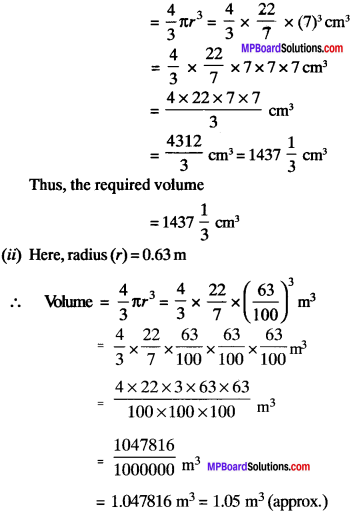
(i) Here, radius (r) = 7 cm
∴ Volume of the sphere
MP Board Class 9th Maths Solutions Chapter 13 Surface Areas and Volumes Ex 13.8 img-1
Thus, the required volume is 1.05 m3 (approx.)

Question 2.
Find the amount of water displaced by a solid spherical ball of diameter

(i) 28 cm
(ii) 0.21 m

Solution:
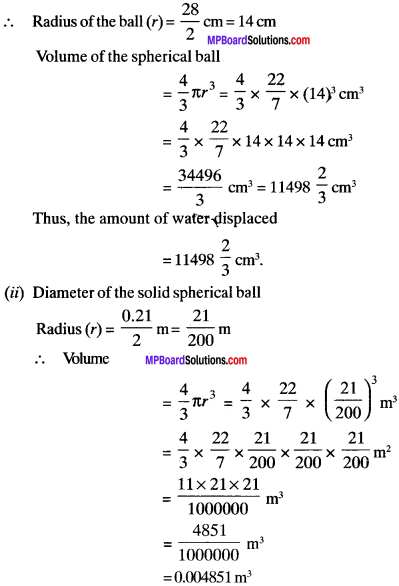
(i) Diameter of the ball = 28 cm
MP Board Class 9th Maths Solutions Chapter 13 Surface Areas and Volumes Ex 13.8 img-2

Question 3.
The diameter of a metallic ball is 4.2 cm. What is the mass of the ball, if the density of the metal is 8,9 g per cm3.
Solution:
d = 4.2 cm
⇒ r = 2.1 cm
Density (D) = 8.9 gm/cm3
Volume of metallic ball = \(\frac{4}{3}\) x \(\frac{22}{7}\) x 2.1 x 2.1 x 2.1 = 38.808 cm3
Mass = D x V
= 8.9 x 38.808
= 345.3912 gm.

MP Board Solutions

Question 4.
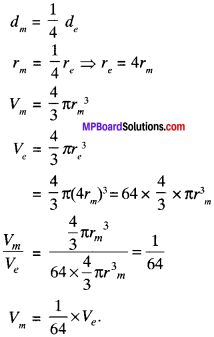
The diameter of the moon is approximately one – fourth of the diameter of the earth. What fraction of the volume of the earth is volume of the moon?
Solution:
Let d and d be the diameter of moon and earth respectively.
MP Board Class 9th Maths Solutions Chapter 13 Surface Areas and Volumes Ex 13.8 img-3

Question 5.
How many liters of milk can hemispherical bowl of diameter 10 J cm hold?
Solution:
d = 10.5 cm
r = 5.25 cm
Volume of the hemisphere = \(\frac{2}{3}\) x \(\frac{22}{7}\) x 5.25 x 5.25 x 0.25
= 303.18 cm3
= 0.303 l

Question 6.
A hemispherical tank is made up of an iron sheet 1cm thick. If the inner radius is 1 m, then find the volume of the iron used to make the tank.
Solution:
t = 1 cm
r1 = 1 m = 100 cm
r2 = r1 + t = 100 + 1 = 101 cm
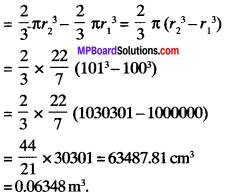
Outer volume of tank (V2) = \(\frac{2}{3}\) πr22
Inner volume of tank (V1) = \(\frac{2}{3}\) πr13
Volume of iron = Outer volume – inner volume
MP Board Class 9th Maths Solutions Chapter 13 Surface Areas and Volumes Ex 13.8 img-4
= 0.06348 ml

Question 7.
Find the volume of a sphere whose surface area is 154 cm2.
Solution:
Surface area = 154 cm2
Surface area of sphere = 4πr2
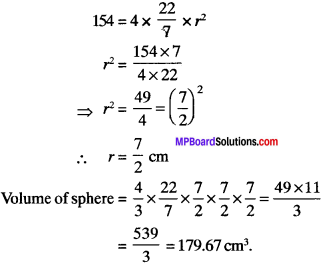
MP Board Class 9th Maths Solutions Chapter 13 Surface Areas and Volumes Ex 13.8 img-5

Question 8.
A dome of a building is in the from of a hemisphere. From inside, it was White – washed at the cost of ₹ 498.96. If the cost of white-washing is ₹ 2.00 per square meter, find the

(i) inside surface area of the dome.
(ii) volume of the air inside the dome.

Solution:
(i) Cost = ₹ 498.96
Rate = ₹ 2 per m2
Inside surface area = \(\frac{498.96}{2}\) = 249.48 m2
Inside curved surface area = 2πr2
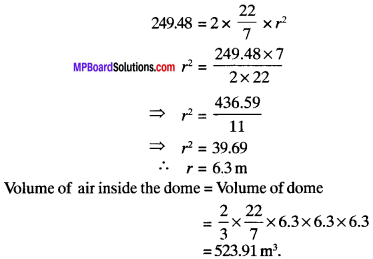
MP Board Class 9th Maths Solutions Chapter 13 Surface Areas and Volumes Ex 13.8 img-6

Question 9.
Twenty seven solid iron spheres, each of radius r and surface area S are melted to form a sphere with surface area S’. Find the

(i) radius r’ of the new sphere
(ii) ratio of S and S’.

Solution:
Let V and be the volume of old and new sphere respectively
(i) Volume of new sphere = 27 x volume of old sphere
V1 = 27 x V
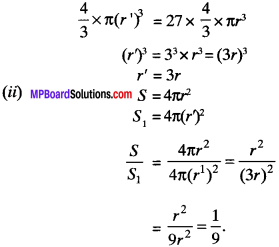
MP Board Class 9th Maths Solutions Chapter 13 Surface Areas and Volumes Ex 13.8 img-7

Question 10.
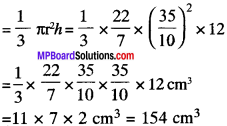
A capsule of medicine is in the shape of a sphere of diameter 3.5 mm. How much medicine (in mm3) is needed to fill this capsule?
Solution:
d = 3.5 mm
r = 1.75 mm
Volume of medicine needed to fill the capsule
= \(\frac{4}{3}\)πr3
= \(\frac{4}{3}\) x \(\frac{22}{7}\) x 1.75 x 1.75 x 1.75
= 22.458 mm3
= 22.46 mm3 (Approx.)
MP Board Class 9th Maths Solutions

MP Board Class 9th Maths Solutions Chapter 13 Surface Areas and Volumes Ex 13.7

MP Board Class 9th Maths Solutions Chapter 13 Surface Areas and Volumes Ex 13.7

Assume π = \(\frac{22}{7}\), unless stated otherwise.

MP Board Solutions

Question 1.
Find the volume of the right circular cone with

  1. radius 6 cm, height 7 cm
  2. radius 3.5 cm, height 12 cm.

Solution:
1. Here, radius of the cone r = 6 cm
height (h) = 7 cm
Volume = \(\frac{1}{3}\) x πr2h
= \(\frac{1}{3}\) x \(\frac{22}{7}\) x 6 x 6 x 7 cm3
= 22 x 2 x 6 cm3
= 264 cm3

2. Here, radius of the cone (r) ;
= 3.5 cm = \(\frac{35}{10}\) cm
Height (h) = 12 m
Volume of the cone
MP Board Class 9th Maths Solutions Chapter 13 Surface Areas and Volumes Ex 13.7 img-1

Question 2.
Find the capacity in litres of a conical vessel with

  1. radius 7 cm, slant height 25 cm
  2. height 12 cm, slant height 13 cm

Solution:
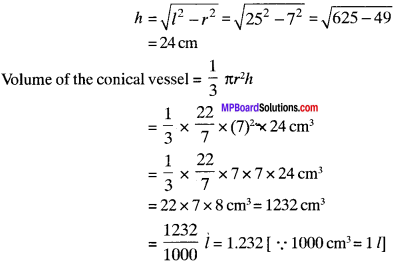
1. Here, r = 7 and l = 25 cm
MP Board Class 9th Maths Solutions Chapter 13 Surface Areas and Volumes Ex 13.7 img-2
Thus, the required capacity of the conical vessel is 1.232 l.

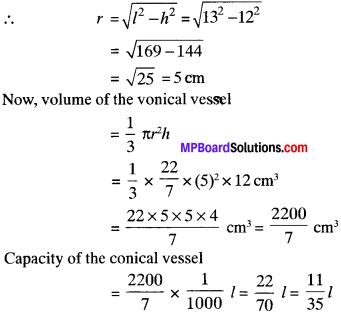
2. Here, height (h) – 12 cm and l = 13 cm
MP Board Class 9th Maths Solutions Chapter 13 Surface Areas and Volumes Ex 13.7 img-3
Thus, the required capacity of the conical vessel is \(\frac{11}{35}\) l.

Question 3.
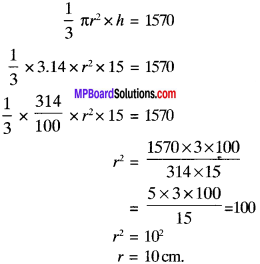
The height of a cone is 15 cm. If its volume is 1570 cm3, find the radius of the base. (Use 71 = 3.14)
Solution:
Here, height of the cone (h) = 15 cm
Volume of the cone (v) = 1570 cm3
Let the radius of the base be ‘r’ cm.
MP Board Class 9th Maths Solutions Chapter 13 Surface Areas and Volumes Ex 13.7 img-4

Question 4.
If the volume of a right circular cone of height 9 cm is 48 JI cm3, find the diameter of its base.
Solution:
Volume of cone = \(\frac{1}{3}\) πr2h
\(\frac{1}{3}\) x πr2 x 9 = 48π
r2 = \(\frac{48π}{9π}\) x 3
r2 = 16
r = 4 cm
Diameter = 2 x 4 = 8 cm

MP Board Solutions

Question 5.
A conical pit of top diameter 3,5 m is 12 m deep. What is its capacity in kilolitres?
Solution:
d = 3.5 m
r = 1.75 m
h = 12m
Volume of the pit = \(\frac{1}{3}\) x \(\frac{22}{7}\) x 1. 75 x 1.75 x 12
= 38.5 m3 = 38.5 kl (1 kl= 1 m3)

Question 6.
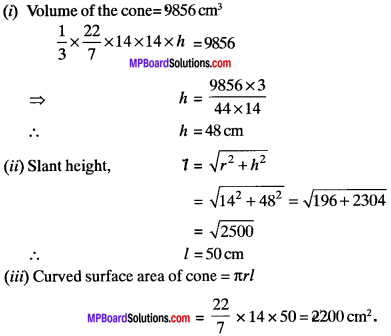
The volume of a right circular cone is 9856 cm3. If the diameter of the base 28 cm, find.

(i) height of the cone.
(ii) slant height of the cone.
(iii) curved surface area of the cone.

Solution:
V = 9856 cm2
d =28 cm
r = 14 cm
MP Board Class 9th Maths Solutions Chapter 13 Surface Areas and Volumes Ex 13.7 img-5

Question 7.
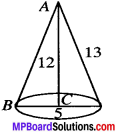
A right triangle ABC with sides 5 cm, 12 cm and 13 cm is revolved about the sides 12 cm. Find the volume of the solid 30 obtained.
Solution:
h = 12cm
r = 5cm
MP Board Class 9th Maths Solutions Chapter 13 Surface Areas and Volumes Ex 13.7 img-6
Volume of solid, V1 = \(\frac{1}{3}\)πr2h
= \(\frac{1}{3}\) x π x 5 x 5 x 12
= 100π cm3

Question 8.
If the triangle ABC in the Question 7 above is revolved about the side 5 cm, then find the volume of the solid so obtained. Find also the ratio of the volumes of the two solids obtained in Questions 7 and 8.
Solution:
h = 5 cm
r = 12 cm
Volume of solid, V2 = \(\frac{1}{3}\) x π x 12 x 12 x 5
= 240π
MP Board Class 9th Maths Solutions Chapter 13 Surface Areas and Volumes Ex 13.7 img-7

MP Board Solutions

Question 9.
A heap of wheat is in the form of a cone whose diameter is 10.5 m and height is 3 m. Find its volume. The heap is to be by covered canvas to protect it from rain. Find the area of the canvas required.
Solution:
d = 10.5 m ⇒ r = 5.25 m
h = 3m
Volume of heap of wheat = \(\frac{1}{3}\) x \(\frac{22}{7}\) x 5.25 x 5.25 x 3
= 86.625 m3
l2 = 32 + (5.25)2
l = \(\sqrt{9+27.56}\) = \(\sqrt{36.56}\) = 6.04 cm
Area of canvas required = CSA of cone –
= \(\frac{22}{7}\) x 5.25 x 6.04 = 99.66 m2

MP Board Class 9th Maths Solutions

MP Board Class 9th Maths Solutions Chapter 13 Surface Areas and Volumes Ex 13.6

MP Board Class 9th Maths Solutions Chapter 13 Surface Areas and Volumes Ex 13.6

Assume = \(\frac{22}{7}\) unless stated otherwise.

Question 1.
The circumference of the base of a cylindrical vessel is 132 cm and its height is 25 cm. How many litres of water can it hold? (1000 cm3 = 1l)
Solution:
Circumference of base, C =132 cm ,
h = 25 cm
C = 2πr
132 = 2 x \(\frac{22}{7}\) x r
r = \(\frac{132×7}{2×22}\) = 21 cm
Volume of cylinder =πr2h
= \(\frac{22}{7}\) x 21 x 21 x 25 = 34650 cm3
= \(\frac{34650}{1000}\)

Question 2.
The inner diameter of a cylindrical wooden pipe is 24 cm and its outer diameter is 28 cm. The length of the pipe is 35 cm. Find the mass of the pipe, if 1 cm3 of wood has a mass of 0.6 g.
Solution:
MP Board Class 9th Maths Solutions Chapter 13 Surface Areas and Volumes Ex 13.6 img-1
Inner diameter
d1 = 24 cm ⇒ r1 = 12 cm
Outer diameter, d2 = 28 cm ⇒ r2 = 14 cm
Volume of wood in the piple = πr22h – πr12h
πh(r22 – r12) = \(\frac{22}{7}\) x 35(142 – 122)
= \(\frac{22}{7}\) x 35 x 52 = 5720 cm3
Mass of pipe = 0.6 x 5720 = 3432 gm
= 3.432 kg.

MP Board Solutions

Question 3.
A soft drink is available in two packs –

  1. a tin can with a rectangular base of length 5 cm and width 4 cm, having a height of 15 cm and
  2. a plastic cylinder with circular base of diameter 7 cm and height 10 cm. Which container has greater capacity and by how much?

Solution:
1. Volume of cuboidal can = (5 x 4 x 15) = 300 cm3

2. Volume of cylindrical can = πr2h = \(\frac{22}{7}\) x 3.5 x 3.5 x 10
= 385 cm2
Capacity of cylindrical can is more than the cuboidal can by 85 cm2.

Question 4.
If the lateral surface of a cylinder is 94.2 cm2 and its height is 5 cm, then find

  1. radius of its base
  2. its volume. (Use π = 3.14)

Solution:
1. CSA of cylinder = 94.2 cm2
2πrh = 94.2 cm2
2 x 3.14 x 5 = 94.2 cm2
r = \(\frac{94.2}{2×3.14×5}\) = 3 cm
Volume of the cylinder = πr2h
= 3.14 x 3 x 3 x 5
= 3.14 x 45 = 141.3 cm3

Question 5.
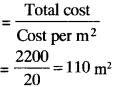
It costs ₹ 2200 to paint the inner curved surface of a cylindrical vessel 10 m deep. If the cost of painting is at the rate of ₹ 20 per m2, find

  1. inner curved surface area of the vessel
  2. radius of the base
  3. Capacity of the Vessel.

1. Inner curved surface area =
MP Board Class 9th Maths Solutions Chapter 13 Surface Areas and Volumes Ex 13.6 img-2
2. Let r be the radius of the base ICSA = 2πrh
110 = 2 x \(\frac{22}{7}\) x r x 10 r
= 1.75 m

3. Capacity of vessel = πr2h = \(\frac{22}{7}\) x 1.75 x 1.75 x 10
= 96.25 m3.

MP Board Solutions

Question 6.
The capacity of a closed cylindrical vessel of height 1 m is 15.4 litres. How many square metres of metal sheet would be needed to make it?
Solution:
h = 1 m
V = 15.4l
= \(\frac{15.4}{1000}\)m3 = 0.0154 m3
Volume of the vessel = πr2h
0. 0154 = \(\frac{22}{7}\) x r2 x 1
∴ r2 = \(\frac{0.0154×7}{22}\)
⇒ r2 = 0.0049
∴ r = 0.07 m
Area of metal sheet required = 2nr (h + r)
= 2x \(\frac{22}{7}\) x 0.07(1 + 0.07)
= 0.4708 m2.

Question 7.
A lead pencil consists of a cylinder ofvyood with a solid cylinder of graphite filled in the interior. The diameter of the pencil is 7 mm and the diameter of the graphite is 1 mm. If the length of the pencil is 14 cm, find the volume of the wood and that of the graphite.
Solution:
Volume of the pencil = πr2h
= \(\frac{22}{7}\) x 3.5 x 3.5 x 140 = 5390 mm3
Volume of graphite = πr2h
= \(\frac{22}{7}\) x 0.5 x 0.5 x 140 = 110 mm3
Volume of wood = Volume of pencil – Volume of graphite
= 5390 – 110
= 5280 mm3
=5.28 cm3.

MP Board Solutions

Question 8.
A patient in a hospital is given soup daily in a cylindrical biftvl of diameter 7 cm. If the bowl is filled with/soup to a height of 4 cm, how much soup the hospital has to prepare daily to serve 250 patients?
Solution:
d = 7cm
r = 3.5 cm
h = 4cm
Volume of the bowl = πr2h
= \(\frac{22}{7}\) x 3.5 x 3.5 x 4 = 154 cm3
Volume of soup needed for 250 patients = 154 x 250
= 38500 cm3
= 38.5l.

MP Board Class 9th Maths Solutions

MP Board Class 9th Maths Solutions Chapter 13 Surface Areas and Volumes Ex 13.5

MP Board Class 9th Maths Solutions Chapter 13 Surface Areas and Volumes Ex 13.5

Assume π = \(\frac{22}{7}\), unless stated otherwise.

Question 1.
A matchbox measures 4 cm x 2.5 cm. x 1.5 cm. What will be the volume of a packet containing 12 such boxes?
Solution:
Measures of matchbox (cuboid) is 4 cm x 2.5 cm x 1.5 cm
l = 4 cm,
b = 2.5 cm and
h = 1.5 cm
∴ Volume of matchbox = (l x b) x h
= [4 cm x 2.5 cm] x 1.5 cm3
= 4 x \(\frac{25}{10}\) x \(\frac{25}{10}\) cm3 = 15 cm3
Volume of 12 boxes =12 x 15 cm3 = 180 cm3

MP Board Solutions

Question 2.
A cuboidal water tank is 6 m long, 5 m wide and 4.5 m deep. How many litres of water can it hold? (1 m3 = 1000 l)
Solution:
Here, Length (l) = 6 m
Breadth (b) = 5 m
Depth (h) = 4.5 m
Capacity = l x b x h = 6 x 5 x 4.5 m3
= 6 x 5 x \(\frac{45}{10}\) m3 = 3 x 45
= 135 m3
∴ 1 m3 can hold 1000 l.
∴ 135 m3 can hold (135 x 1000 l = 135000 l) of water.
∴ The required amount of water in the tank = 135000 l.

Question 3.
A cuboidal vessel is 10 m long and 8 m wide. How high must it be made to hold 380 cubic meters of a liquid?
Solution:
Volume of the vessel = l x b x h
380 = 10 x 8 x h
380 = 80 x h
h = \(\frac{380}{80}\) = 4.75m.

Question 4.
Find the cost of digging a cuboidal pit 8 m long, 6 m broad and 3 m deep at the rate of ₹ 30 per m3.
Solution:
Volume of cuboidal pit = 8 x 6 x 3 = 144 m3
Cost of digging = 144 x 30 = ₹ 4320.

Question 5.
The capacity of a cuboidal tank is 50000 liters of water. Find the breadth of the tank, it its length and depth are respectively 2.5 m and 10 m.
Solution:
Capacity of cuboidal tank = \(\frac{50000}{1000}\) m3 = 50 m3
Volume of cuboidal tank = l x b x h
50 = 2.5 x 6 x 10
50 = 25b
Breadth of tank, b = \(\frac{50}{25}\) = 2 m.

MP Board Solutions

Question 6.
A village, having a population of4000, requires 150 liters of water per head per day. It has a tank measures 20 m x 15 m x 6m. For how many days will the water of this tank last?
Solution:
Volume of water required for the village per day = \(\frac{4000×150}{1000}\)
Volume of tank = 20 x 15 x 6 = 1800 m3
No. of days = \(\frac{1800}{600}\) = 3.

Question 7.
A godown measures 60 m x 25 m x 10 m. Find the maxium number of wooden crates each measuring 1.5 m x 1.25 m x 0.5 m that can be stored in the godown.
Solution:
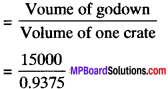
Volume of godown = (60 x 25 x 10) m3 = 15000 m3
Volume of one wooden crate = (1.5 x 1.25 x 0.5) m3 = 0.9375 m3
No. of wooden crates which can be stored in the godown
MP Board Class 9th Maths Solutions Chapter 13 Surface Areas and Volumes Ex 13.5 img-1
= 16000.

Question 8.
A solid cube of side 12 cm is cut into eight cubes of equal volume. What will be the side of the new cubk? Also, find the ratio between their surface area.
Solution:
Volume of cube of side 12 cm = (12 x 12 x 12) cm3
Let V be volume of new cube.
Volume of cube of side 12 cm = 8 x volume of new cube
12 x 12 x 12 = 8 x V
V = \(\frac{12x12x12}{8}\) = \(\frac{12x12x12}{2x2x2}\) = 216 cm3
Let a be the side of new cube
a3 = 216 = 63
a = 6 cm
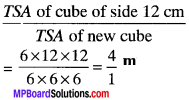
TSA of cube of side 12 = 6 x (12)2
TSA of new cube = 6 x (6)2
MP Board Class 9th Maths Solutions Chapter 13 Surface Areas and Volumes Ex 13.5 img-2

MP Board Solutions

Question 9.
Anver 3 m deep and 40 m wide is flowing at the rate of 2 km per hour. How much water will fall into the sea in a minute?
Solution:
b = 40 m,
h = 3 m
V = 2 km/hr
= \(\frac{2×1000}{60}\) = \(\frac{100}{3}\) m/min
Volume of water coming out of the river per min = b x h x V
= \(\frac{100}{3}\) x 3 x 40 = 4000 m3.

MP Board Class 9th Maths Solutions

MP Board Class 9th Maths Solutions Chapter 13 Surface Areas and Volumes Ex 13.4

MP Board Class 9th Maths Solutions Chapter 13 Surface Areas and Volumes Ex 13.4

Assume π = \(\frac{22}{7}\), unless stated otherwise.

Question 1.
Find the surface area of a sphere of radius:

(i) 10.5 cm
(ii) 5.6 cm
(iii) 14 cm

Solution:
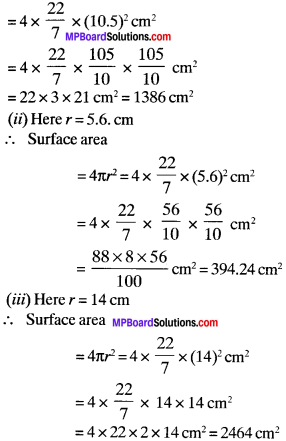
(i) Here r = 10.5 cm
∴ Surface area of the sphere = 4πr2
MP Board Class 9th Maths Solutions Chapter 13 Surface Areas and Volumes Ex 13.4 img-1

Question 2.
Find the surface area of a sphere of diameter:

(i) 14 cm
(ii) 21 cm
(Hi) 3.5 m

Solution:
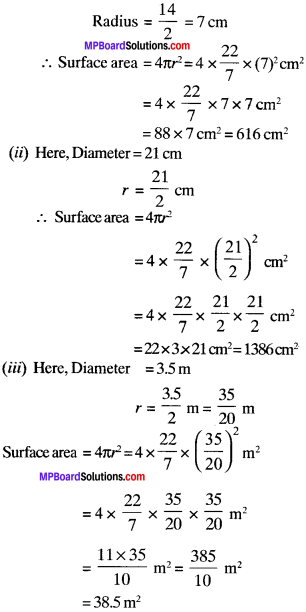
(i) Here, Diameter = 14 cm
MP Board Class 9th Maths Solutions Chapter 13 Surface Areas and Volumes Ex 13.4 img-2

Question 3.
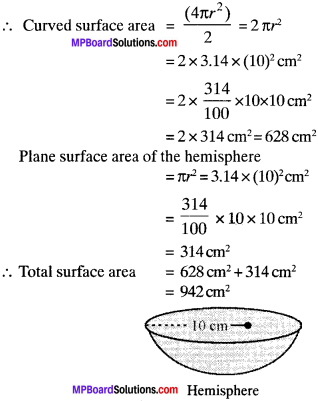
Find the total surface area of a hemisphere of radius 10 cm. (Use π = 3.14)
Solution:
Here, radius (r) = 10 cm
MP Board Class 9th Maths Solutions Chapter 13 Surface Areas and Volumes Ex 13.4 img-3

Question 4.
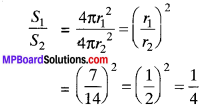
The radius of a spherical balloon increases from 7 cm to 14 cm as air is being pumped into it. Find the ratio of surface areas of the balloon in the two cases.
Solution:
Initial radius of the balloon, r1 = 7 cm
Final radius of the balloon, r2 = 14 cm
Initial surface area of the balloon = S1
Final surfacg area of the balloon = S2
MP Board Class 9th Maths Solutions Chapter 13 Surface Areas and Volumes Ex 13.4 img-4
S1 : S2 = 1 : 4

Question 5.
A hemispherical bowl made of brass has inner diameter 10.5 cm. Find the cost of tin-plating it on the inside at the rate of ₹ 16 per 100 cm2.
Solution:
d = 10.5 cm
r =5.25 cm
Rate of tinplating = \(\frac{16}{100}\) = ₹ 0.16 per cm2
Inner curved surface area of bow l = 2 πr2
ICSA = 2 x \(\frac{22}{7}\) x 5.25 x 5.25 = 173.25 cm2
Cost of tin-plating = Rate x ICSA
= 0.16 x 173.25 = ₹ 27.72

MP Board Solutions

Question 6.
Find the radius of a sphere whose surface area is 154 cm2.
Solution:
Surface area of sphere = 4 πr2
154 = 4 x \(\frac{22}{7}\) x r2
\(\frac{154×7}{4×22}\) = r2
⇒ r2 = 3.5 cm.

Question 7.
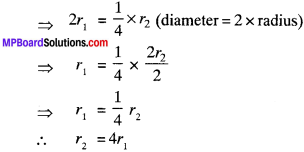
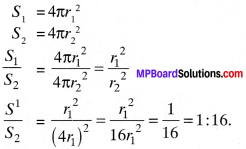
The diameter of the moon is approximately one-fourth of the diameter of the earth – Find the ratio of their surface areas.
Solution:
d1 = \(\frac{1}{4}\)d2
MP Board Class 9th Maths Solutions Chapter 13 Surface Areas and Volumes Ex 13.4 img-5
Let .S1, and .S2, be the surface area of moon and earth respectively.
S1 = 4 πr12
S2 = 4 πr22
MP Board Class 9th Maths Solutions Chapter 13 Surface Areas and Volumes Ex 13.4 img-6

Question 8.
A hemispherical bowl is made of steel, 0.25 cm thick. The inner radius of the bowl is 5 cm. Find the outer curved surface area of the bowl.
Solution:
r1 = 5 cm
t (thickness) = 0.25 cm
r2 = r1 + t
= 5 + 0.25 = 5.25 cm
OCSA of bowl = 2x \(\frac{22}{7}\) x 5.25 x 5.25
= \(\frac{44}{7}\) x 5.25 x 5.25 = 173.25 cm2

MP Board Solutions

Question 9.
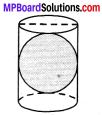
A right circular cylinder just encloses a sphere of radius r (see Fig.). Find
MP Board Class 9th Maths Solutions Chapter 13 Surface Areas and Volumes Ex 13.4 img-7

  1. surface area of the sphere.
  2. curved surface area of the cylinder.
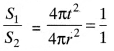
  3. ratio of the areas obtained in (i) and (ii).

Solution:
As the sphere just encloses a right circular cylinder, the height of the cylinder is equal to the diameter of the sphere.
∴ Height of cylinder h = 2r
where r is the radius of sphere

1. Surface area of sphere S1 = 4πr2

2. CSA of a cylinder,= 2πrh
= 2πr x 2r = 4πr2

3. MP Board Class 9th Maths Solutions Chapter 13 Surface Areas and Volumes Ex 13.4 img-8

MP Board Class 9th Maths Solutions

MP Board Class 9th Maths Solutions Chapter 13 Surface Areas and Volumes Ex 13.3

MP Board Class 9th Maths Solutions Chapter 13 Surface Areas and Volumes Ex 13.3

Assume π = \(\frac{22}{7}\), unless stated otherwise.

Question 1.
Diameter of the base of a cone is 10.5 cm and its slant height is 10 cm. Find its curved surface area.
Solution:
Here, diameter of the base = 10.5 cm
Radius (r) = \(\frac{10.5}{2}\)
Slant height (l) = 10 cm
Curved surface area of the cone = πrl
= \(\frac{22}{7}\) x \(\frac{10.5}{2}\) x 10 cm2
= \(\frac{22}{7}\) x \(\frac{10.5}{20}\) x 10 cm2
= 11 x 15 x 1 cm2 = 165 cm2

MP Board Solutions

Question 2.
Find the total surface area of a cone, if its slant height is 21 m and diameter of its base is 24 m.
Solution:
Here, diameter = 24 m
Radius (r) = \(\frac{24}{2}\) m = 12m
Slant height (l) = 21 m
Total surface area = πr (r + l)
MP Board Class 9th Maths Solutions Chapter 13 Surface Areas and Volumes Ex 13.3 img-1

Question 3.
Curved surface area of a cone is 308 cm2 and its slant height is 14 cm. Find:

  1. radius of the base and
  2. total surface area of the cone.

Solution:
Here, curved surface area = 308 cm2
Slant height (l) = 14 cm

1. Let the radius of the base be ‘r’ cm.
πrl = 308
\(\frac{22}{7}\) x r x 14 = 308
r = \(\frac{308×7}{22×14}\) = 7 cm
Thus, the required radius of the cone is 7 cm.

2. base area = πr2 = \(\frac{22}{7}\) x 72 cm.
and curved surface area = 308 cm2 given
∴ Total surface area = [Curved surface area] + [Base area]
= 308 cm2 + 154 cm2 = 462 cm2

MP Board Solutions

Question 4.
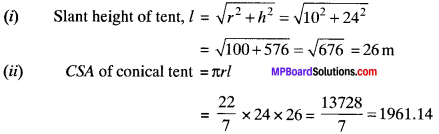
A conical tent is 10 m high and the radius of its base is 24 m. Find

(i) slant height of the tent.
(ii) cost of the canvas required to make the tent, if the cost of 1 m2 canvas is ₹ 70.

Solution:
h = 10 m
r =24m
MP Board Class 9th Maths Solutions Chapter 13 Surface Areas and Volumes Ex 13.3 img-2
Cost of canvas = CSA x Rate of canvas
= 1961.14 x 70
= ₹ 137279.8
= ₹ 137280.

Question 5.
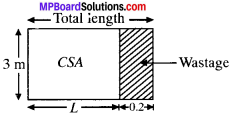
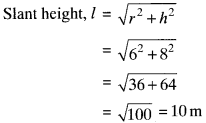
What length of tarpaulin 3 m wide will be required to make conical tent of height 8 m and base radius 6 m? Assume that the extra length of material that will be required for stitching margins and wastage in cutting is approximately 20 cm. (Use π = 3.14)
Solution:
MP Board Class 9th Maths Solutions Chapter 13 Surface Areas and Volumes Ex 13.3 img-3
h = 8m
r = 6m
Width of tarpaulin = 3 m
Extra length required = 20 cm = 0.2 m
MP Board Class 9th Maths Solutions Chapter 13 Surface Areas and Volumes Ex 13.3 img-4
CSA of conical tent = πrl
= 3.14 x 6 x 10 = 188.4 m2
CSA of conical tent = Area of tarpaulin
188.4 = l x 3 (Here l = length of tarpaulin)
l = \(\frac{188.4}{3}\)
Total length of tarpaulin required = 62.8 + 0.2 = 63 m

Question 6.
The slant height and base diameter of a conical tomb are 25 m and 14 m respectively. Find the cost of white-washing its curved surface at the rate of ₹ 210 per 100 m2.
Solution:
l = 25m
d = 14m
r = 7m
Rate of white washing = ₹ 210 per 100 m2
= \(\frac{210}{100}\) = ₹ 2.10 per m2
CSA of conical tomb = πrl
= \(\frac{22}{7}\) x 7 x 25 = 550 m2
Cost of white washing = Rate x CSA
= 2.10 x 550 (Rate per m2 = \(\frac{220}{100}\))
= ₹ 1155

Question 7.
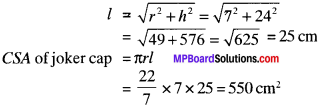
A joker’s cap is in the form of a right circular cone of base radius 7 cm and height 24 cm. Find the area of the sheet required to make 10 such caps.
Solution:
r = 7 cm
h = 24 cm
MP Board Class 9th Maths Solutions Chapter 13 Surface Areas and Volumes Ex 13.3 img-5
Area of sheet required = CSA of 10 such caps = 550 x 10 = 5500 cm2.

MP Board Solutions

Question 8.
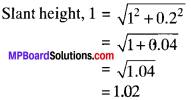
A bus stop is barricaded from the remaining part of the road, by using 50 hollow cones made of recycled cardboard. Each cone has a base diameter of 40 cm and height 1 m. If the outer side of each of the cones is to be painted and the cost of painting is ₹ 12 per m2 what will be cost of painting all these cones? (Use π = 3.14 and take \(\sqrt{1.04}\) =1.02).
Solution:
d = 40 cm
r = 20 cm = 0.20 m
h = l m
Rate = ₹ 12 per m2
MP Board Class 9th Maths Solutions Chapter 13 Surface Areas and Volumes Ex 13.3 img-6
= 1.02
CSA of cone = 3.14 x 0.2 x 1.02 = 0.64m2
Total area of 50 hollow cones= 50 x 0.64 = 32 m2
Cost of painting = 32 x 12 = ₹ 384
(Rate of painting = ₹ 12/m2)

MP Board Class 9th Maths Solutions

MP Board Class 9th Maths Solutions Chapter 13 Surface Areas and Volumes Ex 13.2

MP Board Class 9th Maths Solutions Chapter 13 Surface Areas and Volumes Ex 13.2

Assume π = \(\frac{22}{7}\) unless stated otherwise.

Question 1.
The curved surface area of a right circular cylinder of height 14 cm is 88 cm2. Find the diameter of the base of the cylinder.
Solution:
h = 14 cm
CSA of cylinder = 88 cm2
CSA of cylinder = 2 πrh
88 = 2x \(\frac{22}{7}\) xr x 14
\(\frac{88}{4}\) = 2r
r = \(\frac{2}{2}\) = 1
Diameter = 2 r
= 1 x 2 = 2 cm.

MP Board Solutions

Question 2.
It is required to make a closed cylindrical tank of height 1 m and base diameter 140cm from a metal sheet. How many square metres of the sheet are required for the same?
h = 1 m
d = 140 cm
r = 7o cm = 0.7 m
Area of metal required = TSA of cylinderical tank
= 2 πr (r + h)
= 2 x \(\frac{22}{7}\) x 0.7 (0.7 + 1)
= 4.4 x 1.7 = 7.4m2

Question 3.
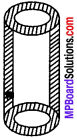
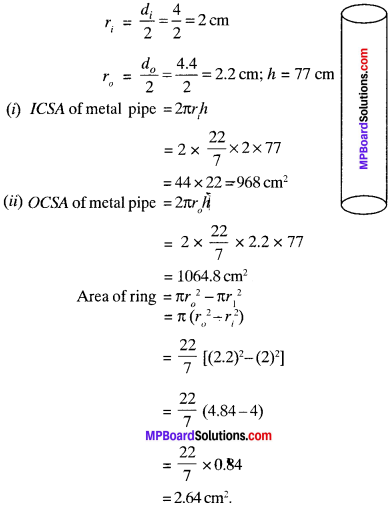
A metal pipe is 77 cm long. The inner diameter of a cross section is 4 cm. the outer diameter being 4.4 cm. (see Fig.). Find its

(i) inner curved surface area.
(ii) outer curved surface area.
(iii) total surface area.

MP Board Class 9th Maths Solutions Chapter 13 Surface Areas and Volumes Ex 13.2 img-1
(iii) TSA = ICSA + OCSA + 2 x area of ring
= 968 + 1064.8 + 2 x 2.64
= 2032.8 + 5.28
= 20.38.08 cm2.

Question 4.
The diameter of a roller is 84 cm and its length is 120 cm. It takes 500 complete revolutions to move once over to level a playground. Find the area of the playground in m2.
Solution:
d = 84cm
∴ r = 42 cm
h = 120 cm
No. of revolution = 500
CSA of the roller = 2πrh
= 2 x \(\frac{22}{7}\) x 42 x 120
= 44 x 720
= 31680 cm2
Area of the playground = 31680 x 500
= 15840000 cm2
Area in m2 \(\frac{ 15840000}{100 x 100}\)
= 1584 m2.

MP Board Solutions

Question 5.
A cylindrical pillar is 50 cm in diameter and 3.5 m in height Find the cost of painting the curved surface of the pillar at the rate of ₹ 12.S0 per m2.
Solution:
d = 50cm
r = 25 cm2
h = 3.5 m = 350 cm
CSA of pillar = 2πrh
= 2x \(\frac{22}{7}\) x 25 x 350
= 44 x 1250
= 55000 cm2
CSA in m2 = \(\frac{55000}{100×100}\)
Cost of painting the cylindrical pillar = ₹ 12.50 x 5.5
= ₹ 68.75

Question 6.
Curved surface area of a right circular cylinder is 4.4 m2. If the radius of the base of the cylinder is 0.7 m, find its height.
Solution:
CSA = 4.4m2.
r = 0.7 m
CSA of cylinder =2πrh
4.4 = 2x \(\frac{22}{7}\) x 0.7 x h
4.4 = 44 x 0.1 x h
4.4 = 4.4 x h
h = \(\frac{44}{4.4}\) = 1m

Question 7.
The inner diameter of a circular well is 3.5 m. It is 10 m deep. Find

  1. its inner curved surface area
  2. the cost of plastering this curved surface at the rate of ₹ 40 per m2.

Solution:
d = 3.5m
r = 1.75 m
h = 10 m

1. ICSA of the well = 2πrh
= 2 x \(\frac{22}{7}\) x 1.75 x 10
= 110 m2

2. Cost of plastering = ₹ 40 x 110
= ₹ 4400.

MP Board Solutions

Question 8.
In a hot water heating system, there is a cylindrical pipe of length 28 m and diameter 5 cm. Find the total radiating surface in the system.
Solution:
h = 28m
d = 5cm
r = 2.5cm = 0.025m
Total radiating surface = CSA of pipe = 2πrh
= 2 x \(\frac{22}{7}\) x 0.025 x 28
= 4.4 m2.

9. Find

1. The lateral or curved surface area of a closed cylindrical petrol storage tank that is 4.2 m in diameter and 4.5 m high.

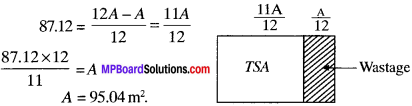
2. How much steel was actually used, if \(\frac{1}{2}\) of the steel actually used was wasted in making the tank.

Solution:
1. d = 4.2 m
r = 2.1m
h = 4.5 m
CSA of cylinderical tank = 2πrh
= 2x \(\frac{22}{7}\) x 2.1 x 4.5
= 59.4 m2.
TSA = 2πrr(r + h)
= 2 x \(\frac{22}{7}\) x 2.1 (2.1 + 4.5)
= 2 x \(\frac{22}{7}\) x 2.1 x 6.6
= 44 x 1.98
= 87.12 m2

2. Let A be the area of sheet actually used
TSA = A – \(\frac{1}{12}\)
MP Board Class 9th Maths Solutions Chapter 13 Surface Areas and Volumes Ex 13.2 img-2
A = 95.04m2.

Question 10.
In Fig. you see the frame of a lampshade. It is to be covered with a decorative cloth. The frame has a base diameter of 20 cm and height of 30 cm. Amargin of 2.5 cm is to be given for folding it over the top and bottom of the frame. Find how much cloth is required for covering the lampshade.
Solution:
MP Board Class 9th Maths Solutions Chapter 13 Surface Areas and Volumes Ex 13.2 img-3
d = 20 cm
r = 10 cm
h = 30 + 2.5 + 2.5 cm = 35 cm
Area of cloth required = CSA of cyliner of height 35 cm
= 2πrh
= 2 x \(\frac{22}{7}\) x 10 x 35
= 44 x 50 = 2200 cm2.

MP Board Solutions

Question 11.
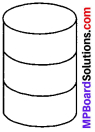
The students of a Vidyalaya were asked to participate in a competi-tion for making and decorating penholders in the shape of a cylinder with a base, using cardboard. Each penholder was to be of radius 3 cm and height 10.5 cm. The Vidyalaya was to supply the competitors with cardboard. If there were 35 competitors, how much cardboard was required to be bought for the competition?
Solution:
r = 3 cm
h = 10.5 cm
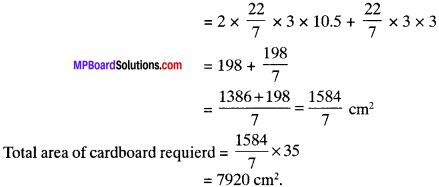
Cardboard required for one penholder = CSA of penholder + Area of base
= 2πrh + πr2
MP Board Class 9th Maths Solutions Chapter 13 Surface Areas and Volumes Ex 13.2 img-4

MP Board Class 9th Maths Solutions

MP Board Class 9th Maths Solutions Chapter 13 Surface Areas and Volumes Ex 13.1

MP Board Class 9th Maths Solutions Chapter 13 Surface Areas and Volumes Ex 13.1

Question 1.
A plastic box 1.5 m long, 1.25 m wide and 65 cm deep is to be made. It is to be open at the top. Ignoring the thickness of the plastic sheet, determine:

  1. The area of the sheet required for making the box.
  2. The cost of sheet for it, if a sheet measuring 1m2 costs ₹ 20.

Solution:
Given
l = 1.5 m = 150 cm
b = 1.25 m = 125 cm
h = 65 cm

1. Total area of plastic sheet required = LSA + Area of base
= 2h(l + b) + l x b
= 2 x 65 (150 + 125) + 150 x 125
= 130 (275) + 18750
= 35750 + 18750
= 54500 cm2
= 5.45 m2

2. Cost of sheet = area of plastic sheet x rate = 5.45 x 20
= 109.00
= ₹ 109.

MP Board Solutions

Question 2.
The length, breadth and height of a room are 5 m, 4 m and 3 m respectively. Find the cost of white washing the walls of the room and the ceiling at the rate of ₹ 7.50 per m2.
Solution:
Given
l = 5m
b = 4m
h = 3 m
Area of the room to be white washed = LSA + Area of ceiling
= 2h(l + b) + l x b
= 2 x 3 (5 + 4) + 5 x 4
= 6(9) + 20
= 54 + 20 = 74 m2
Cost of painting = 7.50 x 74 m2
= ₹ 555

Question 3.
The floor of a rectangular hall has a perimeter 250 m. If the cost of painting the four walls at the rate of ₹ 10 per m2 is ₹ 15000, find the height of the hall.
Solution:
Given
P = 250 m
Rate of painting = ₹ 10/ m2
Cost of painting = ₹ 15000
Area of walls to be painted = \(\frac{15000}{10}\) = 1500 m2
Perimeter = 2 (l + b) = 250
∴ l + b = 250/2 = 125m
Area of walls = LSA = 2h (l + b) = 1500
= h (l + b) = \(\frac{1500}{10}\) = 750 m2 …..(i)
Putting the value of (l + b) in (i), we get
h(125) = 750
h = \(\frac{750}{125}\) = 6 m.

Question 4.
The paint in a certain container is sufficient to paint an area equal to 9315 m2. How many bricks of dimensions 22.5 cm x 10 cm x 7.5 cm can be painted out of this container?
Solution:
Given
l = 22.5 cm
h = 7.5 cm = 0.075 m
b = 10 cm = 0.1 m
Area to be painted = 9.375 m2 = 93750 cm2
Area of one brick = 2(lb + bh + hl)
= 2(22.5 x 10 + 10 x 7.5 + 7.5 x 22.5)
= 2(225 + 75 + 168.75)
= 2 x 468.75
= 937.5 cm2
No. of bricks which can be painted = \(\frac{93750}{937.5}\) = 100

MP Board Solutions

Question 5.
A cubical box has each edge 10 cm and another cuboidal box is 12.5 cm long, 10 cm wide and 8 cm high.

  1. Which box has the greater lateral surface area and by how much?
  2. Which box has the smaller total surface area and by how much? Sol.

Solution:
1. LSA of cubical box = 4a2
= 4 x 10 x 10 = 400 cm2
LSA of cuboidal box = 2h (l + b)
= 2 x 8 (12.5 x 10)
= 16 x 22.5
= 360 cm2
LSA of cubical box is more than cuboidal box by 40 cm2.

2. TSA of cubical box = 6a2 = 6 x 10 x 10
= 600 cm2
TSA of cuboidal box = 2 (lb + bh + hl)
= 2(12.5 x 10 + 10 x 8 + 12.5 x 8)
= 2(125 + 80 + 100)
= 2 x 305 = 610 cm2.
∴ TSA of cuboidal box is more than cubical box by 10 cm2.

Question 6.
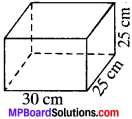
A small indoor green house (herbarium) is made entirely of glass panes (including base) held together with tape. It is 30 cm long, 25 cm wide and 25 cm high.

  1. What is the area of the glass?
  2. How much of tape is needed for all the 12 edges?

Solution:
MP Board Class 9th Maths Solutions Chapter 13 Surface Areas and Volumes Ex 13.1 img-1
Given
l = 30 cm
b = 25 cm and
h = 25 cm
Area of glass required = 2(30 x 25 + 25 x 25 x 30)
= 2(750 + 625 + 750)
= 2 x 2125 = 4250 cm2
Length of tape required = 4(l + b + h)
= 4(30 + 25 + 25)
= 4 x 80 = 320 cm

MP Board Solutions

Question 7.
Shanti Sweets Stall was placing an order for making cardboard boxes for packing their sweets. Two sizes of boxes were required. The bigger of dimensions 25 cm x 20 cm x 5 cm and the smaller of dimensions 15 cm x 12 cm x 5 cm. For all the overlaps, 5% of the total surface area is required extra. If the cost of the cardboard is ₹ 4 for 1000 cm2, find the cost of cardboard required for supplying 250 boxes of each kind.
Solution:
Big Box :
l = 25 cm
b = 20 cm
h = 5 cm
Small Box:
l = 15 cm
b = 12 cm
h = 5 cm
Number of boxes required = 250
Rate = ₹ 4 per 1000 cm2
TSA of bigger box = 2 (25 x 20 + 20 x 5 + 5 x 25)
= 2(500 + 100 + 125)
= 2 x 725 = 1450 cm2
TSA of smaller box = 2 (15 x 12 +12 x 5 + 5 x 15)
= 2 (180 + 60 + 75)
= 2 x 315 = 630 cm2
Area of cardboard required one bigger = TSA + 5% of TSA
= 1450 + \(\frac{5}{100}\) x 1450
= 1522.5 cm2
Area of cardboard required for 250 boxes of bigger size = 250 x 1522.5
= 380625 cm2
Area of cardboard required for one small box = 630 + \(\frac{5}{100}\) x 630
= 661.5 cm2
Total area of cardboard required for 250 boxes of smaller size = 250 x 661.5
= 165375 cm2
Total area = (165375 + 380625) cm2
= 546000 cm2
Total cost of each kind of cardboard = \(\frac{4}{1000}\) x 546000
= ₹ 2184/-

Question 8.
Parveen wanted to make a temporary shelter for her car, by making a box – like structure with tarpaulin that covers all the four sides and the top of the car (with the front face as a flap which can be rollpd up). Assuming that the stitching margins are very small, and therefore negligible, how much tarpaulin would be required to make the shelter of height 2.5 m, with base dimensions 4 m x 3 m?
Solution:
Given
l = 4m
b = 3 m and
h = 2.5 m
Area of the tarpaulin required = 2h(l + b) + l x b
= 2 x 2.5(4 + 3) + 4 x 3
= 5 x 7 + 12
= 35 + 12= 47m

MP Board Class 9th Maths Solutions

MP Board Class 9th Maths Solutions Chapter 12 Heron’s Formula Ex 12.2

MP Board Class 9th Maths Solutions Chapter 12 Heron’s Formula Ex 12.2

Question 1.
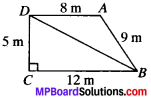
A park, in the shape of a quadrilateral ABCD, has ∠C = 90°, AB = 9 m, BC = 12 m, CD, = 5 m and AD = 8 m. How much area does it. occupy?
Solution:
In ∆DCB
DB2 = DC2 + BC2
MP Board Class 9th Maths Solutions Chapter 12 Heron’s Formula Ex 12.2 img-1
In ∆DBA P = (8 + 9 + 13)m = 30m
s = \(\frac{P}{2}\) = 15 m
s – a = 15 – 13 = 2
s – b = 15 – 9 = 6
s – c = 15 – 8 = 7
Area of ∆DBA = \(\sqrt{15x 2x6x7}\)
\(\sqrt{3x5x2x2x3x7}\)
= 2 x 3\(\sqrt{5×7}\) x 7 = 6\(\sqrt{35}\)m2
Area of quadrilateral ABCD = (30 + 6\(\sqrt{35}\)) m2
= 30 + 6 x 5.91
= 30 + 35.46
= 65.46 m2

MP Board Solutions

Question 2.
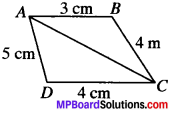
Find the area of a quadrilateral ABCD in which AB = 3 cm, BC = 4 cm, CD = 4 cm, DA = 5 cm and AC = 5 cm.
Solution:
In ∆ABC
MP Board Class 9th Maths Solutions Chapter 12 Heron’s Formula Ex 12.2 img-2
P = 3 + 4 + 5 = 12cm
s = \(\frac{12}{2}\) = 6 cm
s – a = 6 – 5 = 1 cm
s – b = 6 – 4 = 2cm
s – c = 6 – 3 = 3 cm
Area of ∆ABC = \(\sqrt{6x1x2x3}\)
= \(\sqrt{2x3x2x3}\)
= 2 x 3 = 6 cm2
In ∆ADC P = 5 + 5 + 4 = 14 cm
s = \(\frac{P}{2}\) = 7 cm
s – a = 7 – 5 = 2cm
s – b = 7 – 5 = 2cm
s – c = 7 – 4 = 3cm
Area of ∆ADC = \(\sqrt{7x2x2x3}\) = 2\(\sqrt{21}\) cm2
Area of ∆BCD = Area of ∆ABC + Area of ∆ADC
= (6 + 2\(\sqrt{21}\)) cm2
= (6 + 2 x 4.58)
= 15.16 cm2

Question 3.
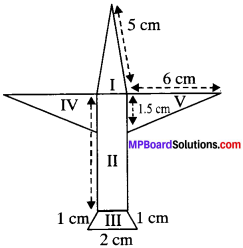
Radha made a picture of an aeroplane with coloured paper is shown in Fig. Find the total area of the paper used.
Solution:
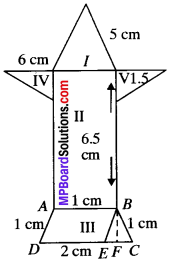
The figure is divided into five parts as shown in Fig.
MP Board Class 9th Maths Solutions Chapter 12 Heron’s Formula Ex 12.2 img-3

  • Part I – Triangle having sides 5 cm, 5 cm and 1 cm
  • Part II – Rectangle having sides 1 cm and 6.5 cm
  • Part III – Trapezium having sides 2,1,1,1.
  • Part IV and V. Right angled triangles having sides 6 cm and 1.5 cm.

MP Board Class 9th Maths Solutions Chapter 12 Heron’s Formula Ex 12.2 img-4
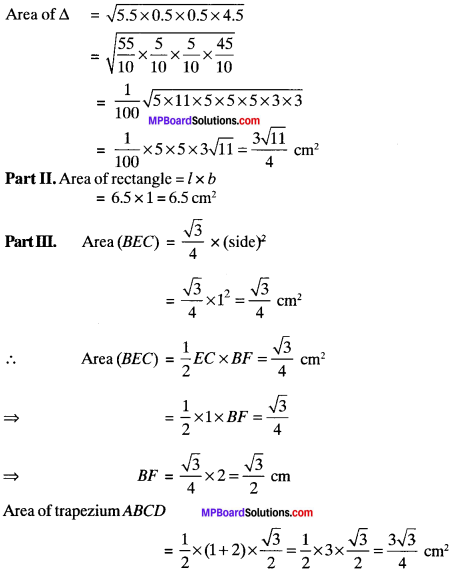
For Part I:
a = 5 cm
b = 5 cm
c = 1 cm
s = \(\frac{P}{2}\) = \(\frac{5+5+1}{2}\) = \(\frac{11}{2}\) = 5.5 cm
s – a = 5.5 – 5 = 0.5
s – b = 5.5 – 5 = 0.5
s – c = 5.5 – 1 = 4.5
MP Board Class 9th Maths Solutions Chapter 12 Heron’s Formula Ex 12.2 img-5
Area of triangle IV and V = \(\frac{1}{2}\) x 1.5 x 6 = 4.5 cm2
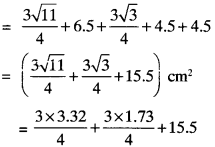
∴ Area of paper required = Area of part I + Area of part II + Area of part III + Area of part IV + Area of part V
MP Board Class 9th Maths Solutions Chapter 12 Heron’s Formula Ex 12.2 img-6
= 2.49 + 1.27 + 15.5
= 19.26 cm2

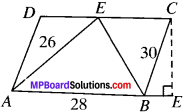
Question 4.
A triangle and a parallelogram have the same base and the &me area. If the sides of the triangle are 26 cm, 28 cm and 30 cm, and the parallelogram stands on the base 28 cm, find the height of the parallelogram.
Solution:
MP Board Class 9th Maths Solutions Chapter 12 Heron’s Formula Ex 12.2 img-7
In ∆ABE
a = 30 cm
b = 28 cm
c = 26 cm
s = \(\frac{P}{2}\) = \(\frac{30+28+26}{2}\) = 42 cm
s – a = 42 – 30 = 12
s – b = 42 – 28 = 14
s – c = 42 – 26 = 16
Area of ∆ABE = \(\sqrt{42x12x14x16}\)
= \(\sqrt{2x3x7x2x2x3x2x7x4x4}\)
= 2 x 3 x 7 x 2 x 4
= 336 cm2
MP Board Class 9th Maths Solutions Chapter 12 Heron’s Formula Ex 12.2 img-8
Area of parallelogram ABCD = area of ∆ABE = 336 cm2 (given)
Area of parallelogram = b x h
336 = 28 x h
⇒ \(\frac{336}{28}\)
h= 12 cm.

MP Board Solutions

Question 5.
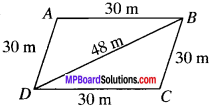
A rhombus shaped field has green grass for 18 cows to graze. If each side of the rhombus is 30 m and its longer diagonal is 48 m, how much area of grass field will each cow be getting?
Solution:
We know that the diagonal of a rhombus divide it into two triangles of equal area.
MP Board Class 9th Maths Solutions Chapter 12 Heron’s Formula Ex 12.2 img-9
a = 48m
b = 30m
c = 30m
s = \(\frac{P}{2}\) = \(\frac{48+30+30}{2}\) = \(\frac{108}{2}\) = 54
s – a = 54 – 48 = 6 cm
s – b = 54 – 30 = 24 cm
s – c = 54 – 30 = 24 cm
Area of ∆ABD
= \(\sqrt{54x6x24x24}\)
= \(\sqrt{2x3x3x3x2x3x2x2x2x3x2x2x2x3}\)
= 2 x 3 x 3 x 2 x 2 x 3 x 2 = 432 cm2
Area of rhombus = 2 x 432 = 864 cm2
Area of grass field for each cow = \(\frac{864}{18}\) = 48 cm2

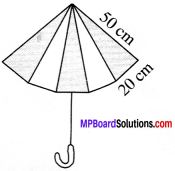
Question 6.
An umbrella is made by stitching 10 triangular pieces of cloth of two different colours (see Fig.), each piece measurig 20 cm, 50 cm and 50 cm. How much cloth of each colour is required for the umberella?
Solution:
MP Board Class 9th Maths Solutions Chapter 12 Heron’s Formula Ex 12.2 img-10
a = 50 cm
b = 50cm
c = 20 cm
s = \(\frac{P}{2}\) = \(\frac{50+50+20}{18}\) = 60 cm
s – a = 60 – 50 = 10
s – b = 60 – 50 = 10
s – c = 60 – 20 = 40
Area of a ∆ = \(\sqrt{60x10x10x40}\)
= \(\sqrt{2x3x10x10x10x2x2x10}\)
= 10 x 10 x 52\(\sqrt{6}\)
= 200\(\sqrt{6}\) cm2
Area of cloth of each type = 200\(\sqrt{6}\) x 5 = 1000\(\sqrt{6}\) cm2

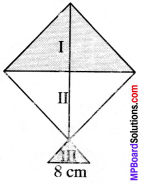
Question 7.
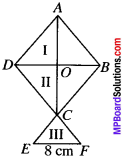
A kite in the shape of a square with a diagonal 32 cm and an isosceles triangle of base 8 cm and sides 6 cm each is to be made of three different shades as shown in Fig. How much paper of each shade has been used in it?
Solution:
MP Board Class 9th Maths Solutions Chapter 12 Heron’s Formula Ex 12.2 img-11
∠AOB = 90°
BD = AC = 32 cm
OA = OC = 16 cm
Area (ABD) = area (DBC) = \(\frac{1}{2}\) x 32 x 16 = 256 cm2
In ∆CEF
a = 6 cm
b = 6 cm
c = 8 cm
s = \(\frac{P}{2}\) = \(\frac{6+6+8}{2}\) = 10
s – a = 10 – 6 = 4
s – b = 10 – 6 = 4
s – c = 10 – 8 = 2
MP Board Class 9th Maths Solutions Chapter 12 Heron’s Formula Ex 12.2 img-12
Area of ∆CEF = \(\sqrt{10x4x4x2}\)
= \(\sqrt{5x2x4x4x2}\)
= 8\(\sqrt{5}\) cm2
= 8 x 2.24 = 17.92 cm2

MP Board Solutions

Question 8.
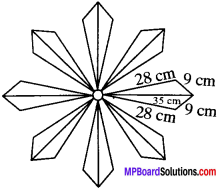
A floral design on a floor is made up of 16 tiles which are triangular, the sides of the triangle being 9 cm, 28 cm and 35 cm (see Fig.). Find the cost of polishing the tiles at the rate of the field.
Solution:
MP Board Class 9th Maths Solutions Chapter 12 Heron’s Formula Ex 12.2 img-13
a = 35 cm
b = 28 cm
c = 9 cm
s = \(\frac{P}{2}\) = \(\frac{35+28+9}{2}\)
s = a = 36 – 35 = 1
5 = b = 36 – 28 = 8
c = c = 36 – 9 = 27
Area of a tile = \(\sqrt{36x1x8x27}\)
= \(\sqrt{2x2x3x3x2x2x2x3x3x3}\)
= 2 x 3 x 2 x 3\(\sqrt{6}\) = 36\(\sqrt{6}\) cm2
= 36 x 2.45 = 88.2 cm2
Total area of tiles = 16 x 88.2 = 1411.2 cm2
Cost of polishing the tiles per cm2 = 50 P
Total cost of polishing the tiles = 1411.2 x 50 P
= ₹ \(\frac{1411.2×50}{100}\) = ₹ 705.60

Question 9.
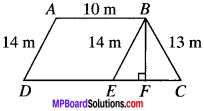
A field is in the shape of a trapezium whose parallel sides are 25 m and 10 m. The non-parallel sides are 14 m and 13 m. Find the area of the field.
Solution:
ABCD is a trapezium. Draw BE parallel to AD. Draw BF ⊥ DC. ABED is a parallelogram
AB = DE = 10 m and AD = BE = 14 m
EC = DC – DE = 25 – 10 = 15 m
In ∆BEC
a = 15m
b = 14m
c = 13m
s = \(\frac{15+14+13}{2}\) = 21
MP Board Class 9th Maths Solutions Chapter 12 Heron’s Formula Ex 12.2 img-14
s – a = 21 – 15 = 6
s – b = 21 – 14 = 7
s – c = 21 x 13 = 8
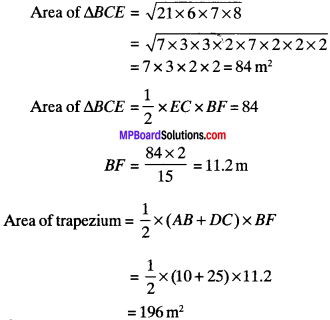
MP Board Class 9th Maths Solutions Chapter 12 Heron’s Formula Ex 12.2 img-15

MP Board Class 9th Maths Solutions

MP Board Class 9th Maths Solutions Chapter 12 Heron’s Formula Ex 12.1

MP Board Class 9th Maths Solutions Chapter 12 Heron’s Formula Ex 12.1

Question 1.
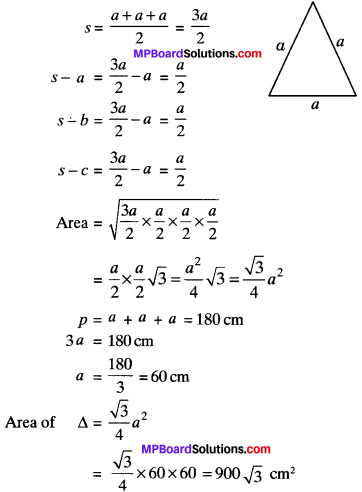
A traffic signal borard, indicating ‘SCHOOL AHEAD’, is an equilateral triangle with side ‘a’ Find the area of the signal board, using Heron’s formula. If its perimeter is 180 cm, what will be the area of the signal board?
Solution:
MP Board Class 9th Maths Solutions Chapter 12 Heron’s Formula Ex 12.1 img-1

Question 2.
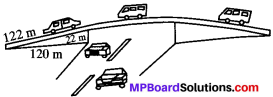
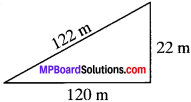
The triangular side walls of a flyover have been used for advertisements. The sides of the walls are 122 m, 22 m and 120 m (see Fig.) the advertisements yield an earning of ₹ 5000/m2 per year. Acompany hired one of its walls for 3 months. How much rents did it pay?
MP Board Class 9th Maths Solutions Chapter 12 Heron’s Formula Ex 12.1 img-2
Solution:
MP Board Class 9th Maths Solutions Chapter 12 Heron’s Formula Ex 12.1 img-3
s = \(\frac{122+120+22}{2}\) = \(\frac{264}{2}\) = 132 m
s – a = 132 – 122 = 10 m
s – b = 132 – 22 = 12m
s – c = 132 – 22 = 110 m
area of triangular portion of wall = \(\sqrt{32x10x12x110}\)
= \(\sqrt{2x2x3x11x10x2x2x3x11x10}\)
= 10 x 2 x 2 x 3 x 11 = 1320 m2
Rate = ₹ 5000/m2 per year
Rent for 3 months = 1320 x \(\frac{5000×3}{12}\)
= 330 x 5000
= ₹ 16,50,000

MP Board Solutions

Question 3.
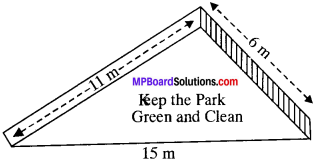
There is a slide in a park. One of its side walls has been painted in some colour with a message “Keep The Park Green And Clean” (see Fig.). If the sides of the wall are 15 m, 11 m and 6 m, find the area painted in colour.
MP Board Class 9th Maths Solutions Chapter 12 Heron’s Formula Ex 12.1 img-4
Solution:
a = 15 m
b = 11 m
c = 6m
p = a + b + c
= 15 + 11 + 6
= 32 m P
MP Board Class 9th Maths Solutions Chapter 12 Heron’s Formula Ex 12.1 img-5
s = \(\frac{P}{2}\) = \(\frac{32}{2}\) = 16m
s – a = 16 – 15 = 1 m
s – b = 16 – 11 = 5 m
s – c = 16 – 6 = 10m
Area of triangular park = \(\sqrt{16x1x5x10}\)
= \(\sqrt{2x2x2x2x1x5x2x5}\)
= 2 x 2 x 5√2 = 2o\(\sqrt{2m^{2}}\)

Question 4.
Find the area of a triangle two sides of which are 18 cm and 10 cm and the perimeter is 42 cm.
Solution:
MP Board Class 9th Maths Solutions Chapter 12 Heron’s Formula Ex 12.1 img-6
a = 18 cm
b = 10 cm
Let the third side be c
p = 42 cm
18 + 10 + C = 42
C = 14
S = \(\frac{P}{2}\) = \(\frac{42}{2}\) = 21 cm
s – a = 21 – 18 = 3
s – b = 21 – 10 = 11
s – c = 21 – 14 = 7
Area of ∆ = \(\sqrt{21x3x11x7}\) = \(\sqrt{3x7x3x11x7}\)
= 3 x 7\(\sqrt{11}\) = 21\(\sqrt{11}\) cm2

MP Board Solutions

Question 5.
Sides of triangle are in the ratio of 12 : 17 : 25 and its perimeter is 540 cm. Find its area
Solution:
a = 12x
b = 17x
c = 25x
p = 12x + 11x + 25x = 540
54x = 540
x = \(\frac{540}{54}\) = 10
a = 12 x 10 = 120 cm
b = 17 x 10 = 170 cm
c = 25 x 10 = 250 cm
s = \(\frac{P}{2}\) = \(\frac{540}{2}\) = 270 cm
s – a = 270 – 120 = 150 cm
s – b = 270 – 170 = 100 cm
s – c = 270 – 250 = 20 cm
Area of ∆ = \(\sqrt{270x150x100x20}\)
= \(\sqrt{3x3x3x10x3x5x10x10x10x2x10}\)
= 3 x 3 x 10 x 10 x 10
= 9000 cm2

Question 6.
An isosceles triangle has perimeter 30 cm and each of the equal sides is 12 cm. Find the area of the triangle.
Solution:
MP Board Class 9th Maths Solutions Chapter 12 Heron’s Formula Ex 12.1 img-7
a = 12 cm
b = 12cm
Let the third side be c.
p = a + b + c
30 = 12 + 12 + c
c = 30 – 24 = 6 cm
s = \(\frac{P}{2}\) = \(\frac{30}{2}\) = 15
s – a = 15 – 12 = 3
s – b = 15 – 12 = 3
s – c = 15 – 6 = 9
Area of ∆ = \(\sqrt{5x3x3x9}\)
= \(\sqrt{5x3x3x3x3x3}\)
= 3 x 3\(\sqrt{15}\) = 9\(\sqrt{15}\) cm2

Area of Quadrilaterals:
To find the area of quadrilaterals divide the quadrilateral into two triangles using a diagonal and then use heron’s formula.

Example 1:
A triangle and a parallelogram have the same base and the same area. If the sides of the triangle are 13 cm, 14 cm and 15 cm and the parallelogram stands on the base 14 cm, And the height of the parallelogram.
Solution:
MP Board Class 9th Maths Solutions Chapter 12 Heron’s Formula Ex 12.1 img-8
Here, a = 13 cm,
b = 14 cm,
c = 15 cm
Base of parallelogram =14 cm.
MP Board Class 9th Maths Solutions Chapter 12 Heron’s Formula Ex 12.1 img-9
= 7 x 3 x 2 x 2
= 84 cm2
Let h be the height of the parallelogram ADEC.
Area of parallelogram ADEC = Area of ∆ABC (given)
Base x height = 84
14 x height = 84
h = \(\frac{84}{14}\)
= 6 cm.

MP Board Solutions

Example 2:
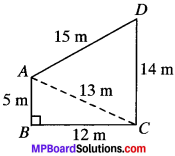
The sides of a quadrilateral, taken in order are 5, 12, 14 and 15 meters respectively, and the angle contained by the first two sides is a right angle. Find its area.
Solution:
MP Board Class 9th Maths Solutions Chapter 12 Heron’s Formula Ex 12.1 img-10
Here, AB = 5m
BC = 12m
CD = 14m
DA = 15 m
Join AC. The ABCD is divided into two triangles ABC and ACD. The area of the quadrilateral is equal to sum of areas of ∆ABC and ∆ADC.
In ∆ABC
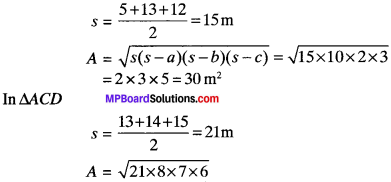
MP Board Class 9th Maths Solutions Chapter 12 Heron’s Formula Ex 12.1 img-11
area of ABCD
= ar (∆ABC) + ar (∆ACD) –
= (84 + 30)m2 = 114m2

Example 3:
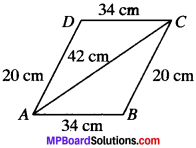
In a parallelogram measure of adjacent sides are 34 cm and 20 cm. One of the diagonals is 42 cm. Find the area of the parallelogram.
Solution: In Fig.
MP Board Class 9th Maths Solutions Chapter 12 Heron’s Formula Ex 12.1 img-12
AB = DC = 34 cm
AD = BC = 20 cm
AC =42 cm.
We know that the diagonal of a parallelogram divides it into two tri¬angles of equal area.
∴ Area of parallelogram ABCD = 2 x Area of (∆ABC)
Consider ∆ABC
a = 34cm
b = 20cm
c = 42cm
s = \(\frac{a+b+c}{2}\)
= \(\frac{34+20+42}{2}\)
= \(\frac{96}{2}\) = 48 cm
s – a = 48 – 34 = 14 cm
s – b = 48 – 20 = 28 cm
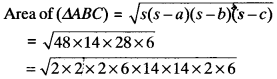
s – c = 48 – 42 = 6 cm
By Heron’s formula,
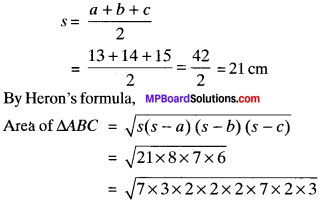
MP Board Class 9th Maths Solutions Chapter 12 Heron’s Formula Ex 12.1 img-13
= 2 x 2 x 6 x 14
= 336 cm2
∴ Area of (∥gm ABCD) = 2 x 336
= 672 cm2

Example 4:
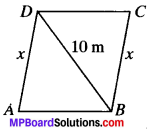
A rhombus sheet, whose perimeter is 32 m and whose one diagonal is 10 m long, is painted on both sides at the rate of? 5 per m2. Find the cost of painting.
Solution:
MP Board Class 9th Maths Solutions Chapter 12 Heron’s Formula Ex 12.1 img-14
Given P = 32m
BD = 10m
Rate of painting = ₹ 5/m2
Let the sides of rhombus be x m.
P = Ax
⇒ 32 = 4x
∴ x = 8m
So, AB = BC = CD = DA = 8 m
We know that the diagonal of a rhombus divides it into two triangles of equal area. .
∴ Area of rhombus ABCD = 2 x area of ∆ABD
Consider ∆ABD
a = 8m
b = 8m
c = 10m
S = \(\frac{a+b+c}{2}\) = \(\frac{8+8+10}{2}\)
= 13 m.
s – a = 13 – 8 = 5 m
s – b = 13 – 8 = 5m
s – c = 13 -10 = 3 m
By Heron’s formula,
Area of ∆ABD = \(\sqrt{s(s-a)(s-b)(s-c)}\)
= \(\sqrt{3x5x5x3}\)
= 5 x \(\sqrt{39}\)
= 5 x 6.24 = 31.2 m2
Area of rhombus ABCD = 2 x 31.2 = 62.4 m2
Area of rhombus to be painted = 2 x area of rhombus (∴ Painting is to be done on both sides)
= 2 x 62.4 = 124.80
Cost of painting = Rate x Area
= 5 x 124.80
= ₹ 624.

MP Board Solutions

Example 5:
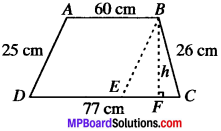
Two parallel sides of a trapezium are 60 cm and 77 cm other sides are 25 cm and 26 cm. Find the area of trapezium.
Solution:
MP Board Class 9th Maths Solutions Chapter 12 Heron’s Formula Ex 12.1 img-15
Given AB = 60 cm
DC = 77 cm
AD = 25 cm
BC =26 cm
Draw a line BE ∥ AD from point B.
In ABED
AB ∥ DE
AD ∥ BE
ABED is a parallelogram.
AB = DE = 60
EC = 77 – 60 = 17 cm.
AD = BE = 25 cm
In ∆BEC
a = EC = 17 cm
b = BE = 25 cm
c = BC = 26cm
s = \(\frac{17+25+36}{2}\)
s – a = 34 – 17 = 17 cm
s – b = 34 – 25 = 9 cm
s – c = 34 – 26 = 8cm
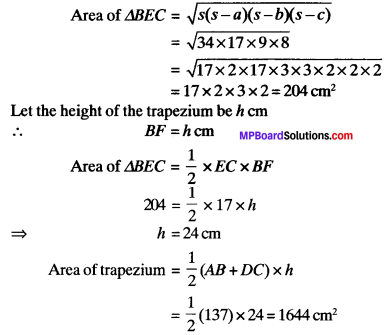
By Heron’s formula,
MP Board Class 9th Maths Solutions Chapter 12 Heron’s Formula Ex 12.1 img-16

MP Board Class 9th Maths Solutions