MP Board Class 9th Maths Solutions Chapter 10 Circles Ex 10.5

MP Board Class 9th Maths Solutions Chapter 10 Circles Ex 10.5

Question 1.
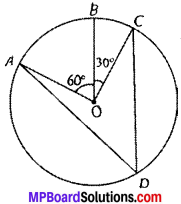
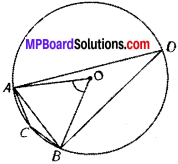
In the figure, A, B and C are three points on a circle with centre O such that ∠BOC = 30° and ∠AOB = 60°. If D is a point on the circle other than the arc ABC, find ∠ADC.
Solution:
We have a circle with centre O, such that ∠AOB = 60° and ∠BOC = 30°
MP Board Class 9th Maths Solutions Chapter 10 Circles Ex 10.5 img-1
∴ ∠AOB + ∠BOC = ∠AOC
∠AOB = 60° + 30° = 90°
Now, tne arc ABC subtends ∠AOC = 90° at the centre and ∠ADC at a point D on the circle other than the arc ABC.
∴ ∠ADC = \(\frac{1}{2}\) [∠AOC]
∠ADC = \(\frac{1}{2}\) (90°) = 45°

MP Board Solutions

Question 2.
A chord of a circle is equal to the radius of the circle. Find the angle subtended by the chord at a point on the minor arc and also at a point on the major arc.
Solution:
We have a circle having a chord AB equal to radius of the circle.
∴ AO = BO = AB
∆AOB is an equilateral triangle.
Since, each angle of an equilateral triangle = 60
∠AOB = 60°
Since, the arc ACB makes reflex ∠AOB = 360° – 60° = 300° at the centre of the circle and ∠ABC at a point on the minor arc of the circle.
MP Board Class 9th Maths Solutions Chapter 10 Circles Ex 10.5 img-2
∠ACB = \(\frac{1}{2}\) [reflex ∠AOB]
= \(\frac{1}{2}\) [300°] = 150°
Similarly, ∠ADB = \(\frac{1}{2}\) [∠AOB]
= \(\frac{1}{2}\) x [60°] = 30°
Thus, the angle subtended by the chord on the minor arc = 150° and on the major arc = 30°.

Question 3.
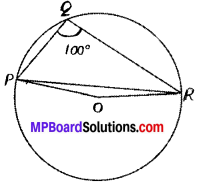
In the figure, ∠PQR = 100°, where P, Q and R are points on a circle with centre O. Find ∠OPR.
Solution:
The angle subtended by an arc of a circle at its centre is twice the angle subtended by the same arc at a point on the circumference.
MP Board Class 9th Maths Solutions Chapter 10 Circles Ex 10.5 img-3
∴ reflex ∠POR = 2∠PQR,
But ∠PQR = 100°
reflex ∠POR = 2 x 100° = 200°
Since, ∠POR + reflex ∠POR = 360°
∠POR + 200° = 360°
∠POR = 360° – 200°
∠POR = 160°
Since, OP = OR [Radii of the same circle]
∴ In ∆POR, ∠OPR = ∠ORP [Angles opposite to equal sides of a triangle are equal]
Also, ∠OPR + ∠ORP + ∠POR = 180° [Sum of the angles of a triangle = 180°]
∠OPR + ∠OPR + 160° = 180° [∴ ∠OPR = ∠ORP]
2∠OPR = 180° – 160° = 20°
∠OPR = \(\frac{20^{\circ}}{2}\) =10°

Question 4.
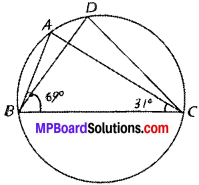
In the Figure, ∠ABC = 69°, ∠ACB = 31°, find ∠BDC.
Solution:
We have, in ∆ABC,
∠ABC = 69° and
∠ACB = 31°
MP Board Class 9th Maths Solutions Chapter 10 Circles Ex 10.5 img-4
But ∠ABC + ∠ACB + ∠BAC = 180°
∴ 69° +31° + ∠BAC = 180°
∠BAC = 180° – 69° – 31°
= 80°
Since, angles in the same segment are equal.
∴ ∠BDC = ∠BAC
∠BDC =80°

Question 5.
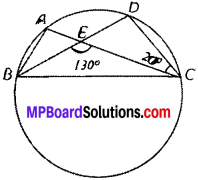
In the figure, A, B, C and D are four points on a circle. AC and BD intersect at a point E such that ∠BEC = 130° and ∠ECD = 20°. Find ∠BAC.
Solution:
In ∆CDE,
Exterior ∠BEC – ∠AED = 130°
MP Board Class 9th Maths Solutions Chapter 10 Circles Ex 10.5 img-5
130° = ∠EDC + ∠ECD
130° = ∠EDC + 20°
∠EDC = 130° – 20° = 110°
∠BDC = 110°
Since, angles in the same segment are equal.
∠BAC = ∠BDC
∠BAC = 110°

MP Board Solutions

Question 6.
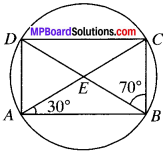
ABCD is a cyclic quadrilateral whose diagonals intersect at a point E. ∠DBC = 70°, ∠BAC is 30°, find ∠BCD. Further, if AB = BC, find ∠ECD.
Solution:
Given:
∠BAC = 30°, ∠DBC = 70°
To find:
∠BCD and ∠ECD.
∠BDC = ∠BAC = 30° (∠s on the same segment of a circle are equal)
MP Board Class 9th Maths Solutions Chapter 10 Circles Ex 10.5 img-6
In ∆BCD, 70° + 30° + ∠C = 180° (ASP)
100° + ∠C = 180°
∠C = 80°
AB = BC (Given)
∠BAC = ∠BCA = 30°
∠BCD = ∠BCA + ∠ECD
80° = 30° + ∠ECD
∠ECD – 50°

Question 7.
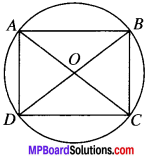
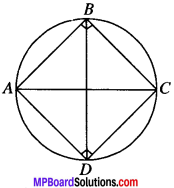
If diagonals of a cyclic quadrilateral are diameters of the circle through the vertices of the quadrilateral, prove that it is a rectangle.
Solution:
Given
ABCD is a cyclic quadrilateral in which AC and BD are diagonals.
To prove:
ABCD is a rectangle.
MP Board Class 9th Maths Solutions Chapter 10 Circles Ex 10.5 img-7
Proof:
BD is the diameter of the circle.
∠BAD = 90°(angle in a semicircle)
Similarly ∠BCD = 90°
AC is the diameter of the circle
∠ABC = 90° (angle in a semicircle)
Similarly ∠ADC = 90°
In quadrilateral ABCD, ∠A = ∠B = ∠C = ∠D = 90°
ABCD is a rectangle.

Question 8.
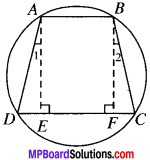
If the non-parallel sides of h trapezium are equal, prove that it is cyclic.
Solution:
Given:
AD = BC, AB ∥ DC.
To prove:
ABCD is cyclic quadrilateral.
Construction:
Draw AE and BF As on DC.
MP Board Class 9th Maths Solutions Chapter 10 Circles Ex 10.5 img-8
Proof:
In ∆ADE and ∆BCF
∴ AE = BF
(∴ Distance between two parallel lines are equal)
∠E = ∠F (Each 90°)
AD = BC (Given)
∆ADE = ∆BCF (By RHS)
and so ∠D = ∠C (By CPCT)
AB ∥ DC and AD is the transversal.
∴ ∠BAD + ∠ADC =180° (CIA’s)
⇒ ∠BAD + ∠BCD = 180° (∠ADC = ∠BCD)
∴ ABCD is cyclic quadrilateral.

MP Board Solutions

Question 9.
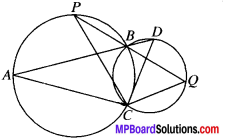
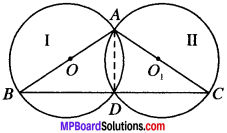
Two circles intersect at two points B and C. Through B, two line segments ABD and PBQ are J drawn to intersect the circles at A, D and Q respectively (see Fig.). Prove that ∠ACP = ∠QCD.
MP Board Class 9th Maths Solutions Chapter 10 Circles Ex 10.5 img-9
Solution:
Given
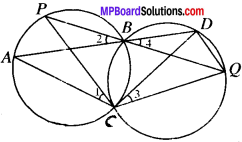
C (O, r) and C (O1, r1) are two circles. Two lines ABD and PBQ are drawn which intersect at B.
To prove:
∠1 = ∠3
MP Board Class 9th Maths Solutions Chapter 10 Circles Ex 10.5 img-10
Proof:
∠1 = ∠2 …(1) (Z s on the same segment of a circle are equal.)
∠3 = ∠4 …..(2) (Z s on the same segment of a circle are equal)
∠2 = ∠4 …(3) (OA’s)
From (1), (2) and (3), we get
∠1 = ∠3 …(2)

Question 10.
If circles are drawn taking two sides of a triangle as diameters, prove that the point of intersection of these circles lie on the third side.
Solution:
Given
C (O, r) and C (O1, r1) are two Circles in whichAB andAC are diameter. These circles intersect at point A and D.
To prove:
BDC is a line.
Construction: JoinAD.
Proof:
∠ADB = 90° (∠s in a semicircle)
∠ADC) = 90° (∠s in a semicircle)
MP Board Class 9th Maths Solutions Chapter 10 Circles Ex 10.5 img-11
Adding (1) and (2), we get
∠ADB + ∠ADC = 90° + 90°
∠BDC = 180°
∴ BDC is a line and hence D lies on the third side.

Question 11.
ABC and ADC are two right triangles with common hypotenuse AC. Prove that ∠CAD – ∠CBD.
Solution:
Given:
ABC and ADC are two right ∆’s on common base AC. ∠B – 90° and ∠D = 90°.
To prove: ∠CAD = ∠CBD
Proof:
∠ABC + ∠ADC = 90° + 90°
= 180°
MP Board Class 9th Maths Solutions Chapter 10 Circles Ex 10.5 img-12
ABCD is a cyclic quadrilateral.
∠CAD and ∠CBD are angles on the same segment of a circle.
∴ ∠CAD = ∠CBD.

MP Board Solutions

Question 12.
Prove that a cyclic parallelogram is a rectangle.
Solution:
Given: ABCD is a ∥gm
To prove: ABCD is a rectangle.
MP Board Class 9th Maths Solutions Chapter 10 Circles Ex 10.5 img-13
Proof:
∠A = ∠C
∠A + ∠C =180°
∠A + ∠A = 180°
∠A = \(\frac{180^{\circ}}{2}\) = 90°
∴ ABCD is a rectangle.
∠A = \(\frac{180^{\circ}}{2}\) = 90°
∴ ABCD is a rectangle.

MP Board Class 9th Maths Solutions

MP Board Class 9th Science Solutions Chapter 10 Gravitation

MP Board Class 9th Science Solutions Chapter 10 Gravitation

Gravitation Intext Questions

Gravitation Intext Questions Page No. 134

Question 1.
State the universal law of gravitation.
Answer:
Suppose there are two objects having mass M and m respectively.
The distance between their centres is equal to d.
The force of attraction is F.
Thus, F ∝ M . m … (i)
and, F ∝ 1/d2 … (ii)
Joining equation (i) and (ii)
we get F ∝ M . m/d2
⇒ F = G . M . m/d2 … (iii)
where, G is the proportionality constant and called Universal Gravitation Constant.
The expression (iii) is called expression for Universal Law of Gravitation.
The universal law of gravitation is represented as:
\(F=\frac{G m_{1} m_{2}}{r^{2}}\)
Where, G is the universal gravitation constant given by:
G = 6.67 × 10⁻¹¹ Nm2 kg-2.

MP Board Solutions

Question 2.
Write the formula to find the magnitude of the gravitational force between the Earth and an object on the surface of the earth.
Answer:
Let Me be the mass of the Earth and m be the mass of an object on its surface.
And say R is the radius of the Earth,
then according to the universal law of gravitation,
the gravitational force (F) acting between the Earth and the object is given by the relation:
\(F=\frac{G m_{1} m_{2}}{r^{2}}\)
F = GMem/R

Gravitation Intext Questions Page No. 136

Question 1.
What do you mean by free fall?
Answer:
Its a phenomenon of gravity. When an object falls from any height under the influence of gravitational force only, it is said to have a free fall. In the case of free fall, no change in direction takes place but the magnitude of velocity changes because of acceleration.

MP Board Solutions

Question 2.
What do you mean by acceleration due to gravity?
Answer:
Change in velocity due to variation in height produces acceleration which is due to gravity in the object and is known as acceleration due to gravity denoted by letter g. The value of acceleration due to gravity is g = 9.8 m/s2.

Gravitation Intext Questions Page No. 138

Question 1.
What are the differences between the mass of an object and its weight?
Answer:

MassWeight
Mass is a measurement of the amount of matter something has.Weight is the measurement of the pull of gravity on an object.
Mass is a constant quantity.Weight is not a constant quantity. It is different at different places.
It is a scalar quantity.It is a vector quantity.
Its SI unit is kilogram (kg).Its SI unit is the same as the SI unit of force, i.e., Newton (N).

Question 2.
Why is the weight of an object on the moon \(\frac { 1 }{ 6 }\)th its weight on the earth?
Answer:
The mass of moon is \(\frac { 1 }{ 100 }\) times and its radius \(\frac { 1 }{ 4 }\) times that of earth. As a result, the gravitational attraction on the moon is about one sixth when compared to earth. Hence, the weight of an object on the moon is \(\frac { 1 }{ 6 }\)th of its weight on the earth.

Gravitation Intext Questions Page No. 141

Question 1.
Why is it difficult to hold a school bag having a strap made of a thin and strong string?
Answer:
It is difficult to hold a school bag having a thin strap because the pressure on the shoulders is quite large. This is because the pressure is inversely proportional to the surface area on which the force acts. The smaller is the surface area; the larger will be the pressure on the surface. In the case of a thin strap, the contact surface area is very small. Hence, the pressure exerted on the shoulder is very large.

Question 2.
What do you mean by buoyancy?
Answer:
The upward force exerted by a liquid on an object that is immersed in it is known as buoyancy.

MP Board Solutions

Question 3.
Why does an object float or sink when placed on the surface of water?
Answer:

  1. An object sinks in water if its density is greater than that of water.
  2. An object floats in water if its density is less than that of water.

Gravitation Intext Questions Page No. 142

Question 1.
You find your mass to be 42 kg on a weighing machine. Is your mass more or less than 42 kg?
Answer:
When we weigh our body, an upward force acts on it. This upward force is the buoyant force. As a result, the body gets pushed slightly upwards, causing the weighing machine to show a reading less than the actual value.

Question 2.
You have a bag of cotton and an iron bar, each indicating a mass of 100 kg when measured on a weighing machine. In reality, one is heavier than other. Can you say which one is heavier and why?
Answer:
The cotton bag is heavier than the iron bar. The cotton bag experiences larger up – thrust of air than the iron bar. So, the weighing machine indicates a smaller mass for cotton bag than its actual mass.

Gravitation NCERT Textbook Exercises

Question 1.
How does the force of gravitation between two objects change when the distance between them is reduced to half?
Answer:
According to Universal Law of gravitation, the gravitational force of attraction between any two objects of mass M and m is proportional to the product of their masses and inversely proportional to the square of distance r between them. So, force F is given by
F = G\(\frac { M\times m }{ { r }^{ 2 } } \)
Now, when the distance ‘r’ is reduced to half then force between two masses becomes
F’ = G\(\frac { M\times m }{ { (\frac { r }{ 2 } ) }^{ 2 } } \)
Or
F’ = 4F
Hence, if the distance is reduced to half, then the gravitational force becomes four times larger than the previous value.

Question 2.
Gravitational force acts on all objects in proportion to their masses. Why then, a heavy object does not fall faster than a light object?
Answer:
All objects fall on ground with constant acceleration, called acceleration due to gravity (in the absence of air resistances). It is constant and does not depend upon the mass of an object. Hence, heavy objects do not fall faster than light objects.

MP Board Solutions

Question 3.
What is the magnitude of the gravitational force between the earth and a 1 kg object on its surface? (Mass of the earth is 6 × 1024 kg and radius of the earth is 6.4 × 10⁶ m).
Answer:
Given that,
Mass of the body, m = 1 kg
Mass of the Earth, M = 6 × 1024 kg
Radius of the Earth, R = 6.4 × 10⁶ m
Now, magnitude of the gravitational force (F) between the Earth and the body can be given as,
F = G\(\frac { M\times m }{ { r }^{ 2 } } \) = \(\frac { 6.67 × 10 × 6 × 10 × 1 }{ (6.4 × 6.4) }\)
= \(\frac { 6.67 × 6 × 10 }{ (6.4 × 6.4) }\) = 9.8N (approx.)

Question 4.
The Earth and the Moon are attracted to each other by gravitational force. Does the Earth attract the Moon with a force that is greater or smaller or the same as the force with which the Moon attracts the Earth? Why?
Answer:
According to the Universal Law of Gravitation, two objects attract each other with equal force, but in opposite directions. The Earth attracts the Moon with an equal force with which the Moon attracts the Earth.

Question 5.
If the Moon attracts the Earth, why does the Earth not move towards the Moon?
Answer:
The Earth and the Moon experience equal gravitational forces from each other. However, the mass of the Earth is much larger than the mass of the Moon. Hence, it accelerates at a rate lesser than the acceleration rate of the Moon towards the Earth. For this reason, the Earth does not move towards the Moon.

Question 6.
What happens to the force between two objects, if
(i) the mass of one object is doubled?
(ii) the distance between the objects is doubled and tripled?
(iii) the masses of both objects are doubled?
Answer:
(i) From Universal Law of Gravitation, force exerted on an object of mass at by Earth is given by
F = G\(\frac { M\times m }{ { R }^{ 2 } } \) ….1
When nws of the object say ne is doubled than
F’ = G\(\frac { M\times 2m }{ { R }^{ 2 } } \)  = 2F
So as the mass of any one of the object is doubled the force is also doubled,

(ii) The force F is inversely proportional to the distance between the objects. So if the distance between two objects es doubled, then the gravitational force of attraction between them is reduced to one fourth of its original value, Similarly, if the distance between two objects is tripled. then the gravitational force of attraction becomes one ninth of its original value.

(iii) Again from Universal Law of Attraction, from equation 1, force ‘F’ is directly proportional to the product of both the masses, So, if both the masses are doubled then, the gravitational force of attraction become four times the original value.

MP Board Solutions

Question 7.
What in the importance of Universal Law of Gravitation?
Answer:
Universal Law of Gravitation is important because it tells us about:

  1. the force that is responsible for binding us to Earth.
  2. the motion of Moon around the Earth.
  3. the motion of planets around the Sun.
  4. the tides formed by rising and falling of water level in the ocean are due to the gravitational force exerted by both Sun and Moon on the Earth.

Question 8.
What in the acceleration of free fall?
Answer:
Acceleration of free tall is the acceleration produced when a body falls under the influence of the force of gravitation of the Earth alone. It is denoted by ‘g’ and its value on the surface of the Earth is 9.8 ms-2.

Question 9.
What do we call the gravitational force between the Earth and an object?
Answer:
Gravitational force between the Earth and an object is known as the weight of the object.

Question 10.
Amit buys few grams of gold at the poles as per the instruction of one of his friends. He hands over the same when he meets him at the equator. Will the friend agree with the weight of gold bought? If not, why? [Hint: The value of g is greater at the poles than at the equator}.
Answer:
Weight of a body on the Earth is given by:
W = mg
Where,
m = Mass of the body
g = Acceleration due to gravity
The value of g is greater at poles than at the equator.
Therefore, gold at the equator weighs less than at the poles.
Hence, Amit’s friend will not agree with the weight of the gold bought.

Question 11.
Why does a sheet of paper fell slower than one that is crumpled into a ball?
Answer:
When a sheet of paper is crumpled into a ball, then its density increases. Hence, resistance to its motion through the air decreases and it falls faster than the sheet of paper.

MP Board Solutions

Question 12.
Gravitational force on the surface of the Moon is only \(\frac { 1 }{ 6 }\) as strong as gravitational force on the Earth. What is the weight in newtons of a 10 kg object on the moon and on the Earth?
Answer:
Weight of an object on the Moon = \(\frac { 1 }{ 6 }\) × Weight of an object on the Earth.
Also,
Weight = Mass × Acceleration
Acceleration due to gravity, g = 9.8 m/s2
Therefore, weight of a 10 kg object on the earth = 10 × 9.8 = 98 N
And, weight of the same object on the Moon = 1.6 × 9.8 = 16.3 N.

Question 13.
A ball is thrown vertically upwards with a velocity of 49 m/s. Calculate
(i) the maximum height to which it rises.
(ii) the total time it takes to return to the surface of the earth.
Answer:
According to the equation of motion under gravity:
-u2 = 2 gs
Where,
u = Initial velocity of the ball
v = Final velocity of the ball
s = Height achieved by the ball
g = Acceleration due to gravity
At maximum height, final velocity of the ball is zero, i.e., v = 0, u = 49 m/s.
During upward motion, g = – 9.8 ms-2.
(i) Let ‘h’ be the maximum height attained by the ball.
Hence,
0 – 492 = 2 × 9.8 × h
h = \(\frac { 49 × 49 }{ 2 × 9.8}\) = 122.5 m

(ii) Let ‘t’ be the time taken by the ball to reach the height 122.5 m, then according to the equation of motion:
v = u + gt
We get,
= 49 + t × (- 9.8)
9.8 t = 49
t = \(\frac { 49 }{ 9.8}\) = 5 s
But,
Time of ascent = Time of descent
Therefore, total time taken by the ball to return = 5 + 5 = 10 s

Question 14.
A stone is released from the top of a tower of height 19.6 m. Calculate its final velocity just before touching the ground.
Answer:
According to the equation of motion under gravity: v2 – u2 = 2 gs
Where,
u = Initial velocity of the stone = 0
v = Final velocity of the stone
s = Height of the stone = 19.6 m
g = Acceleration due to gravity = 9.8 ms-2
∴ v2 – 02 = 2 × 9.8 × 19.6
v2 = 2 × 9.8 × 19.6 = (19.6)2
v = 19.6 ms-1
Hence, the velocity of the stone just before touching the ground is 19.6 m s-1.

Question 15.
A stone is thrown vertically upward with an initial velocity of 40 m/s. Taking g = 10 m/s2, find the maximum height reached by the stone. What is the net displacement and the total distance covered by the stone?
Answer:
According to the equation of motion under gravity:
v2 – u2 = 2 gs
Where,
u = Initial velocity of the stone = 40 m/s
v = Final velocity of the stone = 0
s = Height of the stone
g = Acceleration due to gravity = -10 ms-2
Let h be the maximum height attained by the stone.
Therefore,
0 – (40)2 = 2 × h × (-10)
h = \(\frac { 40 × 40 }{ 20 }\) = 80 m
Therefore, total distance covered by the stone during its upward and downward journey = 80 + 80 = 160 m
Net displacement of the stone during its upward and downward journey
= 80 + (-80) = 0.

MP Board Solutions

Question 16.
Calculate the force of gravitation between the earth and the Sun, given that the mass of the earth = 6 × 1024 kg and of the Sun = 2 × 1030 kg. The average distance between the two is 1.5 × 10¹¹ m.
Answer:
According to question,
MSun = Mass of the Sun = 2 × 1030 kg
MEarth = Mass of the Earth = 6 × 1024 kg
R = Average distance between the Earth and the Sun = 1.5 × 10¹¹ m.
From Universal Law of Gravitation,
F = G\(\frac { M\times m }{ { R }^{ 2 } } \)
Therefore, putting all the values given in question in above equation we get
F = 6.67 × 10⁻¹¹ \(\frac { (6\times { 10 }^{ 24 })\times (2\times { 10 }^{ 30 }) }{ { (1.5\times { 10 }^{ 11 }) }^{ 2 } } \) = 3.56 × 10²² N.

Question 17.
A stone is allowed to fall from the top of a tower 100 m high and at the same time another stone is projected vertically upwards from the ground with a velocity of 25 m/s. Calculate when and where the two stones will meet.
Answer:
Let be the point at which two stones meet and let ‘h’ be their height from the ground. It is given in the question that height of the tower is H = 100 m
Now, first consider the stone which falls from the top of the tower.
So, distance covered by this stone at time ‘t’ can be calculated using equation of motion:
x – x0 = u0t + \(\frac { 1 }{ 2 }\)gt2
Since, initial velocity u = 0,
so we get
100 =  x \(\frac { 1 }{ 2 }\)gt2 ………… (1)
The distance covered by the same stone that is thrown in upward direction from ground is
x = 25t –\(\frac { 1 }{ 2 }\)gt2
In this case intitial velocity is 25 m/s.
So, x = 25t – \(\frac { 1 }{ 2 }\)gt………… (2)
Adding equations (1) and (2) we get,
100=25t
or,
t = 4s
Putting value in equation (2).
x = 25 × 4 – \(\frac { 1 }{ 2 }\) × 9.8 × (4)2
= 100 – 78.4
= 21.6 m.

Question 18.
A ball thrown up vertically returns to the thrower after 6 s. Find:
(a) the velocity with which it was thrown up,
(b) the maximum height it reaches, and
(c) its position after 4 s.
Answer:
(a) Time of ascent is equal to the time of descent. The ball takes a total of 6 s for its upward and downward journey. Hence, it has taken 3 s to attain the maximum height. Final velocity of the ball at the maximum height, v = 0 Acceleration due to gravity, g = -9.8 m s-2
Equation of motion, v = u + gt
will give,
0 = u + (-9.8 × 3)
u = 9.8 × 3
= 29.4 ms-1
Hence, the ball was thrown upwards with a velocity of 29.4 ms-1.

(b) Let the maximum height attained by the ball be ‘h’
Initial velocity during the upward journey, u = 29.4 ms-1
Final velocity, v = 0
Acceleration due to gravity, g = -9.8 ms-2
From the equation of motion, s = ut + \(\frac { 1 }{ 2 }\) at2
h = 29.4 × 3 + \(\frac { 1 }{ 2 }\) × – 9.8 × (3)2 = 44.1 m.

(c) Ball attains the maximum height after 3 s.
After attaining this height, it will start falling downwards.
In this case, Initial velocity, u = 0
Position of the ball after 4 s of the throw is given by the distance travelled by it during its downward journey in
4 s – 3 s = 1 s.
Equation of motion, s = ut + \(\frac { 1 }{ 2 }\) g2
will give,
s = 0 x t + \(\frac { 1 }{ 2 }\) x 9.8 x 12 = 4.9 m
Total height  = 44.1 m.
This means that the ball is 39.2 m (44.1 m – 4.9 m) above the ground after 4 seconds.

MP Board Solutions

Question 19.
In what direction does the buoyant force on an object immersed in a liquid act?
Answer:
An object immersed in a liquid experiences buoyant force in the upward direction.

Question 20.
Why does a block of plastic released under water come up to the surface of water?
Answer:
For an object immersed in water two forces act on it:

  1. Gravitational force which tends to pull object in downward direction
  2. Buoyant force that pushes the object in upward direction.

Here, in this case buoyant force is greater than the gravitational pull on the plastic block. This is the reason the plastic block comes up to the surface of the water as soon as it is released under water.

Question 21.
The volume of 50 g of a substance is 20 cm3. If the density of water is 1 g cm-3, will the substance float or sink?
Answer:
If the density of an object is more than the density of a liquid, then it sinks in the liquid. On the other hand, if the density of an object is less than the density of a liquid, then it floats on the surface of the liquid.
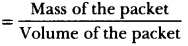
MP Board Class 9th Science Solutions Chapter 10 Gravitation 1
= \(\frac { 50 }{ 20 }\)
= 2.5 g cm-3
The density of the substance is more than the density of water (1 g cm-3).
Hence, the substance will sink in water.

Question 22.
The volume of a 500 g sealed packet is 350 cm3. Will the packet float or sink in water if the density of water is 1 g cm-3? What will be the mass of the water displaced by this packet?
Answer:
Density of the 500 g sealed packet
MP Board Class 9th Science Solutions Chapter 10 Gravitation 2
= \(\frac { 500 }{ 350 }\)
= 1.428 g cm-3
The density of the substance is more than the density of water (1 g cm-3). Hence, it will sink in water.
The mass of water displaced by the packet is equal to the volume of the packet, i.e., 350 g.

Gravitation Additional Questions

Gravitation Multiple Choice Questions

Question 1.
Two objects of different masses falling freely near the surface of moon would __________ .
(a) have same velocities at any instant.
(b) have different accelerations.
(c) experience forces of same magnitude.
(d) undergo a change in their inertia.
Answer:
(c) experience forces of same magnitude.

MP Board Solutions

Question 2.
The value of acceleration due to gravity __________ .
(a) is same on equator and poles.
(b) is least on poles.
(c) is least on equator.
(d) increases from pole to equator.
Answer:
(c) is least on equator.

Question 3.
The gravitational force between two objects is F. If masses of both objects are halved without changing distance between them, then the gravitational force would become __________ .
(a) \(\frac { F }{ 4 }\)
(b) \(\frac { F }{ 2 }\)
(c) F
(d) 2 F.
Answer:
(a) \(\frac { F }{ 4 }\)

Question 4.
A boy is whirling a stone tied with a string in an horizontal circular path. If the string breaks, the stone __________ .
(a) will continue to move in the circular path.
(b) will move along a straight line towards the centre of the circular path.
(c) will move along a straight line tangential to the circular path.
(d) will move along a straight line perpendicular to the circular path away from the boy.
Answer:
(c) will move along a straight line tangential to the circular path.

Question 5.
An object is put one by one in three liquids having different densities. The object floats with 1 2 3, and 9 11 7 parts of their volumes outside the liquid surface in liquids of densities d1, d2 and d3 respectively. Which of the following statement is correct?
(a) d1 > d2 > d3
(b) d21 > d2 < d3
(c) d1 < d2 > d3
(d) d1 < d2 < d3.
Answer:
(d) d1 < d2 < d3.

Question 6.
In the relation F = GM m/d2, the quantity G __________ .
(a) depends on the value of ‘g’ at the place of observation.
(b) is used only when the Earth is one of the two masses.
(c) is greatest at the surface of the Earth.
(d) is universal constant of nature.
Answer:
(d) is universal constant of nature.

Question 7.
Law of gravitation gives the gravitational force between __________ .
(a) the Earth and a point mass only.
(b) the Earth and Sun only.
(c) any two bodies having some mass.
(d) two charged bodies only.
Answer:
(c) any two bodies having some mass.

MP Board Solutions

Question 8.
The value of quantity G in the law of gravitation __________ .
(a) depends on mass of Earth only.
(b) depends on radius of Earth only.
(c) depends on both mass and radius of Earth.
(d) is independent of mass and radius of the Earth.
Answer:
(d) is independent of mass and radius of the Earth.

Question 9.
Two particles are placed at some distance. If the mass of each of the two particles is doubled, keeping the distance between them unchanged, the value of gravitational force between them will be __________ .
(a) 14 times
(b) 4 times
(c) 12 times
(d) unchanged.
Answer:
(b) 4 times

Question 10.
The atmosphere is held to the earth by __________ .
(a) gravity
(b) wind
(c) clouds
(d) Earth’s magnetic field.
Answer:
(a) gravity

Question 11.
The force of attraction between two unit point masses separated by a unit distance is called __________ .
(a) gravitational potential.
(b) acceleration due to gravity.
(c) gravitational field.
(d) universal gravitational constant.
Answer:
(d) universal gravitational constant.

Question 12.
The weight of an object at the centre of the Earth of radius R is __________ .
(a) zero.
(b) infinite.
(c) R times the weight at the surface of the Earth.
(d) \(\frac { 1 }{ { R }^{ 2 } } \) times the weight at surface of the Earth.
Answer
(a) zero.

Gravitation Very Short Answer Type Questions

Question 1.
Why Moon revolves around the Earth?
Answer:
Gravitational force of Earth.

Question 2.
What is the SI unit of gravitational force?
Answer:
Newton (N).

Question 3.
Which law of physics is represented by the statement every object attract other object in universe towards itself’?
Answer:
Universal Law of Gravitation.

MP Board Solutions

Question 4.
State the relation between gravitational force and distance among objects.
Answer:
Inversely proportional.

Question 5.
In which conditions free fall of an object occur?
Answer:
When an object falls from a height under the influence of gravity and no other force, it is said to have a free fall.

Question 6.
What is the SI unit of gravitational constant?
Answer:
Nm2kg-2.

Question 7.
Express the relation between thrust and pressure.
Answer:
Pressure = thrust / area.

Question 8.
What kind of force is exerted by a liquid?
Answer:
Equal and unidirectional.

MP Board Solutions

Question 9.
In what condition an object sinks?
Answer:
If the weight of the object is more than 9.8 N, then the object will sink.

Question 10.
Which material is taken as standard to calculate any object’s relative density?
Answer:
Water.

Gravitation Short Answer Type Questions

Question 1.
What is the source of centripetal force that a planet requires to revolve around the Sun? On what factors does that force depend?
Answer:
Gravitational force. This force depends on the product of the masses of the planet and Sun, and the distance between them.

Question 2.
On the Earth, a stone is thrown from a height in a direction parallel to the Earth’s surface while another stone is simultaneously dropped from the same height. Which stone would reach the ground first and why?
Answer:
Both the stones will take the same time to reach the ground because the two stones fall from the same height.

Question 3.
Suppose gravity of Earth suddenly becomes zero, then in which direction will the Moon begin to move if no other celestial body affects it?
Answer:
The Moon will begin to move in a straight line in the direction in which it was moving at that instant because the circular motion of Moon is due to centripetal force provided by the gravitational force of Earth.

MP Board Solutions

Question 4.
Two identical packets are dropped from two Aeroplanes, one above the equator and the other above the north pole, both at height h. Assuming all conditions are identical, will those packets take same time to reach the surface of Earth. Justify your answer.
Answer:
The value of ‘g’ at the equator of the Earth is less than that at poles. Therefore, the packet falls slowly at equator in comparison to the poles. Thus, the packet will remain in air for longer time interval, when it is dropped at the equator.

Question 5.
The weight of any person on the Moon is about \(\frac { 1 }{ 6 }\) times that on the Earth. He can lift a mass of 15 kg on the Earth. What will be the maximum mass, which can be lifted by the same force applied by the person on the moon?
Answer:
The value of ‘g’ at the equator of the Earth is less than that at poles. Therefore, the packet falls slowly at equator in comparison to the poles. Thus, the packet will remain in air for longer time interval, when it is dropped at the equator.

Gravitation Long Answer Type Questions

Question 1.
State ‘Archimedes’ Principle and write its two applications.
Answer:
‘Archimedes’ Principle:
Force exerted by liquid on wholly or partly immersed object is equal to the weight of the fluid displaced by the object. Applications based on ‘Archimedes’ principle are:

  1. designing of water transport vehicles.
  2. hydrometers used for determining the density of liquids

MP Board Solutions

Question 2.
What is relative density? What is the density of water?
Answer:
Relative Density (RD) or Specific Gravity (SG) is the ratio of either densities or weights. Hence, when we compare or divide value of an objects’ density with water’s density, it is called Relative Density of a substance to water.

  1. In SI units, the density of water is (approximately) 1000 kg/m3 Or 1 g/cm3.

Question 3.
Mass of a rectangular copper solid piece is 300 g. With dimensions 5 × 2 × 5 cm3, what should be its specific gravity, calculate? Will the bar float or sink in water?
Answer:
MP Board Class 9th Science Solutions Chapter 10 Gravitation 3
Given:
Mass of copper = 300 g
5 × 2 × 5 = 50 cm3
Density of copper = mass / volume
\(\frac { 300 }{ 50 }\) = 6 g / cm3
Density of water, = 1 g/cm3
Specific gravity of iron = \(\frac { 6 }{ 1 }\) = 6.
Hence the bar will sink.

Question 4.
How does the weight of an object vary with respect to mass and radius of the earth. In a hypothetical case, if the diameter of the earth becomes half of its present value and its mass becomes four times of its present value, then how would the weight of any object on the surface of the earth be affected?
Answer:
We know, weight of an object is directly proportional to the mass of the earth and inversely proportional to the square of the radius of the earth, i.e.,.
Weight of a body ∝ \(\frac { M }{ { R }^{ 2 } } \)
Original weight, W0  = mg = mG\(\frac { M }{ { R }^{ 2 } } \)
When hypothetically M becomes 4 M and R becomes \(\frac { R }{ 2 }\) then weight becomes
W0 = mG \(\frac { 4M }{ { (\frac { R }{ 2 } ) }^{ 2 } } \) = (16 m G) M
R2 = 16 × W0
The weight will be 16 times heavier.

MP Board Solutions

Question 5.
(a) A cube of side 5 cm is immersed in water and then in saturated salt solution. In which case will it experience a greater buoyant force. If each side of the cube is reduced to 4 cm and then immersed in water, what will be the effect on the buoyant force experienced by the cube as compared to the first case for water? Give reason for each case.
(b) A ball weighing 4 kg of density 4000 kg m-3 is completely immersed in water of density 103 kg m-3. Find the force of buoyancy on it. (Given: g = 10 ms-2.)
Answer:
(a)

  1. The cube will experience a greater buoyant force in the saturated salt solution because the density of the salt solution is greater than that of water.
  2. The smaller cube will experience lesser buoyant force as its volume is lesser than the initial cube.

(b) Buoyant force = weight of the liquid displaced = density of water x volume of water displaced xg 4
= 1000 × \(\frac { 4 }{ 4000 }\) × 10 = 10N.
4000

Gravitation Higher Order Thinking Skills (HOTS)

Question 1.
How will the weight of a body of mass 250 g of changes, if it is taken from equator to the poles? Give reasons.
Answer:
As we move from equator to poles, acceleration due to gravity increases. It is because radius of earth is less at poles than at equator. Therefore, its weight will increase.

MP Board Solutions

Question 2.
Aman tried to immerse an empty plastic bottle in a bucket of water. But each time he fails. Why does this happen?
Answer:
When Aman tried to immerse an empty plastic bottle in a bucket of water, it comes above the surface of water. It is due to the upward force (upthrust or buoyant force). The upthrust exerted by water on the bottle is greater than its own weight.

Gravitation Value Based Question

Question 1.
Rashmi was wearing a high heel shoes for a beach party. Her friend told her to wear flat shoes as she will be tired soon with high heel and will not feel comfortable.

  1. What is the reason of one’s feeling tired with high heel shoes on a beach?
  2. Name the unit of pressure.
  3. What value of Rashmi’s friend is reflected in the above act?

Answer:

  1. Because the high heel shoes would exert lot of pressure on the loose sand of beach and will sink more in the soil as compared to flat shoes. Therefore, large amount of force will be required to walk with high heels.
  2. Pascal.
  3. Rashmi’s friend showed the value of being intelligent, concerned and helpful.

MP Board Class 9th Science Solutions

MP Board Class 9th Maths Solutions Chapter 11 Constructions Ex 11.2

MP Board Class 9th Maths Solutions Chapter 11 Constructions Ex 11.2

MP Board Solutions

Question 1.
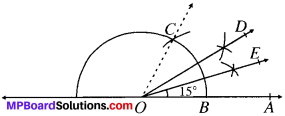
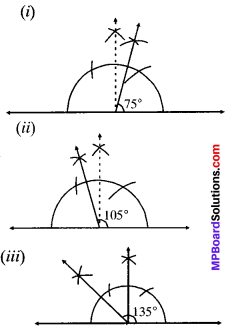
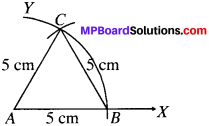
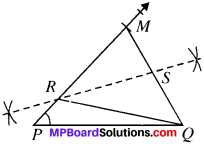
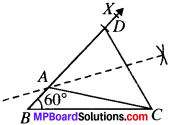
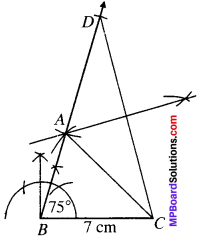
Construct a triangle ABC in which BC = 7 cm, B = ∠75° and AB + AC = 13 cm.
Solution:
BC = 7 cm
∠B = 15°
AB + BC = 13 cm.
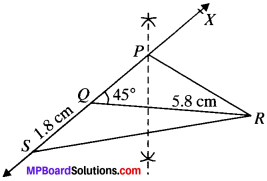
MP Board Class 9th Maths Solutions Chapter 11 Constructions Ex 11.2 img-1

Question 2.
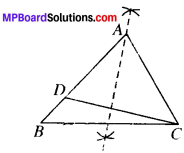
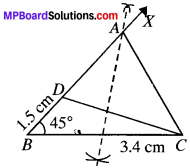
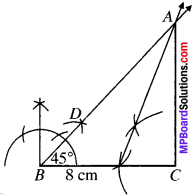
Construct a triangle ABC in which BC = 8 cm, ∠B = 45° AB – AC = 3.5 cm.
Solution:
BC = 8 cm
∠B = 45°
AB – AC = 3.5 cm.
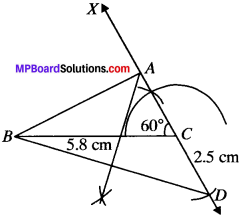
MP Board Class 9th Maths Solutions Chapter 11 Constructions Ex 11.2 img-2

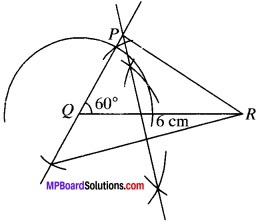
Question 3.
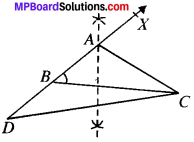
Construct a triangle PQR in which QR = 6 cm. ∠Q = 60° and PR – PQ = 2 cm.
Solution:
QR = 6 cm
∠Q =60°
PR – PQ = 2 cm
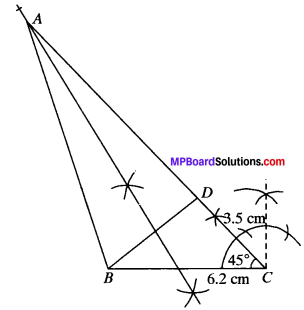
MP Board Class 9th Maths Solutions Chapter 11 Constructions Ex 11.2 img-3

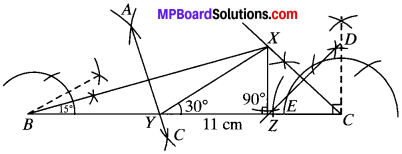
Question 4.
Construct a triangle XYZ in which ∠Y = 30°, ∠Z = 90° and XY + YZ + ZX = 11 cm.
Solution:
XY + YZ + ZX = 11 cm
∠Y = 30°
∠Z =90°
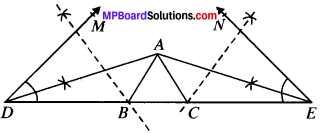
MP Board Class 9th Maths Solutions Chapter 11 Constructions Ex 11.2 img-4

  1. Draw a line segment BC =11 cm.
  2. At B construct an angle of 30° and at C, draw angle of 90°.
  3. Bisect these angles. Let the bisectors of these angles intersect atX.
  4. Draw perpendicular bisectors AC of BX to intersect BC at Y and DZ of XC to intersect BC at Z.
  5. Join XY and XZ. XYZ is the required D.

MP Board Solutions

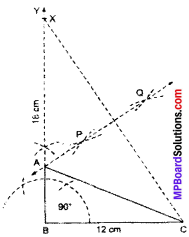
Question 5.
Construct a right triangle whose base is 12 cm and sum of its hypotenuse and other side is 18 cm.
Solution:
Steps of construction:

  1. Draw \(\overline { BC } \) = 12 cm.
  2. Construct ∠CBY = 90°.
  3. From \(\overline { BY } \), cut off BX = 18 cm.
  4. Join CX.
  5. Draw PQ, the perpendicular bisector of CX, such that PQ meets BX at A.
  6. JoinAC.

Thus, ABC is the required triangle.
MP Board Class 9th Maths Solutions Chapter 11 Constructions Ex 11.2 img-5

MP Board Class 9th Maths Solutions

MP Board Class 9th Maths Solutions Chapter 10 Circles Ex 10.4

MP Board Class 9th Maths Solutions Chapter 10 Circles Ex 10.4

Question 1.
Two circles of radii 5 cm and 3 cm intersect at two points and the distance between their centres is 4 cm. Find the length of the common chord.
Solution:
Given
Let O and O1 be the centre of bigger and smaller circle respectively
OA = OB = 5 cm
O1A – O1B = 3 cm
OO1 = 4 cm
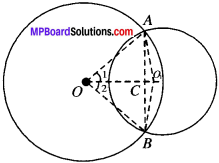
MP Board Class 9th Maths Solutions Chapter 10 Circles Ex 10.4 img-1
To find: AB.
Construction:
Join OA, OB, O1A and O1B join AB also.
In ∆OAO1 and ∆OBO1
OA = OB (Radii of a circle)
O1A = O1B (Radii of a circle)
OO1 = OO1 (Common)
so ∆OAO1 = ∆OBO1 (By SSS)
and so ∠1 = ∠2 (By CPCT)
In ∆OCA and ∆OCB,
OA = OB (Radii of a circle)
∠1 = ∠2 (Proved)
OC = OC (Common)
∆OCA = ∆OCB (By SAS)
so AC = BC (By CPCT)
and ∠ACO = ∠BCO (By CPCT)
∠ACO + ∠BCO = 180° (LPA’s)
⇒ ∠ACO + ∠BCO = 180°
2∠ACO = 180°
∠ACO = 90°
ar (OAO1) = \(\frac{1}{2}\) x OO1 x AC
= \(\frac{1}{2}\) x 4 x AC = 2ACcm2 …..(i)
In ∆QAO1, a = 5 cm, bc = 4 cm, c = 3 cm
12
s = \(\frac{5+4+3}{2}\) = \(\frac{12}{2}\) = 6 cm
s – a = 6 – 5 = 1 cm
s – b = 6 – 4 = 2 cm
s – c = b – 3 = 3 cm
ar(OAO1) = \(\sqrt{s(s-a)(s -b)(s- c)}\).
= \(\sqrt{6x1x2x3}\)
= 6 cm2 …..(ii)
From (i) and (ii), we get
2AC =6
AC = 3 cm
Now, AB = 2AC (∴ AC = BC)
= 2 x 3 = 6 cm.

MP Board Solutions

Method II. By Construction:
Geometrically, AB is the diameter of the circle of radius 3 cm as it passes through centre O1
AB = 2 x 3 = 6 cm.

Question 2.
If two equal chords of a circle intersect within the circle, prove that the segments of one chord are equal to corresponding segment of the other chord.
Solution:
Given
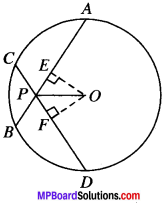
C (O, r) is a circle in which AB and CD are two equal chords which intersect at P.
To prove:
CP = BP and AP = DP.
Construction:
Draw OE and OF perpendiculars on AB and CD respectively. Join OP.
Proof:
In ∆OPF and ∆OPE,
OP = OP (Common)
OE = OF (∴ AB = CD)
∠F = ∠E (Each 90°)
∆OPF = ∆OPE (By RHS)
and so PE = PF …..(1) (By CPCT)
AB = CD (Given)
MP Board Class 9th Maths Solutions Chapter 10 Circles Ex 10.4 img-2
\(\frac{1}{2}\) AB = \(\frac{1}{2}\) CD
BE = CF
and AE = DF …..(2)
Adding (1) and (2), we get,
PE + AE = PF + DF
∴ AP = DP
Subtracting (1) and (2) we get,
BE – PE = CF – PF
∴ BP = CP

Question 3.
If two equal chords of a circle intersect within the circle, prove that the line joining the point of intersection to the centre makes equal angles with the chords.
Solution:
Given
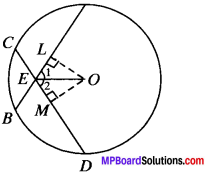
AB and CD are two equal chords of a circle which intersect at E.
To prove:
∠1 = ∠2
Construction:
Draw OL ⊥ AB and OM ⊥ CD. Join OE.
MP Board Class 9th Maths Solutions Chapter 10 Circles Ex 10.4 img-3
Proof:
In ∆OLE and ∆OME,
OE = OE
OL = OM (∴ AB = CD)
∠L = ∠M (Each 90°)
∆OLE = ∆OME (By RHS)
and so∠1 = ∠2 (By CPCT)

Question 4.
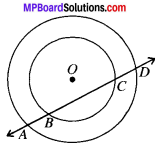
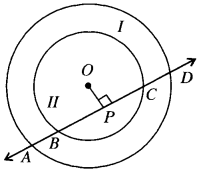
If a line intersects two concentric circles (circles with the same centre) with centre O at A, B, C and D, prove that AB = CD. (see Fig. adjacent)
MP Board Class 9th Maths Solutions Chapter 10 Circles Ex 10.4 img-4
Solution:
Given:
C (O, r) and C (O, r) are two concentric circles.
To prove: AB = CD
MP Board Class 9th Maths Solutions Chapter 10 Circles Ex 10.4 img-5
Construction: Draw OP ⊥ AD.
Proof:
In circle I, AD is the chord and OP ⊥ AD.
AP = DP …(1)
In circle II, BC is the Chord and OP L BC.
∴ BP = CP …(2)
Subtracting (1) and (2), we get
AP – BP = DP – CP
AB = CD

MP Board Solutions

Question 5.
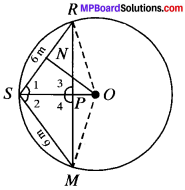
Three girls Reshma. Salma and Mandip are playing a game by standing on a circle of radius 5 m drawn in a park. Reshma throws a ball to Salma, Salma to Mandip, Mandip to Reshma. If the distance between Reshma and Salma and between Salma and Mandip is 6 m each, what is the distance between Reshma and Mandip?
Solution:
Given:
OR = OM = 5 m and SR = SM = 6 m.
To find: MR.
MP Board Class 9th Maths Solutions Chapter 10 Circles Ex 10.4 img-6
Constrution:
Join OR, OM and OS. Draw ON ⊥ SR. In AORS and AOMS,
OS = OS (Common)
RS = MS (Given)
OR = OM (Given)
∆ORS = ∆OMS (By SSS)
and ∠1 = ∠2 (By CPCT)
SP = SP (Common)
SR = SM (Given)
∠1 = ∠2 (Proved)
∆SPR = ∆SPM (By SAS)
and so PR = PM (By CPCT)
and ∠3 = ∠4 (By CPCT)
∠3 + ∠4 = 180° (LPA’s)
2∠3 = 180°
∠3 = \(\frac{180^{\circ}}{2}\) = 90°
ar (∆OSR) = \(\frac{1}{2}\) x OS x PR …(i)
= \(\frac{1}{2}\) x 5 x PR
ON ⊥ SR
RN = \(\frac{1}{2}\) SR
(Perpendicular drawn from the centre of a circle to a chord bisects the chord)
= \(\frac{6}{2}\) = 3m
In ∆ONR ON2 = \(\sqrt{O R^{2}-N R^{2}}\) (Using Pythagoras Theorem)
= \(\sqrt{5^{2}-3^{2}}\) = \(\sqrt{4^{2}}\) = 4m
ar (∆OSR) = \(\frac{1}{2}\) x SR x ON
= \(\frac{1}{2}\) x 6 x \(\frac{1}{2}\) x 4 = 12m2 …..(ii)
From (i) and (ii), we get
PR = \(\frac{2×12}{2}\) = 4.8m
MR = 2 PR
= 2 x 4.8
= 9.6 m

MP Board Solutions

Question 6.
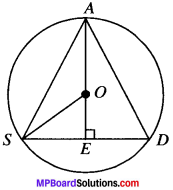
A circular park of radius 20 m is situated in a colony. Three boys Ankur, Syed and David are sitting at equal distance on its boundary each having a toy telephone in his hands to talk each other. Find the length of the string of each phone.
Solution:
Given: OS = OA = 20 m and AS = SD = AD
To find: AS, SD and AD.
Construction:
Draw AE ⊥ SD. Join OS.
Let AS = SD = AD = 2x (say)
MP Board Class 9th Maths Solutions Chapter 10 Circles Ex 10.4 img-7
In equilateral ∠ASD, AE ⊥ SD
⇒ E is the mid-point of SD
SE = \(\frac{2x}{2}\) = x
In ∆AES, AS2 = AE2 + SE2
(2x)2 = AE2 + x2
4x2 – x2 = AE2
AE = \(\sqrt{3x^{2}}\) = \(\sqrt{3}\)
OE = AE – AO
= (\(\sqrt{3}\) – 20)m
In ∆OES, OS2 = OE2 + SE2
(20)2 = [(\(\sqrt{3}\)x) 20]2 + x2
400 = (\(\sqrt{3}\)x)2 – 2 x \(\sqrt{3}\)x × 20 + (20)2 + x2
= 3x2 + 400 – 40\(\sqrt{3}\)x + x2
400 – 400 = 4x2 – 40\(\sqrt{3}\)x
0 = 4x2 – 40\(\sqrt{3}\)x
40\(\sqrt{3}\)x = 4x2
40\(\frac { 40\sqrt { 3 } }{ 4 } \) = x
x = 10\(\sqrt{3}\)m .
2x = 2 x 10\(\sqrt{3}\) = 20\(\sqrt{3}\)m
AS = SD = AD = 20\(\sqrt{3}\)m.

MP Board Class 9th Maths Solutions

MP Board Class 9th Maths Solutions Chapter 9 Areas of Parallelograms and Triangles Ex 9.3

MP Board Class 9th Maths Solutions Chapter 9 Areas of Parallelograms and Triangles Ex 9.3

Question 1.
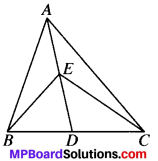
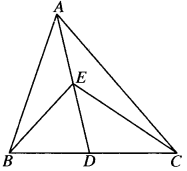
In Fig. given below E is any point on median AD of a ∆ABC. Show that ar (ABE) = ar (ACE).
MP Board Class 9th Maths Solutions Chapter 9 Areas of Parallelograms and Triangles Ex 9.3 img-1
Solution:
Given.
E is any point on median AD of ∆ABC.
To prove
ar (ABE) = ar (ACE)
MP Board Class 9th Maths Solutions Chapter 9 Areas of Parallelograms and Triangles Ex 9.3 img-2
Proof:
In ∆ABC, AD is the median
ar (ABD) = ar(ACD) ….(1)
In ∆EBC, ED is the median
∴ ar (BDE) = ar (CDE) ….(2)
Subtracting (2) from (1), we get
ar (ABD) – ar (BDE) = ar (ACD) – ar (CDE)
ar (ABE) = ar (ACE)

MP Board Solutions

Question 2.
In a triangle ABC, E is the mid-point of median AD. Show that ar (BED) = \(\frac{1}{4}\) ar (ABC).
MP Board Class 9th Maths Solutions Chapter 9 Areas of Parallelograms and Triangles Ex 9.3 img-3
Solution:
Given
E is the mid point of – median AD of ∆ABC.
To prove:
ar (BED) = \(\frac{1}{4}\) ar (ABC)
Proof:
In ∆ABC, AD is the media
ar (ABD) = \(\frac{1}{2}\) ar (ABC) …..(1)
In ∆ABD, BE is the median
MP Board Class 9th Maths Solutions Chapter 9 Areas of Parallelograms and Triangles Ex 9.3 img-4
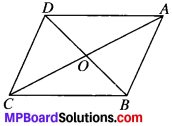
ar (BED) = \(\frac{1}{2}\) ar (ABD)
= \(\frac{1}{2}\) [\(\frac{1}{2}\) ar (ABC)]
= \(\frac{1}{4}\) ar (ABC)

Question 3.
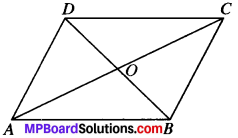
Show that the diagonals of parallelogram divide it into four triangles of equal area.
Solution:
Given.
ABCD is a parallelogram.
To prove:
ar (AOB) = ar (BOC) = ar (COD) = ar (AOD)
MP Board Class 9th Maths Solutions Chapter 9 Areas of Parallelograms and Triangles Ex 9.3 img-5
Proof:
In ∆ABC, OA is the median
∴ ar (AOB) = ar (AOD) …..(1)
In AABC, BO is the median
∴ ar (AOB) = ar (BOC) …..(2)
In ABCD, CO is the median
ar (BOC) = ar (COD) …(3)
From (1), (2) and (3), we get
ar (AOB) ar (BOC) = ar (COD) = ar (AOD)

Question 4.
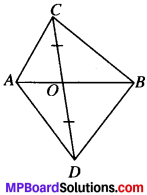
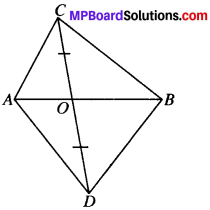
In Fig. given below, ABC and ABC are two triangles on the same base AB. If line – segment CD is bisected by AB at O, show that ar (ABC) = ar (ABD).
MP Board Class 9th Maths Solutions Chapter 9 Areas of Parallelograms and Triangles Ex 9.3 img-6
Solution:
Given.
∆ABC and ∆ABD have a common base AB.
OC = OD
To prove
ar (ABC) = ar (ABD)
MP Board Class 9th Maths Solutions Chapter 9 Areas of Parallelograms and Triangles Ex 9.3 img-7
Proof:
As OC = OD,
O is the mid-point of CD
In ∆ACD, O is the median
ar (AOC) = ar(AOD)
In ABCD, BO is the median
ar (BOC) = ar (BOD)
Adding (1) and (2), we get
ar (AOC) + (BOC) = ar (AOD) + ar (BOD)
ar (ABC) = ar (ABC)

MP Board Solutions

Question 5.
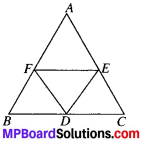
D, E and F are respectively the mid-points of the sides BC, CA and AB of a AABC. Show that
MP Board Class 9th Maths Solutions Chapter 9 Areas of Parallelograms and Triangles Ex 9.3 img-8

  1. BDEF is a parallelogram.
  2. ar (DEF) = \(\frac{1}{2}\) ar (ABC)
  3. ar (BDEF) = \(\frac{1}{4}\) ar (ABC).

Solution:
D, E, F are the mid points of sides BC, CA and AB of ∆ABC.
To prove:

  1. BDEF is a parallelogram.
  2. ar (DEF) = \(\frac{1}{4}\) ar (ABC)
  3. ar (BDEF) = \(\frac{1}{2}\) ar (ABC)

Proof:
In ∆ABC, F is the mid-point of AB, E is the mid point of AC.
∴ FE ∥ BC and FE = – BC (By MPT)
⇒ FE ∥ BD and FE =BD

1. BDEF is a ∥gm
Similarly CDFE and AEDF are ∥gm
In parallelogram BDEF, DF is the diagonal
∴ ax (BDF) = ar (DEF)
[In a ∥gm diagonal divides it into 2∆s of equal areas]
Similarly, In ∥gm CDFE, DE is a diagoilal …(1)
ar (CDE) = (DEF) …(2)
In ∥gm AEDF, FE is a diagonal
ar (AEF) = ar (DEF) …(3)
From (1), (2) and (3), we get
ar (BDF) = ar (CDF) = ar (AEF) = (DEF) …(4)

2. ar (ABC) = ar (AEF) + ar (ADF) + ar (CDE) + ar (DEF)
ar (ABC) = 4 ar (DEF) [Using (4)]
ar (DEF) = \(\frac{1}{4}\) ar (ABC)

3. ar (BDEF) = ar (BDF) + ar (DEF)
ar (BDEF) = 2ar (DEF) [∴ ar (BDF) = ar (DEF)]
= 2 x \(\frac{1}{4}\) ar (ABC) = \(\frac{1}{2}\) ar (ABC)

Question 6.
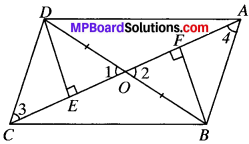
In the Fig. diagonals AC and BD of quadrilateral ABCD intersect at O such that OB = OD. If AB – CD, then show that:
MP Board Class 9th Maths Solutions Chapter 9 Areas of Parallelograms and Triangles Ex 9.3 img-9

  1. ar (DOC) = ar (AOB)
  2. ar DCB = ar (ACB)
  3. DA ∥ CB or ABCD is a parallelogram.

[Hint: From D and B, draw perpendiculars to AC.]

Solution:
Given
ABCD is a quadrilateral in which OB = OD and AB = CD.
To prove:

  1. ar (DOC) = ar (AOB)
  2. ar (DCB) = ar (ACB)
  3. DA ∥ CB or ABCD is a ∥gm

MP Board Class 9th Maths Solutions Chapter 9 Areas of Parallelograms and Triangles Ex 9.3 img-10
Construction:
Draw DE and BF perpendicular from point D and B on AC.
Proof:
1. In ∆OED and ∆OFB
∠1 = ∠2 (V.O.A.’s)
OD = OB (given)
∠E = ∠F (each 90°)
∆ OED = ∆ OFB (by AAS)
and so DE = BF (by CPCT)
In ∆DEC and ∆BFA, DE = BF (proved)
∠E = ∠F (each 90°)
DC = BA (given)
∆DEC = ∆BFA (by RHS)
and so ∠3 = ∠4 (by CPCT)
ar (OED) = ar (OFB) [∴ AOED = AOFB] …(1)
ar (DEC) = ar (BFB) [∴ ADEC = ABEA] …..(2)
Adding (1) and (2), we get
ar (OED) + ar (DEC) = ar (OFB) = ar (BFA)
ar (OCD) = ar (OAB) …..(3)

2. Adding ar (OBC) on both sides of equation (3)
ar (OCD) + (OBC) = ar (OAB) + ar (OBC)
ar (DCB) = ar (ACB)

3. ∆DCB and ∆ACB have the same base BC and have equal area
∴ they will lie between the same parallels BC and AD
and so BC ∥ AD
∠3 and ∠4 are A.I.A’s and are equal
∴ AB ∥ DC
In quadrilateral ABCD, AB ∥ DC and AB = DC (given)
ABCD is a parallelogram.

MP Board Solutions

Question 7.
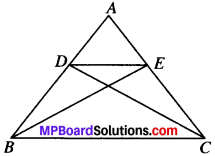
D and E are points on sides AB and AC respectively of ∆ABC such that ar (DBC) = ar (EBQ. Prove that DE ∥ BC.
Solution:
Given
ar (DBC) = ar (EBC)
To prove:
DE ∥ BC
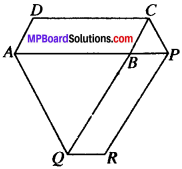
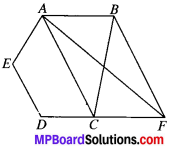
MP Board Class 9th Maths Solutions Chapter 9 Areas of Parallelograms and Triangles Ex 9.3 img-11
Proof:
∆ DBC and ∆EBC have the same base BC and
ar (DBC) = ar (EBC)
∴ They will lie between the same parallel lines DE and BC.
and so DE ∥ BC

Question 8.
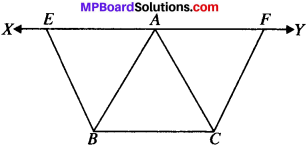
XY is a line parallel to side BC of a triangle ABC. If BE ∥ AC and CF ∥ AB meet XY at E and F respectively, show that ar (ABE) = ar (ACF).
Solution:
Given
XY ∥ BC, BE ∥ AC and CF ∥ AB.
To prove
ar (ABE) = ar (ACF)
Proof:
In quadrilateral ACBE, AE ∥ CB (∴ BC ∥ XY)
and AC ∥ EB
ACBE is a ∥gm
MP Board Class 9th Maths Solutions Chapter 9 Areas of Parallelograms and Triangles Ex 9.3 img-12
Similarly ABCF is a parallelogram.
gm ACBE and ABCF have the same base BC and are between the same parallels BC and AY.
∴ ar (ACBE) = ar (ABCF)
ar (ABE) + ar (ABC) = ar (ABC) + ar (ACF)
∴ ar (ABE) = ar (ACF)

Question 9.
The side AB of a parallelogram ABCD is produced to any point P. A line through A and parallel to CP meets CB produced at Q and then parallelogram PBQR is completed (see Fig. below). Show that ar (ABCD) = ar (PBQR).
[Hint: Joint AC and PQ. Now compare ar (ACQ) and ar (APQ).]
MP Board Class 9th Maths Solutions Chapter 9 Areas of Parallelograms and Triangles Ex 9.3 img-13
Solution:
Given
ABCD and BPRQ are parallelograms. CP ∥ AQ
To prove:
ar (ABCD) = ar (PBQR)
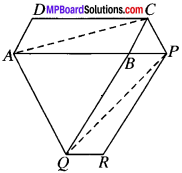
Construcion:
Join AC and PQ
Proof:
∆ACQ and ∆APQ lie on the same base AQ and are between the same parallels AQ and CP.
∴ ar (ACQ) = ar (APQ)
⇒ ar (ABQ) + ar (ABC) = ar (ABQ) + ar (BQP)
∴ ar (ABC) = ar (BQP) …..(i)
MP Board Class 9th Maths Solutions Chapter 9 Areas of Parallelograms and Triangles Ex 9.3 img-14
Multiplying (1) by 2 on both sides
2 ar (ABC) = 2 ar (BQP)
∴ ar (ABCD) = ar (PBQR)
[∴ ABCD and PBQR are parallelogram]

MP Board Solutions

Question 10.
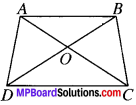
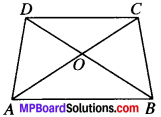
Diagonals AC and BD of a trapezium ABCD with AB ∥ DC intersect each other at C. Prove that ar (AOD) = ar (BOC).
Solution:
Given
ABCD is a trapezium in which AB ∥ DC.
To prove:
ar (AOD) = ar (BOC).
MP Board Class 9th Maths Solutions Chapter 9 Areas of Parallelograms and Triangles Ex 9.3 img-15
Proof:
∆ADC and ∆BCD lie on the same base DC and between the same parallels AB and CD.
∴ ar (ADC) = ar (BCD)
Subtracting ar (DOC) from both sides
ar (ADC) – ar (DOC) = ar (BCD) – ar (DOC)
ar (AOD) = ar (BOC)

Question 11.
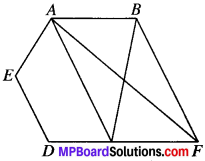
In Fig. ABCDE is a pentagon. A line through B parallel to AC meets DC produced at F. Show that:

  1. ar (ACB) = ar (ACF)
  2. ar (AEDF) = ar (ABCDE).

MP Board Class 9th Maths Solutions Chapter 9 Areas of Parallelograms and Triangles Ex 9.3 img-16
Solution:
Given
ABCDE is a pentagon.
To prove:
1. ar (ACB) = ar (ACF)
MP Board Class 9th Maths Solutions Chapter 9 Areas of Parallelograms and Triangles Ex 9.3 img-17
2. ar (AEDF) = ar (ABCDE)
Proof:
∆ACB and ∆ACF lie on the same base AC and between the same parallels AC and BE.
ar (ACB) = ar (ACF)

3. Adding ar (AEDC) on both sides
ar (ACB) + ar (AEDC) = ar (ACF) + ar (AEDC)
ar (ABCDE) = ar (AEDF)

Question 12.
A villager Itwaari has a plot of land of the shape of a quadrilateral. The Gram Panchayat of the village decided to take over some portion of his plot from one of the corners to construct a Health Centre. Itwaari agrees to the above proposal with the condition that he should be given equal amount of land in lieu of his land adjoining his plot so as to form a triangular plot. Explain how this proposal will be implemented.
Solution:
Given.
ABCD is a quadrilateral.
Construction:
Join AC. Draw DE ∥ CA which intersect BA produced at E.
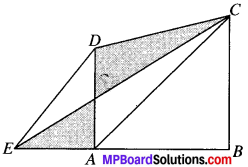
MP Board Class 9th Maths Solutions Chapter 9 Areas of Parallelograms and Triangles Ex 9.3 img-18
Proof:
∆ADC and ∆ACE both lie on the same base AC and between the same parallels AC and DE.
ar (ADC) = ar (ACE)
Adding ar (ABC) on both sides
ar (ADC) + ar (ABC) = ar (ACE) + ar (ABC)
ar (ABCD) = ar (EBC)

MP Board Solutions

Question 13.
ABCD is a trapezium with AB ∥ DC. Aline parallel to AC intersects AB at X and BC at Y. Prove that ar (ADX) = ar (ACY).
[Hint: Join CX.]
Solution:
Given
ABCD is trapezium with AB ∥ DC and AC ∥ XY.
To prove:
ar (ADX) = ar (ACY).
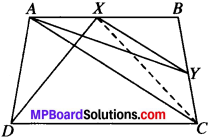
Construction:
Join CX.
Proof:
∆ADX and ∆ACX both lie on the same base AX and between the same parallel AN and DC.
MP Board Class 9th Maths Solutions Chapter 9 Areas of Parallelograms and Triangles Ex 9.3 img-19
∴ ar (ADX) = ar (ACX) …(1)
∆ACX and ∆ACT both lie on the same base AC and between the same parallels AC and AT.
ar (ADY) = ar (ACX) …(2)
From (1) and (2), we get
ar (ADX) = ar(ACT)

Question 14.
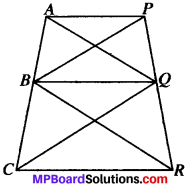
In Fig. below AP ∥ BQ ∥ CR. Prove that ar (AQC) = ar (PBR).
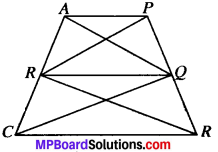
MP Board Class 9th Maths Solutions Chapter 9 Areas of Parallelograms and Triangles Ex 9.3 img-20
Solution:
Given:
AP∥BQ∥CR.
To prove:
ar (AQC) = ar (PBR)
Proof:
∆ABQ and ∆PBQ both lie on the same base BQ and between the same parallels AP and BQ.
∴ ar (ABQ) = ar (PBQ) …(1)
∆BCQ and ∆BRQ both lie on the same base BQ and between the same parallels BQ and CR.
MP Board Class 9th Maths Solutions Chapter 9 Areas of Parallelograms and Triangles Ex 9.3 img-21
∴ ar (BCQ) = ar (BRQ) …(2)
Adding (1) and (2), we get
ar (ABQ) tar (BCQ) = ar (PBQ) + ar (BRQ)
∴ ar (AQC) = ar (PBR)

Question 15.
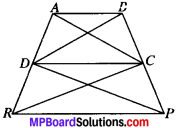
Diagonals AC and BD of a quadrilateral ABCD intersect at 0 in such a way that ar (AOD) = ar (BOC). Prove that ABCD is a trapezium.
Solution:
Given:
ar (AOD) = ar (BOC)
To prove:
ABCD is a trapezium.
MP Board Class 9th Maths Solutions Chapter 9 Areas of Parallelograms and Triangles Ex 9.3 img-22
Proof:
ar ∠AOD = ar (BOC) (given)
Adding ar (AOB) on both sides
ar (AOD) + ar (AOB) = ar (BOC) + ar (AOB)
ar (ABD) = ar (ABC)
∆ABD and ∆ABC both lie on same base AB and have equal area.
∴ they will lie between the same parallels.
⇒ AB ∥ DC
∴ ABCD is a trapezium.

Question 16.
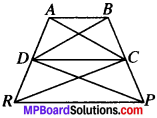
In Fig. below, ar (DRC) = ar (DPC) and ar (BDP) = ar (ARC). Show that both the quadrilaterals ABCD and DCPR are trapeziums.
MP Board Class 9th Maths Solutions Chapter 9 Areas of Parallelograms and Triangles Ex 9.3 img-23
Solution:
Given
ar (DRC) = ar (DPC)
ar (BDP) = ar (ARC)
To prove:
ABCD and DCPR are trapezium.
MP Board Class 9th Maths Solutions Chapter 9 Areas of Parallelograms and Triangles Ex 9.3 img-24
Proof:
∆DRC and ∆DPC both lie on the same base DC and have equal area .•. They will lie between the same parallels.
⇒ DC ∥ BP
and so DCPR is a trapezium.
ar (BDP) = ar (ARC) [given] …(1)
ar (DPC) = ar (DRC) [given] …(2)
Subtracting (1) and (2), we get
ar (BDP) – ar (DPC) = ar (ARC) – (DRC)
ar (BDC) = ar (ADC)
∆ADC and ∆BDC both lie on same base DC and have equal area.
∴ they will lie between the same parallels
⇒ AB ∥ DC
and so ABCD is a trapezium.

MP Board Class 9th Maths Solutions

MP Board Class 9th Science Solutions Chapter 12 Sound

MP Board Class 9th Science Solutions Chapter 12 Sound

Sound Intext Questions

Sound Intext Questions Page No. 162

Question 1.
How does the sound produced by a vibrating object in a medium reach your ear?
Answer:
When an object vibrates, it allows the particles of the medium around it to vibrate. It exerts force on the adjacent particles and continue oscillating in all directions and one of it, hit our ear’s medium which creates sound. This process continues in the medium till the sound reaches your ear.

Sound Intext Questions Page No. 163

Question 1.
Explain how sound is produced by your school bell.
Answer:
When the bell rings, it continues to move forward and backward which creates vibration and simultaneously a series of compressions and rarefactions which produce a very loud sound.

MP Board Solutions

Question 2.
Why are sound waves called mechanical waves?
Answer:
Sound waves needs medium to propagate therefore, they are called mechanical waves. Sound cannot travel in the absence of a medium. Sound waves are propagated through a medium because of the interaction of the particles present in that medium.

Question 3.
Suppose you and your friend are on the moon. Will you be able to hear any sound produced by your friend?
Answer:
No, because sound waves needs a medium through which they can propagate. And since there is no medium on the moon due to absence of atmosphere, one cannot hear any sound produced by his / her friend on the moon.

Sound Intext Questions Page No. 166

Question 1.
Which wave property determines.

  1. loudness
  2. pitch?

Answer:

  1. Amplitude determines loudness of a sound wave.
  2. Frequency determines pitch of a sound wave.

Question 2.
Guess which sound has a higher pitch: guitar or car horn?
Answer:
Guitar has a higher pitch than car horn, because sound produced by the strings of guitar has higher frequency and since pitch is proportional to frequency, pitch of guitar will be higher.

MP Board Solutions

Question 3.
What are wavelength, frequency, time period and amplitude of a sound wave?
Answer:

  1. Wavelength: Wave length is the length between two consecutive peaks it is represented by Greek letter λ (lambda). Louder sound has shorter wavelength and softer sound has longer wavelength.
  2. Frequency: The number of sound waves produced in unit time is called the frequency of sound waves. Frequency is measured in seconds. Frequency is denoted by Greek letter v (nu). The SI unit of frequency is ‘hertz’.
  3. Amplitude: Amplitude of a wave is magnitude of maximum disturbance on either side of the normal position or mean value in a medium.

Question 4.
How are the wavelength and frequency of a sound wave related to its speed?
Answer:
Speed, wavelength, and frequency of a sound wave are related as follows:
Speed (ν) = Wavelength [λ] × Frequency (v)
⇒ ν = λ × v

Question 5.
Calculate the wavelength of a sound wave whose frequency is 220 Hz and speed is 440 m/s in a given medium.
Answer:
Given,
Frequency of the sound wave, v = 220 Hz
Speed of the sound wave, u = 440 ms-1
Putting the equations,
Speed = Wavelength (λ) × Frequency (v)
ν = λ × v
∴ λ = \(\frac { ν }{ v  }\) = \(\frac { 440 }{ 220 }\) = 2 m
Hence, Wavelength = 2 m.

Question 6.
A person is listening to a tone of 500 Hz sitting at a distance of 450 m from the source of the sound. What is the time interval between successive compressions from the source?
Answer:
Given,
Frequency = 500 Hz
Distance = 450 m
Since, T = \(\frac { 1 }{ Frequency }\)
= \(\frac { 1 }{ 500 }\) = 0.002 sec.
Hence, person will listen the sound after every 0.002 sec.

Question 7.
Distinguish between loudness and intensity of sound.
Answer:
Intensity drives loudness of a sound. These both qualities of sound are proportional to each other. The amount of sound passing through a unit area per second represents intensity of a sound wave. While loudness is the response of the ear to the sound (amount received to pinna). The loudness of a sound is defined by its amplitude. The amplitude of a sound decides its intensity, which in turn is perceived by the ear as loudness.

Sound Intext Questions Page No. 167

Question 1.
In which of the three media, air, water or iron, does sound travel the fastest at a particular temperature?
Answer:
Sound travels the fastest in solids medium (here Iron) then in liquids (water) and it is the slowest in gases (air). Therefore, for a given temperature, sound travels as follows (decreasing order): ⇒ Iron > water >air.

Sound Intext Questions Page No. 168

Question 1.
An echo returned in 3s. What is the distance of the reflecting surface from the source, given that the speed of sound is 342 ms-1?
Answer:
Given,
Speed, v = 342 ms-1
Time, t = 3 s
Since, Distance = v × t
= 342 × 3 = 1026 m
Condition,
In fixed time interval, sound has to travel a distance that is twice the distance of the reflecting surface and the source.
Hence, the distance of the reflecting surface from the source = \(\frac { 1026 }{ 2 }\) m = 513 m.

Sound Intext Questions Page No. 169

Question 1.
Why are the ceilings of concert halls curved?
Answer:
Ceilings of concert halls are curved to:

  1. Enhance loudness and echo of sound created.
  2. Sound after reflection (from the walls) spreads uniformly in all directions.

Sound Intext Questions Page No. 170

Question 1.
What is the audible range of the average human ear?
Answer:
The audible range of an average human ear is between 20 Hz to 20,000 Hz.

Question 2.
What is the range of frequencies associated with

  1. Infrasound?
  2. Ultrasound?

Answer:

  1. Infrasound: frequencies less than 20 Hz.
  2. Ultrasound: frequencies more than 20,000 Hz.

Sound Intext Questions Page No. 172

Question 1.
A submarine emits a sonar pulse, which returns from an underwater cliff in 1.02 s. If the speed of sound in salt water is 1531 m/s, how far away is the cliff?
Answer:
Given,
Time taken by the sonar pulse to return, t = 1.02s
Speed of sound in salt water, v = 1531 ms-1
Distance of the cliff from the submarine = Speed of sound × Time taken
= 1531 × 1.02 m = 1561.62 m
Distance travelled by the sonar pulse during its transmission and reception in water
= 2 × Actual distance = 2d
Actual distance,
d = Distance of the cliff from the submarine / 2 = \(\frac { 1561 }{ 2 }\) = 780.31 m.

MP Board Solutions

Sound NCERT Textbook Exercises

Question 1.
What is sound and how is it produced?
Answer:
Sound is a form of energy which is received at our ear pinna and gives the sensation of hearing. It is a vibration which propagates in air and developed by vibrating objects.

MP Board Solutions

Question 2.
Describe with the help of a diagram, how compressions and rarefactions are produced in air near a source of sound.
Answer:
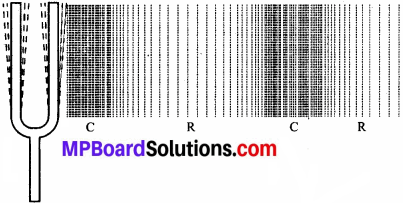
When vibration is produced by a body, it moves in backward and forward direction till the energy lasts. During forward movement it creates a region of high pressure. This region of high pressure is known as compressions. When it moves backward, it creates a region of low pressure. This region is known as a rarefaction. This is shown in figure given below.
MP Board Class 9th Science Solutions Chapter 12 Sound 1
Here,
C = compressions
R = rarefaction.

Question 3.
Cite an experiment to show that sound needs a material medium for its propagation.
Answer:
Arrange the instrument according to the picture given below:
MP Board Class 9th Science Solutions Chapter 12 Sound 2

  • Take an electric bell and an air tight jar with glass bell and connect it to a vacuum pump.
  • Suspend the bell inside the jar, and press the switch of the bell.

Method: Now pump out the air from the glass jar. The sound of the bell will become fainter and after some time, the sound will not be heard. This shows that sound needs a material medium to travel.

Question 4.
Why is sound wave called a ‘longitudinal wave’?
Answer:
Sound wave is called longitudinal wave because the air particles vibrates parallel to the direction of propagation of sound wave,it is produced by compressions and rarefactions in the air.

Question 5.
Which characteristics of the sound helps you to identify your friend by his voice while sitting with others in a dark room?
Answer:
The quality of pitch and loudness of sound enables us to identify our friend by his voice.

MP Board Solutions

Question 6.
Flash and thunder are produced simultaneously. But thunder is heard a few seconds after the flash is seen, why?
Answer:
Speed difference is the main reason of this happening. The speed of sound (344 m/s) is very less than the speed of light (3 × 10⁸ m/s). A flash is seen before we hear a thunder because sound of thunder takes more time to reach the Earth as compared to light.

Question 7.
A person has a hearing range from 20 Hz to 20 kHz. What are the typical wavelengths of sound waves in air corresponding to these two frequencies? Take the speed of sound in air as 344 ms-1.
Answer:
We know,
Speed (ν) = Wavelength × Frequency v
ν = λ × v
Given,
Speed of sound in air ν = 344 m/s (Given)

(i) For, v = 20 Hz
λ1 = \(\frac { ν }{ v }\)
= \(\frac { 344 }{ 20 }\) = 17.2 m

(ii) For, v = 20000 Hz
12 = \(\frac { ν }{ v }\)
= \(\frac { 344 }{ 20000 }\) = 0.172 m
Hence, for humans, the wavelength range for hearing is 0. 0172 m to 17.2 m.

Question 8.
Two children are at opposite ends of an aluminium rod. One strikes the end of the rod with a stone. Find the ratio of time taken by the sound wave in air and in aluminium to reach the second child.
Answer:
Velocity of sound in air= 346 m/s
Velocity of sound waves in aluminium 6420 m/s
Let length of rod be 1.
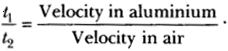
Time taken for sound wave in air, t1 = \(\frac { 1 }{ Velocity }\) in air.
Time taken for sound wave in aluminium, t2 = \(\frac { 1 }{ Velocity }\) in aluminium.
Therefore,
MP Board Class 9th Science Solutions Chapter 12 Sound 6
= \(\frac { 6420 }{ 346 }\) = 18.55.

Question 9.
The frequency of a source of sound is 100 Hz. How many times does it vibrate in a minute?
Answer:
Frequency =100 Hz. (Given)
This means the source of sound vibrates 100 times in one second.
Therefore, number of vibrations in 1 minute, i.e. in 60 seconds = 100 × 60 = 6000 times.

Question 10.
Does sound follow the same laws of reflection as light does? Explain.
Answer:
Yes, sound waves also follow the same laws of reflection as light wave do because:

  1. Angle of incidence of sound is always equal to that of angle of reflection of sound waves.
  2. The direction in which sound is incident, the direction in which it is reflected and normal all lie in the some plane.

MP Board Solutions

Question 11.
When a sound is reflected from a distant object, an echo is produced. Let the distance between the reflecting surface and the source of
sound production remains the same. Do you hear echo sound on a hotter day?
Answer:
An echo is heard when the time for the reflected sound is just 0.1 s
Time taken = \(\frac { Total Distance }{ Velocity }\)
On a hotter day, due to lighter medium the velocity of sound is more then a colder day. Hence, sound wave will move faster and if time taken by echo is less than 0.1 sec it will not be heard.

Question 12.
Give two practical applications of reflection of sound waves.
Answer:
Two practical applications of reflection of sound waves are:

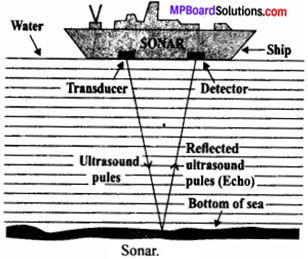
  1. Reflection of sound is used to measure the distance and speed of underwater objects. This method is known as SONAR.
  2. Working of a stethoscope is also based on reflection of sound. In a stethoscope, the sound of the patient’s heartbeat reaches the doctor’s ear by multiple reflection of sound.

Question 13.
A stone is dropped from the top of a tower 500 m high into a pond of water at the base of the tower. When is the splash heard at the top? Given, g = 10 ms-2 and speed of sound = 340 ms-1.
Answer:
Height of the tower, s = 500 m
Velocity of sound, v = 340 ms-1
Acceleration due to gravity, g = 10 ms-2
Initial velocity of the stone, u = 0 (since the stone is initially at rest)
Time taken by the stone to fall to the base of the tower t1,
According to the second equation of motion:
s = ut1 + \(\frac { 1 }{ 2 }\) gt12
500 = 0 × t1 + \(\frac { 1 }{ 2 }\) × 10 t12
t12 = 500
t1 = 10 s
Now, time taken by the sound to reach the top from the base of the tower,  t2 = \(\frac { 500 }{ 340 }\) = 1.47 s.
Therefore, the splash is heard at the top after time, t Where, t = t1 + t2 = 10 + 1.47 = 11.47 s.

Question 14.
A sound wave travels at a speed of 339 ms-1. If its wavelength is 1.5 cm, what is the frequency of the wave? Will it be audible?
Answer:
Speed of sound, v = 339 ms-1
Wavelength of sound, λ = 1.5 cm = 0.015 m
Speed of sound = Wavelength × Frequency
ν = λ × v
∴ v = \(\frac { ν }{ λ }\)
= \(\frac { 339 }{ 0.015 }\)
= 22600 Hz.
The frequency range of audible sound for humans lies between 20 Hz to 20,000 Hz.
Since, the frequency of the given sound is more than 20,000 Hz, it is not audible.
Question 15.
What is reverberation? How can it be reduced?
Answer:
The repeated multiple reflections of sound in any big enclosed space is known as reverberation. The reverberation can be reduced by covering the ceiling and walls of the enclosed space with sound absorbing materials, such as fibre board, loose woollens, etc.

Question 16.
What is loudness of sound? What factors does it depend on?
Answer:
The effect produced in the brain by the sound of different frequencies is called loudness of sound. Loudness depends on the amplitude of vibrations. In fact, loudness is proportional to the square of the amplitude of vibrations.

Question 17.
Explain how bats use ultrasound to catch a prey.
Answer:
Bats produce high – pitched ultrasonic squeaks. These high – pitched squeaks are reflected by objects such as preys and returned to the bat’s ear. This allows a bat to know the distance of his prey.

MP Board Solutions

Question 18.
How is ultrasound used for cleaning?
Answer:
Objects to be cleansed are put in a cleaning solution and ultrasonic sound waves are passed through that solution. The high frequency of these ultrasound waves detaches the dirt from the objects.

Question 19.
Explain the working and application of a SONAR.
Answer:
Sonar stands for Sound Navigation And Ranging. It is a device used to measure the depth, direction and speed of under – water objects such as submarines and ship wrecks with the help of ultrasounds and is also used to measure the depth of seas and oceans. An ultrasonic sound is produced and transmitted by the transducer (it is a device that produces ultrasonic sound) of the Sonar, which travels through sea water.

The echo produced by the reflection of this ultrasonic sound is detected and recorded by the detector, which is converted into electrical signals. The distance (d) of the under – water object is calculated from the time (t) taken by the echo to return with speed (v) is given by 2d = v × t.
MP Board Class 9th Science Solutions Chapter 12 Sound 3

Question 20.
A SONAR device on a submarine sends out a signal and receives an echo 5 s later. Calculate the speed of sound in water if the distance of the object from the submarine is 3625 m.
Answer:
Given,
Time taken to hear the echo, t = 5 s
Distance of the object from the submarine, d = 3625 m
Total distance travelled by the sonar waves during the transmission and reception in water = 2d
Using formula:
Velocity of sound in water,
v = 2 \(\frac { d }{ t }\)
= 2 × \(\frac { 3625 }{ 5 }\) = 1450 ms-1.

Question 21.
Explain how defects in a metal block can be detected using ultrasound.
Answer:
Defects in metal blocks do not allow ultrasound to pass through them and they are reflected back. This fact is used to detect defects in metal blocks. Ultrasound is passed through one end of a metal block and detectors are placed on the other end. The defective part of the metal block does not allow ultrasound to pass through it. As a result, it will not be detected by the detector. Hence, defects in metal blocks can be detected using ultrasound.
MP Board Class 9th Science Solutions Chapter 12 Sound 4

Question 22.
Explain how the human ear works.
Answer:
The human ear consists of three parts – the outer ear, middle ear and inner ear.

  1. Outer ear: It is also termed ‘pinna’. It collects the sound from the surrounding and directs it towards auditory canal.
  2. Middle ear: It is at the auditory canal where there is a thin membrane called eardrum or tympanic membrane. The sound waves set this membrane to vibrate. These vibrations are amplified by three small bones hammer, anvil and stirrup.
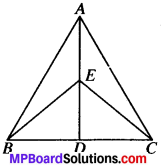
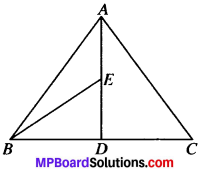
  3. Inner ear: When vibration reach the cochlea in the inner ear and are converted into electrical signals which are sent to the brain by the auditory nerve, and the brain interprets them as sound.
    MP Board Class 9th Science Solutions Chapter 12 Sound 5

Sound Additional Questions

Sound Multiple Choice Questions

Question 1.
Which of the following waves have no requirement of any medium to propagate?
(a) sound
(b) radio
(c) light waves
(d) none of above.
Answer:
(c) light waves

Question 2.
What kinds of waves are produced by sound?
(a) longitudinal only
(b) transverse waves only
(c) electromagnetic Waves
(d) both Longitudinal and Transversal.
Answer:
(a) longitudinal only

MP Board Solutions

Question 3.
When a wave propagate, it transfers ___________ .
(a) energy only
(b) matter only
(c) both energy and matter
(d) none of these.
Answer:
(a) energy only

Question 4.
Note is a sound ___________ .
(a) of mixture of several frequencies
(b) of mixture of two frequencies only
(c) of a single frequency
(d) always unpleasant to listen.
Answer:
(a) of mixture of several frequencies

Question 5.
A key of a mechanical piano struck gently and then struck again but much harder this time. In the second case:
(a) sound will be louder but pitch will not be different.
(b) sound will be louder and pitch will also be higher.
(c) sound will be louder but pitch will be lower.
(d) both loudness and pitch will remain unaffected.
Answer:
(d) both loudness and pitch will remain unaffected.

Question 6.
Earthquake produces which kind of sound before the main shock wave begins ___________ .
(a) ultrasound
(b) Infrasound
(c) audible sound
(d) none of the above.
Answer:
(b) Infrasound

Question 7.
Infrasound can be heard by ___________ .
(a) dog
(b) bat
(c) rhinoceros
(d) human beings.
Answer:
(c) rhinoceros

Question 8.
Before playing the orchestra in a musical concert, a sitarist tries to adjust the tension and pluck the string suitably. By doing so, he is adjusting ___________ .
(a) intensity of sound only.
(b) amplitude of sound only.
(c) frequency of the sitar string with the frequency of other musical instruments.
(d) loudness of sound.
Answer:
(c) frequency of the sitar string with the frequency of other musical instruments.

MP Board Solutions

Question 9.
What we term to the number of oscillations completed in one second?
(a) time period
(b) velocity
(c) frequency
(d) wavelength.
Answer:
(c) frequency

Question 10.
Sound waves which can be propagate in solids are ___________ .
(a) Longitudinal only.
(b) Transverse only.
(c) Either longitudinal or transverse.
(d) Non mechanical waves only.
Answer:
(c) Either longitudinal or transverse.

Question 11.
In SONAR, we use ___________ .
(a) ultrasonic waves
(b) infrasonic waves
(c) radio waves.
(d) audible sound waves.
Answer:
(a) ultrasonic waves

Question 12.
Sound travels in air if ___________ .
(a) particles of medium travel from one place to another.
(b) there is no moisture in the atmosphere.
(c) disturbance moves.
(d) both particles as well as disturbance travel from one place to another.
Answer:
(c) disturbance moves.

Question 13.
When we change feeble sound to loud sound we increases ___________ .
(a) Frequency
(b) Amplitude
(c) Velocity
(d) Wavelength.
Answer:
(b) Amplitude

Question 14.
In the curve (Figure) half the wavelength is ___________ .
image
(a) AB
(b) BD
(c) DE
(d) AE
Answer:
(a) AB

Question 15.
The time taken to complete an osoillation ___________ .
(a) time period
(b) velocity
(c) frequency
(d) wavelength.
Answer:
(a) time period

Question 16.
The period of a vibrating body of frequency 100 Hz is ___________ .
(a) 100 seconds
(b) 10 seconds
(c) 0.1 second
(d) 0.01 second.
Answer:
(a) 100 seconds

MP Board Solutions

Question 17.
Which of the following is SI unit of amplitude?
(a) metre
(b) s-1
(c) metre / second
(d) Hertz.
Answer:
(a) metre

Question 18.
The quantity λ is known as ___________ .
(a) wave velocity
(b) frequency
(c) wavelength
(d) wave number.
Answer:
(c) wavelength

Question 19.
Sound wave of which of the following frequency is an ultrasonic sound?
(a) 30 Hz
(b) 300 Hz
(c) 3000 Hz
(d) 30,000 Hz.
Answer:
(d) 30,000 Hz.

Question 20.
In which of the following, speed of the sound is maximum?
(a) air
(b) water
(c) steel
(d) kerosene.
Answer:
(c) steel

Sound Very Short Answer Type Questions

Question 1.
How does sound travels in gases and liquids – as longitudinal or as transverse waves?
Answer:
As longitudinal waves.

Question 2.
Give examples of longitudinal waves.
Answer:
Sound waves.

Question 3.
What is speed of sound in air?
Answer:
At 0° C, it is 331 m/s. At 20°C, it is 341 m/s.

Question 4.
What is reverberation?
Answer:
The repeated reflection that results in the persistence of sound is called reverberation.

MP Board Solutions

Question 5.
Among solids, liquids and gases sound travels faster in which medium?
Answer:
Sound travels the fastest in solids.

Question 6.
What is one Hz?
Answer:
Hz is the unit of frequency, called as Hertz. One Hertz is equal to one cycle per second.

Question 7.
What is ‘note’ of second?
Answer:
The sound produced due to a mixture of several frequency is called a note, it is pleasant to listen to.

Question 8.
What is pitch?
Answer:
The way our brain interprets the frequency of an emitted sound is called the pitch.

Sound Short Answer Type Questions

Question 1.
What is Sound? Why it is important for us?
Answer:
Sound is a longitudinal mechanical wave. Sound has great importance in our daily life. It gives us a sensation of hearing. It makes it possible to communicate with other persons through speech.

Question 2.
What is a mechanical wave?
Answer:
A mechanical wave is a disturbance that moves through a medium when the particles of the medium set neighbouring particles into motion. The particles vibrating in turn do not move forward but the disturbance is carried forward.

Question 3.
What is a longitudinal wave?
Answer:
If the particles of a medium vibrate in a direction, parallel to or along the direction of propagation of wave, it is called longitudinal wave.

MP Board Solutions

Question 4.
What type of waves can travel in vacuum? Give example(s).
Answer:
Electromagnetic waves can travel in vacuum. Sun light, x – rays are examples of electromagnetic waves.

Question 5.
Suppose you and your friend are on the Moon. Will you be able to hear any sound produced by your friend?
Answer:
No, we will not hear any sound on the Moon. The Moon does not have any atmosphere, since sound is a mechanical wave and requires a medium to travel.

Question 6.
What are the factors, speed of sound wave depends upon?
Answer:
Speed of the sound depends on the following factors:

  1. Inertial property of the medium (to store kinetic energy).
  2. Elastic property of the medium (to store potential energy).
  3. Temperature of the medium.
  4. Density of the medium.
  5. Humidity present in the medium (in air / gases).

Question 7.
Three persons A, B and C are made to hear a sound travelling through different mediums as given below:

PersonsMedium
AIron Rod
BAir
Cwater

Who will hear the sound first ? Why ?
Answer:
Person A will hear the sound first because sound travels the faster in solids than in liquids and gases.

Question 8.
If 20 waves are produced per second, what is the frequency in hertz?
Answer:
Number of waves per second is known as frequency.
∴ Frequency (v) = 20 Hz.

Question 9.
What is echo?
Answer:
The sound waves produced bounce back or gets reflected from the mountains or buildings and come to our ears, this reflected sound is known as Echo. To hear echo, the barrier reflecting the sound should be atleast at a distance of 17 metres.

MP Board Solutions

Question 10.
What is infrasonic? Give an example.
Answer:
Sound having frequency less than 20 Hz is known as infrasonic sound or infrasonic. Waves produced during earthquake are infrasonic.

Sound Long Answer Type Questions

Question 1.
Establish the relationship between speed of sound, its wave length and frequency. If velocity of sound in air is 340 m s-1, calculate:

  1. wavelength when frequency is 256 Hz.
  2. frequency when wavelength is 0.85 m.

Answer:
Derivation of formula ν = v λ

  1. 340 = 256 λ ⇒ λ = 1.33 m.
  2. 340 = v (0.85) ⇒ v = 400 Hz.

Question 2.
A girl is sitting in the middle of a park of dimension 12 m × 12 m. On the left side of it there is a building adjoining the park and on right side of the park, there is a road adjoining the park. A sound is produced on the road by a cracker. Is it possible for the girl to hear the echo of this sound? Explain answer.
Answer:
If the time gap between the original sound and reflected sound received by the listener is around 0.1 s, only then the echo can be heard. The minimum distance travelled by the reflected sound wave for the distinctly listening the echo, distance = velocity of sound × time interval;
= 344 × 0.1 = 34.4 m.
But, in this case the distance travelled by the sound reflected from the building and then reaching the girl will be (6 + 6 = 12 m),  which is much smaller than the required distance. Therefore, no echo can be heard.

Sound Higher Order Thinking Skills (HOTS)

Question 1.
A key of piano is struck gently and then struck again but much harder this time. What will happen in the second case?
Answer:
In second case, the loudness will increase as this will increase the amplitude of vibration of string. Pitch and frequency will also increase in force or tension in the string.

MP Board Solutions

Question 2.
At a hill station, a child could hear the echo of his voice after 0.2 s. But, when he went to the same place in the afternoon, he could not hear echo at all. What could be the reason?
Answer:
In afternoon, the temperature rises, therefore the speed of sound also increased. The reflected sound will take very less time to travel back and no echo is heard.

Sound Value Based Question

Question 1.
It is not advisable to construct houses near airports, inspite of that many new residential apartments are constructed near airports. Rajesh / Sumit files RTI and also complains the municipal office about the same.

  1. Why one should not reside near airport?
  2. Name other two places where there is noise pollution.
  3. What value of Rajesh is reflected in this act?

Answer:

  1. The landing and taking off of the air – planes causes lot of noise-pollution which may lead to deafness, high blood pressure and other health problems.
  2. The other two places where there is noise-pollution are residing near the heavy traffic routes and railway stations or lines.
  3. Rajesh shows participating citizen and moral responsibility values.

MP Board Class 9th Science Solutions

MP Board Class 9th Maths Solutions Chapter 10 Circles Ex 10.3

MP Board Class 9th Maths Solutions Chapter 10 Circles Ex 10.3

Question 1.
Draw different pairs of circles. How many points does each pair have in common? What is the maximum number of common points?
Solution:
Let us draw different pairs of circles as shown below:
MP Board Class 9th Maths Solutions Chapter 10 Circles Ex 10.3 img-1
We gave,
In figure           Maximum number of common points
(i)             –                     nil
(ii)            –                    one
(iii)           –                    two
Thus, two circles can have at the most two points in common.

Question 2.
Suppose you are given a circle. Give a construction to find its center.
Solution:
Steps of construction:

  1. Mark any three points A, B and C on the circle.
    MP Board Class 9th Maths Solutions Chapter 10 Circles Ex 10.3 img-2
  2. Join AB and BC.
  3. Draw the perpendicular bisector of AS. Let it be PQ.
  4. Draw the perpendicular bisector of BC. Let it be RS.
  5. PQ and RS intersect at point O.
  6. O is the center of given circle.

MP Board Solutions

Question 3.
If two circles intersect at two points, prove that their centers lie on the perpendicular bisector of the common chord.
Solution:
Given:
Circles C(O, r) and C(D, r1) intersect at A and B.
To prove:
OD is perpendicular bisector of AS.
MP Board Class 9th Maths Solutions Chapter 10 Circles Ex 10.3 img-3
Construction:
Join OA, AD, OB and BD.
Proof:
In ∆AOD and ∆BOD,
OA = OB
DA = DB (Radii of the circle)
OD = OD (Common)
∆AOD ≅ ∆BOD (By SXS)
and ∠1 = ∠2 (By CPCT)
In ∆OAC and ∆OBC,
OA = OB (Radii of the circle)
OC =OC (Common)
∠1 = ∠2 (Proved)
∆AOC = ∆OBC (By SAS)
So ∠3 = ∠4 (By CPCT)
and AC = BC (By CPCT)
∠3 + ∠4 = 180.°
2∠3 = 180°
∠3 = \(\frac{180^{\circ}}{2}\) =90° (UA’s)
OD is perpendicular bisector of AB.

MP Board Class 9th Maths Solutions

MP Board Class 9th Maths Solutions Chapter 10 Circles Ex 10.2

MP Board Class 9th Maths Solutions Chapter 10 Circles Ex 10.2

Question 1.
Recall that two circles are congruent if they have the same radii. Prove that equal chords of congruent circles subtend equal angles at their centers.
Solution:
We have a circles having its centers at O and O’ two equal chords AB and CD such that they subtend ∠AOB and ∠COD respectively at their centers, i.e. at O and O’.
MP Board Class 9th Maths Solutions Chapter 10 Circles Ex 10.2 img-1
We have to prove that
∠AOB = ∠CO’D
Now, in ∆AOB and ∆CO’D, we have
AO = CO’ [Radii of the same circle]
BO = DO’ [Radii of the same circle]
AB = CD [Given]
∆AOB = ∆CO’D [SSS criterion]
Their corresponding parts are equal.
∴ ∠AOB = ∠CO’D

MP Board Solutions

Question 2.
Prove that if chords of congruent circles subtend equal angles at their centers, then the chords are equal.
Solution:
We have circles having their centers at O and O’, and its two chords AB and CD such that
∠AOB = ∠CO’D
we have to prove that
AB = CD
In ∆AOB and ∆COO’D, we have:
AO = CO’ [Radii of the same circle]
BO = DO’ [Radii of the same circle]
∠AOB = ∠CO’D [Given]
∆AOB = ∆CO’D [SAS criterion]
Their corresponding parts are equal, i.e.,
AB = CD.
MP Board Class 9th Maths Solutions Chapter 10 Circles Ex 10.2 img-2

MP Board Class 9th Maths Solutions

MP Board Class 9th Maths Solutions Chapter 10 Circles Ex 10.1

MP Board Class 9th Maths Solutions Chapter 10 Circles Ex 10.1

Question 1.
Fill in the blanks:

  1. The center of a circle lies in …………of the circle.
  2. A point, whose distance from the center of a circle is greater then its radius lies in …………..of the circle.
  3. The longest chord of a circle is a ………… of the circle.
  4. An arc is a ………….. when its ends are the ends of a diameter.
  5. Segment of a circle is the region between an arc and ……….. of the circle.
  6. A circle divides the plane, on which it lies, in ……….. parts.

Solution:

  1. interior
  2. exterior
  3. diameter
  4. semicircle
  5. the chord
  6. three.

MP Board Solutions

Question 2.
Write True or False. Give reasons for your answers.

  1. Line segment joining the center to any point on the circle is a radius of the circle.
  2. A circle has only finite number of equal chords.
  3. If a circle is divided into three equal arcs, each is a major arc.
  4. A chord of a circle, which is twice as long as its radius, is a diameter of the circle.
  5. Sector is the region between the chord and its corresponding arc.
  6. A circle is a plane figure.

Solution:

  1. True [∵ All points on the circle are equidistant from the center]
  2. False [∵ A circle can have an infinite number of equal chords.]
  3. False [∵ Each part will be less than a semicircle.]
  4. True [∵ Diameter = 2 x Radius]
  5. False [∵ The region between the chord and its corresponding arc is a segment.]
  6. True [∵ A circle is drawn on a plane.]

MP Board Class 9th Maths Solutions

MP Board Class 9th Maths Solutions Chapter 9 Areas of Parallelograms and Triangles Ex 9.2

MP Board Class 9th Maths Solutions Chapter 9 Areas of Parallelograms and Triangles Ex 9.2

Question 1.
In fig. given below, ABCD is a parallelogram, AE ⊥ DCand CF ⊥ AD. If AB = 16 cm, AE = 8 cm and CF = 10 cm, find AD.
MP Board Class 9th Maths Solutions Chapter 9 Areas of Parallelograms and Triangles Ex 9.2 img-1
Solution:
ar (ABCD) = AE x DC ….(i)
ar (ABCD) = AD x CF ….(ii)
From (i) and (ii), we get
AE x DC = AD x CF
⇒ AE x AB = AD x CF (∵ AB = DC)
MP Board Class 9th Maths Solutions Chapter 9 Areas of Parallelograms and Triangles Ex 9.2 img-2
8 x 16 = AD x 10
\(\frac{8×16}{10}\) = AD
\(\frac{128}{10}\) = AD
AD = 12.8 cm.

Question 2.
If E, F, G and H are respectively the mid-points of the sides of a parallelogram ABCD, show that ar (EFGH) \(\frac{1}{2}\) = ar (ABCD)
Solution:
Given
ABCD is a ∥gm E, F, G, H, are the mid-points of AB, BC, CD and DA respectively.
MP Board Class 9th Maths Solutions Chapter 9 Areas of Parallelograms and Triangles Ex 9.2 img-3
To prove:
ar (EFGH) = \(\frac{1}{2}\) ar (ABCD)
Construction: Join GE.
Proof:
ABCD is a ∥gm
∴ AB ∥ DC and AB = DC
⇒ \(\frac{1}{2}\)AB ∥ \(\frac{1}{2}\)DC and \(\frac{1}{2}\) AB = \(\frac{1}{2}\) DC
AE ∥ DG and AE = DG
∴ AEGD is a parallelogram.
Similarly BCGE is also a parallelogram.
∥gm AEGD and AEGH both lie on the same base EG and are between the same parallels AD and EG.
ar (EGH) = \(\frac{1}{2}\) ar {AEGD) …(1)
Similarly ar {GEF) = \(\frac{1}{2}\) ar {BCGE) …(2)
Adding (1) and (2), we get
ar (EGH) + ar (GEF) = ar (AEGD) + \(\frac{1}{2}\) ar {BCGE)
ar (EFGH) ar {EFGH) = \(\frac{1}{2}\) [ar (AEGD) + ar (BCGE)]

MP Board Solutions

Question 3.
P and Q are any two points lying on the sides DC and AD respectively of a parallelogram ABCD. Show that ar (APB) = ar (BQC).
Solution:
Given:
ABCD is a ∥gm
To prove:
ar (APB) = ar (BQC)..
Proof:
∆APB and ∥gm ABCD lie on the same base BC and are between the same parallels AB and DC.
MP Board Class 9th Maths Solutions Chapter 9 Areas of Parallelograms and Triangles Ex 9.2 img-4
ar(APB) = \(\frac{1}{2}\) ar (ABCD)
∆BQC and ∥gm ABCD lie on the same base BC and are between the same parallels BC and AD.
ar (BQC) = \(\frac{1}{2}\) ar (ABCD) …(2)
From (1) and (2), we get
ar (APB) = ar (BQC)

Question 4.
In Fig. given below, P is a point in the interior of a parallelogram ABCD, Show that
MP Board Class 9th Maths Solutions Chapter 9 Areas of Parallelograms and Triangles Ex 9.2 img-5

  1. ar (APB) + ar (PCD) = \(\frac{1}{2}\) ar (ABCD)
  2. ar (APD) + ar (PBC) = ar (APB) + ar (PCD)

[Hint: Thorough P, draw a line parallel to AB.]
Solution:
Given:
P is any point in the interior of ∥gm ABCD.
To prove:

  1. ar (APB) + ar (PCD) \(\frac{1}{2}\) ar (ABCD)
  2. ar (APD) + ar (PBC) ar (APB) + ar (PCD)

1. Construction:
Draw a line EF passing through point P parallel to AB.
Proof:
AB ∥EF (By construction) …(1)
AB ∥ DC (∵ ABCD is a ∥gm) …(2)
EF ∥ DC [From (1) and (2)]
MP Board Class 9th Maths Solutions Chapter 9 Areas of Parallelograms and Triangles Ex 9.2 img-6
In quadrilateral ABFE, AB ∥ EF and AE ∥ BF (∵ AD ∥ BC)
∴ ABFE is a ∥gm
∆ APB and ∥gm ABEF lie on same base base AB and are between the same parallels AB and EF.
ar (APB) = \(\frac{1}{2}\) ar (ABFE) …. (A)
Similarly, ar (PCD) = \(\frac{1}{2}\) ar (DCFE) …(B)
Adding (A) and (B), we get
ar (APB) + ar (PCD) = \(\frac{1}{2}\) ar (ABFE) + \(\frac{1}{2}\) (DCFE)
= \(\frac{1}{2}\) [ar (ABFE) + ar (DCFE)]
= \(\frac{1}{2}\) ar (ABCD) …(3)

2. Construction:
Draw a line GH passing through point P parallel to AD.
Proof:
AD ∥ GH (by construction) …(4)
AD ∥ BC (∵ ABCD is a ∥gm) …(5)
GH ∥ BC [From (4) and (5)]
In quadrilateral ADHG,
AD ∥ GH (by construction)
and AG ∥ DH (∵ AB\\DC)
∴ ADHG is a parallelogram.
∆APD and ∥gm ADHG lie on the same base AD and lie betweeiwthe same parallels AD and GH.
ar(APD) = \(\frac{1}{2}\) ar (ADHG) …(6)
Similarly, ar (BCP) = \(\frac{1}{2}\) ar (BCHG) …(7)
Adding (6) and (7), we get
ar (APD) + ar (BCP) = \(\frac{1}{2}\) ar (ADHG) + \(\frac{1}{2}\) ar (BCHG)
= \(\frac{1}{2}\) ar (ADHG) + ar (BCHG)
= \(\frac{1}{2}\) [ar (ADHG) + ar (BCHG)]
= \(\frac{1}{2}\) ar (ABCD) …(8)
From (3) and (8), we get
ar (APB) + ar (PCD) = ar (APD) + ar (BCP)

Question 5.
In Fig. given below PQRS and ABRS are parallelograms and X is any point on side BR. Show that
MP Board Class 9th Maths Solutions Chapter 9 Areas of Parallelograms and Triangles Ex 9.2 img-7

  1. ar (PQRS) = ar (ABRS)
  2. ar (AZS) = \(\frac{1}{2}\) ar (PQRS)

Solution:
Given
PQRS and ABRS are H801 and X is any point on side BR.
To prove:

  1. ar (PQRS) = ar (ABRS)
  2. ar (AXS) \(\frac{1}{2}\) ar (PQRS)

Proof:
1. ∥gm PQRS and ABRS lie on the same base SR and are on the same parallels SR and PB.
∴ ar (PQRS) = ar (ABRS) …(i)

2. D AXS and ∥gm ABRS lie on the same base AS and are on the same parallels AS and BR.
ar (∆ AXS) = \(\frac{1}{2}\) ar (ABRS) …(ii)
MP Board Class 9th Maths Solutions Chapter 9 Areas of Parallelograms and Triangles Ex 9.2 img-8
From (i) and (ii), we get
ar (AXS) = \(\frac{1}{2}\) ar (PQRS)

MP Board Solutions

Question 6.
A farmer was having a field in the form of a parallelogram PQRS. She took any point A on RS and joined it to points P and Q. In how many parts the fields is divided? What are the shapes of these parts? The farmer wants to sow wheat and pulses in equal portions of the field separately. How should she do it?
Solution:
The field will be divided in three parts. The shapes of three parts are triangles.
Given:
PQRS is a ∥gm
To prove:
ar (APQ) = ar (APS) + ar (AQR)
Construction:
Draw a line AB ∥ SP.
Proof:
∆APQ and ∥gm PQRS are on the same base PQ and are between the same parallels PQ and SR.
MP Board Class 9th Maths Solutions Chapter 9 Areas of Parallelograms and Triangles Ex 9.2 img-9
ar (PQRS) = \(\frac{1}{2}\) ar (PQRS)
⇒ 2ar (APQ) = ar (PQRS)
2ar (APQ) = ar (APS) + ar (APQ) + ar (AQR)
2ar (APQ) – ar (APQ) = ar (APQ) ar (AQR)
ar (APQ) = ar (APS) + ar (AQR)

MP Board Class 9th Maths Solutions