MP Board Class 9th Science Solutions Chapter 4 Structure of the Atom

MP Board Class 9th Science Solutions Chapter 4 Structure of the Atom

Structure of the Atom Intext Questions

Structure of the Atom Intext Questions Page No. 47

Question 1.
What are canal rays?
Answer:
Canal rays are positively charged radiations which led to the discovery of positively charged sub-atomic particle called proton. These rays were discovered by E. Goldstein.

MP Board Solutions

Question 2.
If an atom contains one electron and one proton, will it carry any charge or not?
Answer:
The atom will not contain any charge and will be electrically neutral because both electron and proton will balance each other.

Structure of the Atom Intext Questions Page No. 49

Question 1.
On the basis of Thomson’s model of an atom, explain how the atom is neutral as a whole.
Answer:
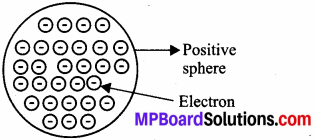
According to Thomson’s model, an atom consist of a positively charged sphere and electrons are embedded in it. So, both charges are equal which makes the atom electrically neutral.

Question 2.
On the basis of Rutherford’s model of an atom, which sub – atomic particle is present in the nucleus of an atom?
Answer:
Proton is the sub – atomic particle which is present in the nucleus of an atom.
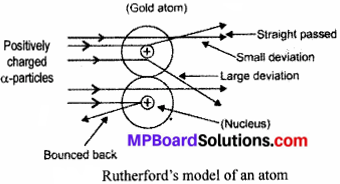
MP Board Class 9th Science Solutions Chapter 4 Structure of the Atom 1

Question 3.
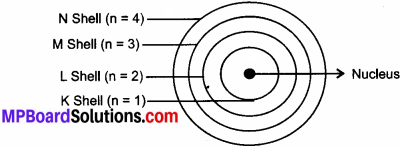
Draw a sketch of Bohr’s model of an atom with three shells.
Answer:
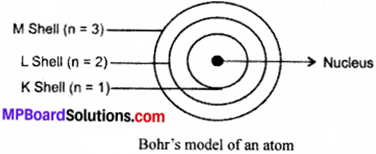
MP Board Class 9th Science Solutions Chapter 4 Structure of the Atom 2

Question 4.
What do you think would be the observation if the a-particle scattering experiment is carried out using a foil of a metal other than gold?
Answer:
The observations would be same as that of gold foil.

Structure of the Atom Intext Questions Page No. 49

Question 1.
Name the three sub – atomic particles of an atom.
Answer:

  1. Positively charged – Protons
  2. Negatively charged – Electrons
  3. No charged – Neutrons.

Question 2.
Helium atom has an atomic mass of 4u and two protons in its nucleus. How many neutrons does it have?
Answer:
Atomic mass = Number of protons + Number of neutrons
∴ 4 = 2 + Number of neutrons
∴ Number of neutrons = 4 – 2 = 2.

Structure of the Atom Intext Questions Page No. 50

Question 1.
Write the distribution of electrons in carbon and sodium atoms.
Answer:
Atomic number of Carbon = 6
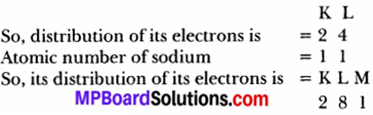
MP Board Class 9th Science Solutions Chapter 4 Structure of the Atom 3

Question 2.
If K and L shells of an atom are full, then what would be the total number of electrons in the atom?
Answer:
K shell is the 1 shell
So, n = 1
Then maximum electron’s = 2n2 = 2 × (1)2
= 2 × 1 = 2
and L shell is the second shell.
So, n = 2
Then maximum electrons = 2(n)2
= 2 × (2)2 = 8
∴ Total number of electrons = 2 + 8 = 10.

Structure of the Atom Intext Questions Page No. 52

Question 1.
How will you find the valency of chlorine, sulphur and magnesium?
Answer:
We know that valency is the number of electrons lost, gained or shared by atom to become stable or to complete 8 electrons in the shell.
Now, Chlorine,
Atomic number = 17

MP Board Class 9th Science Solutions Chapter 4 Structure of the Atom 4
Then, it will take 8 – 7 = 1 electron to complete its shell.
∴ Its valency is ‘I’
Sulphur, Atomic number = 16

MP Board Class 9th Science Solutions Chapter 4 Structure of the Atom 5
It will take 8-6 = 2 electrons to complete its shell.
∴ Its valency is ‘2’.
Magnesium, Atomic number = 12

MP Board Class 9th Science Solutions Chapter 4 Structure of the Atom 6
It will lose 2 electrons from its outermost shell to become stable.
∴ Its valency will be ‘2’.

Structure of the Atom Intext Questions Page No. 52

Question 1.
If number of electrons in an atom is 8 and number of protons is also 8 then,
(i) What is the atomic number of the atom? and
(ii) What is the charge on the atom?
Answer:
(i) Number of electrons = 8 and,
Number of protons =8
Then, Atomic number = Number of protons = 8

(ii) Now, total electrons (-) = Total protons (+)
So, atom will be electrically neutral.

MP Board Solutions

Question 2.
With the help of table 4.1 of Textbook, find out the mass number of oxygen and sulphur atom.
Answer:
From the table, we have,
Oxygen,
Mass Number = Number of protons + Number of neutrons
= 8 + 8 = 16
Sulphur,
Mass number = Number of protons + Number of neutrons
= 16 + 16 = 32.

Structure of the Atom Intext Questions Page No. 53

Question 1.
For the symbol H, D, and T tabulate three sub – atomic particles found in each of them.
Answer:
H, D, and T stand for protium, deuterium and tritium as isotopes of hydrogen atom.
Table:
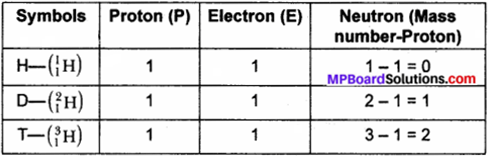
MP Board Class 9th Science Solutions Chapter 4 Structure of the Atom 7

Question 2.
Write the electronic configuration of any one pair of isotopes and isobars.
Answer:
Pair of isotopes: \(_{ 6 }^{ 12 }{ C }\), \(_{ 6 }^{ 14 }{ C }\)
Electronic configuration:
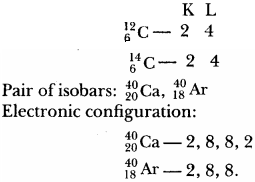
MP Board Class 9th Science Solutions Chapter 4 Structure of the Atom 8

Structure of the Atom NCERT Textbook Exercises

Question 1.
Compare the properties of electrons, protons and neutrons.
Answer:
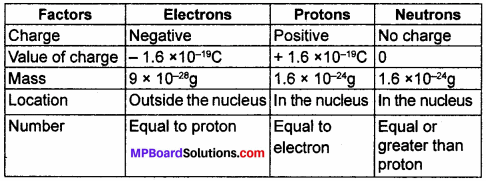
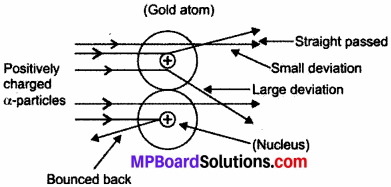
MP Board Class 9th Science Solutions Chapter 4 Structure of the Atom 10

Question 2.
What are the limitations of J.J. Thomson’s model of the atom?
Answer:
J.J. Thomson’s model explained the existence of positive charge in the form of sphere and electrons embedded in it. But, he was unable to explain the Rutherford’s gold foil experiment in which most of positive α – particles passed straight, existence of electrons in the circular path and protons at the centre of the atom.

MP Board Solutions

Question 3.
What are the limitations of Rutherford’s model of the atom?
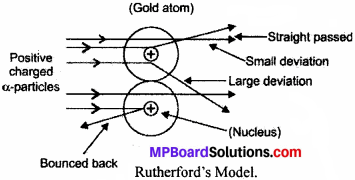
MP Board Class 9th Science Solutions Chapter 4 Structure of the Atom 11
Answer:
Rutherford explained that electrons revolve in a circular path which is found contradictory in terms of stability of atom. Because electrons are negatively charged and when they move continuously in circular paths then they should lose their energies and finally, fall into the positively charged nucleus making atoms unstable and collapse.

Question 4.
Describe Bohr’s Model of the atom.
Answer:
Neils Bohr proposed the theory for model of the atom. It is explained as:

  1. Atom is made up of three sub – atomic particles as electrons, protons and neutrons.
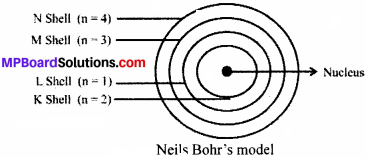
    MP Board Class 9th Science Solutions Chapter 4 Structure of the Atom 12
  2. The electrons move round the nucleus in fixed circular paths called orbits or shells.
  3. The orbits are represented by the letters K, L, M, N, or the number n = 1, 2, 3, 4.
  4. Centre of the atom is called the nucleus.
  5. Electrons do not radiate energies while revolving in the orbits.
  6. Electrons gain energy when they jump from lower shell to higher shell and lose energy when they return down from higher energy level to lower energy level.

Question 5.
Compare all the proposed models of an atom given in this chapter.
Answer:
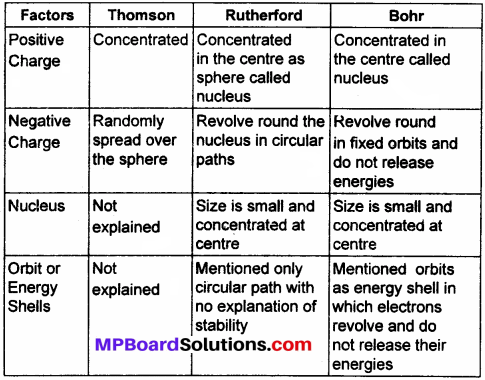
MP Board Class 9th Science Solutions Chapter 4 Structure of the Atom 13

Question 6.
Summarise the rules for writing of distribution of electrons in various shells for the first eighteen elements.
Answer:
Rules:

(a) Maximum electrons present in a shell is given by 2n2 whereas n is the number of that shell.
Like,

  • K Shell, n = 1 → 2n2 = 2 × (1)2 = 2
  • L Shell, n = 2 → 2n2 = 2 × (2)2 = 8
  • M Shell, n = 3 → 2n2 = 2 × (3)2 = 18
  • N Shell, n = 4 → 2n2 = 2 × (4)2 = 32.

(b) The outermost shell can have maximum of 8 electrons.
(c) Electrons cannot be occupied in a shell till its inner shells or orbits are completely filled.

Question 7.
Define valency by taking examples of silicon and oxygen.
Answer:
Valency is the combining capacity of an atom to become electrically stable. Or It means how many electrons are lost or gained by an atom to become stable.
In Silicon,

MP Board Class 9th Science Solutions Chapter 4 Structure of the Atom 30
It has 4 valence electrons.
So, it will lose 4 electrons to become stable.
∴ Its valency is 4.
In Oxygen,

MP Board Class 9th Science Solutions Chapter 4 Structure of the Atom 31
It has 6 valence electrons.
So, it will gain 8 – 6 = 2 electrons to become stable.
∴ Its valency is 2.

Question 8.
Explain with examples:
(i) Atomic number
(ii) Mass number
(iii) Isotopes
(iv) Isobars
Give any two uses of isotopes.
Answer:
(i) Atomic number: It is equal to the total number of
protons in the nucleus of its atom.
E.g.,

  • Carbon has 6 protons. So, its atomic number is 6.

(ii) Mass number: It is equal to the sum of total number of protons and neutrons in the nucleus.
E.g.,

  • Sodium has 11 protons and 12 neutrons. So, its mass number is 11 + 12 = 23

(iii) Isotopes: These are atoms of the same element having same atomic number, but different mass number.
E.g.

  • \(_{ 35 }^{ 79 }{ Br }\), \(_{ 35 }^{ 81 }{ Br }\), \(_{ 6 }^{ 12 }{ C }\), \(_{ 6 }^{ 14 }{ C }\)

(iv) Isobars: These are the atoms of different elements having different atomic number but same mass number.
E.g.

  • \(_{ 18 }^{ 40 }{ Ar }\), \(_{ 20 }^{ 40 }{ Ca }\), \(_{ 11 }^{ 24 }{ Na }\), \(_{ 12 }^{ 24 }{ Mg }\)

Use of Isotopes:

  • Uranium isotope is used as a fuel in nuclear reactor for generating electricity.
  • Sodium isotope is used to detect the blood clots.

MP Board Solutions

Question 9.
Na+ has completely filled K and L shells. Explain.
Answer:
Atomic number of sodium (Na) is 11.

MP Board Class 9th Science Solutions Chapter 4 Structure of the Atom 14
Now, if Na loses 1 electron then it will become Na+.

MP Board Class 9th Science Solutions Chapter 4 Structure of the Atom 15
Now K shell can have maximum of 2 electrons and L shell can have maximum of 8 electrons.
Then, Na+ has completely filled K and L shell.

Question 10.
If bromine atom is available in the form of, say, two isotopes \(_{ 35 }^{ 79 }{ Br }\) (49.7%) and \(_{ 35 }^{ 81 }{ Br }\)Br (50.3%), calculate the average atomic mass of bromine atom.
Answer:
Average atomic mass of bromine atom
= 49.7% of atomic mass of \(_{ 35 }^{ 79 }{ Br }\) + 50.3% of atomic mass of \(_{ 35 }^{ 81 }{ Br }\)
= 49.7% of 79 + 50.3% of 81
= \(\frac { 49.7 }{ 100 }\) × 49 + \(\frac { 450.3 }{ 100 }\) × 81
= (39.263 + 40.743)u = 80.006u

Question 11.
The average atomic mass of a sample of an element X is 16.2u. What are the percentages of isotopes If \(_{ 8 }^{ 16 }{ X }\) and \(_{ 8 }^{ 18 }{ X }\) in the sample?
Answer:
Let the percentage of \(_{ 8 }^{ 16 }{ X }\) in sample be x% and percentage of \(_{ 8 }^{ 18 }{ X }\) in sample be (100 – x)%.
Now,
x% of 16 + (100 – x)% of 18 = 16.2

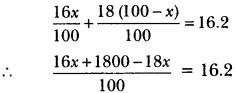
MP Board Class 9th Science Solutions Chapter 4 Structure of the Atom 16
MP Board Class 9th Science Solutions Chapter 4 Structure of the Atom 17
-2x + 1800 = 16.2 × 100 – 2x + 1800 = 1620
∴ -2x = 1620- 1800 = -180
x = \(\frac {180}{2}\) = 90.
∴ Percentage of  \(_{ 8 }^{ 16 }{ X }\) is 90% and percentage of \(_{ 8 }^{ 18 }{ X }\) is (100 – 90)% = 10%.

Question 12.
If Z = 3, what would be the valency of the element? Also, name the element.
Answer:
Z = 3
So, atomic number = 3 (∵ Z = atomic number)
∴ Electronic configuration = 2, 1
Valency = 1
The name of the element is lithium (Li).

Question 13.
Composition of the nuclei of two atomic species X and Y are given as under
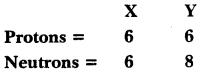
MP Board Class 9th Science Solutions Chapter 4 Structure of the Atom 18
Give the mass number of X and Y. What is the relation between the two species?
Answer:
Mass number of X = Protons + Neutrons = 6 + 6 = 12
And,
Mass number of Y = Protons + Neutrons = 6 + 8 = 14
Both species have same atomic number.
So, they are isotopes of the same element.

Question 14.
For the following statements, write T for True and F for False.

  1. J.J. Thomson proposed that the nucleus of an atom contains only nucleons.
  2. A neutron is formed by an electron and a proton combining together. Therefore, it is neutral.
  3. The mass of an electron is \(\frac {1}{2000}\) times that of proton.
  4. An isotope of iodine is used for making tincture iodine which is used as a medicine.

Answer:

  1. False
  2. False
  3. True
  4. False.

Put tick (✓) against correct choice and cross (✗) against wrong choice in questions 15, 16 and 17.

Question 15.
Rutherford’s alpha – particle scattering experiment was responsible for the discovery of.
(a) Atomic nucleus
(b) Electron
(c) Proton
(d) Neutron.
Answer:
(a) Atomic nucleus

Question 16.
Isotopes of an element have.
(a) the same physical properties
(b) different chemical properties
(c) different number of neutrons
(d) different atomic numbers.
Answer:
(c) different number of neutrons

MP Board Solutions

Question 17.
Number of valence electrons in Cl ion are:
(a) 16
(b) 8
(c) 17
(d) 18
Answer:
(b) 8

Question 18.
Which one of the following is a correct electronic configuration of sodium?
(a) 2, 8
(b) 8, 2, 1
(c) 2, 1, 8
(d) 2, 8, 1.
Answer:
(d) 2, 8, 1.

Question 19.
Complete the following table:

Atomic NumberMass NumberNumber of NeutronsNumber of ProtonsNumber of ElectronsName of the Atomic Species
910
1632Sulphur
2412
21
1010

Answer:

Atomic Number

Mass NumberNumber of
Neutrons
Number of
Pro-­tons
Number of Elec­tronsName of the Atomic Species
9191099Fluorine
16321666Sulphur
1224121212Magnesium
12111Hydrogen
11010Deuterium

Structure of the Atom Additional Questions

Structure of the Atom Multiple Choice Questions

Question 1.
Which is a positive sub – atomic particle?
(a) Proton
(b) Neutron
(c) Electron
(d) None of these.
Answer:
(a) Proton

Question 2.
Electron is discovered by _____ .
(a) J.Chadwick
(b) Neils Bohr
(c) J.J Thomson
(d) Rutherford.
Answer:
(c) J.J Thomson

Question 3.
Proton is discovered by _____ .
(a) Rutherford
(b) J. Chadwick
(c) J J. Thomson
(d) E. Goldstein.
Answer:
(d) E. Goldstein.

Question 4.
Neutron is discovered by _____ .
(a) J.J. Thomson
(b) J. Chadwick
(c) Neils Bohr
(d) Rutherford.
Answer:
(b) J. Chadwick

Question 5.
Nucleus is discovered by _____ .
(a) Rutherford
(b) J. Chadwick
(c) J.J. Thomson
(d) Neils Bohr.
Answer:
(a) Rutherford

MP Board Solutions

Question 6.
Mass of electron is _____ .
(a) 9 × 10-25g
(b) 6 × 10-28g
(c) 8 × 10-24g
(d) 9 × 10-28g.
Answer:
(d) 9 × 10-28g.

Question 7.
Mass of Neutron is _____ .
(a) 1.6 × 10⁻²²g
(b) 1.6 × 10⁻²³g
(c) 1.6 × 10⁻²⁵g
(d) 1.6 × 10⁻²⁴g.
Answer:
(d) 1.6 × 10⁻²⁴g.

Question 8.
Charge on an electron is _____ .
(a) -1.8 × 10⁻¹⁸C
(b) -1.7 × 10⁻²⁰C
(c) -1.6 × 10⁻¹⁹C
(d) -1.5 × 10⁻²¹C.
Answer:
(c) -1.6 × 10⁻¹⁹C

Question 9.
The energy paths in an atom in which electrons revolve are called _____ .
(a) Rings
(b) Cycles
(c) Orbits
(d) Circles.
Answer:
(c) Orbits

Question 10.
ass number is the sum of _____ .
(a) Protons and Electrons
(b) Protons and Neutrons
(c) Electrons, Protons and Neutrons
(d) None of these.
Answer:
(c) Electrons, Protons and Neutrons

Question 11.
Atomic number is equal to _____ .
(a) Number of protons
(b) Number of neutrons
(c) Number of electrons
(d) Both (a) and (c).
Answer:
(d) Both (a) and (c)

Question 12.
Maximum number of electrons that can be filled in ‘M’ shell are _____ .
(a) 17
(b) 19
(c) 18
(d) 20.
Answer:
(c) 18

Question 13.
An atom has atomic number ‘17’, then its valency will be _____ .
(a) 7
(b) 2
(c) 1
(d) 8.
Answer:
(c) 1

Question 14.
Isotopes of an element have same number of _____ .
(a) Neutrons
(b) Protons
(c) Electrons
(d) Both (b) and (c).
Answer:
(c) Electrons

Question 15.
Isobars of different elements have same _____ .
(a) Atomic number
(b) Electrons
(c) Mass number
(d) Neutrons.
Answer:
(d) Neutrons

Structure of the Atom Very Short Answer Type Questions

Question 1.
Who discovered canal rays?
Answer:
E. Goldstein.

Question 2.
Name the fruit which resembles J.J. Thomson model of atom.
Answer:
Watermelon.

Question 3.
Who discovered nucleus?
Answer:
Ernest Rutherford.

Question 4.
Who discovered neutrons?
Answer:
James Chadwick.

Question 5.
Name the central part of an atom where protons and neutrons are held together.
Answer:
Nucleus.

MP Board Solutions

Question 6.
What is Alpha Particle?
Answer:
It is a Helium ion (He2+) which has 2 units of positive charge and 4 units of mass.

Question 7.
What are cathode rays?
Answer:
Cathode rays are a beam of fast moving electrons.

Question 8.
What was the main drawback of Rutherford’s model of the atom?
Answer:
Inability to explain the stability of atom.

Question 9.
Write the symbolic representation of an element A with atomic number 10 and mass number 20.
Answer:
\(_{ 10 }^{ 20 }{ A }\)

Question 10.
Name three Isotopes of Hydrogen.
Answer:

  1. Protium (\(_{ 1 }^{ 1 }{ H }\))
  2. Deuterium (\(_{ 1 }^{ 2 }{ H }\))
  3. Tritium (\(_{ 1 }^{ 3 }{ H }\))

Question 11.
Write the electronic configuration of potassium (K).
Answer:
Atomic number of potassium (K) =19

MP Board Class 9th Science Solutions Chapter 4 Structure of the Atom 32

Question 12.
Define valency.
Answer:
It is the combining capacity of an atom to become electrically stable.

Question 13.
What is the charge of a proton?
Answer:
1.6 × 10⁻¹⁹C.

Question 14.
Write the year of discoveries of these sub – atomic particles – electron, proton, neutron and neucleus.
Answer:

  1. Electron – 1897
  2. Proton – 1866
  3. Neutron – 1932
  4. Nucleus – 1911.

Question 15.
Which radioactive Isotope is used in treatment of goitre?
Answer:
Iodine – 131.

Structure of the Atom Short Answer Type Questions

Question 1.
Define:
(a) Canal rays
(b) Cathode rays
(c) Atomic number
(d) Mass number
(e) Energy shells
(f) Valency
(g) Octet
(h) Isotopes
(t) Isobars.
Answer:
(a) Canal rays: These are positively charged radiations which led to the discovery of sub – atomic positively charged particles called protons through an experiment conducted by J.J. Thomson in 1897.

(b) Cathode rays: These are negatively charged radiations which led to the discovery of sub – atomic negatively charged particles called electrons during an experiment conducted by E. Goldstein in 1866.

(c) Atomic number: It is the number of protons present in the nucleus of an atom. It is represented by the letter ‘Z’.

(d) Mass number: It is the total number of protons and neutrons present in an atom of an element.
So, Mass number = Number of protons + Number of neutrons.

(e) Energy Shells: These are fixed circular paths around the nucleus of an atom in which electrons revolve continuously with high speed. These are also called orbits. They are represented by the alphabets K, L, M, N.

(f) Valency: It is the combining capacity of an atom to become electrically stable, or it also means the number of valency electrons lost or gained by an atom to complete the eight electrons in the valence shell.

(g) Octet: The completely filled outermost shell like L, M or N with 8 electrons is called an octet. When an atom completes its octet, then it become stable.

(h) Isotopes: These are atoms of same element having same atomic number, but different mass number.

E.g.

  • (\(_{ 1 }^{ 1}{ H }\)) , (\(_{ 1 }^{ 2 }{ H }\)), (\(_{ 1 }^{ 3 }{ H }\)) and \(_{ 6 }^{ 12 }{ C }\), \(_{ 6 }^{ 14 }{ C }\)are the isotopes of hydrogen and carbon respectively.

(i) Isobars: These are atoms of different elements having different atomic number but same mass number.
E.g.

  • \(_{ 18 }^{ 40 }{ Ar }\), \(_{ 20 }^{ 40 }{ Ca }\) and \(_{ 11 }^{ 24 }{ Na }\), \(_{ 12 }^{ 24 }{ Mg }\).

Question 2.
Differentiate between:
(a) Electrons and protons.
(b) Atomic number and mass number.
(c) Isotopes and isobars.
(d) Valence electrons and valency.
Answer:
(a)

ElectronsProtons
(i) This is negatively charged sub – atomic particle.(i) This is positively charged sub – atomic particle.
(ii) Its mass is 9 × 1028gms.(ii) Its mass is 1.6 × 10⁻²⁴gms.
(iii) Its symbol is “e”.(iii) Its symbol is “P+”.

(b)

Atomic numberAtomic mass
(i) It is the total number of protons present in the atom.(i) It is the sum of protons and neutrons present in the atom.
(ii) It is represented by ‘Z’.(ii) It is represented by ‘A’.
(iii) It is written on the bottom left as a subscript with the symbol the of element.(iii) It is written on top left as a subscript with the symbol the of element.

(c)

IsotopesIsobars
(i) These are atoms of the same element.(i) These are atoms of the different elements.
(ii) They have same atomic number.(ii) They have different atomic number.
(iii) They have different mass number.(iii) They have same mass number.
(iv) They have same chemical properties.(iv) They have different chemical properties.

(d)

Valence ElectronsValency
(i) These are electrons present in the outermost shell of an atom.(i) These are electrons lost or gained through valence shell of an atom to become stable.
(ii) Valence electrons can be 1, 2, 3 …….. 8 or more.(ii) Valency can be 0, 1, 2, 3, 4 only.

Question 3.
Draw the diagrams of:
(a) J.J. Thomson’s model of atom.
(b) Rutherford’s model of atom.
(c) Neils Bohr’s model of atom.
Answer:
(a) J.J. Thomson’s Model:
MP Board Class 9th Science Solutions Chapter 4 Structure of the Atom 19

(b) Rutherford’s Model:
MP Board Class 9th Science Solutions Chapter 4 Structure of the Atom 20

(c) Neils Bohr’s model of atom.
MP Board Class 9th Science Solutions Chapter 4 Structure of the Atom 21

Question 4.
Write the postulates of J.J. Thomson’s model of the atom.
Answer:
J.J. Thomson’s postulates for model of the atom are as follows:

  1. An atom is a positively charged sphere or ball and negatively charged electrons are embedded in it.
  2. The atom is electrically neutral because negative and positive charges are equal in magnitude.

Question 5.
Write the main points of the theory given by Rutherford for model of atom.
Answer:
Main points of theory of Rutherford regarding model of atom are:

  1. There is an existence of positively charged centre in the atom called as nucleus which contains all the mass of the atom.
  2. The electrons revolve round the nucleus in circular paths called orbits at high speeds.
  3. The size of nucleus (centre of the atom) is very small as compared to size of the atom.
  4. Most of the sphere in an atom is empty.

Question 6.
Write the rules given by Bohr – Bury for arrangement of electrons in different orbits in an atom.
Answer:
Rules given by Bohr – Bury are as follows:

  1. Maximum electrons present in a shell is given by 2n2 where
    • n is the number of that shell.
    • Like, for first shell K, n = 1
    • For second shell L, n = 2
    • third shell M, n = 3
    • fourth shell N, n = 4 called as nucleus which contains all the mass of the atom.
  2. The outermost shell can have maximum of 8 electrons.
  3. Electrons cannot occupy a shell till its inner shells or orbits are completely filled.

MP Board Solutions

Question 7.
An atom ‘X’ has a mass number ‘23’ and atomic number ‘11’. Find its electrons, protons and neutrons. Also, name the element
Answer:
We know,
Atomic number = Number of protons.
∴ 11 = Number of protons
And, Number of protons = Number of electrons.
∴ Number of electrons = 11
Now, Mass number = Protons + Neutrons.
23 = 11 + Neutrons
∴ Neutrons = 23 – 11 = 12
∴ Atom ‘X’ has 11 electrons, 11 protons and 12 neutrons.
The element is Sodium (Na).

Question 8.
Write the electronic configuration of neon, aluminium, sulphur, argon. Also, find valencies.
Answer:
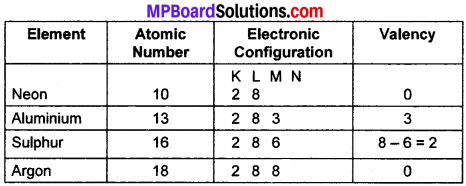
MP Board Class 9th Science Solutions Chapter 4 Structure of the Atom 22

Question 9.
What are radioactive isotopes? Write down the type of isotopes used in:
(a) Tracing blood clots and tumours in human body
(b) Treatment of cancer
(c) Treatment of Goitre
(d) Nuclear reactor as a fuel.
Answer:
Radioactive isotopes: These are unstable isotopes due to extra neutrons in their nucleus and emits different types of radiations.
Examples:

  • Uranium – 235
  • Cobalt – 60
  • Carbon – 14.

Types of Isotopes used in:
(a) Sodium – 24 to detect blood clots and Arsenic – 72 to detect tumours.
(b) Cobalt – 60
(c) Iodine-131
(d) Uranium – 235.

Question 10.
Draw the atomic structure of:
(a) Fluorine atom (F)
(b) Sodium atom (Na)
(c) Potassium atom (K)
Answer:
(a) Fluorine atom (F):
Atomic number: 9
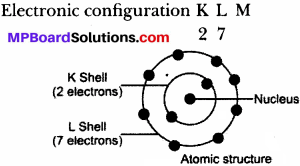
MP Board Class 9th Science Solutions Chapter 4 Structure of the Atom 23

(b) Sodium atom (Na)
Atomic number: 11
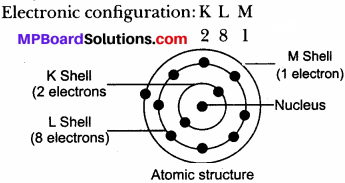
MP Board Class 9th Science Solutions Chapter 4 Structure of the Atom 24

(c) Potassium atom (K)
Atomic number: 19
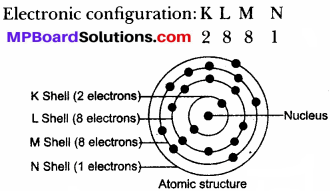
MP Board Class 9th Science Solutions Chapter 4 Structure of the Atom 25

Question 11.
Write the atomic number, mass number, electrons, protons and neutrons of following atoms:
(a) \(_{ 14 }^{ 24 }{ X }\)
(b) \(_{ 13 }^{ 27 }{ X }\)
Answer:
(a) \(_{ 14 }^{ 24 }{ X }\)
Atomic number = 14
Mass number = 24
Electrons = 14
Protons = 14
Neutrons = 24 – 14 = 10

(b) \(_{ 13 }^{ 27 }{ X }\)
Atomic number = 13
Mass number = 27
Electrons = 13
Protons = 13
Neutrons = 27 – 13 = 14

Question 12.
Pick out the Isotopes and Isobars from the following atoms:
\(_{ 17 }^{ 37 }{ A }\), \(_{ 18 }^{ 40 }{ A }\), \(_{ 17 }^{ 33 }{ A }\), \(_{ 20 }^{ 40 }{ A }\).
Answer:

  1. Isotopes: \(_{ 17 }^{ 37 }{ A }\), \(_{ 17 }^{ 33 }{ A }\)
  2. Isobars: \(_{ 18 }^{ 40 }{ A }\), \(_{ 20 }^{ 40 }{ A }\).

Question 13.
What are noble gases? Why they are stable? Give three examples.
Answer:
Noble gases are the elements which are stable and do not take part in chemical reaction.
They are stable because they have completely filled outer- most shell with 8 electrons
example:
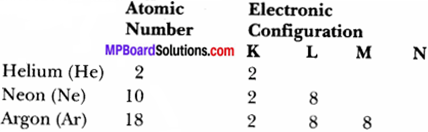
MP Board Class 9th Science Solutions Chapter 4 Structure of the Atom 26
Helium is the only noble gas which has 2 electrons in outermost shell.

Question 14.
Write all the Isotopes of:

  1. Hydrogen
  2. Oxygen
  3. Chlorine
  4. Bromine
  5. Carbon
  6. Neon.

Answer:

  1. Hydrogen (H) – \(_{ 1 }^{ 1 }{ H }\), \(_{ 1 }^{ 2 }{ H }\)
  2. Oxygen (O) – \(_{ 8 }^{ 16 }{ O }\), \(_{ 8 }^{ 17 }{ O }\), \(_{ 8 }^{ 18 }{ O }\)
  3. Chlorine (Cl) – \(_{ 17 }^{ 35 }{ Cl }\), \(_{ 17 }^{ 37 }{ Cl }\)
  4. Bromine (Br) – \(_{ 35 }^{ 79 }{ Br }\), \(_{ 35 }^{ 81 }{ Br }\)
  5. Carbon (C) – \(_{ 6 }^{ 12 }{ C }\), \(_{ 6 }^{ 14 }{ C }\)
  6. Neon (Ne) –  \(_{ 10 }^{ 20 }{ Ne }\), \(_{ 10 }^{ 21 }{ Ne }\), \(_{ 10 }^{ 22 }{ Ne }\)

Question 15.
Why is it wrong to say that atomic number of an atom is equal to its number of electrons?
Answer:
We know that in an atom number of electrons is equal to the number of protons. But, we cannot say that atomic number is equal to number of electrons because number of electrons can be changed after losing or gaining by an atom during chemical reaction. But, number of protons remain constant.

Question 16.
What explanation did Neils Bohr gave on stability of atoms?
Answer:
Neils Bohr explained the stability of atom through following points:

  1. The electrons revolve around the nucleus in fixed orbits or energy levels or shells and each orbit has its fixed radius.
  2. While revolving electrons do not radiate their energies, so they do not fall into the nucleus and make the atom stable.

Question 17.
What are nucleons? What is the name given to the atoms having same number of nucleons?
Answer:
Protons and neutrons together in the nucleus are called nucleons. It means number of nucleons is equal to the sum of protons and neutrons. Atoms having same number of nucleons are called isobars.

Structure of the Atom Long Answer Types Questions

Question 1.
The average atomic mass of a sample of an element X is 13u. What are the percentages of isotopes \(_{ 6 }^{ 12 }{ X }\) and \(_{ 6 }^{ 14 }{ X }\) in the sample?
Answer:
Let, the percentage of isotope \(_{ 6 }^{ 12 }{ X }\) be x%.
So, percentage of isotope \(_{ 6 }^{ 14 }{ X }\) is (100- x) %.
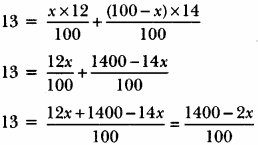
Now, Average atomic mass = Mass of \(_{ 6 }^{ 12 }{ X }\) + Mass of \(_{ 6 }^{ 14 }{ X }\) According to percentages,
∴ 13 = x% of 12 + (100 – x)% of 14
MP Board Class 9th Science Solutions Chapter 4 Structure of the Atom 27
∴ 13 × 100 = 1400 – 2x
1300 = 1400 – 2x
1300 = 1400 – 2x
-100 = -2x
x = \(\frac { 100 }{2 }\) = 50
So, percentage of \(_{ 6 }^{ 12 }{ X }\) is 50% and percentage of \(_{ 6 }^{ 14 }{ X }\) is
= (100 – x)%
= (100 – 50)%
= 50%

MP Board Solutions

Question 2.
Explain Rutherford’s Gold Foil Experiment. Also, explain its observations conclusion, theory proposed and drawback of his model.
Answer:
Ernest Rutherford performed an alpha-particles scattering experiment in which he passed a-particles on the gold foil.
Observation:

  1. Most of α – particles passed straight without any deflection.
  2. Some of the α – particles get deflected from their path.
  3. Very few α – particles get completely bounced back.

Conclusions:

  1. Maximum space in an atom is vacant as most of α – particles passed straight without any deflection.
  2. Some α – particles get deflected from their paths show the existence of positive charge in the atom.
  3. Very few α – particles get completely bounced back indicating the concentration of all mass with positive charge in a small volume at the centre.

Theory proposed:

  1. There is an existence of positively charged centre in the atom called nucleus which contains all the mass of the atom.
  2. The electrons revolve around the nucleus in circular paths called orbits at high speeds.
  3. The size of nucleus (centre of the atom) is very small as compared to size of the atom.
  4. Most of the space in an atom is empty.

Drawback: Rutherford’s model did not explain the stability of the atom. He proposed that electron revolves around the nucleus in circular paths. So, electrons should radiate their energies as they are continuously in circular motion. Then, they should fall into the positively charged nucleus making the atom unstable and collapse.

Question 3.
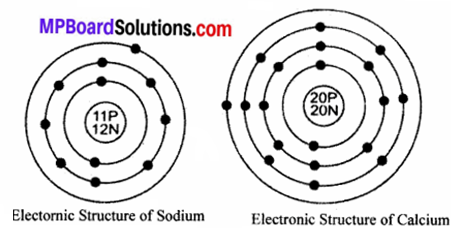
Draw the electronic structure of sodium and calcium with atomic number 11 and 20 respectively.
Answer:
Sodium has electronic distribution as 2, 8, 1
Calcium has electronic distribution as 2, 8, 8, 2
Electronic structures of sodium and calcium are given:
MP Board Class 9th Science Solutions Chapter 4 Structure of the Atom 28

Question 4.
Both helium (He) and beryllium (Be) have two valence electrons. Whereas ‘He’ represents a noble gas element, ‘Be’ does not. Assign reason.
Answer:
The element He (Z = 2) has two electrons present in the only shell
i.e., K – shell. Since, this shell can have a maximum of two electrons only therefore,
‘He’ is a noble gas element.
The element ‘Be’ (Z = 4) has the electronic configuration as: 2,2.
Although, the second shell has also two electrons but it do not represent a noble gas element.

Structure of the Atom Higher Order Thinking Skills (HOTS)

Question 1.
Which isotope of hydrogen contain same number of electrons, protons and neutrons?
Answer:
Deuterium (\(_{ 1 }^{ 2 }{ D }\))
Number of electron (1) = Number of proton (1)
= Number of neutron (2 – 1 = 1)

Question 2.
Which element of these two would be chemically more reactive: element A with atomic number 18 or element B with atomic number 16 and why?
Answer:
Electric configuration of

  • A – 2,8,8
  • B – 2, 8, 6

Since, the outermost shell of A is complete, it would be inert and will not react. Whereas element B require two atoms to complete its octet. Therefore, B would be more reactive.

Structure of the Atom Value Based Question

Question 1.
Shivek could not solve the following question in the group. His group – mate explained him and solved his difficulty.
The question was as follows:
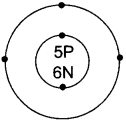
MP Board Class 9th Science Solutions Chapter 4 Structure of the Atom 29
What information do you get from the given figure about the atomic number, mass number and valency of the given atom ‘X’:

  1. What is the atomic number, the mass number and valency of the atom?
  2. Name the element ‘X’.
  3. What value of Shivek’s friend are reflected in this behaviour?

Answer:

  1. The atomic number is 5, The mass number is 11, The valency is 3.
  2. The element ‘X’ is boron.
  3. Shivek’s friend showed the values of helping and caring nature.
MP Board Class 9th Science Solutions

MP Board Class 9th Maths Solutions Chapter 5 Introduction to Euclid’s Geometry Ex  5.2

MP Board Class 9th Maths Solutions Chapter 5 Introduction to Euclid’s Geometry Ex  5.2

MP Board Solutions

Question 1.
How would you rewrite Euclid’s fifth postulate so that it would be easier to understand?
Solution:
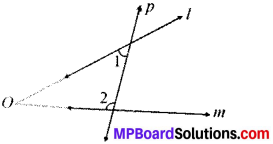
If a line p intersects two lines l and m such that (∠1 + ∠2) is less than 180°, then lines l and m will meet at O, as shown in Fig. below.
MP Board Class 9th Maths Solutions Chapter 5 Introduction to Euclid’s Geometry Ex  5.2 img-1

Question 2.
Does Euclid’s fifth postulate imply the existence of parallel lines? Explain.
Solution:
Yes, Euclid’s fifth postulate is important to express parallel lines. Two lines will never meet if they are not according to Euclid’s fifth postulate.

MP Board Class 9th Maths Solutions

MP Board Class 9th Maths Solutions Chapter 5 Introduction to Euclid’s Geometry Ex  5.1

MP Board Class 9th Maths Solutions Chapter 5 Introduction to Euclid’s Geometry Ex  5.1

Question 1.
Which of the following statements are true and which are false? Give reasons for your answers.

  1. Only one line can pass through a single point.
  2. There are infinite number of lines which pass through two distinct points.
  3. A terminated line can be produced indefinitely on both the sides.
  4. If two circles are equal, then their radii are equal.
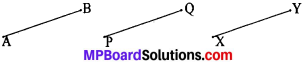
  5. In Fig. below, if AB = PQ and PQ = XY, then AB = XY.

MP Board Class 9th Maths Solutions Chapter 5 Introduction to Euclid’s Geometry Ex  5.1 img-1
Solution:

  1. False, infinitely many lines can pass through a given point.
  2. False, only one line can pass through two distinct points.
  3. True, by postulate 2 i.e., a terminated line can be produced indefinitely.
  4. True, equal circles coincide each other. Therefore their radii will be equal.
  5. True, by Euclid’s axiom 1, i.e., things which are equal to the same thing are equal to one another.

MP Board Solutions

Question 2.
Give a definition for each of the following terms. Are there other terms that need to be defined first? What are they, and how might you define them?

  1. parallel lines
  2. perpendicular lines
  3. line segment
  4. radius of a circle
  5. square

Solution:
1. Parallel lines:
Two distinct lines in a plane are called parallel lines if they do not have a common point. Here the undefined terms are lines and plane.

2. Perpendicular lines:
Two lines are perpendicular to each other if they intersect each other at right angle. Here the undefined term is right angle.

3. Line segment:
A part of a line between two points on a line is called a line segment. Here the undefined term is part of a line.

4. Radius of a circle:
Radius of a circle is the distance of a point on the circle from the center of the circle.

5. Square:
A square is a rectangle having all sides equal. Here undefined term is rectangle.

Question 3.
Consider two ‘postulates’ given below:

  1. Given any two distinct points A and B, there exist a third point C which is in between A and B.
  2. There exist at least three points that are not on the same line.

Do these postulates contain any undefined terms? Are these postulates consistent? Do they follow from Euclid’s postulates? Explain.
Solution:
Yes, these postulates contain undefined terms such as point, line, distinct points. They are consistent because they deal with two different situations:

  1. Point C is lying between two distinct points A and B on a line.
  2. Point C is not lying on the line through A and B.

These postulates do not follow from Euclid’s postulates. However they follow from axiom “given two distinct points, there is a unique line that passes through them.

MP Board Solutions

Question 4.
If a point C lies between two points A and B such that AC = BC, then prove that AC = \(\frac{1}{2}\)AB. Explain by drawing the figure.

Solution:
Given: AC = BC
To prove: AC = \(\frac{1}{2}\)AB
Proof:
AC = BC
Adding AC on both sides
AC + AC = BC + AC
2AC = AB
AC = \(\frac{1}{2}\)AB

Question 5.
In Question 4, point C is called a mid-point of line segment AB. Prove that every line segment has one and only one midpoint.
Solution:
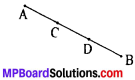
If possible, Let us assume that a line segment AB has two mid points C and D when C is the mid point of AB
MP Board Class 9th Maths Solutions Chapter 5 Introduction to Euclid’s Geometry Ex  5.1 img-2
AC = 1/2 AB …(i)
where D is the mid point of AB
AD = 1/2 AB …(ii)
From (i) and (ii), we get
AC = AD
(By Euclid’s axiom, things which are half of the same thing are equal to one another.). This is possible only if C and D coincides.
∴ Our assumption that C and D are two mid points of AB are wrong and hence a line segment has one and only one mid point.

Question 6.
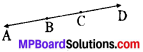
In Fig. below, if AC = BD, then prove that AB = CD.
MP Board Class 9th Maths Solutions Chapter 5 Introduction to Euclid’s Geometry Ex  5.1 img-3
Solution:
Given: AC = BD
To prove: AB = CD
Proof:
AC = BD
Subtracting BC on both sides, we get
AC – BC = BD – BC (By Euclid’s axiom-3)
∴ AB = CD

MP Board Solutions

Question 7.
Why is Axiom 5, in the list of Euclid’s axioms, considered a ‘universal truth’? (Note that the question is not about the fifth postulate).
Solution:
We know that whole is always greater than its part.

MP Board Class 9th Maths Solutions

MP Board Class 9th Maths Solutions Chapter 4 Linear Equations in Two Variables Ex 4.4

MP Board Class 9th Maths Solutions Chapter 4 Linear Equations in Two Variables Ex 4.4

Question 1.
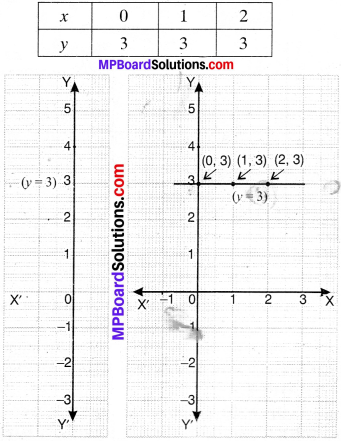
Give the geometric representations of y = 3 as an equation –

  1. In one variable
  2. in two variables.

Solution:
1. Linear equation in one variable
y = 3

2. Linear equation in two variables is
0x + y – 3 = 6
MP Board Class 9th Maths Solutions Chapter 4 Linear Equations in Two Variables Ex 4.4 img-1

Question 2.
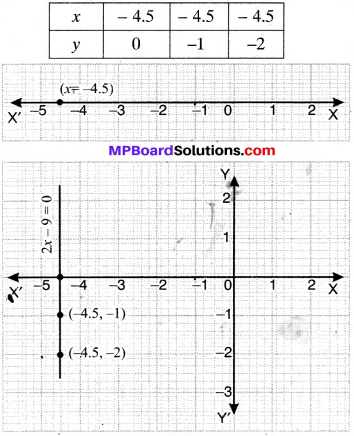
Give the geometric representation of 2x + 9 = 0 as an equation –

  1. In one variable
  2. In two variables.

Solution:
1. Linear equation in one variable
2x + 9 = 0
2x = – 9
x = – 4.5

2. Linear equation in two variables
2x + 0y + 9 = 0
MP Board Class 9th Maths Solutions Chapter 4 Linear Equations in Two Variables Ex 4.4 img-2

Equations of a Line Parallel to the x – axis and y – axis:
This is a special case when the given point lies on the axes, either x – axis or y – axis. If the point lies on x – axis, then y – coordinate will be 0 and if the point lies on y-axis, then the x-coordinate will be 0.

MP Board Solutions

Example 1.
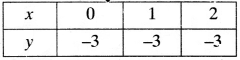
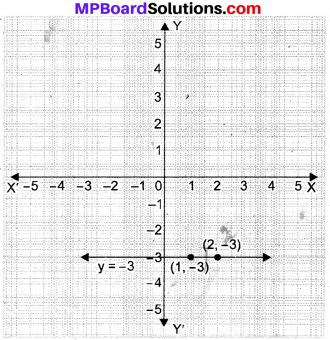
Draw the graph of the equation represented by a straight line which is parallel to the x – axis and at a distance 3 units below it. (NCERT Exemplar)
Solution:
The equation of a line which is parallel to the x-axis and at a distance of 3 units below. It is given by
y = – 3
The solutions of the equation are:
MP Board Class 9th Maths Solutions Chapter 4 Linear Equations in Two Variables Ex 4.4 img-3
The graph is shown below.
MP Board Class 9th Maths Solutions Chapter 4 Linear Equations in Two Variables Ex 4.4 img-4

MP Board Class 9th Maths Solutions

MP Board Class 9th Maths Solutions Chapter 4 Linear Equations in Two Variables Ex 4.3

MP Board Class 9th Maths Solutions Chapter 4 Linear Equations in Two Variables Ex 4.3

Question 1.
Draw the graph of each of the following linear equations in two variables:

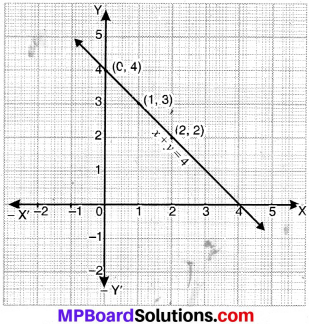
  1. x + y = 4
  2. x – y = 2
  3. y = 3x
  4. 3 = 2x + y

solution:
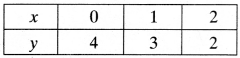
1. x + y = 4
Take x = 1
1 + y = 4
∴ y = 3

Take x = 2,
2 + y = 4
∴ y = 2

Take x = 0,
0 + y = 4
∴ y = 4

The solutions are:
MP Board Class 9th Maths Solutions Chapter 4 Linear Equations in Two Variables Ex 4.3 img-1
The graph is shown below.
MP Board Class 9th Maths Solutions Chapter 4 Linear Equations in Two Variables Ex 4.3 img-2

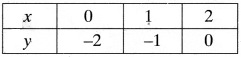
2. x – y = 2
Take x = 1,
1 – y = 2
y = 2 – 1
∴ y = – 1

Take x = 2,
2 – y = 2
– y = 2 – 2
∴ y = 0

Take x = 0,
0 – y = 2
∴ y = – 2
MP Board Class 9th Maths Solutions Chapter 4 Linear Equations in Two Variables Ex 4.3 img-3
MP Board Class 9th Maths Solutions Chapter 4 Linear Equations in Two Variables Ex 4.3 img-4

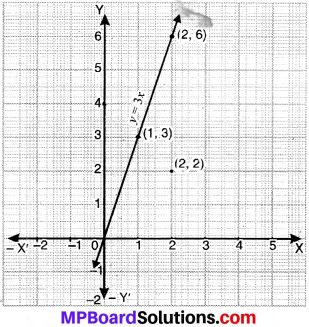
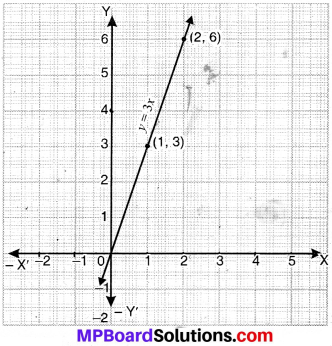
3. y – 3x
Take x = 0,
y = 3 x 0 = 0

Take x = 1,
y = 3 x 1 = 3

Take x = 2,
y = 3 x 2 = 6
MP Board Class 9th Maths Solutions Chapter 4 Linear Equations in Two Variables Ex 4.3 img-5

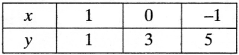
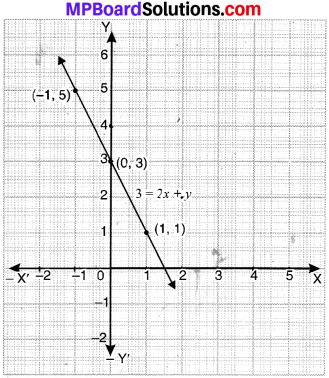
4. 3 = 2x + y
Take x = 1,
3 = 2 x 1 + y
3 = 2 + y
3 – 2 = y
∴ y = 1

Take x = 0
3 = 2 x 0 + y
∴ y = 3 – 0 = 3

Take x = -1,
3 = 2 x – 1 + y
3 = – 2 + y
∴ y = 3 + 2 = 5
MP Board Class 9th Maths Solutions Chapter 4 Linear Equations in Two Variables Ex 4.3 img-6
MP Board Class 9th Maths Solutions Chapter 4 Linear Equations in Two Variables Ex 4.3 img-7

Question 2.
Give the equations of two lines passing through (2, 14). How many more such lines are there and why?
Solution:
Two lines passing through point (2, 14)

  1. x + y = 16
  2. 2x + y – 18

Infinitely many lines can be drawn through (2, 14).

MP Board Solutions

Question 3.
If the point (3, 4) lies on the graph of the equation 3y = ax + 7, find the value of a.
Solution:
Putting the value of x = 3 and y = 4 in 3y = ax + 7, we get
3 x 4 = a x 3 + 7
12 = 3a + 7
3a = 12 – 7
a = \(\frac{5}{3}\)

Question 4.
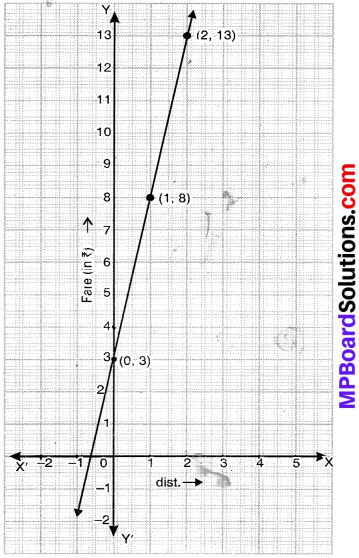
The taxi fare in a city is as follows: For the first kilometer, the fare is ₹ 8 and for the subsequent distance it is ₹ 5 per km. Taking the distance covered as x km and total fare as ₹ y, write a linear equation for this information and draw its graph.
Solution:
Distance covered = x km
Total fare = ₹ y
Fare of 1st km = ₹ 8
Fare for subsequent kms = ₹ 5 per km
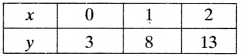
MP Board Class 9th Maths Solutions Chapter 4 Linear Equations in Two Variables Ex 4.3 img-8
According to question, y = 8 + 5 (x – 1) = 8 + 5x – 5
y = 3 + 5x
Take x = 0,
y = 3 + 5 x 0
∴ y = 3

Take x = 1,
y = 3 + 5 x 1
y = 3 + 5
∴ y = 8

Take x = 2
y = 3 + 5 x 2
∴ y = 13
MP Board Class 9th Maths Solutions Chapter 4 Linear Equations in Two Variables Ex 4.3 img-9

Question 5.
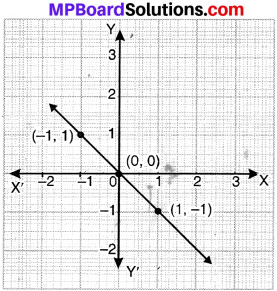
From the choices given below, choose the equation whose graphs are given in Fig. (a) and Fig. (b)
For Fig. (a)
MP Board Class 9th Maths Solutions Chapter 4 Linear Equations in Two Variables Ex 4.3 img-10

  1. y = x
  2. x + y = 0
  3. y = 2x
  4. 2 + 3y = 7x

For Fig. (b)
MP Board Class 9th Maths Solutions Chapter 4 Linear Equations in Two Variables Ex 4.3 img-11

  1. y = x + 2
  2. y = x – 2
  3. y = – x + 2
  4. x + 2y = 6

Solution:
1. Since (-1, 1), (0, 0) and (1, -1) satisfies the equation x + y = 0.
The equation of the graph is x + y = 0

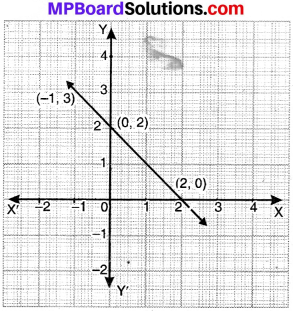
2. Since (-1,3), (0, 2) and (2, 0) satisfies the equation y = x + 2.
The equation of the graph is y = – x + 2.

MP Board Solutions

Question 6.
If the work done by a body on application of a constant force is directly proportional to the distance traveled by the body, express this in the form of an equation in two variables and draw the graph of the same by taking the constant force as 5 units. Also read from the graph the work done when the distance traveled by the body is:

  1. 2 units
  2. 0 units.

Solution:
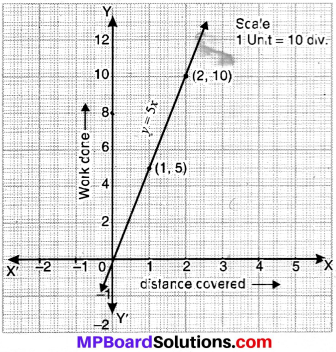
Let y be the work done and x be the distance covered. y ∝ x where k is the constant force.
y = kx, (Given)
k = 5
∴ y = 5x

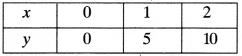
Take x = 0
y = 5 x 0 = 0
MP Board Class 9th Maths Solutions Chapter 4 Linear Equations in Two Variables Ex 4.3 img-12
Take x = 1
y = 5 x 1 = 5

Take = 2
y= 5 x 2 = 10
MP Board Class 9th Maths Solutions Chapter 4 Linear Equations in Two Variables Ex 4.3 img-13
When the distance travelled is –

  1. x = 2 units y = 10 units
  2. x = 0 units y = 0 units.

Question 7.
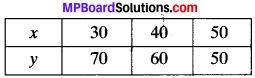
Yamini and Fatima, two students of class IX of a school, to gether contributed ₹ 100 towards the Prime Minister’s Relief Fund to help the earthquake victims. Write a linear equation which satisfies this data. (You may take their contributions as ₹ x and ₹ y). Draw the graph of the same.
Answer:
Let the contribution of Yamini be ₹ x and that of Fatima be ₹ y.
According to question
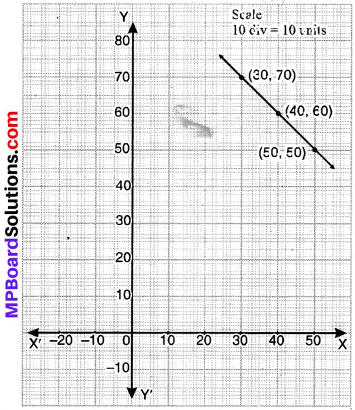
x + y = 100
MP Board Class 9th Maths Solutions Chapter 4 Linear Equations in Two Variables Ex 4.3 img-14
Take x = 30,
30 + y = 100
y = 100 – 30
y = 70

Take = 40,
40 + y = 100
y = 100 – 40
y = 60

Take = 50,
50 + y = 100
y = 100 – 50
y = 50
MP Board Class 9th Maths Solutions Chapter 4 Linear Equations in Two Variables Ex 4.3 img-15

Question 8.
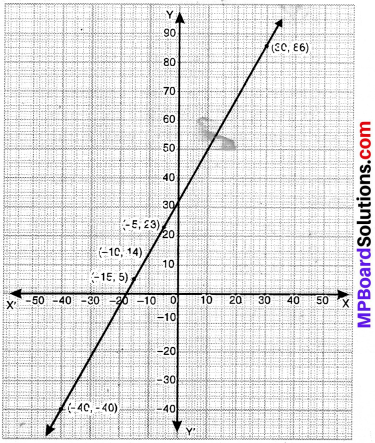
In countries like USA and Canada, temperature is measured in Fahrenheit, whereas in countries like India, it is measured in Celsius. Here is a linear equation that converts Fahren-heit to Celsius.
F = (\(\frac{9}{5}\)) C + 32

  1. Draw the graph of the linear equation above using Celsius for x – axis and Fahrenheit for y – axis.
  2. If the temperature is 30°C, what is the temperature in Fahrenheit?
  3. If the temperature is 95°F, what is the temperature in Celsius?
  4. If the temperature is 0°C, what is the temperature in Fahrenheit and if the temperature is 0°F, what is the temperature in Celsius?
  5. Is there a temperature which is numerically the same in both Fahrenheit and Celsius? If yes, find it.

1. F = \(\frac{9}{5}\) + 32
Take C = – 5,
F = \(\frac{9}{5}\) x (- 5) + 32
= – 9 + 32 = 23
C = – 10,
F = \(\frac{9}{5}\) x – 10 + 32 = 14
C = – 15,
F = \(\frac{9}{5}\) x – 15 + 32 = 5

2. From the graph, when temperature is 30°C, temperature in °F is 86°.

3. When F = 95°, C = 35°.
\(\frac{63×5}{9}\) = 35°

4. C = 0°, F = 32°
F = 0°, C = – 17.7°

5. F = – 40°, C = – 40°
MP Board Class 9th Maths Solutions Chapter 4 Linear Equations in Two Variables Ex 4.3 img-16

MP Board Class 9th Maths Solutions

MP Board Class 9th Maths Solutions Chapter 4 Linear Equations in Two Variables Ex 4.2

MP Board Class 9th Maths Solutions Chapter 4 Linear Equations in Two Variables Ex 4.2

Question 1.
Which one of the following options is true, and why? y = 3x + 5 has

(i) a unique solution,
(ii) only two solutions,
(iii) infinitely many solutions.

Solution:
The true option is (iii) y = 3x + 5 has infinitely many solutions. Reason. For every value of x, there is a corresponding value of y and vice-versa.

MP Board Solutions

Question 2.
Write four solutions for each of the following equations:

  1. 2x + y = 7
  2. πx + y = 9
  3. x = 4y

Solution:
1. 2x + y = 7
Take x = 0
2 x 0 + y = 7
∴ y = 7
First solution is (0, 7)

Take x = 1,
2 x 1 + y = 7
2 + y = 7
y = 7 – 2
∴ y = 5
Second solution is (1, 5)

Take x = 2,
2 x 2 + y = 7
2 + y = 7
y = 7 – 4
∴ y = 3
Third solution is (2, 3)

Take x = 3,
2 x 3 + y = 7
6 + y = 7
y = 1 – 6
∴ y = 1
Fourth solution is (3, 1)

2. πx + y = 9
Take y = 0,
πx + 0 = 9
πx = 9
∴ x = \(\frac{9}{π}\)
First solution is (\(\frac{9}{π}\), 0)

Take y = 1,
πx + 1 = 9
πx =9 – 1
∴ x = \(\frac{8}{π}\)
Second solution is (\(\frac{8}{π}\), 1)

Take y = 2,
πx + 2 = 9
πx = 9 – 2
∴ x = \(\frac{7}{π}\)
Third solution is (\(\frac{7}{π}\), 2)

Take y = 3,
πx + 3 = 9
πx = 9 – 3
∴ x = \(\frac{6}{π}\)
Fourth solution is (\(\frac{6}{π}\), 3)

3. x = 4y
Take x = 0,
0 = 4y
\(\frac{0}{4}\) = y
∴ y = o
First solution is (0, 0)

Take x = 4,
4 = 4y
y = \(\frac{4}{4}\) = 1
Second solution is (4, 1)

Take x = 8,
8 = 4y
y = \(\frac{8}{4}\) = 2
Third solution is (8, 2)

Take x = 12,
12 = 4y
y = \(\frac{12}{4}\) = 3
Fourth solution is (12, 3)

Question 3.
Check which of the following are solutions of the equation x – 2y = 4 and which are not:

  1. (0, 2)
  2. (2, 0)
  3. (4, 0)
  4. (\(\sqrt{2}\), 4\(\sqrt{2}\) )
  5. (1, 1)

Solution:
x – 2y = 4
1. Putting x = 0 and y = 2, we get
0 – 2 x 2 = 4
4 = 4
∴ (0, 2) is a solution

2. Putting x = 2 and y = 0, we get
2 – 2 x 0 = 4
2 ≠ 4
∴ (2, 0) is not the solution.

3. Putting x = 4 and y = 0, we get
4 – 2 x 0 = 4
4 = 4
∴ (4, 0) is a solution.

4. Putting x = \(\sqrt{2}\) and y = 4\(\sqrt{2}\), we get
\(\sqrt{2}\) – 2 x 4\(\sqrt{2}\) = 4
\(\sqrt{2}\) – 8\(\sqrt{2}\) = 4
– 7\(\sqrt{2}\) ≠ 4
∴ (\(\sqrt{2}\), 4\(\sqrt{2}\)) is not the solution.

5. Putting x = 1 and y = 1, we get
1 – 2 x 1 = 4
1 – 2 = 4
– 1 ≠ 4
∴ (1, 1) is not the solution.

MP Board Solutions

Question 4.
Find the value of k, if x = 2, y = 1 is a solution of the equation 2x + 3y = k.
Solution:
Putting x =2 and y – 1 in 2x + 3y – k, we get
2 x 2 + 3 x 1 = k
4 + 3 = k
∴ k = 1

Graph Of A Linear Equation In Two Variables:
The graph of a linear equation in two variables is a line. To draw a line we need atleast two points. Points are the solutions of the given equation. So to find the graph of a linear equation we will first find out three solutions and then plot these points on a suitable scale to a graph to get a line.

Steps for plotting the graph of Linear Equation in Two variables:

  1. Write the linear equation.
  2. Express y in terms of x.
  3. Choose three value of x and calculate the corresponding values of y from the given equation.
  4. Tabulate the values of x and y.
  5. Plot the value of x on x – axis and value of y on y – axis to a suitable scale, on a graph paper to get three points.
  6. Join the three points by a straight line and extend it in both the directions.
  7. The line obtained is the graph of the given equation.

Note:
To draw a graph of a linear equation in two variables, atleast, two solutions are required. In this chapter three solutions are taken to draw the graph for better result. Students can draw the graph by taking two solutions also.

MP Board Class 9th Maths Solutions

MP Board Class 9th Maths Solutions Chapter 4 Linear Equations in Two Variables Ex 4.1

MP Board Class 9th Maths Solutions Chapter 4 Linear Equations in Two Variables Ex 4.1

Question 1.
The cost of notebook is twice the cost of a pen. Write a linear equation in two variables to represent this statement.
Solution:
Let cost of pen be ₹ x and cost of a notebook be ₹ y
y = 2x
y – 2x = 0.

MP Board Solutions

Question 2.
Express the following linear equations in the form ax + by + c = 0 and indicate the values of a, b and c in each case:

  1. 2x + 3y = 9.3\(\overline { 5 } \)
  2. x – \(\frac{y}{5}\) – 10 = 0
  3. -2x + 3y = 6
  4. x = 3y
  5. 2x = – 5y
  6. 3x + 2 = 0
  7. y – 2 = 0
  8. 5 = 2x

Solution:
1. 2x + 3y = 9.3\(\overline { 5 } \)
2x + 3y – 9.3\(\overline { 5 } \) = 0
a = 2, b = 3, c = – 9.3\(\overline { 5 } \)

2. x – \(\frac{y}{5}\) – 10 = 0
a = 1, b = – \(\frac{1}{5}\), c = – 10

3. -2x + 3y = 6
– 2x + 3y – 6 = 0
a = – 2, b = 3, c = – 6

4. x = 3y
1. x – 3y + 0 = 0
a – 1, b = – 3, c = 0

5. 2x = – 5y
2x + 5y + 0 = 0
a = 2, b = 5, c = 0

6. 3x + 2 = 0
3x + 0y + 2 = 0
a = 3, b = 0, c = 2

7. y – 2 = 0
0x + y – 2 = 0
a = 0, b = 1, c = – 2

8. 5 = 2x
– 2x + 0y + 5 = 0
a = – 2, b = 0, c = 5

MP Board Solutions

Solution of a Linear Equation:
Consider a Linear equation x + 2y = 6
Let x = 2 and y = 2.
Then L.H.S. of the equation = x + 2y = 2 + 2 x 2 = 6
and R.H.S. of the equation = 6 (given)
i.e., LHS. = R.H.S. for x = 2 and y = 2.
Therefore, x = 2 and y = 2 i.e., (2, 2) is the solution of the given equation x + 2y = 6.
Any pair of values of x and y which satisfies the given equation is called a solution of the equation. A linear equation in two variables has infinitely many solutions.

Note:
To find the solution of an equation, assure a value of one of the variable and calculate the value of second variable from the given equation.

MP Board Class 9th Maths Solutions

MP Board Class 9th Science Solutions Chapter 3 Atoms and Molecules

MP Board Class 9th Science Solutions Chapter 3 Atoms and Molecules

Atoms and Molecules Intext Questions

Atoms and Molecules Intext Questions Page No. 32 – 33

Question 1.
In a reaction 5.3g of sodium carbonate reacted with 6g of ethanoic acid. The products were 2.2g of carbon dioxide. 0. 9g water and 8.2g of sodium ethanoate. Show that these observations are in agreement with the law of co serration of mass.
Sodium carbonate + ethanoic acid → sodium ethanoate + carbon dioxide + water
Answer:
The reaction is,
Sodium carbonate + ethanoic acid → sodium ethanoate + carbon dioxide + water
5.3g + 6g → 8.2g + 2.2g + 0.9g
Now,
Total mass of reactants = (5.3 + 6)g = 11.3g
And, total mass of products = (8.2 + 2.2 + 0.9)g = 11.39g
So, Mass of reactants = Mass of product
It shows the law of conservation of mass.

MP Board Solutions

Question 2.
Hydrogen and oxygen combine in the ratio of 1 : 8 by mass to form water. What mass of oxygen gas would be required to react completely with 3g of hydrogen gas?
Answer:
Ratio of hydrogen and oxygen in water = 1 : 8
So, oxygen is 8 times that of hydrogen by mass.
Let, xgrams of oxygen will react with 3g of hydrogen.
Then,
1 : 8 = 3 : x
x = 8 × 3
x = 24g
∴ 24g of oxygen gas required.

Question 3.
Which postulate of Dalton’s atomic theory is the result of the law of conservation of mass?
Answer:
Postulate of Dalton’s theory based on law of conservation of mass is “Atoms are indivisible particles which can neither be created nor be destroyed in a chemical reaction.”

Question 4.
Which postulate of Dalton’s atomic theory can explain the law of definite proportions?
Answer:
Postulate is the relative number and kinds of atoms remain constant in a given compound.

Atoms and Molecules Intext Questions Page No. 35

Question 1.
Define the atomic mass unit.
Answer:
Atomic mass unit is the mass unit equal to \(\frac { 1 }{ 12 }\)th mass of one carbon-12 atom.

Question 2.
Why is it not possible to see an atom with naked eyes?
Answer:
The size of an atom is very very small that we can see with naked eyes. The size of an atoms lies in nano meters (nm).

Atoms and Molecules Intext Questions Page No. 39

Question 1.
Write down the formulae of:
(i) Sodium oxide
(ii) Aluminium chloride
(iii) Sodium sulphide
(iv) Magnesium hydroxide.
Answer:
(i) Sodium Oxide

  • Symbol → NaO
  • Charge → +1-2
  • Formula → Na2O

(ii) Aluminium Chloride

  • Symbol → AlCl
  • Charge → +3-1
  • Formula → AlCl3

(iii) Sodium Sulphate

  • Symbol → NaS
  • Charge → +1-2
  • Formula → Na2S

(iv) Magnesium Hydroxide

  • Symbol → MgOH
  • Charge → +2-1
  • Formula → Mg(OH)2

MP Board Solutions

Question 2.
Write down the names of compounds represented by the following formulae:

  1. Al2(SO4)3
  2. CaCl2
  3. K2SO4
  4. KNO3
  5. CaCO3

Answer:

  1. Al2(SO4)3 → Aluminium sulphate
  2. CaCl2 → Calcium chloride
  3. K2SO4 → Potassium sulphate
  4. KNO3 → Potassium nitrate
  5. CaCO3 → Calcium carbonate

Question 3.
What is meant by the term chemical formula?
Answer:
It is the representation of composition of a compounds in the form of symbols of elements present in it.

Question 4.
How many atoms are present in a:

  1. H2S molecule and
  2. PO43- ion?

Answer:

  1. H2S Molecule -2 atoms of H + 1 atom of S = Total 3 atoms.
  2. PO43- 1 atom of phosphorus + 4 atoms of oxygen total 5 atoms.

Atoms and Molecules Intext Questions Page No. 40

Question 1.
Calculate the molecular masses of:

  1. H2
  2. O2
  3. Cl2
  4. CO2
  5. CH4
  6. C2H6
  7. C2H4
  8. NH3
  9. CH3OH.

Answer:

  1. H2 = (2 × 1)u = 2u
  2. O2 = (2 × 16)u = 32u
  3. Cl2 = (2 × 35.5)u = 71u
  4. CO2 = (1 × 12 + 2 × 16)u = (12 + 32)u = 44u
  5. CH4 = (1 × 12 + 4 × 1)u = (12 + 4)u = 16u
  6. C2H6 = (2 × 12 + 6 × 1)u = (24 + 6)u = 30u
  7. C2H4= (2 × 12 + 4 × 1)u = (24 + 4)u = 28u
  8. NH3 = (1 × 14 + 3 × 1)u = (14 + 3)u = 17u
  9. CH3OH = (1 × 12 + 3 × 1 + 1 × 16 + 1 × 1)u = (12 + 3 + 16 + 1)u = 32u.

Question 2.
Calculate the formula unit masses of ZnO, Na2O, K2CO3, given atomic masses of Zn = 65u, Na = 23u, K = 39u, C = 12u and O = 16u.
Answer:
Formula unit mass of

  1. ZnO = (1 × 65 + 1 × 16)u = (65 + 16)u = 81u
  2. Na2O = (2 × 23 + 1 × 16)u = (46 + 16)u = 62u
  3. K2CO3 = (2× 39 + 1 × 12 + 3 × 6)u = (78 + 12 + 48)u = 138u

Atoms and Molecules Intext Questions Page No. 42

Question 1.
If one mole of carbon atoms weighs 12 gram, what is the mass (in gram) of 1 atom of carbon?
Answer:
1 mole of carbon atoms = 6.022 × 10²³ atoms
Also, 1 mole of carbon atoms = 12g
6.022 × 10²³ atoms of carbon weigh = 12g
1 atom of carbon weigh = 1.99 × 10²³g.

Question 2.
Which has more number of atoms, 100 grams of sodium or 100 grams of ion (given atomic mass of Na = 23u, Fe = 56u)?
Answer:
1 mole of sodium = 23g of Na
Atoms = 6.022 × 10²³ atoms
23g of Na = 6.022 × 10²³ atoms
100g of Na = \(\frac { 100 }{ 23 }\) × 6.022 × 1023 = 2.617 × 1024 atoms 8 23
Now, 1 mole of iron atoms = 56g of Fe = 6.022 × 10²³ atoms
56g of Fe = 6.022 × 10²³ atoms
100g of Fe = \(\frac { 100 }{ 56 }\) × 6.022 × 1023 = 1.075 × 1024 atoms
So, 100 g of Na contains more atoms.

Atoms and Molecules NCERT Textbook Exercises

Question 1.
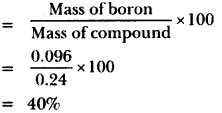
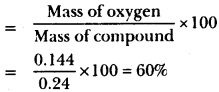
A 0.24 g sample of compound of oxygen and boron was found by analysis to contain 0.096g of boron and 0.144g of oxygen. Calculate the percentage composition of the compound by weight.
Answer:
Percentage composition of boron
MP Board Class 9th Science Solutions Chapter 3 Atoms and Molecules 1
Percentage composition of oxygen
MP Board Class 9th Science Solutions Chapter 3 Atoms and Molecules 2

Question 2.
When 3.0g of carbon is burnt in 8.00g oxygen, 11.00g of carbon dioxide is produced. What mass of carbon dioxide will be formed when 3.00g of carbon is burnt in 50.00g of oxygen? Which law of chemical combination will govern your answer?
Answer:
We know that 3g of carbon is burnt in 8g of oxygen to form 11g of carbon dioxide.
When 3g of carbon is burnt in 50g of oxygen, then 11g of carbon dioxide will be formed.
And oxygen remain unreacted, (50 – 8)g = 42g.
Law of constant proportion governs here.
Question 3.
What are polyatomic ions? Give examples.
Answer:
The ions which contain more than one type of atoms (same kind or different kinds) as a single unit are called polyatomic ions.
Examples:

  • Sulphate ion (SO4-2)
  • Nitrate ion (NO3-2)
  • Carbonate ion (CO3-2).

Question 4.
Write the chemical formulae for the following:
(a) Magnesium chloride
(b) Calcium oxide
(c) Copper nitrate
(d) Aluminium chloride
(e) Calcium carbonate.
Answer:
(a) Magnesium chloride – MgCl2
(b) Calcium oxide – CaO
(c) Copper nitrate – Cu(NO3)2
(d) Aluminium chloride – AlCl3
(e) Calcium carbonate – CaCO3

MP Board Solutions

Question 5.
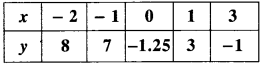
Give the names of the elements present in the following compounds:
(a) Quick lime
(b) Hydrogen bromide
(c) Baking powder
(d) Potassium sulphate
Answer:
(a) Quick lime (calcium oxide): Elements: Calcium and oxygen.
(b) Hydrogen bromide: Elements: Hydrogen and bromide.
(c) Baking powder (sodium hydrogen carbonate) Elements: Sodium, hydrogen, carbon, oxygen.
(d) Potassium sulphate: Elements: Potassium, sulphur, oxygen.

Question 6.
Calculate the molar mass of the following substances:
(a) Ethyne, C2H2
(b) Sulphur molecule, S8
(c) Phosphorus molecule, P4 (Atomic mass of phosphorus = 31)
(d) Hydrochloric acid, HCl
(e) Nitric acid, HNO3.
Answer:
(a) Ethyne, C2H2 = (2 × 12 + 2 × 1)g = (24 + 2)g = 26g
(b) Sulphur molecules, S8 = (8 × 32)g = 256g
(c) Phosphorus molecule, P4 = (4 × 31)g = 124g
(d) Hydrochloric acid, HCl = (1 × 1 + 1 × 35.5)g = (1 + 35.5)g = 36.5g
(e) Nitric acid, HNO3 = (1 × 1 + 1 × 14 + 3 × 16)g = (1 + 14 + 48)g = 63g

Question 7.
What is the mass of:
(a) 1 mole of nitrogen atoms?
(b) 4 moles of aluminium atoms (Atomic mass of aluminium = 27)?
(c) 10 moles of sodium sulphite (Na2SO3)?
Answer:
(a) 1 Mole of nitrogen atoms = 14g.

(b) Mass of 1 mole of aluminium atoms = 27g.
So, mass of 4 moles of aluminium atoms = (4 × 24)g = 108g.

(c) Mass of 1 mole of sodium sulphide
= (2 × 23 + 32 × 1 + 3 × 16)g = (46 + 32 + 48)g = 126g
∴ Mass of 10 moles of Na2SO3 = (126 × 10)g = 1260g.

Question 8.
Convert into mole:
(a) 12g of oxygen gas
(b) 20g of water
(c) 22g of carbon dioxide.
Answer:
(a) Mass of oxygen gas = 12g
Now, 1 mole of oxygen gas = 32g moles mass
So, 32g molar mass of oxygen = 1 moles
∴ 1g of oxygen gas = \(\frac { 1 }{ 32 }\) moles
and 12 g of oxygen gas = \(\frac { 1 }{ 32 }\) moles × 12 moles = 0.375 moles.

(b) 1 Mole of water = 18g molar mass
So, 18g moles mass of water = 1 mole
∴ 1g of water = \(\frac { 1 }{ 18 }\) moles
and 20 g of water = \(\frac { 1 }{ 18 }\) moles × 20 moles = 1.11 moles.

(c) 1 Mole of carbon dioxide = 44g molar mass
So, 44g molar mass of = 1 mole carbon dioxide
∴ 22g of carbon dioxide = \(\frac { 22 }{ 44 }\) moles = 0.5 mole.

MP Board Solutions

Question 9.
What is the mass of
(a) 0.2 mole of oxygen atoms?
(b) 0.5 mole of water molecules?
Answer:
(a) 1 mole of oxygen atoms = 16g
∴ 0.2 moles of oxygen atoms = (16 × 0.2)g = 3.2g

(b) 1 mole of water molecules = 18g
∴ 0.5 mole of water molecule = (18 × 0.5)g = 9g.

Question 10.
Calculate the number of molecules of sulphur (S8) present in 16g of solid sulphur.
Answer:
256g of sulphur = 1 mole of sulphur molecules
So, 16g of sulphur = \(\frac { 1 }{ 16 }\) × 16 moles of sulphur molecules
= 0.0625 mole of sulphur molecule
Also, 1 mole of sulphur molecules = 6.023 × 10²³ molecules
So, 0.0625 moles of sulphur molecules = 6.025 × 1023 × 0.0625 molecules
= 3.76 × 10²² molecules.

Question 11.
Calculate the number of aluminium ions present in 0.051g of aluminium oxide.
(Hint: The mass of an ion is the same as that of an atom of the same element. Atomic mass of Al = 27u).
Answer:
Molar mass of aluminium oxide (Al2O3) = (2 × 27)g + (3 × 16)g
= (54 + 48)g = 102g
∴ 102g of aluminium = 6.022 × 10²³ oxide contains aluminium ions
So, 0.051g Al2O3 contains aluminium ions = 6.022 × 10²⁰ aluminium ions.

Atoms and Molecules Additional Questions

Atoms and Molecules Multiple Choice Questions

Question 1.
Atomic theory of matter was proposed by.
(a) Newton
(b) John Dalton
(c) Rutherford
(d) Lavoisier.
Answer:
(b) John Dalton

Question 2.
Law of Conservation of mass was given by.
(a) Lavoisier
(b) Dalton
(c) Kennedy
(d) Faraday.
Answer:
(a) Lavoisier

Question 3.
The term mole was first introduced by.
(a) Grahm
(b) Dalton
(c) Ostwald
(d) Boyle.
Answer:
(c) Ostwald

Question 4.
Atomic radius of an atom is measured in.
(a) Micrometre
(b) Millimetre
(c) Nanometre
(d) Centimetre.
Answer:
(c) Nanometre

Question 5.
Law of constant proportions was proposed by.
(a) Dalton
(b) Bezelius
(c) Proust
(d) Lavoisier.
Answer:
(c) Proust

Question 6.
Latin name of an atom is argentum. The English name of this element is.
(a) Argon
(b) Gold
(c) Silver
(d) Mercury.
Answer:
(c) Silver

Question 7.
Phosphorus molecule is.
(a) Diatomic
(b) Triatomic
(c) Tetra – atomic
(d) Mono – atomic.
Answer:
(c) Tetra – atomic

MP Board Solutions

Question 8.
The atom chosen for reference for measuring atomic masses is.
(a) C-14
(b) C-12
(c) H-2
(d) O-12.
Answer:
(b) C-12

Question 9.
IUPAC is.
(a) Indian Union of Pacific and Applied Chemistry.
(b) International Union of Permanent and Applied Chemicals.
(c) International Union of Pure and Applied Chemistry.
(d) Indian Union of Pure and Applied Chemistry.
Answer:
(c) International Union of Pure and Applied Chemistry.

Question 10.
Atomic mass is measured in.
(a) Grams
(b) Atomic mass radius
(c) Centigrams
(d) Atomic mass unit.
Answer:
(d) Atomic mass unit.

Question 11.
1 A.M.U. is equal to.
(a) 1.65 × 10⁻²³g
(b) 1.63 × 10⁻²⁵g
(c) 1.66 × 10⁻²⁴g
(d) 1.66 × 10⁻²²g.
Answer:
(c) 1.66 × 10⁻²⁴g

Question 12.
The naming of elements from first or first and second letter was introduced by.
(a) Berzellius
(b) Dalton
(c) Proust
(d) Lavoisier.
Answer:
(a) Berzellius

Question 13.
The combining capacity of an element is called.
(a) Atomicity
(b) Valency
(c) Reactivity
(d) None of these.
Answer:
(b) Valency

Question 14.
The cation of element has.
(a) More electrons than normal atom
(b) Equal electrons than normal atom
(c) Less electrons than normal atom
(d) Equal proton than normal atom.
Answer:
(c) Less electrons than normal atom

Question 15.
The formula of a compound is A5B4. Then valency of A and B will be.
(a) 5 and 4
(b) 5 and 9
(c) 4 and 9
(d) 4 and 5.
Answer:
(d) 4 and 5.

Question 16.
1 Mole has.
(a) 6.012 × 10²³ particles
(b) 6.022 × 10²³ particles
(c) 6.022 × 10²² particles
(d) 6.022 × 1025 particles
Answer:
(b) 6.022 × 10²³ particles

Question 17.
Which of the following has the maximum number of atoms?
(a) 18g of CH4
(b) 18g of H4O
(c) 18g of CO2
(d) 18g of O2.
Answer:
(a) 18g of CH4

Question 18.
Atomic mass of C6H12O6 is.
(a) 24
(b) 80
(c) 100
(d) 12
Answer:
(a) 24

Question 19.
1 atomic mass unit is equal to.
a) \(\frac { 1 }{ 14 }\) mass of a C – 12 atom
(b) \(\frac { 1 }{ 16 }\)mass of a C – 12 atom
(c) \(\frac { 1 }{ 18 }\) mass of a C – 12 atom
(d) \(\frac { 1 }{ 12 }\)mass of a C – 12 atom.
Answer:
(d) \(\frac { 1 }{ 22 }\)mass of a C – 12 atom.

Question 20.
Atomicity of Sulphate (SO42-) ion.
(a) Mono – atomic
(b) Tri – atomic
(c) Poly – atomic
(d) Tetra – atomic
Answer:
(c) Poly – atomic

Question 21.
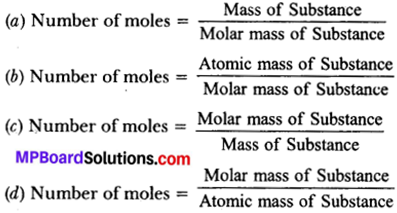
Formula of number of moles of a substance is.
MP Board Class 9th Science Solutions Chapter 3 Atoms and Molecules 3
Answer:
MP Board Class 9th Science Solutions Chapter 3 Atoms and Molecules 4

Atoms and Molecules Very Short Answer Type Questions

Question 1.
Name the scientist who gave atomic theory of matter.
Answer:
John Dalton.

Question 2.
Name the scientist who gave the law of conservation of mass.
Answer:
Antoine Lavoisier

MP Board Solutions

Question 3.
Name the scientist who gave the law of constant proportions.
Answer:
Joseph Proust.

Question 4.
How many metres are in 1nm?
Answer:
1nm = 10-9m.

Question 5.
Give two examples of polyatomic molecules of elements.
Answer:
P4 (Phosphorus) and S8 (Sulphur).

Question 6.
Write full form of IUPAC.
Answer:
International Union of Pure and Applied Chemistry.

Question 7.
An element A and B has valency of 3 and 4. Write its chemical formula.
Answer:
A4B3.

Question 8.
Name the scientist who introduced the term ‘mole’.
Answer:
Wilhem Ostwald.

Question 9.
How many particles exist in 1 mole of atom?
Answer:
1 mole = 6.022 × 10²³ particles.

Question 10.
Write the formula of aluminium sulphate.
Answer:
Al2(SO4)3.

Question 11.
Name the charged particles formed by gaining of electrons.
Answer:
Anion.

Question 12.
Name the charged particles formed by loosening of electrons.
Answer:
Cation.

Question 13.
What is numerical value of Avogadro number or Avogadro’s constant?
Answer:
6.022 × 10²³.

MP Board Solutions

Question 14.
Write the Latin names of iron, gold and copper.
Answer:

  1. Iron – Ferrum
  2. Gold – Aurum
  3. Copper – Cuprum.

Question 15.
What is 1 amu?
Answer:
1 amu = \(\frac { 1 }{ 2 }\)th mass of a carbon-12 atom.

Question 16.
Calculate the number of atoms of oxygen present in its 3.5 moles.
Answer:
1 mole of oxygen atoms = 6.022 × 10²³
∴ 3.5 moles of oxygen atoms = 3.5 × 6.022 × 1023 atoms
= 2.10 × 1024 atoms.

Atoms and Molecules Short Answer Type Questions

Question 1.
Define:
(a) Law of conservation of mass.
(b) Law of constant proportions.
(c) Atomic mass.
(d) Molecules of element.
(e) Molecules of compound.
(f) Atomicity.
(g) Ion.
(h) Chemical formula.
(i) Valency.
(j) Molecular mass.
(k) Formula unit mass.
(l) Mole.
Answer:
(a) Law of conservation of mass: Matter is neither created nor destroyed during a chemical reaction i.e., total mass of reactants is equal to the total mass of products in a chemical reaction.

(b) Law of constant proportions: In a chemical compound, the elements are always present in a definite proportion by mass.
e.g.:

  • In CO2 the ratio of mass of carbon to the mass of oxygen is always 7 : 16.

(c) Atomic mass: The Atomic mass of an element is defined as the relative mass of its atom as compared with the mass of a carbon 12 atom taken as 12 units.

(d) Molecules of element: It contain two or more similar kinds of atoms chemically combined together.
e.g.:

  • O2, N2, P4.

(e) Molecules of compound: It contains two or more different kinds of atoms chemically combined together.
e.g.:

  • SO4, CO2, H2O.

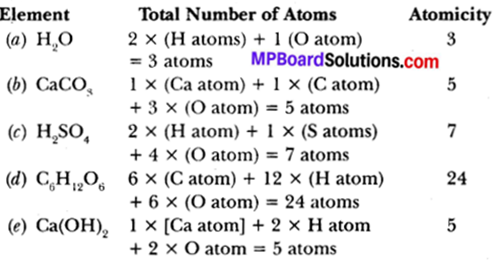
(f) Atomicity: It is the total number of atoms present in a molecule.
e.g.:

  • Atomicity of H2 is 2
  • Atomicity of P4 is 4 and
  • Atomicity of CO2 is 3.

(g) Ion: It is the positively or negatively charged atom or group of atoms. It is formed by either loosening or gaining of electrons. Positively charged ion is called cation and negatively charged ion is called anion.
e.g.:

  • Cation – Na+, Mg2+, NH4+
  • Anion – Cl, Br,OH, SO42-

(h) Chemical formula: Chemical formula of a compound is representation in the form of symbols of elements present in it.
e.g.:

  • Sodium chloride (NaCl)
  • Calcium oxide (CaO).

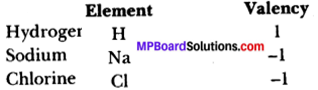
(i) Valency: It is the combining power (or capacity) atom or group of atoms. It tells number of electrons lost or gained by the atom during the Chemical reaction.
e.g.:
MP Board Class 9th Science Solutions Chapter 3 Atoms and Molecules 5

(j) Molecular mass: It is the sum of atomic masses of all the atoms in a molecule of the substance.
e.g.:
Molecular mass of CO2 is = Atomic mass of C + 2 × atomic mass of O
= 12 + 2 × 16
= 12 + 32 = 44u
It is expressed in atomic mass unit (u).

(k) Formula unit mass: It is the sum of atomic masses of all atoms in a formula unit of the compound containing constituents as ions. It is also expressed in atomic mass unit (u).
e.g.:
Formula unit mass of NaCl = Atomic mass of Na + atomic mass of Cl.
= (1 × 23 + 1 × 35.5)u
= (23 + 35.5)u = 58.5u.

(l) Mole: One mole of any substance like atoms or molecules or ions is that quantity which has mass equal to its atomic or molecular mass in grams and also contains 6.022 x 10²³ particles of that substance.
e.g.:
1 mole of H2 molecule = (1 × 2)g = 2g and also,
1 Mole of H2 molecule = 6.022 × 10²³ molecules of hydrogen.

MP Board Solutions

Question 2.
Write the postulates of Dalton’s atomic theory.
Answer:
Postulates:

  1. All matter is made up of very tiny particles called atoms.
  2. Atoms are indivisible.
  3. Atoms can neither be created nor be destroyed in a chemical reaction.
  4. Atoms of a given element are identical in mass and chemical properties.
  5. Atoms combine in the ratio of small whole numbers to form compounds.
  6. The number of atoms and kind of atoms is fixed in a given compound.

Question 3.
What were the drawbacks of Dalton’s atomic theory?
Answer:
Drawbacks:

  1. According to theory, atoms were indivisible but they can be divided in ions in electrons, protons and neutrons under special conditions.
  2. According to theory, atoms of an element have masses but it is found that atoms of some elements can have some different masses.
  3. According to theory, atoms of different elements have different masses but it is found that atoms of different elements can have same masses.

Question 4.
Calcium carbonate decomposes on heating to form calcium oxide and carbon dioxide. When 20g calcium carbonate is decomposed completely then 11.2g of calcium oxide is formed. Calculate the mass of carbon dioxide formed. Which law of chemical combination will be applied there?
Answer:
Law of conservation of mass is applied here.
Now,
MP Board Class 9th Science Solutions Chapter 3 Atoms and Molecules 14
Let, x grams of CO2 is formed
Now, according to law of conservation of mass.
Total mass of reactants = Total mass of product
⇒ 20 = 11.2 + x
⇒ x = (20 – 11.2) = 8.89
So, Mass of CO2 formed is 8.8g.

Question 5.
In an experiment 9.8g of copper oxide was obtained from 7.84g of copper. In another experiment 9.1g of copper oxide was obtained on reduction 7.28g of copper. Show with the help of calculations that these figures verify the law of constant proportions.
Answer:
Case I:
Mass of copper oxide = 9.8g
Mass of copper = 7.84g
Mass = (9.8 – 7.84)g = 1.96g
So, Ratio of copper to oxygen = \(\frac { 7.84 }{ 1.96 }\) = \(\frac { 4 }{ 1 }\) = 4 : 1

Case II:
Mass of copper oxide = 9.1g
Mass of copper = 7.28g
∴ Mass of oxygen = (9.1 – 7.28)g = 1.82g
So, Ratio of copper to oxygen = \(\frac { 7.28 }{ 1.82 }\) = \(\frac { 4 }{ 1 }\) = 4 : 1
Since, ratio of copper and oxygen in the two samples is same.
The law of constant proportions is verified.

Question 6.
Write the atomicity of following compounds.
(a) H2O
(b) CaCO3
(c) H2SO4
(d) C6H12O6
(e) S8.
Answer:
MP Board Class 9th Science Solutions Chapter 3 Atoms and Molecules 6

Question 7.
Write the chemical formula of:
(a) Hydrogen oxide
(b) Calcium carbonate
(c) Magnesium chloride
(d) Aluminium sulphate
Answer:
MP Board Class 9th Science Solutions Chapter 3 Atoms and Molecules 7

Question 8.
Calculate the molecular ma
(a) CH3OH
(b) C6H12O6
(c) NH3
(d) H2SO4
Atomic masses:
C = 12u
H = 1u
O = 16u
N = 14u
S = 32u
Answer:
(a) Molecular mass of
CH3OH = (1 × 12 + 3 × 1 + 1 × 16 + 1 × 1)u
= (12 + 3 + 16 + 1 )u = 32u.

(b) Molecular mass of
C6H12O6 = (6 × 12 + 12 × 1 + 6 × 16)u
= (72 + 12 + 96)u = 180u.

(c) Molecular mass of
NH3 = (1 × 14 + 3 × 1)u
= (14 + 3)u = 17u.

(d) Molecular mass of
H2SO4 = (1 × 2 + 1 × 32 + 4 × 16)u
= (2 + 32 + 64)u
= 98u.

Question 9.
Calculate the number of molecules of:
(a) SO2 in its 3 moles.
(b) O2 in its 2.5 moles.
Answer:
(a) 1 mole of SO2 molecule
= 6.022 × 10²³ molecules of SO4
= 3 moles of SO4 molecule
= 3 × 6.022 × 1023 molecules
= 18.066 × 10²³ molecules.

(b) 1 mole of O2 molecule
= 6.022 × 10²³ molecules of O2
= 2.5 moles of O2 molecule
= 2.5 × 6.022 × 1023 molecules of O2
= 15.055 × 10²³ molecules
= 1.5055 × 1024 molecules.

MP Board Solutions

Question 10.
Calculate the number of moles in:
(a) 12.044 × 10²³ molecules of CO2.
(b) 24.012 × 1024 molecules of H2
Answer:
(a) 1 mole of CO2 = 6.022 × 10²³ particles of CO2.
⇒ 6.022 × 10²³ particles = 1 mole of CO2.
So, 1 particle of CO2 molecule
= 1 / 6.022 × 10²³ mole and,
12.044 × 10²³ particles of CO2 molecules
= 1 / 6.022 × 1023 × 12.044 × 1023
= 12.044 × 1023 × 1 / 6.022 × 10²³ moles = 2 moles.

(b) 1 mole of H2 contains = 6.022 × 10²³ particles of H2 molecule
or 6.022 × 10²³ particles of H2 = 1 mole of H2
1 particle of H2 molecule = 1 / 6.022 × 10²³ mole of H2.
∴ 24.012 × 10²³ particles of H2 = 1 / 6.022 × 1023 × 24.012 × 1023 moles of H2
= 3.98 moles of H2.

Atoms and Molecules Long Answer Type Questions

Question 1.
Calculate the ratio of following elements by mass in the given compound:
(a) Hydrogen and oxygen in water (H2O).
(b) Carbon and oxygen in carbon dioxide (CO2).
(c) Carbon and hydrogen in ethene (C2H4).
Answer:
(a) In H2O molecule,
Mass of H = 2 × 1g = 2g
Mass of O = 1 × 16g = 16g
So, Ratio of hydrogen and oxygen by mass = \(\frac { 2 }{ 16 }\) =\(\frac { 1 }{ 8 }\) = 3 : 8

(b) In CO2 molecule,
Mass of C= 1 × 12g = 12g
Mass of O = 2 × 16g = 32g
.;. Ratio of carbon and oxygen by mass = \(\frac { 12 }{ 32 }\) = 3 : 8

(c) In ethene (C2H4) molecule,
Mass of C = 2 × 12g = 24g
Mass of H = (4 × 1)g = 4g
Ratio of carbon and hydrogen by mass = \(\frac { 24 }{ 4 }\) = 6 : 1

Question 2.
Calculate the formula unit mass of the following Ionic Compounds:
(a) Sodium Chloride (NaCl)
(b) Calcium Oxide (CaO)
(c) Copper Sulphate (CuSO4)
(d) Calcium Nitrate [Ca(NO3)2]
[Atomic masses: Na = 23u, Cl = 35.5u, Ca = 40u, O = 16u, Cu = 63.5u, S = 32u, N = 14u]
Answer:
(a) Formula unit mass of NaCl Molecule = (1 × 23 + 1 × 35.5)u
= (23 + 35.5)u = 58.5u.

(b) Formula unit mass of CaO molecule = (1 × 40 + 1 × 16)u
= (40 + 16)u = 56u.

(c) Formula unit mass of CuSO4 = (1 × 63.5 + 1 × 32 + 4 × 16)u
= (63.5 + 32 + 64)u = 159.5u.

(d) Formula unit mass of [Ca(NO3)2]
= 1 × 40 + 2 [1 × 14 4 + 3 × 16]
= 40 + 2 [14 4 + 48]u
= (40 + 124)u
= 164u.
MOLE CONCEPT (Graus to uoles):

Question 3.
Find the number of moles in:
(a) 20g of H2O
(b) 140g of CO2
(c) 200g of CaCO3.
Answer:
(a) 1 mole of H2O = Molar mass of H2O
= (2 × 1 + 16)g
So, 1 Mole = 18g of H2O
or 18g of H2O = 1 Mole
1g of H2O = \(\frac { 1 }{ 18 }\) Mole
and, 20g of H2O = \(\frac { 1 }{ 18 }\) × 20 = 1.11 Mole

(b) 1 mole of CO2 = Molar mass of CO2 = (1 × 12 + 2 × 16)g
= (12 + 32)g = 44g
So, 1 mole = 44g of CO2
or 44g of CO2 = 1 mole
1 g of CO2 = \(\frac { 1 }{ 44 }\) mole
and, 140 g of CO2 = \(\frac { 1 }{ 44 }\) × 140 moles
= 3.18 moles.

(c) 1 mole of CaCO3 = Molar mass of CaCO3
= (1 × 40 + 1 × 12 + 3 × 16)g
= (40 + 12 + 48)g = 100g
So, 1 mole = 100g of CaCO3
or 100g of CaCO3 = 1 mole
1g of CaCO3 = \(\frac { 1 }{ 100 }\) mole
and, 200 g of CaCO3 = \(\frac { 1 }{ 100 }\) × 200 moles = 2 moles.
Moles to Grams

Question 4.
Calculate the mass in grams of:
(а) 3 moles of H2O
(b) 2 moles of H2SO4
(c) 1.5 moles of carbon atoms (C atom).
Answer:

(a) 1 mole of H2O = Molar mass of H2O
= (2 × 1 + 16)g of H2O
= 18g of H2O
∴ 3 mole of H2O = (3 × 18)g of H2O
H2O = 54g of H2O

(b)1 mole of H2SO4 = Molar mass of H2SO4
= (2 × 1 + 1 × 32 + 4 × 16)g = 98g
2 mole of H2SO4 = (2 × 98)g = 196g

(c) 1 mole of C atom = Molar mass of C atom = 12g
∴ 1.5 moles of C -atom = (1.5 × 12)g = 18g.
Moles to Number of Particles.

Question 5.
Calculate the number of particles in:
(a) 115g of H2O.
(b) 60g of CO2.
Answer:
(a) We know,
1 mole of H2O = molar mass of H2O
= (2 × 1 + 16)g = 18g
It means, 18g of H2O = 1 mole of CO2
1g of H2O = \(\frac { 1 }{ 18 }\) mole = 6.38 moles
Now, 1 mole of H2O = 6.022 × 10²³ particles
6.38 moles of H2O = 6.38 x 6.022 × 1023 particles
= 3.84 × 1024 particles.

(b) We know,
1 mole of CO2 = Molar mass of CO2
= (12 + 2 × 16)g = (12 + 32)g = 44g
It means, 44g of CO2 = 1 mole of CO2
1g of CO2= \(\frac { 1 }{ 44 }\) mole of CO2
and, 60g of CO2 = \(\frac { 1 }{ 44 }\) × 60 moles of CO2
= 1.3636 moles
Number of Particles to Mass.

Question 6.
Calculate the mass of:
(a) O2 in its 36.48 × 1025 particles.
(b) NH3 in its 4.012 × 1024 particles.
Answer:
(a) We know,
1 mole of O2 = 6.023 × 10²³ particles
or 6.023 × 10²³ particles = 1 mole of O2
MP Board Class 9th Science Solutions Chapter 3 Atoms and Molecules 10

Now, We also know,
1 mole of O2 contains = molar mass of O2
So, 60.57 moles of O2 contains = 60.57 × 32g = 1938.49g.

(b) We know,
1 mole of ammonia (NH3) = 6.022 X 10²³ particles
or 6.022 × 10²³ particles of ammonia (NH3) = 1 mole
MP Board Class 9th Science Solutions Chapter 3 Atoms and Molecules 12
Now, We also know that
1 mole NH3 contains = Molar mass of NH3
= (14 + 3 × 1)g = (14 + 3)g
= 17g
So, 6.66 moles of NH3 contains = (6.66 × 17)g = 113.25g

MP Board Solutions

Question 7.
(a) Define atomicity and poly atomic ions.
(b) Find out the atomicity of following:
CO2, NH3, S8, CaCO3, H2SO4, Ca(OH)2, K2SO4, Al2(SO4)3, NaCl.
(c) Write 2 divalent and 2 trivalent polyatomic ions.
Answer:
(a) Atomicity: It is total number of atoms present in a molecule.
e,g.,

  • Atomicity of H2 is 2.

Polyatomic ions: Ions which are formed from group of atoms are called polyatomic ions.
e,g.,

  • Carbonate (CO32-), Sulphate (SO22-).

(b)
MP Board Class 9th Science Solutions Chapter 3 Atoms and Molecules 13

(c) Divalent polyatomic ions:

  • Carbonate ion (CO3s2-)
  • Sulphate ion (SO42-).

Trivalent polyatomic ions:

  • Phosphate ion (PO43-)
  • Phosphite ion (PO33).

Atoms and Molecules Higher Order Thinking Skills (HOTS)

Question 1.
A thermos P contains 0.5 mole of oxygen gas. Another thermos Q contain 0.4 mole of ozone gas. Which of the two thermos contain greater number of oxygen atom?
Answer:
1 molecule of oxygen (O2) = 2 atoms of oxygen
1 molecule of ozone (O3) = 3 atoms of oxygen
In thermos P:
1 mole of oxygen gas = 6.022 × 10²³ molecules
0.5 mole of oxygen gas = 6.022 × 1023 × 0.5 molecules
= 6.022 × 1023 × 0.5 × 2 atoms
= 6.022 × 10²³ atoms

In thermos Q:
1 mole of ozone gas = 6.022 × 10²³ molecules
0.4 mole of oxygen gas = 6 .022 × 1023 × 0.4 molecules
= 6.022 × 1023 × 0.4 x 3 atoms
= 7.32 × 10²³ atoms.

Question 2.
On analysing an impure sample of sodium chloride, the percentage of chlorine was found to be 45.5. What is the percentage of pure sodium chloride in the sample?
Answer:
Molecular mass of pure NaCl
= Atomic mass of Na + Atomic mass of Cl
= 23 + 35.5 = 58.5u
Precentage of chlorine in pure NaCl
Now, if chlorine is 60.6 parts
NaCl =100 parts
If chlorine is 45.5 parts,
Thus, percentage of pure NaCl = 75%.

Question 3.
Write the chemical formulae of the following:

  1. Ammonium phosphate
  2. Iron sulphate
  3. Calcium nitrate
  4. Magnesium nitride
  5. Ammonium sulphate
  6. Aluminium chloride
  7. Copper Nitrate
  8. Aluminium sulphate
  9. Sodium carbonate
  10. Barium chloride
  11. Calcium nitrate
  12. Potassium chloride
  13. Hydrogen sulphide
  14. Magnesium hydroxide
  15. Zinc sulphate.

Answer:

  1. Ammonium phosphate – (NH4)3PO4
  2. Iron sulphate – -Fe2(SO4)3
  3. Calcium nitrate – Ca(NO3)2
  4. Magnesium nitrate – Mg(NO3)2
  5. Ammonium sulphate – (NH4)2SO4
  6. Aluminium chloride – AlCl3
  7. Copper nitrate – CU(NO3)2
  8. Aluminium sulphate – Al2(SO4)3
  9. Sodium carbonate – Na2CO3
  10. Barium chloride – BaCl2
  11. Calcium nitrate – Ca(NO3)2
  12. Potassium chloride – KCl
  13. Hydrogen sulphide – H2S
  14. Magnesium hydroxide – Mg(OH)2
  15. Zinc sulphate – ZnSO4

Atoms and Molecules Value Based Question 

Question 1.
Jolly buys gold ornaments and she is told that the ornaments has 90% gold and the rest is copper. She has been given a bill which amounts 100% charges of gold. Jolly refused to pay
the bill for 100% gold but settles the bill for 90% gold?
(a) How many atoms of gold are present in 1 gram of gold?
(b) Find out the ratio of gold and copper in the ornaments.
(c) What value of Jolly is seen in the above discussion?
Answer:
(a) 1 gram of gold will contain \(\frac { 90 }{ 100 }\) = 0.9 g of gold.
MP Board Class 9th Science Solutions Chapter 3 Atoms and Molecules 9
∴ 0.046 mol of gold will contain = 0.046 × 6.022 × 1023 = 2.77 × 10²¹ atoms

(b) Ratio of gold : Copper 90 : 10

(c) Value of responsible behaviour and self – awareness is seen.

MP Board Class 9th Science Solutions

MP Board Class 9th Maths Solutions Chapter 3 Coordinate Geometry Ex 3.2

MP Board Class 9th Maths Solutions Chapter 3 Coordinate Geometry Ex 3.2

Question 1.
Write the answer of each of the following questions:

  1. What is the name of horizontal and the vertical lines drawn to determine the position of any point in the Cartesian plane?
  2. What is the name of each part of the plane formed by these two lines?
  3. Write the name of the point where these two lines intersect.

Solution:

  1. The x – axis and the y – axis.
  2. Quadrants.
  3. The origin.

MP Board Solutions

Question 2.
See figure and write the following:

  1. The coordinates of B.
  2. The coordinates of C.
  3. The point identified by the coordinates (-3, -5)
  4. The point identified by the coordinates (2, -4).
  5. The abscissa of the point D.
  6. The ordinate of the point H.
  7. The coordinates of the point L.
  8. The coordinates of the point M.

MP Board Class 9th Maths Solutions Chapter 3 Coordinate Geometry Ex 3.2 img-1
Solution:

  1. B → (- 5, 2 )
  2. C → 4 (5, – 5 )
  3. E
  4. G
  5. 6
  6. – 3
  7. L → (0, 5 )
  8. M → (-3, 0 )

MP Board Solutions

Question 3.
In which quadrant or on which axis do each of the points (-2, 4), (3, -1), (-1, 0), (1, 2) and (-3, -5) lie? Verify your answer by locating them on the Cartesian plane.
Solution:

  1. The point (-2, 4) lies in the II quadrant.
  2. The point (3, -1) lies in the IV quadrant.
  3. The point (-1, 0) lies on the negative x-axis.
  4. The point (1, 2) lies in the I quadrant.
  5. The point (-3, -5) lies in the III quadrant.

MP Board Class 9th Maths Solutions Chapter 3 Coordinate Geometry Ex 3.2 img-2

Question 4.
Plot the points (x, y) given in the following table on the plane, choosing suitable units of distance on the axes.
MP Board Class 9th Maths Solutions Chapter 3 Coordinate Geometry Ex 3.2 img-3
Solution:
MP Board Class 9th Maths Solutions Chapter 3 Coordinate Geometry Ex 3.2 img-4

Plotting of points on Graph Paper:
Steps:

  1. Draw a horizontal and vertical line mutually perpendicular to each other.
  2. Mark the point of inter section of two lines as ‘O’. This represent origin and horizontal line XOX’ vertical line as YOY’.
  3. The line XOX’ will show X – axis and vertical line YOY’ will Y – axis.
  4. Choose a suitable scale and marks the points on X – axis and Y – axis.
  5. Obtain the coordinates of the given point and mark point.

MP Board Class 9th Maths Solutions

MP Board Class 9th Maths Solutions Chapter 3 Coordinate Geometry Ex 3.1

MP Board Class 9th Maths Solutions Chapter 3 Coordinate Geometry Ex 3.1

Question 1.
How will you describe the position of a table lamp on your study table to another person?
Solution:
Consider the lamp as a point and table as a plane. Choose any two perpendicular edges of the table. Measure the distance of the lamp from the longer edge, suppose it is 25 cm. Again, measure the distance of the lamp from the shorter edge, and suppose it is 30 cm. You can write the position of the lamp as (30, 25) or (25, 30), depending on the order you fix.
MP Board Class 9th Maths Solutions Chapter 3 Coordinate Geometry Ex 3.1 img-1

Question 2.
(Street Plan):
A city has two main roads which cross each other at the center of the city. These two roads are along the North – South direction and East – West direction. All the other streets of the city run parallel to these roads and are 200 m apart. There are 5 streets in each direction. Using 1 cm = 200 m, draw a model of the city on your notebook. Represent the roads/streets by single line.
MP Board Class 9th Maths Solutions Chapter 3 Coordinate Geometry Ex 3.1 img-2
There are many cross – streets in your model. A particular cross-street is made by two streets, one running in the North – South direction and another in the East – West direction. Each cross – street is referred to in the following, manner: If the 2nd street running in the North – South direction and 5th in the East – West direction meet at some crossing, then we will call this cross-street (2, 5). Using this convention, find:

  1. How many cross-streets can be referred to as (4, 3)?
  2. How many cross-streets can be referred to as (3, 4)?

Solution:
Both the cross-streets are marked in the figure given. They are uniquely found because of the two reference lines we have used for locating them.

Cartesian Coordinate Axes:
These are two mutually perpendicular reference lines shown in Fig. which locate a point is a plane.
MP Board Class 9th Maths Solutions Chapter 3 Coordinate Geometry Ex 3.1 img-3
Convention of Signs:
OX is the positive direction and OX’ is the negative direction of x – axis while OY is positive and OY’ is negative.
In other words,

On the X – axis:
Values to the right are positive and values to the left are negative.

On the Y – axis:
Values above are positive and those below are negative.

Cartesian System:
The system used for describing the position of a point in a plane is called the Cartesian system.
MP Board Class 9th Maths Solutions Chapter 3 Coordinate Geometry Ex 3.1 img-4
Origin:
The point at which the two coordinate axes meet is called the origin. when a point is in
MP Board Class 9th Maths Solutions Chapter 3 Coordinate Geometry Ex 3.1 img-5

I. Quadrant: Y – value + and Y – value +
II. Quadrant: Y – value – and Y – value +
III. Quadrant: Y – value – and Y – value –
IV. Quadrant: Y – value + and Y – value –

The X – coordinate of a point is perpendicular distance from Y – axis, is known as abscissa. The Y – coordinate of a point is known as ordinate is perpendicular distance from Y – axis.
MP Board Class 9th Maths Solutions Chapter 3 Coordinate Geometry Ex 3.1 img-6

MP Board Class 9th Maths Solutions