MP Board Class 8th Hindi Sugam Bharti Solutions Chapter 2 विनम्रता

In this article, we will share MP Board Class 8th Hindi Book Solutions Chapter 2 विनम्रता Pdf, These solutions are solved subject experts from the latest edition books.

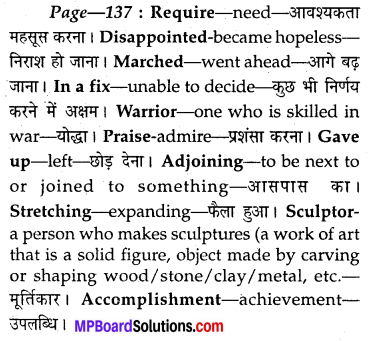
MP Board Class 8th Hindi Sugam Bharti Solutions Chapter 2 विनम्रता

प्रश्न-अभ्यास

अनुभव विस्तार

Class 8 Hindi Chapter 2 Vinamrata MP Board प्रश्न 1.
वस्तुनिष्ठ प्रश्न
(क) सही जोड़ी बनाइए
(अ) सुसंस्कृत – 1. अभिमान
(ब) सामंजस्य – 2. व्यवहार
(स) दंभ – 3. औचित्य
(द) आचरण – 4. अच्छे संस्कार वाला
उत्तर-
(अ) 4
(ब) 3
(स) 1
(द) 2

(ख) दिए गए विकल्पों से रिक्त स्थान की पूर्ति कीजिए
(अ) दीन याचक होता है जबकि विनम्र …………….। (पाने वाला, दाता)
(ब) ………….. चरित्र का सद्गुण है। (विनम्रता, सुन्दरता)
(स) यदि हमारे लिए कोई कष्ट उठाकर काम करता है तो हमें उसके प्रति …………… प्रकट करना चाहिए। (कृतघ्नता, कृतज्ञता)
(द) विनम्रता ……………. की पोषक है। (निजता, जीवंतता)
उत्तर-
(अ) दाता,
(ब) विनम्रता,
(स) कृतज्ञता,
(द) जीवंतता।

Mp Board Class 8th Hindi Solution प्रश्न 2.
अति लघु उत्तरीय प्रश्न
(अ) ‘विनम्रता’ शब्द का अर्थ बताइए।
(ब) ‘विधु’ के व्यवहार से वीरेन्द्र क्यों प्रभावित हुए?
(स) बड़ों के बुलाने पर किस तरह उत्तर देना चाहिए?
(द) सफलता की गारंटी किसे कहा है?
उत्तर-
(अ) ‘विनम्रता’ शब्द का अर्थ है-अच्छा व्यवहार।
(ब) ‘विधु’ के व्यवहार से वीरेन्द्र उसकी विनम्रता से प्रभावित हुए।
(स) बड़ों के बुलाने पर ‘जी हाँ’ ‘जी आया’ इस तरह का उत्तर देना चाहिए।
(द) सफलता की गारंटी विनम्रता को कहा है।

Mp Board Class 8 Hindi Book Solution प्रश्न 3.
लघु उत्तरीय प्रश्न
(अ) विराट और विधु के व्यवहार की तुलना कीजिए।
उत्तर-
(अ) विराट और विधु के व्यवहार एक-दूसरे के विपरीत हैं। विराट के व्यवहार में शिष्टता और विनम्रता नहीं है। वह दंभी है। इसलिए वह प्रशंसा का पात्र नहीं है। इसके विपरीत विधु के व्यवहार में शिष्टता और विनम्रता है। वह दंभी नहीं है। अपने इस सद्गुण के कारण वह प्रशंसनीय है।

(ब) विनम्र व्यक्ति की पहचान कैसे होती है?
उत्तर-
(ब) विनम्र व्यक्ति की पहचान उसके सद्व्यवहार से होती है। वह अपने से बड़ों-छोटों के प्रति यथोचित आदर-सत्कार और प्यार के भावों को प्रकट करता है। इस प्रकार वह बिना किसी भेदभाव के सबकी गरिमा और भावनाओं का समुचित सम्मान करता है।

(स) समुद्र में बाढ़ क्यों नहीं आती? स्पष्ट कीजिए।
उत्तर-
(स) समुद्र में बाढ़ नहीं आती है। यह इसलिए कि समुद्र अपनी सीमा में ही रहता है। वह अपनी सीमा से कभी भी बाहर नहीं आता है। इस प्रकार अपनी सीमा में ही वह रहकर नदियों के पानी को समा लेता है। यह वह अपनी विनम्र अनुशासन की विशेषता के कारण ही कर लेता है।

(द) ‘दीन याचक होता है, जबकि विनम्र दाता’ इसका आशय स्पष्ट कीजिए।
उत्तर-
(द) ‘दीन याचक होता है, जबकि विनम्र दाता’ इसका आशय यह है कि दीन व्यक्ति में अपनापन की भावना नहीं होती है। वह स्वार्थी होता है। इसके विपरीत विनम्र व्यक्ति में अपनापन होता है। वह प्यार बाँटता है। परस्पर मेल-मिलाप का वातावरण तैयार करता है। वह किसी से कुछ माँगता-चाहता नहीं है। वह तो अपने सद्व्यवहार से अपने संपर्क में आने वालों को अपने सद्गुणों को बाँटता ही रहता है।

(इ) विनम्रता कब प्रभाव पैदा करती है?
उत्तर-
(इ) विनम्रता तब प्रभाव पैदा करती है, जब जिस समस्या का समाधान आवेश भरा व्यक्ति नहीं ढूँढ़ पाता, उसे विनम्रता सहज में खोज लेती है।।

भाषा की बात

Sugam Bharti Class 8 MP Board प्रश्न 1.
बोलिए और लिखिएप्रतीक्षा, प्रशंसा, सुसंस्कृत, पृष्ठभूमि, सामंजस्य, जीवंतता।
उत्तर-
1. प्रतीक्षा, प्रशंसा, सुसंस्कृत, पृष्ठभूमि, सामंजस्य, जीवंतता।

Mp Board Class 8 Hindi  प्रश्न 2.
शुद्ध वर्तनी लिखिएसंक्षीप्त, मर्दुल, विनमरता, व्यतित्व, ओपचारिकता।
उत्तर-
शुद्ध वर्तनी-संक्षिप्त, मृदुल, विनम्रता, व्यक्तित्व, औपचारिकता।

Mp Board Class 8 Hindi Chapter 2 प्रश्न 3.
निम्नलिखित वाक्यों में से विशेषण और विशेष्य शब्द छाँटिए
(अ) आया शरारती लड़की है।
(ब) बाजार में मीठे आम बिक रहे हैं।
(स) परिश्रमी व्यक्ति सफल होते हैं।
(द) लाल टोपी लेकर आओ।
उत्तर-
विशेषण – विशेष्य
शरारती – लड़की
मीठे – आम
परिश्रमी – व्यक्ति
लाल – टोपी

भाषा भारती कक्षा 8 Solutions MP Board प्रश्न 4.
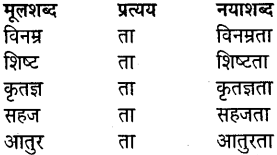
उदाहरण के अनुसार ‘ता’ प्रत्यय लगाकर नए शब्द बनाइए-
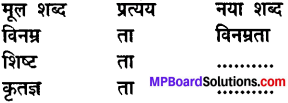
Class 8 Hindi Chapter 2 Vinamrata MP Board
Mp Board Class 8th Hindi Solution
उत्तर-
Mp Board Class 8 Hindi Book Solution

Mp Board Solution Class 8 Hindi प्रश्न 5.
पाठ में सु उपसर्ग वाले सुमधुर, सुसंस्कृत आदि शब्द आए हैं। निम्नलिखित शब्दों में ‘सु’ उपसर्ग लगाकर नए शब्द बनाइए-
गंध, पुत्र, फल, मुखी, संस्कार, योग।
उत्तर-
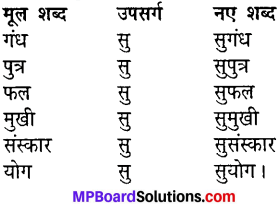
Sugam Bharti Class 8 MP Board

एमपी बोर्ड क्लास 8 हिंदी MP Board प्रश्न 6.
निम्नलिखित शब्दों को उनके उचित विलोम से रेखा खींचकर मिलाइए-
उचित- उपेक्षा
औपचारिक – दुर्गुण
अपेक्षा – अनादर
सद्गुण – अनुचित
आदर – अनौपचारिक
उत्तर-
शब्द – विलोम शब्द
उचित – अनुचित
औपचारिक – अनौपचारिक
अपेक्षा – उपेक्षा
सद्गुण – दुर्गुण
आदर – अनादर

प्रमुख गद्यांशों की संदर्भ-प्रसंग सहित व्याख्याएँ

1. विनम्रता चरित्र का सद्गुण है। सुसंस्कृत होने का परिचय है। यह एक ऐसा चुंबक है जो सम्पर्क में आने वाले को स्वयं अपनी ओर खींच लेता है। विनम्र व्यक्ति की बोली मृदुल, आचरण शिष्ट, तथा भावना निजता से ओतप्रोत होती

शब्दार्थ-विनम्रता-शिष्टता, अच्छा व्यवहार। सद्गुण-अच्छा गुण। सुसंस्कृत-अच्छा संस्कार। मृदुल-कोमल। शिष्ट-विनम्र। आचरण-व्यवहार। निजता-अपनापन।

संदर्भ-प्रस्तुत पंक्तियां हमारी पाठ्य-पुस्तक ‘सुगम भारती’ (हिंदी सामान्य) भाग-8 के पाठ-2 ‘विनम्रता’ से ली गई है।

प्रसंग-प्रस्तुत पंक्तियों में लेखक ने विनम्रता की विशेषता बतलाने का प्रयास किया है।

व्याख्या-लेखक का कहना है कि विनम्रता चरित्र का अधिक श्रेष्ठ गुण है। दूसरे शब्दों में विनम्रता से चरित्र अधिक महान बनता है। विनम्रता से अच्छा संस्कार के होने का परिचय मिलता है। विनम्रता की एक यह भी विशेषता होती है कि वह चुंबक की तरह होती है। अपनी इस विशेषता से वह अपने पास आने वालों को तुरंत ही अपनी ओर खींच लेती है। इस प्रकार जिसमें विनम्रता होती है, वह मधुर बोलता है, उसका व्यवहार सभ्य होता है, और उसके भाव-विचार में अपनापन भरा होता है।

विशेष-

  1. विनम्र व्यक्ति पर प्रकाश डाला गया है।
  2. भाषा सरल है।

2. विनम्रता केवल बड़ों के प्रति ही नहीं होती है बराबर वालों के प्रति भी समादर और अपने से छोटों के प्रति स्नेह के रूप में भी प्रकट होती है। व्यक्तित्व को आकर्षक बनाने में इसकी महत्त्वपूर्ण भूमिका रही है। यदि हमारे लिए कोई कष्ट उठाकर कुछ काम करता है तो हमें उसके प्रति अपनी कृतज्ञता अवश्य प्रकट करनी चाहिए। यदि बस या रेल में कोई व्यक्ति अपनी जगह हमें बैठने के लिए देता है तो उसे धन्यवाद देना कभी न भूलें। ऐसा करते समय लगना भी चाहिए कि हम उसे हृदय से धन्यवाद दे रहे हैं, केवल औपचारिकता का निर्वाह नहीं।

शब्दार्थ-स्नेह-प्रेम। आकर्षक-मोहक। कृतज्ञता-अहसान। औपचारिकता-दिखावा।

संदर्भ-पूर्ववत्।

प्रसंग-प्रस्तुत पंक्तियों में लेखक ने यह बतलाने का प्रयास किया है कि विनम्रता सबके प्रति होती है।

व्याख्या-विनम्र व्यक्ति अपने से बड़ों-छोटों के प्रति उचित रूप से विनम्र होना नहीं भूलता है। वह अपने से बड़ों के प्रति आदर-सत्कार को प्रकट करता है। इसी प्रकार वह अपने बराबर वालों का भी सत्कार करता है। अपने से छोटों के प्रति प्यार प्रकट करता है। इस प्रकार की विनम्रता से उसका व्यक्तित्व आकर्षक और महान् बनता है। इस आधार पर यह कहना ठीक होगा कि विनम्र व्यक्ति को सहयोग करने वाले के प्रति अपनी कृतज्ञता अवश्य करने चाहिए। उदाहरण के लिए यदि कोई बस, रेल आदि में बैठ आराम करने या कोई सुविधा दे तो विनम्र व्यक्ति को चाहिए कि वह उसे हृदय से धन्यवाद दे। अगर वह दिखावा कर रहा है, तो उससे उसकी विनम्रता नहीं प्रकट होगी।

विशेष-

  1. विनम्रता से व्यक्तित्व महान् बनता है, इसे समझाया गया है।
  2. विनम्रता में किसी प्रकार का दिखावा नहीं होना चाहिए, इसे स्पष्ट किया गया है।

MP Board Class 8th Hindi Bhasha Bharti Solutions Chapter 6 भक्ति के पद

MP Board Class 8th Hindi Bhasha Bharti Solutions Chapter 6 भक्ति के पद

MP Board Class 8th Hindi Bhasha Bharti Chapter 6 पाठ का अभ्यास

बोध प्रश्न

भक्ति के पद कक्षा 8 MP Board Chapter 6 प्रश्न 1.
निम्नलिखित शब्दों के अर्थ शब्दकोश से खोजकर लिखिए
उत्तर
पंछी = पक्षी; कूप = कुआँ; मधुकर = भौंरा; तजि = छोड़कर; अधम = नीच; दनुज = राक्षस, दानव; घन = बादल; चकोरा = चकोर, चकवा-चकवी; पूँजी = धन; छाँड़ि= छोड़कर; छेरी = बकरी; अम्बुज= कमल; उधारे = उद्धार किया; बास = सुगन्ध।

Bhakti Ke Pad Class 8 MP Board Chapter 6 प्रश्न 2.
निम्नलिखित प्रश्नों के उत्तर संक्षेप में लिखिए

(क) सूर के मन को सुख कहाँ प्राप्त होता है ?
उत्तर
सूरदास के मन को सुख भगवान श्रीकृष्ण के चरणों की भक्ति में प्राप्त होता है।

(ख) अधम का उद्धारक कौन है ?
उत्तर
अधम के उद्धारक भगवान राम हैं।

(ग) रैदास किसके आराधक थे ?
उत्तर
रैदास ईश्वर के नाम के आराधक थे।

(घ) मीराबाई को कौन-सा रत्न प्राप्त हो गया ?
उत्तर
मीराबाई को राम रत्न प्राप्त हो गया।

पाठ 6 भक्ति के पद MP Board Class 8th प्रश्न 3.
निम्नलिखित विकल्पों में से सही उत्तर चुनिए

(क) “प्रभुजी तुम चन्दन हम पानी …………… पंक्ति किस कवि की है ?
(अ) सूर
(आ) तुलसी
(इ) रैदास
(ई) मीराबाई
उत्तर
(इ) रैदास

(ख) तुलसीदास की भक्ति निम्नलिखित में से किस भाव की है ?
(अ) सखाभाव
(आ) दासभाव
(इ) मित्रभाव
(ई) गुरु भाव।
उत्तर
(आ) दासभाव

(ग) ब्रज भूमि में किसकी झाड़ियाँ (कुंज) अधिक मिलती हैं?
(अ) आम
(आ) जामुन,
(इ) नीम
(ई) करील।
उत्तर
(ई) करील

(घ) निम्नलिखित रचनाकारों में से किसका सम्बन्ध राजस्थान से था?
(अ) सूर
(आ) तुलसी
(इ) मीरा
(ई) बिहारी।
उत्तर
(इ) मीरा।

Mp Board Class 8 Hindi Chapter 6 प्रश्न 4.
निम्नलिखित प्रश्नों के उत्तर विस्तार से लिखिए

(क) ‘जहाज का पक्षी’ किस बात का प्रतीक है? आशय स्पष्ट कीजिए
उत्तर
‘जहाज का पक्षी’ भगवान कृष्ण रूपी जहाज पर स्थल के दूर या समीप होने की जानकारी देने वाला पक्षी रूप भक्त है। जिस तरह समुद्र से यात्रा करने वाले जहाज से जमीन किधर है और कितनी दूर है, इसकी जानकारी लेने के लिए पक्षियों को छोड़ा जाता था। जब जमीन कहीं नहीं दीखती और जमीन पक्षियों की पहुँच से बाहर होती थी, तो पक्षी लौटकर जहाज पर ही आ जाते थे। यदि जमीन दूर या समीप होती, तो पक्षी उसी दिशा में उड़ते हुए चले जाते थे और वह जमीन ही उनकी शरण स्थल बन जाती थी। नाविक भी जहाज को उसी दिशा में खेने लग जाते थे। उस जमीन पर जाकर जहाज अपना लंगर डाल देता था। यह उस समय होता था जब कुतुबनुमा आदि दिशासूचक यन्त्रों का आविष्कार नहीं हुआ था। इस पद में कवि ने अपने आपको जहाज के पक्षी के (भक्त) रूप में चित्रित किया है जो बार-बार सभी ओर से निराश होकर श्रीकृष्ण के चरणों रूपी जहाज पर शरण प्राप्त करता है।

(ख) तुलसी ने किस-किसके उद्धार का उल्लेख किया है ?
उत्तर
तुलसी ने वर्णन किया है कि खग (जटायु), मृग (मारीच), व्याघ (वाल्मीकि), पषान (शाप से पत्थर बनकर पड़ी हुई गौतम पत्नी अहिल्या); बिटप (यमलार्जुन नामक वृक्ष); जड़ (भरत मुनि); आदि का उद्धार भगवान श्रीराम ने त्रेतायुग में और भगवान श्रीकृष्ण ने द्वापर युग में किया था। जटायु पक्षी सीता हरण के समय, सीता को बचाने के लिए रावण से संघर्ष करते हुए घायल हो गया था। श्रीराम ने उसका उद्धार किया था। मृग (मारीच) रावण का सम्बन्धी था जो रावण की सहायता के ‘लिए कपट-मृग (स्वर्ण मृग) बना था; जिसका राम ने उद्धार किया था। व्याध (वाल्मीकि) पहले डाकू थे। राम शब्द का उल्टा जाप करने से उनका कल्याण हो गया। पषान (अहिल्या) गौतम ऋषि की पत्नी थीं। वे अपने ऋषि पति के द्वारा दिये गये शाप के कारण पत्थर (पाषाण) बन गई थीं। भगवान राम ने अपने चरणों की धूल के प्रताप से उनका उद्धार किया था। यमलार्जुन को श्राप लगा और वे वृक्ष बन गये थे। द्वापर युग में श्रीकृष्ण ने उनका उद्धार किया। इस तरह विभिन्न रूप में पतित हुए प्राणियों का भगवान ने उचित समय पर उद्धार किया था।

(ग) रैदास ने भगवान से अपना सम्बन्ध स्थापित करते हुए किस-किससे अपने को जोड़ा है?
उत्तर
रैदास ने भगवान से अपने आपको कई तरह से जोड़ा है। उन्होंने भगवान को चन्दन, धन (बादल), चन्द्रमा, दीपक, मोती के रूप में है और अपने आपको क्रमशः पानी, मोर, चकोर, बत्ती, धागे के रूप में चित्रित किया है। चन्दन पानी के संयोग से घिस जाता है और उसकी गंध फैलने लगती है। बादल की गरजना के साथ ही मोर कूकता है। चन्द्रमा को चकोर एकटक ही देखता है। दीपक में बत्ती होती है, वह दीपक की ज्योति बिखेरती है। मोतियों में धागा पिरोया जाता है, फिर हार (माला) बन जाता है। सोने को सुहागे से चमक प्राप्त होती है। इस तरह ईश्वर से इन जीवों का विभिन्न प्रकार का सम्बन्ध है।

(घ) मीरा की भक्ति भावना पर अपने विचार प्रकट कीजिए।
उत्तर
मीरा की भक्ति दास भावना से ओत-प्रोत है। वे भगवान कृष्ण की भक्त दासी हैं। ईश्वर की भक्ति उनके लिए वह रत्न है जिसे कोई चोर चुरा नहीं सकता, खर्च करने पर भी खर्च नहीं होता। भगवान की भक्ति का रत्न तो प्रतिदिन सवाया ही होता जाता है। इस प्रकार ईश-भक्ति से मनुष्य सतगुरु की कृपा प्राप्त कर लेता है और सत पर आधारित मनुष्य की जीवन नौका बड़ी सरलता से संसार सागर को पार कर जाती है। ईश्वर की भक्ति ही मनुष्य को उद्धार प्राप्त कराने का एकमात्र साधन है। ईश्वर की भक्ति तो संसार की विविध वस्तुओं के प्रति मोह त्यागने पर ही प्राप्त होती है।

भाषा भारती कक्षा 8 Solutions Chapter 6 MP Board  प्रश्न 5.
निम्नलिखित पंक्तियों का आशय स्पष्ट कीजिए
(क) कौन देव बराय बिरद-हित, हठि-हठिअधम उचारे ?
उत्तर
तुलसीदास जी कहते हैं कि भगवान राम ! मैं आपके चरणों की भक्ति को छोड़कर कहाँ जाऊँ ? आपके अतिरिक्त किसका नाम पतितपावन है ? दीनों के प्रति किसे अति प्रेम है ? अन्य कौन-सा देवता है जिसने हठपूर्वक अपने यश के लिए पापियों का उद्धार किया हो ? पक्षी (जटायु), मृग (मारीच), व्याध वाल्मीकि), पाषान (अहिल्या), वृक्ष (यमलार्जुन),जड़ (भरत मुनि) आदि का किस देवता ने संसार-सागर से उद्धार किया है ? देव, राक्षस, मुनि, नाग और मनुष्य आदि सभी माया के वशीभूत होकर दयनीय बने हुए हैं। इसलिए, तुलसीदास अपने आपको समझाते हुए कहते हैं कि इनके समक्ष तू (तुलसी) अपनी दीनता का बखान क्यों करता है ?

(ख) सूरदास प्रभु काम धेनु तजि, छेरी कौन दुहावै ?
उत्तर
मेरा मन दूसरे स्थान पर किस तरह सुख प्राप्त कर सकता है। जिस तरह समुद्री जहाज से जमीन के होने की जानकारी के लिए छोड़ा गया पक्षी लौटकर फिर से जहाज पर ही आ जाता है, क्योंकि स्थल पास में नहीं होता है। उसे उसी जहाज पर शरण प्राप्त होती है। उसी पक्षी की तरह यह मेरा मूर्ख बना मन श्रीकृष्ण को झेड़कर किसी दूसरे देव का ध्यान क्यों धरता है। महान् पुण्यशाली पवित्र गंगा को छोड़कर मूर्ख और कुबुद्धि मनुष्य ही कुआँ खोदने की बात सोचता है। जिस भौरे ने कमल के पराग का ही पान किया हो, वह भौरा करील के फल (टेंटी) क्यों खायेगा ? सूरदास वर्णन करते हैं कि कामधेनु को छोड़कर बकरी दुहने का विचार कौन करता है ? तात्पर्य यह है कि भगवान श्रीकृष्ण को छोड़कर, हे मेरे मन ! तू किस दूसरे देव की आराधना करने का विचार करता है ? यदि तू ऐसा करता है तो निश्चय ही तू बड़ा मूर्ख है, उचित और अनुचित के भेद को तू नहीं जानता है।

Bhakti Ke Pad Class 8 Medha MP Board प्रश्न 6.
निम्नलिखित पंक्तियों का सन्दर्भ सहित भाव स्पष्ट कीजिए
(क) प्रभु जी तुम चन्दन हम पानी, जाकी अंग-अंग बास समानी।
उत्तर
इस पंक्ति के सन्दर्भ सहित भाव के लिए ‘सम्पूर्ण पद्यांशों की व्याख्या’ शीर्षक के पद्यांश-03 की व्याख्या सन्दर्भ-प्रसंग सहित देखिए।

(ख) पायो जी मैंने राम रतन धन पायो।
वस्तु अमोलक दी मेरे सतगुरु, किरपा कर अपनायो।।
जनम-जनम की पूँजी पाई, जग में सभी खोवायो।
खरचै नहिकोई चोर नलेवे, दिन-दिन बढ़त सवायो।।
उत्तर
इन पंक्तियों के सन्दर्भ सहित भाव के लिए ‘सम्पूर्ण पद्यांशों की व्याख्या’ शीर्षक के पद्यांश-04 की व्याख्या सन्दर्भ-सहित देखिए।

भाषा-अध्ययन

प्रश्न 1.
दिये गये विकल्पों में से सही विकल्प छाँटकर रिक्त स्थानों की पूर्ति कीजिए
(क) पंछी तद्भव शब्द है। इसका तत्सम रूप …… है। (पक्षी, पक्षि, पंच्छी)
(ख) चरन तद्भव शब्द है। इसका तत्सम रूप ……………… है। (पैर, चारन, चरण)
(ग) कमल का पर्यायवाची ……. शब्द है। (नीरद, जलद, नीरज)
(घ) रात का पर्यायवाची ……… है। (दिननाथ, रजनीपति, रजनी)
उत्तर
(क) पक्षी
(ख) चरण
(ग) नीरज
(घ) रजनी।

प्रश्न 2.
निम्नलिखित वर्ग पहेली में रात, पानी, कमल के दो-दो पर्यायवाची शब्द दिए हैं। उन्हें ढूँदिए तथा लिखिए।
उत्तर
शब्द – पर्यायवाची
रात = रात्रि, रजनी।
पानी = तोय, जल।
कमल = नीरज, तोयज।

प्रश्न 3.
तालिका में दिए गए शब्दों की सही जोड़ी बनाइए
उत्तर
तद्भव शब्द – तत्सम शब्द
(क) महातम – (1) दुर्मति
(ख) दुरमति – (2) स्वर्ण
(ग) मानुस – (3) माहात्म्य
(घ) सोना – (4) मनुष्य
उत्तर
(क)-(3),(ख)→(1),(ग)→(4),(घ)→2

प्रश्न 4.
निम्नलिखित छंदों में प्रयुक्त मात्राएँ गिनकर लक्षण के अनुसार छंद का नाम लिखिए
(क) वृक्ष कबहु नहिं फल भखै, नदी न संचै नीर।
परमारथ के कारने, साधुन धरा शरीर।।
उत्तर
यह छंद दोहा है। यह मात्रिक छन्द है। इसमें चार चरण होते हैं। इसके विषम चरणों (पहले और तीसरे) में 13-13 मात्राएँ तथा सम चरणों (दूसरे और चौथे) में 11-11 मात्राएँ हैं।
MP Board Class 8th Hindi Bhasha Bharti Solutions Chapter 6 भक्ति के पद 2
वृक्ष कबहु नहिं फल भखै, नदी न संचै नीर।
MP Board Class 8th Hindi Bhasha Bharti Solutions Chapter 6 भक्ति के पद 1
परमारथ के कारने, साधुन धरा शरीर।।
अत: यह दोहा छन्द है।

(ख) कुन्द इन्दु सम देह, उमा रमन करुना अयन।
जाहि दीन पर नेह, करहु कृपा मर्दन मयन।।
उत्तर
MP Board Class 8th Hindi Bhasha Bharti Solutions Chapter 6 भक्ति के पद 3
कुन्द इन्दु सम देह, उमा रमन करुना अयन।
MP Board Class 8th Hindi Bhasha Bharti Solutions Chapter 6 भक्ति के पद 4
जाहि दीन पर नेह, करहु कृपा मर्दन मयन।
(11-13 मात्राएँ) अत: यह सोरठा छन्द है।
(ग) जेहि सुमिरत सिधि होय, गन नायक करिवर वदन।
करहु अनुग्रह सोय, बुद्धि रासि सुभ गुन सदन।।
उत्तर
MP Board Class 8th Hindi Bhasha Bharti Solutions Chapter 6 भक्ति के पद 5
जेहि सुमिरत सिधि होय, गन नायक करिवर वदन।
MP Board Class 8th Hindi Bhasha Bharti Solutions Chapter 6 भक्ति के पद 6 (11-13 मात्राएँ)
करहु अनुग्रह सोय, बुद्धि रासि सुम गुन सदन।।
(11-13 मात्राएँ) अतः यह सोरठा कद है।
खण्ड-ख और ग सोरठा मद के उदाहरण हैं। सोरठा छन्द मात्रिक छन्द होता है। यह दोहे का उल्टा होता है। इसके विषम चरणों में (पहले और तीसरे में) 11-11 मात्राएँ तथा सम चरणों में (दूसरे और चौथे में)
13-13 मात्राएँ होती है।

भक्ति के पद सम्पूर्ण पद्यांशों की व्याख्या

(1) मेरौ मन अनत कहाँ सुख पावै।
जैसे उड़ि जहाज को पंछी, फिरि जहाज पर आवै।
कमल-नैन को छाँड़ि महातम और देव को ध्यावे?
परम गंग को छोड़ि पियासौ, दुरमति कूप खनावै।
जिहिं मधुकर अंबुज-रस चाख्यौ, क्यों करील फल भावै।
सूरदास, प्रभु, कामधेनु तजि, छरी कौन दुहावै ?

शब्दार्थ-मेरौ= मेरा; अनत-अन्यत्र,दूसरी जगह; पावै प्राप्त कर सकता है; पंछी = पक्षी; फिरि = लौटकर आवै = आ-जाता है; कमल-नैन = कमल के समान नेत्र वाले भगवान कृष्ण; छाँड़ि = छोड़कर या अतिरिक्त; महातम = महान् मूर्ख और देव = अन्य देवता को; ध्यावै = ध्यान करता है; परम = महान्; पियासौ = प्यासा व्यक्ति; दुरमति = दुर्बुद्धि; कूप – कुऔं; खनावै = खुदवाता है; जिहि = जिस; मधुकर = भौरे ने; अंबुज-रस = कमल के पराग का; चाख्यौ = आस्वादन किया है; करील फल = टेंटी; भावै = अच्छी लगें; छेरी = बकरी; दुहावै दुहेगा।

सन्दर्भ-प्रस्तुत पद हमारी पाठ्य-पुस्तक ‘भाषा-भारती के पाठ’ भक्ति के पद’ से अवतरित है। इसके रचयिता ‘सूरदास हैं।

प्रसंग-प्रस्तुत पद में सूरदास ने अपनी दीनता भरी विनती को स्पष्ट किया है। वे आशा करते हैं कि हे भगवान श्री कृष्ण जी ! आपके ही चरणों में मुझे शरण प्राप्त होगी।

व्याख्या-मेरा मन दूसरे स्थान पर किस तरह सुख प्राप्त कर सकता है। जिस तरह समुद्री जहाज से जमीन के होने की जानकारी के लिए छोड़ा गया पक्षी लौटकर फिर से जहाज पर ही आ जाता है, क्योंकि स्थल पास में नहीं होता है। उसे उसी जहाज पर शरण प्राप्त होती है। उसी पक्षी की तरह यह मेरा मूर्ख बना मन श्रीकृष्ण को झेड़कर किसी दूसरे देव का ध्यान क्यों धरता है। महान् पुण्यशाली पवित्र गंगा को छोड़कर मूर्ख और कुबुद्धि मनुष्य ही कुआँ खोदने की बात सोचता है। जिस भौरे ने कमल के पराग का ही पान किया हो, वह भौरा करील के फल (टेंटी) क्यों खायेगा ? सूरदास वर्णन करते हैं कि कामधेनु को छोड़कर बकरी दुहने का विचार कौन करता है ? तात्पर्य यह है कि भगवान श्रीकृष्ण को छोड़कर, हे मेरे मन ! तू किस दूसरे देव की आराधना करने का विचार करता है ? यदि तू ऐसा करता है तो निश्चय ही तू बड़ा मूर्ख है, उचित और अनुचित के भेद को तू नहीं जानता है।

(2) जाऊँ कहाँ तजि चरन तिहारे ?
काको नाम पतित पावन ? जग केहि अति दीन पियारे ?
कौन देव बराय बिरद-हित, हठि हठि अधम उधारे ?
खग, मृग, व्याघ, पषान, बिटप, जड़, जवन कवन सुर तारे ?
देव, दनुज, मुनि, नाग, मनुज सब, माया-बिबस बिचारे।
तिनके हाथ दास तुलसी प्रभु कहा ‘अपनपी हारे’।।

शब्दार्थ-तजि = छोड़कर; तिहारे = तुम्हारे; काको = किसका; पतित-पावन = नीच व्यक्ति का उद्धार करने वाला; जग = संसार में; केहि = किसको, अति = बहुत अधिक; दीन = गरीब पियारे= प्रिय हैं; बराय = दूसरा; बिरद-हित = यश के लिए: हठि-हठि= हठपूर्वक; अधम = पापियों का; उधारे = उद्धार किया है; खग = जटायु; मृग = मारीच; व्याघ – वाल्मीकि जो पहले डाकू थे; पषान = अहिल्या; बिटप = यमलार्जुन; जड़भरतमुनि; मनुज = मनुष्य; माया-बिबस = माया से भ्रमित होकर; बिचारे = दीन बने हुए हैं। अपनपौ = अपनेपन अर्थात् अपनी दीनता; हारे = हार मान जाये।

सन्दर्भ-प्रस्तुत पद हमारी पाठ्य-पुस्तक ‘भाषा-भारती’ के पाठ’ भक्ति के पद’ से अवतरित है। इसके रचयिता गोस्वामी तुलसीदास हैं।

प्रसंग-तुलसीदास भगवान राम के प्रति अपनी अटूट भक्ति और विश्वास को प्रकट करते हैं। वे अपने इष्ट राम के चरणों में ही शरण प्राप्त करते हैं।

व्याख्या-तुलसीदास जी कहते हैं कि भगवान राम ! मैं आपके चरणों की भक्ति को छोड़कर कहाँ जाऊँ ? आपके अतिरिक्त किसका नाम पतितपावन है ? दीनों के प्रति किसे अति प्रेम है ? अन्य कौन-सा देवता है जिसने हठपूर्वक अपने यश के लिए पापियों का उद्धार किया हो ? पक्षी (जटायु), मृग (मारीच), व्याध वाल्मीकि), पाषान (अहिल्या), वृक्ष (यमलार्जुन),जड़ (भरत मुनि) आदि का किस देवता ने संसार-सागर से उद्धार किया है ? देव, राक्षस, मुनि, नाग और मनुष्य आदि सभी माया के वशीभूत होकर दयनीय बने हुए हैं। इसलिए, तुलसीदास अपने आपको समझाते हुए कहते हैं कि इनके समक्ष तू (तुलसी) अपनी दीनता का बखान क्यों करता है ?

(3) अब कैसे छूटै नाम रट लागी ? प्रभुजी तुम चन्दन हम पानी, जा की अंग-अंग बास समानी ।।
प्रभुजी तुम घनवन हम मोरा, जैसे चितवत चंद चकोरा ।
प्रभुजी तुम दीपक हम बाती,जाकी ज्योति बरे दिन राती ।।
प्रभुजी तुम मोती हम धागा, जैसे सोनहिं मिलत सुहागा ।
प्रभुजी तुम स्वामी हम दासा, ऐसी भक्ति करे रैदासा ।।

शब्दार्थ-छूटै = समाप्त हो; नाम रट = भगवान के नाम की रट: अंग-अंग = शरीर के प्रत्येक अंग में बास = सगन्धः समानी = व्याप्त हो गयी है; घन बादल; वन जंगल (संसार); हम = प्राणी; मोरा = मोर हैं; जैसे = जिस तरह; चितवत = एक टक होकर देखता रहता है; चंद = चन्द्रमा को; चकोरा = चकोर पक्षी; बाती = बत्ती; ज्योति = प्रकाश, उजाला; बरे = जलती है; दिन राती रात और दिन; सोनहि-सोने में।

सन्दर्भ-प्रस्तुत पद हमारी पाठ्य-पुस्तक ‘भाषा-भारती के पाठ ‘भक्ति के पद से अवतरित है। इसके रचयिता भक्त कवि रैदास हैं।

प्रसंग-भक्त कवि रैदास ने इस पद में बताया है कि वे ‘दास’ भाव की भक्ति करते हैं।

व्याख्या-हे प्रभो ! तुम्हारे नाम की लगी हुई रट किसी भी तरह नहीं छट सकती। तुम सुगन्धित चन्दन हो, हम (मैं) पानी के समान हैं। चन्दन की सुगन्ध जल के साथ मिलकर उसमें समा जाती है। उसी तरह, हे प्रभो ! तुम्हारी भक्ति में मेरा अंग-अंग डूबा हुआ है। हे प्रभो ! तुम बादल के समान हो, और हम (भक्तगण) मोर के समान है। हम आपकी तरफ ठीक उसी तरह एकटक होकर देखते रहते हैं, जिस तरह चकोर पक्षी चन्द्रमा की ओर देखता रहता है। आगे फिर कवि कहता है कि हे ईश्वर ! तुम दीपक हो और हम उस दीपक की बत्ती के समान हैं, जिसकी लौ की ज्योति रात-दिन जलती रहती है अर्थात् तुम्हारा ही तेज सर्वत्र बिखरा हुआ है। कवि फिर कहता है कि हे ईश्वर ! तुम मोती के समान हो और मोती पिरोये गये धागे के समान हम (भक्त) लोग हैं अर्थात् भक्त ईश्वर से मिलकर अपनी बात बना ले जाता है। रैदास कवि कहते हैं कि हे प्रभो ! मैं आपका दास हूँ और तुम मेरे स्वामी हो। इस तरह मैं दास भाव की भक्ति करता हूँ।

(4) पायो जी मैंने, राम रतन धन पायो।
वस्तु अमोलक दी मेरे सतगुरु, किरपा कर अपनायो।।
जनम-जनम की पूँजी पाई, जग में सभी खोवायो।
खरचै नहिं कोई चोर न लेवै, दिन-दिन बढ़त सबायो।।
सत की नाव खेवटिया सतगुरु, भवसागर तर आयो।
मीरा,के प्रभु गिरधर नागर, हरख-हरख जस गायो।।

शब्दार्थ-पायो = प्राप्त कर लिया है; अमोलक अमूल्य, बेशकीमती किरपा= कृपा, दया; अपनायो- अपना लिया है, स्वीकार कर लिया है। पूँजी = सम्पत्ति खोवायो – खो दिया है; दिन-दिन-प्रतिदिन, रोजाना; बढ़त = वृद्धि हो रही है; सबायो = सवा गुना; सत = सत्य, खेवटिया = खेने वाला; तर आयो = उद्धार प्राप्त कर लिया; नागर = चतुर: हरख-हरख = हर्षित होकर, प्रसन्न होकर; जस = यश, कीर्ति; गायो = गाया है।

सन्दर्भ-प्रस्तुत पद हमारी पाठ्य-पुस्तक ‘भाषा-भारती के पाठ’ भक्ति के पद’ से अवतरित है। इस पद की रचयिता भक्त कवयित्री ‘मीराबाई हैं।

प्रसंग-मीरा भगवान कृष्ण की भक्ति करती हैं। वह उनके यश का गान बहुत ही हर्षपूर्वक करती हैं।

व्याख्या-मीराबाई कहती है कि मैंने राम रूपी रत्न को धन के रूप में प्राप्त कर लिया है। मेरे श्रेष्ठ गुरु ने मुझे एक बेशकीमती वस्तु प्रदान की है। मेरे गुरु ने बड़ी ही कृपा करते हुए मुझे अपना लिया है। इस तरह मैंने प्रत्येक जन्म की पूँजी प्राप्त कर ली है। संसार सम्बन्धी सब कुछ (धन इत्यादि) खो दिया। यह भक्ति रूपी सम्पत्ति बहुत ही अजब है जिसे किसी भी तरह खर्च नहीं किया जा सकता। कोई चोर भी इसे चुरा नहीं सकता। यह भक्ति रूपी धन प्रतिदिन ही सवाया होकर बढ़ता जा रहा है। सत्य की नाव को खेने वाला यदि सतगुरु है तो आसानी से ही संसार रूपी सागर को सहज ही पार किया जा सकता है। मीरा वर्णन करती हैं कि मेरे प्रभु तो गोवर्धन पर्वत को धारण करने वाले हैं; वे अति चतुर हैं। मैंने तो उनके यश का गान हर्षित होकर किया है।

MP Board Class 8th Hindi Solutions

MP Board Class 8th Special English Solutions Chapter 4 The Narmada: The Lifeline of Madhya Pradesh

Guys who are planning to learn the fundamentals of English can avail the handy study material using MP Board Solutions for Class 8 English Chapter 4 The Narmada: The Lifeline of Madhya Pradesh Questions and Answers. You Can Download MP Board Class 8 English Solutions Questions and Answers, Notes, Summary, Guide, Pdf. Refer to the Madhya Pradesh State Board Solutions for English PDF available and score better grades. Simply click on the quick links available for MP Board Solutions for Class 8 English Chapter 4 The Narmada: The Lifeline of Madhya Pradesh Questions and Answers and prepare all the concepts in it effectively. Take your preparation to the next level by availing the Madhya Pradesh State Board Solutions for Class 8 English prepared by subject experts.

MP Board Class 8th Special English Solutions Chapter 4 The Narmada: The Lifeline of Madhya Pradesh

Do you feel the concept of English is difficult to understand? Not anymore with our MP Board Solutions for Class 8 English Chapter 4 The Narmada: The Lifeline of Madhya Pradesh Questions and Answers. All the Solutions are given to you with detailed explanation and you can enhance your subject knowledge. Use the Madhya Pradesh State Board Solutions for Class 8 English PDF for free of cost and prepare whenever you want.

The Narmada: The Lifeline of Madhya Pradesh Textual Exercise

Word Power

(A) Make words by adding suffixes as given in the example.

(i) grace – gracefully
furious – furiously
anxious – anxiously

(ii) pure – purity
serene – serenity
rare – rarity

(iii) meditate – meditation
create – creation
generate – generation

(iv) consider – consideration
specific – specification
limit – limitation

(b) Rearrange the jumbled letters to form words:

dorna a _ _ _ _
slebs _ _ _ _
hylo _ _ _ _
wob _ _ _ _
girion _ _ _ _

Answers:

adorn
bless
holy
bow
origin.

Comprehension

(A) Answer the following questions :

The Narmada The Lifeline Of Madhya Pradesh MP Board Class 8th Question 1.
Name some of the holy rivers of the country mentioned in the lesson.
Answer:
The Ganga, the Yamuna, the Brahmaputra, the Sindhu, the Godawari, the Kavari, the Krishna, the Satluj.

Class 8 English Chapter 4 The Narmada The Lifeline Of Madhya Pradesh Question 2.
Why does the Narmada say that she feels proud ?
Answer:
The Narmada say that she feels proud because she flows in India where a river is considered as a living being and is worshipped as goddess.

Mp Board Class 8 English Chapter 4 Question 3.
Why do we call the Narmada the lifeline of Madhya Pradesh ?
Answer:
The Narmada irrigates the major part of the state with her abundant water. Hence we call her the lifeline of Madhya Pradesh.

The Lifeline Of Madhya Pradesh MP Board Class 8th Question 4.
What is the meaning of ‘Narmada’?
Answer:
The word ‘Narmada’ means one who soothes and gives pleasures to all.

Class 8 English Chapter 4 Mp Board Question 5.
What blessing did Lord Shiva give to Narmada?
Answer:
Lord Shiva granted Narmada’s wishes. He blessed her that she would remain maiden and would flow free and pure forever.

Class 8 English Chapter 4 The Narmada Mp Board Question 6.
What are the places the Narmada flows through ?
Answer:
Narsinghpur, Raisen, Hoshangabad, Handia and Nemawar.

Narmada The Lifeline Of Madhya Pradesh MP Board Class 8th Question 7.
What is Maheshwar famous for ?
Answer:
The humble palace of Devi Ahilya Bai is located at the ghat of Maheshwar.

The Narmada: The Lifeline Of Madhya Pradesh Class 8 Question 8.
What do people from all over the world, come to see at Bheraghat near Jabalpur ?
Answer:
People from all over the world come to see how the Narmada flows gracefully through the colourful marble rocks at Bheraghat near Jabalpur.

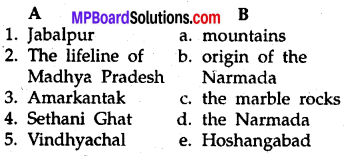
(B) Match the columns :
The Narmada The Lifeline Of Madhya Pradesh MP Board Class 8th
Answers:

  1. c
  2. d
  3. b
  4. e
  5. a.

Let’s Learn

(A) See the use of ‘among’ and ‘between’ in the following sentences:

  1. I am one among the main rivers of Madhya Pradesh.
  2. I flow between the Vindhyachal and the Satpura mountains.
  • among is used when three or more people or things are involved.
  • between is used for: two on either side of something.
  • when two people or things are involved.

Now fill in the blanks with between or among:

  1. We distributed sweets ________ the children.
  2. Rani is standing ________ Shreya and Sonal.
  3. Everest is one ________ the mountains of the Himalayas.
  4. Nepal lies ________ India and China.
  5. Wild animals live ________ the words.

Answer:

  1. among
  2. between
  3. among
  4. between
  5. among.

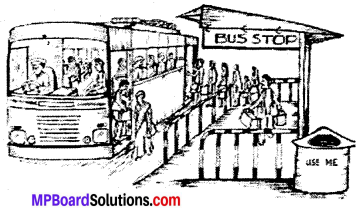
(B) See the picture given below carefully and fill in the blanks in the paragraph given below with appropriate prepositions given in the box. Some prepositions may need to be repeated.

into, in, on, for, from, of, to, with
Class 8 English Chapter 4 The Narmada The Lifeline Of Madhya Pradesh
This is the scene ____ 1 ____ a bus station. There is a dustbin ____ 2 ____ the corner ____ 3 ____ the bus station. The passengers who went to go ____ 4 ____ Mhow ____ 5 ____ Pithampur can catch the bus ____ 6 ____ here. The passengers are waiting ____ 7 ____ their turn to board the bus. Some passengers are already ____ 8 ____ the bus. There is some luggage ____ 9 ____the roof ____ 10 ____ the bus Some Passengers are carrying small bags, lunch boxes tec. ___ 11 ___ their hands. No one should break the queue to get ___ 12 ___ the bus. Travelling ____ 13 ____ a lot of luggage may cause trouble.

Answer:

  1. of
  2. in
  3. to
  4. of
  5. from
  6. from
  7. for
  8. in
  9. on
  10. of
  11. in
  12. into
  13. with

Let’s Talk

Choose any one river and talk about it in your group, with the help of the following clues :

Name of the river of your choice
The ______
It originates from ______
It is about kms long. ______
It flows through ______
There are ______
(important places on its banks)
There are ______
dams built across it.
It flows/does not flow ______
It’s ________
Answer:
The Ganga
It originates from Gangotri.
It is about 1560 miles long
It flows through Kanpur, Allahabad, Varanasi, Patna and Kolkata.
There are places like Haridwar, Varanasi, etc. on its banks.
There are two major (e.g. Farakka) dams built across it.
It flows into the Bay of Bengal.
It’s a holy river.

Let’s Read

Read the passage carefully.

According to Indian mythology, King Sagar, an ancestor of Lord Ram decided to perform a hundred Ashwamedha Yagnas. He completed ninetynine Yagnas and it was the hundredth when the horse of the Yagna got stolen by Devraja Indra. A great search for the horse was made. Ultimately Indra left the horse in the ashram of Kapil Muni. It was found by the sones of King Sagar. They insulted the Muni, thinking that it was he who had brought the horse there. Kapil Muni rose from his deep meditation and his anger soon turned down the sons of Sagar into ashes.

King Sagar had one more son Anshuman from his second queen. After his father, King Anshuman decided to make the Ganga descend on earth and immerse in it the ashes of his brothers so that their souls could rest in heaven. He started great Tapa, (severe penance) for this. After his death, his son King Dilip did similar Tapa to please the Ganga but could not succeed. After king Dilip his King Bhagirath continued the Tapa. Thus it was the third generation undergoing penance to please the Ganga.

The fierce penance of King Bhagirath pleased the Ganga. She appeared before him, and, blessing him, asked who would bear her force and current. King Bhagirath prayed to Lord Shiva to come for his help. Lord Shiva caught the powerful current of the Ganga in the locks of hair on his head. He tied her too tight to come out Again Bhagirath prayed to him to release the holy current. When she was released, she violently flowed after the chariot of Bhagirath. On her way came the ashram of Janhu Muni, and it too was swept away in the strong current. The Muni got furious and drank the whole of its water and dried the river up. Once again King Bhagirath had to pray to the Muni, and he released the Ganga from his thigh. Thus she was called Janhavi, the daughter of Janhu Muni.

Onward she continued her journey to the Gangasagar and ultimately reached the ashes of the sons of King Sagar.

Answer the following questions.

The Narmada The Lifeline Of Madhya Pradesh In Hindi Question 1.
Who was king Sagar ?
Answer:
King Sagar was an ancestor of Lord Ram who decided to perform a hundred Ashwamedha Yagnas.

Question 2.
What happened when Kapil Muni was insulted by the sons of King Sagar ?
Answer:
The sons of King Sagar were turned down into ashes.

Question 3.
Why did King Anshuman, King Dilip and King Bhagirath want to bring the Ganga on earth?
Answer:
They wanted to bring the Ganga on earth and immerse in it the ashes of King Sagar’s sons so that their souls could rest in heaven.

Question 4.
What happened when the Ganga descended ?
Answer:
The Ganga descended and began to flow with powerful current

Question 5.
Why do we call it the Janhavi ?
Answer:
We call it the Janhavi because it was released from the thigh of Janhu Muni.

Question 6.
Give another title to the above passage.
Answer:
The Ganga and the sons of King Sagar.

Let’s Write

You know that the rivers are very much polluted these days. Even the Ganga needs to be cleaned. Suggest how we can keep the rivers clean. Use the following clues :

  • People throw garbage, wastes and other things in the river.
  • Some orthodox people leave the dead bodies of the members of their families in the water of the river to perform the last rites.
  • Factories leave their chemical wastes in the river.
  • Drainage is merged in the river in most of the cities, towns and villages. Some people in the villages excrete near the river.
  • People, while bathing in the rivers, wash clothes and make the water dirty. They even make their cattle bathe in the rivers.
  • People immerse the idols made of clay and plaster of paris in the river. Now write in your own words

Answer:

People pollute the rivers by throwing, garbage, wastes and other things in them Some orthodox people immerse the dead bodies of their family members into the river water to perform the last rites. The chemical wastes of the factories are also thrown into the river water. Village people excrete near the river. People, make the river water dirty by washing their clothes on the bank. They also let their cattle bathe in the rivers.

At times idols of clay and plaster of paris are immersed in the river, which make the water dirty.

Let’s Do It

Question.
See the map of Madhya Pradesh. Find out the names of the rivers shown in it and list them below.
Answer:
Narmada Tapi Chambal.

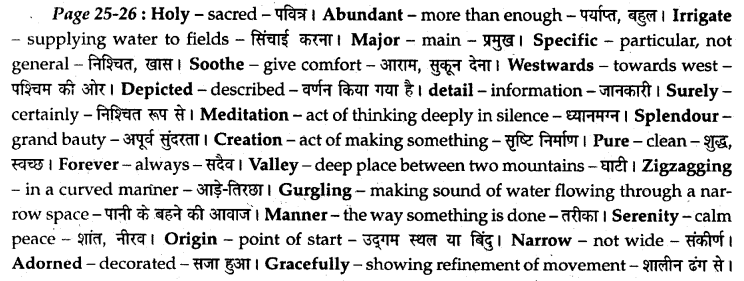
The Narmada: The Lifeline of Madhya Pradesh Word Meanings

Mp Board Class 8 English Chapter 4The Lifeline Of Madhya Pradesh MP Board Class 8th

We wish the knowledge shared regarding MP Board Solutions for Class 8 English Chapter 4 The Narmada: The Lifeline of Madhya Pradesh Questions and Answers has been helpful to you. If you need any further help feel free to ask us and we will get back to you with the possible solution. Bookmark our site to avail the latest updates on different state boards solutions in split seconds.

MP Board Class 8th Hindi Sugam Bharti Solutions Chapter 17 रहीमन-विलास

In this article, we will share MP Board Class 8th Hindi Book Solutions Chapter 17 रहीमन-विलास Pdf, These solutions are solved subject experts from the latest edition books.

MP Board Class 8th Hindi Sugam Bharti Solution Chapter 17 रहीमन-विलास

प्रश्न अभ्यास
अनुभव विस्तार

Mp Board Class 8 Hindi Chapter 17 प्रश्न 1.
वस्तुनिष्ठ प्रश्न
Mp Board Class 8 Hindi Chapter 17
Class 8 Hindi Chapter 17 Mp Board
उत्तर
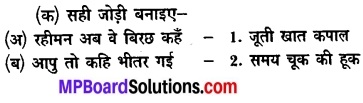
(अ) 4, (ब) 1, (स) 2, (द) 3

अति लघु उत्तरीय प्रश्नोत्तर
Class 8 Hindi Chapter 17 Mp Board प्रश्न 2.
(अ) कपूत की गति किसके समान होती है?
(ब) रहीम के अनुसर अब कौन से वृक्ष दिखाई नहीं देते?
(स) रहीम ने सबसे बड़ा लाभ किसे माना है?
(द) दीनबंधु के समान कौन हो जाता है?
(ई) पावस आने पर कौन मौन साध लेता है?
उत्तर
(अ) कपूत की गति दीपक के समान होती है।
(ब) रहीम के अनुसार अब घनी छाया देने वाले वृक्ष नहीं दिखाई देते।
(स) रहीम ने सबसे बड़ा लाभ समय के सदुपयोग को माना है।
(द) दीनबंधु के समान दीनों (गरीबों) को देखने वाले हो जाते हैं।
(इ) पावस आने पर कोयल मौन साध लेता है। लघु उत्तरीय प्रश्नोत्तर

MP Board Solutions

Rahiman Vilas Class 8 MP Board Chapter 17 प्रश्न 3.
(अ)
रहीम ‘रिस की गाँस’ के विषय में क्या कहते हैं?
उत्तर
रहीम ‘रिस की गाँस’ के विषय में यह कहते हैं कि अमृत ऐसे वचन हैं, जो रिस की गाँस अर्थात् क्रोध की चुभन को कम कर देते हैं।

(ब)
‘जीभ के बावलेपन’ का क्या दुष्परिणाम होता है?
उत्तर
‘जीभ के बावलेपन” का दष्परिणाम यह होता है कि वह तो भीतर चली जाती है और सिर को जूती खानी पड़ती है।

(स)
रहीम ने तन की तुलना नाव से क्यों की है?
उत्तर
रहीम ने तन की तुलना नाव से की है। यह इसलिए कि दोनों की गति एक ही तरह की होती है।

(द)
कवि के अनुसार ‘सच्चा मीत’ कौन है?
उत्तर
कवि के अनुसार ‘सच्चा मित्र’ वही होता है, जो विपत्ति में साथ देता है।

MP Board Solutions

Mp Board Class 8 Hindi Book Solution Chapter 17 प्रश्न 4.
निम्नलिखित दोहे के माध्यम से कवि क्या कहना चाहते हैं, स्पष्ट कीजिए
विपति भए धन ना रहे, रहे जो लाख करोर।
नभ तारे छिपि जात हैं, ज्यों रहीम भए भोर।।
उत्तर
उपर्युक्त दोहे के माध्यम कवि यह कहना चाहता है कि धन-सुख अस्थिर होते हैं। वे कब रहेंगे और कब नष्ट हो जाएंगे, कहा नहीं जा सकता है। इसलिए हमें धन को पाकर इतराना और घमंड करना नहीं चाहिए।

भाषा की बात

Mp Board Solution Class 8 Hindi Chapter 17 प्रश्न 1.
बोलिए और लिखिएमिसिरिहु, विरछ, दीनबंधु, सेंहुड, बक्ता।
उत्तर
मिसिरिङ, विरछ, दीनबंधु, सेंहुड़, वक्ता।

Mp Board Class 8 Hindi Chapter 17 प्रश्न 2.
निम्नलिखित शब्दों की शुद्ध वर्तनी खाली स्थान में लिखिए
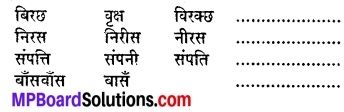
बिरछ वृक्ष बिरक्छ निरस निरीस नीरस संपत्ति संपनी संपति बाँसवाँस वासँ
Rahiman Vilas Class 8 MP Board Chapter 17
उत्तर
वृक्ष, नीरस, संपत्ति, बाँस।

Mp Board Class 8th Hindi Solution Chapter 17 प्रश्न 3.
निम्नलिखित शब्दों के विलोम शब्द लिखिए
उत्तर
शब्द – विलोम शब्द
उपकार – अपकार
अमृत –  विष
लाभ – हानि
सबल – निर्बल
अनुरक्ति – विरक्ति
कपूत – सपूत

MP Board Solutions

हिंदी सुगम भारती आठवीं कक्षा Pdf MP Board Chapter 17 प्रश्न 4.
निम्नलिखित तत्सम एवं तद्भव शब्दों को पहचानकर जोड़ी बनाइए
अँधरो, दीप, स्वर्ग, जीभ, कुपुत्र, दुग्ध, दीया, अंधकार, कपूत, दूध, जिह्वा, सरग।
उत्तर
अधरो – अंधकार
दीप – दीया
स्वर्ग – सरग
जीभ – जिह् वा
कुपुत्र – कपूत
दुग्ध – दुध

दोहों की संदर्भ-प्रसंग सहित व्याख्याएँ

1. जो रहीम गति दीप की, कुल कपूत गति सोय
बारे अजियारो कर, बड़े अँधेरो होय ॥1॥

शब्दार्थ
कुल-वंश। दीप-दीपक। गति-दशा। उजियारो-अजेला।

संदर्भ – प्रस्तुत पंक्तियाँ हमारी पाठ्य-पुस्तक ‘सुगम भारती’
(हिंदी सामान्य) भाग-8 के ‘पाठ-17’ के ‘रहिमन-विलास’ से ली गई हैं। इसके रचयिता कविवर रहीम हैं।

प्रसंग – प्रस्तुत पक्तियों में रहीम ने कुपुत्र की दशा दीपक के समान बतलाते हुए कहा है कि

Sugam Bharti Class 8 MP Board Chapter 17 व्याख्या
कुपुत्र और दीपक की दशा एक ही होती है। दीपक के जलने पर प्रकाश होता है और बुझने पर अंधेरा हो जाता है। उसी प्रकार कुपुत्र का बचपन अच्छा लगता है लेकिन जब वह बड़ा हो जाता है, तब वह परिवार के लिए दुखदायक हो जाता है।

विशेष

  • भाषा में प्रवाह है।
  • यह अंश ज्ञानवर्धक है।

2. अमृत ऐसे वचन में, रहिमन रिस की गाँस ।
जैसे मिसिरिहु में मिली, निरस बाँस की फाँस।।2।।

शब्दार्थ
रिस की गाँस-क्रोध की चुभन !

संदर्भ – पूर्ववत् ।

प्रसंग – प्रस्तुत पंक्तियों में कविवरम ने मीठी बोली के महत्त्व बतलाते हुए कहा है कि

व्याख्या- अमृत के समान मीठी बोली का बहुत ही अधिक महत्त्व और प्रभाव है। इससे क्रोध की चुभन समाप्त हो जाती है। यह ठीक उसी प्रकार से है, जैसे मिश्री में नीरस बाँस की फाँस का अभाव नहीं रहता है।
विशेष

  • मीठी बोली बोलने की सीख दी गई है।
  • दोहा छंद है।

3. रहीमन अब वे विरठ कहैं जिनकी छाँह गंभीर।
यागन बिच-बिच देखियत, सेंहुड़ कुंज करीर ॥3॥

शब्दार्थ
बिरछ-पेड़ । कुंज-लता। करीर-काँटेदार झाड़ी।

संदर्भ – पूर्ववत्।

प्रसंग – प्रस्तुत पंक्तियों में कविवर रहीम ने उपकारी व्यक्तियों की हो रही कमी के बारे में कहा है कि

व्याख्या
आजकल वे बड़े-बड़े और घनी छाया देने वाले पेड़ नहीं दिखाई दे रहे हैं। आजकल तो बागों के बीच-बीच में सेंहुड़, लता और काँटेदार झाड़ियाँ ही दिखाई दे रही हैं।

विशेष

  • दोहा छंद है।
  • यह अंश आर्कषक है।।

MP Board Solutions

4. रहिमन जिह्वा बाबरी, कहि गई सरग पताल ।
आपु तो कहि भीतर गई, जूती खात कपाल  ||4||

शब्दार्थ
बावरी-बावली। सरग = स्वर्ग। आपु-स्वयं । कपाल-सिर।

संदर्भ – पूर्ववत्।

प्रसंग – प्रस्तुत पंक्तियों में कविवर रहीम ने दुष्ट की संगति के कुपरिणाम को बदलते हुए कहा है कि

व्याखा
बावली जीभ ने बिना किसी सोच-विचार के स्वर्ग-पताल आदि अनाप-शनाप कह दिया। फिर वह अंदर चली गई। उसके इस प्रकार अनाप-शनाप कहने के कारण ही सिर को जूतों की मार खानी पड़ी।

विशेष

  • दोहा छंद है।
  • दुष्टों की निंदा की गई है।

5. तन रहीम है कर्म बस, मन राखो ओहि ओर।
जल में उलटी नाव ज्यों, बँचत गुन के जोर । ॥5॥

शब्दार्थ
बस-वश । राखो-रखो। ओहि-उस ।

संदर्भ – पूर्ववत्।

प्रसंग – प्रस्तुत पंक्तियों में कविवर रहीम ने मन को केन्द्रित करके कर्म की करने सीख देते हुए कहा है कि

व्याख्या
यह शरीर कर्म के अधीन है। इसलिए इसे मन से उस ओर ही लगाना चाहिए। जिस प्रकार पानी में उलटी नाव अर्थात् धारा के विपरीत नाव को चलाने के लिए नाव को खींच करके उस ओर लाया जाता है।

विशेष

  • मन को लगाकर कर्म करने की सीख दी
  • दोहा इंद है।

6. समय लाभ सम लाभ नहि, समय चूक सम चूक।
चतुरन चित रहिमन लगी, समय चूक की हूक ॥6॥

शब्दार्थ
सम-समान। चूक-भूल। चतुरन-चतुराई। = चित-हदय । हूक-चोट।

संदर्भ- पूर्ववत् ।

प्रसंग – प्रस्तुत पंक्तियों में कविवर रहीम ने समय के सदुपयोग को बतलाते हुए कहा है कि

व्याख्या
समय के सदुपयोग के समान और कोई बड़ा लाभ नहीं है। इसी प्रकार समय के दुरुपयोग के समान और
कोई भूल अर्थात् हानि नहीं है। इसलिए इसे बड़ी चतुराई से । चतुर लोग हृदय से जानते हैं कि समय के चूक जाने से हृदय को बड़ी चोट पहुँचती है।।

विशेष

  • दोहा छंद है।
  • भाषा सरल है।

MP Board Solutions

7. कहि रहीम संपति सगे, बनत बहुत बहु रीति।
विपति कसौटी जे कसे, ते ही साँचे मीत ॥7॥

शब्दार्थ
संपत्ति-धन। सगे-संबंधी। रीति-प्रकार। कसौटी-परीक्षा । साँचे-सच्चा। मीत-मित्र।

संदर्भ- पूर्ववत्।

प्रसंग – प्रस्तुत पंक्तियों में कविवर रहीम ने सच्चे मित्र की पहचान बलताते हुए कहा है कि

व्याख्या
जब व्यक्ति धनवान होता है उसके अनेक मित्र होते हैं। अनेक संबंधी बन जाते हैं। लेकिन सच्चे मित्र तो वे ही होते हैं, जो विपत्ति में साथ देते हैं।

विशेष

  • दोहा छंद है।
  • सच्चे मित्र की पहचान बताई गई है।

8. दीन सबन को लखत है, दीनहि लबै न कोय।
जो रहीम दीनहि लखे, दीनबंधु सम होय ॥8॥

शब्दार्थ
दीन-गरीब । सबन-सभी को। लखे-देखता।

संदर्भ – पूर्ववत्।

प्रसंग – प्रस्तुत पंक्तियों में कविवर रहीम ने गरीब लोगों के महत्त्व को बतलाते हुए कहा है कि

व्याख्या
गरीब लोग सभी को महत्त्व देते हैं। सबके दुख में अपना हाथ बँटाते हैं। लेकिन गरीबों को कोई महत्त्व नहीं देता है। उनके दुख में कोई हाथ नहीं बँटाता है। जो कोई गरीबों के दुख में साथ देता है, वह ईश्वर के समान होता है।

विशेष

  • दोहा छंद है।
  • भाषा-शैली में प्रवाह है।

9. पावस देखि रहीम मन, कोइल साये मौन।
अब दादुर बक्ता भए, हमको पूछत कौन ॥9॥

शब्दार्थ
पावस-वर्षा ऋतु । कोइल-कोयल । साधे मौन-चुप हो जाती है। दादुर-मेंढक।

संदर्भ- पूर्ववत्।

प्रसंग – प्रस्तुत पंक्तियों में कविवर रहीम ने समयानुसार रहने की सीख देते हुए कहा है कि

व्याख्या
वर्षा ऋतु में कोयल मौन धारण कर लेती। वर्षा ऋतु में मेंढक टरटर्राने लगते हैं। ऐसे समय में वह यह सोच लेती है कि उसके मधुर स्वर की कोई नहीं प्रशंसा करेगा। इसलिए चुप रहना ही ठीक है।

विशेष

  • भाषा में प्रवाह है।
  • दोहा छंद है।

10. विपति भए धन ना रहे, रहे जो लाख करोर।
नभ तारे छिपि जात हैं, ज्यों रहीम भए भोर ॥10॥

शब्दाव
विपत्ति-संकट । करोर-करोड़। छिपि-छिप । जात हैं-जाते हैं। भोर-प्रातःकाल ।

संदर्भ – पूर्ववत् ।

प्रसंग – प्रस्तुत पंक्तियों में कविवर रहीम ने धन की अस्थिरता और नश्वरता को बतलाते हुए कहा है कि

व्याख्या
जब विपत्ति आती है, तो सारे धन-सुख नष्ट हो जाते हैं। धन चाहे लाख करोड़ क्यों न हो। वह ठीक वैसे ही समाप्त हो जाता है, जैसे प्रातःकाल होने पर आकाश के तारे नहीं दिखाई देते हैं।

विशेष

  • भाषा-शैली आकर्षक है।
  • दोहा छंद है।

MP Board Class 8th Special English Solutions Chapter 15 Ahilyabai – A Great Indian Queen

Guys who are planning to learn the fundamentals of English can avail the handy study material using MP Board Solutions for Class 8 English Chapter 15 Ahilyabai – A Great Indian Queen Questions and Answers. You Can Download MP Board Class 8 English Solutions Questions and Answers, Notes, Summary, Guide, Pdf. Refer to the Madhya Pradesh State Board Solutions for English PDF available and score better grades. Simply click on the quick links available for MP Board Solutions for Class 8 English Chapter 15 Ahilyabai – A Great Indian Queen Questions and Answers and prepare all the concepts in it effectively. Take your preparation to the next level by availing the Madhya Pradesh State Board Solutions for Class 8 English prepared by subject experts.

MP Board Class 8th Special English Solutions Chapter 15 Ahilyabai – A Great Indian Queen

Do you feel the concept of English is difficult to understand? Not anymore with our MP Board Solutions for Class 8 English Chapter 15 Ahilyabai – A Great Indian Queen Questions and Answers. All the Solutions are given to you with detailed explanation and you can enhance your subject knowledge. Use the Madhya Pradesh State Board Solutions for Class 8 English PDF for free of cost and prepare whenever you want.

Ahilyabai – A Great Indian Queen Textual Exercise

Word Power

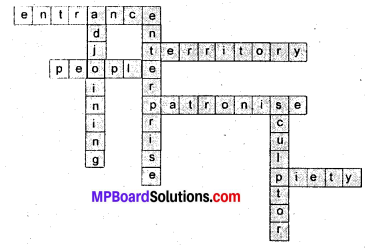
Solve the crossword puzzle with the help of the clues given. These words have been used in the lesson:

Clues:
Left to right
1. a door or gate
4. land that is under the control of a ruler
5. men, women and children
6. to help a particular person by giving him money
8. the state of having deep respect for God and religion
Class 8 English Chapter 13 Ahilyabai A Great Indian Queen MP Board

Downwords
2. To be next to or joined to something
3. a company or business
7. a person who makes figures by carving or shaping wood

Comprehension

Answer the following questions:

Class 8 English Chapter 13 Ahilyabai A Great Indian Queen MP Board Question 1.
Who taught Ahilyabai?
Answer:
Ahilyabai’s father taught her.

Mp Board Class 8 English Chapter 15  Question 2.
Where did Malhar Rao first see Ahilyabai?
Answer:
Malhar Rao first saw Ahilyabai at Chondi at the temple service in the village.

Class 8 English Chapter 15 MP Board Question 3.
When did Ahilyabai’s husband die?
Answer:
Ahilyabai’s husband died in 1754.

Ahilyabai Palace Was Situated At MP Board Question 4.
What did Gangadhar suggest to Ahilyabai after the death of her son?
Answer:
Gangadhar suggested Ahilyabai to adopt a son when her own son died.

Ahilyabai Husband Name Was MP Board Question 5.
What was Ahilyabai’s reply to her Chief Minister?
Answer:
Ahilyabai replied to her Chief Minister that she didn’t require his advice, as she could look after the state very well.

Ahilya Bai Palace Was Situated At MP Board Question 6.
What message did Ahilyabai send to Raghoba Dada?
Answer:
She sent a message to Raghoba Dada that as soon as he dared to cross the river Kshipra, he would have to fight her army.

Ahilya Bai’s Palace Was Situated At MP Board Question 7.
Why did Raghoba Dada give up the idea of fighting and went back?
Answer:
Raghoba Dada was afraid that if he lost a battle against a woman, he would lose his name and fame as a warrior on the other hand, nobody would praise him even if he won the battle. Hence, he gave up the idea of fighting and went back

Question 8.
What did Ahilyabai build and renovate? Write atleast five names.
Answer:
Ahilyabai built and renovated a number of temples, ghats, wells, tanks and rest houses.

  1. The Vishwanath temple of Varanasi
  2. The Vishnupad temple of Gaya
  3. Ghats
  4. Wells
  5. Tanks

Question 9.
Ahilyabai was not only a great ruler but a great human being also.’ How do you know?
Answer:
Ahilyabai Cared for the poor in her state. She heard every complaint in person. Craftsmen, sculptors, and artists-all received due respect in her state.

Question 10.
Fill in the blanks with the correct answer to complete the sentence.
(i) Ahilyabai’s palace was situated at…

(a) Chondi
(b) Indore
(c) Maheshwar
(d) Beed

(ii) Ahilyabai’s husband’s name was…

(a) Malhar Rao
(b) Mankaji
(c) Gangadhar
(d) Khande Rao

Answer:
(i) c. Maheshwar
(ii) d. khande Rao.

Let’s Learn

Question 1.
Read the following sentences carefully:

  1. Great deeds are remembered even after hundreds of years.
  2. Ahilyabai’s husband was killed in a battle in 1754.
  3. Ahilyabai is remembered with love and respect in all parts of the country.

We often prefer passive when the subject of a sentence is not important.
Also observe changes in the main verb.
For example the active voice form of sentence No. 1 given above will be:
People remember great deeds even after hundreds of years.
When changed to passive form; ‘remember’ becomes ‘remembered’ and ‘are’ is added before it; in sentence No. 3 ‘is’ is added. That is because of the number of the subject.

Now write the following sentences without the agent. (Passive Voice)

  1. Somebody built this house in 1986.
  2. We clean this room everyday.
  3. Somebody cleaned this room yesterday.
  4. People don’t use this road very often.
  5. They cancelled all flights because of fog.
  6. Last night someone broke into our house.
  7. They don’t pay Mohan very much.

Answer:

  1. This house was built in 1986.
  2. This room is cleaned everyday.
  3. This room was cleaned yesterday.
  4. This road is not used very often.
  5. All flights were cancelled because of fog,
  6. Our house was broken out last night.
  7. Mohan is not paid very much.

2. We often use ‘can’ expressing possibilty or ability to do something.
Example: I can speak four languanges.

  • The negative is ‘can’t. (cannot)
  • Could is the past form of can.
  • We use could’ for general ability in the past. But if we talk about what happened in a particular situation, we use ‘was/were able to…or managed to ……….

Example:

  1. A house caught fire yesterday but everybody was able to escape.
  2. Raju was an excellent football player. He could beat anybody.

But negative ‘couldn’t’ is possible in all situations.

Now complete the sentences using can/ could/can’t/couldn’t

  1. Mohan belongs to a well educated family. He ……………… Speak English very well.
  2. My uncle was a very intelligent man. He ……………… speak five languages.
  3. I looked for the book everywhere but I ……………… find it.
  4. Monica ……………… drive but she hasn’t got a car.
  5. I can’t meet you on Saturday but I ……………… meet you Sunday evening.
  6. My grandmother loved music. She ……………… play the piano very well.
  7. Mala wasn’t at home when I phoned but I ……………… contact her at her office.
  8. I’m afraid. I ……………… come to your party.

Answers:

  1. can
  2. could
  3. couldn’t
  4. can
  5. can’t
  6. could
  7. could
  8. can’t

(C) We often use ‘will’ in these situations:

(i) offering to do something
Example: Is your trunk very heavy? I’ll help you.
(ii) When we decide to do something at the time of speaking.
Example: (a) What would you like to eat?
(b) I’ll have fruit, please.
(iii) Promising to do something
Example: I won’t tell any body what you have said.
(iv) Asking somebody to do something
Example: Will you shut the windows, please? ‘Would’ is used in these situations:
(i) offering an invitation
Example: Would you like a cup of tea?
(ii) ‘Would’ is the past form of ‘will’.
Example: I promised I wouldn’t go out.

Now complete the sentences with ‘will would/won’t/wouldn’t.

  1. ………….. you like tea or coffee? I …………. have coffee, please.
  2. You arranged to play football today. Now you decide not to play. You say. I don’t think I …………. play.
  3. You are on a bus. You have a seat but an elderly man is standing. You after him your seat. …………. you like to sit down?
  4. A friend of yours is interested in one of your books, you offer it. Friend: This book is very interesting. You: Yes, it’s very good …………. you like to borrow it.
  5. Did you phone Mona? Oh no, I forgot. I. …………. phone her now.
  6. Don’t worry about your exam. I’m sure you …………. pass.
  7. I’m sorry about what happened yesterday. It …………. happen again.

Answer:

  1. would, will
  2. would
  3. would
  4. would
  5. will
  6. will
  7. won’t.

Let’s Talk

Two students will come forward. Using the clues, they will ask questions and answer to each other using correct forms of the verbs:

A: you/go through/the lesson/?
B: Yes/Ahilyabai/do/marvellous work/
A: When/she/get/marry/?
B: Perhaps/at the age of 8 or 9.
A: How/old/she/when/her/ husband/die/?
B: She/29/.
A: She/afraid of /Raghoba Dada?
B: No/She/challenge/him/.
A: Sheldo/all the work/in her state only?
B: No/she/build/renovate/roads/ temples/over Indial.
A: Yes/she/was/great queen/?
B: Yes/she/was/.

Answers:

A: Did you go through the lesson?
B: Yes. Ahilyabai did marvellous work.
A: When did she get marry?
B: Perhaps she got married at the age of 8 or 9.
A: How old was she when her husband died?
B: She was 29.
A: Was she afraid of Raghoba Dada?
B: No, she challanged him.
A: Did she do all the work in her state only?
B: No, she built and renovate roads and temples all over India.
A: Yes, was she a great queen?
B: Yes, she was.

Let’s Read

Students! you must have seen the picture of an old lady, hardly five feet tall, with high check-bones, thin lips and a wrinkled face, clad in a white saree with a blue border covering the head. This is Mother Teresa often called the Gentle Mother’ or the ‘Angel of Mercy.’

Mother Teresa was born in Skopje, Macedonia on August 27, 1910. Her family was of Albanian descent. Her original name was Agnes Gonxha Bojaxhiu. At the age of eighteen, she renounced the world and joined the Loreto nuns in Ireland. She used to work from 4 a.m. to late at night. The dying in Kolkata, the wounded in Vietnam, the straving in Ethopia-all turned to this frail looking woman for support. She always embraced the needy and the suffering all over the world. The mission established by her is still busy in doing the same even after her death. She received a number of awards and distinctions, including the Pope John XXIII Peace Prize in 1971 and the Nobel peace prize in 1979.

Answer the following questions:

Question 1.
Why was Mother Teresa called the Angel of Mercy?
Answer:
Mother Teresa was called ‘the Angerl of Mercy’ because she embraced the needy and the suffering all over the world.

Question 2.
What do you understand by the word ‘renounced’? Explain.
Answer:
Renounced-It means to give up something.

Question 3.
Explain the phrase ‘frail looking woman.’
Answer:
‘Frail looking woman-Mother Teresa was very lean and thin.

Question 4.
Fill in the blank, choosing the correct word.
Mother Teresa’ was born in ……………………
(a) Ireland
(b) Kolkata
(c) Albania
(d) Macedonia
Answer:
Mother Teresa was born in Macedonia.

Question 5.
Which award did she get in 1971?
Answer:
She got the Pope John XXIII peace prize in 1971.

Question 6.
Write five adjectives occurring in the passage.
Answer:
Five adjectivies-high, thin, wrinkled, white and blue.

Let’s Write

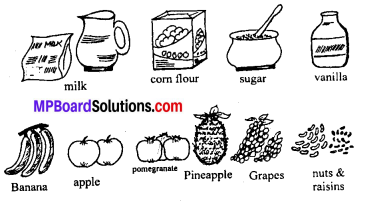
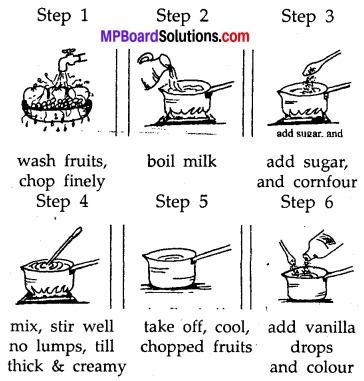
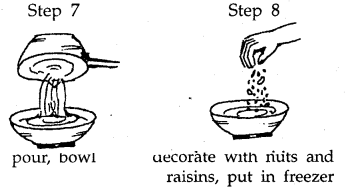
Look at these pictures describing a recipe for a fruit custard. Read the clue words below the pictures. Write out the recipe listing the ingredients and the process of making fruit custard. Things you will need:
Mp Board Class 8 English Chapter 15

1 tablespoon of cornflour
3 cups milk
2 tablespoons sugar
1/2 teaspon vanilla
2 bananas
2 apples
2 pomegranates
1 pine apple
few grapes
few raisins and chopped nuts yellow colour
Class 8 English Chapter 15 MP Board
Ahilyabai Palace Was Situated At MP Board
Begin like this:

Take milk in a saucepan and boil it.
Answer:
Add sugar and cornflour. Mix, and stir well till it turns into thick and creamy. Take it off. Let it cool. Then add some chopped fruits. Add vanilla drops and colour. Pour bowl. Decorate it with nuts and raisins and then put in freezer.

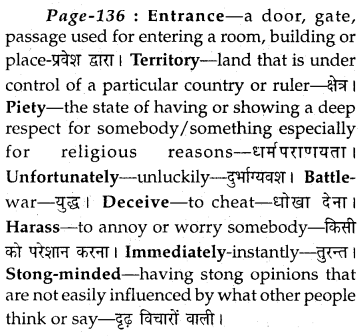
Ahilyabai – A Great Indian Queen Word Meanings

Ahilyabai Husband Name Was MP Board

Ahilya Bai Palace Was Situated At MP Board

We wish the knowledge shared regarding MP Board Solutions for Class 8 English Chapter 15 Ahilyabai – A Great Indian Queen Questions and Answers has been helpful to you. If you need any further help feel free to ask us and we will get back to you with the possible solution. Bookmark our site to avail the latest updates on different state boards solutions in split seconds.

MP Board Class 8th Hindi Sugam Bharti Solutions Chapter 13 ग्राम्य जीवन

In this article, we will share MP Board Class 8th Hindi Book Solutions Chapter 13 ग्राम्य जीवन Pdf, These solutions are solved subject experts from the latest edition books.

MP Board Class 8th Hindi Sugam Bharti Solutions Chapter 13 ग्राम्य जीवन

प्रश्न अभ्यास
अनुभव विस्तार

(क) सही जोड़ी बनाइए

Mp Board Class 8 Hindi Chapter 13 प्रश्न 1.
वस्तुनिष्ठ प्रश्न
Mp Board Class 8 Hindi Chapter 13
उत्तर
(अ) 4, (ब) 3, (स) 2, (द) 1

(ख) सही शब्द चुनकर रिक्त स्थान की पूर्ति कीजिए

(अ) एक दूसरे की ममता है, सब में ………………. समता है। (प्रेममयी, क्रोधमयी)
(ब) छोटे से …………………. के घर हैं, लिपे-पुते हैं, स्वच्छ सुघर हैं। (लकड़ी, मिट्टी)
(स) खपरैलों पर बेले छाई, …………………. हरी, मन भाई। (फूली-फली, खिली-खिली)
(द) प्रायः सबकी सब विभूति हैं, पारस्परिक ………. है।(अनुभूति, सहानुभूति)
उत्तर
(अ) प्रेममयी
(ब) मिट्टी
(स) फूली-फली
(द) सहानुभूति।

Class 8 Hindi Chapter 13 Mp Board प्रश्न 3.
अति लघु उत्तरीय प्रश्न
(अ)आडंबर और अनाचार किन लोगों में नहीं होता है?
(ब) हवा को किससे बढ़कर बताया है?
(स) गाँवों में आँगन तट कैसे होते हैं?
(द) कवि ने नन्दन-विपिन को किस पर निछावर किया है?
उत्तर
(अ) आडंबर और अनाचार गाँव के लोगों में नहीं होता है।
(ब) हवा को डॉक्टरी दवा से बढ़कर बताया है।
(स) गाँवों में आँगन तट गोपद चिहित होते हैं।
(द) कवि ने नन्दन-विपिन को शाम के समय गाँव के वातावरण पर निछावर किया है?

Sugam Bharti Class 8 MP Board प्रश्न 4.
लघु उत्तरीय प्रश्न

(अ)
कवि ने ग्राम्य-जीवन को शहरी जीवन से श्रेष्ठ क्यों माना है?
उत्तर
कवि ने ग्राम्य-जीवन को शहरी जीवन से श्रेष्ठ माना है। यह इसलिए कि यहाँ थोड़े में निर्वाह हो जाता है। यहाँ कोई दाब, पेंच और छल-कपट नहीं है। यहाँ आडंबर और अनाचार नहीं है।

(ब)
गाँव के घरों की क्या विशेषताएँ होती हैं?
उत्तर
गाँव के घर मिट्टी के घर हैं। वे लिपे-पुते हैं। वे स्वच्छ और सुन्दर हैं।

(स)
गाँववालों का स्वभाव कैसा होता है?
उत्तर
गाँववालों का स्वभाव बड़ा ही सरल और सीधा-सादा होता है। उसमें कोई छल-कपट नहीं होता है। उसमें परस्पर सहानुभूति होती है। उसमें दूसरे के प्रति ममता और समता होती है।

(द)
‘श्रम-सहिष्णु सब जन होते हैं’ से कवि का क्या ‘आशय है?
उत्तर
श्रम-सहिष्णु सब जम होते हैं’ से कवि का क्या आशय है-गाँव के लोग घोर परिश्रमी होते हैं। वे जी नहीं चुराते हैं। हमेशा मेहनत करने के कारण उनमें आलस्य बिलकुल ही नहीं होता है।

(ई)
गाँवों में अतिथि-सत्कार किस प्रकार होता है?
उत्तर
गाँवों में अतिथि-सत्कार विशेष प्रकार से होता है। अतिथि को आदरपूर्वक ठहराया जाता है। उसके प्रति अपने किसी संबंधी की ही तरह आदर देकर खुश किया जाता है। फिर सम्मान के साथ विदा किया जाता है।

भाषा की बात

Mp Board Class 8 Chapter 13 प्रश्न 1.
बोलिए और लिखिए___ ग्रामीण, अन्तःकरण, उज्ज्वल, श्रम, सहिष्णु।
उत्तर
ग्रामीण, अन्तःकरण, उज्ज्वल, श्रम, सहिष्णु।

कक्षा 8 विषय हिंदी पाठ 13 के प्रश्न उत्तर MP Board प्रश्न 2.
सही वर्तनी पर गोला लगाइए
निरवाह, निर्वाह, निवार्ह, र्निवाह,
साहानुभूति, शहानुभूति, सहानुभूति, सहानूभूती,
आतिथ्य, अतिथ्य, आतीथ्य, आतिथय,
आर्शीवाद, आसीरवाद, आशीवार्द, आशीर्वाद ।
उत्तर
निर्वाह, सहानुभूति, आतिथ्य, आशीर्वाद ।

Class 8 Hindi Mp Board प्रश्न 3.
निम्नलिखित शब्दों का वाक्यों में प्रयोग कीजिए।
अपनी-अपनी, सीधे-सादे, दिन-दिन, ग्राम्य-जीवन
उत्तर
शब्द – वाक्य-प्रयोग
अपनी अपनी – अपनी  आजकल सभी को अपनी- अपनी ही पड़ी है।
सीधे सादे – सीधे-सादे आजकल ठगे जाते
दिन दिन – दिन-दिन महँगाई बढ़ रही है।
ग्राम्य जीवन – ग्राम्य-जीवन सबका मनचाहा है।

Mp Board Class 5th Hindi Sugam Bharti Solution प्रश्न 4.
निम्नलिखित शब्दों में से जल, हवा, और विपिन के समानार्थी (पर्यायवाची शब्द) छाँटकर लिखिए
वायु, पानी, वन, जंगल, पवन, नीर, समीर, कानन, सलिल।
उत्तर
पर्यायवाची शब्द
जल-पानी, नीर, सलिल।
हवा-वायु, पवन, समीर।
विपिन-वन, जंगल, कानन।

Mp Board Class 8 Hindi प्रश्न 5.
निम्नलिखित शब्दों में तत्सम और तद्भव शब्द छाँटकर सूची बनाइए
पद, चाँद, पैर, नैन, हाथ, धरा, अमिय, काम, चन्द्र, हस्त, अग्नि देवता, सुभीता, नयन, धरती, देव, सुविधा, कार्य, आम, अश्रु, आग, आम्र, आँसू।
उत्तर
तत्सम-पद, धरा, चन्द्र, हस्त, अग्नि देवता, नयन, देव, कार्य, अश्रु, आम्र।
तद्भव-चाँद, पैर, नैन, हाथ, अमिय, काम, सुभीता, धरती, सुविधा, आम, आग, आँसू।

प्रश्न 6.
नीचे दी हुई पंक्तियों में से सर्वनाम शब्द छाँटिए
(अ) क्यों न इसे सबका मन चाहे।
(ब) अपनी-अपनी घात नहीं है।
(स) तो न उसे आती बरबादी।
(द) देती याद उन्हें चौपालें।
(ई) सब में प्रेममयी ममता है।
उत्तर
सर्वनाम शब्द
(अ) इसे
(ब) अपनी-अपनी
(स) उसे
(द) उन्हें
(ई) सबमें।

प्रमुख पद्यांशों की संदर्भ-प्रसंग सहित व्याख्याएँ

1. अहा! ग्राम्य-जीवन भी क्या है क्यों न इसे सब का मनचाहे।
थोड़े में निर्वाह यहाँ है, ऐसी सुविधा और कहाँ है।
यहाँ शहर की बात नहीं है, अपनी-अपनी घात नहीं है।
आडम्बर का काम नहीं है, अनाचार का नाम नहीं है।

शब्दार्थ
ग्राम्य-गाँव । निर्वाह-गुजारा । घात-दाव-पेंच, छल। आडंबर-ढोंग, दिखावा। अनाचार-दुराचार, बुरा व्यवहार।

संदर्भ – प्रस्तुत पंक्तियाँ हमारी पाठ्य-पुस्तक ‘सुगम भारती’ (हिन्दी सामान्य) के भाग-8 के पाठ-13 ‘ग्राम्य-जीवन’ से ली गई हैं। इनके रचयिता श्री मैथिलीशरण गुप्त हैं।

प्रसंग – प्रस्तुत पंक्तियों में कवि ने गाँव के जीवन की विशेषताओं पर प्रकाश डालते हुए कहा है कि__

व्याख्या
अहा! गाँव के जीवन का क्या कहना है! सचमुच में यह इतना अधिक सुन्दर है कि इसे भला ऐसा कौन नहीं है, जो इसे बार-बार न चाहेगा। इसकी सबसे अधिक अच्छाई है कि यहाँ थोडी-सी सुविधा में गजारा हो जाता है। इस प्रकार की सुविधा और कहीं नहीं है। यहाँ शहर की कोई बात नहीं हैं दुसरे शब्दों में यहाँ कोई शहरी विशेषताएँ नहीं हैं। इसलिए यहाँ शहरी कोई दाव-पेंच या छल नहीं है। किसी प्रकार का दिखावा नहीं है। इसी प्रकार कोई यहाँ किसी तरह का अनाचार-दुराचार नहीं दिखाई देता है।

विशेष

  • भारतीय गाँव की खूबियाँ बतायी गई हैं।
  • यह अंश ज्ञानवर्द्धक है।

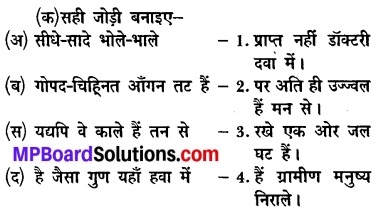
2. सीधे-सादे भोले-भाले, हैं ग्रामीण मनुष्य निराले। एक दूसरे की ममता है,
सब में प्रेममयी समता है। यद्यपि वे काले हैं
तन से, पर अति ही उज्जवल हैं मन से।
अपना और ईश्वर का बल है, अन्तःकरण अतीव सरल है।

शब्दार्थ
ग्रामीण-गाँव के। ममता-प्रेम, लगाव । समतासमानता। तन-शरीर। अति-अधिक। अन्तःकरण-हृदय।

संदर्भ – पूर्ववत्

प्रसंग – प्रस्तुत पंक्तियों में कवि ने गाँव के लोगों की अच्छाइयों को बतलाते हुए कहा है कि

व्याख्या
गाँव के लोग बड़े ही सीधे-साधे और भोले-भाले होते हैं। वे बहुत ही निराले और दूसरे के प्रति समता और लगाव रखते हैं। उनमें परस्पर प्रेममयी समानता होती है। यह बात अवश्य है कि वे काले और कुरूप होते हैं, लेकिन उनका मन बहुत ही सुन्दर और आकर्षक होता है। उन्हें और किसी का भरोसा नहीं होता है। उनका तो केवल अपना और ईश्वर पर ही भरोसा होता है। इस प्रकार उनका हृदय बड़ा ही सरल और खुला हुआ होता है।

विशेष

  • गाँव के लोगों की खूबियों को ज्ञानवर्द्धक रूप में प्रस्तुत किया गया है। .
  • यह अंश रोचक है।

3. प्रायः सबकी सब विभूति हैं, पारस्परिक सहानुभूति है।
कुछ भी ईर्ष्या-द्वेष नहीं है, कहीं कपट का लेश नहीं है।
छोटे से मिट्टी के घर हैं, लिपे-पुते हैं, स्वच्छ सुघर हैं।
गोपद चिह्नित आँगन तट हैं, रखे एक और जल-घट हैं।

शब्दार्थ
प्रायः-लगभग। विभूति-धन-संपति, वैभव । पारस्परिक-परस्पर, एक-दूसरे के प्रति । ईर्ष्या-द्वेष, वैर, विरोध । कपट-छल। लेश-अंश मात्र, थोड़ा-सा भी। सुघर-सुंदर। गोपद-गाय के खुर। तट-किनारा।

संदर्भ – पूर्ववत्।

प्रसंग-पूर्ववत्।

व्याख्या
गाँव के लोगों के पास परस्पर सहानुभूति और सहयोग ही धन, संपत्ति और वैभव है। उनमें एक-दूसरे के प्रति कुछ भी वैर, विरोध आदि बुरे भाव नहीं हैं। उनमें एक-दूसरे के लिए छल-कपट थोड़ा-सा भी नहीं है। उनका घर मिट्टी का ही है, लेकिन वह लीपा-पोता हुआ बड़ा ही साफ, आकर्षक और सुन्दर है। उनके घर के आँगन में एक ओर गाय के खुर से और दूसरी ओर रखे हुए पानी के घड़े से शोभित होते हैं।

विशेष

  • गाँव के लोगों और उनके स्वभाव को सामने लाने का प्रयास किया गया है।
  • यह अंश ज्ञानवर्द्धक है।

4. खपरैलों पर बेलें छाईं, फूली-फली हरी, मन भाई।
काशीफल कुष्मांड कहीं है, कहीं लौकियाँ लटक रही हैं।
है जैसा गुण यहाँ हवा में, प्राप्त नहीं डॉक्टरी दवा में।
सन्ध्या समय गाँव के बाहर, होता नंदन विपिन निछावर।

शब्दार्थ
काशीफल-कदू । कुष्मांड-कुम्हड़ा, सफेद कदू। संध्या-शाम। नंदन- देवताओं का। विपिन-वन, जंगल। निछावर-त्याग, बलिदान।

संदर्भ – पूर्ववत्।

प्रसंग – प्रस्तुत पंक्तियों में कवि ने गाँव के वातावरण का चित्र खींचते हुए कहा है कि

व्याख्या
गाँव में घर खपरैल के होते हैं। उन पर बेलें छायी रहती हैं। उन पर कई प्रकार की सब्जियाँ लटक रही होती हैं। वे हरी-हरी और फूली-फली होती हैं। उन्हें देखकर मन खिल उठता है। कहीं कद्दू की बेलें खपरैलों पर लटकी रही होती हैं, तो कहीं सफेद कददू की बेलें। खपरैलों पर कहीं-कहीं लौकियाँ लटकती हुई होती हैं, तो कहीं-कहीं कई और बेलें भी इसी प्रकार दिखाई देती हैं। यहाँ की हवा में स्वास्थ्य को ठीक रखने का गुण है वह किसी डॉक्टरी दवा से बेहतर है। शाम के समय गाँव के बाहर का वातावरण नंदन वन से कहीं अधिक सुखद होता है। उस पर तो वह निछावर होता हुआ दिखाई देता है।

विशेष

  • गाँव के स्वरूप का सच्चा चित्र है।
  • तुकान्त शब्दावली है।

5. श्रम-सहिष्णु सब जन होते हैं, आलस में न पड़े सोते हैं।
दिन-दिनभर खेतों में रहकर, करते रहते काम निरंतर ।
अतिथि कहीं जब आ जाता है, वह आतिथ्य यहाँ पाता है।
ठहराया जाता है ऐसे, कोई संबंधी हो जैसे।

शब्दार्थ
श्रम-सहिष्णु-घोर परिश्रमी। निरंतर-हमेशा।

संदर्भ – पूर्ववत्।

प्रसंग – प्रस्तुत पंक्तियों में कवि ने गाँव के लोगों की अच्छाइयों को बतलाते हुए कहा है कि

व्याख्या
गाँव के लोग घोर परिश्रमी होते हैं। इसलिए वे आलसी नहीं होते हैं। वे पूरे दिन खेतों में लगातार काम करते रहते हैं। जब उनके यहाँ कोई अतिथि आ जाता है, तो वह संतुष्ट होकर ही वापस जाता है। वे उसका आदर-सम्मान अपने किसी सगे-संबन्धी की ही तरह करके उसे खुश कर देते है।

विशेष

  • गाँव के लोगों की महानता को आकर्षक रूप में चित्रित किया गया है।
  • यह अंश ज्ञानवर्द्धक है।

MP Board Class 8th Sanskrit Solutions Chapter 6 स्वामी विवेकानन्दः

MP Board Class 8th Sanskrit Solutions Surbhi Chapter 6 स्वामी विवेकानन्दः

MP Board Class 8th Sanskrit Chapter 6 अभ्यासः

Class 8 Sanskrit Chapter 6 Mp Board  प्रश्न 1.
एकपदेन उत्तरं लिखत(एक शब्द में उत्तर लिखो-)
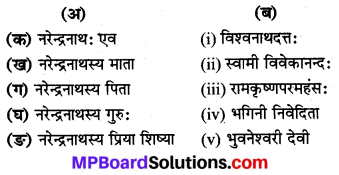
(क) स्वामी विवेकानन्दस्य बाल्यकालस्य नाम किम् आसीत्? (स्वामी विवेकानन्द के बचपन का नाम क्या था?)
उत्तर:
नरेन्द्रनाथः। (नरेन्द्रनाथ)

(ख) स्वामी विवेकानन्दस्य मातुः नाम किम् आसीत्? (स्वामी विवेकानन्द की माता का नाम क्या था?)
उत्तर:
भुवनेश्वरी देवी। (भुवनेश्वरी देवी)

(ग) नरेन्द्रनाथस्य पितुः नाम किम् आसीत्? (नरेन्द्रनाथ के पिता का नाम क्या था?)
उत्तर:
विश्वनाथदत्तः। (विश्वनाथदत्त)

(घ) नरेन्द्रनाथस्य जन्म कस्मिन् नगरे अभवत्? (नरेन्द्रनाथ का जन्म किस नगर में हुआ?)
उत्तर:
कोलकातानगरे। (कोलकाता नगर में)

(ङ) नरेन्द्रनाथस्य गुरोः नाम किम् अस्ति? (नरेन्द्रनाथ के गुरु का नाम क्या है?)
उत्तर:
रामकृष्णपरमहंसः। (रामकृष्णपरमहंस)

Mp Board Class 8 Sanskrit Solution Chapter 6 प्रश्न 2.
एकवाक्येन उत्तरं लिखत(एक वाक्य में उत्तर लिखो-)
(क) नरेन्द्रनाथस्य जन्म कदा अभवत्? (नरेन्द्रनाथ का जन्म कब हुआ?)
उत्तर:
नरेन्द्रनाथस्य जन्म जनवरी मासस्य द्वादशे दिनांके १८६३ खिस्ताब्दे (१२ जनरवरी, १८६३)अभवत्। (नरेन्द्रनाथ का जन्म जनवरी महीने की बारह तारीख को 1863 ईस्वी (12 जनवरी, 1863) में हुआ।)

(ख) शिकागोनगरे विश्वधर्मसम्मेलने भारतस्य प्रतिनिधिः कः अभवत्? (शिकागो नगर में विश्वधर्म सम्मेलन में भारत के प्रतिनिधि कौन हुए?)
उत्तर:
शिकागोनगरे विश्वधर्मसम्मेलने भारतस्य प्रतिनिधिः स्वामी विवेकानन्दः अभवत्। (शिकागो नगर में विश्वधर्म सम्मेलन में भारत के प्रतिनिधि स्वामी विवेकानन्द हुए।)

(ग) स्वामी विवेकानन्दः कदा ब्रह्मलीनोऽभवत्? (स्वामी विवेकानन्द कब ब्रह्मलीन हुए?)
उत्तर:
स्वामी विवेकानन्दः जुलाई मासस्य चतुर्थे दिनांके १८०२ खिस्ताब्दे (४ जुलाई, १९०२) ब्रह्मलीनोऽभवत्। (स्वामी विवेकानन्द जुलाई महीने की चार तारीख 1902 ईस्वी (4 जुलाई, 1902) में ब्रह्मलीन हुए।)

(घ) रवीन्द्रनाथटैगोर किम् कथनम् अस्ति? (रवीन्द्रनाथ टैगोर का क्या कहना है?)
उत्तर:
रवीन्द्रनाथटैगोरस्य कथनम् अस्ति यत् कोऽपि भारतीयसंस्कृतिं ज्ञातुमिच्छति तर्हि प्रथमः तेन स्वामी विवेकानन्दविषये पठितव्यः। (रवीन्द्रनाथ टैगोर का कहना है कि कोई भी भारतीय संस्कृति को जानना चाहता है तो पहले उसे स्वामी विवेकानन्द के विषय में पढ़ना चाहिए।)

(ङ) यूनाम् प्रेरकः पथप्रदर्शकश्च कः? (युवाओं के प्रेरक और पथ-प्रदर्शक कौन हैं?)
उत्तर:
यूनाम् प्रेरकः पथप्रदर्शकश्च स्वामी विवेकानन्दः। (युवाओं के प्रेरक और पथ-प्रदर्शक स्वामी विवेकानन्द हैं।)

Mp Board Class 8 Sanskrit Chapter 6 प्रश्न 3.
उचितं योजयत(उचित को जोड़ो-)
Class 8 Sanskrit Chapter 6 Mp Board
उत्तर:
(क) → (ii)
(ख) → (v)
(ग) → (i)
(घ) → (iii)
(ङ) → (iv)

संस्कृत कक्षा 8 पाठ 6 MP Board प्रश्न 4.
शुद्धवाक्यानां समक्षम आम्’ अशुद्ध वाक्यानां समक्षं’न’ इति लिखत
(शुद्ध वाक्यों के सामने ‘आम्’ (हाँ) तथा अशुद्ध वाक्यों के सामने ‘न’ (नहीं) लिखो-)
(क) पौरुषं कुरु।
(ख) आत्मभावस्य विकासः एव कर्म।
(ग) जीवनस्यार्थः उन्नतिः नास्ति।
(घ) स्वार्थभावः एव मृत्युः।
(ङ) परोपकारः अपवित्रम् कार्यमस्ति।
उत्तर:
(क) आम्
(ख) आम्
(ग) न
(घ) आम्
(ङ) न।

8 वीं कक्षा संस्कृत गाइड In Hindi Chapter 6 MP Board प्रश्न 5.
उचितपदेन रिक्तस्थानं पूरयत(उचित शब्द द्वारा रिक्त स्थान भरो-)
(क) प्रतिग्रहणस्य कामना …………..। (कुरु/मा कुरु)
(ख) चारित्र्यबलं…………..। (वारयत/धारयत)
(ग) नरेन्द्रनाथस्य पिता ………….. आसीत्। (भाषक:/अभिभाषक:)
(घ) अनात्मभावस्य विकासः एव …………. । (कर्म/अकर्म)
(ङ) स्वामीविवेकानन्दस्य जन्म ………….. अभवत्। (कोलकातानगरे/मुम्बईनगरे)
उत्तर:
(क) मा कुरु
(ख) धारयत
(ग) अभिभाषकः
(घ) अकर्म
(ङ) कोलकातानगरे।

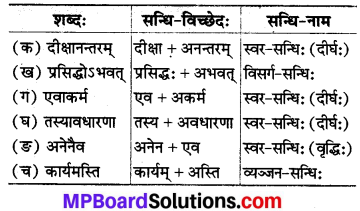
Class 8 Sanskrit Chapter 6 MP Board प्रश्न 6.
नामोल्लेखपूर्वकं सन्धि विच्छेदं कुरुत(नाम का उल्लेख करते हुए सन्धि-विच्छेद करो-)
(क) दीक्षानन्तरम्
(ख) प्रसिद्धोऽभवत्
(ग) एवाकर्म
(घ) तस्यावधारणा
(ङ) अनेनैव
(च) कार्यमस्ति।
उत्तर:
Mp Board Class 8 Sanskrit Solution Chapter 6

कक्षा 8 संस्कृत पाठ 6 MP Board प्रश्न 7.
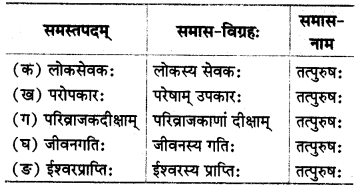
नामोल्लेखपूर्वकं समासविग्रहं कुरुत(नाम का उल्लेख करते हुए समास-विग्रह करो-)
(क) लोकसेवकः
(ख) परोपकारः
(ग) परिव्राजकदीक्षाम्
(घ) जीवनगतिः
(ङ) ईश्वर प्राप्तिः।
उत्तर:
Mp Board Class 8 Sanskrit Chapter 6

क्लास 8 संस्कृत चैप्टर 6 MP Board प्रश्न 8.
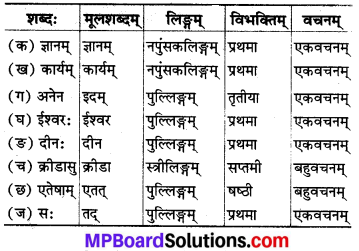
मूलशब्दं, लिङ्ग, विभक्तिं, वचनं च लिखत(मूल शब्द, लिंग, विभक्ति और वचन लिखो-)
(क) ज्ञानम्
(ख) कार्यम्
(ग) अनेन
(घ) ईश्वरः
(ङ) दीनः
(च) क्रीडासु
(छ) एतेषाम्
(ज) सः।
उत्तर:
संस्कृत कक्षा 8 पाठ 6 MP Board

स्वामी विवेकानंद पर 10 वाक्य संस्कृत में MP Board प्रश्न 9.
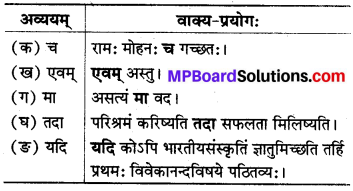
अव्ययानां वाक्य प्रयोगं कुरुत(अव्ययों का वाक्यों में प्रयोग करो-)
(क) च
(ख) एवम्
(ग) मा
(घ) तदा
(ङ) यदि।
उत्तर:
8 वीं कक्षा संस्कृत गाइड In Hindi Chapter 6 MP Board

कक्षा 8 संस्कृत पाठ 6 के प्रश्न उत्तर MP Board प्रश्न 10.
‘स्वामी विवेकानन्दः’ इति विषयमवलम्ब्य संस्कृते दशवाक्यानि लिखत
(‘स्वामी विवेकानन्द’ इस विषय के आधार पर संस्कृति में दस वाक्य लिखो-)
उत्तर:

  1. स्वामी विवेकानन्दस्य बाल्यकालस्य नाम ‘नरेन्द्रनाथः’ आसीत्।
  2. स्वामी विवेकानन्दस्य जन्म कोलकातानगरे अभवत्।
  3. स्वामी विवेकानन्दस्य पिता ‘विश्वनाथदत्तः’ आसीत्।
  4. स्वामी विवेकानन्दस्य माता ‘भुवनेश्वरी देवी’ आसीत्।
  5. स्वामी विवेकानन्दस्य गुरुः ‘रामकृष्णपरमहंसः’ आसीत्।
  6. स्वामी विवेकानन्दस्य शिष्या ‘भगिनी निवेदिता’ आसीत्।
  7. स्वामी विवेकानन्दः यूनां कृते पथप्रदर्शकः आसीत्।
  8. स्वामी विवेकानन्दः संस्कृतानुरागी आसीत्।
  9. नरेन्द्रनाथः ‘स्वामी विवेकानन्दः’ इति नाम्ना प्रसिद्धोऽभवत्।
  10. स्वामी विवेकानन्दस्य बहवः शिष्याः अभवन्।

स्वामी विवेकानन्दः हिन्दी अनुवाद

‘बहुजनहिताय, बहुजन सुखाय’ इत्यमका रोलानस्थ स्वामी विवेकानन्दस्य बाल्यकालस्य नार नरेन्द्रनाथ:’ आसीत्। तस्य जन्म जनवरीमासस्य द्वादशे दिनांक १८६३ ख्रिस्ताब्दे (१२ जनवरी, १८६३) कोलकातानगरे अभवत्। तस्य मातुः नाम ‘भुवनेश्वरी देवी’ आसीत्। तस्य पिता विश्वनाथदत्तः लब्धप्रतिष्ठः, अभिभाषकः आसीत्। नरेन्द्रनाथः बाल्यकालादेव संस्कृतानुरागी, कुशाग्रबुद्धि, मल्लविद्यादिसु क्रीडासु पारङ्गतः धार्मिकश्चासीत्।

अनुवाद :
‘बहुत लोगों के हित के लिए, बहुत लोगों के सुख के लिए’ इस कार्य में लगे हुए स्वामी विवेकानन्द का बचपन का नाम ‘नरेन्द्रनाथ’ था। उनका जन्म जनवरी महीने की बारह तारीख को 1863 ईस्वी में (12 जनवरी, 1863) कोलकाता (कलकत्ता) नगर में हुआ। उनकी माता का नाम ‘भुवनेश्वरी देवी’ था। उनके पिता विश्वनाथदत्त ख्याति प्राप्त वकील थे। नरेन्द्रनाथ बचपन से ही संस्कृत के प्रेमी, तीव्र, बुद्धि वाले, मल्ल (कुश्ती) विद्या आदि खेलों में पारंगत और धार्मिक थे।

तस्मिन् काले रामकृष्ण परमहंसः अद्वितीयाध्यात्मिक-ज्ञानपुञ्जस्य स्रोतः आसीत्। तस्य प्रभावेण प्रभावितः नरेन्द्रनाथः तेनैव परिव्राजकदीक्षा प्राप्नोत्। दीक्षानन्तरं सः स्वामी विवेकानन्दः इति नाम्ना प्रसिद्धोऽभवत्। ततः सः स्वकीयज्ञानदीप्त्या सदुपेदेशः जनान् अध्यात्मपरायणमकरोत्। तस्वावधारणा आसीत् यत् प्रम्णा, सत्येन, पराक्रमेण च कार्याणि सिद्धयन्ति। तत्कुरु पौरुषम्। आत्मभावस्य विकासः एव कर्म। अनात्मभावस्य विकासः एवाकर्म। दौर्बल्येन किमपि न भवति। अतः सबलो भव।

कक्षा 8 विषय संस्कृत पाठ 6 के प्रश्न उत्तर MP Board अनुवाद :
उस समय रामकृष्ण परमहंस अद्वितीय आध्यात्मिक ज्ञान पुंज के स्रोत थे। उनके प्रभाव से प्रभावित नरेन्द्रनाथ ने उनसे ही संन्यास की दीक्षा प्राप्त की। दीक्षा के बाद वह ‘स्वामी विवेकानन्द’ के नाम से प्रसिद्ध हुए। उसके बाद उन्होंने अपनी ज्ञान की ज्योति द्वारा सद् उपदेशों से लोगों को अध्यात्म की ओर अभिमुख किया। उनकी अवधारणा (निश्चय) थी कि प्रेम, सत्य और पराक्रम से कार्य पूरे होते हैं। उसका प्रयत्न करो। आत्म भाव का विकास ही कर्म है। अनात्म भाव का विकास ही अकर्म है। दुर्बलता से कुछ भी नहीं होता। इसलिए बलवान होओ।

जीवनस्यार्थः उन्नतिरस्ति। उन्नतेः तात्पर्य हृदयस्यौदार्यमास्ति। परोपकारः एव जीवनगतिः। स्वार्थभावः एव मृत्युः। प्रेमभावः एव जीवनम्। द्वेषभाव एवं मृत्युः। प्रेमभावः एव भक्तिः ज्ञानं मुक्तिश्चास्ति। प्रेम बिना नेदं यदिदमुपासते।

Sanskrit Chapter 6 Class 8 MP Board अनुवाद :
जीवन का अर्थ उन्नति है। उन्नति का तात्पर्य हृदय का औदार्य (उदारता का गुण) है। परोपकार ही जीवन की गति (चाल) है। स्वार्थभाव ही मृत्यु है। प्रेमभाव ही जीवन है। द्वेषभाव ही मृत्यु है। प्रेमभाव ही भक्ति, ज्ञान और मुक्ति है। प्रेम के बिना वह नहीं है जिसकी उपासना करते हैं।

सर्वथा दरिद्रनारायणो सेवितव्यः। यतोहि बुभुक्षितः, दीनः, उपेक्षितः, विकलाङ्गजनः, दुर्बलः एव साक्षादीश्वरः। अतः एतेषामुपासना एव ईश्वरस्याराधना अस्ति।

अनुवाद :
हमेशा दरिद्रनारायण (गरीब) की सेवा करनी चाहिए। क्योंकि भूखा, दीन, उपेक्षित, विकलांग, दुर्बल व्यक्ति ही साक्षात् ईश्वर हैं। इसलिए ऐसों की उपासना ही ईश्वर की आराधना है।

चारित्र्यबलं धारयत। अनेनैव सर्वत्र विजयो भविष्यति। दाता भव। प्रतिग्रहणस्य कामनां मा कुरु। वसन्तवल्लोकहितं चरत। परोपकारः परमपवित्रं कार्यमस्ति। परोपकारेण चित्तं शुद्धयति। अनेनैव ईश्वरप्राप्तिः सम्भवा।

अनुवाद :
चरित्र की शक्ति को धारण करो। इससे ही सब। जगह विजय होगी। दाता होओ। प्रतिग्रहण (दान के बदले ग्रहण) की कामना मत करो। बसन्त के समान संसार का कल्याण करो। परोपकार परम पवित्र कार्य है। परोपकार से मन शुद्ध होता है। इससे ही ईश्वर की प्राप्ति सम्भव है।

सः वेदान्तप्रचाराय स्वीकायाखिलं जीवनं समर्पयामास। तेन हिन्दुधर्मः संस्कृतिश्च प्रसारिते। सः न केवलं परिव्राजकः अपतुि परोपकारी, दाता, लोकसेवकः महान् देशभक्तश्चासीत्। शिकागोनगरे विश्वधर्मसम्मेलने सः भारतस्य प्रतिनिधिः अभवत्। देशविदेशेषु तस्य बहवः शिष्याः अभवन्। आङ्ग्लदेशीय “कुमारी नोबल” या अनन्तर ‘भगिनी निवेदिता’ इति नाम्ना प्रसिद्धा, तस्य प्रिया शिष्या अभवत्। सः यूनां कृते विशिष्टप्रेरकः पथप्रदर्शकश्चासीत्। भारतीयस्वतन्त्रतासंग्रामेऽपि तस्य ऊर्जस्वलानि भाषणानि स्वाधीनतासैनिकानां कृते प्रेरणास्पदानि। ‘उत्तिष्ठत जाग्रत प्राप्य वरान्निबोधत’ इत्युपनिषदः ध्येयवाक्यं सः जीवनेऽधारयत्।

अनुवाद :
उन्होंने वेदान्त प्रचार के लिए अपना सम्पूर्ण जीवन समर्पित कर दिया। उनके द्वारा हिन्दू धर्म और संस्कृति का प्रसार किया गया। वह न केवल संन्यासी, अपितु परोपकारी, दाता, लोक सेवक और महान देशभक्त थे। शिकागो नगर में विश्वधर्म सम्मेलन में वह भारत के प्रतिनिधि हुए। देश-विदेशों में उनके बहुत से शिष्य हुए। इंग्लैण्ड देश की “कुमारी नोबल” जो बाद में बहन निवेदिता’ के नाम से प्रसिद्ध हुई, उनकी प्रिय शिष्या हुई। वह युवाओं के लिये विशेष प्रेरक और मार्ग-प्रदर्शक थे। भारतीय स्वतन्त्रता संग्राम में भी उनके तेजस्वी भाषण स्वाधीनता के सैनिकों के लिए प्रेरणादायक थे। ‘उठो, जागो और श्रेष्ठ (मनुष्यों) को पाकर (उनसे) ज्ञान प्राप्त करो।’ इस उपनिषद् के ध्येय वाक्य को उन्होंने जीवन में धारण किया।

अहर्निशं ब्रह्मकर्मसाधनां साध्यमानः एव जुलाई मासस्य चतुर्थे दिनांके १९०२ ख्रिस्ताब्दे(४ जुलाई,१९०२) सः ब्रह्मलीनो जातः। सः न केवलं भारते अपितु, विदेशेष्वपि प्रसिद्धः। तेन भारतस्य प्राचीनगौरवं विदेशेषु स्थापितम्। रवीन्द्रनाथटैगोरः कथयति यत् यदि कोऽपि भारतीयसंस्कृतिं ज्ञातुमिच्छति तहिं प्रथमः तेन स्वामी विवेकानन्दविषये पठितव्यः।

अनुवाद :
दिन-रात ब्रह्म कर्म साधना को करते हुए जुलाई महीने की चार तारीख 1902 ईसवी (4 जुलाई, 1902) में वह ब्रह्म में लीन हो गये। वह न केवल भारत में अपितु विदेशों में भी प्रसिद्ध थे। उनके द्वारा भारत का प्राचीन गौरव विदेशों में स्थापित किया गया। रवीन्द्रनाथ टैगोर कहते हैं कि यदि कोई भी भारतीय संस्कृति को जानना चाहता है तो पहले उसे स्वामी विवेकानन्द के विषय में पढ़ना चाहिए।

स्वामी विवेकानन्दः शब्दार्थाः

लब्धप्रतिष्ठः = ख्याति प्राप्त। अभिभाषक = वकील। कुशाग्रबुद्धिः = तीव्र बुद्धि। मल्लविद्यादिषु = कुश्ती आदि विद्याओं में। परिव्राजकदीक्षाम् = संन्यास की दीक्षा को। स्वकीयज्ञानदीप्त्या=अपनेज्ञान के प्रकाशसे।अध्यात्मपरायणम् = अध्यात्म की ओर अभिमुख। प्राप्य वशन्निबोधत = श्रेयस्कर लक्ष्य को प्राप्त कर शान्त हो। बुभुक्षिताः = भूखे। औदार्यम् = उदारता का गुण। प्रतिग्रहणस्य = दान के बदले ग्रहण करने की/का। ऊर्जस्वलानि = तेजस्वी। ब्रह्मलीनः = ब्रह्म में लीन । वसन्तवल्लोकहितं = वसन्त के समान लोक कल्याणकारी।

स्वामी विवेकानन्दः व्याकरणम्

(क) धार्मिकश्चासीत् = धार्मिकः + च + आसीत्।
(ख) अध्यात्मपरायणमकरोत् = अध्यात्मपरायणम् + अकरोत्।
(ग) हृदयस्यौदार्यमस्ति = हृदयस्य + औदार्यम् + अस्ति।
(घ) मुक्तिश्चास्ति = मुक्तिः + च + अस्ति।
(ङ) यदिदमुपासते = यत् + इदम् + उपासते।
(च) वसन्तवल्लोकहितम् = वसन्तवत् + लोकहितम्।

MP Board Class 8th Sanskrit Solutions

MP Board Class 8th Hindi Sugam Bharti Solutions Chapter 19 हार नहीं होती

In this article, we will share MP Board Class 8th Hindi Book Solutions Chapter 19 हार नहीं होती Pdf, These solutions are solved subject experts from the latest edition books.

MP Board Class 8th Hindi Sugam Bharti Solutions Chapter 19 हार नहीं होती

प्रश्न अभ्यास
अनुभव विस्तार

Mp Board Class 8 Hindi Chapter 19 प्रश्न.1.
वस्तुनिष्ठ प्रश्न
Mp Board Class 8 Hindi Chapter 19
उत्तर
(अ) 2, (ब) 3, (स) 4, (द) 1

(ख) दिए गए विकल्पों से रिक्त स्थान की पूर्ति कीजिए
(अ) नन्हीं चींटी जब ……………….लेकर चलती है। (खाना/दाना)
(ब) कोशिश करने वालों की ……………….नहीं होती। (हार/जीत)
(स) ……………….एक चुनौती है स्वीकार करो। (सफलता, असफलता)
(द) संघर्षों का मैदान ………………. मत भागो तुम। (छोड़/तोड़)
उत्तर
(अ) दाना
(ब) हार
(स) असफलता
(द) छोड़।

अति लघु उत्तरीय प्रश्नोत्तर

Class 8 Hindi Chapter 19 Mp Board प्रश्न 1.
(अ) किसकी हार नहीं होती?
(ब) गहरे पानी में से खाली हाथ लौटने पर गोताखोर क्या करता है?
(स) कवि चैन की नींद त्यागने के लिए क्यों कह रहा है?
(द) असफलता को किस रूप में स्वीकार करना चाहिए?
उत्तर
(अ) कोशिश करने वालों की हार नहीं होती।
(ब) गहरे पानी में से खाली हाथ लौटने पर गोताखोर फिर इस दोगुने उत्साह से डुबकी लगाता है कि बड़ी आसानी से मोती नहीं मिलते हैं।
(स) कवि चैन की नींद त्यागने के लिए सफलता की प्राप्ति तक संघर्ष करने के लिए कह रहा है।
(द) असफलता को चुनौती के रूप में स्वीकार करना चाहिए।

लघु उत्तरीय प्रश्नोत्तर

Class 8 Hindi Chapter 19 प्रश्न 1.
(अ) कोशिश करते रहने की जीवन में क्या उपयोगिता है?
(य) नन्हीं चींटी किस प्रकार संघर्ष करती है?
(स) असफलता मिलने पर हमें क्या करना चाहिए?
(द) गोताखोर समुद्र में बार-बार डुबकी क्यों लगाता है?
(ई) सफलता पाने के लिए हमें क्या काम करना चाहिए?
उत्तर
(अ) कोशिश करते रहने की जीवन में बहुत बड़ी उपयोगिता है। इससे सफलता मिलती हा है।
(ब) नन्हीं चींटी दीवार पर दाना लेकर चढ़ते समय एक नहीं, दो बार नहीं बल्कि सौ बार फिसलती है। अंत में उसे सफलता मिल ही जाती है।
(स) असफलता मिलने पर हमें यह देखना चाहिए कि हमारी कोशिश में क्या कमी रह गयी है और उसे कैसे सुधारा जा सकता है।
(द) सफलता पाने के लिए हमें कोशिश करते रहना चाहिए।

भाषा की बात

Mp Board Solution Class 8 Hindi Chapter 19 प्रश्न 1.
बोलिए और लिखिए
नौका, कोशिश, मैदान, विश्वास, सिंधु, हैरानी, संघर्षों, डुबकियाँ, असफलता।
उत्तर
नौका, कोशिश, मैदान, विश्वास, सिंधु, हैरानी, संघर्षों, डुवकियाँ, असफलता।

कोशिश करने वालों की हार Ques And Answers Mp Board प्रश्न 2.
निम्नलिखित शब्दों में ‘ए’ और ‘ऐ की मात्रा संबंधी अशुद्धियाँ हैं, उन्हें सही कीजिए
उत्तर
अशुद्धियाँ – शुद्धियाँ
तेरता – तैरता
गहरै – गहरे
हेरानी – हैरानी
चेन – चौन
सेनिक – सैनिक

Class 8 Hindi Chapter 19 Question Answer Mp Board प्रश्न 3.
निम्नलिखित शब्दों में से एक बचन तथा बहुवचन छाँटकर लिखिए
रंग, डुबकियाँ, संघर्षों, कपड़ा, गाय, कथाएँ, गुड़िया
उत्तर
एकवचन – बहुवचन
रंग – इबकियाँ
कपड़ा – संघर्षों
गाय – कथाएँ
गुड़िया

Class 8 Chapter 19 Hindi Mp Board प्रश्न 4.
निम्ननिखित शब्दों में से शुद्ध शब्द छाँटकर लिखिए
उत्तर
Class 8 Hindi Chapter 19 Mp Board

Mp Board For Class 8 Hindi Chapter 19 प्रश्न 5.
पढ़िए, समझिए और उदाहरण के अनुसार लिखिए
उत्तर
फिसलती – फिसलना, फिसलता, फिसला
सिसकती – सिसकना, सिसकता, सिसका
लहराती – लहराना, लहराता, लहरता
अखरती – अखरना, अखरता, अखरा।

प्रश्न 6.
निम्नलिखित शब्दों में से शब्द और उनके विलोम शब्दों को छाँटकर जोड़ी बनाइए
हार, गिरना, असफलता, जीत, स्वीकार, सफलता, उठना, अस्वीकार, अविश्वास, भरा, विश्वास, खाली।
उत्तर
शब्द – विलोम शब्द
हार – जीत
गिरना – उठना
असफलता – सफलता
स्वीकार – अस्वीकार
अविश्वास – विश्वास
भरा – खाली

प्रश्न 7.
‘क’ वर्ग में लिखित शब्द समूहों का सही अर्थ ‘ख’ वर्ग से छाँटकर सही जोड़ी बनाइए
Class 8 Hindi Chapter 19
उत्तर
(अ) 5, (ब) 1, (स) 4, (द) 3, (ई) 2

प्रश्न 8.
निम्नलिखित शब्दों का वाक्यों में प्रयोग कीजिए
साहस, मेहनत, उत्साह, चुनौती, संघर्ष।
उत्तर
शब्द वाक्य-प्रयोग
साहस – साहस से काम करना चाहिए।
मेहनत – मेहनत से सफलता मिलती है।
उत्साह – उत्साह से निराशा समाप्त होने लगती है।
चुनौती – असफलता एक चुनौती है।
संघर्ष – संघर्ष करने से जीत हासिल होती है।

पयांशों की संदर्भ-प्रसंग सहित व्याख्याएँ

1. लहरों से डरकर नौका पार नहीं होती,
कोशिश करनेवालों की हार नहीं होती,
नन्हीं चींटी जब दाना लेकर चलती है,
चढ़ती दीवारों पर, सो बार फिसलती है,
मन को विश्वास रगों में साहस भरता है,
चढ़कर गिरना, गिरकर चढ़ना न अखरता है,
आखिर उसकी मेहनत बेकार नहीं होती,
कोशिश करनेवालों की हार नहीं होती।

शब्दार्य
नौका-नाव । रगो में-नसों में। अखरता-बुरा लगता।

संदर्भ – प्रस्तुत पंक्तियाँ हमारी पाठ्य-पुस्तक ‘सुगम भारती’ (हिंदी सामान्य) भाग-8 के पाठ-19 ‘हार नहीं होती’ से ली गई हैं।

प्रसंग- प्रस्तुत पंक्तियों में कवि ने कोशिश करके ही विजय प्राप्त होती है। इसे बतलाते हुए कहा है कि

व्याख्या
लहरों के थपेड़ों से अगर कोई नाविक डर जाए, तो वह अपनी नौका को इस पास से उस पार नहीं लगा सकता है। उसे यह विश्वास कर लेना चाहिए कि जो कोशिश करते हैं, उनकी कभी हार नहीं होती है।
कवि का पुनः कहना है कि जब नन्हीं-सी चींटी दाना लेकर दीवार पर चढ़ती है, तो वह एक नहीं, दो नहीं बल्कि सो बार फिसलती है। फिर भी चढ़ने में सफल हो जाती है। अगर नसों में मन का विश्वास भरा हो तो उससे साहस मिलता है। चढ़कर गिरना लेकिन गिरकर फिर न चढ़ना बुरा लगता है। इस प्रकार जो मेहनत करते हैं, उनको आखिर में सफलता मिलती है। उनकी मेहनत बेकार नहीं जाती है। इस आधार पर यह कहा जा सकता है कि कोशिश करने वालों की हार कभी नहीं होती है।

विशेष

  • यह अंश उत्साहवर्द्धक है।
  • वीर रस का प्रवाह है।

2. डुबकियाँ सिंधु में गोताखोर लगाता है,
जा-जाकर खाली हाथ लौट कर आता है।
मिलते न सहज ही मोती गहरे पानी में,
बढ़ता दूना उत्साह इसी हेरानी में,
मुट्ठी उसकी खाली हर बार नहीं होती,
कोशिश करने वालों की हार नहीं होती।

शब्दार्थ
सिंधु-समुद्र । दूना-दो गुना।

संदर्भ – पूर्ववत्।

प्रसंग- पूर्ववत्।

व्याख्या
गोताखोर समुद्र में गहरी डुबकियाँ लगाता है। फिर भी कभी-कभी नह खाली हाथ लौटकर आता है। लेकिन वह यह भलीभाँति जानता है कि समुद्र की गहराई में इतनी आसानी से मोती नहीं मिलते हैं। वह इसी बात को समझकर हैरान हो जाता है। इस प्रयास में उसका उत्साह दो गुना बढ़ – जाता है कि उसकी मुट्ठी हर बार खाली नहीं लौटेगी। इस प्रकार कोशिश करने वालों की हार नहीं होती है।

विशेष

  • भाषा में प्रभाव है।
  • वीर रस का संचार है।

3. असफलता एक चुनौती है, स्वीकार करो, क्या कमी रह गयी, देखो और सुधार करो

जब तक न सफल हो, नीद चन का त्यागा तुम,
संघर्षों का मैदान छोड़ मत भागो तुम ।
कुछ किये बिना ही जय-जयकार नहीं होती,
कोशिश करने वालों की हार नहीं होती।

संदर्भ – पूर्ववत्

प्रसंग – पूर्ववत्।

व्याख्या
असफलता कोशिश करने वालों के लिए एक चुनौती है। ऐसा मानकर उन्हें इसे स्वीकार करना चाहिए। इसके लिए उन्हें यह छानबीन करनी चाहिए। उनकी कोशिश में क्या कमी रह गयी और उसे अब कैसे दूर करके कदम बढ़ाना चाहिए। ऐसा सोच-विचार कर फिर कोशिश करनी चाहिए। इस प्रकार जब तक सफलता न मिले, चैन की नींद नहीं आनी चाहिए। इस दृढ़ संकलप के साथ संघर्षों के मैदान में डटे रहना चाहिए। यह अच्छी तरह से समझ लेना चाहिए श्रेष्ठ और अटूट कर्मों से ही जय-जयकार होती है। यही नहीं, जो कोशिश करते है, उन्हें विजय प्राप्त होती है, हार नहीं।

विशेष

  • वीर रस प्रवाह है।
  • यह अंश प्रेरक हैं।

MP Board Class 8th Special English Solutions Chapter 17 Manav Sangrahalaya: One of Its Kind

Guys who are planning to learn the fundamentals of English can avail the handy study material using MP Board Solutions for Class 8 English Chapter 17 Manav Sangrahalaya: One of Its Kind Questions and Answers. You Can Download MP Board Class 8 English Solutions Questions and Answers, Notes, Summary, Guide, Pdf. Refer to the Madhya Pradesh State Board Solutions for English PDF available and score better grades. Simply click on the quick links available for MP Board Solutions for Class 8 English Chapter 17 Manav Sangrahalaya: One of Its Kind Questions and Answers and prepare all the concepts in it effectively. Take your preparation to the next level by availing the Madhya Pradesh State Board Solutions for Class 8 English prepared by subject experts.

MP Board Class 8th Special English Solutions Chapter 17 Manav Sangrahalaya: One of Its Kind

Do you feel the concept of English is difficult to understand? Not anymore with our MP Board Solutions for Class 8 English Chapter 17 Manav Sangrahalaya: One of Its Kind Questions and Answers. All the Solutions are given to you with detailed explanation and you can enhance your subject knowledge. Use the Madhya Pradesh State Board Solutions for Class 8 English PDF for free of cost and prepare whenever you want.

Manav Sangrahalaya: One of Its Kind Textual Exercise

Word Power

Class 8 English Chapter 15 Manav Sangrahalaya Question 1.
Give one word for the following:

(a) A building in which objects of artistic, cultural, historical or scientific interest are kept.
(b) The period of time in history before information was written down.
(c) The place where a particular type of animal or plant is normally found
(d) A picture that is made by using a camera that has a film sensitive to light inside it ……………
(e) A short journey made for pleasure, especially one that been organized for a group of people …………….

Answer:

(a) Museum
(b) Prehistoric
(c) Habitat
(d) Photograph
(e) Excursion.

Mp Board Class 8 English Chapter 17 Question 2.
Fill in the missing letters in the following words:

(a) d_p_cts
(b) m_gn_f_c_nt
(c) _xc_ _rs_ _n
(d) th_ m_
(e) w_nt_r
(f) t_m_rr_ w
(g) _r_g_n_l
(h) s_sp_ct
(i) sp_c_ _l
(j) c_mm_n_t_s

Answers:

(a) depicts
(b) magnificent
(c) excursion
(d) theme
(e) winter
(f) tomorrow
(g) original
(h) suspect
(i) special
(j) communities.

Comprehension

Class 8 English Chapter 17 Question 1.
Choose the right answer to complete these sentences

(a) Indira Gandhi Rashtriya Manav Sangrahalaya was initially set up in ………….
(i) 1979 in Bhopal
(ii) 1977 in New Delhi
(iii) 1976 in Mumbai
(iv) 1979 in New Delhi

(b) Indira Gandhi Rashtriya Manav Sangrahalaya is situated on of
(i) Shamla Hills.
(ii) Arera Hills.
(iii) Idgah Hills.
(iv) Museum Hills.

(c) The hill is one of a continuous chain hills.
(i) thirty-one.
(ii) thirty-six.
(iii) thirty-three.
(iv) thirty-four.

(d) The museum is spread on an area of ………….
(i) 197 acres.
(ii) 195 acres.
(iii) 190 acres.
(iv) 192 acres.

(e) The main entrance of Indira Gandhi Manav Sangrahalaya is of
(i) traditional desert village style.
(ii) traditional Himalayan village style.
(iii) traditional coastal village style.
(iv) traditional desert city style.

Class 8 English Chapter 17 Mp Board Question 2.
A. Answer the questions given below:

(a) Why Mere Rohit and Rani not very excited that day?
Answer:
They were not excited that day because the winter vacation was coming to an end yet there was still no plan in sight.

(b) What in Indira Gandhi Rashtriya Manav Sangrahalaya?
Answer:
It is a museum.

(c) Where is it situated?
Answer:
It is situated in Bhopal.

(d) What is parole?
Answer:
It is the wonderful gate constructed in a traditionial Himalayan village style.

(e) What do you know about Veethi Sankul?
Answer:
It is one of the main museum buildings based on the theme of human evolution.

(f) What makes this museum different from others?
Answer:
It preserves folkart, and tribal communities, their habitats, their cultural diversities and their relationship with nature. This fact makes this museum different from others.

(B) Pick out the words from the box that are related with ‘Parole’ and ‘Veethi Sankul’ and write them in the space given
Himalayan village style, building, wonderful, gate, photographs, exhibits, main entrance, models, human evolution.
Answer:
MP Board Class 8th Special English Chapter 17 Manav Sangrahalaya One of Its Kind 1

Let’s Learn

Look at these sentence:

1. I had already had my lunch.
2. The peon had rung the bell before ten o’clock.
3. The boys had gone to play prior to our arrival.

  • The verb in these sentences are in the past prefect tense. This tense is used to express an action completed in the past.
  • It is also used to express an action completed in the past before another action took place.

Example:

  1. I had finished my work before she came
  2. The train had steamed off before we reached the station

(A) Now rewrite the following passage using the past perfect tense of the verbs given in the brackets:

The train (arrive) at the station when I reached there. In fact, it was about to move again. The guard (show) the flag and the engine (give) the whistle. Pawan (get) down from the train. A porter (take) out the luggage. Pawan was standing with the luggage and wondering whether I (not receive) his telegram. He felt relived to see me. I told him that I leave) home well in time but a traffic jam on the way (made) me late. Pawan informed me that Pinki (stay) back at Agra. The doctor (advise) her to take rest far a few days.
Answer:
The train had arrived at the station when I reached there. In fact, it was about to move again. The gruard had showed the flag and the engine had given the whistle. Pawan had got down from the train. A porter had taken out the luggage. Pawan was standing with the luggage and wondering whether I had not received his telegram. He felt relieved to see me. I told him that I had left home well in time but a traffic jam on the way had made me late. Pawan informed me that Pinki had stayed back at Agra. The doctor had advised her to take rest for a few days.

(B) Complete the following sentences using the past perfect tense of suitable verbs:

Example: Mohit was limping
…………………………
Mohit was limping because he had sprained his leg.

(a) Rahul was sad because ……………………
(b) Asha was upset because ……………………
(c) The teacher was angry because ……………………
(d) Salma was happy because ……………………
(e) My mother was worried because ……………………

Answers:

(a) Rahul was sad because he had not got time to play.
(b) Asha was upset because she had received a bad news.
(c) The teacher was angry because the students had disobeyed him.
(d) Salma was happy because her father had brought a beautiful dress for her.
(e) My mother was worried because she had got bad new.

Let’s Talk

Rohit has come to visit Indira Gandhi Manav Sangrahalaya. He sees a potter at work. He is fascinated to see the potter’s wheel. The following is the conversation between Rohit and the potter. Talk to your partner and develop the conversation.

Rohit : Hello Sir, I’m Rohit. I want to ask you some questions on pottery.
Potter : Hello Rohit, you are welcome.
Rohit : First tell me about the material needed for pottery.
Potter : Clay, water.
Rohit : What type of clay do you use?
Potter : It is a special type of clay.
Rohit : How do you prepare the clay for the pot?
Potter : It takes a long time and labour in its preparation
Rohit : What do you do then?
Potter : Then we put the clay on the wheel and prepare the pot.
Rohit : Thank you, for giving me the information.

Let’s Write

Notice Writing

A notice is meant to give information to people without caring to circulate it individually. Notices are put up at a prominent place from where everybody can read. In school you may have a special place for a notice board. In residential colonies a notice board is generally placed at the entrance gate. Notices may be inserted in newspapers too.

All notices have a few features in common. They

  • have a heading
  • are clear, brief and complete.
  • are attractive.
  • are written in simple language giving all necessary information like the purpose, date, time and venue.
  • have the name and designation of the person circulating the notice.

Now read the following notice which the sports secretary of Govt. Model School had put up on his school notice board.

Notice
The Inter-school cricket Tournament will begin from 10th January 2007. Matches will be played after school between 3.00 p.m. to 5.00 p.m.

All boys aged between 12 and 14 who wish to play may give their names to the secretary, latest by 25th Dec.2007…..
Dec. 2007….
Sports Secretary,
10th Dec. 2007….

Your school has arranged an educational tour to Indira Gandhi Rashtriya Manav Sanghrahalaya on 1st Feb’2007. You are Arif Khan, the head boy of your school. Write a notice for your school notice board inviting the students to participate in the tour.
Answer:
Notice
The school has arranged an educational tour to Indira Gandhi Rashtriya Manav Sanghrahalaya on 1st Feb’ 2007. All the interested students are requested to contact the undersigered as soon as possible.
Arif Khan
The head boy
25th Jan. 2007

Let’s Read

Read the map carefully and answer the questions given below.
MP Board Class 8th Special English Chapter 17 Manav Sangrahalaya One of Its Kind 2
When you go from bhopal to pachmarhi:

Question 1.
Which highway will the bus take to go to Pachmarhi?
Answer:
The Bhopal Nagpur Highway.

Question 2.
Which direction does it go from the Nagpur Highway?
Answer:
Southwards.

Question 3.
What’s the distance between Hoshangabad and Pipariya?
Answer:
Pipariya is 70 kms from Hoshagabad.

Question 4.
How far is Pachmarhi from Pipariya?
Answer:
Pachmarhi is 54 kms from Pipariya.

Question 5.
Name the towns on the Hoshangabad Pachmarhi road.
Answer:
Babai, Sohagpur, Pipariya.

Question 6.
What does the signboard at Pachmarhi say?
Answer:
Welcome to Pachmarhi, a hill station.

Manav Sangrahalaya: One of Its Kind Word Meanings

MP Board Class 8th Special English Chapter 17 Manav Sangrahalaya One of Its Kind 3

We wish the knowledge shared regarding MP Board Solutions for Class 8 English Chapter 17 Manav Sangrahalaya: One of Its Kind Questions and Answers has been helpful to you. If you need any further help feel free to ask us and we will get back to you with the possible solution. Bookmark our site to avail the latest updates on different state boards solutions in split seconds.

MP Board Class 8th Special English Solutions Chapter 13 How I Thought my Grandmother to Read

Guys who are planning to learn the fundamentals of English can avail the handy study material using MP Board Solutions for Class 8 English Chapter 13 How I Thought my Grandmother to Read Questions and Answers. You Can Download MP Board Class 8 English Solutions Questions and Answers, Notes, Summary, Guide, Pdf. Refer to the Madhya Pradesh State Board Solutions for English PDF available and score better grades. Simply click on the quick links available for MP Board Solutions for Class 8 English Chapter 13 How I Thought my Grandmother to Read Questions and Answers and prepare all the concepts in it effectively. Take your preparation to the next level by availing the Madhya Pradesh State Board Solutions for Class 8 English prepared by subject experts.

MP Board Class 8th Special English Solutions Chapter 13 How I Thought my Grandmother to Read

Do you feel the concept of English is difficult to understand? Not anymore with our MP Board Solutions for Class 8 English Chapter 13 How I Thought my Grandmother to Read Questions and Answers. All the Solutions are given to you with detailed explanation and you can enhance your subject knowledge. Use the Madhya Pradesh State Board Solutions for Class 8 English PDF for free of cost and prepare whenever you want.

How I Thought my Grandmother to Read Textual Exercise

Word Power

(A) Guess the words with the help of the given clues :

  1. A Child who has nobody to look after
  2. A gesture to say yes.
  3. Loving
  4. Something which surprises
  5. A quality that is needed to succeed.

Answer:

  1. Orphan
  2. nod
  3. affectionate
  4. amazing
  5. determination.

(B) Fill in the blanks with the appropriate words given in the box :
popular, obstacles, confidently, novels, worship

  1. There are different ways to ……………. God.
  2. We should reply in the class …………….
  3. Mahatma Gandhi was very ……………. among the people.
  4. Munshi Premchand wrote many ……………. on social problems.
  5. When somebody works ……………. come in his ways, but they teach him how to face problems.

Answer:

  1. worship
  2. confidently
  3. popular
  4. novels
  5. obstacles.

Comprehension

(A) Answer the following questions :

A Child Who Has Nobody To Look After MP Board Class 8th Question 1.
Why did the weekly magazine come late in the village?
Answer:
The weekly magazine came late in the village because the transport system was not very good.

Class 8 English Chapter 12 How I Taught My Grandmother To Read MP Board Question 2.
What is the story of the novel “Kashi Yatra”?
Answer:
There is a old lady who has an ordent desire to go to Kashi or Varanasi. There is also a orphan girl who falls in love but there is no money for the wedding. Finally, the old lady gives away all her savings to the orphan girl without going to Kashi.

Mp Board Class 8 English Chapter 13  Question 3.
Why did the little girl read the several out for her grandmother?
Answer:
The little girl read the serial out for her grandmother because. She (grandmother) was illiterate.

Class 8 English Chapter 13 Mp Board Question 4.
What happened when the girl went to attend a wedding in the neighbouring village?
Answer:
Grandmother could not understand the heat episode of Kashi Yatra when the girl went to attend a wedding in the neighbouring village.

How I Taught My Grandmother To Read Class 8 MP Board Question 5.
Why was grandmother unhappy?
Answer:
Grandmother was unhappy because she found herself helpless and dependent Her favorite story (Kashi Yatra) was in front of her but she was unable to read the lines.

Class 8 English Chapter 13 MP Board Question 6.
What help did grandmother need from his granddaughter?
Answer:
Grandmother told her granddaughter to teach her the Kannada alphabets.

Class 8 English Chapter 13 Question Answer MP Board Question 7.
How was grandmother a wonderful student?
Answer:
The amount of homework she did was amazing. She would read, repeat and recite. Very soon she learnt to read the Kannada alphabet.

Question 8.
What did grandmother do on Dashera festival?
Answer:
Grandmother called her granddaughter to the puja place and made her sit down on a stool. She gave her a gift of a frock material and then she touched her feet.

(B) Choose the correct alternative :

(a) In those days girl’s education was considered …………
– essential
– not essential.

(b) Grandmother could not go to school because …………
– there was no school in the village.
– she got married very young and had children.

(c) The old lady in the novel Kashi Yatra believed that …………
– going to Kashi and worshipping Lord Vishweshvara has very importance.
– the happiness of the orphan girl was more important.

(d) Grandmother was determined to learn. She said. …………
– “I shall try to learn the Kannada alphabet.”
– “I am too old to learn”
Answer:
(a) not essential.
(b) she got married very young and had children.
(c) going to Kashi and worshipping Lord Vishweshvara has very importance.
(d) “I shall try to learn the Kannada alphabet.”

Let’s Learn

Read the following sentences carefully :

  1. When I was only twelve I used to stay in a village with my grandmother.
  2. At the transport system was not good we used to get newspapers very late.
  3. Grandmother used to tell the story to the other woman in the temple.

A Child Who Has Nobody To Look After MP Board Class 8th

Now complete the sentences by using ‘used to + verbs’ given below. One example has been done to help you.
(travel, drink, play, be, have, teach, live, work)

  1. I used to play …………… but now I don’t
  2. My friend’s father …………… a lot but now he doesn’t go away very often.
  3. There …………… a castle on that hill some years ago.
  4. Rita …………… long hair but she got it cut something ago.
  5. We …………… in Indore but now we live in Bhopal
  6. My brother …………… milk when he was young
  7. Rohit …………… hard but nowdays he has become a bit careless.
  8. Mrs. Mehta. …………… us English when I was in class VII.

Answers:

  1. tennis
  2. used to travel
  3. used to be
  4. used to have
  5. used to live
  6. used to drink
  7. used to work
  8. used to teach.

Let’s Talk

Describing past habits.
Class 8 English Chapter 12 How I Taught My Grandmother To Read MP Board
Now talk to your friend describiing past habits.
Answer:
Mp Board Class 8 English Chapter 13
Class 8 English Chapter 13 Mp Board

Let’s Read

Read the following carefully:

This story is an account of successes and setbacks of the science ‘establishment in modern India, struggling to establish itself in the technological forefront. It is the story of national aspiration and of cooperative endeavour. And, as I see it, the saga of India’s search for self-sufficiency and technological competence is a parable for our times.

Each individual creature on this beautiful planet is created by God to fulfill a particular role. Whatever I have achieved in life is through His help and an expression of His will. He showered His grace on me through some outstanding teachers and colleagues and when I pay my tribute to these persons, I’m merely praising His glory. All these rockets and missiles are his work through a small person called Kalam in order to tell several million mass of India, to never feel small or helpless. We are born with a divine fire in us. Our efforts should be to give wings to this fire and fill the world with the glow of its goodness.

Now answer the following questions:

Question 1.
Find of the words in the passage which mean :
(a) effort …………..
(b) blessed ………….
Answer:
(a) endeavour
(b) cursed

Question 2.
Find the words in the passage which mean opposite of:
(a) failure ……..
(b) always …………
Answer:
(a) success
(b) never

Question 3.
Who has written this paragraph? Guess.
Answer:
This paragraph has been written by A.P.J. Abdul Kalam.

Question 4.
With what the narrator, ‘Kalam’ is associated?
Answer:
The narrator ‘Kalam’ is associated with rockets and missiles.

Question 5.
The narrator uses the phrases ‘His help’ His will, “His glory’. What does ‘His! stand for?
Answer:
“His stands for Almighty god.

Question 6.
What message does the narrator give to the people of India?
Answer:
We are born with a divine fire in us. Our efforts should be to give wings to thus fire and fill the world with the glow of its goodness.

Let’s Write

(A) Form groups of two each in your class. Write dialogues of the little girl and her grandmother. Take the help of the clues given below. Present it in a dramatic form before the class.

The little girl : ready to teach her grand mother, has sympathy for her grandmother loves her very much, teaches her the Kannada alpha bet.
Grandmother : unhappy at being illiterate, determined to learn, asks the help of her granddaughter to teach her, gives her granddaughter a gift when she learns to read.

Write the dialogue here :
Answer:
Little girl : Why do you feel so unhappy?
Grandmother : Because I am illiterate. But now I have decided to learn. Will you help me?
Little girl : Yes, I’ll do so. I can’t see you so unhappy.
Grandmother: How will you teach me?
Little girl : I’ll teach you a planned way. You’ll learn everything through Kannad al phabet.
Grandmother : O.K. It will be easiser for me. (After a few months)
Little girl : Grandma, now you have learnt a lot.
Grandmother : Yes, you are right. Thank you very much.

Let’s do it

Make a short survey around you. Find out how many people around you are literate illiterate. Fill in the following table the information you collect :
How I Taught My Grandmother To Read Class 8 MP Board

How I Thought my Grandmother to Read Word Meanings

Class 8 English Chapter 13 MP Board

We wish the knowledge shared regarding MP Board Solutions for Class 8 English Chapter 13 How I Thought my Grandmother to Read Questions and Answers has been helpful to you. If you need any further help feel free to ask us and we will get back to you with the possible solution. Bookmark our site to avail the latest updates on different state boards solutions in split seconds.