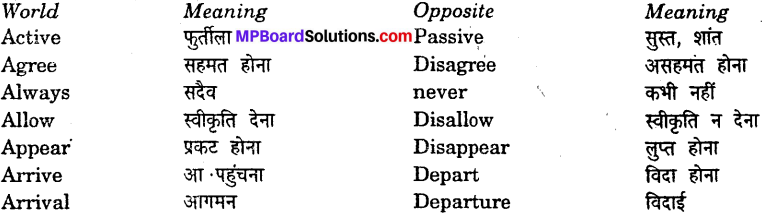
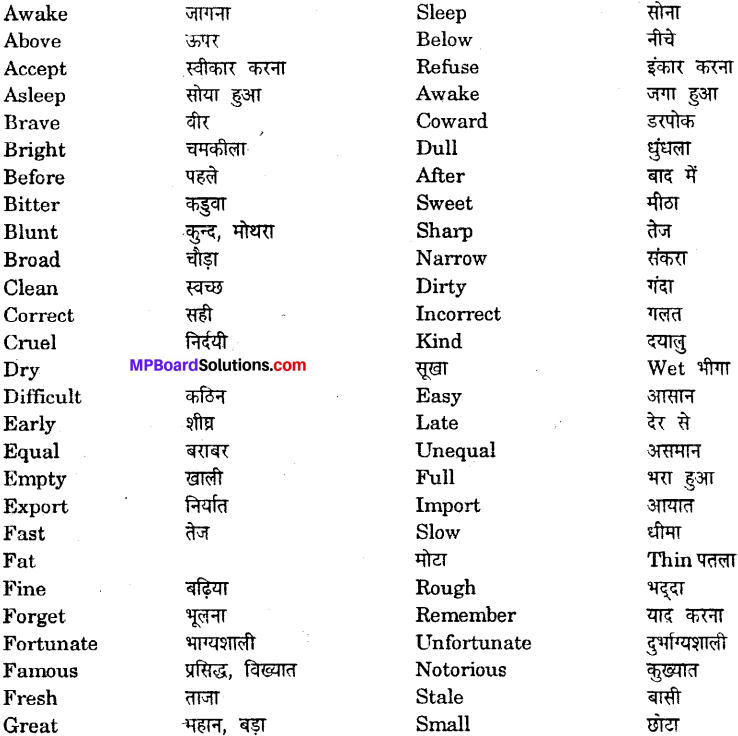
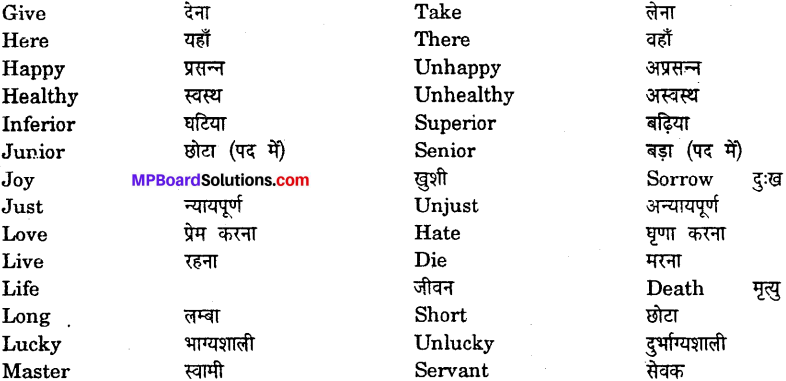
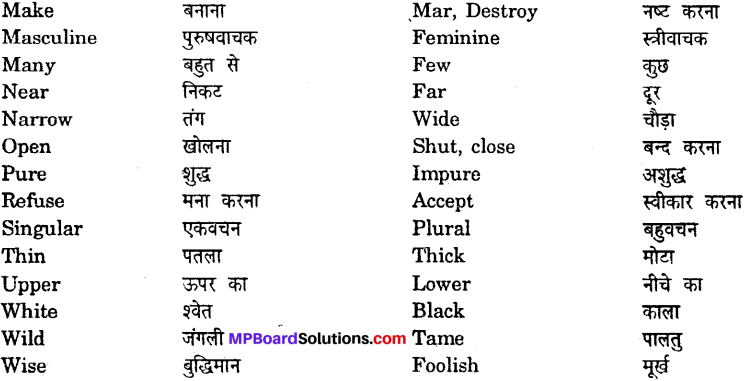
MP Board Class 7th General English Solutions Chapter 12 One Way Ticket-I

Get Updated MP Board Solutions for Class 7 General English Chapter 12 One Way Ticket-I Questions and Answers in PDF Format and download them free of cost. These are provided as per the latest exam pattern and syllabus. Access the topics of Chapter wise and communication skills, grammer part through the direct links available depending on the need. You can Download MP Board Class 7 English Solutions and can score highest grade in examination. Clear all your queries on the Mp Board Solutions for Class 7 English Chapter 21 Tansen Questions and Answers Subject by using the Madhya Pradesh State Board Solutions for existing.

MP Board Class 7th General English Solutions Chapter 12 One Way Ticket-I

If you are eager to know about the Madhya Pradesh State Board Solutions for Class 7 English you will find all of them here. You can identify the knowledge gap using these MP Board Solutions for English PDF and plan accordingly. Don’t worry about the accuracy as they are given after extensive research by people having subject knowledge along side from the latest English Syllabus.

One Way Ticket-I Textual Exercises

Read and Learn (पढ़ो और याद करो):
Students should do themselves.
(छात्र स्वयं करें।)

Comprehension (बोध प्रश्न) :

Answer the questions given below:
(निम्न प्रश्नों के उत्तर दीजिए)

Question 1.
What does Kishto wear ?
(व्हॉट डज़ किश्तो वेयर् ?)
किश्तो क्या पहनता है?
Answer:
Kishto wears a long Khadi kurta and his pyjamas are too short for his long legs.
(किश्तो वेयर्स अ लौंग खादी कुर्ता एण्ड हिज़ पायजामाज़ आर टू शॉर्ट फॉर हिज़ लौंग लेग्स्)
किश्तो खादी का लम्बा कुर्ता पहनता है और उसका पजामा उसकी लम्बी टाँगों के लिए काफी छोटा होता है।

Question 2.
Who is a chatter box ?
(हू इज अ चैटर ब बहुत बोलने वाला कौन है?
Answer:
Bishni is a chatter box.
(बिश्नी इज़ अ चैटर बॉक्स।)
बिश्नी बहुत बोलने वाली है।

Question 3.
What does Lambu always do ?
(व्हॉट डज़ लम्बू ऑल्वेज़ डू?)
लम्बू हमेशा क्या करता है?
Answer:
Lambu is always butting in and asking silly questions or giving childish ideas.
(लम्बू इज़ ऑल्वेज़ बटिंग इन एण्ड ऑस्किंग सिली क्वेश्चन्स् ऑर गिविंग चाइल्डिश आइडियाज़।)
लम्बू हमेशा अनावश्यक हस्तक्षेप करता है और बेवकूफी से भरे सवाल पूछता है या बचकाने विचार सुनाता रहता है।

Question 4.
Why is Krishan called the wiseman ?
(व्हाइ इज़ कृष्ण कॉल्ड द वाईज़ मैन?)
कृष्ण को चतुर व्यक्ति क्यों कहा जाता है?
Answer:
Krishan is called the wise man because he solves everyone’s problems.
(कृष्ण इज़ कॉल्ड द वाईज मैन बिकॉज ही सौल्वज एवरीवन्स प्रॉब्लम्स्।)
कृष्ण को चतुर व्यक्ति इसलिए कहा जाता है क्योंकि वह सबकी समस्याओं का समाधान करता है।

Question 5.
Describe Gittoo’s dress. How does he keep everybody informed ?
(डिस्क्राइब गिट्टज़ ड्रैस। हाउ डज़ ही कॉप एवरीबडी इन्फॉर्ड?)
गिट्ट की पोशाक का वर्णन करो। वह हर एक को सूचित कैसे रखता है?
Answer:
Gittoo is always dressed in Khaki. He gathers news and gossip from the whole village and keeps everyone informed.
(गिट्ट इज़ ऑल्वेज़ ड्रैस्ट् इन खाकी। ही गैदर्स न्यूज़ एण्ड गॉसिप फ्रॉम द होल विलेज एण्ड कीप्स एवीवन इन्फॉर्ड।)
गिट्ट हमेशा खाकी पोशाक पहनता है। वह पूरे गाँव से खबर व गपशप इकट्ठा करके सबको सूचित करता है।

Question 6.
What do the children plan after the bus breaks down?
(व्हॉट डू द चिल्ड्रन प्लैन आफ्टर द बस ब्रेक्स् डाउन?)
बस के रुकने के बाद बच्चे क्या योजना बनाते हैं?
Answer:
The children planned to walk to the fair and return the next day by the morning bus.
(द चिल्ड्रन प्लैन्ड टू वॉक टू द फेअर एण्ड रिटर्न द नेक्स्ट डे बाइ द मॉर्निग बस।)
बच्चों ने मेले तक पैदल चलकर जाने और अगली सुबह की बस से लौटने की योजना बनाई।

Question 7.
Why does Krishan suggest to go on foot ?
(व्हाइ डज़ कृष्ण सजेस्ट टू गो ऑन फुट?)
कृष्ण ने पैदल जाने की सलाह क्यों दी?
Answer:
Krishan suggested to go on foot because there were no chances of the bus to get repaired socon.
(कृष्ण सजैस्टेड टू गो ऑन फुट बिकॉज़ देयर वर नो चान्सेज़ ऑफ द बस टू गेट रिपेयर्ड सून।)
‘कृष्ण ने पैदल जाने की सलाह दी क्योंकि बस के जल्दी ठीक होने के कोई आसार नहीं थे।

Question 8.
What do they do the inform their parents?
(व्हॉट डू दे डू टू इन्फॉर्म देयर पेरेन्ट्स्?)
वे अपने माता-पिता को सूचित करने के लिए क्या करते हैं?
Answer:
They call the postman on telephone to inform their parents about them.
(दे कॉल द पोस्टमैन ऑन टेलिफोन टू इनफॉर्म देयर पेरेन्ट्स् अबाउट देम।)
वे डाकिये को फोन करके उनके माता-पिता को उनके बारे में सूचित करने को कहते हैं।

Word Power
(शब्द-सामर्य) :

(A) Use the following phrases in the sentences given below :
(निम्न वाक्यांशों का वाक्यों में प्रयोग कीजिए।)
(keeping a watch, board a bus, three piece, broke down)

  1. My two wheeler ………………. when I was going home.
  2. Moti, the dog is ………………. on all the people going inside the gate.
  3. We have to ………………. at Pipariya to go to Pachmarhi.
  4. I have a ………………. blue suit.

Answers:

  1. broke down
  2. keeping a watch
  3. board a bus
  4. three piece.

(B) Match these words with their meanings in each pair :
(इन शब्दों का इनके अर्थों से मिलान जोड़ियों में कीजिए।)
Answer:
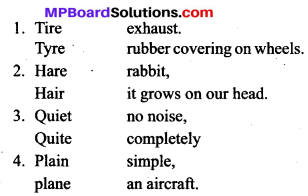
MP Board Class 7th General English Chapter 12 One Way Ticket-I 1

(C) Now use these words in separate sentences of your own.
(अब इन शब्दों को अपने वाक्यों में प्रयोग कीजिए।)
Answer:
1. Tire – When Seema came from office, she was too tired.
Tyre-The tyre of Nikhil’s scooter got punctured on the way.

2. Hare-A hare is fond of eating carrots.
Hair-Ranjana is suffering from the problem of hair fall.

3. Quiet-The students became quiet as the teacher entered the classroom.
Quite-It is quite an easy job.

4. Plain-She wore a plain dress.
PlaneIt was Shyam’s first experience to travel in a plane.

Grammar in Use (व्याकरण प्रयोग) :

(A) Combine the sentences given below using who, what, when, which or where.
(नीचे दिए वाक्यों को Who, what, when, which, या where का प्रयोग कर जोड़िए)

Question 1.
Ranjana wants to buy a book. Ramu has the same book. (which)
Answer:
Ranjana wants to buy the same book which Ramu has.

Question 2.
Mother went to market. Ramu was sleeping. (when)
Answer:
Mother went to market when Ramu was sleeping.

Question 3.
I found the pen. I had kept it. (where)
Answer:
I found the pen where I had kept it.

Question 4.
Sona called me. I was reading. (when)
Answer:
Sona called me when I was reading.

Question 5.
The teacher punished the boy. He was making a noise. (who)
Answer:
The teacher punished the boy who was making noise.

(B) Rewrite the following sentences removing ‘too’.
(निम्नलिखित वाक्यों से ‘too’ हटाकर पुनः लिखिए)

Question 1.
The ceiling is too high to reach.
Answer:
The ceiling is so high that it cannot be reached

Question 2.
The shirt is too big to wear.
Answer:
The shirt is so big that is cannot be worn.

Question 3.
This dress is too costly to buy.
Answer:
This dress is so costly that it cannot be bought

Question 4.
My school is too far to walk to.
Answer:
My school is so far that it cannot be walked to.

Question 5.
This picture is too large to hang.
Answer:
This picture is so large that it cannot be hung.

Let’s Talk (आओ बात करें):

Talk to your friends about various dresses they or their family member wear. Also find out their special qualities and write at least two of them. You can choose from these words.
(अपने मित्रों से विभिन्न पोशाकों के बारे में बात करें जो वे या उनके परिवारीजन पहनते हों। उनकी विशेषताएँ खोजिए और कम से कम दो विशेषताएँ लिखिए। आप इन शब्दों में से चुन सकते हो।)
Dress : (dhoti, kurta, lungi, saree, pair of trousers, shirt, skirt, blouse, pair of half-pants, short, T-shirt.)
Quality : (honest, hard working, thin, fat, young, old, talkative, quiet, peace loving, childilike, innocent, brave, wise, intelligent, loving, affectionate.)
Answer:
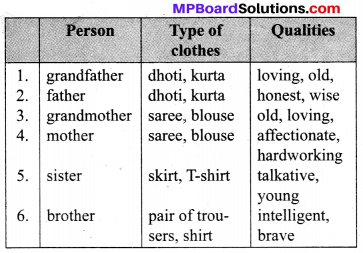
MP Board Class 7th General English Chapter 12 One Way Ticket-I 2

Let’sWrite (आओ लिखें):

(A) You the elder brother/sister in you family. Write about an incident when you went together for a picnic and lost your way. What happened then and how you came back. Write a paragraph. Start like this:

(तुम अपने परिवार में बड़े भाई/बहिन हो। उस घटना के बारे में लिखो जब तुम एक साथ पिकनिक पर गए थे और रास्ता भूल गए थे। तब क्या हुआ और तुम लोग कैसे वापस आए। एक अनुच्छेद लिखो। इस प्रकार से आरम्भ करे।)

Once my family members and I went to a nearby riverside. We wanted to see the woods and walked into the thick forest. Then we went deep inside the woods. There was very dim light inside the thick forest as light could not penetrate through the densely packed trees. We could hardly see one another. We soon realised that we had lost our way. There was fear of wild animals, hunger, thirst and also it was getting darker.

The very thought of passing night in the forest trembled us. We didn’t even know to climb trees. We began to search the way out so that we could somehow get out of it. The only wish and the only prayer at that time was to get the way out, Suddenly, we heard the horn of a vehicle passing through the road. Oh! God, we were on the right track and we just started to run as fast as we could into the direction of the sound. We had come out on the highway cutting through the forest. The happiness of those moments couldn’t be expressed through words. It seemed as if we’ve got a new life.

(B) (Work in pairs) Krishan calls the postman ‘chacha’. Complete the conversation. Use these words. (tomorrow, Dholpur, fair, it’s late, of course, Krishan)
(जोड़ों में कार्य करो) कृष्ण डाकिए को ‘चाचा’ कहकर बुलाता है। इस वार्तालाप को पूरा करो। इन शब्दों का प्रयोग करो)
(tomorrow, Dholpur, fair, it’s late, of course, Krishan)
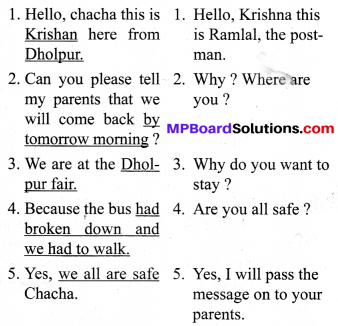
MP Board Class 7th General English Chapter 12 One Way Ticket-I 3

(C) Now write what Ramlal says to their parents.
(अब लिखो रामलाल उनके माता-पिता से क्या कहता है?)
Ramlal : Krishan called from Dholpur.
Krishan’s father : What did he say?
Ramlal : He said they will stay there tonight.
Father : Why are they not coming ?
Ramlal : Because their bus broke down and they walked to the fair.
Father : Are they safe ?
Ramlal : Yes, they are safe.

Let’s Do It (आओ इसे करें) :
Describe these two pictures in five sentences each. Use these clues.
(इन दो चित्रों में से प्रत्येक का पाँच वाक्यों में वर्णन करो। इन संकेतों का प्रयोग करो।)
(round face, old man, young girl, wears spectacles, big eyes, short hair, bald, grandfather looks, school girl.)
Answer:
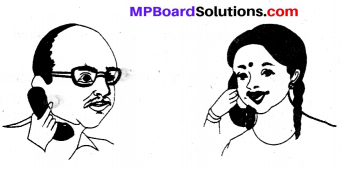
MP Board Class 7th General English Chapter 12 One Way Ticket-I 4
The Man

  1. The man in the picture is old and has a round face.
  2. He has big eyes, short hair and moustaches.
  3. He wears spectacles.
  4. He has short hair at the back of his head and is bald from front.
  5. He looks like my grandfather.

The Girl

  1. The young girl in the picture is a school girl.
  2. She has tow long plaits hanging on both sides.
  3. She has round face, sharp nose and beautiful eyes and lips.
  4. She wears bangles and there is a small bindi on her forehead.
  5. She is talking to her grandfather on phone.

Pronunciation & Translation

Read this story of five friends from a village and their adventures while going to a fair.
(रीड दिस स्टोरी ऑफ फाइव फ्रेन्ड्स फ्रॉम अ विलेज एण्ड देअर एडवेन्चर्स व्हाइल गोइंग टू अ फेअर.)
अनुवाद-एक गाँव से मेले जाते समय पाँच दोस्तों के रोमांचक अनुभव की यह कहानी पढ़ें।

Kishto is twelve. He wears a long khadi kurta, his father’s perhaps. His pyjamas are always too short for his long legs. He wears his hair long. They are patched on his head like a thatch. He copies everyone in the village from his Dadi to the ration-shop man with his pair of scales.
(किश्टो इज ट्वेल्व. ही वीअर्स अ लौंग खादी कुर्ता, हिज फादर्स परहेप्स. हिज पायजामाज आर ऑलवेज टू शॉर्ट फॉर हिज लौंग लेग्स. ही वीअर्स हिज हेअर लौंग दे आर पैच्ड ऑन हिज हैड नाइक अ थैचं. ही कॉपीज ऐवीवन इन द विलेज फ्रॉम हिज दादी टू द राशन-शॉप मैन विद हिज पेअर ऑफ स्केल्स.)
अनुवाद-किश्तो बारह वर्ष का है। वह एक लम्बा खादी का कुर्ता पहनता है। जो शायद उसके पिता का है। उसका पायजामा सदैव उसके लम्बे पैरों के लिए बहुत छोटा होता है। उसके बाल लम्बे हैं। वे उसके सिर पर एक छप्पर के समान पैबन्द की तरह हैं। वह अपने गाँव में अपनी दादी से लेकर राशन की दुकान वाले आदमी की तराजू, के साथ, सभी की नकल निकालता है।

Bishni is thirteen. She wears a loose three piece dress-ghagra, choli and odhni. She is bold but a chatterbox. She has two plaits hanging on both the sides.
(बिश्नी इज थर्टीन. शी वीअर्स अलूज थ्री पीस ड्रेस-घाघरा, चोली एण्ड ओढ़नी. शी इज बोल्ड बट अ चैटरबॉक्स. शी हैज टू प्लेट्स हैगिंग ऑन बोथ द साइड्स.)
अनुवाद-बिशनी तेरह वर्ष की है। वह एक तीन पीस वाली ढीली पोशाक-घाघरा, चोली और ओढ़नी पहनती है। वह साहसी हैं परन्तु बातूनी है। उसके दोनों ओर दो चोटी लटक रही हैं।

Lambu is eleven. He is ever so simple and innocent but rather awkward and grown too tall for his age. He usually wears a shirt and pyjamas. He is always butting in and asking silly questions or giving childish ideas.
(लम्बू इज इलेवन. ही इज एवर सो सिम्पल एण्ड इन्नोसेन्ट बट रादर ऑकवर्ड एण्ड ग्रोन टू टाल फॉर हिज एज. ही यूजुअली वीअर्स अ शर्ट एण्ड पायजामाज़. ही इज ऑल्वेज बुटिंग इन एण्ड आस्किंग सिली क्वेश्चन्स ऑर गिविंग चाइल्डिश आइडियाज.)
अनुवाद-लम्बू ग्यारह वर्ष का है। वह हमेशा बहुत – साधारण और मासूम रहा है परन्तु कुछ अजीब लगता है और अपनी उम्र की अपेक्षा काफी लम्बा है। वह अक्सर एक कमीज और पाजामा पहनता है। वह हमेशा मूर्खतापूर्ण प्रश्न पूछता है और बच्चों जैसे विचार देता है।

Krishna is fourteen. He is neatly dressed in a shirt and shorts or sometimes in dhoti kurta. He is always clean and has a straight gait. He is known as krishna the wise. For anything you cannot solve, you can go to him. He will help you to find a solution.
(कृष्ण इज फॉर्टीन. ही. इज नीटली ड्रेस्ड इन अ शर्ट ऐन्ड शोर्ट ऑर समटाइम्स इन धोती कुर्ता. ही इज ऑल्वेज क्लीन एण्ड हैज अ स्ट्रेट गेट. ही इज नोन ऐज कृष्ण द वाइज. फॉर ऐनीथिंग यू कैननॉट सॉल्व, यू कैन गो टू हिम. ही विल हैल्प यू टू फाइन्ड अ सोल्यूशन.)
अनुवाद-कृष्ण चौदह वर्ष का है। वह साफ कमीज और . छोटा निकर या कभी-कभी धोती कुर्ता भी पहनता है। वह हमेशा साफ रहता है और सीधे रास्ते चलता है। वह कृष्ण, बुद्धिमान कहलाता है। जो कुछ भी आप नहीं सुलझा सकते हो, तो आप उसके पास जा सकते हो। वह आपकी हल ढूँढ़ने में सहायता करेगा।

Then we have little Gittoo who is twelve. He is a little too short for his age. He is always dressed in khaki and plays the policeman, postman and gathers news and gossip from the whole village and keeps you informed.
(दैन वी हैव लिटल गिटू हू इज ट्वेल्व. ही इज अ लिटल टू शॉर्ट फॉर हिज एंज. ही इज ऑल्वेज ड्रेस्ड इन खाकी एण्ड प्लेज द पुलिसमैन, पोस्टमैन एण्ड गेदर्स न्यूज एण्ड गौसिप फ्रॉम द होल विलेज एण्ड कीप्स यू इनफॉर्मड.)
अनुवाद-तब हमारे पास छोटा गिट्ट है जो कि बारह वर्ष का है। वह अपनी उम्र को देखते हुए नाटा है। वह हमेशा खाकी पोशाक में रहता है और पुलिसमैन, डाकिया का अभिनय करता रहता है और पूरे गाँव से समाचार और आपसी बात-चीत एकत्रित करता है और आपको सूचना देता रहता है।

Well, they plan to go over to the next village Dholpur by bus. They decide to take Sheru, the dog with them. The plan is to go next Sunday. There is a fair in Dholpur and they want to see it. It has caterpillar train rides, the cars that you can drive through a maze and there are horse rides too. You can see real fish in a small aquarium, merry-go-round, giant wheel and hansi ghar.
(वैल, दे प्लान टू गो ओवर टू द नेक्स्ट विलेज. धौलपुर बाइ बस. दे डिसाइड टू टेक शेरू, द डॉग विद दैम. द प्लान इज टू गो नेक्स्ट संडे. देअर इज अ फेअर इन धोलपुर एण्ड दे वान्ट टू सी इट. इट हैज कैटरपिलर ट्रेन राइड्स, द कार्स दैट यू कैन ड्राइव श्रू अ मेज़ एण्ड देअर आर होर्स राइड्स टू. यू कैन सी रीयल फिश इन अ स्मॉल एक्वेरियम मैरी-गो-राउण्ड, जायन्ट व्हील एण्ड हँसी घर.)
अनुवाद-अब वे बस द्वारा अगले गाँव धौलपुर जाने की योजना बनाते हैं। वे शेरू (कुत्ते) को ले जाने का निर्णय करते हैं। योजना अगले रविवार को जाने की है। धौलपर में एक मेला है और वे इसे देखना चाहते हैं। वहाँ सवारी को कैटरपिलर (तितली के बच्चों जैसी) रेलगाड़ी है, कार है जिनहें तुम भूल भुलैया (संकरे रास्तों से) में से होते हुए चला सकते हो और घोड़ों की सवारी भी है। तुम एक छोटे से मछली घर में असली जीवित मछलियों को, हँसी घर, बड़ा झूला और घूमने वाला झूला देख सकते हो।

They ask their parents for some money for the rides. Mothers give them a few the things to eat on the way.
(दे आस्क देअर पेरेन्ट्स फॉर सम मनी फॉर द राइड्स. मदर्स गिव दैम अ फ्यू थिंग्स टू ईट ऑन द वे)
अनुवाद-वे अपने माता-पिता से सवारी करने के लिए कुछ रुपये माँगते हैं। माताएँ रास्ते में उन्हें कुछ वस्तुएँ खाने को देती हैं।

They buy their tickets, board the bus, sit on the wornout seats, huddled together. Sheru is keeping a watch at everything around.
(दे बाय देअर टिकट्स, बोर्ड द बस, सिट ऑन द वार्नआउट सीट्स, हडल्ड् टुगेदर. शेरू इज कीपिंग अ वॉच ऐट एव्रीथिंग अराउण्ड.)
अनुवाद-वे अपने टिकट खरीदते हैं, बस में चढ़ते हैं, एक साथ सटे हुए टूटी-फूटी सीटों पर बैठते हैं। शेरू आस-पास की हर चीज पर नजर रखे हुए है।

The bus does not move.
(द बस डज नॉट मूव.)
अनुवाद-बस नहीं चलती है।

Kishto : Ho, Ho, Ha. Conductor Chacha what shall we do now? Why are we not moving?
(किश्तो : हो, हो, हा. कन्डक्टर चाचा व्हॉट शैल वी डू नाउ ? व्हाई आर वी नॉट मूविंग?)
अनुवाद-किश्तो : हो, हो, हा! कन्डक्टर (परिचालक) चाचा हम अब क्या करेंगे? हम चल क्यों नहीं रहे हैं?

Conductor : Something seems to be wrong with the engine.
(कन्डक्टर : समथिंग सीम्स टू बी रॉग विद द इंजिन.)
अनुवाद-परिचालक : इंजन में कुछ खराबी दिखाई देती है।

Bishni : We will wait for a while.
(बिशनी : वी विल वेट फॉर अ व्हाइल.)
अनुवाद-बिशनी : हम कुछ देर इन्तजार कर लेंगे।

Kishto : Ha, Ha, Ha, Ha, wait for what They have no proper tools. How w they repair it ?
(किश्तो : हा, हा, हा, हा, वेट फॉर व्हॉट ? दे हैव नो प्रॉपर टूल्स. हाउ विल दे रिपेअर इट?)
अनुवाद-किश्तो : हा, हा, हा, हा, इन्तजार किसके लिए? उनके पास उचित औजार नहीं हैं। वो इसकी मरम्मत किस प्रकार करेगें?

Gittoo : What shall we do? What to do ?
Nobody on the bus seems to know.
(गिटू : व्हॉट शैल वी डू? व्हॉट टू डू? नोबडी ऑन द बस सीम्स टू नो.)
अनुवाद-गिटू : हम क्या करेंगे? क्या करना है? बस में कोई जानकार दिखाई नहीं देता है।

Lambu : Let’s go home.
(लम्बू : लेट्स गो होम.)
अनुवाद-लम्बू : आओ, घर चलें।

Bishni : What for?
(बिशनी : व्हॉट फॉर?)
अनुवाद-बिशनी : किसलिए?

Lambu : Oh, the bus has broken down. We cannot go to Dholpur. So let’s go back to Rampur.
(लम्बू : ‘ओह, द बस हैज ब्रोकन डाउन. वी कैननॉट गो टू धौलपुर. सो लेट्स गो बैक टू रामपुर.)
अनुवाद-लम्बू : अरे, बस टूट गई है। हम धौलपुर नहीं जा सकते हैं। इसलिए, आओ रामपुर वापस चलें।

Krishan : No, no, I think we can walk to the fair and return tomorrow by the morning bus.
(कृष्ण : नो, नो, आइ थिंक वी कैन वॉक टू द फेअर एण्ड रिटर्न टूमोरो बाइ द मॉर्निंग बस.)
अनुवाद-कृष्ण : नहीं, नहीं मेरा विचार है कि हम मेले तक पैदल चल सकते हैं और कल सुबह की बस से वापिस हो सकते

Bishni : That’s a good idea. I certainly want to see the mela and the new rides.
(बिशनी : दैट्स अ गुड आईडिया. आइ सर्टेनली वान्ट टू सी द मेला एण्ड द न्यू राइड्स.)
अनुवाद-बिशनी : यह अच्छा विचार है। मैं निश्चित ही मेला और नई सवारियाँ देखना चाहती हूँ।

Gittoo : I am sure you will get tired of walking.
(गिटू” : आइ एम श्योर यू विल गेट टायर्ड ऑफ वॉकिंग.)
अनुवाद-गिटू-मुझे यकीन है तुम पैदल चलने से थक जाओगी।

Bishni : No, no, I walk to so many places. I am sure I can do it.
(बिशनी : नो, नो, आई वॉक टू सो मेनी प्लेसेस. आइ एम श्योर आइ कैन डू इट.)
अनुवाद-बिशनी : नहीं, नहीं, मैं कई जगह पैदल जाती हूँ। मुझे यकीन है मैं यह कर सकती हूँ।

Kishto : Aha ! That’s a brave girl.
(किश्तो : अहा! दैट्स अ ब्रेव गर्ल.)
अनुवाद-किश्तो : अहा! यह एक बहादुर लड़की है।

Krishan : Let’s go. We’ll call the postman chacha on telephone to tell our parents that we are safe and will be back by tomorrow. They return the tickets and get their money back from the conductor.
(कृष्ण : लेट्स गो. वी ‘इल कॉल द पोस्टमैन चाचा ऑन टेलीफ़ोन टू टैल अवर पेरेन्ट्स दैट वी आर सेफ एण्ड विल बी बैक बाइ टुमोरो. दे रिटर्न द टिकट्स एण्ड गैट देअर मनी बैक फ्रॉम द कन्डक्टर.)
अनुवाद-कृष्ण : आओ चलें। हम डाकिया चाचा को फोन कर देखें कि हमारे अभिभावकों को बता दें कि हम सुरक्षित हैं और कल तक वापस आएँगे। वे टिकट वापिस करते हैं और कन्डक्टर परिचालक से अपना पैसा वापिस ले लेते हैं।

Gittoo : Walk fast it will be dark soon. So the five friends with their dog Sheru walked to Dholpur and reached the fair ground at about 7 O’clock in the evening.
(गिटू : वॉक फास्ट इट विल बी डार्क सून. सो द फाइव फ्रेण्ड्स विद देअर डॉग शेरू वॉक्ड टू धौलपुर एण्ड रीच्ड द फेअर ग्राउण्ड ऐट अबाउट सेवन ओ क्लॉक इन द ईवनिंग.)
अनुवाद-गिटू : तेज चलो, जल्दी ही अंधेरा हो जाएगा। इस प्रकार पाँचों दोस्त अपने कुत्ते शेरू के साथ पैदल धौलपुर चल दिये और सांय करीब सात बजे मेला स्थल पर पहुँच गये।

One Way Ticket-I Word Meanings

Aquarium (अक्वेरिअम्)-मछली घर; Awkward (ऑक्वर्ड)-बेढंगा, अटपटा; Bold (बोल्ड)-बहादुर; Brave (ब्रेव)-वीर; Butting (बटिंग)-अनावश्यक हस्तक्षेप, करना; Chatter box (चैटर बॉक्स)-बहुत बोलने वाला; Childish (चाइल्डिश)-बचकाना; Decide (डिसाइड)-निर्णय करना; Fair (फेअर)-मेला; Gait (गेट)-चाल; Scales (स्केल्स)-तराजू; Gather (गैदर) एकत्र करना; Giant wheel (जायन्ट व्हील)-विशाल चक्र; Gossip (गॉसिप)-गपशप; Hanging (हैंगिंग)-लटकती हुई; Huddle (हडल)-सटकर, इकठ्ठा हो जाना; Idea (आइडिया) विचार; Informed (इन्फॉम्र्ड)-सूचित; Innocent (इनोसेन्ट)-मासूम; Maze (मेज़)-भूल भुलैया; Merry-go-round (मैरी-गो-राउण्ड)-चक्र दोला; Neatly नीटली)-सफाई से, अच्छे से; Patch (पैच)-थिगली, पैबन्द जैसा लगे होना; Perhaps (परहैप्स)-शायद; Plait (प्लैट)-चोटी; Plan (प्लैन)-योजना; Qualities (क्वालिटीज़)-गुण,लक्षण;Repair(रिपेयर)-मरम्मत करना; Safe (सेफ)-सुरक्षित; Silly (सिली)-बेवकूफी से भरे; Solution (सल्यूशन)-हल, समाधान; Solve (सॉल्व)-हल करना; Straight (स्ट्रेट)-सीधा; Thatch (थैच)-छप्पर; Tired (टायर्ड)-थका हुआ; Usually (यूजुअलि)-प्रायः, अक्सर; Wear (वियर)-पहनना; While (व्हाइल)-जब तक।

We believe the information shared regarding MP Board Solutions for Class 7 English Chapter 21 Tansen Questions and Answers as far as our knowledge is concerned is true and reliable. In case of any queries or suggestions do leave us your feedback and our team will guide you at soonest possibility. Bookmark our site to avail latest updates on several state board Solutions at your fingertips.
MP Board Class 7th General English Solutions Chapter 11 Lohri

Get Updated MP Board Solutions for Class 7 General English Chapter 11 Lohri Questions and Answers in PDF Format and download them free of cost. These are provided as per the latest exam pattern and syllabus. Access the topics of Chapter wise and communication skills, grammer part through the direct links available depending on the need. You can Download MP Board Class 7 English Solutions and can score highest grade in examination. Clear all your queries on the Mp Board Solutions for Class 7 English Chapter 21 Tansen Questions and Answers Subject by using the Madhya Pradesh State Board Solutions for existing.

MP Board Class 7th General English Solutions Chapter 11 Lohri

If you are eager to know about the Madhya Pradesh State Board Solutions for Class 7 English you will find all of them here. You can identify the knowledge gap using these MP Board Solutions for English PDF and plan accordingly. Don’t worry about the accuracy as they are given after extensive research by people having subject knowledge along side from the latest English Syllabus.

Lohri Textual Exercises

Listen and Repeat (सुनो और दुहराओ) :

(A) Students should do themselves.
(छात्र स्वयं करें।)

(B) Listen to the teacher as she/he reads the poem and fill in the gaps :
(अपने शिक्षक से कविता को सुनिए और खाली स्थान भरिए।)
Down in the South, The days are fine When January comes around. But up in the North. And in the hills and so forth. January’s Lohri time.

(C) Listen to the poem carefully and write the words from the poem that rhyme with the words given below:
(कविता को ध्यानपूर्वक सुनो और उसमें से वे शब्द जो समान ध्वनि वाले हों, लिखिए।)
pine fine, blame flame, letter better
file pile, cuts nuts, turn burn

Comprehension (बोध प्रश्न) :

Answer the following questions :
(निम्न प्रश्नों का उत्तर दीजिए)

Question 1.
What is the poem about ?
(व्हॉट इज द पोऍम अबाउट?)
कविता किसके बारे में है?
Answer:
The poem is about the festival of ‘Lohri’.
(द पोऍम इज़ एबाउट द फेस्टीवल ऑफ लोहड़ी।)
कविता लोहड़ी के त्यौहार के बारे में है।

Question 2.
How are the days in the south during January?
(हाउ आर द डेज़ इन द साउथ ड्यूरिंग जनवरी?)
दक्षिण में जनवरी के दिन कैसे होते हैं?
Answer:
The days in the south during January are very fine.
(द डेज़ इन साउथ ड्यूरिंग जेन्युअरी आर वेरी फाइन।)
दक्षिण में जनवरी के महीने में दिन बहुत ही सुहावने होते हैं।

Question 3.
Why do people collect twigs and leaves ?
(व्हाई डू पीपल कलेक्ट ट्विग्स एण्ड लीज् ?)
लोग टहनियाँ और पत्तियाँ क्यों एकत्र करते हैं?
Answer:
People collect twigs and leaves to burn them when they celebrate Lohri in January.
(पीप्ल् कलेक्ट ट्विग्स एण्ड लीव्ज़ टू बर्न दैम व्हैन दे सेलीब्रेट लोहड़ी इन जेन्युअरी।)
लोग टहनियाँ और पत्तियाँ जलाने के लिए एकत्र करते हैं, जब वे जनवरी में लोहड़ी मनाते हैं।

Question 4.
What goes from hand to hand ?
(व्हॉट गोज़ फ्रॉम हैण्ड टू हैण्ड ?)
एक हाथ से दूसरे हाथ में क्या जाता है?
Answer:
Nuts and sweetmeats pass from hand to hand.
(नट्स एण्ड स्वीटमीट्स पास फ्रॉम हैण्ड टू हैण्ड।)
मूंगफली व रेवड़ियाँ एक हाथ से दूसरे हाथ में जाती हैं।

Question 5.
What, according to the poet, is not good for environment ?
(व्हॉट, एकॉर्डिग टू द पोऍट, इज़ नॉट गुड फॉर एनवाइरनमेन्ट?)
कवि के अनुसार, पर्यावरण के लिए क्या ठीक नहीं है?
Answer:
Burning the wood a lot, is not good for environment. The air gets polluted from smoke caused by burning the wood.
(बर्निंग द वुड ए लॉट, इज़ नॉट गुड फॉर एनवाइरनमेन्ट। द एयर गेट्स पॉल्यूटेड फ्रॉम स्मोक कॉज्ड बाइ बर्निंग द वुड।)
बहुत अधिक लकड़ी का जलाया जाना पर्यावरण के लिए अच्छा नहीं है। लकड़ी जलाने से पैदा हुआ धुआँ पर्यावरण को प्रदूषित कर देता है।

Question 6.
How can Lohri be celebrated in a better way?
(हाउ कैन लोहड़ी बी सेलीब्रेटेड इन ए बैटर वे?)
अपेक्षाकृत अच्छी तरह से लोहड़ी कैसे मनायी जा सकती है?
Answer:
Lohri can be celebrated by burning our hatred in a better way.
(लोहड़ी कैन बी सेलीब्रेटेड बाइ बर्निंग ऑवर हेट्रेड इन अ बैटर वे।)
लोहड़ी हमारी घृणा के भाव को जलाकर एक अच्छे रूप में मनायी जा सकती है।

(B) Tick the correct option:
(सही विकल्प पर चिन्ह लगाइए।)

  1. Down in the North/South.
  2. Soon, we have a great small/big pile.
  3. The flame will leap up/down high.
  4. Bonfires consume a lot of/little wood.
  5. Yet, there must be a good/better way.

Answers:

  1. South
  2. big
  3. up
  4. a lot of
  5. better.

(C) Write the missing lines :
(छूटी पंक्तियों को लिखिए।)

1. Down in the South,
The days are fine.

2. Bonfires consume a lot of wood.
For the environment, this is not so good.

3. Let’s burn our hatred instead of wood.
And send it up in flames for good.

Word Power (शब्द – समर्थ):

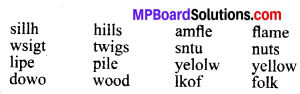
(A) Rearrange the jumbled letters to form meaningful words:
(अव्यवस्थित अक्षरों को अर्थपूर्ण शब्द बनाने के लिए पुनः व्यवस्थित कीजिए)
MP Board Class 7th General English Chapter 11 Lohri 1
(B) Fill in the blank spaces using the correct word from those given in brackets :
(कोष्ठक में दिए गए सही शब्दों का प्रयोग कर रिक्त स्थान भरिए)

  1. Sohan alway does the ………… thing first and leaves the ………… one. (difficult/easy)
  2. Owls ………… in the day and ………… in the night. (sleep/wake up)
  3. Chandra is ………… and smart whereas her friend Chandini is ………… and lazy. (wise/foolish)
  4. It is very ………… in the park but in is. here. (noisy/quiet)
  5. Silk is ………… but handmade cloth is ………… (smooth/rough)

Answers:

  1. easy, difficult
  2. sleep, wake up
  3. wise, foolish
  4. noisy, quiet
  5. smooth, rough.

(C) ‘g’ is pronouned in two different ways as ‘g’ in gap and as ‘j’ in gem. Given below are some words. Classify them according to their sounds.
(‘g’ का उच्चारण दो भिन्न रूपों में होता है जैसे ‘g’ ‘gap’ (गैप) में और जैसे ‘j”gem’ (जैम) में। नीचे कुछ शब्द दिए गये हैं उन्हें उनकी ध्वनि (उच्चारण) के अनुसार वर्गीकृत करिए।
give, gem, ginger, grow, get, geometry, grass, guest, giant, geography, judge.)
Answer:
gem – gem, ginger, geometry, giant, geography, Judge.
gap – give, grow, get, got, grass guest.

Grammar in Use (व्याकरण प्रयोग) :

(A) Use the words given below to complete the following sentences :
(निम्नलिखित वाक्यों में उचित शब्दों से वाक्य पूरा कीजिए।)
Answer:
(into, across, up, between, among)

  1. Letter Q comes ………. letter P and R of the English alphabet.
  2. Smoke goes ……….. in the sky.
  3. Don’t throw waste paper anywhere. Put it ……. a dustbin.
  4. The cat ran ……….. the room quickly.
  5. She works ………. the poor.

Answer:

  1. between
  2. up
  3. into
  4. across
  5. among

(B) Rewrite the following conversation in indirect form of narration :
(निम्नलिखित वार्तालाप को अप्रत्यक्ष रूप में लिखिए।)
Answer:

  1. Bala asked Vinita where she had gone the previous day.
  2. Vinita replied Bala that she had gone to the market the previous day.
  3. Bala asked Vinita what she had bought from there.
  4. Vinita told Bala that she had bought some vegetables and fruits.
  5. Bala asked Vinita again if she could come with her that day.
  6. Vinita replied that she would come with her that day.

Let’s Talk (आओ बात करें):

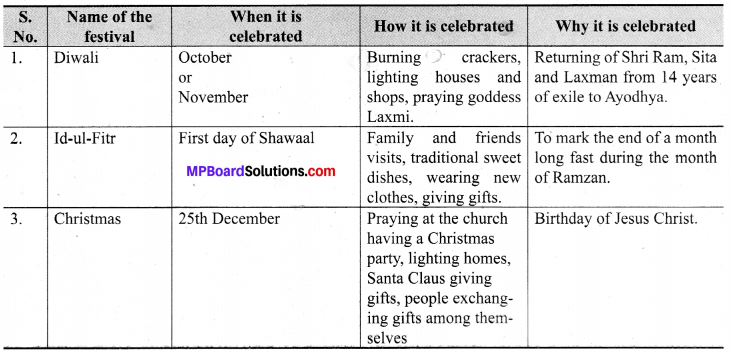
Discuss about the festivals such as Diwali, Id, Christams. Collect information about these festivals and complete the following chart. (Work in pairs (दीवाली, ईद, क्रिसमस जैसे त्यौहारों के बारे में चर्चा करें। उनके बारे में सूचना एकत्रित करें और निम्नलिखित चार्ट को पूरा करें।) (समूह में कार्य करें।)
MP Board Class 7th General English Chapter 11 Lohri 2

Let’s Write (आओ लिखें) :

Write a paragraph on Holi. Take clues from the conversation with your friends.
(होली पर एक अनुच्छेद लिखिए। अपने मित्रों के साथ बात चीत कर संकेत लीजिए) .
Answer:
Holi is the festival of colours. The people express their happiness by throwing colours on their friends, relatives and neighbours. They make fun. They use dry and wet colours. Relating to the festival and season people are lost in singing songs. They feel happy by welcoming their friends with sweetmeats and tea or coffee or cold drink. Sugarcane fields look full of cheerfulness of the farmers who work there. Grain fields look very beautiful. Some people throw mud on one another and shout. Everyone small or big bears a smile on his face.

Let’s Do It (आओ इसे करें) :

Collect pictures of some festivals celebrated in our country and paste them in your notebook.
(हमारे देश में मनाये जाने वाले कुछ त्यौहारों के चित्र एकत्रित कीजिए और उन्हें अपनी पुस्तिका में चिपकाइए ।)
Answer:
Students can collect the pictures of the festivals such as Holi, Diwali, Raksha Bandhan and Christmas etc. from newspapers, magazines old books etc. and paste them in their note books.

Pronunciation & Translation

Down in the South, The days are fine.
When January comes around.
But up in the North,
And in the hills and so forth,
January’s Lohri time.

(डाउन इन द साउथ, द डेज आर फाइन.
व्हेन जेनुअरी कम्स अराउण्ड.
बट अप इन द नॉर्थ,
एण्ड इन द हिल्स एण्ड सो फोर्थ,
जेनुअरीज लोहरी टाइम.)

अनुवाद-नीचे दक्षिण में दिन अच्छे होते हैं जब जनवरी आती है। लेकिन ऊपर उत्तर में, पहाड़ों में और उसके आगे जनवरी लोहड़ी का समय होता हैं।

We gather up all twigs and leaves,
And wood of any sort,
Soon we have a great big pile
And in just a little while,
The flame will leap up high,
Leap right into the sky.

(वी गेदर अप ऑल ट्विग्स एण्ड लीज,
एण्ड वुड ऑफ ऐनी सॉर्ट,
सून वी हैव अ ग्रेट बिग पाइल
एण्ड इन जस्ट अलिटल व्हाइल,
द फ्लेम विल लीप अप हाई,
लीप राइट इन्टू द स्काई.)

अनुवाद-हम पत्तियाँ और टहनियाँ इकट्ठा करते हैं, और किसी भी प्रकार की लकड़ियाँ, जल्दी ही हमारे पास एक बड़ा ढेर हो जाता है, और कुछ ही देर में, आग की लपटें ऊपर उठेंगी, ठीक आसमान की ओर उठेगी।

Nuts and sweetmeats make the ornaments,
Passing from hand to hand,
I think everyone will agree with me
We have lovely customs in our land.
Don’t we?

(नट्स एण्ड स्वीट मीट्स मेक द ऑरनामेंट्स,
पासिंग फ्रॉम हैण्ड टू हैण्ड,
आइ थिंक ऐबीवन विल एग्री विद मी
वी हैव लवली कस्टम्स इन अवर लैन्ड. डोन्ट वी?)

अनुवाद-मेवे और मिठाइयाँ सजाये जाते हैं, एक हाथ से दूसरे हाथ में घूमते हुए मेरा विचार है कि प्रत्येक व्यक्ति मुझसे सहमत होगा, हमारे देश में प्यारे रीति-रिवाज है। क्या नहीं हैं?

But Bonfires consume a lot of wood, For the environment This is not so good. The air gets polluted from all the smoke so It’s a problem, folk?
(बट बोनफायर्स कन्ज्यूम अ लॉट ऑफ वुड, फॉर द ऐनवायरनमेंट दिस इज नॉट सो गुड. द एअर गैट्स पोल्यूटेड फ्रॉम ऑल द स्मोक सो इट्स अ प्रोब्लम, फोक?)
अनुवाद-लेकिन आग जलाने में बहुत-सी लकड़ी खर्च होती है, वातावरण के लिए, यह इतना अच्छा नहीं है।
हवा सारे धुएँ से प्रदूषित हो जाती है इसलिए यह लोगों द्वारा उत्पन्न एक समस्या है।

I don’t want to given up
Lohri Yet there must be a better way,
To celebrate winter’s passing,
Now what do you have to say?”
“Let’s burn our hatred instead of wood,
And send it up in flames for good.”

(आइ डोन्ट वान्ट टू गिव अप
लोहड़ी यट देअर मस्ट बी अ बैटर वे.
टू सेलिब्रेट विन्टर्स पासिंग.
नाउ व्हाट डू यू हैव टू से ?
“लैस बर्न अवर हेट्रेड इन्सटीड ऑफ वुड,
एण्ड सेन्ड इट अप इन फ्लेम्स फॉर गुड”।)

अनुवाद-मैं लोहड़ी को त्यागना नहीं चाहता हूँ तो भी इस उत्सव को मनाने का तरीका अच्छा होना चाहिए, जाती हुई शीत ऋतु को मनाने का, अब आपके पास क्या कहने को है? आओ, हम लकड़ी की बजाय अपनी घृणा को जला दें, और इसे लपटों के रूप में अच्छाई के लिए ऊपर भेजें।

Lohri Word Meanings

Twigs and leaves (ट्विग्स एण्ड लीव्स)-टहनियाँ और पत्तियाँ; A little while (ए लिटिल व्हाइल)-थोड़ी देर; Leap up high (लीप अप हाइ)-ऊँचा उछलना; Nuts and sweetmeats ( नट्स एण्ड स्वीट मीट्स)-अखरोट और मिठाईयाँ; Hand to hand (हैण्ड टू हैण्ड)-हाथों हाथ; Give up (गिव अप)-त्यागना; Burn our hatred (बर्न आवर हेट्रेड) अपनी घृणा को जला देना; For good (फॉर गुड)-सदा के लिए; Bonfire (बोनफायर)-अलाव; Custom (कस्टम)-रीति-रिवाज; Pollute (पॉल्यूट)-दूषित करना; Problem (प्रॉब्लम) समस्या; Smoke (स्मोक)-धुंआ; Environment (एनवायरनमेंट)-वातावरण; Celebrate (सेलीब्रेट)-मनाना; Consume (कन्ज्यूम)-व्यय करना; Ornament (ऑरनामेंट)-आभूषण।

We believe the information shared regarding MP Board Solutions for Class 7 English Chapter 21 Tansen Questions and Answers as far as our knowledge is concerned is true and reliable. In case of any queries or suggestions do leave us your feedback and our team will guide you at soonest possibility. Bookmark our site to avail latest updates on several state board Solutions at your fingertips.
MP Board Class 7th General English Solutions Chapter 10 The Modern Way

Get Updated MP Board Solutions for Class 7 General English Chapter 10 The Modern Way Questions and Answers in PDF Format and download them free of cost. These are provided as per the latest exam pattern and syllabus. Access the topics of Chapter wise and communication skills, grammer part through the direct links available depending on the need. You can Download MP Board Class 7 English Solutions and can score highest grade in examination. Clear all your queries on the Mp Board Solutions for Class 7 English Chapter 21 Tansen Questions and Answers Subject by using the Madhya Pradesh State Board Solutions for existing.

MP Board Class 7th General English Solutions Chapter 10 The Modern Way

If you are eager to know about the Madhya Pradesh State Board Solutions for Class 7 English you will find all of them here. You can identify the knowledge gap using these MP Board Solutions for English PDF and plan accordingly. Don’t worry about the accuracy as they are given after extensive research by people having subject knowledge along side from the latest English Syllabus.

The Modern Way Textual Exercises

Listen andRepeat (सुनो और दुहराओ) :

Students should do themselves.
(छात्र स्वयं करें।)

Comprehension (चोध प्रश्न) :

Answer the questions given below :
(निम्न प्रश्नों के उत्तर दो)

Question 1.
Whom does the poetess invite ?
(हूम डज़ द पोएटैस इन्वाईट?)
कवयित्री किसको आमन्त्रित करती है?
Answer:
The poetess invites her friend.
(द पोएटैस इन्वाईट्स हर फ्रेन्ड।)
कवयित्री अपने मित्र को आमन्त्रित करती है।

Question 2.
What does she want to see ?
(व्हॉट डज़ भी वॉन्ट टू सी?)
वह क्या देखना चाहती है?
Answer:
She wants to see the moon.
(शी वॉन्ट्स टू सी द मून।)
वह चन्द्रमा को देखना चाहती है।

Question 3.
Which are the things that attract her ?
(व्हिच आर द थिंग्स् दैट अट्रैक्ट हर?)
उसे कौन सी चीजें आकर्षित करती हैं?
Answer:
Stars that shine like diamonds attract her.
(स्टार्स दैट शाइन लाइक डायमण्ड्स अट्रैक्ट हर।)
हीरे के समान चमकते तारे उसे आकर्षित करते हैं।

Question 4.
Which test has she cleared ?
(व्हिच टैस्ट हैज़ शी क्लीयर्ड ?)
वह कौन से इम्तिहान में सफल हुई है?
Answer:
She has passed her test of riding the rocket.
(शी हैज़ पास्ड् हर टैस्ट ऑफ राइडिंग द रॉकेट।)
उसने वायुयान उड़ाने की परीक्षा उत्तीर्ण की है।

Question 5.
What does she long to do?
(व्हॉट डज़ शी लाँग टू डू?)
वह क्या करने को लालायित है?
Answer:
She longs to take her friend for a ride.
(शी लॉग्स टू टेक हर फ्रेन्ड अ राइड।)
वह अपने मित्र को भ्रमण पर ले जाने के लिए लालायित है।

Word Power (शब्द सामर्थ्य):

Use the prefix ‘un’ to write the opposites of the words given below :
(प्रत्यय ‘un’ लगाकर नीचे दिए शब्दों के विपरीत शब्द लिखो):
Answer:
ease – unease
pleasant – unpleasant
happy – huhappy
wanted – unwanted
natural – unnatural

Grammar in Use (व्याकरण प्रयोग):

(A) Rewrite the given lines using the punctuation marks wherever necessary :
(निम्नलिखित पंक्तियों को आवश्यकतानुसार ‘विराम चिह्न’ लगाकर पुनः लिखिए।)
Answer:
I have a tree, a green tree to shade me from the sun. Under it, I often sit, when all my work is done.

(B) Rearrange the words to make meaningful sentences and capitalize where ever necessary:
(अर्थपूर्ण वाक्य बनाने हेतु शब्दों को व्यवस्थित कीजिए और जहाँ आवश्यक हो, केपीटल शब्द का प्रयोग कीजिए।)

1. have / time / if / we / will / visit / . / Mars / we
Answer:
If we have time we will visit Mars.

2. it’s /a/ quite / trip/./really / pleasant
Answer:
It’s really a quite pleasant trip.

3. diamonds / in / shine / the / sky / stars/./ like
Answer:
Stars shine like diamonds in the sky.

4. my / rocket / just / waiting / is / outside
Answer:
My rocket is waiting just outside.

5. you/take /. / will/a / long / for / ride /I
Answer:
I will take you for a long ride.

Let’s Talk (आओ बात करें) :

Discuss with your friend and list the names of planets. Then ask these questions and find answers. Ask your friend to repeat the questions and learn the correct answer.
(अपने मित्र से चर्चा करो और ग्रहों के नामों की सूची बनाओ। तब इन प्रश्नों को पूछो और उत्तर खोजो। अपने मित्र से प्रश्नों को दुहराने के लिए कहो और सही उत्तर याद करो)
Answer:
Names of the planets-Mercury, Venus, Earth, Mars, Jupiter, Saturn, Neptune, Uranus.

Question 1.
Which is the smallest planet?
Answer:
The Mercury

Question 2.
Which is the hottest planet ?
Answer:
The mercury.

Question 3.
What are the people who go into space are called ?
Answer:
Astronaut

Question 4.
Name the astronaut you have read about.
Answer:
Kalpana Chawla.

Question 5.
What do you find most interesting about the space journey?
Answer:
To ride through the stars.

Let’s Write (आओ लिखें) :

Add the missing lines of the poem :
(कविता में रिक्त पक्तियों को भरो)
Answer:
(a) O ! come with me and see the moon.
If we have time we’ll visit Mars.
It’s really quite a pleasant trip.
Great fun at night with all the stars.
That shine like diamonds in the sky.

(b) Please say you’ll come.
It won’t take long.
My rocket’s waiting just outside.
I’ve passed my test with perfect ease,
And long to take you for a ride.

Let’s Do It :(आओ इसे करें)

Visit the school library to find a poem on nature and then recite it in the class.
(प्रकृति के बारे में एक कविता खोजने के लिए विद्यालय के पुस्तकालय में जाएँ और कक्षा में इसका पाठ करें।)
Answer:
Students should do themselves.
छात्र स्वयं करें।

Pronunciation & Translation

O! come with me and see the moon,
If we have time we’ll visit Mars,
It’s really quite a pleasant trip.
Great fun at night with all the start
That shine like diamonds in the sky.

(ओ! कम विद मी एण्ड सी द मून,
इफ वी हैव टाइम वी ‘इल विजिट मार्स,
इट्स रीअली क्वाइट अ प्लैजैन्ट ट्रिप.
ग्रेट फन ऐट नाइट विद ऑल द स्टार्ट
दैट शाइन लाइक डायमण्ड्स इन द स्काइ.)

अनुवाद-अरे! मेरे साथ आओ और चन्द्रमा को देखो, अगर हमारे पास समय होगा तो हम मंगल की यात्रा करेंगे, वास्तव में, यह बहुत ही मजेदार यात्रा होगी। रात में सभी तारों के साथ बड़ा मजा आयेगा जो आसमान मे हीरों के समान चमकते हैं।

Please say you’ll come,
It won’t take long, My.
Rocket’s waiting just outside,
I’ve passed my test with perfect ease,
And long to take you for a ride.
Jacqueline Newman

(प्लीज से यू विल कम,
इट वोन्ट टेक लांग, माइ
रॉकेट्स वेटिंग जस्ट आउटसाइड.
आइ हैव पास्ड माइ टैस्ट विद परफेक्ट ईज,
एण्ड लोंग टू टेक यू फॉर अ राइड।)
जैकलीन न्यूमैन

अनुवाद-कृपया कहो कि तुम आओगे, इसमें अधिक समय नहीं लगेगा, मेरा रॉकेट ठीक बाहर इन्तजार कर रहा है, मैंने बहुत आराम से अपना परीक्षण पास कर लिया है, और तुम्हें घुमाने (सैर) के लिए लालायित हूँ।

The Modern Way Word Meanings

Visit (विज़िट)-मिलने जाना या आना, भ्रमण पर जाना; Mars (मार्स)-मंगल ग्रह; Really (रीयली) -सचमुच, वास्तव में; Pleasant (प्लैर्जेन्ट)-रमणीय, मनोहर; Trip (ट्रिप)-आमोद यात्रा, सैर; Fun (फन) -आमोद-प्रमोद, मजाक; Have (हैव)-पास होना; Perfect (परफैक्ट)-श्रेष्ठ, सही, निपुण; Diamond (डायमण्ड) -हीरा; Ease (ईज़)–आराम, चैन; Ride ( राईड) चढ़ना, सवारी; Long (लौंग)-लालायित होना, तरसना; Rocket (रॉकेट)-अंतरिक्ष यान।

We believe the information shared regarding MP Board Solutions for Class 7 English Chapter 21 Tansen Questions and Answers as far as our knowledge is concerned is true and reliable. In case of any queries or suggestions do leave us your feedback and our team will guide you at soonest possibility. Bookmark our site to avail latest updates on several state board Solutions at your fingertips.
MP Board Class 7th General English Solutions Chapter 9 The White Visitor

Get Updated MP Board Solutions for Class 7 General English Chapter 9 The White Visitor Questions and Answers in PDF Format and download them free of cost. These are provided as per the latest exam pattern and syllabus. Access the topics of Chapter wise and communication skills, grammer part through the direct links available depending on the need. You can Download MP Board Class 7 English Solutions and can score highest grade in examination. Clear all your queries on the Mp Board Solutions for Class 7 English Chapter 21 Tansen Questions and Answers Subject by using the Madhya Pradesh State Board Solutions for existing.

MP Board Class 7th General English Solutions Chapter 9 The White Visitor

If you are eager to know about the Madhya Pradesh State Board Solutions for Class 7 English you will find all of them here. You can identify the knowledge gap using these MP Board Solutions for English PDF and plan accordingly. Don’t worry about the accuracy as they are given after extensive research by people having subject knowledge along side from the latest English Syllabus.

The White Visitor Textual Exercises

Read and Learn (पढ़ो और याद करो) :
Students should do themselves.
(छात्र स्वयं करें।)

Comprehension (बोध प्रश्न) :

Questions and Answers :
(प्रश्न और उत्तर)

Questions 1.
Why did Dr. Dass need to buy a house ?
(व्हाइ डिड डॉ. दास नीड टू बाय अ हाउस?)
डॉ. दास को एक मकान खरीदने की क्यों जरूरत थी?
Answer:
Dr. Dass needed to buy a house because he had come to live and work in Kalighat (Kolkata).
(डॉ. दास नीडेड टू बाई अ हाउस बिकॉज़ ही हैड कम टू लिव एण्ड वर्क इन कालीघाट (कोलकाता)।)
डॉक्टर दास को एक घर खरीदने की जरूरत थी क्योंकि वह कोलकाता के कालीघाट में रहने और काम करने के लिए आ गये थे।

Question 2.
Why did he want to buy Shanti Bhawan?
(व्हाइ डिड ही वान्ट टू बाय शान्ति भवन?)
वह शान्ति भवन को खरीदना क्यों चाहते थे?
Answer:
He wanted to buy Shanti Bhawan because it did not cost much.
(ही वॉन्टेड टू बाय ‘शान्ति भवन’ बिकॉज़ इट डिड नॉट कॉस्ट मच।) – वह शान्ति भवन को खरीदना चाहते थे क्योंकि इसकी कीमत अधिक नहीं थी।

Question 3.
What reason did Mr. Chaudhary give Dr. Dass so that he wouldn’t buy Shanti Bhawan
(व्हॉट रीज़न डिड मि. चौधरी गिव डॉ. दास सो दैट ही वुडन्ट बाय ‘शान्ति भवन’?)
श्री चौधरी ने डॉ. दास को कौन-सा तर्क दिया जिससे वह शान्ति भवन को न खरीदें?
Answer:
Mr. Chaudhary gave Dr. Dass a reason that the owner of the house was Mrs. Ghosh who died two years back. He told that people say that she visits her old house in the night.
(मि. चौधरी गेव डॉ. दास अ रीज़न दैट द ओनर ऑफ द हाउस वॉज़ मिसेज़ घोष हू डाइड टू ईअर्स बैक। ही टोल्ड दैट पीप्ल से दैट शी विज़िट्स हर ओल्ड हाउस इन द नाइट।)
श्री चौधरी ने डॉ. दास को एक तर्क दिया कि उस घर मालकिन श्रीमती घोष थीं जो दो वर्ष पहले मर गईं। उसने बताया कि लोग कहते हैं कि वह अपने पुराने घर को रात में देखने आती हैं।

Question 4.
Why did Dr. Dass want to spend a night in the house before buying it ?
(व्हाइ डिड डॉ. दास वॉन्ट टू स्पेन्ड ए नाइट इन द हाउस बिफोर बाइंग इट?)
डॉ. दास मकान को खरीदने से पूर्व, उसमें एक रात क्यों गुजारना चाहते थे?
Answer:
Dr. Dass wanted to spend a night in the house before buying it so that he might know the real thing.
(डॉ. दास वान्टेड टू स्पेन्ड अ नाइट इन द हाउस बिफोर बाइंग इट सो दैट ही माइट नो द रीअल थिंग।)
डॉ. दास मकान को खरीदने से पहले उसमें एक रात गुजारना चाहते थे जिससे वे वास्तविक चीज को जान सकें।

Question 5.
Who was the ‘White Visitor’? Do you think Dr. Dass suspected anyone else before he caught the ghost ?
(हू वॉज़ द व्हाइट विज़िटर? ड्रयू थिंक डॉ. दास सस्पैक्टेड ऐनीवन एल्स बिफोर ही कॉट द घोस्ट?)
गोरा अभ्यागत कौन था? भूत को पकड़ने से पहले डॉ. दास ने किसी अन्य का सन्देह किया था, क्या तुम ऐसा सोचते हो?
Answer:
The ‘White Visitor’, was Mr. Chaudhary. We think Dr. Dass did not suspect anyone else before he caught the ghost.
(द ‘व्हाइट विज़िटर’ वॉज़ मि. चौधरी। वी थिंक डॉ. दास डिड नॉट सस्पेक्ट ऐनीवन एल्स बिफोर ही कॉट द घोस्ट।)
गोरा अभ्यागत श्री चौधरी थे। हम विचार करते हैं कि डॉ. दास ने भूत को पकड़ने से पहले किसी अन्य का सन्देह नहीं किया था।

Question 6.
What qualities of Dr. Dass helped him in buying the house?
(व्हॉट क्वालिटीज़ ऑफ डॉ. दास हैल्पड हिम इन बाइंग दहाउस?)
डॉ. दास के कौन से गुणों ने उन्हें घर खरीदने में सहायता की?
Answer:
Dr. Dass was intelligent, determined and brave so these qualities helped him in buying the house.
(डॉ. दास वॉज़ इन्टेलीजेन्ट, डिटरमाइन्ड एण्ड ब्रेव सो दीज़ क्वालिटीज़ हेल्प्ड हिम इन बाइंग द हाउस।)
डॉ. दास बुद्धिमान, निश्चयपूर्ण तथा बहादुर थे, इसलिए इन गुणों ने घर खरीदने में उनकी सहायता की।

Question 7.
Why did Mr. Chaudhary ask Dr. Dass not to talk about this incident ?
(व्हाइ डिड मि. चौधरी आस्क डॉ. दास नॉट टू टॉक अंबाउट दिस इन्सीडेन्ट?)
श्री चौधरी ने डॉ. दास को इस घटना के बारे में किसी से | बात ने करने के लिए क्यों कहा?
Answer:
Mr. Chaudhary asked Dr. Dass not to talk about this incident. Otherwise he would lose his business.
(मि. चौधरी आस्क्ड डॉ. दास नॉट टू टॉक एबाउट दिस इन्सीडेन्ट, अदरवाइज़ ही वुड लूज़ हिज़ बिज़नस।)
श्री चौधरी ने डॉ. दास को इस घटना के बारे में बात न करने के लिए कहा, अन्यथा उसके व्यापार में घाटा (हानि) हो जायेगा।

Word Power (शब्द सामर्थ्य):

(A) Write the qualities of Dr. Dass and Mr. Chaudhary in correct columns :
(डॉ. दास और मि. चौधरी के गणों को सही कॉलम में लिखिए):
Answer:
Dr. Dass-Smart, intelligent determined, brave.
Mr. Chaudhary-Not straight forward, lacks confidence, clever, greedy

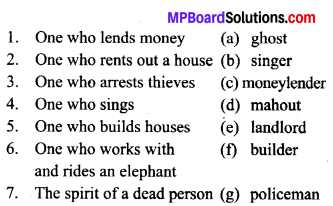
(B) Match the following:
(सही मिलान करिए):
MP Board Class 7th General English Chapter 9 The White Visitor 1
Answers:

  1. → (c)
  2. → (e)
  3. → (g)
  4. → (b)
  5. → (f)
  6. → (d)
  7. → (a)

Grammar in Use:(व्याकरण प्रयोग):

(A) Learn these phrases with their meanings and fill in the blank spaces in the sentences given below using the suitable phrase in its correct form:
(निम्न वाक्यांशों को अर्थ सहित याद कीजिए और दिए गए वाक्यों के खाली स्थानों में वाक्यांश का सही रूप भरो)।
(to visit, dressed in, in a bad state, afraid of, by the light of, in good order, at the end, head to foot.)

  1. All my records are ……………..
  2. His grandmother is very old, she is …………….. of health.
  3. Sohan went …………….. his sister last month.
  4. He is working …………….. the moon.
  5. Suman was …………….. a khadi saree to act as a leader.
  6. The sick child gets cured …………….. of the story.
  7. She was wearing black clothes from ……………..
  8. I am not …………….. ghosts.

Answers:

  1. In good order
  2. in a bad state
  3. to visit
  4. by the light of
  5. dressed in
  6. at the end
  7. head to foot
  8. afraid of.

(B) Rewrite the following sentences in Indirect form of Narration :
(निम्न वाक्यों को अप्रत्यक्ष (indirect) रूप में लिखिए)
Answer:

  1. Geeta said that she was going to her grandmother’s place.
  2. Seema asked her how far her grandmother’s house was.
  3. Geeta told that it was not very far. She would have to take a bus to Sonpur village.
  4. Seema said that Sonpur was a nice village. She had seen it.

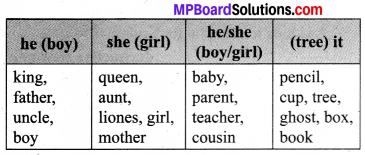
(C) Read the following words and write them in the right column.
(निम्नलिखित शब्दों को पढ़िए और उन्हें सही कॉलम में लिखिए)
(Pencil, king, mother, baby, cup, parent, father, tree, girl, boy, uncle, book, aunt, lioness, teacher, queen, cousin, box, ghost.)
Answer:
MP Board Class 7th General English Chapter 9 The White Visitor 2

Let’s Talk (आओ बात करें) :

(A) Work in pairs and answer the questions :
(जोड़ों में काम कीजिए और प्रश्नों के उत्तर दीजिए।)
Answer:

  1. ‘Shanti,Bhawan’ stands in the middle of the town. Its owner is Mrs. Ghosh. Mrs. Ghosh died two years back. She visits her house in the form of ghost.
  2. Dr. Dass did not believe in Mr. Choudhary’s stories.
  3. Dr. Dass plans to find out the truth. He goes to ‘Shanti Bhawan’ to have a sleep at night and find out himself what the reality was.
  4. After midnight, Dr. Dass hears sound just outside the bedroom door. The door opens very slowly and quietly. Something dressed in white from head to foot comes in and stands at the end of the room.
  5. Dr. Dass says to the white visitor that he is busy in reading and wants to finish the book and he is not afraid of him.
  6. Dr. Dass pulls the white cloth off the visitor’s face and finds out the truth.

(B) Match the answers in column ‘B’ with the questions in column ‘A’
(कॉलम ‘B’ में दिए उत्तरों को कॉलम ‘A’ में दिए प्रश्नों से मिलान कीजिए।)
MP Board Class 7th General English Chapter 9 The White Visitor 3
Answers:

  1. → (d)
  2. → (a)
  3. → (c)
  4. → (b)

Let’s Write (आओ लिखें):

(A) Imagine you are Dr. Dass. Write a letter to your sister telling her how you managed to buy the house and what your future plans are about the garden which you intend to have outside to house.
(कल्पना करें कि आप मि. दास हैं। अपनी बहिन को एक पत्र लिखें कि आपने कैसे मकान खरीदा और आपकी इस मकान के बगीचे के बारे में भविष्य में क्या योजना है जिसे आप घर के बाहर लगाना चाहते हैं।)
Answer:
Shyamla Hills,
Kolkata
January 15, 2003
Dear Anju,

Hope you are fine. I have bought a house in Kolkata for 3 lakhs. Its a good house but I had to strive a lot in buying it. Actually, the house agent told me that the place was haunted so I should not dare to buy it. I stayed in the house for one night and found that the white visitor who visited the house at night was not a ghost but the house agent who wanted to buy it himself at more cheap rates.

Well ! now that I have bought it, I have planned to have a beautiful garden outside the house. I’ll plant roses, sunflower and lily in it. I’ll also plant mango and guava trees and some ornamental plants. On one side I’ll plant vegetables like spinach, radish, potato etc. Please visit my home soon.

Yours affectionately
Dr. Dass

Let’s Do It (आओ इसे करें):

Read some stories you like and share them with your classmates. Narrate them in short sentences.
(कुछ कहानियाँ जिन्हें तुम पसन्द करते हो पढ़ो और अपने कक्षा के साथियों से बताओ उन्हें छोटे वाक्यों में बताओ।)
Answer:
Students should search books from the library and read the stories and narrate them briefly in short sentences.

Pronunciation & Translation

Act-I
(अंक-1)

An office in kali Ghat, in Kolkata. On the walls of the office there are several notices about houses and shops for sale. The time is about ten in the morning. Mr. Choudhary is writing at a table. Doctor Dass walks in.
(एन ऑफिस इन काली घाट, इन कोलकाता. ऑन द वाल्स ऑफ दि ऑफिस देअर आर सेवरल नोटिसेस अबाउट हाउसेस एण्ड शॉप्स फॉर सेल. द टाइम इज अबाउट टैन इन द मॉनिंग. श्रीमान् चौधरी इज राइटिंग ऐट अ टेबल. डॉक्टर दास वाक्स इन.)
अनुवाद-कोलकाता के काली घाट में एक दफ्तर दफ्तर की दीवारों पर बिक्री के लिए घरों व दुकानों के बारे में बहुत सी सूचनाएँ लगी थीं। लगभग सुबह के दस बजे का समय है। श्रीमान् चौधरी एक मेज पर कुछ लिख रहे हैं। डॉ. दास अन्दर आते हैं।

Dass : Good morning ! Are you Mr. Chaudhary
(दास : गुड मॉर्निग! आर यू मि. चौधरी?)
Chaudhary : Please, sit down. (they both sit)
(चौधरी : प्लीज, सिट डाउन. (दे बोथ सिट)
अनुवाद-दास : नमस्ते! क्या आप मि. चौधरी?

चौधरी : कृपया, बैठ जाइए। (वे दोनों बैठते हैं)
Dass: I’m Doctor Dass. I have come to live and work in Kali Ghat and I need a house.
(दास : आइ एम डॉक्टर दास. आइ हैव कम टू लिव एण्ड वर्क इन काली घाट एण्ड आइ नीड अ हाउस.)
अनुवाद-मैं डॉक्टर दास हूँ। मैं काली घाट में रहने और काम करने आया हूँ। और मुझे एक मकान की जरूरत है।

Chaudhary : I see, You are ready to buy a house, I suppose.
(चौधरी : आइ सी, यू आर रेडी टू बाय अ हाउस, आइ सपोज़)
चौधरी : मैं समझा, मुझे लगता है आप एक मकान खरीदने के लिए तैयार हैं।
Dass : Yes, if it doen’t cost too much.
(दास : येस, इफ इट डजन्ट कॉस्ट टू मच.)
दास : हाँ, यदि उसकी कीमत बहुत ज्यादा न हो।
Chaudhary : It’s not very easy at present.
(चौधरी : इट्स नॉट वैरी ईजी ऐट प्रेजेन्ट)
Doctor Dass : A lot of people are coming to live here and there aren’t many houses. The prices are going up every week.
(डॉक्टर दास : अ लॉट ऑफ पीपल आर कमिंग टू लिव हिअरएण्ड देअर ऑर नॉट मैनी हाउसेस. द प्राइसेज आर गोइंग अप एवरी वीक.)
अनुवाद-चौधरी : डॉक्टर दास, वर्तमान में यह इतना आसान नहीं है। बहुत से लोग यहाँ रहने आ रहे है और अधिक मकान नहीं हैं। कीमतें प्रत्येक सप्ताह ऊपर जा रही हैं।

Dass : Well, can you give me some idea ?
(दास : वैल, कैन यू गिव मी सम आइडिया?)
अनुवाद-दास : अच्छा, क्या आप मुझे कोई विचार बता सकते हैं?

Chaudhary : There’s a nice house. (He points to the notice on the wall.) The owner wants ten lac.
(चौधरी : देअर इज अ नाइस हाउस. (ही पॉइन्ट्स टू द .नोटिस ऑन द वाल.) दि ओनर वान्ट्स टैन लैक.)
अनुवाद-चौधरी : एक अच्छा घर है। (वह दीवार पर नोटिस की ओर इशारा करता है). मकान मालिक दस लाख चाहता है।

Dass : Oh! That’s too much for me. Isn’t there a house for less than that?
(दास : ओह! दैट्स टू मच फॉर मी. इजन्ट देअर अ हाउस फॉर लैस दैन दैट।)
अनुवाद-दास : अरे! यह तो मेरे लिए बहुत अधिक है। क्या कोई मकान इससे कम का नहीं है?

Chaudhary : How much are you ready to pay ?
(चौधरी : हाउ मच आर यू रेडी टू पे ?)
अनुवाद-चौधरी : आप कितना देने के लिए तैयार हैं?

Dass : Well, I thought about five lacs or a little more.
(दास : वेल, आइ थॉट अबाउट फाइव लैक्स ऑर अ लिटल मोर.)
अनुवाद-दास : ठीक है, मैंने पाँच लाख या कुछ अधिक का सोचा था।

Chaudhary : You won’t find a house at that price here.
(चौधरी : यू वोन्ट फाइन्ड अ हाउस ऐट दैट प्राइस हिअर.)
अनुवाद-चौधरी : तुम्हें यहाँ इस कीमत का कोई मकान नहीं मिलेगा।

Dass : What’s that ? (He points to one of the notices.)
(दास : व्हाट्स दैट? (ही पॉइन्ट्स टू वन ऑफ द नोटिसेस.)
अनुवाद-दास : वह क्या है? (वह नोटिसों में से एक को इंगित करते हैं।)

Chaudhary : That’s Shanti Bhawan, but you don’t want that, of course.
(चौधरी : दैट्स शान्ति भवन, बट यू डोन्ट वान्ट दैट, ऑफ कोर्स.)
अनुवाद-चौधरी : वह शान्ति भवन है, किन्तु आप बेशक उसे लेना नहीं चाहेंगे।

Dass : Why? What’s the matter with it? Where is it?
(दास : व्हाई व्हाट्स द मैटर विद इट? व्हेअर इज इट?)
अनुवाद-दास : क्यों? इसका क्या मामला है? यह कहाँ है?

Chaudhary : In the middle of the town.
(चौधरी : इन द मिडल ऑफ द टाउन।)
अनुवाद-चौधरी : शहर के मध्य में।
Dass : Well, That will suit me very well. How much is it?
(दास: वेल, दैट विल सूट मी वैरी वेल. हाउ मच इज इट?)
अनुवाद-दास : ठीक है, यह मेरे लिए बहुत उपयुक्त रहेगा। यह कितने का है?

Chaudhary : er……..three lac or so.
(चौधरी : एर…….थ्री लैंक ऑर सो.)
अनुवाद-चौधरी : अरे…….तीन लाख या ऐसा ही।

Dass: Is that all ? That’s not much, is it? Why such a low price ?
(दास : इज दैट ऑल? दैट्स नॉट मच, इज इट? व्हाई सच अ लो प्राइस?)
अनुवाद-दास : क्यों ऐसा क्या है? यह अधिक नहीं है, क्या है? इतनी कम कीमत क्यों ?

Chaudhary : It hasn’t always been as low as that.
Mr. Ghosh wanted six lac at first; then the price fell to four lac. Now it’s just three lac. But no one wants that house.
(चौधरी: इट हैजन्ट ऑलवेज बीन ऐज लो ऐज दैट. मि. घोष वान्टेड सिक्स लैक ऐट फर्स्ट; दैन द प्राइस फैल टू फोर लैक. नाउ इट्स जस्ट थ्री लैक. बट नो वन वान्ट्स दैट हाउस.)
अनुवाद-चौधरी : यह हमेशा से इतनी कम नहीं रही है। मि. घोष पहले छः लाख माँगते थे; तब कीमत चार लाख तक गिर गई। अब यह मात्र तीन लाख है। लेकिन कोई इस मकान को नहीं चाहता है।

Dass : Why?
(दास : व्हाइ?)
अनुवाद-दास : क्यों ?

Chaudhary : Well-er-the truth is er…….
(चौधरी : वैल-एर-द ट्रथ इज एर……)
अनुवाद-चौधरी : हाँ……..अरे…….सच्चाई यह है कि.

Dass : Go on, go on. Don’t you want to sell it? Is it in a bad state ?
(दास: गो ऑन, गो ऑन. डोन्ट यू वॉन्ट टू सेल इट? इज इट इन अ बैड स्टेट?)
अनुवाद-दास : बताइये, बताइये। क्या आप इसे बेचना नहीं चाहते हैं? क्या यह खराब स्थिति में है?

Chaudhary : Oh! No, it’s in good order. But there are some strange stories about Shanti Bhawan. The owner was a woman, Mrs. Ghosh. She died in the house two years ago. She wasn’t happy woman but she loved Shanti Bhawan. And people say that she comes back in the night to visit her old house.
(चौधरी : ओह! नो, इट्स इन गड ऑर्डर. बट देअर आर सम स्ट्रेन्ज स्टोरीज अबाउट शान्ति भवन. द ओनर वॉज अ वुमैन, मिसेज घोष. शी डाइड इन द हाउस टू ईअर्स ऐगो. शी वाजन्ट हैप्पी वुमैन बट शी लव्ड शान्ति भवन. एण्ड पीपुल से दैट शी कम्स बैक इन द नाइट टू विजिट हर ओल्ड हाउस.)
अनुवाद-चौधरी : अरे नहीं, यह तो कुछ अच्छी हालत में हैं परन्तु शान्ति भवन के बारे में कुछ विचित्र कहानियाँ हैं। इसकी मालकिन एक महिला, मिसेज घोष थीं। दो वर्ष पहले इसी मकान में उनकी मृत्यु हो गई। वह सुखी महिला नहीं थीं लेकिन वह शान्ति भवन को प्यार करती थी। और लोग कहते हैं कि वह अपने पुराने मकान में रात्रि में घूमने आती है।

Dass : What ? Two years after her death!
Well, I don’t believe that kind of thing. Can you take me to the house now, please ?
(दास : व्हॉट ? टू ईअर्स आफ्टर हर डैथ!)
(वैल, आइ डोन्ट बिलीव दैट काइन्ड ऑफ थिंग कैन यू टेक मी टू द हाउस नाउ, प्लीज?)
अनुवाद-दास : क्या मृत्यु के दो वर्ष बाद! ठीक है, मैं इस तरह की बातों में विश्वास नहीं कर आप कृपया मुझे उस मकान में ले जायेंगे?

Chaudhary : I can do so, if you wish. But you mustn’t buy that house.
(चौधरी : आइ कैन डू सो, इफ यू विश। बट यू मस्टन्ट बाइ दैट हाउस.)
अनुवाद-चौधरी : मैं यदि आप चाहें तो यह कर सकता हूँ। लेकिन आपको उस मकान को नहीं खरीदना चाहिए।

Dass : Please show it to me.
(दास : प्लीज शो इट टू मी.)
अनुवाद-दास : कृपया मुझे यह दिखाइये।

Chaudhary : (sadly) As you wish. (they go out together.)
(चौधरी : (सैडली) ऐज यू विश (दे गो आउट टुगेदर.)
अनुवाद-चौधरी : (दुखी होकर) जैसा आप चाहें। (वे एक साथ बाहर जाते हैं।)

The same office an hour later. Dass and Chaudhary walk in and sit down.
(द सेम ऑफिस ऐन आवर लेटर. दास एण्ड चौधरी वॉक इन एण्ड सिट डाउन.)
अनुवाद-एक घण्टे बाद उसी दफ्तर में। दास और चौधरी अन्दर आते हैं और बैठ जाते हैं।

Dass : I’ll buy Shanti Bhawan. Who’s the owner ?
(दास : आइ ‘इल बाय शान्ति भवन. हू इज द ओनर?)
अनुवाद-दास : मैं शान्ति भवन खरीदूंगा। इसका मालिक कौन

Chaudhary : ‘Mr. Ghosh. He lives in Chennai. He’s the dead woman’s brother. He wants to sell it. But of course no one wants to live there with all these stories about the White Visitor.
(चौधरी : मि. घोष. ही लिव्स इन चेन्नई. हीज द डैड वुमैन्स ब्रदर. ही वान्ट्स टू सेल इट बट ऑफ कोर्स नो वन वान्ट्स टू लिव देअर विद ऑल दीज स्टोरीज अबाउट द व्हाइट विजीटर.)
अनुवाद-चौधरी : श्रीमान् घोष। वह चेन्नई में रहते हैं। वह मृत स्त्री के भाई हैं। वह इसे बेचना चाहते हैं। परन्तु, निसन्देह सफेदपोश आगन्तुक के बारे में इन सब कहानियों के कारण कोई भी वहाँ नहीं रहना चाहता है।

Dass : I don’t believe in such stories.
(दास : आइ डोन्ट बिलीव इन सच स्टोरीज.)
अनुवाद-दास : मैं ऐसी कहानियों में विश्वास नहीं करता हूँ।

Chaudhary : Well, don’t come back to me later and say that I didn’t warn you about these things earlier.
(चौधरी : वैल, डोन्ट कम बैक टू मी लेटर एण्ड से दैट आइ डिडन्ट वार्न यू अबाउट दीज थिंग्स अर्लीयर.)
अनुवाद-चौधरी : ठीक है, बाद में मेरे पास आकर यह न कहिएगा कि मैंने आपको पहले इन चीजों के बारे में सावधान नहीं किया था।

Dass : Will Mr. Ghosh let me sleep in Shanti Bhawan for a night before I buy it?
(दास विल मि. घोष लेट मी स्लीप इन शान्ति भवन फॉर अ नाइट बिफोर आइ बाय इट?)
अनुवाद-दास : क्या मि. घोष इसे खरीदने से पहले शान्ति भवन में मुझे एक रात के लिए सोने देंगे?

Chaudhary : I am not sure. But it’s not the house for you.
(चौधरी : आइ ऐम नॉट श्योर. बट इट्स नॉट द हाउस फॉर यू.)
अनुवाद-चौधरी : मुझे निश्चय नहीं है। लेकिन यह मकान – आपके लिए नहीं है।

Dass: Please write and ask him. If he’s ready to let me do that, I’ll spend the night in the house next Tuesday.
(दास : प्लीज राइट एण्ड आस्क हिम. इफ ही इज रैडी टू लैट मी डू दैट, आइ ‘इल स्पेन्ड द नाइट इन द हाउस नेक्स्ट ट्यूजडे.)
अनुवाद-दास : कृपया उन्हें लिखिए और पूछिए यदि वे ऐसा करने देने के लिए तैयार है तो मैं अगले मंगलवार को मकान में रात व्यतीत करूँगा।

Chaudhary : Where will you sleep ? And what about light ? There isn’t any over there.
(चौधरी : व्हेअर विल यू स्लीप? एण्ड वाट अबाउट लाइट? देअर इजन्ट ऐनी ओवर देअर.)
अनुवाद-चौधरी : आप कहाँ सोयेंगे? और बिजली के बारे में क्या? वहाँ कोई बिजली की व्यवस्था नहीं है।

Dass : Look, I’m an old soldier. I have a small cot and a small lamp too. I’ll take them with me.
(दास : लुक, आइ एम ओल्ड सोल्जर. आई हैव अ स्मॉल कॉट एण्ड ए लैम्प ट्र. आई-इल टेक दैम विद मी.)
अनुवाद-दास : देखो, में एक पुराना सिपाही हूँ। मेरे पास एक छोटी चारपाई और एक छोटा लैम्प भी है। मैं उन्हें अपने साथ ले जाऊँगा।

Chaudhary : As you wish.
(चौधरी : ऐज यू विश.)
अनुवाद-चौधरी : जैसा आप चाहें।

Act-II
(अंक-II)

A bedroom in Shanti Bhawan. Dass is reading in bed by the light of a small lamp. It is one minute to twelve.
(अबैडरूम इन शान्ति भवन. दास इज रीडिंग इन बेड बाइ द लाइट ऑफ अ स्मॉल लैम्प. इट इज वन मिनट टू ट्वेल्व.) अनुवाद-शान्ति भवन का एक सोने का कमरा। दास बिस्तर में एक छोटे से लैम्प की रोशनी में पढ़ रहे हैं। बारह बजने में एक मिनट हैं।
Dass : (Looking at the watch) : Well, it’s almost midnight (the sound of the big clock outside is heard) It is twelve ! Now the visitor from the other world will come, if she ever does!
(दास : (लुकिंग ऐट द वॉच) : वेल. इट्स ऑलमोस्ट मिडनाइट (द साउन्ड ऑफ द बिग क्लॉक आउटसाइट इज हर्ड) इट इज ट्वेल्व ! नाउ द विजिटर फ्रॉम द अदर वर्ल्ड विल कम, इफ शी एवर डज!)
अनुवाद-दास-(घड़ी को देखते हुए): अच्छा, यह बिल्कुल आधी रात का समय है (बाहर लगी बड़ी घड़ी की आवाज सुनाई देती है)। अब बारह बजे हैं। अब वह आगन्तुक दूसरी दुनियाँ से आयेगी, यदि वह ऐसा कभी करती है! .

(He hears a sound just outside the bedroom door). The door opens very slowly and quietly.
(ही हिअर्स अ साउण्ड जस्ट आउटसाइड द बेडरूम डोर). द डोर ओपन्स वैरी स्लोली एण्ड क्वाइटली.)
अनुवाद-वह तभी ठीक सोने के कमरे के दरवाजे के बाहर एक आवाज सुनते हैं। दरवाजा बहुत धीरे-धीरे और शान्तिपूर्वक खुलता है।

Who is there ? (He sits up. Something dressed in white from head to foot comes quietly in and stand at the end of the room.
(हू इज देअर? (ही सिट्स अप. समथिंग ड्रेस्ड इन व्हाइट फ्रॉम हैड टू फुट कम्स क्वाइटली इन एण्ड स्टैण्ड ऐट द एन्ड ऑफ द रूम.)
अनुवाद-वहाँ कौन है? (वह बैठ जाते हैं। कोई सिर से पैर तक सफेद वस्त्रों में शान्ति से अंदर आता है और कमरे के अन्त में खड़ा हो जाता है।

Hey! Who are you? What do you want ? Why don’t you speak ?
(हे! हू आर यू ? वाट डू यू वान्ट ? व्हाइ डोन्ट यू स्पीक?)
अनुवाद-ए! कौन हो तुम? तुम क्या चाहते हो? तुम बोलते क्यों नहीं हो?

Visitor : Go away.
(विजिटर : गो अवे.)
अनुवाद-आगन्तुक चले जाओ।

Dass : No, I won’t, You go away. I’m busy, I’m reading. Can’t you see?
(दास: नो, आइ वोन्ट, यू गो अवे. आइ एम बिजी,आइ एम रीडिंग. कान्ट यू सी?)
अनुवाद-दास : नहीं मैं नहीं जाऊँगा। तुम चले जाओ। मैं व्यस्त हूँ, मैं पढ़ रहा हूँ। क्या तुम्हें दिखाई नहीं देता है?

Visitor : (Slowly, with long pauses between the words) This is my house. You have to leave now.
(विजिटर : (स्लोली, विद लाँग पॉजेज बिटवीन द व) दिस इज माइ हाउस. यू हैव टू लीव नाउ.)
अनुवाद-आगन्तुक (धीरे से, शब्दों के बीच एक लम्बे विराम के साथ) यह मेरा घर है। तुम्हें अब जाना पड़ेगा।

Dass:Go away. I want to finish this book.
(दास : गो अवे. आइ वान्ट ट्र फिनिश दिस बुक.)
अनुवाद-दास-चले जाओ। मैं इस पुस्तक को पूरी करना चाहता हूँ।

I’m not afraid of you. (He throws his book at the Visitor. The Visitor moves its head out of the way) Hal You are not aghost, you’re certainly a human being. (Dass jumps out of bed and pulls the white | cloth off the Visitor’s face) Ha! Mr. Chaudhary, I believe. Good evening. Please sit down. Mr. Chaudhary, I’m very glad to see you. Why have you Come?
(आइ एम नॉट अफेड ऑफ यू. (ही थ्रोज हिज बुक. ऐट द विजिटर. द विजिटर मूव्स इट्स हैड आउट ऑफ द वे) हा ! यू. आर नॉट अ घोस्ट, यू आर सर्टेनली अ ह्यूमन बीइंग. दास जम्प्स आउट ऑफ बेड एण्ड पुल्स द व्हाइट क्लॉथ ऑफ द विजिटर्स फेस) हा! मि. चौधरी, आइ बिलीव. गड ईवनिंग. प्लीज सिट डाउन. मि. चौधरी, आइ एम वैरी ग्लेड टू सी यू. व्हाइ हैव यू कम?)
अनुवाद-मुझे तुमसे डर नहीं है। (वह आगन्तुक पर अपनी किताब फेंकते हैं। आगन्तुक किताब के रास्ते से अपना सिर हटा लेता है। हा! तुम भूत नहीं हो, तुम निश्चय ही मनुष्य हो। (दास बिस्तर से बाहर कूदते हैं और आगन्तुक के चेहरे से सफेद कपड़ा हटा देते हैं) हा! मि. चौधरी, मुझे विश्वास है। नमस्ते। कृपया बैठिए। मि. चौधरी मैं आपको देखकर बहुत प्रसन्न हूँ। आप यहाँ क्यों आये हो?

Chaudhary : I didn’t want you to buy the house.
(चौधरी : आइ डिडन्ट वान्ट यू टू बाय द हाउस.)
अनुवाद-चौधरी : मैं नहीं चाहता हूँ कि आप यह मकान खरीदें।

Dass : No, of course not. The price is only three lac. If I buy a house for five lac, you’ll get more money, won’t you?
(दास : नो, ऑफ कोर्स नॉट. द प्राइस इज ऑनली थ्री लैक. इफ आई बाय अ हाउस फॉर फाइव लैक, यू विल गैट मोर मनी, वोन्ट यू?)
अनुवाद-दास : नहीं, बेशक नहीं! कीमत सिर्फ तीन लाख है। यदि मैं पाँच लाख में मकान खरीदै तो आपको अधिक रुपये मिलेंगे, क्या नहीं मिलेंगे?

Chaudhary : That wasn’t the reason.
(चौधरी : दैट वाजन्ट द रीजन.)
अनुवाद-चौधरी-यह कारण नहीं था।

Dass : Well, what was the reason then ?
(दास: वेल, वाट वाज द रीजन दैन?)
अनुवाद-दास : ठीक है, तब क्या कारण था?

Chaudhary : I wanted to buy this house for myself.
(चौधरी : आइ वान्टेड टू बाय दिस हाउस फॉर माइसेल्फ.)
अनुवाद-चौधरी : मैं स्वयं यह मकान खरीदना चाहता था।

Dass : Well, why didn’t you do it earlier ?
(दास : वेल, व्हाई डिडन्ट यू डू इट अर्लीअर?)
अनुवाद-दास : ठीक है, आपने पहले क्यों नहीं ऐसा किया?

Chaudhary : The price was falling. I have one and a half lac, and the bank was ready to give me a loan of one lac. That comes to two and a half. But the price is three lac. I wanted the price to come down further by another fifty thousand rupees.
(चौधरी द प्राइस वॉज फॉलिंग. आइ हैव वन एण्ड अ हाफ लैक, एण्ड द बैंक वॉज रेडी टू गिव मी अ लोन ऑफ वन लैक. दैट कम्स टू टू एण्ड अ हाफ. बट द प्राइस इज थ्री लैक. आइ वान्टेड द प्राइस टू कम डाउन फर्दर बाइ अनअदर फिफ्टी थाउजेन्ड रूपीज.)
अनुवाद-चौधरी : कीमत गिर रही थी। मेरे पास डेढ़ लाख रुपये थे, और बैंक मुझे एक लाख का ऋण देने को तैयार था। इसे मिलाकर ढाई लाख होते हैं। परन्तु कीमत तीन लाख है। मैं चाहता था कि कीमत और पचास हजार कम हो जाए।

Dass : I see. Those stories came handy,didn’t they? Who started them? Perhaps you did yourself, Mr. Chaudhary. And you wanted me to tell everyone about the White Visitor. The White Visitor is Mr. Chaudhary, isn’t he ?
(दास :: व्हाइ सी. दोज स्टोरीज केम हैण्डी, डिडन्ट दे ? ह. स्टार्टेड दैम ? परहेप्स यू डिड .योरसेल्फ, मि. चौधरी. एण्ड यू वान्टेड मी टू टैल एवरीवन अबाउट द व्हाइट विजिटर. द व्हाइट विजिटर इज मि. चौधरी, इजर ही?)
अनुवाद-दास : मैं समझा ये कहानियाँ क्यों फैली, क्या नहीं? इन्हें किसने शुरू किया? शायद आपने स्वयं किया, मि. चौधरी। और आप चाहते थे कि मैं सफेदपोश आगन्तुक के बारे में सभी को बताऊँ। सफेदपोश आगन्तुक मि. चौधरी हैं, ऐसा नहीं है क्या?

Chaudhary : Please don’t tell anyone, Doctor Dass. I’ll lose my business.
(चौधरी : प्लीज डोन्ट टैल एनीवन, डॉक्टर दास. आइ विल लूज माइ विजनेस.)
अनुवाद-चौधरी : कृपया किसी को न बताएँ, डॉक्टर दास. मेरा व्यापार चौपट हो जाएगा।

Dass : Why didn’t you think of that before? Now goodnight, Mr. White Visitor. I just want to have a good night’s sleep. I’ll come to your office tomorrow at ten and buy the house.
(दास : व्हाइ डिडन्ट यू थिंक ऑफ दैट बिफोर? नाउ, गुडनाइट, मि. व्हाइट विजिटर. आइ जस्ट वान्ट टू हैव अ गुड नाइट्स स्लीप आइ विल कम टू योर ऑफिस टूमोरो ऐट टेन एण्ड बाय द हाउस.)
अनुवाद-दास : आपने यह पहले क्यों नहीं सोचा? अब शुभ रात्रि मि. सफेदपोश आगन्तुक। मैं अब अच्छी नींद सोना चाहता हूँ। मैं कल आपके ऑफिस में 10 बजे आऊँगा और यह मकान खरीदूंगा।

The White Visitor Word Meanings

Cost (कॉस्ट)-कीमत; Going up (गोइंग अप) -बढ़ रही है; Too much (टू मच)-बहुत अधिक; Less than that (लेसदैन दैट)-उससे कम; to pay (टूपे)-अदा करने के लिए; Little more (लिटिल मोर)-थोड़ा अधिक; of course (ऑफ कोर्स)-वास्तव में; In the middle (इन द मिडिल)-बीच में; In a bad state (इन अ बैड स्टेट) -खराब दशा में; In good order (इन गुड ऑर्डर)-ठीक स्थिति में; Strange (स्ट्रेन्ज़)-अनोखी; Believe (बिलीव) -विश्वास करना; To visit (टू विज़िट)-देखने के लिए; With a long pause (विद अ लौंग पौज़) लम्बी रुकावट के साथ; Afraid off (अफ्रेड ऑफ)-भयभीत; Pulls off (पुल्स ऑफ)-खींचकर हटा देता है; Glad (ग्लैड)-प्रसन्न To come down down (टू कम डाउन)-नीचे आ जाना, भाव उतर जाना; Handy (हैण्डी)- आसानी से प्रयोग करने योग्य; Several (सेवरल)-कई; Lose (लूज़)-खो देना; Visitor (विजिटर)-आगन्तुक; Soldier (सोल्जर) -सिपाही; Suppose (सपोज)-मानो; Dressed in white (ड्रेस्ड इन व्हाइट)-सफेद कपड़े पहने हुए।

We believe the information shared regarding MP Board Solutions for Class 7 English Chapter 21 Tansen Questions and Answers as far as our knowledge is concerned is true and reliable. In case of any queries or suggestions do leave us your feedback and our team will guide you at soonest possibility. Bookmark our site to avail latest updates on several state board Solutions at your fingertips.
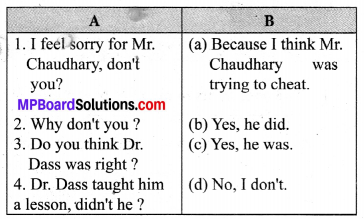
MP Board Class 7th General English Solutions Chapter 8 The Olympic Champion

Get Updated MP Board Solutions for Class 7 General English Chapter 8 The Olympic Champion Questions and Answers in PDF Format and download them free of cost. These are provided as per the latest exam pattern and syllabus. Access the topics of Chapter wise and communication skills, grammer part through the direct links available depending on the need. You can Download MP Board Class 7 English Solutions and can score highest grade in examination. Clear all your queries on the Mp Board Solutions for Class 7 English Chapter 21 Tansen Questions and Answers Subject by using the Madhya Pradesh State Board Solutions for existing.

MP Board Class 7th General English Solutions Chapter 8 The Olympic Champion

The Olympic Champion Textual Exercises

Read and Learn ( पड़ी और याद करौ) :
Students should do themselves.
(छात्र स्वयं करें।)

Comprehension (बोध प्रश्न)

(A) Answer the questions given below :
(निम्नलिखित प्रश्नों के उत्तर दीजिए )

Question 1.
What do we know about the ancient Olympic Games ?
(व्हॉट डू वी नो अबाउट द एन्शीएन्ट ओलम्पिक गेम्स?) प्राचीन ओलम्पिक खेलों के बारे में हम क्या जानते हैं ?
Answer:
We know a few things about the ancient Olympic Games. An Olympic sports festival was held in Greece in 776 B. C. at Olympia. Therefore, this sports-festival was called Olympic Games.
(वी नों ए फ्यू थिंग्स अबाउट द एन्शीएन्ट ओलम्पिक गेम्स। एन ओलम्पिक स्पोर्ट्स फेस्टीवल वॉज़ हेल्ड इन ग्रीस इन 776 B. C. एट ओलम्पिआ, देअरफोर, दिस स्पोर्ट्स फेस्टीवल वॉज़ कॉल्ड ओलम्पिक गेम्स।)
प्राचीन ओलम्पिक खेलों के बारे में हम बहुत ही कम बातें जानते हैं। ओलम्पिक खेलों का उत्सव यूनान में ओलम्पिया नामक स्थान पर मनाया गया। इसलिए यह खेलों का उत्सव ओलम्पिक खेलों के नाम से पुकारा गया।

Question 2.
Where did the Olympic Games get their name from?
(व्हेअर डिड दि ओलम्पिक गेम्स गेट देअर नेम फ्रॉम?)
ओलम्पिक खेलों ने अपना नाम कहाँ से प्राप्त किया?
Answer:
The Olympic Games festival was for the first time held in Greece at Olympia. So this sports festival got its name from the place ‘Olympia’
(द ओलम्पिक गेम्स फेस्टीवल वॉज़ फॉर द फर्स्ट टाइम हैल्ड इन ग्रीस एट ओलम्पिया। सो दिस स्पोर्ट्स फेस्टीवल गॉट इट्स नेम फ्रॉम द प्लेस ओलम्पिआ।)
ओलम्पिक खेलों का उत्सव पहली बार यूनान के ओलम्पिआ नामक स्थान पर हुआ। इसलिए खेलों के इस उत्सव ने ‘ओलम्पिआ’ स्थान से अपना नाम प्राप्त किया।

Question 3.
Who won a gold medal for a rowing race in the Olympic Games of 1928 ?
(हवन अगोल्ड मैडल फॉर अ रोइंग रेस इन द ओलम्पिक गेम्स ऑफ 1928)
सन 1928 ई. के ओलम्पिक खेलों में नौका दौड़ के लिए स्वर्ण पदक किसने जीता?
Answer:
Bobby Pearce won a gold medal for a rowing race in the Olympic Games of 1928.
(बॉबी पियर्स वन ए गोल्ड मैडल फॉर ए रोइंग रेस इन द ओलम्पिक गेम्स ऑफ 19281)
बॉबी पियर्स ने नौका दौड़ के लिए सन् 1928 के ओलम्पिक खेलों में स्वर्ण पदक जीता।

Question 4.
At what age did Bobby win the first race?
(ऐट व्हॉट एज डिड बॉबी विन द फर्स्ट रेस?) बॉबी ने कितने वर्ष की उम्र में पहली दौड़ जीती?
Answer:
Bobby won the first race at the age of six.
(बॉबी वन फर्स्ट रेस ऐट द एज ऑफ सिक्स।)
बॉबी ने छः वर्ष की उम्र में पहली दौड़ जीती।

Question 5.
Who did Bobby compete with in the finals of the Amsterdam Olympics ?
(ह डिड बॉबी कम्पीट विद इन द फाइनल्स ऑफ द एम्स्टरडम ओलम्पिक्स?)
एम्स्टरडम ओलम्पिक्स के फाइनल में बॉबी ने किसके साथ प्रतियोगिता की?
Answer:
He competed with Ken Myers of America in the finals of the Amsterdam Olympics.
(ही कम्पीटेड विद केन मायर्स ऑफ अमेरिका इन द फाइनल्स ऑफ द एम्स्टरडम ओलम्पिक्स।)
उसने अमेरिका के केन मायर्स के साथ एम्स्टरडम ओलम्पिक्स के फाइनल्स (अंतिम प्रतियोगिता) में प्रतियोगिता की थी।

Question 6.
What caused Bobby to slow down in the middle of the race ?
(व्हॉट कॉज़्ड बॉबी टू स्लो डाउन इन द मिडिल ऑफ द रेस?)
दौड़ के बीच में ही बॉबी ने अपनी गति धीमी किसके कारण कर दी?
Answer:
A duck and her ducklings swam across the waterway. It was the path of Bobby’s boat. The boat was going to run into them, therefore Bobby had to slow down in the middle of the race.
(अ डक एण्ड हर डकलिंग्स स्वैम एक्रॉस द वॉटरवे। इट वॉज़ द पाथ ऑफ बॉबीज़ बोट। द बोट वॉज़ गोइंग टू रन इनटू दैम, देअरफोर बॉबी हैड टू स्लो डाउन इन द मिडिल ऑफ द रेस)
एक बतख और उसके बच्चे जलमार्ग के आर-पार तैर रहे थे। यही बॉबी की नाव का मार्ग था। नाव उन्हें रौंदने जा रही थी, इसलिए बॉबी को दौड़ के बीच में ही गति धीमी करनी पड़ी।

Question 7.
What did Bobby do when he saw a duck and her duckling swimming across the waterway?
(व्हॉट डिड बॉबी डू हैन ही सौ अडक एण्ड हर डकलिंग्स स्विमिंग एक्रॉस द वॉटरवे?)
जब बॉबी ने एक बतख और उसके बच्चों को जलमार्ग के आर-पार तैरते हुए देखा तो उसने क्या किया?
Answer:
He slowed down his boat when he saw a duck and her ducklings across the waterway.
(ही स्लोड डाउन हिज़ बोट हैन ही सौ अ डक एण्ड हर डकलिंग्स एक्रॉस द वाटरवे।)
उसने उस समय अपनी नौका की गति धीमी कर ली जब उसने एक बतख और उसके बच्चों को जलमार्ग के आर-पार देखा।

(B) Read the following sentences and tick them as true or false :
(निम्नलिखित वाक्यों को पढ़कर सही व गलत निशान लगाइए)

  1. Athletes come from all countries to take part in the Olympic games.
  2. Bobby Pearce’s father was a great wrestler.
  3. At the age of six, Bobby won the first race.
  4. The people on the bank were silent.
  5. His friends in the Australian Olympic team were not surprised.
  6. In all these years, he lost a few races.

Answers:

  1. T
  2. F
  3. T
  4. F
  5. T
  6. F

Word Power (शब्द समर्थ):

Match these (मिल करे):

  1. Pig – (a) piglet
  2. Owl – (b) cygnet
  3. Swan – (c) owlet
  4. Book – (d) kitchenette
  5. River – (e) booklet
  6. Kitchen – (f) rivulet.

Answer:

  1. → (a)
  2. → (c)
  3. → (b)
  4. → (e)
  5. → (f)
  6. → (d).

Grammar in Use (व्याकरण प्रयोग):

(A) Fill in the blank spaces with the correct form of the verb given below :
(नीचे दिये शब्दों के सही रूप से रिक्त स्थानों को भरिए)
(hear, win, seem, compete, wait)

  1. Our Indian Cricket Team …………… The World Cup in 1983.
  2. There was complete silence outside. Suddenly I …………… a noise.
  3. Milkha Singh was leading in the 100 metre race in the Olympics. It …………… that he would win the race.
  4. We couldn’t play the cricket match because of heavy rain. We …………… until the rain stopped.
  5. Kamal is the 800 metre race champion of our school. So far he has …………… many races and never lost any.

Answer:

  1. won
  2. heard
  3. seemed
  4. waited
  5. competed.

(B) Fill in the blank spaces with appropriate prepositions given ahead :
(नीचे दिए गए उपयुक्त पूर्व सर्ग (Prepositions) के रिक्त स्थान को भरिए):
(with, on, in, into, across, by, to)

  1. We should not write ……….. the walls.
  2. There is plenty of water ……….. the jug.
  3. Children are playing ……….. a football.
  4. Ashu drew a line ……….. the page.
  5. Abu jumped ……….. the river.
  6. We go ……….. school ……….. bus.
  7. Mehak kept the book ……….. her bag.

Answers:

  1. on
  2. in
  3. with
  4. across
  5. into
  6. to, by
  7. in.

Let’s Talk (आओ बात करें):

Talk to your friends in the class. Ask questions to fill up the blank spaces in the table given below.
(कक्षा में अपने मित्रों से बात करो। प्रश्नों को पूछ कर नीचे दी गई तालिका में दिए खाली स्थान भरिए।)
Answer:
Students can talk to their friends in the class and fill up the blank spaces in the given table themselves, as shown in the example, according to the answers given by their friends.

Let’s Write (आओ लिखें):

(A) Write sentences from the above table as in the example.
(उपर्युक्त तालिका से उदाहरण के अनुसार वाक्य बनाएँ।)
Answer:
Students can write the sentences as given in the example themselves according to the answers they have filled in the table.

(B) Write a letter to your friend describing a sports event held in your school.
(अपने मित्र को एक पत्र लिखिए जिसमें आपके विद्यालय में हई खेल स्पर्धा का वर्णन हो।)
Answer:
See letters in the Grammar section.

Let’s Do It (आओ इसे करें):

(A) Match the heading with the news items and write them in the table given at the end.
(शीर्षक का समाचार से मिलान कीजिए और उन्हें अन्त में दी गयी तालिका में लिखिए।)
Answer:
MP Board Class 7th General English Chapter 8 The Olympic Champion

(B) Fruits and Vegetables – Precaution
(फल और सब्जियाँ-सावधानी)

Question 1.
What did Nidhi and her friends ask Dr. Prasad ?
(व्हॉट डिड निधि एण्ड हर फ्रेन्ड्स आस्क डॉ. प्रसाद?) निधि और उसके मित्रों ने डॉ. प्रसाद से क्या पूछा?
Answer:
They ask Dr. Prasad a few questions on using fruits and vegetables sefely.
(दे आस्क डा. प्रसाद अ फ्यू क्विश्चन्स ऑन यूजिंग फ्रूट्स एण्ड वेजीटेबिल्स सेफली।)
उन्होंने डॉ. प्रसाद से फल और सब्जियों के प्रयोग पर कुछ प्रश्न पूछे।

Question 2.
Why should we not keep fruits after cutting them ?
(व्हाई शुड वी नॉट कीप फ्रूट्स आफ्टर कटिंग दैम?) हमें फलों को काटकर क्यों नहीं रखना चाहिए?
Answer:
Because they may get infected. (बिकॉज दे मे गेट इनफेक्टेड।) क्योंकि वे संक्रमित हो सकते हैं।

Question 3.
Why do we wash the fruits before eating ?
(व्हाई डू वी वॉश द फ्रूट्स बिफोर ईटिंग?) हम खाने से पहले फलों को क्यों धोते हैं ?
Answer:
They have eggs and larvae of insects or the pesticides on them.
(दे हेव एग्स एण्ड लार्वी ऑफ इन्सेक्ट्स और द पेस्टीसाइड्स ऑन देम।)
उन पर कीटों के अण्डे और लार्वा होते हैं।

Question 4.
Why should we not peel the fruits?
(व्हाई शुड वी नॉट पील द फ्रूट्स?)
हमें फलों के छिलके क्यों नहीं उतारने चाहिए?
Answer:
Fruits have vitamins in their peel, so we should not peel them.
(फ्रूट्स हेव विटामिन्स इन देअर पील, सो वी शुड नॉट पील दैम।)
फलों के छिलके में विटामिन होते हैं, अतः हमें उनके छिलके नहीं उतारने चाहिए।

Question 5.
How does overcooking harm our food ?
(हाउ डज़ ओवरकुकिंग हार्म आउर फूड?)
हमें अपना भोजन अधिक गर्म करना कैसे हानिकारक होता
Answer:
So, because overcooking spoils vitamins and other nutrients of the food.
(सो, बिकॉज ओवरकुकिंग स्पॉइल्स विटामिन्स एण्ड अदर न्यूट्रीएन्ट्स ऑफ द फूड।)
क्योंकि अधिक गर्म करने से भोजन के विटामिन और दूसरे पोषक तत्व नष्ट हो जाते हैं।

Pronunciation & Translation

The Olympic Games are held once in every four years. Athletes come from all the countries and take part in the games. Many kinds of games, races and other competitions are held in the Olympic Games.
(दि ओलम्पिक गेम्स आर हैल्ड वन्स इन एवरी फोर ईयर्स. ऐथलीट्स कम फ्रॉम ऑल द कन्ट्रीज एण्ड टेक पार्ट इन द गेम्स. मैनी काइन्ड्स ऑफ गेम्स, रेसेस एण्ड अदर कम्पिटीशन आर हैल्ड इन दि ओलम्पिक गेम्स.)
अनुवाद-ओलम्पिक खेल प्रत्येक चार वर्ष में एक बार होते हैं। सभी देशों से खिलाड़ी इन खेलों में भाग लेने आते हैं। कई प्रकार के खेल, दौड़ और दूसरी स्पर्धाएँ ओलम्पिक खेलों में होती हैं।

We know only a few things about the ancient Olympic Games. An Olympic sports festival was held in Greece in 776 B.C. at Olympia. So it was called the Olympic Games.
(वी नो ऑनली अ फ्यू थिंग्स अबाउट दि एन्शियेन्ट ओलम्पिक गेम्स. एन ओलम्पिक स्पोर्ट्स फेस्टीवल वॉज हैल्ड इन ग्रीस इन 776 बी.सी. ऐट ओलम्पिया. सो इट वॉज कॉल्ड दि ओलम्पिक गेम्स.)
अनुवाद-हम प्राचीन ओलम्पिक खेलों के बारे में कुछ ही बातें जानते है। एक ओलम्पिक खेल महोत्सव ग्रीस में 776 ई.पू. में ओलम्पिया में हुआ था। इसलिए यह ओलम्पिक खेल के नाम से जाना गया।

There are many interesting events associated with the Olympic Games. Let’s share one of those events. It tells us about a person who not only won a gold medal for rowing in the Olympic Games of 1928 but also won the hearts of all who saw him win.
(देयर आर मैनी इन्टरेस्टिंग इवेन्ट्स एसोशिएटेड विद दि ओलम्पिक गेम्स. लेट्स शेअर वन ऑफ दोज इवेन्ट्स. इट टैल्स अस अबाउट अ पर्सन हू नॉट ऑनली वन अ गोल्ड मेडल फॉर रोइंग इन दि ओलम्पिक गेम्स ऑफ 1928 बट ऑल्सो वन द हर्ट्स ऑफ आल हू सॉ हिम विन.)
अनुवाद-ओलम्पिक खेलों से कई मनोरंजक घटनाएँ जुड़ी हुई हैं। आओ, उन घटनाओं में से एक के बारे में बात करें। यह हमें एक ऐसे व्यक्ति के बारे में बताती है जिसने 1928 के ओलम्पिक खेलों में नावों की दौड़ में न केवल स्वर्ण पदक जीता बल्कि उन सभी लोगों का दिल भी जीत लिया जिन्होंने उसे जीतते हुए देखा।

Bobby Pearce was born in Sydney in Australia. His father was a great sculling champion. When Bobby was five, he was rowing around Sydeny Harbour in a small boat. At the age of six he won the first race competing against fourteen year olds.
(बॉबी पीयर्स वॉज बोर्न इन सिडनी इन आस्ट्रेलिया, हिज फादर वॉज अ ग्रेट स्कलिंग चैम्पियन. व्हेन बॉबी वॉज फाइव, ही वॉज रोइंग अराउण्ड सिडनी हार्बर इन अ स्मॉल बोट. ऐट दि .. एज ऑफ सिक्स ही वन द फर्स्ट रेस कम्पिटिंग अगेन्स्ट फोर्टीन ईअर्स ओल्ड्स)
अनुवाद-बॉबी पीयर्स आस्ट्रेलिया में सिडनी में पैदा हुआ था। उसके पिता एक महान नौका दौड़ विजेता थे। जैब बॉबी पाँच साल का था तभी वह सिडनी के बन्दरगाह के चारों ओर एक छोटी नाव में चप्पू चलाया करता था। छह वर्ष की आयु में उसने पहली दौड़ चौदह वर्ष के प्रतिद्वन्द्वी से जीती।

By the time he was twenty, Bobby was the sculling champion of Australia. The following year he went to Amsterdam to compete in the Olympic Games.
(बाइ द टाइम ही वॉज ट्वन्टी, बॉबी वॉज द स्कलिंग चैम्पियन ऑफ आस्ट्रेलिया, द फॉलोइंग ईयर ही वैन्ट टू एम्सटर्डम टू कम्पीट इन दि ओलम्पिक गेम्स.)
अनुवाद-बीस वर्ष की आयु में बॉबी आस्ट्रेलिया का नौका दौड़ विजेता बन गया था। अगले वर्ष वह ओलम्पिक खेलों में मुकाबला करने एम्सटर्डम गया।

In the finals, he competed against Ken Myers of America. From the start of the race, Bobby was in the lead. He was very much ahead of Myers. After half the race was over, he was still leading. It seemed that Bobby would easily win the race. Then suddenly something happend.
(इन द फाइनल्स, ही कम्पीटेड अगेन्स्ट केन मायर्स ऑफ अमेरिका. फ्रॉम द स्टार्ट ऑफ द रेस, बॉबी वॉज इन द लीड. ही वॉज वैरी मच अहेड ऑफ मायर्स. आफ्टर हॉफ द रेस वॉज ओवर, ही वाज स्टिल लीडिंग. इट सीम्ड दैट बॉबी वुड ईजिली विन द रेस. दैन सडनली समथिंग हेप्पन्ड.)
अनुवाद-फाइनल में उसका मुकाबला अमेरिका के केन मायर्स से था। दौड़ के आरम्भ से ही बॉबी आगे था। वह मायर्स से बहुत अधिक आगे था। आधी दौड़ के बाद भी वह आगे चल रहा था। ऐसा लगता था कि बॉबी आसानी से दौड़ जीत जायेगा। तभी अचानक कुछ घटना घटी।

He saw a duck and her ducklings swimming across the waterway. They were swimming into the path of his boat and the boat was going to run into them. The poor birds had no idea that they were in the middle of an Olympic race.
(ही सॉ अ डक एंड हर डकलिंग्स स्विमिंग अक्रॉस द वाटरवे. दे वर स्विमिंग इनटू द पाथ ऑफ हिज बोट एण्ड द बोट वॉज गोइंग टू रन इनटू दैम. द पूअर बर्ड्स हैड नो आइडिया दैट दे वर इन द मिडल ऑफ एन ओलम्पिक रेस.)
अनुवाद-उसने एक बतख और उसके बच्चों को पानी में से तैरकर गुजरते देखा। वे उसकी नाव की तरफ आ रहे थे और नौका उनकी तरफ दौड़ रही थी। बेचारे पक्षियों को मालूम नहीं था कि वे एक ओलम्पिक दौड़ के मध्य में थे।

Immediately Bobby slowed down his boat. Myers was catching up very quickly. The people on the bank were cheering and shouting as if they were mad. But Bobby waited until all the ducklings were out of danger. Then he picked up speed again and went on to win the race easily.
(इमीडियेटली बॉबी स्लोड डाउन हिज बोट. मायर्स वॉज कैचिंग अप वैरी क्विकली. द पीपल ऑन द बैंक वर चीअरिंग एण्ड शाउटिंग एज इफ दे वर मैड. बट बॉबी वेटेड अन्टिल ऑल द डकलिंग्स वर आउट ऑफ डेन्जर. दैन ही पिक्ड अप स्पीड अगेन एण्ड वेन्ट ऑन टू विन द रेस ईजिली.)
अनुवाद-तुरन्त ही बॉबी ने अपनी नाव की गति को धीमा किया। मायर्स बहत तेजी से पीछा कर रहा था। किनारे पर लोग खुशी से ऐसे चिल्ला रहे थे जैसे कि वे पागल हों। लेकिन बॉबी ने तब तक इन्तजार किया जब तक सभी बतख के बच्चे खतरे से बाहर नहीं हो गये। तब उसने दुबारा गति पकड़ी और आसानी से दौड़ जीत ली।

Of all the Olympic champions, it was he who won everybody’s heart. A Dutch newspaper wrote, “He won the goodwill of the children of Amsterdam”.
(ऑफ ऑल दि ओलम्पिक चैम्पियन्स, इट वॉज ही हू वन एवरीबडीज हर्ट. अ डच न्यूजपेपर रोट, “ही वन द गुडविल ऑफ द चिल्ड्रन ऑफ एम्सटर्डम.”)
अनुवाद-सारे ओलम्पिक विजेताओं में से केवल वही एक था जिसने सभी का दिल जीत लिया। एक डच अखबार ने लिखा, “उसने एम्सटर्डम के बच्चों की ख्याति जीत ली।”

His friends in the Australia Olympic team were not surprised by the story of the ducks. “Bobby is that kind of a man,” they said.
(हिज फ्रेन्ड्स इन द आस्ट्रेलिया ओलम्पिक टीम वर नॉट सरप्राइज्ड बाइ द स्टोरी ऑफ द डक्स. “बॉबी इज दैट काइण्ड ऑफ अ मैन,” दे सैड.)
अनुवाद-आस्ट्रेलिया की ओलम्पिक टीम में उसके मित्र बतख की कहानी पर आश्चर्यचकित नहीं हुए। “बॉबी उस प्रकार का ही व्यक्ति है,” उन्होंने कहा।

From the age of six, Bobby Pearce competed in races for thirty three years.He stopped taking part in sports in 1945. In all these years he never lost a single race.
(फ्रॉम द एज ऑफ सिक्स, बॉबी पीयर्स कम्पीटेड इन रेसेस फॉर थर्टी थ्री ईयर्स. ही स्टॉप्ड टेकिंग पार्ट इन स्पोर्ट्स इन 1945. इन ऑल दीज ईयर्स ही नैवर लॉस्ट अ सिंगल रेस.)
अनुवाद-छह वर्ष की उम्र से, बॉबी पीयर्स ने 33 वर्ष तक दौड़ प्रतियोगिता में भाग लिया। 1945 से उसने खेलों में भाग लेना बन्द कर दिया। इन सभी वर्षों में उसने एक भी दौड़ मुकाबला नहीं हारा।

The Olympic Champion Word Meanings

Athlete (एथलीट)-खिलाड़ी; ‘Events : (ईवेन्ट्स) – घटनाएँ; Ancient ( एन्शीएन्ट)-प्राचीन; Rowing (रोइंग) — नाव का खेना; In the middle of (इन द मिडिल ऑफ)-मध्य में; Against (अगेंस्ट)-विरुद्ध; Harbour (हार्बर) -बन्दरगाह; Sports-festival (स्पोर्ट्स फेस्टीवल)-खेल मेला; Lead (लीड)-आगे चलना; Interesting (इन्टरेस्टिंग) –रुचिपूर्णIn the lead (इन द लीड)-आगे; Associated (एसोसिएटिड)-जुड़े हुए; Picked up (पिक्ड् अप)उठाया; Share a gold medal (शेयर ए गोल्ड मैडल)-स्वर्ण पदक प्राप्त किया; Sculling (स्कलिंग)-नौका दौड़ जिसमें खिलाड़ी दो झपकों का प्रयोग करता है; Path (पाथ)-रास्ता; Row (रो)-नाव खेना;Out of danger (आउट ऑफ डेन्जर) -खतरे से बाहर; In the finals (इन द फाइनल्स)-अंतिम प्रतियोगिता में; Shout (शाउट)-चिल्लाना; Surprise (सरप्राइज)-आश्चर्य करना; Competition (कम्प्टीशन) -प्रतियोगिता; Catching up (कैचिंग अप) पकड़े हुए था; Suddenly (सडनली)-अचानक;Win someone’s heart (विन समवन्स हार्ट)-किसी के दिल को जीत लेना।

If you are eager to know about the Madhya Pradesh State Board Solutions for Class 7 English you will find all of them here. You can identify the knowledge gap using these MP Board Solutions for English PDF and plan accordingly. Don’t worry about the accuracy as they are given after extensive research by people having subject knowledge along side from the latest English Syllabus.

MP Board Class 7th Special English Vocabulary

Get Updated MP Board Solutions for Class 7 Special English Vocabulary Questions and Answers in PDF Format and download them free of cost. These are provided as per the latest exam pattern and syllabus. Access the topics of Chapter wise and communication skills, grammer part through the direct links available depending on the need. You can Download MP Board Class 7 English Solutions and can score highest grade in examination. Clear all your queries on the Mp Board Solutions for Class 7 English Chapter 21 Tansen Questions and Answers Subject by using the Madhya Pradesh State Board Solutions for existing.

MP Board Class 7th Special English Vocabulary

If you are eager to know about the Madhya Pradesh State Board Solutions for Class 7 English you will find all of them here. You can identify the knowledge gap using these MP Board Solutions for English PDF and plan accordingly. Don’t worry about the accuracy as they are given after extensive research by people having subject knowledge along side from the latest English Syllabus.

Some Collective Nouns

  1. A shoal of fish
  2. A bunch of flowers
  3. A fleet of ships
  4. A herd of cattle
  5. A shelf of books
  6. A team of players
  7. A crowd of people
  8. A choir of singers
  9. A litter of puppies
  10. A bunch of grapes
  11. A gang of criminals
  12. A troop of monkeys
  13. An army of soldiers
  14. A pack of wolves
  15. A class of students
  16. A school of whales
  17. A flock of sheep
  18. A pride of lions
  19. A heap of stones
  20. A bundle of sticks
  21. A bouquet of foyers
  22. A band of musicians
  23. A crew of sailors
  24. A swarm of bees

Pair of nouns

  1. Arts and sciences
  2. Bag and baggage
  3. Bow and arrow
  4. Bread and butter
  5. Flesh and blood
  6. Friend or foe
  7. Hand and foot
  8. Heart and soul
  9. Heaven and earth
  10. Horse and cart
  11. Hue and cry
  12. King and Queen
  13. Ladies and gentlemen
  14. Land and sea
  15. Light and shade
  16. Lock and key
  17. Male and female
  18. Man and beast

Sounds made by Animals

  1. Bears ______ growl
  2. Bees ______ hum
  3. Birds ______ sing, chirp, twitter
  4. Cats ______ purr, mew
  5. Cocks ______ crow
  6. Cows ______ moo
  7. Dogs ______ bark
  8. Ducks ______ quack
  9. Elephants ______ trumpet
  10. Flies ______ buzz
  11. Frogs ______ croak
  12. Geese ______ cackle
  13. Goats ______ bleat
  14. Hens ______ cackle, cluck
  15. Horses ______ neigh
  16. Lambs ______ bleat

Sounds made by objects

  1. Airplanes – zoom
  2. Bells – ring
  3. Bombs – explode
  4. Camera – click
  5. Clocks – tick
  6. Drums – beat
  7. Coins – jingle
  8. Doors – slam, bang
  9. Drums – beat
  10. Engines – throb
  11. Feet – shuffle
  12. Fire – crackles
  13. Guns – boom
  14. Hands – clap
  15. Hearts – beat
  16. Loudspeakers – blase

One Word for the Group of Words

  1. One who is liked by the people – Popular
  2. One who believes in God – Theist
  3. One who dpes not believe in God – Atheist
  4. One who look at the bright side of things – optimistic
  5. One who can neither read near write – Illiterate
  6. A place hied up for reading and studying – Library
  7. A place whore birds, animals etc. are kept – Zoo
  8. A disease that ends’ in death – Fatal
  9. Word for word – Verbal
  10. Fit to be eaten – Edible
  11. The person who flies airplanes – Pilot
  12. The person who mends our shoes – Cobbler

Occupations

  1. Artist – One who draws, paints etc.
  2. Actor – One who plays a part on the stage or in a film.
  3. Architect – One who design buildings.
  4. Astronaut – One trained for space travel.
  5. Author – One who writes bocks and stories.
  6. Baby sitter – One who looks after a baby.
  7. Butcher – One who sells meat.
  8. Carpenter – One who makes things out of wood.
  9. Coach – One who gives special training in games and sports.
  10. Cobber – One who mends shoes.
  11. Dentist – One who attends to people’s teeth.
  12. Editor – One who improves and prepares for publication for printing.
  13. Electrician – One who fits or repairs electrical devices
  14. Grocer – One who sells foodstuff and other household needs.
  15. Hawker – One who moves from place to place to sell things.
  16. journalist – One who corrects, edits or publishes a newspaper.
  17. Lawyer – One who handles matters of law and fights court cases.
  18. Optician – One who tests eye sight and sells spectacles:
  19. Plumber – One who fits or repair water pipes, drowns, sinks, toilets etc.
  20. Surgeon – A doctor who performs operations

Young Ones of Animals

  1. Ass – Foal
  2. Bear – Cub
  3. Tiger – Cub
  4. Deer – Fawn
  5. Cat – Kitten
  6. Cow – Calf
  7. Dog – Puppy
  8. Duck – Duckling
  9. Goat – Kid
  10. Hen – Chicken
  11. Horse – colt
  12. Hare – Leveret
  13. Sheep – Lamb
  14. Elephant – calf
  15. Wolf – cub
  16. Stag – fawn

We believe the information shared regarding MP Board Solutions for Class 7 English Chapter 21 Tansen Questions and Answers as far as our knowledge is concerned is true and reliable. In case of any queries or suggestions do leave us your feedback and our team will guide you at soonest possibility. Bookmark our site to avail latest updates on several state board Solutions at your fingertips.
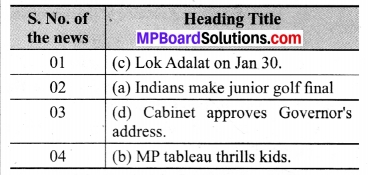
MP Board Class 7th Special English Short Essay Writing

Get Updated MP Board Solutions for Class 7 Special English Short Essay Writing Questions and Answers in PDF Format and download them free of cost. These are provided as per the latest exam pattern and syllabus. Access the topics of Chapter wise and communication skills, grammer part through the direct links available depending on the need. You can Download MP Board Class 7 English Solutions and can score highest grade in examination. Clear all your queries on the Mp Board Solutions for Class 7 English Chapter 21 Tansen Questions and Answers Subject by using the Madhya Pradesh State Board Solutions for existing.

MP Board Class 7th Special English Short Essay Writing

If you are eager to know about the Madhya Pradesh State Board Solutions for Class 7 English you will find all of them here. You can identify the knowledge gap using these MP Board Solutions for English PDF and plan accordingly. Don’t worry about the accuracy as they are given after extensive research by people having subject knowledge along side from the latest English Syllabus.

My School

I read in Sarvadaya Senior Secondary School, Bhopal, It is situated out of the town in a grove of trees.

The building of my school is’ very grand. There are twenty five class-rooms and a big hall. We have our library and the reading room in the hall. All the rooms are airy, neat and clean. We have electric light and’fans in each room

There are about twenty-five teachers in my school. Shri R.N. Goel is our Principal. All the teachers and the Principal are well qualified and trained. They are very hard working. All of them love us.

In front of the building there is the school garden. It is full of flower, plants and trees. There are many grassy lawns in the garden. Our school has a big play-ground. We play games there.

Vocabulary :

Grove – कुँज। Grand – शानदार। Airy – हवादार। Trained – प्रशिक्षित। Hard working परिश्रमी। Grass – घासवाला।

My Best Friend

I have many boys in my school. I like them all. But of all of them I like Harish the most. He is almost as old as I am He is tall, strong and handsome. He has a smiling face.

He likes all sorts of games. He does not care much for books. He likes jokes.

Both of us read in the same class. We sit together at the same bench. We have many habits in common. Both of us are good players. I generally stand
first in my class. My friends never feels jealous.

Both of us are helpful to each other. I often go to his village. His mother loves me just like her son. She is very glad to see me. His father is also a gentleman.

I like my friend because of his simple and noble nature. He is honest in all his dealings, he possesses a kind heart. He is God-fearing. He is always ready to help the poor and needy.

Vocabulary :

All sorts of – सब प्रकार के – In common-एक सी – Jealous-इर्ष्यालु – Thorough पूर्ण। Nature – स्वभाव। Dealings – व्यवहार। God-fearing – ईश्वर से डरने वाला।

The Postman

The postman is a useful public servant. He does an important duty. He brings our letters, parcels and money-orders. He goes from door to door. He knows each and every house of the street.

The postman wears a Khaki dress. He keeps a bag with him. He keeps the letters, parcels and money-orders in this bag. He knocks at the door. People wait for him He brings news from our friends and relatives.

The postman does more work. He reads out the letters for the villagers. Sometimes, he writes letters for them. The postman’s life is very hard. He gets a small salary. The prices of things are rising. The postman cannot support his family. So he gets some money from the people as gift.

The government should raise his salary.

Vocabulary :

Important – महत्त्वपूर्ण। Knocks at – खटखटाता है। Relatives – सम्बन्धी। Bitter – अघि क। Salary – वेतन। Support – पालन करना। Gift – उपहार। Raise – बढ़ाना।

The Policeman

The policeman is a useful public servant, he has an important work to do. He helps us in many ways. He keeps peace wherever he is on dut&

The policeman wears a khaki dress. He ties a red turban on his head. A whistle is a part of his dress. The dress of a traffic policeman is different. The policeman guards our property. He keeps law and order. He is on duty when we are sleeping. Thieves are afraid of him.

The traffic policeman controls the traffic. Without him, traffic cannot move safely on the roads.

His life is very hard. He is always ready for duty. He puts himself in dangers. He faces the dacoits. Sometimes, he loses his life in accidents.

The policeman does not get a good salary. He cannot support his family well. He cannot give good education to his children. So he takes bribe.

The government should raise his salary.

Vocabulary :

Peace – शांति। Turban – पगड़ी। Whistle – सीटी। Traffic – यातायात। Different – भिन्न। Guards – रक्षा करता है। property – सम्पत्ति। Controls – नियंत्रित करता है। Dacoits – डाकू। Bribe – रिश्वत

A Hockey Match that I Saw

Last Sunday a hockey match was played between the Kisan School and D.A.V. School. It was a very interesting match. It was played at the Ramlila ground. Many boys came to see the match.

At 4 p.m. the referee called the captains of the teams. The Kisan School won the toss. After this both the teams entered the ground. They were wearing colourful uniforms.

The players took their positions. The game started. It was very interesting. Both the teams were equal. The ball was running to and fro.

The players played with full force. Both the teams tried hard. But none could make a goal in the first half.

The players took oranges during the interval. Then the game started again. This time the fight was very hard.

The captain of the Kisan School team took the ball: He hit it. The goal keeper of the D.AV. School team tried to save the goal. But he failed. Thus the Kisan School team made a goal.

There were shouting of joy form the crowd. The time was over. The match ended. The Kisan School team won it. It was really an interesting match.

Vocabulary :

Interesting – रोचक। Colourful – रंग-बिरंगे। Uniform – पोशाक। To and from – इधर-उध पर। Crowd – भीड़। Interesting – मजेदार।

The Diwali Festival

Diwali is one of the most important Hindu festivals. It falls in the middle of Kartik. It means a ‘row of earthen lamps’. Every Hindu householder lights up earthen lamps at night. It marks the coming of winter.

The Hindus believe that God Ram returned to Ayodhya on this day after defeating Ravan. He was given a warm welcome by the people of Ayodhya. Lamps were lit up in his honour.

The Sikhs celebrate it because their Guru Govind Singh was set free by the Mughals on this day. The jains believe that Mahavir Swami got salvation on this day.

Many days before the festival people begin to clean, white wash afid decorate their houses. On the day of festival all schools, offices and courts are closed. All people, young and old, put on new clothes. There is loud noise of crackers on this day.

At night ‘Lakshmi’, the Goddess of wealth is worshipped. There is a great hustle and bustle in bazaars. The sweet-sellers earn money. Many businessmen close their old accounts and begin their new business year on this day.

Some people gamble to try their luek. But they are often^ruined. We should try to keep away from this evil practice.

Vocabulary :

Festival – त्यौहार। Falls – पड़ता है। Earthen-lamp – मिट्टी के दीपक। Marks – आरम्भ करता है। Salvation – निर्वाण। Decorate – सजाना। Crackers – पटाखे। Hustle and Bustle – शोर-गुल। Gamble – जुआ खेलना।

Prize Distribution Function in My School

Today is our prize distribution -day. Every year our school gives away prizes to pupils of merit. I was waiting early for the day. I was in high spirits on that day. The Director of Education was our chief guest He was to give away the prizes. He came at 5 p.m. The Principal received him The school band played a welcome tune. He took his seat and the function began.

Prayers were sung. Then came the welcome song. The principal read out the school’s annual report.

The chief guest rose. He addressed the audience. He spoke about the progress of the school. He praised the pupils and the staff. He gave some suggestions for more progress. He sat down. The audience clapped.

Then the prize distribution began. The winners walked up to the chief guest. They saluted him and received their prizes with smiles on their faces. They marched to their places.

I was among the winners. I had to go to the stage six times to get my prizes. My parents were proud of me. The function ended at 7 p.m There was a light refreshment for guests.

We left the school in gay mood. On the successful function the Principal declared one day’s holiday.

Vacabulary :

Merit – योग्यता। In high spirirt – उत्साहपूर्ण। Audience – श्रोतागण। Suggestion – प्रस्ताव।

A Cricket Match that I saw

Cricket is a good game. It has become very popular. It is played all over the world: Thousands of people see a cricket test match for hours together.

Last year our college played a cricket match against S. A.V. Inter College. The match was played on our ground. S.A.V. Inter College team won the toss and went in.

The match started at lo’clock. The two opening batsmen went in to bat. Our players took position for fielding. Our captain bowled. And lo ! the first ball knocked the wicket down. It was a bad start for S.A.V. Inter College team Another player walked in to bat, he played carefully. But after half an hour wickets began to fall rapidly. The whole team was out after securing 80 runs. Now lunch began.

After lunch our team started batting. Our opening batsmen played well. They secured 80 runs in an hour. After this our team scored 60 runs for the loss of six wickets. Our captain hit the sixers. The crowd cheered the team oiir team was out for 120 runs.

S.AV. Inter College team did not come next day to play the second innings. We won match.

Vocabulary :

Popular – लोकप्रिय। carefully – सावधानीपूर्व। Rapidly – तेजी से। cheered – उत्साहित किया।

The Cow

The cow is a domestic animal. She has four legs, two ears and two horns. She has a long tail. She keeps off flies with her tail. Her body is big. Cows are of different colours. Some cows are white, some are black and some are brown.

The cow” eat grass, straw and gram. She eats the oil cakes. She drinks water.

The cow is found every where in the world. American cows give more milk than Indian cows. In India the Hindus call her ‘Gau mata’.

The cow is a gentle animal She does not hurt anybody. Small children play with her. She is very intelligent.

She does not forget her master’s house.

The cow is a very useful animal. She gives us milk. Her milk is very useful for the children and the sick persons. We make sweets, ghee and curd from her milk. She giyes us calves which become bullocks. They plough our fields and draw carts.

Vocabulary :

Domestic – पालतू। Horns – सींग। Brown – कत्यई रंग की। Oil cakes – खल। Curd – दहि।

We believe the information shared regarding MP Board Solutions for Class 7 English Chapter 21 Tansen Questions and Answers as far as our knowledge is concerned is true and reliable. In case of any queries or suggestions do leave us your feedback and our team will guide you at soonest possibility. Bookmark our site to avail latest updates on several state board Solutions at your fingertips.
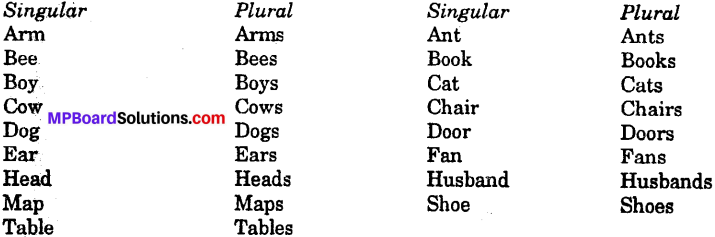
MP Board Class 7th Special English Paragraph Writing

Get Updated MP Board Solutions for Class 7 Special English Paragraph Writing Questions and Answers in PDF Format and download them free of cost. These are provided as per the latest exam pattern and syllabus. Access the topics of Chapter wise and communication skills, grammer part through the direct links available depending on the need. You can Download MP Board Class 7 English Solutions and can score highest grade in examination. Clear all your queries on the Mp Board Solutions for Class 7 English Chapter 21 Tansen Questions and Answers Subject by using the Madhya Pradesh State Board Solutions for existing.

MP Board Class 7th Special English Paragraph Writing

If you are eager to know about the Madhya Pradesh State Board Solutions for Class 7 English you will find all of them here. You can identify the knowledge gap using these MP Board Solutions for English PDF and plan accordingly. Don’t worry about the accuracy as they are given after extensive research by people having subject knowledge along side from the latest English Syllabus.

Paragraph is a short composition, the following points should be kept in mind while writing a paragraph.

  1. Concentration,
  2. Simplicity,
  3. Compactness,
  4. Clarity,
  5. Word-limit

Uses of Computer

Computer is such a name which has revolutionized and replaced every other technology. Computers have become common in each field. No department can work effectively and efficiently without computers. Even professionals like lawyer, chartered accountant can’t work without computer. The information soared in the computer can be easily used up later. Computers have not left any field untouched. In the banking sector computers are playing a veiy important role. The use of computers makes bank transactions easy, accurate and swift. It eliminates harassment. So with advent of time computer education is gaining popularity and importance.

Pleasures of Watching Television

Television combines the pleasures of radio and cinema. It lias become the most popular means of entertainment these days. It is performing the vital task of mass education. It helps in increasing awareness among the masses. Television is no more a mere means of communication but has made the people addicted to it. The increasing number of channels and world wide reporters have made the TV viewing one of the most important sources of entertainment. The pleasure of watching TV can only be enjoyed till we watch it under controlled limit and do not exceed it.

Annual Sports Day of My School

Last week annual sports day was celebrated in my school. The entire programme reflected the enthusiasm and energy of the students who not only participated in the various sports events but also gave great performances. The most exciting moment was when our honourable chief guest entered the premises of the school. Our hearts were throbbing with excitement. Our chief guest was given a guard of honour. Exciting aerobatics and drills were displayed beautifully. The chief guest gave a very impressive speech and gave away prizes to all the students who had excelled in various arts. The programme came to close by singing of the National Anthem with zestful optimism.

An Ideal Teacher

An ideal teacher is one who is committed and sincere in her task. An ideal teacher has basic qualities. She works sincerely for her students. An ideal teacher performs the duties towards the students sincerely. An ideal teacher in spite of extraordinary academic attainments, displays extreme simplicity. There is no element of show in her personality. An ideal teacher dedicates her whole cause to the well being of the student. She is a book in herself. Not a single moment of her time is wasted. She never allows here students to be idle or indisciplined. She is always before us like a beacon of light.

A Visit to a Fair

It was a cold day of January. Some of my friends came to me and pressed me to accompany them to Pragati Maidan. The exhibition was spread over a large area of several acres. The stalls were very artistically and impressively displayed. Many countries like Russia, Germany, Japan, Canada, Poland, India etc., had taken part in the exhibition. We were very much impressed to see the technology displayed in the Germany stalls. In the Russian stall, the model of the rocket attracted large crowds. The defence pavilion of the Indian stall displayed all the various rockets, aeroplanes, missiles and satellites made in India. I really enjoyed the fair. The fair not only entertained and amused but also educated and enlightened me with great countries of the world.

Your Hobby

A hobby is that activity which is carried on in leisure time. It is a means of recreation. It is a past time. It gives delight and helps in passing the leisure time. A hobby is an activity which is carried on entirely for the sake of pleasure. Gardening is my hobby. I derive great pleasure from this hobby. At the back of my house, I have developed a small plot of land. It is my garden. I have grown some flowers and some vegetables of the season in this plot. I indulge in my hobby early in the morning as soon as I am out of bed. My hobby gives me pleasure and refreshes me for day’s hard work. So the best hobby is one out of which we derive pleasure.

My Favourite Game

Games are a part and parcel of life. They provide us both physical as mental stamina. I have to play well as many games such as football, volleyball, tennis, cricket etc. But my favourite game is cricket. Cricket is one of the most popular games in India. I have joined sports cricket academy. I have been the champion of cricket in my school team. It is the easiest game to learn but needs a lot of practice. I love watching cricket matches. My favourite cricketer is Sachin Tendulkar. My cricket has made me popular among my friends. Cricket keeps me happy, teaches me cooperation and mutual understanding.

Honesty is the Best Policy

Honesty is a virtue. It always pays to the honest people though it may take some time. The honest wood-cutter who did not own the golden and silver axes, got them in reward for his honesty. Honesty survives up to the grave. Even the generations to come talk and praise the deeds of honest people. Honest Raja Harish Chandra was paid in the end for his honesty. Let all people be honest and make this world a second, paradise.

Unity is Strength

It is an old saying based on truth and age-old human experience. We all pin faith in, “united we stand and divided we fall”. Weak blades of grass if woven together, make a rope strong enough to tie even a mighty elephant. Tiny drops of water make a vast ocean. Penny and penny laid up will be many insignificant atoms when joined together, make a powerful bomb. When it is exploded it brings on too much havoc. It destroys life and property on all sides. No animal or inanimate escapes from destruction. All these things whether good or bad are the result of unity and it is unity that brings on strength.

EXERCISE

Write a paragraph on the following topics.

  1. The Republic Day
  2. The Children’s Day celebrations
  3. Celebrating Diwali without Crackers
  4. Importance of Trees
  5. A Morning Walk
  6. A Scene at the Bus Stand
  7. A Raing Day in Summer.

We believe the information shared regarding MP Board Solutions for Class 7 English Chapter 21 Tansen Questions and Answers as far as our knowledge is concerned is true and reliable. In case of any queries or suggestions do leave us your feedback and our team will guide you at soonest possibility. Bookmark our site to avail latest updates on several state board Solutions at your fingertips.

MP Board Class 7th Special English Grammar

Get Updated MP Board Solutions for Class 7 Special English Grammar Questions and Answers in PDF Format and download them free of cost. These are provided as per the latest exam pattern and syllabus. Access the topics of Chapter wise and communication skills, grammer part through the direct links available depending on the need. You can Download MP Board Class 7 English Solutions and can score highest grade in examination. Clear all your queries on the Mp Board Solutions for Class 7 English Chapter 21 Tansen Questions and Answers Subject by using the Madhya Pradesh State Board Solutions for existing.

MP Board Class 7th Special English Grammar

If you are eager to know about the Madhya Pradesh State Board Solutions for Class 7 English you will find all of them here. You can identify the knowledge gap using these MP Board Solutions for English PDF and plan accordingly. Don’t worry about the accuracy as they are given after extensive research by people having subject knowledge along side from the latest English Syllabus.

Some Parts of Speech

(1) NOUN: A noun is the name of a person, place or thing.
किसी प्राणी, स्थान अथवा वस्तु के नाम को Noun (संज्ञा) कहते हैं।

Kinds of Noun

  1. Proper Noun : Gita, Ram, Agra, Ganges.
  2. Common Noun : boy, girl, book, city, chair.
  3. Collective Noun : class, army, crowd, flock.
  4. Material Noun : gold, silver, iron, stone, wood.
  5. Abstract Noun : honesty, truth, poverty, childhood.

(2) PRONOUN: A pronoun is a word used in place of a noun.
Noun के स्थान पर प्रयोग किए जाने वाला शब्द Pronoun (सर्वनाम) कहलाता है।

  1. Personal Pronoun : I, me, my, we, our, us, you, your, thou, thine, thy, he, him, his, she, her, it, its, they, them, their.
  2. Demonstrative Pronoun : this, that, these, those, such.
  3. Interrogative Pronoun : who, what, which, whom.
  4. Relative Pronoun : who, which, that, whose, whom.
  5. Reflexive Pronoun : himself, myself, yourself, themselves.

(3) ADJECTIVE: An adjective is a word which qualifies a noun or a pronoun.
Noun अथवा Pronoun की विशेषता बतलाने वाले शब्द को Adjective (विशेषण) कहते हैं।

  1. Adjective of Quality : poor, rich, clever, foolish, honoured, red, good.
  2. Adjective of Quantity : some, much, little, enough,
  3. Adjective of Number : ten, eight, many, some
  4. Demonstrative Adjective: this, that, those, these, such.
  5. Interrogative Adjective : what, whose, which.

(4) VERB: A verb is a word which shows something done.
जिस शब्द से किसी कार्य के करने अथवा होने का बोध होता है, उसे Verb (क्रिया) कहते हैं।

Kinds of Verb
1. Transitive Verb : This kind of verb shows an action which passes over from the subject to the object.

Examples :

  1. Prem opens the door.
  2. The cow eats grass.

2. Intransitive Verb: This kind of verb shows an action which stops with its subject. It does not require object to complete its sense.
यह Verb अपने Subject के साथ ही पूरा अर्थ दे देता है। इसे Object की आवश्यकता नहीं होती है।

Examples :

  1. Kamla Sings.
  2. The sun rises in the east.

3. Linking Verb: This verb takes another word (complement) to complete its sense.
यह क्रिया अपना अर्थ पूरा करने के लिए अन्य पूरक शब्द (Complement) लेती है।

Examples:

  1. Ravi is a boy.
  2. Meghna was beautiful.

4. Adverb: An adverb is a word which modifes an adjective, verb or another adverb.
जो शब्द किसी विशेषण, क्रिया अथवा अन्य क्रिया विशेषण की विशेषता बतलाता है, क्रिया-विशेषण कहलाता है।

Kinds of Adverb

  1. Adverb of Time : now, then, when, before, always, never, again, late, soon, etc.
  2. Adverb of Place : here, there, where, everywhere, above, below, under, in, out, far, near, up, etc.
  3. Adverb of Number: once, twice, thrice, often, always, never, frequently, thirdly, etc.
  4. Adverb of Manner : well, thus, slowly, so, wisely, etc.
  5. Adverb of Degree of Quantity : much, more, most, little, wholly, enough, etc.
  6. Adverb of Reason: so, therefore, hence, accordingly, etc.

The Number

Number दो प्रकार के होते हैं
(1) Singular Number (एकवचन) Noun का वह रूप है जिससे एक प्राणी या वस्तु का बोध हो। जैसे-man, boy, girl, chair, etc.
(2) Plural Number (बहुवचन) Noun का वह रूप है जिससे एक से अधिक प्राणियों या वस्तुओं का बोट होता है।
जैसे-
man, boys, girls, chairs, etc.

Formation of Plurals
(बहुवचन बनाना)

Singular से Plural बनाने के लिए निम्नलिखित नियम होते हैं

1. Singular number के अन्त में ‘ड’ जोड़कर-
MP Board Class 7th Special English Grammar 1

2. जिन Nouns के अन्त में ‘g’, ‘sh’, ‘ss’, ‘ch’ या ‘x’ होता है, उनके अन्त में ‘es’ जोडकर
MP Board Class 7th Special English Grammar 2

3. जिन Nouns के अन्त में ‘y’ होता है और ‘y’ से पूर्व Vowel हो, तो उनका Plural बनाने के लिए ‘y के पश्चात् ” लगाया जाता है।
MP Board Class 7th Special English Grammar 3

4. जिन Nouns के अन्त में ‘y’ होता है और y’ से पूर्व Consonant हो, तो उनका Plural बनाने के लिए y’ को ” में बदलकर ‘es’ जोड़ दिया जाता है।
MP Board Class 7th Special English Grammar 4

5. जिन Nouns के अन्त में ‘o’ होता है उनका Plural बनाने के लिए उनके बाद में ‘es’ जोड़ा जाता है।
MP Board Class 7th Special English Grammar 5

6. जिन Nouns के अन्त में Fया ‘fe’ होता है, उनका Plural बनाने के लिए ‘ या ‘fe’ को ‘V’ में बदलकर ‘es’ जोड़ दिया जाता है।
MP Board Class 7th Special English Grammar 6

7. कुछ Nouns का Plural बनाने के लिए Singular के अन्दर का Vowel बदल देते हैं।
MP Board Class 7th Special English Grammar 7

8. कुछ Nouns के Singular और Plural एक-से (समान) ही होते हैं।
MP Board Class 7th Special English Grammar 8

9. कुछ Nouns सदैव Singular में ही प्रयोग किए जाते हैं।
MP Board Class 7th Special English Grammar 9

10. कुछ Nouns सदैव Plural में ही प्रयोग किए जाते हैं।
MP Board Class 7th Special English Grammar 10

EXERCISE

  1. निम्नलिखित Nouns को Plural में बदलो
    Baby, branch, bush, wolf, army, loaf, face, wife, child, buffalo, ox, goose, potato, chair, chief, woman, eye, fairy, monkey.
  2. निम्नलिखित Nouns को Singular में बदलो
    Benches, machines, cities, houses, flies, nice, tomatoes, taxes, calves, lives, bamboos, men.

The Gender

परिभाषा-Noun के जिस रूप में यह पता चले कि Noun पुरुष है या स्त्री या बेजान (निर्जीव) है, उसे Gender कहते हैं।

Gender चार प्रकार के होते हैं

  1. Masculine Gender (पुल्लिंग)-वे संज्ञाएँ जो पुरुष जाति से सम्बन्धित होती हैं, उन्हें Masculine (पुल्लिंग) कहते हैं। जैसे-man, dog, boy, horse आदि।
  2. Feminine Gender (स्त्रीलिंग)-वे संज्ञाएँ जो स्त्री जाति से सम्बन्धित होती हैं, उन्हें Feminine (स्त्रीलिंग) कहते हैं। जैसे-women, bitch (कुतिया) girl, mare (घोड़ी) आदि।
  3. Common Gender (उभयलिंग)-जिन Nouns से पुरुष और स्त्री दोनों का बोध होता है, Common Gender में होते हैं। जैसे-child, friends, pupil, (शिष्य) enemy आदि।
  4. Neuter Gender (नपुंसकलिंग)-जिन Nouns से निर्जीव वस्तु का बोध होता है, वे Neuter Gender में होते हैं। जैसे-chair, table, book, house आदि।

नोट-Commmon तथा Neuter Gender का लिंग परिवर्तन नहीं होता है।

CHANGE OF GENDER
(लिंग परिवर्तन)

Masculine से Feminine बनाने के नियम नीचे दिए गए हैं।
1. Singular number के अन्त में ” जोड़कर
MP Board Class 7th Special English Grammar 11

2. Masculine के अन्त में ‘ess’ लगाकरMasculine
MP Board Class 7th Special English Grammar 12

3. Masculine के प्रथम अथवा अन्तिम शब्द को बदलकर।
MP Board Class 7th Special English Grammar 13

EXERCISE 2

निम्नलिखित Nouns के Opposite Gender लिखो।
(a) Cow, poet, land-lord, lad.
(b) Misterss aunt, hero, horse, king.
(c) Princess, brother, mother, girl, actor, man.

Degrees of Comparison

Adjective on to Degrees in

  1. Positive Degree
  2. Comparative degree
  3. Superlative Degree

Comparative तथा Superlative बनाने के नियम
1. Positive Degree के अन्त में ‘er’ और ‘est’ लगाकर।
MP Board Class 7th Special English Grammar 14
MP Board Class 7th Special English Grammar 15

2. Positive Degree के अन्त में जब ‘e’ अक्षर होता है तो’ और ‘st’ लगाकर
MP Board Class 7th Special English Grammar 16

3. Positive Degree के अन्त में यदि ‘ हो तो y’ को ‘ में बदलकर उसमें ‘err और ‘est’ लगाकर।
MP Board Class 7th Special English Grammar 17

4. Positive degree के पूर्व more यो most लगाकर
MP Board Class 7th Special English Grammar 18

5. बिना किसी नियम के।
MP Board Class 7th Special English Grammar 19

EXERCISE 3

Write the comparative and superlative degrees of the following adjectives :

  • Wise, tall, long, good, bad, old, happy, little.
  • Rich, young, big, strong, ugly, holy.
  • Kind, up, able, safe, dry, useful.

EXERCISE 4

Fill in the blanks with the correct form of adjectives given in the brackets.

  1. Pen is ……………………………… than sword. (might)
  2. Shyam is ……………………………… than Ram (tall)
  3. Kolkata is the ……………………………… city in India. (busy)
  4. Shimla is ……………………………… than Delhi. (cold)
  5. He is the ……………………………… of all the brothers. (wise)
  6. Shipra is the ……………………………… of all the sisters. (pretty)
  7. Rohit is ……………………………… than Mohit. (Clever)

The Preposition

A Preposition is a word which is placed before a Noun or å Pronoun to show its relation with other words.
जो शब्द किसी Noun या Pronoun के पूर्व रखा जाता है और जो उसका सम्बन्ध अन्य शब्दा ते बताता है, Preposition कहलाता है। जैसे :

The pen is on the table.
इस वाक्य में ‘on’ Preposition है, जो pen का सम्बन्ध table से बताता है।

Some Important Prepositions – At, on, in, to, by, with, for, from, out, of, up, under, upon, about, before, behind, between, beneath, within, without.

Use of Some Prepositions
1. At, In: At छोटे स्थान के साथ प्रयोग किया जाता है। In बड़े स्थान के साथ प्रयोग किया जाता है।
जैसे

  • He lives at Bhopal.
  • We live in India.

2. In, Into : In स्थिति को बताता है और Into गति का बोध कराता है। जैसे

  • All the boys are in the classroom.
  • We bought the tickets and went into the hall.

3. With, By : with यंत्र के साथ प्रयोग होता है और by कार्य करने वाले के साथ प्रयोग किया जाता है। जैसे

  • We cut the apple with the knife.
  • The snake was killed by the farmer.

4. Since, For : Since निश्चित समय के साथ (जैसे दिन का नाम या तिथि आदि) और For समय की अवधि के साथ प्रयोग किया जाता है। जैसे

  • He has been ill Since Monday.
  • Raj Kumar has been absent for three days.

5. Between, Among : Between दो व्यक्तियों तथा Among दो से अधिक व्यक्तियों के लिए प्रयोग किया जाता है। जैसे

  1. Divide these mangoes between Raj and Ravi.
  2. The gentlemen divided his property among his four sons.

6. On, Upon : On गतिहीनता तथा Upon गतिशीलता के लिए प्रयोग किया जाता है।

जैसे-

  • The cat is sitting on the table.
  • The dog sprang upon the table.

7. In, Within : In समय की अवधि की समाप्ति का बोध कराता है और Within समय की अवधि के भीतर का बोध कराता है। जैसे

  • I shall come back in a week. (एक सप्ताह की समाप्ति पर)
  • I shall come within a week. (एक सप्ताह समाप्त हाने से पूर्व)

8. Below, Beneath : Below पद के संदर्भ में और Beneath स्थान के संदर्भ में प्रयोग किया जाता है। जैसे

  • Your brother is below my rank.
  • The lion sat beneath a tree.

9. Beside, Besides : Beside का अर्थ है-पास (by the side of) जब कि Besides का अर्थ है-अतिरिक्त। जैसे

  • The boys stood beside the teacher’s chair.
  • Besides the Principal other teachers spoke in the prayer assembly.

10. With, Without : With का अर्थ है-साथ और Without का अर्थ है-बिना (रहित)।

जैसे-

  • Come to me with your brother.
  • Come to the field without anything.

EXERCISE 6
Fill in the blank with suitable prepositions given in bracket :

  1. I went to Indore …………………………….. May. (on, in, at)
  2. She bought this pen …………………………….. ten rupees. (with, of, for)
  3. The monkey jumped …………………………….. the rive. (in, into, on)
  4. He ran …………………………….. the thief. (before, after, with)
  5. He started …………………………….. six …………………………….. the morning. (in, on, at)
  6. Kanıla plucked an apple …………………………….. the tree. (from, on, at with)
  7. The teacher beat him …………………………….. a cane. (by, with, from)
  8. I do not agree …………………………….. you. (on, by, with)

Conversion of Sentences

(1) Statements into Questions

  1. I see a bird – Do I see a bird ?
  2. He did his work. – Did he do his work ?
  3. The boy is writing a letter. – Is the boy writing a letter ?
  4. The teacher has taught the boys. – Has the teacher taught the boys ?
  5. She will come here. – Will she come here?

EXERCISE 7

Change the following setences from Statement into Questions :

  1. She is a good girl.
  2. The dog has a bone.
  3. The teacher is beating the boy.
  4. She will be reading the newspaper at this time.
  5. The horse was running.
  6. My mother had cooked food before 4 O’clock.
  7. The patient could not move.

(2) From positive into Negative

  1. Positive : I have a book.
    Negative : I have not a book.
  2. Positive : The girl is singing a song.
    Negative : The girl is not singing a song.
  3. Positive : He loves me.
    Negative : He does not love me.
  4. Positive : I bought a book yesterday.
    Negative : I did not buy a book yesterday.
  5. Positive : You will do this work today.
    Negative : You will not do this work today.
  6. Positive : I have done my work.
    Negative : I have not done my work.
  7. Positive : I play daily.
    Negative : I do not play daily.

EXERCISE 9

Change the following sentences from Positive to Negative :

  1. Pandit Jawaharlal Nehru was a great leader.
  2. My grand-father was a rich man in the village.
  3. She has a good doll to play with.
  4. I have three brothers and two sisters.
  5. You had a good time in Kashmir.
  6. The boys play hockey in the evening.
  7. Children like sweets.

Change of Voice

Voice दो प्रकार की होती है

  1. Active Voice,
  2. Passive Voice.

Active Voice: जब Verb द्वारा Subject की प्रधानता प्रकट होती है तो उसे Verb in the Active Voice कहते हैं। इस प्रकार के वाक्य में Subject स्वयं कार्य करता है।

जैसे-

  • He did his work.

Passive Voice : जब Verb द्वारा Object की प्रधानता प्रकट की जाती है तो उसे Verb in the Passive Voice कहते है।

जैसे-

  • His work was done by him.

Subject तथा Object की प्रधानता समझने के लिए निम्नलिखित वाक्यों पर ध्यान दीजिए :

  1. Active Voice : The cat killed the rat.
  2. Passive Voice : A rat was killed by the cat.

पहले वाक्य में Subject, Cat है, जो स्वयं कार्य करती है, परन्तु दूसरे वाक्य में उससे काम कराया गया है (अर्थात चूहे को मरवाया गया बिल्ली के द्वारा)। इस प्रकार दूसरे वाक्य में Rat को जो पहले वाक्य में Object था Subject बना दिया गया।

Active Voice से Passive Voice बनाने के नियम

  1. Active Voice के Object को Passive Voice में Subject बना दिया जाता है।
  2. Active Voice के Subject को Passive Voice में Object बना कर उससे पूर्व लगा दिया जाता है।
  3. Passive Voice में Main Verb सदैव अपनी Third Form में प्रयोग किया जाता है।
  4. Main Verb की Third Form के पूर्व Tense के अनुसार सहायक क्रिया प्रयोग की जाती है।

Tense के अनुसार क्रिया

1. Present Indefinite Tense : Is, are, am.

  • Active Voice : He writes a letter.
  • Passive Voice : A letter is written by him.
  • Active Voice :The girl sings songs daily.
  • Passive Voice : Songs are sung daily by the girl.
  • Active Voice : Harish helps me.
  • Passive Voice : I am helped by Harish.

2. Past Indefinite Tense : Was, were.

  • Active Voice : The boy wrote a letter.
  • Passive Voice : The letter was written by a boy.
  • Active Voice : The boy wrote two letters.
  • Passive Voice : Two letters were written by the boy.

3. Future Indefinite Tense : Will be, shall be.

  • Active Voice : He will write a letter.
  • Passive Voice : A letter will be written by him.
  • Active Voice : She will help me.
  • Passive Voice : I shall be helped by her.

4. Present Continuous Tense : Is being, are being, am being.

  • Active Voice : A letter is being written by him.
  • Passive Voice : A Letter is being written by him.
  • Active Voice : He is praising me.
  • Passive Voice : I am being praised by him.

5. Past Indefinite Tense : Was being, were being.

  • Active Voice : The man was selling eggs.
  • Passive Voice : Eggs were being sold by the man.
  • Active Voice : He was reading a book.
  • Passive Voice : A book was being read by him.

6. Present Perfect Tense : Has been, have been.

  • Active Voice : The boy has written an essay.
  • Passive Voice : An essay has been written by the boy.
  • Active Voice : The boy has eaten ten mangoes.
  • Passive Voice : Ten mangoes have been eaten by the boy.

7. Past Perfect Tense : Had been.

  • Active Voice : She had done her work.
  • Passive Voice : Her work had been done by her.

8. Future Perefect Tense : Will have been, shall have been.

  • Active Voice : The teacher will have taught the lesson.
  • Passive Voice : The lesson will have been taught by the teacher.

EXERCISE 9

Change the Voice :

  1. The boy writes a letter.
  2. The cat killed two rats.
  3. The teacher will beat me.
  4. Hari has killed a snake.
  5. He is plucking mangoes.
  6. He was not obeying his mother.
  7. Raj will have written the essay.
  8. The train had left the station before I reached there.

The Articles

A, An और The को Articles कहते हैं। ये भी Noun की विशेषता Adjective की भांति बताते हैं। Articles दो प्रकार के होते हैं
1. Indefinite Article : ‘a’ तथा ‘an’ दोनों Indefinite Articles हैं, क्योंकि ये सामान्य वस्तु की ओर संकेत करते हैं। जैसे

  • A dog bit a boy.
  • I saw an owl on an apple tree.

संकेत- ‘An’ का प्रयोग उन Nouns के पूर्व किया जाता है, जो Vowel से आरम्भ होते हैं। जैसेAn eye, an angel, an inkpot, an umbrella.

2. Definite Article : केवल The definite article है। यह विशेष वस्तु की ओर संकेत करता है। जैसे
(i) My father met the Principal.
(ii) Arun went to see the Taj which stands on the right bank of the Jamuna.

EXERCISE 10

Fill in the blanks with a, an, and the

  1. Hindi is …………………………………………. easy language.
  2. …………………………………………. English defeated …………………………………………. Germans
  3. …………………………………………. horse is …………………………………………. useful animal.
  4. He bought …………………………………………. camel …………………………………………. ox and …………………………………………. bullock.
  5. Give him …………………………………………. orange.
  6. …………………………………………. rose is …………………………………………. king of flowers.
  7. …………………………………………. hint to …………………………………………. wise is enough.
  8. She returned after …………………………………………. hour.

Direct and Indirect Narration

किसी अन्य व्यक्ति द्वारा कही हुई बात हम दो प्रकार से लिखते हैं-
(1) कहने वाले के मूल (असली) शब्दों में ज्यों का त्यों रखना। इसे Direct Speech कहते हैं। यह सदैव Inverted Commas “…….” में रखी जाती है।

जैसे-

  • Kamal says, “I am going.”

(2) कहने वाले की बात को अपने शब्दों में बदलकर रखना। इसे Indirect Speech कहते हैं।

जैसे-

  • Kamal Says that he is going.

संकेत-Indirect Speech में Inverted Commas नहीं दिये जाते हैं।

Direct Speech के दो भाग होते हैं

  1. Inverted Commas के पहले वाला भाग। इससे वाक्य को आरम्भ करते हैं। इसे Reporting Verb कहते हैं। उपर्युक्त वाक्य में Kamal says, Reporting Verb हैं।
  2. Inverted Commas के अन्दर लिखे हुए शब्द। इसे Reported Speech कहते हैं। उपर्युक्त वाक्य में “I am going”, Reported Speech है।

Direct Speech को Indirect Speech में बदलने के सामान्य नियम

  1. Reported Speech के Inverted Commas को Indirect Speech में हटा देते हैं।
  2. Reporting Verb तथा Reported Speech के बीच के Comma को हटा दिया जाता है।
  3. Reported Speech का प्रथम अक्षर जो सदैव Capital होता है, Indirect Speech में Small letter हो जाता है।
  4. Reprorting Verb तथा Reported Speech को that लगाकर जोड़ दिया जाता है।
  5. Reported Speech की क्रिया (जब Reporting Verb, Past Tense में होता है) Past Tense में बदल दी जाती है।
  6. Pronoun का Person बदल जाता है।
  7. समीपता प्रकट करने वाले शब्द बदल कर दूरी प्रकट करने वाले शब्द बन जाते हैं। नोट- अन्तिम तीन प्रकार के परिवर्तन कुछ नियमों के अनुसार किये जाते हैं, जिनका वर्णन आगे किया जा रहा है।

Rules For
The Change Of Tenses

Rule 1. यदि Reporting Verb, present अथवा Future Tense में होता है, तो Reported Speech के Verb का Tense, Indirect Speech में नहीं बदलता है।
MP Board Class 7th Special English Grammar 20

Example :
Direct : He says, “Mohan is a good boy.”
Indirect : He says that Mohan is a good boy.
Direct : She is saying, “The teacher went away.”
Indirect : She is saying that the teacher went away.
Direct : He will say, “The school will be closed.
”Indirect : He will say that the school will be closed.

2. जब Reporting Verb, Past Tense में होता है, तो Reported Speech के Verb का Tense, Indirect Speech में निम्नलिखित रूप में बदल जाता है-
Present Indefinite – बदलकर – Past Indefinite हो जाता है।
Present Imperfect – बदलकर – Past Imperfect हो जाता है।
Present Perfect – बदलकर – Past Perfect हो जाता है।
Present Continuous – बदलकर – Past Continuous हो जाता है।
Past Indefinite – बदलकर – Past Perfect हो जाता है।
Past Imperfect – बदलकर – Past Perfect हो जाता है।
Past Imperfect – बदलकर – Past Continuous हो जाता है।
Shall – बदलकर – Should या would हो जाता है।
Will – बदलकर – Would या Would हो जाता है।
May – बदलकर – Might हो जाता है।
Can – बंदलकर – Could हो जाता है।
Do not a does not – बदलकर – Did not हो जाता है।
Did not – बदलकर – Had not हो जाता है।
Is done u are done – बदलकर – Was या were done हो जाता है।
Was done – बदलकर – Had been done a To do (Infinizive) नहीं बदलता है।

EXAMPLES :
Direct’: Ram said, “Shyam runs.”
Indirect : Ram said that Shyam ran.
Direct : I said, “He is running.”
Indirect : I said that he was running.
Direct : I said, “He ran.”
Indirect : I said that he had run.
Direct : I said, “They will go.”
Indirect : I said that they would go.
Direct : I said, “He wants to go.”
Indirect : I said that he wanted to go.

3. परन्तु यदि Reported Speech, की क्रिया सदैव सत्य रहने वाला तथ्य अथवा आदत प्रकट करती है तो उसकी क्रिया Indirect में भी वर्तमान काल में रहती है।
जैसे-
Direct : He said, “The sun rises in the east.”
Indirect : He said that the sun rises in the east.”
Direct : He said, “Ram takes exercise daily.”
Indirect : He said that Ram takes exercise daily.

Rules For The Change Of Pronouns
1. Direct Speech at Indirect Speech में बदलते समय Reported Speech में First Person के Pronoun बदलकर Reporting Verb के Subject के Person के अनुसार हो जाते हैं, जैसे-
Direct : I said “I am going.”
Indirect : I said that I was going.
Direct : You said, “I am going.”
Indirect : You said that you were going.
Direct : He said, “I am going.”
Indirect : He said that he was going.

2. Reported Speech के Second Person के Pronouns, Indirect Speech में बदल कर Reporting Verb के Object के Person के अनुसार हो जाते हैं,
जैसे-
Direct : My father said to me, “You are a good boy.”
Indirect : My father told me that I was a good boy.
Direct : My father said to you, “You are a good boy.”
Indirect : My father told you that you were a good boy.
Direct : My father said to him, “You love your sister.”
Indirect : My father told him that he loved his sister.

3. Direct Speech of third person & Pronouns, Indirect Speech sf third person en
Direct : She said, “He has gone back.”
Indirect : She said that he had gone back.
Direct : He said, “They went to Africa.”
Indirect : He said that they had gone to Africa.

4. Reported Speech में जब ‘We’ कहने वाले तथा सुनने वाले दोनों के लिए आता है तो Indirect Speech में भी We ही रहता है।
जैसे-
Direct : I said to him, “We are friends.”
Indirect : I told him that we are friends.

3. Rules For The Change Of Words Showing Nearness
Direct Speech को Indirect Speech में बदलते समय Reorted Speech के निकटता प्रकट करने वाले शब्दों को दूरी प्रकट करने वाले शब्दों में इस प्रकार बदल दिया जाता है।
जैसे-

Examples :
Direct : He said, “Mohan will come now.”
Indirect : He said that Mohan would go then.
Direct : He said, “He is here today”.
Indirect : He said that he was There that day,

EXERCISE 11
Turn the following into Indirect narration :

  1. I said, “I am sick.”
  2. You said, “I shall write a letter today.”
  3. Hari said, “I broke my slate yesterday.”
  4. Raj said to Hari, “You are in the wrong on this point.”
  5. I said to hin, “You will go to the market now.”
  6. The teacher said to Radhey, “You have brought bad name to your school.”
  7. The teacher said, “Everybody knows that the earth is round.”
  8. The man said, “This is my house and that is yours.”

Opposite Words
(Antonyms विपरीतार्थक शब्द)

MP Board Class 7th Special English Grammar 21
MP Board Class 7th Special English Grammar 22
MP Board Class 7th Special English Grammar 23
MP Board Class 7th Special English Grammar 24

Exercise :
Give the antonyms (opposites) of the following :
Cold, beautiful, light, pure, narrow, small, difficult, careful, export, friend, high, cool, day, white, timid. easily, happy, fine, near.

We believe the information shared regarding MP Board Solutions for Class 7 English Chapter 21 Tansen Questions and Answers as far as our knowledge is concerned is true and reliable. In case of any queries or suggestions do leave us your feedback and our team will guide you at soonest possibility. Bookmark our site to avail latest updates on several state board Solutions at your fingertips.

MP Board Class 7th Special English Letter and Application Writing

Get Updated MP Board Solutions for Class 7 Special English Letter and Application Writing Questions and Answers in PDF Format and download them free of cost. These are provided as per the latest exam pattern and syllabus. Access the topics of Chapter wise and communication skills, grammer part through the direct links available depending on the need. You can Download MP Board Class 7 English Solutions and can score highest grade in examination. Clear all your queries on the Mp Board Solutions for Class 7 English Chapter 21 Tansen Questions and Answers Subject by using the Madhya Pradesh State Board Solutions for existing.

MP Board Class 7th Special English Letter and Application Writing

If you are eager to know about the Madhya Pradesh State Board Solutions for Class 7 English you will find all of them here. You can identify the knowledge gap using these MP Board Solutions for English PDF and plan accordingly. Don’t worry about the accuracy as they are given after extensive research by people having subject knowledge along side from the latest English Syllabus.

1. Write an application to your Headmaster or Principal requesting him to remit your absence fine.
To,
The Headmaster,
Govt. High School,
Agra City.

Sir,
Last Month I remained absent from school for five days. I fell ill. I gave my application to Raj, a student of class VI.
Raj forgot to give the application to my class teacher. So, I was fined. I am a poor boy. I cannot pay the fine.
Kindly remit my absence fine.

Thanks

Yours obediently,
Naveen Kumar,
Class Vi
Date : 14th Sept. 2005

2. Write an application to the Headmaster of your school requesting him to exempt you for payment of tuition fee.
To,
The Headmaster,
Govt. High School.
Jabalpur Cantt.

Sir,
Most respectfully, I beg to state that my father is so poor that he cannot pay my school fees. He has a large family of seven members to support. His income is Rs. 600-a month. It is very difficult for us to make both ends meet.

I am student of class VIB of your school. I got very good marks in all the subjects in the last examination. I am a good hockey player of junior team and also obedient to all the teachers. I am regular in my studies as well as in attendance.

I am sure you will kindly grant me full fee concession.

Yours faithfully,
X
Date : February 4, 2006

3. Write an application to your principal requesting him to grant you sick leave.
To
The Principal,
Govt. Inter College,
Gwalior.

Sir,
Most respectully, I beg to say that I have been suffering from fever since last night. I am unable to attend college.
Kindly grant me sick leave for five days.

Your obedient pupil,
Naveen Chandra,
Class W-A.
Date : March’ 10, 2006

4. Write a letter to your mother fillingabout your new school.
25, Model Town,
Indore
July 20, 2006

My dear Mother,
I am glad to write that I like new school very much. My class-fellows are very kind to me. My teachers are very gentle. They always help us in studies and games.

The building of the school is grand. The school has beautiful park. It has two big playgrounds. Kindly pay my respects to father.

Your Loving Son,
Arun.

5. Write a letter to your father telling him how you are going with your studies.
F-20, Nehru Nagar,
Gwalior
December 5, 2005

My dear fathers,

I got your letter yesterday. You have asked me about my studies, Dear father, I am working well. I get up early in the morning and study for many hours.

I got good marks in the half-yearly examination.

Kindly pay my respects to dear mother and love to dear Alok and Meghna.

Yours affectionately,
Geeta Sharma

6. Write a letter to your friend congratulating him or her on his or her success in the examination.
Patel Nagar,
Bhopal
June 15, 2005

My dear Usha,
Yesterday I got the news of your success in the High School Examination. My father brought this happy news.

You passed the examination in the first class. I congratulate you on your success. Pay my respects to your parents.

Yours sincerely,
Hem Lata.

7. Write a letter of sympathy to a friend who has failed in the examination. Prem Puri, Indore
June 15, 2005
My dear Santhosh,

I am very sorry to learn that you failed in the High School Examination. It was all due to your illness.

You should not lose heart. Please work hard. This year you will get got marks.I have great sympathy with you.

Please pay my respects to your parents.

Yours sincerely,
Girish

8. Write a letter to your friend inviting him or her to tea.
Sadar Bazar, Jabalpur
May 20, 2006

My dear Sheela,
You will be glad to know that my birthday falls on May 25, 2006 I am giving a grand tea party to my friends on that day.

I request you to reach my house at 3 p.m.

Yours sincerely,
Rangina.

9. Write a letter to a book-seller ordering him to send you some books.
116, Nai Basti,
Raipur.
July 20, 2006
To,
The Manager,
Kamal Prakashan,
New Delhi.

Dear Sir,
I request you to send me the following books as per V.P.P. The books must be in a good condition.

Please send them as early as possible.

1. A.B.C. Grammer for class VI 5 Copies
2. Hamara Samaj 5 Copies
3. English Guide for class VI 5 Copies

Yours faithfully,
Vidhya Sagar

We believe the information shared regarding MP Board Solutions for Class 7 English Chapter 21 Tansen Questions and Answers as far as our knowledge is concerned is true and reliable. In case of any queries or suggestions do leave us your feedback and our team will guide you at soonest possibility. Bookmark our site to avail latest updates on several state board Solutions at your fingertips.