MP Board Class 7th Special English Short Essay Writing

Get Updated MP Board Solutions for Class 7 Special English Short Essay Writing Questions and Answers in PDF Format and download them free of cost. These are provided as per the latest exam pattern and syllabus. Access the topics of Chapter wise and communication skills, grammer part through the direct links available depending on the need. You can Download MP Board Class 7 English Solutions and can score highest grade in examination. Clear all your queries on the Mp Board Solutions for Class 7 English Chapter 21 Tansen Questions and Answers Subject by using the Madhya Pradesh State Board Solutions for existing.

MP Board Class 7th Special English Short Essay Writing

If you are eager to know about the Madhya Pradesh State Board Solutions for Class 7 English you will find all of them here. You can identify the knowledge gap using these MP Board Solutions for English PDF and plan accordingly. Don’t worry about the accuracy as they are given after extensive research by people having subject knowledge along side from the latest English Syllabus.

My School

I read in Sarvadaya Senior Secondary School, Bhopal, It is situated out of the town in a grove of trees.

The building of my school is’ very grand. There are twenty five class-rooms and a big hall. We have our library and the reading room in the hall. All the rooms are airy, neat and clean. We have electric light and’fans in each room

There are about twenty-five teachers in my school. Shri R.N. Goel is our Principal. All the teachers and the Principal are well qualified and trained. They are very hard working. All of them love us.

In front of the building there is the school garden. It is full of flower, plants and trees. There are many grassy lawns in the garden. Our school has a big play-ground. We play games there.

Vocabulary :

Grove – कुँज। Grand – शानदार। Airy – हवादार। Trained – प्रशिक्षित। Hard working परिश्रमी। Grass – घासवाला।

My Best Friend

I have many boys in my school. I like them all. But of all of them I like Harish the most. He is almost as old as I am He is tall, strong and handsome. He has a smiling face.

He likes all sorts of games. He does not care much for books. He likes jokes.

Both of us read in the same class. We sit together at the same bench. We have many habits in common. Both of us are good players. I generally stand
first in my class. My friends never feels jealous.

Both of us are helpful to each other. I often go to his village. His mother loves me just like her son. She is very glad to see me. His father is also a gentleman.

I like my friend because of his simple and noble nature. He is honest in all his dealings, he possesses a kind heart. He is God-fearing. He is always ready to help the poor and needy.

Vocabulary :

All sorts of – सब प्रकार के – In common-एक सी – Jealous-इर्ष्यालु – Thorough पूर्ण। Nature – स्वभाव। Dealings – व्यवहार। God-fearing – ईश्वर से डरने वाला।

The Postman

The postman is a useful public servant. He does an important duty. He brings our letters, parcels and money-orders. He goes from door to door. He knows each and every house of the street.

The postman wears a Khaki dress. He keeps a bag with him. He keeps the letters, parcels and money-orders in this bag. He knocks at the door. People wait for him He brings news from our friends and relatives.

The postman does more work. He reads out the letters for the villagers. Sometimes, he writes letters for them. The postman’s life is very hard. He gets a small salary. The prices of things are rising. The postman cannot support his family. So he gets some money from the people as gift.

The government should raise his salary.

Vocabulary :

Important – महत्त्वपूर्ण। Knocks at – खटखटाता है। Relatives – सम्बन्धी। Bitter – अघि क। Salary – वेतन। Support – पालन करना। Gift – उपहार। Raise – बढ़ाना।

The Policeman

The policeman is a useful public servant, he has an important work to do. He helps us in many ways. He keeps peace wherever he is on dut&

The policeman wears a khaki dress. He ties a red turban on his head. A whistle is a part of his dress. The dress of a traffic policeman is different. The policeman guards our property. He keeps law and order. He is on duty when we are sleeping. Thieves are afraid of him.

The traffic policeman controls the traffic. Without him, traffic cannot move safely on the roads.

His life is very hard. He is always ready for duty. He puts himself in dangers. He faces the dacoits. Sometimes, he loses his life in accidents.

The policeman does not get a good salary. He cannot support his family well. He cannot give good education to his children. So he takes bribe.

The government should raise his salary.

Vocabulary :

Peace – शांति। Turban – पगड़ी। Whistle – सीटी। Traffic – यातायात। Different – भिन्न। Guards – रक्षा करता है। property – सम्पत्ति। Controls – नियंत्रित करता है। Dacoits – डाकू। Bribe – रिश्वत

A Hockey Match that I Saw

Last Sunday a hockey match was played between the Kisan School and D.A.V. School. It was a very interesting match. It was played at the Ramlila ground. Many boys came to see the match.

At 4 p.m. the referee called the captains of the teams. The Kisan School won the toss. After this both the teams entered the ground. They were wearing colourful uniforms.

The players took their positions. The game started. It was very interesting. Both the teams were equal. The ball was running to and fro.

The players played with full force. Both the teams tried hard. But none could make a goal in the first half.

The players took oranges during the interval. Then the game started again. This time the fight was very hard.

The captain of the Kisan School team took the ball: He hit it. The goal keeper of the D.AV. School team tried to save the goal. But he failed. Thus the Kisan School team made a goal.

There were shouting of joy form the crowd. The time was over. The match ended. The Kisan School team won it. It was really an interesting match.

Vocabulary :

Interesting – रोचक। Colourful – रंग-बिरंगे। Uniform – पोशाक। To and from – इधर-उध पर। Crowd – भीड़। Interesting – मजेदार।

The Diwali Festival

Diwali is one of the most important Hindu festivals. It falls in the middle of Kartik. It means a ‘row of earthen lamps’. Every Hindu householder lights up earthen lamps at night. It marks the coming of winter.

The Hindus believe that God Ram returned to Ayodhya on this day after defeating Ravan. He was given a warm welcome by the people of Ayodhya. Lamps were lit up in his honour.

The Sikhs celebrate it because their Guru Govind Singh was set free by the Mughals on this day. The jains believe that Mahavir Swami got salvation on this day.

Many days before the festival people begin to clean, white wash afid decorate their houses. On the day of festival all schools, offices and courts are closed. All people, young and old, put on new clothes. There is loud noise of crackers on this day.

At night ‘Lakshmi’, the Goddess of wealth is worshipped. There is a great hustle and bustle in bazaars. The sweet-sellers earn money. Many businessmen close their old accounts and begin their new business year on this day.

Some people gamble to try their luek. But they are often^ruined. We should try to keep away from this evil practice.

Vocabulary :

Festival – त्यौहार। Falls – पड़ता है। Earthen-lamp – मिट्टी के दीपक। Marks – आरम्भ करता है। Salvation – निर्वाण। Decorate – सजाना। Crackers – पटाखे। Hustle and Bustle – शोर-गुल। Gamble – जुआ खेलना।

Prize Distribution Function in My School

Today is our prize distribution -day. Every year our school gives away prizes to pupils of merit. I was waiting early for the day. I was in high spirits on that day. The Director of Education was our chief guest He was to give away the prizes. He came at 5 p.m. The Principal received him The school band played a welcome tune. He took his seat and the function began.

Prayers were sung. Then came the welcome song. The principal read out the school’s annual report.

The chief guest rose. He addressed the audience. He spoke about the progress of the school. He praised the pupils and the staff. He gave some suggestions for more progress. He sat down. The audience clapped.

Then the prize distribution began. The winners walked up to the chief guest. They saluted him and received their prizes with smiles on their faces. They marched to their places.

I was among the winners. I had to go to the stage six times to get my prizes. My parents were proud of me. The function ended at 7 p.m There was a light refreshment for guests.

We left the school in gay mood. On the successful function the Principal declared one day’s holiday.

Vacabulary :

Merit – योग्यता। In high spirirt – उत्साहपूर्ण। Audience – श्रोतागण। Suggestion – प्रस्ताव।

A Cricket Match that I saw

Cricket is a good game. It has become very popular. It is played all over the world: Thousands of people see a cricket test match for hours together.

Last year our college played a cricket match against S. A.V. Inter College. The match was played on our ground. S.A.V. Inter College team won the toss and went in.

The match started at lo’clock. The two opening batsmen went in to bat. Our players took position for fielding. Our captain bowled. And lo ! the first ball knocked the wicket down. It was a bad start for S.A.V. Inter College team Another player walked in to bat, he played carefully. But after half an hour wickets began to fall rapidly. The whole team was out after securing 80 runs. Now lunch began.

After lunch our team started batting. Our opening batsmen played well. They secured 80 runs in an hour. After this our team scored 60 runs for the loss of six wickets. Our captain hit the sixers. The crowd cheered the team oiir team was out for 120 runs.

S.AV. Inter College team did not come next day to play the second innings. We won match.

Vocabulary :

Popular – लोकप्रिय। carefully – सावधानीपूर्व। Rapidly – तेजी से। cheered – उत्साहित किया।

The Cow

The cow is a domestic animal. She has four legs, two ears and two horns. She has a long tail. She keeps off flies with her tail. Her body is big. Cows are of different colours. Some cows are white, some are black and some are brown.

The cow” eat grass, straw and gram. She eats the oil cakes. She drinks water.

The cow is found every where in the world. American cows give more milk than Indian cows. In India the Hindus call her ‘Gau mata’.

The cow is a gentle animal She does not hurt anybody. Small children play with her. She is very intelligent.

She does not forget her master’s house.

The cow is a very useful animal. She gives us milk. Her milk is very useful for the children and the sick persons. We make sweets, ghee and curd from her milk. She giyes us calves which become bullocks. They plough our fields and draw carts.

Vocabulary :

Domestic – पालतू। Horns – सींग। Brown – कत्यई रंग की। Oil cakes – खल। Curd – दहि।

We believe the information shared regarding MP Board Solutions for Class 7 English Chapter 21 Tansen Questions and Answers as far as our knowledge is concerned is true and reliable. In case of any queries or suggestions do leave us your feedback and our team will guide you at soonest possibility. Bookmark our site to avail latest updates on several state board Solutions at your fingertips.

MP Board Class 7th Special English Paragraph Writing

Get Updated MP Board Solutions for Class 7 Special English Paragraph Writing Questions and Answers in PDF Format and download them free of cost. These are provided as per the latest exam pattern and syllabus. Access the topics of Chapter wise and communication skills, grammer part through the direct links available depending on the need. You can Download MP Board Class 7 English Solutions and can score highest grade in examination. Clear all your queries on the Mp Board Solutions for Class 7 English Chapter 21 Tansen Questions and Answers Subject by using the Madhya Pradesh State Board Solutions for existing.

MP Board Class 7th Special English Paragraph Writing

If you are eager to know about the Madhya Pradesh State Board Solutions for Class 7 English you will find all of them here. You can identify the knowledge gap using these MP Board Solutions for English PDF and plan accordingly. Don’t worry about the accuracy as they are given after extensive research by people having subject knowledge along side from the latest English Syllabus.

Paragraph is a short composition, the following points should be kept in mind while writing a paragraph.

  1. Concentration,
  2. Simplicity,
  3. Compactness,
  4. Clarity,
  5. Word-limit

Uses of Computer

Computer is such a name which has revolutionized and replaced every other technology. Computers have become common in each field. No department can work effectively and efficiently without computers. Even professionals like lawyer, chartered accountant can’t work without computer. The information soared in the computer can be easily used up later. Computers have not left any field untouched. In the banking sector computers are playing a veiy important role. The use of computers makes bank transactions easy, accurate and swift. It eliminates harassment. So with advent of time computer education is gaining popularity and importance.

Pleasures of Watching Television

Television combines the pleasures of radio and cinema. It lias become the most popular means of entertainment these days. It is performing the vital task of mass education. It helps in increasing awareness among the masses. Television is no more a mere means of communication but has made the people addicted to it. The increasing number of channels and world wide reporters have made the TV viewing one of the most important sources of entertainment. The pleasure of watching TV can only be enjoyed till we watch it under controlled limit and do not exceed it.

Annual Sports Day of My School

Last week annual sports day was celebrated in my school. The entire programme reflected the enthusiasm and energy of the students who not only participated in the various sports events but also gave great performances. The most exciting moment was when our honourable chief guest entered the premises of the school. Our hearts were throbbing with excitement. Our chief guest was given a guard of honour. Exciting aerobatics and drills were displayed beautifully. The chief guest gave a very impressive speech and gave away prizes to all the students who had excelled in various arts. The programme came to close by singing of the National Anthem with zestful optimism.

An Ideal Teacher

An ideal teacher is one who is committed and sincere in her task. An ideal teacher has basic qualities. She works sincerely for her students. An ideal teacher performs the duties towards the students sincerely. An ideal teacher in spite of extraordinary academic attainments, displays extreme simplicity. There is no element of show in her personality. An ideal teacher dedicates her whole cause to the well being of the student. She is a book in herself. Not a single moment of her time is wasted. She never allows here students to be idle or indisciplined. She is always before us like a beacon of light.

A Visit to a Fair

It was a cold day of January. Some of my friends came to me and pressed me to accompany them to Pragati Maidan. The exhibition was spread over a large area of several acres. The stalls were very artistically and impressively displayed. Many countries like Russia, Germany, Japan, Canada, Poland, India etc., had taken part in the exhibition. We were very much impressed to see the technology displayed in the Germany stalls. In the Russian stall, the model of the rocket attracted large crowds. The defence pavilion of the Indian stall displayed all the various rockets, aeroplanes, missiles and satellites made in India. I really enjoyed the fair. The fair not only entertained and amused but also educated and enlightened me with great countries of the world.

Your Hobby

A hobby is that activity which is carried on in leisure time. It is a means of recreation. It is a past time. It gives delight and helps in passing the leisure time. A hobby is an activity which is carried on entirely for the sake of pleasure. Gardening is my hobby. I derive great pleasure from this hobby. At the back of my house, I have developed a small plot of land. It is my garden. I have grown some flowers and some vegetables of the season in this plot. I indulge in my hobby early in the morning as soon as I am out of bed. My hobby gives me pleasure and refreshes me for day’s hard work. So the best hobby is one out of which we derive pleasure.

My Favourite Game

Games are a part and parcel of life. They provide us both physical as mental stamina. I have to play well as many games such as football, volleyball, tennis, cricket etc. But my favourite game is cricket. Cricket is one of the most popular games in India. I have joined sports cricket academy. I have been the champion of cricket in my school team. It is the easiest game to learn but needs a lot of practice. I love watching cricket matches. My favourite cricketer is Sachin Tendulkar. My cricket has made me popular among my friends. Cricket keeps me happy, teaches me cooperation and mutual understanding.

Honesty is the Best Policy

Honesty is a virtue. It always pays to the honest people though it may take some time. The honest wood-cutter who did not own the golden and silver axes, got them in reward for his honesty. Honesty survives up to the grave. Even the generations to come talk and praise the deeds of honest people. Honest Raja Harish Chandra was paid in the end for his honesty. Let all people be honest and make this world a second, paradise.

Unity is Strength

It is an old saying based on truth and age-old human experience. We all pin faith in, “united we stand and divided we fall”. Weak blades of grass if woven together, make a rope strong enough to tie even a mighty elephant. Tiny drops of water make a vast ocean. Penny and penny laid up will be many insignificant atoms when joined together, make a powerful bomb. When it is exploded it brings on too much havoc. It destroys life and property on all sides. No animal or inanimate escapes from destruction. All these things whether good or bad are the result of unity and it is unity that brings on strength.

EXERCISE

Write a paragraph on the following topics.

  1. The Republic Day
  2. The Children’s Day celebrations
  3. Celebrating Diwali without Crackers
  4. Importance of Trees
  5. A Morning Walk
  6. A Scene at the Bus Stand
  7. A Raing Day in Summer.

We believe the information shared regarding MP Board Solutions for Class 7 English Chapter 21 Tansen Questions and Answers as far as our knowledge is concerned is true and reliable. In case of any queries or suggestions do leave us your feedback and our team will guide you at soonest possibility. Bookmark our site to avail latest updates on several state board Solutions at your fingertips.

MP Board Class 7th Special English Grammar

Get Updated MP Board Solutions for Class 7 Special English Grammar Questions and Answers in PDF Format and download them free of cost. These are provided as per the latest exam pattern and syllabus. Access the topics of Chapter wise and communication skills, grammer part through the direct links available depending on the need. You can Download MP Board Class 7 English Solutions and can score highest grade in examination. Clear all your queries on the Mp Board Solutions for Class 7 English Chapter 21 Tansen Questions and Answers Subject by using the Madhya Pradesh State Board Solutions for existing.

MP Board Class 7th Special English Grammar

If you are eager to know about the Madhya Pradesh State Board Solutions for Class 7 English you will find all of them here. You can identify the knowledge gap using these MP Board Solutions for English PDF and plan accordingly. Don’t worry about the accuracy as they are given after extensive research by people having subject knowledge along side from the latest English Syllabus.

Some Parts of Speech

(1) NOUN: A noun is the name of a person, place or thing.
किसी प्राणी, स्थान अथवा वस्तु के नाम को Noun (संज्ञा) कहते हैं।

Kinds of Noun

  1. Proper Noun : Gita, Ram, Agra, Ganges.
  2. Common Noun : boy, girl, book, city, chair.
  3. Collective Noun : class, army, crowd, flock.
  4. Material Noun : gold, silver, iron, stone, wood.
  5. Abstract Noun : honesty, truth, poverty, childhood.

(2) PRONOUN: A pronoun is a word used in place of a noun.
Noun के स्थान पर प्रयोग किए जाने वाला शब्द Pronoun (सर्वनाम) कहलाता है।

  1. Personal Pronoun : I, me, my, we, our, us, you, your, thou, thine, thy, he, him, his, she, her, it, its, they, them, their.
  2. Demonstrative Pronoun : this, that, these, those, such.
  3. Interrogative Pronoun : who, what, which, whom.
  4. Relative Pronoun : who, which, that, whose, whom.
  5. Reflexive Pronoun : himself, myself, yourself, themselves.

(3) ADJECTIVE: An adjective is a word which qualifies a noun or a pronoun.
Noun अथवा Pronoun की विशेषता बतलाने वाले शब्द को Adjective (विशेषण) कहते हैं।

  1. Adjective of Quality : poor, rich, clever, foolish, honoured, red, good.
  2. Adjective of Quantity : some, much, little, enough,
  3. Adjective of Number : ten, eight, many, some
  4. Demonstrative Adjective: this, that, those, these, such.
  5. Interrogative Adjective : what, whose, which.

(4) VERB: A verb is a word which shows something done.
जिस शब्द से किसी कार्य के करने अथवा होने का बोध होता है, उसे Verb (क्रिया) कहते हैं।

Kinds of Verb
1. Transitive Verb : This kind of verb shows an action which passes over from the subject to the object.

Examples :

  1. Prem opens the door.
  2. The cow eats grass.

2. Intransitive Verb: This kind of verb shows an action which stops with its subject. It does not require object to complete its sense.
यह Verb अपने Subject के साथ ही पूरा अर्थ दे देता है। इसे Object की आवश्यकता नहीं होती है।

Examples :

  1. Kamla Sings.
  2. The sun rises in the east.

3. Linking Verb: This verb takes another word (complement) to complete its sense.
यह क्रिया अपना अर्थ पूरा करने के लिए अन्य पूरक शब्द (Complement) लेती है।

Examples:

  1. Ravi is a boy.
  2. Meghna was beautiful.

4. Adverb: An adverb is a word which modifes an adjective, verb or another adverb.
जो शब्द किसी विशेषण, क्रिया अथवा अन्य क्रिया विशेषण की विशेषता बतलाता है, क्रिया-विशेषण कहलाता है।

Kinds of Adverb

  1. Adverb of Time : now, then, when, before, always, never, again, late, soon, etc.
  2. Adverb of Place : here, there, where, everywhere, above, below, under, in, out, far, near, up, etc.
  3. Adverb of Number: once, twice, thrice, often, always, never, frequently, thirdly, etc.
  4. Adverb of Manner : well, thus, slowly, so, wisely, etc.
  5. Adverb of Degree of Quantity : much, more, most, little, wholly, enough, etc.
  6. Adverb of Reason: so, therefore, hence, accordingly, etc.

The Number

Number दो प्रकार के होते हैं
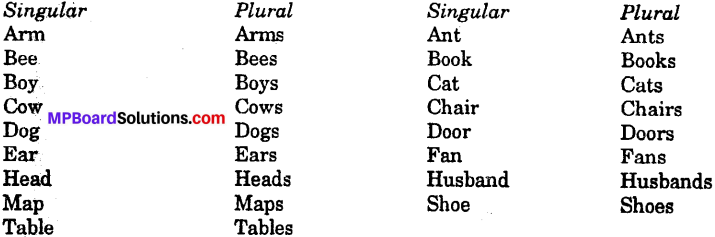
(1) Singular Number (एकवचन) Noun का वह रूप है जिससे एक प्राणी या वस्तु का बोध हो। जैसे-man, boy, girl, chair, etc.
(2) Plural Number (बहुवचन) Noun का वह रूप है जिससे एक से अधिक प्राणियों या वस्तुओं का बोट होता है।
जैसे-
man, boys, girls, chairs, etc.

Formation of Plurals
(बहुवचन बनाना)

Singular से Plural बनाने के लिए निम्नलिखित नियम होते हैं

1. Singular number के अन्त में ‘ड’ जोड़कर-
MP Board Class 7th Special English Grammar 1

2. जिन Nouns के अन्त में ‘g’, ‘sh’, ‘ss’, ‘ch’ या ‘x’ होता है, उनके अन्त में ‘es’ जोडकर
MP Board Class 7th Special English Grammar 2

3. जिन Nouns के अन्त में ‘y’ होता है और ‘y’ से पूर्व Vowel हो, तो उनका Plural बनाने के लिए ‘y के पश्चात् ” लगाया जाता है।
MP Board Class 7th Special English Grammar 3

4. जिन Nouns के अन्त में ‘y’ होता है और y’ से पूर्व Consonant हो, तो उनका Plural बनाने के लिए y’ को ” में बदलकर ‘es’ जोड़ दिया जाता है।
MP Board Class 7th Special English Grammar 4

5. जिन Nouns के अन्त में ‘o’ होता है उनका Plural बनाने के लिए उनके बाद में ‘es’ जोड़ा जाता है।
MP Board Class 7th Special English Grammar 5

6. जिन Nouns के अन्त में Fया ‘fe’ होता है, उनका Plural बनाने के लिए ‘ या ‘fe’ को ‘V’ में बदलकर ‘es’ जोड़ दिया जाता है।
MP Board Class 7th Special English Grammar 6

7. कुछ Nouns का Plural बनाने के लिए Singular के अन्दर का Vowel बदल देते हैं।
MP Board Class 7th Special English Grammar 7

8. कुछ Nouns के Singular और Plural एक-से (समान) ही होते हैं।
MP Board Class 7th Special English Grammar 8

9. कुछ Nouns सदैव Singular में ही प्रयोग किए जाते हैं।
MP Board Class 7th Special English Grammar 9

10. कुछ Nouns सदैव Plural में ही प्रयोग किए जाते हैं।
MP Board Class 7th Special English Grammar 10

EXERCISE

  1. निम्नलिखित Nouns को Plural में बदलो
    Baby, branch, bush, wolf, army, loaf, face, wife, child, buffalo, ox, goose, potato, chair, chief, woman, eye, fairy, monkey.
  2. निम्नलिखित Nouns को Singular में बदलो
    Benches, machines, cities, houses, flies, nice, tomatoes, taxes, calves, lives, bamboos, men.

The Gender

परिभाषा-Noun के जिस रूप में यह पता चले कि Noun पुरुष है या स्त्री या बेजान (निर्जीव) है, उसे Gender कहते हैं।

Gender चार प्रकार के होते हैं

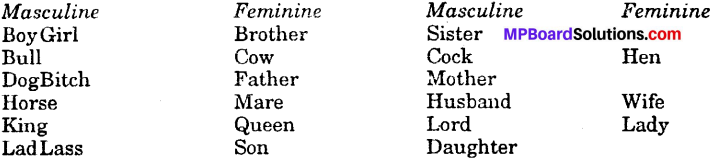
  1. Masculine Gender (पुल्लिंग)-वे संज्ञाएँ जो पुरुष जाति से सम्बन्धित होती हैं, उन्हें Masculine (पुल्लिंग) कहते हैं। जैसे-man, dog, boy, horse आदि।
  2. Feminine Gender (स्त्रीलिंग)-वे संज्ञाएँ जो स्त्री जाति से सम्बन्धित होती हैं, उन्हें Feminine (स्त्रीलिंग) कहते हैं। जैसे-women, bitch (कुतिया) girl, mare (घोड़ी) आदि।
  3. Common Gender (उभयलिंग)-जिन Nouns से पुरुष और स्त्री दोनों का बोध होता है, Common Gender में होते हैं। जैसे-child, friends, pupil, (शिष्य) enemy आदि।
  4. Neuter Gender (नपुंसकलिंग)-जिन Nouns से निर्जीव वस्तु का बोध होता है, वे Neuter Gender में होते हैं। जैसे-chair, table, book, house आदि।

नोट-Commmon तथा Neuter Gender का लिंग परिवर्तन नहीं होता है।

CHANGE OF GENDER
(लिंग परिवर्तन)

Masculine से Feminine बनाने के नियम नीचे दिए गए हैं।
1. Singular number के अन्त में ” जोड़कर
MP Board Class 7th Special English Grammar 11

2. Masculine के अन्त में ‘ess’ लगाकरMasculine
MP Board Class 7th Special English Grammar 12

3. Masculine के प्रथम अथवा अन्तिम शब्द को बदलकर।
MP Board Class 7th Special English Grammar 13

EXERCISE 2

निम्नलिखित Nouns के Opposite Gender लिखो।
(a) Cow, poet, land-lord, lad.
(b) Misterss aunt, hero, horse, king.
(c) Princess, brother, mother, girl, actor, man.

Degrees of Comparison

Adjective on to Degrees in

  1. Positive Degree
  2. Comparative degree
  3. Superlative Degree

Comparative तथा Superlative बनाने के नियम
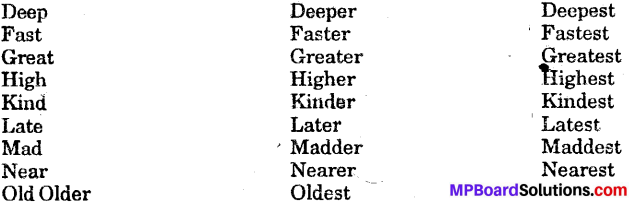
1. Positive Degree के अन्त में ‘er’ और ‘est’ लगाकर।
MP Board Class 7th Special English Grammar 14
MP Board Class 7th Special English Grammar 15

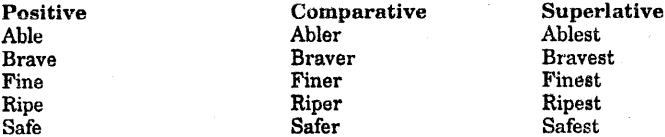
2. Positive Degree के अन्त में जब ‘e’ अक्षर होता है तो’ और ‘st’ लगाकर
MP Board Class 7th Special English Grammar 16

3. Positive Degree के अन्त में यदि ‘ हो तो y’ को ‘ में बदलकर उसमें ‘err और ‘est’ लगाकर।
MP Board Class 7th Special English Grammar 17

4. Positive degree के पूर्व more यो most लगाकर
MP Board Class 7th Special English Grammar 18

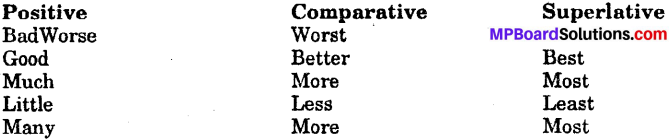
5. बिना किसी नियम के।
MP Board Class 7th Special English Grammar 19

EXERCISE 3

Write the comparative and superlative degrees of the following adjectives :

  • Wise, tall, long, good, bad, old, happy, little.
  • Rich, young, big, strong, ugly, holy.
  • Kind, up, able, safe, dry, useful.

EXERCISE 4

Fill in the blanks with the correct form of adjectives given in the brackets.

  1. Pen is ……………………………… than sword. (might)
  2. Shyam is ……………………………… than Ram (tall)
  3. Kolkata is the ……………………………… city in India. (busy)
  4. Shimla is ……………………………… than Delhi. (cold)
  5. He is the ……………………………… of all the brothers. (wise)
  6. Shipra is the ……………………………… of all the sisters. (pretty)
  7. Rohit is ……………………………… than Mohit. (Clever)

The Preposition

A Preposition is a word which is placed before a Noun or å Pronoun to show its relation with other words.
जो शब्द किसी Noun या Pronoun के पूर्व रखा जाता है और जो उसका सम्बन्ध अन्य शब्दा ते बताता है, Preposition कहलाता है। जैसे :

The pen is on the table.
इस वाक्य में ‘on’ Preposition है, जो pen का सम्बन्ध table से बताता है।

Some Important Prepositions – At, on, in, to, by, with, for, from, out, of, up, under, upon, about, before, behind, between, beneath, within, without.

Use of Some Prepositions
1. At, In: At छोटे स्थान के साथ प्रयोग किया जाता है। In बड़े स्थान के साथ प्रयोग किया जाता है।
जैसे

  • He lives at Bhopal.
  • We live in India.

2. In, Into : In स्थिति को बताता है और Into गति का बोध कराता है। जैसे

  • All the boys are in the classroom.
  • We bought the tickets and went into the hall.

3. With, By : with यंत्र के साथ प्रयोग होता है और by कार्य करने वाले के साथ प्रयोग किया जाता है। जैसे

  • We cut the apple with the knife.
  • The snake was killed by the farmer.

4. Since, For : Since निश्चित समय के साथ (जैसे दिन का नाम या तिथि आदि) और For समय की अवधि के साथ प्रयोग किया जाता है। जैसे

  • He has been ill Since Monday.
  • Raj Kumar has been absent for three days.

5. Between, Among : Between दो व्यक्तियों तथा Among दो से अधिक व्यक्तियों के लिए प्रयोग किया जाता है। जैसे

  1. Divide these mangoes between Raj and Ravi.
  2. The gentlemen divided his property among his four sons.

6. On, Upon : On गतिहीनता तथा Upon गतिशीलता के लिए प्रयोग किया जाता है।

जैसे-

  • The cat is sitting on the table.
  • The dog sprang upon the table.

7. In, Within : In समय की अवधि की समाप्ति का बोध कराता है और Within समय की अवधि के भीतर का बोध कराता है। जैसे

  • I shall come back in a week. (एक सप्ताह की समाप्ति पर)
  • I shall come within a week. (एक सप्ताह समाप्त हाने से पूर्व)

8. Below, Beneath : Below पद के संदर्भ में और Beneath स्थान के संदर्भ में प्रयोग किया जाता है। जैसे

  • Your brother is below my rank.
  • The lion sat beneath a tree.

9. Beside, Besides : Beside का अर्थ है-पास (by the side of) जब कि Besides का अर्थ है-अतिरिक्त। जैसे

  • The boys stood beside the teacher’s chair.
  • Besides the Principal other teachers spoke in the prayer assembly.

10. With, Without : With का अर्थ है-साथ और Without का अर्थ है-बिना (रहित)।

जैसे-

  • Come to me with your brother.
  • Come to the field without anything.

EXERCISE 6
Fill in the blank with suitable prepositions given in bracket :

  1. I went to Indore …………………………….. May. (on, in, at)
  2. She bought this pen …………………………….. ten rupees. (with, of, for)
  3. The monkey jumped …………………………….. the rive. (in, into, on)
  4. He ran …………………………….. the thief. (before, after, with)
  5. He started …………………………….. six …………………………….. the morning. (in, on, at)
  6. Kanıla plucked an apple …………………………….. the tree. (from, on, at with)
  7. The teacher beat him …………………………….. a cane. (by, with, from)
  8. I do not agree …………………………….. you. (on, by, with)

Conversion of Sentences

(1) Statements into Questions

  1. I see a bird – Do I see a bird ?
  2. He did his work. – Did he do his work ?
  3. The boy is writing a letter. – Is the boy writing a letter ?
  4. The teacher has taught the boys. – Has the teacher taught the boys ?
  5. She will come here. – Will she come here?

EXERCISE 7

Change the following setences from Statement into Questions :

  1. She is a good girl.
  2. The dog has a bone.
  3. The teacher is beating the boy.
  4. She will be reading the newspaper at this time.
  5. The horse was running.
  6. My mother had cooked food before 4 O’clock.
  7. The patient could not move.

(2) From positive into Negative

  1. Positive : I have a book.
    Negative : I have not a book.
  2. Positive : The girl is singing a song.
    Negative : The girl is not singing a song.
  3. Positive : He loves me.
    Negative : He does not love me.
  4. Positive : I bought a book yesterday.
    Negative : I did not buy a book yesterday.
  5. Positive : You will do this work today.
    Negative : You will not do this work today.
  6. Positive : I have done my work.
    Negative : I have not done my work.
  7. Positive : I play daily.
    Negative : I do not play daily.

EXERCISE 9

Change the following sentences from Positive to Negative :

  1. Pandit Jawaharlal Nehru was a great leader.
  2. My grand-father was a rich man in the village.
  3. She has a good doll to play with.
  4. I have three brothers and two sisters.
  5. You had a good time in Kashmir.
  6. The boys play hockey in the evening.
  7. Children like sweets.

Change of Voice

Voice दो प्रकार की होती है

  1. Active Voice,
  2. Passive Voice.

Active Voice: जब Verb द्वारा Subject की प्रधानता प्रकट होती है तो उसे Verb in the Active Voice कहते हैं। इस प्रकार के वाक्य में Subject स्वयं कार्य करता है।

जैसे-

  • He did his work.

Passive Voice : जब Verb द्वारा Object की प्रधानता प्रकट की जाती है तो उसे Verb in the Passive Voice कहते है।

जैसे-

  • His work was done by him.

Subject तथा Object की प्रधानता समझने के लिए निम्नलिखित वाक्यों पर ध्यान दीजिए :

  1. Active Voice : The cat killed the rat.
  2. Passive Voice : A rat was killed by the cat.

पहले वाक्य में Subject, Cat है, जो स्वयं कार्य करती है, परन्तु दूसरे वाक्य में उससे काम कराया गया है (अर्थात चूहे को मरवाया गया बिल्ली के द्वारा)। इस प्रकार दूसरे वाक्य में Rat को जो पहले वाक्य में Object था Subject बना दिया गया।

Active Voice से Passive Voice बनाने के नियम

  1. Active Voice के Object को Passive Voice में Subject बना दिया जाता है।
  2. Active Voice के Subject को Passive Voice में Object बना कर उससे पूर्व लगा दिया जाता है।
  3. Passive Voice में Main Verb सदैव अपनी Third Form में प्रयोग किया जाता है।
  4. Main Verb की Third Form के पूर्व Tense के अनुसार सहायक क्रिया प्रयोग की जाती है।

Tense के अनुसार क्रिया

1. Present Indefinite Tense : Is, are, am.

  • Active Voice : He writes a letter.
  • Passive Voice : A letter is written by him.
  • Active Voice :The girl sings songs daily.
  • Passive Voice : Songs are sung daily by the girl.
  • Active Voice : Harish helps me.
  • Passive Voice : I am helped by Harish.

2. Past Indefinite Tense : Was, were.

  • Active Voice : The boy wrote a letter.
  • Passive Voice : The letter was written by a boy.
  • Active Voice : The boy wrote two letters.
  • Passive Voice : Two letters were written by the boy.

3. Future Indefinite Tense : Will be, shall be.

  • Active Voice : He will write a letter.
  • Passive Voice : A letter will be written by him.
  • Active Voice : She will help me.
  • Passive Voice : I shall be helped by her.

4. Present Continuous Tense : Is being, are being, am being.

  • Active Voice : A letter is being written by him.
  • Passive Voice : A Letter is being written by him.
  • Active Voice : He is praising me.
  • Passive Voice : I am being praised by him.

5. Past Indefinite Tense : Was being, were being.

  • Active Voice : The man was selling eggs.
  • Passive Voice : Eggs were being sold by the man.
  • Active Voice : He was reading a book.
  • Passive Voice : A book was being read by him.

6. Present Perfect Tense : Has been, have been.

  • Active Voice : The boy has written an essay.
  • Passive Voice : An essay has been written by the boy.
  • Active Voice : The boy has eaten ten mangoes.
  • Passive Voice : Ten mangoes have been eaten by the boy.

7. Past Perfect Tense : Had been.

  • Active Voice : She had done her work.
  • Passive Voice : Her work had been done by her.

8. Future Perefect Tense : Will have been, shall have been.

  • Active Voice : The teacher will have taught the lesson.
  • Passive Voice : The lesson will have been taught by the teacher.

EXERCISE 9

Change the Voice :

  1. The boy writes a letter.
  2. The cat killed two rats.
  3. The teacher will beat me.
  4. Hari has killed a snake.
  5. He is plucking mangoes.
  6. He was not obeying his mother.
  7. Raj will have written the essay.
  8. The train had left the station before I reached there.

The Articles

A, An और The को Articles कहते हैं। ये भी Noun की विशेषता Adjective की भांति बताते हैं। Articles दो प्रकार के होते हैं
1. Indefinite Article : ‘a’ तथा ‘an’ दोनों Indefinite Articles हैं, क्योंकि ये सामान्य वस्तु की ओर संकेत करते हैं। जैसे

  • A dog bit a boy.
  • I saw an owl on an apple tree.

संकेत- ‘An’ का प्रयोग उन Nouns के पूर्व किया जाता है, जो Vowel से आरम्भ होते हैं। जैसेAn eye, an angel, an inkpot, an umbrella.

2. Definite Article : केवल The definite article है। यह विशेष वस्तु की ओर संकेत करता है। जैसे
(i) My father met the Principal.
(ii) Arun went to see the Taj which stands on the right bank of the Jamuna.

EXERCISE 10

Fill in the blanks with a, an, and the

  1. Hindi is …………………………………………. easy language.
  2. …………………………………………. English defeated …………………………………………. Germans
  3. …………………………………………. horse is …………………………………………. useful animal.
  4. He bought …………………………………………. camel …………………………………………. ox and …………………………………………. bullock.
  5. Give him …………………………………………. orange.
  6. …………………………………………. rose is …………………………………………. king of flowers.
  7. …………………………………………. hint to …………………………………………. wise is enough.
  8. She returned after …………………………………………. hour.

Direct and Indirect Narration

किसी अन्य व्यक्ति द्वारा कही हुई बात हम दो प्रकार से लिखते हैं-
(1) कहने वाले के मूल (असली) शब्दों में ज्यों का त्यों रखना। इसे Direct Speech कहते हैं। यह सदैव Inverted Commas “…….” में रखी जाती है।

जैसे-

  • Kamal says, “I am going.”

(2) कहने वाले की बात को अपने शब्दों में बदलकर रखना। इसे Indirect Speech कहते हैं।

जैसे-

  • Kamal Says that he is going.

संकेत-Indirect Speech में Inverted Commas नहीं दिये जाते हैं।

Direct Speech के दो भाग होते हैं

  1. Inverted Commas के पहले वाला भाग। इससे वाक्य को आरम्भ करते हैं। इसे Reporting Verb कहते हैं। उपर्युक्त वाक्य में Kamal says, Reporting Verb हैं।
  2. Inverted Commas के अन्दर लिखे हुए शब्द। इसे Reported Speech कहते हैं। उपर्युक्त वाक्य में “I am going”, Reported Speech है।

Direct Speech को Indirect Speech में बदलने के सामान्य नियम

  1. Reported Speech के Inverted Commas को Indirect Speech में हटा देते हैं।
  2. Reporting Verb तथा Reported Speech के बीच के Comma को हटा दिया जाता है।
  3. Reported Speech का प्रथम अक्षर जो सदैव Capital होता है, Indirect Speech में Small letter हो जाता है।
  4. Reprorting Verb तथा Reported Speech को that लगाकर जोड़ दिया जाता है।
  5. Reported Speech की क्रिया (जब Reporting Verb, Past Tense में होता है) Past Tense में बदल दी जाती है।
  6. Pronoun का Person बदल जाता है।
  7. समीपता प्रकट करने वाले शब्द बदल कर दूरी प्रकट करने वाले शब्द बन जाते हैं। नोट- अन्तिम तीन प्रकार के परिवर्तन कुछ नियमों के अनुसार किये जाते हैं, जिनका वर्णन आगे किया जा रहा है।

Rules For
The Change Of Tenses

Rule 1. यदि Reporting Verb, present अथवा Future Tense में होता है, तो Reported Speech के Verb का Tense, Indirect Speech में नहीं बदलता है।
MP Board Class 7th Special English Grammar 20

Example :
Direct : He says, “Mohan is a good boy.”
Indirect : He says that Mohan is a good boy.
Direct : She is saying, “The teacher went away.”
Indirect : She is saying that the teacher went away.
Direct : He will say, “The school will be closed.
”Indirect : He will say that the school will be closed.

2. जब Reporting Verb, Past Tense में होता है, तो Reported Speech के Verb का Tense, Indirect Speech में निम्नलिखित रूप में बदल जाता है-
Present Indefinite – बदलकर – Past Indefinite हो जाता है।
Present Imperfect – बदलकर – Past Imperfect हो जाता है।
Present Perfect – बदलकर – Past Perfect हो जाता है।
Present Continuous – बदलकर – Past Continuous हो जाता है।
Past Indefinite – बदलकर – Past Perfect हो जाता है।
Past Imperfect – बदलकर – Past Perfect हो जाता है।
Past Imperfect – बदलकर – Past Continuous हो जाता है।
Shall – बदलकर – Should या would हो जाता है।
Will – बदलकर – Would या Would हो जाता है।
May – बदलकर – Might हो जाता है।
Can – बंदलकर – Could हो जाता है।
Do not a does not – बदलकर – Did not हो जाता है।
Did not – बदलकर – Had not हो जाता है।
Is done u are done – बदलकर – Was या were done हो जाता है।
Was done – बदलकर – Had been done a To do (Infinizive) नहीं बदलता है।

EXAMPLES :
Direct’: Ram said, “Shyam runs.”
Indirect : Ram said that Shyam ran.
Direct : I said, “He is running.”
Indirect : I said that he was running.
Direct : I said, “He ran.”
Indirect : I said that he had run.
Direct : I said, “They will go.”
Indirect : I said that they would go.
Direct : I said, “He wants to go.”
Indirect : I said that he wanted to go.

3. परन्तु यदि Reported Speech, की क्रिया सदैव सत्य रहने वाला तथ्य अथवा आदत प्रकट करती है तो उसकी क्रिया Indirect में भी वर्तमान काल में रहती है।
जैसे-
Direct : He said, “The sun rises in the east.”
Indirect : He said that the sun rises in the east.”
Direct : He said, “Ram takes exercise daily.”
Indirect : He said that Ram takes exercise daily.

Rules For The Change Of Pronouns
1. Direct Speech at Indirect Speech में बदलते समय Reported Speech में First Person के Pronoun बदलकर Reporting Verb के Subject के Person के अनुसार हो जाते हैं, जैसे-
Direct : I said “I am going.”
Indirect : I said that I was going.
Direct : You said, “I am going.”
Indirect : You said that you were going.
Direct : He said, “I am going.”
Indirect : He said that he was going.

2. Reported Speech के Second Person के Pronouns, Indirect Speech में बदल कर Reporting Verb के Object के Person के अनुसार हो जाते हैं,
जैसे-
Direct : My father said to me, “You are a good boy.”
Indirect : My father told me that I was a good boy.
Direct : My father said to you, “You are a good boy.”
Indirect : My father told you that you were a good boy.
Direct : My father said to him, “You love your sister.”
Indirect : My father told him that he loved his sister.

3. Direct Speech of third person & Pronouns, Indirect Speech sf third person en
Direct : She said, “He has gone back.”
Indirect : She said that he had gone back.
Direct : He said, “They went to Africa.”
Indirect : He said that they had gone to Africa.

4. Reported Speech में जब ‘We’ कहने वाले तथा सुनने वाले दोनों के लिए आता है तो Indirect Speech में भी We ही रहता है।
जैसे-
Direct : I said to him, “We are friends.”
Indirect : I told him that we are friends.

3. Rules For The Change Of Words Showing Nearness
Direct Speech को Indirect Speech में बदलते समय Reorted Speech के निकटता प्रकट करने वाले शब्दों को दूरी प्रकट करने वाले शब्दों में इस प्रकार बदल दिया जाता है।
जैसे-

Examples :
Direct : He said, “Mohan will come now.”
Indirect : He said that Mohan would go then.
Direct : He said, “He is here today”.
Indirect : He said that he was There that day,

EXERCISE 11
Turn the following into Indirect narration :

  1. I said, “I am sick.”
  2. You said, “I shall write a letter today.”
  3. Hari said, “I broke my slate yesterday.”
  4. Raj said to Hari, “You are in the wrong on this point.”
  5. I said to hin, “You will go to the market now.”
  6. The teacher said to Radhey, “You have brought bad name to your school.”
  7. The teacher said, “Everybody knows that the earth is round.”
  8. The man said, “This is my house and that is yours.”

Opposite Words
(Antonyms विपरीतार्थक शब्द)

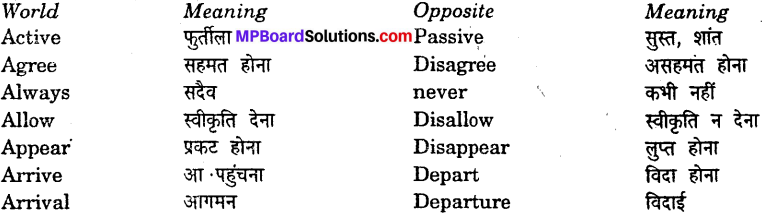
MP Board Class 7th Special English Grammar 21
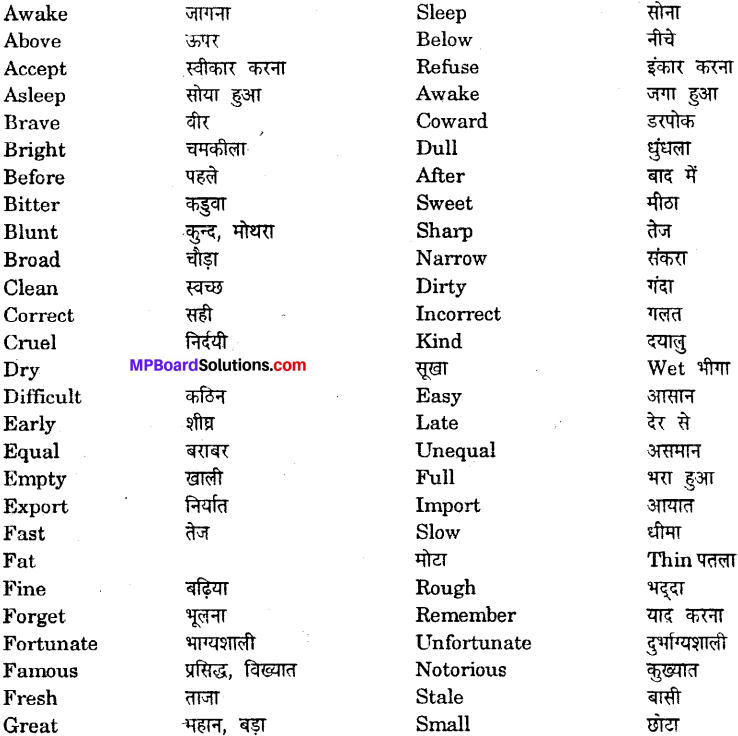
MP Board Class 7th Special English Grammar 22
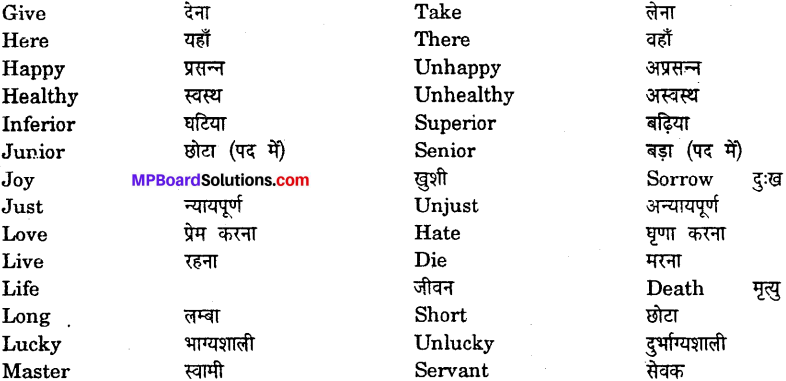
MP Board Class 7th Special English Grammar 23
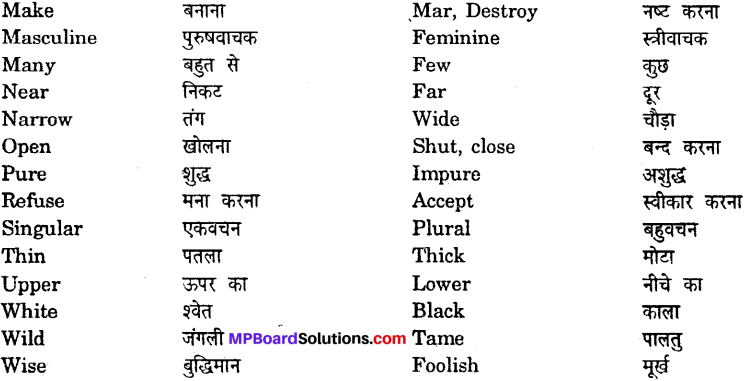
MP Board Class 7th Special English Grammar 24

Exercise :
Give the antonyms (opposites) of the following :
Cold, beautiful, light, pure, narrow, small, difficult, careful, export, friend, high, cool, day, white, timid. easily, happy, fine, near.

We believe the information shared regarding MP Board Solutions for Class 7 English Chapter 21 Tansen Questions and Answers as far as our knowledge is concerned is true and reliable. In case of any queries or suggestions do leave us your feedback and our team will guide you at soonest possibility. Bookmark our site to avail latest updates on several state board Solutions at your fingertips.

MP Board Class 7th Special English Letter and Application Writing

Get Updated MP Board Solutions for Class 7 Special English Letter and Application Writing Questions and Answers in PDF Format and download them free of cost. These are provided as per the latest exam pattern and syllabus. Access the topics of Chapter wise and communication skills, grammer part through the direct links available depending on the need. You can Download MP Board Class 7 English Solutions and can score highest grade in examination. Clear all your queries on the Mp Board Solutions for Class 7 English Chapter 21 Tansen Questions and Answers Subject by using the Madhya Pradesh State Board Solutions for existing.

MP Board Class 7th Special English Letter and Application Writing

If you are eager to know about the Madhya Pradesh State Board Solutions for Class 7 English you will find all of them here. You can identify the knowledge gap using these MP Board Solutions for English PDF and plan accordingly. Don’t worry about the accuracy as they are given after extensive research by people having subject knowledge along side from the latest English Syllabus.

1. Write an application to your Headmaster or Principal requesting him to remit your absence fine.
To,
The Headmaster,
Govt. High School,
Agra City.

Sir,
Last Month I remained absent from school for five days. I fell ill. I gave my application to Raj, a student of class VI.
Raj forgot to give the application to my class teacher. So, I was fined. I am a poor boy. I cannot pay the fine.
Kindly remit my absence fine.

Thanks

Yours obediently,
Naveen Kumar,
Class Vi
Date : 14th Sept. 2005

2. Write an application to the Headmaster of your school requesting him to exempt you for payment of tuition fee.
To,
The Headmaster,
Govt. High School.
Jabalpur Cantt.

Sir,
Most respectfully, I beg to state that my father is so poor that he cannot pay my school fees. He has a large family of seven members to support. His income is Rs. 600-a month. It is very difficult for us to make both ends meet.

I am student of class VIB of your school. I got very good marks in all the subjects in the last examination. I am a good hockey player of junior team and also obedient to all the teachers. I am regular in my studies as well as in attendance.

I am sure you will kindly grant me full fee concession.

Yours faithfully,
X
Date : February 4, 2006

3. Write an application to your principal requesting him to grant you sick leave.
To
The Principal,
Govt. Inter College,
Gwalior.

Sir,
Most respectully, I beg to say that I have been suffering from fever since last night. I am unable to attend college.
Kindly grant me sick leave for five days.

Your obedient pupil,
Naveen Chandra,
Class W-A.
Date : March’ 10, 2006

4. Write a letter to your mother fillingabout your new school.
25, Model Town,
Indore
July 20, 2006

My dear Mother,
I am glad to write that I like new school very much. My class-fellows are very kind to me. My teachers are very gentle. They always help us in studies and games.

The building of the school is grand. The school has beautiful park. It has two big playgrounds. Kindly pay my respects to father.

Your Loving Son,
Arun.

5. Write a letter to your father telling him how you are going with your studies.
F-20, Nehru Nagar,
Gwalior
December 5, 2005

My dear fathers,

I got your letter yesterday. You have asked me about my studies, Dear father, I am working well. I get up early in the morning and study for many hours.

I got good marks in the half-yearly examination.

Kindly pay my respects to dear mother and love to dear Alok and Meghna.

Yours affectionately,
Geeta Sharma

6. Write a letter to your friend congratulating him or her on his or her success in the examination.
Patel Nagar,
Bhopal
June 15, 2005

My dear Usha,
Yesterday I got the news of your success in the High School Examination. My father brought this happy news.

You passed the examination in the first class. I congratulate you on your success. Pay my respects to your parents.

Yours sincerely,
Hem Lata.

7. Write a letter of sympathy to a friend who has failed in the examination. Prem Puri, Indore
June 15, 2005
My dear Santhosh,

I am very sorry to learn that you failed in the High School Examination. It was all due to your illness.

You should not lose heart. Please work hard. This year you will get got marks.I have great sympathy with you.

Please pay my respects to your parents.

Yours sincerely,
Girish

8. Write a letter to your friend inviting him or her to tea.
Sadar Bazar, Jabalpur
May 20, 2006

My dear Sheela,
You will be glad to know that my birthday falls on May 25, 2006 I am giving a grand tea party to my friends on that day.

I request you to reach my house at 3 p.m.

Yours sincerely,
Rangina.

9. Write a letter to a book-seller ordering him to send you some books.
116, Nai Basti,
Raipur.
July 20, 2006
To,
The Manager,
Kamal Prakashan,
New Delhi.

Dear Sir,
I request you to send me the following books as per V.P.P. The books must be in a good condition.

Please send them as early as possible.

1. A.B.C. Grammer for class VI 5 Copies
2. Hamara Samaj 5 Copies
3. English Guide for class VI 5 Copies

Yours faithfully,
Vidhya Sagar

We believe the information shared regarding MP Board Solutions for Class 7 English Chapter 21 Tansen Questions and Answers as far as our knowledge is concerned is true and reliable. In case of any queries or suggestions do leave us your feedback and our team will guide you at soonest possibility. Bookmark our site to avail latest updates on several state board Solutions at your fingertips.

MP Board Class 7th Special English Translation

Get Updated MP Board Solutions for Class 7 Special English Translation Questions and Answers in PDF Format and download them free of cost. These are provided as per the latest exam pattern and syllabus. Access the topics of Chapter wise and communication skills, grammer part through the direct links available depending on the need. You can Download MP Board Class 7 English Solutions and can score highest grade in examination. Clear all your queries on the Mp Board Solutions for Class 7 English Chapter 21 Tansen Questions and Answers Subject by using the Madhya Pradesh State Board Solutions for existing.

MP Board Class 7th Special English Translation

If you are eager to know about the Madhya Pradesh State Board Solutions for Class 7 English you will find all of them here. You can identify the knowledge gap using these MP Board Solutions for English PDF and plan accordingly. Don’t worry about the accuracy as they are given after extensive research by people having subject knowledge along side from the latest English Syllabus.

Use of ‘Is, Are, Am’

हिन्दी वाक्यों की पहचान – वाक्य के अन्त में ‘है, हैं और हूं’ शब्द होते हैं। ये Present Tense (वर्तमान काल) के वाक्य होते हैं।

अनुवाद के नियम –

  1. हिन्दी वाक्य की अंग्रेजी बनाते समय पहले Subject (का) रखा जाता है। फिर Verb (क्रिया) का प्रयोग होता है।
  2. ‘है’ की अंग्रेजी is’ है जिसका प्रयोग Singular Subjects जैसे He, She, It, This तथा That के साथ किया जाता है।
  3. हैं’ तथा ‘हो’ की अंग्रेजी ‘are’ है। इसका प्रयोग Plural Subject जैसे These, Those के साथ किया जाता है।
  4. ‘हूं’ की अंग्रेजी ‘am’ है। I के साथ सदैव ‘am’ का प्रयोग किया जाता है।
  5. Negative वाक्यों की रचना Is, Are, Am के पश्चात् ‘not’ रखकर की जाती है।
  6. Interrogative वाक्यों की रचना करने के लिए is, are या am को Subject से पहले रखा जाता है। वास्य के अन्त में Full – stop (.) के स्थान पर प्रश्नवाचक चिन्ह (?) प्रयोग किया जाता है।

Examples:
(A) Affirmative Sentences (सकारात्मक वाक्य)

  1. हरी एक लड़का है।
    Hari is a boy.
  2. तुम एक विद्यार्थी हो।
    You are a student.
  3. मैं तुम्हारा मित्र हूं।
    I am your friend.
  4. ये गायें हैं।
    These are cows.

(B) Negative Sentences (निषेधात्मक वाक्य)

  1. वह अच्छा लड़का नहीं है।
    He is not a good boy.
  2. वे किसान नहीं हैं।
    They are not farmers.
  3. मैं भूखा नहीं हूं।
    I am not hungry.

(C) Interrogative Sentences (प्रश्नवाचक वाक्य)

  1. क्या यह एक पुस्तक है?
    Is this a book?
  2. क्या वे प्यासे हैं?
    Are they thirsty?
  3. क्या मैं बुरा हूं?
    Am I bad?

EXERCISE 1
Translate into English :

  1. सीता एक नर्स है।
  2. हम अच्छे लड़के हैं।
  3. मैं प्यासा हूं।
  4. यह स्लेट अच्छी नहीं है।
  5. मैं एक खिलाड़ी नहीं हूं।
  6. लड़के कक्षा में नहीं हैं।
  7. क्या तुम थके हो?

Vocabulary :

नर्स – nurse; प्यासा – thirsty; स्लेट – slate; खिलाड़ी – player; थका – tired.

Use of Was,’ and ‘Were’.

हिन्दी वाक्यों की पहचान – वाक्यों के अन्त में ‘था, थे, थी, थीं, शब्द होते हैं। ये Past Tense (भूतकाल) के वाक्य होते हैं।

अनुवाद के नियम –

  1. ‘था’, ‘थी’, की अंग्रेजी was होती है। He, She, It, This, That, I तथा Singular Subjects (एकवचन कता) के साथ ‘was’ का प्रयोग किया जाता है।
  2. ‘थे’ ‘थीं’ की अंग्रेजी ‘were’ होती है। We, You They, Those तथा Plural Subjects (बहुवचन के कर्ता) के साथ ‘were’ का प्रयोग किया जाता है।
  3. Negative Sentences की रचना was या were के पश्चात् not रखकर की जाती है
  4. Interrogative Sentences की रचना was या were को Subject (कता) के पूर्व रखकर की जाती है और वाक्य के अन्त में प्रश्नवाचक चिन्ह (?) लगाया जाता है।

Examples:
(A) Affirmative Sentences (सकारात्मक वाक्य)

  1. वह एक सैनिक था।
    He was a soldier
  2. वे खिलाड़ी थे।
    They were players.
  3. उसकी गायें खेत में थीं।
    His cows were in the field.

(B) Negative Sentences (निषेधात्मक वाक्य)

  1. तुम्हारा कलम काला नहीं था।
    Your pen was not black.
  2. वे कक्षा में नहीं थे।
    They were not in the class.
  3. तुम घर पर नहीं थे।
    You were not at home.

(C) Interrogative Sentences (प्रश्नवाचक वाक्य)

  1. क्या बर्तन गर्म था?
    Was the pot hot?
  2. क्या बन्दर घर में थे?
    Were the monkeys in the house?
  3. क्या वह कल बीमार था?
    Was he ill yesterday?

EXERCISE 2
Translate into English :

  1. वह एक लड़का था।
  2. तीन लड़कियां पार्क में थीं।
  3. तुम अपने पिता के साथ थे।
  4. गीता बदसूरत नहीं थीं।
  5. मैं कमरे में नहीं था।
  6. गन्ने मीठे नहीं थे।

Vocabulary :

पार्क – park; साथ – with; बदसूरत – ugly; गन्ना – sugarcane; मीठा – sweet.

Use of ‘Has, Have, Had’

हिन्दी वाक्यों की पहचान – जिन वाक्यों में इनका प्रयोग होता है, उनसे किसी के अधिकार में किसी वस्तु के होने का बोध होता है।

अनुवाद के नियम –

  1. ‘पास है’ अथवा ‘रखता है’ के लिए He, She, It और Singular Subjects (एकवचन कता) के साथ ‘Has’ का प्रयोग Present Tense में किया जाता है।
  2. I, You, We, They तथा Plural Subjects (बहुवचन कर्ता) के साथ ‘have’ का प्रयोग Prestent Tense में किया जाता है।
  3. ‘पास था’ या ‘रखता था’ या ‘रखते थे’ के लिए ‘had’ का प्रयोग Past Tense में किया जाता है।
  4. Negative वाक्य बनाने के लिए has, have या had के पश्चात् ‘no’ या ‘not’ का प्रयोग किया जाता है।
  5. Interrogative वाक्यों की रचना करते समय has, have, अथवा had को Subject के पूर्व रखा जाता है। वाक्य के अन्त में प्रश्नसूचक चिन्ह (?) का प्रयोग किया जाता है।

Examples:
(A) Affirmative Sentences (सकारात्मक वाक्य)

  1. कुत्ते के पास एक हड्डी है।
    The dog has a bone.
  2. मेरे पास एक अंगूठी है।
    I have a ring.
  3. लड़कों के पास कलम है।
    The boys have pens.
  4. तुम्हारे पास चाकू था।
    You had a knife.

(B) Negative Sentences (निषेधात्मक वाक्य)

  1. सुरेश के पास पुस्तक नहीं है।
    Suresh has no book.
  2. तुम्हारे पास ताला नहीं है।
    You have not a lock.
  3. लड़के के पास प्याला नहीं था।
    The boy had no cup.

(C) Interrogative Sentences (प्रश्नवाचक वाक्य)

  1. क्या तुम्हारे पास अंगूठी है?
    Have you a ring?
  2. क्या सीमा के पास दो रूपये हैं?
    Has Seema two rupees?
  3. क्या उसके पास उपन्यास था?
    Had he a novel?

EXERCISE 3
Translate into English :

  1. डाकिये के पास एक थैला है।
  2. उसके पास दो मकान हैं।
  3. मेरे पास एक रोचक पुस्तक है।
  4. कौवे की एक चोंच होती है।
  5. मेरे पास गेंद नहीं हैं।
  6. तुम्हारे पास दस रूपये नहीं थे।
  7. साधू के पास भोजन न था।
  8. क्या माली के पास एक गाय है?

Vocabulary :

डाकिया – postman; रोचक – interesting; चोंच – beak; साधू – saint; धन – money; माली – gardener.

Imperative Sentences (Orders and Requests)

हिन्दी वाक्यों की पहचान – इन वाक्यों में आज्ञा दी जाती है, प्रार्थना की जाती है, कुछ मांगा जाता है या उपदेश दिया जाता है।

अनुवाद के नियम –

  1. ऐसे वाक्यों की अंग्रेजी बनाने के लिए Verb (क्रिया) की First form को वाक्य के आरम्भ में रखा जाता है।
  2. ऐसे वाक्यों का कर्ता You’ होता है, जो लुप्त रहता है।
  3. ऐसे वाक्यों में ‘अपने’ की अंग्रेजी सदैव Your प्रयोग की जाती है।
  4. यदि वाक्य में ‘मत’ शब्द आया हो, तो उसके लिए Do not पहले रखते हैं।

Examples:
(A) Affirmative Sentences (सकारात्मक वाक्य)

  1. यहां आओं।
    Come here.
  2. पत्र लिखों।
    Write a letter.
  3. अपनी पुस्तक पढ़ों।
    Read your book.
  4. कृपया मुझे पानी दीजिए।
    Please give me water.
  5. वहां मत जाओ।
    Do not go there.

EXERCISE 4
Translate into English :

  1. वहां जाओं।
  2. बैंच पर खड़े हो जाओ।
  3. मुझे अपने दाँत दिखाओ।
  4. कृपया मेरी बात सुनो।
  5. धीरे – धीरे चलो।
  6. तेज मत भागो।
  7. अपने बड़ों का कहना मानो।

Vocabulary :

दांत – teeth; मेरी सुनो – listen to me; धीरे – धीरे – slowly; तेज – fast; कहना मानो – obey; सुबह सवेरे – early in the morning.

Present Indefinite Tense
Or
Simple Present Tense

इस काल के वाक्यों की पहचान – वाक्यों के अन्त में ‘ता है, ती हूं’ आदि शब्द आते हैं।

  1. Simple Sentences में He, She, It तथा एकवचन कर्ता के साथ Verb की First form के अन्त में ‘s’ या ‘es’ लगाया जाता है।
  2. I, You, We, They तथा बहुवचन कर्ता के साथ केवल Verb की First form प्रयोग की जाती है।
  3. Negative Sentences की रचना में He, She, It, तथा एकवचन कर्ता के साथ Verb की First form के पूर्व does not लगाया जाता है।
  4. I, You, We, They तथा बहुवचन कर्ता के साथ Verb की First form के पहले do not प्रयोग किया जाता है।
  5. ‘कभी नहीं’ के लिए क्रिया के पूर्व never लगाया जाता है। Never के साथ do या does का प्रयोग नहीं किया जाता है। परन्तु यदि कर्ता एकवचन है, तो क्रिया के अन्त में ‘s’ या ‘es’ का प्रयोग किया जाता है।
  6. Interrogative Sentences की रचना में Subject के पूर्व Do या Does प्रयोग करके कर्ता के पश्चात् Verb की First form का प्रयोग किया जाता है।

Examples:
(A) Affirmative Sentences (सकारात्मक वाक्य)

  1. राकेश खेलता है।
    Rakesh plays.
  2. सीमा वहां रोज जाती है।
    Seema goes there daily.
  3. मैं पत्र लिखता हूं।
    I write a letter.
  4. लड़के स्कूल जाते हैं।
    The boys go to school.

(B) Negative Sentences (निषेधवाचक वाक्य)

  1. यह लड़का नहीं पढ़ता है।
    This boy does not read.
  2. मोर यहां नहीं रहते हैं।
    The peacocks do not live here.
  3. वह यहां कभी नहीं आता है।
    He never comes here.

(C) Interrogative Sentences (प्रश्नवाचक वाक्य)

  1. क्या रवि पढ़ता है?
    Does Ravi read?
  2. क्या तुम वहां जाते हो?
    Do you go there?
  3. क्या लड़के शोर मचाते हैं?
    Do the boys make a noise?

EXERCISE 5
Translate into English :

  1. वह रोज गांव जाता है।
  2. हम शाम को खेलते हैं।
  3. सूर्य पूर्व में निकलता है।
  4. मेरे पिताजी मेरी देखभाल करते हैं।
  5. किरन नहीं खेलती है।
  6. तुम मेरा कहना नहीं मानते हो?
  7. वे कभी झूठ नहीं बोलते हैं।
  8. क्या बच्चा रात में सोता है?

Vocabulary:

रोज – daily; निकलना – rise; देखभाल करना – look after; कहना मानना – obey; झूठ बोलना – tell me lie; रोना – weep; धोबी – washer – man; तालाब – tank.

Present Continuous Tense

हिन्दी वाक्यों की पहचान –

  1. कार्य लगातार चलता रहता है, परन्तु समय दिया हुआ नहीं होता है।
  2. वाक्यों में अन्त में ‘रहा है, रही है, रहा हूं, रहे हैं, रही हैं’ आदि होते हैं।

अनुवाद के नियम –

  1. इस Tense के वाक्यों का अनुवाद करने के लिए Verb की पहली form के अन्त में ‘ing’ जोड़ कर उसके पूर्व is, are या am रख दिया जाता है। You, We, They तथा बहुवचन के साथ ‘are’ लगाया जाता है।
  2. I के साथ am लगाया जाता है।
  3. He, She, It, तथा एकवचन कर्ता के साथ is’ का प्रयोग किया जाता है।
  4. Negative Sentences में is, are, am के बाद not लगाकर अनुवाद किया जाता है।
  5. Interrogative Sentences की रचना is, are या am को वाक्य के पूर्व रखकर की जाती है और वाक्य के अन्त पर प्रश्नसूचक चिन्ह (?) लगाया जाता हैं।

Examples:
(A) Affirmative Sentences (सकारात्मक वाक्य)

  1. भूषण बाजार जा रहा है।
    Bhushan is going to bazaar.
  2. मैं अपना काम कर रहा हूं।
    I am doing my work.
  3. लड़के हॉकी खेल रहे हैं।
    The boys are playing hockey.

(B) Negative Sentences (निषेधवाचक वाक्य)

  1. लड़की नहीं नाच रही है।
    The girl is not dancing.
  2. तुम अपना काम नहीं कर रहे हो।
    You are not doing your work.
  3. मैं सो नहीं रहा हूं।
    I am not sleeping.

(C) Interrogative Sentences (प्रश्नवाचक वाक्य)

  1. क्या सुनील सो रहा है?
    Is Suneel sleeping?
  2. क्या वे अपने गांव जा रहे हैं?
    Are they going to their village?
  3. क्या मैं उसकी सहायता नहीं कर रहा हूं?
    Am I not helping here

EXERCISE 6
Translate into English :

  1. मैं कठिन परिश्रम कर रहा हूं।
  2. वह अपना कार्य कर रहा है।
  3. लड़कियां खाना बना रही हैं।
  4. रवि प्रश्न हल नहीं कर रहा है।
  5. मैं इस मकान में नहीं रह रहा हूं।
  6. लड़के मैच नहीं खेल रहे हैं।
  7. क्या कौवा पेड़ पर बैठा है?
  8. क्या लड़के नदी में नहा रहे हैं?

Vocabulary :

कठिन परिश्रम करना – to work hard; खाना बनाना – to prepare food; हल करना to solve; भेच – match; कौवा – crow; नदी – river; नहाना – to bathe.

Present Perfect Tense

इस काल के वाक्य की पहचान –

  1. इस काल के वाक्यों में काम समाप्त हो जाता है।
  2. वाक्यों के अन्त में ‘या है, ओं है, ई हूं, चुका हैं, चुके हैं, चुका हूं’ आदि होते हैं।

अनुवाद के नियम –

  1. Simple Sentence में जब कर्ता He, She, It अथवा एकवचन होता है उसमें Verb की Third form के पूर्व has लगाया जाता है।
  2. जिस वाक्य में कर्ता I, You, We, They अथवा बहुवचन होता है उसमें Verb की Third form के पूर्व have लगाया जाता है।

(B) Negative Sentences की रचना में has या have के पश्चात् not लगाकर Verb की Third form लगा दी जाती है।

(C)

  1. Interrogative Sentences में has या have को वाक्य के आरम्भ में कर्ता के पूर्व रखा जाता है।
  2. वाक्य के अन्त में प्रश्नसूचक चिन्ह (?) लगाया जाता है।

Examples:
(A) Affirmative Sentences (सकारात्मक वाक्य)

  1. राज खाना खा चुका है।
    Raj has eaten food.
  2. मैंने पत्र लिख लिया है।
    I have written the letter.

(B) Negative Sentences (निषेधवाचक वाक्य)

  1. उसने अपना काम समाप्त नहीं किया है।
    He has not finishied his work.
  2. उन्होंने अपना पाठ याद नहीं किया है।
    They have not learnt their lesson.

(C) Interrogative Sentences (प्रश्नवाचक वाक्य)

  1. क्या बच्चा सो गया है?
    Has the child slept?
  2. क्या लड़के खेल चुके हैं?
    Have the boys played?

EXERCISE 7
Translate into English :

  1. हरी खाना खा चुका है।
  2. वर्षा थम चुकी है।
  3. लड़के भोपाल चले गये हैं।
  4. मैं अपना काम कर चुका हूं।
  5. सूरज अभी नहीं छुपा है।
  6. गुरूजी ने पाठ नहीं पढ़ाया है।
  7. उन्होंने कभी झूठ नहीं बोला है।
  8. क्या लड़के मैच खेल चुके हैं?
  9. क्या तुमने कार्य समाप्त कर लिया है?

Vocabulary :

थम जाना – cease; छिपना – set; पढ़ना – teach; झूठ बोलना – tell a lie; कभी – never.

Past Indefinite Tense
Or
Simple Past Tense

इस काल के वाक्यो की पहचानवाक्यों के अन्त में ‘ता था’, ‘ते थे’, ‘ती थी’, अथा पढ़ा, दौड़ा, खाया, सोया आदि जैसी क्रिया लगी रहती है।

  1. Simple Sentences में Verb की दूसरी forrn का प्रयोग होता है।
  2. Negative Sentences में did not के बाद Verb की पहली form का प्रयोग होता है।
  3. Interrogative Sentences में वाक्य के आरंभ में Did लगाकर Verb की पहली form का प्रयोग किया जाता है और वाक्य के अंत में प्रश्नवाचक चिह्न (?) लगाया जाता है।

Examples:
(A) Affirmative Sentences (सकारात्मक वाक्य)

  1. कुत्ता भौंका।
    ‘The dog barked.
  2. लड़कियों ने गाना गाया।
    The girls sang a song.
  3. रीता ने पत्र पढ़ा।
    Reeta read the letter.
  4. बच्चे शाम में खेले।
    Children played in the evening.
  5. माँ ने खाना बनाया।
    Mother cooked food.

(B) Negative Sentences (निषेधवाचक वाक्य)

  1. मैं वहां नहीं गया।
    I did not go there.
  2. उसने पत्र नहीं लिखा।
    He did not write a letter.
  3. सुमित ने अपना पाठ नहीं याद किया।
    Sumit did not learn his lesson.
  4. पिताजी ने खाना नहीं खाया।
    Father did not eat food.
  5. वे लोग तेजी से नहीं दौड़े।
    They did not run fast.

(C) Interrogative Sentences (प्रश्नवाचक वाक्य)

  1. क्या पुलिस ने चोर को पकड़ा?
    Dil the police catch the thief?
  2. क्या तुमने पत्र लिखा? ।
    Did you write a letter?
  3. क्या आपने झूठ बोला?
    Did you tell a lie?
  4. क्या श्यामा ने घड़ी में चाबी दी?
    Did Shyama wind the watch?
  5. क्या बच्चे मैदान में गए?
    Did children go to the field?

EXERCISE 8
Translate into English :

  1. बच्चों ने भिखारी को भोजन दिए।
  2. पुलिस ने चोर का पीछा किया।
  3. राधा ने अपने भाई को मिठाई दी।
  4. उसका भाई पिछले साल फेल हो गया।
  5. हम लोग शाम में बाजार गए।
  6. तुमने मेरी सहायता नहीं की।
  7. मैंने व्यायाम नहीं किया।
  8. हम स्टेशन समय पर नहीं पहुंचे।
  9. रमण और चमन ने खाना नहीं खाया।
  10. बिल्ली ने दूध नहीं पिया।

Vocabulary :

भिखारी – beggar; भोजन – food; चोर – thief; पीछा किया – chased; मिठाई – sweets; शामevening; बाजार – market; व्यायाम – exercise.

Past Continuous Tense

वाक्यों की पहचान –

  1. यह भूतकाल में निरन्तरता से घटित क्रिया को प्रकट करता है।
  2. वाक्यों के अंत में ‘रहा था’, ‘रहे थे’, ‘रही थी’ आदि होते हैं।

अनुवाद के नियम –

  1. इस Tense के वाक्यों का अनुवाद करने के लिए Verb की पहली form के अंत में ‘ing जोड़कर उसके पूर्व was या were (कर्ता के अनुसार) रख दिया जाता है।
  2. एकवचन कर्ता के साथ ‘was’ एवं बहुवचन कर्ता के साथ ‘were’ का प्रयोग होता है।
  3. Interrogative Sentences में ‘was’ या ‘were’ को वाक्य के पूर्व में रख दिया जाता है। वाक्य के अंत में प्रश्नवाचक चिह्न (?) लगाया जाता है।
  4. Nagative Sentences में ‘was’ एवं ‘were’ के बाद ‘not’ का प्रयोग होता है।

Examples:
(A) Affirmative Sentences (सकारात्मक वाक्य)

  1. रमा पत्र लिख रही थी।
    Rama was writing a letter.
  2. बच्चे खेल रहे थे।
    Children were playing.
  3. चपरासी घंटी बजा रहा था।
    The Peon was ringing the bell.
  4. कुत्ता भौंक रहा था।
    The dog was barking.
  5. हम लोग कूद रहे थे।
    We were jumping.

(B) Negative Sentences (निषेधवाचक वाक्य)

  1. 1. बच्चे शोर नहीं मचा रहे थे।
    Children were not making a noise.
  2. 2. तुम लोग झूठ नहीं बोल रहे थे।
    You were not telling a lie.
  3. 3. वह नहीं सो रहा था।
    He was not sleeping.
  4. 4. राधा नहीं पढ़ रही थी।
    Radha was not studying.
  5. 5. वे लोग हंस नहीं रहे थे।
    They were not laughing

(C) Interrogative Sentences (प्रश्नवाचक वाक्य)

  1. क्या वह खाना बना रही थी?
    Was she cooking food?
  2. क्या वे बाजार जा रहे थे?
    Were they going to market?
  3. क्या पिताजी अखबार पढ़ रहे थे?
    Was father reading the newspaper?
  4. क्या वह मेरी सहायता कर रहा था
    Was he helping me?
  5. क्या लड़किया नांच रही थीं?
    Were the girls dancing?

EXERCISE 9
Translate into English:

  1. शिक्षक पढ़ा रहे थे।
  2. बर्फ गिर रही थी?
  3. नदी बह रही थी।
  4. चिड़ियां चहचहा रही थी।
  5. वह अपना कार्य कर रहा था?
  6. माँ खाना नहीं बना रही थी।
  7. लोग कुँआ नहीं खोद रहे थे।
  8. रचना गीत नहीं गा रही थी।
  9. प्रकाश खेल नहीं रहा था।
  10. कौआ काँव – काँव नहीं कर रहा था।

Vocabulary :

शिक्षक – teacher; बर्फ – snow; गिरना – to fall; नदी – river; बहना – to flow; कुँआ – well; खोदना – to dig; खेत – field.

Past Perfect Tense

इस काल के वाक्यों की पहचान

  1. यह भूतकाल में समाप्त हुए कार्यों को बताता है।
  2. यहां हिन्दी की क्रिया प्रायः ‘चुका था, चुके थे, चुकी थी’, आदि से समाप्त होती है।
  3. Affirmative sentences में had के साथ verb की तीसरी form का प्रयोग करते हैं।
  4. Negative Sentences में ‘had’ के बाद ‘not’ लगाते हैं।
  5. Interrogative Sentences बनाने के लिए Had को कर्ता से पहले प्रयोग करते हैं तथा वाक्य के अंत में प्रश्न चिह्न (?) लगाते हैं।
  6. यदि वाक्य में दो क्रियाएं हैं तो जो क्रिया पूरी हो चुकी थी उसके लिए Had + 3rd form और जो बाद में हुई थी उसके लिए Verb की 2nd form का प्रयोग करते हैं।

Examples:
(A) Affirmative Sentences (सकारात्मक वाक्य)

  1. वह कल तक भारत छोड़ चुका था।
    He had left India till yesterday.
  2. डॉक्टर के आने से पहले रोगी मर चुका था।
    The palient had died before the doctor arrived.
  3. जब मैं स्टेशन पहुंचा तो गाड़ी चल चुकी थी।
    When I reached the station the train had steamed off.

(B) Negative Sentences (निषेधवाचक वाक्य)

  1. रोहित ने अभी कपड़े नहीं बदले थे।
    Rohit had not changed the clothes yet.
  2. तेज आँधी आने से पहले हम घर नहीं पहुंचे थे।
    We had not reached home before a furious storm began to blow.
  3. जब मैं स्कूल पहुंचा, तो घंटी नहीं बजी थी।
    When I reached the school, the bell had not rung.

(C) Interrogative Sentences (प्रश्नवाचक वाक्य)

  1. क्या आप पत्र लिख चुके थे?
    Had you written the letter?
  2. क्या तुम्हारे आने से पहले नौकर कमरा साफ कर चुका था।
    Had the servant swept the room before you reached?
  3. क्या आप पहले कभी मुम्बई गए थे?
    Had you ever been to Mumbai before?

EXERCISE 10
Translate into English:

  1. सूर्य अस्त होने से पहले वे अपने घर पहुंच चुके थे।
  2. रामू ने अपने मालिक का सदा कहना माना था।
  3. अर्चना पहले ही स्कूल पहुंच चुकी थी।
  4. पुलिस के पहुंचने से पहले लोग चोर को पकड़ चुके थे।
  5. हमारे वहां पहुंचने से पहले माली पौधे को पानी दे चुका था।
  6. कमला ने मेरी आज्ञा का पालन नहीं किया था।
  7. रोगी अभी नहीं मरा था।
  8. वह पहले कभी शिमला नहीं गया था।
  9. तुम्हारे जागने से पहले सूर्योदय नहीं हुआ था।
  10. क्या मैच पहले ही आरंभ हो चुका था?

Vocabulary :

अस्त होना – to set; मालिक – master; सदा – always; कहना मानना – to obey; पकड़ना – to catch; माली – gardener.

Future Indefinite Tense
Or
Simple Future Tense

इस काल के वाक्यों की पहचान

  1. सामान्यतः इसकी क्रिया ‘गा, गे, गी’, से समाप्त होती है।
  2. First Person (I and We) के साथ shall तथा शेष persons के subjects के साथ will का प्रयोग होता है।
  3. Affirmative sentences में Ist Person के Subject के साथ shall तथा Verb की पहली form का प्रयोग होता है। शेष सभी कर्ताओं के साथ will एवं shall की Ist form लगाते हैं।
  4. Negative Sentences में Ist Person कर्ता के साथ shall not तथा अन्य कर्ताओं के साथ will not और verb की पहली form लगाते हैं।
  5. Interrogative Sentences में यदि Ist Person हो तो कर्ता से पहले shall तथा अन्य कर्ताओं से पहले will और बाद में verb की Ist from लगाते है। वाक्य के अंत में प्रश्नवाचक चिह्न का प्रयोग करते हैं।

Examples:
(A) Affirmative Sentences (सकारात्मक वाक्य)

  1. वह स्कूल जाएगा।
    He will go to school.
  2. वे अपने देश की सेवा करेंगे।
    They will serve their country
  3. हम लोग फुटबाल खेलेंगे।
    We shall play football.
  4. राधिका नाचेगी।
    Radhika will dance.

(B) Negative Sentences (निषेधवाचक वाक्य)

  1. हम गाना नहीं गाएंगे।
    We shall not sing a song.
  2. वे लोग आगरा नहीं जाएंगे।
    They will not go to Agra.
  3. दादी मां आज कहानी नहीं
    Grandmother will not tell a story today.

(C) Interrogative Sentences (प्रश्नवाचक वाक्य)

  1. क्या वे पांच बजे आएंगे?
    Will they come at five?
  2. क्या विद्यार्थी फुटबॉल खेलेंगे?
    Will the students play football?

EXERCISE 11
Translate into English :

  1. मैं आज सिनेमा देखने जाऊंगा।
  2. डॉक्टर आज आएगा।
  3. लड़कियां गीत गाएंगी।
  4. हम लोग मैच खेलेंगे।
  5. कल मैं उनको एक पत्र लिखूगा।
  6. मैं इस वर्ष परीक्षा नहीं दूंगा।
  7. कविता शाम को खाना नहीं बनाएगी।
  8. मजदूर हड़ताल नहीं करेंगे।
  9. मैं तुम्हें धोखा नहीं दूंगा।

Vocabulary :

परीक्षा – examination; खाना बनाना – to cook; मजदूर – labour, हड़ताल – strike; धोखा देना to deceive.

We believe the information shared regarding MP Board Solutions for Class 7 English Chapter 21 Tansen Questions and Answers as far as our knowledge is concerned is true and reliable. In case of any queries or suggestions do leave us your feedback and our team will guide you at soonest possibility. Bookmark our site to avail latest updates on several state board Solutions at your fingertips.

MP Board Class 7th Special English Revision Exercises 3

Get Updated MP Board Solutions for Class 7 Special English Revision Exercises 3 Questions and Answers in PDF Format and download them free of cost. These are provided as per the latest exam pattern and syllabus. Access the topics of Chapter wise and communication skills, grammer part through the direct links available depending on the need. You can Download MP Board Class 7 English Solutions and can score highest grade in examination. Clear all your queries on the Mp Board Solutions for Class 7 English Chapter 21 Tansen Questions and Answers Subject by using the Madhya Pradesh State Board Solutions for existing.

MP Board Class 7th Special English Solutions Revision Exercises 3

If you are eager to know about the Madhya Pradesh State Board Solutions for Class 7 English you will find all of them here. You can identify the knowledge gap using these MP Board Solutions for English PDF and plan accordingly. Don’t worry about the accuracy as they are given after extensive research by people having subject knowledge along side from the latest English Syllabus.

Comprehension

Question 1.
How did the rats make the people uncomfortable?
Answer:
The rats ate all grains, flour, bread and cheese. They got into their shoes, hats and pockets. They lay in beds and cradles of children and bit the babies. They attacked and killed kittens and puppies. They confronted dogs and cats. In this way, the rats made the people uncomfortable.

Question 2.
How did the Pied Piper punish the people of Hamelin?
Answer:
The Piper played a different tune. All the children were drawn to the charming tune. They followed the Piper merrily. In this way, the Piper punished the people of Hamelin very severely. He led their children to some unknown place in the side of mountain near the town.

Question 3.
How many slaves were employed in building the great Pyramid?
Answer:
A hundred thousand (one lakh) slaves were employed in building the Great Pyramid.

Question 4.
What was ancient Egypt famous for? What was its greatest glory?
Answer:
Ancient Egypt was famous for its art and civilization. Its greatest glory was its pyramids.

Question 5.
What does hieroglyphics mean?
Answer:
Hieroglyphics means ‘sacred writing.’ It is a kind of picture writing.

Question 6.
Where did Radha carry her curds to?
Answer:
Radha carried her curds to the Mathura fair.

Question 7.
Why did Akbar punish Tansen’s enemies?
Answer:
Tansen’s enemies wanted to ruin him. Akbar came to know about their conspiracy. Therefore, he punished Tansen’s enemies.

Question 8.
How did Tansen come into contact with Swami Haridas?
Answer:
Tansen used to go to dense forests to enjoy the beauty of nature. He learnt how to imitate the calls of different birds and animals, One day, swami Haridas and his disciples were crossing the forest. Tansen roared like a lion. It frightened Swami Haridas and his disiciples. One of the disciples found Tansen and presented him before Swamiji. Thus Tansen came into contact with Swami Haridas.

Question 9.
What is an alphabet? How is it better system than picture writing?
Answer:
An alphabet is a collection of letters. Each letter stands for a sound of the language. The letters are learnt in a fixed order. Instead of drawing pictures of objects we talk about, this system of writing represents the sounds we use in our speech. As the sounds of any one language are not many, we need not have a large number of symbols. In most languages the letters of the alphabet are never more than fifty. But we can form several hundreds or thousands of words by combining letters. The alphabetic system of writing is therefore far better than picture writing.

Question 10.
Why did the pied Piper look very strange?
Answer:
The Piper looked very strange on account of his red and yellow dress and odd appearance. He was dressed in red and yellow. He was as thin as a starved rat. He had a crooked nose and bright, blue eyes. He had no beard and a smile played on his lips.

Word Power

A. Encircle the odd one:

  1. Diwali, Id, Monday, Holi.
  2. flours, wheat, bread, vegetable.
  3. dollar, pound, rupee, cheque.
  4. girl, lady, man, woman.
  5. lecturer, professor, teacher, postman.

Answer:

  1. Monday
  2. Vegetable
  3. Cheque
  4. Man
  5. Postman.

B. Find the opposites of the words listed below from the words given in the box and write them

(possible, life, ancient, wise, difficult)

  1. Modern …………
  2. easy ………..
  3. impossible ………..
  4. fool …………
  5. death ………..

Answer:

  1. ancient
  2. difficult
  3. possible
  4. wise
  5. life

Grammar in use

A. Punctuate the following lines using ., ,, ‘, ? and capital letters.

does the road uphill go all the way yes to the very end.
will the days journey take the whole long day
from morn to night my friend.
Answer:
Does the road uphill go all the way? Yes, to the very end.
Will the day’s journey take the whole long day
From morn to night, my friend.

B. Fill in the blank spaces with suitable adverb given below:
(logically, very, clearly, highly, easily)
Answer:
Our new English teacher is very sincere. She is highly qualified and explains every thing clearly and logically. All the students understand easily whatever she explains.

Let’s Write

Question 1.
Write a note on the topic : How rats trouble you in the house. Use the following clues:
(nibble, food, wheat, clothes, toys, cats, chasing, them.)
Answer:
How Rates Trouble you in the House:
The rats eat up cooked food and grain like wheat, barley, gram, millet and maize. They nibble our clothes and tear holes in them. They nibble the toys and bite babies, kittens and puppies. They chase cats and dogs.

Question 2.
Describe in your own words the look and the dress of the Pied Piper.
Answer:
The Pied Piper was dressed in red and yellow. He had a pipe in his hand. He was very thin. His nose was crooked. His eyes were sharp and blue. He had no beard. He had smiling lips. He looked very strange.

Question 3.
Write a short account of the great Pyramid
Hints:
who built it and why? time taken to build it. number of slaves employed Its base, height and its faces A wonder of the world
Answer:
The great Pyramid was built by Cheops, the most famous King of Egypt about four thousand years ago. It took twenty years to build this Great Pyramid. One hundred thousand slaves were engaged to build it. It stands on a base of more than twelve acres of land. Its height is 500 feet. Its faces are very smooth. About two and a half million blocks of stone were used for it. Each block weighed about two and a half tons. It is very solidly built. There is no room even for a single hair to be slipped in between any two blocks of stones. This everlasting pyramid is the glory of Egypt and remains a wonder of the world to this day.

Question 4.
Write Tansen’s biography in about ten sentences using information from the lesson.

  1. Birth
  2. Childhood
  3. Father
  4. Guru
  5. Marriage
  6. Navrattan
  7. conspiracy
  8. deepak Raga
  9. death
  10. pilgrimage

Answer:
Tansen’s Biography, Tansen was born at Behat, a small village near Gwalior. He was the only child of his parents. He was a naughty but a talented and adventurous child. Sri Mukandan Misra was his father. Swami Haridas was his guru. Tansen was married to hussaini. Tansen joined Akbar’s courts as one of his ‘Navartnas’ He sang the Raga. Deepak properly and successfully. His daughter and her friend saved his life by singing Raga Mesh. However, he fell seriously ill and died in 1585 His tomb at Gwalior is a place of pilgrimage for music lovers.

Question 5.
Write a paragraph on each stanza of the poem:
“Song of Radha” the milk maid explaining what the poetess Sarojini Naidu is trying to say in the poem.
Answer:
Do Yourself.

We believe the information shared regarding MP Board Solutions for Class 7 English Chapter 21 Tansen Questions and Answers as far as our knowledge is concerned is true and reliable. In case of any queries or suggestions do leave us your feedback and our team will guide you at soonest possibility. Bookmark our site to avail latest updates on several state board Solutions at your fingertips.

MP Board Class 7th Special English Revision Exercises 2

Get Updated MP Board Solutions for Class 7 Special English Revision Exercises 2 Questions and Answers in PDF Format and download them free of cost. These are provided as per the latest exam pattern and syllabus. Access the topics of Chapter wise and communication skills, grammer part through the direct links available depending on the need. You can Download MP Board Class 7 English Solutions and can score highest grade in examination. Clear all your queries on the Mp Board Solutions for Class 7 English Chapter 21 Tansen Questions and Answers Subject by using the Madhya Pradesh State Board Solutions for existing.

MP Board Class 7th Special English Solutions Revision Exercises 2

If you are eager to know about the Madhya Pradesh State Board Solutions for Class 7 English you will find all of them here. You can identify the knowledge gap using these MP Board Solutions for English PDF and plan accordingly. Don’t worry about the accuracy as they are given after extensive research by people having subject knowledge along side from the latest English Syllabus.

Comprehension

Question 1.
Where does the poet breathe a song?
Answer:
The poet breathe’s a song into the air.

Question 2.
Why is Shravan Kumar famous?
Answer:
Shravan kumar is famous for his devotion and obedience to his blind parents.

Question 3.
What is a talking machine? What is a ‘talkie’?
Answer:
A talking machine is one that can talk. The modem gramophone is simply an improvement on this talking machine. A ‘talkie’ is a talking picture. This is the modern cinema.

Question 4.
Why did the Americans turn off their electric lights for a while when Edison died?
Answer:
Edison had invented the electric light. Therefore, when Edison died, the Americans turned off their electric lights for a while as a mark of respect to the wonderful inventor.

Question 5.
What kind of life did Sri Ramakrishna live as a temple priest?
Answer:
As a temple priest Sri Ramakrishna spent all his time in the service of ‘Kali’ the Divine Mother whom he worshipped out of religious duty. He lived a happy and a deeply religious life. He spent days and nights in prayer. He led a very hard life. He often went without food and water and ruined his health.

Question 6.
Why is quarrelling in the name of religion foolish?
Answer:
All the religions lead to the same goal. They also teach the same truth. In fact, people worship the same God under different names. Therefore, quarrelling in the name of religion is foolish.

Question 7.
What do you understand by the lines “till …….began No, time to wait?
Answer:
The smile appears in the eyes before it reaches the mouth. It takes a few moments. But the poet has no time even to view that smile.

Question 8.
What words and phrases did Anand fail to understand?
Answer:
The words and phrases which Anand failed to understand are = Cross, boiling of blood, get, novel.

Question 9.
Whom do the villagers give credit for their prosperity?
Answer:
The villagers give credit to God (who sends rain)

Question 10.
What is the best of all for the country people?
Answer:
The country faith is the best of all for the country-people.

Word Power

A. Choose the correct words to complete the sentences.

  1. She is very ………. to me. (deer/dear)
  2. He has a very bad eye ………… (sight/site)
  3. The ………… was bright that day. (Son/sun)
  4. He went inside the temple to ………… to god. (prey/pray)
  5. He saved the ………. from the hunter. (dear/deer).

Answer:

  1. dear
  2. sight
  3. sun
  4. pray
  5. deer.

B. Match the words in column (A) with the meaning given in column (B)
MP Board Class 7th Special English Revision Exercises 2 1
Answer:
1. → (b)
2. → (d)
3. → (a)
4. → (e)
5. → (c)

Grammar in Use

A. Rearrange the words in the following sentences and rewrite them to make meaningful sentences:

  1. the/bet/is/What/?/
  2. surprised/very/am/I/./
  3. committed/a/blunder/he/./
  4. archer/great/a/was/Dashrath/./
  5. jobs/lost/Edison/many/./

Answer:

  1. What is the bet?
  2. I am very surprised.
  3. He committed a blunder.
  4. Dashrath was a great archer.
  5. Edison lost many jobs.

B. Use the prefix ‘dis’ in the words given below and fill in the blank space, trust obey honest similar like

  1. We should never ………. our elders.
  2. People of ……….. nature never come together.
  3. I ………. eating kachori.
  4. Mr. Natawarlal is a ………… man.
  5. Don’t ………… a priest.

Answer:

  1. disobey
  2. dissimilar
  3. dislike
  4. dishonest
  5. distrust

Let’s Write

1. Write five sentences about the wood.
2. Write ten sentences on Shravan Kumar. Take the help of the clues, obedient, devoted, dutiful, pilgrimage, forest, put aside, thirsty, old and blind, river.
3. Write a paragraph on gramophone.
4. You are a cricket player of your school team. Give a set of three or four rules of the game using ought to and ought not to.
5. Write a message to your friend stating that as you didn’t attend the school that day and you want him to send the homework for English given by the teacher.
Answer:
1. The wood :
The wood is a place of beasts. We find many trees in the wood. The trees provide us fuel, food and fruit. Rishis live in the wood. They practise penance there.

2. Shravan Kumar was a devoted and obedient son. He used to carry his old and blind parents for pilgrimage. One day he was passing through the forest around Ayodhya. His parents asked him to bring water. Shravan took a pot. He went to Saryu river to bring water. His pot produced a gurgling sound. King Dashrath drought him to be a big animal. He shot an arrow. It pierced shravan’s chest. Shravan asked Dashrath to give water to his parents just then he died.

3. Edison invented the first talking machine. It looked very funny. However, it could talk. It was a new machine. The modern gramophone or record player is an improvement on the talking machine. The present day telephones and wireless sets are also talking machines. We can play the records on the gramophone of our choice and hear songs. The modem cinema is called a talkie due to the same.

4.Three or four rules of the game-

  1. The bowler ought not to cross the crease- line while bowling.
  2. The bowler ought not to throw the ball above chest height of the batsman.
  3. We ought to obey the orders of the umpire.
  4. We ought to play a fair game.

5. Class Room Activity in School

We believe the information shared regarding MP Board Solutions for Class 7 English Chapter 21 Tansen Questions and Answers as far as our knowledge is concerned is true and reliable. In case of any queries or suggestions do leave us your feedback and our team will guide you at soonest possibility. Bookmark our site to avail latest updates on several state board Solutions at your fingertips.

MP Board Class 7th Special English Revision Exercises 1

Get Updated MP Board Solutions for Class 7 Special English Revision Exercises 1 Questions and Answers in PDF Format and download them free of cost. These are provided as per the latest exam pattern and syllabus. Access the topics of Chapter wise and communication skills, grammer part through the direct links available depending on the need. You can Download MP Board Class 7 English Solutions and can score highest grade in examination. Clear all your queries on the Mp Board Solutions for Class 7 English Chapter 21 Tansen Questions and Answers Subject by using the Madhya Pradesh State Board Solutions for existing.

MP Board Class 7th Special English Solutions Revision Exercises 1

If you are eager to know about the Madhya Pradesh State Board Solutions for Class 7 English you will find all of them here. You can identify the knowledge gap using these MP Board Solutions for English PDF and plan accordingly. Don’t worry about the accuracy as they are given after extensive research by people having subject knowledge along side from the latest English Syllabus.

Comprehension

Question 1.
Write the central idea of the poem ’My Land’.
Answer:
The poet is all praise for his motherland. He would feel pride in serving and defending her.

Question 2.
How does a dictionary help us?
Answer:
A dictionary helps us in looking up the correct spellings of the words.

Question 3.
Where was the merchant going one day?
Answer:
He (the merchant) was going to a town one day.

Question 4.
What fell into the princess’ eye?
Answer:
The train of camels fell (right) into the princess’s eye.

Question 5.
How did the farmer make the\merchant pay him up?
A As.
Farmer framed the story cleverly to make the merchant pay him.

Question 6.
Whom did the lion appoint as his Courtiers and why?
Answer:
The lion appointed the crow, the fox and the leopard as his courtiers. He did so for the following reasons. The fox was wise and clever. The leopard was alert and swift-footed. The crow could fly high.

Question 7.
Why did the three advisers smile mysteriously?
Answer:
The lion and the three advisers were tired and hungry. They looked at the camel intently. Then they looked at each other. With their looks they planned to entrap the camel. Therefore, they smiled mysteriously.

Question 8.
What was the problem that the great emperor Akbar was not able to solve?
Answer:
Akbar drew a line on a piece of paper. The problem that the great emperor Akbar was not able to solve was how to make the line short.

Question 9.
What was the day fixed to fetch the horse?
Answer:
Any other day than the week days was fixed to fetch the horse.

Question 10.
What does the wasp ask the bee?
Answer:
The wasp asks the bee why the people love her better than him.

Word Power

A. Write the meaning and make sentences of the words given below:
MP Board Class 7th Special English Chapter Revision Exercises 1 1
Answer:
MP Board Class 7th Special English Chapter Revision Exercises 1 2

B. Give one word for the following:

  1. A person who is kept in a prison…….
  2. A person who advises………..
  3. A person who buys and sells goods in large quantities……….
  4. One who remains faithful …………
  5. An area full of sand …………..

Answer:

  1. Prisoner
  2. Adviser
  3. Whole seller
  4. Loyal
  5. Desert

Grammar in use

A. Fill in the blanks with suitable prepositions:

  1. The members …………this family are.
  2. Very fond ………… watching.
  3. TV ………… night.
  4. They love ………… watch all the serials.
  5. Which are telecast ……….. various channels.

Answer:

  1. of
  2. of
  3. at
  4. to
  5. on

B. Fill in the following blank spaces a, an, the as required:

  1. English is not ………… easy language.
  2. He is ………. cleverest boy in ………… class.
  3. She is ……….. old woman of ninety.
  4. The train was ………… hour late.
  5. I saw ……………. cat, ……….. cow and ………… horse.

Answer:

  1. an
  2. the, the
  3. an
  4. an
  5. a, a, a

Let’s Write

1. You are Reena Mishra. Your sister is getting married next month. Write an invitation to your friend asking her to come at least for a week before so that she can enjoy all the programmes of marriage.
2. Write one funny incident of your life.
3. Write a paragraph on My Mother Land.
4. Write a letter to your friend describing your visit to a hill station.
5. Write a paragraph on good manners.
Answer:
1. Invitation of friend on sister’s marriage.

F-4, Dr. R.P. Colony,
Gwalior.
Dated 8th June, 2006

My Dear Ram Lai,
You will be glad to know that my sister’s marriage ceremony comes off next month. The marriage party will come from Delhi. I am inviting you to my sister’s marriage. You must come at least a week before it. I have invited some other friends also. But I need you most, because of your experience. You can also enjoy all the programmes of marriage. All the things will be bought in your presence. Please do come. More when we meet.

Yours ever,
Reena Mishra

2. A Funny Incident of My Life :

Life is full of incidents. Some incidents are happy. Others are sad or even funny. One day I received a telegram. Its message was ‘your dear friend Hari has met with a serious accident’. Come soon to Dayal Nursing Home where he is breathing his last. I hired a three wheeler and started for Najafgarh. I was about to enter the Nursing Home when my friend called me. He asked me in which ward my father was admitted. I could understand nothing. He showed me a telegram. The message of his telegram was-your friend will come to visit his father in Nursing Home at 4 p.m. today, please reach there and meet him. Later, we realised that it was the 1st April day.

3. My Mother Land

Read the Summary of the poem ‘My Land’.

4. Letter to friend describing your visit to a hill station.

476-L Model Town,
Ludhiana.
17th July, 2006

Dear Madhuri
I have returned from Simla. Being sick of the heat of Delhi, I had gone to Simla in the first week of June. It is, you know the best hill-station. It has various picnic spots such as Jakhu, Prospects Hill, Glenn, Chedwich Falls etc.
We used to go to the Mall every night and enjoyed the scenic beauty of hills. Warm clothes and umbrellas were used every day there was greenery all around. It was very pleasant to be in bed with blankets in June. The Mall and the Ridge gave the impression of fashion parade. We visited the Hanuman Mandir on every Tuesday.
Rest when we meet with love.

Yours sincerely,
Manoj Kaushik

5. Good Manners :

Good manners are taught to us by our parents, teachers and elders. We show good manners by what we say and the way we say it. Good manners are also expressed by the way we behave and conduct ourselves. Being polite and considerate is good manners. Being rude and arrogant in our words and deeds shows bad manners. Similarly, being quarrelsome and argumentative is bad manners.

Speaking softly and gently is good manners. If a person shouts it is bad manners. Using abusive and offensive language is also bad manners. It is good manners to use appropriate language at all times. One who uses words like thank you, sorry, pardon and welcome in an appropriate way shows good manners.

People around us are friendly with us and appreciate us if we are good mannered. If we are good mannered we can live a life of peace, harmony and good cheer.

We believe the information shared regarding MP Board Solutions for Class 7 English Chapter 21 Tansen Questions and Answers as far as our knowledge is concerned is true and reliable. In case of any queries or suggestions do leave us your feedback and our team will guide you at soonest possibility. Bookmark our site to avail latest updates on several state board Solutions at your fingertips.

MP Board Class 7th Special English Solutions Chapter 18 The Great Pyramid

Get Updated MP Board Solutions for Class 7 Special English Solutions Chapter 18 The Great Pyramid Questions and Answers in PDF Format and download them free of cost. These are provided as per the latest exam pattern and syllabus. Access the topics of Chapter wise and communication skills, grammer part through the direct links available depending on the need. You can Download MP Board Class 7 English Solutions and can score highest grade in examination. Clear all your queries on the Mp Board Solutions for Class 7 English Chapter 18 The Great Pyramid Questions and Answers Subject by using the Madhya Pradesh State Board Solutions for existing.

MP Board Class 7th Special English Solutions Chapter 18 The Great Pyramid

If you are eager to know about the Madhya Pradesh State Board Solutions for Class 7 English you will find all of them here. You can identify the knowledge gap using these MP Board Solutions for English PDF and plan accordingly. Don’t worry about the accuracy as they are given after extensive research by people having subject knowledge along side from the latest English Syllabus.

The Great Pyramid Text Book Exercise

Read and Learn

MP Board Class 7th Special English Chapter 18 The Great Pyramid 1

Comprehension

A. Answer these questions

Question 1.
What was ancient Egypt famous for? What was its greatest glory?
Answer:
Ancient Egypt was famous for its art and civilization. Its greatest glory was its pyramids.

Question 2.
Who built the Great Pyramid?
Answer:
Cheops, the most famous of all Egyptian kings, built the Great Pyramid.

Question 3.
What according to the ancient Egyptians, would happen to their kings after their death?
Answer:
According to the ancient Egyptians their dead kings would come back to life after a long time of thousands of years.

Question 4.
Why did the ancient Egyptians take great care to preserve the bodies of their dead kings?
Answer:
The ancient Egyptians believed that the safety of the common people lay in the safety of their kings. Therefore, they took great care to preserve the bodies of their dead kings.

Question 5.
Why did they build huge pyramids for the tombs?
Answer:
They wanted the king’s body to be safe till* he came back to life. The time could not destroy huge pyramids. So they built huge pyramids for the tombs.

Question 6.
How many slaves were employed in building the Great Pyramids?
Answer:
A hundred thousand (one lakh) slaves were employed in building the Great Pyramid.

Question 7.
How long did it take to build?
Answer:
It took twenty years to build the Great Pyramid.

B. Choose the correct option.

Question 1.
Egypt is famous for ………….
(i) the pyramids
(ii) sports
(iii) buildings
Answer:
(i) the pyramids

Question 2.
Cheops was a very young …………
(i) slave
(ii) prince
(iii) girl
Answer:
(ii) prince

Question 3.
The (height of a Great Pyramids is ……….
(i) 400 ft.
(ii) 500 ft.
(iii) 600 ft.
Answer:
(ii) 500 ft.

Question 4.
In the Great Pyramid, the royal architect used ……………
(i) about two and half million blocks of stone.
(ii) about three and a half million blocks of sand.
(iii) about three and a half million blocks of logs.
Answer:
(i) about two and half million blocks of stone.

Question 5.
The Great Pyramid is
(i) hollow
(ii) solid
(iii) weak.
Answer:
(ii) solid

Word Power

A. Fill in the blanks with the words given below:

(tomb, glory, preserved, buried, skilled, slaves, everlasting, art, architect)
The Taj Mahal is the greatest ………. of the Moghuls. It is a ………… built by Shah Jahan in the memory of his wife, Mumtaz Mahal. She was …………. in it, but her body was not ………… like those of the Egyptian kings. The ………… who built Taj was Ustad Isa. Thousands of workers from all over the country and perhaps many more …………. worked on it for about seventeen years. The Taj is a work of ………… and it will remain an …………. wonder of the world.
Answer:
glory, tomb, buried, preserved, architect, slaves, art, everlasting.

B. Find the opposites of the words listed below from the words given in the box and write them:
MP Board Class 7th Special English Chapter 18 The Great Pyramid 2
Answer:

  1. ancient – modern
  2. huge – tiny
  3. civilized – uncivilized
  4. wise – fool
  5. difficult – easy
  6. impossible – possible
  7. death – life
  8. royal – common
  9. kind – unkind

Grammar in Use

A. Study the sentences in the table given below:
MP Board Class 7th Special English Chapter 18 The Great Pyramid 3
Now write ten meaningful sentences from the table given below.
MP Board Class 7th Special English Chapter 18 The Great Pyramid 4
Answer:

  1. Gopal cannot do it unless I help him.
  2. Sajid will not complete the work unless I help him.
  3. Sajid may not be able to complete the work unless I help him.
  4. He cannot do it unless I help him.
  5. He will not do it unless he is paid for it.
  6. He will not complete the work unless you give him all the materials.
  7. He may not be able to complete the work unless you give him all the materials.
  8. The architect cannot complete the work unless you give him all the materials.
  9. The architect may not be able to complete the work unless he is given a month’s time.
  10. The architect will not complete the work unless he is paid for it.

B. Change the sentences below, using since? it the beginning instead of ‘so’ in the middle.
Example:
He had no money, so he did not enter the, shop.
Since he had no money, he did not enter the shop

  1. It was a public holiday, so there was no school that day.
  2. You like these songs very much, so Sita will sing them for you
  3. You work hard, so you will pass the examination.
  4. There is no air on the moon, so there cannot be any life on it.
  5. I have no money, so I can’t buy this car.

Answer:

  1. Since it was a public holiday, there was no school that day.
  2. Since you like these songs very much, Sita will sing them for you.
  3. Since you work hard, you will pass the examination.
  4. Since there is no air in the moon, there cannot be any life on it.
  5. Since I have no money, I can’t buy this car.

Let’s Talk (work in pairs)

A. Discuss in pair, where the following are situated and then match them. Write the correct answer:
MP Board Class 7th Special English Chapter 18 The Great Pyramid 5
Answer:
1. → (A)
2. → (d)
3. → (e)
4. → (c)
5. → (b)
6. → (g)
7. → (f)

B. Discuss with your teacher about the stupas of Sanchi.

Find answers to the following questions:
(a) Where is Sanchi?
(b) Who built these Stupas? Why?
(c) What are they famous for?
Answer:
(a) Sanchi is in Madhya Pradesh.
(b) The kings of that period built there stupas. They wanted to place the rechies in them.
(c) They are famous because relies of Buddha or Buddhist monks are placed in them.

Let’s Write

A. Write about the stupas of Sanchi using the following words:
ancient, architect, imagine, huge, blocks, solid, figures, model
Answer:
Stupas of Sanchi
MP Board Class 7th Special English Chapter 18 The Great Pyramid 6
MP Board Class 7th Special English Chapter 18 The Great Pyramid 7

B. Write a short account of the Great Pyramid.
Hints : Who built it and why?
Time taken to build it
Number of slaves employed
Its base, height and its faces A wonder of the world.
Answer:
The great Pyramid was built by Cheops, the most famous King of Egypt about four thousand years ago. It took twenty years to build this Great Pyramid. One hundred thousand slaves were engaged to build it. It stands on a base of more than twelve acres of land. Its height is 500 feet. Its faces are very smooth. About two and a half million blocks of stone were used for it. Each block weighed about two and a half tons. It is very solidly built. There is no room even for a single hair to be slipped in between any two blocks of stones. This everlasting pyramid is the glory of Egypt and remains a wonder of the world to this day.

Let’s Do it

A. Collect more information and pictures of the Kutub Minar, Red Fort and the Golden Temple. Make a chart and write at least two or three sentences about each of them.
Answer:
Class-room Activity.

The Great Pyramid Word Meaning 

MP Board Class 7th Special English Chapter 18 The Great Pyramid 8

We believe the information shared regarding MP Board Solutions for Class 7 English Chapter 18 The Great Pyramid Questions and Answers as far as our knowledge is concerned is true and reliable. In case of any queries or suggestions do leave us your feedback and our team will guide you at soonest possibility. Bookmark our site to avail latest updates on several state board Solutions at your fingertips.

MP Board Class 7th Special English Solutions Chapter 11 Leisure

Get Updated MP Board Solutions for Class 7 Special English Solutions Chapter 11 Leisure Questions and Answers in PDF Format and download them free of cost. These are provided as per the latest exam pattern and syllabus. Access the topics of Chapter wise and communication skills, grammer part through the direct links available depending on the need. You can Download MP Board Class 7 English Solutions and can score highest grade in examination. Clear all your queries on the Mp Board Solutions for Class 7 English Chapter 11 Leisure Questions and Answers Subject by using the Madhya Pradesh State Board Solutions for existing.

MP Board Class 7th Special English Solutions Chapter 11 Leisure

If you are eager to know about the Madhya Pradesh State Board Solutions for Class 7 English you will find all of them here. You can identify the knowledge gap using these MP Board Solutions for English PDF and plan accordingly. Don’t worry about the accuracy as they are given after extensive research by people having subject knowledge along side from the latest English Syllabus.

Leisure Text Book Exercise

Listen and Repeat

MP Board Class 7th Special English Chapter 11 Leisure 1

Comprehension

Answer the questions given below:
Question 1.
Why does the poet say that it is a poor life?
Answer:
The poet’s life is full of care. He has no time to watch the beauties around him. Therefore, he says that it is a poor life.

Question 2.
What do the busy and anxious people miss daily in their lives?
Answer:
The busy and anxious people miss,the general happenings around them, daily in their lives.

Question 3.
Do the people have time to see the beauty of nature?
Answer:
No, the people do not have time to see the beauty of nature.

Question 4.
How does the poet present scenic beauty of nature?
Answer:
The poet presents the scenic beauty of nature as enchanting. The groves, woods and streams are full of eye-catching beauty.

Question 5.
What do you understand by the lines, ’No time to wait till ………. began.’?
Answer:
The smile appears in the eyes before it reaches the mouth. It takes a few moments. But the poet has no time even to view that smile.

Question 6.
What is the theme of the poem?
Answer:
The theme of this poem is that a careworn life is a miserable life.

Word Power

Use the words given below and complete the sentences:
(full of, no time, beneath, woods, hide, as long as)
Example :
We can not go outside as long as it rains.

  1. People stand ………….. it rains.
  2. The rabbits run around in the ……………
  3. The river is …………
  4. The man has …………. watch.
  5. The birds …………. nests.
  6. you do not hurt animals they ………… do not harm you.

Answer:

  1. beneath
  2. woods
  3. full of
  4. no time
  5. hide
  6. As long as

Let’s Talk

Visit a river side/lake nearby and talk about it. Find answers to the following.
Question 1.
Did you see any birds, fish etc. near the lake?
Answer:
I saw many birds, fish etc. hear the lake.

Question 2.
What frees grow near the water body? Find the names if possible.
Answer:
Many trees grow near the water body (river/lake). They are neem, peepal, mango etc.

Question 3.
What was most interesting in the visit?
Answer:
The sight of the visitors and their boating was most interesting in the visit.

Question 4.
Do lot of tourists come there? Why?
Answer:
Yes, lot of tourists come there. They come there to learn about the eating and clothing habits of the local residents. They also learn about their way of living, traditions and cultures.

Let’s Write

Question 1.
A. Write three sentences about the woods.
B. Write three sentences about the sky.
Answer:
A. The woods

  1. The woods look pleasant only in pictures.
  2. All sorts of trees are found in the woods.
  3. Dangerous animals live in the woods.

B. The Sky

  1. The sky is above the earth.
  2. It is full of stars at night.
  3. Clouds roar in the sky during rainy season.

Let’s Do It

Draw the picture of different images that appear in the poem and name them.
Answer:
Attempt yourself.

Leisure Word Meanings
MP Board Class 7th Special English Chapter 11 Leisure 2

We believe the information shared regarding MP Board Solutions for Class 7 English Chapter 11 Leisure Questions and Answers as far as our knowledge is concerned is true and reliable. In case of any queries or suggestions do leave us your feedback and our team will guide you at soonest possibility. Bookmark our site to avail latest updates on several state board Solutions at your fingertips.