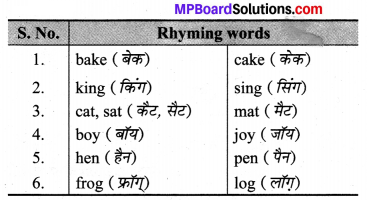
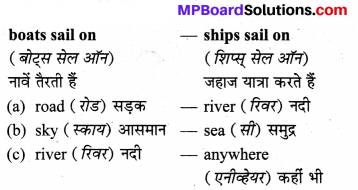
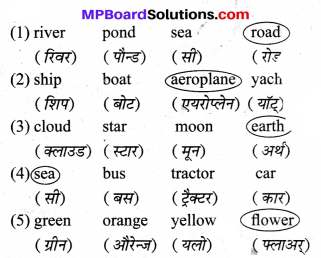
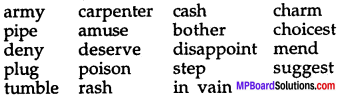
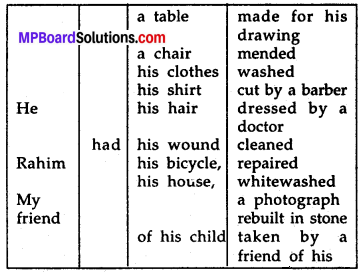
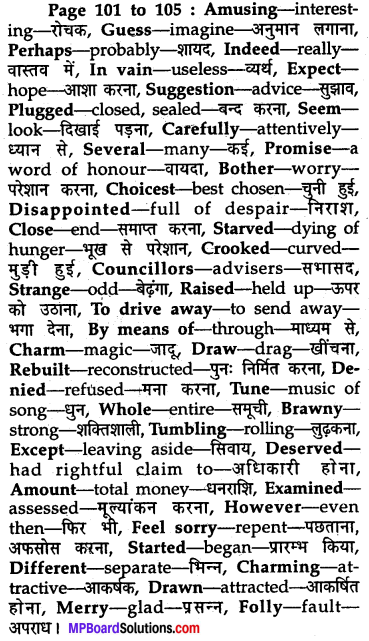
MP Board Class 7th Hindi Bhasha Bharti Solutions Chapter 1 मेरी भावना

MP Board Class 7th Hindi Bhasha Bharti Solutions Chapter 1 मेरी भावना

MP Board Class 7th Hindi Bhasha Bharti Chapter 1 पाठ का अभ्यास

बोध प्रश्न

Meri Bhavna MP Board Class 7th प्रश्न 1.
निम्नलिखित प्रश्नों के उत्तर लिखिए

(क) हमें जीवों के प्रति किस तरह की भावना रखनी चाहिए?
उत्तर-
हमें जीवों के प्रति मित्रता व दया की भावना रखनी चाहिए।

(ख) ‘मेरी भावना’ कविता में कवि ने किन-किन पर साम्यभाव रखने की बात कही है ?
उत्तर-
इस कविता में कवि ने दुष्ट, निर्दयी व गलत रास्ते पर चलने वाले इत्यादि के प्रति साम्यभाव रखने की बात कही है। .

(ग) देशोन्नति से कवि का क्या आशय है ? कवि किस तरह की देशोन्नति में सम्मिलित होना चाहता है ?
उत्तर-
देशोन्नति से कवि का आशय-देश की उन्नति से है। कवि चाहता है कि सभी हृदय से युगवीर बनकर देश की उन्नति और विकास में सम्मिलित हों।

कक्षा सातवीं विषय हिंदी पाठ 1 MP Board Class 7th प्रश्न 2.
निम्नलिखित शब्दों में से सद्गुण और दुर्गण के लिए प्रयुक्त शब्दों की सूची अलग-अलग बनाइए अहंकार, क्रोध, ईर्ष्या, उपकार, क्रूर, प्रेम, मोह।
उत्तर-
Meri Bhavna MP Board Class 7th

मेरी भावना के प्रश्न उत्तर MP Board Class 7th  प्रश्न 3.
निम्नलिखित भाव जिस पंक्ति में आए हों, उस पंक्ति को लिखिए और सुनाइए ईर्ष्या, करुणा, लालच, कृतघ्न।
उत्तर-
विद्यार्थी निम्न पंक्तियों को कण्ठस्थ करें व कक्षा में सुनाएँ

  • ईर्ष्या-देख दूसरों की बढ़ती को, कभी न ईर्ष्या भाव धरूँ।
  • करुणा-दीन-दुखी जीवों पर मेरे, उर से करुणा-स्रोत बहे।
  • लालच-अथवा कोई कैसा ही भय, या लालच देने आए।
  • कृतघ्न-होऊँ नहीं कृतघ्न कभी मैं, द्रोह न मेरे उर आए।

मेरी भावना कविता का सार MP Board Class 7th प्रश्न 4.
कविता का सार अपने शब्दों में लिखिए।
उत्तर-
पाठ के प्रारम्भ में दिये गए विभिन्न पद्यांशों की व्याख्याओं का अवलोकन करें।

भाषा अध्ययन

भाषा भारती कक्षा 7 MP Board प्रश्न 1.
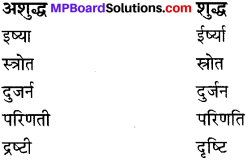
निम्नलिखित अशुद्ध शब्दों की वर्तनी शुद्ध करके लिखिए इष्या, स्त्रोत, दुजर्न, परिणती, द्रष्टी।
उत्तर-
कक्षा सातवीं विषय हिंदी पाठ 1 MP Board Class 7th

Mp Board Class 7th Hindi Chapter 1 प्रश्न 2.
निम्नलिखित शब्दों का अर्थ लिखकर अन्तर स्पष्ट कीजिएभाव-भव रात-रत। बैर-बेर गृह-ग्रह।
उत्तर-

    1. भाव (मूल्य)-भव (संसार)
      अन्तर-भाव का अर्थ होता है किसी वस्तु का मूल्य जबकि भव का अर्थ है संसार ।
    2. रात (रात्रि)-रत (लगा हुआ)।
      अन्तर-रात का प्रयोग रात्रि के समय के लिए किया जाता E है, जबकि रत का अर्थ होता है किसी कार्य में लगा हुआ।
    3. बैर (द्वेष)-बेर (एक फल)
      अन्तर-बैर शब्द का प्रयोग दुश्मनी अथवा द्वेष के लिए किया जाता है, जबकि बेर एक खाद्य-फल है।
  1. गृह (निवास स्थान, घर)-ग्रह (विशाल आकाशीय पिण्ड)।
    अन्तर-गृह का अर्थ घर से है, जबकि ग्रह का प्रयोग विशालकाय आकाशीय पिण्डों (पृथ्वी, शनि, बृहस्पति इत्यादि) के लिए किया जाता है।

भाषा भारती कक्षा 7 पाठ 1 MP Board प्रश्न 3.
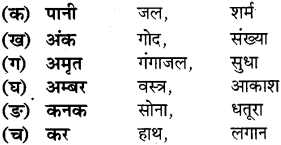
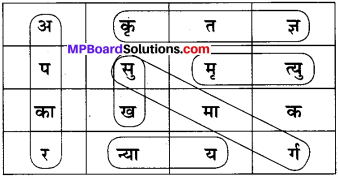
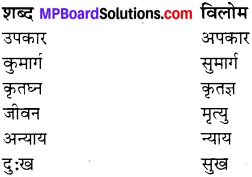
वर्ग पहेली में से नीचे दिए गए शब्दों के विलोम शब्द छाँटकर लिखिए
उपकार, कुमार्ग, कृतघ्न, जीवन, अन्याय, दु:ख।
मेरी भावना के प्रश्न उत्तर MP Board Class 7th
उत्तर-
मेरी भावना कविता का सार MP Board Class 7th

Bhasha Bharti Class 7 Solutions MP Board प्रश्न 4.
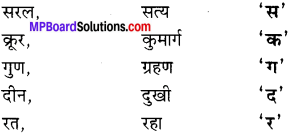
नीचे लिखे शब्दों को ध्यान से पढ़िए और जिन वर्णों की आवृत्ति हुई है उसे लिखिए
उत्तर-
भाषा भारती कक्षा 7 MP Board

(क) सम्पूर्ण पद्यांशों की व्याख्या

1. अहंकार का भाव न रक्खू,
नहीं किसी पर क्रोध करूँ।
देख दूसरों की बढ़ती को,
कभी न ईर्ष्या भाव धरूँ।।
रहे भावना ऐसी मेरी,
सरल-सत्य व्यवहार करूँ।
बने जहाँ तक इस जीवन में,
औरों का उपकार करूँ।।
मैत्री भाव जगत में मेरा,
सब जीवों से नित्य रहे।
दीन-दुखी जीवों पर मेरे,
उर से करुणा-स्रोत बहे।।

शब्दार्थ-अहंकार = घमण्ड; ईर्ष्या = द्वेष; करुणा-स्रोत = दया की धारा।

सन्दर्भ-प्रस्तुत पद्यांश हमारी पाठ्य-पुस्तक ‘भाषा भारती’ के ‘मेरी भावना’ नामक पाठ से अवतरित है। इसके रचयिता जुगल किशोर ‘युगवीर’ हैं।

प्रसंग-प्रस्तुत पंक्तियों में कवि ईश्वर से अपने लिए अच्छी भावनाओं की कामना करता है।

व्याख्या-हे ईश्वर ! कभी भी घमण्ड का भाव मेरे मन में न आये और न ही मैं किसी पर गुस्सा करूँ। दूसरों की उन्नति और विकास को देखकर मुझे प्रसन्नता हो, न कि कुढ़न।।

हे प्रभु ! मैं चाहता हूँ कि मेरी ऐसी भावना हो कि मैं सबके प्रति सरलता व सत्यता का व्यवहार करूँ और जहाँ तक सम्भव हो सके मैं अपने इस जीवन को परोपकार में लगा सकूँ, अर्थात् दूसरों की भलाई कर सकूँ। तेरे बनाये सभी जीव-जन्तुओं एवं पादपों से मेरा व्यवहार प्रतिदिन मित्रवत् हो तथा दुखी व परेशान प्राणि-मात्र के प्रति मेरे हृदय में दया की अविरल धारा बहती रहे।

2. दुर्जन-क्रूर कुमार्गरतों पर,
क्षोभ नहीं मुझको आए
साम्यभाव रक्खू मैं उन पर,
ऐसी परिणति हो जाए।।
गुणीजनों को देख हृदय में,
मेरे प्रेम उमड़ आए।
बने जहाँ तक उनकी सेवा,
करके यह मन सुख पाए।।
होऊँ नहीं कृतघ्न कभी मैं,
द्रोह न मेरे उर आए।
गुण ग्रहण का भाव रहे नित,
दृष्टि न दोषों पर जाए।।

शब्दार्थ-दुर्जन = दुष्ट; क्रूर = कठोर; कुमार्गरतों = बुरे रास्ते पर चलने वाले क्षोभ = कष्ट; साम्यभाव = समानभाव; परिणति = बदलाव; गुणीजन = गुणवान लोग; कृतघ्न = उपकार न मानने वाला; द्रोह = वैर; उर = हृदय।

सन्दर्भ-पूर्व की तरह।

प्रसंग-प्रस्तुत पंक्तियों में कवि ईश्वर से अपने लिए अच्छी भावनाओं का वरदान चाहता है।

व्याख्या-हे प्रभु ! मेरी सदैव ऐसी भावना रहे कि मुझे दुष्ट, कठोर और बुरे आचरण वाले लोगों के व्यवहार पर दुःख न हो। मेरे हृदय में उनके प्रति ऐसा बदलाव हो कि मैं उनके प्रति समानता का भाव रखने लगूं।

जब मैं गुणवान लोगों को देखू तो उनके लिए मेरे हृदय में प्रेम की भावना उत्पन्न होती रहे। जहाँ तक सम्भव हो सके मैं ऐसे लोगों की तन-मन-धन और कर्म से सेवा कर मन की शान्ति अर्जित कर सकूँ।

मैं कभी भी दूसरों के किये हुए उपकार को भूलने वाला न बनूँ और मेरे मन में किसी के प्रति भी वैर-भावना पैदा न हो। दूसरों के चरित्र में से मैं उसके अन्दर छिपे गुणों को स्वीकार करता रहूँ, किन्तु उनके दोषों की ओर मेरा ध्यान कदापि न जाये। हे ईश्वर ! मेरी प्रतिदिन यही भावना रहे।

3. कोई बुरा कहे या अच्छा,
लक्ष्मी आए या जाए।
लाखों वर्षों तक जीऊँ या,
मृत्यु आज ही आ जाए।
अथवा कोई कैसा ही भय,
या लालच देने आए।
तो भी न्यायमार्ग से मेरा,
कभी न पद डिगने पाए।।
फैले प्रेम परस्पर जग में,
मोह दूर पर रहा करे।
अप्रिय कटुक कठोर शब्द नहीं,
कोई मुख से कहा करे।।
बनकर सब युगवीर हृदय से,
देशोन्नतिरत रहा करें।
वस्तु स्वरूप विचार खुशी से,
सब दुःख संकट सहा करें।।

शब्दार्थ-न्यायमार्ग = न्याय का रास्ता; पद = पैर, पग; परस्पर = आपस में; मोह = लालच; कटुक = कड़वा; देशोन्नतिरत = देश की उन्नति में लगे।

सन्दर्भ-पूर्व की तरह।

प्रसंग-प्रस्तुत पंक्तियों में कवि प्रतिकूल अथवा अनुकूल, दोनों परिस्थितियों में धैर्य रखने की शक्ति की प्राप्ति के लिए ईश्वर से प्रार्थना करता है।

व्याख्या-कोई मुझे बुरा कहे अथवा कर्ण-प्रिय शब्द बोले, मेरे पास धन आए अथवा जाता रहे, चाहे मैं लाखों वर्षों तक जीता रहूँ अथवा मेरी मौत नजदीक हो अथवा मुझे कोई कैसा भी बरगलाने या लालच देने का प्रयत्न करे, तो भी हे मेरे ईश्वर ! मुझे ऐसी शक्ति प्रदान कर, जिससे न्याय के पथ से मेरे कदम हटने न पाएँ।

इस दुनिया के समस्त निवासियों के मध्य आपस में प्यार बढ़े, सभी लोभ, लालच से दूर रहें तथा कोई भी अपने मुँह से । किसी के लिए भी अप्रिय, कड़वे तथा कठोर शब्द न बोले। – सभी देशवासी मन से दृढ़ संकल्पित हो युगवीर बनें और सदैव राष्ट्र की उन्नति में अपना योगदान दें। साथ ही, सभी दुखों पीड़ाओं और संकटों को वस्तु के समान आने जाने वाला सोचकर अर्थात् उन्हें जीवन का एक अंग मानकर खुशी से सहन किया करें।

शब्दकोश
अहंकार = घमण्ड; परिणति = बदलाव या परिवर्तन; ईर्ष्या = जलन; करुणा = दया; कटु = कठोर, कड़वा; . देशोन्नति = देश की उन्नति; स्रोत = धारा, साधन, उद्गम; क्षोभ = खेद, दुःख; क्रूर = निर्दयी।

MP Board Class 7th Hindi Solutions

MP Board Class 7th Sanskrit Solutions Chapter 1 चत्वारि धामानि

MP Board Class 7th Sanskrit Solutions Surbhi Chapter 1 चत्वारि धामानि

MP Board Class 7th Sanskrit Chapter 1 अभ्यासः

Mp Board Solution Class 7th Sanskrit प्रश्न 1.
एक शब्द में उत्तर लिखो
(क) शारदामठं कस्यां दिशि अस्ति? [शारदामठ किस दिशा में है?]
उत्तर:
पश्चिम दिशि

(ख) शङ्कराचार्यस्य प्रथमशिष्यस्य नाम किम्? [शंकराचार्य के पहले शिष्य का नाम क्या है?]
उत्तर:
सुरेश्वराचार्यः

(ग) ज्योतिर्मठं कुत्र अस्ति? [ज्योतिर्मठ कहाँ पर है?]
उत्तर:
उत्तराञ्चलराज्ये

(घ) द्वारका कस्मिन् राज्ये अस्ति? [द्वारका किस राज्य में है?]
उत्तर:
गुजरातराज्ये

(ङ) जगद्गुरु कः आसीत्? [जगद्गुरु कौन थे?]
उत्तर:
शङ्कराचार्यः।

कक्षा 7 संस्कृत पाठ 1 प्रश्न 2.
एक वाक्य में उत्तर लिखो
(क) शङ्कराचार्येण स्थापितानां मठानां नामानि कानि? [शंकराचार्य के द्वारा स्थापित मठों के नाम क्या हैं?
उत्तर:
शङ्कराचार्येण स्थापितानां मठानां नामानि सन्ति
(1) शृङ्गेरिमठम्
(2) गोवर्धनमठम्
(3) शारदामठम्
(4) ज्योतिर्मठम्।
[शंकराचार्य द्वारा स्थापित मठों के नाम हैं-
(1) शृङ्गेरिमठ
(2) गोवर्धनमठ
(3) शारदामठ
(4) ज्योतिर्मठ।]

(ख) कः कस्य एकतायाः मूलाधारः? [किसकी एकता का मूल आधार क्या है?]
उत्तर:
धर्मः भारतस्य एकतायाः मूलाधारः। [धर्म भारत की एकता का मूल आधार है।]

(ग) मठानि किमर्थं स्थापितानि? [मठों की स्थापना किसलिए की गई?]
उत्तर:
धर्मरक्षार्थं वेदान्ततत्वानां प्रचारार्थम् च मठानि स्थापितानि। [धर्म की रक्षा के लिए और वेदान्त तत्वों के प्रचार के लिए मठों की स्थापना की गई।]

(घ) शङ्कराचार्यस्य चत्वारः शिष्याः के? [शंकराचार्य के चार शिष्य कौन थे?]
उत्तर:
शङ्कराचार्यस्य प्रथम शिष्यः सुरेश्वराचार्यः, द्वितीयः शिष्य हस्तामलकः, तृतीय शिष्यः त्रोटकाचार्यः, चतुर्थः शिष्यः पद्मपादः इति।
[शंकराचार्य के प्रथम शिष्य सुरेश्वराचार्य, द्वितीय शिष्य हस्तामलक, तीसरे शिष्य त्रोटकाचार्य और चौथे शिष्य पद्मपाद थे।]

(ङ) भारतं कथं संरक्षितं भवति? [भारत किस तरह सुरक्षित है?]
उत्तर:
धर्मरक्षणेन एव भारतम् संरक्षितं भवति। [धर्म की रक्षा करने से ही भारत सुरक्षित है।]

Mp Board Solution Class 7 Sanskrit प्रश्न 3.
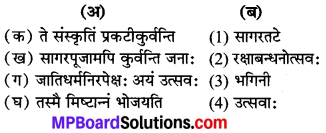
उचित शब्दों को मिलाओ-
Image
उत्तर:
(क) → (3)
(ख) → (5)
(ग) → (4)
(घ) → (2)
(ङ) → (1)

Mp Board Class 7 Sanskrit Solution प्रश्न 4.
कोष्ठक के शब्दों का प्रयोग करके रिक्त स्थानों को भरो (गोवर्धनमठम्, भगवत्पादं, धर्मो, मूलाधारः, पद्मपादः)
(क) नमामि ……….. शङ्करं लोकशङ्करम्।
(ख) पूर्वदिशि ……….. अस्ति।
(ग) ………. रक्षति रक्षितः।
(घ) शङ्कराचार्यस्य चतुर्थः शिष्यः ………..।
(ङ) धर्म एव भारतस्य एकतायाः ……….. अस्ति।
उत्तर:
(क) भगवत्पादं
(ख) गोवर्धनमठम्
(ग) धर्मो
(घ) पद्मपाद
(ङ) मूलाधारः।

कक्षा 7 संस्कृत पाठ 1 के प्रश्न उत्तर प्रश्न 5.
विलोम शब्द लिखो
(क) धर्मः
(ख) प्रसिद्धानि
(ग) स्मरणम्
(घ) गुरु:
(ङ) ज्ञानम्।
उत्तर:
(क) → अधर्मः
(ख) → अप्रसिद्धानि
(ग) → विस्मरणम्
(घ) → शिष्यः
(ङ) → अज्ञानम्।

कक्षा 7 संस्कृत पुस्तक Mp Board प्रश्न 6.
प्रथमा-बहुवचन के रूप लिखो
(क) अहम्
(ख) नाम
(ग) शिष्यः
(घ) धाम
(ङ) मठम्।
उत्तर:
(क) वयम्
(ख) नामानि
(ग) शिष्याः
(घ) धामानिः
(ङ) मठानि।

चत्वारि धामानि हिन्दी अनुवाद

Mp Board Class 7th Sanskrit Solution शिक्षिका :
भारति! भवती जानाति किं कः अयं महापुरुषः?

भारती :
आर्ये! अयं खलु जगद्गुरु शङ्कराचार्यः।

महेश: :
आम् अहमपि जानामि एते किल तस्य चत्वारः शिष्याः।

Class 7 Mp Board Sanskrit देवेशः :
शङ्कराचार्यस्य प्रथमशिष्यस्य नाम सुरेश्वराचार्यः इति।

शिक्षिका :
देवेशः! अन्येषां त्रयाणां शिष्याणां नामानि कानि?

देवेशः :
अहं न जानामि।

Class 7th Sanskrit Mp Board Solution शारदा :
द्वितीयः शिष्यः हस्तामलकः तृतीयः शिष्यः त्रोटकाचार्यः चतुर्थः शिष्य पद्मपादः।

अनुवाद :
शिक्षिका-हे भारती! क्या तुम जानती हो कि यह महानुभाव कौन हैं?

Class 7th Sanskrit Mp Board भारती :
आर्ये! यह जगद्गुरु शंकराचार्य हैं। महेश-हाँ, मैं भी इन्हें जानता हूँ कि उनके चार शिष्य थे।

देवेश :
शंकराचार्य के पहले शिष्य का नाम सुरेश्वराचार्य था।

7th Class Sanskrit Mp Board शिक्षिका :
देवेश! अन्य तीन शिष्यों के क्या-क्या नाम हैं? देवेश-मैं नहीं जानता हूँ।

शारदा :
दूसरे शिष्य हस्तामलक, तीसरे शिष्य त्रोटकाचार्य (और) चौथे शिष्य पद्मपाद थे।

शिक्षिका :
साधु, अपि जानान्ति शङ्करमठानि?

Class 7 Sanskrit Mp Board Solution सर्वे :
न जानीमः।

शिक्षिका :
शङ्कराचार्येण चतुर्षु स्थानेषु चतसृषु दिक्षु चत्वारि मठानि स्थापितानि। तानि चत्वारि पवित्रधामानि इति प्रसिद्धानि।

Class 7th Mp Board Sanskrit महेश: :
आर्ये! उत्तरदिशि बदरीनाथः, दक्षिणदिशि रामेश्वरं, पश्चिमदिशि द्वारका, पूर्वदिशि जगन्नाथपुरी इति किल चत्वारि धामानि।

शिक्षिका :
सत्यम्! किन्तु धर्मप्रचाराय शङ्कराचार्येण स्थापितानि मठानि अपि चत्वारि धामानि इति प्रसिद्धानि। तानि चतस्तृषु दिक्षु सन्ति।

Mp Board 7th Class Sanskrit Book भारती :
तानि धामानि कानि?

शिक्षिका :
शृङ्गेरिमठम्, गोवर्धनमठम्, शारदामठम्, ज्योतिर्मठम्।

देवेशः :
कस्यां कस्यां दिशि सन्ति?

कक्षा 7 संस्कृत पुस्तक Pdf Mp Board अनुवाद :
शिक्षिका-ठीक है, क्या शंकर के मठों को भी जानते हो?

सभी :
नहीं जानते हैं।

Mp Board Class 7th Sanskrit शिक्षिका :
शंकराचार्य के द्वारा चार स्थानों पर चारों दिशाओं में चार मठों की स्थापना की गई थी। वे चारों पवित्र धाम हैं, इस रूप में प्रसिद्ध हैं।

महेश :
आर्ये! उत्तर दिशा में बदरीनाथ, दक्षिण दिशा में रामेश्वर, पश्चिम दिशा में द्वारका (तथा) पूर्व दिशा में जगन्नाथपुरी-इस प्रकार ये चार धाम हैं।

Mp Board Class 7th Subject Sanskrit शिक्षिका :
ठीक! किन्तु धर्म के प्रचार के लिए शंकराचार्य के द्वारा स्थापित किये गये मठ ही चार धाम हैं; ऐसा प्रसिद्ध है। वे चारों दिशाओं में हैं।

भारती :
वे धाम कौन-कौन से हैं?

शिक्षिका :
शृङ्गेरिमठ, गोवर्धनमठ, शारदामठ (तथा) ज्योतिर्मठ।

Sanskrit 7th Class Mp Board देवेश :
(ये) किस-किस दिशा में हैं?

शिक्षिका :
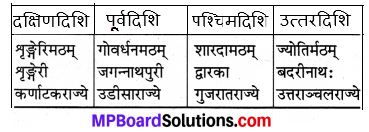
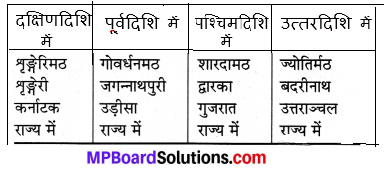
पश्यन्तु इदं कोष्ठकं, स्पष्टं भवति
Mp Board Class 7 Sanskrit

शिक्षिका :
धर्म एव भारतस्य एकतायाः मूलाधारः। ‘धर्मो रक्षति रक्षितः’ अतः धर्मरक्षणेन एव भारतम् संरक्षितं भवति। धर्मरक्षणार्थं वेदान्ततत्वानां प्रचारार्थम् एतानि मठानि स्थापितानि। मठानां स्थापकं जगद्गुरुम् आदिशङ्करं स्मरामः।

“श्रुतिस्मृतिपुराणानाम् आलयं करुणालयम्।
नमामि भगवत्पादशङ्करं लोकशङ्करम्॥”

7th Sanskrit Mp Board अनुवाद :
शिक्षिका-इस कोष्ठक को देखो (इससे) स्पष्ट होता है-
Sanskrit Class 7 Mp Board

शिक्षिका :
धर्म ही भारत की एकता का मूल आधार है। ‘(धर्म की) रक्षा करने वाले की धर्म रक्षा करता है।’ इसलिए धर्म की रक्षा करने से ही भारत भली प्रकार से रक्षित होता है। धर्म की रक्षा के लिए और वेदान्त के तत्वों के प्रचार के लिए इन मठों की स्थापना की गई है। मठों की स्थापना करने वाले जगद्गुरु आदिशङ्कर का (हम) स्मरण करते हैं।

“वेद, स्मृति और पुराणों के स्थान करुणानिधान और संसार का कल्याण करने वाले भगवान शंकर के चरणों की मैं वन्दना करता हूँ।”

चत्वारि धामानि शब्दार्थाः

चत्वारः = चार (पुल्लिङ्ग)। धर्मप्रचाराय = धर्म के प्रचार के लिए। धर्मरक्षणेन = धर्मरक्षा से।

MP Board Class 7th Sanskrit Solutions

MP Board Class 7th Hindi Bhasha Bharti Solutions Chapter 2 दादी की घड़ी

MP Board Class 7th Hindi Bhasha Bharti Solutions Chapter 2 दादी की घड़ी

MP Board Class 7th Hindi Bhasha Bharti Chapter 2 पाठ का अभ्यास

बोध प्रश्न

Dadi Ki Ghadi Ka Saransh MP Board Class 7 प्रश्न 1.
निम्नलिखित प्रश्नों के उत्तर लिखिए

(क) दीपू को दीदी और भैया की तरह कौन-कौन सी सुविधाएँ नहीं मिल पाती थीं?
उत्तर-
दीपू को दीदी और भैया की अपेक्षा कई प्रकार की सुविधाओं से वंचित रहना पड़ता था। उसके पास पढ़ने के लिए न तो घड़ी थी, न ही डेस्क। जब वह सुबह जल्दी उठना चाहता तो उसके पास अलार्म घड़ी भी नहीं होती थी।

(ख) बिना अलार्म घड़ी के दादी सुबह कैसे उठ जाती थीं?
उत्तर-
दादी सुबह जल्दी उठने के लिए रात को सोते समय अपने सिरहाने रखे तकिए से सुबह उठने का समय कहकर सोती थीं। आश्चर्यजनक रूप से ठीक उसी समय पर प्रातः उनकी आँख स्वयं ही खुल जाती थी।

(ग) पिकनिक पर जाने के लिए दीपू समय पर कैसे जाग गया ?
उत्तर-
पिकनिक पर जाने वाले दिन से पूर्व रात को दीपू अपने तकिए से उसे सुबह 5 बजे जगा देने की बात कहकर सोया और अगले दिन ठीक 5 बजे उसकी आँख अपने आप खुल गयी।

(घ) दादी ने अनोखी घड़ी का क्या राज बताया ?
उत्तर-
दादी ने अनोखी घड़ी का राज बताते हुए दीपू से कहा, “भला तकिया भी कहीं बोलता है। असली अलार्म तो हमारे दिल में होता है। जब हमें जरूरी उठना होता है, तो यह हमें जगा देता है।”

दादी की घड़ी पाठ का सारांश MP Board Class 7 प्रश्न 2.
दादी ने दीपू को सुबह समय पर उठने के लिए क्या तरकीब सुझाई ? (सही विकल्प चुनिए-)
(क) दीदी से सुबह जगाने के लिए कहो,
(ख) मुर्गे की आवाज सुनकर उठो,
(ग) तकिए से कहो “तकियाराम सुबह चार बजे जगा देना”
(घ) अलार्म घड़ी रखकर सो जाना।
उत्तर-
(ग) तकिए से कहो, “तकियाराम सुबह चार बजे जगा देना।”

भाषा अध्ययन

Dadi Ki Ghadi Paath Ka Saransh MP Board Class 7 प्रश्न 1.
निम्नलिखित शब्दों का शुद्ध उच्चारण कीजिए और लिखिए-
ईर्ष्या, खूटी, चिट्ठियाँ, ताज्जुब, इंस्पेक्टर, अलार्म, चिरौरी, कार्तिक, नुस्खा, ट्रंक।
उत्तर-
प्रत्येक शब्द को ठीक-ठीक उच्चारित कर बिना देखे लिखने का अभ्यास करें।

भाषा भारती कक्षा 7 पाठ 2 MP Board प्रश्न 2.
निम्नलिखित वाक्यों में से मुहावरे छाँटकर लिखिए
(क) दीपू को हर तरह की बेगार ढोनी पड़ती थी।
(ख) दीपू बेचारा मम्मी के ट्रंक पर ही गुजारा कर लेता था।
(ग) घड़ी तो राजा भैया पहले ही परलोक सिधार गई।
(घ) डर के मारे दीपू दम साधे पड़ा रहा।
उत्तर-
(क) बेगार ढोना,
(ख) गुजारा करना,
(ग) परलोक सिधारना,
(घ) दम साधना।

Mp Board Class 7th Hindi Chapter 2 प्रश्न 3.
निम्नलिखित शब्दों में से हिन्दी, अंग्रेजी और उर्दू के शब्द छाँटकर लिखिए
चॉक, एवज, मुसीबत, रौब, क्लास, खबर, ख्याल, मॉनीटर, अन्याय, दखल, डेस्क, सुर, बाकायदा, अलार्म, ताज्जुब, परीक्षा, इंस्पेक्टर, टर्मिनल, दया, लैम्प, परलोक।
उत्तर-
Dadi Ki Ghadi Ka Saransh MP Board Class 7

Class 7 Hindi Chapter 2 Dadi Ki Ghadi MP Board प्रश्न 4.
‘भी’ और ‘पर’ निपात वाले वाक्य पाठ से छाँटकर लिखिए।
उत्तर-
(i) मान लिया कि बड़ी-बड़ी क्लासों में पढ़ते हैं, पर इसका मतलब यह तो नहीं कि लोग निरे बुद्ध हैं।
(ii) दीपू चौथी कक्षा में पढ़ता है और तो और अपनी कक्षा का मॉनीटर भी है।
(iii) दीपू के दोस्त दिनभर आते-जाते रहते। कोई उन्हें बैठने तक को नहीं कहता पर दीदी या भैया के पास कोई आता तो उसे बाकायदा नमस्ते करनी पड़ती।
(iv) उसे तो खुद चाबी भरने की इच्छा थी, पर दीदी का चेहरा देखकर चुप कर गया।

प्रश्न 5.
निम्नलिखित वाक्यों को छोटा करके लिखिए
(अ) सोते में मुझसे घड़ी टूट गई और सबके सब मुझे डाँटने लगे।
(ब) वह तो समझा अभी रात है और डर के मारे दम साधे चुपचाप पड़ा रहा।
उत्तर-
(अ) सोते समय घड़ी टूटने पर सबके सब मुझे डाँटने लगे।
(ब) वह रात समझकर डर के मारे दम साधे चुपचाप पड़ा रहा।

प्रश्न 6.
वाक्य बदलिए
(क) पता है, कल हमने मलाई खाई थी।
(ख) पता है, कल आसमान में गुब्बारे उड़े थे।
(ग) पता है, तकिया मुझे जगाएगा।
(घ) पता है, पापा-मम्मी मुझे समझ पाएँगे।
उत्तर-
(क) न जाने कब हमने मलाई खाई थी।
(ख) न जाने कब आसमान में गुब्बारे उड़े थे।
(ग) न जाने कब तकिया मुझे जगाएगा।
(घ) न जाने कब पापा-मम्मी मुझे समझ पाएँगे।

प्रश्न 7.
निम्नलिखित वाक्यों में शब्दों को सही क्रम में लिखिए
(क) है अपनी भी मॉनीटर का कक्षा दीपू।
(ख) गई सिधार घड़ी राजा परलोक भैया।
(ग) टाइमपीस था अलार्म ही एक घर में।
(घ) अलार्म तो दिल है होता असली में हमारे।
उत्तर-
(क) दीपू अपनी कक्षा का मॉनीटर भी है।
(ख) घड़ी राजा भैया परलोक सिधार गई।
(ग) घर में एक ही टाइमपीस अलार्म था।
(घ) असली अलार्म तो हमारे दिल में होता है।

प्रश्न 8. सही विकल्प चुनकर रिक्त स्थानों की पूर्ति। कीजिए-
(क) दीपू से सभी ……………………………. करते थे।
(i) ईर्ष्या
(ii) घृणा
(iii) द्वेष
(iv) लड़ाई।
उत्तर-
(i) ईर्ष्या

(ख) दीपू की ……………………………. तो पापा के पास बैठने पर ही निकल जाती थी।
(i) पूरी जान
(ii) जान
(iii) दम
(iv) आधी जान।
उत्तर-
(iv) आधी जान।

(ग) ‘स्टूल’ शब्द ……………………………. है।
(i) तद्भव
(ii) तत्सम
(iii) देशज
(iv) विदेशी।
उत्तर-
(iv) विदेशी।

(घ) दीपू पिकनिक के लिए ……………………………. जा रहा था।
(i) साँची
(ii) भोपाल
(iii) विदिशा
(iv) पचमढ़ी।
उत्तर-
(i) साँची।

दादी की घड़ी परीक्षोपयोगी गद्यांशों की व्याख्या

1. घर में एक ही अलार्म टाइमपीस था और वह बारी बारी से दीदी या भैया के सिरहाने रखा रहता। दीपू की बड़ी साध थी कि हम भी सिरहाने घड़ी रखकर सोएँ और उसकी सुरीली आवाज के साथ दिन की शुरुआत करें। उसके भाग्य में तो सुबह आठ बजे पापा की डाँट खाकर उठना ही लिखा था।

सन्दर्भ-प्रस्तुत गद्यांश हमारी पाठ्य-पुस्तक ‘भाषा भारती’ के ‘दादी की घड़ी’ नामक पाठ से अवतरित है। इसकी लेखिका श्रीमती मालती जोशी हैं। –

प्रसंग-प्रस्तुत गद्यांश में लेखिका ने बालसुलभ मन का सजीव चित्रण किया है।

व्याख्या-घर में सबसे छोटा होने के कारण दीपू की छोटी-छोटी इच्छाएँ भी पूरी न हो पाती थीं। दीपू के घर में एक ही अलार्म घड़ी थी। वह चाहता था कि अलार्म घड़ी को वह अपने बिस्तर के पास रखकर सोए जिससे सुबह समय पर उठ सके, किन्तु छोटा होने के कारण उसकी बारी ही न आ पाती। घड़ी पर तो उसके भैया व दीदी का ही कब्जा रहता। उसे बहुत बुरा लगता जब सुबह उसकी नींद न खुलती और प्रतिदिन पापा की डाँट-फटकार से दिन की शुरुआत होती।

2. मम्मी की सिफारिश काम कर गई। रात को घड़ी वाला स्टूल उसके सिरहाने था। उसे तो खुद चाबी भरने की इच्छा थी, पर दीदी का चेहरा देखकर चुप कर गया। घड़ी मिल रही थी, यही बहुत था।

रात भर उसे अलार्म के सपने आते रहे। उसने अपनी सारी किताबें तकिये के नीचे रख ली थीं। टेबल लैंप लगाने की भी सोच रहा था, पर डर के मारे चुप रहना पड़ा।

सन्दर्भ-पूर्व की तरह।

प्रसंग-प्रस्तुत गद्यांश में बाल-हठ द्वारा घड़ी पास रखकर सोने के सुखद सपने का वर्णन किया गया है।

व्याख्या-दीपू के जिद करने पर मम्मी को दया आ गयी और उन्होंने दीदी और भैया से घड़ी को दीपू के पास रखने के लिए कहा। मम्मी की सिफारिश से प्राप्त अलार्म घड़ी को अपने पास रखकर सोने के विचार मात्र से दीपू खासा उत्साहित हो गया। वह घड़ी में खुद ही चाबी भरना चाहता था, किन्तु दीदी के चेहरे के भावों को पढ़कर वह चुप ही रहा। प्रातः जल्दी पढ़ने के लिए उसने सारी तैयारियाँ रात में ही कर ली थीं। रातभर उसे घड़ी के बजते अलार्म के सपने आते रहे थे।

3. दीपू ने तरकीब सुनी, तो आश्चर्य से उसकी आँखें फैल गईं। दिन भर यही इन्तजार रहा कि कब रात हो तो वह तकिये का करिश्मा देखे। रात को उसने सबकी नजर बचाकर तकिये से अपनी बात कही और इत्मीनान से सो गया। सुबह उठा तो वही आठ बज रहे थे। दूसरे दिन भी यही हाल रहा, फिर तीसरे-चौथे दिन भी। फिर उसने यह नुस्खा ही मन से निकाल दिया। समझ गया दादी की भूत-प्रेतों और परियों की कहानियों की तरह यह तरकीब भी निरी गप्प ही थी।

सन्दर्भ-पूर्व की तरह।

प्रसंग-प्रस्तुत गद्यांश में दादी द्वारा दीपू को सुबह जल्दी उठने के लिए सुझाई गई तरकीब के क्रियान्वयन का वर्णन किया। गया है।

व्याख्या-दादी ने सुबह जल्दी उठने के लिए दीपू से कहा कि वह रात को सोते समय अपने तकिए से अभीष्ट समय पर जगाने के लिए बोलकर सोए। दीपू ने अचरज और उत्सुकता के
साथ रात होने की प्रतीक्षा की ओर फिर रात को तकिए से अपने। मन की बात कहकर निश्चित हो सो गया, परन्तु सुबह जब वह। सोकर उठा तो हमेशा की तरह आठ बज रहे थे। दीपू ने दूसरे दिन फिर से इस तरकीब को आजमाया, परिणाम इस बार भी जस का तस निकला। तीसरे और चौथे दिन भी तरकीब को सफल न होतें देख वह निराश हो उठा और दादी की भूत-प्रेतों तथा परियों की काल्पनिक कहानियों की तरह इस तरकीब को भी गप्प मानकर वह भूल गया।

4. दादी ने उसे और भी पास सटाते हुए कहा, “दीपू बेटा, तू तो पागल हो गया है। तकिया भी कहीं बोलता है।” असली अलार्म तो हमारे दिल में होता है। जब हमें जरूरी उठना होता है, तो यह हमें जगा देता है। घड़ी की आवाज तो तू बन्द भी कर सकता है, पर इसकी आवाज बन्द नहीं होती, जगाकर ही छोड़ती है।

सन्दर्भ-पूर्व की तरह।

प्रसंग-प्रस्तुत गद्यांश में दिल को ही वास्तविक अलार्म घड़ी बताया गया है।

व्याख्या-दादी ने दीपू को अपने और करीब लाते हुए प्यार से समझाया कि भला तकिया भी कहीं बोलता है जो दूसरों को जगा देगा ? वास्तव में असली अलार्म तो मनुष्य का दिल होता है। जब कभी हमें अवश्य एवं निश्चित समय पर सुबह उठना होता है, तो वह हमारा दिल ही है, जो हमें अभीष्ट समय पर अपने आप उठा देता है। अलार्म घड़ी की आवाज को तो हम चाहें तो बन्द भी कर सकते हैं, किन्तु दिल की आवाज को बन्द नहीं किया जा सकता है। यह तो हमें उठाकर ही शान्त होती है। दिलरूपी घड़ी का रहस्य जानकर दीपू प्रसन्न हुआ।

शब्दकोश
लाड़ला = प्यारा; अन्याय = न्याय न होना; हताश = निराश; निरे = बिल्कुल; सुर में सुर मिलाना = साथ-साथ गाना, समर्थन करना; चौतरफा = चारों तरफ।

MP Board Class 7th Hindi Solutions

MP Board Class 7th Sanskrit Solutions Chapter 7 भोपालनगरम्

MP Board Class 7th Sanskrit Solutions Surbhi Chapter 7 भोपालनगरम्

MP Board Class 7th Sanskrit Chapter 7 अभ्यासः

Mp Board Class 7th Sanskrit Chapter 7 प्रश्न 1.
एक शब्द में उत्तर लिखो
(क) विशालं शिवमंदिरं कुत्र अस्ति? [विशाल शिव मन्दिर कहाँ है ?]
उत्तर:
भोजपुरे

(ख) भोपालनगरं कस्य प्रदेशस्य राजधानी अस्ति? [भोपाल नगर किस प्रदेश की राजधानी है?]
उत्तर:
मध्यप्रदेशस्य

(ग) श्रावणमासे प्रत्येकसोमवासरेका मेलापकः भवति? [सावन के महीने में प्रत्येक सोमवार को कहाँ मेला लगता है?]
उत्तर:
गुफामन्दिरे

(घ) भोपाले विश्वप्रसिद्ध कलाकेन्द्रं किम् अस्ति? [भोपाल में विश्व प्रसिद्ध कला केन्द्र क्या है?]
उत्तर:
भारतभवनम्

(ङ) भोपाले राजाभोजवायुयानस्थानकं कुत्र अस्ति? [भोपाल में राजा भोज हवाई अड्डा’ कहाँ है?]
उत्तर:
गान्धिनगरे।

Mp Board Class 7 Sanskrit Solution प्रश्न 2.
एक वाक्य में उत्तर लिखो
(क) पुरा भोपालनगरस्य नाम किम् आसीत्? [प्राचीनकाल में भोपाल नगर का क्या नाम था?]
उत्तर:
भोजपाल

(ख) भोपालनगरस्य जनाः कुत्र नौकाविहारं कुर्वन्ति? [भोपालनगर के लोग कहाँ पर नौका विहार करते है?]
उत्तर:
सरोवरेः

(ग) “इज्तिमा” नामकंधार्मिकसम्मेलनं कुत्र आयोज्यते? [“इज्तिमा” नामक धार्मिक सम्मेलन कहाँ पर आयोजित किया जाता है?]
उत्तर:
ताजुल मस्जेिद

(घ) आञ्चलिकविज्ञानकेन्द्रं कुत्र अस्ति? [आञ्चलिक विज्ञान केन्द्र कहाँ पर है?]
उत्तर:
भोपालनगरे

(ङ) भारतहैवीइलेक्ट्रिकल्सलिमिटेड इति संयन्त्रं कुत्र अस्ति? [भारत हैवी इलेक्ट्रिकल्स लिमिटेड नामक संयन्त्र कहाँ पर है?]
उत्तर:
भोपालनगरे।

Mp Board Solution Class 7 Sanskrit प्रश्न 3.
उचित शब्द से रिक्त स्थान को पूरा करो- लक्ष्मीनारायणमन्दिरम् (बिरला मन्दिरम्), ताजुल मस्जिदः, नौका विहारं, विधानसभा भवनम्, भोजपुरम्)
(क) नूतन भोपालनगरे …………. अस्ति।
(ख) भोपालनगरस्य सरोवरे जनाः ………….. कुर्वन्ति।
(ग) प्राचीन भोपाले …………. अस्ति।
(घ) …………. नूतनभोपाले अस्ति।
(ङ)…………. समीपे अस्ति।
उत्तर:
(क) लक्ष्मीनारायणमन्दिरम् (बिरला मन्दिरम्)
(ख) नौकाविहारं
(ग) ताजुल मस्जिदः
(घ) विधानसभा भवनम्
(ङ) भोजपुरम्।

Mp Board Class 7th Sanskrit Solution प्रश्न 4.
रेखांकित शब्दों के आधार पर प्रश्न बनाओ (कुत्र, कस्मिन्, कस्य, कानि, केषाम्)
(क) इदं नगरम् सरोवराणां नगरं कथ्यते।
(ख) भीमबेटकायां भित्तिचित्राणि सन्ति।
(ग) भोपालनगरस्य द्वौ भागौ स्तः।
(घ) ‘इन्दिरागान्धि-मानवसङ्ग्रहालयः’ अपि अत्र वर्तते।
उत्तर:
(क) इदं नगरम् केषाम् नगरं कथ्यते?
(ख) कस्मिन् भित्तिचित्राणि सन्ति?
(ग) कस्य नगरस्य द्वौ भागौ स्तः?
(घ) ‘इन्दिरागान्धि-मानव सङ्ग्रहालयः’ अपि कुत्र वर्तते?

Mp Board Class 7th Sanskrit Solution Chapter 7 प्रश्न 5.
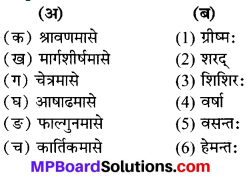
विलोम शब्दों का मेल कराओ
MP Board Class 7th Sanskrit Solutions Chapter 7 भोपालनगरम् img 1
उत्तर:
(क) → (5)
(ख) → (4)
(ग) → (6)
(घ) → (2)
(ङ) → (3)
(च) → (1)

Class 7 Sanskrit Solution Mp Board प्रश्न 6.
शुद्ध कथन के सामने आम्’ और अशुद्ध कथन के सामने ‘न’ लिखो
(क) प्राचीनभोपालनगरे लक्ष्मीनारायणमन्दिरम् (बिरला मन्दिरम्) अस्ति।
(ख) ताजुलमस्जिदः एशिया-महाद्वीपस्य विशालतमः मस्जिदः अस्ति।
(ग) भोपालनगरस्य प्राकृतिक सौन्दर्यं दर्शनीयम्।।
(घ) भोपालनगरस्य जनाः उत्सवप्रियाः न सन्ति।
(ङ) ‘नेहरूक्रीडाङ्गणं’ नगरवासिनाम् क्रीडानुरागम् दर्शयति।
(च) भोपालनगरं भारतदेशस्य मध्यभागे अस्ति।
उत्तर:
(क) आम्
(ख) आम्
(ग) आम्
(घ) न
(ङ) न
(च) आम्।

Bhopal Nagaram MP Board Class 7 प्रश्न 7.
उदाहरण के अनुसार जोड़ो-
(क) औद्योगिकक्षेत्रे + अपि
(ख) विष्णो + अव।
उत्तर:
(क) औद्योगिक क्षेत्रोऽपि
(ख) विष्णोऽव।

संस्कृत सुरभि कक्षा 7 MP Board  प्रश्न 8.
निर्देशानुसार धातुरूप लिखो
(क) वृत् (वर्त) – प्रथम पुरुष
(ख) लभ् – प्रथम पुरुषः
(ग) रम् – मध्यम पुरुषः
(घ) वृत् (वर्त) – मध्यम पुरुषः
(ङ) लभ् – उत्तम पुरुषः
(च) रम् – उत्तम पुरुषः।
उत्तर:
Mp Board Class 7th Sanskrit Chapter 7

भोपालनगरम् हिन्दी अनुवाद

(सन्दीपः स्कूटरयानेन मार्गे गच्छन् सुनीलं पश्यति? ततः स्कूटरयानात् अवतीर्य सुनीलस्य समीपं गच्छति, पृच्छति च।)

सन्दीप: :
भो सुनील! त्वम् अत्र किं करोषि?

सुनील: :
हे सन्दीप! अहम् अस्य सरोवरस्य सौन्दर्य पश्यामि।

सन्दीप: :
मित्र! अयं सरोवरः तु अस्माकं भोपालनगरस्य वैशिष्ट्यम् अस्ति।

सुनीलः :
किं कथयसि? अहं तु न जानामि। यतोऽहं अत्र भोपालनगरं प्रथमवारम् एव आगतः।

सन्दीपः :
यद्येवं तर्हि आगच्छ अहं त्वां भोपालनगरं दर्शयामि। पुरा “भोजपालः” इति भोपालनगरस्य नाम आसीत् । भोपालनगरं मध्यप्रदेशस्य राजधानी अस्ति। अस्य नगरस्य महत्वं प्राचीनकालादेव वर्तते। किं त्वं नौकाविहारं कर्तुम् इच्छसि?

अनुवाद :
(सन्दीप स्कूटर से मार्ग में जाते हुए सुनील को देखता है। उसके बाद स्कूटर से उतरकर सुनील के पास जाता है और पूछता है।)

सन्दीप :
हे सुनील! तुम यहाँ क्या करते हो?

सुनील :
हे सन्दीप! मैं इस सरोवर की सुन्दरता को देखता हूँ।

सन्दीप :
मित्र! यह सरोवर तो हमारे भोपाल नगर की विशेषता है।

सुनील :
क्या कहते हो? मैं तो नहीं जानता हूँ। क्योंकि मैं यहाँ भोपाल शहर में पहली बार ही आया हूँ।

सन्दीप :
यदि ऐसा है, तो आओ-मैं तुम्हें भोपाल शहर दिखाता हूँ। प्राचीन काल में भोपाल शहर का नाम ‘भोजपाल’ था। भोपाल नगर मध्य प्रदेश की राजधानी है। इस नगर का महत्त्व प्राचीन काल से ही है। क्या तुम नौका विहार करना चाहते हो?

सुनीलः :
आम, आगच्छ आवां नौकाविहारं कुर्वन्तावेव भोपालनगरस्य सौन्दर्यं पश्यावः।

सन्दीपः :
इदं नगरं सरोवराणां नगरं इति कथ्यते। अत्रस्थः विशालतम सरोवरः देशे एकः एव अस्ति। सरोवरे नौकाविहारः अस्य सौन्दर्य द्विगुणयति। वर्षाकाले तु नगरस्य हरीतिमां दृष्ट्वा नगरवासिनः पर्वतीयस्थानानि (हिलस्टेशन् इति) विस्मृत्य अत्रैव रमन्ते। अस्य नगरस्य प्राकृतिक सौन्दर्यं दर्शनीयम्। ‘मयूर उद्यानम्’, ‘नेहरू उद्यानम्’, चिनार उद्यानम्’, ‘बालोद्यानम्’, ‘वनविहारः’ च नगरस्य प्राकृतिकशोभां संवर्धयन्ति।

सनीलः :
सन्दीप! साञ्ची, भोजपुरम, भीमबैटका इत्यादीनि ऐतिहासिकस्थानानि अस्य नगरस्य समीपे एव सन्ति।

सन्दीपः :
आम्, भोजपुरे विशालं शिवमन्दिरं अस्ति। साञ्चीस्तूपः तु विश्वप्रिसद्धः एव। भीमबेटकायां शैलचित्राणि सन्ति। एतानि स्थानानि दृष्ट्वा जनाः मुदिताः चकिता: च भवन्ति। ते दूरतः एवं अत्र आगच्छन्ति।

सुनील: :
अन्यत् किम?

अनुवाद :
सुनील-हाँ आओ, हम दोनों नौका विहार करते हुए ही भोपाल नगर की सुन्दरता को देखें।

सन्दीप :
यह नगर सरोवरों का नगर कहा जाता है। यहाँ पर स्थित सबसे विशाल सरोवर देश में एक ही है। सरोवर में नौका विहार इसकी सुन्दरता को दोगुना कर देता है। बरसात के मौसम में तो नगर की हरियाली को देखकर नगर के रहने वाले लोग पर्वतीय स्थानों को भूलकर यहाँ ही रम जाते हैं। इस नगर का प्राकृतिक सौन्दर्य देखने योग्य है। मयूर उद्यान, नेहरू उद्यान, चिनार उद्यान, बालोद्यान और वन विहार तो नगर की प्राकृतिक शोभा को बढ़ा देते हैं।

सुनील :
सन्दीप! साँची, भोजपुर, भीमबेटका इत्यादि ऐतिहासिक स्थान इस नगर के समीप ही हैं।

सन्दीप :
हाँ, भोजपुर में विशाल शिव मन्दिर है। साँची के स्तूप तो विश्वप्रसिद्ध ही हैं। भीमबेटका में शैल चित्र हैं। इन सभी स्थानों को देखकर मनुष्य प्रसन्न और चकित हो जाते हैं। वे सभी दूर से ही यहाँ आते हैं।

सुनील :
दूसरे अन्य क्या हैं?

सन्दीपः :
भोपालनगरस्य द्वौ भागौ स्तः। नूतनभोपाल नगरम् अपरं च प्राचीनभोपालनगरम्। विधानसभाभवनं, लक्ष्मीनारायणमन्दिरं (बिरलामन्दिरं), सचिवालयः, मन्त्रालयश्च नूतनभोपालनगरे सन्ति। प्राचीनभोपालनगरे ताजुलमस्जिदः, मोतीमस्जिदः, नेवरीमन्दिरं, गुफामन्दिरम्, इत्यादयः सन्ति।

गुफामन्दिरे प्रतिवर्ष श्रावणमासे प्रत्येकसोमवारे मेलापकः भवति। ताजुलमस्जिदः एशिया महाद्वीपस्य विशालतमः मस्जिदः अस्ति। अत्र प्रतिवर्षं ‘इज्तिमा’ नामकं धार्मिक सम्मेलनं भवतिः यस्मिन् देशविदेशेभ्यः धार्मिकाः आगच्छन्ति।

प्राचीन भोपालनगरे आभूषणानां, धान्यानां, वस्त्राणां, पुस्तकानां च असंख्याः आपणाः सन्ति।

अनुवाद :
सन्दीप-भोपाल नगर के दो भाग हैं। नया भोपाल नगर तथा अन्य प्राचीन भोपाल नगर। विधानसभा भवन, लक्ष्मीनारायण मन्दिर (बिरला मन्दिर), सचिवालय, और मन्त्रालय नये भोपाल नगर में हैं। प्राचीन भोपाल नगर में ताजुल मस्जिद, मोती मस्जिद, नेवरी मन्दिर, गुफा मन्दिर इत्यादि हैं।

गुफा मन्दिर में प्रत्येक वर्ष सावन के महीने में प्रत्येक सोमवार के दिन मेला होता है। ताजुल मस्जिद एशिया महाद्वीप की सबसे विशाल मस्जिद है। यहाँ प्रतिवर्ष ‘इज्तिमा’ नामक धार्मिक सम्मेलन होता है जिसमें देश-विदेशों से धार्मिक लोग आते हैं।

प्राचीन भोपाल नगर में आभूषणों की, अनाजों की, वस्त्रों की और पुस्तकों की असंख्य दुकानें हैं।

सुनीलः :
सन्दीप! मम शिक्षक: मां ‘भारत हैवी इलेक्ट्रिकल्स’ इति विषये किमपि उक्तवान् तत् किम?

सन्दीपः :
उद्योगक्षेत्रेऽपि इदं नगरं प्रसिद्धम्। अस्मिन् नगरे एक महत् विद्युत्संयन्त्रं स्थापितम्। इदं संयन्त्रम् एव ‘भारत हैवी इलेक्ट्रिकल्स लिमिटेड’ इति नाम्ना प्रसिद्धम् अस्ति। भोपालनगरस्य समीपे मण्डीदीपं स्थानं औद्योगिकनगरम् इति प्रसिद्धम् अस्ति।

भारतभवनम् अत्रस्थं विश्वप्रसिद्ध कलाकेन्द्रम् अस्ति। नेहरुक्रीडाङ्गणं नगरवासिनां क्रीडानुरागं दर्शयति। ‘आञ्चलिकविज्ञानकेन्द्रम्’ नगरस्य महत्वं सूचयति। इन्दिरागान्धिमानवसङ्ग्रहालयः अपि अत्र विद्यते।

प्रारम्भिकशिक्षायाः केन्द्रम् अपि अस्मिन् नगरे अस्ति। गान्धिनगरे ‘राजाभोजवायुयान स्थानकम्’ अपि अस्ति।
(सुनीलः सन्दीपः च भ्रमन्तौ तात्याटोपेनगरम् आगतौ)

अनुवाद :
सुनील-सन्दीप! मेरे शिक्षक ने मुझको भारत हैवी इलेक्ट्रिकल्स’ इस विषय पर कुछ बतलाया था, वह क्या है?

सन्दीप :
उद्योग के क्षेत्र में भी यह नगर प्रसिद्ध है। इस नगर में एक विशाल विद्युत संयन्त्र स्थापित किया है। यही संयन्त्र ‘भारत हैवी इलैक्ट्रिकल्स लिमिटेड’ नाम से प्रसिद्ध है। भोपाल नगर के पास मण्डी द्वीप स्थान औद्योगिक नगर नाम से प्रसिद्ध है। ‘भारत भवन’ जो यहाँ स्थित है, वह विश्वप्रसिद्ध कला केन्द्र है। नेहरू क्रीड़ास्थल नगर के रहने वाले लोगों के खेल के प्रति अनुराग को दिखाता है। ‘आञ्चलिक विज्ञान केन्द्र’ नगर के महत्व को सूचित करता है। इन्दिरा गांधी मानव संग्रहालय भी यहाँ मौजूद है।

प्रारम्भिक शिक्षा का केन्द्र भी इस नगर में है। गांधीनगर में ‘राजाभोज वायुयान’ अड्डा भी है।

(सुनील और सन्दीप घूमते हुए तात्याटोपे नगर में आ जाते हैं।)

सुनीलः :
रे सन्दीप! इदं तु किमपि रोचकस्थानं दृश्यते।

सन्दीप: :
नगरस्य सर्वेषां प्रियं स्थान हट्टं च ‘न्यूमार्केट’ इति अस्ति। अत्र अबालवृद्धाः स्वमनोरञ्जनार्थम् आवश्यकवस्तूनि क्रेतुं च आगच्छन्ति। आवाम् अपि मधुराणि रसगोलकानि क्रीत्वा खादावः।

सुनीलः :
शोभनम् अस्ति भोपालनगरम्।

अनुवाद :
सुनीलः :
अरे सन्दीप। यह स्थान तो कुछ रोचक प्रतीत होता है।

सन्दीप :
नगर का सबसे प्रिय स्थान और बाजार (हाट) ‘न्यूमार्केट’ है। यहाँ बालक से लेकर बूढ़े व्यक्ति तक अपने मनोरंजन के लिए और अपनी आवश्यकता की वस्तुएँ खरीदने के लिए आते हैं। हम दोनों भी मीठे रसगुल्ले खरीदकर जाएँगे।

सुनील :
भोपालनगर (अति) सुन्दर है।

भोपालनगरम् शब्दार्थाः

स्कूटरयानेन = स्कूटर से। वैशिष्ट्यम् = विशेषता। कुर्वन्नेव = करते हुए ही। विस्मृत्य = भूलकर। उक्तवान् = कहा था। वायुयानस्थानकम् = हवाई अड्डा। अवतीर्य = उतरकर। दर्शयामि = दिखाता हूँ। अत्रस्थः = यहाँ का। इत्थम् = ऐसा। रसगोलकानि = रसगुल्ले। यद्येवं = यदि ऐसा है। द्विगुणयति = दोगुना कर देता है।

MP Board Class 7th Sanskrit Solutions

MP Board Class 7th Sanskrit Solutions Chapter 4 चाणक्यवचनानि

MP Board Class 7th Sanskrit Solutions Surbhi Chapter 4 चाणक्यवचनानि

MP Board Class 7th Sanskrit Chapter 4 अभ्यासः

कक्षा 7 संस्कृत पुस्तक Mp Board प्रश्न 1.
एक शब्द में उत्तर लिखो
(क) अपाठितः बालः कुत्र न शोभते? [अशिक्षित बालक कहाँ शोभा नहीं देता?]
उत्तर:
सभामध्ये

(ख) महतां धनं किम्? [श्रेष्ठ लोगों का धन क्या है?]
उत्तर:
मानः

(ग) तक्षकस्य विषं कुत्र वर्तते? [तक्षक प्रजाति के सर्प में विष कहाँ होता है?]
उत्तर:
दन्ते

(घ) प्रवासे विद्या कीदृशी भवति? [परदेश में विद्या किसके समान होती है?]
उत्तर:
मातृसदृशी

(ङ) वृश्चिकस्य विषं कुत्र वर्तते? [बिच्छू में विष कहाँ होता है?]
उत्तर:
पुच्छे

(च) मक्षिकायाः विषं कुत्र वर्तते? [मक्खी में विष कहाँ होता है?]
उत्तर:
मुखे।

Mp Board Class 7th Sanskrit Chapter 4 प्रश्न 2.
एक वाक्य में उत्तर लिखो-
(क) के मानम् इच्छन्ति? [कौन सम्मान चाहते हैं?]
उत्तर:
उत्तमजना: मानम् इच्छन्ति। [उत्तम श्रेणी के व्यक्ति सम्मान चाहते हैं।।]

(ख) सुखार्थी किंन प्राप्नोति? [सुख चाहने वाले व्यक्ति को क्या प्राप्त नहीं होता?]
उत्तर:
सुखार्थी विद्याम् न प्राप्नोति। [सुख चाहने वाले व्यक्ति को विद्या प्राप्त नहीं होती।]

(ग) विद्यार्थी किंन प्राप्नोति? [विद्यार्थी को क्या प्राप्त नहीं होता?]
उत्तर:
विद्यार्थी सुखम् न प्राप्नोति। [विद्यार्थी को सुख प्राप्त नहीं होता।]

(घ) विद्या कीदृशं धनं भवति? [विद्या को किस प्रकार का धन कहा गया है?]
उत्तर:
विद्यां सर्वदाफलदायिनी भवति अतः सा गुप्तधनं भवति। [विद्या सदैव सुफल देने वाली होती है, अत: उसे गुप्त धन कहा गया है।]

(ङ) घटः कथं पूर्यते? [घड़ा कैसे भरता है?]
उत्तर:
जलबिन्दु निपातेन क्रमशः घटः जलेन पूर्णः भवति। [जल की बूंदें क्रमशः गिराने से घड़ा पूरा भर जाता है।

Mp Board Class 7 Sanskrit Chapter 4 प्रश्न 3.
कोष्ठक से उचित शब्द का चयन करके रिक्त स्थानों को भरो-
(क) ………… मानम् इच्छन्ति। (अधमाः/उत्तमाः)
(ख) विद्यार्थिनः कुतः ……….. (सुखमः/दुःखम्)
(ग) मक्षिकायाः ……….. विषम्। (पुच्छे/मुखे)
(घ) सुपुत्रेण ……….. यथा। (कुलं/वनम्)
(ङ) हंसमध्ये ……….. यथा। (बकः/बाल:)
उत्तर:
(क) उत्तमाः
(ख) सुखम्
(ग) मुखे
(घ) कुलं
(ङ) बकोः।

Mp Board Class 7 Sanskrit Solution प्रश्न 4.
अधोलिखित शब्दों के विलोम शब्द लिखो
(क) सुखार्थी
(ख) दुर्जनः
(ग) सत्यम्
(घ) गुणः
(ङ) धर्मः
(च) सुपुत्रः।
उत्तर:
(क) दुःखार्थी
(ख) सज्जनः
(ग) अनृतम्
(घ) अवगुणः
(ङ) अधर्मः
(च) कुपुत्रः।

कक्षा 7 संस्कृत पुस्तक Pdf Mp Board प्रश्न 5.
समानार्थक शब्दों को लिखो-
(क) माता
(ख) वनम्
(ग) पुत्रः
(घ) धनम्।
उत्तर:
(क) जननी
(ख) अरण्यम्
(ग) सुतः
(घ) वित्तम्।

7 वीं कक्षा संस्कृत गाइड In Hindi Mp Board प्रश्न 6.
पदों (शब्दों) की विभक्ति और वचन लिखो
(क) माता
(ख) पिता
(ग) उत्तमाः
(घ) विद्यानाम्
(ङ) पुष्पितेन।
उत्तर:
(क) प्रथमा-एकवचन
(ख) प्रथमा-एकवचन
(ग) प्रथमा-बहुवचन
(घ) षष्ठी-बहुवचन
(ङ) तृतीयाएकवचन।

संस्कृत सुरभि कक्षा 7 MP Board प्रश्न 7.
क्रिया पदों के धातु, वचन और पुरुष लिखो-
(क) पूर्यन्ते
(ख) सेवध्वे
(ग) इच्छन्ति
(घ) लभावहे।
उत्तर:
(क) पूर-अन्य पुरुषः-बहुवचन
(ख) सेव-मध्यम पुरुष-बहुवचन
(ग) इच्छ-अन्य पुरुषः-बहुवचन
(घ) लभ्- उत्तम पुरुष-द्विवचन।

Mp Board Class 7th Sanskrit Solution प्रश्न 8.
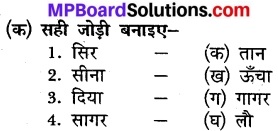
श्लोकों के अंशों को उचित रूप से जोड़ो
कक्षा 7 संस्कृत पुस्तक Mp Board
उत्तर:
(क) → (4)
(ख) → (1)
(ग) → (2)
(घ) → (3)

कक्षा 7 संस्कृत पाठ 4 MP Board प्रश्न 9.
उदाहरण के अनुसार अन्वय की पूर्ति करो
(1) सुखार्थी चेत् ………… त्यजेत्, विद्यार्थी ………… सुखं ……….. , सुखार्थिनः विद्यां विद्यार्थिनः ………… कुतः।
(2) तक्षकस्य ……….. विषं, ………… मुखे विषं, ……….. पुच्छे विषं दुर्जनस्य ……… विषम्।
उत्तर:
(1) विद्या, चेत्, त्यजेत्, त्यजेत्, सुखम्।
(2) दन्ते, मच्छिकायाः, वृश्चिकस्य, तु सर्वाङ्गे।

चाणक्यवचनानि हिन्दी अनुवाद 

चाणक्यः चन्द्रगुप्तमौर्यस्य गुरुः आसीत्। सः महान राजनीतिज्ञ अर्थशास्त्रज्ञश्च आसीत्। “चाणक्यनीतिः कौटिलीयमर्थशास्त्रम्” इति द्वौ ग्रन्थौ प्रसिद्धौ स्तः। चाणक्यः नन्दवंशस्य उन्मूलनं कृत्वा चन्द्रगुप्तमौर्यं सिंहासने स्थापितवान्। तस्य वचनानि अत्र प्रस्तूयन्ते

अनुवाद :
चाणक्य चन्द्रगुप्त मौर्य के गुरु थे। वे राजनीति के एक महान ज्ञाता और अर्थशास्त्र के जानकार थे। ‘चाणक्यनीति तथा कौटिलीय अर्थशास्त्र’ इनके दो प्रसिद्ध ग्रन्थ हैं। चाणक्य ने नन्दवंश का विनाश करके चन्द्रगुप्त मौर्य को सिंहासन पर बैठाया। उनके वचनों को यहाँ प्रस्तुत किया जाता है-

माता शत्रुः पिता वैरी, येन बालो न पाठितः।
न शोभते सभामध्ये, हंसमध्ये बको यथा॥१॥

अनुवाद :
जिन माता और पिता ने बालकों को शिक्षा नहीं दिलायी, वे (दोनों) शत्रु हुआ करते हैं। (अशिक्षित) बालक सभा में उसी तरह शोभा नहीं पाते जिस तरह हंसों के मध्य बगुला शोभा नहीं पाता।

अधमाः धनमिच्छन्ति, धनं मानं च मध्यमाः।
उत्तमाः मानमिच्छन्ति, मानो हि महतां धनम्॥ २॥

अनुवाद :
नीच व्यक्ति धन की इच्छा किया करते हैं। मध्यम श्रेणी के व्यक्ति धन और मान-सम्मान दोनों को ही चाहते हैं। उत्तम श्रेणी के व्यक्ति मात्र सम्मान ही चाहते हैं, क्योंकि सम्मान ही महापुरुषों के लिए धन हुआ करता है।

जलबिन्दुनिपातेन क्रमशः पूर्यते घटः।
स हेतुः सर्वविद्यानां धर्मस्य च धनस्य च॥३॥

अनुवाद :
जल की बूंदों को लगातार गिराते रहने से घड़ा भर जाता है। सभी विद्याओं, धर्म तथा धन के विषय में यही कारण हुआ करता है अर्थात् विद्या, धर्म तथा धन का संचय थोड़ा-थोड़ा करके भी बहुत अधिक हो जाता है।

सुखार्थी चेत्त्यजेत् विद्या, विद्यार्थी चेत्त्यजेत्सुखम्।
सुखार्थिनः कुतो विद्या विद्यार्थिनः कुतस्सुखम्॥४॥

अनुवाद :
सुख चाहने वाले को विद्या का त्याग कर देना चाहिए तथा विद्यार्थी को (विद्या की चाहना करने वाले को) सुख का त्याग कर देना चाहिए। सुख चाहने वाले को विद्या कहाँ और विद्यार्थी को सुख कहाँ? अर्थात् सुख की इच्छा करने वाले व्यक्ति को विद्या नहीं मिल सकती और विद्या चाहने वाले व्यक्ति को सुख नहीं मिल सकता।

तक्षकस्य विषं दन्ते मक्षिकायाः विषं मुखे।
वृश्चिकस्य विषं पुच्छे, सर्वाङ्गे दुर्जनस्य तु॥५॥

अनुवाद :
तक्षक प्रजाति के सर्प के दाँत में विष होता है। मक्खी के मुख में विष होता है। बिच्छू की पूँछ में विष होता है परन्तु दुष्ट व्यक्ति के तो सम्पूर्ण शरीर में ही विष होता है।

कामधेनुगुणा विद्या सर्वदाफलदायिनी।
प्रवासे मातृसदृशी विद्या गुप्तधनं स्मृतम्॥६॥

अनुवाद :
सभी फलों को प्रदान करने वाली विद्या में कामधेनु के समान गुण होते हैं। परेदश में रहने पर माता के समान विद्या होती है। इस तरह विद्या छिपा हुआ धन कहा जाता है।

एकेनापि सुवृक्षण पुष्पितेन सुगन्धिना।
वासितं तद्वनं सर्वं सुपुत्रेण कुलं यथा॥ ७॥

अनुवाद :
एक ही श्रेष्ठ वृक्ष पर फूलों के खिल जाने से उनकी अच्छी गन्ध ने उस सम्पूर्ण वन को सुगन्धित उसी प्रकार कर दिया, जिस तरह सुपुत्र के द्वारा वंश को सुगन्धित कर दिया जाता है (श्रेष्ठ बना दिया जाता है)।

चाणक्यवचनानि शब्दार्थाः

बकः = बगुला। महताम् = श्रेष्ठ लोगों का। अधमाः = निम्न कोटि के। तक्षकः = सर्प विशेष। मक्षिका = मक्खी। वृश्चिकः = बिच्छू। पुच्छे = पूँछ में। प्रवासे = यात्रा में या परदेश में रहने पर। वासितम् = सुगन्धित। कामधेनु गुणा = इच्छा पूरी करने वाली गाय के समान गुण वाली। मातृसदृशी = माता के समान।

MP Board Class 7th Sanskrit Solutions

MP Board Class 7th General English Essay Writing

Get Updated MP Board Solutions for Class 7 General English Essay Writing Questions and Answers in PDF Format and download them free of cost. These are provided as per the latest exam pattern and syllabus. Access the topics of Chapter wise and communication skills, grammer part through the direct links available depending on the need. You can Download MP Board Class 7 English Solutions and can score highest grade in examination. Clear all your queries on the Mp Board Solutions for Class 7 English Chapter 21 Tansen Questions and Answers Subject by using the Madhya Pradesh State Board Solutions for existing.

MP Board Class 7th General English Essay Writing

If you are eager to know about the Madhya Pradesh State Board Solutions for Class 7 English you will find all of them here. You can identify the knowledge gap using these MP Board Solutions for English PDF and plan accordingly. Don’t worry about the accuracy as they are given after extensive research by people having subject knowledge along side from the latest English Syllabus.

1. Holi

India is the country where different festivals are celebrated every month. Most important festivals of India are Holi, Raksha Bandhan, Dusshera, Deepawali, Id and Christmas.

Holi is the festival of colours. People express their happiness by throwing colours on their friends, relatives and neighbours. They make fun. They use dry and wet colours.

People are lost in singing songs relating to the festival and season. They feel happy by welcoming their friends with sweetmeats and tea or coffee or cold drink. Sugarcane fields look full of cheerfulness of the farmers who work there. Grain fields look very beautiful.

Some people throw mud on one another and they shout. Everyone, small or big bears a smile on his face.

कठिन शब्द – different = अनेक; festivals = त्यौहार; celebrated = मनाये जाते हैं; express = प्रकट करना; fun = मजाक; dry and wet = सूखे और गीले; relating to = सम्बन्धित; season = मौसम; are lost = लीन हो जाते हैं; welcoming = स्वागत करके; sweetmeats = मिठाईयाँ; sugarcane fields=ईख के खेत; cheerfulness = प्रसन्नता; look = प्रतीत होते हैं; grain = अनाज; one another = एक-दूसरे पर; shout = शोर मचाते हैं; bear a smile = मुस्कुराहट लिए हुए; face = चेहरा।

2. My Hobby

“All work and no play makes Jack a dull boy.” There should be some amusement after work. A hobby is a thing which we do in our free time. There are several hobbies like singing, dancing, gardening etc. My hobby is gardening.

I have made a small garden. I grow vegetables, fruits and flowers in it. I work in my garden in the morning and in the evening. It gives me pleasure to work in the garden. It also saves money as I don’t have to buy vegetables from the market. It has also increased my knowledge of science. Gardening is a useful hobby as it controls pollution.

कठिन शब्द – amusement = मनोरंजन; pleasure = खुशी; saves = बचाना; increased = बढ़ाना; knowledge – ज्ञान; pollution = प्रदूषण; useful = उपयोगी।

3. My Pet Animal

I am fond of pet animals. Moti is my pet dog. It watches our house. It barks aloud if some stranger comes to our house. I take Moti for a morning walk daily. I throw a ball and Moti brings it back.

I feed it with bread and milk. I wash it daily. One night it started barking loudly. When we got up we saw some thieves trying to enter our house. Seeing us and Moti they ran away. Thus Moti saved us. I love Moti a lot.

कठिन शब्द – pet = पालतू; watch = निगरानी करना; feed = खिलाना; bark = भौंकना; loudly = तेज आवाज में; enter = घुसना; thieves = चोर; saved = बचाया।

4. Annual Day of My School

Every year in the month of February, ‘Annual day’ in our school in celebrated. Many students from different classes and sections participate in different games and activities. My friend Reeta from Class VII A, took part in 100 metre race. Other participants did their best. They all ran very fast but Reeta stood first in this race.

Reeta is the thinnest girl of her class but she is the strongest. She started from the very line and finished the race on it. Everyone praised her performance.

कठिन शब्द – annual day = वार्षिकोत्सव; celebrated = मनाया जाता है; different classes = भिन्न-भिन्न कक्षाओं के; sections = वर्गों के; participate = भाग लेते हैं; thinnest = सबसे पतली; strongest = सबसे अधिक ताकतवर; praised = प्रशंसा की; performance = कार्य प्रणाली के।

5. My Favourite Teacher

I study in Modern Public School, Raipur. There are many teachers in our school. But Mr. Gupta is my favourite teacher. He teaches us English. He is also our class teacher. He is smart and handsome. He works hard with his students. He helps weak students.

He teaches well. His examination results are always very good. He is both strict and kind. We obey him. He is also good at games. He plays cricket well. I like him very much.

कठिन शब्द – favourite = प्रिय; smart = चुस्त; handsome = सुन्दर; work hard = मेहनत करना; weak = कमजोर; well = अच्छा; strict = कठोर; obey = आज्ञा पालन करना।

6. A Journey by Train

In the last winter vacations my uncle invited us to spend a week in Delhi. My sister and I decided to leave for Delhi by the Taj Express.

We My sister and I reached the railway station at 4 p.m. I bought two tickets. We got into the train and occupied two seats. At 4:15 p.m. the train left Gwalior. After an hour it reached Morena. Then it started passing over the Chambal bridge very slowly. We saw the famous Chambal river and its ravines.

At 10:30 p.m. the train finally reached Nizamuddin railway station. Our uncle and aunt were waiting for us. They were very happy to see us. They took us home in their car.

कठिन शब्द – winter vacations = शीत अवकाश; invited = निमन्त्रण दिया; spend = बिताना; decide = निश्चय; reached = पहुँचे; bought = खरीदे; occupied = घेर लेना; ravines = बीहड़; wait = इन्तजार।

7. A Visit to A Market

I went to my uncle’s house in these summer vacations, in Agra. There I visited the Rajamandi Bazar with my cousin sister..

There was a large crowd in the market. All the shops were decorated with lights. There were shops of almost all articles. There were shops of gifts, garments, shoes, books, etc. Street vendors were also there selling various articles like purses, cosmetics etc. at cheaper rates.

I bought a pair of shoes and a nice dress for my sister. I really enjoyed there.

कठिन शब्द – crowd = भीड़; decorated = सजी हुई; articles = वस्तुएँ; cosmetics = सौन्दर्य प्रसाधन; enjoyed = लुल्फ उठाना

8. A Visit to a Circus

Last week my parents and I went to see the Apollo Circus. There was a huge crowd inside the tent. But we had special passes so we got a seat in front.

In the beginning there was a show of dwarfs.

They were so small in height and did such actions that everyone laughed. After that there were several small shows of different animals like monkey, elephant, lion, tiger. The ring master controlled them. There was also a belle dance. The dancers had a flexible body. In the end came the joker for whom I was waiting. He just made us laugh and laugh. I greatly enjoyed in the circus.

कठिन शब्द – special = ख़ास; dwarfs = बैन आदमी; beginning = शुरुआत में; flexible = लचीली।

9. My Best Friend

I have several friends but Raja is my best friend. He is my neighbour. He also studies in my class.

He is a very good boy. He is very intelligent. He always stands first in class. He is not proud. He helps his classmates. He is a ‘friend in need’. His father is a bank manager. His mother is a house wife.

He is good at sports and games too. He is cheerful and polite. I love him for his qualities and nature.

कठिन शब्द – several = कई; neighbour = पड़ोसी; studies = पढ़ता है; intelligent = बुद्धिमान; classmates = सहपाठी; house wife= गृहिणी; proud = घमण्डी; cheerful = प्रसन्नचित; qualities = गुण; nature = व्यवहार।

10. The Independence Day

15th August is an important day in the history of India. On this day in 1947 our country became free. It is our national festival. It is celebrated all over the country with great joy. We also celebrated it in our school this year.

All the students were in neat and clean uniforms. Our principal unfurled the national flag. We, then sang National Anthem. Some students presented different types of programmes. The principal gave speech in the end on our freedom fighters. The function was over after the distribution of sweets.

कठिन शब्द – important = महत्त्वपूर्ण; history = sfera; celebrated = 45MI; unfurled = 46<F1; freedom fighters = देशभक्त; distribution = वितरण।

11. My Mother

My mother is an ideal one. She is kind and affectionate. She loves her children very much. Whenever anyone of us falls ill,she is the one who tends and nutses the sick. Being of polished manners, she teaches us lessons on truthfulness, thrift and health. She also helps us in completing our home work. But she is strict also, and never tolerates any mischief in the house.

Her love towards her family is very great. She wishes to make her family ideal and for this she is always busy. She never neglects her duty. Out of immense love for the family she manages the kitchen, sews and washes clothes. She spares no pains in giving us comfort.

I am proud of my mother.

कठिन शब्द – affectionate = स्नेही; tends = सेवा करना; thrift = मितव्ययिता; tolerate = सहन करना; immense = अत्यधिक।

12. A policeman

A policeman looks very smart in his uniform. He is generally dressed in Khaki but policemen on traffic duty are clad in white. A policeman wears a cap with a badge of his department on his head. He wear’s a leather belt round his waist.

The duty of a policeman is very hard. He has to control traffic in the burning head of the sun and heavy rains. He has to look after the life and property of the public. He detects wrongdoers and brings them to book. He keeps law and order in the country.

The policeman is respected by public for his honesty and hard work. He, sometimes becomes impolite due to frustration caused by his hard duty. Certainly, our life and property are safe only by the presence of police force in our country.

कठिन शब्द – uniform = वेशभूषा; waist = कमर; wrong-doers = गलती करने वाले; impolite = अशिष्ट,अभद्र; frustration = निराशा कुण्ठा।

We believe the information shared regarding MP Board Solutions for Class 7 English Chapter 21 Tansen Questions and Answers as far as our knowledge is concerned is true and reliable. In case of any queries or suggestions do leave us your feedback and our team will guide you at soonest possibility. Bookmark our site to avail latest updates on several state board Solutions at your fingertips.

MP Board Class 7th General English Paragraph Writing

Get Updated MP Board Solutions for Class 7 General English Paragraph Writing Questions and Answers in PDF Format and download them free of cost. These are provided as per the latest exam pattern and syllabus. Access the topics of Chapter wise and communication skills, grammer part through the direct links available depending on the need. You can Download MP Board Class 7 English Solutions and can score highest grade in examination. Clear all your queries on the Mp Board Solutions for Class 7 English Chapter 21 Tansen Questions and Answers Subject by using the Madhya Pradesh State Board Solutions for existing.

MP Board Class 7th General English Paragraph Writing

If you are eager to know about the Madhya Pradesh State Board Solutions for Class 7 English you will find all of them here. You can identify the knowledge gap using these MP Board Solutions for English PDF and plan accordingly. Don’t worry about the accuracy as they are given after extensive research by people having subject knowledge along side from the latest English Syllabus.

एक ही विषय पर या उससे सम्बन्धित विषय पर कहे गये वाक्यों के समूह को गद्यांश कहते हैं।

गद्यांश लेखन के नियम –

  1. प्रत्येक गद्यांश एक ही विषय से सम्बन्धित होना चाहिए एवं उसका प्रत्येक वाक्य मुख्य विषय से सम्बन्धित होना चाहिए।
  2. गद्यांश का प्रथम वाक्य पाठक की उत्सुकता जगाने वाला व अन्तिम वाक्य उसकी जिज्ञासा शान्त करने वाला होना चाहिए।
  3. गद्यांश में विचारों या घटनाओं का क्रम उनके घटित होने के क्रम में व मुख्य विषय से सम्बन्धित होना चाहिए।

Question 1.
Write about your experience of journey by train/bus/aeroplane/ship in a paragraph.
Answer:
Experience of a journey by train
In the journey by train, we travel with the people who speak different languages, wear different dresses and eat different things. There is great rush in the compartment. There is dirt all around. Pure water is not supplied. Mostly, people cover their journey without having any seat. There is no light. The train journey is not comfortable.

कठिन शब्द:
journey – यात्रा
different – अलग-अलग
supplied – प्रदान करना
comfortable – आरामदायक।

Question 2.
Write a paragraph about things you like most in life (people, places, things) and how you spend time with them.
Answer:
I like the hilly areas where I am able to remain in the midst of the nature. Trees give fresh air and make the atmosphere peaceful. Birds sing their songs and remove the heaviness of the mind. Flowing water of a small river or fountain inspires to move onward and makes my heart pure. This is how I spend my time in Chitrakut.

कठिन शब्द:
midstata – बीच में
fresh – ताजा
atmosphere – वातावरण
peaceful – शान्त
heaviness – भारीपन
flowing – बहता हुआ
fountain – झरना
inspire – प्रेरित करना।

Question 3.
Write a paragraph on your grandfather.
Answer:
My Grandfather

My Grandfather is a farmer. He has a good experience of farming. He is 75 years of age. He still works hard. He reads book without spectacles. He is tall and wears dhoti and kurta. He goes to his fields in the morning and watches the work done by the workers.

कठिन शब्द:
experience – अनुभव
work hard – मेहनत करना
spectacles – चश्मा
fields – खेत
watch – देखना

Question 4.
Write a paragraph on your favourite tree.
Answer:
Mango Tree or My Favourite Tree

Mango tree is my favourite. It is found all over India. It grows and develops very large. It bears fruits. In rains its juice becomes very sweet. Its raw fruits are used in making pickles, chutnies and jam also. Ripe mango gives us juice. Its leaves look beautiful and are used to decorate the doors of the houses when some religious duty is being made. It bears fruits in the months from May to August.

कठिन शब्द:
grows – उगता है
develops – विकसित हो जाता है
large – विशाल
bears fruits – फल लगते हैं
juice – रस
raw – कच्चे
pickles – अचार
jam – मुरब्बा
ripe mango – पके आम
decorate – सजाना
religious duty – धार्मिक कार्य

We believe the information shared regarding MP Board Solutions for Class 7 English Chapter 21 Tansen Questions and Answers as far as our knowledge is concerned is true and reliable. In case of any queries or suggestions do leave us your feedback and our team will guide you at soonest possibility. Bookmark our site to avail latest updates on several state board Solutions at your fingertips.

MP Board Class 7th General English Annual Evaluation

Get Updated MP Board Solutions for Class 7 General English Annual Evaluation Questions and Answers in PDF Format and download them free of cost. These are provided as per the latest exam pattern and syllabus. Access the topics of Chapter wise and communication skills, grammer part through the direct links available depending on the need. You can Download MP Board Class 7 English Solutions and can score highest grade in examination. Clear all your queries on the Mp Board Solutions for Class 7 English Chapter 21 Tansen Questions and Answers Subject by using the Madhya Pradesh State Board Solutions for existing.

MP Board Class 7th General English Solutions Annual Evaluation

If you are eager to know about the Madhya Pradesh State Board Solutions for Class 7 English you will find all of them here. You can identify the knowledge gap using these MP Board Solutions for English PDF and plan accordingly. Don’t worry about the accuracy as they are given after extensive research by people having subject knowledge along side from the latest English Syllabus.

Question 1.
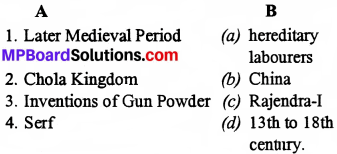
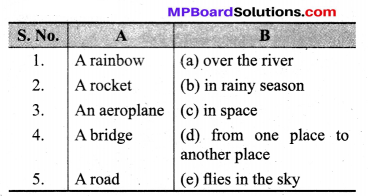
Match the column A with B :
(कॉलम A का मिलान कॉलम B से कीजिए।)
MP Board Class 7th General English Annual Evaluation 1
Answer:

  1. → (d)
  2. → (b)
  3. → (a)
  4. 4. → (c)

Question 2.
Do as directed : (निर्देशानुसार करो)

(a) Combine the following sentences using ‘who’:
(Who का प्रयोग कर निम्न वाक्यों को जोड़िए)

(i) The girl is wearing lahnga chunari.
The girl is Sarita.
Answer:
The girl who is wearing lahnga chunari is Sarita.

(ii) Seema studies in class VII.
Seema is the most intelligent student of the class.
Answer:
Seema who studies in class VII is the most intelligent student of the class.

(b) Use appropriate prepositions in the following sentences :
(निम्न वाक्यों में उपयुक्त Preposition का प्रयोग करें)

(i) She was waiting ……….. her husband.
(ii) She always agrees …………. my decisions.
Answer:
(i) for
(ii) to.

(a) Combine the sentences given below using ‘prettier’:
(निम्न वाक्यों को ‘Prettier’ का प्रयोग कर जोड़िए।)
(i) Shobha is pretty.
(ii) Her sister is prettier.
Answer:
Shobha’s sister is prettier than her.

(d) Fill in the blank spaces with the correct forms of the verbs :
(क्रिया के सही रूपों से खाली स्थानों को भरिए।)

(i) Two boys were ……….. (play) in the ground.
(ii) They were ………. (enjoy) their free time.
Answer:
(i) playing
(ii) enjoying.

(e) Rewrite the following conversation in indirect form of narration :
(निम्न वार्तालाप को (indirect) रूप में पुनः लिखिए)

Bala : “Vinita, where did you go yesterday ?”
Answer:
Bala asked Vinita where she had gone the day before.

Vinita : “I went to the market.”
Answer:
Vinita replied that she had gone to the market.

(f) Punctuate the following lines :
(निम्न पंक्तियों में विराम चिन्ह लगाइए।)
Answer:
That’s true, it’ll be difficult to trace anyone who gets lost. Can we eat something before we go for the rides?

(g) Make words by adding ‘ly’.
(ly’ जोड़कर शब्द बनाइए)
Bad, brave, intelligent, quick.
Answer:
Badly, bravely, intelligently, quickly.

(h) Give the opposites of:
(विपरीत शब्द लीखिए)
wild, sharp
Answer:
Domestic, blunt.

Question 3.
(A) Answer the following questions (any five) :
(निम्न प्रश्नों के उत्तर दीजिए) (कोई पॉंच)

(a) Why did the horse trainer and his wife decide to sell the horse ?
Answer:
The horse trainer and bis wife decided to sell the horse because it ate a lot of fodder and it was expensive to feed it.

(b) Why did the merchants think that the old man had seen the camel ?
Answer:
The merchants thought that the old man had seen the camel because he gave the real information to the merchants about their camel.

(c) What happened when Deepak and Bhola were walking through the forest ?
Ans.
When Deepak and Bhola were walking through the forest, a bear attacked them.

(d) What happened to the bus in the story One Way Ticket?
Answer:
Something wrong happened with the engine of the bus.

(e) Why were the students of class VII happy?
Answer:
The students of class VII were happy and excited to discuss their visit to Orchha.

(f) Why is the story called ‘One way Ticket’?
Answer:
All the five friends collected their money they had and then only they were able to buy a one way ticket for the return journey.

Question 4.
Answer the following questions (any three) :
(निम्न प्रश्नों के उत्तर दीजिए) (कोई पाँच)

(a) Why will the pussy like the child ?
Answer:
Pussy will like the child because she is gentle and good.

(b) Why are the clouds prettier than boats and ships?
Answer:
Because they sail across the sky and are natural.

(c) How are the days in the south during January?
Answer:
The days in the south during January are very fine.

(d) What according to the poet, is not good for the environment ?
Answer:
Burning the wood a lot, is not good for environment. The air gets polluted from smoke caused by burning the wood.

Question 5.
Write an application to the Principal of your school to take you on a picnic.
(अपने विद्यालय के प्रधानाचार्य को पिकनिक पर ले जाने हेतु एक प्रार्थना-पत्र लिखिए।)
Answer:
See ‘Applications’ in the Grammar section.
Or (या)
Write a letter to your friend telling him about your visit to Kanha.
(कान्हा भ्रमण के बारे में अपने मित्र को एक पत्र लिखिए।)
Answer:
Arera Colony,
Bhopal-462016
25 December,

2005.
Dear Ashish,
Hope you are fine. I am also fine here. Today, I wish to tell you about my visit to Kanha National Park. My five friends and I visited it last Sunday. It was a great fun. We saw a variety of animals there like deer, elephants, lions etc. We gave nuts to monkeys and bananas to elephants. We also took photographs of many rare species of animals there. We had our lunch together in the park and played some outdoor games also. It was a memorable journey. We came back home by 7’o clock in evening. I missed you a lot there, we will go there again whenever you come here.
Yours Affectionatly
Raj

Question 6.
Write ten lines on any one of the following:
(निम्न में किसी एक पर 10 पंक्त्यां लीखिए)

(i) Maharani Laxmi Bai.
Answer:
Maharani Laxmi Bai was the queen of Jhansi. She was brave, courageous and bold from her early childhood. She was skilled in horse riding, shooting, wrestling and all the martial arts and continued to practise them even after her marriage with Gangadhar Rao, the king of Jhansi.

When Britishers declared to merge Jhansi with British empire, after her husband’s death, she opposed it and bravely fought against them not thinking that she was a woman. She was a great patriot. She tied her son to her back and led her army against the British. She fought courageously till her last breath and did not let any Britisher touch her living or dead.

(ii) A visit to Orchha.

(iii) A Market Place.
Answer:
Yesterday, I went to the market. There was hustle and bustle of vehicles. There were different shops of different articles like sweet shops eateries, fancy goods and clothes shops. Shopkeepers were bargaining with customers. Shops were decorated with colourful lighting. Children were swinging on the swings.

Question 7.
Read the passage and answer the questions given at the end of it :
(निम्न गद्यांश को पढ़िए और इसके अन्त में दिए गए प्रश्नों के उत्तर दीजिए।)

(A) (i) Why did the farmer always sing while he worked ?
Answer:
Because his work was his delight and his music of life.

(ii) Who said to whom ?
(a) Tell me, my man, how are you so happy always ?
Answer:
Zamindar to the farmer.

(b) If you too work hard like me, you will also enjoy the bliss of sound sleep.
Answer:
The farmer to the Zamindar.

(iii) The greatest trouble of Zamindar was that he couldn’t sleep.
(iv) The title of the passage is Hard work-the music of life.
(v) What gives a man a normal sleep?
Answer:
Hard Work.

(B) Match the two columns :
(दो कालमों का मिलान किजिए)
MP Board Class 7th General English Annual Evaluation 2
Answer:

  1. → (d)
  2. → (a)
  3. → (b)
  4. → (e)
  5. → (c)

We believe the information shared regarding MP Board Solutions for Class 7 English Chapter 21 Tansen Questions and Answers as far as our knowledge is concerned is true and reliable. In case of any queries or suggestions do leave us your feedback and our team will guide you at soonest possibility. Bookmark our site to avail latest updates on several state board Solutions at your fingertips.

MP Board Class 7th General English Grammar

Get Updated MP Board Solutions for Class 7 General English Grammar Questions and Answers in PDF Format and download them free of cost. These are provided as per the latest exam pattern and syllabus. Access the topics of Chapter wise and communication skills, grammer part through the direct links available depending on the need. You can Download MP Board Class 7 English Solutions and can score highest grade in examination. Clear all your queries on the Mp Board Solutions for Class 7 English Chapter 21 Tansen Questions and Answers Subject by using the Madhya Pradesh State Board Solutions for existing.

MP Board Class 7th General English Grammar

If you are eager to know about the Madhya Pradesh State Board Solutions for Class 7 English you will find all of them here. You can identify the knowledge gap using these MP Board Solutions for English PDF and plan accordingly. Don’t worry about the accuracy as they are given after extensive research by people having subject knowledge along side from the latest English Syllabus.

Artticle (आर्टिकल)
उपपद

Article तीन हैं – (1) a, (2) an,(3) the.
a तथा an का प्रयोग एकवचन के लिए होता है। the का प्रयोग एकवचन तथा बहुवचन दोनों के लिए होता है।
(1) A का प्रयोग – Consonant (व्यंजन) से प्रारम्भ होने वाले एकवचन की जातिवाचक संज्ञा के पूर्व होता है। जैसे-a book, a man, a dog, a cat आदि।
(2) An का प्रयोग – vowels (a, e, i, 0, u) स्वर से प्रारम्भ होने वाले एकवचन की जातिवाचक संज्ञा के पूर्व होता है।
जैसे – An apple, an eye, an inkpot, an orange, an umbrella आदि।
(3) The का प्रयोग-किसी खास वस्तु, अनोखी वस्तु, नदी, पहाड़, प्रसिद्ध ग्रन्थ, अखबार के नाम आदि के पहले होता है। जैसे-The sun, The earth, The Ganga, The Indian Ocean, The Taj, The East आदि। किसी खास या पूर्व परिचित वस्तु का बोध कराने के लिए भी The का प्रयोग किया जाता है। जैसे-The girl in blue is my sister.

Exercise

Fill in the following blanks with a, an or the as required

  1. ……….. train was ………. hour late.
  2. Srilanka is ………. island.
  3. He is ……….. honest man.
  4. It is ………… large egg.
  5. ……….. umbrella is ……. use full thing.
  6. ………… rose is ………. loveliest of all flowers.
  7. He is ……… M. A. from Allahabad university.
  8. …… Gita is ………. holy book of Hindus.

Answer:

  1. The, an
  2. an
  3. an
  4. a
  5. An, a
  6. The, the
  7. an
  8. Thea, the.

The Pronoun (द प्रोनाऊन)
सर्वनाम

Pronoun वह शब्द है जिसका प्रयोग संज्ञा (Noun) के स्थान पर होता है। जैसे –
Hari is my friend. He lives in Delhi.
यहाँ He, सर्वनाम (Pronoun) है। यह Noun-Hari के स्थान पर आया है।

Kinds of Pronoun (सर्वनाम के प्रकार)

1. Personal Pronouns (पुरुषवाचक सर्वनाम)
उदाहरण – I, We, You, He, She, It, They, Me, Us, Him, Her, Them, Mine, Ours, Yours आदि।

2. Reflexive Pronouns (निजवाचक सर्वनाम)
उदाहरण – Myself, yourself, himself, herself, ourselves, themselves.

3. Demonstrative Pronouns (संकेतवाचक सर्वनाम)
उदाहरण – this, that, these, those.

4. Interrogative Pronouns (प्रश्नवाचक सर्वनाम)
उदाहरण – Who, which, whom, whose, what.

5. Relative pronouns (सम्बन्धवाचक सर्वनाम)
उदाहरण – Who, Whom, Whose, Which, That, What, आदि।

6. Indefinite Pronouns (अनिश्चयवाचक सर्वनाम)
उदाहरण – anybody, somebody, nobody, someone, one, none, all, mony, few.

7. Distributive Pronouns (प्रत्येकवाच सर्वनाम)
उदाहरण – each, either, neither.

8. Reciprocal Pronouns (पारस्परिक सर्वनाम)
ये दो pronouns से मिलकर बनते हैं और केवल दो हैं – each other, one another.

9. Possessive Pronouns (अधिकार वाचक सर्वनाम)
उदाहरण – mine, yours, hers. आदि।

Exercise

Pick out the pronouns in the following sentences :
(निम्न वाक्यों में से सर्वनाम छाँटिए।)

  1. I know him very well.
  2. She has a pretty doll.
  3. They are playing cricket.
  4. I shall beat you.
  5. The boy who made a noise was punished.
  6. The man whose bag was stolen has come.
  7. Where is the pen which I gave you.
  8. Why do you abuse one another ?
  9. These are nice girls.
  10. They decided to help each other.

Noun (नाऊन)
संज्ञा

Countable and uncountable
संज्ञाओं (Nouns) को उनके गिने जाने के आधार पर दो प्रकार में बाँटा गया है –

(1) Countable Nouns – (गिने जाने योग्य संज्ञाएँ)
जैसे-dog, pen, country, table, road आदि।

(2) Uncountable Nouns – (नहीं गिने जाने योग्य संज्ञाएँ)
जैसे – butter, juice, sugar, hatred, love, sickness. आदि।

The Adverb (एडवर्व)
क्रिया-विशेषण

Adverb (क्रिया विशेषण) वह शब्द है जो किसी Verb (क्रिया), Adjective (विशेषण) या Adverb (क्रिया-विशेषण) की विशेषता बताता है। जैसे

The milk is very hot. Sarita ran fast but could not win the race.
उपरोक्त वाक्यों में very और fast क्रिया-विशेषण हैं।

Kinds of Adverbs

(1) Adverbs of Time (काल-वाचक)
उदाहरण-now, always, never, already, shortly, today, tomorrow आदि।

(2) Adverbs of Place (स्थान-वाचक)
उदाहरण-here, there, in, below, hence, thence, inside आदि।

(3) Adverbs of Manner (रीति वाचक)
उदाहरण-quickly, fast, well, easily, bravely आदि।

(4) Interrogative Adverbs (प्रश्नवाचक)
उदाहरण-when, where, how, why, how much आदि।

(5) Relative Adverbs (सम्बन्ध वाचक)
उदाहरण-when, where, how, why आदि।

(6) Adverbs of Degree (परिणामवाचक)
उदाहरण-very, much, quite, wholly, exactly आदि।

(7) Adverbs of Affirmation and Negation (स्वीकार वाचक एवं निषेध वाचक)
उदाहरण-yes, no, not, certainly, indeed आदि।

(8) Adverbs of Number (संख्या वाचक)
उदाहरण-once, twice, first, again आदि।

(9) Adverbs of Reason (हेतु वाचक)
उदाहरण-therefore, so, hence.

Exercise

Pick out the adverbs in the following sentences :
(निम्नलिखित वाक्यों में से क्रिया-विशेषण छाँटिए)

  1. The soldiers fought bravely.
  2. You can stay here.
  3. He went far into the forest.
  4. Tell me quickly as you can.
  5. Do you know why he came here ?
  6. Have you ever been to Mathura ?
  7. Why do you not work carefully ?
  8. Come inside.
  9. This shirt is too loose for me.
  10. I went there only once.

Voice (वाइस)
वाच्य

Voice (वाच्य) क्रिया का वह रूप है जो यह बताता है कि subject (कर्ता) कार्य का करने वाला है या उसके प्रति कोई कार्य किया गया है।
Voice दो प्रकार के होते हैं –

(1) Active Voice और Passive Voice
जैसे – The hunter killed a lion-Active
शिकारी ने शेर को मार डाला।
The lion was killed by the hunter-Passive
शेर शिकारी के द्वारा मार डाला गया।

यहाँ, पहले वाक्य में कर्ता (subject) hunter कार्य करने वाला है इसीलिये verb “killed” Active voice में होगा। जबकि दूसरे वाक्य में subject lion’ के प्रति कार्य हो रहा है इसीलिये verb ‘was killed’ passive voice में होगा।

Active से Passive बनाना

(1)Active से Passive में बदलने के लिए ‘to be’ क्रियाओं का प्रयोग किया जाता है। सबसे पहले Object (कर्म) को Subject (कर्ता) के स्थान पर रखते हैं। इसके पश्चात् tense के अनुसार क्रिया ‘to be’ को फिर मुख्य क्रिया (verb) की 3rd form को रखते हैं और अन्त में कार्य करने वाले (doer) को शब्द by के बाद रखते हैं।

‘To be’ क्रियाएँ आठ हैं। बिना इनके passive नहीं बन सकता है।
Verb to be’.- is, are, am, was, were, be, been,being.
केवल transitive verb को passive voice में बदलते हैं क्योंकि उसका object होता है।

निम्न वाक्यों को पढ़ें –

Active – We like mangoes.
Passive – Mangoes are liked by us.
Active – The dog cought the rat.
Passive – The rat was cought by the dog.
Aetive – He is flying a kite.
Passive – A kite is being flown by him.

कभी-कभी कुछ nouns के दो objects होते हैं। Passive Voice में उनमे से किसी को भी Subject बनाया जा सकता है परन्तु अधिकतर Indirect Object को Subject की तरह प्रयोग करते हैं।

उदाहरण –
Active – He gave me a book.
Passive – I was given a book by him.
Or
A book was given (to) me by him.
Active – Ram told me stories at night.
Passive – I am told stories at night by Ram.
Or
Stories are told me at night by Ram.

Change of Tense (काल में परिवर्तन)
MP Board Class 7th General English Grammar 1
Exercise

Change the following sentences into Passive Voice :

  1. The teacher teaches us English.
  2. The peon rings the bell.
  3. The Police arrested the thief.
  4. The servent had beaten Ram.
  5. The carpenter was making a table.
  6. They had finished the work before the teacher came.
  7. Our team will win the match.
  8. The postman will help us.
  9. He will visit me tomorrow.
  10. Have you broken the cup ?

The preposition (द प्रिपोजिशन)
सम्बन्धसूचक अव्यय

परिभाषा – वे शब्द जो किसी Noun या Pronoun से पूर्व प्रयोग में आये हों और उनका सम्बन्ध वाक्य के किसी अन्य Noun या Pronoun के साथ स्थापित हो, Prepositions कहलाते हैं।
A preposition is a word placed before a noun or a pronoun to show the relation of the person or thing denoted by it.

Relations expressed by Prepositions

1. Preposition of Time – कुछ Prepositions समय सूचक होते हैं, जैसे-

  1. He came at seven.
  2. I study for seven hours daily.
  3. She is absent from class for five days.

2. Preposition of Place – कुछ Prepositions स्थान सूचक होते है, जैसे-

  1. He was in his room.
  2. They are coming home from the school.
  3. I stood before him.

3. Prepositions of Movement – Prepositions गतिसूचक/साधन सूचक होते हैं, जैसे-

  1. I travelled by train.
  2. I came by car.
  3. We went there on his bike.

Use of some other Prepositions

1. At, In – At छोटे स्थान के साथ प्रयोग किया जाता है
In बड़े स्थान के साथ प्रयोग किया जाता है। जैसे –
(i) He lives at Bhopal.
(ii) We live in India.

2. In, into – In स्थिति को बताता है और Into गति का बोध करता है। जैसे –
(i) All the boys are in the classroom.
(ii) We bought the tickets and went into the hall.

3. With, by – With यन्त्र के साथ प्रयोग होता है और by कार्य करने वाले के साथ प्रयोग किया जाता है। जैसे –
(i) We cut the apple with the knife.
(ii) The snake was killed by the farmer.

4. Since, for-Since निश्चित समय के साथ (जैसे दिन का नाम या तिथि आदि) और For समय की अवधि के साथ प्रयोग किया जाता है। जैसे –
(i) He has been ill since Wednesday.
(ii) Raj has been absent for three days.

5. Between, among-Between दो व्यक्तियों तथा Among दो से अधिक व्यक्तियों के लिए प्रयोग किया जाता है। जैसे-
(i) Divide these mangoes between Ram and Ravi.
(ii) The gentleman divided his property among his four sons.

6. On, upon-On गतिहीनता तथा Upon गतिशीलता के लिए प्रयोग किया जाता है। जैसे –
(i) The cat is sitting on the table.
(ii) The dog sprang upon the table.

7. In, within-In समय की अवधि की समाप्ति का बोध कराता है और Within समय की अवधि के भीतर का बोध कराता है। जैसे –
(i) I shall come back in a week. (एक सप्ताह की समाप्ति पर।)
(ii) I shall come within a week. (एक सप्ताह समाप्त होने से पूर्व।)

8. Below, beneath-Below पद के सन्दर्भ में और Beneath स्थान के सन्दर्भ में प्रयोग किया जाता है। जैसे –
(i) Your brother is below my rank.
(ii) The lion sat beneath a tree.

9. Beside, besides-Beside का अर्थ है-पास (by the side of) जबकि Besides का अर्थ है-अतिरिक्त जैसे –
(i) The boys stood beside the teacher’s chair.
(ii) Besides the principal other teachers spoke in the prayer assembly.

10. With, without-With का अर्थ है-साथ और without का अर्थ-बिना (रहित)। जैसे –
(i) Come to me with your brother.
(ii) Come to the field without anything.

Exercise

Fill in the blanks with the appropriate prepositions :

  1. She is looking ……….. a job. (to, for)
  2. I have invited him ……… dinner. (to, for)
  3. Your sister is angry ……… you. (with, from)
  4. Your letter is full ……….. mistakes. (of, by)
  5. I met him ………. chance. (by, in)
  6. They came here …….. Monday.(on, at, since)
  7. She prefers tea ………. coffee. (to, thanong)
  8. Distribute these sweets ………. the children. (between, an jong)
  9. The frog jumped ………. the pond. (in, into)
  10. The book is ………. the table. (on, in, over)

Answer:

  1. For
  2. to
  3. with
  4. of
  5. by
  6. on
  7. to
  8. among
  9. into
  10. on.

Direct and Indirect Narration
(डाइरेक्ट एण्ड इन्डाइरेक्ट नरेशन)

Direct Narration में बोलने वाले के कथन को ज्यों का त्यों ही दोहरा दिया जाता है। परन्तु Indirect Narration में उस कथन का भाव प्रकट किया जाता है।
जैसे-He said to me, “I weep to see you.” (Direct)
He told me that he wept to see me. (Indirect)

निर्देश :
(1) Said को Told में बदल देते हैं। Inverted Commas को हटा देते हैं तथा Persons में परिवर्तन निम्नलिखित रूप में करते हैं।

(2) Ist Person के Pronoun (I, we, us, our) का परिवर्तन Direct speech के Subject (कर्ता) के Person के अनुसार होता है। IInd Person के Pronoun (you, your) का परिवर्तन Object के Person के अनुसार होता है तथा IIIrd person के Pronoun में कोई भी परिवर्तन नहीं होता है।

(3) निकटता प्रकट करने वाले शब्दों में परिवर्तन निम्नलिखित रूप से किया जाता है –
MP Board Class 7th General English Grammar 2

(4) Tense (काल) में परिवर्तन – (1) Reporting Verb के Present या Future Tense में होने पर Reported Verb के Tense में कोई परिवर्तन नहीं होता है। (2) Reporting Verb के Past Tense में होने पर
Reported Verb के Tense में परिवर्तन होता है –
(i) Simple present का Simple past हो जाता है –
Direct – He said, “She works hard.”
Indirect – He said that she worked hard.

(ii) Present Continuous का Past Continuous हो जाता है –
Direct-He said, “She is reading a book.”
Indirect-He said that she was reading a book.

(iii) Present perfect का Past perfect हो जाता है-
Direct-He said, “She has done her work.”
Indirect-He said that she had done her work.

(iv) Present Perfect Continuous का Past Perfect Continuous हो जाता है-
Direct-He said, “She has been reading a book for two hours.”
Indirect-He said that she had been reading a book for two hours.

(v) Simple past का Past Perfect हो जाता है-
Direct-He said, “She wrote a letter.”
Indirect-He said that she had written a letter.

(vi) Past Continuous का Past Perfect Continuous हो जाता है-
Direct-He said, “She was writing a letter.”
Indirect-He said that she had been writing a letter.
Shall का should, may का might, can का could हो जाता है तथा सदा सत्य और ऐतिहासिक तथ्यों का Tense नहीं बदला जाता।

Interrogative (Questions)

Direct-Rahul said to Rama, “Is it easy to ride a bicycle ?”
Indirect-Rahul asked Rama if it was easy to ride a bicycle.
Direct-The bird said to the Prince, “Why are you weeping ?”
Indirect-The bird asked the Prince why he was weeping.

Command and Orders

Direct-“Get some sleep”, his father said.
Indirect-His father told him to get some sleep.
Direct-“Don’t stay up late,” his mother said.
Indirect-His mother told him not to stay up late.
Direct-“Please help me,” Hari said to me.
Indirect-Hari requested me to help him.

Exercise

Rewrite the following sentences in indirect form of narration :

  1. The farmer said, “The rain is useful for crops.”
  2. Ram said to sheela, “I am your brother.”
  3. The teacher said, “The sun rises in the east.”
  4. Akshay said, “Who is running on the roof ?”
  5. His brother said to me, “Where do you go daily at this time?”
  6. She said to you, “When do you go for a walk?”
  7. Anu said to me, “From where have you bought this shawl ?”
  8. Rohan said to the boy, “Why did you not take medicine ?”

Answers :

  1. The farmer said that the rain is useful for crops.
  2. Ram told Sheela that he was her brother.
  3. The teacher said that the sun rises in the east.
  4. Akshay asked who was running on the roof.
  5. His brother asked me where did I go daily at that time.
  6. She asked you when you went for a walk.
  7. Anu asked me from where I had bought that shawl.
  8. Rohan asked the boy why he had not taken medicine.

Degrees of Comparison
(डिग्रीज़ ऑफ कम्परिजन),

गुण या दोष की अधिकता या कमी बताने के लिए Adjective की तीन अवस्थाएँ होती हैं-
(1) Positive degree
(2) Comparative degree
(3) Superlative degree.

MP Board Class 7th General English Grammar 3
MP Board Class 7th General English Grammar 4

Exercise

Fill in the blanks with a suitable word given in brackets :

  1. He is ………… than other boys in the class. (stronger, strong)
  2. Sita is …………. than Gita. (rich, richer)
  3. Ram is not as …………. as Shyam. (poor, poorer)
  4. Of the three mangoes this is the …………. (sweet, sweetest)
  5. Ravi is …………. than his brother. (clever, cleverer)
  6. Iron is the …………. of all the metals. (hardest, harder)
  7. She is not so …………. as her sister. (intelligent, more intelligent)
  8. It is the ……….. among all books I have ever read. (good, better, best)

Answer:

  1. stronger
  2. richer
  3. poor
  4. sweetest
  5. cleverer
  6. hardest
  7. intelligent
  8. best.

Complex Sentences
(मिश्रित वाक्य)

Complex sentence में एक Principal Clause (प्रधान उपवाक्य) तथा शेष. Subordinate Clause होते हैं। इस तरह clause तीन प्रकार के होते हैं – (1) Principal Clause, (2) Subordinate Clause (आश्रित उपवाक्य) तथा (3) Co-ordinate clause (समानपदीय उपवाक्य)।

Subordinate Clause तीन प्रकार के होते हैं –
(1) Noun Clause
(2) Adjective Clause
(3) Adverb Clause.

Adjective Clause
(एडजेक्टिव क्लॉज़)

Adjective clause यदि एक वाक्य (sentence) में आये हुए Noun या Pronoun के लिए दूसरे वाक्य में कोई बात कही गई है तो दूसरे वाक्य को Adjective clause बना देते हैं।
जैसे –
1. I saw a cat. The cat was lying on the road.
Answer:
I saw a cat who was lying on the road.

2. I gave her a pencil. The pencil was very cheap.
Answer:
I gave her a pencil which was very cheap.

3. The girl is wearing a red sweater. She is Savita.
Answer:
The girl, who is wearing a red sweater, is Savita.

4. Arif is wearing a blue shirt. He is the tallest boy in the class.
Answer:
Arif, who is the tallest boy in the class, is wearing a blue shirt.

5. Seema is in class ten. She is going to play in the national team.
Answer:
Seema, who is going to play in the national team, is in class ten.

6. Mohan is a swimming champion. He is going to teach his friends to swim.
Answer:
Mohan, who is a swimming champion, is going to teach his friends to swim.

7. Asma helped the boy. He is blind.
Answer:
Asma helped the boy, who is blind.

Interrogative Sentences
(प्रश्नवाचक वाक्य)

निर्देश-Simple Positive वाक्यों को Interrogative बनाने के लिए सहायक क्रिया (Auxiliary verb), मुख्य क्रिया (Main verb) तथा प्रश्नवाचक शब्दों (Question words) की सहायता लेते हैं। जैसे-

(1) उसके पास नई कार है।
She has a new car. (Positive)
Has she a new car? (Interrogative)

(2) राम एक अच्छा लड़का है।
Ram is a good boy. (Simple)
Is Ram a good boy? (Interrogative)

Change the following sentences into Interrogative one :

1. मीनू शिमला जा रही है।
Meenu is going to Shimla.
Is Meenu going to Shimla ?

2. वह यहाँ आ सकता है।
He can come here.
Can he come here?

3. राम एक पत्र लिख चुका है।
Ram has written a letter.
Has Ram written a letter?

4. वह एक पत्र लिखती है।
She writes a letter
Does she write a letter ?

5. उसने एक गीत गाया।
She sang a song.
Did she sing a song ?

6. यह एक पुस्तक है।
This is a book.
What is this?

7. वह हॉकी खेल रही है।
She is playing hockey.
What is she playing?

8. वह एक कार चला रहा है।
He is driving a car.
What is he doing?

9. मैं अपने भाई से प्रेम करता हूँ।
I love my brother.
Whom do you love ?

10. मैं ने लता को एक पुस्तक दी।
I gave a book to Lata.
Who did you give a book to ?

11. मुझे भोपाल में रहना पसन्द हैं।
I like to live in Bhopal.
Where do you like to live ?

12. शाहजहॉ ने ताजमहल बनाया।
Shahjahan built the Taj.
Who built the Taj ?

Exercise

Remove ‘too’ in the following sentences :

  1. He is too weak to walk.
  2. She spoke too slowly for us to hear.
  3. It is too cold for us to go out.
  4. The boy ran too slowly to catch the bus.
  5. The question is too difficult for us to solve it.
  6. The room is too dark for us to work in it.
  7. The tea is too hot for me to drink.
  8. The fruits are too sour for us to eat them.

Transformed sentences

  1. He is so weak that he cannot walk.
  2. She spoke so slowly that we could not hear.
  3. It is so cold that we cannot go out.
  4. The boy ran so slowly that he could not catch the bus.
  5. The question is so difficult that we cannot solve it.
  6. The room is so dark that we cannot work in
  7. The tea is so hot that I cannot drink it.
  8. The fruits are so sour that we cannot eat them.

Use of Idioms and Prepositional Phrases

1. Worn out (पुराना, फटा हुआ) –
Use – My coat is really worn out.

2. Well dressed (अच्छे कपड़े पहने हुए)-
Use-He was well-dressed.

3. Poor dressed (ख़राब वस्त्र पहने हुए)-
Use-Mohan was seen poorly dressed in the party.

4. Highly priced (बहुत कीमती)-
Use-Meena bought a highly priced dress.

5. Out of danger (खतरे से बाहर)-
UseRavi had a heart attack but he is out of danger now.

6. In the middle of (बीच में,मध्य में)
Use-In the middle of the session, he fell ill.

7. In the lead (प्रारम्भ में आगे)-
Use-Mohan started his race in the lead.

8. Win someone’s heart (दिल जीत लेना)
Use-Prakash won everyone’s heart with his performance.

9. Afraid of (भयभीत)-
Use – He did his hard work but was afraid of being failed.

10. At the end of (अन्त में)-
Use-At the end of the race, he reached the point first.

11. In a bad state (ख़राब दशा में)-
Use-He continued his studies in a bad state of his health.

12. In good order (अछि दशा में)-
Use-I found my machines in the factory in good order.

13. To visit (अवलोकन करना)-
Use-Many people from other countries come to visit the Taj.

14. By the light (रात तक)-
Use-Dr. Dass was reading his book by the light of a small lamp.

15. Dressed in (कपड़े पहने)-
Use-He was dressed in white.

16. Head to foot (सिर से पैर तक)
Use-His body was covered with mud from head to foot.

17. Pull off (खींच डालना)
Use-He pull the curtain off.

18. Run away (भाग जाना)-
Use-In the end of the function, everyone runs away.

19. Go away (चले जाओ)-
Use-Go away from here.

20. Drive away (खदेड़ देना)-
Use-Robbers were driven away.

21. Got away (भाग गया)-
Use-The servant got away though his master treated him well.

22. Walk away (पीछे हटना)-
Use-we should not walk away when we find someone in need.

23. Look into (जाँच करना)-
Use-He looked into the box.

24. Look for (खोजने की कोशिश करना)-
Use-Are you still looking for a job?

25. Look upto (गणना करना)-
Use-He is looking upto him as a good soldier.

26. Look forward to (आशा करना,कामना करना)-
Use-We are looking forward to see you again.

27. Empty vessels make much noise (यथा चना बाजे घना)-
Use-Persons without perfect skill are empty vessels which make much noise.

28. Slow but steady (परिश्रमी होना)-
Use-Mohan will get success because it is true that he is slow but steady.

29. Burn the midnight oil (मेहनत करना)-
Use-These days students are burning the midnight oil.

30. Born with a silver spoon in one’s mouth (धनि परिवार में जन्म लेना)-
Use-Jawahar Lal Nehru was born with a silver spoon in his mouth.

31. Three piece (तीन भागों का)
Use-I have three piece blue suit.

32. Board a bus (बस में सवारी करना)-
Use-We have to board a bus at Pipariya to go to Panchmarhi.

33. Get lost (बिछुड़ जाना)-
Use-The child held his mother’s hand tightly so that he may not get lost.

34. Find out (खोजना)-
Use-Find out the correct solution of this sum.

35. Joy rides (प्रसन्नता देने वाली सवारियाँ)-
Use-There were many joy rides at the fair.

36. Broke down (रुक जाना)-
Use-My scooter broke down, when I was going home.

37. Keeping a watch (रखवाली करना)-
Use-Moti, the dog is keeping a watch on all the people going inside the gate.

38. Go round (चक्कर मारना)-
Use-The Principal like to go round the school to see the classes.

39. The ship of the desert (रेगिस्तान का जहाज)-
Use-The Camel is known as the ship of the desert.

40. Lame excuse (बहाना बनाना)-
UseRamesh has not done his homework so he made a lame excuse of falling sick.

41. Fool proof (पक्की सुरक्षा)-
Use-No security can be called fool proof.

42. To work hard (कठिन परिश्रम करना)-
Use-Shyam is supposed to work hard to secure good marks.

43. To turn a blind eye (आँखें मूँद लेना)-
Use-The Police turned a blind eye when they saw the thief was running away.

44. To leave one’s footprints (पदचिह्न छोड़ना)
Use-If you leave your footprints on the sand at a beach, the sea is sure to wash them away.

Homophones
(समानोच्चारीत शब्द)

उच्चारण में समान लगने वाले परन्तु अर्थ में भिन्न शब्दों को Homophone (समानोच्चारीत शब्द) शब्द कहते हैं।

I. (1) See-sea
(2) Sale-sail
(3) Sell-cell
(4) Knew-new
(5) There-their
(6) Peace-piece
(7) Check-cheque
(8) Blue-blew
(9) Heard-herd
(10) Right-write.

Use (1) See – I see a snake in the garden.
Sea – The ship is sailing on the sea

(2) Sale – National Herald has the largest sale.
Sail – The ship sails on the sea.

(3) Sell – He sells newspaper.
Cell – He lives in a small cell.

(4) Knew – He knew his address.
New – New plants are planted.

(5) There – There are four students in the class.
Their – They help their friends.

(6) Peace – There was peace in the forest.
Piece – A piece of bread was given to the dog.

(7) Check – Teacher checks the exam copy.
Cheque – Payment can also be made through cheque.

(8) Blue – He is wearing a blue shirt.
Blew – The wind blew hard.

(9) Heard – I heard a great noise.
Herd – A herd of cows was grazing.

(10) Right – Give right answer to the questions.
Write – I write a letter.

II. (1) Tire-tyre
(2) Hare-hair
(3) Quiet-quite
(4) Plain-plane
(5) Hear-here
(6) Fair fare.

Use –
(1) Tire – He is tired of hard labour.
Tyre – Tyre is a rubber covering on wheels.

(2) Hare – Hare.runs in the garden.
Hair – Hair grow on our head.

(3) Quiet – You must be quiet in the class.
Quite – We waited for quite a long period.

(4) Plain-He is a man of plain thinking.
Plane-He had to fly by a plane to Mumbai.

(5) Hear-We hear with our ears.
Here-He came here.

(6) Fair-Mohan went to a fair with his friends.
Fare-What is the fare from Bhopal to Indore ?

III.(1) Ate-He ate fruits only.
Eight-Eight boys are playing.

(2) Bye-He said goodbye to his friends.
Buy-You should buy books of good writers

(3) Weak-He is weak in English.
Week-I go to Agra twice a week.

(4) One-One thing at one time.
Won-Rana Pratap won many battles.

(5) I-i – live in Bhopal.
Eye-We see with our eyes.

IV.
(1) Bee (बी) = मधुमक्खी
Be (बी) = होना

(2) One (वन) = एक
Won (वन) = जीत

(3) Sea (सी) = समुद्र
See (सी) = देखना

(4) Eight (एट) = आठ
Ate (एट) = खाया

(5) Idle (आइड्ल्) = सुस्त,
Idol (आइड्ल) = मूर्ति।

(6) Hour (आवर्) = समय,
Our (आवर्) = हमारा।

(7) Too (टू) = भी,
Two (टू) = दो।

Antonyms (विलोम)

विरोधी अर्थ वाले शब्द Antonyms (विलोम) कहे जाते हैं।
MP Board Class 7th General English Grammar 5
MP Board Class 7th General English Grammar 6

Singular/Plural
(एकवचन/बहुवचन)

संज्ञा के दो वचन होते हैं –

1. Singular number-एकवचन (एक के लिए)
2. Plural number-बहुवचन (एक से अधिक के लिए)

(1) कुछ शब्द ऐसे होते हैं जिनका एकवचन और बहुवचन ‘एक-सा होता है। जैसे –
MP Board Class 7th General English Grammar 7
(2) कुछ शब्दों के अन्त में s या es लगाकर बहुवचन बनाते हैं। जैसे –
MP Board Class 7th General English Grammar 8
MP Board Class 7th General English Grammar 9
(3) कुछ शब्दों के अन्त में y हटाकर ies लगाकर बहुवचन बनाते हैं। जैसे –
MP Board Class 7th General English Grammar 10
(4) कुछ शब्दों के अन्त में f या fe हो तो उसे हटा कर ves लगाकर बहुवचन बनाते हैं। जैसे –
MP Board Class 7th General English Grammar 11
(5) कुछ अन्य शब्द जिनके बहुवचन बनाने के विशेष नियम नहीं हैं। जैसे –
MP Board Class 7th General English Grammar 12

Prefix and Suffix
(उपसर्ग तथा प्रत्यय)

Prefix-Primary word से पहले जोड़े गये शब्दांश Prefix कहे जाते हैं जो Primary word के अर्थ में परिवर्तन कर देते हैं –
MP Board Class 7th General English Grammar 13
MP Board Class 7th General English Grammar 14
Suffix – Primary word के बाद जोड़े गये शब्दांश Suffix कहे जाते हैं जो Primary word के अर्थ में परिवर्तन कर देते हैं –
जैसे – agree + able = agreeable.
Primary Word + Suffix
MP Board Class 7th General English Grammar 15
MP Board Class 7th General English Grammar 16
Sounds of Animals (पशुओं की आवाजौ)

  1. Dogs – bark
  2. Cats – mew
  3. Rats – squeak
  4. Lions – roar
  5. Pigs – grunt
  6. Horses – neigh
  7. Bees – buzz
  8. Goats/Sheeps – bleat
  9. Cocks – crow
  10. Snakes – hiss
  11. Ducks – quack
  12. Donkeys – bray
  13. Frogs – croak
  14. Birds – chirp
  15. Crows – caw
  16. Hens – cackle

Animals and their Homes
(पशु व अनेक घर)

Cows live in cowshed.
Lions live in den.
Dogs live in kennel.
Birds live in nest.
Pigs live in sty.
Horses live in stable.

Animals and their Young ones
(पशु और उनके बचे)

MP Board Class 7th General English Grammar 17

Punctuation
(पंक्चुएशन)

Punctuation का अर्थ होता है किसी वाक्य में full stop, comma आदि विराम चिन्ह का प्रयोग करना। इनके प्रयोग इस प्रकार हैं-

1. Full stop (.) हिन्दी के पूर्ण विराम (|) के स्थान पर अंग्रेजी में full stop (.) का प्रयोग होता है। इसका प्रयोग होता है।
(i) Affirmative, Negative site Imperative वाक्यों के अन्त में। जैसे –
She is playing Please, come here. She is not coming.

(ii) Abbreviations (संक्षिप्त शब्दों) तथा नामों के प्रारम्भ में। जैसे –
M.A., A. P. J. Abdul Kalam.

2. Comma (,) – Comma (अर्द्धविराम) का प्रयोग निम्न दशाओं में होता है –
(i) एक ही Part of Speech के कई शब्दों को एक-दूसरे से पृथक् करने के लिए;
जैसे – He can read, write and sing well.

(ii) And से जोड़े गये एक से अधिक शब्द समूहों को पृथक् करने के लिए;
जैसे – The minister addressed all, men and women, old and young.

(iii) Yes और No के बाद; जैसे –
Yes, I will do it.
No, I can’t do this.

(iv) Reported speech से शेष वाक्य को पृथक् करने के लिए; जैसे –
He said, “It is true.”

(v) Noun या Phrase in apposition को पृथक् करने के लिए; जैसे –
Milton, the great poet, was blind.

(vi) दिन, दिनांक या वर्ष को पृथक् करने के लिए;
जैसे – Monday, 6th June, 2007.

3. Question Mark (?) – प्रश्न चिन्ह (?)
प्रश्नवाचक वाक्यों के अन्त में लगाया जाता है; जैसे –
What is the time ?

4. Exclamation Mark (!)
इस चिन्ह का प्रयोग –
(i) Interjection के बाद में होता है; जैसे – Oh ! Alas!

(ii) इस चिन्ह का प्रयोग उन वाक्यों के अन्त में भी होता है जो गहन संवेग को व्यक्त करते हैं; जैसे –
What a beautiful picture !

5. Inverted Commas (“….”) – Direct Speech में किसी के कहे गये यथार्थ शब्दों को शेष वाक्य से पृथक् करने के लिए Inverted Commas आदि और अन्त में लगाये जाते हैं; जैसे –
He said, “I shall win.”

6. Apostrophe (‘) – इसका प्रयोग होता है।
(i) अक्षरों के लोप को प्रकट करने के लिए
Don’t, Won’t, Can’t

(ii) Possessive case बनाने के लिए Sita’s pen.

(iii) अक्षरों तथा संख्याओं का बहुवचन बनाने के लिए –
Add three 4’s and two 3’s.

Capital Letters – Capital letters का प्रयोग होता –

(i) वाक्य के प्रथम शब्द का प्रथम अक्षर लिखने के लिए।
He is my son.

(ii) Proper Nouns और उससे बने हुए Adjectives के प्रथम अक्षर को लिखने के लिए –
Asha, Delhi, Indian.

(iii) Pronoun I को लिखने के लिए …..
I am a teacher.

(iv) God, Almighty, Lord शब्दों के लिए प्रयुक्त Pronouns के प्रथम अक्षर लिखने के लिए।

Exercise

Punctuate the following sentences

  1. he sits next to his friend sonu his father teaches geography.
  2. come here sonam i have a rupee for you said rajan.
  3. is this your final decision asked ramesh.
  4. during our journey to delhi we slept read and played cards.
  5. don’t worry said akash i will give the pen to him.

Answer:

  1. He sits next to his friend, Sonu. His father teaches Geography.
  2. “Come here, Sonam. I have a rupee for you,” said Rajan.
  3. “Is this your final decision ?” asked Ramesh.
  4. During our journey to Delhi, we slept, read and played cards.
  5. “Don’t worry”, said Akash, “I will give the pen to him.”

We believe the information shared regarding MP Board Solutions for Class 7 English Chapter 21 Tansen Questions and Answers as far as our knowledge is concerned is true and reliable. In case of any queries or suggestions do leave us your feedback and our team will guide you at soonest possibility. Bookmark our site to avail latest updates on several state board Solutions at your fingertips.

MP Board Class 7th General English Practice Test Paper 2

Get Updated MP Board Solutions for Class 7 General English Practice Test Paper 2 Questions and Answers in PDF Format and download them free of cost. These are provided as per the latest exam pattern and syllabus. Access the topics of Chapter wise and communication skills, grammer part through the direct links available depending on the need. You can Download MP Board Class 7 English Solutions and can score highest grade in examination. Clear all your queries on the Mp Board Solutions for Class 7 English Chapter 21 Tansen Questions and Answers Subject by using the Madhya Pradesh State Board Solutions for existing.

MP Board Class 7th General English Solutions Practice Test Paper 2

If you are eager to know about the Madhya Pradesh State Board Solutions for Class 7 English you will find all of them here. You can identify the knowledge gap using these MP Board Solutions for English PDF and plan accordingly. Don’t worry about the accuracy as they are given after extensive research by people having subject knowledge along side from the latest English Syllabus.

Question 1.
Match the words given in column A with their meanings given in column B :
(कॉलम ‘A’ में दिए गए शब्दों का कॉलम ‘B’ में दिए गए उनके अर्थों से मिलान कीजिए।)
MP Board Class 7th General English Practice Test Paper 2 1
MP Board Class 7th General English Practice Test Paper 2 2
Answer:

  1. → (c)
  2. → (d)
  3. → (a)
  4. → (b)

Question 2.
Do as directed
(निर्देशानुसार करो)

(i) Write the opposite of :
(विपरीत शब्द लिखो)
(a) strong ______
(b) beautiful ______
Answer:
(a) weak
(b) ugly.

(ii) Fill in the blanks with appropriate prepositions :
(उचित prepositions लगाकर रिक्त स्थानों को भरो)

(a) I shall use the money ______ buy another horse.
(b) I sold the horse ______ a donkey.
Answer:
(a) to
(b) for.

(iii) Fill in the blanks with the correct form of the verbs :
(क्रिया का सही रूप लगाकर रिक्त स्थान भरो।)

(a) It started ______ (rain).
(b) They all ______ (run) back to their homes.
Answer:
(a) raining
(b) ran.

(iv) Frame a question to get the following answer:
(निम्नलिखित उत्तर पाने के लिए प्रश्न बनाओ।)
Suman has her lunch at office. (where)
Answer:
Where does Suman have her lunch?

(v) Punctuate the following lines :
(निम्नलिखित पंक्तियों में विराम चिन्हों का प्रयोग करें।)
ramesh has a big blue ball he bounces it all the time.
Answer:
Ramesh has a big blue ball. He bounces it all the time.

(vi) Rearrange the words to make a meaningful sentence :
(अर्थपूर्ण वाक्य बनाने के लिए शब्दों को पुनः व्यवस्थित करो)
have / time / if /we/will/we/Mars / visit.
Answer:
If we have time we will visit Mars.

(vii) Combine the sentences using the comparative degree :
(Comparative degree का प्रयोग कर वाक्यों को जोड़िए)

(a) Gopal is tall. Ramesh it taller.
Answer:
Ramesh is taller than Gopal.

(b) Sita is wise. Meeta is wiser.
Answer:
Meeta is wiser than Sita.

(viii) Use appropriate words :
(उपयुक्त शब्द का प्रयोग करिए।)

(a) Abu jumped into the _____ (sea/see)
(b) Mehak is _____ is English. (week/weak)
Answer:
(a) sea
(b) weak.

Question 3.
Answer the questions given belows (any five) :
(नीचे दिए गए प्रश्नों को उत्तर दीजिए) (कोई पॉच)

(i) Whom did Bhola meet first?
Answer:
He first met a man with a donkey.

(ii) Why did the merchants take the old man to the khalifa ?
Answer:
They took the old man to the Khalifa because they thought that he had stolen the goods and killed the animal.

(iii) Why did the khalifa not punish the old man ?
Answer:
The Khalifa did not punish the old man because he had made wise use of his eyes to look at things.

(iv) What do we know about the ancient Olympic Games ?
Answer:
We know a few things about the ancient Olympic Games. An Olympic sports festival was held in Greece in 776 B. C. at Olympia. Therefore, this sports-festival was called Olympic Games.

(v) What caused Bobby to slow down in the middle of the race ?
Answer:
A duck and her ducklings swam across the waterway. It was the path of Bobby’s boat. The boat was going to run into them, therefore Bobby had to slow down in the middle of the race.

(vi) Did Mr. Dass believe in Mr. Chaudhary’s story?
Answer:
No, Mr. Dass did not believe Mr. Chaudhary’s story.

Question 4.
Answer the questions given below (any three) :
(नीचे दिए गए प्रश्नों के उत्तर दीजिए।) (कोई तीन)

(a) Why are the bridges built on the rivers, pretty?
Answer:
Because they build a path from land across the river.

(b) What does the poet say to her friends in the poem, “The modern Way” ?
Answer:
The poet wants to take her friend for a ride in her rocket. So she invited her friend in the poem.

(c) Whom does the poetess invite ?
Answer:
The poetess invites her friend.

Question 5.
Write an application to the Principal of your school to grant you four days leave as you are going out of station.
(अपने स्कूल के प्रधानाध्यापक को शहर से बाहर जाने के संदर्भ में चार दिन के अवकाश हेतु प्रार्थना-पत्र लिखिए।)
Write a letter to your friend about the sports festival in your school.
(अपने विद्यालय में हुए खेल उत्सव के बारे में अपने मित्र को एक पत्र लिखिए।)

Question 6.
Write an essay on any one of the following:
(निम्न में से किसी एक विषय पर निबन्ध लिखिए।)
(i) A railway journey
(ii) A pet animal
(iii) A visit to a circus
(iv) My hobby

Question 7.
Read the passage and answer the question that follows :
(गद्यांश को पढ़िए, और नीचे दिये प्रश्नों के उत्तर दीजिए।)
(A)

(i) What do bees collect ?
Answer:
Bees collect nectar and pollen.

(ii) What is nectar ?
Answer:
The nectar is the sugary syrup found at the bottom of the flower cup.

(iii) Which bees belong to the same hive ?
Answer:
The bees visiting a particular type of flower belong to the same hive.

(iv) What can bees do like human beings ?
Answer:
Bess can taste sweet, sour, salty and bitter things like human beings.

(v) Give a suitable title to the passage.
Answer:
Honey bees.

(B) Match the words with similar sounds :
(सामान ध्वनि (स्वर) वाले शब्दों का मिलान कीजिए)
honey – sector
nectar – floor
flower – chum
hum – sunny
Answer:
Honey – sunny
nectar – sector
hum – chum
flower – floor

We believe the information shared regarding MP Board Solutions for Class 7 English Chapter 21 Tansen Questions and Answers as far as our knowledge is concerned is true and reliable. In case of any queries or suggestions do leave us your feedback and our team will guide you at soonest possibility. Bookmark our site to avail latest updates on several state board Solutions at your fingertips.