MP Board Class 7th Science Solutions Chapter 15 Light

MP Board Class 7th Science Solutions Chapter 15 Light

Light Intex Questions

Question 1.
Paheli wants to know, what makes things visible to us? Boojho thinks that objects are visible only when light reflected from them reaches our eyes. Do you agree with him?
Answer:
Yes.

Question 2.
Boojho noted in his notebook: Is it not surprising that my image is of the same size as me whether the mirror is small or large?
Answer:
Yes.

MP Board Solutions

Question 3.
Paheli made a note in her notebook: In a plane mirror the image is formed behind the mirror. It is erect, of the same size and is at the same distance from the mirror as the object is in front of it?
Answer:
Yes.

Question 4.
Boojho saw an ambulance on the road. He was surprised to see that the word ‘AMBULANCE’ in front was written in a strange manner?
Answer:
When the driver of a vehicle ahead of an ambulance looks in her/his rear view mirror, he/she can read ‘AMBULANCE’ written on it and give way to it. It is the duty of every one of us to allow an ambulance to pass without blocking its way.

Activities

Activity – 1
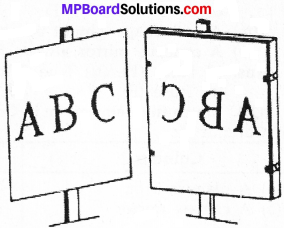
Write down the letters ABC on a piece of paper with sketch pen and look at its image in a plane mirror. Then find out which letters look the same as on the paper and which letters look different (fig.) Try to write these letters as seen in the mirror
Answer:
MP Board Class 7th Science Solutions Chapter 15 Light img 1

Activity – 2
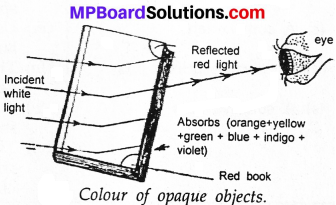
Take a red book and allow white light to fall on it (fig)
Answer:
The color of the book is due to the red color which gets reflected from the book, i.e., it reflects only red color while it absorbs all the other colours of white light. A rose is red because it reflects only red light.
MP Board Class 7th Science Solutions Chapter 15 Light img 2

Light Text Book Exercises

Question 1.
Fill in the blanks:

  1. An image that cannot be obtained on a screen is called ………………………..
  2. Image formed by a convex ……………………….. is always virtual and smaller in size.
  3. An image formed by a …………………….. mirror is always of the same size as that of the object.
  4. An image which can be obtained on a screen is called a ………………………….. image.
  5. An image formed by a concave ………………………. cannot be obtained on a screen.

Answer:

  1. Virtual image
  2. Mirror
  3. Plane
  4. Real
  5. Lens

Question 3.
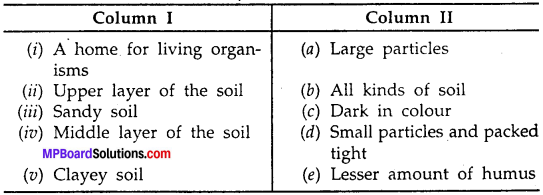
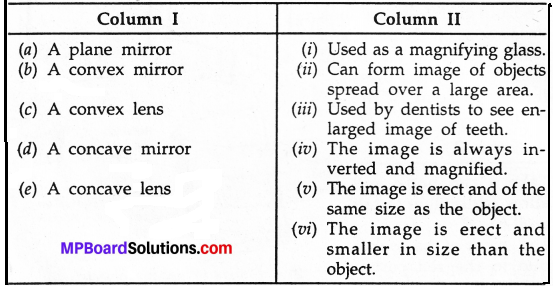
Match the items given in of Column I with one or more items Column II:
MP Board Class 7th Science Solutions Chapter 15 Light img 3
Answer:

1. (a) – (v)
2. (b) – (ii)
3. (c) – (i)
4. (d) – (iii)
5. (e) – (vi)

Question 4.
State the characteristics of the image formed by a plane mirror?
Answer:
The characteristics of the image formed by a plane mirror are:

  1. It forms an erect image.
  2. It forms a virtual image.
  3. It forms the image behind the mirror.
  4. The size of the image is same as that of the object.
  5. It forms the image at the same distance behind the mirror as the object stands infront of it.

Question 5.
Find out the letters of English alphabet or any other language known to you in which the image formed in a plane mirror appears exactly like the letter itself. Discuss your findings?
Answer:
Letters like A, H, I, M, O, T, U, V, and W.

Question 6.
What is a virtual image? Give one situation where a virtual image is formed?
Answer:
The image which cannot be taken on a screen is called a virtual image. For example, when some object is placed very close to the concave mirror we do not get any image of that object on the white screen placed behind the mirror. This type of image is known as virtual image.

MP Board Solutions

Question 7.
State two differences between a convex and a concave lens?
Answer:
Convex lens:

  1. These are thick at middle and thin at edge.
  2. They can form magnified image.

Concave lens:

  1. These are thin at middle and thick at edge.
  2. The image formed by these lens are always diminished in size.

Question 8.
Give one use each of a concave and convex mirror?
Answer:
Use of convex mirror:
It is used in vehicles as rear view mirror.

Concave mirror:
It is used by dentists to examine is used in vehicles as rear view mirror.

Question 9.
Which type of mirror can form a real image?
Answer:
Concave mirror.

Question 10.
Which type of lens forms always a virtual image?
Answer:
Concave lens.

MP Board Solutions

Choose the correct option in questions 11 – 13:

Question 11.
A virtual image larger than the object can be produced by a –

  1. Concave lens
  2. Concave mirror
  3. Convex mirror
  4. Plane mirror

Answer:
2. concave mirror

Question 12.
David is observing his image in a plane mirror. The distance between the mirror and his image is 4 m. If he moves 1 m towards the mirror, then the distance between David and his image will be –

1. 3 m
2. 5 m
3. 6 m
4. 8 m.

Answer:
3. 6 m

Question 13.
The rear view mirror of a car is a plane mirror. A driver is reversing his car at a speed of 2 m/s. The driver sees in his rear view mirror the image of a truck parked behind his car. The speed at which the image of the truck appears to approach the driver will be –

1. 1 m/s
2. 2 m/s
3. 4 m/s
4. 8 m/s.

Answer:
3. 4 m/s

MP Board Solutions

Extended Learning – Activities and Projects

Question 1.
Play with mirror? Write your name with a sketch pen on a thin sheet of paper, polythene or glass. Read your name on the sheet while standing infront of a plane mirror. Now look at your image in the mirror?
Answer:
Do yourself

Question 2.
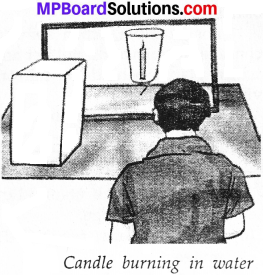
A burning candle in water? Take a shoe box, open on one side. Place a small lighted candle in it. Place a clear glass sheet Fig- Candle burning in water (roughly 25 cm x 25 cm) infront of this candle (Fig.). Try to locate the image of the candle behind the glass sheet. Place a glass of water at its position. Ask your friends to look at the image of the candle through the sheet of glass. Ensure that candle is not visible to your friends. Your friends will be surprised to see the candle burning in water. Try to explain the reason?
Answer:
Do yourself.
MP Board Class 7th Science Solutions Chapter 15 Light img 4

Question 3.
Make a rainbow?
Try to make your own rainbow. You can try this project in the morning or in the evening. Stand with your back towards the sun/ Take a hosepipe or a water pipe used in the garden. Make a fine spray in front of you. You can see different colours of rainbow in the spray?
Answer:
Do yourself.

Question 4.
Visit a laughing gallery in some science centre or a science park or a village mela. You will find some large mirrors there. You can see your distorted and funny images in these mirrors. Try to find out the kind of mirrors used there?
Answer:
Do yourself.

Question 5.
Visit a nearby hospital. You can also visit the clinic of an ENT specialist, or a dentist. Request the doctor to show you the mirrors used for examining ear, nose, throat and teeth. Can you recognise the kind of mirror used in these instruments?
Answer:
Do yourself.

MP Board Solutions

Question 6.
Role play?
Here is a game that a group of children can play. One child will be chosen to act as object and another will act as the image of the object. The object and the image will sit opposite to each other. The object will make movements, such as raising a hand touching an ear, etc. The image will have to make the correct movement following the movement of the object. The rest of the group will watch the movements of the image. If the image fails to make the correct movement, she/he will be retired. Another child will take her/his place and the game will continue. A scoring scheme can be introduced. The group that scores the maximum will be declared the winner?
Answer:
Do yourself.

Light Additional Important Questions

Objective Type Questions

Question 1.
Choose the correct alternative:

Question (a)
Formation of shadows suggests that light travels in –
(a) vacuum
(b) straight lines
(c) dark rooms
(d) None of these.
Answer:
(b) straight lines

Question (b)
A smooth polished surface which can return back the rays of light into the same medium is called –
(a) mirror
(b) lens
(c) prison
(d) None of these.
Answer:
(a) mirror

MP Board Solutions

Question (c )
The phenomenon of bouncing back of the rays of light into the same medium is called –
(a) reflection
(b) refraction
(c) scattering
(d) None of these.
Answer:
(a) reflection

Question (d)
If the image cannot be taken on the screen, it must be –
(a) real
(b) virtual
(c) real or virtual
(d) None of these.
Answer:
(b) virtual

Question (e)
A spherical mirror with its reflecting surface on the outside is a –
(a) plane mirror
(b) convex mirror
(c) concave mirror
(d) None of these.
Answer:
(b) convex mirror

MP Board Solutions

Question (f)
The mirror which is used as rear – view mirror in cars and scooters is, by nature –
(a) plane
(b) convex
(c) concave
(d) None of these.
Answer:
(b) convex

Question (g)
An image that can be obtained on a screen is –
(a) virtual
(b) real
(c) both real and virtual
(d) None of these.
Answer:
(b) real

Question (h)
The image produced by a plane mirror is –
(a) small
(b) real
(c) inverted
(d) equal size virtual and erect.
Answer:
(d) equal size virtual and erect.

MP Board Solutions

Question (i)
In the formation of rainbow the altitude of the sun should be between or less than –
(a) 40° to 42°
(b) 42° to 44°
(c) 41° to 43°
(d) 0° to 40°.
Answer:
(a) 40° to 42°

Question (j)
White light comprises of ……………………… colours?
(a) 7
(b) 5
(c) 3
(d) 8.
Answer:
(a) 7

Question (k)
Which of the following can be used to prove that light consists of seven colours?
(a) plane mirror
(b) convex lens
(c) Newton’s disc
(d) None of these.
Answer:
(c) Newton’s disc

Question (l)
If the speed of rotation of Newton’s colour disc is fast enough, the various colours would blend and produce –
(a) white light
(b) red light
(c) no light at all
(d) green light.
Answer:
(a) white light

MP Board Solutions

Question (m)
Primary colours are –
(a) red, blue, yellow
(b) red, yellow, magenta
(c) red, blue, green
(d) None of these.
Answer:
(c) red, blue, green

Question (n)
Which color is produced by mixing of blue and green?
(a) cyan
(b) magenta
(c) yellow
(d) blue.
Answer:
(a) cyan

Question 2.
Fill in the blanks:

  1. The surface of water can act like a mirror and change the path of …………………………
  2. An image formed by a plane mirror is erect and of the same size as the ……………………
  3. The curved shining surface of a spoon acts as a ……………………
  4. The inner surface of the cut ball is called and the outer surface is called ………………………
  5. Concave mirrors are also used by dentists to see an enlarged image of the ………………………
  6. The reflectors of tourches, headlights of cars and scooters are ……………………….. in shape.
  7. The magnifying glass is actually a type of a ……………………………..
  8. A convex lens is also called ………………………….. lens.
  9. A concave lens is also called ……………………….. lens.
  10. The rainbow has ………………………… colours.
  11. The process of splitting up of white light into different colours is called ……………………
  12. In a common rainbow the …………………………. colour is observed in the inner fringe and ………………………. on the outer fringe.

Answer:

  1. Light
  2. Object
  3. Mirror
  4. Concave, convex
  5. Teeth
  6. Concave
  7. Lens
  8. Converging
  9. Diverging
  10. Seven
  11. Dispersion of light
  12. Violet, red.

MP Board Solutions

Question 3.
Which of the following statements are true (T) or false (F):

  1. A shining stainless steel’spoon or plate can change the direction of light.
  2. In a plane mirror only sides are interchanged.
  3. The common example of a curved mirror is a spherical mirror.
  4. The reflecting surface of the bell is convex.
  5. Convex mirrors can form images of objects spread over a large area.
  6. The lenses are not transparent.
  7. A concave lens always forms erect, virtual and smaller image than the object.
  8. A rainbow is seen as a large arc in the sky with many colours.
  9. The sunlight consists of five colours.
  10. The white light is composed of seven colours.

Answer:

  1. True
  2. Ture
  3. True
  4. True
  5. True
  6. False
  7. True
  8. True
  9. False
  10. True

Light Very Short Answer Type Questions

Question 1.
Give the names of four different sources of light?
Answer:
The four different sources of light are:

  1. Sun
  2. Stars
  3. Moon
  4. Firefly.

Question 2.
How does light travel from one point to the other?
Answer:
Light travel from one point to the other in straight line.

Question 3.
How can we change the direction of the light?
Answer:
We can change the direction of light by the phenomenon called reflection.

MP Board Solutions

Question 4.
What is refraction?
Answer:
Bending of light when it travels from one medium to another is called refraction.

Question 5.
Define concave mirror?
Answer:
In a spherical mirror, of the reflecting surface is on the inside, it is called a concave mirror.

Question 6.
Define convex mirror?
Answer:
In a spherical mirror, if the reflecting surface is on the outside, it is called a convex mirror.

Question 7.
Define reflection of light?
Answer:
The phenomenon of turning back of light into the same medium on striking a polished surface is called reflection of light.

Question 8.
Define real image?
Answer:
An image that can be captured on a screen is called a real image.

MP Board Solutions

Question 9.
Define virtual image?
Answer:
An image which cannot be captured on a screen is called a virtual image.

Question 10.
Define plane mirror?
Answer:
A plane polished surface capable of reflecting light regularly is known as a plane mirror.

Question 11.
How is the word AMBULANCE written on an ambulance?
Answer:
MP Board Class 7th Science Solutions Chapter 15 Light img 5

Question 12.
What happens when light falls on a mirror?
Answer:
The mirror reflects the direction of light that falls on it.

Question 13.
Why is the sky blue?
Answer:
The blue color of the sky is the result of the white light from the sun being separated into different colours.

Question 14.
Where do the different colours come from?
Answer:
All Colours came from light.

Question 15.
Define dispersion?
Answer:
The branching of white light into various colours is called dispersion of light.

MP Board Solutions

Question 16.
How rainbows are formed?
Answer:
Rainbows are formed by sunlight falling on rain drops.

Question 17.
Have you ever seen a rainbow in the sky?
Answer:
Yes.

Question 18.
Does the white light consists of seven colours?
Answer:
Yes.

Light Short Answer Type Questions

Question 1.
Name the four features of the image formed by a plane mirror?
Answer:
The four features of the image formed by a plane mirror are:

  1. The image formed by a plane mirror is as far behind the mirror as the object is in front of it.
  2. It is virtual.
  3. It is exactly of the same size and shape.
  4. It is erect but laterally inverted.

Question 2.
What is the real image of an object?
Answer:
Real image is that image where the rays of light actually pass hence, it can be taken on the screen and is always inverted.
For example: image formed by pinhole camera, convex lens and concave mirror etc.

MP Board Solutions

Question 3.
Name two situations in which the real image of an object is formed?
Answer:

  1. When the object is at infinity.
  2. When the object is at centre of curvature.

Question 4.
Give one use each Of concave and convex mirrors?
Answer:
Use of concave mirror:

  1. They are used in reflected of car, head-lights and search lights.
  2. They are used as shaving mirrors.
  3. They are used in telescopes.

Use of convex mirrors:

  1. They are used in automobiles by the drivers for seeing the erect images of the traffic.

Question 5.
What is virtual image? Give one example of virtual image?
Answer:
Virtual image is that image where the rays of light appear to intersect hence, it can only be seen, but it cannot be taken on the screen and is always erect. For example, image formed by plane mirror convex mirror and concave lens etc.

Question 6.
State two uses of concave mirror?
Answer:
The two uses of concave mirror are :

  1. Concave mirrors are used as reflectors in car head-lights, search lights, torches and table lamps.
  2. Concave mirrors are used by doctors to concentrate light on nose, ear, eyes etc.

Question 7.
Mention some of the uses of plane mirror?
Answer:
Uses of plane mirror are:

  1. In hair cutting saloons, shops and at home.
  2. For constructing periscope.
  3. For constructing kelodoscope.

MP Board Solutions

Question 8.
How will you come to know that the mirror given to you is a concave or convex?
Answer:
In the concave surface the polish is done on its outer surface and the inner surface is shining. If we bring it closer to our face the later will look very big. In a convex mirror the polish is done on the inner surface and then outer side is shining. In this mirror our face will always appear to be shorter.

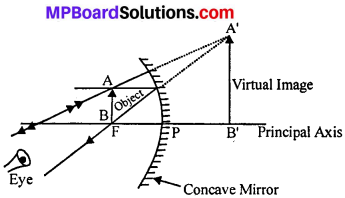
Question 9.
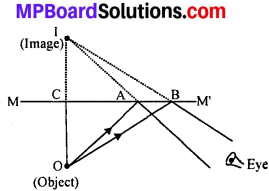
Draw a ray diagram to explain the formation of a virtual image of a point source of light in a plane mirror?
Answer:
The image of a point object formed by a plane mirror.
MP Board Class 7th Science Solutions Chapter 15 Light img 6

Question 10.
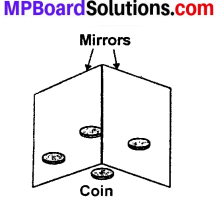
In figure, complete the image of the coin after reflection at the surfaces of both the mirrors?
MP Board Class 7th Science Solutions Chapter 15 Light img 7
Fig. A ray diagram for formation of image by a pair of inclined mirrors.
MP Board Class 7th Science Solutions Chapter 15 Light img 8

Question 11.
Differentiate between real and virtual image formed by mirrors?
Answer:
Difference between real and virtual image:
Real image:

  1. It can be obtained on a screen.
  2. It is inverted.
  3. It is obtained on the same side of mirror as the object.
  4. Rays converge at a point to form the image.

Virtual image:

  1. It cannot be obtained on a screen.
  2. It is erect.
  3. It is formed always behind the mirror.
  4. Rays appear to diverge from a point where the image is formed.

Question 12.
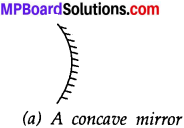
Draw concave and convex mirrors?
Answer:
MP Board Class 7th Science Solutions Chapter 15 Light img 19
MP Board Class 7th Science Solutions Chapter 15 Light img 20

Question 13.
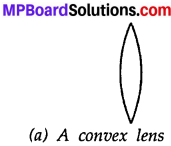
Draw convex and concave lens?
Answer:
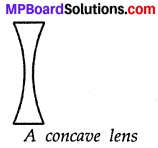
MP Board Class 7th Science Solutions Chapter 15 Light img 21
MP Board Class 7th Science Solutions Chapter 15 Light img 22

Question 14.
Differentiate between reflection and refraction?
Answer:
Differences between reflection and refraction:
Reflection:

  1. The speed of light remains the same.
  2. The incident ray and the reflected ray travel in the same media.
  3. In reflection the ray of light gets reflected back into the same medium.

Refraction:

  1. The speed of light varies as it travels from one medium to another.
  2. The incident ray and the refracted ray travel in different media.
  3. In the refraction the ray of light bends at the surface of separation between the two media.

Question 15.
Define mixing of colours? What is the color of the object as the red and green glasses?
Answer:
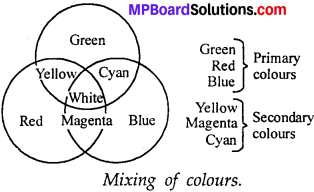
When two colours mix or overlap, a third color is produced. Thus, red + green = yellow; red + blue = magenta; red + blue + green = white and so on. In fact, any color can be obtained by the combination of red, green and blue which are called the primary colours. The colours so produced. From them are called secondary colours. The mixing of colours can be shown with the help of the diagram given in fig.
MP Board Class 7th Science Solutions Chapter 15 Light img 23

Light Long Answer Type Questions

Question 1.
Explain the image formation in plane mirror?
Answer:
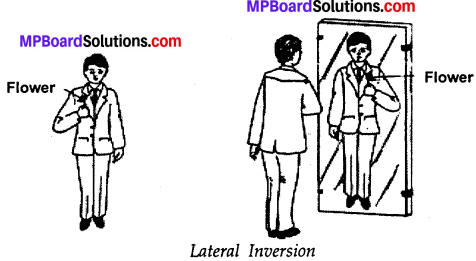
A mirror with a plane surface is called a plane mirror. The ordinary mirror we use is a plane mirror. Formation of image is one of effects on reflection of light. The image is seen behind the mirror and it is of the same size as the object. The distance from the object to the mirror and the distance between the mirror and the image are equal. In the plane mirror the right side of the object appears to be left side of the image, and the left side of the object appears to be the right side of the image. This inversion of sides is known as lateral inversion.
MP Board Class 7th Science Solutions Chapter 15 Light img 24

Question 2.
Define Newton’s experiment?
Answer:
Newton’s Experiment:
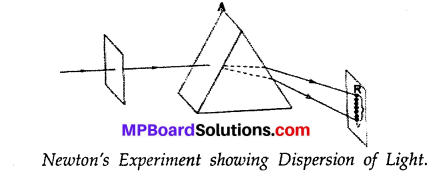
The idea that sunlight consists of several colours was first put forward by Sir Isaac Newton. He passed a narrow beam of light into a prism. The light that emerged from the prism was found to be coloured as in a rainbow. He gave the name spectrum to this coloured patch of light. The spectrum was seen to consist of seven colours of light – violet, indigo, blue, green, yellow, orange and red. The various colours found in white light can be easily remembered as VIBGYOR. The process of splitting up of white light into different colours is called dispersion of light.
MP Board Class 7th Science Solutions Chapter 15 Light img 16

Question 3.
Explain rainbow?
Answer:
Rainbows are formed by sunlight falling on rain drops. The rainbow is always observed with the back towards the sun. The rainbow is formed when rain drops owing to refraction and internal reflection produce deviation and dispersion into seven colours of the sunlight falling on them. The rainbows are visible only when the altitude of the sun is less than 42°.

A full rainbow can be seen from an aeroplane flying at higher altitudes. It is a matter of common observation that when one looks at a spray of water on which sun shines, rainbows are seen. When you look at the water falls with the sun shining at your back, a circular rainbow will be seen. In a common rainbow (primary rainbow) the violet color is observed in the inner fringe and red on the outer fringe.

Question 4.
How will you show that combining seven colours, we get white light?
Answer:
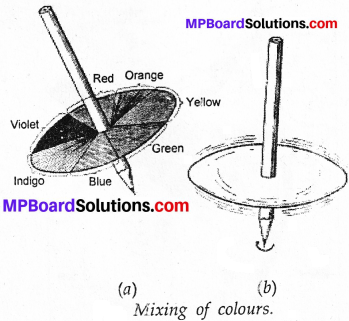
Take a circular cardboard disc of about 10 cm diameter. Divide this disc into seven segments. Paint the seven rainbow colours on these segments as shown in Fig. (a). A small hole is made at the center of the disc. Fix the disc loosely on the tip of a refill of a ball pen. Ensure that the disc rotates freely [Fig.(a)]. Rotate the disc in the daylight. When the disc is rotated fast, the colours get mixed together and the disc appears to be whitish [Fig. (b)]. This disc is popularly known as Newton’s disc.
MP Board Class 7th Science Solutions Chapter 15 Light img 25

MP Board Class 7th Science Solutions

MP Board Class 7th Science Solutions Chapter 4 Heat

MP Board Class 7th Science Solutions Chapter 4 Heat

Heat Intext Questions

Question 1.
Boojho says, My left hand tells me that the water in mug C is hot and the right hand tells me that the same water is cold. What should I conclude?
Answer:
Both of the conclusions are true relative to each hand. But a single conclusion can not be drawn from the given information.

Question 2.
Boojho wondered which of the two scales shown in fig. he should read. Paheli told him that India has adopted the Celsius scale and we should read that scale. The other scale with the range 94-108 degrees is the Fahrenheit scales (°F). It was in use earlier.
MP Board Class 7th Science Solutions Chapter 4 Heat img-1
Answer:
Yes

MP Board Solutions

Question 3.
Boojho got a naughty idea. He wanted to measure the temperture of hot milk using a clinical thermometer. Paheli stopped him from doing so?
Answer:
Yes, do not use a clinical thermometer for measuring the temperature of any object other than he human body because it may break.

Question 4.
Boojho now understand why clinical thermometer can not be used to measure high temperatures. But still wonders whether a laboratory thermometer can be used to measure his body temperature?
Answer:
Yes, laboratory thermometer can also be used for measuring body temperature.

Question 5.
Boojho wonders why the level of mercury should change at all when the bulb of the thermometer is brought in contact with another object?
Answer:
The temperature of other object may not be the same as that of the bulb of the thermometer. When bulb is brought in contact with that object, the temperature of the bulb changes. Thus, the level of mercury also changes.

MP Board Solutions

Question 6.
Paheli asks: “Does it mean that heat will not be transferred if the temperature of two objects is the same?”
Answer:
Yes.

Activities
Activity 1
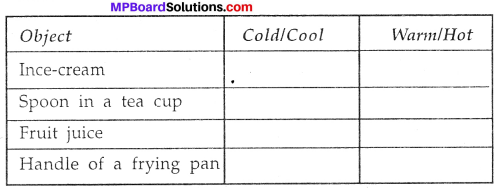
Lost some objects you use commonly in given table. Mark these objects as cold or hot?
Answer:
MP Board Class 7th Science Solutions Chapter 4 Heat img-2

Activity 2
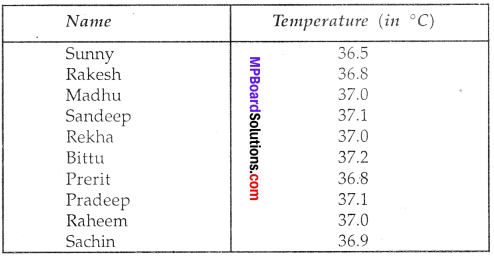
Measure the body temperature of some of your friends (at least 10) with a clinical thermometer.
Answer:
Observation for body temperature of some persons.
MP Board Class 7th Science Solutions Chapter 4 Heat img-3

Activity 3
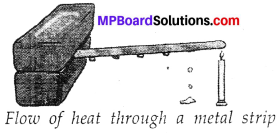
Take a rod or flat strip of a metal, say of aluminium or iron. Fix a few small wax pieces on the rod. These pieces should be at nearly equal distances (fig.). Clamp the rod to a stand. If you do not find a stand, you can put one end of the rod in between bricks. Now, heat the other end of the rod and observe.
MP Board Class 7th Science Solutions Chapter 4 Heat img-4
What happens to the wax pieces? Do these pieces begin to fall? Which piece fall the first? Do you think that heat is transferred from the end nearest to the flame to the other end?
Answer:
The wax pieces start to melt and fall down.
Yes.
The piece nearest to the flame tall first. Yes, heat is transferred from the end nearest to the flame to the other end.

Activity 4
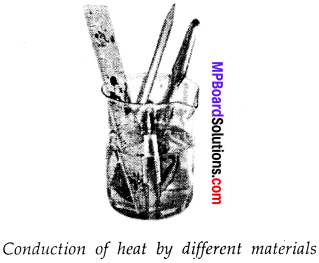
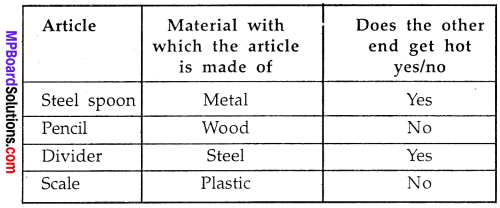
Heat water in a small pan or a beaker. Collect some articles such as a steel spoon, plastic scale, pencil and divider. Dip one end of each of these articles in hot water (fig.). Wait for a few minutes. Touch the other end. Enter your observation in Table.
MP Board Class 7th Science Solutions Chapter 4 Heat img-5
MP Board Class 7th Science Solutions Chapter 4 Heat img-6

Activity 5
Explain with activity heat transfer by conduction method?
Answer:
1. Aim:
To understand, ‘heat transfer by conduction’.

2. Required material:
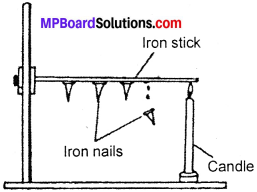
Iron stick, some nails, candle.
MP Board Class 7th Science Solutions Chapter 4 Heat img-7

3. Process:
Attach the nails on thin iron rod at some intervals with help of candle-wax as shown in figure. Now heat one end of iron rod with candle.

4. Analysis:
When we Start heating one end of iron rod, nails start falling one by one. The nail which is adjacent to hot end of iron – rod, falls first and then other nails 1 fall in sequence. Falling of nails in sequence indicate heat flow by conduction. Some time later, heat reaches to other end of rod and entire rod becomes hot.

5. Conclusion:
Heat transfer in iron – rod takes place by conduction.

MP Board Solutions

Activity 6
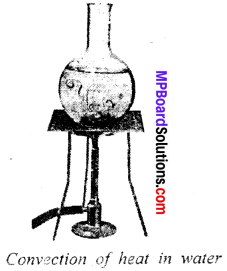
Take a round bottom flask (if flask is not available, a beaker can be used). Fill it two – thirds with water. Place it on a tripod, or make some arrangement to place the flask in such a way that you can heat it by placing a candle below it. Wait till the water in the flask in still. Place a crystal of potassium permanganate at the bottom of the flask gently using a straw. Now, heat the water by placing the candle just below the crystal. Write your observation in your notebook and also draw a picture of what you observe.
Answer:
When water is heated, the water near the flame gets hot. Hot water rises up. The cold water from the sides moves
MP Board Class 7th Science Solutions Chapter 4 Heat img-8
down towards the source of heat. This water also gets hot and rises and water from the sides moves down. This process continues till the whole water gets heated. This mode of heat transfer is knwon as convection.

Heat Text book exercises

Question 1.
State similarities and differences between the laboratory thermometer and the clinical thermometer?
Answer:
Similarities:

  1. Both use mercury.
  2. Both measure temperature.

Differences:
1. The range of a mercury thermometer is 100°C. A mercury thermometer having graduations from 0°C to 100°C while the temperature interval marked on the clinical thermometers ranges from 35°C to 43°C.

2. The temperature on laboratory thermometer falls by itself, but not so in clinical thermometer. In clinical thermometers, a jerk is given so that it is set again for measuring human body temperature.

MP Board Solutions

Question 2.
Give two emamples each of conductors and insulators of heat?
Answer:
Conductors: Copper, Aluminium

Insulators: Wood, Plastic

Question 3.
Fill in the blanks:

  1. The hotness of an object is determined by its ………………
  2. Temperature of boiling water cannot be measured by a ………………. thermometer.
  3. Temperature is measured in degree …………………
  4. No medium is required for tansfer of heat by the process of ………………..
  5. A cold steel spoon is dipped in a cup of hot milk. It transfers heat to its other end by the process of …………………..
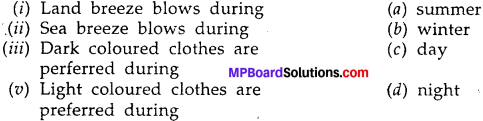
  6. Clothes of ………………. dolours absorb heat better than clothes of light colours.

Answer:

  1. Temperature
  2. Clinical
  3. Celsius
  4. Radiation
  5. Conduction
  6. Dark/black.

Question 4.
Match the following:
MP Board Class 7th Science Solutions Chapter 4 Heat img-9
Answer:

(i) (d)
(ii) (c)
(iii) (b)
(iv) (a)

MP Board Solutions

Question 5.
Discusss why wearing more layers of clothing during winter keeps us warmer than waering just one thick piece of clothing?
Answer:
More layers of clothing keep us warm in winters as they have a lot of space between them. Air is a poor conductor of heat. This increases the insulation and thus, comfortability warm of the clothes as a whole.

Question 6.
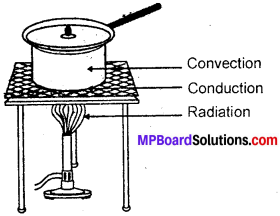
Look at fig Mark where the heat is being transferred by conduction, by convection and by radiation?
Answer:
MP Board Class 7th Science Solutions Chapter 4 Heat img-10

Question 7.
In places of hot climate it is advised that the outer walls of houses be painted white. Explain?
Answer:
In places of hot climate it is advised that the outer wall of houses be painted white because white colour do not radiate heat easily.

MP Board Solutions

Question 8.
One litre of water at 30°C is mixed with one litre of water at 50°C. The temperature of the mixture will be

  1. 80°C
  2. More than 50°C but less than 80°C
  3. 20°C
  4. Between 30°C and 50°C

Answer:
4. Between 30°C and 50°C.

Question 9.
An iron ball at 40°C is dropped in a mug containing water at 40°C. The heat will

  1. Flows from iron ball to water.
  2. Not flow from iron ball to water or from water to iron ball.
  3. Flows from water to iron ball.
  4. Increase the temperature of both.

Answer:
2. Not flow from iron ball to water or from water to iron ball.

MP Board Solutions

Question 10.
A wooden spoon is dipped in a cup of ice cream. Its other end

  1. Becomes cold by the process of conduction.
  2. Becomes cold by the process of convection.
  3. Becomes cold by the process of radiation.
  4. Does not become cold.

Answer:
4. Does not become cold.

Question 11.
Stainless steel pans are usually provided with copper bottoms. The reason for this could be that

  1. Copper bottom makes the pan more durable
  2. Such pans appear colourful
  3. Copper is a better conductor of heat than the stainless steel
  4. Copper is easier to clean than the stainless steel.

Answer:
3. Copper is a better conductor of heat than the stainless steel

Extended Learning – Activities and Projects

Question 1.
Go to a doctor or your nearest health centre. Observe the doctor taking temperature of patients Enquire?

  1. Why she dips the thermometer in a liquid before use.
  2. Why the thermomter is kept under the tongue.
  3. Whether the body temperature can be measured by keeping the thermomter at some place other than the mouth.
  4. Whether the temperature of different parts of the body is the same or different. You can add more questions which come to your mind.

Answer:

  1. Because to prevent infection. This liquid is an antiseptic.
  2. Because the temperature below the tongue represents actual temperature of body.
  3. Yes, but not so desirable.
  4. Temperature of different parts of the body are different.

Question 2.
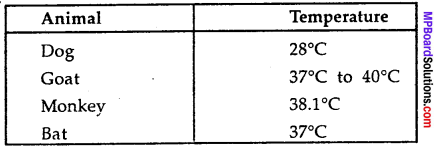
Go to a veterinary doctor (a doctor who treats animals)?
Discuss and find out the normal temperature of domesitc animals and birds.
Answer:
MP Board Class 7th Science Solutions Chapter 4 Heat img-11

Question 3.
Wrap a thin paper strip tightly around an iron rod. Try to burn the paper with candle while rotating the iron rod continuously. Does it burn? Explain your observation?
Answer:
No, the paper strip does not burn. Iron it a good conductor of heat. It takes away .the heat from paper and saves it from burning.

Question 4.
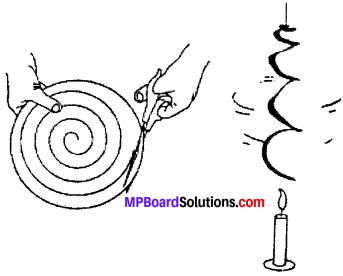
Take a sheet of paper. Draw a spiral on it as shown in the fig. Cut out the paper along the line. Suspend the paper as shown in figure, above a lighted candle. Observe what happens. Think of an explanation?
MP Board Class 7th Science Solutions Chapter 4 Heat img-12
Answer:
The paper spiral keeps moving. This is so because the air above the flame moves up due to convection.

MP Board Solutions

Question 5.
Take two similar transparent glass bottles having wide mouths. Put a few crystals of potassium permanganate or pour a few drops of ink in one bottle. Fill this bottle with hot water. Fill the other bottle with cold water. Cover the cold water bottle with a thick piece of paper such as a postcard. Press the postcard firmly with one hand and hold the bottle with the other hand. Invert the bottle and place it on top of the hot water bottle. Hold both the bottles firmly. Ask some other person to pull the postcard. Observe what happens. Explain.
Answer:
Do with the help of your subject teacher.

Heat Additional Important Questions

Objective Type Questions

Question 1.
Choose the correct alternative:

Question (i)
By which method heat transfer takes place in solids –
(a) Convection
(b) Conduction
(c) Radiation
(d) All three.
Answer:
(b) Conduction

Question (ii)
When can feel the hotness of some hot substance like electric iron from a little distance by which method?
(a) Convection
(b) Conduction
(c) Radiation
(d) All three methods.
Answer:
(c) Radiation

Question (iii)
By which method sun’s heat reaches to earth –
(a) Conduction
(b) Convection
(c) Radiation
(d) Conduction and convection.
Answer:
(c) Radiation

MP Board Solutions

Question (iv)
The handle of cooker is make up of bakelite because it is –
(a) Cheap
(b) Looks beautiful
(c) Bad conductor of heat
(d) Good conductor of heat.
Answer:
(c) Bad conductor of heat

Question (v)
By which of the following processes the water circulates in radiator of the bus engine and keeps the engine cool –
(a) Convection
(b) Radiation
(c) Conduction
(b) Conduction and radiation.
Answer:
(a) Convection

Question (vi)
Ice is kept in four boxes made of the following materials. If the same quantity of ice is kept for same time in the boxes, in which box the ice will melt least –
(a) Lead
(b) Wood
(c) Steel
(d) Thermocoal.
Answer:
(d) Thermocoal.

Question (vii)
In radiation, heat energy travel in –
(a) Curred lines
(b) Zig – zag lines
(c) Straight lines
(d) None of these.
Answer:
(c) Straight lines

Question (viii)
A thermos flask prevents loss or gain of heat by –
(a) Radiation only
(b) Conduction only
(c) Convection only
(d) None of these.
Answer:
(b) Conduction only

MP Board Solutions

Question 2.
Fill in the blanks:

  1. The measure of …………… energy is temperature.
  2. ……………. is the apparatus to measure temperature.
  3. The temperature at which a substance changes its state from solid to liquid is called its …………….
  4. In convection, water travels from …………. region to the ……………. region.
  5. The black bodies are good ………….. of heat.
  6. Water is a …………… conductor of heat.
  7. Transfer of energy between different part of a body is called ……………
  8. Shining bodies are poor ……………. of heat energy.
  9. Dark objects absorbs …………… heat then light coloured object.

Answer:

  1. Heat
  2. Thermometer
  3. Melting point
  4. Hotter, colder
  5. Absorber
  6. Bad
  7. Conduction
  8. Radiators
  9. More.

Which of the following statements are True (T) or False(F):

  1. Heat is a form of energy.
  2. Heat flows from a lower temperature to a higher temperature.
  3. The temperature of a healthy adult is 98.4°C.
  4. Iron is better conductor of heat than aluminium.
  5. The temperature at which a substance changes its state from solid to liquid is called its melting point.
  6. In thermometer highest points is 100°C.
  7. In thermometer’s the lowest point is 273°K Radiation of heat can take place without a medium. See
  8. breeze is the blowing of air from sea toward the land.
  9. Air is a good conductor of heat.

Answer:

  1. Ture (T)
  2. False (F)
  3. False (F)
  4. False (F)
  5. True (T)
  6. Ture (T)
  7. True (T)
  8. True (T)
  9. True (T)
  10. False (F).

Question 4.
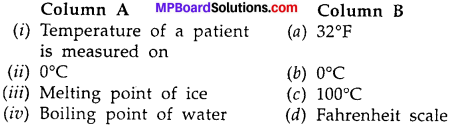
Match the items in Column A with Column B:
MP Board Class 7th Science Solutions Chapter 4 Heat img-13
Answer:

(i) (d)
(ii) (a)
(iii) (b)
(iv) (c)

Heat Very Short Answer Type Questions

Question 1.
Define clinical thermometer?
Answer:
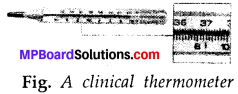
The thermometer that is used to measures our body temperature is called a clinical thermometer.

Question 2.
What is the range of a clinical thermometer?
Answer:
35°C to 42°C.

Question 3.
Why is range of a clinical thermometer is chosen to be 35°C to 42°C?
Answer:
The clinical thermometer is designed to measure the temperature of human body only. The temperature of human body normally does not go below 35°C or above 42°C. That is the reason why this thermometer has the range 35°C to 42°C.

MP Board Solutions

Question 4.
What is the use of kink in thermometer?
Answer:
Kink prevents mercury level from falling on its own.

Question 5.
Why dose the mercury not fall or rise in a clinical thermometer when taken out of the month?
Answer:
The kink prevents the mercury level from falling down.

Question 6.
Name two substances which contract on heating.
Answer:
Bismuth, Ice.

Question 7.
Which substances has the highest heat capacity?
Answer:
Water.

Question 8.
Which gets hotter soon, land or water?
Answer:
Land.

Question 9.
What is thermos flask?
Answer:
Thermos flask is a device in which heat losses due to conduction, convention and radiation are minimised.

Question 10.
How does the heat travel in air? In which direction does the smoke go?
Answer:
Heat moves in air by convection. The smoke moves in the upward direction.

Question 11.
How does the heat from the sun reaches?
Answer:
By radiation.

MP Board Solutions

Question 12.
Why are you advised to use an umbrella when you go out in the Sun?
Answer:
The umbrella protects us from heat rays of the Sun.

Question 13.
What is temperature?
Answer:
Temperature of an object is the degree of its hotnees. It tells us how hot or cold the object is.

Question 14.
Name the instrument we use to measure temperature.
Answer:
We use thermometers to measure the temperature.

Question 15.
Write the S.I. unit of heat?
Answer:
Joule.

Question 16.
Write the names of the methods of heat transfer?
Answer:
The names of methods of heat transfer are conduction, convection and radiation.

Question 17.
The iron nails from aluminium rods falls faster than from iron rod. What do you conclude from this statement?
Answer:
It means that aluminium is a better conductor of heat as compared to iron. So it passes heat much quickly to the iron nails and they fall down due to melting of wax.

Question 18.
Why in summer days does the fan give hot air first in a closed room when it is switched on?
Answer:
In a closed room the hot air remains at top because it is lighter. So when fan is turned on, it circulates the upper air first and it gives a current of hot air.

Question 19.
Why are the cooking utensile made up of metals?
Answer:
Cooking utensils are made up of metals as they are good conductor of heat. They transfer the heat to the food inside quickly and the food is cooked easily.

Question 20.
What are good conductors of heat? Give examples.
Answer:
Substances which allow the heat to pass through them are called good conductors of heat. Examples : all metal like iron, aluminium, copper and alloys like steel etc.

Question 21.
What are bad conductor of heat? Give examples.
Answer:
Substance which do not allow the heat to pass through them are called bad conductor of heat.
Examples: wood, paper, asbestos, rubber etc.

MP Board Solutions

Question 22.
Why do fire workers wear bright clothes?
Answer:
Fire worker wears bright clothes because bright clothes are good reflector of heat. They send back the heat falling on them. Thus fire workers do not catch fire and heat easily.

Question 23.
On a cold winter night, why do we feel colder when the sky clear than when it is cloudy?
Answer:
As clouds are bad conductor of heat, they do not allow the warm air around us to flow up. So heat remains near the ground and we feel warmer.

Question 24.
When does the conduction of heat stop in two bodies in contact?
Answer:
The conduction of heat stops in two bodies in contact when the two bodies attain equal temperature. That is the two bodies have no temperature difference.

Question 25.
How do you note the temperature of the body with thermometer?
Answer:
When bulb of thermometer comes in contact with our body. The mercury in the thin tube rises up. When the temperature of thermometer and body becomes equal, the level of the mercury does not rise further. This is the temperature of the body.

Heat Short Answer Type Questions

Question 1.
What is the difference between heat and temperature?
Answer:
Heat:

  1. Heat is a form of energy. It flows from a body at higher temperature to a body at lower temperature.
  2. Heat is measured in Joules or Calorie.

Temperature:

  1. Temperature is a measure of energy in the form of heat. Generally the temperature of a body increases when it is heated.
  2. Temperature is measured in Celcius.

Question 2.
On basis of what properties, mercury is used in thermometer?
Answer:
Mercury is used in thermometer because of the following properties:

  1. Thermal expansion is uniform in mercury.
  2. As it is shining silvery white, its thermal expansion is seen easily. This helps in noting the reading of thermometer easily.
  3. It does not stick to the surface of glass.
  4. Mercury does not freeze at 0°C because it’s freezing point is 39°C.

It does not boil at 100°C because it’s boiling point is 357°C. Hence, mercury has wide range of temperature between its freezing point and boiling point.

MP Board Solutions

Question 3.
Distinguish between conduction and convection.
Conduction:

  1. In conduction the molecules do not leave their position.
  2. It generally takes place in solid.

Convection:

  1. In convection the molecules of the substance actually move from hotter region to colder region.
  2. It generally takes place in gases and liquids.

Question 4.
Why should we wear dark coloured clothes in winter and light coloured clothes in summer?
Answer:
Bright clothes objects tend to reflect back the heat more, than to absorb the heat. Therefore, it is advisable to wear them in summer. On the other hand, dark coloured clothes have a greater tendency to absored and hence “retain” the heat. Hence they are worn in winter.

Question 5.
Why rise in temperature in two substances of equal quantity is not same even through equal amount of heat is given to them?
Answer:
The same quantity of heat supplied to the same amount of different substances, then the rise in teperature would not be same bacause the rise in temperature of the substance would depend on their specific heat. The temperaute of the substance which has less specific heat would rise more.

MP Board Solutions

Question 6.
What are the precautions to be observed while reading a clinical thermometer?
Answer:
Precautions to be observed while reading a clinical thermometer are:

  1. Thermometer should be washed before and after use, preferably with an antiseptic solution.
  2. Ensure that before use, the mercury level is below 35°C.
  3. Read the thermometer keeping the level of mercury along the line of sight.
  4. Handle the thermometer with care. If it hits against some hard object, it can break.
  5. Don’t hold the thermometer by the bulb while reading it.

Question 7.
What are the precautions to be observed while reading a laboratory thermometers?
Answer:
In addition to the precautions needed while reading a clinical thermometer, the laboratory thermometer

  1. Should be kept upright not tilted.
  2. Bulb should be surrounded from all sides by the substance of which the temperature is to be measured. The bulb should not touch the surface of the container.

Question 8.
Define mamixum – minimum thermometer.
Answer:
Different types of thermoters are used for different puroposes. The maximum and minimum temperatures of the previous day, reported in weather reports, are measured by a thermometer called the maximum – minimum thermometer.

Question 9.
Draw diagram of the laboratory thermometer. Mark the lower and upper fixed temperatures on a Celsius scale and indicate the values in Kelvin scale aslo.
Answer:
MP Board Class 7th Science Solutions Chapter 4 Heat img-14

Question 10
Name three different types of thermometers. Which of these is most sensitive?
Answer:
The three different types of thermometers are:

  1. Mercury thermometer
  2. Alcohol thermometer
  3. Gases thermometer.

Mercury thermometer is used to measure nominal temperature. Alcohol thermometer is used to measure very low temperature. The gaseous thermometer is the most sensitive of all, as the gases are very sensitive to the slightest temperature change. The gaseous thermometers are rarely used because of the difficulty they pose in handling.

MP Board Solutions

Question 11.
Define digital thermometers with diagram?
Answer:
There is a lot of concern over the use of mercury in thermometers. Mercury is a toxic substance and is very difficult to dispose of if a thermometer breaks. These days, digital thermometers are available which do not use mercury.
MP Board Class 7th Science Solutions Chapter 4 Heat img-15

Heat Long Answer Type Questions

Question 1.
Explain with experiment the method of heat transfer by radiation?
Answer:
To know that the amount of heat absorbed or radiated by a substance depends upon colour of a substance.

Required Material:
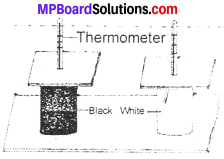
Two containers of same metal, two thermometer, black and white colour, two cardboard pieces.
MP Board Class 7th Science Solutions Chapter 4 Heat img-16
Procedure:

1. Colour the outer surface of one container with black and other with white.

2. Add equal quantity of tap water in both and insert thermometer by making a hole at the centre of card board as shown in picture.

3. Keep both containers for about 30 minutes under the sun. Then note down the temperature of both the containers.

4. Now add same quantity of hot water heated upto 50 to 60°C in both containers. Arrange the card board and thermometer properly and keep both of them is shadow for about 10 minutes. Then note down temperature of water from both containers.

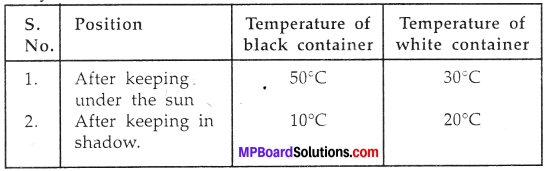
Analysis:
MP Board Class 7th Science Solutions Chapter 4 Heat img-17
Position 1.
After keeping containers for 30 minutes under the sun, you will see that, there is more increase in temperature of water in black container in comparision with white one. It is because black or dark colours are good absorbers of heat while white (light) colour is not.

Position 2.
After keeping the containers for 10 minutes in shadow, you will see that water in black container has cooled more than the water in white container. It is because black or dark colours are good emitters of heat, while white (light) colours are not.

Conclusion:

  1. Black or dark colour are good absorbers or emitters of heat.
  2. White or light colurs are good reflectors of heat. It means they are not good absorbers or emitters of heat.
  3. The amount of heat emitted or absorbed by a substance depends upon colour of a substance.

MP Board Solutions

Question 2.
Write some facts which indicates that sun light reaches to us by method of radiation?
Answer:
Medium is required for transfer of heat by conduction and convection process. When you stand under the sun, you experience heat. Heat reaches upto us from the sun. It is necessary to know following facts:

1. Air is poor conductor of heat hence heat is not transfered by conduction method in air.

2. Sun’s heat does not reach upto us by convection process also. Beacuse, you know that, convection will start only after earth is heated.

3. There is vacuum between sun and errth i.e. there is no medium. Hence sun’s heat can not reach upto us by conduction or convection method because medium is required for both methods. It means that sun’s heat reached us by some other method called radiation.

Question 3.
How does the highest and lowest constant point of thermometer marked?
Answer:
Two constant points i.e., lowest and highest are required to be marked while graduating the thermometer.

The lowest constant point:
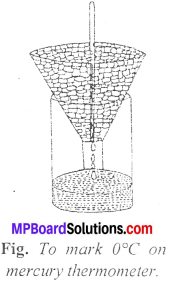
The thermometer bulb is kept in a melting ice as shown in figure. Mercury descends in tube and remains constant after some time. This point is marked. This is lowest constant point of thermometer.
MP Board Class 7th Science Solutions Chapter 4 Heat img-18
MP Board Class 7th Science Solutions Chapter 4 Heat img-19

Highest constant point:
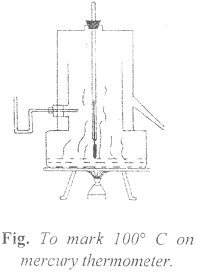
The thermometer bulb is kept in vapour of pure boiling water. Mercury ascends in tube and remains constant after some time. This point is marked. This is the highest constant point of thermometer.

Celcius scale:
Lowest constant point (temperature of melting ice) is indicated by °C and highest constant point (temperature of boiling water) is indicated by 100°C in this scale. The length between these two point is divided into 100 equal parts. The value of each parts is 1°C.

Question 4.
How does sea breeze flow?
Answer:
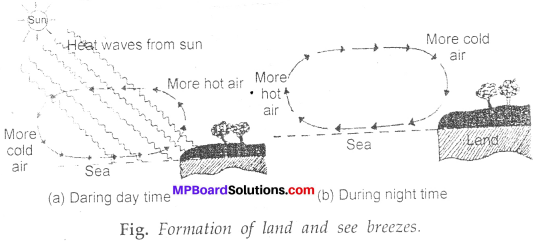
Convection current has got an important role in change of seasons. Sea breeze is the best example of this principle. In fact during day time, seashore land gets hotter earlier than water. Air in contact with it, becomes hot and rises. (Density of hot air is less and hence it is lighter) and hence to take its place cold air above sea flows towards seashore. Because of it, during day time sea breeze flows.
MP Board Class 7th Science Solutions Chapter 4 Heat img-20

During night time, this process gets reversed. See water becomes cool later than seashore during night time. (As the specific heat capacity of water is more than the seashore land, it takes longer time to become hot and also takes longer time to become cool). Hence during night time, temperature of sea is more than seashore. As a result surface air of sea gets hotter and rises and air above seashore takes its place. In this way during night time cool air flows towards sea.

MP Board Solutions

Question 5.
What is thermometer? Describe its construction?
Answer:
A thermometer is a device which is used to measure temperature accurately. The two commonly used thermometers are clinical thermometer and laboratory thermometer. The clinical thermometer is used by doctors to measure the body temperature. The laboratory thermometer is used in laboratories to measure melting point and boiling points.

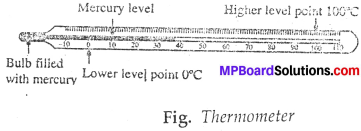
A thermometer consists of a very fine capillary glass tube attached to a bulb containing mercury. In laboratory  thermometer the mercury is at zero mark when placed in ice and is at hundred mark when placed in boiling water. Therefore, zero, mark is considered as lower fixed point and 100 mark is considered as upper fixed point (see fig.).
MP Board Class 7th Science Solutions Chapter 4 Heat img-21

Question 6.
Explain the structure or thermos flask with neat diagram?
Answer:
Thermos Flask was prepared first of all by Sir James Debar. It is used for storing cold or hot liquids for hours together. It is designed in such a way that heat transfer by conduction, convection and radiation should be minimum.
MP Board Class 7th Science Solutions Chapter 4 Heat img-22

MP Board Class 7th Science Solutions

MP Board Class 7th Science Solutions Chapter 14 Electric Current and its Effects

MP Board Class 7th Science Solutions Chapter 14 Electric Current and its Effects

Electric Current and its Effects Intex Questions

Question 1.
Paheli and Boojho wonder whether the batteries used in tractors, trucks and inverters are also made from cells. Then why is it called a battery? Can you help them to find the answer to this question?
Answer:
The battery used in tractors, trucks and inverters is a combination of several cells. The cells are not dry cells. These are the several sets of plates and each set of plates acts like a cell.
MP Board Class 7th Science Solutions Chapter 14 Electric Current and its Effects img 1

Question 2.
Paheli and Boojho saw a magic trick sometime back. The magician placed an iron box on a stand. He then called Boojho and asked him to lift the box. Boojho could easily lift the box. Now the magician made a show of moving his stick around the box while muttering some thing. He again asked Boojho to lift the box. This time Boojho could not even move it. The magician again muttered some thing and now Boojho could lift the box? The audience, including Paheli and Boojho, were very impressed with the show and felt that the magician had some supernatural powers. However, after reading this chapter Paheli is wondering if the trick was indeed some magic or some science was involved? Can you guess what science might be involved?
Answer:
The magician arranged an electromagnet below the box. The electromagnet could be turned ‘ON’ and ‘OFF’ as when the magician signals his assistance. When the electromagnet is turned ‘ON’ it attracts the iron box and hence it could not be lifted.

MP Board Solutions

Electric Current and its Effects Text Book Exercises

Question 1.
Draw in your notebook the symbols to represent the following components of electrical circuits: connecting wires, switch in the ‘OFF’ position, bulb, cell, switch in the ‘ON’ position, and battery?
Answer:
MP Board Class 7th Science Solutions Chapter 14 Electric Current and its Effects img 2

Question 2.
Draw the circuit diagram to represent the circuit shown in fig?
MP Board Class 7th Science Solutions Chapter 14 Electric Current and its Effects img 3
Answer:
MP Board Class 7th Science Solutions Chapter 14 Electric Current and its Effects img 4

Question 3.
Fig. shows four cells fixed on a board. Draw lines to indicate how you will connect their terminals with wires to make a battery of four cells?
MP Board Class 7th Science Solutions Chapter 14 Electric Current and its Effects img 5
Answer:
MP Board Class 7th Science Solutions Chapter 14 Electric Current and its Effects img 6

Question 4.
The bulb in the circuit shown in figure, does not glow. Can you identify the problem? Make necessary changes in the circuit to make the bulb glow?
MP Board Class 7th Science Solutions Chapter 14 Electric Current and its Effects img 7
Answer:
The problem with the circuit is that both the negative terminals are connected to the bulb. The corrected diagram is shown below:
MP Board Class 7th Science Solutions Chapter 14 Electric Current and its Effects img 8

Question 5.
Name any two effects of electric current?
Answer:
The two effects of electric current are heating effect and magnetic effect.

Question 6.
When the current is switched on through a wire, a compass needle kept nearby gets deflected from its north-south position. Explain?
Answer:
When electric current passes through a wire, it behaves like a magnet. This is the magnetic effect of the electric current due to attraction of the wire. So, the compass needle which is a magnet, gets deflected.

Question 7.
Will the compass needle show deflection when the switch in the circuit shown by fig is closed?
MP Board Class 7th Science Solutions Chapter 14 Electric Current and its Effects img 9
Answer:
No, because there is no cell so no current will flow.

Question 8.
Fill in the blanks:

  1. Longer line in the symbol for a cell represents its ………………………… terminal.
  2. The combination of two or more cells is called a …………………………..
  3. When current is switched ‘on’ in a room heater, it ………………………..
  4. The safety device based on the heating effect of electric current is called a ………………………

Answer:

  1. Positive
  2. Battery
  3. Get heated
  4. Fuse.

Question 9.
Mark T if the statement is true and F if it is false:

  1. To make a battery of two cells, the negative terminal of one cell is connected to the negative terminal of the other cell.
  2. When the electric current through the fuse exceeds a certain limit, the fuse wire melts and breaks.
  3. An electromagnet does not attract a piece of iron.
  4. An electric bell has an electromagnet.

Answer:

  1. False
  2. True
  3. False
  4. True

MP Board Solutions

Question 10.
Do you think an electromagnet can be used for separating plastic bags from a garbage heap? Explain?
Answer:
No, the plastic bags do not get attracted by the magnet, so they cannot be separated by an electromagnet. The plastic bags are not magnetic materials, only magnetic materials like iron can be attracted by magnet.

Question 11.
An electrician is carrying out some repairs in your house. He wants to replace a fuse by a piece of wire. Would you agree? Give reasons for your response?
Answer:
No, because this piece of wire will not melt even if high current flows through it. So, it will not prevent the damage done by high current.

Question 12.
Zubeda made an electric circuit using a cell holder shown in figure a switch and a bulb. When she put the switch in the ‘ON’ position, the bulb did not glow. Help Zubeda in identifying the possible defects in the circuit?
MP Board Class 7th Science Solutions Chapter 14 Electric Current and its Effects img 10
Answer:
It is important to put the cells in right series. The positive terminal of the cell should be connected with negative terminal of the second cell. The switch should be closed properly and bulb should not be fused. If Zubeda will check these then the bulb will certainly glow. Also, in the circuit, there is no any bulb and switch, the connecting wires are not connected with bulb and switch.

Question 13.
In the circuit shown in Fig?
Answer:
MP Board Class 7th Science Solutions Chapter 14 Electric Current and its Effects img 11

  1. Would any of the bulb glow when the switch is in the ‘OFF’ position?
  2. What will be the order in which the bulbs A, B and C will glow when the switch is moved to the ‘ON’ position?

Answer:

  1. No, bulb will glow.
  2. The bulb A will glow first, follow by bulb B and then bulb C, because bulb A comes first in the path of electric current flowing from positive terminal towards the negative terminal of the battery.

Extended Learning – Activities and Projects

Question 1.
Set up the circuit shown in Fig. again. Move the key to ‘ON’ position and watch carefully in which direction the compass needle gets deflected. Switch ‘OFF’ the current. Now keeping rest of the circuit intact, reverse the connections at the terminal of the cell. Again switch ‘on’ the current. Note the direction in which the needle gets deflected. Think of an explanation?
MP Board Class 7th Science Solutions Chapter 14 Electric Current and its Effects img 12
Answer:
When the connection of cell is reversed, the compass needle moves in opposite direction. This shows that the polarity of the magnet depends on the direction of current.

Question 2.
Make four electro – magnets with 20, 40, 60 and 80 turns. Connect them one by one to a battery of 2 cells. Bring the electromagnet near a box of pins. Count the number of pins attracted by it. Compare the strengths of the electromagnets?
Answer:
The strength increases with number of turns in the coil.

Question 3.
Using an electromagnet, you can make a working model of a railway signal as shown in Fig?
Answer:
Do with the help of your subject teacher.

Question 4.
Visit an electric shop. Request a mechanic to show you the various types of fuses and MCB and to explain how they work?
MP Board Class 7th Science Solutions Chapter 14 Electric Current and its Effects img 13
Answer:
Go and visit the nearby shop with your friends.

Electric Current and its Effects Additional Important Questions

Objective Type Questions

Question 1.
Choose the correct alternative:

Question (a)
The electric circuit which is broken at some point is called?
(a) closed
(b) open
(c) short
(d) None of these.
Answer:
(b) open

Question (b)
The amount of heat produced in a wire depends on its?
(a) material
(b) length
(c) thickness
(d) all of these.
Answer:
(d) all of these.

MP Board Solutions

Question (c)
The direction of flow of conventional current is taken as
(a) -ve to +ve
(b) +ve to -ve
(c) both of these
(d) None of these.
Answer:
(b) +ve to -ve

Question 2.
Fill in the blanks:

  1. A continuous flow of electric charge is called ………………………….
  2. In a dry cell energy is converted into ……………………… energy.
  3. A combination of two or more cells is called a ………………………
  4. The positive terminal of one cell is connected to the ……………………. terminal of the next cell.
  5. When the switch of a circuit is in the OFF position, the circuit is ………………………..
  6. In the bulb, thin wire is called …………………………….
  7. Current flowing in our household appliances is ………………………….
  8. A ………………………. is a safety device which prevents damages to electrical circuits and possible fires.
  9. The switches which automatically turn off when current in a circuit exceeds the safe limit are called ……………………….

Answer:

  1. Current
  2. Chemical, electrical
  3. Battery
  4. Negative
  5. Incomplete
  6. Filament
  7. A.C.
  8. Fuse
  9. MCB

MP Board Solutions

Question 3.
Which of the following statements are true (T) or false(F):

  1. Switch is used to regulate the current.
  2. An electric cell has three terminals.
  3. Two or more than two cells are interconnected to make a battery.
  4. The coil of wire in a electric iron is called an element.
  5. Never use just any wire or strip of metal in place of a fuse.
  6. Heating effect of electric current is used in a heater.
  7. An electric bell is an application of an electromagnet.
  8. A cell or a battery are the sources of electric current in an electric circuit.

Answer:

  1. True
  2. False
  3. True
  4. True
  5. True
  6. True
  7. True
  8. True.

Electric Current and its Effects Very Short Answer Type Questions

Question 1.
What is meant by electric current?
Answer:
The flow of negative charges i.e., electrons is called electric current.

Question 2.
Name the various sources of electric current?
Answer:
Cells and storage batteries.

Question 3.
What do you mean by electrically neutral substances?
Answer:
Those substances which have an equal quantity of positive and negative charge.

MP Board Solutions

Question 4.
What are the two kinds of electric charges?
Answer:
The two kinds of electric charges are positive and negative.

Question 5.
Which terminal of a cell is represented by longer line?
Answer:
Positive.

Question 6.
Where should be the key placed in a circuit?
Answer:
The key or switch can be placed anywhere in the circuit.

Question 7.
What is an open electric circuit?
Answer:
An electric circuit having the switch in off position is called open electric circuit.

Question 8.
What is a closed electric circuit?
Answer:
An electric circuit having the switch in on position is called a closed circuit or a complete circuit.

Question 9.
What is the significance of using symbols in an electric circuit?
Answer:
Using symbols is significant as if we have to show the various batteries, bulbs and switches as they actually look, it would be very cumber some and take a lot of time.

Question 10.
What is a filament?
Answer:
In the bulb there is a thin wire, called the filament, which glows when an electric current passes through it.

MP Board Solutions

Question 11.
What is the full form of CFL?
Answer:
Compact Fluoroscent Lamp.

Question 12.
What is the full form of MCB?
Answer:
Miniature Circuit Breaker.

Question 13.
What are different hazards of electricity?
Answer:

  1. ‘Electric shock’
  2. Tire due to short circuiting’.

Question 14.
List the appliances around you that depend on electricity for their operation. List the appliances that do not use electrical energy?
Answer:
Appliances that depend on electricity : Electric iron, Television, Geysers, Kitchen blender. Appliances that do not use electricity: Solar cells, Sewing Machine, Vehicles.

Question 15.
What energy is converted to electrical energy in a cell?
Answer:
Chemical energy is converted to electrical energy.

Question 16.
Name the three components of the cable used in a house circuit?
Answer:
The cable used in a house circuit has three cores of different colours. The red wire is the live wire. The black is the neutral wire and the green is the earth wire.

Question 17.
What kind of energy transformation takes place in an electric heater?
Answer:
In electric heater, electric energy is converted into heat energy.

Question 18.
Why is alternating current of same voltage more dangerous than direct current?
Answer:
The alternating current of same voltage is more dangerous than direct current because the direction and magnitude of AC changes alternatively and it may produce electric shock.

Question 19.
What happens when fuse melts away?
Answer:
When fuse melts away, the circuit is broken and the flow of current stops.

MP Board Solutions

Question 20.
What is the main purpose of earthing an electrical appliance?
Answer:
To prevent electric shock.

Question 21.
Why is mica used in elements of an Electric iron?
Answer:
Mica is a insulator.

Question 22.
List the appliances in your house that do not have ground wires?
Answer:
Electric grinder, electric heater, electric oven, electric toaster.

Question 23.
Who discovered magnetic effect of electric current?
Answer:
Hans Christian Oersted.

Question 24.
What are the various effects shown by electricity?
Answer:

  1. Heating Effect
  2. Chemical Effect
  3. Magnetic Effect.

Question 25.
What is electrolysis?
Answer:
The phenomenon of breaking up of a chemical compound under the action of electric current is called electrolysis.

MP Board Solutions

Question 26.
What causes heating effect in electric appliances?
Answer:
Heating effect is produced by heating element i.e., mainly ‘Nichrome’ which is an alloy of nickel and chromium.

Question 27.
Why is ‘Nichrome’ most commonly used as heating element?
Answer:
Since ‘Nichrome’ has a very high melting point, it does not melt with the flow of current.

Question 28.
Name few processes which are based on chemical effect of electricity?
Answer:
Electroplating, Refining of metals and electrolysis of water.

Question 29.
What is meant by magnetic effect of current?
Answer:
A current carrying wire behaves like a magnet.

MP Board Solutions

Electric Current and its Effects Short Answer Type Questions

Question 1.
Can electrically neutral substances be made to acquire charge?
Answer:
Yes, the delicate balance between the charges can be disturbed. Thus electrically neutral substances can be made to acquire charge. For example, if we rub a glass rod with silk we brush off some negative charges from the rod. The rod now acquires a net positive charge because it has more positive charges than negative.

Question 2.
What happens when a charged electroscope is connected into a uncharged electroscope by a wire? What is that called?
Answer:
When a charged electroscope is joined to a uncharged electroscope by a wire, charges flow from the charged to the uncharged electroscope through the wire till they are equalised. This flow of charges form an Electric Current.

Question 3.
What are the differences between a simple cell and a storage cell?
Answer:
A simple cell:

  1. Once the chemicals are used up the cell stope supplying current.
  2. A small amount of current can be drawn.

A storage cell:

  1. The used up chemicals can be restored to their original state by reversing the reaction.
  2. A large current can be drawn.

MP Board Solutions

Question 4.
What should be the characteristics of an ideal heating element and that of an ideal safety fuse?
Answer:

  1. Firstly the heating element should have a very high melting point.
  2. Secondly, it should be a conductor.
  3. Thirdly it should have high resistance.
  4. The ideal safety fuse should be firstly it should have low melting point.
  5. Secondly, it should be a conductor.
  6. Thirdly, it have low resistance.

Question 5.
Make a list of materials around you which conduct electricity and a list of those that do not.
Answer:
Conductors of electricity are:
All metals, acid, base and salt solutions, aluminium, iron, copper, nickel. Do not conduct electricity are: Paper, rubber, wood, nylon, polythene, bakelite.

Question 6.
What is the significance of the earth wire?
Answer:
The metallic body of an electric appliance is connected to the earth through this earth wire. Sometimes due to faulty wire, the insulation breaks and the live w;re comes into contact with the body of appliance. If the appliance is earthed the charge will quickly flow to the earth, thus protecting us from electric shock.

Question 7.
How does fuse act as a safety device?
Answer:
A fuse is a porcelain holder having a short and thin piece of wire in it called fuse wire which easily melts on heating. Sometimes the insulation of a wire is broken i.e., live wire touches the neutral wire there is a short circuit. When there is a short circuit the fuse wire melts due to heating produced by the high current. The circuit is then broken and the current stops flowing. So damages are prevented.

MP Board Solutions

Question 8.
On which effect of current does the fuse wire in electric circuits depend? Write two characteristics of a good quality fuse wire?
Answer:
Whenever a current passes through a material, a part or whole of its energy is converted into heat. The part which heats up is called heating elements. An alloy of nickel and chromium called Nichrome is one of the most heating elements.
Two characteristics of a good quality fuse wire are as follows:

  1. It should have low melting point.
  2. Is should have high specific resistance.

Question 9.
Write four safety measures to be taken while working with live electric lines?
Answer:

  1. Do not touch the switch in the main switch board.
  2. Do not cut the cable of an appliance with a pair of scissors when the appliance is switched on.
  3. Do not touch any electric poles in the street, especially during the rainy season.
  4. Do not touch any appliance (when it is switched on) with naked hands. Use rubber gloves..

Question 10.
Draw a battery of four cells?
MP Board Class 7th Science Solutions Chapter 14 Electric Current and its Effects img 14

Question 11.
How does electromagnetic induction find its use or application in generating electricity?
Answer:
The act of moving a magnet quickly in or cut of a coil of wire, can cause a current to flow in the wire. This phenomenon is called electromagnetic induction. This finds its application in generators where the coil is connected to a turbine. That rotates by the energy of falling water and moves the coil and causes current to flow, generators used in power stations have coil kept stationary and the magnet itself is rotated.

Question 12.
What forms the basic principle in electromagnets?
Answer:
Producing electromagnets is based on the principle that when current is passed through a coil it behaves like a magnet i.e., achieves north and south pole. Also if we reverse the direction of current in the coil the two poles exchange places. In electromagnets we insert a piece of iron in such a coil, its domain will get aligned in a direction normal to the face of the coil and the piece of iron gets strongly magnatised and act as electromagnets.

Electric Current and its Effects Long Answer Type Questions

Question 1.
Find the various ways in which two batteries and two bulbs can be connected in a working circuit?
Answer:
Two batteries and two bulbs can be connected in working circuit in two ways:
1. In series as shown in figure.
MP Board Class 7th Science Solutions Chapter 14 Electric Current and its Effects img 15

2. In parallel as shown in figure.
MP Board Class 7th Science Solutions Chapter 14 Electric Current and its Effects img 16

Question 2.
Give the symbols used for: open key; closed key, dry cell, a wire point, a battery and a bulb?
Answer:
The symbols are:
MP Board Class 7th Science Solutions Chapter 14 Electric Current and its Effects img 17

Question 3.
How can conductivity of a substance be tested?
Answer:
We can perform an experiment to test whether the given material conducts electricity or not. Make a circuit with wire, battery, bulb and connect them. If the bulb lights up, we can be sure that current is flowing in the circuit. Break the circuit. Now Fi8- TestinS whether a maternal close the circuit by inserting conducts electricity. different materials in between as (A) Match Stick (B) Pencil (C) Water (D) Eraser (E) Paper cup. Now see whether the bulb lights up. If it lights up, the material used for insertion in a conductor and if the bulb does not light up, the material is an insulator.
MP Board Class 7th Science Solutions Chapter 14 Electric Current and its Effects img 18

Question 4.
Define Miniature Circuit Breaker (MCB) with diagram?
Answer:
These day Miniature Circuit Breakers (MCBs) are increasingly being used in place of fuses. These are switches which automatically turn off when current in a circuit exceeds the safe limit. You turn them join and the circuit is once again complete. Look for ISI mark on MCBs also.
MP Board Class 7th Science Solutions Chapter 14 Electric Current and its Effects img 19

Question 5.
Define the working of an electric bell with circuit?
Answer:
We are quite familiar with an electric bell. It has an electromagnet in it. Fig. shows the circuit of an electric bell. It consists of a coil of wire wound on an iron piece. The coil acts as an electromagnet. An iron strip with a hammer at one end is kept close to the electromagnet.

There is a contact screw near the iron strip. When the iron strip is in contact with the screw, the current flows through the coil which becomes an electromagnet. It, then, pulls the iron strip. In the process, the hammer at the end of the strip strikes the gong of the bell to produce a sound. However, when the electromagnet pulls the iron strip, it also breaks the circuit. The current through the coil stops flowing.

The coil is no longer an electromagnet. It no longer attracts the iron strip. The iron strip comes back to its original position and touches the contact screw again. This completes the circuit. The current flows in the coil and the hammer strikes the gong again. This process is repeated in quick succession. The hammer strikes the gong every time the circuit is completed. This is how the bell rings.
MP Board Class 7th Science Solutions Chapter 14 Electric Current and its Effects img 20

MP Board Class 7th Science Solutions

MP Board Class 7th Science Solutions Chapter 3 Fibre to Fabric

MP Board Class 7th Science Solutions Chapter 3 Fibre to Fabric

Fibre to Fabric Intext Questions

Question 1.
Boojho is wondering why it hurts when someone pulls his hair but not when he goes for a haircut?
Answer:
When someone pulls his hair, it hurts because it’s roots is connected to the skin which has sensation. But, during haircut the tip of the hair is cut which is dead and does not have any sensation. Thus, hair cut does not hurt.

Question 2.
Boojho is wondering why a cotton garment cannot keep us as warm in winter as a woollen sweater does?
Answer:
Cotton cloths are thin and does not trap air. Wool is thicker than cotton and have spaces in which air traps. Air is a poor conductor of heat and so it prevent heat coming out of our body. Thus, wool gives better protection than cotton.

MP Board Solutions

Question 3.
Paheli wants to know if the cotton thread and silk thread are spun and woven in the same manner?
Answer:
No.

Fibre to Fabric Text book Exercises

Question 1.
You must be familiar with the following nursery rhymes?

  1. ‘Baa baa black sheep, have you any wool.’
  2. ‘Mary had little lamb, whose fleece was white as snow.’

Answer the following:

  1. Which parts of the black sheep have wool?
  2. What is meant by the white, fleece of the lamb?

Answer:

  1. Basically the abdomen and back of the sheep have wool.
  2. The white fleece refers to the white hair of lamb that is used to make wool.

Question 2.
The silkworm is (a) a caterpillar, (b) a larva. Choose the correct option.
(i) (a)
(ii) (b)
(iii) both (a) and (b)
(iv) neither (a) nor (b).
Answer:
(iii) both (a) and (b).

MP Board Solutions

Question 3.
Which of the following does not yield wool?
(i) Yak
(ii) Camel
(iii) Goat
(iv) Woolly dog.
Answer:
(iv) Woolly dog.

Question 4.
What is meant by the following terms?

  1. Rearing
  2. Shearing
  3. Sericulture

Answer:
1. Rearing:
The bringing up and looking after the sheep is called rearing.

2. Shearing:
The fleece of the sheep along with a thin layer of skin is removed from its body. This process is called shearing.

3. Sericulture:
The rearing of silkworms for obtaining silk is called sericulture.

Question 5.
Given below is a sequence of steps in the processing of wool. Which are the missing steps? Add them.
Shearing, …………… sorting, ………….., ………….
Answer:
Scouring, drying, dying, spinning, weaving.

MP Board Solutions

Question 6.
Make sketches of the two stages in the life history of the silk moth which are directly related to the production of silk?
Answer:
MP Board Class 7th Science Solutions Chapter 3 Fibre to Fabric img-1
MP Board Class 7th Science Solutions Chapter 3 Fibre to Fabric img-2

Question 7.
Out of the following, which are the two terms related to silk production? Sericulture, floriculture, moriculture, apiculture and silviculture.
Hint:

  1. Silk production involves cultivation of mulberry leaves and rearing silkworms.
  2. Scientific name of mulberry is Morus alba.

Answer:

  1. Sericulture
  2. Moriculture.

Question 8.
Match the words of Column I with those given in Column II:
MP Board Class 7th Science Solutions Chapter 3 Fibre to Fabric img-3
Answer:

(i) (e)
(ii) (c)
(iii) (b)
(iv) (a)

Question 9.
Given below is a crossword puzzle based on this lesson. Use hints to fill in the blank spaces with letters that complete the words?

MP Board Class 7th Science Solutions Chapter 3 Fibre to Fabric img-4
Answer:
MP Board Class 7th Science Solutions Chapter 3 Fibre to Fabric img-5

Extended Learning – Activities and Projects:

Question 1.
Paheli wants to know the maximum length of continuous silk thread that can be obtained from a cocoon. Find out for her?
Answer:
980 m.

Question 2.
Boojho wants to know why caterpillars need to shed their skin when they grow bigger but we humans do not. Do you have any idea?
Answer:
During its growing stage, the caterpillar eats own shed skin. It has no other food option.

Question 3.
Boojho wants to know why caterpillars should not be collected with bare hands. Can you help him?
Answer:
Because caterpillar’s skin can cause alergy.

MP Board Solutions

Question 4.
Paheli wanted to buy a silk frock and went to the market with her mother. There they found that the artificial (synthetic) silk was much cheaper and wanted to know why. Do you know why? Find out.
Answer:
The cost of production for artificial silk is very low. The raw materials used for artificial silk are available at very low cost and are available in huge quantity. Also, the production time is very less. Thus artificial silk is cheaper.

Question 5.
Someone told Paheli that an animal called ‘Vicuna’ also gives wool. Can you tell her where this animal is found? Look for this in a dictionary or an encyclopaedia?
Answer:
Vicuna is found in Spain.

Question 6.
When handloom and textile exhibitions are held, certain stalls display real moths of various varieties of silk and their life Stories. Try and visit these stalls with elders or teachers and these moths and stages of their life history.
Answer:
Do yourself.

MP Board Solutions

Question 7.
Look for eggs of any moth or butterfly in your garden or park or any other place full of plants. They look like tiny specks (dots) laid in a cluster on the leaves. Pull out the leaves containing eggs and place them in a cardboard box. Take some leaves of the same plant or another plant of the same variety, chop them and put them in the box.

Eggs will hatch into caterpillars, which are busy eating day and night. Add leaves everyday for them to feed upon. Sometimes you may be able to collect the caterpillars. But be careful. Use a paper napkin or a paper to hold a caterpillar. Observe everyday. Note the:

  1. Number of days taken for eggs to hatch.
  2. Number of days taken to reach cocoon stage and
  3. To complete life cycle. Record your observations in your notebook.

Answer:
Do yourself.

Fibre to Fabric Additional Important Questions

Objective Type Questions

Question 1.
Choose the correct alternative:

Question (i)
Silk is a –
(a) Rough fibre
(b) Way fibre
(c) Staple fi bre
(d) Filament fibre.
Answer:
(d) Filament fibre.

Question (ii)
Which country is the largest producer of silk –
(a) India
(b) Pakistan
(c) China
(d) None of these.
Answer:
(c) China

MP Board Solutions

Question (iii)
Which country is the largest producer of wool –
(a) India
(b) Australia
(c) Pakistan
(d) China.
Answer:
(b) Australia

Question (iv)
Mooga is the strongest variety of –
(a) Silk
(b) Wool
(c) Cotton
(d) None of these.
Answer:
(a) Silk

Question (v)
An International trade mark for new and pure wool is –
(a) ISI
(b) ISO
(c) Woolmark
(d) Agmark.
Answer:
(c) Woolmark

Question (vi)
Virgin wool is obtained from –
(a) Adult sheep
(b) Dead sleep
(c) Lamb
(d) Carnal.
Answer:
(a) Adult sheep

Question 2.
Fill in the blanks:

  1. Silk is a natural ………….. fibre.
  2. Silk fibres come from …………….. of the silk moth.
  3. The fine hair provide the fibres for making ……………
  4. Yak wool is common in Tibet and ………….
  5. Angora wool is obtained from …………. goats.
  6. Sheep are herbivores and prefer grass and …………….
  7. Sericulture of silk worms is a very old …………….. in India.
  8. …………… leads the world in silk production.
  9. ……………… is a dried perspiration found is the raw wool.
  10. The science of raising silk worms so as to obtain silk cocoons is …………..

Answer:

  1. Protein
  2. Cocoons
  3. Wool
  4. Ladakh
  5. Angora
  6. Leaves
  7. Occupation
  8. China
  9. Suint
  10. Sericulture

MP Board Solutions

Question 3.
Which of the following statements are true (T) or false (F):

  1. Silk worm feeds an mulberry leaves.
  2. A yarn is not a long continuous thread.
  3. The wool and cotton are staple fibres.
  4. Silk is a good conductor of heat.
  5. The high grade silk is obtained from the filaments of damaged cocoons.
  6. A female silk moth lays 100 of eggs at a time.
  7. Sheeps are reared is many parts of our country for wool.
  8. Lohi and Nali are the breeds of sheep.
  9. Nowadays scouring is done by machines.
  10. Sheep hair is sheared off from the body, scoured, sorted, dried, dyed, spun and woven to yield wool.

Answer:

  1. True (T)
  2. False (F)
  3. True (T)
  4. False (F)
  5. False (F)
  6. True (T)
  7. True (T)
  8. True (T)
  9. True (T)
  10. True (T)

Question 4.
Match the items in Column A with Column B:
MP Board Class 7th Science Solutions Chapter 3 Fibre to Fabric img-6
Answer:

(i) (b)
(ii) (d)
(iii) (f)
(iv) (e)
(v) (c)
(vi) (a)

Fibre to Fabric Very Short Answer Type Questions

Question 1.
Write the name of some wool yielding animals.
Answer:
Sheep, goat, angora goat, camel, yak, lamb, etc.

Question 2.
Feel the hair on your body and arms and these on your head. Do you find any difference? Which are seems coarse and which are is soft?
Answer:
Yes, hairs in arms are soft.

Question 3.
In which area a yak found in plenty?
Answer:
Tibet and Ladakh.

MP Board Solutions

Question 4.
What are the sources of obtaining fibres?
Answer:
Animals and plants are the sources of obtaining fibres.

Question 5.
What do you meant by shearing?
Answer:
The fleece of the sheep along with a thin layer of skin is removed from its body. This process is known as shearing.

Question 6.
Which animal provides pashmina shawls?
Answer:
Kashmiri goats.

Question 7.
Define wool?
Answer:
Wool is the common name of applied to soft curly fibres obtained chiefly from the fleece of domesticated sheep.

Question 8.
In which season, sleep sheared?
Answer:
Summer season.

Question 9.
What are the uses of wool?
Answer:
Wool is used for making fabrics, blankets, shawls, carpets, felt and upholstery.

Question 10.
What are the properties of wool fibre?
Answer:
Wool fibre is considerably resilient, has high tensile strength, light weight and is heat insulator.

Question 11.
What are silkworms?
Answer:
The female silk moth lays eggs from which hatch larvae are called silkworms of caterpillars.

MP Board Solutions

Question 12.
What is the most common silk moth?
Answer:
Mulberry silk moth.

Question 13.
Name the strongest variety of silk.
Answer:
Mooga.

Question 14.
Name the different varieties of processed silk.
Answer:
Gepe, Tram, Organize, Trown singles are different varieties of processed silk.

Question 15.
What is reeling of silk?
Answer:
A pile of cocoons is used for obtaining silk fibres. This process is called reeling the silk.

Question 16.
Name some Indian breeds of sheep?
Answer:
Lohi, Rampur bushair, Nali, Bakharwal, Marwari and Patanwadi.

MP Board Solutions

Question 17.
Where are sheep reared in India?
Answer:
Sub – Himalyan region because this area has a cooler climate.

Question 18.
Name one disease caused to sheep.
Answer:
Anthrax.

Fibre to Fabric Very Short Answer Type Questions

Question 1.
Name the animals that yield wool?
Answer:
The fleece of sheep is not the only source of wool, though wool commonly available in the market is sheep wool. Yak wool is common in Tibet and Ladakh. Angora wool is obtained from angora goats, found in hilly regions such as Jammu and Kashmir. Wool is also obtained from goat hair. The under fur of Kashmiri goat is soft. The fur (hair) on the body of camels is also used as wool. Uama and Alpaca, found in South Africa, also yield wool.

Question 2.
What is raw silk?
Answer:
After brushing, filaments from four to eight cocoons are joined and twisted. They are then combined with a number of other similarly twisted filaments, to make a thread that is wound on a reel. The thread is called raw silk.

Question 3.
How is shearing of .wool done? Describe.
Answer:
The fleece of the sheep along with a thin layers of skin is removed from its body .This process is called shearing. Machines similar to those used by barbers are used to shave off hair. Usually, hair are removed during the hot weather. This enables sheep to survive without their protective coat of hair. The hair provide woolen fibers. Woolen fibres are then processed to obtain woollen yarn. Shearing does not hurt the sheep just as it does not hurt when you get a hair cut or your father shaves his beard.

MP Board Solutions

Question 4.
Name the some breeds of sheep reared in our country. Also indicate the quality and texture of the fibre, obtained from them?
Answer:
Some Indian breeds of sheep are given in following table:
MP Board Class 7th Science Solutions Chapter 3 Fibre to Fabric img-7

Question 5.
Why do the wool fibres have greater bulk as compared to other fibres?
Answer:
The scales and crimps is the wool fibre make it possible to spin and felt the fleece. They help the individual wool fibres grab each other so that they stay together. Because of the crimp, wool fabrics have a greater bulk than other textiles. They can retain lot of air and hence wool fabrics are good insulators of heat. The heat insulation also works both ways.

Question 6.
How is silk processed?
Answer:
A pile of cocoons is used for obtaining silk fibres. This process is called reeling of silk. The cocoons are kept under the sun or boiled or exposed to steam. The silk fibres separate out. The process of taking out threads from the cocoon for use as silk is called reeling the silk. Reeling is done in special machines, which unwind the threads or fibres of silk from the cocoon. Silk fibres are then spun into silk threads, which are woven into silk cloth by weavers.

MP Board Solutions

Question 7.
Write a short note on'”discovery of silk”?
Answer:
The exact time of discovery of silk is perhaps unknown. According to an old Chinese legend, the empress Si – lung – Chi was asked by the emperor Huang – ti to find the cause of the damaged leaves of mulberry trees growing their garden. The empress found white worms eating up mulberry leaves. She also noticed that they were spinning shiny cocoons around them. Accidentally a cocoon dropped into her cup of tea and a tangle of delicate threads separated from the cocoon.

Silk industry began in China and was kept a closely guarded secret for hundreds of years. Latter on, traders and travellers introduced silk to other countries. The route they travelled is still called the ‘silk route’.

Fibre to Fabric Long Answer Type Questions

Question 1.
How wool is produced from fibres?
Ans. For obtaining wool. Sheep are reared. Their hair is cut and processed into wool. Sheep are herbivores and prefer, grass and leaves. Apart from grazing sheep, rearers also feed them on a mixture of pulses, corn, jowar, oil cakes (material left after taking out oil from seeds) and minerals. In winter, sheep are kept indoors and fed on leaves, grain and dry fodder.

Sheep are reared in many parts of our country for wool. The quality and texture of the fibres obtained from different sheeps are different. Once the teared sheep have developed a thick growth of hair, hair is shaved off for getting wool.

MP Board Solutions

Question 2.
Define with diagram the process of scouring?
Answer:
MP Board Class 7th Science Solutions Chapter 3 Fibre to Fabric img-8
MP Board Class 7th Science Solutions Chapter 3 Fibre to Fabric img-9

Question 3.
Define the process of sorting and rolling of fibres into wool?
Answer:
After scouring sorting is done. The hairy skin is sent to a factory where hair of different textures are separated or sorted. The small fluffy fibres, called burrs, are picked out from the hair. These are the same burrs which sometimes appear on your sweaters. The fibres are scoured again and dried. This is the wool ready to be drawn into fibres.
MP Board Class 7th Science Solutions Chapter 3 Fibre to Fabric img-10
The fibres can be dyed in various colours, as the natural fleece of sheep and goats is black, brown or white. The fibres are straightened, combed and rolled into yarn (Fig.). The longer fibres are made into wool for sweaters and the shorter fibres are spun and woven into woollen cloth.

MP Board Solutions

Question 4.
How we can obtain silk from cocoon? Explain.
Answer:
For obtaining silk, moths are reared and their cocoons are collected to get silk threads. A female silk moth lays hundreds of eggs at a time. The eggs are stored carefully on strips of cloth or paper and sold to silk worm farmers. The farmers keep eggs under hygienic conditions and under suitable conditions of temperature and humidity.

The eggs are warmed to a suitable temperature for the larvae to hatch from eggs. This is done when mulberry trees bear a fresh crop of leaves. The larvae, called caterpillars or silkworms, eat day and night and increase in size enormously.

The worms are kept in clean bamboo trays along with freshly chopped mulberry leaves. After 25 to 30 days, the caterpillars stop eating and move to a tiny chamber of bamboo in the tray to spin cocoons. Small racks or twigs may be provided in the trays to which cocoons get attached. The caterpillar or silkworm spins the cocoon inside which develops the silk moth.

MP Board Class 7th Science Solutions

MP Board Class 7th Science Solutions Chapter 13 Motion and Time

MP Board Class 7th Science Solutions Chapter 13 Motion and Time

Motion and Time Intex Questions

Question 1.
Paheli wondered how time was measured when pendulum clocks were not available?
Answer:
Many times measuring devices were used in different parts of the world before the pendulum clocks became popular. Water clocks, sand clocks and sundials are some examples of such devices.

Question 2.
Boojho wants to know whether there is any device that measures the speed?
Answer:
Yes, speedometer.

Activities

Activity – 1
Table gives some common examples of motions. Identify the type of motion in each case?
Answer:
Some examples of different types of motion
MP Board Class 7th Science Solutions Chapter 13 Motion and Time img 1

Activity – 2
Draw a straight line on the ground with chalk powder or lime and ask one of your friends to stand 1 to 2 m away from it. Let your friend gently roll a ball along the ground in a direction perpendicular to the line. Note the time at the moment the ball crosses the line and also when it comes to rest (Fig.) How much time does the ball take to come to rest? Measure the distance between the point at which the ball crosses the line and the point where it comes to rest. You can use a scale or a measuring tape. Let different groups repeat the activity. Record the measurements in Table. In each case calculate the speed of the ball?
MP Board Class 7th Science Solutions Chapter 13 Motion and Time image 2
Answer:
MP Board Class 7th Science Solutions Chapter 13 Motion and Time img 3

Activity – 3
The unit of speed in the given table is in km/h. Change this speed in to m/s?
Answer:
Speed of some animals.
MP Board Class 7th Science Solutions Chapter 13 Motion and Time img 4

Motion and Time Text Book Exercises

Question 1.
Classify the following as motion along a straight line, circular or oscillatory motion:

  1. Motion of your hands while running.
  2. Motion of a horse pulling a cart on a straight road.
  3. Motion of a child in a merry – go – round.
  4. Motion of a child on a see – saw.
  5. Motion of the hammer of an electric bell.
  6. Motion of a train on a straight bridge.

Answer:

  1. Oscillatory
  2. Straight line
  3. Circular
  4. Oscillatory
  5. Oscillatory
  6. Straight line.

MP Board Solutions

Question 2.
Which of the following are not correct?

1. The basic unit of time is second.
2. Every object moves with a constant speed.
3. Distances between two cities are measured in kilometres.
4. The time period of a given pendulum is not constant.
5. The speed of a train is expressed in m/h.

Answer:

2. Every object moves with a constant speed.
5. The speed of a train is expressed in m/h.

Question 3.
A simple pendulum takes 32 s to complete 20 oscillations?What is the time period of the pendulum?
Answer:
Given, time taken to complete 20 oscillations = 32 seconds
∴Time taken to complete 1 oscillation = \(\frac{32}{20}\)s = 1.6 s
Thus, the time period of pendulum is 1.6 s

Question 4.
The distance between two stations is 240 km. A train takes 4 hours to cover this distance. Calculate the speed of the train?
Answer:
Given, distance between two stations = 240 km and time taken to cover this distance = 4 hour
We know that,
MP Board Class 7th Science Solutions Chapter 13 Motion and Time img 5
\(\frac{240}{4}\) = 60 km/hour.
Thus, the speed of the train is 60 km/hour.

Question 5.
The odometer of a car reads 57321.0 km when the clock shows the time 08.30 AM. What is the distance moved by the car, if at 08:50 AM, the odometer reading has changed to 57336.0 km? Calculate the speed of the car in km/min during this time. Express the speed in km/h also?
Answer:
Given, reading of odometer at time 08:30 AM = 57321.0 km and reading of odometer at time 08:50 AM = 57336.0 km.
∴Distance covered by car = (57336.0 – 57321.0) km = 15 km and Time taken = 8.50 – 8.30 = 20 minutes
We know that,
MP Board Class 7th Science Solutions Chapter 13 Motion and Time img 6

Question 6.
The odometer of a car reads 57321.0 km when the clock shows the time 08.30 AM. What is the distance moved by the car, if at 08:50 AM, the odometer reading has changed to 57336.0 km? Calculate the speed of the car in km/min during this time. Express the speed in km/h also?
Answer:
Given, reading of odometer at time 08:30 AM = 57321.0 km and reading of odometer at time 08:50 AM = 57336.0 km
∴Distance covered by car = (57336.0 – 57321.0) km = 15 km and Time taken = 8.50 – 8.30 = 20 minutes We know that,
MP Board Class 7th Science Solutions Chapter 13 Motion and Time img 7
Thus, the distance between Salma’s school from her house is 1800 m or 1.8 km.

Question 7.
Show the shape of the distance – time graph for the motion in the following cases:

  1. A car moving with a constant speed.
  2. A car parked on a side road.

Answer:
MP Board Class 7th Science Solutions Chapter 13 Motion and Time img 8

Question 8.
Which of the following relations is correct?
MP Board Class 7th Science Solutions Chapter 13 Motion and Time img 9
Answer:
MP Board Class 7th Science Solutions Chapter 13 Motion and Time img 23

Question 9.
The basic unit of speed is:
(a) 100km.
(b) m/min
(c) km/h
(d) m/s.
Answer:
(d) m/s.

Question 10.
A car moves with a speed of 40 km/h for 15 minutes and then with a speed of 60 km/h for the next 15 minutes. The total distance covered by the car is:
(a) 100 km
(b) 25 km
(c) 15 km
(d) 10 km.
Answer:
(b) 25 km.
Distance travelled in first 15 minutes = Speed x Time = 40 km/h x 15 minutes.
= 40 km/h × \(\frac{15}{60}\) hour
= 10 km
Distance travelled in last 15 minutes = Speed x Time = 60 km/h x 15 minutes
= 60 km/h × 15 minutes
= 60 km/h × \(\frac{15}{60}\) hour
= 15 km.
Total distance = (10 + 15) km = 25 km.

Question 11.
Suppose the two photographs, shown in Fig. (a) and Fig. (b) had been taken at an interval of 10 seconds. If a distance of 100 meters is shown by 1 cm in these photographs, calculate the speed of the blue car?
MP Board Class 7th Science Solutions Chapter 13 Motion and Time img 10
MP Board Class 7th Science Solutions Chapter 13 Motion and Time img 11
Answer:
Speed = \(\frac{100 km}{10 h}\) = 10 km/h.

Question 12.
Fig. shows the distance – time graph for the motion of two vehicles A and B. Which one of them is moving faster?
MP Board Class 7th Science Solutions Chapter 13 Motion and Time img 12

Answer:
Car A is moving faster.

Question 13.
Which of the following distance – time graphs shows a truck moving with speed which is not constant?
MP Board Class 7th Science Solutions Chapter 13 Motion and Time img 13
Answer:
(iii)

Motion and Time Additional Important Questions

Objective Type Questions

Question 1.
Choose the correct alternative :

Question (a)
The time taken for one oscillation is called its
(a) Pitch
(b) Frequency
(c) Vibration
(d) Time period.
Answer:
(d) Time period.

Question (b)
1 minute has?
(a) 30 second
(b) 60 second
(c) 100 second
(d) None of these.
Answer:
(b) 60 second

MP Board Solutions

Question (c)
The smallest time interval that can be measured with commonly available clocks and watches is?
(a) 1 second
(b) 1 minute
(c) 1 hour
(d) None of these.
Answer:
(c) 1 hour

Question (d)
The ages of stars and planet are often expressed in –
(a) billions of years
(b) days
(c) years
(d) None of these.
Answer:
(a) billions of years

Question (e)
The distance moved by a vehicle can be measured by –
(a) speedometer
(b) odometer
(c) regulator
(d) None of these.
Answer:
(b) odometer

Question (f)
The distance – time graph of a body moving with uniform speed is –
(a) a curve
(b) a straight line
(c) line parallel to x – axis
(d) None of these.
Answer:
(b) a straight line

MP Board Solutions

Question 2.
Fill in the blanks:

  1. We shall use the term speed for average ……………………….
  2. An object moving along a straight line with a constant speed is said to be in …………………………
  3. The to and fro motion of a simple pendulum is an example of a ……………….. or ……………………. motion.
  4. The basic unit of time is a ……………………….
  5. The basic unit of speed is ………………………..
  6. Periodic events are used for the measurement of ……………………….
  7. The distance – time graph for the motion of an object moving with a constant speed is a ……………………
  8. The speedometer records the speed in ……………………..
  9. Odometer is used to measure ………………………
  10. The distance moved by an object is a unit time is called its ………………………….

Answer:

  1. Speed
  2. Uniform speed
  3. Periodic, oscillatory
  4. Second
  5. m/s
  6. Time
  7. Straight line
  8. km/h
  9. Distance
  10. Speed.

Question 3.
Which of the following statements are true (T) or false(F).

  1. The distance moved by objects in a given interval of time can help us to decide which one is faster or slower.
  2. We shall not use the term speed for average speed.
  3. The to and fro motion of a simple pendulum is an example of a periodic motion.
  4. Janter Manter in Delhi and Jaipur have big Sundials.
  5. In non – uniform motion, the speed of an object changes.
  6. Clocks or watches are perhaps the most common time measuring devices.
  7. Different units of time are used depending on the need.

Answer:

  1. True
  2. False
  3. True
  4. True
  5. True
  6. True
  7. True.

MP Board Solutions

Motion and Time Very Short Answer Type Questions

Question 1.
Define motion.
Answer:
Motion is the change in position of a body with respect to line and its surroundings.

Question 2.
What type of motion do the vehicles on a straight road perform?
Answer:
The vehicles perform rectilinear motion on the road.

Question 3.
What type of motion does the wheel of a bicycle perform?
Answer:
The wheel of a bicycle perform rotatory or circular motion.

Question 4.
What is uniform motion?
Answer:
Motion of a body along a straight line covering equal distances in equal intervals of time is called uniform motion.

MP Board Solutions

Question 5.
Give two example of non – uniform motion?
Answer:

  1. Motion of the train when its driver applies breaks.
  2. Motion of the cricket ball when the bowler throws the ball and the ball is hit by the player.

Question 6.
Give two example of periodic motion?
Answer:

  1. Rotation of earth on its axis.
  2. Moon moves around the earth.

Question 7.
What is oscillatory motion?
Answer:
The to and fro motion is called periodic or an oscillatory motion.

Question 8.
An object is hung from a spring is pulled down and left? What type of motion does the object perform?
Answer:
The object perform oscillatory motion which is also a periodic motion.

Question 9.
Write the formula for speed?
Answer:
MP Board Class 7th Science Solutions Chapter 13 Motion and Time img 25a

Question 10.
What is the unit of speed?
Answer:
Unit of speed is meter per second.

Question 11.
A snail covers a distance of 1 meter in 10 sec. What is the speed of the snail?
Answer:
image
= 0.1 ms-1
= 0.1 m per sec.

Question 12.
What happens to the speed of your bicycle when you pedal faster?
Answer:
On pedalling fast the speed of bicycle increase.

Question 13.
“Speed of a car is 8 km/h”. What does it mean?
Answer:
When we say that a car is moving with a speed of 80 kilometer per hour, it implies that it will cover a distance of 80 kilometre in one hour.

Question 14.
Define a day?
Answer:
The time between one sunrise and the next is called a day.

Question 15.
What is month ?
Answer:
A month is measured from one new moon to the next.

Question 16.
What is year?
Answer:
A year is fixed as the time taken by the earth to complete one revolution of the sun.

Question 17.
What is bob?
Answer:
The metallic ball is called bob of the pendulum.

MP Board Solutions

Question 18.
What is the use of stop – watch?
Answer:
Stop – watch is used to measure exact time in case of atheletic events as it can be stopped and started any moment.

Question 19.
When you travel in bus or car then, generally, what kind of motion it is?
Answer:
Linear motion.

Question 20.
There is 100 metres line on which two sprinters have to run, when they run, what kind of motion it will be?
Answer:
Linear motion.

Question 21.
See the picture and tell whose speed is more:
MP Board Class 7th Science Solutions Chapter 13 Motion and Time img 14
MP Board Class 7th Science Solutions Chapter 13 Motion and Time img 15
Answer:
Speed of tiger is more than the speed of horse.

Motion and Time Short Answer Type Questions

Question 1.
Define periodic motion?
Answer:
Periodic motion:
The motion of a body which is repeated at regular intervals of time is called periodic motion. In periodic motion, a body covers equal distances in equal intervals of time; e.g. revolution of earth round the sun, the motion of moon round the earth, the motion of a swing, the motion of a pendulum, etc.

Question 2.
Define non – periodic motion?
Answer:
Non – periodic motion:
The motion of a body which is not repeated at regular intervals of time is called non – periodic motion. In non – periodic motion, a body does not cover equal distances in equal intervals of time; e.g. an athelete running on a track, a moving car on busy road, etc.

Question 3.
Define oscillatory motion?
Answer:
Oscillatory motion:
A body is said to be in oscillatory motion when it moves to and fro about a fixed point; e.g. the pendulum of a wall clock (Fig.), a swing, a wire of sitar when plucked, striking of drum, etc. Mostly the hanging objects show oscillatory motion.
MP Board Class 7th Science Solutions Chapter 13 Motion and Time img 16

Question 4.
How can we make a pendulum of air one? What is the time – period of a pendulum?
Answer:
We can make a pendulum by suspending a metal ball with a cotton thread. The other end of the thread can be tied to same support. The time taken by a pendulum to complete its to and from movement i.e., one oscillation is called the time period of the pendulum.

Question 5.
One student reaches school in 1 hour by travelling a distance of 8 km from his house by a cycle and the other student reaches school in one and half hours by travelling a distance of 12 kms from his house by cycle. Tell whose speed was slow?
Answer:
MP Board Class 7th Science Solutions Chapter 13 Motion and Time img 17
From above calculations it is clear that the speed of both the students is same.

Question 6.
What are quartz clocks? Give a diagram of digital clock?
Answer:
Now a days most clocks or watches have an electric circuit with one or more cells. These clocks are called quartz clocks. The time measured by quartz clocks is much more accurate than that by the clocks available earlier.
MP Board Class 7th Science Solutions Chapter 13 Motion and Time img 18

Question 7.
Mark x – axis, y – axis, origin on a graph paper?
Answer:
MP Board Class 7th Science Solutions Chapter 13 Motion and Time img 19

Motion and Time Long Answer Type Questions

Question 1.
Write briefly about the development of pendulum clock?
Answer:
There is an interesting story about the discovery that the time period of a given pendulum is constant. You might have heard the name of famous scientist Galileo Galilie (A.D. 1564 – 1642). It is said that once Galileo was sitting in a church. He noticed that a lamp suspended from the ceiling with a chain was moving slowly from one side to the other.

He was surprised to find that his pulse beat the same number of times during the interval in which the lamp completed one oscillation. Galileo experimented with various pendulums to verify his observation. He found that a pendulum of a given length takes always the same time to complete one oscillation. This observation led to the development of pendulum clocks. Winding clocks and wristwatches were refinements of the pendulum clocks.

MP Board Solutions

Question 2.
Discuss in details about the different range to measure time interval?
Or
Discuss the different units for measuring time interval?
Answer:
The smallest time interval that can be measured with commonly available clocks and watches is one second. However, now special clocks are available that can measure time intervals smaller than a second. Some of these clocks can measure time intervals as small as one millionth or even one billionth of a second. We might have heard the terms like microsecond and nanosecond. One microsecond is one millionth of a second. A nanosecond is one billionth of a second.

Clocks that measure such small time intervals are used for scientific research. The time measuring devices used in sports can measure time intervals that are one tenth or one hundredth of a second. On the other hand, times of historical everts are stated in terms of centuries or millenniums. The ages of stars and planet are often expressed in billions of years.

Question 3.
Draw a bar graph to show the runs scored by a team in each over?
MP Board Class 7th Science Solutions Chapter 13 Motion and Time img 24
Answer:
MP Board Class 7th Science Solutions Chapter 13 Motion and Time img 20

Question 4.
Draw a pie chart to show the composition of air?
Answer:
MP Board Class 7th Science Solutions Chapter 13 Motion and Time imageeeeee

Question 5.
Write down the steps to make a distance – time graph?
Answer:
We can make the graph by following steps:
Step 1.
Draw two perpendicular lines to represent the two axes and mark them as OX and OY as shown in figure.

Steps 2.
Decide the quantity to be shown along the x – axis and that to be shown along the y – axis. In this case we show the time along the x – axis and the distance along the y – axis.

Steps 3.
Choose a scale to represent the distance and another to represent the time on the graph. For the motion of the car scales could be
Time : 1 min = 1 cm
Distance : 1 km = 1 cm

Step 4.
Mark values for the time and the distance on the respective axes according to the scale chosen. For the motion of the cat let mark the time 1 min, 2 min,..,on the origin x – axis from the origin Similarly, mark the distance 1 km. 2 km… on the y – axis.

Steps 5.
Now you have to mark the points on the graph paper to represent each set of values for distance and time.

Step 6.
Join all the points on the graph as shown in figure. It is a straight line. This is the distance-time graph for the motion of the car.
Note:
If the distance – time graph is a straight line, it indicates that the object is moving with a constant speed. However, if the speed of the object keeps changing, the graph can be of any shape.
MP Board Class 7th Science Solutions Chapter 13 Motion and Time img 22

MP Board Class 7th Science Solutions

MP Board Class 7th Science Solutions Chapter 2 Nutrition in Animals

MP Board Class 7th Science Solutions Chapter 2 Nutrition in Animals

Nutrition in Animals Intext Questions

Question 1.
Paheli wants to know how food moves in the opposite direction during vomiting?
Answer:
The food pipe runs along the neck and the chest. Food is pushed down by movement of the wall of the food pipe. Actually this movement takes place throughout the alimentary canal and pushes the food downwards. At times the food is not accepted by our stomach and is vomited out.

Question 2.
Paheli wants to know why these animals cannot chew food properly at the time they take it in?
Answer:
The ruminants mainly feed on grass and bush which primarily contain cellulose or roughage. The grass is rich in cellulose, so lot of chewing and saliva are need. Thus, the ruminants need to chew the grass for long time. If they chew for long while eating, they will get less time to eat.

MP Board Solutions

Question 3.
Boojho wants to know why we cannot digest cellulose like the cattle do?
Answer:
Ruminants have a large sac – like structure between the small intestine and large intestine. The cellulose of the food is digested here by the action of certain bacteria which are not present in humans.

Activities
Activity 1
What is the type of food and mode of feeding of the following animals? Write down your observations in the given Table. You may find the list of modes of feeding given below the Table helpful.
Table 1:
Various modes of feeding
MP Board Class 7th Science Solutions Chapter 2 Nutrition in Animals img-1
(Scraping, chewing, brewing, capturing and swallowing, sucking etc.)
Answer:

MP Board Class 7th Science Solutions Chapter 2 Nutrition in Animals img-2

Activity 2
Wash your hands Look into the mirror and count your teeth. Use your index finger to feel the teeth. How many kinds of teeth could you find? Take a piece of an apple or bread and eat it. Which teeth do you use for biting and cutting and which ones for piercing and tearing? Also find out the ones that are used for chewing and grinding?
Record your observations in Table 2.
MP Board Class 7th Science Solutions Chapter 2 Nutrition in Animals img-3
Answer:
Four.

  1. Incisors are used for biting and cutting.
  2. Canines are used for piercing and tearing.
  3. Premolars and molars are used for chewing and grinding.

MP Board Class 7th Science Solutions Chapter 2 Nutrition in Animals img-4

Nutrition in Plants Text book Exercises

Question 1.
Fill in the blanks:

  1. The main steps of digestion in humans are …………, …………, …………, …………, and …………
  2. The largest gland in the human body is …………
  3. The stomach releases hydrochloric acid and ………… juices which act on food.
  4. The inner wall of the small intestine has many finger – like outgrowths called …………
  5. Amoeba digests its food in the …………

Answer:

  1. Ingestion, digestion, absorption, assimilation and egestion
  2. Liver
  3. Digestive
  4. Villi
  5. Food vacuole.

MP Board Solutions

Question 2.
Mark ‘T’ if the statement is true and ‘F’ if it is false:

  1. Digestion of starch starts in the stomach. (T/F)
  2. The tongue helps in mixing food with saliva. (T/F)
  3. The gall bladder temporarily stores bile. (T/F)
  4. The ruminants bring back swallowed grass into their mouth and chew it for some time. (T/F)

Answer:

  1. False (F)
  2. True (T)
  3. True (T)
  4. True (T)

Question 3.
Tick (S) mark the correct answer in each of the following:

Question (a)
Fat is completely digested in the –
(i) Stomach
(ii) Mouth
(iii) Small intestine
(iv) Large intestine
Answer:
(iii) Small intestine

Question (b)
Water from the undigested food is absorbed mainly in the –
(i) Stomach
(ii) Food pipe
(iii) Small intestine
(iv) Large intestine
Answer:
(iv) Large intestine

Question 4.
Match the items of Column I with those given in Column II:
MP Board Class 7th Science Solutions Chapter 2 Nutrition in Animals img-5
Answer:

(i) (b)
(ii) (c)
(iii) (a).

MP Board Solutions

Question 5.
What are villi? What is their location and function?
Answer:
The inner walls of the small intestine have thousands of finger – like outgrowths, these are called villi. They are situated in the small intestine.
Functions of Villi:

  1. The villi increase the surface area for absorption of the digested food.
  2. Each villus has a network of thin and small blood vessels close to its surface.
  3. The surface of the villi absorbs the digested food materials.

The absorbed substances are transported via the blood vessels to different organs of the body where they are used to build complex substances such as the proteins required by the body.

Question 6.
Where is the bile produced? Which component of the food does it digest?
Answer:
The liver secretes bile juice that is stored in a sea called gall bladder. Bile juice digests fat.

Question 7.
Name the types of carbohydrate that can be digested by ruminants but not by humans. Give the reason also?
Answer:
The grass is rich in cellulose, a type of carbohydrate. Many animals including humans cannot digest cellulose. The cellulose can be digested by ruminants but not by humans because they have a large sac – like structure between the small intestine and large intestine. The cellulose of the food is digested here by the action of certain bacteria which are not present in humans.

MP Board Solutions

Question 8.
Why do we get instant energy from glucose?
Answer:
We get instant energy from glucose because glucose is the simplest form of carbohydrate which can be broken down easily to give energy.

Question 9.
Which part of the digestive canal is involved in:

  1. Absorption of food ……………….
  2. Chewing of food
  3. ……………….
  4. killing of bacteria …………………..
  5. Complete digestion of food ………………….
  6. Formation of faeces ……………….

Answer:

  1. Small intestine
  2. Buccal cavity
  3. Stomach
  4. Small intestine
  5. Large intestine.

Question 10.
Write one similarity and one difference between the nutrition in Amoeba and human beings?
Answer:
Similarity:
Both amoeba and human use the process of digestion involves ingestion, digestion, absorption, assimilation and egestion.

Difference:
Human needs to chew food whereas in amoeba, there is no chewing.

Question 11.
Match the items of Column I with suitable items in Column II
MP Board Class 7th Science Solutions Chapter 2 Nutrition in Animals img-6
Answer:

(a) (iii)
(b) (iv)
(c) (i)
(d) (vii)
(e) (v)
(f) (vi).

MP Board Solutions

Question 12.
Label Fig of the digestive system
MP Board Class 7th Science Solutions Chapter 2 Nutrition in Animals img-7
Answer:
MP Board Class 7th Science Solutions Chapter 2 Nutrition in Animals img-8

Question 13.
Can we survive only on raw, leafy vegetables/grass? Discuss.
Answer:
No, because to live healthy life we need a complete balance of all nutrients. Raw green vegetables may have cellulose which can not be digested by us. Thus, only green leafy vegetbles will not solve the purpose.

Extended Learning Activities and Project

Question 1.
Visit a doctor and find out:

  1. Under what conditions does a patient need to be on a drip of glucose?
  2. Till when does a patient need to be given glucose?
  3. How does glucose help the patient recover?

Write the answers in your notebook.
Answer:

1. A patient is given glucose. When he/she is unable to eat food, unable to digest food.
2. Till the crisis is over.
3. Glucose chip has the following positive points to recover patient:

  1. It need not be digested
  2. It need not be eaten
  3. It gives instant energy.

Question 2.
Find out what vitamins are and get the following information:

  1. Why are vitamins necessary in the diet?
  2. Which fruits or vegetables should be eaten regularly to get vitamins?

Answer:

  1. Vitamins help to protect against diseases. They also help m proper functioning of body and brain.
  2. All green leafy vegetables, fruits, milk, egg, butter, etc. provide vitamins.

MP Board Solutions

Question 3.
Collect data from your friends, neighbours and classmates to know more about milk teeth?
Tabulate your data. One way of doing it is given below:
MP Board Class 7th Science Solutions Chapter 2 Nutrition in Animals img-9
Find out from at least twenty children and find the average age. at which children lose the milk teeth. You may take help of your friends.
Answer:
Do with the help of your subject teacher.

Nutrition in Plants Additional Important Questions

Objective Type Questions

Question 1.
Choose the correct alternative:

Question (i)
Which one of the following is not an excretory organ –
(a) Oesophagus
(b) Skin
(c) Lever
(d) Kidney.
Answer:
(a) Oesophagus

Question (ii)
How many times heart of an healthy person beats in one minute –
(a) 70
(b) 71
(c) 72
(d) 73.
Answer:
(c) 72

MP Board Solutions

Question (iii)
Which organ produces bile –
(a) Liver
(b) Stomach
(c) Gall bladder
(d) Pancreas.
Answer:
(a) Liver

Question (iv)
The undigested food is eliminated through –
(a) Anus
(b) Lungs
(c) Caecum
(d) Colon.
Answer:
(a) Anus

Question (v)
The teeth which help in biting the food are –
(a) Incisors
(b) Canines
(c) Premolars
(d) Molars.
Answer:
(a) Incisors

Question (vi)
The number of molors present in a adult are –
(a) 2
(b) 4
(c) 6
(d) None of the above
Answer:
(c) 6

Question (vii)
The number of premolors present in a adult are –
(a) 2
(b) 4
(c) 6
(d) None of the above
Answer:
(b) 4

Question 2.
Fill in the blanks:

  1. The breakdown of complex components of food into smaller substances is called …………….
  2. The process of taking food into the body is called …………….
  3. Our mouth has the salivary glands which secrete …………….
  4. The acids gradually damage the teeth, this is called tooth …………….
  5. The digestive juices break down the ……………. into simpler substances.
  6. The bile plays an important role in the digestion of …………….
  7. The grass is rich in …………….

Answer:

  1. Digestion
  2. Ingestion
  3. Saliva
  4. Decay
  5. Proteins
  6. fats
  7. Cellulose.

MP Board Solutions

Question 3.
Which of the following statements are True (T) or False (F):

  1. Animal nutrition includes nutrient requirement, mode of intake of food and its utilisation in the body.
  2. The human digestive system consists of the alimentary canal and secretory glands.
  3. The modes of feeding do not vary in different organisms.
  4. The absorbed substances are transported to different parts of the body.
  5. The undigested and unabsorbed residues are expelled out of the body as faces through the anus.
  6. Amoeba ingests its food with the help of its false feet or pseudopodia.
  7. Gastric juice is secreted by the small intestine.
  8. An adult has 22 permanent teeth.
  9. Mouth cavity contains salivary glands and teeth only.
  10. We can taste food with our tongue.

Answer:

  1. True (T)
  2. True (T)
  3. False (F)
  4. True (T)
  5. True (T)
  6. True (T)
  7. False (F)
  8. False (F)
  9. False (F)
  10. True (T).

MP Board Solutions

Question 4.
Match the items in Column A with Column B.
MP Board Class 7th Science Solutions Chapter 2 Nutrition in Animals img-10
Answer:

(i) (b)
(ii) (d)
(iii) (a)
(iv) (c).

Nutrition in Plants  Very Short Answer Type Questions

Question 1.
Name the largest gland of the human body?
Answer:
Liver.

Question 2.
Which chemical reaction takes place in internal respiration?
Answer:
Glucose + Oxygen → Carbon – di – oxide + Water + Energy.

Question 3.
Give an example of an oxy respiration?
Answer:
In human beings.

Question 4.
Which organs of plants participate in respiration?
Answer:
There is no special organ in plants for breathing.

Question 5.
Write the names of various stages of digestion?
Answer:
The digestion process is completed in following stages:

  1. Ingestion
  2. Digestion
  3. Absorption
  4. Assimilation
  5. Egestion

Question 6.
Write the name of secretion secreted in human stomach?
Answer:
Gastric juce and hydrochloric acid is secreted in human stomach.

MP Board Solutions

Question 7.
What is the meaning of enzyme?
Answer:
The complex molecules of ingested food are decomposed into smaller molecules. This process takes place in presence of a special substance called as enzyme. Enzyme increases the spread of reaction.

Question 8.
In which part of food canal water is absorbed?
Answer:
Large intestine.

Question 9.
Write the digestive organs given below in proper sequence?
Large intestine → stomach mouth cavity → small intestine → anus oesophagus.
Answer:
Mouth cavity Oesophagus → Stomach → Small intestine → Large intestine →Anus.

Question 10.
Which are the excretory organs in humans?
Answer:
The excretory organs in human are kidney, skin, sweat and lever.

Question 11.
Which is the excretory organ in paramoecium?
Answer:
The contracitile is the excretory organ in paramoecium.

Question 12.
Explain the digestion of food in stomach?
Answer:
The food halts here for longest time. Gastric juice and hydrochloric acid is secreted h£re. Proteins are digested here and food becomes acidic in nature due to presence of hydrochloric acid.

MP Board Solutions

Question 13.
What is called excretion?
Answer:
Excretion is the process of the removal of the waste product from the body of a plant or an animal. The different organisms eliminate their waste in different ways.

Question 14.
What is common between our nose, gills of a fish and stomata of leaves?
Answer:
All these organs are the respiratory organs. The exchange of gases (oxygen and carbon dioxide) takes place through them. Thus they have similarities.

Question 15.
Name five herbivores and five carnivores?
Answer:
Herbivores:
Cow goat, buffalow, horse and deer.

Carnivores:
Lion, frog, wolf, snake, peacock.

Question 16.
What is the function of saliva secreted by salivary glands?
Answer:
The functions of saliva are:

  1. It makes the food soft and easy to swallow.
  2. It also helps in digestion to small extent.

Question 17.
Name the four types of teeth?
Answer:
Incisor, canine, premolar and molar.

Question 18.
Which teeth do you use for biting and cutting?
Answer:
Inscisors are use for biting and cutting.

Question 19.
What is cud ?
Answer:
The partially digested food stored in rumen is called cud.

Question 20.
Write any two functions of villi?
Answer:

  1. Villi provides space for food.
  2. Digestive juice is secreted out from the digestive glands present in the villi in the embedded form.

MP Board Solutions

Question 21.
What is anylase?
Answer:
Saliva contains an enzyme called anylase. Amylase acts on start and changes it into a sugar called maltose.

Question 22.
Define stomach?
Answer:
Stomach is a thick walled bag Its shape is like a flattened U and it is the widest part of the alimentary canal. It received food from the food pipe at one end and opens into the small intestine at the other.

Question 23.
Name all the parts of alimentary canal?
Answer:
The buccal cavity, oesophagus, stomach, small intestine, large intestine and anus.

Nutrition in Plants Short Answer Type Questions

Question 1.
What do you understand by respiration?
Answer:
All the living organism penorm a number of vital activities. The energy is obtained by the oxidation of food or respiration. When the living organisms are completely at the stage of rest, even then they require some minimum amount of energy for the maintenance of cells and tissues. Thus, respiration is one of the most important process for the living organisms.

MP Board Solutions

Question 2.
Write names of organs in sequence through which food passes starting from mouth?
Answer:
First of all food is taken in mouth with help of hands. Food passes further through various organs of food canal. The sequence is as following:
Mouth cavity → Pharynx – Oesophagus → stomach → Large intestine ←Duodenum Ileum

Question 3.
What things in our mouth help in physical and chemical digestion?
Answer:
The teeth and tongue help on physical digestion. The teeth help in cutting, crushing and chewing the food. The tongue helps in mixing the saliva with food. The enzymes and saliva secreted by salivary glands help in chemical digestion.

MP Board Solutions

Question 4.
What makes the food move in digestive organ?
Answer:
The walls of the digestive organs are made of involuntary muscles. When the food enters into the food pope, the inner walls start contracting and expanding. These movements are called peristatic movements. This activity sends the food into digestive organs.

Question 5.
How will you prove that we exhale CO2 gas during respiration?
Answer:
Pass the exhaled air given out by us into lime water. It will turn milky in colour. We know that CO2 gas turn lime water milky. This confirms that we exhale CO2 gas in respiration.

Question 6.
What organ helps amoeba to move from one place to another?
Answer:
In amoeba pseudopodia are present which are locomotory organs. By means of these pseudopodia, amoeba move from one place to another. A protuberance is developed in the direction in which amoeba has to move. Cytoplasm reaches in it, due to which pseudopodium is formed.

MP Board Solutions

Question 7.
What is digestion?
Answer:
Digestion is a chemical process. It involves the conversion of the complex substances of the food into simpler water soluble substances by the action of the enzymes given out by the digestive glands. The body can utilise this food easily. The body absorbs the digested food and utilises it for getting energy.

Question 8.
Define:
1. Incisors
2. Canines.
Answer:
1. Incisors:
These are the flat front teeth. They have a sharp straight edge that help us to cut food and hence they are also called cutting teeth. There are four incisors in each jaw.

2. Canines:
These are the pointed teeth present on either side of the incisors. They help us to tear the food and hence they are called tearing teeth. There are two canines in each jaw.

Question 9.
Give a labelled diagram to show the location of taste buds on the tongue?
Answer:
MP Board Class 7th Science Solutions Chapter 2 Nutrition in Animals img-11

Question 10.
Write down some functions of the tongue?
Answer:
We use our tongue for taking. Besides, it mixes saliva with the food during chewing and helps in swallowing food. We also taste food with our tongue. It has so many taste buds that detect different tastes of food

Question 11.
Draw a diagram to show the movement of the food in the alimentary canal?
Answer:
MP Board Class 7th Science Solutions Chapter 2 Nutrition in Animals img-12

Question 12.
What is meant by diarrhoea? Explain.
Answer:
Sometime you may have experienced the need to pass watery stool frequently. This condition is known as diarrhoea. It may be caused by an infection, food poisoning or indigestion. It is very common in India, particularly among children. Under severe conditions it can be fatal. This is because of the excessive loss of water and salts from the body. Diarrhoea should not be neglected. Even before a doctor is consulted the patient should be given plenty of boiled and cooled water with a pinch of salt and sugar dissolved in it. This is called Oral Rehydration Solution (ORS).

Nutrition in Plants  Long Answer Type Questions

Question 1.
Explain ingestion of food in Amoeba with diagram?
Answer:
The organs which ingests food in pseudopodium. The food is caught by encircling it with Pseudopodia. When it is totally encircled then it is taken inside cell.
MP Board Class 7th Science Solutions Chapter 2 Nutrition in Animals img-13

Question 2.
Describe the respiratory system of human beings?
Answer:
The various respiratory organs alongwith their functions are:
Air enters through the nostrils in the nose. The air then enters the nasal cavity which leads to larynx or voice box. From the larynx the air passes into the wind pipe or trachea. The trachea bifurcates into two branches. These are called bronchi. Bronchi further divide into smaller tubes called bronchioles. Later terminate in small thin wall air sacs called alveoli. The thin walls of the alveoli are provided with a network of blood capillaries. It is here that blood absorbs oxygen from alveoli and carbon dioxide from the blood enters the alveoli. From here the carbon dioxide is thrown out from the body. This process is called exhalation.
MP Board Class 7th Science Solutions Chapter 2 Nutrition in Animals img-14

Question 3.
Describe in details the process of digestion in human beings?
Answer:
The various digestive organs and the process of digestion are:
1. Mouth, Teeth and Tongue:
The process of digestion beings with mouth. Food is taken inside the mouth, chewed into smaller pieces by the teeth. Mouth has few salivary glands which secrete saliva. The tongue helps in mixing saliva with food and swallowing the food.

2. Oesophagus:
Then the food enters into food pipe which is also called oesophagus. The wall of the oesophagus undergo peristaltic movements. This sends the food into the stomach.
MP Board Class 7th Science Solutions Chapter 2 Nutrition in Animals img-15

3. Stomach:
Stomach is a bag like structure. Here the digestion of food starts. Here food is thoroughly mixed with the gastric juice secreted by gastric gland present in the stomach.

4. Small Intestine:
The process of digestion continues into small intestine. The upper part of the small intestine is called duodenum. In duodenum food is mixed with bile juice made by the liver and pancreatic juice from pancreas. The digested food is absorbed in the lower part of the small intestine by tiny projections called villi.

5. Large Intestine:
The undigested food now moves to the large intestine. Here water is absorbed and solid residue left behind called faeces.

6. Rectum and Anus:
The faeces then passer to rectum and expelled from the body through the anus.

Question 4.
Draw a diagram to show the arrangement of teeth in mouth?
Answer:
MP Board Class 7th Science Solutions Chapter 2 Nutrition in Animals img-16

Question 5.
What is tooth decay? Explain.
Answer:
Normally bacteria are present in our mouth but they are not harmful to us. However, if we do not dean our teeth and mouth after eating, many harmful bacteria also begin to live and grow in it. These bacteria break down the sugars present from the leftover food and release acids. The acids gradually damage the teeth (Fig.). This is called tooth decay. If it is not treated in time, it causes severe toothache and in extreme cases results in tooth loss. Chocolates, sweets, cold drinks and other sugar products are the major culprits of tooth decay.
MP Board Class 7th Science Solutions Chapter 2 Nutrition in Animals img-17

Therefore, one should clean the teeth with a brush or dantun and dental floss (a special strong thread which is moved between two teeth to take out trapped food particles) at least twice a day and rinse the mouth after every meal. Also, one should not put dirty fingers or any unwashed object in the mouth.

MP Board Solutions

Question 6.
Explain excretion in human?
Answer:
Excretion is done by following organs:
1. Kidneys:
These excrete urea, salts, water etc., through urine.

2. Skin:
Skin possesses sweet glands. These glands absorb urea, salts and a large quantity of water from the blood capillaries near by and excrete them through their pores on the skin in the form of sweet.

3. Liver:
Liver is not a direct excretory organ. Liver cells convert more toxic ammonia into less toxic urea and uric acid and then pass them to the kidneys through the blood for excretion.

Liver also censer toxic substances. It remove bile salts in bile juice. These bile salts are formed due to break down of heamoglobin. If bile salts are not removed. They cause jaundice. Bile salts are removed through intestine.

4. Lungs:
It excretes gases like carbon dioxide, ammonia and water vapours.

5. Large Intestine:
It excretes undigested solid food waste (faeces).

MP Board Class 7th Science Solutions

MP Board Class 7th Science Solutions Chapter 12 Reproduction in Plants

MP Board Class 7th Science Solutions Chapter 12 Reproduction in Plants

Reproduction in Plants Intex Questions

Question 1.
Boojho wants to know if there is any advantage of vegetative propagation?
Answer:
Plants produced by vegetative propagation take less time to grow and bear flowers and fruits earlier than those produced from seeds. The new plants are exact copies of the parent plant, as they are produced from a single parent.

Question 2.
Boojho wants to know how the male gamete in the pollen grain reaches the female gamete present in the ovule?
Answer:
The ovary contains one or more ovules.

MP Board Solutions

Question 3.
Boojho wants to know why flowers are generally so colorful and fragrant. Is it to attract insects?
Answer:
Yes.

Activities

Activity – 1
Take a fresh potato. Observe the scars on it with the help of a magnifying glass. You may find buds in them. These scars are also called “eyes”. Cut a few pieces of a potato, each with an eye and bury them in the soil. Water the pieces regularly for a few days and observe their progress?
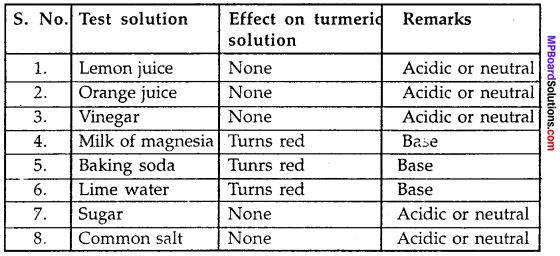
Answer:
MP Board Class 7th Science Solutions Chapter 12 Reproduction in Plants img 1
MP Board Class 7th Science Solutions Chapter 12 Reproduction in Plants img 2

Reproduction in Plants Text Book Exercises

Question 1.
Fill in the blanks:

  1. Production of new individuals from the vegetative part of parent is called ……………………….
  2. A flower may have either male or female reproductive parts Such a flower is called …………………….
  3. The transfer of pollen grains from the another to the stigma of the same or of another flower of the same kind is known as ………………………….
  4. The fusion of male and female gametes is termed as ………………………
  5. Seed dispersal takes place by means of …………………………. , ……………………… and …………………………….

Answer:

  1. Vegetative propagation
  2. unisexual flowers
  3. pollination
  4. fertilisation
  5. wind, insects, water.

Question 2.
Describe the different methods of asexual reproduction. Give examples?
Answer:
The various methods of asexual reproduction are:

  1. Vegetative propagation, for example stem cutting of rose or champa.
  2. Budding, for example reproduction in yeast by budding.
  3. Fragmentation, for example fragmentation in spirogyra.
  4. Spore formation, for example reproduction in fern.

MP Board Solutions

Question 3.
Explain what you understand by sexual reproduction?
Answer:
In this type of reproduction male gamete (sperm) combines tie female gamete (ovum) in animals to form zygote.

Question 4.
State the main difference between asexual and sexual reproduction?
Sexual Reproduction:

  1. It occurs both in lower and the higher organisms but mostly in higher plants and animals.
  2. In it, there is fusion of the two (male and female) gametes and for this the sexes are required.
  3. The new individual formed is identical to the parent.

Asexual Reproduction:

  1. Usually occurs in lower organisms.
  2. Only one parent is sufficient in asexual reproduction.
  3. The new individual formed is similar but not identical to the parents.

Question 5.
Sketch the reproductive parts of a flower?
Answer:
MP Board Class 7th Science Solutions Chapter 12 Reproduction in Plants img 3
MP Board Class 7th Science Solutions Chapter 12 Reproduction in Plants img 4

Question 6.
Explain the difference between self – pollination and cross – pollination?
Answer:
self – pollination:
The transfer of pollen from the another to the stigma of a flower is called pollination.
If the pollen lands on the stigma of the same flower it is called self – pollination.

cross – pollination:
When the pollen of a flower lands on the stigma of another flower of the same plant, or that of a different plant of the same kind, it is called cross – pollination.

MP Board Class 7th Science Solutions Chapter 12 Reproduction in Plants img 5 and 6

Question 7.
How does the process of fertilisation take place in flowers?
Answer:
Fertilization is the process in which male and female gametes fuse together. In flowering plants the pollen fuses with ovules present in the overy to form a zygote, which later on develops into seed.
MP Board Class 7th Science Solutions Chapter 12 Reproduction in Plants img 7 and 8

Question 8.
Describe the various ways by which seeds are dispersed?
Answer:
In nature same kind of plants grow at different places. This happens because seeds are dispersed to different places. Sometimes after a walk through a forest or a field or a park, we may have found seeds or fruits sticking to our clothes. Seeds and fruits of plants are carried away by wind, water and animals.

Winged seeds such as those of drumstick and maple [Fig.(a) and (b)], light seeds of grasses or hairy seeds of aak (Madar) and hairy fruit of sunflower [Fig. (a), (b)], get blown off with the wind to far away places. Some seeds are dispersed by water. These fruits or seeds usually develop floating ability in the form of spongy or fibrous outer coat as in coconut. Some seeds are dispersed by animals, especially spiny seeds with hooks which get attached to the bodies of animals and are carried to distant places. Examples are Xanthium and Urena.
MP Board Class 7th Science Solutions Chapter 12 Reproduction in Plants img 8
MP Board Class 7th Science Solutions Chapter 12 Reproduction in Plants img 9
Some seeds are dispersed when the fruits burst with sudden jerks. The seeds are scattered far from the parent plant. This happens in the case of castor and balsam.
MP Board Class 7th Science Solutions Chapter 12 Reproduction in Plants img 10

Question 9.
Match items in Column I with those in Column II
MP Board Class 7th Science Solutions Chapter 12 Reproduction in Plants img 11
Answer:

(a) – (iii)
(b) – (v)
(c) – (ii)
(d) – (i)
(e) – (iv).

Question 10.
Tick the correct answer:

Question (a)
The reproductive part of a plant is the?
(i) leaf
(ii) stem
(iii) root
(iv) flower.
Answer:
(iii) root

Question (b)
The process of fusion of the male and the female gametes is called?
(i) fertilisation
(ii) pollination
(iii) reproduction
(iv) seed formation.
Answer:
(i) fertilisation

Question (c)
Mature ovary forms the?
(i) seed
(ii) pistil
(iii) stamen
(iv) fruit.
Answer:
(iv) fruit.

MP Board Solutions

Question (d)
A spore producing plant is?
(i) rose
(ii) bread mould
(iii) potato
(iv) ginger.
Answer:
(iii) potato

Question (e)
Bryophyllum can reproduce by its?
(i) stem
(ii) leaves
(iii) roots
(iv) flower.
Answer:
(ii) leaves

Extended Learning – Activities and Projects

Question 1.
Make your own cactus garden by collecting pieces cut from different kinds of cacti. Grow the variety in one single flat container or in separate pots?
Answer:
Do yourself.

Question 2.
Visit a fruit market and collect as many local fruits as possible. If many fruits are not available, you can collect tomatoes and cucumbers (these are fruits, though we use them as vegetables). Make drawings of the different fruits. Split the fruits and examine the seeds within. Look for any special characteristics in the fruits and their seeds?
Answer:
Do yourself.

Question 3.
Think of ten different fruit – bearing plants. Remember that many vegetables are also fruits of the plants. Discuss with your teacher, parents, farmers, fruit growers and agricultural experts (if available nearby) and find out the manner of their dispersal. Present your data in the form of a table as shown below:
MP Board Class 7th Science Solutions Chapter 12 Reproduction in Plants img 12
Answer:
Do yourself

Question 4.
Suppose there is one member of a particular kind of organism in a culture dish, which doubles itself in one hour through asexual reproduction. Work out the number of members of that kind of organism which will be present in the culture dish after ten hours. Such a colony of individuals arising from one parent is called a “clone”?
Answer:
Do yourself.

Reproduction in Plants Additional Important Questions

Objective Type Questions

Question 1.
Choose the correct alternative:

Question (a)
………………………… is formed in female reproductive part of plant.
(a) pollen grain
(b) pollination
(c) female gamete
(d) stigma.
Answer:
(d) stigma.

Question (b)
The process of reaching pollen grains to stigma is called as …………………….
(a) pollination
(b) budding
(c) fission
(d) fertilisation.
Answer:
(a) pollination

MP Board Solutions

Question (c)
In plants, male and female reproductive organs are found in ………………………….
(a) leaves
(b) flowers
(c) roots
(d) stem.
Answer:
(b) flowers

Question (d)
Those living beings who have male and female reproductive organs differently are called ………………………….
(a) asexual
(b) bisexual
(c) unisexual
(d) None of these.
Answer:
(c) unisexual

Question (e)
Zygote is formed:
(a) by fusion of two male gamete
(b) by fusion of two female gametes
(c) by fusion of male and female gametes
(d) by all the above methods.
Answer:
(c) by fusion of male and female gametes

Question (f)
Which one of the following organisms shows budding?
(a) Hydra
(b) Spirogyra
(c) Amoeba
(d) Paramecium.
Answer:
(a) Hydra

Question 2.
Fill in the blanks:

  1. ……………………. are parts of flower.
  2. Once the pollen grains reach stigma, they form …………………………..
  3. ……………………… are formed in pollen grains.
  4. The long thread like structure of carpel is called as ………………………
  5. The grain like structure in ovary is called as …………………………
  6. ………………………….. is formed in ovule.
  7. Formation of a new plant from the stem of sugarcane is known as ………………………..
  8. The fusion of sperm and egg is known as ………………………..
  9. We can count the age of a tree through its ……………………….
  10. The cells involved in sexual reproduction are called ………………………….
  11. Fusion of gametes gives rise to a single cells called ……………………….
  12. The process of fusion of gametes is called ………………………….. in animals and plants.
  13. Animals having both reproductive organs are called ………………………….

Answer:

  1. Stamen and carpel
  2. Male gametes
  3. Male gametes
  4. Ovules
  5. Female gametes
  6. Zygote
  7. Vegetative reproduction
  8. Fertilisation
  9. Annual rings
  10. Gametes
  11. Zygote
  12. Fertilisation
  13. Hermaphrodite.

MP Board Solutions

Question 3.
Which of the following statements are true (T) or false (F):

  1. The process of development in human and butterfly are the same because they both start from a zygote.
  2. The most common type of reproduction in amoeba and paramecium is budding.
  3. The common method of reproduction in yeast is budding.
  4. Asexual reproduction is more common than the sexual reproduction.
  5. Reproduction by spores is a method of asexual reproduction.
  6. Cutting and grafting are natural means of reproduction.
  7. A fertilized egg becomes a seed.
  8. Plants can have indefinite growth but animals do not.
  9. Insect pollinated flowers are brightly coloured.
  10. Flowers which possess stamens and carpel are called unisexual.
  11. Wind pollinated flowers produce pollen grains in large quantity.

Answer:

  1. False
  2. False
  3. True
  4. True
  5. True
  6. False
  7. True
  8. True
  9. True
  10. False
  11. True

Question 4.
Match the items in Column A with Column B:
MP Board Class 7th Science Solutions Chapter 12 Reproduction in Plants img 13
Answer:

(i) – (d)
(ii) – (c)
(iii) – (a)
(iv) – (b).

Reproduction in Plants Very short Answer type Questions

Question 1.
Name two organisms which reproduce by two types of asexual methods. What are the methods?
Answer:
Amoeba reproduces by binary fission. Hydra reproduces by budding.

Question 2.
What is meant by reproduction?
Answer:
It is a process by which an organism gives birth to produce its own kind to maintain its species.

Question 3.
What are the two methods of reproduction in plants and animals?
Answer:
The two methods of reproduction in plants and animals are:

  1. Asexual reproduction.
  2. Sexual reproduction.

MP Board Solutions

Question 4.
What is pollination?
Answer:
It is the process of transference of pollen grains from the stamens to the stigma of the carpel of flower.

Question 5.
What do you call for the male reproductive organ of flower?
Answer:
The male reproductive organ of a flower is called ‘stamen’.

Question 6.
What do you call for the female reproductive organ of the flower?
Answer:
The female reproductive organ of the flower is called a “carpel”.

Question 7.
What is growth?
Answer:
The process in which the change in size and shape of the organism along with the increase in weight is called growth.

Question 8.
What kind of development takes place in dog and cat?
Answer:
The development in dog and cat takes place inside the body of female. The female gives birth to young ones after a definite period. This type of development is called internal development.

MP Board Solutions

Question 9.
What is the difference between sperm and ovum?
Answer:
Sperm is a male gamete while ovum is a female gamete. Sperm is mobile while ovum is non-mobile, the movement of sperm is attributed to mitochondria present in sperm.

Question 10.
In which part of the flower is the ovule found?
Answer:
In the ovary part of carpel of the flower the ovule is found.

Question 11.
Where does fertilisation occur in a flowering plant?
Answer:
In flowering plants, the fertilisation occurs in the ovary of the carpel of the flower.

Question 12.
How many types of gametes are there?
Answer:
Gametes are the fundamental units of reproduction. They are of two types :

  1. Male gametes or sperms
  2. Female gametes or ovum.

Question 13.
What is fertilisation process?
Answer:
The fusion of male and female gametes to form a zygote during sexual reproduction is called fertilisation.

Reproduction in Plants short Answer type Questions

Question 1.
How do insects help in cross – pollination?
Answer:
Insects get attracted towards flowers either due to their bright color or fragrance or nectar. In the process of collecting nectar from flowers some of the pollens get stuck to their legs and body. If such an insect visits another flower, he transfers pollens to this flower and thus completes the process of cross-pollination.

Question 2.
What are the organs in human which produce the gametes?
Answer:
In humans the parents are separate as mother and father. Mother (female) possesses the ovary and the father (male) possesses the testes. The ovary produces the ovum (female sex cell) and the testes produces the sperm.

MP Board Solutions

Question 3.
What is budding?
Answer:
Budding is a type of a sexual reproduction in which an individual is produced as an out growth called bud from the parent organism. It takes place in certain animals like Hydra and in non green plant cells of yeast.

Question 4.
How do plants developed from a seed?
Answer:
The embryo inside the seed has two distinct parts. One part produces root system, and the other shoot system under favourable conditions of water, air, light and temperature. The root system developed under the soil and shoot system above the soil. Due to cell division elongation of different parts takes place and a new plant is obtained.
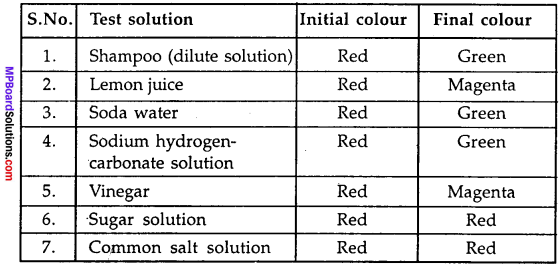
Question 5.
Give some examples of growth in plants and animals?
Answer:
Examples of growth in plants:

  1. A small seedling gets developed into a fully developed tree.
  2. Growth of plant in length.
  3. Growth of stem in thickness.

Examples of growth in animals:

  1. An egg is developed into an organism by the division of cells.
  2. A small child grows into a fully developed adult.
  3. A wound is healed up by the division of cells in the surrounding region.

Question 6.
Explain with examples “fission”?
Answer:
When the body of an individual after a certain period of growth divides mitotically into two or more parts, it is known as fission reproduction. When a fission results in the formation of two daughters, it is known as binary fission. When fission results in the formation of two daughters, it is known as multiple fission.

Question 7.
How does reproduction take place in fungs by budding?
Answer:
A bulb like structure formed on body is known as bud. As the reproduction takes place through this bud, it is called as budding. Such types of buds are formed on the bodies of organisms like hydra, yeast etc. This bud increases gradually and detaches itself from parent body and develops in the form of new organism. In corel and sponge also reproduction takes place by budding.

MP Board Solutions

Question 8.
What is called as vegetative reproduction?
Answer:
The new plant develops when branches of these plants are burried in soil during rainy season. The new saplings are produced from various parts such as root, stem, leaf of plants. This type of propagation or reproduction in plants is called as vegetative propagation.

Question 9.
What is difference between fertilisation and pollination?
Answer:
Pollination is the transference of male gametes (pollen grain) from pollen sac to stigma and the fertilisation is fusion of male gamete (pollen grain) and female gamete (egg cell) in the ovary of a flower. Fertilisation is followed by the formation of embryo. Embryo is enclosed within the seed.

Question 10.
What are the advantages of vegetative reproduction?
Answer:
Advantages of vegetative reproduction:

  1. It helps in rapid propagation of plant species in some region. Examples: bamboo, sugarcane, potato crop etc.
  2. Those plants, whose seeds are not capable of germination, can be reproduced by vegetative reproduction e.g. garlic,
  3. There is 100 percent possibility of survival of plants by this method.
  4. The species having high qualities can be conserved.
  5. The plants reproduced by this method get the fruits earlier.

Reproduction in Plants Long Answer type Questions

Question 1.
What are the different ways in which reproduction in plants can take place?
Ans. Reproduction in plants can be classified in three main groups:

  1. Sexual reproduction,
  2. Asexual reproduction, and
  3. Vegetative reproduction.

In asexual reproduction, the new individuals are reproduced from a single parent. Here one cell undergoes division into two new individuals. In sexual reproduction, two parents are needed to produce one new individual. In vegetative propagation, a few cells of plant body propagate to form a new plant.

MP Board Solutions

Question 2.
Write the various steps involved in the formation of a plant seed, starting from pollination?
Answer:
There are following steps involved from pollination to the formation of the seed:

1. Fertilisation:
The process of fusion of male and female gamete in sexual reproduction is called fertilisation.

2. Pollination:
The male part of plant is stamen. It consists of the filament and the anther. The anther has pollen grains.The female part is made up of stigma, style and ovary. The ovary has ovule. The stigma receives of pollen grains. The process of transfer of pollen from anther to stigma is known as pollination.

3. Seed formation:
The whole ovary after fertilisation is converted into the fruit while the ovule is converted into the seed.

Question 3.
What is meant by the terms external fertilisation and internal fertilisation?
Answer:
Internal fertilisation:
The reproductive process remains incomplete till the male and female gamete do not fuse with each other. In some animals the process of fertilisation occurs inside the female body. This is called internal fertilization. After that female either lay eggs or given birth to young one. For example, dog, cat, bird, human etc.

External fertilisation:
In some animals the female release ovum or egg outside and the male drops sperms on these. This type of fertilization is called external fertilization. The zygote so formal undergoes regular and specific changes with rime to form a new individual.

MP Board Solutions

Question 4.
What are the reproductive organs in a flower? How does pollination take place? What is a seed?
Answer:
The reproductive organs of a plant develop on a special reproductive appendage called flower. The male reproductive, organs are stamen. The stamens bear anthers where pollen grains (the male gametes) are produced. The female reproductive organ is pistil. It consists of stigma, style and ovary. Inside the ovary (the female – gametes) are developed.

Pollination is the transfer of pollen grains from another to stigma of either the same flower (self pollination) or of another flower (cross pollination). The pollen grains are carried to the stigma by air, insects water in aquatic plants or by animals. Seed is the structure formed by the fusion of ovule and pollen grains in the ovary. The seeds germinate after their dispersion, into new plants.

Question 5.
Explain reproduction by spore formation in fungus with neat diagram?
Answer:
Spore formation:
You might have seen white powder like substance on leather objects during rainy season. These small particles are spores of fungus. Small spherical structures are in yeast, fungus, moss, fern and microbes during unfavourable circumstances. They have protective layer around them and remain floating in air. During favourable conditions, the protective layer breaks open and new organism is formed.
MP Board Class 7th Science Solutions Chapter 12 Reproduction in Plants img 14.

Question 6.
What are spores? When do they form?
Answer:
Several plants produce spores which germinate to produce new individual plants e.g., rhizopus, mucus and moss etc. It is the mechanism to overcome the unfavourable conditions.
MP Board Class 7th Science Solutions Chapter 12 Reproduction in Plants img 15

Question 7.
Draw a neat diagram to show reproduction through spore formation in fern?
Answer:
MP Board Class 7th Science Solutions Chapter 12 Reproduction in Plants img 16

MP Board Class 7th Science Solutions

MP Board Class 7th Science Solutions Chapter 11 Transportation in Animals and Plants

MP Board Class 7th Science Solutions Chapter 11 Transportation in Animals and Plants

Transportation in Animals and Plants Intex Questions

Question 1.
Why is the color of blood red?
Answer:
Because blood contains a red pigment called hemoglobin.

Question 2.
Paheli wonders which side of the heart will have oxygen – rich blood and which side will have carbon dioxide  rich blood?
Answer:
Right side of heart has blood rich in oxygen and left side of heart has blood rich in carbon dioxide.

Question 3.
Paheli wants to know whether other animals also urinate?
Answer:
Yes.

MP Board Solutions

Question 4.
Boojho wants to know why plants absorb a large quantity of water from the soil, then give it off by transpiration?
Answer:
Because transpiration helps in suction of water.

Activities

Activity – 1
Record your own pulse beats per minute and those of your classmates? Compare the values you obtained and insert them in Table?
Table:
Pulse rate
MP Board Class 7th Science Solutions Chapter 11 Transportation in Animals and Plants img 1

Activity – 2
Record your own pulse rate and heartbeat and that of your friends while resting and after running and record in Table? Do you find any relationship between your heartbeat and pulse rate?
Table:
Heartbeat and pulse rate
MP Board Class 7th Science Solutions Chapter 11 Transportation in Animals and Plants img 2

Transportation in Animals and Plants Text Book Exercises

Question 1.
Match structures given in Column I with functions given in Column II.
MP Board Class 7th Science Solutions Chapter 11 Transportation in Animals and Plants img 3
Answer:

(i) – (b)
(ii) – (d)
(iii) – (a)
(iv) – (c)

Question 2.
Fill in the blanks:

  1. The blood from the heart is transported to all parts of the body by the …………………..
  2. Haemoglobin is present in ……………………….. cells.
  3. Arteries and veins are joined by a network of ………………………..
  4. The rhythmic expansion and contraction of the heart is called …………………………
  5. The main excretory product in human beings is ………………………….
  6. Sweat contains water and ……………………..
  7. Kidneys eliminate the waste materials in the liquid form called ……………………….
  8. Water reaches great heights in the trees because of suction pull caused by ……………………..

Answer:

  1. Arteries
  2. Red blood
  3. Capillaries
  4. Heart beat
  5. Urine
  6. Urea
  7. Urine
  8. Transpiration.

MP Board Solutions

Question 3.
Choose the correct alternative:

Question (a)
In plants, water is transported through?
(a) Xylem
(b) Phloem
(c) Stomata
(d) Root hair.
Answer:
(a) Xylem

Question (b)
Water absorption through roots can be increased by keeping the plants?
(a) In the shade
(b) In dim light
(c) under the fan
(d) covered with a polythene bag.
Answer:
(b) In dim light

Question 4.
Why is transport of materials necessary in a plant or in an animal? Explain.
Answer:
Transport of material is necessary in plant or animal because due to it the nutrients are made available to all the parts of the body. If the transport of necessary nutrients does not take place in the body, the body will not be able to survive. For example, in plants
roots absorb water and leaves prepare food utilising the water.

The food is also required by root. So, there is no utility of water absorbed by the roots if it does not reach leaf or food prepared by leaf if it does not reach root. Thus, the process of transportation is necessary.

MP Board Solutions

Question 5.
What will happen if there are no platelets in the blood?
Answer:
The blood platelets are responsible for the clotting of the blood. Without the platelets, blood cannot be clot. So, if there is any cut, blood will continue to flow out and ultimately the person die.

Question 6.
What are stomata? Give two functions of stomata?
Answer:
The small pores in leaves and stems of plants are called stomata.
Functions of Stomata:

  1. It absorb oxygen from air.
  2. It helps in the transportation of water.

Question 7.
Does transpiration serve any useful function in the plants? Explain.
Answer:
Yes, transpiration is an important function in plants. Plants absorb mineral nutrients and water from the soil. Not all the water absorbed is utilised by the plant. The water evaporates through the stomata present on the surface of the leaves by the process of transpiration. The evaporation of water from leaves generates a suction pull (the same that you produce when you suck water through a straw) which can pull water to great heights in the tall trees. Transpiration also cools the plant.
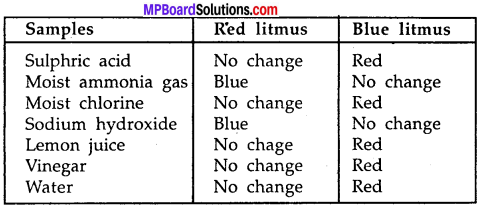
Question 8.
What are components of blood?
Answer:
Red blood cells (RBC), while blood cells (WBC), plasma and platelets are the components of blood.

Question 9.
Why is blood needed by all the parts of a body?
Answer:
Blood is needed by all the parts of a body because it carries digested food and oxygen to all parts of body. It also carries away the waste products.

MP Board Solutions

Question 10.
What makes the blood look red?
Answer:
A red coloured pigment called hemoglobin gives the blood red color.

Question 11.
Describe the function of the heart?
Answer:
The main function of heart is to collects and distributes blood from and to all parts of the body. The right auricle and ventricle receives blood with carbon dioxide from all the parts of the body. The collected blood is then pumped to the lungs for the purification. In lungs, the exchange of gases take place and purified blood is sent back to the left auricle. After that purified blood is sent to all the parts of the body through arteries.

Question 12.
Why is it necessary to excrete waste products?
Answer:
Waste products are harmful for the body, so it is necessary to excrete waste products.

Question 13.
Draw a diagram of the human excretory system and label the various parts?
Answer:
Human Excretory System Diagram:
MP Board Class 7th Science Solutions Chapter 11 Transportation in Animals and Plants img 4.2

Extended Learning – Activities and Projects

Question 1.
Find out about the blood groups and their importance?
Answer:
Carl Landesteiner (1900) discovered that there are two types of antigens present on the plasma membrane of the RBC. These are antigen A and antigen B. These are also called corpuscle factors. There are also two types of antibodies present in the plasma. These are antibody A (Anti – A) and antibody B (Anti – B).

These are also called plasma factors. The blood is classified into four groups on the basis of the presence or absence of these antigens. These groups are A, B, AB and O. This system of classification of blood is called: ‘ABO’ system. The following table shows the types of blood groups and their antigens and antibodies:
MP Board Class 7th Science Solutions Chapter 11 Transportation in Animals and Plants img 5

Along with the A and B antigens or antibodies, many people have another factor called the Rh factor. This is an antigen first found in Rhesus monkey (hence, called the Rh factor). People whose red blood cells contain the Rh antigen are said to be Rh positive (Rh+). People who lack it are called Rh negative (Rh).

A person with Rhblood does not have Rh antibody (which destroys Rh antigen) naturally. But, as and when an Rh antigen enters the blood, it develops Rh antibody and destroys the antigen. If a person with blood group A has Rh antigen, his/her blood is said to be A+(A positive).

Similarly if a person’s blood group is B and he/she does not have Rh antigen, then his/her blood group is B(B negative). So, we have eight blood groups: A+, B+, AB+, O+, A+, B+, AB+ and O+.
MP Board Class 7th Science Solutions Chapter 11 Transportation in Animals and Plants img 6

Question 2.
When a person suffers from chest pain, the doctor immediately takes an ECG? Visit a doctor and get information about ECG? You may even look up an encyclopedia or the internet?
Answer:
An electrocardiogram (ECG or EKG, abbreviated from the German Electrocardiogram) is a graphic produced by an electrocardiograph, which records the electrical activity of the heart over time. Analysis of the various waves and normal vectors of depolarization and repolarization yields important diagnostic information.

  1. It guides therapy and risk stratification for heart patients.
  2. It helps detect electrolyte disturbances. It allows for the detection of conduction abnormalities.
  3. It is used as a screening tool for ischemic heart disease during a cardiac stress test.
  4. It is occasionally helpful with non – cardiac

In 1856, Kollicker and Mueller discovered the electrical activity of the heart when a frog sciatic nerve/gastrocenemius preparation fell onto an isolated frog heart and both muscles contracted synchronously. Alexander muirhead attached wires to a feverish patient’s wrist to obtain a record of the patient’s heartbeat while studying for his DSc (in electricity) in 1872 at St Bartholomew’s Hospital.

This activity was directly recorded and visualized using a Lippmann capillary electrometer by the British physiologist John Burdon Sanderson. The first to systematically approach the heart from an electrical point – of – view was Augustus Waller, working in St Mary’s Hospital in Paddington, London. His electrocardiograph machine consisted of a Lippmann capillary electrometer fixed to a projector.

The trace from the heartbeat was projected onto a photographic plate which was itself fixed to a toy train. This allowed a heartbeat to be recorded in real time. In 1911 he still saw little clinical application for his work. The break through came when Willem Einthoven, working in Leiden, The Netherlands, used the string galvanometer invented by him in 1901, which was much more sensitive than the capillary electrometer that Waller used. Einthoven assigned the letters P, Q, R, S and T to the various deflections, and described the electrocardiographic features of a number of cardiovascular disorders. In 1924, he was awarded the Nobel Prize in Medicine for his discovery.

MP Board Solutions

Transportation in Animals and Plants Additional Important Questions

Objective Type Questions

Question 1.
Choose the correct alternative:

Question (a)
The cells in blood that fight against the disease causing germs are called?
(a) Platelets
(b) White blood cells
(c) Red blood cells
(d) None of these.
Answer:
(b) White blood cells

Question (b)
Which of these is responsible for clotting of blood?
(a) Platelets
(b) White blood cells
(c) Red blood cells
(d) none of these.
Answer:
(a) Platelets

Question (c)
Smallest filtering units in kidneys are called?
(a) ventricles
(b) auricles
(c) vessels
(d) nephrons.
Answer:
(d) nephrons.

MP Board Solutions

Question (d)
Urine is stored in till excreted?
(a) Ureter
(b) Kidney
(c) Urinary bladder
(d) Urethra.
Answer:
(c) Urinary bladder

Question (e)
Instrument used to measure heart beat is called?
(a) thermometer
(b) nanometer
(c) stethoscope
(d) none of these.
Answer:
(c) stethoscope

Question (f)
How many times heart of an healthy person beats in one minute?
(a) 70
(b) 71
(c) 72
(d) 73
Answer:
(c) 72

Question (g)
Which one of the following is not an excretory organ?
(a) Lever
(b) Skin
(c) Kidney
(d) Oesophagus.
Answer:
(d) Oesophagus.

MP Board Solutions

Question (h)
The tube by which all the wastes are thrown out is known as?
(a) ureters
(b) urethra
(c) urinary bladder
(d) none of these.
Answer:
(b) urethra

Question 2.
Fill in the blanks:

  1. The fluid part of the blood is called …………………………
  2. One type of cells are the red blood cells which contain a red pigment called …………………….
  3. There are the ……………………… types of blood vessels in the body.
  4. …………………….. carry oxygen rich blood from the heart to all parts of the body.
  5. The number of pulse beats per minute is called the ………………………
  6.  …………………… are the vessels which carry carbon dioxide rich blood from all parts of the body back to the heart.
  7. The heart has …………………….. chambers.
  8. The walls of the chambers of the heart are made up of ……………………
  9. Your heart is roughly the size of your ……………………………
  10. The English Physician, William Harvey discovered the circulation of ………………………….
  11. The parts involved in excretion forms the …………………… system.
  12. The kidneys, ureters, bladder and urethra form the ……………………………… system
  13. Birds, Insects and lizard excrete ………………………………. in semi – solid form.
  14. A …………………………………. is a group of cells not perform  specialized function in an organism.
  15. The vascular tissue for the transport of water and nutrients in the plant is called the ………………………..
  16. Water and mineral nutrients are absorbed by roots from the ………………………….

Answer:

  1. Plasma
  2. Hemoglobin
  3. Two
  4. Arteries
  5. Pulse rate
  6. Veins
  7. Four
  8. Muscles
  9. Fist
  10. Blood
  11. Excretory
  12. Excretory
  13. Uric acid
  14. Tissue
  15. Xylem
  16. Soil.
MP Board Solutions

Question 3.
Which of the following statements are true (T) or false (F):

  1. Circulatory system consists of the heart and blood vessels.
  2. Oxygenated blood flows in arteries.
  3. Valves are there in inner walls of veins.
  4. White blood cells to not protect our body from diseases.
  5. Blood is red due to platelets.
  6. In humans, blood flows through arteries and veins and the heart acts as a pumping organ.
  7. The heart is protected by a membrane called paracardium.
  8. Veins carry blood from all parts of the body back to the heart.
  9. Artery carry blood from the heart to all parts of the body.
  10. Our body requires at least 2 to 3 litres of water everyday.
  11. In humans, excretion involves the removal of sweat, urea and faces.
  12. All organisms nave same method of waste removal from their body.
  13. The xylem and phloem together make up the vascular system in plants.
  14. In older plants vacuoles contain the excretory products.

Answer:

  1. True
  2. True
  3. True
  4. False
  5. False
  6. True
  7. True
  8. True
  9. True
  10. True
  11. True
  12. False
  13. True
  14. True.

Transportation in Animals and Plants Very Short Answer Type Questions

Question 1.
Name the transport medium in human beings?
Answer:
Blood.

Question 2.
White blood corpuscles is called as soldiers. Why?
Answer:
They have no definite shape. They work in our body like soldiers whenever any harmful micro – organism, virus or foreign body enters inside our body then these corpuseles prevent their entry and destroy them.

Question 3.
If blood does not coagulate after injury, then what will happen?
Answer:
The people can be died.

MP Board Solutions

Question 4.
How does the red blood corpuscles deliver oxygen to each part of body?
Answer:
Hemoglobin reacts with oxygen and forms a temporary compound called as oxyhemoglobin which breaks again in every part of body and donates oxygen.

Question 5.
Write the names of different blood vessels?
Answer:
The names of different blood vessels are arteries, veins and capillaries.

Question 6.
Write functions of hemoglobin?
Answer:
Hemoglobin containing iron and this hemoglobin reacts with oxygen and forms a temporary compound called as oxyhemoglobin which breaks again in every part of body and donates oxygen.

Question 7.
Why is the blood red in color?
Answer:
The blood is red in color due to the presence of an iron containing pigment hemoglobin.

Question 8.
What will happen if the blood rich in oxygen and the blood rich in carbon dioxide mix with each other?
Answer:
The net oxygen content of blood Will be reduced and hence body will suffer from lack of oxygen.

Question 9.
What is pulse rate?
Answer:
The number of beats per minute is called the pulse rate.

Question 10.
What is the resting pulse rate of a normal person?
Answer:
A resting person, usually has a pulse rate between 72 and 80 beats per minute.

MP Board Solutions

Question 11.
Where is heart located?
Answer:
The heart is located in the chest cavity with its lower tip slightly tilted towards the left.

Question 12.
What are the two upper chamber of hearts?
Answer:
Atria.

Question 13.
What are ventricles?
Answer:
The two lower chambers of heart are called ventricles.

Question 14.
Define excretion?
Answer:
Excretion is a process through which the metabolic wastes are excreted out from the body.

Question 15.
Name the various organs of excretion in human?
Answer:
Various excretory organs of humans are skin, lungs and kidneys.

Question 16.
How does excretion occur in unicellular animals?
Answer:
In unicellular animals excretion takes place by diffusion process.

MP Board Solutions

Question 17.
What is transpiration?
Answer:
Transpiration is a process of evaporation of water from the surface of the leaf in the form of water vapours. It helps:

  1. To generate pulling force for the upward movement of water.
  2. To get rid of excess of water.
  3. To maintain the temperature because of cooling effect.

Question 18.
What is excretion?
Answer:
Excretion is the process of the removal of the waste product from the body of a plant or an animal. The different organisms eliminate their waste in different ways.
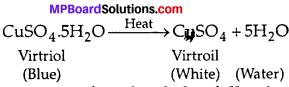

Question 19.
Write the names exretory materials in plants?
Answer:
The excretory materials in plants are a gum, rain and latex.

Transportation in Animals and Plants Short Answer Type Questions

Question 1.
Name the various blood vessels and write their functions?
Answer:
There are three blood vessels:
1. Arteries:
These are the blood vessels which carry or transport oxygenated pure blood from heart to all other parts of the body.

2. Veins:
These are blood vessels which collects the deoxygenated impure blood from the whole body and send it to the heart.

3. Capillaries:
These are the network of thin tube like structures which connect the arteries and veins together.

Question 2.
What is blood? What are the components of blood?
Answer:
Blood is a fluid tissue that circulates and transport the material within the cells. It is red in color due to the presence of a pigment called hemoglobin. Various components of bloods are blood cells and plasma.
MP Board Class 7th Science Solutions Chapter 11 Transportation in Animals and Plants img 7

Question 3.
What is the main difference between artery and a vein?
Answer:
Differences between arteries and veins:
Artery:

  1. It carries pure blood from heart to the different organs of the body.
  2. Blood flows with jerks with high pressures.
  3. They always carry oxygenated rich blood.
  4. It has no valve.
  5. Its wall is thick.

Vein:

  1. It collects impure blood from different parts of the body.
  2. Blood flows smoothly with low pressure.
  3. They always carry carbon dioxide rich blood.
  4. Semilunar valves are present.
  5. Its wall is thin.

MP Board Solutions

Question 4.
What is meant by excretion? Explain its need for the sustenance of the individual?
Answer:
Excretion is a process of removal of metabolic waste materials from the body. If excretory matter is present in the body It will disturb the metabolic activities going or in different parts of the body. It will disturb metabolic activity in body. So it is necessary to excrete out all the metabolic wastes from the body.

Question 5.
Describe the process of water and mineral absorption in plants?
Answer:
In higher plants root system is well developed. The tertiary roots possess root hairs. They absorb mineral salt and water in the form of dilute solution through endosmosis. The cells of root hair transfer this solution to the epidermal cells. Through diffusion process absorbed solution reaches in the xylem vessels and from it lifts up and then reaches up to the top of the plant.

Question 6.
How do the exchange of gases occur in plants?
Answer:
In case of plants the lower surface of leaves have small pores called stomata. These are provided by two guard cells which control the opening or closing of the stomata. When the concentration of O2 gas increases during photosynthesis the guard cells open and O2 gas is given out and if concentration CO2 gas increases during respiration, the guard cells cause CO2 gas to go out of the cells. This is how the exchange of gases occur in plants.

Question 7.
How does liver help in the process of excretion?
Answer:
Liver plays a major role in excreting waste products of the body. Urea, the chief introgenous waste materials is formed in the liver. The break down of amino acids which takes place in it results in the accumulation of nitrogenous wastes. These nitrogenous wastes break down further into ammonia. Ammonia is a very toxic, therefore, liver converts ammonia along with CO2, into urea with the help of specific enzymes. This urea is eventually thrown out by kidneys.

Question 8.
Why is the process of excretion important for living?
Answer:
As a result of metabolism various toxic substances are continuously formed. These wastes (carbon dioxide, ammonial compounds, other salts) if allowed to accumulate in the body (cells), would disturb the chemical composition of the protoplasm and produce toxic effects, crippling the life activities. Hence their elimination is most important. This is done by the process of excretion.

MP Board Solutions

Question 9.
Why do doctors examine the urine to diagnose a disease? What do they examine in urine?
Answer:
The concentration of various wastes in the urine depends upon the functioning of various organs or organ system in the body. So the examination of urine of a person gives a good idea about his/her general health. The doctors, therefore use the urine test to diagnose disease in the body. For example, presence of excess sugar in urine indicates malfunctioning of pancreas. Presence of excess urea or uric acid indicates the malfunctioning of kidneys.

Transportation in Animals and Plants Long Answer Type Questions

Question 1.
How many types of blood corpuscles are there? Write their functions?
Answer:
There are three types of blood corpuscles:
1. Red blood corpuscles:
They are elliptical or spherical in shape. Hemoglobin containing iron is present in them. This hemoglobin reacts with oxygen and forms a temporary compound called as oxyhemoglobin which breaks again in every part of body and donates oxygen.

2. White blood corpuscles They have no definite shape, They work in our body like soldiers. Whenever any harmful microorganism, virus or foreign body enters inside our body then these corpuscles prevent their entry and destroy them.

3. Blood platelets:
Whenever there is bleeding due to injury, these platelets move there and coagulates the blood, as a result excess blood does not flow.

4. Plasma:
It is the fluid medium which transports digested food as well as metabolic waste products.

MP Board Solutions

Question 2.
Write functions of blood?
Answer:
Various functions of blood are:

  1. The red blood cells carry oxygen to different parts of the body.
  2. The white blood cells fight against the disease causing germs and bacteria and kill them.
  3. The platelets of blood help in clotting of blood.
  4. The plasma carries CO2 from the body.
  5. It regulates our body temperature.
  6. It carries digested and absorbed food and hormones to different organs.
  7. The waste products are taken into excretory organs through blood.

Question 3.
Describe the “pulmonary circulation of blood?”
Answer:
The deoxygenated blood is collected from various organs of the body by two veins called superior and inferior vena cava. They join to form a main vein which empties the blood into the right auricle. From here it enters the right ventricle and is pumped into the right pulmonary artery which caries it to the lungs. Here the carbon – dioxide oxygen exchange takes place. The oxygenated blood is carried by the pulmonary vein to the left auricle. This part of the circulation is called the pulmonary circulation.

Question 4.
Explain structure of heart and draw it’s diagram?
Answer:
Our heart is situated in the left side of our chest. It is divided into four chambers. The upper two chambers collect the blood from veins and are known as auricles. The lower two chambers are meant for distribution of the blood in various parts of the body and are known as the ventricles.
MP Board Class 7th Science Solutions Chapter 11 Transportation in Animals and Plants img 8
Right auricle gets the impure blood which is sent to right ventricle. From right ventricle the blood is thrown to pulmonary arteries which carry this. blood to lungs for put if cation, which is collected by pulmonary veins and now it is in a purified state.

It is brought to left auricle and then to left ventricle from where it is thrown into aorta which is responsible for distribution of this pure blood to various parts of the body. Aorta is divided into various arteries which are divided into five capillaries. After exchange of materials these capillaries form the veins which bring blood to the right auricle.

MP Board Solutions

Question 4.
Define the systematic circulation of blood. Draw the diagram of schematic diagram of circulation?
Answer:
The oxygenated blood from the left auricle enters the left ventricle and is then pumped into the aorta and carried to all parts of the body by arteries and capillaries. This part of the circulation is known as systemic circulation.
MP Board Class 7th Science Solutions Chapter 11 Transportation in Animals and Plants img 9

Question 5.
Describe “blood transfusion?”
Answer:
Blood is a very vital component of our body and we cannot afford to lose it. In case of serious injury, accident or during an operation, we may lose a considerable quantity of blood from our body. In such cases blood from another healthy person is transferred to the patient. This is called blood transfusion. The blood of all human beings falls in any one of the following groups A, B, AB or O. Transfusion should be done carefully and only after checking the blood group of the patient.

Question 6.
“Excretion is process to eliminate the waste by products from the body”. Justify the statement?
Answer:
The nitrogenous waste ammonia is converted into urea by the liver. The renal artery carry the urea of kidneys. Each kidney consists of number of coiled tubes called Nephron. There are about ten million nephron in each kidney of an adult man. The Nephron is the functional unit of the kidney.

One end of the nephron is cup shaped called Bowman’s capsule. The renal artery branches into millions of capillaries in the form of coil in the each Bowman’s capsule. This coil or capillaries of renal artery in the Bowman’s capsule is called Glomerules. The blood is filtered through the walls of capillaries of glomerulus.

This is a selective filteration. The bigger molecules of sugars, salts and nitrogenous wasters are filtered. This selective filteration is termed as dialysis. Thus, the glomerulus acts as dialysis bag of the kidney. The filterate from glomerulur in the Bowman’s capsule passes through the tiny tubule.

Where major part of glucose and other useful substances is reabsorbed. It is sent back into the blood of the renal vein. The waste liquid called urine, containing nitrogenous waste is sent to the urinary bladder through collecting tubule and uretere. From urinary bladder it is eliminated from the body through urethera.
MP Board Class 7th Science Solutions Chapter 11 Transportation in Animals and Plants img 10 and 11

Question 7.
What are the various waste materials excreted from the human body?
Answer:
Excretion is done by following organs:
1. Kidneys:
These excrete urea, salts, water etc. through urine.

2. Skin:
Skin possesses sweat glands. These glands absorb urea, salts and a large quantity of water from the blood capillaries near by and excrete them through their pores on the skin in the form of sweat.

3. Liver:
Liver is not a direct excretory organ. Liver cells convert more toxic ammonia into less toxic urea and uric acid and then pass them to the kidneys through the blood for excretion. Liver also censer toxic substances. It removable salts in bile juice. These bile salts are formed due to break down of hemoglobin. If bile salts are not remove. They cause jaundice. Bile salts are removed through intestine.

MP Board Solutions

Question 8.
Write a short note on “excretion in plants”?
Answer:
Plants, have no special organs for excretion. product of respiration i.e. carbon dioxide is partly us phtosynthesis. The excess amount of carbon dioxide escape the stomata and lenticles. Some of the waste products of photosynthesis an in vacuoles in the leaves and bark of trees. The plant them by sheddingthe leaves and bark.

Some waste products are transformed into harm and stored inside the plant body. Rubber and raphides a of such products. Plants also secrete a number of uses like gum, latex, resin, sandalwood oil and eucalyptus
MP Board Class 7th Science Solutions Chapter 11 Transportation in Animals and Plants img 12

Question 9.
Describe the process of absorption and transportation of water and minerals in plants?
Answer:
The plant root have root hairs which absorb water and minerals in the form of solution from soil. This process is called absorption. This water and minerals are then transported to other parts of plant i.e., stem, leaves and flowers through a special tissue called xylem. Then food is synthesised within leaves of plant and is transported in all parts of plant including roots, through phloem. This produces is called transportation.

Question 10.
Draw a neat diagram to show circulatory system?
Answer:
MP Board Class 7th Science Solutions Chapter 11 Transportation in Animals and Plants img 13

MP Board Class 7th Science Solutions

MP Board Class 7th Science Solutions Chapter 10 Respiration in Organisms

MP Board Class 7th Science Solutions Chapter 10 Respiration in Organisms

Respiration in Organisms Intex Questions

Question 1.
Bhoojho wants to know if cockroaches, snails, fish, earthworms, ants and mosquitoes also have lungs?
Answer:
Yes.

Question 2.
Boojho has seen in television programmes that whales and dolphins often come up to the water surface? They even release a fountain of water sometimes while moving upwards? Why do they do so?
Answer:
Whales and dolphins take in air during inhalation. They exhale out the air on the surface. The water vapour condenses and we see the condensed water vapour as the fountain.

MP Board Solutions

Question 3.
Paheli wants to know whether roots, which are under ground also take in oxygen? If so, how?
Answer:
Yes. Roots take up air from the air spaces preseht between the soil particles.

Activities

Activity – 1
If you try you can count your rate of breathing. Breathe in and out normally. Find out how many times you breathe in and breathe out in a minute? Did you inhale the same number of times as you exhaled? Now count your breathing rate (number of breaths/minute) after brisk walk and after running. Record your breathing rate as soon as you finish and also after complete rest. Tabulate your findings and compare your breathing rates under different conditions with those of your classmates.

Table:
Changes in breathing rate under different conditions:
MP Board Class 7th Science Solutions Chapter 10 Respiration in Organisms image 1

Activity – 2
Figure shows the various activities carried out by a person during a normal day. Can you say in which activity, the rate of breathing will be the slowest and in which it will be the fastest? Assign numbers to the pictures in the order of increasing rate of breathing according to your experience.
MP Board Class 7th Science Solutions Chapter 10 Respiration in Organisms image 2

Activity – 3
Take a deep breath. Measure the size of the chest with a measuring tape and record your observations in Table. Measure the size of the chest again when expanded and indicate which classmate shows the maximum expansion of the chest.
Answer:
Effect of breathing on the chest size of some classmates:
MP Board Class 7th Science Solutions Chapter 10 Respiration in Organisms image 3 - Copy

Respiration in Organisms Text Book Exercise

Question 1.
Why does an athlete breathe faster and deeper than usual after finishing the race?
Answer:
During the race, the athlete has to run very fast. The demand for energy at that time increases, which increase the demand for more supply of oxygen. Thus, athlete has to breathe faster and deep to inhale more oxygen.

Question 2.
List the similarities and differences between aerobic and anaerobic respiration?
Answer:
Similarities:
Both aerobic and anaerobic respiration produce energy and give out carbon dioxide.

Differences:
Aerobic respiration require oxygen while anaerobic respiration does not require oxygen. In aerobic respiration large amount of energy is released while in anaerobic respiration small amount of energy is released.

Question 3.
Why do we often sneeze when we inhale a lot of dust laden air?
Answer:
We sneeze to get rid of the unwanted particles like dust from air body. It allows only clean and dust free air to enter our body.

MP Board Solutions

Question 4.
Take three test – tubes. Fill \(\frac{1}{2}\)th of each with water. Label them A, B and C. Keep a snail in test – tube A, a water plant in test – tube B and in C, keep snail and plant both. Which test – tube would have the highest concentration of CO2?
Answer:
Test – tube A.

Question 5.
Tick the correct answer:

Question (a)
In cockroaches, air enters the body through?
(a) lungs
(b) gills
(c) spiracles
(d) skin.
Answer:
(c) spiracles

Question (b)
During heavy exercise, we get cramps in the legs due to the accumulation of?
(a) carbon dioxide
(b) lactic acid
(c) alcohol
(d) water.
Answer:
(b) lactic acid

Question (c)
Normal range of breathing rate per minute in an average adult person at rest is?
(a) 9 – 12
(b) 15 – 18
(c) 21 – 24
(d) 30 – 33
Answer:
(b) 15 – 18

Question (d)
During exhalation, the ribs?
(a) move outwards
(b) move downwards
(c) move upwards
(d) do not move
Answer:
(b) move downwards

Question 6.
Match the items in Column I with those in Column II:
MP Board Class 7th Science Solutions Chapter 10 Respiration in Organisms image 4
Answer:

(a) – (iii)
(b) – (iv)
(c) – (i)
(d) – (v)
(e) – (ii)
(f) – (vi)

Question 7.
Mark if the statement is true and if it is false:

  1. During heavy exercise the breathing rate of a person slows down.
  2. Plants carry out photosynthesis only during the day and respiration only at night.
  3. Frogs breathe through their skins as well as their lungs.
  4. The fishes have lungs for respiration.
  5. The size of the chest cavity increases during inhalation.

Answer:

  1. False
  2. False
  3. True
  4. False
  5. True

MP Board Solutions

Question 8.
Given below is a square of letters in which are hidden different words related to respiration in organisms. These words may be present in any direction – upwards, downwards, or along the diagonals. Find the words for your respiratory system. Clues about those words are given below the square?

  1. The air tubes of insects
  2. Skeletal structures surrounding chest cavity
  3. Muscular floor of chest cavity
  4. Tiny pores on the surface of leaf
  5. Small openings on the sides of the body of an insect
  6. The respiratory organs of human beings
  7. The openings through which we inhale
  8. An anaerobic organism
  9. An organism with tracheal system

Answer:

  1. Trachea
  2. Rib
  3. Diaphragm
  4. Stomats
  5. Spiracles
  6. Lung
  7. Strils
  8. Yeast
  9. Ant.

MP Board Class 7th Science Solutions Chapter 10 Respiration in Organisms image 5

Question 10.
The mountaineers carry oxygen with them because:
(a) At an altitude of more than 5 km there is no air.
(b) The amount of air available to a person is less than that available on the ground.
(c) The temperature of air is higher than that on the ground.
(d) The pressure of air is higher than that on the ground.
Answer:
(b) The amount of air available to a person is less than that available on the ground.

Extended Learning – Activities and Projects

Question 1.
Observe fish in an aquarium. You will find flap like structures on both sides of their heads. These are flaps which cover the gills. These flaps open and close alternately. On the basis of these observations, explain the process of respiration in the fish?
Answer:
Do with the help of your subject teacher.

Question 2.
Visit a local doctor. Learn about the harmful effects of smoking. You can also collect material on this topic from other sources. You can seek help of your teacher or parents. Find out the percentage of people of your area who smoke. If you have a smoker in your family, confront him with the material that you have collected?
Answer:
Do yourself.

Question 3.
Visit a doctor. Find out about artificial respiration? Ask the doctor:
(a) When does a person need artificial respiration?
(b) Does the person need to be kept on artificial respiration temporarily or permanently?
(c) From where can the person get supply of oxygen for artificial respiration?
Answer:
Do yourself.

MP Board Solutions

Question 4.
Measure the breathing rate of the members of your family and some of your friends? Investigate:
(a) If the breathing rate of children is different from that of adults?
(b) If the breathing rate of males is different from that of females?
If there is a difference in any of these cases, try to find the reason?
Answer:
Do with the help of your parents.

Respiration in Organisms Additional Important Questions

Objective Type Questions

Question 1.
Choose the correct alternative:

Question (a)
The life processes that provide energy are?
(a) respiration
(b) nutrition
(c) both respiration and nutrition
(d) none of these.
Answer:
(c) both respiration and nutrition

Question (b)
In …………………… respiration, there is an exchange of gases between the cells and the blood?
(a) aerobic
(b) anaerobic
(c) external
(d) internal.
Answer:
(d) internal.

Question (c)
In the cell, the food (glucose) is broken down into carbon dioxide and water using?
(a) hydrogen
(b) nitrogen
(c) oxygen
(d) none of these.
Answer:
(c) oxygen

MP Board Solutions

Question (d)
Which of the following is not a feature of respiration?
(a) involvement of enzymes
(b) occur outside the cells
(c) release of energy
(d) is a chemical process.
Answer:
(d) is a chemical process.

Question (e)
During heavy exercise, the breathing rate in an adult can increase upto?
(a) 25 times per minute
(b) 30 times per minute
(c) 35 times per minute
(d) none of these.
Answer:
(a) 25 times per minute

Question (f)
The percentage of oxygen and carbon dioxide in inhaled air is –
(a) 21%, 0.04%
(b) 20%, 0.10%
(c) 21%, 1.0%
(d) 20%, 1.0%.
Answer:
(a) 21%, 0.04%

Question (g)
The percentage of oxygen and carbondioxide in exhalted air is –
(a) 16.4%, 4.4%
(b) 21%, 1.0%
(c) 16.4%, 3.4%
(d) 16.4%, 0.04%.
Answer:
(a) 16.4%, 4.4%

Question 1.
Fill in the blanks:

  1. All living organisms require ………………………… to perform various life process.
  2. The liver and ……………………… are found near the stomach.
  3. The exhaled air has a higher percentage of carbon dioxide as compared to the ……………………………… air.
  4. Breathing is a process at organ levels, whereas respiration is a ……………………….. process.
  5. When breakdown of glucose occurs with the use of oxygen, it is called …………………….. respiration.
  6. The taking in of air rich in oxygen into the body is called …………………………
  7. The number of times a person breathes in a minute is termed as the ………………………….
  8. Lungs are present in the ……………………….. cavity.
  9. During inhalation, ribs move up and outwards and diaphragm moves ………………………..
  10. Insects have a network of air tubes called ……………………….. for gas exchange.
  11. Like all other living cells of the plants, the root cells also need oxygen to ………………………. energy.

Answer:

  1. energy
  2. pancreas
  3. inhaled
  4. cellular
  5. aerobic
  6. inhalation
  7. breathing rate
  8. chest
  9. down
  10. tracheae
  11. generate.

MP Board Solutions

Question 3.
Which of the following statements are true (T) or false (F):

  1. Respiration is a type of combustion at ordinary temperature.
  2. Breathing is a process that takes place at the cellular level.
  3. Oxygen is released during the process of respiration.
  4. During respiration the plants – take CO2 and release Or
  5. Respiration involves on exchange of gases.
  6. Cellular respiration takes place in the cells of all organisms.
  7. Anaerobic respiration do not takes places in the muscle cells to fulfill the demand of energy.
  8. The giving out of air rich in carbon dioxide is known as exhalation.
  9. A breathe means one inhalation plus one exhalation.
  10. On an average, an adult human being at rest breathes in and out 15 to 18 times in a minute.
  11. A cockroach has small openings on the sides of its body.
  12. Gills are not supplied with blood vessels for exchange of gases.
  13. The end product of anaerobic respiration are carbon dioxide and water.
  14. In earthworm, the exchange of gases occurs through the moist skin.

Answer:

  1. True
  2. False
  3. False
  4. True
  5. True
  6. True
  7. False
  8. True
  9. True
  10. True
  11. True
  12. False
  13. True
  14. True

Respiration in Organisms Very Short Answer Type Questions

Question 1.
Where does cellular respiration takes place?
Answer:
Cells of organisms.

Question 2.
Write the equation for breakdown of food in anaerobic respiration?
Answer:
MP Board Class 7th Science Solutions Chapter 10 Respiration in Organisms image 6 - Copy

Question 3.
Write the equation for breakdown of food in aerobic respiration?
Answer:
MP Board Class 7th Science Solutions Chapter 10 Respiration in Organisms img t

Question 4.
What are anaerobes?
Answer:
There are some organisms such as yeast that can service in the absence of air. They are called anaerobes.

Question 5.
What is yeast?
Answer:
Yeast is single – celled organisms.

Question 6.
Write the uses of yeast?
Answer:
Yeast respire anaerobically and during this process yield alcohol. So, they are used to make beer and wine.

Question 7.
Which chemical reaction takes place in internal respiration?
Answer:
Glucose + Oxygen → Carbon dioxide + Water + Energy.

Question 8.
Give an example of an oxygen respiration?
Answer:
In human beings.

Question 9.
Name the parts of digestive system of humans?
Answer:
The parts of digestive systems are mouth, oesophagus, stomach, intestine and anus.

MP Board Solutions

Question 10.
Name two processes of respiration?
Answer:
Inhalation and exhalation are the two processes of respiration.

Question 11.
Name the parts of respiratory system of human?
Answer:

  1. Nostrils
  2. Trachea
  3. Lungs with alveali, and
  4. Diaphragm.

Question 12.
What waste materials are produced during respiration?
Answer:
Carbon dioxide is produced as the waste material during respiration.

Question 13.
Define respiration?
Answer:
The process of breaking down of food by using oxygen, to form carbon dioxide and release energy required for various life activities, is called respiration.

Question 14.
Name the fuels used for the production of energy during respiration?
Answer:
Glucose is oxidized to give out energy.

Question 15.
Which organs of plants participate in respiration?
Answer:
There is no special organ in plants for breathing.

Question 16.
Write the names of organs in human respiratory system in sequence?
Answer:
Nostrils → Nasal cavity → Pharynx → Tracheae → Lungs.

Question 17.
What is importance of hairs present in the noise?
Answer:
These small hairs present in nose act as filters. These prevent dust particles and harmful germs to enter into respiratory track.

Question 18.
Name the organs of the body from which blood freshly enriched with oxygen goes into the heart?
Answer:
The lungs helps the blood to get freshly enrichment of oxygen.

Question 19.
What happens during breathing?
Answer:
During breathing, oxygen enriched air is inhaled which reaches lungs. Here, oxygen centers blood and unwanted water vapour and carbon dioxide are released out during breathing.

MP Board Solutions

Question 20.
What is breathing?
Answer:
The process of taking oxygen and leaving of carbon dioxide during respiration is called breathing.

Question 21.
Write the name of gases which are involved in breathing?
Answer:
Carbon dioxide and oxygen.

Question 22.
How will you prove that we exhale CO2 gas during respiration?
Answer:
Pass the exhaled air given out by us into lime water. It will turn milky in colour. We know that CO2 gas turn lime water milky This confirms that we exhale CO2 gas in respiration.

Question 23.
What do we exhale?
Answer:
We exhale air rich in carbon dioxide.

Question 24.
Do we exhale only carbon dioxide or a mixture of gases along with it?
Answer:
We exhale a mixture of gases along with carbon dioxide.

Question 25.
How do ribs and diaphragm move during inhalation?
Answer:
During inhalation, ribs move up and outwards and diaphragm moves down.

MP Board Solutions

Question 26.
Which is the respiratory organ for earthworm?
Answer:
Skin.

Question 27.
Can we survive in water?
Answer:
No.

Question 28.
How do fish breathe under water?
Answer:
Gills in fish help them to use oxygen dissolved in water. Gills are projections of the skin. Gills are well supplied with blood vessels for exchange of gases.

Question 29.
What is the function of gills?
Answer:
The fishes and other aquatic animals respire through gills or similar structure.

Question 30.
Can you guess what would happen if a potted plant is over watered?
Answer:
The roots will not get air to respire, so the roots will die and hence the whole plant will also die.

Respiration in Organisms Short Answer Type Questions

Question 1.
What is respiration?
Answer:
All the living organisms perform a number of vital activities. The energy is obtained by the oxidation of food or respiration. When the living organisms are completely at the stage of rest, even then they require some minimum amount of energy for the maintainance of cells and tissues. Thus, respiration is one of the most important process for living organisms.

Question 2.
Define respiration with the help of chemical equation?
Answer:
The process in which the oxidation of absorbed food is takes place by the CO2 which is inhaled by breathing and energy is released out is called respiration. Chemical equation of nutrition is as follows:
C6H12O2 + 6O2 → 6CO2 + 6H2O + 673 kcal (Energy)

Question 3.
Why does our body need a transporting system?
Answer:
Our body needs a transporting system to:

  1. Transport oxygen to body cells from lungs.
  2. Transport food to body cells from liver.
  3. Transport waste material from body cells to excretory organs.
  4. Maintains body temperature constant.

MP Board Solutions

Question 4.
Write difference between oxy – respiration and anoxy – respiration?
Answer:
The differences between the oxy – respiration and anoxy – respiration:
oxy – respiration:

  1. It takes place in presence of O2
  2. The end products are CO2 and H2O.
  3. The energy released is more.

Anoxy – respiration:

  1. It takes place without oxygen.
  2. The end products are ethyl alcohol and CO2.
  3. The energy released

Question 5.
Describe the various types of respiratory organs found in animals?
Answer:
In animals, there are definite respiratory organs for exchange of gases.

  1. In earthworm and leech exchange of gases takes place through moist, thin and vascular skin.
  2. In insects the trachea are the repiratory organs.
  3. In fishes the gills are the respiratory organs.
  4. Higher animals like mammal and birds including man have lungs for respiration.

Question 6.
Describe the importance of respiration in plants?
Answer:

  1. It takes place in the presence of oxygen.
  2. It is completed in cytoplasm and mitochondria of cell.
  3. It involves the complete oxidation of glucose into CO2, and
  4. H2O + C2H2O2 + 6O2 → 6CO2 + energy + 6H2O.
  5. It occurs in all the living cell of the organisms.
  6. It is day night process.
  7. Energy is released in this process.

Question 7.
Name the organs associated with the following functions:

  1. digestion
  2. absorption of minerals
  3. respiration, and
  4. excretion of carbon – dioxide in man.

Answer:

1. Digestion. Mouth, stomach, oesophagus, pharynx, small intestine, large intestine.

2. Absorption of minerals.
In Animals : Small intestine
In plants : Root hairs.

3. Respiration.
In Animals : Nose, trachaea, larynx, lung.
In plants. Stomata and lenticells.

4. Excretion of carbon – dioxide.
In Animals : Kidneys, ureters, urinary bladder, urethra.

MP Board Solutions

Question 8.
State the difference between respiration and breathing?
Answer:
Differences between Respiration and Breathing:
Respiration:

  1. It takes place inside the cells.
  2. The exchange of gases takes place between blood and the tissues of the body.
  3. In this process nutrients are oxidised to liberate energy.

Breathing:

  1. It takes place at the surface of the respiratory organs.
  2. The exchange of gases takes place between the blood and the external environment.
  3. The nutrients are not oxidised to liberate energy.

Question 9.
Name the major components of urine?
Answer:
The kidney, ureter, bladder, and urethra are the organs used in the removal of urine from the body. Renal artery carry urea and uric acid along with the large amount of water with the blood into the kindneys, when this blood enters into glomerulus, the solid wastes filter here while the water is diffused out from the network of blood capillaries into the uriniferous tubules. The ques mixture is called as urine.

Question 10.
If a person drinks very little water per day? The volume of urine decreases? In what ways does it affect the body?
Answer:
If a person drinks very little water per day. The volume of urine decreases. Large amount of water will dissolve large quantity of urea in it and large amount of urine will pass out from the body. If someone drinks lesser amounts of water, the concentration of urea in the cells and its larger quantity is very harmful for the body.

Question 11.
What is saliva? What are the functions of saliva?
Answer:
Saliva is a digestive secretion produced by three layered salivary glands, the paroted submaxillary and sunblingual present in our mouth cavity. This soften and lubricants food for easier swallowing and converts starch into reducing sugars. The salivary amylase. enzyme of saliva acts of starch in a neutral medium.

Question 12.
How does the food digested in the stomach?
Answer:
After some time from mouth the food reach inside the stomach. The gastric glands of stomach secrete the gastric juices. The gastric juice containes three enzymes. These are pepsin, renin and HCI. The HCI makes the medium acidic, and inhibites the bacterial growth and prevents the food. The renin curdiles the milk protein to be hydrololysed by pepsin. The pepsin reacts with proties and changes into peptides.

Respiration in Organisms Long Answer Type Questions

Question 1.
Define the respiratory organs in animals?
Answer:
The process of respiratory system in animals possess following organs:

  1. Nasal cavity
  2. Larynx
  3. Trachea
  4. Bronchi
  5. Lungs.

In animals some organs like gills and lungs are developed for the purpose of exchange of gases. The amount of CO2 produced after respiration cannot be utilised by animals as in plants. This is also true for the production of oxygen which is required for respiration. Mitochondria are the site of respiration in both plants and animals.

The process of break – down of glucose in the presence of oxygen and some enzymes into CO2. And water, which is accompanied with release of energy is very complex. Materials like proteins and fats are also consumed during respiration to produce energy.

MP Board Solutions

Question 2.
Write difference between photosynthesis and respiration?
Answer:
The difference between respiration and photosynthesis are:
Photosynthesis:

  1. It takes place only in green plants.
  2. It requires energy.
  3. It requires CO2 and H2O.
  4. It releases oxygen and make food.
  5. It is a building up process.
  6. It takes place in the chloroplast of the plant cell.

Respiration:

  1. It takes place in all plants and animals.
  2. It releases energy.
  3. It releases CO2 and H2O.
  4. It requires oxygen and oxidise the food.
  5. It is a breaking down process.
  6. It takes place in mitochondira of a cell.

Question 3.
Draw the labelled diagram to show respiratory system in man?
Answer:
The process of respiration is aimed to release energy
MP Board Class 7th Science Solutions Chapter 10 Respiration in Organisms image 8

Question 4.
What is the difference in the amount of carbon choxide in the inhaled and the exhaled air? How will you test the presence of CO2 in the exhaled air?
Answer:
Excess carbon dioxide is present in exhaled air as compared inhaled air.

Test to indicate the presence of CO2 in the exhaled air:
Take two test tubes. Fill each of them half with freshly prepared lime water. Fix stoppers with two holes in both the test tubes. Insert glass tubes in both the stoppers. The lime water through which exhaled air is passed turns milky. This shows that more CO2 is present in exhaled air.
MP Board Class 7th Science Solutions Chapter 10 Respiration in Organisms image 9

Question 5.
Draw diagrams to show movements of rib and diaphragm during breathing?
Answer:
MP Board Class 7th Science Solutions Chapter 10 Respiration in Organisms image 10

Question 6.
How do the following organism breathe? Amoeba, fish, frog, grasshopper, earthworm?
Answer:
Amoeba:
Amoeba breathes by diffusion of gases in between body surface and the water.

Fish:
Fish breathe with gills. The gills are special organs. They help fish to extract dissolved oxygen from the water.

Frog:
Frog can breathe through skin and lungs. In water if breathes through skin whereas in air through lungs.

Grasshopper:
The grasshopper and other insects have holes and air tubes those help them to breathe.

Earthworm:
It breathes through its moist body surface.

MP Board Solutions

Question 7.
Describe the breathing in cockroach with diagram?
Answer:
A cockroach has small openings on the sides of its body. Other insects also have similar openings. These openings are called spiracles, bisects have a network of air tubes called tracheae for gas exchange. Oxygen rich air rushes through spiracles into the tracheal tubes, diffuses into the body tissue, and reaches every cell of the body. Similarly, carbon dioxide from the cells goes into the tracheal tubes and moves out through spiracles. These air tubes or tracheae are found only in insects and not in any other group of animals.
MP Board Class 7th Science Solutions Chapter 10 Respiration in Organisms img u

MP Board Class 7th Science Solutions

MP Board Class 7th Science Solutions Chapter 1 Nutrition in Plants

MP Board Class 7th Science Solutions Chapter 1 Nutrition in Plants

Nutrition in Plants Intext Questions

Question 1.
Boojho wants to know how plants prepare their own food?
Answer:
Plants are the only that can prepare food for themselves by using water, carbon dioxide and minerals.

Question 2.
Paheli wants to know why our body cannot make food from carbon dioxde, water and minerals like plants do?
Answer:
Our body do not have chlorophyll.

Question 3.
Boojho wants to know how water and minerals absorbed by roots reach the leaves?
Answer:
Water and minerals are transported to the leaves by the vessels which run like pipes throughout the roots, stems and leaves of the plant. They form a continuous path or passage for the nutrients to reach the leaves.

Question 4.
Paheli wants to know what is so special about the leaves that they can synthesize food but other parts of the plant cannot?
Answer:
Because the leaves have a green pigment called chlorophyll.

MP Board Solutions

Question 5.
Boojho has observed some plants with deep red, violet or brown leaves. He wants to know whether these leaves also carry out photosynthesis?
Answer:
No.

Question 6.
Paheli wants to know whether mosquitoes, bed bugs, lice and leeches that suck our blood are also parasites?
Answer:
Lice are parasites. Mosquitoes are not parasites because they suck blood to incubit their eggs and not for nutrition.

Question 7.
Boojho is confused. If the pitcher plant is green and carries out photosynthesis, then why does it feed on insects?
Answer:
Because these plants do not get enough nutrition from the soil as required.

Question 8.
Boojho wants to know how these organisms acquire nutrients. They do not have mouths like animals do. They are not like green plants as they lack chlorophyll and cannot make food by photosynthesis?
Answer:
These organisms acquire food from dead organisms.

Question 9.
Paheli is keen to know whether her beautiful shoes, which she wore on special occasions, were spoiled by fungi during the rainy season. She wants to know how fungi appear suddenly during the rainy season?
Answer:
The fungal spores are generally present in the air. When they land on wet and warm things they germinate and grow During rainy season, there are more chances of things getting wet So, fungi spoil more things in rainy season.

Question 10.
Boojho says once his grandfather told him that his wheat fields were spoiled by a fungus. He wants to know if fungi cause diseases also?
Answer:
Yes, fungi causes diseases in plants, animals and humans. However, some fungi are also used is medicines.

Nutrition in Plants Text book Exercises

Question 1.
Why do organisms need to take food?
Answer:
Food is needed by all living organisms for the following purposes:

  1. Get energy to do work.
  2. Build up body.
  3. Improve resistance power against diseases and protects us from infections.
  4. Replacement and repairing damaged part in the body.
  5. Maintain the functions of the body.

MP Board Solutions

Question 2.
Distinguish between a parasite and a saprotroph?
Answer:
Distinguish Parasite and Saprotroph:
Parasite:

  1. They derives nutrients from the body of some other living organisms.
  2. They use the heterotrophic mode of nutrition.
  3. They mostly live on or in the host.
  4. Examples: Tapeworm, Round warm, Cuscutta, Puccinia, etc.

Saprotroph:

  1. They derives nutrients from dead and decaying organisms.
  2. They use saprotrophic mode of nutrition.
  3. They live on dead and decaying stuff.
  4. Examples: Mushrooms, Bacteria, Yeast, etc.

Question 3.
How would you test the presence of starch in leaves?
Answer:
Starch Test:
Take the green leaf to be tested. Boil it in water for 5 minutes (approximately). Keep it in the 60% angle amyle alcohol at 60°C till it becomes colourless. Now take the colourless leaf out from alcohol and wash it with cold water. Also pour few drops of dilute iodine solution on the leaf. The leaf becomes very blue with the solution which proves the presence of starch is the leaf.

MP Board Solutions

Question 4.
Give a brief description of the process of synthesis of food in green plants?
Answer:
The leaves have a green pigment called chlorophyll. It helps leaves to capture the energy of the sunlight. This energy is used to synthesize (prepare) food from carbon dioxide and water. Since the synthesis of food occurs in the presence of sunlight, it is called photosynthesis (Photo: light: synthesis: to combine).

So we find that chlorophyll, sunlight, carbon dioxide and water are necessary to carry out the process of photosynthesis. It is a unique process on the earth. The solar energy is captured by the leaves and stored in the plant in the form of food. Thus, sun is the ultimate source of energy for all living organisms.

During photosynthesis, chlorophyll containing cells of leaves, in the presence of sunlight, use carbon dioxide and water to synthesise carbohydrates. The process can be represented as an equation.
MP Board Class 7th Science Solutions Chapter 1 Nutrition in Plants img-1
During the process oxygen is released. The carbohydrates ultimately get converted into starch. The presence of starch in leaves indicates the occurrence of photosynthesis. The starch is also a carbohydrate.
MP Board Class 7th Science Solutions Chapter 1 Nutrition in Plants img-2

Question 5.
Show with the help of a sketch that the plants are the ultimate source of food?
Answer:
MP Board Class 7th Science Solutions Chapter 1 Nutrition in Plants img-3

Question 6.
Fill in the blanks:

  1. Green plants are called …………….. since they synthesise their own food.
  2. The food synthesised by the plants is stored as ……………..
  3. In photosynthesis solar energy is captured by the pigment called ……………..
  4. During photosynthesis plants take in …………….. and release

Answer:

  1. Autotrophs
  2. Starch
  3. Chlorophyll
  4. Carbon dioxide, oxygen.

MP Board Solutions

Question 7.
Name the following:

  1. A parasitic plants with yellow, slender and tubular stem.
  2. A plant that has both autotrophic and heterotrophic mode of nutrition.
  3. The pores through which leaves exchange gases.

Answer:

  1. Cuscuta (Amarbel)
  2. Pitcher plant
  3. Stomata.

Question 8.
Tick the correct answer:
(a) Amarbel is an example of –
(i) Autotroph
(ii) Parasite
(iii) Saprotroph
(iv) Host.
Answer:
(ii) Parasite

(b) The plant which trape and feeds on insects is –
(i) Cuscuta
(ii) China rose
(iii) Pitcher plant
(iv) Rose.
Answer:
(iii) Pitcher plant.

Question 9.
Match the items given in Column I with those in Column II:
MP Board Class 7th Science Solutions Chapter 1 Nutrition in Plants img-4
Answer:

(i) (d)
(ii) (a)
(iii) (e)
(iv) (b)
(v) (c)

MP Board Solutions

Question 10.
Mark “T” if the statement is true and “F” if it is false:

  1. Carbon dioxide is released during photosynthesis. (T/F)
  2. Plants which synthesise their food themselves are called saprotrophs. (T/F)
  3. The product of photosynthesis is not a protein (T/F)
  4. Solar energy is converted into chemical energy during photosynthesis. (T/F)

Answer:

  1. False (F)
  2. False (F)
  3. True (T)
  4. True (T)

Question 11.
Choose the correct option from the following:
Which part of the plant gets carbon dioxide from the air for photosynthesis –
(i) Root hair
(ii) Stomata
(iii) Leaf veins
(iv) Sepals.
Answer:
(ii) Stomata.

Question 12.
Chose the correct option from the following:
Plants take carbon dioxide form the atmosphere mainly through their –
(i) Roots
(ii) Stem
(iii) Flowers
(iv) Leaves.
Answer:
(iv) Leaves.

Nutrition in Plants Additional Important Questions

Objective Type Questions

Question 1.
Choose the correct alternative:

Question (i)
The green coloured pigment present in plants is ………….
(a) Xanthophyll
(b) Haemoglobin
(c) Chlorophyll
(d) None of these.
(c) Chlorophyll

Question (ii)
The life processes that provide energy are ……………
(a) Respiration
(b) Nutrition
(c) Both respiration and nutrition
(d) None of these.
Answer:
(c) Both respiration and nutrition

Question (iii)
Which of these are autotrophs …………..
(a) Green plants
(b) All plants
(c) All animals
(d) None of these.
Answer:
(a) Green plants

MP Board Solutions

Question (iv)
………….. changes solar energy into chemical energy.
(a) Oxygen
(b) Carbon – di – oxide
(c) Water
(d) Chlorophyll.
Answer:
(d) Chlorophyll.

Question (v)
………….. is saprophyte.
(a) Fungus
(b) Cuscuta
(c) Money plant
(d) Mosquito.
Answer:
(a) Fungus

Question 2.
Fill in the blanks:

  1. Resin, gum, latex are ……………. substances of plants.
  2.  …………….. is the mode of taking food by an organism and its utilisation by the body.
  3. The plant on which it climbs is called a ……………
  4. Plants which use saprotrophic mode of nutrition are called …………..
  5. Oxygen is produced during ……………..

Answer:

  1. Excretory
  2. Nutrition
  3. Host
  4. Saprotrophs
  5. Photosynthesis.

Question 3.
Which of the fallowing statements are true (T) or false (F):

  1. All organisms take food and utilise it to get energy for the growth and maintenance of their bodies.
  2. Chlorophyll and sunlight are not the essential requirements for photosynthesis.
  3. Solar energy is stored by the leaves with the help of chlorophyll.
  4. Oxygen is not produced during photosynthesis.
  5. Only a few plants adopt other modes of nutrition like parasitic and saprotraphic.

Answer:

  1. True (T)
  2. False (F)
  3. True (T)
  4. False (F)
  5. True (T).

MP Board Solutions

Question 4.
Match the items is Column A with Column B:
MP Board Class 7th Science Solutions Chapter 1 Nutrition in Plants img-9
Answer:

(i) (b)
(ii) (d)
(iii) (a)
(iv) (b).

Question 5.
Name the following :

  1. A plants food factory.
  2. Living on another organisms and derive food from them.
  3. A chlorophyll containing partner, which is an alga, and a fungus live together.

Answer:

  1. Leaf
  2. Parasitic
  3. Lichens

Nutrition in Plants Very Short Answer Type Questions

Question 1.
How many types of nutritions are there?
Answer:
There are two types of nutritions. These are holophytic nutrition and holozoic nutrition.

Question 2.
How do symbiotic live?
Answer:
Symbiotic live with host and parasite which depend on host benefit.

MP Board Solutions

Question 3.
What are autotrophs? Give examples.
Answer:
The organism who can prepare their own food utilising sunlight, carbon dioxde and water, are known as autotrophs.
Examples: All green plants are autotrophs.

Question 4.
Define photosynthesis?
Answer:
The process by which the green plants prepare their food using carbon dioxide and water in the presence of chlorophyll and light is called photosynthesis.

Question 5.
What is the function of chlorophyll?
Answer:
Chlorophyll helps leaves to capture the energy of the Sun.

Question 6.
What are algae?
Answer:
The slimy green patches in ponds or in other stagnant water bodies are called algae.

Question 7.
What is the purpose of starch test?
Answer:
To confirm the presence of starch in the green plants.

Question 8.
Name two herbivorous animals?
Answer:
Deer, cow.

Question 9.
Name two omnivorous animals?
Answer:
Dog, cat.

MP Board Solutions

Question 10.
Name two carnivorous animals?
Answer:
Tiger, lion.

Question 11.
Name two leguminous plants?
Answer:
Gram, pea.

Question 12.
Name two insectivorous plants?
Answer:
Sundew, Aldrovenda.

Question 13.
Which bacteria can convert nitrogen into soluble term?
Answer:
Rhizobium.

Question 14.
Define autotrophs?
Answer:
Green plants synthesise their food themselves by the process of photosynthesis. They are autotrophs.

Nutrition in Plants Short Answer Type Questions

Question 1.
How do the exchange of gases occur in plants?
Answer:
In case of plants the lower surface of leaves have small pores called stomata. These are provided by two guard cells which control the opening or closing of the stomata. When the concentration of O2 gas increases during photosynthesis the guard cells open and O2 gas is given out and if concentration of CO2 gas increases during respiration, the guard cells cause CO2 gas to go out of the cells. This is how the exchange of gases occur in plants.

Question 2.
How many types of heterotrophs are there? Give examples.
Answer:
Organisms which depend upon plants and other organisms for their food are called heterotrophs. Heterotrophs can further be classified as:

1. Herbivorous Animals:
The organisms or animals who eat plants and plant products.
Examples: cow, horse, goat, etc.

2. Carnivorous Animals:
The animals who eat flesh of other animals are called carnivorous.
Examples: lion, tiger, wolf, etc.

3. Omnivorous Animals:
The animals who eat both plant and animals are called ominivorous animals.
Examples: man, cat, dog, crow, etc.

MP Board Solutions

Question 3.
W’hat is the difference between ‘heterotrophs and autotrophs’?
Answer:
The differences between two are:

Heterotroph:

  1. These are organism which can not make their own food.
  2. They do not have chloroplast.

Autotroph:

  1. They can make their own food.
  2. They have chloroplast.

Question 4.
Give two examples of insectivorous plants?
Answer:
The plants which have the special system to trap the insects and kill them are called insectivorous plants. The pitcher plant and venus faly trap plants. In the pitcher plant, the leaf is modified in form of a pitcher. When any insect visits this pitcher it is trapped and killed in it.

Question 5.
What is the difference between holophytic and holozoic type of nutrition?
Answer:
Those living beings such as plants who prepare their own food are called autotrophic and this type of nutrition is called as holophytic type of nutrition.

Those living beings who cannot prepare their own food but depend on food prepared by some other living beings are called heterotopic. This type of nutrition is called holozoic nutrition.

MP Board Solutions

Question 6.
How is Sun the ultimate source of energy for all the living beings?
Answer:
Green plants prepare food utilising sunlight. All other organisms depend on green plants directly or indirectly for their nutrition. Thus, Sun is the ultimate source of energy.

Question 7.
How is holophytic nutrition different from holozoic nutrition?
Answer:
1. Holophytic nutrition is found in plants and lower forms of animals they consume liquid food as they lack digestive systems.

2. Holozoic nutrition is found in man and other higher forms of animals. There is a well developed digestive system in all of them. Hence, they can consume solid food.

Nutrition in Plants Long Answer Type Questions

Question 1.
Draw a diagram of stomata?
Answer:
MP Board Class 7th Science Solutions Chapter 1 Nutrition in Plants img-5

Question 2.
Give an experiment to demonstrate that light is necessary for photosynthesis?
Answer:
Take a broad leaved potted plant and keep it under dark for 24 – 48 hours. The plant is kept in dark to make the plant free from starch. After this fix a leaf still attached to the plant with a paper clip having paper black as shown in figure. Now keep the plant in light for few hours and test the leaf for starch. To test the leaf for starch, pluck the lgaf and kill its cells in boiling water. Remove the chlorophyll by boiling in alcohol. Wash the boiled leaf in water and treat with iodine solution.
MP Board Class 7th Science Solutions Chapter 1 Nutrition in Plants img-6
It is believed that the portion of the leaf, exposed to sunlight turned blue in colour while the covered portion did not undergo any change. You know that starch give blue colour with iodine solution. This was because the covered portion did not receive any sunlight. This shows that sunlight is necessary for photosynthesis.

MP Board Solutions

Question 3.
Describe the process of nutrition in hydra?
Answer:
In hydra, the tentacles help in ingesting the food (taking the food inside). The cells inside the body cavity wall secrete certain chemicals and enzymes to digest the food. The digested food is absorbed by the cells of the wall in the body cavity by diffusion. On eating food the hydra grows and reproduces by forming buds.
MP Board Class 7th Science Solutions Chapter 1 Nutrition in Plants img-7

Question 4.
Define cell with their structure
Answer:
The bodies of living organisms are made of tiny units called cells. Cells can be seen only under the microscope. Some organisms are made of only one cell. The cell is enclosed by a thin outer boundary, called the cell membrane. Most cells have a distinct, centrally located spherical structure called the nucleus (Fig.). The nucleus is surrounded by a jelly – like substance called cytoplasm.
MP Board Class 7th Science Solutions Chapter 1 Nutrition in Plants img-8

MP Board Class 7th Science Solutions