MP Board Class 10th English The Rainbow Workbook Solutions Chapter 10 The Last Leaf

Are you seeking for the Madhya Pradesh Board Solutions 10th English The Rainbow Workbook Special English Chapter 10 The Last Leaf Questions and Answers PDF? If yes, then read this entire page. Here, we are giving a direct link to download MP Board Class 10th English Solutions Questions and Answers PDF which contains the chapter wise questions, solutions, and grammar topics. You can also get the shortcuts to solve the grammar related questions on this page.

MP Board Class 10th English The Rainbow Workbook Solutions Chapter 10 The Last Leaf

For the sake of students we have gathered the complete 10th English The Rainbow Workbook Special English Chapter 10 The Last Leaf Questions and Answers can provided in pdf Pattern. Refer the chapter wise MP Board Class 10th English Solutions Questions and Answers Topics and start the preparation. You can estimate the importance of each chapter, find important English grammar concepts which are having more weightage. Concentrate on the important grammar topics from Madhya Pradesh Board Solutions for 10th English Chapter 10 The Last Leaf Questions and Answers PDF, prepare well for the exam.

The Last Leaf Vocabulary

I. Use the following words in your own sentences:
Greenwich, Washington, Dutch, California, Pneumonia, East,
Bay of Naples, Japanese, New York, Michael Angelo
Answer:
Greenwich : Greenwich confirms the International Standard Time.
Washington : Washington DC is the capital of the USA.
Dutch : The people of the Holland are called Dutch.
California : California is a good city.
Pneumonia : Pneumonia is a disease.
East : The Sun rises in the East
Bay of Naples : I haven’t seen the Bay of Naples.
New York : New York is a worth visiting place in the USA.
Michael Angelo : Michael Angelo was a good artist.

II. Use the following phrases in your own words:
leaves, overleaf, turn over a new leaf, leaf through
Answer:
Leaves : Yellow and dry leaves are falling from the tree.
Overleaf : Please see overleaf.
Turn over a new leaf: Feeling bored, he turned over a new
Leaf through : Leaf through this book.

III. Listen and repeat.
last – lost
leaf – life
face – phase
board – bard
eleven – all even
past – post
Poor – pure
Answer:
Do yourself.

Listening Skill

See Workbook page 78

Now, complete the following conversation verbally.
Answer:
Mrs. Sharma : You didn’t come home for lunch yesterday.
Dr. Sharma : My friend Mukesh is critical.
Mrs. Sharma : What’s wrong with him?
Dr. Sharma : He came to me yesterday he was too critical.
Mrs. Sharma : But he is better your medicine helped, didn’t it?
Dr. Sharma : no, medicine really didn’t help him.
Mrs. Sharma : Then what made him recover?
Dr. Sharma : The assurance that I gave him that he would survive though it was false.
Mrs. Sharma : God bless Mukesh. He trusts you deeply.

Speaking Skill

Here, are the dialogues between two friends on “Art and Money.” You have to speak their original versions aloud after filling the blanks. Use the clues given in the boxes.
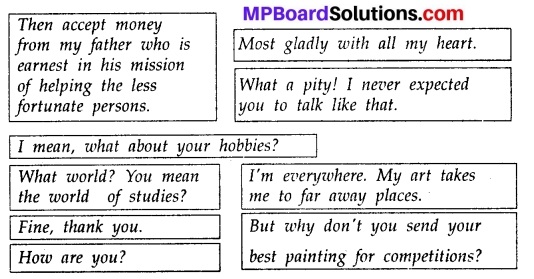
MP Board Class 10th English The Rainbow Workbook Solutions Chapter 10 The Last Leaf 1
Answer:
Veena : How are you?
Mamta : Fine, thank you.
Veena : How does the world go?
Mamta : What world you mean, the world of studies?
Veena : Not that. .
Mamta : Then what do you mean?
Veena : I mean what about your hobbies?
Mamta : Oh! Going on well.
Veena : I would like to come to your home to see your paintings.
Mamta : Most gladly with all my heart.
Veena : But why don’t you send your best painting for competitions.
Mamta : Veena dear! My art is not for sale. I believe that art is for its own sake.
Veena : But I think that Art is for the sake of society. Otherwise it becomes a selfish motive on the part of the artist.
Mamta : I differ from what you say. In my opinion, art is the fulfillment of one’s aesthetic taste, and when the work of art is ready, it is its own reward.
Veena : It is good to be ideal, but do you think you can be that ideal in life? I know you are hard up these days. I am ready to try all your paintings.
Mamta : What a pity! I never expected you to talk like that.
Veena : Then expect money from my father who is earnest in his mission of helping the less fortunate persons.
Mamta : You think I’m less fortunate than you? I’m rich. My art has earned me name and fame. No matter if I have no money.
Veena : Without money you are nowhere.
Mamta : I am everywhere. My art takes me to far away places.

Reading Skill

Read the story carefully.

See Workbook pages 80-81

A. Now answer the following questions:

Question 1.
What was the boy concerned about?
Answer:
The boy was concerned if his grandmother was writing the story of what they have done.

Question 2.
What was more important than one’s own story, according to the grandmother?
Answer:
According to the grandmother how one writes one’s story is more important than the story.

Question 3.
How did his grandmother want him to look at the pencil?
Answer:
His grandmother wants to grow like a pencil and to look at the pencil in this manner.

Question 4.
Why did the grandmother want him to be like a pencil?
Answer:
Because a pencil gives one’s thought a shape.

Question 5.
Write in your own words the first quality of a pencil.
Answer:
The first quality of a pencil is that it guides your steps.

Question 6.
Why are certain pains and sorrows necessary?
Answer:
Pains and sorrows make one stronger.

Question 7.
‘An eraser rubs out my mistakes’. How does correcting ourselves help in life?
Answer:
It helps us to keep us on the road to justice.

Question 8.
Why does the exterior not matter?
Answer:
Because it is its inner graphite which plays the major role.

Question 9.
Why should one be conscious of one’s own action?
Answer:
Because everything we do leave its imprint on life.

B. Look into a Thesaurus for a few synonyms of each word given below:
Answer:
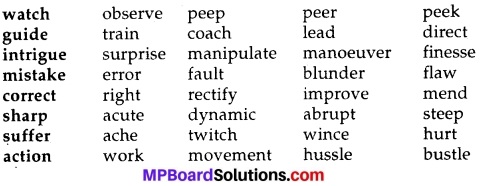
MP Board Class 10th English The Rainbow Workbook Solutions Chapter 10 The Last Leaf 2

Grammar

Narration:

See Workbook pages 82-83

Rewrite the sentences into Indirect Narration.

Question 1.
I said to him, “What is the matter”?
Answer:
I asked him what the matter was.

Question 2.
He said to me, “How long have you been here”?
Answer:
He asked me how long I had been there.

Question 3.
She said to me, “Do you like to live here”?
Answer:
She asked me if I liked to live there.

Question 4.
She said to her brother, “What will you do in the coming vacation?”
Answer:
She asked her brother what he would do in the next vacation.

Question 5.
The teacher said to the student, “Do you play games in the evening?”
Answer:
The teacher asked the students if they played games in the evening.

See Workbook page 84

Rewrite the sentences into Indirect Narration.

Question 1.
The father said, “My son do not waste your time.”
Answer:
The father addressed me as his son and advised not to waste my time.

Question 2.
The father said to his son, “Be attentive in the class.”
Answer:
The father advised his son to be attentive in the class.

Question 3.
He said, “Let me play in your garden.”
Answer:
He asked (me) to allow him to play in my garden.

Question 4.
He said to his friend, “Please lend me your book.”
Answer:
He requested his friend to lend him his (friend’s) book.

Question 5.
She said to her servant, “Get out of my room at once.
Answer:
She ordered her servant to get out of her room at once.

See Workbook page 84

Rewrite the sentences into Indirect Narration.

Question 1.
The businessman said, “Alas! how foolish I have been.”
Answer:
The businessman exclaimed with sorrow that he had been highly foolish.

Question 2.
He said to them, “Good-bye, my friends!”
Answer:
He bade his friends good bye.

Question 3.
“Good morning boys!” said the teacher.
Answer:
The teacher wished the boys good morning.

Question 4.
The woman said to him, “May God bless you!”
Answer:
The woman wished that God might bless him.

Question 5.
I said to Hari, “What a powerful shot it is!”
Answer:
I praised Hari that it was a very powerful shot.

See Workbook page 85

Rewrite the sentences into Indirect Narration.

Question 1.
My brother said to me, “Two and two make four.”
Answer:
My brother told me that two and two make four.

Question 2.
He said, “The Sun rises in the east.”
Answer:
He said that the Sun rises in the east.

Question 3.
She said, “Honesty is the best policy.”
Answer:
She said that honesty is the best policy.

Question 4.
The teacher said, “India became independent in 1947.”
Answer:
The teacher said that India became independent in 1947.

Question 5.
The teacher said to us, “The earth moves round the sun.”
Answer:
The teacher told us that the earth moves round the sun.

Rewrite the sentences into Direct Speech.

Question 1.
Nisha requested Preeti to lend her a ring in the evening.
Answer:
Nisha said to Preeti, “Please lend me a ring in the evening.’’

Question 2.
Yash asked me to bring some fruit and sweets from the market for the guests.
Answer:
Yash said to me, “Please bring me some fruits and sweets from the market for the guests.”

Question 3.
The principal advised the students not to come late.
Answer:
The Principal said to the students, “Don’t come late”.

Question 4.
She says that she likes going to the seaside.
Answer:
She says, “I like going to the sea-side”.

Question 5.
She told me that she had completed her work.
Answer:
She said to me, “I completed my work.”

Writing Skill

Question 1.
‘An artist can die but her/his art remains immortal’. Elaborate the thought. (50 words)
Answer:
A work of art is an immortal thing. It is all permanent. It can’t perish with time. It remains in the memory of the people. Though one who makes it is mortal. She/he dies when death comes. Take for example the painting of Monalisa. It is still the best painting in the world. It has immortalised its painter also. So one may be great but perishes with time. But one’s greatness is known to the world through the art/work that one does.

Question 2.
You are the secretary of the Cultural Association of your school. Your school is going to organised a painting competition on 10th September. Draft a notice for the students to participate in the event. (150 words)
Answer:
ABC School
jabalpur

Notice

25th Oct.20xx

Cultural Association Organises Painting Competition Our school is organising a painting competition on the occasion of Children’s Day the 14th Nov. . The main theme of the competition is ‘Terrorism’. You are to draw paintings related to terrorism, its causes, its drastic effects, role of youth and politicians, how we can fight against it etc. The paintings shall be selected for awards in three main catagories and 10 consolation prizes. A number of great artists throughout the country will grace the occasion along with some other renowned literary figures. Those who wish to participate may submit their names in the office upto 10 Nov.
Navin Parmar
Secretary
Cultural Association.

Hope that the above shaped information regarding the Madhya Pradesh Board Solutions for 10th English Chapter 10 The Last Leaf Questions and Answers is useful for making your preparation effective. View our website regularly to get other subjects solutions.
MP Board Class 10th English The Rainbow Workbook Solutions Chapter 11 Mending Wall

Are you seeking for the Madhya Pradesh Board Solutions 10th English The Rainbow Workbook Special English Chapter 11 Mending Wall Questions and Answers PDF? If yes, then read this entire page. Here, we are giving a direct link to download MP Board Class 10th English Solutions Questions and Answers PDF which contains the chapter wise questions, solutions, and grammar topics. You can also get the shortcuts to solve the grammar related questions on this page.

MP Board Class 10th English The Rainbow Workbook Solutions Chapter 11 Mending Wall

For the sake of students we have gathered the complete 10th English The Rainbow Workbook Special English Chapter 11 Mending Wall Questions and Answers can provided in pdf Pattern. Refer the chapter wise MP Board Class 10th English Solutions Questions and Answers Topics and start the preparation. You can estimate the importance of each chapter, find important English grammar concepts which are having more weightage. Concentrate on the important grammar topics from Madhya Pradesh Board Solutions for 10th English Chapter 11 Mending Wall Questions and Answers PDF, prepare well for the exam.

Mending Wall Vocabulary

I. Use the word ‘mend’ with a different meaning in a phrase and write its meaning.
Answer:
Mend : Repair : He is mending the wall.
Mend : to set right : Mend your ways if you want to get success.

II. ‘Good fences make good neighbours.’ Use the word ‘good’ in some short sentences conveying beautiful ideas, e.g, what good is money when you haven’t any friends?
Hints: good manners, good habits, good teachers, good books, good news, good reputation, for your own good, do more harm than good, good for you.
Answer:
Good manners : Our good manners please all.
Good books : Good books are the best friends.
For your own good : Do it for your own good.
Good for you : Apple is good for you.

Listening Skill

Listen to the poem carefully.

See Workbook pages 88-89

Now answer the following questions:

A. Find from the poem the synonyms of the following.
Answer:

  1. to hate : scorn
  2. to decorate : adorn
  3. to spoil, to cause serious damage : blight
  4. extremely strong desire to gain wealth : avarice
  5. blessings : bounties

B. Four ideas are mentioned below. Write the numbers of the stanzas in which these ideas are found.

  1. There will be no misery. Joy will prevail everywhere.
  2. Each country will enjoy political freedom.Each human being will be contented.
  3. The world will be free from the curses of hatred and war.
  4. The worth of the people will not be determined by the colour of their skin. All the people will have equal share in the earth’s blessings.

Answer:
4, 2, 1, 3

See Workbook pages 90-91

C. Each stanza mentions one positive feature that the poet would like to be there in his dream world. It also mentions one negative feature that will not be there. For example, in stanza 1- There will be love and’ peace everywhere. (Positive)
There will be no hatred. (Nagative) Now complete the following table.
Answer:
Stanza Positive feature that Negative feature that will be there will not be there

StanzaPositive feature that will be thereNegative feature will not be there
1There will be freedom.There will be no greed
2There will be equalityThere will be no racial discrimination
3There will be joyThere will be no misery

Speaking Skill

You have a definite routine which you follow everyday. Now talk
about it in a group of four. The beginning is given as an example
I wake up at 5 o’clock in the morning.
Then I ……………………..
Answer:
Do yourself.

Reading Skill

Read the poem.

See Workbook pages 92-93

A. Now answer the following questions.
(a) What grew in God’s free light?
Answer:
A rose grew in god’s free light.

(b) Who fed and watered the rose?
Answer:
The morning dew fed and watered the rose.

(c) When did the rose come to a crevice in the wall?
Answer:
The rose came to a crevice in the wall after rising to a lofty height.

(d) How it crept through the crevice?
Answer:
It crept onward through the crevice with added strength.

(e) Was there any difference in its growth?
Answer:
There was no thought of fear or pride in its growth.

(J) What does the poet wish to receive?
Answer:
The poet wishes to receive faith and hope.

(g) How does the rose still grow beyond the wall?
Answer:
Beyond the wall the rose will spread its fragrance far and wide.

B.Write some inspiring quotations on the following:
Courage : Courage is the key to all success.
Faith : Faith in God paves the way to success.
Beauty : Beauty is truth, truth beauty.
Hope : Hope for the best.
Strength : Strength is the key to confidence.

Writing Skill

Question 1.
“Domestic walls break the nation in fragments.” Comment. (50 words)
AAnswer:
Man is born free. There is no ill feeling in a child but as one grows one faces many wordly avarices. There are discrimination of caste, creed, culture, religion, race etc. There are the man-made walls that fragment the whole world. We develop hate for others and indulge in wars which weaken the world. These are the curses of human life.

Question 2.
Imagine there are no political boundaries among countries then what will be the face of the world? Describe. (150 words)
Answer:
Had there been no boundaries among countries the whole world would have been one place to live in. There would have been no discrimination of any kind. We would have been free to go anywhere anytime for any purpose. The whole world would have been a peaceful place. There would have been no war. The world would have been a safe place. The philosophy of the whole world i.e. “Vasudhaiva Kutumbkam” would have been true. The whole world would have been one.

Hope that the above shaped information regarding the Madhya Pradesh Board Solutions for 10th English Chapter 11 Mending Wall Questions and Answers is useful for making your preparation effective. View our website regularly to get other subjects solutions.

MP Board Class 10th English The Rainbow Workbook Solutions Chapter 9 If

Are you seeking for the Madhya Pradesh Board Solutions 10th English The Rainbow Workbook Special English Chapter 9 If Questions and Answers PDF? If yes, then read this entire page. Here, we are giving a direct link to download MP Board Class 10th English Solutions Questions and Answers PDF which contains the chapter wise questions, solutions, and grammar topics. You can also get the shortcuts to solve the grammar related questions on this page.

MP Board Class 10th English The Rainbow Workbook Solutions Chapter 9 If

For the sake of students we have gathered the complete 10th English The Rainbow Workbook Special English Chapter 9 If Questions and Answers can provided in pdf Pattern. Refer the chapter wise MP Board Class 10th English Solutions Questions and Answers Topics and start the preparation. You can estimate the importance of each chapter, find important English grammar concepts which are having more weightage. Concentrate on the important grammar topics from Madhya Pradesh Board Solutions for 10th English Chapter 9 If Questions and Answers PDF, prepare well for the exam.

If Vocabulary

I. A. Write five sentences beginning with ‘If’.
Answer:

  1. If it rains I won’t go to play.
  2. If I go to the market, I will purchase something for you.
  3. If it rains heavily, there will be flood.
  4. If children shout, the teacher will be angry.
  5. If I work hard, I will win definitely.

B. Write five sentences with If then
Answer:

  1. If you come to me then I will help you.
  2. If children study sincerely, then they will pass.
  3. If the teacher teaches well, then the students will follow.
  4. If my mother returns on time, then I will come to your place.

II. Complete the following sentences.
Answer:

  1. If you can keep the promise, I will be proud of you.
  2. If you can trust me, I will feel happy.
  3. If you can wait for me, I will be happy.
  4. If you can talk to me, I will help you.
  5. If you can meet me, I will tell you the entire story.

III. Differentiate between :

Question 1.
‘too good’ and ‘very good’.
Answer:
You are too good for me.
My friends are very good to all.

Question 2.
‘too wise’ and ‘very wise’.
Answer:
It is not too wise to interfere in other’s matter.
It will be very wise to give this test just now.

Question 3.
Knaves and fools.
Answer:
Knaves are never helpful.
Fools are often good at heart.

Listening Skill

Listen to this beautiful poem attentively.

See Workbook pages 71-72

I. Say the rhyming words from the poem like: hill-rill
Answer:
1. grass-bass
2. here-near
3. trail-fail

II. Match the coloums.
1. If you can’t be a pins – (a) then just be a pass
2. If you can’t be a bush – (b) be a star
3. If you can’t be a muskie – (c) on the top of the hilt
4. If you can’t be a highway – (d) be a bit of the grass
5. If you can’t be the sun – (e) then just be a trail.
Answer:
1. (C), 2. (6), 3. (e), 4. (a), 5. (b)

Speaking Skill

Organise a speaking session on the winter season in the class.
Every student has to speak one or two sentences. You may begin
with a phrase as given below.
Answer:
Do yourself.

See Workbook page 73

Reading Skill
Read the poem

See Workbook pages 73-74

A. Answer the following questions:

Question 1.
Make a list of things which are easily done.
Answer:
To criticise, to judge, to react, to stay stagnate, to escape from a situation, to confront.

Question 2.
Make a list of things which require efforts.
Answer:
To appreciate, to respond. to face a difficult situation, to laugh, to console, to take responsibility.

Question 3.
Make a list of qualities which make us a better person.
Answer:
To rely on inner strength, to trust someone, to console those who are in tragic situation.

Question 4.
Make a list of qualities which don’t help us in being a better person.
Answer:
To stay stagnate, to be caught in wordly activities, to complaints all the time.

B. (a) Give the synonyms of the following:
Answer:
appreciate – praise
confront – face
console – pacify
strength – boldness

(b) Search for the words and phrases which enhance the quality of life.
Answer:
To take risk, to listen patiently, to laugh, to relax, to rely on inner strength, to praise someone on his success.

(c) Search for the words and phrases which will not help us in leading a qualitative life.
Answer:
To be discouraged by others, to be fearful and worried, to get caught in wordly activities.

Writing Skill

Question 1.
Write a letter of advice to your younger brother to set a goal in life and try to achieve it, as he is planning his career. (50 words)
Answer:
16, Shivaji Park
Gwalior
Dear Raghu
I am highly shocked to know that you are not doing very well in your studies. It is not a good sign. Life is precious. Time fleets fast. So fix your goal and do accordingly. Without it you can’t achieve something good. If you face any problem consult your teachers. Be particular about your time and effort. I hope you will mind it and mend your ways. Hoping for your reply.
Yours
Manoj

Question 2.
Narrate some memorable teachings and inspirational pieces of advice given by your parents. (150 words)
Answer:
Parents are our first teachers. Usually we don’t heed them. But it is not a good sign. If we heed them properly we won’t fail in any of our efforts. Once, I still remember, my parents gave me some tips for a safe journey. I did accordingly and I was really very glad that it saved me from a lot of problems. Once when I was going on a tour alone, my parents told me not to be cowed down by anyone if I am right and true. They also told me to help the needy and respect the elders.

Hope that the above shaped information regarding the Madhya Pradesh Board Solutions for 10th English Chapter 9 If Questions and Answers is useful for making your preparation effective. View our website regularly to get other subjects solutions.

MP Board Class 10th English The Rainbow Workbook Solutions Chapter 8 What is Culture

Are you seeking for the Madhya Pradesh Board Solutions 10th English The Rainbow Workbook Special English Chapter 8 What is Culture Questions and Answers PDF? If yes, then read this entire page. Here, we are giving a direct link to download MP Board Class 10th English Solutions Questions and Answers PDF which contains the chapter wise questions, solutions, and grammar topics. You can also get the shortcuts to solve the grammar related questions on this page.

MP Board Class 10th English The Rainbow Solutions Workbook Chapter 8 What is Culture

For the sake of students we have gathered the complete 10th English The Rainbow Workbook Special English Chapter 8 What is Culture Questions and Answers can provided in pdf Pattern. Refer the chapter wise MP Board Class 10th English Solutions Questions and Answers Topics and start the preparation. You can estimate the importance of each chapter, find important English grammar concepts which are having more weightage. Concentrate on the important grammar topics from Madhya Pradesh Board Solutions for 10th English Chapter 8 What is Culture Questions and Answers PDF, prepare well for the exam.

What is Culture Vocabulary

I. There are different ways of looking at a thing or a person.
e.g. gaze, stare, glare, peer, squint, glance, eye, scan, examine, study, inspect
Now use these words in your own sentences.
Ans.
Gaze : The young boy was gazing at the beauty of the garden.
Stare : Why are you staring at me?
Glare : He glared at me silently.
Peer : Children peered into the shadow.
Squint : She was squinting through the keyhole.
Glance : The teacher gave a quick glance at me.
Eye : The teachers always keep an eye on naughty boys.
Scan : Please scan this picture.
Examine : The superintendent is examining the situation.
Study : Sincere students study atleast twelve hours.
Inspect: The police arrived at the spot to inspect the situation.

II. Make a list of words having two consonants (consonant clusters) in the beginning. e.g. tree, dream, free, question.
Answer:
Green, Station, Dwarf, Triangle, Prove, Train, Pluck, Crane, Study, Glare.

III. Say the following words with correct pronunciation.
determine, folly, preposition, grammar, understanding,important, capacity.
Answer:
Pronounce the above words correctly.

Listening Skill

Listen to the following paragraph carefully.

See Workbook page 62

Now, answer the following questions:
1. Write the details regarding original art:
Answer:
(a) place of origin : Madhubani
(b) artists : women
(c) purpose : To welcome gods and goddesses to their households to bless them with prosperity.
(d) location : Bihar
(e) themes : Normally the Hindu gods and goddesses and stories from Hindu mythology.
(f) Material used :

  1. for background : Paste of cow dung and mud.
  2. for painting : white rice paste
    rice paste : white colour
    pollen : yellow colour
    local clay : red colour indigo
    plant : blue colour

(g) Characteristics of the painting:

  1. Though the bodies of the figures always face the front, their faces are shown in profile.
  2. The outlines of the figures are drawn with double lines.
  3. The borders are always decorated with ornamental floral patterns or geometrical designs.

Speaking Skill

The Indian culture is influenced by the Himalayas, the forests and the great rivers of India. Various aspects of culture are architecture, music and literature. All of you must have knowledge of our culture. Each of you should take part in the following speaking activity. ‘The Cultural Heritage of India’ is the topic. Time allotted is 2 minutes. You can talk about: festivals, dresses, dances, food, languages, rituals, religious ceremonies music, food, lifestyle art, sculpture, architecture
Answer:
Do yourself.

Read carefully the following passage:

See Workbook page 63-66

Now, answer the following questions:
A. Choose the right answers.

Question 1.
According to the passage:
(a) modern anthropologists are more systematic and accurate than earlier ones
(b) a relatively simple society will see progress as spasmodic, resulting from the borrowing of cultural elements.
(c) the last twenty years have seen societies rapidly becoming cultured.
(d) cultural interaction is necessary for the progress of primitive societies.
(e) none of the above.
Answer:
(a) modern anthropologists are more systematic and accurate than earlier ones

Question 2.
According to the passage:
(a) foreign cultural elements are never assimilated in their original form
(b) assimilation of a cultural element is partly dependent on the attitude of the borrower society to the source society
(c) the process of cultural change is usually random
(d) self sufficient societies rely on inventions rather than cultural borrowings
(e) none of the above
Answer:
(b) assimilation of a cultural element is partly dependent on the attitude of the borrower society to the source society

Question 3.
According to the author, earlier anthropoligists assumed some cultures to be static because:
(a) of insufficient interactions with them
(b) of poor or unreliable analysis
(c)it made their task of studying these cultures more simple
(d) of fragmentary archaeological evidence
(e) none of the above
Answer:
(d) of fragmentary archaeological evidence

Question 4.
A. According to the passage:
(a) a culture with simple technologies and political structure is likely to be static
(b) explorers seem to have begun a process of change in many societies
(c) much of the culture seen today is the result of changes in the recent past
(d) all cultures seem to have continuous rates of change
(e) none of the above
Answer:
(a) a culture with simple technologies and political structure is likely to be static

B. (I) Complete the following:
(i) anthropologists study
(it) archeologists study.
(iii) sociologists study.
Answer:
(i) past events
(ii) remains of buildings etc.
(iii) society.

(II) Make the sentences with the following words to bring out the differences in their meanings:
Answer:
(i) primitive: People led a nomadic life during primitive period.
(ii) ancient: We should know about our ancient culture.
(iii) modern: We are living in modern society.

Grammar

Subject Verb Agreement:

See Workbook pages 66-69

Rewrite the following sentences correctly.

Question 1.
A time of peace and plenty are coming to us.
Answer:
A time of peace and plenty is coming to us.

Question 2.
“Gulliver’s Travels” was written by Swift.
Answer:
“Gulliver’s Travels” is written by Swift.

Question 3.
Each man and women were given a prize.
Answer:
Each man and woman was given a prize.

Question 4.
Ram as well as his sister have come here.
Answer:
Ram as well as his sister has come here.

Question 5.
Rahim, and not you, deserves the prize.
Answer:
Rahim, and not you, deserve the prize.

Choose the correct form of verb and rewrite the sentence.

Question 1.
A few hours’ study (is, are) enough.
Answer:
A few hour’s study is enough.

Question 2.
I am a man who (seek, seeks) my son’s welfare.
Answer:
I am a man who seeks my son’s welfare.

Question 3.
Two and two (makes, make) four.
Answer:
Two and two makes four.

Question 4.
Neither he nor I (was, were) present.
Answer:
Neither he nor I were present.

Question 5.
The chief, with all his nobles (was, were) present.
Answer:
The chief, with all his nobles was present.

Writing Skills

Question 1.
Suppose you are cultural secretary of your school. What type of cultural activities would you like to conduct on ‘Children’s Day’. Give details. (50 words)
Answer:
Children’s Day is an exciting day for children. We celebrate it with pleasure. This time I have decided something extra and unique in our school. I have arranged for a charity show. Some eminent artists have been invited. We will sell tickets for this show. The money collected through it shall be sent to the Chief Minister’s Relief Fund, Bihar which has been devasted by flood recently. The school management is also co-operating with us generously.

Question 2.
Write a short biography of Jawaharlal Nehru under the following headings: (150 words)
1. his parentage and education
2. his contribution in India’s freedom struggle
3. Jawaharlal Nehru as a Prime Minister
Answer:
1. His Parentage and education: Shri Nehru was born at Allahabad in 1889 on 14th November. His father Motilal Nehru was a great lawyer. He brought up his son as a prince. He employed very efficient teachers to teach Jawaharlal Nehru. At the age of 15, Nehru was sent to England for higher studies. There he joined the Public School at Harrow. Then he went to the Cambridge University where he took his degree in 1910. Then he joined law. He was called at Allahabad High Court. He was married at the age of 27.

2. His contribution in India’s freedom struggle: In the youth of Nehruji the British ruled over India. The English treated Indians badly. This pained the heart of Jawaharlal Nehru. He gave up practice. He joined the Non-co-operation Movement started by Gandhiji. He went to jail several times. He bore punishments happily. But jail life could not crush his spirit. He struggled bravely. He acted as Congress President in four different years before India became free. When India became free, he was elected the first Prime Minister of India.

3. His work as the Prime Minister: Pt. Nehru was a successful Prime Minister. India made great progress under his guidance. Dr. Rajendra Prasad, our late President, once said, “The country is marching forward on the road of progress in the leadership of Panditji.” He did a lot for the world. Had he lived some years more, the country would have become stronger. He solved some difficult problems of the country as well as the world.

Hope that the above shaped information regarding the Madhya Pradesh Board Solutions for 10th English Chapter 8 What is Culture Questions and Answers is useful for making your preparation effective. View our website regularly to get other subjects solutions.

MP Board Class 10th English The Rainbow Workbook Solutions Chapter 7 Report of An Adjudged Case

Are you seeking for the Madhya Pradesh Board Solutions 10th English The Rainbow Workbook Special English Chapter 7 Report of An Adjudged Case Questions and Answers PDF? If yes, then read this entire page. Here, we are giving a direct link to download MP Board Class 10th English Solutions Questions and Answers PDF which contains the chapter wise questions, solutions, and grammar topics. You can also get the shortcuts to solve the grammar related questions on this page.

MP Board Class 10th English The Rainbow Workbook Solutions Chapter 7 Report of An Adjudged Case

For the sake of students we have gathered the complete 10th English The Rainbow Workbook Special English Chapter 7 Report of An Adjudged Case Questions and Answers can provided in pdf Pattern. Refer the chapter wise MP Board Class 10th English Solutions Questions and Answers Topics and start the preparation. You can estimate the importance of each chapter, find important English grammar concepts which are having more weightage. Concentrate on the important grammar topics from Madhya Pradesh Board Solutions for 10th English Chapter 7 Report of An Adjudged Case Questions and Answers PDF, prepare well for the exam.

Report of An Adjudged Case Vocabulary

I. Write synonyms of the following words:
(i) dispute
(ii) pray
(iii) condemn
(iv) wise
Answer:
(i) disagreement
(ii) worship
(iii) damn
(iv) talented

II. Use the following expressions in your own sentences.

(a) point in dispute
Answer:
The main point in dispute is still clueless.

(b) a great deal of
Answer:
A great deal of work has to be done.

(c) which amounts to
Answer:
I had spent a lot for it which amounts to nearly one lakh.

(d) on the whole
Answer:
On the whole I got the victory.

Listening Skill

Listen to this humorous poem.

See Workbook’pages 54-55

Now, answer the following questions:

Question 1.
What was the first question asked by the young man?
Answer:
“Is it right to stand on head in old age?”

Question 2.
What was Father William’s reply?
Answer:
He will stand on his head again and again.

Question 3.
What was the reason of his back-somersault at the door?
Answer:
Because he was uncommonly fat.

Question 4.
What was the cost of the ointment used by Father William?
Answer:
One shilling the box.

Question 5.
Why was Father William able to eat the goose?
Answer:
Because his jaws were very strong.

Speaking Skill

1. Imagine that the teacher’s table and your desk are talking to each other about your class. While the table has some nasty things to say about the class (occasional noisy classes, some children irregular in doing their work, some in the habit of arguing, etc.) the desk is appreciative. It is proud of the achievers. It also believes that children should not be judged harshly. Form two groups in the class, the table group and the bench group. Now speak out your point as per the given role.
Answer:
Do yourself.

Reading Skill

Read the poem

See Workbook pages 56-60

A. Now answer the following questions:

Question 1.
What does a law firm require?
Answer:
It requires a general clerk.

Question 2.
Who handles diversified work?
Answer:
A clerk handles diversified work.

Question 3.
What should an applicant know?
Answer:
An applicant should know the proceedings related to pleadings.

Question 4.
Why should an applicant be not slow?
Answer:
This drawback would put him in problems.

Question 5.
How should an applicant look like?
Answer:
An applicant should have a handsome physique.

B. (i) Make sentences using the following words to bring out their:
(a) legal usage
(b) general usage
Answer:
plead

  • Harish pleaded to be allowed to meet his friend once again.
  • She pleaded with him to go.

hearing

  • I was present at the time of a court hearing.
  • My grandmother’s hearing is poor

grant

  • Mr. Jain’s bail was granted.
  • God granted my wish.

charges

  • Several charges have been thrusted on Mr. Sharma.
  • What are the charges of these dresses?

appeal

  • I have appealed in the court.
  • The beauty of Taj Mahal appeals to one and all.

trial

  • He is on trial for killing his friend.
  • I have been appointed for a trial period

objection

  • No objections were made at that time.
  • I have no objection to talk to him.

(ii) Pick out some such more words from the given poem.
Answer:
Do yourself.

Writing Skill

Question 1.
Write a letter to the Principal of your school to plead pardon as a window pane had been broken by you. (50 words)
Answer:
The Principal
SD Convent Bhopal
Subject: To plead pardon Sir,
I am sorry to say that the window pane of my class was broken while I was opening it. It happened so because it was not properly shut. Still I beg your pardon for it.
Yours Sincerely
Prakash
Class X A

Question 2.
‘United we stand divided we fall’, elaborate the thought. (150 words)
Answer:
It is a very old but meaningful thought. Unity gives us strength and confidence. It fills us with a sense of oneness. Our country is a great example to prove it. Our country is an amalgamation of many diversities. Right from Kashmir to Kanyakumari, there are so many different cultures, ways of living, languages, religions that one can feel amazed. Still we see the whole nation salute the tricolour. They sing the national anthem in unison. The national language is Hindi. They honour the unified judiciary and the Constitution. Whenever there is an unprecedented terrorist attack the whole nation is unified against it. If such a unity fails we are threatended to many attacks. We have seen many riots due to such disunity.

Hope that the above shaped information regarding the Madhya Pradesh Board Solutions for 10th English Chapter 7 Report of An Adjudged Case Questions and Answers is useful for making your preparation effective. View our website regularly to get other subjects solutions.

MP Board Class 10th Special English Short Composition with Guidance

Are you seeking for the Madhya Pradesh Board Solutions 10th English Writing Skills Short Composition with Guidance Questions and Answers PDF? If yes, then read this entire page. Here, we are giving a direct link to download MP Board Class 10th English Solutions Questions and Answers PDF which contains the chapter wise questions, solutions, and grammar topics. You can also get the shortcuts to solve the grammar related questions on this page.

MP Board Class 10th Special English Short Composition with Guidance

For the sake of students we have gathered the complete 10th English Writing Skills Short Composition with Guidance Questions and Answers can provided in pdf Pattern. Refer the chapter wise MP Board Class 10th English Solutions Questions and Answers Topics and start the preparation. You can estimate the importance of each chapter, find important English grammar concepts which are having more weightage. Concentrate on the important grammar topics from Madhya Pradesh Board Solutions for 10th English Short Composition with Guidance Questions and Answers PDF, prepare well for the exam.

1. You are Manager of a Book Co. You wanted to distribute the books for students in reduction price. So draft an advertisement for the local newspaper. (M.P. Board 2012)
Answer:

Rush to Avail Golden Chance
Vacation Bonanza For Book Lovers. Rare Books-Lower prices. Never before-never again books of all categories. Stock limited. Shop open: 8 AM to 9 PM on all weekdays.Manager
Contact: 91-9309949111

2. A reporter made the following notes on a theft case news item. Complete the news using the given notes. Write the answers in your answer sheet against the correct blank numbers. (5 marks) (M.P. Board 2012)

Notes

Place – date – time
Market – Raghav Colony – 12-2-20xx – 3 A.M. Items stolen– jewelry–worth 3 lacs– cash 50 thousand–electronic goods– broken window – no clue.

“Theft At Raghav Colony”

It was reported that a theft (a) …………………. on 12-2-2Oxx at 3-00 A.M. near the (b) …………………. place. The burglars (c) …………………. Some (d) …………………. were reported to be missing from the house. So far (e) …………………. found about the thieves.
Answer:
(a) took place at Raghav Colony
(b) market
(c) gained access into the house through the broken window.
(d) electronic goods, jewellery worth 3 lacs and 50 thousand cash
(e) no clue has been

3. A newspaper reporter has been sent to report on a road accident. Below you can see one page of his notes. Use the informations to complete the report he wrote for his news-paper. Do not add any new information write your answers: (M.P. Board 2012)
Answer:

8.35 p.m.                                                                                                                                                                       14/10/2Oxx
Sevoke : 10 km from Siliguri
Crash : Jeep in clitch
Local bus : High speed–middle of road Jeep braked to avoid collison–Swerved, Hit tree and overturned.
Jeep driver : (Mohinder Sirigh, 35 yrs.) killed instantly.
3 Injured : Taken to hospital

Accident in Sevoke: 1 Dead.
Sevoke; 15 Oct., A road accident took place yesterday at 8.35 p.m. when a jeep (a) crashed at Sevoke, 10 km from Siliguri. According to an eye witness the, jeep braked in order to avoid collison with (h) a local bus. The driver was unable to control the jeep, which (c) killed the jeep driver, (d) and injured three
(e) who were taken to hospital.

4. A reporter made the following notes for a news item in the newspaper. Complete the news using the given notes. Write the answers in your answer sheet against the correct blank numbers.

Notes

Train accident – Level crossing – 2 P.M. – 1.3.20xx 12 km – Nagpur – collides with a truck – at high speed – 4 dead – several hurts.

Accident At Level Grossing

At a level crossing near Nagpur (a) …………………………………. away a rail accident (b) …………………………………. The train was running at (c) …………………………………. It was (d) …………………………………. on (e) …………………………………. The train driver saw the truck and gave (f) …………………………………. The truck was also (g) …………………………………. Its driver did not (h) …………………………………. and tried to (i) …………………………………. but failed. The driver of the truck was (j) …………………………………. of those killed. The injured were taken to the hospital.
Answer:
(a) 12 km (kilometres) – (b) took place
(c) a high speed – (d) a collision with a truck
(e) the level crossing – (f) a signal
(g) at high speed – (h) pay heed to the signal
(i) cross the level – (j) among one.

Or

Mr. A Mathur is the Manager of Super Chemicals Ltd. He has made the following notes about a job candidate called Mohan Srivastava. He asks his Personal Assistant to write a letter to Mr. Srivastava. Complete the letter using information from the notepad given ahead: (5 marks) (M.P. Board 2012)
Answer:

SRI VASTA VA
Selected for interview 16/6.
10.30 am.
Room-315
bring testimonials
Photos (2)
No TA/DA
No arrangement for accommodation confirms a letter or telephone.

Dear
Sub: Interview for the post of Salesman.
With reference to your application, we are pleased to (a) invite you for interview for the above-mentioned post, your interview
(b) will be at 10.30 a.m. in Room 315 and you are required (c) to bring testimonials and 2 photos Please note that no TA/DA will be paid by the company and that you will be responsible .(d) for your accommodation. Kindly (e) confirm through letter or phone.

Yours faithfully
A. Mathur
Manager
Super Chemicals Ltd., Mumbai.

5. Salim made the following notes for the report regarding ‘Onion procession’ held in the town. Making use of the notes, complete the report by filling in the blanks. Write the answers in your answer sheet against the correct blank numbers. (5 marks)

5.1 Onions Draw Crowds

In the form of a huge (a) ………………….. atop a car, onions appeared threaded in (b) ………………….. adorning every neck which made the long (c) ………………….. proceeding from Delhi Gate to Connaught Place. It was a great attraction. The cavalcade was led by a (d) ………………….. jeep on which Mr. Dutta stood with (e) ………………….. around his neck addressing the crowd against the rising prices of onions.
Answer:
(a) balloon in the shape of an onion
(b) the garlands
(c) procession
(d) open
(e) a garland of onions.

Notes

Procession – Cars – Jeeps – People – Delhi Gate – Connaught Place – Leader – Open jeep – Balloon–Flower garlands – Onion garlands–Onions of different sizes–Huge balloon – the shape of an onion

Or

5.2 Onions Draw Crowds

6. Here are a few details about Gandhiji. Use this information to make a paragraph. Write the answers in your answer sheet against the correct blank numbers. (5 marks)
Birth – 2-10-1869
Residence – Rajkot–Gujarat.
Parents – Father–Diwan, Mother–religious woman
Education – India and England
Profession – Lawyer–South Africa

Gandhiji was (a) ………………….. He lived at (b) ………………….. His father (c) ………………….. and his mother He got his education (d) ………………….. He became (e) ………………….. and …………………. .
Answer:
(a) born on 2nd October, 1869.
(b) Rajkot in Gujarat.
(c) was a Diwan, was a religious woman.
(d) in India and England.
(e) a lawyer, went to South Africa.

Write a short paragraph on the following topic:
How you secured 90% marks in the Board Exam? (M.P. Board 2009)
Answer:
Scoring high in examination is a great achievement. This year when the result of my Board Exam was declared, I was really very excited. I had secured 90% marks. This was for the first time that I secured so well, It was a proud moment for me and for my parents too. In fact this time I took this examination as a challenging task. As I had always been a mediocre student I was not very much appreciated. I was always hurt when I was not praised. This time I forgot everything for six months. I left no stone unturned to get a bright result. It brought me laurels. Now I believe labour hard work never goes unrewarded.

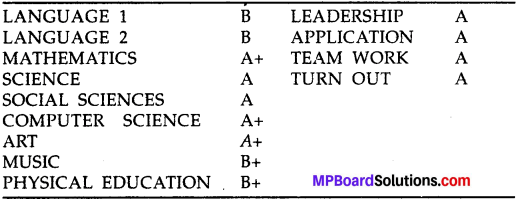
7. Karishma got the grades given below. She asked her teacher to give her a written report on her abilities and achievements.
Given below is a part of the report her teacher wrote. Based on the grades complete the sentences. Do not add any new information. Write the answers in your answer sheet against the correct blank numbers. (5 marks)
MP Board Class 10th Special English Short Composition with Guidance 1
Karishma is a very bright girl who shows great application and diligence in class. Her special (a) ………………….. and Computer Science where (b) ………………….. this year. She should, however, (c) ………………….. in the languages. (d) ………………….. and is able to work as a team. (e) ………………….. in harmony. Always neatly turned out, Karishma is a pleasure to have in class.
Answer:
(a) interests lie in Mathematics, Art
(b) she has scored A+ grades
(c) improve upon her grades
(d) In her music lessons’and physical education classes she can improve
(e) Her leadership qualities, application and team work are

8. Prabha is a reporter for a paper. She made these notes for a news item. Read them and complete the news item given below. Write the answers in your answer sheet against the correct blank numbers.

Notes

local train–travelling at full speed–Canning to Talki– Gauranga–7 yr. old–tending cattle nearby–saw break in track–took off and waved red shorts like a flag–driver noticed, braked, stopped–avoided accident.

Seven Year Old Averts Train Accident

New Delhi, April 18
A local train was travelling at full speed from Canning to Talki in the Sealdah South section.

Gauranga, (a) ………………….. near the railway line, saw that (h) ………………….. at one place. He immediately (c) ………………….. and waved it (d) ………………….. rushing towards the train. The driver noticed the boy (e) ………………….. just before the point of danger. Gauranga’s alertness saved hundreds of lives.
Answer:
(a) a 7-year old boy who was tending cattle
(b) the track had been broken
(c) took off his red shorts
(d) like a flag
(e) braked and stopped the train

9. Meera, the editor of her school magazine, has made the schedule given below for the school magazine. She has written a note to her friends on the editorial board based on it. Complete the gaps left in the note. Do not add any new information. Write the answers in your answer sheet against the correct blank numbers. Do not copy the whole sentence.

Magazine Schedule For 20xx-20xx

Collection of material : through competitions in April-Aug.’ 20xx (short story, poetry, cartoons) collect articles, cartoons comics in Aug. Sept.’ 20xx Reporters write on school activities as they occur.
Selection of material : Jul.-Sept.’ 20xx
Editing and Illustrations : Aug,-Nov.’ 20xx
Printing : Hand material to printer Nov.’ 20xx Final proofs Feb.’ 20xx
Delivery of magazine : March’ 20xx

This year (a) ……………………. printed by March 2Oxx, so we have to start our work immediately. Different (b) ……………………. between April and August 2Oxx so that we can collect enough good material for inclusion in the magazine. All material to be printed in the magazine should (c) ……………………. by September 2Oxx. Of course, the reporters on the editorial board will (d) ……………………. school activities as they occur. The magazine should he ready and printed (e) …………………… .
Answer:
(a) we intend to have the school magazine
(b) competitions will be organised
(c) be selected
(d) give their write-ups on
(e) by February, 20xx.

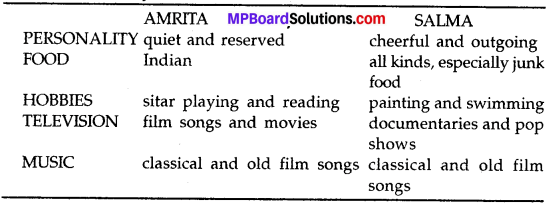
10. Read the information given in the columns below and then fill in gaps in the paragraph appropriately. Do not use any extra information. Write the answers against the correct blank numbers in your answer sheet.
MP Board Class 10th Special English Short Composition with Guidance 2
Amrita and Salma are good friends though they are very different from each other. Amrita is quiet and reserved though she likes the company of friends, (a) ……………………. and likes to talk a lot. Salma also likes (b) ……………………. Amrita, on the other hand, prefers Indian food. Amrita (c) ……………………. very well and reads a lot while Salma is a champion (d) ……………………. to relax. Ever in television programs, their tastes are quite different. However, (e) ……………………. in classical music and old film songs and often attend concerts together.
Answer:
(a) Salma, on the other hand, is cheerful and outgoing
(b) all kinds of food, especially junk food.
(c) can play the sitar
(d) swimmer and loves to do painting in order
(e) their choice of music is similar and both are interested

11. Here is a diary extract of a tourist about his tour to Rajasthan. Use the information to complete the account of his visit to Rajasthan. Do not add any new information. Write the answers in your answer sheet against the correct blank number.
Visit to Palace, Temples (incl. Jain Temples) Lakes, Boating, Chittorgarh, fort mines, Pratap Memorial–all very fascinating

5th March :
Arrival at Jaipur
Visit to Hawa Mahal
Man Singh Art Gallery
Amer Fort : Examples of advanced architecture7th March:
Arrival at Ajmer
Visit to Pushkar
Dargah8th March :
Arrival at LJdaipur.
Visit to Palace, Temples (mcl. Jam Temples)
Lakes, Boating, Chittorgarh,
fort mines, Pratap Memorial–all very fascinating10th March :
To Jodhpur–forts, palaces12th March :
Visit to thé Jaisalmer desert.
Evidence of bravery, generosity of people, rulersPeople : Cooperative

Visit To Land Of Forts And Palaces My visit to Jaipur, Ajmer, Udaipur, Jodhpur and Jaisalmer made me feel that Rajasthan, (a) ……………….. During my visit to Jaipur I (b) ……………….. and I concluded that (c) ……………….. I was extremely thrilled during my visit to Udaipur. I enjoyed (d) ……………….. The story of Rana Pratap and Rani Padmavati of Chittorgarh made me feel that (e) ………………. .
Answer:
(a) is a place where the generosity and co-operative attitude of the people is most evident.
(b) visited the Hawa Mahal, the Man Singh Art Gallery and Amer Fort.
(c) these were excellent examples of advanced architecture.
(d) the fascinating sights of the palaces, the Jain Temples, Chittorgarh and Pratap Memorial.
(e) the rulers of the place were indeed brave.

12. Aparijata has been asked to write an article for the ‘Nature’ section of the School magazine. She has referred to an encyclopedia and made the following notes about the ‘golden monkey’. Use the information in the notes to complete her article. Do not add any new information. Write the answers against the correct blank number in your answer sheet.

Animal : Golden Monkey
Habitat : Mountain forests–China
Size :  Adult male 83 cm, Adult female 74 cm
Weight : Male 20 kg, Female 10 kg
Movement : Winter groups–70, Summer groups–300 (food plentiful)
Endangered : hunting, golden hair–make coats
Protection : reserves, sanctuaries

The golden monkey is mainly found (a) ……………………… An adult male is 83 cm long and weighs 20 kg. (b) ……………………… than the male being 74 cm long and weighing 10 kg. In winter (c) ……………………… while in summer (d) ……………………… they form groups of 300. In the past the monkeys were hunted for their golden hair. Now-a-days (e) …………………….. .
Answer:
(a) in the mountain forests of China.
(b) An adult female is comparatively smaller
(c) they form groups of 70
(d) when food is in plenty
(e) they are protected in reserves and sanctuaries.

Hope that the above shaped information regarding the Madhya Pradesh Board Solutions for 10th English Short Composition with Guidance Questions and Answers is useful for making your preparation effective. View our website regularly to get other subjects solutions.

MP Board Class 10th English The Rainbow Workbook Solutions Chapter 6 Two Gentlemen of Verona

Are you seeking for the Madhya Pradesh Board Solutions 10th English The Rainbow Workbook Special English Chapter 6 Two Gentlemen of Verona Questions and Answers PDF? If yes, then read this entire page. Here, we are giving a direct link to download MP Board Class 10th English Solutions Questions and Answers PDF which contains the chapter wise questions, solutions, and grammar topics. You can also get the shortcuts to solve the grammar related questions on this page.

MP Board Class 10th English The Rainbow Workbook Solutions Chapter 6 Two Gentlemen of Verona

For the sake of students we have gathered the complete 10th English The Rainbow Workbook Special English Chapter 6 Two Gentlemen of Verona Questions and Answers can provided in pdf Pattern. Refer the chapter wise MP Board Class 10th English Solutions Questions and Answers Topics and start the preparation. You can estimate the importance of each chapter, find important English grammar concepts which are having more weightage. Concentrate on the important grammar topics from Madhya Pradesh Board Solutions for 10th English Chapter 6 Two Gentlemen of Verona Questions and Answers PDF, prepare well for the exam.

Two Gentlemen of Verona Vocabulary

I. Learn with the help of a good dictionary the different usages and meanings of the following:
foot, my foot, on foot, on one’s own feet, to have one foot in the grave, footer, foot in
Answer:
Foot : a body part
My foot : hatefulness
On foot : walking
On one’s feet : under one’s complete control
To have one foot in the grave : nearing death
Footer : a measuring device
Foot in : to land in

II. Use the following correctly in sentences of your own.
Answer:
shabby : He has worn a shabby dress
pleasant : The weather is pleasant
uniform : Students go to school in uniform
dress : Sumita’s dress is new.
war : War can never give peace
battle : There was a fierce battle between Humayun and Shershah
sheet : The teacher needed a sheet of paper
road : We should walk on the road carefully.

III. When and why do you say the following?
very well, all right, Sir, however, of course
Answer:
Do yourself.

Listening Skill

Listen to the content in this card.

See Workbook page 45

Now, answer the following questions:

Question 1.
What are the charges for the rooms?
Answer:
Rs 300 per day.

Question 2.
What do the charges include?
Answer:
It includes morning tea/coffee and a newspaper.

Question 3.
Who will arrange for the excursions into the sanctuary?
Answer:
The hotel

Question 4.
What notice is meant only for the foreigners staying in the hotel?
Answer:
They must pay in foreign currency and produce their passport.

Speaking Skill

I. What are the hallmarks of a gentleman? In other words, what differentiates a gentleman from others? You may discuss the questions given below:

See Workbook page 46

Answer:
Do yourself.

Reading Skill

Read the passage carefully.

See Workbook pages 46-47

A. Answer the following questions:

(a) What does Jawaharlal Nehru want the young people to have in them?
Answer:
Jawaharlal Nehru wants the young people to have the pride of youth and ambition of youth to do something worthwhile and big.

(b) Who are sloppy people?
Answer:
People who have no pride and ambition are sloppy people.

(c) In what sense are the words ‘pride’ and ‘ambition’ used in the passage?
Answer:
Pride and ambition should consist in doing one’s job in the best possible manner.

(d) What do you understand by the phrase ‘hitch your wagon to a star’?
Answer:
It means trust in God.

(e) Why are the qualities of pride and ambition necessary for our youth?
Answer:
Unless a youth acquires these qualities, he can not achieve anything.

(f) How can one prepare oneself for great opportunities?
Answer:
By growing strong in mind and body one can prepare oneself for great opportunities.

B. (i) Match the words in Column ‘A’ with their meanings in Column ‘B’.
‘A’ –  ‘B’
1. perseverance – (a) respect that a person achieves
2. hitch – (b) hard work
3. urge – (c) to lift yourself to a higher position
4. stature – (d) persuade
Answer:
1. (b), 2. (c), 3. (d), 4. (a).

(ii) search for opposites (antonyms) of the following from the passage.
vice
virtue
meticulous
faint hearted

(iii) Make sentences with the following words.
ambition : We must cherish an ambition to do something meaningful.
pride : It is a matter of pride to be with you.
genius : J.C. Bose was a genius.
invention: The invention of wheel made transportation easier
character : We must cultivate a strong character
magic : We should not believe in magic.

Grammar

Narration:

See Workbook pages 48-53

Rewrite the following sentences in Indirect form.

Question 1.
Mohan said, “I am leaving Mumbai today.”
Answer:
Mohan said that he was leaving Mumbai that day.

Question 2.
The teacher said, “Tomorrow I shall give you a holiday.”
Answer:
The teacher said that next day he would give him a holiday.

Question 3.
I said to Yash, “You left your pen here last night.”
Answer:
I said to Yash that he had left his pen there previous night.

Question 4.
My brother said, “I have just come from Indore.”
Answer:
My brother said that he had just come from Indore.

Question 5.
Rita said to me, “I saw her long ago.”
Answer:
Rita said to me that she had seen her long before.

Rewrite the following sentences in Direct form.

Question 1.
I told the teacher that the students had been making a noise.
Answer:
I said to the teacher, “The students have been making a noise.”

Question 2.
Shashank said that he missed the train the previous night.
Answer:
Shashank said, “I missed the train last night.”

Question 3.
I said to him that I saw him long before.
Answer:
I said to him, “I saw him long ago.”

Question 4.
The teacher told the boys that Rome was not built in a day.
Answer:
The teacher said to the boys, “Rome was not built in a day.”

Report of an Adjudged Case

Writing Skill

Question 1.
‘One’s age is not a hurdle to maturity.’ Expand the thought in the light of the story ‘Two Gentlemen of Verona.’ (50 words)
Answer:
Once the travellers were driving through the foothills of the Alps. Two small boys stopped them. They were selling wild strawberries on the outskirts of Verona. The driver asked the travellers not to buy fruits from them. They could buy fruits much better in Verona. The boys had tangled hair and dark earnest eyes with brown skin. The boys were brothers. Their names were Nicola and Jacopo.

The travellers came out of the hotel next morning. They saw the two boys again. They were cleaning shoes. Nicola told them that they did various jobs to earn a living. Sometimes they took the visitors through the town to show them the places of interest. Both the brothers proved very useful to the travellers. They did every work with great interest and competence.

The travellers saw the two brothers selling newspapers one night. Nicola was deadly tired. They were waiting for the arrival of the last bus. They could sell all their papers when it arrived. The narrator was highly impressed by their hard work. He asked them if they needed anything from him. Jacopo informed him that they used to go to the town of Poleta every Sunday. He wished that the narrator should take them there in his car. It was at a distance of 30 kilometres from there. The narrator agreed to drive them out himself.

The next afternoon they reached a tiny village. It was set high upon a hillock. The car stopped at a large red-roofed villa and both the brothers got down. They asked the narrator to go to the cafe and have a drink. They would return in an hour. The narrator followed them after a few minutes. He rang the bell. A trained nurse opened the door of the hospital. The narrator saw through a glass that the two little boys were talking eagerly to a girl in bed. Her resemblance with them indicated that she was their sister.

The nurse told, the narrator that Nicola, Jacopo and their sister Lucia belonged to a cultured family. Their father was killed in war. They suffered a lot in winter. The boys joined the Resistance Movement. They returned after the war was over and there was peace. They found that their sister was suffering from Tuberculosis of the spine. They brought her to that hospital an year ago. They have been making payments regularly. And they hoped that their sister will recover and walk and sing again. The narrator drove the boys back. He did not reveal to them that he had come to know about their pligjnt. But his heart was touched deeply by their devotion to a noble cause.

Question 2.
“Beauty strikes the eye’s but goodness moves the heart.” Write an incident when someone’s goodness moved you. (150 words)
Answer:
It is true that beauty strikes the eyes but goodness moves the heart. Sometimes we feel it ourselves. Once I realized it myself. I was travelling in a train. There were two ladies in their forties. One was beautiful and smart while the other was inferior to her to look at. The catering staff came to take order for dinner. He was a bit older and also weak due to some problem. The beautiful lady called him very rudely and ordered for her dinner while the other lady addressed the man very softly and ordered for her dinner. After an hour, he brought their dinner.

While serving it he stumbled and the dinner fell over the gentle lady. She was very calm and she didn’t react to it and helped the man. But the beautiful lady got angry at this. She abused him and complained against him. When the manager came, the gentle lady simply said it was her own fault. The old man blessed her. My heart was touched and I was left full of respect for the lady.

Hope that the above shaped information regarding the Madhya Pradesh Board Solutions for 10th English Chapter 6 Two Gentlemen of Verona Questions and Answers is useful for making your preparation effective. View our website regularly to get other subjects solutions.

MP Board Class 10th English The Rainbow Workbook Solutions Chapter 5 Refund

Are you seeking for the Madhya Pradesh Board Solutions 10th English The Rainbow Workbook Special English Chapter 5 Refund Questions and Answers PDF? If yes, then read this entire page. Here, we are giving a direct link to download MP Board Class 10th English Solutions Questions and Answers PDF which contains the chapter wise questions, solutions, and grammar topics. You can also get the shortcuts to solve the grammar related questions on this page.

MP Board Class 10th English The Rainbow Workbook Solutions Chapter 5 Refund

For the sake of students we have gathered the complete 10th English The Rainbow Workbook Special English Chapter 5 Refund Questions and Answers can provided in pdf Pattern. Refer the chapter wise MP Board Class 10th English Solutions Questions and Answers Topics and start the preparation. You can estimate the importance of each chapter, find important English grammar concepts which are having more weightage. Concentrate on the important grammar topics from Madhya Pradesh Board Solutions for 10th English Chapter 5 Refund Questions and Answers PDF, prepare well for the exam.

Refund Vocabulary

I. Write synonyms of each of the following words:
(i) numskull : ……………….
(ii) pupil : …………..
(Hi) expect : …………….
(iv) excellent : …………….
(v) opinion : ……………..
Answer:
(i) dull, stupid
(ii) disciple
(iii) hope
(iv) extraordinary
(v) idea.

II. Say the following words with proper stress.
Geography, Zoology, Geology, Archaeology, Economics,
Statistics, English, Botany, Technology.
Answer:
Do yourself.

Listening Skill
See Workbook pages 32

Speaking Skill

I. Now keep the above mentioned timetable in front of you and answer the following questions:

(i) Which two subjects are taught all the five days of the week?
Answer:
English and Mathematics.

(ii) Which subjects are taught once a week?
Answer:
Drama, Craft and Computer (practical).

(iii) If the people of Class VIII want to use the library, which days will they be able to do this, and in which periods?
Answer:
Wednesday and Thursday.

(iv) Anurag’s favourite subject is Social Studies. Which day/ days does he like best?
Answer:
Monday and Tuesday.

(v) Richa has not been well, and has been asked not to do any physical exercise. On which days and in which periods would she be free?
Answer:
On Monday in 6th period and on Wednesday in 6th period.

II. On the teacher’s day your Principal asked you to teach your classfellows. Describe how you managed to go ahead with the teaching work.
Answer:
Do it yourself.

Reading Skill

See Workbook pages 33-34

Now, answer the following questions:
I. Complete the sentences:

(a) Education is bound to achieve its goal of all-round development if
Answer:
one acquires it profoundly.

(b) The future of the nation depends upon
Answer:
the nature and character of education imparted to the students.

(c) An ideal teacher with good education and
Answer:
represent the ideas, aspirations.

(d) “This great aim can be realised by effective, brilliant teachers”. What is the aim?
Answer:
To build up the nation in conformity with the lofty ideals laid down in our Constitution.

II. Find words in the passage which mean the opposite of the following:
(a) Inferior:
(b) Immoral:
Answer:
(a) superior
(b) moral

Grammar

Nott-finites Infinitives / Infinitives / Gerund / Participle:

See Workbook pages 34-37

Rewrite the sentences beginning with ‘It’. One has been done for you.

(a) Swimming is a good exercise.
Answer:
It is a good exercise to swim.

(b) Making friends with him would have been dangerous.
Answer:
It is dangerous to make friends with him.

(c) Obeying the law is everyone’s duty.
Answer:
It is everyone’s duty to obey the law.

(d) Using a dictionary is a good habit.
Answer:
It is a good habit to use a dictionary.

(e) Dying for a great cause wins us immortal honour.
Answer:
It is a immortal honour to die for a great cause.

Rewrite the following sentences using an Infinitive. One has been done for you.

(a) I am so tired that I cannot finish the work in time.
Answer:
I am too tired to finish the work in time.

(b) He is so poor that he cannot buy his books.
Answer:
He is too poor to buy his books.

(c) This box is so heavy that it cannot be lifted.
Answer:
This box is too heavy to be lifted.

(d) Yash is so clever that he will understand it.
Answer:
Yash is too clever to understand it.

(e) He took out a mirror so that he could see his face.
Answer:
He took out a mirror to see his face.

Rewrite the following sentences using an Infinitive. One has been done for you.
Example: We were happy when we heard this good news. We were happy to hear this good news.

(a) I am glad that I have met my friend.
Answer:
I am glad to meet my friend.

(b) I promised that I would attend his party.
Answer:
I promised to attend his party.

(c) I expect I will meet my mother today.
Answer:
I expect to meet my mother today.

(d) She hopes that she will win a prize.
Answer:
She hopes to win a prize.

The Gerund

See Workbook pages 38-39

Rewrite the following sentences using Gerunds.

(a) I proposed to start a new business.
Answer:
I proposed starting a new business.

(b) Does she intend to live here for ever?
Answer:
Does she intend living here for ever?

(c) I won’t permit him to come here.
Answer:
I won’t permit him coming here.

(d) It was a big problem to continue the work.
Answer:
Continuing the work was a big problem.

(e) It is not difficult to learn this poem.
Answer:
Learning this poem is not difficult.

Combine the following sentences by using gerunds. (Some hints are given):

Question 1.
You should not smoke.
It is harmful for your health, (begin with smoking)
Answer:
Smoking is harmful for your health.

Question 2.
He worked hard.
He got very good marks. (by+ gerund)
Answer:
By working hard he got very good marks.

Question 3.
She found her lost child.
She felt very happy. (on+ gerund)
Answer:
On finding her lost child she felt very happy.

Question 4.
She wanted to buy some rings.
She went to bazaar. (for+ gerund)
Answer:
For buying some rings she went to bazaar.

Question 5.
She talks to strangers.
Her grandfather disapproves of it. (possessive+ gerund)
Answer:
Her talking to strangers is disapproves of by her grand father.

The Participle: 
See Workbook pages 41-43

Rewrite the following sentences using appropriate form of Participle.

Question 1.
I looked through some old papers and came across this letter.
Answer:
Looking through some old papers I came across this letter.

Question 2.
The farmer ploughed his field and sang songs of joy.
Answer:
Ploughing his field the farmer sang songs of joy.

Question 3.
He walked down the stairs and broke one of the eggs.
Answer:
Walking down the stairs he broke one of the eggs.

Question 4.
We finished our question papers and came out of the hall.
Answer:
Having finished our question papers we came out of the hall.

Question 5.
He got ready and went to the conference hall.
Answer:
Getting ready he went to the conference hall.

Combine the following pairs of sentences by using appropriate form of Participle:

Question 1.
He was playing tennis last evening.
He broke his leg.
Answer:
While playing tennis last evening he broke his leg.

Question 2.
The weather was fine.
We enjoyed the picnic.
Answer:
Having the fine weather we enjoyed the picnic.

Question 3.
Nikita has passed the secondary school examination.
She wants to join college.
Answer:
Having passed the secondary school examination Nikita wants to join college.

Question 4.
We had finished our work.
We went out for a walk.
Answer:
Having our work finished we went out for a walk.

Question 5.
The poet sat in his easy chair.
He watched millions of stars in the midnight sky.
Answer:
Sitting in his chair the poet watched millions of stars in the midnight sky.

Question 6.
There was no higher secondary school in the village.
The boys had to walk four miles to the towns.
Answer:
Having no higher secondary school in the village the boys had to walk four miles to the town.

Question 7.
The water in the river had risen. We decided not to swim in it.
Answer:
The water having risen in the river we decided not to swim in it.

Writing Skill

Question 1.
Imagine you have been nominated the school captain or
head boy of your school. What will be your priorities in the interest of the students? Write them down. (50 words)
Answer:
As the school captain I shall give priority to the reformation of the school team. I shall select the players on the basis of the merit, not approach. There won’t be any discrimination. It doesn’t mean I will ignore study. It would be the first and foremost step for us. I shall try to make the student confident and self-dependent. I shall try to make my school an ideal one.

Question 2.
Write a composition on your ‘Dream School’ with the help of the given clues. (150 words)
1. teaching staff
2. library
3. building
4. laboratory
5. playground
6. extra-curricular activities
Answer:
I wish to have a dream school in my locality. It should have extraordinary teaching staff. Its building should be big with a big playground. There should be a rich library, a laboratory equipped with all the facilities. Extra-curricular activities shall be given equal importance along with study. The standard of teaching will be of high quality. The teaching staff shall be qualified, co-operative and humane. This school should create a good environment.

Hope that the above shaped information regarding the Madhya Pradesh Board Solutions for 10th English Chapter 5 Refund Questions and Answers is useful for making your preparation effective. View our website regularly to get other subjects solutions.

MP Board Class 10th English The Rainbow Workbook Solutions Chapter 4 To the Cuckoo

Are you seeking for the Madhya Pradesh Board Solutions 10th English The Rainbow Workbook Special English Chapter 4 To the Cuckoo Questions and Answers PDF? If yes, then read this entire page. Here, we are giving a direct link to download MP Board Class 10th English Solutions Questions and Answers PDF which contains the chapter wise questions, solutions, and grammar topics. You can also get the shortcuts to solve the grammar related questions on this page.

MP Board Class 10th English The Rainbow Workbook Solutions Chapter 4 To the Cuckoo

For the sake of students we have gathered the complete 10th English The Rainbow Workbook Special English Chapter 4 To the Cuckoo Questions and Answers can provided in pdf Pattern. Refer the chapter wise MP Board Class 10th English Solutions Questions and Answers Topics and start the preparation. You can estimate the importance of each chapter, find important English grammar concepts which are having more weightage. Concentrate on the important grammar topics from Madhya Pradesh Board Solutions for 10th English Chapter 4 To the Cuckoo Questions and Answers PDF, prepare well for the exam.

To the Cuckoo Vocabulary

I. Make a list of qualifying words used by the poet in the poem ‘To the Cuckoo’.
Answer:
Wandering, twofold, brightest, visionary, thrice, invisible, thousand, golden, blessed, unsubstantial, fairy.

II. Write different meanings of the word ‘even’ and use in your own sentences.
Answer:
Even : equal – What is the largest even number?
Even : plain – This floor is not even.
Even : hardly – I couldn’t even phone him.

III. Say the following words correctly.
voice, wise, welcome, wandering, while, vale, visionary, whom, which, ways, woods, went, we.
Answer:
Do yourself

Listening Skill

Listen to the poem carefully.

See Workbook pages 27-28

Now, answer the following questions in one word or one sentence only.

(i) Who are ‘they’ in the poem?
Answer:
They are the students.

(ii) What did they ask the teacher?
Answer:
They asked the teacher to allow them to go to find the rainbow’s end.

(iii) What did the teacher tell them?
Answer:
The teacher told them that it’s raindrops in the sky.

(iv) Why did ‘they dance in sheer delight’?
Answer:
It seemed to them that they found the rainbow’s end.

(D). Find words from the poem which mean the same as
(a) brightness or glow
(b) joy
(c) a grassy clearing
(d) vanish
(e) calm or peaceful
Answer:
a. radiance
b. delight
c. wood-land
d. fade
e. serene.

Speaking Skill

I. It is good to start the day with greeting the smiling beauties of nature. Nature seems to be at her best in the morning. Say a few sentences on the morning scene.
Answer:
Do yourself.

II. What different natural sounds do you hear around you? Have you ever noticed the sounds of the wind and the rain apart from the sounds of the birds and insects. Make a list of these sounds and discuss in the class.
Answer:
Do yourself.

Reading Skill

Read the poem.

See Workbook pages 29-30

Now, answer the following questions.

(i) Why is an English sparrow an insignificant thing?
Answer:
Because it is very common.

(ii) How was the day as mentioned by the poet?
Answer:
It was the bleakest wintry day.

(iii) Where was the sparrow cuddling alone?
Answer:
He was cuddling alone on the shelving of one stone.

(iv) How sweet was the song of the sparrow?
Answer:
The song of the sparrow was the sweetest, springlike note.

Writing Skill

Question 1.
You are Amrita. You had an opportunity to visit a wild life sanctuary with your parents. Write a letter to your friend Nagma, residing at 23-A-Sitabardi Nagpur, describing her different kinds of birds you watched there. Use the format of the post-card. (50 words)
Answer:
My dear Nagma
Last week I had been to a wildlife sanctuary. It was a nice trip. I saw a variety of birds and animals. We enjoyed the place for the whole day. I liked specially the pigeons, and giraffe. I wanted to feed them but it was not allowed. I missed you much.
Yours
Amrita.

Question 2.
Write your views on how we can make our surroundings green, pollution free and environment friendly. (150 words)
Answer:
As I feel our life depends upon purity of environment. If we keep our environment pure our life would be free from ailments. For this we need to be conscious. I think planting at large scale is the first step to be taken. It helps more and more. We should not allow water logging and garbage in the residential areas. Regular cleaning of the roads is needed. There should be no workshop or factory in the residential area. Our alertness counts much. It can save us from many dangers.

Hope that the above shaped information regarding the Madhya Pradesh Board Solutions for 10th English Chapter 4 To the Cuckoo Questions and Answers is useful for making your preparation effective. View our website regularly to get other subjects solutions.

MP Board Class 10th Special English Unseen Passages Literary

Are you seeking for the Madhya Pradesh Board Solutions 10th English Reading Skills Unseen Passages Literary Questions and Answers PDF? If yes, then read this entire page. Here, we are giving a direct link to download MP Board Class 10th English Solutions Questions and Answers PDF which contains the chapter wise questions, solutions, and grammar topics. You can also get the shortcuts to solve the grammar related questions on this page.

MP Board Class 10th Special English Unseen Passages Literary

For the sake of students we have gathered the complete 10th English Reading Skills Unseen Passages Literary Questions and Answers can provided in pdf Pattern. Refer the chapter wise MP Board Class 10th English Solutions Questions and Answers Topics and start the preparation. You can estimate the importance of each chapter, find important English grammar concepts which are having more weightage. Concentrate on the important grammar topics from Madhya Pradesh Board Solutions for 10th English Unseen Passages Literary Questions and Answers PDF, prepare well for the exam.

Passage-1

Read the following passage carefully and answer the questions that follow: (MP Board 2012)

Mankind has undoubtedly progressed since medieval times. The earliest men lived like brutes. Individuals fought among themselves and strong destroyed the weak for what is law of the jungle, the law of irrational life. But man was not an animal. He possessed rational faculties. These faculties gradually developed and appeared in his actions and man gave up the law of the jungle and made his own rational laws. Men saw that the law of physical strength was not applicable to their lives. They realized that they had souls and strength of being with a soul can consist in a variety of capabilities other than the power to cut and kill, tear and bite. For instance a man can be strong in fashioning tools, or in controlling the actions of other rational beings by the power of song or speech. Thus men realized that they should not be fighting among themselves. But they should be working together and giving one another opportunities to develop their respective strengths. This was the first step in man’s progress. By these means men grained such control over the forces of nature. They made each other so much wiser and more comfortable that they were convinced that they were the best creation of God.

Questions:
(a) The earliest men lived like
(i) monkeys
(ii) brutes
(iii) animals

(b) According to the passage what was the law of the jungle?
(i) The animals destroyed the men.
(ii) The strong destroyed the weak.

(c) Who possessed rational faculties?
(i) men
(ii) animals
(iii) brutes

(d) Who realized that they had souls and strength?
(i) men
(ii) animals
(iii) other living beings.

(e) What did the men realize?
(i) They realized that they would be friendly towards the animals.
(ii) They realized that they should not be fighting among themselves.
(iii) Match the words given under column ‘A’ with their meanings given under column ‘B’

‘A’ – ‘B’
(1) developed – gained
(2) ruined – progressed
(3) achieved – destroyed

(g) How were men different from animals?
(h) What did men realise when their rational faculties were fully developed?
Answers:
(a) (ii) brutes
(b) (ii) The strong destroyed the weak.
(c) (i) men
(d) (i) men
(e) (ii) They realized that they should not be fighting among themselves.
(f)
(1) developed — progressed
(2) ruined — destroyed
(3) achieved — gained

(g) Men possessed rational faculties unlike animals. They gave up the laws of the jungle and made their own rational laws.
(h) Men realised that they should work together and give one another opportunities to develop their respective strengths.

Passage-2

1. “King Lear had three daughters, Goneril, Regan and Cordelia. Lear was a very old man, over eighty years of age. He was weary of ruling his kingdom and needed peace and quiet. He decided to give up his throne but first, he wanted to hear how much his daughters loved him.

2. Lear first questioned his eldest daughter, the wife of the Duke of Albany. Goneril declared, “I love you with all my heart and I shall always love you so.” Lear was pleased. He gave her a third of his kingdom.

3. Lear then questioned his second daughter Regan, the wife of the Duke of Cornwall. She declared, “My only happiness is in loving you. My love for you will never change.” Her answer pleased the old king, and he gave her a third of his kingdom also.

4. It was then the turn of Cordelia who was his favourite. She just stood there and said nothing.

5. Cordelia had been sickened by sisters’ words. They had flattered their old father to get his stand.

6. She could not deceive or flatter. So she answered the king sincerely, saying, “You are my father. You have brought me up, but I cannot say like my sisters, that my love for you will never change nor can I give you all my love. When I marry, I shall give much of my love to my husband.”

7. When Lear heard this, he was wild with disappointment and anger. “Ungrateful, heartless child!” he called her, “You are no longer my daughter. I disown you. Your share of my kingdom, I give to your sisters.”

8. Lear then summoned his sons-in-law and gave to each of them one half of his kingdom and kept for himself only the name of king and a hundred knights to attend him.” (M.P. Board 2011)

Questions:
(I) Choose the correct alternative:
(i) Cordelia was:
(a) unmarried
(b) married
(c) a widow
(d) fiance

(ii) Lear called Cordelia “heartless” as:
(a) her answer was vague.
(b) her answer displeased him.
(c) she was speaking the truth.
(d) she had no heart.

(II) Give the verb form of the following words:
(a) belief
(b) speech

(III) “You have brought me up… The meaning of the underlined phrasal verb is:
(a) postponed
(b) reared
(c) lifted
(d) helped

(IV) Why did he decide to give up his throne?

(V) What did he want to hear before dividing his kingdom among his daughters?

(VI) What could Cordelia not do?

(VII) What did Lear keep for himself?

(VIII) Why did Goneril and Regan flatter the old king?
Answers:
(I) (i) (a) unmarried
(ii) (b) her answer displeased him.
(II) (a) believe (b) speak
(III) (b) reared
(IV) He was now very old.
(V) He wanted to hear how much his daughters loved him.
(VI) Cordelia could not deceive or flatter her father.
(VII) Lear kept for himself only the name of king and a hundred kinghts to attend him.
(VIII) Goneril and Regan flattered the old king in order to get more of the land in their favour.

Passage-3

Where the mind is without fear and the head is held high;
Where the knowledge is free; Where the world has not been broken up into fragments by narrow domestic walls;
Where words come out from the depth of truth;
Where tireless striving stretches its arms towards perfection. Where the clear stream of reason has not lost its way into the dreary desert sand of dead habit; Where the mind is led forward by thee into ever-widening thought and action Into that heaven of freedom, my Father, let my country awake.

Questions:
(a) Fill up the blanks in each of the following sentences with one of the given words: (fragments, striving, dreary)
(i) The history of science is a continuous after knowledge.
(ii) If there were no change in life it would become quite
(iii) In many parts of the country agricultural land is cut up into small
(b) In this poem, the word ’where’ refers to:
(i) the entire world
(ii) the heaven of freedom
(iii) the dreary desert
(iv) narrow domestic walls

(c) What are the narrow domestic walls that the poet speaks of?
(d) What sort of a place is the present world?
(e) What is the significance of ‘awake’ in the last line?
(f) What is the heaven of freedom?
(g) What other freedom does the poet want for our country?
Answers:
(a)
(i) striving.
(ii) dreary
(iii) fragments

(b) (i) the entire world.
(c) The poet here speaks of the caste, creed and culture which divide our society into narrow sub-sections.
(d) The present world is living in dark age. It is not free from narrowness and illiteracy.
(e) It signifies the awakening of sense and inner delight. It also signifies attainment of freedom.
(f) Independence and sovereignty.
(g) Freedom from fear and slavery.

Passage 4

The World-

Great, wide, beautiful, wonderful World,
With the wonderful water round you curled,
And the wonderful grass upon your breast—
World, you are beautifully drest.
The wonderful air is over me,
And the wonderful wind is shaking the tree,
It walks on the water, and whirls the mills,
And talks to itself on the tops of the hills.
You friendly Earth, how far do you go,
With the wheat-fields that nod and the rivers that flow,
With cities and gardens, and cliffs, and isles,
And people upon you for thousands of miles?
Ah! you are so great, and I am so small,
1 tremble to think of you, World, at all;
And yet, when I said my prayers to-day,
A whisper inside me seemed to say,
‘You are more than the Earth, though you are such a dot:
You can love and think, and the Earth cannot!’

—W.B. Rands

Questions:
(i) And the air is over me.
(ii) A inside me seemed to say
(a) Fill up the blanks in each of the following sentences with one of the given words. (wonderful, tremble, whisper)
(iii) I to think of you.
(b) In this poem ‘beautifully drest’ refers to:
(i) having gaudy dress
(ii) decorated with nature’s beauty
(iii) wearing fine clothes

(c) Why does the poet call the earth ‘beautifully drest’?
(d) What does the wind do?
(e) Whom does the wind talk to?
(f) How is the earth to nature?
(g) What whisper inside the poet arise?
Answers:
(a) (i) wonderful
(ii) wisper
(iii) tremble

(b) (ii) decorated with nature’s beauty
(c) The earth has wonderful grass curled around it.
(d) The wind shakes the tree.
(e) It talks to itself.
(f) The earth is friendly to nature.
(g) A whisper arises in the poet’s mind that the power of man to love and think is more than the earth.

Passage-5

A Green Cornfield-

The earth was green, the sky was blue;
I saw and heard one sunny morn
A skylark hang between the two,

A singing speck above the corn.
A stage below in gay accord,
White butterflies danced on wing,
And still the singing skylark soared,
And silent sank and soared to sing.
The cornfield stretched a tender green
To right and left beside my walks;
I knew he had a nest unseen
Somewhere among the million stalks.
And as I paused to hear his song
While swift the sunny moments slid,
Perhaps his mate sat listening long,
And listened longer than I did.

Questions:
(a) The skylark hang between the two …………….. (complete this line)
(b) Give a word similar in meaning to ‘rose high in the sky’.
(c) The meaning of ‘stretched’ is
(d) What does the skylark do?
(e) What does the poet think?
Answers:
(a) A singing speck above the corn.
(b) soared.
(c) extended, straightened.
(d) The skylark sings above the corn field.
(e) The poet thinks that the mate of the skylark sat listening to his song longer than him.

Passage-6

Night-

The Sun descending in the west,
The evening star does shine;
“The birds are silent in their nest,
And I must seek for mine.”
The Moon, like a flower,
In heaven’s high bozuer,
With silent delight , Sits and smiles on the night.
Farewell, green fields and happy groves,
Where lambs have nibbled, silent moves
The feet of angels bright;
Unseen they pour blessing,
And joy without ceasing,
On each bud and blossom,
And each sleeping bosom.
“They look in every thoughtless nest,
Where birds are covered ivarm;
They visit caves of every beast,
To keep them all from harm.”
If they see any weeping
That should have been sleeping
They pour sleep on their head,
And sit down by their bed.

—William Blake

1. Below is the summary of the poem. Complete it by writing the missing word/phrase against the correct blank number in your answer sheet. This poem conveys a beautiful impression of peace and quietness that falls over the landscape at (a) ………………….. At this time there is (b) ………………….. everywhere. The poet compares the moon to a (c) ………………….. It appears to be silently sitting and (d) ………………….. during the night. The poem conveys a feeling of trust in God’s protection. His (e) ………………….. angels with bright feet, shower (f) ………………….. of safe sleep on all.

2. What do the angels do to the following, when they visit them at night? Write the answers in your answer sheet against the correct blank numbers,

(a) birds in their nests
(b) beasts in their caves
(c) any weeping creature

3. Find words/phrases from the poem which mean the same as the following:
(a) areas of land with fruit-trees of particular type
(b) took small bites of food
Answers:
1.
(a) night
(b) silence
(c) flower
(d) smiling
(e) unseen
(f) blessings

2.
(a) look at the warmly covered birds.
(b) ensure that they are free from harm.
(c) they pour sleep on its head and sit by their bed.

3.
(a) groves,
(b) nibbled.

Passage-7

Which Loved Best?

“I love you, Mother,” said little John;
Then, forgetting his work, his cap went on,
And he was off to the garden siving,
And left her the water and wood to bring.
“1 love you, Mother,” said rosy Nell-
“l love you better than tongue can tell”;
Then she teased and pouted full half the day,
Till her mother rejoiced zvhen she went to play.
“I loi’e you. Mother,” said little Fan;
“Today I’ll help you all 1 can;
Hoiv glad I am that school doesn’t keep1.”
So she rocked the babe till it fell asleep.
Then, stepping softly, she fetched the broom,
And szvept the floor and tidied the room;
Busy and happy all day zvas she,
Helpful and happy as child could be.
“I love you. Mother,” again they said,
Three little children going to bed;
Hozv do you think that mother guessed
Which of them really loved her best?

—Joy Allison

1. (a) Instead of helping his mother John …………………..
(b) John could have helped his mother by …………………..
(c) The mother rejoiced when Nell went to play because …………………..
(d) It was easy for Fan to help her mother because …………………..
(e) Fan kept herself busy and happy that day by and …………………..
(f) Fan stepped softly into the room because she …………………..
(g) Mother guessed that Fan loved her most because her other two children …………………..
Answers:
(a) went off to the garden, swing.
(b) bringing to her the water and wood.
(c) she was irritating her by teasing and pouting at her.
(d) she did not have to go to school that day.
(e) sweeping the floor, tidying the room.
(f) did not want to disturb the sleeping baby.
(g) did not even bother to help her in her daily chores.

Passage-8

1. Generally speaking, creative people often believe their purpose in life is to discover and implement the interrelatedness of things, to make order out of disorder. They also see problems where others see none and question the validity of even the most widely accepted answers. Creative persons are compulsive problem seekers, not so much because they thrive on problems, but because their senses are attuned to a world that demands to be put together, like a jigsaw puzzle scattered on a table.

2. Several tests now in use reveal that highly creative people are much more open and receptive to the complexities of experience than are less creative people. The creative temperament has a tendency to break problems down into their most basic elements and then reconstruct them into whole new problems, thereby discovering new relationships and new solutions.

3. Highly creative people aren’t afraid to ask what may seem to be naive or silly questions. They ask questions like, “Why don’t spiders get tangled up in their own webs?” and, “Why do dogs turn in circles before lying down?” Such questions may seem childlike, and in a way they are. Children have not yet had their innate creative energies channelled into culturally acceptable directions and can give full rein to their curiosity —the absolute prerequisite for full creative functioning, in both children and adults.

4. Unlike children, creative people appear to have vast stores of patience to draw upon. Months, years, even decades can be devoted to a single problem.

5. The home that encourages inquisitiveness contributes to creative development. The teacher who stresses questions rather than answers and rewards curiosity rather than restricting it is teaching a shild to be creative.

6. To be extremely intelligent is not the same as to be gifted in creative work. The Quiz Kids are often referred to as geniuses. They would undoubtedly score high in memory functions ………………. But it is doubtful whether they are also fluent in producing ideas.

7. Contrary to popular myths that glorify youth, more creative achievements are likely to occur when people grow older. While memory may falter with age, creativity is ageless. (425 words)

Questions:
(a) The word similar in meaning to ‘exposing secrets’ is
(i) attuned
(ii) reveal
(iii) believe
(b) Unlike children, creative people appear to have vast stores of patience to draw upon. (Say ‘True’ or ‘False’)
(c) The meaning of ‘scattered* is
(i) order
(ii) disorderd
(iii) neat and clean

(d) What do creative people believe?
(e) What is the nature of highly creative people?
(f) What contributes to creative development?
Answers:
(a) (ii) reveal
(b) True
(c) (ii) disordered
(d) Creative people believe that their purpose in life is to discover and implement interrelatedness of things and to make order out of disorder.
(e) Highly creative people are much more open and receptive to the complexities of experience.
(f) The home that encourages inquisitiveness contributes to creative development.

Hope that the above shaped information regarding the Madhya Pradesh Board Solutions for 10th English Unseen Passages Literary Questions and Answers is useful for making your preparation effective. View our website regularly to get other subjects solutions.