MP Board Class 11th Business Studies Important Questions Chapter 5 Emerging Modes of Business

MP Board Class 11th Business Studies Important Questions Chapter 5 Emerging Modes of Business

Emerging Modes of Business Important Questions

Emerging Modes of Business Objective Type Questions

Choose the correct answer:
Question 1.

Question 1.
Outsourcing –
(a) Restricts only to tire contracting out of Information Technology Enabled Services (ITES)
(b) Restricts only to the contracting out of non – core business processes
(c) Includes contracting out of manufacturing and R and D as well as service processes both core and non – core but restricts only to domestic territory
(d) Includes off – shoring.
Answer:
(d) Includes off – shoring.

Question 2.
A call centre handles –
(a) Only in – bound voice based business
(b) Onlyout – boundvoicebasedbusiness
(c) Both voice based and non – voice based business
(d) Both customer facing and back – end business.
Answer:
(a) Only in – bound voice based business

Question 3.
It is not an application of e – business –
(a) Online bidding
(b) Online procurement
(c) Online trading
(d) Contract R and D.
Answer:
(a) Online bidding

Question 4.
The payment mechanism typical to e – business –
(a) Cash on Delivery (CoD)
(b) Cheques
(c) Credit and Debit Cards
(d) E – cash.
Answer:
(c) Credit and Debit Cards

MP Board Solutions

Question 5.
E – commerce does not include –
(a) A business’s interactions with its suppliers
(b) A business’s interactions with its customers
(c) Interactions among the various departments within the business
(d) Interactions among the geographically dispersed units of the business.
Answer:
(c) Interactions among the various departments within the business

Question 2.
Fill in the blanks –

  1. E – commerce is also known as ……………..
  2. By E – commerce we can do bussiness by ……………..
  3. In E – commerce …………….. informations are exchanged.
  4. In E – commerce payment is done by ……………..
  5. Online business is called ……………..
  6. For the success of E – commerce we need effective …………….. system.
  7. Company sending the goods through online to its customer is called ……………..
  8. Call center supports ……………..
  9. Transcription service is a type of ……………..
  10. In E – business payment is done by ……………..

Answer:

  1. Online bussiness
  2. Internet
  3. Paperless
  4. Online
  5. E – commerce
  6. Communication
  7. B2C
  8. Customer
  9. External source
  10. Credit and Debit card.

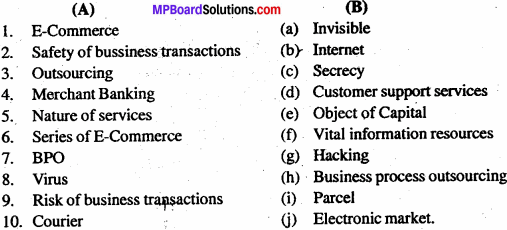
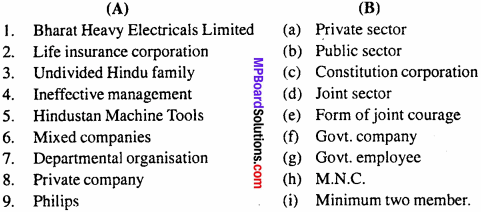
Question 3.
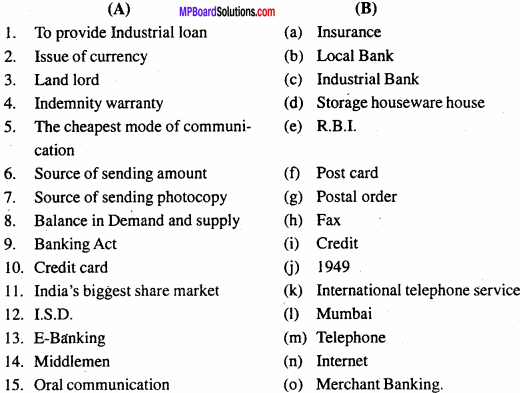
MP Board Class 11th Business Studies Important Questions Chapter 5 Emerging Modes of Business 1
Answer:

1. (b)
2. (c)
3. (d)
4. (e)
5. (a)
6. (j)
7. (h)
8. (f)
9. (g)
10. (i).

Question 4.
Give answer in one word/sentence:

Question 1.
What is E in E – commerce?
Answer:
E stands for electronic.

Question 2.
Write the names of two normal risks which is present in e – commerce.
Answer:

  1. Brand Hijacking
  2. Hacking.

Question 3.
Write full form of B.P.O.?
Answer:
Business Process Outsourcing.

Question 4.
Write the name of the service in which one firm take the help of other firm for getting their work done?
Answer:
B.P.O.

Question 5.
What is E – business?
Answer:
When all industrial and commercial activities are done through the computer network then it is called as E-business.

Question 6.
Write two differences between traditional and e – business.
Answer:

  1. It is hard to set-up traditional business and easy to start e-business.
  2. Physical presence is needed in traditional business but in e-business physical existence is not required.

Question 7.
Write two advantages of e – commerce?
Answer:

  1. E – commerce make distribution simple and
  2. All the doubts are cleared immediately.

Question 8.
Write two resources required for e – commerce.
Answer:

  1. Computer system and
  2. Internet connection.

MP Board Solutions

Question 9.
Write two limitations of e – commerce?
Answer:
The two limitations of e – commerce are:

  1. Less personal contact and
  2. Delay in delivery.

Question 10.
Write three levels required for doing e – business or online business.
Answer:

  1. Registration
  2. Order
  3. Payment system.

Question 11.
What do you mean by hacking?
Answer:
Illegal entry or surfing into website is called as hacking. Sometime hackers destroy the important information and facts.

Question 12.
What is storage risk?
Answer:
When due to any joke or for humiliation purpose, main information is stolen then it is called as storage risk.

Question 13.
How many normal storage risk are there? Name them.
Answer:
There are two Normal Storage Risks. They are:

  1. Virus
  2. Hacking.

Question 14.
What do you mean by courier sendees?
Answer:
When the private firms provide the postal services to carry the letters and parcels then it is called as courier services.

Question 15.
Write two limitations of Outsourcing of Services.
Answer:

  1. Lack of Secrecy
  2. Lack of Skill of thinking.

Question 16.
Write different services of outsourcing.
Answer:
Following are types of different services of outsourcing:

  1. Financial services
  2. Advertisement services
  3. Courier services
  4. Customer help services.

Question 17.
Write advantages of outsourcing of business.
Answer:

  1. Focus on internal skill
  2. Economy in cost.

MP Board Solutions

Question 18.
Into how many directions the transactions of e – business and its activities can be extended? Write those directions.
Answer:
E – business and its activities can be extended into four directions:

  1. B – 2B commerce
  2. B – 2C commerce
  3. C – 2C commerce
  4. Intra – B commerce.

Question 19.
Write one difference between e-business and e – commerce?
Answer:
In e – business,industry, trade and commerce is included but in e – commerce only purchase and sale of the goods are included.

Question 20.
Write two names of two methods of stopping crime in e – commerce?
Answer:
The two methods are:

  1. Special Crime Cell
  2. Digital Signature.

Question 21.
What is Digital signature?
Answer:
Digital signature is one of method certifying by the certification officer by issuing coded digital certificate, which helps in recognition of the sender.

Question 22.
Write the resources which are required for the successful operation of the e – business?
Answer:
They are:

  1. Computer hardware
  2. Technical staff
  3. Digital payment technology
  4. Properly designed website
  5. Tele communication facilities.

Question 23.
Can the delivery of the car can be received immediately on the computer?
Answer:
No.

Question 24.
Give some examples of items whose delivery can be taken immediately on the computer?
Answer:

  1. Computer software
  2. Tickets of flights
  3. Hotel reservation
  4. Information of tape, CD, etc.

Question 25.
What is the name given to delivery of goods immediately on the computer?
Answer:
Online transaction.

Question 26.
What is EFT?
Answer:
EFT stands for Electronic Fund Transfer in which money can be transferred by the code given by the bank of the credit card number.

MP Board Solutions

Question 27.
What do you mean by documents? Is it full safe? Give reason for your answer.
Answer:
Document is related to the invoice, warranty card, payment receipts, etc. They are fully safe as they are received by means of the internet.

Question 28.
What is important to deal in the e – business ?
Answer:
It is very important to know the address of the website.

Emerging Modes of Business Very Short Answer Type Questions

Question 1.
Define outsourcing?
Answer:
The process of availing various kinds of socialized services from agents external to one’s own organization, at economical rates is called as outsourcing.

Question 2.
What advancements in the business field has been made in order to run business skillfully?
Answer:
Following changes have taken place:

  1. Digitalization
  2. Outsourcing
  3. Globalization.

Question 3.
Write difference between E – business and E – commerce?
Answer:
Normally E – business and E – commerce both the words seems to Synonyms but E – business word is very wide in which not only E – commerce is included but also function of business such as production, distribution, personal management etc., are also included. Transactions done by different – different firms are also included.

Question 4.
What is Cryptography?
Answer:
Cryptography is that process of saving information in which the data is converted to cyber text.

Question 5.
What do you mean by website?
Answer:
Website is related tb the world wide web. In short the position of the firm on the world wide web is called as website. Website is not any geographical position but it is the matter which only visible online which the firm is willing to show others.

Question 6.
What is KPO?
Answer:
Knowledge Process Outsourcing or KPO is one way of doing work by transferring work to others belonging to the same firm or the other firms. Generally, this work is done by high value skilled employees.

Question 7.
Difference between KPO and Production Outsourcing?
Answer:
KPO is done by more skilled employees as compared to the work done by the Production Outsourcing.

Question 8.
Write two functions of KPO firms.
Answer:
The two functions of KPO firms are:

  1. They provide self – process specialization and
  2. They take lower level decisions of their own.

MP Board Solutions

Question 9.
Write the name of process outsourcing which is continuity of BPO and have more business complexities.
Answer:
KPO.

Question 10.
Write two characteristics of KPO.
Answer:
The two characteristics of KPO are:

  1. It is knowledge related business process or It is one of the continuity of BPO.
  2. It required highly skilled employees or workers.

Question 11.
What is central theme of KPO?
Answer:
The main central theme of the KPO is to create price for the customers by having business specialization instead of central process specialization.

Question 12.
What are the services included in KPO?
Answer:
Following services are included in KPO:

  1. Investment Research Services
  2. Business Research Services
  3. Data Analysis
  4. Market Research Services
  5. Valuation and Firm decision
  6. Legal Process Outsourcing
  7. Patent Research Services
  8. Business Operation Support and Management
  9. Editor Process Outsourcing.

Question 13.
How does outsourcing represent a new mode of business?
Answer:
Outsourcing represents a new mode of business and it is a departure from the traditional thinking of self – sufficiency in business. It refers to a long – term contracting out of business activities to captive or third party specialists with a view to benefitting from their experience, expertise, efficiency and even investment. Generally, the non – core business activities are outsourced but of late even some of the core activities have started being outsourced.

Outsourcing comprises four key segments:

  1. Contract manufacturing
  2. Contract research
  3. Contract sales and
  4. Informatics.

Global competitive pressures for higher quality products at lower costs, demanding customers and emerging technologies have induced a retook at business processes and hence, resulted in outsourcing as a new mode of business which is now being resorted to not out of compulsion but out of choice.

Question 14.
Write the utility of the smart card?
Answer:
Following is the utility of the smart card:

  1. For Banking and Retail
  2. As an Electronic purse
  3. For Health Care
  4. Identity verification.

Emerging Modes of Business Short Answer Type Questions

Question 1.
State any three differences between E – business and Traditional business.
Answer:
Differences between Traditional business and E – business:
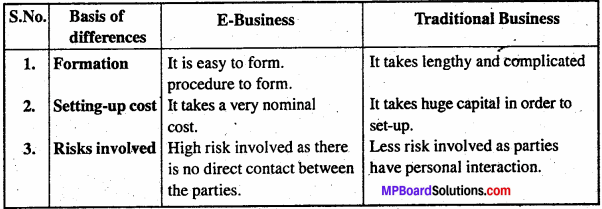
MP Board Class 11th Business Studies Important Questions Chapter 5 Emerging Modes of Business 2

Question 2.
Describe briefly any two applications of E – business.
Answer:
Two applications of E – business:
1. E – Procurement:
It involves internet – based sales transactions between business firms, including “reverse auctions” that facilitate online trade between a single business purchaser and many sellers and, digital market places that facilitate online trading between multiple buyers and sellers.

2. E – Communication / E – Promotion:
It includes e – mails, publication of online catalogues displaying images of goods, advertisement through banners, pop – ups, opinion polls and customer surveys, etc. Meetings and conferences may be held by the means of video conferencing.

Question 3.
How outsourcing is representing the development of new technique of business?
Answer:
Due to outsourcing business have got help in touching the new horizons because under it the businessmen keep some work with them and remaining work they transfer to these who are having specialization. This makes those work done on time at economical rate and also increase the employment opportunities in the society.

Question 4.
Wbat is B2B?
Or, Write the risks which are there in data storing and transmission in E – business.
Answer:
There are lots of risks whether data is stored inside the computer or the way of its transmission. Important informations are stolen by the hackers only in order to destroy them or due to humiliation purpose.

MP Board Solutions

Question 5.
Explain the areas of e – business.
Answer:
Under e – business not only the functions like production, distribution, personnel management comes but also management works like planning, organizing and controlling is also done by the medium of computerized system. Following are also included in the e – business:

1. B2B Commerce:
Under this process of e – business both the firms which participate are included. Business firms cannot do all the work of its own. They also need the subsidiary firms also like, scooter manufacturing company requires help of so many firms as it cannot produce all the components by its own and if doing so can make their manufacturing cost very high. Hence, under this category the work is selected and given to secondary firm for their completion.

2. B2C Commerce:
Under it the relation between business and the customers are kept. This method is useful when purchasing is done by going to the unknown shopkeepers. Customers can find the information online and can inform to the firm about their requirement and then they can get those goods and services on their own way as per their taste.

3. Intra B Commerce:
When all the units of the firm are electronically connected
with each other then it is called as Intra B commerce. By this method different departments like sales, production etc., get information of other departments online and hence there is less possibility of mistakes at all the levels. .

Question 6.
Explain E – business.
Answer:
E – business is the electronical method of doing business. This system makes the firm to make available any commodity at any place at any time to its customers; Instead of. purchasing any commodity from the unknown seller the purchaser send the required amount directly to the concerned seller. Seller will be keeping that amount with him up till that time until unless the goods have not been sent and was accepted by the purchaser e.g„ if any person got blocked in traffic then he can phone to another person in order to guide to him not to get blocked in the traffic.

Question 7.
What do you understand by Virus?
Answer:
Virus is a kind of program which goes on circulating to the main program frequently. The effect of the virus can be seen as follows:

Level – 1
virus leads to normal affecting to the screen.

Level – 2
virus goes on affecting the work process.

Level – 3
virus goes on affecting the targetted files and destroy them.

Level – 4
virus can destroy the whole system of the computer.

Antivirus programme should be established and should be run from time – to – time in order to save the files and disks from the attack of the virus.

Question 8.
Explain the various services of the E – business?
Answer:
Following are the various services of the E-business:

1. E – procurement:
Under it purchase and sell goes on among the business firms. This makes the Business Firms have to work on properly as all die activities are done online.

2. E – bidding / E – auction:
In many of the purchasing websites the prices are presented automatically so that the bidding can be made. In it E-Auction is also included.

3. E – communication / E – promotion:
In this all the brochures are published which show the factors of the goods. Advertisement through banner, knowing of the consent, customer survey etc., meetings and the conferences can be held through the video conferencing.

4. E – delivery:
It includes the e – delivery of computer software, photos, videos, books and magazines (e – magazines) and multimedia materials through the electronic medium. In it through the electronic medium various other services like legal, financial and other services can also be availed.

MP Board Solutions

Question 9.
What are the ethical concerns involved in outsourcing?
Answer:
Outsourcing has raised certain ethical concerns which need to be considered. In search of cheap labour, manufacturing processes are being outsourced to developing countries where they use child labour/women in the factories and working conditions are unhygienic and even unsafe. The companies cannot do so in their developed home countries due to stringent laws forbidding use of child labour.

This raises the ethical concern whether this sort of cost cutting by using child labour justified. Similarly, there is a concern over the ethical aspect’of outsourcing the work to countries where gender based wage discrimination is done and hence women are paid lower wages.

Question 10.
What are the main problems in the outsourcing?
Answer:
Following are the main problems in the outsourcing:

1. Lack of confidentiality:
Since the work is divided into different parts and is given to different person, the secrets of the work is also known to the others and advantage can be taken by the other competitor company.

2. Sweet shopping:
Under the outsourcing the workers and the labours are paid very less amount as a result of which they are exploited.

3. Ethical concerns:
The people of the under developed and the developing nations get ready to sell their services even at cheaper rates for earning money as a result they can be physically and mentally exploited.

Question 11.
Explain the advantages of the outsourcing?
Answer:
Following are the advantages of the outsourcing:

1. Reduction in labour problems:
Due to outsourcing business has to appoint internal employees only which reduces labour problems.

2. Cost reduction:
Because of the outsourcing the work is transferred and is done by the other parties which reduces the cost. It is predicted that around 10 to 20% cost reduction is there.

3. Enhancement in production:
Outsourcing firms have good skill in their work which the other firms cannot have, and they do their work very skillfully. So due to outsourcing there is upgradation in the production capacity of the business undertaking.

MP Board Solutions

Question 12.
What is E – business risk? Explain its different types.
Answer:
Online business is totally different from the normal business and also it is having different types of business risk. Here risk means any such incidence which can cause financial, social or mental loss.
Types of E – business risk:

1. Transaction risk:
Online transaction have their own risk. They are of following types:

(i) Transactional order mistake:
The seller can refuse the customer that the customer has given order any time and similarily customer can also refuse regarding the order given by him.

(ii) Delivery mistake:
Delivery of wrong goods, delivery to the wrong address and similar kinds of problem arises.

(iii) Mistakes related to the payments:
Sometimes after delivery of the goods also payment is not received.

2. Data storage and transmission risk:
Data either stored in computer or is in transit, it has always risk. Many times important information is stolen by soihe antisocial elements for the purpose of humiliation or destroying. Virus hitting or hacking are some of the examples.

3. Risk of threat to intellectual property and privacy:
Internet is one of the open kind of place where if once the information is available then they lose their privacy andean be used by anyone. .

Emerging Modes of Business Long Answer Type Questions – I

Question 1.
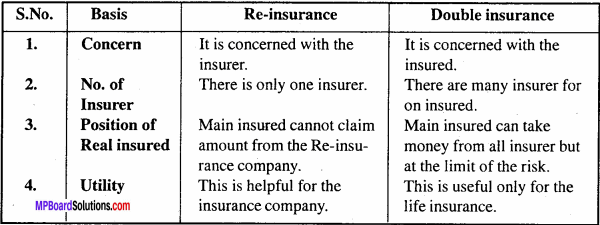
Differentiate between B.P.O. and K.P.O.
Answer:
Differences between B.P.O. and K.P.O:
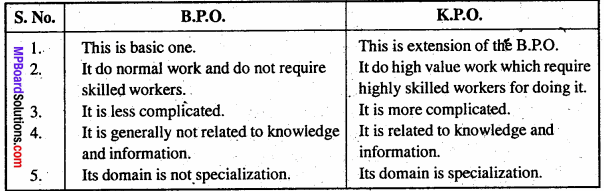
MP Board Class 11th Business Studies Important Questions Chapter 5 Emerging Modes of Business 3

Question 2.
Write the advantages of E-business.
Answer:
Following are the advantages of the e – business:

1. Easy formation:
It is very easy to start e – business as compared to the traditional business which require lot of formalities to be completed. The advantages of internet is equally available to both the format of the business small and big.

2. Convenience:
Internet provides the facility of business 24 hours, 7 days and 365 days of the year. Hence the employees also get the flexibility to work at the different time and from the different place.

3. Speed:
In the sale and purchase of the goods many other information is also required which is made available by the internet only at only click of the mouse. Many information and software, e – films, e – books and magazines can be delivered online. Here as per the demand the information can be made available speedily.

4. Global reach:
In the real sense internet reach is limitless. On one side it provides the seller a global reach and on the other hand it provides opportunity to the customer to select goods at the any place of the world.

5. Movement towards a paperless society:
Internet has reduced the use of the paper and also red tapism. Government department and various regulatory tribunals are also shifting towards the paperless society, under which all the information is made available online on the internet. In this context Information Technology Act 2000 is admirable.

Question 3.
Discuss the limitations of electronic mode of doing business. Are these limitations severe enough to restrict its scope ? Give reasons for your answer.
Answer:
E – Business has its own limitations as discussed below:

1. Low personal touch:
e – Business lacks the warmth of interpersonal interactions and personal touch for satisfaction of customer. Thus, it is relatively less suitable mode of business for product categories requiring personal touch for convincing the customers such as garments, etc.

2. Incongruence between order taking/giving and order fulfillment speed:
In e – Business orders can be placed at the click of a mouse, but the physical delivery of the product takes time. Customers are sometimes not patient enough to bear with this Incongruence. At times the users even get frustrated due to technical reasons when web – sites take unusually longtime to open.

3. Need for Technology Capability and Competence of Parties to E – business:
E – Business requires the parties to be fairly familiar with computers and internet. The digital divide has thus limitedthe use of E – business.

4. Increased transaction:
Risk Internet transactions occur between cyber personalities and it is difficult to establish the identity of the parties or know the location from where the parties may be operating. E-business is also risky due to additional hazards of Impersonation and leakage of confidential information such as credit card details. Problems of ‘virus’ attacks and ‘hacking’ also pose security concerns in e – busipess.

5. Resistance to change:
The process of adjustment to new technology and new way of doing things causes stress and a sense of insecurity due to change. As a result, people may resist a change from traditional business to E – business.

MP Board Solutions

Question 4.
Explain the advantages of smart card.
Answer:
Followings are the advantages of smart card:

1. Multiple use device:
It is one smart card which do lot of big works like credit card, debit card, identification card, medical history, telephone directory etc. There is no need to keep separate document for each and everything.

2. Full security:
Smart card is tamper proof, hence the data stored in it cannot be manipulated. PIN is required for its use. User thumb impression and Id make it more safe to use. If any person try to use it illegally then the card reader makes the card blocked.

3. Portability:
It can be carried to any place with ease as it very small in size and light.

4. More storage capacity:
Smart card can store large amount of data which is helpful at the time of its need.

5. Easy to use:
It can be carried anywhere and can be used easily and it is consumer friendly.

Question 5.
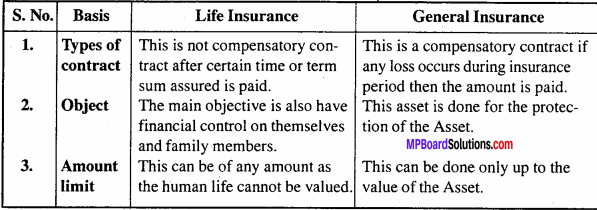
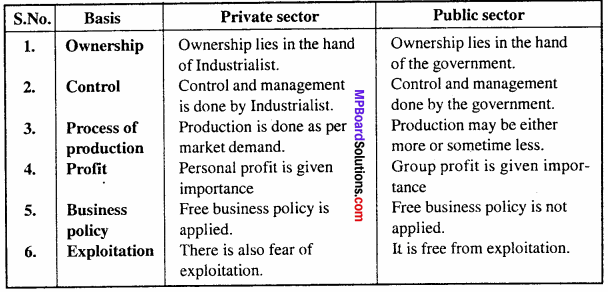
Differentiate between the Traditional business and E – business.
Answer:
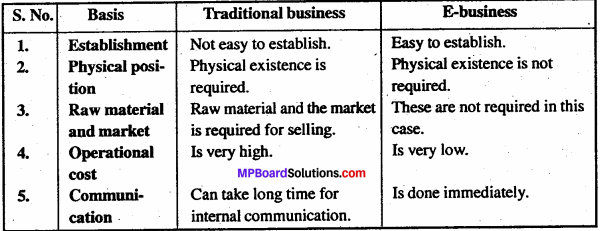
MP Board Class 11th Business Studies Important Questions Chapter 5 Emerging Modes of Business 4

Question 6.
Why are e – business and outsourcing referred to as the emerging modes of business? Discuss the factors responsible for the growing importance of these trends.
Answer:
E – Business and outsourcing are referred to as ‘emerging modes of business’ as these have brought about new changes in the way or manner in which business is conducted and it is believed that these trends are likely to continue. E – Business may be defined as the conduct of industry, trade and commerce using the computer networks.

E – Business covers a firm’s interactions with its customers and suppliers over the internet and also other electronically conducted business functions such as production, inventory management, product development, accounting and finance and human resource management.

The various factors responsible for the growing importance Of these trends are:

1. Business managers and thinkers keep evolving newer and better ways of doing things in an effort to improve the business processes.

2. Business firms have to strengthen their capabilities of creating utilities and delivering value to successfully meet the competitive pressures.

3. Consumers have become far more demanding than ever in terms of higher quality, lower prices, speedier deliveries and better customer care.

4. Business as an activity has to keep evolving by adopting new trends in order to benefit from emerging technologies.

Emerging Modes of Business Long Answer Type Questions – II

Question 1.
Elaborate the steps involved in online trading.
Answer:
The following steps are involved in online trading:

1. Registration before online shopping one has to register with the online vendor by filling up a registration form. In this form one has to give a password to protect the account otherwise anyone can log in your account.

2. Placing an order in online transactions the order can be placed by picking and dropping the items in the shopping cart. Shopping cart is an online record of what you have picked up while browsing. After being sure of what you want to buy then check out from shopping cart and choose your payment option.

3. Payment through mechanism in an online purchase payment is made through

  • Cash on delivery.
  • Through cheque.
  • Net banking transfer.
  • Credit or Debit card.
  • Digital cash.

(Note: If they ask steps in e – trading then following steps are to be mentioned)

  • Opening bank account.
  • Opening demat account with a depository participant.
  • Opening online trading account with stock brokers.
  • Trading software installation.
  • Bidding and trading in securities.

MP Board Solutions

Question 2.
Evaluate the need for outsourcing and discuss its limitations?
Answer:
Global competitive pressures for higher quality products at lower costs. Ever demanding customers and emerging technologies are responsible for the continuing emergence of outsourcing as a mode of business. Need for outsourcing is outlined in the following points:

1. Focussed attention business firms are realizing that focusing their limited resources on a few areas where they have core competence, and contracting out the rest of the activities to their outsourcing partners can lead to better efficiency and effectiveness.

2. Quest for excellence outsourcing enables the firms to pursue excellence by virtue of limited focus and also by extending their capabilities through contracting out the remaining activities to those who excel in performing them.

3. Cost reduction it has become necessary for firms operating in global markets to maintain quality of products while keeping prices low. Thus, the only way, to survival and profitability is cost reduction. The outsourcing partners deliver the same service to a number of organizations and hence benefit from economies of large scale leading to lower cost.

But there are certain limitations of outsourcing as given below:

1. Confidentiality outsourcing depends on shafting a lot of vital information and knowledge. If the outsourcing partner does not maintain the confidentiality it can harm the interest of the party that outsources its processes.

2. Sweat shopping outsourcing firms seek to lower their costs by utilizing the low – cost manpower of the host countries. Moreover the work that is outsourced is not of the type which may build the competency and capability of the outsourcing partner.

3. Ethical concerns in search of cheap labour manufacturing processes are being outsourced to developing countries where they use child labour/women in the factories and working conditions are unhygienic and even unsafe this raises ethical concerns.

Question 3.
Explain ATM along with its utility?
Answer:
ATM stands for Automatic Teller Machine, is a kind of machine in which if ATM card is inserted and PIN is typed then money can be withdrawn and can be deposited in it. This machine works on 24 x 7 basis. This has reduced the burden of the bank on large scale. Its use is going on increasing day by day. Bank not only allow the customers to deposit money and withdrawals but also other facilities are also provided. The services provided by the ATM differs for bank to bank.

Followings are the utility of ATM:

1. Cash withdrawals:
Through the ATM user can withdraw money at any time as per the requirement. For withdrawing money from the ATM it is necessary to use the card issued by the bank and type the PIN.

2. Cash deposit:
Money cannot only be withdrawn but can be deposited also through the ATM. When the cash is kept in the slot by the customer machine count it and credit to the concerned account and receipts is issued regarding it.

3. Balance enquiry:
As the name certifies as soon as the card is inserted and the PIN is typed ATM machine issued a printed receipt which consists of balance of the concerned account.

4. Mini statement:
Under the mini statement option the user can get the print of last 10 transactions of his account, through the ATM.

MP Board Solutions

Question 4.
Explain the resources which are required for the e – commerce?
Answer:
For successful functioning of e – commerce following facilities are necessary:

1. Computer System:
E – commerce is a business conducted over the internet. Hence, the most basic requirement is a well endowed computer system, whereby we can place or take orders with ease and convenience. A computer would be sufficient to effect business deals.

2. Internet Connection:
The next basic necessity to effectively carry out e – commerce is to get a connection froth an Internet Service Provider (ISP).BSNL is the country’s largest ISP. Apart from this, there are other private players in the field, like Mantra on – line, Satyam Infoway, Sigma on – line, Dishnet, etc. are ISP’s.

3. Technically Qualified Workforce:
E – commerce cannot function Without sufficiently qualified, technically efficient personnel, who are comfortable with operating computer networks as well as the internet. They must be absolutely certain about the formalities concerning how to receive on – line orders, receive on – line payments, and design a website and to deliver products on – line

4. Safe System of Receiving Payments:
In order to receive payments, it is essential that companies develop such safe modes, whereby the buyers may be immediately intimated about how much payment is to be made, and how it is to be made. Besides, it must also be decided and intimated to the buyers as to what arrangements have been made for any excess payments made by them.

5. Well – designed Website:
Every company should design its won website in order to provide complete information to its customers and other dealers, about its product and services, while designing its web site, it must provide graphic details of its products.
MP Board Class 11 Business Studies Important Questions

MP Board Class 12th Chemistry Solutions Chapter 8 The d-and f-Block Elements

MP Board Class 12th Chemistry Solutions Chapter 8 The d-and f-Block Elements

The d-and f-Block Elements NCERT Intext Exercises

Question 1.
Silver atom has completely filled d-orbitals (4d10) in its ground state. How can you say that it is a transition element?
Answer:
Silver exhibits +2 oxidation state. In this state, 4d- sub-shell contains nine electrons i.e., one of the 4d-orbitals is partially filled. Hence, it can be regarded as transition element.

Question 2.
In the series Sc (Z = 21) to Zn (Z = 30), the enthalpy of atomisation of Zinc is the lowest, i.e., 126 kj mol-1. Why ?
Answer:
In case of Zinc, 3d-electrons are not involved in metallic bonding, due to having 3d10 configuration. Because of poor metallic bonding, the enthaply of atomisation of Zinc is lowest.

Question 3.
Which of the 3d series of the transition metals exhibits the largest number of oxidation state and why ?
Answer:
Mn (Z = 25) exhibits the largest number of oxidation state, because it has the maximum number of unpaired electrons. Hence, it shows oxidation states from +2 to +7.

Question 4.
The E° (M2+/M) value for copper is positive (+0.34V). What is possibly the reason for this? (Hint: Consider its high ∆0H°Θ and low ∆hydH°).
Answer:
E°(M+2/M) for any metal depends upon the sum of enthalpies of atomisation, ionisation enthalpy and hydration enthalpy. Copper has high enthalpy of atomisation and low hydration enthalpy. Hence, E°(Cu+2/Cu) is positive.

Question 5.
How would you account for the irregular variation of ionisation enthalp-ies (first and second) in the first series of the transition elements?
Answer:
Irregular variation of ionisation enthalpies (first and second) is mainly due to varying degree of stability of different 3d-configurations. d0, d5 and d10 configurations have extra stability and hence in such cases the value of ionisation enthalpies are usually high.

For example, Cr has low first ionisation enthalpy because the electron has to be removed from 4s-orbital but the second ionisation enthalpy is very high as Cr+ has a stable d5 configuration. Zn has very high first ionisation enthalpy because electron is to be removed from stable configuration 3d10 4s2.

Question 6.
Why is the highest oxidation state of a metal exhibited in its oxide or fluo-ride only?
Answer:
Both.oxygen and fluorine are highly electronegative. Thus, they oxidise the met¬als in their compounds in highest oxidation state.

Question 7.
Which is a stronger reducing agent Cr2+ or Fe2+ and why ?
Answer:
Cr+2 is stronger reducing agent than Fe+2. This is because the configuration of Cr+2 changes from d4 to d3 and d3 configuration is stable (t32g) beinghalf filled t2g level.

Question 8.
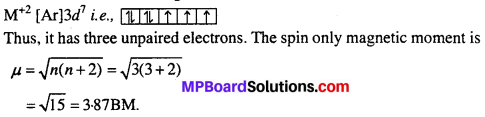
Calculate the ‘spin only’ magnetic moment of M2+(aq) ion (Z = 27).
Answer:
The electronic configuration of M+2 (Z = 27) is
MP Board Class 12th Chemistry Solutions Chapter 8 The d-and f-Block Elements 1

Question 9.
Explain why Cu+ ion is not stable in aqueous solutions?
Answer:
Cu+(aq) is not stable in aqueous solution because of its less negative enthalpy of hydration than Cu+2(aq).

Question 10.
Actinide contraction is greater from element to element than lanthanide contraction. Why?
Answer:
This is due to poor shielding effect by 5f electrons in the actinoids than that of 4f electrons in the lanthanoids.

MP Board Solutions

The d-and f-Block Elements NCERT TextBook Exercises

Question 1.
Write down the electronic configuration of:
(i) Cr3+
(ii) Pm3+
(iii) Cu+
(iv) Ce4+
(v) CO2+
(vi) Lu2+
(vii) Mn2+
(viii) Th4+
Answer:
(i) Cr3+: [Ar]3d3
(ii) Pm3+ : [Xe]4f4
(iii) Cu+ : [Ar]3d10
(iv) Ce4+ : [Xe]54
(v) CO2+ : [Ar]3d7
(vi) LU2+ : [Xe]4f14 5d1
(vii) Mn2+ : [Ar]3d5
(viii) Th4+ : [Rn].

Question 2.
Why are Mn2+ compounds more stable than Fe2+ towards oxidation to their +3 oxidation state?
Answer:
Mn+2 has stable electronic configuration [Ar]4s03d5 and they do not easily change to Mn+3, Fe+2 [Ar] 4s03d6 on oxidation forms Fe+3 [Ar] 4s03d5 a more stable configuration.

Question 3.
Explain briefly how +2 oxidation state becomes more and more stable in the first half of the first row transition elements with increasing atomic number?
Answer:
Except Scandium (which shows an oxidation state of +3) all other first row transition elements show an oxidation state of +2. This is due to loss of two ns electrons. In the first half, as we move from Ti+2 to Mn+2 the electronic configuration changes from 3d2 to 3d5 i.e., more and more of d-orbitals are half filled imparting greater and greater stability of +2 oxiation state.

Question 4.
To what extent do the electronic configurations decide the stability of oxi-dation states in the first series of the transition elements? Illustrate your answer with examples.
Answer:
In transition series, the oxidation states which lead to exactly half filled or completely filled d-orbitals are more stable. For example, the electronic configuration of Fe(Z = 26) is [Ar] 3d64s2. It shows various oxidation states but Fe (III) is most stable because it has the configuration [Ar]3d5.

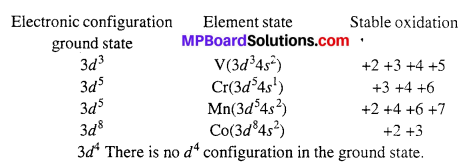
Question 5.
What may be the stable oxidation state of the transition element with the following d electronic configurations in the ground state of their atoms : 3d3,3d5,3d8 and 3d4?
Solution:
MP Board Class 12th Chemistry Solutions Chapter 8 The d-and f-Block Elements 2

Question 6.
Name the oxometal anions of the first series of the transition metals in which the metal exhibits the oxidation state equal to its group number.
Answer:
Cr2O72- and CrO42- (Group No. = Oxidation state of Cr = 6), MnO4 (Group No. = Oxidation state of Mn = 7).

Question 7.
What is lanthanoid contraction? What are the consequences of lanthanoid contraction?
Answer:
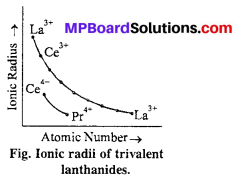
Interesting feature of the atomic size of lanthanides is that on moving down the group steady decrease in atomic size is observed. The shape of f-orbital is in such a way that its shielding effect is minimum, therefore on addition of extra electron in f-subshell only attractive force increases. The steady decrease (contraction) in size of fourteen lanthanide elements (La3+ 1 06Å to Lu3+ 0.8Å) by a value of about 0.2Å is known as lanthanide contraction.
MP Board Class 12th Chemistry Solutions Chapter 8 The d-and f-Block Elements 3
Reason : (i) The new electrons in lanthanides instead of going to outermost shell enters (n-2)f- suborbital as a result of which force of attraction increases between electron and nucleus due to which atom or ion contracts.

(ii) Electron entering in (n-2)f- suborbital have negligible or zero shielding effect over electrons present in the last orbit. In addition the shape of f-suborbital is not favourable for the shielding effect of electrons. Thus, lanthanide contraction occur.

Consequences of lanthanide contraction :

(i) Change in the properties of lanthanides: Due to lanthanide contraction, little change occurs in the properties of lanthanides. So it is very difficult to obtain them in pure state.

(ii) Influence over the properties of other elements : Lanthanide contraction have an important influence over the element present before and after it e.g., there is difference in properties of Ti and Zr while Zr and Hf have similar properties.

Question 8.
What are the characteristics of the transition elements and why are they called transition elements? Which of the d-block elements may not be regarded as the transition elements?
Answer:
Transition elements are those elements in which the atoms or ions (in stable oxidation state) contain partially filled cf-orbital. These elements lie in the p-block and show a transition of properties between 5-block and p-block. Therefore, these are called transition elements. Elements such as Zn, Cd and Hg cannot be classified as transition elements be¬cause these have completely filled d-subshell.

Question 9.
In what way is the electronic configuration of the transition elements different from that of the non-transition elements?
Answer:
The transition elements involve the filling of d-orbitals while the representative elements involve the filling of s and p-orbitals. The general electronic configuration of transition element is (n-1)d1-10 ns1-2 on the other hand, the general electronic configuration of representative elements in ns1-2 or ns2 np1-6. Thus, in representative elements only the last shell is incomplete while in transition elements the last but one shell is also incomplete.

Question 10.
What are the different oxidation states exhibited by the lanthanoids?
Answer:
The principal oxidation state of lanthanoids is +3. In addition, they exhibit oxi-dation states of +2 and + 4.

Question 11.
Explain giving reasons:
(i) Transition metals and many of their compounds show paramagnetic behaviour.
(ii) The enthalpies of atomisation of the transition metals are high.
(iii) The transition metals generally form coloured compounds.
(iv) Transition metals and their many compounds act as good catalyst.
Answer:
(i) Paramagnetic substance is one which is attracted by magnetic field. It arises due to presence of unpaired electron in atom, ion or molecule.

Most of the transition elements and compounds are paramagnetic in nature. This is due to fact that transition elements involve partially filled 4 subshell and their atom and ion contain unpaired electron.

(ii) Transition elements have high effective nuclear charge and a large number of valence electrons. Therefore, they form very strong metallic bonds. As a result, the enthalpy of atomization of transition metals is high.

(iii) The colour of transitional metal ions is due to partially filled (n-1)d orbitals. In transitional metal ions which contain unpaired d electrons, transition of electrons takes place from one 4-orbital to another 4-orbital. During this transition it absorbs some radiation of visible light and reflects the remaining radiation in the form of coloured light. Thus, the colour of the ion is complementary to the colour absorbed by it.

For example: [Cu(H2O)6]2+ ion appears blue because it absorbs the red colour of the visible light for electron promotion and reflects its complementary blue colour.

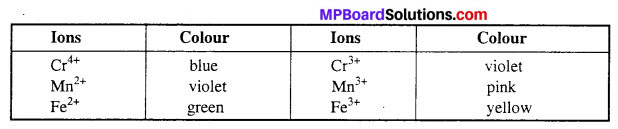
Colour of some ions :
MP Board Class 12th Chemistry Solutions Chapter 8 The d-and f-Block Elements 4

(iv)Transition elements act as good catalysts in chemical reaction in the hydrogenation of Ni metal, in contact process of manufacture of SO3, Pt and in manufacture of NH3 by Haber process Fe acts as catalyst. In the method of preparation of O2 by heating KClO3, MnO2 acts as catalyst.

Question 12.
What are interstitial compounds? Why are such compounds well known for transition metals?
Answer:
Most of the Transition elements form interstitial compounds at high temperature with atoms of non-metallic elements like-H,B,C,N, Si etc. Small atoms of these non-metal- lic elements fit in the interstitial voids of crystal lattice of transition elements. These are called interstitial compounds.

Properties :

  1. Properties of these compounds are like parent metal but physical properties differ.
  2. These compounds are hard.
  3. Their ductility and malleability becomes less.
  4. Their electrical conductivity decreases.
    Example: TiH, NiH2.

MP Board Solutions

Question 13.
How is the variability in oxidation states of transition metals different from that of the non-transition metals? Illustrate with examples.
Answer:
In transition elements, the successive oxidation states differ by unity. For ex-ample, Mn shows all the oxidation states from + 2 to +7. On the other hand, non-transition metals exhibit variable oxidation states which differ by two units. For example Pb(II), Pb(IV), Sn(II), Sn(IV).

Question 14.
Describe the preparation of potassium dichromate from iron chromite ore. What is the effect of increasing pH on a solution of potassium dichromate?
Answer:
Preparation : It is prepared from chromite ore or ferrochrome of chrome iron FeCr2O4 (FeO.Cr2O3). Different steps involved in the process are as follows :

1. Preparation of sodium chromate : The ore is finely powdered, mixed with sodium carbonate and quick lime and then roasted (heated to redness) in a reverberatory furnace in presence of excess of air when sodium chromate (yellow in colour) is formed with the evolution of CO2. Quick lime is added to keep the mass porous and thus facilitates oxidation.
MP Board Class 12th Chemistry Solutions Chapter 8 The d-and f-Block Elements 5
The roasted mass is extracted with water when sodium chromate dissolves completely leaving behind ferric oxide.

2. Conversion of sodium chromate to sodium dichromate : Sodium chromate is extracted with water and acidified with sulphuric acid to get sodium dichromate.
2Na2CrO4 + H2SO4 → Na2Cr2O7 + Na2SO4 + H2O
On concentration the less soluble sodium sulphate Na2SO4.10H2O crystallizes out. This is filtered hot and allowed to cool when sodium dichromate Na2Cr2O7.2H2O separates on standing.

3. Conversion of sodium dichromatic into potassium dichromate : Hot concentrated solution of sodium dichromate is treated with requisite amount of potassium chloride when potassium dichromate being less soluble crystallizes out on cooling.
Na2Cr2O7 + 2KCl → K2Cr2O7 + 2NaCl
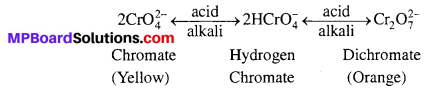
Effect of pH on a solution of K2Cr2O7: Potassium chloride being less soluble than sodium chloride is obtained in the form of orange coloured crystals and can be removed by filtration. The dichromate ion \(\mathrm{Cr}_{2} \mathrm{O}_{7}^{2-}\) exists in equilibrium with chromate \(\mathrm{Cr}_{2} \mathrm{O}_{4}^{2-}\) ion at pH 4. However, by changing the pH, they can be interconverted.
MP Board Class 12th Chemistry Solutions Chapter 8 The d-and f-Block Elements 6

Question 15.
Describe the oxidising action of potassium dichromate and write the ionic equations for its reaction with:
(i) Iodide
(ii) Iron(II) solution and
(iii) H2S.
Answer:
Reaction of K2Cr2O7 with acidic FeSO4, KI and H2S :
K2Cr2O7 acts as a very strong oxidizing agent in the acidic medium.
K2Cr2O7 + 4H2SO4 → K2SO4 + Cr2 (SO4)3 + 4H2O + 3[O]
K2Cr2O7 takes up electrons to get reduced and acts as an oxidizing agent. The reaction K2Cr2O7 with other iodide, iron (II) solution, and H2S are given below :
(i) It oxidizes ferrous sulphate to ferric sulphate.
MP Board Class 12th Chemistry Solutions Chapter 8 The d-and f-Block Elements 7

(ii) It liberates I2 from KI.
MP Board Class 12th Chemistry Solutions Chapter 8 The d-and f-Block Elements 8
These reactions are used in the estimation of iodine and ferrous ion in volumetric analysis

(iii) It oxidizes SO2 to sulphuric acid.
MP Board Class 12th Chemistry Solutions Chapter 8 The d-and f-Block Elements 9

(iv) It oxidizes H2S to sulphur.
MP Board Class 12th Chemistry Solutions Chapter 8 The d-and f-Block Elements 10

MP Board Solutions

Question 16.
Describe the preparation of potassium permanganate. How does the acidi-fied permanganate solution react with (i) Iron(II) ions (ii) SO2 and (iii) Oxalic acid ? Write the ionic equations for the reactions.
Answer:
Preparation : Potassium permanganate is prepared from manganese dioxide. On a large scale, it is prepared from the mineral pyrolusite. The process involves the following steps:

1. Conversion of MnO2 into potassium manganate : The finely powdered pyrolusite mineral is fused with potassium carbonate or potassium hydroxide in presence of atmospheric oxygen or an oxidising agent such as potassium nitrate or potassium chlorate. The fused mass turns green due to the formation of potassium manganate.
2MnO2 + 2K2CO3 + O2 → 2K2MnO4 + 2CO2
2MnO2 + 4KOH + O2 → 2K2MnO4 + 2H2O
MnO2 + 2KOH + KNO3 → K2MnO4 + KNO2 + H2O
3MnO2 + 6KOH + KCl1O3 → 3K2MnO4 + KCl + 3H2O

2. Oxidation of potassium manganate into potassium permanganate :
(i) Chemical oxidation : The fused mass is extracted with water and the solution is filtered. The green solution is then converted to potassium permanganate by bubbling carbon dioxide, chlorine or oxygen through it.
32MnO4 + 2CO2 → 2KMnO4 + MnO2 ↓+ 2K2CO3
2K2MnO4 + Cl2 → 2KMnO4 + 2KCl
2K2MnO4 + H2O + O3 → 2KMnO4 + 2KOH + O2
The purple solution of potassium permanganate thus obtained is concentrated when it deposits dark purple, needle like crystals having a metallic lustre.

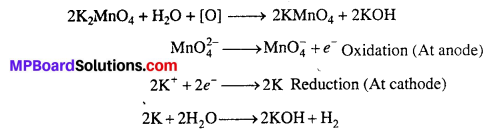
(ii) Electrolytic oxidation : Nowadays, it is largely manufactured by the electrolytic oxidation of the manganate. The manganate solution is electrolysed between iron electrodes separated by diaphragm. The oxygen evolved at the anode converts manganate to permanganate.
MP Board Class 12th Chemistry Solutions Chapter 8 The d-and f-Block Elements 11
After the oxidation is completed, the solution is filtered and evaporated under controlled condition to obtain the crystals of potassium permanganate.

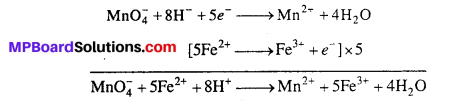
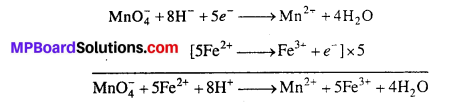
(i) Acidified KMnO4 solution oxidizes Fe(II) ions to Fe(III) ions i.e. ferrous ions to ferric ions.
MP Board Class 12th Chemistry Solutions Chapter 8 The d-and f-Block Elements 12
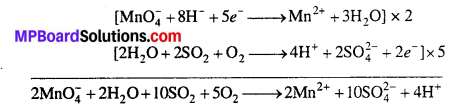
(ii) Acidified potassium permanganate oxidizes SO2 to sulphuric acid.
MP Board Class 12th Chemistry Solutions Chapter 8 The d-and f-Block Elements 13
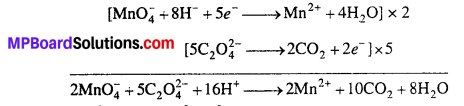
(iii) Acidified potassium permanganate oxidizes oxalic acid to carbon dioxide.
MP Board Class 12th Chemistry Solutions Chapter 8 The d-and f-Block Elements 14

MP Board Solutions

Question 17.
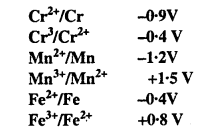
For M2+/M and M3+/M2+ systems the E° values for some metals are as follows:
MP Board Class 12th Chemistry Solutions Chapter 8 The d-and f-Block Elements 15
Use this data to comment upon:
(i) The stability of Fe3+ in acid solution as compared to that of Cr3+ or Mn3+ and
(ii) The ease with which iron can be oxidised as compared to a similar process for either chromium or manganese metal.
Answer:
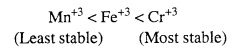
(i) As E° Cr+3/Cr+2 is negative (-0.4V), this means Cr+3 ion in solution cannot be reduced to Cr+2 easily, i.e., Cr+3 ions are very stable. As E° M+3/ Mn+2 is positive (+ 1.5V), Mn+3 ions can easily be reduced to Mn+2 ions in comparison to Fe+3 ions. Thus, the relative stability of these ions is:
MP Board Class 12th Chemistry Solutions Chapter 8 The d-and f-Block Elements 16
(ii) Oxidation potentials for the given pairs will be +0-9V, + 1-2V and 04V. Thus, the order of their getting oxidised will be in the order Mn > Cr > Fe.

Question 18.
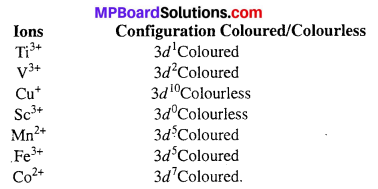
Predict which of the following will be coloured in aqueous solution? Ti3+, V3+, Cu+, Sc3+, Mn2+, Fe3+ and CO2+. Give reasons for each.
Answer:
The ions with one or more unpaired electrons will be coloured in aqueous solu-tion due to d-d transition.
MP Board Class 12th Chemistry Solutions Chapter 8 The d-and f-Block Elements 17

Question 19.
Compare the stability of +2 oxidation state for the elements of the first transition series.
Ans.
The stability of +2 oxidation state decreases from left to right except for Mn and Zn. Stability decreases towards right due to decreasing negative value of standard reduction potential. The decrease in the -ve value of E° is due to increase in sum of ∆i H1 + ∆iH2 (first and second ionisation enthalpy)

Question 20.
Compare the chemistry of actinoids with that of the lanthanoids with special reference to:
(i) Electronic configuration
(ii) Atomic and ionic sizes
(iii) Oxidation state and
(iv) Chemical reactivity.
Answer:
Differences between Lanthanoids and Actinoids :

Lanthanoids

  1. Differentiating or last electrons enter in 4 f-sub-shell of (n – 2) orbit.
  2. These elements come after lanthanum so these are called lanthanoids.
  3. Common oxidation state is +3, other oxidation states are +2 and +4 also.
  4. Atomic or ionic radius decreases gradually and this is called lanthanide contraction.
  5. Lanthanoids have smaller tendency to form complexes.
  6. Lanthanoids do not form oxo-ions.
  7. Compounds of lanthanoids exhibit less basic in nature.
  8. Lanthanoids are not radioactive except Promethium.
  9. Except Pm, other lanthanoids are present in nature in abundance comparatively more than iodine.

Actinoids

  1. Differentiating or last electrons enter in 5f-sub-shell of (n – 2) orbit.
  2. These elements come after actinium so these are called actinoids.
  3. Common oxidation state in actinoids is also +3 but other oxidation states are higher, e.g., +4, +5, +6 and +7.
  4. Atomic or ionic radius also decreases gradually and steadily and this is called actinoid contraction.
  5. Actinoids have comparatively higher tendency of complex formation.
  6. Oxo-ions are formed, e.g., UO+2, PuO+2, UO+, etc.
  7. Compounds of actinoids are more basic in nature.
  8. All the actinoids are radioactive.
  9. Most of these are not found in nature and are artificially prepared.

Question 21.
How would you account for the following:
(i) Of the d4 species, Cr2+ is strongly reducing while manganese(III) is strongly oxidising.
(ii) Cobalt(II) is stable in aqueous solution but in the presence of complexing reagents it is easily oxidised.
(iii) The d1 configuration is very unstable in ions.
Answer:
(i) Cr+2 is reducing in nature as its configuration changes from d4 to d3 (A stable configuration having half filled t28 orbitals). On the other hand, Mn+3 is oxidising in nature as the configuration changes from d4 to d5 (A stable configuration having half filled t2g to eg orbitals)
(ii) Strong ligands force Cobalt (II) to lose one more electron from 3cfsubshell and thereby induce d2sp3-hybridisation.
(iii) The ions with d1 configuration try to lose the only electron on d-subshell in order to acquire stable inert gas configuration.

Question 22.
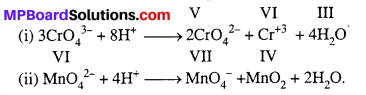
What is meant by ‘disproportionation’? Give two examples of dispropor-tionation reaction in aqueous solution.
Answer:
The disproportionation reactions are those in which the same substance get oxidised as well as reduced, for example
MP Board Class 12th Chemistry Solutions Chapter 8 The d-and f-Block Elements 18

Question 23.
Which metal in the first series of transition metals exhibits +1 oxidation state most frequently and why?
Answer:
Copper has electronic configuration [Ar] 3d104s1. It can easily lose one (4s1) electron to give stable 3d10 configuration.

MP Board Solutions

Question 24.
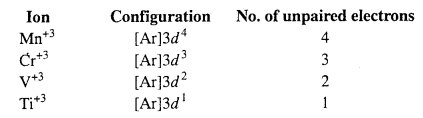
Calculate the number of unpaired electrons in the following gaseous ions: Mn3+, Cr3+, V3+ and Ti3+. Which one of these is the most stable in aqueous solution?
Answer:
MP Board Class 12th Chemistry Solutions Chapter 8 The d-and f-Block Elements 19
Cr+2 is most stable as it has half filled t28 level.

Question 25.
Give examples and suggest reasons for the following features of the transition metal chemistry:
(i) The lowest oxide of transition metal is basic, the highest is amphoteric/acidic.
(ii) A transition metal exhibits highest oxidation state in oxides and fluorides.
(iii) The highest oxidation state is exhibited in oxo-anions of a metal.
Answer:
(i) The lowest oxide of transition metal is basic because the metal atom has low oxidation state whereas highest is acidic or amphoteric due to highest oxidation state. For
MP Board Class 12th Chemistry Solutions Chapter 8 The d-and f-Block Elements 20
In low oxidation state of the metal, some of the valence electrons of the metal atom are not involved in bonding. Hence, it can donate electrons and behave as a base. In the higher oxidation state, valence electrons are involved in the bonding and are not available. Instead, effective nuclear charge is high. Hence, it can accept electrons and hence behave as an acid.

(ii) A transition metal exhibits higher oxidation states in oxides and fluorides because oxygen and fluorine are of small size and high electronegativity and hence can readily oxidise metals, for example OsF6[Os(VI)], V2O5[V(V)].

(iii) Oxo-anions of metals have highest oxidation states, for example Cr in Cr2O2-7 has an oxidation state of +6 whereas Mn in MnO4 has an oxidation state of +7. This is because of high electronegativity of oxgyen and is high oxidising property.

Question 26.
Indicate the steps in the preparation of:
(i) K2Cr2O7 from chromite ore
(ii) KMnO4 from pyrolusite ore.
Answer:
(i) It oxidizes ferrous sulphate to ferric sulphate.
MP Board Class 12th Chemistry Solutions Chapter 8 The d-and f-Block Elements 21

(ii) Acidified KMnO4 solution oxidizes Fe(II) ions to Fe(III) ions i.e. ferrous ions to ferric ions.
MP Board Class 12th Chemistry Solutions Chapter 8 The d-and f-Block Elements 22

Question 27.
What are alloys ? Name an important alloy which contains some of the lanthanoid metals. Mention its uses.
Answer:
An alloy is a homogeneous mixture of two or more metals or metals and non-metals. An important alloy contains lanthanoid metal is mischmetal which contains 50% Cerium and 25 % Lanthanum, with small amounts of Nd (Neodymium) and Pr (Praseody-mium). It is used in Mg-based alloy to produce bullets, shell and lighter flints.

Question 28.
What are inner transition elements ? Decide which of the following atomic numbers are the atomic numbers of the inner transition elements : 29,59,74,95,102, 104.
Answer:
The f-block elements i.e., in which last electrons into antipenultimate f-subshell are called inner-transition elements. These include lanthanoids (58-71) and actinoids (90-103). Thus, elements with atomic numbers 59,95 and 102 are inner transition elements.

Question 29.
The chemistry of the actinoid elements is not so smooth as that of the lanthanoids. Justify this statement by giving some examples from the oxidation state of these elements.
Answer:
Lanthanoids show limited number of oxidation states, such as +2, +3 and +4 (+3 is the principal oxidation state). This is because of large energy gap between 5d and 4f- subshells. On the other hand, actinoids also show principal oxidation state of +3 but show a number of other oxidation state also. For example, Uranium (Z = 92) exhibits oxidation states of +3, +4, +5, +6 and Neptunium (Z = 94) shows oxidation states of +3, +4, +5, +6 and +7. This is because of small energy difference between 5f and 6d orbitals.

Question 30.
Which is the last element in the series of the actinoids ? Write the electronic configuration of this element. Comment on the possible oxidation state of this element.
Answer:
Last element of the actinoid series = Lawrencium (Z = 103)
Electronic configuration = [Rn] 5f14 6dl1 7s2 Possible oxidation state = +3.

Question 31.
Use Hund’s rule to derive the electronic configuration of Ce3+ ion, and calculate its magnetic moment on the basis of ‘spin-only’ formula.
Answer:
Cerium electronic configuration = [Xe]4f1 5d1 16s2
Ce+3 ion = [Xe]4f1
i.e., one unpaired electron is present
Magnetic moment, µ = \(\sqrt{n(n+2)}\)
= \(\sqrt { 3 }\) = 1.73BM.

Question 32.
Name the members of the lanthanoid series which exhibit +4 oxidation states and those which exhibit +2 oxidation states. Try to correlate this type of behaviour with the electronic configurations of these elements.
Answer:
+4 = 58Ce, 59Pr 60Nd 65Tb 66Dy
+2 = 60Nd 62Sm 63EU 69Tm 70Yb.
+4 oxidation state is shown when the configuration left is close to either 4f0 (i.e., 4f0 4f1 4f2) or close to 4f0 (i.e.,4f0 4f1 4f2) or close to 4f2 (i.e., 4f7 or 4f8) +2 oxidation state is shown when the configuration is 5d° 6s2 so that two electrons are easily lost.

Question 33.
Compare the chemistry of the actinoids with that of lanthanoids with reference to:
(i) Electronic configuration
(ii) Oxidation states and
(iii) Chemical reactivity.
Answer:
Lanthanoids

  1. Differentiating or last electrons enter in 4 f-sub-shell of (n – 2) orbit.
  2. These elements come after lanthanum so these are called lanthanoids.
  3. Common oxidation state is +3, other oxidation states are +2 and +4 also.
  4. Atomic or ionic radius decreases gradually and this is called lanthanide contraction.
  5. Lanthanoids have smaller tendency to form complexes.
  6. Lanthanoids do not form oxo-ions.
  7. Compounds of lanthanoids exhibit less basic in nature.
  8. Lanthanoids are not radioactive except Promethium.
  9. Except Pm, other lanthanoids are present in nature in abundance comparatively more than iodine.

Actinoids

  1. Differentiating or last electrons enter in 5f-sub-shell of (n – 2) orbit.
  2. These elements come after actinium so these are called actinoids.
  3. Common oxidation state in actinoids is also +3 but other oxidation states are higher, e.g., +4, +5, +6 and +7.
  4. Atomic or ionic radius also decreases gradually and steadily and this is called actinoid contraction.
  5. Actinoids have comparatively higher tendency of complex formation.
  6. Oxo-ions are formed, e.g., UO+2, PuO+2, UO+, etc.
  7. Compounds of actinoids are more basic in nature.
  8. All the actinoids are radioactive.
  9. Most of these are not found in nature and are artificially prepared.

Question 34.
Write the electronic configurations of the elements with the atomic num-bers 61, 91,101, and 109.
Answer:
(i) Z = 61 : [Xe] 4f5 5d0 6s2
(ii) Z = 91 : [Rn] 5f2 6d1 7s2
(iii) Z = 101 : [Rn] 5f13 6d0 7s2
(iv) Z = 109 : [Rn] 5f14 6d7 7s2

Question 35.
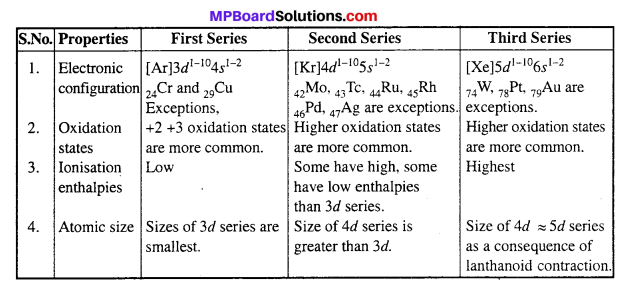
Compare the general characteristics of the first series of the transition metals with those of the second and third series metals in the respective vertical columns. Give special emphasis on the following points:
(i) Electronic configurations
(ii) Oxidation states
(iii) Ionisation enthalpies and
(iv) Atomic sizes.
Answer:
MP Board Class 12th Chemistry Solutions Chapter 8 The d-and f-Block Elements 23

Question 36.
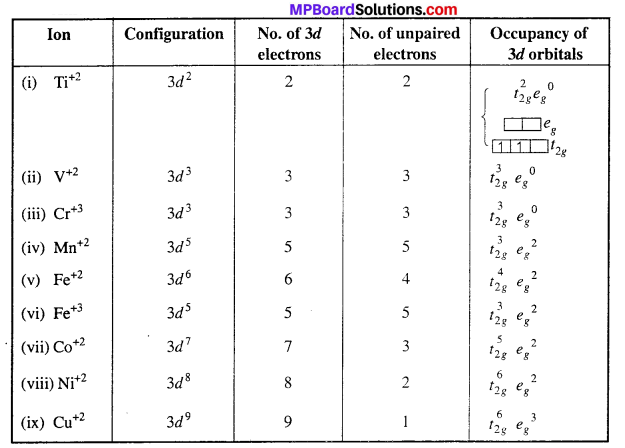
Write down the number of 3d electrons in each of the following ions: Ti2+, V2+, Cr3+, Mn2+, Fe2+, Fe3+, CO2+, Ni2+ and Cu2+. Indicate how would you expect the five 3d orbitals to be occupied for these hydrated ions (Octahedral).
Answer:
MP Board Class 12th Chemistry Solutions Chapter 8 The d-and f-Block Elements 24
Note : About t2g and eg orbitals refer MOT Unit 9.

Question 37.
Comment on the statement that elements of the first transition series possess many properties different from those of heavier transition elements.
Answer:
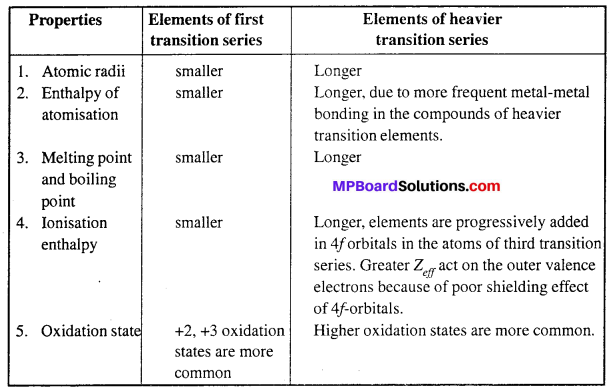
MP Board Class 12th Chemistry Solutions Chapter 8 The d-and f-Block Elements 25

MP Board Solutions

Question 38.
What can be inferred from the magnetic moment values of the following complex species ?
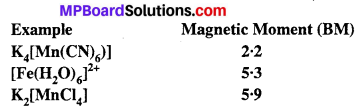
MP Board Class 12th Chemistry Solutions Chapter 8 The d-and f-Block Elements 26
Answer:
K4[Mn(CN)6]
Mn+2 : 3d5, magnetic moment of 2.2 indicates that it has one unpaired electron and hence forms inner orbitals or low spin complex. Its configuration is: t52g.
[Fe(H2O)6]2+
Fe+2 : 3d6, the magnetic moment value is close to 4 unpaired electrons so it forms outer orbital complex having 4 unpaired electrons. Its configuration is : t2g 4eg2g.
K2[MnCl4]
Mn+2: 3d5, the magnetic moment corresponds to 5 unpaired electrons. The cZ-orbitals are not disturbed. So it forms tetrahedral complex. Its configuration is : t2g 3eg2

MP Board Solutions

The d-and f-Block Elements Other Important Questions and Answers

The d-and f-Block Elements Objective Type Questions

Question 1.
Choose the correct answer :

Question 1.
In which of the compounds Mn shows highest oxidation state :
(a) K2MnO4
(b) KMnO4
(c) MnO2
(d) Mn3O4.
Answer:
(b) KMnO4

Question 2.
Which forms interstitial compound :
(a) Fe
(b) Ca
(c) Ni
(d) All of these
Answer:
(b) Ca

Question 3.
In neutral medium equivalent weight of KMnO4 is :
(a) M
(b) M/2
(c) M/3
(d) M/5.
Answer:
(c) M/3

Question 4.
The Lanthanide which is widely used :
(a) Lanthanum
(b) Nobelium
(c) Thorium
(d) Cerium.
Answer:
(d) Cerium.

Question 5.
Electronic configuration of Gadolinium is :
(a) [Xe] 4f6, 5d9, 6s2
(b) [Xe] 4f7, 5d1,6s2
(c) [Xe] 4f3, 5d5, 6s2
(d) [Xe] 4f6, 5d2, 6s2.
Answer:
(b) [Xe] 4f7, 5d1,6s2

Question 6.
Lanthanides contraction is responsible for the fact:
(a) 2r and Y have almost equal radius
(b) Zr and Nb have same oxidation state
(c) Zr and Hf have almost equal radius
(d) Zr and Zn have same oxidation state.
Answer:
(c) Zr and Hf have almost equal radius

Question 7.
In 3d series which elements shows highest oxidation state :
(a) Mn
(b) Fe2+
(c) Ni
(d) Cr.
Answer:
(a) Mn

Question 8.
Which of the transition metal ion is coloured :
(a) Cu+
(b) V2+
(c) Sc3+
(d) Ti4+.
Answer:
(b) V2+

Question 9.
A transition metal which is green in +3 oxidation state and orange in +6 oxidation state is:
(a) Mn
(b) Cr
(c) Os
(d) Fe.
Answer:
(b) Cr

Question 10.
In lanthanides the basicity of lanthanide oxides are :
(a) Increases
(b) Decreases
(c) First increases then decreases
(d) First decreases then increases.
Answer:
(b) Decreases

Question 11.
Number of unpaired electron in Fe+2 ion is :
(a) 0
(b) 4
(c) 6
(d) 3.
Answer:
(b) 4

Question 12.
Fe, Co, Ni, are magnetic substances of which type :
(a) Paramagnetic
(b) Ferromagnetic
(c) Diamagnetic
(d) Anti ferromagnetic.
Answer:
(b) Ferromagnetic

Question 2.
Fill in the blanks :

  1. Metals Fe, CO, Ni are known as ………………………
  2. Ionic size of trivalent cations are ……………………… with increase in atomic numbers.
  3. The transition metals having lower oxidation state shows ……………………… nature.
  4. K2Cr2O7 is a strong ……………………… agent, which gives ……………………… nascent oxygen.
  5. Zn shows only ……………………… oxidation state.
  6. f-block elements are known as ……………………… elements.
  7. Transition elements and their compounds act as ………………………
  8. General electronic configuration of inner transition element is ………………………
  9. Chemical form of Potassium manganate is ………………………
  10. f-block elements are also known as ………………………

Answers:

  1. Ferrous metals
  2. Decreases
  3. Basic
  4. Oxidising 3
  5. + 2
  6. Inner transition
  7. Catalyst
  8. (n-2)f1-14 (n-1)d1-2 ns2
  9. K2MnO4
  10. Transitional Elements.

Question 3.
Match the following :
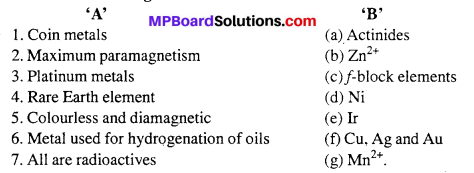
MP Board Class 12th Chemistry Solutions Chapter 8 The d-and f-Block Elements 27
Answers:

  1. (f)
  2. (g)
  3. (e)
  4. (c)
  5. (b)
  6. (d)
  7. (a).

Question 4.
Answer in one word / sentence :

1. Which is colourless Cu2+ or Cu+?
2. In a reaction KMnO4 is replaced by K2MnO4 then what will be the change in oxidation state of Mn ?
3. Which series shows higher oxidation state lanthanides or actinides ?
4. Which oxidation state of lanthanum is most stable ?
5. Write the equivalent weight of K2Cr2O7 in acid medium.
6. How many unpaired electrons are present in Fe3+ ?
7. Give the name of oxidising agent used in chromyl chloride test.
8. Out of (7-block elements, Zn does not show variable valencies, why ?
9. Which is the most important oxidation state of Cu ?
10. f-block elements can be divided into how many series ?
11. What is Lunar caustic ?
12. In d-block elements Zn does not exhibit variable oxidation state. Why ?
13. What is the alkaline solution of HgCl2 and KI known as ?
Answers:
1. Cu+
2. 1
3. Actinides
4. +3
5. 49
6. 5
7. K2Cr2O7
8. Completely filled ‘d’orbitals
9. +2
10. 2
11. AgNO3 (Silver nitrate)
12. Due to fully filled d-orbitals
13. Nessler’s reagent.

MP Board Solutions

The d-and f-Block Elements Short Answer Type Questions

Question 1.
Silver atom has completely filled d-orbitals (4d10) in its ground state. How can you say that it is a transition element ?
Answer:
Silver exhibits 4d105s0 electronic configuration in +1 oxidation state. But in some compounds it exhibits +2 oxidation state. In this state its electronic configuration is 4d95s0. Thus, due to incompletely filled 4d orbital, it is a transition element.

Question 2.
What are Transition elements ? They show metallic character. Why ?
Answer:
Elements whose atoms in their ground state or ions in their common oxidation states have incomplete or partially filled cf orbitals are called transitional elements. They are in group 2 to 13. Example : Fe, Ni, Co, etc.
General formula : (n-1)d1-10 ns1-2
Metallic character of an element depends on its tendency to form cation by loosing one or more electrons from its atom. All transitional elements are metals because they contain one or two electrons in their outermost shell which can be easily lost due to low ionisation energy. Thus, they are metallic in nature.

Question 3.
Why do transition metals exhibit variable oxidation states ?
Answer:
Transition metals exhibit variable valency because the energy subshell (n-1)d and ns are very close. Thus, possibility to lose electrons from ns subshell as well as from (n-1) d subshell is very much if there are unpaired electrons. So oxidation states of these metals may increase.
In these elements Mn shows maximum variable valencies.

Question 4.
Transition elements form alloy easily. Explain.
Answer:
It is the homogeneous mixture of two or more metals or metals with non-metals. Alloys are made to confer the property of metals. Transition elements have great tendency to form alloys because these elements have similar atomic size and can mutually substitute their positions in their crystal lattice. Alloys are comparatively hard and have higher m.p. than the elements from which they are made.

Question 5.
Explain magnetic properties of transitional elements on the basis of their electronic configuration.
Or,
Explain diamagnetism and paramagnetism.
Answer:
Magnetic property : Magnetic property is shown as:
(a) Paramagnetic substances: The substances which are attracted by magnetic field are called as paramagnetic substances. This property of paramagnetism is due to presence of unpaired electrons in atomic orbitals.
Fe, Co and Ni are ferromagnetic because they can be magnetised. Paramagnetism is represented by following formula :
\(\mu=\sqrt{n(n+2)}\)
Where, µ = Magnetic moment, n = Number of unpaired electrons.
(b) Diamagnetic substances : The substances which are repelled by magnetic field are called diamagnetic substances. In this type of substances all electrons are paired. Zinc is a diamagnetic metal.

Question 6.
Transition elements are inactive. Why ?
Answer:
The reason for low reactivity of transition elements are the following :

  1. High ionisation energy.
  2. High value of sublimation or atomization energy.
  3. Small value of hydration energy.
  4. Low value of standard electrode potential.

Question 7.
Write main characteristics of transitional elements.
Answer:
Main characteristics of transitional elements :

  1. Transition metals are metallic in nature which has electropositive character from Ti to Cu.
  2. They are hard and conductor of heat and electricity.
  3. Their b.p. and m.p. are high.
  4. They show variable oxidation states.
  5. These metals form coloured ions.
  6. These metals form co-ordination compounds.
  7. They are generally paramagnetic.
  8. These are good catalysts.
  9. These form alloys.
  10. These form interstitial compounds with non-metals.

Question 8.
Write any five main differences between d and f-Block elements.
Answer:
Differences between d and f-Block Elements :

d-Block Elements:

  1. Two shells n and (n-1) are incomplete.
  2. Last electron enters the d- orbital of penultimate shell.
  3. d-block elements are normally called Transitional element.
  4. d-block elements are available in nature.
  5. These elements exhibit variable oxidation state.
  6. These elements are stable.

f-Block Elements:

  1. Three shells n, (n-1) and (n-2) are inco-mplete.
  2. Last electron enters the orbital of antip-enultimate (n-2) shell.
  3. f-block elements are normally called Inner Transitional element.
  4. f-block elements are very rare. Therefore they are known as Rare Earth elements.
  5. These elements also exhibit variable oxidation state.
  6. These elements are less stable and many are radioactive.

Question 9.
What are Inner Transition elements ?
Answer:
These are the elements which contain (n-2)f and (n-1)d incomplete orbitals or in which electron enter in the antipenultimate (two energy levels below the outermost orbit orbital. These are so called because these are found within the transition elements. There are two types of inner transition elements :
(i) Lanthanides series : The 14 elements after Lanthanum (La57)
i. e., 58Ce – 71 LU are called lanthanides.
(ii) Actinides series : The 14 elements after Actinide (Ac89) i.e., Th90 to Lw103.

Question 10.
Write the name of members of Group 12. Why are they generally not considered as transition elements ?
Answer:
Members of Group 12 are Zn, Cd and Hg which are not included in transition elements because in both their atomic state and in bivalent ion state their electronic configuration is (n – 1)d10 i.e., their d-orbitals are completely filled. Therefore, they are not considered as transition elements.

Question 11.
Write any five characteristics of lanthanides.
Answer:
Five characteristics of lanthanides :

  1. These belongs tof-block because last electron goes to the f-subshell.
  2. These are shining metals like silver.
  3. These are good conductor of heat and electricity.
  4. Melting point and density of these are high.
  5. From La to Lu, atomic radii decreases continuously, it is called lanthanide contraction.

Question 12.
What is the reason that the ionisation energy of 5d series elements is higher than the series ?
Answer:
On moving from top to bottom in a group, value of ionisation energy decreases, but ionisation energy of elements of 5d series is higher than that of elements of 4d series. This is because of the presence of 14 Lanthanide elements in between due to which their size does not increase appreciably. Thus, attractive force between the nucleus and outermost electron is more and this is the cause of higher ionisation potential.

Question 13.
(i) Transition metals possess the ability, to form complex compounds. Explain.
(ii) Zn, Cd and Hg do not show the properties of Transition elements.
(iii) Why is Ti known as a wonder metal ?
Answer:
(i) Cause of formation of complex compounds by Transition metals :
(a) Small size of ions of these elements and high nuclear charge due to which these ions attract ligands.
(b) They possess vacant zforbitals in order to accomodate the electron pair donated by ligand.

(ii) Elements in which (n-1) d-orbital is partially filled are known as Transition elements.
Whereas in Zn [3d10 4s2], in Cd [4d10 5s2] and in Hg [5d10 6s2] state is found. Therefore, these do not show the properties of Transition elements.

(iii) Titanium is a shining white metal. It is extented strong (harder than steel), has high m.p. Good conductor of electric current resistant to corrosion and light metal. Due to all these qualities, it is called wonder metal.

Question 14.
The radius of Fe2+ ion is smaller than the radius of Mn2+ ion, why ?
Answer:
The atomic number of Fe (26) is more than the atomic number of Mn (25). Due to higher value of atomic number, iron nucleus contains more protons. Hence the force of attraction between the nucleus and the electrons of outermost orbit is more. Due to strong attractive force of the nucleus the electron cloud is pulled inwards which results in smaller size of Fe2+ ion as compared to Mn2+ ion.

Question 15.
Why is it difficult to separate lanthanide group ? Explain.
Answer:
The 14 inner transition elements which come after lanthanum (atomic number 57) are called lanthanides. In these elements, the incoming electrons enter in 4f – orbital leaving 5th and 6th orbital.

Separation of lanthanide is not possible due to lanthanide contractions. All lanthanides have quite similar properties. This is the reason why it is difficult to separate.

Question 16.
(i) TiO2 is white whereas TiCl3 is violet, why ?
(ii) In first transitional series paramagnetism increases till Cr then it starts de-creasing. Why ?
Answer:
(i) In TiO2, Ti is in +4 oxidation state (3d04s0) having a vacant d-orbital hence there is no d-d transition and it is white. On the other hand, in TiCl3, Ti is in +3 oxidation state (3d1 4s0) having one unpaired electron in its 3d- orbital, hence it is coloured.
(ii) In first transitional series, the number of unpaired electrons till Cr (3d5) increases and then due to pairing the number of unpaired electrons decreases. Thus, due to this at first paramagnetism increases till Cr and then it decreases.

Question 17.
Write chromyl chloride test with equation.
Answer:
Chromyl Chloride Test: 1. When a metal chloride is heated with solid potassium dichromate and cone. H2SO4 orange coloured vapours of chromyl chloride are formed.
K2Cr2O7 + 6H2SO4 + 4KCl → 2CrO2Cl2 ↑+ 6KHSO4 + 3H2O
2. When these fumes are passed in sodium hydroxide solution, yellow solution of sodium chromate is obtained. When lead acetate is added to it in presence of acetic acid yellow precipitate of lead chromate is obtained.
MP Board Class 12th Chemistry Solutions Chapter 8 The d-and f-Block Elements 28

Question 18.
Write names, symbols and electronic configuration of first transition series.
Answer:
First transition series: In the elements of this series from Sc21 to Cu29 electrons are filled in 3d-orbitals. The general electronic configuration of first transition series is 3d1-10 4s2. In these elements electronic configuration of Cr24 and Cu29 is 3d5 4s1 and 3d10 4s1 respectively.
MP Board Class 12th Chemistry Solutions Chapter 8 The d-and f-Block Elements 29

Question 19.
Write general electronic configuration of f-block elements. Write any two uses of lanthanides. Write any two uses of Actinides.
Answer:
General outer electronic configuration of f-block element is :
(n – 2)f1-14 (n – 1)d0-1 ns2.
Uses of Lanthanides : 1. Alloys of lanthanides are called mischmetals and it is used in manufacture of heat resistant, stainless and instrumental steel.
2. Lanthanides compounds are used in ceramic industry, paints, textile industry.
Uses of Actinides : 1. Compound of Thorium are used in cancer treatment.
2. Uranium are used for nuclear energy and its compounds are used in ceramic, medicine etc.

Question 20.
Write uses of KMnO4 and K2Cr2O7.
Answer:
Uses of KMnO4 :

  1. As a disinfectant for water.
  2. As an oxidizing agent in the laboratory and industry.
  3. For qualitative detection of halides, oxalates, sulphites etc.

Uses of K2Cr2O7:

  1. In calico printing and dyeing.
  2. As an oxidizing agent.
  3. In chrome tanning in lather industry.
  4. In volumetric analysis, it is used in the estimation of ferrous and iodides in redox titration.

Question 21.
Why generally Zn, Cd and Hg are not considered as transition elements ?
Answer:
The atom or ion of an element having incomplete d-orbital is called transition element. On the basis of this definition Zn, Cd and Hg which have complete d-orbital should not be included in J-block elements infact these elements do not resemble d-block in a number of properties, even then these elements are included in d-block element therefore Zn, Cd and Hg are called non-typical transition elements while rest of all transition elements are called typical elements.

Question 22.
Explain Cu+ is colourless while Cu+2 is coloured.
Answer:
If a transition metal contain unpaired electron, it shows paramagnetism and forms coloured compound. In Cu+ d-orbital is partially filled (3d9) thus Cu+ is colourless and diamagnetic while Cu+2 is coloured and paramagnetic.

MP Board Solutions

Question 23.
What are transition elements ? In how many series they are divided ? Explain.
Answer:
In modern periodic table elements present between 5-block and p-block elements are called transition elements or elements having partially filled d-orbitals are called transition elements. These are known as d-block elements because last electron enters the d-orbitals e.g., Iron (Fe), Chromium (Cr).
Division of d block → Elements of this block has been divided into four series :

(i) First transition series or 3d series → These elements have last electrons in 3d subshell. These series contain 10 elements from atomic number 21 to 30 in fourth period. i.e.
MP Board Class 12th Chemistry Solutions Chapter 8 The d-and f-Block Elements 30

(ii) Second transition series or 4d series → This series include 10 elements from atomic number 39 to 48 in fifth period. The last electron enters in 4d orbitals.
MP Board Class 12th Chemistry Solutions Chapter 8 The d-and f-Block Elements 31

(iii) Third transition series or 5d series → This series also contain 10 elements of 6th period from atomic number 57, 72 to 80. The last electron’ enters in 5d orbitals e.g.
MP Board Class 12th Chemistry Solutions Chapter 8 The d-and f-Block Elements 32
Elements between La (57) and Hf (72) i.e. from Ce (58) to Lu (71) are called lanthanides or inner transition elements.

(iv) Fourth transition series or 6d series → This series is incomplete. It starts with Actinium (89). Elements between Actinium (89) and Meitnerium (109) are called as Acti-nides. The last electron enters in 6d orbitals, e.g.
MP Board Class 12th Chemistry Solutions Chapter 8 The d-and f-Block Elements 33

MP Board Solutions

The d-and f-Block Elements Long Answer Type Questions

Question 1.
Giving the electronic configuration of Lanthanide, explain their oxidation state.
Answer:
Lanthanide series : In this series electrons are filled in 4f-sub-shell. Normal electronic configuration of these electrons are (n-2)f1 to 14 (n-1)0 to 1 ns2. Total number of lanthanides are 14 which start from atomic number 58 (Cerium) to atomic number 71 (Lutetium). The main characteristics of this series are following :

Oxidation state: Highest oxidation state of lanthanides is (+3). It is due to loss of 2s electron and one d electron in La. Electronic configuration of La3+ is similar to Xe = 54, which is most stable. Some elements also show +2 and +4 oxidation state because these elements losing 2 or 4 electrons get stable configuration of f7 or f14 e.g., Ce4+(4f1), Tb+(4f8),Er2+(4f11),Yb2+(4f13) but Sm2+,Tm2+ are the exceptions.

Normally +4 oxidation state of lanthanides act as strong oxidizing agent. Like Ce+4 is a good oxidant of aqueous solution which changes to +4 and +3. On the other side +2 oxidation state of lanthanides act as strong reductant. Like Sm2+, Eu2+ and Yb2+ ions, are good reductants which get oxidized in aqueous solution from +2 to +3.

Chemical reactivity : Initial members of this series are highly reactive with the in-crease in atomic number reactivity decreases and are less reactive like Al of high atomic number. Lanthanides react with H2 at 575-675 K temperature forming LaH3. They react with C, X2,O2 and S to form carbide (M2O3 and M2S3), oxide and sulphide. Maximum compounds show +3 oxidation state but some elements also exhibit +2 and +4 oxidation state. On reacting with water, oxides of lanthanides form insoluble hydroxide. These oxides are stronger base than Al(OH)3 but weaker base than Ca(OH)2. These hydroxides react with CO2 to form carbonate.

MP Board Solutions

Question 2.
Explain the oxidizing property of KMnO4 in acidic, neutral and alkaline medium giving two examples each.
Answer:
KMnO4 acts as strong oxidizing agent in acidic, neutral and alkaline medium.
In acidic medium: It oxidizes in presence of dilute H2SO4 and get reduced.
2KMnO4 + 3H2SO4 → K2SO4 + 2MnSO4 + 3H2O + 5[O]
e.g., (i) It oxidizes ferrous salt into ferric salt,
MP Board Class 12th Chemistry Solutions Chapter 8 The d-and f-Block Elements 34

(ii) It oxidizes oxalate to CO2 :
2KMnO4 + 3H2SO4 + 5C2H2O4 → K2SO4 + 2MnSO4 + 8H2O + 10CO2

(iii) It oxidizes iodide ion to iodine :
2KMnO4 + 10KI + 8H2SO4 → 6K2SO4 + 2MnSO4 + 8H2O + 5I2

(iv) It oxidizes nitrites to nitrates :
2KMnO4 + 3H2SO4 + 5NaNO2 → 2MnSO4 + K2SO4 + 5NaNO3 + 3H2O

In neutral medium: In this medium, the reaction begins with neutral ethylene glycol but this does not give neutral reaction because KOH formed in the reaction makes basic in nature.
2KMnO4 + H2O → 2KOH + 2MnO2 + 3[O]
e.g., (i) It oxidizes manganous sulphate to manganese dioxide.
2KMnO4 + 3MnSO4 + 2H2O → 5MnO2 + K2SO4 + 2H2SO4

(ii) It oxidizes hydrogen sulphide to sulphur.
2KMnO4 + 4H2S → 2MnS + K2SO4 + 4H2O + S
In alkaline medium : In alkaline medium, reduces to MnO2 and gives 3 nascent oxygen.
e.g., (i) It oxidizes ethylene to ethylene glycol.
MP Board Class 12th Chemistry Solutions Chapter 8 The d-and f-Block Elements 35
(ii) It oxidizes iodide to iodate.
2 KMnO4 + H2O + KI → 2 MnO2 + 2 KOH + KIO3
Potassium iodate

KMnO4 gives more number of nascent oxygen in acidic medium than in alkaline medium due to which it acts as stronger oxidizing agent in acidic medium.
Uses of KMnO4: (i) As an oxidizing agent or as Baeyer’s solution in laboratory and industry.
(ii) In the manufacture of saccharin, benzoic acid, etc.

MP Board Class 12th Chemistry Solutions

MP Board Class 9th Hindi Navneet Solutions पद्य Chapter 7 सामाजिक समरसता

MP Board Class 9th Hindi Navneet Solutions पद्य Chapter 7 सामाजिक समरसता

सामाजिक समरसता अभ्यास

बोध प्रश्न

सामाजिक समरसता अति लघु उत्तरीय प्रश्न

प्रश्न 1.
कृष्ण और सुदामा कौन थे?
उत्तर:
कृष्ण और सुदामा बाल्यावस्था के घनिष्ठ मित्र थे।

प्रश्न 2.
सुदामा की पत्नी ने उन्हें क्या सलाह दी?
उत्तर:
सुदामा की पत्नी ने सुदामा को यह सलाह दी कि तुम्हारे बचपन के मित्र श्रीकृष्ण द्वारिका के राजा हैं अतः इस विपत्ति में तुम उनके पास चले जाओ, वे तुम्हारी सहायता करेंगे।

प्रश्न 3.
शबरी के आश्रम में कौन आये थे?
उत्तर:
शबरी के आश्रम में राम और लक्ष्मण दोनों भाई आये थे।

प्रश्न 4.
शबरी ने राम को प्रेम सहित खाने को क्या दिया?
उत्तर:
शबरी ने राम को प्रेम सहित कन्द, मूल एवं फल खाने को दिए।

प्रश्न 5.
शबरी के मुँह से शब्द क्यों नहीं निकल पा रहे थे?
उत्तर:
शबरी श्रीराम के प्रेम में इतनी मग्न हो गई थी कि उसके मुँह से शब्द तक नहीं निकल पा रहे थे।

MP Board Solutions

सामाजिक समरसता लघु उत्तरीय प्रश्न

प्रश्न 1.
शबरी ने अपने आश्रम में श्रीराम का किस प्रकार स्वागत किया?
उत्तर:
शबरी ने अपने आश्रम में राम का प्रेमपूर्वक स्वागत किया। उसने आदर के साथ जल लेकर प्रभु के चरण पखारे तत्पश्चात् उन्हें सुन्दर आसन पर बैठाया।

प्रश्न 2.
द्वारपाल द्वारा वर्णित सुदामा का चित्र अपने शब्दों में लिखिए।
उत्तर:
द्वारपाल ने जाकर श्रीकृष्ण से कहा कि हे प्रभु! एक अनजान व्यक्ति आया हुआ है, उसके सिर पर न तो पगड़ी है, और न शरीर पर झंगा है। न मालूम वह किस गाँव का रहने वाला है। उसकी धोती फटी हुई है और उसका दुपट्टा भी जीर्ण-शीर्ण है। वह अपने पैरों में जूते भी नहीं पहने हुए हैं। बड़े आश्चर्य से आपके महलों को देख रहा है और अपना नाम सुदामा बता रहा है।

प्रश्न 3.
सुदामा द्वारा पोटली न दिये जाने पर कृष्ण ने कौन-सी बातें याद दिलाईं ?
उत्तर:
सुदामा द्वारा सुदामा की पत्नी द्वारा भेजे गये चार मुट्ठी चावलों की पोटली न दिये जाने पर कृष्ण ने कहा कि हे मित्र! तुम चोरी की कला में बचपन से ही निपुण हो। जब बचपन में गुरुमाता ने हमें चबाने के लिए चने दिये थे तो तुमने चुपचाप चोरी से खा लिये थे संभवत: तुम्हारी वही चोरी की आदत आज भी नहीं छूटी है तभी तो तुम भाभी द्वारा दिये गये चावलों की पोटली को काँख में छिपाए हए हो।

प्रश्न 4.
बिना भक्ति के मनुष्य की स्थिति किस प्रकार की हो जाती है?
उत्तर:
बिना भक्ति के मनुष्य की स्थिति जलरहित बादलों के समान होती है अर्थात् जैसे जलरहित बादल किसी काम में नहीं आते हैं उसी तरह भक्ति रहित मनुष्य भी संसार में किसी के काम नहीं आता है।

प्रश्न 5.
शबरी और राम प्रसंग सामाजिक समरसता का अनूठा उदाहरण है, समझाइए।
उत्तर:
शबरी निम्न जाति की भीलनी थी और राम चक्रवर्ती सम्राट दशरथ के पुत्र थे पर जब श्रीराम वन में शबरी के आश्रम पर पहुँचे तो उसके आतिथ्य को बड़े ही प्रेम से स्वीकारा। उसके द्वारा परोसे गये कन्द, मूल और फलों को प्रेम से खाया। उन्होंने जाति-पाँति का भेद न करके प्रेम को महत्त्व प्रदान किया। इस प्रकार शबरी और राम प्रसंग सामाजिक समरसता का अनूठा उदाहरण है।

सामाजिक समरसता दीर्घ उत्तरीय प्रश्न

प्रश्न 1.
श्रीकृष्ण और सुदामा की मैत्री का वर्णन अपने शब्दों में कीजिए।
उत्तर:
श्रीकृष्ण और सुदामा की मैत्री सच्ची थी। यह मैत्री बचपन में ही पाठशाला से शुरू होती है और जीवन भर चलती है। संयोग से कृष्ण द्वारिका के राजा बन जाते हैं और सुदामा दरिद्र बनकर भीख माँगकर अपना पेट पालता है। एक दिन सुदामा की पत्नी ने राजा श्रीकृष्ण के पास जाने की बात कही। पत्नी की बात मानकर सुदामा द्वारिका पहुँच जाते हैं। जब द्वारपाल के द्वारा सुदामा के आने की सूचना मिलती है, तो वे अपना राज-काज छोड़कर अपने मित्र का स्वागत करते हैं। मित्र सुदामा की दीन दशा देखकर वे अपने नेत्रों के आँसुओं से ही उनके पैर धो देते हैं। बिना सुदामा को बताये वे सुदामा को भी अपने समान सम्पन्न बना देते हैं।

प्रश्न 2.
सुदामा ने जब द्वारिका का वैभव देखा तो उनके मन में क्या विचार आए?
उत्तर:
सुदामा ने जब द्वारिका का वैभव देखा तो उनकी दृष्टि स्वर्ण निर्मित भवनों को देखकर चौंधिया गई। वहाँ उन्होंने देखा कि एक से बढ़कर एक द्वारिका के भवन हैं। वहाँ बिना पूछे कोई किसी से बात तक नहीं कर रहा है, ऐसा लगता है कि वहाँ के सभी लोग मौन साधकर देवताओं की तरह बैठे हुए हैं।

प्रश्न 3.
नवधा भक्ति समझाइए।
उत्तर:
श्रीराम ने भक्ति के नौ प्रकार बताए हैं, ये नौ प्रकार ही नवधा भक्ति के नाम से जाने जाते हैं। यह उपदेश श्रीराम ने शबरी को देते हुए कहा है कि प्रथम प्रकार की भक्ति संत पुरुषों की संगति है। दूसरी प्रकार की भक्ति मेरी कथा में प्रीति रखना है, तीसरी भक्ति गुरु के चरण कमलों की निरभिमान भाव से सेवा करना है। चौथी भक्ति कपट त्यागकर निश्छल हृदय से मेरा गुणगान करना है। पाँचवीं भक्ति मंत्रों का जाप करना, मुझ पर दृढ़ विश्वास करना और वेद विहित कर्म करना है।

छठी भक्ति इन्द्रियों को वश में रखना, शील धारण करना, सकाम कर्मों से विरक्त रहना और सज्जनों के धर्म का अनुसरण करना है। सातवीं प्रकार की भक्ति सारे संसार को मेरे स्वरूप में देखना, सब में समान भाव रखना तथा मुझसे भी अधिक सन्तपुरुषों को सम्मान देना है। आठवीं भक्ति जथा लाभ संतोष करना, स्वप्न में भी दूसरों के दोष न देखना है। नवीं भक्ति सबसे सरलता का व्यवहार करना, निष्कपट होना, मुझ पर अटूट श्रद्धा रखना, हृदय में प्रसन्नता का भाव रखना और स्वयं को दीनहीन न समझना है। आगे श्रीराम कहते हैं कि इन नौ प्रकार की भक्ति में से जिनके पास कोई एक भी हो, तो वह मनुष्य मुझे सम्पूर्ण संसार में प्रिय है।

प्रश्न 4.
निम्नलिखित काव्यांश की सप्रसंग व्याख्या कीजिए
(क) ऐसे बेहाल…………….पग धोए।
उत्तर:
कवि कहता है कि जब श्रीकृष्ण ने सुदामा की दयनीय दशा को देखा तो वे भावविह्वल हो उठे। वे उनके पैरों की बिवाइयों एवं पैरों में चुभे हुए काँटों को देखकर दुःखी हो उठे और फिर उन्होंने अपने मित्र से कहा कि हे मित्र! तुमने इतना कष्ट उठाया? तुम इधर अर्थात् हमारे पास क्यों नहीं आए? इतने दिन तक तुम कहाँ रहे? सुदामा की इस दीन दशा को देखकर करुणा के सागर श्रीकृष्ण अत्यन्त दुःख करके रोने लगे। सुदामा के पैरों को धोने के लिए परात में रखे हुए पानी को तो उन्होंने हाथ भी नहीं लगाया तथा अपने नेत्रों से झरने वाले आँसुओं से ही सुदामा के चरण धो डाले।

MP Board Solutions

सामाजिक समरसता काव्य सौन्दर्य

प्रश्न 1.
रूढ़, यौगिक और योगरूढ़ शब्द छाँटिए-
पंकज, मित्र, गुरुबंधु, दीनबंधु, धर, मुकुट, किनारीदार, राजधर्म।
उत्तर:
रूढ़ शब्द-मित्र, धर, मुकुट। यौगिक शब्द-गुरुबंधु, दीनबंधु, किनारीदार। योगरूढ़ शब्द-पंकज, राजधर्म।

प्रश्न 2.
दिये गये शब्दों में उपसर्ग और प्रत्यय छाँटिए-
सुशील, परलोक, अनाथन, अधीर, बेहाल, चतुराई।
उत्तर:
उपसर्ग – सु + शील, पर + लोक, अ + धीर, बे + हाल।
प्रत्यय – अनाथन (न प्रत्यय), चतुराई (आई प्रत्यय।)

प्रश्न 3.
निम्नलिखित शब्दों के विलोम शब्द लिखिएसत्य, धर्म, प्रिय, सुलभ, सुमति, अहित, सुअवसर, संत।
उत्तर:
सत्य-असत्य, धर्म-अधर्म, प्रिय-अप्रिय, सुलभ-दुर्लभ, सुमति-कुमति, अहित-हित, सुअवसरकुअवसर, संत-दुष्ट, असंत।

प्रश्न 4.
निम्नलिखित शब्दों के तीन-तीन पर्यायवाची शब्द लिखिए।
नभ, कमल, लोचन, जग, पिता।
उत्तर:
नभ – गगन, अम्बर, आकाश।
कमल – सरसिज, पंकज, वारिज।
लोचन – नेत्र, चक्षु, अक्षि।
जग – जगत्, संसार, लोक।
पिता – जनक; तात, पितृ।

प्रश्न 5.
ते दोउ बंधु………………तब कीन्हीं॥
चापत चरन………………जल जाता॥
उठे लषनु………………..राम सुजान।
(1) यह प्रसंग किस काव्य से लिया गया है?
उत्तर:
उपर्युक्त तीनों प्रसंग गोस्वामी तुलसीदास कृत ‘रामचरितमानस’ से लिए गये हैं।

(2) ‘रामचरितमानस’ के उपर्युक्त अंश में कौन-से छन्द आये हैं?
उत्तर:
‘रामचरितमानस’ के उपर्युक्त अंश में से प्रथम दो में चौपाई छन्द तथा अन्तिम में दोहा छन्द है।

(3) चौपाई और दोहा छन्द की क्या पहचान है?
उत्तर:
चौपाई-यह एक मात्रिक छन्द है। इसमें चार चरण होते हैं और प्रत्येक चरण में 16-16 मात्राएँ होती हैं। पहले तुक चरण की दूसरे चरण से और तीसरे चरण की चौथे चरण से मिलती है।

दोहा-यह एक मात्रिक छन्द है। इसके विषम चरणों में 13-13 मात्राएँ और सम चरणों में 11-11 मात्राएँ होती हैं। कुल 48 मात्राएँ होती हैं।

प्रश्न 6.
इस पाठ में किन-किन छन्दों को तुलसीदास ने अपनाया है ? प्रत्येक छन्द का इसी पाठ से एक-एक उदाहरण लिखिए।
उत्तर:
इस पाठ में तुलसीदास ने दोहा एवं चौपाई छन्दों को अपनाया है। उदाहरण प्रस्तुत हैं-
चौपाई-
जाति-पाँति कुल धर्म बड़ाई। धनबल परिजन गुन चतुराई।
भगतिहीन नर सोहइ कैसा। बिनु जल वारिद देखिअ जैसा।

दोहा-
गुरु पद पंकज सेवा तीसरि भगति अमान।
चौथि भगति मम गुन गन करइ कपट तजि गान॥

MP Board Solutions

सुदामा चरित संदर्भ-प्रसंगसहित व्याख्या

विप्र सुदामा बसत हो, सदा आपने धाम।
भीग माँगी भोजन करे, हिये जपत हरि नाम।
ताकी घरनी पतिव्रता, गहै वेद की रीति।
सलज सुसील सुबुद्धि अति, पति-सेवा सौं प्रीति॥
कहो, सुदामा एक दिन, कृष्ण हमारे मित्र।
करत रहित उपदेश तिय, ऐसो परम विचित्र ॥1॥

कठिन शब्दार्थ :
विप्र = ब्राह्मण; धाम = घर; हिये = हृदय में; घरनी = पत्नी; गहै = ग्रहण करती है, चलती है; सलज = लज्जाशील; सुबुद्धि = अच्छी बुद्धिवाली; सौं = से; प्रीति = प्रेम; तिय = पत्नी से।

सन्दर्भ :
प्रस्तुत पद्यांश कविवर नरोत्तमदास रचित ‘सुदामा चरित्र’ से लिया गया है।

प्रसंग :
प्रस्तुत पद्य में कवि ने सुदामा की स्थिति और दिनचर्या का वर्णन किया है।

व्याख्या :
कविवर नरोत्तमदास जी कहते हैं कि ब्राह्मण सुदामा अपने घर में रहता था, वह भीख माँगकर भोजन करता था और अपने हृदय में हरि नाम का जाप करता रहता था। उनकी पत्नी बड़ी ही पतिव्रता थी और वह सदैव वेदों के बताये मार्ग पर चलती थी। वह लज्जाशील, सुशील एवं अच्छी बुद्धि वाली थी तथा सदैव पति की सेवा में लगी रहती थी। एक दिन सुदामा ने अपनी पत्नी से कहा कि कृष्ण मेरे मित्र हैं। इस मित्रता की बातें वह नित्य अपनी पत्नी से किया करता था।

विशेष :

  1. सुदामा कृष्ण के बाल सखा एवं सहपाठी थे।
  2. वे सन्तोषी ब्राह्मण थे तथा भिक्षाटन किया करते थे।
  3. सलज सुसील सुबुद्धि-में अनुप्रास अलंकार।
  4. भाषा सहज एवं सरल है।

स्त्री
लोचन-कमल दुख-मोचन तिलक भाल,
स्रबननि कुंडल मुकुट धरे माथ है।
ओढ़े पीत बसन गरे मैं, बैजयंती माल,
संख चक्र गदा और पदम लिय हाथ है।
कहत नरोतम संदीपनि गुरु के पास।
तुम ही कहत हम पढ़े एक साथ हैं।
द्वारिका के गए हरि दारिद हरेंगे पिय,
द्वारिका के नाथ वै अनाथन के नाथ हैं ॥2॥

कठिन शब्दार्थ :
लोचन = नेत्र; दुख मोचन = दुखों को दूर करने वाला; सवननि – कानों में; माथ = माथे पर; पीत बसन = पीले वस्त्र कर = हाथ; पद्म = कमल; संदीपनि गुरु = इन्हीं गुरु के आश्रम में कृष्ण और सुदामा सहपाठी थे; हरि = भगवान; दारिद = दरिद्रता; अनाथन = गरीबों के।

सन्दर्भ :
पूर्ववत्।

प्रसंग ;
प्रस्तुत पद्यांश के पूर्वार्द्ध में सुदामा की पत्नी भगवान की रूप छवि का वर्णन करती है फिर वह अपने पति से द्वारिका जाने का आग्रह करती है।।

व्याख्या :
कविवर नरोत्तमदास जी कहते हैं कि सुदामा की पत्नी पहले तो भगवान की रूप छवि का वर्णन करती है कि भगवान के नेत्र कमल जैसे हैं और उनके माथे पर जो तिलक लगा हुआ है वह दु:खों का नाश करने वाला है। उनके कानों में कुंडल लटक रहे हैं तथा माथे पर मुकुट धारण किये हुए हैं। वे पीत वस्त्र ओढ़े हुए हैं तथा उनके गले में वैजयन्ती माला शोभा दे रही है। उनके चारों हाथों में शंख, चक्र, गदा और कमल रखे हुए हैं।

नरोत्तम कवि कहते हैं कि सुदामा की पत्नी सुदामा से कहती है कि तुम्ही हमें यह बताया करते हो कि हम दोनों संदीपन गुरु के आश्रम में एक साथ ही पढ़ते थे। हे प्रियतम! श्रीकृष्ण तुम्हारे मित्र हैं तो तुम निश्चय ही द्वारका को चले जाओ। तुम्हारी दीन दशा देखकर वे तुम्हारे दरिद्रों को दूर कर देंगे। हे प्रिय! द्वारिका के नाथ भगवान श्रीकृष्ण अनाथों एवं बेसहारा लोगों के नाथ हैं अर्थात् उनको सहायता प्रदान करने वाले हैं।

विशेष :

  1. कवि ने पद के पूर्वार्द्ध में चतुर्भुज भगवान की मोहक रूप छवि का वर्णन किया है।
  2. श्रीकृष्ण और सुदामा संदीपन गुरु के आश्रम में एक साथ पढ़े थे।
  3. अनुप्रास अलंकार।
  4. भाषा सहज एवं सरल।

MP Board Solutions

सुदामा
सिच्छक हौं सिगरे जग को तिय, ताको कहा अब देति है सिच्छा

जे तप ते परलोक सुधारत, संपति की तिनके नहि इच्छा
मेरे हिये हरि के पद पंकज, बार हजार लै देखि परीच्छा।
औरन को धन चाहिए, बावरि, बामन को धन केवल भिच्छा ॥3॥

कठिन शब्दार्थ :
सिच्छक = शिक्षक: सिगरे = सम्पूर्णः तिय = पत्नी; हिये = हृदय में; पद पंकज = चरण रूपी कमल; परीच्छा = परीक्षा; बावरि = पगली; बामन = ब्राह्मण।

सन्दर्भ :
पूर्ववत्।

प्रसंग :
इस पद में सुदामा अपनी पत्नी को समझाते हुए कहता है कि ब्राह्मण को कभी धन की इच्छा नहीं करनी चाहिए।

व्याख्या :
हे प्रिय! तू जो बार-बार श्रीकृष्ण के पास द्वारिका जाने की शिक्षा दे रही है सो तो ठीक है पर तू यह भी अच्छी तरह से जान ले कि मैं ब्राह्मण होने के नाते सारे संसार का शिक्षक हूँ और अब तू उसी ब्राह्मण को इस प्रकार की शिक्षा दे रही है। हम ब्राह्मणों का धर्म तो तपस्या करके अपने परलोक को सुधारना है और साथ ही हममें सम्पत्ति एवं धन के लिए नाममात्र की भी इच्छा नहीं है।

हे प्रिय! मेरे हृदय में तो सदैव भगवान के चरण-कमल विराजे रहते हैं चाहे तू हजार बार मेरी परीक्षा लेकर देख ले। हे पगली स्त्री! धन की चाहना तो और जाति के लोग करते हैं हमारा धन तो केवल भिक्षा ही है।

विशेष :

  1. सुदामा एक संतोषी ब्राह्मण थे। उन्हें भौतिक सुखों से कोई लगाव नहीं था।
  2. पद पंकज में रूपक, अन्यत्र-अनुप्रास अलंकार।
  3. भाषा सहज एवं सरल।

स्त्री
कोदा सवाँ जुरतो भरि पेट, न चाहति हौं दधि दूध मिठौती।
सीत वितीत कियो सिसयातहि हों, हठती मैं तुम्हें न हठौती॥
जो जनती न हित हरि सों तुम्हें काहे को द्वारके पेलि पठौती।
या घर तें न गयौ कबहूँ पिय, टूटो तवा अरू फूटी कठौती ॥4॥

शब्दार्थ :
कोदा सवाँ = चावल की सबसे घटिया किस्म; मिठौती = मिष्ठान्न; सीत = जाड़ा; वितीत = बिता दिया; सिसयातहि = ठिठुरते हुए; हठती = अपनी जिद्द से हट जाती; न हठौती = तुम्हें तुम्हारी जिद्द से न हटाती; हितू = मित्रता; पेलि पठौती = जबरन भेजती; अरु = और; कठौती = काठ (लकड़ी) की परात जिसमें आटा गूंथा जाता है।

सन्दर्भ :
पूर्ववत्।

प्रसंग :
प्रस्तुत पद में सुदामा की पत्नी अपनी दयनीय दशा का वर्णन करते हुए सुदामा को कृष्ण के पास जाने का आग्रह करती है।

व्याख्या :
सुदामा की पत्नी सुदामा से कह रही है कि यदि मुझे भर पेट कोदों और सवों के चावल भी मिल जाते तो मैं कभी भी दही, दूध और मिठाई की चाहना न करती। जाड़े की रातें मैंने ठिठुरते हुए ही बिता दीं। मैं अपनी जिद्द (कि तुम द्वारिका चले जाओ) से हट जाती पर तुम्हें तुम्हारी जिद्द से न हटाती। यदि मुझे यह पता न होता कि श्रीकृष्ण से तुम्हारी मित्रता है तो मैं तुम्हें जबरन द्वारिका भेजने की जिद्द न करती। हे पतिदेव! हमारा तो यह दुर्भाग्य है कि इस घर से कभी भी टूटा हुआ तवा और फूटी हुई कठौती नहीं गई।

विशेष :

  1. गरीबी की दयनीय दशा का वर्णन है।
  2. सुदामा की पत्नी कष्टों को सहने वाली है।
  3. भाषा सहज एवं सरल।

सुदामा
छोड़ि सबै जक तोहिं लगी बक, आठहु जाम यहै जक ठानी।
जातहि देहें लदाय लढ़ा भरि, लैहों लदाय यह जिय जानी॥
पार्वै कहां ते अटारी अटा, जिनके विधि दीन्हीं है टूटी-सी छानी।
जो पै दरिद्र लिखो है ललाट तो, काहू पै मेटि न जात अजानी ॥5॥

कठिन शब्दार्थ :
जक = बातें; बक= वे सिर पैर की बातें कहना; आठहु जाम = आठों पहर अर्थात् चौबीस घण्टे; जक = जिद्द, जातहिं = जाते ही; लढ़ा = बैलगाड़ी; लैहों लदाय = मैं लदा लूँगा, भर लूँगा; यहै= यही बात; जिय जानी = अपने हृदय में मान लिया है; अटारी अटा = ऊँची-ऊँची हवेलियाँ, महल; विधि = भाग्य में; छानी = छप्पर; दरिद्र = गरीबी; ललाट = भाग्य में; अजानी = हे अज्ञानी स्त्री।

सन्दर्भ :
पूर्ववत्।

प्रसंग :
कवि कहता है कि पत्नी की द्वारिका (श्रीकृष्ण के पास) जाने की जिद्द का उत्तर देते हुए सुदामा कहते हैं।

व्याख्या :
कवि कहता है कि सुदामा अपनी पत्नी से कहते हैं कि तूने और सब सार्थक बातें करना तो छोड़ दिया है केवल निराधार एक ही बात की रट लगाये हुए है, अब तू चौबीस घण्टे केवल एक ही बात को लेकर अड़ गयी है। तू यह समझती है कि जैसे ही मैं द्वारिका पहुँचूँगा तो वे गाड़ी भरकर मुझे दे देंगे और मैं उस धन सम्पत्ति को लदाकर तेरे पास आ जाऊँगा। हे बावली स्त्री! तू यह क्यों नहीं सोचती है कि विधाता ने जिनके भाग्य में टूटा-सा छप्पर दिया है, वे ऊँचे-ऊँचे महल और हवेलियाँ कहाँ से प्राप्त कर लेंगे। हे अज्ञानी स्त्री ! जिनके भाग्य में दरिद्रता लिखी हुई है वह किसी से भी मिटाये नहीं मिटती है।

विशेष :

  1. सुदामा भाग्यवादी है।
  2. पत्नी अपने मन में यह समझती है कि कृष्ण मित्र सुदामा को धन वैभव से सम्पन्न कर देंगे।
  3. अनुप्रास अलंकार की छटा।

MP Board Solutions

स्त्री
बिप्र के भगत हरि जगत विदित बंधु,
लेत सब ही की सुध ऐसे महादानि हैं।
पढ़े एक चटसार कहीं तुम कैयो बार,
लोचन-अपार वै तुम्हें न पहिचानि हैं,
एक दीनबंधु, कृपासिंधु फेरि गुरुबंधु,
तुम-सम कौन दीन जाको जिय जानी है?
नाम लेत चौगुनी, गए तें द्वारा सोगुनी सो,
देखत सहस्र गुनी प्रीति प्रभु मानि है ॥6॥

कठिन शब्दार्थ :
विप्र के भगत = ब्राह्मणों के भक्त; हरि = श्रीकृष्ण; जगत् = संसार में; विदित = जाने जाते हैं; सुधि = खबर; चटसार = पाठशाला में; कैयो बार = अनेक बार; लोचन-अपार = उनकी दृष्टि महान् एवं दूरदर्शी है; दीनबंधु = गरीबों के भाई; कृपासिंधु = कृपा के सागर; सम= समान; सहस्त्र = हजार गुनी।

सन्दर्भ :
पूर्ववत्।

प्रसंग :
सुदामा के वचनों का उत्तर देती हुई उनकी पत्नी कहती है।

व्याख्या :
सुदामा की पत्नी सुदामा से कहती है कि भगवान श्रीकृष्ण ब्राह्मणों के भक्त हैं, वे एक श्रेष्ठ बंधु हैं यह बात सारा संसार जानता है। वे तो ऐसे महादानी हैं कि वे सभी प्राणियों की खबर लेते रहते हैं। तुमने तो मुझसे अनेक बार कहा है कि तुम श्रीकृष्ण के साथ एक ही पाठशाला में पढ़े हो, उनकी दृष्टि बड़ी अपार है, फिर वे तुम्हें क्यों नहीं पहचान लेंगे ? अर्थात् अवश्य पहचान लेंगे। एक तो वे श्रीकृष्ण दीन लोगों के सच्चे बंधु हैं, वे कृपा के सागर हैं और फिर तुम्हारे तो वे गुरुभाई हैं। इस समय तुम्हारे समान दुनिया में कौन दीन है जिसको वे अपने हृदय में नहीं जानते होंगे ? अर्थात् वे तुम्हारी दीनता को अवश्य ही जानते होंगे। अंत में सुदामा की पत्नी सुदामा से कहती है कि प्रभु श्रीकृष्ण का नाम लेते ही प्रभु भक्त के प्रेमभाव को चौगुना, उनके यहाँ जाने पर प्रेमभाव को सौ गुना और उनका दर्शन करते ही प्रेमभाव को वे हजार गुना मानते हैं।

विशेष :

  1. अपने वाक् चातुर्य से सुदामा की पत्नी सुदामा को निरुत्तर कर देती है।
  2. अनुप्रास की छटा।
  3. भाषा सहज, सरल एवं भावानुकूल है।

सुदामा
द्वारिका जाहु जू द्वारिका जाहू जू, आठहु जाम यहै जक तेरे।
जौ न कहो करिए तो बड़ो दुख, जैए कहाँ अपनी गति हेरे॥
द्वार खरे प्रभु के छरिया, तहं भूपति जान न पावत नेरे।
पाँच सुपारी तें देंखु विचारिक, भेंट को चारि न चाउर मेरे॥
यह सुनिके तब ब्राह्मनी, गई परोसिनि-पास।
पाव-सेर चाउर लिए, आई संहित हुलास॥
सिद्धि करी गनपति सुमिरि, बांधि दुपटिया खूट।
मांगत खात चले तहाँ, मारग बाली-बूट॥
दीठि चकचौँधि गई देखते सुबर्नमई,
एक तें सरस एक द्वारिका के भौन हैं।
पूछे बिन कोऊ कहूं काहू सौं न करें बात,
देवता से बैठे सब साधि-साधि मौन हैं।
देखत सुदामें धाय पौरजन गहे पाय,
कृपा करि कहौ विप्र कहाँ कीन्ह गौन है?
धीरज अधीर के, हरन पर पीर के,
बताओ बलबीर के महल यहाँ कौन है? ॥7॥

कठिन शब्दार्थ :
जक = जिद्द; जैए कहाँ = कहाँ जाएँ; गति = दशा; हेरे = देखें; छरिया = हाथ में दण्ड धारण किये हुए; तहँ = उस स्थान पर; भूपति = राजा लोग; जान न पावत = जा नहीं पाते हैं; नेरे = समीप; चाउर = चावल; ब्राह्मनी = ब्राह्मण सुदामा की पत्नी; सहित हुलास = आनन्द के साथ; गनपति = गणेशजी; सुमिरि = स्मरण करके; दुपटिया = दुपट्टे में; छूट = गाँठ; दीठि= दृष्टि; चकचौंधि = चौंधिया गई; सुबर्नमई = स्वर्ण से बनी हुई; सरस = सुन्दर; भौन = भवन, महल; साधि-साधि मौन है = मौन धारण कर सब बैठे हुए हैं; धाय = दौड़कर; पौर जन = नगर निवासी; गहे पाय = चरण पकड़ लिए; विप्र = ब्राह्मण; गौन = गमन, जाना; धीरज अधीर के = अधीर लोगों को धीरज देने वाले; हरन पर पीर के = दूसरों की पीड़ा को हरने वाले बलबीर = बलदाऊ के भाई अर्थात् श्रीकृष्ण।

सन्दर्भ :
पूर्ववत्।

प्रसंग :
सुदामा अपनी पत्नी द्वारा बार-बार कहे जाने पर विवश होकर द्वारिका जाने को तैयार हो जाते हैं, उसी समय का वर्णन है।

व्याख्या :
सुदामा जी अपनी पत्नी से कहते हैं कि तुमने तो द्वारिका जाने की एक तरह से आठों पहर रट लगा रखी है। यदि मैं तुम्हारी बात नहीं मानता हूँ तो तुम्हें बहुत दुःख होगा और यदि मैं तुम्हारी बात मानकर द्वारिका चला भी जाऊँ तो मेरी स्थिति कैसी होगी, यह तुम नहीं जानती हो। जब मैं वहाँ पहुँचूँगा तो श्रीकृष्ण के महल के बाहर दण्डधारी द्वारपाल खड़े मिलेंगे, उस जगह बड़े-बड़े राजा भी सरलता से नहीं जा सकते हैं फिर मेरी तो बिसात ही क्या है? शायद तुम यह भी नहीं जानती हो कि राजा के पास कभी भी खाली हाथ नहीं जाया जाता है। वहाँ जाने के लिए कम-से-कम पाँच सुपाड़ी तो होनी ही चाहिए जो मेरे पास नहीं है। इतना ही नहीं यदि पाँच सुपाड़ी न भी हों तो कम से कम चार मुट्ठी चावल तो होना ही चाहिए, संयोग से वह भी हमारे घर नहीं है। तो सोचो ऐसी दशा में वहाँ जाना कैसे सम्भव है।

सुदामा के मुख से यह बात सुनकर तब सुदामा की पत्नी अपनी पड़ोसिन के पास गई और उससे पाव भर चावल उधार लेकर बड़े ही उल्लास एवं उमंग के साथ आ गई। सबसे पहले भगवान! गणेश का स्मरण कर और अपने दुपट्टे के एक छोर में चावल रखकर तथा उसमें गाँठ लगाकर और उसे कन्धे पर रखकर माँग कर खाते हुए वे द्वारिका के मार्ग पर चल निकले।

सुदामा जी बीहड़ मार्ग को पार कर जैसे ही द्वारिका नगरी में पहुँचते हैं तो वहाँ के स्वर्ण निर्मित जगमगाते हुए भवनों को देखकर जो एक से एक सुन्दर हैं, उनकी दृष्टि चौंधिया जाती है। वहाँ के लोगों की एक विचित्र दशा यह है कि कोई भी व्यक्ति बिना पूछे किसी से कोई बात ही नहीं कर रहा है तथा वे सभी लोग अपना-अपना मौन साधकर देवता जैसे बैठे हए हैं।

जैसे ही द्वारिका के नागरिकों ने सुदामा को देखा तो उन्होंने दौड़कर सुदामा के पैर पकड़ लिए और विनती करके कहने लगे कि हे विप्रवर! कृपा करके यह बतलाएँ कि आपको कहाँ जाना है? यह बात सुनकर सुदामा बोले कि जो अधीर लोगों को धैर्य धारण कराते हैं, दूसरों की पीड़ा को हरते हैं तथा जो बलराम के भाई हैं, उन्हीं का घर कृपया बता दीजिए।

विशेष :

  1. सुदामा की सहज भावना का वर्णन किया गया है।
  2. अनुप्रास की छटा है।
  3. भाषा सहज, सरल एवं भावानुकूल है।
  4. शास्त्रों के अनुसार मान्यता है कि राजा एवं गुरु के पास कभी भी खाली हाथ नहीं जाना चाहिए।

MP Board Solutions

द्वारपाल
सीस पगा न झगा तन पै, प्रभु जाने को आहि, बसै केहि ग्रामा।
धोती फटी सी लटी दुपटी, अरूपाय उपानह की नहि सामा॥
द्वार खरौ द्विज दुर्बल एक, रह्यो चकि सौ बसुधा अभिरामा।
पूछत दीनदयाल को धाम, बतावत आपनो नाम सुदामा ॥8॥

कठिन शब्दाधं :
सीस = सिर पर; पगा = पगड़ी; झगा = झंगा एक प्रकार का कुर्ता; आहि = है; बसै = रहता है; केहि= कौन से; ग्रामा = गाँव में; लटी दुपटी = दुपट्टा जीर्ण-शीर्ण है; अरु = और; उपानह = जूता; सामा = सामर्थ्य; खरौ = खड़ा है; दुर्बल = कमजोर; चकि = चकित होकर; वसुधा = पृथ्वी; अभिरामा = सुन्दर; धाम = भवन।

सन्दर्भ :
पूर्ववत्।

प्रसंग :
सुदामा के द्वारिका पहुँचने पर श्रीकृष्ण का द्वारपाल श्रीकृष्ण को सुदामा की वेशभूषा के बारे में बताता है।

व्याख्या ;
द्वारपाल ने श्रीकृष्ण से कहा कि हे प्रभु! कोई एक अनजान व्यक्ति आपसे मिलता चाहता है। उसके सिर पर न तो पगड़ी है और न शरीर पर झंगा ही है। न जाने वह कौन है और किस गाँव में रहता है। उसकी धोती फटी हुई है और उसका दुपट्टा भी चीथड़ा बना हुआ है। उसके पैरों में जूते भी नहीं हैं। हे प्रभु! द्वार पर इस प्रकार का एक अत्यन्त दीन एवं कृशकाय ब्राह्मण खड़ा हुआ है। वह बड़े आश्चर्य से इस सुन्दर भूमि को देख रहा है। वह दीनदयाल श्रीकृष्ण अर्थात् आपका भवन पूछ रहा है और अपना नाम सुदामा बता रहा है।

विशेष :

  1. कवि ने सुदामा की दीन-हीन दशा का बड़ा ही मार्मिक वर्णन किया है।
  2. अनुप्रास अलंकार की छटा।
  3. भाषा सहज, सरल एवं भावानुकूल।

बोल्यौ द्वारपालक सुदामा नाम पांडे,
सुनि, छांड़े राज-काज ऐसे जी की गति जाने को?
द्वारिका के नाथ हाथ जोरि धाय गहे पाँय,
भेंट लपटाय करि ऐसे दुख सानै को?
नैन दोऊ जल भरि पूछत कुसल हरि,
बिप्र बौल्यौ बिपदा में मोहि पहिचाने को?
जैसी तुम करी तैसी करै को कृपा के सिन्धु।
ऐसी प्रीति दीनबंधु दीनन सो माने को? ॥9॥

कठिन शब्दार्थ :
छांड़े = छोड़ दिए; गति = दशा; को = कौन; धाय = दौड़कर; भेंट = गले लगना; विपदा = विपत्ति; मोहि = मुझे कृपा के सिंधु = दया के सागर; दीनबन्धु = दीनों के बंधु; दीनन = गरीबों से।

सन्दर्भ :
पूर्ववत्।

प्रसंग :
प्रस्तुत पद्यांश में उस समय का वर्णन है जब द्वारपाल ने श्रीकृष्ण के पास जाकर सुदामा नाम बताया तो श्रीकृष्ण राज-काज छोड़कर सुदामा से मिलने के लिए पैदल ही दौड़ पड़े।

व्याख्या :
कवि कहता है कि जैसे ही द्वारपाल ने श्रीकृष्ण को यह बताया कि कोई सुदामा नाम का ब्राह्मण आपका धाम पूछ रहा है तो श्रीकृष्ण राज-काज को छोड़कर सुदामा से मिलने के लिए व्याकुल हो उठे। उस समय उनके हृदय की गति को कोई नहीं समझ सकता। द्वारिका के नाथ श्रीकृष्ण ने हाथ जोड़कर तथा दौड़कर सुदामा के पैर पकड़ लिए और फिर उन्हें गले से लगाकर उनकी दुःखभरी दीन स्थिति को देखकर दोनों नेत्रों में जल भरकर सुदामा की कुशल क्षेम पूछने लगे। श्रीकृष्ण से इतना अधिक प्रेम पाकर सुदामा भाव-विभोर होकर श्रीकृष्ण से कहने लगे कि हे प्रभु! इस विपत्ति काल में मुझे कौन पहचानता है? अर्थात् कोई नहीं। किन्तु हे दया के सागर ! जिस प्रकार से आपने मेरा सम्मान किया और कुशल क्षेम पूछी, इस प्रकार की प्रीति आपके अतिरिक्त और कौन कर सकता है? अर्थात् कोई नहीं। आप दीनों के बंधु हैं, दीनों की कुशल क्षेम पूछते हैं अन्यथा अन्य कोई तो दीनों को समझता ही कहाँ है?

विशेष :

  1. दीन सुदामा और दीनबन्धु श्रीकृष्ण की भेंट का बड़ा ही भावपूर्ण चित्रण हुआ है।
  2. कृष्ण एवं सुदामा की मानसिक दशा का सूक्ष्म वर्णन हुआ है।
  3. अनुप्रास अलंकार।
  4. सहज एवं सरल ब्रजभाषा का प्रयोग।

ऐसे बेहाल बेवाइन सों, पग कंटक जाल लगे पुनि जोए।
हाय महादुख पायो सखा, तुम आए इतै न कितै दिन खोए।।
देखि सुदामा की दीनं दसा, करुना करिकै करुनानिधि रोए।
पानी परात को हाथ छुयौ नहिं, नैनन के जल सों पग धोए ॥10॥

कठिन शब्दार्थ :
बेहाल = बुरी दशा में; बेवाइन = फटे हुए पैरों के घाव; कंटक जाल = काँटों का झुण्ड; जोए = देखने लगे; इतै = इधर; कितै = किधर; दीन दसा = दयनीय दशा; करुणानिधि = करुणा के सागर; नैनन के जल = आँसुओं से; पग = पैर।

सन्दर्भ :
पूर्ववत्।

प्रसंग :
श्रीकृष्ण और सुदामा की भेंट होने पर सुदामा की दीनदशा, फटी हुई बिवाइयों एवं पैरों में लगे हुए काँटों को देखकर श्रीकृष्ण भाव विह्वल हो उठते हैं। उसी का यहाँ वर्णन है।

व्याख्या :
कवि कहता है कि जब श्रीकृष्ण ने सुदामा की दयनीय दशा को देखा तो वे भावविह्वल हो उठे। वे उनके पैरों की बिवाइयों एवं पैरों में चुभे हुए काँटों को देखकर दुःखी हो उठे और फिर उन्होंने अपने मित्र से कहा कि हे मित्र! तुमने इतना कष्ट उठाया? तुम इधर अर्थात् हमारे पास क्यों नहीं आए? इतने दिन तक तुम कहाँ रहे? सुदामा की इस दीन दशा को देखकर करुणा के सागर श्रीकृष्ण अत्यन्त दुःख करके रोने लगे। सुदामा के पैरों को धोने के लिए परात में रखे हुए पानी को तो उन्होंने हाथ भी नहीं लगाया तथा अपने नेत्रों से झरने वाले आँसुओं से ही सुदामा के चरण धो डाले।

विशेष :

  1. कवि ने कृष्ण सुदामा की सच्ची मित्रता का अत्यन्त भावग्राही चित्रण किया है।
  2. भगवान तो वास्तव में सच्ची भक्ति के वश में रहते हैं। इसी भाव का यहाँ अंकन हुआ है।
  3. पानी परात को हाथ छुओ नहिं नैनन के जल सों पग धोए-में अतिशयोक्ति अलंकार।
  4. भाषा सहज, सरल एवं भावानुकूल है।

MP Board Solutions

श्रीकृष्ण
कछु भाभी हमको दियो, सो तुम काहे न देत।
चाँपी पोटरी काँख में, रहे कहो केहि हेत॥
आगे चना गुरु-माता देत ते लए तुम चाबि हमें नहिं दीने।
स्याम कहो मुसुकाय सुदामा सों, चोरी की बानि मैं हो जू प्रबीने॥
पोटरी काँख में चाँपि रहे तुम, खोलत नाहिं सुधा-रस भीने।
पाछिली बानि अजौ न तजौ तुम, तैसेइ भाभी के तंदुल कीने॥
देनो हुतो तो दे चुके, बिप्र न जानी गाथ।
चलती बेर गोपालजू, कछु न दीन्हौ हाथ ॥11॥

कठिन शब्दार्थ :
चाँपी = दबा रखी है; पोटरी = पुटरिया; = केहि हेत = किस लिए; गुरु माता = संदीपनि गुरु की धर्म पत्नी; चाबि = चबा कर खा लिए; बानि = आदत; प्रबीने = चतुर; सुधारस भीने = अमृत रस से सिक्त; पाछिली = पुरानी; अजौ = अब भी; तंदुल = चावल; गाथ = कहानी; बेर = समय।

सन्दर्भ :
पूर्ववत्।

प्रसंग :
सुदामा श्रीकृष्ण की भेंट के समय यद्यपि अपनी पत्नी के हाथ से चार मुट्ठी चावल श्रीकृष्ण को देने के लिए लाये थे, पर वे संकोचवश उन्हें नहीं दे सके तो श्रीकृष्ण ने उनकी काँख में दबी हुई पोटली के बारे में पूछ ही लिया, उसी का यहाँ वर्णन है।

व्याख्या :
कवि कहता है कि श्रीकृष्ण ने अपने मित्र सुदामा से पूछा कि क्या मेरी भाभी ने हमारे लिए कुछ भेंट के रूप में भेजा है? जो हमारी भाभी ने मेरे लिए भेंट भेजी है उसे तुम मुझे क्यों नहीं देते हो? बताओ तो सही भाभी द्वारा दी हुई भेंट की पोटरी को तुम काँख में किसलिए छिपाए हुए हो?

फिर श्रीकृष्ण बचपन की एक घटना सुदामा को स्मरण दिलाते हुए सुनाते हैं कि बचपन में जब हम तुम एक साथ पाठशाला में पढ़ते थे तो गुरुमाता ने जंगल से ईंधन लाने के लिए हम दोनों को भेजा था और साथ ही गुरुमाता ने चबाने के लिए कुछ भुने हुए चने भी बाँधकर तुम्हें दे दिए थे कि जब भूख लगे तो तुम दोनों खा लेना लेकिन तुमने मेरे साथ कपट किया और अकेले ही उन चनों को चबा लिया था। फिर श्रीकृष्ण मुस्कराकर सुदामा से कहते हैं कि हे मित्र! तुम तो बचपन से ही चोरी की कला में चतुर रहे हो। तुम काँख में दबी हुई उस पोटरी को क्यों नहीं खोल रहे हो जिसमें अमृत रस से भीगे हुए चावल रखे हुए हैं। ऐसा लगता है कि तुमने अपनी पिछली चोरी की आदत आज भी नहीं छोड़ी है और इसी कारण मेरी भाभी द्वारा भेजे. चावलों को भी तुम मुझसे छिपा रहे हो। – इस प्रकार अपने मित्र के दुःखों को दूर करने हेतु श्रीकृष्ण जो कुछ भी दे सकते थे वह उन्होंने बिना सुदामा को बताये दे दिया लेकिन प्रत्यक्ष रूप में गोपाल जी ने उनके हाथ में कुछ नहीं दिया।

विशेष :

  1. अन्तिम दो पंक्तियों में श्रीकृष्ण ने प्रत्यक्ष रूप में तो सुदामा को कुछ नहीं दिया पर अप्रत्यक्ष रूप से उन्हें दो लोक का स्वामी बना दिया है।
  2. अनुप्रास अलंकार की छटा।
  3. भाषा, सहज, सरल एवं भावानुकूल है।

सुदामा
वह पुलकनि वह उठि मिलनी, वह आदर की भांति।
यह पठवनि गोपाल की, कछु न जानी जाति॥
घर-घर कर ओड़त फिरे, तनक दही के काज।
कहो भयौ जो अब भयौ, हरिको राज-समाज॥
हौं कब इत आवत हुतौ, बाही पठयौ ठेलि।
कहिहौ धन सो जाइकै, अब धन धरौ सकेलि ॥12॥

कठिन शब्दार्थ :
पुलकनि = पुलकित दशा, रोमांचित होना; पठवनि = भेजना; घर-घर = द्वार-द्वार पर; ओड़त-फिरे = माँगते फिरते हैं; तनक= थोड़े; कहो भयौ = जो कुछ मैं कहता था; जो अब भयौ = वही हो गया; इत = इधर; आवत हुतौ = आना चाह रहा था; बाही = उसी ने अर्थात् मेरी पत्नी ने; पठ्यौ ठेलि= जबरदस्ती भेज दिया; धरौ सकेलि = इकट्ठा करके धर लो।

सन्दर्भ :
पूर्ववत्।

प्रसंग :
प्रकट में श्रीकृष्ण ने जब सुदामा को कुछ नहीं दिया तो सुदामा हतोत्साहित होकर अपनी व्यथा का वर्णन करते हैं।

व्याख्या :
कवि कहता है कि सुदामा श्रीकृष्ण की भेंट के समय दोनों में कैसी पुलकन थी, कैसा दोनों का उठना-बैठना और मिलना था और कैसा श्रीकृष्ण द्वारा दिया गया आदर-सम्मान था? श्रीकृष्ण ने जब सुदामा को विदा किया तो कैसे किया? ये बातें कोई भी जान नहीं सका अर्थात् श्रीकृष्ण ने अपने मित्र की दशा देखकर उन्हें जो दो लोकों का राज्य दे दिया उसे केवल श्रीकृष्ण के अलावा कोई नहीं जानता था।

सुदामा निराश होकर कहने लग जाते हैं कि मैं तो थोड़े-से दही की चाहना में द्वार-द्वार भीख माँगता फिरता था लेकिन उस दशा में भी मैं सन्तुष्ट था लेकिन पत्नी की हठ के कारण यहाँ श्रीकृष्ण की द्वारिका में आकर मुझे क्या प्राप्त हुआ अर्थात् कुछ भी नहीं। राजाओं के राज-समाज की तो अनोखी गति होती है। मैं तो इधर किसी भी कीमत पर आना नहीं चाहता था पर मेरी उस घरवाली ने मुझे जबरन जिद्द करके इधर द्वारिका भेज दिया। अब मैं घर लौटकर अपनी गृहिणी से कहूँगा कि मैं जो अपने साथ बहुत सारा धन लेकर आया हूँ उसे तुम भली-भाँति सजाकर रख लो।

विशेष :

  1. सुदामा की खीझ का वर्णन है।
  2. अनुप्रास की छटा।
  3. भाषा सहज, सरल एवं भावानुकूल।

MP Board Solutions

वैसेई राज-समाज बने, गज-बाजि घने, मन संभ्रम छायौ।
वैसेई कंचन के सब धाम है, द्वारिकै माहि नौं फिरी आयो।
भौन बिलोकि ये को मन लोचत-सोचत ही सब गाँव मँझायो।
पूछत पांडे फिर सबसों, पर झोंपरी को कहुँ खोज न पायो।। ॥13॥

कठिन शब्दार्थ ;
वैसेई = वैसे ही; गज-बाजि = हाथी घोड़े; घने = बहुत अधिक; संभ्रम = धोखा, भ्रम; कंचन = सोना; धाम = महल; बिलोकि = देखकर, मंझायो = ढूँढ़ डाला।

सन्दर्भ :
पूर्ववत्।

प्रसंग :
यहां उस समय का वर्णन है जब सुदामा लौटकर अपने घर आ जाते हैं पर यहाँ के ठाठ-बाट देखकर वे चकरा जाते हैं कि कहीं मैं पुनः लौटकर द्वारिका तो नहीं पहुँच गया।

व्याख्या :
कवि कहता है कि जब सुदामा द्वारिका से लौटकर अपने घर वापस आते हैं तो उन्हें वैसे ही ठाठ-बाट यहाँ देखने को मिलते हैं। वे देखते हैं कि यहाँ भी वैसा ही राज-समाज बैठा हुआ है जैसा कि द्वारिका में था। वैसे ही हाथी, घोड़े और सोने के महल हैं। सुदामा को लगता है कि कहीं वह भूलकर फिर से द्वारिका तो नहीं आ गया है। सारे भवनों को देखते-देखते उन्होंने पूरा गाँव घूम लिया वे सभी लोगों से अपनी पुरानी झोंपड़ी के बारे में पूछते हैं पर उन्हें अपनी वह पुरानी झोंपड़ी नहीं मिली।

विशेष :

  1. अपने घर की नई बसावट एवं सजावट देखकर सुदामा को भ्रम उत्पन्न हो जाता है कि कहीं वे लौटकर फिर द्वारिका तो नहीं आ गये।
  2. भाषा सहज, सरल एवं भावपूर्ण है।

कनक दंड कर में लिए, द्वारपाल है द्वार।
जाय दिखायौ सबनि लै, या है महल तुम्हार॥
टूटी-सी मडैया मेरी परी हुती याही ठौर,
तामै परो दु:ख काटौं हेम-धाम री।
जेवर-जराऊ तुम साजे प्रति अंग-अंग,
सखी सोहें, संग वह छूछी हुती छाम री॥
तुम तौ पटंबर री ओढ़े हो किनारीदार।
सारी जरतारी, वह ओढ़े कारी कामरी।
मेरी वा पँडाइन तिहानी अनुहार ही पै,
विपदा-सताई वह पाई कहाँ पामरी।। ॥14॥

कठिन शब्दार्थ :
कनक दंड = सोने का दण्डा; सबनि = सबने; मडैया = छाया हुआ छोटा-सा छप्पर; परी-हुती = पड़ी हुई थी; याही ठौर = इसी स्थान पर; हेम-धाम = स्वर्ण निर्मित महल; जेवर-जराऊ = जड़े हुए जेवर; साजे = सज रहे हैं; प्रति अंग-अंग = हर अंग में; छूछी हुती = बिना आभूषण के; छामरी = पतली दुबली; पटंबर = ऊपरी वस्त्र; सारी = साड़ी; जरतारी = जरदोई के काम वाली; कारी कामरी = काला कम्बल; पँडाइन = पंडिताइन; अनुहार ही पै = तुम्हारी जैसी ही; विपदा = विपत्ति; पामरी = बेचारी।

सन्दर्भ :
पूर्ववत्।

प्रसंग ;
सुदामा जी द्वारिका से जब अपने घर लौटते हैं तो वहाँ की भव्य अभिराम छवि को देखकर वे हक्के-बक्के रह जाते हैं और अपनी टूटी-सी छानी तथा अपनी पंडिताइन को ढूँढ़ते फिरते हैं, इसी का यहाँ वर्णन है।

व्याख्या :
कवि कहता है कि जब सुदामा श्रीकृष्ण से भेंट करने के पश्चात् द्वारिका से अपने घर वापस आते हैं तो भगवान की कृपा से सुदामा के घर पर कंचन बरसने लगता है। उनके मकान आदि भी वैसे ही भव्य हो जाते हैं जैसे कि द्वारिका में थे तो वे आश्चर्य चकित होकर कहने लगते हैं कि यहाँ तो द्वार पर खड़े द्वारपाल अपने हाथों में स्वर्ण निर्मित डण्डा लिए हुए हैं। फिर नगर के अन्य लोगों ने सुदामा को ले जाकर उन्हें बताया कि यही तुम्हारा महल है।

इस पर सुदामा कहने लगते हैं कि मेरी तो इस स्थान पर टूटी सी मडैया खड़ी हुई थी, उसी में मैं अपने दुःखों को काटता रहता था, पर अब यहाँ स्वर्ण निर्मित भवन कहाँ से आ गये? उसी घर पर एक स्त्री खड़ी हुई मिलती है उसे देखकर सुसुदामा जी कहते हैं कि हे भाग्यवती! तुम्हारे अंग-प्रत्यंग पर तो जड़ाऊ जेवर शोभा दे रहे हैं साथ ही तुम्हारे साथ तो सखियाँ भी हैं लेकिन मेरी वह पंडिताइन तो बिना किसी आभूषण के पतली-दुबली सी थी। तुम तो किनारीदार पटंबर पहने हुए हो साथ ही तुम्हारी साड़ी भी जरदोई के काम से युक्त है लेकिन मेरी पंडिताइन तो केवल काली कामरी ओढ़े रहती थी। इतना अवश्य है कि मेरी वह पंडिताइन तुम जैसी ही लगती थी। विपत्ति ने मेरा साथ नहीं छोड़ा है। मैं अपनी उस भोली-भाली पंडिताइन को कहाँ से पा सकूँगा।

विशेष :

  1. भगवान श्रीकृष्ण ने अपनी कृपा से सुदामा को भी राजसी ठाठ-बाट प्रदान कर दिए हैं पर भगवान ने अपना रहस्य सुदामा को नहीं बताया था इसीलिए वह दिग्भ्रम हो रहा है।
  2. भाषा, सहज, सरल एवं भावानुकूल है।

MP Board Solutions

कै वह टूटी-सी छानी, हती, कहै कंचन के सब धाम सुहावत।
कै पग मैं पनही न हती, कहै लै गजराजहु ठाढ़े महावत॥
भूमि कठोर पै रात कटै, कै कोमल सेज पै नींद न आवत।
के जुरतो नहीं कोदो सवाँ, प्रभु के परताप तैदाख न भावत ॥15॥

कठिन शब्दार्थ :
कै= कहाँ छानी = टूटी झोंपड़ी, छप्पर; हती = थी; कंचन = सोने के; धाम = महल; सुहावत = शोभा दे रहे हैं; पनहीं = जूते; जुरतो नहीं = जुड़ता नहीं था, मिलता नहीं था; कोदों सवाँ = चावल की सस्ती एवं मोटी जाति; परताप = महिमा; तै = से; दाख = अंगूर।

सन्दर्भ :
पूर्ववत्।

प्रसंग :
इस अंश में बताया गया है कि भगवान श्रीकृष्ण की कृपा से सुदामा के बुरे दिन फिर गये।

व्याख्या :
कवि कहता है कि सुदामा कहते हैं कि जहाँ वह टूटी-सी झोंपड़ी पड़ी हुई थी अब वहीं पर सुन्दर-सुन्दर सोने के महल शोभायमान हो रहे हैं। कहाँ तो सुदामा के पैरों में जूता तक न था अब भगवान की कृपा से उन्हें ले जाने के लिए गजराजों के साथ महावत खड़े हुए हैं। कहाँ तो कठोर भूमि पर (बिना बिस्तरों के) रात कट जाती थी कहाँ अब कोमल शैया पर भी नींद नहीं आ रही है। कहाँ खाने के लिए कोदों और सवाँ के चावल भी नहीं मिलते थे और कहाँ अब ईश्वर की महिमा से अंगूर भी नहीं खाये जा रहे हैं।

विशेष :

  1. भगवान की कृपा से भक्तों के दिन फिर जाते हैं जैसे कि सुदामा के।
  2. प्रभु की महिमा का बखान है।
  3. भाषा सहज, सरल एवं भावानुकूल है।
  4. अनुप्रास की छटा।

शबरी प्रसंग संदर्भ-प्रसंगसहित व्याख्या

कहि निज धर्म ताहि समुझावा। निज पद प्रीति देखि मनभावा॥
रघुपति चरन कमल सिरु नाई। गयऊ गगन आपनि गति पाई॥
ताहि देइ गति राम उदारा। सबरी के आश्रम पगु धारा॥
सबरी देखि राम गृह आए। मुनि के वचन समुझि जिय भाए।
सरसिज लोचन बाहु बिसाला। जटा मुकुट सिर उर वनमाला॥
स्याम गौर सुन्दर दोउ भाई। सबरी परी चरन लपटाई॥
प्रेम मगन मुख वचन न आवा। पुनि पुनि पद सरोज सिर नावा॥
सादर जल लैं चरन पखारे। पुनि सुन्दर आसन बैठारे॥
दोहा-कंद मूल फल सुरस अति दिएराम कहूँ आनि।
प्रेम सहित प्रभुः खाए बारंबार बखानि ॥1॥

कठिन शब्दार्थ-निज धर्म = भागवत धर्म; आपनि गति = गन्धर्व का स्वरूप; उदारा = दयालु; सरसिज = कमल; लोचन = नेत्र; सरोज = कमल; पुनि = पुनः; सुरस = रसपूर्ण; बारंबार = बार-बार।

सन्दर्भ :
प्रस्तुत अंश ‘सामाजिक समरसता’ के शीर्षक ‘शबरी प्रसंग’ से लिया गया है। इसके रचयिता महाकवि तुलसी दास हैं। यह प्रसंग मूलतः ‘अरण्य काण्ड’ से लिया गया है।

प्रसंग :
गिद्धराज जटायु का अन्तिम संस्कार करने के पश्चात् सीताजी की खोज में दोनों भाई आगे चले। उस मार्ग में कबंध नामक राक्षस जब सामने आया तो श्रीराम ने उसका वध कर डाला। कबंध राक्षस ने अपने शाप की बात श्रीराम से कही। श्रीराम ने कबंध से कहा हे, गंधर्व। सुनो, मैं तुमसे कुछ कहता हूँ

व्याख्या :
कविवर तुलसीदास कहते हैं कि तब श्रीराम ने उसे (कबंध को) अपना भागवत धर्म समझाते हुए कहा। अपने चरणों में प्रेम देखकर वह उनके मन को अच्छा लगा। तत्पश्चात् श्रीरघुनाथ जी के चरण कमलों में सिर नवाकर वह अपनी गति (गन्धर्व स्वरूप) पाकर आकाश में चला गया। उदार श्रीराम जी उसे गति देकर शबरी के आश्रम में पधारे। शबरी ने श्रीरामचन्द्र जी को घर में आते देखा. तो मुनि मतंग जी के वचनों को याद करके उनका मन प्रसन्न हो गया।

कमल जैसे नेत्र और विशाल भुजा वाले, सिर पर जटाओं का मुकुट और हृदय पर वनमाला धारण किये हुए सुन्दर साँवले और गोरे दोनों भाइयों के चरणों में शबरी लिपट गयीं। वे प्रेम में इतनी डूब गयीं कि उनके मुख से वचन तक नहीं निकला। वे बार-बार प्रभु के चरण-कमलों में सिर झुका रही हैं। इसके पश्चात् उन्होंने जल लेकर आदरपूर्वक दोनों भाइयों के चरण धोये फिर उन्हें सुन्दर आसानों पर बैठाया। शबरी ने अत्यन्त रसदार और स्वादिष्ट कन्द, मूल और फल लाकर श्रीराम जी को दिए। प्रभु ने बार-बार प्रशंसा करके उन्हें प्रेम सहित खाया।

विशेष :

  1. श्रीराम भक्तवत्सल हैं। शबरी की भक्ति भावना देखकर वे उसके आश्रम पर जाते हैं तथा उसके द्वारा दिये गये कन्द, मूल और फलों को प्रेम सहित खाते हैं।
  2. भाषा अवधी है।
  3. उपमा, रूपक एवं अनुप्रास अलंकारों का प्रयोग।
  4. दोहा चौपाई छन्द का प्रयोग।

MP Board Solutions

जातिपाँति कुल धर्म बड़ाई। धन बल परिजन गुन चतुराई।
भगति हीन नर सोहइ कैसा। बिनु जल बारिद देखिअ जैसा॥
नवधा भगति कहऊँ तोहि पाहीं। सावधान सुनु धरू मन माहीं॥
प्रथम भगति सन्तन्ह कर संगा। दूसरि रति मम कथा प्रसंग।
दोहा-गुर पद पंकज सेवा तीसरि भगति अमान।
चौथि भगति मम गुन गन करइ कपट तजि गान ॥2॥

कठिन शब्दार्थ :
भगतिहीन = भक्ति भावना से रहित; वारिद = बादल; नवधा = नौ प्रकार की; रति = प्रेम; पद पंकज = चरण कमल; मम = मेरे।

सन्दर्भ :
पूर्ववत्।

प्रसंग :
इस अंश में भक्ति की महिमा का बखान किया गया है। भक्ति के आगे जाति, पाँति, कुल धर्म आदि का कोई महत्त्व नहीं है।

व्याख्या :
कविवर तुलसीदास जी कहते हैं भगवान श्रीराम शबरी को भक्ति की महिमा बताते हुए कहते हैं कि जाति-पाँति, कुल, धर्म, बड़ाई, धन, बल, कुटुम्ब, गुण और चतुरता इन सबके होने पर भी भक्ति रहित मनुष्य कैसा लगता है जैसे जलहीन बादल दिखाई पड़ता है।

आगे श्रीराम कहते हैं कि मैं तुमसे अब नवधा भक्ति के बारे में बताता हूँ। तुम सावधान होकर सुनो और मन में धारण करो। पहली भक्ति है संतों का सत्संग। दूसरी भक्ति है मेरे कथा प्रसंग में प्रेम। तीसरी भक्ति अभिमान रहित होकर गुरु के चरण कमलों की सेवा और चौथी भक्ति है कपट छोड़कर मेरे गुण समूहों का गान करना।

विशेष :

  1. भगवान भक्ति को बहुत महत्त्व देते हैं।
  2. इस अंश में कवि ने नवधा भक्ति में से चार प्रकार की भक्ति का वर्णन किया है।
  3. उपमा एवं रूपक अलंकार।
  4. अवधी भाषा का प्रयोग।

मंत्र जाप मम दृढ़ विस्वासा। पंचम भजन सो बेद प्रकासा॥
छठ दम सील बिरति बहु करमा। निरत निरंतर सज्जन धरमा॥
सातवें सम मोहि मय जग देखा। मोतें संत अधिक करि लेखा।
आठवें सम जथालाभ संतोषा। सपनेहुँ नहिं देखइ परदोषा।
नवम सरल सब सन छलहीना। मम भरोस हियँ हरष न दीना॥
नव महुँ एकउ जिन्ह के होई। नारि पुरुष सचराचर कोई॥
सोइ अतिसय प्रिय भामिनि मोरें। सकल प्रकार भगति दृढ़ तोरें॥
जोकि बंद दुरलभ गति जोई। तो कहुँ आजु सलभ भई सोई॥
मन दरसन फल परम अनूपा। जीव पाव निज सहज सरूपा॥
जनकसुता कइ सुधि भामिनी। जानहि कहु करिबरगामिनी॥
पंपा सरहि जाहु रघुराई। तहँ होइहि सुग्रीव मिताई॥
सो सब कहि देव रघुवीरा। जानतहूँ पूछहु मतिधीरा ॥3॥

कठिन शब्दार्थ :
प्रकासा = प्रसिद्ध है; विरति = विरक्ति; जथालाभ = जो कुछ मिल जाए; परदोषा= दूसरों के दोष; सब सन = सबके साथ; करिबर गामिनी = गज गामिनी।

सन्दर्भ :
पूर्ववत्।

प्रसंग :
प्रस्तुत अंश में कवि ने श्रीराम के मुख से शबरी को नवधा भक्ति का ज्ञान कराया है।

व्याख्या :
कविवर तुलसी कहते हैं कि श्रीराम जी शबरी से कहते हैं कि मंत्र जाप करना, मुझ पर दृढ़ विश्वास रखना तथा वेद विहित कर्मकाण्ड करना पंचम प्रकार की भक्ति है। इन्द्रियों को वश में करना, शील व्यवहार बनाये रखना, सकाम कर्मों से विरक्त रहना और निरन्तर सज्जनों के धर्म का अनुकरण करना मेरी छठवीं प्रकार की भक्ति है। सातवीं प्रकार की भक्ति के अन्तर्गत सम्पूर्ण संसार को मेरे स्वरूप में देखना, सब में समान भाव रखना तथा मुझसे अधिक सन्त पुरुषों को सम्मान देना है। आठवीं प्रकार की भक्ति है-जितना मिले उतने में ही संतोष करना तथा स्वप्न में भी किसी दूसरे के दोषों को न देखना है।

सबसे सरलता तथा निष्कपट व्यवहार, मुझ पर अटूट विश्वास, हृदय में प्रसन्नता का भाव तथा स्वयं को कभी दीन-हीन न समझना मेरी नवम् प्रकार की भक्ति है। इन नौ भक्तियों में से जिनके पास एक भी होती है, वह स्त्री-पुरुष, जड़ चेतन कोई भी हो, हे भामिनि (शबरी)! मुझे वही अत्यन्त प्रिय है। फिर तुममें तो सभी प्रकार की भक्ति दृढ़ है। अतएव जो गति योगियों को भी दुर्लभ है, वही आज तेरे लिए सुलभ हो गयी है। मेरे दर्शन का परम अनुपम फल यह है कि जीव अपने सहज स्वरूप को प्राप्त हो जाता है। हे भामिनि (शबरी)! अब यदि तुम गजगामिनी जानकी की कुछ खबर जानती हो तो बताओ।

इस पर शबरी ने कहा-हे रघुनाथ जी! आप पंपा नामक सरोवर को जाइए, वहाँ आपकी सुग्रीव से मित्रता होगी। हे देव! हे रघुवर! वह सब हाल बता देगा। हे धीर बुद्धि! आप सब जानते हुए भी मुझसे पूछते हैं।

विशेष :

  1. इस अंश में श्रीराम ने भक्ति के अन्य प्रकारों का सहज रूप में वर्णन किया है।
  2. सम्पूर्ण विश्व को राममय देखना ही राम की भक्ति है।
  3. अवधी भाषा का प्रयोग।
  4. दोहा, चौपाइ छन्द का प्रयोग।
  5. शान्त रस।

MP Board Class 9th Hindi Solutions

MP Board Class 11th Biology Solutions Chapter 14 पादप में श्वसन

MP Board Class 11th Biology Solutions Chapter 14 पादप में श्वसन

पादप में श्वसन NCERT प्रश्नोत्तर

प्रश्न 1.
इनमें अंतर कीजिए –

  1. साँस (श्वसन)और दहन
  2. ग्लाइकोलिसिस और क्रेब्स चक्र
  3. ऑक्सी-श्वसन और किण्वन।

उत्तर:
(1) श्वसन एवं दहन में अन्तर –
श्वसन (Respiration):

  • यह जैविक क्रिया है।
  • यह क्रिया कोशिका के अन्दर होती है।
  • यह क्रिया एन्जाइम की उपस्थिति में होती है।
  • इस क्रिया में ऊर्जा उत्पन्न होती है, जो ATP के रूप में संगृहीत हो जाती है।

दहन (Burning):

  • यह एक भौतिक क्रिया है।
  • यह क्रिया कोशिका के बाहर होती है।
  • इस क्रिया के लिये एन्जाइम की आवश्यकता नहीं होती।
  • इस क्रिया में ऊर्जा ऊष्मा एवं प्रकाश के रूप में मुक्त होती है।

(2) ग्लाइकोलिसिस एवं क्रेब्स चक्र में अंतर –

ग्लाइकोलिसिस (Glycolysis):

  • यह क्रिया कोशिकाद्रव्य में पूर्ण होती है।
  • यह ऑक्सी तथा अनॉक्सी दोनों प्रकार के श्वसन में होती है।
  • यह श्वसन का प्रथम चरण है।
  • यह एक रेखीय पथ (Linear pathway) है।
  • इस क्रिया में ग्लूकोज के एक अणु के विखण्डन से पायरुविक अम्ल के दो अणु बनते हैं।
  • इस क्रिया में ग्लूकोज के एक अणु के विखण्डन से 2NADH2 तथा 2ATP उत्पन्न होते हैं।
  • इसे एम्ब्डेन मेयरहॉफ पथ (Embden-meyerhof pathway) या EMP पथ भी कहा जाता है।

क्रेब्स चक्र (Krebs’ cycle):

  • यह क्रिया माइटोकॉण्ड्रिया के मैट्रिक्स में होती है।
  • यह केवल ऑक्सी श्वसन में होती है।
  • यह श्वसन का तृतीय चरण है।
  • यह एक चक्रीय पथ (Cyclic pathway) है।
  • इस क्रिया में ऐसीटिल को-एन्जाइम-A के पूर्ण विखण्डन से अकार्बनिक पदार्थों (CO2 व H2O) का निर्माण होता है।
  • इस क्रिया में एसीटिल को-एन्जाइम-A के दो अणुओं से 6NADH2 2FADH2 तथा 2ATP प्राप्त होता है।
  • इसे साइट्रिक अम्ल चक्र या ट्राइ कार्बोक्सिलिक अम्ल चक्र (Tricarboxylic acid cycle) या TCA चक्र भी कहा जाता है।

(3) ऑक्सी श्वसन तथा किण्वन में अन्तर –

ऑक्सी श्वसन (Aerobic respiration):

  • शर्करा का विघटन एवं ऑक्सीकरण पूर्णरूप से होता है।
  • यह क्रिया ऑक्सीजन की उपस्थिति में होती है।
  • इसमें CO2 अधिक मात्रा में उत्पन्न होती है।
  • यह क्रिया कोशिका के बाहर होती है।

किण्वन (Fermentation):

  • शर्करा का आंशिक ऑक्सीकरण होता है।
  • ऑक्सीजन की आवश्यकता नहीं होती।
  • इसमें CO2 कम मात्रा में उत्पन्न होती है।
  • यह क्रिया कोशिका के अन्दर होती है।

MP Board Solutions

प्रश्न 2.
श्वसनीय क्रियाधार क्या है ? सर्वाधिक साधारण क्रियाधार का नाम बताइए।
उत्तर:
श्वसनीय क्रियाधार (Respiratory substrate):
ऐसे पदार्थ, जो कि जीवित कोशिकाओं के अन्दर ऊर्जा उत्पन्न करने के लिए विघटित होते हैं, उन्हें श्वसनीय क्रियाधार कहा जाता है। जैसे-भोज्य पदार्थों में उपस्थित कार्बोहाइड्रेट, वसा, प्रोटीन आदि। सबसे सामान्य क्रियाधार ग्लूकोज (glucose) है।

प्रश्न 3.
ग्लाइकोलिसिस को रेखाचित्र द्वारा बनाइए।
उत्तर:
MP Board Class 11th Biology Solutions Chapter 14 पादप में श्वसन - 1

प्रश्न 4.
ऑक्सी-श्वसन के मुख्य चरण कौन-कौन-से हैं ? यह कहाँ सम्पन्न होती है ?
उत्तर:
क्रेब्स चक्र:
ग्लाइकोलिसिस के दौरान बने पाइरुविक अम्ल को पहले कोशिकाद्रव्य में ही ऐसीटिल को-एन्जाइम-A में बदला जाता है, जिसका अगला ऑक्सीकरण माइटोकॉण्ड्रिया के क्रिस्टी झिल्ली में CO2 एवं H2O में होता है। माइटोकॉण्ड्रिया में होने वाले ऐसीटिल को-एन्जाइम-A ऑक्सीकरण को ही क्रेब्स चक्र या ‘ट्राइकार्बोक्सिलिक अम्ल चक्र’ कहते हैं। क्रेब्स चक्र की क्रिया-विधि-क्रेब्स चक्र में निम्नलिखित क्रियाएँ होती हैं –

ऐसीटिल को-एन्जाइम-A, ऑक्जेलो ऐसीटिक अम्ल तथा जल से क्रिया करके साइट्रिक अम्ल बना देता है। को-एन्जाइम मुक्त होकर फिर से नया ऐसीटिल को-एन्जाइम-A बनाता है।

  1. साइट्रिक अम्ल से जल निकलकर इसे सिस-ऐकोनाइटिक अम्ल में बदल देता है। इसके बाद यह पुनः जल का एक अणु ग्रहण करके आइसोसाइट्रिक अम्ल बना देता है।
  2. यह आइसोसाइट्रिक अम्ल 2 हाइड्रोजन परमाणु NADP को देकर आक्जेलो सक्सिनिक अम्ल बना देता है।
  3. आक्जेलो सक्सिनिक अम्ल CO2 को त्याग कर α – कीटो ग्लूटेरिक अम्ल बना देता है।
  4. α – कीटोग्लूटेरिक अम्ल एक अणु CO2 तथा 2 परमाणु H2 को त्यागकर सक्सिनिल को-एन्जाइमA बना देता है।
  5. सक्सिनिल को-एन्जाइम-A थायोकाइनेज प्रकीण्व की उपस्थिति में सक्सिनिक अम्ल बना देता है और GTP के अणु का संश्लेषण होता है।
  6. सक्सिनिक अम्ल 2 हाइड्रोजन परमाणु त्यागकर फ्यूमेरिक अम्ल तथा फ्यूमेरिक अम्ल से क्रिया करके मैलिक अम्ल बना देता है।
  7. मैलिक अम्ल 2 हाइड्रोजन परमाणु त्यागकर फ्यूमेरिक अम्ल तथा फ्यूमेरिक अम्ल से क्रिया करके मैलिक अम्ल बना देता है।
  8. मैलिक अम्ल 2 हाइड्रोजन परमाणुओं को त्यागकर फिर से ऑक्जेलो ऐसीटिक अम्ल बना देता है जो पुनः ऐसीटिल को-एन्जाइम-A से क्रिया करता है, इस प्रकार केब्स चक्र में रासायनिक क्रियाएँ एक चक्र के रूप में होती रहती हैं।

प्रश्न 5.
क्रेब्स चक्र का समग्र रेखाचित्र बनाइए।
उत्तर:
MP Board Class 11th Biology Solutions Chapter 14 पादप में श्वसन - 2

प्रश्न 6.
इलेक्ट्रॉन परिवहन तंत्र का वर्णन कीजिये।
उत्तर:
क्रेब्स चक्र के दौरान विभिन्न पदार्थों के ऑक्सीकरण के दौरान एक जोड़ी (2H) हाइड्रोजन परमाणु बाहर निकलते हैं।
2H ⇌ 2H+ + 2e

ये विभिन्न हाइड्रोजन ग्राहियों द्वारा ग्रहण कर NADH2 NADPH2 व  FADH2 जैसे यौगिक बनते हैं। इनके पुनः ऑक्सीकरण से (H+ एवं e को निकालकर) इन्हें वायुमंडलीय O2 से क्रिया कर जल में बदल दिया जाता है।

\(\frac { 1 }{ 2 }\) O + 2H2 + 2e → H2 O2
2NADH + O2 +2H+→ 2NAD2 + 2H2O

प्रत्येक चरण में कुछ ऊर्जा मुक्त होती है कुछ चरणों में इतनी अधिक ऊर्जा मुक्त होती है कि इसमें A.T.P. का संश्लेषण होता है।

MP Board Class 11th Biology Solutions Chapter 14 पादप में श्वसन - 3

इलेक्ट्रॉन स्थानान्तरण तन्त्र में हाइड्रोजन ग्राही (NAD या NADP) से 2 इलेक्ट्रॉन एवं 2H+FAD द्वारा ले लिया जाता है, यह अपचयित (Reduced) होकर FAD. 2H बना देता है। इसके बाद 2H+ और इलेक्ट्रॉन को-एन्जाइम – Q द्वारा ले लिये जाते हैं और NAD. 2H तथा FAD. 2H अपचयित होकर NAD और FAD बन जाते हैं। को – एन्जाइम – Q(Co.Q) से हाइड्रोजन आयन मुक्त होकर माइटोकॉण्ड्रिया के मैट्रिक्स में चले जाते हैं और इलेक्ट्रॉन सायटोक्रोम (Cytochrome = एक लौह प्रोटीन है, जिसका लौह अणु इलेक्ट्रॉन या हाइड्रोजन परमाणु को ग्रहण करके फेरिक से फेरस आयन बनाता रहता है) द्वारा ग्रहण कर लिया जाता है।

यह इलेक्ट्रॉन सायटोक्रोम b1 सायटोक्रोम c1 साइटोक्रोम a और a3 से होते हुए ऑक्सीकरण परमाणु को स्थानान्तरित कर देता है तथा O2 परमाणु इस इलेक्ट्रॉन और मैट्रिक्स के हाइड्रोजन परमाणु को ग्रहण करके जल का अणु बना देती है। यह क्रिया केब्स चक्र और ग्लाइकोलिसिस क्रियाओं के साथ-साथ चलती है।

MP Board Solutions

प्रश्न 7.
निम्न में अंतर बताइए –

  1. ऑक्सी-श्वसन एवं अनॉक्सी-श्वसन।
  2. ग्लाइकोलिसिस तथा किण्वन।
  3. ग्लाइकोलिसिस तथा सिट्रिक अम्ल चक्र।।

उत्तर:
(1) ऑक्सी और अनॉक्सी-श्वसन में अन्तर –
ऑक्सी – श्वसन (Aerobic respiration):

  • यह एक साधारण श्वसन की क्रिया है, जिसमें O2 ली जाती है एवं CO2 छोड़ी जाती है।
  • इसमें ग्लूकोज का पूर्ण ऑक्सीकरण होता है।
  • इसमें क्रियाफल, जल तथा CO2 होते हैं।
  • इसमें ग्लूकोज के एक अणु के ऑक्सीकरण से 673 k. cal ऊर्जा का विमोचन होता है।
  • यह क्रिया कोशिकाद्रव्य तथा माइटोकॉण्ड्रिया दोनों में होती है।

अनॉक्सी – श्वसन (Anaerobic respiration):

  • यह क्रिया O2 के अभाव में असाधारण रूप से होती है।
  • इसमें ग्लूकोज का अपूर्ण ऑक्सीकरण होता है।
  • इसमें क्रियाफल, ऐल्कोहॉल तथा CO2 होते हैं।
  • इसमें ग्लूकोज के एक अणु के ऑक्सोकरण में 21 k.cal ऊर्जा का विमोचन होता है।
  • यह क्रिया केवल कोशिकाद्रव्य में होती है।

(2) ग्लाइकोलिसिस तथा किण्वन में अन्तर –

ग्लाइकोलिसिस (Glycolysis):

  • यह क्रिया कोशिकाद्रव्य में पूर्ण होती है।
  • इस क्रिया में ग्लूकोज के अपूर्ण ऑक्सीकरण के कारण पायरुविक अम्ल के 2 अणु बनते हैं।
  • यह क्रिया सूक्ष्मजीवों के अनुपस्थिति में होती है।
  • इस क्रिया में कुछ ऊर्जा ATP के रूप में इस क्रिया में प्राप्त होती है।

किण्वन (Fernientation):

  • यह यीस्ट में तथा ऐसी पेशी कोशिकाओं में पायी जाती है जहाँ ऑक्सीजन की कमी के कारण पूर्ण कोशिकीय श्वसन (Cellular
  • Respiration) का अभाव होता है।
  • किण्वन की क्रिया एंजाइमों की उपस्थिति में पूर्ण होती है।
  • यह क्रिया सूक्ष्मजीवों की उपस्थिति में होती है।
  • इस क्रिया में ATP का निर्माण नहीं होता है। सभी ऊर्जा ऊष्मा के रूप में निकलती है।

(3) ग्लाइकोलिसिस तथा सिट्रिक अम्ल चक्र में अंतर –

ग्लाइकोलिसिस (Glycolysis):

  • यह क्रिया कोशिकाद्रव्य में पूर्ण होती है।
  • यह ऑक्सी तथा अनॉक्सी दोनों प्रकार के श्वसन में होती है।
  • यह श्वसन का प्रथम चरण है।
  • यह एक रेखीय पथ (Linear pathway) है।
  • इस क्रिया में ग्लूकोज के एक अणु के विखण्डन से पायरुविक अम्ल के दो अणु बनते हैं।
  • इस क्रिया में ग्लूकोज के एक अणु के विखण्डन से 2NADH2 तथा 2ATP उत्पन्न होते हैं।
  • इसे एम्ब्डेन मेयरहॉफ पथ (Embden-meyerhof pathway) या EMP पथ भी कहा जाता है।

क्रेब्स चक्र (Krebs’ cycle):

  • यह क्रिया माइटोकॉण्ड्रिया के मैट्रिक्स में होती है।
  • यह केवल ऑक्सी श्वसन में होती है।
  • यह श्वसन का तृतीय चरण है।
  • यह एक चक्रीय पथ (Cyclic pathway) है।
  • इस क्रिया में ऐसीटिल को-एन्जाइम-A के पूर्ण विखण्डन से अकार्बनिक पदार्थों (CO2 व H2O) का निर्माण होता है।
  • इस क्रिया में एसीटिल को-एन्जाइम-A के दो अणुओं से 6NADH2 2FADH2 तथा 2ATP प्राप्त होता है।
  • इसे साइट्रिक अम्ल चक्र या ट्राइ कार्बोक्सिलिक अम्ल चक्र (Tricarboxylic acid cycle) या TCA चक्र भी कहा जाता है।

MP Board Solutions

प्रश्न 8.
शुद्ध एटीपी के अणुओं की प्राप्ति की गणना के दौरान आप क्या कल्पनाएँ करते हैं ?
उत्तर:
ग्लाइकोलिसिस के दौरान ATP का निर्माण –

MP Board Class 11th Biology Solutions Chapter 14 पादप में श्वसन - 4

उपरोक्त गणना कुछ निश्चित कल्पनाओं के आधार पर की गई है –

(1) यह एक क्रमिक, व्यवस्थित एवं क्रियात्मक पथ है, जिसमें एक क्रियाधार (Substrate) से-दूसरे क्रियाधार का निर्माण होता है जो ग्लाइकोलिसिस से शुरु होकर टी.सी.ए. पथ (TCA) तथा इलेक्ट्रॉन परिवहन तंत्र तक जारी रहता है।

(2) ग्लाइकोलिसिस में संश्लेषित NADH माइटोकॉण्ड्रिया में आता है जहाँ उसका फॉस्फोरिलीकरण (Phosphorelation) होता है।

(3) पथ का कोई भी मध्यवर्ती यौगिक (Intermediate Compound) दूसरे यौगिक के निर्माण में उपयोग नहीं आता है।

(4) श्वसन में केवल ग्लूकोज का ही उपयोग होता है कोई दूसरा क्रियाधार पथ के किसी भी मध्यवर्ती चरण में प्रवेश नहीं करता है। हालांकि इस प्रकार की कल्पना सजीव तंत्र में वास्तव में तर्क संगत नहीं होती। सभी पथ एक के बाद एक नहीं, बल्कि एक साथ कार्य करते हैं।

प्रश्न 9.
“श्वसनी पथ एक ऐम्फीबोलिक पथ होता है।” इसकी चर्चा कीजिए।
उत्तर:
श्वसन क्रिया में ग्लूकोज एक अनुकूल क्रियाधार (Substrate) है। श्वसन में सभी कार्बोहाइड्रेट उपयोग में लाने के पहले ग्लूकोज में परिवर्तित होते हैं। अन्य क्रियाधार भी श्वसन क्रिया में उपयोग किये जा सकते हैं, लेकिन ये प्रथम चरण में श्वसन पथ में प्रवेश नहीं कर पाते हैं। चूँकि श्वसन के समय क्रियाधार टूटते हैं, अतः श्वसन क्रिया परंपरागत अपचयी प्रक्रिया है और श्वसन पथ, अपचयी श्वसन पथ है। अतः पथ में प्रवेश करने से पहले वसीय अम्ल जब क्रियाधार के रूप में उपयोग में आते हैं तो उपयोग में आने से पहले एसीटिल COA में विखंडित हो जाते हैं।

जब जीवधारी को वसा अम्ल का संश्लेषण करना होता है तो श्वसनी पथ से COA अलग हो जाता है। इसलिए वसा अम्ल के संश्लेषण तथा विखंडन के द्वारा श्वसनी पथ का उपयोग होता है। सजीवों में विघटन अपचय (Catabolism) तथा संश्लेषण उपचय (Anabolism) कहलाती है। चूंकि श्वसनी पथ में अपचय तथा उपचय दोनों ही क्रियाएँ होती हैं, इसलिए श्वसनी पथ (Respiratory pathway) को ऐम्फीबोलिक पथ (Amphibolic pathway) कहना उचित है।

प्रश्न 10.
साँस गुणांक को परिभाषित कीजिए। वसा के लिए इसका मान कितना होता है ?
उत्तर:
साँस या श्वसन गुणांक-श्वसन के दौरान मुक्त हुई CO2 तथा उपयोग में लाई गई ऑक्सीजन के अनुपात को श्वसन गुणांक कहते हैं।
MP Board Class 11th Biology Solutions Chapter 14 पादप में श्वसन - 7

प्रोटीन एवं वसा का श्वसन गुणांक 1-0 से कम होता है। इसका कारण यह है कि इनमें O2 की मात्रा कम होती है। अतः इनके पूर्ण ऑक्सीकरण के लिए O2 के अधिक अणुओं की आवश्यकता पड़ती है जिसके कारण श्वसन गुणांक का मान एक से कम होता है।

MP Board Solutions

प्रश्न 11.
ऑक्सीकारी फॉस्फोरिलीकरण क्या है ?
उत्तर:
ऑक्सीकारी फॉस्फोरिलीकरण:
ग्लाइकोलिसिस, क्रेब्स चक्र और इलेक्ट्रॉन स्थानान्तरण श्रृंखला ऐसी क्रियाएँ हैं, जिनके द्वारा भोज्य पदार्थों का ऑक्सीकरण होता है और ऊर्जा मुक्त होती है, ये क्रियाएँ श्रृंखलाबद्ध क्रियाओं के रूप में होती हैं। श्रृंखला में कुछ स्थानों पर इतनी अधिक ऊर्जा मुक्त होती है कि यह ADP को अकार्बनिक फॉस्फेट से क्रिया कराके ATP में बदल देती हैं चूँकि यह क्रिया पदार्थों के ऑक्सीकरण के कारण होती है और इसमें फॉस्फेट अणु ADP से जुड़ता है। इस कारण इसे ऑक्सीकारी फॉस्फोरिलीकरण (Oxidative phosphorelation) कहते हैं।

प्रश्न 12.
साँस के प्रत्येक चरण में मुक्त होने वाली ऊर्जा का क्या महत्व है ?
उत्तर:
कोशिका के अन्दर ऑक्सीकरण के दौरान श्वसनी क्रियाधार (Respiratory substrate) में स्थित संपूर्ण ऊर्जा कोशिका में एक साथ मुक्त नहीं होती है। यह एन्जाइम द्वारा नियंत्रित चरणबद्ध अभिक्रिया के रूप में मुक्त होती है तथा रासायनिक ऊर्जा के A.T.P. के रूप में संचित हो जाती है। इस ऊर्जा की जब भी शरीर को आवश्यकता पड़ती है, तब ये विघटित होकर जैव-रासायनिक क्रिया में ऊर्जा प्रदान करती है। इसीलिए A.T.P. को ऊर्जा मुद्रा (Energy currency) कहा जाता है। A.T.P. में संचित ऊर्जा जीवधारियों की विभिन्न ऊर्जा आवश्यक प्रक्रियाओं में उपयोग की जाती है।

MP Board Solutions

पादप में श्वसन अन्य महत्वपूर्ण प्रश्नोत्तर

पादप में श्वसन वस्तुनिष्ठ प्रश्न

प्रश्न 1.
सही विकल्प चुनकर लिखिए –

प्रश्न 1.
ग्लाइकोलिसिस की क्रिया होती है –
(a) साइटोप्लाज्म में
(b) क्लोरोप्लास्ट में
(c) राइबोसोम में
(d) माइटोकॉण्ड्रिया में।
उत्तर:
(a) साइटोप्लाज्म में

प्रश्न 2.
केब्स चक्र में A.T.P. के कितने अणु निर्मित होते हैं –
(a)28
(b) 18
(c) 30
(d) 8
उत्तर:
(c) 30

प्रश्न 3.
अवायवीय श्वसन में ग्लूकोज के एक अणु से A.T.P. के कितने अणु बनते हैं –
(a) 8
(b) 16
(c) 2
(d) 14.
उत्तर:
(c) 2

प्रश्न 4.
A.T.P.क्या है –
(a) ऑक्सीकारक एन्जाइम
(b) हॉर्मोन
(c) प्रोटीन
(d) उच्च ऊर्जा स्तरीय फॉस्फेट अणु।
उत्तर:
(d) उच्च ऊर्जा स्तरीय फॉस्फेट अणु।

प्रश्न 5.
A.T.P. संश्लेषण के लिए माइटोकॉण्ड्रिया को आवश्यकता होती है –
(a) O2
(b) NADP
(c) FMN
(d) पायरुविक अम्ल की।
उत्तर:
(a) O2

MP Board Solutions

प्रश्न 6.
एल्कोहॉल बनता है –
(a) वायवीय श्वसन में
(b) अवायवीय श्वसन में
(c) प्रकाश-संश्लेषण में
(d) प्रकाशीय श्वसन में।
उत्तर:
(b) अवायवीय श्वसन में

प्रश्न 7.
क्रेब्स चक्र होता है –
(a) एण्डोप्लाज्मिक रेटीकुलम की वेसल्स में
(b) माइटोकॉण्ड्रिया के मैट्रिक्स में
(c) डिक्टोसोम में
(d) लाइसोसोम में।
उत्तर:
(b) माइटोकॉण्ड्रिया के मैट्रिक्स में

प्रश्न 8.
हाइड्रोजन, ऑक्सीजन के साथ किस क्रिया के अंत में जुड़ता है –
(a) ग्लाइकोलिसिस
(b) इलेक्ट्रान परिवहन तंत्र (ETS)
(c) क्रेब्स चक्र
(d) इनमें से कोई नहीं।
उत्तर:
(b) इलेक्ट्रान परिवहन तंत्र (ETS)

प्रश्न 9.
ग्लाइकोलिसिस का अन्तिम उत्पाद है –
(a) आक्जेलो एसीटिक एसिड
(b) एसीटिक एसिड
(c) पाइरुविक एसिड
(d) एल्कोहॉल।
उत्तर:
(c) पाइरुविक एसिड

प्रश्न 10.
हमारी पेशियों में अनॉक्सी श्वसन का उत्पाद है –
(a) मैलिक अम्ल
(b) लैक्टिक अम्ल
(c) साइट्रिक अम्ल
(d) एल्कोहॉल।
उत्तर:
(b) लैक्टिक अम्ल

प्रश्न 11.
क्रेब्स चक्र का अन्तिम उत्पाद है –
(a) CO2 और H2O
(b) HO और साइट्रिक अम्ल
(c) H2O और OAA
(d) H2O और NADH2.
उत्तर:
(a) CO2 और H2O

प्रश्न 12.
T.C.A. का दूसरा नाम है –
(a) क्रेब्स चक्र
(b) कैल्विन चक्र
(c) EMP
(d) हैच एवं स्लैक चक्र।
उत्तर:
(a) क्रेब्स चक्र

MP Board Solutions

प्रश्न 13.
किसी जीवित कोशिका का ऊर्जा रूपी पैकेट है –
(a) साइटोक्रोम
(b) ADP
(c) ATP
(d) पर्णहरिम।
उत्तर:
(c)ATP

प्रश्न 14.
फॉस्फेट अणु का ADP से जुड़कर ATP बनाना कहलाता है –
(a) प्रोटीन-संश्लेषण
(b) प्रकाश-संश्लेषण
(c) फॉस्फोराइलेशन
(d) पिनोसाइटोसिस।
उत्तर:
(c) फॉस्फोराइलेशन

प्रश्न 15.
क्रेब्स चक्र में 6 कार्बन यौगिक का संश्लेषण, किस-किस के मध्य रासायनिक क्रिया के पश्चात् होता है –
(a) मैलिक अम्ल तथा एसीटिल Co – A
(b) ऑक्जेलो एसीटिक अम्ल तथा एसिटिल Co – A
(c) फ्यूमेरिक अम्ल तथा पाइरुविक अम्ल
(d) सक्सीनिक अम्ल तथा एसीटिल Co – A.
उत्तर:
(b) ऑक्जेलो एसीटिक अम्ल तथा एसिटिल Co – A

प्रश्न 16.
किस क्रिया के समय ऑक्सीडेटिव फॉस्फोरिलीकरण नहीं होता है –
(a) प्रोटीन निर्माण
(b) नाइट्रोजन स्थिरीकरण
(c) श्वसन
(d) वाष्पोत्सर्जन।
उत्तर:
(c) श्वसन

प्रश्न 17.
प्रकाश-श्वसन किन पौधों का विशेष गुण होता है –
(a) C3
(b)CA
(c) CAM
(d) इनमें से कोई नहीं।
उत्तर:
(a) C3

प्रश्न 18.
ग्लूकोज के वायवीय श्वसन से कितनी ऊर्जा उत्पन्न होती है –
(a) 637kcal.
(b) 640kcal.
(c) 673 kcal.
(d) 693 kcal.
उत्तर:
(c)673 kcal.

प्रश्न 19.
ग्लाइकोलिसिस एवं क्रेब्स चक्र के बीच की कड़ी है –
(a) साइट्रिक अम्ल
(b) मैलिक अम्ल
(c) फ्यूमेरिक अम्ल
(d) एसीटिल Co – A
उत्तर:
(d) एसीटिल Co – A

प्रश्न 20.
प्रकाश-संश्लेषण और श्वसन दोनों के लिए आवश्यक होता है –
(a) क्लोरोफिल
(b) CO2
(c) पानी
(d) साइटोक्रोम।
उत्तर:
(d) साइटोक्रोम।

प्रश्न 21.
ATP के ADP में जल-अपघटन से कितनी ऊर्जा उत्पन्न होती हैं –
(a) 120 cal.
(b) 1200 cal.
(c) 12000 cal.
(d) इनमें से कोई नहीं।
उत्तर:
(c) 12000 cal.

MP Board Solutions

प्रश्न 22.
अण्डी के अंकुरित बीजों का R.Q. होता है –
(a) एक
(b) एक से कम
(c) एक से अधिक
(d) शून्य।
उत्तर:
(b) एक से कम

प्रश्न 23.
सायटोक्रोम में पाया जाता है –
(a) Mg
(b) Fe
(c) Mn
(d) Cu.
उत्तर:
(b) Fe

प्रश्न 24.
ग्लाइकोलिसिस के फलस्वरूप कितने ATP बनते हैं –
(a) 0
(b) 2
(c) 4
(d) 8.
उत्तर:
(d) 8.

प्रश्न 25.
प्रकाश-श्वसन की क्रिया से सम्बन्धित है –
(a) ग्लाइऑक्सीसोम
(b) लाइसोसोम
(c) मोजोसोम
(d) राइबोसोम।
उत्तर:
(a) ग्लाइऑक्सीसोम

प्रश्न 26.
माइटोकॉण्ड्रिया में इलेक्ट्रॉन अभिगमन तन्त्र स्थित होता है –
(a) बाहरी झिल्ली में
(b) अन्तर क्रिस्टी कोष्ठ में
(c) आन्तरिक झिल्ली में
(d) आन्तरिक झिल्ली कोष्ठ में।
उत्तर:
(c) आन्तरिक झिल्ली में

प्रश्न 27.
फोटोफॉस्फोरिलेशन का अर्थ है –
(a)ADP से ATP का बनना
(b) NADP का बनना
(c) ATP से ADP का बनना
(d) PGA का बनना।
उत्तर:
(a)ADP से ATP का बनना

MP Board Solutions

प्रश्न 28.
ग्लाइकोलिसिस के अन्त में परिवर्तित होता है –
(a) प्रोटीन, ग्लूकोज में
(b) ग्लूकोज, फ्रक्टोज में
(c) मण्ड, ग्लूकोज में
(d) ग्लूकोज, पाइरुविक अम्ल में।
उत्तर:
(d) ग्लूकोज, पाइरुविक अम्ल में।

प्रश्न 29.
ग्लाइकोलिसिस में भाग लेने वाले एन्जाइम होते हैं –
(a) माइटोकॉण्ड्रिया में
(b) कोशिका द्रव्य में
(c) माइटोकॉण्ड्रिया एवं कोशिका द्रव्य में
(d) रिक्तिका में।
उत्तर:
(b) कोशिका द्रव्य में

प्रश्न 30.
निम्न में से कौन बिना ऑक्सीजन के प्रयोग के भी श्वसन कर सकता है –
(a) जड़
(b) बीज
(c) तना
(d) पत्ती।
उत्तर:
(b) बीज

प्रश्न 2.
एक शब्द में उत्तर दीजिए –

  1. किसी कोशा में अवायवीय श्वसन कहाँ होता है ?
  2. कोशा में ग्लाइकोलिसिस कहाँ संपन्न होता है ?
  3. कोशा में क्रेब्स चक्र कहाँ होता है ?
  4. ग्लूकोज के 1 अणु के पूर्ण ऑक्सीकरण से कितनी ऊर्जा प्राप्त होती है ?
  5. क्रेब्स चक्र में A.T.P. के कितने अणु उत्पन्न होते हैं ?
  6. ग्लाइकोलिसिस की क्रिया में A.T.P. के कितने अणु उत्पन्न होते हैं ?
  7. A.T.P.क्या है ? 8. कोशा में एल्कोहॉल के निर्माण के लिए कौन-सी क्रियाविधि उत्तरदायी है ?
  8. श्वसन में ऊर्जा किस रूप में उत्पन्न होती है ?
  9. उस संरचना का नाम लिखिए जहाँ इलेक्ट्रॉन परिवहन शृंखला होती है।

उत्तर:

  1. साइटोप्लाज्म
  2. साइटोप्लाज्म
  3. माइटोकॉण्ड्रिया
  4. 38 A.T.P.
  5. 30 A.T.P.
  6. 8 A.T.P.,
  7. A.T.P. कोशिकीय ऊर्जा की मुद्रा है
  8. अवायवीय श्वसन
  9. A.T.P
  10. माइटोकॉण्ड्रिया।

MP Board Solutions

प्रश्न 3.
रिक्त स्थानों की पूर्ति कीजिए –

  1. C6H12O6+ → 6CO2+ 6H2O + ………….. ATP
  2. कार्बनिक अम्लों का R.Q. हमेशा ………….. होता है।
  3. MP Board Class 11th Biology Solutions Chapter 14 पादप में श्वसन - 6
  4. जन्तु कोशिकाओं में पाइरुविक अम्ल के अवायवीय श्वसन से ………… बनता है।
  5. क्रेब्स चक्र ………….. में होता है।
  6. कोशिकाओं में ऊर्जा मुद्रा …………. को कहते हैं।
  7. CAM चक्र ………….. पौधों का विशिष्ट लक्षण है।
  8. ग्लाइकोलिसिस क्रिया के अन्त में ………….. बनता है।
  9. यीस्ट कोशाओं द्वारा किण्वन ………….. नामक एन्जाइम की सहायता से होता है।
  10. ग्लाइकोलिसिस और क्रेब्स चक्र के बीच की कड़ी ………….. है।
  11. श्वसन में केवल ………….. का ही उपयोग होता है।
  12. उपापचयी पथ जिसके द्वारा इलेक्ट्रॉन एक वाहक से अन्य वाहक की ओर गुजरता है इसे ………. कहते हैं।

उत्तर:

  1. 6O238
  2. एक-से-अधिक
  3. 2C2H5OH
  4. लैक्टिक अम्ल
  5. माइटोकॉण्ड्रिया
  6. ATP
  7. मांसलोद्भिद्
  8. पाइरुविक अम्ल
  9. जाइमेज
  10. एसीटिल-को-एन्जाइम
  11. ग्लूकोज
  12. इलेक्ट्रॉन परिवहन तंत्र।

प्रश्न 4.
उचित संबंध जोडिए –
MP Board Class 11th Biology Solutions Chapter 14 पादप में श्वसन - 8
उत्तर:

  1. (b) कोशिकाद्रव्य
  2. (c) माइटोकॉण्ड्रिया
  3. (d) C3 पौधे
  4. (e) फॉस्फोरिलेशन।
  5. (a) इलेक्ट्रॉन ट्रांसपोर्ट तंत्र

MP Board Class 11th Biology Solutions Chapter 14 पादप में श्वसन - 9
उत्तर:

  1. (b) R.Q.=1
  2. (a) R.Q. = 1 से कम
  3. (e) R.Q. = 1 से अधिक।
  4. (d) 0.7
  5. (c) R.Q.= 0

MP Board Solutions

पादप में श्वसन अति लघु उत्तरीय प्रश्न

प्रश्न 1.
अनॉक्सी श्वसन में ऑक्सी श्वसन की अपेक्षा कम ऊर्जा क्यों प्राप्त होती है ?
उत्तर:
अनॉक्सी श्वसन में भोज्य पदार्थों का अपूर्ण ऑक्सीकरण होने के कारण भोज्य पदार्थों की कुछ ऊर्जा उसमें रह जाती है, जबकि ऑक्सी श्वसन में पूर्ण ऑक्सीकरण होने के कारण भोज्य पदार्थों की सम्पूर्ण ऊर्जा बाहर निकल जाती है, इसी कारण अनॉक्सी श्वसन में ऑक्सी श्वसन की अपेक्षा कम ऊर्जा प्राप्त होती है।

प्रश्न 2.
कोशिका में अनॉक्सी श्वसन कहाँ होता है ?
उत्तर:
कोशिका में अनॉक्सी श्वसन कोशिकाद्रव्य में जबकि ऑक्सी श्वसन (पाइरुविक अम्ल का ऑक्सी ऑक्सीकरण) माइटोकॉण्ड्रिया में होता है।

प्रश्न 3.
अनॉक्सी श्वसन किसे कहते हैं ?
उत्तर:
वह श्वसन है, जिसमें भोज्य पदार्थों का अपूर्ण ऑक्सीकरण ऑक्सीजन की अनुपस्थिति में होता है। इसमें अपेक्षाकृत कम ऊर्जा मुक्त होती है। इसे निम्नांकित समीकरण से व्यक्त करते हैं –
C6H122O6 → 2CO2 + 2C2H5OH + 21 k.cal 91 2 ATP 375f

MP Board Solutions

प्रश्न 4.
ऑक्सी श्वसन किसे कहते हैं ? समीकरण द्वारा समझाइए।
उत्तर:
वह श्वसन है, जिसमें ऑक्सीजन की उपस्थिति में भोज्य पदार्थों का पूर्ण ऑक्सीकरण CO2 तथा H2O में हो जाता है। इस श्वसन में अपेक्षाकृत अधिक ऊर्जा निकलती है। इसे निम्नलिखित समीकरण से व्यक्त करते हैं –
C6H122O6 + 6O2 → 6CO2 +6H2O + 673 k.cal या 38 ATP ऊर्जा

प्रश्न 5.
ऑक्सी तथा अनॉक्सी श्वसन के दौरान एक अणु (एक मोल) ग्लूकोज के ऑक्सीकरण से कितनी ऊर्जा प्राप्त होती है ?
उत्तर:
ऑक्सी श्वसन के दौरान ग्लूकोज के एक अणु के ऑक्सीकरण से 673 कि. कैलोरी या 38 ATP जबकि अनॉक्सी श्वसन के दौरान 21 कि. कैलोरी या 2 ATP ऊर्जा प्राप्त होती है।

प्रश्न 6.
ग्लाइकोलिसिस किसे कहते हैं ?
उत्तर:
ग्लाइकोलिसिस कोशिकाद्रव्य में होने वाली वह क्रिया है, जिसमें ग्लूकोज का एक अणु अपघटित होकर 2 अणु पाइरुविक अम्ल बनाता है

C6H12O6 + 2ATP + 4ADP + H3PO4 + 2NAD → 2CH3COCOOH + 2ADP + 4ATP + 2NADH2 + H2O

MP Board Solutions

प्रश्न 7.
पौधों के गमलों को रात के समय सोने के कमरे में नहीं रखना चाहिए, क्यों ?
उत्तर:
पौधों में रात के समय श्वसन के दौरान बनी CO2 का प्रयोग प्रकाश-संश्लेषण की क्रिया में नहीं हो पाता, जिसके कारण कमरे में CO2 की सान्द्रता बढ़ती है, इस कारण रात को सोने के कमरे में पौधों को नहीं रखते हैं।

प्रश्न 8.
ग्लाइकोलिसिस का प्रारम्भिक पदार्थ एवं अन्तिम उत्पाद कौन-सा है और सम्पूर्ण क्रिया कहाँ होती है ?
उत्तर:
ग्लाइकोलिसिस का प्रारम्भिक पदार्थ शर्करा (ग्लूकोज) होता है एवं अंतिम उत्पाद पायरुविक अम्ल होता है और यह सम्पूर्ण क्रिया कोशिकाद्रव्य में होती है।

MP Board Class 11th Biology Solutions

MP Board Class 9th Hindi Navneet Solutions पद्य Chapter 6 शौर्य और देशप्रेम

MP Board Class 9th Hindi Navneet Solutions पद्य Chapter 6 शौर्य और देशप्रेम

शौर्य और देशप्रेम अभ्यास

बोध प्रश्न

शौर्य और देशप्रेम अति लघु उत्तरीय प्रश्न

प्रश्न 1.
‘हिन्दुस्तान हमारा है’ से कवि का क्या आशय है?
उत्तर:
‘हिन्दुस्तान हमारा है’ से कवि का आशय यह है कि यह देश हमारा है और इस देश की आन-बान शान से हमें प्रेम है।

प्रश्न 2.
हमारा अतिशय मान किसने किया है?
उत्तर:
इतिहास और अतीत ने हमारा अतिशय मान किया है।

प्रश्न 3.
निशीथ का दिया क्या ला रहा है?
उत्तर:
निशीथ का दिया सबेरा ला रहा है।

प्रश्न 4.
स्वतंत्रता का निशीथ का दिया’ क्यों कहा है?
उत्तर:
स्वतंत्रता को निशीथ का दिया इसलिए कहा है कि जिस प्रकार दिया रात्रि के अंधकार को नष्ट कर प्रकाश बिखेर देता है उसी तरह स्वतंत्रता से भी हमारे दुःख एवं कष्ट मिट जायेंगे और हम प्रगति करते चले जायेंगे।

MP Board Solutions

शौर्य और देशप्रेम लघु उत्तरीय प्रश्न

प्रश्न 1.
‘यह स्वतंत्र भावना का स्वतंत्र गान है’ का संकेत किस ओर है?
उत्तर:
‘यह स्वतंत्र भावना का स्वतंत्र गान है’ से कवि का संकेत है कि हमें स्वतंत्रता के दीपक की हर कीमत पर रक्षा करनी है। चाहे कितने भी आँधी-तूफान, युद्ध-शान्ति, जय-पराजय आकर खड़ी हो जायें तब भी हमारा स्वतंत्रता का दीपक बुझ न पाये और वह जनमानस को सन्मार्ग दिखाता रहे।

प्रश्न 2.
कवि स्वतंत्रता का दीपक किन परिस्थितियों में जलाए रखने की प्रेरणा देता है?
उत्तर:
कवि स्वतंत्रता का दीपक प्रत्येक परिस्थिति में जलाए रखने की प्रेरणा देता है। चाहे घनघोर अँधेरी रात हो, चाहे घनघोर वर्षा हो रही हो और बिजलियाँ कड़क रही हों। शत्रु पक्ष चाहे कितना ही प्रबल क्यों न हो, हमें हर स्थिति में उनसे मुकाबला करना है और इस स्वतंत्रता के दीपक को जलाए रखना है।

प्रश्न 3.
‘हिन्दुस्तान हमारा है’ एवं ‘स्वतंत्रता का दीपक’ कविताओं में कौन-सा रस है? उदाहरण देकर समझाइए।
उत्तर:
‘हिन्दुस्तान हमारा है’ एवं ‘स्वतंत्रता का दीपक’ कविताओं में वीर रस है।
‘हिन्दुस्तान हमारा है’ कविता में वीर रस का उदाहरण यह है-
गरज उठे चालीस कोटि-जन, सुन ये वचन उछाह भरे,
काँप उठे प्रतिपक्षी जनगण, उनके अंतस्तल सिहरे;
आज नये युग के नयनों से, ज्वलित अग्निपुंज झरे,
कौन सामने आएगा? यह देश महान हमारा है।

‘स्वतंत्रता का दीपक’ कविता में वीर रस का उदाहरण यह है-
घोर अंधकार हो, चल रही बयार हो,
आज द्वार-द्वार पर यह दिया बुझे नहीं।

अथवा
लड़ रहा स्वदेश हो, शान्ति का न लेश हो,
क्षुद्र जीत-हार पर यह दिया बुझे नहीं।

शौर्य और देशप्रेम दीर्घ उत्तरीय प्रश्न

प्रश्न 1.
‘हिन्दुस्तान हमारा है’ कविता में भारतीय इतिहास का चित्रण है, उसे अपने शब्दों में लिखिए।
उत्तर:
‘हिन्दुस्तान हमारा है’ कविता में कवि ने भारतीय इतिहास का चित्रण किया है। हमारा अतीत हमें बताता है कि हमने समय-समय पर अनेकानेक क्रान्तियों को जन्म दिया है और उन क्रान्तियों के द्वारा हमने नये इतिहास को जन्म दिया है तथा इतिहास ने भी हमारा सदैव मान रखा है। हमारा अतीत का इतिहास बहुत ही गौरवशाली रहा है, हमने बड़े-से-बड़े शत्रु को भी युद्धक्षेत्र में मुँह की खिलाई है और अपनी स्वतंत्रता की रक्षा की है।

प्रश्न 2.
भारत की स्वतंत्रता को अक्षुण्ण रखने के लिए कवि का क्या संदेश है?
उत्तर:
भारत की स्वतंत्रता को अक्षुण्ण करने के लिए कवि ने सभी देशवासियों से देश के लिए सदैव बलिदान देने के लिए तैयार रहने को कहा है। साथ ही यह प्रतिज्ञा भी कराई है कि हमें खुद तो स्वतंत्र रहना ही है चाहे परिस्थितियाँ कितनी भी विषम क्यों न हों साथ-ही-साथ हमें सम्पूर्ण मानवता को भी बुराइयों से मुक्ति दिलाने का प्रयास करने को कहा गया है।

प्रश्न 3.
“स्वतंत्रता शहीदों के पुण्य प्राण-दान का प्रतिफल है” स्पष्ट कीजिए।
उत्तर:
हमारा भारत देश अत्यन्त पुरातन है। यह देश विश्व में अपनी वीरता, साहस एवं बलिदान के लिए प्रसिद्ध है। हमने स्वतंत्रता की रक्षा के लिए अनेक क्रान्तियाँ की हैं। हमारे मार्ग में चाहे कितनी भी विपत्तियाँ आई हों, पर हमने उन सबका पूरी बहादुरी के साथ सामना कर उन पर विजय पाई है। देश की स्वतंत्रता की रक्षा के लिए देश के वीर सपूतों ने सदैव दुश्मन के दाँत खट्टे किए हैं।

प्रश्न 4.
निम्नलिखित काव्य पंक्तियों की प्रसंग सहित व्याख्या लिखिए
(अ) विंध्य सतपुड़ा ………. हमारा है।
उत्तर:
कविवर नवीन जी कहते हैं कि हमारे इस देश में विंध्याचल, सतपुड़ा, नागा, खसिया नाम के दो दुर्गम घाट हैं। इस देश के पूरब एवं पश्चिम के ये दो भीमकाय दरवाजे हैं। सदैव अटल रूप में खड़ा रहने वाला हिमालय पर्वत है। इस पर्वत का शिखर सबसे ऊँचा है। ऐसा पर्वतराज हिमालय हमारे देश में है जो युगों-युगों से हमारी विजय का प्रतीक बन गया है। यह भारतवर्ष हमारा है, यह हिन्दुस्तान हमारा है।

(आ) तीन चार फूल हैं …………. झकोर दे।
उत्तर:
कविवर नेपाली कहते हैं कि चाहे हमारे पास तीन-चार ही फूल क्यों न हों अर्थात् हमारी सुविधाएँ चाहे जितनी सीमित हों और चारों ओर धूल बिखरी हो अर्थात् अभाव इकट्ठे हो रहे हैं। चाहे हमारे चारों ओर बाँस हों या बबूल हों या घास की मेड़ें उग रही हों, चाहे वायु हमें हिलोरें देकर हर्षित करती रहे, अथवा वह आँधी बनकर हमें झकझोर डाले। चाहे संघर्ष करते-करते हमारी कब्र बन जाये अथवा कोई मजार बन जाये तो भी आजादी का यह दीप बुझे नहीं क्योंकि यह किसी बलिदानी के पुण्यों का प्राणदान है।

MP Board Solutions

शौर्य और देशप्रेम काव्य-सौन्दर्य

प्रश्न 1.
निम्नलिखित पंक्तियों का भाव सौन्दर्य स्पष्ट कीजिए
(अ) शक्ति का दिया ………….. दिया हुआ।
उत्तर:
भाव-सौन्दर्य-इस पंक्ति में कवि का आशय यह है कि यह जो स्वतंत्रता का दीपक है. वह शक्ति प्रदान करने वाला है और यह पूर्ण भाव से शक्ति बनकर ही हमारे सम्मुख आया है।

(आ) यह अतीत ………… प्रार्थना।
उत्तर:
भाव-सौन्दर्य-कवि का कथन है कि स्वतंत्रता का यह दीपक अतीत की कल्पनाओं से भरा हुआ है तथा यह विनम्र प्रार्थना के रूप में हमारे सामने है।

(इ) यह किसी ………….. प्राण-दान है।
उत्तर:
भाव-सौन्दर्य-कवि का कथन है कि यह स्वतंत्रता का दीपक किसी बलिदानी शहीद द्वारा किये गये पुण्यदान का प्रतीक है। कहने का भाव यह है कि बलिदानी वीरों ने अपना बलिदान देकर ही इसकी रक्षा की है।

प्रश्न 2.
स्वतंत्रता का दीपक कविता में निम्नलिखित शब्द किस ओर संकेत करते हैं? इन शब्दों को अपने वाक्यों में प्रयोग भी कीजिए
निशीथ, विहाने, बिजलियाँ, आँधियाँ।
उत्तर:
(i) निशीथ-घनघोर काली रात। :
वाक्य प्रयोग-आज हमारे देश की स्वतंत्रता पर सरहदों से निशीथ घिरती आ रही है।
(ii) विहान-नया सवेरा :
वाक्य प्रयोग-यदि हम सभी देशवासी प्रतिज्ञा कर लें कि हमें अपने देश को उन्नत बनाना है तो निश्चय ही हमारे देश में नया विहान आ जाएगा।
(iii) बिजलियाँ और आँधियाँ :
विभिन्न दिशाओं से आने वाले संकटों की ओर इशारा करती हैं।

वाक्य प्रयोग :
चाहे हमारे स्वतंत्रता के मार्ग में कितनी भी बिजलियाँ कड़कें अथवा तेज आँधियाँ आएँ पर हमारी एकजुटता के सामने वे हमारा बाल भी नहीं बिगाड़ सकतीं।

प्रश्न 3.
‘स्वतंत्रता का दीपक में स्वतंत्रता’ उपमेय और ‘दीपक’ उपमान है। इस स्थिति में यहाँ कौन-सा अलंकार है?
उत्तर:
रूपक अलंकार।

प्रश्न 4.
‘स्वतंत्रता का दीपक’ में दिया गया शब्द का एक ही पंक्ति में दो बार प्रयोग हुआ है और उसके अलग अर्थ हैं अतः उस पंक्ति को छाँटकर लिखिए तथा उसमें प्रयुक्त अलंकार का नाम भी लिखिए।
उत्तर:
शक्ति का दिया हुआ, शक्ति को दिया हुआ। इस पंक्ति में शक्ति दो बार आया है और दोनों का अलग-अलग अर्थ है। अतः यहाँ यमक अलंकार है।

प्रश्न 5.
‘स्वतंत्रता का दीपक’ एवं ‘हिन्दुस्तान हमारा है’ कविता में कौन-सा रस है? उदाहरण देकर समझाइए।
उत्तर:
इसके उत्तर के लिए लघु उत्तरीय’ प्रश्नों में से प्रश्न 3 का उत्तर देखें।

हिन्दुस्तान हमारा है! संदर्भ-प्रसंगसहित व्याख्या

कोटि-कोटि कंठों से निकली आज यही स्वर धारा है
भारतवर्ष हमारा है, यह हिन्दुस्तान हमारा है।
जिस दिन सबसे पहले जागे, नवल सृजन के स्वप्न घने,
जिस दिन देश-काल के दो-दो, विस्तृत विमल वितान तने,
जिस क्षण नभ में तारे छिटके, जिस दिन सूरज-चाँद बने,
तब से है यह देश हमारा, यह अभिमान हमारा है!
भारतवर्ष हमारा है, यह हिन्दुस्तान हमारा है ! ॥1॥

कठिन शब्दार्थ :
कोटि-कोटि = करोड़ों; कंठों = गलों से; नवसृजन = नये निर्माण; स्वप्न घने = अनेक कल्पनाएँ; विस्तृत = विशाल; विमल = स्वच्छ; वितान = तम्बू; छिटके = बिखरे।

सन्दर्भ :
प्रस्तुत पद्यांश हिन्दुस्तान हमारा है शीर्षक कविता से लिया गया है। इसके कवि बालकृष्ण शर्मा ‘नवीन’ हैं।

प्रसंग :
कवि ने इस अंश में बताया है कि जिस समय से प्रकृति में चेतना का संचार हुआ तभी से हमारा देश गौरवशाली बना हुआ है।

व्याख्या :
कविवर बालकृष्ण शर्मा ‘नवीन’ कहते हैं कि करोड़ों देशवासियों के कंठ से यही स्वर निकल रहा है कि यह भारतवर्ष हमारा है, यह हिन्दुस्तान हमारा है।

जिस दिन सबसे पहले नवीन निर्माण की अनेक कल्पनाओं को साकार करने की प्रबल इच्छा जाग्रत हुई, जिस दिन देश और काल के दो-दो विशाल एवं निर्मल तम्बू बनकर तैयार हुए, जिस दिन नभ में तारागणों का समूह बिखरा हुआ दिखाई दिया, जिस दिन सूर्य एवं चन्द्रमा का निर्माण हुआ, तभी से यह देश हमारा है। इस पर हमें अभिमान है। यह भारतवर्ष हमारा है, यह हिन्दुस्तान हमारा है।

विशेष :

  1. कवि ने अनादिकाल से ही भारत की महत्ता का बखान किया है।
  2. रूपक, अनुप्रास एवं मानवीकरण अलंकार
  3. भाषा सहज एवं सरल खड़ी बोली।

MP Board Solutions

जब कि घटाओं ने सीखा था सबसे पहले घहराना,
पहले पहल प्रभंजन ने जब सीखा था कुछ हहराना,
जब कि जलधि सब सीख रहे थे सबसे पहले लहराना,
उसी अनादि-आदि क्षण से यह जन्म-स्थान हमारा है!
भारतवर्ष हमारा है, यह हिन्दुस्तान हमारा है! ॥2॥

कठिन शब्दार्थ :
घहराना = इकट्ठा होना; प्रभंजन = आँधी; हहराना = ध्वनि के साथ बहना; जलधि = समुद्र।

सन्दर्भ एवं प्रसंग :
पूर्ववत्।

व्याख्या :
कविवर बालकृष्ण शर्मा ‘नवीन’ कहते हैं कि जब से काली-काली घटाओं ने आकाश में घने रूप में एकत्रित होना सीखा, आँधी-तूफान ने आकाश में ध्वनि करते हुए बहना सीखा, समुद्र में सबसे पहले लहरों ने हिलोर मारना सीखा था, तभी उसी अनादिकाल के आरंभ में यह हमारा देश जन्मस्थल है। यह भारतवर्ष हमारा है, यह हिन्दुस्तान हमारा है।

विशेष :

  1. कवि ने अनादिकाल से ही भारतवर्ष के अस्तित्व को माना है।
  2. रूपक, अनुप्रास एवं मानवीकरण अलंकार
  3. भाषा सहज एवं सरल खड़ी बोली।

जिस क्षण से जड़ उजकण गतिमय होकर जंगम कहलाए,
जब विहँसी थी प्रथम उषा वह, जब कि कमल-दल मुस्काए,
जब मिट्टी में चेतन चमका, प्राणों के झोंके आए,
है तब से यह देश हमारा, यह मन-प्राण हमारा है!
भारतवर्ष हमारा है, यह हिन्दुस्तान हमारा है! ॥3॥

कठिन शब्दार्थ :
उजकण = चमकते हुए; गतिमय = गतिशील; जंगम = प्राणी; विहँसी = हँसी थी; उषा = प्रात:कालीन सूर्य की लालिमा; कमल-दल = कमल की पंखुड़ियाँ।

सन्दर्भ :
पूर्ववत्।

प्रसंग :
कवि की मान्यता है कि जिस क्षण से सृष्टि में प्राणों का संचार हुआ तभी से यह देश हमारा है।

व्याख्या :
कविवर नवीन का कथन है कि जिस क्षण से जड़ चमकते हुए कण गतिशील बनकर प्राणों का संचार करने वाले कहलाए, जिस समय प्रथम उषा हँसी थी, जिस समय कमल दल मुस्कराए थे, जब मिट्टी में चेतन चमका था तथा प्राणों के झोंके आए थे तभी से यह देश हमारा है, यह हमें मन और प्राणों से भी प्यारा है। भारतवर्ष हमारा है, यह हिन्दुस्तान हमारा है।

विशेष :

  1. कवि ने सृष्टि के आरंभ से ही भारत की सत्ता मानी है।
  2. रूपक, अनुप्रास एवं मानवीकरण अलंकार।
  3. भावानुकूल सरल भाषा।

यहाँ प्रथम मानव ने खोले, निदियारे लोचन अपने!
इसी नभ तले उसने देखे, शत-शत नवल सृजन-सपने!
यहाँ उठे ‘स्वाहा’ के स्वर, औ यहाँ ‘स्वधा’ के मंत्र बने!
ऐसा प्यारा देश पुरातन, ज्ञान-निधान हमारा है!
भारतवर्ष हमारा है, यह हिन्दुस्तान हमारा है! ॥4॥

कठिन शब्दार्थ :
निंदियारे = नींद से भरे हुए; लोचन – नेत्र; नभ तले = आकाश के नीचे; शत-शत = सैकड़ों; नवल = नवीन; सृजन सपने = नये-नये सपनों का निर्माण; स्वाहा के स्वर = सर्वस्व त्याग की भावना; स्वधा = मंगलकारी; पुरातन = प्राचीन; ज्ञान-विधान = ज्ञान का भण्डार।

सन्दर्भ एवं प्रसंग :
पूर्ववत्।

व्याख्या :
कविवर नवीन कहते हैं कि यहाँ मनुष्यों ने सर्वप्रथम अपनी नींद से भरे हुए नेत्र खोले थे। भाव यह है कि इस देश में सबसे पहले ज्ञान का प्रकाश प्रकट हुआ था। उस समय इसने इसी आकाश के नीचे नवीन सृष्टि के निर्माण के सपने संजोये थे। यहीं पर सर्वप्रथम स्वाहा (सर्वस्व त्याग की भावना) शब्द उच्चरित हुआ तथा यहीं पर स्वधा के मंत्र बने थे। ऐसा हमारा प्राचीनतम देश ज्ञान का अक्षय भंडार है। यह देश भारतवर्ष हमारा है, यह हिन्दुस्तान हमारा है।

विशेष :

  1. कवि ने स्वाहा और स्वधा के प्रयोग द्वारा यह सिद्ध करने का प्रयास किया है कि वैदिक यज्ञों एवं मंत्रों का जन्मदाता यही देश है।
  2. रूपक, अनुप्रास एवं पुनरुक्ति प्रकाश अलंकार है।
  3. भाषा भावानुकूल एवं सरल है।

सतलज, व्यास, चिनाब, वितस्ता, रावी, सिंधु, तरंगवती,
यह गंगा माता, यह यमुना गहर, लहर-रस रंगवती,
ब्रह्मपुत्र, कृष्णा, कावेरी, वत्सलता-उत्संग-सी,
इनसे प्लावित देश हमारा, यह रसखान हमारा है!
भारतवर्ष हमारा है, यह हिन्दुस्तान हमारा है!! ॥5॥

कठिन शब्दार्थ :
तरंगवती = लहरों वाली; गहर = गहरी; लहर-रस = लहरों की सुन्दरता से; रंगवती = क्रीड़ा करती हुई; वत्सलता = वात्सल्य प्रेम से; उत्संग = लहरें लेती हुई; प्लावित = पानी में डूबा हुआ; रसखान = रस की खान (खजाना)।

सन्दर्भ :
पूर्ववत्।

प्रसंग :
कवि का कथन है कि इस भारतवर्ष में असंख्य नदियाँ बहती हैं और वे ही इस देश को रससिक्त किए रहती हैं।

व्याख्या :
कविवर नवीन जी कहते हैं कि हमारे देश में सतलज, व्यास, चिनाब, वितस्ता, रावी एवं सिंधु नदियाँ लहरें लेती हुई प्रवाहित होती हैं। माँ गंगा, गहरी यमुना नदी अपनी लहरों के रस से आनन्दित होती हुई एवं क्रीड़ा करती हुई बहती हैं। ब्रह्मपुत्र, कृष्णा, कावेरी आदि नदियाँ अपने हृदय में वात्सल्य प्रेम के साथ तथा उत्साह के साथ बहती रहती हैं। इन्हीं नदियों से हमारा देश रस अर्थात् जल से तृप्त बना रहता है। यह भारतवर्ष हमारा है, यह हिन्दुस्तान हमारा है।

विशेष :

  1. कवि ने नदियों में वात्सल्य भाव दर्शाकर उन्हें माता का रूप प्रदान किया है।
  2. अनुप्रास एवं मानवीकरण अलंकार।
  3. भावानुकूल सहज एवं सरल खड़ी बोली।

MP Board Solutions

विध्य, सतपुड़ा, नागा, खसिया, ये दो औघट घाट महा,
भारत के पूरब-पश्चिम के, यह दो भीम कपाट महा!
तुंग शिखर, चिर अटल हिमालय; है पर्वत-सम्राट यहाँ!
यह गिरिवर बन गया युगों से विजय निसान हमारा है।
भारतवर्ष हमारा है, यह हिन्दुस्तान हमारा है! ॥6॥

कठिन शब्दार्थ :
औघट = दुर्गम; भीम = विशाल, भयंकर; कपाट = दरवाजे; तुंग = ऊँचा; शिखर = चोटी; चिर अटल = सदैव अडिग (स्थिर)।

सन्दर्भ :
पूर्ववत्।।

प्रसंग :
इस छन्द में कवि ने भारत में विद्यमान पर्वत श्रेणियों का वर्णन किया है।

व्याख्या :
कविवर नवीन जी कहते हैं कि हमारे इस देश में विंध्याचल, सतपुड़ा, नागा, खसिया नाम के दो दुर्गम घाट हैं। इस देश के पूरब एवं पश्चिम के ये दो भीमकाय दरवाजे हैं। सदैव अटल रूप में खड़ा रहने वाला हिमालय पर्वत है। इस पर्वत का शिखर सबसे ऊँचा है। ऐसा पर्वतराज हिमालय हमारे देश में है जो युगों-युगों से हमारी विजय का प्रतीक बन गया है। यह भारतवर्ष हमारा है, यह हिन्दुस्तान हमारा है।

विशेष :

  1. कवि ने प्रकृति प्रदत्त उच्च पर्वत श्रृंखलाओं का वर्णन किया है।
  2. अनुप्रास एवं मानवीकरण अलंकार।
  3. भावानुकूल सहज एवं सरल खड़ी बोली का प्रयोग।

क्या गणना है, कितनी लम्बी हम सबकीइतिहासलड़ी?
हमें गर्व है कि बहुत ही गहरे अपनी नींव पड़ी।
हमने बहुत बार सिरजी हैं कई क्रान्तियाँ बड़ी-बड़ी,
इतिहासों ने किया सदा ही अतिशय मान हमारा है!
भारतवर्ष हमारा है, यह हिन्दुस्तान हमारा है! ॥7॥

कठिन शब्दार्थ :
इतिहास लड़ी = इतिहास बताने वाली रेखाएँ; गर्व = अभिमान; सिरजी हैं = पैदा की हैं; क्रान्तियाँ = संघर्ष; अतिशय = अत्यधिक।

सन्दर्भ :
पूर्ववत्।

प्रसंग :
कवि का कथन है कि हमारे देशवासियों के इतिहास की लड़ी बहुत लम्बी है और समय-समय पर हमने अनेक क्रान्तियाँ की हैं।

व्याख्या :
कविवर नवीन कहते हैं कि हमारे देश के इतिहास की लड़ियाँ बहुत लम्बी हैं। इनकी गणना नहीं की जा सकती है। हमें इस बात का गर्व है कि हमारी संस्कृति की नींव बहुत ही गहरी गढ़ी हुई है। यद्यपि समय-समय पर हमें अनेक विरोधियों के विरोध का सामना करना पड़ा है जिसके कारण हमने अनेक क्रान्तियों को भी जन्म दिया है। इतिहास इस बात का साक्षी है कि ईश्वर ने इन विपत्तियों में भी हमारी पूरी सहायता की और हम विजयश्री लेकर ही निकले। यह भारतवर्ष हमारा है, यह हिन्दुस्तान हमारा है।

विशेष :

  1. कवि का कथन है कि भारतीय संस्कृति संसार की प्राचीनतम एवं लम्बी श्रृंखला वाली संस्कृति है।
  2. अनुप्रास एवं मानवीकरण अलंकार।।
  3. भाषा भावानुकूल सहज एवं सरल है।

है आसन्न-भूत अति उज्ज्वल है, अतीत गौरवशाली,
औ, छिटकी है वर्तमान पर, बलि के शोणित की लाली,
नव उषा-सी विजय हमारी विहँस रही है मतवाली!
हम मानव को मुक्त करेंगे, यही विधान हमारा है!
भारतवर्ष हमारा है, यह हिन्दुस्तान हमारा है! ॥8॥

कठिन शब्दार्थ :
आसन्न भूत = बीता हुआ, अतीत; उज्ज्वल = पवित्र, शानदार; गौरवशाली = महिमा वाला; औ = और; शोणित = खून; बलि = बलिदान; उषा-सी = प्रात:कालीन लालिमा जैसी; विहँस = हँस रही हैं; मुक्त = स्वतंत्र।

सन्दर्भ :
पूर्ववत्।

प्रसंग :
कवि का कथन है कि हमारा अतीत काल बड़ा ही स्वर्णिम रहा, वर्तमान पर शोणित की लाली छिटकी हुई लेकिन साथ-ही-साथ हमारे देश में नवागन्तुक के रूप में उषा की लाली भी बिखर रही है।

व्याख्या :
कविवर नवीन कहते हैं कि हमारा अतीत काल बड़ा ही उज्ज्वल एवं गौरवशाली रहा है। वर्तमान पर बलिदानों के खून की लाली छिटक रही है। साथ ही हमें यह भी विश्वास है कि आने वाला समय हमारे देश के जीवन में हँसती हुई उषा की मतवाली लाली को लेकर आने वाला है। हम यह प्रतिज्ञा करते हैं कि मानव को सभी प्रकार के बन्धनों से उन्हें मुक्त कर देंगे यही हमारा विधान है। यह भारतवर्ष हमारा है, यह हिन्दुस्तान हमारा है।

विशेष :

  1. अतीत की गौरवशाली परम्परा के उल्लेख के साथ नये कीर्तिमान स्थापित करने की कवि प्रतिज्ञा करता है।
  2. अनुप्रास एवं मानवीकरण अलंकार।
  3. भावानुकूल भाषा।

MP Board Solutions

गरज उठे चालीस कोटि जन, सुन ये वचन उछाह भरे,
काँप उठे प्रतिपक्षी जनगण, उनके अंतस्तल सिहरे;
आज नए युग के नयनों से, ज्वलित अग्नि के पुंज झरे;
कौन सामने आएगा? यह देश महान हमारा है!
भारतवर्ष हमारा है, यह हिन्दुस्तान हमारा है! ॥9॥

कठिन शब्दार्थ :
कोटि = करोड़; उछाह = उत्साह (जोश); प्रतिपक्षी = शत्रु; अंतस्तल = हृदय; सिहरे = काँप गये; ज्वलित = जलते हुए; अग्नि के पुंज = आग के गोले।

सन्दर्भ :
पूर्ववत्।

प्रसंग :
कवि ने भारतवासियों की उमंग और वीरता का ‘वर्णन करते हुए कहा है।

व्याख्या :
कविवर नवीन जी कहते हैं कि भारत के चालीस करोड़ भारतवासियों के उत्साह एवं जोश से भरे हुए वचनों की गर्जना सुनकर शत्रुओं के हृदय भय से काँपने लगे। आज उन देशवासियों को नवीन युग के सपनों को सजाने वाली आँखों से जलते हुए आग के गोले झर रहे थे। कहने का भाव यह है कि उनके नेत्रों से शत्रुओं को जला डालने वाला क्रोध टपक रहा था। ऐसे वीरों को देखकर कौन व्यक्ति उनके सामने आने का दुःस्साहस कर सकेगा? अर्थात् कोई नहीं। यह हमारा देश महान् है। भारतवर्ष हमारा है, यह हिन्दुस्तान हमारा है।

विशेष :

  1. कवि ने भारतीय लोगों के वीर एवं उत्साह के भावों का वर्णन किया है।
  2. अनुप्रास एवं रूपक अलंकार
  3. वीर रस का वर्णन है।

स्वतंत्रता का दीपक संदर्भ-प्रसंगसहित व्याख्या

घोर अंधकार हो, चल रही बयार हो, 
आज द्वार-द्वार पर यह दिया बुझे नहीं! 
यह निशीथ का दिया ला रहा विहान है! 
शक्ति का दिया हुआ, शक्ति को दिया हुआ, 
भक्ति से दिया हुआ, यह स्वतंत्रता-दिया, 
रुक रही न नाव हो, जोर का बहाव हो, 
आज गंग-धार पर यह दिया बुझे नहीं! 
यह स्वदेश का दिया प्राण के समान है! ॥1॥

कठिन शब्दार्थ :
घोर = घना, भयंकर; बयार = हवा; निशीथ = रात; विहान = सबेरा; दिया = दीपक; बहाव = प्रवाह।

सन्दर्भ :
प्रस्तुत पंक्तियाँ ‘स्वतंत्रता का दीपक’ शीर्षक कविता से ली गयी हैं। इसके कवि गोपाल सिंह ‘नेपाली’ हैं।

प्रसंग :
इन पंक्तियों में कवि ने स्वतंत्रता के दीपक को जलाये रखने की सलाह दी है।

व्याख्या :
कविवर नेपाली जी कहते हैं कि अंधकार चाहे कितना ही घना क्यों न हो, चाहे कितनी ही तेज हवा बह रही हो, प्रत्येक दरवाजे पर यह दिया बुझना नहीं चाहिए। यह रात में जलाया गया दिया प्रातःकालीन आजादी की खुशियाँ ला रहा है।

यह शक्ति का दीपक शक्ति के लिए राष्ट्र प्रेम की भावना से ओत-प्रोत हो। अत्याचार एवं अनाचार रूपी नदी का प्रवाह कितना ही तीव्र क्यों न हो किन्तु देश की स्वतंत्रता को बचाने वाली नाव रुके नहीं। यह गंगा की धारा को समर्पित आजादी का दीपक कभी न बुझने पाये ऐसा सदैव प्रयास करना चाहिए। यह स्वतंत्रता का दीपक भारतवासियों के लिए अपने प्राणों के समान प्रिय है।

विशेष :

  1. राष्ट्र प्रेम की भावना का वर्णन है।
  2. प्रतीक शैली का प्रयोग।
  3. यमक, अनुप्रास एवं रूपक अलंकारों का प्रयोग।
  4. भाषा सहज एवं सरल।।

यह अतीत कल्पना, यह विनीत प्रार्थना,
यह पुनीत भावना, यह अनंत साधना,
शांति हो, अशांति हो, युद्ध-संधि-क्रांति हो,
तीर पर कछार पर यह दिया बुझे नहीं!
देश पर, समाज पर ज्योति का वितान है! ॥2॥

कठिन शब्दार्थ :
अतीत = भूतकाल; विनीत = विनम्र; पुनीत = पवित्र; अनन्त = कभी न समाप्त होने वाली; संधि = समझौता; क्रान्ति = परिवर्तन; तीर पर = किनारे पर; कछार = बालू के किनारे; वितान = तम्बू।

सन्दर्भ :
पूर्ववत्।

प्रसंग :
कवि ने आजादी के महत्त्व को बताते हुए उसकी हर प्रकार से रक्षा का आह्वान किया है।

व्याख्या :
कविवर नेपाली कहते हैं कि आजादी की यह कल्पना अतीत काल से चली आ रही है। यह देश की स्वतंत्रता तथा अखंडता के लिए की गयी विनम्र प्रार्थना है। यह आजादी वास्तव में एक पवित्र भावना है। इसकी प्राप्ति के लिए अनन्त साधनाएँ की जाती रही हैं। चाहे शान्ति का काल हो या अशांति का, युद्ध का हो या सन्धि-समझौते का, नदी के तट पर हो या कछारों में हो पर आजादी का यह दिया कभी भी बुझने न पाये। हम यह प्रार्थना करते हैं कि हे ईश्वर! आजादी का यह दीप देश एवं समाज पर अपने प्रकाश का चंदोवा ताने रहे।

विशेष :

  1. कवि ने आजादी को बनाये रखने हेतु भारतवासियों को जगाया है।
  2. उपमा, रूपक, यमक एवं मानवीकरण अलंकारों का प्रयोग।
  3. भाषा भावानुकूल सहज एवं सरल है।

MP Board Solutions

तीन-चार फूल हैं, आस-पास धूल है,
बाँस हैं, बबूल हैं, घास के दुकूल हैं,
वायु भी हिलोर दे, फूंक दें, झकोर दे,
कब्र पर, मजार पर यह दिया बुझे नहीं!
यह किसी शहीद का पुण्य प्राण-दान है! ॥3॥

कठिन शब्दार्थ :
दुकूल = दुपट्टे पुण्य = पवित्र; शहीद = बलिदानी का।

सन्दर्भ :
पूर्ववत्।

प्रसंग :
कवि ने आजादी के दीपक को शहीदों के पुण्य युक्त प्राणों का दान बताया है।

व्याख्या :
कविवर नेपाली कहते हैं कि चाहे हमारे पास तीन-चार ही फूल क्यों न हों अर्थात् हमारी सुविधाएँ चाहे जितनी सीमित हों और चारों ओर धूल बिखरी हो अर्थात् अभाव इकट्ठे हो रहे हैं। चाहे हमारे चारों ओर बाँस हों या बबूल हों या घास की मेड़ें उग रही हों, चाहे वायु हमें हिलोरें देकर हर्षित करती रहे, अथवा वह आँधी बनकर हमें झकझोर डाले। चाहे संघर्ष करते-करते हमारी कब्र बन जाये अथवा कोई मजार बन जाये तो भी आजादी का यह दीप बुझे नहीं क्योंकि यह किसी बलिदानी के पुण्यों का प्राणदान है।

विशेष :

  1. स्वतंत्रता की हर स्थिति में रक्षा की बात कही गई है।
  2. अनुप्रास, रूपक एवं मानवीकरण अलंकारों का प्रयोग।
  3. भाषा भावानुकूल सहज एवं सरल है।

झूम-झूम बदलियाँ, चूम-चूम बिजलियाँ
आँधियाँ उठा रहीं, हलचलें मचा रहीं! 
लड़ रहा स्वदेश हो, शांति का न लेश हो,
क्षुद्र जीत-हार पर यह दिया बुझे नहीं! 
यह स्वतंत्र भावना का स्वतंत्र गान है! ॥4॥

कठिन शब्दार्थ :
बदलियाँ = बरसा के बादल; हलचलें = खलबली; लेश = नाममात्र भी; क्षुद्र = तुच्छ, ओछी।

सन्दर्भ एवं प्रसंग :
पूर्ववत्।

व्याख्या :
कविवर नेपाली कहते हैं कि आसमान में चाहे कितने ही बादल उमड़-घुमड़कर छा गये हों और उनके मध्य बिजली बार-बार चमक रही हो। कहने का भाव यह है कि चाहे कितनी भी मुसीबतें क्यों न आयें हम इनसे घबड़ाएँ नहीं और अपने लक्ष्य को प्राप्त करने के लिए निरन्तर प्रयास करते रहें। चाहे चारों ओर आँधियाँ उठकर हलचलें उत्पन्न कर रही हों। चाहे देश के अन्दर युद्ध चल रहा हो और शान्ति नाममात्र को भी न हो। चाहे हमें क्षुद्र जीत या हार का सामना करना पड़े पर यह आजादी का दीप किसी भी प्रकार बुझ न पाये। यह स्वतंत्र भावना का स्वतंत्र गान है।

विशेष :

  1. स्वतंत्रता की रक्षा की प्रतिज्ञा की गयी है।
  2. वीर रस का प्रयोग।
  3. अनुप्रास एवं उपमा का प्रयोग।
  4. भाषा भावानुकूल सहज एवं सरल है।

MP Board Class 9th Hindi Solutions

MP Board Class 11th Business Studies Important Questions Chapter 4 Business Services

MP Board Class 11th Business Studies Important Questions Chapter 4 Business Services

Business Services Important Questions

Business Services Objective Type Questions

Question 1.
Choose the correct answer:

Question 1.
It is necessary for e – business –
(a) Computer system
(b) Internet connection
(c) Trained staff
(d) All the above.
Answer:
(d) All the above.

Question 2.
Best mean for making online payment
(a) Digital cash
(b) Credit or Debit card
(c) Cash on delivery
(d) Net – banking transfer.
Answer:
(b) Credit or Debit card

Question 3
Is plastic money :
(a) Banking transfer
(b) Cheque
(c) Digital cash
(d) Credit card
Answer:
(d) Credit card

Question 4.
DTH services are provided by –
(a) Transport companies
(b) Bank
(c) Cellular companies
(d) None of these.
Answer:
(a) Transport companies

Question 5.
It is included in the public collection –
(a) Control
(b) Flexibility
(c) Both (a) and (b)
(d) None of these.
Answer:
(c) Both (a) and (b)

Question 6.
Which is not included in Insurance work –
(a) Division of risk
(b) Helpful in capital formation
(c) To give loan
(d) None of these.
Answer:
(c) To give loan

Question 7.
Risk in online transaction –
(a) Division of risk
(b) Duplicacy of Information
(c) Misuse of Information
(d) None of these.
Answer:
(d) None of these.

Question 8.
In life Insurance contract which is not applicable –
(a) Conditional contract
(b) One prided contract
(c) Principle of compensation
(d) None of these.
Answer:
(c) Principle of compensation

Question 9.
Meaning of CWC is –
(a) Center water commission
(b) Central warehousing commission
(c) Central warehousing corporation
(d) Central water corporation.
Answer:
(c) Central warehousing corporation

Question 10.
Which is not a service –
(a) Hair cutting
(b) Transport
(c) Book
(d) Recreation.
Answer:
(c) Book

Question 11.
How many differences had been given between goods and services by the scholars –
(a) 4
(b) 5
(c) 6
(d) 12
Answer:
(b) 5

Question 12.
Which is biggest Retail Bank –
(a) SBI
(b) HDFC
(c) Post office
(d) ICICI
Answer:
(a) SBI

MP Board Solutions

Question 13.
Goods are stored in –
(a) Warehouses
(b) Keeping in open
(c) Buildings
(d) None of these
Answer:
(a) Warehouses

Question 14.
Import – Export Bank is –
(a) Commercial Bank
(b) Central Bank
(c) Cooperative Bank
(d) Special Bank.
Answer:
(d) Special Bank.

Question 15.
Which is primary function of the Bank –
(a) Issue of credit letter
(b) Keeping valuables
(c) Accepting deposits
(d) Giving loan for Education.
Answer:
(c) Accepting deposits

Question 16.
Which Bank do not work in private sector –
(a) Lord Krishna Bank
(b) Global Trust Bank
(c) Development credit bank limited
(d) Canara Bank.
Answer:
(d) Canara Bank.

Question 17.
How many digits are there in PIN (Number) –
(a) 4
(b) 6
(c) 5
(d) 7.
Answer:
(b) 6

Question 18.
Which is not characteristics of Private courier service –
(a) Fastest means of communication.
(b) Transports gold from one place to another
(c) They provide both National and International services
(d) They take responsibility of transferring goods and services at the proper time.
Answer:
(d) They take responsibility of transferring goods and services at the proper time.

Question 2.
Fill in the blanks:

  1. ATM is a form of …………….. banking.
  2. When all the work of bank is done by computer then it is called ……………..
  3. The bank which is concerned with import and’export is called ……………..
  4. NABARD was established on ……………..
  5. The main base of insurance is ……………..
  6. Postal department was established in India in ……………..
  7. In V.P.P. insurance, more than………….. is needed.
  8. Pin code was implemented on………… in India.
  9. The one line wireless system which receives information in written form and record, it is called ……………..
  10. Nationalisation of life insurance corporation was done in India in the year ……………..
  11. Commercial Bank accept …………….. from public.
  12. ……………… possess the right of issuing currency in India.
  13. ……………… is used to protect the goods.
  14. Reserve Bank is considered as a …………….. of India.
  15. Banking Act, constituted in India in ……………..
  16. In insurance two parties are agreed in contract for ……………..
  17. E – mail service is based on computer system is a …………….. communication system.
  18. For preserving goods we used ……………..

Answer:

  1. Electronic
  2. E – Banking
  3. Axim bank
  4. 1982
  5. Co – operation
  6. 1854
  7. 500
  8. 15 August, 1972
  9. Pazer
  10. 1996
  11. Deposit
  12. Central Bank
  13. Warehouse
  14. Central Bank
  15. 1949
  16. Compensation contract
  17. Store and forward
  18. Storage.

MP Board Solutions

Question 3.
Write true or false:

  1. Insurance is a valid consideration for contract.
  2. R.B.I. arranged foreign money for International business.
  3. Regional Development Bank started in 1948 in India.
  4. To fill a form is necessary for postal order.
  5. By money order we can send maximum amount up to Rs 2000 to others.
  6. Foreign exchange communication Ltd is established in 1986.
  7. In A.T.M. the messages are transferred in written form.
  8. Credit card provide the facility of bank overdraft.
  9. By fax we can send written messages.
  10. Exchange of thoughts and information is called communication.
  11. World bank is a International Bank.
  12. Smart card is not a part of E – banking.
  13. Fire insurance started in India in 1966.
  14. In India first postal stamp issued in 1952.
  15. Holding generate fluctuations in prices.

Answer:

  1. True
  2. False
  3. False
  4. False
  5. False
  6. True
  7. False
  8. True
  9. True
  10. True
  11. True
  12. False
  13. True
  14. True
  15. False.

Question 4.
Match the columns:
MP Board Class 11th Business Studies Important Questions Chapter 4 Business Services 1
Answer:

1. (c)
2. (d)
3. (b)
4. (a)
5. (f)
6. (g)
7. (h)
8. (e)
9. (j)
10. (i)
11. (l)
12. (k)
13. (n)
14. (o)
15. (m)

Question 5.
Give answer in one word/sentence:

Question 1.
Full form of WWW?
Answer:
World Wide Web.

Question 2.
Father of Internet?
Answer:
Winton G. Surf.

Question 3.
Full form of ATM?
Answer:
Automated Teller Machine.

Question 4.
Which kind of warehouse is IFC?
Answer:
Government warehouse.

MP Board Solutions

Question 5.
Which organization deals in monetary transaction and transfers?
Answer:
Bank.

Question 6.
Full form of VPP?
Answer:
Value Payable Post.

Question 7.
Advertize and Insurance belong to which sector?
Answer:
Tertiary / Service sector.

Question 8.
Those centres where 24 hours money withdrawal facility is available?
Answer:
ATM.

Question 9.
Which Bank deals in foreign currency?
Answer:
Foreign Exchange Bank.

Question 10.
What is process of sending information through computer is called?
Answer:
E – mail.

Question 11.
By which name that Insurance is called where the premium is to be paid for limited time?
Answer:
Lifetime Insurance letter.

Question 12.
Which Insurance do not come under compensation contract?
Answer:
Life Insurance.

Question 13.
What is term of fire Insurance?
Answer:
One year.

Question 14.
How many parties are there in fire Insurance?
Answer:
Two.

Question 15.
Which Insurance letter have surrender Value Zero?
Answer:
Fire Insurance.

Question 16.
Which Insurance provide safety and Investment both?
Answer:
Life Insurance.

Question 17.
When postal services started in India?
Answer:
1837.

Question 18.
What is PPF?
Answer:
Public Provident Fund.

Question 19.
Which is latest communication mean?
Answer:
Internet.

Question 20.
Overdraft facility is given on which account?
Answer:
Only current account.

Question 21.
Give any four services which are provided by the postal department.
Answer:

  1. Speed post
  2. Greetings
  3. Media Information
  4. Passport services.

Question 22.
What do you mean by communication?
Answer:
Transfer of thoughts or messages among two or more persons either in oral or written form is called as communication.

Question 23.
Write the types of Telecom services.
Answer:

  1. Cellular mobile services.
  2. Radio passing services.
  3. Permanent line services.

Question 24.
Write full form of STD and ISD?
Answer:

  1. STD: Subscriber trunk dialing.
  2. ISD: International subscriber dialing.

Question 25.
How many post offices are there in India?
Answer:
154149.

Question 26.
With how many countries Indian Postal Department have network of services?
Answer:
97 countries.

Question 27.
With how many countries transfer of money to India is possible?
Answer:
185 Countries.

Question 28.
Write full form of DTH.
Answer:
Direct to Home.

MP Board Solutions

Question 29.
What is crossing of cheque ? How many types are there?
Answer:
When two parallel lines are drawn at the left top comer of the cheque then it is called as crossing of cheque. There are two types:

  1. General crossing
  2. Special crossing.

Business Services Very Short Answer Type Questions

Question 1.
What do you mean by Commercial Bank?
Answer:
Banks who facilitates proper economic management for a business and provides short term loans are called Commercial Banks. They are Joint Stock Banks because their capital is divided into many shares.

Question 2.
Write meaning of Insurance.
Answer:
Insurance is a contract in which one party agree to compensate an agreed sum if money to another party in returns of a consideration on happening of a particular event. Insurance provides security against risks.

Question 3.
Write the types of Insurance?
Answer:
There are four types of Insurance:

  1. Life Insurance
  2. Fire Insurance
  3. Marine Insurance
  4. Miscellaneous Insurance.

Question 4.
Define communication?
Answer:
The transfer of ideas and informations among two or more persons is called as communication.

According to Newman and Summer:
“Communication of an exchange of facts, ideas, opinions or emotions by two or more persons.”

Question 5.
Define Insurance?
Answer:
According to Sir Thomas:
“Insurance is an arrangement which a wise person makes against imminent events, loss or misfortune, this is a devices of spreading loss.”

MP Board Solutions

Question 6.
“Insurance is need of Business.” Explain.
Answer:
Under insurance on party takes the risk of all the losses of other party which are going to occur in future and against that they charge some amount which is called as premium. Hence to avoid loss or risky situation Insurance is need of Business.

Question 7.
Which person have interest at the time of having insurance?
Answer:
There should be interest kept in mind at the time of having Insurance. Employer in the life of employee, wife in the life of the husband have the interest and hence they are insurable.

Question 8.
Modern means of communication are how better than the traditional communication?
Answer:
Modern means of communication are fast and secure. They are economical as compared to the traditional system of postage. Due to modern communication system businessmen can now send information to distant places at a very minimum cost.

Question 9.
What are advantages from Banking?
Answer:
Following profits are there from the Banking:

  1. Encouragement to savings and capital formation.
  2. Transfer of savings from one sector to the another sector.
  3. Facility of payments.
  4. Proper use of financial resources.
  5. Balanced Regional Development.

Question 10.
Which parties have insurable interest in case of marine insurance?
Answer:
Following parties have insurable interest in case of marine Insurance:

  1. Interest of owner in ship.
  2. Owner of goods in goods.
  3. Shipping company in rent.
  4. Captain of ship and its employees in salary.

Question 11.
What is Re – insurance?
Answer:
When one insurance company transfers its some risk to another Insurance then it is called as Re-insurance.

Question 12.
Who is called as Insurer?
Answer:
The firm which do the insurance against some premium of other party and take risk of that party then the firm will be called as insures.

Question 13.
What is Insurance policy ?
Answer:
The written contract among the insurer and the insured is called an insurance policy.

Question 14.
What things are included in marine Insurance?
Answer:

  1. Shipping Insurance
  2. Insurance of Goods
  3. Transport Insurance.

Question 15.
Which kind of risks are insured under the general insurance?
Answer:
Under the General Insurance following insurance is done: Fire, Theft and Oce¬anic loss.

Question 16.
Write important functions of Insurance.
Answer:
Following are the functions of Insurance:

  1. To provides certainty
  2. To provide security.
  3. To distribute the risk.
  4. To be helpful in capital formation.

Question 17.
For what purpose insurance is used?
Answer:
Insurance is used to get security against the financial loss that may arise of the uncertainties in the business.

Question 18.
Write meaning of Outsourcing.
Answer:
The process of getting work done by one firm by hiring the other firm at economical rate is called as outsourcing.

MP Board Solutions

Question 19.
What is computer system ?
Answer:
E – commerce business is done by the certain modes like, internet and electronic medium which requires. Order of the goods is given and received online by means of computers. For successful working of E-commerce computer system is used.

Question 20.
Write opportunity created by e – commerce?
Answer:
E – commerce provides big opportunities for the developing countries. It has made the developing countries to enter into the global market. It is also helping on reducing of the economic disparity which is existing among the developing and the developed countries.

Question 21.
Define Outsourcing?
Answer:
Outsourcing is a practice in which an individual or company perform tasks, provides services or manufactures products for another company functions that could have been or is usually done in house. It is trypically used by companies to save costs.

Question 22.
What is courier services?
Answer:
A service given by firms, organizations in which individuals in private sector exchange letters, parcels, etc. and charge fees according to weight and distance.

MP Board Solutions

Question 23.
What is Hacking ?
Answer:
Illegal entry to any website is called as Hacking. Hackers can destroy data avail-able on website and can make huge loss to the owner of the website.

Question 24.
What is virus?
Answer:
There are so many virus which are existing and which have the capacity to delete all the information from the computer. Virus can enter into system by e-mail, floppy, disc drive and also from the affect – websites.

Question 25.
What is Brand Hijacking?
Answer:
By means of internet within short spam of time big brands get created. But the brands created by T.V., Radio-and Newspaper takes long time. It is also costly affairs. Internet Brand get more importance and supercite over the exiting brands. This is called as brand hijacking.

Question 26.
What is Internet connection and website?
Answer:
The important tool which is required for the e – commerce is the internet connection by the internet service provider and its website. Website contains complete information of the company e.g., Range of products, rates, proposed discount, stockiest, etc.

Question 27.
What is communication system?
Answer:
Exchange of ideas, message or information among two or more persons is called as communication. This is made either in written form, oral form or signal form through a particular communication system.

Question 28.
What is Internet?
Answer:
Internet is a world wide network. It is a network formed by connecting telephone lines to the computers all over the world. It is a form of web connected to each other. So it is called inter-network on in short internet.

Question 29.
What is meaning of E – mail?
Answer:
When information or message is sent through electronic medium through computers then it is called as E – mail.

Question 30.
What is Kisan Vikas Patra?
Answer:
Kisan Vikas Patra is one of the saving scheme of the Indian government where the invested money get doubled in 8 years and 7 month. The main aim of this scheme is to help the farmers.

Question 31.
What is Fax?
Answer:
The word fax is an acronym of for away Xerox. Any written material or document is transmitted in the same form to another place with the help of fax machine.

Business Services Short Answer Type Questions

Question 1.
Define services and goods?
Answer:
Services are essentially intangible activities which are separately identifiable and provide satisfaction of wants. We cannot kept it in stock. Their purchase does not result in the ownership of anything physical. Services involve an interaction to be realized between the service provider and the consumer.

A goods is a physical product capable of being delivered to a purchaser and involves the transfer of ownership from seller to customer. Goods also refer to commodities or items of all types, except services, involved in trade or commerce.

Question 2.
What is Bank ? Write the characteristics.
Answer:
Bank is an institution which receives deposits in order to redeem the debt of other’s mutual loans.
Characteristics of Banks are as follows:

1. Role of an intermediary:
Those who have money in excess, bank collect money from them and lend to those who are in need of it.

2. Mobilizes capital:
Small savings of the society is called by the bank and they are used in business undertakings.

3. Plays the role of Debtors and Creditors:
Bank accept deposits and then it acts as their Debtor and lend to those who are on need and hence it act as a creditor.

4. Creation of money:
Banks creates money when’they provide the facility of overdraft and credit facility.

5. Instrument of custodian:
Bank not only accept the deposits but also they safe-guard the valuables of the people such as gold, silver, etc.

6. Instruments of Accelerating are speed of capital formation : Bank accept de-posits from the people and lends to the youth for their startups.

MP Board Solutions

Question 3.
Write the importance of life insurance.
Answer:
Life insurance is a kind of contract between the insurer and insured where the Insurer promises to pay certain amount of money to the insured at the death or any incidence occurrence.

Following are the importance of the life insurance:

  1. Life insurance is an important Business.
  2. It provides safety to the family, marriage of children, education of children and even at the old age.
  3. It makes the people to save compulsory and their money is utilized for the development of the nation.

Question 4.
Write the different types of life insurance?
Answer:
Following are the different types of life insurance:

  1. Whole life policy.
  2. Under new life policy.
  3. Joint life policy.
  4. With profit and without profit policy.
  5. Term policy.
  6. Annuity.
  7. Children life policy.
  8. Janta policy.

Question 5.
Explain the kinds of fire insurance?
Answer:
Following are the types of fire insurance:

  1. Specific policy.
  2. Valued policy.
  3. Average policy.
  4. Floating policy.
  5. Replacement or Re – instatement policy.
  6. Consequential loss policy.
  7. Excess policy.
  8. Comprehensive policy.

Question 6.
Write the types of marine insurance.
Answer:
Following are the types of marine insurance.

  1. Voyage policy
  2. Time policy
  3. Mixed policy
  4. Valued policy
  5. Open and Unvalued policy
  6. Floating policy
  7. Wages policy.

MP Board Solutions

Question 7.
Explain different types of services.
Answer:
Services can be clarified into following types:
1. Business services:
Those services which are used by the producers in order to satisfy the wants of the consumers is called as Business services, e.g. banking, insurance.

2. Social services:
Those services which are used to uplift the standard of living of the people of the society is called as social services, e.g. medical, education, etc.

3. Personal services:
Those services which give profit to different people as per their requirement and need is called as personal services, e.g. tourism, advertisement, restaurant, etc.

Question 8.
Write the advantages of Insurance.
Answer:
Following are the advantages of Insurance:

1. Security:
When there is death in the family then it affect the whole family. By insurance the risk is distributed among the different people.

2. Encouragement to savings:
It not only assures to cover the loses of the future but also motivates the people to save.

3. Expansion of the Business:
Insurance is the distribution of the risk and helps in the expansion of the Business. With the increase in size of the business, risks also goes on increasing.

Question 9.
Explain the importance of warehousing.
Answer:
Warehousing has the following importance:
1. Storage facility:
The main aim of the warehouse is to provide the storage facility to farmers, Wholesaler, etc. When storage is done scientifically then the goods gets saved from being destroyed.

2. Risk taking:
When the goods are kept in the godown then the risk of the security of the goods is transferred to the godown owner.

3. Ease in marketing:
Warehouse provides the facility of the distribution of the goods. Goods are also graded, ranked and packed at the warehouses so that goods can be sold at the proper prizes.

4. Ease in payment of Duties:
When the goods are imported from the foreign countries then it can be kept in the warehouses without the cost.

MP Board Solutions

Question 10.
Write the meaning of life insurance and its characteristics?
Answer:
Under life insurance, a person insured for a particular time – period and definite amount for insuring life, a particular amount (premium) is to be. given to the insurance company either or instalment or lump-sum which is refunded to the life insured on the completion of the term of the policy or death of the life insured, whichever is earlier.

Characteristics of life insurance:

  1. Life insurance is a contract which ensures to pay certain sum of money at particular event or at death.
  2. Subject matter of life insurance is human life.
  3. Insured has to give age proof and medical eligibility.
  4. At the time of contract at the insurance there should be availability of the insurable interest.
  5. In life insurance along with insurance savings of money also gets involved,

Question 11.
Differentiate between Re – insurance and Double insurance?
Answer:
Differences between Re – insurance and Double insurance:
MP Board Class 11th Business Studies Important Questions Chapter 4 Business Services 2

Question 12.
What is mediclaim or medical insurance?
Answer:
Each and every person want to remain fit. Insurance company cannot help people in this regard but if any person get ill then is can help the person in payment of the medical requirements and bills for getting benefit it is necessary to have the mediclaim or the medical insurance. Under the mediclaim or medical insurance the insurance company promises to make the payment of certain amount or up to certain limit of the expenditure on treatment if the insured get ill.

Following expenses are included in the mediclaim policy Fees of Doctor, Expenditure on medicines, Hospital expenses, etc. now always this insurance is getting more popularity.

Question 13.
Differentiate between Life insurance and the General insurance.
Answer:
MP Board Class 11th Business Studies Important Questions Chapter 4 Business Services 3

Question 14.
Is life insurance is the contract of compensation?
Answer:
Generally it is asked that whether life insurance is the contract of compensation. So it can be said in return to that it is not possible to commemorate the life of the died person. Hence contract of insurance is not the contract of the compensation. Although as per the contract of the company sum assured it.

Business Services Long Answer Type Questions – I

Question 1.
Explain in detail the warehousing services?
Or
Explain warehousing and its functions?
Answer:
Warehousing was initially viewed as a provision of static unit for keeping and storing goods in a scientific and systematic manner so as to maintain their original quality, value and usefulness. But now it is viewed as a logistical service that is making available the right quantity, at the right place, in the right time, In the right physical form at the right cost.

The various warehousing services are as follows:

1. Consolidation:
The warehouse receives and consolidates materials/goods from different production plants and dispatches the same to a particular customer on a single transportation shipment.
MP Board Class 11th Business Studies Important Questions Chapter 4 Business Services 4
2. Break the Bulk:
The warehouse divides the bulk quantity of goods received from the production plants into smaller quantities to be transported according to the requirements of clients to their places of business.
MP Board Class 11th Business Studies Important Questions Chapter 4 Business Services 5
3. Price Stabilization:
Warehousing performs the function of stabilizing prices by adjusting the supply of goods according to demand. Thus, prices are controlled from falling when supply is increasing and demand is slack and from rising in the reverse situation.

4. Financing:
Warehouse owners provide loans to the owners on security of goods and further supply goods on credit terms to customers.
The warehouse keepers issue a receipt when goods are kept in warehouse. This receipt can be used as security to get loans from banks and owners. In this way, it also helps in financing.

MP Board Solutions

Question 2.
What do you mean by mediclaim? Write its types.
Answer:
Due to sudden death of earning member the whole family gets suffered from the financial stringencies. Getting physically handicapped is again one of the biggest problem which makes the family to arrange big funds for the person treatment and a part from it, expenses for household, education of the children, etc. Hence there all things requires funds. Medical insurance can save the family from these all risks. Mediclaim or Medical insurance can help the person in two ways:

  1. Source of Income
  2. Major medical expenses.

It is of two types:

1. Basis medical expenses:
It includes admission in hospital, treatment and expenses of doctors, etc.

2. Major medical expenses:
It includes big and dangerous diseases expenses.

3. Disability income:
If any person major disability occurs then its expenses.

4. Long term hospitalization expenses.

Question 3.
What is e – banking ? What are the advantages of e – banking?
Answer:
The growth of internet and e-commerce is dramatically changing everyday, with the model world wide web and e-commerce the world is transforming into a digital global village. In simple terms, internet banking means any user with a PC and a browser can get connected to the banks website to perform the banking functions and avail the bank’s services.

e – banking refers to electronic banking or banking using electronic media. Thus, e – banking is a service provided by banks that enables a customer to conduct banking transactions, such as checking accounts, applying for loans or paying bills over the internet using a personal computer, mobile telephone or handheld computer.

Advantages of e – banking:

  1. e – banking provides 24 hours, 365 days a year services to the customers of the bank.
  2. It lowers the transaction cost.
  3. It inculcates a sense of financial discipline and promotes transparency.
  4. It reduces the load on bank branches.

MP Board Solutions

Question 4.
Explain briefly the principles of insurance with suitable examples?
Answer:
The specific principles of a valid insurance contract consist of the following:

1. Utmost Good Faith:
A contract of insurance is a contract of uberrimae fidei i.e. a contract found on utmost good faith. It is the duty of the insured to voluntarily make full, accurate disclosure of all facts, material to the risk being proposed and the insurer to make clear all the terms and conditions in the insurance contract e.g.

If any person has taken a life insurance policy by hiding the fact that he is a cancer patient and later on if he dies because of cancer then insurance company can refuse to pay the compensation as the fact was hidden by the insured. ,

2. Insurable Interest:
The insured must have an insurable interest in the subject matter of insurance. Insurable interest means some pecuniary interest in the subject matter of the insurance contract. The insured must have an interest in the preservation of the thing or life insured e.g.

If a person has taken the loan against the security of a factory premises then the lender can take fire insurance policy of that factory without being the owner of the factory because he has financial interest in the factory premises.

3. Indemnity:
According to it the insurer undertakes to put the insured in the same position that he occupied immediately before the loss due to happening of the event insured against. The principle of indemnity is not applicable to life insurance e.g., a person insured a car for 2 – 5 lakh against damage or an accident case.

Due to accident, he suffered a loss of 1 – 5 lakh, then the insurance company will compensate him 1 – 5 lakh only not the policy amount i.e., 2 – 5 lakh as the purpose behind it is to compensate not to make profit.

Question 5.
Explain the utility or advantages of Internet?
Answer:
Following are the advantages of the Internet:

  1. By internet any information can be sent to any electronic address instantly.
  2. By means of that groups conversation can be made to any one and thoughts can be exchanged on any ideas.
  3. By internet electronic magazines can be read by paying nominal subscription amount yearly.
  4. By internet information can be procured related to any library museum, university or any other institutions.
  5. By internet any new book information can also be obtained and can be ordered electronically.
  6. By internet surfing various information can be obtained on Science, Literature, Music, Art, Astrology, Education, etc.

MP Board Solutions

Question 6.
Write the use of Fax or importance or profit or advantages.
Answer:
Following are the advantages of Fax:
1. Instant communication:
Faxing is the fastest means of sending information. Information can also sent to distant places within minutes.

2. Simple and Ears to Handle:
It is very simple to send message through fax. Also it is very easy to operate.

3. Secrecy of Information:
Information/Messages sent by the fax machine remains secret. The information removes secret among the sender and the reciever.

4. Copy of Original:
Duplicate copy of the original is obtained by means of fax. Alternation of facts is not possible under it.

Question 7.
Differentiate between Public and Private warehouses.
Answer:
Differences between Public warehouse and Private warehouse:
MP Board Class 11th Business Studies Important Questions Chapter 4 Business Services 6

Question 8.
What are the advantages or importance of the life insurance policy?
Answer:
Following is the importance of the life insurance policy:

1. Encouragement to save:
Life insurance give encouragement. After getting insurance policy it is very important to make the payment of insurance policy. Insured always know that if policy will not be paid then it will end the policy or policy will lapse.

2. Help in old age:
People has to suffer many problems in the old age. His earning capacity also reduces or comes to an end. Under this situation amount of the life insurance give support.

3. Profitable investment:
Investment in the insurance is always profitable as its payment is eligible for tax exemption.

4. Rebate in Income tax:
Income tax rebate is available on the payment of the insurance policy.

5. Facility of the surrender:
It due to any reason if the insured is not able to make the payment of the premium, then policy can be surrendered.

Question 9.
Write the procedure of sending E – mail?
Answer:
Following is the procedure of sending E – mail:

1. For getting the E – mail facility it is very important to open e – mail account with any of the internet service provider. Many internet providers give free facility of opening e – mail. E – mail is known by the e-mail address.

2. Now if we want to give any message through e – mail then we should know e – mail ID of the concerning person.

3. When ever any e – mail comes then through an automated system it set stored in the inbox of the concerned person. As soon as when the concerned person gets connected with internet then it is notified regarding the e – mail.

4. In order to keep the information safe and secure it can be made password protected.

Hence in this way e – mail can be sent or received by any person, institution or firm.

Question 10.
What are services? Explain their distinct characteristics.
Answer:
Services are essentially intangible activities which are separately identifiable and provide satisfaction of wants. Their purchase does not result in the ownership of anything physical. Services involve an interaction to be realized between the service provider and the consumer.

There distinct characteristics of services as discussed below:

1. Intangibility:
Services are intangible, i.e. they cannot be touched. They can only be experienced and hence the quality of the service cannot be determined before consumption. Therefore, the service providers consciously work on creating a desired service so that the customer has a favourable experience, e.g., service in a restaurant should be a favourable experience for customer to visit again.

2. Inconsistency:
Services have to be performed exclusively each time according to different consumer demands as there is no standard tangible product on offer. Hence inconsistency is an important characteristic of services. Service providers need to modify their to work meet the requirements of the customers e.g. services provided by nationalized banks are quite different from the banking services provided by private banks.

3. Inseparability:
Activities of production and consumption are performed simultaneously in case of services which makes the production and consumption of services seem to be inseparable as services have to be consumed as and when they are produced, e.g. we cannot separate the medical services provided by a doctor.

4. Absence of Inventory:
Services are intangible and perishable and hence cannot be stored for future use. This implies that the supply needs to be managed according to demand as the service has to be performed as and when the customer asks for it e.g. a medicine can be stored but the medical care will be experienced only when the doctor provides it.

MP Board Solutions

Question 11.
Life insurance not only provides financial safety but also it is a kind of investment?
Or,
“Safety and Investment both factors are available in the life insurance. Do you agree?
Answer:
Yes, I agree with the statement that both the safety and investment factors are available in the life insurance because of following reasons:

1. Safety:
The main aim of life insurance is to provide safety against various risks. It saves the person from the future losses. It also provides secured feeling to the insured. With the feeling a safety and security the insured person do his works properly without bothering about peace of family. After the death of the insured the sum assured is given to the family member of.

2. Investment:
Life insurance not only provides safety to the risk but also it is a good means of investment. It gives encouragement to the savings of money as in it there is regular payment of the premium which is to be paid regularly, if the insured die before term then the insurance company provides certain amount to the nominee of (He insured and contract ends.

Question 12.
Differentiate between Bearer cheque and Order cheque?
Answer:
Differences between Bearer cheque and Order cheque.
MP Board Class 11th Business Studies Important Questions Chapter 4 Business Services 7

Question 13.
Differentiate between the Current account and Saving account?
Answer:
Differences between Current account and Saving account:
MP Board Class 11th Business Studies Important Questions Chapter 4 Business Services 8

Question 14.
Explain different kinds of warehousing?
Answer:
Following are the different types of warehousing :

1. Private warehouses:
These warehouses are owned by the manufactures to store the goods manufactured or brought by them until they are sold out.

2. Public warehouses:
Public warehouses are organized to provide storage facilities to the traders, manufactures and agriculturists in return for a storage charge.

3. Government warehouses:
Many warehouses have bear constructed by the central government, state government or the local government to store their products. The ware house of state trading corporation, food corporation of India are the examples of government warehouses in which the products of the government department one stored.

4. Bonded warehouses:
A bonded warehouse is one which is licensed to accept imported goods for storage before payment of custom duty. The bonded warehouses may be either government owned or privately owned.

5. Refrigerated warehouses:
Perishable goods like fruits and vegetables, eggs, milk products, etc. are kept in these warehouses. Here the temperature is kept under control, using special devices.

6. Railway warehouses:
They are situated railway stations. Before loading the goods on train and after unloading the goods from the train they are kept the these warehouses.

MP Board Solutions

Question 15.
Why insurance is necessary? Write the advantages of insurance and also its importance.
Answer:
Insurance is important in each and every part of the life. Through the insurance risk can be minimized. Nowadays the business of insurance is going on increasing drastely day – by – day. Following are the advantages of the insurance:

1. For providing security:
The main aim of insurance is to provide security against risk. When a person gets insured then after doing so that person gets free from the risk of the future. Similarly by having insurance of goods, godown, ship etc. people can minimize risk in the business.

2. Element of risk:
Along with the insurance another advantage of getting money also to be invested. After the certain time money along with bonus is handed over to the insured by the insurance company. It is like a kind of interest on the invested amount of premium.

3. Distribution of risk:
By means of insurance the. risk of one person is distributed over large number of person, e.g. many people deposit money as premium which gets converted into big amount. Whenever there is any loss to the policy holders then payment is made with this amount.

4. Facility of loan:
Loan facilities is available on the insurance e.g. if goods are insured then because of the safety purpose goods can be mortgage in order to take the loan. Hence because of the insurance also people have goodwill in the market.

5. Encourage to savings:
Under the insurance contract a certain sum has to be paid periodically. If premium is not paid on time then late fee is charged and sometime policy is forfeited or lapsed. Because of the compulsion of the payment of the premium payment people gets encouraged to save.

Business Services Long Answer Type Questions – II

Question 1.
Write a note on various telecom services available for enhancing business?
Answer:
There are various types of telecom services which facilitate business. These include:

1. Cellular Mobile Services:
These include all types of mobile telecom services including voice and non – voice messages, data services and PCO services utilizing any type of network equipment within their service area.

2. Radio Paging Services:
Radio Paging Service is a means of transmitting information to persons even when they have mobile. It is an affordable one way information broad casting solution which includes tone only, numeric only and alpha/numeric paging.

3. Fixed Line Services:
These include all types of fixed services including voice and non – voice messages and data services used to establish linkages for long distance traffic utilizing any type of network equipment connected through fibre optic cables.

4. Cable Services :
These include linkages and switched services within a licensed area of operation to operate media services which are essentially one way entertainment related services.

5. VSAT Services:
VSAT (Very Small Aperture Terminal) service is a satellite – based communications service which is highly flexible, uninterrupted and reliable communication solution for applications such as newspapers – online and tele – education in both urban and rural areas.

MP Board Solutions

Question 2.
Differentiate between Services and Goods?
Answer:
Differences between Services and Goods:
MP Board Class 11th Business Studies Important Questions Chapter 4 Business Services 9

Question 3.
Write a detailed note on various facilities offered by Indian Postal Department?
Answer:
The various facilities provided by postal department are broadly categorized into:

1. Financial Facilities:
Post Office Savings Bank is the largest retail bank having 15,00,00 plus branches. Financial facilities are provided through the post office’s savings schemes like Public Provident Fund (PPF), Kisan Vikas Patra, and National Saving Certificates apart from retail banking functions of monthly income schemes, recurring deposits, savings account, time deposits and money order facility.

2. Mail Facilities:
Mail services consist of parcel facilities that is transmission of articles from one place to another; registration facility to provide security of the transmitted articles and insurance facility to provide insurance cover for all risks in the course of transmission by post.

3. Allied Facilities:

(i) Greeting Post:
Indian post offers a beautiful and varied range of greeting cards for every occasion.

(ii) Media Post:
Indian corporate can use media post which is an innovative and effective vehicle to advertise their brand through postcards, envelopes, aerogram – mes, telegrams, and also through letter boxes.

(iii) Direct Post:
It is for direct advertising which can be both addressed as well as unaddressed.

4. International Money Transfer:
Indian post has a collaboration with Western Union Financial Services, USA, which enables remittance of money from 185 countries to India.

5. Passport Facilities:
Indian post has an unique partnership with the ministry of external affairs for facilitating the process of passport application.

6. Speed Post:
Indian post has over 1000 destinations covered under the speed post facility India links with 97 other countries across the globe.

7. E – bill Post:
It is the latest offering of,the Indian post and telegraph department to connect, payment across the counter for SSNL and Bharti Airtel.

Question 4.
Write advantages from the bank?
Answer:
Main advantages received from this banks are as follows:

1. Saving Habit:
Bank encourages the habit of savings among the people. By having an account in the bank, depositors and develop a habit and in this way fund accumulated which proves helpful at the time of need.

2. Protection of Valuable Assets:
Banks provide locker facility to its customers in which they can keep their valuable belongings, like important documents, ornaments, gold and diamond safe.

3. Capital Formation:
Banks accumulates the dispersed capital in the country and provides to them who need it. It influences the trading, business, production activities of a country. In this way banks play a vital role in the commercial and industrial development of a country by capital formation.

4. Transfer of Funds:
Bank is the best medium of transfer of funds. Through banks, funds can be transferred from one corner of the country to other. It also helps to send money to foreign countries because their branches are spread in many countries of the world.

5. Facility of Travellers Cheque:
Bank issues traveller’s cheque which when presented to any branch of the same bank, it can be encashed in moments. In this way, it helps a person not to carry much cash with himself and he is also safe from the fear of loosing cash while travelling.

6. Facility of Payment:
Both parties are benefited if payment is done through bank. There is no need-to count cash or test any currency note. Also bank issues cheques, drafts, etc. which acts as a proof of the payment for the payer.

Question 5.
Describe various types of insurance and examine the nature of risks protected by each type of insurance.
Answer:
Insurance may be classified as follows:

1. Life Insurance:
A life insurance policy protects against the uncertainty of life though its scope has now widened to suit the various insurance needs of an individual like disability insurance, health/medical insurance, annuity insurance and life insurance proper.

There are various types of life insurance policies like:

  • Whole Life Policy
  • Endowment Life Assurance Policy
  • Joint Life Policy
  • Annuity Policy
  • Children’s Endowment Policy.

2. Fire Insurance:
Fife insurance is a contract whereby the insurer, in consideration of the premium paid undertakes to make good any loss or damage caused by fire during a specified period up to the amount specified in the policy. The fire insurance policy is generally taken for a period of one year after which it is to be renewed from time – to – time. A claim for loss by fire is considered valid only if it satisfies the following two conditions:

  • There must be actual loss and
  • Fire must be accidents and non – intentional.

3. Marine Insurance:
A marine insurance contract is an agreement whereby the insurer undertakes to indemnify the insured in the manner and to the extent thereby agreed against marine losses. Marine insurance provides protection against loss by marine – perils or sea – perils. There are three things involved in marine insurance:

1. Ship or Hull Insurance:
Since the ship is exposed to many dangers at sea, the insurance policy is for indemnifying the insured for losses caused by damage to the ship.

2. Cargo Insurance:
An insurance policy can be issued to cover against the risks to cargo while being transported by ship. These risks may be at port, risk of the lost goods or on goods is Transit, etc.

3. Freight Insurance:
Shipping company is insured under freight Insurance for reimbursing the loss of freight to the shipping company. If the cargo does not reach the destination due to damage or loss in transit.

MP Board Solutions

Question 6.
What is Monthly Income Scheme? Write its characteristics.
Answer:
Monthly income scheme is the scheme of the postal department in which any person can deposit certain amount and can get interest on monthly basis up to certain time period along with maturity and principal. This scheme is very helpful to the retired persons or who want to deposit big amount in lump sum.

These person can get monthly interest by depositing big amount at one time. This scheme do not let the person the feeling of non – getting of salary as it provides monthly amount which is a kind of small salary to them every month.

Characteristics of Monthly Income Scheme:

1. Investable amount:
Following limitations of amount to be invested in single and joint account minimum and the maximum amount is as under:
MP Board Class 11th Business Studies Important Questions Chapter 4 Business Services 10

2. Maturity term:
Maturity term is of 5 years in this account. If money is deposited then interest will be paid up till end of the 5 years and at the end of 5 years principal amount will be paid back.

3. Passbook:
After opening monthly income scheme account, the depositor gets one passbook in which all the details like name, address, maturity value, deposit amount, etc.

4. Number of accounts:
One person can open only one monthly income scheme account and single account deposit amount maximum will be 4 – 5 lakh and for joint account 9 – 0 lakh.

5. Convertibility:
One single MIS can be converted into joint account also and joint account can be converted into single account also.

6. Nomination:
Nomination facility is available in this account.

7. Position of minor:
MIS can be opened in the name of minor also. Any person having age 12 years or more can open and operate this account.

Question 7.
Differentiate between Money order and” Postal order?
Answer:
Differences between Money order and Postal order:
MP Board Class 11th Business Studies Important Questions Chapter 4 Business Services 11

Question 8.
Explain the different types of warehouses?
Answer:
In business and trade, following warehouses are prevalent:
1. Private warehouses:
These warehouses are owned by the manufacturers to store the goods manufactured or brought by them until they are sold out. Manufacturers generally hold goods back until the conditions are suitable. Merchants also find it more convenient to deliver goods directly from their own warehouses.

2. Public warehouses:
Public warehouses are organized to provide storage facili-ties to the traders, manufacturers and agriculturists in return for a storage charge. Anybody can keep his goods in the public warehouses by paying the necessary charges.

3. Government warehouses:
Many warehouses have been constructed by the Cen-tral Government, State Government or the Local Government to store their products. The warehouses of State Trading Corporation, Food Corporation of India are the examples of government warehouses in which the products of the government departments are stored.

4. Bonded warehouses:
A bonded warehouse is one which is licensed to accept imported goods for storage before payment of custom duty. The bonded warehouses may be either government owned or privately owned.

5. Refrigerated warehouses:
Perishable goods like fruits and vegetables, eggs, milk products, etc. are kept in these warehouses. Here the temperature is kept undo control using special devices.

6. Railway warehouses:
They are situated at railway stations. Before loading the goods on goods train and after unloading the goods horn the goods train, they are kept in these warehouses.

7. Other warehouses:

  1. Warehouses of banks
  2. Warehouses of village area
  3. Warehouses of storage corporation, etc.

MP Board Class 11 Business Studies Important Questions

MP Board Class 9th Hindi Navneet Solutions पद्य Chapter 5 प्रकृति-चित्रण

MP Board Class 9th Hindi Navneet Solutions पद्य Chapter 5 प्रकृति-चित्रण

प्रकृति-चित्रण अभ्यास

बोध प्रश्न

प्रकृति-चित्रण अति लघु उत्तरीय प्रश्न

प्रश्न 1.
चन्द्रमा की किरणें कहाँ-कहाँ फैली हुई हैं?
उत्तर:
चन्द्रमा की किरणें जल और थल में तथा पृथ्वी से लेकर अम्बर तक फैली हुई हैं।

प्रश्न 2. धरती अपनी प्रसन्नता किस प्रकार प्रकट कर रही है?
उत्तर:
धरती अपनी प्रसन्नता हरी घास के झोंकों में तथा मन्द पवन से फूलने वाली तरुओं के द्वारा प्रकट कर रही है।

प्रश्न 3.
पैसा बोने के पीछे कवि का क्या स्वार्थ था?
उत्तर:
पैसा बोने के पीछे कवि का यह स्वार्थ था कि उससे सुन्दर-सुन्दर पेड़ उगेंगे और फिर वे पेड़ बड़े होकर कलदार रुपयों की फसल उगायेंगे जिन्हें बेचकर कवि एक बड़ा सेठ बन जाएगा।

प्रश्न 4.
कवि ने धरती में क्या बोया?
उत्तर:
कवि ने धरती में सेम के बीज बोये।

प्रश्न 5.
कवि एक दिन अचरज में क्यों भर उठे?
उत्तर:
कवि ने देखा कि एक दिन उनके घर के आँगन में जहाँ कवि ने सेम के बीज बोये थे उनमें से छोटे-छोटे पौधे उग आये हैं। इन्हें देखकर उसे बड़ा अचरज हुआ।

MP Board Solutions

प्रकृति-चित्रण लघु उत्तरीय प्रश्न

प्रश्न 1.
कवि ने ओस की बूंदों को लेकर क्या कल्पना की है? ‘पंचवटी’ कविता के आधार पर बताइए।
उत्तर:
कवि ने ओस की बूंदों को लेकर यह कल्पना की है कि जब सारे संसार के प्राणी रात में सो जाते हैं तब इस पृथ्वी पर चन्द्रमा ओस रूपी मोतियों को बिखेर देता है। प्रात:काल होने पर सूर्य अपनी किरणों रूपी झाडू से उन सभी मोतियों को बटोर लेता है।

प्रश्न 2.
प्रकृति को नटी क्यों कहा गया है?
उत्तर:
कवि ने प्रकृति को नटी इसलिए कहा गया है कि जिस प्रकार नटी अर्थात् नर्तकी अपने हाव-भाव एवं आंगिक चेष्टाओं द्वारा अपने भावों को व्यक्त करती रहती है। उसी प्रकार प्रकृति भी अपने क्रियाकलापों द्वारा अपनी भावनाओं को व्यक्त कर देती है।

प्रश्न 3.
गोदावरी नदी के तट का मोहक वर्णन कीजिए।
उत्तर:
कवि कहता है कि गोदावरी नदी का यह तट अब भी ताल दे रहा है और उसका चंचल जल कल-कल की ध्वनि में अपनी तान छेड़ रहा है।

प्रश्न 4.
कवि ने किरणों के सौन्दर्य वर्णन में कौन-सी युक्ति अपनाई है?
उत्तर:
कवि ने किरणों के सौन्दर्य वर्णन में यह युक्ति अपनाई है कि जैसे प्रकृति सरल और तरल ओस की बूंदों के द्वारा वह हर्षित होती है तथा विषम समय आने पर वह भी मानव के समान ही रोती है।

प्रश्न 5.
‘सुन्दर लगते थे मानव के हँसमुख मन से’-इस पंक्ति से कवि का क्या अभिप्राय है?
उत्तर:
सेम की श्यामवर्णी बेलों पर सफेद पुष्पों के गुच्छे मनुष्य की उन्मुक्त हँसी के समान लग रहे थे। कवि ने सफेद पुष्पों की तुलना मनुष्य के हँसते हुए मुख से की है।

प्रश्न 6.
कवि की धरती माता के प्रति क्या धारणा बनी?
उत्तर:
कवि धरती माता को उपकार करने वाली, सबका हित करने वाली और बिना किसी लोभ के उनका पालन-पोषण करने वाली मानता है। साथ ही कवि की मान्यता है कि जो व्यक्ति प्रकृति के साथ जितना श्रम करता है धरती माता उसे उतना ही अच्छा फल देती है।

प्रकृति-चित्रण दीर्घ उत्तरीय प्रश्न

प्रश्न 1.
पंचवटी में प्रकृति के उपादानों की शोभा का वर्णन कीजिए।
उत्तर:
पंचवटी में कवि ने प्रकृति के उपादानों के रूप में सूर्य, चन्द्र, हरी घास, तरु, गोदावरी नदी की कल-कल करती हुई जल की तरंगों आदि को प्रस्तुत किया है। रात में चन्द्रमा अपनी शीतल ओस की बूंदों से पृथ्वी को आनन्दित करता है तो प्रात:काल सूर्य उन्हीं बूंदों को साफ कर देता है। पंचवटी में हरी-हरी घास उगी हुई है। घास की कोमल नोंकें पृथ्वी के रोमांच को व्यक्त कर रही हैं। संध्या का समय जगत् के सभी प्राणियों को विश्राम देने वाला बताया है। गोदावरी के जल की कल-कल करती हुई तरंगें मानव मन की खुशी को व्यक्त करने वाली हैं।

प्रश्न 2.
निम्नलिखित काव्यांश की प्रसंग सहित व्याख्या कीजिए
(अ) है बिखेर देती ………….. सवेरा होने पर।
उत्तर:
कविवर गुप्त जी रात्रिकालीन सुषमा का वर्णन करते हुए कहते हैं कि इस समय पृथ्वी सबके सो जाने पर ओस के रूप में अपने मोती बिखेर देती है और प्रात:काल होने पर सूर्य उन्हीं ओस रूपी मोतियों को बटोर लेता है। कहने का भाव यह है कि रात के समय जो ओस घास पर मोती के रूप में चमकती है प्रात:काल सूर्य की गर्मी से वह पिघल जाती है। इस प्रकार विश्राम प्रदान कराने वाली उस अपनी सन्ध्या को वह सूर्य आकाश रूपी श्याम शरीर प्रदान कर उसके रूप को नये रूप में झलका देता है।

(आ) पर बंजर ……….. पैसा उगला।
उत्तर:
कवि कहता है कि जब मैंने बचपन में लोगों से छिपाकर पैसे जमीन में बोये तो उस बंजर भूमि में से पैसों का एक भी कुल्ला नहीं फूटा। उस बाँझ पृथ्वी ने मेरे द्वारा गाड़े गये पैसों में से एक भी पैसा नहीं उपजाया। इस बात को जानकर मेरे सपने जाने कहाँ मिट गये और वे धूल में मिल गये। मैं निराश हो उठा फिर भी बहुत दिनों तक प्रतीक्षा करता रहा कि शायद कभी उनमें कुल्ले फूटें। मैं बालक बुद्धि के अनुसार टकटकी लगाकर पाँवड़े बिछाकर उन रुपयों के उगने की प्रतीक्षा करता रहा। मैं अज्ञानी था, इसी कारण मैंने भूमि में गलत बीज बोये थे। मैंने स्वार्थ की भावना से भूमि में पैसों को बोया था और उन्हें इच्छाओं के तृष्णा रूपी जल से सींचा था।

प्रश्न 3.
मानवता की सुनहली फसल उगाने से कवि का क्या आशय है?
उत्तर:
मानवता की सुनहली फसल उगाने से कवि का यह आशय है कि हमें पृथ्वी पर उत्तम विचारों वाले बीज बोने चाहिए साथ ही हमें उसमें अथक परिश्रम भी करना चाहिए। ऐसा होने | पर उसमें से जो फल निकलेगा उससे समूची मानवता खुश एवं प्रसन्न रहेगी। कहीं पर दुःख-दर्द, अभाव-निराशा एवं बुरे विचार देखने को नहीं मिलेंगे। कहने का भाव यह है कि यदि मनुष्य निस्वार्थ भाव से प्रेम एवं परिश्रम समाज में बाँटता है तो उससे सम्पूर्ण मानवता सुख का अनुभव करेगी।

प्रश्न 4.
“हम जैसा बोयेंगे वैसा ही पायेंगे” कविता के आधार पर कवि का आशय स्पष्ट कीजिए।
उत्तर:
इस कविता में कवि का आशय यह है कि यदि हम अच्छा बीज बोयेंगे तो हमें अच्छे फल मिलेंगे और यदि हम किसी स्वार्थवश बुरे बीज बोयेंगे तो उनका परिणाम भी बुरा मिलेगा। इस कविता में कवि ने जीवन में दो प्रयोग किये। प्रथम प्रयोग उसने बालपन की अज्ञानता में पृथ्वी में पैसे बो कर दिया था जिसमें उसे निराशा मिली, दूसरा प्रयोग उसने सेम के बीज बो कर किया था जिसमें उसे सब ओर खुशी और आनन्द मिला। सेम की बेल पर इतनी फलियाँ उगी कि कवि ने जाने-पहचाने, परिवारी तथा अन्य सभी लोगों को भरपेट खिलाया।

कहने का भाव यह है कि दोष पृथ्वी का नहीं होता है, दोष तो हमारी अपनी भावना का होता है। यदि हमारी भावना शुद्ध, पवित्र एवं परोपकारी है तो उससे जहाँ हमें आनन्द और शान्ति मिलेगी वहीं हम समाज तथा देश का भी भला कर सकेंगे।

MP Board Solutions

प्रकृति-चित्रण काव्य-सौन्दर्य

प्रश्न 1.
निम्नलिखित काव्य-पंक्तियों में प्रयुक्त अलंकार पहचान कर लिखिए

  1. मानो झूम रहे हैं तरु भी मंद पवन के झोंकों से।
  2. चारु चन्द्र की चंचल किरणें खेल रही हैं जल-थल में।
  3. निर्झर के निर्मल जल में, ये गजरे हिला-हिला धोना।

उत्तर:

  1. उत्प्रेक्षा अलंकार
  2. अनुप्रास अलंकार
  3. पुनरुक्तिप्रकाश तथा मानवीकरण अलंकार।

प्रश्न 2.
निम्नलिखित शब्दों के विलोम शब्द लिखिएसवेरा, शुचि, बूढ़ा, हर्ष।
उत्तर:
MP Board Class 9th Hindi Navneet Solutions पद्य Chapter 5 प्रकृति-चित्रण img 1

प्रश्न 3.
निम्नलिखित शब्दों के पर्यायवाची शब्द लिखिए
आँख, रवि, धरती, रजनी, फूल।
उत्तर:
आँख – चक्षु, नेत्र।
रवि – दिनकर, सूर्य।
धरती – पृथ्वी, वसुधा।
रजनी – निशा, रात्रि।
फूल – पुष्प, सुमन।

प्रश्न 4.
निम्नलिखित पंक्तियों का भाव-सौन्दर्य स्पष्ट कीजिए
(क) रवि बटोर लेता है, उनको, सदा सबेरा होने पर।
(ख) अति आत्मीया प्रकृति हमारे साथ उन्हीं से रोती है।
उत्तर:
(क) इन पंक्तियों में कवि ने प्रकृति के सौन्दर्य का वर्णन करते हुए कहा है कि रात में चन्द्रमा द्वारा टपकाई गई ओस की बूंदों को प्रात:काल होने पर सूर्य उन्हें बटोर लेता है।

(ख) इन पंक्तियों में कवि ने यह दिखाया है कि प्रकृति मानव के सुख में तुहिन कणों को बिखरा कर हँसती है तो वही प्रकृति दु:ख के समय आत्मीय भाव से अपने उपादानों द्वारा दुःख भाव को भी व्यक्त करती रहती है।

प्रश्न 5.
पाठ में संकलित अंशों से प्रकृति के मानवीकरण के उदाहरण छाँटकर लिखिए।
उत्तर:

  1. पुलक प्रकट करती है धरती हरित तृणों के झोंकों से।
  2. है बिखेर देती वसुंधरा, मोती सबके सोने पर।
    रवि बटोर लेता है उनको, सदा सवेरा होने पर।
  3. और विरामदायिनी अपनी संध्या को दे जाता है।
  4. अति आत्मीय प्रकृति हमारे साथ उन्हीं से रोती है।
  5. रत्न प्रसविनी है वसुधा, अब समझ सका हूँ।

MP Board Solutions

पंचवटी संदर्भ-प्रसंगसहित व्याख्या

चारु चन्द्र की चंचल किरणें 
खेल रही है जल थल में 
स्वच्छ चांदनी बिछी हुई है 
अवनि और अंबर तल में। 
पुलक-प्रकट करती है धरती 
हरित तृणों के झोकों से 
मानों झूम रहे हैं तरु भी
मंद पवन के झोंकों से। (1)

कठिन शब्दार्थ :
चारु = सुन्दर; थल = स्थल; अवनि = पृथ्वी; अंबर = आकाश; पुलक = प्रसन्नता; हरित तृणों = हरी घास; तरु = वृक्ष; मन्द = धीमी गति से।

सन्दर्भ :
प्रस्तुत पद्यांश श्री मैथिलीशरण गुप्त रचित ‘पंचवटी’ शीर्षक से लिया गया है।

प्रसंग :
इस अंश में कवि ने रात के समय की प्राकृतिक सुषमा का वर्णन किया है।

व्याख्या :
कविवर गुप्त जी कहते हैं कि सुन्दर चन्द्रमा की चंचल किरणें पानी और स्थल पर खेल रही हैं। चन्द्रमा की स्वच्छ चाँदनी आकाश और पृथ्वी पर बिछी हुई है। इस चाँदनी का स्पर्श पाकर मानो पृथ्वी अपनी प्रसन्नता को घास की हरी-भरी नोंकों से प्रकट कर रही है। इस समय वृक्ष भी हवा के मन्द-मन्द झोकों को छूकर मस्त होकर प्रसन्नता से झूम रहे हैं।

विशेष :

  1. कवि ने प्रकृति का मानवीकरण किया है।
  2. अनुप्रास एवं उत्प्रेक्षा अलंकार।
  3. खड़ी बोली का प्रयोग।

क्या ही स्वच्छ चांदनी है यह
है क्या ही निस्तब्ध निशा
है स्वच्छन्द-सुमंद गंध वह
निरानंद है कौन दिशा?
बंद नहीं, अब भी चलते हैं
नियति-नटी के कार्य कलाप
पर कितने एकांत भाव से
कितने शांत और चुपचाप। (2)

कठिन शब्दार्थ :
निस्तब्ध = शान्त; निशा = रात्रि; सुमंद = मन्द-मन्द; गंधवह = सुगन्धि को बहाने वाली; निरानन्द = आनन्द रहित; नियति = भाग्य; नटी = नटनी, आश्चर्यजनक खेल दिखाने वाली।

सन्दर्भ :
पूर्ववत्।

प्रसंग :
इस अंश में कवि ने रात्रिकालीन क्रियाकलापों और प्रकृति नटी के कार्यों का वर्णन किया है।

व्याख्या :
कविवर गुप्त जी कहते हैं कि रात के समय पहरा देते समय प्रकृति की इस सुषमा को देखकर लक्ष्मण जी कहते हैं कि पंचवटी में कितनी सुन्दर और निर्मल चाँदनी फैली हुई है। यहाँ की रात कितनी शान्त है? यहाँ पर स्वच्छ एवं सुगन्धित हवा बह रही है। इस समय यहाँ ऐसी कौन-सी दिशा है जो आनन्द विहीन है? अर्थात् कोई नहीं। इस शान्त वातावरण में प्रकृति नटी के क्रियाकलाप भी चल रहे हैं अर्थात् रात्रि के समय भी प्रकृति के क्रियाकलाप बन्द नहीं हैं। इसके ये क्रियाकलाप कितने अधिक और एकान्त भाव से शान्ति के साथ चुपचाप चलते रहते हैं।

विशेष :

  1. प्रकृति पर कवि ने नटी का आरोप किया है। अत: रूपक अलंकार।
  2. प्रकृति का मानवीकरण।
  3. सहज एवं सरल खड़ी बोली का प्रयोग।

है बिखेर देती वसुंधरा
मोती सबके सोने पर,
रवि बटोर लेता है उनको
सदा सवेरा होने पर,
और विरामदायिनी अपनी
संध्या को दे जाता है,
शून्य श्याम तनु जिससे उसका
नया रूप झलकाता है। (3)

कठिन शब्दार्थ :
वसुन्धरा = पृथ्वी; रवि = सूर्य; विरामदायिनी = विश्राम कराने वाली; शून्य = आकाश; तनु = शरीर।

सन्दर्भ :
पूर्ववत्।

प्रसंग :
कविवर गुप्त जी रात्रिकालीन सुषमा का वर्णन करते हुए कहते हैं कि इस समय पृथ्वी सबके सो जाने पर ओस के रूप में अपने मोती बिखेर देती है और प्रात:काल होने पर सूर्य उन्हीं ओस रूपी मोतियों को बटोर लेता है। कहने का भाव यह है कि रात के समय जो ओस घास पर मोती के रूप में चमकती है प्रात:काल सूर्य की गर्मी से वह पिघल जाती है। इस प्रकार विश्राम प्रदान कराने वाली उस अपनी सन्ध्या को वह सूर्य आकाश रूपी श्याम शरीर प्रदान कर उसके रूप को नये रूप में झलका देता है।

विशेष :

  1. प्रकृति का मानवीकरण।
  2. रूपक एवं अनुप्रास अलंकार।
  3. सहज एवं सरल खड़ी बोली।

MP Board Solutions

सरल तरल जिन तुहिन-कणों से
हँसती हर्षित होती है,
अति आत्मीया प्रकृति हमारे
साथ उन्हीं से रोती है।
अनजानी भूलों पर भी वह
अदय दण्ड तो देती है
पर बूढ़ों को भी बच्चों सा
सदय भाव से सेती है। (4)

कठिन शब्दार्थ :
तरल = गीले; तुहिन कणों = ओस की बूंदों से; हर्षित = प्रसन्न; आत्मीय = अपनापन दिखाने वाली; अदय = दयाहीन होकर; सद्भाव = दया के भाव से; सेती है = सेवा करती है।

सन्दर्भ :
पूर्ववत्।

प्रसंग :
इस अंश में कवि ने प्रकृति तथा मानव के आत्मीय सम्बन्धों का सुन्दर ढंग से वर्णन किया है।

व्याख्या :
कविवर गुप्त जी कहते हैं कि लक्ष्मण का कथन है कि इस पंचवटी में मानव और प्रकृति के मध्य एक आत्मीय सम्बन्ध है क्योंकि यह प्रकृति मानव के सुख में प्रसन्न और दुःख में दुःखी होती है। सुख का अहसास वह ओस रूपी मोतियों की वर्षा करके तथा दु:ख के समय आँसुओं के समान हमारे साथ रुदन करती हुई दिखाई देती है और यदि किसी से अनजाने में कोई त्रुटि हो जाए तो वही प्रकृति कड़ी से कड़ी सजा भी देती है। इसके साथ ही वह विनम्र भाव से वृद्धों एवं बालकों की समान भाव से सेवा एवं भरण-पोषण भी करती है।

विशेष :

  1. प्रकृति का मानवीकरण।
  2. अनुचित कार्य करने वालों को दण्ड की व्यवस्था भी प्रकृति ने कर रखी है।
  3. अनुप्रास एवं उपमा अलंकार।
  4. सहज एवं सरल खड़ी बोली।

गोदावरी नदी का तट यह
ताल दे रहा है अब भी,
चंचल जल कल-कल मानो
तान दे रहा है अब भी।
नाच रहे हैं अब भी पत्ते
मन से सुमन महकते हैं
चंद्र और नक्षत्र ललककर
लालच भरे लहकते हैं। (5)

कठिन शब्दार्थ :
तट = किनारा; कल-कल = कल-कल ध्वनि बहते पानी की होती है; सुमन = फूल; लहकते हैं = प्रसन्न होते हैं।

सन्दर्भ :
पूर्ववत्।

प्रसंग :
कवि गोदावरी नदी में बहते जल का वर्णन करते हुए कहता है।

व्याख्या :
कविवर गुप्त जी कहते हैं कि गोदावरी नदी का किनारा अब भी ताल दे रहा है। उसमें बहने वाला चंचल जल अपनी कल-कल ध्वनि से मानो तान दे रहा हो।

आज भी वृक्षों के पत्ते वायु का स्पर्श पाकर नाच रहे हैं तथा वहाँ प्रसन्न मन के समान पुष्प अपनी सुगन्ध बिखेर रहे हैं। यहाँ पर चन्द्रमा और नक्षत्रगण ललककर तथा लालच में भरकर प्रसन्न हो रहे हैं।

विशेष :

  1. प्रकृति का मानवीकरण।
  2. अनुप्रास एवं उत्प्रेक्षा अलंकार।
  3. सहज एवं सरल खड़ी बोली का प्रयोग।

आँखों के आगे हरियाली
रहती है हर घड़ी यहाँ
जहाँ-तहाँ झाड़ी से झरती
है झरनों की झड़ी यहाँ।
वन की एक-एक हिमकणिका
जैसी सरस और शुचि है
क्या सौ-सौ नागरिकजनों की
वैसी विमल रम्य रुचि है। (6)

कठिन शब्दार्थ :
घड़ी = पल; झड़ी = पंक्ति; हिमकणिका = ओस की बूंदें; शुचि = पवित्र; विमल = स्वच्छ; रम्य = रमणीक; रुचि = इच्छा।

सन्दर्भ :
पूर्ववत्।

प्रसंग :
इस अंश में कवि ने प्रकृति के अलौकिक एवं पवित्र सौन्दर्य का वर्णन किया है।

व्याख्या :
कविवर गुप्त जी कहते हैं कि उस पंचवटी में लक्ष्मण जी सोच रहे हैं कि यहाँ प्रतिपल नेत्रों के सामने हरियाली खड़ी रहती है तथा इस वन प्रदेश में जहाँ-तहाँ झाड़ियों के मध्य झर-झर करते हुए सुन्दर झरने प्रवाहित हो रहे हैं।

इस वन प्रदेश का एक-एक कण सरस एवं पवित्र है। वे मन में सोचते हैं कि जितनी पवित्रता एवं सरसता इन ओस के कणों में निहित है क्या उतनी ही पवित्रता एवं सरसता नगर में रहने वाले नागरिकों में देखने को मिलती है? अर्थात् नहीं। क्या नागरिकों के हृदय में भी प्रकृति के सदृश सुन्दर एवं पवित्र भावनाएँ पाई जाती हैं? अर्थात् नहीं पाई जाती हैं। कहने का भाव यह है कि कवि चाहता है कि मानव का मन भी प्रकृति के समान पवित्र होना चाहिए।

विशेष :

  1. कवि ने मानव में सद्विचारों की कामना की है।
  2. प्रकृति का मानवीकरण।
  3. उदाहरण अलंकार।
  4. सहज एवं सरल खड़ी बोली।

MP Board Solutions

आः धरती कितना देती है! संदर्भ-प्रसंगसहित व्याख्या

मैंने छुटपन में छिपकर पैसे बोए थे,
सोचा था, पैसों के प्यारे पेड़ उगेंगे,
रुपयों की कलदार मधुर फसलें खनकेंगी,
और फूल-फल कर मैं मोटा सेठ बनूँगा। (1)

कठिन शब्दार्थ :
छुटपन = बचपन में; कलदार = रुपये का खनकता हुआ सिक्का।

सन्दर्भ :
प्रस्तुत पंक्तियाँ ‘आ: धरती कितना देती है’ शीर्षक कविता से ली गयी है। इसके रचयिता श्री सुमित्रानन्दन पंत हैं।

प्रसंग :
इसमें कवि ने अपने बचपन की एक घटना का वर्णन किया है।

व्याख्या :
कविवर सुमित्रानन्दन पन्त जी कहते हैं कि मैंने बचपन में बाल सुलभ स्वभाव के अनुसार लोगों से छिपाकर जमीन में कुछ पैसे गाड़ दिये थे। पैसों के गाड़ने के पीछे भावना यह थी कि पथ्वी में जो भी बोया जाता है वह अगणित रूप में उपज कर हमें सम्पन्न करता है। कवि ने सोचा कि एक-दिन निश्चय ही पैसों के पेड़ उगेंगे और फिर उन पेड़ों से रुपयों की कलदार खनक सुनाई देगी और इस तरह मैं एक बड़ा धनपति अर्थात् सेठ बन जाऊँगा।

विशेष :

  1. कवि ने बाल सुलभ भावना का वर्णन किया है।
  2. अनुप्रास अलंकार।
  3. सहज एवं सरल खड़ी बोली का प्रयोग।

पर बंजर धरती में एक न अंकुर फूटा,
बंध्या मिट्टी ने न एक भी पैसा उगला!
‘सपने जाने कहाँ मिटे, कब धूल हो गये!
मैं हताश हो, बाट जोहता रहा दिनों तक,
बाल-कल्पना के अपलक पाँवड़े बिछाकर!
मैं अबोध था, मैंने गलत बीज बोये थे,
ममता को रोपा था, तृष्णा को सींचा था! (2)

कठिन शब्दार्थ :
बंजर = अनुपजाऊ भूमि; अंकुर = कुल्ला; बंध्या = बाँझ; उगला = पैदा किया; धूल हो गये = मिट्टी में मिल गए; हताशा = निराशा; बाट जोहता रहा = प्रतीक्षा करता रहा; अपलक = बिना पलक झपकाए, टकटकी लगाकर; पाँवड़े = पैरों के नीचे बिछाया जाने वाला वस्त्र; अबोध = अज्ञानी; ममता = मोह; रोपा था = पौधा लगाया था; तृष्णा = प्यास।

सन्दर्भ :
पूर्ववत्।

प्रसंग :
प्रस्तुत अंश में कवि अपने बचपन की अज्ञानता का वर्णन कर रहा है।

व्याख्या :
कवि कहता है कि जब मैंने बचपन में लोगों से छिपाकर पैसे जमीन में बोये तो उस बंजर भूमि में से पैसों का एक भी कुल्ला नहीं फूटा। उस बाँझ पृथ्वी ने मेरे द्वारा गाड़े गये पैसों में से एक भी पैसा नहीं उपजाया। इस बात को जानकर मेरे सपने जाने कहाँ मिट गये और वे धूल में मिल गये। मैं निराश हो उठा फिर भी बहुत दिनों तक प्रतीक्षा करता रहा कि शायद कभी उनमें कुल्ले फूटें। मैं बालक बुद्धि के अनुसार टकटकी लगाकर पाँवड़े बिछाकर उन रुपयों के उगने की प्रतीक्षा करता रहा। मैं अज्ञानी था, इसी कारण मैंने भूमि में गलत बीज बोये थे। मैंने स्वार्थ की भावना से भूमि में पैसों को बोया था और उन्हें इच्छाओं के तृष्णा रूपी जल से सींचा था।

विशेष :

  1. बाल स्वभाव का वर्णन किया है।
  2. अनुप्रास, रूपक, उत्प्रेक्षा अलंकार।
  3. पाँवड़े बिछाना, बाट जोहना मुहावरों का प्रयोग।

अर्धशती हहराती निकल गई है तब से!
कितने ही मधु पतझर बीत गए अनजाने,
ग्रीष्म तपे, वर्षा झूली, शरदें मुसकाईं,
सी-सी कर हेमंत कॅपे, तरु झरे, खिले वन!
ओ’ जब फिर से गाढ़ी ऊदी लालसा लिए,
गहरे कजरारे बादल बरसे धरती पर। (3)

कठिन शब्दार्थ :
अर्धशती = पचास वर्ष; मधु = बसन्त ऋतु; हहराती = गूंजती हुई; कजरारे = काले।

सन्दर्भ :
पूर्ववत्।

प्रसंग :
कवि का कथन है कि रुपये बोने की उस घटना को लगभग पचास वर्ष बीत गये हैं अनेक ऋतुएँ आयीं और चली गईं पर पैसों में कुल्ला नहीं फूटा।

व्याख्या :
कविवर पन्त कहते हैं कि जब बचपन में मैंने रुपये बोये थे तब से लेकर अब तक पचास वर्ष गूंजते हुए निकल गये। इस बीच में अनेक ऋतु परिवर्तन हुए। बसन्त आया, पतझर बीता, ग्रीष्म तपी, वर्षा की झड़ी लगी, शरद ऋतु मुस्कराई, सी-सी करता हुआ एवं काँपता हुआ हेमंत भी आया, वृक्ष झड़ उठे, वन उपवन खिल उठे। मेरे मन में फिर से गाढ़ी ऊदी लालसा लिए हुए घने काले बादल भी पृथ्वी पर आकर वर्षा करते रहे। पर परिणाम कुछ नहीं निकला।

विशेष :

  1. प्रकृति की विभिन्न ऋतुओं का संकेत रूप में कवि ने चित्रण किया है।
  2. अनुप्रास अलंकार।
  3. सहज एवं सरल खड़ी बोली।

MP Board Solutions

मैंने कौतुहल वश, आँगन के कोने की
गीली तह को ही उँगली से सहलाकर,
बीज सेम के दबा दिए मिट्टी के नीचे!
भू के अंचल में मणि माणिक बाँध दिए हों!
मैं फिर भूल गया इस छोटी-सी घटना को
और बात भी क्या थी, याद जिसे रखता मन! (4)

कठिन शब्दार्थ :
कौतुहलवश = जिज्ञासा से; गीली = भीगी; तह = नीचे की मिट्टी को; अंचल = आँगन।

सन्दर्भ :
पूर्ववत्।

प्रसंग :
कवि बचपन की एक अन्य घटना का वर्णन करते हुए कह रहा है।

व्याख्या :
कविवर पन्त कहते हैं कि मैंने जिज्ञासा के वशीभूत होकर आँगन के एक कोने में गीली मिट्टी को उँगली से कुरेदकर उसमें सेम के बीज बो दिए। उस समय मैंने ऐसा अनुभव किया मानो मैंने पृथ्वी के आँचल में मणि और माणिक बाँध दिये हों। इसके पश्चात् मैं इस छोटी सी बचपन की घटना को भूल गया और वास्तव में बात भी कोई ऐसी विशेष नहीं थी जिसे मैं अपने मन में धारण रखता।।

विशेष :

  1. बचपन की घटना का वर्णन कवि ने किया है।
  2. अनुप्रास एवं उत्प्रेक्षा अलंकार।
  3. सहज एवं सरल खड़ी बोली।

फिर एक दिन, जब मैं संध्या को आँगन में
टहल रहा था- जब सहसा मैंने जो देखा,
उससे हर्ष-विमूढ़ हो उठा मैं विस्मय से!
देखा, आँगन के कोने में कई नवागत
छोटे-छोटे छाता ताने खड़े हुए हैं। (5)

कठिन शब्दार्थ :
संध्या = शाम; सहसा = अचानक; हर्ष-विमूढ़ = खुशी से आनन्दित; विस्मय = आश्चर्य; नवागत = नये आये हुए।

सन्दर्भ :
पूर्ववत्।

प्रसंग :
कवि द्वारा बोये गये सेम के बीजों से जब कुल्ला फूटकर नये-नये पौधे उग आये, उसी का यहाँ वर्णन है।

व्याख्या :
कवि कहता है कि एक दिन शाम के समय जब मैं आँगन में टहल रहा था। तब मैंने जो कुछ अचानक देखा उससे मैं आनन्द से भर गया और मैं उस दृश्य को देखकर आश्चर्य करने लगा कि यह क्या हो गया है। मैं देखता हूँ कि उस आँगन के कोने में नये-नये उगे हुए छोटे-छोटे पौधे मानो छाते ताने हुए खड़े हों।

विशेष :

  1. नये उगे हुए पौधों को कवि ने छाता मान लिया है।
  2. अनुप्रास अलंकार।
  3. भाषा खड़ी बोली।

छाता कहूँ कि विजय-पताकाएँ जीवन की,
या हथेलियाँ खोले थे वे नन्हीं, प्यारी
जो भी हो, वे हरे-हरे उल्लास से भरे
पंख मार कर उड़ने को उत्सुक लगते थे,
डिम्ब तोड़कर निकले चिड़ियों के बच्चों-से! (6)

कठिन शब्दार्थ :
विजय पताकाएँ = जीत की ध्वजाएँ; उल्लास = उमंग; उत्सुक = इच्छुक; डिम्ब = अण्डा।

सन्दर्भ :
पूर्ववत्।

प्रसंग :
सेम के बीजों से निकले हुए नये पौधों को कवि अनेक उपमानों द्वारा व्यक्त करते हुए कह रहा है।

व्याख्या :
कवि कहता है कि नव सृजित वे पौधे जिनमें ऊपर के पत्ते निकल आये थे, उन्हें मैं छाता कहँ या विजय की पताकाएँ कहूँ। या फिर यह कहूँ कि वे नन्हें पौधे अपनी हथेलियाँ खोले हुए खड़े थे। जो कुछ भी हो वे नये-नये पौधे हरे-भरे थे उनमें बहुत उमंग भरी हुई थी और वे पंख मारकर उड़ने के इच्छुक बने हुए थे अथवा यह कहा जाये कि वे अण्डों को फोड़कर निकले हुए चिड़ियों के बच्चों जैसे लग रहे थे।

विशेष :

  1. प्रकृति का आकर्षक वर्णन।
  2. सन्देह, उपमा एवं अनुप्रास अलंकार
  3. भाषा खड़ी बोली।

निर्मिमेष, क्षण भर, मैं उनको रहा देखता
सहसा मुझे स्मरण हो आया-कछ दिन पहले
बीज सेम के रोपे थे मैंने आँगन में,
और उन्हीं से बौने पौधों की यह पलटन
मेरी आँखों के सम्मुख अब खड़ी गर्व से
नन्हें नाटे पैर पटक, बढ़ती जाती है!
तब से उनको रहा देखता धीरे-धीरे,
अनगिनती पत्तों से लद, भर गई झाड़ियाँ। (7)

कठिन शब्दार्थ :
निर्मिमेष = बिना पलक गिराये, टकटकी लगाकर; सहसा = अचानक; पलटन = फौज; सम्मुख = सामने; नाटे = छोटे।

सन्दर्भ :
पूर्ववत्।

प्रसंग :
सेम के नये पौधों की सुन्दरता का वर्णन कवि कर रहा है।

व्याख्या :
कवि कहता है कि उन सेम के नये पौधों को मैं अपलक भाव से क्षणभर के लिए देखता रह गया। तभी मुझे स्मरण आया कि कुछ दिन पहले ही मैंने इस आँगन में सेम के बीज बोये थे और अब उन्हीं बीजों से मेरी आँखों के सामने बौने पौधों की एक पलटन खड़ी हुई है। वह पलटन अपने छोटे और नन्हें पैरों को पटक कर धीरे-धीरे नित्य बढ़ती जा रही है। मैं उसी समय से उन्हें देखता रहा और धीरे-धीर वे पौधे अनगिनती पत्तों से लद गये और उनसे झाडियाँ भर गई थीं।

विशेष :

  1. सेम के बीजों से उगे हुए नये पौधों का मनमोहक वर्णन किया है।
  2. मानवीकरण, उत्प्रेक्षा, उपमा आदि अलंकारों का प्रयोग।
  3. भाषा खड़ी बोली।

MP Board Solutions

हरे, भरे टैंग गए कई मखमली चंदोवे!
बेलें फैल गई बल खा, आँगन में लहरा
और सहारा लेकर बाड़े की टट्टी का
हरे-हरे सौ झरने फूट पड़े ऊपर को!
मैं अवाक रह गया वंश कैसे बढ़ता है!
छोटे तारों-से छितरे, फूलों की छीटें
झागों-से लिपटे लहरी श्यामला लतरों पर
सुन्दर लगते थे मानव के हँसमुख नभ-से
चोटी के मोती-से, आँचल के बूटों-से! (8)

कठिन शब्दार्थ :
चँदोवे = चाँदनी; बलखा = इठलाकर; टट्टी = टटिया; बाड़े = मकान की चौहद्दी; अवाक् = बिना बोले; छितरे = बिखरे हुए; श्यामला = साँवली; लतरों = लताओं; मोती-से = मोती जैसे; बूटों-से = पौधों जैसे।

सन्दर्भ :
पूर्ववत्।

प्रसंग :
सेम के पौधों के बड़े होने, फैलने और फूलने का वर्णन किया गया है।

व्याख्या :
कवि कहता है कि सेम के पौधों के हरे-भरे अनगिनती मखमली चँदोवे टॅग गये थे। उनकी बेलें बल खा-खाकर आँगन में लहराकर और बाड़े की टटिया का सहारा लेकर ऊपर को फैल गई थी। वे फूली हुई बेलें ऐसी लग रही थीं जैसे हरे-हरे सैकड़ों झरने ऊपर की ओर फूट पड़ रहे हों। बेलों की इस बढ़ती को देखकर मैं अवाक् रह गया, मेरे मुँह से कोई भी शब्द न निकल सका और मैं मन ही मन यह समझ गया कि वंश वृद्धि कैसे होती है। उन बेलों पर लगे हुए फूल ऐसे लग रहे थे मानो साँवली बेलों पर छोटे-छोटे तारे बिखर रहे हों। वे फूल मानव के हँसीयुक्त मुख पर आकाश जैसे लग रहे थे। वे चोटी में लगे हुए मोती जैसे अथवा आँचल पर लगे हुए बूटों जैसे लग रहे थे।

विशेष :

  1. कवि ने सेम के पौधों की हरियाली और उन पर लगे हुए फूलों की सुन्दरता का वर्णन किया है।
  2. अनुप्रास, उपमा और उत्प्रेक्षा अलंकारों का प्रयोग।
  3. भाषा खड़ी बोली।

ओह, समय पर उनमें कितनी फलियाँ टूटी!
कितनी सारी फलियाँ, कितनी प्यारी फलियाँ!
पतली चौड़ी फलियाँ-उफ् उनकी क्या गिनती?
लम्बी-लम्बी अंगुलियों-सी, नन्हीं-नन्हीं
तलवारों-सी, पन्ने के प्यारे हारों-सी
झूठ न समझो, चन्द्र कलाओं-सी, नित बढ़ती
सच्चे मोती की लड़ियों-सी ढेर-ढेर खिल। (9)

कठिन शब्दार्थ :
फलियाँ = सेम की फली; ढेर-ढेर = बहुत सारी।

सन्दर्भ :
पूर्ववत्।

प्रसंग :
कवि सेम की बेल में लगने वाली फलियों की सुन्दरता का वर्णन कर रहा है।

व्याख्या :
कवि कहता है कि समय आने पर ओहो ! देखो तो उन बेलों में कितनी अधिक फलियाँ निकल आईं, वे फलियाँ अनगिनती थीं, वे बहुत प्यारी थीं, वे पतली और चौड़ी थीं, उनकी कोई गिनती नहीं थी। वे फलियाँ उँगलियों जैसी लम्बी-लम्बी थीं, वे फलियाँ नन्हीं-नन्हीं तलवारों जैसी थीं, वे पन्ना मणि से निर्मित हारों जैसी थीं। तुम इसे झूठ मत समझो, वे नित्य वैसे ही बढ़ती जाती थीं जैसे कि चन्द्रमा की कलाएँ नित्य बढ़ती जाती हैं। वे सच्चे मोती की लड़ी जैसी फलियाँ अधिक मात्रा में खिल जाती थीं।

विशेष :

  1. सेम की फलियों की तुलना में कवि ने नये-नये उपमान दिये हैं।
  2. अनुप्रास, उपमा अलंकार।
  3. भाषा-खड़ी बोली।

झुंड-झुंड झिलमिलकर कचचिया तारों-सी!
आः इतनी फलियाँ टूर्टी, जाड़ों भर खाईं,
सुबह शाम वे घर-घर पर्की पड़ोस पास के
जाने अनजाने सब लोगों में बँटवाईं,
बंधु, बाँधवों, मित्रों, अभ्यागत, मंगतों ने
जी भर-भर दिन-रात मुहल्ले भर ने खाईं!
कितनी सारी फलियाँ, कितनी प्यारी फलियाँ! (10)

कठिन शब्दार्थ :
कचचिया तारों-सी = झिलमिलाते हुए तारों जैसी; अभ्यागत = आये हुए अतिथियों; मंगतों = भिखारियों ने।

सन्दर्भ :
पूर्ववत्।

प्रसंग :
सेम की बेलों में इतनी फलियाँ उगीं कि परिवारीजनों, मित्रों, भिखारियों आदि सभी ने खाईं।

व्याख्या :
कवि कहता है कि सेम की बेलों में झुंड के झुंड झिलमिलाते हुए तारों जैसी फलियाँ लदी रहती थीं। बेलों में से इतनी फलियाँ उतरीं कि पूरे जाड़े में हमने सुबह-शाम पकाकर खाईं। इतना ही नहीं पड़ौसियों, पास के रहने वालों तथा अपरिचित-परिचित सभी लोगों में हमने उन्हें बँटवाया। बंधु-बान्धवों, मित्रों, अतिथियों, भिखारियों आदि ने उन फलियों को दिन-रात भर-भर कर खाया। वे फलियाँ कितनी अधिक थीं, वे फलियाँ कितनी प्यारी थीं।

विशेष :

  1. फलियों की बहुतायत का वर्णन है।
  2. उपमा एवं अनुप्रास अलंकार।
  3. भाषा-खड़ी बोली।

MP Board Solutions

यह धरती कितना देती है! धरती माता
कितना देती है अपने प्यारे पुत्रों को!
नहीं समझ पाया था, मैं उसके महत्त्व को!
बचपन में, छि: स्वार्थ लोभ बस पैसे बोकर! (11)

कठिन शब्दार्थ :
छिः = तिरस्कार का भाव।

सन्दर्भ :
पूर्ववत्।

प्रसंग :
बचपन में पैसे बोने की भूल पर कवि प्रायश्चित करते हुए धरती माता के महत्त्व का वर्णन कर रहा है।

व्याख्या :
कवि कहता है कि धरती माता कितना उपकार अपने पुत्रों पर करती है, इसे कोई नहीं जान पाया है। वह अपनी सन्तानों को, अपने प्यारे पुत्रों को कितना देती है, इसे कौन जान पाया है, अर्थात् कोई नहीं जान पाया है। मैं भी स्वयं धरती माता के महत्त्व को नहीं समझ पाया था और बचपन में स्वार्थ के वशीभूत होकर मैं पैसों की फसल उगाना चाहता था। वह मेरी अज्ञानता थी जिसे मैंने आज जान लिया है।

विशेष :

  1. धरती माता की महत्ता का वर्णन है।
  2. अनुप्रास अलंकार।
  3. भाषा-सहज एवं सरल खड़ी बोली है।

रत्न प्रसविनी है वसुधा, अब समझ सका हूँ।
इसमें सच्ची ममता के दाने बोने हैं,
इसमें जन की क्षमता के दाने बोने हैं,
इसमें मानव ममता के दाने बोने हैं,
जिससे उगल सके फिर धूल सुनहली फसलें
मानवता की-जीवन श्रम से हँसें दिशाएँ।
हम जैसा बोयेंगे वैसा ही पायेंगे। (12)

कठिन शब्दार्थ :
रत्न प्रसविनी = रत्नों को जन्म देने वाली; वसुधा = पृथ्वी; ममता = ममत्व, प्रेम; क्षमता = सामर्थ्य; जीवन-श्रम = जीवन रूपी. श्रम से।

सन्दर्भ :
पूर्ववत्।

प्रसंग :
बेल की परोपकारी भावना से कवि प्रभावित हो जाता है और वह भी पृथ्वी पर सच्ची मानवता की फसल उगाना चाहता है।

व्याख्या :
कवि कहता है कि यह हमारी धरती माता रत्नों को उत्पन्न करने वाली है इस बात को मैं अब समझ सका हूँ। मेरा यह प्रयास रहेगा कि हम सब मिलकर इसमें सच्ची ममता के दाने बोयें। इसमें ऐसे दाने बोयें जिससे इसके निवासी लोगों में सामर्थ्य-शक्ति आ सके, इसमें हमें सच्ची मानवता की ममता के दाने बोने हैं। ताकि पृथ्वी की धूल अपने गर्भ में से पुनः सुनहरी फसलों को जन्म दे सके और फिर जीवन रूपी परिश्रम से सभी दिशाएँ हँसने लग जाएँ। कहने का भाव यह है कि सभी ओर खुशी छा जाए। जैसा हम इस पृथ्वी में बोयेंगे वैसा ही पाएँगे।

विशेष :

  1. कवि समाज में समरसता, खुशी एवं उल्लास की फसल उगाना चाहता है।
  2. लोकोक्ति का प्रयोग।
  3. अनुप्रास अलंकार।

MP Board Class 9th Hindi Solutions

MP Board Class 11th Biology Solutions Chapter 13 उच्च पादपों में प्रकाश-संश्लेषण

MP Board Class 11th Biology Solutions Chapter 13 उच्च पादपों में प्रकाश-संश्लेषण

उच्च पादपों में प्रकाश-संश्लेषण NCERT प्रश्नोत्तर

प्रश्न 1.
एक पौधे को बाहर से (बाह्य रचना) देखकर क्या आप बता सकते हैं कि वह C3 है या C4? कैसे और क्यों?
उत्तर:
सामान्यतः शुष्क वातावरण में वृद्धि करने वाले पौधे C4 पथ का उपयोग करते हैं। लेकिन इस आधार पर निष्कर्ष नहीं निकाला जा सकता है कि पौधा C3 है या C4 प्रकार का है।

प्रश्न 2.
एक पौधे की आंतरिक रचना को देखकर क्या आप बता सकते हैं कि वह C3 है अथवा C4?
उत्तर:
C4 पौधों के लक्षण:
1. C4 पौधों की पत्तियों में क्रेन्ज ऐनाटॉमी पायी जाती है अर्थात् इसमें। संवहन पूल द्विस्तरीय बण्डल शीथ द्वारा घिरे रहते हैं।

2. इन पौधों में क्लोरोप्लास्ट दो प्रकार का होता है –

  • मीजोफिल क्लोरोप्लास्ट- यह छोटा प्रकार होता है। इसमें ग्रेनम उपस्थित होते हैं तथा स्टार्च कण अनुपस्थित होते हैं।
  • बण्डल शीथ क्लोरोप्लास्ट-यह बड़ा होता है। इसमें ग्रेना अनुपस्थित होते हैं तथा स्टार्च कण उपस्थित होते हैं।

3. इन पौधों में CO2 का स्थिरीकरण C3 चक्र एवं C4 चक्र के द्वारा होता है।

4. C3 चक्र बण्डल शीथ कोशिका में होता है, जबकि C4 चक्र मीजोफिल क्लोरोप्लास्ट में होता है। (नोट-NCERT प्र. क्र. 9 (3) का भी अवलोकन करें।)

प्रश्न 3.
हालांकि C4 पौधे में बहुत कम कोशिकाएँ जैव-संश्लेषण-केल्विन पथ को वहन करते हैं, फिर भी वे उच्च उत्पादकता वाले होते हैं। क्या इस पर चर्चा कर सकते हो कि ऐसा क्यों हैं ?
उत्तर:
C4 पौधों की संवहन बंडल के चारों ओर स्थित वृहद् कोशिकाएँ पूलाच्छद (बंडलशीथ) कहलाती हैं और पत्तियाँ जिनमें ऐसी शारीर होती है, उन्हें बॅजी शारीर वाली पत्तियाँ कहते हैं। संवहन बंडल के आस-पास पूलाच्छाद् कोशिकाओं की अनेक परतें होती हैं, इनमें बहुत अधिक संख्या में क्लोरोप्लास्ट होते हैं, इसकी मोटी भित्तियों से गैस प्रवेश नहीं करती है और इनमें अंतरकोशीय स्थान नहीं होता जिसके कारण प्रकाश-संश्लेषण की क्रिया अधिक होती है।

प्रश्न 4.
रुबिस्को (RuBisCo) एक एंजाइम है जो कार्बोक्सिलेस और ऑक्सीजिनेस के रूप में काम करता है। आप ऐसा क्यों मानते हैं कि C3 पौधों में, रुबिस्को अधिक मात्रा में कार्बोक्सिलेशन करता है ?
उत्तर:
रुबिस्को (RuBisCo) O2 की अपेक्षा CO2 से अधिक बंधुता प्रकट करता है। रुबिस्को एन्जाइम की सक्रिय सतह (Active site) में CO2 एवं O2 दोनों बंधित हो सकती है। यह आबंधता प्रतियोगितात्मक है। O2 अथवा CO2 इनमें से कौन आबंध होगा, यह उनकी सांद्रता पर निर्भर करता है। C4 पौधों में एक ऐसी प्रणाली होती है जो एन्जाइम स्थल पर CO2 की सांद्रता बढ़ा देती है। इससे यह सुनिश्चित हो जाता है कि रुबिस्को कार्बोक्सिलेस के रूप में कार्य करता है। इस क्रिया से उसकी ऑक्सीजिनेस के रूप में कार्य करने की क्षमता कम हो जाती है।

MP Board Solutions

प्रश्न 5.
मान लीजिए, यहाँ पर क्लोरोफिल ‘बी’ की उच्च सांद्रता युक्त, मगर क्लोरोफिल ‘ए’ की कमी वाले पेड़ थे। क्या ये प्रकाश-संश्लेषण करते होंगे? तब पौधों में क्लोरोफिल ‘बी’ क्यों होता है ? और फिर दूसरे गौण वर्णकों की क्या आवश्यकता है ?
उत्तर:
नीचे दिए चित्रानुसार यह सिद्ध होता है कि अधिकतम प्रकाश-संश्लेषण स्पेक्ट्रम के नीले और लाल क्षेत्र में सम्पन्न होती है, कुछ प्रकाश-संश्लेषण स्पेक्ट्रम की अन्य तरंगों पर भी सम्पन्न होती है। यद्यपि क्लोरोफिल ‘ए’ प्रकाश को अवशोषित करने का मुख्य वर्णक है फिर भी अन्य थैलेक्वाइड (Thylecoid) में वर्णक जैसे क्लोरोफिल ‘बी’ जैन्थोफिल तथा कैरोटीन प्रकाश को अवशोषित कर ऊर्जा को क्लोरोफिल ‘ए’ में स्थानान्तरित कर देते हैं। इन वर्णकों को सहायक वर्णक कहा जाता हैं। ये वर्णक प्रकाश-संश्लेषण को प्रेरित करने वाले उपयोगी तरंग क्षेत्रों को बढ़ाने के साथ-साथ क्लोरोफिल ‘ए’ को फोटो-ऑक्सीडेशन (Photo-oxidation) से भी बचाते है।

क्रोमैटोग्राफी से पता चलता है कि पत्तियों का हरा रंग चार वर्णकों क्लोरोफिल ‘ए’, ‘बी’, जैन्थोफिल तथा कैरोटीनॉइड के कारण होता है।
MP Board Class 11th Biology Solutions Chapter 13 उच्च पादपों में प्रकाश-संश्लेषण - 3

(A) क्लोरोफिल ए, बी तथा केरोटिनोइड्स का अवशोषित वर्णक्रम प्रदर्शित करता हुआ ग्राफ
(B) प्रकाशसंश्लेषण क्रियात्मक वर्णक्रम प्रदर्शित करता हुआ ग्राफ
(C) क्लोरोफिल ए के अवशोषित वर्णक्रम पर प्रकाश

प्रश्न 6.
यदि पत्ती को अंधेरे में रख दिया गया हो, तो उसका रंग क्रमश: पीला एवं हरा-पीला हो जाता है। कौन-से वर्णक आपकी सोच में अधिक स्थायी हैं ?
उत्तर:
क्लोरोफिल-बी (पीला-हरा) तथा जैन्थोफिल (पीला-वर्णक) पत्ती में अधिक स्थायी है।

प्रश्न 7.
एक ही पौधे की पत्ती का छाया वाला (उल्टा) भाग देखें और उसके चमक वाले (सीधे) भाग से तुलना करें अथवा गमले में लगे धूप में रखे हुए तथा छाया में रखे हुए पौधों के बीच तुलना करें, कौन-सा गहरे रंग का होता है, और क्यों ?
उत्तर:
पौधे की पत्ती के चमक वाले (सीधे) भाग में क्लोरोफिल ‘ए’ की मात्रा पत्ती के छाया वाले (उल्टे) भाग की तुलना में ज्यादा होती है। जिस क्षेत्र में क्लोरोफिल ‘ए’ तरंगदैर्घ्य का अवशोषण करता है उस क्षेत्र में प्रकाश-संश्लेषण की दर भी अधिकतम होती है। क्लोरोफिल ‘ए’ की अधिक मात्रा के कारण ही पत्तियों का रंग हरा-चमकीला दिखाई देता है, जबकि छाया वाला भाग हरा दिखाई देता है।

प्रश्न 8.
प्रकाश-संश्लेषण की दर पर प्रकाश का प्रभाव पड़ता है। ग्राफ (चित्र) के आधार पर निम्न प्रश्नों के उत्तर दीजिए

  1. वक्र के किस बिन्दु अथवा बिन्दुओं पर (‘क’, ‘ख’ अथवा ‘ग’) प्रकाश एक नियामक कारक है?
  2. ‘क’ बिन्दु पर नियामक कारक कौन-से हैं ?
  3. वक्र में ‘ग’ और ‘घ’ क्या निरूपित करता है।

उत्तर:

(1) वक्र के बिन्दु (ख-ग) पर प्रकाश एक नियामक कारक है।

MP Board Class 11th Biology Solutions Chapter 13 उच्च पादपों में प्रकाश-संश्लेषण - 4

(2) वक्र के ‘क’ बिन्दु पर सूर्य का प्रकाश, ताप, CO2 की सांद्रता तथा जल आदि प्रकाश-संश्लेषण के कारक हैं तथा ये सभी एक ही समय में साथ-साथ ही प्रभाव डालते हैं। इनमें से कोई भी एक कारक प्रकाशसंश्लेषण की दर को प्रभावित करने का मुख्य कारण बन जाता है।

(3) वक्र ‘ग’ और ‘घ’ ये प्रकट करते हैं कि कम प्रकाश तीव्रता (Light intensity) पर आपतित प्रकाश तथा CO2 के यौगिकीकरण की दर के बीच एक रेखीय संबंध है। उच्च प्रकाश तीव्रता होने पर इस दर में कोई वृद्धि नहीं होती है, बल्कि अन्य कारक सीमित (Limited) हो जाते हैं एक सीमा के बाद आपतित प्रकाश क्लोरोफिल के विघटन का कारण होती है, जिससे प्रकाश-संश्लेषण की दर कम हो जाती है।

MP Board Solutions

प्रश्न 9.
निम्नांकित में तुलना कीजिए –

  1. C3एवं C4 पथ में तुलना,
  2. चक्रीय एवं अचक्रीय फोटोफॉस्फोरिलेशन
  3. C3 एवं C4 पादपों की पत्ती की शारीरिकी।

उत्तर:
(1) C3 एवं C4 पथ में अन्तर –

C3पथ (C3path way):

  • इस पथ में Co2 का प्राथमिक ग्राही RuBP (एक 5 कार्बन वाला यौगिक) होता है।
  • C3पथ का संचालन CO4 की कम सांद्रता में मीजोफिल कोशिका में होता है।
  • इस पथ में प्रथम स्थिरीकरण उत्पाद 3 कार्बन यौगिक 3 PGA होता है।
  • C3पथ का संचालन सभी वर्ग के पौधों में होता है। उदाहरण-धान, गेहूँ, आलू आदि।

C4पथ (C4path way):

  • इस पथ में CO2 का प्राथमिक ग्राही एक 3 कार्बन वाला यौगिक PEP होता है।
  • इस पथ का संचालन अत्यन्त कम CO2 सांद्रता वाली मीजोफिल कोशिका (Mesophyll) में होता है।
  • इसमें प्रथम स्थिरीकरण उत्पाद 4-कार्बन वाला यौगिक ऑक्सेलोएसीटिक अम्ल होता है।
  • पथ का संचालन केवल C4 पौधों में होता है। उदाहरण-मक्का, बाजरा, चौलाई आदि।

(2) चक्रीय एवं अचक्रीय फोटोफॉस्फोरिलेशन में अन्तर –
चक्रीय फोटोफॉस्फोरिलेशन(Cyclic photophosphorylation):

  • यह क्रिया प्रथम वर्णक तन्त्र (P.S.-I) से सम्ब न्धित होती है।
  • इस क्रिया में क्लोरोफिल अणु से मुक्त हुए इले क्ट्रॉन पुनः क्लोरोफिल तक वापस आ जाते हैं।
  • इस क्रिया में जल का प्रकाश-रासायनिक अपघटन एवं O2 का उत्पादन नहीं होता है।
  • इस क्रिया में दो स्थानों पर फोटोफॉस्फोरिलेशन क्रिया होती है तथा 2 ATP का निर्माण होता है।
  • इस क्रिया में NADP+ का अपचयन नहीं होती है।

अचक्रीय फोटोफॉस्फोरिलेशन (Non – cyclic photophosphorylation):

  • यह क्रिया द्वितीय वर्णक तन्त्र (P.S. – II) से सम्बन्धित होती है।
  • इस क्रिया में क्लोरोफिल से मुक्त हुए इलेक्ट्रॉन वापस नहीं पहुँचते हैं। अतः इनकी आपूर्ति जल के प्रकाश रासायनिक अपघटन से
  • मुक्त इलेक्ट्रॉन के द्वारा होती है। इस क्रिया में जल का प्रकाश-रासायनिक अप घटन एवं O2 का उत्पादन होता है। इस क्रिया में केवल
  • एक ही बार फोटोफॉस्फोरिलेशन होता है तथा केवल 1 ATP का ही निर्माण होता है। इस क्रिया में NADP+, NADPH + H+ में होता है। अपचयित हो जाता है।

(3) C3 तथा C4 पादपों में अन्तर –

MP Board Class 11th Biology Solutions Chapter 13 उच्च पादपों में प्रकाश-संश्लेषण - 5

MP Board Solutions

उच्च पादपों में प्रकाश-संश्लेषण अन्य महत्वपूर्ण प्रश्नोत्तर

उच्च पादपों में प्रकाश-संश्लेषण वस्तुनिष्ठ प्रश्न

प्रश्न 1.
सही विकल्प चुनकर लिखिए –
1. केल्विन ने प्रकाश संश्लेषण में कार्बन के पथ को स्पष्ट करने के लिए किस विधि का उपयोग किया –
(a) क्रोमैटोग्राफी
(b) इलेक्ट्रोफोरोसिस
(c) स्पेक्ट्रोफोटोमेट्री
(d) हिस्टोकेमिस्ट्री।
उत्तर:
(a) क्रोमैटोग्राफी

2. प्रकाश संश्लेषण के लिए सर्वाधिक प्रभावी तरंगदैर्घ्य वाले प्रकाश का रंग होता है –
(a) हरा
(b) पीला
(c) लाल
(d) बैंगनी।
उत्तर:
(c) लाल

3. प्रकाश अभिक्रिया होती है –
(a) स्ट्रोमा में
(b) ग्रैना में
(c) क्लोरोप्लास्ट की झिल्ली में
(d) एण्डोप्लाज्मिक रेटीकलम में।
उत्तर:
(c) क्लोरोप्लास्ट की झिल्ली में

4. विकरित ऊर्जा प्राप्त करने के बाद वर्णक तंत्र-I में इलेक्ट्रॉन उत्सर्जित होते हैं –
(a) क्लोरोफिल – 683 से
(b) क्लोरोफिल – 673 से
(c) क्लोरोफिल – 695 से
(d)P – 700 से।
उत्तर:
(b) क्लोरोफिल – 673 से

5. प्रकाश संश्लेषण का प्रथम पद है –
(a) ATP संश्लेषण
(b) क्लोरोफिल की प्रकाशीय उत्तेजना और इलेक्ट्रॉन का निकलना
(c) जल का फोटोलायसिस
(d) ऑक्सीजन का निकलना।
उत्तर:
(b) क्लोरोफिल की प्रकाशीय उत्तेजना और इलेक्ट्रॉन का निकलना

6. फोटोफॉस्फोराइलेशन वह विधि है जिसमें –
(a) एस्पार्टिक एसिड बनता है
(b) CO2 और H2O संयुक्त होते हैं
(c) प्रकाशीय ऊर्जा रासायनिक ऊर्जा में परिवर्तित होती है
(d) PGA बनता है।
उत्तर:
(c) प्रकाशीय ऊर्जा रासायनिक ऊर्जा में परिवर्तित होती है

7. प्रकाश संश्लेषण की दर निर्भर करती है –
(a) प्रकाशकाल
(b) प्रकाश की तीव्रता
(c) प्रकाश की गुणवत्ता
(d) तापमान।
उत्तर:
(a) प्रकाशकाल

MP Board Solutions

8. C3चक्र में CO2 अणु का ग्राही है –
(a) फॉस्फोग्लिसरैल्डिहाइड
(b) रिबुलोज डाइफॉस्फेट
(c) फॉस्फोग्लिसरिक अम्ल
(d) पायरुविक अम्ल।
उत्तर:
(c) फॉस्फोग्लिसरिक अम्ल

9. प्रकाश संश्लेषण में C4 चक्र अनुपस्थित होता है –
(a) जाइमेज
(b) ट्रिटिकम वल्गेर
(c) सैकेरम मुन्जा
(d) यूफोर्बिया स्प्लेन्डेन्स।
उत्तर:
(d) यूफोर्बिया स्प्लेन्डेन्स।

10. प्रकाश संश्लेषण के समय –
(a) जल का अवकरण और CO2 का ऑक्सीकरण
(b) CO2 का अवकरण और H2O का ऑक्सीकरण
(c) CO2 और H2 दोनों का ऑक्सीकरण
(d) CO2और H2O दोनों का अवकरण।
उत्तर:
(b) CO2 का अवकरण और H2O का ऑक्सीकरण

11. फोटोफॉस्फोराइलेशन और ऑक्सीडेटिव फॉस्फोराइलेशन के लिए कौन इलेक्ट्रॉन ग्राही आवश्यक है –
(a) O2
(b) CO2
(c) साइटोक्रोम
(d) जल।
उत्तर:
(c) साइटोक्रोम

12. C2 पौधों के प्रकाश संश्लेषण की क्रिया में प्रथम स्थाई यौगिक बनता है –
(a) PGA
(b) स्टार्च
(c) पायरुविक अम्ल
(d) रिबुलोज डाइ फॉस्फेट।
उत्तर:
(a)PGA

13. फोटोफॉस्फोराइलेशन में संश्लेषण होता है –
(a) NADP का
(b) ATP से ADP का
(c) ADP से ATP का
(d) PGA का।
उत्तर:
(b) ATP से ADP का

MP Board Solutions

14. किसने सिद्ध किया था कि प्रकाश संश्लेषण के समय O2 का उत्पादन H2O के फोटोलिसिस से होता है –
(a) मेयर
(b) ब्लैकमेन
(c) हिल
(d) केल्विन।
उत्तर:
(c) हिल

15. C3 चक्र में CO2अणु ग्राही है –
(a) RuDP
(b) PGA
(c) OAA
(d) PEPA.
उत्तर:
(b) PGA

16. क्रेन्ज टाइप एनाटॉमी किसकी पत्तियों में पाई जाती है –
(a) C2पौधों में
(b) C3 पौधों में
(c) C4 पौधों में
(d) मांसल पौधों में।
उत्तर:
(c) C4 पौधों में

17. C4 चक्र में CO2अणु ग्राही है –
(a) PEPA
(b) RuDP
(c) PGA
(d) OAA.
उत्तर:
(c) PGA

18. प्रकाश संश्लेषण की क्रिया में प्रकाश –
(a) स्थितिज ऊर्जा में परिवर्तित होता है
(b) रासायनिक ऊर्जा में परिवर्तित होता है
(c) CO2 और H20 से सीधी प्रतिक्रिया
(d) उत्प्रेरक की तरह क्रिया करता है।
उत्तर:
(a) स्थितिज ऊर्जा में परिवर्तित होता है

19. सौर ऊर्जा परिवर्तित होती है रासायनिक ऊर्जा में, किस प्रतिक्रिया के चलते –
(a) पाचन
(b) श्वसन
(c) उत्स्वेदन
(d) फोटोसिन्थेसिस।
उत्तर:
(b) श्वसन

MP Board Solutions

20. प्रकाश संश्लेषण के समय क्लोरोफिल कार्य करता है –
(a) सौर प्रकाश अवशोषक का
(b) जल अवशोषण का
(c) CO2 अवशोषण का
(d) प्रकाश का अवशोषक एवं जल का प्रकाशीय रासायनिक अपघटक का।
उत्तर:
(d) प्रकाश का अवशोषक एवं जल का प्रकाशीय रासायनिक अपघटक का।

21. प्रकाश संश्लेषण की अंधकार प्रतिक्रिया होती है –
(a) ग्रैना में
(b) स्ट्रोमा में
(c) केन्द्रक में
(d) रिक्तिका में।
उत्तर:
(b) स्ट्रोमा में

22. NADP का अपचयन NADPH में होता है –
(a) चक्रीय प्रकाश फॉस्फोरीकरण में
(b) अचक्रीय प्रकाश फॉस्फोरीकरण में
(c) केल्विन चक्र में
(d) PS – I में।
उत्तर:
(a) चक्रीय प्रकाश फॉस्फोरीकरण में

23. प्रकाश वर्णक तंत्र – II में होता है –
(a) CO2 का स्थिरीकरण
(b) CO2 का अपचयन
(c) H2O का विखण्डन
(d) उपरोक्त सभी।
उत्तर:
(c) H2O का विखण्डन

24. किसकी उपस्थिति में सौर ऊर्जा रासायनिक ऊर्जा में परिवर्तित होती है –
(a) पायरीनॉइड
(b) क्लोरोप्लास्ट
(c) राइबोसोम
(d) मीजोसोम।
उत्तर:
(b) क्लोरोप्लास्ट

MP Board Solutions

25. प्रकाश संश्लेषण के समय ATP का निर्माण कहलाता है –
(a) फॉस्फोरीकरण
(b) प्रकाश फॉस्फोरीकरण
(c) ऑक्सीकृत फॉस्फोरीकरण
(d) प्रकाश श्वसन।
उत्तर:
(b) प्रकाश फॉस्फोरीकरण

प्रश्न 2.
रिक्त स्थानों की पूर्ति कीजिए –

  1. प्रकाश वर्णक तंत्र-I में ……………… फॉस्फोरिलेशन होता है।
  2. प्रकाश-संश्लेषण के दौरान निर्मित ऊर्जा से भरपूर यौगिक ……………… होता है।
  3. प्रकाश-संश्लेषण की ……………… अभिक्रिया में ATP एवं NADPH, बनता है।
  4. हिल अभिक्रिया …………….. के ……………… में होती है।
  5. मैग्नीशियम …………….. का प्रमुख संघटक तत्व है।
  6. C4 चक्र ……………… एवं …………….. में पूर्ण होता है।
  7. क्लोरोफिल-a का रासायनिक सूत्र ……………… है।
  8. केल्विन चक्र ……………… के ……………… में होता है।
  9. ……………… प्रकाश संश्लेषण के लिए प्रमुख वर्णक है।
  10. प्रकाश संश्लेषण क्रिया के लिए ……………… आवश्यक है।

उत्तर:

  1. चक्रीय
  2. ATP
  3. प्रकाश
  4. क्लोरोप्लास्ट, ग्रैना
  5. क्लोरोफिल
  6. बण्डल-शीथ, क्लोरोप्लास्ट
  7. C55H72O5N4Mg
  8. क्लोरोप्लास्ट स्ट्रोमा
  9. क्लोरोफिल-a
  10. CO2

MP Board Solutions

प्रश्न 3.
उचित संबंध जोडिए –
MP Board Class 11th Biology Solutions Chapter 13 उच्च पादपों में प्रकाश-संश्लेषण - 1
उत्तर:

  1. (d) C3पौधे
  2. (e) P680
  3. (a) बॅन्ज एनाटॉमी
  4. (c) प्रकाश अभिक्रिया
  5. (b) जल का प्रकाश-रासायनिक अपघटन

MP Board Class 11th Biology Solutions Chapter 13 उच्च पादपों में प्रकाश-संश्लेषण - 2
उत्तर:

  1. (c)C3
  2. (d) प्रकाश एवं अन्धकार अभिक्रिया
  3. (e) सीमाकारकों का सिद्धान्त।
  4. (a) चक्र
  5. (b) रेड ड्रॉप

प्रश्न 4.
एक शब्द में उत्तर दीजिए –

  1. क्लोरोफिल में प्रकाशीय अभिक्रिया कहाँ होती है ?
  2. प्रकाश संश्लेषण से प्राप्त ऑक्सीजन का मुख्य स्रोत क्या है ?
  3. प्रकाशीय क्रिया के अंतिम उत्पाद का नाम लिखिए।
  4. क्लोरोफिल का रासायनिक सूत्र लिखिए।
  5. उस तत्व का नाम लिखिए जो क्लोरोफिल के मध्य पाया जाता है ?
  6. प्रकाश संश्लेषण के कच्चे पदार्थों के नाम लिखिए।
  7. किस रंग के प्रकाश में प्रकाश संश्लेषण की दर सर्वाधिक होती है।
  8. प्रकाश संश्लेषण की क्रिया पौधे के किस हिस्से में होती है ?
  9. C2 चक्र के प्रथम उत्पाद का नाम लिखिए।
  10. जीवाणुओं में पाये जाने वाले प्रकाश संश्लेषी लवक का नाम लिखिए।
  11. प्रकाशीय श्वसन को परिभाषित कीजिए।
  12. लवक तंत्र में जल के प्रकाश रासायनिक विघटन की क्रिया क्यों संपन्न होती है ?
  13. C2 पौधों की मोजोफिल कोशाओं में पाये जाने वाले एन्जाइम का नाम लिखिए।
  14. C2चक्र के प्रथम स्थाई उत्पाद का नाम लिखिए।
  15. CAM का पूरा नाम लिखिए।

उत्तर:

  1. ग्रैना
  2. जल
  3. ATP और NADPH2
  4. C55H72O5N4Mg
  5. मैग्नीशियम
  6. CO2 और H2O2
  7. लाल प्रकाश
  8. क्लोरोफिल
  9. फॉस्फोग्लिसरिक एसिड (PGA)
  10. बैक्टीरियोक्लोरोफिल, बैक्टीरियोविरीडीन, कैरोटिनॉइड
  11. श्वसन की वह क्रिया जो हरी कोशाओं में प्रकाश की उपस्थिति में होती है, प्रकाशीय श्वसन कहलाती है
  12. लवकों में जल के प्रकाशीय अपघटन की क्रिया तीव्र ऑक्सीकारक NADP की उपस्थिति के कारण होती है
  13. फॉस्फोइनॉल पायरूविक कार्बोक्सीलेंज
  14. फॉस्फोग्लिसरिक एसिड
  15. क्रेसुलेशियन एसिड मेटाबोलिज्म।

MP Board Solutions

उच्च पादपों में प्रकाश-संश्लेषण अति लघु उत्तरीय प्रश्न

प्रश्न 1.
प्रकाश-संश्लेषण क्या है ?
उत्तर:
“प्रकाश-संश्लेषण एक जीव-रासायनिक क्रिया है, जिसमें हरे पौधे पर्णहरिम के द्वारा सूर्य की प्रकाश ऊर्जा को ग्रहण करके वायु से ली गयी CO2 तथा शरीर में उपस्थित जल की सहायता से कार्बोहाइड्रेट जैसे सरल कार्बनिक भोज्य पदार्थों का संश्लेषण करते हैं और ऑक्सीजन को बाहर निकालते हैं।” इस क्रिया को निम्न प्रकार से व्यक्त करते हैं –

MP Board Class 11th Biology Solutions Chapter 13 उच्च पादपों में प्रकाश-संश्लेषण - 6

प्रश्न 2.
प्रकाश-संश्लेषण की प्रकाश अभिक्रियाओं में बनने वाले उत्पादों के नाम बताइए।
उत्तर:
प्रकाश-संश्लेषण की प्रकाश अभिक्रिया में ATP एवं NADPH2 का निर्माण होता है।

प्रश्न 3.
हिल ऑक्सीकारक क्या है ?
उत्तर:
रॉबर्ट हिल (1937) द्वारा CO2 की अनुपस्थिति में प्रकाश में रखे गये क्लोरोप्लास्ट से O2 निकलने की क्रिया को सिद्ध करते समय उपयोग किये जाने वाले हाइड्रोजन ग्राही पदार्थों को हिल ऑक्सीकारक कहते हैं। उदाहरण-फेरीसायनाइड, बेन्जोक्विनोन आदि।

प्रश्न 4.
बैक्टीरिया में पाये जाने वाले प्रकाश-संश्लेषी वर्णकों के नाम बताइये।
उत्तर:

  •  बैक्टीरियोक्लोरोफिल
  •  बैक्टीरियोविर्डिन या क्लोरोबियम क्लोरोफिल एवं
  • कैरोटिनॉइड्स।

प्रश्न 5.
किन्हीं दो कीटभक्षी पौधों के वानस्पतिक नाम बताइये।
उत्तर:

  • घटपर्णी (Nepanthes)
  • ड्रॉसेरा (Drosera)।

प्रश्न 6.
CAM एवं C4पौधों में कोई दो अन्तर लिखिये।
उत्तर:
CAM परोक्ष रूप से C4 पौधों से साम्य रखते हुए भी निम्न अर्थों में C4पौधों से भिन्न होते हैं। CAM में दो कार्बन चक्र दिन और रात के कारण पृथक् हैं, जबकि C4 पौधों में मीजोफिल कोशिकाओं में उपस्थित PEP – C की तथा पत्तियों की विशिष्ट आन्तरिक रचना, इनके पृथक्करण (C4 – C3 चक्रों के) में योगदान देती है।

MP Board Solutions

उच्च पादपों में प्रकाश-संश्लेषण लघु उत्तरीय प्रश्न

प्रश्न 1.
एक उदाहरण देकर स्पष्ट कीजिये कि प्रकाश-संश्लेषण की क्रिया में मुक्त हुई ऑक्सीजन जल की ऑक्सीजन होती है न कि CO2 की।
उत्तर:
प्रो. रुवेन ने क्लोरेला नामक शैवाल (Algae) को भारी जल में उगाया। इस जल की विशेषता यह थी कि इसमें उपस्थित ऑक्सीजन सामान्य O16न होकर O18 (आइसोटोप) प्रकार की थी। प्रयोग के अन्त में उन्होंने देखा कि निष्कासित ऑक्सीजन O18 प्रकार की थी।

MP Board Class 11th Biology Solutions Chapter 13 उच्च पादपों में प्रकाश-संश्लेषण - 7

एक अन्य प्रयोग में उन्होंने क्लोरेला को साधारण जल में जिसमें ऑक्सीजन O16 प्रकार की थी उगाया, परन्तु उसको दी गई CO2 की ऑक्सीजन O18 प्रकार की थी। इस प्रयोग के अन्त में उन्होंने देखा कि निष्कासित ऑक्सीजन सामान्य प्रकार की थी, परन्तु ग्लूकोज की ऑक्सीजन O18 (आइसोटोप)प्रकार की होती है।

MP Board Class 11th Biology Solutions Chapter 13 उच्च पादपों में प्रकाश-संश्लेषण - 8

प्रश्न 2.
प्रकाश का सन्तुलन बिन्दु किसे कहते हैं ?
उत्तर:
सन्तुलन प्रकाश तीव्रता (Compensation Point of Light Intensity)-यह प्रकाश तीव्रता की वह माप है, जिस पर किसी पौधे में प्रकाश-संश्लेषण द्वारा CO2 स्वांगीकरण की दर और श्वसन द्वारा CO2 उत्पादन की दर बराबर होती है और पौधे में कार्बन की मात्रा संतुलित रहती है। जीवित हरे ऊतकों में अन्धकार में केवल श्वसन होता है, उस समय CO2 निकलती है और ऊतक में से कार्बन की हानि होती है। सुबह के समय सूर्य प्रकाश पड़ना प्रारम्भ होता है और प्रकाश तीव्रता बढ़ती है।

इसके कारण प्रकाश-संश्लेषण द्वारा CO2 का स्वांगीकरण होने लगता है। सुबह एक समय संतुलन प्रकाश तीव्रता पर श्वसन CO2 उत्पादन दर और प्रकाशसंश्लेषण में CO2 उपयोग की दर समान होती है। दोपहर को और अधिक प्रकाश तीव्रता बढ़ने पर प्रकाशसंश्लेषण दर श्वसन दर से बढ़कर अत्यधिक हो जाती है। इस समय ऊतक कार्बन की मात्रा बढ़ती है। दोपहर से शाम और फिर रात की ओर पुनः प्रकाश-संश्लेषण दर श्वसन दर की तुलना में कम होने लगती है। शाम के समय पुनः संतुलन प्रकाश तीव्रता का बिन्दु आता है।

प्रश्न 3.
प्रकाश-संश्लेषण की हिल अभिक्रिया का लगभग 50 शब्दों में वर्णन कीजिए एवं आवश्यक रासायनिक क्रियाएँ भी दीजिए।
उत्तर:
प्रकाश:
अभिक्रिया या जल का प्रकाश-रासायनिक ऑक्सीकरण को हिल प्रतिक्रिया (Hill Reaction) भी कहते हैं।
क्लोरोफिल में यह प्रतिक्रिया प्रकाश की उपस्थिति में होती है। इस क्रिया में मुख्य रूप से निम्न प्रतिक्रिया होती है –

  • प्रकाश ऊर्जा का रासायनिक ऊर्जा में रूपान्तरण होकर ATP में संचयन।
  • जल के प्रकाशीय अपघटन से O2 और H2 का विमुक्त होना।
  • उक्त H2 ग्राही (NADP) द्वारा ग्रहण करने से NADPH2 का बनना।

आधुनिक विचारधारा के अनुसार प्रकाश अभिक्रिया के दो प्रकाशीय चरण होते हैं। प्रत्येक में भिन्न प्रकार से प्रकाश ऊर्जा का उपयोग एवं संचयन होता है।

प्रश्न 4.
प्रकाश-संश्लेषण की क्रिया के महत्व को बताइए।
उत्तर:
महत्व:

  • इसके द्वारा पौधे स्वयं तथा परितन्त्र के शेष सभी जीवों के लिए भोजन का निर्माण करते हैं। इसी कारण प्रकाश संश्लेषी पौधों को उत्पादकों की श्रेणी में रखते हैं।
  • इस क्रिया में CO2 का अवशोषण तथा O2 का निष्कासन होता है अर्थात् यह क्रिया वातावरणीय संतुलन को बनाये रखती है।
  • यह सूर्य के प्रकाश को अवशोषित कर ताप को नियन्त्रित करती है।
  • यह CO2 का अवशोषण करके ग्रीन हाऊस के कुप्रभावों से हमारी रक्षा करती है।

प्रश्न 5.
प्रकाश-संश्लेषण की क्रिया पर प्रकाश एवं CO2की मात्रा का क्या प्रभाव होता है ?
अथवा
प्रकाश-संश्लेषण को प्रभावित करने वाले दो बाह्य कारकों को समझाइए।
उत्तर:
1. प्रकाश का प्रभाव-प्रकाश की तीव्रता के साथ यह क्रिया बढ़ती है, लेकिन बहुत अधिक प्रकाश में यह क्रिया रुक जाती है। लाल प्रकाश में सर्वाधिक प्रकाश-संश्लेषण की क्रिया होती है, जबकि हरे रंग के होने के कारण पर्णहरिम हरे प्रकाश को परावर्तित कर देते हैं । अतः इस प्रकाश में प्रकाशसंश्लेषण नहीं होता।

2. CO2 की मात्रा का प्रभाव-एक सीमा तक CO2 की सान्द्रता बढ़ाने पर प्रकाश-संश्लेषण की क्रिया बढ़ती है इसके बाद कोई खास प्रभाव नहीं पड़ता।

MP Board Solutions

प्रश्न 6.
प्रकाश-संश्लेषण की क्रिया को प्रभावित करने वाले किन्हीं दो आन्तरिक कारकों को समझाइए।
उत्तर:
प्रकाश-संश्लेषण की क्रिया को प्रभावित करने वाले दो आन्तरिक कारक निम्नलिखित हैं –

(a) हरितलवक (Chloroplast) – प्रकाश-संश्लेषण की क्रिया हरितलवक की अनुपस्थिति में नहीं हो सकती। सामान्य रूप से पौधे की कोशिकाओं में उपस्थित हरितलवक की मात्रा प्रकाश-संश्लेषण की गति को प्रभावित नहीं करती है।

(b) भोज्य पदार्थ (Food Material) – प्रकाश-संश्लेषण की क्रिया में बने कार्बनिक भोज्य पदार्थों का स्थानान्तरण यदि शीघ्रता से नहीं किया गया तो ये निर्माण स्थल पर एकत्रित होकर प्रकाश-संश्लेषण की दर को घटा देते हैं।

प्रश्न 7.
प्रकाश-संश्लेषण की हिल अभिक्रिया पर संक्षिप्त टिप्पणी लिखिए।
उत्तर:
हिल अभिक्रिया (Hill Reaction):
रॉबर्ट हिल (1937, 1939) ने प्रकाश-संश्लेषण क्रिया का अध्ययन करते समय देखा कि जब पृथक्कृत क्लोरोप्लास्ट (Isolated Chloroplast) को जल में मिलाने के पश्चात् प्रकाश में अनावरित किया जाता है, तब वह जल से O2 गैस उत्पन्न करता है। जब इस विलयन में एक हाइड्रोजन ग्राही पदार्थ जैसे–फेरीसायनाइड मिलाया जाता है, तब क्लोरोप्लास्ट द्वारा उसका अपचयन हो जाता है तथा O2 गैस मुक्त होती है। इस क्रिया में उपयोग किये गये ऑक्सीकारक पदार्थ (H, ग्राही) को हिल अभिकर्मक तथा इस क्रिया को हिल अभिक्रिया कहते हैं।

MP Board Class 11th Biology Solutions Chapter 13 उच्च पादपों में प्रकाश-संश्लेषण - 9

उपर्युक्त अभिक्रिया से पता चलता है कि इस क्रिया में मुक्त O2 का स्रोत जल है।

प्रश्न 8.
इमरसन प्रभाव क्या है ?
उत्तर:
इमरसन प्रभाव (Emmerson Effect):
रॉबर्ट इमरसन ने प्रकाश-संश्लेषण की क्रिया पर कार्य करते हुए विभिन्न तरंगदैर्घ्य वाले प्रकाश में क्वाण्टम उत्पादन (एक क्वाण्टम प्रकाश के अवशोषण से मुक्त हुए ऑक्सीजन के अणुओं की संख्या) ज्ञात किया और पाया कि 680 nm तरंगदैर्घ्य वाले लाल प्रकाश में क्वाण्टम उत्पादन सबसे अधिक होता है, लेकिन जब इस लाल प्रकाश का तरंगदैर्घ्य और अधिक बढ़ाया जाता है, तब क्वाण्टम उत्पादन एकाएक एकदम गिर जाता है।

इसे रेड ड्रॉप (Red drop) कहते हैं। इमरसन ने यह भी पाया कि जब-जब पौधे को 680 nm तरंगदैर्घ्य वाले लाल प्रकाश के साथ-साथ कम तरंगदैर्घ्य वाला प्रकाश दिया जाता है, तब क्वाण्टम उत्पादन पुनः बढ़ जाता है। इसे ही इमरसन का वृद्धिकारी प्रभाव (Emmerson enhancement effect) कहते हैं।

प्रश्न 9.
प्रकाश-श्वसन क्रिया का संक्षिप्त वर्णन कीजिए।
उत्तर:
प्रकाश-श्वसन (Photorespiration):
“पौधों के हरे भागों की कोशिकाओं में होने वाली वह क्रिया जिसमें श्वसन क्रिया के समय प्रकाश की उपस्थिति में ऑक्सीजन का उपयोग होता है तथा CO2गैस मुक्त होती है उसे प्रकाश श्वसन कहते हैं।” अथवा, “पौधे की हरित कोशिकाओं में प्रकाश की उपस्थिति में होने वाला श्वर र प्रकाश श्वसन कहलाता है।” इस क्रिया के फलस्वरूप अधिक मात्रा में CO2 गैस मुक्त होती है। इसे C2चक्र भी कहते हैं, क्योंकि इस क्रिया में बनने वाला पदार्थ ग्लाइकोलेट 2 कार्बन वाला यौगिक होता है।

प्रकाश – श्वसन की क्रिया विधि:
कुछ पौधों में उच्च ताप पर, जब वातावरण में O2 की सान्द्रता अधिक होती है, तब RuBP – कार्बोक्सिलेज एन्जाइम, RuBP – ऑक्सीजिनेज एन्जाइम की भाँति कार्य करने लगता है तथा यह रिबुलोज 1-5 बाइफॉस्फेट का ऑक्सीकरण करके फॉस्फोग्लिसरिक अम्ल (PGA) तथा फॉस्फोग्लाइकोलेट में बदल देता है।

MP Board Class 11th Biology Solutions Chapter 13 उच्च पादपों में प्रकाश-संश्लेषण - 10

अब फॉस्फोग्लाइकोलेट का डिफॉस्फोरिलेशन होता है, जिससे ग्लाइकोलेट बनता है। यह ग्लाइकोलेट पर ऑक्सीसोम में विसरित हो जाता है। यहाँ पर यह सर्वप्रथम ग्लाइऑक्सीलेट में बदल जाता है बाद में इसका अमोनीकरण होता है तथा ग्लाइसिन का निर्माण होता है। यह ग्लाइसिन माइटोकॉण्ड्रिया में पहुँचने के पश्चात् एक अन्य अमीनो अम्ल सिरीन में बदल जाता है तथा CO2 गैस मुक्त करता है।

इस प्रकार प्रकाश-श्वसन के कारण प्रकाश-संश्लेषण की दर कम हो जाती है। यह पौधों के लिये एक हानिकारक क्रिया है, क्योंकि इसमें ATP या NADPH2 का निर्माण नहीं होता है। प्रकाश श्वसन सामान्यत: C3पौधों में ही पाया जाता है।

MP Board Solutions

प्रश्न 10.
पूर्ण परजीविता से आप क्या समझते हैं ? उदाहरण सहित समझाइए।
उत्तर:
पूर्ण परजीवी पोषण (Holoparasitic or Total Parasitic Nutrition):
वह पोषण विधि है, जिसमें जीव जीवनपर्यन्त परजीवी पोषण ही प्राप्त करते हैं, जैसे-अमरबेल (Cuscuta), ओरोबैंकी (Orobanche), रेफ्लेसिया(Refflesia), अमरबेल (पूर्ण स्तम्भ परजीवी) एक पतले धागे के समान पौधा होता है, जो दूसरे पौधों के तनों से लिपटा रहता है और एक विशेष प्रकार की जड़ जिसे चूषक जड़ (Haustoria) कहते हैं, के द्वारा भोजन अवशोषित करता है।

ओरोबैंकी (पूर्ण जड़ परजीवी) सरसों, शलजम, गोभी, आलू, बैंगन, तम्बाकू आदि की जड़ों से अपना पोषण चूषण जड़ों (Sucking Roots) के द्वारा प्राप्त करता है। रेफ्लेसिया (पूर्ण जड़ परजीवी) भी एक जड़ परजीवी है, जिसका पुष्प लगभग एक मीटर व्यास और सात किलो वजन का होता है। यह विश्व का सबसे बड़ा पुष्प वाला पौधा है। केवल पुष्प ही भूमि के ऊपर नजर आता है, शेष भाग कवकों के समान जमीन के अन्दर रहता है ओर पोषक (Host) से भोजन अवशोषित करता है।

प्रश्न 11.
“पौधे की कार्बोहाइड्रेट उत्पत्ति की जैव – रासायनिक क्रिया-विधि में CO2अतिआवश्यक है।” इस कथन को सिद्ध करने हेतु प्रयोग का नामांकित चित्र बनाकर वर्णन कीजिए।
अथवा
प्रयोग द्वारा सिद्ध कीजिए कि प्रकाश-संश्लेषण के लिए CO2 आवश्यक है।
उत्तर:
इसके लिए मोल का प्रयोग, करते हैं इस प्रयोग में एक चौड़े मुँह की बोतल लेकर उसमें थोड़ा कॉस्टिक पोटाश भर देते हैं। बोतल के कॉर्क को बीच से चीरकर एक मण्ड रहित पत्ती का आधा भाग बोतल में प्रवेश करा देते हैं तथा आधा भाग गमलाबाहर की ओर रखते हैं। बोतल को सूर्य के प्रकाश में रख देते हैं।

MP Board Class 11th Biology Solutions Chapter 13 उच्च पादपों में प्रकाश-संश्लेषण - 11

5-6 घण्टे बाद पत्ती को बोतल से निकालकर मण्ड परीक्षण करते हैं तब हम देखते हैं कि बोतल के अन्दर वाले पत्ती के भाग में CO2 न मिलने से प्रकाश संश्लेषण क्रिया नहीं होती है, जिससे यह भाग मण्ड परीक्षण नहीं देता है, किन्तु बोतल के बाहर वाले पत्ती के भाग में प्रकाश-संश्लेषण क्रिया होती है, क्योंकि उसे CO2 मिलती रहती है। अत: सिद्ध होता है कि प्रकाश-संश्लेषण क्रिया के लिए कार्बन-डाइ-ऑक्साइड आवश्यक होती है।

प्रश्न 12.
आंशिक परजीवी पोषण पर संक्षिप्त टिप्पणी लिखिए।
उत्तर:
आंशिक परजीवी पोषण (Facultative Parasitic or Semiparasitic Nutrition):
वह पोषण है, जिसमें जीव दूसरे जीवों से पोषण प्राप्त करता है, लेकिन आवश्यकतानुसार वह दूसरी विधियों से भी पोषण प्राप्त कर लेता है अर्थात् ये जीव जीवनपर्यन्त परजीवी पोषण पर ही निर्भर नहीं रहते हैं; जैसे-लॉरेन्थस (Loranthus), विस्कम (Viscum) और कवक।

ये दोनों पादप हरी पत्ती युक्त होते हैं और प्रकाश-संश्लेषण द्वारा अपने भोज्य पदार्थों का संश्लेषण करते हैं, लेकिन ये दूसरे पादपों के तनों पर उगते हैं तथा उनसे जल एवं खनिज पदार्थों का अवशोषण अपनी विशिष्ट जड़ों द्वारा करते हैं । इस प्रकार ये भोज्य पदार्थों का संश्लेषण सामान्य पादप विधि से करते हैं, लेकिन ये खनिज पोषण विशिष्ट विधि के द्वारा प्राप्त करते हैं। इस प्रकार का पोषण प्राप्त करने वाले पादपों को आंशिक परजीवी (Facultative parasite) कहते हैं।

प्रश्न 13.
प्रकाश अभिक्रिया एवं अन्धकार ( अप्रकाशीय) में अन्तर स्पष्ट कीजिये।( कोई तीन)
उत्तर:
प्रकाश-संश्लेषण की प्रकाशीय तथा अप्रकाशीय क्रिया में अन्तर –

प्रकाशीय क्रिया:

  • इस क्रिया में प्रकाश की आवश्यकता होती है।
  • इस क्रिया में प्रकाश का अवशोषण किया जाता है।
  • इस क्रिया में ATP एवं NADPH2 का उत्पा दन होता है।
  • यह क्रिया हरितलवक के ग्रेनम में होती है।
  • इस क्रिया में CO2 का स्थिरीकरण नहीं होता है।
  • इस क्रिया में जल का विघटन तथा O2 का उत्पादन होता है।

अप्रकाशीय क्रिया

  • इसमें प्रकाश की आवश्यकता नहीं होती है।
  • इस क्रिया में प्रकाश का अवशोषण नहीं होता है।
  •  इसमें भी ATP एवं NADPH2 का उत्पादन होता है, लेकिन अपेक्षाकृत कम।
  • यह क्रिया ग्रेनम के बाहर होती है।
  • इस क्रिया के द्वारा CO2 का स्थिरीकरण किया जाता है।
  • इसमें न ही जल का विघटन और न ही O2 का उत्पादन होता है।

MP Board Solutions

प्रश्न 14.
CAM पौधे क्या हैं ? CAM पौधों की विशेषताएँ तथा CAM चक्र की क्रिया-विधि को संक्षेप में समझाइए।
उत्तर:
केसुलेशियन ऐसिड मेटाबोलिज्म (Crassulacean Acid Metabolism):
क्रेसुलेसी कुल के सदस्य गूदेदार मांसलोद्भिद शाकीय पौधे होते हैं जिनमें चूँकि एक विशिष्ट प्रकार से CO2 का स्थिरीकरण होता है इसलिए उन्हें क्रेसुलेशियन ऐसिड मेटाबोलिज्म (CAM) पौधे कहा जाता है। जैसे-कैक्टस, ऑर्किड्स, अनन्नास आदि इस कुल के सदस्य न होते हुए भी गुणों में इस कुल के सदस्यों के समान हैं। इन CAM पौधों में निम्नलिखित विशेषताएँ पायी जाती हैं –

1. मांसल पत्तियाँ एवं तने।

2. पर्णमध्योतक (Mesophyll) ऊतकों में क्लोरोप्लास्ट उपस्थित, बण्डल शीथ अनुपस्थित।

3. रन्ध्र रात्रि में खुलते हैं (Scotoactive) दिन में बन्द। इन पौधों में दिन के समय कार्बनिक अम्लों की मात्रा घटती है फलस्वरूप pH अधिक होता है और रन्ध्र बन्द हो जाते हैं। रात्रि के समय इन अम्लों की मात्रा बढ़ती है व pH कम तथा रन्ध्र खुल जाते हैं। इन पौधों में उपस्थित विशिष्ट प्रकार के कार्बनिक अम्लों के उपापचयन के कारण ही इन्हें CAM पौधे कहते हैं।

CAM चक्र की क्रिया-विधि:
CAM पौधों में दिन और रात दोनों समय CO2 का स्थिरीकरण होता है। रात्रि के समय PEP, CO2 ग्राही का कार्य करता है (C4 चक्र), यह CO2 श्वसन में आन्तरिक रूप से उत्पादित होती है। PEP-कार्बोजाइलेज एन्जाइम की उपस्थिति में बनता है –
PEP + CO2 + H2 OAA + Pi

क्रिया के अगले चरण में OAA, अपचयित होकर मैलिक ऐसिड बनाता है। यह क्रिया मैलेट डिहाइड्रोजिनेज (MDH) एन्जाइम की उपस्थिति में होती है।
MP Board Class 11th Biology Solutions Chapter 13 उच्च पादपों में प्रकाश-संश्लेषण - 13
दिन के समय रात्रि में उत्पादित मैलिक अम्ल का उपयोग पाइरुविक अम्ल व CO2 के पुनरोत्पादन में होता है।
Malic Acid + NADP+ → CO2 + Pyruvic Acid + NADPH2 यहाँ उत्पादित CO2, RuDP से संयुक्त हो C3 चक्र और अन्त में स्टार्च व शर्करा में बदल जाता है। इस प्रकार दो प्रकार के कार्बन पथों, C4 व C3का संचालन समय या काल के अनुसार निर्धारित होता है । रात्रि में C4 चक्र व दिन में C3 चक्र क्रियाशील रहता है।

उच्च पादपों में प्रकाश-संश्लेषण दीर्घ उत्तरीय प्रश्न

प्रश्न 1.
प्रकाश – संश्लेषण की प्रकाश-अभिक्रिया को समझाइए।
अथवा
प्रकाश-संश्लेषण की प्रकाश अभिक्रिया में कौन-सी प्रमुख रासायनिक घटनाएं होती हैं ? इन अभिक्रियाओं में पर्णहरिम की क्या भूमिका होती है ?
उत्तर:
प्रकाशीय प्रतिक्रिया (Light Reaction) या प्रकाश-रासायनिक क्रिया (Photochemical Reaction) या हिल प्रतिक्रिया (Hill Reaction)-इस क्रिया में प्रकाश की आवश्यकता पड़ती है तथा इसकी खोज हिल (1937) ने की। इस कारण इस क्रिया को ये नाम दिया गया है। इस क्रिया में वर्णकों द्वारा प्रकाश की ऊर्जा को अवशोषित करके ATP और NADPH2 के रूप में संचित कर लिया जाता है। यह क्रिया क्लोरोप्लास्ट (हरितलवक) के ग्रेनम में होती है। इसे निम्नांकित समीकरण से व्यक्त कर सकते हैं –
MP Board Class 11th Biology Solutions Chapter 13 उच्च पादपों में प्रकाश-संश्लेषण - 14

रॉबर्ट इमर्सन के अनुसार प्रकाशीय प्रतिक्रिया में प्रकाश का अवशोषण दो प्रकार के वर्णक समूहों के द्वारा किया जाता है, जो निम्नलिखित हैं

(a) वर्णक तन्त्र,-I (Pigment System – I):
यह वर्णक तन्त्र सूर्य के प्रकाश की उन किरणों को अवशोषित करता है, जिनकी तरंगदैर्घ्य 680 um से कम या अधिक होती है। इस क्रिया में सूर्य के प्रकाश के दो फोटॉन (प्रकाश इकाई) को अवशोषित करके वर्णक अणु के दो इलेक्ट्रॉन उत्तेजित हो जाते हैं और वर्णक अणु से निकल जाते हैं। अब वर्णक का अणु ऑक्सीकृत (Oxidised) हो जाता है।

निकला हुआ यह इलेक्ट्रॉन सबसे पहले फेराडॉक्सिन द्वारा अवशोषित कर लिया जाता है। फेराडॉक्सिन से होकर यह इलेक्ट्रॉन क्रमशः साइटोक्रोम be साइटोक्रोम-fतथा प्लास्टोसाइनिन से होते हुए P – 700 वर्णक (वर्णक जो 700 gm तक के प्रकाश को अवशोषित कर लेते हैं अर्थात् वर्णक तन्त्र I) को लौट आते हैं।

ये सभी पदार्थ इलेक्ट्रॉन को ग्रहण करते समय ऑक्सीकृत होते हैं तथा इलेक्ट्रॉन ग्राही का काम करते हैं, लेकिन इलेक्ट्रॉन ग्रहण करके अपचयित हो जाते हैं और इलेक्ट्रॉन दाता का व्यवहार करने लगते हैं। इस इलेक्ट्रॉन स्थानान्तरण के समय इलेक्ट्रॉन द्वारा अवशोषित प्रकाश ऊर्जा के रूप में निकलती है और इस ऊर्जा से कोशिका के क्लोरोप्लास्ट के ग्रेनम में उपस्थित ADP, अकार्बनिक फॉस्फेट से मिलकर ATP बना देता है। ATP का निर्माण दो जगहों पर होता है –

  • जब इलेक्ट्रॉन फेराडॉक्सिन से साइटोक्रोम – b को जाता है।
  • जब इलेक्ट्रॉन साइटोक्रोम – bf से साइटोक्रोम – f को जाता है।

चूँकि इस क्रिया में फॉस्फेट यौगिक जुड़कर ATP बनाता है और इलेक्ट्रॉन वर्णक से निकलकर चक्कर लगाते हुए पुन: वर्णक में लौट आता है। साथ ही यह क्रिया प्रकाश उत्तेजना के कारण होती है इसलिए इस क्रिया को चक्रीय फोटोफॉस्फोरिलेशन (Cyclic photophosphorylation) कहते हैं।

(b) वर्णक तन्त्र – II (Pigment system – II):
यह वर्णक तन्त्र केवल 680 gm से छोटी तरंगों को ही अवशोषित करता है।

MP Board Class 11th Biology Solutions Chapter 13 उच्च पादपों में प्रकाश-संश्लेषण - 15

इस क्रिया में दो फोटॉन प्रकाश को अवशोषित करके वर्णक क्लोरोफिल – a 673 उत्तेजित हो जाता है और अपने दो इलेक्ट्रॉनों को उत्सर्जित कर देता है। यह इलेक्ट्रॉन प्लास्टोक्विनोन द्वारा ग्रहण कर लिया जाता है। इसके बाद यह इलेक्ट्रॉन वर्णक तन्त्र-I साइटोक्रोम-b6, साइटोक्रोम-fतथा प्लास्टोसाइनिन से होते हुए P – 700 अणु में चला जाता है। यहाँ से यह इलेक्ट्रॉन फेराडॉक्सिन से होकर NADP (Nicotinamide adenine dinucleotide phosphate) में जाकर मिल जाता है। वर्णक तन्त्र-II द्वारा प्रकाश का अवशोषण होने पर इस ऊर्जा से जल के 24 अणुओं का विघटन होता है –
24H2O → 24OH + 24H+

इसमें बने (OH) आयन से इलेक्ट्रॉन निकलकर वर्णक तन्त्र – II के वर्णक में चला जाता है और ऑक्सीकृत हरितलवक को पुन: अपचयित कर देता है फलतः वह अपनी मूल अवस्था में लौट आता है। बचे हुए OH मूलक जल और ऑक्सीजन बना देते हैं।
24(OH) + 24e → 24OH
24OH → 12H2O + 6O2

जल-अपघटन में बने 24H+ NADP से तथा फेराडॉक्सिन से इलेक्ट्रॉन प्राप्त करके NADPH2 बना देते हैं –
24H+ + 24e+ 12NADP → 12NADPH2

इस इलेक्ट्रॉन स्थानान्तरण में जब इलेक्ट्रॉन साइटोक्रोम – b6 से साइटोक्रोम-f में जाता है तो उस समय निकली ऊर्जा से एक ATP बनता है। इस प्रकार हम देखते हैं कि इस इलेक्ट्रॉन स्थानान्तरण में 12NADPH2 तथा 6O2 का निर्माण होता है। चूँकि इस क्रिया में भी फॉस्फेट यौगिक ATP बनता है, लेकिन निकला इलेक्ट्रॉन लौटकर वापस नहीं आता। इस कारण इसे अचक्रीय फोटोफॉस्फोरिलेशन (Non-cyclic photo-phosphorylation) कहते हैं।

इस प्रकार हम देखते हैं कि 6 चक्रीय फॉस्फोरिलेशन में 12 ATP बनते हैं और 6 बार अचक्रीय फॉस्फोरिलेशन होने पर 6ATP और 12 NADPH2 बनते हैं। एक अचक्रीय फॉस्फोरिलेशन में 2NADPH2 बनते हैं और 24H2O का विघटन होता है। अत: प्रकाश प्रतिक्रिया के अन्त में (दोनों तन्त्रों) 18ATP और 12NADPH2 अणुओं का निर्माण होता है।उपर्युक्त दोनों वर्णक तन्त्रों के अध्ययन से यह भी पता चलता है कि दोनों प्रक्रम साथ-साथ श्रेणी में चलते हैं और एक-दूसरे पर निर्भर करते हैं । प्रकाश-संश्लेषण के पूर्ण होने के लिए दोनों ही वर्णक तन्त्र आवश्यक हैं।

MP Board Solutions

प्रश्न 2.
प्रकाश-संश्लेषण की अन्धकार क्रिया का संक्षिप्त विवरण दीजिए।
अथवा
कैल्विन चक्र क्या है ? केल्विन चक्र को संक्षेप में समझाइए।
उत्तर:
अप्रकाशीय अभिक्रिया (Dark Reaction) या ब्लैकमैन अभिक्रिया (Blackman’s Reaction) या जैव-संश्लेषण अवस्था (Bio-synthetic Phase)-इस क्रिया में प्रकाशीय उत्पादों ATP और NADPH2 की सहायता से CO2 का अपचयन कार्बोहाइड्रेट के रूप में किया जाता है अर्थात् अप्रकाशीय प्रतिक्रिया वह क्रिया है, जिसमें CO2 NADPH2 के हाइड्रोजन से मिलकर ATP की ऊर्जा की सहायता से हेक्सोज (CHO6) में बदल जाता है इस क्रिया में प्रकाश की आवश्यकता नहीं पड़ती। इसी कारण इसे अप्रकाशीय प्रतिक्रिया कहते हैं। चूँकि इसकी सबसे पहले खोज ब्लैकमैन ने की थी, इसलिए इसे ब्लैकमैन्स प्रतिक्रिया भी कहते हैं। इस क्रिया को निम्न समीकरण से व्यक्त करते हैं।
CO2 + 12NADPH2 + 18ATP → CH1206 + 12NADP + 18ADP + 6H2O

इस क्रिया की खोज के बहुत दिनों बाद तक CO2के अपचयन के मार्ग का पता नहीं चल पाया था। बेनसन और कैल्विन (Benson and Calvin, 1947) ने सबसे पहले क्रोमैटोग्राफी तथा रेडियोऐक्टिव तत्वों (Chromatography and Radioactive elements) का उपयोग करके CO2 अपचयन के मार्ग का पता लगाया और उन सभी पदार्थों को प्राप्त किया, जो इस दौरान बनते हैं।

उन्होंने क्लोरेला (Chlorella) शैवालों को रेडियोऐक्टिव कार्बन (C14) युक्त कार्बन डाइ – ऑक्साइड देकर तथा प्रकाश में रखकर विभिन्न समयान्तराल के बाद इनके निचोड़ (Extract) का अवलोकन करके बताया कि CO2 का अपचयन एक रैखिक क्रम में होता है, जिसमें क्रम से फॉस्फोग्लिसरिक अम्ल, डाइफॉस्फोग्लिसरिक अम्ल, फॉस्फोग्लिसरैल्डिहाइड, डाइहाइड्रॉक्सी ऐसीटोन फॉस्फेट, फ्रक्टोज, डाइफॉस्फेट राइबुलोज-5 फॉस्फेट आदि पदार्थ एक चक्र में बनते हैं। इसी आधार पर अप्रकाशीय प्रतिक्रिया को कैल्विन चक्र भी कहते हैं। इसमें सबसे पहले बना पदार्थ तीन कार्बन युक्त यौगिक होता है इस कारण इस क्रिया को C3 चक्र (C3 Cycle) भी कहते हैं।

अप्रकाशीय प्रतिक्रिया में सबसे पहले CO2 के छ: अणु एक पाँच कार्बन युक्त यौगिक राइबुलोज-1,5 डाइफॉस्फेट के छ: अणुओं से मिलकर एक 6 कार्बन युक्त पूर्णतः अस्थायी यौगिक के 6 अणु बनाते हैं । इस अस्थायी यौगिक का प्रत्येक अणु टूटकर तुरन्त तीन कार्बन युक्त यौगिक के अणुओं से 12 अणु फॉस्फोग्लिसरिक अम्ल का निर्माण होता है। अब फॉस्फोग्लिसरिक अम्ल के 12 अणु ATP के बारह अणुओं से संयुक्त होकर फॉस्फोग्लिसरिक अम्ल के बारह अणु बना देते हैं।

इन डाइ-फॉस्फोग्लिसरिक अम्ल के बारह अणुओं का 12 NADPH2 के अणुओं द्वारा अपचयन होता है और फॉस्फोग्लिसरैल्डिहाइड के बारह अणु बनते हैं। इन फॉस्फोग्लिसरैल्डिहाइड के 12 अणुओं में से पाँच अणु डाइहाइड्रॉक्सी ऐसीटोन फॉस्फेट के पाँच अणुओं में रूपान्तरित हो जाते हैं। अब डाइहाइड्रॉक्सी ऐसीटोन के तीन अणु फॉस्फोग्लिसरैल्डिहाइडं के तीन अणुओं से मिलकर फ्रक्टोज-1,6 डाइफॉस्फेट के तीन अणु बना देते हैं। इसमें से एक अणु एक फॉस्फेट को त्यागकर फ्रक्टोज-6 फॉस्फेट बना देता है, जो दूसरे हेक्सोज कार्बोहाइड्रेट्स में बदल जाता है।

पाँच अणु डाइहाइड्रॉक्सी ऐसीटोन फॉस्फेट के शेष दो अणु, फॉस्फोग्लिसरैल्डिहाइड के शेष चार अणु और फ्रक्टोज-1.6 डाइ-फॉस्फेट के शेष दो अणु (कुल 30 कार्बन) आपस में मिलकर कई क्रियाओं के द्वारा राइबुलोज फॉस्फेट प्रकाशीय क्रिया में बने ATP के 6 अणुओं से मिलकर राइबुलोज-1,5-डाइफॉस्फेट के 6 अणु बना देता है, जो पुन: CO2 के 6 अणुओं के अवशोषण के लिए तैयार हो जाता है, यही क्रम हमेशा चलता रहता है और CO2 का अपचयन कार्बोहाइड्रेट्स में होता रहता है।
MP Board Class 11th Biology Solutions Chapter 13 उच्च पादपों में प्रकाश-संश्लेषण - 16

MP Board Solutions
प्रश्न 3.
जीवाणुविक प्रकाश-संश्लेषण पर एक संक्षिप्त निबन्ध लिखिए।
उत्तर:
जीवाणुविक प्रकाश-संश्लेषण (Bacterial Photosynthesis):
कुछ जीवाणुओं में यह क्षमता पायी जाती है कि वे हरे पौधे के समान, प्रकाश-संश्लेषी उत्पाद बना सके, किन्तु यह जीवाणु हरे पौधों के समान दृश्य प्रकाश का प्रयोग न कर अवरक्त लाल (Infrared), अदृश्य (Invisible) प्रकाश का उपयोग करते हैं। जीवाणुओं में बैक्टीरियोक्लोरोफिल नामक वर्णक कण इस तरंगदैर्घ्य (800-890 um) वाले प्रकाश का उपयोग करने में समर्थ होते हैं।

जीवाणुविक प्रकाश-संश्लेषण की विशेषता यह है कि इसमें चूँकि जल के अलावा अन्य पदार्थ उद्जनदाता का कार्य करते हैं इसलिए इसमें O2नहीं निकलती। इसमें भी दोनों पिग्मेण्ट सिस्टम (PS) होते हैं, परन्तु दोनों स्वतन्त्र रूप से कार्य करते हैं। प्रकाश-संश्लेषी जीवाणुओं के तीन समूह हैं –

1. हरित सल्फर जीवाणु (Green Sulphur Bacteria)- इनमें बैक्टीरियोक्लोरोफिल पाया जाता है, जो कि रचनात्मक दृष्टिकोण से सामान्य क्लोरोफिल से साम्य रखता है। ये जीवाणु H2S माध्यम में मिलते हैं। इनमें प्रकाशीय माध्यम में CO2 का अपचयन होता है। यह क्रिया ऊर्जाजनिक (Exergonic) होती है। उदाहरण-क्लोरोबैक्टीरियम, क्लोरोबीयम।
2H2S + CO → CHO + 2S + HO + Energy

2. बैंगनी सल्फर जीवाणु (Purple Sulphur Bacteria):
इनमें बैक्टीरियोक्लोरोफिल मिलता है। विभिन्न प्रकार के सल्फर यौगिकों व आण्विक उद्जन का प्रयोग इनके द्वारा किया जाता है। अकार्बनिक सल्फर यौगिकों की अनुपस्थिति में यह कार्बनिक यौगिकों पर परपोषी (Heterotroph) के रूप में रह सकते हैं। उदाहरण-क्रोमैशियम।
2CO2 + 5H2O + Na2S2O3 → 2CH2O + 2H2O + 2NaHSO4+ Energy

3. बैंगनी असल्फर जीवाणु (Purple Non-sulphur Bacteria):
साधारण कार्बनिक पदार्थ जैसेऐल्कोहॉल, कार्बनिक अम्ल आदि का प्रयोग इनके द्वारा किया जाता है।
CO2 + 2CH2 – CHOH – CH2 + light energy- CH2O + 2CH2 – CO – CH2 + H2O

चूँकि पौधों के समान इनके द्वारा दृश्य प्रकाश (Visible light) का उपयोग किया जाता है इसलिए इन्हें प्रकाश-स्वपोषी (Photo-autotrophic) कहा जाता है।

MP Board Solutions

प्रश्न 4.
प्रकाशीय श्वसन, वास्तविक श्वसन एवं प्रकाश-संश्लेषण में अन्तर स्पष्ट कीजिए।
उत्तर:
प्रकाशीय श्वसन,वास्तविक श्वसन तथा प्रकाश-संश्लेषण में अन्तर –

MP Board Class 11th Biology Solutions Chapter 13 उच्च पादपों में प्रकाश-संश्लेषण - 17

प्रश्न 5.
ब्लैकमैन का सीमाकारी सिद्धांत लिखिए।
उत्तर:
प्रकाश-संश्लेषण में प्रकाश ताप, वायु-आदि पौधे की जैविक क्रिया को प्रभावित करते हैं। ब्लैकमेन के अनुसार “प्रकाश-संश्लेषण की दर सभी कारकों की उपस्थिति में जल्दी होती है परन्तु यह किसी एक कारक की न्यूनतम मात्रा होने से सीमित हो जाती है। अत: इसे सीमाकारक भी कहते हैं, इनके अनुसार सभी कारकों को निश्चित कर दिया जाये और यदि एक कारक की तीव्रता को देखा जाये,तो प्रतीत होगा कि कारक की तीव्रता बढ़ाने पर क्रिया की दर बढ़ जाती है परन्तु एक अवस्था पहुँचने के बाद कारक की तीव्रता को बढ़ाने पर क्रिया की दर पर कोई प्रभाव नहीं होता। यदि कारक की तीव्रता बढ़ाई जाये तो पौधों पर विपरीत प्रभाव पड़ने लगता है। क्रिया की दर घट जाती है।

MP Board Class 11th Biology Solutions Chapter 13 उच्च पादपों में प्रकाश-संश्लेषण - 19

उदाहरण – किसी पौधे के लिए प्रकाश की तीव्रता 5.C.C., CO2 का एक घंटे के उपयोग से प्रकाश संश्लेषण की क्रिया होती है। यदि I.C.C.,CO2 से 5.C.C.,CO2 की मात्रा बढ़ाने पर प्रकाश संश्लेषण की दर बढ़ती जायेगी। इसके बाद CO2 मात्रा बढ़ाने पर प्रकाश-संश्लेषण की दर पर कोई प्रभाव नहीं पड़ेगा यहाँ प्रकाश सीमाकारक हो जाता है। यदि प्रकाश की तीव्रता और अधिक बढ़ा दे तो CO2 बढ़ाने पर संश्लेषण की वृद्धि होने लगती है अब CO2सीमाकारी सिद्धांत कहलाता है।

MP Board Class 11th Biology Solutions

MP Board Class 9th Hindi Navneet Solutions पद्य Chapter 4 नीति – धारा

MP Board Class 9th Hindi Navneet Solutions पद्य Chapter 4 नीति – धारा

नीति – धारा अभ्यास

बोध प्रश्न

नीति – धारा अति लघु उत्तरीय प्रश्न

प्रश्न 1.
सच्चे मित्र की क्या पहचान है?
उत्तर:
सच्चा मित्र वही होता है जो विपत्ति में साथ दे।

प्रश्न 2.
अमरबेल का पोषण कैसे होता है?
उत्तर:
अमरबेल एक विशेष प्रकार की पीले रंग की बेल होती है जिसमें न जड़ होती है और न पत्ते। उस बेल को भी ईश्वर सींचता रहता है।

प्रश्न 3.
रहीम ने बुरे दिनों में चुप रहने की बात क्यों कही है?
उत्तर:
रहीम ने बुरे दिनों में चुप रहने की सलाह इसलिए दी है कि बुरे दिनों में यदि आप किसी से अटकोगे तो उससे आपको हार माननी पड़ेगी।

प्रश्न 4.
वृन्द के अनुसार मूर्ख विद्वान् कैसे बन सकता है?
उत्तर:
वृन्द कवि के अनुसार मूर्ख व्यक्ति भी यदि निरन्तर अभ्यास करे तो वह विद्वान् बन सकता है।

MP Board Solutions

नीति – धारा लघु उत्तरीय प्रश्न

प्रश्न 1.
“रहिमन भंवरी के भये नदी सिरावत मौर” से क्या आशय है?
उत्तर:
रहीम कवि कहते हैं कि काम निकल जाने पर व्यक्ति महत्त्वपूर्ण बातों और व्यक्तियों का असम्मान करते हैं, जैसे भाँवर पड़ने से पूर्व दूल्हा के मौर की बड़ी इज्जत की जाती है और जब भाँवर पड़ जाती है तब उसका तिरस्कार कर उसे नदी में बहा दिया जाता है।

प्रश्न 2.
“होनहार बिरवान के होत चीकने पात” कवि ने किस सन्दर्भ में कहा है?
उत्तर:
अच्छे वृक्ष के पत्ते प्रारम्भ में बड़े ही चिकने होते हैं। जिस वृक्ष के पत्ते प्रारम्भ में चिकने होते हैं वही वृक्ष कालान्तर में भली-भाँति पल्लवित एवं पुष्पित होता है। उसी प्रकार जो बालक बचपन में अच्छे व्यवहार करता है वह एक दिन महान् व्यक्ति बनता है। कहा भी गया है कि पूत के पाँव पालने में ही दिखाई दे जाते हैं।

प्रश्न 3.
अधिक परिचय बढ़ाने के विषय में कवि वृन्द के क्या विचार हैं?
उत्तर:
अधिक परिचय बढ़ाने को कवि वृन्द अच्छा नहीं मानते हैं। उनका अनुभव है कि अधिक परिचय से एक-दूसरे के प्रति असम्मान का भाव उत्पन्न होता है। जैसे कि मलय पर्वत पर रहने वाली भीलनी चन्दन के पेड़ का महत्त्व न जानकर उसे साधारण लकड़ी के रूप में जला देती है।

नीति – धारा दीर्घ उत्तरीय प्रश्न

प्रश्न 1.
कौए और कोयल की पहचान कवि के अनुसार स्पष्ट कीजिए।
उत्तर:
कौआ और कोयल दोनों का वर्ण एवं आकार-प्रकार एक जैसा ही होता है। बसंत ऋतु आने पर दोनों का अन्तर सरलता से ज्ञात हो जाता है। कौआ अपनी कर्कश ध्वनि में काँव-काँव करता है और कोयल अपनी मधुर बोली से सबको आकर्षित कर लेती है। इसी प्रकार बोली एवं व्यवहार से दुष्ट और सज्जन लोगों की पहचान हो जाती है।

प्रश्न 2.
सबल की सब सहायता करते हैं, निर्बल की कोई सहायता नहीं करता है। उदाहरण देकर समझाइए।
उत्तर:
जिस प्रकार प्रचण्ड आग (सबल) को हवा और बढ़ा देती है, किन्तु वही हवा दीपक की लौ (निर्बल) को क्षण भर में बुझा देती है, अत: यह कहा जा सकता है कि सबल की सब सहायता करते हैं, निर्बल की कोई नहीं करता है।

प्रश्न 3.
निम्नलिखित दोहों की सप्रसंग व्याख्या कीजिए
(अ) खीरा सिर तें ………… यही सजाय॥
उत्तर:
रहीम कहते हैं कि खीरा का सिर काटकर उस पर नमक लगाकर रगड़ा जाता है ताकि उसके अन्दर का जहर बाहर निकल जाए। उसी तरह कड़वे वचन बोलने वाले व्यक्ति को भी सिर काटकर सजा देनी चाहिए।

(आ) कदली सीप …………. फल दीन॥
उत्तर :
कविवर रहीम कहते हैं कि मनुष्य जैसी संगत करेगा उसका फल भी उसको वैसा ही मिलेगा। कवि उदाहरण देते हुए कहता है कि स्वाति नक्षत्र में बादलों से टपकने वाली बूंद तो एक ही होती है पर संगत के प्रभाव से उसका प्रभाव अलग-अलग पड़ता है अर्थात् यदि वह केले के पत्ते पर गिरेगी तो कपूर बन जाएगी, सीप में गिरेगी तो मोती बन जाएगी और सर्प के मुख पर गिरेगी तो मणि बन जाएगी।

(इ) उद्यम कबहुँ न ………… देखि पयोद॥
उत्तर :
कविवर वृन्द कहते हैं कि भविष्य में कुछ अच्छा होने की आशा की खुशी में मनुष्य को अपने परिश्रम (प्रयत्न) को शिथिल महीं कर देना चाहिए। उदाहरण देते हुए कवि कहते हैं कि घुमड़ते हुए बादलों को देखकर उनसे प्राप्त होने वाले पानी की खुशी में अपने घर में रखी हुई पानी की गागर को नहीं फोड़ देना चाहिए।

(इ) करत-करत…………. निसान॥
उत्तर:
कवि वृन्द कहते हैं कि हमें जीवन में सदैव अभ्यास करते रहना चाहिए। निरन्तर अभ्यास करने से जड़मति अर्थात् मूर्ख व्यक्ति भी चतुर हो जाते हैं। कवि उदाहरण देते हुए कहते हैं कि कुएँ पर रखी शिला (बड़े पत्थर) पर भी जब लोग पानी खींचते है तो उस पत्थर पर रस्सी की बार-बार रगड से बड़े-बड़े गड्ढे बन जाते हैं। कहने का भाव यह है कि जब पत्थर जैसा कठोर पदार्थ भी बार-बार के अभ्यास से अपना रूप बदल लेता है तो चेतन व्यक्ति तो निरन्तर के अभ्यास से अवश्य ही चतुर बन जाएगा।

MP Board Solutions

नीति – धारा काव्य-सौन्दर्य

प्रश्न 1.
निम्नलिखित अनेकार्थी शब्दों के दो-दो अर्थ बताकर वाक्य में प्रयोग कीजिए
मूल, कुल, फल, रस।
उत्तर:
मूल :

  1. मूलधन,
  2. जड़।

वाक्य प्रयोग :

  1. व्यापारी अपने मूलधन को कभी नहीं छोड़ता है।
  2. इस वृक्ष की मूल पाताल तक गई है।

कुल :

  1. सम्पूर्ण
  2. वंश।

वाक्य प्रयोग :

  1. इस व्यापार में कुल पूँजी 5 अरब रुपये लगी है।
  2. कुल से ही व्यक्ति की पहचान होती है।

फल :

  1. वृक्ष का फल
  2. परिणाम।

वाक्य-प्रयोग :

  1. इस वर्ष आम के पेड़ फलों से लदे हैं।
  2. मोहन का परीक्षाफल अभी नहीं आया है।

रस :

  1. पेय
  2. सार।

वाक्य-प्रयोग :

  1. गन्ने का रस स्वास्थ्य के लिए अच्छा है।
  2. निर्धनता में मानव जीवन का रस ही सूख जाता है।

प्रश्न 2.
निम्नलिखित शब्दों के विलोम शब्द लिखिए
उत्तर:

शब्दविलोम
दिनरात
मित्रशत्रु
सुखदुःख
अच्छेबुरे
अनादरआदर
सबलनिर्बल
अरुचिरुचि
नीचऊँच

प्रश्न 3.
निम्नलिखित शब्दों के पर्यायवाची शब्द लिखिए-
पवन, पयोद, आग, कंचन, मोर।
उत्तर:
पवन – वायु, वात, हवा।
पयोद – नीरद, जलद, वारिद।
आग – अग्नि, पावक, दहक।
कंचन – स्वर्ण, सोना, कनक।
मोर – मयूर, सारंग, केकी।

प्रश्न 4.
निम्नलिखित सूक्तियों का आशय स्पष्ट कीजिए(अ) बिगरी बात बनै नहीं, लाख करौ किन कोय।
उत्तर:
आशय :
कवि कहता है कि यदि कभी कोई बात बिगड़ जाती है तब फिर लाख कोशिश करने पर भी वह बनती नहीं है। जैसे दूध जब फट जाता है तो लाख कोशिश करने पर भी उसमें से मक्खन नहीं निकलता है। अतः मनुष्य को कभी भी ऐसा मौका नहीं देना चाहिए जिससे कि बात बिगड़ जाए।

(आ) एकै साधै सब सधै, सब साधे सब जाय।
उत्तर:
आशय-इस सूक्ति का आशय यह है कि हमें पूरी निष्ठा के साथ एक का ही सहारा लेना चाहिए। इधर-उधर भागने से अथवा दस आदमियों से अपनी परेशानी कहने से कोई बात नहीं बनती है। हमें एक पर ही भरोसा रखना चाहिए, इससे हमारा काम अवश्य ही बनेगा।

(इ) रसरी आवत जात ते, सिल पर परत निसान।
उत्तर:
आशय-इस सूक्ति का आशय यह है कि अभ्यास से मूर्ख व्यक्ति भी ज्ञानी हो जाता है जैसे कि कुएँ के ऊपर की बड़ी चट्टान भी रस्सी जैसे कोमल वस्तु से घिस जाया करती है।

प्रश्न 5.
निम्नलिखित लोकोक्तियों को अपने वाक्यों में प्रयोग कीजिए
(i) होनहार बिरवान के होत चीकने पात।
उत्तर:
अच्छे वृक्ष के पौधे में चिकने पत्ते होते हैं। कहने का भाव यह है कि महान् मनुष्य की पहचान उसके बचपन के क्रियाकलापों से ही हो जाती है। कहा भी है कि पूत के पाँव पालने में दिखाई दे जाते हैं।

(ii) तेते पाँव पसारिये जेती लाँबी सौर।
उत्तर:
मनुष्य को अपनी सामर्थ्य के अनुसार ही कार्य करना चाहिए। रमेश के पास पचास रुपये की पूँजी थी लेकिन वह लाखों के बजट बना रहा था। इस पर उसके पिताजी ने उसे समझाया कि बेटा उतने ही पैर पसारो जितनी लम्बी तुम्हारी रजाई है।

(iii) ज्यौं-ज्यौं भीजै कामरी, त्यौं-त्यौं भारी होय।
उत्तर :
हठ या जिद करने से कोई काम बनता नहीं है अपितु बिगड़ जाता है। कहा भी है कि जैसे-जैसे कम्बल भीगता जाएगा वैसे ही वैसे वह भारी होता जाएगा।

प्रश्न 6.
इन पंक्तियों की मात्राएँ गिनकर, छन्द की पहचान कीजिए।
उत्तर:
MP Board Class 9th Hindi Navneet Solutions पद्य Chapter 4 नीति - धारा img 1
प्रश्न 7.
हिन्दी में कई कवियों ने मुक्तक काव्य लिखे हैं। आप कुछ मुक्तक काव्यों के नाम उनके रचनाकारों के नाम के साथ लिखिए।
उत्तर:
MP Board Class 9th Hindi Navneet Solutions पद्य Chapter 4 नीति - धारा img 2

MP Board Solutions

रहीम के दोहे संदर्भ-प्रसंगसहित व्याख्या

अमर बेलि बिनु मूल की, प्रतिपालत है ताहि।।
रहिमन ऐसे प्रभुहि तजि, खोजत फिरिये काहि ॥ 1 ॥

कठिन शब्दार्थ :
बिनु = बिना; प्रतिपालत = पालता है; ताहि = उसी को; काहि = किसको; तजि = छोड़कर।

सन्दर्भ :
प्रस्तुत दोहा ‘नीति-धारा’ के ‘रहीम के दोहे’ शीर्षक से लिया गया है। इसके कवि रहीम हैं।

प्रसंग :
इस दोहे में ईश्वर की कृपा का वर्णन किया गया है।

व्याख्या :
कविवर रहीम कहते हैं कि ईश्वर कितना महान् और दयालु है। वह बिना जड़ वाली अमरबेल को भी पालता रहा है। अतः हे मनुष्य! ऐसे उदार भगवान को छोड़कर और किसको खोजता फिर रहा है? अर्थात् तेरा किसी और को खोजना व्यर्थ है। तू तो केवल ईश्वर का ही ध्यान कर।

विशेष :

  1. ईश्वर की कृपा का वर्णन है।
  2. दोहा छन्द है।
  3. ब्रजभाषा है।

रहिमन चुप है बैठिये, देखि दिनन को फेर।
जब नीके दिन आइहैं, बनत न लागिहै देर ॥ 2 ॥

कठिन शब्दार्थ :
चुप लै = चुप होकर; दिनन को फेर = बुरे दिन आने पर; नीके = अच्छे; बनत = काम बनने में।

सन्दर्भ :
पूर्ववत्।

प्रसंग :
इस दोहे में कवि ने उपदेश दिया है कि बुरे दिन आने पर मनुष्य को चुप होकर बैठ जाना चाहिए।

व्याख्या :
कविवर रहीम कहते हैं कि जब भी मनुष्य के बुरे दिन आयें तो उसे चुप होकर बैठ जाना चाहिए। जब अच्छे दिन आयेंगे तो फिर किसी काम के बनने में जरा-सी देर नहीं लगेगी।

विशेष :

  1. अच्छे दिनों की मनुष्य को प्रतीक्षा करनी चाहिए।
  2. दोहा छन्द।
  3. भाषा-ब्रज।

खीरा सिर तै काटिये, मलियत लोन लगाय।
रहिमन कडुवेमुखन को, चहिअत यही सजाय ॥ 3 ॥

कठिन शब्दार्थ :
मलियत = मलना चाहिए; लोन = नमक; कडुवे मुखन = कड़वी बातें बोलने वाले को; सजाय = सजा देनी चाहिए।

सन्दर्भ :
पूर्ववत्।

प्रसंग :
कवि का कथन है कि कड़वा वचन बोलने वालों को कठोर दण्ड देना चाहिए।

व्याख्या :
रहीम कहते हैं कि खीरा का सिर काटकर उस पर नमक लगाकर रगड़ा जाता है ताकि उसके अन्दर का जहर बाहर निकल जाए। उसी तरह कड़वे वचन बोलने वाले व्यक्ति को भी सिर काटकर सजा देनी चाहिए।

विशेष :

  1. कड़वे वचन बोलने वाले को सावधान किया
  2. दोहा छन्द।
  3. भाषा-ब्रज।

बिगरी बात बनै नहीं, लाख करौ किन कोय।
रहिमन फाटे दूध को, मथे न माखन होय ॥ 4 ॥

कठिन शब्दार्थ :
बिगरी = बिगड़ी हुई; लाख करौ किन कोय = कोई लाखों प्रयत्न कर ले; फाटे = फटे हुए।

सन्दर्भ :
पूर्ववत्।

प्रसंग :
कवि का कथन है कि बिगड़ा कार्य आसानी से नहीं बनता है।

व्याख्या :
कविवर रहीम कहते हैं कि बिगड़ी हुई बात फिर बनती नहीं है चाहे कोई लाखों प्रयत्न क्यों न कर ले। उदाहरण द्वारा कवि समझाता है कि जिस प्रकार फटे हुए दूध से कोई लाखों बार मथने पर भी मक्खन नहीं निकाल पाता है।

विशेष :

  1. कवि का उपदेश है कि हमें कोई काम बिगाड़ना नहीं चाहिए।
  2. दृष्टान्त अलंकार।
  3. भाषा-ब्रज।
  4. छन्द-दोहा।

MP Board Solutions

काज परै कछु और है, काज सरै कछु और।
रहिमन भंवरी के. भये, नदी सिरावत मौर ॥ 5 ॥

कठिन शब्दार्थ :
काज परै = काम पड़ने पर; काज सरै = काम निकल जाने पर; भंवरी = हिन्दुओं में विवाह के समय दूल्हा-दुल्हन के द्वारा किये जाने वाले सात फेरे, भाँवर; सिरावत = नदी में बहा देते हैं; मौर = बरात के समय लड़की के दरवाजे पर जाते समय दूल्हा अपने सिर पर मौर पहनता है।’

सन्दर्भ :
पूर्ववत्।

प्रसंग :
कवि कहते हैं कि जब किसी का कोई काम अटक जाता है तब उसका व्यवहार बड़ा शालीन हो जाता है और काम निकल जाने पर वही व्यक्ति अशिष्ट हो जाता है।

व्याख्या :
कविवर रहीम कहते हैं कि काम पड़ने पर व्यक्ति का व्यवहार बड़ा ही शालीन हो जाता है और काम निकल जाने पर उसका व्यवहार बदल जाता है। उदाहरण देकर वे बताते हैं कि जब दूल्हा बरात लेकर जाता है तो अपने सिर पर मौर को बड़े ही सम्मान के साथ धारण करता है और जब दुल्हन के साथ भाँवरें पड़ जाती हैं तब उसी मौर को नदी में प्रवाहित कर दिया जाता है।

विशेष :

  1. कवि ने समय का महत्त्व बताया है।
  2. दृष्टान्त अलंकार।
  3. भाषा-ब्रज।

एक साधै सब सधै, सब साधे सब जाय।
रहिमन मूलहिं सींचिबो, फूलै फलै अघाय ॥ 6 ॥

कठिन शब्दार्थ :
एक = एक को; साथै = साधने पर; मूलहिं = जड़ को; अघाय = तृप्त होना।

सन्दर्भ :
पूर्ववत्।

प्रसंग :
कवि कहते हैं कि हमें पूरी तरह से एक की ही साधना करनी चाहिए। इधर-उधर नहीं भटकना चाहिए।

व्याख्या :
कवि रहीम कहते हैं कि एक के साधन पर सब सध जाते हैं और जो व्यक्ति सभी को साधना चाहता है उसका काम बिगड़ जाता है। आगे वे कहते हैं कि यदि तुम जड़ को सींचोगे तो पेड़-पत्ते एवं फल सभी प्राप्त हो जायेंगे और तुम सन्तुष्ट हो पाओगे।

विशेष :

  1. मन से एक को ही साधने की बात कही गई है।
  2. भाषा-ब्रज।
  3. छन्द-दोहा।

कदली, सीप, भुजंग-मुख,स्वाति एक गुन तीन।
जैसी संगति बैठिये, तैसोई फल दीन ॥ 7 ॥

कठिन शब्दार्थ :
कदली = केला; भुजंग = सर्प; स्वाति = स्वाति नक्षत्र में गिरने वाली बूंद; संगति = सौबत, साथ उठना-बैठना।

सन्दर्भ :
पूर्ववत्। प्रसंग-इस दोहे में कवि ने संगत का प्रभाव बताया है।

व्याख्या :
कविवर रहीम कहते हैं कि मनुष्य जैसी संगत करेगा उसका फल भी उसको वैसा ही मिलेगा। कवि उदाहरण देते हुए कहता है कि स्वाति नक्षत्र में बादलों से टपकने वाली बूंद तो एक ही होती है पर संगत के प्रभाव से उसका प्रभाव अलग-अलग पड़ता है अर्थात् यदि वह केले के पत्ते पर गिरेगी तो कपूर बन जाएगी, सीप में गिरेगी तो मोती बन जाएगी और सर्प के मुख पर गिरेगी तो मणि बन जाएगी।

विशेष :

  1. कवि ने संगत का महत्त्व बताया है।
  2. उपमा अलंकार।
  3. भाषा-ब्रज।
  4. छन्द-दोहा।

कहि रहीम सम्पत्ति सगैं, बनत बहुत यह रीति।
बिपति कसौटी जे कसे, ते ही साँचे मीत ॥ 8 ॥

कठिन शब्दार्थ :
सम्पत्ति = धन के कारण; सगैं = खास, विशेष; बहुत रीति = अनेक प्रकार से; विपति = मुसीबत, संकट; ते = वे; साँचे = सच्चे; मीत = मित्र।

सन्दर्भ :
पूर्ववत्।

प्रसंग :
कवि का कथन है कि अच्छे दिनों में तो सब सगे बन जाते हैं पर विपत्ति में जो संग देते हैं, वे ही सच्चे मित्र हैं।

व्याख्या :
कवि रहीम कहते हैं कि सम्पत्ति अर्थात् खुशहाली में तो सभी लोग सम्पत्ति वाले के सगे हो जाते हैं पर विपत्ति रूपी कसौटी पर जो कसे जाते हैं, वे ही सच्चे मित्र होते हैं। कहने का भाव यह है कि विपत्ति में जो साथ देते हैं, वे ही सच्चे मित्र होते हैं।

विशेष :

  1. सच्चे मित्र के लक्षण बताये हैं।
  2. भाषा-ब्रज।
  3. छन्द-दोहा।

MP Board Solutions

रहिमन धागा प्रेम का, मत तोड़ो चटकाय।
टूटे से फिर न मिले, मिले गाँठ पड़ जाय ॥ 9 ॥

कठिन शब्दार्थ :
धागा = सूत का डोरा; चटकाय = चटकाकर।

सन्दर्भ :
पूर्ववत्। प्रसंग-कवि सच्चे प्रेम को न तोड़ने की सलाह दे रहे हैं।

व्याख्या :
रहीम कवि कहते हैं कि यह प्रेम का धागा अर्थात् डोरी है, इसे चटका कर मत तोड़ो। यदि यह टूट जाएगा तो फिर इसे जोड़ने पर इसमें गाँठ पड़ जाएगी। कहने का भाव यह है कि सच्चे प्रेम में कोई विघ्न मत डालो।

विशेष :

  1. सच्चा प्रेम निश्छल होता है।
  2. भाषा-ब्रज।
  3. छन्द-दोहा।

धनि रहीम जल पंक को, लघुजिय पिअत अघाय।
उदधि बड़ाई कौन है, जगत पिआसो जाय॥ 10 ॥

कठिन शब्दार्थ :
धनि = धन्य; पंक = कीचड़; लघु जिय = छोटे-छोटे प्राणी; अघाय = तृप्त होते हैं; उदधि = समुद्र; जगत् = संसार।

सन्दर्भ :
पूर्ववत्।

प्रसंग :
कवि कहता है कि जो परोपकार के काम आता है, वास्तव में वही धन्य है।

व्याख्या :
रहीम कवि कहते हैं कि उस कीचड़ के पानी को धन्य है जिसको पीकर छोटे-छोटे प्राणी तृप्त हो जाते हैं। उस महान समुद्र की क्या बड़ाई है अर्थात् कोई बड़ाई (प्रशंसा) नहीं है क्योंकि उसके खारे पानी से सारा संसार प्यासा ही रह जाता है अर्थात् उसे कोई पीता ही नहीं है।

विशेष :

  1. परोपकारी व्यक्ति ही महान् है।
  2. उपमा अलंकार।
  3. भाषा-ब्रज।
  4. छन्द-दोहा।

MP Board Solutions

वृन्द के दोहे संदर्भ-प्रसंगसहित व्याख्या

उद्यम कबहुँ न छाँड़िये पर आसा के मोद।
गागरि कैसे फोरिये, उनयो देखि पयोद ॥ 1 ॥

कठिन शब्दार्थ :
उद्यम = परिश्रम; कबहुँ = कभी भी; आसा = आशा; मोद = प्रसन्नता में; उनयो = आकाश में चमकते हुए; पयोद = बादल।

सन्दर्भ :
प्रस्तुत दोहा ‘वृन्द के दोहे’ शीर्षक से लिया गया है। इसके कवि वृन्द हैं।

प्रसंग :
इसमें कवि ने कहा है कि भविष्य में कुछ होगा इस आशा में अपने प्रयास नहीं रोक देने चाहिए।

व्याख्या :
कविवर वृन्द कहते हैं कि भविष्य में कुछ अच्छा होने की आशा की खुशी में मनुष्य को अपने परिश्रम (प्रयत्न) को शिथिल महीं कर देना चाहिए। उदाहरण देते हुए कवि कहते हैं कि घुमड़ते हुए बादलों को देखकर उनसे प्राप्त होने वाले पानी की खुशी में अपने घर में रखी हुई पानी की गागर को नहीं फोड़ देना चाहिए।

विशेष :

  1. भविष्य में अच्छे होने की आशा में हमें प्रयत्न करना नहीं छोड़ देना चाहिए।
  2. भाषा-ब्रज।
  3. छन्द-दोहा।

कुल सपूत जान्यो परै, लखि सुभ लच्छन गात।
होनहार बिरवान के, होत चीकने पात ॥ 2 ॥

कठिन शब्दार्थ :
सपूत = सुपुत्र; जान्यौ परै = जान पड़ता है; लखि = देखकर; सुभ = शुभ; लच्छन = गुण; गात = शरीर में; बिरवान = वृक्ष; पात = पत्ते।

सन्दर्भ :
पूर्ववत्।

प्रसंग :
कवि का कथन है कि सुपुत्र के लक्षण उसके शरीर से ही प्रकट होने लगते हैं।

व्याख्या :
कविवर वृन्द कहते हैं कि कुल में सपत्र की पहचान उसके शरीर में पाये जाने वाले लक्षणों से हो जाती है। जो पौधा कालान्तर में अच्छा वृक्ष बन जाएगा उसकी पहचान उसके चिकने पत्तों को देखकर हो जाती है।

विशेष :

  1. कवि ने ‘पूत के पाँव पालने में दिखाई दे जाते हैं’ इस कहावत को स्पष्ट किया है।
  2. दूसरी पंक्ति में होनहार बिरवान के होत चीकने पात’ वाली कहावत को स्पष्ट किया है।
  3. भाषा-ब्रज।
  4. छन्द-दोहा।

अपनी पहुँच बिचारि कै, करतब करिये दौर।
तेते पाँव पसारिये, जेती लांबी सौर ॥ 3 ॥

कठिन शब्दार्थ :
विचारि कै = सोचकर; अपनी पहुँच = अपनी सामर्थ्य या शक्ति; करतब = कर्त्तव्य; दौर = दौड़कर; तेते = उतने; पसारिये = फैलाइये; जेती = जितनी; सौर = रजाई, लिहाफ।

सन्दर्भ :
पूर्ववत्।

प्रसंग :
प्रस्तुत दोहे में कवि ने यह उपदेश दिया है कि हमें अपनी शक्ति के अनुसार ही कार्य करना चाहिए।

व्याख्या :
कविवर वृन्द कहते हैं कि हमें अपनी शक्ति और सामर्थ्य के हिसाब से ही किसी कार्य को दौड़कर करना चाहिए। कहावत भी है कि हमें सोते समय उतने ही पैर फैलाने चाहिए जितनी कि रजाई लम्बी हो।

विशेष :

  1. कवि का सन्देश है कि शक्ति और सामर्थ्य से अधिक कार्य करने पर निराशा ही मिलती है।
  2. भाषा-ब्रज।
  3. छन्द-दोहा।
  4. मुहावरों का प्रयोग।
  5. उपमा अलंकार।

MP Board Solutions

उत्तम विद्या लीजिये, जदपि नीच पै होय।
पर्यो अपावन ठौर में, कंचन तजत न कोय ॥ 4 ॥

कठिन शब्दार्थ :
जदपि = यद्यपि; नीच पै होय = नीच या छोटे व्यक्ति पर होवे; पर्यो = पड़ा हुआ;अपावन = अपवित्र, गन्दी; ठौर = जगह; कंचन = सोना; तजत = छोड़ता है; कोय = कोई भी।

सन्दर्भ :
पूर्ववत्।

प्रसंग :
कवि ने उत्तम विद्या जहाँ से भी मिले उससे ले लेनी चाहिए, इसका संकेत किया है।

व्याख्या :
कविवर वृन्द कहते हैं कि हमें अपने जीवन में सदैव उत्तम विद्या को ग्रहण करना चाहिए चाहे वह उत्तम विद्या निम्न श्रेणी के व्यक्ति के ही पास क्यों न हो। जिस प्रकार अशुद्ध या गन्दगी में भी पड़े हुए सोने को कोई भी व्यक्ति त्यागता नहीं है अर्थात् उसे उठाकर अपने पास रख लेता है, उसी तरह गुण चाहे किसी भी नीच व्यक्ति के पास क्यों न हों, हमें उसे ग्रहण कर लेना चाहिए।

विशेष :

  1. उत्तम विद्या को ग्रहण करने का उपदेश है।
  2. मुहावरों का प्रयोग।
  3. उपमा अलंकार।
  4. ब्रजभाषा का प्रयोग।

मनभावन के मिलन के, सुख को नाहिन छोर।
बोल उठि, नचि नचि उठे, मोर सुनत घनघोर ॥ 5 ॥

कठिन शब्दार्थ :
मनभावन = मन को प्रिय लगने वाले; नाहिन = नहीं है; छोर = किनारा; नचि-नचि उठै = नाचने लग जाते हैं; घनघोर = बादलों की गर्जना।

सन्दर्भ :
पूर्ववत्।

प्रसंग :
कवि का कथन है कि प्रियतम के मिलन में जो सुख प्राप्त होता है, वह असीमित है।

व्याख्या :
कविवर वृन्द कहते हैं कि मन को प्रिय लगने वाले के मिलने से जो सुख प्राप्त होता है, उसका कोई ओर-छोर नहीं है। जिस प्रकार आकाश में मेघों की गर्जना सुनकर मोर कूकने लगते हैं और नाचने लग जाते हैं।

विशेष :

  1. प्रियतम के मिलन सुख को बहुत अच्छा बताया है।
  2. अनुप्रास अलंकार का प्रयोग।
  3. ब्रजभाषा का प्रयोग।

करत-करत अभ्यास के, जड़मति होत सुजान।
रसरी आवत जात ते, सिल पर परत निसान ॥ 6 ॥

कठिन शब्दार्थ :
करत-करत = करते-करते; अभ्यास = प्रयत्न; रसरी = रस्सी; जड़मति = मूर्ख बुद्धि वाला भी; सुजान = चतुर।

सन्दर्भ :
पूर्ववत्।

प्रसंग :
कवि ने जीवन में अभ्यास का महत्व बताया है।

व्याख्या :
कवि वृन्द कहते हैं कि हमें जीवन में सदैव अभ्यास करते रहना चाहिए। निरन्तर अभ्यास करने से जड़मति अर्थात् मूर्ख व्यक्ति भी चतुर हो जाते हैं। कवि उदाहरण देते हुए कहते हैं कि कुएँ पर रखी शिला (बड़े पत्थर) पर भी जब लोग पानी खींचते है तो उस पत्थर पर रस्सी की बार-बार रगड से बड़े-बड़े गड्ढे बन जाते हैं। कहने का भाव यह है कि जब पत्थर जैसा कठोर पदार्थ भी बार-बार के अभ्यास से अपना रूप बदल लेता है तो चेतन व्यक्ति तो निरन्तर के अभ्यास से अवश्य ही चतुर बन जाएगा।

विशेष :

  1. कवि ने मनुष्यों को अभ्यास करने की सीख दी है।
  2. अनुप्रास एवं पुनरुक्ति प्रकाश अलंकार।
  3. ब्रजभाषा का प्रयोग है।
  4. कहावत का प्रयोग है।

MP Board Solutions

अति परिचै ते होत हैं, अरुचि अनादर भाय।
मलयागिरि की भीलनी, चंदन देत जराय ॥ 7 ॥

कठिन शब्दार्थ :
परिचै = परिचय; ते = से; भाय = भाव; मलयागिरि = मलयाचल पर्वत; जराय = जला देना।

सन्दर्भ :
पूर्ववत्।

प्रसंग :
कवि ने बताया है कि अत्यधिक परिचय से कभी-कभी मनुष्यों में एक-दूसरे के प्रति अनादर का भाव पैदा हो जाता है।

व्याख्या :
कविवर वृन्द कहते हैं कि अत्यधिक परिचय से अरुचि और अनादर का भाव जाग जाता है। जैसे कि मलयाचल की रहने वाली भीलनी चन्दन को साधारण लकड़ी के रूप में जला देती है।

विशेष :

  1. अत्यधिक परिचय से कभी-कभी मनुष्य दूसरों का अनादर करने लग जाते हैं।
  2. चन्दन के पेड़ मलयाचल पर्वत पर भी उगते हैं।
  3. अनुप्रास अलंकार।
  4. भाषा-ब्रज।

भले बुरे सब एक से, जौं लौं बोलत नाहिं।
जान परतु है काक पिक, रितु बसंत के माहि ॥ 8 ॥

कठिन शब्दार्थ :
भले = अच्छे; बुरे = दुष्ट; जौं लौं = जब तक; काक = कौआ; पिक = कोयल; माहिं = बीच में।

सन्दर्भ :
पूर्ववत्।

प्रसंग :
कवि का कथन है कि रंग और वर्ण से किसी भी अच्छे और बुरे विद्वान और मूर्ख की पहचान नहीं होती है।

व्याख्या :
कविवर वृन्द कहते हैं कि अच्छे और दुष्ट मनुष्यों में कोई अन्तर नहीं दिखाई देता है, जब तक कि वे बोलते या व्यवहार नहीं करते हैं। कौआ और कोयल वर्ण से एक से ही लगते हैं, दोनों में कोई अन्तर नहीं दिखाई देता है पर बसंत ऋतु के आते ही दोनों में अन्तर स्पष्ट ज्ञात हो जाता है। कहने का भाव यह है कि कौआ तो वही अपनी कर्कश ध्वनि काँव-काँव निकालेगा और कोयल अपना मधुर गीत छेड़ेगी।

विशेष :

  1. व्यवहार और बातचीत से ही अच्छे-बुरे और विद्वान-मूर्ख की पहचान होती है।
  2. अनुप्रास अलंकार।
  3. ब्रजभाषा का प्रयोग।

सबै सहायक सबल के, कोउन निबल सहाय।
पवन जगावत आग कौं, दीपहिं देत बुझाय ॥ 9 ॥

कठिन शब्दार्थ :
सबल = ताकतवर के निबल = दुर्बल; सहाय = सहायता करने वाला; पवन = हवा।

सन्दर्भ :
पूर्ववत्।

प्रसंग :
कवि का कथन है कि इस संसार में सभी ताकतवर का साथ देते हैं निर्बल का कोई साथ नहीं देता है।

व्याख्या :
कविवर वृन्द कहते हैं कि संसार में सभी लोग ताकतवर के सहायक होते हैं और निर्बल का सहायक कोई नहीं होता है। जैसे कि वायु आग को तो अपने वेग से और अधिक जगा देता है पर वही पवन दीपक को बुझा देता है।

विशेष :

  1. ताकतवर के सभी साथी बन जाते हैं परन्तु निर्बल का कोई नहीं होता।
  2. उपमा एवं अनुप्रासं-अलंकार।
  3. भाषा-ब्रज।

MP Board Solutions

अति हठमत कर हठबढ़े, बात न करिहैकोय।
ज्यों-ज्यों भीजे कामरी, त्यों-त्यौं भारी होय ॥ 10 ॥

कठिन शब्दार्थ :
हठ = जिद्द; हठ बढ़े = जिद्द करने से काम बिगड़ जाते हैं; कोय = कोई भी; कामरी = कम्बल।

सन्दर्भ :
पूर्ववत्।

प्रसंग :
कवि का उपदेश है कि मनुष्य को हठ नहीं करनी चाहिए।

व्याख्या :
कविवर वृन्द कहते हैं कि हे मनुष्यो! तुम जीवन में हठ करना छोड़ दो। हठ करना कोई अच्छी बात नहीं है बल्कि इससे तो बात बिगड़ती है, बनती नहीं। उदाहरण देते हुए कवि कहते हैं कि जैसे-जैसे कम्बल भीगता जाएगा वैसे ही वैसे वह भारी होता जायेगा।

विशेष :

  1. कवि ने हठ त्याग करने का उपदेश दिया है।
  2. उपमा अलंकार तथा ज्यों-ज्यौं, त्यों-त्यों में पुनरुक्ति प्रकाश।
  3. भाषा-ब्रज।

MP Board Class 9th Hindi Solutions

MP Board Class 11th Business Studies Important Questions Chapter 3 Private, Public and Global Enterprises

MP Board Class 11th Business Studies Important Questions Chapter 3 Private, Public and Global Enterprises

Private, Public and Global Enterprises Important Questions

Private, Public and Global Enterprises Objective Type Questions

Question 1.
Choose the correct answer:

Question 1.
A government company is any company in which the paid up capital held by the government is not less than –
(a) 49 per cent
(b) 51 per cent
(c) 50 per cent
(d) 25 per cent.
Answer:
(b) 51 per cent

Question 2.
Centralized control in MNC’s implies control exercised by –
(a) Branches
(b) Subsidiaries
(c) Headquarters
(d) Parliament.
Answer:
(c) Headquarters

Question 3.
PSE’s are organizations owned by –
(a) Joint Hindu Family
(b) Government
(c) Foreign Companies
(d) Private Enterpreneurs.
Answer:
(b) Government

Question 4.
Reconstruction of sick public sector units is taken up by –
(a) MOFA
(b) MOU
(c) BIFR
(d) NRF.
Answer:
(c) BIFR

Question 5.
Disinvestment of PSE’s implies –
(a) Sale of equity shares to private sector/public sector
(b) Closing down operations
(c) Investing in new areas
(d) Buying shares PSE’s.
Answer:
(a) Sale of equity shares to private sector/public sector

Question 6.
Indian railway is which form of organization –
(a) Public corporation
(b) Department organization
(c) Government company
(d) None of these.
Answer:
(b) Department organization

Question 7.
Private company is related to which sector –
(a) Mixed
(b) Public
(c) Private
(d) Government
Answer:
(c) Private

MP Board Solutions

Question 8.
Which is not the profit of MNC’s –
(a) Increase in foreign investment
(b) Increase in employment
(c) Danger to domestic industries
(d) Loss of local control.
Answer:
(c) Danger to domestic industries

Question 9.
Which is not MNC’s of USA –
(a) Coca Cola
(b) Pepsi
(c) Ford motors
(d) Lipton.
Answer:
(d) Lipton.

Question 10.
When two Business undertaking get united in order to share profit and common objective, then it is called –
(a) MNC’s
(b) Company
(c) Partnership
(d) Joint venture.
Answer:
(d) Joint venture.

Question 11.
Which industry is not reserved for public sector –
(a) Sugar industry
(b) Nuclear energy
(c) Weapons
(d) Rail transport.
Answer:
(a) Sugar industry

Question 12.
How many industries are reserved for public sectors –
(a) 8
(b) 4
(c) 17
(d) 3
Answer:
(d) 3

Question 13.
Canara Bank is example of which sector –
(a) Mixed
(b) Public
(c) Private
(d) None of the these
Answer:
(b) Public

Question 14.
Indian food corporation comes under which form of organization –
(a) Department
(b) Government company
(c) Private
(d) None of these.
Answer:
(c) Private

Question 15.
Hindustan Machine Tools comes under which form of organization –
(a) Government company
(b) Departmental undertaking
(c) Public corporation
(d) None of these.
Answer:
(a) Government company

Question 16
………….. % shares of paid – up capital of government company is kept by the Indian government –
(a) 51
(b) 50
(c) 70
(d) 40.
Answer:
(a) 51

Question 17.
Which is not private undertaking –
(a) Partnership
(b) Departmental undertaking
(c) Joint stock company
(d) Sole trade.
Answer:
(b) Departmental undertaking

Question 18.
Punjab National Bank is related to which sector –
(a) Mixed
(b) Private
(c) Public
(d) None of these.
Answer:
(c) Public

Question 19.
Which bank is related to private sector –
(a) Allahabad Bank
(b) Punjab Sindh Bank
(c) Canara Bank
(d) Oriental Bank of Commerce.
Answer:
(b) Punjab Sindh Bank

Question 20.
Which is not Indian multinational company –
(a) Asian Paints
(b)Infosys
(c) Ranbaxy
(d) Brooke Bond.
Answer:
(d) Brooke Bond.

MP Board Solutions

Question 21.
Which is Japanese MNC –
(a) Sony
(b) Pepsi
(c) Ponds
(d) Wipro.
Answer:
(a) Sony

Question 22.
Which is not belonging to USA MNC –
(a) Ford motors
(b) Pepsi
(c) Lipton
(d) Coca Cola.
Answer:
(c) Lipton

Question 23.
Samsung is MNC of –
(a) Germany
(b) Japan
(c) South Korea
(d) Italy.
Answer:
(c) South Korea

Question 24.
Who is Owner of PSU’s –
(a) JHF
(b) Government
(c) Foreign companies
(d) Private company.
Answer:
(b) Government

Question 25.
Disinvestment of PSU’s means –
(a) Investment in the new sector
(b) Close down of the working
(c) Selling of equity to private and general public
(d) Purchase or shares of PSU’s.
Answer:
(a) Investment in the new sector

Question 2.
Fill in the blanks:

  1. ………….. are used to keep goods safety.
  2. In government company percentage of government capital is ……………
  3. ………….. is the example of Industrial finance company.
  4. Government company is formed by ……………
  5. Hindustan Machine Tools limited is a example of ……………
  6. In …………… sector, we found perfect competition.
  7. In public company all economic activities are done by ……………
  8. Administration of departmental organisation in the hands of ……………
  9. Public company is also called ……………
  10. …………… organisations are appointed for public utility service organisation.
  11. Joint venture has nature of private and ……………
  12. In Industrial policy of 1991 govt, decided to de – investment of …………… to flourish the private sector.
  13. Statutory of public company is ……………
  14. Multinational company in a country exploit the consumer by ……………
  15. Joint venture deemed indirectly as a ……………
  16. Joint courage gives inspiration for ……………

Answer:

  1. Warehouse
  2. 51
  3. Constitution organisation
  4. Constitution
  5. Joint venture
  6. Private
  7. Government
  8. Ministry
  9. Statutory
  10. Departmental
  11. Public
  12. Public sector
  13. Article of Association
  14. Monopoly
  15. Nationalisation
  16. Innovation.

MP Board Solutions

Question 3.
Write true or false:

1. Public sectors are of three types.
2. Departmental organisation gets finance from financial Budget.
3. Statutory organisation have independent existence.
4. In Joint organisation ownership remains in the hands of private sector only.
5. We find effective management in M.N.C.
6. Hindustan Lever is a Indian company.
7. Multinational company needs huge capital.
8. International collaboration is also called International venture.
9. Coca – Cola and pepsi are multinational companies.
10. The company which involve in business in several countries called M.N.C.

Answer:

1. True
2. True
3. True
4. False
5. True
6. False
7. True
8. True
9. True
10. True.

Question 4.
Match the columns:
MP Board Class 11th Business Studies Important Questions Chapter 3 Private, Public and Global Enterprises 2

Answer:

1. (d)
2. (c)
3. (a)
4. (b)
5. (f)
6. (e)
7. (g)
8. (i)
9. (h)

Question 5.
Give answer in one word/sentence:

Question 1.
Write names of two departmental working organizations?
Answer:

  1. Railways and
  2. Postage and telegraph.

Question 2.
Write names of two organizations which are working as public corporations?
Answer:

  1. State Bank of India,
  2. Life Insurance Corporation of India (LIC).
  3. Indian fund Department.

Question 3.
Name two undertakings which are working as government company?
Answer:

  1. SAIL and
  2. GAIL.

Question 4.
Name the undertaking which arises of partnership of two companies?
Answer:
Joint company.

Question 5.
How many forms of public undertaking can be? Write their names.
Answer:
There can be three forms of public organization, they are:

  1. Departmental undertaking
  2. Legal corporations
  3. Government company.

Question 6.
Why and when National Renewal Fund was established?
Answer:
National Renewal Fund was established in 1992. It was established to help for the public sector employees.

Question 7.
Write names of two industries in India working in mixed sector?
Answer:

  1. Madras fertilizers
  2. Gujarat fertilizers.

MP Board Solutions

Question 8.
What do you mean by privatization of public undertaking?
Answer:
The process of transferring ownership and control from the govt, to private individual is called as privatization of public undertaking.

Question 9.
What are the primary objective of privatization of public undertaking?
Answer:
They have following objectives:

  1. To reduce the load of loan and interest of public debt.
  2. To make them free from government control.
  3. Transfer of Risk form public to private units.
  4. To reduce govt, monopoly to promote the facility to the consumers.

Question 10.
Give four examples of India. MNC’s.
Answer:

  1. Tata motors
  2. Ranbaxy
  3. Wipro
  4. Asian paints.

Question 11.
Give four example of foreign MNC’s?
Answer:

  1. Brooke Bond
  2. Lipton
  3. Sony
  4. Coca Cola.

Question 12.
How danger is there to domestic companies from the MNC’s?
Answer:
MNC’s have strong financial base due to which the domestic companies cannot survive for longer time and sometime they have to close down their business.

Question 13.
How MNC’s exploit the natural resources?
Answer:
MNC’s use the natural resources very carelessly. Hence, natural resources are not used properly and the loss of which is suffered by the native country.

Question 14.
List three MNC’s of U.S.A.?
Answer:

  1. Pepsi
  2. Ponds
  3. Coca Cola.

Question 15.
List three MNC’s of Japan?
Answer:

  1. Sony
  2. Toyota motors
  3. Suzuki.

Question 16.
List four PSU’s which have been disinvested?
Answer:

  1. BALCO
  2. MARUTI
  3. VSNL
  4. STC.

Question 17.
List three MNC’s of U.K.?
Answer:

  1. Brooke bond
  2. Lipton and
  3. Cadbury.

Question 18.
Is government school a public sector unit?
Answer:
No.

Question 19.
Under which Act government companies are made?
Answer:
1956.

Question 20.
Who manages departmental undertaking?
Answer:
Concerned ministry.

Question 21.
Who appoints directors of government companies?
Answer:
Government.

Question 22.
Who owns and controls the PSU’s?
Answer:
Government.

MP Board Solutions

Question 23.
In which sector maximum of working population is employed in India?
Answer:
Private.

Question 24.
Which companies work in different contries?
Answer:
MNC’s.

Question 25.
Which sector organization does LIC belongs to?
Answer:
Public corporation.

Private, Public and Global Enterprises Very Short Answer Type Questions

Question 1.
What is Departmental undertaking?
Answer:
Departmental undertaking is one of the undertaking which is headed by minister and its work is responsible for parliament or council of minister.

Question 2.
Give meaning of statutory corporation?
Answer:
Statutory corporations are those institutions of individual existence which are formed under special act passed by the central or state legislature.

Question 3.
What is Government company?
Answer:
A government company is a company whose atleast 51 % paid up share capital is held by the government.

Question 4.
What do you mean by global enterprises?
Or, What are multinational companies?
Answer:
A multinational company is a company which operates, in addition to the country in which it is incorporated in one or more other countries.

Question 5.
What is joint venture?
Answer:
Those ventures which are jointly owned by government and private sectors and which are jointly managed by representatives of the govt, and the private sector and the income is proportionately shared by the two is called as joint venture.

Private, Public and Global Enterprises Short Answer Type Questions

Question 1.
Explain the concept of Public sector and Private sector?
Answer:
Private Sector Undertaking: The units which are owned and controlled by the entrepreneurs is called as private sector enterprises. Public Sector Enterprises: The units which are owned and controlled by the government is called as public sector enterprises. They are controlled and financed by the government agencies for social welfare motive and not basically for profit motive.

Question 2.
What are the different kinds of organizations that come under the public sectors ?
Answer:
The forms of organization which a public enterprise may take are as follows:

1. Departmental Undertaking:
These enterprises are established as departments of the ministry and are considered as a part or an extension of the ministry itself. These undertakings may be under the Central or the State Government.
Examples:
Railways and Post and Telegraph Department.

2. Statutory Corporation:
Statutory corporations are public enterprises brought into existence by a Special Act of the Parliament, which defines its powers and functions. It is a financially independent corporate body created by the legislature and has a clear control over a specified area or a particular type of commercial activity.

3. Government Company:
According to the Indian Companies Act, 1956, a government company means any company in which at least 51 per cent of the paid up capital is held by the Central Government, or by any State Government or partly by Central Government and partly by one or more State Governments. These are established purely for business purposes.

Question 3.
How does the government maintain a regional balance in the country ?
Answer:
One of the major objectives of planning in India has been that of removing regional disparities. During the pre – independence period most of the industrial progress was limited to a few areas like the port towns. After the inception of planning in 1951, the government started paying special attention to those regions which were lagging behind and public sector industries were deliberately set up in those backward regions.

Four major steel plants were set up in the backward areas to accelerate economic development, provide employment to the workforce and develop ancillary industries e.g., with the establishment of Bhilai Steel Plant in Madhya Pradesh (Now present in Chhattisgarh), several new small mudstones have come up in that state. The private businessmen hesitate to establish their enterprises in the backward areas due to lack of infrastructure facilities, skilled workforce, etc.

But these regions cannot be neglected in public interest. Therefore, the government located new enterprises in backward areas and at the same time prevented the mushrooming of private sector units in already advanced areas.

Question 4.
Give names of Public Sector Undertakings and their classification?
Answer:
Departmental Undertakings:

  1. Post and telegraph
  2. Railway
  3. Broadcasts
  4. Defence.

Public Corporations:

  1. Damodar Valley Corporations
  2. IFCI
  3. SBI.

Question 5.
Give names of Private Sector Undertaking?
Answer:
The names of Private sectors are:

  1. Sole trade,
  2. Partnership,
  3. Joint Hindu family
  4. Joint stock company
  5. Cooperative society.

Question 6.
Why is the government company form of organization preferred to other types in the public sector?
Answer:
The government company form of organization is preferred to other types in the public sector because of the following advantages, it offers:

1. Simple Procedure of Establishment:
A government company can be easily formed as compared to other public enterprises. There is’no need to get a bill passed by the Parliament or State Legislature. It can be formed simply by following the procedure laid down by the Companies Act.

2. Working on Business Principles:
The government company works on business principles, it is independent in financial and administrative matters. Its Board of Directors usually consists of professionals and persons of repute.

3. Efficient Management:
The management of a government company ensures efficiency in managing the business as it is more accountable than other forms of public enterprises because the annual report of the government company is placed before both the House of Parliament.

4. Competition:
These companies pose a healthy competition to private sector which ensures availability of goods and services at reasonable prices and good quality.

Question 7.
Write characteristics of public sector.
Answer:
Followings are the characteristics of public sector:

1. State ownership:
These public enterprises are owned by the central government or state government or jointly owned by both, where, more than 50% of share capital is held of government.

2. Service motive:
Public enterprises are generally run with a service motive. Its primary emphasis is always to render service to the public at large. Even it may have to incur the by losses in the process of serving the society.

3. Management:
Public enterprises are managed by persons appointed by or nominated by, government but in USA, they are owned by the government but managed by private agencies.

4. Different forms:
To run the public enterprises, there are various forms of public enterprises.

5. Welfare of the people:
The primary objective of the government is to establish and promote a state of welfare for the maximum benefit of the maximum number of persons.

MP Board Solutions

Question 8.
What do you mean by development in basic infrastructure?
Answer:
Economic and Industrial development rate should be increased is the main aim of development in the basic infrastructure. Industries like Iron and steel, Railway wagon, Aeroplane production and also production of Big ship comes under the basic industries. There establishment is necessary to provide base to the industrialization. Private sector do not have capacity to establish them. Hence, they are made in public sector only.

Question 9.
Write primary objectives of privatization of public sector undertakings?
Answer:
Following are the objectives of privatization of public sector undertakings:

  1. Those public sector undertakings which do not have any political importance and the money blocked in them can be taken out and can be utilized for those undertaking which provide basic facilities.
  2. To lesser public debts and its interest load.
  3. To transfer commercial risk to the private sector.
  4. To make these undertaking free from government control.
  5. To remove monopoly of public sector undertaking.

Question 10.
Write demerits or disadvantages of public undertaking?
Answer:
Disadvantages of public undertaking are:

1. Inefficiency of employees:
For efficient operations of business activities, the staff and employees are required to modify their working and make necessary changes in their attitude otherwise they may be required to quit from the organization in public corporation, it is not possible.

2. Red tapism:
Since the whole government machinery works in the corporation, therefore the tactics of delayed decision making affects the working of public corporations.

3. Overstaffing:
Most of public enterprises are having excess manpower because these have become convenient places to absorb favoured people.

4. Ill – effects of monopoly:
An idea of monopoly is encouraged in public corporations, because in certain business spheres they work alone and due to government directives the competitors cannot enter into that field. Thus, the country suffer from monopoly.

Question 11.
Write characteristics of statutory corporations?
Answer:
Statutory corporations possess following characteristics:

1. A corporate body:
Statutory corporation is a corporate or registered body. It is formed under special act of the parliament. The statute defines its powers, function and objects.

2. Separate legal entity:
Since they are formed under special act so they posses a separate legal entity. These corporations can own assets, buy and sell assets, i.e., they can enter into contract. They are competent to contract. They can sue others and be sued by others.

3. State control:
The government holds full control on these corporations. The government can provide instructions for management of these corporations.

4. Financial independence:
Statutory corporations have independent financial policy and so they themselves look after the
arrangement of funds and their proper utilization. Their budget of income and expenditure is not shown in government budget.

5. Management:
The management of these corporations is vested in the hands of board of directors appointed by the government. The head of the board of directors is nominated by the government.

Question 12.
How does the government maintain a regional balance in the country?
Answer:
One of the major objectives of planning in India has been that of removing regional disparities. During the pre – independence period most of the industrial progress was limited to a few areas like the port towns. After the inception of planning in 1951, the government started paying special attention to those regions which were lagging behind and public sector industries were deliberately set up in those backward regions.

Four major steel plants were set up in the backward areas to accelerate economic development, provide employment to the workforce and develop ancillary industries e.g. with the establishment of Bhilai Steel Plant in Madhya Pradesh, several new small industries have come up in that state.

The private businessmen hesitate to establish their enterprises in the backward areas due to lack of infrastructure facilities, skilled workforce, etc but these regions cannot be neglected in public interest, Therefore, the government located new enterprises in backward areas and at the same time prevented the mushrooming of private sector units in already advanced areas.

Question 13.
Mention four elements of the new Industrial policy, 1991 ?
Answer:
The four elements of the new Industrial policy, 1991 is as under:

  1. To form new public sector undertakings which have more opportunity of progress in future.
  2. To close down those public sector undertaking which cannot be restarted.
  3. As per need and less important public sector undertakings to minimize the shares of government to less than 26%.
  4. To provide protection to public sector undertaking employees.

Question 14.
Write characteristics of private sector?
Answer:
Characteristics of Private Sector:

1. Ownership of assets:
In private sector, ownership of factors of production and assets belong to the private entrepreneur.

2. Selection of business:
In private sector, every individual avails equal opportunity. He is free to choose any type of business.

3. Profit motive:
Topmost priority is given to profit in private sector.

4. Competition:
There exists cut throat competition among the businessmen and industrialist in private sector. Each of them wants to have a monopoly over the market and root out the other from the market.

5. Conflicts:
Conflicts between the owners (businessmen and industrialists) and labourers (employees) is a common seen in this sector.

6. Topmost priority:
Topmost priority is given to consumers goods are produced as demanded by the consumers.

MP Board Solutions

Question 15.
Write disadvantages of government company?
Answer:
Disadvantages of Government Company:
Apart from the above merits, a government company possesses some disadvantages too. They are:

1. Red tapism:
The biggest demerit of any government undertaking or organization is red tapism. a government company can never attain it objectives till red tapism prevails.

2. Lack of motivation:
The employees of government undertakings are permanent employees and they are aware that the profit earned by these undertakings will go to the government sharing no part of the profit with them. Thus, they show less interest in their work which affects their efficiency adversely.

3. Inefficient management:
The Board of Directors of a government company usually consists of politicians and civil servants who lack in managerial efficiency and technical know – how. This results in inefficient management.

4. Chances of corruption:
The accounts of a government company need not be audited by the comptroller and Auditor General of India. Thus, it bestows more power in the hands of government officials which provide ample opportunities for mismanagement of accounts of government undertakings.

Private, Public and Global Enterprises Long Answer Type Questions

Question 1.
Differentiate between Private sector and Public sector?
Answer:
Differences between Private and Public sector:
MP Board Class 11th Business Studies Important Questions Chapter 3 Private, Public and Global Enterprises 1

Question 2.
How joint venture can be established?
Answer:
When two companies combine their business with same objective then it is called as joint venture. There units can be private, government or foreign and their size may also be variating and tenure may be long or can be for short span of time. There is flexibility in the formation but both the companies have to follow the rules of their country as per the norms.
Joint venture can be established by the following methods:

  1. Any two units in India can be formed.
  2. One party and transfer their business to another party or new company.
  3. Two parties can purchase share of joint stock companies in agreed proportion in cash and can start new company.

Question 3.
Can the public sector companies compete with the private sector in terms of profits and efficiency ? Give reasons for your answer?
Answer:
It is difficult though not impossible for the public sector companies to compete with the private sector in terms of profits and efficiency due to following reasons:

1. Difference in Objective:
Private sector firms operate with the objective of profit maximization while public sector companies have social welfare as the prime objective and hence they cannot be completely profit oriented.

2. Difference in Ownership:
The government is the sole or major shareholder in public sector companies. The management and administration of these companies therefore, rests in the hands of the government which may not make economically sound policies due to political considerations.

3. Difference in Management:
Public sector companies are managed by government officials who may not be professionally trained while private sector companies are run and managed by professional managers. This leads to higher efficiency in private sector.

4. Difference in Area of Operation:
Private sector operates in all areas with adequate return on investment while public sector operates mainly in basic and public utility sectors where returns are not very high.

MP Board Solutions

Question 4.
What was the role of the public sector before 1991?
Answer:
Public sector had a prominent role before 1991 as discussed below:

1. Development of Infrastructure and Heavy Industries:
At the time of independence, basic infrastructure was not developed and hence industrialization was difficult due to lack of adequate transportation and communication facilities, fuel and energy, and basic and heavy industries. The private sector did not take initiative to invest in heavy industries and infrastructure due to heavy capital requirements and long gestation periods involved in these projects. Therefore, government took the lead in these projects through public sector enterprises.

2. Regional Balance:
After the inception of planning in 1951, the government started paying special attention to those regions which were lagging behind and public sector industries were deliberately setup in those backward regions. Four major steel plants were setup as public sector units in the backward areas to accelerate economic development, provide employment to the workforce and develop ancillary industries.

3. Economies of Scale:
Average cost of production is lowered when the scale of production is large. But large scale industries require huge capital outlay and hence the public sector had to step into take advantage of economies of scale. Units of electric power, natural gas, petroleum, etc. were setup in public sector as these units required a larger base to function economically which was possible only with government resources and mass production.

4. Concentration of Economic Power:
At the time of independence, there were very few industrial houses which had the required capital to invest in heavy industries and if public sector units were not established, wealth could get concentrated in a few hands giving rise to monopolistic practices. The public sector ensures that the income and benefits that accrues are shared by a large of number of employees and workers.

Question 5.
What are the benefits of entering into joint ventures?
Answer:
When two businesses agree to join together for a common purpose and mutual benefit, it gives rise to a joint venture. The major benefits of joint ventures are as follows:

1. Increased Resources and Capacity:
When two firms come together, it enables the joint venture company to grow and expand more quickly and efficiently as the new business pools in financial and human resources. It is able to face market challenges and capitalise new opportunities more effectively.

2. Access to New Markets and Distribution Networks:
When foreign companies form joint venture with companies in a host country, they gain access to the market of host country. They can also take advantage of the established distribution channels i.e., the whole¬sale and retail outlets in different local markets which may be very expensive for them otherwise.

3. Access to Technology:
Most businesses enter into joint ventures to get access to an advanced technology which is not possible or economically feasible to be developed on their own. Technology adds to efficiency and effectiveness, thus leading to reduction in costs and superior quality products.

4. Innovation:
Products become outdated after sometime and demand for them starts falling. Consumers have become more demanding in terms of new and innovative products. Joint ventures enable companies to come up with innovative products because of new ideas and technology acquired from the partner in the joint venture.

Question 6.
Should unskilled and ill public industries be transferred to private sector?
Answer:
Public industries were made in order to provide speed to progress. Lift the standard of living of the people and to increase the employment opportunities but with the changing time and technological advancement some of the firm were not able to upgrade.
Now for its upgradation and proper development should they be privatized or not. Normally following problems are generally faced by the public concern to be privatized:

  1. It is not necessary that if they are transferred to private then they will be working efficiently.
  2. If they will be transferred to private undertaking then the morale of their managers will come down.
  3. Private sector will be to upgrade and increase its pannier.
  4. The aim of public sector undertaking will not be fulfilled and the exploitations.

Following steps can be taken instead of privatizing the public undertaking:

  1. Instead of Government officers, professional managers should be appointed.
  2. Liberty should be given to Chief Executive officers.
  3. Each and every public undertaking should have decided target of production.
  4. There should be minimum interference of the govt, officers and politicians.
  5. There should be arrangement of the training of the Employees from time to time.
  6. There should be change in relations of the employer and employee.
  7. There should be strict control or the unnecessary expenses which the incurred by this organizations.

Question 7.
Why are global enterprises considered superior to other business organizations?
Answer:
Global enteiprises are large industrial organizations which extend their industrial and marketing operations through a network of their branches or subsidiaries in several countries. These enterprises are considered superior to other private sector companies and public sector enterprises because of certain features which are as follows:

1. Availability of Funds:
These enterprises can survive in crises and register higher growth as they possess huge financial resources as they have the ability to raise funds from different sources such as equity shares, debentures or bonds. They are also in a position to borrow from financial institutions and international banks as they have high credibility.

2. Diversification of Risk:
Global enterprises usually operate in different countries and enter into joint ventures with domestic firms of the host country. Thus, losses in one country may be compensated by profits in another country. Risk is also shared by the domestic partner in case of joint venture.

3. Advanced Technology:
Global enterprises conform to international standards and quality specifications as they possess superior technologies and methods of production.

4. Research and Development:
R and D, High quality research involves huge expenditure which only global enterprises can afford. Therefore, these enterprises have highly sophisticated research and development departments which regularly come up with product as well as process innovations making these firms globally competitive.

5. Wider Market Access:
The operations and marketing of global companies extend to many countries in which they operate through a network of subsidiaries, branches and affiliates. Due to this they enjoy a far wider market access than domestic firms.

MP Board Solutions

Question 8.
Write disadvantages of MNC’s?
Answer:
Disadvantages of Multinational Companies:
Though the benefits of multinational companies are numerous yet they are also not free from criticism for their demerits. Some of them are listed below:
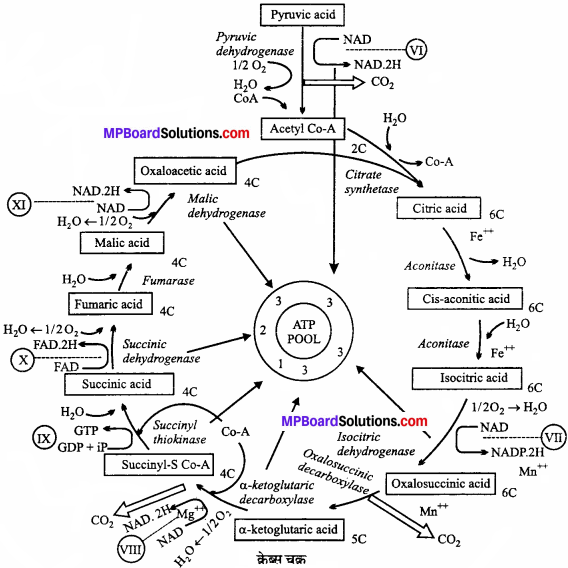
  1. Natural resources are exploited in a wrong way.
  2. They create problems of foreign currency.
  3. They create economic and social disparity.
  4. They tend to become monopolistic in a very short time.
  5. They produce harmful goods and so nation suffers loss, e.g. Pepsi, Coca Cola.
  6. Price is determined by the office of the company which may sometimes not be favorable for the country.
  7. It is very harmful for small and cottage industries.
Question 9.
Explain the role of public sector in Industrial Development of the country?
Or, Explain the importance of public sector in the Development of a country?
Answer:
Following is the importance of public sector in the Development of a country:

1. Development of Infrastructure:
It is very important to have development in the transportation communication, energy generation and fuel for the development of Ba-sic industries. Infrastructural development is not possible without the development in the basic industries.

2. Regional balance: It is the moral responsibility of the government to have overall development in all the regions of the country. After independence same sectors of course developed but some sectors remained undeveloped now also. Public sectors undertaking can play important role in development of such regions.

3. Economies of Scale:
Public sector can come forth to have working in those fields where investment is required in public and profit is earned after same longevity.

4. Check over concentration of Economic power:
Some big private companies invest in public industries and earn huge profits which give rise to economic gap. Hence public sector undertakings should have establishment of industries in those sectors where private people or Houses are earning big profits.

5. Import Substitutions:
In India government started trying to get self sufficient in some sectors since second five year plan only. For establishment of big industries huge amount was spent on the purchase of big machines and whole amount was spent. Hence, focus was given on the establishment of public sector undertaking in there areas to avoid these situations.

MP Board Class 11 Business Studies Important Questions