MP Board Class 12th Biology Solutions Chapter 2 Sexual Reproduction in Flowering Plants

MP Board Class 12th Biology Solutions Chapter 2 Sexual Reproduction in Flowering Plants

Sexual Reproduction in Flowering Plants NCERT Textbook Questions and Answers

Question 1.
Name the parts of an angiosperm flower in which development of male and female gametophyte take place.
Answer:
Development of male gametophyte takes place in anther and female gametophyte in ovary.

Question 2.
Differentiate between microsporogenesis and megasporogenesis. Which type of cell division occurs during these events? Name the structure formed at the end of these two events.
Answer:
Differences between Microsporogenesis and Megasporogenesis:

No.MicrosporogenesisMegasporogenesis
1.In this process haploid microspores are formed from diploid microspore motto’cell.In this process, haploid megaspores are formed from diploid megaspore mother cell.
2The four microspores formed from a single microspore mother cell are generally aranged in a tetrahedral structure.The four megaspores formed from a megaspore mother cell are arranged in die from of a linear tetrad.
3.All the four microspores arranged in a tetrahedral tetrad are functional.Only one megaspore remain functional while the other three degenerates.

Meiosis Occurs during micro and megasporogenesis microspores (Pollen grain) are formed at the end of micro sporogenesis and female gametophyte (enibro sac) are formed at the end of megasporogenesis.

Question 3.
Arrange the following terms in the correct developmental sequence:
Pollen grain, sporogenous tissue, microspore tetrad, pollen mother cell, male garnets.
Answer:
Sporogenous tissue → Pollen mother cell → Microspore → Tetrad → Pollen grain → Male garnets.

MP Board Solutions

Question 4.
With a neat, labelled diagram, describe the parts of a typical angiosperm ovule.
Answer:
Structure of Ovule: Each ovule consists of the following parts as visible in a longitudinal section:

    • A small stalk or funicle by which the ovule remains attached with the placenta of the
      ovary.
    • Hilum is the point at which it is attached with the ovule. In inverted ovule the funicle fuses with the main body of the ovule and is called as raphe.
    • The ovule is surrounded on all sides by two integuments but not at the apex where an aperture called micropyle is present. This end of the ovule is called as micropylar, while the end of the ovule opposite to it is called as chalazal end.
    • Embryo sac is situated inside the nucellus.
    • Towards the micropyle end of embryo sac one egg or oospore and two synergids are found, and towards the chalaza end of embryo sac three antipodal cells are found. At the centre secondary nuclei is found.
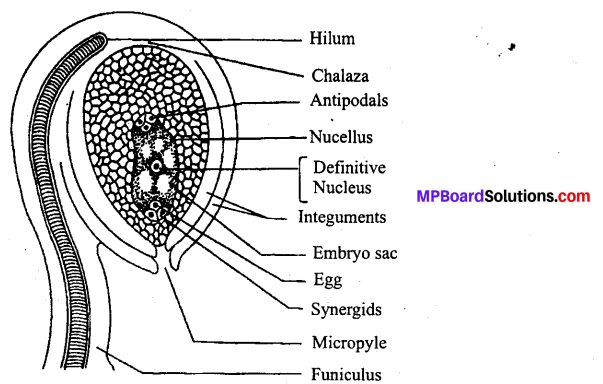
      MP Board Class 12th Biology Solutions Chapter 2 Sexual Reproduction in Flowering Plants 1

Question 5.
What is mean by monosporic development of a female gametophyte ?
Answer:
Out of theTour megaspores, three degenerate and only one remains funtional which develops in, to a female gametophyte or embryo sac. This is called monosporic development, i.e., when embryosac develops from one single megaspore it is called monosporic embryo sac.

Question 6.
With a neat diagram explain the 7-celled, 8-nucleate nature of the female gametophyte.
Answer:
Explanation: Nucleus of the functional megaspore undergoes mitosis resulting in 2-nuclei that move to two opposite poles forming 2-nucleate embryo sac.
Two more mitotic nuclear divisions result in 4-nucleate and later 8-nucleate stages of the embryo sac. so, far no cytokinesis (cytoplasmic division) has taken place.
Now cell walls start to build leading to the organisation of female gametophyte or embryo sac.
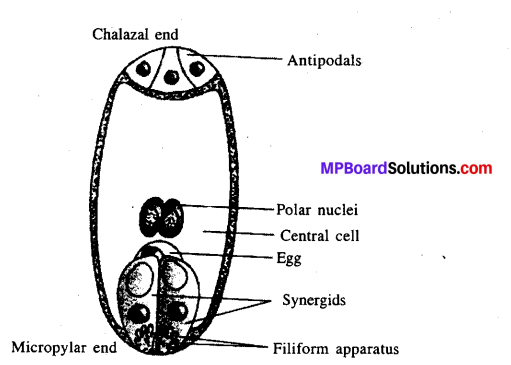
MP Board Class 12th Biology Solutions Chapter 2 Sexual Reproduction in Flowering Plants 2
Six of the 8-nuclei are bound by cell wall and the remaining 2-celled polar nuclei lie below the egg apparatus in the large central cell.
Seven-celled stage
Three cells are grouped together at the micropylar end and constitute the egg appara¬tus, which is constituted of two synergids and one egg cell.
Three cells at the chalazal end are called antipodals. The large central cell has 2-polar nuclei.
Thus, a typical angiosperm embryo sac at maturity is 7-celled but 8-nucleated as the central cell has 2-nuclei

Question 7.
What are chasmogamous flowers? Can cross pollination occur in cleistogamous flower ? Give resion for your answer.
Answer:
Chasmogamous flowers are open flowers with exposed stamens and stigma which facilitate cross pollination.
No cross pollination occurs in cleistogamous flowers. As these flowers are closed and never open and thus no transfer of pollen from outside to stigma of the flower is possible. So there are no occurs cross pollination.

MP Board Solutions

Question 8.
Mention two strategies evolved to prevent self-pollination in flowers.
Answer:
Two strategies evolved to prevent self-pollination are :
(i) Pollen release and stigma receptivity is not synchronized.
(ii) Anthers and stigma are placed at such positions that pollen doesn’t reach stigma.

Question 9.
What is self-incompatibility ? Why does self-pollination not lead to seed forma¬tion in self-incompatible species ?
Answer:
Self-incompatibility is a genetic mechanism to prevent self pollen from fertilizing the ovules by inhibiting pollen germination or pollen tube growth in the pistil.
In these cases, self-pollination does not lead to seed formation because fertilization is inhibited.

Question 10.
What is bagging technique? How is it useful in a plant breeding programme?
Answer:
It is the covering of female plant with butter paper or polythene to avoid their contamination from foreign pollens during breeding programme.

Question 11.
What is triple fusion? Where and how does it take place ? Name the nuclei involved in triple fusion?
Answer:
Triple fusion refers to the process of fusion of three haploid nuclei. It takes place in the embryo sac.
The 3-nuclei that fuse together are, nucleus of the male gamete and 2-polar nuclei of the central cell to produce a triploid primary endosperm nucleus.

Question 12.
Why do you think the zygote is dormant for sometime in a fertilized ovule?
Answer:
The zygote is dormant in fertilized ovule for sometime because at this time, endosperm needs to develop. As endosperm is the source of nutrition for the developing embryo, the nature ensures the formation of enouth endosperm tissue before starting the process of embryogenesis.

MP Board Solutions

Question 13.
Differentiate between:
(a) Hypocotyl and Epicotyl
(b) Colcoptile and Coleorhiza
(c) Integument and Testa
(d) Perisperm and Pericarp.
Answer:
(a) Differences between Hypocotyl and Epicotyl:

No.HypocotylEpicotyl       
1.lies between the radicle and the point lies between the radicle and the point of attachment of colyledons is called hypocotyl.The region of the embryonal axis that lies between the plumule and cotyledons is called epicotyl.
2.Hypocotyl pushes the seed above the soil in epigeal germinationEpicotyl pushes the plumule above the soil in hypogeal germination.
3.It is an important component of embryonic root system.It is an important component of embryonic shoot system.

(b) Differences between Coleoptile and Coleorhiza:

No.ColeoptileColeorhiza
1.The shoot apex and few leaf primordia are enclosed in epicotyl region is called coleoptileThe redicle and rootcap are situated at the lower end of embryonal axis are enclosed by protective sheath called coleorhiza.
2It comes out of the soil.It remains inside the soil.

(c) Differences Between Integement and Testa:

No.IntegumentTesta
1.It is the protective covering of the ovuleIt is the protective covering of the seed
2.It is part of pre fertilisationIt is a part of post fertilisation.

(d) Differences between Peris perm and Pericarp:

No.PerispermPericarp
1.It is the part of nucellus which remains inOvary is convert into pericarp after
2It is a part that belongs to seedIt is a part that belongs to fruit.
3.It is usually dry.It can be dry and fleshy.

Question 14.
Why is apple called a false fruit? Which parts of the flower forms the fruit?
Answer:
Apple is called a false fruit because it develops from the thalamus instead of ovary (thalamus is the enlarged structure at the the base of the flower).

Question 15.
What is meant by emasculation? When and why does a plant breeder employ this technique?
Answer:
Emasculation means removal of anthers, with a forceps, from the flower bud before dehiscence.
Plant breeder employs this technique to prevent contamination of stigma with the undesired pollen. This is useful in artificial hybridisation, where desired pollen is required.

MP Board Solutions

Question 16.
If one can induce parthenocarpy through the application of growth substances, which fruits would you select to induce parthenocarpy and why?
Answer:
Oranges, lemons, lichis could be potential fruits for inducing the parthenocarpy because seedless variety of these fruits would be much appreciated by the consumers.

Question 17.
Explain the role of tape turn in the formation of pollengrain wall.
Answer:
Tapetum is the innermost layer of the microsporangium. It produces the exine layer of the pollen grains, which is composed of the sporopollenin, the most resistant fatty, substance.
During microsporongenesis, the cells of tapetum produce various enzymes, hormones, amino acids and other nutritious material required for the development of pollen grains.

Question 18.
What is apomixis and what is its importance?
Answer:
Apomixis is the process of asexual production of seeds, without fertilisation.
The plants that grow from these seeds are identical to the mother plant.

Uses :

  • It is a cost effective method for producing seeds.
  • It has great use for plant breeding when specific traits of a plant have to be pre¬served.

Sexual Reproduction in Flowering Plants Other Important Questions and Answers

Sexual Reproduction in Flowering Plants Objective Type Questions

1. Choose the Correct Answers:

Question 1.
Fertilization process is:
(a) Fusion of male gamete with egg
(b) Transference of pollengrains to stigma
(c) Fusion of polar nucleus with male gamete
(d) Formation of seed from ovule.
Answer:
(a) Fusion of male gamete with egg

Question 2.
Female gametophy te of angiosperms is:
(a) Megaspore mother cell
(b) Ovule
(c) Endosperm
(d) Nucellus.
Answer:
(c) Endosperm

Question 3.
Effect of nector demonstrate by Xenia word on:
(a) Morphological tissue
(b) Root
(c) Flower
(d) Endosperm.
Answer:
(d) Endosperm.

Question 4.
In a diploid flowering plant, no. of chromosomes are 12, then 6 chromosomes will be present in:
(a) Cotyledons cells
(b) Endospermic cells
(c) Synergids cells
(d) Leaf cells.
Answer:
(c) Synergids cells

Question 5.
Seed coats of seed after fertilization develop from:
(a) Integuments
(b) Endosperms
(c) Chalaza
(d) Ovule.
Answer:
(a) Integuments

Question 6.
Perispermis:
(a) Degenerative secondary nucleus
(b)Apomixis
(c) Peripheral part of endosperm
(d) Parthenogenesis.
Answer:
(b)Apomixis

Question 7.
Development of ovary into fruit from ovule without fertilization, the process is called:
(a) Parthenio ovule
(b) Apomixis
(c) Pathenocarpy
(d) Parthenogenesis.
Answer:
(c) Pathenocarpy

Question 8.
Mitotic cell division in an ovule takes place in:
(a) Nucellus
(b) Megaspore mother cell
(c) Macrosporangia
(d) Archisporium.
Answer:
(b) Megaspore mother cell

Question 9.
Development of sporophyte without the fusion of a gamete is called:
(a) Apomixis
(b) Apospory
(c) Apogamy
(d) Pollination.
Answer:
(c) Apogamy

MP Board Solutions

Question 10.
Male gametes are found in angiospermic plants :
(a) In pollengrain
(b) In anther
(c) In ovule
(d) All of these
Answer:
(a) In pollengrain

Question 11.
The function of pollentube is:
(a) Help in pollination
(b) Protection of stigma
(c) Male gamete carrier
(d) All of these
Answer:
(c) Male gamete carrier

Question 12.
Tapetum is a part of:
(a) Male gametophyte
(b) Female gametophyte
(c) Ovary wall
(d) Anther wall.
Answer:
(d) Anther wall.

Question 13.
Cotyledons is situated in monocots:
(a) Axial
(b) Terminal
(c) Basal
(d) In Any Position
Answer:
(a) Axial

MP Board Solutions

Question 14.
Which type of pollination found in sunflower:
(a) Self pollination
(b) Cross pollination
(c) All of the above
(d) None of these.
Answer:
(c) All of the above

Question 15.
Endospermic nucleus are :
(a) Haploid
(b) Diploid
(c)Triploid
(d) None of these.
Answer:
(b) Diploid

Question 16.
Double fertilization is discoverd by: :
(a) By Navaschin
(b) Leuwenhock
(c) Strasburger
(d) Hofmeister.
Answer:
(a) By Navaschin

Question 17.
The type of pollination in which genetically different pollen grains are brought to
stigma is : (AMU 2012)
(a) Xenogamy
(b) Geitonogamy
(c) Cleistogamy
(d) Dichogamy. ,
Answer:
(a) Xenogamy

Question 18.
If the number of chromosome in root cell is 14 then what will be the number of chromosome in synergid cell of in ovule of that parent (BHU2012)
(a) 14
(b) 21
(c) 7
(d) 28.
Answer:
(c)7

Question 19.
Presence of many embryo (Polyembryony) is characters tic feature of: (BHU2012)
(a) Citrus
(b) Mango
(c) Banana
(d) None of these.
Answer:
(a) Citrus

Question 20.
Sporopollenin is formed by the polymerisation of : (BHU2012)
(a) Fat and Phenol
(b) Carotenoid and Fat
(c) Fat and Ester
(d) Carotenoid and Ester.
Answer:
(a) Fat and Phenol

2. Fill in the Blanks:

  1. The main function of endosperm in a seed is the storage of ………………
  2. Pollination takes place by the agency of bird is called ………………
  3. Apple is an example of fruit. ………………
  4. Tissue on which ovules are attached is called ………………
  5. ……………… types stamens are found in sunflower.
  6. In plants development of fruit takes place from ………………
  7. One cotyledon of maize is called ………………
  8. Tetradynamous stamens are found in ………………
  9. ………………is thin in endospermic seed.
  10. In ovule …………….. is joined with funiculus.
  11. Anther is ……………… in angiospermic plants.
  12. ……………… type of pollination are found in Typha.
  13. ……………… pollination is occurs in Salvia.
  14. Outer wall of pollen grain is called ………………
  15. Process of seedless fruit is called ………………

Answer:

  1. Food material
  2. Omithophilly
  3. False
  4. Placenta
  5. Syngenecious
  6. Ovary
  7. Scutellum
  8. Mustard
  9. Cell wall
  10. Hylum
  11. Reproductive organ
  12. Joint
  13. Insect
  14. Exine
  15. Parthenocarpy.

MP Board Solutions

3. Match the Following:
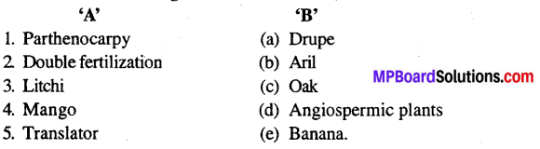
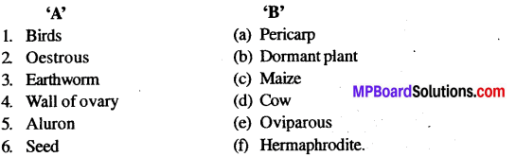
MP Board Class 12th Biology Solutions Chapter 2 Sexual Reproduction in Flowering Plants 3
Answer:

  1. (e)
  2. (d)
  3. (b)
  4. (a)
  5. (c)

4. Answer in One Word/Sentence:

  1. Name the four whorls of flower.
  2. Give the term for plants which produce flower and fruits many times.
  3. Name the outer coat of the seed.
  4. Give example of plant in which flowers are pollinated by bat.
  5. Give the term used for similar calyx and corolla.
  6. What parts of the plant produce seed and fruit after fertilization?
  7. Name the type of pollination carried out of bat.
  8. Give the term for fruit development without fertilization.

Answer:

  1. Calyx, Corolla, Androecium and Gynoecium
  2. Perrenial plants
  3. Seed coat
  4. Kadamb
  5. Petalloid
  6. Ovary
  7. Chiropteriphilly
  8. Parthenocarpy.

Sexual Reproduction in Flowering Plants Very Short Answer Type Questions

Question 1.
Development of female gametophyte occurs in which cell?
Answer:
By functional megaspore mother cell.

Question 2.
What is the other name of female gametophyte?
Answer:
Embryo sac.

MP Board Solutions

Question 3.
Ovule derives nourishment from which part of the carpel?
Answer:
Ovule derives nourishment from placenta.

Question 4.
What are cleistogamous flowers ? Give an example.
Answer:
The flowers which do not open are called cleistogamous flowers, e.g. Commelina

Question 5.
What is the substance found on the exine of pollen grains?
Answer:
Sparopollenin.

Question 6.
Give the characters of wind pollinated flowers.
Answer:
White in colour, small in size and pollengrains are formed in large number.

Question 7.
What is the ploidy of angiospermic endosperm?
Answer:
Triploid.

Question 8.
Give an example of a monocotyledonous endospermic seed.
Answer:
Ricinus.

Question 9.
Give example of two false fruit.
Answer:
Apple, Jackfruit.

Question 10.
What are monocious plants?
Answer:
Plants which has both male and female flower.

Sexual Reproduction in Flowering Plants Short Answer Type Questions

Question 1.
What is parthenogenesis ?
Answer:
Parthenogenesis : It is the method of reproduction in which ovum develops into embryo and forms a new plant without fertilization. It has been observed that pollination is necessary for parthenogenesis. It stimulates the process. Ulothrix, Spirogyra and Solan- aceae and Malvaceae family plants reproduce by this method.
Sometimes in some plants ovary also develops into fruit during this process. Such fruits are called as parthenocarpic fruits.
Example: Banana, Apple, Grapes, Guava etc. shows parthenocarpic fruits.

Question 2.
What is Polyembryony?
Answer:
Polyembryony : When more than one embryo develops in one seed then this condition is called as Polyembryony. It is generally found in citrus family. It is also found in Nicotiana, conifers, rice, wheat. It occurs when fertilization occurs in all embryo sacs found in the ovule.

Question 3.
Describe structure of anther with labelled diagram.
Answer:
Structure of Anther : Transverse section of anther shows that it consists of 2 lobes which are connected by connective. Each lobe contains two Pollen sacs. Innermost layer of pollen sac is called as Tapetum.

Tapetum is a layer rich in nutritive contents which supplies food material for the developing pollen grains. At first many Pollen mother cells are formed in them which divides meiotically to form haploid pollen grains.
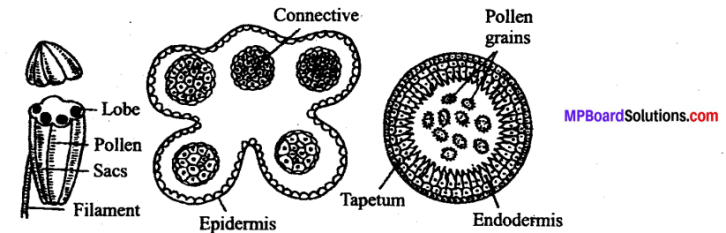
MP Board Class 12th Biology Solutions Chapter 2 Sexual Reproduction in Flowering Plants 4

Question 4.
Give four contrivances for self pollination.
Answer:
Contrivances for self-pollination:
(1) Bisexuality : When male and female parts are found in same flower then possibility of self-pollination increases.

(2) Cieistogamy : In Commelina benghalensis both cleistogamous and chasmogamous flowers are produced. The former are the underground flowers and the latter are the aerial ones developed on branches. In the small, inconspicuous cleistogamous flowers the pollen are shed within the closed flowers so that self-pollination is a must. This is also observed in Impatiens, Oxalis, Viola, Portulaca etc.

(3) Homogamy : Here the stamens and carpels mature at the same time. So, there is a greater chance of self-pollination as compared to cross-pollination, e.g., Mirabilis, Argemone etc.

(4) Failure of cross pollination : In some flowers generally cross pollination occurs but if they fails to do cross pollination then self-pollination occurs.

MP Board Solutions

Question 5.
What do you mean by micropropagation?
Answer:
Micropropagation : It is a modern method of reproduction. By this process thousands of new plants can be obtained from few tissues of mother plant. This method is based on tissue and cell culture technique.
In this process a small part of tissue is separated from the plant and then it is grown in nutrient medium in aseptic condition. The tissue develops to form a cluster of cells which is called as callus. This callus can be preserved for long time for multiplication. A small part of the callus is transferred to nutrient medium, where it grows into a new plant. This plant is then transferred to the field. By this process Orchids, Carnations, Chrysanthemum plants can be grown successfully.

Question 6.
What are the advantages of cross-pollination ?
Answer:
Advantages of cross-pollination:

  • The weaker characteristics of the race elimi¬nated and replaced by better character of nature.
  • New improved varieties cap be produced by cross-pollination. ‘
  • It increases the adaptability of the offsprings.
  • Seeds are more vigorous.

Question 7.
What is fertilization? Draw labelled diagram showing path of pollen tube during fertilization.
Or
What do you mean by sexual reproduction? Describe the process of fertilization in plants with the help of diagram or sexual reproduction.
Answer:
Fertilization : The process of fusion of male and female gamete is called as fertilization or sexual reproduction. As a result of this process a diploid zygote is formed.
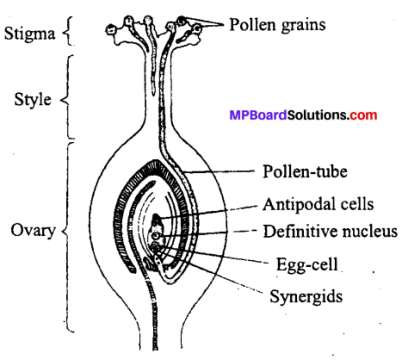
MP Board Class 12th Biology Solutions Chapter 2 Sexual Reproduction in Flowering Plants 5

Question 8.
Differences between self and cross pollination
Answer:
Differences between Self and Cross poltination :

No.Self pollinationCross pollination
1.It is the process of transfer of pollen grains from one flower to the stigma of same flower of same plant.Transfer of pollen grains from one flower to the stigma of flower of another plant.
2.Medium is not reqiredMedium is required
3.Plants do not show any special chara cter.Attractive, coloured,scent or honey bearing flowers are produced to attract insect.
4.Less number of pollen grains are produced.More number of pollen grains are produced.

Sexual Reproduction in Flowering Plants Long Answer Type Questions

Question 1.
What is self-pollination ? Give advantages and disadvantages of self pollination.
Answer:
Self-pollination : When the pollen grain of one flower are transferred to the stigma of the same flower then the process is called as self-pollination.

Advantages of self-pollination:
These are the advantages of self pollination:

  • Parental characters can be preserved indefinitely in several generations.
  • Self-pollination helps in maintaining pure lines for experimental hybridization.
  • It is most economical method of pollination. The plants do not consume their energies in the production of
  • large number of pollen grains, nectar and coloured corolla.
  • It ensures seed production and flowers do not take chances of the failure of fertilization.

Disadvantages of self-pollination:
These are the disadvantages of self-pollination :

  • The weaker characteristics or defects of the plant can never be eliminated from the race.
  • No useful characters can be introduced in the race.
  • The immunity of race towards diseases falls and ultimately it falls prey to many diseases.

Question 2.
What is double fertilization?
Or
Explain double fertilization in angiosperms.
Answer:
Double fertilization : It is found in all angiospermic plants. It was first discovered by S.N. Navaschin (1899) in Lilium and Fritillaria. When pollen tube come in contact of embryo sac then the tip of the pollen tube disintegrate and release two male gametes into the embryo sac. Out of which one male gamete (x) fuses with egg cell (x) to form a diploid zygote. This process is called as fertilization. The second male gamete (x) fuses with secondary nuclei (2x) to form a triploid body.
The act of two nuclear fusion is called as double fertilization.

Question 3.
Describe development of embryo sac or Female gametophyte in angiosperms.
Answer:
Development of embryo sac or Female gametophyte in angiosperms :
During the initial stage of development of ovule primary archesporial cell gets demarcated at the apex of the nucellus below the epidermis. It divides periclinally into a outer primary parietal cell or primary wall cell and an inner primary sporogenous cell. The later acts as a megaspore mother cell which enlarges in size and divide meiotically to form a row of four megaspores. Of the four cells the upper three cells degenerate and appear as dark caps while the lowest one functions arid is called the functional megaspore. The latter greatly enlarges and forms the embryo sac.

MP Board Solutions

Question 4.
Describe development of Endosperm.
Answer:
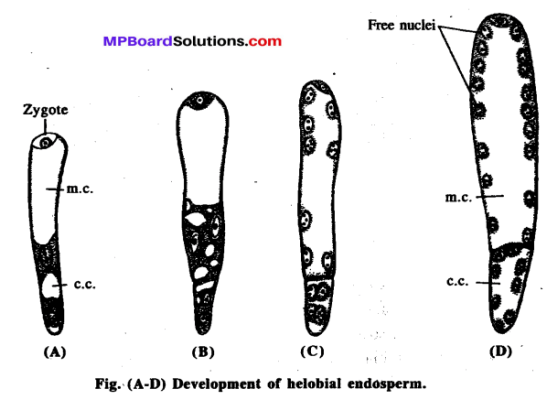
Development of Endosperm : It develops from the triploid tissue of the fertilized embryo sac after the act of double fertilization. It is of the following three types:

  1. Free nuclear endosperm.
  2. Cellular type of endosperm.
  3. Helobial type of endosperm.

The name refers to the type of nuclear divisions of the endosperm nucleus. If triploid nucleus divides by free nuclear division the endosperm produced contains many nuclei lying freely in it and hence it is termed as free nuclear endosperm. If the nuclear division is followed by wall formation it is called as cellular type. If endosperm is intermediate between the two types it is called as helobial type.
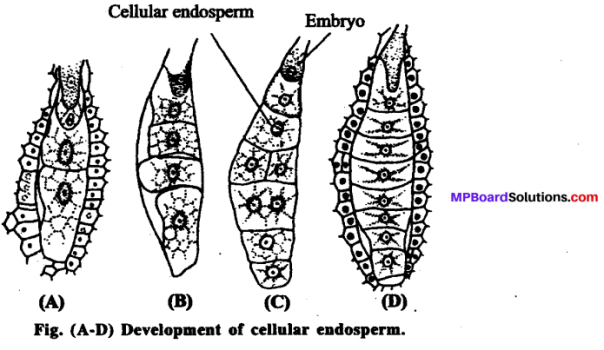
MP Board Class 12th Biology Solutions Chapter 2 Sexual Reproduction in Flowering Plants 6
MP Board Class 12th Biology Solutions Chapter 2 Sexual Reproduction in Flowering Plants 7
Question 5.
What is male gametogenesis ? Describe male gametogenesis in plants.
Or
Describe development of pollen grain.
Answer:
Male gametogenesis: The process of formation of male gametes is called as male gametogenesis or microsporogenesis.

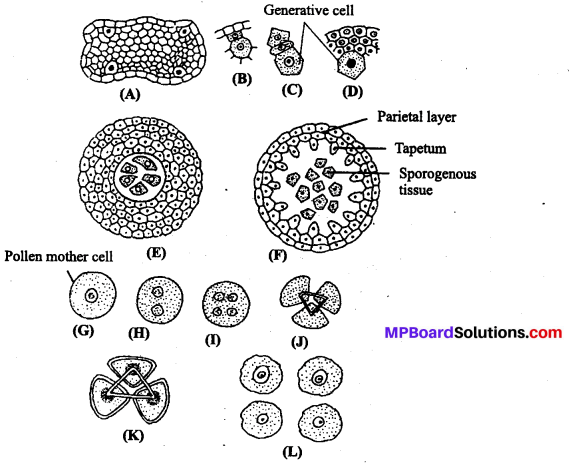
Each anther usually consists of two lobes, connected together by a connective. Each lobe contains two sacs called as Pollen sac. In the early stage of development the anther comprises of a homogenous mass of cells limited by a well demarcated epidermis. During the course of development the anther gets four lobed. Each lobe exhibits a hypodermal lining, few cells thick with distinct nuclei. These hypodermal cells constitute the archesporium. The cell of archesporium divide periclinally, cutting of parietal cells towards the periphery and sporogenous cells within it two chambers or loculi, which are termed as pollen sacs or microsporangia.
MP Board Class 12th Biology Solutions Chapter 2 Sexual Reproduction in Flowering Plants 8
Fig. Development of Pollen grain : (A) Formation of Pollen lobes, (B) Archesporial cell, (C) and (D) Division in Parietal cell, (E) and (F) Parietal layer : Tapetum sporogenous tissue (G), (H) and (I) Pollen mother cell, (J) Pollen grain, (K) Outer layer Degenerate, (L) Four free Pollen grains.

Besides the above changes in the wall layers the sporogenous layer comprising of primary sporogenous cells also undergo several divisions to form microspore mother cells or pollen mother cells. In the initial stage the microspore mother cells are closely packed but as the anther enlarges the pollen sac becomes spacious and the pollen mother cells assume spherical shape and get loosely arranged.

In many cases some of the sporogenous cells are nonfunctional and serve only as the nutritive material for the functional microspore mother cells. Each microspore mother cell is diploid in nature and by a single meiotic division give rise to four haploid nuclei. The four nuclei so formed are arranged tetrahedrally, and called as Tetrad. Innermost layer of pollen sac is called as Tapetum. Outer to which endothecium layer is formed. In outer most layer of pollen sac epidermis is formed. Surrounding each nuclei exine and intine are formed, now each structure is called as Pollen grain. Pollen grains are liberated during the dehiscence of anthers through stomium.

MP Board Solutions

Question 6.
Differenciate between:
(i) Embryo sac and Endosperm
(ii) Seed and Ovule
Answer:
(i) Difference between Embryosac and Endosperm:

No.Embryo sacEndosperm
1.It is haploid structure.It is triploid structure.
2.It is found in ovule.It is found in seed.
3.It is formed before fertilization.It is formed after fertilization.
4.Nutritive materials are stored.Nutritive materials are not stored.
5.It consists antipodal cells, egg cell, synergid cells and two polar nuclei.Antipodal cells, egg cell, synergid cells are absent and all cells are similar.

(ii) Difference between Seed and Ovule

No.SeedOvule
1.It is formed in the fruit seed is formed after fertilization of ovule.Before fertilization ovule is found into the ovary called mega sporangium.
2.Seed is surrounded by integument. Outer covering is called outer integument and inner covering is called inner integument.Nucellus is present below the ovule and is surrounded by inner and outer covering.
3.Embryosac is absent in seed.Embryosac is present in ovule.
4.Embryo is present in seedEmbryo is absent in ovule.
5.Endosperm may be found in seedEndosperm is not found in ovule.
6.Seed make a new plantOvule is not germinate.

MP Board Class 12th Biology Solutions

MP Board Class 11th Maths Solutions Chapter 10 सरल रेखाएँ Ex 10.3

MP Board Class 11th Maths Solutions Chapter 10 सरल रेखाएँ Ex 10.3

प्रश्न 1.
निम्नलिखित समीकरणों को ढाल अंतःखण्ड रूप में रूपान्तरित कीजिए और उनके ढाल तथा y-अंतः खण्ड ज्ञात कीजिए :
(i) x + 7y = 0,
(ii) 6x + 3y – 5 = 0,
(iii) y = 0.
हल:
(i) x + 7y = 0
∴ y = – \(\frac{1}{7}\)x + 0
∴ ढाल = – \(\frac{1}{7}\), y-अंत: खण्ड = 0.
(ii) 6x + 3y – 5 = 0,
3y = – 6x + 5
∴ y = – 2x + \(\frac{5}{3}\)
ढाल = – 2, y-अंत: खण्ड = \(\frac{5}{3}\)
(iii) y = 0
या y = 0. x + 0.
ढाल = 0, y-अंत: खण्ड = 0

MP Board Solutions

प्रश्न 2.
निम्नलिखित समीकरणों को अंतःखण्ड रूप में रूपान्तरित कीजिए और अक्षों पर इनके द्वारा काटे गए अंतःखण्ड ज्ञात कीजिए :
(i) 3x + 2y – 12 = 0,
(ii) 4x – 3y = 6,
(iii) 3y + 2 = 0.
हल:
(i) 3x + 2y – 12 = 0
या 3x + 2y = 12
12 से दोनों पक्षों में भाग देने पर
\(\frac{x}{4}+\frac{y}{6}\) = 1
अतः अंत: खण्ड 4 तथा 6 हैं।
(ii) 4x – 3y = 6
6 से दोनो पक्षों में भाग देने पर,
\(\frac{4 x}{6}-\frac{3 y}{6}\) = 1
\(\frac{x}{\frac{3}{2}}+\frac{y}{-2}\) = 1.
अत: अंत:खण्ड \(\frac{3}{2}\) तथा – 2 हैं।
3y + 2 = 0
या 3y = – 2
y = – \(\frac{2}{3}\).
अन्त: खण्ड हेतु समीकरण का रूप:
\(\frac{x}{0}+\frac{y}{-\frac{2}{3}}\) = 1
अंत:खण्ड 0 और –\(\frac{2}{3}\) हैं।

प्रश्न 3.
निम्नलिखित समीकरणों को लम्ब रूप में रूपान्तरित कीजिए। उनकी मूल बिन्दु से लांबिक दूरियाँ और लम्ब तथा धन x-अक्ष के बीच का कोण ज्ञात कीजिए :
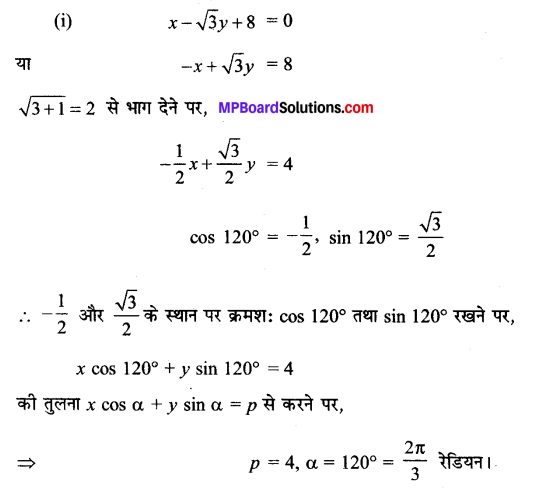
(i) x – \(\sqrt{3}\)y + 8 = 0,
(ii) y – 2 = 0,
(iii) x – y = 4.
हल:
MP Board Class 11th Maths Solutions Chapter 10 सरल रेखाएँ Ex 10.3 img-1
(ii) y – 2 = 0 या y = 2
0·x + y·1 = 2
x cos 90° + y sin 90° = 2 [∵ cos 90° = 0, sin 90° = 1]
∴ p = 2, α = 90°.
(iii) x – y =4
\(\sqrt{2}\) से भाग देने पर
\(\frac{1}{\sqrt{2}} x+\left(-\frac{1}{\sqrt{2}}\right) y\) = 2\(\sqrt{2}\)
\(\frac{1}{\sqrt{2}}\) = cos (360° – 45°) = cos 315°
और – \(\frac{1}{\sqrt{2}}\) = sin 315०
∴ x – y = 4 का लम्ब रूप
x cos 315° + y sin 315° = 4
की तुलना x cos α + y sin α = p से करने पर,
p = 2\(\sqrt{2}\) , α = 315°.

MP Board Solutions

प्रश्न 4.
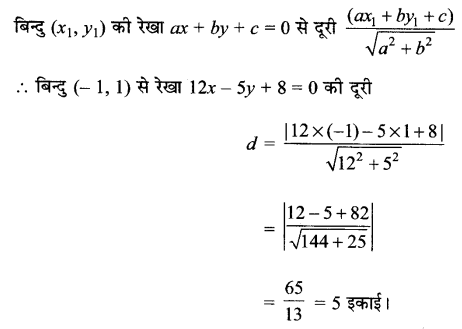
बिन्दु (- 1, 1) की रेखा 12(x + 6) = 5(y – 2) से दूरी ज्ञात कीजिए।
हल:
12(x + 6) = 5(y – 2).
या 12x + 72 = 5y – 10
12x – 5y + 82 = 0
MP Board Class 11th Maths Solutions Chapter 10 सरल रेखाएँ Ex 10.3 img-2

प्रश्न 5.
x-अक्ष पर बिन्दुओं को ज्ञात कीजिए जिनकी रेखा \(\frac{x}{3}+\frac{y}{4}\) = 1 से दूरियाँ 4 इकाई हैं।
हल:
दिया गया समीकरण है: \(\frac{x}{3}+\frac{y}{4}\) = 1
12 से गुणा करने पर
4x + 3y – 12 = 0 …(1)
x- अक्ष पर माना कोई बिन्दु (a, 0) हो, तो बिन्दु (a, 0) से रेखा (1) की दूरी
= \(\frac{4 a+0-12}{\sqrt{16+9}}\) = ± \(\frac{4 a-12}{5}\)
∴ ± \(\frac{4 a-12}{5}\) = 4
या ± (4a – 12) = 20
+ ve चिन्ह लेकर 4a = 32 या a = 8
x-अक्ष पर अभीष्ट बिन्दु (8, 0) है।
– ve चिन्ह लेकर, –\(\frac{4 a-12}{5}\) = 4 या – 4a + 12 = 20
4a = – 8, a = – 2
दूसरा अभीष्ट बिन्दु (- 2, 0) है।

प्रश्न 6.
समान्तर रेखाओं के बीच की दूरी ज्ञात कीजिए
(i) 15x + 8y – 34 = 0 और 15x + 8y + 31 = 0
(ii) l(x +y) + p = 0 और l(x + y) – r= 0
हल:
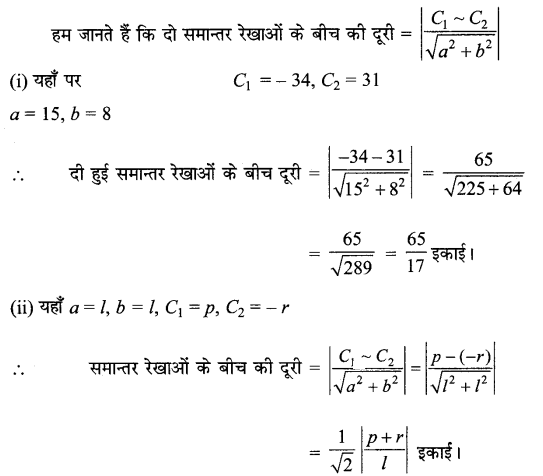
MP Board Class 11th Maths Solutions Chapter 10 सरल रेखाएँ Ex 10.3 img-3

MP Board Solutions

प्रश्न 7.
रेखा 3x – 4y + 2 = 0 के समान्तर और बिन्दु (-2, 3) से जाने वाली रेखा का समीकरण ज्ञात कीजिए।
हल:
3x – 4y + 2 = 0
या 4y = 3x +2
∴ y = \(\frac{3}{4} x+\frac{2}{4}\)
∴ रेखा की ढाल = \(\frac{3}{4}\)
दिया गया बिन्दु (- 2, 3) और ढाल m = \(\frac{3}{4}\) से जाने वाली रेखा का समीकरण
y – y1 = m(x – x1)
y – 3 = \(\frac{3}{4}\)(x + 2)
या 4y – 12 = 3x + 6
या 3x – 4y + 18 = 0.
दूसरी विधि : कोई भी रेखा ax + by + c = 0 के समान्तर ax + by + k = 0 के रूप में लिखी जा सकती है।
∴ 3x – 4y + 2 = 0 के समान्तर रेखा 3x – 4y + k = 0 है
यह (- 2, 3) से होकर जाती है।
∴ 3 x (- 2) – 4 x 3 + k = 0 या k = 18
अभीष्ट समान्तर रेखा का समीकरण: 3x – 4y + 18 = 0.

प्रश्न 8.
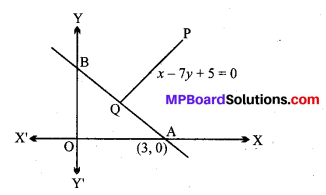
रेखा x – 7y + 5 = 0 पर लम्ब और x-अन्तः खण्ड 3 वाली रेखा का समीकरण ज्ञात कीजिए।
हल:
∵ x-अंत:खण्ड = 3
∴ रेखा A(3, 0) से होकर जाती है।
रेखा PQ : x – 7y + 5 = 0
या 7y = x +5
या y = \(\frac{1}{7}\) x + \(\frac{5}{7}\)
MP Board Class 11th Maths Solutions Chapter 10 सरल रेखाएँ Ex 10.3 img-4
इसलिए PQ की ढाल = \(\frac{1}{7}\)
∵ PQ ⊥ AB
∴ A से होकर जाने वाली रेखा AB की ढाल = – 7
∴ बिन्दु (3, 0) से रेखा AB का समीकरण,
y – 0 = – 7(x – 3).
= – 7x + 21
या 7x + y – 21 = 0.
दूसरी विधि : ax + by + c = 0 की लम्ब कोई रेखा bx – ay + k = 0
∴ x – 7y + 5 = 0 की लम्ब रेखा 7x + y + k = 0
यह रेखा (3, 0) से होकर जाती है।
∴ 7 x 3 + 0 + k = 0, अर्थात् k = – 21
∴ अभीष्ट रेखा का समीकरण 7x + y – 21 = 0.

प्रश्न 9.
रेखाओं \(\sqrt{3}\)x + y =1 और x +\(\sqrt{3}\)y =1 के बीच का कोण ज्ञात कीजिए।
हल:
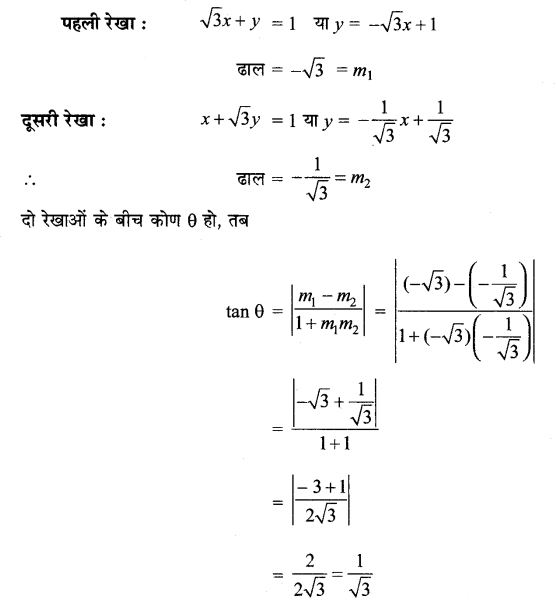
MP Board Class 11th Maths Solutions Chapter 10 सरल रेखाएँ Ex 10.3 img-5
θ = 30° = \(\frac{\pi}{6}\) रेडियन। .

प्रश्न 10.
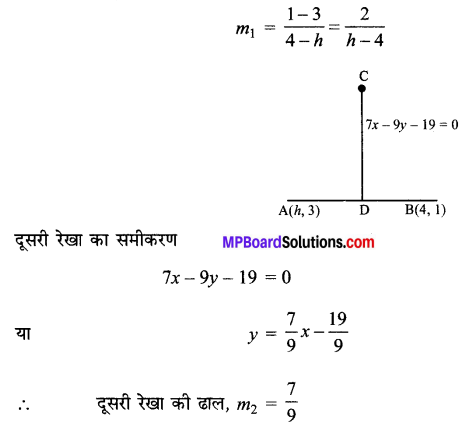
बिन्दुओं (h, 3) और (4, 1) से जाने वाली रेखा, रेखा 7x – 9y – 19 = 0 को समकोण पर प्रतिच्छेद करती है। का मान ज्ञात कीजिए।

माना रेखा AB बिन्दु A(h, 3), B(4, 1) से जाने वाली रेखा की ढाल,
MP Board Class 11th Maths Solutions Chapter 10 सरल रेखाएँ Ex 10.3 img-6
चूँकि दोनों रेखाएँ एक-दूसरे को समकोण पर प्रतिच्छेद करती हैं, ∴ m1,m2 = – 1
\(\frac{2}{h-4} \times \frac{7}{9}\) = – 1
14 = – 9(h – 4) = – 9h + 36
∴ 9h = 36 – 14 = 22
h = \(\frac{22}{9}\)

प्रश्न 11.
सिद्ध कीजिए कि बिन्दु (x1, y1) से जाने वाली और रेखा Ax + By + C = 0 के समान्तर रेखा का समीकरण
A(x – x1) + B(y – y1) = 0 है।
हल:
रेखा Ax + By + C = 0
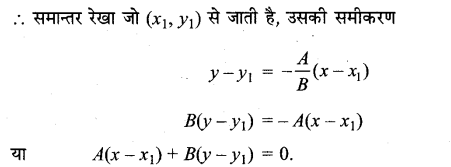
या y= – \(\frac{A}{B}\)x – \(\frac{C}{B}\)
रेखा की ढाल = – \(\frac{A}{B}\)
∴ समान्तर रेखा की ढाल = – \(\frac{A}{B}\)
MP Board Class 11th Maths Solutions Chapter 10 सरल रेखाएँ Ex 10.3 img-7

MP Board Solutions

प्रश्न 12.
बिन्दु (2, 3) से जाने वाली दो रेखाएँ परस्पर 60° के कोण पर प्रतिच्छेद करती हैं। यदि एक रेखा की ढाल 2 है तो दूसरी रेखा का समीकरण ज्ञात कीजिए।
हल:
माना दूसरी रेखा की ढाल m है।
दोनों रेखाओं के बीच कोण
tan θ = \(\frac{m_{1}-m_{2}}{1+m_{1} m_{2}}\)
जहाँ θ = 60°, m1 = m और m2 = 2
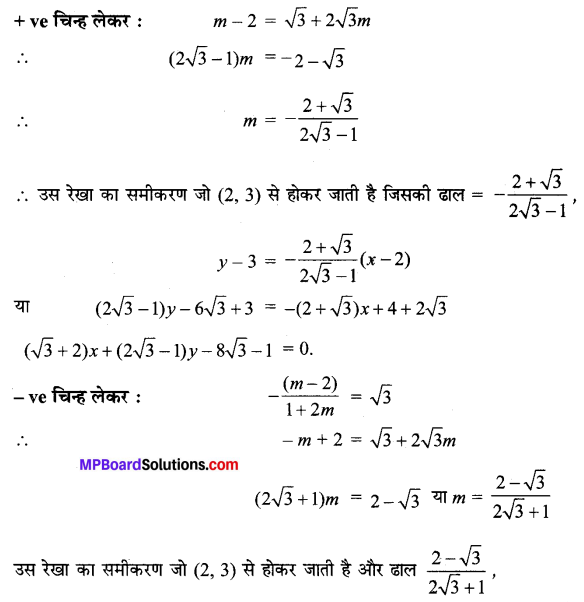
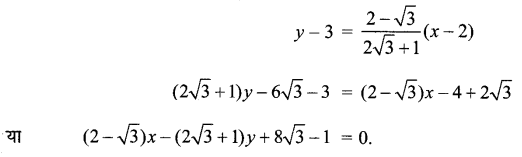
∴ tan 60 = ± \(\frac{m-2}{1+2 m}\) = \(\sqrt{3}\)
MP Board Class 11th Maths Solutions Chapter 10 सरल रेखाएँ Ex 10.3 img-8
MP Board Class 11th Maths Solutions Chapter 10 सरल रेखाएँ Ex 10.3 img-9

प्रश्न 13.
बिन्दुओं (3, 4) और (- 1, 2) को मिलाने वाली रेखाखण्ड के लम्ब समद्विभाजक रेखा का समीकरण ज्ञात कीजिए।
हल:
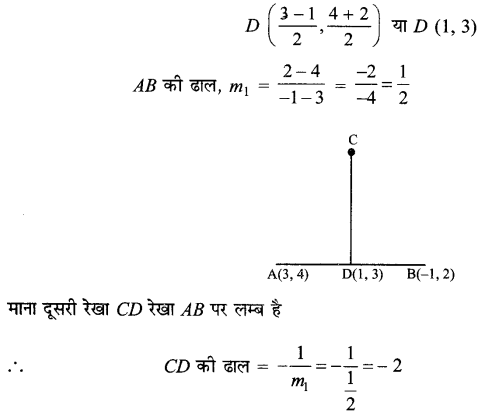
माना बिन्दुओं A(3, 4) और B(- 1, 2) को मिलाने वाले रेखाखण्ड का मध्य बिन्दु
MP Board Class 11th Maths Solutions Chapter 10 सरल रेखाएँ Ex 10.3 img-10
रेखा CD बिन्दु D से होकर जाती है
∴ रेखा CD का समीकरण
y – 3 = – 2(x – 1)
= – 2x + 2
∴ 2x + y – 5 = 0.

प्रश्न 14.
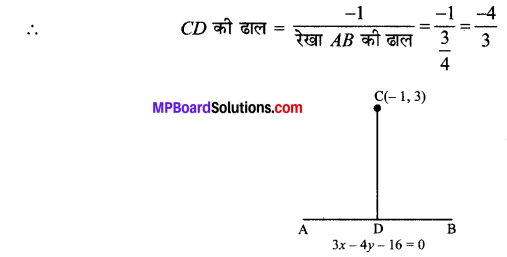
बिन्दु (- 1, 3) से रेखा 3x – 4y – 16 = 0 पर डाले गए लम्बपाद के निर्देशांक ज्ञात कीजिए।
हल:
मान लीजिए रेखा AB का समीकरण, 3x – 4y – 16 = 0 …(i)
या y = \(\frac{3}{4}\)x – 4
रेखा AB की ढाल = \(\frac{3}{4}\)
बिन्दु C(- 1, 3) से AB पर डाला गया लम्ब CD है
∴ AB ⊥ CD.
MP Board Class 11th Maths Solutions Chapter 10 सरल रेखाएँ Ex 10.3 img-11
अतः रेखा CD का समीकरण,
y – y1 = m(x – x1)
y – 3 = \(\frac{-4}{3}\)(x + 1)
या 3y – 9 = – 4x – 4
या 4x + 3y – 5 = 0 …(ii)
समी (i) को 3 से और (ii) को 4 से गुणा करने पर,
9x – 12y = 48
16x + 12y = 20
इनको जोड़ने पर
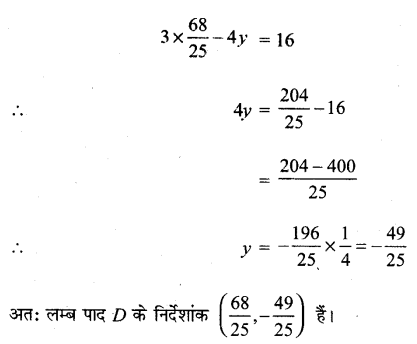
25x = 68 या x = \(\frac{68}{25}\)
x का मान (i) में रखने पर,
MP Board Class 11th Maths Solutions Chapter 10 सरल रेखाएँ Ex 10.3 img-12

प्रश्न 15.
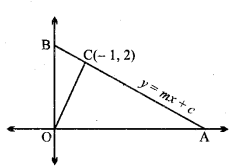
मूल बिन्दु से रेखा y = mx + c पर डाला गया लम्ब रेखा से बिन्दु (-1, 2) पर मिलता है। m और … c के मान ज्ञात कीजिए।
हल:
माना रेखा AB का समीकरण, y = mx + c
रेखा AB की ढाल = m
MP Board Class 11th Maths Solutions Chapter 10 सरल रेखाएँ Ex 10.3 img-13
O से रेखा AB पर लम्ब OC डाला गया है जो बिन्दु C(- 1, 2) पर मिलता है।
∴ लम्ब रेखा OC की ढाल = –\(\frac{1}{m}\)
अब रेखा OC का समीकरण,
y – 0 = –\(\frac{1}{m}\)(x – 0)
या x + my = 0
OC की प्रवणता = \(\frac{2-0}{-1-0}\) = – 2
∴ लम्ब रेखा OC की ढाल = –\(\frac{1}{m}\)
बिन्दु C (- 1, 2) निम्न रेखा पर स्थित है :
y = mx + c
⇒ 2 = – m + c
m = \(\frac{1}{2}\) रखने पर,
2 = – \(\frac{1}{2}\) + c
∴ c = 2+ \(\frac{1}{2}\) = \(\frac{5}{2}\)
अतः m = \(\frac{1}{2}\), c = \(\frac{5}{2}\)

MP Board Solutions

प्रश्न 16.
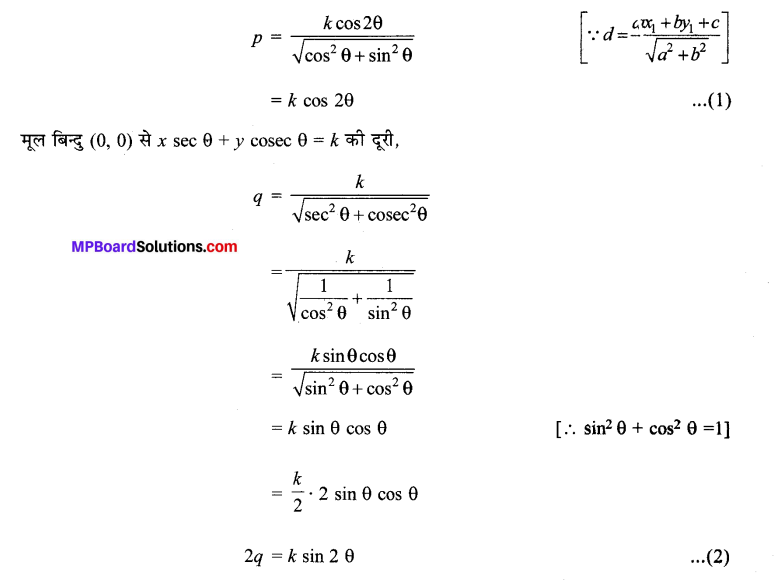
यदि p और q क्रमशः मूल बिन्दु से रेखाओं x cos θ – y sin θ = k cos 2θ और x sec θ +y cosec θ = k पर लम्ब की लंबाइयाँ हैं तो सिद्ध कीजिए कि
p2 + 4q2 = k2.
हल:
मूल बिन्दु (0, 0) से x cos θ – y sin θ = k cos 2θ की दूरी,
MP Board Class 11th Maths Solutions Chapter 10 सरल रेखाएँ Ex 10.3 img-14
समीकरण (1) और (2) को वर्ग करके जोड़ने पर,
k2 = p2 + 4q2
अतः p2 + 4q2 = K2.

प्रश्न 17.
शीर्षों A(2, 3), B(4, – 1) और C(1, 2) वाले त्रिभुज ABC के शीर्ष A से उसकी सम्मुख भुजा पर लम्ब डाला गया है। लम्ब की लम्बाई तथा समीकरण ज्ञात कीजिए।
हल:
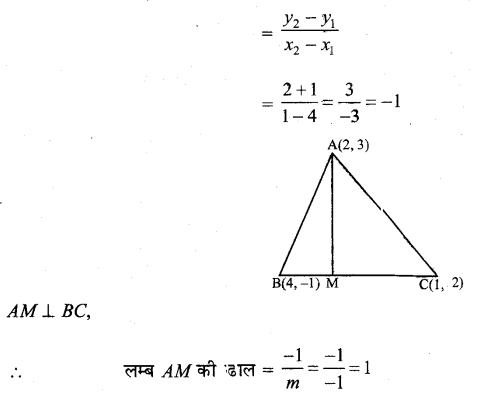
मान लीजिए AM रेखा BC पर लंब डाला गया है
(i) रेखा BC की ढाल
MP Board Class 11th Maths Solutions Chapter 10 सरल रेखाएँ Ex 10.3 img-15
रेखा AM बिन्दु A से जाती है और ढाल = 1 है।
∴ AM का समीकरण
y – y1 = m(x – x1)
y – 3 = 1. (x – 2)
या x – y + 1 = 0
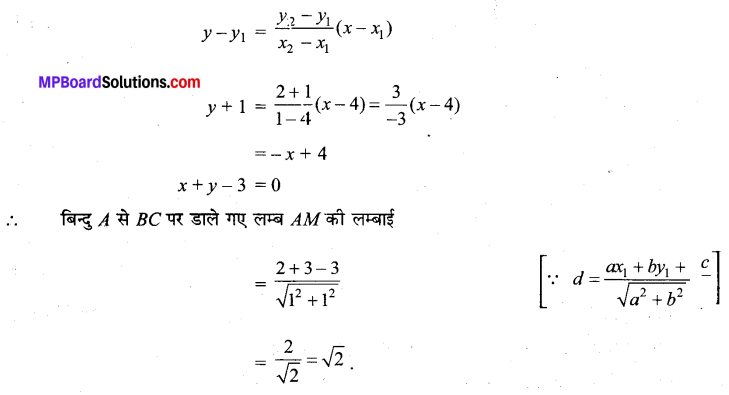
(ii) बिन्दु B(4, – 1) और C(1, 2) से होकर जाने वाली रेखा BC का समीकरण
MP Board Class 11th Maths Solutions Chapter 10 सरल रेखाएँ Ex 10.3 img-16

MP Board Solutions

प्रश्न 18.
यदि p मूल बिन्दु से उस रेखा पर डाले गए लम्ब की लम्बाई हो जिसस पर अक्षों पर कटे अंत: खण्ड a और b हों, तो दिखाइए कि \(\frac{1}{p^{2}}=\frac{1}{a^{2}}+\frac{1}{b^{2}}\).
हल:
उस रेखा का समीकरण, जिसकी अक्षों पर कटे अंत:खण्ड a और b हों,
\(\frac{x}{a}+\frac{y}{b}\) = 1 (अंत:खण्ड समीकरण)
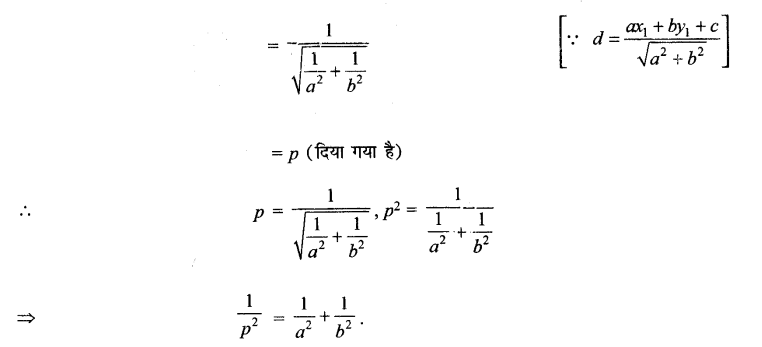
मूल बिन्दु (0, 0) बसे इस रेखा पर डाले गए लम्ब की लम्बाई
MP Board Class 11th Maths Solutions Chapter 10 सरल रेखाएँ Ex 10.3 img-17

MP Board Class 11th Maths Solutions

MP Board Class 12th Biology Solutions Chapter 1 Reproduction in Organisms

MP Board Class 12th Biology Solutions Chapter 1 Reproduction in Organisms

Reproduction in Organisms NCERT Textbook Questions and Answers

Question 1.
Why is reproduction essential (neccessary) for organisms?
Answer:
An organism gives rise to young ones by reproduction. The offspring grow, mature and in turn produce new offspring. Thus, there is a cycle of birth, growth and death. Reproduction enables the continuity of the species, generation after generation. So, therefore reproduction is essential.

Question 2.
Which is a better mode of reproduction sexual or asexual? Why?
Answer:
Sexual mode of reproduction is better because it is biparental reproduction and introduces variation among offsprings and their parants due to crossing over and recombination during gamete formation by meiosis.

Question 3.
Why is the offspring formed by asexual reproduction referred to as clone?
Answer:
In sexual reproduction, the offspring is morphologically and genetically identical to the parent and to each other. Hence, it is called clone.

MP Board Solutions

Question 4.
Offsprings formed due to sexual reproduction have better chances of survival. Why? Is this statement always true?
Answer:
Offspring formed due to sexual reproduction have better chance of survival because:

  • The offspring consists its hybrid characters which may adapt better with the different environment.
  • Genetic variations are introduced among the offspring’s, which increases the biological tolerance.
  • Sexual reproduction occurs in adverse condition in lower plant kingdom, so sexual spores survive in adverse condition.
  • Sexual reproduction may not always show better chances of survival because the offspring may be inferior to the parents.

Question 5.
How does the progeny formed from asexual reproduction differ from those formed by sexual reproduction?
Answer:
The progenies have similar genetic make up and are exact copies of their parents in asexual reproduction but the progenies have different genetic make up and different from each other and dissimilar to the parent in sexual reproduction.

Variation is absent in asexual reproduction but it is a common phenomenon of sexual reproduction. In asexual reproduction, variation may occur due to mutation whereas varia¬tion occurs due to mutation, crossing over and recombination in sexual reproduction.

Question 6.
Distinguish between asexual and sexual reproduction. Why is vegetative reproduction aslo considered as a type of asexual reproduction?
Answer:
Differences between Asexual and Sexual reproduction:

S.No.Asexual reproductionSexual reproduction
1.In this type of reproduction only one parent is required.In this type of reproduction two parents of different sexes are required.
2.Whole body or a single cell acts as reproductive unit.Reproductive units are called as gametes which are produced by specific tissues.
3.Offsprings remain pure, i.e., alike their parents.Offsprings differ from their parents.
4.It occurs by mitosis cell division.Gametes are formed by meiosis cell division and zygote develops by mitosis cell division
5.Variation does not occur.Variation occurs.

Vegetative reproduction is considered as a type of asexual reproduction because :

  • It is uniparental reproduction.
  • There is no involvement of gametes or sex cells.
  • Cell division and no reductional division takes place.
  • Vegetative propagules are somatic cells.

MP Board Solutions

Question 7.
What is vegetative propagation ? Give two suitable examples.
Answer:
In plants, the vegetative propagules (runner, rhizome, sucker, etc.) are capable of producing new offsprings by the process called vegetative propagation. As the formation of these vegetative propagules does not involve both the parents, the process involved is asexual.
Examples:

  • Adventitious buds in the notches along the leaf margins of bryophyllum grow to form new plants.
  • Potato tuber having buds when grown, develops into a new plant.

Question 8.
Define:
(a) Juvenile phase
(b) Reproductive phase
(c) Senescent phase.
Answer:
(a) Juvenile phase : It is the pre-reproductive in which all organisms require a certain growth and maturity in the life before reproducing sexually.
(b) Reproductive phase: Reproductive phase is the phase in the life cycle, where an organism possess all the capacity and potential to reproduce sexually. It is the end of juvenile phase or vegetative phase.
(c) Senescent phase : It is the post reproductive phase in the life cycle where an organism slowly losses the rate of metabolism, reproductive potential and show deterioration of the physiological activity of the body.

Question 9.
Higher organisms have resorted to sexual reproduction in spite of its complexity. Why?
Answer:
Higher organisms have resorted to sexual reproduction to :

  • Get over the unfavourable condition
  • Restore high gene pool in a population
  • Restore vigour and vitality of the race and .
  • Get proper parental care ‘
  • Introduce variation to enable better adaptive capacity.

Question 10.
Explain, why meiosis and gametogenesis are always interlinked.
Answer:
Gametogenesis (formation of male and female gametes) is associated with reduction in chromosome number thus, the gamete formed contains half chromosome set of the parental cell. So, gametogenesis is interlinked with meiosis because in meiosis reduction of chromosome number from diploid set (2n) to haploid set (n) takes place.

Question 11.
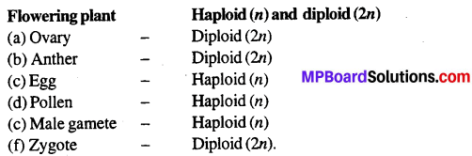
Identify each part in a flowering plant and write whether it is haploid (n) or diploid (2n).
Answer:
MP Board Class 12th Biology Solutions Chapter 1 Reproduction in Organisms 1

MP Board Solutions

Question 12.
Define external fertilization mention its disadvantages.
Answer:
The fusion of compatible gametes (Male and female) outside the body of an organism is called external fertilization, e.g., in Frog.
Disadvantages of external fertilization:

  • It requires a medium for fusion of gametes.
  • The young ones are often exposed to the predators.
  • After fertilization, offsprings are produce large in number but no parental care is provided

Question 13.
Differentiate between a Zoospore and Zygote.
Answer:
Differences between Monera and Protista:

S.No.ZoosporeZygote
1.These are endogenously, asexuallyZygote is a diploid cell formed by fusion
3.Zoospores takes part in dispersal.Zygote does not have significant role in dispersal.

Question 14.
Differentiate between Gametogenesis and Embryogenesis.
Answer:
Differences between Gametogenesis and Embryogenesis:

S.No.GametogenesisEmbryogenesis
1.It is the formation of gametes from meiocytes.It is the formation of embryo from zygote cell.
2This is a pre-fertilization event.This is a post fertilization event.
3.It occurs inside reproductive organs.It occurs outside or inside the female body.
4.It produces haploid gamete.It gives rise to diploid embryo.
5.The cell division during gametogenesis is meiotic in diploid organism.The cell division during embryogenesis is mitotic in diploid organisms.

Question 15.
Describe the post-fertilization changes in a flower.
Answer:
The post-fertilization changes that take place in a flower are as follows :

  • The formation of zygote which later develops into an embryo and primary endosperm cell which develops into endosperm takes place.
  • While the sepals, petals and stamens are shed, the pistil remains intact.
  • The fertilized ovule develops into seeds.
  • The ovary matures into a fruit that later develops a thick protective wall, called pericarp.
  • Seeds after dispersal germinate under favourable conditions which later develop into a new plant.

MP Board Solutions

Question 16.
What is a bisexual flower ? Collect five bisexual flowers from your neigh bourhood and with the help of your teacher find our their common and scientific names.
Answer:

S.No.Common NameScientific Name
1.China roseHibiscus rosa sinensis
2ChandniErvatamia divaricata
3.MakoySolatium nigrum
4.SunflowerHelianthus annuus
5.MustardBrassica compestris.

Question 17.
Examine a few flowers of any cucurbit plant and try to identify the staminate and pistillate flowers. Do you know any other plant that bears unisexual flowers ?
Answer:
Cucurbit plant bears unisexual flowers as these flowers have either the stamen or the pistil. The staminate flowers bear bright, yellow colored petals along with stamens that represent the male reproductive structure. On the other hand, the pistillate flowers bear only the pistil that represents the female reproductive structure. Other examples of plants that bear unisexual flowers are corn, papaya, cucumber, etc.

Question 18.
Why are offspring of oviparous animals at a greater risk as compared to offspring of viviparous animals?
Answer:
In viviparous animals, the young one develops inside the body of the female organism. As a result of this, the young one gets better production and nourishment for proper development. In case of oviparous animals, they lay eggs and the young ones develop inside the calcareous shell, outside the body of the female. So, the young ones are not effectively protected and nourished and are vulnerable, to predators so, they are at a greater risk as compared to the offsprings of the viviparous animals.

Reproduction in Organisms Other Important Questions and Answers

Reproduction in Organisms Objective Type Questions

1. Choose the Correct Answers:

Question 1.
Callose wall is found: (CBSE PMT 2007)
(a) In male gamete
(b) In ovum
(c) In pollen grain
Answer:
(d) In megaspore mother cell.

Question 2.
Name the plant in which new plant arise from the notches of leaves through vegetative propagation: (AFMC2012)
(a) Asparagus
(b) Chrysanthemum
(c) Agave
(d) Bryophyllum.
Answer:
(d) Bryophyllum.

MP Board Solutions

Question 3.
Which type of vegetative propagation is occurs in banana: (AMU 2012)
(a) From tuber
(b) From rhizome
(c) From bulb
(d) From stolen.
Answer:
(b) From rhizome

Question 4.
Which of the following is viviparous:
(a) Tortoise
(b) Bony fish
(c) Hummingbird
(d) Whale
Answer:
(d) Whale

Question 5.
Which of the following is characteristics of the ‘clone’:
(a) Similar to ancestors in genetic character
(b) A group of plants developed in vegetative propagation
(c) Plants developed from same parents
(d) All of the above.
Answer:
(d) All of the above.

Question 6.
Organism which give birth to young ones:
(a) Viviparous
(b) Amphibians
(c) Oviparous
(d) Coelomate.
Answer:
(a) Viviparous

Question 7.
Set of chromosome found in zygote:
(a) X
(b) 2X
(c) 3X
(d) 4X.
Answer:
(b) 2X

Question 8.
The plant which can be obtained same as parent plant:
(a) Through seeds
(b) Through fruits
(c) By cutting the stem
(d) By hybridization.
Answer:
(c) By cutting the stem

Question 9.
Vegetative propagation in potato is:
(a) By rhizome
(b) By bulb
(c) By stem
(d) By tuber.
Answer:
(d) By tuber.

Question 10.
Which of the following is oviparous animal:
(a) Bat
(b) Whale
(c) Penguin
(d) Amoeba.
Answer:
(c) Penguin

2. Fill in the Blanks:

  1. Reproductive organs in plants are developed in ……………….. phase.
  2. ……………….. nucleus are present in pollen tube of angiosperms.
  3. The ……………….. are not form in Rose and Banana, therefore, reproduction occurs through ………………..
  4. Reproductive organs of animals are differentiate in ……………….. stage.
  5. Eichomia propagate through ………………. in water.
  6. Rate of multiplication is greater ……………….. reproduction than ……………….. reproduction.

Answer:

  1. Adolescence
  2. Three
  3. Seeds, Vegetative propagation
  4. Embryo
  5. Offset
  6. Sexual, Asexual.

MP Board Solutions

3. Match the Following
MP Board Class 12th Biology Solutions Chapter 1 Reproduction in Organisms 2
Answer:

  1. (e)
  2. (d)
  3. (f)
  4. (a)
  5. (c)
  6. (b)

Answer in One Word/Sentence:

  1. What we called uniparental structure formed from asexual reproduction which is genetically and morphologically similar.
  2. Write the name of an algae reproduce by means of zoospores.
  3. Animal reproduce asexually.
  4. What we called spores having flagella.
  5. In Bryophyllum what kind of bud reproduce vegetatively ?

Answer:

  1. Clone
  2. Chlamydomonas
  3. Spongilla
  4. Zoo-spores
  5. Adventitious bud.

Reproduction in Organisms Very Short Answer Type Questions

Question 1.
What is meant by life span ?
Answer:
The period from birth to the natural death of an organism is called life span.

Question 2.
Give definition of fertilization.
Answer:
Fertilization is a process in which male and female gamete fused to form the zygote.

Question 3.
What is clone ?
Answer:
Morphologically and genetically similar individuals who are produced by single parent is called clone.

Question 4.
Give the name of an organism in which asexual reproduction occurs through conidia.
Answer:
Penicillum.

MP Board Solutions

Question 5.
In which plant vegetative propagation occurs through rhizome ?
Answer:
In Ginger, Termeric.

Question 6.
Give the name of an organism in which transverse binary fission occurs.
Answer:Paramoecium.

Question 7.
What is aging ?
Answer:
When humans are not capable for reproduction is known as aging.

Question 8.
Give two examples of Hermaphrodite plants.
Answer:
Cucurbita and Coconut are hermaphrodite plant.

MP Board Class 12th Biology Solutions

MP Board Class 11th Maths Solutions Chapter 10 सरल रेखाएँ Ex 10.2

MP Board Class 11th Maths Solutions Chapter 10 सरल रेखाएँ Ex 10.2

प्रश्न 1 से 8 तक रेखा का समीकरण ज्ञात कीजिए जो दिए गए प्रतिबंधों को संतुष्ट करता है।
प्रश्न 1.
x- अक्ष और y- अक्ष के समीकरण लिखिए।
हल:
x- अक्ष का समीकरण y = 0.
तथा y- अक्ष का समीकरण x = 0.

प्रश्न 2.
ढाल \(\frac{1}{2}\) और बिन्दु (- 4, 3) से जाने वाली।
हल:
ढाल m = \(\frac{1}{2}\) , बिन्दु (- 4, 3)
अभीष्ट रेखा का समीकरण
y – y1 = m(x – x1)
y – 3 = \(\frac{1}{2}\) = (x + 4)
या 2y – 6 = x + 4
∴ x – 2y + 10 = 0.

MP Board Solutions

प्रश्न 3.
बिन्दु (0, 0) से जाने वाली और ढाल m वाली।
हल:
दिया है : बिन्दु (0, 0), ढाल = m
ढाल m, तथा (x1, y1) से जाने वाली रेखा का समीकरण
y – y1 = m(x – x1)
∴ y – 0 = m(x – 0)
अतः अभीष्ट समीकरण y = mx.

प्रश्न 4.
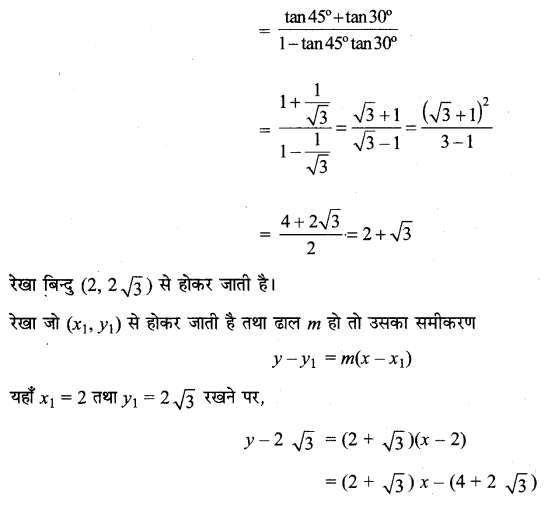
बिन्दु (2, 2\(\sqrt{3}\)) से जाने वाली और x-अक्ष से 75° के कोण पर झुकी हुई।
हल:
चूँकि रेखा x-अक्ष के साथ 75° पर झुकी हुई है, तब रेखा की ढाल
m = tan 75° = tan (45° + 30°)
MP Board Class 11th Maths Solutions Chapter 10 सरल रेखाएँ Ex 10.2 img-1
या (2 + \(\sqrt{3}\))x – y + 2\(\sqrt{3}\) – 4 – 2\(\sqrt{3}\) = 0
अतः (2 + \(\sqrt{3}\))x – y – 4 = 0.

प्रश्न 5.
मूल बिन्दु के बाईं ओर x- अक्ष को 3 इकाई की दूरी पर प्रतिच्छेद करने तथा ढाल – 2 वाली।
हल:
मूल बिन्दु से बाईं ओर 3 इकाई की दूरी पर स्थित बिन्दु (- 3, 0) होगा तथा ढाल m = – 2
m तथा (x1, y1) के द्वारा रेखा का समीकरण,
y – y1 = m(x – x1)
वहाँ x1 = – 3 तथा y1 = 0 रखने पर,
y – 0 = – 2(x + 3)
या y = – 2x – 6
या 2x + y + 6 = 0.

MP Board Solutions

प्रश्न 6.
मूल बिन्दु से ऊपर y-अक्ष को 2 इकाई की दूरी पर प्रतिच्छेद करने वाली और x-अक्ष की धन दिशा के साथ 30° का कोण बनाने वाली।
हल:
मूल बिन्दु से y-अक्ष पर 2 इकाई की दूरी पर स्थित बिन्दु (0, 2) होगा। x-अक्ष की धन दिशा के साथ रेखा 30° का कोण बनाती है।
∴ m = tan 30° = \(\frac{1}{\sqrt{3}}\)
रेखा का समीकरण,
y – y1 = m (x – x1)
y – 2 = \(\frac{1}{\sqrt{3}}\) (x – 0)
या \(\sqrt{3}\)y – 2\(\sqrt{3}\) = x
या x – \(\sqrt{3}\)y + 2\(\sqrt{3}\) = 0.

प्रश्न 7.
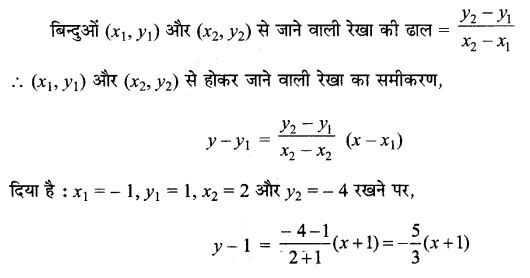
बिन्दुओं (-1, 1) और (2 – 4) से जाते हुए।
हल:
MP Board Class 11th Maths Solutions Chapter 10 सरल रेखाएँ Ex 10.2 img-2
या 3y – 3 = – 5x – 5
अतः 5x + 3y + 2 = 0.

प्रश्न 8.
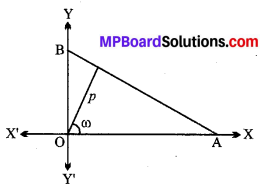
उस रेखा का समीकरण ज्ञात कीजिए जिसकी मूल बिन्दु से लांबिक दूरी 5 इकाई और लंब धन x-अक्ष से 30° का कोण बनाती है।
हल:
हम जानते हैं कि लंब रूप में रेखा AB का समीकरण,
x cos ω + y sinω = P
यहाँ पर दिया है: ω = 30°, तथा p = 5
MP Board Class 11th Maths Solutions Chapter 10 सरल रेखाएँ Ex 10.2 img-3
∴ रेखा AB का समीकरण,
x cos 30 + y sin 30 = 5
x.\(\frac{\sqrt{3}}{2}\) + y.\(\frac{1}{2}\) = 5
∴ \(\sqrt{3}\)x + y = 10.

प्रश्न 9.
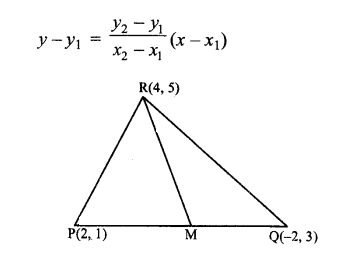
∆PQR के शीर्ष P(2, 1), Q(- 2, 3) और R(4, 5) हैं। शीर्ष R से जाने वाली माध्यिका का समीकरण ज्ञात कीजिए।
हल:
PQ का मध्य बिन्दु अर्थात् m (0, 2) है।
∴ दो बिन्दुओं से जाने वाली रेखा का समीकरण,
MP Board Class 11th Maths Solutions Chapter 10 सरल रेखाएँ Ex 10.2 img-4
अब बिन्दुओं R (4, 5) तथा M(0, 2) से जाने वाली रेखा का समीकरण,
y – 5 = \(\frac{2-5}{0-4}\) = (x – 4)
या 4(y – 5) = 3 (x – 4)
या 3x – 4y + 8 = 0
अतः माध्यिका RM का समीकरण 3x – 4y + 8 = 0.

प्रश्न 10.
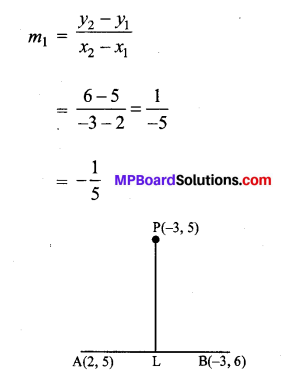
(- 3, 5) से होकर जाने वाली और बिन्दु (2, 5) और (- 3, 6) से जाने वाली रेखा पर लंब रेखा का समीकरण ज्ञात कीजिए।
हल:
बिन्दु A(2, 5) और B(- 3, 6) से होकर जाने वाली रेखा का ढाल
MP Board Class 11th Maths Solutions Chapter 10 सरल रेखाएँ Ex 10.2 img-5
यदि PL बिन्दु P(- 3, 5) से AB पर लम्ब डाला गया हो तो उसकी ढाल m2 मान लीजिए।
रेखाएँ PL और AB परस्पर लम्ब हैं।
यदि PL की ढाल × AB की ढाल = – 1
अर्थात m2 × \(\left(-\frac{1}{5}\right)\) = – 1
∴ m2 = 5
PL की ढाल 5 है और P(- 3, 5) से होकर जाती है तो PL का समीकरण,
y – y1 = m2(x – x1)
या y – 5 = 5 (x + 3)
∴ 5x – y + 20 = 0.

प्रश्न 11.
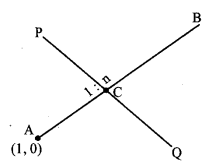
एक रेखा (1, 0) तथा (2, 3) बिन्दुओं को मिलाने वाली रेखाखंड पर लम्ब है तथा उसको 1 : n के अनुपात में विभाजित करती है। रेखा का समीकरण ज्ञात कीजिए।
हल:
रेखा AB बिन्दु A(1, 0) तथा B(2, 3) से होकर जाती है।
∴ AB की ढाल = \(\frac{3-0}{2-1}=\frac{3}{1}\)
PQ ⊥ AB
AB की ढाल = \(\frac{3}{1}\)
MP Board Class 11th Maths Solutions Chapter 10 सरल रेखाएँ Ex 10.2 img-6
∴ PQ की ढाल, m = \(-\frac{1}{\frac{3}{1}}=-\frac{1}{3}\)
PQ रेखा AB को C पर प्रतिछेदन करती है।
साथ ही बिन्दु C रेखाखंड AB को 1 : n के अनुपात में बांटता है।
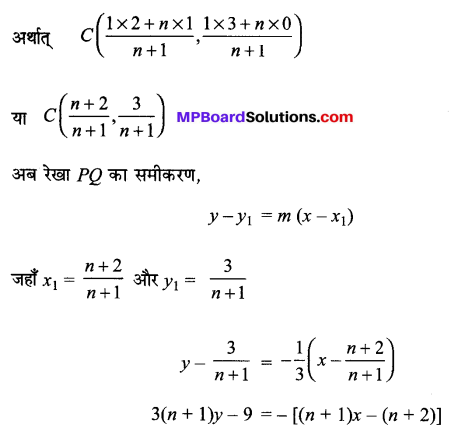
MP Board Class 11th Maths Solutions Chapter 10 सरल रेखाएँ Ex 10.2 img-7
या (n + 1)x + 3(n + 1)y = n + 2 + 9 = n + 11
या (n+ 1) x + 3 (n + 1)y = n + 11.

प्रश्न 12.
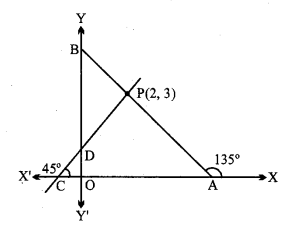
एक रेखा का समीकरण ज्ञात कीजिए जो निर्देशांक अक्षों से समान अंत:खण्ड काटती है और बिन्दु (2, 3) से जाती है।
हल:
(i) रेखा AB बिन्दु P(2, 3) से होकर जाती है और निर्देशांक अक्षों पर समान अंत: खंड बनाती है।
OA = OB
∠BAO = 45°,
∠BAX = 135°
MP Board Class 11th Maths Solutions Chapter 10 सरल रेखाएँ Ex 10.2 img-8
AB की ढाल, m = tan 135° = – 1
रेखा का समीकरण, y – y1 = m(x – x1)
जहाँ x1 = 2, Y1 = 3 तथा m = – 1
y – 3 = – (x – 2)
या x + y – 5 = 0
या x + y = 5.

प्रश्न 13.
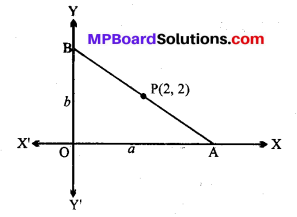
बिन्दु (2, 2) से जाने वाली रेखा का समीकरण ज्ञात कीजिए जिसके द्वारा अक्षों से कटे अंतःखंडों का योग 9 है।
हल:
मान लीजिए P(2, 2) से होकर जाने वाली रेखा से अक्षों पर बने अंतः खंड a तथा b हैं।
MP Board Class 11th Maths Solutions Chapter 10 सरल रेखाएँ Ex 10.2 img-9
अंतः खंड रूप में रेखा का समीकरण
\(\frac{x}{a}+\frac{y}{b}\) = 1
यह रेखा P(2, 2) से होकर जाती है।
∴ \(\frac{2}{a}+\frac{2}{b}\) = 1
दिया है कि अंतः खंडों का योग 9 है।
∴ a + b = 9
b = 9 – a
b का मान (1) में रखने पर,
\(\frac{2}{a}+\frac{2}{9-a}\) = 1
या 2(9 – a) + 2a = a (9 – a)
18 – 2a + 2a = 9a – a2
या a2 – 9a + 18 = 0
या (a – 6)(a – 3) = 0
a = 6, 3
b = 3, 6
जब a = 6 तथा b = 3 हो, तो रेखा का अभीष्ट समीकरण
\(\frac{x}{6}+\frac{y}{3}\) = 1
या 3x + 6y = 18
या x + 2y = 6.
जब a = 3 तथा b = 6 हो, तब रेखा का अभीष्ट समीकरण,
\(\frac{x}{3}+\frac{y}{6}\) = 1
या 6x + 3y = 18
या 2x + y = 6

MP Board Solutions

प्रश्न 14.
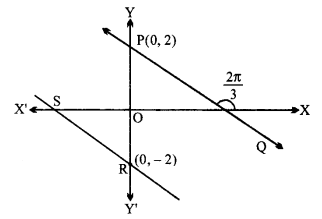
बिन्दु (0, 2) से जाने वाली और धन x-अक्ष से \(\frac{2 \pi}{3}\) के कोण बनाने वाली रेखा का समीकरण ज्ञात कीजिए। इसके समांतर और y-अक्ष को मूल बिन्दु से 2 इकाई नीचे की दूरी पर प्रतिच्छेद करती हुई रेखा का समीकरण भी ज्ञात करो।
हल:
माना एक रेखा PQ बिन्दु P(0, 2) से होकर जाती है और धन x-अक्ष के साथ \(\frac{2 \pi}{3}\) का कोण बनाती है।
∴ PQ की ढाल = tan\(\frac{2 \pi}{3}\)
= – \(\sqrt{3}\)
MP Board Class 11th Maths Solutions Chapter 10 सरल रेखाएँ Ex 10.2 img-10
∴ रेखा PQ का समीकरण, y – y1 = m(x – x1 )
y – 2 = – \(\sqrt{3}\) (x – 0)
या \(\sqrt{3}\)x + y – 2 = 0.
दूसरी रेखा RS रेखा PQ के समांतर है
∴ RS का ढाल = –\(\sqrt{3}\)
यह रेखा (0, – 2) से होकर जाती है।
रेखा RS का समीकरण, y – y1 = m(x – x1)
y + 2 = –\(\sqrt{3}\) (x – 0)
\(\sqrt{3}\)x + y + 2 = 0.

प्रश्न 15.
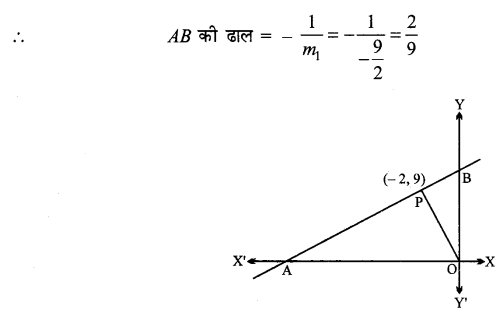
मूल बिन्दु से किसी रेखा पर डाला गया लम्ब रेखा से बिन्दु (- 2, 9) पर मिलता है। रेखा का समीकरण ज्ञात कीजिए।
हल:
मान लीजिए रेखा AB पर मूल बिन्दु से डाला गया लम्ब AB पर मिलता है।
OP की ढाल = – \(\frac{y_{2}-y_{1}}{x_{2}-x_{1}}\)
= \(\frac{9-0}{-2-0}=-\frac{9}{2}\)
परन्तु AB ⊥ OP
MP Board Class 11th Maths Solutions Chapter 10 सरल रेखाएँ Ex 10.2 img-11
अब AB की ढाल \(\frac{2}{9}\) है और P(- 2, 9) से होकर जाती है।
∴ AB का समीकरण
y – y1 = m(x – x1)
अर्थात् y – 9 = \(\frac{2}{9}\) = (x + 2) या
या 9y – 81 = 2x +4
या 2x – 9y + 85 = 0.

प्रश्न 16.
तांबे की छड़ की लम्बाई L (सेमी में) सेल्सियस ताप C का रैखिक फलन है। एक प्रयोग में यदि L= 124.942, जब C = 20 और L= 125.134 जब C = 110 हो, तो L को C के पदों में व्यक्त कीजिए।
हल:
L ताप C का रैखिक फलन है।
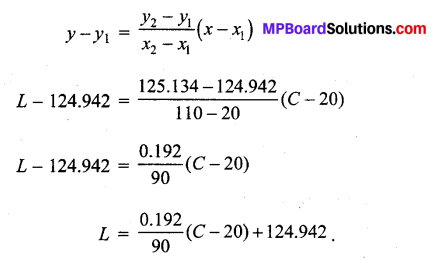
(20, 124.942), (110, 125.134) इसका रैखिक फलन है। इन दो बिन्दुओं से संतुष्ट फलन
MP Board Class 11th Maths Solutions Chapter 10 सरल रेखाएँ Ex 10.2 img-12

प्रश्न 17.
किसी दूध भण्डार का स्वामी प्रति सप्ताह 980 लीटर दूध, 14 रू प्रति लीटर के भाव से और 1220 लीटर दूध 16 रू प्रति लीटर के भाव से बेच सकता है। विक्रय मूल्य तथा मांग के मध्य के संबंध को रैखिक मानते हुए ज्ञात कीजिए कि प्रति सप्ताह वह कितना दूध 17 रू प्रति लीटर के भाव से बेच सकता है?
हल:
दूध के भाव और मात्रा में रैखिक सम्बन्ध है। यह रेखा दो बिन्दुओं (14, 980), (16, 1220) से होकर जाती है।
इससे प्राप्त रेखा का समीकरण,
y – y1 = \(\frac{y_{2}-y_{1}}{x_{2}-x_{1}}\) (x – x1)
y – 980 = \(\frac{1220-980}{16-14}\)(x – 14)
= \(\frac{240}{2}\)(x – 14)
= 120(x – 14)
y = 980 + 120 (x – 14)
जब x का मान 17 है तो y का मान नीचे दिया गया है।
y = 980 + 120(17 – 14)
= 980 + 120 × 3
= 980 + 360
= 1340
अतः 17 रू प्रति लीटर भाव का 1340 लीटर दूध बिकेगा।

MP Board Solutions

प्रश्न 18.
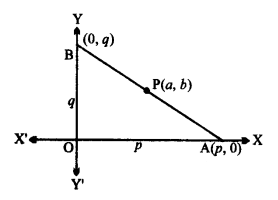
अक्षों के बीच रेखाखंड का मध्य बिंदु P(a, b) है। दिखाइए कि रेखा का समीकरण \(\frac{x}{a}+\frac{y}{b}\) = 2 हैं।
P(a, b)
हल:
माना रेखा AB अक्षों पर p और q अंतःखंड बनते हैं।
∴ बिन्दु A और B के क्रमशः निर्देशांक (p, 0) और (0, q) हैं।
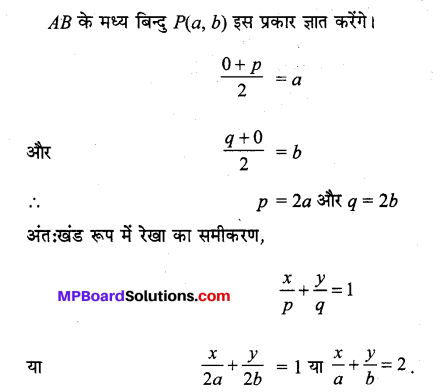
MP Board Class 11th Maths Solutions Chapter 10 सरल रेखाएँ Ex 10.2 img-13
MP Board Class 11th Maths Solutions Chapter 10 सरल रेखाएँ Ex 10.2 img-14

प्रश्न 19.
अक्षों के बीच रेखाखण्ड को बिन्दु R(h, k), 1 : 2 के अनुपात में विभक्त करता है। रेखा का समीकरण ज्ञात कीजिए।
हल:
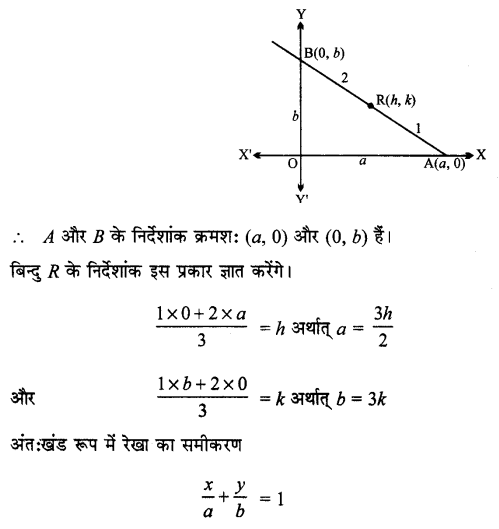
अक्षों के बीच रेखाखंड AB को R(h, k) AR : RB = 1 : 2 के अनुपात में विभक्त करता है।
मान लीजिए अक्षों पर अंत:खण्ड OA = a और OB = b है।
MP Board Class 11th Maths Solutions Chapter 10 सरल रेखाएँ Ex 10.2 img-15
a और b के मान रखने पर,
\(\frac{x}{\frac{3 h}{2}}+\frac{y}{3 k}\) = 1
या \(\frac{2 x}{h}+\frac{y}{k}\) = 3
या 2kx + hy = 3hk.

प्रश्न 20.
रेखा के समीकरण की संकल्पना का प्रयोग करते हुए सिद्ध कीजिए कि तीन बिन्दु (3, 0), (-2,-2) और (8, 2) संरेख हैं।
हल:
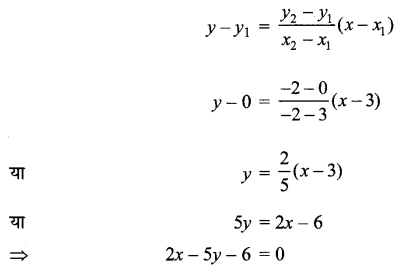
बिन्दु A(3, 0), B(- 2, – 2) से होकर जाने वाली रेखा का समीकरण
MP Board Class 11th Maths Solutions Chapter 10 सरल रेखाएँ Ex 10.2 img-16
बिन्दु C(8, 2) इस रेखा पर पड़ता है तब इसके निर्देशांक इस समीकरण को संतुष्ट करेंगे।
∴ 2 × 8 – 5 × 2 – 6 = 0
या 16 – 16 = 0
अतः दिए हुए बिन्दु A, B, C सरेख हैं।

MP Board Class 11th Maths Solutions

MP Board Class 11th Maths Solutions Chapter 10 सरल रेखाएँ Ex 10.1

MP Board Class 11th Maths Solutions Chapter 10 सरल रेखाएँ Ex 10.1

प्रश्न 1.
कार्तीय तल में एक चतुर्भुज खींचिए जिसके शीर्ष (- 4, 5), (0, 7), (5, – 5) और (- 4, – 2) हैं। इसका क्षेत्रफल भी ज्ञात कीजिए।
हल:
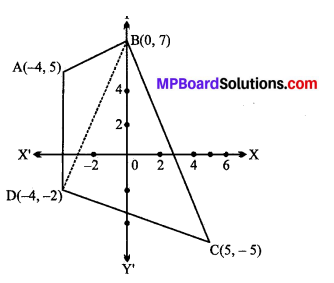
दिए गए बिन्दुओं (- 4, 5), (0, 7), (5, -5) और (- 4, – 2) क्रमशः A, B, C, D द्वारा दर्शाया गया है। चतुर्भुज ABCD को दो भागों में बाँटा गया है। जो ∆ABD तथा ∆BDC के रूप में हैं।
MP Board Class 11th Maths Solutions Chapter 10 सरल रेखाएँ Ex 10.1 img-1
∆ABD के शीर्ष A(- 4, 5), B(0, 7), D(- 4, – 2) हैं।
∴ ∆ABD का क्षेत्रफल = \(\frac{1}{2}\)|[ – 4(7 + 2) +0(- 2 – 5)+ (- 4)(5 – 7)]|
= \(\frac{1}{2}\)|[-36+8]|= \(\frac{1}{2}\) x 28
= 14 वर्ग इकाई
∆BDC के शीर्ष B(0, 7), D(-4, – 2), C ( 5, – 5) हैं।
∆BDC का क्षेत्रफल = \(\frac{1}{2}\)[0(- 2 + 5) – 4( – 5 – 7) + 5(7 + 2)]
= \(\frac{1}{2}\) [48 +45] = = \(\frac{1}{2}\) × 93
= 46.5 वर्ग इकाई
∴ चतुर्भुज ABCD का क्षेत्रफल = ∆ABD का क्षेत्रफल + ∆BDC का क्षेत्रफल
= 14+ 46.5
= 60.5 वर्ग इकाई।

प्रश्न 2.
2a भुजा के समबाहु त्रिभुज का आधार y-अक्ष के अनुदिश इस प्रकार है कि आधार का मध्य बिन्दु मूल बिन्दु पर है। त्रिभुज के शीर्ष ज्ञात कीजिए।
हल:
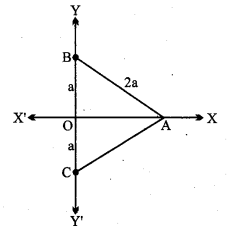
माना ∆ABC की भुजा BC, y- अक्ष के अनुदिश है जिसका मध्य बिन्दु मूल बिन्दु O है।
⇒ B और C के शीर्ष बिन्दु (0, a) और (0, – a) हैं।
बिन्दु A, x- अक्ष पर है, AB = 2a, OB = a
MP Board Class 11th Maths Solutions Chapter 10 सरल रेखाएँ Ex 10.1 img-2
समकोण त्रिभुज OAB में,
OA2 = AB2 – OB2 = (2a)2 – a2
= 4a2 – a2 = 3a2
∴ OA = \(\sqrt{3}\)a
∴ A के निर्देशांक (\(\sqrt{3}\)a,0) हैं।
अतः AABC के निर्देशांक (\(\sqrt{3}\)a,0), (0, a), (0 – a) हैं।

प्रश्न 3.
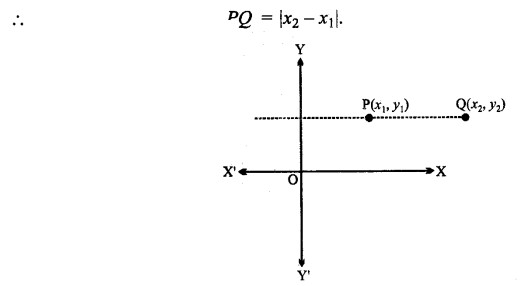
P(x1,y1) और Q(x2, Y2) के बीच की दूरी ज्ञात कीजिए जब :
(i) PQ,y- अक्ष के समांतर है,
(ii) PQ, x- अक्ष के समांतर है।
हल:
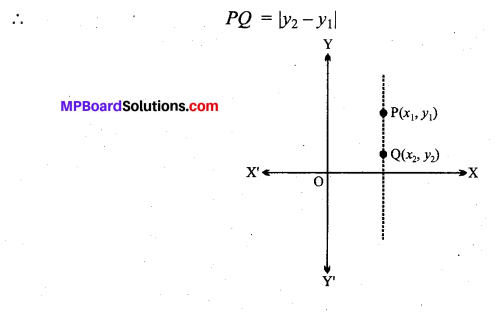
(i) जब कोई रेखा y-अक्ष के समांतर होती है तो उस पर जितने भी बिन्दु होंगे उनके x- निर्देशांक बराबर होते हैं अर्थात् X1 = X2.
MP Board Class 11th Maths Solutions Chapter 10 सरल रेखाएँ Ex 10.1 img-3
(ii) जब कोई रेखा x-अक्ष के समांतर होती है तो उसके प्रत्येक बिन्दु का y- निर्देशांक बराबर होता है।
अर्थात् y1 = Y2
MP Board Class 11th Maths Solutions Chapter 10 सरल रेखाएँ Ex 10.1 img-4

प्रश्न 4.
x- अक्ष पर एक बिन्दु ज्ञात कीजिए जो (7, 6) और (3, 4) बिन्दुओं से समान दूरी पर है।
हल:
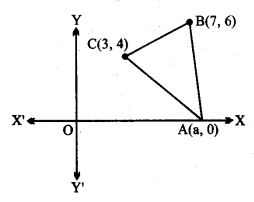
मान लीजिए x- अक्ष पर बिन्दु A(a, 0), बिन्दु B(7, 6) और C(3, 4) से समान दूरी पर है।
MP Board Class 11th Maths Solutions Chapter 10 सरल रेखाएँ Ex 10.1 img-5
अर्थात् AB = AC
या AB2 = AC2
या (a – 7)2 + (0 – 6)2 = (a – 3)2 + (0 – 4)2
∴ a2 – 14a + 49 + 36 = a2 – 6a + 9+ 16
– 14a + 6a = 25 – 85
= – 60
या – 8a = – 60
या a = \(\frac{60}{8}=\frac{15}{2}\)
अतः बिन्दु 4 के निर्देशांक \(\left(\frac{15}{2}, 0\right)\) है।

MP Board Solutions

प्रश्न 5.
रेखा की ढाल ज्ञात कीजिए जो मूल बिन्दु और P(0, -4) तथा B(8, 0) बिन्दुओं को मिलाने वाले रेखाखंड के मध्य बिन्दु से जाती है।
हल:
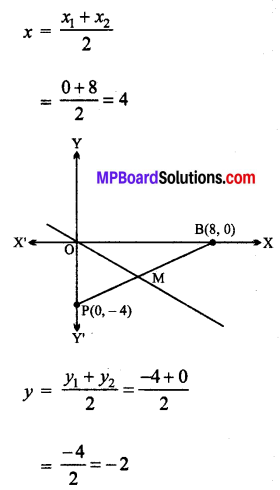
बिन्दु P(0, – 4) और B(8, 0) को मिलाने वाले रेखाखंड का मध्य बिन्दु
MP Board Class 11th Maths Solutions Chapter 10 सरल रेखाएँ Ex 10.1 img-6
⇒ PB का मध्य बिन्दु M के निर्देशांक (4, -2) है।
मूल बिन्दु 0 के निर्देशांक (0, 0) हैं।
∴ OM की ढाल = \(\frac{y_{2}-y_{1}}{x_{2}-x_{1}}=\frac{-2-0}{4-0}=\frac{-2}{4}=-\frac{1}{2}\).

प्रश्न 6.
पाइथागोरस प्रमेय के प्रयोग बिना दिखलाइए कि बिन्दु (4, 4), (3, 5) और (- 1, – 1) एक समकोण त्रिभुज के शीर्ष हैं।
हल:
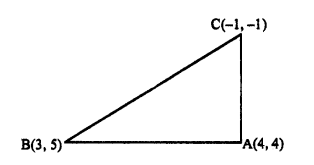
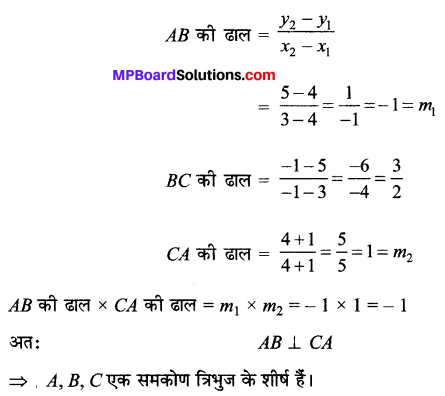
माना दिए गए बिन्दु A(4, 4), B(3, 5) और C(- 1, – 1) हैं, तब
MP Board Class 11th Maths Solutions Chapter 10 सरल रेखाएँ Ex 10.1 img-7
MP Board Class 11th Maths Solutions Chapter 10 सरल रेखाएँ Ex 10.1 img-8

प्रश्न 7.
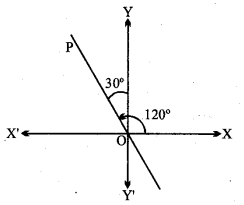
उस रेखा का समीकरण ज्ञात कीजिए जो y- अक्ष की धन दिशा से वामावर्त्त मापा गया 30° का कोण बनाती है।
हल:
माना रेखा OP, y- अक्ष से वामावर्त्त 30° का कोण बनाती है।
∴ x- अक्ष की धन दिशा से 90° + 30° = 120° का कोण बनाती है।
⇒ रेखा OP की ढाल = tan 120 = – \(\sqrt{3}\)
MP Board Class 11th Maths Solutions Chapter 10 सरल रेखाएँ Ex 10.1 img-9
यह रेखा मूल बिन्दु (0, 0) से होकर जाती है। रेखा का बिन्दु ढाल रूप है
y – y1 = m(x – x1)
∴ OP का समीकरण y – 0 = – \(\sqrt{3}\) (x – 0)
या y = – \(\sqrt{3}\)x.

MP Board Solutions

प्रश्न 8.
x का वह मान ज्ञात कीजिए जिसके लिए बिन्दु (x,- 1), (2, 1) और (4, 5) सरेख हैं।
हल:
मान लीजिए बिन्दु A (x, – 1), B(2, 1), C(4, 5) संरेख हैं यदि
AB की ढाल = \(\frac{y_{2}-y_{1}}{x_{2}-x_{1}}=\frac{1+1}{2-x}=\frac{2}{2-x}\) …(1)
BC की ढाल = \(\frac{5-1}{4-2}=\frac{4}{2}\) = 2 …(2)
∴ समीकरण (1) और (2) से,
\(\frac{2}{2-x}\) = 2
या 1 = 2 – x .
x = 1.

प्रश्न 9.
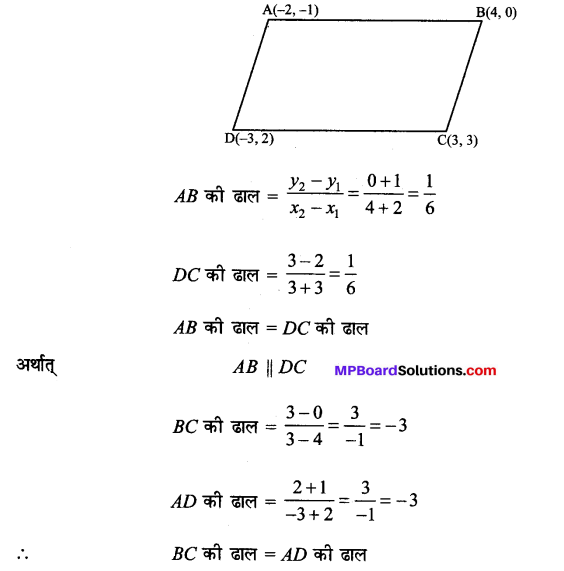
दूरी सूत्र का प्रयोग किए बिना दिखलाइए कि बिन्दु (-2,-1), (4,0), (3, 3) और (-3, 2) एक समांतर चतुर्भुज के शीर्ष हैं।
हल:
मान लीजिए एक चतुर्भुज के शीर्ष A(- 2, – 1), B(4, 0), C(3, 3), तथा D(- 3, 2) हैं।
MP Board Class 11th Maths Solutions Chapter 10 सरल रेखाएँ Ex 10.1 img-10
अर्थात् BC || AD
अतः AB || DC, BC || AD
अतः ABCD एक मांस चतुर्भुज है।

प्रश्न 10.
x- अक्ष और (3, – 1) और (4, – 2) बिन्दुओं को मिलाने वाली रेखा के बीच का कोण ज्ञात कीजिए।
हल:
माना 4(3, – 1), B(4, – 2) को मिलाने वाली रेखा AB की ढाल = \(\frac{-2+1}{4-3}=\frac{-1}{1}\) = – 1
यदि x- अक्ष और AB के बीच θ कोण हो, तो
tan θ = – 1 = tan 135°
θ = 135°.

MP Board Solutions

प्रश्न 11.
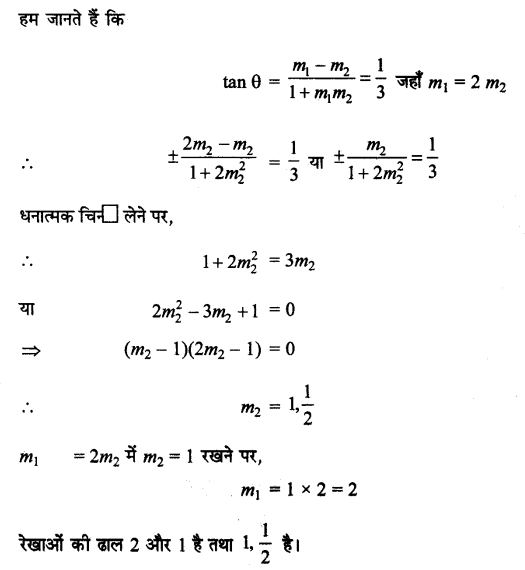
एक रेखा की ढाल दूसरी रेखा की ढाल का दुगुना है। यदि दोनों के बीच के कोण की स्पर्शज्या (tangent) \(\frac{1}{3}\) है तो रेखाओं की ढाल ज्ञात कीजिए।
हल:
माना रेखाओं की ढाल m1, m2 हों, तब
∴ m1 = 2m2 यदि दोनों रेखाओं के बीच कोण हो, तो
tan θ = \(\frac{1}{3}\)
MP Board Class 11th Maths Solutions Chapter 10 सरल रेखाएँ Ex 10.1 img-11
– ve चिन्ह लेने पर, \(1+2 m_{2}^{2}=-3 m_{2}\) या \(2 m_{2}^{2}+3 m_{2}\) +1 = 0
या (m2 + 1) (2m2 + 1) = 0 अर्थात् m2 = – 1, – \(\frac{1}{2}\)
∴ रेखा की ढाल – 2, – 1, तथा – 1, – \(\frac{1}{2}\)

MP Board Solutions

प्रश्न 12.
एक रेखा (x1, y1) और (h, k) से जाती है। यदि रेखा की ढाल m है तो दिखाइए
k – y1 = m(h – x1).
हल:
माना रेखा AB बिन्दु A(x1, y1) और B(h, k) से गुजरती हो, तब
∴ AB की ढाल = \(\frac{k-y_{1}}{h-x_{1}}\) = m
अर्थात् k – y1 = m(h – x1)

प्रश्न 13.
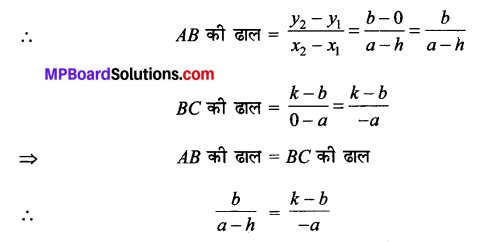
यदि तीन बिन्दु (h, 0), (a, b) और (0, k) एक रेखा पर हैं तो दिखाइए कि \(\frac{a}{h}+\frac{b}{k}\) = 1
हल:
मान लीजिए बिन्दु A (h, 0), B(a, b), तथा C(0, k) एक रेखा पर हों, तब
MP Board Class 11th Maths Solutions Chapter 10 सरल रेखाएँ Ex 10.1 img-12
या (a – h) (k – b) = – ab
या ak – ab – hk + hb = – ab
∴ ak + hb = hk
hk से भाग देने पर, \(\frac{a}{h}+\frac{b}{k}\) = 1

प्रश्न 14.
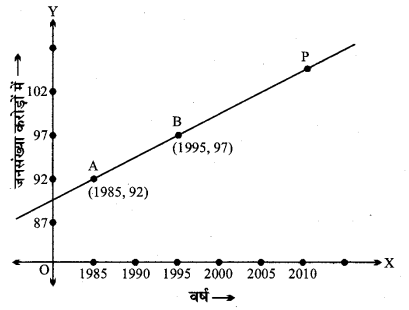
जनसंख्या और वर्ष के निम्नलिखित लेखाचित्र पर विचार कीजिए। (देखिए आकृति में) रेखा AB की ढाल ज्ञात कीजिए और इसके प्रयोग से बताइए कि वर्ष 2010 में जनसंख्या कितनी होगी ?
हल:
दी गयी आकृति में रेखा AB बिन्दु A(1985, 92) और B(1995,97) से होकर जाती है।
∴ AB की ढाल = \(\frac{97-92}{1995-1985}=\frac{5}{10}=\frac{1}{2}\)
मान लीजिए सन् 2010 में जनसंख्या y1 करोड़ होगी जो बिन्दु P(2010, y1), AB पर पड़ता है।
MP Board Class 11th Maths Solutions Chapter 10 सरल रेखाएँ Ex 10.1 img-13
∴ ABP सरेखीय हैं।
या AB की ढाल = BP की ढाल
\(\frac{1}{2}=\frac{y_{1}-97}{2010-1995}=\frac{y_{1}-97}{15}\)
∴ 2(y1 – 97) = 15
2y1 = 15 + 2 × 97
= 15 + 194 = 209
∴ y1 = \(\frac{209}{2}\) = 104.5
सन् 2010 में जनसंख्या 104.5 करोड़ होगी।

MP Board Class 11th Maths Solutions

MP Board Class 11th Maths Solutions Chapter 9 अनुक्रम तथा श्रेणी विविध प्रश्नावली

MP Board Class 11th Maths Solutions Chapter 9 अनुक्रम तथा श्रेणी विविध प्रश्नावली

प्रश्न 1.
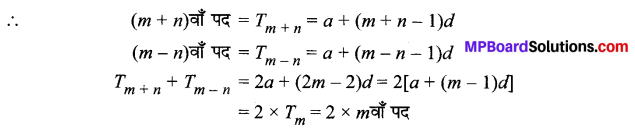
दर्शाइए कि किसी समांतर श्रेढ़ी के (m + n) वें तथा (m – n) पदों का योग m वें पद का दुगुना है।
हल:
मान लीजिए समांतर श्रेढ़ी का पहला पद a और सार्व अंतर d है।
MP Board Class 11th Maths Solutions Chapter 9 अनुक्रम तथा श्रेणी विविध प्रश्नावली img-1

प्रश्न 2.
यदि किसी समांतर श्रेढ़ी की तीन संख्याओं का योग 24 है तथा उनका गुणनफल 440 है तो संख्याएँ ज्ञात कीजिए।
हल:
मान लीजिए समांतर श्रेढ़ी की तीन संख्याएँ a – d, a और a + d हैं।
तीनों संख्याओं का योग = (a – d) + a + (a + d) = 24
∴ 3a = 24 या a = 8
तीन संख्याओं का गुणनफल = (a – d). a .(a + a)
= a (a2 – d2)
= 8(64 – d2) [∵ a = 8]
या 8(64 – d2) = 440
या 64 – d2 = 55
d2 = 64 – 55 = 9 या d = 3
अतः अभीष्ट संख्याएँ 5, 8, 11.

MP Board Solutions

प्रश्न 3.
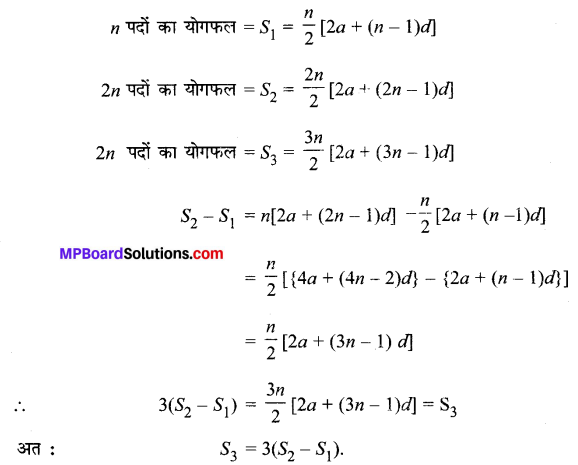
माना कि किसी समांतर श्रेढ़ी के n, 2n तथा 3n पदों का योगफल क्रमशः S1, S2 तथा S3 हैं, तो दिखाइए कि S3 = 3(S2 – S1).
हल:
मान लीजिए समांतर श्रेढ़ी का पहला पद a और सार्व अंतर d है।
MP Board Class 11th Maths Solutions Chapter 9 अनुक्रम तथा श्रेणी विविध प्रश्नावली img-2

प्रश्न 4.
200 और 400 के मध्य आने वाली उन सभी संख्याओं का योगफल ज्ञात कीजिए जो 7 से विभाजित हों।
हल:
200 से 400 के मध्य आने वाली संख्याएँ 203, 210, 217,…….., 399
मान लीजिए 399, n वाँ पद है।
∴ 399 = a + (n – 1).7
= 203 + 7 (n – 1)
या 399 – 203 = 196 = 7(n – 1)
∴ n – 1 = \(\frac{196}{7}\) = 28 या n = 29
∴ 203 + 210 + 217 +……+ 399
= \(\frac{29}{2}\)[203 + 399] [∵ S = \(\frac{n}{2}\)(a + l)]
= \(\frac{29}{2}\)(602) = 29 × 301
= 8729.

प्रश्न 5.
1 से 100 तक आने वाले उन सभी पूर्णांकों का योगफल ज्ञात कीजिए जो 2 या 5 से विभाजित हों।
हल:
2 से विभाजित होने वाले पूर्णांक 2, 4, 6,…., 100
इनकी कुल संख्या = 50
5 से विभाजित होने वाले पूर्णांक 5, 10, 15, 20,……100
इनकी कुल संख्या = 20
2 और 5 दोनों से विभाजित होने वाले पूर्णांक 10, 20, 30,…., 100
इनकी कुल संख्या = 10
1 से 100 तक आने वाले पूर्णांक जो 2 या 5 से विभाजित हों, तब
= (2 + 4 + 6 + ……50 पदों तक) + (5 + 10 + 15 +…… 20 पदों तक) – (10 + 20 + 30 +……10 पदों तक)
= \(\frac{50}{2}\)[4 + (50 – 1). 2] + \(\frac{20}{2}\)[10 + (20 – 1).5] – \(\frac{10}{2}\)[20 + (10 – 1). 10]
= \(\frac{50 \times 102}{2}\) + 10 x 105 – 5 x 110
= 2250 + 1050 – 550
= 3050.

MP Board Solutions

प्रश्न 6.
दो अंकों की उन सभी संख्याओं का योगफल ज्ञात कीजिए, जिनको 4 से विभाजित करने पर शेषफल 1 हो।
हल:
दो अंको की वे संख्याएँ जो 4 से विभाजित करने पर 1 शेष रहता है 13, 17, 21,….., 97
मान लीजिए n पद हों, तब n वाँ पद,
97 = 13 + (n – 1). 4
∴ 84 = (n – 1) × 4
∴ n = 22
∴ 13 + 17 + 21 +…..+ 97 = \(\frac{22}{2}\)[26 + (22 – 1).4]
= 11 × (26 + 84)
= 11 × 110
= 1210.

प्रश्न 7.
सभी x, y ϵ N के लिए f(x + y) = f(x).f(y) को संतुष्ट करता हुआ f एक ऐसा फलन है कि f(1) = 3 एवं \(\sum_{x=1}^{n}\)f(x) = 120 तो n का मान ज्ञात करो।
हल:
f(1) = 3, f(2) = f(1 + 1) = f(1) .f(1) = 3.3 = 9
f(3) = f(1 + 2) = f(1). f(2) = 3.9 = 27
f(4) = f(1 + 3) = f(1). (3) = 3 . 27 = 81
इस प्रकार f(1) + f(2) + f(3) +……, n पदों तक
= 3 + 9 + 27 + 81 + ……., n पदों तक = 120
⇒ \(\frac{3\left(3^{n}-1\right)}{3-1}\) = 120
या 3(3n – 1) = 120 × 2 = 240
3n – 1 = \(\frac{240}{3}\) = 80
या 3n = 81 = 34
अतः n = 4.

प्रश्न 8.
गुणोत्तर श्रेढ़ी के कुछ पदों का योग 315 है, उसका प्रथम पद तथा सार्व अनुपात क्रमशः 5 और 2 हैं।
अंतिम पद तथा पदों की संख्या ज्ञात करो।
हल:
दी हुई गुणोत्तर श्रेणी
5 + 10 + 20 + 40 +…….
n पदों का योग = \(\frac{5\left(2^{n}-1\right)}{2-1}\) = 315
∴ 2n – 1 = 63
या 2n = 64 = 26
n = 6
6 वाँ पद = 5 × 26 – 1
= 5.25
= 5 × 32 = 160.

MP Board Solutions

प्रश्न 9.
किसी गुणोत्तर श्रेढ़ी का प्रथम पद 1 है। तीसरे एवं पाँचवें पदों का योग 90 हो, तो गुणोत्तर श्रेढ़ी का सार्व अनुपात ज्ञात कीजिए।
हल:
मान लीजिए गुणोत्तर श्रेढ़ी का सार्व अनुपात r है।
तीसरा पद = ar2 = 1.r2 = r2
पाँचवाँ पद = ar4 = r4
तीसरे और पाँचवें पद का योग = r2 + r4 = 90
r4 + r2 – 90 = 0
या (r2 + 10)(r2 – 9) = 0
∴ r2 = – 10 मान्य नहीं है।
∴ r2 – 9 = 0, r2 = 9
∴ r = ± 3.

प्रश्न 10.
किसी गुणोत्तर श्रेढ़ी के तीन पदों का योग 56 है। यदि हम क्रम से इन संख्याओं में से 1, 7, 21 घटाएँ तो हमें एक समांतर श्रेढ़ी प्राप्त होती है। संख्याएँ ज्ञात कीजिए।
हल:
मान लीजिए गुणोत्तर श्रेढ़ी की तीन संख्याएँ a, ar, ar2 हैं।
तीनों पदों का योग = a + ar + ar2 = 56 …..(1)
इन संख्याओं में से 1, 7, 21 घटाने पर संख्याएँ
ar – 1, ar – 7, ar2 – 21 समांतर श्रेढ़ी में हैं।
∴ 2(ar – 7) = (a – 1) + (ar2 – 21)
या 2ar – 14 = ar2 + a – 22
ar2 – 2ar + a = 22 – 14 = 8 ….(2)
समी. (1) को (2) से भाग देने पर
= \(\frac{a\left(1+r+r^{2}\right)}{a\left(1-2 r+r^{2}\right)}\) = \(\frac{56}{8}\) = 7
या 7(1 – 2r + r2) = 1 + r + r2
6r2 – 15r + 6 = 0
2r2 – 5r + 2 = 0
या (r – 2) (2r – 1) = 0 या r = 2, \(\frac{1}{2}\)
समी (1) में r = 2 रखने पर,
a(1 + 2 + 4) = 56 या a = \(\frac{56}{7}\) = 8
इस प्रकार तीन संख्याएँ हैं: 8, 16, 32.
पुन: समी (1) में r = \(\frac{1}{2}\) रखने से,
a\(\left(1+\frac{1}{2}+\frac{1}{4}\right)\) = 56
a = \(\frac{56 \times 4}{7}\) = 32
∴ तीन संख्याएँ 32, 16, 8.
अतः अभीष्ट संख्याएं 8, 16, 32 हैं।

MP Board Solutions

प्रश्न 11.
किसी गुणोत्तर श्रेढ़ी के पदों की संख्या सम है। यदि उसके सभी पदों का योगफल, विषम स्थान पर रखे पदों के योगफल का 5 गुना है, तो सार्व अनुपात ज्ञात कीजिए।
हल:
मान लीजिए गुणोत्तर श्रेढ़ी का पहला पद = a सार्व अनुपात = r और पदों की संख्या = 2n
सभी पदों का योगफल = \(\frac{a\left(r^{2 n}-1\right)}{r-1}\)
विषम स्थानों पर रखे पद a, ar2, ar4, …. n पदों तक
इनका योग = a + ar2 + ar2 +……n पदों तक
= \(\frac{a\left[\left(r^{2}\right)^{n}-1\right]}{r^{2}-1}=\frac{a\left(r^{2 n}-1\right)}{r^{2}-1}\)
दिया है :
गुणोत्तर श्रेढ़ी के 2n पदों का योगफल = 5 × [विषम स्थानों पर स्थित पदों का योगफल]
MP Board Class 11th Maths Solutions Chapter 9 अनुक्रम तथा श्रेणी विविध प्रश्नावली img-3

प्रश्न 12.
एक समांतर श्रेढ़ी के प्रथम चार पदों का योगफल 56 है। अंतिम चार पदों का योगफल 112 है। यदि इसका प्रथम पद 11 है, तो पदों की संख्या ज्ञात कीजिए।
हल:
मान लीजिए समांतर श्रेणी
a + (a + d) + (a + 2a) +……+ l जबकि l अंतिम पद n वाँ पद है।
प्रथम 4 पदों का योगफल = \(\frac{4}{2}\)[2a + (4 – 1) d]
= 2[22 + 3d] [∵ a = 11]
दिया है: 2[22 + 3d) = 56
⇒ 3d + 22 = 28 या d = 2
अंतिम पद = a + (n – 1) d = 11 + (n – 1).2
= 2n + 9
अंतिम चार पद 2n + 9, 2n + 7, 2n + 5, 2n + 3
इनका योगफल = \(\frac{4}{2}\)[2(2n + 9) + (4 – 1). (- 2)]
= 2[4n + 18 – 6]
= 2[4n + 12]
दिया है : 2(4n + 12) = 112
∴ 4n + 12 = 56
4n = 56 – 12 = 44
∴ n = 11.

प्रश्न 13.
यदि \(\frac{a+b x}{a-b x}=\frac{b+c x}{b-c x}=\frac{c+d x}{c-d x}\) (x ≠ 0) हो, तो दिखाइए कि a, b, c, d गुणोत्तर श्रेढ़ी में है।
हल:
MP Board Class 11th Maths Solutions Chapter 9 अनुक्रम तथा श्रेणी विविध प्रश्नावली img-4
अतः a, b, c, d गुणोत्तर श्रेढ़ी में है।

MP Board Solutions

प्रश्न 14.
किसी गुणोत्तर श्रेढ़ी में S,n पदों का योग, P उनका गुणनफल तथा R उनके व्युत्क्रमों का योग हो तो सिद्ध कीजिए कि P2Rn = Sn.
हल:
मान लीजिए गुणोत्तर श्रेढ़ी a + ar + ar2 +….. + arn – 1
इन n पदों का गुणनफल, P = a. ar . ar2….. arn – 1
= an. r1 + 2 +…+ (n – 1)
= \(a^{n} r \frac{n(n-1)}{2}\)
MP Board Class 11th Maths Solutions Chapter 9 अनुक्रम तथा श्रेणी विविध प्रश्नावली img-5
अतः P2Rn = Sn.

प्रश्न 15.
किसी समांतर श्रेढ़ी का p वाँ, धूवाँ, वाँ पद क्रमशः a, b, c हैं, तो सिद्ध कीजिए
(q – r)a + (r – p)b + (p – q) c = 0.
हल:
मान लीजिए समांतर श्रेणी
A + (A + d) + (A + 2d) +…. है।
p वाँ पद = A + (p – 1) d = a ….(1)
q वाँ पद = A + (q – 1) d = b ….(2)
r वाँ पद = A + (r – 1) d=c …..(3)
समी (2) में से समी (3) को, समी (3) में से समी (1) को, समी (1) में से समी (2) को घटाने पर
(q – r)d = b – c ….(4)
(r – p)d = c – a …(5)
(p – q)d = a – b ….(6)
समीकरण (4), (5) तथा (6) को क्रमशः a, b तथा c से गुणा करके जोड़ने पर,
a(q – r)d + b(r – p)d + c(p – d)d
= a(b – c) + b(c – a) + c(a – b)
= ab – ac + bc – ba + ca – bc
= 0
दोनों पक्षों में d से भाग देने पर,
(q – r)a + (r – p)b + (p – q)c = 0.

प्रश्न 16.
यदि \(a\left(\frac{1}{b}+\frac{1}{c}\right), b\left(\frac{1}{c}+\frac{1}{a}\right), c\left(\frac{1}{a}+\frac{1}{b}\right)\) समांतर श्रेड़ी में हैं, तो सिद्ध करो कि a, b, c समांतर भेट्टी में हैं।
हल:
MP Board Class 11th Maths Solutions Chapter 9 अनुक्रम तथा श्रेणी विविध प्रश्नावली img-6

प्रश्न 17.
यदि a, b, c, d गुणोत्तर श्रेढ़ी में हैं, तो सिद्ध कीजिए कि \(\left(a^{n}+b^{n}\right),\left(b^{n}+c^{n}\right),\left(c^{n}+d^{n}\right)\) गुणोत्तर श्रेढ़ी में हैं।
हल:
a, b, c, d गुणोत्तर श्रेढ़ी में हैं।
मान लीजिए सार्व अनुपात r है।
MP Board Class 11th Maths Solutions Chapter 9 अनुक्रम तथा श्रेणी विविध प्रश्नावली img-7

प्रश्न 18.
यदि x2 – 3x + p = 0 के मूल a तथा b हैं तथा x2 – 12x + q = 0 के मूल c तथा d हैं, जहाँ a, b, c, d गुणोत्तर श्रेढ़ी के रूप में हैं। सिद्ध कीजिए कि
(q+ p) : (q – p) = 17 : 15.
हल:
यदि समीकरण Ax2 + Bx + C = 0 के मूल a , B हैं, तो
α + β = \(\frac{-B}{A}\), αβ = \(\frac{C}{A}\)
दिया है कि x2 – 3x + p = 0 के मूल a, b हैं
∴ a+ b = 3, ab = p …..(1)
इसी प्रकार x2 – 12x + q = 0 के मूल c, d हैं
∴ c + d = 12. cd = q …..(2)
अब a, b, c, d गुणोत्तर श्रेढ़ी में हैं, जिसका मान लीजिए r सार्व अनुपात है।
∴ b = ar, c = ar2, d= ar3
a + b = 3, a + ar = 3 …(3)
c + d = 12 या ar2 + ar3 = 12 …(4)
समी (3) को (4) से भाग देने पर,
MP Board Class 11th Maths Solutions Chapter 9 अनुक्रम तथा श्रेणी विविध प्रश्नावली img-8

MP Board Solutions

प्रश्न 19.
दो धनात्मक संख्याओं a और b के बीच समांतर माध्य तथा गुणोत्तर माध्य का अनुपात m : n है। दर्शाइए कि
a : b = \((m+\sqrt{m^{2}-n^{2}}):(m-\sqrt{m^{2}-n^{2}})\).
हल:
a और b के बीच समांतर माध्य = \(\frac{a+b}{2}\)
a और b के बीच गुणोत्तर माध्य = \(\sqrt{a b}\)
दोनों माध्यों का अनुपात m : n
MP Board Class 11th Maths Solutions Chapter 9 अनुक्रम तथा श्रेणी विविध प्रश्नावली img-9
MP Board Class 11th Maths Solutions Chapter 9 अनुक्रम तथा श्रेणी विविध प्रश्नावली img-10

प्रश्न 20.
यदि a, b, c समांतर श्रेढ़ी में हैं; b, c, d गुणोत्तर श्रेढ़ी में हैं तथा \(\frac{1}{c}, \frac{1}{d}, \frac{1}{e}\) समांतर श्रेढ़ी में हैं, तो सिद्ध कीजिए कि a, c, e गुणोत्तर श्रेढ़ी में हैं।
हल:
a, b, c समांतर श्रेढ़ी में हैं ∴ \(\frac{a+c}{2}\) = b …(1)
b, c, d, गुणोत्तर श्रेढ़ी में हैं, ∴ bd = c2 …(2)
\(\frac{1}{c}, \frac{1}{d}, \frac{1}{e}\) समांतर श्रेढ़ी में हैं, ∴ \(\frac{2}{d}\) = \(\frac{1}{c}+\frac{1}{e}\)
⇒ d = \(\frac{2 c e}{c+e}\) …..(3)
b और d का मान (1) और (3) से लेकर (2) में रखने पर
MP Board Class 11th Maths Solutions Chapter 9 अनुक्रम तथा श्रेणी विविध प्रश्नावली img-11

प्रश्न 21.
निम्नलिखित श्रेढ़ियों के n पदों का योग ज्ञात कीजिए :
(i) 5 + 55 + 555+ ……
(ii) 0.6 + 0.66 + 0.666 +…..
हल:
(i) S = 5 + 55 + 555 +…..n पदों तक
MP Board Class 11th Maths Solutions Chapter 9 अनुक्रम तथा श्रेणी विविध प्रश्नावली img-12
(ii) S = 0.6 + 0.66 + 0.666 +….n पदों तक
MP Board Class 11th Maths Solutions Chapter 9 अनुक्रम तथा श्रेणी विविध प्रश्नावली img-13

प्रश्न 22.
श्रेढ़ी का 20वाँ पद ज्ञात कीजिए :
2 × 4 + 4 × 6 + 6 × 8 +…..+ n पदों तक
हल:
2, 4, 6,….. का 20 वाँ पद = 2n = 2 × 20 = 40.
4, 6, 8….. का 20 वाँ पद = 4 + 19 × 2 = 4 + 38 = 42
∴ 2 × 4 + 4 × 6 + 6 × 8+…… का 20 वाँ पद
= 40 × 42 = 1680.

प्रश्न 23.
श्रेणी 3 + 7 + 13 + 21 + 31 +….. के n पदों का योगफल ज्ञात कीजिए।
हल:
MP Board Class 11th Maths Solutions Chapter 9 अनुक्रम तथा श्रेणी विविध प्रश्नावली img-14
= n2 + n – 2 +3
= n2 + n + 1
∴ दी हुई श्रेणी का योग
= Σn2 + Σn + n
= \(\frac{n(n+1)(2 n+1)}{6}+\frac{n(n+1)}{2}+n\)
= \(\frac{n}{6}\)[(n + 1)(2n + 1) + 3(n + 1) + 6]
= \(\frac{n}{6}\)[2n2 + 6n + 10]
= \(\frac{n}{3}\)[n2 + 3n + 5].

MP Board Solutions

प्रश्न 24.
यदि S1, S2, S3, क्रमशः प्रथम n प्राकृत संख्याओं का योग, उनके वर्गों का योग तथा घनों का योग है, तो सिद्ध कीजिए कि
\(9 S_{2}^{2}=S_{3}\left(1+8 S_{1}\right)\)
हल:
S1 = n प्राकृत संख्याओं का योग
= 1 + 2 + 3 +…..n पदों तक
= \(\frac{n(n+1)}{2}\) …..(1)
S2 = n प्राकृत संख्याओं के वर्गों का योग
= 12 + 22 + 32 +…..+ n2
= \(\frac{n(n+1)(2 n+1)}{6}\) …..(2)
S3 = n प्राकृत संख्याओं के घनों का योग
= 13 + 23 + 33 +…..+ n3
= \(\frac{n^{2}(n+1)^{2}}{4}\)
MP Board Class 11th Maths Solutions Chapter 9 अनुक्रम तथा श्रेणी विविध प्रश्नावली img-15
MP Board Class 11th Maths Solutions Chapter 9 अनुक्रम तथा श्रेणी विविध प्रश्नावली img-16

प्रश्न 25.
निम्नलिखित श्रेणियों के n पदों का योग ज्ञात कीजिए :
\(\frac{1^{3}}{1}+\frac{1^{3}+2^{3}}{1+3}+\frac{1^{3}+2^{3}+3^{3}}{1+3+5}+\ldots\)
हल:
अंश में दी हुई संख्याएँ 13, 13 + 23, 13 + 23 + 33, …..
n वाँ पद = 13 + 23 + 33 +…..+ n3
= \(\frac{n^{2}(n+1)^{2}}{4}\)
हर में दी हुई संख्याएँ 1, (1 + 3), (1 + 3 + 5), ……
n वाँ पद = 1 + 3 + 5 +……n पदों तक
MP Board Class 11th Maths Solutions Chapter 9 अनुक्रम तथा श्रेणी विविध प्रश्नावली img-17

प्रश्न 26.
दशाइए कि \(\frac{1 \times 2^{2}+2 \times 3^{2}+\ldots . .+n(n+1)^{2}}{1^{2} \times 2+2^{2} \times 3+\ldots .+n^{2}(n+1)}\) = \(\frac{3 n+5}{3 n+1}\).
हल:
MP Board Class 11th Maths Solutions Chapter 9 अनुक्रम तथा श्रेणी विविध प्रश्नावली img-18
MP Board Class 11th Maths Solutions Chapter 9 अनुक्रम तथा श्रेणी विविध प्रश्नावली img-19

प्रश्न 27.
कोई किसान एक पुराने ट्रैक्टर को 12000 रू. में खरीदता है। वह 6000 रु. नकद भुगतान करता है और शेष राशि को 500 रू की वार्षिक किस्त के अतिरिक्त उस धन पर जिसका भुगतान न किया गया हो 12% वार्षिक ब्याज भी देता है। किसान को ट्रैक्टर की कुल कितनी कीमत देनी पड़ेगी?
हल:
पुराने ट्रैक्टर का मूल्य = 12000 रू
नकद भुगतान = 6000 रू
शेष = 12000 – 6000 = 6000 रू
एक किस्त का भुगतान = 500 रू
कुल किस्तें = \(\frac{6000}{12}\) = 12
P मूलधन पर 12% प्रतिवर्ष की दर से 1 वर्ष का ब्याज
= \(\frac{P \times 12 \times 1}{100}=\frac{3}{25} P\)
MP Board Class 11th Maths Solutions Chapter 9 अनुक्रम तथा श्रेणी विविध प्रश्नावली img-20
कुल भुगतान = (12000 + 4680) रू
= 16680 रू।

MP Board Solutions

प्रश्न 28.
शमशाद अली 22000 रू में एक स्कूटर खरीदता है। वह 4000 रू नकद देता है और शेष राशि को 1000 रू वार्षिक किस्त के अतिरिक्त उस धन पर जिसका भुगतान न किया गया हो 10% वार्षिक ब्याज भी देता है। उसे स्कूटर के लिए कुल कितनी राशि चुकानी पड़ेगी?
हल:
स्कूटर की कीमत = 22000 रू
नकद भुगतान = 4000 रू
शेष = 22000 – 4000 = 18000 रू
एक किस्त की राशि = 1000 रू
∴ कुल किस्तें = \(\frac{18000}{1000}\) = 18
P मूलधन पर एक वर्ष का 10% प्रति वर्ष की दर से ब्याज
= \(\frac{P \times 10 \times 1}{100}\) = \(\frac{P}{10}\)
किस्त देने के बाद शेष राशि जिस पर एक वर्ष का ब्याज लगना है,
= 18000, 17000, 16000,….., 1000
कुल ब्याज की राशि
= \(\frac{1}{10}\)(18000 + 17000 + 16000 +…..+ 18 पदों तक)
= \(\frac{1}{10} \times \frac{18}{2}\)[2 × 18000 – (18 – 1) × 1000]
= \(\frac{9}{10}\)[36000 – 17000)
= \(\frac{9 \times 19000}{10}\) = 17100 रू
कुल किश्तों की राशि = 18000 रू
नकद = 4000 रू
कुल भुगतान = (18000 + 17000) + 4000 रू
= 39,100 रू।

प्रश्न 29.
एक व्यक्ति अपने चार मित्रों को पत्र लिखता है। वह प्रत्येक को उसकी नकल करके चार दूसरे व्यक्तियों को भेजने का निर्देश देता है, तथा जिनसे यह भी करने को कहता है कि प्रत्येक पत्र प्राप्त करने वाला व्यक्ति इस श्रृंखला को जारी रखे। यह कल्पना करके कि श्रंखला न टूटे तो 8वें पत्रों के समूह भेजे जाने तक कितना डाक खर्च होगा जबकि एक पत्र का डाक खर्च 50 पैसे है।
हल:
पहला व्यक्ति चार पत्र लिखता है। पत्र प्राप्त करने वाले 4 व्यक्ति फिर चार-चार पत्र लिखते हैं। इस प्रकार श्रृंखला बढ़ती चली जाती है।
हर अवसर पर पत्रों की संख्याएँ 4, 16, 24…… 8 पदों तक
कुल पत्रों की संख्या = 4 + 16 + 64 + ……………8 पदों तक
= \(\frac{4\left(4^{8}-1\right)}{4-1}\) = \(\frac{4}{3}\)(65536 – 1)
= \(\frac{4}{3}\) × 65535 = 87380
एक पत्र का डाक खर्च = 50 पै. = \(\frac{1}{2}\)रू
कुल डाक खर्च = 87380 x \(\frac{1}{2}\)
= 43690 रू

प्रश्न 30.
एक आदमी ने एक बैंक में 10000 रूपये 5% वार्षिक साधारण ब्याज पर जमा किया। जब से रकम बैंक में जमा की गई तब से, 15वें वर्ष में उसके खाते में कितनी रकम हो गई तथा 20 वर्षों बाद कल कितनी रकम हो गयी, ज्ञात कीजिए।
हल:
बैंक में जमा की गई राशि = 10000 रू
ब्याज की दर = 5% प्रति वर्ष
एक वर्ष बाद ब्याज = \(\frac{10000 \times 5 \times 1}{100}\) = 500रू
इस प्रकार हर वर्ष उसे 500 रू ब्याज के मिलेंगे।
1 वर्ष, 2 वर्ष, 3 वर्ष,…….बाद ब्याज की राशि
500, 1000, 1500, ….
15 वें वर्ष में ब्याज = (n – 1) × 500 = (15 – 1) x 500
= 14 × 500
= 7000 रू
मूलधन = 10000 रू
उसके खाते में 15वें वर्ष में = 10000 + 7000
= 17000 रू होंगें
20 वर्ष का ब्याज = 20 × 500
= 10000 रू
मूलधन = 10000 रू
20 वर्ष बाद बैंक में कुल जमा राशि = 10000 + 10000 = 20000 रू।

प्रश्न 31.
एक निर्माता घोषित करता है कि उस की मशीन जिसका मूल्य 15625 रूपये है, हर वर्ष 20% की दर से उसका अवमूल्यन होता है। 5 वर्ष के बाद मशीन का अनुमानित मूल्य ज्ञात कीजिए।
हल:
यदि किसी मशीन का r% की दर से अवमूल्यन हो रहा है n वर्ष बाद मशीन का मूल्य \(P\left(1-\frac{r}{100}\right)^{n}\) होगा।
प्रारभ में मशीन का मूल्य P रूपये है।
यहां पर P = 15625, r = 20% प्रति वर्ष, n = 5 वर्ष
∴ उस मशीन का 5 वर्ष बाद का मूल्य
= 15625 \(\left(1-\frac{20}{100}\right)^{5}\)
= 15625 \(\left(\frac{4}{5}\right)^{5}\)
= 15625 x (.8),sup>5 = 5120 रू।

MP Board Solutions

प्रश्न 32.
किसी कार्य को कुछ दिनों में पूरा करने के लिए 150 कर्मचारी लगाए गए। दूसरे दिन 4 कर्मचारियों ने काम छोड़ दिया, तीसरे दिन चार और कर्मचारियों ने काम छोड़ दिया तथा इस प्रकार अन्य। अब कार्य पूरा करने में 8 दिन अधिक लगते हैं, तो दिनों की संख्या ज्ञात कीजिए, जिनमें कार्य पूरा किया गया।
हल:
150 कर्मचारी उस कार्य को n दिनों में समाप्त करते हैं
150 कर्मचारियों का 1 दिन का काम = \(\frac{1}{n}\)
1 कर्मचारी का 1 दिन का काम = \(\frac{1}{150n}\)
पहले दिन 150 कर्मचारी 1 दिन में \(\frac{150}{150 n}\) कार्य करते हैं
दूसरे दिन 146 कर्मचारी 1 दिन में \(\frac{146}{150 n}\) कार्य करते हैं
तीसरे दिन 142 कर्मचारी 1 दिन में \(\frac{146}{150 n}\) कार्य करते हैं
वह काम n + 8 दिन में पूरा हुआ
∴ \(\frac{150}{150 n}+\frac{146}{150 n}+\frac{142}{150 n}\) +…….(n + 8) पदों तक = 1
या \(\frac{1}{150 n}\)[150 + 146 + 142 +…n + 8) पदों तक] = 1
या \(\frac{n+8}{2(150 n)}\)[2 x 150 +(n + 8 – 1) x (- 4)] = 1
(n + 8)[300 – 4(n + 7)] = 300n
या (n + 8)(- 4n + 272) = 300n
या (n + 8)(n – 68) = – 75n
या n2 – 60n – 544 = – 75n
या n2 + 15n – 544 = 0
या (n + 32)(n – 17) = 0
n ≠ – 32 या n = 17
कुल समय = n + 8 दिन
= 17 + 8 = 25 दिन।

MP Board Class 11th Maths Solutions

MP Board Class 11th Maths Solutions Chapter 9 अनुक्रम तथा श्रेणी Ex 9.4

MP Board Class 11th Maths Solutions Chapter 9 अनुक्रम तथा श्रेणी Ex 9.4

प्रश्न 1 से 7 तक प्रत्येक श्रेणी के n पदों का योग ज्ञात कीजिए :
प्रश्न 1.
1 × 2 + 2 × 3 + 3 × 4 + 4 × 5 + ….
हल:
1 × 2 + 2 × 3 + 3 × 4 + 4 × 5 +……
प्रत्येक पद के दो गुणनखण्ड हैं।
पहले गुणनखंडों से बनी श्रेढ़ी 1, 2, 3, 4……
∴ n वाँ पद = n
दूसरे गुणनखंडों से बनी श्रेढ़ी 2, 3, 4, 5……
n वाँ पद = (n + 1)
1 × 2 + 2 × 3 + 3 × 4+…. का n वाँ पद = n(n + 1) = n2 + n
MP Board Class 11th Maths Solutions Chapter 9 अनुक्रम तथा श्रेणी Ex 9.4 img-1

प्रश्न 2.
1 × 2 × 3 + 2 × 3 × 4+ 3 × 4 × 5 +…..
हल:
1 × 2 × 3 + 2 × 3 × 4 + 3 × 4 × 5 +……
पहले गुणनखंडों की श्रेढ़ी 1, 2, 3, 4, …..n
n वाँ पद = n
दूसरे गुणनखंडों की श्रेढ़ी 2, 3, 4, 5,….
n वाँ पद = (n + 1)
तीसरे गुणनखंडों की श्रेढ़ी. 3, 4, 5….
n वाँ पद = (n + 2)
∴ 1 × 2 × 3 + 2 × 3 × 4 + 3 × 4 × 5 +…… का n वाँ पद
= n(n + 1)(n + 2) = n(n2 + 3n + 2)
=n3+ 3n2 + 2n
MP Board Class 11th Maths Solutions Chapter 9 अनुक्रम तथा श्रेणी Ex 9.4 img-2

MP Board Solutions

प्रश्न 3.
3 × 12 + 5 × 22 + 7 × 32 +……
हल:
3 × 12 + 5 × 22 + 7 × 32 +…..
पहले गुणनखंड 3, 5, 7,….. का n वाँ पद = 3 + (n – 1). 2 = 2n + 1
दूसरे गुणनखंड 12, 22, 32….. का nवाँ पद = n2
∴ 3 × 12 + 5 × 22 + 7 × 32 +…… का गवाँ पद
= (2n + 1) n2 = 2n3 + n2
MP Board Class 11th Maths Solutions Chapter 9 अनुक्रम तथा श्रेणी Ex 9.4 img-3
MP Board Class 11th Maths Solutions Chapter 9 अनुक्रम तथा श्रेणी Ex 9.4 img-4

प्रश्न 4.
\(\frac{1}{1 \times 2}+\frac{1}{2 \times 3}+\frac{1}{3 \times 4}\) +…….
हल:
\(\frac{1}{1 \times 2}+\frac{1}{2 \times 3}+\frac{1}{3 \times 4}\) +…….
1, 2, 3,….. का गवाँ पद = n
2, 3, 4,……का n वाँ पद = (n + 1)
MP Board Class 11th Maths Solutions Chapter 9 अनुक्रम तथा श्रेणी Ex 9.4 img-5

प्रश्न 5.
52 + 62 + 72 +….+ 202.
हल:
n वें पद वाली इस श्रेणी में,
(n + 4)2 = n2 + 8n + 16
Sn = ΣTn = Σn2 + 8 Σn + (16 + 16 +……n. पदों तक)
= \(\frac{n(n+1)(2 n+1)}{6}\) + 8 × \(\frac{n(n+1)}{2}\) + 16n
MP Board Class 11th Maths Solutions Chapter 9 अनुक्रम तथा श्रेणी Ex 9.4 img-6

MP Board Solutions

प्रश्न 6.
3 × 8 + 6 × 11 + 9 × 14 +…..
हल:
3 × 8 + 6 × 11 + 9 × 14 +….
3, 6, 9 का n वाँ पद = 3n
8, 11, 14,…..का n वाँ पद = 8 + (n – 1). 3 = 3n + 5
∴ 3 × 8 + 6 × 11 + 9 × 14 +……का nवाँ पद = 3n(3n + 5)
= 3 (3n2 + 5n)
दी हुई श्रेढ़ी के n पदों का योगफल
MP Board Class 11th Maths Solutions Chapter 9 अनुक्रम तथा श्रेणी Ex 9.4 img-7

प्रश्न 7.
12 + (12 + 22) + (12 + 22 + 32) +…..
हल:
MP Board Class 11th Maths Solutions Chapter 9 अनुक्रम तथा श्रेणी Ex 9.4 img-8
दी हुई श्रेढ़ी के n पदों का योगफल
MP Board Class 11th Maths Solutions Chapter 9 अनुक्रम तथा श्रेणी Ex 9.4 img-9

प्रश्न 8 से 10 तक प्रत्येक श्रेणी के n पदों का योग ज्ञात कीजिए जिसका nवाँ पद दिया है :
प्रश्न 8.
n(n + 1)(n + 4).
हल:
Tn = n(n + 1)(n + 4) = n(n2 + 5n + 4)
= n3 + 5n2 + 4n
दी हुई श्रेढ़ी के n पदों का योग = Σn3 + 5Σn2 + 4Σn
= \(\frac{n^{2}(n+1)^{2}}{4}+\frac{5 n(n+1)(2 n+1)}{6}+\frac{4 n(n+1)}{2}\)
= \(\frac{n(n+1)}{12}\)[3n(n + 1) + 10(2n + 1) + 24]
= \(\frac{n(n+1)}{12}\)[3n2 + 3n + 20n + 10 + 24]
= \(\frac{n(n+1)}{12}\)[3n2 + 23n + 34]

प्रश्न 9.
n2 + 2n.
हल:
दी हुई श्रेढ़ी के n पदों का योग
= Σn2 + Σ2n
MP Board Class 11th Maths Solutions Chapter 9 अनुक्रम तथा श्रेणी Ex 9.4 img-10

MP Board Solutions

प्रश्न 10.
(2n – 1).
हल:
Tn = (2n – 1)2 = 4n2 – 4n + 1
दी हुई श्रेढ़ी के n पदों का योग
MP Board Class 11th Maths Solutions Chapter 9 अनुक्रम तथा श्रेणी Ex 9.4 img-11

MP Board Class 11th Maths Solutions

MP Board Class 11th Maths Solutions Chapter 9 अनुक्रम तथा श्रेणी Ex 9.3

MP Board Class 11th Maths Solutions Chapter 9 अनुक्रम तथा श्रेणी Ex 9.3

प्रश्न 1.
गुणोत्तर श्रेणी \(\frac{5}{2}, \frac{5}{4}, \frac{5}{8} \dots\) का 20वाँ तथा nवाँ पद ज्ञात कीजिए।
हल:
गुणोत्तर श्रेणी का पहला पद, a = \(\frac{5}{2}\)
दूसरा पद = \(\frac{5}{4}\), सार्व अनुपात = \(\frac{1}{2}\)
n वाँ पद = \(a r^{n-1}=\frac{5}{2}\left(\frac{1}{2}\right)^{n-1}\) = \(\frac{5}{2^{n}}\).
n = 20 रखने पर,
20 वाँ पद = \(\frac{5}{2^{20}}\)

MP Board Solutions

प्रश्न 2.
उस गुणोत्तर श्रेणी का 12वाँ पद ज्ञात कीजिए, जिसका 8वाँ पद 192 तथा सार्व अनुपात 2 है।
हल:
मान लीजिए गुणोत्तर श्रेणी का पहला पद = a
सार्व अनुपात = 2
MP Board Class 11th Maths Solutions Chapter 9 अनुक्रम तथा श्रेणी Ex 9.3 img-1

प्रश्न 3.
किसी गुणोत्तर श्रेणी का 5वाँ, 8वाँ तथा 11 वाँ पद क्रमशः p, q तथा s हैं, तो दिखाइए कि q2 = ps.
हल:
मान लीजिए गुणोत्तर श्रेणी का पहला पद = a
सार्व तथा अनुपात =r
5वाँ पद = ar5 – 1 = ar4 = p
8वाँ पद = ar8 – 1 = ar7 = q
11वाँ पद = ar11 – 1= ar10 = s
बायाँ पक्ष = q2 = (ar7)2 = a2 . r14
दायाँ पक्ष = ps = ar4 ar10= a2 . r14
अतः q2 = ps.

प्रश्न 4.
किसी गुणोत्तर श्रेणी का चौथा पद उसके दूसरे पद का वर्ग है तथा प्रथम पद – 3 है, तो 7 वाँ पद ज्ञात कीजिए।
हल:
मान लीजिए गुणोत्तर श्रेणी का पहला पद, a = – 3
तथा सार्व-अनुपात = r
चौथा पद = ar4 – 1 = ar3 = – 3r3
दूसरा पद = ar = – 3r
दिया है : चौथा पद = (दूसरे पद)2
⇒ – 3r3 = (-3r)2 = 9r2
r= – 3
7वाँ पद = \(a r^{7-1}=a r^{6}=(-3)(-3)^{6}\)
= (- 3)7 = – 2187.

MP Board Solutions

प्रश्न 5.
अनुक्रमों का कौन सा पद :
(a) 2, 2\(\sqrt{2}\), 4, … ; 128 है ?
(b) \(\sqrt{3}\), 3, 3, …. ; 729 है ?
(c) \(\frac{1}{3}, \frac{1}{9}, \frac{1}{27}\), ….; 19683 है?
हल:
(a) गुणोत्तर श्रेणी का पहला व दूसरा पद क्रमशः 2 और 2\(\sqrt{2}\)
MP Board Class 11th Maths Solutions Chapter 9 अनुक्रम तथा श्रेणी Ex 9.3 img-2
∴ \(\frac{n-1}{2}\) = 6, n – 1 = 12 या n = 13.
MP Board Class 11th Maths Solutions Chapter 9 अनुक्रम तथा श्रेणी Ex 9.3 img-3
MP Board Class 11th Maths Solutions Chapter 9 अनुक्रम तथा श्रेणी Ex 9.3 img-4

प्रश्न 6.
x के किस मान के लिए संख्याएँ –\(\frac{2}{7}\), x, – \(\frac{7}{2}\) गुणोत्तर श्रेणी में हैं ?
हल:
संख्याएँ a, b और c गुणोत्तर श्रेणी में है यदि b2 = ac
∴ –\(\frac{2}{7}\), x, – \(\frac{7}{2}\) गुणोत्तर श्रेणी में हैं
\(x^{2}=\left(-\frac{2}{7}\right)\left(-\frac{7}{2}\right)\) = 1
x = ± 1.

प्रश्न 7 से 10 तक प्रत्येक गुणोत्तर श्रेणी का योगफल निर्दिष्ट पदों तक ज्ञात कीजिए।
प्रश्न 7.
0.15, 0.015, 0.0015,…..20 पदों तक।
हल:
गुणोत्तर श्रेणी 0.15, 0.015, 0.0015
पहला पद, a = 0.15
सार्व अनुपात, r = \(\frac{0.015}{0.15}\) = 0.1
MP Board Class 11th Maths Solutions Chapter 9 अनुक्रम तथा श्रेणी Ex 9.3 img-5

प्रश्न 8.
\(\sqrt{7}, \sqrt{21}, 3 \sqrt{7}\),…..n पदों तक।
हल:
गुणोत्तर श्रेणी \(\sqrt{7}, \sqrt{21}, 3 \sqrt{7}\), …….
पहला पद, a = \(\sqrt{7}\) , सार्व अनुपात, r = \(\frac{\sqrt{21}}{\sqrt{7}}=\sqrt{3}\)
MP Board Class 11th Maths Solutions Chapter 9 अनुक्रम तथा श्रेणी Ex 9.3 img-6

प्रश्न 9.
1, – a, a2, – a3,…. पदों तक (यदि a ≠ – 1).
हल:
गुणोत्तर श्रेणी 1, – a, a, 2, – a3,…..
पहला पद, a = 1, सार्व अनुपात, r = \(\frac{-a}{1}\) = – a
MP Board Class 11th Maths Solutions Chapter 9 अनुक्रम तथा श्रेणी Ex 9.3 img-7

प्रश्न 10.
x3, x5, x7, …..n पदों तक (यदि x ≠ ± 1).
हल:
गुणोत्तर श्रेणी x3, x5, x7, …..
MP Board Class 11th Maths Solutions Chapter 9 अनुक्रम तथा श्रेणी Ex 9.3 img-8

MP Board Solutions

प्रश्न 11.
मान ज्ञात कीजिए \(\sum_{k=1}^{11}\left(2+3^{k}\right)\).
हल:
MP Board Class 11th Maths Solutions Chapter 9 अनुक्रम तथा श्रेणी Ex 9.3 img-9

प्रश्न 12.
एक गुणोत्तर श्रेणी के तीन पदों का योगफल \(\frac{39}{10}\) है तथा उनका गुणनफल 1 है। सार्व अनुपात तथा पदों को ज्ञात कीजिए।
हल:
मान लीजिए गुणोत्तर श्रेणी के तीन पद \(\frac{a}{r}\), a तथा ar हैं।
MP Board Class 11th Maths Solutions Chapter 9 अनुक्रम तथा श्रेणी Ex 9.3 img-10

प्रश्न 13.
गुणोत्तर श्रेणी 3,32, 33,… के कितने पद आवश्यक हैं ताकि उनका योगफल 120 हो जाए।
हल:
मान लो गुणोत्तर श्रेणी के कुल पद = n
MP Board Class 11th Maths Solutions Chapter 9 अनुक्रम तथा श्रेणी Ex 9.3 img-11
या 3(3n – 1) = 120 × 2 = 240
3 से भाग देने पर
3n – 1 = \(\frac{240}{3}\) = 80
या 3n = 80 + 1 = 81 = 34
अत:
n = 4.

प्रश्न 14.
किसी गुणोत्तर श्रेणी के प्रथम तीन पदों का योगफल 16 है तथा अगले 3 पदों का योग 128 है तो गुणोत्तरं श्रेणी का प्रथम पद, सार्व अनुपात तथा n पदों का योगफल ज्ञात कीजिए।
हल:
मान लीजिए गुणोत्तर श्रेणी a, ar, ar2,…. है।
पहला पद = a, सार्व अनुपात = r
तीन पदों का योगफल = \(\frac{a\left(1-r^{3}\right)}{1-r}\) = 16 …(1)
चौथा पद = a × rn – 1 = ar4 – 1 = ar3
अगले तीन पदों का योगफल = \(\frac{a r^{3}\left(1-r^{3}\right)}{1-r}\) = 128
MP Board Class 11th Maths Solutions Chapter 9 अनुक्रम तथा श्रेणी Ex 9.3 img-12

MP Board Solutions

प्रश्न 15.
एक गुणोत्तर श्रेणी का प्रथम पद a = 729 तथा 7वाँ पद 64 है, तो S7 ज्ञात कीजिए।
हल:
गुणोत्तर श्रेणी का पहला पद, a = 729
मान लीजिए सार्व अनुपात = r
MP Board Class 11th Maths Solutions Chapter 9 अनुक्रम तथा श्रेणी Ex 9.3 img-13

प्रश्न 16.
एक गुणोत्तर श्रेणी को ज्ञात कीजिए, जिसके प्रथम दो पदों का योगफल – 4 है तथा 5 वाँ पद तृतीय पद का 4 गुना है।
हल:
मान लीजिए गुणोत्तर श्रेणी का पहला पद = a
सार्व अनुपात = r
पहले दो पदों का योग = a + ar = – 4 ……(1)
5 वाँ पद = ar4, तीसरा पद = ar2
5 वाँ पद = 4 × तीसरा पद
ar4 = 4 × ar2
∴ r2 = 4 या r = ± 2
समी (1) में r = 2 रखने पर
a (1 + 2) = – 4
∴ a = – latex]\frac{4}{3}[/latex]
∴ गुणोत्तर श्रेणी – 5, 3…. है
और जब r = – 2, ∴ a (1 – 2) = – 4, या a = 4
गुणोत्तर श्रेणी है: 4, – 8, 16, – 32,….

प्रश्न 17.
यदि किसी गुणोत्तर का 4वाँ, 10वाँ तथा 16वाँ पद क्रमशः x, y तथा z हैं, तो सिद्ध कीजिए कि x, y, z गुणोत्तर श्रेणी में हैं।
हल:
मान लीजिए गुणोत्तर श्रेणी का पहला पद = a,
सार्व अनुपात =r
MP Board Class 11th Maths Solutions Chapter 9 अनुक्रम तथा श्रेणी Ex 9.3 img-14

प्रश्न 18.
अनुक्रम 8, 88, 888, …. के n पदों का योग ज्ञात कीजिए।
हल:
मान लीजिए S = 8 + 88 + 888 + … पदों तक
= 8 [1 + 11 + 111 + … n पदों तक]
= \(\frac{8}{9}\)[9 + 99 + 999 +…. पदों तक]
MP Board Class 11th Maths Solutions Chapter 9 अनुक्रम तथा श्रेणी Ex 9.3 img-15

प्रश्न 19.
अनुक्रम 2, 4, 8, 16, 32, तथा 128, 32, 8, 2, \(\frac{1}{2}\) के संगत पदों के गुणनफल से बने अनुक्रम का योगफल ज्ञात कीजिए।
हल:
अनुक्रम 2, 4, 8, 16, 32 तथा 128, 32, 8, 2,\(\frac{1}{2}\) के संगत पदों के गुणनफल 2 × 128, 4 × 32, 8 × 8, 16 × 2, 32 × \(\frac{1}{2}\) या 256, 128, 64, 32, 16.
गुणोत्तर श्रेणी का पहला पद, a = 256
MP Board Class 11th Maths Solutions Chapter 9 अनुक्रम तथा श्रेणी Ex 9.3 img-16

प्रश्न 20.
दिखाइए कि अनुक्रम a, ar, ar2,… arn – 1 तथा A, AR, Ar2,…. ARn – 1 के संगत पदों के गुणनफल से बना अनुक्रम गुणोत्तर श्रेणी होती है तथा सार्व अनुपात ज्ञात कीजिए। .
हल:
%अनुक्रम a, ar, ar2,….arn – 1 तथा A, AR, AR2,… ARn – 1 के संगत पदों के गुणनफल से बना अनुक्रम
या aA, arAR, ar2. AR2, ….
या aA, aArR, aAr2 R2, ….
स्पष्ट है कि यह पद गुणोत्तर श्रेणी में है।
इसका पहला पद = aA
सार्व अनुपात = \(\frac{a A r R}{a A}\) = rR.

प्रश्न 21.
ऐसे चार पद ज्ञात कीजिए जो गुणोत्तर श्रेणी में हो, जिसका तीसरा पद प्रथम पद से 9 अधिक हो, तथा दूसरा पद चौथे पद से 18 अधिक हो।
हल:
मान लीजिए गुणोत्तर श्रेणी a, ar, ar2, ar3,… है
तीसरा पद = ar2, प्रथम पद = a
∴ ar2 – a = 9 …(1)
दूसरा पद = ar, चौथा पद = ar3
ar – ar3 = 18 …(2)
समी (1) को (2) से भाग देने पर,
MP Board Class 11th Maths Solutions Chapter 9 अनुक्रम तथा श्रेणी Ex 9.3 img-17

प्रश्न 22.
यदि किसी गुणोत्तर श्रेणी का p वाँ, q वाँ तथा वा पद क्रमशः a, b, तथा c हो, तो सिद्ध कीजिए कि \(a^{q-r} \cdot b^{r-p}-c^{p-q}\) = 1.
हल:
मान लीजिए गुणोत्तर श्रेणी का पहला पद A और सार्व अनुपात R है
p वाँ पद = ARp – 1 = a ….(1)
q वाँ पद = ARq – 1 = b ….(2)
r वाँ पद = ARr – 1 = c …..(3)
समी. (1) की q – 7, समी (2) की r – p, समी (3) की p – q घात का प्रयोग करने पर,
MP Board Class 11th Maths Solutions Chapter 9 अनुक्रम तथा श्रेणी Ex 9.3 img-18

प्रश्न 23.
यदि किसी गुणोत्तर श्रेणी का प्रथम तथा nवाँ पद a तथा b हैं, एवं P, n पदों का गुणनफल हो, तो सिद्ध कीजिए कि P2 = (ab)n.
हल:
मान लो गुणोत्तर श्रेणी का सार्व अनुपात है।
पहला पद = a, n वाँ पद = ar n – 1 = b
P = n पदों का गुणनफल
= a. ar. ar2. ar3 ….arn – 1
= a n. r 1 + 2 + 3 +…+ (n – 1) = \(a^{n} r^{\frac{n(n-1)}{2}}\)
MP Board Class 11th Maths Solutions Chapter 9 अनुक्रम तथा श्रेणी Ex 9.3 img-19

प्रश्न 24.
दिखाइए कि एक गुणोत्तर श्रेणी के प्रथम n पदों का योगफल तथा (n + 1) वें पद से (2n)वें पद तक के पदों के योगफल का अनुपात में है।
हल:
मान लीजिए गुणोत्तर श्रेणी का पहला पद a और सार्व अनुपात = \(\frac{1}{r^{n}}\) हों, तब
MP Board Class 11th Maths Solutions Chapter 9 अनुक्रम तथा श्रेणी Ex 9.3 img-20

MP Board Solutions

प्रश्न 25.
यदि a, b, c तथा d गुणोत्तर श्रेणी में हैं तो दिखाइए कि \(\left(a^{2}+b^{2}+c^{2}\right)\left(b^{2}+c^{2}+d^{2}\right)=(a b+b c+c d)^{2}\).
हल:
मान लीजिए गुणोत्तर श्रेणी का सार्व अनुपात 7 है।
MP Board Class 11th Maths Solutions Chapter 9 अनुक्रम तथा श्रेणी Ex 9.3 img-21

प्रश्न 26.
ऐसी दो संख्याएँ ज्ञात कीजिए जिनको 3 और 81 के बीच रखने पर प्राप्त अनुक्रम एक गुणोत्तर श्रेणी बन जाए।
हल:
मान लीजिए G1, G2 ऐसी दो संख्याएँ हैं जिससे 3, G1, G2, 81 गुणोत्तर श्रेणी बनाते हैं।
यह कुल चार पद हैं। यदि r सार्व अनुपात हो तो
∴ 81 = 3.r4 – 1 = 3 . r3
⇒ r=3
G1 = 3r = 3 . 3 = 9
G2 = 3r2 = 3.32 = 27
अतः संख्याएँ 9 और 27 हैं।

प्रश्न 27.
n का मान ज्ञात कीजिए ताकि \(\frac{a^{n+1}+b^{n+1}}{a^{n}+b^{n}}\), a तथा b के बीच गुणोत्तर माध्य हो।
हल:
a और b के बीच गुणोत्तर माध्य = \(\sqrt{a b}\)
MP Board Class 11th Maths Solutions Chapter 9 अनुक्रम तथा श्रेणी Ex 9.3 img-22
या \(\left(\frac{a}{b}\right)^{n+\frac{1}{2}}\) = 1 = \(\left(\frac{a}{b}\right)^{0}\)
⇒ n+ \(\frac{1}{2}\) = 0 या n = – \(\frac{1}{2}\).

प्रश्न 28.
दो संख्याओं का योगफल उनके गुणोत्तर माध्य का 6 गुना है तो दिखाइए कि संख्याएँ (3 + 2\(\sqrt{2}\)) : (3 – 2\(\sqrt{2}\)) के अनुपात में हैं। .
हल:
मान लीजिए संख्याएँ a और b हों, तब
MP Board Class 11th Maths Solutions Chapter 9 अनुक्रम तथा श्रेणी Ex 9.3 img-23
MP Board Class 11th Maths Solutions Chapter 9 अनुक्रम तथा श्रेणी Ex 9.3 img-24

प्रश्न 29.
यदि A तथा G दो धनात्मक संख्याओं के बीच क्रमशः समांतर तथा गुणोत्तर माध्य हों, तो सिद्ध करो कि संख्याएँ \(\mathbf{A} \neq \sqrt{(A+G)(A-G)}\) हैं।
हल:
मान लीजिए संख्याएँ a और b हैं।
MP Board Class 11th Maths Solutions Chapter 9 अनुक्रम तथा श्रेणी Ex 9.3 img-25

MP Board Solutions

प्रश्न 30.
किसी कल्चर में बैक्टीरिया की संख्या प्रत्येक घण्टे के पश्चात् दुगुनी हो जाती है। यदि प्रारंभ में उसमें 30 बैक्टीरिया उपस्थित थे, तो बैक्टीरिया की संख्या दूसरे, चौथे तथा nवें घण्टों बाद क्या होगी ?
हल:
प्रारम्भ में बैक्टीरिया की संख्या a = 30
प्रत्येक घण्टे बाद बैक्टीरिया की संख्या दुगुनी हो जाती है
∴ सार्व अनुपात = 2.
दूसरे घण्टे बाद बैक्टीरिया संख्या = ar2 = 30 × 22 = 120
चौथे घण्टे बाद बैक्टीरिया संख्या = ar4 = 30 × 24 = 480
n वें घण्टे बाद बैक्टीरिया संख्या = arn = 30 × 2n.

प्रश्न 31.
500 रुपए धनराशि 10% वार्षिक चक्रवृद्धि ब्याज पर 10 वर्षों बाद क्या हो जाएगी, ज्ञात कीजिए ?
हल:
माना A मिश्रधन, P मूलधन, r% प्रतिवर्ष ब्याज की दर तथा n वर्ष का समय हो, तो
A = \(P\left(1+\frac{r}{100}\right)^{n}\)
दिया है: P = 500, r = 10%, n = 10 वर्ष
A = 500 \(\left(1+\frac{10}{100}\right)\)
= 500 × (1.1)10.

MP Board Solutions

प्रश्न 32.
यदि किसी द्विघात समीकरण के मूलों के समांतर माध्य एवं गुणोत्तर माध्य क्रमशः 8 तथा 5 हैं, तो द्विघातीय समीकरण ज्ञात कीजिए।
हल:
मान लीजिए द्विघात समीकरण के मूल α और β हों, तब
\(\frac{\alpha+\beta}{2}\) = 8 ∴ α + β = 16
तथा \(\sqrt{\alpha \beta}\) = 5 ∴ αβ = 25
∴ द्विघातीय समीकरण.
x 2 – (α + β) x + αβ = 0
⇒ x 2 – 16x + 25 = 0..

MP Board Class 11th Maths Solutions

MP Board Class 11th Maths Solutions Chapter 9 अनुक्रम तथा श्रेणी Ex 9.2

MP Board Class 11th Maths Solutions Chapter 9 अनुक्रम तथा श्रेणी Ex 9.2

प्रश्न 1.
1 से 2001 तक के विषम पूर्णांकों का योग ज्ञात कीजिए।
हल:
श्रेणी 1 + 3 + 5 + 7 +….+ 2001
मान लीजिए n वाँ पद 2001 तब
2001 = a + (n – 1)d
= 1+ (n – 1). 2
= 1001
MP Board Class 11th Maths Solutions Chapter 9 अनुक्रम तथा श्रेणी Ex 9.2 img-1

प्रश्न 2.
100 तथा 1000 के मध्य उन सभी प्राकृत संख्याओं का योगफल ज्ञात कीजिए जो 5 के गुणज हों।
हल:
100 और 1000 के बीच की संख्याएँ जो 5 की गुणज हैं उनका योगफल
= 105 + 110 + 115 + ….+ 995
मान लीजिए 995, n वाँ पद है।
n वाँ पद = a + (n – 1) d
⇒ 995 = 105 + (n – 1)5
5. (n – 1) = 995 – 105
= 890
n – 1 = \(\frac{890}{5}\) = 178
या n = 179
अतः योगफल, S179 = \(\frac{179}{2}\) [2 × 10⁵ + (179 – 1). 5]
= \(\frac{179}{2}[2 \times 105+178 \times 5]\)
= 179 [105 + 89 × 5]
= 98450.

MP Board Solutions

प्रश्न 3.
किसी समांतर श्रेणी में प्रथम पद 2 है तथा प्रथम पांच पदों का भागफल, अगले पांच पदों के योगफल का एक चौथाई है। दर्शाइए कि 20 वाँ पद – 112 है।
हल:
मान लीजिए, d सार्वअंतर है जबकि a = 2 .
प्रथम पाँच पदों का योगफल = \(\frac{5}{2}\)[2 × 2 + 4 × d]
= 5 [2 + 2d] = 10 (1 + d)
तथा 6 वाँ पद = 2 + (6 – 1). d = 2 + 5d
MP Board Class 11th Maths Solutions Chapter 9 अनुक्रम तथा श्रेणी Ex 9.2 img-2

प्रश्न 4.
समांतर श्रेढ़ी – 6, –\(\frac{11}{2}\),- 5… के कितने पदों का योगफल – 25 है?
हल:
दिया है: a = – 6, d = –\(\frac{11}{2}\) + 6 = \(\frac{1}{2}\)
मान लीजिए n पदों का योगफल – 25 है।
– 25 = \(\frac{n}{2}\left[2 \times(-6)+(n-1) \times \frac{1}{2}\right]\)
– 50 = n [- 12 + \(\frac{1}{2}\)(n – 1)]
= – 12n + \(\frac{1}{2}\) n(n – 1)
– 2 से गुणा करने पर, 100 = 24n – n (n- 1)
= 24n – n2 + n .
n2 – 25n + 100 = 0 या (n – 5) (n – 20) = 0
n = 5, 20
अतः अभीष्ट पदों की संख्या = 5 या 20.

प्रश्न 5.
किसी समांतर श्रेढ़ी का p वाँ पद \(\frac{1}{q}\) तथा q वाँ पद \(\frac{1}{p}\) हो, तो सिद्ध कीजिए कि प्रथम pq पदों का योग \(\frac{1}{2}\)(pq + 1) होगा, जहाँ p ≠ q.
हल:
मान लीजिए प्रथम पद = a
और सार्व अंतर = d
∴ p वाँ पद = a + (p – 1) d = \(\frac{1}{q}\) …..(1)
q वाँ पद = a + (q – 1)d = \(\frac{1}{p}\) …..(2)
समी (2) को (1) में से घटाने पर,
MP Board Class 11th Maths Solutions Chapter 9 अनुक्रम तथा श्रेणी Ex 9.2 img-3
MP Board Class 11th Maths Solutions Chapter 9 अनुक्रम तथा श्रेणी Ex 9.2 img-4

प्रश्न 6.
यदि किसी समांतर श्रेणी 25, 22, 19,…. के कुछ पदों का योगफल 116 है तो अंतिम पद ज्ञात कीजिए।
हल:
दिया है:
a = 25, d = 22 – 25 = – 3
मान लीजिए इस श्रेणी में n पद हैं।
MP Board Class 11th Maths Solutions Chapter 9 अनुक्रम तथा श्रेणी Ex 9.2 img-5
अतः 8वाँ पद = a + (n – 1)d
= 25 + (8 – 1) (- 3)
= 25 – 21
= 4

MP Board Solutions

प्रश्न 7.
उस समांतर श्रेणी के n पदों का योगफल ज ज्ञात कीजिए जिसका वॉ पद 5k +1 है।
हल :
दिया है, k वाँ पद = Tk = 5k+1
k = 1, 2 रखने पर
T1 = 5 × 1 +1
= 5 + 1 = 6
T2 = 5 × 2 +1
= 10 + 1 = 11
d = T2 – T1
= 11 – 6 = 5
∴ n पदों का योगफल = \(\frac{n}{2}\)[2a + (n – 1) d]
= \(\frac{n}{2}\)[2 x 6 + (n – 1). 5]
= \(\frac{n}{2}\)[12 + 5n -5]
= \(\frac{n}{2}\)[5n + 7].

प्रश्न 8.
यदि किसी समांतर श्रेणी के पदों का योगफल pn+ar है, जहाँ p तथा अचर हों तो सार्वअंतर ज्ञात कीजिए।
हल:
n पदों का योगफल = \(S_{n}=p n+q n^{2}\)
n = 1, 2 रखने पर
MP Board Class 11th Maths Solutions Chapter 9 अनुक्रम तथा श्रेणी Ex 9.2 img-6

प्रश्न 9.
दो समांतर श्रेणियों के n पदों के योगफल का अनुपात 5n + 4 : 9n + 6 हो, तो उनके 18 वें पदों का अनुपात ज्ञात करो।
हल:
मान लीजिए समातर श्रेणियों के प्रथम पद a1, a2, तथा सार्वअंतर d1 और d2 हैं। यदि Sn Sn‘ उनके संगत योगफल हैं। T18 और T18 उनके संगत 18 वें पद हैं।
MP Board Class 11th Maths Solutions Chapter 9 अनुक्रम तथा श्रेणी Ex 9.2 img-7
MP Board Class 11th Maths Solutions Chapter 9 अनुक्रम तथा श्रेणी Ex 9.2 img-8

प्रश्न 10.
यदि किसी समांतर श्रेणी के प्रथम p पदों का योग, प्रथम q पदों के योगफल के बराबर हो, तो प्रथम (p + q) पदों का योगफल ज्ञात कीजिए।
हल:
मान लीजिए a प्रथम पद व d सार्व अंतर है।
∴ p पदों का योगफल = \(\frac{p}{2}\)[2a + (p – 1)d] …. (1)
q पदों का योगफल = \(\frac{q}{2}\)[2a + (q – 1)d] ….(2)
MP Board Class 11th Maths Solutions Chapter 9 अनुक्रम तथा श्रेणी Ex 9.2 img-17

MP Board Solutions

प्रश्न 11.
यदि किसी समांतर श्रेणी के प्रथम p, q, r पदों का योगफल क्रमशः a, b, c, हो तो सिद्ध कीजिए कि:
\(\frac{a}{p}(q-r)+\frac{b}{q}(r-p)+\frac{c}{r}(p-q)\) = 0
हल:
MP Board Class 11th Maths Solutions Chapter 9 अनुक्रम तथा श्रेणी Ex 9.2 img-10
MP Board Class 11th Maths Solutions Chapter 9 अनुक्रम तथा श्रेणी Ex 9.2 img-11

प्रश्न 12.
किसी समांतर श्रेणी के m तथा n पदों के योगफलों का अनुपात m2 : n2 है तो दर्शाइए कि m वें तथा n वें पदों का अनुपात (2m – 1) : (2n – 1) है।
हल:
मान लीजिए समांतर श्रेणी का पहला पद a और सार्व अंतर d है।
∴ m पदों का योगफल = \(\frac{m}{2}\)[2a + (m – 1)d]
n पदों का योगफल = \(\frac{n}{2}\)[2a + (n – 1)d]
MP Board Class 11th Maths Solutions Chapter 9 अनुक्रम तथा श्रेणी Ex 9.2 img-12

प्रश्न 13.
यदि किसी समांतर श्रेणी के n पदों का योगफल 3n2 + 5n है तथा इसका m वाँ पद 164 है तो m का मान ज्ञात करो।
हल:
MP Board Class 11th Maths Solutions Chapter 9 अनुक्रम तथा श्रेणी Ex 9.2 img-13

प्रश्न 14.
8 और 26 के बीच ऐसी 5 संख्याएँ डालिए ताकि प्राप्त अनुक्रम एक समांतर श्रेणी बन जाए।
हल:
माना A1, A2, A3, A4, A5, संख्या 8 और 26 के बीच डाली गई हैं। जिससे 8, A1, A2, A3, A4, A5, 26 समांतर श्रेणी का रूप है।
इस अनुक्रम के कुल पद = 7
पहला पद = 8,
अंतिम पद = 26, यदि सार्व अंतर d हो, तो
26 = a + (n – 1)d = 8 + (7 – 1)d
6d = 26 – 8 = 18,
d = \(\frac{18}{6}\) = 3
दूसरा पद = A1 = 8 + 3 = 11
A2 = 11 + 3 = 14
A3 = 14 +3 = 17
A4 = 17 + 3 = 20
A5 = 20 + 3 = 23
अतः A1, A2, A3, A4, A5, के मान क्रमशः 11, 14, 17, 20, 23 हैं।

MP Board Solutions

प्रश्न 15.
यदि \(\frac{a^{n}+b^{m}}{a^{n-1}+b^{n-1}}\), a तथा b के मध्य समांतर माध्य हो, तो n का मान ज्ञात कीजिए।
हल:
a और b के बीच समांतर माध्य = \(\frac{a+b}{2}\)
MP Board Class 11th Maths Solutions Chapter 9 अनुक्रम तथा श्रेणी Ex 9.2 img-14

प्रश्न 16.
m संख्याओं को 1 तथा 31 के बीच रखने पर प्राप्त अनुक्रम एक समांतर श्रेणी है। और 7वीं एवं (m – 1) वीं संख्याओं का अनुपात 5 : 9 है, तो m का मान ज्ञात कीजिए।
हल:
मान लीजिए 1, A1, A2,…., Am, 31, समांतर श्रेणी है।
कुल पद = m + 2
अंतिम पद = 31
31 = a + (m + 2 – 1)d = 1 + (m + 1)d
MP Board Class 11th Maths Solutions Chapter 9 अनुक्रम तथा श्रेणी Ex 9.2 img-15
MP Board Class 11th Maths Solutions Chapter 9 अनुक्रम तथा श्रेणी Ex 9.2 img-16

प्रश्न 17.
एक व्यक्ति ऋण का भुगतान 100 रुपए की प्रथम किश्त से शुरू करता है। यदि वह प्रत्येक किश्त में 5 रुपए प्रति माह बढ़ाता है, तो 30 वीं किश्त की राशि क्या होगी?
हल:
पहली किश्त a = 100 रु.
हर माह किश्त में बढ़ोत्तरी = सार्व अंतर = 5 रु.
30वीं किश्त = समांतर श्रेणी का 30वाँ पद
= a + (n – 1)d = 100 + (30 – 1) 5
= 100 + 29 × 5 = 100 + 145 = 245 रु.।

MP Board Solutions

प्रश्न 18.
एक बहुभुज के दो क्रमिक अंत: कोणों का अंतर 5° है। यदि सबसे छोटा कोण 120° हो, तो बहुभुज की भुजाओं की संख्या ज्ञात कीजिए।
हल:
एक n भुजाओं वाले बहुभुज के अंतः कोणों का योग
= 180n – 360 …(1)
दिया है कि एक अंतः कोण = समांतर श्रेणी का पहला पद = 120°
क्रमिक अंतः कोणों का अंतर = समांतर श्रेणी का सार्व अंतर = d = 5
∴ n अंतः कोणों का योग = समांतर श्रेणी के n पदों का योग ।
= \(\frac{n}{2}\)[2a + (n – 1)d]
= \(\frac{n}{2}\)[2 x 120 + (n – 1) x 5]
= \(\frac{n}{2}\)[240 + 5n – 5]
= \(\frac{n}{2}\)[5n + 235] …(2)
समी (1) और (2) से, \(\frac{n}{2}\)[5n + 235] = 180n – 360
या 5n2 + 235 n = 360n – 720
या 5n2 – 125n + 720 = 0
या n2 – 25n + 144 = 0
∴ (n – 16) (n – 9) = 0
∴ n = 16, 9
n ≠ 16 इसलिए n = 9.

MP Board Class 11th Maths Solutions

MP Board Class 11th Maths Solutions Chapter 9 अनुक्रम तथा श्रेणी Ex 9.1

MP Board Class 11th Maths Solutions Chapter 9 अनुक्रम तथा श्रेणी Ex 9.1

प्रश्न 1 से 6 तक के अनुक्रमों में प्रत्येक के प्रथम पाँच पद लिखिए, जिनका गवाँ पद दिया गया है :
प्रश्न 1.
an = n(n+ 2).
हल:
an = n(n + 2)
n का मान 1, 2, 3, 4, 5 रखने पर
a1 = 1 x 3 = 3, a2 = 2 x 4 = 8, a3 = 3 x 5 = 15, a4 = 4 x 6 = 24, a5 = 5 x 7 = 35
अतः दिए गए अनुक्रम के पाँच पद 3, 8, 15, 24, 35 हैं।

MP Board Solutions

प्रश्न 2.
an = \(\frac{n}{n+1}\)
हल:
an = \(\frac{n}{n+1}\)
n का मान 1, 2, 3, 4, 5 रखने पर
MP Board Class 11th Maths Solutions Chapter 9 अनुक्रम तथा श्रेणी Ex 9.1 img-1

प्रश्न 3.
an = 2n.
हल:
an = 2n में n का मान 1, 2, 3, 4, 5 रखने पर
\(a_{1}=2^{1}=2, a_{2}=2^{2}=4, a_{3}=2^{3}=8, a_{4}=2^{4}=16, a_{5}=2^{5}=32\)
अतः अनुक्रम के पाँच पद 2, 4, 8, 16, 32 हैं।

प्रश्न 4.
an = \(\frac{2 n-3}{6}\)
हल:
MP Board Class 11th Maths Solutions Chapter 9 अनुक्रम तथा श्रेणी Ex 9.1 img-2

MP Board Solutions

प्रश्न 5.
an = \((-1)^{n-1} 5^{n+1}\).
हल:
MP Board Class 11th Maths Solutions Chapter 9 अनुक्रम तथा श्रेणी Ex 9.1 img-3

प्रश्न 6.
an = \(n \frac{n^{2}+5}{4}\)
हल:
MP Board Class 11th Maths Solutions Chapter 9 अनुक्रम तथा श्रेणी Ex 9.1 img-4

निम्नलिखित प्रश्न 7 से 10 तक के अनुक्रमों में प्रत्येक का वांछित पद ज्ञात कीजिए, जिनका n वाँ पद दिया गया है:
प्रश्न 7.
an = 4n – 3, 417, a24.
हल:
an = 4n – 3
n = 17 लेने पर,
a17 = 4 x 17 – 3 = 68 – 3 = 65
n = 24 लेने पर,
a24 = 4 x 24 – 3 = 96 – 3 = 93.

MP Board Solutions

प्रश्न 8.
\(a_{n}=\frac{n^{2}}{2^{n}}\) : a7
हल:
\(a_{n}=\frac{n^{2}}{2^{n}}\)
n= 7 रखने पर,
\(a_{7}=\frac{7^{2}}{2^{7}}=\frac{49}{128}\)

प्रश्न 9.
an = \((-1)^{n-1} n^{3}\); an.
हल:
an = \((-1)^{n-1} n^{3}\),
n = 9 रखने पर,
a9 = \((-1)^{9-1} 9^{3}\) = 729.

MP Board Solutions

प्रश्न 10.
an = \(\frac{n(n-2)}{n+3}\) : a20.
हल:
an = \(\frac{n(n-2)}{n+3}\),
n = 20 लेने पर,
\(a_{20}=\frac{20 \times 18}{23}=\frac{360}{23}\)

प्रश्न 11 से 13 तक प्रत्येक अनुक्रम के पाँच पद लिखिए तथा संगत श्रेणी ज्ञात कीजिए:
प्रश्न 11.
\(a_{1}=3, a_{n}=3 a_{n-1}+2\) सभी n > 1 के लिए।
हल:
MP Board Class 11th Maths Solutions Chapter 9 अनुक्रम तथा श्रेणी Ex 9.1 img-5

प्रश्न 12.
\(a_{1}=-1, a_{n}=\frac{a_{n-1}}{n}\), जहाँ n ≥ 2.
हल:
MP Board Class 11th Maths Solutions Chapter 9 अनुक्रम तथा श्रेणी Ex 9.1 img-6
प्रश्न 13.
a1 = a2 = 2, \(a_{n}=a_{n-1}-1\), जहाँ n > 2.
हल:
MP Board Class 11th Maths Solutions Chapter 9 अनुक्रम तथा श्रेणी Ex 9.1 img-7

प्रश्न 14.
Fibonacci अनुक्रम निम्नलिखित रूप में परिभाषित है :
\(1=a_{1}=a_{2}\), तथा \(a_{n}=a_{n-1}+a_{n-2}, n>2\) तो, \(\frac{a_{n+1}}{a_{n}}\) ज्ञात कीजिए जबकि n = 1, 2, 3, 4, 5.
हल :
MP Board Class 11th Maths Solutions Chapter 9 अनुक्रम तथा श्रेणी Ex 9.1 img-8
MP Board Class 11th Maths Solutions Chapter 9 अनुक्रम तथा श्रेणी Ex 9.1 img-9

MP Board Class 11th Maths Solutions