MP Board Class 12th Biology Solutions Chapter 4 जनन स्वास्थ्य

MP Board Class 12th Biology Solutions Chapter 4 जनन स्वास्थ्य

जनन स्वास्थ्य NCERT प्रश्नोत्तर

प्रश्न 1.
समाज में जनन स्वास्थ्य के महत्व के बारे में अपने विचार प्रकट कीजिए।
उत्तर
जनन स्वास्थ्य का तात्पर्य जनन के सभी पहलुओं जैसे शारीरिक, भावनात्मक, व्यावहारिक तथा सामाजिक स्वास्थ्य से है। दुनिया में भारत पहला ऐसा देश है जिसने राष्ट्रीय स्तर पर जननात्मक स्वस्थ समाज को प्राप्त करने की कार्य योजनाएँ बनाई हैं। इन कार्यक्रमों को परिवार कल्याण के नाम से जाना जाता है। इनकी शुरूआत 1951 में (परिवार नियोजन के नाम से) हुई थी। जनन संबंधित और आवधिक क्षेत्रों को इसमें सम्मिलित करते हुए बहुत उन्नत व व्यापक कार्यक्रम फिलहाल ‘जनन एवं बाल स्वास्थ्य सेवा कार्यक्रम (आ.सी.एच.)’ के नाम से प्रसिद्ध है। इन कार्यक्रमों के अंतर्गत् जनन संबंधी विभिन्न पहलुओं के बारे में लोगों में जागरूकता पैदा करते हुए और जननात्मक रूप से संबंध समाज तैयार करने के लिए अनेक सुविधाएँ एवं प्रोत्साहन दिए जा रहे हैं।

प्रश्न 2.
जनन स्वास्थ्य के उन पहलुओं को समझाइए, जिस पर आज के परिदृश्य में विशेष ध्यान देने की जरूरत है
उत्तर
जनन स्वास्थ्य प्राप्ति के लिए विभिन्न कार्य-योजनाओं के सफलतापूर्वक क्रियान्वयन के लिए मजबूत संरचनात्मक सुविधाओं, व्यावसायिक विशेषज्ञता तथा भरपूर भौतिक सहारों की आवश्यकता होती है। लोगों को जनन संबंधी समस्याओं जैसे-सगर्भता (Pregnancy), प्रसव (Parturition), यौन संचारित रोगों, गर्भपात (Abortion), गर्भ निरोधकों, आर्तव चक्र संबंधी समस्याओं, बांझपन (Infertility) आदि के बारे में चिकित्सकीय सहायता देने के लिए बेहतर तकनीकों एवं नई कार्य योजनाओं को क्रियान्वित करने की भी आवश्यकता है ताकि लोगों की अधिक सुचारु रूप से देखभाल और सहायता की जा सके।

बढ़ती “मादा भ्रूण हत्या” की कानूनी रोक के लिए ऐम्नियोसेंटेसिस (Amniocentesis) जैसे लिंग परीक्षण पर वैधानिक प्रतिबंध तथा व्यापक बाल प्रतिरक्षीकरण (टीकाकरण) आदि कुछ महत्वपूर्ण कार्यक्रमों को शामिल किया गया है। जनन संबंधी विभिन्न अनुसंधानों को बढ़ावा देने के लिए हमारे देश की सरकारी एजेंसियाँ सतत् क्रियाशील हैं। लखनऊ स्थित केन्द्रीय औषध अनुसंधान संस्थान (Central Drug Research Institue CDRI) ने “सहेली” नामक गर्भनिरोधक गोली का निर्माण किया है। यौन संचारित रोगों की सही जाँच तथा देखभाल और लगभग सभी जनन स्वास्थ्य समस्याओं हेतु विकसित चिकित्सा सुविधाओं के होने से बेहतर समाज एवं जनन स्वास्थ्य के संकेत प्राप्त हो रहे हैं।

MP Board Solutions

प्रश्न 3.
क्या विद्यालयों में यौन शिक्षा आवश्यक है ? यदि हाँ तो क्यों ?
उत्तर
हाँ, विद्यालयों में यौन शिक्षा आवश्यक है, ताकि छात्र/छात्राओं को यौन संबंधी विभिन्न पहलुओं के बारे में फैली हुई भ्रान्तियों एवं यौन संबंधी गलत धारणाओं से छुटकारा मिल सके। बच्चों को जनन अंगों, किशोरावस्था एवं उससे संबंधित परिवर्तनों, सुरक्षित और स्वच्छ यौन क्रियाओं, यौन संचारित रोगों एवं एड्स की जानकारी देना विशेष रूप से किशोर आयु वर्ग में जनन संबंधी स्वस्थ जीवन बिताने में सहायक होती है।

प्रश्न 4.
क्या आप मानते हैं कि पिछले 50 वर्षों के दौरान हमारे देश के जनन स्वास्थ्य में सुधार हुआ है? यदि हाँ तो इस प्रकार के सुधार वाले कुछ क्षेत्रों का वर्णन कीजिए।
उत्तर
जी हाँ, पिछले 50 वर्षों के दौरान हमारे देश के जनन स्वास्थ्य क्षेत्र में सुधार हुआ है। निम्न क्षेत्रों में हुए सुधार को आसानी से देखा जा सकता है

  1. यौन संबंधी मामलों के बारे में बेहतर जागरुकता आयी है।
  2. चिकित्सकीय देख-रेख में होने वाले प्रसवों की संख्या में वृद्धि हुई है।
  3. प्रसवोत्तर देखभाल बेहतर हुई है।
  4. मातृ मृत्यु-दर (MMR) में गिरावट आई है।
  5. शिशु मृत्यु-दर (IMR) में गिरावट आई है।
  6. यौन संचारित रोगों की सही जाँच-पड़ताल तथा देखभाल व उपचार बेहतर हुआ है।
  7. जनसंख्या वृद्धि दर पर रोक लगी है।
    कुल मिलाकर सभी यौन समस्याओं हेतु बढ़ी हुई चिकित्सा सुविधाओं का होना समाज के बेहतर जनन स्वास्थ्य की ओर संकेत देता है।

प्रश्न 5.
जनसंख्या विस्फोट के कौन-से कारण हैं ?
उत्तर
शीघ्र एवं अनियमित जनसंख्या वृद्धि को जनसंख्या विस्फोट कहा जाता है।इसके प्रमुख कारण निम्नलिखित हैं

  1. रोगों व महामारियों पर नियंत्रण
  2. कृषि का विकास
  3. संचार व आवागमन के साधन
  4. उच्च जन्मदर
  5. निम्न मृत्युदर
  6. मनुष्य का वर्ष भर मैथुनकाल होना।

प्रश्न 6.
क्या गर्भ-निरोधकों का उपयोग न्यायोचित है ? कारण बताइए।
उत्तर
भारत में जनसंख्या वृद्धि-दर अत्यधिक होने के कारण राष्ट्रीय संकट उत्पन्न हो गया है। अतः गर्भ निरोधकों का उपयोग न्यायोचित है। इसके उपयोग से परिवार को सीमित किया जा सकता है एवं उनकी सुविधाओं में वृद्धि की जा सकती है। इन गर्भ निरोधकों के उपयोग से यौन संचारित रोगों (STDs) से बचा जा सकता है। इसके साथ ही दो संतानों के बीच अन्तराल भी रखा जा सकता है।जनसंख्या वृद्धि को कम करके परिवार, समाज व देश की समृद्धि में सहयोग कर सकते हैं।

प्रश्न 7.
जनन ग्रंथि को हटाना, गर्भ निरोधकों का विकल्प नहीं माना जा सकता है, क्यों?
उत्तर
जनन ग्रंथियाँ सन्तान उत्पन्न करने वाले अंग हैं । वृषण में शुक्राणुओं तथा अण्डाशय में अण्डों का निर्माण होता है। गर्भ निरोधक के लिए स्वस्थ अंगों को शरीर से हटाना उचित नहीं है। इससे मानसिक, शारीरिक स्वास्थ्य संबंधी समस्याएँ उत्पन्न हो सकती हैं। जबकि गर्भ निरोधक विधियाँ सुलभ होती हैं एवं उनका कोई बुरा प्रभाव भी शरीर पर नहीं पड़ता है। इनका आसानी से प्रयोग भी किया जा सकता है। जरूरत पड़ने पर इसे हटाया भी जा सकता है। जनन ग्रंथि को हटाना एक जटिल प्रक्रिया है, कानून हमें इसकी आज्ञा भी नहीं देता है।

MP Board Solutions

प्रश्न 8.
उल्बवेधन एक घातक लिंग निर्धारण (जाँच) प्रक्रिया है, जो हमारे देश में निषेधित है। क्या यह आवश्यक होना चाहिए ? टिप्पणी कीजिए।
उत्तर
बढ़ती मादा भ्रूण हत्या की कानूनी रोक के लिए उल्बवेधन (Amniocentesis) जाँच (भ्रूणीय लिंग निर्धारण), लिंग परीक्षण पर वैधानिक प्रतिबंध उचित है क्योंकि यह एक खतरनाक प्रवृत्ति है। कई बार ऐसा देखा जाता है कि यह पता चलने पर कि भ्रूण मादा (लड़की) है, चिकित्सीय सगर्भता समापन (Medical termination of pregnancy) कराया जाता है, सामान्य भाषा में इसे गर्भपात (Abortion) कहा जाता है। यह पूरी तरह गैर-कानूनी है। इस प्रकार की प्रवृत्ति से बचना चाहिए क्योंकि यह माता एवं बच्चा (भ्रूण) दोनों के लिए खतरनाक है । इससे समाज में पुरुष एवं महिलाओं की संख्या का अनुपात भी बिगड़ सकता है। जिससे वैवाहिक तथा स्वास्थ्य संबंधी समस्याएँ भी उत्पन्न हो सकती हैं।

प्रश्न 9.
बन्ध्य दम्पत्तियों को संतान पाने हेतु सहायता देने वाली कुछ विधियाँ बताइए।
उत्तर
यदि दंपत्ति बच्चा पैदा करने में अक्षम है तथा ऐसे दोष को ठीक करने का इलाज संभव न हो तो कुछ विशेष तकनीकों के द्वारा उन्हें बच्चा पैदा करने में सहायता की जा सकती है, ये तकनीकें सहायक जनन प्रौद्योगिकी (ART) कहलाती हैं।
1. पात्रे निषेचन (Invitro fertilization IVF)-
इस विधि में अण्डाणु का निषेचन शरीर से बाहर लगभग शरीर के भीतर जैसी स्थिति में कराया जाता है। इसके पश्चात् स्त्री में भ्रूण स्थानान्तरण (Embryo transfer, ET) कराया जाता है।

  • युग्मनज डिंबवाहिनी स्थानान्तरण (Zygote intrafallopian transfer ZIFT)-इस प्रक्रिया में प्रारंभिक भ्रूण को 8 ब्लास्टोमियर तक की अवस्था में स्त्री की डिंबवाहिनी या फैलोपियन नलिका में अग्रिम परिवर्धन के लिए स्थानांतरित किया जाता है।
  • आन्तर गर्भाशयी स्थानान्तरण (Intrauterine transfer IUT)-जब भ्रूण को 8 ब्लास्टोमियर से अधिक अवस्था पर परिवर्तन हेतु स्त्री के गर्भाशय में स्थानान्तरित किया जाता है तो इसे IUT कहते हैं । यदि किसी स्त्री में गर्भधारण नहीं हो पाता है तो उसकी सहायता के लिए पात्रे निषेचन अर्थात् अन्य स्त्री के भीतर ही निषेचन कराने के बाद भ्रूण को उस स्त्री में स्थानान्तरित किया जा सकता है।
  • टेस्ट ट्यूब बेबी (Test tube baby)-इस विधि में दाता स्त्री के अण्डे को दाता पुरुष शुक्राणु से प्रयोगशाला में परखनली के भीतर (स्त्री शरीर के बाहर) निषेचन कराया जाता है तथा निश्चित समय तक अनुरूपी परिस्थितियों में परिवर्धन के बाद अग्रिम परिवर्धन हेतु स्त्री के गर्भाशय में स्थानान्तरित कर दिया जाता है। इस विधि द्वारा जन्मे बच्चे को “टेस्ट ट्यूब बेबी” कहते हैं।

2. युग्मक आन्तर फैलोपीयन स्थानान्तरण (Gamete intrafallopian transfer GIFT)-
जिन स्त्रियों में अण्डाणु उत्पन्न नहीं होता है किन्तु इनमें निषेचन और भ्रूण परिवर्धन के लिए उचित वातावरण होता है उनमें यह विधि अपनायी जाती है। इसमें एक दाता स्त्री से अण्डाणु लिया जाता है तथा उस स्त्री को फैलोपीयन नलिका में स्थानांतरित कर दिया जाता है।

3. आन्तर कोशिकीय शुक्राणु निक्षेपण (Intra-cytoplasmic sperm injection)-
प्रयोगशाला में भ्रूण बनाने के लिए इस प्रक्रिया में शुक्राणु को सीधे ही अण्डाणु में अंत:क्षेपित कर दिया जाता है।

4. कृत्रिम वीर्य सेचन (Artificial insemination AI)-
यदि पुरुष-स्त्री को वीर्य सेचित करने में अक्षम हो अथवा उसके वीर्य में शुक्राणुओं की संख्या कम हो तो ऐसी अवस्था में यह तकनीक अपनायी जाती है। इस विधि में पति अथवा एक स्वस्थ दाता का वीर्य कृत्रिम रूप से स्त्री की योनि में प्रविष्ट कर दिया जाता है। जब कृत्रिम विधि से वीर्य को गर्भाशय में प्रविष्ट किया जाता है तो इसे गर्भाशय वीर्य सेचन (Intra-uterine insemination IUI) कहते हैं।

5. परपोषी मातृत्व (Host mothering)-
इस विधि में भ्रूण को प्राकृतिक माता से निकालकर एक अन्य स्त्री धात्रेय माता (Foster mother) में रोपित कर दिया जाता है। धात्रेय माता में यह भ्रूण जन्म तक अथवा अस्थायी रूप से निश्चित समय तक वर्धित होता है। जिसके बाद इन्हें पुनः मूल माता में या अन्य किसी स्त्री में रोपित कर दिया जाता है। यह तकनीक ऐसी स्त्रियों के लिए लाभदायक है जिनमें भ्रूण बन तो जाता है किन्तु पूर्ण परिवर्धन के समय तक ये इसे रख नहीं पाती हैं।

प्रश्न 10.
किसी व्यक्ति को यौन संचारित रोगों की चपेट में आने से बचने के लिए कौन-से उपाय अपनाने चाहिए?
उत्तर
यौन संचारित रोगों से बचाव (Protection from Sexually Transmitted Diseases)यौन संचारित रोगों से बचाव हेतु निम्न बातों का ध्यान रखना चाहिए

  1. किसी अनजान व्यक्ति या बहुत से व्यक्तियों के साथ यौन संबंध न रखें।
  2. मैथुन के समय हमेशा कंडोम का इस्तेमाल करें।
  3. संक्रमित व्यक्ति का रुधिर किसी अन्य व्यक्ति को न चढ़ाया जावे।
  4. पहले से उपयोग किये गये इंजेक्शन व सुईयों का प्रयोग न करें।
  5. समलैंगिकता से बचें।
  6. यदि कोई आशंका है तो तुंरत ही प्रारंभिक जाँच के लिए किसी योग्य चिकित्सक से मिलें और रोग की पहचान होने पर पूरा इलाज करावें।

प्रश्न 11.
निम्न वाक्य सही है या गलत, व्याख्या सहित बताइए

(क) गर्भपात स्वतः भी हो सकता है। (सही/ गलत)
उत्तर
गलत, सामान्य परिस्थितियों में गर्भपात नहीं होता। किसी दुर्घटनावश या स्वैच्छिक रूप से गर्भसमापन (गर्भपात) होता है।

(ख) बंध्यता को जीवनक्षम संतति न पैदा कर पाने की अयोग्यता के रूप में परिभाषित किया गया है और यह सदैव स्त्री की असामान्यताओं/दोषों के कारण होती है।(सही/गलत)
उत्तर
गलत, बंध्यता हमेशा स्त्री की असामान्यताओं/ दोषों के कारण नहीं होती, कभी-कभी पुरुष भी बंध्यता के लिए दोषी होता है।

MP Board Solutions

(ग) एक प्राकृतिक गर्भ निरोधक उपाय के रूप में शिशु को पूर्णरूप से स्तनपान कराना सहायक होता है। (सही/गलत)
उत्तर
सही, शिशु को पूर्णरूप से स्तनपान कराने से अण्डोत्सर्ग नहीं होता है। अतः आर्तव चक्र (Menstrual cycle) भी नहीं होता है, जिसके कारण गर्भ की संभावनाएँ समाप्त हो जाती हैं। किन्तु यह विधि शिशु के जन्म के अधिकतम 6 माह तक कारगर है।

(घ) लोगों के जनन स्वास्थ्य के सुधार हेतु यौन संबंधित पहलुओं के बारे में जागरुकता पैदा करना एक प्रभावी उपाय है।(सही/गलत)
उत्तर
सही, क्योंकि ऐसा करने से लोगों की जनन स्वास्थ्य की समस्याएँ समाप्त अथवा कमतर हो जाती हैं।

प्रश्न 12.
निम्नलिखित प्रश्नों को सही कीजिए

(क) गर्भ निरोधक के शल्य क्रियात्मक उपाय युग्मक बनने को रोकते हैं।
उत्तर
युग्मक बनने से नहीं, बल्कि युग्मकों के परिवहन को रोकते हैं।

(ख) सभी प्रकार के यौन संचारित रोग पूरी तरह उपचार योग्य हैं।
उत्तर
हिपेटाइटिस-B, एड्स एवं जननिक हर्पिस का उपचार नहीं होता।

MP Board Solutions

(ग) ग्रामीण महिलाओं के बीच गर्भ निरोधक के रूप में गोलियाँ (पिल्स) बहुत अधिक लोकप्रिय
उत्तर
ग्रामीण महिलाओं में गर्भ निरोधक के रूप में गोलियाँ (पिल्स)लोकप्रिय नहीं हैं । ग्रामीण महिलाओं को यौन शिक्षा की आवश्यकता है।

(घ) ई. टी. तकनीकों में भ्रूण को सदैव गर्भाशय में स्थानान्तरित किया जाता है।
उत्तर
ई. टी. तकनीकों में 8 ब्लास्टोमियर से ज्यादा अवस्था वाले भ्रूण को गर्भाशय में स्थानान्तरित किया जाता है। जबकि 8 ब्लास्टोमियर से कम अवस्था वाले भ्रूण को अण्डवाहिनी में स्थानान्तरित किया जाता है।

जनन स्वास्थ्य अन्य महत्वपूर्ण प्रश्नोत्तर

जनन स्वास्थ्य वस्तुनिष्ठ प्रश्न

1. सही विकल्प चुनकर लिखिए-

प्रश्न 1.
स्त्रियों के शरीर से फैलोपियन ट्यूब को अलग करना कहलाता है
(a) वैसेक्टोमी
(b) ट्यूबेक्टोमी
(c) ओवरीक्टोमी
(d) कैस्ट्रेशन।
उत्तर
(b) ट्यूबेक्टोमी

प्रश्न 2.
आबादी की सर्वाधिक वृद्धि का प्रमुख कारण है
(a) कम मृत्यु दर
(b) जन्मदर में वृद्धि
(c) अकाल न पड़ना
(d) युद्ध कम होना।
उत्तर
(a) कम मृत्यु दर

प्रश्न 3.
बड़े शहरों में अधिक जनसंख्या का कारण है
(a) शिक्षा के अवसर
(b) उपलब्ध भौतिक सुविधाएँ
(c) अधिक आय के स्रोत
(d) उपर्युक्त सभी।
उत्तर
(d) उपर्युक्त सभी।

प्रश्न 4.
जनसंख्या घनत्व अधिक है____
(a) यू.एस.ए. में
(b) भारत में
(c) चीन में
(d) जापान में।
उत्तर
(c) चीन में

प्रश्न 5.
AIDS रोग फैलता है
(a) बैक्टीरिया से
(b) प्रोटोजोआ से
(c) वाइरस से
(d) फंगस से।
उत्तर
(c) वाइरस से

MP Board Solutions

प्रश्न 6.
यौन संक्रमित रोगों के कारक होते हैं
(a) विषाणु
(b) जीवाणु
(c) प्रोटोजोआ
(d) उपर्युक्त सभी।
उत्तर
(a) विषाणु

प्रश्न 7.
भारत में जनसंख्या की गणना की गई थी
(a) सन् 1891
(b) सन् 1947
(c) सन् 1950
(d) सन् 1961.
उत्तर
(a) सन् 1891

प्रश्न 8.
निम्न में से जन्मदर को नियंत्रित करने की विधि
(a) TUD
(b) GIFT
(c) MIF
(d) IVEET
उत्तर
(a) TUD

प्रश्न 9.
एल्कोहॉल से सर्वाधिक प्रभावित अंग है
(a) यकृत
(b) सेरीब्रम
(c) सेरीबेलम
(d) हृदय।
उत्तर
(a) यकृत

प्रश्न 10.
विश्व की जनसंख्या वृद्धि दर है
(a) 2.4%
(b) 2%
(c) 3%
(d) 4%.
उत्तर
(b) 2%

2. रिक्त स्थानों की पूर्ति कीजिए

1. मानव जनसंख्या का सांख्यिकीय अध्ययन ………………. कहलाता है।
2. माल्थस के अनुसार जनसंख्या में ………………. वृद्धि होती है जबकि खाद्य उत्पादन में ……………….. वृद्धि होती है।
3. किसी समष्टि में एक निश्चित अवधि में जीवों का आना और बाहर जाना ………………. कहलाता
4. शुक्राणु नली को काटकर बन्द करना ………………. कहलाता है।
5. स्थलीय जीवों के जनसंख्या घनत्व के लिये स्थान के क्षेत्रफल को ……………… से प्रदर्शित करते हैं।
6. जन्मदर एवं अप्रवासन जनसंख्या घनत्व में ………………. करते हैं।
7. संशोधित जन्मदर ……………… जन्मदर से अधिक होती है।
8. जनसंख्या आकार को नियन्त्रित करने वाले कारक को …………….. कहते हैं।
9. जैव सूचकांक = ( ………………. / मृत्युदर) x 1000.
10. बालिकाओं में बालकों की अपेक्षा ……………. परिपक्वता आती है।
11. भारत पहला देश है जिसने …………………… स्वास्थ्य देखभाल को ………………….में सामाजिक लक्ष्य के रूप में लाया।
12. RCH भारत में .. ……………. में लाया गया।
13. एम्नियोसेन्टेसिस में लिंग निर्धारण …………. गुणसूत्र के निरीक्षण द्वारा लाया गया।
14. प्रसव के ठीक बाद महिलाएँ …… अनार्तव (मासिक धर्म amoeriorrhoea) का अनुभव करती हैं।
15. LNG-20 ……………….. स्रावी IUD है।
उत्तर

  1. डेमोग्राफी
  2. बीजगणितीय, अंकगणितीय
  3. प्रवासन
  4. वैसेक्टोमी
  5. द्विविमा (m2)
  6. वृद्धि,
  7. अशोधित
  8. धनात्मक अवरोधक
  9. जन्मदर
  10. जल्दी
  11. प्रजनन, सन् 1951
  12. सन् 1997,
  13. लिंग
  14. स्तनपान संबंधी
  15. हॉर्मोन।

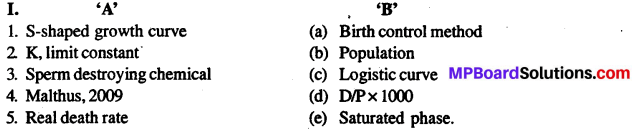
3. सही जोड़ी बनाइए

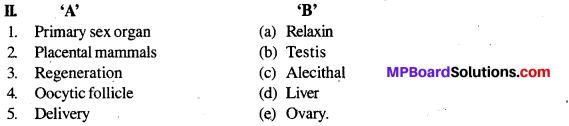
‘A’ – ‘B’

1. S-आकृति वक्र – (a) जन्म नियंत्रण विधि
2. kसीमा स्थिरांक – (b) जनसंख्या
3. शुक्राणु नाशक रसायन – (c) लॉजिस्टिक वक्र
4. माल्थस 2009 – (d) D/Px1000
5. वास्तविक मृत्युदर – (e) संतृप्ति अवस्था।
उत्तर
1.(c), 2.(e), 3.(a), 4. (b), 5.(d).

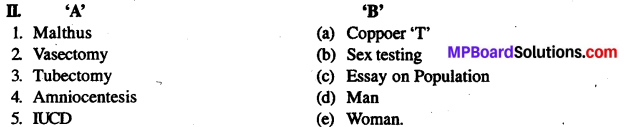
‘A’ – ‘B’

1. माल्थस – (a) कॉपर-टी
2 वैसेक्टोमी – (b) लिंग परीक्षण
3. ट्यूबेक्टोमी – (c) सेन्सस
4. जनगणना – (d) जनसंख्या पर निबंध
5. एम्निओसेण्टेसिस – (e) पुरुष
6. आई.ग.सी.डी. – (f) स्त्री या जनसंख्या नियंत्रण।
उत्तर
1.(d),2.(e),3. (1), 4.(c), 5.(b), 6.(a).

4. एक शब्द में उत्तर दीजिए

1. दो ऐसे कारण दीजिए जिनसे जनसंख्या अनियन्त्रित रूप से बढ़ जाती है।
2. IUCD का पूरा नाम लिखिए।
3. मानव जनसंख्या का अध्ययन क्या कहलाता है?
4. माला D और N में कौन-सा रासायनिक गर्भ-निरोधक पाया जाता है ?
उत्तर

  1. (i) कम उम्र में विवाह, (ii) शिक्षा
  2. इन्ट्रायूरिक कन्ट्रासेप्टिव डिवाइसेस
  3. डेमोग्राफी (Demography)
  4. एस्ट्रोजन एवं प्रोजेस्टीरॉन हॉमोन।

जनन स्वास्थ्य अति लघु उत्तरीय प्रश्न

प्रश्न 1.
परिवार नियोजन को अब किस नाम से जाना जाता है ?
उत्तर
परिवार नियोजन को अब “परिवार कल्याण” के नाम से जाना जाता है।

प्रश्न 2.
सेन्ट्रल ड्रग रिसर्च इन्स्टीट्यूट (CDRI) कहाँ अवस्थित है।
उत्तर
लखनऊ (उत्तरप्रदेश) में स्थित है।

प्रश्न 3.
कंडोम के उपयोग के कोई एक लाभ लिखिए।
उत्तर
कंडोम यौन संचरित रोगों से बचाव करता है।

प्रश्न 4.
हफ्ते में एक बार लेने वाली गर्भनिरोधक गोली का नाम लिखिए।
उत्तर
“सहेली”

MP Board Solutions

प्रश्न 5.
IUCD काशब्द विस्तार बताइए।
उत्तर
इन्ट्रा यूटेराइन कॉन्ट्रासेप्टिव डिवाइस।

प्रश्न 6.
STD का सम्पूर्ण रूप लिखिये।
उत्तर
यौन संचारित रोग (Sexually Transmitted Diseases)।

प्रश्न 7.
विवाह की वैधानिक आयु स्त्री और पुरुष के लिए क्या सुनिश्चित है ?
उत्तर
स्त्री की आयु 18 वर्ष तथा पुरुष के लिए 21 वर्ष सुनिश्चित है।

प्रश्न 8.
दो STD के नाम लिखिए जो संदूषित रक्त से संचारित होते हैं।
उत्तर
(a) एड्स
(b) हिपेटाइटिस-BI

प्रश्न 9.
लैंगिक संपर्क से होने वाले कोई दो रोग बताइए।
उत्तर

  • सूजाक (Gonorrhoea)
  • सिफलिस (Syphilis)

प्रश्न 10.
HIV एवं AIDS का सम्पूर्ण रूप लिखिए।
उत्तर

  • HIV—ह्यूमन इम्यूनोडेफीसिएन्सी वाइरस।
  • AIDS- एक्वायर्ड इम्यूनोडेफीसिएन्सी सिन्ड्रोम।

प्रश्न 11.
ZIFT का पूरा नाम लिखिए।
उत्तर
युग्मनज अन्तः डिम्बवाहिनी स्थानान्तरण (Zygote Intra-fallopian Transfer)।

प्रश्न 12
पुरुष में नसबंदी की शल्य क्रिया का क्या नाम है ?
उत्तर
वैसेक्टोमी (Vasectomy)।

प्रश्न 13.
दो ऐसे कारण दीजिये जिनसे जनसंख्या अनियन्त्रित रूप से बढ़ जाती है।
उत्तर
रोगों का नियंत्रण, कृषि का विकास।

प्रश्न 14.
मानव जनसंख्या का अध्ययन क्या कहलाता है ?
उत्तर
डेमोग्राफी।

प्रश्न 15.
माला D और N में कौन-सा रासायनिक गर्भ निरोधक पाया जाता है ?
उत्तर
एस्ट्रोजन एवं प्रोजेस्ट्रॉन।

प्रश्न 16.
एम्नियोसेण्टेसिस विधि द्वारा किसका परीक्षण किया जाता है ?
उत्तर
भ्रूण का लिंग परीक्षण।

प्रश्न 17.
किसी इकाई क्षेत्रफल में पाई जाने वाली मानव संख्या कहलाती है ?
उत्तर
जनसंख्या घनत्व।

जनन स्वास्थ्य लघु उत्तरीय प्रश्न

प्रश्न 1.
परखनली शिशु कैसे प्राप्त किये जा सकते हैं ?
उत्तर
स्त्रियाँ जब गर्भधारण करने योग्य नहीं होती हैं, उस स्थिति में परखनली शिशु तकनीक का उपयोग किया जाता है। स्त्रियों के अनिषेचित अण्डाणु को ऐण्टिसेप्टिक स्थिति में निकाला जाता है। इस अण्डाणु को परखनली में लेकर शुक्राणु द्वारा निषेचन (Fertilization) की क्रिया कराते हैं । निषेचित अण्डाणु से विदलन क्रिया द्वारा 32 कोशिकीय अवस्था वाला भ्रूण बनता है, जिसे ब्लास्टोसिस्ट (Blastocyst) कहते हैं। इस 32 कोशिकीय भ्रूण का रोपण स्त्रियों के गर्भाशय में कर दिया जाता है जहाँ पर इस भ्रूण का अगला विकास होता है और शिशु बनता है जिसे ‘टेस्ट ट्यूब बेबी’ कहते हैं।

प्रश्न 2.
गिफ्ट (GIFT) क्या है ?
उत्तर
GIFT-इसका पूरा नाम गैमीट इन्ट्रा फैलोपियन ट्रान्सफर (Gamete Intra Fallopian Transfer) है । यह गर्भ निरोधन की आधुनिक तकनीक है। इस तकनीक में शुक्राणु कैथेटर (Catheter) में संगृहीत कर लिया जाता है। वाश स्विम तकनीक (Wash swim up technique) द्वारा शुक्राणुओं को अण्डाणु के पीछे कैथेटर में संगृहीत किया जाता है। यह सम्पूर्ण क्रिया स्त्रियों की फैलोपियन नलिका में होती है। निषेचन क्रिया शुक्राणुओं की संख्या कम होने से पूर्ण नहीं हो पाती है।

MP Board Solutions

प्रश्न 3.
ट्यूबेक्टोमी और वैसेक्टोमी को समझाइये।
उत्तर
ट्यूबेक्टोमी-इसमें स्त्री की अण्डवाहिनी को काटकर बाँध दिया जाता है। जिससे अण्डाणु गर्भाशय में नहीं आ पाते और निषेचन नहीं हो पाता। इसे ट्यूबेक्टोमी कहते हैं। यह परिवार नियोजन की एक विधि है। वैसेक्टोमी-यह भी परिवार नियोजन की एक विधि है जो पुरुषों द्वारा अपनाई जाती है। इसमें पुरुष की शुक्राणु नलिका को काटकर बाँध दिया जाता है जिससे शुक्राणु स्खलन के समय नहीं निकलते और निषेचन नहीं हो पाता। यह क्रिया वैसेक्टोमी कहलाती है।

प्रश्न 4.
एम्नियोसेण्टेसिस क्या है ?
उत्तर
एम्नियोसेण्टेसिस भ्रूण परीक्षण की एक तकनीक है जिसमें सर्जिकल सुई द्वारा मादा के गर्भाशय से एम्नियोटिक द्रव को शरीर से बाहर निकाला जाता है और एम्नियोटिक द्रव में उपस्थित फोयटस कोशा का संवर्धन किया जाता है और इसका गुणसूत्रीय परीक्षण करके निम्न बातों का पता लगाया जाता है

  • गुणसूत्रीय असामान्यता, जैसे-डाउन सिण्ड्रोम, फिलोडेल्फिया सिण्ड्रोम एवं एडवर्ड सिण्ड्राम।
  • उपापचयी अनियमितताएँ, जैसे- PKU, क्रिटेनिज्म, एल्केप्टोन्यूरिया।
  • लिंग भ्रूण के परीक्षण में इसका उपयोग किया जाता है।

प्रश्न 5.
मानव जनसंख्या वृद्धि के सामाजिक कारण समझाइये।
उत्तर
मानव जनसंख्या वृद्धि के प्रमुख सामाजिक कारण निम्नलिखित हैं

  • समाज का अशिक्षित होना ।
  • निम्न सामाजिक स्तर का होना।
  • समाज में विभिन्न प्रकार की कुरीतियाँ होना।
  • विभिन्न प्रकार की सामाजिक मान्यताएँ ।
  • कम उम्र में विवाह करना, क्योंकि उम्र के पूर्वार्द्ध में प्रजनन क्षमता अधिक होती है।
  • निम्न सामाजिक स्तर के कारण मनोरंजन का अभाव होना।
  • सामाजिक मान्यताएँ जैसे-पुत्र रत्न की प्राप्ति से मोक्ष मिलता है
  • सामाजिक पिछड़ापन।
MP Board Class 12th Biology Solutions

MP Board Class 12th Biology Solutions Chapter 7 Evolution

MP Board Class 12th Biology Solutions Chapter 7 Evolution

Evolution NCERT Textbook Questions and Answers

Question 1.
Explain antibiotic resistance observed in bacteria in light of Darwinism selection theory.
Answer:
Darwinism theory of natural selection states that environment selects organisms with favourable variations and these organisms thus, survive and reproduce. It is observed when bacterial populations are exposed to certain antibiotic, the sensitive bacteria could not tolerate and hence, died due to the adverse environment. Whereas some bacteria that developed mutation became resistant to the particular antibiotic and survived. As a result such resistant bacteria survive and multiply quickly as compared to other sensitive bacteria. So, the whole population is regained by multiplication of resistant variety and antibiotic resis¬tant gene becomes widespread in the bacterial population.

Question 2.
Find out from newspapers and popular science articles any new fossil dis-coveries or controversies about evolution.
Answer:
Fossils of dinosaurs have revealed the evolution of reptiles in Jurassic period. As a result of this evolution of other animals such as birds and mammals has also been discovered. However, two unusual fossils recently unearthed in China have ignited a controversy over the evolution of birds confiiciusomis is one such genus of primitive birds that were crow sized and lived during the Cretaceous period in China.

Question 3.
Attempt giving a clear definition of the term species.
Answer:
A species generally includes similar organism. Members of this group can show interbreeding. Similar group of genes are found in the members of same species and this group has capacity to produce new species. Every species has some cause of isolation which intruped the interbreeding with nearest reactional species which is refer as reproductively isolated.

MP Board Solutions

Question 4.
Try to trace the various components of human evolution (Hint: Brain size and function, skeletal structure, dietary preference, etc.)
Answer:
The various components of human evolution are as follows:

  1. Brain capacity.
  2. Posture
  3. Food/Dietary preference and their important features.

Name brain capacity, posture and food features :

  • Dryopithecus Africans : Knuckle walker, walked similar to Gorillas and Chim-panzees (was more apelike) soft fruit and leaves; canines large, arm and legs are of equal size.
  • Ramapithecus: Semi-erect (more manlike) seeds, nuts canines were small while molars were large.
  • Australopithecus africanus: Australopithecus africanus 450 cm3 full erect prosture, height (1 -05m) Herbivorous (ats fruits). Hunted with stone weapons, lived as trees, canines and incisors were small.
  • Homo habilus: Homo habilus 735 cm3 fully erect posture, height (1 -5m) carnivo¬rous canines were small. They were first tool makers.
  • Homo erectus: Homo erectus 800-1100 cm3 fully erect posture, height (1-5- l-8m) omnivorous. They used stone and bone tools for hunting games.
  • Homo neanderihalensis : Homo neanderthalensis 1300 – 1600 cm3 fully erect posture, height (1-5 – l-6m) omnivorous cave dwellers, used hiles to protect their bodies and buried their dead.
  • Homo sapiens fossils : Homo sapiens fossils 1650 cm3 fully erect posture with height (l -8m) omnivorous. They had strong jaw with teeth close together. They were cave dwellers, made painting and carvings in the caves. They developed a culture and were called first modem man.
  • Homo sapiens sapiens : Homo sapiens sapiens 1200 – 1600 cm3 fully erect pos¬ture, height (1-5 – l-8m) omnivorous. They are the living modem men with high intelligence. They developed art, culture, language, speech, etc. They cultivated crops and domes¬ticated animals.

Question 5.
Find out through internet and popular science articles whether animals other than man has self-consciousness.
Answer:
There are many animals other than humans, which have self-consciousness. An example of an animal being self-conscious is dolphins. They are highly intelligent. They have a sense of self and, they also recognize others among themselves and others. They communicate with each other by whistles, tail-slapping, and other body movements, not dolphins, there are certain other animals such as Crow, Parrot, Chimpanzee, Gorilla, Orangutan, etc., which exhibit self-consciousness.

Question 6.
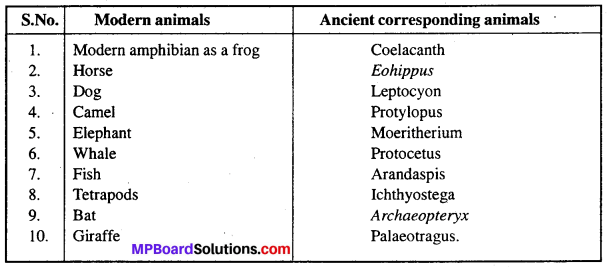
List 10 modern day animals and using the internet resources link it to a corresponding ancient fossil. Name both.
Answer:
Modern and Ancient corresponding animals :
MP Board Class 12th Biology Solutions Chapter 7 Evolution 1

Question 7.
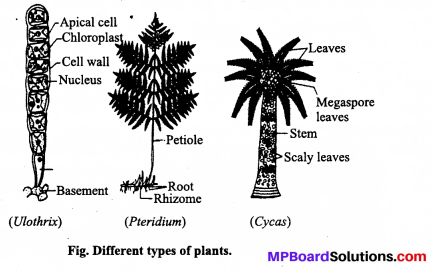
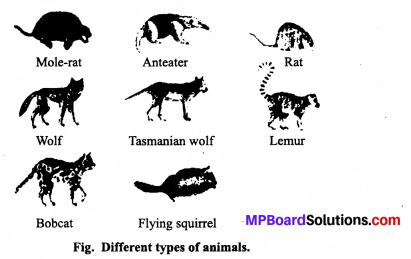
Practise drawing various animals and plants.
Answer:
MP Board Class 12th Biology Solutions Chapter 7 Evolution 2

MP Board Class 12th Biology Solutions Chapter 7 Evolution 3

Question 8.
Describe one example of adaptive radiation.
Answer:
Darwin’s finches in the Galapagos Island once had a common ancestor but with evolution, they modified into different types according to their food habitat.

Question 9.
Can we call human evolution as adaptive evolution ?
Answer:
No, we can not be called human evolution as adaptive evolution.

Question 10.
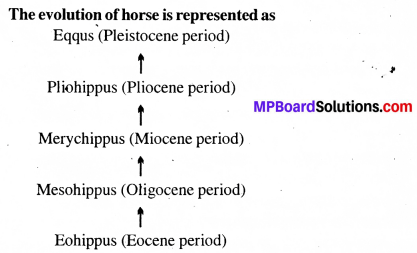
Using various resources such as your school Library or the internet and discussions with your teacher, trace the evolutionary stages of any one animal, say horse.
Answer:
The evolution of horse started with Eohippus during Eocene period. It involved the following evolutionary stages :

  • Gradual increase in body size
  • Elongation of head and neck region
  • Increase in the length of limbs and feet
  • Gradual reduction of lateral digits
  • Enlargement of third functional toe
  • Strengthening of the back
  • Development of brain and sensory organs
  • Increase in the complexity of teeth for feeding on gras

MP Board Class 12th Biology Solutions Chapter 7 Evolution 4

  • Eohippus : It had a short head and neck. It had four functional toes and a splint of 1 and 5 on each hind limb and a splint of 1 and 3 in each forelimb. The molars were short crowned that were adapted for grinding the plant diet.
  • Mesohippus : It was slightly taller than Eohippus. It had three toes in each foot.
  • Merychippus : It had the size of approximately 100 cm. Although it still had three toes in each foot, but it could run on one toe. The side toe did not touch the ground. The molars were adapted for chewing the grass.
  • Pliohippus : It resembled the modern horse and was around 108 cm tall. It had a single functional toe with splint of 2nd and 4th in each limb.

Equus : Pliohippus gave rise to Equus or the modern horse with one toe in each foot. They have incisors for cutting grass and molars for grinding food.

MP Board Solutions

Evolution Other Important Questions and Answers

Evolution Objective Type Questions

1. Choose the Correct Answer.

Question 1.
These are found at the atmosphere of earth before evolution:
(a) Water vapour, CH4, NH3 and Oxygen
(b) CO2, NH3, H2 and Water vapour
(c) CH4, NH3, H2 and Water vapour
(d) CH4, O3, O2 and Water vapour.
Answer:
(c) CH4, NH3, H2 and Water vapour

Question 2.
Which gas is absent at the atmosphere of earth at the time of origin of earth:
(a) NH3
(b) H2
(c) O3
(d) CH4
Answer:
(c) O3

Question 3.
Which gaseous mixture are used and found the amino acid by Miller:
(a) Methane, Ammonia, Hydrogen and Water vapour
(b) Methane, Ammonia, Nitrogen and Water vapour
(c) Methane, Nitrogen, Hydrogen and Water vapour
(d) Ammonia, Carbon dioxide, Nitrogen and Water vapour.
Answer:
(a) Methane, Ammonia, Hydrogen and Water vapour

Question 4.
Who gave the theory “Survival of the fittest” :
(a) Charles Darwin
(b) Herbert Spencer
(c) Lamarck
(d) Hugo de Vries.
Answer:
(b) Herbert Spencer

Question 5.
Who gave the theory of inheritance of acquired, characters :
(a) Charles Darwin
(b) Lamarck
(c) Valles
(d) de Vries.
Answer:
(b) Lamarck

MP Board Solutions

Question 6.
Who wrote origin of species :
(a) Oparin
(b) Beajman
(c) Lamarck
(d) Darwin.
Answer:
(d) Darwin.

Question 7.
What is the name of Darwin’s ship:
(a) Gangotri
(b) Beagle
(c) Atlantic
(d) Seagull.
Answer:
(b) Beagle

Question 8.
‘Atmosphere is a factor of variation’ who gave this theory :
(a) Mendel
(b) Darwin
(c) Lamarck
(d) Laplace.
Answer:
(c) Lamarck

Question 9.
Darwinism explain it:
(a) Characters are grown by heredity
(b) Species are changed into structural form with time .
(c) Nature selected the animals which are adapted
(d) Origin of evolution due to effect of environment.
Answer:
(c) Nature selected the animals which are adapted

Question 10.
Which antibiotic is used to Replica planting experiment of Ladderberg:
(a) Penicillin
(b) Streptomycin
(c) Erythromycin
(d) Neomycin.
Answer:
(a) Penicillin

Question 11.
Which is the basic unit of natural selection:
(a) Species
(b) Community
(c) Genous
(d) Solitary organism.
Answer:
(c) Genous

Question 12.
Who gave the theory of natural selection :
(a) Lamarck
(b) de Vries
(c) Darwin
(d) Mendel.
Answer:
(d) Mendel.

Question 13.
Darwinism is based on:
(a) Segregation
(b) Independent assortment
(c) Quantitative heredity
(d) Natural selection.
Answer:
(b) Independent assortment

MP Board Solutions

Question 14.
Who discover the uses and experiment of organs:
(a) Valles
(b) Lamarck
(c) Darwin
(d) de Vries
Answer:
(a) Valles

Question 15.
The unit of natural selection :
(a) Solitary animal
(b) Family
(c) Community
(d) Species.
Answer:
(d) Species.

Question 16.
Mule is a product of:
(a) Mutation
(b) Reproduction
(c) Inter-species hybridization
(d) Intra-species hybridization
Answer:
(b) Reproduction

Question 17.
Who use first the word ‘species’:
(a) Linnaeus
(b) John
(c) Aristotle
(d) Darwin
Answer:
(b) John

Question 18.
Homologus organs are :
(a) Similar in origin
(b) Similar in function
(c) Similar in evolution
(d) Similar in behaviour.
Answer:
(a) Similar in origin

Question 19.
Which era are called as golden period of Reptilia or Dinosaurs :
(a) Mesozoic
(b) Cenozoic
(c) Palaeozoic
(d) Cenozoic.
Answer:
(a) Mesozoic

Question 20.
Dinosaurs are distinct in this era:
(a) Jurassic
(b) Triassic
(c) Cretaceous
(d) Permian.
Answer:
(c) Cretaceous

Question 21.
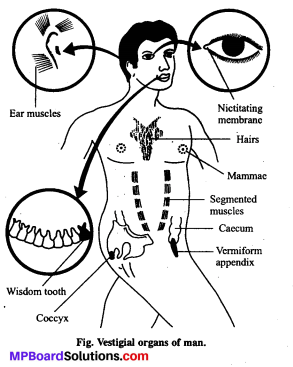
Vestigial organs of human’ are:
(a) Wisdom teeth, Coccyx, Nail, Eyelids, Vermiform appendix
(b) Wisdom teeth, Coccyx, Vermiform appendix, Pancreas
(c) Wisdom teeth, Coccyx, Vermiform appendix, Nictating membrane
(d) Coccyx, Wisdom teeth, Nail, Auricular muscle.
Answer:
(c) Wisdom teeth, Coccyx, Vermiform appendix, Nictating membrane

Question 22.
How made fossils :
(a) Animals are naturally buried in land after death
(b) Animals are decomposed by decomposers
(c) Animals are eaten by their hunter species
(d) Animals are destroyed due to environmental conditions.
Answer:
(d) Animals are destroyed due to environmental conditions.

Question 23.
Species which are similar in shape and different in reproduction are called :
(a) Sub-species
(b) Sibling
(c) Isotopic
(d) Allopetric species.
Answer:
(c) Isotopic

Question 24.
Name the ship which had been used by Darwin for journey :
(a) Ciloge
(b) Beagle
(c) Seagull
(d) Atlantic.
Answer:
(b) Beagle

Question 25.
Life is not in this era :
(a) Mesozoic
(b) Palaeozoic
(c) Cenozoic
(d) Azoic.
Answer:
(d) Azoic.

MP Board Solutions

Question 26.
Which factor is responsible for evolution due to New-darwinism theory :
(a) Mutation
(b) Usefull variation
(c) Hybridization
(d) Mutation and Natural selection.
Answer:
(d) Mutation and Natural selection.

Question 27.
Found the age of fossils by which :
(a) By quantity of calcium ions
(b) By quantity of organic radioactive components
(c) By struggle from other mammals
(d) By structure of bones.
Answer:
(d) By structure of bones.

Question 28.
Darwin finches are related to which of the following evidences :
(a) Fossils
(b) Embryology
(c) Anatomy
(d) Geographical distribution.
Answer:
(d) Geographical distribution.

Question 29.
Who gave Recapitulation theory :
(a)Weizmann
(b) Haeckel
(c) Darwin
(d) Malthus.
Answer:
(b) Haeckel

Question 30.
Which definition of organic evolution is correct:
(a) Evolutionary history of a species
(b) History of species with the variations is the species
(c) Embryonal history of species
(d) Development of species.
Answer:
(a) Evolutionary history of a species

Question 31.
What is the perfect sequence of development of human:
(a) Peking man, Heidelberg man, Neanderthal Cro-Magnon
(b) Peking man, Homo sapiens, Cro-Magnon, Neanderthal
(c) Peking man, Neanderthal,.Homo sapiens, Heidelberg
(d) Peking man, Cro-Magnon, Homo sapiens, Neanderthal.
Answer:
(a) Peking man, Heidelberg man, Neanderthal Cro-Magnon

Question 32.
Which of the following is the most primitive ancestor of man :
(a.) Australopithecus
(b) Ramapithecus
(c) Homo habilis
(d) Homo neanderthalensis.
Answer:
(b) Ramapithecus

Question 33.
Ancestral amphibians were tetrapods that evolved during :
(a) Jurassic period
(b) Cretaceous period
(c) Devonian period
(d) Carboniferous period.
Answer:
(c) Devonian period

2. Fill in the Blanks :

  1. Earth is a member of …………….
  2. ……………. wrote ‘Origin of life’.
  3. Oxygen is find the earth because photo-synthetic organisms are present on the earth, this phenomenon is called …………….
  4. ………….. is the connecting link between Reptiles and Aves.
  5. …………………. is the ancesters of horse.
  6. The evolution of ……………. molecule set the stage for evolution of autotrophs.
  7. Evolution of birds and mammals were ……………. era.
  8. Golden era of Dinosaurs is ……………. period.
  9. ……………. fossil man has been known from Shivalik hills in India.
  10. Book of Charles Darwin “Origin of life” has been explained of …………….
  11. ……………. be change of hareditary characters.

Answer:

  1. Solar system
  2. Oparin
  3. Oxygen revolution
  4. Archaeopteryx
  5. Eohippus
  6. Chlorophyll
  7. Jurassic
  8. Mesozoic
  9. Ramapithecus
  10. Natural selection
  11. Mutation.

MP Board Solutions

Question 3.
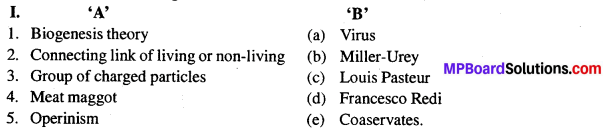
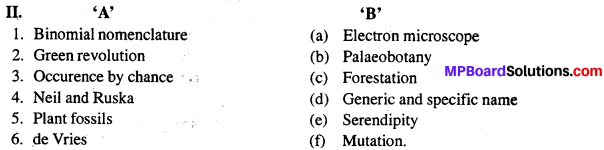
Match the Following :
MP Board Class 12th Biology Solutions Chapter 7 Evolution 5
Answer:

  1. (d)
  2. (a)
  3. (e)
  4. (c)
  5. (b)

MP Board Class 12th Biology Solutions Chapter 7 Evolution 6
Answer:

  1. (d)
  2. (c)
  3. (e)
  4. (a)
  5. (b)
  6. (f).

4. Answer in One Word / Sentence:

  1. The matter which gave rise to the universe 15 billion years ago.
  2. The matter which is a link between acellular and cellular system.
  3. The island at which Darwjn studies the organisms for his theory of evolution.
  4. Origin of two or more unlike species from a common ancestor.
  5. The whole process of development at changes from embryo to adult organism.
  6. The process of changes in the course of origin of a new species.
  7. The theory of organic evolution proposed by Darwin.
  8. The permanent, heritable and spontaneous changes in organisms.
  9. The remains of ancient organisms.
  10. The organs which are different in their origin but have similar function.

Answer:

  1. Ylem
  2. Coacervates
  3. Galopegos
  4. Adaptive radiation
  5. Ontogeny
  6. Phytogeny
  7. Natural selection
  8. Mutation
  9. Fossils
  10. Homologous organs.

Evolution Very Short Answer Type Questions

Question 1.
Name the non-cellular organism.
Answer:
Virus.

Question 2.
Name the theory which tell about the milky way and formation of star.
Answer:
Big Bang.

Question 3.
Releasing of 02 by the evolution of photosynthesis an ancient time is called?
Answer:
Oxygen revolution.

MP Board Solutions

Question 4.
Which planet has the possibility of origin of life other than earth?
Answer:
ars.

Question 5.
Where did life originate ?
Answer:
In water.

Question 6.
What is the art of limitation, which is practiced the world over from annoying siblings or plant resembles another creature to gain other advantages?
Answer:
Mimicry.

Question 7.
Name the method of the changing of the structure of a gene resulting in a variant form that may be transmitted to.
Answer:
Mutation.

Question 8.
What is the collection of different genes within an inter breading population?
Answer:
Gene pool.

Question 9.
Who wrote origin of species?
Answer:
Charles Darwin.

Question 10.
Who proposed the theory of natural selection?
Answer:
Darwin.

Question 11.
Who proposed the Recapitulation theory or Biogenetic law?
Answer:
Haeckel.

Question 12.
Astronomical distance measured in?
Answer:
Astronomical distance measured in Light years.

Question 13.
Name the theory by which earth is said to originate.
Answer:
The big bang theory.

Question 14.
What is fossil ?
Answer:
Fossils are the remains or impressions of ancient organisms preserved in sedimentary rocks or other media.

Question 15.
What is mutation ?
Answer:
New species originate due to changes of hereditary characters are called mutation.

Question 16.
Name the scientist who tell the spontaneous theory is wrong.
Answer:
Louis Pasteur’s.

Question 17.
Which era is called golden period of Dinosaurs?
Answer:
Mesozoic period is called golden period of Dinosaurs.

Question 18.
In which ship Darwin studied the nature ?
Answer:
Beagle.

MP Board Solutions

Question 19.
Name any two vertibrates body organ which are homologus organs of human forelimb.
Answer:
(1) Flipper of Whale,
(2) Wing of birds.

Question 20.
What is the scientific name of modern man ?
Answer:
Homo sapiens.

Question 21.
Who is the early man of the modern human?
Answer:
Cro-Magnon peoples are early human of modern human.

Question 22.
Who are the early human and sub-human.
Answer:
Ramapithecus is early human and Australopithecus is early human.

Question 23.
Which human form first started to walk on two legs?
Answer:
Australopithecus form first started to walk on two legs.

Question 24.
Which type of human was ‘Cro-Magnon’ on the basis of food in take?
Answer:
Cro-Magnon was carnivorous.

Question 25.
On the basis of evolution which human had brain size of 1400cc?
Answer:
Neanderthal.

Question 26.
Give the name of apelike ancestors of humans
Answer:
Apelike ancestors of human’s are Dryopithecus.

Question 27.
Differentiate between Dryopithecus and Ramapithecus.
Answer:
Dryopithecus were apelike but Ramapithecus were mostly human like.

Evolution Short Answer Type Questions

Question 1.
What is virus ? Why is it treated as a link between living and non-living ?
Answer:
Viruses are simplest organism of the earth, which consists of nucleic acid (DNA or RNA) surrounded by protein cover. It shows characteristics of living as well as non-living organisms.
(A) Living characters of virus:

  • Virus shows structural differentiations.
  • They contain hereditary material.
  • They exhibit mutation.
  • They spread plant and animal diseases.
  • Growth and development present.
  • They exhibit adaptaion.
  • They possess sensitivity.

(B) Non-living characters of virus:

  • Lack protoplasm and cell organelles.
  • Can be crystallized.
  • No metabolic activities seen.
  • Cannot reproduce outside living cells.
  • They lack enzymes.

Due to above reason, viruses are considered as link between living and non-living organisms, thus, it is the first life originated in the earth.

MP Board Solutions

Question 2.
What is oxygen revolution? Explain.
Answer:
Oxygen revolution : Evolution of 02 in photosynthesis during primitive environmental conditions is very important because, it is required in the evolution of organism and conversion of reducing environment into oxidizing environment hence, it is called oxygen revolutioa Oxygen evolution should cause the following changes in the environment:

  • Oxygen evolution should cause the conversion of reducing environment into oxidizing environment
  • Ozone layer is formed 15 miles above from the earth which absorbs the ultraviolet light of the sunlight and thus, prevents the entry of uv light in the atmosphere.
  • O2 present in the environment dissociates methane (CH4) into CO2 and O2. This CO2 is used in photosynthesis.
  • NH3 of the primitive environment is dissociated into H2O.and nitrogen.
    CH4 + 2O22 → CO2 + 2H2O
    4NH3 + 3O2 → 2N2 + 6H2O.

Question 3.
Explain the origin of the earth.
Answer:
Origin of the earth:

  • Earth was formed 4-5 billion years back.
  • Initially, die surface was covered with water vapOur, methane, C02 and NH3.
  • The UV rays of the sun broke water into hydrogen and oxygen.
  • Hydrogen escaped and oxygen combined with NH3 and CH4 to form water, C02 and other gases, also forming die ozone layer.
  • Cooling of water vapour led to rain which filled the depressions on earth’s surface, forming water bodies.

Question 4.
Mention the names of discoveries and principles given by the following scientists:

  1. Louis Pasteur
  2. A. I. Oparin
  3. Urey and Miller
  4. Francesco Redi
  5. Faux.

Answer:

  1. Louis Pasteur : He proved that air contains spores of microorganism and Biogenesis theory was supported by him.
  2. A. I. Oparin: He presented the biochemical explanation of origin of life in his book “The Origin of Life on Earth”.
  3. Urey and Miller : They supported the evidence of Oparin-Haldane theory of Origin of life.
  4. Francesco Redi: He by conducting experiments proved that abiogenesis cannot exist but bioginesis theory can exist i.e., Life arises from pre-existing life.
  5. Faux: He has been experimentally supporting the organic substances as described by Oparin.

Question 5.
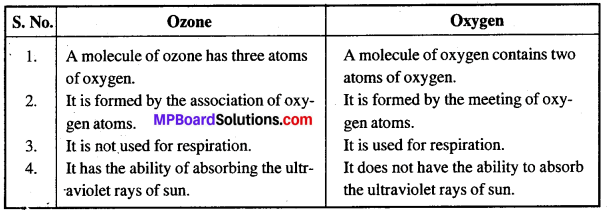
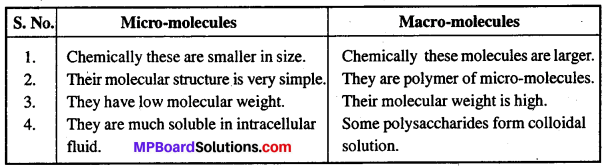
Write down the difference between :

  1. Ozone and Oxygen
  2. Micro-molecules and Macro-molecules.

Answer:
1. Differences between Ozone and Oxygen :
MP Board Class 12th Biology Solutions Chapter 7 Evolution 7

2. Differences between Micro-molecules and Macro-molecules :
MP Board Class 12th Biology Solutions Chapter 7 Evolution 8

Question 6.
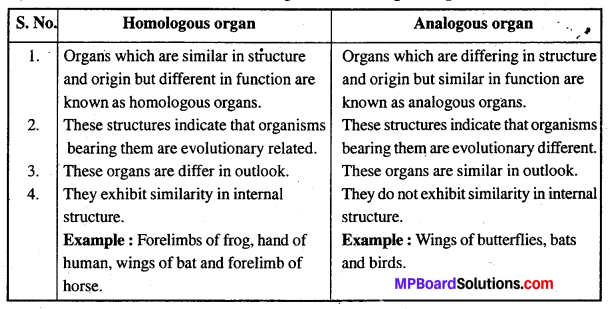
What are homologous organs ?
Or
What is homology ?
Answer:
Organs which are similar in structure and origin but different in appearance and functions are called homologous organs and the phenomenon is called homology.
Examples : Forelimbs of bat, wings of bat, hands of man, forelimbs of horse. These are the examples of homologous organs because, they are made up of similar bones, hu¬merus, radius-ulna, carpals, metacarpals and fingers.

Question 7.
What do you mean by analogous ?
Answer:
Analogous organs: Organs which are different in origin and structure but per¬forming similar functions are known as analogous organs and the phenomenon is called as analogy. Analogous organs do not indicate phylogeny.
Examples : Wings of butterflies are made up of chitin, wings of birds made by production of feathers on forelimbs and skin present between the fingers of bat are the examples of analogous organs.

Question 8.
What is the difference between homologous and analogous organs ? Give two examples of each of them.
Answer:
Differences between Homologous and Analogous organs :
MP Board Class 12th Biology Solutions Chapter 7 Evolution 9

Question 9.
What do you mean by vestigial organs ?
Or
Write the two names of vestigial organs of man.
Or
What are vestigial organs ? Explain. Write four vestigial organs of the human body.
Answer:
Vestigial organs : Organs that are reduced and have become functionless in an organism but were functional in their ancestors are called as vestigial organs :
Examples :

  • Vermiform appendix
  • Coccygial vertebrae
  • Nictitating membrane in the eyes of human
  • Muscles of external ear (Pinna).

Question 10.
What is connecting link ? Also explain the significance of connecting links.
Answer:
Connecting link : Certain organisms which share characters with two different groups. Such organisms are called connecting links.
Examples : Some fossils present in nature like Archaeopteryx is known as fossils connecting link and it is the connecting link of birds and reptiles. Neopilina, Platyptus, Protopterus, etc. Neopilina is a mollusc and is the connecting link of mollusca and annelida.
Significance of Connecting links : It proves the process of organic evolution and helps in the identification of organism closely related.

MP Board Solutions

Question 11.
Write down the demerits of Darwinism.
Answer:
Some of the demerits of Darwinism are :

  • Darwinism stresses upon small fluctuating variations which has no role in evolution.
  • Does not satisfactorily explain effect of use and disused and presence of vestigial organs:
  • It did not differentiate somatic and germinal variations.
  • It explains survival of the fittest but not arrival of the fittest. .

Question 12.
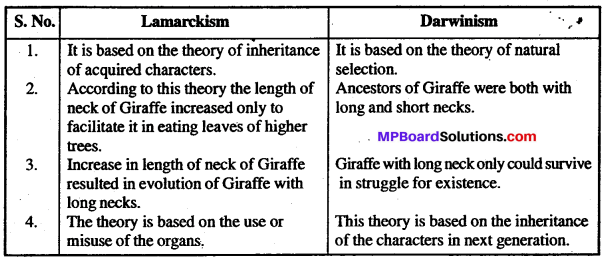
Differentiate between Lamarckism and Darwinism.
Answer:
Differences between Lamarckism and Darwinism:
MP Board Class 12th Biology Solutions Chapter 7 Evolution 10

Question 13.
Explain Lamarckism in short
Or
Explain Lamarckism of organic evolution in brief.
A ns. Lamarckism : In 1809, Lamarck has proposed a theory to explain organic evolution, which is known, as the “Theory of inheritance of acquired characters.” According to Lamarck, organisms acquire certain characters during their lifetime due to changes in environment and these acquired characters are heritable. According to this theory, new species are originated as follows :

  • New requirements and wills are produced in the organisms due to the effect of changed environment
  • New requirements and wills of organisms resulting in the production of new habits.
  • Changes in the habit bringing about modifications of the organ.
  • New habits resulting in the use or disuse of the organs:
  • Use of organ resulting in the development of acquired characters.
  • These acquired characters are heritable.
  • Inheritance of acquired characters resulting in the development of new species.

Evolution Long Answer Type Questions

Question 1.
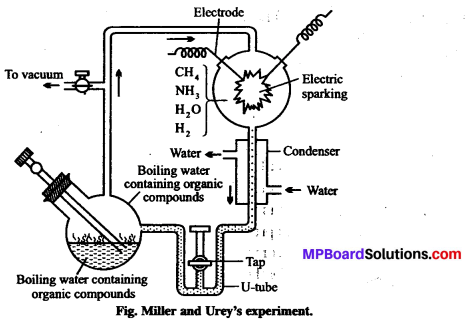
Draw a well-labelled diagram of Miller and Urey’s experiment
Answer:
MP Board Class 12th Biology Solutions Chapter 7 Evolution 11
Experimental evidence of Chemical evolution or Miller’s experiment:

  • Experiment was performed by S.L. Miller and H.C. Urey in 1953.
  • Experimental set-up: In a closed flask containing CH4, H2, NH3 and water vapoiy at 800°C, electric discharge was create. The conditions were similar to those in primitfve atmosphere.
  • Observations: After a week, they observed presence of amino acids and complex molecules like sugars, nitrogen bases, pigments and fats in the flask.
  • Conclusions : (i) It provides experimental evidence for the theory of chemical origin.
    (ii) It showed that the first non-cellular form of life was created about 3 billion years ago.
    (iii) It showed that non-cellular biomolecules exist in the form of DNA, RNA, polysaccharides and protein.

Question 2.
Write an essay on modern concepts of origin of life.
Or
Explain the role of non-living in origin of life.
Answer:
Modern concept of origin of life : The modem concept of origin of life was postulated by a Russian biochemist A.I. Oparin in 1936. According to this theory, after the formation of earth various chemicals played important role in the formation of atmosphere. Life originated and first organism came into existence from certain molecules when atmospheric conditions became suitable. According to Oparin, life originated in the following steps:

1. Formation of earth and its atmosphere: Earth is believed to be originated some 4,500 million years ago by the condensation and cooling of the clouds of cosmic dust and gases called ylem. The heavier elements collected at the core and lighter elements around the core. Outermost layer contains H, C, O and N. Oxygen was found only in combination of other elements. These four elements reacted with each other forming H2, H2O, CH4, NH3, CO2 and HCN.

2. Formation of small organic molecules : The mixture of methane, ammonia, water and hydrogen comes in contact of solar energy. Cosmic rays and electric discharge could produce some simple organic compounds. These simple organic compounds formed in such a way and accumulated in primitive atmosphere and oceans were responsible for synthesis of complex micro molecules as follows :

MP Board Class 12th Biology Solutions Chapter 7 Evolution 12
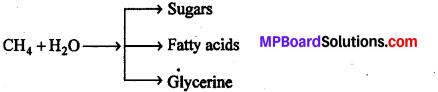
3. Formation of polymers : It is clearly understood from the above description that a large number of micro molecules such as hydrocarbons, amino acids, fatty acids, purine and pyrimidines and simple sugars accumulated in the oceans. When atmospheric water condensed on further cooling, the inorganic precursors collided, reacted and aggregated to form new molecules of increasing size and complexity. Thus, by polymerization macromolecules were formed. The chemical reactions for the formation of macro-molecules can be summarized as follows:

(a) Sugar + Sugar → Polysaccharides
(b) Fatty acid + Glycerine → Lipids
(c) Amino acid + Amino acid → Protein
(d) Nitrogenous base (Adenine) + Sugar + Phosphate → Adenosine phosphate
(e) Nitrogenous base + Sugar → Nucleoside
(f) Nucleoside + Phosphate → Nucleotide
(g) Nucleotide + Nucleotide → Nucleic acid.

4. Formation of molecular aggregates and primitive cells : Over a vast of time, these molecules became associated with one temporary complex. Ultimately, it leads to the formation of a coacervate. A coacervate is a solution of high molecular weight of chemicals, i.e., proteins and carbohydrates, which become bounded by lipid membrane, which is selectively permeable. The coacervate grows by absorbing molecules from their environment. The substances which got accumulated in the coacervates underwent reactions and resulted in the molecular reorganization of some proteins into enzymes. A coacervate having nucleoprotein surrounded by various nutritive organic substances and covered by surface membrane is considered to be the precell, which got later transformed into first living cell. The coacervate can reproduce by budding.

5. Evolution of complex biochemical reactions : Primitive organism utilize chemi¬cal substances present in the environment as food hence, they are:

(a) Heterotrophic, chemosynthetic organisms appeared due to mutation and natural selection in heterotrophs.
(b) Blue-green algae evolved from chemosynthetic organisms by mutation and natural selection.
(c) The liberation of free oxygen into the atmosphere produced by the blue-green algae due to the process of photosynthesis. It finally changed the reducing atmosphere into an oxidizing one and therefore, all possibilities of further chemical evolution were finished.
Free living eukaryotes originated in the ocean from blue-green algae.

6. The origin of well-developed organisms : From the simple eukaryotes which were like unicellular organisms of today various forms of life evolved during passage of time.

MP Board Solutions

Question 3.
Write the process of formation of organic molecules in sea water on earth with the help of Miller and Urey’s experiment
Answer:
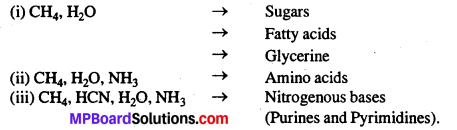
The work of A.I. Oparin (1938-1965), HLUrey and Stanley Miller (1959) pro¬vided evidences in the favour of biochemical origin of life. They had prepared the atmos¬phere like that of primitive earth and as described by Oparin, they made the synthesis of organic compounds by the following methods:

(i) Four elements H, C, O (not free O2) and N react .with each other to form H2O, CH4, NH3, CO2 and HCN on primitive earth.

(ii) From these four elements following organic molecules were formed in sea water of earth:
(a)
MP Board Class 12th Biology Solutions Chapter 7 Evolution 13

(b) CH4, H2O, NH3 → Amino acids.
(c) CH4, HCN, H2O, NH3 → Nitrogenous bases.

(iii) Macro-molecules of organic compounds were synthesized by these above pre¬pared organic compounds.

(a) Sugar + Sugar → Polysaccharides (Carbohydrate).
(b) Fatty acids + Glycerol → Fats.
(c) Amino acid + Amino acid → Protein.
(d) Nitrogenous base + Sugar → Nucleoside.
(e) Nucleoside + Phosphoric acid → Nucleotide.
(f) Nucleotide + nucleotide → Nucleic acid.
(g) Nitrogenous base (Adenine) + Sugar + Phosphate →Adenosine phosphate.
(iv) The above organic compounds and salts together constituted the first living being.

Question 4.
Name connecting link of reptiles and birds. Also write their characters.
Answer:
Archaeopteryx is the connecting link of birds and reptiles. Archaeopteryx was a bird. It is regarded as the connecting link between reptiles and birds, which suggests the path of evolution of the latter from the former. It is found as fossils. They are found during Jurassic period 140 million years. Archaeopteryx exhibits both reptiles and birds like characters.

1. Reptiles like characters:

  • Bones were similar to that of reptiles in which air sacs were absent.
  • Tail bearing vertebra.
  • It had teeth in jaws, scales were present on the body.
  • Metacarpals were free.
  • Pelvic girdle recombines with the pelvic girdle of reptiles.

2. Birds like characters :

  • Presence of feathers on body. .
  • Forelimbs were modified in wings.
  • Skull large and monocondylar.
  • Jaws were modified into beak.
  • Hallux was backwarded and pointed.

MP Board Solutions

Question 5.
Give a detailed account of theory of natural selection.
Or
Describe the Darwin’s opinion about the origin of new species of organisms.
Answer:
Charles Darwin (1809-1882) explained the theory of evolution in his book “Origin of species by natural selection.” Darwin undertook a long voyage for five years in the capacity of a naturalist on a British warship ‘Beagle’. He travelled to islands of Galapagos and collected evidences to explain evolution.
To explain origin of species he gave theory of natural selection as a mechanism for evolution.

The main points of Darwinism are given below:

1. Over production of offsprings : Every living being has an inherent tendency to produce more offspring than that can survive.

2. Struggle for existence : Though the offsprings are produced in large number yet their production remain almost constant. This is because of struggle for existence. There is struggle for food, space, breeding, etc. Moreover death of individuals due to diseases an

3. Survival of the fittest: Darwin believed that any individual is successful in struggle for existence if it survives long enough to produces offsprings. Individuals who are fit in a particular environment can only survive.

4. Variation: Due to constant struggle, the organisms change themselves in accordance with the new needs.

5. Natural selection : In the struggle, for existence organisms having variations favourable to the environment would have more chance to survive and reproduce their own kind. Those which do not possess favourable variations would die or fail to reproduce.

6. Origin of species : Any changes in environmental conditions cause natural selection to act upon the population and select the well adapted individuals. It results in changes of characters of the populations. By the inheritance of these changes in successive generations, new species are formed.

Question 6.
Organic Evolution is a continued process, explain it in favour of it giving any three evidences.
Answer:

MP Board Class 12th Biology Solutions Chapter 7 Evolution 14

Evolution is a complex phenomenon accounting for the present day diversity among organisms. But it has clearly maintained the basic unity among them since it occurred over a period of millions of years, no one would have seen/recorded evolution and hence scientists have provided various evidences to prove evolution.

Some of the evidences of organic evolution are described below :

I. Evidences from Embryology :

  • Important activities that occur various animals are:
  • For the survival, all animals get energy and various substances from environment.
  • In all organisms energy is produced from ATP.
  • In all organisms, the duplication of DNA is similar.
  • In all organisms, protein synthesis is same and it is produced from ribosomes.
  • In all organisms respiration and steps of respiration is same.
  • All organisms multiplicate and reproduce, due to which they have basic similarities.
  • All organisms conduct hereditary characters on similar principles.

II. Evidence from Anatomy: Anatomy of living organisms will be explained with different examples:

  • Homologous organs: Organs which are similar in structure and origin but diffeifent in function and appearance is known as homologous organs.
  • Analogous organs : Organs which are different in origin and structure but performing similar functions are known as analogous organs.
  • Vestigial organs : Organs that are reduced and have become functionless in an organism, but were functional in their ancestors are called vestigial organ.

III. Evidences from vestigial organs: Organs of the body which are non-functional but they are functional in some other organisms are called vestigial organs:

Morphological evidence of evolution is provided by the presence of vestigial organs of body which are often undesired, degenerated and non-functional. These might have been large and functional in some other animals or in ancestors of those which now possess it in rudimentary forms. e.g„ vermiform appendix in man, muscles of external ear (pinna) in man, nictitating membrane or plica, semilunaris in human eye, wisdom teeth (third pair of molars) tail bone (coccyx) in man, wings of ostrich, hindlimbs in snakes, etc.

MP Board Solutions

Question 7.
What do you mean by organic evolution? How do fossils exhibit evidence to prove organic evolution?
Answer:
Descent with modification in organism is known as organic evolution.

Evidences of organic evolution from fossils record : Fossils are treated as significant evidence of organic evolution. Fossils are the remains or impressions of ancient organisms preserved in the layers of rock and soil. Fossils only do not prove the theory of organic evolution, yet it evidently prove that gradually complexity increased in body organization. The complexity in the body of organization can be noticed as we study the upper layers. Thus, it can be concluded from above observations :

  • The crust of the earth and the organisms living on it underwent change in the course of time.
  • The organisms with simple structural organization originated earlier than the complex ones.
  • Some of the organisms lived on the earth for short time and became extinct. This was a result of drastic changes in the climate on the earth.

Hence, forth fossils produce bonafide record of such plants and animals which had shown their existence once upon a time and now are extinct or not present exactly in the same form, thus, producing strong evidence in favour of organic evolution.

MP Board Class 12th Biology Solutions

MP Board Class 11th Maths Solutions Chapter 11 शंकु परिच्छेद Ex 11.2

MP Board Class 11th Maths Solutions Chapter 11 शंकु परिच्छेद Ex 11.2

निम्नलिखित प्रश्न 1 से 6 तक प्रत्येक में नाभि के निर्देशांक, परवलय का अक्ष, नियता का समीकरण और नाभिलंब जीवा की लंबाई ज्ञात कीजिए।
प्रश्न 1.
y2 = 12x.
हल:
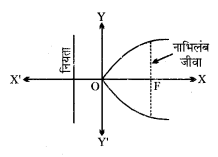
परवलय का समीकरण, y2 = 12x
∴ y2 = 4ax से तुलना करने पर
4a= 12 या a= 3
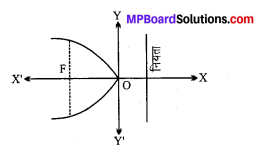
(i) नाभि के निर्देशांक (a, 0) या (3, 0)
MP Board Class 11th Maths Solutions Chapter 11 शंकु परिच्छेद Ex 11.2 img-1
(ii) परवलय का अक्ष OX
इसका समीकरण y = 0
(iii) नियता का समीकरण : x = – a अर्थात् x = – 3
(iv) नाभिलंब जीवा की लंबाई = 4a = 12.

MP Board Solutions

प्रश्न 2.
x2 = 6y.
हल:
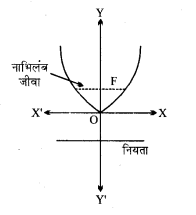
परवलय का समीकरण x2 = 6y
∴ 4a = 6 या a = \(\frac{3}{2}\)
MP Board Class 11th Maths Solutions Chapter 11 शंकु परिच्छेद Ex 11.2 img-2
इसका अक्ष y-अक्ष है जिसका
(i) समीकरण x = 0 है।

(ii) नाभि F (0, a) के निर्देशांक \(\left(0, \frac{3}{2}\right)\) है।
(iii) नियता y = – a का समीकरण y = – \(\frac{3}{2}\)
(iv) नाभिलंब जीवा की लम्बाई 4a = 6.

प्रश्न 3.
y2 = – 8x.
हल:
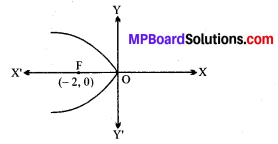
परवलय का समीकरण y2 = – 8x
∴ 4a = 8, a = 2
(i) नाभि F(- a, 0) के निर्देशांक (- 2, 0)
MP Board Class 11th Maths Solutions Chapter 11 शंकु परिच्छेद Ex 11.2 img-3
(ii) परवलय का अक्ष x-अक्ष
इसका समीकरण y = 0
(iii) नियता x = a का समीकरण x = 2.
(iv) नाभिलंब जीवा की लंबाई = 4a = 8.

प्रश्न 4.
x2 = – 16y.
हल:
परवलय का समीकरण x2 = – 16y
∴ 4a = 16 या a = 4
नियता
(i) नाभि F (0, – a) के निर्देशांक (0, – 4)
(ii) परवलय अक्ष का समीकरण x = 0.
(iii) नियता y = 0 का समीकरण y = 4.
(iv) नाभिलंब जीवा की लंबाई 4a = 16.

MP Board Solutions

प्रश्न 5.
y2 = 10x.
हल:
परवलय का समीकरण y2 = 10x (आकृति प्रश्न 1 में देखें)
4a = 10 या a = \(\frac{5}{2}\)
(i) नाभि F (a, 0) के निर्देशांक \(\left(\frac{5}{2}, 0\right)\)
(ii) परवलय का अक्ष : x-अक्ष, समीकरण y = 0
(iii) नियता x = – a का समीकरण x = – \(\left(\frac{5}{2}, 0\right)\)
(iv) नाभिलंब जीवा की लंबाई 4a = 10.

प्रश्न 6.
x2 = – 9y.
हल:
परवलय का समीकरण x2 = – 9y (आकृति प्रश्न 4 में देखें)
4a = 9 या a = \(\frac{9}{4}\)
(i) नाभि (0, – a) के निर्देशांक \(\left(0,-\frac{9}{4}\right)\)
(ii) परवलय का अक्ष : y-अक्ष, समीकरण x = 0
(iii) नियता y = a का समीकरण y = \(\frac{9}{4}\)
(iv) नाभिलंब जीवा की लंबाई 4a = 9.

निम्नलिखित प्रश्न 7 से 12 तक प्रत्येक में परवलय का समीकरण ज्ञात कीजिए जो दिए प्रतिबंध को संतुष्ट करता है।
प्रश्न 7.
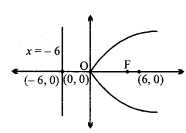
नाभि (6, 0), नियता x = – 6.
हल:
परवलय का अक्ष : x-अक्ष, y = 0
MP Board Class 11th Maths Solutions Chapter 11 शंकु परिच्छेद Ex 11.2 img-4
शीर्ष (0, 0) है, नाभि के निर्देशांक (6, 0)
परवलय का अक्ष, धन x-अक्ष के अनुदिश है।
परवलय का समीकरण y2 = 24x.

प्रश्न 8.
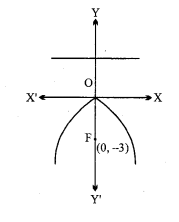
नाभि (0, – 3), नियता y = 3.
हल:
परवलय का अक्ष y-अक्ष है।
शीर्ष (0, – 3), (0, 3) का मध्य बिन्दु (0, 0) है। नाभि (0, – 3) से स्पष्ट होता है कि परवलय की अक्ष OY के अनुदिश है।
MP Board Class 11th Maths Solutions Chapter 11 शंकु परिच्छेद Ex 11.2 img-5
∴ परवलय के समीकरण का रूप x2 = – 4ay
यहाँ पर a = 3, ∴ 4a = 12
∴ परवलय का समीकरण x2 = – 12y.

MP Board Solutions

प्रश्न 9.
शीर्ष (0, 0), नाभि (3, 0) (आकृति प्रश्न 7 की देखिए)
हल:
परवलय का अक्ष OX के अनुदिश हैं।
∴ परवलय के समीकरण का रूप y2 = 4ax
नाभि (3, 0) है। ∴ a = 3
4a = 4 x 3 = 12
∴ परवलय का समीकरण y2 = 12x.

प्रश्न 10.
शीर्ष (0, 0), नाभि (-2, 0).
हल:
परवलय का अक्ष OX’ के अनुदिश
नाभि (- 2, 0) है तो a= 2
MP Board Class 11th Maths Solutions Chapter 11 शंकु परिच्छेद Ex 11.2 img-6
∴ 4a = 8
परवलय का रूप y2 = – 4ax
परवलय का समीकरण y2 = – 8x.

प्रश्न 11.
शीर्ष (0, 0), (2, 3) से जाता है और अक्ष, x-अक्ष के अनुदिश है।
हल:
परवलय का शीर्ष (0, 0) है और अक्ष : x-अक्ष है।
∴ परवलय के समीकरण का रूप y2 = 4ax
यह बिन्दु (2, 3) से होकर जाता है
∴ 9 = 4a.2 या 4a = \(\frac{9}{2}\)
अतः परवलय का समीकरण y2 = \(\frac{9}{2}\)x या 2y2 = 9x.

MP Board Solutions

प्रश्न 12.
शीर्ष (0, 0), (5, 2) से जाता है और y-अक्ष के सापेक्ष सममित है।
हल:
शीर्ष (0, 0), परवलय y-अक्ष के सापेक्ष सममित है।
समीकरण का रूप x2 = 4ay है। यह बिन्दु (5, 2) से गुजरता है।
∴ 25 = 4a × 2
∴ 4a = \(\frac{25}{2}\)
∴ परवलय का समीकरण, x2 = \(\frac{25}{2}\)y या 2x2 = 25y

MP Board Class 11th Maths Solutions

MP Board Class 12th Biology Solutions Chapter 14 Ecosystem

MP Board Class 12th Biology Solutions Chapter 14 Ecosystem

Ecosystem NCERT Text Book Questions and Answers

Question 1.
Fill in the Blanks:

1. Plants are called as …………….. because they fix carbon dioxide.
2. In an ecosystem dominated by trees, the pyramid (of numbers) is ………………… type.
3. In aquatic ecosystem, the limiting factor for the productivity is …………………….
4. Common detritivores in our ecosystem are ………………………..
5. The major reservoir of carbon on earth is ………………………
Answer:

  1. Producer
  2. Inverted
  3. Light
  4. Earthworm
  5. Ocean and Biosphere.

Question 2.
Which one of the following has the largest population in the food chain:
(a) Producers
(b) Primary consumers
(c) Secondary consumers
(d) Decomposers.
Answer:
(d) Decomposers.

Question 3.
The second trophic level in a lake is:
(a) Phytoplankton
(b) Zooplankton
(c) Benthos
(d) Fishes.
Answer:
(b) Zooplankton

Question 4.
Secondary producers are:
(a) Herbivors
(b) Producers
(c) Carnivors
(d) None of the above.
Answer:
(a) Herbivors

MP Board Solutions

Question 5.
What is the percentage of photosynthetically active radiation (PAR) in the incident solar radiation:
(a) 100%
(b) 50%
(c) 1-5%
(d)2 -10%.
Answer:
(b) 50%

Question 6.
Distinguish between:
(a) Grazing food chain and detritus food chain
(b) Production and decomposition
(c) Upright and inverted pyramid
(d) Food chain and Food web
(e) Litter and Detritus
(f) Primary and Secondary productivity.
Answer:
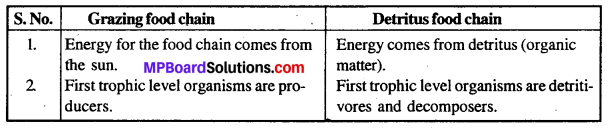
(a) Grazing food chain and detritus food chain
MP Board Class 12th Biology Solutions Chapter 14 Ecosystem 1
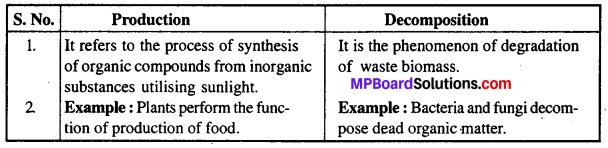
(b) Production and decomposition
MP Board Class 12th Biology Solutions Chapter 14 Ecosystem 2
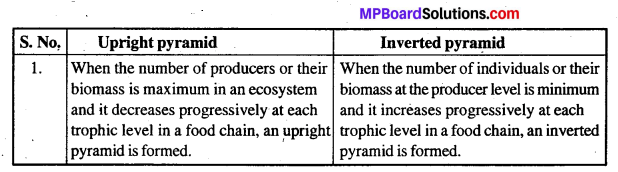
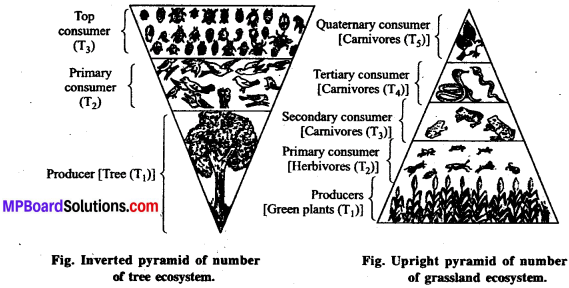
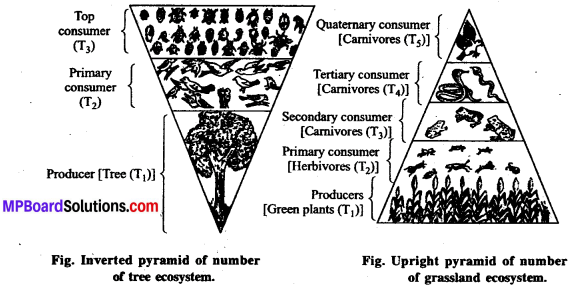
(c) Upright and inverted pyramid
MP Board Class 12th Biology Solutions Chapter 14 Ecosystem 3
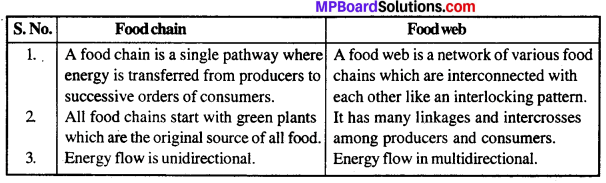
(d) Food chain and Food web
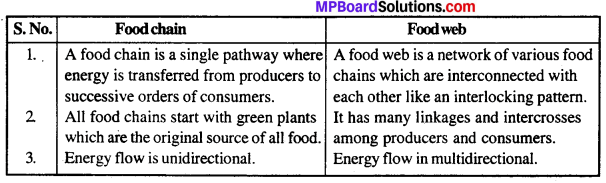
MP Board Class 12th Biology Solutions Chapter 14 Ecosystem 4
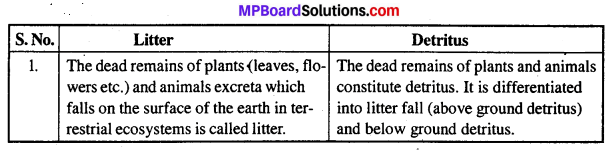
(e) Litter and Detritus
MP Board Class 12th Biology Solutions Chapter 14 Ecosystem 5
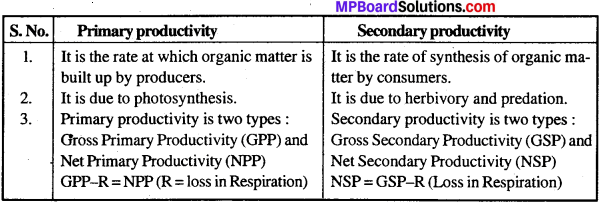
(f) Primary and Secondary productivity.
MP Board Class 12th Biology Solutions Chapter 14 Ecosystem 6

MP Board Solutions

Question 7.
Describe the components of an ecocystem.
Answer:
Ecosystem: The system resulting from the interaction between organisms and their environment is called as ecosystem.

(a) Producers: Organism, which can synthesize their own food are included under producers, e.g., Volvox, Pandorina, Oedogonium, Saggitaria, Utricularia, Azolla, Trapa, Lemna, Typha, Nymphaea etc. form the producer class of the pond ecosystem.

(b) Consumers:

  • Primary consumer: Animals, which feed on producers are included into this category e.g., Daphnia, Cyclops, Paramoecium, Amoeba and small fishes.
  • Secondary consumers: Primary consumers also serve as food for water sn’akdls, a few tortoise, few types of fish etc. hence, these are carnivores.
  • Tertiary consumers: Secondary consumers also serve as food for aquatic birds like kingfisher, cranes, big fish and these together form a top class carnivorous group and called as tertiary consumers.

(c) Decomposers: All producers and consumers die and accumulate on the floor of the pond. Even the waste material and faeces of these animals get accumulated on the floor of the pond. Similarly, the floor of pond is also occupied by decomposers, which include bacteria and fungi. These decomposers decompose complex organic compounds of then- bodies into simpler forms which are finally mixed with soil of floor of ponds. These are again absorbed by the roots of producer plants and thus matter is recycled.

Question 8.
Define ecological pyramids and descirbe with examples, pyramids of number and biomass.
Answer:
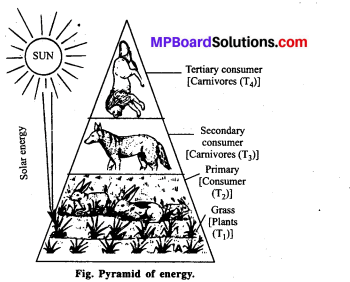
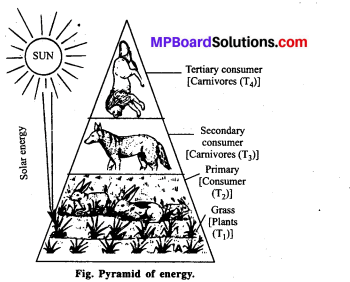
Ecological Pyramid : The relation between producers and consumers in a ecosystem can be graphically represented in the form of a pyramid called ecological pyramid. The base always represent the producers or the first trophic level and the apex represents top level consumer or the lost trophic level ecological pyramids are of three types :

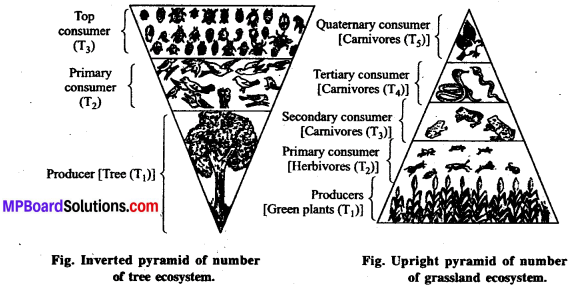
  1. Pyramid of number
  2. Pyramid of biomass
  3. Pyramid of energy.

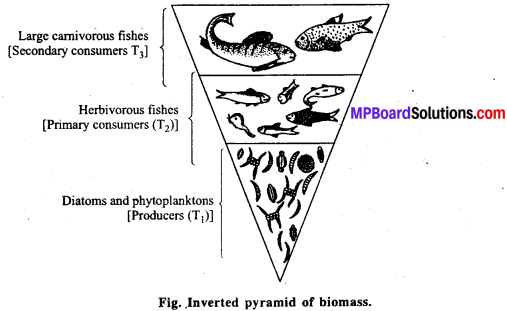
MP Board Class 12th Biology Solutions Chapter 14 Ecosystem 7

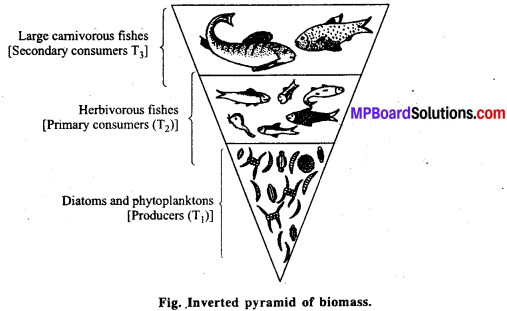
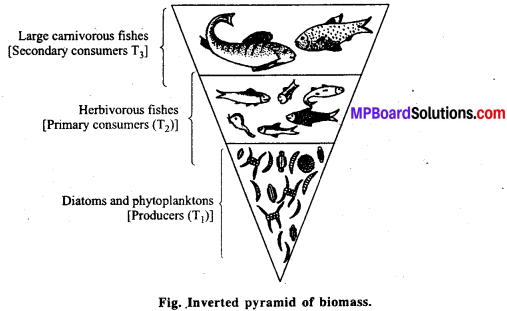
The biomass, i.e., the living weight of the organisms in the food-chain present at different trophic levels in an ecosystem forms the pyramid of biomass.

When biomass of consumers is greater than biomass of producer then pyramid is called as inverted pyramid of biomass.eg., pyramid of biomass of pond ecosysyem is always inverted.

Ecosystem: The system resulting from the interaction between organisms and the environment is called as ecosystem.
MP Board Class 12th Biology Solutions Chapter 14 Ecosystem 8

Question 9.
What is primary productivity ? Give brief description of factors that affect primary productivity.
Answer:
The rate of biomass production is called productivity.
It is expressed in terms of g-2yr-1  or(Kcal-m-2) yr-1 to compare the productivity of ecosystems.
It can be divided into Gross Primary Productivity (GPP) and Net Primary Productivity (NFP).

Gross Primary Productivity of an ecosystem is the rate of production of organic matter during photosynthesis. A considerable amount of GPP is utilized by plants in respiration.

Gross primary productivity minus respiration losses (R), is the Net Primary Productivity (NPP). GPP – R=NPP.
Primary productivity depends on :

  • The plant species inhabiting a particular area.
  • The environmental factors.
  • Availability of nutrients.
  • Photosynthetic capacity of plants.

Question 10.
Define decomposition and describe the processes and products of decomposition.
Answer:
Decomposition is the process that involves the breakdown of complex organic matter or biomass from the body of dead plants and animals with the help of decomposers into inorganic raw materials such as carbon dioxide, water, and other nutrients.
The various processes involved in decomposition are as follows:
1. Fragmentation: It is the first step in the process of decomposition. It involves the breakdown of detritus into smaller pieces by the action of detritivores such as earthworms.

2. Leaching: It is a process where the water soluble nutrients go down into the soil layers and get locked as unavailable salts.

3. Catabolism: It is a process in which bacteria and fungi degrade detritus through various enzymes into smaller pieces.

4. Humification: The next step is humification which leads to the formation of a dark coloured colloidal substance called humus, which acts as reservoir of nutrients for plants.

5. Mineralization: The humus is further degraded by the action of microbes, which finally leads to the release of inorganic nutrients into the soil. This process of releasing inorganic nutrients from the humus is known as mineralization. Decomposition produces a dark coloured, nutrient-rich substance called humus. Humus finally degrades and releases inorganic raw materials such as CO2, water, and other nutrient in the soil.

MP Board Solutions

Question 11.
Given account of Explain energy flow in ecosystem.
Answer:
Energy flow: In die ecosystem, energy is transferred in an orderly sequence. The flow of solar energy from producers to consumers and to decomposers subsequently in an ecosystem is known as energy flow. Energy flow is an ecosystem is always unidirectional. Sun is the sole source of solar energy in an ecosystem. Green plants utilize this energy in photosynthesis and convert it in the form of chemical energy and store it. Plants utilize maximum part of this energy to do its biological functions. Some of it is converted into heat and released in the environment. Remaining part of the energy is stored in various components of the body.

When a consumer eats these producer plants, the energy is then transferred into its body. In any food-chain energy flows from primary producers to primary consumers, from primary consumers to secondary consumers and secondary consumers to tertiary consumers and so on. Because every organism of a trophic level continuously converts chemical energy into heat, there is always a loss of energy with each step in a food-chain. According to an estimate only 10% of the total energy obtained is transferred from one trophic level to another.

Question 12.
Write important features of a sedimentary cycle in an ecosystem.
Answer:
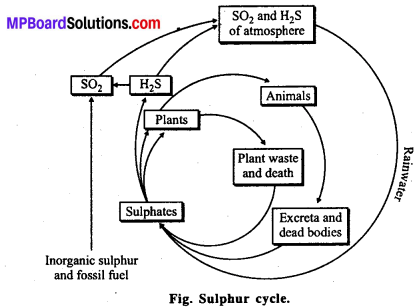
Sedimentary cycles have their reservoirs in the earth’s crust or rocks. Nutrient elements are found in the sediments of the earth. Elements such as sulphur, phosphorus, potassium, and calcium have sedimentary cycles.

Sedimentary cycles are very slow. They take a long time to complete their circulation and are considered as less perfect cycles. This is because during recycling, nutrient elements may get locked in the reservoir pool, thereby taking a very long time to come out and continue circulation. Thus, it usually goes out of circulation for a long time.

Question 13.
Outline salient features of carbon cycling in an eosystem.
Answer:
Carbon constitutes 49 percent of dry weight Of an organisms.

  • 71 percent of the carbon is found dissolved in oceans which is responsible for its regulations in atmosphere.
  • The carbon cycle occurs through atmosphere, oceans and through living and dead organisms.
  • It is estimated that 4xl013 kg of Carbon is fixed in the biosphere through photosynthesis annually.
  • Carbon is returned to atmosphere as CO2 by animals and plants through respiration and the activities of decomposers.
  • Some amount of fixed carbon is lost as sediments and removed from circulation.
  • Burning of wood, forest fire, volcanic activity and combustion of organicjnatter and fossil fuels are some essential sources for releasing CO2 in the atmosphere.
  • Human activities like deforestation and vehicular burning or fossil fuels has caused in increase in the amount of CO2 in atmosphere.

MP Board Solutions

Ecosystem Other Important Questions and Answers

Ecosystem Objective Type Questions

Choose the Correct Answer

Question 1.
Position of man in food chain of all ecosystem is as :
(a) Consumer
(b) Producer
(c) Producer and consumer
(d) Decomposer.
Answer:
(a) Consumer

Question 2.
Flow of energy in an ecosystem is :
(a) Unidirectional
(b) Bi-directional
(c) Three directional
(d) Quadri-directional.
Answer:
(a) Unidirectional

Question 3.
The word “ Ecosystem” was first used by :
(a) Tansley
(b) Odum
(c)Writier
(d) Mishra and Puri.
Answer:
(a) Tansley

Question 4.
Source of energy in an ecosystem is:
(a) Solar energy
(b) Green plants
(c) Food substances
(d) All of the above.
Answer:
(a) Solar energy

Question 5.
Pyramid of number of trees in an ecosystem is always:
(a) Inverted
(b) Upward
(c) Both (a) and (b)
(d) None of these.
Answer:
(a) Inverted

Question 6.
Correct food chain is:
(a) Grass → Grasshopper → Frog Snake → Hawk
(b) Grass → Frog → Snake → Peacock
(c) Grass → Peacock → Grasshopper → Hawk
(d) Grass → Snake → Rabbit.
Answer:
(a) Grass → Grasshopper → Frog Snake → Hawk

Question 7.
Pyramid of biomass of an ecosystem of lake is:
(a) Upward
(b) Inverted
(c) Inverted and Upward both
(d) None of these.
Answer:
(b) Inverted

Question 8.
Man is:
(a) Producer
(b) Carnivore
(c) Herbivore
(d) Omnivorus.
Answer:
(d) Omnivorus.

Question 9.
Decomposer are:
(a) Rats
(b) Algae
(c) Bacteria and Fungi
(d) Goats.
Answer:
(c) Bacteria and Fungi

Question 10.
Man made ecosystem is:
(a) Pond
(b) Aquarium
(c) Forest
(d) Lake.
Answer:
(b) Aquarium

Question 11.
Pyramid of energy is a forest ecosystem is:
(a) Always Inverted
(b) Always upward
(c) First upward than Inverted
(d) None of the above.
Answer:
(b) Always upward

Question 12.
Study of ecosystem of species is called:
(a) Ecology
(b) Autecology
(c) Synecology
(d) None of these.
Answer:
(b) Autecology

MP Board Solutions

Question 13.
Food chain starts from:
(a) Respiration
(b) Photosynthesis
(c) Decomposition
(d) Nitrogen fixation.
Answer:
(b) Photosynthesis

Question 14.
Flow of energy and food in a food web is:
(a) Unidirectional
(b) B i-directional
(c) Multidirectional
(d) None of these.
Answer:
(c) Multidirectional

Fill in the Blanks:

1. The transitional zone between two adjacent communities is called ………………………
2 The term ecosystem was proposed for the first time by ………………………..
3. The brief source of energy in ecosystem is …………………….
4. Bacteria which fix the nitrogen is called ……………………
5. All ecosystem are dependent of energy on …………………….
6. Balance of ecosystem is called ………………………
7. Pyramid of energy is always …………………………
8. All the plant of a particular geographic area constitute ………………………. of the place.
Answer:

  1. Ecotone,
  2. Tansley,
  3. Sunlight,
  4. Rhizobuim,
  5. Solar energy,
  6. Ecological balance,
  7. Upright,
  8. Flora.

3. Match the Following:
MP Board Class 12th Biology Solutions Chapter 14 Ecosystem 9
MP Board Class 12th Biology Solutions Chapter 14 Ecosystem 9a
Answer:

  1. (b)
  2. (e)
  3. (d)
  4. (a)
  5. (c).

MP Board Class 12th Biology Solutions Chapter 14 Ecosystem 10
Answer:

  1. (b)
  2. (e)
  3. (d)
  4. (a)
  5. (c)

MP Board Solutions

Question 4.
Answer in One Word/Sentence:

  1. Mention the two name of biotic components of ecosystem.
  2. Who proposed the term ecosystem?
  3. Which ecosystem is more stable?
  4. Name the relatively loss stable ecosystem.
  5. Name the ecosystem showing maximum stratification.
  6. Give two examples of artificial ecosystem.
  7. Give the name of any two food chains.
  8. Write the name of basic unit of ecology.
  9. Name the organisms found on the surface of water bodies.
  10. Name the transitional zone of two adjacent communities.
  11. Name the process of establishment of organisms is any new area.
  12. From where xerosere started?
  13. Who has proposed the term succession?
  14. Name the succession started from naked rock. ‘

Answer:

  1. Biotic, Aboitic
  2. Tansley
  3. Ocean
  4. Desert
  5. Aquatic
  6. Aquarium, crop¬land
  7. Grazing, Detritus
  8. Producer
  9. Benthos
  10. Ecotone
  11. Succession
  12. Rocks
  13. Hult(1885)
  14. Lithosere.

MP Board Solutions

Ecosystem Very Short Answer Type Questions

Question 1.
Name the process of soil formation.
Answer:
Pedogenesis.

Question 2.
What is the orientation of pyramid of energy?
Answer:
Upright.

Question 3.
Which ecosystem is most established?
Answer:
Complex ecosystem.

Question 4.
When many food chain operate simultaneously and interlock such pattern is formed.
Answer:
Food web.

Question 5.
Name the ecosystem which shows most productivity.
Answer:
Tropical ecology.

Question 6.
What are fungi and bacteria called in an ecosystem?
Answer:
Micro consumer or Decomposer.

Question 7.
Which part of the energy is transferred from one trophic level to other in ecosystem?
Answer:
10 %.

Question 8.
Name the type of chemosynthetic bacteria.
Answer:
Autotrophic.

Question 9.
Name the word which is similar to ecosystem given by Pro. R. Mishra.
Answer:
Ecocosm.

Question 10.
Name the trophic level in which green plants are found.
Answer:
Primary trophic level.

Question 11.
Who gave the word transformer for producer?
Answer:
By E. J. kormondy.

Question 12.
Name any two sedimentary cycle.
Answer:

  1. Phosphorus cycle
  2. Sulpher cycle.

Question 13.
The energy pyramids are always.
Answer:
Upright.

Question 14.
Give examples of decomposers.
Answer:
Bacteria and Fungi.

Question 15.
Who gave 10% rule of energy?
Answer:
Lindeman.

Question 16.
Which form of nitrogen is absorbed by plants?
Answer:
In the form of nitrate ion (No3).

Question 17.
Name two types of food chain.
Answer:

  1. Grazing food chain,
  2. Detritus food chain.

MP Board Solutions

Ecosystem Short Answer Type Questions

Question 1.
Differentiate between food chain and food web.
Answer:
MP Board Class 12th Biology Solutions Chapter 14 Ecosystem 11
Question 2.
Write the names of important components of atmosphere.
Answer:
(A) Abiotic components:

  • Energy: Light, temperature, energy of chemical substances.
  • Materials: Water, soil, salts etc.

(B) Biotic components:

  • Producers: e.g., green plants.
  • Consumers: Primary, secondary and tertiary.
  • Decomposers: Bacteria, fungi.

Question 3.
Write the name and ratio of different components of biosphere.
Answer:
Name and ratio of different components of biosphere is :
MP Board Class 12th Biology Solutions Chapter 14 Ecosystem 12
Some gases are also found in biosphere e.g., Helium, Neyon and Crypton are found in less quantity.

Question 4.
Differentiate between detritivore and decomposer.
Answer:
Detritivore are organisms which feed on detritus and break them into smaller particles, e.g., earth worm. And decomposer are organisms which by secreting enzyme’s break down complex organic matter into in organic substance e.g. some bacteria and fungi.

Question 5.
Explain consumers of ecosystems.
Answer:

  1. Producers: All the green plants.
  2. Consumers: Depends on others for food.
    (i) Primary consumer: Depends on plants called herbivores.
    (ii) Secondary consumers: Depends on herbivores for food.
    (iii) Tertiary consumers: Depends on secondary consumers.
  3. Decomposers: They decomposed dead organic matter.

Question 6.
Differentiate between biome and ecosystem.
Answer:
An ecosystem is the interaction of living and non-living things in an environment. A biome is a specific geographic area notable for the species living there.

Question 7.
Draw a pyramid of energy of grass land in ecosystem.
Answer:
MP Board Class 12th Biology Solutions Chapter 14 Ecosystem 13

Question 8.
Explain nitrogen cycle in nature.
Answer:
MP Board Class 12th Biology Solutions Chapter 14 Ecosystem 14

Question 9.
Explain sulphur cycle by diagram.
Answer:
MP Board Class 12th Biology Solutions Chapter 14 Ecosystem 15

Question 10.
Explain the effect of light on plants.
Answer:
Effect of light on plants: Light is the source of energy. It is essential for life. It is an important factor of an ecosystem. The existence of life on earth is because of light obtained from sun. Sunlight is essential for photosynthesis, help in preparation of food for the whole living world. Light effects biological activities of plants by its intensity, period and duration. Plants are classified into following two categories on the basis of requirement of light intensity:

  • Heliophytes: Plants, which can grow better in bright light are called heliophytes.
  • Sciophytes: Plants, which require relatively less of light and they can grow better in shades are called sciophytes.

Question 11.
Explain the meaning of food web and draw its diagram.
Answer:
Food Web: In nature, food-chains are not isolated sequences, but are interrelated and interconnected with one another. When many food-chains operate simultaneously and interlock such pattern is termed as food web. Thus, the food web is a description of feeding connections between the organisms which make up a community. Energy passes through one trophic level to next via these food web links, e.g., a rat feeds on various kinds of grains, fruits, stems, roots, etc.

A rat in its turn is consumed by a snake which is eaten by a falcon. The snakes feed on both frogs and rats. Thus, a network of food-chains exists and this is called food web. The food web gets more complicated because of variability in taste and preference availability and compulsion and several other factors at each level. For example, tigers normally do not feed on fishes or crabs but in Sunderbans they are forced to eat them.
MP Board Class 12th Biology Solutions Chapter 14 Ecosystem 16

Question 12.
Explain Calcium cycle with well labelled diagram.
Answer:
MP Board Class 12th Biology Solutions Chapter 14 Ecosystem 17

Question 13.
Draw ecological pyramid of number of a tree ecosystem and grassland ecosystem.
Answer:
MP Board Class 12th Biology Solutions Chapter 14 Ecosystem 18

MP Board Solutions

Question 14.
What do you mean by ecosystem? Describe the important components of a pond ecosystem.
Or
Write about role of decomposers in an ecosystem with example.
Answer:
Ecosystem: The system resulting from the interaction between organisms and their environment is called as ecosystem.

Components of a pond ecosystem:
A pond ecosystem should contain all components of ecosystems like:

(a) Producers: Organism, which can synthesize their own food are included under producers, e.g., Volvox, Pandorina, Oedogonium, Saggitaria, Utricularia, Azolla, Trapa, Lemna, Typha, Nymphaea etc. form the producer class of the pond ecosystem.

(b) Consumers:

  • Primary consumer: Animals, which feed on producers are included into this category e.g., Daphnia, Cyclops, Paramoecium, Amoeba and small fishes.
  • Secondary consumers: Primary consumers also serve as food for water sn’akdls, a few tortoise, few types of fish etc. hence, these are carnivores.
  • Tertiary consumers : Secondary consumers also serve as food for aquatic birds like kingfisher, cranes, big fish and these together form a top class carnivorous group and called as tertiary consumers.

(c) Decomposers: All producers and consumers die and accumulate on the floor of the pond. Even the waste material and faeces of these animals get accumulated on the floor of the pond. Similarly, the floor of pond is also occupied by decomposers, which include bacteria and fungi. These decomposers decompose complex organic compounds of then- bodies into simpler forms which are finally mixed with soil of floor of ponds. These are again absorbed by the roots of producer plants and thus matter is recycled.

Question 15.
Explain pyramid of biomass of pond ecosystem.
Answer:
The biomass, i.e., the living weight of the organisms in the food-chain present at different trophic levels in an ecosystem forms the pyramid of biomass.

When biomass of consumers is greater than biomass of producer then pyramid is called as inverted pyramid of biomass. eg. pyramid of biomass of pond ecosysyem is always inverted.

Ecosystem: The system resulting from the interaction between organisms and the environment is called as ecosystem.
MP Board Class 12th Biology Solutions Chapter 14 Ecosystem 19

Ecosystem Long Answer Type Questions

Question 1.
What are ecological pyramids? Explain various types of ecological pyramids.
Answer:
Trophic level: In an ecosystem, the producer consumer arrangement is a kind of structure known as trophic structure and each food level in the food-chain is called as trophic level or energy level. In other, words each level of food in food-chain is called its trophic level. The first trophic level (T,) in an ecosystem is occupied by producers. Herbivores (primary consumers) form second trophic level (T2), secondary consumers form third trophic level (T3), tertiary consumers form fourth trophic level (T4) and decomposers form fifth trophic level (T5) in an ecosystem. .
MP Board Class 12th Biology Solutions Chapter 14 Ecosystem 20
Food or Ecological Pyramids: If we express the organisms of various trophic levels according to their number, biomass and ratio of energy stores within it, then we obtain ac6ne or pyramid like structure which is known as food or ecological pyramid. Ecological pyramids represent the trophic structure and function of an ecosystem. In base and successive trophic levels the tiers which make up the apex. Ecological pyramids are of the following three types :

  1. Pyramid of Biomass
  2. Pyramid of number
  3. Pyramid of energy.

1. Pyramid of Biomass : Biomass is the dry weight of living organisms per unit of space. The ecological pyramid, which shows the quantitative relationship of the standing crop at each trophic level. The pyramid of biomass shows gradual reduction in biomass at each trophic level from base to apex. The pyramid of biomass may be:

  • Upright: e.g., all terrestrial ecosystems.
  • Inverted: e.g., all aquatic ecosystems.

MP Board Class 12th Biology Solutions Chapter 14 Ecosystem 21

2. Pyramid of Number : The ecological pyramid which shows the number of individual organisms at each trophic level. It represents numerical relationship between different trophic level of a food-chain. In this pyramid more abundant species from the first trophic level and from the base of pyramid and the less abundant species remain near the top. The pyramid of number may be:

  • Upright: e.g. grassland, pond, forest ecosystem.
  • Inverted :e.g. ecosystem of tree.

MP Board Class 12th Biology Solutions Chapter 14 Ecosystem 22

3. Pyramid of Energy : It indicates the total amount of energy at each trophic level of the food-chain. At each producer level, the total energy available is relatively more than at the higher trophic levels because of the loss of the energy at each trophic level. Thus, there is a gradual loss of energy at each trophic level. The pyramid of energy of each types of ecosystem is always upright.

MP Board Class 12th Biology Solutions Chapter 14 Ecosystem 23

Question 2.
What is meant by terrestrial biomes? What are its types? Explain any one biomes in detail.
Answer:
Terrestrial Biome : Large area occupying ecosystems in nature are called biomes. If biomes are on land than they are called Terrestrial biomes.
Terrestrial biomes may be:
(a) Forest Biomes : They may be as below;

  • Topical rain forest
  • Cold tropical forest
  • Taiga forest.

(b) Grassland biomes : They may be as below:

  • Tropical rain forest
  • Cold tropical forest.

(c) Desert Biomes
(d) Tundra Biomes.
Grassland Biome or Ecosystem has long grasses, Its, land is fertile. It receives approximately 25 to 75 cm average rainfall. Its component are:

(a) Abiotic component: All organic, inorganic substances and climatic factors together form abiotic component.

(b) Biotic component :

  • Producers: Grasses, herb, shrubs.
  • Primary consumers: Herbivore like cow, buffalo, goats, sheep, deer, rabbit, rat insect.
  • Secondary consumers: Carnivore animals which eat primary consumers-like snake, birds, foxes, jackal etc.
  • Tertiary consumers: These organism which eat secondary consumers because no other one eats them like Hawk, Peacock, etc.
  • Decomposers: Micro-Fungus, Bacteria, actinomycetes are decomposer of grassland biomes and recycle the material back to soil and used by producers.

MP Board Solutions

Question 3.
What are Biogeochemical cycles? Write in short sulphur and calcium cycle.
Answer:
All living organisms get matter from the biosphere components i.e„ lithosphere, hydrosphere and atmosphere. Essential elements or inorganic substances are provided by earth and are required by organisms for their body building and metabolism, they are known as Biogeochemicals or biogenetic nutrients.

Sulphur Cycle : Producers (green plants) need sulphur in the form of sulphates from soil or from water (aquatic plants). The animals get sulphur through food. Some animals get sulphur from water also. Sulphur is found in three amino acids hence, sulphur is component of most proteins, some vitamins and enzymes. Plants pick up sulphur in the form of sulphates. They are converted to organic form mostly as component of some amino acids. It is found in nature as element and also as sulphates in soil, water and rocks. After the death of plants and animals, they are decomposed by microbes like Asperigillus, Neurospora and Escherichia releasing hydrogen sulphide.
MP Board Class 12th Biology Solutions Chapter 14 Ecosystem 24
Calcium cycle : Calcium is slowly released from the rocks by water and wind action. These are either blown into the air or absorbed by plants through their roots. Animals obtain it directly as compounds and also from plants. Calcium is released from plant and animal bodies by decomposition after death. Molluscs and corals deposit a large quantity of calcium in their shells and skeletons making it unavailable for quick cycling.
MP Board Class 12th Biology Solutions Chapter 14 Ecosystem 25

MP Board Class 12th Biology Solutions

MP Board Class 11th Maths Solutions Chapter 11 शंकु परिच्छेद Ex 11.1

MP Board Class 11th Maths Solutions Chapter 11 शंकु परिच्छेद Ex 11.1

निम्नलिखित प्रश्न 1 से 5 तक प्रत्येक में वृत्त का समीकरण ज्ञात कीजिए :
प्रश्न 1.
केंद्र (0, 2) और त्रिज्या 2 इकाई।
हल:
यहाँ h = 0, k = 2 तथा r = 2 रखने पर,
वृत्त का समीकरण, (x – 0)2 + (y – 2)2 = 22
या x2 + y2 – 4y + 4 =4
अतः वृत्त का अभीष्ट समीकरण, x2 + y2 – 4y = 0.

MP Board Solutions

प्रश्न 2.
केंद्र (- 2, 3) और त्रिज्या 4 इकाई।
हल:
∴ वृत्त का समीकरण (x + 2)2 + (y – 3)2 = 42
या (x2 + 4x + 4) + (y2 – 6y + 9) = 16
या x2 + y2 + 4x – 6y – 3 = 0.

प्रश्न 3.
केंद्र \(\left(\frac{1}{2}, \frac{1}{4}\right)\) और त्रिज्या \(\frac{1}{12}\) इकाई।
हल:
यहाँ h = \(\frac{1}{2}\), k = \(\frac{1}{4}\), तथा r = \(\frac{1}{12}\) हो, तब
वृत्त का समीकरण,
MP Board Class 11th Maths Solutions Chapter 11 शंकु परिच्छेद Ex 11.1 img-1

प्रश्न 4.
केंद्र (1, 1) और त्रिज्या -2 इकाई।
हल:
यहाँ h = 1, k = 1 तथा r = \(\sqrt{2}\) हों, तब
वृत्त का समीकरण,
(x – 1)2 + (y – 1)2 = (\(\sqrt{2}\))2
या (x2 – 2x + 1) + (y2 – 2y + 1) = 2
या x2 + y2 – 2x – 2y= 0.

प्रश्न 5.
केंद्र (- a, – b) और त्रिज्या \(\sqrt{a^{2}-b^{2}}\) इकाई।
हल:
वृत्त का समीकरण,
(x + a)2 + (y + b)2 = \((\sqrt{a^{2}-b^{2}})\)2
या x2 + 2ax + a2 + y2 + 2by + b2 = a2 – b2.
या x2 +y2 + 2ax + 2by + 2b2 = 0.

निम्नलिखित प्रश्न 6 से 9 तक में प्रत्येक वृत्त का केन्द्र और त्रिज्या ज्ञात कीजिए :
प्रश्न 6.
(x + 5)2 + (y – 3)2 = 36.
हल:
वृत्त (x + 5)2 + (y – 3)2 = 36 की (x – h)2 + (y – k)2 = r2 से तुलना करने पर,
– h = 5, – k = – 3, r2 = 36
∴ h = – 5, k = 3, r= 6
∴ केन्द्र (- 5, 3), त्रिज्या = 6.

प्रश्न 7.
x2 +y2 – 4x – 8y – 45 = 0.
हल:
(x2 – 4x) + (y2 – 8y) = 45
या (x2 – 4x + 4) + (y2 – 8y + 16) = 45 + 4 + 16 = 65
(x – 2)2 + (y – 4)2 = 65
∴ h = 2, k = 4, r = \(\sqrt{65}\)
⇒ केन्द्र (2, 4) और त्रिज्या = \(\sqrt{65}\)
दूसरी विधि : 2g = – 4, 2f= – 8, c = – 45
g = – 2, f = – 4, r = \(\sqrt{g^{2}+f^{2}-c}\)3
r = \(\sqrt{4+16+45}\)
= \(\sqrt{65}\)
केन्द्र (- g, – f) अर्थात् (2, 4)
त्रिज्या = r = \(\sqrt{65}\).

MP Board Solutions

प्रश्न 8.
x2 + y2 – 8x + 10y – 12 = 0.
हल:
(x2 – 8x) + (y2 + 10y) = 12
या (x2 – 8x + 16) + (y2 + 10y + 25) = 12 + 16 + 25
(x – 4)2 + (y + 5)2 = 53.
∴ केन्द्र (4, – 5), त्रिज्या= \(\sqrt{53}\).

प्रश्न 9. 2x2 + 2y2 – x= 0.
हल:
MP Board Class 11th Maths Solutions Chapter 11 शंकु परिच्छेद Ex 11.1 img-2

प्रश्न 10.
बिन्दुओं (4, 1) और (6, 5) से जाने वाले वृत्त का समीकरण ज्ञात कीजिए जिसका केन्द्र रेखा 4x + y = 16 पर स्थित है।
हल:
वृत्त का व्यापक समीकरण
x2 + y2 + 2gx + 2fy + c = 0
बिन्दु (4, 1) इस पर स्थित है
∴ 16 + 1 + 8g + 2f + c = 0
∴ 8g + 2f + c = – 17 …..(1)
बिन्दु (6, 5) वृत्त पर स्थित है
∴ 36 + 25 + 12g + 10f + c = 0
∴ 12g + 10f + c = – 61 …..(2)
केंद्र (- g, – 1) रेखा 4x + y = 16 पर स्थित है
∴ – 4g – f = 16
या 4g + f = – 16 …..(3)
समीकरण (1) को (2) में से घटाने पर
4g + 8f = – 44
समीकरण (3) को (4) में से घटाने पर
7f = – 44 + 16 = – 28
f = – 4
समीकरण (3) में f का मान रखने पर
4g – 4 = – 16 या 4g = – 12
∴ g = – 3
f और g का मान समी (1) में रखने पर
– 24 – 8 + c = – 17
c = 32 – 17 = 15
अतः वृत्त का समीकरण
x2 + y2 – 6x – 8y + 15 = 0.

MP Board Solutions

प्रश्न 11.
बिन्दुओं (2, 3) और (- 1, 1) से जाने वाले वृत्त का समीकरण ज्ञात कीजिए जिसका केंद्र रेखा x – 3y – 11 = 0 पर स्थित है।
हल:
मान लीजिए वृत्त का समीकरण
x2 + y2 + 2gx + 2fy + c = 0 ….(1)
इस पर बिन्दु (2, 3) स्थित है।
∴ 4 + 9 + 4g + 6f + c = 0
या 4g + 6f + c = – 13 ……(2)
इसी प्रकार (- 1, 1) भी वृत्त (1) पर स्थित है।
जब p = – 2, वृत्त का समीकरण
(x + 2)2 + y2 = 25
या x2 + y2 + 4x – 21 = 0
जब p = 6, वृत्त का समीकरण
(x – 6)2 + y2 = 25
x2 + y2 – 12x + 36 – 25 = 0
या x2 + y2 – 12x + 11 = 0
∴ वृत्त के अभीष्ट समीकरण
x2 + y2 + 4x – 21 = 0 और x2 + p2 – 12x + 11 = 0π

प्रश्न 13.
(0, 0) से होकर जाने वाले वृत्त का समीकरण ज्ञात कीजिए जो निर्देशांक्षों पर a और b अंत: खण्ड बनाता है।
हल:
वृत्त मूल बिन्दु से होकर जाता है और अक्षों पर अंत:खण्ड a, b बनाता है।
OA = a, ∴ A के निर्देशांक (a, 0)
OB = b, ∴ B के निर्देशांक (0, b)
MP Board Class 11th Maths Solutions Chapter 11 शंकु परिच्छेद Ex 11.1 img-3
या x2 + y2 – ax – by = \(\frac{a^{2}+b^{2}}{4}-\frac{a^{2}+b^{2}}{4}\)
∴ वृत्त का अभीष्ट समीकरण
x2 + y2 – ax – by = 0.

प्रश्न 14.
उस वृत्त का समीकरण ज्ञात कीजिए जिसका केंद्र (2, 2) हो तथा (4, 5) से जाता है।
हल:
वृत्त की त्रिज्या = केंद्र (2, 2) और बिन्दु (4, 5) के बीच की दूरी
MP Board Class 11th Maths Solutions Chapter 11 शंकु परिच्छेद Ex 11.1 img-4

MP Board Solutions

प्रश्न 15.
क्या बिन्दु (- 2.5, 3.5) वृत्त x2 + y2 = 25 के अंदर, बाहर या वृत्त पर स्थित है।
हल:
वृत्त का केंद्र O(0, 0) है।
दिया हुआ बिन्दु P(- 2.5, 3.5) है।
OP= \(\sqrt{(-2.5)^{2}+(3.5)^{2}}\)
= \(\sqrt{6.25+12.25}\)
= \(\sqrt{18.50}\)
= 4.25 (लगभग)
यह त्रिज्या जो 5 इकाई से कम है
अतः बिन्दु (- 2.5, 3.5) वृत्त के अंदर स्थित होगा।

MP Board Class 11th Maths Solutions

MP Board Class 12th Biology Solutions Chapter 4 Reproductive Health

MP Board Class 12th Biology Solutions Chapter 4 Reproductive Health

Reproductive Health NCERT Textbook Questions and Answers

Question 1.
What do you think is the significance of reproductive health in a society?
Answer:
Significance of reproductive health in a society are :

  • Control over the transmission of STDs.
  • Less death due to reproduction related diseases like-AIDS, cancer of reproductive tract.
  • Control in population explosion.
  • Not only this reproductive health of men and women affects the health of the next generation.

Question 2.
Suggest the aspects of reproductive health which need to be given special attention in the present scenario.
Answer:
Special attention need to be given to the following aspect :

  • Introduction of sex education in school that to helps in eradicating myths and mis-conceptions regarding sex-related aspects.
  • Proper information about reproductive organs, safe and hygienic sexual practices and sexually transmitted diseases.
  • Awareness of problems due to uncontrolled population growth, social evils like sex abuse and sex-related crimes etc.
  • Strong infrastructural facilities, professional expertise and material support to provide medical assistance and care to people in reproduction related problems.
  • Educating people about available birth control options, care of pregnant mothers, post-natal care of mother and child, importance of breast feeding, equal opportunities for the male and female child.

Question 3.
Is sex education necessary in schools? Why?
Answer:
Yes, sex education is necessary in schools because :

  • It will provide proper information about reproductive organs, adolescence, safe, hygienic sexual practices and Sexually Transmitted Diseases (STDs).
  • It will provide right information to avoid myths and misconceptions about sex related queries.

MP Board Solutions

Question 4.
Do you think that reproductive health in our country has improved in the past 50 year’s ? If yes, mention some such areas of improvement
Answer:
Yes, Reproductive health in our country has improved in the last 50 year’s.

Some areas of improvement are :

  • Better awareness about sex-related matters.
  • Increased number of medically assisted deliveries and better post-natal care of child and mother leading to decreased maternal and infant mortality rates.
  • Increased number of couples with small families.
  • Better direction and cure of STDs and overall increased medical facilities for all sex-related problems.

Question 5.
What are the suggested reasons of population explosion?
Answer:
The situation where population exceeds productive capacity is known as population explosion. In nature, the amount of resources are limited hence, if the population increases in the present rate and increasing beyond the limit, they (Resources) would get exhausted.
Reasons of population explosion : Following are the reasons of population explosion:

  • Increasing birth rate.
  • Decreasing death rate.
  • Higher rate of reproduction.
  • Medical services have brought down mortality due to fatal diseases and epidemics.
  • Lack of predator in the civilized world today, the only predator of man is man himself.

Question 6.
Is the use of contraceptives justified ? Give reasons.
Answer:
Yes, use of contraceptive is justified because it helps to control the rapid growth of human population. It will also help in preventing unwanted pregnancies and STDs. Contraceptive also help in controlling the population growth rate.

Question 7.
Removal of gonads can not be considered as a contraceptive option, why?
Answer:
Removal of gonads not only stops the production of gametes but will also stop the secretions of various important hormones, which are important for bodily functions. This method is irreversible and thus, can not be considered as a contraceptive method.

Question 8.
Amniocentesis for sex determination is banned in our country. Is this ban necessary? Comment
Answer:
Yes, the ban is necessary because amniocentesis is misused for determining the sex of the fetus and then aborting the child of it is a female. This process is illegal it causes harm to the fetus as well as mother it can also disturb the sex ratio.

Question 9.
Suggest some method to assist infertile couples to have children.
Answer:
If the couples are enable birth the children and corrections are not possible, the couples could be assisted to have children through certain special techniques, commonly known as Assisted Reproductive Technologies (ART). Some methods are given as :

1. In Vitro Fertilization (IVF) : In this method, ova from the female and the sperm from the male are collected and induced to form zygote under stimulated conditions in the laboratory. This process is called In Vitro Fertilization (IVF). Some method given as follows :

(i) Zygote Intrafallopian Transfer (ZlFT) : The zygote or early embryo with up to 8 blastomeres is transferred into the fallopian tube.

(ii) Intra Uterine Transfer (IUT) : Embryo with more than 8 blastomeres is transferred into the uterus in females who cannot conceive embryos formed by fusion of gametes in another female are transfered.

(iii) Test tube baby : In this method, ova from the donor (female) and sperm from the donor (male) are collected and are induced to form zygote under stimulated conditions in the laboratory. The zygote could then be transferred into the fallopian tube and embryos transferred into the uterus, to complete its further development. The child born from this method is called test tube baby.

(2) Gamete Intra Fallopian Transfer (GIFT) : It is the transfer of an ovum collected from a donor into the fallopian tube 8 another female who cannot produce one, but can provide suitable environment for fertilization and further development of the embryo.

(3) Intra Cytoplasmic Sperm Injection (ICSI) : It is a procedure to form an embryo HI* the laboratory by directly injecting the sperm into an ovum.

(4) Artificial Insemination (AI) : In this method, the semen collected either from the husband or a healthy donor is artificially introduced into the vegina or into the uterus (Intra Uterine Insemination, IUI). This technique is used in cases where the male is unable to inseminate sperms in the female reproductive tract or due to very low sperm counts in the ejaculation.

(5) Host Mothering : In this process, the embryo is transferred from the biological mother to a surrogate mother. The embryo then develops till it is fully developed or partially developed. It is then transferred to the biological mother or into any other. This technique is useful for females in which embryo forms but is not able to develop.

MP Board Solutions

Question 10.
What are the measures one has to take to prevent from contracting STDs ?
Answer:
STDs can be prevented by the following methods :

  • Avoid sex with unknown partners/multiple partners.
  • Always use condoms during coitus.
  • Always contact a qualified doctor for any doubt in early stage of infection and get complete treatment if diagnosed with disease.

Question 11.
State True/False with explanation.
(a) Abortions could happen spontaneously too. (True/False)
Answer:
False, Abortion does not happen under normal conditions. It happens accidently or under the will of Parents.

(b) Infertility is defined as the inability to produce a viable offspring and is always due to abnormalities/defects in the female partner. (True/False)
Answer:
False, Sterility always does not occur due to female sometimes. Males are also responsible for this.

(c) Complete lactation could help as a natural method of contraception. (True/False)
Answer:
True, Menstrual cycle does not occur after parturition which can act as natural
contraception but this method is functional for a period of six months from parturition.

(d) Creating awareness about sex related aspects is an effective method to improve reproductive health of die people. (True/False)
Answer:
True, this creates better reproductive health among people.

Question 12.
Correct the following statements :
(a) Surgical methods of contraception prevent gamete formation.
Answer:
It prevents the transportation of gametes not their formation.

(b) All sexually transmitted diseases are completely curable.
Answer:
Hepatitis-Band AIDS are not curable.

(c) Oral pills are very popular contraceptives among the rural women.
Answer:
Oral pills are not popular among rural women. They require sex education.

(d) In E.T. techniques, embryos are always transfered into the uterus.
Answer:
In E.T. techniques 8-called blastomere is transfered into the fallopian tube. While more than 8-celled blastomere is transfered into the uterus.

Reproductive Health Other Important Questions and Answers

Reproductive Health Objective Type Questions

1. Choose the Correct Answer
Question 1.
Removal of Fallopian tube in females are called :
(a) Vasectomy
(b) Tubectomy
(c) Ovariectomy
(d) Castration (Gonadectomy).
Answer:
(b) Tubectomy

Question 2.
Main region ofthe population growth are :
(a) Less death rate
(b) Growth of birth rate
(c) Drought
(d) Less war.
Answer:
(a) Less death rate

MP Board Solutions

Question 3.
The causes of popülatîon explosion in large cities is :
(a) Chances of education
(b) Available facilities
(c) Sources of income
(d) All of these.
Answer:
(d) All of these.

Question 4.
Population density is more in :
(a) USA
(b) India
(c) China
(d) Japan.
Answer:
(c) China

Question 5.
AIDS disease caused by :
(a) From bacteria
(b) From protozoa
(c) From virus
(d) From fungus.
Answer:
(c) From virus

Question 6.
Sex transmitted diseases are caused by :
(a) Virus
(b) Bacteria
(c) Protozoa
(d) All of these.
Answer:
(a) Virus

Question 7.
Population calculated in India :
(a) In 1891
(b) In 1947
(c) In 1950
(d) In 1961.
Answer:
(a) In 1891

Question 8.
The technique of the control of birth rate is called :
(a) TUD
(b) GIFT
(c) MIF
(d) IVEET.
Answer:
(a) TUD

Question 9.
Alcohol affected organ is :
(a) Liver
(b) Cerebrum
(c) Cerebellum
(d) Heart
Answer:
(a) Liver

Question 10.
Population growth rate of world is :
(a) 2-4%
(b) 2%
(c) 3%
(d) 4%.
Answer:
(b) 2%

2. Fill in the Blanks :

  1. Statistical study of population is called ……………….
  2. According to MALTHUS, Population grows ……………….whereas the means of its subsistences grows ……………….
  3. The entry and exit of member in any population is called ……………….
  4. Cutting and ligating ends of segments of vas deferens is called ……………….
  5. The population density of terrestrial animals, the area is represented by ……………….
  6. Birth rate and migration ………………. the population density.
  7. Revised birth fate is always greater than ………………. birthrate.
  8. Vital index = ………………. /Mortality x 100.
  9. Population ………………. with time and place.
  10. From the population point of view, every ………………. person in the world, is an Indian.

Answer:

    1. Demography
    2. Geometrically
    3. Migration
    4. Vasectomy
    5. Meter2 (m2)
    6. Growth
    7. Unrevised
    8. Natality
    9. Changes
    10. Sixth.

MP Board Solutions

3. Match the Following :

MP Board Class 12th Biology Solutions Chapter 4 Reproductive Health 1
Answer:

  1. (c)
  2. (e)
  3. (a)
  4. (b)
  5. (d).

MP Board Class 12th Biology Solutions Chapter 4 Reproductive Health 2
Answer:

  1. (c)
  2. (d)
  3. (e)
  4. (b)
  5. (a).

III. Answer in One Word/Sentence:

  1. Write two such causes by which unchecked growth takes place. (SSCE 1992)
  2. Write the full name of IUCD. (SSCE 1992!)
  3. What we called the study of human population?
  4. What type of chemical contraceptive is found in Mala-D and N?

Answer:

  1. Early marriage, illiteracy
  2. Intra-Uterine Contraceptive Devices
  3. Demography
  4. Oestrogen and Progesteron hormone.

Reproductive Health Very Short Answer Type Questions

Question 1.
What is the other name of family planning?
Answer:
The other name of family planning is “Parivar Kalyan”.

Question 2.
Where is Central Drug Research Institute located ?
Answer:
Central Drug Research Institute (CDRI) is located in Lucknow (Uttar Pradesh).

Question 3.
Write one benefit of condom.
Answer:
Condom provided protection from Sexually Transmitted Diseases (STDs).

Question 4.
What is the name of contraceptive pills which is taken only in once in a week ?
Answer:
“Saheli.”

Question 5.
Write the full form of IUCD.
Answer:
Intra Uterine Contraceptive Device.

Question 6.
Write the full form of STDs.
Answer:
Sexually Transmitted Disease.

Question 7.
What is the legal age for marriage of male and female in India ?
Answer:
For male 21 Year and for female 18 years.

Question 8.
Write the name of two STDs which are spread through infected blood.
Answer:
AIDS, Hepatitis-B.

Question 9.
Write the name of two disease which are caused by sexual contact
Answer:
Gonorrhoea, Syphilis.

Question 10.
Write the full form of HIV and AIDS.
Answer:
HIV : Human Immunodeficiency Virus.
AIDS : Acquired Immuno Deficiency Syndrome.

Question 11.
Write the full form of ZIFT.
Answer:
Zygote Intra Fallopian Transfer.

Question 12.
What is the process for surgical sterilization in males called ?
Answer:
Vasectomy.

MP Board Solutions

Reproductive Health Short Answer Type Questions

Question 1.
What is test-tube baby ?
Answer:
In some cases, a woman is unable to have a normal fertilization to bear the child. In such cases, test-tube technique may be successful. In this technique, the unfertilized eggs of such woman is isolated in aseptic condition and fertilized it in test-tube by the sperms of her husband. The fertilized egg or blastocyst can be maintained in vitro till it gets 32 celled stage. It can be implanted in the uterus of the female. The female remains under the supervision of doctor till completion of gestation period of 280 days. The baby produced in such a way is called a test-tube baby.

Question 2.
What is GIFT ? Explain in brief.
Answer:
GIFT (Gametes Intra Fallopian Transfer): It is a latest technique to produce a child. In this technique, the gametes are kept separately in a catheter and injected directly into the fallopian tube of the woman using laproscopy. Thus, in this case, fertilization occurs inside the body of woman. Prior to injection of gametes, the mother would be given hormones for about a week to stimulate follicle formation. This causes development of several eggs i.e,, super ovulation. The first GIFT in India was done in Mumbai and twins were born in August, 1990.

Question 3.
Explain the following:

  1. Tubectomy
  2. Vasectomy.

Answer:

  1. Tubectomy : The surgical removal of a segment of oviduct and then ligating the cut end is called tubectomy. It is applied in females to check the pregnancy.
  2. Vasectomy : Surgical cutting and ligating ends of segments of vas deferens is called vasectomy.

Question 4.
What is amniocentesis ? Write its ill effects and two advantages.
Answer:
Amniocentesis : It is prenatal diagnostic technique in which amniotic fluid of uterus is isolated by a surgical needle and foetus cells are cultured on a culture medium and chromosomes are examined. This technique is used to understand the following things or Advantages :

  • Chromosomal abnormalities like that of Down’s syndrome, Philadelphia syndrome and Edward’s syndrome.
  • Metabolic disorders like that of PKV, Cretinism, Alkaptonuria, etc.
  • Sex of the embryo can be examined by this technique.
  • Effects of amniocentesis: Due to this type of test, the female embryos are being eradicated. This leads into the
  • decrease in number of females which may cause a serious problem.

MP Board Solutions

Question 5.
Explain the social causes of human population growth.
Answer:
Social causes of human population growth rate are:

  • Illiteracy in society.
  • Low level of society.
  • Various orthodox tradition like son leads to progeny.
  • Social barriers.
  • Early child marriage presuming that after mid-age marriage reproductive capacity degenerates.
  • Social backwardness.
  • Social set-up that “Putra Ratan se Moksh milta hai”.

MP Board Class 12th Biology Solutions

MP Board Class 11th Maths Solutions Chapter 10 सरल रेखाएँ विविध प्रश्नावली

MP Board Class 11th Maths Solutions Chapter 10 सरल रेखाएँ विविध प्रश्नावली

प्रश्न 1.
k के मान । ज्ञात कीजिए जब कि रेखा (k – 3)x – (4 – k2)y + K2 – 7k + 6 = 0
(a) x-अक्ष के समान्तर है।
(b) y-अक्ष के समान्तर है।
(c) मूल बिन्दु से जाती है।
हल:
(i) x-अक्ष के समान्तर y = a
∴ प्रश्न में दिए गए समीकरण में x का गुणांक = 0 या k – 3 = 0 अर्थात् k = 3.
(ii) xy-अक्ष के समान्तर रेखा x =q
दिए गए समीकरण में y का गुणांक = 0 या 4 – k2 = 0 अर्थात् k = ± 2.
(iii) यदि रेखा मूल बिन्दु से जाती है तो (0, 0) इसके समीकरण को संतुष्ट करेगा।
0 – 0 + K2 – 7k + 6 = 0 या (k – 6) (k – 1) = 0 या k = 1, 6.

MP Board Solutions

प्रश्न 2.
θ और p के मान ज्ञात कीजिए यदि समीकरण x cos θ + y sin θ = p रेखा \(\sqrt{3}\)x + y + 2 = 0 का लम्ब रूप है।
हल:
MP Board Class 11th Maths Solutions Chapter 10 सरल रेखाएँ विविध प्रश्नावली img-1

प्रश्न 3.
उन रेखाओं के समीकरण ज्ञात कीजिए जिनके अक्षों से कटे अंतःखण्डों का योग और गुणनफल क्रमशः 1 और – 6 हैं।
हल:
मान लीजिए अक्षों पर कटे अतः खण्ड a और b हैं।
दिया है : a + b = 1, ab = – 6
b = 1 – a
∴ a(1 – a) = – 6
या a – a2 = – 6
a2 – a – 6 = 0
या (a – 3) (a + 2) = 0
∴ a = 3, – 2
∴ b = – 2, 3
3, – 2 अंत:खण्ड वाली रेखा का समीकरण,
\(\frac{x}{3}+\frac{y}{-2}\) = 1
या 2x – 3y = 6.
और – 2, 3 अंत:खण्ड वाली रेखा का समीकरण,
\(\frac{x}{-2}+\frac{y}{3}\) = 1
या – 3x + 2y = 6.

प्रश्न 4.
y-अक्ष पर कौन से बिन्दु ऐसे हैं, जिनकी रेखा \(\frac{x}{3}+\frac{y}{4}\) = 1 से दूरी 4 इकाई है।
हल:
मान लीजिए y-अक्ष पर बिन्दु (0, y1) है।
(0, y1) की रेखा 4x + 3y = 12 से दूरी
MP Board Class 11th Maths Solutions Chapter 10 सरल रेखाएँ विविध प्रश्नावली img-2

प्रश्न 5.
मूल बिन्दु से बिन्दुओं (cos θ, sin θ) और (cos ϕ, sin ϕ) को मिलाने वाली रेखा की लांबिक दूरी ज्ञात कीजिए।
हल:
(cos θ, sin θ), (cos ϕ, sin ϕ) को मिलाने वाली रेखा का समीकरण,
MP Board Class 11th Maths Solutions Chapter 10 सरल रेखाएँ विविध प्रश्नावली img-3
MP Board Class 11th Maths Solutions Chapter 10 सरल रेखाएँ विविध प्रश्नावली img-4

प्रश्न 6.
रेखाओं x – 7y + 5 = 0 और 3x + y = 0 के प्रतिच्छेद बिन्दु से खीची गई और y-अक्ष के समान्तर रेखा का समीकरण ज्ञात कीजिए।
हल:
दी गयी रेखाएँ
x – 7y + 5 = 0 …(1)
3x + y = 0 …(2)
समी (2) से,
y = – 3x
y का मान समी (1) में रखने पर,
x – 7(- 3x) + 5 = 0
या 22x + 5 = 0
x = \(\frac{-5}{22}\)
अब y = – 3x = – \(3\left(\frac{-5}{22}\right)\) = \(\frac{15}{22}\)
वह रेखा का जो \(\left(-\frac{5}{22}, \frac{15}{22}\right)\) से जाती है और y-अक्ष के समान्तर है, समीकरण x = – \(\frac{5}{22}\) या 22x + 5 = 0.

MP Board Solutions

प्रश्न 7.
रेखा \(\frac{x}{4}+\frac{y}{6}\) = 1 पर लंब उस बिन्दु से खींची गई रेखा का समीकरण ज्ञात कीजिए जहाँ यह रेखा y-अक्ष से मिलती है।
हल:
रेखा AB का समीकरण,
\(\frac{x}{4}+\frac{y}{6}\) = 1 या 3x + 2y = 12,
2y = – 3x + 12
y = \(\frac{-3}{2} x+\frac{12}{2}\)
MP Board Class 11th Maths Solutions Chapter 10 सरल रेखाएँ विविध प्रश्नावली img-5
∵ रेखा y-अक्ष पर प्रतिच्छेद करती है, इसलिए बिन्दु B(0, 6) है।
∴ BC रेखा का समीकरण
y – 6 = \(\frac{2}{3}\)(x – 0)
या 3y – 18 = 2x
या 2x – 3y + 18 = 0.

प्रश्न 8.
रेखाओं y – x = 0, x + y = 0, और x – k = 0 से बने त्रिभुज का क्षेत्रफल ज्ञात कीजिए।
हल:
y – x = 0 और y + x = 0 बिन्दु (0, 0) पर मिलते हैं।
x = k को y – x = 0 में रखने से, y – k = 0 या y = k
x – k = 0 और y – x = 0 बिन्दु (k, k) पर मिलते हैं।
x = k को y + x = 0 में रखने से,
y + k = 0 या y = – k
x = k और y + x = 0 बिन्दु (k, – k) पर मिलते हैं।
अब बिन्दु (0, 0), (k, k) और (k, – k) से बने त्रिभुज का क्षेत्रफल
= \(\left|\frac{1}{2}[0 .(-2 k)+k(-k)+k(-k)]\right|\)
= \(\left|\frac{1}{2}\left(-k^{2}-k^{2}\right)\right|\)
= k2 वर्ग इकाई।
MP Board Class 11th Maths Solutions Chapter 10 सरल रेखाएँ विविध प्रश्नावली img-6
दूसरी विधि : त्रिभुज OPQ का क्षेत्रफल
= 2 × क्षेत्रफल ∆OAP
= 2 × [\(\frac{1}{2}\) × k × k] = k2 वर्ग इकाई।

प्रश्न 9.
p का मान ज्ञात कीजिए जिससे तीन रेखाएँ 3x + y – 2 = 0, px + 2y – 3 = 0 और 2x – y – 3 = 0 एक बिन्दु पर प्रतिच्छेद करें।
हल:
दी गयी रेखाएँ
3x + y = 2 …(1)
2x – y = 3 …(2)
समी (1) और (2) को जोड़ने पर,
5x = 5 या x = 1
∴ y = 2 – 3x = 2 – 3 = – 1
∴ समी (1) और (2) वाली रेखाएँ बिन्दु (1, – 1) पर प्रतिच्छेद करती हैं।
तीसरी रेखा px + 2y – 3 = 0 भी इसी बिन्दु से जाती है इसलिए (1, – 1) इस समीकरण को संतुष्ट करेगा।
p × 1 + 2 × (- 1) – 3 = 0
p – 2 – 3 = 0
∴ p = 5
अतः दी गयी रेखाएँ संगामी हैं यदि p = 5.

प्रश्न 10.
यदि तीन रेखाएँ जिनके समीकरण y = m1x + c1, y = m2x + c2 और y =m3x + c3 हैं, संगामी हैं, तो दिखाइए कि m1(c2 – c3) + m2(c3 – c1) + m3(c1 – c2) = 0.
हल:
MP Board Class 11th Maths Solutions Chapter 10 सरल रेखाएँ विविध प्रश्नावली img-7
MP Board Class 11th Maths Solutions Chapter 10 सरल रेखाएँ विविध प्रश्नावली img-8

प्रश्न 11.
बिन्दु (3, 2) से जाने वाली उस रेखा का समीकरण ज्ञात कीजिए जो रेखा x – 2y = 3 से 45° का कोण बनाती है।
हल:
माना रेखा AB का समीकरण : x – 2y = 3
या y = \(\frac{1}{2}\)x – 3
तब रेखा AB की ढाल = \(\frac{1}{2}\)
MP Board Class 11th Maths Solutions Chapter 10 सरल रेखाएँ विविध प्रश्नावली img-9
+ve चिन्ह लेने पर, 1 = \(\frac{2 m-1}{m+2}\)
या 2m – 1 = m + 2
∴ m = 3
2m -1
– ve चिन्ह लेने पर, – 1 = \(\frac{2 m-1}{m+2}\)
या 2m – 1 = – m – 2
∴ 3m = – 1
या m = \(\frac{-1}{3}\)
अतः रेखा PA का समीकरण जहाँ बिन्दु P = (3, 2) हो और m = \(\frac{-1}{3}\) हो।
y – 2 = – \(\frac{-1}{3}\)(x – 3)
3y – 6 = – x + 3
या x + 3y – 9 = 0
अब जब ढाल m = 3 हो, तब बिन्दु P(3, 2) से रेखा का समीकरण,
y – 2 = 3(x – 3)
y – 2 = 3x – 9
या 3x – y – 7 = 0.

MP Board Solutions

प्रश्न 12.
रेखाओं 4x + 7y – 3 = 0 और 2x – 3y + 1 = 0 के प्रतिच्छेद बिन्दु से जाने वाली रेखा का समीकरण ज्ञात कीजिए जो अक्षों से समान अंतः खण्ड बनाती हैं।
हल:
4x + 7y = 3 …(1)
2x – 3y = – 1 …(2)
समी (2) को 2 से गुणा करने पर,
4x – 6y = – 2 …(3)
समी (3) को (1) में से घटाने पर
13y = 5
∴ y = \(\frac{5}{13}\)
MP Board Class 11th Maths Solutions Chapter 10 सरल रेखाएँ विविध प्रश्नावली img-10
जो रेखा अक्षों पर बने अंतः खण्ड समान हैं तो वह धन x-अक्ष के साथ 45° या 135° का कोण बनाती हैं। इसलिए उसकी ढाल ±1 होगी।
∴ PA और PB रेखाओं के समीकरण
y – y1 = m(x – x1)
(i) जब m = 1 हो, तब y – \(\frac{5}{13}\) = 1 \(\left(x-\frac{1}{13}\right)\)
या 13y – 5 = 13 x – 1 या 13x – 13y + 4 = 0.
(i) जब m = – 1 हो, तब y – \(\frac{5}{13}\) = 1 \(\left(x-\frac{1}{13}\right)\)
13y – 5 = – 13x + 1
∴ 13x + 13y – 6 = 0.

प्रश्न 13.
दर्शाइए कि मूल बिन्दु से जाने वाली और रेखा y = mx + c से θ कोण बनाने वाली उस रेखा का समीकरण \(\frac{y}{x}=\pm \frac{m+\tan \theta}{1-m \tan \theta}\) हैं।
हल:
रेखा PA का समीकरण y = mx + c है
यह रेखा OP के साथ कोण θ बनाती है।
रेखा PA की ढाल = m
मान लीजिए OP की ढाल = m1 है।
MP Board Class 11th Maths Solutions Chapter 10 सरल रेखाएँ विविध प्रश्नावली img-11
MP Board Class 11th Maths Solutions Chapter 10 सरल रेखाएँ विविध प्रश्नावली img-12
या \(\frac{y}{x}\) = m1
∴ अभीष्ट रेखाओं का समीकरण
\(\frac{y}{x}\) = \(\frac{m \pm \tan \theta}{1 \mp m \tan \theta}\)

प्रश्न 14.
(- 1, 1) और (5, 7) को मिलाने वाली रेखाखण्ड को रेखा x + y = 4 किस अनुपात में विभाजित करती है ?
हल:
मान लीजिए बिन्दु P रेखाखण्ड AB को k : 1 के अनुपात में विभाजित करता है। जबकि A और B के क्रमशः (- 1, 1) और (5, 7) निर्देशांक हैं।
MP Board Class 11th Maths Solutions Chapter 10 सरल रेखाएँ विविध प्रश्नावली img-13
अतः बिन्दु P रेखाखण्ड AB को 1 : 2 के अनुपात में विभाजित करता है। .

प्रश्न 15.
बिन्दु (1, 2) से रेखा 4x + 7y + 5 = 0 की 2x – y = 0 के अनुदिश दूरी ज्ञात करो।
हल:
माना रेखा PC का समीकरण, 2x – y = 0 जिस पर बिन्दु P(1, 2) स्थित है।
MP Board Class 11th Maths Solutions Chapter 10 सरल रेखाएँ विविध प्रश्नावली img-14
रेखा AB का समीकरण 4x + 7y + 5 = 0 और 2x – y = 0 को हल करने पर,
∴ x = \(\frac{-5}{18}\)
और y = \(-\frac{5}{9}\)
MP Board Class 11th Maths Solutions Chapter 10 सरल रेखाएँ विविध प्रश्नावली img-15

प्रश्न 16.
बिन्दु (- 1, 2) से खींची जा सकने वाली उस रेखा की दिशा ज्ञात कीजिए जिसका रेखा x + y = 4 से प्रतिच्छेदन बिन्दु दिए बिन्दु से 3 इकाई की दूरी पर है।
हल:
मान लीजिए अभीष्ट रेखा PQ की ढाल m है
रेखा PQ जो बिन्दु P(- 1, 2) से होकर जाती है और ढाल m है, का समीकरण
y – y1 = m(x – x1)
y – 2 = m(x + 1)
या mx – y + m + 2 = 0 …(1)
MP Board Class 11th Maths Solutions Chapter 10 सरल रेखाएँ विविध प्रश्नावली img-16
रेखा AB का समीकरण x+ y = 4
∴ y = 4 – x
y का मान समी (1) में रखने पर,
mx – (4 – x) + m + 2 = 0
या (m + 1) x + m – 2 = 0
∴ x = – \(\frac{m-2}{m+1}\)
अब y = 4 – x = 4 + \(\frac{m-2}{m+1}\)
MP Board Class 11th Maths Solutions Chapter 10 सरल रेखाएँ विविध प्रश्नावली img-17
अतः रेखा PQ की ढाल 0 है अर्थात् रेखा x-अक्ष के समांतर है।

प्रश्न 17.
समकोण त्रिभुज के कर्ण के अंत्य बिन्दु (1, 3) और (- 4, 1) हैं। त्रिभुज के पाद (leg) (समकोणीय भुजाओ) का एक समीकरण ज्ञात कीजिए।
हल:
माना त्रिभुज ABC एक समकोणीय त्रिभुज है जिसका कर्ण AB है। A और B के निर्देशांक क्रमशः (1, 3) और (- 4, 1) हैं।
मान लीजिए BC की ढाल m है।
MP Board Class 11th Maths Solutions Chapter 10 सरल रेखाएँ विविध प्रश्नावली img-18
AC ⊥ BC
∴ AC की ढाल = – \(\frac{1}{m}\)
रेखा BC का समीकरण,
y – y1 = m(x – x1)
y – 1 = m(x + 4)
या mx – y + 4m + 1 = 0 …(1)
रेखा AC का समीकरण
y – 3 = – \(\frac{1}{m}\)(x – 1)
या my – 3m = – x + 1
या x + my – 3m – 1 = 0 …(2)
यह दोनों रेखाएँ m के दिए मान से इन का समीकरण ज्ञात कर सकते हैं। यदि BC भुजा x-अक्ष के समांतर हो तो m = 0.
BC का समीकरण, y – 1 = 0
या y = 1
∴ AC, y-अक्ष के समांतर हो और यह A(1, 3) से जाती है। अतः AC का समीकरण x = 1
अत: BC और AC के समीकरण y = 1 और x = 1 हैं।

MP Board Solutions

प्रश्न 18.
किसी बिन्दु के लिए रेखा को दर्पण मानते हुए बिन्दु (3, 8) का रेखा x + 3y = 7 में प्रतिबिंब ज्ञात कीजिए।
हल:
माना रेखा AB का समीकरण x + 3y = 7 है और बिन्दु P के निर्देशांक (3, 8) हैं।
y = – \(\frac{1}{3} x +\frac{7}{3}\)
बिन्दु P का प्रतिबिंब Q होगा यदि PQ ⊥ AB, PQ और AB बिन्दु M पर इस प्रकार प्रतिच्छेद करते हैं कि
PM = QM
MP Board Class 11th Maths Solutions Chapter 10 सरल रेखाएँ विविध प्रश्नावली img-19
रेखा AB की ढाल = – \(\frac{1}{3}\)
और PQ की ढाल = 3
∴ PQ रेखा का समीकरण,
y – 8 = 3(x – 3)
= 3x – 9
या 3x – y = 1 …(1)
AB का समीकरण x + 3y = 7 …(2)
समी (1) को 3 से गुणा करके समी (2) में जोड़ने पर,
10x = 10 या x = 1
समी (1) से y = 3x – 1 = 3 – 1 = 2
∴ बिन्दु M के निर्देशांक (1, 2) हैं।
मान लीजिए Q के निर्देशांक (x1, y1) हैं
बिन्दु M रेखाखण्ड PQ का मध्य बिन्दु है
∴ जबकि P(3, 8) है।
∴ \(\frac{x_{1}+3}{2}\) = 1 या x1 = – 1
\(\frac{y_{1}+8}{2}\) = 2 या y1 = – 4
∴ P का प्रतिबिंब (- 1, – 4) हैं।

प्रश्न 19.
यदि रेखाएँ y = 3x + 1 और 2y = x + 3, रेखा y = mx + 4 पर समान रूप से आनत हो तो m का मान ज्ञात कीजिए।
हल:
रेखा AB का समीकरण, y = 3x + 1 की ढाल = 3
रेखा BC का समीकरण, y = mx + 4 को ढाल = m
MP Board Class 11th Maths Solutions Chapter 10 सरल रेखाएँ विविध प्रश्नावली img-20
MP Board Class 11th Maths Solutions Chapter 10 सरल रेखाएँ विविध प्रश्नावली img-21
अतः m का अभीष्ट मान = \(\frac{1 \pm 5 \sqrt{2}}{7}\).

प्रश्न 20.
यदि एक वर बिन्दु P(x, y) की रेखाओं x + y – 5 = 0 और 3x – 2y + 7 = 0 से लांबिक दूरियों का योग सदैव 10 रहे तो दर्शाइए कि P अनिवार्य रूप से एक रेखा पर गमन करता है।
हल:
P(x, y) से रेखा x + y – 5 = 0 की दूरी
= \(\frac{x+y-5}{\sqrt{2}}\)
P(x, y) से रेखा 3x – 2y + 7 = 0 की दूरी
= \(\frac{3 x-2 y+7}{\sqrt{9+4}}\)
दोनों दूरियों का योग = 10 (दिया है)
∴ \(\sqrt{13}\)(x + y – 5) + \(\sqrt{2}\)(3x – 2y + 7) = 10\(\sqrt{26}\)
या \((\sqrt{13}+3 \sqrt{2}) x+(\sqrt{13}-2 \sqrt{2}) y-5 \sqrt{13}+7 \sqrt{2}-10 \sqrt{26}\) = 0
जो कि एक सरल रेखा का समीकरण है।
अत: P एक अनिवार्य रूप से एक रेखा पर गमन करता है।

MP Board Solutions

प्रश्न 21.
समांतर रखाओं 9x + 6y – 7 = 0 और 3x + 2y + 6 = 0 से समदूरस्थ रेखा का समीकरण ज्ञात कीजिए।
हल:
दी गयी समांतर रेखाएँ
9x + 6y – 7 = 0 …(1)
और 3x + 2y + 6 = 0
या 9x + 6y + 18 = 0 …(2)
एक रेखा जो इसके समांतर है, उसका समीकरण
9x + 6y + c = 0 …(3)
रेखा (1) और (3) के बीच दूरी
\(\frac{(c+7)}{\sqrt{81+36}}=\frac{(c+7)}{\sqrt{117}}\) …(4)
रेखा (2) और (3) के बीच दूरी
\(\frac{(c-18)}{\sqrt{81+36}}=\frac{c-18}{\sqrt{117}}\) ….(5)
दूरियाँ (4) और (5) आपस में समान हैं।
\(\frac{(c+7)}{\sqrt{117}}=\pm \frac{c-18}{\sqrt{117}}\) [+ve चिन्ह मान्य नहीं है।]
c + 7 = – (c – 18)
= – c + 18
2c = 18 – 7 = 11
या c = \(\frac{11}{2}\)
c का मान समी (3) में रखने पर,
9x + 6y + \(\frac{11}{2}\) = 0
या 18x + 12y + 11 = 0.

प्रश्न 22.
बिन्दु (1, 2) से होकर जाने वाली एक प्रकाश किरण x-अक्ष के बिन्दु A से परावर्तित होती है और परावर्तित किरण बिन्दु (5, 3) से होकर जाती है। A के निर्देशांक ज्ञात कीजिए।
हल:
मान लीजिए BC, x-अक्ष के अनुदिश उस बिन्दु के निर्देशांक A (a, 0) है। AN इस पर लंब है। PA एक आपतित किरण है और AQ परावर्तित किरण है।
MP Board Class 11th Maths Solutions Chapter 10 सरल रेखाएँ विविध प्रश्नावली img-22
⇒ आपतित कोण PAN = परावर्तित कोण NAQ
⇒ ∠PAB = ∠QAC
⇒ यदि QA का झुकाव 0 हो तो PA का झुकाव 180 – θ होगा।
QA की ढाल जबकि Q(5, 3) और A(a, 0) हो, तो
MP Board Class 11th Maths Solutions Chapter 10 सरल रेखाएँ विविध प्रश्नावली img-23

प्रश्न 23.
दिखाइए कि (\(\sqrt{a^{2}-b^{2}}\), 0) और (-\(\sqrt{a^{2}-b^{2}}\),0) बिन्दुओं से रेखा \(\frac{x}{a}\)cosθ + \(\frac{y}{b}\)sinθ = 1 पर खींचे गए लम्बों की लंबाइयों का गुणनफल b2 है।
हल:
MP Board Class 11th Maths Solutions Chapter 10 सरल रेखाएँ विविध प्रश्नावली img-24
MP Board Class 11th Maths Solutions Chapter 10 सरल रेखाएँ विविध प्रश्नावली img-25

MP Board Solutions

प्रश्न 24.
एक व्यक्ति समीकरणों 2x – 3y + 4= 0 और 3x + 4y – 5 = 0 से निरूपित सरल रेखीय पथों के संधि बिन्दुओं (junction/crosing) पर खड़ा है और समीकरण 6x – 7y + 8 = 0 से निरूपित पथ पर न्यूनतम समय में पहुँचना चाहता है। उसके द्वारा अनुसरित पथ का समीकरण ज्ञात कीजिए।
हल:
AB और BC दो रेखीय पथ हैं। AB व BC रेखाओं के समीकरण
2x – 3y + 4 = 0 …(1)
और 3x + 4y – 5 = 0 …(2)
MP Board Class 11th Maths Solutions Chapter 10 सरल रेखाएँ विविध प्रश्नावली img-26
AB और BC बिन्दु B पर मिलते हैं।
समी (1) को 3 से तथा समी (2) को 2 से गुणा करने पर
6x – 9y = – 12 ….(3)
6x + 8y = 10 ….(4)
समी (3) को समी (4) में से घटाने पर,
17y = 10 + 12 = 22
∴ y = \(\frac{22}{17}\)
y का मान समी (1) में रखने पर,
MP Board Class 11th Maths Solutions Chapter 10 सरल रेखाएँ विविध प्रश्नावली img-27
B से AC तक न्यूनतम समय में पहुंचने के लिए कम से कम दूरी BD ( BD ⊥ AC) तय करनी है।
रेखा AC का समीकरण, 6x – 7y + 8= 0 की ढाल = \(\frac{6}{7}\)
BD की ढाल = – \(\frac{7}{6}\)
BD बिन्दु B \(\left(\frac{-1}{17}, \frac{22}{17}\right)\) से होकर जाती है।
∴ रेखा BD का समीकरण
y – y1 = m(x – x1)
\(y-\frac{22}{17}=-\frac{7}{6}\left(x+\frac{1}{17}\right)\)
102 से गुणा करने पर,
102y – 132 = – 119x – 7
119x + 102y – 125 = 0 .
अतः B से AC तक पहुँचने के लिए BD पथ अपनाना है जिसका समीकरण 119x + 102y – 125 = 0 है।

MP Board Class 11th Maths Solutions

MP Board Class 12th Biology Solutions Chapter 15 Biodiversity And Conversation

MP Board Class 12th Biology Solutions Chapter 15 Biodiversity And Conversation

Biodiversity and Conversation NCERT Text Book Question and Answers

Question 1.
Name the three important components of biodiversity.
Answer:
Three important components of biodiversity are :

  1. Genetic diversity.
  2. Species diversity.
  3. Ecosystem diversity.

Question 2.
How do ecologists estimate the total number of species present in the world?
Answer:
The diversity of living organisms present on the earth is very vast. According to an estimate by researchers, it is about seven millions. The total number of species present in the world is calculated by ecologists by statistical comparison between a species richness of a well studied group of insects of temperate and tropical regions. Then, these ratios are ‘ extrapolated with other groups of plants and animals to calculate the total species richness present on the earth.

Question 3.
Give three hypotheses for explaining why tropics show greatest levels of species richness.
Answer:
There are three different hypotheses proposed by scientists for explaining species richness in the tropics :

  1. Tropical latitudes receive more solar energy than temperate regions, which leads to high productivity and high species diversity.
  2. Tropical regions have less seasonal variations and have a more or less constant environment. This promotes the niche specialization and thus, high species richness.
  3. Temperate regions were subjected to glaciations during the ice age, while tropical regions remained undisturbed which led to an increase in the species diversity in this region.

Question 4.
What is the significance of the slope of regression in a species-area relationship?
Answer:
The slope regression (z) has a great significance in order to find a species-area relationship, it has been found that in smallar areas (where the species-area relationship is analyzed), the value of slopes of regression is similar regardless of the taxonomic group or the region. However, when a similar analysis done in larger areas, then the slope of regression is much steeper.

MP Board Solutions

Question 5.
What are the major causes of species losses in geographical regions?
Answer:
The following are the major causes for the loss of biodiversity around the world:
1. Habitat loss and fragmentation: Habitats of various organisms are altered or destroyed by uncontrolled and unsustainable human activities such as deforestation, slash and burn agriculture, mining, and urbanization. This results in the breaking up of the habitat into small pieces, which effects the movement of migratory animals and also, decreases the genetic exchange between populations leading to a declination of species.

2. Over-exploitation: Due to over-hunting and over-exploitation of various plants and animals by humans, many species have become endangered of extinct (such as the tiger and the passenger pigeon).

3. Alien species invasions: Accidental or intentional introduction of non-native species into a habitat has also led to the declination or extinction of indigenous species. For example, the Nile perch introduced in lake Victoria in Kenya led to the extinction of more than two hundred species of native fish in the lake.

4. Co-extinction: In a native habitat, one species is connected to the other in an intricate network. The extinction of one species causes the extinction of other species, which is associated with it in an obligatory way. For example, the extinction of the host will cause the extinction of its parasites.

Question 6.
How is biodiversity important for ecosystem functioning?
Answer:
An ecosystem with high species diversity is much more stable than an ecosystem with low species diversity. Also, high biodiversity makes the ecosystem more stable in productivity and more resistant towards disturbances such as alien species invasions and floods.

If an ecosystem is rich in biodiversity, then the ecological balance would not get affected. Various tropic levels are connected through food chains. If any one organism or all organisms of any one trophic level is illed, then it will disrupt the entire food chain. For example, in a food chain, if all plants are killed, then all deer’s will die due to the lack of food.

If all deer’s are dead, soon the tigers will also die. Therefore, it can be concluded that if an ecosystem is rich in species, then there will be other food alternatives at each trophic level which would not allow any organism to die due to the absence of their food resource. Hence, biodiversity plays an important role in maintaining the health and ecological balance of an ecosystem.

Question 7.
What are sacred groves? What is their role in conservation?
Answer:
Sacred groves are forest patches for worship in several parts of India. All the trees and wildlife in them are again treated and given total protection. They are found in khasi and jointia hills in Meghalaya. Westen Ghat regions of Karnataka and Maharashtra, etc. Tribals do not allow anyone to cut even a single branch of tree in these sacred groves thus sacred groves have been free form all types of exploitations.

Question 8.
Among the ecosystem services are control of floods and soil erosion, how is this achieved by the biotic components of the ecosystem?
Answer:

  • Control of soil erosion: Plant roots hold the soil particles tightly and do not allow the top soil to be drifted away be winds or moving water. Plants increase the porosity and fertility of the soil.
  • Control of floods: It is carried out by retaining water and preventing run off rain water. Litter and humus of plants function as sponges thus, retaining the water which percolates down and get stored as underground water. Hence, the flood is controlled.

Question 9.
The species diversity of plants (22 %) is much less than that of animals (72 %). What could be the explanations to how animals achieved greater diversifications?
Answer:
Animals have achieved greater diversification than plants due to following reasons:
1. They are mobile and thus can move away from their predators or unfavourable environments. On the other hand plants are fixed and have fewer adaptations to obtain optimum amount of raw materials and sunlight therefore, they show lesser diversity.

2. Animals have well developed nervous system to receive stimuli against external factors and thus can respond to them. On the other hand, plants do not exhibit any such mechanism, thus they show lesser diversity than animals.

Question 10.
Can you think of a situation where we deliberately want to make a species extinct? How would you justify it?
Answer:
Yes, there are various kinds of parasites and disease causing microbes that we deliberately want to eradicate from the earth. Since these micro-organisms are harmful to human beings, scientists are working hard to fight against them. Scientists have been able to eliminate smallpox virus from the world through the use of vaccinations. This shows that humans deliberately want to make these species extinct. Several other eradication programmes such as polio and hepatitis B vaccinations are aimed to eliminate these disease causing microbes.

MP Board Solutions

Biodiversity and Conversation Other Important Questions and Answers

Biodiversity And Conversation Objective Type Questions

Choose the Correct Answer:

Question 1.
Wildlife conservation act was inforced in India in:
(a) 1883
(b) 1972
(c) 1973
(d) 1982.
Answer:
(b) 1972

Question 2.
Indian board of wildlife was established in:
(a) 1952
(b) 1981
(c) 1971
(d) 1972.
Answer:
(a) 1952

Question 3.
NBPGR is situated at:
(a) Delhi
(b) Kolkata
(c) Lucknow
(d) Mumbai.
Answer:
(a) Delhi

Question 4.
Number of biosphere in our country is :
(a) 73
(b) 7
(c) 416
(d) 23
Answer:
(b) 7

Question 5.
National park related with white tiger is:
(a) Kanker
(b) Satipada
(c) Bandhavgarh
(d) Kanha.
Answer:
(c) Bandhavgarh

Question 6.
The first national park of Madhya Pradesh is :
(a) Shivpuri
(b) Bandhavgarh
(c) Kanha
(d) Kanker.
Answer:
(c) Bandhavgarh

Question 7.
Plant fossils national park is situated in :
(a) Shivpuri
(b) Mandala
(c) Kanha
(d) Kanker.
Answer:
(b) Mandala

Question 8.
Kanha national park is famous for:
(a) Rhinoceros
(b) Tiger
(c) Birds
(d) Aligator.
Answer:
(b) Tiger

MP Board Solutions

Question 9.
Bandipur national park is the habitat of:
(a) Deer Project
(b) Peacock Project
(c) Elephant Project
(d) Tiger Project
Answer:
(d) Tiger Project

Question 10.
Animal which is extinct in india:
(a) Hippopotamus
(b) National Park
(c) Cheetah
(d) Wolf
Answer:
(c) Cheetah

Question 11.
Which is in-situ conservation method:
(a) Tissue culture’
(b) National park
(c) Botanical garden .
(d)Cryotest.
Answer:
(b) National park

Question 12.
Which of the following are not done in a wild sanctuary:
(a) Conservation of flora
(b) Conservation of fauna
(c) Use of soil and flora
(d) Prohibition of hunting.
Answer:
(c) Use of soil and flora

Question 13.
In India maximum area covered by forest
(a) Odisha
(b) Arunachal Pradesh
(c) Madhya Pradesh
(d) All of the above
Answer:
(b) Arunachal Pradesh

Question 14.
Forest destruction:
(a) Destruction of natural sources
(b) Environmental Pollution
(c) Genetic disorder
(d) All of the above
Answer:
(b) Environmental Pollution

Question 15.
Forest Research Institute (FRI) is situated in:
(a) Shimla
(b) Chennai
(c) Dehradun
(d) Kolkata.
Answer:
(c) Dehradun

Question 16.
World environmental day is celebrated on :
(a) 15th March
(b) 15th April
(c) 4th May
(d) 5th June.
Answer:
(d) 5th June.

MP Board Solutions

Question 17.
Species which are continuously distinct:
(a) Long lasting animal
(b) Dangerous animal
(c) Simple animal
(d) None of these.
Answer:
(c) Simple animal

Question 18.
Kaziranga national park is situated in:
(a) West Bengal
(b) Kerala
(c) Assam
(d) Umariya.
Answer:
(c) Assam

Question 19.
Bandhavgarh national park is situated in:
(a) Satana
(b) Shivpuri
(c) Mandla
(d) Umariya.
Answer:
(d) Umariya.

Question 20.
Kanha national park is located in :
(a) Uttar Pradesh
(b) Rajasthan
(c) Gujrat
(d) Madhya Pradesh.
Answer:
(a) Uttar Pradesh

Question 21.
National wildlife (Protection) Act was formulated during:
(a) 1972
(b) 1974
(c) 1976
(d) 1978.
Answer:
(a) 1972

MP Board Solutions

Question 2.
Fill in the Blanks:

  1. Planting of trees and forests on waste land is called ……………………..
  2. Wildlife protection act is come in force in …………………….
  3. UNESCO has started Man and Biosphere programme in ……………………..
  4. ………………….. is the first Biosphere Reserve of India.
  5. Kajiranga wildlife sanctuary is famous for ………………………
  6. Red Data book is related with ……………………..
  7. World Environment Day is celebrated on ………………………… of every year.
  8. FRI is situated at ……………………..
  9. …………………….. is the main source of energy.
  10. National parks are made for the conservation of ……………………….
  11. ………………………….. is the main region of forest depletion.
  12. Indian Lion and Cheetah is ……………………….. animal.
  13. ………………………….. is called the development of forest on barren land.
  14. World environment day celebrated on ………………………

Answer:

    1. Afforestation
    2. 1972
    3. 1971
    4. Nilgiri
    5. Rhinoceros
    6. Endangered species
    7. 5th June
    8. Dehradun
    9. Sun
    10. Threatened species
  1. Growing population
  2. Rare
  3. Forestration
  4. 5th June.

Question 3.
Match the Following:
MP Board Class 12th Biology Solutions Chapter 15 Biodiversity And Conversation 1
Answer:
1. (c)
2. (d)
3. (e)
4. (b)
5. (a).

MP Board Class 12th Biology Solutions Chapter 15 Biodiversity And Conversation 2
Answer:
l.(e)
2. (d)
3. (a)
4. (b)
5. (c).

Question 4.
Answer in One Word/Sentence:

  1. In which place of India, lion is found?
  2. When does World Environment Day is celebrated?
  3. When does Wildlife Protection Act was formed in India?
  4. In which state Ghana bird Sanctuary is situated?
  5. Where is Tiger Project situated?
  6. Name any two National Parks of India.
  7. Where does Kanha National Park situated?
  8. Name any two threatened species.
  9. Name the state having maximum forest area.
  10. Name the National Animal and National Bird of India.
  11. Name any one book associated with the conservation of wildlife.

Answer:

  1. Gir forest, Gujarat
  2. 5th June
  3. 1972
  4. Bharatpur, Rajasthan,
  5. Kanha, M.P.
  6. Rajaji Park and Gir National Park
  7. M.P.
  8. Lion, Wild buffalo
  9. Chattisgarh (C.G.)
  10. Tiger and Peacock
  11. Red Data Book.

MP Board Solutions

Biodiversity And Conversation Very Short Answer Type Questions

Question 1.
When does WLF-India was established?
Answer:
1962.

Question 2.
Where does Tiger project is established in Madhya Pradesh?
Answer:
Kanha national park.

Question 3.
Where does wild Ass is found?
Answer:
Runn of Kutch.

Question 4.
Where does great Indian bustards are found in India?
Answer:
Rajasthan, Punjab, Gujrat.

Question 5.
Write other name of biodiversity.
Answer:
Biological diversity.

Question 6.
Which part of the world are known as lesser biodiversity?
Answer:
Poles has lesser biodiversity.

Question 7.
What is the basic concept of biodiversity of biosphere?
Answer:
Gene.

MP Board Solutions

Question 8.
Name the two plants which are worshiped any two states.
Answer:

  1. Kadamba in Rajasthan.
  2. Mango in Odisha.

Question 9.
Which part of the world which has more biodiversity?
Answer:
In Brazil.

Question 10.
Write the full form of IUCN.
Answer:
International Union for Conservation of Nature and Natural Resources.

Question 11.
Who perform important role in nature balancing?
Answer:
Forest animals.

Question 12.
Name the branch of science in which done the study of forest animal conservation.
Answer:
Forestry.

Question 13.
When, started the programme of social forestry?
Answer:
1976

Question 14.
Write the modern name of sanctuary.
Answer:
Shelter.

Biodiversity And Conversation Short Answer Type Questions

Question 1.
Explain conservation of biodiversity.
Answer:
Conservation of biodiversity: India is one of the richest (among the 12 mega centres of the world) countries in biological diversity. This rich biodiversity is due to a variety of climatic conditions prevailing on different ecological habits ranging from tropical, subtropical, temperate, alpine to desert. These varied conditions harbour a plethora of organisms, which forms an important natures wealth, responsible for socio-economic development of life in our country. But the biodiversity of organisms are under serious threat and there is an urgent need for biodiversity conservation on war foot level.

Question 2.
What is social forestry?
Answer:
The planning of social forestry started in India since 1976, which is related with the conservation of forests. This project is useful for local people in various ways, such as it fulfil their requirements, provides work to unemployed, use of wasteland and help to maintain O2 and CO2 balance in the atmosphere, etc. Thus, project is started by Indian government, the chief objectives of this project are as follows :

  • Plantation of useful plants in the forest.
  • Development of forests on personal lands by the cooperation of government.
  • To prevent the harmful effects of pollution by development of artificial forest.
  • Preservation of endangered wild animals.

Question 3.
Write importance of forests.
Answer:
Importance of forests :
1. Forests play a vital role in the life and economy of all tribes living in forests, by providing food, medicines and other products of commercial value.

2. Forests are large biotic communities. It provides shelter and sustenance to a larger number of diverse species of plants, animals and microorganisms.

3. Forests prevent soil erosion by wind and water. The trees provide shade which prevents the soil from drying during summer. Trees reduce the velocity of raindrops or wind striking the ground so that dislodging of the slil partiles is reduces. The root system of plants firmly binds the soil.


Question 4.
Write any five features of Indian forests.
Answer:
Indian forests are characterized by :

  1. Indian forests are mainly tropical forests.
  2. Himalayan forests are characterized by the presence of coniferous trees.
  3. In few parts of our country having temperate forests.
  4. Our forests contain a large number of useful varieties of plants and animals.
  5. A great variations are present in indian forests.

Question 5.
Enumerate any five reasons for the destruction of wildlife (animals).
Answer:
The main reason of destruction of wildlife (animals) are:

  • Entertainment, personal profit, earning money by wrong methods are the human illattitudes, unkindness toward wild animals has brought the animals at endanger level.
  • Huge reduction in the natural habitat of wild animal so.it has reduced their living area due to urbanization, industrialization and deforestation.
  • Exhorbitant extraction and consumption is harmful for wild animals like skin of animals, Teeth of elephant etc.
  • Various types of pollution has force the reduction of wild animals. .
  • Very loose and unpunishable, wildlife act which has increase poaching, huntidg of wild animals.

MP Board Solutions

Biodiversity And Conversation Long Answer Type Questions

Question 1.
What do you understand by Threatened species? Explain its types.
Answer:
Species which have been greatly reduced in their number or whose natural habitats have been disturbed due to which these are near extinction and may become extinct if the causative factors continue are called threatened species. It is estimated that about 25,000 plant species and 1,000 vertebrate species and subspecies and many invertebrate species are threatened with extinction. It is believed that at least 10% of the living species are in danger.
The organisms which are near extinction are of following types :

1. Endangered (E) species: The species which are facing danger of extinction and whose survival is unlikely if the causal factors continue to operate. These are the species whose number have been reduced to a critical level or whose habitats have been so drastically reduced that they are deemed to be in immediate danger of extinction. For example, Indian rhinoceros, Asiatic lion and the great Indian bustard, snow leopard etc.

2. Vulnerable (V) species: These are the species having sufficient number of individuals in their natural habitats. However, in the near future, they might represent the category of endangered species if unfavourable factors in the environment continue to operate. e.g„ Musk deer, black buck, golden langur, etc.

3. Rare (R) species: These are species with small population in the world. At present these are not endangered and vulnerable but are at risk. These species are usually localize within geographical areas or habitats or are thinly scattered over a more extensive range. e.g., Indian elephant, Asiatic wildass, gharial, wild yak etc.

4. Threatened (T) species: The species which do not fall under the endangered or vulnerable categories but indications are available that such species may come under any of these two categories if appropriate measures are not taken to protect them.

Question 2.
What are National Parks? Explain any five National Parks found in India.
Answer:
Natinal park is an area which is strictly reserved for the betterment of the wildlife and where activities like forestry, grazing or cultivation are not permitted.
Five national parks of India are :

  1. Shivpuri park: It is located at Shivpuri near Gwalior (Madhya Pradesh). Wildlife present in this park tiger, cheetal, sambhar.
  2. Gundi deer park: It is locssssated near Chennai (Madras) in Tamil Nadu. Wildlife found here are Alvino deer, black buck, cheetal and famous snake park.
  3. Betia national park: It is located in Palamu at Bihar. Wildlife found in this national park are elephant, tiger.
  4. Dachigham national park: It is located at Srinagar in Jammu and Kashmir. Wildlife
    leopard, black beer, brown bear, musk deer, hangul, scrow, etc.
  5. Bandhavgarh national park: It is located at Shahdol in Madhya Pradesh. Wildlife such as white tiger, panther, cheetal, bison, nilgai, barking deer, wild boar, etc. are found here.

Question 3.
Write in brief, the reasons necessary for conservation of wild species.
Answer:
Necessity for wildlife conservation : The conservation of wildlife is required . for the following reasons:

1. To maintain balance in nature: The wildlife helps us in maintaining the balance of nature. Once this equilibrium is disturbed it leads to many problems. The destruction of carnivores or insectivores often leads to an increase in the herbivores which in turn affects the forest vegetation or crop.

2. Economic value: The wildlife can be used commercially to earn money e.g., Animal products like hides, ivory, fur etc. are of tremendous economic value. The collection and supply of dead or living specimens of wildlife for museums and zoos fetches good amount of money. Wildlife can increase our earning of foreign exchange if tourism is promoted properly.

3. Scientific value: The preservation of wildlife helps many naturalists and behaviour biologists to study morphology, anatomy, physiology, ecology and behaviour biology of the wild animals under their natural surroundings.

4. Recreational value: The wildlife of any country provides best means of sports and recreation. Bird-watching is a hobby of many people all over the world. A visit to the parks and sanctuaries is an enjoyable proposition for children as well as for adults.

5. Cultural value: The wildlife of India is our cultural asset and has deep rooted impact on Indian art, sculpture, literature andreligion. Indus valley civilization shows the use of animals symbols in their seals.

6. Preservation of human race: The destruction of wildlife in an area may eventually lead to the end of human civilization.

Question 4.
Describe the National and International efforts prescribed for the conservation of forests.
Answer:
The forest conservation is started in India on national level since British government. In 1856, Lord Dalhousi had formulated a policy for the conservation of forest in Burma. In 1894, Indian government also prepared a forest policy on national level. The main points of this policy are:

  • Forest management,
  • Proper use of forest land,
  • Policy for protected forests,
  • Improved forest production.

Indian government established national parks, sanctuaries and zoological parks. The F.A.O. of United Nations is also functioning on forest conservation on international level. This organization also provides financial help for this purpose. In 1952, Indian government also prepared India’s New National Forest Policy under the direction of F.A.O. Forest policy has been planned for

  • Prevention of deforestation of hill plants.
  • Reforestation of grazing land.
  • Development of grazing land,
  • Plantation of economically useful forest trees.
  • Increase in the profit of government from forests.

MP Board Solutions

Question 5.
Write a short note on wild animals in India.
Answer:
India as a country has a diverse range of wildlife. India is home for many species of wild animals. More than 25% land are dense forest in India and around 400 national parks. Some of the most important and popular wild animals in India are as follows :
(A) Animals: In Indian forest, below mentioned animals are found :

  1. Deer: Its many species are found in India-e.g. Musdeer, Sambhar deer, chital, etc.
  2. Antelope: These are same as deer e.g.-Nilgai, Barasingha (Swamp deer), four- homed antelope (chousingha) etc.
  3. Elephant: Elephants are large mammals of the family elephantidae. It is found in Kerela and North India.
  4. Rhinoceros: It is found in Himalaya region and in the forest of Bengal and Assam. Humans are the biggest threat to
  5. the Indian rhinoceros as the have been hunted to the brink of extinction for their horns.
  6. Wild Ass: Wild asses are not found in any part of the world. Now in India, it is found in die little Rann of Kutch in the Gujrat state of India.

Carnivorous animals: Some India wild carnivores are :

(a) Indian lion (Asiatic lion): Now it is confined to forests in the fall.
(b) Cheetah: It is on the verge of extinction.
(c) Lion: Lion is a national animal, at present its population in our country are more than 3,000.
(d) Leopard: It is similar in cheetah but smaller than cheetah.

(B) Birds: Peacock, wild fowl, many types of duck, stork, pigeons, partridge, quail, vulture, kite, piquant, owl, indian paradise flycatcher (dudhraj) are found in forests of our country.

(C) Reptiles: Crocodiles, alligators, tortoise, lizards, snakes and other reptilians are found in Indian forest.
Many vertebrates and invertebrates are also found in Indian forest.

Question 6.
What is the main rules of Indian forest act?
Answer:
The Indian forest act, 1927 was largely based on previous Indian forest acts implemented under the British. Things which are included in this act are as follows :

  • Forest arrangement: Due to this act give the protection and arrangement to forest and wildlife.
  • Appropriate use of forest land: Uses of extra land for forest animals and grow some plant these are useful in wild animals.
  • Act for protection of forest: This act, stop passion of deforestation and must be conservation of forest and wild animals.
  • Increasing of forest product: Due to this act try to increasing of forest product and discovered new information which are better for wildlife.

Question 7.
Write an essay on measures of forest conservation.
Answer:
Forest conservation: Forest conservation and management are essential to maintain the forests in their natural state and also to prevent the depletion of wildlife and forest wealth. For the success of conservation it is necessary to know the cause of depletion and destruction of forests. Forests are generally destroyed by fire, improper cutting of trees and by animals.

Essentiality of forest conservation: Forest is a complex system which is responsible for the ecological balance in nature. Deforestation causing natural imbalance and affects the biotic components of the environment resulting floods, drought, epidemics, environmental pollution. Many ecologically important species of plants and animals are lost due to which economically important substance like wood, medicines, resin, lac and various food materials will not be available for us.

Measures of forest conservation: The following measures or efforts are prescribed for reforestation:

  • Establishment of conserved forests and their conservation in proper way.
  • Reforestation on deforested land. Old and damaged plants would be replaced by new plants.
  • Proper management of forests.
  • By promoting public awareness about forests.
  • Replacement of burnt off areas of the forests.
  • Plantation of trees that increase forest productivity.
  • Forestation of plants on hills and wastelands and prevention of grazing by cattle.
  • Prevent forests from fire, diseases and insects.
  • Providing basic protection for all forests by law.
  • Regulating human activity in the forest such as grazing by cattle and collection of firewood and fodder etc.
  • Provide special attention for the conservation of endangered plant and animal species under the inspection of specialists.
  • Removal of undesirable trees and vegetation for the better growth of desirable species.
  • Forestation of industrially useful plants.
  • The government will arrange the management of useful forests.

MP Board Class 12th Biology Solutions

MP Board Class 12th Biology Solutions Chapter 3 Human Reproduction

MP Board Class 12th Biology Solutions Chapter 3 Human Reproduction

Human Reproduction NCERT Textbook Questions and Answers

Question 1.
Fill in die Blanks:

  1. Humans reproduce …………………….. (asexually/ sexually)
  2. Humans are …………………….. (oviparous, viviparous, ovoviviparous)
  3. Fertilization is …………………….. in humans, (external / internal)
  4. Male and female gametes are …………………….. (diploid / haploid)
  5. Zygote is …………………….. (diploid / haploid)
  6. The process of release of ovum from a mature follicle is called ……………………..
  7. Ovulation is induced by a hormone called ……………………..
  8. The fusion of male and female gametes is called ……………………..
  9. Fertilisation takes place in ……………………..
  10. Zygote divides to form …………………….. which is implanted in uterus.
  11. The structure which provides vascular connection between fetus and uterus is called ……………………..

Answer:

  1. Sexually
  2. Viviparous
  3. Internal
  4. Haploid
  5. Diploid
  6. Ovulation
  7. LH and FSH
  8. Fertilisation
  9. Follopian tube
  10. Embryo
  11. Placenta.

Question 2.
Draw a labelled diagram of male reproductive system.
Answer:
MP Board Class 12th Biology Solutions Chapter 3 Human Reproduction 1

MP Board Solutions

Question 3.
Draw a labelled diagram of female reproductive system.
Answer:
MP Board Class 12th Biology Solutions Chapter 3 Human Reproduction 2

Question 4.
Write two major functions each of testis and ovary
Answer:
Functions of testis functions:

  • Production of sperms by seminiferous tubules.
  • Production of male sex hormone, testosterone by leydig cells.

Functions of Ovary

  • Production of ova (eggs).
  • Production of female sex harmones, estrogen and progesterone.

Question 5.
Describe the structure of a seminiferous tubuls.
Answer:
Seminiferous tubules are highly coiled tubes, which are lined on the inside by :

  • Male germ cells called spematogonia that undergo meiotic division to form sperm celts.
  • Sertoli cells provides nutrition and molecular signals to the germ cells.
    MP Board Class 12th Biology Solutions Chapter 3 Human Reproduction 3

Question 6.
What is spermatogenesis? Briefly describe the process of spermatogenesis.
Answer:
Spermatogenesis : Formation of sperms in the testis is called as spermatogenesis. It involves in the following steps :

1. Multiplication phase : In this phase, sperm cells are formed in testes.
The inner layer of seminiferous tubules of testes is formed of germinal epithelium.
Some of these cells called primary germ cells divide mitotically into spermatogo¬nia which become separated in the germi¬nal layer. Other cells of this layer serve as nutrition for the dividing cells.

2. Growth phase : In this phase, spermatogonia starts growing, absorbing nutrient substances. These large cells are called primary spermatocytes.

3. Maturation phase : It is a very important phase. Primary spermatocytes divide twice. The first division is meiotic due to which the number of chromosomes is reduced to half. In this process, primary spermatocyte divides into two halves which are known as secondary spermatocytes. The second division is mitotic and no change takes place in the number of chromosomes. Thus, from two secondary spermatocytes four spermatids are formed. In this manner from one primary spermatocyte four spermatids are formed. These spermatids change into sperm cells of spermatozoa by a process called metamorphosis.
MP Board Class 12th Biology Solutions Chapter 3 Human Reproduction 4

Question 7.
Name the hormones involved in regulation of spermatogenesis.
Answer:
The hormones involved in regulation of spermatogenesis are:

  • Gonadotropin releasing hormone
  • Luteinizing hormone (LH)
  • Follicle stimulating hormone
  • Testosteron.

Question 8.
Define spcrmiogenesis and spermiation.
Answer:
Spermiogenesis : The process involving transformation of spermatid into spermatozoa is called spermiogenesis.
Spermiation: After spermiogenesis sperm heads became embedded in the sertoli cells and are finally released from the seminiferous tubules by the process called spermiation.

Question 9.
Draw a labelled diagram of human sperm and explain its defferent parts.
Answer:
Structure of sperm: A mature sperm is a delicate microscopic, motile structure. A typi¬cal mammalian sperm consists of the following three parts:

  1. Head,
  2. Middle piece and
  3. Tail.

(1) Head: Head is knob like terminal part of the sperm. It is composed of a large nucleus and an acrosome. At die time of entry of the sperm into egg acrosome Secretes spermlysin which dis¬solve the egg membrane and thus facilitates entry of sperm into the egg or ovum.

(2) Middle Piece : It is short and lies be¬tween head and tail. It contains two granules called the proximal and distal centrioles in front side and towards posterior side cylindrical middle part of sperm. It is considered as the power house of sperm as it contains compact mass of mitochondria, which provides energy for metabolism and movement of sperm.

(3) Tail: It is situated on posterior part of sperm. It moves with the help of axial filament. The posterior part of the tail is called as end piece and it is not covered by membrane.
MP Board Class 12th Biology Solutions Chapter 3 Human Reproduction 5

Question 10.
What are the major components of seminal plasma?
Answer:
The main components of the seminal plasma are fructose, calcium ion, some enzymes and prostagladines.

Question 11.
What are the major functions of male accessory ducts and glands?
Answer:
The main functions of male accessory ducts and glands are as follows :

1. Functions of accessory ducts:

(a) Rete Testis : They transport sperms from seminiferour tubule to Vas efferentia.
(b) Vas efferentia : Transports sperms to epdidymis.
(c) Epididymis : Sperms are stored here. Maturation of sperms occur.
(d) Vas deference : Transports sperms from epididymis to the urethra.

(2) Functions of glands:

(a) Prostate gland : It produces milky secretion which forms considerable part of the semen. It makes sperm motile.
(b) Bulbourethral gland : Its secretion make the penis lubricated.
(c) Seminal vesicle: It secrete mucus and watery alkaline fluid which provide energy to the sperm.

MP Board Solutions

Question 12.
What is oogenesis ? Give a brief account of oogenesis. .
Answer:
Oogenesis is the process of formation of mature female gametes from primordial germ cells.

  • This process is initiated during embryonic developmental stage when about two million gamete mother cells (oogonia) are formed in each foetal ovary.
  • Oogonia start meiotic division which gets arrested at prophases-I stage. They are referred to as primary oocytes.
  • Each of these gets covered with layers of granulose cells and are then called primary follicle.
  • Many of the primary follicles degenerate from birth to puberty, leaving about 60000-80000 in each ovary at puberty.
  • More layers of granulose cells and another theca layer surround it and now it is called secondary follicle. Theca layer is arranged as inner theca-intema and outer theca- extema.
  • Secondary follicle transforms into tertiary follicle that has a fluid filled cavity called antrum.
  • The primary oocyte within the tertiary follicle grows in size and completes its first meiotic division now.
  • This is an unequal division resulting in the formation of:
    (a) A large haploid cell (that keeps the majority of nutrient rich cytoplasm) called secondary oocyte.
    (b) A tiny cell, with haploid nucleus and almost no cytoplasm called first polar
    body.
  • The tertiary follicle undergoes certain changes to mature into graafian follicle.
    Secondary oocyte forms a new membrane around it, called zona pellucida.
  • Under the influence of LH, the Graaffian follicle now ruptures to release secondary oocyte from the ovary by a process called ovulation.

Summary of oogenesis:

Oogonia Meiosis-I initiated -4 Primary oocyte (arrested at prophase-I) → Granu¬losa layer builds → Primary follicle → More granulose and theca layer added → Secondary follicle → Fluid filled cavity develops → Tertiary follicle → Primary oocyte completes meio- sis-I → Secondary oocyte (haploid)+ polar body → Tertiary follicle transforms to Graafian follicle → Zona pellucida builds around secondary oocyte Graafian follicle ruptures → Secondary oocyte (ovum) released.
Meiosis-II will occur only at the time of penetration of sperm into the ovum.

Question 13.
Draw a labelled diagram of a section through ovary.
Answer:
MP Board Class 12th Biology Solutions Chapter 3 Human Reproduction 6

Question 14.
Draw a labelled diagram of a graafian follice.
Answer:
MP Board Class 12th Biology Solutions Chapter 3 Human Reproduction 7

Question 15.
Name the function of the following:
(a) Corpus luteum
(b) Endometrium
(c) Acrosome
(d) Sperm tail
(e) Fimbriae.
Answer:
The functions of the following :
(a) Corpus luteum Secretes large amount of progesterone which is essential for the maintenance of endometrium of the uterus.
(b) Endometrium is necessary for the implantation of the fertillised ovum, for contrib¬uting towards making of placenta and other events of pregnancy.
(c) Acrosome is filled with enzymes that help in dissolving the outer cover of the ovum and entry of sperm nucleus.
(d) Sperm tail facilitates motility of the sperm essential for reaching the ovum to fertilise it.
(e) Fimbriae are fmgers-like projections at the mouth of fallopian tubules that help in
collection of the ovum after ovulation.

Question 16.
Identify true/ false statement to make it true.

  1. Androgens are produced by sertoli cells. (True / False)
  2. Spermatozoa get nutrition from sertoli cells. (True / False)
  3. Leydig cells are found in ovaiy. (True / False)
  4. Leydig cells synthesise androgens. (True / False)
  5. Oogenesis takes place in corpus luteum. (True / False)
  6. Menstrual cycle ceases during pregnancy. (True / False)
  7. Presence or absence of hymen is not a reliable indicator of virginity or sexual experience. (True /False)

Answer:

  1. Flase
  2. True
  3. False
  4. True
  5. False
  6. True
  7. True.

Question 17.
What is mentrual cycle? Which hormones regulate menstrual cycle?
Answer:
The reproductive cycle in the female primates is called menstrual cycle. The uterus linings becomes thick and spongy to receive fertilised egg. If the egg is not fertilised, this lining is not needed any longer so, it slowly breaks and comes out through vagina along with blood and mucous. This is called menstruation. It is repeated at an average interval of about 28/29 days.
Following hormones are regulate this cycle:

  • Gonadotropin
  • strogen
  • Luteinizing hormone
  • Follicular stimulating hormone
  • Progesteron.

Question 18.
What is parturition? Which hormones are involved in induction of parturition?
Answer:
The process of delivery of the foetus (Child birth) at the end of the pregnancy is called parturition. The signals for parturition originate from the fully developed foetus and the placenta, which trigger the release of oxytocin from the maternal pitutary. Oxytocin acts on the uterine muscles and induces stronger uterine contractions leading to expulsion of the baby. Relaxin hormone released by the ovary widens the vagina to facilitate birth.
Following hormones are involved in induction of parturition:

  1. Cartisol
  2. Estrogen
  3. oxytocin.

MP Board Solutions

Question 19.
In our society the women are often blamed for giving bird) to daughters. Can you explain why this is not correct?
Answer:
Women are blamed for giving birth to daughters. This is wrong because sex of the baby is determined by the sperm that can have either X or Y-chromosome. Women have only one type of chromosome (X) in all the ova.
If the sperm having X-chromosome fertillises the ovum (X), the resulting zygote (XX) will become a female.
If the sperm having Y-chromosome fertillises the ovum (X), the resulting zygote (XY) will become a male.

Question 20.
How many eggs are released by a human ovary in a month? How many eggs do you think would have been released if the mother gave birth to identical twins? Would your answer change if the twins born were fraternal?
Answer:
Only one egg is released by a human (female) ovary in a month. Only one egg is released if the mother gave birth to identical twins. Yes two or more eggs are released in case fraternal twins are born.

Question 21.
How many eggs do you think were released by the ovay of the female dog which gave birth to 6 puppies?
Answer:
Six eggs are released by the ovary of a female dog if it gave birth to six puppies.

Human Reproduction Other Important Questions and Answers

Human Reproduction Objective Type Questions

1. Choose the Correct Answers:

Question 1.
Fertilization is related by: (CBSE PMT 2007)
(a) Realizing & gamete cells from gonad
(b) Transfer of male gametophy te to female gamete
(c) Fusion of male and female sex organs
(d) Fusion of nucleus of male gametes and nucleus of female gamete.
Answer:
(d) Fusion of nucleus of male gametes and nucleus of female gamete.

Question 2.
Cleavage is a process of fertilized egg, in which egg.
(a) Does not divide, but grows in sizes
(b) Divides continuously but does not grow in size
(c) Divided continuously and grows in size
(d) None of these.
Answer:
(b) Divides continuously but does not grow in size

Question 3.
Foetal membranes provide:
(a) Protection of embryo
(b) Nutrition to embryo
(c) Protection and nutrition to embryo
(d) None of these.
Answer:
(c) Protection and nutrition to embryo

Question 4.
Science of ageing is called:
(a) Chronology
(b) Odontology
(c) Gynecology
(d) Gerontology.
Answer:
(d) Gerontology.

MP Board Solutions

Question 5.
The female counterpart of prostate gland in male (man) is:
(a) Bertholin’s gland
(b) Uterus
(c) Clitoris
(d) None of these
Answer:
(d) None of these

Question 6.
Humanis:
(a) Oviparous
(b) Viviparous
(c) Ovoviviparous
(d) None of these
Answer:
(b) Viviparous

Question 7.
Periodic cycle is:
(a) Of menstrual phase
(b) Of estrogen secretion
(c) Of fertilization
(d) None of these
Answer:
(a) Of menstrual phase

Question 8.
Ageing in mammals including man is due to:
(a) Adverse changes in environment
(b) Interaction between hereditary factors (genes) and the environment
(c) Malnutrition and stress
(d) All of these.
Answer:
(b) Interaction between hereditary factors (genes) and the environment

Question 9.
The part of the human body shows regeneration is:
(a) Spleen
(b) Kidney
(c) Brain
(d) Liver
Answer:
(d) Liver

Question 10.
Fertilization in mammals occurs in:
(a) Oviduct funnel
(b) Fallopian tubule
(c) Uterus
(d) Vagina.
Answer:
(b) Fallopian tubule

Question 11.
The capsule enclosing testes of mammal is called:
(a) Tunica albugenia
(b) Tunica membrana
(c) Tunica vaginalis
(d) Tunica vesculosa
Answer:
(a) Tunica albugenia

MP Board Solutions

Question 12.
Sertoli cells are found in:
(a) Testes of Earthworm
(b) Testes of Frog
(c) Testes of Mammals
(d) Testes of Cockroach
Answer:
(a) Testes of Earthworm

Question 13.
The cavity of gastrula is known as:
(a) Blastocoel
(b) Coelome
(c) Archenteron
(d) Haemocoel
Answer:
(c) Archenteron

Question 14.
Implantation is the process in which
(a) Fertilization of egg
(b) Movemènt of egg
(c) Disappear of egg
(d) Blastosyst is formed by uterus.
Answer:
(a) Fertilization of egg

Question 15.
Seminiferous tubule is found in: ‘
(a) In testes
(b) In ovary
(c) In kidney
(d) In lungs.
Answer:
(a) In testes

MP Board Solutions

2. Match the Following:
MP Board Class 12th Biology Solutions Chapter 3 Human Reproduction 8
Answer:
1. (e)
2. (d)
3.(a)
4. (c)
5.(b).

MP Board Class 12th Biology Solutions Chapter 3 Human Reproduction 9
Answer:

  1. (b)
  2. (c)
  3. (d)
  4. (e)
  5. (a).

3. Answer in One Word/Sentence:

  1. How many sperms will be produced from 24 spermatocytes during spermatogenesis ?
  2. Where does fertilization takes place in mammals ? (SSCE1993, CBSE 95)
  3. Write the name of various phases of embryogenesis.
  4. How many polar bodies are formed during the formation of one gamete?
  5. Write die name of three layers of gastrula.
  6. How many polar bodies are formed during the formation of ovum during oogenesis? (CBSE 1993)
  7. Name the substance formed in sperms and which helps the sperms to enter into ovum. (AISB1991)
  8. How many sperms and ova are formed from 100 primary spermatocytes and primary oocyte respectively ? (SSCE 1992)
  9. Name the part of sperm secreting enzyme for the entrance of sperms into ovum. (SSCE 1992)
  10. Name the organ where corpus luteum is formed. (SSCE 1995)
  11. Write the duration of gestation period in human cases.
  12. How many autosomes are found in human sperm ?
  13. Where is corpus luteum formed ?
  14. Name the developmental stage of man in which it is transplanted of uterus wall.(SSCE 1993)
  15. Name the process of release of ovum from graafian follicle.

Answer:

  1. 96,
  2. Fallopian tube
  3. Cleavage
  4. Blastula and Gastrula Infant, 4.3
  5. Ectoderm, mesoderm and endodenn
  6. 2
  7. Spermlysin
  8. 400,100
  9. Head
  10. Ovary
  11. 240 days
  12. 22
  13. Ovary
  14. Blastula
  15. Ovulation.

Human Reproduction Very Short Answer Type Questions

Question 1.
By which term, the process of the formation of morulla from zygote is referred?
Answer:
Cleavage.

Question 2.
What is called first menstrual stage or phase in the girls age 12-14 years?
Answer:
Menarche.

Question 3.
What is the example of spermatogenesis?
Answer:
Male gametogenesis.

Question 4.
What provides nourishment to foetus inside the uterus?
Answer:
Placenta.

Question 5.
How many germinal layers are there in gastrula stage?
Answer:
Three.

Question 6.
By which term, the middle germinal layer of gastrula is referred?
Answer:
Mesoderm.

Question 7.
After Fertilization, how many days are needed for the birth of human child?
Answer:
280 days (9 months and 10 days).

Question 8.
To produce the new organisms of their own kind is called by a term, name it
Answer:
Reproduction.

Question 9.
By which name, the reproduction happens by means of fusion of two different gametes?
Answer:
Sexual reproduction.

Question 10.
Which gametogenesis goes on till life span in human beings after attaining puberty?
Answer:
Spermatogenesis.

MP Board Solutions

Question 11.
The stoppage of menstrual cycle in a 50 yrs old female is known as.
Answer:
Menopause.

Question 12.
What is pregnancy?
Answer:
The time period between fertilization to the birth of child is called pregnancy.

Question 13.
Where is carpora cavernosa found?
Answer:
Carpora cavernosa is found in penis.

Question 14.
What is the gestation period in elephant, dog and cat ?
Answer:
Elephant 641 days dog 58-68 days, cat 63 days.

Question 15.
Name the hormone that relaxes public symphysis during parturition.
Answer:
Relax in hormone.

Human Reproduction Short Answer Type Questions

Question 1.
Explain menarchy or menopause.
Answer:
Menopause: In every human female, puberty period starts from 12-13 yrs of age to 45-50 yrs of the age. During this period except pregnancy at every interval of a month during 26th day to 28th day. If pregnancy does not occur then the internal wall of the uterus secretes out mucilaginous liquid along with blood. Secretion continues for 3-4 days called menses. As it comes at definite period so, it is called menstruation cycle. At the age of 40-50 yrs. menses stop and females reach to a stage called menopause. Ability pregnancy also stops after attaining menopause.

Question 2.
Draw a well labelled diagram of the T.S. of human testis.
Answer:
MP Board Class 12th Biology Solutions Chapter 3 Human Reproduction 10

Question 3.
Draw a well labelled diagram of Oogenesis.
Answer:
MP Board Class 12th Biology Solutions Chapter 3 Human Reproduction 11

Question 4.
What is the position of fallopian tubule in female reproductive organs? What are their significance ?
Answer:
Fallopian tubules are a pair of small muscular tubes, one each on either side ol*the uterus. These tubules extend from the vicinity of the ovary to the ovary. Each tubule is about 10 cm in length. The free end of each tube lies near the ovary of its side. This end is funnel shaped and fimbriated. It is called ostium and infundibulum. Infundibulum opens in the abdominal cavity by means of abdominal ostium. The fallopian tubule is kept in position by a mesentery which is attached to the uterus.

Significance of Function of Fallopian Tubes:

  • By their lashing movement of the cilia present in the lining of infundibulum and nearby area help in pulling the released ovum into fallopian tube.
  • Passage of ovum into uterus is aided by muscular movement of fallopian tube as well as beating of cilia present in the lining layer of tube.
  • Fertilization of ovum mostly takes place in the ampulla part of fallopian tube.

MP Board Solutions

Human Reproduction Long Answer Type Question

Question 1.
Write differences between spermatogenesis and oogenesis
Answer:
Differences between Spermatogenesis and Oogenesis:

SpermatogenesisOogenesis
1. Sperms are produced by this process.1. Ovums are produced by this process.
2. In this process primary spermatocytes are formed by maturation of germinal epithelium cells.2. In this process primary oocytes are formed by maturation of germinal epithelium.
3. Primary spermatocyte divides to form four spermatids.3. Primary oocytes divides to form one ovum and three polar bodies.
4. There is equal division.4. There is unequal division.
5. Large number of sperms are formed by this5. Less number of ovums are formed by this process.

Question 2.
Describe the process of the formation and functions of corpus luteum.
Answer:
Corpus luteum is formed within ovary. It is a yellow body or structure which develops from ruptured Graafian follicle after the release of ovum. The cells become enlarged and conical. They are filled with a fluid called as luteum. It is developed under influence of L.H. of anterior pituitary. If fertilization do not occur it degenerates but if fertilization occurs, it remains for seven months during pregnancy and is responsible for the formation of some hormones which stimulates pregnancy and lactation.

Question 3.
Describe the structure and function of fallopian tubes.
Answer:
Fallopian tubules are a pair of small muscular tubes, one each on either side of the uterus. These tubules extend from the vicinity of the ovary to the ovary. Each tubule is about 10 cm in length. The free end of each tube lies near the ovary of its side. This end is funnel shaped and fimbriated. It is called ostium and infundibulum. Infundibulum opens in the abdominal cavity by means of abdominal ostium. The fallopian tubule is kept in position by a mesentery which is attached to the uterus.

Function of Fallopian Tubes:
By their lashing movement of the cilia present in the lining of infundi-bulum and nearby area help in pulling the released ovum into fallopian tube. ,
Passage of ovum into uterus is aided by muscular movement of fallopian tube as well as beating of cilia present in the lining layer of tube.
Fertilization of ovum mostly takes place in the ampulla part of fallopian tube.

Question 4.
In our society the women are often blamed for giving birth to daughters. Can you explain why this is not correct ?
Answer:
It is not correct to blame women for giving birth the daughters. The male sperm contains either X or Ychromosome whereas the female egg contains only x chromosomes. At the time of fertilisation when sperm carrying x chromosome combines with egg carring x chromosome of female Xygote z is formed which would be a female and when sperm with Y chromosome combines with egg containing X chromosome XY zygote is formed which would be a male. Thus scientifically sex of the baby is determined by the father and not by the mother as blamed in our society.

Question 5.
Describe the structure of ovary.
Answer:
These are a pair of female gonads or primary sex-organs lying one on each side of uterus. Ovary is attached to abdominal wall as well as uterus by means of ligaments. It is surrounded by a fold by peritoneum named mesovarium. Ovary is internally differentiated into four parts: germinal epithelium, tunica albuginea, cortex and medulla. Germinal epithelium is the outermost layer of cuboidal to flattened cells. Germinal epithelium is followed by a sheath of condensed connective tissues which is termed as tunica albuginea. It is followed by cortex. The central part of ovary contains medulla. A large number of groups of specialized cells are present in the cortex which are termed as ovarian follicles. These follicles are found in four development stages :

Incipient follicle : The central part of these follicles contain a large cell which is covered by smaller cells.
Primary follicle: These follicles are developed from incipient follicles.
Vascular follicle: It is formed from primary follicles. The oocyte of these follicle is covered by a many layered thick wall.

Graafian follicle: Mature ovarian follicle is termed as graafian follicle. It is covered by two sheaths derived from cortex. The follicle contains a single oocyte. A group of follicular cells surrounds the oocyte or ovum. It is called cumulus ovaricus. Another group produces membrane granulosa. Oocyte has two non-cellular membranes, inner vitelline membrane and outer zona peUucida.
MP Board Class 12th Biology Solutions Chapter 3 Human Reproduction 12

Question 6.
Describe the process of fertilization and give its significance.
Answer:
Fertilization: Fertilization is the fusion of male and female gametes to produce a single diploid cell, called zygote. Fertilization in human female takes place in fallopian tube.

In a sexual mating or coitus the male ejaculates semen into the vaginal passage of the female using the copulatory organ, the penis. In a single coitus as many as 200 million sperms are introduced into the female genital tract but out of this huge number of sperms only one is destined to fuse with the ovum, provided the fallopian tube lodges of fully developed seqondary oocyte.Sperms travel through the vaginal passage and enter the uterus through the cervix.

They travel further through the uterus and finally enter the fallopian tube.The vaginal passage is highly acidic to prevent any bacterial infection but this acidic medium is not suitable for the survival of sperms. Many sperms die on the way. The liquid medium of the semen is alkaline which can neutralize the acidity of vagina to some extend and keep the. sperms alive and active. The sperms move with the speed of 1 -5 to 3 mm per minute.
MP Board Class 12th Biology Solutions Chapter 3 Human Reproduction 13

The ovum gets surrounded by a large number of sperms but usually only one fuses with the ovum. The sperm penetrates the ovum using certain chemical substances of enzymatic nature.These chemicals are called spermlysins which are present in the acrosome. Certain receptors on the cell surface of the ovum enable the sperms to penetrate the wall of ovum. The ovum is surrounded by follicle cells. These cells are joined together by a glue like substance known as mucopolysaccharide, an acid, called hyaluronic acid. The sperm pro¬duces spermlysin, known as hyaluronidase. The over all changes in a sperm before the fertilization is called capacitation.

The hyaluronidase enzyme facilitates the sperm to pen¬etrate through the corona radiata (follicle cells), zona pellucida and the plasma membrane of ovum. The nucleus and the cytoplasmic components get inside the ovum, leaving the tail outside. The entry of sperm stimulates the ovum and the signal is transmitted to the egg surface incapacitating all the other cells surrounding the ovum. Nucleus of sperm move towards the nucleus of ovum and they fuses with each other to form zygote. It takes 2 \(\frac { 1 }{ 2 }\) hours to complete fertilization process. Once the ovum has been fertilized a barrier forms around it that normally prevents other sperms from entering.

Now fertilized egg reaches to the uterus and within seven days of fertilization it is transplanted to the wall of the uterus.

Significance of Fertilization
Egg become active after entry of sperm and completes its second maturation division.
Formation of fertilization membrane prevent entry of other sperms in the ovum. In human this membrane is not formed.
It restores the diploid number (2n) of chromosomes in the zygote.
It combines characters of male and female resulting in the introduction of variations. These variations make the offspring better equipped for struggle against environmental conditions to ensure the existence.
The ovum is stimulated to cleavage.
After fertilization ovum rotate inside the membrane.
Ovum do not contain centriole and obtain it from sperm during this process thus zygote continuously divides.
It is necessary for the egg to attain maturity.

MP Board Solutions

Question 7.
Describe development of embryo up to the formation of three germ layer. Give the names of organs formed by three germ layer.
Or
Define cleavage. Describe the changes that occur in embryo till gastrulation.
Answer:
The term cleavage refers to a series of rapid mitotic divisions of the zygote following fertilization forming a many celled blastula. Following are the various steps of embryonic development in human up to the formation of three germ layer:

1. Formation of morula : The fertilized zygote divides. It undergoes successive quick mitotic cell divisions called cleavage. First cleavage is holoblastic, unequal and meridional. It divides the ovum completely into two unequal blastomeres. The plane of cleavage passes through animal vegetal axis, i.e., it is meridional. Large blastomere divides little earlier than the small one giving a transitional three cell stage. As a result of further cleavages, a solid mass of mulberry-shaped embryo is formed called morula.
Morula is of the size of zygote but consists of 32 cells. These cells are of two types : The outer layer of smaller cells around, inner larger cells. Within 72 hours of fertilization, morula reaches the uterus.
MP Board Class 12th Biology Solutions Chapter 3 Human Reproduction 14

2. Formation of blastula : Transformation of morula into a blastula starts by the rearrangement of blastomeres. This leads to the formation of a central cavity inside the morula. The outer cells of morula absorb the nutritive fluid secreted by the uterine mjueous membrane and transform into trophoblast. The fluid absorbed by these cells collects in the central cavity called blastocoel. This cavity separates the trophoblast from the inner mass of larger cells except on one side and is termed blastocyst. The inner cell mass is pushed to one pole as a small knob. This knob gives rise to the embryo and is termed as embryonal knob.

3. Formation of gastrula : In this embryonic stage development of three germ layer occurs. In this stage morphogenic movement of cells of embryo occurs, as a result of this three germ layers are formed. A cavity develops at the centre called as archenteron which open outside through blastopore.

4. Formation of three germ layers :
MP Board Class 12th Biology Solutions Chapter 3 Human Reproduction 15

Formation of endoderm : The enlargement of blastodermic vesicle is followed by the separation of few cells from the inner cell mass. These cells push out from the blastocoel to become the initial cells of the innermost layer of gastrula, the pattern of a tube within a tube. The inner tube is called primitive gut. It is differentiated into gut tract which is within the body and a yolk sac that communicates with the gut of the embryo. The remaining cells of the inner Cell mass are organized to form the embryonic disc.

Formation of mesoderm : After the formation of endoderm an increased rate of cell proliferation takes place at the caudal end of the embryonic disc. This results in the localised increase in the thickness of the disc. These cells subsequently get detached from the embryonic disc and get organized to a well demarcated mesodermal layer.
Formation of ectoderm: After the formation of endoderm and mesoderm, the remain¬ing cells of the embryonic disc arrange themselves in a layer to form ectoderm.

Fate of three germinal layer : Three germ layers differentiated at the time of gastrula- tion give rise to all the tissues and organs of the body of adult by the process of differentia¬tion and organogenesis.
Germ layers

1. Germ layers : Ectoderm
Tissue or organs of adult :

  • Epidermis and its derivatives.
  • Cutaneous sensory organs.
  • Olfactory organs.
  • Lens of eye.
  • Membranous labyrinth (internal ear).
  • Anterior lobe of pituitary gland.
  • Lining of buccal cavity.
  • Enamel of teeth.
  • Endoderm
  • Lining of proctodaeum.
  • Brain, spinal cord, spinal and cranial nerves.

2. Germ layer : Endoderm
Tissue or organs of adult :

  • Lining of alimentary canal except buccal cavity and rectum.
  • Lining of larynx, trachea and lungs.
  • Urinary bladder.
  • Parathyroid, thyroid and thymus.
  • Liver and pancreas.

3. Germ layer : Mesoderm
Tissue or organs of adult :

  • Dermis.
  • Vertebral column.
  • Muscles of the body.
  • Excretory organs.
  • Reproductive tracts.
  • Peritoneum.
  • Circulatory system, heart, blood vessels, blood, lymph and spleen.

MP Board Class 12th Biology Solutions

MP Board Class 12th Biology Solutions Chapter 16 Environmental Issues

MP Board Class 12th Biology Solutions Chapter 16 Environmental Issues

Environmental Issues NCERT Textbook Question and Answers

Question 1.
What are the various constituents of domestic sewage? Discuss the effects of sewage discharge on a river.
Answer:
Domestic sewage are the waste originating from the kitchen, toilet, laundry and other sources. They contain impurities such as suspended solid (sand, salt, clay), colloidal materials (faecal matters, bacteria, plastic and cloth fiber), dissolved materials (nitrate, phosphate, calcium, sodium, ammonia) and disease-causing microbes.

When organic wastes from the sewage enter the water bodies, they serve as a food source for microorganisms such as algae and bacteria. As a result, the population of these microorganisms in the water body increases. Here, they utilize most of the dissolved oxygen for their metabolism. This results in an increase in the levels of BOD in river water and results in the death of aquatic organisms. Also, the nutrients in the water lead to the growth of planktonic algal, causing algal bloom. This causes deterioration of water quality and fish mortality.

MP Board Solutions

Question 2.
List all the wastes that you generate at home, school or during your trips to other places, could you very easily reduce. Which would be difficult or rather impossible to reduce?
Answer:
Wastes generated at home include plastic bags, paper napkin, toiletries, kitchen wastes (such as peelings of vegetables and fruits, tea leaves), domestic sewage, glass, etc.

Wastes generated at school include waste paper, plastics, vegetable and fruit peels, food wrapping, sewage, etc. Wastes generated at trips or picnics include plastic, paper, vegetable and fruit peels, disposable cups, plates, spoons etc.

Yes, wastes can be easily reduced by the judicious use of the above materials. Wastage of paper can be minimized by writing on both sides of the paper and by using recycled paper.

Plastic and glass waste can also be reduced by recycling and re-using. Also, substituting plastics bags with biodegradable jute bags can reduce wastes generated at home, school or during trips. Domestic sewage can be reduced by optimizing the use of water while bathing, cooking, and other household activities.

Non-biodegradable wastes such as plastic, metal, broken glass, etc. are difficult to decompose because microorganisms do not have the ability to decompose them.

Question 3.
Discuss the causes and effects of global warming. What measures need to be taken to control global warming?
Answer:
Global warming is defined as an increase in the average temperature of the Earth’s surface due to greenhouse effect.

Causes of global warming: Global warming occurs as a result of the increased concentration of greenhouse gases in the atmosphere. Greenhouse gases include carbon dioxide, methane and water vapour. These gases trap solar radiation released back by the earth. Global warming is a result of industrialization, burning of fossil fuels, and deforestation.

Effects of global warming: Global warming is defined as an increase in the average temperature of the Earth’s surface. It has been observed that in the past three decades, the average temperature of the Earth has increased by 0-6°C. As a result, the natural water cycle has been disturbed resulting in changes in the pattern of rainfall. It also changes the amount of rainwater. Also, it results in the melting of polar ice caps and mountain glaciers, which has caused a rise in the sea level, leading to the inundation of coastal regions.

Control measures for preventing global warming:

  • Reducing the use of fossil fuels
  • Use of bio-fuels
  • Improving energy efficiency
  • Use of renewable source of energy such as CNG, etc.
  • Reforestation.
  • Recycling of materials.

MP Board Solutions

Question 4.
Match the items given in column A and B :
MP Board Class 12th Biology Solutions Chapter 16 Environmental Issues 1
Answer:

  1. (b)
  2. (a)
  3. (c)
  4. (d)

Question 5.
Write critical notes on the following :
(a) Eutrophication.
(b) Biological magnification.
(c) Groundwater depletion and ways for its replenishment
Answer:
(a) Eutrophication : It is the natural ageing process of lake caused due to nutrient enrichment. It is brought down by the runoff of nutrients such as animal wastes, fertilizers, and sewage from land which leads to an increased fertility of the lake. As a result it causes a tremendous increase in the primary productivity of the ecosystem. This leads to an increased growth of algae, resulting into algal blooms. Later, the decomposition of theses algae depletes the supply of oxygen, leading to the death of other aquatic animal life.

(b) Biological magnification : The increase in concentration of harmful non- biodegradable substances into higher tropic level is called biological magnification. DDT used to protect the crops reach the soil and are absorbed by plants with water and minerals from the soil. Due to rain, these chemicals can also enter water sources and into the body of aquatic plants and animals. As a result, chemicals enter the food chain. Since, these chemicals cannot be decomposed, they keep on accumulating at each trophic level. The maximum concentration is accumulated at the top carnivore’s level.

The producers (phytoplankton) were found to have 0 04 ppm concentration of DDT. Since many, types of phytoplankton were eaten by zooplankton (consumers), the concentration of DDT in the bodies of zooplankton as found to be 0-23ppm. Small fish that feed on zooplankton accumulate more DDT in their body. Thus, large fish (top carnivore) that feed on several small fish have the highest concentration of DDT.

(c) Groundwater depletion and ways for its replenishment : The level of ground¬water has decreased in the recent years. The source of water supply is rapidly diminishing each year because of an increase in the population and water pollution. To meet the demand of water, water is withdrawn from water bodies such as ponds, rivers, etc.

As a result, the source of groundwater is depleting. This is because the amount or groundwater being drawn for human use is more than the amount replaced by rainfall. Lack of vegetation cover also results in very small amounts of water seeping through the ground. An increase in water pollution is another factor that has reduced the availability of groundwater.

Measures for replenishing groundwater:

  • Preventing over-exploitation of groundwater.
  • Optimizing water use and reducing water demand.
  • Rainwater harvesting.
  • Preventing deforestation and plantation of more trees.

MP Board Solutions

Question 6.
Why ozone hole forms over Antarctica? How will enhanced ultraviolet radiations affect us?
Answer:
The ozone hole is more prominent over the region of Antarctica. It is formed due to an increased concentration of chlorine in the atmosphere. Chlorine is mainly released ‘from Chlorofluorocarbons (CFC’s) widely used as refrigerants. The CFC’s release chlorine atoms by the action of UV rays on them. The release of chlorine atoms causes the conversion of ozone into molecular oxygen. One atom of chlorine can destroy around 10,000 molecules of ozone and causes ozone depletion.
CF2Cl2 → CF2Cl+ Cl
Cl + O3 → ClO+O2
ClO + O2 → Cl+O2
The formation of the ozone hole will result in an increased concentration of UV-B radiation on the Earth’s surface. UV-B damages DNA and activates the process of skin ageing. It also causes skin darkening and skin cancer. High levels of UV-B cause corneal cataract in human beings.

Question 7.
Discuss the role of women and communities in protection and conservation of forests.
Answer:
Women and communities have played a major role in environmental conservation movements.

The Bishnoi community in Rajasthan strictly believes in the concept of living peacefully with nature. In 1731, the King of Jodhpur ordered his ministers to arrange wood for the construction of his new palace. For this purpose, the minister and the workers went to bishnoi village. There, a Bishnoi woman called Amrita Devi along with her daughter and hundreds of other Bishnoi’s showed the courage to step forward and stop them from cutting trees. They embraced the trees and lost their lives at the hands of soldiers of the king. This resistance by the people of the village forced the king to give up the idea of cutting trees.

The Chipko movement was started in 1974, in die Garhwal region of the Himalayas. In this movement, the women from the village stopped the contractors from cutting forest trees by embracing them.

Question 8.
What measures, as an individual you would take to reduce environmental pollution?
Answer:
The following initiatives can be taken to prevent environmental pollution:

Measures for preventing air pollution:

  • Planting more trees.
  • Use of clean and renewable energy sources such as CNG and Bio-fuels.
  • Reducing the use of fossil fuels.
  • Use of catalytic converters in automobiles.

Measures for preventing water pollution :

  • Optimizing the use of water.
  • Using kitchen waste water in gardening and other household purposes measures for controlling noise pollution:
    • Avoid burning crackers on Diwali,
    • Plantation of more trees. ‘

Measures for decreasing solid waste generation:

  • Segregation of waste.
  • Recycling and reuse of plastic and paper.
  • Composting of biodegrable kitchen waste.
  • Reducing the use of plastics.

Question 9.
Discuss briefly the following:
(a) Radioactive wastes. ‘
(b) Defunct ships and e-wastes.
(c) Municipal solid wastes.
Answer:
(a) Radioactive wastes : Radioactive wastes are generated during the process of generating nuclear energy from radioactive materials. Nuclear waste is rich in radioactive materials that generate large quantities of ionizing radiation such as gamma rays. These rays cause mutation in organisms which often results in skin cancer. At high dosage, these rays can be lethal. Safe disposal of radioactive wastes is a big challenge. It is recommended that nuclear wastes should be stored after pre-treatment in suitable shielded containers, which should then be buried in rocks.

(b) Defunct ships and e-wastes : Defunct ships are dead ships that are no longer in use. Such ships are broken down for scrap metal in countries such as India and Pakistan. These ships are a source of various toxicants such as asbestos, lead, mercury etc. Thu$,4hey contribute to solid wastes that are hazardous to health. E-wastes or electronic wastes generally include electronic goods such as computers, etc.

Such wastes are rich in metals such as copper, iron, silicon, gold, etc. These metals are highly toxic and pose serious health hazards. People of developing countries are involved in the recycling process of these metals and therefore, get exposed to toxic substances present in these wastes.

(c) Municipal solid wastes : Municipal solid wastes are generated from schools, offices, homes and stores. It is generally rich in glass, metal, paper waste, food, rubber, leather and textiles. The open dumps of municipal wastes serve as a breeding ground for flies, mosquitoes and other disease-causing microbes. Hence, it is necessary to dispose municipal solid waste properly to prevent the spreading of diseases. Sanitary landfills and incineration are the methods for the safe disposal of solid wastes.

Question 10.
What initiatives were taken for reducing vehicular air pollution in Delhi? Has air quality improved in Delhi?
Answer:
Delhi has been categorized as the fourth most polluted city of the world in a list of 41 cities. Burning of fossil fuels has added to the pollution of air in Delhi. Various steps have been taken to improve the quality of air in Delhi:

  • Introduction of CNG (Compressed Natural Gas): By the order of the supreme court of India, CNG-powered vehicles were introduced at the end of year 2006 to reduce the levels of pollution in Delhi. CNG is a clean fuel that produces very little unbumt particles.
  • Phasing out of old vehicles.
  • Use of unleaded petrol.
  • Use of low-sulphur petrol and diesel.
  • Use of catalytic converters.
  • Application of stringent pollution-level norms for vehicles.
  • Implementation of Bharat stage I, which is equivalent to euro II norms in vehicles of major Indian cities.
  • The introduction of CNG-powered vehicles has improved Delhi’s air quality, which has lead to a substantial fall in the level of CO2 and SO2. However, the problem of Suspended Particulate Matter (SPM) and Respiratory
  • Suspended Particulate Matter (RSPM) still persists.

MP Board Solutions
Question 11.
Discuss briefly the following:
(a) Green house gases
(b) Catalytic converter
(c) Ultraviolet-B.
Answer:
(a) Green house gases: The greenhouse effect refers to an overall increases in the average temperature of the earth due to the presence of greenhouse gases. Greenhouse gases mainly consist of carbon dioxide, methane and water vapour. When solar radiation reach the Earth, some of these radiation are absorbed. These absorbed radiation are released back into the atmosphere. These radiation are trapped by the greenhouse gases present in the atmosphere. This helps in keeping our planet warm and thus, helps in human survival. However an increase in the amount of greenhouse gases can lead to an excessive increase in the Earth’s temperature, thereby causing global warming.

(b) Catalytic converter: Catalytic converters are devices fitted in automobiles to reduce vehicular pollution. These devices contain expensive metals such as platinum, palladium and rhodium that act as catalysts. As the vehicular discharge passes through the catalytic converter, the unburnt hydrocarbons present in it get converted into carbon dioxide and water. Carbon monoxide and nitric oxide released by catalytic converters are converted into carbon dioxide and nitrogen gas (respectively).

(c) Ultraviolet-B: Ultraviolet-B is an electromagnetic radiation which has a shorter wavelength than visible light. It is a harmful radiation that comes from sunlight and penetrates through the ozone hole on to the earth’s surface. It induces many health hazards in humans. UV-B damages DNA and activates the process of skin ageing. It also causes skin darkening and skin cancer. High levels of UV-B cause corneal cataract in human beings.

Environmental Issues Other Important Question and Answers

Environmental Issues Objective Type Questions

1. Choose the Correct Answer:

Question 1.
It is a greenhouse gas:
(a) H2
(b) CO
(c) CO2
(d) N2
Answer:
(c) CO2

Question 2.
Combustion of fissil fuel resulting in:
(a) SO2 pollution
(b) NO2 pollution
(c) N2O pollution
(d) NO pollution.
Answer:
(a) SO2 pollution

Question 3.
The causes of greenhouse effect is the increase in the concentration of:
(a) CO2
(b) CO
(c) O3
(d) Nitrogen oxide.
Answer:
(a) CO2

Question 4.
Which of the following is responsible for the reduction of 03 from the atmosphere :
(a) CFC
(b) NO2
(c) CO2
(d) SO2
Answer:
(a) CFC

Question 5.
Which of the following is highly dangerous radioactive pollutant:
(a) Strontium-90
(b) Phosphorus-32
(c) Sulphur-35
(d) Calcium-40.
Answer:
(a) Strontium-90

6. Causes of acid rain is:
(a) SO2 pollutant
(b) CO
(c) Insecticide pollution
(d) Dust pollution.
Answer:
(a) SO2 pollutant

Question 7.
Carbon monoxide is the chief pollutant of:
(a) Water
(b) Air
(c) Noise
(d) Soil.
Answer:
(b) Air

Question 8.
Plants are the purifier of air because:
(a) Respiration
(b) Photosynthesis
(c) Transpiration
(d) Drying.
Answer:
(a) Respiration

MP Board Solutions

Question 9.
Bhopal gas tragedy of 1984 took place because methyl isocyanate related with:
(a) DDT
(b) Ammonia
(c) CO2
(d) Water.
Answer:
(d) Water.

Question 10.
Maximum ozone layer depletion is caused by :
(a) CO2
(b) CFC
(c) SO2
(d) CH4.
Answer:
(b) CFC

Question 11.
Minimata disease is caused by the pollution of:
(a) Mercury and Lead
(b) Mercury and Cadmium
(c) Lead and Tin
(d) Lead and Strontium.
Answer:
(b) Mercury and Cadmium

Question 12.
Taj Mahal is affected by :
(a) Air pollution due to Mathura refinery
(b) Decomposition of marble
(c) Pollution of Yamuna
(d) All of the above.
Answer:
(a) Air pollution due to Mathura refinery

Question 13.
Which of the following is not a pollutant:
(a) Thermal energy plant
(b) Automatic vehicles
(c) Nuclear power energy plant
(d) Hydroelectric project.
Answer:
(d) Hydroelectric project.

Question 14.
Green house effect is increase in temperature of earth due to :
(a) High concentration of NO2
(b) High concentration of SO2
(c) High concentration of CO2
(d) High concentration of CO.
Answer:
(c) High concentration of CO2

Question 15.
Green house gases are:
(a) CO2, CFC, CH4, NO2
(b) CO2, O2, N2, NO2, NH3
(c) CH4, N2, CO2, NH3
(d) CFC, CO2, NH3, H2
Answer:
(d) CFC, CO2, NH3, H2.

MP Board Solutions
Question 16.
Which of the following is an indicator of water pollutant:
(a) BOD
(b) COD
(c) E. coli
(d) All of the above
Answer:
(a) BOD

Question 17.
Cause of water pollution is :
(a) 2,4-D and insecticides
(b) Smoke
(c) Automatic engines
(d) Aeroplanes.
Answer:
(a) 2,4-D and insecticides

Question 18.
Polluted water is treated by :
(a) Lichen
(b) Fungi
(c) Fern
(d) Phytoplankton
Answer:
(d) Phytoplankton

Question 19.
Which country produce maximum green house gas:
(a) India
(b) Brazil
(c) USA
(d) France.
Answer:
(c) USA

Question 20.
Which are not affected by acid rain :
(a) Lithosphere
(b) Plants
(c) Ozone layer
(d) Animals.
Answer:
(c) Ozone layer

Question 21.
Ozone hole causes:
(a) Global warming
(b) Reduction in the rate of photosynthesis
(c) More UV rays come to earth
(d) All of the above.
Answer:
(c) More UV rays come to earth

Question 22.
Highly polluted river of India is :
(a) Ganga
(b) Yamuna
(c) Gomti
(d) Hugh.
Answer:
(a) Ganga

MP Board Solutions
Question 23.
Effect of pollution is forst marked on:
(a) Microorganism
(b) Vegetation
(c) Food crops
(d) None of the above
Answer:
(b) Vegetation

Question 24.
Ozone hole enhances:
(a) UV-radiations reaching earth
(b) Number of characters
(c) Skin cancer
(d) All of the above.
Answer:
(d) All of the above.

2. Fill in the Blanks :

  1. …………………… is everything that is around us.
  2. …………………. Nature of environmental study is
  3. …………………. is the highest layer of the earth.
  4. An interacting group of various species in a common location is called……………………..
  5. …………………….. is a layer or a set of layers of gases surrounding a planet.
  6. ……………………….. is electromagnetic radiation within a certain portion of the electromagnetic spectrum.
  7. The is defined as a vertical section of the soil. ……………………….
  8. …………………… water is available in plants easily.
  9. ……………………. is essential for respiration of animals which are found in the soil.
  10. …………………… is essential part of the earth for continuity of life.
  11. …………………… gas is essential for life.
  12. …………………….. fish is used to eat the larva of mosquitoes.
  13. Quantity of atmospheric C02 is …………………… by forestation.
  14. Soil pollution is caused by ……………………..
  15. ………………….. rays are absorbed by ozone layer.

Answers:

  1. Environment
  2. Multidisciplinary
  3. Biosphere
  4. Bio-community
  5. Atmosphere
  6. Light
  7. Soil profile
  8. Capillary
  9. Oxygen
  10. Death
  11. Oxygen
  12. Gambusia
  13. Balanced
  14. Chemical fertilizers
  15. Ultraviolet rays.

3. Match the Following :
(i)
MP Board Class 12th Biology Solutions Chapter 16 Environmental Issues 2
Answer:

  1. (c)
  2. (a)
  3. (d)
  4. (b).

MP Board Class 12th Biology Solutions Chapter 16 Environmental Issues 3
Answer:

  1. (c)
  2. (a)
  3. (b)
  4. (d).

Environmental Issues Very Short Answer Type Questions

Question 1.
The surroundings in which a person, animal or plant lives are called.
Answer:
Environment.

Question 2.
When two individuals can produce fertile offsprings, typically by sexual reproduction is called.
Answer:
Species.

Question 3.
What called, a biological community of interacting organisms and their physical environment?
Answer:
Ecosystem.

Question 4.
Name the lower part of the atmosphere which has found more than 90% gases.
Answer:
Troposphere,

Question 5.
Rays of light which are low wavelength from purple colour rays?
Answer:
Ultraviolet rays.

MP Board Solutions
Question 6.
Light effect of flowering in plants.
Answer:
Photoperiodism.

Question 7.
Smallest particle which are found in soil.
Answer:
Clay.

Question 8.
Water which are absorbed from the atmosphere and held very tightly by the soil particles.
Answer:
Hygroscopic water.

Question 9.
Plants are one marked by short life-cycle.
Answer:
Ephemeral plant.

Question 10.
When an animal or plant resembles another creature or in animate object?
Answer:
Mimicry.

Question 11.
Expand BOD.
Answer:
Biological Oxygen Demand.

Question 12.
Name two gases which are caused air pollution.
Answer:
SO2 and CO2.

Question 13.
How much is hearing capacity of man?
Answer:
10 to 12 decibels.

Question 14.
Write the name of highly polluted river of India.
Ans.
Ganga.

Question 15.
What is called the increase in atmospheric temperature due to increased C02 concentration?
Answer:
Greenhouse effect.

Question 16.
Write the full form of DDT.
Answer:
Dichloro Diphenyl Trichloroethane.

Question 17.
How much quantity of CO2 in atmosphere.
Answer:
0 03%.

Question 18.
Smoke which is caused eye irritation.
Answer:
No.

Question 19.
When the World Environment Day is celebrated?
Answer:
5th June.

Question 20.
Write the full form of PAN.
Answer:
Peroxy Acetyle Nitrate.

Question 21.
Write the full form of CFCs.
Answer:
Chlorofluourocarbons.

Question 22.
How much percent found of CO2 in atmospheric temperature?
Answer:
60 %.

MP Board Solutions

Environmental Issues Short Answer Type Questions

Question 1.
What is the definition of pollution?
Answer:
Pollution is defined as an undesirable change in physical, chemical or biological characteristics of air, land, water and soil.

Question 2.
What are the cause of air pollution?
Answer:
The causes of air pollution: The main causes of air pollutions are fossil fuels industries, factories and particulate matter are produced due to combustion of petrol, diesel, kerosene etc. in vehicles, houses and factories which pollute air.

In thermal power plants, steel and glass industries, paper and sugar mills etc. combustion of coal and furnace oil produce carbon monoxide, carbon dioxide, sulphur dioxide, ash, dust particles and some heavy metals which are released into atmosphere. Similarly various types of chemicals released from cloth mills, cement industries, asbesters industries, pesticides, industries etc. also causes air pollution.

Question 3.
What is acid rain? Write any two effects of acid rain on human beings.
Ans.
Acid rain: SO2 gas is released into the environment by burning of fossil fuels containing sulphide from industries. e.g., Coal. In presence of moisture SO2 reacts with water and forms the droplets of sulphurous and sulphuric acid in the environment. Likewise nitrogen oxides released from motor vehicles, burning materials and chemical industries . also react with water to produce the droplets of nitric acid. The droplets of sulphurous, sulphuric acid and nitric acids fall down on the earth with rainwater and thus, it is known as acid rain.
SO2 + \(\frac { 1 }{ 2 }\)O2 → SO3
H2O +SO3 →H2SO4
H2O + NO2 → HNO3
Effects on human beings: Skin diseases, irritation, metabolic diseases.

Question 4.
Write short note on pollution caused due to combustion activities.
Answer:
Combustion of fuel, such as wood, coal, natural gas for cooking and for some other purposes gives out gases like CO2, CO, SO2 and consumes oxygen from the air.

Question 5.
Write the effect of air pollution in plants.
Answer:
Effect of air pollution on plants :

  • Increase in the concentration of SO2 causes chlorosis of leaves in plants.
  • The cells and chlorophyll of leaves are degraded and fall down.
  • Vegetative and reproductive growth is inhibited.
  • The development of plant is inhibited.

MP Board Solutions

Question 6.
Write preventive measures to control air pollution.
Answer:
Measures for the control of air pollution :

  • Industrial smokes must be filtered before releasing it into the atmosphere.
  • Tree plantation should be increased and deforestation prevented.
  • Use of automobiles should be minimized which reduce the nitrogen contents in the atmosphere.
  • The use of crude fuels should be avoided and use of high quality fuels should be recommended.
  • Nuclear explosions should be avoided.
  • Legal control of air pollution.
  • Plantation of air purifying plants.
  • Development of parks and gardens in cities.

Question 7.
What is global warming? List four strategies for reducing global warming.
Answer:
Increase in the level of green house gases in the atmosphere causes the rise in global mean temperature called global warming. Four strategies for reducing global warming are:

  1. Reducing deforestation.
  2. Planting trees.
  3. Slowing down the growth of human population.
  4. Reduction in the emission of greenhouse gases.

Question 8.
Write any four measures to control green house effect
Answer:
Following important measures can be sited as the base steps towards controlling greenhouse effect:

  • The aim is achieved to some extent by reducing the consumption of fossil fuels such as coal and petroleum. This can be achieved by depending more on non-conventional renewable sources of energy such as solar, wind, tidal, biogas and nuclear energies.
  • Disposing of the greenhouse gases as they are formed elsewhere than in the atmosphere.
  • By recovering greenhouse gases present already in the atmosphere and disposing them off elsewhere.
  • Preventation of deforestation and planting of more trees.

Question 9.
Write short note :

  1. Bio-magnification.
  2. UV rays.
  3. Bio digradable pollutants.
  4. Non-biodegradable.

Answer:
1. Bio-magnification : Bio-magnification, also known as bio-amplification or biological magnification is the increasing concentration of a substance, such as a toxic chemical, in the tissues of organisms at successively higher levels in a food chain.

2. UV rays : Sunlight is the chief source of ultraviolet rays. The rays of sunlight having a wavelength range from 200 to 390 nm are called as UV rays.

Effect of UV rays: They have a direct effect on living cells. DNA and other chemical substances in cells are inactivated due to UV rays. Prevention of replication of the DNA molecule and its distortion cause many ill effects.

3. Non-biodegradable: The pollutants which cannot be purified by natural methods are called non-biodegradable pollutants. Plastic products, many chemicals, DDT, long chain detergents, glass aluminium, mercury salt and other synthetic products manufactured by man come under this category. These non-biodegradable pollutants not only accumulate but often “biologically magnified” as they move in biochemical cycles and along food chains.

4. Biodegradable: The pollutants which are degraded by natural factors and decomposed by natural activities are known as biodegradable pollutants, e.g., Domestic sewage, heat. The domestic sewage can be rapidly decomposed by natural processes or in engineered system (sewage treatment plant) that enhance natures great capacity to decompose and recycle.

Question 10.
What is the effect of SOz in the Environment?
Answer:
MP Board Class 12th Biology Solutions Chapter 16 Environmental Issues 4

Question 11.
Write only the sources of water and air pollution.
Answer:
1. Sources of Water pollution: Following are the chief sources of water pollution:
(a) Human sources :

  • Domestic sewage,
  • Industrial effluents,
  • Agricultural wastes,
  • Oil pollution,
  • Thermal and nuclear power station.

(b) Natural sources: Water pollution takes place by natural ways like soil erosion, mixing of metallic substances, plant leaves, humus and faecal matter of animals etc.

2. Sources of Air pollution: Following are the chief sources of air pollution:
(a) Human sources:

  • Combustion activities,
  • Industrial activities,
  • Agricultural works,
  • Use of solvents,
  • Activities concerned with atomic energy.

(b) Natural sources: Volcano and its lava, ash, dust, smoke of forest fire, winds, cyclone. Decomposition of matters in the swamp water and liberation of methane gas and different compounds of hydrogen from forests plants, various pollen grains etc.

Question 12.
Write a note on the effect of water pollution on aquatic organisms.
Answer:
Effect of water pollution on aquatic plants:

  • Inorganic nitrates and phosphates in excess amount stimulates excessive plant growth in lakes and reservoirs. These plants deplete the oxygen contents of the water during night. This leads to suffocation of fish and other aquatic life.
  • The rapid algal growth leads to the diminishing of nutrient in the medium causing rapid decay of algal filament. This increases productivity of lake and stream water brought about by nutrient enrichment is called eutrophication.
  • The number of microorganisms increases in polluted water.
  • Siltation occurs in water.
  • Temperature of water increases and 02 ratio is reduced.

Effect of water pollution on aquatic animals: Animal life depends on aquatic plants. Aquatic animals are affected from water pollution as follows :

  • Decrease in the value of B.O.D. resulting in the number of aquantic animals.
  • Animals found in freshwater and killed.
  • Animal diversity is also decreased and fishes suffer from various types of diseases.
  • Terrestrial animals are also affected by the use of polluted water.

Question 13.
Write the measures for control and prevention of water pollution.
Answer:
Measures for control and prevention of water pollution are:
Preventive measures:

  • Use of harmful pesticides and weedicides must be stopped completely.
  • Discharge of effluents into rivers, lakes and sea should be strictly prohibited without treatment.
  • Oil spill should be prevented.
  • Proper disposal of sewage so, that it does not find its way into water bodies.
  • Preventing bathing, washing cloths, throwing dead bodies and other wastes into water source.

Curative measures:
1. Adequate waste water treatment: The domestic sewage and the industrial waste should be properly treated before its disposal into water ways.
Waste water treatment involves three steps :

(a) Primary treatment: During this treatment large objects and suspended undissolved solids are removed and converted into the sludge, a valuable fertilizer.

(b) Secondary treatment: Aeration is supplied to promote bacterial decomposition, followed by chlorination to reduce its content of bacteria.

(c) Tertiary treatment: During this phase nitrates and phosphates are removed. The treated water is then released. Sewage treatment is quite expensive and in many developing countries only the first two steps are followed.

2. Treatment of industrial effluents: Industrial effluents should be properly treated to remove the pollutants. These involve neutralization of acids and alkalies, removal of harmful chemicals, coagulation of colloidal impurities, precipitation of metallic compounds and reducing the temperature of wastes to decrease thermal pollution. Chemical oxidation can be achieved by chlorination through reaction with ozone. However, there are certain chemicals which are difficult to remove.

3. Recycling: One of the best methods of prevention and control of water pollution is the recycling of the various kinds of pollutants and wastes, e.g., Dung of cow and buffalo can be used for the production of gobar gas a cheap source of fuel and also as manure.

MP Board Solutions
Question 14.
Write short notes on air pollution caused due to industries.
Answer:
Industrial pollution is caused by industrial pollutants which are released by the industries such as SO2, CO2 , CO, H2S and hydrocarbons together with dust and smoke. These are produced by the burning of coal and petroleum.

The chemical industries releases HCl, Cl2, nitrogen oxide, oxides of copper, zinc, lead, arsenic etc. Industrial pollutants causes air pollution and water pollution.

Question 15.
Write preventive measures of sound pollution.
Answer:
Preventive measures of noise pollution:

  • Noise pollution can be controlled by designing quieter machines, proper lubrication and better maintenance of machines. Noise producing parts of machines may be covered by suitable insulating materials.
  • Noise producing industries should be installed away from residential areas.
  • Use of public addressing systems should be restricted at a fixed intensity and hours of the day.
  • Stuffing of cotton plugs in the ear or use of ear-muffs and minimize the danger of occupational exposure of noise.
  • Trees absorb sound vibrations and thus, reduce the noise pollution. Thus, plantation of trees along highways, establishment of parks help in reducing noise pollution.
  • By use of silencer in all automobiles and engines.

Question 16.
Write the effects of noise pollution.
Answer:
Effects of Noise pollution :

  • The more acute and immediate effect of noise pollution is impairing of hearing leading to auditory fatigue and may finally lead to deafness.
  • Interference with speech communication.
  • Noise pollution leads to neurosis, anxiety hypertension, cardiovascular disease, hepatic stress, giddiness.
  • Annoyance leading to ill-temper, bickering, mental disorientation and violent behaviour.
  • The high intensity of noise pollution can cause blood vessels to contract, skin becomes pale, muscles to contract and adrenaline to be short into blood stream with conse¬quence rise in blood pressure. This ultimately results in tension and nervousness.
  • Affects different metabolic activities.

Question 17.
How many types of pollution are there ? Explain in brief.
Answer:
Pollution are of following five types :

  1. Air pollution,
  2. Noise pollution,
  3. Water pollution,
  4. Radioactive pollution,
  5. Soil pollution.

1. Air pollution: Pyrotechnics’ results in the release of harmful gases like CO2, CO and SO2 in the environment which produces various types of diseases in living beings.

2. Noise pollution: Pyrotechnics produces the unwanted sound dumped into the atmosphere leading to health hazards.

3. Water pollution: Pyrotechnics produces some waste materials, on reaching water it causes water pollution.

4. Radioactive pollution: Pollution created due to radioactive substance is called radioactive pollution. Atomic energy centres and bombarding also causes radioactive pollution.

5. Soil pollution: Any change in physical and chemical characteristic of soil due to addition of unwanted substance which adversely affects productivity of soil it termed as soil pollution.

Environmental Issues Long Answer Type Questions

Question 1.
Describe the diseases caused due to radioactive pollution.
Answer:
Following diseases are caused by radioactive pollution:

  • Leukaemia and bone cancer: In human beings and other animals, radioactive pollution causes blood and bone cancer.
  • Ageing: The reproductive capacity of organisms is decreased due to radioactive
    pollution and ultimately causes ageing.
  • Epidemic disease: Radioactive pollution causes the decreased rate of antitoxin production which affects the immune system and results in the production of epidemic diseases.
  • Nervous system and sensory cells become irritated.
  • Radioactive pollution results skin cancer.
  • Mutations also take place due to radioactive pollution.
  • Thyroid cancer is also produced due to radioactive iodine.

Question 2.
Burning of crackers spread pollution in the environment. Explain.
Answer:
Explosive substances are used in crackers. Crackers are burned for celebration but it causes many harms to the living organisms. Some of the harm effects of burning of crackers are as follows :

1. Air pollution: It releases harmful gases such as CO2, CO, SO2 etc. into the atmosphere. Which causes respiratory diseases.

2. Noise pollution: Burning of crackers produces noise which causes noise pollution which effects our hearing capacity, causes headache, increases heartbeat and blood pressure.

3. Water pollution: Waste of burning of crackers are drained into the pond, river with rainwater or through drain which causes harm to aquatic organisms.

4. Soil pollution: Burning of crackers not only produces smoke of harmful gases but its harmful chemicals mixes with soil and pollute it, which makes the soil sterile and reduced growth of plants.

Question 3.
Write an essay on air pollution.
Answer:
Air pollution : Any change in the composition of air is called pollution. The chief reason of air pollution is the releasing of harmful gas in the environment that affectdur eyes, lungs, skins, heart and brain and’produce various disorders in them. Sources of Air polution:

1. Sources of Water pollution: Following are the chief sources of water pollution:
(a) Human sources :

  • Domestic sewage,
  • Industrial effluents,
  • Agricultural wastes,
  • Oil pollution,
  • Thermal and nuclear power station.

(b) Natural sources: Water pollution takes place by natural ways like soil erosion, mixing of metallic substances, plant leaves, humus and faecal matter of animals etc.

2. Sources of Air pollution: Following are the chief sources of air pollution:
(a) Human sources:

  • Combustion activities,
  • Industrial activities,
  • Agricultural works,
  • Use of solvents,
  • Activities concerned with atomic energy.

(b) Natural sources: Volcano and its lava, ash, dust, smoke of forest fire, winds, cyclone. Decomposition of matters in the swamp water and liberation of methane gas and different compounds of hydrogen from forests plants, various pollen grains etc.

(A) Effects of air pollution :

  • Air pollutant like SO2 enter the soft tissues causing drying of the mouth, scratching throat and smarting eyes.
  • Hydrocarbons and many other pollutants are responsible for causing cancer.
  • Oxides of carbon, sulphur and nitrogen diffuse into the blood stream to combine with haemoglobin causing reduction in its oxygen carrying capacity. CO severely damages cardiovascular system and disturbs psychometry functions.
  • P.A.N. inhibits Hill reaction and thus, decreases photosynthetic production of an ecosystem.

Control of Air pollution:  Measures for the control of air pollution :

  • Industrial smokes must be filtered before releasing it into the atmosphere.
  • Tree plantation should be increased and deforestation prevented.
  • Use of automobiles should be minimized which reduce the nitrogen contents in the atmosphere.
  • The use of crude fuels should be avoided and use of high quality fuels should be recommended.
  • Nuclear explosions should be avoided.
  • Legal control of air pollution.
  • Plantation of air purifying plants.
  • Development of parks and gardens in cities.

MP Board Solutions
Question 4.
Name the major air pollutants and their individual effects.
Answer:
Major air pollutants and their individual effects are as follows :

1. Carbon monoxide: It is highly poisonous gas. On entering blood stream, it combines with hemoglobin to block oxygen transport function. It causes laziness, headache, disturbance of psychometry functions, decrease in visual perception, serious effects on cardiovascular system etc.

2. Sulphur dioxide: The animals and human population when exposed to SO2, suffer from respiratory diseases. It causes chest constriction, headache, vomiting and death from respiratory ailments.

3. Hydrogen sulphide: Its rotten egg like smell cause nausea, irritation in eyes and throat.

4. Nitrogen oxide: It inhibits cilia action so that soot and dust penetrate far into the lungs and finally resulting respiratory diseases in human beings and animals. In plants, it causing chlorosis.

5. Aerosoles: These are the chemicals affecting ozone layer of the atmosphere due to which UV rays enter in the atmosphere and causing various diseases in plants and animals.

6. Ammonia : It inflame upper respiratory passage in human beings. In plants, it inhibits seed germination, destruction of chloroplast and inhibition of the growth of roots and shoots.

7. Hydrogen chloride: It affects the leaves of the plants, eyes, respiratory organs of animals and human beings.

8. Hydrocarbons: It causes yellowing of plants, drying of buds, whereas in man and other animals, mucous glands of eyes and nose are irritated.

Question 5.
Write down the methods to control soil pollution.
Answer:
Control of Soil pollution: By following methods soil pollution can be prevented:

  • Government should make provisions for latrines and people should not be allowed to litter in open fields.
  • Solid wastes such as tin, copper, iron, glass etc., should not be dumped into soil.
  • The solid wastes should be recycled to form new materials.
  • Fertilizers and pesticides should be judiciously used.
  • Instead of pesticides to kill pests, biological control methods should be adopted-*
  • The excretory waste of man an’d cattle should be used to prepare biogas.
  • Clean and well covered dustbins should be used in villages and cities.
  • Closed hollow pipes should be used to collect and discharge liquid wastes.
  • To prevent soil erosion, grass and small plants should be grown.
  • Soil management should be adopted.

Question 6.
What are the sources of soil pollution?
Answer:
Sources of soil pollution:

  • Acid rainwater and water from mines are main sources of soil pollution.
  • Mixing of debris, waste products with the soil cause soil pollution.
  • By excessive use of pesticides and fertilizers, pollute the soil.
  • When industrial wastes are discharged in the soil, they also pollute the soil.
  • Heavy metals e.g., Cadmium, Zinc, Nickel, Arsenic etc., are mixed with the soil
    from mines. These metals are harmful for plants as well as primary and secondary consumers, in a food chain. ’
  • Bones of dead animals, paper putrified flesh and food, iron, copper, mercury etc., pollute the soil.
  • In our villages and rural areas, where there are no latrines, people go in fields for being at ease. From their stool also the soil is polluted.
  • Insecticides like D.D.T. is very dangerous substance. When these enter the body of consumers from producers, their concentration is increased because these are non-degradable substances. Moreover, these can remain in the atmosphere for upto 15.years.

Question 7.
Explain non-ionising and ionising radiation.
Answer:
Types of Radiations on the basis of their action on cells, radiations are of two types:
1. Non-ionising radiations: These include ultraviolet rays (UV rays; 100-300 nm), these have low penetration capacity. These affect only those cells which absorb them. The cause are as following :

  • Sunburn: It includes rupturing of sub-cutaneous blood capillaries, blisters, reddening of skin and injury to stratum germinativum.
  • Snow blindness: It damages eyesight due to damage of corneal cells.
  • Inactivation of organic bio-molecules arid formation of thymin dimer in DNA.
  • However they cause cancer, tumor, skin disease, etc.

2. Ionizing radiations : These include X-rays, cosmic rays and atomic radiations. These radiations have low wavelengths but high penetration power. These damage the living cells shifting the electron from one to other bio-molecule. Their harmful effects are as follows :

  • Short range effects: These may appear within few days or a few weeks after exposure. The effects include loss of hair, nails, subcutaneous bleeding, metabolic changes, change in proportion of blood cells, dead tissues or death of the organisms inliigh dose.
  • Long range effects: These appear in several months or even several years after their exposure. These cause tumours, cancers, mutations, genetic deformities, shorter life span and developmental defects.

MP Board Solutions

Question 8.
What are sources of noise ’ pollution? Write any four effects of noise pollution.
Answer:
Sources of noise pollution: Noise is either natural such as thunder or man-made. The common sources of noise pollution are :

  • Industries such as textile mills, printing-press, engineering establishments, etc.
  • Defence equipment and vehicles such as tanks, artillery and rocket launching explosions, practise firing, etc.
  • Transport vehicles as trains, trucks, buses, two-wheelers, jet planes, etc. mid accessory noise produced by horns, sirens.
  • Other applications as dynamite blasting, use of jack hammers, pile drivers, bulldozer, lawn mowers, etc.

Effects of noise pollution:

  • The more acute and immediate effect of noise pollution is impairing of hearing leading to auditory fatigue and may finally lead to deafness.
  • Interference with speech communication.
  • Noise pollution leads to neurosis, anxiety, hypertension, cardiovascular disease, hepatic stress, giddiness.
  • Annoyance leading to ill-temper, bickering, mental disorientation and violent behaviour.
  • The high intensity of noise pollution can cause blood vessels to contract, skin becomes pale, muscles to contract and adrenaline to be shot into blood stream with consequence rise in blood pressure. This ultimately results in tension and nervousness.
  • Affects different metabolic activities.

Question 9.
What is Green house effect? Write any four impacts of Green house effect
Answer:
Green house effect: The Green house effect may therefore, be defined as “The progressive warming up of the earth’s surface due to blanketting effect of man-made CO2 in the atmosphere. It means the excessive presence of those gases blocked in the infrared radiation from earth’s surface to the atmosphere leading to an increase in temperature, which in turn would make life difficult on earth to forthcoming future generations.
Four impacts of Green house effects are :

1. Effect on global climate : The climate of earth has never been free of change. Its composition, temperature and self-cleansing ability have all varied since, the planet first formed. Yet the pace in the past two countries has been remarkable. The atmosphere’s composition in particular has changed significantly faster than it has at any time in human history.

Increase in Green house gases does not increase die temperature of the earth i.e„ it is not uniform. Temperature is normal at poles and is very less at tropics. In Iceland, Greenland, Sweden, Norway, Finland, Alaska, Siberia, temperature is more, thus at poles, ice starts melting.

2. Effect of Green house Effect on forests: When the atmospheric temperature increases, only those plants can survive which can bear high temperature. Because of this, new species of plant also come into existence, Herbaceous plant can not survive in this high temperature. Plants with high wood Will increase in number. According to a survey if the a nount of CO2 in the atmosphere is doubled, there will be a great decrease in a green biomass.

3. Effect on crops: The positive aspect of greenhouse effect will be on agriculture. Because, CO2 is a natural fertilizer, the plants will grow larger and faster with increasing CO2 in the atmosphere. At first sight, the abnormal growth of plants might be expected to be beneficial because the yields of major crops might increase, however chances of depletion of characters and productivity of soil are also associated with this.

4. Effect on ozone layer : During depletion, the chlorine, fluorine, or bromine molecules of CFCs and halogens are converted into reactive free radical form by photochemical reactions from their intial non-reactive sites. Oxides of nitrogen generally inactivate Cl but the lowering of stratospheric temperature changes. NO2 into non-reactive ritric acid. Thus, Cl or F are free to react with ozone, distintegrating it into O2 + O.

The tiny ice particles during winter favours the conversion of chlorine into chlorine monoxide, which behaves as a catalytic compound. The abundance of chloromonoxide rich air in stratosphere continues to rise. Chlorine monoxide react with nascent oxygen and thereby gets converted into chlorine. Thus, the cycle continues destroying the ozone-level.

MP Board Class 12th Biology Solutions