MP Board Class 12th General English Grammar Clauses

MP Board Solutions for 12th General English Grammar Clauses Questions and Answers aids you to prepare all the topics in it effectively. You need not worry about the accuracy of the Madhya Pradesh Board Solutions for 12th English as they are given adhering to the latest exam pattern and syllabus guidelines.

You Can Download MP Board Class 12th English Solutions Questions and Answers Notes, Summary, Lessons: Pronunciation, Translation, Word Meanings, Textual Exercises. Enhance your subject knowledge by preparing from the Chapterwise MP Board Solutions for 12th English and clarify your doubts on the corresponding topics.

MP Board Class 12th General English Grammar Clauses

Kick start your preparation by using our online resource MP Board Solutions for 12th General English Grammar Clauses Questions and Answers. You can even download the Madhya Pradesh Board Class 12th English Solutions Questions and Answers for free of cost through the direct links available on our page. Clear your queries and understand the concept behind them in a simple manner. Simply tap on the concept you wish to prepare in the chapter and go through it.

What is a Clause? (उपवाक्य क्या है?)
Clause (उपवाक्य) शब्दों के उस समूह को कहते हैं, जो एक बड़े वाक्य का भाग हो तथा जिसका अपना एक कर्ता (subject) तथा एक finite verb हो।

जैसे –

  1. I know that Ashok is your friend.
  2. I know that you love Manoj.
  3. He said that the earth is round.
  4. He taught that the sun rises in the east.

इन वाक्यों में I know, He said तथा He taught मुख्य वाक्य (Main clauses) हैं तथा Ashok is your friend; You love Manoj; The earth is round, and The sun rises in the east उपवाक्य (Subordinate clauses) हैं।

वाक्य तीन प्रकार के होते हैं

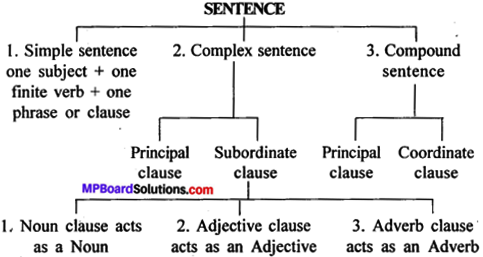
  1. Simple sentences (साधारण वाक्य) – इसमें one subject + one verb (finite) + one phrase या clause होता है।
  2. Complex sentence (जटिल वाक्य) – इसमें एक मुख्य वाक्य (Main or Principal clause) तथा एक उपवाक्य – आश्रित उपवाक्य (Subordinate clause) होता है।
  3. Compound sentences (संयुक्त वाक्य) – इसमें एक Principal clause तथा एक Co – ordinate clause (समकक्षी) होता है।

Kinds Of Clause

मुख्या रूप से Clause तीन प्रकार के होते है –

  1. Principal clause,
  2. Co – ordinate clause,
  3. Subordinate clause.

MP Board Class 12th General English Grammar Clauses 1

Functions Of Clauses (Clauses के कार्य)
(i) Principal clause या Main clause – किसी वाक्य का स्वतन्त्र पूर्ण अर्थ देने वाला भाग Principal या Main clause कहलाता है। इस clause से पहले कोई conjunction प्रयोग नहीं होता है।

जैसे –

  1. Lata said that she loved Manoj.
  2. Ram said that Sita was beautiful.
  3. He said that it was great pleasure.

(ii) Co – ordinate clause (समकक्षी) यह Principal clause के समान होता है तथा उस पर आश्रित नहीं होता है। यह स्वतन्त्र रूप से अपना अर्थ प्रकट करने में सक्षम होता है। यह Principal clause से किसी conjunction द्वारा बाद में जुड़ा होता है तथा ये Compound sentences बनाता है।

जैसे –

  1. She came and went out.
  2. Ram is poor but he is honest.
  3. He is neither intelligent nor diligent.
  4. He worked very hard and he got good marks.
  5. Soni is not only beautiful but also foolish.

Co – ordinate clause चार प्रकार के होते हैं–

(1) The Co-ordinate Clause of Similar Idea or Cumulative (एक समान विचार) – ये clause, Principal clause से निम्नलिखित connectives के द्वारा जोड़े जाते हैं। जैसे – and, as well as, not only ………………… but also, both….and, no less than. ये connectives समान विचारों को जोड़ते हैं तथा एक Compound sentence बनाते हैं।

जैसे –

  1. He is wise and kind.
    वह योग्य एवं दयालु है।
  2. He is not only wise but also kind.
    वह केवल योग्य ही नहीं बल्कि दयालु भी है।
  3. He is rich as well as kind.
    वह जितना अमीर है उतना ही दयालु है।
  4. Neelam is both intelligent and beautiful.
    नीलम योग्य तथा सुन्दर दोनों है।

(2) Co-ordinate Clause of Opposite or Adversative Idea (विचार) – ये clause निम्नलिखित Connectives से Principal clause से जोड़े जाते हैं एवं विपरीत अर्थ देते हैं।

But, still, yet, nevertheless, however, while, whereas, only, (फिर भी, किन्तु)

  1. He is poor. He is honest.
    He is poor but he is honest.
  2. He is poor. He is honest.
    He is poor still he is honest.
  3. He was tired. He kept on reading.
    He was tired nevertheless he kept on reading.
  4. He came to me. He said nothing.
    He came to me however he said nothing.

(3) Co-ordinate Clause of Alternative Idea (चयनात्मक) ये निम्नलिखित connectives से जोड़े जाते हैं or या, otherwise अन्यथा, else वरना, either …………………. or या यह या और, neither …………………. nor न यह न वह तथा विकल्प या चयनात्मक भाव प्रकट करते हैं।

जैसे –

  1. Work hard, you will fail.
    Work hard or you will fail.
  2. Sit down, go away.
    Either sit down or go away.
  3. You do not read, you do not write.
    You neither read nor write.
  4. Work hard. You will fail.
    Work hard otherwise, you will fail.

(4) The Co-ordinate Clause of Illative or Inference (परिणामात्मक विचार) ये clause परिणाम का बोध कराते हैं तथा निम्नलिखित Connectives द्वारा Principal clause से जोड़े जाते हैं।

Therefore, for, then, so, hence, consequently – अत: इसलिए!

  1. He was guilty. He was punished.
    He was guilty so he was punished.
  2. It was raining. I could not come.
    It was raining, therefore, I could not come.

Exercise
Combine the following sentences into compound sentences :
1. They are coming by bus. They are coming by taxi.
2. You can write in ink. You can write in pencil.
3. He has a small family. He gets a good salary.
4. He wrote the letters. He did not post them.
5. They did not look at him. They did not talk to him.
Answer:
1. They are coming by bus or taxi.
2. You can write in ink or pencil.
3. He has a small family and he gets a good salary.
4. He wrote the letters but he didn’t post them.
5. They did not look at him nor did they talk to him.

(iii) Sub-ordinate clause (आश्रित) – यह अपने अर्थ के लिए Principal – Main clause पर आश्रित होता है। इससे पूर्व Conjunction लगा होता है। ये तीन प्रकार के होते हैं

  1. Noun clause,
  2. Adjective clause,
  3. Adverb clause.

1. The Noun Clause
जब कोई Subordinate clause, Principal clause की मुख्य क्रिया की भाँति कार्य करे, तो वह Noun clause कहलाता है। जैसे
1. The teacher said that the earth moves round the sun.
2. My mother said that she was ill.
पहचान तथा नियम – Noun clause के सभी conjunctions की हिन्दी करने पर उनके प्रथम अक्षर की ध्वनि ‘क’ से आरम्भ होती है।

जैसे –
1. That – की कथन केलिए
She said that she was ill.
उसने कहा कि वह बीमार थी।

2. What – क्या कथन
You want to know what I do.
तुम जानना चाहते हो कि मैं क्या करता हूँ।

3. Who – कौन – व्यक्ति के लिए – Subject
I asked who that man was.
मैंने पूछा कि वह व्यक्ति कौन था।

4. Whom – किसे – व्यक्ति के लिए Objective case
Please tell me whom you love.
कृपया मुझे बताओ किसे आप प्यार करते हैं।

5. Whose – किसकी/किसका
Ram asked whose pen it was.
राम ने पूछा कि वह कलम किसका था।

6. Which किसे/किसको किसकी निर्जीव, या छोटे प्राणी
The leader asked of which party we were the members.
नेताजी ने पूछा कि हम किस पार्टी के सदस्य थे।

7. When – कब – समय के लिए
He asked when he would return.
उसने पूछा कि वह कब लौटेगा।

8. Where – कहाँ–स्थान के लिए
You asked where we were going.
उसने पूछा कि हम कहाँ जा रहे हैं।

9. Why क्यों – कारण के लिए
The President asked the Secretary why their party was defeated.
अध्यक्ष ने सचिव से पूछा कि उनका दल क्यों हार गया।

10. How – कैसे, कैसी/कैसा
The artist was anxious to know how his paintings were appreciated.
कलाकार यह जानने को उत्सुक था कि उसके चित्रों की कैसी सराहना हुई।

11. If या whether – क्या प्रश्न पूछने केलिए
यदि किसी Subordinate clause का उत्तर Yes या No में हो तो conjunction if या whether प्रयोग होता है

The father asked if/whether I would take my meal at the house in the evening
पिताजी ने पूछा कि क्या मैं शाम को खाना घर पर खाऊँगा।

Functions Of Noun Clause (Noun Clause के कार्य)

(1) Subject of the verb, जैसे –

  • What he said was true.
  • Whom Soni loves dies soon.
  • That he will succeed is certain.
  • What he said was very strange.
  • Why he came here is not clear.
  • When she left the town is a mystery.

Note – यदि कोई clause Principal clause से पहले आता है तो वह subject to the verb का कार्य करता है

(2) Object of the Verb

जैसे –

  • He said that he was a good boy.
  • I know that you will pass.
  • I know why he is absent.
  • Have you heard what has happened?
  • Lata said that she knew the answer.

Note – clause Principal clause at 31161 Bit Principal clause से बाद में ‘क्या’ लगाने पर उत्तर मिलता हो तो वह object to the verb का कार्य करता

(3) Object to the Preposition;

जैसे –

  • You should not rely on what he says.
  • Listen to what the teacher says.
  • I am not impressed by what he did.
  • Please attend to what the child says.

(4) A complement to the Verb

जैसे –

  • It seems that she will come soon.
  • It seems that it will rain.
  • This is what he said.
  • Life is what we make it.
  • The fact is that she has deceived me.

(5) Object to a Gerund

जैसे –

  • He is in the habit of abusing whoever comes before him.
  • He believes in enjoying whatever he can get.
  • He hates of telling a lie..
  • She likes making a fool the young men.

(6) Case in Apposition with Noun or Pronoun or “It’;

जैसे –

  • The news that she died is wrong.
  • It was clear that she was a beauty.
  • It is clear that he is a knave.
  • It is strange that he does not know his own name.

(7) Object to a Participle;

जैसे –

  • The judge made free believing that he was innocent.
  • He went away thinking that it would not rain.
  • He came to me thinking that I would help him.
  • He went out of the room saying that he would come back soon.

(8) Object to an Infinitive;

जैसे –

  • She wants to say that she is honest.
  • I want to know how he failed.
  • The teacher wants to know how far he is right.

Note –

  1. Noun clause सदैव हिन्दी के ‘कि’ शब्द से आरम्भ होता है।
  2. यदि Noun clause Assertive वाक्य है, तो Conjunction ‘that’ लगाते हैं।
  3. यदि Subordinate clause प्रश्नवाचक है, तो Conjunction that’ नहीं आता। प्रश्नसूचक शब्द (what, which, why) आदि से Noun clause को जोड़ते हैं।
  4. Main clause Assertive तथा Noun clause प्रश्नवाचक है, तो वाक्य के अन्त में प्रश्नवाचक चिन्ह (?) नहीं लगाते हैं।
  5. यदि Principal तथा Noun clause दोनों ही प्रश्नवाचक हैं, तो प्रश्नवाचक चिन्ह (?) वाक्य के अन्त में लगाते हैं।
  6. यदि Principal clause Present Tense में हो, तो Noun clause किसी भी Tense में हो सकता है।
  7. यदि यह पता न चले कि कोई clause Noun clause है या नहीं, तो Noun clause के स्थान पर something रखकर देखते हैं यदि पूरा अर्थ निकले तो clauses निश्चित रूप से Noun clause है। जैसे I knew that Harendra would come. यदि that Harendra would come के स्थान पर something रखो तो वाक्य बनेगा I knew something इसका अर्थ निकलता है, अतः यह Noun clause है।

2. Adjective Clause

  1. Adjective clause एक उपवाक्य है, जो किसी अन्य उपवाक्य की संज्ञा या सर्वनाम के सम्बन्ध में विशेषण का कार्य करता है। यह प्रायः किसी Relative Pronoun या Relative Adverb द्वारा प्रारम्भ किया जाता है। किन्तु इसे Relative Pronoun या Relative Adverb के बिना भी बनाया जा सकता है।
  2. Adjective clause सदैव Noun clause में आए हुए Noun या Pronoun की विशेषता बताता है, अतः इससे पहले Noun या Pronoun का आना अति आवश्यक है।
  3. सामान्यतः यह Clause Relative Pronoun या Relative Adverb (who, whom, why, where, that) से आरम्भ होता है।
  4. जब यह व्यक्ति को qualify करता है या विशेषता बताता है, तो यह Relative Pronoun who, whom तथा whose से आरम्भ होता है।
  5. जब यह किसी thing (वस्तु या छोटे जानवर) को qualify (विशेषता) करता है, तो यह which से आरम्भ होता है।
  6. जब यह व्यक्ति तथा वस्तु (Person as well as thing), सजीव तथा निर्जीव (Living as well as non – living, Person as well as animal), व्यक्ति व जानवर Male and female (स्त्रीलिंग एवं पुल्लिंग) दोनों को साथ – साथ qualify करे, तो Relative pronoun that का प्रयोग करते हैं जैसे –
    • The boy and the girl that you beat are my own children.
    • The boy and his cow, that crossed the field were turned out.
    • The boy and his dog, that had entered the house are yours.
  7. यदि Main clause में Superlative degree, या all, any, same, only, nothing, none, those, आदि शब्द आए हों या Principal clause में Interrogative Pronoun का प्रयोग हुआ हो, तो Adjective clause that से आरम्भ होता है, जैसे –
    • Man is only animal that can talk.
    • This is the best girl that won the prize. (Superlative degree)
    • This is same book that I learned.
    • What was the answer that he gave?
  8. यदि पहले (Main clause) में same या such का प्रयोग हुआ हो तो Adjective clause ‘as’ से शुरू करते हैं।
  9. जब Adjective clause समय प्रकट करे तो when से; स्थान के लिए where से; कारण के लिए why से तथा तरीका (Manner) के लिए how से आरम्भ करते हैं।
  10. जब Adjective clause किसी व्यक्ति या वस्तु को Negative sense में qualify करता हो तो इसे But से आरम्भ करते हैं।

Note –
(1) कभी – कभी Relative Pronoun या Relative Adverb जो Adjective clause के आरम्भ में प्रयोग किए जाते हैं, हटाए भी जा सकते हैं,

जैसे –
(a) I am the monarch of all I survey.
(All के बाद that हटाया गया)
(b) Reap the things you sow.
(Things के बाद which हटाया गया)

(2) Adjective clauses के सभी connectives (Relative Pronoun) का हिन्दी प्रथम अक्षर ‘ज’ होता है;

जैसे –
Who – जो, जिसने (व्यक्ति के लिए)
(a) This is the boy who threw a stone at me yesterday.
यह वही लड़का है जिसने कल मुझ पर पत्थर फेंका था।

(b) He who came here is my real brother.
जो यहाँ आया था मेरा सगा भाई था।

(c) I know the man who stole your watch.
मैं उस व्यक्ति को जानता हूँ जिसने तुम्हारी घड़ी चुराई थी।

Whom – जिसे, जिसको (व्यक्ति के लिए)

(a) We lend only to person whom we know very well.
हम जिसे खूब जानते हैं उसे उधार देते हैं।

(b) This is the boy whom I love very much.
यह वही लड़का है जिसे मैं अत्यधिक प्यार करती हूँ।

Whose – जिसकी, जिसका, जिसको (व्यक्ति)
(a) This is the man whose book is lost.
यही वह आदमी है जिसकी किताब खो गई है।

(b) The passenger whose luggage is lying here has gone to drink water.
वह यात्री जिसका सामान यहाँ रखा है पानी पीने गया है।

Which – जिसे, जिसको (वस्तु)

(a) The house which I have bought is worth living.
यह मकान जिसे मैंने खरीदा है रहने योग्य है

(b) We belong to the Brahmin caste the honour of which is important.
हम ब्राह्मण जाति के हैं जिसका सम्मान महत्वपूर्ण है।

That – जो, जिसे
(a) This is the best book that has come in the market.
यह सबसे अच्छी पुस्तक है जो बाजार में आई है।

(b) There is nothing that can not be cured.
ऐसा कुछ भी नहीं जिसका इलाज न किया जा सके।

(c) The boy and his sister that came to me are in class Xth. (10th class)
वह लड़का एवं उसकी बहन जो मेरे पास आए थे, कक्षा दस में हैं।

(d) All that glitters is not gold.
सब जो चमकता है सोना नहीं होता।

As – जो, जैसा

(a) I have not seen such man as you are.
मैंने तुम्हारे जैसा व्यक्ति नहीं देखा।

(b) My pen is the same as your pen.
मेरा पैन तुम्हारे पैन जैसा है।

When – जब (समय)
(a) This is the time when you should read.
यही समय है जब तुमको पढ़ना चाहिए।

(b) I do not know the time when the train will come.
मैं वह समय नहीं जानता जब गाड़ी आती है।

Where – जहाँ (स्थान)

(a) The place where we worship is not meant for drinking.
वह स्थान जहाँ हम पूजा करते हैं शराब पीने के लिए नहीं बना है।

(b) This is the battle field where he was killed.
यह वही युद्धभूमि है जहाँ वह मारा गया था।

Why – जिससे, जिस कारण से

(a) Please tell me the reason why you did not come.
कृपया कारण बताओ जिससे (जिस कारण) आप नहीं आए।

(b) I do not know the reason why he failed.
मैं नहीं जानता जिससे वह फेल हुआ।

How – जिस तरीके से

(a) This is the way how this painting can be made.
यही तरीका है जिससे यह चित्र बन सकता है।

(b) She worked in the manner how you told her.
उसने ऐसे ही काम किया जैसे आपने कहा।

But – जो नहीं

(a) There is no man but weeps at the memorial of Gandhi.
ऐसा कोई आदमी नहीं जो गाँधी जी की समाधि पर नहीं रोता है।

(b) There is no mother but loves her baby.
ऐसी एक भी माँ नहीं जो अपने शिशु को प्यार नहीं करती हो।

Without Connective

Note – कभी – कभी कुछ वाक्य Without Connective भी बनाये जा सकते हैं।

जैसे –
(a) The task you have taken is very difficult.
जो कार्य आपने किया है बड़ा कठिन है।

(b) The girl you love is very charming.
वह लड़की जिसे आप प्यार करते हैं बड़ी आकर्षक है।

(c) The man you saw yesterday is a doctor.
वह आदमी जिसे तुमने कल देखा था डॉक्टर है।

(d) The book you bought yesterday is the best.
यह पुस्तक जिसे आपने कल खरीदा था सबसे अच्छी है।

Solved Exercises

Exercise 1
Complete the following sentences by filling in the blanks with suitable subordinate conjunctions :

1. The man …………………. is honest is trusted
Answer:
The man who is honest is trusted.

2. The book …………………. you gave me is very interesting.
Answer:
The book which you gave me is very interesting.

3. The table …………………. was broken is now repaired.
Answer:
The table which was broken is repaired.

4. The train …………………. has left just now goes to Lucknow.
Answer:
The train which has left just now goes to Lucknow.

5. The novel …………………. you gave me is very interesting.
Answer:
The novel which you gave me is very interesting.

6. The man …………………. you love is my friend.
Answer:
The man whom you love is my friend.

7. It is …………………. am at the door.
Answer:
It is I who am at the door.

8. The girl …………………. speech was the best was given the first prize.
Answer:
The girl whose speech was the best was given the first prize.

9. He is the same man …………………. came yesterday.
Answer:
He is the same man that/as came yesterday.

10. This is the man …………………. purse is lost.
Answer:
This is the man whose purse is lost.

11. This is the pen …………………. I bought from market.
Answer:
This is the pen which I bought from the market.

12. Tulsidas …………………. wrote the Ramayan is an eminent poet of Hindi.
Answer:
Tulsidas who wrote Ramayan is an eminent poet of Hindi.

13. The Taj Mahal …………………. is a historical monument stands at Agra.
Answer:
The Taj Mahal which is a historical monument stands at Agra.

14. The boy …………………. lost his way spent the night in a village.
Answer:
The boy who lost his way spent the night in a village.

15. The villagers …………………. were kind and hospitable gave him food and bed.
Answer:
The villagers who were kind and hospitable gave him food and bed.

16. I do not know …………………. to swim.
Answer:
I do not know how to swim.

17. I wonder …………………. he means.
Answer:
I wonder what he means.

18. I do not know …………………. I can trust.
Answer:
I do not know how I can trust.

19. I know …………………. to punish him.
Answer:
I know how to punish him.

20. This is Shyam …………………. I teach grammar.
Answer:
This is Shyam whom I teach grammar.

Exercise 2
Combine each of the following sentences using Adjective Clause :

1. This is the pen. I want it.
2. The boy was active. He was rewarded.
3. I am your monitor. I will guide you.
4. We are strangers here. We need your help.
5. You gave me medicine. It did not suit me.
6. Nathu Ram shot Gandhiji dead. He was mad.
7. She is Miss Sheela. She used to teach us English.
8. Someone broke the window. I do not know him.
9. My parents met Miss Abha Sharma. She is our teacher.
10. It is fact. He has spoken the truth.
11. The boy is my brother. He is wearing a red cap.
(Combine the Sentences in relative clause) (2016)
Answer:
1. This is the pen which I want.
2. The boy who was active was rewarded.
3. I who am your monitor will guide you.
4. We who are strangers here need your help.
5. You gave me a medicine which did not suit me.”
6. Nathu Ram who shot Gandhiji dead was mad.
7. She is Miss Sheela who used to teach us English.
8. I do not know the person who broke the window.
9. My parents met Miss Abha Sharma who is our teacher.
10. It is the truth what he has spoken.
11. The boy who is wearing a red cap is my brother.

3. The Adverb Clause

  1. Adverb clause एक ऐसा उपवाक्य है जो Adverb की भाँति कार्य करता है अर्थात् यह अन्य उपवाक्य की क्रिया या विशेषण या क्रिया विशेषण के सम्बन्ध में क्रिया विशेषण का कार्य करता है।
  2. यह Main clause के बारे में अतिरिक्त सूचनाएँ प्रदान करता है, जैसे – समय, स्थान, परिणाम, उद्देश्य, कारण, शर्त, विरोध, तुलना, तरीका।

Kinds Of Adverb Clauses
Adverb clauses नौ प्रकार के होते हैं।

जैसे –

  • Time समय
  • Place स्थान
  • Result परिणाम
  • Purpose उद्देश्य
  • Reason कारण
  • Condition शर्त
  • Contrast विरोध
  • Comparison तुलना
  • Manner तरीका

(1) AdverbClause of Time (समय)—यह समय के विषय में बोध कराता है। इसमें निम्नलिखित Conjunctions का प्रयोग होता हैं, जैसे as जिस समय, when जब, while जिस समय, as soon as ज्योंही, as long as जब तक, since जिस समय से, till जब तक, until जब तक नहीं, after के बाद, before के पहले, whenever जब कभी।

  1. As the sun was set, it grew dark.
    जैसे ही सूरज अस्त हुआ अन्धेरा छा गया।
  2. As soon as she came the children ran away.
    ज्योंही वह आयी बच्चे भाग गए।
  3. When the traveller returned to his house he found his family missing.
    जब यात्री अपने घर लौटा तो अपने परिवार को गायब पाया।
  4. You should not talk while I am reading.
    तुम्हें बातें नहीं करनी चाहिए जबकि मैं पढ़ रहा हूँ।
  5. As long as you are here I have no care.
    जब तक आप यहाँ हैं मुझे चिन्ता नहीं।
  6. My health has grown worse since I went to Bombay.
    जब से मैं बम्बई गया हूँ मेरा स्वास्थ्य खराब हो गया है।
  7. Wait here till I return.
    मेरे आने तक यहाँ प्रतीक्षा करो।
  8. Do not go home until I ask. (Permit)
    जब तक मैं न कहूँ घर मत जाओ।
  9. She had left house before I came.
    मेरे आने से पहले वह घर चली गई थी।

(2) Adverb Clause of Place (स्थान) – यह clause स्थान का बोध कराता है तथा where कहाँ, whence जहाँ से, wherever जहाँ कहीं, आदि से आरम्भ होता है।

जैसे –

  1. You can go wherever you wish.
    तुम जहाँ कहीं चाहे, जा सकते हो।
  2. I want to go with you where no one can meet us.
    मैं तुम्हारे साथ ऐसे स्थान पर जाना चाहता हूँ जहाँ कोई भी हमें न मिले।
  3. Man returns whence he comes.
    मनुष्य जहाँ से आता है वहीं चला जाता है।

(3) Adverb Clause of Result (परिणाम) – यह परिणाम या प्रभाव दिखाता है। यह clause that से आरम्भ होता है तथा इससे पहले वाले clause में so या such का प्रयोग होता है।

  1. He is so poor that he cannot pay his fee.
    वह इतना गरीब है कि अपनी फीस नहीं दे सकता।
  2. He is such dirty that no one sits besides him.
    वह इतना गन्दा है कि कोई उसकी बगल में नहीं बैठ सकता है।
  3. She is such beautiful that her beauty can not be described in words.
    वह इतनी सुन्दर है कि उसकी सुन्दरता शब्दों में व्यक्त नहीं की जा सकती है।

(4) Adverb Clause of Purpose (उद्देश्य) – यह clause किसी उद्देश्य का बोध कराता है। ये अधिकतर so that, that, lest से आरम्भ होते हैं।

  1. He works hard that he may become rich.
    वह कठिन कार्य करता है ताकि धनवान हो सके।
  2. I gave him money so that he might buy books.
    मैंने उसे पैसा दिया ताकि वह पुस्तकें खरीद सके।
  3. Read carefully lest you should fail.
    सावधानी से पढ़ो कहीं ऐसा न हो कि फेल हो जाओ।
  4. Ram went to college in order to learn some new things from the teacher.
    राम कॉलेज गया ताकि अध्यापक से कुछ नई बातें सीख सके।

(5) Adverb Clause of Reason (कारण) – ये clause कारण बताते हैं तथा अधिकतर because, since, as, that, आदि से आरम्भ होते हैं।

  1. She can not come because she is ill.
    वह नहीं आ सकती है क्योंकि वह बीमार है।
  2. As she is angry she will not come to me.
    चूँकि वह नाराज है वह मेरे पास नहीं आयेगी।
  3. That it is raining I will not go out.
    चूँकि वर्षा हो रही है मैं बाहर नहीं जाऊँगा।

(6) Adverb Clause of Condition (शत) – ये clause किसी शर्त का बोध कराते हैं तथा ये if, whether, unless, provided, in case से आरम्भ होते हैं।

  1. If you come, I shall help you.
    यदि तुम आओगे, मैं तुम्हारी सहायता करूँगा।
  2. In case you come, I shall help you.
    यदि तुम आओगे, मैं तुम्हारी सहायता करूँगा।
  3. Unless you work hard, you will fail.
    जब तक तुम कठिन परिश्रम नहीं करोगे, तुम फेल हो जाओगे।
  4. Whether you come.or not I shall go there.
    चाहे तुम आओ या न आओ मैं वहाँ जाऊँगा।
  5. Provided that she comes to me, I shall give her this book.
    मैं उसे यह किताब दूंगा शर्त यह है कि वह मेरे पास आए।

Note – Unless का Negative भाव होता है अतः if के स्थान पर unless प्रयोग करते समय दूसरे clause को Negative बना देना चाहिए।

जैसे –

  1. If you come to me, I shall go with you.
    यदि तुम मेरे पास आते हो, तो मैं तुम्हारे साथ चलूँगा।
  2. Unless you come to me, I shall not go with you.
    यदि तुम मेरे पास नहीं आते हो, तो मैं तुम्हारे साथ नहीं जाऊँगा।
  3. If you do not work hard, you will fail.
    यदि तुम कठिन परिश्रम नहीं करोगे, तुम फेल हो जाओगे।
  4. Unless you work hard, you will fail.
    यदि तुम कठिन परिश्रम नहीं करोगे, तुम फेल हो जाओगे।

(7) Adverb Clause of Contrast (विरोध) – इसे Clause of Supposition या concession कल्पना भी कहते हैं। ये विरोधाभास प्रकट करते हैं तथा अधिकतर though यद्यपि, although यद्यपि, as यद्यपि, even if यद्यपि, all the same, however फिर भी आदि से आरम्भ होते हैं।

  1. Though he is poor, he is honest.
    यद्यपि वह गरीब है, किन्तु ईमानदार है। (वह गरीब होते हुए भी ईमानदार है)
  2. Although Ravi worked hard, he failed.
    यद्यपि रवि ने कठिन परिश्रम किया फिर भी फेल हो गया।
  3. As he is rich, he is a miser.
    यद्यपि वह अमीर है फिर भी कंजूस है।
  4. Even if it is raining I shall go.
    यद्यपि वर्षा हो रही है, मैं जाऊँगा।
  5. However poor he is, he is honest.
    वह गरीब है फिर भी ईमानदार है।

(8) AdverbClause of Comparison (तुलना) – इस clause से तुलना प्रकट होती है। ये सामान्यतः than की अपेक्षा, as…..as जितना/उतना, no less than, as much as, आदि से आरम्भ होते हैं।

  1. She is taller than Ram.
    वह राम से लम्बी है।
  2. I love you no less than her.
    मैं तुम्हें उससे कम प्यार नहीं करता हूँ।
  3. I like summer season as much as spring.
    मैं गर्मी को उतना ही पसन्द करता हूँ जितना बसन्त ऋतु को।
  4. Neelam is as wise as Lata.
    नीलम उतनी ही योग्य है जितनी लता।

(9) AdverbClause of Manner (तरीका) – ये clause किसी ढंग या तरीके को दर्शाते हैं, तथा सामान्यतः as जैसा, as if मानो कि, as though मानो कि, से आरम्भ होते हैं।

  1. She did as she was asked.
    उसने जैसे कहा गया था वैसे ही किया।
  2. You may do as you please.
    तुम जैसे चाहो कर सकते हो।
  3. He behaved as if he were a king.
    उसने ऐसा व्यवहार किया जैसे वह कोई राजा हो।
  4. He seems as though he were very rich.
    वह ऐसा लगता है मानो कि वह बहुत अमीर हो।

Solved Exercise

Complete each of the following sentences by adding Adverbial clause beginning with when, where, until, if, that, as, because, though, although, as long as, then, as soon as, while, after, since, so that etc.

1. I reached the station ………………….
Answer:
I reached the station when the train had left.

2. He waited for me ………………….
Answer:
He waited for me until I returned.

3. You can get good marks ………………….
Answer:
You can get good marks if you work hard.

4. The old man was so weak ………………….
Answer:
The old man was so weak that he could not walk.

5. I found my books ………………….
Answer:
I found my books where I had put them.

6. I shall not go out ………………….
Answer:
I shall not go out if it rains.

7. I am going to bed ………………….
Answer:
I am going to bed as I am tired.

8. He loves his dog better ………………….
Answer:
He loves his dog better than his cat.

9. It was so cold ………………….
Answer:
It was so cold that I could not go out.

10. …………………. he finished his work.
Answer:
I had left the room before he finished the work.

11. The train had left the platform ………………….
Answer:
The train had left the platform before we reached.

12. You may work here ………………….
Answer:
You may work here as long as you wish.

13. …………………. he ran away.
Answer:
As soon as he saw me he ran away.

14. …………………. I could not attend the function.
Answer:
As I was ill, I could not attend the function.

15. Do not run on the road ………………….
Answer:
Do not run on the road while traffic is rushing. (running)

16. She is not so clever ………………….
Answer:
She is not so clever as her friend.

17. I missed the train though ………………….
Answer:
I missed the train though I tried my best.

18. He started as soon as ………………….
Answer:
He started as soon as he could. (possible)

19. As long as …………………. there is hope.
Answer:
As long as you are here there is hope. (As soon as he resumes breathing there is hope.)

20. He jumps …………………. a frog does. (as/as if) (2017)
Answer:
He jumps as if a frog does.

21. He gets salary. He starts spending it. (Combine using “No sooner…than’) (2016)
Answer:
No sooner does he get salary than he starts spending it.

We believe the information shared regarding MP Board Solutions for 12th English Grammar Clauses Questions and Answers as far as our knowledge is concerned is true and reliable. In case of any queries or suggestions do leave us your feedback and our team will guide you at the soonest possibility. Bookmark our site to avail latest updates on several state board Solutions at your fingertips.
MP Board Class 12th General English Grammar Active and Passive Voice

MP Board Solutions for 12th General English Grammar Active and Passive Voice Questions and Answers aids you to prepare all the topics in it effectively. You need not worry about the accuracy of the Madhya Pradesh Board Solutions for 12th English as they are given adhering to the latest exam pattern and syllabus guidelines.

You Can Download MP Board Class 12th English Solutions Questions and Answers Notes, Summary, Lessons: Pronunciation, Translation, Word Meanings, Textual Exercises. Enhance your subject knowledge by preparing from the Chapterwise MP Board Solutions for 12th English and clarify your doubts on the corresponding topics.

MP Board Class 12th General English Grammar Active and Passive Voice

Kick start your preparation by using our online resource MP Board Solutions for 12th General English Grammar Active and Passive Voice Questions and Answers. You can even download the Madhya Pradesh Board Class 12th English Solutions Questions and Answers for free of cost through the direct links available on our page. Clear your queries and understand the concept behind them in a simple manner. Simply tap on the concept you wish to prepare in the chapter and go through it.

Active and Passive Constructions

1. ACTIVE और PASSIVE में अन्तर
Verb की दो Voices होती हैं Active Voice और Passive Voice. Active voice में कर्ता प्रधान होता है और Passive voice में कर्म प्रधान होता है,

जैसे –
ActiveHari killed the snake. Passive – The snake was killed by Hari.
चूँकि वाक्य में कर्ता प्रधान शब्द होता है इसलिये पहले वाक्य में Hari, जो काम करने वाला है, प्रधान शब्द है और दूसरे वाक्य में snake, जो काम करने वाला नहीं है, अपितु कर्म है, प्रधान शब्द है।

दूसरे वाक्य में Hari प्रधान शब्द नहीं है। यह तथ्य इस बात से भी स्पष्ट हो जाता है कि इस शब्द को वाक्य से हटाने पर भी वाक्य पूर्ण बना रहेगा –
The snake was killed.

किन्तु पहले वाक्य में Hari नहीं हटाया जा सकता है।

2. कब ACTIVE से PASSIVE में परिवर्तन नहीं होता है?
Active voice को Passive voice में बदलने के निश्चित नियम हैं जिनको याद. कर लेने के बाद Voice बदलना एक मशीनी (Mechanical) क्रिया मात्र रह जाता है। ये नियम नीचे दिये जा रहे हैं। परन्तु पहले यह जान लेना उचित होगा कि किन दशाओं में Active voice को Passive voice में नहीं बदला जा सकता है।

1. Intransitive verbs को Passive में नहीं बदला जा सकता है,

जैसे –
Some birds fly very high. (No Passive)

कुछ अकर्मक क्रियाओं को उनके बाद Prepositions आ जाने पर Passive में बदला जा सकता है जैसा कि आगे बताया जायेगा।
2. Future Continuous Tense का Passive voice में परिवर्तन नहीं हो सकता है।
3. किसी भी Tense के Perfect Continuous Tense का भी Passive voice में परिवर्तन नहीं किया जा सकता है।

3. ACTIVE से PASSIVE में बदलने के नियम
नियम 1 – Object को Subject में तथा Subject को Object में बदल दिया जाता है।
नियम 2 – नये Object से पहले लगा देता हैं –
नियम 3 – Tense के अनुसार सहायक क्रिया लगाकर Verb की Third form लगा देता हैं –

1. Simple Present Tense
निम्नलिखित वाक्यों को ध्यानपूर्वक पढ़ो :

  1. He reads a book. (Active)
    A book is read by him. (Passive)
  2. She does not write a letter. (Active)
    A letter is not written by her. (Passive)
  3. Do you read a book? (Active)
    Is a book read by you? (Passive)

नियम 1 – इस Tense में Subject के अनुसार is या are या am के साथ Verb की Third form का प्रयोग होता है। (प्रथम वाक्य देखो)
नियम 2 – Negative में is या are या am के बाद not लगा दिया जाता है। (द्वितीय वाक्य देखो)
नियम 3 – Interrogative में is या are या am को नये subject से पहले लगा देते (तृतीय वाक्य देखो)

Exercise 1
Change the following into Passive :
1. I give the child two kites.
2 He sells sugar.
3. His brother polishes shoes.
4. Boys fly kites.
5. My father replies letters.
6. You copy the lesson.
7. Girls smell flowers. & The boy pays fees.
9. The mother tells us stories.
10. They call me.
11. People celebrate Diwali all over India.
Answer:
Diwali is celebrated all over India.

12. People do not play cricket in America.
Answer:
Cricket is not played in America.

Subject तथा Object का चार्ट

Subject-Object
I – me
We – us.
They – them
You – you
He – him
She – her

इस चार्ट को छात्रों को याद कर लेना चाहिए ताकि Subject को Object में तथा Object को Subject में बदलने में कठिनाई न हो।

2. Simple Past Tense

  1. Active – He wrote a letter.
    Passive – A letter was written by him.
  2. Active – He did not steal my pen.
    Passive My pen was not stolen by him.
  3. Active – Did I buy a cow?
    Passive – Was a cow bought by me?

नियम 1 – Simple Past Tense के वाक्यों को Passive में बदलते समय एकवचन में was के साथ Verb की Third form तथा बहुवचन में Verb की Third form लगाना चाहिए।
नियम 2 – Negative वाक्य को Passive में बदलते समय was या were के बाद not लगा देना चाहिए।
नियम 3 – Interrogative वाक्य को Passive में बदलते समय was या were को Subject से पहले रखा देना चाहिए।

Exercise 2
Change the following sentences into Passive voice :
1. His friend drove the car.
2. You knew me. (Hint: by Subject के स्थान पर to Subject)
3. Harish told lies.
4. My mother told Mohan an interesting story.
5. They wrote letters to the Editors of the newspapers.
6. Sheela knitted a sweater yesterday.
7. The servant shut the door.
8. I paid the bill.
9. You saw this picture.
10. The farmers broke the glasses.
11. They built a bridge over the river.
12. They kept me alone for a week.
Answer:
I was kept alone for a week by them.)

3. Future Indefinite Tense

  1. Active – I shall do this work.
    Passive This work will be done by me.
  2. Active – He will not beat his friend.
    Passive – His friend will not be beaten by him.
  3. Active Will you call her?
    Passive – Will she be called by you?

नियम 1 – इस Tense के वाक्यों को Passive में बदलते समय Shall be या Will be के साथ Verb की Third form लगा देते हैं।
नियम 2 – Negative वाक्य को Passive में बदलते समय shall या will के बाद तथा be से पहले not लगा देना चाहिए।
नियम 3 – Interrogative वाक्य को Passive में बदलते समय shall या will को नये Subject से पहले लगा देना चाहिए।
नियम 4 – 1 तथा we कर्ता के साथ shall be तथा शेष सभी कर्ताओं के साथ will be का प्रयोग होता है।

Exercise 3
Change the following sentences into

Passive voice :

  1. We shall see the match.
  2. Your brother will buy a watch.
  3. The farmer will grow more food.
  4. She will drop me a letter.
  5. The boys will read the lesson twice.
  6. They will make Dinesh Captain of the hockey team.
  7. The scientist will find out the answer.
  8. My work will satisfy you.
  9. The government will look after the poor.
  10. The merchant will sell sugar at Rs. 10/ – a kilo.

4. Present Continuous Tense

  1. Active – Mohan is writing a letter.
    Passive – A letter is being written by Mohan.
  2. Active – She is not writing a letter.
    Passive – A letter is not being written by her.
  3. Active – Are you writing a letter?
    Passive – Is a letter being written by you?

नियम 1 – इस Tense में being या are being या am being के साथ verb की third form का प्रयोग होता है। (प्रथम वाक्य देखो)
नियम 2 – Negative वाक्य में is या are या am के बाद Not लगा देते हैं। (द्वितीय वाक्य देखो)
नियम 3 – Interrogative में is या are या am को subject से पहले लगा देते हैं। (तृतीय वाक्य देखो)।

Exercise 4
Change the following sentences into Passive voice :
1. I am buying mangoes.
2. We are collecting books. (2015)
3. You are lending money.
4. He is sending me there.
5. The merchant is selling sugar.
6. Girls are smelling flowers.
7. Father is not spending money.
8. Mother is telling tales.
9. They are cutting fruits.
10. The gardener is digging pits in the garden.
11. They are painting the doors green.
Answer:
The doors are being painted green.

5. Past Continuous Tense

  1. Active – She was writing a letter.
    Passive – A letter was being written by her.
  2. Active I was not reading a book.
    Passive – A book was not being read by me.
  3. Active – Were they playing hockey?
    Passive – Was hockey being played by them?

नियम 1 – Past Continuous Tense के वाक्यों को Passive में बदलते समय was being या were being के साथ verb की third form का प्रयोग किया जाता है। (प्रथम वाख्य देखे)
नियम 2 – Negative वाक्यों में was या were को बाद not लगा देते है।
नियम 3 – Interrogative वाक्य में was या were को subject से पहले लगा देते है। (2014)

EXERCISE 5
Change the following sentences into Passive voice :
1. I was writing a letter.
2 They were playing hockey.
3. You were throwing the balls.
4. He was seeing a picture.
5. His father was bringing mangoes.
6. The teacher was teaching Physics.
7. The servant was beating the dog.
8. One of the boys was playing tennis.
9. The farmers were growing rice.
10. She was shedding crocodile tears.
11. You were taking tea.
12. What were you doing?
Answer:
What was being done by you?

6. Present Continuous Tense

  1. Active I have written a letter.
    Passive – A letter has been written by me.
  2. Active – We have not beaten him.
    PassiveHe has not been beaten by us.
  3. Active – Has Ram helped you?
    Passive – Have you been helped by Ram?

नियम 1 – Present Perfect Tense के वाक्यों को Passive में बदलते समय एकवचन में Has been तथा बहुवचन में have been के साथ verb की third form का प्रयोग किया जाता है। (प्रथम वाख्य देखे)
नियम 2 – Negative वाक्य में Has या have को not लगा देते है। (द्वितीय वाख्य देखे)
नियम 3 – Interrogative वाक्य में Has या Have को Subject से पहले रख देते (तृतीया वाख्य देखे)

Exercise 6
Change the following sentences into Passive voice :

  1. I have bought a car.
  2. The servant has cleaned the room.
  3. Grandmother has told a tale.
  4. Someone has stolen my purse.
  5. Our teacher has written three books.
  6. Somebody has removed the stone.
  7. The government has built a road.
  8. Hemant has studied law.
  9. Sudha has won the first prize.
  10. I have forgotten the answer.

7. Past Perfect Tense

  1. Active – I had written a letter.
    Passive A letter had been written by me.
  2. Active – He had not finished his work.
    Passive – His work had not been finished by him.
  3. Active – Had they beaten you?
    Passive Had you been beaten by them?

नियम 1 – Past Perfect Tense के वाक्यों को Passive में बदलते समय had been के साथ verb की third form का प्रयोग किया जाता है। (प्रथम वाक्य देखो)
नियम 2 – Negative वाक्य में had के बाद not लगा देते हैं। (द्वितीय वाक्य देखो)
नियम 3 – Interrogative वाक्य में had को subject से पहले रख देते हैं। (तृतीय वाक्य देखो)

Exercise 7
Change the following sentences into Passive voice :

  1. The chief guest had delivered the speech.
  2. The boy had made a doll.
  3. The merchants had reduced prices.
  4. The girls had collected a big fund.
  5. The watchman had closed the gate.
  6. You had finished the work.
  7. The British had developed a nice system of education in India. & They had not destroyed bombs.
  8. Had they invited us?
  9. Had we borrowed money?
  10. The police had arrested him on a charge of being drunk and disorderly behavior.
    (Hint: He had been arrested on ………………… )

8. Future Perfect Tense

  1. Active – He will have done it.
    Passive – It will have been done by him.
  2. Active – The peon will not have rung the bell.
    Passive – The bell will not have been rung by the peon.
  3. Active – – Will you have helped Mohan?
    Passive – Will Mohan have been helped by you?

नियम 1 – इस Tense में कर्ता के अनुसार will have been या shall have been के साथ verb की third form का प्रयोग किया जाता है। I तथा we के साथ shall have been तथा अन्य कर्ताओं के साथ will have been का प्रयोग किया जाता है। (प्रथम वाक्य देखो)
नियम 2 – Negative वाक्य में shall या will के बाद not लगा देते हैं। (द्वितीय वाक्य देखो)
नियम 3 – Interrogative वाक्य में shall या will को Subject से पहले रख देते हैं। (तृतीय वाक्य देखो)

Exercise 8
Change the following sentences into Passive voice :

  1. He will have called him.
  2. You will not have written a letter.
  3. He will not have played football.
  4. Will they have washed their clothes?
  5. When will he have taught him?
  6. The peon will have rung the bell.
  7. We will have taken his food.
  8. Servant will have done it.
  9. Will the driver have stopped the train?
  10. When will the police have caught the thief?

नोट – Present Perfect Continuous, Past Perfect Continuous, Future Perfect Continuous तथ Future Continuous Tense के वाक्य के Passive voice नहीं बनते।

9. Imperative Sentences
Imperative Sentences – इस प्रकार के वाक्यों में आज्ञा या प्रार्थना व्यक्त की जाती है।
जैसे – 1. Open the door – 2. Please help my friend.

निम्नलिखित वाक्यों को ध्यानपूर्वक पढ़ो

  1. Active – Read your books.
    Passive Let your books be read by you.
  2. Active – Open the door.
    Passive – Let the door be opened by you.
  3. Active – Call the servant.
    Passive – Let the servant be called.
  4. Active Please do it.
    Passive – You are requested to do it.
  5. Active  – Do not beat the boy.
    Passive – Let the boy be not beaten by you.
  6. Active  – Let him eat a mango.
    Passive – Let a mango be eaten by him.
  7. Active – Do not insult the poor.
    Passive – Let the poor be not insulted by you.
  8. Active – Please help my friend.
    Passive – You are requested to help my friend.

नियम 1 – Imperative वाक्यों को Passive में बदलते समय Let को सबसे पहले लगाकर नये Subject के बाद be लगाकर Verb की Third form लगा देते हैं। By लिखकर You लगा देते हैं।
नियम 2 – Negative वाक्यों में मुख्य क्रिया के पहले और be के बाद not लगा देते हैं।
नियम 3 – यदि वाक्य में Please दिया हो तो Please को You are requested में बदलकर क्रिया से पहले to लगा देते हैं।

Exercise 9
Change the following into Passive voice :

  1. Make two kites.
  2. Do not spend all the money.
  3. Never read cheap literature.
  4. Forget all your unhappiness.
  5. Write fresh letters.
  6. Begin the festival.
  7. Never disobey your parents.
  8. Grow more food.
  9. Dig a pit measuring 1 cube metre.
  10. Never drag bags.

Some More Examples

  1. Active – I can do this.
    Passive – This can be done by me.
  2. Active – You should help him.
    Passive – – He should be helped by you.
  3. Active – – You may do it.
    Passive – It may be done by you.
  4. Active – Who did it?
    Passive – By whom was it done?
  5. Active – Who has written this book?
    Passive – By whom has this book been written?

Exercise 10
Change the following sentences into Passive voice :

  1. Mother can do several works at a time.
  2. You can write three letters in a week.
  3. He could move a bus.
  4. Boys should not tell lies.
  5. We are going to help you.
  6. Father may give you some money.
  7. We are to grow more trees.
  8. Dinesh was going to fly a kite.
  9. She was going to take tea.
  10. The judge might forgive you.
  11. You can find this word in your dictionary.

Passive Voice Without The Agent

अंग्रेजी में कछ वाक्य होते हैं, जिनमें कार्य पर अधिक महत्व दिया जाता है। कार्य के कर्ता के विषय में अधिक रुचि नहीं ली जाती है। ऐसे वाक्यों में By के साथ Agent का प्रयोग नहीं करते हैं। ऐसे वाक्यों की रचना Active voice के वाक्यों से अधिक स्वाभाविक होती है।

उदाहरण :

  1. The thief was punished.
    चोर को सजा दी गई।
  2. The passenger was robbed.
    यात्री को लूट लिया गया।
  3. My pocket was picked up in the bus.
    बस में मेरी जेब काट ली गई।
  4. School fee must be paid in time.
    स्कूल की फीस समय पर दे देनी चाहिए।

Exercise 11
1. Did they say anything important in the meeting? 2. You must write the answer in ink.
3. Someone has stolen two of my books.
4. You have to finish this work by Saturday.
5. Has someone made all the necessary arrangements?
6. Does someone clean all the rooms regularly?
7. Someone saved the child from drowning in the river.
Answer:
1. Was anything important said in the meeting?
2. The answer must be written in ink.
3. Two of my books have been stolen.
4. This work has to be finished by Saturday.
5. Have all the necessary arrangements been made? 6. Are all the rooms cleaned regularly?
7. The child was saved from drowning in the river.

Exercise 12
Rewrite the following sentences in the Passive voice :
1. They gave up the search after three hours.
2. We had to put off our visit to the zoo because of bad weather.
3. They see putting up many new buildings in our town.
4. They will not hold the meeting today.
Answer:
1. The search was given up after three hours.
2. Our visit to the zoo had to be put off because of bad weather.
3. Many new buildings are seen being put up in our town.
4. The meeting will not be held today.

Negative Sentences Cat Passive में परिवर्तन

Negative Sentences का Passive में परिवर्तन Affirmative Sentences की भाँति किया जाता है।

Not अपने स्थान पर ही रहता है, अर्थात् प्रथम सहायक क्रिया के बाद;

जैसे –
Active – The girl did not kick the dog.
Passive – The dog was not kicked by the girl.
Active – The baby was not biting a toy.
Passive – A toy was not being bitten by the baby. Active – This boy cannot lift the box.
Passive – The box cannot be lifted by this boy.

Interrogative Sentences का Passive में परिवर्तन

Interrogative Sentences को Passive में बदलने की सरल विधि यह है कि उनको
(1) पहले Assertive में बदला जाये
(2) फिर Passive में और
(3) उसके बाद उन्हेँ पुन: Interrogative बना दिया जाये जैसे –

Do you help him? – (Interrogative, Active)
You help him – (Assertive, Active)

He is helped by you – (Assertive, Passive)
Is he helped by you? – (Interrogative, Passive)

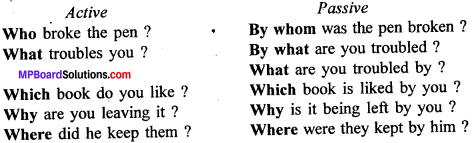
Question Words से बने Interrogative Sentences के उदाहरण समझिये।
MP Board Class 12th General English Grammar Active and Passive Voice 1

दो OBJECTS वाले वाक्यों का PASSIVE में परिवर्तन

यदि क्रिया के दो Objects हों तो किसी भी Object को Subject बनाकर Passive GARI बनया जासकता है।

जैसे –

Active –
He teaches me grammar.

Passive –
(i) I am taught grammar by him.
(ii) Grammar is taught to me by him.

Infinitive ‘Without To’ का Infinitive
‘With To’ में परिवर्तन

Passive Voice में Infinitive का छिप हुआ व्यक्त कर दिया जाता है

जैसे –
Active – Passive
He made us work – We were made by him to work. He saw them go out – They were seen by us to go out.

अपवाद –
Active – Passive
They let us go – We were let go

‘BY’ के स्थान पर अन्य Prepositions का प्रयोग

सभी Agents के साथ By का प्रयोग नहीं होता है। निम्नलिखित उदाहरण देखिये –
Active – Passive
Smoke filled the room – The room was filled with smoke.

Passive Voice में Adverbs का स्थान

Adverbs of Manner को Passive voice में मुख्य क्रिया के ठीक पहले (सहायक क्रिया के बाद) रखना चाहिए :

  • Active – They treated her badly.
  • Passive – She was badly treated.
  • Active – Govind reads English clearly.
  • Passive – English is clearly read by Govind.

Additional Solved Exercises
(1) Change the following sentences into the passive form. The italicized words will be the subjects :
1. They have found out the truth.
2 Someone has discovered a cure for malaria.
3. They have invented a new sewing machine.
4. The teacher made him the monitor of the class.
5. They manufacture good shoes in Kanpur.
6. We did not import foodgrains last year.
7. Everyone appreciated his work.
8. People speak different languages in India.
9. They broadcast the President’s message this morning.
10. You can give him a job in your factory.
11. Somebody stole my watch yesterday.
12. I sold my car for sixteen thousand rupees.
Answers:
1. The truth has been found out.
2 A cure for malaria has been discovered.
3. A new sewing machine has been invented.
4. He was made the monitor of the class.
5. Good shoes are manufactured in Kanpur.
6 Foodgrains were not imported last year.
7. His work was appreciated.
8. Different languages are spoken in India.
9. The President’s message was broadcast this morning.
10. A job can be given to him in your factory.
11. My watch was stolen yesterday.
12. My car was sold for sixteen thousand rupees.

(2) Put the following sentences in the Passive voice :

1. The Headmaster refused the boy admission.
2 My brother promised me his help.
3. We should teach that fellow a lesson.
4. Why did they offer him such a low salary?
5. Someone told me how to get there.
6. The judge found the prisoner guilty.
7. Woolen clothes keep us warm.
8. The children called him, ‘Chacha Nehru’.
9. The facts proved his ideas wrong.
10. We have painted the doors green.
11. We saw the man throwing a stone at the car.
12. Someone must help me solve the problem.
13. The Principal allowed the boy to go home.
14. The old man urged his sons to be united.
15. They named the child “Ramu’..
Answers:
1. The boy was refused admission.
(Or, Admission was refused to the boy.)
2 I was promised help by my brother.
(Or, Help was promised to me by my brother.)
3. That fellow should be taught a lesson.
(Or, A lesson should be taught to that fellow.)
4. Why was he offered such a low salary?
(Or, Why was such a low salary offered to him?)
5. I was told how to get there.
6. The prisoner was found guilty by the judge.
7. We are kept warm by woollen clothes.
8. He is called ‘Chacha Nehru’ by the children.
9. His ideas were proved wrong by the facts.
10. The doors have been painted green by us.
11. The man was seen throwing a stone at the car.
12. I must be helped solve the problem.
13. The boy was allowed to go home by the Principal.
14. The sons were urged by the old man to be united.
15. The child was named “Ramu’.

PASSIVE से ACTIVE में परिवर्तन के नियम
Passive से Active में बदलने के कोई विशेष नियम नहीं है। जो नियम Active से Passive बनाने के लिये कपर दिये गये हैं उनका उलट कर प्रयोग करने से Passive को Active voice में बदला जाता है। ऊपर दिये गये उदाहरणों में पहले Passive voice का वाक्य पढ़िये और फिर Active voice का वाक्य पढ़िये। ध्यान देते जाइये कि क्या – क्या परिवर्तन करने के बाद आप Active voice के वाक्य पा सकते हैं। नीचे थोड़े – से उदाहरण दिये जा रहेहै:

1. Simple Present

  1. Passive – A book is bought by Mohan.
    Active – Mohan buys a book.
  2. Passive – A song is sung by Madhu.
    Active – Madhu sings a song.

नियम – Passive voice से Active voice बनाने के नियम Active से Passive बनाने के नियमों के बिल्कुल उल्टें हैं।

  • दिये गये वाक्यों के subject को object बनाओ और object को subject बनाओ।
  • By को हटाओ।
  • सहायक क्रिया is, am, are, was, were आदि हटाओ।
  • दिये हुए वाक्य की क्रिया की first form लिखो।

2. Simple Past

  1. Passive – A book was bought by Hari.
    Active – Hari bought a book.
  2. Passive – A song was sung by Radha.
    Active – Radha sang a song.
  3. Passive – Why was he not taught by you?
    Active – Why did you not teach him?

नियम – Active से Passive बनाने के नियमों का उल्टा प्रयोग करो अर्थात् Subject को Object तथा Object को Subject में बदलो। Was, were को हटाकर Verb की Second का प्रयोग करो by को हटा दो

3. Simple Future

  1. Passive – He will be beaten by me.
    Active – I shall beat him.
  2. Passive – I shall not be called by them.
    Active – They will not call me.

नियम – Active से Passive बनाने के नियमों को उल्टा करो। अर्थात् Subject को Object और Object को Subject में बदलकर by को हटाओ तथा सहायक क्रिया be को हटाकर Third form की मुख्य क्रिया को First form में लिखो।

4. Present Continuous

  1. Passive – A letter is being written by Gopal.
    Active – Gopal is writing a letter.
  2. Passive – A book is being read by Shila.
    Active – Shila is reading a book.
  3. Passive – The bell is not being run by the peon.
    Passive – The peon is not ringing the bell.

नियम (i) Active से Passive बनाने के नियमों को उल्टा प्रयोग करो, अर्थात् कर्ता को कर्म और कर्म को कर्ता बनाओ। (ii) By और being दोनों को हटाओ (iii) क्रिया की Third form को first form मैं बदलकर – ing बढ़ाओ। (iv) Active के कर्ता के अनुसार islam/are सहायक क्रिया को मुख्य क्रिया से पहले लिखो।

5. Past Continuous

  1. Passive – My pen was being used by her.
    Active – She was using my pen.
  2. Passive – A book was being bought by Ram.
    Active – Ram was buying a book.

नियम Active से Passive बनाने के नियमों को उल्टा करो। अर्थात् (i) Subject को Object और Object को Subject बनाओ। (ii) By और Being को हटाओ। (iii) क्रिया की Third form को बदलकर ing form में करो। (iv) Active voice के कर्ता के अनुसार was/were सहायक क्रिया का प्रयोग करो।

6. Present Perfect

  1. Passive – The old woman has been created by the seller.
    Active – The seller has cheated the old woman.
  2. Passive – The grass has not been eaten by the cow.
    Active – The cow has not eaten the grass.
  3. Passive – Has your horse not been sold by you?
    Active – Have you not sold your horse?

नियम Present Perfect Tense को Passive बनाने के नियमों का उल्टा प्रयोग करो अर्थात् (i) Subject को Object और Object को Subject बनाओ। (ii) By तथा been को हटाओ। (iii) Subject के अनुसार have/has लगाकर क्रिया की Third form लिखो। (iv) इस Tense में Active voice में have/has सहायक क्रिया है। Passive voice में has been/have been सहायक क्रियाएँ हैं।

7. Past Perfect

  1. Passive – The room had been swept by the servant.
    Active – The servant had swept the room.
  2. Passive – The bell had been rung by the old servant.
    Active – The old servant had rung the bell.
  3. Passive – I had not been helped by them.
    Active – They had not helped me.

नियम – इस Tense में had been सहायक क्रिया Passive voice में आती है। Active में had सहायक क्रिया का प्रयोग होता है। शेष सब नियम Present Perfect Tense के समान है।

8. Future Perfect

  1. Passive – The question will have been solved by the teacher.
    Active – The teacher will have solved the question.
  2. Passive – We shall have been abused by you.
    Active – You will have abused us.
  3. Passive – A good essay will have been written by a boy.
    Active – The boy will have written a good essay.

नियम – पीछे के नियमों को उल्टा प्रयोग करो। अर्थात् Active से Passive बनाने … में जो शब्द बढ़ाए जाएँ, Passive से Active बनाने में उन्हें हटा दो।
इस Tense में Passive voice में will have beervishall have been सहायक क्रियाओं का प्रयोग होता है। Active में will have, shall have का प्रयोग होता है। Active और Passive दोनों में Main verb (मुख्य क्रिया) की Third form का प्रयोग करो।

Exercise 13

Change the voice :
1. We are collecting stamps/books. (2009, 10, 15)
2. Somebody clears the room. (2009)
3. Post the letter today.
4. Call the witness.
5. Do this work today.
6. I know the boy. (2016)
7. Mr. Gupta teaches Hindi. (2018)
8. Someone has stolen my pen.
9. My father gave me a pen.
10. Do you know me?
11. Did they wave the flag?
12. I am taking tea. (2013)
Answer:
1. Stamps/Books are being collected by us.
2. The room is cleared by someone
3. Let the letter be posted today.
4. Let the witness be called.
5. Let this work be done today.
6. The boy is known by me.
7. Hindi is taught by Mr. Gupta.
8. My pen has been stolen by someone.
9. A pen was given to me by my father.
10. Am I known to you?
11. Was the flag waved by them?
12. Tea is being taken by me.

We believe the information shared regarding MP Board Solutions for 12th English Grammar Active and Passive Voice Questions and Answers as far as our knowledge is concerned is true and reliable. In case of any queries or suggestions do leave us your feedback and our team will guide you at the soonest possibility. Bookmark our site to avail latest updates on several state board Solutions at your fingertips.
MP Board Class 12th General English Grammar Tenses

MP Board Solutions for 12th General English Grammar Tenses Questions and Answers aids you to prepare all the topics in it effectively. You need not worry about the accuracy of the Madhya Pradesh Board Solutions for 12th English as they are given adhering to the latest exam pattern and syllabus guidelines.

You Can Download MP Board Class 12th English Solutions Questions and Answers Notes, Summary, Lessons: Pronunciation, Translation, Word Meanings, Textual Exercises. Enhance your subject knowledge by preparing from the Chapterwise MP Board Solutions for 12th English and clarify your doubts on the corresponding topics.

MP Board Class 12th General English Grammar Tenses

Kick start your preparation by using our online resource MP Board Solutions for 12th General English Grammar Tenses Questions and Answers. You can even download the Madhya Pradesh Board Class 12th English Solutions Questions and Answers for free of cost through the direct links available on our page. Clear your queries and understand the concept behind them in a simple manner. Simply tap on the concept you wish to prepare in the chapter and go through it.

Tense को हिन्दी में काल कहते हैं जिसका अर्थ है–समय। अत: Tense (काल) हमें यह बताता है कि सम्बन्धित क्रिया का कार्य किस समय सम्पन्न हुआ। इस प्रकार Tense क्रिया के समय का बोध कराता है। Tense (काल) को तीन भागों में विभाजित किया जाता है –

  1. Present Tense (वर्तमान काल),
  2. Past Tense (भूतकाल),
  3. Future Tense (भविष्यत् काल)।

इनमें से प्रत्येक को पुनः चार भागों में विभाजित किया जाता है। इस प्रकार Tenses (काल) बारह होते हैं

  1. Present Indefinite Tense (सामान्य वर्तमान काल)
  2. Past Indefinite Tense (सामान्य भूतकाल)
  3. Future Indefinite Tense (सामान्य भविष्यत् काल)
  4. Present Continuous Tense (चालू वर्तमान काल)
  5. Past Continuous Tense (चालू भूतकाल)
  6. Future Continuous Tense (चालू भविष्यत् काल)
  7. Present Perfect Tense (सम्पूर्ण वर्तमान काल)
  8. Past Perfect Tense (सम्पूर्ण भूतकाल)
  9. Future Perfect Tense (सम्पूर्ण भविष्यत् काल)
  10. Present Perfect Continuous Tense (चालू एवं सम्पूर्ण वर्तमान काल)
  11. Past Perfect Continuous Tense (चालू एवं सम्पूर्ण भूतकाल)
  12. Future Perfect Continuous Tense (चालू एवं सम्पूर्ण भविष्यत् काल)

1. Present Indefinite Tense

इसका (सामान्य वर्तमान) प्रयोग किसी आदत वाले कार्य को बताने के लिए वर्तमान की किसी घटना को प्रकट करने के लिए, किसी सामान्य सत्य को प्रकट करने के लिए अथवा भविष्य में होने वाले कार्य को प्रकट करने के लिए किया जाता है।

जैसे –

  1. Dogs bark – कुत्ते भौंकते हैं।
  2. I read a book – मैं एक पुस्तक पढ़ता हूँ।
  3. She sings a song. – वह एक गीत गाती है। (सामान्य घटना)
  4. Ram goes to Mathura next Sunday – राम अगले इतवार को मथुरा जाता है।

नियम 1 – I, You तथा बहुवचन कर्ता के साथ क्रिया का प्रथम रूप बिना कुछ लगाये आता है।
जैसे –
I play, You go, They.sing, Birds fly in the sky.

नियम 2 – एकवचन कर्ता के साथ क्रिया के प्रथम रूप में s या es लगाते हैं।
जैसे –
He plays, Ram goes, She sings, The boy laughs.

नियम 3 – नकारात्मक (Negative) वाक्यों में I, You तथा बहुवचन कर्ता (Subject) के साथ मुख्य क्रिया से पहले Do not लगाते हैं तथा एकवचन कर्ता के साथ Does not का प्रयोग किया जाता है।

जैसे –

  1. I do not play – मैं नहीं खेलता हूँ।
  2. You do not go – तुम नहीं जाते हो।
  3. They do not sing – वे नहीं गाते हैं।
  4. He does not write a letter – वह पत्र नहीं लिखता है।

नियम 4 – प्रश्नवाचक वाक्यों में स्वीकारात्मक वाक्यों (Affirmative sentences) में कर्ता (Subject) के पहले I, You तथा बहुवचन कर्ता के पहले Do तथा एकवचन कर्ता के पहले Does लगाते हैं। इसी प्रकार नकारात्मक वाक्यों को प्रश्नवाचक बनाने के लिए कर्ता के पहले वचन के अनुसार Do या Does लगाते हैं तथा मुख्य क्रिया के पहले not लगाते हैं।

जैसे –

  1. Do you go for a walk daily? – क्या तुम प्रतिदिन टहलने जाते हो?
  2. Do they play hockey? – क्या वे हॉकी खेलते हैं?
  3. Does he read English? – क्या वह अंग्रेजी पढ़ता है?
  4. Do I do not speak the truth? – क्या मैं सत्य नहीं बोलता हूँ?

2. Past Indefinite TENSE

इसका (सामान्य भूतकाल) प्रयोग भूतकाल में किसी आदतन कार्य को बताने के लिए, भूतकाल में जारी रहे कार्य का वर्णन करने के लिए तथा भूतकाल में सम्पन्न किसी कार्य का वर्णन करने के लिए किया जाता है।

जैसे –

  1. I went for a walk daily – मैं प्रतिदिन टहलने जाता था।
  2. She cooked food for us – वह हमारा भोजन बनाती थी।
  3. While you played, he studied – जब तुम खेलते थे, वह पढ़ता था।
  4. The lion killed a deer – शेर ने एक हिरण को मारा।

विशेष—जिन वाक्यों से कर्ता की आदत प्रकट होती है, उनको लिखने के लिए ‘used to + क्रिया की First Form’ का भी प्रयोग किया जाता है।

जैसे –

  1. I took tea daily.
    I used to take tea daily.
  2. He went for a walk in the morning.
    He used to go for a walk in the morning.

(A) Affirmative Sentences (स्वीकारात्मक वाक्य)
नियम – Past Indefinite Tense में प्रत्येक कर्ता (Subject) के साथ क्रिया (Verb) की दूसरी Form (Past Form) का प्रयोग किया जाता है। आदत बताने वाले वाक्यों में ‘used to + verb) की पहली Form’ का भी प्रयोग किया जाता है

जैसे –

  1. I sang a song – मैंने एक गाना गाया।
  2. We wrote a letter yesterday – हमने कल एक पत्र लिखा था।
  3. She learnt her lesson – उसने अपना पाठ याद किया।
  4. They used to come here daily – वे यहाँ प्रतिदिन आया करते थे।

(B) Negative Sentences (नकारात्मक वाक्य) नियम – इन वाक्यों में प्रत्येक कर्ता (Subject) के साथ ‘Did not + Verb की First Form’ का प्रयोग किया जाता है।

जैसे –

  1. I did not go there – मैं वहाँ नहीं गया।
  2. You did not come here – तुम यहाँ नहीं आये।
  3. He did not write a letter – उसने पत्र नहीं लिखा।
  4. The peon did not ring the bell – चपरासी ने घण्टा नहीं बजाया।

(C) Interrogative Sentences (प्रश्नवाचक वाक्य)
नियम – Past Indefinite Tense के प्रश्नवाचक वाक्यों में कर्ता (Subject) के पहले Did तथा बाद में मुख्य क्रिया की First Form आती है। नकारात्मक (Negative) वाक्यों में not का प्रयोग मुख्य क्रिया के पहले किया जाता है। प्रश्नवाचक शब्दों जैसे—(what, when, where, why) आदि Did से भी पहले लिखे जाते हैं।

जैसे –

  1. Did you go there? – क्या आप वहाँ गये थे?
  2. Did I not learn the lesson? – क्या मैंने पाठ याद नहीं किया था?
  3. Could they reach home? – क्या वे घर पहुँच सके थे?
  4. What did he do yesterday? – कल उसने क्या किया था?

3. Future Indefinite
Or
Simple Future Tense

सामान्य भविष्यत् काल उन कार्यों अथवा घटनाओं को बताता है, जो भविष्य में होने को हैं। हिन्दी वाक्यों में इनका अन्त ‘गा, गी, गे’ से होता है।
(A) Affirmative Sentences (स्वीकारात्मक वाक्य)

नियम 1 – Future Indefinite Tense में Shall अथवा Will का प्रयोग सहायक क्रिया के रूप में किया जाता है। सामान्यतया । और We के साथ Shall का तथा शेष समस्त कर्ताओं के साथ Will का प्रयोग किया जाता है।

नियम 2 – Shall तथा Will का Future Indefinite Tense में विशेष प्रयोग भी होता है। संकल्प, इच्छा, आदेश, वचन, धमकी आदि प्रकट करने वाले वाक्यों में I तथा We के साथ Will का तथा शेष सभी कर्ताओं (Subjects) के साथ Shall का प्रयोग किया जाता है।

जैसे

  1. We will do this work – हम यह कार्य अवश्य करेंगे।
  2. I will punish you – मैं तुम्हें दण्ड दूंगा।
  3. You shall read with me – तुम मेरे साथ अवश्य पढ़ोगे।
  4. He shall beat you – वह तुम्हें पीटेगा।

(A) Affirmative Sentences (स्वीकारात्मक वाक्य)

  1. I shall buy a book – मैं एक पुस्तक खरीदूंगा।
  2. We shall go there – हम वहाँ जायेंगे।
  3. You will fly a kite – तुम पतंग उड़ाओगे।
  4. He will play cricket – वह क्रिकेट खेलेगा।

(B) Negative Sentences (नकारात्मक वाख्य)
नियम – Future Indefinite Tense के नकारात्मक वाक्यों में ‘not’ का प्रयोग ‘Shall’ या ‘Will’ और मुख्य क्रिया के बीच में किया जाता है।

जैसे –

  1. I shall not write a letter – मैं पत्र नहीं लिखूगा।
  2. We shall not play today – हम आज नहीं खेलेंगे।
  3. He will not go to Bhopal – वह भोपाल नहीं जायेगा।
  4. They will not sleep today – वे आज नहीं सोयेंगे।

(C) Interrogative Sentences (प्रश्नवाचक वाक्य)
नियम – Future Indefinite Tense के प्रश्नवाचक वाक्यों में सर्वदा I और We के पहले ‘Shall’ तथा समस्त कर्त्ताओं (Subjects) के पहले ‘Will’ आता है। यदि वाक्य में किसी प्रश्नवाचक शब्द (what, when, whose, why, who) आदि का प्रयोग हुआ है तो उसे सर्वप्रथम लिखा जाता है। Not का प्रयोग कर्ता के बाद किया जाता है।

जैसे –

  1. Shall we go there? – क्या हम वहाँ जायेंगे?
  2. Shall I read this book? – क्या मैं यह पुस्तक पढूँगा?.
  3. Will you not go to Delhi? – क्या तुम दिल्ली नहीं जाओगे?
  4. Why will he sell his house? – वह अपना मकान क्यों बेचेगा?

4. Present Continuous Tense

अपूर्ण अथवा चालू वर्तमान का प्रयोग उस समय किया जाता है जबकि कार्य वर्तमान में चल रहा हो और निकट भविष्य में जारी रहने वाला हो। इस प्रकार के वाक्यों का अन्त हिन्दी में ‘रहा है, रही है, रहा हूँ, रहे हैं’ आदि में होता है। अंग्रेजी में सर्वप्रथम कर्त्ता (Subject)
आता है। इसके उपरान्त I के साथ am, You तथा बहुवचन कर्ता के साथ are तथा एकवचन कर्ता के साथ is आता है। अन्त में मुख्य क्रिया की – ing form आती है।
(A) Affirmative Sentences (स्वीकारात्मक वाक्य)

Examples:

  1. I am playing – मैं खेल रहा हूँ।
  2. You are eating a mango – तुम एक आम खा रहे हो।
  3. They are playing cricket – वे क्रिकेट खेल रहे हैं।
  4. She is singing a song – वह गीत गा रही है।

(B) Negative Sentences (नकारात्मक वाक्य)
Negative वाक्यों में सहायक क्रिया (is, are, am) तथा मुख्य क्रिया के बीच में not का प्रयोग करते हैं।

  1. I am not writing a letter – मैं एक पत्र नहीं लिख रहा हूँ।
  2. You are not taking tea – तुम चाय नहीं पी रहे हो।
  3. They are not playing – वे नहीं खेल रहे हैं।
  4. She is not singing – वह नहीं गा रही है।

(C) Interrogative Sentences (प्रश्नवाचक वाक्य)
Interrogative (प्रश्नवाचक) वाक्यों में is, are, am का प्रयोग कर्ता (Subject) के पहले किया जाता है। यदि वाक्य में किसी प्रश्नवाचक शब्द (what, why, when, where, who, whom) का प्रयोग होता है तो उसे is, are, am से भी पहले लिखा जाता है।

जैसे –

  1. Am I sleeping? – क्या मैं सो रहा हूँ?
  2. Are you going to Delhi? – क्या आप दिल्ली जा रहे हैं?
  3. Is Ram not buying a car? – क्या राम कार नहीं खरीद रहा है?
  4. Why is he not going there? – वह वहाँ क्यों नहीं जा रहा है?

5. Past Continuous Tense

इन वाक्यों में कार्य का लगातार होना पाया जाता है, लेकिन काम के जारी रहने का समय नहीं दिया होता है। इस काल के वाक्यों के अन्त में ‘रहा था, रही थी, रहे थे’ आदि होता है।
(A) Affirmative Sentences (स्वीकारात्मक वाक्य) नियम इस काल के सामान्य वाक्यों में क्रिया की – ing form का प्रयोग होता है और उसके पहले I, he, she, it तथा एकवचन कर्त्ता के साथ ‘was’ तथा अन्य सभी कर्त्ताओं (Subjects) के साथ ‘were’ का प्रयोग किया जाता है।

जैसे –

  1. I was reading a book – मैं एक पुस्तक पढ़ रहा था।
  2. He was taking tea – वह चाय पी रहा था।
  3. They were playing cricket – वे क्रिकेट खेल रहे थे।
  4. The boys were making a noise – लड़के शोर मचा रहे थे।

(B) Negative Sentences (नकारात्मक वाक्य)
नियम – Past Continuous Tense के नकारात्मक वाक्यों में ‘not’ का प्रयोग ‘was’ या ‘were’ और मुख्य क्रिया के बीच में किया जाता है।

जैसे-

  1. I was not playing football – मैं फुटबॉल नहीं खेल रहा था।
  2. You were not speaking the truth – तुम सत्य नहीं बोल रहे थे।
  3. We were not quarelling – हम झगड़ा नहीं कर रहे थे।
  4. The teacher was not teaching grammar – अध्यापक व्याकरण नहीं पढ़ा रहे थे।

(C) Interrogative Sentences (प्रश्नवाचक वाक्य)
नियम – Past Continuous Tense के प्रश्नवाचक वाक्यों में ‘was’ या ‘were’ कर्ता के पहले लिखे जाते हैं। नकारात्मक वाक्यों में ‘not’ का प्रयोग मुख्य क्रिया के पहले किया जाता है। प्रश्नवाचक शब्द वाक्य में सबसे पहले लिखे जाते हैं।

जैसे –

  1. Was I telling a lie? – क्या मैं झूठ बोल रहा था?
  2. Were you not reading a book? – क्या तुम पुस्तक नहीं पढ़ रहे थे?
  3. Was he writing a letter to his father? – क्या वह अपने पिताजी को पत्र लिख रहा था?
  4. Were the girls not singing songs? – क्या लड़कियाँ गीत नहीं गा रही थीं?

6. Future Continuous Tense

इनमें (अपूर्ण भविष्यत् काल) काम का जारी रहना प्रकट होता है। वाक्यों में समय की अवधि नहीं दी होती, लेकिन काम चालू रहने का समय दिया जा सकता है। इस काल के वाक्यों में हिन्दी में अन्त में ‘रहा होगा, रही होगी, रहा हूँगा, रहे होंगे’ आदि शब्द आते है।

(A) Affirmative Sentences (स्वीकारात्मक वाक्य) नियम – Future Continuous के असाधारण वाक्यों में I तथा We के साथ ‘shall be’ तथा शेष कर्ताओं के साथ ‘will be’ लगाकर क्रिया की – ing Form का प्रयोग किया जाता है।

जैसे –

  1. We shall be doing our work – हम अपना काम कर रहे होंगे।
  2. I shall be playing in the evening – मैं शाम को खेल रहा हूँगा।
  3. You will be helping him – तुम उसकी सहायता कर रहे होंगे।
  4. The carpenter will be making a table – बढ़ई मेज बना रहा होगा।

(B) Negative Sentences (नकारात्मक वाक्य) नियम—Future Continuous Tense के नकारात्मक वाक्यों में ‘not’ का प्रयोग ‘shall’ अथवा ‘will’ और ‘be’ के बीच में किया जाता है।

जैसे—

  1. I shall not be writing a letter – मैं पत्र नहीं लिख रहा हूँगा।
  2. You will not be going there – तुम वहाँ नहीं जा रहे होंगे।
  3. Hakim will not be playing football – हाकिम फुटबॉल नहीं खेल रहा होगा।
  4. She will not be cooking the food at this time – वह इस समय भोजन नहीं बना रही होगी।

(C) Interrogative Sentences (प्रश्नवाचक वाक्य) नियम – Future Continuous Tense के प्रश्नवाचक वाक्य में ‘shall’ या ‘will’ का प्रयोग कर्ता से पहले किया जाता है। प्रश्नसूचक शब्द (who, what, when, where, why आदि) वाक्य में सबसे पहले लिखे जाते हैं। नकारात्मक वाक्यों में ‘not’ का प्रयोग कर्ता के बाद तथा ‘be’ से पहले किया जाता है।

जैसे –

  1. Shall we be playing a match tomorrow? – क्या हम कल मैच खेल रहे होंगे?
  2. Will you be reading a book at this time? – क्या तुम इस समय पुस्तक पढ़ रहे होंगे?
  3. Will he be singing a song? – क्या वह गाना गा रहा होगा?
  4. Who will be coming here tomorrow? – कल यहाँ कौन आ रहा होगा?

7. Present Perfect Tense

इसका (सम्पूर्ण वर्तमान काल) प्रयोग हाल ही में समाप्त हुए कार्यों के लिए किया जाता है। इन वाक्यों से यह बात स्पष्ट होती है कि कार्य समाप्त हुए अधिक समय नहीं हुआ है तथा क्रिया का प्रभाव अभी भी विद्यमान है।

नियम – Present Perfect Tense में I, You तथा बहुवचन कर्ता के साथ ‘have’ तथा एकवचन कर्ता के साथ has’ का प्रयोग होता है। इसके उपरान्त मुख्य क्रिया की ‘Third Form’ प्रयोग की जाती है।
(A) Affirmative Sentences (स्वीकारात्मक वाक्य)

  1. I have taken my bath – मैंने स्नान कर लिया है।
  2. You have deceived me – तुमने मुझे धोखा दिया है।
  3. They have crossed the river – उन्होंने नदी पार कर ली है।
  4. The dog has bitten a man. कुत्ते ने एक आदमी को काट लिया है।

(B) Negative Sentences (नकारात्मक वाक्य) नियम Present Perfect Tense के Negative (नकारात्मक) वाक्यों में ‘not’ का प्रयोग have या has और मुख्य क्रिया के बीच में किया जाता है।

  1. I have not done my work – मैंने अपना कार्य नहीं किया है।
  2. You have not read this book – तुमने यह पुस्तक नहीं पढ़ी है।
  3. They have not come yet – वह अभी तक नहीं आये हैं।
  4. Sunita has not beaten her – सुनीता ने अपने भाई को नहीं पीटा है।

(C) Interrogative Sentences (प्रश्नवाचक वाक्य)

नियम – Present Perfect Tense में प्रश्नवाचक वाक्यों में Have या Has का प्रयोग कर्ता (Subject) के पहले किया जाता है। यदि कोई प्रश्नवाचक शब्द (what, when, why, where आदि) प्रयोग करना होता है तो उसे सर्वप्रथम Have या Has से पहले लिखते हैं। नकारात्मक वाक्यों में not का प्रयोग क्रिया से पहले किया जाता है,

जैसे—

  1. Have you finished your work? – क्या तुमने अपना कार्य कर लिया है?
  2. Has he gone to Indore? – क्या वह इन्दौर जा चुका है?
  3. Where has your father gone? – तुम्हारे पिताजी कहाँ गये हैं?
  4. Why has the peon not rung the bell? – चपरासी ने घण्टा क्यों नहीं बजाया है।

8. PAST Perfect Tense

इन (सम्पूर्ण भूत काल) वाक्यों में प्राय: दो कार्यों का वर्णन होता है। दोनों कार्य भूतकाल में ही समाप्त होते हैं, किन्तु एक कार्य, दूसरे कार्य से पहले समाप्त हो जाता है। कभी – कभी साधारण वाक्य भी इस काल में आते हैं। ऐसी स्थिति में इन वाक्यों में already, before, after, till, since आदि शब्दों का प्रयोग स्वतन्त्र रूप से होता है। इस काल के वाक्यों का हिन्दी में प्रायः ‘चुका था, चुकी थी, चुके थे, लिया था, गया था, दिया था’ आदि से अन्त होता है।

(A) Affirmative Sentences (स्वीकारात्मक वाक्य)

नियम 1— Past Perfect Tense में जब दो कार्यों का वर्णन होता है तो पहले समाप्त होने वाले कार्य के अनुवाद में प्रत्येक कर्ता (Subject) के साथ had तथा Verb की Third Form लगाते हैं। बाद में समाप्त होने वाले कार्य के प्रत्येक कर्ता (Subject) के साथ Verb की Second Form का प्रयोग किया जाता है।

नियम 2—यदि वाक्य में पहले या पूर्व (Before) शब्द का प्रयोग हुआ है तो पहले समाप्त होने वाला कार्य Principal Clause होगा तथा बाद में समाप्त होने वाला कार्य Subordinate Clause होगा।

नियम 3—यदि वाक्य में बाद या पश्चात् (After) शब्द का प्रयोग हुआ है तो बाद में समाप्त होने वाला कार्य Principal Clause तथा पहले समाप्त होने वाला कार्य Subordinate Clause होगा।

नियम 4 – सामान्यतया Principal Clause पहले तथा Subordinate Clause बाद में लिखा जाता है। लेकिन यदि Subordinate Clause ‘When’ से प्रारम्भ हुआ है तो उसे पहले भी लिखा जा सकता है।

Examples:

  1. The train had started before we reached the station.
    हमारे स्टेशन पहुंचने से पूर्व ही गाड़ी छूट चुकी थी।
  2. He had gone home before I came.
    मेरे आने से पहले वह घर जा चुका था।
  3. The bell rang after we had reached the school.
    हमारे स्कूल पहुंचने के बाद घण्टी बजी थी।
  4. He went to school after he had taken his bath.
    स्नान करने के उपरान्त वह स्कूल गया।

(B) Negative Sentences (नकारात्मक वाक्य)

‘नियम – Past Perfect Tense में सदैव Principal Clause को ही Negative में लिखा जाता है। यदि Principal Clause में ‘had तथा Verb की Third Form’ का प्रयोग हुआ है तो ‘not’ का प्रयोग इन दोनों के बीच में किया जाता है। यदि Principal Clause में Verb की Second Form का प्रयोग हुआ है तो उसे First Form में बदलकर इसके पहले ‘did not’ लगाते हैं।

जैसे—

  1. The mother had not cooked the food before I went to school.
    मेरे स्कूल जाने से पूर्व माँ भोजन नहीं बना चुकी थी।
  2. The thief had not run away before the police came.
    पुलिस के आने से पूर्व चोर नहीं भाग चुका था।
  3. The peon did not ring the bell after we had reached the school.
    हमारे स्कूल पहुँचने के बाद चपरासी ने घण्टा नहीं बजाया।
  4. He had not received any letter from his father till yesterday.
    उसे कल तक अपने पिता से कोई पत्र नहीं मिला था।

(C) Interrogative Sentences (प्रश्नवाचक वाक्य)

नियम – यदि Principal Clause में ‘Had या Verb की Third Form’ का प्रयोग हुआ है तो प्रश्नवाचक वाक्यों में Had को कर्त्ता से पहले लिखते हैं। यदि Principal Clause में Verb की Second Form का प्रयोग हुआ है तो इसे First Form में बदल देते हैं और कर्ता के पहले Did लगाते हैं। निषेधात्मक वाक्यों में ‘not या never’ का प्रयोग कर्ता के बीच में किया जाता है।

  1. Had you reached home before it rained?
    क्या वर्षा होने से पहले आप घर पहुँच गये थे?
  2. Did he go to school after his father had come?
    क्या वह अपने पिताजी के आने के पश्चात् स्कूल गया था?
  3. Where did Mohan go after the teacher had left the class?
    अध्यापक द्वारा कक्षा छोड़े जाने के बाद मोहन कहाँ गया था?
  4. Had his father already heard the news?
    क्या उसे पिता ने समाचार पहले ही सुन लिया था?

9. Future Perfect Tense

इन (पूर्ण भविष्यत् काल) में ऐसे कार्यों का वर्णन होता है, जो भविष्य में किसी दिये हुए समय पर समाप्त हों। इस काल में भविष्य में समाप्त होने वाले दो कार्यों का भी साथ – साथ वर्णन होता है। ऐसी स्थिति में पहले समाप्त होने वाले कार्य को Future Perfect Tense में तथा बाद में समाप्त होने वाले कार्य को Present Indefinite Tense में लिखा जाता है। इस काल में वाक्यों का हिन्दी में ‘चुकेगा, चुकेगी, चुकूँगा’ आदि में अन्त होता है।

(A) Affirmative Sentences (स्वीकारात्मक वाक्य)
नियम—इस काल के सामान्य वाक्यों में ‘shall have’ अथवा ‘will have’ लगाकर मुख्य क्रिया (Verb) की Third Form का प्रयोग किया जाता है।

जैसे –

  1. I shall have finished my work by the evening.
    मैं सायंकाल तक अपना कार्य समाप्त कर चुकूँगा।
  2. We shall have reached the school before it rains.
    वर्षा होने से पहले ही हम स्कूल पहुंच चुकेंगे।
  3. You will have finished your work before I come.
    मेरे आने से पहले ही तुम अपना कार्य समाप्त कर चुकोगे।
  4. The boys will have returned before the sunsets.
    सूर्य छिपने से पूर्व ही लड़के लौट चुकेंगे।

(B) Negative Sentences
(नकारात्मक वाक्य) नियम – Future Perfect Tense के नकारात्मक वाक्यों में not का प्रयोग shall या will के बाद तथा have के पहले किया जाता है।

जैसे –

  1. We shall not have taken our food before they come.
    उनके आने से पहले हम भोजन नहीं कर चुकेंगे।
  2. The farmers will not have plowed their fields before it rains.
    वर्षा आरम्भ होने से पूर्व किसान अपने खेत नहीं जोत चुकेंगे
  3. He will not have finished his work before Monday.
    वह सोमवार से पहले अपना कार्य समाप्त नहीं कर चुकेगा।
  4. The train will have not gone before you reach the station.
    तुम्हारे स्टेशन पहुंचने से पहले गाड़ी नहीं जा चुकेगी।

(C) Interrogative Sentences (प्रश्नवाचक वाक्य)

नियम – इस काल में प्रश्नवाचक वाक्यों में shall या will को कर्त्ता (subject) से पहले लिखा जाता है। प्रश्नसूचक शब्द (what, when, why आदि) shall या will से भी पहले लिखे जाते हैं। नकारात्मक वाक्यों में not का प्रयोग कर्ता के बाद have से पहले किया जाता है।

  1. Shall we have left the house before you come back?
    क्या आपके वापस आने से पूर्व हम मकान छोड़ चुकेंगे?
  2. Will the game have started before we reach the field?
    क्या हमारे मैदान में पहुँचने से पहले खेल आरम्भ हो चुकेगा?
  3. Where will the students have gone before the teacher comes?
    अध्यापक के आने से पूर्व विद्यार्थी कहाँ जा चुकेंगे?
  4. Why will you not have read the letter before you sleep?
    सोने से पूर्व तुम पत्र क्यों नहीं पढ़ चुकोगे?

10. Present Perfect Continuous Tense

नियम—जब कोई काम भूतकाल में प्रारम्भ होकर वर्तमान में भी चालू रहता है, तो Present Perfect Continuous Tense का प्रयोग करते हैं। इसमें I, you तथा बहुवचन कर्ता (subject) के साथ ‘have been’ तथा एकवचन कर्ता (subject) के साथ ‘has been’ लगाकर क्रिया (verb) की – ing form का प्रयोग किया जाता है। इसमें कार्य के जारी रहने का समय दिया होता है। इसके लिए since या for का प्रयोग किया जाता है। निश्चित समय (point of time) के लिए since का तथा अनिश्चित समय (period of time) के लिए for का प्रयोग करते हैं।

जैसे –
Point of time – since four o’clock, since January, since 1980, since Monday, since morning, since birth.
Period of time – for five hours, for two days, for two weeks, for six years, for many days.

(A) Affirmative Sentences (स्वीकारात्मक वाक्य)

  1. I have been reading this book since morning.
    मैं इस पुस्तक को प्रात:काल से पढ़ रहा हूँ।
  2. You have been living in this city for three years.
    तुम इस शहर में तीन वर्ष से रह रहे हो।
  3. She has been singing for half an hour.
    वह आधे घण्टे से गा रही है।
  4. They have been playing for two hours.
    वे दो घण्टे से खेल रहे हैं।

(B) Negative Sentences (नकारात्मक वाक्य) नियम Present Perfect Continuous Tense के Negative (नकारात्मक) वाक्यों में not का प्रयोग ‘have यां has और been’ के बीच में होता है।

जैसे-

  1. We have not been playing hockey for two hours.
    हम दो घण्टे से हॉकी नहीं खेल रहे हैं।
  2. She has not been cooking food since eight o’clock.
    वह आठ बजे से खाना नहीं बना रही है।
  3. He has not been going to school for four days.
    वह चार दिन से स्कूल नहीं जा रहा है।
  4. You have not been living in this village for a month.
    तुम इस गाँव में एक महीने से नहीं रह रहे हो।

(C) Interrogative Sentences (प्रश्नवाचक वाक्य)
नियम – Present Perfect Continuous Tense के प्रश्नवाचक वाक्यों में ‘Have या Has’ का प्रयोग कर्ता (subject) से पहले किया जाता है। प्रश्नवाचक शब्दों

जैसे –
‘what, when, where, why, how’ आदि का प्रयोग ‘Have या Has’ से पहले किया जाता है।

जैसे-

  1. Have you been living in this city since July 1985?
    क्या आप इस शहर में जुलाई 1985 से रह रहे हैं?
  2. Has the child been sleeping for two hours?
    क्या बच्चा दो घण्टे से सो रहा है?
  3. What have they been doing since morning?
    वे प्रात:काल से क्या कर रहे हैं?
  4. Why have the boys not been playing for three hours?
    लड़के तीन घण्टे से क्यों नहीं खेल रहे हैं?

11. Past Perfect Continuous Tense

इस काल का प्रयोग ऐसे कार्यों के लिए किया जाता है जो भूतकाल में प्रारम्भ होकर भूतकाल में ही समाप्त हो गये हों। हिन्दी में ऐसे वाक्यों का अन्त ‘रहा था, रही थी, रहे थे’, आदि में होता है तथा काम के जारी रहने का समय दिया गया होता है।

(A) Affirmative Sentences (स्वीकारात्मक वाक्य)
नियम – Past Perfect Continuous Tense में प्रत्येक कर्त्ता (Subject) के साथ ‘had been + verb की First Form + ing form’ का प्रयोग किया जाता है। ‘for और since का प्रयोग Present Perfect Continuous Tense की ही भाँति किया जाता है।

जैसे –

  1. We had been playing in the field for two hours.
    हम मैदान में दो घण्टे से खेल रहे थे।
  2. Sita had been singing since 5 o’clock.
    सीता पाँच बजे से गा रही थी।
  3. You had been living in this city for five years.
    तुम पाँच वर्ष से इस शहर में रह रहे थे।
  4. The farmer had been ploughing his field since morning.
    किसान प्रात:काल से अपना खेत जोत रहा था।

(B) Negative Sentences (नकारात्मक वाक्य)

नियम – Past Perfect Continuous Tense के वाक्यों में not का प्रयोग had और been के बीच में किया जाता है।

जैसे –

  1. You had not been reading in this school for four years.
    तुम इस विद्यालय में चार साल से नहीं पढ़ रहे थे।
  2. The gardener had not been watering the plants since morning.
    माली प्रातः काल से पौधों को पानी नहीं दे रहा था।
  3. You had not been doing this work for two hours.
    तुम इस कार्य को दो घण्टे से नहीं कर रहे थे।
  4. Ramesh had not been teaching in this school since 1988.
    रमेश इस विद्यालय में 1988 से नहीं पढ़ा रहा था।

(C) Interrogative Sentences (प्रश्नवाचक वाक्य)

नियम – प्रश्नवाचक वाक्यों में Had का प्रयोग कर्ता (subject) से पहले किया जाता है। यदि कोई प्रश्नसूचक शब्द प्रयोग करना होता है तो उसे Had से पहले लिखा जाता है। नकारात्मक वाक्यों में ‘not’ का प्रयोग been के पहले किया जाता है।

जैसे –

  1. Had you been learning English for two hours?
    क्या तुम दो घण्टे से अंग्रेजी पढ़ रहे थे?
  2. Had the farmer not been ploughing his field since July?
    क्या किसान जुलाई से अपना खेत नहीं जोत रहा था?
  3. What had you been reading since Friday?
    आप शुक्रवार से क्या पढ़ रहे थे?
  4. What had the boy not been doing since morning?
    लड़का प्रात:काल से क्या नहीं कर रहा था?

12. Future Perfect Continuous Tense
इसमें कार्य के जारी रहने का समय दिया होता है। इस काल के वाक्यों का हिन्दी में अन्त ‘रहा होगा, रही होगी, रहे होंगे’ आदि में होता है। for तथा since का प्रयोग Present Perfect Continuous अथवा Past Perfect Continuous Tense की तरह होता है।

(A) Affirmative Sentences (स्वीकारात्मक वाक्य)
नियम—इस काल के वाक्यों में [ तथा We के साथ ‘shall have been’ तथा अन्य कर्ताओं (Subjects) के साथ ‘will have been’ लगाकर मुख्य क्रिया की – ing form का प्रयोग किया जाता है।

जैसे –

  1. We shall have been bathing in the river for half an hour.
    हम नदी में आधा घण्टे तक स्नान कर रहे होंगे।
  2. You will have been learning your lesson since morning.
    तुम प्रातःकाल से अपना पाठ याद कर रहे होंगे।
  3. The boys will have been playing football since 5 o’clock.
    लड़के पाँच बजे से फुटबॉल खेल रहे होंगे।
  4. He will have been waiting for you for two hours.
    वह दो घण्टे से आपकी प्रतीक्षा कर रहा होगा।

(B) Negative Sentences (नकारात्मक वाक्य) नियम – इस काल के नकारात्मक वाक्यों में not का प्रयोग ‘shall या will’ के बाद तथा ‘have been’ के पहले किया जाता है।

जैसे –

  1. The boys will not have been playing for three hours.
    लड़के तीन घण्टे से नहीं खेल रहे होंगे।
  2. I shall not have been helping him for two months.
    मैं दो महीने से उसकी सहायता नहीं कर रहा हूँगा।
  3. You will not have been sleeping there since evening.
    तुम वहाँ सायंकाल से नहीं सो रहे होंगे।
  4. Sita will not .have been singing a song for ten minutes.
    सीता दस मिनट से गाना नहीं गाती रही होगी।

(C) Interrogative Sentences (प्रश्नवाचक वाक्य) नियम इस काल के प्रश्नवाचक वाक्यों में Shall या Will को कर्ता से पहले लिखा जाता है। प्रश्नसूचक शब्द इनसे भी पहले लिखे जाते हैं। नकारात्मक वाक्यों में not का प्रयोग have के पहले किया जाता है।

  1. Shall we have been doing our work for eight hours?
    क्या हम आठ घण्टे तक अपना कार्य कर रहे होंगे?
  2. Who will have been waiting for you since morning?
    प्रात:काल से आपकी प्रतीक्षा कौन कर रहा होगा?
  3. Where will they have been staying since Monday?
    वे सोमवार से कहाँ ठहर रहे होंगे?
  4. Why will he not have been living in the town for two years?
    वह इस नगर में दो वर्ष से क्यों नहीं रह रहा होगा?

Some Exercise

(1) Supply the correct tense of the verbs in brackets :

1. We (live) here since 1982. [2009, 13]
Answer:
have been living.

2. Our neighbours (live) here for five years. [2014]
Answer:
have been living

3. Ever since I (leave) my home town in 1980 I (live) in Indore.
Answer:
left, have been living.

4. Although the work (is) difficult, I (finish) it within the given time and (go) home.
Answer:
was, finished, went.

5. I (work) for two hours, and I am now tired.
Answer:
have been working.

6. He usually (read) newspapers in the morning.
Answer:
reads

7. If I (go) to see him in the morning, I certainly (meet) him.
Answer:
had gone, would have met.

8. He (be) a Collector if he (pass) the I. A. S.
Answer:
would have been, had passed.

9. She usually (write) in black ink.
Answer:
writes.

10. I (do) the last question when the bell (ring).
Answer:
was doing, rang.

11. If he (help) me last year, I (get) a good job.
Answer:
had helped, would have got.

12. I (know) already that he (say) no to my proposal.
Answer:
knew, would say.

13. I (live) here for the last two years.
Answer:
have been living.

14. They (buy) a house in Delhi two years ago.
Answer:
bought.

15. He usually (read) the newspaper at breakfast.
Answer:
reads.

16. If I (be) a ghost, I (frighten) all the people I dislike.
Answer:
were, would frighten.

17. I (see) him (complete) his work.
Answer:
saw, completing.

18. Since I (be) six years old, I (live) with my uncle.
Answer:
was, have been living.

19. He (not write) to us since last Christmas.
Answer:
had not written.

20. The police (catch) the thief last night.
Answer:
caught.

21. She (read) the newspapers when her brother (come home).
Answer:
was reading, came.

22. When they (visit) the hospital, my mother (get discharged) already.
Answer:
visited, had got discharged.

23. He thanked me for that I (do).
Answer:
had done.

24. He just (decide) that he (undertake) the job.
Answer:
has (just) decided, will undertake.

25. Yesterday I (buy) a new watch as my old one (steal).
Answer:
bought, had been stolen

26. She (finish) her home work when your sister (see) her tomorrow.
Answer:
will have finished, sees.

27. My servant (leave) me two weeks ago.
Answer:
left.

28. You (grow) a lot since I last (see) you.
Answer:
have grown, saw.

29. If you (buy) this house last year it (cost) you much less than now.
Answer:
had bought, would have cost.

30. My health (improve) since I (go) to Nainital.
Answer:
has improved, went.

31. He (run) like a thief when a policeman (challenge) him.
Answer:
was running, challenged.

32. The sun (shine) when we went out.
Answer:
was shining.

33. Bad students never (work) hard.
Answer:
work.

34. If it (rain), we will have to postpone the picnic.
Answer:
rains.

35. We (live) in Delhi since 1975.
Answer:
have been living.

36. We (attend) a function tomorrow evening. We…..(come) back then.
Answer:
shall attend, shall come.

37. You (think) very differently from this when you (be) older.
Answer:
will think, are.

38. We (find) out what really (happen).
Answer:
are finding, happened.

39. The meeting (start) after the President (arrive).
Answer:
started, had arrived.

40. He (look) at her repeatedly when she (brush) her hair.
Answer:
looked, was brushing.

41. They (return) to Delhi when the plane (develop) engine trouble.
Answer:
were returned, developed.

42. While I (write) letters she (listen) to a play on the radio.
Answer:
was writing, was listening.

43. You (get) wet if you (go) out in the rain.
Answer:
will get, go.

44. He (stand) motionless long after she (disappear).
Answer:
stood, had disappeared.

45. After they (cheat) a little, he (offer) them tea.
Answer:
had chattered, offered.

2. Do as directed :

1. He just (come) in and (talk) to you in a few minutes.
(Rewrite the sentence using the verbs in the brackets in the correct tenses).
Answer:
He has just come in and will talk to you in a few minutes.

2. Mohan made a kite.
(Change into Future Continuous Tense)
Answer:
Mohan will be making a kite.

3. He played cricket there.
(Change into Present Progressive Tense) [2012]
Answer:
He is playing cricket there.

4. My teacher is telling an interesting story.
(Change into Simple Past)
Answer:
My teacher told an interesting story.

5. Were the students not making noise?
(Change the sentence into Present Indefinite Tense)
Answer:
Do the students not make noise?

6. He did his work.
(Rewrite in Present Indefinite Tense)
Answer:
He does his work.

7. He did his work in time.
(Change into Present Perfect Tense and rewrite the sentence)
Answer:
He has done his work in time.

8. It is raining.
(Rewrite in Present Perfect Continuous Tense)
Answer:
It has been raining.

9. Alka had her breakfast at 8 a.m.
(Change into Past Perfect Tense)
Answer:
Alka had her breakfast at 8 a.m.

10. They were playing football.
(Change into Simple Present Tense)
Answer:
They play football.

11. Arun is going to Bhopal.
(Change into Future Continuous Tense) :
Answer:
Arun will be going to Bhopal.

12. Students were planting trees.
(Change into Past Perfect Continuous Tense)
Answer:
Students had been planting trees.

13. The child cried for milk. [2016]
(Change into Past Continuous Tense)
Answer:
The child was crying for milk.

14. He does his duty well.
(Change into negative) [2011]
Answer:
He does not do his duty well.

15. Her father teaches her Hindi.
(Change into Past Simple Tense) [2011]
Answer:
Her father taught her Hindi.

16. The child cried for milk.
(Change into Present Continuous) [2011]
Answer:
The child is crying for milk.

17. Our teacher never comes late.
(Change into negative). [2013]
Answer:
Our teacher does not come late.

18. We saw a very good movie yesterday.
(Change into negative) [2014]
Answer:
We did not see a very good movie yesterday.

19. Rashmi cried for water.
(Change into present continuous) [2015]
Answer:
Rashmi is crying for water.

20. We did it.
(Change into negative) [2015]
Answer:
We don’t do it.

21. The servant gave you all the milk.
(Make a question with “How much’) [2015]
Answer:
How much milk did the servant give you?

22. His brother sold all the gold.
(Make question with ‘How much’) [2016]
Answer:
How much gold did his brother sell?

3. Do as directed

Fill in the blank choosing the a ppropriate word/phrase from those given below :

1. If you ………………… hard, you will pass.
(a) work
(b) will work :
(c) had worked
(d) shall work.
Answer:
(a) work

2. If he had worked hard, he ………………… in the examination.
(a) would pass
(b) would have passed
(c) passed
(d) passes.
Answer:
(b) would have passed

3. If he had come earlier, I ………………… him a book.
(a) would have given
(b) would give
(c) gave
(d) shall give.
Answer:
(a) would have given

4. The tallest of this boy ………………… next door to me. [2013]
(a) have lived
(b) have living
(c) live
(d) lives.
Answer:
(a) had died

5. The boy ………………… the bird. [2016]
(a) catch
(b) catches
(c) catch.
Answer:
(b) catches

We believe the information shared regarding MP Board Solutions for 12th English Grammar Tenses Questions and Answers as far as our knowledge is concerned is true and reliable. In case of any queries or suggestions do leave us your feedback and our team will guide you at the soonest possibility. Bookmark our site to avail latest updates on several state board Solutions at your fingertips.
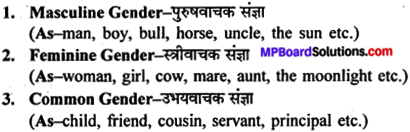
MP Board Class 12th General English Grammar Determiners

MP Board Solutions for 12th General English Grammar Determiners Questions and Answers aids you to prepare all the topics in it effectively. You need not worry about the accuracy of the Madhya Pradesh Board Solutions for 12th English as they are given adhering to the latest exam pattern and syllabus guidelines.

You Can Download MP Board Class 12th English Solutions Questions and Answers Notes, Summary, Lessons: Pronunciation, Translation, Word Meanings, Textual Exercises. Enhance your subject knowledge by preparing from the Chapterwise MP Board Solutions for 12th English and clarify your doubts on the corresponding topics.

MP Board Class 12th General English Grammar Determiners

Kick start your preparation by using our online resource MP Board Solutions for 12th General English Grammar Determiners Questions and Answers. You can even download the Madhya Pradesh Board Class 12th English Solutions Questions and Answers for free of cost through the direct links available on our page. Clear your queries and understand the concept behind them in a simple manner. Simply tap on the concept you wish to prepare in the chapter and go through it.

A determiner is a word that comes before a noun and limits its meaning.

Determiner वह शब्द है, जो किसी Noun के पूर्व प्रयोग किया जाता है और जो अपने अर्थ को सीमित रखता है।

सर्वाधिक प्रयोग में आने वाले Determiners हैं –
a, ‘an, the, some, any, much, several, few, little, each, every, all, both, either, neither, no.

Article Determiners

Indefinite Articles

A और An का अर्थ ‘एक’ होता है, जैसेA table = एक मेज, An inkpot = एक दवात।
A का प्रयोग उन शब्दों से पहले किया जाता है जिनका उच्चारण किसी व्यंजक [क, ख आदि] की ध्वनि से होता है, जैसे
a boy, a woman, a chair, a unit, a university, a European.

Note – अन्तिम तीन शब्दों का उच्चारण व्यंजन ‘य’ से होता है।

An का प्रयोग उन शब्दों से पहले किया जाता है जिनका उच्चारण किसी स्वर [अ, , आ, इ, ई उ, ऊ, ए, ऐ, ओ, औ] की ध्वनि से होता है, जैसे –
an inkpot, an umbrella, an owl, an apple, an elephant, an hour, an honest boy, an M.P.

Note – अन्तिम तीन शब्दों में व्यंजन h और m होते हुए भी उनका उच्चारण स्वरध्वनि से किया जाता है [आवर, औनेस्ट, एम.पी.]

(A) उपर्युक्त दो नियमों को पूरा करते हुए A और An का प्रयोग निम्नलिखित दशाओं में किया जाता है :
(a) उस singular noun के पूर्व जो countable हो [जो गिना जा सके], जिसका उल्लेख प्रथम बार किया गया हो और जिसे किसी विशिष्ट [particular] व्यक्ति या वस्तु के लिए प्रयुक्त न किया गया हो।

  • A cow is an animal – A man is a social animal.
  • A house has a roof – He lost an eye.
  • A mouse can cut a net – She is an ugly woman.

(b) कुछ संख्यावाचक शब्दों के साथ :
a pair, a couple, a dozen, half a dozen, a score, a gross, a hundred, a thousand, a lot of, a great many of, many a, a great deal of.

(c) मूल्य, गति, अनुपात आदि बताने में ‘प्रति’ के अर्थ में : five rupees a kilo [पाँच रुपया प्रति किलो], twenty paise a dozen, eighty kilometres an hour, three times a day.

Note – उपर्युक्त उदाहरणों में a के स्थान पर one का प्रयोग नहीं किया जा सकता है।

(d) उस भोजन के नाम से पूर्व जिसके पहले कोई Adjective लगा हो : We had a good dinner yesterday.

The Definite Article

The केवल this, that, these और those का एक विशिष्ट रूप है अतः इसका प्रयोग Singular और Plural दोनों Nouns के साथ होता है।

(B) उपर्युक्त बात को ध्यान में रखते हुए ‘the’ का प्रयोग निम्नलिखित दशाओं में किया जाता है:
(a) उन Nouns से पूर्व जो अद्वितीय हैं :
the sun, the moon, the sea, the sky, the weather, the North/ South Pole.

(b) उस से पूर्व जो दोबारा प्रयुक्त होने के कारण निशिचत हो गया है:
A man and a woman came to me. The man told a strange story about the woman.

(c) उस Noun से पूर्व जो किसी phrase या clause के जुड़ने से निश्चित हो गया है:
the boys on the platform; the girl with blue eyes. the dinner given to celebrate his birthday. the kindness shown to me. the place where she met me.

(d) उस Noun से पूर्व जो अपने निर्धारित स्थान के कारण निश्चित है :

  • He is in the garden (= the garden of this house).
  • Please taste the butter (= the butter on this table).
  • She sent for the doctor (= her own doctor).

(e) उस Singular Noun से पहले जो अपने पूरे वर्ग का प्रतिनिधित्व करने
के लिए प्रयोग किया गया हो :
The dog is a faithful animal [= all dogs are faithful animals].

(f) उस Adjective से पूर्व जो पूरे वर्ग का प्रतिनिधित्व करने के लिए प्रयोग किया गया है :
The old and the young should live together.

(g) Superlatives, only और first, second आदि से पूर्व :
the tallest boy, the only son, the first book.

(h) समुद्रों, नदियों, पर्वत श्रृंखलाओं, द्वीपसमूहों और देशों के बहुवचन नामों से पूर्व :
the Atlantic Ocean, the Ganges, the Himalayas, the Nether lands, the U.S.A..

(i) प्रसिद्ध पुस्तकों के नामों से पूर्व :
the Gita, the Bible, the Quran.

(j) वाद्य यन्त्रों के नामों से पूर्व :
She is learning to play the flute.

(k) जातियों के नामों से पूर्व :
the English, the French, the Hindus, the Muslims.

(C) किसी भी Article का प्रयोग निम्नलिखित दशाओं में नहीं किया जाता है।

(a) अनिश्चित uncountables से पूर्व :

  • He likes butter. – He bought a house in Agra.
  • Men fear death. – The brick hit Hari’s face.
  • A ring is made of gold. – This is new to me.

(b) भोजनों के नामों से पूर्व :
We have breakfast at 7 a.m.

(c) अनिश्चित plural nouns से पूर्व :
Women are fond of ornaments.

Note – यदि हम उपर्युक्त वाक्य में the women कहें तो अर्थ स्त्रियों के एक विशेष [निश्चित] समूह से होगा।
(d) Home से पूर्व :
He went home.
They arrived home after dark.

Note – इन वाक्यों में home शब्द Adverb है।

(e) निम्नलिखित Nouns से पूर्व जब इनका प्रयोग इनके प्राथमिक उद्देश्य के लिए होता है :
church, market, college, school, hospital, court, prison, work, sea, bed.

→ We go to
church to pray,
market to buy or sell
school to study,
hospital as patients
college to study,
prison as prisoners bed to sleep,
court as litigants sea as sailors
work as workers

(f) निम्नलिखित phrases में :

  1. to catch fire, to take breath, to send word, to bring word, to give ear, to lose heart, to leave home, to leave school, to set foot.
  2. at home, at school, at sunrise, at noon, at sunset, at night, at sight, at dinner, at ease.
  3. in hand, in debt, in bed, in jail, in jest, in town.
  4. on demand, on earth, on horseback, on foot.
  5. by day, by night, by land, by water, by river, by bus, by train, by name.

Solved Examples

1. Fill in the blanks using either a, an or the where necessary :
1. The train left …………………. hour ago. [2009]
2. Ram is …………………. N.C.C. Cadet. [2009]
3. My brother is …………………. engineer. [2017]
4. The room was cleaned by …………………. servant.
5. …………………. elephant is …………………. very huge animal.
6. …………………. hen his …………………. bird.
7. …………………. zebra is …………………. animal.
8. Is there …………………. hospital in your village?
9. …………………. honorary worker is one who is not paid for his services.
10. I want to send my son to …………………. university.
11. He is …………………. honest boy.
12. My nephew works in …………………. insurance company.
13. Edison was …………………. intelligent boy.
14. Cholera is …………………. infectious disease.
15. She is …………………. M.B.B.S. from Delhi University. [2011]
Answer:
1. an, 2. an, 3. an, 4. a, 5. An, a,
6. A, a, 7. A, an, 8. a, 9. An, 10. a,
11. an, 12. an, 13. an, 14. an, 15. an.

2. Fill in the blanks choosing the correct word given in the brackets :

1. Swimming is …………………. great fun. [a, an, the] [2009, 12]
2. It is …………………. easy question. [a, an, the]
3. We must help …………………. poor. [a, an, the]
4. …………………. book you gave me yesterday is very interesting. [a, an, the]
5. He is …………………. heir to the throne. [a, an, the]
6. Hari is …………………. honest boy. [a, an, the]
7. Always speak …………………. truth. [a, an, the]
8. He returned after …………………. hour. [a, an, the]
9. You gave me …………………. one rupee note. [a, an, the]
10. Mr. David is …………………. European [a/an/the] [2018]
11. We should help …………………. poor. [a, an, the]
12. Sanskrit is …………………. difficult subject. [a, an, the]
13. Mr. Sharma is …………………. M.L.A. [a, an, the, no article] [2014]
14. Prabhu is …………………. M.A. in English.[a, an, the] [2015]
15. I have seen …………………. lot of places. [a, an, the] [2016]
Answer:
1. a, 2. an, 3. the, 4. The, 5. an,
6. an, 7. the, 8. an, 9. a, 10. a,
11. the, 12. a, 13. an, 14. an, 15. a.

Exercises For Practice

1. Fill in the blanks in the following sentences by using suitable articles [a, an, the].
1. …………………. Mahabharat was written by Ved Vyas. [2009]
2. Gold is …………………. precious metal. [2010]
3. He went without …………………. umbrella.
4. Gopal is …………………. faithful servant.
5. Rama is …………………. honest boy.
6. My uncle is …………………. S.D.O.
7. He is …………………. European.
8. …………………. more you get …………………. more you want.
9. Mathematics is not …………………. easy subject.
10. Never tell …………………. lie.
11. You are …………………. M.A. of Vikram University.
12. This is …………………. cow that I have bought.
13. Ceylon is …………………. island.
14. He was …………………. one-eyed man.
15. We went to Delhi to see …………………. Red Fort.
16. He is reading …………………. Hindustan Times.
17. She reads …………………. Ramayana every day.
18. India needs …………………. Gandhi today.
19. My uncle is …………………. artist.
20. He saw …………………. old man crossing the road.

2. Correct the following sentences :

  1. Peacock is the national bird of our country.
  2. Only the best quality goods are sold at this shop.
  3. English is not easy language.
  4. Mt. Everest is the highest peak.in the Himalayas.
  5. There was such bad weather at Mussoorie that we had to stay at home.
  6. He took to the habit of smoking at an early age.
  7. Last summer, the frequent breakdown of electricity made our life miserable.
  8. Dr. Radhakrishnan was a great philosopher and scholar.
  9. He always gives me valuable advice.
  10. My father became a Member of Parliament in 1948.
  11. He has given me a word to help me with difficulty.
  12. Always help poor and the weak.
  13. The milk in the jug is without sugar.
  14. A University degree is no guarantee for a job.
  15. My brother prefers traveling by train.

Other Determiners

1. Enough [इनफ] = पर्याप्त, काफी

जब कोई वस्तु आवश्यकता या इससे थोड़ी ज्यादा संख्या या मात्रा में हो तो countable व uncountable दोनों के साथ इसका प्रयोग किया जाता है,

जैसे –
1. We give him enough money.
हम उसे पर्याप्त धन देते हैं।
2. They have enough mangoes.
उनके पास पर्याप्त आम हैं।

3. Do you not have enough milk?
क्या तुम्हारे पास पर्याप्त दूध नहीं है?

4. Enough has been said by you on this matter.
तुम्हारे द्वारा इस मामले पर काफी कहा जा चुका है।

5. The field has yielded enough corn.
खेत ने पर्याप्त धान उत्पन्न किया है।

6. Father has not provided me enough money
पिताजी ने मुझे पर्याप्त धन प्रदान नहीं किया है।

7. Enough flowers have been plucked, now leave the work.
पर्याप्त फूल तोड़े जा चुके हैं, अब यह काम छोड़ दो।

8. The government has sanctioned enough funds to dig wells in rural areas.
सरकार ने ग्रामीण क्षेत्रों में कुएँ खोदने के लिए पर्याप्त रकम स्वीकृत कर दी है।

9. I have listened enough.
मैंने काफी सुन लिया है।

10. You have taken enough food.
तुमने पर्याप्त भोजन कर लिया है।

2. Some = कुछ
Enough से कम किन्तु उसके बहुत कुछ पास जब कोई वस्तु होती है तो Countable व Uncountable Nouns के पूर्व some का प्रयोग Affirmative Sentences में किया जाता है [Negative व Interrogative] में नहीं,

जैसे –

  1. He has given me some money to start my business.
    उसने मुझे अपना व्यापार प्रारम्भ करने के लिए कुछ धन दिया है।
  2. Mother has bought some mangoes.
    माँ ने कुछ आम खरीदे हैं।
  3. I have some books on this subject.
    इस विषय में मेरे पास कुछ पुस्तकें हैं।
  4. The officer has received some complaints from people against the clerk.
    ऑफीसर को क्लर्क के विरुद्ध कुछ शिकायतें प्राप्त हुई हैं।
  5. There are some mango trees in our garden.
    हमारे बगीचे में आम के कुछ वृक्ष हैं।
  6. Some roads in the town are in very bad condition.
    नगर की कुछ सड़कें बहुत बुरी अवस्था में हैं।
  7. Owing to flood some trains have been suspended.
    बाढ़ के कारण कुछ ट्रेनें निलम्बित कर दी गयी हैं।
  8. The merchant has sold some sugar.
    व्यापारी ने कुछ शक्कर बेची है।
  9. There is some milk in the pot.
    बर्तन में थोड़ा दूध है।
  10. Will you give me some money?
    क्या आप मुझे कुछ धन देंगे? [यह वाक्य प्रश्नवाचक न मानकर Request के रूप में Assertive ही माना जाता है।]

3. Any = कोई

Any का प्रयोग Countable व Uncountable Nouns के साथ Negative व Interrogative वाक्यों में किया जाता है,

जैसे –

  1. Father has not taken any food.
    पिताजी ने कुछ भी नहीं खाया है।
  2. I am not going anywhere.
    मैं कहीं नहीं जा रहा हूँ।
  3. Mother has not purchased any apples.
    माँ ने कोई सेब नहीं खरीदे हैं।
  4. There is not any milk in the pot.
    बर्तन में कुछ भी दूध नहीं है।’
  5. I have not touched anything.
    मैंने किसी चीज को नहीं छुआ है।
  6. Did you take any bicycle?.
    क्या तुमने कोई साइकिल ली?
  7. Do his brothers play any game in the morning?
    क्या उसके भाई सुबह कोई खेल खेलते हैं?
  8. Why haven’t you done any work?
    तुमने कोई भी काम क्यों नहीं किया है?
  9. Will they not sing any song?
    क्या वे कोई गीत नहीं गायेंगे?
  10. Does she sweep any room?
    क्या वह कोई कमरा झाड़ती है?

4. No = open TNI
[No = not any]
[Not any = No]

As–

  1. I have not read any book.
    = I have read no book.
  2. She did not bring any copy.
    = She brought no copy.
  3. His brothers do not do anything..
    = His brothers do nothing.
  4. Your sister has not taken any rice.
    = Your sister has taken no rice.
  5. Do you not play any game?
    = Do you play no game?
  6. The teacher gave no work to me.
    = The teacher did not give any work to me.
  7. Mother washes no clothes.
    = Mother does not wash any clothes.
  8. Is there no water in the well?
    = Is there not any water in the well?
  9. The juggler has no tricks to play now.
    = The juggler has not any tricks to play now.
  10. The guests have no manners.
    = The guests do not have any manners.

5. Many = कोई

कोई Countable Noun पर्याप्त से ज्यादा होने पर उसके पूर्व many का प्रयोग किया जाता है।

As–

  1. I have many pens.
    मेरे पास कई कलमें हैं।
  2. Many do not know his name.
    कई उसका नाम नहीं जानते हैं।
  3. Many people are lazy.
    कई लोग सुस्त होते हैं।
  4. Does she sell many hen?
    क्या वह कई मुर्गियाँ बेचती हैं?
  5. I do not bring many books.
    मैं कई किताबें नहीं लाता हूँ।

6. A lot of = बहुत सारा, या सारे
Much = ज्यादा

[a] कोई Countable Noun – many से भी ज्यादा हो।
[b] कोई Uncountable Noun – enough से ज्यादा हो तो a lot of का प्रयोग किया जाता है।
[c] Much का प्रयोग Uncountable Nouns के साथ Negative वाक्यों में प्रचलित रिवाज है।

As –

  1. There are a lot of books on this subject in the library.
    वाचनालय में इस विषय पर बहुत सारी पुस्तकें हैं।
  2. There is a lot of milk in the glass.
    गिलास में बहुत सारा दूध है।
  3. There is not much milk in the glass.
    गिलास में बहुत ज्यादा दूध नहीं है।
  4. This merchant doesn’t sell a lot of rice.
    यह व्यापारी बहुत सारा चावल नहीं बेचता है।
  5. This girl does a lot of work.
    यह लड़की बहुत सारा काम करती है।
  6. Father doesn’t give me much money.
    पिताजी मुझे ज्यादा धन नहीं देते हैं।
  7. A lot of birds died this winter.
    इस शीत ऋतु में बहुत सारे पक्षी मर गये।
  8. You are not to worry much.
    तुम्हें ज्यादा चिन्ता करने की आवश्यकता नहीं।
  9. A lot of wheat has been grown this year.
    इस वर्ष बहुत सारा गेहूँ उगाया गया है।
  10. She does not talk much.
    वह बहुत ज्यादा बात नहीं करती है।

7. Other = दूसरा [यह नहीं, वह]
Another = दूसरा [एक और]

As –

  1. I don’t want this book, give me the other book.
    मुझे यह पुस्तक नहीं चाहिए, मुझे दूसरी पुस्तक दो।
  2. You have taken a cup of tea, please take another as well.
    आपने एक कप चाप पी है, कृपया दूसरा कप भी लीजिए।
  3. Call the other Boy.
    दूसरे लड़के को बुलाओ।
  4. Call another boy.
    दूसरे [एक और] लड़के को बुलाओ।
  5. Do not tell your story to others.
    दूसरों को अपनी कहानी मत सुनाओ।
  6. Tell us another story.
    हमें एक और कहानी सुनाओ।
  7. I have read a book, I don’t want to read another.
    मैंने एक पुस्तक पढ़ ली है, मैं दूसरी नहीं पढ़ना चाहता।

8. Each = प्रत्येक
Every = प्रत्येक

Note –

  1. In every the attention is focussed on the collection of units with emphasis on the units [every = all]. Every में हमारा ध्यान units के संग्रह पर emphasis डालकर किया जाता है। Eyery = सब बराबर रूप से।
  2. In each attention is focussed on units considered one by one individually and separately.
    Each से हमारा ध्यान units पर एक – एक करके एकाग्र किया जाता है। Each का प्रयोग दो या दो से अधिक, दोनों के लिए किया जाता है।

As–

  1. I told every boy to come.
    [इकट्ठे सब को] मैंने प्रत्येक बालक को आने के लिए कहा।
  2. I told each boy to come.
    [अलग – अलग सबको] मैंने प्रत्येक बालक को आने के लिए कहा।

Other Examples :

  1. Everyone rebuked him.
  2. Each boy got a prize.
  3. Each boy carried the furniture.
  4. Every boy carried a bench.
  5. The teacher gave good remark to every boy.
  6. The teacher gave remarks to each boy.

9. Few = थोड़े

इसका प्रयोग Countable Nouns के पूर्व ‘कम’, किन्तु ‘अपर्याप्त नहीं’ के अर्थ में किया जाता है।

As –

  1. Few boys took part in games.
    थोड़े लड़कों ने खेलों में हिस्सा लिया।
  2. He sold few books.
    उसने थोड़ी पुस्तकें बेर्ची।
  3. The artist drew few pictures.
    कलाकार ने कुछ चित्र बनाये।
  4. The gardener dug few holes.
    माली ने कुछ गड्डे खोदे।
  5. The guest took few mangoes.
    मेहमान ने कुछ आम खाये।

10. A Few = बहुत थोड़े [अपर्याप्त]

  1. He gave me a few books.
    उसने मुझे बहुत थोड़ी पुस्तकें र्दी।
  2. The merchant knew a few things about us.
    व्यापारी को हमारे बारे में बहुत थोड़ी चीजें मालूम थीं।
  3. The guest took a few biscuits.
    मेहमान ने बहुत थोड़े बिस्कुट लिये।
  4. A few persons tell the truth.
    बहुत थोड़े लोग सच बोलते हैं।
  5. A few persons attended the meeting.
    बहुत थोड़े से लोग सभा में उपस्थित हुए।

11. The Few = थोड़े [बचे हुए]

  1. The few mangoes left after selling were thrown by her.
    बेचने के बाद बचे थोड़े से आम उसके द्वारा फेंक दिये गये।
  2. The few things left will be sufficient for me.
    शेष थोड़ी बची चीजें मेरे लिए पर्याप्त होंगी।
  3. He was helped by the few persons remaining there.
    वहाँ बाकी बचे लोगों ने उसकी मदद की।
  4. The few men of the sunken boat were eaten by the crocodiles.
    डूबी नौका के बचे शेष लोगों को मगर खा गये।

12. Little = थोड़ा

किसी Uncountable Noun की मात्रा थोड़ी अर्थात् अपर्याप्त के अर्थ में होने पर ‘little’ का प्रयोग किया जाता है।

As–

  1. There is little milk in the pot.
    बर्तन में थोड़ा दूध है।
  2. He took little rice in his meal.
    उसने भोजन में थोड़े चावल लिये।
  3. Give me little work.
    मुझे थोड़ा काम दो।
  4. He earned little money.
    उसने थोड़ा धन कमाया।
  5. There is little hope of his recovery.
    उसके अच्छा होने की थोड़ी उम्मीद है।

13. A little = थोड़ा

यद्यपि अधिक नहीं, नाकाफी
As –

  1. A little knowledge is a dangerous thing.
    बहुत थोड़ा ज्ञान खतरनाक है।
  2. A little care would save you from accidents.
    थोड़ी सी सावधानी तुम्हें दुर्घटना से बचा सकती है।
  3. I have a little time for reading.
    मेरे पास पढ़ने का बहुत कम समय है।
  4. Will you take a little tea?
    क्या आप थोड़ी चाय लेंगे?
  5. He knows a little Punjabi.
    वह थोड़ी पंजाबी भाषा जानता है।

14. The little = थोड़ा

लेकिन सब, थोड़ा बचा
As –

  1. The cat drank the little milk left in the pot.
    बर्तन में बचा थोड़ा दूध बिल्ली पी गई।
  2. He cares for the little ones.
    वह छोटे बच्चों की देखभाल करता है।
  3. He spent the little money given to him by his mother.
    उसने वह थोड़ा धन भी खर्च कर दिया जो उसे उसकी माँ ने दिया था।
  4. The little work he did, was poor.
    जो कुछ थोड़ा काम उसने किया वह भी ठीक न था।
  5. The little experience, he had, helped him much.
    उसके पास जो थोड़ा अनुभव था उसने उसकी काफी मदद की।

15. All = सब

इसका प्रयोग Countable Plural Nouns व Uncountable Nouns दोनों के साथ होता है।
As –

  1. All the boys are present.
    सभी लड़के उपस्थित हैं।
  2. All are pleased with me.
    सब मुझसे प्रसन्न हैं।
  3. He spent all the money.
    उसने सारा धन खर्च कर दिया।
  4. All the mangoes are rotten.
    सब आम सड़े हैं।
  5. All the teachers of our school are intelligent.
    हमारे विद्यालय के सभी शिक्षक प्रतिभावान हैं।

16. Both = दोनों

  1. Both Ram and Shyam are engineers.
    राम व श्याम दोनों इंजीनियर हैं।
  2. He learnt Sanskrit and English both.
    उसने संस्कृत व अंग्रेजी दोनों सीखीं।
  3. Both of them do not have books.
    इन दोनों के पास किताबें नहीं हैं।
  4. He can play table – tennis with both the hands.
    वह दोनों हाथों से टेबल – टेनिस खेल सकता है।
  5. You can take away the chair and the table both.
    तुम कुर्सी व टेबल दोनों ले जा सकते हो।

17. Whole = सम्पूर्ण

इसके पूर्व प्रायः ‘the’ का या किसी possessive का प्रयोग होता है।

  1. The whole world thinks so.
    सारा संसार ऐसा सोचता है।
  2. He paid his whole attention to his studies.
    उसने अपना सारा ध्यान अपने अध्ययन पर लगा दिया।
  3. The merchant sold the whole lot of his goods.
    व्यापारी ने अपना सारा माल बेच दिया।
  4. M/s S.P. and Sons are a wholesaler of books.
    मैसर्स एस.पी. एण्ड सन्स पुस्तकों के थोक व्यापारी हैं।
  5. Please take the whole loaf of bread.
    ब्रेड का पूरा हिस्सा ले लीजिए।

18. None = कोई नहीं
No one = None

As –

  1. Father did not give fruit to any one.
    = Father gave fruit to none.
  2. No one is so happy as Mr. Das in our company.
    = None is so happy as Mr. Das in our company.
  3. She took none with her.
  4. None played well.
  5. She spoke to none.

Solved Examples

1. He speaks ……………… different languages. [few, many, some] [2010]
2. I have ……………… friend. [much/many] [2018]
3. I have ……………… money in the pocket. [2009]
4. ……………… public libraries that we have are not well equipped.
5. He hasn’t got ……………… money now.
6. Did you want ……………… money?
7. We did not see ……………… of them again.
8. They did not buy ……………… book.
9. ……………… knowledge is very dangerous. [Few, Little, A few, A little] [2012, 16]
10. There are ……………… precious books in the library. [some, any, much, a little] [2009, 16]
Answer:
1. many,
2. many,
3. some,
4. Some,
5. any,
6. some,
7. any,
8. any,
9. A little,
10. some.

Exercises For Practice

1. Do as directed :

  1. [Rewrite using either in place of neither]
    I like neither of these books.
  2. [Rewrite using both in place of either]
    There were houses on either side of the road.
  3. [Rewrite using some in place of much]
    There isn’t much water in the river.
  4. [Rewrite using all in place of every]
    Every competitor was given a certificate of participation.
  5. [Make it more informal]
    Few students participated in the competition.

2. Choose the appropriate verbs and complete these sentences :

1. A few of them …………………… eager to learn. [is, are]
2. Each of them …………………… a separate room. [has, have]
3. Many of them …………………… there every week. [goes, go]
4. Neither of them …………………… willing to come. [is, are]
5. Both of them …………………… invited for consultation. [was, were]

3. Rewrite filling in some or any :

1. There is hardly …………………… sugar left.
2. Would you like …………………… more sugar in your milk?
3. Have you got …………………… change on you?
4. Please have …………………… more biscuits.
5. I rarely get …………………… visitors these days.
6. She bought …………………… books for her brother.
7. It will not make …………………… difference to me.
8. Will it make …………………… difference to you?
9. I think we will need …………………… more paper.
10. Won’t you have …………………… more tea?

4. Fill in the blanks with Determiners :

1. Last night …………………… thieves broke into the house of Mr. Jain.
2. He lays unconscious for …………………… hour and …………………… half.
3. How …………………… eggs are there in the basket?
4. How …………………… stories does this book contain?
5. He is not …………………… honest man.
6. One goes to …………………… University to receive higher education.
7. Honesty is …………………… best policy.
8. I had very …………………… money those days, so I could not go to see movies.
9. She asked me for …………………… money but I didn’t have …………………… .
10. How …………………… ink is there in the bottle?
11. …………………… is knocking at the main gate?
12. I have …………………… spare book. [all, two, no many] [2015]
13. Did you buy …………………… sugar from the shop. [some/any] [2017]
14. I don’t like …………………… of them. [either/neither] [2017]
15. He lost …………………… the money he had. [each, all, every] [2010, 15]
16. The weather was cold but there was …………………… wind. [no, any, none] [2010]
17. Would you give me …………………… books? [some, any, whole, much] [2011]
18. He did not have …………………… milk [some, little, any, few] [2013]
19. Have you …………………… complaint against us? [much, any, many, both] [2014]

We believe the information shared regarding MP Board Solutions for 12th English Grammar Determiners Questions and Answers as far as our knowledge is concerned is true and reliable. In case of any queries or suggestions do leave us your feedback and our team will guide you at the soonest possibility. Bookmark our site to avail latest updates on several state board Solutions at your fingertips.

MP Board Class 12th General English Grammar Parts of Speech

MP Board Solutions for 12th General English Grammar Parts of Speech Questions and Answers aids you to prepare all the topics in it effectively. You need not worry about the accuracy of the Madhya Pradesh Board Solutions for 12th English as they are given adhering to the latest exam pattern and syllabus guidelines.

You Can Download MP Board Class 12th English Solutions Questions and Answers Notes, Summary, Lessons: Pronunciation, Translation, Word Meanings, Textual Exercises. Enhance your subject knowledge by preparing from the Chapterwise MP Board Solutions for 12th English and clarify your doubts on the corresponding topics.

MP Board Class 12th General English Grammar Parts of Speech

Kick start your preparation by using our online resource MP Board Solutions for 12th General English Grammar Parts of Speech Questions and Answers. You can even download the Madhya Pradesh Board Class 12th English Solutions Questions and Answers for free of cost through the direct links available on our page. Clear your queries and understand the concept behind them in a simple manner. Simply tap on the concept you wish to prepare in the chapter and go through it.

The Noun

(i) Definition – A Noun is the name of a person, place or a thing. (संज्ञ किसी व्यक्ति, वस्तु या स्थान के नाम को कहते हैं।)

(ii) Kinds of Nouns
MP Board Class 12th General English Grammar Parts of Speech img 1

(iii) Number (वचन)
MP Board Class 12th General English Grammar Parts of Speech img 2

(iv) Gender (लिंगा)
MP Board Class 12th General English Grammar Parts of Speech img 3
MP Board Class 12th General English Grammar Parts of Speech img 17

(v) Position (स्थिति) or Function (कार्य) –
MP Board Class 12th General English Grammar Parts of Speech img 4

Examples :

  1. Mohan writes a letter.
  2. He is making kites.
  3. Mohan sends his father a parcel.
  4. His father was an engineer.
  5. You brought sweets from the market for my son.
  6. Dr. Manmohan Singh, our Prime Minister, has arrived in the city.
  7. I saw a girl carrying flowers.
  8. Making kites is not easy.
  9. The child wanted to fly a kite.

The Pronoun

(i) Definition – A Pronoun is a word that is used in place of a noun. – (सर्वनाम वह शब्द है, जो किसी noun के स्थान पर प्रयुक्त होता है।)
(ii) Kinds of Pronouns
MP Board Class 12th General English Grammar Parts of Speech img 6
MP Board Class 12th General English Grammar Parts of Speech img 18

(iii) Person (पुरुष)
MP Board Class 12th General English Grammar Parts of Speech img 6

The Adjective

(i) Definition – An Adjective is a word which qualifies a Noun or a Pro noun. (किसी Noun या Pronoun की विशेषता या गुण बताने वाले word को adjective कहते हैं)
(ii) Kinds of Adjectives :
MP Board Class 12th General English Grammar Parts of Speech img 8
MP Board Class 12th General English Grammar Parts of Speech img 19

(iii) Use of Adjectives
1. Attributive use – गुणसूचक उपयोग : जब Adjective को Noun के पूर्व रखा जाता है।
As – Pratap was a brave king.
2. Predicative use – विधेयसूचक उपयोग : जब Adjective को Noun के पश्चात् रखा जाता है।
As – The King was brave.

(iv) Degrees of Adjectives
(a) Positive Degree.
(b) Comparative Degree.
(c). Superlative Degree.

The Article

Articles भी adjectives ही हैं। ये तीन हैं a, an और the A तथा an – Indefinite Articles कहलाते हैं। वास्तव में ये Adjective of Number हैं। The – Definite Article कहलाता है, जो वास्तव में Demonstrative Adjective का काम करता है। इनका प्रयोग Common Nouns के पूर्व होता है।

(1) ‘A’ का प्रयोग – Singular Common Nouns, जिनका General रूप में प्रयोग। होता है तथा Consonant उच्चारण से प्रारम्भ होने वाले nouns के पूर्व ‘a’ का प्रयोग होता है –
As – (i) A boy is coming here.
(ii) He is a European,

(2) ‘An’ का प्रयोग Singular Common Nouns, जिनका General रूप में प्रयोग होता है तथा Vowel उच्चारण से प्रारम्भ होने वाले Nouns के पूर्व ‘an’ का प्रयोग होता है –
An – (i) An elephant reaches 60 years of age.
(ii) He is an M.A.

(3) ‘The’ का प्रयोग परिचित, संदर्भित एवं विशिष्ट Common Nouns के पूर्व ‘the’ का प्रयोग होता है।
As – (i) He is the boy who won the prize.
(ii) The milk of this milkman is pure.
Note – The’ के कुछ विशेष प्रयोग भी होते हैं। e.g., The more, the merrier.

The Verb

(i) Definition – A Verb is a word that denotes some position or action.
(ii) Kinds of Verbs.
MP Board Class 12th General English Grammar Parts of Speech img 9

(iii) Voice (वाच्य)
1. Active Voice – कर्तृवाच्य – जब क्रिया Subject के अनुसार लिखी जाती है –
As – Hari is writing a letter.

2. Passive Voice – कर्तृवाच्य – जब क्रिया subject के अनुसार लिखी जाती है –
As – A kite is being flown by Gopal.

(iv) Tense (काल)

  1. Present Tense वर्तमानकाल
  2. Past Tense भूतकाल
  3. Future Tense भविष्यत्काल

(v) Forms of Verbs ( क्रिया के रूप) –
मूल क्रिया to लहकर लिखी जाती है व Infinitive कहलाती है –
As – to go, to run, to be, to sing, etc.
इनके स्वरूप में पाँच परिवर्तन होते हैं

  1. Present form
  2. Past Tense form
  3. Past Participle form
  4. Present Participle form
  5. s, es, ies form or singular form.

(vi) Subject-Verb Agreement
Verb अपने subject के Number व Person के अनुसार लिखी जाती है।

As –
1. I am playing hockey (न कि playing)
2. Boys are playing hockey (न कि playing)

Three Forms of Some Verbs

(a) वे Verbs जिनकी तीनों Forms एक – सी होती हैं।
MP Board Class 12th General English Grammar Parts of Speech img 10

(b) वे Verbs जिनकी दो Forms एक – सी होती हैं।
MP Board Class 12th General English Grammar Parts of Speech img 20
MP Board Class 12th General English Grammar Parts of Speech img 11
MP Board Class 12th General English Grammar Parts of Speech img 21
MP Board Class 12th General English Grammar Parts of Speech img 13

(c) वे Verbs जिनकी तीनों Forms अलग – अलग होती हैं।
MP Board Class 12th General English Grammar Parts of Speech img 14
MP Board Class 12th General English Grammar Parts of Speech img 15
MP Board Class 12th General English Grammar Parts of Speech img 16

The Adverb

(i) Definition – An Adverb is a word that modifies a verb, an adjective or an adverb. (Adverb वह शब्द है, जो किसी verb, adjective, या adverb की विशेषता बतलाता है।)

(ii) Kinds of Adverbs
1. Simple Adverb

  • of time
  • of place
  • of number
  • of manner
  • of degree
  • of reason
  • of affirmation or negation.

2. Interrogative Adverb
when, where, why, how, how many, how much.
जब वाक्य के प्रारम्भ में आयें।

3. Relative Adverb
when, where, why, how, etc.
जब वाक्य के बीच में आयें।

4. Introductory Adverb
As – Here is Mr. Joshi.
There are 8 peons in our school.

(iii) Degrees of Adverbs
(a) Positive Degree
As – late, near, slowly, etc.

(b) Comparative Degree
As – later, nearer, more slowly, etc.

(c) Superlative Degree
As – latest, nearest, most slowly, etc.

The Preposition

(i) Definition – A Preposition is a word that shows the relation of a noun or a pronoun with other words. (Preposition वह शब्द होताहै, जो किसी noun या pronoun का अन्य शब्दों से सम्बन्ध बतलाता है)

(ii) Kinds of Prepositions

1. Simple Prepositions
As – in, on, to, for, from, out, after, over, through, till, under etc.

2. Compound Prepositions
As – about, above, across, along, before, outside, within etc.

3. Participle Prepositions
As – during, regarding, considering, barring, pending etc.

4. Phrase Prepositions
As – in front of, instead of, in spite of, on account of, in order to, by means of, for the sake of etc.

The Conjunction

(i) Definition – A Conjunction is a word that joins two words or two sentences. (Conjunction वह शब्द होता है जो दो शब्दों या sentences को जोड़ता है)

As –
(i) Ram and Mohan are brothers.
(ii) He did not work hard but he passed his examination.
(iii) She failed because she did not study hard.

Kinds of Conjunctions
1. Coordinating conjunctions
As – And, but, or, nor, for, also, either, neither, etc.

2. Subordinating conjunctions
As – that, after, because, than, though, unless, if, when, where etc.

The Interjection

(i) ‘Definition – Exclamations expressing joy, grief, surprise, approval, contempt, reproof, address, parting etc. are called Interjections.
(दुःख, आश्चर्य, प्रसन्नता को प्रकट करने वाले शब्द Interjection कहलाते हैं।)

As – Hurrah ! Ha! Ha!
Alas! Ah! Oh!
What ! Indeed !
Bravo ! Well done!
Pooh ! Hush !
File ! Shame!
Hello ! Hark!
Farewell, Adieu, Bye-bye, Good bye etc.

We believe the information shared regarding MP Board Solutions for 12th English Grammar Parts of Speech Questions and Answers as far as our knowledge is concerned is true and reliable. In case of any queries or suggestions do leave us your feedback and our team will guide you at the soonest possibility. Bookmark our site to avail latest updates on several state board Solutions at your fingertips.
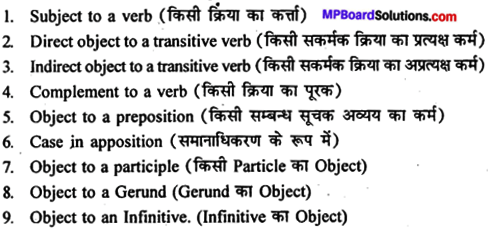
MP Board Class 12th General English Applied Grammar

MP Board Solutions for 12th General English Applied Grammar Questions and Answers aids you to prepare all the topics in it effectively. You need not worry about the accuracy of the Madhya Pradesh Board Solutions for 12th English as they are given adhering to the latest exam pattern and syllabus guidelines.

You Can Download MP Board Class 12th English Solutions Questions and Answers Notes, Summary, Lessons: Pronunciation, Translation, Word Meanings, Textual Exercises. Enhance your subject knowledge by preparing from the Chapterwise MP Board Solutions for 12th English and clarify your doubts on the corresponding topics.

MP Board Class 12th General English Applied Grammar

Kick start your preparation by using our online resource MP Board Solutions for 12th General English Applied Grammar Questions and Answers. You can even download the Madhya Pradesh Board Class 12th English Solutions Questions and Answers for free of cost through the direct links available on our page. Clear your queries and understand the concept behind them in a simple manner. Simply tap on the concept you wish to prepare in the chapter and go through it.

स्पष्ट तथा भाव में पूर्ण अर्थ प्रकट करने वाला शब्द – समूह sentence कहलाता है।
(A group of words which makes a complete sense is called a sentence.)

जैसे –

  1. He is my brother. – (वह मेरा भाई है।)
  2. Sita sings a good song. – (सीता एक अच्छा गाना गाती है।)

Kinds of Sentences

वाक्य पाँच प्रकार के होते हैं :

  1. Assertive – (साधारण)
  2. Interrogative – (प्रश्नवाचक)
  3. Imperative – (आज्ञा सूचक)
  4. Exclamatory – (विस्मय सूचक)
  5. Optative – (इच्छा वाचक)

1. Assertive Sentence (साधारण वाक्य) – जो वाक्य किसी कार्य या घटना के होने अथवा न होने की सूचना देता है, Assertive Sentence कहलाता है।

जैसे –

  • Hari reads a book.
  • Mohan does not sing.
  • Kamla is ill.

4. Ram is not present. Assertive Sentence दो प्रकार के होते हैं :
(i) Affirmative Sentence (स्वीकारात्मक वाक्य)—जो वाक्य किसी कार्य या घटना के होने की सूचना देते हैं।

जैसे –

  • Hari reads a book.
  • Kamla is ill.

(ii) Negative Sentence (निषेधात्मक वाक्य) – – जो वाक्य किसी कार्य या घटना के न होने की सूचना देते हैं।

जैसे –

  • Mohan does not sing.
  • Ram is not present.

2. Interrogative Sentence (प्रश्नवाचक वाक्य) – जिस वाक्य में कोई प्रश्न पूछा जाता है, वह Interrogative Sentence कहलाता है। इस प्रकार के वाक्यों के अन्त में प्रश्नवाचक चिन्ह (?) आता है।

जैसे –

(a)

  1. Is Bimla ill?
  2. Do you go to school?
  3. May I come in?
  4. Can you run?

नोट – ऐसे वाक्यों के प्रारम्भ में सहायक क्रिया (is, am, are, was, were, do, does, can, may आदि) आती हैं।

(b)

  1. What is your name?
  2. Where do you live?
  3. Who is your father?
  4. When do you go to school?

नोट – ऐसे वाक्यों के प्रारम्भ में प्रश्न सूचक शब्द
जैसे – What, Where, When, Who, Why, Which आदि आते हैं। हिन्दी अर्थ करने पर प्रश्न सूचक शब्द वाक्य के बीच में आता है।

3. Imperative Sentence (आज्ञा सूचक वाक्य) – जिस वाक्य से आज्ञा, प्रार्थना या उपदेश का भाव प्रकट होता है, तब Imperative Sentence कहलाता है।

आज्ञा –

  • Go there.
  • Bring water.

प्रार्थना – Please help me.
उपदेश – Obey your elders.
नोट – ऐसे वाक्यों में कर्ता ‘you’ छिपा रहता है।

4. Exclamatory Sentence (विस्मय सूचक वाक्य) – जिस वाक्य से आश्चर्य, भय, दुःख, विस्मय, दया, घृणा, करुणा, हर्ष आदि का भाव प्रकट होता है, वह Exclamatory Sentence कहलाता है।

जैसे –

  1. What a beautiful girl she is ! – (आश्चर्य)
  2. How foolish you are ! – (विस्मय)
  3. How dark the night is ! – (भय)
  4. How dirty he is ! – (घृणा)

नोट—ऐसे वाक्यों के अन्त में विस्मय सूचक चिन्ह (!) लगा होता है।

5. Optative Sentence (इच्छा वाचक वाक्य) – जो वाक्य कोई इच्छा, कामना, आशीर्वाद अथवा अभिशाप आदि प्रकट करता है, वह Optative Sentence कहलाता है।
जैसे –
1. May you live long ! – (आशीर्वाद)
2. May you go to hell ! – (अभिशाप)

नोट – ऐसे वाक्यों के अन्त में भी विस्मय सूचक चिन्ह (!) लगा होता है।

Examples:

  1. Mr. Sharma teaches us English. (Assertive – Affirmative)
  2. She does not play cricket. – (Assertive – Negative)
  3. Who are you? – (Interrogative)
  4. Come here. – (Imperative)
  5. How fast he is walking! – (Exclamatory)
  6. May God help you! – (Optative)

Exercise Study the above examples and tell the kinds of the following sentences :

  1. The sun rises in the East.
  2. Sita is not a good girl.
  3. Why have you come late again?
  4. Do you not wash your clothes daily?
  5. Study regularly.
  6. Please wait till I come.
  7. How grand the Taj is!
  8. May God grant you a long life!
  9. Do not make noise here.
  10. Smoking is not good for health.

We believe the information shared regarding MP Board Solutions for 12th English Applied Grammar Questions and Answers as far as our knowledge is concerned is true and reliable. In case of any queries or suggestions do leave us your feedback and our team will guide you at the soonest possibility. Bookmark our site to avail latest updates on several state board Solutions at your fingertips.
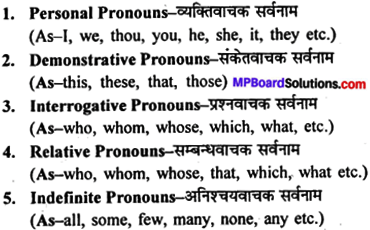
MP Board Class 12th General English Essay Writing

MP Board Solutions for 12th General English Essay Writing Questions and Answers aids you to prepare all the topics in it effectively. You need not worry about the accuracy of the Madhya Pradesh Board Solutions for 12th English as they are given adhering to the latest exam pattern and syllabus guidelines.

You Can Download MP Board Class 12th English Solutions Questions and Answers Notes, Summary, Lessons: Pronunciation, Translation, Word Meanings, Textual Exercises. Enhance your subject knowledge by preparing from the Chapterwise MP Board Solutions for 12th English and clarify your doubts on the corresponding topics.

MP Board Class 12th General English Essay Writing

Kick start your preparation by using our online resource MP Board Solutions for 12th General English Essay Writing Questions and Answers. You can even download the Madhya Pradesh Board Class 12th English Solutions Questions and Answers for free of cost through the direct links available on our page. Clear your queries and understand the concept behind them in a simple manner. Simply tap on the concept you wish to prepare in the chapter and go through it.

1. The Unemployment Problem [2009, 12, 18]

The Main Reason – Unemployment results when there are more job seekers and less jobs. What are the reasons of its origin and growth? Well, the major reason is our rapidly growing population. Since 1950 our population has grown two and a half times but our economic growth, which creates jobs, could not keep pace with it. Hence, unemployment, which was a problem even in 1950, has acquired gigantic1 proportions and requires some drastic2 measures otherwise it may go out of hand.

The Nature of the Problem – As unemployment is directly linked to population growth, its in-depth analysis may indicate the nature of the problem as well as help in identifying the measures needed to deal with it.

When we look at the pattern of population growth we find that it is growing faster in the rural areas resulting in (a) bigger landless families forcing migration towards town for employment mostly as unskilled workers, and (b) dividing land-holdings into unviable entities resulting in underemployment of youth who need self-employment opportunities.

In the urban areas, though it is not growing that fast, unemployment results from defective educational planning. Our educational system is producing far more matriculates as well as graduates in sciences and humanities who have very little employment potential. Graduates in commerce and agriculture and information technology have better employment potential and there isn’t much unemployment in this group.

Measures to Mitigate it – In the light of the above, the following measures may go a long way in mitigating3, if not eradicating, the problem. For the rural sector a two pronged attack’1′ is required. Projects for infrastructure development leading to industrial development creating jobs for the unskilled workers coming from the landless families. And for the other group, as they would have some money to invest, efforts should be made to promote cottage and village industries.

For the youth of the urban areas, our educational system should be reorganised so as to provide better employable youth. This would need creating more and better opportunities for technical and vocational education.

[1. विशाल। 2. कठोर। 3. कम करना। 4. दो तरफ हमला।]

2. Advantages and Disadvantages of Television
Or
TV as a Medium of Education
Or
Educational Value of Television [2012]

Introduction – On September 13, 1959, AIR set up an experimental television service in India. This was the beginning of the television era’ in our country. The experiment was a success. The TV centres have been set up all over the country, in all the States and in big numbers. There are now TV sets in the cities as well as in the villages. The credit goes to late Smt. Indira Gandhi for spreading TV service so widely.

Advantages – There are mhny advantages of the TV services. The most important ones may be mentioned here.

(a) Education – It can play an important role in furthering the cause of education. It can assist2 teachers to a great extent. What they teach in the classes can be reinforced on the TV. Even additional knowledge can be imparted. The students also retain easily the information received on it because of its visual aid. Television viewing does not demand the strain and discipline needed in reading books. Moreover, dull and dreary things become interesting when viewed and heard on the TV. Thus, Television can vitalize teaching a good deal. For, learning through the eye helps remembering things better.

(b) General knowledge – Besides the students, people in general can benefit from Television. Since it provides words with pictures and sound effects, its programmes are as interesting as cinema-films. It is definitely a better medium than the radio which reproduces only the sound. Thus, the TV can teach people without straining them. It broadcasts messages, it discusses their typical problems, it informs them about national and international happenings. In one word, it keeps the people well informed on all important matters. It also pushes them towards modernization.

(c) Entertainment – Television is perhaps the easiest and the cheapest means of entertainment. It considerably reduces the number of our visits to cinema houses, which is a costly affair. What is there in a cinema house that we cannot enjoy at home with a TV set? Sitting on a sofa we watch along with other members of our family a film, a dramatic play, a mushaira, kavisammelan, various kinds of witty and informative competitions, and so ’ on and so forth, who failed to enjoy the ‘Saas Bhi Kabhi Bahu Thi’ series?

Disadvantages – But it does not mean that the gift of television is all joy and profit. It is attended also by its own disadvantages.

(a) Bad effect on the eyesight – First and foremost long, continuous watching the TV is harmful to the eye, it weakens the eyesight. It is believed that watching the colour TV is more injurious. Watching the TV for long hours is bound to overstrain4 the eye.

(b) Waste of time – All the TV programmes are not good or profitable for the people. But once the TV is on, we do not care to switch it off whether we enjoy the running programme or not. Careless of our valuable time we keep on sitting in front of our TV set. We sometimes forget to do our most important work.

(c) Neglect of duty – TV watching also causes neglect of duty in the case of children and parents. At the cost of their study the students want to watch the TV. They delay going to bed. And when they go to bed late they naturally rise late, which is a bad habit. They do not like to miss day long matches, serials and many other purely entertaining shows. This is also true of the elder people. They find it easier to cancel their visit to a sick friend than to miss their favourite serial. If a visitor comes, nobody talks to him, he is forced to watch the film running on the TV.

Conclusion – These are some of the most important advantages and disadvantages. In fact the television is not bad in itself. The viewers need self-discipline5. They should make a judicious use of this great gift of science, like any other gift of science.

[1. युग। 2. मदद करना। 3. आधुनिकीकरण। 4. जोर देना। 5. आत्म अनुशसन।]

3. The Value of Games and Sports [2009,18]
Or
Importance of Games and Sports [2010,11,13,16]
Or
Advantages of Games and Sports [2017]

Introduction – Games and sports are an important part of education. They help in the development of the physique and mind of the student. A sound body possesses a sound mind. If we are weak and sick we cannot have fertile1 brain. Games and sports keep us healthy. They keep us active, make us smart.

Physical and Mental Education – Gandhiji said, “Physical training should have as much place in curriculum as mental training.” Mere bookish knowledge would not lead to proper development of a personality. All work and no play makes Jack a dull boy. Mere studies would not suffice. Similarly, mere sports won’t do. The two should be blended in a suitable proportion2 so that the students can have the best of them. They should not only develop the mind but also the body. Both are essential for a wholesome personality.

Other Benefits – Games and sports do not merely keep us healthy and physically fit, they also inculcate in young people the duty, of loyalty. These qualities can be summed up in a word ‘sportsmanship’. The first and the foremost thing that games teach us is to take victory and defeat alike. In every game, there are two parties. One wins and the other loses. The winners need not be over-zealous and the loser ones should not get asperated. Both the parties should greet each other heartily after the game. Secondly, games and sports teach us discipline. Every player must obey his or her captain.

He has to play obeying all the rules of the games. He has also to abide by the decision of the referee or umpire. Thirdly, games broaden our outlook. The players need have no bias. They should treat other players alike. The players ought not to differentiate between one another on the basis of nationality, caste, creed or colour. The games promote international brotherhood and affection amongst the people of the world. Thus, they promote world peace too.

International Appeal – Games are beneficial not only to players; they are equally beneficial to the public at large. When a match is being played, spectators3 also enjoy it. They become one with the game and in a way take active part in it. Besides enjoying the game, they learn many things from them. Radio and TV have increased the number of people taking interest in games. Nowadays, people in any part of the world can enjoy listening to running commentaries of matches on radio or watching them on the Television.

Value in Student Life – Games and sports have great value in student’s life. The foundation4 for a virtuous life is laid in school. If at an early age a student develops the taste for studies and sports in a proper way, he can become an ideal citizen in his later life. The sports arena teaches many things to the students. It gives him discipline. It develops his sportsman spirit, mental outlook, cheerful nature, sense of humor and strong physique – all these are important traits5 of a successful life. If a student studies seriously and diligently and still takes part in sports and games he would make an ideal personality.

[1. उपजाऊ। 2. अनुपात। 3. दर्शक। 4. नींव। 5. विशेषताएँ।]

4. The Use of Computers in Modern Age [2016]
Or
Educational Value of Computers [2013]
Or
Advantages of Computers in Our Daily Life [2017]
Or 
Role of Computers in School Education [2014]

Introduction – The computer is the gift of the 20th century. In 1947, India got independence and the world got the first computer called Electronic Delayed Storage and Calculation [EDSAC]. It was fully automatic. It could store data and instructions and execute the stored instructions. Though much progress has been made in the computer technology, we are yet only in the midst of the computer revolution.

Its popularity – Though the history of the computer is very recent; there is hardly any sphere of human acti vity where computers are not being used. The impact of the computer revolution is being felt everywhere and it is bringing many changes in our society.

What is a computer? – To a layman, a computer is an electronic machine with mystical powers, a superhuman that can perform any job and do anything that was impossible before. But, in fact, a computer is much like any other machine used by man. Like any other machine it has its limitations and, like any other machine, it is an obedient servant of man and can do wonders with the help of human intelligence and imagination.

The basic function of a computer – There are three basic functions that a computer can perform. They are :
(i) arithmetic operations – addition, subtraction, multiplication and division of values,
(ii) comparison operations – testing of relationships of two values, and
(iii) storage and retrieval operations – storing and reproducing of values when required. A computer performs these operations at a very high speed and for a very long time, maintaining high level of accuracy, without fatigue. These features make a computer unique and distinctly superior to other machines capable of performing such functions.

Basic components – A computer system has at least three basic components, namely
(a) input device,
(b) central processing unit [CPU], and
(c) output device.

The input device helps the user to give data and instructions to the CPU. The CPU performs the computation and thus is the real computer – the brain of the system. On the output device the computer prints the end results of the data processing.

Types of computers – Various types of computers are being used depending upon the purpose and data processing requirements. In terms of size, computers may be classified in three broad categories :
(i) Main frame, the biggest one with very large memory used only in big organizations,
(ii) Mini computer, the smaller one, and
(iii) Micro computer, the smallest one.

Computers can also be classified on the basis of the type of input they accept:
(i) Digital Computers which accept input in the form of digits,
(ii) Analog Computers which accept physical quantities as their input,

e.g., pressure of air and water, temperature, etc. Robot is a good example of this type.

Conclusion – The development of computer technology is, at present, in its fourth generation where it has witnessed many breakthroughs. It has made computers smaller, cheaper, more efficient, more friendly to the user and easier to maintain. However, this is not the end. Very serious efforts are being made to increase the storage capacity of computers at a substantially reduced cost. The fifth-generation computers, which are about to come in a very big way, shall have the artificial intelligence that shall approach quite close to human intelligence.

5. Science in Daily Life [2011,14,16]
Or
Our Daily Life and Science [2017]
Or
Science : Its Uses and Abuses [2009]
Or
Wonders of Science [2009]
Or
Man’s Journey of Life and Science [2015]
Or
Science and Technology – Boon or Curse [2012,13,18]

Introduction – Science in itself is neither good nor bad. Its use determines1 its character. If it is used for constructive1 purposes, it is good; it is a good servant. If it is used for destructive1 purposes, it is bad; it is a bad master.

A good servant – Many are the gifts of science, which have made life, happy and comfortable. It has given us electricity, the wonder of wonders, cheap and quick transport and countless time and labor-saving devices. It has helped progress in medicine and surgery. It has helped the farmer grow more food. It has relieved human suffering in hundreds of ways. It has brought in the age of plenty and prosperity. These and many other things show that science is a good servant.

A warning – Nobody should question the importance of science. But we should not shut our eyes to the harm that science does or can do. We should always remember that science is meant for man, not man for science. Material progress should be accompanied4 by moral and spiritual progress.

A bad master – If foolish and power-hungry men control the knowledge of science, science becomes a bad master. In their hands science may cause suffering and destruction. It may help colonialism5 and imperialism6 It may keep backward nations in slavery. It may cause mass destruction through nuclear weapons or rockets. It may cause mass poisoning and germ warfare. Then science will no more be a good servant but a bad master.

Conclusion – The truth about science is that, like fire, science is a good servant but a bad master. We should be careful to put science to good uses only. We should remember that science exists7 for man; man does not exist for science.

[1. निश्चित करता है। 2. रचनात्मक। 3. विनाशक। 4. जुड़ी हुई। 5. उपनिवेशवाद। 6. साम्राज्यवाद। 7. अस्तित्व रखता है।]

6. A Great Indian Leader: Mahatma Gandhi [2009]
Or
The Man I admire most [2013]
Or
The Person I like most [2014]
Or
The Person Whom I Respect most [2017]

Introduction – “Some men are bom great, some achieve greatness and some have greatness thrust upon them.” Our beloved leader Mahatma Gandhi belongs to the second category1 of people, that is, he is one of those who achieved greatness by their own effort. He was not only the Father of Indian nation but one of the greatest figures of world history.

His early life – He was bom on October 2, 1869 at Porbandar. After his matriculation, he was sent to England to study law. After a brief practice in India he went to South Africa to plead a legal case.

In South Africa – He was greatly shocked to find Indians suffering from many disabilities in South Africa. The ill-treatment2 given to Indians there hurt his patriotic feelings. He himself was called a ‘Coolie Barrister’. He had read Thoreau and Tolstoy. From them he had learned the doctrine3 of civil disobedience and passive resistance. On these principles he started a peaceful campaign4 against the Government of South Africa. He was sent to jail.

His fights for India’s freedom – Sometime after his release he returned to India. He had tested the mighty force of his weapon of civil disobedience and passive resistance. He applied the same weapon against the injustice of the English rule in India. He was shocked and horrified5 by the massacre of Jallianwala Bagh. In 1920, he started the Non-cooperation Movement which shook India from end to end. His movement attracted worldwide attention. He became the leader of the Indian National Congress. Besides many top ranking IndiAnswer:the masses joined his movement. Under his influence, a silent but powerful revolution took place in mental, social and political life of the country. His efforts for Indian independence were crowned with success in 1947.

His guiding principles – Truth and non-violence were the guiding principles of his life. He himself practiced as-well-as taught these principles to his people and to the world. He also preached6 the noble doctrine that the means should be as clean and pure as the end. The right end did not justify the use of wrong means. This he preached and this he himself practiced.

The last phase – India became free, but India was partitioned1 to Gandhiji’s great sorrow. He was very much pained at the communal riots that followed Independence. He died a martyr’s death when he was shot dead by a fanatic young man.

Conclusion – Not only India but the whole world was made poorer by Gandhiji’s death. His death was rightly mourned all over the world. Long will he live in the history of the world.

[1. श्रेणी। 2. दुर्व्यवहार। 3. सिद्धान्त। 4. आन्दोलन। 5. दुखी। 6. सिखाया। 7. विभाजित हुआ। 8. जातीय दंगे।]

7. The Population Problem in India [2009]
Or
The Most Pressing Problem of Our-Life
Or
Any Current Problem in India [2013,17]

Introduction – The problem of population in India means the problem of over-population in the country. This problem is not peculiar to our country; it is a world-wide problem. But since ours is one of the most populous countries, its problem is the gravest’ one. In order to solve the problem we must think over the cause of problem and find out remedy or remedies for it. But, first let us know the size of the problem.

The size of the problem – India has about 15 percent of the world’s total population. That is, every seventh person in the world is an Indian. In
1971, India’s population was 54-81 crores,butby 1981 it rose to 68-38 crores. The annual increase in India’s population is estimated to be one crore and thirty lakhs of people. These figures show the seriousness of the population problem in our country.

Causes of the problem – The-causes of the increase in population are not far1 to seek.2. High birth rate and low death rate are two main causes. The development of modem medical science has led to a marked decline3 in death rate, many of even those diseases which were considered incurable4 are cured now. The decrease in death rate should have been accompanied by a decrease in birth rate to keep the population under control. This has not been so. The birth rate remains continuously high. The result is constantly rising population. Early marriages and unrestricted growth of families are also among causes of population explosion5.

Harms of over-population – Over-population is a curse because it gives birth to host6 of problems which adversely affect the quality of our life. With every rise in population we need more clothing, more houses, more schools, more hospitals and more jobs. The tremendous8 economic progress made by our country after the achievement of freedom in 1947 has failed to improve’the economic condition of our people. India is still a poor country. To make the condition worse, number of ill-fed, ill-clothed9, illiterate and unemployed people is increasing every day. The ever-increasing population and inadequate employment opportunities are throwing a large section of people below the poverty line. Why is it so? The simple answer is that our production and opportunities of employment fall too short of our rapidly rising population.

The remedy – In order to meet the challenge of over-population we can do only two things. One is to increase food supply and the other thing is that we should check the increase in population besides doing what we can do to increase production of necessaries of life.

Check or reduction in population can be achieved through Family Welfare Planning. It is noteworthy11 that.India was one of the first countries to realize the importance of family planning for general economic development. It started the ‘planning’ as long ago as 1952. But it has not yet been able to achieve the desired result. It needs to be practical and free of all politics and religious biases. It should be imposed12 rigorously13 and on all people irrespective14 of caste and creed. Persuasion would, of course, accompany compulsion.

Conclusion – Our population problem is a matter of top national priority15 and deserves all attention and action. Unless we reduce or control population, we are all going to suffer badly by the turn16 of this century.

[1. गम्भीरतम। 2. खोजना कठिन नहीं है। 3. कमी। 4. असाध्य। 5. जनसंख्या विस्फोट। 6. बहुत-से। 7. विपरीत दिशा में। 8. बड़ी। 9. भोजन और वस्त्र के अभाव में ग्रस्त। 10. जीवन की आवश्यकताएँ। 11. ध्यान देने योग्य। 12. लागू करना। 13. सख्ती से। 14. कोई ध्यान किये बिना, अनपेक्षित। 15. प्राथमिकता। 16. मोड़।]

8. Environment: The Problem of Pollution [2009]
Or
Impact of Pollution on our day to day life [2010]
Or
Pollution and Our Existence [2015]
Or
Pollution Problem : A Great Challenge [2018]

Introduction – Environment1 means all the surrounding conditions which influence the growth and development of life. The environment is composed of gases and substances1 which exist in a certain proportion. When, for any reason, one of the constituents increases or decreases the balance of the whole atmosphere is disturbed. This imbalance of the constituents3 is called pollution of the environment. The pollution4 is chiefly of two kinds – air pollution and water pollution.

Air pollution – Air pollution means loss of balance of proportion of oxygen, carbon dioxide and other gases which are found in the air. To be precise, when carbon dioxide increases and oxygen decreases in the air, air pollution take place. We all know the oxygen in the air is constantly being used up and turned into carbon dioxide when animals breathe and things bum. But nature has its own way to replace the used-up oxygen. The green leaves of all trees and plants absorb5 the carbon dioxide from the air and break it up into carbon and oxygen. The carbon is used to make starch and oxygen is released into the .atmosphere. That is how trees help to replace the used-up oxygen and maintain equilibrium6 in the environment.

Causes of air pollution – But the equilibrium in the environment is being constantly destroyed by man himself. Since long man has been cutting down trees and plants in order to use them as fuel and wood for building. This has resulted in deforestation1 leading to unbalanced or unhealthy environment. Thus, deforestation is the first cause of air pollution.

Another cause is too much use of motor-cycles, scooters, tempos, cars, buses, steamers and aeroplanes. They all burn oil or coal and add to the carbon dioxide in the air.

Yet another cause is the modem industrialization which has given and is giving birth to innumerable mills and factories. Their chimneys incessantly pour out poisonous gas and smoke which spoils the environment.

The effect of air pollution – Air pollution affects our health very badly. While we breathe, poisonous gas and smoke also enter our lungs along with oxygen. They cause diseases of lungs and heart. They cause even such incurable diseases as cancer.

Remedies – In order to prevent air pollution, we should first check deforestation and plant as many trees as we can. Secondly, mills and factories should be built away from human population and their chimnies should open high up in the sky. Finally, the use of coal should be replaced by electricity and solar energy.

Water pollution and its cause – The second kind of pollution of the environment is water pollution. Water gets polluted when gases, n.inerals and other substances, which exist in it, lose their due proportion. The desired proportion is disturbed mostly when such things as soap, soda, D.D.T., kerosene oil, poisonous medicines, injurious chemicals, and other impurities are poured into wells, rivers and lakes.

The effect of water pollution – Like air pollution, water pollution is also a great danger to our health. When polluted water is drunk, it causes such diseases as jaundice, typhoid, cholera and cancer. It may cause birth of disabled children.

Remedies – The dirty water should be cleaned by mechanical and other devices before it is poured into rivers and lakes. Dirty injurious rubbish8 should not be thrown into water sources. We should purify our drinking water by boiling and filtering it.

Conclusion – The environment is our sacred and invaluable heritage. Our very existence depends on it. It is, therefore, the duty of every man to keep the environment clean, pure and safe. We should set up environment clubs, ecological10 development camps, and organize seminars and symposiums with a view to protecting and developing human environment.

[1. पर्यावरण। 2. पदार्थ। 3. घटक। 4. प्रदूषण। 5. आत्मसात करना। 6. सन्तुलन। 7. वनों का नाश। 8. कूड़ा-कचरा। 9. छानना। 10. पारिस्थितिकी-विज्ञान सम्बन्धी।]

9. Quality Education at Primary Level [2015]

Introduction – Education is a very important factor in the life of people. Most of the people in India are illiterate. After independence, the attention of the government and our leaders was drawn towards this and several steps were taken to educate people.

Primary Education – In our country the condition of Primary Education is poor. Children are not sent to the schools. They are asked to help the family in the work of earning money. Work on fields, factories, construction of buildings etc. is taken from them. Poverty is the reason for this. The number of schools is also not sufficient. Good teaches are not available.

Importance of Primary Education – Primary Education is very important in our education system. It is the nursery where the children are reared as plants. As a building needs firm foundation in the same way the life of individual depends on primary education. The course and syllabus of primary classes is also not proper. There is a great variety in the structure of Indian society. There is no uniformity. There are several languages. The social and cultural structures are also different. The course and syllabus of primary classes should meet the future requirements of the society. The quality and syllabus should be better.

Dropping Problem – Several students leave their education in the middle way. The reasons are failures, illnesses the parents reluctance and nonavailability of the teachers. For this awareness among the people is needed. The teachers should take interest. They should understand the problems of students and make the school an attractive place for students.

Right to Education – On 1 st April 2010 the right of children to Free and Compulsory Education Act has been passed. The act makes it obligatory on the state to guarantee education and pnsure compulsory to admission of children. This act provides some measures to make it successful.

Conclusion – Well educated children are the backbone of society. Child is the future citizen. And on citizens depends the prosperity, progress and well being of the country.

10. An Election Scene

Introduction – An election scene is a common sight in a democratic country like India, where members of Parliament, Legislative Assemblies and local bodies are elected from time to time. They are elected by adult persons who are given the right to vote in public elections. We have laws for conducting elections. For examples, canvassing, which plays an important role in elections, has to be stopped a day before the election; voters are required to go to the fixed polling stations to register their votes.

The Polling Station – A polling station [or a polling booth] is a place where people go to register their votes. At a polling station the voters of only a particular constituency1 can cast their votes. Often a placard2 is exhibited outside the polling station, the constituency for which that station is meant.

Inside the booth a polling officer and his assistants do their work. When a voter comes in, an assistant traces out his name in the electoral roll. When he is satisfied with the identification of the voter, he puts a mark of indelible3 ink on the little finger of the voter. The voter then receives a ballot paper. He puts his signature on its counterfoil. With this’ ballot paper he is asked to go to a closed comer where a stamp and an ink pad are available. The voter stamps the ballot paper against the name of his candidate. Then he folds the ballot paper as required and puts it into the ballot box through a hole on its top and walks out. Nowadays Electronic Voting Machines [E. V. M.] have been introduced. Here you have to push a button and your vote is cast.

Outside the polling station – The main part of an election is accomplished5 inside the polling station. But its live6 and picturesque1 part is seen outside the booth. At a distance of 100 metres from the booth, agents of various candidates contesting election put up their tents. They issue identity slips to those voters who come to them. A volunteer of the particular agent helps the voter reach or enter the polling booth.

This area outside the polling station presents an exciting and . fascinating scene almost like that of a village fair. There are of course, neither merry-go-rounds nor giant wheels nor shops to attract women and children. Instead, we have the tents of polling agents; but they are decorated with colourful buntings8 which give atmosphere of a festive look9. There is hustle and bustle all round here. People, especially women, can be seen in their best clothes, flocking together10 talking and gesticulating11. Some tents have long rows of voters standing in front of them to receive identity cards. But there are also other tents which present a deserted look. To complete the show; there are also policemen posted at all strategic points to guide the crowd and maintain law and order.

Disputes – Sometimes disputes also break out. For example, the identity of a voter is questioned and it is an occasion for quarrel. In such a case, which is called “challenging the vote”, the Presiding Officer hears both the parties of the dispute and decides whether the voter is to cast vote or not. Sometimes a person impersonates12 a voter and casts vote in his place.

If he is caught red-handed he is handed over to the police for action.

Scenes of rowdyism13 – Sometimes great rowdyisms are enacted. The supporters of two contestants sometimes come to blows and sometimes even to bullets when one group or another indulges in mischief. The supporters or goondas of a losing candidate try to temper with a ballot box or run away with it.

Conclusion – On the whole an Indian election scene is a peaceful one, which is indeed, a great thing because India is a vast country with a huge number of voters.

[1. चुनाव-क्षेत्र। 2. इश्तहार, विज्ञापन। 3. अमिट। 4. मतपत्र। 5. पूर्ण किया जाता है। 6. सजीव। 7. नयनाभिराम। 8. झण्डियाँ। 9. उत्सव-सम्बन्धी दृश्य। 10. एक साथ जाते हुए। 11. उँगलियों आदि के संकेत करते हुए। 12. पररूप धारण करना। 13. हुल्लडबाजी, गुण्डागर्दी।]

11. Important of Newspaper [2016]
Or
Newspaper [2009,11]
Or
Power of the Press

Introduction – Newspaper is a powerful mass media. It plays a very important role in a democractic country. It helps people to form their opinion which is the backbone of democracy. Newspaper have proved that pen is more powerful than sword. They are a good means of expressing one’s thought.

Changing Role of Newspaper – Gone are the days when newspaper was read just to know the news. Its role was very narrow and limited. But today news is only a part of the newspaper. It provides classified news. There are different pages for different categories of news. We have separate pages for local news, international news, sport news, commercial news etc.

Knowledge and Entertainment – Newspapers give us both knowledge and entertainment. They publish articles on science, medicine, health, cookery, fashion etc. They also entertain us through short stories, jokes, articles, quiz etc. They publish interesting comic series, picture quiz etc., for children.

Career Guidance – Most of the newspaper publish very important career guidelines once or twice a week. They inform us about the different academic and vocational courses and competitive examinations. They help us to choose a suitable course and career.

Advertisement – Newspaper publish classified advertisements such as situations vacant, educational, matrimonial, sale and purchase of vehicles, property advertisement. Most of them are very useful. Matrimonials provide a wide choice of matches. ‘Situations Vacant’ column helps us to get a job.

Demerits – Newspapers have some demerits as everything else has. Some advertisements are false. They misguide and deceive the reader. Sometimes biased articles are published. They cause communal riots, hatred and disunity.

Conclusion – Healthy censorship removes these demerits to a great extent. The conscious reader cannot be misguided and deceived by yellow journalism.

12. The Festival You Like Most [2014,16]

Introduction – Diwali is a very’ nice festival of the Hindus. It often comes in the month of October or November every year. It is celebrated in the memory of Ram’s return to Ayodhya from forests after 14 years. The people of Ayodhya welcomed Lord Ram heartily. They decorated their houses with flowers. They lighted earthen lamps before their houses. Diwali is a remembrance of that day.

Preparations – Days before the people start preparations for this festival. People clean their houses completely. They whitewash them. The merchants paint their shops and set them. The market gets a new look.

How Celebrated – People buy new clothes and new dresses. They buy many things for this festival. Children buy crackers. Ladies buy sarees and material for preparing sweets. People give presents to friends and relatives. They send greeting cards to their far off friends and relatives. Main days of celebration of Diwali are three ‘Dhan Teras’, ‘Roop Chaudas’ and ‘Diwali’ on Amavasya day. In the evening ladies and children bum candles and lamps. Many electric bulbs of several colours are also lighted. The rows of lamps look very beautiful.

Worship of Goddess Laxmi – On this day, people worship Goddess Laxmi. They pray her for health, wealth and happiness for the whole year. Children let off fireworks. People eat sweets. They distribute ‘Prasad’ of Diwali. The rich and the poor enjoy Diwali. All classes of the society are happy. Diwali also marks the end of the year.

Importance – Diwali is an all-India festival. People of all parts of India and all communities celebrate it. It is a festival of national importance. It promotes national unity also.

For All People – All age groups of people enjoy celebration of Diwali. Children, youth and the old, gents and ladies feel freshness at the coming of Diwali. The rich and the poor all celebrate it as per their capacity.

Conclusion – Diwali is a very nice festival. People forget their differences. There are some bad customs too. Some people gamble and drink wine. This is not good. Some persons get injured during burning of crackers due to carelessness. However, Diwali brings happiness to every home in India.

13. The Problem of Terrorism in India [2014]

Introduction – Terrorism is a great danger to human civilisation. The whole world is faced with this problem and India is no exception1 to it. India has been facing terrorists in Jammu and Kashmir for long. The North-Eastern states including Chhattisgarh, Jharkhand, parts of Bihar and Orissa are also faced with the same problem.

Various terrorist organisations are active and have their own demands and objectives. These organisations have been trained in terror tactics and are supported by other organisations in foreign countries.

Causes : The chief causes of terrorism include acute nationalism as exhibited by Hitler who promoted nationalist feelings among his countrymen and a hatred for others. Second is economic disparity? The charm for leading a luxurious life and be a part of high profile section of the society somehow urges them to make money at any cost. The third and the most important is communal disharmony. When people are discriminated’ on account of caste, colour, creed etc. they rise in resentment and opposition.

Need for Peace: India is a peace loving country. She was always tried to counter terrorism and establish world peace. There is a need to enforce the rule of law and punish the, guilty. Unnecessary delay in judicial process should also be avoided. There are some examples of terrorists who were punished rightly but after much delay.

Conclusion : Nations should also try to curb6 arms race. Energy resources should be used for peaceful purposes and not threatening weaker nations. And lastly to have wisdom to realise our purposes and fight the evil out with the increase in knowledge, power and resources.

[1. अपवाद। 2. राष्ट्रवादी। 3. असमानता। 4. भेदभाव। 5. आक्रोश 6. रोकना।]

14. The Cleanliness Drive
Or
Our India, Clean India [2015]

Introduction – India is a big country. It enjoys a special place in the world. These traditions and customs are rich. These are followed by people all over the world.

Meaning of Cleanliness Drive – When Shri Narendra Modi became The Prime Minister of India, he felt that the people of this country must be inspired for cleanliness crowd them. So he started a nationwide cleanliness drive. He appealed to the countrymen to clean their surroundings. The cleanliness drive covered cleanliness from own houses to the entire nation.

Impact of This Drive – The cleanliness drive received a big applause from people throughout the country. People from all sections of society exhibited great interest in it. Eminent citizens including politicians academicians sports persons, film actors etc. got associated with this drive. In fact the cleanliness drive became national affair within a short period of time.

Its uses – The cleanliness drive has many uses. A clean surrounding always gives better and safer atmosphere to live. Many diseases are automatically removed due to cleanliness. The surroundings look better. As a result, we feel happy and pleasant.

Conclusion – Cleanliness is not a work which we should do forcefully. It is a good habit and healthy way of our healthy life. All type of cleanliness is very necessary for our good health whether it is personal cleanliness, surrounding cleanliness, environment cleanliness, pet animal cleanliness or work place cleanliness [like school, college, office, etc]. We all should be highly aware about how to maintain cleanliness in our daily lives. It is very simple to include cleanliness in our habit. We should never compromise with cleanliness, it is as necessary as food and water for us. It should be practiced from the childhood which can only be initiated by each parent as a first and foremost responsibility.

The cleanliness drive is a wise step by the government. It is in the interest of all the countrymen. It is a good sign that people are becoming aware and are getting associated with this drive.

15. Our Present Prime Minister : Mr. Narendra Modi [2018]

Introduction – Full name of Narendra Modi is Narendra Damodardas Modi. He was bom on 17 September, 1950 in Vadnagar, Mehsana district, Bombay state [present day Gujarat].

Narendra Modi is an Indian Politician and is currently the Prime Minister of our country India. He is a member of Bhartiya Janta Party [B JP]. He was the Chief Minister of Gujarat from 2001-2014. He is the Member of Parliament1 from Varanasi Lok Sabha constituency.

Education – He has been described as an average student and a good debater with keen interest in theatre by his teachers. He completed his higher secondary education from Vadnagar itself in 1967 and obtained a masters degree in Political Science from Gujarat University. His formative years taught him tough lessons as he balanced his studies and non-academic life. He completed his studies against all odds. His saga of struggle began when as a teenager, he alongwith his brother, used to run a tea stall near a railway station in Ahmedabad. He was introduced to Rastriya Swayamsevak Sangh [RSS] when he was just eight years old. After graduating from school, Modi left his home because he rejected an arranged marriage. Modi travelled India for around two years and visited various religious centres. Then after coming back to Gujarat he shifted to Ahmedabad and became a full time worker for RSS.

Political Career – In 1987, Narendra Modi joined Bhartiya Janta Party [BJP] and entered into politics. He was appointed as General Secretary of the partys’ Gujarat Unit within a year. He was appointed as Chief Minister of Gujarat. Modi was Gujarat’s Chief Minister for four consecutive terms.

Due to Modi’s success, fame and style he was declared one of the candidates by BJP in 2014 general elections? BJP won the elections and Modi was announced as India’s 15th Prime Minister on May 26, 2014. As the Prime Minister of India, Modi has emerged as a dynamic, decisive and development-oriented leader who has given a hope of accomplishment to the dreams and aspirations3 of a billion Indians. His love for technology is evident from his presence across different social media platforms. Besides, the government’s ambitious programmes such as Digital India and Make in India vouch for the same. Despite being a Prime Minister of the country, he comes across as a very humble human being.

Through the radio show ‘Mann ki Baat’, he regularly addresses the nation. He is quick to respond to all the questions, that are put across to him by the people of India. He is also famous for ‘Note Bandi’ and G.S.T.

Modi is a big yoga enthusiast and never forgets to do it, no matter how busy he is. During his speech at the United Nations General Assembly, Modi proposed the idea of celebrating International Yoga Day. An unprecedented 172 nations voted in favour of this and now June 21 is celebrated every year as International Yoga Day. The idol of Modi’s is present at London’s Wax Museum in Madam Tussads. Apart from this, he has been given fifth place in Fortune Magazine’s list of the world’s greatest leaders. He has been named among the 30 Most Influential People on the Internet.

Public Welfare Schemes Introduced – Our honourable Prime Minister has inaugurated many schemes for the betterment of different classes of people with extra focus on women empowerment and security.

Some of them are:

  1. Pradhan Mantri Jan Dhan Yojana,
  2. Atal Pension Scheme,
  3. Make in India,
  4. Swachh Bharat Abhiyan – Clean India Movement,
  5. Krishi Bima Yojana,
  6. Digital India,
  7. Skill India.

Conclusion – Mr. Narendra Modi sir has proved that leadership is all. about leading by example. He is an inspiration and hope for millions of Indians. We wish and hope that under his leadership our country will realize its full potential and once again regain the place on top where it once was.

[1. संसद सदस्य। 2. आम चुनाव। 3. आकांक्षाएँ/अपेक्षाएँ।]

We believe the information shared regarding MP Board Solutions for 12th English Essay Writing Questions and Answers as far as our knowledge is concerned is true and reliable. In case of any queries or suggestions do leave us your feedback and our team will guide you at the soonest possibility. Bookmark our site to avail latest updates on several state board Solutions at your fingertips.
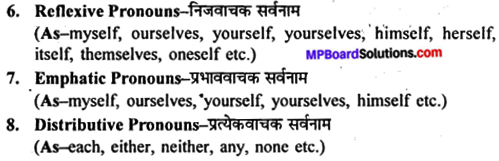
MP Board Class 12th General English Composition Based on Verbal Input

MP Board Solutions for 12th General English Composition Based on Verbal Input Questions and Answers aids you to prepare all the topics in it effectively. You need not worry about the accuracy of the Madhya Pradesh Board Solutions for 12th English as they are given adhering to the latest exam pattern and syllabus guidelines.

You Can Download MP Board Class 12th English Solutions Questions and Answers Notes, Summary, Lessons: Pronunciation, Translation, Word Meanings, Textual Exercises. Enhance your subject knowledge by preparing from the Chapterwise MP Board Solutions for 12th English and clarify your doubts on the corresponding topics.

MP Board Class 12th General English Composition Based on Verbal Input

Kick start your preparation by using our online resource MP Board Solutions for 12th General English Composition Based on Verbal Input Questions and Answers. You can even download the Madhya Pradesh Board Class 12th English Solutions Questions and Answers for free of cost through the direct links available on our page. Clear your queries and understand the concept behind them in a simple manner. Simply tap on the concept you wish to prepare in the chapter and go through it.

Some Examples

Based on the verbal inputs given below, write a paragraph.

1. With the help of the words given below, produce a write-up on ‘Grow More Trees’ : [2013, 16]
Importance of trees, the usefulness of trees in life, to survive in life trees are necessary, useful for animals and birds shelter, protect and development of our trees.
Or
Write an article on “Importance of Trees/Forests with the help of the following input:
Useful for Human lives/causes for rain/usefulness for all creatures/ other importance/Need and value/celebration of Van Mahotsava.
Answer:

Grow More Trees

Trees existed on Earth before man. They are the refuge for birds, animals and even many tribals. They give us wood for fuel and furniture.

Fruits like apple, banana, mango grow on trees. Besides, they provide many herbs haying medicinal value. They bring rains and help to maintain ecological balance. They absorb carbon dioxide and release oxygen during photosynthesis. They provide shade to animals, birds, human beings and protect them from sun and rain. They holdjsoil firmly, reduce soil erosion and thus prevent flood and draught. There are different kinds of trees like neem, mango, walnut, oak, bamboo, sesame, teak, eucalyptus etc.

It is very unfortunate that man has indulged in deforestation for his greed. This has disturbed ecological balance and resulted in extinction of rare species of birds, animals, plants, herbs. Thus, the need of hour is adoption of afforestation programme like Van Mahotsava coupled with environmental awareness drive. Judicious and eco-friendly strategies of industrialisation, mining, construction and other development-oriented activities should be adopted.

2. With the help of the words given below, produce a write-up on the ‘Corruption—A Fast-Growing Malady’. [2012, 18]
A little bit always existed, increased during licence, permit raj, now growing very fast, officials and politicians making easy money, have assets beyond their own source of income, easy to take action against them.
Answer:

Corruption—A Fast-Growing Malady

The country is facing the biggest problem these days in the form of corruption. In fact corruption is not a new phenomenon. It existed in ancient times also. There are examples of corruption after that also. It is unfortunate that corruption increased during licence system. The facility for the people was misused by some people of vested interest. Permit raj met the same fate. Instead of extending facilities to the people, it became a tool of earning money with some people. The situation today is very grim. Corruption is growing very fast these days. No department on section of life is untouched by it. Even officials and politicians are making easy money. They are misusing their authority and making money from all sides. As a result of this, the officials and politicians have assets beyond their own source of income. They have shot into prosperity overnight-through illegal means. It is not difficult to take action against corrupt people. But the government lacks will power. Thus the evil of corruption is fastly growing and is unstoppable.

3. With the help of the words given below, produce a write-up on the Advantages of Small Family : [2011]
Population growth, Problems of a large family, One or two children, Better facilities, Enjoy life.
Answer:

Advantages of a Small Family

As per the recent demographic figures, India’s current population is 121 crores and it is estimated that by 2050 India will be most populated country. This clearly indicates that India is over populated. It affects the economy and living standard adversely. It causes poverty and unemployment. Contrary to the belief of uneducated multitude, large families are burden. On the earning hands of a family. It is the moral and social responsibility of parents to provide good life, food, health, education and other facilities to their children and an increase in the number of family members means an increase in the cost of living and responsibilities.

With high cost of living, rising prices and unemployment it is advisable to have small family with one or two children. China too was faced with a similar problem but she was alarmed in time and resorted to preventive measures. People should understand that in a small family they can give better opportunities, care and attention to each child. They can fulfil their duty towards their family properly and lead a blissful life. And all this can happen if people are educated enough to plan ‘a small and happy family-’

4. Man—good, bad qualities/anger—bad quality/causes of anger/ evils of anger/anger to be avoided.
Answer:

Dangers from Anger [2009]

Man is made up of many qualities, both good and bad, and among the latter is anger. The nature of every human being is such that anything that gives offence to his sentiments or goes against his principles, excites his anger. The evils which result from anger are many. Under its influence a man loses his power of reasoning and judgement. Not being able to retain control over himself when angry, he does not know what he is doing or saying. Under its influence a man puts off his balance so much that he forgets his duty towards his superiors and may even go to the extent of saying things which are extremely insulting to them.

5. 26th of January/students assembled/headmaster and other/National Anthem/speeches/games and sports/sweets [2009]
Answer:

The Republic Day Celebrations

We celebrate the Republic Day every year on 26th of January. This year we were asked to reach the school at 7.30 in the morning. All the students assembled on the school playground. We were asked to stand in rows in froni pf the flag post. Soon the headmaster, and other members of the staff arrived there. The P.T.I. gave a caution to stand at attention. The headmaster hoists^ the National Flag. We all sang the National Anthem. Then there was a short speech by the headmaster. He explained the importance of the day^All the members of the staff and the students took a vow to serve our motherland.

Then there were games and sports. In the evening there was a cultural programme. Some students sang patriotic songs and recited other poems. There were monoactings and a one act play also. Then the headmaster distributed sweet and we all dispersed.

6. Write an article on ‘Man, Computer and Mobile’ for your school magazine. You are Rakesh Shukla, a student of Government Higher Secondary School, Barwani. You can take help of following hints : [2015, 18]

So many technical devices, computer a great invention, stores large data, a reliable device, mobile: a basic necessity, wonderful, various purposes, internet: a home of knowledge.
Answer:

Man, Computer and Mobile

Modem age is the age of technology. It touches all aspects of human life. It has made life fast and comfortable. Nowadays, life seems impossible without gadgets like computer and mobile. Computers save time, money and energy. The official work that was one manually is now done with computer. Computer is capable of processing the data efficiently in no time. It can keep the data safe for a long time. Computer can also be used to make voice and video calls, play music, edit photos, calculate, predict weather, treatment and diagnosis of patients, prepare maps, operate planes & missiles, control traffic, broadcast programmes and what not.

Invention of Internet has proved to be a boon for it provides much information at a click. No doubt, the reliability of the information is questionable at times. Computers are followed by laptops, notebooks, palmtops, tablets and now mobiles. The mobiles now available in their new incarnation of Smart Phones are in no way less than a mini-computer. Besides performing the basic function of a phone making or receiving calls and sending or receiving messages it is a digital camera, radio, calculator, alarm clock, calendar, torch, photo editor, music player too. There are various apps adding to its utility.

The invention of mobile has made the internet portable too. The mobiles once considered to be the possession of the privileged few has now become the necessity of a common man. The mobile is a mini-computer. Computer and mobile have revolutionised the world of communication.
Rakesh Shukla Govt. H. S. School, Barwani

Exercises For Practice

Write an article in about 100 words on the following topics.

  1. Good Citizens
    Good citizens essential in good country/characteristics of a good citizen/beginning from school days/spread to larger areas.
  2. Uses of Wealth.
    ManifoldJproper use of money/food and clothing for the poor/ orphanages for the helpless children/wastage should be avoided.

We believe the information shared regarding MP Board Solutions for 12th English Composition Based on Verbal Input Questions and Answers as far as our knowledge is concerned is true and reliable. In case of any queries or suggestions do leave us your feedback and our team will guide you at the soonest possibility. Bookmark our site to avail latest updates on several state board Solutions at your fingertips.
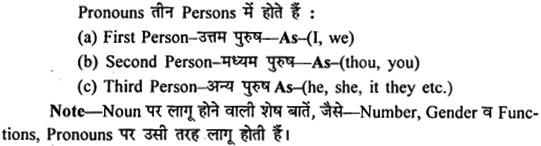
MP Board Class 12th General English Composition Based on Visual Input

MP Board Solutions for 12th General English Composition Based on Visual Input Questions and Answers aids you to prepare all the topics in it effectively. You need not worry about the accuracy of the Madhya Pradesh Board Solutions for 12th English as they are given adhering to the latest exam pattern and syllabus guidelines.

You Can Download MP Board Class 12th English Solutions Questions and Answers Notes, Summary, Lessons: Pronunciation, Translation, Word Meanings, Textual Exercises. Enhance your subject knowledge by preparing from the Chapterwise MP Board Solutions for 12th English and clarify your doubts on the corresponding topics.

MP Board Class 12th General English Composition Based on Visual Input

Kick start your preparation by using our online resource MP Board Solutions for 12th General English Composition Based on Visual Input Questions and Answers. You can even download the Madhya Pradesh Board Class 12th English Solutions Questions and Answers for free of cost through the direct links available on our page. Clear your queries and understand the concept behind them in a simple manner. Simply tap on the concept you wish to prepare in the chapter and go through it.

Visual और Verbal Inputs की सहायता से अच्छा Paragraph कैसे लिखें-

Hints : परीक्षा में किसी घटना (event), दृश्य (scene), कार्य (action) अथवा किसी नियमित रूप से होने वाले कार्य (habitual action) के सम्बन्ध में दो पैराग्राफ लिखाये जाते हैं। प्रत्येक प्रश्न में पैराग्राफ लिखने के लिए कुछ शब्द दिये होते हैं। इन शब्दों की सहायता से दिये गये विषय पर 80-100 शब्दों का एक पैराग्राफ लिखना पड़ता है। छोटे एवं सरल वाक्य बनाकर पैराग्राफ लिखना चाहिए। Paragraph के विषय तीन प्रकार के होते हैं-

1. भूतकाल की घटना (event), दृश्य (scene) अथवा कार्य (action), जिनका वर्तमान से कोई सम्बन्ध नहीं होता है।
2. नियमित रूप से होने वाले कार्य (habitual actions) या किसी संज्ञा की विशेषताओं का वर्णन। जैसे
Habitual actions My Daily Routine, The Morning Assembly in Our School, The Recess Period in Our School आदि।

Describing a Noun-The Teacher I Like Most, My Best Friend, Our New School आदि।
इनके लिए निम्न का प्रयोग करते हुए छोटे सरल वाक्य लिखने चाहिए।

  • There का प्रयोग।
  • Be का प्रयोग।
  • Have का प्रयोग।
  • Present Indefinite Tense
  • उपयुक्त Structures का प्रयोग।

3. भविष्य की योजनाओं (Future Plans) का वर्णन। जैसे-How I shall Spend My Next Summer Vacation?
4. सबसे पहले यह देखना चाहिए कि प्रस्तुत घटना, दृश्य अथवा कार्य भूतकाल की घटना है या नियमित रूप से होने वाला कोई कार्य है। फिर दिये गये शब्दों की सहायता से छोटे और सरल वाक्य इस प्रकार लिखने चाहिए कि घटनाओं का वर्णन क्रमबद्ध हो जाए।

Some Examples

1. Watch the visual input very carefully and write an article in about 100 words on‘Water Pollution’. [2017]
आगे दिये गये चित्र को देखकर उसका संक्षेप में वर्णन कीजिए :
MP Board Class 12th General English Composition Based on Visual Input img 1
Answer:
Environment pollution is one of the major problems that our country is facing today—water pollution being a part of it. It has come as a result of rapid industrialisation. Industrial waste and sewage are freely discharged into rivers and lakes. Harmful chemicals and other unhygienic materials make their water unfit for drinking and other household purposes. The polluted water is also not suitable for irrigation and fishery or other allied activities. Efforts should be made to create awareness among people and check water pollution.

2. Give a short description covering the details of the picture given below:
नीचे दिये गये चित्र को देखकर उसका संक्षेप में वर्णन कीजिए:
MP Board Class 12th General English Composition Based on Visual Input img 2
Answer:

Birthday Celebration

Last month, I celebrated my birthday with great pomp and show. The house was beautifully and colourfully decorated. Pictures were hung on the walls. The floor was washed. Chairs and tables were arranged in a big hall. The party started’at 6 pm. with joy and laughter, I cut the cake and put out the candlesticks. The guests sang in chorus, “Happy Birthday to you”. They blessed me. They gave me good gifts. Then my brother served tea, biscuits and sweets to the guests. My father thanked all the guests for their kind visit and good wishes. In this way, we had a jolly good time.

3. Give a short description covering the details of the picture given below:
नीचे दिये गये चित्र के आधार पर एक संक्षिप्त पैराग्राफ लिखिए:
MP Board Class 12th General English Composition Based on Visual Input img 3
Answer:

Unity Is Strength

A king had three sons. But the king was not happy as his sons were always quarrelling among themselves. One day the king brought a bundle of sticks and asked his sons to break it. Each of them tried his best but could not break it. Then the king untied the bundle and asked his sons to break the sticks separately: They broke the sticks very easily. The king told them that none of them could break the sticks when they were tied together. But when they were untied, they were broken easily. Remember, ‘united we stand, divided we fall’. Real strength lies in unity.

4. Give a short description covering the details of the picture given ahead.
आगे दिये गये चित्र के आधार पर एक संक्षिप्त पैराग्राफ लिखिए।
MP Board Class 12th General English Composition Based on Visual Input img 4
Answer:

Save Trees, Save Life

As we all know that trees are very useful for us. They provide food and act as a shelter for human beings and animals. They keep the environment clean and healthy by taking in harmful carbon dioxide gas and exhaling life-giving gas oxygen. Thus, they maintain the balance of these gases in nature. They also help in bringing rain, which fulfils our need of water. Hence we can say that trees are very essential for life. Yet, today trees are being cut numberlessly and mercilessly for personal and commercial benefits. Big forests are now cleared at one shot. This mass clearing of trees is called deforestation. The rate of deforestation, today is highly increasing without caring about how will life be possible on earth without them. We can imagine what will happen without oxygen and water. Thus, we must save trees from being cut if we want life on earth. Hence, we must always say—Save Trees, Save Life.

5. The picture below shows the various forms of child labour. Write in about 150 to 200 words describing the picture and give at least two suggestions how to educate these children continuously. [2015]
MP Board Class 12th General English Composition Based on Visual Input img 5
Answer:

Child Labour

Childhood is the best period of life. It is tragic that millions of children are forced to work instead of enjoying this period of life. It is ironic that while the youth is at large unemployed children are forced to work. Bare footed lean and thin children can be seen working at dhabas, industries, construction sites and even houses. Others can be seen selling newspapers, assisting motor mechanics & masons, working in factories and even begging. They are forced to work in unhealthy conditions for even fifteen to sixteen hours. They are ill fed and ill clad. They are beaten on trivial issues. They are ill-treated and underpaid. They are engaged in firecracker, match factories, chemical factories, carpet industry, silk industry and mining.

Moreover, they are bought and sold like commodities. Poverty and lack of education are the chief causes of it. Girls are more likely to be kept away from school, made to do the household work and. fall prey to child trafficking. The child labour act 1986, The Juvenile Justice of children Act 2000 and Right of children to Free and Compulsory Education Act 2009 besides the efforts of NGOs like Bachpan Bachao Andolan, Care India, Pratham are not sufficient to tackle this problem. It requires an effort from all the people. People should be made aware of the problems of the deprived and exploited children. The defaulters should be punished.

Exercises For Practice

1. Write a short description based on the picture given ahead :
आगे दिये गये चित्र के आधार पर एक संक्षिप्त पैराग्राफ लिखो:
MP Board Class 12th General English Composition Based on Visual Input img 6

We believe the information shared regarding MP Board Solutions for 12th English Composition Based on Visual Input Questions and Answers as far as our knowledge is concerned is true and reliable. In case of any queries or suggestions do leave us your feedback and our team will guide you at the soonest possibility. Bookmark our site to avail latest updates on several state board Solutions at your fingertips.
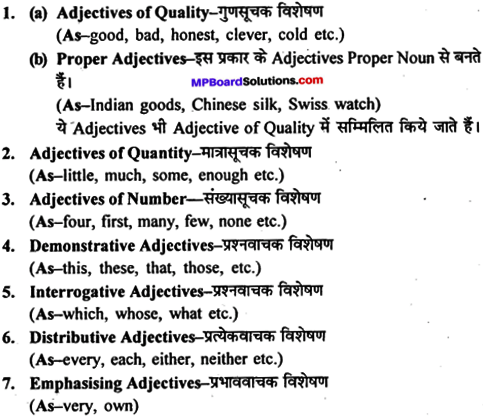
MP Board Class 12th English The Spectrum Workbook Solutions Chapter 18 India through a Traveller’s Eyes

MP Board Solutions for 12th English The Spectrum Workbook Solutions Chapter 18 India through a Traveller’s Eyes Questions and Answers aids you to prepare all the topics in it effectively. You need not worry about the accuracy of the Madhya Pradesh Board Solutions for 12th English as they are given adhering to the latest exam pattern and syllabus guidelines.

You Can Download MP Board Class 12th English Solutions Questions and Answers Notes, Summary, Lessons: Pronunciation, Translation, Word Meanings, Textual Exercises. Enhance your subject knowledge by preparing from the Chapterwise MP Board Solutions for 12th English and clarify your doubts on the corresponding topics.

MP Board Class 12th English The Spectrum Workbook Solutions Chapter 18 India through a Traveller’s Eyes

Kick start your preparation by using our online resource MP Board Solutions for 12th English Chapter 18 India through a Traveller’s Eyes Questions and Answers. You can even download the Madhya Pradesh Board Class 12th English Solutions Questions and Answers for free of cost through the direct links available on our page. Clear your queries and understand the concept behind them in a simple manner. Simply tap on the concept you wish to prepare in the chapter and go through it.

Word Power

A. Find out the difference in the meanings of the following pairs of words, and use them in sentences of your own :

I. accept—He accepted our proposal.
except—Except Ram everyone accepted the proposal.

II. advise—I advised him not to do it.
advice—He did not heed to my advice.

III. affect—The medicine affected adversely,
effect—This medicine has no after effects.

IV. aisle—The aisle of the Church was full of people,
isle—There was a temple on the isle.

V. beside—He sat beside me.
besides—I don’t like that new dictionary besides it is too expensive.

VI. breath—He held his breath
breathe—He breathed his last.

Tick [✓] S for same, O for opposite, and D for different meanings of the following words.
Ans.

I.sweet-sourS✓OD
IIcrazy-insane✓S0D
III.stout-fatS0✓D
IV.big-angryS0✓D
V.danger-peril✓S0D
VI.splendid-magnificent✓S0D
VII.furious-violent✓S0D
VIII.strange-familiars✓OD
IX.growl-weeps✓OD
X.idle-workings✓oD

Comprehension

A. Choose the correct alternative.

Question 1.
What conclusion regarding the skin colour of Caucasiaiban be drawn from the lesson.
(a) They have fair skin
(b) They have creamy skin
(c) The colour of their skin is dark
(d) Their skin has a variety of hues.
Answer:
(d) Their skin has a variety of hues.

Question 2.
Pearl Buck wrote the travelogue :
(a) when India was under the British Raj
(b) when India had just won freedom
(c) when India hosted the non-aligned movement
(d) when India tested its first nuclear device.
Answer:
(b) when India had just won freedom

Question 3.
Pearl Buck had visited India.
(a) when India was under the British Raj
(b) when India had just won freedom
(c) when India hosted the non-aligned movement
(d) when India tested its first nuclear device.
Answer:
(a) when India was under the British Raj

Question 4.
Pearl Buck found the real indictment against British colonialism :
(a) in the villages of India
(b) among thousands of young intellectuals
(c) among the cultured and well educated Indians
(d) in the religions minded Indians.
Answer:
(a) in the villages of India

Question 5.
To the author, the serving of food on banana leaves :
(a) signified in hospitality
(b) symbolized untouchability and caste system
(c) implied cleanliness
(d) indicated devotion.
Answer:
(c) implied cleanliness

B. Fill in the blanks :

1. The author’s friend married a Kashimiri with ……. eyes, (green/blue)
2. The first woman president of the …….. was an Indian. (UN General Assembly/UN Security Council)
3. Only the …… peasant could compare with the Indian village. (Chinese/Russian)
4. The eldest brother lived in a ………. outside the house. (cave/cage)
5. ……….. is ever-present in Indian life. (Religion/Idealism)
Answer:

  1. green
  2. U. N. General Assembly
  3. Russian
  4. Cage
  5. Religion.

Language Practice

A. Correct the following sentences and write them.

Question 1.
I think you should worked harder.
Answer:
I think you should work hard.

Question 2.
Do you can speak English ?
Answer:
Can you speak English ?

Question 3.
Ruby thinks it mays rain later.
Answer:
Ruby thinks it may rain later.

Question 4.
Sami musts go to the dentist soon.
Answer:
Sami must go to the dentist soon.

Question 5.
They maying go to Mandsaur in December.
Answer:
They may go to Mandsaur in December.

Question 6.
Could you lent me your dictionary?
Answer:
Could you lend me your dictionary ?

B. Complete the following dialogue using correct “modal verbs.”
Answer:

  • Shahbaz : If I won the ten million dollar lottery jackpot, I will afford to quit my job and travel the world.
  • Samarth : Where can you go if you had that much money?
  • Shahbaz : I don’t know, I may choose to spend a year in London or perhaps I may go to America.
  • Samarth : How often do you buy lottery tickets ?
  • Shahbaz : Never, I guess if I want to win the lottery, I will try buying some tickets.
  • Samarth : That won’t help.

C. Rewrite the following sentences using ‘can’, or ‘could’.

Question 1.
Sami is able to drive a car.
Answer:
Sami can drive a car.

Question 2.
I was able to attend the meeting yesterday as I took the evening train to Bhopal.
Answer:
I could attend the meeting yesterday as I took the evening train to Bhopal.

Question 3.
He is able to walk 15 kilometers every day.
Answer:
He can walk 15 kilometers every day.

Question 4.
My brother was not able to swim.
Answer:
My brother could not swim.

Question 5.
We were not able to operate this machine when we were young.
Answer:
We could not operate this machine when we were young.

D. Rewrite the following sentences as a request or as a suggestion with the help of the modal verb given in the brackets.

Question 1.
You may show me that photograph. (a request, with ‘would’)
Answer:
Would you show me that photograph ?

Question 2.
I want the salt, please. (a request with ‘could’)
Answer:
Could give me the salt ?

Language Practice

A. Correct the following sentences and write them.

Question 1.
I think you should worked harder.
Answer:
I think you should work hard.

Question 2.
Do you can speak English ?
Answer:
Can you speak English ?

Question 3.
Ruby thinks it mays rain later.
Answer:
Ruby thinks it may rain later.

Question 4.
Sami musts go to the dentist soon.
Answer:
Sami must go to the dentist soon.

Question 5.
They maying go to Mandsaur in December.
Answer:
They may go to Mandsaur in December.

Question 6.
Could you lent me your dictionary?
Answer:
Could you lend me your dictionary ?

B. Complete the following dialogue using correct “modal verbs.”
Answer:

  • Shahbaz : If I won the ten million dollar lottery jackpot, I will afford to quit my job and travel the world.
  • Samarth : Where can you go if you had that much money?
  • Shahbaz : I don’t know, I may choose to spend a year in London or perhaps I may go to America.
  • Samarth : How often do you buy lottery tickets ?
  • Shahbaz : Never, I guess if I want to win the lottery, I will try buying some tickets.
  • Samarth : That won’t help.

C. Rewrite the following sentences using ‘can’, or ‘could’.

Question 1.
Sami is able to drive a car.
Answer:
Sami can drive a car.

Question 2.
I was able to attend the meeting yesterday as I took the evening train to Bhopal.
Answer:
I could attend the meeting yesterday as I took the evening train to Bhopal.

Question 3.
He is able to walk 15 kilometers every day.
Answer:
He can walk 15 kilometers every day.

Question 4.
My brother was not able to swim.
Ans.
My brother could not swim.

Question 5.
We were not able to operate this machine when we were young.
Answer:
We could not operate this machine when we were young.

D. Rewrite the following sentences as a request or as a suggestion with the help of the modal verb given in the brackets.

Question 1.
You may show me that photograph. (a request, with ‘would’)
Answer:
Would you show me that photograph ?

Question 2.
I want the salt, please. (a request with ‘could’)
Answer:
Could give me the salt ?

Question 3.
You walk down to the market. (a suggestion with ‘could’)
Answer:
You could you walk down to the market.

Question 4.
You lend me your pen please. (a request wit&’could’)
Answer:
Could you lend me your pen ?

Question 5.
We may have coffee now. (a suggestion with ‘shall’)
Answer:
Shall we have coffee now ?

Question 6.
You may switch on the light please. (a request with ‘will’)
Answer:
Will you please switch on the light ?

Rewrite the following sentences using may/might/could 4- have + past participle

Question 1.
Perhaps she watched T. V. yesterday.
Answer:
She might have watched T. V. yesterday.

Question 2.
It is possible they reached the station late.
Answer:
They may have reached the station late.

Question 3.
Perhaps they had an accident.
Answer:
They might have had an accident.

Question 4.
It is possible he missed the bus.
Answer:
He may have missed the bus.

Complete the sentence using might not have + participle or could not have + past participle.

Question 1.
A : Don’t you think she saw you ?
B : No she was too far away. She might not have seen me.

Question 2.
A : I wonder why she did not say hello. Perhaps she did not see me.
B : That’s possible. She could not have seen me.

Question 3.
A : I wonder why Nasim did not come to the party. Perhaps she wasn’t invited.
B : Yes it is possible. She might not have been invited.

Question 4.
A : I wonder how the fire started. Do you think it was an accident?
B : No the police say it might not have been an accident.

Question 5.
A : How did the fire started. I suppose it was an accident.
B : Well, the police aren’t sure. They say it could not have been an accident.

Speaking Time

Each of the following sentences will be read twice. Listen carefully and mark them with the correct stress and intonation.
Answer:

  • It’s ‘time the ‘children ‘went to ‘bed.
  • Can you ‘buy me a ‘second ‘copy ?
  • I ‘think it’s quite ‘fair, on the ‘whole.
  • Will you be ‘staying there ‘long ? ,
  • if it’s ‘all the ‘same to you I’d rather ‘walk.

Reading Time

Read the following passage carefully :

Chitrakoot, ‘the hill of many wonders,’ nestles peacefully in the northern spurs of the Vindhyas, a place of tranquil forest glades and quiet rivers and streams where calm and repose are all pervading. This loveliest of nature’s gifts is also hallowed ground, blessed by the gods and sanctified by the faith of pilgrims.

For Chitrakoot’s spiritual legacy stretches back to legendary ages : it was in these deep forests that Rama and Sita spent eleven of their fourteen years of exile; here the great sage Atri and Sati Anusuya meditated; and here where the principal trinity of the Hindu pantheon, Brahma, Vishnu and Mahesh, took their incarnations.

Sufferers and seekers, poets and visionaries, princes and noblemen have, through the ages, sought and found solace in Chitrakoot, drawn inspiration from its sublime natural beauty, gained spiritual strength from its serene temple and in turn, become part of the hallowed legend that is Chitrakoot.

Places to see

  • Ramghat : With the very first rays of dawn that gleam upon the river, Ramghat stirs into life as the devout of all ages take the ritual, purifying dip in the waters and invoke the blessings of the gods.
  • Kamadgiri : Kamadgiri the original Chitrakoot, is venerated today as the holy embodiment of Rama.
  • Janki Kund : It is said that Sita would bathe in this kund during the years of her exile with Rama.
  • Sati Anusuya : It was here that Atri Muni, his wife Anusuya, and their three sons are said to have meditated.

Some other places like Sphatic Shila, Gupt-Godavari, Hanuman Dhara, Bharat koop, etc., have not only their religious significance but they are the places of natural beauty as well.

How to Reach

  • By Air : The nearest airport is at Khajuraho (175 km), connected with Delhi, Agra and Varanasi.
  • By Rail: The nearest railhead is at Chitrakoot Dham (11 km) on the Jhansi-Manikpur main line.
  • By Road : Regular bus services connect Chitrakoot with Jhansi, Mahoba, Chitrakoot Dham, Harpalpur, Satna and Chhatarpur.

Best Season : Best season to visit Chitrakoot is considered October to March.

Now answer the questions given below :

Question 1.
Find out the words from the passage for the following expressions :
Answer:

  • quiet and peaceful — tranquil
  • holy — sanctified
  • away from home — exile
  • a group of three — glades
  • all the gods — trinity

Question 2.
Where is Chitrakoot situated ? (2015) How can we reach Chitrakoot ? Mention all the three ways. (2011,15)
Answer:
Chitrakoot is situated in the northern spurs of the VindyasfVe can reach Chitrakoot in the following three ways :

  • By Air : The nearest airport is at Khajuraho (175 km), connected with Delhi, Agra and Varanasi.
  • By Rail: The nearest railhead is at Chitrakoot Dham (11 km) on the Jhansi-Manikpur main line.
  • By Road : Regular bus services connect Chitrakoot with Jhansi, Mahoba, Chitrakoot Dham, Harpalpur, Satna and Chhatarpur.

Question 3.
Why does the author describe Chitrakoot as ‘the loveliest of Nature’s gift’ ?
Answer:
It is described as the loveliest of Nature’s gift because, one can enjoy here both the beauty of nature and holiness of the place.

Question 4.
Who are considered as Trinity of the Hindu pantheon ?
Answer:
Brahma, Vishnu and Mahesh are considered as Trinity of the Hindu pantheon.

Question 5.
How do people get inspired from Chitrakoot ?
Answer:
They get inspired from Chitrakoot’s sublime natural beauty.

Question 6.
What do you understand by ‘Purifying dip’ in water ?
Answer:
After taking bath in the river people consider that their life has become pure. All their sins have been washed away. This means ‘purifying dip’ in water.

Question 7.
How far is Chitrakoot from Chitrakoot Dham ?
Answer:
It is 11 km far from Chitrakoot Dham.

Question 8.
Mention the best time to visit Chitrakoot. (2011)
Answer:
The best time to visit Chitrakoot is from October to March.

Question 9.
Give a suitable title to the passage.
Ans.
Chitrakoot: The Hill of Many Wonders.

Writing Time

Write an essay in 300 words on any one of the following topics :
1. Pollution problem
2. Importance of Games and Sports
3. Corruption in every day life.
Answer:
1. Pollution Problem
The thin cover of air and water that surrounds earth protects and keeps life. It is known as biosphere. It contains oxygen, nitrogen, carbon dioxide, water-vapour etc. The green plants produce oxygen and supply us fresh air. Pure water is also supplied by nature that we require most.

Man has made a great progress with the help of science for supplying him several necessary things. He thinks that the sort of progress he is making is an unmixed blessing. He has seldom thought that the air, the water or the food could end. He has little thought that the progress of science and technology is seriously disturbing the life-system balance. It would lead to the breakdown of the life supporting system on the earth.

Nature has been suffering for the past several hundred years. Now, the problem has become serious. The great technological break-through arc doing a great damage to the environment. The highly developed countries were the first to experience the environmental diseases. The increased industrial activity has brought along air, water and noise pollution. These pollution’s are making living difficult and resulting into poor health and several diseases. These are also having negative influence on the working capacity of men in general.

One of the chief air pollutants is smoke from our factories and is harmful for our lungs. The ever rising number of vehicles spreading foul smoke is also polluting the air. Human waste, animal bathing, industry waste etc., are polluting water. Even major rivers have become very much polluted. Loud horns, loud-speakers, musical systems etc., are creating noise pollution. It is disturbing the peace of mind of men. Atomic tests are also polluting the atmosphere.

If we have not checked these pollution, it would become impossible for people to survive. The factories and mills must be erected outside the cities. Vehicles should be tuned to produce less smoke. Dirty things should not be allowed to mix in water. The vehicles should be compelled to produce little sound and there should be complete ban on nuclear tests.

The anti-pollution laws are being made. Our government and people have become aware of the problem. We must fully co-operate in making our environment neat and clean.

2. Importance of Games and Sports
“He who has health has hope, and. he who has hope has everything.” —Arabian Proverb

Games and sports are an important part of education. They help in the development of the physique and mind of the student. A sound body possesses a sound mind. If we are weak and sick we cannot have a fertile brain. Games and sports keep us healthy. They keep us active, make us smart.

Gandhiji said, “Physical training should have as much place in curriculum as mental training” Mere bookish knowledge would not lead to proper development of a personality. All work and no play makes Jack a dull boy. Mere studies would not suffice. Similarly mere sports won’t do. The two should be blended in a suitable proportion so that the students can have the best of them. They should not only develop the mind but also the body. Both are essential for a wholesome personality.

Games and sports do not merely keep us healthy and physically fit, they also inculcate in young people the duty of loyalty. These qualities can be summed up in a word ‘sportsmanship’. The first and the foremost thing that games teach us is to take victory and defeat alike. In every game, there are two parties. One wins and the other loses. The winners need not be over-zealous and the loser ones should not get asperated. Both the parties should greet each other heartily after the game.

Secondly, games and sports teach us discipline. Every player must obey his or her captain. He has to play obeying all the rules of the games. He has also to abide by the decision of the referee or umpire. Thirdly, games broaden our outlook. The players ought not to differentiate between one another on the basis of nationality, caste, creed or colour. The games promote international brotherhood and affection amongst the people of the world. Thus, they promote world peace too. The Reliance Cup 1987 organised jointly by Pakistan and India is an example.

Games are beneficial not only to players; they are equally beneficial to the public at large. When a match is being played, spectators also enjoy it. They become one with the game and in a way take active part in it. Besides enjoying the game, they learn many things from them. Radio and T.V. have increased the number of people taking interest in games. Now-a-days, people in any part of the world can enjoy listening to running commentaries of matches on radio or watching them on the Television.

Games and sports have great value in student’s life. The foundation for a virtuous life is laid in school. If at an early age a student develops the taste for studies and sports in a proper way, he can become an ideal citizen in his later life. The sports arena teaches many things to the students. It gives him discipline. It develops his sportsman spirit, mental outlook, cheerful nature, sense of humour and strong physique—all these are important traits of a successful life. If a student studies seriously and diligently and still takes part in sports and games he would make an ideal personality.

3. Corruption in Everyday Life

Corruption has become a way of life in India. It has entrenched itself deeply in the social, political, economic and religious life of the nation. To be true, right from the Prime Minister down to the ordinary clerk in the office, no one is free from the suspicion of being a corrupt person. Criminalisation of social and political life has only sanctified corruption in every walk of life. Rajiv Gandhi’s government was bundled out because of Before deal. Narsimha Rao has been implicated in a number of cases by the CBI. It seems corruption has percolated from the top to the bottom. In India, a parallel economy of black money operates. It is controlled and regulated by the dons of the underworld.

Simple living and high thinking used to be the high ideals of our leaders during the struggle for independence. But now the priorities have changed. Moreover, the greed for wealth, has corrupted their minds and morals. Top posts and jobs can be bought. The members of the State Legislatures and the Parliament are vulnerable to corrupt practices and bribery. Even the security of the nation is compromised by the self ‘ serving politicians and their agents and power-brokers. The need of the hour is an inspiring leadership equipped with a firm political will to fight out the growing cancer of corruption.

We believe the information shared regarding MP Board Solutions for 12th English Chapter 18 India through a Traveller’s Eyes Questions and Answers as far as our knowledge is concerned is true and reliable. In case of any queries or suggestions do leave us your feedback and our team will guide you at the soonest possibility. Bookmark our site to avail latest updates on several state board Solutions at your fingertips.