MP Board Class 8th Social Science Solutions Chapter 2 Administrative Structure, Policies and Impact of British Rule

MP Board Class 8th Social Science Solutions Chapter 2 Administrative Structure, Policies and Impact of British Rule

MP Board Class 8th Social Science Chapter 2 Text Book Exercise

Choose the correct option of the following questions

Mp Board Class 8 Social Science Solution Chapter 2 Question 1.
When was the Regulating Act passed in British Parliament?
(a) 1750
(b) 1773
(c) 1857
(d) 1940
Answer:
(b) 1773

Mp Board Class 8 Social Science Chapter 2 Question 2.
When was the Asiatic Society of Bengal founded?
(a) 1784
(b) 1790
(c) 1801
(d) 1901
Answer:
(a) 1784

Social Science Class 8 Mp Board English Medium Solution Question 3.
Who introduced Permanent settlement in 1793?
(a) William Pitt
(b) Lord Clive
(c) Warren Hastings
(d) Lord Cornwallis
Answer:
(d) Lord Cornwallis

Mp Board 8th Class Social Science Solutions Question 4.
Which Act was passed in 1813
(a) Charter Act
(b) Pitt’s India Act
(c) Regulating Act
(d) Civil Service Act
Answer:
(a) Charter Act

Fill in the blanks:

  1. Clive left Nizamat work to ………….
  2. In 1772 ……….. was appointed Governor of Bengal.
  3.  ………… introduced civil service in India.
  4. Ryotwari system was first launched at ………….
  5. ………… introduced modem post and telegraph system.

Answers:

  1. Nawab of Bengal Najmudaulah
  2. Warren Hastings
  3. Lord Coma – wallis
  4. Madras and Bombay
  5. Lord Dalhousie.

MP Board Class 8th Social Science Chapter 2 Very Short Answer Type Questions

Mp Board Class 8th Social Science Solution Question 1.
Who was appointed by the company to collect land revenue?
Answer:
Zamindars.

Class 8 Social Science Chapter 2 Mp Board Question 2.
Which book contains the reforms of Cornawallis?
Answer:
The book Cornwallis’s Code reforms of Cornawallis.

Mp Board Class 8th Social Science Chapter 2 Question 3.
Under which system peasant lost right over the land?
Answer:
Ryotwari System.

MP Board Class 8th Social Science Chapter 2 Short Answer Type Questions

Mp Board Class 8th Social Science Solution English Medium Question 1.
what was of impact of the dual rule on the people of Bangal ?
answer:
dual rule give the power of Bengal in company ‘s hands but it was free from liabilities. Nawab of Bengal had the reign but he lacked power and wealth. The company had no responsibility of security and governance despite having control over treasury and army. The dual mle in Bengal damaged agriculture, industry and trade of the Bengal.

Mp Board Solution Class 8 Social Science Question 2.
What were the main aims of Regulating Act?
Answer:
The British Govt, passed the Regulating Act in 1773.
The two main aims of Regulating Act were:

  • To remove the drawbacks in the governing body of company.
  • To rectify the causes of company’s misgovernance in India.

Class 8th Social Science Solution Mp Board Question 3.
What were the main characteristics of Pitt’s India Act?
Answer:
The main characteristics of Pitt’s India Act of 1784 were:

  • A Board of control for India was set up in Britain through which the British government controlled the company’s civil, military and revenue affairs in India.
  • The company retained the power to appoint and dismiss its officials.
  • The Governor General became the commander in chief of all the British.

MP Board Class 8th Social Science Chapter 2 Long Answer Type Questions

Mp Board Class 8 Social Science Solution In English Question 1.
Elaborate how economic policy of British rule affected Indian Industries?
Answer:
The indigenous industries were affected to a great extent by the industrial policy of the British Government:
1. The British officials did not patronize the Indian goods.

2. By the end of the seventeenth century the demand for Indian cotton goods in England was very high. This crippled the native textile industry in Britain. Hence, there British government passed a law in Britain in the year 1700 and 1720 A.D. prohibiting the entry of the Indian textile products.

These restrictions naturally affected the Indian textile products very adversely. Restrictions were imposed on the entiy of Indian textile products by laws passed in Britain 1700 and 1720 A.D. Steps were taken in India and in Britain to serve the interest of the British traders and manufactures at the cost of the Indian industries.

3. The company’s agents in India forced the producers of cotton, cloth and other commodities to change for their goods 20 to 40 per cent less than the marked price. The workers were also forced to work for company under their term and conditions.

4. They manipulated the prices of raw cotton. This almost wiped out the cotton textile industry in India.

5. The British goods coming to India were exempted from duties, but the Indian exports to Britain were subjected to high import duty. The free trade policy proved ruinous to Indian industries.

Class 8 Social Science Chapter 2 Question 2.
What do you mean by permanent settlement?
Answer:
Through the system of the permanent settlement as introduced in Bengal, Bihar and Orissa, the government gave the right to collect revenue to Zamindars. The person giving the highest bid was given the right to collect revenue. He would be a middle man between the Government and the peasants. He was free to collect as much as he could from the peasants but was required to pay to government an amount already fixed. Thus the permanent settlement benefited the landlords more than the government.

Mp Board Class 8 Social Science Question 3.
Which were the evils prevalent in Indian Society in the 18th century and what efforts were made by the Government to eradicate them?
Answer:
Many degrading and inhuman customs and practices had grown in the Indian society during the British rule. The victims of these customs were children, females and people belonging to the low-castes. Female infanticide was one great evil; Sati was another. One of the customs was the throwing away of the infant boys and girls to honor religious vows.

The women, particularly the widows, have live a miserable life. In Bengal alone, as many as 8134 cases of Sati were recorded from 1815 to 1828. The British reformers took up measures to eradicate the evils of the society. The government passed several regulations to stop these evils. The government banned the Sati system and passed a law in 1843 which made slavery illegal.

Question 4.
What were the education reforms by British Govt, and its results?
Answer:
The British government started modem education for Indian at their own level. In 1835, the government decided to impart European Literature and Scientific education to Indians. Under this scheme, English became the medium of instructions in some schools started by the government slowly education spread in India and Universities were established at Calcutta, Bombay, Madras.

As a result of this many English educated Indian got jobs in the company. the Indians got the knowledge of science and technology political affairs and economic issued they were now aware about their right and privileges.
MP Board Class 8th Social Science Solutions

MP Board Class 8th Social Science Solutions Chapter 14 North America-Economic Features

MP Board Class 8th Social Science Solutions Chapter 14 North America-Economic Features

MP Board Class 8th Social Science Chapter 14 Text Book Exercise

Choose the correct option of the following Questions

Mp Board Class 8 Social Science Solution Chapter 14 Question 1.
For which crop the plain of Prairies are called the bucket of breads
(a) Rice
(b) Maize
(c) Wheat
(d) Barley
Answer:
(c) Wheat

Mp Board Class 8 Social Science Chapter 14 Question 2.
Which of the following is known for car industry?
(a) Chicago
(b) Detroit
(c) Pittsburgh
(d) New York
Answer:
(b) Detroit

Fill in the blanks:

  1. The fishes are found in plenty near the ………… is land.
  2. ……………. is called the city of oven.
  3. ………….. is known for thickly Spanish language speaking population of the world.

Answer:

  1. New Found land
  2. Pittsburgh
  3. Mexico City.

MP Board Class 8th Social Science Chapter 14 Very Short Answer Type Questions

North America Economic Features Class 8 Mp Board Question 1.
Which Industries are forest based in Canada?
Answer:
Paper, pulp, furniture, Samuoor industries are forest based in Canada.

Class 8 Social Science Chapter 14 Mp Board Question 2.
Write names of three crops belt in North America?
Answer:

  1. Wheat is chief crop of North America – Prairie regions are called bucket of bread due to the immense production of wheat in Prairie.
  2. Maize – It is a staple crop of Mexico while in the United States, much of the Maize produced is used for feeding pigs and cattle. Maize is chiefly produced in the Central part of U.S. and Mexico. Having immense production the Central part of US is called the belt of Maize.
  3. Barley – It is produced highly in Canada.

Class 8 Social Science Chapter 14 Question Answer Mp Board Question 3.
Which part in North America is thickly populated?
Answer:
The most thickly populated parts of North America are on the north-eastern Coastal lands and the areas around the Green lakes. Most of the big cities are located in these areas.

Question 4.
Why Cuba is called the home of Sugar?
Answer:
Sugar industry is highly developed in Cuba so it is called the home of Sugar.

MP Board Class 8th Social Science Chapter 14 Short Answer Type Questions

Question 1.
Write names of three major rail routes with starting station and end point.
Answer:
The three major rail routes are:

  • Canadian Pacific Rail – Heli fax to Vancouver.
  • Union and Central Pacific Rail – New York to San Francisco.
  • South Pacific Rail – New York to Los Angeles.

Question 2.
Write major industries of Canada with their centers?
Answer:
Paper, pulp, furniture, Samicoor, the dairy industry and meat industry are highly developed here. Industries in Canada are in the most eastern part. Ottawa (Capital of Canada) Montreal, Vancouver, Winnipeg, Toronto, St. Johns are major industrial cities.

Question 3.
Write the names of major industries of U.S.A. with their centers?
Answer:
The iron-steel, cloths, paper, machines, chemicals metal melting, meat, motor cars, shipping, aeroplane, arms are the major industries of U.S.A. New York, Philadelphia, Boston, Chicago, Los Angeles, Cans-sap City, Portland, San Francisco city are major industrial centers of U.S.A. The Grand Bank near the coast of New Found land is famous for fishing. The world famous Hollywood film city is in Los Angeles. Detroit is famous for car industry.

Question 4.
What are the modes of transportation in North America? How long their expanse is:
Answer:
North America has a very well – developed transportation system. It possesses a dense network of roads and railways. Coastal and inland Water- ways continue to be the bulk carriers. Four vehicles run simultaneously in one direction. Cars are most popular mode of transport here. North America has an extensive and efficient network of railways. There are three inter-continental rail routes.

  • Canadian-Pacific Rail – Halifax to Vancouver
    Union and Central Pacific Rail – New York to San Francisco
    South Pacific Rail – New York to Los Angeles. Chicago is the biggest Railway Junction of the world.

Airways:
The inland and international airways has been – highly developed. New York, San Francisco, Chicago, Washington, Ottawa, Mexico etc. are important international airports. Waterways: Five Lakes, St. Lawrence and Mississippi rivers has sufficient facilities of waterways in coastal regions. On the east coast Boston, New York, Philadelphia, New Orleans and on the west coast Vancouver, San Francisco, Los Angeles etc. are important international harbors.

MP Board Class 8th Social Science Chapter 14 Long Answer Type Questions

Question 1.
What are the causes of agricultural progress in North-America?
Answer:
North America is very rich in agricultural production. This is mainly because the continent is vast and possesses very fertile plains, suitable climate and sufficient water is available for irrigation. Crops are two types:

  • Food grains such as wheat, maize, barley, rice and millet.
  • Cash crops cotton, sugarcane, tobacco, so yabean, groundnut, Chukandar and fruits.

Extensive Prairies grasslands in the central and the river valleys are suitable for farming. Extensive agriculture is the chief farming practice. There are big fields and big machines are used for farming. New scientific techniques is used for farming. Use of fertilizers and latest quality seeds are the causes of agricultural progress in North America.

Question 2.
Write the reasons why there are thick population in the eastern part of North America?
Answer:
The total population of North America is 51 crore 40 lakhs. The density of population is 21 person per square kilometers. The distribution of population is not even everywhere. The most thickly populated parts of North America are on the north – eastern coastal lands and the areas around the Great Lakes. Most of the big cities of the continent are located in these areas. This region enjoys the moist cool climate and has adequate power resources and many industries.

Question 3.
The natural resources have made North America rich. Mention it with reason.
Answer:
At present North America is most prosperous and very highly industrialized continent in the world. Being a developed continent it has economic links with most of countries in the world. The economic condition is very strong. It is also very advanced continent in industries also.

This is mainly because of its vast natural resources and high level of technology to use them. The fertile plains, extensive grasslands, broad belts of forests, extensive fishing grounds around its coasts and minerals are the valuable natural resources of North America.

Main Economic resources of North America are:

  • Agricultural Resources
  • Forest Resources
  • Mineral and Energy Resources
  • Fishery Resources
  • Industry and transport
  • Population.

These resources made North America very rich.

Question 4.
Why North America is so advance continent?
Answer:
The reasons of being North America an advanced continent are as follows:
It has extensive natural resources. It has fertile land which is a source of rich crops. It has immense mineral wealth. Its industries are highly advance. Means of transport are unique in the world. It has economic relations with most of the countries of the world. It has atomic power and well trained forces also. So we can say that North America is a advance and developed continent.

Project Work
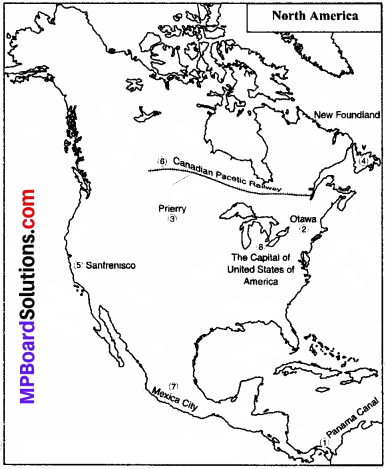
In the outline map of North America show the following

  1. Panama Canal
  2.  Ottawa
  3.  Prierry,
  4. New found land
  5. Sanfrenisco
  6.  Canadian Pacific Railway
  7. Mexico City
  8. The capital of United States of America.

Answer:

MP Board Class 8th Social Science Solutions Chapter 14 North America-Economic Features img 1

MP Board Class 8th Social Science Solutions

MP Board Class 8th Social Science Solutions Chapter 9 Religious, Social Reform Movements and Cultural Awakening

MP Board Class 8th Social Science Solutions Chapter 9 Religious, Social Reform Movements and Cultural Awakening

MP Board Class 8th Social Science Chapter 9 Text Book Exercise

Choose the correct option of the following.

Mp Board Class 8 Social Science Solution Chapter 9 Question 1.
Who founded Bramho Samaj in 1828?
(a) Ishwarchandra Vidyasagar
(b) Swami Dyanand Saraswati
(c) Raja Ram Mohan Roy
(d) Keshava Chandra
Answer:
(c) Raja Ram Mohan Roy

Describe The Sikh Movement Class 8 Mp Board Question 2.
When and by whom was the Prarthana Samaj founded?
(a) Mahadev Govind Ranade in 1867
(b) Svyami Dyanand Saraswati in 1875
(c) Swami Vivekanand in 1897
(d) Madam Blatwaski in 1882
Answer:
(a) Mahadev Govind Ranade in 1867

Mp Board Class 8 Social Science Chapter 9  Question 3.
Who founded the Mohammad an Anglo Oriental College?
(a) Nawab Abdul Latif
(b) Sharimtullah
(c) Iqbal
(d) Sir Syed Ahmed Khan
Answer:
(d) Sir Syed Ahmed Khan

Class 8 Social Science Chapter 9 Mp Board Question 4.
Who composed the song ‘Vande Matram’
(a) Rabindra Nath Tagore
(b) Swami Vivekanand
(c) Bankimchandra Chattopadhyay
(d) Swami Dayanand Saraswati
Answer:
(c) Bankimchandra Chattopadhyay

Fill in the blanks:

  1. In 1829 Lord William Bentick with the help of Raja Ram Mohan Roy passed Act against …………….. system.
  2. In the year …………… Deccan Education Society was founded by Mahadev Govind Ranade.
  3. Jyotiba Phule worked for the growth of …………..
  4. Swami Dayanand Saraswati published the book ……………
  5. Ramkrishan Mission was founded by ……………..

Answer:

  1. Sati
  2. 1884
  3. Dalits
  4. Satya Prakash
  5. Swami Vivekanand.

MP Board Class 8th Social Science Chapter 9 Very Short Answer Type Questions

Class 8 Social Science Chapter 9 Mp Board Question 1.
Which university was founded by Pandit Madan Mohan Malviya in Varanasi?
Answer:
Banaras Hindu University.

Mp Board Class 8 Science Chapter 9 Question 2.
Which topmost award did Rabindra Nath Tagore received in 1913?
Answer:
He was conferred with Nobel prize for Literature.

Chapter 9 Social Science Class 8 Mp Board Question 3.
What was childhood name of Swami Vivekananda?
Answer:
Narendra Nath.

MP Board Class 8th Social Science Chapter 9 Short Answer Type Questions

Class 8 Social Science Chapter 9 Question Answer Mp Board Question 1.
Mention two works taken by Raja Ram Mohan Roy for social up lift ment?
Answer:
Raja Ram Mohan Roy was against the Sati & Caste system. He favored Widow re-marriage and education to all.

Mp Board Class 8 Chapter 9 Question 2.
Write three important works done for the society and the culture by Arya Samaj?
Answer:
Arya samaj opposed the existing caste system, it advocated equal rights for all citizens and opposed child marriage and
encouraged widow marriage.

8th Class Samaj Question Answer Mp Board Question 3.
What was the objective of Vivekananda to form the Rama Krishna Mission?
Answer:
The main aim of mission was to link Indian nationalism to spiritualism and serve the society.

Class 8 Chapter 9 Social Science Mp Board Question 4.
Mention two works done by Jyotiba Phule for the interests of Dalits.
Answer:
Jyotiba Phule opposed untouchability and supported widow remarriage. He had started a school for Dalits.

Mp Board Class 8 Social Science Solution Chapter 8 Question 5.
Write two important works done by Annie Besant for the society?
Answer:
She made great efforts towards women education, opposed child marriage and caste system.

MP Board Class 8th Social Science Chapter 9 Long Answer Type Questions

Social Science Class 8 Chapter 9 Mp Board Question 1.
Describe the works taken by Sir Syed Ahmed Khan for the Muslim social reform movement?
Answer:
The contribution of Syed Ahmed Khan to the spread of education and the awakening of the Muslims was very significant. Syed Ahmed Khan was concerned over the depressed condition of the Muslims and wanted to free them from the chains of backwardness. He was a staunch supporter of Hindu – Muslim Unity. He regarded Hindu, Muslim, Christians of India as one Quami. He declared that “this Quam should act for the common good of the country which is good for all of them.”

He strove hard to remove the hostility of British rulers towards the Muslim and to persuade the Muslims to accept the religious and educational reforms. In the field of education, he advocated English education for the regeneration of Muslims in India. In 1864 he founded the Translation Society which was later renamed the Scientific Society which published Urdu translation of English books on scientific subjects.

His greatest achievements was the establishment of Mohammedan. Anglo-Oriented College at Aligarh in 1875. The Mohammedan Anglo – Oriented College which later became the Aligarh Muslim University fostered a modern outlook among the students and played an important role in the awakening of the Muslims in India.

Question 2.
Describe about sikh movement?
Answer:
The main activities of the reform movements among the Sikhs can be stated as under:

  • The Singh Sabhas attempted to set up educational institutions. Khalsa College was established in Amritsar in 1892. Likewise, Khalsa Colleges and schools were opened.
  • Gurumukhi because the language for transmitting ideas.
  • There began reform movements in the Gurudwaras. Earlier the Gurudwaras were under the control of the Mahants. The movement was launched to bring them under the control of the Sikh community. Consequently, the Gurudwaras came to be controlled by the Managing Committees.

Question 3.
What were the impacts of 19th century social and religious movements over the Indian society?
Answer:
The religious and social reforms started in 19th century had a positive change in every section of Indian society like education, culture, politics, social and religion. The salient features were:

  • There was thrust towards and modern 1 education, science and literature.
  • Many schools and colleges were started in India.
  • The status of women improved. The evil practices of sati, child marriage and purdha system were on verge to be abolished.
  • There was feeling of freedom and nationalism.
  • These reforms brought a new awakening in India and cultural feeling got boost.

Question 4.
Write in detail about the growth in the field of science in 19th century?
Answer:
The introduction of modern science in India began in the early 19th century. Since then, thing moved quickly. The major landmarks in the growth of modern science in India are:

  • Setting up the Department of Science in the universities.
  • Founding the Indian Association for the cultivation of science in 1876.
  • Setting up of Indian Science Congress Association, 1920.

Many reformers were of the view that the major cause of the backwardness of India was neglect of science hence more stress was given in 19th Century towards teaching of Science. India produced a large number of Scientists who won international fame. These included P.C. Ray, J.C. Bose, C.V. Raman, Satyen Bose, Meghnad Saha, D.N. Wadia and Birbal Sahni, C.V. Raman was awarded Nobel Prize for the Physics in 1930.

MP Board Class 8th Social Science Solutions

MP Board Class 8th Sanskrit Solutions Chapter 4 नीतिश्लोकाः

MP Board Class 8th Sanskrit Solutions Surbhi Chapter 4 नीतिश्लोकाः

MP Board Class 8th Sanskrit Chapter 4 अभ्यासः

Mp Board Class 8 Sanskrit Solution Chapter 4 प्रश्न 1.
एकपदेन उत्तरं लिखत(एक शब्द में उत्तर लिखो-)
(क) भार्या कीदृशी भवेत्? (पत्नी कैसी होनी चाहिए?)
उत्तर:
प्रियवादिनी। (प्रिय बोलने वाली)

(ख) विद्या कीदृशी भवेत्? (विद्या कैसी होनी चाहिए?)
उत्तर :
अर्थकरी। (धन का संग्रह कराने वाली)

(ग) युक्तं नीचस्य किं भवति? (उचित असमर्थ के लिए क्या हो जाता है?)
उत्तर:
दूषणम्। (अनुचित)

(घ) मनुष्यः मृत्यु कथम् आपद्यते? (मनुष्य मृत्यु कैसे प्राप्त करता है?)
उत्तर:
मोहात्। (मोह से)

(ङ) मित्रं कदा जानीयात्? (मित्र को कब जानना चाहिए?)
उत्तर:
आपत्सु। (आपत्तियों में)

Mp Board Class 8 Sanskrit Chapter 4 प्रश्न 2.
एकवाक्येन उत्तरं लिखत(एक वाक्य में उत्तर लिखो-)
(क) अजीर्णे विषं किम्? (अपच में विष क्या है?)
उत्तर:
अजीर्णे भोजनं विषम्। (अपच में भोजन विष है।)

(ख) दारिद्रयं कुत्र नास्ति? (दरिद्रता कहाँ नहीं है?)
उत्तर:
दारिद्रयं उद्योगे नास्ति। (दरिद्रता परिश्रम में नहीं है।)

(ग) मानवः नित्यं किं विचिन्तयेत्? (मनुष्य को सदा क्या सोचना चाहिए?)
उत्तर:
मानवः नित्यं मे किं छिद्रं को सङ्गो किम् अविनिपातितम् कुतः दोषः ममाश्रयेद् इति विचिन्तयेत्। (मनुष्य को सदा मुझमें क्या बुराई है, क्या आसक्ति है, वह कौन-सी वस्तु है जो पतनशील नहीं है। मुझमें दोष कहाँ से आते हैं, यह सोचना चाहिए।)

(घ) गुणेषु कः करणीयः करणीयम्? (गुणों के उपार्जन हेतु क्या करना चाहिए?)
उत्तर:
गुणेषु यत्नः करणीयः। (गुणों के उपार्जन हेतु प्रयास करना चाहिए।)

(ङ) अनभ्यासे किं विषम्? (अभ्यास न करने पर क्या विष है?)
उत्तर:
अनभ्यासे शास्त्रम् विषम्। (अभ्यास न करने पर शास्त्र विष है।)

Class 8 Sanskrit Chapter 4 Mp Board प्रश्न 3.
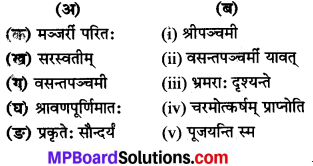
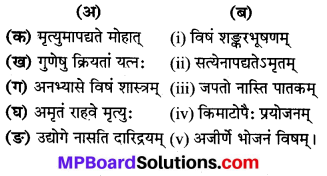
श्लोकांशान् यथायोग्यं योजयत(श्लोक के अंशों को ठीक-ठीक जोड़ो-)
Mp Board Class 8 Sanskrit Solution Chapter 4
उत्तर:
(क) → (ii)
(ख) → (iv)
(ग) → (v)
(घ) → (i)
(ङ) → (iii)

नीति श्लोक In Sanskrit Class 8 MP Board प्रश्न 4.
शुद्धवाक्यानां समक्षम् ‘आम्’ अशुद्धवाक्यानां। समक्षं’न’ इति लिखत
(शुद्ध वाक्यों के सामने ‘आम्’ (हाँ) तथा अशुद्ध वाक्यों के सामने ‘न’ (नहीं) लिखो-)
(क) नित्यम् अर्थागमः अरोगिता च इति द्वयं भवेत्।
(ख) अमृतं विषं च द्वयं देहे प्रतिष्ठितम्।
(ग) उद्योगे दारिद्र्यम् अस्ति।
(घ) व्यसनेषु बान्धवान् जानीयात्।
(ङ) सत्येन अमृतम् आपद्यते।
उत्तर:
(क) आम्
(ख) आम्
(ग) न
(घ) आम्
(ङ) आम्।

नीति श्लोक अर्थ सहित Class 8 MP Board प्रश्न 5.
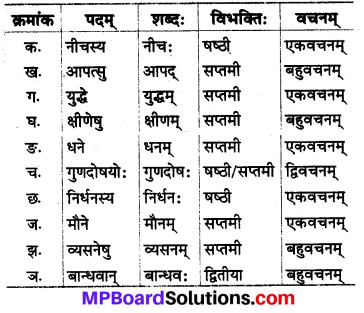
पदानां विभक्तिं वचनं च लिखत(शब्दों के विभक्ति और वचन लिखो-)
उत्तर:
Mp Board Class 8 Sanskrit Chapter 4

(नीति के श्लोकों में नीति होती है। जीवन के विषय में, समाज के विषय में, राष्ट्र के विषय में, धर्म, वैराग्य, संस्कार और परोपकार आदि के विषय में प्रामाणिक, अच्छा चिन्तन और वैज्ञानिक चिन्तन नीति के श्लोकों में पाया जाता है। संस्कृत में नीति को आधार बनाकर श्लोक रचना करने की और शतक (सौ श्लोकों का संग्रह) रचना करने की परम्परा अति प्राचीन है। वस्तुतः थोड़े शब्दों के द्वारा प्रतिष्ठित भावों का, उदात्त विचारों का और श्रेष्ठ विषयों का महत्वपूर्ण विवरण नीति के श्लोकों में पाया जाता है।

नीतिश्लोकाः हिन्दी अनुवाद

अर्थागमोनित्यमरोगिता च प्रिया च भार्या प्रियवादिनी च।
वश्यश्च पुत्रोऽर्थकरी च विद्या षड् जीवलोकस्य सुखानि राजन्॥१॥

कक्षा 8 संस्कृत पाठ 4 MP Board अनुवाद :
हे राजन्! नित्य धन का आगम हो, निरोगता हो, पत्नी प्यारी हो और प्रिय बोलने वाली हो, आज्ञा का पालन करने वाला पुत्र हो और धन का संग्रह कराने वाली विद्या हो, ये छह संसार के सुख हैं।

अयुक्तं स्वामिनो युक्तं युक्तं नीचस्य दूषणम्।
अमृतं राहवे मृत्युः विषं शङ्करभूषणम्॥२॥

क्लास 8 संस्कृत चैप्टर 4 MP Board अनुवाद :
समर्थ (शक्तिशाली) व्यक्ति के लिए अनुचित भी उचित हो जाता है और नीचे स्तर के (असमर्थ) व्यक्ति के लिए उचित भी अनुचित हो जाता है। जैसे राहु को अमृत पीने से भी मृत्यु मिली और विषपान करना शंकरजी के लिए भूषण हो गया।

अमृतं चैव मृत्युश्च द्वयं देहे प्रतिष्ठितम्।
मृत्युमापद्यते मोहात् सत्येनापद्यतेऽमृतम्॥ ३॥

Class 8th Sanskrit Chapter 4 MP Board अनुवाद :
अमरता और मृत्यु दोनों शरीर में स्थित हैं। मोह में फंसे रहने से मृत्यु प्राप्त होती है और सत्य को जानने से अमरता प्राप्त होती है।

आपत्सु मित्रं जानीयाद् युद्धे शूरं धने शुचिम्।
भार्या क्षीणेषु वित्तेषु व्यसनेषु च बान्धवान्।॥४॥

अनुवाद :
मित्र को आपत्तियों में, शूरवीर को युद्ध में, पवित्रता को धन में, पत्नी को धन नष्ट हो जाने पर और भाई-बन्धुओं को संकटों में जानना (पहचानना) चाहिए।

आरोप्यते शिला शैले यत्नेन महता यथा।
निपात्यते क्षणेनाधः तथात्मा गुणदोषयोः॥५॥

Mp Board Class 8th Sanskrit Solution Chapter 4 अनुवाद :
जैसे पर्वत पर शिला बहुत ही कठिनाई से चढ़ाई जाती है और एक क्षण में ही नीचे गिरा दी जाती है वैसे ही प्राणी गुण और दोष ग्रहण करता है। (अर्थात् गुण कठिनता से एवं दोष सरलता से ग्रहण करता है।)

उद्योगे नास्ति दारिद्रयं जपतो नास्ति पातकम्।
मौने च कलहो नास्ति नास्ति जागरिते भयम्॥६॥

Mp Board Class 8 Sanskrit Solution अनुवाद :
परिश्रम करने से दरिद्रता (गरीबी) नहीं रहती – है, भगवान् का नाम लेने से पाप नहीं रहते हैं। मौन (चुप) रहने। से लड़ाई-झगड़ा नहीं होता है और जागते रहने से (चोर आदि का) भय नहीं होता है।

किं छिद्रं को नु सङ्को मे किं वास्त्यविनिपातितम।
कुतो ममाश्रयेद् दोषः इति नित्यं विचिन्तयेत्॥७॥

Mp Board Solution Class 8 Sanskrit अनुवाद :
मुझमें क्या बुराई है, क्या आसक्ति है अथवा वह कौन-सी वस्तु है जो पतनशील (नष्ट होने वाली) नहीं है। मुझमें दोष (बुराइयाँ) कहाँ से आते हैं, इनके विषय में सदा। सोचना चाहिए।

गुणेषु क्रियतां यत्नः किमाटोपैः प्रयोजनम्।
विक्रीयन्ते न घण्टाभिर्गावः क्षीरविवर्जिताः॥ ८॥

Class 8th Sanskrit Shlok MP Board अनुवाद :
गुणों के उपार्जन में प्रयास करना चाहिए, बाहरी – आडम्बरों (दिखावों) से क्या लाभ है। क्योंकि घण्टे लटकाने से दूध न देने वाली गायें नहीं बिकती हैं।

निर्धनस्य विषं भोगो निस्सत्त्वस्य विषं रणम्।
अनभ्यासे विषं शास्त्रम् अजीर्णे भोजनं विषम्॥९॥

अनुवाद :
निर्धन के लिए भोग-विलास विष है, अशक्त। (शक्तिहीन) के लिए युद्ध विष है, अभ्यास न करने के लिए। शास्त्र विष हैं (और) अपच होने पर भोजन विष है।

नीतिश्लोकाः शब्दार्थाः

अर्थागमः = धन का आगम। अरोगिता = निरोगता। वश्यः = आज्ञापालक। अर्थकरी = धन संग्रह कराने वाली। अयुक्तम् = अनुचित, अयोग्य। स्वामिनः = समर्थ जन का। युक्तम् = उचित वस्तु या उपयोगी वस्तु। अमृतम् = अमृत, अमरता। मृत्युमापद्यते = मृत्यु को पाता है। आपत्सु = आपत्तियों में। व्यसनेषु = संकटों के समय। जानीयात् = जानना चाहिए। आरोप्यते = चढ़ाई जाती है। निपात्यते = गिराई जाती है। तथात्मा = वैसे ही प्राणी, व्यक्ति। अधः = नीचे। उद्योगे = उद्यम करने पर। दारिद्रयम् = गरीबी। जपतः = भगवान् का नाम लेने वाले का। कलहः = लड़ाई-झगड़ा। छिद्रम् = दुर्बलता, गलती, बुराई। सङ्ग = आसक्ति। अविनिपातितम् = वह कौन-सी वस्तु जो पतनशील नहीं है। ममाश्रयेत् = मुझ में आते हैं। विचिन्तयेत् = चिन्तन करना चाहिए। गुणेषु = गुण के उपार्जन में। किमाटोपैः = बाहरी आडम्बरों से क्या। घण्टाभिः = घण्टे लटकाने से। क्षीरविवर्जिताः = दूध से रहित। भोगः = भोग-विलास। निस्सत्वस्य = अशक्त के लिए। अनभ्यासे = अभ्यास न करने पर। अजीर्णे = अपच में।

MP Board Class 8th Sanskrit Solutions

MP Board Class 8th Hindi Bhasha Bharti Solutions Chapter 4 अपराजिता

MP Board Class 8th Hindi Bhasha Bharti Solutions Chapter 4 अपराजिता

MP Board Class 8th Hindi Bhasha Bharti Chapter 4 पाठ का अभ्यास

बोध प्रश्न

अपराजिता के प्रश्न उत्तर MP Board Class 8th प्रश्न 1.
निम्नलिखित शब्दों के अर्थ शब्दकोश से खोजकर लिखिए
उत्तर
विलक्षण = अनोखा; अकस्मात् = अचानक; विच्छिन्न = अलग किया हुआ, काटा हुआ; अभिशप्त शापित, शाप लगा हुआ; उत्फुल्ल = प्रसन्न; विषाद = दुःख, उदासी; बुद्धि दीप्ति = मेधावी, तेज बुद्धि वाला; जिजीविषा = जीने की इच्छा; कंठगत = गले में आना; उत्कट = प्रबल, तीव्र नियति = भाग्य; क्षत-विक्षत = घायल; आभामण्डित = तेज से युक्त; पटुता = चतुराई; ख्याति = प्रसिद्धि; आघात = प्रहार, चोट; व्यथा = कष्ट, रोग; नूरमंजिल = लखनऊ में स्थित मानसिक रोगियों का अस्पताल।

भाषा भारती कक्षा 8 Solutions Chapter 4 MP Board प्रश्न 2.
निम्नलिखित प्रश्नों के उत्तर संक्षेप में लिखिए

(क) अपराजिता संस्मरण की लेखिका कौन हैं?
उत्तर
अपराजिता संस्मरण की लेखिका गौरा पन्त ‘शिवानी’ हैं। वे हिन्दी की लोकप्रिय कथा-लेखिका हैं।

(ख) डॉ. चन्द्रा की माता जी का क्या नाम है ?
उत्तर
डॉ. चन्द्रा की माताजी का नाम श्रीमती टी. सुब्रह्मण्यम है।

(ग) डॉ. चन्द्रा को सामान्य ज्वर के बाद कौन-सी बीमारी हो गई थी?
उत्तर
डॉ. चन्द्रा को सामान्य ज्वर के बाद पक्षाघात की बीमारी हो गई जिससे गरदन के नीचे उनका सांग अचल हो गया।

(घ) ‘वीर जननी’ का पुरस्कार किसे मिला ?
उत्तर
‘वीर जननी’ का पुरस्कार अद्भुत साहसी जननी श्रीमती टी. सुब्रह्मण्यम को मिला। श्रीमती सुब्रह्मण्यम ने लगातार पच्चीस वर्ष तक सहिष्णुता के साथ अपनी पुत्री के साथ-साथ कठिन साधना की।

अपराजिता पाठ कक्षा 8 MP Board प्रश्न 3.
निम्नलिखित प्रश्नों के उत्तर विस्तार से लिखिए

(क) लेखिका की दृष्टि में डॉ. चन्दा सामान्य जनों से किन बातों में भिन्न थी ?
उत्तर
डॉ. चन्द्रा सामान्य जनों से अनेक बातों में भिन्न थीं। वे असामान्य रूप से शारीरिक अक्षमता व रोग से पीड़ित थीं। उनके शरीर का निचला धड़ निष्प्राण मांस पिण्ड मात्र था फिर भी वे सदा उत्फुल्ल रहती थीं। उनके चेहरे पर विषाद की कोई रेखा भी नहीं दिखती थी। उनमें अदम्य साहस और उत्कट जिजीविषा थी। उनके मुखमण्डल पर बुद्धि की दीप्तता झलकती थी। उनका व्यक्तित्व अनेक महत्त्वाकांक्षाओं से परिपूर्ण था। उन्हें अपने शरीर की अपंगता से बेचैनी नहीं थी।

उनमें अद्भुत साहस भरा था। उन्होंने अपनी थीसिस पर डॉक्टरेट की उपाधि ग्रहण की। वे कभी भी किसी से सामान्य-सा सहारा नहीं चाहती थीं। उन्होंने अपनी विलक्षणता से एम. एस-सी. में प्रथम स्थान प्राप्त करके बंगलौर (बंगलूरु) के प्रसिद्ध इंस्टीट्यूट ऑफ साइंस में अपने लिए स्पेशल सीट अर्जित की और बाद में शोधकार्य भी किया। राष्ट्रपति से गर्ल गाइड में स्वर्ण कार्ड पाने वाली प्रथम अपंग बालिका थी। उसमें संगीत के प्रति भी रुचि थी।

(ख) लेखिका ने जब चन्द्रा को कार से उतरते देखा तो वे आश्चर्यचकित क्यों रह गईं ?
उत्तर
लेखिका ने जब चन्द्रा को कार से उतरते देखा तो वे अचम्भित रह गईं। कार का द्वार खुला। एक प्रौढ़ा ने उतरकर पिछली सीट से ह्वील चेयर निकालकर सामने रख दी। कार में से एक युवती ने धीरे-धीरे अपने निर्जीव धड़ को बड़ी सावधानी से नीचे उतारा और बैसाखियों का सहारा लिया और ह्वील चेयर तक पहुँची तथा उसमें बैठ गई। अपनी हील चेयर को बड़ी तटस्थता से चलाती हुई कोठी के अन्दर चली गई। डॉ. चन्द्रा को नित्य नियत समय पर अपने कार्य करते देख चकित होती जब वह मशीन की तरह बटन खटखटाती अपना काम किये चली आती थी। डॉ. चन्द्रा अपनी अपंगता से बिल्कुल भी बेचैन नहीं लगती थीं। उनकी आँखों में अदम्य उत्साह और उत्कट जिजीविषा थी। उनमें महत्त्वाकांक्षाएँ भरपूर थीं। अत: उन्हें देखकर लेखिका अचम्भित रह गई।

Aparajita Chapter In Hindi Question Answer MP Board Class 8th प्रश्न 4.
निम्नलिखित पंक्तियों का आशय स्पष्ट कीजिए।
उत्तर
(क) बित्ते भर की लड़की मुझे किसी देवांगना से कम नहीं लगी।
आशय-लेखिका को अपंगता से ग्रसित लड़की देवांगना से कम नहीं लग रही थी। उसके चेहरे पर अद्भुत कान्ति थी। उसमें बुद्धिबल और आत्मनिर्भरता थी, यद्यपि वह शरीर से बहुत छोटी थी।

(ख) मैडम, मैं चाहती हूँ कि कोई मुझे सामान्य-सा भी सहारा न दे।
आशय-उस छोटे से आकार की अपंगता से ग्रस्त बालिका ने लेखिका से कहा कि वह नहीं चाहती है कि कोई भी व्यक्ति उसको थोड़ा भी सहारा दे। वह स्वावलम्बी बनकर रहना चाहती

(ग) चिकित्सा ने जो खोया, वह विज्ञान ने पाया।
आशय-लेखिका का कथन सही है क्योंकि चिकित्सा ने डॉ. चन्द्रा की अपंगता को ठीक नहीं किया जबकि विज्ञान के क्षेत्र में डॉ. चन्द्रा ने अनेक सफलताएँ प्राप्त की। डॉ. चन्द्रा ने बी.एस-सी. और एम. एस-सी. प्रथम श्रेणी में उत्तीर्ण और डॉ. सेठना के निर्देशन में पाँच वर्ष कार्य करते हुए पी-एच.डी. की उपाधि प्राप्त करके, विज्ञान के क्षेत्र में अपना अमूल्य योगदान दिया।

(घ) बुद्धिदीप्त आँखों में अदम्य उत्साह, प्रतिफलप्रतिक्षण भरपूर उत्कट जिजीविषा और फिर कैसी-कैसी महत्त्वाकांक्षाएँ।
आशय-लेखिका के अनुसार, डॉ. चन्द्रा की आँखों से ही । उनकी बुद्धि का तेज झलकता था। उनमें कभी न रुकने वाला उत्साह था। उन्हें किये गये कर्म के फल की प्राप्ति में विश्वास था। प्रत्येक क्षण अत्यन्त तीव्र एवं उत्कट रूप में जीवित रहने की इच्छा थी। इस पर भी उनमें अनेक महत्त्वाकांक्षाएँ थीं।

भाषा-अध्ययन

Aprajita Chapter Question Answer MP Board Class 8th प्रश्न 1.
निम्नलिखित शब्दों का उच्चारण कीजिएडॉक्टर, कॉलेज, बॉल, ऑफ, ऑफिस, कॉनवेन्ट।
उत्तर
अंग्रेजी के शब्दों को हिन्दी में प्रयोग करने से ‘ऑ’ ध्वनि का उच्चारण होता है। ऑ ध्वनि का आगम अंग्रेजी से हुआ है। अत: विद्यार्थी उपर्युक्त शब्दों को ठीक-ठीक पढ़कर उनका शुद्ध उच्चारण करने का अभ्यास करें।

अपराजिता’ पाठ के प्रश्न उत्तर MP Board Class 8th प्रश्न 2.
निम्नलिखित शब्दों का शुद्ध उच्चारण कीजिए और उन्हें लिखिए
व्यक्तित्व, रिक्तता, अभिशप्त, विच्छिन्न, निष्प्राण, जिजीविषा, बुद्धिदीप्त, सुब्रह्मण्यम।
उत्तर
विद्यार्थी उपर्युक्त शब्दों को ठीक-ठीक पढ़कर उनका शुद्ध उच्चारण करने का अभ्यास करें। फिर उन्हें लिखें।

अपराजिता पाठ के प्रश्न उत्तर MP Board Class 8th प्रश्न 3.
सही विकल्प चुनिए
(क) ‘अपराजिता’ शब्द में उपसर्ग है
(1) अ
(2) अप
(3) अपरा
उत्तर
(3) अपरा

(ख) ‘विकलांगता’ शब्द में प्रत्यय है
(1) गता
(2) ता
(3) आगत
उत्तर
(2) ता

(ग) ‘अभिमान’ में उपसर्ग है
(1) अभि
(2) अ
(3) मान
उत्तर
(1) अभि

(घ) ‘अपराजिता’ का विलोम है
(1) जीता
(2) जिता
(3) पराजिता।
उत्तर
(3) पराजिता।

अपराजिता कहानी का सारांश MP Board Class 8th प्रश्न 4.
‘अपराजिता’ पाठ से साधारण वाक्य, मिश्रित वाक्य और संयुक्त वाक्य के दो-दो उदाहरण छाँटकर लिखिए।
उत्तर
साधारण वाक्य

  1. उस कोठी का अहाता एकदम हमारे बँगले के अहाते से जुड़ा था।
  2. आजकल वह आई.आई.टी. मद्रास (चेन्नई) में काम कर रही हैं।

मिश्रित वाक्य

  1. हमें लगता है कि भले ही उस अन्तर्यामी ने हमें जीवन में कभी अकस्मात् अकारण ही दण्डित कर दिया हो।
  2. लौटते समय किसी स्टेशन पर चाय लेने उतरा कि गाड़ी चल पड़ी।

संयुक्त वाक्य

  1. हमने आज तक दो व्यक्तियों द्वारा सम्मिलित रूप में नोबेल पुरस्कार पाते अपने ही विषय में सुना था, किन्तु आज हम शायद पहली बार इस पी-एच. डी. के विषय में भी कह सकते हैं।
  2. एक वर्ष तक कष्टसाध्य उपचार चला और एक दिन स्वयं ही इसके ऊपरी धड़ में गति आ गई, हाथ हिलने लगे, नहीं उँगलियाँ मुझे बुलाने लगी।

Aprajita Class 8 MP Board प्रश्न 5.
निम्नलिखित गद्यांश को ध्यान से पढ़िए मैंने शारीरिक रूप से विशेष आवश्यकता वाले एक बालक को पैर से लिखते देखा तो मैं दंग रह गया। भगवान की लीला भी विचित्र है। साहसी, आत्मविश्वासी और जीवट स्वभाव के ऐसे विशेष आवश्यकता वाले कुछ व्यक्ति तो हमें हतप्रभ बना देते हैं। समाज में इस प्रकार के कुछ व्यक्ति तो अपने हथियार डाल देते हैं तथा दूसरों के आश्रित रहकर जीवन जीते हैं। कभी वे मन्दिर के सामने, कभी स्टेशन के पास या किसी सार्वजनिक स्थान पर माँगने के लिए धरना दिये बैठे रहते हैं। हमें चाहिए कि हम उन्हें अपने पैरों पर खड़े होने के लिए प्रेरित करें।
उन्हें स्वावलम्बी बनाने के लिए हर सम्भव प्रयास करें और उन्हें अच्छा जीवन जीने का मार्ग सुझाएँ।
(क) उपर्युक्त गद्यांश का उचित शीर्षक लिखिए।
(ख) हम विशेष आवश्यकता वाले व्यक्तियों के लिए क्या-क्या काम कर सकते हैं ?
(ग) इस गद्यांश से मुहावरे छाँटकर उनके अर्थ और वाक्य-प्रयोग कीजिए।
(घ) इस गद्यांश में से एक-एक सरल, मिश्रित और संयुक्त वाक्य छाँटकर लिखिए।
उत्तर
(क) ‘शारीरिक रूप से विशेष आवश्यकता वाले व्यक्ति’।
(ख) हम उन्हें अपने पैरों पर खड़े होने के लिए प्रेरित कर सकते हैं। उन्हें स्वावलम्बी बनाने के लिए हर सम्भव प्रयास कर सकते हैं तथा उन्हें अच्छा जीवन जीने का मार्ग सुझा सकते हैं।
(ग) मुहावरे

  1. दंग रह जाना-अचम्भे में पड़ जाना।
    वाक्य प्रयोग-आठ वर्ष की बालिका ने जब गीता के श्लोक मौखिक सुनाए, तो वहाँ उपस्थित लोग दंग रह गये।
  2. हतप्रभ-चकित हो जाना।
    वाक्य प्रयोग-हमारे विद्यालय की विकलांग बालिका ने जब 100 मीटर की दौड़ में प्रथम स्थान पाया, तो उपस्थित लोग हतप्रभ हो गये।
  3. हथियार डालना-हार मान लेना।
    वाक्य प्रयोग-भारतीय सेना के समक्ष हमारे दुश्मनों ने अपने हथियार डाल दिये।
  4. धरना देना-एक स्थान पर जमकर बैठ जाना।
    वाक्य प्रयोग-छात्रों ने अपनी मांगों के समर्थन में प्रधानाचार्य के कार्यालय के सामने धरना दे दिया।
  5. अपने पैरों पर खड़ा होना-स्वावलम्बी हो जाना।
    वाक्य प्रयोग-प्रत्येक युवक को अपने पैरों पर खड़ा होने के सद्प्रयास करने चाहिए।
  6. मार्ग सुझाना-उपाय बताना।
    वाक्य प्रयोग-बेरोजगारी मिटाने के लिए विद्वानों को मार्ग सुझाना चाहिए।

(घ) सरल वाक्य-भगवान की लीला विचित्र है।
मिश्रित वाक्य-हमें चाहिए कि हम उन्हें अपने पैरों पर खड़े होने के लिए प्रेरित करें।
संयुक्त वाक्य-उन्हें स्वावलम्बी बनाने के लिए हर सम्भव प्रयास करें और उन्हें अच्छा जीवन जीने का मार्ग सुझाएँ।

प्रश्न 6.
निम्नलिखित गद्यांश को उपयुक्त विराम चिह्न लगाकर पुनः लिखिए
नहीं मिसेज सुब्रह्मण्यम मदर ने कहा कि हमें आपसे पूरी सहानुभूति है पर आप ही सोचिए कि आपकी पुत्री की हील चेयर कौन पूरे क्लास में घुमाता फिरेगा। आप चिन्ता न करें मदर मैं हमेशा उसके साथ रहूँगी और फिर पूरी कक्षाओं में अपंग पुत्री की कुर्सी की परिक्रमा मैं स्वयं कराती।
उत्तर
“नहीं, मिसेज सुब्रह्मण्यम”, मदर ने कहा। हमें आपसे पूरी सहानुभूति है, पर आप ही सोचिए, आपकी पुत्री की ह्वील चेयर कौन पूरे क्लास में घुमाता फिरेगा।
“आप चिन्ता न करें, मदर, मैं हमेशा उसके साथ रहूँगी” और फिर पूरी कक्षाओं में अपंग पुत्री की कुर्सी की परिक्रमा मैं स्वयं कराती।

प्रश्न 7.
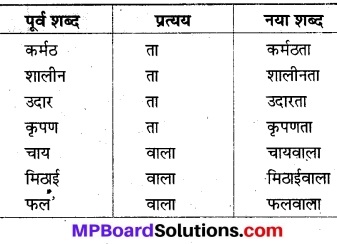
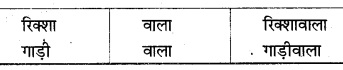
‘सुगम’ शब्द में ‘ता’ प्रत्यय जोड़कर ‘सुगमता’ नया शब्द बना है। इसी प्रकार निम्नलिखित शब्दों में निर्धारित प्रत्यय जोड़कर नए शब्द बनाइए
उत्तर
MP Board Class 8th Hindi Bhasha Bharti Solutions Chapter 4 अपराजिता 1
MP Board Class 8th Hindi Bhasha Bharti Solutions Chapter 4 अपराजिता 2

प्रश्न 8.
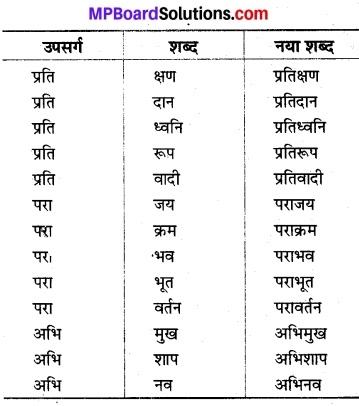
प्रतिफल’ शब्द में ‘प्रति’ उपसर्ग जुड़ा है। इसी प्रकार प्रति’, ‘परा’ और ‘अभि’ उपसर्ग जोड़कर नए शब्द बनाइए और लिखिए।
उत्तर
MP Board Class 8th Hindi Bhasha Bharti Solutions Chapter 4 अपराजिता 3

अपराजिता परीक्षोपयोगी गद्यांशों की व्याख्या 

(1) कभी-कभी अचानक ही विधाता हमें ऐसे विलक्षण व्यक्तित्व से मिला देता है, जिसे देख स्वयं अपने जीवन की रिक्तता बहुत छोटी लगने लगती है। हमें तब लगता है कि भले ही उस अन्तर्यामी ने हमें जीवन में कभी अकस्मात् अकारण ही दण्डित कर दिया हो किन्तु हमारे किसी अंग को हम से विच्छिन्न कर, हमें उससे वंचित तो नहीं किया।

शब्दार्थ-विधाता = ईश्वर; विलक्षण = अनोखे; रिक्तता = खालीपन, अन्तर्यामी = हृदय में समाये हुए ईश्वर; अकस्मात् = अचानक; अकारण = बिना कारण के विच्छिन्न = अलग कर देना, काट देना; दण्डित कर दिया हो = दण्ड दिया गया हो; वंचित = अलग।

सन्दर्भ-प्रस्तुत गद्यांश हमारी पाठ्य-पुस्तक’ भाषा-भारती’ के पाठ ‘अपराजिता’ से अवतरित है। इस पाठ की लेखिका ‘शिवानी हैं।

प्रसंग-प्रस्तुत गद्यांश में लेखिका बताती हैं कि जीवन में कभी-कभी ऐसे व्यक्तियों से मिलना हो जाता है जिनको देखकर हमारे जीवन में किसी बात की कमी बहुत छोटी लगती है।

व्याख्या-कभी-कभी ऐसा अकस्मात् होता है कि हमारी मुलाकात किसी ऐसे अनोखे व्यक्ति से हो जाती है जिसे देखने मात्र से ही हमारे जीवन में किसी बात की कमी होते हुए भी बहुत छोटी लग उठती है। जिनसे मुलाकात हुई है, उन्हें कोई भी बड़ा कष्ट हो सकता है जिसके विषय में हमने कभी सोचा भी नहीं होगा और हमारे कष्ट उस व्यक्ति की तुलना में बहुत ही छोटे हो सकते हैं। ईश्वर हमें अचानक ही किसी भी प्रकार का कष्ट देकर हमें कभी भी दण्ड दे सकते हैं जिसका कोई कारण नहीं भी हो सकता हो। तब ईश्वर की फिर भी हम बड़ी कृपा समझते हैं जिन्होंने हमारे शरीर के किसी अंग को काट करके हमें उससे रहित नहीं किया।

(2) यहाँ कभी सामान्य-सी हड्डी टूटने पर या पैर में मोच आ जाने पर ही प्राण ऐसे कण्ठगत हो जाते हैं जैसे विपत्ति का आकाश ही सिर पर टूट पड़ा है, और इधर यह लड़की है कि पूरा निचला धड़ सुन्न है, फिर भी बोटी-बोटी फड़क रही है। आजकल वह आई.आई.टी. चेन्नई में काम कर रही है।

शब्दार्थ-सामान्य-सी = साधारण-सी, कम महत्त्व की; कण्ठगत = गले में अटके; आकाश ही सिर पर टूट पड़ा है = बहुत बड़ी विपत्ति एकदम आ गई है; सुन = संवेदनहीन; बोटी-बोटी = शरीर का प्रत्येक अंग; फड़क रही है- स्पन्दित या गतिमान हो रहा है।

सन्दर्भ-पूर्व की तरह।

प्रसंग-लेखिका के अनुसार शरीर के किसी भी अंग में थोड़ी-सी चोट लगने पर हम सोचने लगते हैं कि मानो हमारे प्राण ही निकल जायेंगे।

व्याख्या-कभी-कभी हम ऐसा समझते हैं कि कभी हमारे शरीर की साधारण-सी हड्डी टूट गईं हो अथवा हमारे पैर में मोच आ गई हो तो हमें ऐसा लगता है कि मानो कष्ट से हमारे प्राण ही गले में आ जायेंगे अर्थात् हमारी मौत ही हो जायेगी। हम सोचने लगते हैं कि हमारे ऊपर कठिनाइयों का आसमान ही टूट पड़ा है। परन्तु इधर देखिये इस छोटी-सी लड़की को, जिसके शरीर का निचला भाग किसी भी संवेदना से रहित है। उसमें किसी भी तरह की गति नहीं है। फिर भी उसके शरीर का प्रत्येक अंग स्पन्दित हो रहा है। यह वह लड़की है जो आई. आई. टी. मद्रास (चेन्नई) में आजकल काम कर रही है।

(3) मैडम, मैं चाहती हूँ कि कोई मुझे सामान्य-सा सहारा भी न दे। आप तो देखती हैं, मेरी माँ को मेरी कार चलानी पड़ती है। मैंने इसीलिए एक ऐसी कार का नक्शा बनाकर दिया है, जिससे मैं अपने पैरों के निर्जीव अस्तित्व को भी सजीव बना दूंगी।

शब्दार्थ-मैडम = श्रीमती जी; सामान्य-सा-थोड़ा भी, साधारण-सा; सहारा = मदद; निर्जीव = बिना प्राणों के, अथवा चेतनाहीन; अस्तित्व = बने रहने को; सजीव = सचेतन।

सन्दर्भ-पूर्व की तरह।

प्रसंग-लेखिका द्वारा छोटी-सी अपंग लड़की के साहस का वर्णन किया गया है।

व्याख्या-वह छोटी-सी लड़की लेखिका से कहने लगी है कि मैडम (श्रीमती जी) मेरी इच्छा है कि कोई भी व्यक्ति मेरी थोड़ी भी मदद करने के लिए तैयार न हो। मैं नहीं चाहती कि कोई भी आदमी रंचमात्र भी मुझे सहारा दे। वह बालिका स्पष्ट करती है कि उसकी माँ को उसके लिए कार चलानी पड़ती है। इस तरह किसी पर आश्रित रहने को दूर करने के लिए उस बालिका ने एक इस तरह की कार का नक्शा बनाया है, जिसे वह स्वयं चला सके और अपने निर्जीव पैरों को सजीव बना सके अर्थात् वह स्वयं – उस कार को अपने उन पैरों से चला सकेगी, जो निश्चेष्ट हैं और उनमें किसी भी तरह की चेतना नहीं है। इसका नतीजा यह होगा कि उनमें फिर से सजीवता आ जायेगी।

(4) “इसके भयानक अभिशाप के बावजूद मैंने कभी विधाता से यह नहीं कहा कि प्रभो, इसे उठा लो। इसके इस जीवन से तो मौत भली है। मैं निरन्तर इसके जीवन की भीख माँगती रही। केवल सिर हिलाकर यह इधर-उधर देख भर सकती थी। न हाथों में गति थी, न पैरों में फिर भी मैंने आशा नहीं छोड़ी। एक आर्थोपैडिक सर्जन की बड़ी ख्याति सनी थी, वहीं ले गई।”

शब्दार्थ-भयानक = खतरनाक; अभिशाप = शाप: । बावजूद = (इसके) होने पर भी; विधाता ईश्वर से उठा लो= मृत्यु दे दो; मौत = मृत्यु; भली = अच्छी; निरन्तर = लगातार, रोजाना; भीख माँगती रही = दीन भाव से माँग करती रही; गति = चेतना; आर्थोपैडिक- हड्डियों से सम्बन्धित; सर्जन = चीर-फाड़ करने वाला;
ख्याति = प्रसिद्धि।

सन्दर्भ-पूर्व की तरह।

प्रसंग-उस छोटी-सी बालिका के रोगग्रस्त होने की दशा में भी उसकी माँ के धैर्य और उसके प्रति माँ की ममता का वर्णन लेखिका ने बहुत ही भावपूर्ण ढंग से किया है।

व्याख्या-उस अपंग बालिका के शुरू के जीवन के विषय में उसकी माँ कहती है कि उसे अपंगता का भयानक शाप लगा हुआ होने पर भी उसने (बालिका की माँ ने) ईश्वर से कभी भी यह नहीं कहा कि हे परमात्मा, तुम इस बालिका को मृत्यु दे दो। ममता भरे हृदय वाली माँ ने कभी भी यह नहीं सोचा कि उसकी उस पुत्री के रोग पीड़ित होने की दशा से तो उसका मरना ही ठीक है। वह माँ तो सदैव यही प्रार्थना करती रही कि हे प्रभो उसे जीवन दो। अर्थात् उसको रोग से मुक्ति मिले। वह माँ निश्चित ही कितनी दु:खी होती होगी, जब वह अपनी पुत्री को निश्चेष्ट शरीर से हिल-डुलने में असमर्थ पाती थी, क्योंकि वह तो केवल अपने सिर को ही हिला पाती थी और केवल सिर हिलाकर इधर-उधर देख पाती थी। उसके हाथ और पैरों में कोई गति नहीं थी। इतना भयानक कष्ट होने और जीवन के प्रति निराशा के भर जाने पर भी उस बालिका की माँ निराश नहीं हुई। वह जिस किसी भी चिकित्सक (हड्डियों से सम्बन्धित) की प्रसिद्धि और नाम सुनती तो वह उस रोग से पीड़ित बालिका को उसके पास लेकर पहुंचती थी।

(5) लैदर जैकेट के कठिन जिरह-बख्तर में कसी उस हँसमुख लड़की को देख मुझे युद्ध क्षेत्र में डटे राणा साँगा का ही स्मरण हो आता था। क्षतविक्षत शरीर में असंख्य घाव, आभामंडित भव्य मुद्रा।

शब्दार्थ-लैदर जैकेट = चमड़े से बनी जैकेट; बख्तर = कवच; कसी = कस कर बाँधी हुई; राणा साँगा = मेवाड़ के वीर राजपूत राजा का नाम जो महाराणा प्रताप के पूर्वज थे; स्मरण = याद आ जाती थी; क्षत-विक्षत = बहुत अधिक घायल; असंख्य = अनेक; आभामण्डित = कान्ति से शोभायमान; भव्य = सुन्दर;मुद्रा = आकृति।

सन्दर्भ-पूर्व की तरह।

प्रसंग-अपंगता से पीड़ित बालिका ने अपनी माँ के परिश्रम और धैर्य से उच्च शिक्षा प्राप्त की। एक श्रेष्ठ माँ के कर्तब का पालन करते हुए माँ ने अपने धर्म में सफलता प्राप्त की।

व्याख्या-अपंगता के रोग से ग्रसित उस बालिका ने एम. एस-सी. (प्राणिशास्त्र) की उपाधि प्राप्त करके पाँच वर्ष तक शोधकार्य कर लिया। वह बालिका अपनी प्रयोगशाला में आसानी से अपनी चेयर से घूम सकती थी। अपनी चेयर में जब वह बालिका बैठती थी, तो उसे चमड़े की बनी जैकेट पहननी पड़ती थी; जिससे उसका शरीर कठोर रूप से जकड़ दिया जाता था। वह लड़की बहुत हँसमुख थी। अपने कर्त्तव्य में डटी हुई वह लड़की अपनी माँ श्रीमती टी. सुब्रह्मण्यम को ऐसी लगती थी, जैसे राणा साँगा अपने राष्ट्र की रक्षा के लिए अपने दुश्मनों के विरुद्ध युद्धक्षेत्र में लड़ रहे हों। यद्यपि उनके शरीर में अनेक घाव हो चुके थे। उनका शरीर युद्ध में दुश्मनों के प्रहारों से बहुत अधिक घायल हो गया था। उस लड़की के मुखमण्डल पर अपनी अपंगता के कष्ट की कोई सिकुड़न नहीं थी। उसके चेहरे पर सौन्दर्य तथा उसकी आकृति बहुत ही सुन्दर थी।

MP Board Class 8th Hindi Solutions

MP Board Class 8th Sanskrit Solutions Chapter 9 वसन्तोत्सवः

MP Board Class 8th Sanskrit Solutions Surbhi Chapter 9 वसन्तोत्सवः

MP Board Class 8th Sanskrit Chapter 9 अभ्यासः

Mp Board Class 8 Sanskrit Chapter 9 प्रश्न 1.
एकपदेन उत्तरं लिखत(एक शब्द में उत्तर लिखो-)
(क) वसन्तपञ्चमी कस्य आगमनं सूचयति? (वसन्त पञ्चमी किसके आगमन को सूचित करती है?)
उत्तर:
ऋतुराजवसन्तस्य (ऋतुराज वसन्त के)

(ख) केषु नूतनकिसलयरागः राजते? (किन पर नये पत्तों की शोभा सुशोभित होती है?)
उत्तर:
वृक्षेषु। (पेड़ों पर)

(ग) केकिलानां मधुरस्वरः किम् आकर्षित? (कोयलों का मधुर स्वर किसको आकर्षित करता है?)
उत्तर:
चित्तम्। (मन को)

(घ) वसन्तोत्सवे कस्याः पूजनम् भवति? (वसन्त उत्सव में किसका पूजन होता है।)
उत्तर:
सरस्वत्याः। (सरस्वती का)

(ङ) ज्ञानस्य अधिष्ठात्री देवी का? (ज्ञान की मुख्य देवी कौन है?)
उत्तर:
शारदा। (सरस्वती)

Class 8 Sanskrit Chapter 9 Mp Board प्रश्न 2.
एकवाक्येन उत्तरं लिखत(एक वाक्य में उत्तर लिखो-)
(क) ऋतुराजवसन्तस्य आगमन-सूचना कदा भवति? (ऋतुराज वसन्त के आगमन की सूचना कब होती है?)
उत्तर:
ऋतुराजवसन्तस्य आगमन-सूचना माघमासस्य शुक्लपक्षस्य पञ्चम्यां तिथौ भवति। (ऋतुराज वसन्त के आगमन की सूचना माघ महीने के शुक्ल पक्ष की पंचमी तिथि को होती है।)

(ख) आमेषु कीदृशाःभ्रमराः दृश्यन्ते? (आमों पर कैसे भंवरे दिखाई देते है?)
उत्तर:
आनेषु भ्रमन्तः भ्रमराः दृश्यन्ते? (आमों पर घूमते हुए भंवरे दिखाई देते हैं।)

(ग) तमिलनाडुराज्ये जनाः शारदां कथम् अर्चयन्ति। (तमिलनाडु राज्य में लोग शारदा को कैसे पूजते हैं?)
उत्तर:
तमिलनाडुराज्ये जनाः प्रकाशितान् हस्तलिखितान् ग्रन्थान् एकस्याम् पीठिकायां संस्थाप्य विविधैः उपचारैः शारदां अर्चयन्ति। (तमिलनाडु राज्य में लोग प्रकाशित हस्तलिखित ग्रन्थों को एक चौकी पर रखकर विभिन्न पूजा की विधियों से शारदा की पूजा करते हैं।)

(घ) वसन्तोत्सवः किं किं द्योतयति? (वसन्तोत्सव क्या-क्या प्रकट करता है।)
उत्तर:
वसन्तोत्सवः भारतीयानां उत्सवप्रियतायाः शास्त्रीयं, सामाजिक तथा वैज्ञानिक चिन्तनं अपि द्योतयति। (वसन्तोत्सव भारतीयों की उत्सव प्रियता की शास्त्रीय, सामाजिक तथा वैज्ञानिक सोच को भी प्रकट करता है।)

(ङ) उत्तरभारते कुत्र-कुत्र सरस्वतीपूजनं बहुमान्यम् अस्ति? (उत्तरभारत में कहाँ-कहाँ सरस्वती पूजा बहुत मान्य है?)
उत्तर:
उत्तर भारते बिहार प्रान्ते, बङ्गालप्रान्ते तथा काश्मीर प्रदेशे सरस्वतीपूजनं बहुमान्यम् अस्ति। (उत्तर भारत में बिहार प्रान्त में, बंगाल प्रान्त में तथा कश्मीर प्रदेश में सरस्वती पूजा बहुत मान्य है।)

Mp Board Class 8 Sanskrit Solution Chapter 9 प्रश्न 3.
प्रश्ननिर्माणं कुरुत (रेखांकितपदम् आधृत्य) [प्रश्न निर्माण करो (रेखांकित शब्द के आधार पर])
(क) विविधैः पुष्पैः ऋतुराजस्य स्वागतम् भवति। (विविध पुष्पों के द्वारा ऋतुराज का स्वागत होता है।)
उत्तर:
विविधैः पुष्पैः कस्य स्वागतम् भवति? (विविध पुष्पों के द्वारा किसका स्वागत होता है?)

(ख) पुस्तकानाम् अपि पूजनम् भवति। (पुस्तकों का भी पूजन होता है।)
उत्तर:
केषाम् अपि पूजनम् भवति? (किनका पूजन भी होता है?)

(ग) शारदाम् अर्चयन्ति। (शारदा की अर्चना करते हैं।)
उत्तर:
काम् अर्चयन्ति? (किसकी अर्चना करते हैं?)

(घ) सौन्दर्य कामयिंतु वसन्तपूजनम् भवति। (सुन्दरता की कामना के लिए वसन्त पूजा होती
उत्तर :
सौन्दर्य कामयितु किम् भवति? (सुन्दरता की कामना के लिए क्या होती है?)

(ङ) श्रीपञ्चमीनाम्ना वसन्तपञ्चमी ज्ञायते। (श्रीपंचमी नाम से वसन्तपंचमी जानी जाती है।)
उत्तर:
श्री पञ्चमीनाम्ना का ज्ञायते? (श्रीपंचमी नाम से क्या जानी जाती है।)

Sanskrit Class 8 Mp Board प्रश्न 4.
अर्थानुसारं युग्मानि योजयत (अर्थ के अनुसार जोड़े मिलाओ-)
Mp Board Class 8 Sanskrit Solution
उत्तर:
(क) → (iii)
(ख) → (v)
(ग) → (i)
(घ) → (ii)
(ङ) → (iv)

Mp Board Class 8 Sanskrit प्रश्न 5.
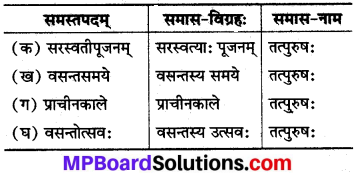
नामोल्लेखपूर्वकं समासविग्रह कुरुत (नाम का उल्लेख करते हुए समास विग्रह करो-)
(क) सरस्वतीपूजनम्
(ख) वसन्तसमये
(ग) प्राचीनकाले
(घ) वसन्तोत्सवः।
उत्तर:
8 वीं कक्षा संस्कृत गाइड In Hindi Chapter 9

एमपी बोर्ड क्लास 8th संस्कृत प्रश्न 6.
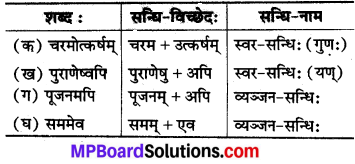
नामोल्लेखपूर्वकं सन्धिविच्छेदं कुरुत (नाम का उल्लेख करते हुए सन्धि-विच्छेद करो-)
(क) चरमोत्कर्षम्
(ख) पुराणेष्वपि
(ग) पूजनमपि
(घ) सममेव।
उत्तर:
Mp Board Solution Class 8 Sanskrit

Class 8 Sanskrit Mp Board प्रश्न 7.
पाठात् पञ्च अव्ययानि चित्वा लिखत। (पाठ में से पाँच अव्यय चुनकर लिखो।)
उत्तर:
(क) अपि:
(ख) सर्वत्र
(ग) च
(घ) अधुना
(ङ) एव।

वसन्तोत्सवः हिन्दी अनुवाद

माघमासस्य शुक्लपक्षस्य पञ्चम्यां तिथौ ऋतुराजवसन्तस्य आगमनसूचना भवति। वसन्तपञ्चमी श्रीपञ्चमी नाम्ना अपि. ज्ञायते। अस्मिन् समये प्रकृतेः सौन्दर्यं चरमोत्कर्ष प्राप्नोति। सर्वत्र रमणीयतायाः दर्शनं भवति। वृक्षेषु नूतनकिसलयरागः राजते। क्षेत्रेषु सर्षपपुष्याणां सुषमा पीतिमा च मनोहारिणी दृश्यते। आनेषु मञ्जरीम् परितः भ्रमन्तः भ्रमराः दृश्यन्ते। कोकिलानां मधुरस्वरः चित्तम् आकर्षति। वसन्तसमये सर्वत्र रमणीयतायाः दर्शनम् भवति। वसन्तोत्सवे शीतकालस्य अनन्तरम् परम्परया सौन्दर्यस्य पूजनं क्रियते। विविधैः पुष्पैः, नवान्नैः, फलैः च ऋतुराजस्य वसन्तस्य स्वागतम् भवति। एषः उत्सवः सौन्दर्यस्य रमणीयतायाः पुष्याणां, किसलयानां मधुरागमनस्य च उत्सवः अस्ति।

अनुवाद :
माघ के महीने की शुक्ल पक्ष की पंचमी तिथि को ऋतुओं के राजा वसन्त के आगमन की सूचना होती है वसन्त पंचमी को ‘श्री पंचमी’ के नाम से भी जाना जाता है। इस समय प्रकृति की सुन्दरता अत्यधिक उन्नति को प्राप्त करती है। सब जगह सुन्दरता के दर्शन होते हैं। पेड़ों पर नवीन पत्तों की शोभा सुशोभित होती है। खेतों में सरसों के फूलों की अत्यधिक शोभा और पीलापन मन को हरने वाला दिखाई देता है। आम के पेड़ों पर बौरों के चारों ओर घूमते हुए भँवरे दिखाई देते हैं। कोयलों का मधुर स्वर मन को आकर्षित करता है। वसन्त के समय में सब जगह सुन्दरता के दर्शन होते हैं। वसन्त के उत्सव में शीतकाल के बाद परम्परा से सुन्दरता का पूजन किया जाता है। अनेक फूलों, नये अन्नों और फलों से ऋतुओं के राजा वसन्त का स्वागत होता है। यह उत्सव सुन्दरता मनोहरता फूलों और पल्लवों के मधुर आगमन का उत्सव होता है।

वसन्तोत्सवस्य द्वितीयपक्षः अधिकः महनीयः अस्ति। भारते वसन्तवेलायां भगवत्याः सरस्वत्याः आराधनस्य अपि परम्परा विद्यते। वसन्तपञ्चमी ज्ञानस्य उपासनायाः आराधनायाः उत्सवः अस्ति। प्राचीनकाले वसन्तपञ्चम्यां ज्ञानयज्ञतपस्वरूपां सरस्वतीं जनाः पूजयन्ति स्म। अधुना अपि सम्पूर्णे देशे आध्यात्मिकजिज्ञासया अस्मिन् दिने जनाः ज्ञानस्य अधिष्ठात्रीं शारदां पूजयन्ति।

अनुवाद :
वसन्त उत्सव का द्वितीय पक्ष अधिक सम्मान के योग्य होता है। भारत में वसन्त की बेला में देवी सरस्वती की आराधना भी परम्परा है। वसन्त पंचमी ज्ञान की उपासना। (और) आराधना का उत्सव है। प्राचीन समय में वसन्त पंचमी पर ज्ञानयज्ञ (और) तप स्वरूप सरस्वती को लोग पूजते थे। अब भी सम्पूर्ण देश में आध्यात्मिक जिज्ञासा से इस दिन लोग ज्ञान की मुख्य देवी शारदा (सरस्वती) को पूजते हैं।

वसन्तोत्सवः वस्तुतः सांस्कृतिकः उत्सवः अस्ति। वैदिककालात् एव अस्मिन् दिने सरस्वत्याः उपासना भवति। महाभारते पुराणेष्वपि वसन्तोत्सवः सरस्वत्याः उपासनायाः उत्सवरूपेण दर्शितः। वसन्तपञ्चम्यां आगमविधिना महाशक्त्याः सरस्वत्याः वार्षिकपूजायाः विधानम् भवति।

अनुवाद :
वसन्त उत्सव वास्तव में सांस्कृतिक उत्सव है। वैदिक काल से ही इस दिन सरस्वती की उपासना होती है। महाभारत में पुराणों में भी वसन्त उत्सव सरस्वती की उपासना के उत्सव के रूप में दिखाया गया है। वसन्त पंचमी पर शास्त्र में वर्णित विधि से महाशक्ति सरस्वती की वार्षिक पूजा का विधान होता है।

विशेषतः उत्तरभारते बिहारप्रान्ते, बङ्गालप्रान्ते तथा काश्मीरप्रदेशे सरस्वतीपूजनं बहुमान्यम् अस्ति। दक्षिणे तमिलनाडुक्षेत्रे अपि एतस्य महत्त्वं विद्यते। तत्र आबालवृद्धपरिजनाः प्रकाशितान् हस्तलिखितान् ग्रन्थान् एकस्याम् पीठिकायां संस्थाप्य विविधैः उपचारैः शारदाम् अर्चयन्ति। एतेन सममेव वाद्ययन्त्राणां वीणादीनाम् पूजनमपि भवति। कुत्रचित् दक्षिणभारते शिल्पिनः स्वयन्त्राणाम् अपि अस्मिन् दिने पूजनं कुर्वन्ति।

अनुवाद :
विशेष रूप से उत्तर भारत में बिहार 7 में, बंगाल प्रान्त में तथा कश्मीर प्रदेश में सरस्वती पूजन ब न्य है। दक्षिण में तमिलनाडु क्षेत्र में भी इसका महत्त्व है. वहाँ बच्चों से लेकर वृद्ध तक (सभी) परिवार के लोग प्रकाशित (छपे) हाथ से लिखे ग्रन्थों को एक चौकी पर रखकर विविध पूजा की विधियों से शारदा की पूजा करते हैं। इसी समय वाद्य यन्त्र वीणा आदि का पूजन भी होती है। वहीं दक्षिण भारत में शिल्पी (कारीगर) अपने यन्त्रों (औजारों) का भी इसी दिन पूजन करते हैं।

सरस्वतीपूजनस्य वेदाध्ययन सत्रं श्रावणीपूर्णिमातः आरभ्य वसन्तपञ्चमी यावत् भवति। सरस्वती पूजयित्वा ऋतुपरिवर्तनस्यारम्भे जीवने हर्षोल्लासं, सौन्दर्य, शृंङ्गारं च कामयितु वसन्तस्य, कामदेवस्य अपि पूजनं परम्परा भवति। वस्तुतः भारतीयपरम्परायां वसन्तोत्सवः सौन्दर्यस्य, उल्लासस्य, ज्ञानस्य उपासनायाः उत्सवः। एषः भारतीयानां उत्सवप्रियतायाः शास्त्रीय, सामाजिक तथा वैज्ञानिक चिन्तनम् अपि द्योतयति।

अनुवाद :
सरस्वती की पूजा वेद के अध्ययन की अवधि श्रावणी पूर्णिमा से आरम्भ होकर वसन्तपंचमी तक होती है। सरस्वती को पूजकर ऋतु परिवर्तन के आरम्भ में जीवन में हर्षोल्लास, सौन्दर्य और श्रृंगार की कामना के लिए वसन्त का (और) कामदेव का भी पूजन परम्परा से होता है। वस्तुतः भारतीय परम्परा में वसन्तोत्सव सौन्दर्य की, उल्लास की (और) ज्ञान की उपासना का उत्सव है। यह भारतीयों की उत्सव प्रियता की शास्त्रीय, सामाजिक तथा वैज्ञानिक सोच को भी प्रकट करता है।

वसन्तोत्सवः शब्दार्थाः

चरमोत्कर्षम् = अत्यधिक उन्नत। उल्लासः = हर्ष। नूतनकिसलयरागः = नवीन पत्तों की शोभा। आबालवृद्धाः = बच्चों से लेकर वृद्ध तक। मञ्जरी = बौर (आम के बौर)। अधिष्ठात्रीम्=मुख्यदेवीको।पीठिका-चौकी।वाद्ययन्त्राणाम् – (वाद्योपकरणानाम्) = बजाये जाने वाले यन्त्रों का (वीणा आदि। विधानम् = विधि। उपचारैः = पूजा विधि से। महनीयः = महत्तर। वेदाध्ययनसत्रम् = वेद की अध्ययन की अवधि। आगमविधिना = शास्त्रवर्णित विधि से।

MP Board Class 8th Sanskrit Solutions

MP Board Class 8th Social Science Solutions Chapter 19 National Movement and Achievement of Independence

MP Board Class 8th Social Science Solutions Chapter 19 National Movement and Achievement of Independence

MP Board Class 8th Social Science Chapter 19 Text Book Exercise

Choose the correct option of the following

Mp Board Class 8 Social Science Solution Chapter 19 Question 1.
When Rollat Act was passed?
(a) 7 April 1819
(b) 8 March 1919
(c) 2 January
(d) 6 March 1919
Answer:
(b) 8 March 1919

Mp Board Class 8 Social Science Chapter 19 Question 2.
Who was the Lt. Governor of Punjab during Jallianwala Bagh Massacre?
(a) Lord Dalhousie
(b) Lord Macually
(c) General O Dyer
(d) O Dyer
Answer:
(c) General O Dyer

Class 8 Social Science Chapter 19 MP Board Question 3.
Who was the President of Swaraj Dal?
(a) Motilal Nehru
(b) Chittaranjan Das
(c) Gopal Krishan Gokhle
(d) Dada Bhai Naorozi
Answer:
(b) Chittaranjan Das

Class 8 Social Science Lesson 19 Question Answer MP Board Question 4.
When Salt Satyagrah Movement began?
(a) 5 March 1931
(b) 8 August 1942
(c) 12 March 1930
(d) none of the above
Answer:
(c) 12 March 1930

Fill in the blanks:

  1. 6 April 1919 was celebrated as ……….
  2. Simon Commission came to India in ………..
  3. Gandhiji undertook the ……….. to break the Salt Law.
  4. In 1940 the annual session of Muslim League was held at ………..

Answer:

  1. Day of national dishonor
  2. On 3rd February 1928
  3. Dandi March
  4. Lahore.

MP Board Class 8th Social Science Chapter 19 Very Short Answer Type Questions

Class 8 Social Science Chapter 19 Question Answer MP Board Question 1.
Which title was given to Gandhiji by the British?
Answer:
Gandhiji was offered Kaiser-I-Hind title by the British Govt.

Class 8 Social Science Lesson 19 MP Board Question 2.
Give names of the prominent leaders of Swaraj Dal?
Answer:
Chittaranjan Das and Moti Lal Nehru founded the Swaraj Dal. Chittaranjan Das was its President Vithallbhai Patel, Chittaranjan Das  and Moti Lal Nehru were its prominent leaders.

Question 3.
When the Second World War broke out?
Answer:
The Second World War broke out in September 1, 1939 when Germany invaded Poland. On September 3, Britain also joined war in favor of Poland. The Govt, of India immediately joined the War without consulting the national Congress. The annoyed Congressmen in protest tendered registrations in the seven Provinces.

MP Board Class 8th Social Science Chapter 19 Short Answer Type Questions

Question 1.
Why Khilafat Movement was started?
Answer:
At the end of First World War, Turkey defeated by the British forces suffered injustice at the Lands of Britain. Khalifa was dethroned from his post. He was the religious head of the Muslims and Muslim community in India opposed this heinous act against Turkey. In 1919 under the leadership of Mohammed Ali Jinnah, Shaukat Ali, Maulana Azad the Khilafat committee war formed.

The objective of Khilafat movement was to protest against the injustice done to Khalifa and Turkey. The Khilafat movement was given full supports by Gandhiji and the Indian National Congress.

Question 2.
What were the major objectives of Swaraj Dal?
Answer:

Main objectives of Swaraj Dal:

  • To achieve Swaraj
  • To interrupt official work
  • To oppose the policies of British Govt
  • To develop national awakening
  • To enter Councils by election.

The members of Swaraj Dal Vithallbhai Patel, Chittaranjan Das and Pt. Moti Lal Nehru and other members jointly formed an independent forum and put up demands before the Govt. when the Govt, did not consider the demands they interrupted the Govt, working.

Question 3.
Why Gandhiji put off the Non-cooperation Movement?
Answer:
Gandhiji withdraw Non-cooperation Movement because an excited crowd of people set fire to a police station at Chauri Chaura in Uttar Pradesh which caused the death of 22 policemen including as Inspector. Mahatma Gandhi was pained to see that the country had not understood the message of non-violence.

MP Board Class 8th Social Science Chapter 19 Long Answer Type Questions

Question 1.
Describe about the Jallianwala Bagh Massacre?
Answer:
There was a great resentment among the people on the restrictions on the entry of Gandhiji and other leaders in Punjab. This protest grew more intense when two leaders of Punjab Dr. Satpal and Dr. Saifuddin Kichlu were arrested without any reason by Deputy Commissioner of Amritsar. The people took out a peaceful rally in protest of this arrest. The police tried to stop the procession but failing to stop they fired.

After that the procession became very violent and people set houses on fire. The Govt, handed over the charge of Amritsar in the hands of General 0 Dyer on April 10, 1919. On the day of Baisakhi on April 13, 1919 a General Meeting was held at 4:30 p.m. in Jallianwala Bagh. Ten thousand people gathered there.

General Dyer reached there with 400 armed laced troops and without prior information to the crowd he ordered firing. The firing resulted in thousands of death and large number of people met fatal injuries. This heinous act of inhumanity hurt the feelings of Indians all over the country. They organised protests against British Government.

Question: 2.
What were the key programmes of Non-Cooperation Movement?
Answer:
In December 1920 in Nagpur the Congress session unanimously adopted the non-cooperation proposals mooted by Gandhiji. The movement was supposed to be fully peaceful. And to show non-cooperation with the Govt, at all level. The movements had two sides:
Answer:

  1. To denounce Govt, posts and titles.
  2. Boycott Govt, schools and colleges.
  3. Boycott Judiciary.
  4. Not to pay taxes.
  5. Boycott of foreign goods and clothes.

B. Positive side:

  1. Establish national schools and colleges.
  2. To settle disputes by Panchayats.
  3. Stress on truth and non-violence.
  4. To promote Charkha for spinning and weaving.
  5. To enroll one crore volunteers to make the movement successful.

The Non-cooperation Movement was soon a success among the masses.

Question 3.
Explain the Civil Disobedience Movement.
Answer:

The Civil Disobedience Movement was launched in 1930. The chief reasons were:

  1. Peaceful hartals, demonstrations, meetings, requests and appeal were not heeded by the government.
  2. Repression was let loose on peaceful people by die British Government.
  3. The leaders of the movement wanted to force government to accede to their demands. They wanted complete freedom for their country.
  4. There was no other alternative left but to disobey the British Government.

The defiance of the Salt Law followed by the spread of Civil Disobedience Movement. This Movement meant more than the violation of the Salt Law. There were held demonstrations, hartals, boycott of foreign goods, and later refusal to pay taxes. The lakhs of people participated in the movement, including a large number of women. The Government resorted to firings and lathi charges. As a result, hundreds of people were killed and thousands of them were imprisoned.

Question 4.
What is Cripps Mission? Mention about it?
Answer:

Cripps Mission:
The British Govt, desperately needed Indian support during the Second World War. The Southern frontier of India was being threatened by the importing Japanese forces. On the other hand, Indian National Army in Rangoon was awaiting to attack India through the route of Burma under these circumstances Stratford Cripps was sent to India to assure Indians about the future course and self-rule in India.

According to Cripps proposal dominion status was to be granted to India. Even a Constituent
Assembly was proposed but almost every party opposed this proposal on various grounds.

Question 5.
Write note on the Quit India Movement?
Answer:
Quit India Movement was a call to the British regime to leave India for ever and handover its governance to its people. This movement was launched by Mahatma Gandhi in 1942. The call of Mahatma Gandhi was given a prompt and effective response by the people.

As a result of the movement, the British Government arrested many Congress leaders including Gandhiji and declared Indian National Congress illegal. On this, the Indians rose in open rebellion against the Britishers. They set fire to many police stations, destroyed post offices, Railway stations and other Government buildings. At this, thousand of people were arrested and while the other thousands were shot dead.

MP Board Class 8th Social Science Solutions


MP Board Class 8th Special English Solutions Chapter 10 The Sacrifice

Guys who are planning to learn the fundamentals of English can avail the handy study material using MP Board Solutions for Class 8 English Chapter 10 The Sacrifice Questions and Answers. You Can Download MP Board Class 8 English Solutions Questions and Answers, Notes, Summary, Guide, Pdf. Refer to the Madhya Pradesh State Board Solutions for English PDF available and score better grades. Simply click on the quick links available for MP Board Solutions for Class 8 English Chapter 10 The Sacrifice Questions and Answers and prepare all the concepts in it effectively. Take your preparation to the next level by availing the Madhya Pradesh State Board Solutions for Class 8 English prepared by subject experts.

MP Board Class 8th Special English Solutions Chapter 10 The Sacrifice

Do you feel the concept of English is difficult to understand? Not anymore with our MP Board Solutions for Class 8 English Chapter 10 The Sacrifice Questions and Answers. All the Solutions are given to you with detailed explanation and you can enhance your subject knowledge. Use the Madhya Pradesh State Board Solutions for Class 8 English PDF for free of cost and prepare whenever you want.

The Sacrifice Textual Exercise

Word Power

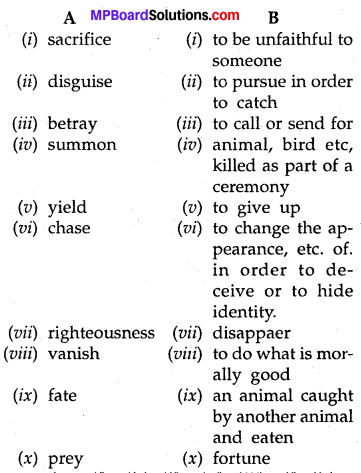
(A) Match column A with column B for finding the meaning of words in column
A.
Class 8 English Chapter 9 The Sacrifice
Answers:
(i) – (iv)
(ii) – (vi)
(iii) – (i)
(iv) – (iii)
(v) – (v)
(vi) – (ii)
(vii) – (viii)
(viii) – (vii),
(ix) – (x)
(x) – (ix).

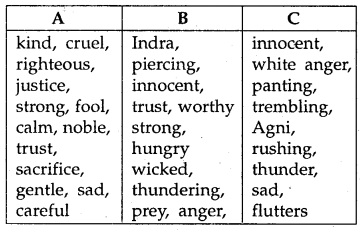
(B) Tick the words in Box A that are associated with King Shibi. Tick the words in Box B that are associated with the eagle. Tick the words in Box C that are associated with the Dove.
The Sacrifice Class 8 MP Board
Answer:
Words associated with King Shibi :
Kind, righteous, justice, strong, calm, noble, trust, sacrifice, gentle.

Words associated with the eagle :
Indra, piercing, strong, hungry, wicked, thundering, prey, angers.

Words assoiciated with the dove :
innocent, white, panting, trembling, Agni, sad, flutters.

Comprehension

(A) Answer the following questions :

Class 8 English Chapter 9 The Sacrifice Question 1.
What were the two questions of King Shibi?
Answer:
Justice and righteousness were the two qualities of king Shibi.

The Sacrifice Class 8 MP Board Question 2.
Why was the eagle angry?
Answer:
The eagle was angry because the king refused it surrend the dove.

Mp Board Class 8 English Chapter 10 Question 3.
Why did the king refuse to surrender the dove?
Answer:
The king refused to surrender the dove because he thought that his foremost duty was to protect the innocent bird.

Lesson 8 The Sacrifice MP Board Question 4.
What did the eagle demand in place of dove?
Answer:
The eagle demanded king’s flesh equal to the weight of the dove.

Mp Board Class 8 English Chapter 9 The Sacrifice Question 5.
The eagle made the king’s sacri fice more difficult by laying down certain conditions. What were these?
Answer:
The certain conditions laid down by the eagle were –

  1. The flesh must be cut from the right side of the king’s body.
  2. The king’s wife and his son must be present at the sacrifice.

Class 8 English Chapter 10 Mp Board Question 6.
Why did a tear drop from the left eye of the king?
Answer:
A tear dropped from the left eye of the king for the weak and the unprotected dose. The king was upset to think that his flesh was not sufficient to protect the dove.

Question 7.
What happened to the eagle and the dove?
Answer:
The eagle and the dove vanished and is their place stood Indra, the chief of gods and Agni, the god of Fire.

(B) Choose the right answer :

(a) What did the king say when he saw the dove?
(i) Oh! What nonsense!
(ii) Oh! What an innocent bird!
(iii) Oh! what a poor bird!
(iv) Oh! take this bird away!
Answer:
(ii) Oh! What an innocent bird!

(b) What did the eagle ask the king?
(i) Keep the dove with you.
(ii) Give me shelter.
(iii) Surrender my prey.
(iv) I want to rest.
Answer:
(iii) Surrender my prey.

(c) What did the queen say to the king?
(i) We are not with you.
(ii) We don’t like your decision.
(iii) I am very scared.
(iv) We are with you and may all the gods be with you.
Answer:
(iv) We are with you and may all the gods be with you.

(d) ‘What did God Indra grant King Shibi?
(i) You have the highest place in heaven.
(ii) You don’t have a place in heaven.
(iii) You have a place in hell.
(iv) You will live on the earth only.
Answer:
(iv) You will live on the earth only.

Let’s learn

(A) Look at the words from the lesson : calmy, firmly, slowly, carefully, wickedly, gently.

These are ‘adverbs’. They tell us something more about the verbs. Rewrite the following sentences by changing the underlined words (adjectives) into Adverbs as given in the example :

Example – Hari speaks to his servant in a kind manner

Hari speaks kindly to his servant.

  1. The dog gave a loud bark.
  2. Beena narrated the incident in a cheerful mood.
  3. She danced in a graceful manner.
  4. Hari is an efficient worker.
  5. Ravi made a strong appeal.

(B) Look at the following sentences from the lesson :

(a) Protecting it is my foremost duty.
(b) My cooks are famous for their cooking.

The words ‘protecting’ and ‘cooking’ are gerunds. Gerund is a noun (also called a ‘verbal noun’) in the form of the present present participle of a verb (that is, ending in-ing).

Use the verbs given below as gerunds in the following sentences,

pack, make, swim, collect, sleep, walk, play, paint.

  1. ……….. is a good exercise.
  2. Rhea’s hobby is ……….. stamps.
  3. ……….. fun of others is not a good thing.
  4. Children love ……….. cricket
  5. ……….. in the morning is good.
  6. ……….. during the day time is not good for health
  7. ………….. is an art.
  8. They started ………….. their luggage.

Answers:

  1. Swimming
  2. collecting,
  3. Making
  4. playing
  5. Walking
  6. Sleeping
  7. painting
  8. packing.

Let’s Talk

You meet an old-class fellow at the station. Read the first part of the dialogue. Then complete the dialogue using the correct tense form.

Rhea : Hello Priya! Is that really you!
Priya : Rhea! Oh! what a surprise! Rhea : Tell me about yourself. What have you been doing all these years!
Priya : My father got transferred. I am styding in Indore now.
Rhea : You have changed, Priya. I remember you used to be a bookworm. Tell me, do you still read a lot?
Priya : Oh no, Rhea! I have not read a book for months now. What about you? Do you still love music?
Answers:
Rhea : Yes, I love it too much even today.
Priya : What are you doing now a days.
Rhea : Now a days, I am preparing for my Medical exam.
Priya : After being a doctor, how will you serve the nation.
Rhea : I want to settle in the remote areas after being a doctor. I want to serve the poor people of our nation.

Let’s Read

Read the following passage carefully :

King Nanda of Magadh is holding court in his palace. He is surrounded by half a dozen courtiers who keep flattering him. They are listening to a musician.

Nanda : This fellow sings very well.
First Courtier : He is a talented singer, your highness! He has come from the far South to sing at your court.
Second courtier : The best men and women in Bharat come to this court.
Third courtier : That’s true. The best men and woman come to the best king.
Fourth courtier : The Court of Magadh is better than the court of Indra.
Nanda : I’m glad to hear that. I’m proud of you, my friends.
Courtiers : We’re proud of our king, we’re proud of Maharaj Ghana Nanda, the greatest of the Nandas. (The Chief Minister enters)
Chief Minister : Your highness. I’ve come about on urgent matter.
Nanda : Everything is urgent
for you. I don’t have any time for your urgent matters.
Courtiers : Minister Sir, His Highness is enjoying himself. Please don’t disturb him.

Now answer the following questions:

Question 1.
What is king Nanda doing in the court?
Answer:
He is holding court in his palace.

Question 2.
From where has the musician come?
Answer:
He has come from the far South.

Question 3.
Whose court is better than the court of Indra?
Answer:
The court of Magadh is better than the court of Indra.

Question 4.
What is the full name of the king?
Answer:
Maharaj Ghana Nanda.

Question 5.
Does the king like flattery?
Answer:
Yes, he likes flattery.

Question 6.
Why has the Chief Minister come to the court?
Answer:
He has come to the court taking an urgent matter.

Question 7.
Why does the courtier ask the Chief Minister not to disturb the king?
Answer:
They ask the Chief Minister not to disturb the king because he (king) is enjoying himself.

Question 8.
What is the moral of the story?
Answer:
One should give due importance to an urgent matter.

Let’s Write

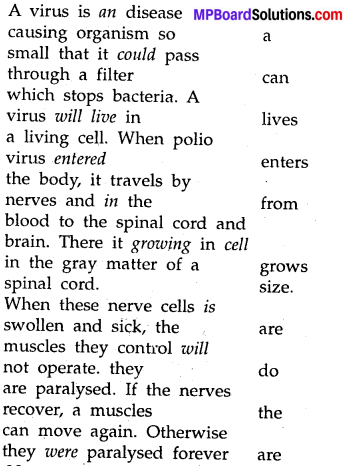
(A) The following passage has not been edited three is an error in each line. Underline the error. Write the correct word in the space provided.
Polio is cause by three
different viruses. caused
Answer:
MP Board Class 8th Special English Chapter 10 The Sacrifice 3

B. Now rewrite the passage that you have corrected.
Answer:
Polio is caused by three different viruses. A virus is a disease causing organism so small that it can pass through a filter which stops bacteria. A virus lives in a living cell. When polio virus enters the body, it travels by nerves and from the blood to the spinal cord and brain. There it grows in size in the gray matter of a spinal cord. When these nerve cells are swollen and sick, the muscles they control do not operate. They are paralysed. If the nerves recover, the muscles can move again. Otherwise they are paralysed forever.

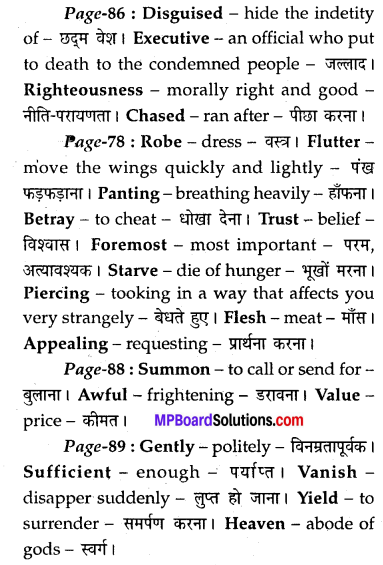
The Sacrifice Word Meanings

MP Board Class 8th Special English Chapter 10 The Sacrifice 4

We wish the knowledge shared regarding MP Board Solutions for Class 8 English Chapter 10 The Sacrifice Questions and Answers has been helpful to you. If you need any further help feel free to ask us and we will get back to you with the possible solution. Bookmark our site to avail the latest updates on different state boards solutions in split seconds.

MP Board Class 8th Social Science Solutions Chapter 15 South America-Geographical Features

MP Board Class 8th Social Science Solutions Chapter 15 South America-Geographical Features

MP Board Class 8th Social Science Chapter 15 Text Book Exercise

Choose the correct option of the following.

Mp Board Class 8 Social Science Solution Chapter 15 Question 1.
What is the expanse of South America continent from North to South?
(a)6406 km
(b)6640 km
(c)4066 km
(d)6064 km
Answer:
(b)6640 km

Mp Board Class 8 Social Science Chapter 15 Question 2.
Which is the lightest wood of South America?
(a) Valsa
(b) Hivia
(c) Sincona
(d) Highwood
Answer:
(a) Valsa

Fill in the blanks:

  1. The South America as per area is ……….. big continent.
  2. Most of South America is in …………. zone.
  3. …………. is the second longest river of the world.
  4. ………….. is the highest peak of Andes Mountain.
  5. …………. sea is in north of South America.

Answer:

  1. fourth (1,75,40,000 square km.)
  2. South Hemisphere
  3. River Amazon (6280 km. long)
  4. Akank Gua (6950 meters high)
  5. Caribbean Sea.

MP Board Class 8th Social Science Chapter 15 Very Short Answer Type Questions

Class 8 Social Science Chapter 15 Question 1.
What is young fold mountain?
Answer:
The mountains made of the internal forces of earth by the pressure of opposite directions are called young folded mountains. The Andese mountain is the second highest mountain range after Himalayas in the history of making earth, this is called young folded mountain.

The South America As Per Area Is Big Continent Mp Board Question 2.
What do you mean by water divider?
Answer:
The highest mountain or plateau region where water of rivers flows in two opposite directions. The plateau of Guyana work as water divider between Amazon Basin and Orinoco Basin.

Class 8 Social Science Chapter 15 Question Answer Question 3.
What is Granchaco?
Answer:
In lower part of North Argentina and West Paraguay, there is a distinct dry period and the rain occurs mainly in summer. The region is covered with thick forest and grasslands and is locally known as the Granchaco.

MP Board Class 8th Social Science Chapter 15 Short Answer Type Questions

South America Geographical Features Class 8 Mp Board Question 1.
Write the latitude and longitude expansion of South America?
Answer:
The South America is in South North America. The South America is the fourth largest continent in the world. Its area is 1,75,40,000 square km. It links between 12° North latitude to 55° South latitude and 35° West longitude to 81° West longitude. This continent is 6640 m from north to south and 5,150 from west to east.

Question 2.
Write the names of major trees of Amazon Basin?
Answer:
The Selvas forests of Amazon basin, have trees of rubbers, hardwood, Hivia, Casttillao, Sinkona, Rosewood and date. The rubber is made from the milk of rubber tree, Cunana is made from Sinkona and wax from Kamova date trees.

Question 3.
Write the names of rivers of Laplata Basin?
Answer:
Urugay Rivers.

Question 4.
How Pantagonic became desert?
Answer:
The Pantagonic Plateau having no rains. Therefore, it is a dry desert and it is situated in rain shadow area.

MP Board Class 8th Social Science Chapter 15 Long Answer Type Questions

Question 1.
Describe the climate of South America?
Answer:
Greater part of South America lies within the tropical zone. So the climate of the continent is usually hot and temperature remains high entire year. The Amazon basin being in equator circle has equatorial climate.

The conventional rains throughout the year here make the climate hot and humid. The most part here get 100 to 200 cm. rain, while few parts receive more than 200 cm. rain. The central part of continent, South Brazil, Paraguay and North Argentina’s low lands get rains in summer between 50 to 100 cm. and the winter is dry here.

South Peru and north Chile have hot and dry climate due to Atacama desert. There is scanty rain. Further south that is central Chile, has the Mediterranean type of climate, here winters are rainy and warm and dry summer. The climate of south Brazil is hot Mediterranean. Climate of Patagonia is dry because it lies in the rain shadow area of the Western mountains.

Question 2.
Mention the features of Andes Mountain range?
Answer:
Parallel to the Western Coastal plain belt their lies a long range of mountains and hills. This is the longest Andes Mountain range of the world. Its length is 7250 Km. The width of the Mountains is too much in the central region.

The Andes Mountain is the second highest mountain range after Himalayas in the history of making of earth. This is called young folded mountains. The Andes Mountain ranges have three ranges. In the east two ranges at same places come very close to each other and then get separated.

There are high plateaus among these ranges. The inland mountain plateau of Bolivia is very high. The Titikaka Lake is situated on this plateau. High peaks are always covered with snow all the year. The highest peak of Andes is Akanka Gua, 6950 meter high from sea level.

The most active Volcano Cotopaxi is situated on the mm height of Andes in Equadore. The mountain range always experience of Volcano eruptions, Amazon, Orinoko, Pilkomoia and Colorado rivers originate from Andes mountain.

Question 3.
Write a note on the vegetation and wildlife of South America?
Answer:
Amazon Basin which has hot and humid climate and carried rains is full of hot Mediterranean forests. This region is covered with equatorial rain forests known as SELVAS.

The Selvas forests have trees of rubber, hard wood, Hivia, Casttilloa, Sinkona, Rosewood and
Date. There are 2500 species of fishes in the rivers and 1500 species of birds. Galepagora turtle is found on the sea coasts. The Makra Monkey, Squirrel Monkey, the Anaconda Python, the marshy deer, Hippopotamus, Chimpanzee and Crocodiles are found here.

In the south of the Amazon forest lies the savana type long grass plains they are known as LANOS in the Orinoco river basin and Campos in North Argentina and Paraguay. There are devours ants, Puma and Jaguar animals.

Part of Southern Peru and northern Chile have hot and desert type climate. There are shrubs, cactus and prickly pear. In extreme south of Chile there is oceanic type of Climate. Grasslands are useful for cattle and sheep rearing.

Question 4.
In which physical divisions South America have been divided. Describe anyone.
Answer:
South America is divided into following three divisions:

  1. The Western Coastal Strip
  2. The Western Mountains
  3. The Central Plains
  4. The Eastern Highlands

1.The Western Coastal Strip:
Consists of a narrow strip of low and long the pacific coast in the western part of South America.

2.The Western Mountains:
There is a mountainous range called Andes along the western part of South America. They are the young fold mountains only next to Himalaya Mountains. They are three main ranges in the Andes. Eastern sides of this area have two high ranges.

Between these mountains some plateaus are found. The Bolivian is one of them. Lake Titicaco is also located here. It is one of the largest lake of South America. Mt. Aconcagua is the highest peak as higher as 7021 meters above sea level of Andes. Mt. Cotopaxi in Equator is volcanic mountain of this region.

3.The Central Plain:
The Central Plain is made up of the basins of the Orinoco, the Amazon and Plato rivers.Amazon river which 6280 kilometers long takes the greatest volume of water in the world.

4.The Eastern Highlands:
Consists of Guyana and Brazilians Highlands. The highest waterfall of the world called Angel Fall is located here in the south-eastern part of Venezuela.

Project Work:

Show the following in the outline map of South America –

  1. Amdese Mountain Range, Cotopaxi,
  2. Orinoco, Paraguay and Amazon rivers,
  3. Plateaus of Brazil, Guyana and Bolivia,
  4. Campos, Pampos, grasslands of Lanos,
  5. Cape Horn and Cape San Deigo,
  6. Caribbean Sea, Panama Canal,
  7. Titical Lake, Angel Waterfall, Atakama and Pantogonia desert.

Mp Board Class 8 Social Science Solution Chapter 15

MP Board Class 8th Social Science Solutions

MP Board Class 8th Social Science Solutions Chapter 8 British Policies and Administration in India After 1858

MP Board Class 8th Social Science Solutions Chapter 8 British Policies and Administration in India After 1858

MP Board Class 8th Social Science Chapter 8 Text Book Exercise

Choose the correct option of the following questions

Mp Board Class 8 Social Science Solution Chapter 8 Question 1.
The Proclamation of Queen Victoria were made in:
(a) 1757
(b) 3858
(c) 1957
(d) 1965
Answer:
(b) 3858

Mp Board Class 8 Social Science Chapter 8 Question 2.
The rule of India entrusted into hands of Queen of England.
(a) By 1858 Act
(b) By 1861 Act
(c) By 1865 Act
(d) By 1876 Act
Answer:
(a) By 1858 Act

British Policies And Administration In India After 1858 Question 3.
First Municipality in India was established:
(a) In 1865 at Madras
(b) In 1J867 in Bengal
(c) In 1868 in Uttar Pradesh
(d) None of the above
Answer:
(d) None of the above

Class 8 Social Science Chapter 8 Mp Board Question 5.
The head of Indian Secretariat was called:
(a) Indian Secretary
(b) Viceroy
(c) Governor General
(d) Secretary
Answer:
(a) Indian Secretary

Fill in the blanks:

  1. To help Viceroy a members …………. council was formed.
  2. The British economic policies were formed to protect the interests of …………..
  3. In 1876 the minimum age for Civil Services was …………..
  4. To implement Wood Proposals Lord Rippon constituted ………… Commission.

Answer:

  1. Four
  2. Britishers
  3. 19
  4. Hunter

MP Board Class 8th Social Science Chapter 8 Very Short Answer Type Questions

Question 1.
By which Act Queen of England was made Empress of India.
Answer:
By Ordinance of 1858.

Question 2.
After 1858 how was the Governor General Addressed.
Answer:
The Governor General was addressed as Viceroy.

Question 3.
Who was called the father of local governance?
Answer:
Lord Rippon.

MP Board Class 8th Social Science Chapter 8 Short Answer Type Questions

Question 1.
Describe the proclamation of Queen in short.
Answer:
The rule of the company was replaced by rule of the Crown. The Company territories were now governed by English government. Indian people and rulers got some rights and privileges.

Question 2.
What changes were made by 1861 Act.
Answer:
The Legislative Council was enlarged by the addition of 6 to 12 more members and also introduced provincial councils.

Question 3.
Describe the administrative division after 1858.
Answer:
It transferred power to British crown. A minister called the Secretary of State for India was made responsible for the government of India to the British Parliament. Viceroy replaced Governor General title.

MP Board Class 8th Social Science Chapter 8 Long Answer Type Questions

Question 1.
Write about the decisions of 1858 Act.
Answer:
The decisions of 1858 Act are:
1. The control of India passed on completely to British Government. It was announced that India would be governed by and in the name of the British monarch through a Secretary of State.

2. Before 1858, there were two bodies in Britain which controlled the British policies in India, viz, the Board of Control and the Court of Directors of the East India Company. Now a minister of the British Government called the Secretary of State for India, was given complete control over the Government of India. Like other ministers of the British Government, he was responsible to the British Parliament.

3. To advise the Secretary of State, the Indian Council was created. This Council had no real powers and could only advise the Secretary of State who could ignore the advise of the Council at any time the liked.

4. Before 1858, the Governor General generally acted on his own within the framework of the general policies laid down in Britain. The advanced means of transport and communication reduced the freedom enjoyed by the earlier Governor Generals of India. Now, the Viceroy had to inform the latest developments of India to the Secretary of State thereafter he was to work according to his instructions and others.

Question 2.
Write short note on Army Organisation?
Answer:
Before 1858, the Presidencies of Bombay, Madras and Calcutta had their separate armies. Each Presidency consisted of the Indian soldiers, units of the European soldiers and the regiments of the British soldiers – the latter two were combined.

In 1859, the armies of the three Presidencies were unified and the entire army, of the British India came under the control of the commander – in – chief. The Indian soldiers were excluded from the artillery and the arsenals; The number of the European soldiers was increased. For every two Indian soldiers, one European soldier was recruited. All the officers in the army were to be the Europeans.

Question 3.
Give short Information about the local administration in brief.
Answer:
After 1857, the British government encouraged the local government units such as the municipalities and district boards. Thus, the system of administration was decentralized. The local bodies were given the tasks of providing education, health services, water supply, and the like to the people. Some important changes were made in the local government in 1882, the old system was broken down.

Matters like sanitation, roads, water supply and street lighting were neglected. After 1857, Municipal committees were set up in towns, they levied taxes to meet expenditure on local administration and works. After 1882, the district boards were set up but they consisted of only officials and not elected members. After 1882, the elected members were introduced but only with property were entitled to vote.

Question 4.
Evaluate the British economic policies in precise?
Answer:
British government reorganized the financial administration after 1858. The economic policies followed by Britishers drained the Indian resources and help the Britishers. The British government abolished the tax on Import and allowed free trade in India.

This lured lot of foreign companies to India and caused disastrous effect on Indian industries. The prominent industries that suffered due to the British financial policy were Jute, Indigo, Textiles, Woolen, Tea, Rubber, Coffee, Coal, Iron, and Steam ships. The financial policy of British government completely halted the progress of India.

Question 5.
Describe the British education policy.
Answer:
The British education policy was not for the welfare of Indians but was more for promoting Christian religion and imparting English education. Missionaries established in 1820 promoted English language. In 1854 Woods proposals suggested to promote English languages with other Indian languages.

There was proposal to train teachers and to provide financial grant to educational institutions on secular basis. In 1904 University Act was passed for affiliation of the University and to appoint professors. The 1919 Act entrusted the responsibility of education to provincial councils. The British education policy played a major role in motivating Indians towards nationality

MP Board Class 8th Social Science Solutions