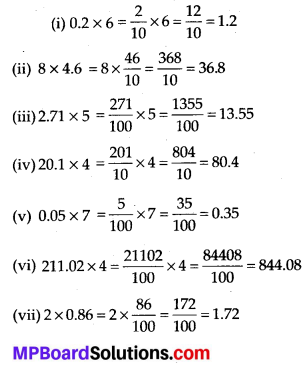
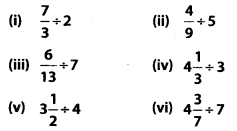
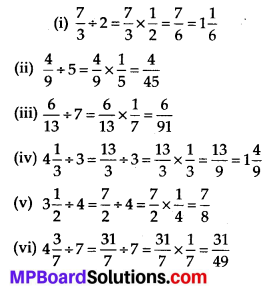
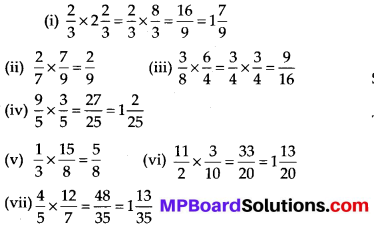
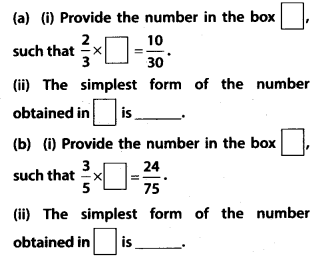
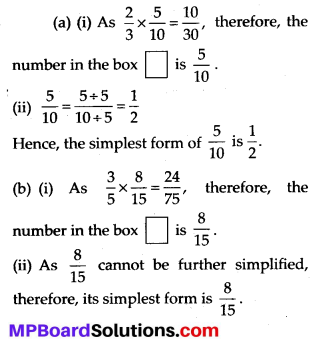
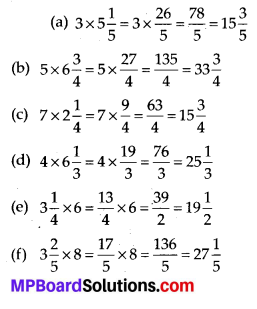
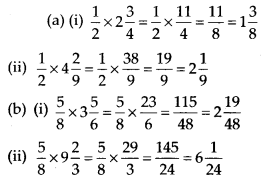
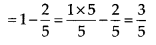
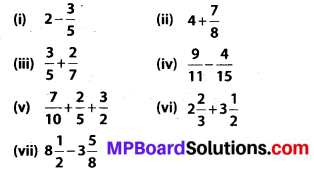
MP Board Class 7th Maths Solutions Chapter 2 Fractions and Decimals Ex 2.7

MP Board Class 7th Maths Solutions Chapter 2 Fractions and Decimals Ex 2.7

Question 1.
Find:
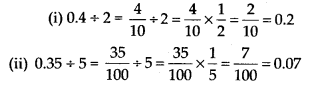
(i) 0.4 ÷ 2
(ii) 0.35 ÷ 5
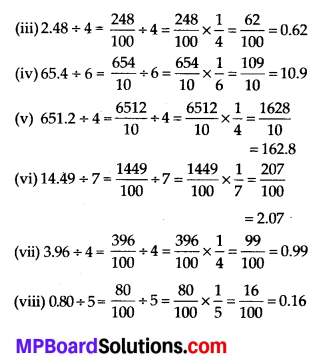
(iii) 2.48 ÷ 4
(iv) 65.4 ÷ 6
(v) 651.2 ÷ 4
(vii) 3.96 ÷ 4
(viii) 0.80 ÷ 7
Solution:
MP Board Class 7th Maths Solutions Chapter 2 Fractions and Decimals Ex 2.7 1
MP Board Class 7th Maths Solutions Chapter 2 Fractions and Decimals Ex 2.7 2

MP Board Class 7th Maths Solutions Chapter 2 Fractions and Decimals Ex 2.7

Question 2.
Find:
(i) 4.8 ÷ 10
(ii) 52.5 ÷ 10
(iii) 0.7 ÷ 10
(iv) 33.1 ÷ 10
(v) 272.23 ÷ 10
(vi) 0.56 ÷ 10
(vii) 3.97 ÷ 10
Solution:
We know that when a decimal number is divided by a multiple of 10 (i.e., 10,100,1000, etc.), the decimal point will be shifted to the left by as many places as there are zeros.
(i) 4.8 ÷ 10 = 0.48
(ii) 52.5 ÷ 10 = 5.25
(iii) 0.7 ÷ 10 = 0.07
(iv) 33.1 ÷ 10 = 3.31
(v) 272.23 ÷ 10 = 27.223
(vi) 0.56 ÷ 10 = 0.056
(vii) 3.97 ÷10 = 0.397

MP Board Class 7th Maths Solutions Chapter 2 Fractions and Decimals Ex 2.7

Question 3.
Find:
(i) 2.7 ÷ 100
(ii) 0.3 ÷ 100
(iii) 0.78 ÷ 100
(iv) 432.6 ÷ 100
(v) 23.6 ÷ 100
(vi) 98.53 ÷ 100
Solution:
We know that when a decimal number is divided by a multiple of 10 (i.e., 10, 100, 1000, etc.), the decimal point will be shifted to the left by as many places as there are zeros.
(i) 2.7 ÷ 100 = 0.027
(ii) 0.3 ÷ 100 = 0.003
(iii) 0.78 ÷ 100 = 0.0078
(iv) 432.6 ÷ 100 = 4.326
(v) 23.6 ÷ 100 = 0.236
(vi) 98.53 ÷ 100 = 0.9853

MP Board Class 7th Maths Solutions Chapter 2 Fractions and Decimals Ex 2.7

Question 4.
Find:
(i) 7.9 ÷ 1000
(ii) 26.3 ÷ 1000
(iii) 38.53 ÷ 1000
(v) 0.5 ÷ 1000
Solution:
We know that when a decimal number is divided by a multiple of 10 (i.e., 10, 100, 1000, etc.), the decimal point will be shifted to the left by as many places as there are zeros.
(i) 7.9 ÷ 1000 = 0.0079
(ii) 26.3 ÷ 1000 = 0.0263
(iii) 38.53 ÷ 1000 = 0.03853
(iv) 128.9 ÷ 1000 = 0.1289
(v) 0.5 ÷ 1000 = 0.0005

Question 5.
Find:
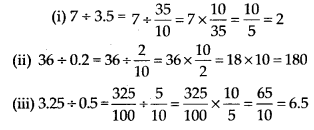
(i) 7 ÷ 3.5
(ii) 36 ÷ 2
(iii) 3.25 ÷ 0.5
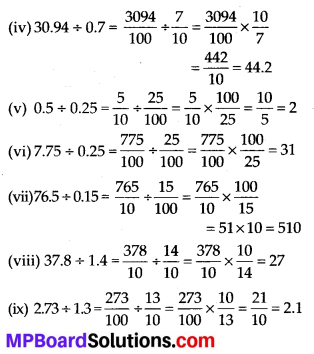
(iv) 30.94 ÷ 0.7
(v) 0.5 ÷ 0.25
(vi) 7.75 ÷ 0.25
(vii) 76.5 ÷ 0.15
(viii) 37.8 ÷ 1.4
(ix) 2.73 ÷ 1.3
Solution:
MP Board Class 7th Maths Solutions Chapter 2 Fractions and Decimals Ex 2.7 3
MP Board Class 7th Maths Solutions Chapter 2 Fractions and Decimals Ex 2.7 4

Question 6.
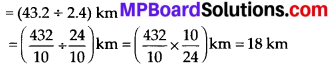
A vehicle covers a distance of 43.2 km in 2.4 litres of petrol How much distance wilt it cover in one litre of petrol?
Solution:
Distance covered in 2.4 Litres of petrol = 43.2 km
∴ Distance covered in 1 litre of petrol = (43.2 ÷ 2.4) km
MP Board Class 7th Maths Solutions Chapter 2 Fractions and Decimals Ex 2.7 5

MP Board Class 7th Maths Solutions Chapter 2 Fractions and Decimals Ex 2.7

MP Board Class 7th Maths Solutions

MP Board Class 7th Social Science Solutions Miscellaneous Questions 1

MP Board Class 7th Social Science Solutions Miscellaneous Questions 1

Choose the correct alternative from the following:

Question 1.
The medieval period in India begins form:
(a) The 13th century
(b) 7th century
(c) 8th century
(d) 12th century
Answer:
(c) 8th century

Question 2.
The famous Raja Rajeshwara temple of Tanjavur was built by:
(a) Raja raja – I
(b) Rajendra -I
(c) Krishna – I
(d) Krishna – II
Answer:
(a) Raja raja – I

Question 3.
The President of the constituent assembly was:
(a) Dr. Harising Gaur
(b) Dr. Bhimrao Ambedekar
(c) Dr. Rajendra Prasad
(d) Pt. Jawaharlal Nehru.
Answer:
(c) Dr. Rajendra Prasad

Question 4.
The total no. of the members of the Rajya Sabha is:
(a) 238
(b) 250
(c) 230
(d) 260
Answer:
(c) 230

Question 5.
Day and night are equal on:
(a) 21 March and 25th Dec
(b) 21 June and 22 Dec
(c) 25 Dec & 25 June
(d) none of the above
Answer:
(d) none of the above

Question 7.
The percentage of oxygen percent in the atmosphere is:
(a) 78%
(b) 21%
(c) 28%
(d) 71%
Answer:
(b) 21%

MP Board Solutions

Fill in the blanks:

  1. India was in continuous contact with …………… through trade.
  2. ……………. translated Ramayana into Tamil
  3. The ancient name of the capital of Madhya Pradesh was …………….
  4. The Constitution of India is a written and ……………. Constitution.
  5. The earth’s axis makes an angle of ……………… from its plane.

Answer:

  1. Arabs
  2. Kamban
  3. Bhojpal
  4. Comprehensive
  5. 23 \(\frac { 1 }{2 }\)°

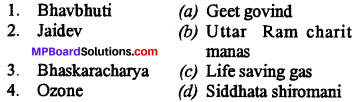
Make correct pairs:

MP Board Class 7th Social Science Solutions Miscellaneous Questions-1
Answer:
1. (b) Uttar Ram charit
2. (a) Geetgovind
3. (d) Siddhata shiromani
4. (c) Life saving gas

Answer the following in brief:

Question 1.
Write the names of the important rulers of the Chouhan dynasty.
Answer:
Ajayraj Chouhan and Prithiviraj Chouhan.

Question 2.
Write any three features of the Chola administration.
Answer:

  • The king was the head of the government
  • The empire was divided into provinces.
  • The village was the lowest unit of administration.

Question 3.
What do you understand by Secularism?
Answer:
Secularism means that from point of view of the government all religious are equal and the state shall not discriminate between the people of different facilities.

Question 4.
Write any three qualifications required to be a member of the RajyaSabha.
Answer:
A person must be 30 years or above in age.

  • His name must be in the voter is list of the constituency to which he belongs.
  • He must not be insolvent, bankrupt and must be same.

Question 5.
What do you know about die Ionosphere?
Answer:
It is one of the layers of gases found in thermosphere. It is found at a height of 80 to 400 km from the earth.

MP Board Solutions

Question 6.
What do you mean by the axis of the earth?
Answer:
The axis of the earth is the point on which die earth rotates.

Question 7.
What is meant by change of season?
Answer:
Because of the title of the earth’s axis one hemisphere comes to face to the sun first and then comes the other hemisphere. Therefore variations in the weather phenomenon occur. Change in temperature is die bases for change in seasons. The earth gets heat from sun. Due to its tilt of 23\(\frac { 1 }{2 }\)° degrees on its axis and its revolution round the sun the quantity of temperature received differs. This brings about changes in seasons.

Question 8.
Which season does India experience when die sun is directly on the tropic of Cancer?
Answer:
Summer season.

Answer the following questions in detail:

Question 1.
Describe die political condition of India in the beginning of the early part of the medieval period.
Answer:
The Arabs made great contribution in the development of the Medieval civilization. They were expert traders. Trade had made them rich and they used the wealth for the development of art, science and literature.

They spread knowledge, which they acquired from the countries with which they had trade relations, to distant lands. They also made important contribution in the field of Geometry, Algebra, Geography and Astronomy. They also carried new inventions of China like Gun Powder, Paper and Compass to countries of Europe.

Question 2.
Write about the main features of the Pallava dynasty.
Answer:
Main features of the Pallava dynasty:

  1. Pollar administration was well – managed.
  2. Education, literature and art flourished greatly.
  3. The local language was Tamil in which high quality literature was produced.
  4. The Pollar kings were Shaivas and the Hindu religion flourished there well.
  5. The Pollar as got many famous temples built there. Some of the very famous are ‘Dharmraj’ and Kailashnath temple at Kanchi, the rock – cut Rathmandir at the sea coast of Mahabalipuram.

MP Board Solutions

Question 3.
Describe the freedoms given in the Rights to freedom.
Answer:
Right to freedom guarantees six basic freedoms. Two freedoms are given here:

1. Freedom to express thoughts – All die citizens of India has the freedom to express his / her thoughts, to give speech and to know about the thought of others and to propagate it The citizens have the freedom to write articles etc. in newspapers.

2. Freedom to live and settle in any part of India – All the citizens of India have die freedom to settle in any part of the country permanently or temporarily as per their wish.

Question 4.
Explain the process of framing a law.
Answer:
Every bill has to go through three stages in the Parliament. These stages are:

  • The first reading of the bill – In it, copies of the bill are given to the members. The person or minister who introduces the bill in the House, gives a speech explaining die purpose of die bill.
  • The second reading – In the second reading, a clause / by – clause discussion takes place on the bill.
  • The third reading – in the third reading the bill as a whole is finally discussed and put to vote.

If the majority of the members are in its favor, the bill is passed. Now the bill is sent to the other House. After the bill is sent to the other House, it goes through all the three stages as mentioned above. After toe other House passes toe bill, it is sent to toe President for his assent The bill becomes a law after it is signed by toe President

Question 5.
Describe die composition of die atmosphere
Answer:
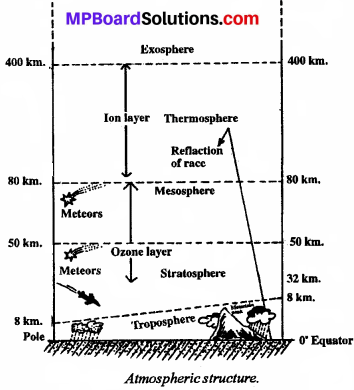
The changes in temperature at various attitudes divide the atmosphere into 5 layers.
1. Troposphere
2. Stratosphere
3. Mesosphere
4. Thermosphere
5. Exosphere

1. Troposphere:
It extends to a height of 8 km at the poles and 18 km on equator. Dust particles and water vapor are found in this layer. All kinds of weather phenomenon like clouds, rainstorm etc. is observed in this layer. All types of life forms are found in this layer. This layer is also known as dynamic layer.

2. Stratosphere:
The second layer of the atmosphere is known as stratosphere. The temperature in this layer is constant till 20 kms. height and then slowly increases.

3. Mesosphere:
The height of this layer is 50 to 80 km from the sea level. The variation in temperature is less in this layer as water vapor, clouds and dust are found less and fast wind blows here.

MP Board Class 7th Social Science Solutions Miscellaneous Questions-1 - 2

4. Thermosphere:
The thermosphere starts from the height of 80 km from sea level. The density of air is very less in this layer. The
temperature increases with height in this layer. Two layers of gases are found here. One is the ozone layer and the other is the ion layer.

The ozone layer is spread at a height of 32 to 80 km from the earth. The ion layer is found at a height of 80 to 400 km. from earth. The electrically charged particles stop the radio waves transmitted from the earth and return it back to the earth. In this way we can listen to various radio programmers.

5. Exosphere:
This is the outermost layer of die atmosphere the upper limit of this layer is uncertain. The density of air is the least here.

MP Board Solutions

Question 6.
Describe the different types of permanent winds.
Answer:
Winds are the natural horizontal movement of air over the earth’s surface.

Difference between air and wind:

  • When air moves vertically downwards or upwards, it is known as air. But when it moves horizontally, it is known as wind.
  •  Airis calm-but when it becomes dynamic it take / the form of wind. Wind always blows from high pressure to low pressure.

Question 7.
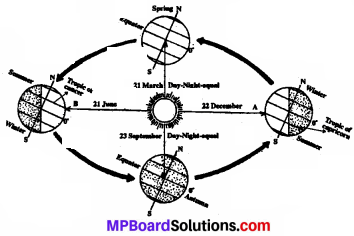
Explain with the help of a diagram the changing seasons of the earth.
Answer:
The earth’s axis forms an angle of 66 \(\frac { 1 }{2 }\) with the plane of the earths orbit and the earth tilts at 23 1/2 degree on its axis. Let us understand how seasons occurs on earth.
MP Board Class 7th Social Science Solutions Miscellaneous Questions-1 - 3

MP Board Class 7th Social Science Solutions

MP Board Class 7th Maths Solutions Chapter 2 Fractions and Decimals Ex 2.6

MP Board Class 7th Maths Solutions Chapter 2 Fractions and Decimals Ex 2.6

Question 1.
Find:
(i) 0.2 × 6
(ii) 8 × 4.6
(iii) 2.71 × 5
(iv) 20.1 × 4
(v) 0.05 × 7
(vi) 211.02 × 4
(vii) 2 × 0.86
Solution:
MP Board Class 7th Maths Solutions Chapter 2 Fractions and Decimals Ex 2.6 1

Question 2.
Find the area of rectangle whose length is 5.7 cm and breadth is 3 cm.
Solution:
Length = 5.7 cm and breadth = 3 cm
Area = Length × Breadth = (5.7 × 3) cm2 = 17.1 cm2

MP Board Class 7th Maths Solutions Chapter 2 Fractions and Decimals Ex 2.6

Question 3.
Find:
(i) 1.3 × 10
(ii) 36.8 × 10
(iii) 153.7 × 10
(iv) 168.07 × 10
(v) 31.1 × 100
(vi) 156.1 × 100
(vii) 3.62 × 100
(viii) 43.07 × 100
(ix) 0.5 × 10
(x) 0.08 × 10
(xi) 0.9 × 100
(xii) 0.03 × 1000
Solution:
We know that when a decimal number is multiplied by 10, 100, 1000, the decimal point in the product is shifted to the right by as many places as there are zeros.
(i) 1.3 × 10 = 13
(ii) 36.8 × 10 = 368
(iii) 153.7 × 10 = 1537
(iv) 168.07 × 10 = 1680.7
(v) 31.1 × 100 = 3110
(vi) 156.1 × 100 = 15610
(vii) 3.62 × 100 = 362
(viii) 43.07 × 100 = 4307
(ix) 0.5 × 10 = 5
(x) 0.08 × 10 = 0.8
(xi) 0.9 × 100 = 90
(xii) 0.03 × 1000 = 30

Question 4.
A two-wheeler covers a distance of 55.3 km in one litre of petrol. How much distance will it cover in 10 litres of petrol?
Solution:
Distance covered in 1 litre of petrol = 55.3 km
Distance covered in 10 litres of petrol = (10 × 55.3) km = 553 km
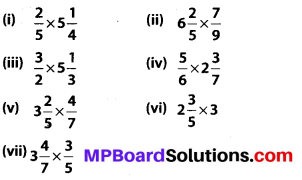
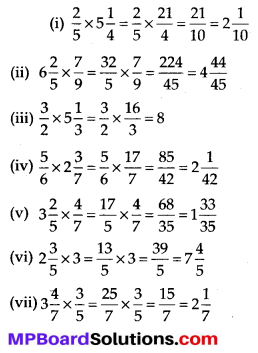
MP Board Class 7th Maths Solutions Chapter 2 Fractions and Decimals Ex 2.6

Question 5.
Find:
(i) 2.5 × 0.3
(ii) 0.1 × 51.7
(iii) 0.2 × 316.8
(iv) 1.3 × 3.1
(v) 0.5 × 0.05
(vii) 1.07 × 0.02
(viii) 10.05 × 1.05
(ix) 101.01 × 0.01
(x) 100.01 × 1.1
Solution:
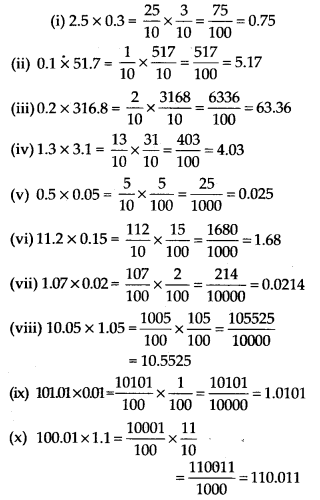
MP Board Class 7th Maths Solutions Chapter 2 Fractions and Decimals Ex 2.6 2

MP Board Class 7th Maths Solutions Chapter 2 Fractions and Decimals Ex 2.6

MP Board Class 7th Maths Solutions

MP Board Class 7th Maths Solutions Chapter 2 Fractions and Decimals Ex 2.5

MP Board Class 7th Maths Solutions Chapter 2 Fractions and Decimals Ex 2.5

Question 1.
Which is greater?
(i) 0.5 or 0.05
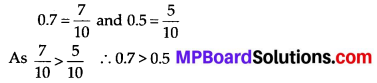
(ii) 0.7 or 0.5
(iii) 7 or 0.7
(iv) 1.37 or 1.49
(v) 2.03 or 2.30
(vi) 0.8 or 0.88.
Solution:
(i) 0.5 or 0.05
Converting these decimal numbers into like fractions, we obtain
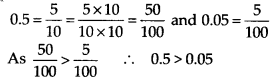
MP Board Class 7th Maths Solutions Chapter 2 Fractions and Decimals Ex 2.5 1

(ii) 0.7 or 0.5
Converting these decimal numbers into like fractions, we obtain
MP Board Class 7th Maths Solutions Chapter 2 Fractions and Decimals Ex 2.5 2

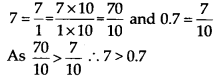
(iii) 7 or 0.7
Converting these decimal numbers into like fractions, we obtain
MP Board Class 7th Maths Solutions Chapter 2 Fractions and Decimals Ex 2.5 3

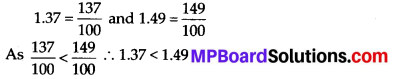
(iv) 1.37 or 1.49
Converting these decimal numbers into like fractions, we obtain
MP Board Class 7th Maths Solutions Chapter 2 Fractions and Decimals Ex 2.5 4

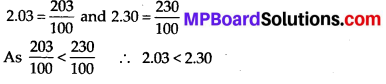
(v) 2.03 or 2.30
Converting these decimal numbers into like fractions, we obtain
MP Board Class 7th Maths Solutions Chapter 2 Fractions and Decimals Ex 2.5 5

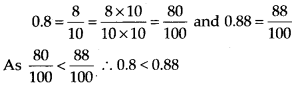
(vi) 0.8 or 0.88
Converting these decimal numbers into like fractions, we obtain
MP Board Class 7th Maths Solutions Chapter 2 Fractions and Decimals Ex 2.5 6

MP Board Class 7th Maths Solutions Chapter 2 Fractions and Decimals Ex 2.5

Question 2.
Express as rupees using decimals:
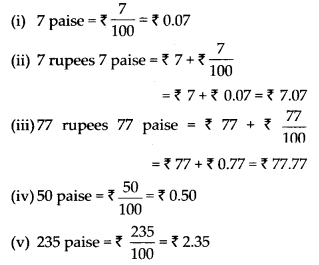
(i) 7 paise
(ii) 7 rupees 7 paise
(iii) 77 rupees 77 paise
(iv) 50 paise
(v) 235 paise.
Solution:
There are 100 paise in 1 rupee. Therefore, if we want to convert paise into rupees, we have to divide paise by 100.
MP Board Class 7th Maths Solutions Chapter 2 Fractions and Decimals Ex 2.5 7

Question 3.
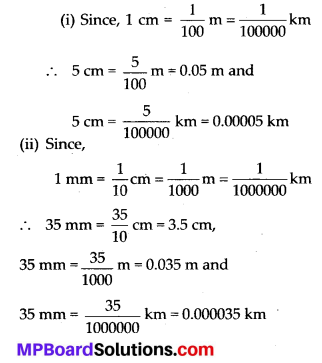
(i) Express 5 cm in metre and kilometre.
(ii) Express 35 mm in cm, m and km.
Solution:
MP Board Class 7th Maths Solutions Chapter 2 Fractions and Decimals Ex 2.5 8

MP Board Class 7th Maths Solutions Chapter 2 Fractions and Decimals Ex 2.5

Question 4.
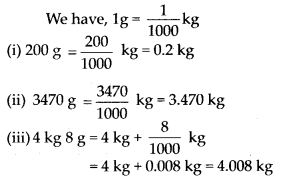
Express in kg:
(i) 200 g
(ii) 3470 g
(iii) 4 kg 8g
Solution:
MP Board Class 7th Maths Solutions Chapter 2 Fractions and Decimals Ex 2.5 9

Question 5.
Write the following decimal numbers in the expanded form:
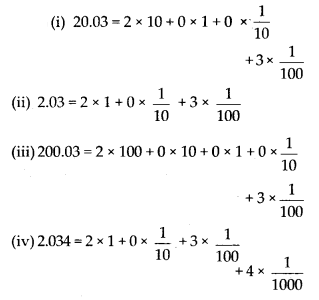
(i) 20.03
(ii) 2.03
(iii) 200.03
(iv) 2.034
Solution:
MP Board Class 7th Maths Solutions Chapter 2 Fractions and Decimals Ex 2.5 10

MP Board Class 7th Maths Solutions Chapter 2 Fractions and Decimals Ex 2.5

Question 6.
Write the place value of 2 in the following decimal numbers:
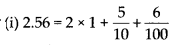
(i) 2.56
(ii) 21.37
(iii) 10.25
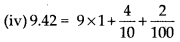
(iv) 9.42
(v) 63.352.
Solution:
MP Board Class 7th Maths Solutions Chapter 2 Fractions and Decimals Ex 2.5 11
∴ Place value of 2 in 2.56 is ones.
MP Board Class 7th Maths Solutions Chapter 2 Fractions and Decimals Ex 2.5 12
∴ Place value of 2 in 21.37 is tens.
MP Board Class 7th Maths Solutions Chapter 2 Fractions and Decimals Ex 2.5 13
∴ Place value of 2 in 10.25 is tenths.
MP Board Class 7th Maths Solutions Chapter 2 Fractions and Decimals Ex 2.5 14
∴ Place value of 2 in 9.42 is hundredths.
MP Board Class 7th Maths Solutions Chapter 2 Fractions and Decimals Ex 2.5 15
∴ Place value of 2 in 63.352 is thousandths.

MP Board Class 7th Maths Solutions Chapter 2 Fractions and Decimals Ex 2.5

Question 7.
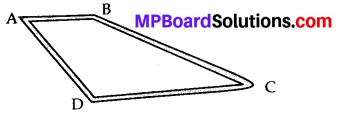
Dinesh went from place A to place Band from there to place C. A is 7.5 km from B and B is
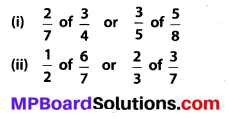
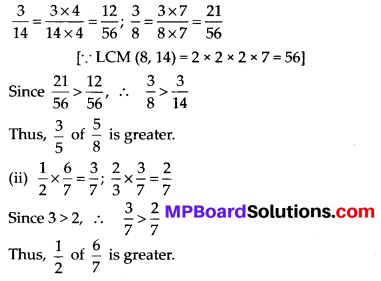
12.7 km from C. Ayub went from place A to place D and from there to place C. D is 9.3 km from A and C is 11.8 km from D. Who travelled more and by how much?
MP Board Class 7th Maths Solutions Chapter 2 Fractions and Decimals Ex 2.5 16
Solution:
Distance travelled by Dinesh = AB + BC = (7.5 + 12.7) km = 20.2 km
Distance travelled by Ayub = AD + DC
= (9.3+ 11.8) km = 21.1 km
Difference = (21.1 – 20.2) km = 0.9 km
Hence, Ayub travelled 0.9 km more distance than Dinesh.

MP Board Class 7th Maths Solutions Chapter 2 Fractions and Decimals Ex 2.5

Question 8.
Shyama bought 5 kg 300 g apples and 3 kg 250 g mangoes. Sarala bought 4 kg 800 g oranges and 4 kg 150 g bananas. Who bought more fruits?
Solution:
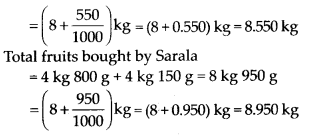
Total fruits bought by Shyama = 5 kg 300 g + 3 kg 250 g = 8 kg 550 g
MP Board Class 7th Maths Solutions Chapter 2 Fractions and Decimals Ex 2.5 17
Hence, Sarala bought more fruits.

Question 9.
How much less is 28 km than 42.6 km?
Solution:
(42.6 – 28.0) km = 14.6 km
Hence, 28 km is less than 42.6 km by 14.6 km.

MP Board Class 7th Maths Solutions Chapter 2 Fractions and Decimals Ex 2.5

MP Board Class 7th Maths Solutions

MP Board Class 7th Maths Solutions Chapter 2 Fractions and Decimals Ex 2.4

MP Board Class 7th Maths Solutions Chapter 2 Fractions and Decimals Ex 2.4

Question 1.
Find:
MP Board Class 7th Maths Solutions Chapter 2 Fractions and Decimals Ex 2.4 1
Solution:
MP Board Class 7th Maths Solutions Chapter 2 Fractions and Decimals Ex 2.4 2

MP Board Class 7th Maths Solutions Chapter 2 Fractions and Decimals Ex 2.4

Question 2.
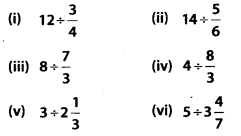
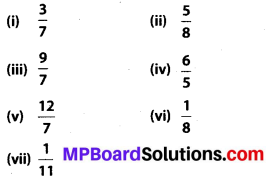
Find the reciprocal of each of the following fractions. Classify the reciprocals as proper fractions, improper fractions and whole numbers.
MP Board Class 7th Maths Solutions Chapter 2 Fractions and Decimals Ex 2.4 3
Solution:
(i) Reciprocal of \(\frac{3}{7}=\frac{7}{3}\). It is an improper fraction.
(ii) Reciprocal of \(\frac{5}{8}=\frac{8}{5}\). It is an improper fraction.
(iii) Reciprocal of \(\frac{9}{7}=\frac{7}{9}\). It is a proper fraction.
(iv) Reciprocal of \(\frac{6}{5}=\frac{5}{6}\). It is a proper fraction.
(v) Reciprocal of \(\frac{12}{7}=\frac{7}{12}\). It is a proper fraction.
(vi) Reciprocal of \(\frac{1}{8}\) = 8. It is a whole fraction.
(vii) Reciprocal of \(\frac{1}{11}\) = 11. It is a whole fraction.

Question 3.
MP Board Class 7th Maths Solutions Chapter 2 Fractions and Decimals Ex 2.4 4
MP Board Class 7th Maths Solutions Chapter 2 Fractions and Decimals Ex 2.4 5

MP Board Class 7th Maths Solutions Chapter 2 Fractions and Decimals Ex 2.4

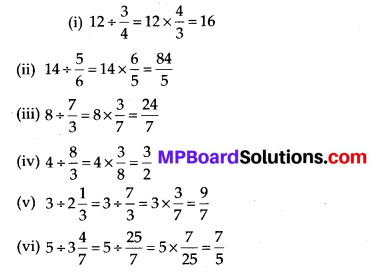
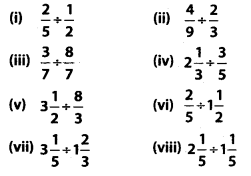
Question 4.
Find:
MP Board Class 7th Maths Solutions Chapter 2 Fractions and Decimals Ex 2.4 6
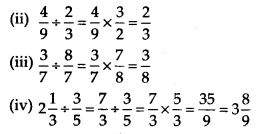
Solution:
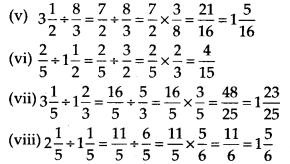
(i) \(\frac{2}{5}÷\frac{1}{2}=\frac{2}{5} \times 2=\frac{4}{5}\)
MP Board Class 7th Maths Solutions Chapter 2 Fractions and Decimals Ex 2.4 12
MP Board Class 7th Maths Solutions Chapter 2 Fractions and Decimals Ex 2.4 8

MP Board Class 7th Maths Solutions Chapter 2 Fractions and Decimals Ex 2.4

MP Board Class 7th Maths Solutions

MP Board Class 7th Maths Solutions Chapter 2 Fractions and Decimals Ex 2.3

MP Board Class 7th Maths Solutions Chapter 2 Fractions and Decimals Ex 2.3

Question 1.
MP Board Class 7th Maths Solutions Chapter 2 Fractions and Decimals Ex 2.3 1
Solution:
MP Board Class 7th Maths Solutions Chapter 2 Fractions and Decimals Ex 2.3 2

Question 2.
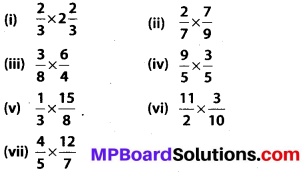
Multiply and reduce to lowest form (if possible):
MP Board Class 7th Maths Solutions Chapter 2 Fractions and Decimals Ex 2.3 3
Solution:
MP Board Class 7th Maths Solutions Chapter 2 Fractions and Decimals Ex 2.3 4

Question 3.
Multiply the following fractions:
MP Board Class 7th Maths Solutions Chapter 2 Fractions and Decimals Ex 2.3 5
Solution:
MP Board Class 7th Maths Solutions Chapter 2 Fractions and Decimals Ex 2.3 6

Question 4.
MP Board Class 7th Maths Solutions Chapter 2 Fractions and Decimals Ex 2.3 7
Solution:
Converting these fractions into like fractions, we obtain
MP Board Class 7th Maths Solutions Chapter 2 Fractions and Decimals Ex 2.3 8
Question 5.
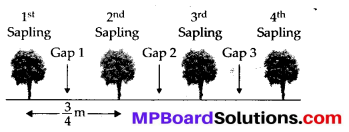
Saili plants 4 saplings, in a row, in her garden. The distance between two adjacent saplings is \(\frac{3}{4}\) m. Find the distance between the first and the last sapling.
Solution:
MP Board Class 7th Maths Solutions Chapter 2 Fractions and Decimals Ex 2.3 9
From the figure, it can be observed that gap between first and last sapling = 3 × Length of gap 1
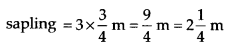
Therefore, distance between first and last
MP Board Class 7th Maths Solutions Chapter 2 Fractions and Decimals Ex 2.3 10

MP Board Class 7th Maths Solutions Chapter 2 Fractions and Decimals Ex 2.3

Question 6.
Lipika reads a book for \(1 \frac{3}{4}\) hours everyday. She reads the entire book in 6 days. How many hours in all were required by her to read the book?
Solution:
Time taken by Lipika to read the book per day = \(1 \frac{3}{4}\) hours = \(\frac{7}{4}\) hours
Number of days = 6
Total time taken by her to read the entire book = \(\frac{7}{4}\) × 6 hours = \(\frac{21}{2}\) hours
= \(=10 \frac{1}{2}\)hours

Question 7.
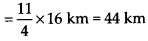
A car runs 16 km using 1 litre of petrol. How much distance will it cover using \(2 \frac{3}{4}\) litres of petrol?
Solution:
A car can run per litre of petrol = 16 km
Quantity of petrol = \(2 \frac{3}{4}\) litres = \(\frac{11}{4}\) litres
So, a car can run for \(\frac{11}{4}\) litres of petrol
MP Board Class 7th Maths Solutions Chapter 2 Fractions and Decimals Ex 2.3 11

MP Board Class 7th Maths Solutions Chapter 2 Fractions and Decimals Ex 2.3

Question 8.
MP Board Class 7th Maths Solutions Chapter 2 Fractions and Decimals Ex 2.3 12
Solution:
MP Board Class 7th Maths Solutions Chapter 2 Fractions and Decimals Ex 2.3 13

MP Board Class 7th Maths Solutions

MP Board Class 7th Maths Solutions Chapter 2 Fractions and Decimals Ex 2.2

MP Board Class 7th Maths Solutions Chapter 2 Fractions and Decimals Ex 2.2

Question 1.
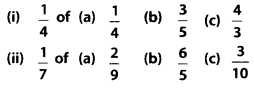
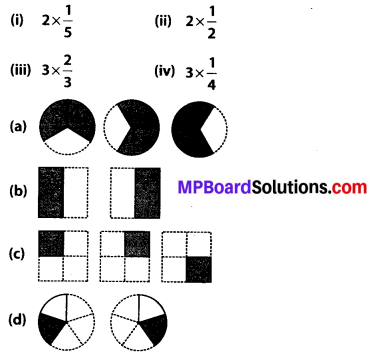
Which of the drawings (a) to (d) show:
MP Board Class 7th Maths Solutions Chapter 2 Fractions and Decimals Ex 2.2 1
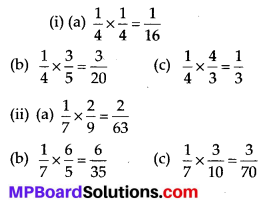
Solution:
(i) 2 × \(\frac{1}{5}\) represents addition of 2 figures, each representing 1 shaded part out of 5 equal parts. Hence, 2 × \(\frac{1}{5}\) is represented by (d)
(ii) 2 × \(\frac{1}{2}\) represents addition of 2 figures, each representing 1 shaded part out of 2 equal parts. Hence, 2 × \(\frac{1}{2}\) is represented by
(b) .
(iii) 3 × \(\frac{2}{3}\) represents addition of 3 figures, each representing 2 shaded parts out of 3 equal parts. Hence, 3 × \(\frac{2}{3}\) is represented by (a).
(iv) 3 × \(\frac{1}{4}\) represents addition of 3 figures, each representing 1 shaded part out of 4 equal parts. Hence, 3 × \(\frac{1}{4}\) is represented by (c).

Question 2.
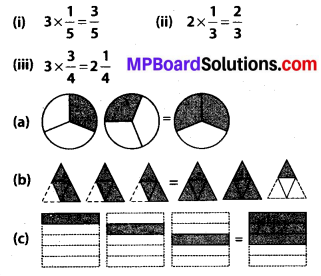
Some pictures (a) to (c) are given below. Tell which of them show:
MP Board Class 7th Maths Solutions Chapter 2 Fractions and Decimals Ex 2.2 2
Solution:
(i) 3 × \(\frac{1}{5}\) represents the addition of 3 figures, each representing 1 shaded part out of 5 equal parts and \(\frac{3}{5}\) represents 3 shaded parts out of 5 equal parts.
Hence, \(3 \times \frac{1}{5}=\frac{3}{5}\) is represented by (c).

(ii) \(2 \times \frac{1}{3}\) represents the addition of 3 figures, each representing 1 shaded part out of 3 equal parts and \(\frac{2}{3}\) represents 2 shaded parts out of 3 equal parts.
Hence, \(2 \times \frac{1}{3}=\frac{2}{3}\) is represented by (a).

(iii) \(3 \times \frac{3}{4}\) represents the addition of 3 figures, each representing 3 shaded parts out of 4 equal parts and \(2 \frac{1}{4}\) represents 2 fully shaded figures and one figure having 1 shaded part out of 4 equal parts.
Hence, \(3 \times \frac{3}{4}=2 \frac{1}{4}\) is represented by (b).

MP Board Class 7th Maths Solutions Chapter 2 Fractions and Decimals Ex 2.2

Question 3.
Multiply and reduce to lowest form and convert into a mixed fraction:
MP Board Class 7th Maths Solutions Chapter 2 Fractions and Decimals Ex 2.2 3
MP Board Class 7th Maths Solutions Chapter 2 Fractions and Decimals Ex 2.2 4
Solution:
MP Board Class 7th Maths Solutions Chapter 2 Fractions and Decimals Ex 2.2 5

Question 4.
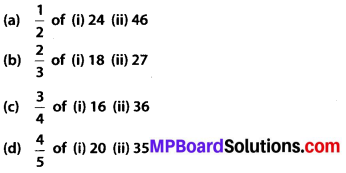
MP Board Class 7th Maths Solutions Chapter 2 Fractions and Decimals Ex 2.2 6
Solution:
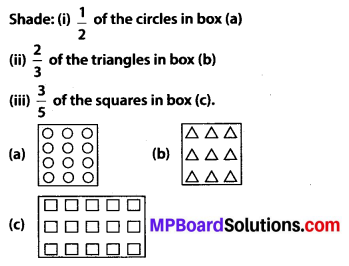
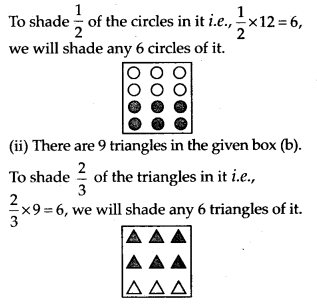
(i) There are 12 circles in the given box.
(a)
MP Board Class 7th Maths Solutions Chapter 2 Fractions and Decimals Ex 2.2 7

(iii) There are 15 squares in the given box (c). To shade \(\frac{3}{5}\) of the squares in it i.e., \(\frac{3}{5} \times 15=9\), we will shade any 9 squares of it.
MP Board Class 7th Maths Solutions Chapter 2 Fractions and Decimals Ex 2.2 8

MP Board Class 7th Maths Solutions Chapter 2 Fractions and Decimals Ex 2.2

Question 5.
MP Board Class 7th Maths Solutions Chapter 2 Fractions and Decimals Ex 2.2 9
Solution:
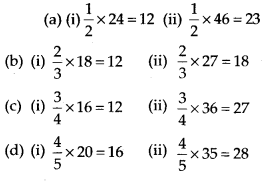
MP Board Class 7th Maths Solutions Chapter 2 Fractions and Decimals Ex 2.2 10

Question 6.
Multiply and express as a mixed fraction:
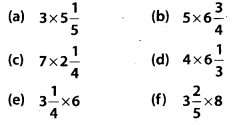
MP Board Class 7th Maths Solutions Chapter 2 Fractions and Decimals Ex 2.2 11
Solution:
MP Board Class 7th Maths Solutions Chapter 2 Fractions and Decimals Ex 2.2 12

Question 7.
Find:
MP Board Class 7th Maths Solutions Chapter 2 Fractions and Decimals Ex 2.2 13
Solution:
MP Board Class 7th Maths Solutions Chapter 2 Fractions and Decimals Ex 2.2 14

Question 8.
Vidya and Pratap went for a picnic. Their mother gave them a water bottle that contained 5 litres of water. Vidya consumed \(\frac{2}{5}\) of the water. Pratap consumed the remaining water.
(i) How much water did Vidya drink?
(ii) What fraction of the total quantity of water did Pratap drink?
Solution:
(i) Water consumed by Vidya
MP Board Class 7th Maths Solutions Chapter 2 Fractions and Decimals Ex 2.2 15
(ii) Fraction of remaining water
MP Board Class 7th Maths Solutions Chapter 2 Fractions and Decimals Ex 2.2 16
Thus, Pratap consumed \(\frac{3}{5}\) of the total quantity of water.

MP Board Class 7th Maths Solutions Chapter 2 Fractions and Decimals Ex 2.2

MP Board Class 7th Maths Solutions

MP Board Class 7th Hindi Sugam Bharti Solutions Chapter 11 योगी श्री अरविंद

MP Board Class 7th Hindi Sugam Bharti Solutions Chapter 11 योगी श्री अरविंद

MP Board Class 7th Hindi Sugam Bharti Chapter 11 प्रश्न-अभ्यास

वस्तुनिष्ठ प्रश्न
प्रश्न 1. (क)सही जोड़ी बनाइए
1. योग साधना केंद्र = (क) संदेश
2. स्वर्गिक = (ख) आंदोलन
3. स्वदेशी = (ग) नरेश
4. बड़ौदा = (घ) पांडिचेरी
उत्तर
1. (घ), 2. (क), 3. (ख), 4. (ग)

MP Board Solutions

प्रश्न (ख).
दिए गए शब्दों में से उपयुक्त शब्द चुनकर रिक्त स्थानों की पूर्ति कीजिए
1. अरविंद ने बड़ौदा कॉलेज में ……………. के पद पर कार्य किया। (प्रोफेसर/व्याख्याता)
2. योगीराज अरविंद का जन्म …………… में हुआ था। (दिल्ली/कोलकाता
3. श्री कृष्णघन व्यवसाय से …… (डॉक्टर/वैज्ञानिक)
4. बड़ौदा कॉलेज के प्राचार्य ……………. थे। (अरविंद/क्लार्क
उत्तर
1. प्रोफेसर
2. कोलकाता
3. डाक्टर
4. क्लार्क

MP Board Class 7th Hindi Sugam Bharti Chapter 11 अति लघु उत्तरीय प्रश्न

प्रश्न 2.
निम्नलिखित प्रश्नों के उत्तर एक-एक वाक्य में लिखिए

(क)
श्री कृष्णघन किस विचारधारा के व्यक्ति थे।
उत्तर
श्री कृष्णघन पश्चिमी विचारधारा के व्यक्ति

(ख)
श्री अरविंद ने किस परीक्षा में प्रथम श्रेणी प्राप्त को?
उत्तर
श्री अरविंद ने आई.सी.एस. परीक्षा में प्रथम श्रेणी प्राप्त की थी।

MP Board Solutions

(ग)
श्री अरविंद ने अंग्रेजी सेवा से क्यों वंचित रह गए?
उत्तर
श्री अरविंद घुड़सवारी की परीक्षा में अनुपस्थित रहने के कारण अंग्रेजी सेवा से वंचित रह गए।

(घ)
श्री अरविंद की आरम्भिक शिक्षा कहाँ हुई थी?
उत्तर
श्री अरविंद की आरंभिक शिक्षा दार्जिलिंग में हुई थी।

(ङ)
अरविंद द्वारा संपादित पत्रों के नाम लिखिए?
उत्तर
अरविंद द्वारा संपादित पत्रों के नाम ‘युगांतर’ तथा ‘वंदेमातरम्’ थे।

MP Board Class 7th Hindi Sugam Bharti Chapter 11 लघु उत्तरीय प्रश्न

प्रश्न 3.
निम्नलिखित प्रश्नों के उत्तर तीन से पाँच वाक्यों में लिखिए

(क)
श्री अरविंद को कौन-कौन सी भाषाएँ सीखने का अवसर मिला?
उत्तर
श्री अरविंद अंग्रेजी के अलावा ग्रीक, लैटिन, फ्रेंच भाषाएँ भी जानते थे। भारत वापस आकर इन्होंने बंगला तथा संस्कृत भाषा का भी अध्ययन किया था।

(ख)
प्राचार्य क्लार्क महोदय ने अरविंद की तुलना करते समय क्या कहा?
उत्तर
बड़ौदा कॉलेज के प्राचार्य क्लार्क महोदय ने जोन ऑफ आर्क से अरविंद की तुलना करते हुए कहा था कि यदि जोन ऑफ आर्क को स्वर्गिक संदेश सुनाई पड़ते हैं, तो श्री अरविंद को भी स्वर्गिक स्वप्न दिखाई पड़ते हैं।

MP Board Solutions

(ग)
श्री अरविंद ने नौकरी क्यों छोड़ दी थी?
उत्तर
श्री अरविंद नौकरी छोड़कर तिलक एवं विपिन चंद्रपाल के साथ मिलकर काम करने लगे। इन्होंने ‘युगांतर’ तथा ‘वंदेमातरम्’ अखबार भी निकाला।

(घ)
श्री अरविंद को योग-साधना करने का समय कब मिला?
उत्तर
1908 में दोबारा अलीपुर बम काण्ड में श्री अरविंद को शामिल माना गया, जिसकी वजह से एक वर्ष का कारावास हुआ। इसी जेल जीवन के दौरान योग-साधना करने का इनको समय मिला तथा योग के साधना पक्ष और सिद्धांत पक्ष दोनों का इन्होंने विधिवत् अध्ययन किया।

(ङ)
श्री अरविंद आश्रम की तीन विशेषताएँ लिखिए।
उत्तर
श्री अरविंद के आश्रम की विशेषताएँ

  • आश्रम प्रकृति की सुरम्य स्थली है, जहाँ जाकर
    मन सहज ही सात्विक विचारों में लग जाता है।
  • आध्यात्मिक विचारों के लिए उपयोगी भूमि
  • आश्रम प्राकृतिक घटाओं से घिरा तथा शांत वातावरण लिए था।

प्रश्न 4.
निम्नलिखित शब्दों का शुद्ध उच्चारण किजिए
विक्षुब्ध, शैशवावस्था, ख्याति, सात्विक, पुरस्कार, श्रेणी
उत्तर
छात्र स्वयं करें।

प्रश्न 5.
शुद्ध वर्तनी पर गोला लगाइए

  • नीधन, निधन, निघन, निःधन
  • बंचित, बन्चित, वंचित, वंचीत
  • सहधार्मिणी शहधर्मिणी, सह धरमिणी, सह धर्मीणी
  • पांडीचेरी पांडिचेरी, पान्डीचेरी, पांडिचेरी।

उत्तर

  • नीधन, निधन, निघन, निःधन
  • बंचित, बन्चित, बंचित, वंचीत
  • सहधर्मिणी शहधर्मिणी, सह धरमिणी, सह धर्मीणी
  • पांडीचेरी पांडिचेरी, पान्डीचेरी, पांडिचेरी।

प्रश्न 6.
निम्नलिखित शब्दों का वाक्यों में प्रयोग कीजिए .
व्यवसाय, राष्ट्रीय, परीक्षा, स्वप्न, बंदी

व्यबसाय- मेरे पिताजी लोहे का व्यवसाय करते हैं।
राष्ट्रीय- हमें राष्ट्रीय गान का सम्मान करना चाहिए।
परीक्षा- श्री अरविंद ने आई.सी.एस. की परीक्षा उत्तीर्ण की थी।
स्वप्न- वास्तव में दिन के स्वप्न सच नहीं होते।
बंदी- अंग्रेजों ने कई भारतीयों को बंदी बनाया था।

MP Board Solutions

प्रश्न 7.
उदाहरण के अनुसार ‘सु’ और ‘कु’ उपसर्ग जोड़कर दिए गए शब्दों से नए शब्द बनाइए
उदाहरण : सु + पुत्र = सुपुत्र कु+पुत्रकुपुत्र पात्र, डौल, योग, पथ, मति, मार्ग, चालक
उत्तर
सुपात्र, सुडौल, सुपथ, कुमति, सुमति, सुमार्ग, कुमार्ग, कुचालक, सुचालक।

प्रश्न 8.
निम्नलिखित वाक्यों में उद्देश्य और विधेय बताइए
(क) श्री कृष्णघन अरविंद के पिता थे।
(ख) अरविंद घुड़सवारी की परीक्षा में अनुपस्थित रहे।
(ग) स्वदेशी आंदोलन कोलकाता में तेज़ होने लगा।
(घ) अरविंद और सुभाष इस धरती के लाल थे।
(ङ) अरविंद आश्रम प्रकृति की सुरम्य स्थली है।
उत्तर
छात्र स्वयं करें

योगी श्री अरविंद पाठ का परिचय

प्रस्तुत पाठ में लेखक ने महान योगी श्री अरविंद का आध्यात्मिक चेतना तथा राष्ट्र के लिए योगदान को स्पष्ट किया है। श्री अरविंद का जन्म 15, अगस्त, 1872 को कोलकाता में हुआ था। इनके पिता पश्चिमी विचारधारा के व्यक्ति थे, इसीलिए इन्होंने श्री अरविंद को मात्र सात वर्ष की आयु में विदेश पढ़ने भेज दिया। 18 वर्ष की आयु में इन्होंने आई.सी.एस. की परीक्षा उत्तीर्ण की थी। उन्हें कई विदेशी भाषाओं का ज्ञान था। भारत में श्री अरविंद बड़ौदा कॉलेज में प्रोफेसर बने । वे यहाँ 13 वर्ष तक प्राचार्य बने रहे। इसी दौरान वे स्वाधीनता के दिवाने बन गए। इन्होंने अंग्रेजी विरोध में दो अखबार ‘युगांतर’ तथा ‘वंदेमातरम्’ निकाले। 1909 में इन्होंने ‘कर्मयोगी’ और ‘धर्म’ नामक दो साप्ताहिक पत्र निकाले। आंध्र विश्वविद्यालय ने 11 दिसंबर सन् 1948 को राष्ट्रीय पुरुस्कार देकर इनके प्रति श्रद्धा प्रकट की। 5 दिसंबर 1950 को इन्होंने अपनी मर्जी से महासमाधि ले ली।

योगी श्री अरविंद संदर्भ-प्रसंग सहित व्याख्या

1. अंग्रेजी संस्कार …. में लगाने लगे।

शब्दर्थ- शरीक = शामिल होना।

संदर्भ-प्रस्तुत पंक्तियाँ हमारी पाठ्य-पुस्तक ‘सुगम-भारती’ (हिंदी सामान्य) भाग-7 के पाठ 11 ‘योगी श्री अरविन्द’ से ली गई हैं। इसके रचयिता आर.जे. मौर्य

प्रसंग-इसमें श्री अरविंद के जेल से योग साधना को प्रकट किया गया है।

व्याख्या-1907 के बमकाण्ड में इन्हें पकड़ा गया किंतु बाद में छोड़ दिया गया। 1908 में इन्हें अलीपुर बमकाण्ड में पकड़ा गया, इन्हें एक वर्ष का कारावास हुआ। जेल में इन्होंने योग के साधना पक्ष और सिद्धांत पक्ष दोनों का अध्ययन किया। 1909 को जेल से आने के बाद उन्होंने अंग्रेजी में ‘कर्मयोगी’ और ‘धर्म’ नामक दो साप्ताहिक पत्र निकाले । अंग्रेजों से छिपकर श्री अरविंदचंद्रनगर चले गए, बाद में पाण्डिचेरी जाकर योग-साधना में लग गए।

MP Board Solutions

2. पाण्डिचेरी का ……………….. प्रभावित हुए थे।

शब्दार्थ-भूरि-भूरि = बहुत ज्यादा। संदर्भ-पूर्ववत्।

प्रसंग-इसमें श्री अरविंद आश्रम के संदर्भ में चर्चा की गई है।

व्याख्या-श्री अरविंद आश्रम अंतर्राष्ट्रीय योग-साधना केंद्र बन चुका है। इसका प्रबंध श्री अरविंद की शिष्या मीरा किया करती थी। यही वह स्थली है जहाँ उनका मन गहन विचारों में लग जाता है। इनकी पत्नी मृणालिनी देवी इनका हाथ बटाती थी। 1918 में इनकी पत्नी का देहांत हो गया। 1925 में लाला लाजपत राय ने इनकी तारीफ की। 1928 में इनकी मुलाकात रवींद्रनाथ ठाकुर से हुई तथा वे इनकी आध्यात्मिक चेतना से प्रभावित | हुए थे।

MP Board Class 7th Hindi Solutions

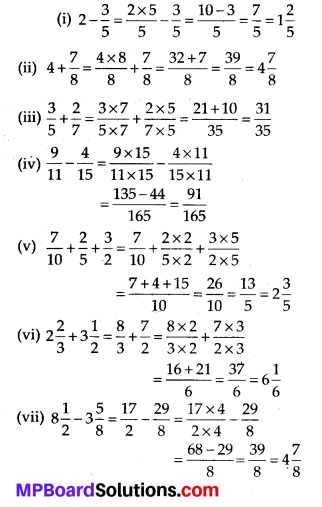
MP Board Class 7th Maths Solutions Chapter 2 Fractions and Decimals Ex 2.1

MP Board Class 7th Maths Solutions Chapter 2 Fractions and Decimals Ex 2.1

Question 1.
Solve:
MP Board Class 7th Maths Solutions Chapter 2 Fractions and Decimals Ex 2.1 1
Solution:
MP Board Class 7th Maths Solutions Chapter 2 Fractions and Decimals Ex 2.1 2

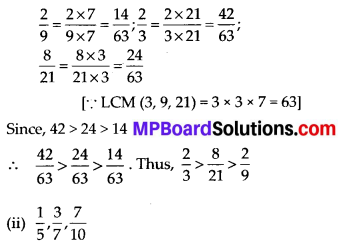
Question 2.
Arrange the following in descending order:
MP Board Class 7th Maths Solutions Chapter 2 Fractions and Decimals Ex 2.1 3
Solution:
(i)
\(\frac{2}{9}, \frac{2}{3}, \frac{8}{21}\)
Converting them into like fractions, we obtain
MP Board Class 7th Maths Solutions Chapter 2 Fractions and Decimals Ex 2.1 4
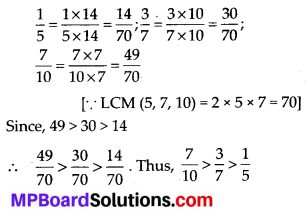
Converting them into like fractions, we obtain
MP Board Class 7th Maths Solutions Chapter 2 Fractions and Decimals Ex 2.1 5

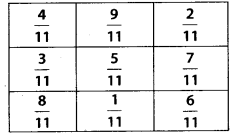
Question 3.
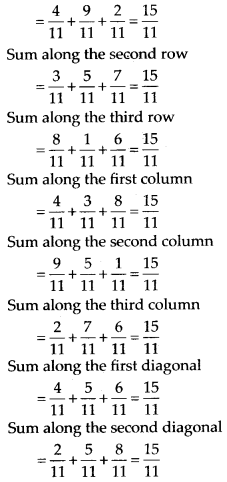
In a “magic square”, the sum of the numbers in each row, in each column and along the diagonals is the same. Is this a magic square?
MP Board Class 7th Maths Solutions Chapter 2 Fractions and Decimals Ex 2.1 6
(Along the first row \(\frac{4}{11}+\frac{9}{11}+\frac{2}{11}=\frac{15}{11}\)).
Solution:
Sum along the first row
MP Board Class 7th Maths Solutions Chapter 2 Fractions and Decimals Ex 2.1 7
Since, the sum of the numbers in each row, in each column and along the diagonals is the same.
Yes, it is a magic square.

MP Board Class 7th Maths Solutions Chapter 2 Fractions and Decimals Ex 2.1

Question 4.
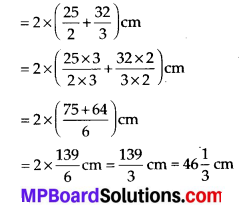
A rectangular sheet of paper is \(12 \frac{1}{2}\) cm long and \(10 \frac{2}{3}\) cm wide. Find its perimeter.
Solution:
Length = \(12 \frac{1}{2}\) cm = \(\frac{25}{2}\) cm and
Breadth \(=10 \frac{2}{3} \mathrm{cm}=\frac{32}{3} \mathrm{cm}\)
Perimeter = 2 × (Length + Breadth)
MP Board Class 7th Maths Solutions Chapter 2 Fractions and Decimals Ex 2.1 8

Question 5.
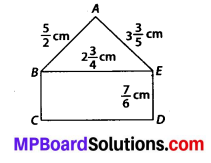
Find the perimeters of
(i) ∆ABE
(ii) the rectangle BCDE in this figure. Whose perimeter is greater?
MP Board Class 7th Maths Solutions Chapter 2 Fractions and Decimals Ex 2.1 9
Solution:
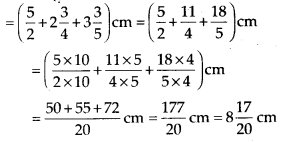
(i) Perimeter of rectangle
∆ABE = AB + BE + EA
MP Board Class 7th Maths Solutions Chapter 2 Fractions and Decimals Ex 2.1 10
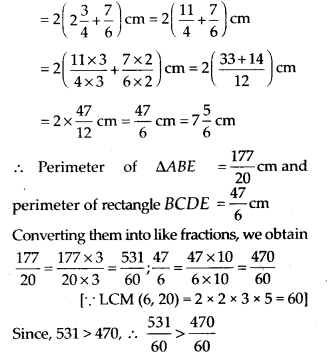
(ii) Perimeter of rectangle BCDE = 2(BE+DE)
MP Board Class 7th Maths Solutions Chapter 2 Fractions and Decimals Ex 2.1 11
MP Board Class 7th Maths Solutions Chapter 2 Fractions and Decimals Ex 2.1 12
So, \(\frac{177}{20}>\frac{47}{6}\)
Thus, perimeter of ∆ABE is greater

MP Board Class 7th Maths Solutions Chapter 2 Fractions and Decimals Ex 2.1

Question 6.
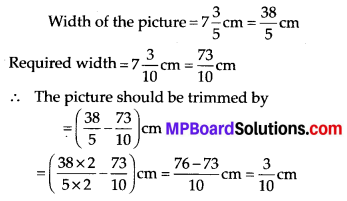
Salil wants to put a picture in a frame. The picture is \(7 \frac{3}{5}\) cm wide. To fit in the frame the picture cannot be more than \(7 \frac{3}{10}\) cm wide. How much should the picture be trimmed?
Solution:
MP Board Class 7th Maths Solutions Chapter 2 Fractions and Decimals Ex 2.1 13

Question 7.
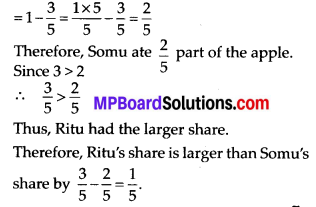
Ritu ate 2 part of an apple and the remaining apple was eaten by her brother Somu. How much part of the apple did Somu eat? Who had the larger share? By how much?
Solution:
Part of an apple eaten by Ritu = \(\frac{3}{5}\)
Part of an apple eaten by Somu = 1 – (Part of an apple eaten by Ritu)
MP Board Class 7th Maths Solutions Chapter 2 Fractions and Decimals Ex 2.1 14

MP Board Class 7th Maths Solutions Chapter 2 Fractions and Decimals Ex 2.1

Question 8.
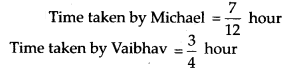
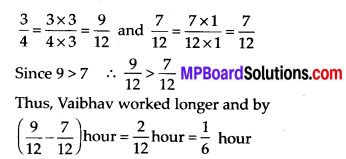
Michael finished colouring a picture in \(\frac{7}{12}\) hour. Vaibhav finished colouring the same picture in \(\frac{3}{4}\) hour. Who worked longer?
Solution:
MP Board Class 7th Maths Solutions Chapter 2 Fractions and Decimals Ex 2.1 15
Converting these fractions into like fractions, we obtain
MP Board Class 7th Maths Solutions Chapter 2 Fractions and Decimals Ex 2.1 16

MP Board Class 7th Maths Solutions

MP Board Class 7th Hindi Sugam Bharti Solutions Chapter 24 अपनी राहें आप बचाओ

MP Board Class 7th Hindi Sugam Bharti Solutions Chapter 24 अपनी राहें आप बचाओ

MP Board Class 7th Hindi Sugam Bharti Chapter 24 प्रश्न-अभ्यास

वस्तुनिष्ठ प्रश्न

प्रश्न 1.
(क) सही जोड़ी बनाइए
1. उन्नति में – (क) गान करो मल
2. अपना गौरव – (ख) आप बनाओ
3. पढ़ने में भी – (ग) अभिमान करो मत
4. अपनी राहें – (घ) चित्त लगाओ
उत्तर-
1. (ग)
2. (क)
3. (घ)
4. (ख)

MP Board Solutions

प्रश्न (ख)
दिए गए शब्दों में से सही शब्द चुनकर रिक्त स्थानो की पूर्ति कीजिए
1. दो क्षण………….ठीक नहीं है। (रूकना/चलना)
2. हंसते-हंसते…………..सीखो। (मरना/जीना)
3. संभल-संभल………….धरना सीखो। (कर/पग)
उत्तर-
1. रूकना,
2. मरना,
3. पग।

MP Board Class 7th Hindi Sugam Bharti Chapter 24 अति लघु उत्तरीय प्रश्न

प्रश्न 2.
निम्नलिखित प्रश्नों के एक-एक वाक्य में उत्तर लिखिए-

(क) कवि के अनुसार हमें किसमें चित्त लगाना चाहिए?
उत्तर-
कवि के अनुसार हमें पढ़ाई में भी चित्त लगाना चाहिए।

(ख) उन्नति होने पर मन में कौन-सा भाव नहीं आना चाहिए?
उत्तर-
उन्नति होने पर मन में अभियान नहीं आना चाहिए।

MP Board Solutions

(ग) कवि ने हमें किस स्थिति में झुकने की सीख दी है?
उत्तर-
कवि ने हमें विपत्तियों के समय नहीं झुकने की सीख दी है।

(घ) कविता में हमें कहाँ रुकने की सलाह दी गई है?
उत्तर-
बिना ध्येय के पथ पर दो क्षण भी रुकना ठीक नहीं है।

MP Board Class 7th Hindi Sugam Bharti Chapter 24 लघु उत्तरीय प्रश्न

3. निम्नलिखित प्रश्नों के उत्तर तीन से पाँच वाक्य में लिखिए-

(क) कविता में हमें कहाँ-कहाँ संभलकर पग रखने की समझाइश दी गई है?
उत्तर-
कवि ने बच्चों को समझाया है कि जीवन के रास्ते पर अनेक कठनाइयाँ तथा परेशानियाँ उत्पन्न होंगी, और कभी तुम्हें कई तरह के लालच मिलेंगे। परंतु तुम संभलना और ध्यानपूर्वक इनमें से ठीक रास्ते का चुनाव करना अर्थात अपने पग ध्यान से रखना।

(ख) कवि ने अपना गौरव गान न करने के लिए क्यों कहा है?
उत्तर-
कवि ने बच्चों से विशेषत्या कहा है कि अपने जीवन में चाहे जितनी भी उन्नति करो परंतु अपनी तारीक अपने मुँह से कभी नहीं करना, इससे अभियान उत्पन्न होने का खतरा रहता है।

(ग) “अपनी राहें आप बनाओ” का क्या तातर्प्य है?
उत्तर-
“अपनी राहें आप बनाओ” से कवि का तात्पर्य यह है कि बच्चों को अपने जीवन का लक्ष्य स्वयं निर्धारित करना चाहिए अर्थात हमें दूसरों की होड नहीं करनी चाहिए क्योंकि सभी लोगों की परिस्थितियाँ भिन्न-भिन्न होती हैं।।

(घ) पाप कर्म करने से हमें क्यों डरना चाहिए?
उत्तर-
कवि ने कहा है कि जीवन का लक्ष्य पूर्ण करने के लिए हमें सत्कर्मे और सच्चे रास्ते को अपनाना चाहिए। इसके विपरीत यदि हम पाप कर्म को अपनाते हैं तो जीवन अवश्य भ्रष्ट हो जाता है। इसलिए हमें बुराइयों और गलत कार्यों से डरना चाहिए।

भाषा की बात

प्रश्न 4.
निम्नलिखित शब्दों का सही-सही उच्चारण कीजिए
चित्त, विपत्तियाँ, नम्र, ध्येय, रक्षा
उत्तर-
छात्र स्वयं करें।

MP Board Solutions

प्रश्न 5.
निम्नलिखित शब्दों की वर्तनी शुद्ध कीजिएसंभल-संभल, कांटो, पदचिन्ह, रक्छा
उत्तर-
शब्द – शुद्ध वर्तनी
संभल-संभल – सँभल-सँभल
पदचिन्ह – पद चिह्न
कांटो – काँटों
रक्क्षा – रक्षा

प्रश्न 6.
पथ के कांटो पर फूलों पर, सँभल-सँभल पग धरना सीखो।
ऊपर दी गई पंक्ति में ‘फूल’ के विपरीत अर्थ में ‘कांटों’ शब्द का प्रयोग किया गया है। इसी तरह निम्नलिखित शब्दों के विपरीत अर्थ लिखिए-
आदर, उन्नति, नम्र, पाप, अधिकार
उत्तर-
शब्द विपरीत
आदर – निरादर
पाप – पुन्य
उन्नति – अवनति
अधिकार – अनाधिकार
नम्र – उग्र

प्रश्न 7.
निम्नलिखित बहुवचन शब्दों के एकवचन रूप लिखिए
राहें, कांटों, पापों, पाप, अधिकार
उत्तर-
शब्द एकवचन
राहें – राह
पापों – पाप
काँटों – काँटा
विपत्तियों – विपत्ती
अधिकारों – अधिकार

प्रश्न 8.
पर + उपकार दोनों शब्दों के अ और उ मिलाने पर अ + उ = ओ का विकार होता है और इनके मिलने से ‘परोपकार’ शब्द बनता है। इसी प्रकार निम्नलिखित शब्दों की संधि कीजिए-
उत्तर-
वीर + उचित = वीरोचित
चंद + उदय = चंद्रोदय
मानव + उचित = मानवोचित
महा + उत्सव = महोत्सव
सूर्य + उदय = सूर्योदय

अपनी राहें आप बचाओ पाठ का परिचय

प्रस्तुत कविता में कवि बच्चों को प्रगतिशील रहने के संदर्भ में वर्णन करते हुए कहते हैं-खेलने-कूदने के साथ पढ़ना-लिखना भी जरूरी है। किसी की नकल न करके, स्वयं अपनी मंजिल बनानी चाहिए। रास्ते में अनेक कठनाइयाँ आएंगी किंतु तुम ध्यान से चलना। तुम कभी भी अपनी कामयाबी पर घमण्ड मत करना। हमेशा दूसरों से प्यार से बोलना चाहिए। कभी भी अपनी तारीक अपने मुँह से नहीं करना चाहिए। तुम सर्वदा भलाई के काम करो। पाप से हमेशा दूर रहो। परेशानियाँ तो जिंदगी में आती ही हैं, लेकिन तुम उनसे कभी मत घबराना नहीं। अपनी आन के लिए सब कुछ करना सीखो।

अपनी राहें आप बचाओ संदर्भ-प्रसंग सहित व्याख्या

1.

सबका आदर करना सीखो।
खेलो-कूदो खूब किंतु कुछ
पढ़ने में भी चित्त लगाओ।
मत खोजो पद चिह्न किसी के
अपनी राहें आप बनाओ।
पथ के काँटों पर, फूलों पर
संभल-संभल पग धरना सीखो।

शब्दार्थ-चित्त = मन।

संदर्भ-प्रस्तुत पंक्तियाँ हमारी पाठ्य-पुस्तक ‘सुगम भारती’ (हिंदी सामान्य) भाग-7 के पाठ-24 ‘अपनी राहें आप बनाओ’ से ली गई है। इसके रचयिता दुष्यंत कुमार हैं।

प्रसंग-इसमें बच्चों को शिक्षा ग्रहण करने के लिए कहा गया है।

व्याख्या-कवि बच्चों को समझाते हुए कहते हैं कि तुम्हें सभी लोगों का आदर करना चाहिए। खेलना-कूदना बहुत अच्छी बात है परंतु पढ़ाई में भी उतना ही मन लगाना चाहिए। किसी भी सफलता के कारणों के पीछे मत भागो बल्कि अपनी पहचान स्वयं बनाओ। जीवन में बुराइयों और अच्छाइयों दोनों का सामना करना पड़ता है। तुम्हे हमेशा अच्छाई के रास्ते को चुनना चाहिए।

विशेष-

  • भाषा सरल एवं प्रवाहमय है।
  • कवि ने बच्चों को सरलता से समझाया है।

MP Board Solutions

2.

कभी भूलकर भी तो अपनी
उन्नति में अभियान करो मत।
नम्र बनो अपने ही मुँह से
अपना गौरव गान करो मत।
परोपकार के कार्य मत
पर पापों से डरना को।

शब्दार्थ-अभियान = घमण्ड, गौरव = बड़प्पन, महत्त्व।।

संदर्भ-पूर्ववत्।

प्रसंग : इसमें बच्चों को घमण्डी न बनने का संदेश दिया गया है।

व्याख्या : कवि ने आगे बच्चों से कहा है कि मन लगा कर जीवन में जो कुछ भी तुम हासिल करते हो, उस पर कभी घमण्ड मत करो। सबके साथ विन्रम बनो परंतु अपने मुँह से कभी अपनी तारीफ मत करो। जीवन में पापों और बुरे कामों से दूर रहकर सर्वदा भलाई के काम करो।

विशेष-

  • भाषा सरल एवं प्रवाहमय है।
  • कवि ने बच्चों से भलाई के कार्य करने पर बल दिया है।

3.

बिना ध्येय के पथ पर अपने
दो क्षण रुकना ठीक नहीं है।
विपत्तियाँ आती हैं लेकिन
उनमें झुकना ठीक नहीं है।
निज अधिकारों की रक्षा में
हँसते-हँसते मरना सीखो।

शब्दार्थ-ध्येय = लक्ष्य, उद्देश्य, परोपकार = दूसरों की भलाई।

संदर्भ-पूर्ववत् प्रसंग-इसमें बच्चों को आगे रहने पर बल दिया गया है।

व्याख्या-कवि ने बच्चे को समझाते हुए कहा है कि – जिस रास्ते पर कोई उद्देश्य न हो, उस और अपना समय नहीं गंवाना चाहिए। जिंदगी में कठनाइयाँ और परेशानियाँ तो आती ही रहती है किंतु कभी उनसे घबराना नहीं चाहिए और ना ही किसी कमजोरी के आगे झुकना चाहिए। अपने अधिकारों और कर्तव्यों के लिए सदैव अग्रसर रहना चाहिए।

विशेष-

  • भाषा सरल एवं प्रवाहमय है।
  • कठनाइयों के आगे नहीं झुकने पर बल दिया गया है।

MP Board Class 7th Hindi Solutions