MP Board Class 7th Maths Solutions Chapter 13 Exponents and Powers Ex 13.3

MP Board Class 7th Maths Solutions Chapter 13 Exponents and Powers Ex 13.3

Question 1.
Write the following numbers in the expanded forms:
279404, 3006194, 2806196, 120719, 20068
Solution:
279404 = 2 × 10⁵ + 7 × 10⁴ + 9 × 10³ + 4 × 10² + 0 × 101 + 4 × 100
3006194 = 3 × 10⁶ + 0 × 105 + 0 × 104 + 6 × 10³ + 1 × 10² + 9 × 101 + 4 × 100
2806196 = 2 × 10⁶ + 8 × 10⁵ + 0 × 104 + 6 × 10³ + 1 × 10² + 9 × 101 + 6 × 100
120719 = 1 × 10⁵ + 2 × 10⁴ + 0 × 103 + 7 × 10² + 1 × 101 + 9 × 100
20068 = 2 × 10⁴ + 0 × 103 + 0 × 102 + 6 × 101 + 8 × 100

Question 2.
Find the number from each of the following expanded forms:
(a) 8 × 10⁴ + 6 × 10³ + 0 × 102 + 4 × 101 + 5 × 100
(b) 4 × 10⁵ + 5 × 10³ + 3 × 10² + 2 × 100
(c) 3 × 10⁴ + 7 × 10² + 5 × 100
(d) 9 × 10⁵ + 2 × 10² + 3 × 101
Solution:
(a) 8 × 10⁴ + 6 × 10³ + 0 × 102 + 4 × 101 + 5 × 100 = 86045
(b) 4 × 10⁵ + 5 × 10³ + 3 × 10² + 2 × 100 = 405302
(c) 3 × 10⁴ + 7 × 10² + 5 × 100 = 30705
(d) 9 × 10⁵ + 2 × 10² + 3 × 101 = 900230

MP Board Class 7th Maths Solutions Chapter 13 Exponents and Powers Ex 13.3

Question 3.
Express the following numbers in standard form:
(i) 5,00,00,000
(ii) 70,00,000
(iii) 3,18,65,00,000
(iv) 3,90,878
(v) 39087.8
(vi) 3908.78
Solution:
(i) 50000000 = 5 × 10⁷
(ii) 7000000 = 7 × 10⁶
(iii) 3186500000 = 3.1865 × 10⁹
(iv) 390878 = 3.90878 × 10⁵
(v) 39087.8 = 3.90878 × 10⁴
(vi) 3908.78 = 3.90878 × 13

Question 4.
Express the number appearing in the following statements in standard form.
(a) The distance between Earth and Moon is 384.0. 000 m.
(b) Speed of light in vacuum is 300,000,000 m/s
(c) Diameter of the Earth is 1,27,56,000 m.
(d) Diameter of the Sun is 1,400,000,000 m.
(e) In a gala×y there are on an average 100,000,000,000 stars.
(f) The universe is estimated to be about 12,0,000,000 years old.
(g) The distance of the Sun from the centre of the Milky Way Gala×y is estimated to be 300,000,000,000,000,000,000 m.
(h) 60, 230, 000, 000, 000, 000, 000, 000 molecules are contained in a drop of water weighing 1.8 gm.
(i) The earth has 1, 353, 000,000 cubic km of sea water.
(j) The population of India was about 1,027,0,000 in March, 2001.
Solution:
(a) 3.84 × 10⁸ m
(b) 3 × 10⁸ m/s
(c) 1.2756 × 10⁷ m
(d) 1.4 × 10⁹ m
(e) 1 × 10¹¹ stars
(f) 1.2 × 10¹¹ years
(g) 3 × 10²⁰ m
(h) 6.023 × 10²² molecules
(i) 1.353 × 10⁹ cubic km
(j) 1.027 × 10⁹

MP Board Class 7th Maths Solutions

MP Board Class 7th Maths Solutions Chapter 6 The Triangles and Its Properties Ex 6.4

MP Board Class 7th Maths Solutions Chapter 6 The Triangles and Its Properties Ex 6.4

Question 1.
Is it possible to have a triangle with the following sides?
(i) 2 cm, 3 cm, 5 cm
(ii) 3 cm, 6 cm, 7 cm
(iii) 6 cm, 3 cm, 2 cm
Solution:
In a triangle, the sum of the lengths of either two sides is always greater than the third side.
(i) Given that, the sides of the triangle are 2 cm, 3 cm, 5 cm.
It can be observed that,
(2 + 3) cm = 5 cm
However, 5 cm = 5 cm
Hence, this triangle is not possible.

(ii) Given that, the sides of the triangle are
3 cm, 6 cm, 7 cm.
Here, (3 + 6) cm = 9 cm > 7 cm
(6 + 7) cm = 13 cm > 3 cm
(3 + 7) cm = 10 cm > 6 cm
Hence, this triangle is possible.

(iii) Given that, the sides of the triangle are
6 cm, 3 cm, 2 cm.
Here, (6 + 3) cm = 9 cm > 2 cm
However, (3 + 2) cm = 5 cm < 6 cm Hence, this triangle is not possible.

Question 2.
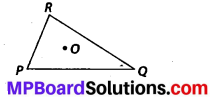
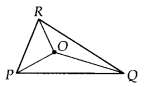
Take any point 0 in the interior of a triangle PQR. Is
MP Board Class 7th Maths Solutions Chapter 6 The Triangles and Its Properties Ex 6.4 1
(i) OP + OQ > PQ?
(ii) OQ + OR > QR?
(iii) OR + OP > RP?
Solution:
If O is a point in the interior of a given triangle, then three triangles ∆OPQ, ∆OQR and ∆ORP can be constructed. In a triangle, the sum of the lengths of either two sides is always greater than the third side.
(i) Yes, as OQR is a triangle with sides OR, OQ and QR.
MP Board Class 7th Maths Solutions Chapter 6 The Triangles and Its Properties Ex 6.4 2
∴ OQ + OR> QR

(ii) Yes, as OQR is a triangle sides OR, OQ and QR.
∴ OQ + OR > QR

(iii) Yes, as A ORP is a triangle with sides OR, OP and PR.
∴ OR + OP > PR

Question 3.
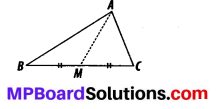
AM is a median of a triangle ABC.
Is AB + BC + CA > 2AM?
(Consider the sides of ∆ABM and ∆AMC.)
MP Board Class 7th Maths Solutions Chapter 6 The Triangles and Its Properties Ex 6.4 3
Solution:
In a triangle, the sum of the lengths of either two sides is always greater than the third side.
In ∆ABM,
AB + BM > AM …(i)
Similarly, in ∆ACM,
AC + CM > AM …(ii)
Adding (i) and (ii), we obtain
AB + BM + MC +AC > AM + AM
AB + BC + AC > 2AM
Yes, the given expression is true.

Question 4.
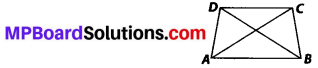
ABCD is a quadrilateral.
MP Board Class 7th Maths Solutions Chapter 6 The Triangles and Its Properties Ex 6.4 4
Is AB + BC + CD + DA > AC + BD ?
Solution:
In a triangle, the sum of the lengths of either two sides is always greater than the third side.
In ∆ABC; AB + BC > CA …(i)
In ∆BCD; BC + CD > DB …(ii)
In ∆CDA; CD + DA > AC …(iii)
In ∆DAB; DA + AB > DB …(iv)
Adding (i), (ii), (iii) and (iv), we obtain
AB + BC + BC + CD + CD + DA + DA+ AB > AC + BD + AC + BD
⇒ 2AB + 2BC + 2CD + 2DA > 2AC + 2BD ⇒ 2{AB + BC + CD + DA) > 2(AC+BD)
⇒ (AB + BC + CD + DA) > (AC + BD)
Yes, the given expression is true.

Question 5.
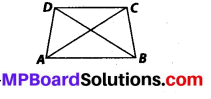
ABCD is a quadrilateral.
MP Board Class 7th Maths Solutions Chapter 6 The Triangles and Its Properties Ex 6.4 5
Is AB + BC + CD + DA < 2(AC + BD)?
Solution:
In a triangle, the sum of the lengths of either two sides is always greater than the third side.
Let diagonals AC and BD of the quadrilateral ABCD intersects at O.
MP Board Class 7th Maths Solutions Chapter 6 The Triangles and Its Properties Ex 6.4 6
In ∆OAB, OA + OB > AB … (i)
In ∆OBC, OB + OC > BC … (ii)
In ∆OCD, OC + CD > CD … (iii)
In ∆ODA, OD + OA > DA … (iv)
OA + OB + OB + OC + OC + OD + OD + OA > AB + BC + CD + DA
⇒ 20A + 20B + 20C + 20D > AB + BC + CD + DA
⇒ 2(OA + OC) + 2(OB + OD) > AB + BC + CD + DA
⇒ 2(AC) + 2(BD) > AB + BC + CD + DA
⇒ 2(AC + BD) > AB + BC + CD + DA
Yes, the given expression is true.

Question 6.
The lengths of two sides of a triangle are 12 cm and 15 cm. Between what two measures should the length of the third side fall?
Solution:
In a triangle, the Sum of the lengths of either two side is always greater than the third side.
Lengths of two sides of a triangle are 12 cm and 15 cm.
Let the third side be x cm.
∴ x + 12 > 15 ⇒ x > 3
x + 15 > 12 ⇒ x > – 3 but side length never be negative.
and 12 + 15 > x ⇒ 27 > x
Hence, third side can measure between 3 and 27.

MP Board Class 7th Maths Solutions Chapter 6 The Triangles and Its Properties Ex 6.4

MP Board Class 7th Maths Solutions

MP Board Class 7th Maths Solutions Chapter 13 Exponents and Powers Ex 13.2

MP Board Class 7th Maths Solutions Chapter 13 Exponents and Powers Ex 13.2

Question 1.
Using laws of exponents, simplify and write the answer in exponential form:
(i) 32 × 34 × 38
(ii) 615 ÷ 610
(iii) a3 × a2
(iv) 7x × 72
(v) (52)3 4 53
(vi) 25 × 55
(vii) a4 × b4
(viii) (34)3
(ix) (220 ÷ 215) × 23
(x) (8t ÷ 82)
Solution:
(i) 32 × 34 × 38 = (3)2 + 4 + 8 = 314 [∵ am × an = am+n]
(ii) 615 ÷ 610 = (6)15 – 10 = 65 [∵ am ÷ an = am – n]
(iii) a3 × a2 = a3 + 2 = a5[∵ am × an = am+n]
(iv) 7x × 72 = 7x + 2[∵ am × an = am+n]
(v) (52)3 ÷ 53 = 52 × 3 ÷ 53 [∵ (am)n = amn]
= 56 ÷ 53 = 5(6 – 3) [∵ am ÷ an = am – n]
= 53
(vi) 25 × 55 = (2 × 5)5      [∵ am × bm = (a × b)m]
= 105
(vii) a4 × b4 = (ab)4
(viii) (34)3 = 34 × 3 = 312       [∵ (am)n = amn]
(ix) (220 ÷ 215) × 23 = (220 – 15) × 23     [∵ am ÷ an = am – n]
= 25 × 23 = 25 + 3 [∵ am × an = am+n]
(x) 8t ÷ 82 = 8(t – 2)    [∵ am ÷ an = am – n]

Question 2.
Simplify and express each of the following in exponential form:
MP Board Class 7th Maths Solutions Chapter 13 Exponents and Powers Ex 13.2 1
Solution:
MP Board Class 7th Maths Solutions Chapter 13 Exponents and Powers Ex 13.2 2
(ii) [(52)3 × 54] ÷ 57
= [52 × 3 × 54] ÷ 57 [∵ (am)n = amn]
= [56 × 54] ÷ 57 [∵ am × an = am + n]
= [56 + 4] ÷ 57
= 510 ÷ 57
= 510 – 7 [∵ am ÷ an = am – n]
= 53

(iii) 254 ÷ 53 = (5 × 5)4 ÷ 53
= (52)4 ÷ 53 = 52 × 4 ÷ 53 [∵ (am)n = amn]
= 58 ÷ 53 = 58 – 3 [∵ am ÷ an = am – n]
= 55
MP Board Class 7th Maths Solutions Chapter 13 Exponents and Powers Ex 13.2 3

(vi) 20 + 30 + 40 = 1 + 1 + 1 = 3     [∵ a0 = 1]
(vii) 20 × 30 × 40 = 1 × 1 × 1 = 1
(viii) (30 + 20) × 50 = (1 + 1) × 1 = 2
MP Board Class 7th Maths Solutions Chapter 13 Exponents and Powers Ex 13.2 4

Question 3.
Say true or false and justify your answer:
(i) 10 × 1011 = 10011
(ii) 23 > 52
(iii) 23 × 32 = 65
(iv) 30 = (1000)0
Solution:
(i) L.H.S = 10 × 1011
= 101 + 11 = 1012
R.H.S = 10011 = (10 × 10)11 = (100)11 = 102 × 11 = 1022
⇒ L.H.S. ≠ R.H.S.
Hence, the given statement is false.

(ii) 23 > 52
L.H.S. = 23 = 2 × 2 × 2 = 8
R.H.S. = 53 = 5 × 5 = 25
⇒ L.H.S ≠ R.H.S
Hence, the given statement is false.

(iii) 23 × 32 = 65
L.H.S. = 23 × 32 = 2 × 2 × 2 × 3 × 3 = 72
R.H.S. = 65 = 6 × 6 × 6 × 6 × 6 = 7776
⇒ L.H.S. ≠ R.H.S.
Hence, the given statement is false.

(iv) 30 = (1000)0
L.H.S. = 30 = 1
R.H.S. = (1000)0 = 1
⇒ L.H.S. = R.H.S.
Hence, the given statement is true.

MP Board Class 7th Maths Solutions Chapter 13 Exponents and Powers Ex 13.2

Question 4.
Express each of the following as a product of prime factors only in exponential form:
(i) 108 × 192
(ii) 270
(iii) 729 × 64
(iv) 768
Solution:
(i) 108 × 192
= (2 × 2 × 3 × 3 × 3) × (2 × 2 × 2 × 2 × 2 × 2 × 3)
= (22 × 33) × (26 × 3)
= 22+6 × 33+1 = 28 × 34
(ii) 270 = 2 × 3 × 3 × 3 × 5 = 2 × 33 × 5
(iii) 729 × 64 = (3 × 3 × 3 × 3 × 3 × 3) × (2 × 2 × 2 × 2 × 2 × 2) = 36 × 26
(iv) 768 = 2 × 2 × 2 × 2 × 2 × 2 × 2 × 2 × 3 = 28 × 3

Question 5.
Simplify:
MP Board Class 7th Maths Solutions Chapter 13 Exponents and Powers Ex 13.2 5
Solution:
MP Board Class 7th Maths Solutions Chapter 13 Exponents and Powers Ex 13.2 6

MP Board Class 7th Maths Solutions

MP Board Class 7th Maths Solutions Chapter 6 The Triangles and Its Properties Ex 6.3

MP Board Class 7th Maths Solutions Chapter 6 The Triangles and Its Properties Ex 6.3

Question 1.
Find the value of the unknown x in the following diagrams:
MP Board Class 7th Maths Solutions Chapter 6 The Triangles and Its Properties Ex 6.3 1
MP Board Class 7th Maths Solutions Chapter 6 The Triangles and Its Properties Ex 6.3 2
Solution:
The sum of all interior angles of a triangle is 180°. By using this property, these problems can be solved as follows :
(i) x + 50° + 60° = 180°
⇒ x +110° = 180°
⇒ x = 180° -110° = 70°

(ii) x + 90° + 30° = 180°
⇒ x + 120° = 180°
⇒ x = 180° – 120° = 60°

(iii) x + 30° + 110° = 180°
⇒ x + 140° = 180°
⇒ x = 180° – 140° = 40°

(iv) 50° + x + x = 180°
⇒ 2x = 180° – 50° = 130°
MP Board Class 7th Maths Solutions Chapter 6 The Triangles and Its Properties Ex 6.3 3

(v) x + x + x = 180°
⇒ 3x = 180°
MP Board Class 7th Maths Solutions Chapter 6 The Triangles and Its Properties Ex 6.3 4

(vi) x + 2x + 90° = 180°
⇒ 3x = 180° – 90° = 90° = 90°
MP Board Class 7th Maths Solutions Chapter 6 The Triangles and Its Properties Ex 6.3 5

MP Board Class 7th Maths Solutions Chapter 6 The Triangles and Its Properties Ex 6.3

Question 2.
Find the values of the unknowns x and y in the following diagrams:
MP Board Class 7th Maths Solutions Chapter 6 The Triangles and Its Properties Ex 6.3 6
Solution:
(i) y + 120° = 180° (Linear pair)
⇒ y = 180° – 120° = 60°
Now, x + y + 50° = 180°
(Angle sum property)
⇒ x + 60° + 50° = 180° x = 180° – 60° – 50° = 70°

(ii) y = 80° (Vertically opposite angles)
Now, y + x + 50° = 180°
(Angle sum property)
⇒ 80° + x + 50° = 180°
⇒ x = 180° – 80°- 50° = 50°

(iii) y + 50° + 60° = 180°
(Angle sum property)
⇒ y = 180° – 60° – 50° = 70°
Now, x + y = 180° (Linear pair)
⇒ x = 180° – y = 180° – 70° = 110°

(iv) x = 60° (Vertically opposite angles)
Now, 30° + x + y = 180°
(Angle sum property)
⇒ 30° + 60° + y = 180° y = 180° – 30° – 60° = 90°

(v) y = 90° (Vertically opposite angles)
Now, x + x + y = 180°
(Angle sum property)
⇒ 2x + 90° = 180°
⇒ 2x = 180° – 90° = 90°
MP Board Class 7th Maths Solutions Chapter 6 The Triangles and Its Properties Ex 6.3 7

(vi) y = x (Vertically opposite angles)
a = x (Vertically opposite angles)
b = x (Vertically opposite angles)
Now, a + b + y = 180°
(Angle sum property)
⇒ x + x + x= 180°
⇒ 3x = 180°
MP Board Class 7th Maths Solutions Chapter 6 The Triangles and Its Properties Ex 6.3 8
MP Board Class 7th Maths Solutions Chapter 6 The Triangles and Its Properties Ex 6.3 9
Hence, y = x = 60°

MP Board Class 7th Maths Solutions Chapter 6 The Triangles and Its Properties Ex 6.3

MP Board Class 7th Maths Solutions

MP Board Class 7th Maths Solutions Chapter 6 The Triangles and Its Properties Ex 6.2

MP Board Class 7th Maths Solutions Chapter 6 The Triangles and Its Properties Ex 6.2

Question 1.
Find the value of the unknown exterior angle x in the following diagrams:
MP Board Class 7th Maths Solutions Chapter 6 The Triangles and Its Properties Ex 6.2 1
MP Board Class 7th Maths Solutions Chapter 6 The Triangles and Its Properties Ex 6.2 2
Solution:
(i) x = 50° + 70° (Exterior angle property) = 120°
(ii) x = 65° + 45° (Exterior angle property)
= 110°
(iii) x = 40° + 30° (Exterior angle property)
= 70°
(iv) x = 60° + 60° (Exterior angle property)
= 120°
(v) x = 50° + 50° (Exterior angle property)
= 100°
(vi) x = 30° + 60° (Exterior angle property)
= 90°

Question 2.
Find the value of the unknown interior angle x in the following figures:
MP Board Class 7th Maths Solutions Chapter 6 The Triangles and Its Properties Ex 6.2 3
MP Board Class 7th Maths Solutions Chapter 6 The Triangles and Its Properties Ex 6.2 4
Solution:
(i) x + 50° = 115°
(Exterior angle property)
⇒ x = 115° – 50° = 65°
(ii) 70° + x = 100° (Exterior angle property) ⇒ x = 100° – 70° = 30°
(iii) x + 90° = 125° (Exterior angle property) ⇒ x = 125° – 90° = 35°
(iv) x + 60° = 120° (Exterior angle property) ⇒ x = 120° – 60° = 60°
(v) x + 30° = 80° (Exterior angle property) ⇒ x = 80° – 30° = 50°
(vi) x + 35° = 75° (Exterior angle property) ⇒ x = 75° – 35° = 40°

MP Board Class 7th Maths Solutions Chapter 6 The Triangles and Its Properties Ex 6.2

MP Board Class 7th Maths Solutions

MP Board Class 7th Maths Solutions Chapter 6 The Triangles and Its Properties Ex 6.1

MP Board Class 7th Maths Solutions Chapter 6 The Triangles and Its Properties Ex 6.1

Question 1.
In ∆PQR, D is the mid-point of \(\overline{Q R}\).
\(\overline{P M}\) is ___.
PD is ___.
Is QM = MR?
MP Board Class 7th Maths Solutions Chapter 6 The Triangles and Its Properties Ex 6.1 1
Solution:
(i) PM is an altitude
(ii) PD is a median
(iii) No, QM ≠ MR.

MP Board Class 7th Maths Solutions Chapter 6 The Triangles and Its Properties Ex 6.1

Question 2.
Draw rough sketches for the following:
(a) In ∆ABC, BE is a median.
(b) In ∆PQR, PQ and PR are altitudes of the triangle.
(c) In ∆XYZ, YL is an altitude in the exterior of the triangle.
Solution:
MP Board Class 7th Maths Solutions Chapter 6 The Triangles and Its Properties Ex 6.1 2
MP Board Class 7th Maths Solutions Chapter 6 The Triangles and Its Properties Ex 6.1 3

Question 3.
Verify by drawing a diagram, if the median and altitude of an isosceles triangle can be same.
Solution:
MP Board Class 7th Maths Solutions Chapter 6 The Triangles and Its Properties Ex 6.1 4
Draw a line segment AD perpendicular to BC. It can be observed that the length of BD and DC is also same. Therefore, AD is also a median of this triangle.

MP Board Class 7th Maths Solutions Chapter 6 The Triangles and Its Properties Ex 6.1

MP Board Class 7th Maths Solutions

MP Board Class 7th Social Science Solutions Chapter 19 Weather and Climate

MP Board Class 7th Social Science Solutions Chapter 19 Weather and Climate

MP Board Class 7th Social Science Chapter 19 Text Book Questions

Fill in the blanks:

  1.  Weather affects a area.
  2. Almost similar atmospheric condition is called
  3. elements are found in climate and weather.

Answer:

  1. small
  2. season
  3. Six.

MP Board Solutions

MP Board Class 7th Social Science Chapter 19 Short Answer Type Questions

Question 1.
What is weather? What is difference between weather and season.
Answer:
Weather is the condition of atmosphere at a given place for a short-period with regard to its temperature, rainfall, pressure, humidity and direction of wind. Weather can change-many times in a day.
Difference between weather ans season.
Answer:
Weather:

  • Weather Is a short duration atmospheric condition.
  • Weather represents the atmospheric condition of a small area.
  • Weather can change many time In a day.

Season:

  • Season Is a long duration atmospheric condition.
  • Season represents the atmospheric condition of a Large area.
  • Season does not change for a long period.

Question 2.
To analyse the climate of an area how many years average data is taken?
Answer:
To analyse die climate of an area we have to take the average data of the weather conditions of the place of at least 30 years.

MP Board Solutions

Question 3.
Which are the factors affecting the climate of a place?
Answer:
The factors affecting the climate of a place are:

  1. The latitudinal position of a place.
  2. Height from sea level.
  3. The distribution of land and water.
  4. Distance from sea.
  5. Direction of wind.
  6. Air pressure belts.
  7. Situation of mountains.
  8. Nature of land.
  9. Ocean currents.

MP Board Class 7th Social Science Chapter 19 Long Answer Type Questions

Question 1.
Differentiate between weather and climate.
Answer:
The following are the difference of weather and climate.
Weather:

  • Weather is a short durat – tion atmospheric condition.
  • Weather represents the atmospheric condition of dsmall area.
  • The weather can change many times in a day.
  • In the weather of one sea – son any one element is prominent.

Climate

  • Climate is a long duration atmospheric condition.
  • Climate represents the wide area of atmo – spheric condition.
  • The climate does not change for long periods.
  • In one type of climate one or many seasons we there.


MP Board Class 7th Social Science Solutions

MP Board Class 7th Maths Solutions Chapter 13 Exponents and Powers Ex 13.1

MP Board Class 7th Maths Solutions Chapter 13 Exponents and Powers Ex 13.1

Question 1.
Find the value of
(i) 26
(ii) 93
(iii) 112
(iv) 54
Solution:
(i) 26 = 2 × 2 × 2 × 2 × 2 × 2 = 64
(ii) 93 = 9 × 9 × 9 = 729
(iii) 112 = 11 × 11= 121
(iv) 54 = 5 × 5 × 5 × 5 = 625

Question 2.
Express the following in exponential form:
(i) 6 × 6 × 6 × 6
(ii) t × t
(iii) b × b × b × b
(iv) 5 × 5 × 7 × 7 × 7
(v) 2 × 2 × a × a
(vi) a × a × a × c × c × c × c × d
Solution:
(i) 6 × 6 × 6 × 6 = 64
(ii) t × t = t2
(iii) b × b × b × b = b4
(iv) 5 × 5 × 7 × 7 × 7 = 52 × 73
(v) 2 × 2 × a × a = 22 × a2
(vi) a × a × a × c × c × c × c × d = a3 × c4 × d

MP Board Class 7th Maths Solutions Chapter 13 Exponents and Powers Ex 13.1

Question 3.
Express each of the following numbers using exponential notation:
(i) 512
(ii) 343
(iii) 729
(iv) 3125
Solution:
(i) 512 = 2 × 2 × 2 × 2 × 2 × 2 × 2 × 2 × 2 = 29
(ii) 343 = 7 × 7 × 7 = 73
(iii) 729 = 3 × 3 × 3 × 3 × 3 × 3 = 36
(iv) 3125 = 5 × 5 × 5 × 5 × 5 = 55

Question 4.
Identify the greater number, wherever possible, in each of the following?
(i) 43 or 34
(ii) 53 or 35
(iii) 25 or 82
(iv) 1002 or 2100
(v) 210 or 1002
Solution:
(i) 43 = 4 × 4 × 4 = 64 and 34 = 3 × 3 × 3 × 3 = 81
As 81 > 64, therefore 34 > 43

(ii) 53 = 5 × 5 × 5 = 125,
35 = 3 × 3 × 3 × 3 × 3 = 243
As 243 > 125, therefore, 35 > 53

(iii) 28 = 2 × 2 × 2 × 2 × 2 × 2 × 2 × 2 = 256,
82 = 8 × 8 = 64
As 256 > 64, therefore, 28 > 82

(iv) 2100 = 2 × 2 × 2 × 2 × 2 × 2 × 2 × 2 × 2 × 2 = 1024
⇒ 2100 = (210)10 = 1024 × 1024 × 1024 × 1024 × 1024 × 1024 ×1024 ×1024 × 1024 × 1024 = (1024)10
and 1002 = 100 × 100 = 10000
As (1024)10 > 10000, therefore 2100 > 1002

(v) 210 = 2 × 2 × 2 × 2 × 2 × 2 × 2 × 2 × 2 × 2 = 1024
and 102 = 10 × 10 = 100
As 1024 > 100, therefore 210 > 102

Question 5.
Express each of the following as product of powers of their prime factors:
(i) 648
(ii) 405
(iii) 540
(iv) 3600
Solution:
(i) 648 = 2 × 2 × 2 × 3 × 3 × 3 × 3 = 23 × 34
(ii) 405 = 3 × 3 × 3 × 3 × 5 = 34 ×5
(iii) 540 = 2 × 2 × 3 × 3 × 3 × 5 = 22 × 33 × 5
(iv) 3600 = 2 × 2 × 2 × 2 × 3 × 3 × 5 × 5 = 24 × 32 × 52

Question 6.
Simplify:
(i) 2 × 10³
(ii) 72 × 22
(iii) 23 × 5
(iv) 3 × 44
(v) 0 × 102
(vi) 52 × 33
(vii) 24 × 32
(viii) 32 × 104
Solution:
(i) 2 × 103 = 2 × 10 × 10 × 10 = 2 × 1000 = 2000
(ii) 72 × 22 = 7 × 7 × 2 × 2 = 49 × 4 = 196
(iii) 23 × 5 = 2 × 2 × 2 × 5 = 8 × 5 = 40
(iv) 3 × 44 = 3 × 4 × 4 × 4 × 4 = 3 × 256 = 768
(v) 0 × 102 = 0 × 10 × 10 = 0
(vi) 52 × 33 = 5 × 5 × 3 × 3 × 3 = 25 × 27 = 675
(vii) 24 × 34 = 2 × 2 × 2 × 2 × 3 × 3 = 16 × 9 = 144
(viii) 32 × 104 = 3 × 3 × 10 × 10 × 10 × 10 = 9 × 10000 = 90000

MP Board Class 7th Maths Solutions Chapter 13 Exponents and Powers Ex 13.1

Question 7.
Simplify:
(i) (-4)3
(ii) (-3) × (-2)3
(iii) (-3)2 × (-5)2
(iv) (-2)3 × (-10)3
Solution:
(i) (-4)3 = (-4) × (-4) × (-4) = -64
(ii) (-3) × (-2)3 = (-3) × (-2) × (-2) × (-2) = (-3) × (-8) = 24
(iii) (-3)2 × (-5)2 = (-3) × (-3) × (-5) × (-5) = 9 × 25 = 225
(iv) (-2)3 × (-10)3 = (-2) × (-2) × (-2) × (-10) × (-10) × (-10) = (-8) × (-1000) = 8000

Question 8.
Compare the following numbers:
(i) 2.7 × 10¹²; 1.5 × 10⁸
(ii) 4 × 10¹⁴; 3 × 10¹⁷
Solution:
(i) 2.7 × 10¹²; 1.5 × 10⁸
Since, 1012 > 108
∴ 2.7 × 10¹² > 1.5 × 10⁸
(ii) 4 × 10¹⁴; 3 × 10¹⁷
Since, 1014 < 1017
∴ 4 × 10¹⁴ < 3 × 10¹⁷

MP Board Class 7th Maths Solutions

MP Board Class 7th Maths Solutions Chapter 5 Lines and Angles Ex 5.2

MP Board Class 7th Maths Solutions Chapter 5 Lines and Angles Ex 5.2

Question 1.
State the property that is used in each of the following statements?
(i) If a||b, then ∠1 = ∠5.
(ii) If ∠4 = ∠6, then a||b.
(iii) If ∠4 + ∠5 = 180°,then a||b.
MP Board Class 7th Maths Solutions Chapter 5 Lines and Angles Ex 5.2 1
Solution:
(i) Corresponding angles property
(ii) Alternate interior angles property
(iii) Interior angles on the same side of the transversal are supplementary.

MP Board Class 7th Maths Solutions Chapter 5 Lines and Angles Ex 5.2

Question 2.
In the adjoining figure, identify
MP Board Class 7th Maths Solutions Chapter 5 Lines and Angles Ex 5.2 2
(i) the pairs of corresponding angles.
(ii) the pairs of alternate interior angles.
(iii) the pairs of interior angles on the same side of the transversal.
(iv) the vertically opposite angles.
Solution:
(i) ∠1 and ∠5; ∠2 and ∠6;
∠3 and ∠7; ∠4 and ∠8
(ii) ∠2 and ∠8; ∠3 and ∠5
(iii) ∠2 and ∠5; ∠3 and ∠8
(iv) ∠1 and ∠3; ∠2 and ∠4;
∠5 and ∠7; ∠6 and ∠8

MP Board Class 7th Maths Solutions Chapter 5 Lines and Angles Ex 5.2

Question 3.
In the adjoining figure, p||q. Find the unknown angles.
MP Board Class 7th Maths Solutions Chapter 5 Lines and Angles Ex 5.2 3
Solution:
∠d = 125° (Corresponding angles)
∠e = 180° – 125° = 55° (Linear pair)
∠f = ∠e = 55° (Vertically opposite angles)
∠c = ∠f = 55° (Corresponding angles)
∠a = ∠e – 55° (Corresponding angles)
∠b = ∠d = 125° (Vertically opposite angles)

MP Board Class 7th Maths Solutions Chapter 5 Lines and Angles Ex 5.2

Question 4.
Find the value of x in each of the following figures l ||m
MP Board Class 7th Maths Solutions Chapter 5 Lines and Angles Ex 5.2 4
Solution:
(i) We have,
MP Board Class 7th Maths Solutions Chapter 5 Lines and Angles Ex 5.2 5
y = 110° (Corresponding angles)
x + y = 180° (Linear pair)
⇒ x = 180° -110° = 70°

(ii) x = 100° (Corresponding angles)

Question 5.
In the given figure, the arms of two angles are parallel. If ∠ABC = 70°, then find
(i) ∠DGC
(ii) ∠DEF
MP Board Class 7th Maths Solutions Chapter 5 Lines and Angles Ex 5.2 6
Solution:
(i) Consider that AB||DG and a transversal line BC is intersecting them.
∴ ∠DGC = ∠ABC (Corresponding angles)
⇒ ∠DGC = 70°

(ii) Consider that BC 11 EF and a transversal line DE is intersecting them.
∴ ∠DEF = ∠DGC (Corresponding angles)
⇒ ∠DEF = 70°

MP Board Class 7th Maths Solutions Chapter 5 Lines and Angles Ex 5.2

Question 6.
In the given figures below, decide whether l is parallel to m.
MP Board Class 7th Maths Solutions Chapter 5 Lines and Angles Ex 5.2 7
MP Board Class 7th Maths Solutions Chapter 5 Lines and Angles Ex 5.2 8
Solution:
(i) Consider two lines l and m and a transversal line n which is intersecting them. Sum of the interior angles on the same side of transversal = 126° + 44° = 170°.
As the sum of interior angles on the same side of the transversal is not 180°, therefore, 1 is not parallel to m.

(ii) We have,
MP Board Class 7th Maths Solutions Chapter 5 Lines and Angles Ex 5.2 9
x + 75° = 180°(Linear pair on line l)
⇒ x = 180° – 75° = 105°
For l and m to be parallel to each other, corresponding angles (∠ABC and x) should be equal. However, here their measures are 75° and 105°. Hence, the lines l and m are not parallel to each other.

(iii) We have,
MP Board Class 7th Maths Solutions Chapter 5 Lines and Angles Ex 5.2 10
x + 123° = 180° (Linear pair on line m)
⇒ x = 180° – 123° = 57°
For l and m to be parallel to each other, corresponding angles (∠ABC and x) should be equal. However their measures are equal to 57°. Hence, l||m.

(iv) We have,
MP Board Class 7th Maths Solutions Chapter 5 Lines and Angles Ex 5.2 11
98° + x = 180°(Linear pair on line l)
⇒ x = 180° – 98° = 82°
For l and m to be parallel to each other, corresponding angles (∠ABC and x) should be equal. However, their measures are 72° and 82°. Hence, the lines l and m are not parallel to each other.

MP Board Class 7th Maths Solutions Chapter 5 Lines and Angles Ex 5.2

MP Board Class 7th Maths Solutions

MP Board Class 7th Maths Solutions Chapter 14 Symmetry Ex 14.3

MP Board Class 7th Maths Solutions Chapter 14 Symmetry Ex 14.3

Question 1.
Name any two figures have both line symmetry and rotational symmetry.
Solution:
An equilateral triangle and regular hexagon have both line symmetry and rotational symmetry.

Question 2.
Draw, wherever possible, a rough sketch of
(i) a triangle with both line and rotational symmetries of order more than 1.
(ii) a triangle with only line symmetry and no rotational symmetry of order more than 1.
(iii) a quadrilateral with a rotational symmetry of order more than 1 but not a line symmetry.
(iv) a quadrilateral with line symmetry but not a rotational symmetry of order more than 1.
Solution:
(i) An equilateral triangle has 3 lines of symmetry and rotational symmetry of order 3.
MP Board Class 7th Maths Solutions Chapter 14 Symmetry Ex 14.3 1

(ii) An isosceles triangle has only 1 line of symmetry and no rotational symmetry of order more than 1.
MP Board Class 7th Maths Solutions Chapter 14 Symmetry Ex 14.3 2

(iii) A parallelogram is a quadrilateral which has no line symmetry but a rotational symmetry of order 2.
MP Board Class 7th Maths Solutions Chapter 14 Symmetry Ex 14.3 3

(iv) A kite is a quadrilateral which has only 1 line of symmetry and no rotational- symmetry of order more than 1.
MP Board Class 7th Maths Solutions Chapter 14 Symmetry Ex 14.3 4

Question 3.
If a figure has two or more lines of symmetry, should it have rotational symmetry of order more than 1 ?
Solution:
Yes, if a figure has two or more lines of symmetry, then it will definitely have its rotational symmetry of order more than 1.

MP Board Class 7th Maths Solutions Chapter 14 Symmetry Ex 14.3

Question 4.
Fill in the blanks:
MP Board Class 7th Maths Solutions Chapter 14 Symmetry Ex 14.3 5
Solution:
The given table can be completed as follows:
MP Board Class 7th Maths Solutions Chapter 14 Symmetry Ex 14.3 6

Question 5.
Name the quadrilaterals which have both line and rotational symmetry of order more than 1.
Solution:
Square, rectangle, and rhombus are the quadrilaterals which have both line and rotational symmetry of order more than 1. A square has 4 lines of symmetry and rotational symmetry of order 4. A rectangle has 2 lines of symmetry and rotational symmetry of order 2. A rhombus has 2 lines of symmetry and rotational symmetry of order 2.

Question 6.
After rotating by 60° about a centre, a figure looks exactly the same as its original position. At what other angles will this happen for the figure?
Solution:
It can be observed that if a figure looks symmetrical on rotating by 60°, then it will also look symmetrical on rotating by 120°, 180°, 240°, 300°, 360° i.e., further multiples of 60°.

Question 7.
Can we have a rotational symmetry of order more than 1 whose angle of rotation is
(i) 45°?
(ii) 17°?
Solution:
It can be observed that if the angle of rotation of a figure is a factor of 360°, then it will have a rotational symmetry of order more than 1.
(i) It can be checked that 45° is a factor of 360°. Therefore, the figure having its angle of rotation as 45° will have its rotational symmetry of order more than 1.
(ii) 17° is not a factor of 360°. Therefore, the figure having its angle of rotation as 17° will not be having its rotational symmetry of order more than 1.

MP Board Class 7th Maths Solutions