MP Board Class 7th Maths Solutions Chapter 4 Simple Equations Ex 4.4

MP Board Class 7th Maths Solutions Chapter 4 Simple Equations Ex 4.4

Question 1.
Set up equations and solve them to find the unknown numbers in the following cases:
(a) Add 4 to eight times a number; you get 60.
(b) One-fifth of a number minus 4 gives 3.
(c) If I take three-fourths of a number and add 3 to it, I get 21.
(d) When I subtracted 11 from twice a number, the result was 15.
(e) Munna subtracts thrice the number of notebooks he has from 50, he finds the result to be 8.
(f) Ibenhal thinks of a number. If she adds 19 to it and divides the sum by 5, she will get 8.
(g) Anwar thinks of a number. If he takes away 7 from \(\frac{5}{2}\) of the number, the result is 23.
Solution:
(a) Let the number be x.
8 times of this number = 8x
According to question;
8x + 4 = 60 ⇒ 8x = 60 – 4
(Transposing 4 to R.H.S.)
⇒ 8x = 56
Dividing both sides by 8,

MP Board Class 7th Maths Solutions Chapter 4 Simple Equations Ex 4.4 1

(b) Let the number be x
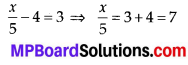
One-fifth of this number \(\frac{x}{5}\)
According to question;
MP Board Class 7th Maths Solutions Chapter 4 Simple Equations Ex 4.4 2
(Transporting -4 to R.H.S.)
Mutiplying both sides by 5,
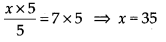
MP Board Class 7th Maths Solutions Chapter 4 Simple Equations Ex 4.4 3

(c) Let the number be x.
Three-fourth of this number = \(\frac{3 x}{4}\)
According to question;
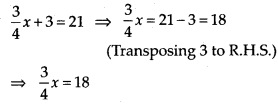
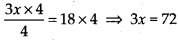
MP Board Class 7th Maths Solutions Chapter 4 Simple Equations Ex 4.4 4
Multiplying both sides by 4,
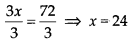
MP Board Class 7th Maths Solutions Chapter 4 Simple Equations Ex 4.4 5
Dividing both sides by 3,
MP Board Class 7th Maths Solutions Chapter 4 Simple Equations Ex 4.4 6

(d) Let the number be x.
Twice of this number = 2x
According to question;
2x – 11 = 15 ⇒ 2x = 15 + 11
(Transposing -11 to R.H.S.)
⇒ 2x = 26
Dividing both sides by 2,
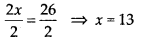
MP Board Class 7th Maths Solutions Chapter 4 Simple Equations Ex 4.4 7

(e) Let the number of notebooks be x.
Thrice the number of notebooks = 3x
According to question;
⇒ 50 – 3x = 8 ⇒ – 3x = 8 – 50
(Transposing 50 to R.H.S.)
⇒ – 3x = – 42
Dividing both sides by – 3,
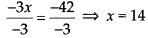
MP Board Class 7th Maths Solutions Chapter 4 Simple Equations Ex 4.4 8

(f) Let the number be x.
According to question;
MP Board Class 7th Maths Solutions Chapter 4 Simple Equations Ex 4.4 9
Multiplying both sides by 5,
MP Board Class 7th Maths Solutions Chapter 4 Simple Equations Ex 4.4 10
⇒ x = 40 – 19 (Transposing 19 to R.H.S.)
⇒ x = 21

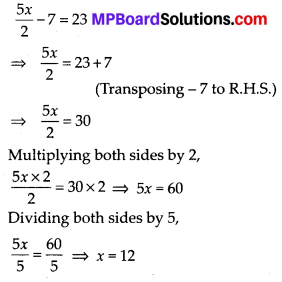
(g) Let the number be x.
\(\frac{5}{2}\) of this number = \(\frac{5x}{2}\)
According to question;
MP Board Class 7th Maths Solutions Chapter 4 Simple Equations Ex 4.4 11

MP Board Class 7th Maths Solutions Chapter 4 Simple Equations Ex 4.4

Question 2.
Solve the following;
(a) The teacher tells the class that the highest marks obtained by a student in her class is twice the lowest marks plus 7. The highest score is 87. What is the lowest score?
(b) In an isosceles triangle, the base angles are equal. The vertex angle is 40°. What are the base angles of the triangle? (Remember, the sum of three angles of a triangle is 180°).
(c) Sachin scored twice as many runs as Rahul. Together, their runs fell two short of a double century. How many runs did each one score?
Solution:
(a) Let the lowest score be l.
According to question;
Highest marks = 2 × Lowest marks + 7
⇒ 87 = (2 × l) + 7 × 2l + 7 = 87
⇒ 2l = 87 – 7
(Transposing 7 to R.H.S.)
⇒ 2l = 80
Dividing both sides by 2,

MP Board Class 7th Maths Solutions Chapter 4 Simple Equations Ex 4.4 12
Therefore, the lowest score is 40.

(b) Let the base angles be equal to b.
Vertex angle = 40°
The sum of all interior angles of a triangle is 180°.
b + b + 40° = 180° ⇒ 2b + 40° = 180°
⇒ 2b = 180° – 40° = 140°
(Transposing 40° to R.H.S.)
Dividing both sides by 2,

MP Board Class 7th Maths Solutions Chapter 4 Simple Equations Ex 4.4 13
Therefore, the base angles of the triangle are of 70°.

(c) Let Rahul’s score be x.
Therefore, Sachin’s score = 2x
According to question;
Rahul’s score + Sachin’s score = 200 – 2
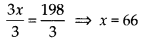
2x + x = 198 ⇒ 3x = 198
Dividing both sides by 3,
MP Board Class 7th Maths Solutions Chapter 4 Simple Equations Ex 4.4 14
∴ Rahul’s score = 66
Sachin’s score = 2 × 66 = 132

MP Board Class 7th Maths Solutions Chapter 4 Simple Equations Ex 4.4

Question 3.
Solve the following:
(i) Irfan says that he has 7 marbles more than five times the marbles Parmit has. Irfan has 37 marbles. How many marbles does Parmit have?
(ii) Laxmi’s father is 49 years old. He is 4 years older than three times Laxmi’s age. What is Laxmi’s age?
(iii) People of Sundargram planted trees in the village garden. Some of the trees were fruit trees. The number of non-fruit trees were two more than three times the number of fruit trees. What was the number of fruit trees planted if the number of non-fruit trees planted was 77?
Solution:
(i) Let Parmit has x marbles.
5 times the number of marbles Parmit has = 5x
According to question;
5x + 7 = 37 ⇒ 5x = 37 – 7 = 30
(Transposing 7 to R.H.S.)
Dividing both sides by 5,

MP Board Class 7th Maths Solutions Chapter 4 Simple Equations Ex 4.4 15
Therefore, Parmit has 6 marbles.

(ii) Let Laxmi’s age be x years.
According to question;
Her father’s age = 3 × Laxmi’s age + 4
⇒ 49 = (3 × x) + 4
⇒ 3x + 4 = 49 ⇒ 3x = 49 – 4
(Transposing 4 to R.H.S.)
⇒ 3x = 45
Dividing both sides by 3,

MP Board Class 7th Maths Solutions Chapter 4 Simple Equations Ex 4.4 16
Therefore, Laxmi’s age is 15 years.

(iii) Let the number of fruit trees be x. According to question;
Number of non-fruit trees = 3 × Number of fruit trees + 2
77 = (3 × x) + 2
⇒ 3x + 2 = 77 ⇒ 3x = 77 – 2
(Transposing 2 to R.H.S.)
⇒ 3x = 75
Dividing both sides by 3,

MP Board Class 7th Maths Solutions Chapter 4 Simple Equations Ex 4.4 17
Therefore, the number of fruit trees planted were 25.

Question 4.
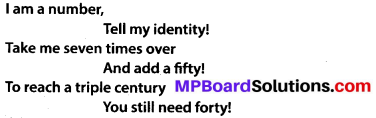
Solve the following riddle:
MP Board Class 7th Maths Solutions Chapter 4 Simple Equations Ex 4.4 18
Solution:
Let the number be x.
Seven times x = 7x
According to question; .
(7x + 50) + 40 = 300 ⇒ 7x + 90 = 300
⇒ 7x = 300 – 90 (Transposing 90 to R.H.S.)
⇒ 7x = 210
Dividing both sides by 7,

MP Board Class 7th Maths Solutions Chapter 4 Simple Equations Ex 4.4 19
Therefore, the number is 30.

MP Board Class 7th Maths Solutions Chapter 4 Simple Equations Ex 4.4

MP Board Class 7th Maths Solutions

MP Board Class 7th Social Science Solutions Chapter 17 The Governor and State Council of Ministers

MP Board Class 7th Social Science Solutions Chapter 17 The Governor and State Council of Ministers

MP Board Class 7th Social Science Chapter 17 Text Book Questions

Fill in the blanks:

  1. …………. is the head of the State.
  2. The Chief Minister is appointed by the ………….
  3. The leader of die Council of Minister is the ………….
  4. The minimum age for the post of die Governor is …………..

Answer:

  1. Governor
  2. Governor
  3. Chief Minister
  4. 35 yrs.

MP Board Solutions

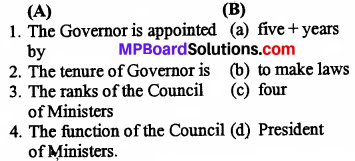
Match the column ‘A ’ with Column ‘B’

MP Board Class 7th Social Science Solutions Chapter 17 The Governor and State Council of MinistersAnswer:
1. (d) President of Ministers.
2. (a) five + years by
3. (c) four of Ministers
4. (b) to make laws

MP Board Class 7th Social Science Chapter 17 Short Answer Type Questions

Question 1.
In whose name are the functions of the state government carried out?
Answer:
The functions of the State Government are carried out in the name of the Governor.

Question 2.
On whose advice are the members of the Council of Ministers appointed?
Answer:
On the advice of the Chief Ministers, the members of the Council of Ministers are appointed.

MP Board Solutions

Question 3.
Who summons the meeting of the State Legislative Assembly?
Answer:
The Governor summons the meeting of the state Legislative Assembly.

MP Board Class 7th Social Science Chapter 17 Long Answer Type Questions

Question 1.
Describe the functions of the State Council of Ministers.
Answer:

The council of Ministers executes die laws, made by the Vidhan Sabha. It decides the polices of die government and advice the Governor in the matter of administration. It is the real executive of the state.

The main functions of the State Council of Ministers:

  • Being the executive of the state, the council of Ministers formulates the policies of die state and gives advice to the Governor in administrative matters.
  • All the bills are introduced by the Council of Ministers and play an important role in the making of laws.
  • It formulates the economic and taxation policy of the state.
  • It makes plans for the welfare of the state.

MP Board Solutions

Question 2.
What are the qualifications for the post of Governor?
Answer:
Qualifications for Governor:
  • A person has to be citizen of India.
  • He must have completed the age of 35 years.
  • He must not have held the office of profit, under the Central or State Government.
  • He must not be a members of Parliament or State Assembly.

Question 3.
When and why does the Governor issue ordinance?
Answer:
The bills passed by the Assembly become laws only after the assent of the Governor. When Vidhan Sabha is not in session, and a law is urgently required the Governor himself pass some orders which are known as ordinances. It has the effect of law.

MP Board Class 7th Social Science Solutions

MP Board Class 7th Maths Solutions Chapter 4 Simple Equations Ex 4.3

MP Board Class 7th Maths Solutions Chapter 4 Simple Equations Ex 4.3

Question 1.
Solve the following equations:
(a) \(2 y+\frac{5}{2}=\frac{37}{2}\)
(b) 5t + 28 = 10
(c) \(\frac{a}{5}+3\) = 2
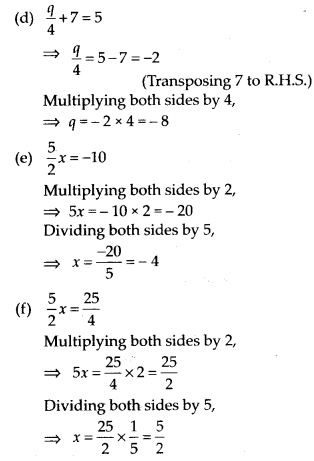
(d) \(\frac{q}{4}+7\) = 5
(e) \(\frac{5}{2} x\) = -10
(f) \(\frac{5}{2} x=\frac{25}{4}\)
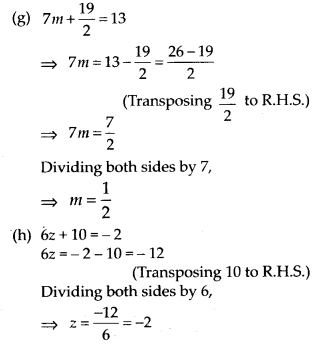
(g) \(7 m+\frac{19}{2}\) = 13
(h) 6z + 10 = -2
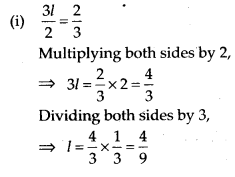
(i) \(\frac{3 l}{2}=\frac{2}{3}\)
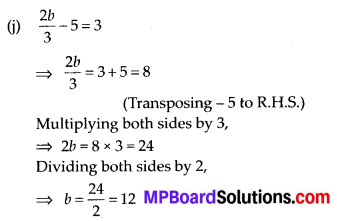
(j) \(\frac{2 b}{3}-5\) = 3
Solution:
MP Board Class 7th Maths Solutions Chapter 4 Simple Equations Ex 4.3 2
MP Board Class 7th Maths Solutions Chapter 4 Simple Equations Ex 4.3 3
MP Board Class 7th Maths Solutions Chapter 4 Simple Equations Ex 4.3 4
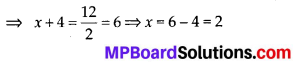
MP Board Class 7th Maths Solutions Chapter 4 Simple Equations Ex 4.3 5

Question 2.
Solve the following equations.
(a) 2(x + 4) = 12
(b) 3(n – 5) = 21
(c) 3(n – 5) = -21
(d) -4(2 + x) = 8
(e) 4(2 – x) = 8
Solution:
(a) 2(x + 4) = 12
Dividing both sides by 2,
MP Board Class 7th Maths Solutions Chapter 4 Simple Equations Ex 4.3 6
(Transposing 4 to R.H.S.)

(b) 3(n – 5) = 21
Dividing both sides by 3,
MP Board Class 7th Maths Solutions Chapter 4 Simple Equations Ex 4.3 7
(Transposing – 5 to R.H.S.)

(c) 3(n – 5) = -21
Dividing both sides by 3,
MP Board Class 7th Maths Solutions Chapter 4 Simple Equations Ex 4.3 8
(Transposing – 5 to R.H.S.)

(d) – 4(2 + x) = 8
Dividing both sides by – 4,
MP Board Class 7th Maths Solutions Chapter 4 Simple Equations Ex 4.3 9
(Transposing 2 to R.H.S.)

(e) 4(2 – x) = 8
Dividing both sides by 4,
MP Board Class 7th Maths Solutions Chapter 4 Simple Equations Ex 4.3 10
(Transposing 2 to R.H.S.)
⇒ x = 0

MP Board Class 7th Maths Solutions Chapter 4 Simple Equations Ex 4.3

Question 3.
Solve the following equations:
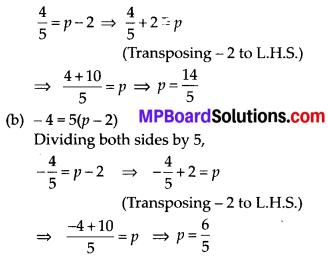
(a) 4 = 5(p – 2)
(b) -4 = 5(p – 2)
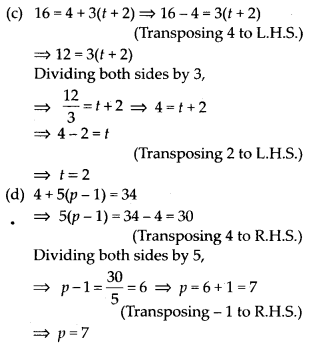
(c) 16 = 4 + 3(t + 2)
(d) 4 + 5(p – 1) = 34
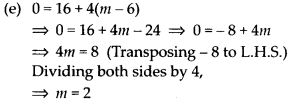
(e) 0 = 16 + 4(m – 6)
Solution:
(a) 4 = 5(p – 2)
Dividing both sides by 5,
MP Board Class 7th Maths Solutions Chapter 4 Simple Equations Ex 4.3 11
MP Board Class 7th Maths Solutions Chapter 4 Simple Equations Ex 4.3 12
MP Board Class 7th Maths Solutions Chapter 4 Simple Equations Ex 4.3 13

MP Board Class 7th Maths Solutions Chapter 4 Simple Equations Ex 4.3

Question 4.
(a) Construct 3 equations starting with x= 2.
(b) Construct 3 equations starting with x = -2.
Solution:
(a) x = 2
Multiplying both sides by 5,
5x = 10 … (i)
(b) Let the number be x.
Subtracting 3 from both sides,
5x – 3 = 10 – 3
5x – 3 = 7 …(ii)
Dividing both sides by 2,
MP Board Class 7th Maths Solutions Chapter 4 Simple Equations Ex 4.3 14

(b) x= -2
Subtracting 2 from both sides,
x – 2 = -2 – 2 ⇒ x – 2 = -4 … (i)
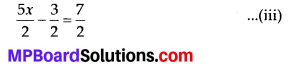
Again, take x = – 2
Multiplying both sides by 6,
6 × x = -2 × 6 ⇒ 6x = -12
Subtracting 12 from both sides,
6x – 12 = – 12 – 12 ⇒ 6x – 12 = – 24 …(ii)
Adding 24 to both sides,
6x – 12 + 24 = – 24 + 24
⇒ 6x + 12 = 0 …(iii)

MP Board Class 7th Maths Solutions Chapter 4 Simple Equations Ex 4.3

MP Board Class 7th Maths Solutions

MP Board Class 7th Maths Solutions Chapter 4 Simple Equations Ex 4.2

MP Board Class 7th Maths Solutions Chapter 4 Simple Equations Ex 4.2

Question 1.
Give first the step you will use to separate the variable and then solve the equation:
(a) x – 1 = 0
(b) x + 1 = 0
(c) x – 1 = 5
(d) x + 6 = 2
(e) y – 4 = -7
(f) y – 4 = 4
(g) y + 4 = 4
(h) y + 4 = -4
Solution:
On adding 1 to both sides of the given equation, we obtain
x – 1 + 1 = 0 + 1 ⇒ x = 1

(b) x + 1 = 0
On subtracting 1 from both sides of the given equation, we obtain
x + 1 – 1 = 0 – 1 ⇒ x = -1

(c) x – 1 = 5
On adding 1 to both sides of the given equation, we obtain
x – 1 + 1 = 5 + 1 ⇒ x = 6

(d) x + 6 = 2
On subtracting 6 from both sides of the given equation, we obtain
x + 6 – 6 = 2 – 6 ⇒ x = -4

(e) y – 4 = – 7
On adding 4 to both sides of the given equation, we obtain
y – 4 + 4 = -7 + 4 ⇒ y = -3

(f) y – 4 = 4
On adding 4 to both sides of the given equation, we obtain
y – 4 + 4 = 4 + 4 ⇒ y = 8

(g) y + 4 = 4
On subtracting 4 from both sides of the given equation, we obtain
y + 4 – 4 = 4 – 4 ⇒ y = 0

(h) y + 4 = -4
On subtracting 4 from both sides of the given equation, we obtain
y + 4 – 4 = – 4 – 4 ⇒ y = -8

MP Board Class 7th Maths Solutions Chapter 4 Simple Equations Ex 4.2

Question 2.
Give first the step you will use to separate the variable and then solve the equation:
(a) 3l = 42
(b) \(\frac{b}{2}\) = 6
(c) \(\frac{p}{7}\) = 4
(d) 4x = 25
(e) 8y = 36
(f) \(\frac{z}{3}=\frac{5}{4}\)
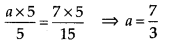
(g) \(\frac{a}{5}=\frac{7}{15}\)
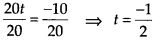
(h) 20t = -10
Solution:
(a) 3l = 42
On dividing both sides of the given equation by 3, we obtain
MP Board Class 7th Maths Solutions Chapter 4 Simple Equations Ex 4.2 1

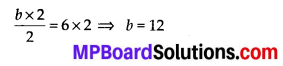
(b) \(\frac{b}{2}\) = 6
On multiplying both sides of the given equation by 2, we obtain
MP Board Class 7th Maths Solutions Chapter 4 Simple Equations Ex 4.2 2

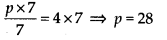
(c) \(\frac{p}{7}\) = 4
On multiplying both sides of the given equation by 7, we obtain
MP Board Class 7th Maths Solutions Chapter 4 Simple Equations Ex 4.2 3

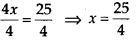
(d) 4x = 25
On dividing both sides of the given equation by 4, we obtain
MP Board Class 7th Maths Solutions Chapter 4 Simple Equations Ex 4.2 4

(e) 8y = 36
On dividing both sides of the given equation by 8, we obtain
MP Board Class 7th Maths Solutions Chapter 4 Simple Equations Ex 4.2 5

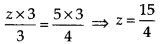
(f) \(\frac{z}{3}=\frac{5}{4}\)
On multiplying both sides of the given equation by 3, we obtain
MP Board Class 7th Maths Solutions Chapter 4 Simple Equations Ex 4.2 6

(g) \(\frac{a}{5}=\frac{7}{15}\)
On multiplying both sides of the given equation by 5, we obtain
MP Board Class 7th Maths Solutions Chapter 4 Simple Equations Ex 4.2 7

(h) 20t = -10
On dividing both sides of the given equation by 20, we obtain
MP Board Class 7th Maths Solutions Chapter 4 Simple Equations Ex 4.2 8

MP Board Class 7th Maths Solutions Chapter 4 Simple Equations Ex 4.2

Question 3.
Give the steps you will use to separate the variable and then solve the equation:
(a) 3n – 2 = 46
(b) 5m + 7 = 17
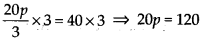
(c) \(\frac{20 p}{3}\) = 40
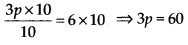
(d) \(\frac{3 p}{10}\) = 6
Solution:
(a) 3n – 2 = 46
On adding 2 to both sides, we obtain
3n – 2 + 2 = 46 + 2 ⇒ 3n = 48
On dividing both sides of the given equation by 3, we obtain
MP Board Class 7th Maths Solutions Chapter 4 Simple Equations Ex 4.2 9

(b) 5m + 7 = 17
On subtracting 7 from both sides, we obtain
5m + 7 – 7 = 17 – 7 ⇒ 5m = 10
On dividing both sides of the given equation by 5, we obtain
MP Board Class 7th Maths Solutions Chapter 4 Simple Equations Ex 4.2 10

(c) \(\frac{20 p}{3}\) = 40
On multiplying both sides of the given equation by 3, we obtain
MP Board Class 7th Maths Solutions Chapter 4 Simple Equations Ex 4.2 11
On dividing both sides of the given equation by 20, we obtain
MP Board Class 7th Maths Solutions Chapter 4 Simple Equations Ex 4.2 12

(d) \(\frac{3 p}{10}\) = 6
On multiplying both sides of the given equation by 10, we obtain 3pxl0
MP Board Class 7th Maths Solutions Chapter 4 Simple Equations Ex 4.2 13
On dividing both sides of the given equation by 3, we obtain
MP Board Class 7th Maths Solutions Chapter 4 Simple Equations Ex 4.2 14

Question 4.
Solve the following equations:
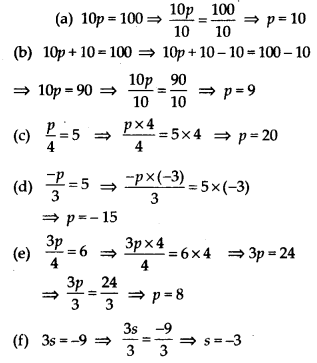
(a) 10p = 100
(b) 10p + 10 = 100
(c) \(\frac{p}{4}\) = 5
(d) \(\frac{-p}{3}\) = 5
(e) \(\frac{39}{4}\) = 6
(f) 3s = -9
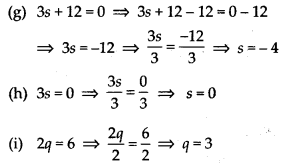
(g) 3s + 12 = 0
(h) 3s = 0
(i) 2q = 6
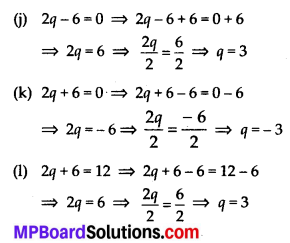
(j) 2q – 6 = 0
(k) 2q + 6 = 0
(l) 2q + 6 = 12
Solution:
MP Board Class 7th Maths Solutions Chapter 4 Simple Equations Ex 4.2 15
MP Board Class 7th Maths Solutions Chapter 4 Simple Equations Ex 4.2 16
MP Board Class 7th Maths Solutions Chapter 4 Simple Equations Ex 4.2 17

MP Board Class 7th Maths Solutions Chapter 4 Simple Equations Ex 4.2

MP Board Class 7th Maths Solutions

MP Board Class 7th Social Science Solutions Chapter 14 The Age of Magnificence

MP Board Class 7th Social Science Solutions Chapter 14 The Age of Magnificence

MP Board Class 7th Social Science Chapter 14 Text Book Questions

Choose the correct alternatives from the following:

Question 1.
Just after ascending the throne Jahangir had to face the revolt of:
(a) Khusrau
(b) Khurrum
(c) Salim
(d) Shiya
Answer:
(a) Khusrau

Question 2.
Tajmahal was built by:
(a) Akbar
(b) Jahangir
(c) Shahjahan
(d) Aurangzeb
Answer:
(c) Shahjahan

Question 3.
The ninth Guru of Sikhs was:
(a) AijunDev
(b) Teg Bahadur
(c) Govind Singh
(d) Ranjeet Singh
Answer:
(b) Teg Bahadur

MP Board Solutions

Fill in the blanks:

  1. Sir Thomas Roe and Captain Hawkins came to India during the reign of ………………
  2. ………………………. was studded in the peacock.
  3. ………………………. pirated in the Bay of Bengal.
  4. ………………………… was die famous warrior and able statesman.

Answer:

  1. Jahangir
  2. Koh-i-noor
  3. Portuguese
  4. Mallik Amber

MP Board Class 7th Social Science Chapter 14 Short Answer Type Questions

Question 1.
Why did Jahangir execute Guru Arjun Dev?
Answer:
Jahangir was angry with Gum Arjun Dev (Sikh Gum) because he had financially helped prince Khusrau to revolt against him. So he arrested him and tortured him to death.

MP Board Solutions

Question 2.
What did Jahangir do so that the common people received justice?
Answer:
Jahangir was famous for his judicial system. He put a gold chain with bells on it outside the palace. Anybody could appeal to the king for justice by pulling the chain.

Question 3.
What effect had Nurjahan on the administration?
Answer:
In 1611 4D Nurjahan was married to Jahangir. She was very beautiful and intelligent woman. She set new codes and ideologies for the court and even new fashion began from there. She was capable and looked after the administration very effectively. Jahangir used to take her advice in all important matters. Later Nurjahan’s influence in administration increased to such an extent that the royal firmans were issued in her name.

Question 4.
Mention the important buildings made by Shahjahan.
Answer:
The important buildings made by Shahjahan are, die Red Fort of Delhi, Diwan-i- Aaam, Diwan-i-Khas, JamaMasjid, Taj MahaL

MP Board Solutions

MP Board Class 7th Social Science Chapter 14 Long Answer Type Questions

Question 1.
Why is the reign of Jahangir and Shahjahan known as the age of magnificence?
Answer:
The reign of Jahangir and Shahjahan had die most peaceful region. This was so because Akbar set up a vast empire on the basis of his power and good policies and gave it stability. So during the reign of Jahangir and Shahjahan the life was quite comfortable. They encouraged art and literature. Many beautiful and magnificent buildings were built The Royal family and the Aristocracy lived a life of great luxury. It was therefore the reign of Jahangir and Shahjahan is known as the age of magnificence.

MP Board Class 7th Social Science Solutions

MP Board Class 7th Maths Solutions Chapter 4 Simple Equations Ex 4.1

MP Board Class 7th Maths Solutions Chapter 4 Simple Equations Ex 4.1

Question 1.
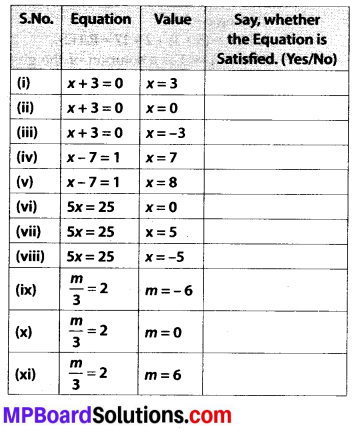
Complete the last column of the table.
MP Board Class 7th Maths Solutions Chapter 4 Simple Equations Ex 4.1 1
Solution:
(i) x + 3 = 0
By putting x = 3
L.H.S. = 3 + 3 = 6 ≠ R.H.S.
Hence, the equation is not satisfied.

(ii) x + 3 = 0
By putting x = 0
L.H.S. = 0 + 3 = 3 ≠ R.H.S.
Hence, the equation is not satisfied.

(iii) x + 3 = 0
By putting x = – 3
L.H.S. = -3 + 3 = 0 = R.H.S.
Hence, the equation is satisfied.

(iv) x – 7 = 1
By putting x = 7
L.H.S. = 7 – 7 = 0 ≠ R.H.S.
Hence, the equation is not satisfied.

(v) x – 7 = 1
By putting x = 8 L.H.S. = 8 – 7 = 1 = R.H.S.
Hence, the equation is satisfied.

(vi) 5x = 25
By putting x = 0
L.H.S. = 5 × 0 = 0 ≠ R.H.S.
Hence, the equation is not satisfied.

(vii) 5x = 25
By putting x = 5
L.H.S. = 5 × 5 = 25 = R.H.S.
Hence, the equation is satisfied,

(viii) 5x = 25 .
By putting x = – 5
L.H.S. = 5 × (- 5) = – 25 ≠ R.H.S.
Hence, the equation is not satisfied.

(ix) \(\frac{m}{3}\) = 2
By putting m = – 6
L.H.S. = \(\frac{-6}{3}\) = -2 ≠ R.H.S.
Hence, the equation is not satisfied.

(x) \(\frac{m}{3}\) = 2
By putting m = 0
L.H.S. = \(\frac{0}{3}\) = 0 ≠ R.H.S.
Hence, the equation is not satisfied.

(xi) \(\frac{m}{3}\) = 3
By putting m = 6
L.H.S. = \(\frac{6}{3}\) = 2 = R.H.S
Hence, the equation is satisfied.

MP Board Class 7th Maths Solutions Chapter 4 Simple Equations Ex 4.1

Question 2.
Check whether the value given in the brackets is a solution to the given equation or not:
(a) n + 5 = 19(n = 1)
(b) 7n + 5 = 19(n = -2)
(c) 7n + 5 = 19(n = 2)
(d) 4p – 3 = 13(p = 1)
(e) 4p – 3 = 13(p = -4)
(f) 4p – 3 = 13 (p = 0)
Solution:
(a) n + 5 = 19 (n = 1)
Putting n = 1
L.H.S. = n + 5 = 1 + 5 = 6 ≠ 19 = R.H.S.
As L.H.S. ≠ R.H.S.
Therefore, n = 1 is not a solution of the given equation, n + 5 = 19.

(b) 7n + 5 = 19 (n =- 2)
Putting n = – 2
L.H.S. = 7n + 5 = 7 × (-2) + 5 = -14 + 5
= -9 ≠ 19 = R.H.S.
As L.H.S. ≠ R.H.S.
Therefore, n = -2 is not a solution of the given equation, 7n + 5 = 19.

(c) 7n + 5 = 19 (n = 2)
Putting n = 2
L.HS. = 7n + 5 = 7 × (2) + 5 = 14 + 5 = 19 = R.HS.
As L.H.S. = R.H.S.
Therefore, n = 2 is a solution of the given equation, 7n + 5 = 19.

(d) 4p – 3 = 13(p = 1)
Putting p = 1
L.H.S. = 4p – 3 = (4 × 1) – 3
= 1 × 13 = R.H.S.
As L.H.S. × R.H.S.
Therefore, p = 1 is not a solution of the given equation, 4p – 3 = 13.

(e) 4p – 3 = 13 (p = – 4)
Putting p = – 4
L.H.S. = 4p – 3 = 4 × (- 4) – 3 = -16 – 3
= -19 ≠ 13 = R.H.S.
As L.H.S. ≠ R.H.S.
Therefore, p = – 4 is not a solution of the given equation, 4p – 3 = 13.

(f) 4p – 3 = 13 (p = 0)
Putting p = 0
L.HS. = 4p – 3 = (4 × 0) – 3 = -3 ≠ 13 = RH.S.
As L.H.S. ≠ R.H.S.
Therefore, p = 0 is not a solution of the given equation, 4p – 3 = 13.

MP Board Class 7th Maths Solutions Chapter 4 Simple Equations Ex 4.1

Question 3.
Solve the following equations by trial and error method:
(i) 5p + 2 = 17
(ii) 3m -14 = 4
Solution:
(i) 5p + 2 = 17 Putting p = 1
L.H.S. = (5 × 1)+ 2 = 7 ≠ R.H.S.
Putting p = 2
L.H.S. = (5 × 2) + 2 = 10 + 2 = 12 ≠ R.H.S.
Putting p = 3
L.H.S. = (5 × 3) + 2 = 17 = R.H.S.
Hence, p = 3 is a solution of the given equation.

(ii) 3m – 14 = 4
Putting m = 4,
L.H.S. = (3 × 4) – 14 = -2 ≠ R.H.S.
Putting m = 5,
L.H.S. = (3 × 5) – 14 = 1 ≠ R.H.S.
Putting m = 6,
L.H.S. = (3 × 6) – 14 = 18 -14 = 4 = R.H.S.
Hence, m = 6 is a solution of the given equation.

MP Board Class 7th Maths Solutions Chapter 4 Simple Equations Ex 4.1

Question 4.
Write equations for the following statements:
(i) The sum of numbers x and 4 is 9.
(ii) 2 subtracted from y is 8.
(iii) Ten times a is 70.
(iv) The number b divided by 5 gives 6.
(v) Three-fourth of f is 15.
(vi) Seven times m plus 7 gives 77.
(vii) One-fourth of a number x minus 4 gives 4.
(viii) If you take away 6 from 6 times y, you get 60.
(ix) If you add 3 to one-third of z, you get 30.
Solution:
(i) x + 4 = 9
(ii) y – 2 = 8
(iii) 10a = 70
(iv) \(\frac{b}{5}\) = 6
(v) \(\frac{3}{4} t\) = 15
(vi) Seven times of m is 7m.
∴ 7m + 7 = 77
(vii) One-fourth of a number x is \(\frac{x}{4}\).
MP Board Class 7th Maths Solutions Chapter 4 Simple Equations Ex 4.1 2

(viii) Six times of y is 6y.
∴ 6y – y = 60

(ix) One-third of z is \(\frac{x}{4}\) .
MP Board Class 7th Maths Solutions Chapter 4 Simple Equations Ex 4.1 3

Question 5.
Write the following equations in statement forms:
(i) p + 4 = 15
(ii) m – 7 = 3
(iii) 2m = 7
(iv) \(\frac{m}{5}\) = 3
(v) \(\frac{3 m}{5}\) = 6
(vi) 3p + 4 = 25
(viii) \(\frac{p}{2}\) + 2 = 8
Solution:
(i) The sum of p and 4 is 15.
(ii) 7 subtracted from m is 3.
(iii) Twice of a number m is 7.
(iv) One-fifth of a number m is 3.
(v) Three-fifth of a number m is 6.
(vi) Three times of a number p, when added to 4, gives 25.
(vii) 2 subtracted from four times of a number p is 18.
(viii) 2 added to half of a number p gives 8.

MP Board Class 7th Maths Solutions Chapter 4 Simple Equations Ex 4.1

Question 6.
Set up an equation in the following cases:
(i) Irfan says that he has 7 marbles more than five times the marbles Parmit has. Irfan has 37 marbles. (Take m to be the number of Parmit’s marbles.)
(ii) Laxmi’s father is 49 years old. He is 4 years older than three times Laxmi’s age. (Take Laxmi’s age to be y years.)
(iii) The teacher tells the class that the highest marks obtained by a student in her class is twice the lowest marks plus 7. The highest score is 87, (Take the lowest score to be l.)
(iv) In an isosceles triangle, the vertex angle is twice either base angle. (Let the base angle be b in degrees. Remember that the sum of angles of a triangle is 180 degrees.)
Solution:
(i) Let Parmit has in marbles.
Number of marbles Irfan has = 5 × Number of marbles Parmit has +7
∴ 5 × m + 7 = 37 ⇒ 5m + 7 = 37

(ii) Let Laxmi be i years old.
Laxmi’s father’s age 3 × Laxmi’s age +4
∴ 49 = 3xy + 4 ⇒ 3y + 4 = 49

(iii) Let the lowest marks be 1.
Highest marks = 2 × Lowest marks +7
∴ 87 = 2 × l + 7 ⇒ 2l + 7 = 87

(iv) An isosceles triangle has two of its angles of equal measure.
Let base angle be b.
Vertex angle =2 × Base angle = 2b
Sum of all interior angles of a triangle 180°
∴ b + b + 2b = 180° ⇒ 4b = 180°

MP Board Class 7th Maths Solutions Chapter 4 Simple Equations Ex 4.1

MP Board Class 7th Maths Solutions

MP Board Class 7th Maths Solutions Chapter 3 Data Handling Ex 3.4

MP Board Class 7th Maths Solutions Chapter 3 Data Handling Ex 3.4

Question 1.
Tell whether the following is certain to happen, impossible, can happen but not certain.
(i) You are older today than yesterday.
(ii) A tossed coin will land heads up.
(iii) A die when tossed shall land up with 8 on top.
(iv) The next traffic light seen will be green.
(v) Tomorrow will be a cloudy day.
Solution:
(i) Certain to happen
(ii) Can happen but not certain
(iii) Impossible as there are only six faces of a die marked as 1, 2, 3, 4, 5 and 6 on it.
(iv) Can happen but not certain
(v) Can happen but not certain

MP Board Class 7th Maths Solutions Chapter 3 Data Handling Ex 3.4

Question 2.
There are 6 marbles in a box with numbers from 1 to 6 marked on each of them.
(i) What is the probability of drawing a marble with number 21
(ii) What is the probability of drawing a marble with number 5?
Solution:
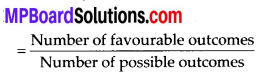
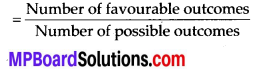
Probability of an event
MP Board Class 7th Maths Solutions Chapter 3 Data Handling Ex 3.4 1

(ii) Probability of drawing a marble with number 5 = \(\frac{1}{6}\).

Question 3.
A coin is flipped to decide which team starts the game. What is the probability that your team will start?
Solution:
A coin has two faces – Head and Tail. One team can opt either Head or Tail. Probability of an event
MP Board Class 7th Maths Solutions Chapter 3 Data Handling Ex 3.4 2
Probability (our team will start first) = \(\frac{1}{2}\)

MP Board Class 7th Maths Solutions Chapter 3 Data Handling Ex 3.4

MP Board Class 7th Maths Solutions

MP Board Class 7th Maths Solutions Chapter 3 Data Handling Ex 3.3

MP Board Class 7th Maths Solutions Chapter 3 Data Handling Ex 3.3

Question 1.
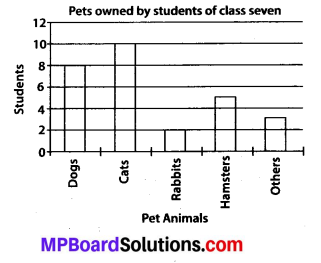
Use the given bar graph to answer the following questions.
(a) Which is the most popular pet?
(b) How many students have dog as a pet?
MP Board Class 7th Maths Solutions Chapter 3 Data Handling Ex 3.3 1
Solution:
(a) Since, the bar representing number of students for cats is the tallest, so cat is the most popular pet.
(b) The number of students having dog as a pet is 8.

MP Board Class 7th Maths Solutions Chapter 3 Data Handling Ex 3.3

Question 2.
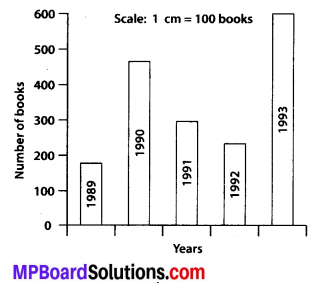
Read the given bar graph which shows the number of books sold by a bookstore during five consecutive years and answer the following questions:
MP Board Class 7th Maths Solutions Chapter 3 Data Handling Ex 3.3 2
(i) About how many books were sold in 1989? 1990? 1992?
(ii) In which year were about 475 books sold? About 225 books sold?
(iii) In which years were fewer than 250 books sold?
(iv) Can you explain how you would estimate the number of books sold in 1989?
Solution:
(i) In 1989, 175 books were sold. In 1990, 475 books were sold. In 1992, 225 books were sold.
(ii) From the graph, it can be concluded that in the year 1990 about 475 books were sold and in the year 1992 about 225 books were sold.
(iii) From the graph, it can be concluded that in the year 1989 and 1992, the number of books sold were less than 250.
(iv) From the graph, it can be concluded that the number of books sold in the year 1989 is about 1 and \(\frac{3}{4}\) th part of 1 cm.
We know that the scale is taken as 1 cm = 100 books.
∴ Number of books sold in 1989
MP Board Class 7th Maths Solutions Chapter 3 Data Handling Ex 3.3 3
Therefore, about 175 books were sold in the year 1989.

MP Board Class 7th Maths Solutions Chapter 3 Data Handling Ex 3.3

Question 3.
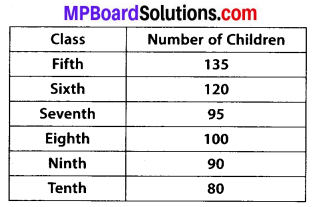
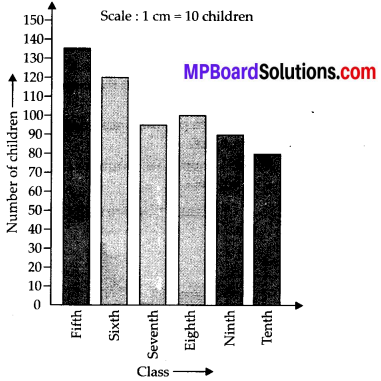
Number of children in six different classes are given below. Represent the data on a bar graph.
MP Board Class 7th Maths Solutions Chapter 3 Data Handling Ex 3.3 4
(a) How would you choose a scale?
(b) Answer the following questions:
(i) Which class has the maximum number of children? And the minimum?
(ii) Find the ratio of students of class sixth to the students of class eighth.
Solution:
MP Board Class 7th Maths Solutions Chapter 3 Data Handling Ex 3.3 5
(a) We will choose a scale as 1 unit = 10 children because we can represent a more
clear difference between the number of students of class 7th and that of class 9th by this scale.
(b) (i) Since, the bar representing the number of children for class fifth is the tallest. So, there are maximum number of children in class fifth. Similarly, the bar representing the number of children for class tenth is the smallest. So, there are minimum number of children in class tenth.
(ii) The number of students in class sixth is 120 and the number of students in class eighth is 100. Therefore, the ratio of students of class sixth to the students 5.
of class eighth \(=\frac{120}{100}=\frac{6}{5}\) i.e., 6 : 5

MP Board Class 7th Maths Solutions Chapter 3 Data Handling Ex 3.3

Question 4.
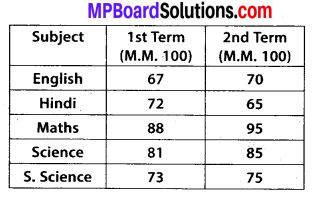
The performance of a student in 1st Term and 2nd Term is given. Draw a double bar graph choosing appropriate scale and answer the following:
MP Board Class 7th Maths Solutions Chapter 3 Data Handling Ex 3.3 6
(i) In which subject, has the child improved his performance the most?
(ii) In which subject is the improvement the least?
(iii) Has the performance gone down in any subject?
Solution:
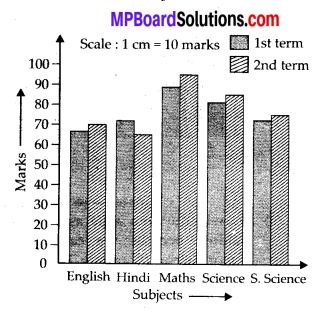
A double bar graph for the given data is as follows.
MP Board Class 7th Maths Solutions Chapter 3 Data Handling Ex 3.3 7
(i) There was a maximum increase in the marks obtained in Maths. Therefore, the child has improved his performance the most in Maths.
(ii) From the graph, it can be concluded that the improvement was the least in
S. Science.
(iii) From the graph, it can be observed that the performance in Hindi has gone down.

Question 5.
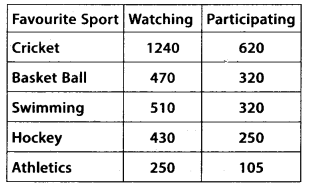
Consider this data collected from a survey of a colony.
MP Board Class 7th Maths Solutions Chapter 3 Data Handling Ex 3.3 8
(i) Draw a double bar graph choosing an appropriate scale. What do you infer from the bar graph?
(ii) Which sport is most popular?
(iii) Which is more preferred, watching or participating in sports?
Solution:
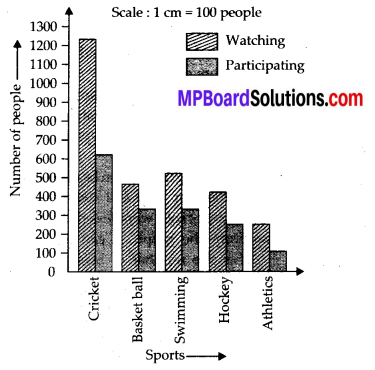
(i) A double bar graph for the given data is as follows:
MP Board Class 7th Maths Solutions Chapter 3 Data Handling Ex 3.3 9
The double bar graph represents the number of people who like watching and participating in different sports.
(ii) From the bar graph, it can be observed that the bar representing the number of people who like watching and participating in cricket is the tallest among all the bars. Hence, cricket is the most popular sport.
(iii) The bars representing watching sport are longer than the bars representing participating in sport. Hence, watching different types of sports is more preferred than participating in the sports.

MP Board Class 7th Maths Solutions Chapter 3 Data Handling Ex 3.3

Question 6.
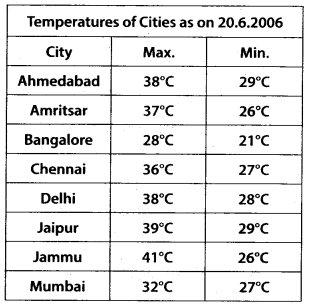
Take the data giving the minimum and the maximum temperature of various cities given in the table. Plot a double bar graph using the data and answer the following:
MP Board Class 7th Maths Solutions Chapter 3 Data Handling Ex 3.3 10
(i) Which city has the largest difference in the minimum and maximum temperature on the given date?
(ii) Which is the hottest city and which is the coldest city?
(iii) Name two cities where maximum temperature of one was less than the minimum temperature of the other.
(iv) Name the city which has the least difference between its minimum and the maximum temperature.
Solution:
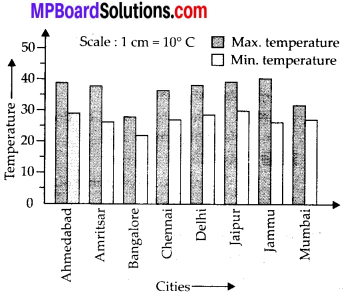
A double bar graph for the given data is constructed as follows.
MP Board Class 7th Maths Solutions Chapter 3 Data Handling Ex 3.3 11
(i) From the graph, it can be concluded that Jammu has the largest difference in its minimum and maximum temperature on 20.6.2006.
(ii) From the graph, it can be concluded that Jammu is the hottest city and Bangalore is the coldest city.
(iii) Bangalore and Jaipur, Bangalore and Ahmedabad.
For Bangalore, the maximum temperature was 28°C, while minimum temperature of both cities, Ahmedabad and Jaipur, was 29°C.
(iv) From the graph, it can be concluded that the city which has least difference between its minimum and maximum temperature is Mumbai.

MP Board Class 7th Maths Solutions Chapter 3 Data Handling Ex 3.3

MP Board Class 7th Maths Solutions

MP Board Class 7th Maths Solutions Chapter 3 Data Handling Ex 3.2

MP Board Class 7th Maths Solutions Chapter 3 Data Handling Ex 3.2

Question 1.
The scores in Mathematics test (out of 25) of 15 students are as follows:
19, 25, 23, 20, 9, 20, 15, 10, 5, 16, 25, 20, 24, 12, 20
Find the mode and median of this data. Are they same?
Solution:
Arranging the given scores in ascending order, we have 5, 9, 10, 12, 15, 16, 19, 20, 20, 20, 20, 23, 24, 25, 25
Mode of given data is that value of observation which occurs for the most number of times i.e., 20. 5.
Median of the given data is the middle observation when the data is arranged in ascending order i.e., 8th term = 20
Hence, mode of data = median of data.

MP Board Class 7th Maths Solutions Chapter 3 Data Handling Ex 3.2

Question 2.
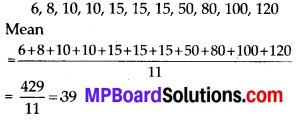
The runs scored in a cricket match by 11 players are as follows:
6, 15, 120, 50, 100, 80, 10, 15, 8, 10, 15
Find the mean, mode and median of this data. Are the three same?
Solution:
Arranging the given scores in an ascending order, we have
MP Board Class 7th Maths Solutions Chapter 3 Data Handling Ex 3.2 1
As 15 occurs for the most number of times.
∴ Mode = 15
Median = Middle term = 15
∴ All three mean, mode and median are not same.

MP Board Class 7th Maths Solutions Chapter 3 Data Handling Ex 3.2

Question 3.
The weights (in kg.) of 15 students of a class are: 38, 42, 35, 37, 45, 50, 32, 43, 43, 40, 36, 38, 43, 38, 47
(i) Find the mode and median of this data.
(ii) Is there more than one mode?
Solution:
Arranging the given weights in ascending order, we have 32, 35, 36, 37, 38, 38, 38, 40, 42, 43, 43, 43, 45,47, 50
(i) Mode = 38 and 43
Median = Middle term = 40
(ii) Yes, there are 2 modes for the given data i.e., 38 and 43.

Question 4.
Find the mode and median of the data: 13, 16, 12, 14, 19, 12, 14, 13, 14
Solution:
Arranging the given data in an ascending order, we have
12, 12, 13, 13, 14, 14, 14, 16, 19
14 occurs for the most number of times
∴ Mode = 14
Median = Middle observation = 14

MP Board Class 7th Maths Solutions Chapter 3 Data Handling Ex 3.2

Question 5.
Tell whether the statement is true or false:
(i) The mode is always one of the numbers in a data.
(ii) The mean is one of the numbers in a data.
(iii) The median is always one of the numbers in a data.
(iv) The data 6,4,3,8,9,12,13,9 has mean 9.
Solution:
(i) True, as mode of a given data is that value of observation which occurs for the most number of times. Therefore, it is one of the observations given in the data.
(ii) False, because mean may or may not be one of the numbers in the data.
(iii) False, because median may or may not be one of the numbers in the data
(iv) False, because
MP Board Class 7th Maths Solutions Chapter 3 Data Handling Ex 3.2 2

MP Board Class 7th Maths Solutions Chapter 3 Data Handling Ex 3.2

MP Board Class 7th Maths Solutions

MP Board Class 7th Maths Solutions Chapter 3 Data Handling Ex 3.1

MP Board Class 7th Maths Solutions Chapter 3 Data Handling Ex 3.1

Question 1.
Find the range of heights of any ten students of your class.
Solution:
Let the heights (in cm) of 10 students of our class be 125, 129, 131, 132, 134, 136, 139, 142, 144, 146
Highest observation = 146 cm
Lowest observation =125 cm
Range = Highest observation – Lowest observation
= (146 – 125) cm = 21 cm

Question 2.
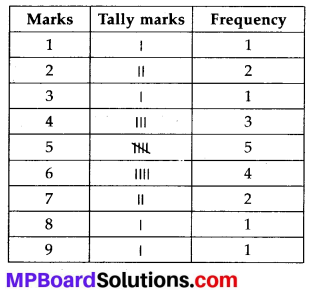
Organise the following marks in a class assessment, in a tabular form. 4, 6, 7, 5, 3, 5, 4, 5, 2, 6, 2, 5, 1, 9, 6, 5, 8, 4, 6, 7
Solution:
MP Board Class 7th Maths Solutions Chapter 3 Data Handling Ex 3.1 1
(i) Highest number = 9
(ii) Lowest number = 1
(iii) Range = (9 – 1) = 8
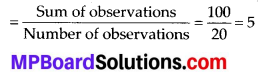
(iv) Sum of all the observations =4 + 6 + 7 + 5 + 3 + 5 + 4 + 5 + 2 + 6 + 2 + 5 + 1 + 9 + 6 + 5 + 8 + 4 + 6 + 7 = 100
Total number of observations = 20
Arithmetic mean
MP Board Class 7th Maths Solutions Chapter 3 Data Handling Ex 3.1 2

Question 3.
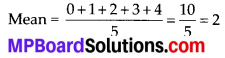
Find the mean of the first five whole numbers.
Solution:
First five whole numbers are 0, 1, 2, 3 and 4.
MP Board Class 7th Maths Solutions Chapter 3 Data Handling Ex 3.1 3
Hence, the mean of first five whole numbers is 2.

Question 4.
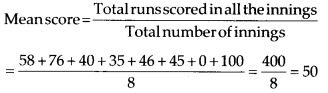
A cricketer scores the following runs in eight innings: 58, 76,40, 35,46,45,0,100.
Find the mean score.
Solution:
Runs scored by the cricketer in eight innings are 58, 76, 40, 35, 46, 45, 0 and 100.
MP Board Class 7th Maths Solutions Chapter 3 Data Handling Ex 3.1 4
Therefore, mean score is 50.

MP Board Class 7th Maths Solutions Chapter 3 Data Handling Ex 3.1

Question 5.
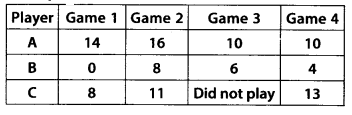
Following table shows the points of each player scored in four games:
MP Board Class 7th Maths Solutions Chapter 3 Data Handling Ex 3.1 5
Now answer the following questions:
(i) Find the mean to determine A’s average number of points scored per game.
(ii) To find the mean number of points per game for C, would you divide the total points by 3 or by 4? Why?
(iii) B played in all the four games. How would you find the mean?
(iv) Who is the best performer?
Solution:
(i) A’s average number of points
MP Board Class 7th Maths Solutions Chapter 3 Data Handling Ex 3.1 6
(ii) To find the mean number of points per game for C, we will divide the total points by 3 because C played 3 games.
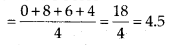
MP Board Class 7th Maths Solutions Chapter 3 Data Handling Ex 3.1 7
(iii) Mean of B’s Score
MP Board Class 7th Maths Solutions Chapter 3 Data Handling Ex 3.1 8
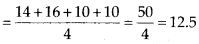
(iv) The best performer will have the greatest average among all. Now we can observe that the average of A is 12.5 which is more than that of B and C. Therefore, A is the best performer.

MP Board Class 7th Maths Solutions Chapter 3 Data Handling Ex 3.1

Question 6.
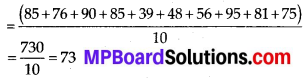
The marks (out of 100) obtained by a group of students in a Science test are 85, 76, 90, 85, 39, 48, 56, 95, 81 and 75. Find the:
(i) Highest and the lowest marks obtained by the students.
(ii) Range of the marks obtained.
(iii) Mean marks obtained by the group.
Solution:
The marks obtained by the group of students in a Science test can be arranged in ascending order as follows.
39, 48, 56, 75, 76, 81, 85, 85, 90, 95
(i) Highest marks = 95 Lowest marks = 39
(ii) Range = 95 – 39 = 56
(iii) Mean marks
MP Board Class 7th Maths Solutions Chapter 3 Data Handling Ex 3.1 9

Question 7.
The enrolment in a school during six consecutive years was as follows:
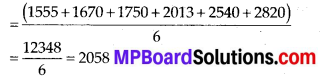
1555, 1670, 1750, 2013, 2540, 2820
Find the mean enrolment of the school for this period.
Solution:
Mean enrolment
MP Board Class 7th Maths Solutions Chapter 3 Data Handling Ex 3.1 10

MP Board Class 7th Maths Solutions Chapter 3 Data Handling Ex 3.1

Question 8.
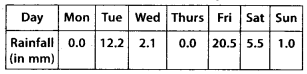
The rainfall (in mm) in a city on 7 days of a certain week was recorded as follows:
MP Board Class 7th Maths Solutions Chapter 3 Data Handling Ex 3.1 11
(i) Find the range of the rainfall in the above data.
(ii) Find the mean rainfall for the week.
(iii) On how many days was the rainfall less than the mean rainfall?
Solution:
(i) Range = (20.5 – 0.0) mm = 20.5 mm
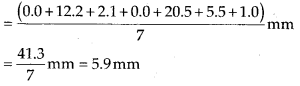
(ii) Mean rainfall
MP Board Class 7th Maths Solutions Chapter 3 Data Handling Ex 3.1 12
(iii) For 5 days (i.e., Monday, Wednesday, Thursday, Saturday, Sunday), the rainfall was less than the mean rainfall.

Question 9.
The heights of 10 girls were measured in cm and the results are as follows:
135, 150, 139, 128, 151, 132, 146, 149, 143, 141.
(i) What is the height of the tallest girl?
(ii) What is the height of the shortest girl?
(iii) What is the range of the data?
(iv) What is the mean height of the girls?
(v) How many girls have heights more than the mean height?
Solution:
Arranging the heights of 10 girls in an ascending order;
128, 132, 135, 139, 141, 143, 146, 149, 150, 151
(i) Height of the tallest girl = 151 cm
(ii) Height of the shortest girl = 128 cm
(iii) Range = (151 – 128) cm = 23 cm
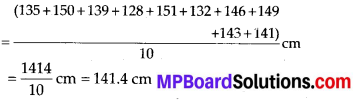
(iv) Mean height
MP Board Class 7th Maths Solutions Chapter 3 Data Handling Ex 3.1 13
(v) The heights of 5 girls are greater than the mean height (i.e., 141.4 cm) and these heights are 143 cm, 146 cm, 149 cm, 150 cm and 151 cm.

MP Board Class 7th Maths Solutions Chapter 3 Data Handling Ex 3.1

MP Board Class 7th Maths Solutions