MP Board Class 6th Maths Solutions Chapter 1 Knowing Our Numbers Ex 1.3

MP Board Class 6th Maths Solutions Chapter 1 Knowing Our Numbers Ex 1.3

Question 1.
Estimate each of the following using general rule:
(a) 730 + 998
(b) 796 – 314
(c) 12,904 + 2,888
(d) 28,292 – 21,496
Make ten more such examples of addition, subtraction and estimation of their outcome.
Solution:
(a) 730 rounds off to 700
998 rounds off to 1,000
∴ Estimated sum = 700 + 1,000 = 1,700

(b) 796 rounds off to 800 314 rounds off to 300
∴ Estimated difference = 800 – 300 = 500

(c) 12,904 rounds off to 13,000 2,888 rounds off to 3,000
∴ Estimated sum = 13,000 + 3,000 = 16,000

(d) 28,292 rounds off to 28,000
21,496 rounds off to 21,000
∴ Estimated difference = 28,000 – 21,000 = 7,000

Ten more examples:

(i) 540 + 868
540 rounds off to 500
868 rounds off to 900
∴ Estimated sum = 500 + 900 = 1,400

(ii) 1,369 + 215
1, 369 rounds off to 1,000
215 rounds off to 200
∴ Estimated sum = 1,000 + 200 = 1,200

(iii) 46,352 – 11,867
46,352 rounds off to 46,000
11, 867 rounds off to 12,000
∴ Estimated difference = 46,000 – 12,000
= 34,000

(iv) 14,902 + 6,565
14,902 rounds off to 15,000
6,565 rounds off to 7,000
∴ Estimated sum = 15,000 + 7,000 = 22,000

(v) 514 – 386
514 rounds off to 500
386 rounds off to 400
∴ Estimated difference = 500 – 400 = 100

(vi) 27,904 + 69,592
27,904 rounds off to 28,000
69,592 rounds off to 70,000
∴ Estimated sum = 28,000 + 70,000 = 98,000

(vii) 530 – 98
530 rounds off to 500
98 rounds off to 100
∴ Estimated difference = 500 – 100 = 400

(viii) 18,230 – 3,666
18,230 rounds off to 18,000
3,666 rounds off to 4,000
∴ Estimated difference = 18,000 – 4,000 = 14,000

(ix) 56,306 + 17,693
56,306 rounds off to 56,000
17,693 rounds off to 18,000 Estimated sum = 56,000 + 18,000 = 74,000

(x) 4,275 – 125
4,275 rounds off to 4,000
125 rounds off to 100
∴ Estimated difference = 4,000 – 100 = 3,900

MP Board Class 6th Maths Solutions Chapter 1 Knowing Our Numbers Ex 1.3

Question 2.
Give a rough estimate (by rounding off to nearest hundreds) and also a closer estimate (by rounding off to nearest tens):
(a) 439 + 334 + 4,317
(b) 1,08,734 – 47,599
(c) 8,325 – 491
(d) 4,89,348 – 48,365
Make four more such examples.
Solution:
(a) By rounding off to nearest hundreds, we get
439 rounds off to 400
334 rounds off to 300
4,317 rounds off to 4,300
∴ Estimated sum = 400 + 300 + 4,300 = 5,000
By rounding off to nearest tens, we get
439 rounds off to 440
334 rounds off to 330
4,317 rounds off to 4,320
∴ Estimated sum = 440 + 330 + 4,320 = 5,090

(b) By rounding off to nearest hundreds, we get
1,08,734 rounds off to 1,08,700
47,599 rounds off to 47,600
∴ Estimated difference = 1,08,700 – 47,600 = 61,100
By rounding off to nearest tens, we get 1,08,734 rounds off to 1,08,730
47,599 rounds off to 47,600
∴ Estimated difference = 1,08,730 – 47,600 = 61,130

(c) By rounding off to nearest hundreds, we get
8,325 rounds off to 8,300
491 rounds off to 500
∴ Estimated difference = 8,300 – 500 = 7,800
By rounding off to nearest tens, we get 8,325 rounds off to 8,330
491 rounds off to 490
∴ Estimated difference = 8,330 – 490 = 7,840

(d) By rounding off to nearest hundreds, we get
4,89,348 rounds off to 4,89,300
48,365 rounds off to 48,400
∴ Estimated difference = 4,89,300 – 48,400 = 4,40,900
By rounding off to nearest tens, we get 4,89,348 rounds off to 4,89,350
48,365 rounds off to 48,370
∴ Estimated difference = 4,89,350 – 48,370 = 4,40,980

Four more examples:

(i) 5,235 – 382
By rounding off to nearest hundreds, we get
5,235 rounds off to 5,200
382 rounds off to 400
∴ Estimated difference = 5,200 – 400 = 4,800
Now, by rounding off to nearest tens, we get
5,235 rounds off to 5,240
382 rounds off to 380
∴ Estimated difference = 5,240 – 380 = 4,860

(ii) 7,673+ 436+ 169
By rounding off to nearest hundreds, we get
7,673 rounds off to 7,700
436 rounds off to 400
169 rounds off to 200
∴ Estimated sum = 7,700 + 400 + 200 = 8,300
Now, by rounding off to nearest tens, we get
7,673 rounds off to 7,670
436 rounds off to 440
169 rounds off to 170
∴ Estimated sum = 7,670 + 440 + 170 = 8,280

(iii) 2,05,290 – 17,986
By rounding off to nearest hundreds, we get
2,05,290 rounds off to 2,05,300
17,986 rounds off to 18,000
∴ Estimated difference = 2,05,300 – 18,000 = 1,87,300
By rounding off to nearest tens, we get
2,05,290 rounds off to 2,05,290
17,986 rounds off to 17,990
∴ Estimated difference = 2,05,290 – 17,990 = 1,87,300

(iv) 6,830 + 35,764
By rounding off to nearest hundreds, we get
6,830 rounds off to 6,800
35,764 rounds off to 35,800
∴ Estimated sum = 6,800 + 35,800 = 42,600
Now, by rounding off to nearest tens, we get
6,830 rounds off to 6,830
35,764 rounds off to 35,760
∴ Estimated sum = 6,830 + 35,760 = 42,590

MP Board Class 6th Maths Solutions Chapter 1 Knowing Our Numbers Ex 1.3

Question 3.
Estimate the following products using general rule:
(a) 578 × 161
(b) 5281 × 3491
(c) 1291 × 592
(d) 9250 × 29
Make four more such examples.
Solution:
(a) 578 × 161
578 rounds off to 600
161 rounds off to 200
∴ The estimated product
= 600 × 200 = 1,20,000

(b) 5281 × 3491
5281 rounds off to 5,000
3491 rounds off to 3,000
∴ The estimated product = 5,000 × 3,000 = 1,50,00,000

(c) 1291 × 592
1291 rounds-off to 1,000 592 rounds off to 600 The estimated product = 1,000 × 600 = 6,00,000

(d) 9250 × 29
9250 rounds off to 9,000 29 rounds off to 30 The estimated product = 9,000 × 30 = 2,70,000

MP Board Class 6th Maths Solutions Chapter 1 Knowing Our Numbers Ex 1.3

Four more examples:

(i) 3260 × 86
3260 rounds off to 3,000 86 rounds off to 90
∴ Estimated product = 3,000 × 90 = 2,70,000

(ii) 7451 × 4,632
7451 rounds off to 7,000
4632 rounds off to 5,000
∴ Estimated product = 7,000 × 5,000 = 3,50,00,000

(iii) 356 × 204
356 rounds off to 400
204 rounds off to 200
∴ Estimated product = 400 × 200 = 80,000

(iv) 9860 × 692
9860 rounds off to 10,000
692 rounds off to 700
Estimated product = 10,000 × 700 = 70,00,000
MP Board Class 6th Maths Solutions

MP Board Class 7th Social Science Solutions Chapter 28 Asia: Physical Features

MP Board Class 7th Social Science Solutions Chapter 28 Asia: Physical Features

MP Board Class 7th Social Science Chapter 28 Text Book Questions

Fill in the blanks:

  1. The largest continent in the world is …………….
  2. ……………… is the highest mountain peak of the world.
  3. The plains of Northern part of Asia is known as ……………….
  4. The plateau which lies in the ……………… central part of Asia is known as the roof of the world.
  5. High pressure area is formed in …………… the part of Asia during winters.
  6. …………… receives the highest rainfall in the world.

Answer:

  1. Asia
  2. Mount Everest
  3. Siberian Plain
  4. Pamir
  5. Central
  6. Mansynram.

MP Board Solutions

MP Board Class 7th Social Science Chapter 28 Short Answer Type Questions

Question 1.
Which oceans surround the continent of Asia?
Answer:
The continent of Asia is surrounded by oceans on three sides. The Arctic Ocean in the north, the Pacific Ocean in the east and the Indian Ocean lies to the south of the continent.

Question 2.
Write the names of any two mountains and any two plateaus of Asia.
Answer:
Name of two mountains:

  1. Ural Mountains
  2. The Central Mountains Name of two plateaus
  3. The Pamir plateau
  4. The Tibetan Plateau.

Question 3.
Into how many physical features do we divide the continent of Asia? Write their names.
Answer:
The continent of Asia can be divided into five physical features. Their names are:

  1. The northern lowlands
  2. The central mountains
  3. The southern plateaus
  4. The great river valleys
  5. The island groups.

MP Board Solutions

Question 4.
Write any two factors which influence the climate of Asia.
Answer:
The two factors which influence the climate of Asia:

  • Its vast size.
  • Great latitudinal extent in the central mountains and plateaus.

Question 5.
Write any two differences between the vegetation found in the Northern and Southern part of Asia.
Answer:
Two differences between the vegetation found in the Northern and Southern part of Asia is:
1. The Northern part of Asia experiences extreme cold. But its Southern part has evergreen climate.

2. The vegetation found in the North empart are lichens, jherberi, mosses etc. which can withstand the extreme cold. The vegetation found in die Southern part are evergreen trees like spruce, fir and pine.

MP Board Class 7th Social Science Chapter 28 Long Answer Type Questions

Question 1.
Describe in detail the relief of the continent of Asia.
Answer:
The continent of Asia consists of the highest mountain ranges, lowlands and plains. It maybe divided into five major.

physical divisions:
1. The North Lowlands:
It is a vast plain which extends between the Ural Mountains in die west, Lena river in the east and the Central Mountains in the south, known as the ‘Siberian Plain’, it is drained by rivers like Ob, Yenisei and Lena Lake Baikal, die deepest lake of die world is located in Siberia.

2. The Central Mountains:
The folded mountains and plateaus lie in the south of the northern lowlands. The Pamir plateau is a meeting place of several ranges, which form the Pamir knot This plateau is known as die ‘Roof of the World’, because it is the highest plateau in the world. The Tibetan plateau lies to the east of the Pamir plateau. Himalayas are the highest mountain ranges of the world. Mount Everest is situated in the Himalayas.

3. The Southern Plateaus:
To the south of the central mountain belt, there’ are some plateau which form the major part of the peninsula projecting southwards from the mainland of Asia. These plateaus are the plateau of Arabia, the Deccan plateau and the plateau of Yunnan.

4. The Great River Valleys:
To the east and south of Asia are found riverineplains. In the south are the Sindhu, Ganga, Brahmaputra plains, in the southeast are the plains formed by rivers Irrawady, Salvin, Yang-Tse-Kiang, Sikiang, Minang- Mekong and Amursar.

5. The Island Groups:
Some groups of islands are situated to the south-east and east of the continent of Asia. There are three major island groups-Indonesia, Philippines and Japan.

MP Board Solutions

Question 2.
Describe the climate and wild life of the continent of Asia.
Answer:
Climate:
The southern part of the continent is situated near the equator and hence, remains hot and humid throughout the year. The northern part remains covered with snow as it is situated away from the equator.

During the summer season die rays of the sun falls vertically on the Northern Hemisphere. The temperature rises and a low – pressure area is developed over Central Asia. The moisture laden winds start blowing from the seas to the low pressure. These winds are known as southwestern monsoon winds.

Asia experiences the cold weather season during Oct-Dec. in the North  part of the Central mountains. High pressure builds over Central Asia The wind starts blowing from High pressure (Central Asia) to low pressure area (Southern Asia). Wild Life of Asia-In the northern part of Asia where die area is covered with snow throughout die year reindeer, polar bear, seal and whales are found.

In the south where die climate is hot and humid and deciduous forests are spread, lion, tiger, deer, elephants, wild buffaloes and rich rocuous etc. are die main wild life found. In die western dry and desert area sheep, goats, camel, ass and gazelle are found.

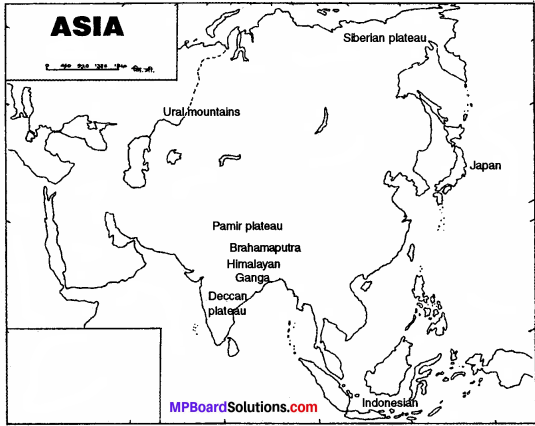
Map Work:

  1. The Pamir plateau
  2. The Deccan plateau
  3. The Himalayan mountains
  4. The Ural mountains
  5. The Ganga river
  6. Yang-Tie-kiang river
  7. The Siberian plateau
  8. The Ganga-Brahamaputra river
  9. The Indonesian group of islands
  10. Japan is group of islands.

Answer:

MP Board Class 7th Social Science Solutions Chapter 28 Asia Physical Features

MP Board Class 7th Social Science Solutions

MP Board Class 7th Maths Solutions Chapter 9 Rational Numbers Ex 9.1

MP Board Class 7th Maths Solutions Chapter 9 Rational Numbers Ex 9.1

Question 1.
List five rational numbers between:
(i) -1 and 0
(ii) -2 and -1
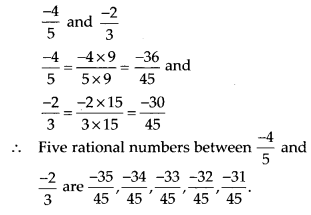
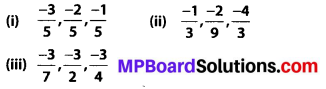
(iii) \(\frac{-4}{5}\) and \(\frac{-2}{3}\)
(iv) \(\frac{1}{2}\) and \(\frac{2}{3}\)
Solution:
(i) Five rational numbers between -1 and 0 are \(\frac{-1}{10}, \frac{-1}{20}, \frac{-1}{30}, \frac{-1}{40}, \frac{-1}{50}\)

(ii) -2 and -1
\(-2=\frac{-12}{6}\) and \(-1=\frac{-6}{6}\)
∴ Five rational numbers between -2 and -1 are \(\frac{-11}{6}, \frac{-10}{6}, \frac{-9}{6}, \frac{-8}{6}, \frac{-7}{6}\).

(iii)
MP Board Class 7th Maths Solutions Chapter 9 Rational Numbers Ex 9.1 36

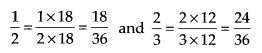
(iv) \(\frac{1}{2}\) and \(\frac{2}{3}\)
MP Board Class 7th Maths Solutions Chapter 9 Rational Numbers Ex 9.1 1
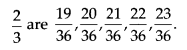
∴ Five rational numbers between \(\frac{1}{2}\) and \(\frac{2}{3}\)
MP Board Class 7th Maths Solutions Chapter 9 Rational Numbers Ex 9.1 2

Question 2.
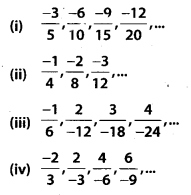
Write four more rational numbers in each of the following patterns:
MP Board Class 7th Maths Solutions Chapter 9 Rational Numbers Ex 9.1 3
Solution:
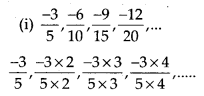
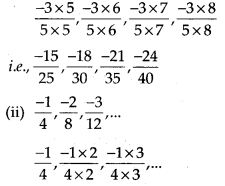
MP Board Class 7th Maths Solutions Chapter 9 Rational Numbers Ex 9.1 4
Therefore, next four rational numbers in this pattern are
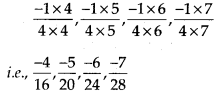
MP Board Class 7th Maths Solutions Chapter 9 Rational Numbers Ex 9.1 5
Therefore, next four rational numbers in this pattern are
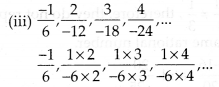
MP Board Class 7th Maths Solutions Chapter 9 Rational Numbers Ex 9.1 6
MP Board Class 7th Maths Solutions Chapter 9 Rational Numbers Ex 9.1 7
Therefore, next four rational numbers in this pattern are
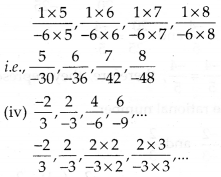
MP Board Class 7th Maths Solutions Chapter 9 Rational Numbers Ex 9.1 8
Therefore, next four rational numbers in this pattern are
MP Board Class 7th Maths Solutions Chapter 9 Rational Numbers Ex 9.1 9

MP Board Class 7th Maths Solutions Chapter 9 Rational Numbers Ex 9.1

Question 3.
Give four rational numbers equivalent to:
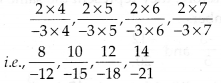
(i) \(\frac{-2}{7}\)
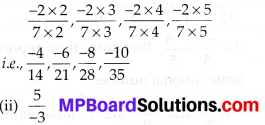
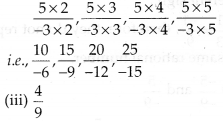
(ii) \(\frac{5}{-3}\)
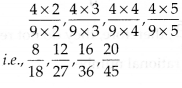
(iii) \(\frac{4}{9}\)
Solution:
Four rational numbers are
MP Board Class 7th Maths Solutions Chapter 9 Rational Numbers Ex 9.1 10
Four rational numbers are
MP Board Class 7th Maths Solutions Chapter 9 Rational Numbers Ex 9.1 11
Four rational numbers are
MP Board Class 7th Maths Solutions Chapter 9 Rational Numbers Ex 9.1 12

Question 4.
Draw the number line and represent the following rational numbers on it:
(i) \(\frac{3}{4}\)
(ii) \(\frac{-5}{8}\)
(iii) \(\frac{-7}{4}\)
(iv) \(\frac{7}{8}\)
Solution:
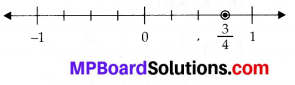
(i) \(\frac{3}{4}\)
The fraction represents 3 parts out of 4 equal parts. Therefore, each space between two integers on the number line must be divided into 4 equal parts.
∴ \(\frac{3}{4}\) can be represented as
MP Board Class 7th Maths Solutions Chapter 9 Rational Numbers Ex 9.1 13

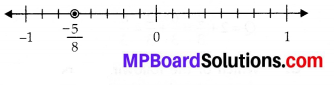
(ii) \(\frac{-5}{8}\)
The fraction represents 5 parts out of 8 equal parts and negative sign represents that it is on the left side of the number line. Therefore, each space between two integers on the number line must be divided into 8 equal parts.
∴ \(\frac{5}{8}\) can be represented as
MP Board Class 7th Maths Solutions Chapter 9 Rational Numbers Ex 9.1 14

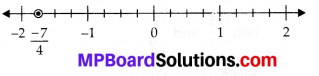
(iii) \(\frac{-7}{4}\) = \(-1 \frac{3}{4}\)
The fraction represents 1 full part and 3 parts out of 4 equal parts and negative sign represents that it is on the left side of the number line. Therefore, each space between two integers on the number line must be divided into 4 equal parts.
∴ \(\frac{-7}{4}\) can be represented as
MP Board Class 7th Maths Solutions Chapter 9 Rational Numbers Ex 9.1 15

(iv) \(\frac{7}{8}\)
The fraction represents 7 parts out of 8 equal parts. Therefore, each space between two integers on the number line must be divided into 8 equal parts.
MP Board Class 7th Maths Solutions Chapter 9 Rational Numbers Ex 9.1 16

MP Board Class 7th Maths Solutions Chapter 9 Rational Numbers Ex 9.1

Question 5.
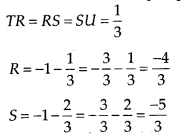
The points P, Q, R, S, T, U, A and B on the number line are such that, TR = RS = SU and AP = PQ = QB. Name the rational numbers represented by P, Q, R and S.
MP Board Class 7th Maths Solutions Chapter 9 Rational Numbers Ex 9.1 17
Solution:
Distance between U and T = 1 unit
It is divided into 3 equal parts.
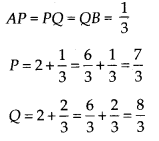
MP Board Class 7th Maths Solutions Chapter 9 Rational Numbers Ex 9.1 18
Similarly, AB = 1 unit
It is divided into 3 equal parts.
MP Board Class 7th Maths Solutions Chapter 9 Rational Numbers Ex 9.1 19

Question 6.
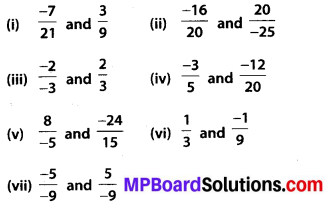
Which of the following pairs represent the same rational number?
MP Board Class 7th Maths Solutions Chapter 9 Rational Numbers Ex 9.1 20
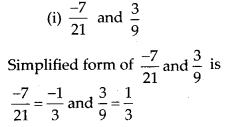
Solution:
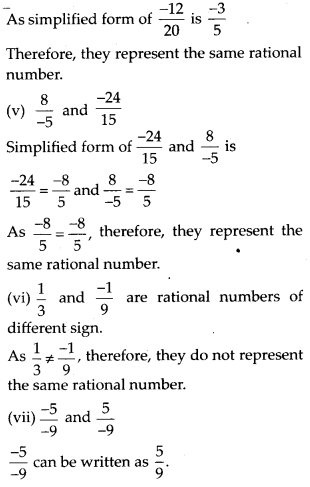
MP Board Class 7th Maths Solutions Chapter 9 Rational Numbers Ex 9.1 21
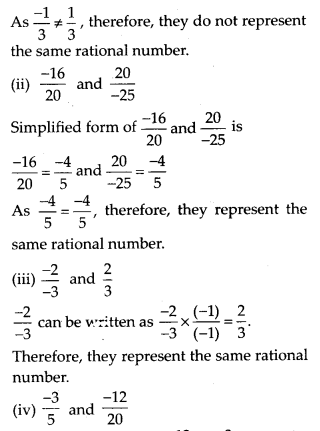
MP Board Class 7th Maths Solutions Chapter 9 Rational Numbers Ex 9.1 22
MP Board Class 7th Maths Solutions Chapter 9 Rational Numbers Ex 9.1 23
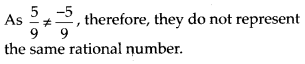
MP Board Class 7th Maths Solutions Chapter 9 Rational Numbers Ex 9.1 24

MP Board Class 7th Maths Solutions Chapter 9 Rational Numbers Ex 9.1

Question 7.
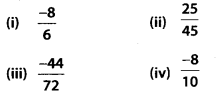
Rewrite the following rational numbers in the simplest form:
MP Board Class 7th Maths Solutions Chapter 9 Rational Numbers Ex 9.1 25
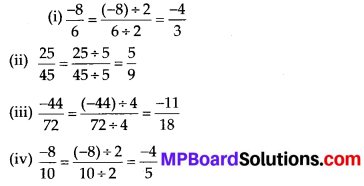
Solution:
MP Board Class 7th Maths Solutions Chapter 9 Rational Numbers Ex 9.1 26

Question 8.
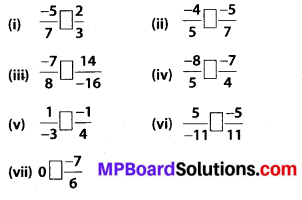
Fill in the boxes with the correct symbol out of >, < and =.
MP Board Class 7th Maths Solutions Chapter 9 Rational Numbers Ex 9.1 27
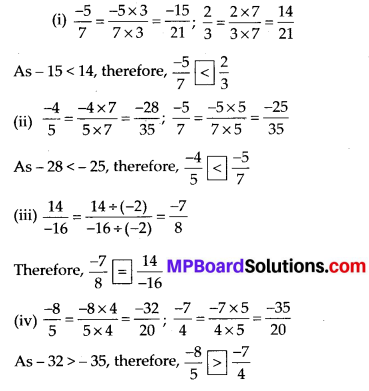
Solution:
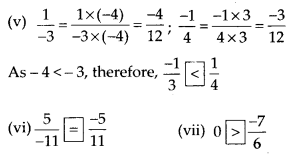
MP Board Class 7th Maths Solutions Chapter 9 Rational Numbers Ex 9.1 28
MP Board Class 7th Maths Solutions Chapter 9 Rational Numbers Ex 9.1 29

MP Board Class 7th Maths Solutions Chapter 9 Rational Numbers Ex 9.1

Question 9.
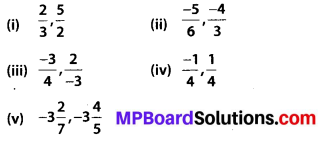
Which is greater in each of the following:
MP Board Class 7th Maths Solutions Chapter 9 Rational Numbers Ex 9.1 30
Solution:
MP Board Class 7th Maths Solutions Chapter 9 Rational Numbers Ex 9.1 31
MP Board Class 7th Maths Solutions Chapter 9 Rational Numbers Ex 9.1 32

Question 10.
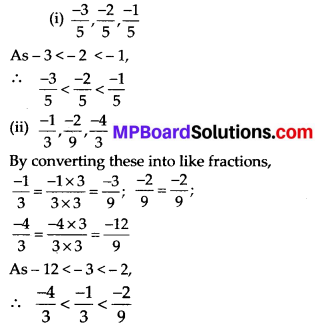
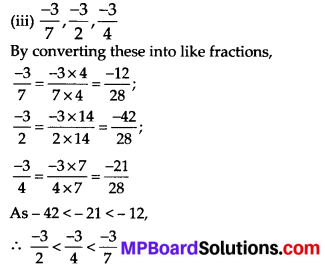
Write the following rational numbers in ascending order:
MP Board Class 7th Maths Solutions Chapter 9 Rational Numbers Ex 9.1 33
Solution:
MP Board Class 7th Maths Solutions Chapter 9 Rational Numbers Ex 9.1 34
MP Board Class 7th Maths Solutions Chapter 9 Rational Numbers Ex 9.1 35

MP Board Class 7th Maths Solutions

MP Board Class 7th Maths Solutions Chapter 11 Perimeter and Area Ex 11.4

MP Board Class 7th Maths Solutions Chapter 11 Perimeter and Area Ex 11.4

Question 1.
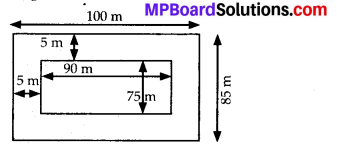
A garden is 90 m long and 75 m broad. A path 5 m wide is to be built outside and around it. Find the area of the path. Also find the area of the garden in hectare.
Solution:
Length of garden (l) = 90 m
Breadth of garden (b) = 75 m
Area of garden = l × b = 90 × 75 = 6750 m2
MP Board Class 7th Maths Solutions Chapter 11 Perimeter and Area Ex 11.4 1
From the figure, it can be observed that the new length and breadth of the garden, when path is also included, are (90 + 5 + 5) m i.e., 100 m and (75 + 5 + 5) m i.e., 85 m respectively.
Area of the garden including the path = 100 × 85 = 8500 m2
Area of path = Area of the garden including the path – Area of garden
= 8500 – 6750 = 1750 m2
1 hectare = 10000 m2
Therefore, area of garden in hectare = \(\frac{6750}{10000}\)
= 0.675 hectare

Question 2.
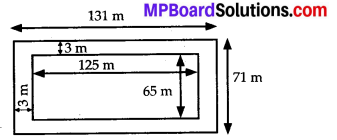
A 3 m wide path runs outside and around a rectangular park of length 125 m and breadth 65 m. Find the area of the path.
Solution:
Length of park (I) = 125 m
Breadth of park (b) = 65 m
Area of park = l × b = 125 × 65 = 8125 m2
MP Board Class 7th Maths Solutions Chapter 11 Perimeter and Area Ex 11.4 2
From the figure, it can be observed that the new length and breadth of the park, when path is also included, are (125 + 3 + 3) m i.e., 131 m and (65 + 3 + 3) m i.e., 71 m respectively.
Area of the park including the path = 131 × 71 = 9301 m2
Area of path = Area of the park including the path – Area of park
= 9301 – 8125 = 1176 m2

Question 3.
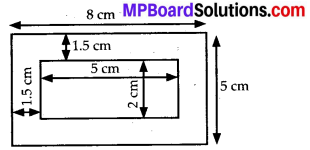
A picture is painted on a cardboard 8 cm long and 5 cm wide such that there is a margin of 1.5 cm along each of its sides. Find the total area of the margin.
Solution:
Length of cardboard (l) = 8 cm
Breadth of cardboard (b) = 5 cm
Area of cardboard = l × b = 8 × 5 = 40 cm2
MP Board Class 7th Maths Solutions Chapter 11 Perimeter and Area Ex 11.4 3
From the figure, it can be observed that the new length and breadth of the cardboard, when margin is not included, are (8 – 1.5 – 1.5) cm i.e., 5 cm and (5 – 1.5 – 1.5) cm i.e., 2 cm respectively.
Area of the cardboard not including the margin = 5 × 2 = 10 cm2
Area of the margin = Area of cardboard – area of cardboard not including the margin
= 40 – 10 = 30 cm2

MP Board Class 7th Maths Solutions Chapter 11 Perimeter and Area Ex 11.4

Question 4.
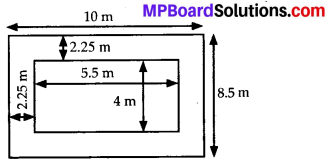
A verandah of width 2.25 m is constructed all along outside a room which is 5.5 m long and 4 m wide. Find:
(i) the area of the verandah.
(ii) the cost of cementing the floor of the verandah at the rate of ₹ 200 per m2.
Solution:
(i) Length of room (l) = 5.5 m
Breadth of room (b) = 4 m
Area of room = l × b = 5.5 × 4 = 22 m2
MP Board Class 7th Maths Solutions Chapter 11 Perimeter and Area Ex 11.4 4
From the figure, it can be observed that the new length and breadth of the room, when verandah is also included, are (5.5 + 2.25 + 2.25) m i.e., 10 m and (4 + 2.25 + 2.25) m i.e., 8.5 m respectively.
Area of the room including the verandah = 8.5 × 10 = 85 m2
Area of verandah = Area of the room including the verandah – Area of room = 85 – 22 = 63 m2

(ii) Cost of cementing 1 m2 area of the floor of the verandah = ₹ 200
Cost of cementing 63 m2 area of the floor of the verandah = 200 × 63 = ₹ 12600

Question 5.
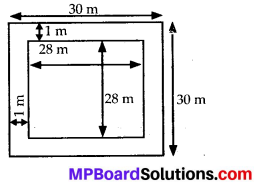
A path 1 m wide is built along the border and inside a square garden of side 30 m. Find:
(i) the area of the path
(ii) the cost of planting grass in the remaining portion of the garden at the rate of ₹ 40 per m2.
Solution:
(i) Side of square garden (a) = 30 m
Area of square garden = a2 = (30)2 = 900 m2
MP Board Class 7th Maths Solutions Chapter 11 Perimeter and Area Ex 11.4 5
From the figure, it can be observed that the side of the square garden, when path is not included, is (30 – 1 – 1) m i.e., 28 m.
Area of the square garden not including the path = (28)2 = 784 m2
Area of path = Area of the square garden – Area of square garden not including the path = 900 – 784 = 116 m2

(ii) Cost of planting grass in 1 m2 area of the garden = ₹ 40
Cost of planting grass in 784 m2 area of the garden = 784 × 40 = ₹ 31360

Question 6.
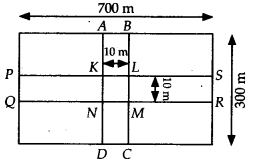
Two cross roads, each of width 10 m, cut at right angles through the centre of a rectangular park of length 700 m and breadth 300 m and parallel to its sides. Find the area of the roads. Also find the area of the park excluding cross roads. Give the answer in hectares.
Solution:
MP Board Class 7th Maths Solutions Chapter 11 Perimeter and Area Ex 11.4 6
Length of park (l) = 700 m
Breadth of park (b) = 300 m
Area of park = 700 × 300 = 210000 m2
Length of road PQRS = 700 m
Length of road ABCD = 300 m
Width of each road = 10 m.
KLMN is a square of side 10 m.
Area of two roads = area (PQRS) + area (ABCD) – area (KLMN)
= (700 × 10) + (300 × 10) – (10 × 10)
= 7000 + 3000 – 100 = 10000 – 100 = 9900 m2
= \(\frac{9900}{10000}\) hectare = 0.99 hectare (∵ 1 hectare = 10000 m2)
Area of park excluding roads = 210000 – 9900
= 200100 m2 = \(\frac{200100}{10000}\) hectare = 20.01 hectare

MP Board Class 7th Maths Solutions Chapter 11 Perimeter and Area Ex 11.4

Question 7.
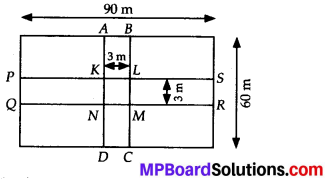
Through a rectangular field of length 90 m and breadth 60 m, two roads are constructed which are parallel to the sides and cut each other at right angles through the centre of the fields. If the width of each road is 3 m, find
(i) the area covered by the roads.
(ii) the cost of constructing the roads at the rate of ₹ 110 per m2.
Solution:
MP Board Class 7th Maths Solutions Chapter 11 Perimeter and Area Ex 11.4 7
Length of field (l) = 90 m
Breadth of field (b) = 60 m
Area of field = 90 × 60 = 5400 m2
Length of road PQRS = 90 m
Length of road ABCD = 60 m
Width of each road = 3 m
KLMN is a square of side 3 m.
(i) Area of the roads = area (PQRS) + area (ABCD) – area (KLMN)
= (90 × 3) + (60 × 3) – (3 × 3)
= 270 + 180 – 9 = 441 m2
(ii) Cost for constructing 1 m2 road = ₹ 110
Cost for constructing 441 m2 road
= 110 × 441 = ₹ 48510

Question 8.
Pragya wrapped a cord around a circular pipe of radius 4 cm (adjoining figure) and cut off the length required of the cord. Then she wrapped it around a square box of side 4 cm (also shown). Did she have any cord left? (π = 3.14)
MP Board Class 7th Maths Solutions Chapter 11 Perimeter and Area Ex 11.4 8
Solution:
Perimeter of circular pipe = 2πr
= 2 × 3.14 × 4 = 25.12 cm
Perimeter of the square = 4 × Side of the square = 4 × 4 = 16 cm
Length of cord left withPfagya = 25.12 – 16 = 9.12 cm

Question 9.
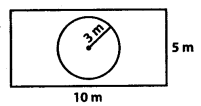
The adjoining figure represents a rectangular lawn with a circular flower bed in the middle. Find:
MP Board Class 7th Maths Solutions Chapter 11 Perimeter and Area Ex 11.4 9
(i) the area of the whole land
(ii) the area of the flower bed
(iii) the area of the lawn excluding the area of the flower bed
(iv) the circumference of the flower bed.
Solution:
(i) Area of whole land = Length × Breadth
= 10 × 5 = 50 m2
(ii) Area of flower bed = πr2 = 3.14 × 2 × 2
= 12.56 m2
(iii) Area of lawn excluding the flower bed = Area of whole land – Area of flower bed
= 50 – 12.56 = 37.44 m2
(iv) Circumference of the flower bed = 2πr
= 2 × 3.14 × 2 = 12.56 m

MP Board Class 7th Maths Solutions Chapter 11 Perimeter and Area Ex 11.4

Question 10.
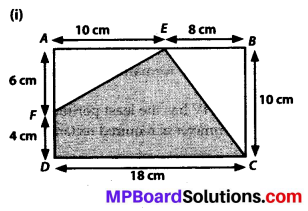
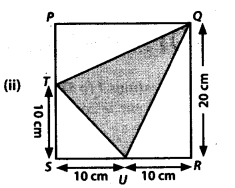
In the following figures( find the area of the shaded portions:
MP Board Class 7th Maths Solutions Chapter 11 Perimeter and Area Ex 11.4 10
MP Board Class 7th Maths Solutions Chapter 11 Perimeter and Area Ex 11.4 11
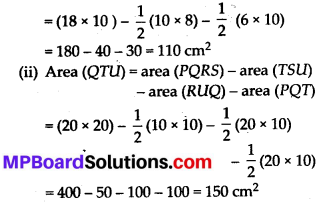
Solution:
(i) Area of EFDC
= area(ABCD) – area (BCE) – area (AFE)
MP Board Class 7th Maths Solutions Chapter 11 Perimeter and Area Ex 11.4 12

Question 11.
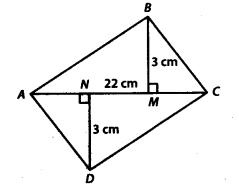
Find the area of the quadrilateral ABCD.
MP Board Class 7th Maths Solutions Chapter 11 Perimeter and Area Ex 11.4 13
Here, AC = 22 cm, BM = 3 cm, DN = 3 cm and BM⊥AC, DN⊥AC
Solution:
Area (ABCD) = area (ABC) + area (ADC)
= \(\frac{1}{2}\) (3 × 22) + \(\frac{1}{2}\) (3 × 22)
= 33 + 33 = 66 cm2

MP Board Class 7th Maths Solutions

MP Board Class 7th Maths Solutions Chapter 11 Perimeter and Area Ex 11.3

MP Board Class 7th Maths Solutions Chapter 11 Perimeter and Area Ex 11.3

Question 1.
Find the circumference of the circles with the following radius: (Take π = \(\frac{22}{7}\))
(a) 14 cm
(b) 28 mm
(c) 21 cm
Solution:
(a) r = 14 cm
∴ Circumference = 2πr = 2 × \(\frac{22}{7}\) × 14 =88 cm
(b) r = 28 mm
∴ Circumference = 2πr = 2 × \(\frac{22}{7}\) × 28 = 176 mm
(c) r = 21 cm
∴ Circumference = 2πr = 2 × \(\frac{22}{7}\) × 21 = 132 cm

Question 2.
Find the area of the following circles, given that: (Take π = \(\frac{22}{7}\))
(a) radius = 14 mm
(b) diameter = 49 m
(c) radius = 5 cm
Solution:
(a) r = 14 mm
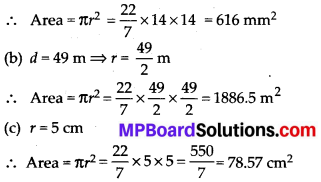
MP Board Class 7th Maths Solutions Chapter 11 Perimeter and Area Ex 11.3 1

Question 3.
If the circumference of a circular sheet is 154 m, find its radius. Also find the area of the sheet. (Take π = \(\frac{22}{7}\))
Solution:
Circumference = 2πr = 154 m
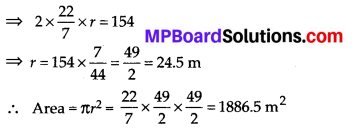
MP Board Class 7th Maths Solutions Chapter 11 Perimeter and Area Ex 11.3 2

Question 4.
A gardener wants to fence a circular garden of diameter 21 m. Find the length of the rope he needs to purchase, if he makes 2 rounds of fence. Also find the cost of the rope, if it costs ₹ 4 per meter. (Take π = \(\frac{22}{7}\))
Solution:
Diameter (d) = 21 m 21
∴ Radius (r) = \(\frac{21}{2}\)m
Circumference = 2πr = 2 × \(\frac{22}{7} \times \frac{21}{2}\) = 66 m
Length of rope required for fencing = 2 × 66 m = 132 m
Cost of 1 m rope = ₹ 4
Cost of 132 m rope = 4 × 132 = ₹ 528

MP Board Class 7th Maths Solutions Chapter 11 Perimeter and Area Ex 11.3

Question 5.
From a circular sheet of radius 4 cm, a circle of radius 3 cm is removed. Find the area of the remaining sheet. (Take π = 3.14)
Solution:
Outer radius of circular sheet (R) = 4 cm
Inner radius of circular sheet (r) = 3 cm
Remaining area = πR2 – πr2
= 3.14 × 4 × 4 – 3.14 × 3 × 3
= 50.24 – 28.26 = 21.98 cm2

Question 6.
Saima wants to put a lace on the edge of a circular table cover of diameter 1.5 m. Find the length of the lace required and also find its cost if one meter of the lace costs ₹ 15. (Take π = 3.14)
Solution:
The length of the lace required = circumference of circular table
Circumference = 2πr = 2 × 3.14 × \(\frac{d}{2}\)
= 2 × 3.14 × \(\frac{1.5}{2}\) = 4.71 m
Cost of 1 m lace = ₹ 15
Cost of 4.71 m lace = 4.71 × 15 = ₹ 70.65

Question 7.
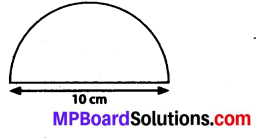
Find the perimeter of the adjoining figure, which is a semicircle including its diameter.
MP Board Class 7th Maths Solutions Chapter 11 Perimeter and Area Ex 11.3 3
Solution:
Diameter = 10 cm
Radius = \(\frac{10}{2}\) = 5 cm
Circumference of semicircle = \(\frac{2 \pi r}{2}\)
= 2 × \(\frac{1}{2} \times \frac{22}{7}\) × 5 = 15.71 cm
Total perimeter = Circumference of semicircle + Length of diameter
= 15.71 + 10 = 25.71 cm

Question 8.
Find the cost of polishing a circular table-top of diameter 1.6 m, if the rate of polishing is ₹ 15/m2. (Take π = 3.14)
Solution:
Diameter = 1.6 m
∴ Radius = \(\frac{1.6}{2}\) = 0.8 m
Area = πr2 = 3.14 × 0.8 × 0.8 = 2.0096 m2
Cost for polishing 1 m2 area = ₹ 15
Cost for polishing 2.0096 m2 area
= 15 × 2.0096 = ₹ 30.14
Therefore, it will cost ₹ 30.14 for polishing circular table.

MP Board Class 7th Maths Solutions Chapter 11 Perimeter and Area Ex 11.3

Question 9.
Shazli took a wire of length 44 cm and bent it into the shape of a circle. Find the radius of that circle. Also find its area. If the same wire is bent into the shape of a square, what will be the length of each of its sides? Which figure encloses more area, the circle or the square? (Take π = \(\frac{22}{7}\))
Solution:
If the wire is bent into a circle, then the length of wire = circumference of the circle
⇒ 2πr = 44 cm
⇒ 2 × \(\frac{22}{7}\) × r = 44
⇒ r = 7 cm
Area = πr2= \(\frac{22}{7}\) × 7 × 7 = 154 cm2
If the wire is bent into a square, then the length of the wire = perimeter of the square
⇒ 4 × side = 44cm ⇒ side = \(\frac{44}{4}\) = 11 cm
Area of square = (11)2 = 121 cm2
As 154 > 121,
Therefore, circle encloses more area.

Question 10.
From a circular card sheet of radius 14 cm, two circles of radius 3.5 cm and a rectangle of length 3 cm and breadth 1 cm are removed (as shown in the following figure). Find the area of the remaining sheet. (Take π = \(\frac{22}{7}\))
MP Board Class 7th Maths Solutions Chapter 11 Perimeter and Area Ex 11.3 4
Solution:
Area of bigger circle = \(\frac{22}{7}\) × 14 × 14 = 616 cm2
Area of 2 small circles = 2 × πr2
= 2 × \(\frac{22}{7}\) × 3.5 × 3.5 = 77 cm2
Area of rectangle = Length × Breadth = 3 × 1
= 3 cm2
Area of remaining sheet = Area of bigger circle – (Area of 2 small circles + Area of rectangle)
= 616 – (77 + 3) = 536 cm2

Question 11.
A circle of radius 2 cm is cut out from a square piece of an aluminium sheet of side 6 cm. What is the area of the left over aluminium sheet? (Take π = 3.14)
Solution:
Area of square-shaped sheet = (Side)2
= (6)2 = 36 cm2
Area of circle = 3.14 × 2 × 2= 12.56 cm2
Area of remaining sheet = Area of square sheet – area of circle
= 36 – 12.56 = 23.44 cm2

Question 12.
The circumference of a circle is 31.4 cm. Find the radius and the area of the circle? (Take π = 3.14)
Solution:
Let r be the radius of circle. Circumference = 2πr = 31.4 cm
⇒ 2 × 3.14 × r = 31.4 cm
⇒ r = 5 cm
Area = 3.14 × 5 × 5 = 78.50 cm2

Question 13.
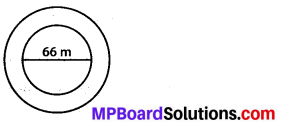
A circular flower bed is surrounded by a path 4 m wide. The diameter of the flower bed is 66 m. What is the area of this path? (π = 3.14)
MP Board Class 7th Maths Solutions Chapter 11 Perimeter and Area Ex 11.3 5
Solution:
Radius of flower bed = \(\frac{66}{2}\) = 33 m
Width of the path = 4 m
Radius of flower bed and path together = 33 + 4 = 37 m
Area of flower bed and path together
= 3.14 × 37 × 37 = 4298.66 m2
Area of flower bed = 3.14 × 33 × 33 = 3419.46 m2
Area of path = Area of flower bed and path together – Area of flower bed
= 4298.66 – 3419.46 = 879.20 m2

Question 14.
A circular flower garden has an area of 314 m2. A sprinkler at the centre of the garden can cover an area that has a radius of 12 m. Will the sprinkler water the entire garden? (Take π = 3.14)
Solution:
Area = πr2 = 314 m2
3.14 × r2 = 314 ⇒ r2 = 100 ⇒ r = 10 m
Yes, the sprinkler will water the whole garden.

MP Board Class 7th Maths Solutions Chapter 11 Perimeter and Area Ex 11.3

Question 15.
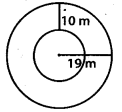
Find the circumference of the inner and the outer circles, shown in the adjoining figure? (Take π = 3.14)
MP Board Class 7th Maths Solutions Chapter 11 Perimeter and Area Ex 11.3 6
Solution:
Radius of outer circle = 19 m
Circumference = 2πr =2 × 3.14 × 19 = 119.32 m
Radius of inner circle = 19 – 10 = 9 m
Circumference = 2πr = 2 × 3.14 × 9 = 56.52 m

Question 16.
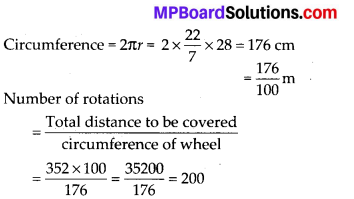
How many times a wheel of radius 28 cm must rotate to go 352 m? (Take π = \(\frac{22}{7}\))
Solution:
r = 78 cm
MP Board Class 7th Maths Solutions Chapter 11 Perimeter and Area Ex 11.3 7
Therefore, it will rotate 200 times.

Question 17.
The minute hand of a circular clock is 15 cm long. How far does the tip of the minute hand move in 1 hour? (Take π = 3.14)
Solution:
Distance travelled by the tip of minute hand = Circumference of the clock
= 2πr = 2 × 3.14 × 15 = 94.2 cm

MP Board Class 7th Maths Solutions

MP Board Class 7th Maths Solutions Chapter 8 Comparing Quantities Ex 8.3

MP Board Class 7th Maths Solutions Chapter 8 Comparing Quantities Ex 8.3

Question 1.
Tell what is the profit or loss in the following transactions. Also find profit percent or loss percent in each case.
(a) Gardening shears bought for ₹ 250 and sold for ₹ 325.
(b) A refrigerator bought for ₹ 12,000 and sold at ₹ 13,500.
(c) A cupboard bought for ₹ 2,500 and sold at ₹ 3,000.
(d) A skirt bought for ₹ 250 and sold at ₹ 150.
Solution:
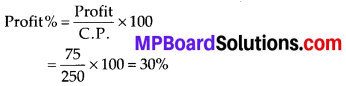
(a) Cost price = ₹ 250,
Selling price = ₹ 325
Profit = 325 – 250 = ₹ 75
MP Board Class 7th Maths Solutions Chapter 8 Comparing Quantities Ex 8.3 1

(b) Cost price = ₹ 12000,
Selling price = ₹ 13500
Profit = 13500 – 12000 = ₹ 1500
Profit % = \(\frac{1500}{12000} \times 100=12.5 \%\)

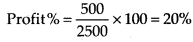
(c) Cost price = ₹ 2500,
Selling price = ₹ 3000
Profit = 3000 – 2500 = ₹ 500
MP Board Class 7th Maths Solutions Chapter 8 Comparing Quantities Ex 8.3 2

(d) Cost price = ₹ 250,
Selling price = ₹ 150
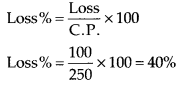
Loss = 250 – 150 = ₹ 100
MP Board Class 7th Maths Solutions Chapter 8 Comparing Quantities Ex 8.3 3

MP Board Class 7th Maths Solutions Chapter 8 Comparing Quantities Ex 8.3

Question 2.
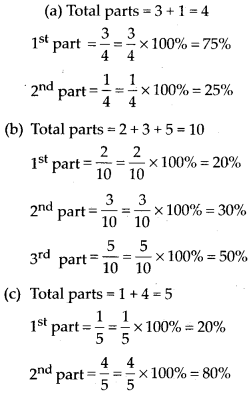
Convert each part of the ratio to percentage:
(a) 3 : 1
(b) 2 : 3 : 5
(c) 1 : 4
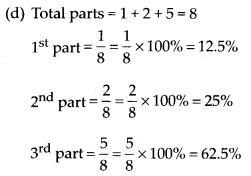
(d) 1 : 2 : 5
Solution:
MP Board Class 7th Maths Solutions Chapter 8 Comparing Quantities Ex 8.3 4
MP Board Class 7th Maths Solutions Chapter 8 Comparing Quantities Ex 8.3 5

Question 3.
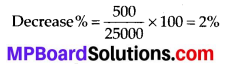
The population of a city decreased from 25,000 to 24,500. Find the percentage decrease.
Solution:
Initial population = 25000 and Final population = 24500
Decrease = 500
MP Board Class 7th Maths Solutions Chapter 8 Comparing Quantities Ex 8.3 6

Question 4.
Arun bought a car for ₹ 3,50,000. The next year, the price went upto ₹ 3,70,000. What was the percentage of price increase?
Solution:
Initial price = ₹ 350000
Final price = ₹ 370000
Increase = ₹ 20000
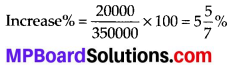
MP Board Class 7th Maths Solutions Chapter 8 Comparing Quantities Ex 8.3 7

MP Board Class 7th Maths Solutions Chapter 8 Comparing Quantities Ex 8.3

Question 5.
I buy a T.V. for ₹ 10,000 and sell it at a profit of 20%. How much money do I get for it?
Solution:
Cost price = ₹ 10,000
Profit % = 20%
∴ Profit = 20% of 10000
Selling price = Profit + Cost price
\(=\frac{20}{100} \times 10000+10000\)
= 2000 + 10000 = ₹ 12,000
Question 6.
Juhi sells a washing machine for ₹ 13,500. She loses 20% in the bargain. What was the price at which she bought it?
Solution:
Selling price = ₹ 13500,
Loss% = 20%
Let the cost price be x.
∴ Loss = 20% of x
Cost price – Loss = Selling price
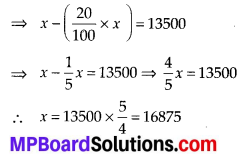
MP Board Class 7th Maths Solutions Chapter 8 Comparing Quantities Ex 8.3 8
Therefore, she bought it for ₹ 16875.

MP Board Class 7th Maths Solutions Chapter 8 Comparing Quantities Ex 8.3

Question 7.
(i) Chalk contains calcium, carbon and oxygen in the ratio 10 : 3 : 12. Find the percentage of carbon in chalk.
(ii) If in a stick of chalk, carbon is 3 g, what is the weight of the chalk stick?
Solution:
(i) Ratio of calcium, carbon and oxygen = 10 : 3 : 12
Therefore, percentage of carbon = \(\frac{3}{25} \times 100 \%\)
= 12%

(ii) Let the weight of the chalk stick be x g.
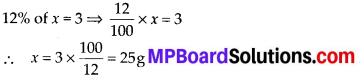
MP Board Class 7th Maths Solutions Chapter 8 Comparing Quantities Ex 8.3 9

Question 8.
Amina buys a book for ₹ 275 and sells it at a loss of 15%. How much does she sell it for?
Solution:
Cost price = ₹ 275
Loss% = 15% or Loss = 15% of 275
Cost price – Loss = Selling price
MP Board Class 7th Maths Solutions Chapter 8 Comparing Quantities Ex 8.3 10
MP Board Class 7th Maths Solutions Chapter 8 Comparing Quantities Ex 8.3 11
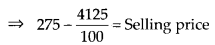
⇒ 275 – 41.25 = Selling price
∴ Selling price = ₹ 233.75

MP Board Class 7th Maths Solutions Chapter 8 Comparing Quantities Ex 8.3

Question 9.
Find the amount to be paid at the end of 3 years in each case:
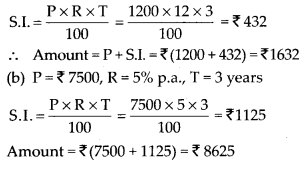
(a) Principal = ₹ 1,200 at 12% p.a.
(b) Principal = ₹ 7,500 at 5% p.a.
Solution:
(a) Principal (P) = ₹ 1200
Rate (R) = 12% p.a.
Time (T) = 3 years
MP Board Class 7th Maths Solutions Chapter 8 Comparing Quantities Ex 8.3 12

Question 10.
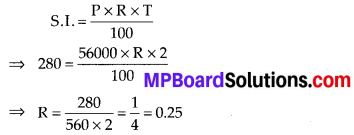
What rate gives ₹ 280 as interest on a sum of ₹ 56,000 in 2 years?
Solution:
MP Board Class 7th Maths Solutions Chapter 8 Comparing Quantities Ex 8.3 13
Therefore, 0.25% gives ₹ 280 as interest on the given sum.

MP Board Class 7th Maths Solutions Chapter 8 Comparing Quantities Ex 8.3

Question 11.
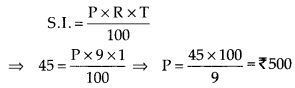
If Meena gives an interest of ₹ 45 for one year at 9% rate p.a„ What is the sum she has borrowed?
Solution:
MP Board Class 7th Maths Solutions Chapter 8 Comparing Quantities Ex 8.3 14
Therefore, Meena has borrowed ₹ 500.

MP Board Class 7th Maths Solutions

MP Board Class 7th Maths Solutions Chapter 11 Perimeter and Area Ex 11.2

MP Board Class 7th Maths Solutions Chapter 11 Perimeter and Area Ex 11.2

Question 1.
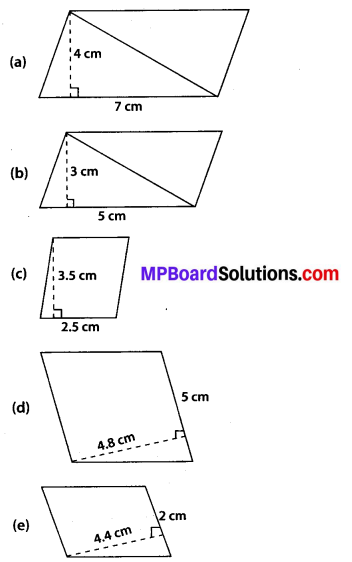
Find the area of each of the following parallelograms:
MP Board Class 7th Maths Solutions Chapter 11 Perimeter and Area Ex 11.2 1
Solution:
Area of parallelogram = Base × Height
(a) Height = 4 cm, Base = 7 cm
Area of parallelogram = 7 × 4 = 28 cm2

(b) Height = 3 cm, Base = 5 cm
Area of parallelogram = 5 × 3 = 15 cm2

(c) Height = 3.5 cm, Base = 2.5 cm
Area of parallelogram = 2.5 × 3.5 = 8.75 cm2

(d) Height = 4.8 cm, Base = 5 cm
Area of parallelogram = 5 × 4.8 = 24 cm2

(e) Height = 4.4 cm, Base = 2 cm
Area of parallelogram = 2 × 4.4 = 8.8 cm2

Question 2.
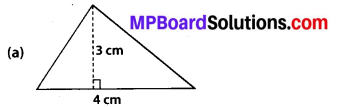
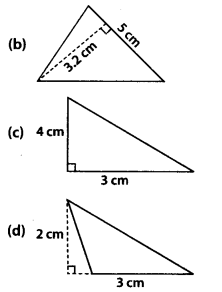
Find the area of each of the following triangles:
MP Board Class 7th Maths Solutions Chapter 11 Perimeter and Area Ex 11.2 2
MP Board Class 7th Maths Solutions Chapter 11 Perimeter and Area Ex 11.2 3
Solution:
Area of triangle = \(\frac{1}{2}\) × Base × Height
(a) Base = 4 cm, height = 3 cm
Area = \(\frac{1}{2}\) × 4 × 3 = 6 cm2

(b) Base = 5 cm, height = 3.2 cm
Area = \(\frac{1}{2}\) × 5 × 3.2 = 8 cm2

(c) Base = 3 cm, height = 4 cm
Area = \(\frac{1}{2}\) × 3 × 4 = 6cm2

(d) Base = 3 cm, height = 2 cm
Area = \(\frac{1}{2}\) × 3 × 2 = 3 cm2

MP Board Class 7th Maths Solutions Chapter 11 Perimeter and Area Ex 11.2

Question 3.
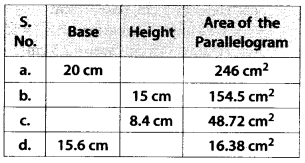
Find the missing values:
MP Board Class 7th Maths Solutions Chapter 11 Perimeter and Area Ex 11.2 4
Solution:
Area of parallelogram = Base × Height
(a) Base = 20 cm
Let height = h
Area of parallelogram = 246 cm2
∴ 20 × h = 246
⇒ h = \(\frac{246}{20}\) = 12.3 cm
Therefore, the height of parallelogram is 12.3 cm.

(b) Let base = b
Height = 15 cm
Area of parallelogram = 154.5 cm2
∴ b × 15 = 154.5
⇒ b = \(\frac{154.5}{15}\) = 10.3 cm
Therefore, the base of parallelogram is 10.3 cm.

(c) Let base = b
Height = 8.4 cm
Area of parallelogram = 48.72 cm2
∴ b × 8.4 = 48.72
⇒ b = \(\frac{48.72}{8.4}\) = 5.8 cm
Therefore, the base of parallelogram is 5.8 cm.

(d) Base = 15.6 cm
Let height = h
Area of parallelogram = 16.38 cm2
∴15.6 × h = 16.38
⇒ h = \(\frac{16.38}{15.6}\) = 1.05 cm
Therefore, the height of parallelogram is 1.05 cm.

Question 4.
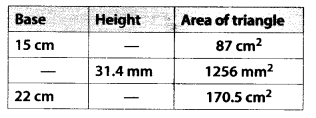
Find the missing values:
MP Board Class 7th Maths Solutions Chapter 11 Perimeter and Area Ex 11.2 5
Solution:
Area of triangle = \(\frac{1}{2}\) × Base × Height
Let b be the base of triangle and h be the height of triangle.
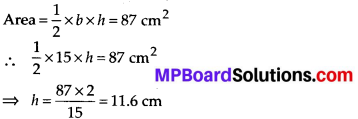
(i) b = 15 cm
MP Board Class 7th Maths Solutions Chapter 11 Perimeter and Area Ex 11.2 6
Therefore, the height of triangle is 11.6 cm.

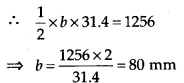
(ii) h = 31.4 mm
Area = \(\frac{1}{2}\) × b × h = 1256 mm2
MP Board Class 7th Maths Solutions Chapter 11 Perimeter and Area Ex 11.2 7
Therefore, the base of triangle is 80 mm.

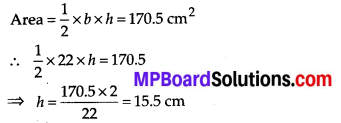
(iii) b = 22 cm
MP Board Class 7th Maths Solutions Chapter 11 Perimeter and Area Ex 11.2 8
Therefore, the height of triangle is 15.5 cm.

Question 5.
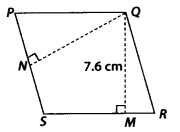
PQRS is a parallelogram (see the given figure). QM is the height from Q to SR and QN is the height from Q to PS. If SR = 12 cm and QM = 7.6 cm. Find:
(a) the area of the parallelogram PQRS
(b) QN, if PS = 8 cm
MP Board Class 7th Maths Solutions Chapter 11 Perimeter and Area Ex 11.2 9
Solution:
(a) Area of parallelogram = Base × Height
= SR × QM
= 12 × 7.6 = 91.2 cm2

(b) PS = 8 cm
Area of parallelogram = Base × Height
= PS × QN = 91.2 cm2
⇒ 8 × QN = 91.2
⇒ QN = \(\frac{91.2}{8}\) = 11.4 cm

Question 6.
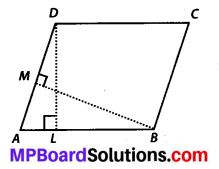
DL and BM are the heights on sides AB and AD respectively of parallelogram ABCD (see the given figure).
MP Board Class 7th Maths Solutions Chapter 11 Perimeter and Area Ex 11.2 10
If the area of the parallelogram is 1470 cm2, AB = 35 cm and AD = 49 cm, find the length of BM and DL.
Solution:
Area of parallelogram = Base × Height
= AB × DL
⇒ 1470 = 35 × DL
⇒ DL = \(\frac{1470}{35}\) = 42 cm
Also, area of parallelogram = AD × BM
⇒ 1470 = 49 × BM
∴ BM = \(\frac{1470}{49}\) = 30 cm

MP Board Class 7th Maths Solutions Chapter 11 Perimeter and Area Ex 11.2

Question 7.
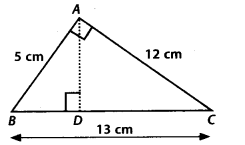
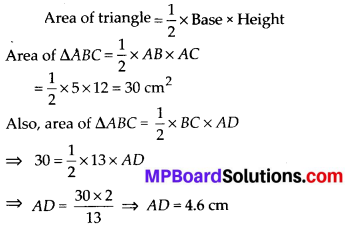
∆ABC is right angled at A (see the given figure). AD is perpendicular to BC. If AB = 5 cm, BC – 13 cm and AC = 12 cm, find the area of ∆ABC. Also find the length of AD.
MP Board Class 7th Maths Solutions Chapter 11 Perimeter and Area Ex 11.2 11
Solution:
MP Board Class 7th Maths Solutions Chapter 11 Perimeter and Area Ex 11.2 12

Question 8.
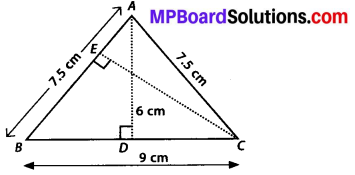
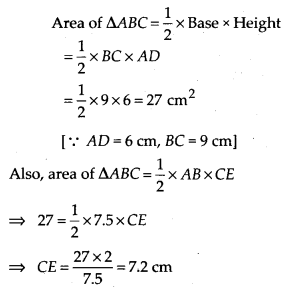
∆ABC is isosceles with AB = AC= 7.5 cm and BC = 9 cm (see the given figure). The height AD from A to BC, is 6 cm. Find the area of ∆ABC. What will be the height from C to AB i. e., CE?
MP Board Class 7th Maths Solutions Chapter 11 Perimeter and Area Ex 11.2 13
Solution:
MP Board Class 7th Maths Solutions Chapter 11 Perimeter and Area Ex 11.2 14

MP Board Class 7th Maths Solutions

MP Board Class 7th Maths Solutions Chapter 8 Comparing Quantities Ex 8.2

MP Board Class 7th Maths Solutions Chapter 8 Comparing Quantities Ex 8.2

Question 1.
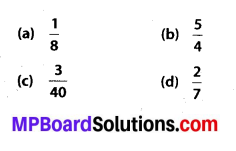
Convert the given fractional numbers to percents.
MP Board Class 7th Maths Solutions Chapter 8 Comparing Quantities Ex 8.2 1
Solution:
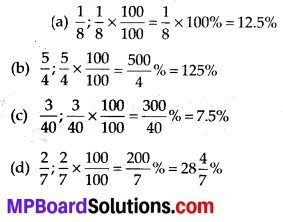
MP Board Class 7th Maths Solutions Chapter 8 Comparing Quantities Ex 8.2 2

Question 2.
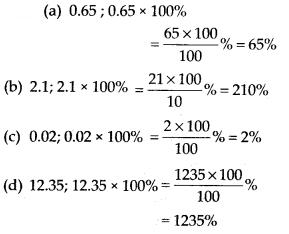
Convert the given decimal fractions to percents.
(a) 0.65
(b) 2.1
(c) 0.02
(d) 12.35
Solution:
MP Board Class 7th Maths Solutions Chapter 8 Comparing Quantities Ex 8.2 14

MP Board Class 7th Maths Solutions Chapter 8 Comparing Quantities Ex 8.2

Question 3.
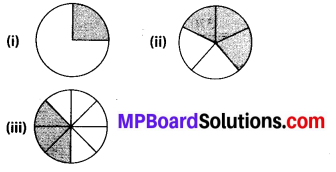
Estimate what part of the figures is coloured and hence find the percent which is coloured.
MP Board Class 7th Maths Solutions Chapter 8 Comparing Quantities Ex 8.2 4
Solution:
(i) Here, 1 part out of 4 equals parts is shaded which represents the fraction \(\frac{1}{4}\).
MP Board Class 7th Maths Solutions Chapter 8 Comparing Quantities Ex 8.2 5

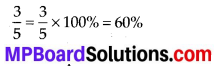
(ii) Here, 3 parts out of 5 equal parts are shaded which represents the fraction \(\frac{3}{5}\).
MP Board Class 7th Maths Solutions Chapter 8 Comparing Quantities Ex 8.2 6

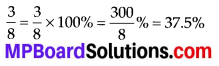
(iii) Here 3 parts out of 8 equal parts are shaded which represents the fraction \(\frac{3}{8}\).
MP Board Class 7th Maths Solutions Chapter 8 Comparing Quantities Ex 8.2 7

Question 4.
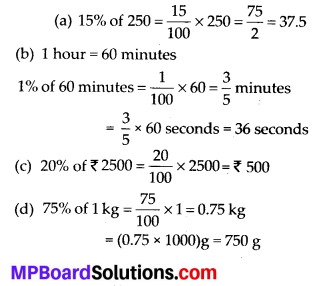
Find:
(a) 15% of 250
(b) 1% of 1 hour
(c) 20% of ₹ 2500
(d) 75% of 1 kg
Solution:
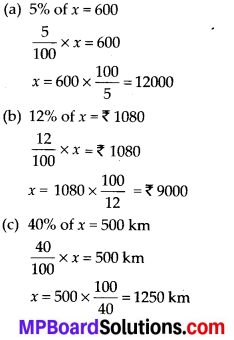
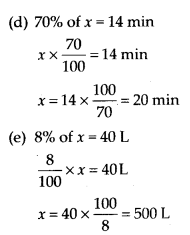
MP Board Class 7th Maths Solutions Chapter 8 Comparing Quantities Ex 8.2 8

Question 5.
Find the whole quantity if
(a) 5% of it is 600
(b) 12% of it is? 1080
(c) 40% of it is 500 km
(d) 70% of it is 14 minutes
(e) 8% of it is 40 litres
Solution:
Let the whole quantity be x.
MP Board Class 7th Maths Solutions Chapter 8 Comparing Quantities Ex 8.2 9
MP Board Class 7th Maths Solutions Chapter 8 Comparing Quantities Ex 8.2 10

MP Board Class 7th Maths Solutions Chapter 8 Comparing Quantities Ex 8.2

Question 6.
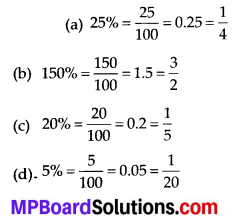
Convert given percents to decimal fractions and also to fractions in simplest forms:
(a) 25%
(b) 150%
(c) 20%
(d) 5%
Solution:
MP Board Class 7th Maths Solutions Chapter 8 Comparing Quantities Ex 8.2 11

Question 7.
In a city, 30% are females, 40% are males and remaining are children. What percent are children?
Solution:
It is given that 30% are females and 40% are males.
Children = 100% – (40% + 30%)
= 100% – 70% = 30%

MP Board Class 7th Maths Solutions Chapter 8 Comparing Quantities Ex 8.2

Question 8.
Out of 15,000 voters in a constituency, 60% voted. Find the percentage of voters who did not vote. Can you now find how many actually did not vote?
Solution:
Percentage of voters who voted = 60%
Percentage of those who did not vote = 100% – 60%
= 40%
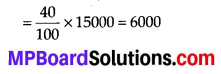
Number of people who did not vote = 40% of 15000
= 40% × 15000
MP Board Class 7th Maths Solutions Chapter 8 Comparing Quantities Ex 8.2 12
Therefore, 6000 people did not vote.

Question 9.
Meeta saves ₹ 400 from her salary. If this is 10% of her salary. What is her salary?
Solution:
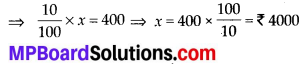
Let Meeta’s salary be ₹ x.
Given that, 10% of x = 400
MP Board Class 7th Maths Solutions Chapter 8 Comparing Quantities Ex 8.2 13
Therefore, Meeta’s salary is ₹ 4000.

Question 10.
A local cricket team played 20 matches in one season. It won 25% of them. How many matches did they win?
Solution:
Number of games won = 25% of 20
\(=\frac{25}{100} \times 20=5\)
Therefore, the team won 5 matches.

MP Board Class 7th Maths Solutions

MP Board Class 7th Maths Solutions Chapter 11 Perimeter and Area Ex 11.1

MP Board Class 7th Maths Solutions Chapter 11 Perimeter and Area Ex 11.1

Question 1.
The length and the breadth of a rectangular piece of land are 500 m and 300 m respectively. Find
(i) its area
(ii) the cost of the land, if 1 m2 of the land costs ₹ 10,000.
Solution:
Length (l) = 500 m
Breadth (b) = 300 m
(i) Area = Length × Breadth = 500 × 300 = 150000 m2
(ii) Cost of 1 m2 land = ₹ 10000
∴ Cost of 150000 m2 land
= 150000 × 10000 = ₹ 1500000000

Question 2.
Find the area of a square park whose perimeter is 320 m.
Solution:
Perimeter of the square park = 320 m
∴ 4 × Length of the side of park = 320
Length of the side of park = \(\frac{320}{4}\) = 80 m
Area = (Length of the side of park)2
= (80)2 = 6400 m2

Question 3.
Find the breadth of a rectangular plot of land, if its area is 440 m2 and the length is 22 m. Also find its perimeter.
Solution:
Area of a rectangular plot = 440 m2
Length = 22 m
Area = Length x Breadth = 440 m2
∴ 22 × Breadth = 440
⇒ Breadth = \(\frac{440}{22}\) = 20 m
∴ Perimeter = 2 (Length + Breadth)
= 2 (22 + 20) = 2(42) = 84 m

MP Board Class 7th Maths Solutions Chapter 11 Perimeter and Area Ex 11.1

Question 4.
The perimeter of a rectangular sheet is 100 cm. If the length is 35 cm, find its breadth. Also find the area.
Solution:
Length = 35 cm
Perimeter = 100 cm
∴ 2 (35 + Breadth) = 100
⇒ 35 + Breadth = 50
⇒ Breadth = 50 – 35 = 15 cm
∴ Area = Length × Breadth
= 35 × 15 = 525 cm2

Question 5.
The area of a square park is the same as of a rectangular park. If the side of the square park is 60 m and the length of the rectangular park is 90 m, find the breadth of the rectangular park.
Solution:
Side of the square park = 60 m
Length of the rectangular park = 90 m
Area of the square park = (side)2 = (60)2 = 3600 m2
Area of rectangular park = Length × Breadth
= 90 × Breadth
It is given that area of square park = area of rectangular park
∴ 3600 = 90 × Breadth
⇒ Breadth = 40 m

Question 6.
A wire is in the shape of a rectangle. Its length is 40 cm and breadth is 22 cm. If the same wire is rebent in the shape of a square, what will be the measure of each side. Also find which shape encloses more area?
Solution:
Length of rectangle = 40 cm
Breadth of rectangle = 22 cm
Perimeter of rectangle = Perimeter of square
∴ 2 (Length + Breadth) = 4 × Side of square
⇒ 2 (40 + 22) = 4 × Side of square
⇒ 2 × 62 = 4 × Side of square
∴ Side of square = \(\frac{124}{4}\) = 31 cm
Now, area of rectangle = 40 × 22 = 880 cm2
Area of square = (Side)2 = 31 × 31 = 961 cm2
As 961 > 880.
Therefore, the square-shaped wire encloses more area than rectangle – shaped wire.

MP Board Class 7th Maths Solutions Chapter 11 Perimeter and Area Ex 11.1

Question 7.
The perimeter of a rectangle is 130 cm. If the breadth of the rectangle is 30 cm, find its length. Also find the area of the rectangle.
Solution:
Breadth = 30 cm
Perimeter = 130 cm
∴ 2 (Length + 30) = 130
⇒ Length + 30 = 65
⇒ Length = 65 – 30 = 35 cm
Now, area = Length × Breadth
= 35 × 30 = 1050 cm2

Question 8.
A door of length 2 m and breadth 1 m is fitted in a wall. The length of the wall is 4.5 m and the breadth is 3.6 m (see the given figure). Find the cost of white washing the wall, if the rate of white washing the wall is ₹ 20 per m2.
MP Board Class 7th Maths Solutions Chapter 11 Perimeter and Area Ex 11.1 1
Solution:
Length of wall = 4.5 m
Breadth of wall = 3.6 m
Area of wall = Length × Breadth
= 4.5 × 3.6
= 16.2 m2
Area of door = 2 × 1 = 2 m2
Area to be white-washed
= Area of wall – Area of door
= 16.2 – 2 = 14.2 m2
Cost of white-washing 1 m2 area = ₹ 20 2.
∴ Cost of white-washing 14.2 m2 area
= 14.2 × 20 = ₹ 284

MP Board Class 7th Maths Solutions

MP Board Class 7th Maths Solutions Chapter 12 Algebraic Expressions Ex 12.4

MP Board Class 7th Maths Solutions Chapter 12 Algebraic Expressions Ex 12.4

Question 1.
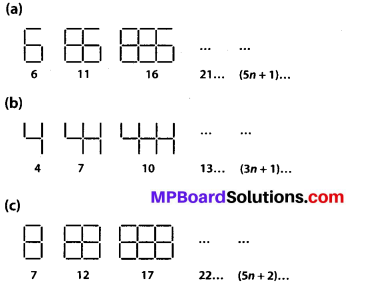
Observe the patterns of digits made from line segments of equal length. You will find such segmented digits on the display of electronic
watches or calculators,
MP Board Class 7th Maths Solutions Chapter 12 Algebraic Expressions Ex 12.4 1
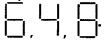
If the number of digits formed is taken to be n, the number of segments required to form n digits is given by the algebraic expression appearing on the right of each pattern. How many segments are required to form 5, 10, 100 digits of the kind
MP Board Class 7th Maths Solutions Chapter 12 Algebraic Expressions Ex 12.4 2
Solution:
(a) It is given that the number of segments required to form n digits of the kind
MP Board Class 7th Maths Solutions Chapter 12 Algebraic Expressions Ex 12.4 3 is (5n + 1).
Number of segments required to form 5 digits = (5 × 5 + 1) = 25 + 1 = 26
Number of segments required to form 10 digits = (5 × 10 + 1) = 50 + 1 = 51
Number of segments required to form 100 digits = (5 × 100 + 1) = 500 + 1 = 501

(b) It is given that the number of segments required to form n digits of the kind
MP Board Class 7th Maths Solutions Chapter 12 Algebraic Expressions Ex 12.4 4 [ is (3n +1).
Number of segments required to form 5 digits = (3 × 5 + 1) = 15 + 1 = 16
Number of segments required to form 10 digits = (3 × 10 + 1) = 30 + 1 = 31
Number of segments required to form 100 digits = (3 × 100 + 1) = 300 + 1 = 301

(c) It is given that the number of segments required to form n digits of the kind
MP Board Class 7th Maths Solutions Chapter 12 Algebraic Expressions Ex 12.4 5 is (5n + 2).
Number of segments required to form 5 digits = (5 × 5 + 2) = 25 + 2 = 27
Number of segments required to form 10 digits = (5 × 10 + 2) = 50 + 2 = 52
Number of segments required to form 100 digits = (5 × 100 + 2) = 500 + 2 = 502

MP Board Class 7th Maths Solutions Chapter 12 Algebraic Expressions Ex 12.4

Question 2.
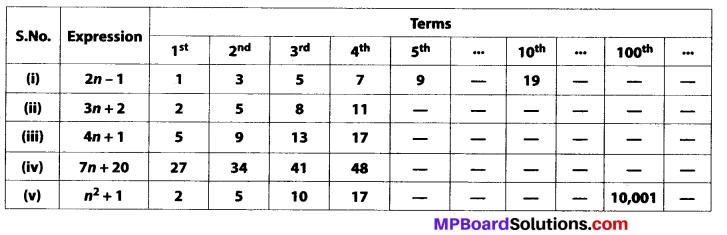
Use the given algebraic expression to complete the table of number patterns.
MP Board Class 7th Maths Solutions Chapter 12 Algebraic Expressions Ex 12.4 6
Solution:
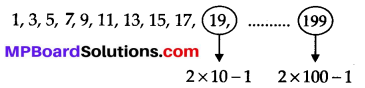
(i) Number pattern for expression 2n – 1
Put n = 1, 2, 3,…. and so on, we get
MP Board Class 7th Maths Solutions Chapter 12 Algebraic Expressions Ex 12.4 7
(ii) For expression 3 n + 2, 5th, 10th term and 100th term of the pattern are 3 × 5 + 2 = 17, 3 × 10 + 2 = 32 and 3 × 100 + 2 = 302 respectively.
(iii) For expression 4n +1, 5th, 10th and 100th term of the pattern are 4 × 5 +1 = 21, 4 × 10 + 1 = 41 and 4 × 100 + 1 = 401 respectively.
(iv) For expression 7n + 20, 5th, 10th and 100th term of the pattern are 7 × 5 + 1 = 36, 7 × 10 + 20 = 90 and 7 × 100 + 20 = 720 respectively.
(v) For expression n2 + 1, 5th and 10th term of the pattern are 52 + 1 = 26 and 102 + 1 = 101 respectively.

MP Board Class 7th Maths Solutions