MP Board Class 12th English The Spectrum Workbook Solutions Chapter 3 A Father’s Letter

MP Board Solutions for 12th English The Spectrum Workbook Solutions Chapter 3 A Father’s Letter Questions and Answers aids you to prepare all the topics in it effectively. You need not worry about the accuracy of the Madhya Pradesh Board Solutions for 12th English as they are given adhering to the latest exam pattern and syllabus guidelines.

You Can Download MP Board Class 12th English Solutions Questions and Answers Notes, Summary, Lessons: Pronunciation, Translation, Word Meanings, Textual Exercises. Enhance your subject knowledge by preparing from the Chapterwise MP Board Solutions for 12th English and clarify your doubts on the corresponding topics.

MP Board Class 12th English The Spectrum Workbook Solutions Chapter 3 A Father’s Letter

Kick start your preparation by using our online resource MP Board Solutions for 12th English Chapter 3 A Father’s Letter Questions and Answers. You can even download the Madhya Pradesh Board Class 12th English Solutions Questions and Answers for free of cost through the direct links available on our page. Clear your queries and understand the concept behind them in a simple manner. Simply tap on the concept you wish to prepare in the chapter and go through it.

Word Power

A. Add more words to the word-bubble given in the book. Also consult dictionary for their meaning.
Answer:

  • Capital, Captive
  • Intercept, receive.
  • Capious, Caption
  • Concept, deceive.

B. Match antonyms of the following:

‘A’ – ‘B’

1. aloof – (a) decent
2. idle – (b) like
3. despise – (c) amity
4. vulgar – (d) interested
5. pique – (e) busy
Answer:
1. – (d), 2. – (e), 3. – (b). 4. – (a), 5. – (c).

Comprehension

A. Choose the correct alternative.

1. The author advises his son to learn never to (conceive/conceal) a prejudice against others.
2. The father wishes his son to keep up appearances himself as (anarrack/a defense) against the idle sneers of the world.
3. The author wants his son never to (despise/dispose) anyone at ail.
4. Hazlitt tells his son that the first Lesson to learn is that there are other people in the world besides (himself/yourself).
5. True (insanity/equality) is the only true morality or true wisdom.
Answer:

  1. conceive
  2. a defense
  3. despise
  4. himself
  5. equality.

B. Say whether the following statements are true or false and put (✓) or (✗) in the boxes.
Answer:

  1. The author doesn’t feel himself physically fit. (True) [✓]
  2. One should not anticipate evils because one cannot have things exactly as one wishes. (True)[✓]
  3. The son was experiencing homely atmosphere at his school. (False) [✗]
  4. A student feels the same freedom at his school as his own home. (False) [✗]
  5. The son feels that his school fellows do not take care of him. (True) [✓]

Language Practice

A. Complete the sentence with ‘some of’/‘most’/‘any of’
1. Do you like this music ? ……… it.
2. I don’t go out very often. I’m at home ………. day.
3. Do you want to come to a party tonight.
Answer:

  1. some of
  2. most
  3. any of.

B. ‘A’ asks ‘B’ some questions. Use the given information in the box to write B’s answers.

don’t need a car.
Here is a chemist in Mill road.
I haven’t got one.
I have just had a cup of coffee.
am going to buy a bicycle.
I havn’t got an umbrella.

1. A. Can you lend me a pen? – B. I’m sorry ……..
2. A. Would you like to have a car – B.No,,I ……..
3. A. Have you got a bicycle? – B. No, but I ……..
4. A. Can you lend me an umbrella? – B. I’m sorry but ……..
5. A. Would you like a cup of coffee? – B. No, thank you ……..
6. A. Is there a chemist near here? – B. Yes ……..
Answer:

  1. I haven’t got one
  2. don’t need a car
  3. am going to buy a bicycle
  4. 1 haven’t got an umbrella
  5. 1 have just had a cup of coffee
  6. here is a chemist in Mill road.

C. Write these sentences using no as a determiner.

Question 1.
We haven’t got any money.
Answer:
We’ve got no money.

Question 2.
There aren’t any shops near here.
Answer:
There are no shops near here.

Question 3.
Karlm hasn’t got any free time.
Answer:
Karim has got no free time.

Question 4.
There Isn’t light in this room.
Answer:
There is no light in this room.

D. Write short answers (one or two words) to these questions. Use none where necessary.

Question 1.
how many letters did you write yesterday?
Answer:
Two letters.

Question 2.
How many sisters have you got?
Answer:
Two sisters.

Question 3.
How many apples did you eat yesterday ?
Answer:
One apple.

Question 4.
How many photographs have you taken today ?
Answer:
Ten photographs.

Question 5.
How many legs has a snake got ?
Answer:
None.

Speaking Time

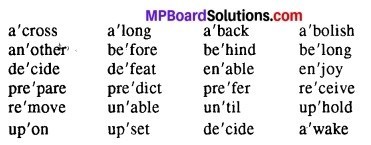
Mark the stress of the following words.
Answer:
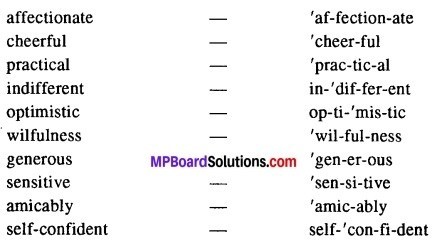
MP Board Class 12th English The Spectrum Workbook Solutions Chapter 3 A Father’s Letter img 1

Reading Time

Read the following passage carefully :

Studies serve for delight, for ornament, and for ability. Their chief use for delight, is in privateness and retiring, for ornament is in discourse, and for ability, is in the judgment and disposition of business. For expert men can execute, and perhaps judge of particulars, one by one, but the general counsels, and plots and marshalling of affairs, come best from those that are learned.

To spend too much time in studies is sloth; to use them too much for ornament, is affectation; to make judgment wholly by their rules, is the humor of a scholar. They perfect nature and are perfected by experience : for natural abilities are like natural plants that need pruning by study; and studies themselves do give forth directions too much, at large, except they be bounded in by experience.

Crafty men contemn studies; simple men admire them; and wise men use them : for they teach not their own use : but that is a wisdom without them and above them, won by observation. Read not to contradict and confute, nor to believe and take for granted, nor to find talk and discourse; but to weigh and consider.

Some books are to be tasted, others to be swallowed, and some few to be chewed and digested, that is some books are to be read only in parts; others to be read but not curiously, and some to be read wholly and with diligence and action. Some books also may be read by deputy, and extracts made of them by others, but that would be only in the less important arguments and the meaner sort of books, else distilled books are like common distilled waters, flashy things.

Now answer the questions given below:

Question 1.
Choose the word which does no4 carry the same meaning as the word given at the top or each group:

(A) admire
(i) praise
(ii) appreciate
(iii) condemn
(iv) respect.
Answer:
(iii) condemn

(B) diligence :
(i) idleness
(ii) industry
(iii) hard work
(iv) thoroughness.
Answer:
(i) idleness

(C) disposition:
(i) arrangement
(ii) willingness
(iii) nature
(iv) disapproval.
Answer:
(iv) disapproval.

(D) sloth:
(i) laziness
(ii) idleness
(iii) unwillingness
(iv) promptness.
Answer:
(D) (iv) promptness.

Question 2.
Who can plan and carry out the things in a better way?
Ans.
The learned can plan and casry out things In a better way.

Question 3.
What is idleness according to the author? (2009, 15)
Ans.
According tn the author to spend too much time in studies is sloth,

Question 4.
How does the author compare the crafty, simple and wise men?
Ans.
Crafty men contem studies, simple men admire them and wise men use them.

Question 5.
‘Read not to contradict and confute’. Explain the statement in your own words. .
Ana.
Our aim of reading should not be to deny the truth or to oppose others nor to prove someone false.

Question 6.
What are the Distilled books like ? . (2009)
Ans.
Distilled books are like common distilled waters, flashy things.

Question 7.
In what categories does the author divide the books? (2014)
Ans.
The author divides books in three categories

  • Some books arc lo be read in parts.
  • Others lo be read but flot curiously.
  • Some to be read wholly with deligence and action.

Question 8.
Give a suitable title to die passage.
Ans.
‘Of Studies’.

Writing Time

Question 1.
Imagine yourself to be the Export Manager of Deepati Overseas Ltd. Mumbai. You need chartered accountants for Mumbai, Delhi and Bangalore offices. Write an advertisement far a national daily
offering an Initial salary of Rs. 20,000/. per month with free accommodation. Complete the advertisement in 50 words.
Answer:
Required
Chartered Accountants
For Mumbai, Delhi and Bangalore offices with experience of two to three years. Initial salary Rs. 20,000/- p. m. + Free accommodation. Send your resume to the Export Manager, Deepali Overseas Ltd., Mumbai or mail to [email protected].

Question 2.
Write a classified advertisement for ‘Lost and Found’ column of a local newspaper stating the loss of your books and important documents while travelling in a local bus.
Answer:
Lost and Found
Lost a bag containing books and other important documents.
On 15th March 20… at about 10:30 a. m. while travelling in Dhar-Indore MPRTC bus. Sender will be rewarded.
Contact 9832590721 or (07292) 232436

Question 3.
Your father has been transferred to another city. You want to sell certain household goods. Design suitable advertisement to be published in local newspapers.
Answer:
For SALE
One coloured T. V.-Videocon flat screen 20 model, good condition
under warranty period.
One Refrigerator-Voltas Co. Capacity 200 Lit. good condition.
Owner shifting to another city.
Contact
K. R Upadhyaya
Mob. No. 9826732395

Question 4.
Design an advertisement on behalf of the Ministry of Environment, M.R for publication in a newspaper urging the people to get ‘Pollution Under Control Certificate’ for their vehicles. Mention the date, venue, place and time of the programme. Make the people aware about the harmful effects of hydrocarbons and carbon monoxide.
Answer:
Pollution Control
Ministry of Environment Protection, M. P. urges its responsible citizens and vehicle users to get P. U. C. (Pollution Under Control) Certificate for their vehicles in order to cut down the highly increased level of pollution in our state, caused due to running vehicles, which emit harmful gases (like carbon-monoxide and hydrocarbons). These are injurious to heart and may even cause skin and lung cancer and asthama etc.
P. U. C. Certificates will be issued after checking your vehicle. Detailed information is given below.
Date : From 10/10/20… to 31.12.20…
Time : 10 a. m. to 6 p. m.
Venue : Municipal Corporation Office, Indore.

We believe the information shared regarding MP Board Solutions for 12th English Chapter 3 A Father’s Letter Questions and Answers as far as our knowledge is concerned is true and reliable. In case of any queries or suggestions do leave us your feedback and our team will guide you at the soonest possibility. Bookmark our site to avail latest updates on several state board Solutions at your fingertips.
MP Board Class 12th English The Spectrum Solutions Chapter 18 India through a Traveller’s Eyes

MP Board Solutions for 12th Textbook General English The Spectrum Solutions Chapter 18 India through a Traveller’s Eyes Questions and Answers aids you to prepare all the topics in it effectively. You need not worry about the accuracy of the Madhya Pradesh Board Solutions for 12th English as they are given adhering to the latest exam pattern and syllabus guidelines.

You Can Download MP Board Class 12th English Solutions Questions and Answers Notes, Summary, Lessons: Pronunciation, Translation, Word Meanings, Textual Exercises. Enhance your subject knowledge by preparing from the Chapterwise MP Board Solutions for 12th English and clarify your doubts on the corresponding topics.

MP Board Class 12th English The Spectrum Solutions Chapter 18 India through a Traveller’s Eyes (Pearl S. Buck)

Kick start your preparation by using our online resource MP Board Solutions for 12th English Chapter 18 India through a Traveller’s Eyes Questions and Answers. You can even download the Madhya Pradesh Board Class 12th English Solutions Questions and Answers for free of cost through the direct links available on our page. Clear your queries and understand the concept behind them in a simple manner. Simply tap on the concept you wish to prepare in the chapter and go through it.

India Through A Traveller’s Eyes Exercises From The Text-Book

Word Power

(A) दिये गये remarks का उत्तर उनके विपरीत से दीजिए :
Answer:

  • The fair, bold guy,
  • Scruffy and untidy,
  • That slim, dark-haired woman,
  • Unattractive,
  • In fact a teenager.

(B) स्वाद-सूचक शब्दों से निम्नलिखित को बताइए :
Answer:

  • hot, savoury, bland,
  • tasty, spicy,
  • salty, silky,
  • sour, sickly,
  • hot, surgery,
  • hot, bitter,
  • sweet.

Comprehension

निम्नलिखित प्रश्नों के उत्तर दीजिए-

Question 1.
What is the author’s nationality?
लेखिका की राष्ट्रीयता क्या है?
Answer:
The author’s nationality is American.
लेखिका की राष्ट्रीयता अमेरिकन है।

Question 2.
How can you tell that the author had always loved India? [2015]
आप किस प्रकार कह सकते हैं कि लेखिका भारत से सदैव प्रेम करती थी?
Answer:
The author had always loved India as it had always been part of the background of her life. She had read the life history of Lord Buddha. She loved the beauty of Kashmir.

लेखिका भारत से सदैव प्रेम करती थी क्योंकि वह उसके जीवन में सदैव परोक्ष रूप से उपस्थित रहा है। उसने भगवान बुद्ध की जीवनी पढ़ी थी। यह कश्मीर के सौन्दर्य से प्रेम करती थी।

Question 3.
Describe the people of Kashmir. [2014]
कश्मीरी लोगों का वर्णन कीजिए।
Answer:
Kashmiri people are often fair. Women have blue eyes with reddish-brown hair. The skin colour of Kashmiris is lovely cream.
कश्मीरी लोग प्रायः गोरे होते हैं। महिलाओं की आँखें नीली होती हैं और लाल-भूरे बाल होते हैं। कश्मीरियों की खाल का रंग क्रीम जैसा होता है।

Question 4.
In what ways had post-independence India influenced the world?
स्वातन्त्रयोत्तर भारत ने विश्व को किस प्रकार प्रभावित किया था?
Answer:
India has put to good use the benefits, the English gave the knowledge of the west, the art of governance, etc. A woman of India became the president of The General Assembly of the United Nations India’s quiet confidence and her strong determination of not yielding idealism, all these things had influenced the world.

भारत ने अंग्रेजों द्वारा भारत को दिए गये लाभ का सदुपयोग, पश्चिम का ज्ञान, राज्य करने की कला आदि का अच्छा लाभ उठाया है। संयुक्त राष्ट्र संघ की सामान्य सभा की एक भारतीय महिला अध्यक्ष बनी। भारत का आत्मविश्वास और आदर्शवाद को न छोड़ने को दृढ़ प्रतिज्ञा, इन सब बातों ने विश्व को प्रभावित किया।

Question 5.
Which are the two groups that the author is interested in?
वे दो कौन से वर्ग हैं जिनमें लेखिका की रुचि है?
Answer:
The two groups that the author is interested in, are the young intellectuals in the cities and the peasants in the villages.
लेखिका जिन दो वर्गों में रुचि रखती है, वे हैं-शहर के नौजवान प्रबुद्ध व गाँव के किसान।

Question 6.
How did the author compare the American war of Independence with India’s freedom struggle?
लेखिका ने अमेरिका के स्वतन्त्रता संग्राम की भारत के स्वतन्त्रता संग्राम से किस प्रकार तुलना की?
Answer:
According to the author, both peasant and intellectual were won to work together for their country in India. But the American did not yet fully understand the great lesson that India had to teach. Beside India’s mighty triumph of a bloodless revolution, American war of Independence shrank in size and concept.

लेखिका के अनुसार, किसान और प्रबुद्ध वर्ग को भारत के लिए कार्य करने के लिए साथ लिया गया। लेकिन भारत द्वारा सिखायी गयी शिक्षा को अमेरिकियों ने पूरी तरह नहीं समझा। भारत की रक्तहीन क्रान्ति की विजय के समक्ष अमेरिका का स्वतन्त्रता का आन्दोलन आकार-प्रकार में छोटा था।

Question 7.
What problems did the educated Indians face?
शिक्षित भारतीयों ने किन समस्याओं का सामना किया?
Answer:
The educated Indians would find no jobs and were not allowed by the old super-structure of empire to create them. They faced frustration and disappointment. They also faced the burden of the broken promises of England.

शिक्षित भारतीयों के पास नौकरियाँ नहीं थीं और उन्हें उनके साम्राज्य द्वारा नौकरियों के अवसरों को उत्पन्न करने की अनुमति भी नहीं थी। उन्हें हताशा व निराशा का सामना करना पड़ा। उन्हें इंग्लैण्ड द्वारा तोड़ी गयी कसमों का भी सामना करना पड़ा।

Question 8.
What conclusion did the author draw when she compared the Indian peasant with those of other countries?
भारतीय किसानों की अन्य देशों के किसानों से तुलना करते समय लेखिका ने क्या निष्कर्ष निकाला?
Answer:
The author drew the conclusion that the Chinese peasants are richer than the peasants in India. However, Russian peasants could be compared with Indian peasants though they are inferior in many ways. But in terms of being civilized Indian peasant is like the Chinese peasant.

लेखिका ने निष्कर्ष निकाला कि चीन के किसान भारत के किसानों से ज्यादा अमीर हैं। लेकिन रूस के किसान भारतीय किसानों के समकक्ष रखे जा सकते हैं यद्यपि वे कई अर्थों में तुलनात्मक दृष्टि से कमजोर हैं। लेकिन सभ्य होने के सन्दर्भ में भारतीय किसान चीन के किसान की भाँति हैं।

Question 9.
What reasons did the author give for Indians having many children? [2018]
लेखिका ने भारतीयों के ज्यादा बच्चे रखने का क्या कारण दिया?
Answer:
The author gave the reason that the Indians married very young so that there could be so many children. This being so because the life-span in India’ was twenty-seven years.

लेखिका ने भारतीयों के ज्यादा बच्चे होने का कारण यह दिया कि वे जल्दी विवाह करते हैं जिससे ज्यादा बच्चे होते हैं। ऐसा इसलिए कि भारत में जीवनकाल 27 वर्ष है।

Question 10.
What misconception about England was removed when the author visited India?
जब लेखिका ने भारत की यात्रा की तो इंग्लैण्ड के विषय में उसकी कौन-सी गलतफहमी दूर हो गयी?
Answer:
When the author visited India her misconception of cleanliness only in England was removed. Food for the author was served with all cleanliness.

जब लेखिका ने भारत की यात्रा की तो साफ-सफाई को लेकर इंग्लैण्ड के विषय में उसकी गलतफहमी दूर हो गयी। लेखिका के लिए भोजन पूरी साफ-सफाई के साथ परोसा गया।

Question 11.
Why did the eldest brother live out of the house?
सबसे बड़े भाई घर से बाहर क्यों रहते थे?
Answer:
The eldest brother lived out of the house so that he might be ready to listen to the villagers when they came to him.
सबसे बड़े भाई घर के बाहर रहते थे ताकि वह ग्रामीणों के आने पर उनसे बात कर सकें।

Question 12.
What were the author’s comments on the custom of eating with the right hand?
दाहिने हाथ से खाना खाने की प्रथा पर लेखिका के क्या विचार थे?
Answer:
The author’s comments were that the right hand is for clean services, such as eating, and the left may perform the more lowly tasks. She thought there could be nothing clean as one’s own washed right hand.

लेखिका का विचार था कि दाहिना हाथ साफ-सुथरे कार्य के लिए हैं, जैसे खाना खाना और बायाँ हाथ निम्न स्तर के कार्यों के लिए है। उसे लगा कि अपने साफ दाहिने हाथ से ज्यादा स्वच्छ कुछ नहीं हो सकता।

Question 13.
Why did the host eat with his back towards the guests?
मेहमानों की तरफ पीठ करके मेजबान ने क्यों भोजन किया?
Answer:
The host ate with his back towards the guests to fulfill the requirements of his caste. It was simply a private devotion to a religious feeling.

जाति के मापदण्डों को पूरा करने के लिए मेजबान ने मेहमानों की तरफ पीठ करके भोजन किया। यह मात्र एक धार्मिक भावना के प्रति समर्पण भाव था।

Question 14.
Describe the incident at the intellectual’s house that made the author appreciate the place of religion in Indian life. [2011, 14]
प्रबुद्ध व्यक्ति के निवास पर हुई उस घटना का वर्णन कीजिए जिससे लेखिका ने भारतीय जीवन में धर्म के स्थान की भावना की प्रशंसा की।
Answer:
The author sat with the hostess when her husband’s eldest brother came in and moved gracefully to the far end of the room, his bare feet silent upon the floor. There he knelt, his head bowed, and so remained for perhaps a quarter of an hour.

लेखिका मेजबान के साथ बैठी थी जब उसके पति के बड़े भाई अन्दर आये और तेजी से कमरे के दूसरे किनारे पर चले गये। उनके नंगे पैरों की आवाज फर्श से नहीं आ रही थी। वहाँ पर झुके, अपना सिर झुकाया और इसी अवस्था में पन्द्रह मिनट तक रहे।

Question 15.
How has exposure to India affected the author in her writing?
भारत के बारे में जानने से लेखिका के लेखन पर किस प्रकार प्रभाव पड़ा है?
Answer:
Exposure to India has affected the author’s writing in more ways than one. She started having deep feelings of respect for religion. She felt that the Christian missionaries lack it somewhere. This affected her writing. She became more appreciative of India in her writings.

भारत के बारे में जानने से लेखिका का लेखन कई प्रकार से प्रभावित हुआ। उसके हृदय में धर्म के लिए गहरी आदर की भावना का प्रादुर्भाव हुआ। उसे महसूस हुआ कि ईसाई मिशनरी में इस भावना का कहीं अभाव है। इससे उसका लेखन प्रभावित हुआ। वह अपने लेखन में भारत के विषय में ज्यादा प्रशंसा से लिखने लगी।

Question 16.
Why, according to the author, has the Christian missionary failed to change the world?
लेखिका के अनुसार, ईसाई मिशनरी क्यों दुनिया में परिवर्तन करने में असफल रही?
Answer:
According to the author, the Christian Missionary has not been willing to pay the full price for faith. It pays only part, unable to accept utterly, resulting in its failure to change the world.

लेखिका के अनुसार, ईसाई मिशनरी विश्वास की पूरी कीमत चुकाने की इच्छुक नहीं थी। वह केवल एक अंश चुकाती थी, पूरा स्वीकार करने में असमर्थ थी जिसके परिणामस्वरूप वह दुनिया को परिवर्तित करने में असफल रही।

Language Practice

Can या I Could से रिक्त स्थान भरिए:
Answer:

  • When I was at school I could never understand Physics.
  • Take an umbrella, here it could rain at any time. 3. They said they can deliver it next week but I told them not to.
  • They say they could deliver next week.
  • Can I help you?
  • Can you send me some information about the course?

निम्नलिखित paragraph के रिक्त स्थानों में will, can, should भरिए :
Answer:
If we sit in an incorrect posture, it will strain our back. As far as possible this should be avoided. If the posture becomes a part of habit, a low back pain invariably develops. It can be cured if we become conscious of our posture. We should also take time out to perform a few exercises. If the exercises are done regularly the backache will certainly be cured. It will also improve blood circulation within the spine.

Have to, had to या must और must not से रिक्त स्थान भरिए :
Answer:

  • Yesterday I had to finish my geography project.
  • She will have to wait in line like every one else.
  • We must not forget to take the chicken out of the freezer.
  • If you are under Twelve you have to get your parent’s permission.
  • The doctor must get here as soon as he can.
  • Do you have to work next Monday?
  • Shadab, you must not leave your clothes all over the floor like this.

Box में दिये गये mode of verb से वार्तालाप को पूर्ण करिए:
might could can must should
Answer :

  • Father : Can you go to the post office just now and send these letters by registered parcel.
  • Son : There should be a rush at this hour. Moreover, I can not go to the post office on foot.
  • Father : But why should you go on foot? What happened to your scooter?
  • Son : It has no petrol. I could not get it filled because there was a strike yesterday.
  • Father : O.K. You can use my motorcycle, but you must post the letters today. They are very urgent. We might suffer a loss if they were delayed.

India Through A Traveller’s Eyes Summary

– Pearl S. Buck

इस अध्याय में लेखिका द्वारा अपनी भारत यात्रा के दौरान प्राप्त किए गये अनुभवों व संस्मरणों के विषय में बताया गया है। लेखिका के मन में भारत की एक विशिष्ट छवि बचपन से ही रही है। लेखिका का मत है कि भारत ने अपने महापुरुषों के माध्यम से पश्चिमी सभ्यता के प्रभाव के बावजूद अपनी मूल पहचान को बनाये रखा है। लेखिका भारत में यहाँ की ऐतिहासिक इमारतें घूमने नहीं आयी थी वरन् यहाँ के युवा प्रबुद्ध वर्ग व किसानों से बात करने आयी थी। लेखिका को यह सुखद आश्चर्य है कि गाँधीजी ने बिना युद्ध व हिंसा के भारत को स्वतन्त्र कराया है। भारत के अतिरिक्त अन्तर्राष्ट्रीय स्तर पर गाँधीजी को जो सम्मान मिला है, वह अतुलनीय है। लेखिका एक कच्चे घर में जाने का संस्मरण लिखती है जिसके द्वारा उसने इस बात को महत्व दिया है कि भारतीय अपने संस्कारों व अपने बुजुर्गों का किस प्रकार सम्मान करते हैं। देशी तरीके से भोजन परोसने व उसे खाने की स्मृति लेखिका को आज भी रोमांचित कर देती है। लेखिका को यह सन्तोष भी है कि भारत में धर्म के प्रति आस्था कूट-कूट कर भरी है। लेखिका को इस बात का गहरा अफसोस है कि उसकी पुस्तक उसके देश के निवासी ही नहीं समझ सके। किन्तु वह यह बात जोर देकर कहती है कि आदर्शवाद के निर्वहन की क्या कीमत होती है, यह भारतीय खूब जानते हैं। इसलिए यह पुस्तक उनको रुचिकर लगेगी।

We believe the information shared regarding MP Board Solutions for 12th English Chapter 18 India through a Traveller’s Eyes Questions and Answers as far as our knowledge is concerned is true and reliable. In case of any queries or suggestions do leave us your feedback and our team will guide you at the soonest possibility. Bookmark our site to avail latest updates on several state board Solutions at your fingertips.

MP Board Class 12th English Important Extracts from the Poems

MP Board Solutions for 12th Textbook General English The Spectrum Solutions Important Extracts from the Poems Questions and Answers aids you to prepare all the topics in it effectively. You need not worry about the accuracy of the Madhya Pradesh Board Solutions for 12th English as they are given adhering to the latest exam pattern and syllabus guidelines.

You Can Download MP Board Class 12th English Solutions Questions and Answers Notes, Summary, Lessons: Pronunciation, Translation, Word Meanings, Textual Exercises. Enhance your subject knowledge by preparing from the Chapterwise MP Board Solutions for 12th English and clarify your doubts on the corresponding topics.

MP Board Class 12th English Important Extracts from the Poems

Kick start your preparation by using our online resource MP Board Solutions for 12th English Important Extracts from the Poems Questions and Answers. You can even download the Madhya Pradesh Board Class 12th English Solutions Questions and Answers for free of cost through the direct links available on our page. Clear your queries and understand the concept behind them in a simple manner. Simply tap on the concept you wish to prepare in the chapter and go through it.

निम्नलिखित पंक्तियों को ध्यानपूर्वक पढ़िए एवं उन पर आधारित प्रश्नों के उत्तर दीजिए:

1. (Poem 1)

Teach me to listen, Lord
To those far from me The
The plea of the forgotten
The cry of the anguished. [2009, 10, 12, 16, 17]

Questions:
(i) Find out a word from the lines given a word having a similar meaning to ‘severe pain.’ [2009, 10]
(ii) The poet wants us to listen to those [2009, 10]
(iii) What does the poet request? [2009, 10]
(iv) A word similar in meaning to the word ‘hear’ : [2012, 16, 17]
(a) pear (b) listen (c) peep.
(v) The opposite word ‘near’ is : [2012, 16, 17]
(a) far (b) clear (c) further (d) fear.
(vi) Give the name of the poem from which these lines have been taken. [2012, 16, 17]
Answer:
(i) anguish.
(ii) Who are far from him and who are hopeless, forgotten and anguished.
(iii) The poet requests God to teach him to listen to the hopeless and the anguished.
(iv) (b) listen.
(v) (a) far.
(vi) Teach Me to Listen, Lord.

2. (Poem 4)

Ah, you are so great, and I am so small,
I tremble to think of you, World, at all;
And yet, when I said my prayers today,
A whisper inside me seemed to say,
“You are more than the Earth, though you are such a dot.
You can love and think, and the Earth cannot !” [2009]

Questions:
(i) A word opposite in meaning to ‘inside’:
(a) great (b) tremble (c) outside (d) None of these.

(ii) A word meaning ‘shake’ in the, above lines is :
(a) whisper, (b) tremble (c) Vet (d) great.

(iii) Write the name of the poet who wrote this poem.
Answer:
(i) (c) outside.
(ii) (b) tremble.
(iii) William Brighty Rands.

3. [Poem 16]

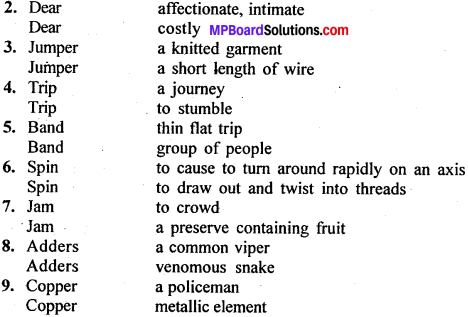
Some people say that you’re a dear
Yet dear is far from cheap,
A jumper is a thing you wear,
Yet a jumper has to leap,
It’s very clear, it’s very queer,
And pray who is to blame
For different meanings to some words
Pronounced and spelt the same? [2018]

Questions:
(i) What is the opposite of the word dear?
(a) costly (b) cheap (c) precious (d) beloved.

(ii) The word ‘jumper’ has two meanings. It’s one meaning is ‘one who jumps’. What is its second meaning?
(a) a woman’s loose outer garment (b) strange (c) different (d) blame.

(iii) Name the poem from which this extract has been taken?
Answer:
(i) (b) cheap.
(ii) (a) a woman’s loose outer garment
(iii) The English Language.

4. [Poem 10]

After unnumbered steps of a hill-stair
I saw upon earth’s head brilliant with sun
The immobile Goddess in her house of stone
In the loneliness of meditating air. [2013]

Questions:
(i) A word similar in meaning to ‘unnumbered’ is :
(a) numberless (b) few (c) some (d) none of these.
(ii) The opposite of brilliant’ is :
(a) bright (b)dull (c) intelligent (d) sharp.
(iii) Give the name of the poem and poet.
Answer:
(i) (a) numberless.
(ii) (b) dull.
(iii) Name of the poem – The Hill-Top Temple
Name of the poet – Sri Aurobindo.

5. [Poem 7]

Can I admire the statue great,
When living men starve at its feet.
Can I admire the parks green tree,
A roof for homeless misery? [2016]

Questions:
(i) Name the poet :
(a) Sri Aurobindo (b) W.H. Davies (c) William Rands (d) Anonymous.
(ii) Give the meaning of the word ‘Starve’ :
(a) die of hunger (b) labour hard (c) work comfortably (d) live happily.
(iii) Why does the poet say that he cannot admire the great statue?
Or
Give noun form of admiring.
Answer:
(i) (b) W. H. Davies.
(ii) (a) die of hunger.
(iii) The poet cannot admire the great statue because the living men are starving at its feet.
Or
admiration.

6. [Poem 16]

Some words have different meanings,
and yet they’re spelt the same.
A cricket is an insect,
to play it it’s a game.
On every hand, in every land,
it’s thoroughly agreed,
the English language to explain,
is very hard indeed. [2010, 14, 17]

Questions:
(i) The above lines have been taken from the poem [2010]
(ii) What is the name of the insect mentioned in the stanza? [2010]
(iii) Give the opposite of the word ‘easy’ from the above lines. [2010]
(iv) The opposite of the word ‘same’ in the stanza is : [2014,17]
(a) difficult (b) different (c)hard (d) every.

(v) The meaning of the word ‘hard’ is : [2014]
(a) difficult (b) easy (c) rough (d) plain.

(vi) What are the two meanings of cricket? [2014]
(vii) An insect and a game both can be called : [2017]
(a) chess (b) cricket (c) fly (d) similar.

(viii) What is thoroughly agreed everywhere? [2017]
Answer:
(i) The English Language.
(ii) pricket.
(iii) mrd.
(iv) (b) different.
(v) (a) difficult.
(vi) The two meanings of cricket’ are ‘insect’ and ‘a game’.
(vii) (b) cricket.
(viii) It is thoroughly agreed everywhere that English is a difficult language.

7. (Poem 1)

Teach me to listen, Lord
To myself
Help me to be less afraid
To trust the voice inside
In the deepest part of me.

Questions:
(i) A word having the same meaning as the word ‘belief is :
(a) afraid (b) deepest (c) trust (d) inside.
(ii) A word from the stanza which is the opposite of ‘more’ is :
(a) part (b) less (c) lord (d) voice.
(iii) What does the poet mean by “in the deepest part of me”?
Answer:
(i) (c) trust.
(ii) (b) less.
(iii) The poet means the deepest corner of his heart.

8. [Poem 10]

Our body is an epitome of some Vast
That masks its presence by our humanness.
In us, the secret Spirit can indite.
A page and summary of the Infinite.
A nodus of Eternity expressed
Live in an image and a sculptured face. [2015]

Questions:
(i) The poem is :
(a) In-country (b) Forest and River (c) The Hill-Top Temple (d) Wonderful world

(ii) What is the meaning of “infinite”.
(a) that means no end (b) that means for some time (c) that means begin (d) that means go on.

(iii) Write the correct transcription of the word ‘epitome’ to speak it accurately.
(iv) Write the adjective form of the word ‘eternity’.
Answer:
(i) (c) The Hill Top Temple
(ii) (a) that means no end.
(iii) i-pit’ ∂-m
(iv) eternal.

9. (Poem 1)

To those nearest me
My family, my friends, my co-workers
Help me to be aware that
No matter what words I hear
The message is
‘Accept the person I am, listen to me.’ [2011, 15]

Questions:
(i) A word similar in meaning to the word ‘attentive’ :
(a) preventive (b) active (c) aware (d) co-worker.

(ii) The word opposite in meaning of ‘aware’ :
(a) unaware (b) inaware (c) unawares (d) disaware.

(iii) The poet wants us to listen to those [nearest/farthest]
(iv) Write the name of the poem from which these lines have been taken.
Answer:
(i) (c) aware
(ii) (a) unaware
(iii) nearest
(iv) Teach Me to Listen, Lord.

10. (Poem 13)

But what am I?
Only a captive,
Chained to the earth.
In silence I grow old
In silence I wither and die. [2013]

Questions:
(i) Who is T in these lines?
(a) River (b) Forest (c) Sky

(ii) From These lines opposite of the word ‘free’.
(a) captive (b) old (c) silent (d) with.

(iii) Give the name of the poet.
Answer:
(i) (b) Forest.
(ii) (a) captive.
(iii) Jalaluddin Rumi.

11. (Poem 13)

On every hand, in every land
it’s thoroughly agreed
the English language to explain
is very hard indeed. [2012]

Questions:
(i) The same meaning of ‘completely’ is
(a) purely (b) wrongly (c) thoroughly (d) explain.

(ii) The opposite word of ‘easy’ is
(a) cused (b) hard (c) soft (d) comfort.

(iii) Give the name of the poem from which these lines have been taken.
Answer:
(i) (c) thoroughly.
(ii) (b) hard.
(iii) The English Language.

12. (Poem 4)

The wonderful air is over me,
And the wonderful wind is shaking the tree,
It walks on the water, and whirls the mills,
And talks to itself on the tops of the hills. [2014,18]

Questions:
(i) The opposite of the word ‘bottom’ in the stanza is : [2014, 18]
(a) wonderful (b) shake (c)top (d) whirl.

(ii) The word that rhymes with ‘tree’ is : [2014,18]
(a) hill (b)me (c)top (d)mill.

(iii) What is shaking the tree? [2014]
(iv) Give the name of the poem from which this extract has been taken. [2018]
Answer:
(i) (c) top.
(ii) (b)me.
(iii) Wonderful wind is shaking the tree.
(iv) The poem is wonderful World’.

We believe the information shared regarding MP Board Solutions for 12th English Important Extracts from the Poems Questions and Answers as far as our knowledge is concerned is true and reliable. In case of any queries or suggestions do leave us your feedback and our team will guide you at the soonest possibility. Bookmark our site to avail latest updates on several state board Solutions at your fingertips.
MP Board Class 12th General English Note Making and Summary Writing Examples

MP Board Solutions for 12th General English Reading Comprehension Note Making and Summary Writing Examples Questions and Answers aids you to prepare all the topics in it effectively. You need not worry about the accuracy of the Madhya Pradesh Board Solutions for 12th English as they are given adhering to the latest exam pattern and syllabus guidelines.

You Can Download MP Board Class 12th English Solutions Questions and Answers Notes, Summary, Lessons: Pronunciation, Translation, Word Meanings, Textual Exercises. Enhance your subject knowledge by preparing from the Chapterwise MP Board Solutions for 12th English and clarify your doubts on the corresponding topics.

MP Board Class 12th General English Note Making and Summary Writing Examples

Kick start your preparation by using our online resource MP Board Solutions for 12th General English Note Making and Summary Writing Examples Questions and Answers. You can even download the Madhya Pradesh Board Class 12th English Solutions Questions and Answers for free of cost through the direct links available on our page. Clear your queries and understand the concept behind them in a simple manner. Simply tap on the concept you wish to prepare in the chapter and go through it.

इस खण्ड में आपको लगभग 200 शब्दों में एक unseen passage दिया जाएगा। इन Passage पर आपको Notes बनाने होंगे। अर्थात् इस Passage से आपको महत्त्वपूर्ण point निकालने हैं जिनकी सहायता से आप Passage की Summary या Precise या Abstraction बना सकें।

Division Of Marks
Note Making – 05 Marks
Abstraction – 03 Marks

Note Making & Abstraction के फायदे

1. Focus of attention-When we read an article or a lesson, our mind and attention slip away and we lose the grip and interest in reading. Taking notes keeps your mind and attention fixed and busy. They do not loiter here and there. You achieve concentration which is very essential in learning.
यह हमारे ध्यान को एकाग्र रखता है।

2. Improvement of Memory-Taking notes helps you in memorizing facts and figures, quotations, main points etc., which makes it easy to keep the whole article in mind. Writing makes an exact man.
यह हमारी स्मृति को तेज रखता है।

3. Helps in Writing Summary or Precise-By rearranging the ideas from notes, you may prepare a gist or precise of the article.
सारांश लिखने में सहायता मिलती है।

4. Useful Quotations-The notes help us in quoting important things to support our speech or expressions.
उद्धरण हमारे कथन या लेख को पुष्ट करते हैं।

5. Dictionary Consultation Habit–While taking notes you must consult the dictionary. This habit will increase your vocabulary and knowledge.
शब्दकोश देखने की उपयोगी आदत हमारे ज्ञान को विस्तृत करती है।

6. Art of Editing-We learn the art of editing which proves to be very useful in future.
सम्पादन कला सीखने को मिलती है।

7. Keep Books or Magazines Neat and CleanOur book or magazine remains clean of markings or underlining.
पुस्तकें साफ, स्वच्छ रहती हैं।

8. Helpful in Examination-While solving the question paper answers spring up in our mind.
परीक्षा में उत्तर हमें याद आ जाते हैं।

9. Help in Composition—This bit helps us in composing an original article.
मौलिक रचना करने में सहायता मिलती है।

10. Improves Handwriting-Our handwriting improves because of practice.
हस्तलेखन सुन्दर होता है।

Solved Examples

Read the following passages and answer the questions given as under:

1. Laughter yoga makes a clear distinction between happiness and joy. Happiness is a conditional response of the mind which is totally dependent on the fulfillment of certain desires of mind by its very nature, it is related to how ones life had been in the past or how it will be in the future. It is not there in the present moment. The ironical and sad fact is that even if some dreams, goals or aspirations fulfilled happiness disappears quite quickly as the mind starts chasing new goal posts a new job, a new house, a bigger car etc. On the other hand, joyfulness is the unconditional commitment to be happy each moment, to have fun for the moment despite the problems and challenges of life, no matter how insurmountable they seem to the mind. It is the promise that body makes to the mind to indulge in playfulness moment by moment and there by give relaxation to it. During these periods of playfulness triggered by the plethora of physical activities like dancing, singing, playing and laughing, psychological and biochemical changes take place within our body that gives us a sense of well being that completely alters a negative outlook towards life and its challenges replacing it with confident positive moment by moment. [2016]

Questions :
A. On the basis of reading the passage make notes on it and supply a title. [5]
B. Prepare the summary of the passage. [3]
Answers :
A. Notes:

  • Happiness is a conditional response of the mind.
  • It is totally dependent on the fulfillment of certain desires of mind.
  • If some dreams are fulfilled, happiness disappears quickly.
  • The mind, then, starts chasing new goals.
  • On the other hand, joyfulness is the unconditional commitment to be happy each moment.
  • This condition relaxes the mind.
  • Such a combination of body and mind replaces negative moment into positive one.

B. Summary : Happiness, a conditional response of the mind is totally dependent on the fulfillment of certain desires of mind. Happiness disappears with the fulfillment of dreams. Then the mind begins to chase new goals. Contrary to it, joyfulness is the unconditional commitment to be happy each moment. This condition relaxes the mind, replacing the negative moments by positive ones.

2. Pollution is the fouling of the environment, land, water and air by waste, smoke, chemicals and other harmful substances. The most serious pollution occurs where there are large cities and many factories. As factories produce new goods for people to buy old ones are thrown out with household rubbish. Burning the refuse pollutes the air, dumping it in rivers and seas pollute the water and rubbish tips are unpleasant sights and take up much needed space. Getting rid of plastics is particularly difficult. Wood and paper decay after some time but plastics never decay.

The world’s oceans have been used as dustbins with millions of tonnes of rubbish being dumped into the sea every year harming marine life. If too much untreated sewage is poured into the seas, lakes and rivers from sewers, the water can no longer dilute it. All the oxygen in the water is used up and the fish die.

Smoke from factories, chimneys and exhausts, gases from motor vehicles pollute the air. Chemicals in the air combine with moisture to make acids which eat away stone and brick and so damage buildings. Carbon monoxide gas and other substances given out by the engines of cars and buses can damage people’s health. Ridding our world of pollution is an unimaginably big task. [2015]

Questions :
A. Make notes in points from the given passage, using abbreviations, where necessary with title. [5]
B. Write a summary of the above passage in about 60 words. [3]
Answers :
A. Notes:

  • Pollution is the fouling of the entire environment.
  • Burning the refuse pollutes the air.
  • Its dumping in the rivers pollutes water.
  • Oceans have been used as dustbins.
  • It harms marine life.
  • Smoke and gases pollute the air.
  • Getting rid of pollution is an extremely difficult task.

B. Summary : Waste, smoke, chemicals and other harmful substances pollute the environment. Air is polluted by burning the refuse, rivers are polluted by its dumping into them. Plastic is also a major cause of concern as it is not destroyed oceans have been used as dustbins. They harm marine life. Smoke and other gases damage people’s health. Indeed it is a very difficult task to get rid of pollution.

3. ‘Where there’s a will, there’s a way’, is an old saying. He who resolves upon doing a thing, by that very resolution overcomes the obstacles to it. It is so in all the occupations of life—at school, at college or in the world. To determine to succeed is the surest way to success. Difficulties disappear before an unswerving resolution. This was well exemplified in the life of Napoleon. He threw his whole force of body and mind upon his work. He was told that the Alps stood in the way of his armies. ‘There shall be no Alps’, he said, and a road was made across them, over heights previously considered inaccessible. ‘Impossible’, said he, ‘is a word only to be found in the dictionary of fools’. And so it is; a determination not to give in is the surest condition of success in any undertaking. But the young student must carefully guard himself against the errors of mistaking a mere undisciplined energy and self-will for the needful firmness and self-command on which success depends. [2014]

Questions :
A. Make notes in points, from the above passage, using abbreviations, where necessary. [5]
B. Write a summary of the above passage in about 50-60 words. Suggest a suitable title also for it. [3]
Answers :
A. Notes:

  • Resolution for doing anything overcomes all obstacles.
  • Applicable everywhere.
  • Napoleon exhibited this. Made road across Alps.
  • He said,‘impossible’ is found in dictionary of fools.
  • Determination—surest condition of success.
  • Students must throw off undisciplined energy.
  • Should focus on firmness of self-will and self-command.

B. Summary: A firm determination is the key to success. Resolution to do a thing overcomes all obstacles and makes the impossible—possible. This is why Napoleon succeeded in making road even across the Alps. He said, “impossible is the word only to be found in the dictionary of fools.” Youngsters must focus on needful firmness and self-command and shake off undisciplined energy and self will to succeed in life.
Title: ‘Where there’s a will, there’s a way’.

4. At the end of the Second World War, Japan was defeated, her economy was in ruins. Until 1952, she was occupied by Allied troops, mostly American. For the first three years, the Americans aimed at making sure that Japan could never start a war, she was forbidden from having armed forces and was given a democratic Constitution. Americans did not at this stage seem concerned about restoring the Japanese economy.

Then, they felt a strong need for an ally in South-east Asia and began to encourage Japanese economic recovery. From 1950, industry developed rapidly and by 1953 production had reached a high level. American occupying forces were almost withdrawn in April, 1952. Japan’s rapid recovery was possible because Americans gave them vital help. Japanese goods were allowed into American markets on favorable terms and the U.S.A. supplied aid and equipment. An economically healthy Japan meant a buffer against communism in South-east Asia.

The Korean war brought orders for military equipment and supplies and American firms began to co-operate with the Japanese on the development of new industries. The alliance with the U.S.A. protected Japan and she was able to invest money in industry instead of defence. [2013]

Questions :
A. From the above passage make notes in points, using abbreviations wherever necessary. [5]
B. Make a summary in 50 words of the above passage. Also suggest a suitable title. [3]
Answers :
A. Notes :

  • Japan was defeated at the end of the Second World War.
  • The Allied troops, led by the Americans, did not care for the economy of Japan.
  • The Americans withdrew their forces later on realising they needed a strong ally in that area.
  • Japan’s economy improved after American help.
  • The cooperation with America helped Japan and the country started investing money in industry.

B. Summary : The end of the Second World War saw the defeat of Japan. The Americans who led the Allied troops ensured that the Japanese economy did not improve. As time passed, the Americans needed a friend in South-east Asia. They withdrew their forces from Japan and started helping Japan. As a result Japan’s economy improved. Later on the Americans cooperated with Japan in the industrial area also.

5. The form of government, in which political power rests with the people is known as democracy. Abraham Lincoln, a former President of the United States, gave a brief and clear definition of this form of government. According to him, “Democracy is the government of the people, by the people and for the people,” According to Prof. Puntambekar, “Democracy is that government in which power of the state is exercised by the elected representatives of the people and they enjoy sopport of the majority,” Similarly, on the basis of definitions given by Dicey and many other scholars it can be easily said that democracy as a form of government is a system in which people govern themselves either directly, or indirectly through their representatives, in the interest of the entire country. The government is not an end in itself but it is a means for the social good.

Many political scientists use the term ‘democracy’ not only as a form of government, but also as a kind of state, Democracy as a kind of state implies such a state in which the supreme political power rests with the people. The people are ultimate decision makers in all political matters. In this respect democracy is considered to be a type of state. A democratic state allows people to freely set up their political institutions, If they do not function properly and effectively, they can be modified or replaced by the people.

There are scholars who would not like to limit democracy only to the form of government, kind of state and political aspects of the individual. They consider it to be a form of society which is based on social equality, liberty of the individual and fraternity, thus extending the scope of democracy to various aspects of the life of the individual. [2013]

Questions :
A. Read the above passage carefully, make notes on it and supply a title. [5]
B, Prepare an abstraction (summary! of the above passage. [3]
Answers :
A. Notes :

  • In democracy, the political power lies with people.
  • In it, people govern themselves directly or indirectly through their elected representatives.
  • Democracy is also defined as a kind of state in which supreme political power remains with people.
  • Some scholars define it as a form of society based on social equality, liberty of the individual and fraternity.

Title : Meaning of Democracy.

B. Abstraction : Democracy is a form of government in which people govern themselves directly or indirectly through their elected representatives and the government works for the welfare of people.

Many political scientists believe that Democracy is a kind of state in which the supreme power remains in the hand of people who take the final decision in all matters. To some scholars it is a form of society based on social equality, individual freedom and brotherhood.

6. Life is not a bed of rosfes, but a bed of thorns. It is full of dangers and difficulties. In the race of life, we should not be afraid of the risk which is but natural. Success in any work in life goes to those persons who welcome risk. Science would not have made such wonderful achievements if our scientists had not risked their lives and comforts. The more difficult a work is, the harder should be our efforts to perform it. Life is not a smooth sailing. Petty difficulties frighten a weak heart, who is not prepared to take a risk. But brave hearts achieve fame and honour because they enjoy taking risks. In short, risk brings success and works miracles. [2017]

Questions :
A. Make notes in points from the given passage, using abbreviation, where necessary with title. [5]
B. Write a summary of the above passage in about 60 words. [3]
Answers :
A. Notes :

  • Life is not a bed of roses.
  • Life is full of dangers, difficulties and risks.
  • Success goes to people who take risk.
  • The more difficult a work, the harder be efforts.
  • Brave hearts achieve fame and honour.
  • Risk brings success and works miracles.

B. Summary:
Life is not easy. It is full of dangers, difficulties and risks. People who take risk and sacrifice comfort achieve success. A difficult work requires harder effort. Brave people achieve fame and honour. Risk brings success and works miracles.

7. At the end of the Second World War, Japan was defeated, her economy was in ruins. Unit 1952, she was occupied by Allied troops, mostly American for the first three years, the Americans aimed at making sure that Japan could never start a war; she was forbidden from having armed forces and was given a democratic constitution. Americans did not, at this stage, seem concerned about restoring the Japanese economy.

Then, they felt a strong need for an ally in South-East Asia and began to encourage Japanese economic recovery. From 1950, industry developed rapidly and by 1953 production had reached a high level. American occupying forces were almost withdrawn in April 1952.

Japan’s rapid recovery was possible because Americans gave them vital help. Japanese goods were allowed into American markets on favourable terms and the U.S.A. supplied aid and equipment. An economically healthy Japan meant a buffer against communism in South-East Asia.

The Korean war brought orders for military equipment and supplies and American firms began to co-operate with the Japanese in the development of new industries. The alliance with the U.S.A. protected Japan and she was able to invest money in industry instead of defence. [2018]

Questions :
A. Make notes in points, from the above passage, using abbreviations, where necessary and supply a suitable title also. [5]
B. Write a summary in 90 words of the above passage. [3]
Answers :
A. Title-Japaf and its Economic Recovery.
Notes :

  • At the end of World War II Japan was defeated.
  • Until 1952 she was occupied by allied troops.
  • She was forbidden from having armed forces and given a democratic constitution.
  • Americans felt a need for an ally in South East Asia and began to encourage Japan’s economic recovery.
  • From 1950 industry developed and by 1953 production reached a high level.
  • American occupying forces were almost withdrawn in April 1952.
  • U.S.A. supplied aid and equipment. Japanese goods were allowed in American markets.
  • It meant a buffer against communism in S.E. Asia.
  • The Korean war brought orders for military equipment. Alliance with U.S.A. protected Japan. She could invest money in industry instead of defence.

B. Summary :
Japan was defeated in the World War II. Her economy was ruined. She was occupied by Allied forces until 1952 and was forbidden from having armed forces. Then they felt the need for an ally in South East Asia and began to encourage Japan’s economic recovery. From 1950 industry developed rapidly. The American troops were withdrawn in April 1952. U.S.A. supplied aid and equipment. Japanese goods were allowed in American markets. It was a buffer against communism in South East Asia. The Korean war brought orders for military equipment. The American alliance protected Japan. She could invest money in industry instead of defence.

We believe the information shared regarding MP Board Solutions for 12th English Note Making and Summary Writing Examples Questions and Answers as far as our knowledge is concerned is true and reliable. In case of any queries or suggestions do leave us your feedback and our team will guide you at the soonest possibility. Bookmark our site to avail latest updates on several state board Solutions at your fingertips.
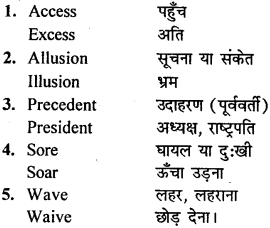
MP Board Class 12th English The Spectrum Solutions Chapter 17 The Fun They Had

MP Board Solutions for 12th Textbook General English The Spectrum Solutions Chapter 17 The Fun They Had Questions and Answers aids you to prepare all the topics in it effectively. You need not worry about the accuracy of the Madhya Pradesh Board Solutions for 12th English as they are given adhering to the latest exam pattern and syllabus guidelines.

You Can Download MP Board Class 12th English Solutions Questions and Answers Notes, Summary, Lessons: Pronunciation, Translation, Word Meanings, Textual Exercises. Enhance your subject knowledge by preparing from the Chapterwise MP Board Solutions for 12th English and clarify your doubts on the corresponding topics.

MP Board Class 12th English The Spectrum Solutions Chapter 17 The Fun They Had (Isaac Asimov)

Kick start your preparation by using our online resource MP Board Solutions for 12th English Chapter 17 The Fun They Had Questions and Answers. You can even download the Madhya Pradesh Board Class 12th English Solutions Questions and Answers for free of cost through the direct links available on our page. Clear your queries and understand the concept behind them in a simple manner. Simply tap on the concept you wish to prepare in the chapter and go through it.

The Fun They Had Exercises From The Text-Book

Word Power

विज्ञान की नई शाखाओं को उनके अर्थों से मिलाओ।
Answer:

  • Genetic engineering – the study of the artificial manipulation of the make up of living things.
  • Molecular biology – the study of the structure and function of the organic molecules associated with living organisms.
  • Cybernetics – the study of the way information is moved and controlled by the brain or by machinery.
  • Information technology – the study of the technology related to the transfer of information.
  • Geopolitics – the study of the way geographical factors help to explain the basis of the power of nation-states.
  • Nuclear engineering – the study of the way nuclear power can be made useful.
  • Cryogenics – the study of physical systems at the temperatures below 183-degree centigrade.
  • Astrophysics – the application of physical laws and theories to stars and galaxies.

Comprehension

निम्नलिखित प्रश्नों के उत्तर दीजिए-

Question 1.
What did Margie write in her diary?
मार्गी ने अपनी डायरी में क्या लिखा?
Answer:
On 17th May, 2155, Margie wrote in her diary that Tommy found a real book that day.
17 मई, 2155 को मार्गी ने अपनी डायरी में लिखा कि उस दिन टॉमी को एक असली पुस्तक मिली।

Question 2.
What was so special about the discovery?
खोज के बारे में क्या महत्वपूर्ण था?
Answer:
It was special because it was a printed book and not a tele-book. In those times the books were not printed.
वह महत्वपूर्ण थी क्योंकि वह एक टेली-पुस्तक न होकर छपी हुई पुस्तक थी। उस समय पुस्तकें छापी नहीं जाती थीं।

Question 3.
What difference between a real book and a tele-book did Tommy point out?
टॉमी ने टेली पुस्तक और छपी हुई पुस्तक में क्या मुख्य अन्तर बताया?
Answer:
Tommy pointed out that the printed book can be thrown away when it was read, but the television screen had many books and could have many more but it would not be thrown.

टॉमी ने कहा कि छपी हुई पुस्तक को पढ़ने के बाद फेंका जा सकता था जबकि टेलीविजन के परदे पर कई पुस्तकें थीं और कई और रखी जा सकती थीं किन्तु उसे फेंका नहीं जाता।

Question 4.
Why did Margie hate school, especially at that time? [2014]
मार्गी स्कूल से घृणा क्यों करती थी, वो भी उस समय पर?
Answer:
Margie hated school, specially at that time because the mechanical teacher was giving her test after test in geography and she had been going worse and worse

मार्गी को विद्यालयले घुणा थी वो भी उस समय पर क्योंकि उसका तकनीकी शिक्षक उसे भूगोल में परीक्षा ही परीक्षा दे रहा था और वह लगातार खराब कर रही थी।

Question 5.
Describe the County Inspector. [2017]
काउण्टी इंस्पैक्टर का वर्णन कीजिए।
Answer:
The County Inspector was a round little man with a red face. He had a whole box of tools with dials and wires.

काउण्टी इन्सपैक्टर छोटा और मोटा आदमी था। उसके पास औजारों का पूरा बक्सा था जिसमें डायल और तार थे।

Question 6.
What was wrong with Margie’s teacher?
मार्गी के शिक्षक में क्या खराबी थी?
Answer:
The geography sector of Margie’s mechanical teacher was geared a little too quick for an average student of ten year level.
मार्गी के तकनीकी शिक्षक का भूगोल का भाग दस साल के सामान्य बच्चे के स्तर के हिसाब से अधिक तेज चल रहा था।

Question 7.
What kind of school did the book describe?
पुस्तक में कैसे विद्यालय का वर्णन था?
Answer:
The book described the school, the kind of which we have now-a-days. A school which has a building and men and women as teachers, where students have to gather to study.

पुस्तक में उस विद्यालय का वर्णन था जैसा इन दिनों विद्यालय होता है। विद्यालय जिसमें एक भवन होता है और आदमी और औरतें शिक्षक होते हैं, जहाँ छात्रों को पढ़ने के लिए विद्यालय में इकट्ठा होना पड़ता है।

Question 8.
How was a mechanical teacher superior to a human teacher?
मानव शिक्षक से तकनीकी शिक्षक किस प्रकार अधिक होशियार है?
Answer:
A man could not be smart enough and he could not know as much as a mechanical teacher knew. All the more a mechanical teacher could be adjusted to fit the mind of every boy and girl, and it could teach each kid differently. So a mechanical teacher was superior to a human teacher.

एक मनुष्य कभी इतना बेहतर नहीं हो सकता और वह इतना कभी नहीं जान सकता जितना तकनीकी शिक्षक को ज्ञान होता था। इसी के साथ तकनीकी शिक्षक हर बच्चे के दिमाग के हिसाब से तैयार किया जा सकता था और वह हर बच्चे को अलग तरीके से पढ़ा सकता था। अतः तकनीकी शिक्षक मानव शिक्षक से बेहतर होता था।

Question 9.
Why was Margie confused when she heard that all the kids were taught the same things in the schools of the past?
मार्गी ने जब सुना कि पुराने समय के विद्यालयों में सभी बच्चों को एक ही चीज पढ़ाई जाती थी तो वह भ्रमित क्यों हो गई?
Answer:
Margie was living in the year 2155. She had a tele-school at. home with tele-books. She was taught by a mechanical teacher separately at home. She could not imagine about a school of these days where all the kids are taught the same thing in the same building, which is called school.

मार्गी सन् 2155 में रह रही थी। उसका टेली-स्कूल उसके घर पर ही था जिसमें टेली-पुस्तकें थीं। उसे उसका तकनीकी शिक्षक घर पर अकेले पढ़ाता था। वह आज के विद्यालय के बारे में कल्पना नहीं कर पा रही थी जहाँ सभी बच्चों को एक ही चीज एक ही भवन में पढ़ाई जाती है, जिसे विद्यालय कहते हैं।

Question 10.
In what ways would the schools of future differ from those of today?
भविष्य के विद्यालय आज के विद्यालयों से किस प्रकार भिन्न होंगे?
Answer:
The schools of future would not have any separate building. It would be available for each kid in his house. There would not be any books and human teachers in the schools of future. Tele-books and mechanical teacher would take their place.

भविष्य के विद्यालयों का कोई अलग से भवन नहीं होगा। वह हर बच्चे के लिए उसके घर में ही उपलब्ध होगा। भविष्य के विद्यालयों में कोई पुस्तक या मानव शिक्षक नहीं होगा। टेली-पुस्तकें और तकनीकी शिक्षक उनका स्थान ले लेंगे।

Question 11.
Justify the title, “The fun they had’. [2009, 15]
शीर्षक का औचित्य बताओ।
Answer:
The title, “The fun they had’ is appropriate for the story because the children described here were living in the years 2155. When they read in a book that all the children of neighbourhood went to same school and studied there in the same building together in the past, they were thrilled. They did not have the advantage of gathering at one place for study or play together. They could only imagine the fun, the students of today have in school.

कहानी का शीर्षक ‘The fun they had’ बिल्कुल सटीक है क्योंकि यहाँ वर्णित बच्चे सन् 2155 में रह रहे थे। जब उन्होंने एक पुस्तक में पढ़ा कि पहले के समय में पड़ोस के सभी बच्चे एक ही विद्यालय में एक ही भवन में एक साथ पढ़ने जाते थे, वे उत्साहित हो गए। उन्हें एक साथ एक जगह पढ़ने या खेलने की सुविधा नहीं थी। वे केवल आज छात्रों के द्वारा विद्यालय में होने वाले मनोरंजन की कल्पना कर सकते थे।

Language Practice

दिये गये वाक्यों को non-finite clause से जोड़ो :
Answer:
(i) Refusing it I apologized to her.
(iii) She hopes to join college next year.
(ii) Ringing them up now would look rude.
(iv) Shahbaz is sure of getting through the examination.
(v) She can’t afford buying a scooter.
Participles का उपयोग करते हुए वाक्यों को जोड़ो :
Answer:
(1) Working hard he felt tired.
(ii) Turning to the right she saw the mosque.
(ii) Firing [a bullet] the policeman wounded one of the terrorists.
(iv) Raising the trapdoor she pointed to a flight of steps.
(v) Rushing under a nearest tree the crowd laughed and shrieked.

The Fun They Had Summary

– Isaac Asimov

जीवन दो सौ वर्षों बाद कैसा होगा, यही इस कहानी में कल्पना की गई है। 2155 में मार्गी नामक लड़की और टॉमी नामक लड़के को एक छपी हुई किताब मिल जाती है। वे उसे देखकर आश्चर्यचकित रह जाते हैं क्योंकि अब वे सारी पुस्तकें कम्प्यूटर पर ही पढ़ते हैं, जिन्हें टेली बुक कहते हैं। टॉमी स्कूल के बारे में पुस्तक पढ़ रहा है, मार्गी स्कूल से घृणा के रूप में अपने विचार रखती है। वह भूगोल के तकनीकी शिक्षक से घृणा करती है क्योंकि वह अधिक परीक्षा लेता था जब तक कि उसके पेंच दस साल के बच्चे के लिए ठीक नहीं कराए गए। अत: वह आश्चर्य करती है कि कोई स्कूल के बारे में क्यों लिखेगा। टॉमी ने उसे बताया कि शताब्दियों पहले दूसरी तरह के विद्यालय होते थे, जिसमें मनुष्य शिक्षक होते थे वही पढ़ाते थे और प्रश्न पूछते थे। मार्गी बहस करती है कि कोई मनुष्य शिक्षक, टेली शिक्षक जितना जानकार नहीं हो सकता और वह बच्चों के साथ घर में नहीं रह सकता। तब टॉमी बताता है कि पहले एक अलग भवन विद्यालय कहलाता था और सभी छात्र और शिक्षक विद्याभ्यास के लिए वहीं इकट्ठा होते थे। हमउम्र सभी बच्चे एक ही ज्ञान प्राप्त करते थे। वे दोनों आधी ही पुस्तक [स्कूल के बारे में] पढ़ पाए थे कि मार्गी की माँ ने उसे स्कूल के लिए आवाज दे दी।

मार्गी अपने स्कूल के कमरे में गई। उसका तकनीकी शिक्षक चालू था और उसका इन्तजार कर रहा था। वे उस दिन गणित के ‘भिन्न’ पढ़ने वाले थे और उसने मार्गी से अपना गृहकार्य उसमें डालने के लिए कहा। ऐसा करते हुए मार्गी अपने दादाजी के समय के विद्यालय के बारे में सोच रही थी जब आस-पड़ोस के सभी बच्चे हँसते खिल-खिलाते एक ही भवन में शिक्षा ग्रहण करने आते थे।

तकनीकी शिक्षक परदे पर दिखा रहा था कि कैस ! और 1 को जोड़ेंगे। मार्गी पुराने बच्चों के बारे में सोच रही थी कि वे कैसे अपने विद्यालय से प्रेम करते होंगे और कितनी मस्ती करते होंगे।

We believe the information shared regarding MP Board Solutions for 12th English Chapter 17 The Fun They Had Questions and Answers as far as our knowledge is concerned is true and reliable. In case of any queries or suggestions do leave us your feedback and our team will guide you at the soonest possibility. Bookmark our site to avail latest updates on several state board Solutions at your fingertips.
MP Board Class 12th English The Spectrum Workbook Solutions Chapter 2 A Friend Who Came From The Sky

MP Board Solutions for 12th English The Spectrum Workbook Solutions Chapter 2 A Friend Who Came From The Sky Questions and Answers aids you to prepare all the topics in it effectively. You need not worry about the accuracy of the Madhya Pradesh Board Solutions for 12th English as they are given adhering to the latest exam pattern and syllabus guidelines.

You Can Download MP Board Class 12th English Solutions Questions and Answers Notes, Summary, Lessons: Pronunciation, Translation, Word Meanings, Textual Exercises. Enhance your subject knowledge by preparing from the Chapterwise MP Board Solutions for 12th English and clarify your doubts on the corresponding topics.

MP Board Class 12th English The Spectrum Workbook Solutions Chapter 2 A Friend Who Came From The Sky

Kick start your preparation by using our online resource MP Board Solutions for 12th English Chapter 2 A Friend Who Came From The Sky Questions and Answers. You can even download the Madhya Pradesh Board Class 12th English Solutions Questions and Answers for free of cost through the direct links available on our page. Clear your queries and understand the concept behind them in a simple manner. Simply tap on the concept you wish to prepare in the chapter and go through it.

Word Power

A. What other things do you think could be described by each verb besides those given here. Use a dictionary if necessary.
Answer:

fluttera flagthe wings
swaya treeflags
crawltraffica child
shoota cara film
drifta clouda boat

B. Match the birds with their related motions
Answer:
1. bird – (a) flits
2. cock – (b) waddles.
3. crow; owl; sparrow -(c) swoops
4. duck – (d) flies
S. eagle – (e) struts
Answer:
1. – (d), 2. – (e), 3. – (a), 4. – (b), 5. – (c).

C. Match the following adjectives for animals come from the Latin words.
1. leo – (a) fish
2. canis – (b) wolf
3. feus – (C) pig
4. porcus – (d) fox
5. vulpus – (e) horse
6. ursus – (f) dog
7. lupus – (g) lion
8. equus – (h) bear
9. piscis – (j) cat
Answer:
1. – (g), 2. -. (f), 3. – (j), 4. – (c), 5. – (d), 6. – (h), 7. – (b), 8. – (e), 9. – (a).

Comprehension

A. Choose the correct alternative.

Question 1.
Mini’s mother asked her to go inside because …………..
(i) the weather was windy
(ii) it was likely to start raining
(iii) she didn’t want her to get wet
(iv) she didn’t want her to watch the children playing.
Answer:
(i) the weather was windy

Question 2.
A person who has no control over his hands and legs from birth is called …………..
(i) a paralytic
(ii) a disabled
(iii) an insane
(iv) a spastic.
Answer:
(iv) a spastic.

Question 3.
Mini’s favorite pastime was …………..
(i) to watch the children in the park
(ii) to watch the children at their play
(iii) to make fun with her friends
(iv) to enjoy her own solitude.
Answer:
(ii) to watch the children at their play

Question 4.
………….. fed the duck with an ink-filler.
(i) Mini herself
(ii) Mini’s mother
(iii) Mini’s father
(iv) Mini’s friends.
Answer:
(ii) Mini’s mother

Question 5.
…………..has been described as the avian friend.
(i) Anju
(ii) Mini
(iii) The duck
(iv) Priya.
Answer:
(iii) The duck

Say whether the following statements are true or false by putting (✓) or (✗) in the boxes.

  1. Mini could not walk, or button up her shirt but she could brush her teeth herself. [✓]
  2. The children stopped their game because it started to rain heavily [✗]
  3. Mini was expecting Mitra to wake her up at night. [✓]
  4. The children were excited to see the duck being fed with an ink-filler. [✗]
  5. Mitra, the duck, flew by himself and departed. [✗]

Language Practice

A. Fill in the blanks with suitable determiners.

1. How………. milk do you buy daily ?
2. I have already spent ……… few rupees I had.
3. ………. book you want is not with me.
4. Have you ………. complaint against me.
5. more one has ………. more one wants.
6. ………. brother is very intelligent.
7. ………. grapes are sweet and juicy.
8. Are there girls in ………. class ?
9. Would you like to have ………. pen or pencil ?
10. The rays of the Sun fall on ………. flowers.
Answer:

  1. much
  2. the
  3. The
  4. any
  5. The, the
  6. My
  7. The
  8. any, the
  9. a
  10. the.

B. Complete the following sentences with suitable determiners choosing proper words/phrases given in the box.

Several days, every Sunday, that book, anything, for a week, some money, who speaks few words
1. Will you stay here ?
2. I don’t think that there is
3. I gave her
4. He gave me
5. He comes to my house
6. Happy is the man
7. The solution of this problem will take
Answer:

  1. for a week
  2. anything
  3. some money
  4. that book
  5. every Sunday
  6. who speaks few words
  7. several days.

C. Look at the sentences given below in a disorder form. Rearrange them to make meaningful sentences.

Question 1.
her/pen/put/ink/some/she/in.
Answer:
She put some ink in her pen.

Question 2.
you/say/in/what/no truth/is/there.
Answer:
There is no truth in what you say.

Question 3.
social work/for/time/spare/ some/you can’t.
Answer:
You can’t spare sometime for social work.

Question 4.
you/have/money/any/left/box/in/your ?
Answer:
Have you any money left in your box ?

Question 5.
little/there is/success/hope/of/his.
Answer:
There is little hope of his success.

Question 6.
work/much/yet/to be/done/is.
Answer:
Much work is to be done yet.

Question 7.
the whistle/blows/there/any/danger/is/if.
Answer:
If there is any danger the whistle blows.

Question 8.
five/of land/acres/no less than/he has.
Answer:
He has no less than five acres of land.

Question 9.
from/the/shop/he/buy/didn’t/anything.
Answer:
He didn’t buy anything from the shop.

Question 10.
he/hardly/any/money/has.
Answer:
He has hardly any money.

Speaking Time

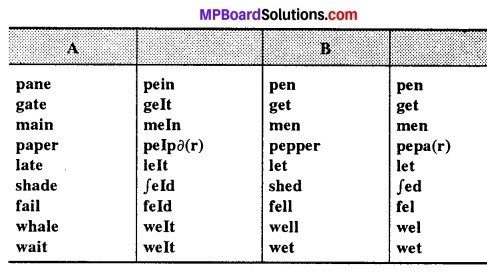
Listen to your teacher and decide whether the words you hear come from list A or list B. After deciding the appropriate sound transcribe it in the blank space.
MP Board Class 12th English The Spectrum Workbook Solutions Chapter 2 A Friend Who Came From The Sky img 1

Reading Time

Read the following passage carefully :

The world’s highest waterfall is situated in Eastern Venezuela in South America. It is known as the Angel Falls. It has been named after Jimmy Angel, an aviator, who discovered it in 1935 while on a flying mission. One has to travel by air past mist-covered cliffs and tall canyons, to get a glimpse of the falls that hurtle down from the sides of Auyan Tepui. (The flat-topped, sheer-sided cliffs, rising above the deep forests of Venezuela, are called Tepui.)

Many millennia of erosion has dug out huge crevices and fissures on Auyan Tepui’s flat top, which trap the heavy tropical rainfall. This water flows under the surface of the Tepui and bursts through the fissures in the cliff’s ancient sandstone, approximately 200 feet below the rim of the Auyan Tepui. It falls into a large pool called the Angel Canyon at the cliff’s foot, which drains into the Churun River, a tributary of the Caroni River.

At the bottom, the fall disperses into fine mist, giving a feather touch to the rocks of the bottom.
It hurtles down from a height of960 m, which is sixteen times than the height of the famous Niagara Falls and provides a truly breathtaking view.

Now answer the questions given below :

Question 1.
Match the words in column A with their meanings in column B.

‘A’ – ‘B’

1. cliff – (a) a stream or river that flows into a larger river.
2. canyon – (b) a high area of land with a very steep side.
3. crevice – (c) a narrow valley with very steep sides.
4. fissure – (d) a narrow crack or gap in rock or between large stones.
5. tributary – (e) a deep crack in r k or in the ground.
Answer:
(1) – (b), 2. – (e), 3. – (d), 4. – (e), 5. – (a).

Question 2.
Which is the world’s highest waterfall and where is it ? (2009)
Answer:
The world’s highest waterfall is Angel Falls. It is situated in Eastern Venezuela in South America.

Question 3.
How can one reach there to have a look at this great waterfall ?
Answer:
To reach at the Angel Falls one has to travel by air.

Question 4.
What has caused the huge crevices and fissures on Auyan Tepui’s flat top ?
Answer:
Many millennia of erosion has caused the huge crevices and fissures on Auyan Tepui’s flat top.

Question 5.
What is ‘the Angel Canyon’ ? And what is the ‘Churun River’ ? (2009)
Answer:
The Angel Canyon is a large pool at the cliff’s foot. Churun River is a tributary of the Caroni River.

Question 6.
What gives a feather touch to the rocks at the bottom ?
Answer:
At the bottom, the fall disperses into a fine mist giving feather touch to the rocks.

Question 7.
How is this waterfall compared to ‘Niagara Falls’ ?
Answer:
It hurtles down from a height of 960 m which is 16 times more than the height of Niagara falls.

Question 8.
What do you understand by a truly breathtaking view ? Explain.
Answer:
‘A truly breathe taking view’ means that we feel a great wonder to see the view.

Question 9.
Give a suitable title to the passage.
Answer:
The World’s Highest Waterfall.

Writing Time

Question 1.
Read the following passage carefully and make notes using Topicalising technique. Use standard and recognizable abbreviations where possible. Give the passage a suitable title also.

Environmental Protection

It was a rare occasion for ten students of this school’to participate in the National Exhibition on ‘Environmental Protection’ held at IIT, Powai, Mumbai. About two hundred students from various parts of India took part in it. Many voluntary organizations and distinguished environmentalists also participated in it. The Hon’ble Chief Minister of Maharashtra inaugurated the exhibition. The leading themes of the exhibition were the protection of our forest wealth; keeping our rivers and lakes pollution free; the hazards of air and sound pollution.

The biggest draw of the exhibition was the section on the Himalayas. The exhibition evoked a spontaneous response among the local people, especially, the students. Such exhibitions are necessary to educate the people regarding environmental pollution. Large-Scale deforestation, haphazard urbanization and industrialization, have converted green belts into jungles of concrete. Environment pollution, smoke and dirt have turned cities like Delhi into gas-chambers.

The people can learn the value of growing more trees and the dangers of deforestation. Our rivers, lakes and streams have become the damping pools of the industrial waste. Green belts are disappearing fast. Unplanned urbanization has brought only degradation of the environment. It is certain that the National Exhibition will go a long way in educating the people and highlighting the need for preserving our environment to them.
Answer:
National Exhibition on ‘Environmental Protection, held at IT, Powai, Mumbai, about 200 students from India took part, inaugurated by Hon’ble CM of Maharashtra, leading themes protection of forests, keeping rivers & lakes polln. free, hzrds. of air & sound polln; evoked spntneous response.

Such exhbtns. necessary, deforstn., urbnztn. & indstrlztn. have dstryd. green belts; people to learn value of trees & dangers of deforstn.; green belts disapprng. fast; unplnnd. urbnztn. has brght. degrdtn. of environment. Ntnl.Exhbtn. will educate people.

Title—Protest against Environmental Pollution

Question 2.
Read the following passage carefully and make notes using Schematizing technique. Use standard and recognizable . abbreviations where possible. Give the passage a suitable title also.

Coal Deposits of India

Coal is a natural resource, which constitutes approximately 85 per cent of the total fossil fuel reserves in the world. The coal deposits of India occur in two distinct stratigraphic horizons Gondwana and its territories. Gondwana coal contributes about 99% of the country’s coal resources. These mines are located in peninsular India, in the South Eastern quadrant, bound by the 78° E longitude and the 24° N latitude, thus, leaving a major part of the country devoid of any coal deposits. The major Gondwana coalfields are represented
MP Board Class 12th English The Spectrum Workbook Solutions Chapter 2 A Friend Who Came From The Sky img 2
by isolated basins, which occur along prominent present day rivers such as Dantodar, Koel, Sone, Mahanadi, Pench and Godavari. The relatively minor resource of tertiary coal is located on the either extremities of peninsular India. Coal can be broadly classified in two categories coking and non-coking. Coking coal are that which has cracking property and which is used in metallurgical industries. Again depending on the quality of coke produced by this coal, it is sub-divided into prime coking coal, medium coking coal and semi-coking coal. Similarly, non-coking coal is also categorised in seven grades (Grade A to G), depending on its caloric value.

We believe the information shared regarding MP Board Solutions for 12th English Chapter 2 A Friend Who Came From The Sky Questions and Answers as far as our knowledge is concerned is true and reliable. In case of any queries or suggestions do leave us your feedback and our team will guide you at the soonest possibility. Bookmark our site to avail latest updates on several state board Solutions at your fingertips.
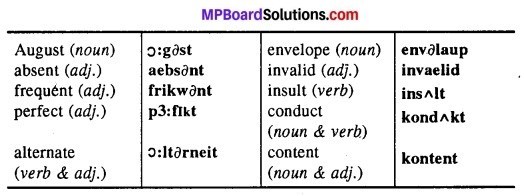
MP Board Class 12th Special English Model Question Paper

MP Board Solutions for 12th Special English Model Question Paper Questions and Answers aids you to prepare all the topics in it effectively. You need not worry about the accuracy of the Madhya Pradesh Board Solutions for 12th Special English as they are given adhering to the latest exam pattern and syllabus guidelines.

You Can Download MP Board Class 12th English Solutions Questions and Answers Notes, Summary, Lessons: Pronunciation, Translation, Word Meanings, Textual Exercises. Enhance your subject knowledge by preparing from the Chapterwise MP Board Solutions for 12th Special English and clarify your doubts on the corresponding topics.

MP Board Class 12th Special English Model Question Paper

Kick start your preparation by using our online resource MP Board Solutions for 12th Special English Model Question Paper Questions and Answers. You can even download the Madhya Pradesh Board Class 12th Special English Solutions Questions and Answers for free of cost through the direct links available on our page. Clear your queries and understand the concept behind them in a simple manner. Simply tap on the concept you wish to prepare in the chapter and go through it.

Time : 3 Hours
Maximum Marks : 100

Instructions:

  1. Attempt all the questions.
  2. Read the questions carefully and do accordingly.
  3. Marks allotted to each question are indicated against it.

Unit 1

1. Read the passage carefully and answer the questions given below it:
Human beings are made up mostly of water, in roughly the same percentage as water is to the surface of the earth. Our tissues and membranes, our brains and hearts, our sweat and tears-all reflect the same recipe for life, in which efficient use is made of those ingredients available on the surface of the earth. We are 23 percent carbon, 2.6 percent nitrogen, 1.4 percent calcium, 1.1 percent phosphorus, with tiny amounts of roughly three dozen other elements. But above all we have oxygen (61 percent) and hydrogen (10 percent), fused together in the unique molecular combination known as water, which makes up 71 percent of the human body.

Questions:
(i) What are the contents of a human body? [2]
(ii) The word ‘efficient’ means: [1]
(a) Capable (b) difficult (c) noteworthy (d) Easy.
(iii) Give opposite word for ‘roughly’. [1]
(iv) Give noun form of the word ‘reflected’. [1]
Answers:
(i) The contents of human body are water, carbon, oxygen, nitrogen, calcium, phosphorous, hydrogen and some other elements.
(ii) (a) Capable.
(iii) exactly.
(iv) reflection.

2. Read the following extract carefully and answer the questions given below it.
An intellectual hatred is the worst,
So let her think opinions are accursed
Have I not seen the loveliest woman born
Out of the mouth of Plenty’s horn
Because of another opinionated mind
Barter other horn and every good
By quiet.natures.understood
For an old bellows full of angry wind.

Questions:
(i) What is the worst kind in poet’s eyes? [1]
(a) angry wind (b) quiet nature (c) opinions (d) intellectual hatred.
(ii) ‘Opinionated’ means [1]
(iii) Make noun from the word intellectual. [1]
(iv) What are the evil effects of ‘Horn of plenty’? [2]
Answers:
(i) (d) intellectual hatred.
(ii) ‘Opinionated means-having very strong opinions that you are not willing to change.’
(iii) Intellect.
(iv) It gives birth to hatred to mankind as it gives abundance so who do not have it becomes jealous of others.

3. Answer any six of the following questions in about 30 words each. [6×2 = 12]

(i) How did Madam Forestier react when Mathilde returned the necklace?
Answer:
When Mathilde returned the necklace Madame Forestier reacted that she (Mathilde) should have returned it sooner. She (Forestier) might have needed it.

(ii) What threat do rising sea levels pose to human population?
Answer:
Rising sea levels will lead to loss of low-lying coastal areas around the world which will further give rise in number of refugees as one-third of population live within sixty kilometers of coastline.

(iii) Why should the youth form the vanguard in all activities?
Answer:
Theyouths should form the vanguara in all activities for they have the capacity to resist aggression and at this critical juncture its power must be mobilized.

(iv) What does Albert mean by civilized human beings?

(v) What was Netaji’s proposal during the annual session of the Indian National Congress?
Answer:
Netaji proposed that the congress should at once send an ultimatum to the British government demanding independence within six months or prepare immediately for a national struggle.

(vi) Why has Surat been mentioned in the poem ‘Goodbye Party for Miss Pushpa T.S.’
Answer:
Surat has been mentioned in the poem because the poet is confused about the place Pushpa’s father belonged to and also the poet remembers his stay at Surat once.

(vii) What helps the poet balancing his weight on the ladder round?
Answer:
The instep arch helps the poet in balancing his weight on the ladder-round.

4. Answer any two of the following questions in about 75-100 words. [2 x 4 = 8]

(i) How has the Casuarina tree been personified in the poem?
Answer:
‘Our Casuarina Tree’ is a poem written to express the feeling of the poetess. It is not merely the description of a tree but it is a tribute to the tree. The poetess presonifies the tree. She bestoWs alihuman feelings to the tree. The generous attitude of the tree is great. The tree comforts all. It also shares the joys and sorrows of the human beings. The poetess feels the tree shedding tears and lamenting at the death of her brother and sister. The tree is also destined to die like human being. Thus, it has been personified. It is not unaffected from human curses as well.

(ii) Analyse the poem ‘On this Being Arrived at the age of Twenty Three’ as a Petrachan Sonnet.
Answer:
Sonnet is a short poem of fourteen lines expressing a single thought or emotion at a time. It owes its popularisation to the 14th century Italian poet Francsco Petrarch who used this poetic form to express his love for his idealised lady love, Laura. John Milton uses the original Italian (Petrarchan) form to express his devotion to God or sublime feelings. hi this form, the poem is divided into two parts—the octave (a stanza of eight lines) and the sestet (a stanza of six lines). The first part makes a statement or puts up a question while the second part illustrates or serves the answer to it. On Being Arrived at the Age of Twenty-three is a devotional sonnet in Petrarchan form. It is a striking example of the Renaissance ethos and Reformation zeal. It is an assertion of faith and a wish to be guided by the divine will.

(iii) Justify the statement that ‘Dream Children: A Reverie’ is a lyric in prose.
Answer:
Dream Children: A Reverie is an outburst of a flow of imagination of Charles Lamb. Lamb was said to be the Prince of English essayists. He wrote this essay when he was nearing his fifties. As his life was not at all happy and comfortable, he towards the end of his life, has expressed his dreams which couldn’t be fulfilled during his lifetime. He had suffered a lot in his life. He himself was lame. His elder brother whom he loved so much died in great pain. He missed him because he usually carried him on his back when he could not walk. In his youth, Lamb had a disappointing love-affair with a girl who afterwards married another man. He was a bachelor. He lived in utter loneliness. Though he wanted a family and children but they were denied to him in his actual life. In this essay he is dreaming for having two children, on both of his sides behaving like real children. Although the story has created a moving life situation which has all the elements of a lyric. This is a flow which makes one completely engrossed with the story

Unit 2: Grammar

5. Do as directed (any Five). [5 x 1 = 5]
(i) Rewrite the following sentence by using ‘it’: To see you is a real pleasure.
Answer:
It is a real pleasure to see you.

(ii) People expect better results this time. (Change the voice)
Answer:
Better results are expected this time.

(iii) Ronak does his work properly. (Make a negative sentence)
Answer:
Ronak does not do his work properly.

(iv) The teacher said, “Man is Moral”. (Change the narration)
Answer:
The teacher told that man is moral.

(v) The toys are very expensive. We can’t afford to buy them. (use ‘so that’ and rewrite the sentence)
Answer:
The toys are so expensive that we can’t afford.to buy them.

(vi) Use the proper determiner (Are there letters for me.) (some/any/much)
Answer:
Any.

(vii) The book is lost that you gave me yesterday.(Combine the sentence to make a complex sentence)
Answer:
The book you gave me yesterday is lost.

6. Do as directed. [5 x 1 = 5]
(i) Give syllable division of the word ‘department’.
(ii) How many syllables does the word ‘examination’ have?
(iii) Head, bend, cattle, men. (Pick out the odd one)
(iv) Write down the word which has (VC syllable)
(v) Mother Teresa won many international (award/awards)
Answer:
(i) department,
(ii) 4 syllables,
(iii) bend,
(iv) pen,
(v) awards.

Unit 3: Fiction

7. Answer any one of the following questions (120 words) [5]
(i) Describe how Swaminathan passed Monday in his school.
Answer:
Swami is a student of the First Form (Section A). It is Monday morning and Swami hates Mondays, for it means activity, discipline and work, after his enjoyment on Saturday and Sunday. As Swami sits on the table in his ‘room’—which is merely a table in the dressing- room of his father—he finds that he has a lot of home work to do, and only two hours for doing it. He feels bored and tired, and is in no mood for work.

He reaches the class on time and we are introduced to the fire-eyed teacher Vedanayagantie class-teacher and also arithmetic teacher. Swami does not like hini and we get a taste of Narayan’s verbal humour when we are told that Swami’s “çriticism of the teacher’s face was that his eyes were too near each other, that there was more hair on his chin than one saw from the bench, and that he was very very bad-looking.” All the sums done by Swami are wrong, they are crossed out, the remark ‘very bad’ is given, he is very severely pinched over his left ear, and told to go back to his seat.

Then comes the History period, and the teacher is Dr Pillai. His method of teaching is interesting, but it does not conform to any known principles of education. It is followed by the scripture period and the teacher, Ebenczar, is a fanatic Christian. He constantly criticises and abuses 1-lindu Gods who, for him, are merely pieces of stone.

(ii) Imagine yourself as Swaminathan and narrate the following incident: Encounter between Mani and Rajam near Nallapp’s grove.
Answer:
Mani was my best friend. He had a good personality. He never cared for study. He never brought any book to the class and never bothered about homework. He always bullied all strangers who came his way, be they big or small but, one day, a new entrant, Rajam, came as ¿i challenge for him. Rajam was the son of the Superintendent of Police. He was well-mannered, well-dressed and also a brilliant student. He became a rival to Mani. Mani challenged him and invited him at Nallappa’s grove on the river side to decide who was superior. They reached there—Mani with his club and Rajam with his airgun. Mani was thinking, now he woutd teach Rajam a lesson. He would break his neck and kill him. Then Rajam came and each of them blamed each other. Mani said that Rajam shouldn’t have brought gun and Rajam said that Mani shouldn’t have brought his club. However, after a long discussion, they withdrew. Raam and Mani became friends. Rajam offered chocolate. I was happy for I had managed for all these.

8. Answer ‘any five’ of the following questions in 30 words. [5 x 2 = 10]
(i) What were the similarities between Swaminathan and Samuel, the Pea?
Answer:
(Md’. Board 2009)
Swami’s another bosom friend was Samuel, the Pea. He was called the Pea as he was very small in size. There is nothing uncommon about him, for he is neither a good student nor physically remarkable. The only similarity between them was laughter. They were ab1eo see together the same absurdities and incongruities in things. The most trivial and unnoticeable things to others would tickle them to death.

(ii) What did Mani decide to do with Rajam?
Answer:
Mani didn’t like Rajam. Rajam made a good impact in class and also in school. Mani grew jealous of him. So, Mani wanted to bundle him into the river or to crack his shoulders with his club. Mani wanted to have a duel with Rajam. He was raging in anger and wanted to break his bones.

(iii) Describe Swaminathan’s state of mind when Sankar, Somu and others stopped talking to him.
Answer:
Swami was feeling restless when Sankar, Somu, and others stopped talking to him. He was feeling lonely His friends were also hostile to him. It was very painful for poor Swami but he could not help it. He wanted to talk to them and crack jokes but he was helpless. He was feeling uncomfortable.

(iv) What did the Headmaster ask the students to do during the vacation?
Answer:

The headmastét came and announced the closure of school for the vacation. He also hoped that the boys would not waste their time but read story-books and keep glancing through the books prescribed for their next classes to which it was hoped they would be promoted.

(v) Why was Swaminathan cold and reserve to his mother when he was taken to her room?
Answer:
Swammatban’s mother was in labour pain. She had been in bed for two days. Swami didn’t see her in kitchen. He felt uncomfortable in her absence. When he was taken to her room, he found her lying weak and pale on the bed. She called him closer to her. As Swami was not so mature, he couldn’t understand what was going on. He was cold and reserved when he came in the room.

(vi) How did Mani contemplate taking revenge on Somu, Sankar and the Pea?
Answer:
Mani contemplated taking revenge on Somu, Sankar and the Pea by breaking Somu’s waist, then he will get Pea under his heel and press him to earth and finally he will hang Sankar by his neck over Sarayu from Peepul branch.

Unit 4: Drama

9. Answer any one of the following questions in (120 words) [5]

(i) Give an account of the way the Silver Box was recovered from the residence of Jones.
Answer:
When Mrs Jones detects the stolen purse, she thinks to return it to he; employet So, when Jones is out she shakes out his coat. The silver box falls down from the coat pocket. She looks hard at it but Jones snatches it from her hands with a promise that he would throw it away into the river along with the purse. On the other hand, when Barthwick finds the box missing, he asks Snow, a detective, to search it. Snow, out of doubt, comes to Jones house just at the time when Jones is trying to take the box from his wife who takes it to go to return it to Borthwick. Snow detects the letters J.B. carried on it and is sure it was the stolen one from Barthwick’s house.

(ii) What shortcomings of the British Judicial System emerge out of the play ‘The Silver Box’.
Answer:
The Silver Box may be regarded as a problematic play. It is a social tragedy. The victims are poor Jones, his wife and children. The victimizer in the case is not so much the wealthy liberal, Mr. Barthwick as law itself. Galsworthy indicts the established institution of law courts which is held in the highest ešteem for its fairness. The ground reality is that the scales of justice are tilted in favour of men of position and wealth. The principle of equality before law is a paper tiger, a legal fiction. Jack and Jones are equally wicked. Both are eqùally guilty of misconduct, moral degradation and stealing but the law treats them differently. Jack is able to get the support and protection provided by his father, the advocate, and the constable. His offence of stealing is ignored and the Magistrate acquits hjm. However poor Jones who pleads his case himself, is silenced and sent to prison. The clear message conveyed by the play is that Justice is not blind, she is just ashamed to watch.

10. Attempt any five of the following questions [30 words each] [5×2 = 10]

(i) What would the members of the. Labour Party do, according to Mr. Barthwick, once they came to power?
Answer:
Acording to tr Barthwick, the Members of the Labour Party would deprive the upper classes of their rights and property once they came to power.

(ii) What makes the unknown lady meet young Jack so early in the morning?
Answer:
She met young Jack so early in the morning because her crimson silk purse had been stolen and she had seen Jack Barthwick stealing it.

(iii) What excuse did Jones provide for picking up the Silver Box?
Answer:
He said that he was not a thief. Whatever he did was because of his drunken state.

(iv) What questions did Jones ask Jack when the case was in progress before the magistrate?
Answer:
jons asked Jack, “Don’t yoù remèmber you said you were a Liberal, same as your father, and you asked mc what I was?”

(v) why does Jones give a blow to snow?
Answer:
Because Jones knows that he was innocent.

(vi) Describe in your own words the room in which the Jones lived.
Answer:
The room in which the Jones lived was a base one with tattered oilcloth and damp, distempered walls. It has an air of tidy wretchedness.

Unit 5: Reading Unseen
11. Read the following passage carefully and answer the questions that follow. [4 + 6 = 10]
Twin top rankings reflect rise of Women in Indian Sports: Saina Nehwal After reclaiming the top spot in badminton Singles rankings, Saina Nehwal is doubly delighted at fellow Hyderabadi tennis ace Sania Mirza’s rise to the summit of the Womens’ Doubles rankings and says the twin achievements reflect the rise of women power in the domain of Indian sports.

“Sania Mirza is a big name in the world of tennis, she is the number one in her game. I wish her all the best in her future endeavors” Saina said on Sunday.

“Women in sports have come up in a big way in recent past and I congratulate all of them, including Mary Kom, Krishna Poonia, Geeta Phogat, Babita Kumari, Heena Sidhu and Sania Mirza,” she said.

“It is good that women power is visible in sports,” she said, crediting the central government’s sports policies for the success stories. Sania was elevated to the No. 1 spot in the Women’s Doubles rankings, according to the latest Women’s Tennis Association (WTA) list released on April 13.
Saina became the first Indian women to be crowned World No.l on March 29 after her Indian Open Grand Prix triumph. But she dropped to the second place, overtaken by China’s Li Xuerui, following her semi-finals exit in the Malaysia Open Super series. But she regained the top slot after Li pulled out of Singapore Open Super Series.

Sania, on the other hand, leap frogged to the top spot after winning her third consecutive Women’s Tennis Association (WTA) title-The Family Circle Cup-with new partner Martina Hingis.

“I am proud to be World No. 1 in badminton. It is really tough to reach the pinnacle in badminton… it took me five years to realise my dream as I became World No. 2 in 2010”, The right-handed shuttler said.

The 25-year-old Saina is the only non-Chinese to get tire top billing since 2010 when Denmark’s Tine Raun ruled the rankings. The 2012 Olympic Games bronze medalist dedicated her recent feat to her parents, coaches and well-wishers.

When asked what makes a Chinese player so tough to beat, she said: “May be these players are trained on best infrastructure they have created for each sport and the availability of best coaches compared to India and other countries where hardly a few best coaches are available.”

“The number of players (in China) is also very high compared to us where there is a shortage of players.”

“Luckily I started my career on best infrastructure created in India at Gopi’s (Pullela Gopichand) Academy at Hyderabad in 2004 and continued till 2014 during which I won national Championships, Junior World Cup and some of Super Series and Gold Grand Prix Tournaments,” she added.

Saina has clinched gold in the 2010 Commonwealth Games and bronze in the 2006 edition, besides picking up a bronze at the Incheon Asian Games last year.

In 2014, she became the first Indian woman to win the China Open Super Series Premier beating Japan’s Akane Yamaguchi in the final.
In another first for Indian women shuttlers, Saina reached the All England open Badminton final last month, but lost to Spain’s Carolina Marin recently.

In 2014, Saina shifted to Prakash Padukone s academy in Bangalore. Since then she has been under the tutelage of Vimal Kumar. Former men’s No. 1 player Padukone also gave her valuable tips.

Saina credited ex-coach Gopichand and incumbent Vimal Kumar for her success. “Both of them are the best of badminton coaches in India. With Gopi sir, I won a number of tournaments and now with Vimal sir my progress is visible in the last seven months,” she said.

With expectations climbing high with each day, Saina said her ultimate aim is the Olympics games.

“I, as a badminton player, will give my 100 percent for my sport. I have to show better results in the World Cup. Many Super Series are lined up” the star said.

Questions:
(i) Delighted mean. [1]
Answer:
Very happy.

(ii) Elevated means [1]
Answer:
High in rank.

(iii) Give a word similar in meaning to ‘triumph’. [1]
Answer:
Victory.

(iv) Clinched means (in a word). [1]
Answer:
Succeeded.

(v) Explain: she is the number one in her game. [2]
Answer:
Sania Mirza is number one in her game i.e. tennis.

(vi) What did Saina tell when asked what makes a Chinese player so tough to beat? [2]
Answer:
She said that there is a possibility that Chinese players were trained on best infrastructure they had created for each sport and the availability of best coaches compared to India and other countries where hardly a few best coaches were available.

(vii) Name the women sports persons whom Saina congratulated. [2]
Answer:
Name of the women sports persons whom Saina congratulated are-Mary Kom, Krishna Poonia, Geeta Phogat, Babita Kumari, Heena Sidhu and Sania Mirza. Read the following poem carefully and answer the questions that follow. [5]

12. Read the following poem carefully and answer the questions that tollow.
Happiness is like a crystal,
Fari and exquisite and clean,
Broken in a million pieces,
Shattered, scattered far and near.
Nov and then along life’s pathway.
Like, some showing fragments fall;
But these are so many pieces
No one ever finds them all

Questions :
(i) The poet compares happiness with. [1]
Answer:
Crystal.

(ii) No one ever finds them all meAnswer: [1]
Answer:
It means ‘no one gets complete happiness’.

(iii) Give opposite word for ‘exquisite’? [1]
Answer:
Ugly.

(iv) What dees the poet want to say here? [2]
Answer:
The poet here wants to say that happiness is scattered here and there in man’s pathway. Now it is upto man how much happiness he manages to get.

Unit 6: Writing/Essay

13. Write an essay on any one of the following topics in about 250 words: [7]
(i) Pollution: A Treat to our Life.
(ii) Politics of Coalition in India.
(iii) My Favourite Game.
(iv) A Visit to a Historical Place.
Answer:
(ii) Politics of Coalition in India
At present Indian politics is under the process of development. Although right from the time of freedom movement the process is on but during the last twenty years there have been a lot of changes. Due to selfish motto of political parties, the aim of getting power to rule things has gone the worst.

Indian politics has lost the real component of fair practice in politics. The means should be right and pure to achieve the object but in our country now the attraction of power is so much that nobody cares for the meAnswer: For example, for winning the election they adopt all those malpractices which are immoral in our society. After election horse-trading goes on to capture power. Ministers, officials and leader of political parties adopt immoral ways and means to earn money.

After 2000, many cases of corruption were detected in public life in which leaders, Government officials, servants, contractors, brokers and anti-social elements were involved. The fashion and tradition of commission increased the corruption in all walks of life. During the last ten years, there were a lot of scandals in which so many, ministers, secretaries, directors, government officers and servants are found involved. The cases of share scandal, hawala, 2G and Coal are the worst which have opened the new chapter of corruption in public life. Though these scandals are mere examples, there are a lot of such scandals which are still to be brought into light. Indeed there is a lot of corruption in our public life. Bribery has become a courtesy. No work is done without it. Almost all the measures adopted to control it have failed head long, because most of our leaders, political workers, government officers, public servants, contractors, brokers, businessmen, traders, industrialists are directly or indirectly involved in the cases of corruption. Some of them have been caught while the others are still beyond reach.

At present even the representatives of people such as some of the MLAs, MPs and ministers, government officers and servants are following the path of corruption and they are making hay while the sun shines. The whole system has become so spoiled and corrupt that it needs well planned serious efforts.

As now-a-days no party is getting absolute majority at the centre so the politics of coalition is going on. It is giving us weak governments. Moreover, the country has to fall to mid term polls due to coalition politics. This new trend now seems to be the way of Indian politics. In coalition form of govt, it becomes very critical for one to run the of govt, and control the parties of different ideas. For example two successive govt, had ruled India-one the NDA and now the UPA. This trend is not at all good for the nation.

But a change in this trend has been seen during the 2014 Lok Sabha Election. Though still a coalition, BJP could get itself 285 seats in Lok Sabha which is sufficient enough to form the government. So the coalition era may end if the unstability and policy created continues in politics.

14. You are Gaurav. You have read the following news article. (4)
At the heart of the literacy campaign is the volunteer, who as instructor, resource person or local organizer, gives freely his/her time and puts in enormous effort to make the campaign succeed.

You have decided to speak at the school assembly on the experience of students who volunteer to take literacy classes. Prepare the speech taking help from the news article and your own view. (50 words)

Or

Write a report on the Annual Day celebration in your school. You are Sukhbir of New Bhopal Academy.
Answer:
Illiteracy is one of the major problems that confront our country. This problem assumes alarming proportions because of the democratic rule in our country. Democracy, which postulates enlightenment, is by and large a blessing, and illiteracy, which implies ignorance, is therefore a curse.

To eradicate illiteracy to some extent, various students volunteets to take literacy classes and feel proud to help their unfortunate countrymen who have been deprived of the privilege of being educated. These voluntary workers, after receiving certain incentives and being provided with the requisite facilities ensure better results in the social arena. They have adopted new paths and motivated a large section of masses towards their literacy classes. This voluntary service on the part of students, has proven to be an effective measure for reaching out to the uneducated masses and thereby further helped the illiterate persons to eradicate their constant exploitation and humiliation at the hands of society. The students have helped these people to become aware of the benefits of being literate/ educated. They have also helped the illiterate persons to move towards a positive change.

By undertaking this creditable, but herculean task, these students feel a sense of pride in being able to make their contribution to take their country on the path of fast growth and progress.

We believe the information shared regarding MP Board Solutions for 12th Special English Model Question Paper Questions and Answers as far as our knowledge is concerned is true and reliable. In case of any queries or suggestions do leave us your feedback and our team will guide you at the soonest possibility. Bookmark our site to avail latest updates on several state board Solutions at your fingertips.

MP Board Class 12th English The Spectrum Solutions Chapter 16 The English Language

MP Board Solutions for 12th Textbook General English The Spectrum Solutions Chapter 16 The English Language Questions and Answers aids you to prepare all the topics in it effectively. You need not worry about the accuracy of the Madhya Pradesh Board Solutions for 12th English as they are given adhering to the latest exam pattern and syllabus guidelines.

You Can Download MP Board Class 12th English Solutions Questions and Answers Notes, Summary, Lessons: Pronunciation, Translation, Word Meanings, Textual Exercises. Enhance your subject knowledge by preparing from the Chapterwise MP Board Solutions for 12th English and clarify your doubts on the corresponding topics.

MP Board Class 12th English The Spectrum Solutions Chapter 16 The English Language (Harry Hemsley)

Kick start your preparation by using our online resource MP Board Solutions for 12th English Chapter 16 The English Language Questions and Answers. You can even download the Madhya Pradesh Board Class 12th English Solutions Questions and Answers for free of cost through the direct links available on our page. Clear your queries and understand the concept behind them in a simple manner. Simply tap on the concept you wish to prepare in the chapter and go through it.

The Eyes Are Not Here Exercises From The Text-Book

Word Power

(A) निम्नलिखित शब्दों के भिन्न-भिन्न अर्थ दीजिए :
Answer:
MP Board Class 12th English The Spectrum Solutions Chapter 16 The English Language img 1
MP Board Class 12th English The Spectrum Solutions Chapter 16 The English Language img 2

(B) निम्नलिखित शब्दों के अर्थ छाँटिये :
Answer:
MP Board Class 12th English The Spectrum Solutions Chapter 16 The English Language img 3

Comprehension

निम्नलिखित प्रश्नों के उत्तर दीजिए-

Question 1.
What are the two meanings of the word ‘cricket’? [2009, 13, 15, 16]
क्रिकेट शब्द के दो अर्थ क्या हैं?
Answer:
Cricket means an insect. Cricket also means a game.
क्रिकेट का अर्थ झींगुर है। क्रिकेट का अर्थ एक खेल से भी है।

Question 2.
What is meant by ‘dear is far from cheap’?
‘Dear cheap’ से दूर है इसका क्या अर्थ है?
Answer:
Dear means costly. Costly is the opposite of cheap so it is far from cheap.
Dear का अर्थ है महँगा। महँगा, सस्ता (cheap) का विलोम है। अत: यह cheap से दूर है।

Question 3.
What other meaning does the word ‘ball’ have? Ball
शब्द का दूसरा अर्थ क्या है?
Answer:
Ball means something of a round body, used for playing. The other ‘ball’ means a social function for dancing.
बॉल का अर्थ है गोलाकार एक वस्तु जिससे खेला जा सके। दूसरे बॉल का अर्थ है-नाचने के लिए एक सामाजिक उत्सव।

Question 4.
How is the word ‘spin’ used differently in the poem? [2011]
Spin शब्द को कविता में अलग-अलग प्रकार से किस तरह प्रयोग किया गया है?
Answer:
The poem uses ‘spin’ with regard to a child’s toy that spins on a point when it is turned round quickly. Spin is also used with regard to spinning a yarn.

कविता में Spin को बच्चे के खिलौने के सन्दर्भ में प्रयोग किया गया है जिसमें उसे जोर से घुमाया जाता है। Spin को कपड़ा या स्वेटर बुनने के अर्थ में भी प्रयोग किया गया

Question 5.
What joke is the poet talking about?
कवि किस हास्य के विषय में बात कर रहा है?
Answer:
The poet talks about a joke in which a dumb man could not speak a word, yet seizes a wheel and spoke. Here spoke has not been used in the sense of ‘speaking’.

कवि उस हास्य के विषय में बात करता है जिसमें एक गूंगा व्यक्ति, जो कुछ नहीं बोल सकता, हाथ में चकरी व सीढ़ी का झण्डा पकड़े हैं। यहाँ ‘Spoke’ शब्द ‘बोलने’ के अर्थ में प्रयोग नहीं किया गया है।

Question 6.
What happens when you slam a door?
जब आप दरवाजा जोर से बन्द करते हैं, तब क्या होता है?
Answer:
Your nerves receive a jar when you slam a door.
जब आप दरवाजा जोर से बन्द करते हैं, तब आपको कर्कश आवाज का सामना करना पड़ता है।

Question 7.
How is a copper used in a kitchen? [2009]
Copper को रसोई में किस प्रकार प्रयोग करते हैं?
Answer:
Copper can be heated for a long time in the kitchen. रसोई में copper को देर तक गर्म कर सकते हैं।

The English Language Summary

– Harry Hemsley

कविता में अंग्रेजी भाषा की कठिनाइयों को अत्यन्त सरल व हल्के ढंग से बताया गया है। कवि का मत है कि अंग्रेजी भाषा वहाँ समझने में परेशान करती है जहाँ ऐसे शब्द आते हों जो अर्थ में अलग हों किन्तु जिनकी स्पेलिंग एक तरह की हो। कवि द्वारा कविता में ऐसे अनेक शब्दों का काव्यात्मक तरीके से वर्णन किया है। रोजमर्रा की अंग्रेजी भाषा की परेशानियों को इतने सरल ढंग से विस्तार से समझाने के कारण कविता अत्यन्त रोचक हो गयी है। कवि का प्रारम्भ से लेकर अन्त तक यह मानना है कि अंग्रेजी भाषा को समझना, समझाना दोनों बड़ा कठिन है।

We believe the information shared regarding MP Board Solutions for 12th English Chapter 16 The English Language Questions and Answers as far as our knowledge is concerned is true and reliable. In case of any queries or suggestions do leave us your feedback and our team will guide you at the soonest possibility. Bookmark our site to avail latest updates on several state board Solutions at your fingertips.

MP Board Class 12th English The Spectrum Workbook Solutions Chapter 1 Teach Me to Listen, Lord

MP Board Solutions for 12th English The Spectrum Workbook Solutions Chapter 1 Teach Me to Listen, Lord Questions and Answers aids you to prepare all the topics in it effectively. You need not worry about the accuracy of the Madhya Pradesh Board Solutions for 12th English as they are given adhering to the latest exam pattern and syllabus guidelines.

You Can Download MP Board Class 12th English Solutions Questions and Answers Notes, Summary, Lessons: Pronunciation, Translation, Word Meanings, Textual Exercises. Enhance your subject knowledge by preparing from the Chapterwise MP Board Solutions for 12th English and clarify your doubts on the corresponding topics.

MP Board Class 12th English The Spectrum Workbook Solutions Chapter 1 Teach Me to Listen, Lord

Kick start your preparation by using our online resource MP Board Solutions for 12th English Chapter 1 Teach Me to Listen, Lord Questions and Answers. You can even download the Madhya Pradesh Board Class 12th English Solutions Questions and Answers for free of cost through the direct links available on our page. Clear your queries and understand the concept behind them in a simple manner. Simply tap on the concept you wish to prepare in the chapter and go through it.

Word Power

A. The verbs in the table describe how loudly/softly a person is speaking and also, often, indicate mood. Use a dictionary and find out what they describe or indicate.
Answer:

VerbPitch of the voiceMost likely mood
whispersoftsecretive
murmursoftromantic or complaining
mumblesoftdisturbed
muttersoftgrumble
shouthighdisapproval
screamhighfear or pain
shriekhighjovial

B. Can you underline the silent letters in the following words ?
Answer:
psychic; comb; honest; Christmas; knowledge; farm.

Comprehension

A. Choose the correct option

Question 1.
According to the poet, the persons nearest to him are :
(i) members of his family
(ii) friends
(iii) co-workers
(iv) all of them.
Answer:
(iv) all of them.

Question 2.
The poet has not mentioned people as far from him …………….
(i) hopeless
(ii) down-trodden
(iii) forgotten
(iv) anguished.
Answer:
(ii) down-trodden

Question 3.
Conscience is the inner voice that warns us against ………..
(i) helping the poor
(ii) worshipping the God
(iii) an exploitation
(iv) a sinful deed.
Answer:
(iv) a sinful deed.

Question 4.
The poet wants us to reach to the ……….. and listen to their plea.
(i) criminals
(ii) oppressed people
(iii) good speakers
(iv) good listeners.
Answer:
(ii) oppressed people

Question 5.
The poet wants us to listen to
(i) our own voice
(ii) Our friend’s advice
(iii) God’s voice
(iv) all of them
Answer:
(iv) all of them

B. Fill in the blanks using the correct words from those given below :”

listening, heed, a good listener, a prayer, conscience
(i) This poem is in the form of ….
(ii) The poet wants us to be …………..
(iii) …….. is a skill which is acquired through dedication and practice.
(iv) Our …….. distinguishes between what is right and what is wrong.
(v) We should ……… the voices which may not be within earshot.
Answer:
(i) a prayer
(ii) a good listener
(iii) listening
(iv) conscience
(v) heed.

Speaking Time

A. Read the following words aloud and mark the stress on the second
Answer:
MP Board Class 12th English The Spectrum Workbook Solutions Chapter 1 Teach Me to Listen, Lord img 1

B. Listen to the pronunciation of the following words and transcribe them. Say whether a particular word is a noun, an adjective, or a verb :
Answer:
MP Board Class 12th English The Spectrum Workbook Solutions Chapter 1 Teach Me to Listen, Lord img 2

Reading Time

Read the following poem carefully : – We are the Future

Not just u or
Not just he or she, but we
We work as a team.
We live by our creed, coz we believe.
That we, are the future !!
We have the power, we have the strength
We’ll finish the race, no matter the length.
We work together, a team as a whole.
Accepting every challenge, every aim and every goal.
We, are the future !!
The future’s unknown, it’s a story untold. .
It’s a movie unseen, to be made by you and me.
No matter what they tell you, our future is bright.
We’ll face every hurdle, we’ll climb up the height.
We, are the future !!
From cities and towns, here we’ve come.
Together as one, to build our nation.
Young women and men, walking hand in hand.
We stand by our creed, proud to be Indians.
We, are the future !!

– Song by : Sonia Shirsat

Now answer the questions given below :

Question 1.
‘We work as a team’. What does the poet really mean by the word ‘We’ in this line ?
Answer:
By ‘We’ the poet really means Indians.

Question 2.
What makes ‘a team’ ‘a whole’ ? (2009)
Answer:
Working together makes ‘a team’ ‘a whole’.

Question 3.
“We’ll face every hurdle”. What sort of hurdles the poet thinks about ?
Answer:
The future is unknown and uncertain. We may come across many obstructions. They are called ‘hurdles’.

Question 4.
What will be the result if we face all the hurdles successfully ?
Answer:
If we face all hurdles successfully the result will be that we’ll climb the height.

Question 5.
Where have we come from to build our nation ?
Answer:
We have come from towns and cities to build our nation.

Question 6.
On what basis can we say that we are “proud to be Indians ?”
Answer:
The basis of saying we are ‘proud to be Indian’s is that we walk hand in hand and we stand by our creed.

Question 7.
‘We, are the future !’ What are the poet’s expectations from ‘We’ ?
Answer:
The poet’s expectations from ‘We’ are that their aim should be building our nation by co-operation. ‘We’ must work hand in hand. ‘We’ should stand by our creed and should be proud to be Indians.

Question 8.
Find out the words from the poem which mean the same as these words :
Answer:

  • a set of principles or religious beliefs – creed
  • problems or difficulties – hurdles
  • to get connected very closely – hand in hand

Question 9.
Summarise poem in about 80 words. (2009)
Answer:
The poem is a pledge of the Indians to build the nation strong and prosperous. We possess the necessary potential for it. Forgetting our differences we stand united. We will work as a team. Some people are negative thinkers. But we firmly believe that future is ours. Inspire of all obstacles we will reach the height walking hand in hand. Whether we are villagers or town dwellers we will co-operate with one another. We will overcome all problems. We are proud to be Indians.

Additional Question

Question 1.
Why do we want live in Future ?
Answer:
We live by our creed, because we believe that we are future.

Writing Time

Summarise in 60 words the ideas expressed in the poem ‘Teach me to Listen Lord’. Model your answer on ‘PIOFER’ technique.
Answer:
We should listen to those who are the nearest. They all want our attention and recognition. We should listen to the voices of the oppressed and the suffering. We should also listen to our inner voice that tells us what is right and what is wrong. Finally, we should listen to God’s voice which guides us everywhere and at all times.

We believe the information shared regarding MP Board Solutions for 12th English Chapter 1 Teach Me to Listen, Lord Questions and Answers as far as our knowledge is concerned is true and reliable. In case of any queries or suggestions do leave us your feedback and our team will guide you at the soonest possibility. Bookmark our site to avail latest updates on several state board Solutions at your fingertips.

MP Board Class 12th Special English Grammar Clauses

MP Board Solutions for 12th Special English Clauses Questions and Answers aids you to prepare all the topics in it effectively. You need not worry about the accuracy of the Madhya Pradesh Board Solutions for 12th Special English as they are given adhering to the latest exam pattern and syllabus guidelines.

You Can Download MP Board Class 12th English Solutions Questions and Answers Notes, Summary, Lessons: Pronunciation, Translation, Word Meanings, Textual Exercises. Enhance your subject knowledge by preparing from the Chapterwise MP Board Solutions for 12th Special English and clarify your doubts on the corresponding topics.

MP Board Class 12th Special English Grammar Clauses

Kick start your preparation by using our online resource MP Board Solutions for 12th Special English Clauses Questions and Answers. You can even download the Madhya Pradesh Board Class 12th Special English Solutions Questions and Answers for free of cost through the direct links available on our page. Clear your queries and understand the concept behind them in a simple manner. Simply tap on the concept you wish to prepare in the chapter and go through it.

1. Noun Clauses
A noun clause does the function of a noun in a sentence.
Noun clause को शुरू करने के लिए निम्न connective words का प्रयोग करते हैं
(i) That clauses.
Look at these sentences :
I expect that I shall get a prize.
He says that he won’t go.
यदि कोई clause that से शुरू हो और उस that का अर्थ ‘कि’ हो तो वह Noun clause होता है।

(ii) Wh-clauses as Noun clauses.
Look at these sentences :
Tell me where he lives.
Tell me why you do this.
I don’t follow what you say.
No one knows who he is
who, where, which, how, why, how, when आदि से रूप हनी वाले clauses noun clauses होते हैं।

Look at these sentences :
What you say is true.
How he comes here is not known.

what, where, when, that, how, why आदि से शुरू होने वाले clauses जब किसी sentence के शुरू में रहते हैं और जब उनके बाद कोई noun नहीं आता है वे noun clauses होते हैं।

(iii) If/whether clauses as Noun clauses.
Look at these sentences :
Do you know if the office is open?
I Can you say whether Rohit is in the park?
Yes or no question में if या whether से noun clause शुरू होता है।

Look at these sentences :
I don’t know whether he will help me or not.
I don’t care if your car breaks down or not.
कुछ अन्य तरह के वाक्यों में whether और if से शुरु होने वाले clauses noun एवं clauses होते हैं जब उनका हिंदी में अर्थ कोई ऐसा शब्द होता है जो कि ‘कि’ से शुरू होते हैं।

2. Relative clauses (adjective clauses)
Adjective clause, एक Adjective के समान, अपने से पूर्व आने वाले noun एवं pronoun की विशेषता बताता है।
(i) Adjective clauses निम्न connective words से शुरू होते है-(i) who, which, that, whom, where.

Look at these sentences :
This is the man who gave me money.
The man whom you saw is an engineer.
This is the house that my father built.

Who, which, that, whom, whose shift a tam clauses adjective clauses होते हैं जब इनके पहले कोई noun रहता है।

(ii) Where, when, why Look at these sentences :
This is the house where I was born. :
He arrived on the day when the office was closed.
You can’t tell me the reason why he left so suddenly.
Where, when, why

3. Coordinate Clauses
(i) जो clause एक ही rank या order के होते हैं, coordinate clause कहलाते हैं।

Look at these sentences :
Govern your passion or they will govern you.
To err is human; to forgive divine.

पहले sentence में दो clauses को or से जोड़ा गया है। दूसरे sentence में दो clauses को एक semicolon से जोड़ा गया है।
(ii) Coordinate clauses प्रायः Coordinate conjunctions and, or, but आदि द्वारा जुड़े होते हैं या कभी – कभी conjunctions के बदले comma या semi-colon का प्रयोग किया जाता है। ”
(iii) मुख्य coordinating conjunctions है and, but, or, still, yet, as well as, both… and, either …. or, however, neither ……. nor, otherwise, else, for, so, not only …….., but also आदि।

4. Adverbial Clause

Adverbial clause वाक्य में Adverb का काम करता है एवं Principal clause में व्यवहार किए गए किसी adjective, adverb या verb की विशेषता बताता है। कभी-कभी यह पूरे clause की भी विशेषता बताता है।

Kinds of Adverbial Clauses

(i) Adverbial Clauses of Time
Look at these sentences :
She decided to wait, until the train arrived.
The students stood up when the teacher left the classroom.
There was silence as the leader spoke.
One of them began to cry before I opened the door.

Adverbial clauses of time are joined to the main clause by one. of the conjunctions when, while, after, as, before, since, till, until, whenever, as long as, then, as soon as.

(ii) Adverbial Clauses of Place
Look at these clauses :
Wherever you go, wear a helmet.
You should stay where he is.

These clauses are joined to the main clause by means of conjunctions like where, wherever, whether, wherein. .

(iii) Adverbial Clauses of Reason
Look at these sentences :
He can not work hard, because he is weak.
As we can not go tomorrow, we must give up the idea altogether.
Since she says so, I must believe it.
These clauses are introduced by because, as, since, for.

(iv) Adverbial Clauses of Result
Look at these sentences :
He speaks so fast that I cannot follow him.
He is so brave that he is not afraid of any danger.
These clauses are introduced by so, that, so ….. that, such …..that.

(vi) Ahok at the Faller that
(v) Adverbial Clauses of Condition
Look at these sentences :
I shall go if he asks me.
I would not go unless you come with me.
These clauses are introduced by if, unless, provided, that, in case, whether … or, on condition that.

(vi) Adverbial Clause of Comparison
Look at these sentences :
She is not taller than her husband.
He speaks better than he writes.
He is as obstinate as a mule.
He is not so clever as you think.
These clauses are introduced by as …….. , as, not so ……. as, then.

(vii) Adverbial Clauses of Purpose
Look at these sentences :
We eat that we may live.
He ran so that suspicion many not fall on him.
In order that there may be no mistake, I have typed out : the instructions.
These clauses are introduced by these following conjunction forms that, so that, in order that.

(viii) Adverbial Clauses of Manner
Look at these sentences :
Do as I tell you.?
He acts as if he were the Prime Minister.
It looks as though it might rain.
These clauses are introduced by the following conjunctions as, as if, as though.

(ix) Adverbial Clauses of Concession
Look at these sentences :
Although he worked hard, he could not succeed.
Whatever decision is made, the basic facts remain the same.
Though he is poor, he is sincere.
Whether he works or not, he will get a promotion.

This clause is introduced by these conjunctions—though, although, however, whether …. or not, no matter, even if.

EXERCISES
Q.1. Complete the following by adding Noun clauses :
(i) They all said …………………..
(ii) He told me …………………..
(iii) I wonder …………………..
(iv) I do not know …………………..
(v) I cannot understand …………………..
(vi) It is certain …………………..
(vii) You forget …………………..
(viii) Tell me …………………..
(ix) His father was anxious …………………..
(x) He was pleased with
Answer:
(i) that India is great.
(ii) that this news is false.
(iii) why he failed.
(iv) why he will come.
(v) how did you solve it?
(vi) that he would die.
(vii) that you are an Indian
(viii) who is at round.
(ix) for he was declining.
(x) what he had done.

Q. 2. Supply Adjective Clauses :
(i) He is the man …………………..
(ii) The house ………………….. is. hundred years old.
(iii) His offense is one …………………..
(iv) I found the book …………………..;
(v). He met a girl …………………..
(vi) I know the man …………………..
(vii) No man ………………….. shall suffer in any way.
(viii) Where is the book …………………..?
(ix) Any boy ………………….. gained the prize.
(x) I know the place …………………..
Answer:
(i) who has done it?
(ii) which I saw.
(iii) that he applied at last.
(iv) which I lost yesterday.
(v) who has blue eyes.
(vi) who is the Chief of Army.
(vii) who has courage.
(viii) which I bouglic yesterday.
(ix) who had worked hard.
(x) where I was born.

Q. 3. Pick out the adverb clauses in the following sentences:
(i) I do it because I choose to.
(ii) If I make a promise I keep it.
(iii) I shall remain where I am.
(iv) Will you wait till I return?
(v) You may sit whenever you like.
(vi) As he was not there, I spoke to his brother.
(vii) He advanced as far as he dared.
(viii) When I was younger, I thought so.
(ix) If you eat too much you will be ill.
(x) Take a lamp because the night is dark.
Answer:
(i) because I choose to.
(ii) If I make
(iii) where I am.
(iv) till I return.
(v) wherever you like
(vi) As he was not there.
(vii) as far as he dared.
(viii) when I was younger.
(ix) If you eat too much
(x) because the night is dark.

We believe the information shared regarding MP Board Solutions for 12th Special English Clauses Questions and Answers as far as our knowledge is concerned is true and reliable. In case of any queries or suggestions do leave us your feedback and our team will guide you at the soonest possibility. Bookmark our site to avail latest updates on several state board Solutions at your fingertips.