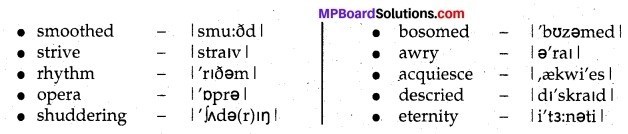
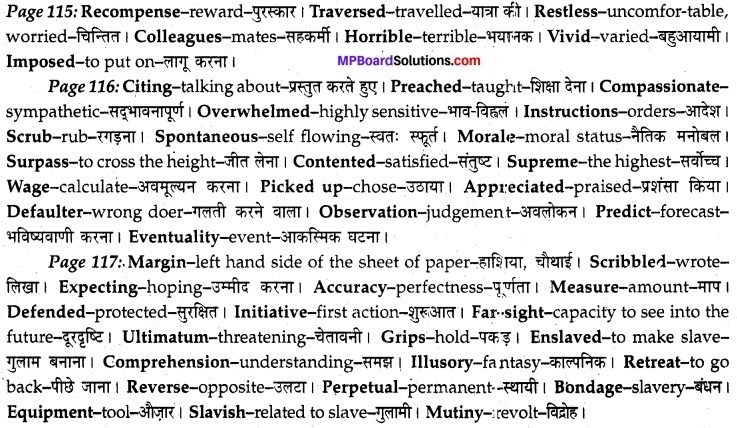
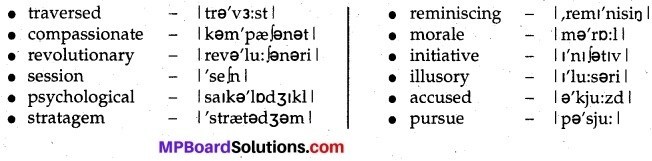
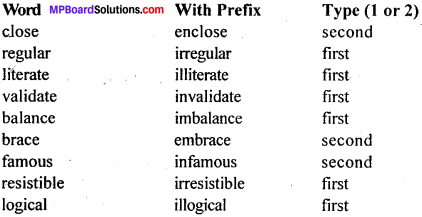
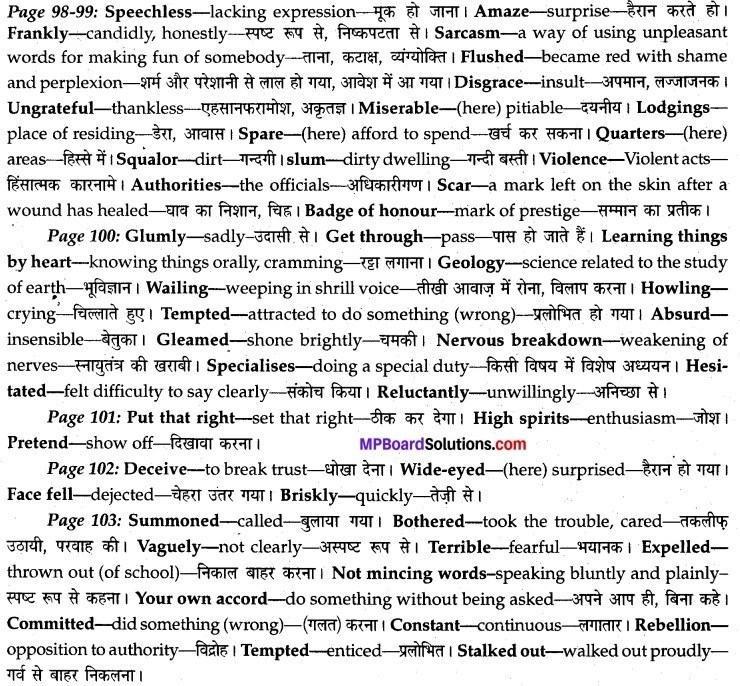
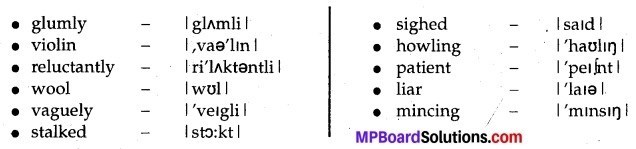
MP Board Class 12th English The Spectrum Solutions Chapter 8 Ends and Means

MP Board Solutions for 12th Textbook General English The Spectrum Solutions Chapter 8 Ends and Means Questions and Answers aids you to prepare all the topics in it effectively. You need not worry about the accuracy of the Madhya Pradesh Board Solutions for 12th English as they are given adhering to the latest exam pattern and syllabus guidelines.

You Can Download MP Board Class 12th English Solutions Questions and Answers Notes, Summary, Lessons: Pronunciation, Translation, Word Meanings, Textual Exercises. Enhance your subject knowledge by preparing from the Chapterwise MP Board Solutions for 12th English and clarify your doubts on the corresponding topics.

MP Board Class 12th English The Spectrum Solutions Chapter 8 Ends and Means (Ramendra Kumar)

Kick start your preparation by using our online resource MP Board Solutions for 12th English Chapter 8 Ends and Means Questions and Answers. You can even download the Madhya Pradesh Board Class 12th English Solutions Questions and Answers for free of cost through the direct links available on our page. Clear your queries and understand the concept behind them in a simple manner. Simply tap on the concept you wish to prepare in the chapter and go through it.

Ends And Means Exercises From The Text-Book

Word Power

(A) खाली स्थानों में make से बनी phrasal verbs भरिए :

  • Let’s make for the city centre and find a restaurant on the way.
  • He did not make up to until she agreed to help.
  • He made off as soon as he heard their car turn into the drive.
  • The superb food at the hotel made up for the uncomfortable rooms.
  • I cannot make out why our team declared so early.

(B) सही विकल्प को टिक (1) करें :
Answer:

  1. opposite,
  2. same,
  3. opposite,
  4. opposite,
  5. same.

Comprehension

निम्नलिखित प्रश्नों के उत्तर दीजिए

Question 1.
Who was Swami Arvasu? [2009, 10, 14, 16]
स्वामी अर्वासु कौन थे?
Answer:
Swami Arvasu was a monk who roamed the villages along the river Ganges with his small group of followers.
स्वामी अर्वासु एक साधु थे जो अपने शिष्यों के छोटे से दल के साथ गाँव-गाँव घूमते थे।

Question 2.
What was he [Swami Arvasu] doing under the Banyan tree? [2009, 10, 18]
बरगद के पेड़ के नीचे वह क्या कर रहे थे?
Answer:
He was sitting under a Banyan tree addressing a group of the faithful. He was giving a discourse on the Gita and its relevance to the common man.

बरगद के वृक्ष के नीचे बैठकर वह अपने अनुयायियों को सम्बोधित कर रहे थे। वह गीता तथा साधारण व्यक्ति के सन्दर्भ में उसकी सार्थकता पर शिक्षा दे रहे थे।

Question 3.
With what intention did Birju join the sage’s discourse?
बिरजू ने किस मन्तव्य से साधु के प्रवचन में भाग लिया?
Answer:
Birju’s intention was to pick a pocket or two. He was searching for prosperous-looking faces.
बिरजू का उद्देश्य एक-दो लोगों की जेबें काटना था। वह अमीर दिखने वाले लोगों को ढूँढ़ रहा था।

Question 4.
How was Birju affected with Swami Arvasu’s discourse?
स्वामी अर्वासु के प्रवचन से बिरजू किस प्रकार प्रभावित हुआ?
Answer:
Swami Arvasu’s powerful discourse left a deep impression on the mind and heart of Birju. His entire life flashed before his eyes and he realized that he had completely wąsted it. So he decided to change and lead an honest life.

स्वामी अर्वासु के प्रभावशाली प्रवचनों का बिरजू के हृदय व मस्तिष्क पर गहरा प्रभाव पड़ा। उसका पूरा जीवन उसकी आँखों के सामने घूम गया और उसे लगा कि उसने अपने जीवन को बर्बाद किया है। अतः उसने अब स्वयं को बदलना चाहा और एक ईमानदार जीवन जीने का निर्णय लिया।

Question 5.
Describe in your words the conversation between the sage and the thief when Birju asked to become a disciple.
जब बिरजू ने साधु का शिष्य होना चाहा तो उनके बीच क्या वार्तालाप हुआ?
Answer:
The sage thought that Birju had come to steal and told him that he had nothing to offer but his wisdom. But Birju informed the sage that his ords had made a great impact on him and that his entire life flashed before his eyes. Birju told the sage that he now wanted to change his life and be an honest person. In fact, he wanted to repent for his past.

साधु को लगा कि बिरजू उसके पास चोरी करने आया है। इसलिए उसने बिरजू से कहा कि उसके पास ज्ञान के अलावा देने के लए कुछ नहीं है। लेकिन बिरजू ने साधु से कहा कि साधु के शब्दों ने उसके ऊपर गहरा प्रभाव छोड़ा है और वह अपना जीवन परिवर्तित कर ईमानदार व्यक्ति बनना चाहता है। वास्तव में वह अपने बीते समय के लिए पश्चाताप करना चाहता है।

Question 6.
On what condition did the sage make Birju his disciple?
साधु ने बिरजू को किस शर्त पर अपना शिष्य बनाया?
Answer:
The sage asked Birju to be very careful. He also told him that if he shows any sign of misbehavior, he would be thrown out.
साधु ने बिरजू से बहुत सावधान रहने के लिए कहा। उसने यह भी कहा कि यदि उसने [बिरजू] दुर्व्यवहार का कोई भी संकेत दिया तो वह [साधु] उसे निकाल देंगे।

Question 7.
What happened when Birju went to collect firewood? [2009]
जब बिरजू आग जलाने के लिए लकड़ी लेने गया तब क्या हुआ?
Answer:
When Birju want to collect firewood, it was pitch dark. All windows and doors were shut. Everyone seemed to be asleep. He was wondering what to do.
जब बिरजू लकड़ी लेने गया तो घोर अंधेरा था। सभी खिड़कियाँ व दरवाजे बन्द थे। सभी लोग सो रहे थे। वह सोचने लगा कि क्या किया जाये।

Question 8.
What did Birju see when he peeped into the hut? [2012, 16]
झोंपड़ी के अन्दर झाँकने पर बिरजू ने क्या देखा?
Answer:
Birju saw that a young woman, clad in a tattered sari, was sitting in front of the fireplace. A frying pan was on the fire. Two children, a girl aged five and a boy aged four, were huddled in a corner. They were thin with their bones sticking out of their torn clothes. The mother would take a few drops of water every second and sprinkle on the pan.

बिरजू ने देखा कि एक फटी साड़ी में नौजवान महिला चूल्हे के सामने बैठी है। आग पर पतीला चढ़ा है। पाँच वर्ष की लड़की और चार वर्ष का लड़का एक कोने में बैठे हैं। वे इतने कमजोर थे कि उनके फटे कपड़ों से उनकी हड्डियाँ चमक रही थीं। हर सेकण्ड पर माँ पानी की कुछ बूंदें लेकर पतीले में छिड़क रही थी।

Question 9.
How did the woman in the hut react when she saw Birju?
बिरजू को देखकर झोंपड़ी में बैठी महिला की क्या प्रतिक्रिया थी?
Answer:
The woman stood up, walked towards Birju, touched his feet and said, “Maharaj, I am indeed fortunate to have your blessed feet enter my humble abode. However, I am equally unfortunate because I have nothing to give you”.

महिला खड़ी हुई, बिरजू की ओर गई, उसके पैर छुए और बोली, “महाराज, अपनी कुटिया में आपके पवित्र चरणों को पाकर मैं सचमुच भाग्यशाली हूँ। किन्तु मेरा दुर्भाग्य है कि मेरे पास आपको देने के लिए कुछ नहीं है।”

Question 10.
How did the poor woman trick her hungry children to sleep?
गरीब महिला ने अपने भूखे बच्चों को सुलाने के लिए क्या चाल चली?
Answer:
The poor woman continued to sprinkle water on the pan and gave the children the impression that food was being cooked. With this hope, the children went to sleep.
गरीब महिला ने पतीले पर पानी छिड़कना जारी रखा और बच्चों को यह महसूस कराया कि खाना पक रहा है। इसी उम्मीद से बच्चे सो गये।

Question 11.
How did Birju help the woman feed her children?
बिरजू ने बच्चों को खाना खिलाने में महिला की सहायता किस प्रकार की?
Answer:
Seeing the condition of the children, tears yelled up in Birju’s eyes. He walked out and searched the lanes of the village and found a grocery store. He succeeded in opening the lock of the door. He carried two sacks and placed them at the woman’s feet. This is how he helped the woman feed her children.

बच्चों की दशा देखकर बिरजू की आँखों में आँसू आ गये। वह बाहर आया और गाँव की गलियों में घूमा। अन्ततः उसे एक अनाज का भण्डार मिल गया। वह उसके दरवाजे का ताला खोलने में सफल हो गया। उसने अनाज के दो बोरे उठाये और महिला के पैरों पर लाकर रख दिए। बच्चों को खाना खिलाने में बिरजू ने महिला की इस प्रकार सहायता की।

Question 12.
How did Swami Arvasu react when Birju told him what he had done?
स्वामी अर्वासु की क्या प्रतिक्रिया थी जब बिरजू ने उन्हें बताया कि उसने क्या किया
Answer:
When Birju told Swami Arvasu what he had done, he was shocked. He told Birju that a wrong action could not be justified by lame excuses. A sin is a sin. He asked Birju to leave the place next morning.

जब बिरजू ने स्वामी अर्वासु को बताया कि उसने क्या किया है, तब उन्हें गहरा धक्का लगा। उन्होंने बिरजू से कहा कि झूठे बहानों से गलत कार्य को सही नहीं ठहराया जा सकता है। पाप तो पाप है। उन्होंने बिरजू से अगली सुबह वह जगह छोड़ देने के लिए कहा।

Question 13.
What miracle did the sage and his followers witness the next morning? [2009, 17]
साधु और उसके अनुयायियों ने अगली सुबह क्या चमत्कार देखा? ।
Answer:
The sage and his followers witnessed the next morning that there was a dazzling light in the sky and a huge bird-like creature was descending from the sky. They saw a young man clad in fine clothes getting down from the Pushpak Viman.

अगली सुबह साधु एवं उसके अनुयायियों ने आकाश में तेज रोशनी देखी और एक विशाल चिड़िया के आकार वाली वस्तु उतरते देखी। उन्होंने पुष्पक विमान से सुन्दर कपड़े पहने एक नौजवान को उतरते देखा।

Question 14.
What did Swami Arvasu think on seeing the celestial vehicle?
दिव्य वाहन को देखकर स्वामी अर्वासु ने क्या सोचा?
Answer:
Seeing the celestial vehicle, Swami Arvasu thought that Lord Indra had sent his messenger to take him to heaven. He thought that the day of his Nirvana had come.
दिव्य शक्ति को देखकर स्वामी अर्वासु ने सोचा कि भगवान इन्द्र ने उसे [स्वामी को] लेने के लिए अपना दूत भेजा है। उसे लगा कि उसके निर्वाण का दिवस आ गया है।

Question 15.
What, according to Brahmadatta made Birju, the thief, nobler than Swami Arvasu, the sage? [2011]
ब्रह्मदत्त के अनुसार चोर बिरजू किस प्रकार स्वामी अर्वासु से अधिक महान् हो गया?
Answer:
According to Brahmadatta, Birju’s kind act last night surpassed all the virtuous deeds of Swami Arvasu. He said if the end is noble then the means are not all that important. Even though Birju’s means were improper, his end was virtuous.

ब्रह्मदत्त के अनुसार बिरजू का पिछली रात्रि का दयालु कृत्य स्वामी अर्वासु के सभी गुणी कार्यों से ऊपर है। उसने बताया कि यदि उद्देश्य अच्छा है तो साधन महत्वपूर्ण नहीं होते। यद्यपि बिरजू के साधन अनुचित थे, उसका उद्देश्य अच्छा था।

Question 16.
Do you think that the title of the story is suitable to its content? कहानी में दिए गये तत्व के अनुसार क्या उसका शीर्षक उचित है?
Answer:
The title of the story is suitable to its content. Though Birju was involved in theft, he wanted to help the hungry children: Thus his means were wrong but his end was virtuous.

कहानी में दिए गये तत्व के अनुसार उसका शीर्षक उचित है। यद्यपि बिरजू चोरी में लिप्त था किन्तु वह भूखे बच्चों की सहायता करना चाहता था। इस प्रकार उसका माध्यम अनुचित था किन्तु उसका उद्देश्य अच्छा था।

Language Practice

(A) निम्न वाक्यों को एक क्रिया Past simple तथा दूसरी Past continuous में उपयोग कर पूरा कीजिये।
Answer:

  1. I was reading the newspaper, when suddenly I heard a loud knock on the door.
  2. I phoned Gopi an hour ago. He was doing his homework.
  3. I first met Megha a couple of years ago. She was working at the Royal Hospital at that time.
  4. We asked Prince to come with us, but he was watching the foot ball match on T. V.
  5. While I was driving to work this morning, I almost had a serious accident.
  6. When we were shopping last week, we found a nice place to have coffee.

(B) Verb की Simple past या present perfect form से रिक्त स्थान भरिए :
Answer:
I was born in 1965. I first went to school in 1970. At that time I was very young. I have been at school for three years and I made many friends. My father bought me a cycle last year. I have had this cycle for one year. I had an accident last month, and I have not ridden it since then.

(C) निम्नलिखित वाक्यों के रिक्त स्थानों को Verb की simple past एवं past perfect form fy:
Answer:

  1. I was late. The meeting had started an hour ago.
  2. They had not come even though we sent them a special invitation.
  3. It was a good story, but I had heard it before.
  4. We had lost our way. We did not know what to do.
  5. As soon as we had finished work, we went home.

(D) faut parceti ant going to……….but o sum fifty :
Answer:

  1. I was going to the cinema, but I didn’t have any money.
  2. Ashoo was going to play football, but he forgot his boots.
  3. We were going to swimming, but it was too cold.
  4. They were going to visit Oxford, but they didn’t have any time.
  5. He was going to see the play, but there were no seats.
  6. I was going to do my home work, but I had forgotten my books.

Ends And Means Summary

– Ramendra Kumar

यह अध्याय स्वामी अर्वासु नामक साधु और बिरजू नामक चोर के विषय में है। साधु अर्वासु के प्रवचन सुनकर चोर का हृदय परिवर्तन हो जाता है और वह उस साधु का शिष्य बन जाता है। एक दिन साधु उसे आग जलाने के लिए लकड़ी लाने को कहते हैं। शिष्य बिरजानन्द लकड़ी ढूँढ़ते-ढूँढ़ते एक ऐसे घर पहुँचता है जहाँ दो बच्चे और एक माँ बहुत लम्बे समय से भूखे रहकर जर्जर काया में परिवर्तित हो गये हैं। बिरजानन्द यह दृश्य देखकर द्रवित हो जाता है और पास के एक मकान में चोरी करके उस परिवार को अनाज लाकर देता है। वह अपने गुरु साधु अर्वासु के पास लौटकर उन्हें पूरी बात बताता है। साधु उसकी चोरी की बात सुनकर बेहद क्रोधित हो जाते हैं और अगले दिन प्रातः उसे स्थान छोड़ने का आदेश देते हैं। बिरजानन्द दुःखी मन से गुरु की बात मान लेता है। अगले दिन सुबह अचानक पुष्पक विमान से ब्रह्मदत्त नामक व्यक्ति वहाँ आता है। साधु अर्वासु अपने शिष्यों से कहते हैं कि भगवान इन्द्र ने उन्हें लिवाने के लिए भेजा है। किन्तु ब्रह्मदत्त बताते हैं कि उन्हें तो बिरजानन्द को साथ ले जाना है तो साधु अर्वासु कहते हैं कि वह तो चोर है। इस पर ब्रह्मदत्त साधु को समझाते हैं कि इसने गरीब की मदद करने के लिए चोरी की है, अतः यह चोर नहीं है। यद्यपि उसका तरीका अनैतिक था किन्तु बिरजानन्द का उद्देश्य नैतिक था।

We believe the information shared regarding MP Board Solutions for 12th English Chapter 8 Ends and Means Questions and Answers as far as our knowledge is concerned is true and reliable. In case of any queries or suggestions do leave us your feedback and our team will guide you at the soonest possibility. Bookmark our site to avail latest updates on several state board Solutions at your fingertips.
MP Board Class 12th English A Voyage Solutions Chapter 19 The Gita and Swadharma

MP Board Solutions for 12th English Chapter 19 The Gita and Swadharma Questions and Answers aids you to prepare all the topics in it effectively. You need not worry about the accuracy of the Madhya Pradesh Board Solutions for 12th English as they are given adhering to the latest exam pattern and syllabus guidelines.

You Can Download MP Board Class 12th English Solutions Questions and Answers Notes, Summary, Lessons: Pronunciation, Translation, Word Meanings, Textual Exercises. Enhance your subject knowledge by preparing from the Chapterwise MP Board Solutions for 12th English and clarify your doubts on the corresponding topics.

MP Board Class 12th English A Voyage Solutions Chapter 19 The Gita and Swadharma (Vinoba Bhave)

Kick start your preparation by using our online resource MP Board Solutions for 12th English Chapter 19 The Gita and Swadharma Questions and Answers. You can even download the Madhya Pradesh Board Class 12th English Solutions Questions and Answers for free of cost through the direct links available on our page. Clear your queries and understand the concept behind them in a simple manner. Simply tap on the concept you wish to prepare in the chapter and go through it.

The Gita and Swadharma Textbook Exercises

Word Power

A. Match the word in column ‘A’ with their meaning in column ‘B’

A – B

1. ambience – a. impossible to imagine or believe
2. resolve – b. to hate
3. nectar – c. find a satisfactory solution to a problem
4. inconceivable – d. that you cannot avoid or prevent
5. abhor – e. a tendency to a particular kind of behaviour
6. inevitable – f. false belief or opinion about yourself or your situation
7. ardour – g. to criticize
8. delusion – h. very strong feelings of enthusiasm or love
9. castigates – i. sweet liquid that is produced by flowers
10. propensity – j. the character and atmosphere of a place
Answer:
1. (j), 2. (c), 3. (i), 4. (a), 5. (b), 6. (d), 7. (h), 8. (f). 9. (g), 10. (e).

B. Find antonyms of the following words from the lesson:
sweet, relish, win, ever,, plant, foolish.
Answer:

  • sweet — sinful
  • relish — abhor
  • win — rout
  • ever — never
  • plant remove
  • foolish — authentic

C. Use the following phrases in sentences of your own:
willing to, with a firm resolve, accused of, flee away, all in vain.
Answer:

  • willing to — Mother Teresa was always willing to help the destitute.
  • with a firm resolve — If you start a work with a firm resolve, you will definitely get success.
  • accused of — The man was accused of theft.
  • flee away — The police caught the man while he was trying to flee away the country.
  • all In vain — I tried to convince my friend with several arguments but all in vain.

D. Give synonyms of the following wards:
view fear, mediate, examine, dispel.
Answer:

  • view — opinion
  • fear — terror, alarm
  • mediate — negotiate
  • examine — review, analyse
  • dispel disperse

Comprehension

A. Answer the following questions in one sentence:

Question 1.
What does Vinoba Bhave say about his heart and mind?
Answer:
Vinoba Bhave says that Gita and he transcends reason and there is little place for logic in a relationship of loving tenderness.

Question 2.
Where does he soar high and how?
Answer:
He soars high in the vast expanse of the Gita on the twin wings of faith and experimentation.

Question 3.
What does Vinoba Bhave compare the Gita with?
Answer:
Vinoba Bhave compares the Gita with the ocean of nectar.

Question 4.
Where has the Gita been set?
Answer:
The Gita has been set in the middle of great epic Mahabharata.

Question 5.
What does It look like?
Answer:
It looks like a lighthouse which illuminates the whole of the epic.

B. Answer the following questions in about 40-60 words each:

Question 1.
In the opinion of many people what was the purpose of preaching the Cita?
Answer:
In the opinion of many people the purpose of preaching the Cita was to restore Arjuna’s manliness and persuade him to fight. In their view the Gita preaches not only Karmayoga (the philosophy of action) but also Yudhayoga (the philosophy of war).

Question 2.
What, In the opinion of Vinoba, is inconceivable?
Answer:
In the opinion of Vinoba, it is inconceivable to doubt Arjuna’s manliness and valour. The army is not braver than him. It is not out of fear that he is turning away from the battle. He is a great warrior and valour is in every drop of his blood.

Question 3.
Whom had Arjuna single-handedly routed and when?
Answer:
Arjuna was a great warrior. He had fought hundreds of battles. He had single-handedly routed Bhishma, Drona and Karna when they had invaded Virat’s Kingdom.

Question 4.
Why had war become inevitable?
Answer:
The war had become inevitable because every attempt to avoid war had failed. The Pandavas had pitched their claims at the minimum. Still the Kauravas didn’t agree. Even Krishna himself had tried to mediate in order to bury the chance of war. But all the attempts proved in vain.

Question 5.
Why did Arjuna ask Krishna to place his chariot between the two armie.?
Answer:
Arjuna had come to the battlefield to fight war. Krishna was his charioteer. But before starting the war, he asked Krishna to place his chariot between the two armies because he wanted to have a look at the people who had assembled there to fight with him.

Question 6.
What did he see then?
Answer:
When Krishna placed his chariot between the two armies Arjuna looked around and saw his kith and kin, near and dear ones arrayed on both the sides. He found four generations of his own people intent on fighting to the finish.

Question 7.
What made Arjuna lose his nerve? (M.P. Board 2016)
Answer:
Arjuna saw his kith and kin., near and dear ones arrayed on both the sides in the battlefield. This made him lose his nerve. He found it difficult to fight with his own people.

Question 8.
What Lord Krishna realize?
Answer:
Aquna felt attached with his kinsmen This attachment to the kith and kin clouded his sense of duty He began to curse war. Krishna realized that Arjuna was not voicing his own authentic conviction, his words were seemingly wise, but not really so.

Question 9.
What does the Gita nowhere deal with and why?
Answer:
The Gita nowhere deals with the opinion that Arjuna had really become a votary of non violence. Had he really become so, he would not have been satisfied until his arguments has been convincingly answered.

Question 10.
What is the purpose of the Gita?
Answer:
The purpose of the Gita is to remove the delusion that stands between us and our swadharma. Arjuna was confused about his dharma. He was gripped by a delusion about his swadharma. When Krishna criticizes him, he himself admits it. The Gita’s main task is to remove that delusion, that attachment which clouds the act of duty.

C. Answer the following questions tn about 75 words each:

Question 1.
What is the second common opinion about the Gita, which, according to Vinoba Bhave, is not right?
Answer:
The second common opinion is that the Gita is meant to make Aijuna willing to fight by removing his inclination towards non-violence. But Vinoba Bhave rejects this opinion by giving appropriate example. If Arjuna had really become a worshipper of non-violence. he would not have come to the battlefield. But the fact was that he had come to the battlefield with a firm resolve and a sense of duty. He was a kshatriya and fighting was in his blood. He had slain innumerable warriors in many a battle. War was for him his natural and inescapable duty. But he was trying to evade it under the spell of delusion, i. e. attachment to his kinsmen.

Question 2.
What clouded his sense of duty and made him philosophise?
Answer:
Arjuna had come to the battlefield with a firm resolve and a sense of duty. He was a true fighting was in his blood. But when he looked around the battlefield, he found his kith and kin, near and dear ones arrayed on both the sides. It was not that Arjuna had no idea of what he was going to see. But the actual sight shook him from within the heart. He felt attached to his close friends and relatives. As in front of him were his own kith and kin, it stopped him. Had there been somebody else, he would have never stoped but behedded them. Seeing his family made him philosophise and clouded his sense of duty.

Question 3.
What specious argument did Arjuna put before Lord Krishna?
Answer:
It was the attachment to his kith and kin, loved ones that blurred his sense of duty. He suddenly began to evade war under the spell of delusion i.e. attachment to his friends and relatives. He philosophised so that war might not occur. He put before Krishna the specious argument that war in itself was sinful and that it would destroy the clan, eclipse dharma and bring total destruction.

Question 4.
What proved that Arjuna had not become a votary of non-violence?
Answer:
Arjuna had not really become a votary of non-violence. The intrinsic tendency to fight was still very much a part of his nature. War for him was his natural and inescapable duty. He had slain innumerable warriors in many a battle. But he was trying to evade war under the spell of delusion i.e. attachment to his close friends and relatives.

D. Answer the following questions in about 150 words each.

Question 1.
What story of a judge does Vinoba Bhave narrate, and why?
Answer:
Vinoba Bhave narrates the story of a judge. He had awarded death sentence to hundreds of criminals. But one day his own son accused of murder, was produced before him. The guilt was proved and the time came for the judge to pronounce the sentence. But then he hesitated and started arguing that the death sentence is inhuman. It is not good to inflict such a punishment. It destroys all hopes of reforming the guilty. One commits murder in a fit of passion. The moment of blood thirsty madness then passes off. Still we take him to the gallows and hang him to death.

It is really a blot on humanity. But had his son not been there the judge would have gone sentencing people to death. This makes it clear that the judge’s arguments were born out of attachment to his son. Vinoba Bhave narrates the above story because he finds Arjuna’s condition like that of the judge. Arjuna tried to evade .war because he didn’t want to fight with his own people! Had these in front of him not been his kinsmen he would certainly have felt no qualms in severing their heads and merrily tossing them around. The arguments that he put before Krishna looked inner conviction, like that of the judge. They were all born out of attachment to his own people.

Question 2.
What does Vyasa say at the beginning of the Mahabharata, and does the Gita succeed in achieving that purpose?
Answer:
Vyasa, at the beginning of the Mahabharata says that he is lighting this lamp of history to dispel delusions from the minds of the people. The Gita succeeds in achieving its purpose which centres around the removal of delusion that stands between us and our swadharma. Arjuna was confused about his dharma.

He was gripped by a delusion about his swadharma. When Krishna criticizes him severely, he himself admits it. The main task of the Gita is to remove that delusion i.e. Arjuna’s attachment to his kith and kin. When Lord Krishna asked Arjuna at the end of the Gita if his delusion had gone then, Arjuna replied in affirmative. He said that the delusion had fled away, and he had realized what his swadharma was.

Grammar

A. Look at the structure of this sentence from the first paragraph of the lesson:

I am as if were afloat on the surface of this ocean of nectar when I am talking about the Gita and when alone, I dive deep into this ocean and rest there. There are six clauses in the above sentence:

  • I am —main clause.
  • As if were afloat on the surface of this ocean of nectar — subordinate adverbial clause, denoting manner.
  • When I am talking about the Gita — subordinate adverbial clause, denoting time.
  • And when alone — subordinate adverbial clause, denoting time.
  • I dive deep into this ocean — co-ordinate clause.
  • And rest there — co-ordinate clause.

The above sentence is a mixed sentence, comprising three sub-ordinate clauses and two co-ordinate clauses. There are many such sentences in the lesson. Analyse and classify their structure by citing them. For additional help, refer to the workbook.
Answer:
For self-attempt.

B. Study the structure of below-mentioned sentences from the lesson:

Rewrite the sentences given below, using passive construction:

1. Somebody cleans the room every day.
2. They cancelled all the flights because of fog.
3. People don’t use this road very often.
4. Somebody accused me of stealing money.
5. How do people learn language?
6. People advised us not to go out alone.
7. They don’t like strangers in this town.
8. They are serving tea to the guests.
9. Did anyone ask any questions about me?
10. They still deny equal rights to women.
Answer:

  1. The room is cleaned everyday.
  2. All the flights were cancelled because of fog.
  3. This road is not used very often by people.
  4. I was accused of stealing money.
  5. How is language learnt by people?
  6. We were advised not to go out alone by people.
  7. Strangers are not liked in this town by them.
  8. Tea is being served by them to the guests.
  9. Were any questions asked about me?
  10. Equal rights to women are still denied by them.

C. There are sentences in the direct speech in the lesson. Convert them into indirect speech, referring to the workbook.
1. He asks Krishna with heroic ardour, “Place my chariot between the two armies, so that I can have a look at the people who have assembled here to fight with me.”
2. The Lord asked Arjuna at the end of the Gita, O Arjuna! Has your delusion gone now?
3. Arjuna replied, “Yes, Lord. The delusion has fled away. I have realized what my swadharma is”.
Answer:

  1. He asks Krishna with heroic ardour to place his chariot between the two armies, so that he can have a look at the people who have assembled there to fight with him.
  2. The Lord asked Arjuna at the end of the Gita if his delusion had gone then.
  3. Arjuna affirms that the delusion had fled a way and he had realized what his swadharma was.

Speaking Activity

A. Arrange a discussion about Arjuna’s ‘delusion’.
Answer:
Do yourself.

B. Re-collect some incidents of your life in which ‘swardharma’ was in conflict with your wishes, and narrate to your class how you resolved it.
Answer:
Do yourself.

C. Divide the class into two groups. Debate the value of swardharma taught in modern educational system as against the ancient Gurukul system of education
Answer:
Do yourself.

Writing Activity

A. Swadharma is following the call of duty, forsaking worldly attachment both material and personal. Arjuna followed it infighting the Mahabharata war. Vinoba followed it in fighting for the poor. Thinking over your role in the present political scenario, write a letter to your friend.
Answer:
Prepare the letter with the help of the hints given below:

  • All around corruption in society.
  • It is ruining our life.
  • Human values are diminishing.
  • Everyone tends to lead a corrupt life.
  • We are living behind a fractured society with immoral values.
  • It must be stopped.
  • I have decided to fight against it and lead a clean life.
  • I have made a group of volunteers to mobilise people.
  • We are working day and night.
  • The system is changing.
  • There is a hope for betterment.

B. There are several such instances as that of the vacillating judge, narrated by the author himself. Such circumstances are there in every profession. Suppose you were a doctor. An ailing poor patient wants help from you. How would you react? Frame a dialogue, highlighting your support,
Answer:
Do yourself.

C. Expand the idea Contained in the saying. “Work is worship; duty is God,” in about 150 words.
Answer:
Life is not a bed of roses. On the contrary, it is full of dangers and difficulties, trials and temptation, and man has to carry on a constant fight against them. Any slackness in this fight will upset the entire thing and bring about untold miseries. So, it is essential that man must work and work patiently and perseveringly. The Hindu philosophy of Karmayoga reiterates the same thing. One can attain one’s goal of life only through Karma or action.

That’s why It is said that work is worship and duty is God. We must concentrate on the work assigned to us. Our involvement in work brings satisfaction and happiness in our life. Even God also helps only those who give priority to their duty There are people who spend too much time in sitting before the idols of Gods and goddesses to seek his/her blessing. They never give much importance to their work or duty. Such people must be aware of the fact that even gods/goddesses cannot help them if they shirk their responsibilities. So, if we wish to make our life highly successful, we should work ceaselessly. Work is key to success.

Think it Over

A. Have you read or heard the mythological story of Satyawadi Harishchandra’ True to his calling, he didn’t spare even his wife in exacting the toll for cremating their dead son, Rohitashwa. There are many such instances in our past as well as present. How does it motivate and insprise you?
Answer:
Such stories motivate us in various ways. We should be truthful and honest throughout our life. We should be tolerant and remain unaffected by the ups and downs of life.

B. ‘Talks on the Gita is to the Gita, what the Upanishads are to the Vedas. Such texts are called treaties. They elucidate the thoughts of the source texts. Look for the English rendering of saine of the oft-quoted verses (shiokas) of the Gita on the Internet and think over its meaning.
Answer:
Do yourself.

Things to Do

A. We have seen many famous people, such as Mahatma Gandhi, who made a mark in public life, inspired by the philosophy of the Gua. Make a list of such prominent people and prepare a biographical sketch.
Answer:
A List of such prominent people is given below:

  • Dr. Rajendra Prasad.
  • Pt. Jawaharlal Nehru.
  • Mother Teresa.
  • Swami Vivekananda.
  • Jay Prakash Narayan.
  • A.P.J Abdul Kalam.

Note: Students are suggested to add names of many more personalities and read about their lives.

B. Vinoba Bhave pioneered ‘Bhoodan movement’ in India. He established his ashram at Pawnar in Wardha district of Maharashtra. Plan a visit to the ashram, and compile the valuable information about his life and times received during that visit.
Answer:
Do yourself.

The Gita and Swadharma by Vinoba Bhave Introduction

This is an excerpt from ‘Talk! on the Gita’ The author Vmoba Bhave explains the purpose for which the Gita was preached. According to him, the Gita seeks to remove the delusion that distracts us from our duty. He perceives Swadharma as action to ail the call of duty, forsaking worldly attachment.

The Gita and Swadharma Summary in English

The Gita has been set in the Mahabharata, a great epic of the time. Its message has been unfolded in the middle of the battlefield with seven divisions of the Pandava army on one side and eleven divisions of the Kaurava army on the other.

It was Lord Krishna who preached the Gita to make Arjuna ready to fight. Arjuna was a Kshatriya and fighting was in his blood. But first he had attempted to avoid war. Even Krishna himself tried to mediate but all in vain, making the war inevitable. And finally Arjuna had come to the battlefield to perform his duty, i.e. to fight war with the Kauravas. He had made Krishna his charioteer.

Many mighty kings had surrounded him. But before starting the fight he gives a look at the people who had gathered in the battlefield and finds his near and dear ones on both the sides. Now it becomes difficult for him to fight with his own relatives. His heart is filled with deep anguish. He feels dejected. Here arises a question. Would Arjuna have felt the same pangs of pain if those standing in front of him had not been his kinsmen? Certainly not.

It means that his attachment to his kith and kin prevents him from fighting. This attachment to the kith and kin clouds his sense of duty. He tells Krishna that one should not indulge in war. War is never good because it destroys the whole clan and brings total destruction.

Arjuna’s arguments are not baseless. But the point is that he is not voicing his own authentic conviction. His words are seemingly wise but not really so. Lord Krishna realises this and proceeds to dispel his delusion by ignoring all his (Arjuna’s) arguments. He knows very well that Arjuna is not the one who believes in non-violence. War is for him his natural and inescapable duty. But he is trying to evade it because he is under the spell of delusion. Once this delusion, is removed, he would be ready to fight with all energy.

Lord Krishna preaches the Gita to remove the delusion that stands between us and our swadharma. Arjuna is confused about his dharma.He is gripped by a delusion about his swadharma. Krishna criticizes him severely so that he may not ignore the call of duty. And at the end of the Gita Arjuna is totally disillusioned. He realizes what his swadharma is. Thus, the removal of delusion is the central message of this chapter.

The Gita and Swadharma Summary in Hindi

गीता का प्रारम्भ महाभारत, जो अपने समय का एक महान महाकाव्य है, में हुआ है। इसमें जो संदेश दिया गया है, उसका खुलासा युद्ध-भूमि के बीच में होता है जहाँ एक तरफ पांडव सेना की सात टुकड़ियाँ हैं और दूसरी ओर कौरव सेना की ग्यारह।

भगवान कृष्ण गीता का उपदेश अर्जुन को देते हैं ताकि वह युद्ध के लिए तैयार हो सके। अर्जुन क्षत्रिय था और युद्ध उसके खून में रचा-बसा था। फिर भी उसका प्रथम प्रयास था, युद्ध को टालना। यहाँ तक कृष्ण ने भी मध्यस्थता की किन्तु सब व्यर्थ साबित हुआ और बुद्ध अवश्यंभावी हो गया। और अंततः अर्जुन युद्धभूमि में आ धमका, अपना कर्त्तव्य निभाने अर्थात् कौरवों से युद्ध करने। उसने कृष्ण को अपना सारथी बनाया था। बहुत से शक्तिशाली राजा उसके इर्द-गिर्द थे। लेकिन युद्ध शुरू करने के पहले वह युद्ध-भूमि में एकत्रित सभी योद्धाओं पर एक नजर डालता है और दोनों तरफ अपने ही सगेसम्बन्धियों को पाता है। अब उसके लिए अपने ही लोगों से युद्ध करना मुश्किल लगने लगता है। उसका हृदय आहत हो जाता है। वह अत्यंत दुःखी हो जाता है।

यहाँ पर एक प्रश्न उठता है। क्या अर्जुन ऐसा ही दर्द तब भी महसूस करता जब उसके सामने खड़े लोग उसके सगे-संबंधी नहीं होते? निश्चित तौर पर नहीं। इसका मतलब यह है कि अपने सगे-संबंधियों के प्रति आसक्ति उसे युद्ध करने से रोकती है। अपने लोगों के प्रति इसी लगाव ने उसके कर्त्तव्य-बोध को धुंधला कर दिया है। वह कृष्ण से कहता है कि किसी को भी युद्ध नहीं करना चाहिए। युद्ध कभी अच्छा हो ही नहीं सकता क्योंकि यह अपने ही कुल का नाश कर देता है और सम्पूर्ण विनाश लाता है।

अर्जुन के तर्क आधारहीन नहीं हैं। लेकिन वह जो भी कह रहा है उसका संबंध उसके विश्वास से नहीं है। उसके शब्द ऊपर-ऊपर तो बुद्धिपरक प्रतीत हो रहे हैं लेकिन वास्तव में ऐसा नहीं है। भगवान कृष्ण इसे समझ जाते हैं और अर्जुन के सारे तर्को को नजरअंदाज करते हुए उसके भ्रम अर्थात् मिथ्या विश्वास को हटाने के लिए आगे बढ़ते हैं। उन्हें अच्छी तरह पता है कि अर्जुन वह कदापि नहीं है जो अहिंसा में विश्वास रखता है। युद्ध उसका स्वभाविक और अपरिहार्य कर्त्तव्य है। लेकिन वह इस कर्त्तव्य से मुख मोड़ने का प्रयास कर रहा है क्योंकि वह मिथ्या विश्वास के साये में है। एक बार उसका भ्रम दूर हो जाए तो वह पूरी ताकत से युद्ध करने को तैयार हो जाएगा।

भगवान कृष्ण इसी भ्रम को हटाने हेतु गीता का उपदेश देते हैं जो हमारे और हमारे स्वधर्म के बीच खड़ा है। अर्जुन अपने धर्म के बारे में दिग्भ्रमित है। वह अपने ही स्वधर्म के जाल में फंसा है। कृष्ण उसकी घोर निन्दा करते हैं ताकि वह कर्त्तव्य बोध से विचलित न हो। और गीता के अंत में अर्जुन का मोहभंग हो ही जाता है। उसे समझ में आ जाता है कि उसका स्वधर्म क्या है। इस प्रकार यह पाठ मिथ्या विश्वास को हटाने का संदेश देता है।

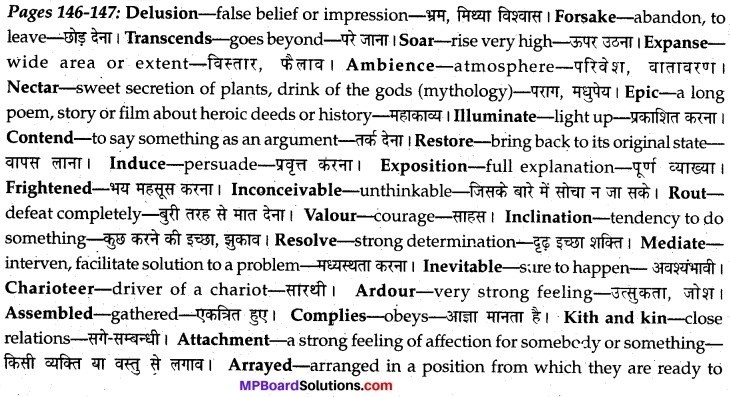
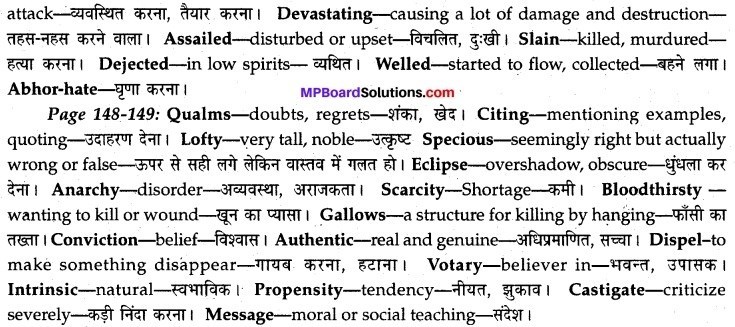
The Gita and Swadharma Word Meaning

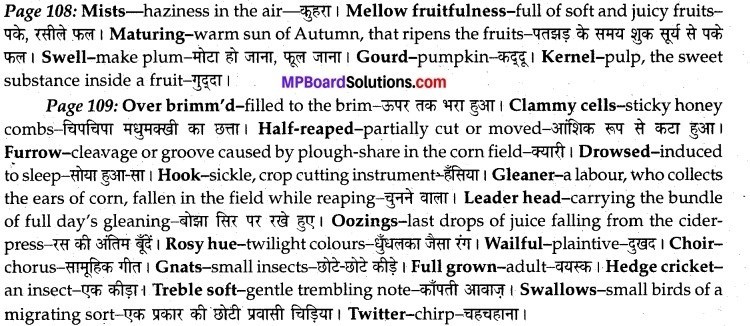
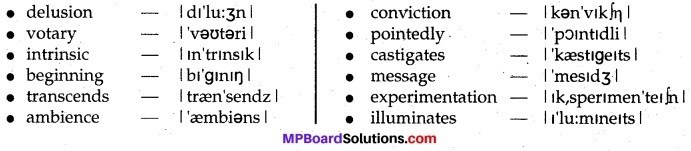
MP Board Class 12th English A Voyage Solutions Chapter 19 The Gita and Swadharma img 1 MP Board Class 12th English A Voyage Solutions Chapter 19 The Gita and Swadharma img 2

The Gita and Swadharma Important Pronunciations

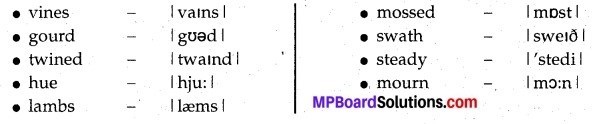
MP Board Class 12th English A Voyage Solutions Chapter 19 The Gita and Swadharma img 3

The Gita and Swadharma Passages for Comprehension

Read the following passages taken from the lesson and answer the questions that follow:

It was Arjuna who quailed; not the army. Was then the army braver than Arjuna? It is just inconceivable. It was not out of fear that Arjuna was shying away from the battle. The great warrior had fought hundreds of battles. He had single handedly routed Bhishma, Drona and Karna when they had invaded Virat’s kingdom. He was, in fact, known as one who knew no defeat; a man among men. Valour was in every drop of his blood.
(Page 147)

Questions:
(i) What is inconceivable? Why does the author say so?
(ii) Whom had Arjuna routed single-handedly? Why?
(iii) How was Arjuna known as?
(iv) Find a word from the passage which means the same as ‘frightened’.
(v) Find a word from the passage which means opposite to cowardice.
Answers:
(i) Thinking army braver than Arjuna is ‘inconceivable’. The author says so because he is well aware of Arjuna’s bravery and manliness. Which he supports by giving examples.
(ii). Arjuna had single-handedly routed Bhishma, Drona and Kama because they had invaded Virat’s kingdom.
(iii) Arjuna was known as one who knew no defeat. He was a man among men. He was a brave warrior.
(iv) ‘Qualled’
(v) Valour

2. It is not that Aquna had no idea of what he was going to see. But the actual sight, as is always the case, had a devastating impact. Seeing his kinsmen on the battlefield, Arjuna lost his nerve and deep anguish assailed his heart. In the past he had slain innumerable warriors in many a battle, but he had never before felt so dejected, never had his bow Gandiva slipped from his hands, never had he trembled so, never had welled up in his eyes! Then, why was all this happening now? Was he coming to abhor violence like King Ashoka? (Page 147)

Questions:
(ï) What was the actual sight that had devastating impact on Arjuna?
(ii) What was the past history of Arjuna?
(iii) Arjuna had never before felt so dejected. Why?
(iv) Why does the author compare Arjuna with King Ashoka?
(v) Pick out a word from the above passage which means the same as ‘hate’.
Answers:
(i) Standing in the battlefield Aquna finds his kith and kin, near and dear ones arrayed on both the sides. This very sight had a devastating impact on him (Arjuna).
(ii) Arjuna’s past history is full of glaring examples of brave deeds. He had slain innumerable warriors in many a battle.
(iii) Arjuna had never before fought wars with his kith and kin. For the first time in his life he had come to the battlefield to fight with his kinsmen. It was therefore he was feeling dejected.
(iv) Like Ashoka, Arjuna too wished to turn away from violence. He displayed all the traits of Ashoka at that time. Therefore, the author makes such a comparison.
(v) ‘abhor’.

3. But attachment to the kith and kin clouded his sense of duty and then he started philosophising. When a man with a sense of duty is caught in delusion, he cannot face his lapse from duty He tries to justify it by citing lofty principles. The same thing happened with Arjuna. He now started putting before Krishna, to convince him, the specious argument that war in itself was sinful that it would destroy the clan, eclipse
dharma and lead to moral anarchy, scarcity and devastation and bring many other disasters on the society, (Page 148)

Questions:
(i) What clouded Arjuna’s sense of duty?
(ii) Why did Arjuna start philosophising?
(iii) What argument did he put before Krishna about war?
(iv) Why did he display apathy to war?
(y) Pick out a word from the passage which means opposite ‘sufficiency’.
Answers:
(i) Seeing his close relatives standing in the battlefield Arjuna felt attached to them. He wished to turn away from fighting war. This attachment to the kith and kin clouded his sense of duty
(ii) Arjuna started philosophising because he no more wanted to fight war with his kinsmen.
(iii) He put before Krishna the argument that war in itself was sinful that it would destroy the clan, eclipse dharma and lead to total devastation.

We believe the information shared regarding MP Board Solutions for 12th English Chapter 19 The Gita and Swadharma Questions and Answers as far as our knowledge is concerned is true and reliable. In case of any queries or suggestions do leave us your feedback and our team will guide you at the soonest possibility. Bookmark our site to avail latest updates on several state board Solutions at your fingertips.
MP Board Class 12th English A Voyage Solutions Chapter 18 The Abominable Snowman

MP Board Solutions for 12th English Chapter 18 The Abominable Snowman Questions and Answers aids you to prepare all the topics in it effectively. You need not worry about the accuracy of the Madhya Pradesh Board Solutions for 12th English as they are given adhering to the latest exam pattern and syllabus guidelines.

You Can Download MP Board Class 12th English Solutions Questions and Answers Notes, Summary, Lessons: Pronunciation, Translation, Word Meanings, Textual Exercises. Enhance your subject knowledge by preparing from the Chapterwise MP Board Solutions for 12th English and clarify your doubts on the corresponding topics.

MP Board Class 12th English A Voyage Solutions Chapter 18 The Abominable Snowman (Major Harold William)

Kick start your preparation by using our online resource MP Board Solutions for 12th English Chapter 18 The Abominable Snowman Questions and Answers. You can even download the Madhya Pradesh Board Class 12th English Solutions Questions and Answers for free of cost through the direct links available on our page. Clear your queries and understand the concept behind them in a simple manner. Simply tap on the concept you wish to prepare in the chapter and go through it.

The Abominable Snowman Textbook Exercises

Word Power

A. Fill in the blanks with the words given below: .
(tracks, lunatic, outlaws, forestalled, sarcasm, affirm, trivial, inconceivable, delicious,
trodden)

1. The police are looking for a band of who are involved in yesterday’s bank robbery.
2. Bank robbery is not a offence.
3. The expedition took us to places where no one had before.
4. The police reached the culprits by following the left by their car in the mud.
5. He wanted to retire early but hisplan was by unforeseen events.
6. The food at the restaurant we visited last night was
7. He praised me for my efforts but there was a hint of in his praise.
8. She worked hard but still failed. It was
9. The police charged the man of theft but he continued to that he was innocent.
10. The man was mentally ill. They said he was a
Answer:

  1. outlaws
  2. trivial
  3. trodden
  4. tracks
  5. forestalled
  6. delicious
  7. sarcasm
  8. inconceivable
  9. affirm
  10. lunatic.

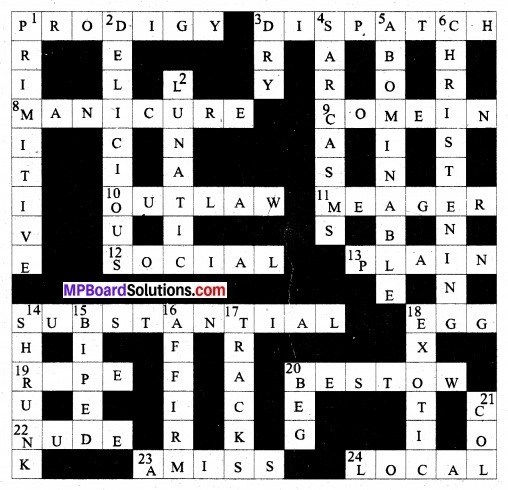
B. Finish the following crossword puzzle:
MP Board Class 12th English A Voyage Solutions Chapter 18 The Abominable Snowman img 1

Across:

1. A young person with unusual or remarkable qualities or abilities (7)
3. A report sent quickly by one military officer to another (8)
8. The care and treatment of hands and nails (8)
9. Enter(42)
10. A person who has done something illegal and avoiding arrest (6)
11. Small in quantity and poor in quality (6)
12. Concerning society (6)
13. Ordinary and simple (5)
14. Large in amount, value and importance (11)
15. We make omelette from this (3)
19. Fully mature (4)
20. Present something as a gift to somebody (6)
22. Naked (4)
23. Wrong (5)
24. Belonging to a particular place or district (5)

Down:

1. Of an early stage of social development (9)
2. Delightful (9)
3. Not wet(3)
4. A way of using words that are opposite of what you mean in order to make fun of
them (7)
5. Extremeiy unpleasant and causing disgust (10)
6. Baptism; a ceremony in which somebody is given a name (11)
7. A wildly foolish person (7)
14. Thin card made of twisted thread (6)
15. Any creature with two feet (5)
16. State confidently that something Is true (6)
17. Marks left by a person, an animal or a moving vehicle (6)
18. Not native (6)
20. Ask for money, food etc. as a gift or as charity (3)
21. A low point between two higher points in a mountain range (3)
Answers:
MP Board Class 12th English A Voyage Solutions Chapter 18 The Abominable Snowman img 2
MP Board Class 12th English A Voyage Solutions Chapter 18 The Abominable Snowman img 3

Comprehension

A. Complete the following sentences choosing the correct alternatives:

Question 1.
When his porters said that the tracks were made by the wild man, Colonel Howard Bury
(a) believed it
(b) ignored it
(c) took cognizance of it
(d) mocked at it.
Answer:
(d) mocked at it.

Question 2.
When scientists rejected the idea of the footprints as those of monkeys, people said that they may be those of
(a) Cinderella
(b) an ascetic
(c) Giant Panda or Snow Bear
(d) langue monkeys.
Answer:
(c) Giant Panda or Snow Bear

Question 3.
Mr. Smythe sighted the tracks in
(a) Garhwal
(b) Sikkim
(c) Lapkha la
(d) Zemu Gap.
Answer:
(a) Garhwal

Question 4.
The first European who had seen the Snowman was
(a) Dr. Odell
(b) Mr. Tombazi
(c) Mr. Tilman
(d) Mr. Smythe.
Answer:
(a) Dr. Odell

Question 5.
Mr. Tilman concludes that we must believe that the tracks were made by the , Abominable Snowman until……………….
(a) sighting of the tracks is stopped
(b) proofs about better claimant are found
(c) more traeks are found
(d) the Snowman is photographed
Answer:
(b) proofs about better claimant are found

B. Answer the following questions in one sentence each:

Question 1.
What did the first Mount Everest party come across on the mountains?
Answer:
The first Mount Everest party came across the footprints closely resembling those of human being on the mountain.

Question 2.
Why did the author put three exclamation marks after the statement in his dispatch?
Answer:
The author put three exclamation marks after the statement in his dispatch because it was ridiculous for him.

Question 3.
What was Mr. Newman’s theory about the footprints?
Answer:
Newman’s theory about the footprints was that they belonged either to the outlaws or to the ascetics.

Question 4.
Why could the footprints not be those of Langur monkeys?
Ans.
The footprints could not be those of Langur monkeys because he didn’t find or hear about monkeys there.

Question 5.
How did Mr. Smythe react when the zoologist’s verdict came out?
Answer:
Mr. Smythe reacted after the zoologist’s verdict came out by. calling their theory a nonsense.

Question 6.
What did the author inquire about on reaching Darjeeling?
Answer:
The author inquired about the lunatic on reaching Darjeeling.

Question 7.
What was the author’s theory about the shape of the footprints? (M.P Board 2015)
Answer:
The author saw footprints resembling large boots and similar in shape to those of man about six or seven inch long.

Question 8.
What type of footprints of the Snowman did Mr. Tombazi find?
Answer:
They were similar in shape to those of man but only six or seven inches long.

Question 9.
What could Mr. Tombazi assert with certainty?
Answer:
Mr. Tombazi could assert with certainty that the silhouette of the mysterious being was – identical with the outline of a human figure.

Question 10.
What does the author affirm at the end?
Answer:
The author at the end affirms that tracks for which no adequate explanation is forthcoming, have been seen and will no doubt continue to be seen in the Himalayas and until the better claimant is found. We may as well attribute them to their rightful owner, The Abominable Snowman.

C. Answer the following questions in about 60 words each:

Question 1.
What analogy has the author used for proving the existence of the Snowman? (M.P. Board 2016)
Answer:
In this article, the author makes an effort to unfold the mystery of the Abominable Snowman who has long been undiscovered with authenticity. He takes the footprints as evidence of the existence of Snowman. The analogy that he takes to prove it is that if fingerprints can decide the hanging of a man, why cannot footprints establish the existence of one.

Question 2.
How did the author justify his contribution to the sum of knowledge about the Abominable Snowman?
Answer:
The author were able to justify the contribution to the sum of knowledge about the Abominable Snowman because he had studied the views and findings of all his predecessors who had escaped many a facts. The author with the help of the Sherpas had collected practical views.

Question 3.
Why did the author want to start his inquiry with the Mount Everest?
Answer:
The author wanted to start his inquiry with Mount Everest because it is still untrodden and has been mysterious, for long strange things happen there.

Question 4.
More evidence was provided by two persons about the existence of the Snowman in 1936. What was it and who were they?
Answer:
In 1936, one Mr. Ronald Kaulback travelled in the Upper Salween and reported having seen at 16,000 feet five sets.of tracks, taking exactly as though made by a bare-footed man. He added that there were no bears. More evidence was tendered by Wing Commander Beauman who reported similar tracks from the Central Himalayas.

Question 5.
How did Mr. Kaulback react when people suggested that the footprints could be those of the Giant Panda or Snow Bear?
Answer:
When Mr. Kaulback said that the tracks which he saw were exactly made by biped, he was contradicted with the view that they were made by the Giant Panda or Snow Bear. At this, he reacted that he was ashamed that he had not thought of it himself but he had not heard of Pandas in those parts nor were there bamboo shoots.

Question 6.
What does the author mean by “the season of 1937 was an active one in the Himalayas”?
Answer:
The author means to say that in this season a number of efforts were made to find out the facts behind the footprints. A combined authority of ‘The Times’ and ‘Mr. Smythe’ gave a theory of the extinction of those species but the two correspondents were not ready to support it and they gave another views.

Question 7.
How did Mr. Tombazi happen to see the Snowman?
Answer:
Mr. Tombazi writes that “an intense glare prevented him seeing anything for the first few seconds, but soon he spotted the object referred to, two or three yards away down the valley. It was exactly like human beings walking upright and wore no clothing.

Question 8.
Why did the author compare Mr. Tombazi with the old Lady at the Zoo?
Answer:
The author compared Mr. Tombazi with the old lady at the zoo because Tombazi had witnessed the existence of Snowman still he didn’t accept it with great certainty. He was still confused.

D. Answer the following questions in about 75-100 words each:

Question 1.
Do you think that Sherlock Holmes’ Monograph and Darwin’s Treatise were important
contributions to the sum of knowledge? Justify your answer.
Answer:
The author has a broad view. It is true that science explores a new fact on the basis of speculation. Science welcomes specialisation. Speculation gives birth to new ideas. When one works on those ideas one can formulate new achievement. For example/one can say had Newton not thought over the fact, why the apple fell down to earth, he had not been given to such a great discovery because falling of an apple was not the first incident. Many people almost all might have seen falling of an apple from a tree. In the same way, gherlock Holmes Monograph and Darwin’s Treatise were important contributions to the sum of knowledge.

Question 2.
How did Mr. Smythe strengthen his claim that the footprints were those of a ‘biped’? Why did he later retract his claim and say that the tracks were made by a bear?
Answer:
Mr. Smythe was an explorer in the Himalayas. He found the evidences of the footprints. They were huge, apparently of a biped. Photographs and measurements were taken. Then in order to clinch the thing he got the Sherpa’s signatures on a written statement to the effect that the tracks were those of a Metch Kangami.

They added that although they had never seen one, because anyone who does, dies or is killed, they had seen pictures of his tracks in Tibetan monasteries. Later, when Smythe submitted his evidence, that retreated his claim, and said that the tracks were made by a bear. He did so because he was not sure about the Sherpas who were frightened men and could withdraw at any moment. More than that, there was no way to measure and prove the tracks and print.

Question 3.
Describe H.W. Tilman’s sighting of tracks in Sikkim.
Answer:
The author, H.W. Tillman, had an open mind on the subject. In 1938, during the course of his exploration, he was in Sikkim when he saw tracks. Along with two Sherpas, he was crossing the Zemu Gap, a 19,000 feet pass between Kanchenjimga and Simbu. The weather was thick, the snow soft, and they plodded up a long, easy snow slope, and they saw by their side a single line of footsteps. In view of the prevailing weather, it could not be of many days old. Both the Sherpas and Tillman had been forestalled in the crossing of the Gap and when they gained the col they craned their neck over the other side which was extremely steep, to see which line that solitary climber had taken. The tracks having reached the col, had disappeared on some rocks on the Simvu side.

Question 4.
How did the author confirm that the tracks that he had observed were not made by human beings?
Answer:
The author was trying to get to a conclusion about the identity of the track he had seen. When he reached Darjeeling, he knew that no party had gone on the mountains recently. The last visit was made by Brigadier John Hunt but even Mr. Hunt had been there in November. So, it got confirmed that the tracks were not made by the human beings.

Question 5.
What reasons does the author ascribe to the round shape of the footprints?
Answer:
The tracks seen by the two previous witnesses were circular while those seen by Hunt and the author himself resembled those made by large boots. The author concluded that they were not necessarily of a brute beast, but an erect thing who might have come down from his tree even earlier than they did. He thinks that even beavers, bees, ants, birds are not without constructive ability therefore those tracks could be attributed to a Snowman.

Question 6.
Describe in your own words the sight ML Tombazi witnessed when he was called
from his tent by his porters?
Answer:
Mr. Tombazi, having been called from his tent, saw an intense glare which prevented his seeing for the first few seconds. However soon, he could spot the object two or three hundred yards away down the valley. The figure, no doubt, in outline was exactly like a human being, walking upright, and stopping occasionally to uproot some dwarf rhododendron. It showed dark against the snow and wore no clothing. Within the next minute or so it had moved into some thick scrub and disappeared. He examined the
footprints, which were similar in shape to those of a man but only six or seven inches long.

Grammar

A. Look at the sentences below:
Now complete the following sentences in which only if (when) clauses have been given:
If finger prints can hang a man I see no reason why foot prints should not establish the existence of one. We can say the same thing in this way also.

If fingerprints can hang a man, why should footprints not establish the existence of one? In such sentences ‘if’ can be replaced bis, when and they are not conditional sentences:

1. If you can go there why ……
2. If the gate is locked how ……
3. If they don’t let you in what ……
4. If you don’t know the answer why ……
5. If you lose your way in the forest what ……
6. If you are nervous at this stage how ……
7. If there is a storm tonight what ……
8. If you are asked to choose one of them which one ……
9. What if they.don’t come on time?……
10. What if you don’t pay the bill? ……
Answer:

  1. would they not welcome you.
  2. would one enter the campus.
  3. would you do to them.
  4. wouldn’t you ask your teacher.
  5. would you do.
  6. would you succeed.
  7. would we do to face it.
  8. would you like.
  9. would you do.
  10. would they do.

B. Look at the following sentence again:

Nearly all the evidence I have collected on behalf of his existence consists of footprints, but if fingerprints can hang a man I see no reason why footprints should not establish the existence of one.  The sentence has the following clauses:

  • nearly all the evidence consists Of footprints.
  • I have collected on behalf of his existence.
  • but if fingerprints can hang a man.
  • I see no reason.
  • why footprints should not establish the existence of one.

There are several sentences of such type in the lesson. As shown above find out the clauses in the following sentences:

Question 1.
It is fitting that the starting point of our journey should be Mount Everest a mountain whose summit is still untrodden, which was for long itself mysterious, and upon which strange things have happened.
Answer:
The clauses in these sentences are given below:

  • It is fitting.
  • that the starting point of our journey should be Mount Everest—a mountain.
  • whose summit is still untrodden.
  • which was for long itself mysterious.
  • and upon which strange things have happened.

Question 2.
Large langur monkeys were suggested, to which Mr. Kaulback replied that he had neither seen nor heat’d of any monkeys there and that the tracks were 3,000 feet above’the tree line.
Answer:

  • Large langur monkeys were suggested.
  • to which Mr. Kaulback replied.
  • that he had neither seen nor heard of any monkeys there.
  • and that the tracks were 3,000 feet above the tree line.

Question 3.
The suggestion was considered a shrewd one and Mr. Kaulback wrote to say he was ashamed he had not thought of it himself.
Answer:

  • The suggestion was considered a shrewd one.
  • and Mr. Kaulback wrote to say.
  • he was ashamed.
  • he had not thought of it himself.

Question 4.
But may be there was a hint of sarcasm, for he added that he had never heard of pandas in those parts nor were there any bamboo shootsa sine qua non for pandas, without which they languish and die.
Answer:

  • But may be there was a hint of sarcasm.
  • for he added.
  • that he had never heard of pandas in those parts nor were there any bamboo shootsa sine qua non for pandas.
  • without which they languish and die.

Question 5.
They added that although they had never seen one, because anyone who does, dies or is killed, they had seen pictures of his tracks in Tibetan monasteries.
Answer:

  • They added.
  • that although they had never seen one.
  • because anyone who does, dies or is killed.
  • they had seen pictures of his tracks in Tibetan monasteries.

Speaking Activity

A. Divide the class into two groups. Arrange a debate whether ‘the Snowman’ exists or not. One group – will speak in favour of’its’existence and the other will speak against it.
Answer:
Do it yourself.

Writing Activity

A. Write an essay in about 250 words on “Mountaineering in the Himalayas” on the basis of the following points:

  • Why people prefer the Himalayas for mountaineering.
  • Precautions to be taken before setting out.
  • Help of local sherpas.
  • Precautions during climbing.
  • Good and bad effects of mountaineering on the local population and the eco-system.

Answer:
Mountaineering is an adventurous activity that one undertakes to explore mysteries underlying in regions of high mountains. People prefer the Himalayas for mountaineering because it is full of mysteries of the widest ranges. It is the largest region to explore. People have been trying to unrave its regions but there is still a lot more to do.

Before undertaking a climb to a mountain, one must be careful and aware of the impending dangers. One must study well the regions that one opts for. All the necessary equipment must be arranged. One must know the direction, height, curves, etc. of the regions.

The local Sherpas are of much help for a mountaineer. They know all the facts of the regions. They can lead one to particular direction. They can provide all sorts of local help if one falls in danger. During mountaineering, one must be particular about the team and tools, oxygen, food and direction. One should be helpful to each other.

Mountaineering provides livelihood to local people. They get new access to jobs. They can flourish their business. However in some respect, mountaineering affects the local eco-system due to the rush of people from outside regions. They change the face of the natural life of the people.

Think It Over

Mystery shrouds the existence of ‘the Abominable Snowtnan’. Think about the ways of solving this mystery.
Answer:
Do it yourself.

Things to Do

Collect material that you can find on ‘Abominable Snowman or ‘Yeti’ (as he is called in Hindi) and Unidentified Flying Objects (U.F.O.) and exhibit it in the classroom.
Answer:
Do it yourself.

The Abominable Snowman Summary in English

The writer in this chapter tries to unfold the mystery of the Abominable Snowman or as we call it, ‘Yeti’. In 1921 Col. Howard Bury who was the leader of the first Mount Everest Party traced the footprints resembling those of a human being on the Lakhpa La, a 22,000 foot pass northeast of the mountain. For him, the belief of his porters that the tracks were made by the wild men of the snows, was ridiculous.

He feels science welcomes all speculations and on that basis the scientist traces to add something new to that knowledge. If fingerprints can decide the fate of a man, why can the footprints not establish the existence of one. So, the writer begins his effort to find out the facts behind the abominable snowman. Mr. Henry Newman interviewed the porters and got a full description of the wild men who were called Metch Kangmi—Kangmi meaning snowmen and Metch as Newman happily translated abominable.

Mr Newman thought the tracks were made by men who were either outlaws or ascetics striving to obtain magical powers by cutting themselves off from mankind and refusing to wash. The abominable snowman has remained a mystery for a long time. In 1936, Mr. Ronald Kaulbaclwhile travelling iii the upper Saiween, reported having seen at 16,000 feet five sets of tracks which looked exactly as though made by a bare-footed man. The report was contradicted by various views but he confirmed that he did not find any monkey or langur in the region.

However, he did not reject the idea about giant panda and snow bear. In an article in The Times Mr. Smythe described how in Garhwal in the central Himalayas at 6,50 feet he and his Sherpa porters found the imprints of a huge foot apparently of a biped. Photographs and measurements were taken and to clinch the things the Sherpas were induced to sign a statement to the effect that the tracks were those of a Metch Kangmi. Later, the prints were submitted to the zoological pundits and were pronounced by them to be those of a bear.

In short, any tracks seen in the high snows then or therefore might safely be ascribed to bears and nothing else which of course is nonsense. The author in 1938 too saw tracks which could not be explained away by shouting bear any more than those seen by Kaulback, Eleauman, Bhale, and others. The author was in Sikkim and with two Sherpas, he was crossing the Gemu saps in 19,000 feel pass between Kanchenjunga and Simbu. He was told that to; last visit to those parts had been made by Brigadier Johen Hunt.

There is discrepancy between the tracks seen by Hunt and, that of the writer. Finally, the writer came to his last and more substantial evidence found by A.N. Tombazi who examined the footprints which were similar in case to those of a man but only six or seven inches long. Marks of five toes and instep were clear but trace of heel indistinct. The prints were undoubtedly those of a biped.

Tombazi reiterated with a sufficient degree of certainty that the silhouette of the mysterious being was identical with the outline of a human figure. The writer finds Mr. Tombazi with his fantastic legends and delicious fairy tales evidently an unwitting witness and all the more valuable on that account. He concludes with his affirmation that tracks for which no adequate explanation is forthcoming have been seen and will, no doubt, continue to be seen in the Himalayas. We shall attribute them to the Abominable Snowman until the other strong claimant appears.

The Abominable Snowman Summary in Hindi

प्रस्तुत अध्याय में लेखक ने घृणास्पद बर्फीले मानव जिसे हम ‘यती’ कहते हैं के रहस्यों को उजागर करने का प्रयास किया है। Howard Bury, जो प्रथम माउन्ट एवरेस्ट दल के नेता थे ने लखपा ला, उत्तर-पूर्वी पहाड़ों के एक 22000 फीट दर्रे में मानवीय पदचिन्हों से मिलता-जुलता पदचिन्ह देखा। उसके लिए उनके कुलियों का यह विश्वास कि रास्ते बर्फीले जंगली मानवों द्वारा बनाए गये थे बिल्कुल हास्यास्पद था। जैसा वह महसूस करता है कि, विज्ञान अनुमानों का स्वागत करता है और उसके आध पर पर वैज्ञानिक कुछ नयी जानकारियों देने का प्रयास करते हैं।

यदि अंगुलियों के निशान किसी व्यक्ति के जीवन का अन्त तय कर सकता है तो परों के निशान किसी के अस्तित्व को क्यों नहीं तय कर सकते। इसलिए लेखक घृणास्पद बफोले मानव के बारे में प्रचलित तथ्यों की खोज करने का प्रयास करता है। Henry Newman ने कुलियों से पूछताछ की और जंगली मानवों के बारे में पूरा विवरण जाना जिन्हें MetchKangmi (मच्छ कंगमी)-कंगमी का अर्थ है बर्फीला मानव और मच्छ जैसा कि Newman ने इसका अर्थ निकाला ‘घृणास्पद’ | Newman ने सोचा कि रास्तों का निर्माण उन लोगों द्वारा किया गया होगा जो कानून से भागे हुए लोग थे या उन योगियों द्वारा जो जादूई शक्तियों की प्राप्ति के लिए समाज से अपने को दूर रखते थे और स्नान नहीं करते थे।

घृणास्पद बर्फीले मानव काफी लम्बे समय से रहस्य बने हुए हैं। 1996 में Ronald Kaulback ने ऊपरी सालवान की यात्रा के दौरान 16,000 फीट पर रास्तों का पाँच सेट देखने के बाद यह तथ्य प्रकाशित किया जो बिल्कुल नंगे पाँव वाले मानवों द्वारा बनाए गये लगते थे। इस रिपोर्ट का कई विचारों द्वारा खंडन किया गया परन्तु उसने यह निश्चित किया कि उसने उस क्षेत्र में कहीं कोई बंदर या लंगूर नहीं देखा। लेकिन उसने विशाल पेड़ों और भालू के तथ्य से इनकार नहीं किया।

The Times में एक लेख में Mr. Smythe ने वर्णन किया कि कैसे मध्य हिमालय के गढ़वाल में 16,500 फीट पर उसने और उसके शेरपा कुली ने देखा कि बड़े-बड़े पाँवों के निशान स्पष्टतः दोपाये (दो पैर वाले) के थे। तस्वीरें व माप लिए गए और शेरपाओं से इसके लिखित दस्तावेज पर दस्तख़त लिए गए कि वे रास्ते मच्छ कंगामी द्वारा बनाए गए थे। बाद में ये तथ्य जैविकीय पंडितों को सौंपा गया जिन्होंने इसे भालू का बताया। संक्षेप में ऊँचे बर्फ में पाया जाने वाला उस समय या उसके बाद कोई भी पदचिन्ह भालू का बताया जाने लगा जो बिल्कुल बकवास था। 1938 में लेखक ने भी रास्तों को देखा जो सिर्फ भालू के नाम नहीं किया जा सकता था फिर जैसा Kaulback, Beauman, Bhalue आदि के द्वारा देखा गया। लेखक सिक्किम में था और उसके साथ दो शेरपा गेमू दर्रे से गुज़र रहे

थे-कंचनजंगा और शिंभ के बीच 19000 फट दरे के बीच। उसे बताया गया था कि उस भाग में अंतिम बार Brigadies John Hunt आये थे। Hunt और लेखक द्वारा देखे गए पदचिन्हों में अन्तर है। अन्ततः लेखक अपने अन्तिम और महत्त्वपूर्ण साक्ष्य पर पहुंचा, जो A.N. Tombazi ने जिन्होंने उन पदचिन्हों को मानवी पदचिन्हों के समान पाया लेकिन वे सिर्फ छः या सात इंच लम्बे थे। पाँच पंजों और तलवों के निशान साफ थे लेकिन एड़ियों के निशान अस्पष्ट थे। निशान स्पष्टतः दोपायों के थे। Tombazi ने निश्चितता के प्रमाणों के आधार पर निष्कर्ष दिया कि निशान रहस्यपूर्ण थे क्योंकि बाहरी किनारों से ये मानवीय थे।

लेकिन Tombazi अपने अद्भुत कहानियों और चटपटी परिकथाओं के साथ तथ्यपरक और कुछ अधिक महत्त्वपूर्ण लगे। वह निष्कर्ष इन्हें स्वीकार करते हुए निकालता है क्योंकि अबतक कोई अन्य विवरण देखने को नहीं मिला और निरसंदेह हिमालयों में देखा जाएगा। हम उन पदचिन्हों को घृणास्पद हिममानवों को सांपते हैं जबतक कि कोई अन्य ज़ोरदार दावेदार नहीं आता।

The Abominable Snowman Word Meaning

MP Board Class 12th English A Voyage Solutions Chapter 18 The Abominable Snowman img 4
MP Board Class 12th English A Voyage Solutions Chapter 18 The Abominable Snowman img 5

The Abominable Snowman Important Pronunciations

MP Board Class 12th English A Voyage Solutions Chapter 18 The Abominable Snowman img 6

The Abominable Snowman Passages for Comprehension

Read the following passages and answer the questions that follow:

In 1921, Colonel Howard Bury, leader of the first Mount Everest party came upon footprints closely resembling those of a human being on the Lakhpa La, a 22,000-foot pass, north-east of the mountain. In a dispatch telegraphed home he mentioned this and also the belief of his porters that the tracks were made by the Wild Men of the Snows. In order to show his opinion of such a laughable idea, he put no fewer than three exclamation marks after the statement, but in spite of this news was accorded its full value, and Colonel Howard Bury learnt, no doubt, how hard it is to be funny by telegraph. (Page 135)

Questions:
(i) Who was Col. Howard Bury? What did he see in the Mountain?
(ii) Find the word opposite in meaning to ‘distantly’.
(iii) Give the noun form of the word ‘resembling’.
(iv) Give a word similar in meaning to ‘identical’.
Answers:
(i) Col. Howard Bury was the leader of the first Mount Everest party in 1921. He saw footprints closely resembling those of human beings in mountain.
(ii) ‘Closely’ is the word opposite to ‘distantly’.
(iii) ‘Resemblance’ is the noun form of ‘resembling’.
(iv) ‘Resembling’ is similar in meaning to ‘identical’.

2. Intense glare prevented my seeing anything for the first few seconds, but I soon spotted the object referred to. two or three hundred yards away down the valle Unquestionably the figure in outline was exactly like a humati being, walking upright and stooping occasionally to uproot some dwarf rhododendron. It showed dark against the snow and wore no clothing. Within the next minute or so It had moved into some thick scrub and disappeared. I examined the footprints which were similar in shape to those of a man but only 6 or 7 inches long. Marks of five toes and instep were clear but trace of heel indistinct. The prints were undoubtedly those of a biped. (Page 138)

Questions:
(i) What did he see in the pass? What did they look alike?
(ii) Find a word similar in meaning to ‘vanished’.
(iii) Make the noun form of ‘prevented’.
(iv) Give the opposite of ‘indistinct’.
Answers:
(i) He saw an object with intense light, resembling a human being.
(ii) ‘Disappeared’ has a similar meaning to ‘vanished’. .
(iii) ‘Prevention’ is the noun form of ‘prevented’.
(iv) ‘Distiict’ is the opposite of ‘indistinct’.

3. Chesterton has remarked on the loving care and skill bestowed by them on building up Pithecarithropus a bit of skull here, a few teeth there, and a thigh bone from somewhere else until at last they produce a detailed drawing carefully shaded to show that the very hairs of his head were numbered. I am at a loss to express a definite opinion. I merely affirm that tracks for which no adequate explanation is forthcoming have been seen and will, no doubt, continue to be seen in the Himalayas, and until the better claimant is found we may as well attribute them to their rightful owner, the Abominable Snowman.  (Page 139)

Questions:
(i) What does the author conclude?
(ii) Give a word similar in meaning to ‘elaborated’.
(iii) Give the adverb form of ‘adequate’.
(iv) Give a word opposite in meaning to ‘inadequate’.
Answers:
(i) The author concludes to attribute the footprints to the Abominable Snowman until
the better claimant is found.
(ii) Detailed is a word similar in meaning to ‘elaborated’.
(iii) The adverb form of ‘adequate’ is ‘adequately’.
(iv) A word opposite in meaning to ‘inadequate’ is ‘adequate’.

We believe the information shared regarding MP Board Solutions for 12th English Chapter 18 The Abominable Snowman Questions and Answers as far as our knowledge is concerned is true and reliable. In case of any queries or suggestions do leave us your feedback and our team will guide you at the soonest possibility. Bookmark our site to avail latest updates on several state board Solutions at your fingertips.
MP Board Class 12th English A Voyage Solutions Chapter 17 The Last Ride Together

MP Board Solutions for 12th English Chapter 17 The Last Ride Together Questions and Answers aids you to prepare all the topics in it effectively. You need not worry about the accuracy of the Madhya Pradesh Board Solutions for 12th English as they are given adhering to the latest exam pattern and syllabus guidelines.

You Can Download MP Board Class 12th English Solutions Questions and Answers Notes, Summary, Lessons: Pronunciation, Translation, Word Meanings, Textual Exercises. Enhance your subject knowledge by preparing from the Chapterwise MP Board Solutions for 12th English and clarify your doubts on the corresponding topics.

MP Board Class 12th English A Voyage Solutions Chapter 17 The Last Ride Together (Robert Browning)

Kick start your preparation by using our online resource MP Board Solutions for 12th English Chapter 17 The Last Ride Together Questions and Answers. You can even download the Madhya Pradesh Board Class 12th English Solutions Questions and Answers for free of cost through the direct links available on our page. Clear your queries and understand the concept behind them in a simple manner. Simply tap on the concept you wish to prepare in the chapter and go through it.

The Last Ride Together Textbook Exercises

Word Power

A. In the text, there occurs a word “conceive.” In spelling out such words, there is always a confusion between the use of’ei’ and ‘ie’. Fill ‘ei’ or ‘ie’ in the blank spaces in the following words:
1. rec — — ve
2. rel — —ve
3. th — — sm
4. perc — —ve
5. rel — — f
6. cone — —t
7. bel — — ve
8. dec — — ve
9. h — — st
10. ath — — st
11. panth — —sm.

To ascertain the correct use, keep in mind the formula ‘the lice’, that is, use ‘ei’ after ‘th’, ‘ie’ after T and ‘ei’ after ‘c’ when there is a confusion.
Answer:

  1. rec e i ve
  2. rel i e ve
  3. th e i sm
  4. perc e i ve
  5. rel i e f
  6. cone e i t
  7. bel i e ve
  8. dec e i ve
  9. th e i st
  10. ath e i st
  11. panth e i sm.

B. In the text, there occurs a number of words which are contrasted to each other, but they are used together, joined by a conjunction. Some of them are:

Life and death in the balance, the petty done, the undone vast, in pride and thankfulness, joy and fear, hand and brain, in words and deeds, life forever old yet new, changed not in kind but in degree, the instant made eternity.

Use the above expressions in your sentences to make the meaning clear.
Answer:

  1. Life and death in the balance—He lived his life and death in the balance.
  2. The petty done—There was great difference between the petty done and the rest.
  3. The undone vast—I was surprised at the undone vast lot of the work.
  4. In pride and thankfulness—He maintains a balance between his pride and thankfulness.
  5. Joy and fear—He had a mixed experience of joy and fear.
  6. Hand and brain—We are developing our skills in hand and brain.
  7. In words and deeds—Netaji was perfect in words and deeds.
  8. Life forever old yet new—Tagore lived a life forever old yet new.
  9. Changed not in kind but in degree—We changed not in kind but in degree.
  10. The instant made eternity—This change was the instant made eternity for me.

Comprehension

A. Answer the following questions in one sentence each:

Question 1.
Why does the speaker bless his mistress?
Answer:
The speaker blesses his mistress for her company.

Question 2.
What two things does the speaker claim from his beloved? .
Answer:
The speaker claims for cherishing the memory of his beloved’s love and a last ride together.

Question 3.
What sort of benediction does the speaker feel to have possessed in the company of his mistress?
Answer:
The speaker feels a heavenly bliss in the company of his mistress.

Question 4.
How does the speaker compare his soul with a scroll?
Answer:
As, his soul had grown wrinkled and disfigured with grief, so the poet compares it with a scroll.

Question 5.
How are the brave deeds of a soldier rewarded by the world?
Answer:
The brave deeds of a soldier are rewarded by the world only with a burial in the Westminster Abbey, a place where only the great and the heroic passengers are buried and a flag is hoisted over his memorial.

Question 6.
What does the poet express in his verses?
Answer:
In his verses, the poet expresses the view that sublime ideals and beautiful things are best and men should try to achieve them.

Question 7.
Why do people prefer a living beauty to a sculptor?
Answer:
People prefer a living beauty to a sculptor because life is always greater than art.

B. Answer the following questions in about 60 words each:

Question 1.
What thoughts pass through the speaker’s mind when he and his beloved were riding together?  (M.P. Board 2012)
Answer:
The speaker expresses the heavenly bliss which he experiences for a short while in the company of his beloved during the ride. The lady bent towards him and placed her head on his shoulders. Her body was in dose contact with his own. The lover thinks that the world may end that very night and so the moment of his bliss may become eternal. In that case, he would always be with his beloved and enjoy eternal happiness in life after death.

Question 2.
How does the speaker find his fulfilment in the present when he says, “I hoped she would love me; here we ride?”
Answer:
Here the lover, as he rode by the side of his beloved, mused on the sorry lot of humanity in this world. He is not alone to face failure. All men make efforts but not all succeed. As he rode by the side of his beloved, he felt as if his spirit was soaring high. The entire landscape seemed to him to wear a different look. The fields through which they passed and the cities they came across seemed to him to be bathed in divine glory. His own joy transfigured and illuminated the entire region which passed them, on both sides, in an opposite direction, as they rode forward. The poet here puts his ideals that aspirations of – man are never realised. Not all succeed. However, he at least has the consolation of riding with his beloved. Others are denied.even this much of consolation.

Question 3.
How does the statement “Who knows what’s fit for us?” reveal the speaker’s faith in fate?
Answer:
Having established the point that in this world none succeeds despite his best efforts, the lover says that it is not easy to determine what is good for man. It cannot definitely be stated that success in this life is good for man. The lover is the mouthpiece of Browning and he expresses the view of the poet that success in this life means failure in the life to come. Had he been destined to get the love of his beloved and enjoy supreme bliss in his life, he would have nothing left to hope for in the life to come.

Question 4.
Why does the speaker consider the earth a favoured place in comparison to heaven?
Answer:
Heaven is nothing but the realization of our highest hopes and aspirations. It is life at its best. Man has always looked upwards and imagined that heaven lies somewhere in the sky but for the lover, if one enjoys the company of his beloved, it is the earth which is heaven. It provides him heavenly bliss.

Question 5.
Explain the significance of the expression, “this glory-garland round my soul” in reference to the ride.
Answer:
Man on earth can’t get all his desires fulfilled. Everyone makes efforts but not all succeed. Had he reached his goal in this world and had gained the garland of victory by winning the love of his beloved, he would have had nothing to look forward in the life to come. If he had achieved the supreme happiness in this world, if he had obtained the love of his beloved, here, no hopes of any reward in other world would have been left for him.

C. Answer the following questions in about 75-100 words each:

Question 1.
The speaker considers his fate better than that of others. Why and how?
Answer:
In this poem, a lover is made to reflect on human life. He realises that all in this world work hard to achieve their objectives but all of them do not succeed. All effort and struggle result in failure. Man can never achieve his ambitions. Despite lifelong work, man can achieve very little. Actual achievement is small in comparison with much that remains undone. Aspirations of man are never realized. In the same way, in this poem, the lover aspires for his beloved’s love but fails. However, he thinks himself to be a little better in the sense that he gets a chance to enjoy a lastride together with his beloved. He experiences heavenly bliss in her company. Others are denied even such momentary bliss.

Question 2.
The speaker in the poem says to the poet “(you) Sing, riding’s a joy! For me, I ride”. How does this statement contrast the fate of the two?
Answer:
The lover illustrates his point by referring to the fate of the poet. The poem no doubt is more skillful than other artist? but his reward too meagre. His life is also a failure. In his poetry, he expresses the view that sublime ideals and beautiful things are best and men should try to achieve them. All this is a great achievement for a poet but he dies in poverty even in the prime of his life.

He never achieves his own sublime ideals in life. The poet can only sing that riding with one’s beloved is a source of great pleasure but he does never actually enjoy this pleasure. The lover considers himself more lucky in this respect for he is actually enjoying a ride with his beloved.

Question 3.
To the man of music, the speaker says “I gave my youth; but we ride, in fine.” How does he prove his achievement greater than that of the man of music?
Answer:
While comparing his fate with that of other artists like a man of music, the lover finds himself in a better position. The musician is also an unsuccessful artist. He devotes all his life to his art. He grows old in composing sweet tunes but the only praise that he gets even from his friends is that he composed a music of high order but then Fashion and taste in music change and his achievements become outdated and rejected. Similarly, the lover, in this poem devoted his youth, the prime of his life, in courting his beloved but now he has been rejected but he has his reward to enjoy the pleasure of the last ride in his beloved’s company. The musician does never enjoy this supreme felicity.

Question 4.
How will you explain the phrase “instant made eternity” in the context of the speaker’s concept?
Answer:
It is difficult to say what is good and what is not good for man in this world. Achievement of perfect happiness in this world means that one would have no hopes left for life in the other world. Failure in this world is essential for success and achievement in the life to come. He has failed in this life but this is a blessing in disguise. It means that he would be successful in the life to come. He can now hope for happiness in the other world.

Because he did not get his beloved here, he is sure to enjoy the bliss of her love in the life after death. Now for him, “both Heaven and she are beyond this ride.” Failure in this world is the best. Further, so hopes the lover, “the instant may become eternity” and they may ride together for ever and ever. Who knows that the world may end that very moment? In that case, they will be together in the other world and will be together for ever.

Question 5.
Discuss The Last Ride Together as a dramatic monologue. (M.P. Board 2010/16)
Answer:
The Last Ride Together is a dramatic monologue and it shows Browning at his best in the handling of this poetic form. It has also been called a dramatic lyric because it is not an expression of his own personal emotions but that of an imagined character.

It is spoken by a lover who loved his lady over a long period of time, and who, after making him wait for so long, finally, rejected him and turned to another lover. The lover then prayed to her to grant two requests of his. First, that she should remember his love of her, and second, that she should come with him for a last ride together. To his great joy, the lady consented.

Question 6.
What degree of optimism is revealed in the poem? Does the poet believe in God’s will? Give examples.
Answer:
The poem is characterised by Browning’s philosophy of optimism. Failure to achieve the ideal should not discourage a man.
“Why, all men strive, and who succeeds?” and
“All labour, yet no less .
I’ Bear up beneath their unsuccess.
Not only that; the lover argues that as he might have been still more unlucky, he should be satisfied with his present fate:
She might have hated, who can tell!
Where had I been now if the worst befell!
And here we are riding, she and I.”
Browning teaches the gospel of hope through the lips of the lover who anticipates union with his beloved in heaven.

D.Explain the following expressions:

Question 1.
One day more am I deified
Answer:
Here, the poet feels overwhelmed that he had got a day to enjoy heavenly bliss. Like a j god, the lover has all Browning’s robust optimism.

Question 2.
Till flesh must fade for heaven was here!’
Answer:
While enjoying the ride together, the lover feels ecstatic joy in the company of his beloved. In such a moment, the man will feel that his physical self is melted away and he has got free of the limitation of flesh.

Question 3.
Now heaven and she are beyond this ride
Answer:
Here, a preference for the earth to heaven has been expressed if one gets heavenly bliss on the earth itself.

Question 4.
‘What heart alike conceived and dared?’
Answer:
Here the lover while musing over human let in this world rays that conception and execution never go together.

Question 5.
There’s many a crown for who can reach?
Answer:
Here, the lover says that man aspires for the best but fails to get what he desires. Success doesn’t come to all.

E. Explain with context the following verses:

Question 1.
Hush! If you saw some western cloud
All billowy-bosomed, over-bowed
By many benedictions…Sun’s
And moon’s and evening star’s at once…
Answer:
These lines express in a highly imaginative manner, the intense joy and delight which the lover experienced when his beloved leaned, against him for.a moment. The.lover had a moment of ecstasy. He felt a heavenly bliss. The only snag was that it ended too soon. He compares his delightful experience to that of a man, who sees a cloud looking radiant on account of the lights of the setting sun, the rising moon, and the eventing star falling upon it simultaneously, and whose intense passion for the cloud draws it close to him till he feels that heaven has descended upon him. Indeed, like that man, the lover felt that his I body had melted away and that his spirit was enjoying a celestial glory.

Question 2.
What hand and brain went ever paired?
What heart alike conceived and dared?
What act proved all its thought had been?
What will but felt the fleshy screen?
Answer:
The lover says that nobody can translate all his thoughts into actions. Nobody can give a practical shape to all his plans and schemes. A man may have big projects in mind but he cannot implement them in full. Thought and deed are never identical. In other words, no thought or intellectual conception can ever be fully carried out. No matter, how strong our determination may be, we shall yet be impeded by the limitations of the body. Even a man possessing an iron will feels the limitations of his physical energy which cannot meet the large demands made upon it by his determination.

Question 3.
What if we still ride on, we two
With life for ever old yet new,
Changed not in kind but in degree,
The instant made eternity.
Answer:
In these lines, the lover expresses the fantastic hope that his ride with his mistress may continue for ever, in which case he will be enjoying the happiness which heaven alone can afford. The duration of the ride will then be stretched to eternity and their life, though not changed into a life in heaven, will be transformed into an everlasting bliss. Thus, he will attain heaven on earth itself if the ride can continue for ever. If the duration of the ride becomes endless, the lover Will imagine himself to be in paradise and will enjoy a heavenly bliss though he will actually be on earth. (Thus the poem ends with a mystical fancy).

Speaking Activity

A.In, the fifth stanza there occurs the expression “Look at the end of work,” which means that the joy of sublimation lies in the fulfillment of hope. On the other side, there is the proposition, “It is better to travel hopefully than to reach the destination.”

Discuss and explain both the propositions in the class and then hold a debate, some of the students supporting the first while others favouring the second propositions.
Answer:
Do it by arranging the debate in class.

B.Read the poem aloud in the class and then invite students to speak over the,philosophical value. Note down the important aspects of Browning’s philosophy of life as emerged out of the deliberations.
Answer:
Do it yourself.

Writing Activity

A. Discuss the poetic value of the poem ‘The Last Ride Together’, with your classmates and +hen prepare a written appraisal of the poem on the following points:

  • As a dramatic monologue. The speaker as a mouth piece of the poet.
  • Philosophy of love contained in the poem.
  • A new dimension to the concept of eternity and fulfillment.
  • Diction examples of Browning’s typical self-coined phrases, ambiguity of expression etc.

Answer:
Apparently, the steadfast love of a man has been rejected by the lady. She does not return his feelings. The lover does not blame her but merely claims the memory of having hopefully loved her and requests her to have one last ride with him. He is overjoyed when she consents.

The ride now begins. He feels that his soul has been freed from sadness and is fluttering freshly in the wind. Past hopes of love and happiness matter no more. There was no point in thinking of what might have been if he had acted or spoken in some other manner. For all one knows, his beloved might then have even hated him; now she is only indifferent to him. At least, he has the chance to ride with her.

The lover goes on to reflect about the lot of human beings in general. There is always a wide gap between aspiration and accomplishment. As he rides, he feels as if his soul has gained a new insight. So many men work hard but still have to face failure. He had hoped that the lady would love him, while his achievement is only a last ride with her. But because it is a universal feature of human life, that is seldom fully realised in action. Even the poet and the sculptor fail in achieving their ideals of beauty. The lover is comparatively more successful; he is at least enjoying his beloved’s company on a last ride and feeling an ecstatic moment.

One cannot be sure of what is right or good for man in this world. If his pursuit in love had been successful and he had achieved perfect happiness on earth, there would have been nothing to look forward to in heaven. His failure, thus, is a blessing in disguise. He can now die with the hope of fulfillment in the next life. He considers that heaven and his beloved are the ideals which lie beyond the ride.
The poem ends on a striking and bold fancy of the lover. He suddenly reflects on the possibility of the ride continuing forever, so that the moment may be transformed into eternity. The poem ends on a climax of optimism.

Think It Over

A. Ponder over the proposition “Poets are the unacknowledged legislators of the moral and aesthetic values ” and then make your classmates, aware of your thoughts.
Answer:
Do it yourself.

B. Think over the following aspects of the poem. Take assistance from your teacher.

(i) Browning’s attitude to love.
(ii) Browning’s attitude to life.
(iii)Browning’s concept of God, fate and eternity.
(iv) Browning’s concept of fulfillment and sublimation.
Answer:
Do yourself. You may consult criticism on Browning as a poet.

Things to Do

Ask your teacher to provide you other Dramatic Monologues by Browning like ‘Fra Lippo Lippi’, ‘Andrea Del Sarto’and Prospice. Read them and comment on them.
Answer:
Do it yourself.

The Last Ride Together by Robert Browning Introduction

It is a poem of the sublimation of unrequited love in a state of the noblest resignation to the decree of fate. It depicts the emotions of a last ride, permitted to the speaker by his beloved.

The Last Ride Together Summary in English

Apparently, the steadfast love of a man has been rejected by the lady. She does not return his feelings. The lover does not blame her but merely claims the memory of having hopefully loved her and requests her to have one last ride with him. He is overjoyed when she consents.

The ride now begins. He feels that his soul has been freed from sadness and is fluttering freshly in the wind. Past hopes of love and happiness matter no more. There was no point in thinking of what might have been if he had acted or spoken in some other manner. For all one knows, his beloved might then have even hated him; now she is only indifferent to him. At least, he has the chance to ride with her.

The lover goes on to reflect about the lot of human beings in general. There is always a wide gap between aspiration and accomplishment. As he rides, he feels as if his soul has gained a new insight. So many men work hard but still have to face failure. He had hoped that the lady would love him, while his achievement is only a last ride with her. But because it is a universal feature of human life, that is seldom fully realised in action. Even the poet and the sculptor fail in achieving their ideals of beauty. The lover is comparatively more successful; he is at least enjoying his beloved’s company on a last ride and feeling an ecstatic moment.

One cannot be sure of what is right or good for man in this world. If his pursuit in love had been successful and he had achieved perfect happiness on earth, there would have been nothing to look forward to in heaven. His failure, thus, is a blessing in disguise. He can now die with the hope of fulfillment in the next life. He considers that heaven and his beloved are the ideals which lie beyond the ride.
The poem ends on a striking and bold fancy of the lover. He suddenly reflects on the possibility of the ride continuing forever, so that the moment may be transformed into eternity. The poem ends on a climax of optimism.

The Last Ride Together Summary in Hindi

इस कविता में स्पष्ट रूप से एक व्यक्ति का सच्चा प्यार एक औरत द्वारा नकार दिया जाता है। वह उसकी भावना की कुछ . कद्र नहीं करती। प्रेमी उसे कोई दोष नहीं देता बल्कि सिर्फ उसकी याद का दावा करता है, जब उसने उसे भरपूर प्यार किया और उससे एक बार अपने साथ सवारी करने का अनुरोध करता है। वह बहुत खुश हो जाता है जब वह अपनी सहमती दे देती यात्रा शुरू होती है। उसे लगता है कि वह सभी उदासियों से मुक्त हो चुका है और ताजी हवा में उड रहा है। बीते समय की उम्मीदें या प्यार का अब कोई अर्थ नहीं रह जाता। इस बात में कोई तथ्य नहीं कि वह किसी और तरीके से पेश आता

तो क्या होता। वह जानता है कि उसकी प्रेमिका उस समय उससे नफरत करती थी पर अब वह सिर्फ उससे भिन्न सोचती है। कम से कम, वह उसके साथ एक बार सफर करने का मौका पा लेता है। प्रेमी मनुष्य के सामान्य भाग्य की विवेचना करता है। उम्मीद और प्राप्ति के बीच काफी बड़ा अंतर होता है। जब वह सवारी कर रहा है तो सोचता है क्या उसकी आत्मा नई ऊँचाई पा सकी है। बहुत-से लोग कठिन मेहनत करते हैं, फिर भी उन्हें असफलता का मुँह देखना पड़ता है। उसे उम्मीद थी कि औरत उसे प्यार करेगी जबकि वह सिर्फ उसके साथ अन्तिम बार ही एक साथ होने का अवसर पा सका। परंतु इससे उसे ज़रा भी निराशा नहीं हुई क्योंकि यह मानव जीवन की शाश्वत सच्चाई है कि शायद ही कभी उसे सफलता मिलेगी। यहाँ तक कि कवि या मूर्तिकार भी अपने कला के सौंदर्य का आदर्श नहीं पा सकते। प्रेमी उनकी अपेक्षा ज्यादा भाग्यवान है कि उसे कम-से-कम अपनी प्रेमिका का क्षणिक साथ तो मिला जो उसके लिए चरम आनंद का क्षण है।

कोई नहीं कह सकता कि इस संसार में मनुष्य के लिए क्या सही है और क्या अच्छा है। यदि उसकी खोज पूरी हुई है और उसे उसकी प्रेमिका का साथ मिल गया है तो उसने चरम सुख पा लिया है। धरती पर ही फिर उसे किसी और स्वर्ग के खोज की क्या ज़रूरत है। इस तरह उसकी असफलता ही उसके लिए छिपा वरदान है। अब वह इस उम्मीद के साथ मर सकता है कि अगले जन्म में उसे सफलता अवश्य मिलेगी। वह सोचता है कि स्वर्ग और उसकी प्रेमिका उसके आदर्शों की प्राप्ति है जो उस यात्रा से परे है। कविता प्रेमी की बुलन्द कल्पना के साथ समाप्त होती है। वह अचानक सोचता है कि यह यात्रा निरंतर चलती रहे और अमर हो जाए। कविता का अंत आशावाद के चरम बिंदु पर होता है।

The Last Ride Together Word Meaning

MP Board Class 12th English A Voyage Solutions Chapter 17 The Last Ride Together img 1
MP Board Class 12th English A Voyage Solutions Chapter 17 The Last Ride Together img 2

The Last Ride Together Important Pronunciations
MP Board Class 12th English A Voyage Solutions Chapter 17 The Last Ride Together img 3

The Last Ride Together Stanzas for Comprehension

1. Read the following stanzas and answer the questions:
My whole heart rises up to bless
Your name in pride and thankfulness!
Take back the hope you gave, … I claim
…Only a memory of the same,
. ..And this beside, f you will not blame,
Your leave for one more last ride with me. (Page 126)

Questions:
(i) the poet’s heart rises up to bless the beloved’s name in …..
(ii) What does the poet claim?
(iii) Find a word which means the same as ‘accuse’.
(iv) What does the poet wish for from his beloved?
Answers:
(i) Pride and thankfulness.
(ii) The memory of the love.
(iii) ‘Blame’ is similar in meaning to ‘accuse’.
(iv) He asks his beloved to allow her company in the last ride with him.

2. There’s many a crown for who can reach,
Ten lines, a statesman’s life in each!
The flag stuck on a heap of bones.
A soldier’s doing! what atones? .
They scratch his name on the Abbey-stones.
My riding is better, by their leave. (Page 128)

Questions:
(i) What does the poet mean by ‘crown’ here?
(ii) ……………… his name on the Abbey-stones.
(iii) Find a word similar in meaning to ‘pillar on grave’.
(iv) How does the poet find himself better than those?
Answers:
(i) Reward for achievement.
(ii) They scratch.
(iii) ‘Abbey stones’ has similar meaning to ‘pillar on grave’.
(iv) The poet finds himself better in the sense that he has got the heavenly bliss in the company of his beloved for a moment.

3. And you, great sculptor so,… you gave
A score of years to Art, her slave,
And that’s your Venus, whence we turn
To yonder girl that fords the burn!
You acquiesce, and shall I repine?
What, man of music, you grown grey
With notes and nothing else to say,
Is this your sole praise from a friend,
‘Greatly his opera’s, strains intend,
‘Put in music we know how fashions end!’
I gave my youth, but we ride, in fine. (Page 128)

Questions:
(i) What does a sculptor do?
(ii) we know how fashion ends.
(iii) Find a word opposite in meaning to’rejoice’.
(iv) What does the poet convey here?
Answers:
(i) A sculptor devotes all his time in beautifying his statue or creating a beautiful lady.
(ii) Put in music.
(iii) ‘Repine’ is opposite to ‘rejoice’.
(iv) The poet conveys that even great artists do labour for the whole life but get nothing as a result.

We believe the information shared regarding MP Board Solutions for 12th English Chapter 17 The Last Ride Together Questions and Answers as far as our knowledge is concerned is true and reliable. In case of any queries or suggestions do leave us your feedback and our team will guide you at the soonest possibility. Bookmark our site to avail latest updates on several state board Solutions at your fingertips.
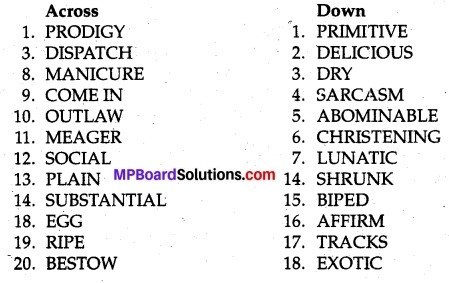
MP Board Class 12th English The Spectrum Solutions Chapter 7 In the Country

MP Board Solutions for 12th Textbook General English The Spectrum Solutions Chapter 7 In the Country Questions and Answers aids you to prepare all the topics in it effectively. You need not worry about the accuracy of the Madhya Pradesh Board Solutions for 12th English as they are given adhering to the latest exam pattern and syllabus guidelines.

You Can Download MP Board Class 12th English Solutions Questions and Answers Notes, Summary, Lessons: Pronunciation, Translation, Word Meanings, Textual Exercises. Enhance your subject knowledge by preparing from the Chapterwise MP Board Solutions for 12th English and clarify your doubts on the corresponding topics.

MP Board Class 12th English The Spectrum Solutions Chapter 7 In the Country (W.H.Davies)

Kick start your preparation by using our online resource MP Board Solutions for 12th English Chapter 7 In the Country Questions and Answers. You can even download the Madhya Pradesh Board Class 12th English Solutions Questions and Answers for free of cost through the direct links available on our page. Clear your queries and understand the concept behind them in a simple manner. Simply tap on the concept you wish to prepare in the chapter and go through it.

In The Country Exercises From The Text-Book

Comprehension

निम्नलिखित प्रश्नों के उत्तर दीजिए.

Question 1.
What kind of life does the poet find in the woods? [2010, 12, 14, 16, 17]
कवि जंगल में किस प्रकार का जीवन पाता है?
Answer:
The poet finds life in the woods sweetest. He does not hear the cry of children for food there. He does not see any woman burdened with care. He does not find a young man wasting his energies here.

कवि जंगल के जीवन को सबसे अच्छा मानता है। वह जंगल में भोजन के लिये बच्चों का करुण क्रन्दन नहीं सुनता है। वह जंगल में किसी महिला को चिन्ता के बोझ से दबा नहीं देखता है। वह जंगल में किसी नौजवान को अपनी ताकत को नष्ट करते हुए नहीं देखता है।

Question 2.
What is selfishness according to the poet? [2009]
कवि के अनुसार स्वार्थ क्या है?
Answer:
Selfishness, according to the poet, is to fly from human suffering, to avoid poor, sad, pale and weak creatures.
स्वार्थ, कवि के अनुसार, मानव दुःखों से पलायन, निरीह, दुःखी, कमजोर जीवों से बचना है।

Question 3.
What is the difference between a selfish and helpless man?
स्वार्थी एवं असहाय व्यक्ति के मध्य क्या अन्तर है? [2009, 11, 18]
Answer:
A selfish man is one who does not help the needy and the poor though he can. A helpless man is one who is not in a position to help the needy and the poor due to his poverty.

स्वार्थी वह है जो जरूरतमंदों और निर्धनों की सहायता नहीं करता जबकि वह कर सकता है। असहाय व्यक्ति वह है जो अपनी गरीबी के कारण निर्धन लोगों की सहायता करने में असमर्थ है।

Question 4.
Why does the poet not admire the beautiful sights of the city?
कवि शहर के सुन्दर दृश्यों की प्रशंसा क्यों नहीं करता? [2009]
Answer:
The poet does not admire the beautiful sights of the city because along with these sights run the sights of human suffering.
कवि शहर के सुन्दर दृश्यों की प्रशंसा इसलिये नहीं करता है क्योंकि इन्हीं दृश्यों के साथ मानव दुःखों के दृश्य भी शहर में परिलक्षित होते हैं।

Question 5.
Describe the sights and sounds of the city as portrayed in the poem.
कविता में शहर के दृश्यों व शोरगुल का वर्णन कीजिए।
Answer:
The city is full of the sights of children hungry for food. The homeless, the sad, and the needy also make part of the city. The sounds in the city are full of the cry of the children, groans, and sighs of the homeless and the poor.

शहर भूखे बच्चों के दृश्यों से भरा हुआ है। बेघर, दुःखी और जरूरतमन्द भी शहर के दृश्य हैं। शहर के शोरगुल में बच्चों की चीखें और बेघर व गरीब लोगों की कराहें शामिल हैं।

Question 6.
What happens when the poet visits the great places in the city?
शहर के बड़े स्थलों को देखते समय कवि को क्या महसूस होता है?
Answer:
The poet sees the statue but is not able to admire its beauty as men starve at the feet of the statue. The poet is not able to admire the beauty. of the park’s green tree as it has become a shelter for the homeless.

कवि मूर्ति की सुन्दरता की प्रशंसा नहीं कर पाता है क्योंकि उसी मूर्ति के नीचे गरीब लोग भूख से मरते हैं। कवि बाग में खड़े हरे वृक्ष की सुन्दरता की प्रशंसा भी नहीं कर पाता है क्योंकि यह वृक्ष बेघर लोगों का आश्रय बन गया है।

Question 7.
Objective type of questions:
(i) Write any one name of the poet from your Textbook. [2015]
Answer:
W. H. Devis.

(ii) Fill in the blank and rewrite :
This life is sweetest’ is the very first line of the poem……….. [2015]
Answer:
In The Country.

In The Country Summary

W. H. Davies

इस सुन्दर एवं प्रभावशाली कविता में बड़े शहरों में जनसाधारण को होने वाली परेशानियों के विषय में बताया गया है। भूखे, बेघर, दु:खी और जरूरतमन्द लोगों का दुःख व उनकी दुर्दशां कवि को गहरे तक आहत करती है। कवि सच्चे हृदय से अपने इन दीन-हीन साथियों की सहायता करना चाहता है किन्तु उसकी अपनी गरीबी उसे ऐसा नहीं करने देती। इतना दुःख व दर्द कवि बर्दाश्त नहीं कर पाता। वह अत्यन्त वेदना से शहरों के चुनौतीपूर्ण जीवन का वर्णन करता है। कवि बेहद संवेदनशील है, अतः वह किसी ऐसे निर्जन स्थान की ओर जाना चाहता है जहाँ उसे इस तरह के दुःखों का सामना न करना पड़े।

We believe the information shared regarding MP Board Solutions for 12th English Chapter 7 In the Country Questions and Answers as far as our knowledge is concerned is true and reliable. In case of any queries or suggestions do leave us your feedback and our team will guide you at the soonest possibility. Bookmark our site to avail latest updates on several state board Solutions at your fingertips.
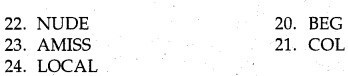
MP Board Class 12th English A Voyage Solutions Chapter 16 Netaji Subhash Chandra Bose

MP Board Solutions for 12th English Chapter 16 Netaji Subhash Chandra Bose Questions and Answers aids you to prepare all the topics in it effectively. You need not worry about the accuracy of the Madhya Pradesh Board Solutions for 12th English as they are given adhering to the latest exam pattern and syllabus guidelines.

You Can Download MP Board Class 12th English Solutions Questions and Answers Notes, Summary, Lessons: Pronunciation, Translation, Word Meanings, Textual Exercises. Enhance your subject knowledge by preparing from the Chapterwise MP Board Solutions for 12th English and clarify your doubts on the corresponding topics.

MP Board Class 12th English A Voyage Solutions Chapter 16 Netaji Subhash Chandra Bose (Col. G.S. Dhillon)

Kick start your preparation by using our online resource MP Board Solutions for 12th English Chapter 16 Netaji Subhash Chandra Bose Questions and Answers. You can even download the Madhya Pradesh Board Class 12th English Solutions Questions and Answers for free of cost through the direct links available on our page. Clear your queries and understand the concept behind them in a simple manner. Simply tap on the concept you wish to prepare in the chapter and go through it.

Netaji Subhash Chandra Bose Textbook Exercises

Word Power

A. Many words in their noun and verb forms remain the same. answer (noun) I could not check your answer, answer (verb) Please answer the question in short.
Now use the following words as noun and verb in meaningful sentences: care, honour, question, respect, wonder, praise, offer, hope.
Answer:

  • care [N]—Take care of your health.
    care [V]—Care your child properly.
  • Honour [N]—We feel honour for our nation.
    Honour [V]—Honour your elders properly.
  • Question [N]—This question is out of course.
    Question [V]—The interviewer questioned me typically.
  • Respect [N]—You should pay respect to your teacher.
    Respect [V]—Respect the views of your friends also.
  • Wonder [N]—It is no wonder, he won the race.
    Wonder [V]—I wonder at his success.
  • Praise [N]—He sent me a letter of praise at my result.
    Praise [V]—You should praise the child’s talent.
  • Offer [N]—I have an offer of a good job abroad.
    Offer [V]—He offered me a help.
  • Hope [N]—There is no hope of his survival.
    Hope [V]—I hope, I shall get a good position.

B. Many words are almost similar in pronunciation, but different in meaning or spelling. They are called homophones.
main—(chief): The main clause in the sentence is in the past.
mane—(long hair on the neck of a horse or lion): Mane is a lion’s pride.
Given below are some homophones. The first word in each pair is from the text. Give their meanings and use them in meaningful sentences:
soul, sole; die, dye; course, Coarse; quite, quiet; mail, male; break, brake.
Answer:

  • Soul—(spirit)—Our soul is immortal.
    Sole—(only)—He is the sole owner of this property.
  • Die—(to become lifeless)—He died of cancer.
    Dye—(to colour artificially)—Don’t dye your hair.
  • Course—(syllabus)—This book is not prescribed in course.
    Coarse—(rough)—Mother Teresa used to wear coarse handloom sari.
  • Quite—(up to an extent)—I feel quite nervous at this news.
    Quiet—(peaceful)—Keep quiet in the class.
  • Mail—(postal)—It is a mail coach.
    Male—(muscular)—I have bought a male elephant.
  • Break—(to be in piece)—Break this bundle of sticks.
    Brake—(a stopping device)—The brake of this car is loose.

C. Find the words in the text for the following expressions:

(a) A person in political party having conservative outlook or leaning.
(b) A person who is in favour of bringing a great and generally, violent change.
(c) A person who has had much or long experience, especially as an army man6;
(d) occurring or coming every year.
(e) A statement that orders someone to do something and threatens to punish or attack them if they do not.
(f) Use of a trick or device in the war to deceive the enemy.
Answer:
(a) rightist
(b) revolutionary
(c) seasoned
(d) annual
(e) command
(f) stratagem

Comprehension

A. Choose the correct alternative:

Question 1.
In the lesson the word ‘East’ has been used for Japan. What is the word used for England and other European countries:
(a) The South
(b) The North-West
(c) The West
(d) The South-East
Answer:
(c) The West

Question 2.
In the sentence “The Old revolutionary quietly replied” the word ‘Old revolutionary’ is used for:
(a) Ne.taji Subhas Chandra Bose
(b) Col. G.S. Dhillon
(c) Prime Minister Tojo
(d) Rash Behari Bose.
Answer:
(d) Rash Behari Bose.

Question 3.
When General Tojo was the Prime Minister of Japan?
(a) During World War I
(b) When the writer visited Japan in 1974
(c) After World War II
(d) Before World War II.
Answer:
(b) When the writer visited Japan in 1974

Question 4.
‘Netaji practised what he preached’ means:
(a) There was perfect co-ordination and uniformity in his words and actions.
(b) First he preached and then he practised.
(c) He was a man of practice and not a preacher.
(d) What he practised, he used to preach.
Answer:
(a) There was perfect co-ordination and uniformity in his words and actions.

Question 5.
In the sentence “The enemy officers used to mock at the statement”, who are referred ‘ to’as “enemy officers”?
(a) The British officers
(b) The Japanese officers
(c) The Burmese officers
(d) The enemy officers in the INA.
Answer:
(a) The British officers

B. Answer the following questions in one sentence each:

Question 1.
Why did Netaji cross the seas and go to a foreign land? .
Answer:
Netaji crossed the sea and went to a foreign land to find a solution for India’s foreign rule.

Question 2.
When Netaji went to Japan, Indians were subject people. How are we today?
Answer:
Today, we are free arid sovereign people.

Question 3.
Who was second-in-command of the Japanese Imperial Army General Staff?
Answer:
General Seizo Arisue was second-in-command of the Japanese Imperial Army General Staff.

Question 4.
What did Netaji do before dealing with a situation?
Answer:
Before dealing with a situation, Netaji used to read well and do his horriework to observe and understand the task well.

Question 5.
How did Netaji improve his ment by punishing or by counselling them?
(M.P. Board 2015)
Answer:
Netaji improved his men by counselling them both individually and collectively.

Question 6.
What was Netaji’s proposal during the annual session of the Indian National Congress?
Answer:
Netaji proposed that the congress should at once send an ultimatum to the British government demanding independence within six months or prepare immediately for a national struggle.

Question 7.
What did the British rulers think Indian people would do if the I.N.A. Trials were held?
Answer:
The British rulers thought that the Indian people specially the soldiers would appreciate the British action against the INA office. .

Question 8.
What was guaranteed to the people in the proclamation of the Provisional Government of Azad Hind?
Answer:
It guaranteed religious liberty as well as equal rights and equal opportunities to all its citizens.

C. Answer the following questions in about 60 words each:

Question 1.
What did GeneralSeizo Arisue inform Rash Bihari Bose and what was Rash Bihari’s reaction? (M.P. Board 2016)
Answer:
During the INA crisis, once Rash Bihari Bose was invited by General Seizo Arisue who was second-in-command of the Japanese Imperial Army General Staff. Seizo invited him in order to know his mind about Netaji’s coming. He asked Mr. Bose discreetly, if Netaji was desirous of coming there and he wondered how Mr. Bose would treat Netaji. Rash Bihari Bose, the old revolutionary quietly replied that Netaji was a born leader and he (Bose) would of course, be quite pleased to ask him (Netaji) to take over from him.

Question 2.
Narrate the author’s meeting and conversation with General Fujiwara during his Japan visit in 1947.
Answer:
The author narrates his meeting and conversation with General Fujiwara during his visit
to Japan in the autumn of 1974. They were passing along General Tojo’s house, reminiscing of the war days. The author asked the General about Prime Minister Tojo’s opinion about Netaji. Fujiwara replied that general Tojo was very much impressed with Netaji. He even said, “If there exists a man of the century, he is one whom I met today.” Fujiwara believed that if Netaji had arrived in the East a year earlier, they would have won the war.

Question 3.
How did Netaji give expression to his compassion for his men? Give one example.
Answer:
Netaji was a highly caring leader. He cared not only for the honour, welfare and comfort of his soldiers but also respected their feelings. He had a compassionate nature. His soldiers were overwhelmed with his concerns for them. Some of the examples of his compassionate behaviour were like sending a pair of boots to a sepoy with instructions to Regimental Commander to see personally that it fitted the man and report back to Netaji, helping his own staff officers to wash hands by pouring water and offering his own towel to scrub hands. There are many other examples.

Question 4.
How can you say that Netaji had a gift of judging the character of his men?
Answer:
Netaji was extraordinarily a rare leader. His men felt happy, proud and lucky to do and die under his command. He had a gift of judging the character of the man which served him to put the right man at the right place at the right time and on the right job. He picked up some of the soldiers from the dust and made heroes out of them.

Question 5.
What was Netaji’s way of dealing with defaulters? (M.P. Board 2010)
Answer:
Netaji had a tremendous power of judging a man’s character. So, he always chose the right man for a right job. He never failed to appreciate when appreciation was due. A good word from him made the soldiers to strive to do their job well. He had a very kind heart. He never punished anybody. He always gave a defaulter an advice, in a way that the defaulter may get a chance to improve himself.

Question 6.
How did Netaji’s love and appreciation bring a change in his men?
Answer:
Netaji was an ideal leader. He took care of all his sub-ordinates with compassion. He appreciated when appreciation was due. He never punished anyone. Instead, he advised them to realise their weakness and improve them. His men were so much impressed with him that they were ready to do anything for him’under his command. His appreciation made them feel proud.

Question 7.
Give an example of Netaji’s power of observation and prediction of some future events in war.
Answer:
Netaji had a remarkable power of observation and could predict on the forthcoming situation eventfully and correctly. In order to highlight this quality, the author gives an example. Once, Netaji wrote a small note to the author on the margin of the routine order. It was scribbled in his own hand. He told the author that as the mail was getting ready to be dispatched, he waited to advise him that instead of expecting the enemy at a particular point, he should watch at a certain other point. He gave 6-figured map reference. The note was written about 5,000 kilometers away from the author but it was accurate.

Question 8.
What was Netaji’s firm faith about the freedom of India and what did the British officers think about that?
Answer:
Netaji was very much confident that India would get freedom. He used to say often, “There is no power on earth that can keep India enslaved. India shall be free and before long.” The enemy officers used to mock at the statement. They thought it just illusory and a face’saving device. Actually, Netaji had a plan which was beyond the comprehension of professional soldiers.

Question 9.
How did the high spirits of the INA bring a change in the minds and actions of the Indian soldiers in the British forces?
Answer:
Netaji always worked with far-sightedness. He kept the INA on the field even in the face of defeat. He wanted his soldiers to pay the price of liberty not only when they were on the advance but also during the retreat while going away from India not to win a territory but to continue fighting against the British forces who were holding India in perpetual bondage. These forces consisted of a greater number of the Indian soldiers who paused and pondered as to why the INA with their poor strength and poorer equipment, yet higher spirit were fighting against the British. It created a psychological revolution. The war ended and with it ended the slavish mentality of the Indian soldiers. Such was the vision and plan of action of Netaji.

Question 10.
The author says that “Netaji had a compassionate nature”. Prove the truth of the statement by giving some examples from the lesson.
Answer:
Netaji was a highly caring leader. He cared not only for the honour, welfare and comfort of his soldiers but also respected their feelings. He had a compassionate nature. His soldiers were overwhelmed with his concerns for them. Some of the examples of his compassionate behaviour were like sending a pair of boots to a sepoy with instructions to Regimental Commander to see personally that it fitted the man and report back to Netaji, helping his own staff officers to wash hands by pouring water and offering his own towel to scrub hands. There are many other examples.

D. Answer the following questions in about 75-100 words each:

(i) How did Netaji act in the following situations and with what result?
(a) When he had to meet somebody.
(b) In making the best use of the abilities of his men.
Answer:
Netaji was a seasoned man. He was polite, courteous and well behaved. He had the capacity to manage every situation in his favour. He had the tremendous power to judge a man. Before dealing with anyone or any situation, he used to read and do homework about that situation. He was always careful about the man to whom he had to meet. He took care of the honour and position of the man.

He had a compassionate nature. He always respected other’s feelings. He had a gift of judging the character of a man which served him to put the right man at the right place, at the right time and on the right track. He never failed to appreciate when appreciation was due.

Question 2.
Narrate the episode which surprised the author at the accuracy of Netaji’s power of judgement regarding an eventuality.
Answer:
Netaji had a tremendous power of judgement regarding an eventuality. He could observe and predict accurately. Once the author was surprised when Nejtaji wrote a small note on – the margin of a routine order. He had advised him that instead of expecting the enemy at the particular point, he should also watch at certain other point. He gave 6 figured map reference. The note was written in Rangoon about 5,000 kilometers away from the author. When the author received Netaji’s note, he was surprised at the accuracy of Netaji’s judgement. The author was already facing the enemy where Netaji had pointed out to watch. This was a measure of Netaji’s skill at generalship.

Question 3.
Write a short note on Netaji’s military foresight.
Answer:
Netaji’s power of observation was remarkable. He had a tremendous military foresight. He was always accurate in his predictions or guess. There are many incidents that the author talks about here in order to prove his military foresight. One such incident was that Netaji during the annual session of the Indian National Congress at Tripuri in Jabalpur in 1939 made a proposal to send an ultimatum to the British government, demanding independence within six months or they would prepare immediately for a national struggle. His proposal, though opposed, was based on his appreciation of the European situation which was something beyond the understanding of the political leaders but the prediction turned to be correct. The war did break out within 6 months on 3rd September, 1939.

Question 4.
How did the Indian people and the Indian soldiers in British army react when the INA Trials of the three great INA heroes began?
Answer:
The INA trial of the three military officers in India was a memorable event which brought about many changes in the Indian mass and the soldiers. When the British started this trial at the Red Fort, they thought that the Indian people especially the soldiers would appreciate the British action against the INA officers. However, just the reverse happened.

As soon as the first INA trial of the three front-line commanders started on 5th November, 1945, within a week disturbances broke out in Lahore followed by that in Lucknow and then Kolkata where hundreds of demonstrators were injured and twenty killed in police firing. Even after the first trial in which the three accused officers were released by the commander-in-chief, the public demand to stop the future INA trials continued. It gave rise to anti-British sentiments culminating in the mutiny in various regiments all over India. The days of the British Raj in India were close to their end.

Question 5.
Write a note on the secular character of Netaji and his Provisional Government of Azad Hind.
Answer:
Netaji was a man of great qualities. He was a great humanist, a seasoned commander, a compassionate leader, a perfect visionary and a staunch secularist. The author had full confidence that they would get absolute justice from him a. id his government the forerunner of our government today. The complete personality and all embracing ideas are distilled in the last but one para of the Proclamation provisional Government of Azad Hind.

In that Proclamation, Netaji said that the Provisional Government is entitled to and hereby claim the allegiance of every Indian. It guarantees religious liberty as well as equal rights and equal opportunities to all its citizens. It declared its firm resolve to pursue the happiness and prosperity of the whole nation and of all its parts, cherishing all the children of the nation equally and transcending all the differences cunningly fostered by alien government in the past. It was a complete vision of Netaji.

Question 6.
There is a contradiction in the statement “Netaji’s power of generalship.,..turned the defeat of the INA into the defeat of the British Raj”. Prove the truth of the statement on the basis of the text.
Answer:
This statement highlights the far-sightedness and military observation of Netaji. As he had a tremendous power of calculating the future situation, his guess and predictions were always accurate. When he proposed for sending an ultimatum to British government demanding independence within six months he was waging the future events. The war broke out within six months. He had a plan which was beyond the comprehension of professional soldiers.

He kept the INA in the field even in the face of defeat. It created a psychological revolution. The war ended and with it ended the slavish mentality of the Indian army. It gave rise to anti-Raj activity all over India even in the military camps of Bombay, Karachi and Jabalpur. Netaji’s plan of action had transformed the British Indian army into the Indian army. His powers of generalship turned the defeat of the INA into the defeat of the British Raj.

Question 7.
In what respect can Netaji’s Provisional Government of Azad Hind be called the forerunner of our Government today?
Answer:
Netaji was a great visionary. He had the power of accurate analysis of any situation. In order to find a solution to Indian freedom, he crossed the sea and organised his own army. His approach to Indian freedom was not supported by the rightist leaders in India. It was his quality that the author was first confident about to get absolute justice from him and his government the forerunner of the government today. The Indian Constitution after the freedom accepted the high ideal of equality, justice, secularism which were the vision of Netaji.

Question 8.
Make a general assessment of Netaji as:
(a) a man of brave but kind heart, and
(b) a man of keen insight and foresight.
Answer:
(a) Netaji was a complete man. He practised what he preached. He cared not only for the honour, welfare and comfort of his soldiers but also respected their feelings. He had a compassionate nature. His soldiers were overwhelmed with his concerns individually and collectively, like sending a pair of boots to a sepoy with instructions to Regimental Commander to see personally that it fitted the man and report back to Netaji, helping his own staff officers to wash hands by pouring water and offering his own towel to scrub hands, shedding tears with a lump in his throat on hearing about the difficulties of his soldiers and taking immediate steps to supply relief. He was a rare leader of men in war.

(b) He had power of observation. He was gifted with insight and foresight and whatever he did was accurate in result. He did whatever he could for the freedom of India. By putting INA in war, he proved how a defeating soldier can win a greater victory. The defeat in war of the British Indian Army gave a new identity to the Indian Army. It transformed the whole scene. So, what he did was beyond comprehension of a professional soldier.

Question 9.
Explain the spirit of the last but one para of the Proclamation of the Provisional Government of Azad Hind.
Answer:
Netaji’s complete personality is revealed in the distilled form in the last but one para of the Proclamation of Provisional Government of Azad Hind. In this proclamatory para, he talks about the ideas of his government. A political loyalty is claimed on the part of the government, for it guarantees religious liberty as well as equal rights and equal opportunities to all its citizens. It declares its firm resolve to pursue the happiness and prosperity of the whole nation and of all parts, cherishing all the children of the nation equally and transcending all the differences cunningly fostered by alien government in the past. In short, Netaji wished for a welfare and complete democratic government.

Grammar

Note the use of verbs in bold in the following sentences from the text:
(a) I wonder how you would treat him.
(b) May I know how long will it take me to get into touch with the enemy?
(c) They at least will not forget him as long as they live, but I hope those who will come after them will also gratefully remember this magnificent man.

The verbs wonder, know, forget, hope and remember have a typical character. These verbs cannot be used in continuous tense, even when they are describing the real present. It is because of the fact that they are related to a condition, behaviour or action which is not In speaker’s conscious control. They occur or take place whether the speaker likes it or not. Take a very common example:

I see a man outside. He is looking at me. You see if your eyes are open, but you look at
something when attention is added to the action. Other verbs of this category are: hear, have (=to possess), be (except passive), notice, recognize, smell and taste (when used without an object), believe, feel (that), think (that), know, understand, remember, forget, mean, want, wish, forgive, refuse, love, hate, like, dislike, seem, belong to, consist of, own, possess, etc.

But when such verbs are used with ‘always’ or ‘for ever’ in the sense of ‘all the times, especially at present’ they can be used in present continuous tense: He is always seeing dreams of wonderlands. Exception to such verb is: I am seeing the Minister tomorrow (in the sense of meeting).

A. Now make the correct use of the verb given in brackets. (Present simple or continuous)

1. I ………….. (think) of moving out of this house.
2. I ………… (know) him very well.
3. They …………. (meet) me tomorrow in the office.
4. He ……………. (always, see) ghosts in the dark.
5. You ……………. (suppose) you shall be spared?
6. I ………………. (just, think) that you might come.
7. I ……………… (see) a bird in the tree, It (sing).
8. I ……………… (think) that now I (know) how to use the verbs of perception.
9. My mother …………….. (always, feel) sick when she sees a dirty place.
10. I …………….. (certainly, forget) your face.
Answers:

  1. am thinking
  2. know
  3. are meeting
  4. always sees
  5. Do—suppose
  6. am just thinking
  7. See – is singing
  8. am thinking -Know
  9. always feels
  10. am certainly forgetting

B. Correct the following sentences:

1. She is refusing to go out in the cold.
2. I am not remembering what you said.
3. This boy is now understanding the present continuous tense.
4. The judge now hears the arguments.
5. When do you see him? On Monday?
6. I see him tomorrow morning.
7. I do not feel well today.
8. I am hearing a noise outside.
9. I am having a lot of books.
10. Don’t disturb him. He thinks deeply.
Answers:

  1. She refuses to go out In the cold/She refuse d to go out In the cold.
  2. I don’t remember what you said.
  3. This boy now understands the present continuous tense.
  4. The judge is now hearing the arguments.
  5. When are you seeing him? On Monday? When will you see him? On Monday?
  6. I will see him tomorrow morning.
  7. I am not feeling well today.
  8. I hear a noise outside.
  9. I have a lot of books.
  10. Don’t disturb him. He is thinking deeply

Read the following sentences from the text and mark the uses of ’it’in them.

  • It was this relationship which kept up our morale.
  • It was scribbled in his own hand.
  • How long will it take me to get into touch with the enemy?

In these sentences. ‘it’has different connotations.

  • In the first sentence, it is use is anticipatory which refers to the following words-
    ‘this relationship’.
  • In the second sentence, ‘it’ is used as a pronoun for the words ‘the note’ in the previous sentence in the text.
  • In the third sentence ‘it’ is used as an introductory ‘It’ to know the length of time.

The following are the ways in which one can use ‘it’ in a sentence:

  • As a pronoun for something lifeless or for animals in general sense:
    e.g.: The cat is a domestic animal. It mews.
  • As a pronoun for a baby where gender is not known:
    e.g.: The baby is sleeping. It has been fed.
  • Anticipatory use of it refers to a phrase or a statement in the sentence:
    e.g.: It is better to go home early.
  • In place of a noun clause in a complex sentence:
    e.g.: It is not known who did it (Who did it is not known).
  • To tell the time by watch and to talk about weather or season. It is 9.30 by my watch.
    e.g.: It is very cold today. It is winter now.
  • To tell a distance or length of time:
    e.g.: It will take 6 hours to reach the destination. It Is 6 miles from here. You should hire a taxi.
  • To emphasize a certain part of a sentence (a word or a phrase)
    e.g.: It was at 9.00 pm that he arrived here.
    e.g.: It was Mohan who did it.
  • In some traditional expressions: It does not matter.
    e.g.: it is all right.
    e.g.: it is of no use.
    Who is there? it is me over here.

A. Now reframe the sentences with anticipatory ‘it’.

(i) That the earth and atmosphere are getting warm is clear to all.
(ii) Who stole the book is not clear.
(iii) That we are losing our morals is a matter bf great concern.
(iv) What is the fate of a man is known to God only.
(v) When they wilt come has not been intimated to us.
Answers:
(i) It is clear to all that the earth and atmosphere are getting warm.
(ii) It is not clear who stole the book.
(iii) It is a matter of great concern that we are losing our morals.
(iv) It is known to God only what is the fate of a man.
(v) It has not been intimated to us when they will come.

B. Begin the sentences with introductory ‘it’.
(i) To die for the nation is a glorious act.
(ii) To yawn before others,is bad manners.
(iii) To travel in a bullock cart is a pleasure.
(iv) To think and ponder upon is essential.
(y) To err is human.
(vi) To forgive is divine.
Answers:
(i) It is a glorious act to die for the nation.
(ii) It is bad manners to yawn before others.
(iii) It is a pleasure to travel in a bullock cart.
(iv) It s essential to think and ponder.
(v) It is human to err.
(vi) It is divine to forgiver

Speaking Activity

After a careful study of the lesson, you must have reached the conclusion that Netaji was a man of action, During the Independence Movement, he favoured Direct action and told, “You give me blood; I shall give you freedom”.

In this background, arrange the class (as in assembly hail) into two groups on the right, “Ayes” who will support the proposal, and on the left, the “Nays” who will sit in the opposition. The teacher will act as the speaker of the House. He will put forward the proposal for discussion and get it passed. The proposal will be:
“Not words but only deeds can make a nation great and strong”.
After the discussion for an hour, the Speaker will arrange for voting in favour of or against the proposal, On the basis of the majority vote, the proposal he declared passed or rejected.
Answer:
Arrange this discussion class under the guidance of your teacher. In the text, there occurs a sentence, “those who will come after then will also grateful remember this management man .who lived and died so that India could be great”.

During the 1857 War of Indian Independence, Rani Lami Bai of Jhansi was the one who
fought for the Suraj’ (Swarajya) and died fighting for her motherland. Given below are some outlines. On the basis of these, compose a short biographical sketch of the
Rani of Jhansi.

  • born 19th November 1835 at Bithoor near Kanpur; childhood name.Manu,
  • father—Moropant; playmates .Tantya Tope, Nana Saheb
  • married to Gangadhar Rao, the king of Jhansi; A son born, died soon.
  • adopted Damodar Rao, son of a near relative; husband died, 21st Nos’. 1853.
  • proposal to British Governor General to recognize the adopted son as Successor to
    the throne; proposal rejected.
  • Jhansi was attacked by Col. Rose on 23rd March, 1857; fierce battle.
  • Rani said, “I shall not give up my Jhansi.”
  • Fort of Jhansj fell. Reached Gwallor, captured Gwallor fort.
  • died fighting on 18th June 1857

Answer:
Rani Laxmi Bai was born 19th November 1835 at Bithoor near Kanpur. Her childhood name was Manu. She was the daughter of Moropant and her playmates were Tantya
Tope and Nana Saheb. She was married o Gangadhar Rao the king of Jhansi. She gave birth to a son who died soon. Later, they adopted Damodar Rao the son of a relative. Her husband died on 21st November. 1853. Her proposal for recognition of her adopted son as a successor was rejected by the British government. It grew in rivalry with the government and she was attacked by Col. Roce on 23rd March 1857. There was a fierce battle, As, she was commit-ted to Jhansi, she was in no way reluctant to give It up. A part of Jhansi fort fell and she reached Gwalior, which was captured by the government. She died fighting on 18th June. 1857. She was a great warrior and a dedicated freedom fighter.

Think it Over

Had Netaji been amongst us today. how had he been a source of inspiration to you? Think over it and discuss among others.
Answer:
Do It yourself.

Things to Do

A. Netaji Subhash Chandra Bose. Rash Bihari Bose, Mahatma Gandhi. Jawaharlal Nehru and many other great freedom fighters inspired thousands of young men and women to take part in the Indian Independence Movement. You might have some freedom fighters in your locality or adjoining town or city. Divide your class into 4 or 5 groups and organize a week-end programme for holding interviews with them.

Record your impressions on the following points:
(i) What or who inspired them?
(ii) What were the conditions prevailing in the society those days?
(iii) How did they protest against the British Rule?
(iv) What tortures had they to suffer?
(v) What were their feelings when India became free?
(vi) Did their hopes of a free India come true?
Answer:
Do it yourself.

B. Compose an appeal, to be circulated among your fellow-students and others,for voluntary blood donation, focusing on the following points:

  • It is an act of charity.
  • It saves lives.
  • Thousands of new-born and sick die due to lack of blood.
  • Blood donation does not leave any adverse effect on the body.
  • Facilities for donation are available at of district hospitals.
  • Blood-banks preserve it for emergency requirements.
  • Only healthy blood is accepted.
  • Request all people to he God on Earths.

Answer:

Donate Blood Make The World Live
Participate Generously For Pious Reasons:

  • Act of charity
  • Save lives
  • No adverse effect
  • Facilities every where
  • Only healthy blood accepted
  • Be God on earth

Live And Let Live

Netaji Subhash Chandra Bose by Col. G.S. Dhillon Introduction

It is an excerpt of From My Bones—Memoirs of Col. Gurbaksh Singh Dhillon of the Indian Natio nal Army. This essay records some of the unique qualities of Netaji Subhas Chandra Bose.

Netaji Subhash Chandra Bose Summary in English

It is an excerpt of (From my Bones Memoirs of Col. Gurbaksh Singh Dhillon of the Indian National Army.) This essay records some of the unique qualities of Netaji Subhas Chandra Bose. The writer says that Subhas Chandra Bose will always be remembered for his stamina which led him across the sea in search of the answer for India’s freedom. He was a multi faceted personality. Leaders of his time remembered him for his qualities. Rabindra Nath Tagore called him Deshnayak Leader of the Country.

Netaji practised what he preached. He was always deeply concerned with the honour, welfare and comfort of his soldiers and respected their feelings. He had a compassionate nature. He overwhelmed the soldiers with his concern for them individually and collectively. His soldiers were ready to anything for him. It was this relationship that kept their morale high, in spite of all their difficulties and deficiencies.

Netaji was a seasoned army man. He used to read a lot and do his homework on the subject, he had to deal with. He was gifted with a quality of judging the character of the man which served him, to put the right man at the right place at the right time and on the right job. He never failed to appreciate when appreciation was due. He was so kind-hearted that he never punished anybody. He always gave a chance and advice to a defaulter to improve himself. He had a remarkable power of observation and could predict an eventuality correctly. The author remembers many such incidents.

Netaji had a keen military foresight. Once in March, 1939 during the annual session of the Indian National Congress at Tripuri in Jabalpur, he proposed to send an ultimatum to the British government to free India within six months or they should prepare themselves for national struggle. He was opposed by the right wing but what Netaji predicted came true. He had a belief that no power on earth can keep India enslaved. The army officers used to mock at this belief, which they thought was illusory and a face saving device.

Actually, Netaji had a plan which was beyond the comprehension of professional soldiers. Netaji’s stratagem had transformed the British Indian Army into the Indian Army. The days of the British Raj in India were close to their end. Netaji was a staunch secularist. The author believed that they were sure to get absolute justice through him and his government. He was really a great man.

Netaji Subhash Chandra Bose Summary in Hindi

यह पाठ My Bones-Memoirs of Col. Gurbaksh Singh Dhillon of the Indian National Army का एक अंश है। इसमें नेताजी सुभाष चंद्र बोस के कुछ गुणों की चर्चा की गई है।

लेखक कहता है कि सुभाष चंद्र बोस हमेशा अपने जुझारूपन के लिए याद किए जाएँगे जो उन्हें भारत की आज़ादी का समाधान ढूँढ़ने के लिए समुद्रपार विदेश की धरती पर ले गया। वे एक बहुमुखी प्रतिभा के व्यक्ति थे। उनके समय के नेता लोग उनके गुणों को याद करते थे। रविन्द्रनाथ टैगोर ने उन्हें ‘देशनायक’-देश का नेता कहा था।

नेताजी वही करते थे जो कहते थे। वे हमेशा अपने सिपाहियों की प्रतिष्ठा, उनके कल्याण और सुविधा के प्रति सजग थे और उनकी भावनाओं का आदर करते थे। उनका स्वभाव सद्भावपूर्ण था। वे सिपाहियों को उनके प्रति अपनी सजगता से व्यक्तिगत एवं सामूहिक रूप से भाव-विहल कर देते थे। उनके सिपाही उनके लिए कुछ भी करने को तैयार थे। यही संबंध था जो किसी भी कठिनाई और अभाव के बावजूद उनके मनोबल को ऊँचा रखता था।

नेताजी एक अनभवी सेनानायक थे। वे किसी भी परिस्थिति का पहले गहन अध्ययन करते थे। उनमें किसी भी व्यक्ति को परखने की देवी क्षमता थी जो उन्हें सही व्यक्ति को सही जगह, सही समय और सही काम में लगाने में मदद करती थी। जहाँ प्रशंसा की ज़रूरत होती वहाँ कभी भी प्रशंसा करने में वे चूकते नहीं थे। वे इतने दयालु थे कि कभी भी किसी को उन्होंने दण्ड नहीं दिया। ये हमेशा गलती करने वाले को अबसर और सुधरने की सलाह देते थे। उनमें सूक्ष्म अवलोकन की गजब शक्ति थी और वे किसी भी आकस्मिक घटना का बिल्कुल सही आकलन कर लेते थे। लेखक बहुत-सी ऐसी घटनाओं को याद करता
नेताजी में सूक्ष्म सैन्य दूरदर्शिता थी।

एक बार मार्च, 1999 में भारतीय राष्ट्रीय कांग्रेस के वार्षिक अधिवेशन के दौरान उन्होंने प्रस्ताव रखा कि अंग्रेज सरकार को चेतावनी भेजी जाए। छहः महीने के अंदर वे तुरंत भारत को आजाद करें अन्यथा उन्हें राष्ट्रीय संघर्ष के लिए तैयार होना चाहिए। कट्टरवादियों द्वारा इसका विरोध किया गया लेकिन नेताजी ने जो कहा वह सच हुआ। उनका विश्वास था कि कोई भी ताकत भारत को गुलाम नहीं रख सकती। अंग्रेज अधिकारी इस बात का मज़ाक उड़ाते थे और उन्हें लगता था यह भ्रामक विचार है और मुँह छिपाने का बहाना है। वास्तव में नेताजी के मन में ऐसी योजना थी जो सामान्य सैनिक के समझ से परे थी। नेताजी की नीतियों ने ब्रिटिश शासन की नींद उड़ा दी। नेताजी कट्टर धर्म-निरपेक्ष थे। लेखक को विश्वास था कि उनके या उनकी सरकार में सभी को पूर्ण न्याय मिलेगा। वे निस्संदेह महान व्यक्ति थे।

Netaji Subhash Chandra Bose Word Meanings

MP Board Class 12th English A Voyage Solutions Chapter 16 Netaji Subhash Chandra Bose img 1
MP Board Class 12th English A Voyage Solutions Chapter 16 Netaji Subhash Chandra Bose img 2

Netaji Subhash Chandra Bose Important Pronunciations

MP Board Class 12th English A Voyage Solutions Chapter 16 Netaji Subhash Chandra Bose img 3

Read f he following passages carefully and answer the questions that follow:

‘The question to all of us is then: Will Subhas be remembered by the generations to come? I.think he will. At least it was for this recompense that his restless soul traversed oceans and foreign lands in search of an answer to India’s freedom. It is too horrible to think that he is no longer amongst us. To his colleagues, he will remain ever alive, ever green and immortal.

He imposed on them his vivid personality so well and they at least will not forget him as long as they live, but I hope those who will come after them will also gratefully remember this magnificent man, born to be a ‘grand signeur’ who lived and died, so that India could be great and so that men and women of our race may not have to be born into this world with the stigma of being a subject people and not free and independent as we are today.’ (Page 115)

Questions:
(i) Which question haunted the author?
(ii) Find the word from the above passage which is similar In meaning to ‘terrible’?
(iii) Give noun form of ‘Imposed’.
(iv) Find a word in the passage which is opposite to ‘ordinary’?
Answers:
(i) The question that haunted the author was that if Netaji would be remembered by
the generations to come.
(ii) ‘Horrible’ has similar meaning to ‘terrible’.
(iii) ‘Imposition’ is the noun form of ‘imposed’.
(iv) ‘Magnificent’ is opposite to ‘ordinary’.

2. Netaji cared not only for the honour, welfare and comfort of his soldiers but also respected their feelings. He had a compassionate nature. He overwhelmed us with his concern for us individually and collectively, like sending a pair of boots to a sepoy with instructions to Regimental Commander to see personally that it fitted the man and report back to Netaji, helping his own staff officers to wash hands by pouring water and offering his own towel to scrub hands, shedding tears with a lump in his throat on hearing about our difficulties and taking immediate steps to supply relief.

Such spontaneous feelings coming out of his heart, made him extraordinarily a rare leader of men in war. His men felt happy, proud and lucky to do and die under his command. It was this relationship which kept up our morale in spite of all our difficulties and deficiencies. (Page 116)

Questions:
(i) What did Netaji care for?
(ii) Find the word similar in meaning to ‘excited’.
(iii) Give noun form of ‘compassionate’.
(iv) Find a word opposite in meaning to ‘deliberate’.
Answers:
(i) Netaji cared for the honour, welfare and comfort of his soldiers but valued their ^ feelings as well.
(ii) ‘Overwhelmed’ has similar meaning to’excited’.
(iii) ‘Compassion’ is the noun form of ‘compassionate’.
(iv) ‘Spontaneous’ has opposite meaning to ‘deliberate’.

3. Netaji’s guess was accurate. I took my command in mid November 1944.1 got to grips with the enemy early in February 1945. Another example of Netaji’s military foresight is when in March 1939, during the annual session of the Indian National Congress at Tripuri in Jabalpur (M.P.), he proposed that the Congress should at once send an ultimatum to the British Government demanding independence within six months and should prepare immediately for a national struggle. The proposal was opposed by the rightist leaders. Netaji’s proposal was based on his appreciation of the European situation which was something beyond the understanding of our political leaders. But Netaji’s prediction turned out to be correct. (Page 117) (M.P. Board 2012)

Questions:
(i) Which proposal was opposed by the rightist leaders?
(ii) The author took command in:
(a) Mid November 1944.
(b) Mid February 1945.
(c) March 1939.
(d) November 1945.
(iii) One word from passage for “telling in advance what is going to happen in future” is:
(a) ultimate.
(b) tuned.
(c) predict.
(d) proposed.
(iv) The annual session of the Indian National Congress was held in 1939 at
Answers:
(i) Netaji’s proposal of sending an ultimatum to British Government demanding independence was opposed by the rightist leaders.
(ii) (a) Mid November 1944.
(iii) (c) predict.
(iv) Tripuri in Jabalpur (M.P.)

4. It created a psychological revolution. The war ended and with it ended the slavish mentality of the Indian soldier. When the British started INA trials in the Red Fort, they thought that the Indian people especially the soldiers would appreciate the British action against the INA officers. Reverse was the case. As soon as the first INA trial of the three front-line commanders started on 5th November 1945, within a week, disturbances broke out in Lahore, then in Lucknow and in Calcutta (now Kolkata) where hundreds of demonstrators were injured and twenty killed in police firing. Even after the first INA trial in which the three accused officers were released by the Commander-in-Chief, the public demand to stop the future INA trials continued. Anti-British Raj feelings kept on ‘ rising unabated. (Page 117)

Questions:
(i) What was the result of the war? What change did it bring to Indian soldiers?
(ii) Give a word opposite in meaning to ‘forward’.
(iii) Give a word similar in meaning to ‘obstacle’.
(iv) Make noun with the word ‘created’.
Answers:
(i) The war resulted in defeat. It ended the slavish mentality of Indian soldiers. It also gave rise to anti-British Raj feelings.
(ii) ‘Reverse’ is opposite to ‘forward’.
(iii) ‘Disturbance’ has similar meaning to ‘obstacle’.
(iv) ‘Creation’ is the noun form of ‘created’.

5. Having shown Netaji’s powers of generalship which turned the defeat of the INA into the defeat of the British Raj, let me record that another great asset in Netaji’s being was that he was a staunch secularist. Whatever our religion and the area or the station of our birth, we had full confidence that we would get absolute justice from him and his Government the forerunner of our Government today. To show how his mind worked in this direction, his brief but an all embracing idea of independence is shown in distilled form in the last but one para of the proclamation of Provisional Government of Azad Hind. (Page 118)

Questions:
(i) What quality of Netaji is talked about here? What did the author feel about Netaji?
(ii) Give adverb form of ‘absolute’.
(iii) Give a word similar in meaning to ‘complete’.
(iv) Give opposite in meaning to ‘quote’.
Answers:
(i) His quality of being a secularist is talked about here. The author felt sure to get absolute justice from Netaji and his government.
(ii) ‘Absolutely’ is the adverb form of ‘absolute’.
(iii) ‘Absolute’ is similar in meaning.
(iv) ‘Unquote’ is the opposite to ‘quote’ to ‘complete’

We believe the information shared regarding MP Board Solutions for 12th English Chapter 16 Netaji Subhash Chandra Bose Questions and Answers as far as our knowledge is concerned is true and reliable. In case of any queries or suggestions do leave us your feedback and our team will guide you at the soonest possibility. Bookmark our site to avail latest updates on several state board Solutions at your fingertips.

MP Board Class 12th English The Spectrum Solutions Chapter 5 Ten Natural Laws of Success

MP Board Solutions for 12th Textbook General English The Spectrum Solutions Chapter 5 Ten Natural Laws of Success Questions and Answers aids you to prepare all the topics in it effectively. You need not worry about the accuracy of the Madhya Pradesh Board Solutions for 12th English as they are given adhering to the latest exam pattern and syllabus guidelines.

You Can Download MP Board Class 12th English Solutions Questions and Answers Notes, Summary, Lessons: Pronunciation, Translation, Word Meanings, Textual Exercises. Enhance your subject knowledge by preparing from the Chapterwise MP Board Solutions for 12th English and clarify your doubts on the corresponding topics.

MP Board Class 12th English The Spectrum Solutions Chapter 5 Ten Natural Laws of Success (Hyrum W. Smith)

Kick start your preparation by using our online resource MP Board Solutions for 12th English Chapter 5 Ten Natural Laws of Success Questions and Answers. You can even download the Madhya Pradesh Board Class 12th English Solutions Questions and Answers for free of cost through the direct links available on our page. Clear your queries and understand the concept behind them in a simple manner. Simply tap on the concept you wish to prepare in the chapter and go through it.

Ten Natural Laws Of Success Exercises From The Text-Book

Word Power

A. लैटिन भाषा ‘cred’ का अर्थ है ‘to believe, trust’ क्या तुम इसी धातु वाले अन्य शब्दों को अनेक अर्थ से जोड़ सकते हो।
Answer:

  • credit – to give credit to
  • accredit – a reputation for being trustworthy
  • credentials – a certificate
  • discredit – to harm the credit or reputation of someone

B. उपसर्ग ‘in’- के मुख्य दो अर्थ हैं (i) not, without, (2) in, into, withini यह अपने बाद आने वाले letter के अनुसार अपनी spelling भी बदलता है। अतः in – कभी-कभी em-, en-, il-, im-, ir- हो जाता है। अब क्या तुम दिये हुए शब्दों के पूर्व सही उपसर्ग लगा सकते हो, साथ ही यह पता कर सकते हो कि वह first type का अर्थ दे रहा है या second type का।
Answer:
MP Board Class 12th English The Spectrum Solutions Chapter 5 Ten Natural Laws of Success 1

Comprehension

निम्नलिखित प्रश्नों के उत्तर दीजिए

Question 1.
When do we experience inner peace? [2009, 16]
हमें आन्तरिक शान्ति का अनुभव कब होता है?
Answer:
When we obey natural laws, we experience inner peace.
जब हम प्राकृतिक नियमों का पालन करते हैं, तब हम आन्तरिक शान्ति का अनुभव करते हैं।

Question 2. What are comfort zones? [2009, 13, 15, 16, 18]
आराम के क्षेत्र क्या हैं?
Answer:
Comfort zones are those situations in our personality which are difficult to give up. They are physical, mental, emotional, social, or psychological comfort zones.
आराम के क्षेत्र हमारे व्यक्तित्व की वह स्थितियाँ हैं जिनको त्यागना अत्यन्त कठिन होता है। ये आराम के क्षेत्र शारीरिक, मानसिक, भावनात्मक, सामाजिक या मनोवैज्ञानिक होते

Question 3.
How can we free up time? [2009]
हम किस प्रकार समय बचा सकते हैं?
Answer:
By investing a little time in certain activities we can free up time throughout the rest of the day,
निश्चित क्रिया-कलापों में थोड़ा समय देकर हम शेष पूरे दिन के लिये समय बचा सकते हैं?

Question 4.
What reflects our true belief?
हमारा विश्वास किस प्रकार परिलक्षित होता है?
Answer:
Our behaviour reflects our true belief.
हमारे व्यवहार से हमारा विश्वास परिलक्षित होता है।

Question 5.
What do incorrect beliefs lead to?
गलत धारणायें व विश्वास किधर ले जाते हैं?
Answer:
Incorrect beliefs lead to non-full filment of your basic needs.
गलत धारणायें व विश्वास हमें हमारी मूलभूत आवश्यकताओं की पूर्ति से दूर ले जाते हैं।

Question 6.
Who is the best judge of self-worth? [2017]
स्व-योग्यता का सर्वोत्तम निर्णायक कौन है?
Answer:
One oneself is the best judge of self-worth.
मनुष्य स्व-योग्यता का स्वयं सर्वोत्तम निर्णायक है।

Question 7.
What are natural laws? How do they affect our lives? [2009, 15, 16]
प्राकृतिक नियम क्या है? वे हमारे जीवन को किस प्रकार प्रभावित करते हैं?
Answer:
Natural laws are fundamental patterns of nature and life. They describe things and they really are. These laws govern our lives irrespective of our agreement or disagreement with them. Obeying them can help us gain control of our lives, improve our relationship, increase our personal productivity and experience inner peace.

प्राकृतिक नियम प्रकृति और जीवन के मूलभूत नियम हैं। वे चीजों को उनके वास्तविक रूप में दर्शाते हैं। हमारी सहमति या असहमति की परवाह किये बिना ये नियम हमारे जीवन को नियन्त्रित करते हैं। इनके पालन करने से हमें अपने जीवन पर नियन्त्रण रखने में सहायता मिलती है, हम अपने सम्बन्ध सुधारते हैं, अपनी व्यक्तिगत क्षमता को बढ़ा सकते हैं और आन्तरिक शान्ति का अनुभव करते हैं।

Question 8.
Distinguish between time management’ and ‘event control’. ‘समय प्रबन्धन’ एवं ‘घटनाओं के नियन्त्रण’ में अन्तर बताइए।
Answer:
We control our lives by controlling our time. Controlling our lives means controlling our time and controlling our time means controlling the events in our lives. Thus focussing on controlling the events of our lives makes all the difference.

हम अपने जीवन पर नियन्त्रण समय को नियन्त्रित रखकर करते हैं। जीवन पर नियन्त्रण · का अर्थ है-अपने समय पर नियन्त्रण और समय पर नियन्त्रण का अर्थ है-जीवन की घटनाओं
पर नियन्त्रण। इस प्रकार जीवन की घटनाओं पर नियन्त्रण हेतु ध्यान केन्द्रित करना ही बहुत महत्वपूर्ण है।

Question 9.
What are governing values? How can we identify our governing values?
निर्देशित करने वाले जीवन-मूल्य कौन से हैं? हम किस प्रकार इन जीवन-मूल्यों को पहचान सकते हैं?
Answer:
Governing values are the foundation of personal success and full filament. Each of us lives according to a unique set of governing values. These values are the things that are most important to us. We identify our governing values by choosing out of them the value of highest priority.

व्यक्तिगत सफलता एवं उपलब्धि की नींव होती है निर्देशित करने वाले जीवन-मूल्य। हममें से प्रत्येक व्यक्ति निर्देशित करने वाले जीवन-मूल्यों के एक विशिष्ट वर्ग में रहता है। ये मूल्य हमारे लिये सर्वाधिक महत्वपूर्ण हैं। हम इन जीवन-मूल्यों को उनमें से सबसे महत्वपूर्ण मूल्य को चुनकर पहचान सकते हैं।

Question 10.
Why should we leave our comfort zones and how? [2012, 14]
हमें अपने आसान क्षेत्रों को क्यों और कैसे छोड़ना चाहिए?
Answer:
We must leave our comfort zones to reach any significant goal. We can leave our comfort zones through effort and commitment.
किसी भी महत्वपूर्ण लक्ष्य को प्राप्त करने हेतु हमें अपने आसान क्षेत्रों को छोड़ देना चाहिए। हम अपने आसान क्षेत्रों को प्रयास और दृढ़ इच्छा से छोड़ सकते हैं।

Question 11.
How can correcting beliefs solve problems?
अपनी धारणाओं व विश्वासों को सही कर हम किस प्रकार अपनी समस्याओं को हल कर सकते हैं?
Answer:
We can solve most of the problems by attacking incorrect beliefs and destructive behaviours without attacking ourselves or others.
गलत धारणाओं व विश्वासों और विध्वंसात्मक व्यवहार पर आक्रमण करके हम स्वयं या अन्य किसी को हानि पहुँचाये बिना बहुत-सी समस्याओं को हल कर सकते हैं।

Question 12.
What happens when we meet needs with incorrect beliefs? . गलत धारणाओं से जन्मी आवश्यकताओं के उत्पन्न होने पर क्या होता है?
Answer:
When we meet needs with incorrect beliefs, our results do not meet our needs.
जब हम गलत धारणाओं से जन्मी आवश्यकताओं का सामना करते हैं तब हमारे परिणाम हमारी आवश्यकताओं से मेल नहीं खाते।

Question 13.
How can we have more by giving more? [2013]
हम ज्यादा देकर और ज्यादा किस प्रकार प्राप्त कर सकते हैं?
Answer:
When we have an excess of anything-wealth, talent, knowledge, ability, experience, we should share that excess with others. That excess will grow faster than if we hoard it for ourselves. In this way we can have more by giving more.

जब हमारे पास किसी भी वस्तु जैसे धन, गुण, ज्ञान, योग्यता, अनुभव आदि की अधिकता हो तो हमें इसे दूसरों के साथ बाँटना चाहिए। ऐसा होने पर यह अपने पास रखने की तुलना में तेजी के साथ बढ़ेगा। इस प्रकार हम ज्यादा देकर ज्यादा प्राप्त कर सकते हैं।

Language Practice

A. खाली स्थानों में उपयुक्त articles भरो : जहाँ आवश्यक हो।
Answer:
1. Mr. Rao, a lecturer of Political Science from Vikram University, Ujjain stressed the need for a useful discussion for uplifting women, the poor and the downtrodden sections of society.

2. The students of Royal High School organized a one-day seminar on the role of the MPs in the Parliament.

3. The seminar concluded with a unanimous resolution that the MPs should rise above the state political prejudices and work for the unity and integrity of the country.

B. निम्न वाक्यों को सुधारिए :
Answer:

  1. There is an empty bottle on the table.
  2. The Earth moves around the Sun.
  3. Both men have not come.
  4. Draw a map of India.
  5. He travelled by sea.
  6. Whole country mourned for Mahatma Gandhi.

C. ‘a’ अथवा ‘the’ भरिए :
Answer:
Once there was a mouse. The mouse was always in anxiety because like other mice it was afraid of a cat. A magician took pity on the mouse and turned it into a cat. Now the cat was afraid of dogs. So, the magician turned the cat into a dog. Then the dog began to fear tigers. Now the magician turned the dog into a tiger. The tiger began to fear the hunters in the forest. Then the magician said, “Be a mouse again. You are not better than a mouse at heart.”

Ten Natural Laws Of Success Summary

– Hybrum W. Smith

प्राकृतिक नियम जीवन की मूलभूत आवश्यकता हैं। हम चाहें उनसे सहमत हों अथवा नहीं, वे हमारे जीवन को नियन्त्रित करते हैं। उनके पालन करने से जीवन बेहतर होता है। ये नियम निम्न प्रकार से हैं

  1. हमें जीवन की घटनाओं पर नियन्त्रण करना सीखना चाहिए।
  2. हमें कुछ ऐसे जीवन मूल्यों में विश्वास करना चाहिये जिनके सहारे हम आगे बढ़ने में सक्षम हो सकें।
  3. हमें अपने जीवन मूल्यों के सहारे अपने कार्यों को निष्पादित करना चाहिए। इससे हमें मानसिक शान्ति प्राप्त होती है।
  4. लक्ष्य प्राप्ति हेतु हमें भौतिक सुख-साधन छोड़ने चाहिए। साथ ही मानसिक, भावनात्मक व मनोवैज्ञानिक सुख-साधन छोड़ने के लिये भी तैयार रहना चाहिए।
  5. हमें प्रतिदिन अपनी दैनिक दिनचर्या को व्यवस्थित करना चाहिये ताकि हम अपने सभी कार्य सुचारु रूप से सम्पन्न कर सकें।
  6. हमें अपने व्यवहार में अपने पूर्वाग्रहों से मुक्त रहना चाहिये क्योंकि ऐसा नहीं कि जो कुछ हम सोचते हैं, वही सही होता हो।
  7. हमें अपने विचारों को वास्तविकता के साथ बिठाना चाहिए। ऐसा होने पर ही हम अपने प्रयासों में सफल हो सकेंगे।
  8. हमें अपनी गलत धारणाओं से अपने नकारात्मक व्यवहार को दूर करना चाहिए। यदि हम अपने नकारात्मक व्यवहार को अपने ऊपर हावी होने देते हैं, तो ये हमारे मन-मस्तिष्क पर नियन्त्रण कर लेंगे।
  9. हमें आत्मसम्मान की भावना भीतर से पैदा करनी चाहिए।
  10. हमारे पास निहित-धन, गुण, ज्ञान, योग्यता, अनुभव आदि ज्यादा मात्रा में है, तो हमें उसे बाँटना चाहिए ताकि उसका और अधिक प्रसार हो सके।

We believe the information shared regarding MP Board Solutions for 12th English Chapter 5 Ten Natural Laws of Success Questions and Answers as far as our knowledge is concerned is true and reliable. In case of any queries or suggestions do leave us your feedback and our team will guide you at the soonest possibility. Bookmark our site to avail latest updates on several state board Solutions at your fingertips.
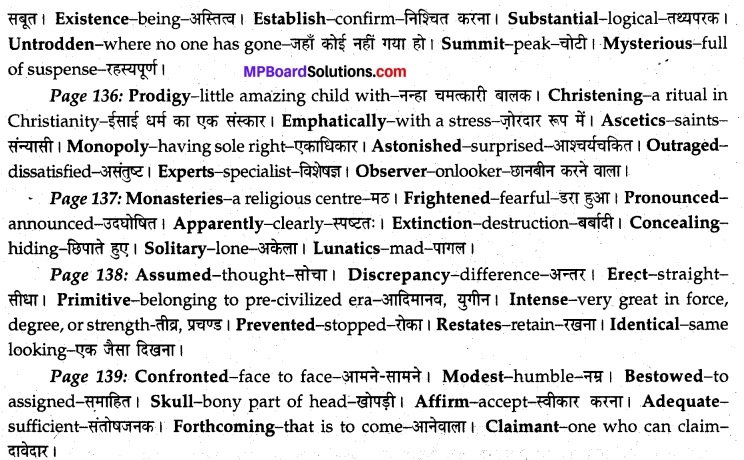
MP Board Class 12th English The Spectrum Solutions Chapter 6 The Face on the Wall

MP Board Solutions for 12th Textbook General English The Spectrum Solutions Chapter 6 The Face on the Wall Questions and Answers aids you to prepare all the topics in it effectively. You need not worry about the accuracy of the Madhya Pradesh Board Solutions for 12th English as they are given adhering to the latest exam pattern and syllabus guidelines.

You Can Download MP Board Class 12th English Solutions Questions and Answers Notes, Summary, Lessons: Pronunciation, Translation, Word Meanings, Textual Exercises. Enhance your subject knowledge by preparing from the Chapterwise MP Board Solutions for 12th English and clarify your doubts on the corresponding topics.

MP Board Class 12th English The Spectrum Solutions Chapter 6 The Face on the Wall (E.V.Lucas)

Kick start your preparation by using our online resource MP Board Solutions for 12th English Chapter 6 The Face on the Wall Questions and Answers. You can even download the Madhya Pradesh Board Class 12th English Solutions Questions and Answers for free of cost through the direct links available on our page. Clear your queries and understand the concept behind them in a simple manner. Simply tap on the concept you wish to prepare in the chapter and go through it.

The Face On The Wall Exercises From The Text-Book

Word Power

A. दिये गये शब्दों के अर्थ ज्ञात करो और उन्हें अपने वाक्यों में प्रयोग करो।
Answer:

  • tread – to walk somewhere Now many people have trod this path.
  • wander – to walk slowly around a place often without any particular purpose I wandered aimlessly around the streets.
  • meander – to walk slowly and change direction often We meandered through a landscape of mountains, rivers and vineyards.
  • Prowl – to move quietly and carefully around an area. The tiger prowled through the undergrowth.
  • saunter – to walk in a slow relaxed way He sauntered by, looking as if he had all the time in the world.

B. पाठ में ऐसे शब्द खोजो जिनका अर्थ दिये शब्दों के समान है।
Answer:
topic-theme; enormously-endlessly;
humid-damp; destiny-fate; vary-alter

Comprehension

निम्नलिखित प्रश्नों के उत्तर दीजिए

Question 1.
What was the topic of discussion at Dabney’s? [2009, 15, 16, 18]
डैब्ने में विचार-विमर्श का विषय क्या था?
Answer:
The topic of discussion at Dabney’s was supernatural.
डैब्ने में विचार-विमर्श का विषय अलौकिक था।

Question2.
In what way was the story of the ‘little man with an anxious white face’ different?
‘चिन्तित चेहरे वाले छोटे कद के आदमी’ की कहानी किस प्रकार अलग-सी थी?
Answer:
The story was different because it was not a story in the ordinary sense of the word. It was an event which happened to him personally.

कहानी अलग-सी थी क्योंकि साधारण अर्थों में यह एक कहानी मात्र नहीं थी। यह एक घटना थी, जो उसके साथ घटित हुई थी।

Question3.
What was so peculiar about the face on the wall?
दीवार पर चेहरे में कौन-सी बात विशिष्ट थी?
Answer:
There was a curious turn on the nose, and the start of the forehead was unique. It was, in fact, full of individuality: The face of a man apart, a man in a thousand.
नाक घुमावदार थी, माथे का झुकाव विशिष्ट था। यह एक अलग प्रकार का चेहरा था। ऐसा चेहरा जो हजारों में किसी एक का होता है।

Question 4.
What dominated the thoughts of the narrator when he had an attack of influenza?
इन्फ्लुएंजा से ग्रसित होने पर वर्णनकर्ता के विचारों को किसने प्रभावित किया?
Answer:
The face on the wall dominated the thoughts of the narrator when he had an attack of influenza.
इन्फ्लुएंजा से ग्रसित होने पर वर्णनकर्ता को दीवार पर उभरे चेहरे ने प्रभावित किया।

Question 5.
How did the narrator become obsessed with searching for the man whose face he saw on the wall?
किस प्रकार वर्णनकर्ता दीवार पर उभरे चेहरे वाले आदमी को ढूँढ़ने के लिये परेशान हुआ?
Answer:
The narrator neglected everything else. He stood at busy corners watching the crowd until people thought him crazy, and the police began to know him and be suspicious. The narrator visited places where men assemble in large numbers in political meetings, football matches, the railway stations, etc.

वर्णनकर्ता ने किसी भी अन्य वस्तु पर ध्यान देना बन्द कर दिया। वह सड़क पर खड़े होकर भीड़ को तब तक देखता रहता था जब तक उसे पागल नहीं समझ लिया जाता और पुलिस उसे सन्देहास्पद स्थिति में नहीं देख लेती है। वर्णनकर्ता ने उन स्थानों का भी भ्रमण किया जहाँ राजनीतिक बैठकों, फुटबॉल मैचों, रेलवे स्टेशनों आदि पर बड़ी संख्या में लोग जुटते हैं।

Question 6.
Describe the encounter of the narrator and the man.
वर्णनकर्ता और आदमी के बीच भेंट का वर्णन कीजिए।
Answer:
The encounter was interesting. The narrator asked the man to give him the card. The narrator told the man that he had important reasons to talk to him. The man seemed astonished at the behaviour of the narrator, but handed him the card. The man thought that the narrator was a lunatic.

भेंट रोचक थी। वर्णनकर्ता ने आदमी से अपना कार्ड देने के लिये कहा। वर्णनकर्ता ने कहा कि उसके पास आदमी से वार्ता के लिये आवश्यक बिन्दु हैं। आदमी वर्णनकर्ता के व्यवहार से आश्चर्यचकित दिखा किन्तु उसने अपना कार्ड दे दिया। आदमी को लगा कि वर्णनकर्ता सनकी है।

Question 7.
What strange fact did the narrator discover when he looked at the man’s visiting card?
आदमी के विजिटिंग कार्ड को देखकर वर्णनकर्ता को क्या आश्चर्यजनक बात पता लगी?
Answer:
The strange fact was that he was Mr. Ormond Wall with an address at Pittsburg U. S. A. and he had seen his face on a wall in an old house which was in Great Ormond Street. This coincidence was strange.

आश्चर्यजनक बात यह थी कि वह ऑरमण्ड वाल थे जिनका पता पिट्सबर्ग, यू.एस. ए. का था और उसने उसका चेहरा एक पुराने घर की दीवार पर देखा था जो कि ग्रेट ऑरमण्ड स्ट्रीट में था। यह संयोग विचित्र था।

Question 8.
What did the narrator observe about the patch on the wall when he woke up the previous day? What did it signify?
जागने पर वर्णनकर्ता ने दीवार पर उभरे निशान में क्या देखा? इसकी क्या महत्ता थी?
Answer:
The narrator found that the patch on the wall was faintly visible. Last night it had been as clear as ever and he could almost hear it speak. And now it was but a ghost of itself.

वर्णनकर्ता ने देखा कि दीवार पर उभरा चेहरे का निशान धुंधला पड़ गया था। बीती रात यह इतना स्पष्ट था कि वह बोलते हुए लग रहा था और अब यह अपने ही भूत की तरह दिख रहा था।

Question 9.
What two remarkable things did the narrator mention?
वर्णनकर्ता ने दो कौन-सी विशेष चीजों का उल्लेख किया?
Answer:
One is that it should be possible for the discoloration in a lodging-house in London not only to form the features of a gentleman in America but to have this intimate association with his existence. Another is that the gentleman’s name should bear any relation to the spot on which his features were being so curiously reproduced by some mysterious agency.

पहली यह कि लन्दन के किसी घर में अमेरिका के किसी व्यक्ति के चेहरे की न सिर्फ आकृति हो वरन् उसे अस्तित्व की घनिष्टता के अन्तरंग प्रमाण भी हों। दूसरी यह कि किसी अज्ञात एजेन्सी द्वारा किसी आदमी के चेहरे की आकृति इतनी खूबसूरती से उतार दी गयी हो।

Question10.
What was the third remarkable thing? What effect did it have on the people present?
तीसरी विशेष चीज क्या थी? उपस्थित लोगों पर उसका क्या प्रभाव पड़ा?
Answer:
The third remarkable thing about the story was that the narrator had invented the story about half an hour ago. It had a shocking effect on the people present.

कहानी के विषय में तीसरी विशेष चीज थी कि वर्णनकर्ता ने इस कहानी की आधा घण्टे पूर्व ही खोज की थी। इस बात से उपस्थित लोगों को गहरा धक्का लगा।

Language Practice

A. पुस्तक में दिये हुये वाक्यों में निर्णय कीजिए कि क्रियाएँ क्या इंगित करती हैं-
वर्तमान (P), भविष्य (F) या आदतन किये जाने वाले कार्य (H)
Answer:

  1. F,
  2. H,
  3. P,
  4. H,
  5. F,
  6. P,
  7. P,
  8. F,
  9. H,
  10. H.

B. पुस्तक में दिये गये अव्यवस्थित शब्दों से वाक्य बनाइए। Capital letter और question mark का उपयोग करना न भूलें।
Answer:

  1. Do you drink tea or coffee in the morning?
  2. Does your father speak English?
  3. When do you go to bed?
  4. Where does your father work?
  5. When does the first lesson begin?
  6. Do you clean your teeth every day?
  7. Do you go to school by bus?

C. खाली स्थानों में कोष्ठक में दी गई क्रियाओं के उपयुक्त रूप भरिए।
Answer:
[Tense या तो present simple हो या present continuous]
At the moment two men are working in front of my house. They are mending a water pipe. The man on the left has a bidi in his hand. The water is coming out of the hole, the water is running down the road. There are some huts there. Every day the men eat their food outside the hut and throw all the garbage on the road. They do not keep the place clean.

D. since या for जोड़िए।
Answer:

  1. She has been teaching in that school since 1978.
  2. My friend has been ill for a long time.
  3. I have been waiting since 5 o’clock.
  4. We’ve been reading this book since last January.
  5. They have been very busy since the last week.
  6. He hasn’t been here since three weeks.

The Face On The Wall summary

– E. V. Lucas

प्रस्तुत अध्याय में बताया गया है कि सत्य असत्य से न सिर्फ अधिक आश्चर्यजनक होता है बल्कि अधिक रोचक भी होता है। अध्याय में एक ऐसे व्यक्ति के विषय में वर्णन किया गया है जिसके कमरे की दीवार पर मनुष्य का चेहरा उभरता दिखता है जो धीरे-धीरे और स्पष्ट होता जाता है। कमरे में रहने वाला व्यक्ति यह तय करता है कि यह दीवार पर उभरने वाले चेहरे के व्यक्ति को ढूंढ़ निकालेगा। लम्बी भाग-दौड़ के पश्चात् वह उस व्यक्ति को अन्ततः पा लेता है। उससे बात करता है और उसका पता अपने पास रख लेता है। अचानक एक दिन समाचार-पत्र में दीवार पर चेहरे वाले व्यक्ति के कार दुर्घटना की खबर छपती है और इसी के साथ दीवार पर उस व्यक्ति का चेहरा हल्का पड़ने लगता है। धीरे-धीरे वह चेहरा दीवार पर से गायब हो जाता है और इसके बाद यह ज्ञात होता है कि दुर्घटना में घायल व्यक्ति की मृत्यु हो गयी है। इस घटना की गुत्थी सुलझाने में विज्ञान को कुछ समय लगेगा।

We believe the information shared regarding MP Board Solutions for 12th English Chapter 6 The Face on the Wall Questions and Answers as far as our knowledge is concerned is true and reliable. In case of any queries or suggestions do leave us your feedback and our team will guide you at the soonest possibility. Bookmark our site to avail latest updates on several state board Solutions at your fingertips.
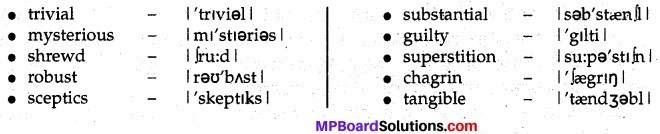
MP Board Class 12th English A Voyage Solutions Chapter 15 To Autumn

MP Board Solutions for 12th English Chapter 15 To Autumn Questions and Answers aids you to prepare all the topics in it effectively. You need not worry about the accuracy of the Madhya Pradesh Board Solutions for 12th English as they are given adhering to the latest exam pattern and syllabus guidelines.

You Can Download MP Board Class 12th English Solutions Questions and Answers Notes, Summary, Lessons: Pronunciation, Translation, Word Meanings, Textual Exercises. Enhance your subject knowledge by preparing from the Chapterwise MP Board Solutions for 12th English and clarify your doubts on the corresponding topics.

MP Board Class 12th English A Voyage Solutions Chapter 15 To Autumn (John Keats)

Kick start your preparation by using our online resource MP Board Solutions for 12th English Chapter 15 To Autumn Questions and Answers. You can even download the Madhya Pradesh Board Class 12th English Solutions Questions and Answers for free of cost through the direct links available on our page. Clear your queries and understand the concept behind them in a simple manner. Simply tap on the concept you wish to prepare in the chapter and go through it.

To Autumn Textbook Exercises

Word Power

A. Distinguish between the following pairs of words by using them in meaningful sentences. The first word in each pair is from the text:
bless-bliss; vine-wine; shell-cell; sweet-sweat; later-latter; warm-worm; cease-seize; abroad-aboard; granary-greenery; floor-flour; hair-heir; patient-patent; plain-plane;
Answer:

  • Bless-The hermit blessed him with a long life.
    Bliss-Sound sleep is a great bliss to me.
  • Vine-The grapevine scattered all over the roof.
    Wine-Wine is injurious to health.
  • Shell-The shell of the tortoise is very hard.
    Cell-The cell of this calculator is damaged.
  • Sweet-The mango tastes sweet.
    Sweat-Too much sweat is not good. .
  • Later-Later, I thought to shift my plan.
    Latter-Two visitors came this morning, the latter one was a policeman.
  • Warm-Take this pill with warm water.
    Worm-The doctor found a dangerous worm in his body.
  • Cease-The engine of this car suddenly ceased.
    Seize-The police seized all the property of my neighbour.
  • Abroad-I sent my son abroad for higher studies.
    Aboard-I was aboard when you called me.
  • Floor-My friend’s house is on the third floor.
    Flour—I don’t like packed flour.
  • Hair—His hair turned grey prematurely.
    Heir—The heir of the king proved to be unworthy.
  • Patient—This patient suffers from a chronic asthma.
    Patent—Use only patent drug.
  • Plain—I want a plain sheet of paper.
    Plane—The plane crashed this morning due to technical failure.

B. The following words have sensuous connotations. Fill them in the appropriate columns according to their appeal to the senses:
mist, mellow, ripeness, swell, plump, kernel, flower, clammy, wind, perfume, cider, oozings, songs, music, soft, bloom, stubble-plains, rosy hue, wailful, chou, bleat, whistles, twitter.
Answer:

appeal to the sense of perceptionappeal to the eyeappeal to the earappeal to the noseappeal to the tongue
soft
stubble-plains
wind
clammy
swell
flower
bloom
mist
swell
rosy hue
oozings
plump
songs
music
wailful
bleat
whistles
twitter
choir
perfumeripeness kernel , cider

Comprehension

A. Answer the following questions in about 60 words each:

Question 1.
What does the autumn plan to do with the cottage trees?
Answer:
The autumn plans to bend the cottage trees with apples and fill all the fruits with ripeness to the core. It wants to swell the ground and plump the hazel shells with a sweet kernel. Here, the poet presents a lively and sensuous picture of the season. The Autumn’and the sun work together for the ripening of all kinds of fruits.

Question 2.
Why does autumn intend to ‘set budding’ the late summer flowers?
Answer:
The autumn is described as a season of fruitfulness. There is mist and mellow fruitfulness all around. Fruits come to their maturity. The season intends to ‘set budding’ the late summer flowers, so that the bees can suck the perfect sweetness. They store fresh honey.

Question 3.
How are the honey-combs after the summer and how do the bees feel?
Answer:
The bees here represent a continuation of summer. For the bees, therefore, the warm days of summer have not ended. The sticky cells of the honey-combs are filled to overflowing with honey and yet autumn provides more flowers in case the bees may like to draw more sweetness from them.

Question 4.
How can Autumn be seen as a harvester?
Answer:
The poet has personified Autumn in various forms. All the forms are perfect and realistic. Autumn is seen as a harvester. He is sitting carelessly in the field during the winnowing operation. Here the poet uses all the images to make the picture clearer. The Autumn is shown sitting carelessly on a granary floor. His hair is soft lifted by the winnowing wind. He is sometimes in sound sleep on a half reaped furrow. He is drowsed with the fume of poppies while his look spares the next swath and all its twined flowers.

Question 5.
How does the poet describe the crop cutter?
Answer:
While presenting the various occupations of Autumn, the poet depicts him as a reaper. He has fallen asleep in the midst of reaping. He is very tired. Through this the poet makes the poem human and universal because the eternal labour of man is brought before the eyes of the reader.

Question 6.
What is the cider-maker doing?
Answer:
The poet presents the Autumn in a role of a cider-maker who is watching intently the apple juice oozings hours by hours till its end. There is a patient look in his eye. The poet is very realistic in the description of the Autumn.

Question 7.
Describe the scene of the earth at sunset. (M.P. Board 2011)
Answer:
Keats has presented his keen observation with all minute details. The whole poem demonstrates his interest in nature. While describing the scene at sun-set, he says that in the evening when the crimson light of the setting sun falls upon the stable fields, a chorus of natural sound is heard. This picture is very appealing.

Question 8.
Where do the small gnats sing from and how does their music reach the poet?
Answer:
The poet has created a very intense and varied sound effect in the poem. Autumn has its own sounds and songs. In the evening in a wailful choir the small gnats mourn among the river shallow. The sound appears to be born aloft or sinking, as the light winds lift or die. It symbolizes the close of the year.

Question 9.
Do you find remember of sadness at some points in the poem? How does the poet overcome the sad moment and become happy?
Answer:
Keats presents a vivid picture in this poem. Beginning with a very sensuous picture of the season, the poet shows the Autumn as an active agent. However, towards the end of the poem, he becomes sad. The Autumn is shown at its fag end. There are images of death or withdrawal and of song and the songs are funeral dirge for the dying year.

Question 10.
How does the poet address Autumn? (M.P. Board 2015)
Answer:
The poet has presented a lively picture of the autumn. He addresses the autumn as ‘season of mists and mellow fruitfulness’. The autumn is seen as a person in various roles as a reaper, a winnower, a gleaner and a cider-maker.

B. Answer the following questions in 75-100 words each:

Question 1.
Prove that To Autumn’ is a song of ripeness and abundance.
Answer:
‘Ode to Autumn’ is a typical poem of John Keats. This poem describes the autumn season. The poet personifies the season and presents it with all its sensuousness. Autumn is described as a season of ‘mellow-fruitfulness’. The sun is ripening or ‘maturing’ the earth. It conspires to load the vines and blend the apple trees and ‘to swell the ground and plump the hazel shells’.

The season fills ‘all fruits with ripeness to the core’. These images of full, inward ripeness, and strain suggest that the maturing and the fulfillment has reached its climax. Even the combs of the bees are over brimmed but still the ripening continues as. ‘Budding more and still more later flowers.’ Therefore, this poem can be said a song of ripeness and abundance.

Question 2.
What are the two friends-Autumn and warm sun planning to do with fruits and flowers?
Answer:
‘Ode to Autumn’ presents a sensuous picture of the autumn. Autumn is a season of ripe fruitfulness. It is the time of the ripening of grapes, apples, gourds, hazel nuts etc. It is also the time when the bees suck the sweetness from the later flowers and make honey. The sun plays a major role in maturing or ripening these fruits. It is the main conspirator of the ripening and maturing of the fruits. There are indirect images of ageing. Autumn and the sun are shown as close bosom friends, together conspiring to riper the fruits.

Question 3.
What are the four images of personication through which autumn has been picturized?
Answer:
The poem, ‘Ode to Autumn’ presents autumn’s vivid images. The poet personifies it in fair images of a winnower, a reaper, a gleaner and a cider-presser. Autumn is seen as a woman who performs the task of winnowing, reaping, gleaning, and cider-pressing. One can see the Avoman, i.e., autumn into the fields engaged in the winnowing operations while breeze ruffles her locks of hair.

This is the first image of autumn. Second, one may see autumn in the form of a reaper, who has been engaged in reaping corn but is so overcome by the sleep-inducing smell of poppies, which hampers the next row of corn that remains unreaped. Third, autumn may be seen in the image of a gleaner who is walking along steadily with the weight also of grains upon her head, crossing a stream. Finally, autumn may also be seen in the image of one who is crushing the ripe apples in the warden press to obtain their juice from which cider is to be made. This woman sits by the cider-press and watches patiently the apple juice flowing out of the press drop-by drop.

Question 4.
In the third stanza, the poet says “thou hast thy music too”. What objects does the poet find Autumn’s music in?
Answer:
In the third stanza of the poem, Keats describes the sound of Autumn. It has its own pattern and music or quality that enhances its charm. The sounds of Autumn are heard in the evenings. When the sun is setting, soft glow irradiates the fields from which the crop has been reaped, leaving the stumps behind. The long-drawn out clouds in the sky look like the bars of a grate. At this time, the melancholy buzzing of the gnats is heard. The gnats fly about among the shrubs growing on the riverside. The gnats are carried upwards when the wind is strong and they come downwards when the wind is feeble.

In addition to the gnats singing in a melancholy chorus, the bleating of full-grown lambs is heard from the hills which bound the landscape. Then there is the chirping of the grasshoppers. Next comes the high, bold and delicate singing of the red-breast which sings from an orchard. Finally there is the twittering of the swallows which are gathering in large numbers to get ready for their winter migration. Through these images, Keats heightens the effect of autumn. The sound generated becomes the music of autumn.

Question 5.
Keats is a master of word-pictures. Explain some of the word-pictures from the poem.
Answer:
Keats’s Ode to Autumn is said to be a fine specimen revealing the qualities of the poet.
Keats was one of the greatest word painters in English poetry. In his poems, picture follows picture in quite succession and each picture is remarkable for its vividness and minuteness of detail. His images are concrete. In Ode to Autumn, Autumn has been represented in the concrete form of a reaper, winnower, gleaner, etc.

In the first stanza, we have a complete and concrete picture of Autumn’the season of mists and mellow fruitfulness.’ In the second stanza, Autumn is a winnower’on a half reaped furrow sound asleep,’ a gleaner, keeping ‘steady they laden head across a brook’ and a spectator, watching ‘the last oozings hour by hour.’ All these pictures of Autumn make the poem human and universal for its use of concrete imagery.

Question 6.
What is an ode? Compare ‘To Autumn’ with Toru Dutt’s ‘Our Casuarina Tree’ in respect to form, address and glorification of the subject of treatment.
Answer:
An Ode is always an address to some noble thought, idea or deity. It is a serious, noble and dignified form of lyrical composition in a regular stanza form. It is exalted in theme, elated in tone and is always refined in language and style.

Ode to Autumn is a typical example of a highly structured ode. It is in the form of an
address in a purely objective manner. The Autumn has been personified with vivid images which seem to be very realistic. On the other Hand, Toru Dutta’s ‘Our Casuarina Tree’ is in lyrical tone with a touch of elegy.

Toru Dutt’s,’Our Casuarina Tree’ is a more personal poem where she glorifies the tree as it reminds her of her beautiful past. Her poem is an effort to make the tree immortal while Keat’s ‘To Autumn’ personifies the different aspect of Autumn in lyrical form.

Question 7.
Give a critical appreciation of the poem, dealing with Keats’ attitude to the season, and the pictorial quality of the ode.
Answer:
Autumn is a season of ripe fruitfulness. It is the time of the ripening of grapes, apples, gourds, hazelnuts, etc. It is also the time when the bees suck the sweetness from “later flowers” and make honey. Thus, autumn is picturised in the stanza as bringing all the fruits of earth to maturity in readiness for harvesting.

In the second stanza, autumn is seen in the person of a reaper, a winnower, a gleaner, and a cider-presser. Reaping, winnowing, gleaning and cider-pressing are all operations connected with the harvest and are, therefore, carried on during autumn. Autumn is depicted first as a harvester sitting carelessly in the field during a winnowing operation, second, as a tired reaper fallen asleep in the very midst of reaping, third, as a gleaner walking homewards with a load on the head, and fourth, as a cider-presser watching intently the apple-juice flowing out of the cider-press.

Autumn is not altogether devoid of music. If spring has its songs, autumn too has its sounds and songs. In the evening, when the crimson light of the setting sun falls upon the stubble-fields, a chorus of natural sounds is heard. The gnats utter their mournful sounds; the full-growyn lambs bleat loudly, the hedge-crickets chirp; the robin’s high and delicate notes are heard, and the swallows twitter in the sky. In the last stanza, the close of the year is associated with sunset and nightfall.

C. Explain the following expressions with reference to the text:

1. mellow fruitfulness (use of abstract for the concrete)
2. maturing sun.
3. load and bless with fruit the vines
4. winnowing wind.
5. soft dying day.
Answer:

  1. Full of soft and juicy fruits.
  2. Warm sun of Autumn that ripens the fruits.
  3. The thatched roofs loaded with grapes during autumn.
  4. Gently moving Autumn wind that helps in separating grain from chaff
  5. day coming to its close gently.

D.Explain the following verses:

(i) Who has not seen thee oft amid thy store?
Sometime whoever seeks abroad may find
Thee sitting careless on a granary floor,
Thy hair soft-lifted by the winnowing wind.

(ii) Where are the songs of spring? Ay, where are they?
Think not of them, thou hastes thy music too.

(iii) While barred clouds bloom the soft during day,
And touch the stubble-plains with rosy hue;
Then in a wailful choir the small gnats mourn Among the river sallows, borne aloft,
Or sinking as the light wind lives or dies.
Answer:
(i) Autumn may often be seen in the fields in the midst of her treasures of corn which have been harvested. The wind separates the chaff from the grains. It also means the wind which ruffles and passes the locks of a woman’s hair.

(ii) Here, the poet talks about the sounds of Autumn. Spring is distinguished by its songs which are not heard in Autumn but the poet says that there is no need to feel any regret on that account for the Autumn has its own peculiar music.

(iii) The poet in these lines describes that the long drawn out clouds in the sky look like bars of a grate. At this time, the melancholy buzzing of the gnats is heard. The gnats fly about among the shrubs growing on her river-side. The gnats are carried upwards when the wind is strong and they come downwards when the wind is feeble.

Speaking Activity

Hold a seminar in your class, under the guidance of your English teacher on the topic: ‘Nature and Man’. Individual speakers may choose any of the following topics for deliberation.

  • Educative value of Nature.
  • Nature as a refuge from worldly worries.
  • Nature as a living force.
  • Lessons we can learn from Nature:
  • charit generosity, co-existence, discipline, peace and harmony.
  • Can man survive without Nature?

Answer:
Students can choose any of the given topics as per their choice. One topic is given here as an example: Can Man Survive without Nature?
Man is a gift of God. God has created man and for his all types of comforts, He created Nature. Hence, there is an intricate relationship between Man and Nature. The whole life of a man depends upon Nature. Nature provides us air to breathe, water to drink, grain to eat, cool breeze to soothe, etc. In every sphere of our life, we need Nature. If Nature ceases to cooperate just for a second, we will collapse and the whole human race will be crippled. So, we cannot survive without Nature.

Writing Activity

Compose a paragraph on: “If Winter comes, can spring be far behind”? You can have an idea from the following: P.B. Shelley, closes his Ode to the West Wind with the given line, conveying the message of optimism and hope of regeneration. In the Ode, the poet invokes the tempestuous West Wind as a destroyer of the old and decayed order of things and a preserver of the seeds, so that, when spring comes, they may come to fresh life.
Answer:
Nature has its own way to govern this universe. It follows certain pattern which regulate our life. Morning is followed by day, day by night, and birth by death. There is a pattern of season which changes at a certain period. Nature maintains a balance. fit is not maintained, there would be a tremendous kind of anarchy. Everything will be turned upside down. So, It is sure that if winter comes spring cannot be far behind because it is governed by Nature.

Think it Over

Given below is a poem on spring written by Thomas Nash (1567—1601). Read the poem.

Spring

Spring, the sweet spring, is the year’s pleasant king;
Then blooms each thing, then maids dance in a ring,
Cold doth not sting, the pretty birds do sing,
Cuckoo, jug-jug, pu-we, to-witta-woo!
The palm and may make country houses gay,
Lambs frisk and play, the shepherds pipe all day,
And we hear ay birds tune this merry lay, .
Cuckoo, jug-jug, pu-we, to-witta-woo!
The fields breathe sweet, the daisies kiss our fret,
Young lovers meet, old wives a—sunning sit,
In every Street these tunes our ears to greet,
Cuckoo, jug-jug, pu-we, to-witta-woo!
Spring! the sweet spring!
Now think over the difference between the attitudes of the two poets—Nash and Keats-
towards the two different seasons.
Answer:
Do yourself.

Things to Do

In cold countries, there are four seasons, while in warm countries like India, there are six seasons called ‘RUTUS’.
English seasons are; Spring. Summer, Autumn. and Winter
Indian seasons are: Vasant, Grishnia, Varsha, Sharad, Hemanta and Shishir.
Now gather the following information about both:

  • their months of occurrence.
  • activities like ploughing, reaping etc. associated with each
  • changes in nature in each season.
  • Gregorian calendar months identical to Indian months.

Answer:
Do yourself with the help of your teacher.

To Autumn Summary in English

Autumn is a season of ripe fruitfulness. It is the time of the ripening of grapes, apples, gourds, hazelnuts, etc. It is also the time when the bees suck the sweetness from “later flowers” and make honey. Thus, autumn is picturised in the stanza as bringing all the fruits of earth to maturity in readiness for harvesting.

In the second stanza, autumn is seen in the person of a reaper, a winnower, a gleaner, and a cider-presser. Reaping, winnowing, gleaning and cider-pressing are all operations connected with the harvest and are, therefore, carried on during autumn. Autumn is depicted first as a harvester sitting carelessly in the field during a winnowing operation, second, as a tired reaper fallen asleep in the very midst of reaping, third, as a gleaner walking homewards with a load on the head, and fourth, as a cider-presser watching intently the apple-juice flowing out of the cider-press.

Autumn is not altogether devoid of music. If spring has its songs, autumn too has its sounds and songs. In the evening, when the crimson light of the setting sun falls upon the stubble-fields, a chorus of natural sounds is heard. The gnats utter their mournful sounds; the full-growyn lambs bleat loudly, the hedge-crickets chirp; the robin’s high and delicate notes are heard, and the swallows twitter in the sky. In the last stanza, the close of the year is associated with sunset and nightfall.

To Autumn Summary in Hindi

पतझड़ पके फलों का मौसम है। यह अंगूर, सेब, कद्दू, पहाड़ी बादाम आदि के पकने का समय है। यही समय है जब मधुमक्खियाँ पिछड़े फूलों की मिठास को चूसती हैं और शहद तैयार करती हैं। इस तरह पतझड़ को एक ऐसे रूप में चित्रित किया गया है जो धरती पर फूलों की परिपक्वता और कटाई के लिए उन्हें तैयार करता है।

दूसरे पद में पतझड़ को एक फसल काटने वाली, फसल से अनाज निकालने वाली और अनाज को तैयार करने वाली के रूप में देखा गया है। कटाई, उड़ाई, बिनाई और छंटाई-सभी फसल से सम्बन्धित प्रक्रियाएँ हैं और इसलिए सभी पतझड़ के समय होते हैं। पतझड को सबसे पहले एक किसान के रूप में चित्रित किया गया है जो अपने खेत में बवाई के समय निश्चिन्त बैठा होता है, उसके बाद एक थके हुए फसल काटने वाले के रूप में जो कटाई के दौरान थककर गहरी नींद में सोया हुआ है और फिर एक बोझा ढोने वाले के रूप में जो अपने सिर पर अनाज का बोझ उठाए घर की ओर जा रहा है और फिर एक पिसाई करने वाले के रूप में जो गौर से सेव को दबाए जाने से निकलने वाले रस को देख रहा है।

पतझड़ बिल्कुल संगीतहीन नहीं है। यदि वसंत का अपना गीत है तो पतझड़ की भी अपनी आवाज़ और अपना गीत है। जब शाम को धुंधलका छा जाता है, सूर्यास्त हो रहा होता है, एक बिल्कुल स्वाभाविक समूह गान का संगीत सुनाई पड़ता है। टिटहरियाँ अपने शोकमय गीत गाती हैं, पूर्ण विकसित मेमने ज़ोर से मिमियाते हैं, झिंगुर गाते हैं, रॉबिन की आवाज़ ऊँची एवं मधुर गीत के रूप में सुनाई देती है और चातक आकाश में गाते हैं। अन्तिम पद में वर्ष की समाप्ति को सूर्यास्त और रात घिरने के रूप में दिखाया गया है।

To Autumn Word Meaning

MP Board Class 12th English A Voyage Solutions Chapter 15 To Autumn img 1

To Autumn Important Pronunciations

MP Board Class 12th English A Voyage Solutions Chapter 15 To Autumn img 2

To Autumn Stanzas for Comprehension

Read the following stanzas carefully and answer the questions that follow:

1. Season,of mists and mellow fruitfulness,
i Close bosom-friend of the maturing sun;
Conspiring with him how to load and bless .
With fruit the vines that round the thatch-eaves run;
To bend with apples the moss’d cottage trees. (Page 108) (M.P. Board 2009)

Questions:
(i) Who does the first line refer to?
(ii) …………. is the bosom friend of the season.
(iii) Find a word which means same as ‘becoming perfect’.
(iv) How does it plan to fill the fruits?
Answers:
(i) The autumn season is referred in the first line.
(ii) The Sun.
(iii) Maturing means same as ‘becoming perfect 1.
(iv) It plans to fill all the fruits with ripeness to their core.

2. Then in a wailful choir the small gnats mourn
Among the river-sallows, home aloft
Or sinking as the light wind lives or dies;
And full-grown lambs loud bleat from hilly bourn;
Hedge-crickets sing; and now with treble soft
The red-breast whistles from a garden-croft;
And gathering swallows twitter in the skies. (Page 109)

Questions:
(i) What sound of the small gnats is referred to in the first line?
(ii) ……. bleat from hilly bourn.
(iii) Find a word from the lines with similar meaning to ‘shrill voice’.
(iv) What does the red-breast do?
Answers:
(i) The small gnat in the wailful choir mourn and this sound is referred in the first line.
(ii) The full grown, lambs.
(iii) Whistles is similar in meaning to ‘shrill voice’.
(iv) The red breast whistles from a garden croft.

We believe the information shared regarding MP Board Solutions for 12th English Chapter 15 To Autumn Questions and Answers as far as our knowledge is concerned is true and reliable. In case of any queries or suggestions do leave us your feedback and our team will guide you at the soonest possibility. Bookmark our site to avail latest updates on several state board Solutions at your fingertips.
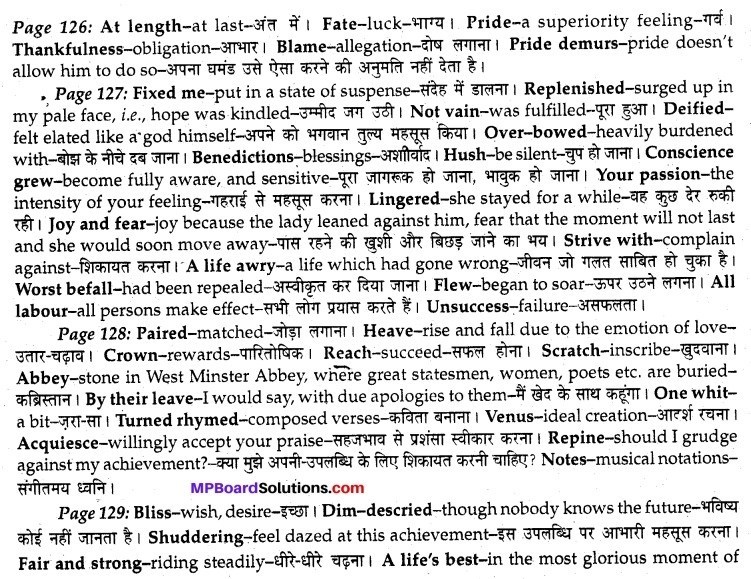
MP Board Class 12th English A Voyage Solutions Chapter 14 Albert-Einstein at School

MP Board Solutions for 12th English Chapter 14 Albert-Einstein at School Questions and Answers aids you to prepare all the topics in it effectively. You need not worry about the accuracy of the Madhya Pradesh Board Solutions for 12th English as they are given adhering to the latest exam pattern and syllabus guidelines.

You Can Download MP Board Class 12th English Solutions Questions and Answers Notes, Summary, Lessons: Pronunciation, Translation, Word Meanings, Textual Exercises. Enhance your subject knowledge by preparing from the Chapterwise MP Board Solutions for 12th English and clarify your doubts on the corresponding topics.

MP Board Class 12th English A Voyage Solutions Chapter 14 Albert-Einstein at School (Patrick Pringle)

Kick start your preparation by using our online resource MP Board Solutions for 12th English Chapter 14 Albert-Einstein at School Questions and Answers. You can even download the Madhya Pradesh Board Class 12th English Solutions Questions and Answers for free of cost through the direct links available on our page. Clear your queries and understand the concept behind them in a simple manner. Simply tap on the concept you wish to prepare in the chapter and go through it.

Albert-Einstein at School Textbook Exercises

Word Power

A. Here are two words from the lesson beginning with prefix un:

  • happy — unhappy
  • noticed — unnoticed

The prefix un is used to make the antonym or opposite of the root word. Here are some words beginning with un. Pick the words in which un is a prefix and those in which It is a part of the root word, as given below:
unthinking, ungrateful, until, understand, under, unless, uncle, unwell, undo, undergo, undertake, unfit.
Answer:
MP Board Class 12th English A Voyage Solutions Chapter 14 Albert-Einstein at School img 1

B. Match the synonyms in the boxes with the cities listed below. Put the number of the clue in the boxes correctly. The result will be a magic square. that is, the total of the four numbers in any straight row (including the diagonal rows) will be 34.

wretchedopenlyironyperpetrated
accommodationworriedconfusedalerted
mentionformal arrangement for a meetingdifficultyturned out
shamerevoltneglectedvanquish

1. defeat
2. frankly
3. sarcasm
4. disgrace
5. lodging
6. trouble
7. appointment
8. warned
9. reference
10. puzzled
11. bothered
12. expelled
13. committed
14. rebellion
15. ignored
16. miserable
Answer:

16
wretched
2
openly
3
irony
13
perpetrated
5
accommodation
11
worried
10
confused
8
alerted
9
mention
7
formal arrangement for a meeting
6
difficulty
12
turned out
4
shame
 14
revolt
 15
neglected
1
vanquish

C. Write words opposite in meaning to the clue words mentioned above and use them in sentences of your own.
Answer:

S.No.WordsOppositesSentences
1.DefeatwinAlexander came to India to win over the whole of it.
2.FranklysecretlyHe leaked the documents secretly.
3.Sarcasmstraight forwardHis straight forward answer puzzled everyone.
4.DisgracehonourIn fact, Mr. James is an honour to this institution.
5.LodgingshelterlessThe flood made thousands of people shelterless.
6.TroublecomfortThere is no comfort in life at all.
7.AppointmentdismissalHe approached the minister but was subject to dismissal.
8.WarnedcarefreeShe takes everything in a carefree manner.
9.ReferencestrangeThat man is quite strange for me.
10.PuzzledclarifiedHe clarified all confusions.
11.BotheredrelaxedI always feel relaxed.
12.ExpelledadmittedHe was admitted again for his good record.
13.CommittedrefusedThe man refused to do any illegal work.
14.RebellionsupporterGandhi took people’s support for independence.
15.IgnoredwelcomedI was welcomed to that meeting.
16.MiserableprosperousMy friend is a prosperous man.

D. The following phrases occur in the text. Give their meanings and use them in sentences of your own:
learn by heart, be good at (a subject), get on the nerves, turn out, of one’s own accord, burn a hole in the pocket.
Answer:
MP Board Class 12th English A Voyage Solutions Chapter 14 Albert-Einstein at School img 2

Comprehension

A. Answer the following questions in one sentence each:

Question 1.
Why was Einstein not interested in learning history?
Answer:
Einstein was not interested in learning history for he thought one can look up historical facts in a book. He believed that whatever that can be looked in book should not be wasted in memorising.

Question 2.
Why did the teacher ask Einstein to explain his theory of education?
Answer:
The teacher asked Einstein to explain his theory of education in order to ridicule him.

Question 3.
What does the author mean when he says “Mr. Braun’s eyes were cold and cruel?”
Answer:
The author means to say that Mr. Braun was sarcastic in his behaviour.

Question 4.
What did the history teacher suggest Einstein to do?
Answer:
The history teacher suggested Einstein to leave the school.

Question 5.
The author says Most day. were bad for Einstein.” Why does he say so?
Answer:
Einstein never liked schools, most days were bad for him.

Question 6.
Where did Albert find a room to reside? (MP. Board 2015)
Answer:
Einstein had got a room to reside in one of the poorest quarters of Munich.

Question 7.
What does Albert mean by civilised human beings?
Answer:
By civilized human beings, Albert means the people who were not much educated but at
least knew the manners to live.

Question 8.
The author says, “Albert’s eyes gleamed with the sudden idea.” Guess what the idea was.
Answer:
The Idea was to get a meakal certificate to convince the head teacher for allowing him to leave the school.

Question 9.
Why did Albert pretend that he had money to take Yun out for supper?
Answer:
He wanted to impress Yuri and get his work of getting medical certificate done.

Question 10.
I’m going to take this certificate to the head teacher tomorrow, and that will be the end of it”, assured Albert. What does the author mean by this?
Answer:
The author means that the medical certificate would be enough for getting him rid off from the school.

B. Answer the following questions in 60-75 words:

Question 1.
While going through the conversation between Albert and his history teacher, what sort of a person does Einstein appear to you?
Answer:
Einstein was not at all satisfied with the school education in Germany. It was completely outdated and unproductive. The History teacher considered that education was nothing more than learning dates and years of events. For Einstein, education meant ideas. He didn’t see any point in learning dates. He believed that one could look up the dates in books.

Einstein had all aversion for school. It is reflected in his every action. He shows it by not closing the door in the Head teacher’s room even after his instruction. Einstein was a rebel but always controlled his emotion. Albert was totally against this kind of education where nothing new is learnt and achieved and this shows his idea-oriented thinking. He thinks facts are useless to be learnt. This time of learning known can be utilized in generating new.

Question 2.
How does a tight administrative system usually check students from exploring new horizons?
Answer:
It is quite true that the school often curbs individual talents. Most of the time, it is unproductive and outdated. Education must bring out the best from within. Education received within the four walls may not be the real education. Actually, it has been seen that schools interfere with the free growth and development of children. They don’t provide proper atmosphere for their proper growth. Too many restrictions and dead formalities kill the natural growth in children. Too much of discipline also proves quite unproductive. It kills the creative instinct in children.

What children need is freedom. Without freedom, no physical or mental growth is possible. Drive and dynamism mustn’t be curbed. School education should not be heavy, dull and cumbersome. Entertainment and education should go together. Education is not just facts, figures and dates. Ideas must dominate our education. Only then our schools will produce geniuses like Einstein.

Question 3.
What is Einstein’s theory of education?
Answer:
Education is not confined to mere information gathering. Information only keeps us well informed about things. Einstein’s views about education only confirm that information gathering has its limitations. The History teacher asks Einstein, when did the Prussians defeated the French at Waterloo. Actually, he was seeking an information. It can be easily gathered from any good book on history. Einstein thinks that learning of days, dates and figures have no meaning or importance.

What is important are the ideas. Ideas are the basis of education. So, insight formation must be the aim of education. Schools shouldn’t overburden students with the heaps of data collection. It is not important, how many soldiers are killed and when they are killed. It is important to learn, why soldiers try to kill others in wars. Productive education should be practised where ideas are generated and shared. This not only gives new scopes but also gives us better understanding of things going around us.

Question 4.
The author says, “He has to go to the hateful place the next morning.” Which place is the author referring to? Why has the place been described as hateful?
Answer:
Here, the school is referred to as the ‘hateful place’. Einstein never liked a school. For him, it is the place where individual talents are curbed. It is unproductive and outdated. Education that is provided here is not the real education. In fact, schools interfere with the free growth and development of a child. In no way, they provide proper atmosphere for the proper growth of a child. The administrative strictness spoils a child’s talent. The natural growth of a child is adversely affected. So, Einstein always thought that it was the most hateful place.

Question 5.
Mr. Braun asked Einstein to stay for an extra period. What does the extra period refer to?
Why is it called so?
Answer:
Einstein was very much indifferent in his class. When the History teacher Mr. Braun asked him a question about the date related to Prussian war, Einstein flatly replied that he didn’t know. For Einstein, remembering the date of history was not so important. It irritated the History teacher. He wanted to know some more views of Einstein about school and education.

It was just to ridicule Einstein. When Einstein began telling him about his views, the teacher got more irritated and asked him to stop, for it needed some extra classes to listen to Einstein’s views and he called Einstein a disgrace to school. He suggested him to leave the school. He called so because school follows a pattern. It is not a place for the foolish talks as that of Einstein.

Question 6.
Why did Einstein think that he could never pass the exam for school diploma?
Answer:
Einstein believed that he would never pass the exams for the school diploma. He thought so because he was in no way similar to the other students. He never lived to learn lessons. School was a hateful place for him. He was going to school not for his own sake but for the sake of his father’s wishes. He never indulged himself in any fight with other children, as it was a common feature among them. He never took part in any duels. Teachers didn’t like him. These were all negative aspects of his personai. he would never pass.

Question 7.
Why was Albert adamant on meeting a doctor?
Answer:
Albert never liked school. It was only due to his father that he attended the school. However, finally he decided to leave it. As there was no way, he decided to get a medical certificate from a doctor which would help him prove sick. For this, he asked his friend Yuri to fix an appointment with a doctor who was known to Yuri. He was ready to face any situation for this. He also promised Yuri that he will treat him. with dinner.

Question 8.
“There is nothing to wonder about, Einstein. I knew you were going to leave before you knew yourself.” What did Mr. Koch actually mean?
Answer:
Mr. Koch was the Mathematics teacher in the school where Einstein studied. When finally j Einstein decided to leave the school, he managed a certificate from a doctor about his nervous breakdown but the head teacher was not convinced. He asked Einstein to get a certificate from any teacher of his school who could certify that he was not capable of teaching Einstein anymore. First, he tried Mr. Koch, the Mathematics teacher.

Mr. Koch was a very helpful man and really recognized the latent talent of Einstein. So, he didn’t ‘hesitate. He saw what possibilities were hidden in him. He was very much convinced from the very beginning that school can’t fulfill what Einstein needed. He made a remark, “There’s nothing to wonder about, Einstein. I knew you were going to leave before you knew yourself.”

Question 9.
Why was the head teacher not ready to have Einstein in the school?
Answer:
Einstein submitted a medical certificate to the head teacher which mentioned the nervous breakdown of Einstein. The head teacher next day called on Einstein and said that Einstein’s work was terrible. So, he was not prepared to have him in the school. The head-teacher told him that if he left the school of his own accord, there would be no questions. Einstein asked him what crime he had committed. The teacher replied that it was not possible for any teacher to teach while Einstein was in class. He had become a nuisance for others. In his presence, no student can learn any thing. Therefore, the head-teacher was not willing to see him in the school thereafter.

Question 10.
Give a brief character sketch of Einstein. (M.P. Board 2010)
Answer:
Einstein was a peculiar child right from the beginning of his career. His views were different but rational. It was a fact that he had no interest in learning from the historical facts. When the History teacher asked him about a historical date, he frankly replied that he didn’t remember it. Einstein never liked school because in his view, it was not a proper place for learning. A strict rule is observed there and no chance is given to make a child’s talent flourish. He loved music and reading books on Science but he had no interest in the books presented in the syllabus. He had his own views about education. However, in no way, he was disrespectful to the teachers. After all he was a genius.

Grammar

A. Observe the following sentences carefully that occur in the lesson:

“In what year, Einstein,” asked the history teacher, “did the Prussians defeat the French at Waterloo?” –
“Einstein, I want you to leave the school now,” said the head teacher. The above sentences are in direct speech/narration. You had a detailed discussion on the topic in the previous class.
Now change the following sentences into indirect narration:

1. “Shall I do it myself,” he said.
2. “It’s not my wish, Sir,” Albert pointed out. .
3. “Your information,” I replied, “is out of date.”
4. “I must get away from here,” said Einstein.
5. “I don’t think, I’ll ever pass exams for the school diploma.” said Albert glumly.
6. “I have never seen you looking less nervous,” remarked Yuri.
7. “Don’t be too sure of that,” said the doctor.
8. Albert said, “I’ll try to get into an Italian College or Institute.”
Answers:

  1. He asked if he should do it himself.
  2. Albert addressed him as Sir and pointed out that it was not his wish.
  3. I replied that his information was out of date.
  4. Einstein said that he must get away from there.
  5. Albert said glumly that he didn’t think, he would ever pass exams for the school diploma.
  6. Yuri remarked that he had never seen him looking less nervous.
  7. The doctor advised him not to be too sure of that.
  8. Albert said that he would try to get into an Indian College or Institute.

B. Read the dialogue between a School Principal and an applicant, Miss Rita Sharma.

Principal : Come in, Miss Sharma.
Rita : Thank you.
Principal : Please take your seat.
Rita : Thank you
Principal : How long have you been teaching English in the coaching classes?
Rita : I have been teaching for the last 10 years.
Principal : How do you use your spare time?
Rita : I’ve always enjoyed music.
Principal : Well, Miss Sharma, we’ll inform you next week. Thank you, for coming.
Now write what Rita reported her mother about her interview
Answer:
As I turned up for the interview, the Principal asked me to come in. 1 thanked her. Then the Principal asked me to take seat and I again thanked her. The Principal asked me how long I had been teaching English in the coaching classes. At this, I replied that I had been teaching for the last ten years. When she asked me, how did I use my spare time, I replied that I had always enjoyed music. She released me and assured that she would inform me the next week. She thanked me too for coming.

Speaking Activity

Work in pairs. One will act as Albert and the other as a journalist. Interview Albert (after he was expelled from school) on the following points.
(i) the school
(ii) the place where he lived
(iii) his friend
(iv) the doctor
(v) his future plans.
Answer:
Do it at class level.

Writing Activity

A. Write about a teacher who has inspired you most. Discuss about his/her method of teaching or approach towards teaching.
Answer:
There are many teachers in my school. Some of them are very good and popular but I like Mr. Ramesh Chander Mishra the most. He is my favourite teacher. He has influenced me the most. He is the incharge of our class. He lives a simple way but his thinking is very high.

He is the most able teacher. He has a brilliant career. He has got scholarship in his school and in college days. He is a gem among teachers. He is an M.A., and B.Ed. His method of teaching is very good. He has mastery over his subjects. He makes his lessons very interesting. He makes every student understand his lesson. He has a kind word for each boy in his class. He encourages the students to talk in English. He himself yorks very hard. He knows how to take work from the students. He is showing the best result in the subject, he teaches.

Mr. Mishra possesses good habits. He has a happy face. We have never seen any frowns on his forehead. No idle boy can escape his keen eyes. He is very humorous. He tries to keep us in good spirits. He never uses any cane. We obey him and he loves us. He is hard working.

He keeps a strict discipline in the class without using a stick. He is never partial to anyone. He shows sympathy with the poor. If a student takes liberty with him, he turns him out of the class. He does not allow him to return until he offers a sincere apology.

He is a fine sportsman. He takes part in school games. He is a good cricketer as well. He is the incharge of games material. His presence on the school ground is a source of joy for us. All the teachers respect him. The Principal has much faith in him. He is the right hand of the Principal. In all school activities, he is always present. For these reasons, he is considered the best teacher of the school. His high character has made him very popular among the students.

B. Imagine that you are Albert Einstein, now living in Milan/Italy. Write a letter of thanks to Yuri for rendering valuable help in getting you out of the school.
Answer:
36, Park Street Milan
15th September, 20xx
My dear Yuri
I hope you are enjoying a good life. I am also fine but I miss you very much. I still remember, how you helped me getting rid of my school. I was very much distressed there. I never liked the place. But I was compelled to join it and remain there. I was very upset. So, I asked you to help me. How did you manage the medical certificate from your friend, Dr.Ernest. I still can’t believe how you staked your career for me. At last, I was able to leave the school. You are really my best friend. You proved that a friend in need is a friend indeed. 1 am very much obliged to you and wish if I were of some use for you. Hope you are in good spirits and I wish you all the best for life.
Yours,
Einstein.

Think It Over

Think about yourself as Einstein and then narrate the experiences you have in your class.
Answer:
Do yourself.

Things to Do

Coiled information about Albert Einstein’s life and his contribution to Science from the sources available to you.
Answer:
Do yourself.

Albert-Einstein at School by Patrick Pringle Introduction

In this lesson, the author refers to a young boy (Einstein) who is of extraordinary talent. However, this boy does not like his school and its system. Finally, he is expelled from the school.

Albert-Einstein at School Summary in English

Albert was in his class. The History teacher, Mr. Brawn asked him when did Prussians defeated the French at Waterloo. Albert told that he didn’t know or he must have forgotten. This irritated the teacher. He asked Albert, “Why?” Albert replied that he didn’t see any point in learning dates. One could read about them from books.

The teacher thought that Albert didn’t believe in education. He talked in a sarcastic manner. Albert told him that education should be about ideas and not about facts. The teacher said that Albert was a disgrace to the school.

Albert was sad to leave the school though he didn’t like this school. He would have to come to it again. He lived in a small room. It was situated in one of the poorest quarters of Munich. The landlady used to beat her children regularly. Her husband came drunk every Saturday and beat her. Albert didn’t like the children’s crying every time. Albert told these things to his friend Yuri. He hated the atmosphere of slum violence.

Next time, his cousin came to Munich. She told Albert that if he had tried he could have pass the examination. There were more stupid boys than him. Moreover, passing the examination was not difficult. It was just to be able to repeat some events in the examination. He told Elsa that he was not good at learning things by heart. He liked music as it gave him comfort. He also liked Geology.

Albert didn’t like to remain in that school. He met Yuri after six months. He had an idea. He told Yuri that he needed a medical certificate showing that he suffered from a nervous breakdown. In this way, he could get rid of his school. He asked Yuri if he had a doctor friend. Yuri told him that he had one, Dr. Ernest Weil. However, Yuri told him not to deceive him. He must be frank with him.

When Albert visited Dr. Ernest Weil, he had really come close to a nervous breakdown. Dr. Ernest issued him a certificate. His fees was that he should serve Yuri with a meal. Albert told Dr. Ernest about his future plans. He would go to Milan. He hoped to get admission in some Italian college or institute. Yuri told him to get a reference in writing from the Mathematics teacher before going to the head teacher. Mr. Koch, the Mathematics teacher, was a different man. He understood Albert well. He gave a glowing testimonial to him. He wrote that Albert knew so much that it was difficult to teach him any more. He was fit to enter a college.

Before Albert had a chance to ask for an interview with the head teacher, he was summoned to his room. The head teacher told Albert that he wanted him to leave the school. Albert asked the head teacher if he meant that he was to be expelled. The head teacher told him that if he went of his own accord, that question wouldn’t arise.

The head teacher gave several reasons for his leaving the school. He said that Albert’s presence made it impossible for the teachers to teach and pupils to learn. No serious work could be done as long as he was there. Albert felt that his spending money on the medical certificate proved useless. For a moment, Albert felt like telling him what he thought of him and the school but he did not. He went out of the room. The head teacher asked him to close the door behind him but Albert didn’t. He didn’t even have the last look at the school. Yuri was the only person whom Albert felt like seeing when he left. He had no other real friend.

Albert-Einstein at School Summary in Hindi

एलबर्ट अपनी कक्षा में था। इतिहास के अध्यापक मि. ब्रॉन ने उससे पूछा कि प्रूशिया बालों ने फ्रांस को बाटरलू में कब हराया था। एलबर्ट कहता है कि वह नहीं जानता या वह भूल गया होगा। इससे अध्यापक को क्रोध आ जाता है। यह एलबर्ट से पूछता है, “क्यों?” एलबर्ट जवाब देता है कि उसे तारीखें याद करने में कुछ खास बात नज़र नहीं आती। इसके बारे में कोई भी किताबों से जानकारी ले सकता है। अध्यापक मानता है कि एलबर्ट को शिक्षा में कोई दिलचस्पी नहीं है। वह व्यंग्यात्मक तरीके से बात करता है। एलबर्ट उन्हें कहता है कि शिक्षा विचारों से संबंधित होनी चाहिए न कि तथ्यों से। अध्यापक कहता है कि एलबर्ट स्कूल के लिए एक कलंक है।

एलबर्ट स्कूल छोड़ते हुए दुःखी था। हालाँकि वह इस स्कूल को पसंद नहीं करता था पर वह उदास था। उसे वहाँ दोबारा आना होगा। वह एक छोटे-से कमरे में रहता था। वह म्यूनिख के सबसे गरीब क्षेत्र में बसा था। मकान मालकिन अपने बच्चों को नियमित रूप से पीटती थी। उसका पति प्रत्येक शनिवार को शराब पीकर आता और उसे पीटता था। एलबर्ट हर समय बच्चों का रोना पसन्द नहीं करता। उसने यह सब अपने मित्र यूरी को बताया। वह गंदी-बस्तियों में होने वाली हिंसा से नफरत करता था। अगली बार उसकी चचेरी बहन म्यूनिख आती है। वह एलबर्ट से कहती है कि यदि कोशिश करें तो वह परीक्षा पास कर सकता है। यहाँ उससे भी ज्यादा मूर्ख लड़के हैं। इसके अलावा परीक्षा पास करना मुश्किल नहीं है। यह केवल परीक्षा में कुछ घटनाओं को दोहरा देने की योग्यता प्राप्त करना है। वह एल्सा को बताता है कि वह जबानी चीजें याद करने में अच्छा नहीं है।

वह संगीत पसन्द करता है क्योंकि वह उसे आराम देता है। उसे भू-विज्ञान भी अच्छा लगता है। एलबर्ट को उस स्कूल में रहना बिल्कुल पसन्द नहीं था। वह यूरी से छह महीने बाद मिला। उसे एक विचार आता है। वह यूरी से कहता है कि उसे एक चिकित्सा प्रमाणपत्र की आवश्यकता है जो यह दिर सके कि वह स्नायुसम्बन्धी खराबी से ग्रस्त है। इस प्रकार वह अपने स्कूल से छुटकारा पा सकता है। वह यरी से पूछता है कि क्या उसका कोई डॉक्टर दोस्त है। यूरी उसे बताता है कि डॉ. अरनेस्ट वेल है। फिर भी पूरी कहता है कि वह उसे धोखा न दे। उसे उसके साथ खुलकर बातें करनी होंगी।

जब एलबर्ट डॉ. अरनैस्ट वेल से मिला तो सच में उसकी स्नाय खराब थी। डॉ. अरनेस्ट उसे प्रमाणपत्र दे देते हैं। उसकी फीस यह थी कि उसे यूरी को खाना खिलाना था। एलबर्ट डॉ. अरनैस्ट को अपने भविष्य की योजना के बारे में बताता है। वह मिलान जाएगा। उसे आशा है कि उसे किसी इटैलियन कॉलेज में या संस्था में दाखिला मिल जाएगा। यरी उससे कहता है कि मुख्याध्यापक के पास जाने से पहले गणित के अध्यापक से लिखित प्रमाणपत्र ले ले। मि. कोच जो कि गणित के अध्यापक थे, एक अलग किस्म के व्यक्ति थे। वे एलबर्ट को अच्छी तरह से समझते थे। उसने, उसे एक शानदार प्रमाणपत्र दिया। उसने लिखा कि एलबर्ट इतना जानता था कि वह उसे और शिक्षा नहीं दे सकता था। वह कॉलेज में प्रवेश के लिए उपयुक्त था।

इससे पहले कि एलबर्ट को मुख्याध्यापक से साक्षात्कार का मौका मिलता, उसे उसके कमरे में जाने का बुलावा आ गया। मुख्याध्यापक एलबर्ट से कहते हैं, वे चाहते हैं कि वह स्कूल छोड़ दे। उसने मुख्याध्यापक से पूछा क्या उसे निकाला जा रहा है। मुख्याध्यापक उसे कहता है कि यदि वह अपनी इच्छा से चला जाता है तो यह प्रश्न ही नहीं उठता। मुख्याध्यापक उसके स्कूल छोड़ने के लिए बहुत से कारण बताता है। वह उसे बताता है कि एलबर्ट की उपस्थिति अध्यापकों को पढ़ाने में और अन्य छात्रों को सीखने में परेशानी पैदा करती है।

जब तक वह रहता, कोई महत्त्वपूर्ण कार्य नहीं किया जा सकता था। एलबर्ट को लगता है कि चिकित्सा प्रमाणपत्र पर उसके द्वारा खर्च किए गए पैसे बेकार हो गए। एक क्षण के लिए एलबर्ट का मन हुआ कि उसे बता दे कि वह उसके बारे में और स्कूल के बारे में क्या सोचता है। पर उसने वैसा नहीं किया। वह कमरे से बाहर चला जाता है। मुख्याध्यापक उससे अपने पीछे दरवाजा बन्द करके जाने को कहता है परन्तु एलबर्ट ऐसा नहीं करता है। यहाँ तक कि उसने आखिरी बार स्कूल की तरफ देखा भी नहीं। यूरी ही केवल ऐसा व्यक्ति था जिससे एलबर्ट स्कूल छोड़ते समय मिलना चाहता था। उसका कोई और सच्चा दोस्त नहीं था।

Albert-Einstein at School Word Meaning

MP Board Class 12th English A Voyage Solutions Chapter 14 Albert-Einstein at School img 3

Albert-Einstein at School Important Pronunciations

MP Board Class 12th English A Voyage Solutions Chapter 14 Albert-Einstein at School img 5
MP Board Class 12th English A Voyage Solutions Chapter 14 Albert-Einstein at School img 4

Albert-Einstein at School Passages for Comprehension

Read the passages given below and answer the questions that follow:

Albert felt miserable when he left school that afternoon; not that it had been a bad day most days were bad now, anyway but because he had to go back to the hateful place the next morning. He only wished his father would take him away, but there was no point in even asking. He knew what the answer would be; he would have to stay until he had taken his diploma.

Going back to his lodgings did not cheer him up. His father had so little money to spare that Albert could find a room in one of the poorest quarters of Munich. He did not mind the bad food and lack of comfort, or even the dirt and squalor, but he hated the atmosphere of slum violence. His landlady beat her children regularly, and every Saturday her husband came drunk and beat her. (Page 99)

Questions:
(i) Why did Albert feel miserable when he left school?
(Ii) Find the word opposite in meaning to ‘admirable’.
(iii) Give adjective form of the word ‘cheer’.
(iv) Find a word from the passage that has the same meaning as the word pitiable.
Answers:
(i) Albert felt miserable when he left school because he had to come back to the school
the next morning which he hated the most. For him, it was the worst place.
(ii) ‘Hateful’ is opposite of ‘admirable’.
(iii) ‘Cheerful’ is the adjective of ‘cheer’.
(iv) ‘Miserable’ has same meaning as ‘pitiable’.

2. Apart from books on science his only comfort was music, and he played his violin regularly until his Landlady asked him to stop.
“That wailing gets on my nerves,” she said. “There’s enough noise in this house, with all
the kids howling.”
Albert was tempted to point out that most of the time it was she who made them howl,
but he decided it was better toy nothing.
“I must get away from here,” he told Yuri, after six months alone in Munich. “It is absurd
that I should go on like this. In the end it will turn out, I have been wasting my father’s
money and everyone’s time. It will be better for all if i stop now.” (Page 100)

Questions:
(i) What did Albert wish? Why?
(ii) Find a word from the above lines which means opposite to ‘peace’.
(iii) Give noun form of the word ‘tempt’?
(iv) Find the word in the passage which has the same meaning as the word ‘spoiling’.
Answers:
(i) He wished to leave the place because he thought he was wasting his father’s money
and everyone’s time.
(ii) ‘Howling/noise’ is opposite to ‘peace’.
(iii) ‘Temptation’ is the noun form of ‘tempt’.
(iv) ‘Wasting’ has same meaning as ‘spoiling’.

3. “I’m not going to punish you,” the head teacher said to Albert’s surprise. “Your work is
terrible, and I’m not prepared to have you here any longer, Einstein. I want you to leave
the school now.”
“Leave school now?” repeated Albert, dazed.
. “That is what I said.”
“You mean,” said Albert, “that I am to be expelled?”
“You can take it that way if you wish, Einstein.” The head teacher was not mincing words.
“The simplest thing will be for you to goof your own accord, and then the question won’t arase.”
“But,” said Albert, “what crime have I committed?”
“Your presence in the classroom makes it impossible for the teacher to teach and for the
other pupils to learn. You refuse to learn, you are in constant rebellion, and no serious
work can be done while you are there.” (Page 103)

Questions:
(i) What did the head teacher say to Albert?
(ii) Find a word from the passage which means opposite to ‘supporter’.
(iii) Give noun form of the word ‘punish’.
(iv) Find a word from the passage which has the same meaning of the word ‘deny’.
Answers:
(i).The head teacher said to Albert that he would not allow him to be there and asked
him to leave.
(ii) ‘Rebellion’ is opposite to ‘supporter’.
(iii) ‘Punishment’ is the noun form of ‘punish’.
(iv) ‘Refuse’ has same meaning as ‘deny’.

4. He walked straight on, out of the school where he had spent five miserable years, without turning his head to give it a last look. Fie could not think of anyone, he wanted to say goodbye to.

Indeed, Yuri was almost the only person in Munich, he felt like seeing before he left the town, he had corner to hate almost as much as the school. Elsa was back in Berlin, and he had no other real friends.

“Goodbye and good luck,” said Yuri when he left. “You are going to a wonderful country I think. I hope you will be happier there.” (Page 103)

Questions:
(i) How many year did Albert spend in school? What was his feeling about his days
spent there?
(ii) Give the noun form of ‘real’
(iii) Give a word opposite in meaning to ‘curve’
(iv) Find a word in the passage which has the same meaning to the word ‘amazing’.
Answers:
(i) Albert spent fly e years In school. He felt that those were miserable days for him.
(ii) ‘Reality’ is the noun Form of ‘real’.
(iii) ‘Straight’ is opposite in meaning to ‘curve’.
(iv) ‘Wonderful has the same meaning to the word ‘amazing’.

We believe the information shared regarding MP Board Solutions for 12th English Chapter 14 Albert-Einstein at School Questions and Answers as far as our knowledge is concerned is true and reliable. In case of any queries or suggestions do leave us your feedback and our team will guide you at the soonest possibility. Bookmark our site to avail latest updates on several state board Solutions at your fingertips.