MP Board Class 12th English The Spectrum Workbook Solutions Chapter 1 Teach Me to Listen, Lord

MP Board Solutions for 12th English The Spectrum Workbook Solutions Chapter 1 Teach Me to Listen, Lord Questions and Answers aids you to prepare all the topics in it effectively. You need not worry about the accuracy of the Madhya Pradesh Board Solutions for 12th English as they are given adhering to the latest exam pattern and syllabus guidelines.

You Can Download MP Board Class 12th English Solutions Questions and Answers Notes, Summary, Lessons: Pronunciation, Translation, Word Meanings, Textual Exercises. Enhance your subject knowledge by preparing from the Chapterwise MP Board Solutions for 12th English and clarify your doubts on the corresponding topics.

MP Board Class 12th English The Spectrum Workbook Solutions Chapter 1 Teach Me to Listen, Lord

Kick start your preparation by using our online resource MP Board Solutions for 12th English Chapter 1 Teach Me to Listen, Lord Questions and Answers. You can even download the Madhya Pradesh Board Class 12th English Solutions Questions and Answers for free of cost through the direct links available on our page. Clear your queries and understand the concept behind them in a simple manner. Simply tap on the concept you wish to prepare in the chapter and go through it.

Word Power

A. The verbs in the table describe how loudly/softly a person is speaking and also, often, indicate mood. Use a dictionary and find out what they describe or indicate.
Answer:

VerbPitch of the voiceMost likely mood
whispersoftsecretive
murmursoftromantic or complaining
mumblesoftdisturbed
muttersoftgrumble
shouthighdisapproval
screamhighfear or pain
shriekhighjovial

B. Can you underline the silent letters in the following words ?
Answer:
psychic; comb; honest; Christmas; knowledge; farm.

Comprehension

A. Choose the correct option

Question 1.
According to the poet, the persons nearest to him are :
(i) members of his family
(ii) friends
(iii) co-workers
(iv) all of them.
Answer:
(iv) all of them.

Question 2.
The poet has not mentioned people as far from him …………….
(i) hopeless
(ii) down-trodden
(iii) forgotten
(iv) anguished.
Answer:
(ii) down-trodden

Question 3.
Conscience is the inner voice that warns us against ………..
(i) helping the poor
(ii) worshipping the God
(iii) an exploitation
(iv) a sinful deed.
Answer:
(iv) a sinful deed.

Question 4.
The poet wants us to reach to the ……….. and listen to their plea.
(i) criminals
(ii) oppressed people
(iii) good speakers
(iv) good listeners.
Answer:
(ii) oppressed people

Question 5.
The poet wants us to listen to
(i) our own voice
(ii) Our friend’s advice
(iii) God’s voice
(iv) all of them
Answer:
(iv) all of them

B. Fill in the blanks using the correct words from those given below :”

listening, heed, a good listener, a prayer, conscience
(i) This poem is in the form of ….
(ii) The poet wants us to be …………..
(iii) …….. is a skill which is acquired through dedication and practice.
(iv) Our …….. distinguishes between what is right and what is wrong.
(v) We should ……… the voices which may not be within earshot.
Answer:
(i) a prayer
(ii) a good listener
(iii) listening
(iv) conscience
(v) heed.

Speaking Time

A. Read the following words aloud and mark the stress on the second
Answer:
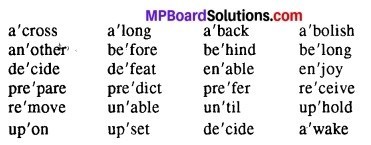
MP Board Class 12th English The Spectrum Workbook Solutions Chapter 1 Teach Me to Listen, Lord img 1

B. Listen to the pronunciation of the following words and transcribe them. Say whether a particular word is a noun, an adjective, or a verb :
Answer:
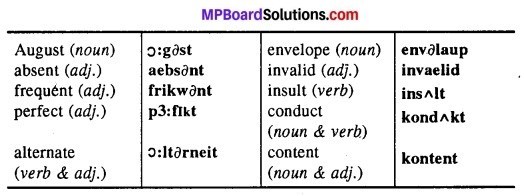
MP Board Class 12th English The Spectrum Workbook Solutions Chapter 1 Teach Me to Listen, Lord img 2

Reading Time

Read the following poem carefully : – We are the Future

Not just u or
Not just he or she, but we
We work as a team.
We live by our creed, coz we believe.
That we, are the future !!
We have the power, we have the strength
We’ll finish the race, no matter the length.
We work together, a team as a whole.
Accepting every challenge, every aim and every goal.
We, are the future !!
The future’s unknown, it’s a story untold. .
It’s a movie unseen, to be made by you and me.
No matter what they tell you, our future is bright.
We’ll face every hurdle, we’ll climb up the height.
We, are the future !!
From cities and towns, here we’ve come.
Together as one, to build our nation.
Young women and men, walking hand in hand.
We stand by our creed, proud to be Indians.
We, are the future !!

– Song by : Sonia Shirsat

Now answer the questions given below :

Question 1.
‘We work as a team’. What does the poet really mean by the word ‘We’ in this line ?
Answer:
By ‘We’ the poet really means Indians.

Question 2.
What makes ‘a team’ ‘a whole’ ? (2009)
Answer:
Working together makes ‘a team’ ‘a whole’.

Question 3.
“We’ll face every hurdle”. What sort of hurdles the poet thinks about ?
Answer:
The future is unknown and uncertain. We may come across many obstructions. They are called ‘hurdles’.

Question 4.
What will be the result if we face all the hurdles successfully ?
Answer:
If we face all hurdles successfully the result will be that we’ll climb the height.

Question 5.
Where have we come from to build our nation ?
Answer:
We have come from towns and cities to build our nation.

Question 6.
On what basis can we say that we are “proud to be Indians ?”
Answer:
The basis of saying we are ‘proud to be Indian’s is that we walk hand in hand and we stand by our creed.

Question 7.
‘We, are the future !’ What are the poet’s expectations from ‘We’ ?
Answer:
The poet’s expectations from ‘We’ are that their aim should be building our nation by co-operation. ‘We’ must work hand in hand. ‘We’ should stand by our creed and should be proud to be Indians.

Question 8.
Find out the words from the poem which mean the same as these words :
Answer:

  • a set of principles or religious beliefs – creed
  • problems or difficulties – hurdles
  • to get connected very closely – hand in hand

Question 9.
Summarise poem in about 80 words. (2009)
Answer:
The poem is a pledge of the Indians to build the nation strong and prosperous. We possess the necessary potential for it. Forgetting our differences we stand united. We will work as a team. Some people are negative thinkers. But we firmly believe that future is ours. Inspire of all obstacles we will reach the height walking hand in hand. Whether we are villagers or town dwellers we will co-operate with one another. We will overcome all problems. We are proud to be Indians.

Additional Question

Question 1.
Why do we want live in Future ?
Answer:
We live by our creed, because we believe that we are future.

Writing Time

Summarise in 60 words the ideas expressed in the poem ‘Teach me to Listen Lord’. Model your answer on ‘PIOFER’ technique.
Answer:
We should listen to those who are the nearest. They all want our attention and recognition. We should listen to the voices of the oppressed and the suffering. We should also listen to our inner voice that tells us what is right and what is wrong. Finally, we should listen to God’s voice which guides us everywhere and at all times.

We believe the information shared regarding MP Board Solutions for 12th English Chapter 1 Teach Me to Listen, Lord Questions and Answers as far as our knowledge is concerned is true and reliable. In case of any queries or suggestions do leave us your feedback and our team will guide you at the soonest possibility. Bookmark our site to avail latest updates on several state board Solutions at your fingertips.
MP Board Class 12th Special English Grammar Clauses

MP Board Solutions for 12th Special English Clauses Questions and Answers aids you to prepare all the topics in it effectively. You need not worry about the accuracy of the Madhya Pradesh Board Solutions for 12th Special English as they are given adhering to the latest exam pattern and syllabus guidelines.

You Can Download MP Board Class 12th English Solutions Questions and Answers Notes, Summary, Lessons: Pronunciation, Translation, Word Meanings, Textual Exercises. Enhance your subject knowledge by preparing from the Chapterwise MP Board Solutions for 12th Special English and clarify your doubts on the corresponding topics.

MP Board Class 12th Special English Grammar Clauses

Kick start your preparation by using our online resource MP Board Solutions for 12th Special English Clauses Questions and Answers. You can even download the Madhya Pradesh Board Class 12th Special English Solutions Questions and Answers for free of cost through the direct links available on our page. Clear your queries and understand the concept behind them in a simple manner. Simply tap on the concept you wish to prepare in the chapter and go through it.

1. Noun Clauses
A noun clause does the function of a noun in a sentence.
Noun clause को शुरू करने के लिए निम्न connective words का प्रयोग करते हैं
(i) That clauses.
Look at these sentences :
I expect that I shall get a prize.
He says that he won’t go.
यदि कोई clause that से शुरू हो और उस that का अर्थ ‘कि’ हो तो वह Noun clause होता है।

(ii) Wh-clauses as Noun clauses.
Look at these sentences :
Tell me where he lives.
Tell me why you do this.
I don’t follow what you say.
No one knows who he is
who, where, which, how, why, how, when आदि से रूप हनी वाले clauses noun clauses होते हैं।

Look at these sentences :
What you say is true.
How he comes here is not known.

what, where, when, that, how, why आदि से शुरू होने वाले clauses जब किसी sentence के शुरू में रहते हैं और जब उनके बाद कोई noun नहीं आता है वे noun clauses होते हैं।

(iii) If/whether clauses as Noun clauses.
Look at these sentences :
Do you know if the office is open?
I Can you say whether Rohit is in the park?
Yes or no question में if या whether से noun clause शुरू होता है।

Look at these sentences :
I don’t know whether he will help me or not.
I don’t care if your car breaks down or not.
कुछ अन्य तरह के वाक्यों में whether और if से शुरु होने वाले clauses noun एवं clauses होते हैं जब उनका हिंदी में अर्थ कोई ऐसा शब्द होता है जो कि ‘कि’ से शुरू होते हैं।

2. Relative clauses (adjective clauses)
Adjective clause, एक Adjective के समान, अपने से पूर्व आने वाले noun एवं pronoun की विशेषता बताता है।
(i) Adjective clauses निम्न connective words से शुरू होते है-(i) who, which, that, whom, where.

Look at these sentences :
This is the man who gave me money.
The man whom you saw is an engineer.
This is the house that my father built.

Who, which, that, whom, whose shift a tam clauses adjective clauses होते हैं जब इनके पहले कोई noun रहता है।

(ii) Where, when, why Look at these sentences :
This is the house where I was born. :
He arrived on the day when the office was closed.
You can’t tell me the reason why he left so suddenly.
Where, when, why

3. Coordinate Clauses
(i) जो clause एक ही rank या order के होते हैं, coordinate clause कहलाते हैं।

Look at these sentences :
Govern your passion or they will govern you.
To err is human; to forgive divine.

पहले sentence में दो clauses को or से जोड़ा गया है। दूसरे sentence में दो clauses को एक semicolon से जोड़ा गया है।
(ii) Coordinate clauses प्रायः Coordinate conjunctions and, or, but आदि द्वारा जुड़े होते हैं या कभी – कभी conjunctions के बदले comma या semi-colon का प्रयोग किया जाता है। ”
(iii) मुख्य coordinating conjunctions है and, but, or, still, yet, as well as, both… and, either …. or, however, neither ……. nor, otherwise, else, for, so, not only …….., but also आदि।

4. Adverbial Clause

Adverbial clause वाक्य में Adverb का काम करता है एवं Principal clause में व्यवहार किए गए किसी adjective, adverb या verb की विशेषता बताता है। कभी-कभी यह पूरे clause की भी विशेषता बताता है।

Kinds of Adverbial Clauses

(i) Adverbial Clauses of Time
Look at these sentences :
She decided to wait, until the train arrived.
The students stood up when the teacher left the classroom.
There was silence as the leader spoke.
One of them began to cry before I opened the door.

Adverbial clauses of time are joined to the main clause by one. of the conjunctions when, while, after, as, before, since, till, until, whenever, as long as, then, as soon as.

(ii) Adverbial Clauses of Place
Look at these clauses :
Wherever you go, wear a helmet.
You should stay where he is.

These clauses are joined to the main clause by means of conjunctions like where, wherever, whether, wherein. .

(iii) Adverbial Clauses of Reason
Look at these sentences :
He can not work hard, because he is weak.
As we can not go tomorrow, we must give up the idea altogether.
Since she says so, I must believe it.
These clauses are introduced by because, as, since, for.

(iv) Adverbial Clauses of Result
Look at these sentences :
He speaks so fast that I cannot follow him.
He is so brave that he is not afraid of any danger.
These clauses are introduced by so, that, so ….. that, such …..that.

(vi) Ahok at the Faller that
(v) Adverbial Clauses of Condition
Look at these sentences :
I shall go if he asks me.
I would not go unless you come with me.
These clauses are introduced by if, unless, provided, that, in case, whether … or, on condition that.

(vi) Adverbial Clause of Comparison
Look at these sentences :
She is not taller than her husband.
He speaks better than he writes.
He is as obstinate as a mule.
He is not so clever as you think.
These clauses are introduced by as …….. , as, not so ……. as, then.

(vii) Adverbial Clauses of Purpose
Look at these sentences :
We eat that we may live.
He ran so that suspicion many not fall on him.
In order that there may be no mistake, I have typed out : the instructions.
These clauses are introduced by these following conjunction forms that, so that, in order that.

(viii) Adverbial Clauses of Manner
Look at these sentences :
Do as I tell you.?
He acts as if he were the Prime Minister.
It looks as though it might rain.
These clauses are introduced by the following conjunctions as, as if, as though.

(ix) Adverbial Clauses of Concession
Look at these sentences :
Although he worked hard, he could not succeed.
Whatever decision is made, the basic facts remain the same.
Though he is poor, he is sincere.
Whether he works or not, he will get a promotion.

This clause is introduced by these conjunctions—though, although, however, whether …. or not, no matter, even if.

EXERCISES
Q.1. Complete the following by adding Noun clauses :
(i) They all said …………………..
(ii) He told me …………………..
(iii) I wonder …………………..
(iv) I do not know …………………..
(v) I cannot understand …………………..
(vi) It is certain …………………..
(vii) You forget …………………..
(viii) Tell me …………………..
(ix) His father was anxious …………………..
(x) He was pleased with
Answer:
(i) that India is great.
(ii) that this news is false.
(iii) why he failed.
(iv) why he will come.
(v) how did you solve it?
(vi) that he would die.
(vii) that you are an Indian
(viii) who is at round.
(ix) for he was declining.
(x) what he had done.

Q. 2. Supply Adjective Clauses :
(i) He is the man …………………..
(ii) The house ………………….. is. hundred years old.
(iii) His offense is one …………………..
(iv) I found the book …………………..;
(v). He met a girl …………………..
(vi) I know the man …………………..
(vii) No man ………………….. shall suffer in any way.
(viii) Where is the book …………………..?
(ix) Any boy ………………….. gained the prize.
(x) I know the place …………………..
Answer:
(i) who has done it?
(ii) which I saw.
(iii) that he applied at last.
(iv) which I lost yesterday.
(v) who has blue eyes.
(vi) who is the Chief of Army.
(vii) who has courage.
(viii) which I bouglic yesterday.
(ix) who had worked hard.
(x) where I was born.

Q. 3. Pick out the adverb clauses in the following sentences:
(i) I do it because I choose to.
(ii) If I make a promise I keep it.
(iii) I shall remain where I am.
(iv) Will you wait till I return?
(v) You may sit whenever you like.
(vi) As he was not there, I spoke to his brother.
(vii) He advanced as far as he dared.
(viii) When I was younger, I thought so.
(ix) If you eat too much you will be ill.
(x) Take a lamp because the night is dark.
Answer:
(i) because I choose to.
(ii) If I make
(iii) where I am.
(iv) till I return.
(v) wherever you like
(vi) As he was not there.
(vii) as far as he dared.
(viii) when I was younger.
(ix) If you eat too much
(x) because the night is dark.

We believe the information shared regarding MP Board Solutions for 12th Special English Clauses Questions and Answers as far as our knowledge is concerned is true and reliable. In case of any queries or suggestions do leave us your feedback and our team will guide you at the soonest possibility. Bookmark our site to avail latest updates on several state board Solutions at your fingertips.

MP Board Class 12th Special English Grammar Prepositions

MP Board Solutions for 12th Special English Prepositions Questions and Answers aids you to prepare all the topics in it effectively. You need not worry about the accuracy of the Madhya Pradesh Board Solutions for 12th Special English as they are given adhering to the latest exam pattern and syllabus guidelines.

You Can Download MP Board Class 12th English Solutions Questions and Answers Notes, Summary, Lessons: Pronunciation, Translation, Word Meanings, Textual Exercises. Enhance your subject knowledge by preparing from the Chapterwise MP Board Solutions for 12th Special English and clarify your doubts on the corresponding topics.

MP Board Class 12th Special English Grammar Prepositions

Kick start your preparation by using our online resource MP Board Solutions for 12th Special English Prepositions Questions and Answers. You can even download the Madhya Pradesh Board Class 12th Special English Solutions Questions and Answers for free of cost through the direct links available on our page. Clear your queries and understand the concept behind them in a simple manner. Simply tap on the concept you wish to prepare in the chapter and go through it.

A preposition is a word used to show the position of one thing in relation to another. Preposition वह शब्द होता है जो एक वस्तु की स्थिति का दूसरी वस्तु के साथ संबंध स्थापित करता है।

There is a book on the table.

Here on tells us the position of the book in relation to the table. When we say, “There is a book under the table’, the position of the book has changed. Thus on and under are prepositions.

Preposition of Time and Date

(a) At is used for:
(i) exact time.
We got up at 6.30 a.m. and had breakfast at eight o’clock.
(ii) festivals which mark a point of time in the year.
My brother came home at Diwali.

(b) On is used :
(i) for day and date.
On Sunday/Monday/Christmas Day, etc.
On 15th August/26th January, etc.
(ii) For a specific part of a specific day.
On the night of Diwali; On the morning of 15th August “, 1947, etc.

(c) In is used :
(i) to show the total length of time for the completion of some activity or action : I can complete the work in two hours.
We shall reach Delhi in three hours.

(ii) to denote a period of time :
in summer; in 1962; in the evening, etc.

(d) By is used to denote the latest time by which something was to be done or will be done :
I can complete this work by 6 p.m.
He will reach home by evening.

(e) For is used for a period of time.
I have been teaching in this college for ten years.

(f) Since is used to denote the point of time from which an action has been continuing.
We have been waiting for you since two p.m.

(g) During is used to express an event that took place, or will take place, within a specified period of time :
The thieves broke into the house during the night.
The sale of milk products is banned during the summer.

(h) From is used for the starting point of action and is generally combined with to/till/until.
I lived in Calcutta from 1985 to 1990.

Preposition of Travel and Movement.

(a) From and To are used to express the starting point and the
last point of destinations, respectively :
He is coming from Delhi and going to Amritsar.
My cousin came from Agra.
We are going to Shimla next week.

(b) By is used to denote the mode of our travelling.
He will go there by bus/car/train/boat/sea/plane air.

(c) On is used for other forms of travel.
He traveled on horseback/foot/a bicycle/a camel.

(d) At is used to denote the reaching the destination or some other point: He arrived at a village in the evening.
Similarly at the hotel, at the theatre, at the station, at the bus stop, etc.

(e) Into is used to denote entering a vehicle :
He got into the bus at the bus stop.

(f) Out/Out of/ Off is used for alighting or dismounting a vehicle :
He got out of the train at New Delhi.
He got off the train and hired a taxi.

Preposition of Place
(a) At is used to denote :
(i) specific or particular places.
(ii) villages or smaller towns.
(iii) hotels.
(iv) addresses.
(v) particular houses.

I met Mohan at the cross-roads. A big fair is held at Pindara every month. During my visit to Mumbai, I stayed at the Taj Hotel. He lives at 280, Urban Estate, Hissar. The Prime Minister of England lives at 10 Downing Street, London.

(b) In is used to denote :
(i) Countries, cities, etc.
(ii) General mention of a house, village, etc.
(iii) Name of streets.
One of my cousins lives in America.
She lives in a big house.
Mohan does not like to live in America.
She lives in Hanuman Street.

(c) On is used to denote open spaces.
He works on a rubber plantation.
A coolie works on a platform.

Uses of Some Other Important Prepositions :

(a) Between is used for two things/persons.
Among is used for more than two things/persons.
He divided his property between his two sons.
Sweets were distributed among laborers on the completion of the house.

(b) In is used for position, whereas into is used with a verb, of motion to indicate entrance :
Mohan is in the room. Sita is going into the room.

(c) Beside and Besides :
Beside means ‘near’ or at the side of
Besides means ‘as well as’ or ‘in addition to’ :
The queen was sitting beside the king.
Besides having a big house, he has a lot of land also.

(d) On time is used when something happens at exact time :
The train left the station on time.
In time is used for an action which takes place when there is still time.
He reached the college in time, (before the college started).

(e) Above/Over means ‘higher than’ :
We saw a plane above/over us.
Below/under means ‘lower than:
Standing on the top of the hill we saw a beautiful valley below us.

Uses of Some Important Prepositions

1. Agree with (किसी व्यक्ति से सहमत होना) I agree with you.
2. Agree to (किसी बात, सुझाव आदि से सहमत होना) I agree to your proposal.
3. Act upon (या on) (अमल करना) I acted on my father’s advice.
4. Angry with ( किसी व्यक्ति से नाराज होना) He is angry with me.
5. Angry at (की बात पर नाराज होना). He is angry at your behaviour.
6. Aim at (i) (निशाना लगाना) Shyam aimed at the bird.
(ii) (लक्ष्य होना) He has aimed at becoming a doctor.
7. Accuse of (का इल्जाम लगाना) He was accused of cheating his friend.
8. Apply to (किसी को प्रार्थना-पत्र देना) He has applied to the officer for leave.
9. Apply for (किसी चीज के लिए प्रार्थना-पत्र देना) I have applied for the post of a clerk.
10. Attend to (ध्यान देना) Please attend to the lecture.
11. Abstain from (परहेज करना) You should abstain from smoking,
12. Abound in (प्रचुर मात्रा में होना) This pond abounds in fish.
13. Acquit of (बरी कर देना) The judge acquitted him of the crime.
14. Amazed at (हैरान होना) I was amazed at his. progress.
15. Ashamed of (शर्मसार होना) He was ashamed of his conduct and did not meet me.
16. Beg for (गिड़गिड़ाना, भीख माँगना) The criminal begged for mercy.
17. Benefit from (से फायदा उठाना) He has benefitted from the new scheme.
18. Believe in (में विस्वास करना) He does not believe in God.
19. Base on (पर आधारित करना या होना) This film is based on a famous novel.
20. Blind to (अनदेखा करना) You are blind to the faults of your brother.

21. Boast of (डाग मरना) He always boasts of his wealth.
22. Born in (जन्म होना) He was born in a rich family.
23. Blame for (दोष देना) He blamed me for his failure.
24. Backward in (किसी चीज से पिछड़े होना) This area is backward in education.
25. Belong to (से संबंध स्थापित रखना) This house belongs to Mohan.
26. Care for (परवाह करना) I do not care for Mohan.
27. Care about (देखभाल करना) You should take care about your health.
28. Charged with (दलजम लगाना) He was charged with murdering a man.
29. Cry for (किसी बात के लिए रोना या चिल्लाना) He is crying for his lost wealth.
30. Complain of (शिकायत करना) He complained of low pressure of water.
31. Compromise with (समझोता करना) He compromised with me and settled the matter.
32. Capable of (समर्थ होना) He is capable of doing great work.
33. Cure of (इलाज करना) The doctor cured me of cold.
34. Cure for (का इलाज) What is the cure for cold?
35. Careful of (जागरूक करना, सावधान करना) He is careful of his health.
36. Deal in (व्यापर करना) He deals in cloth.
37. Deal with (व्यवहार करना) You must deal with others politely.
38. Depend on (पर निर्भर होना) He depends on his father för all his needs.
39. Die of (किसी बीमारी से मरना) He died of cancer.
40. Die from (कुछ करने से मरना) He died from over eating.

41. Die for (किसी उदेश्य के लिए करना) He died for his country.
42. Different from (से भिना) This book is different from your book.
43. Exception to (अपवाद होना). There is exception to every rule.
44. Escape from (बच निकलना) He escaped from jail.
45. Enquire into (धनबिन करना) The police enquired into the matter.
46. Equal to (के बराबर) The weight of this packet is equal to the weight of that packet.
47. Faithful to (के प्रति वफादार होना) Ram is faithful to his master.
48. Full of (से भरा होना) I found a purse full of money.
49. Fond of (शैवकिन होना) I am fond of apples.
50. Fire at (किसी पर गोली चलना) The soldiers fired at the enemy.
51. Feed on (पर चलना) The cow feeds on grass.
52. Good at (किसी काम में निपुण होना) He is good at English.
53. Good for (उपयोगी होना) Playing is good for health.
54. Gaze at (ध्यान से देखना) He was gazing at the flower.
55. Guilty of (का दोषी होना) He is guilty of breaking the law.
56. Grateful to (कृतज्ञ होना) Mohan is grateful to Ram for helping him.
57. Hope for (आशा करना) He hopes for the best.
58. Hopeful of (का आशावान होना) He is hopeful of getting the last division.
59. Hungry for (भूखा होना, तीव्र लालसा होना) He is hungry for love.
60. Hint at (इशारा करना) He hinted at the new plan.

61. Hinder from (रोकना) The storm hindered me from reaching the city
62. Ill with (से ग्रस्त) He is ill with fever.
63. Interfere in (देखल देना) He interfered in my work,
64. Interested in (में रुचि होना) I am interested in stamp collecting.
65. Insist on (पर जोर देना) He insisted on going to Rewari.
66. Inferior to (से धटिया) This chair is inferior to that.
67. Junior to (से कनिष्ट) Mohan is junior to Sohan.
68. Jeer at (मजाक उड़ाना) The crowd jeered at the player.
69. Jealous of (ईर्ष्या करना) Radha is jealous of her sister.
70. Knock at (खटखटाना) He knocked at the door for some time.
71. Key to (कूँजी होना) Hard work is the key to success.
72. Laugh at (पर हँसना) The boys are laughing at the beggar.
73. Loyal to (वफादार होना) We should be loyal to the country.
74. Lead to ( की ओर जाना) This road leads to Ambala.
75. Liking for (रुचि होना) I have a liking for cricket.
76. Made of (का बना होना) This table is made of wood.
77. Mix with (से मिलना, संगती करना) You should not mix with bad boys.
78. Meddle with (दखाल देना) Pakistan is meddling with our affairs.
79. In need of (आवश्यकता होना) I am in need of money.
80. Pleased with (प्रसन होना) He is pleased with my work

81. Prefer to (प्राथमिकता देना) I prefer tea to coffee..
82. Popular with (प्रसिद्ध) Mohan is popular with his friends.
83. Prevent from (रोकना) He prevented me from going to Hissar.
84. Protect from (रक्षा करना) Woollen clothes protect us from cold.
85. Quarrel with (किसी व्यक्ति से झगड़ा करना) He quarrelled with me.
86. Quarrel over (किसी बात पर झगड़ना) He quarrelled over a pen.
87. Recover from (ठीक होना) He has recovered from illness.
88. Remind of (याद दिलाना) He reminded me of his application..
89. Rebel against (विद्रोह करना) People rebelled against the cruel king. : :
90. Rule over (शासन करना) Akbar ruled over India for a long time.
91. Repent of (पछताना) He repented of his misdeeds.
92. Send for (बुला भेजना) They sent for the doctor.
93. Search for (तलाश करना) The police is searching for the thief.
94. Similar to (के सामान) This shirt is similar to that.
95. Short of (कमी होना) At present I am short of money.
96. Sorry for (अफसोस होना) I am sorry for troubling you.
97. Surrendered to (आत्म समर्पण करना) The enemy surrendered to our army.
98. Slow at (धीमे होना) He is slow at learning English.
99. Succeed in (सफल होना) Mohan succeeded in getting Ist division.
100. Stare at (घूर – घूर कर देखना) The old man stared at me for a long time.

101. Speak to ( से बात करना) I spoke to him about it.
102. Tired of (तंग आ जाना) I am tired of waiting,
103. Think of (विचार करना) What do you think of this plan?
104. True to (पालन करना) You should be true to your word.
105. Talk about (बात करना) Everybody is talking about the new film.
106. Threaten to (घमकी देना) The terrorist threatened to blow up the plane,
107. Trust in (विशवास करना) We should have trust in God.
108. Taste for (रुचि होना) She has no taste for painting.
109. Useful to (व्यक्ति के लिए लाभदायक) This book is useful to me.
110. Useful for (किसी काम के लिए लाभदायक) This machine is useful for cleaning the wells.
111. Vain of (घमंडी होना) He is vain of his wealth.
112. Wait for (प्रतीक्षा करना) He is waiting for the bus.
113. Weep for (के लिए रोना) The brothers wept for their lost .: wealth.
114. Wish for (कामना करना) He wished for good weather.
115. Wonder at (हौरान होना) He wondered at the skill of that man.
116. Weary of (टंगा आ जाना) I am weary of listening to him.
117. Warn against/of (चेतावनी देना) The government warned the terrorists of serious results.
118. Worthy of (के योग्य) He is worthy of respect.
119. Weak in (में कमजोर) She is weak in Mathematics.
120. Write to (को लिखना) I have written to him about my plan.
121. Worry about (चिंता करना) He worried about the success of his son.
122. Witness of (गवाह होना) He is the witness of the whole scene. .
123. Yield to (हार मानना) The enemy yielded to uş.
124. Zeal for (जोश होना) He showed a great zeal for the party.

EXERCISE 1
Fill in the blanks, with suitable prepositions ;
1. He started going …………………………. school …………………………. the age of five. So now he’s been …………………………. school for ten years. He’s leaving …………………………. the end of this year.
2. He goes …………………………. his office every day except Sunday. On Sundays, he stays …………………………. home and works …………………………. the garden.
3. Don’t leave your luggage …………………………. the corridor. It’ll be …………………………. everyone’s way. Bring it …………………………. the compartment and put it …………………………. the rack.
4. He Is …………………………. his desk all day …………………………. his head …………………………. his hands.
5. …………………………. mistake I opened Mary’s letter instead of…………………………. my own. She was very angry …………………………. me.
6. I buy a newspaper …………………………. my way …………………………. the station and read it …………………………. the train. By the time I get …………………………. London I’ve read most …………………………. it.
7. He was charged …………………………. driving while the influence …………………………. alcohol. 1
8. People who drop litter …………………………. the pavements are liable …………………………. a fine …………………………. :
9. He accused me …………………………. selling secret information …………………………. the enemy.
10. You look worried, Are you …………………………. some sort …………………………. trouble? Yes, …………………………. a way. I’m …………………………. debt and my creditors want to be paid soon.
Answer:
1. to, at, at, at
2. to, at, in
3. in, in, into, on
4. at, with, in
5. By, of, with
6. on, to, in, to, of
7. with, under, of
8. on, to, of
9. of, to
10. in, of, in under.

Exercise 2
Fill in the blanks with suitable prepositions :
1. Much Ado About Nothing is …………………………. Shakespeare, and you’ll find more …………………………. his plays …………………………. the …………………………. bookcase …………………………. that corner.
2. As the child was too young to travel …………………………. herself, they arranged …………………………. her to travel …………………………. the guard’s van …………………………. the care …………………………. the guard,
3. Have you heard …………………………. John …………………………. his return? Yes, I had a letter …………………………. Monday. He’s thinking …………………………. going back …………………………. America.
4. He was ill …………………………. a week and …………………………. that week his wife’ never left his side.
5. Aren’t you coming …………………………. us. No, I’m waiting-Suresh.
6. I’m very sorry …………………………. þeing late. It was good …………………………. you to wait …………………………. me.
7. Passengers may leave bulky articles …………………………. the stairs …………………………. the conductor’s permission.
8. Remember to be …………………………. good time …………………………. the opera.
9. I want two seats …………………………. Romeo and Juliet …………………………. Friday night.
10. …………………………. spite …………………………. the heat he refused to take …………………………., his coat.
Answer:
1. by, of, in, in
2. by, for, in, under, of
3. from, since, on, of, to
4. for, during
5. with, for
6. for, of, for
7. under, with
8. in, for
9. for, for
10. In, of, off.

Exercise 3
Insert a preposition, where necessary. Choosing from the following: at, by, for, in, of, on, past, till/until, to, with.
1. He asked …………………………. his father …………………………. money.
2. They paid …………………………. me …………………………. the books.
3. I thought he would offer …………………………. Ann the job, but he offered it …………………………. me.
4. Keep …………………………. me a place, and keep a place …………………………. Ann too.
5. They showed …………………………. us photographs …………………………. their baby.
6. Buying presents …………………………. children is sometimes very difficult …………………………. the end I bought a kite …………………………. Tom and a torch …………………………. Ann.
7. Pass the salt …………………………. your father, Peter, and pass …………………………. me the pepper, please.
8. When you have lunch …………………………. a restaurant, who pays …………………………. the bill? On, each …………………………. us pays …………………………. what he has had.
9. Paul’s pianist. He sometimes plays …………………………. us …………………………. the evening. Last night he played some Chopin.
10. I think I’ll be able to find …………………………. Ann a job. Could you find a job …………………………. me, too?
11. He sold the picture …………………………. an American dealer …………………………. $5,000.
12. He promised …………………………. us a share …………………………. the profits.
Answer:
1. x, for
2. x, to
3. x, to
4. x, for
5. x, of
6. for, in, for, for
7. to, x.
8.at, x; of, for
9. to, in
10. x, for
11. to, for
12. x, in.

We believe the information shared regarding MP Board Solutions for 12th Special English Prepositions Questions and Answers as far as our knowledge is concerned is true and reliable. In case of any queries or suggestions do leave us your feedback and our team will guide you at the soonest possibility. Bookmark our site to avail latest updates on several state board Solutions at your fingertips.

MP Board Class 12th Special English Grammar Narration

MP Board Solutions for 12th Special English Narration Questions and Answers aids you to prepare all the topics in it effectively. You need not worry about the accuracy of the Madhya Pradesh Board Solutions for 12th Special English as they are given adhering to the latest exam pattern and syllabus guidelines.

You Can Download MP Board Class 12th English Solutions Questions and Answers Notes, Summary, Lessons: Pronunciation, Translation, Word Meanings, Textual Exercises. Enhance your subject knowledge by preparing from the Chapterwise MP Board Solutions for 12th Special English and clarify your doubts on the corresponding topics.

MP Board Class 12th Special English Grammar Narration

Kick start your preparation by using our online resource MP Board Solutions for 12th Special English Narration Questions and Answers. You can even download the Madhya Pradesh Board Class 12th Special English Solutions Questions and Answers for free of cost through the direct links available on our page. Clear your queries and understand the concept behind them in a simple manner. Simply tap on the concept you wish to prepare in the chapter and go through it.

किसी व्यक्ति की कही हुई बात को हम दो प्रकार से लिखते हैं :
1. कहने वाले के मूल शब्दों में लिखना। इसे Direct Speech कहते हैं। ये शब्द सदैव Inverted Commas “…” में बन्द रहते हैं।

जैसे-
Ram says, “I am going.”

2. कहने वाले की बात को अपने शब्दों में लिखना। इसे Indirect Speech कहते हैं। इसमें Reporting verb का Comma तथा Inverted Commas “…” का लोप कर दिया जाता है।
जैसे-
Ram syas that he is going.

Two Parts of Direct Speeches

1. Inverted commas से पूर्व वाला भाग जिससे वाक्य को आरम्भ करते हैं, इसे Reporting verb कहते हैं। जैसे उपर्युक्त उदाहरण में Ram says Reporting verb हैं।
2. Inverted Commas के अन्दर लिखा हुआ कथन Reported Speech कहलाता है। जैसे उपर्युक्त भाग में “I am going” Reported Speech हैं। Direct से Indirect बनाते समय Personal Pronouns का परिवर्तन :

नियम-Reported Speech में प्रयोग किए गए First Person-I, my, me, we, us, our Pronouns hat Reporting Verb में Subject Person के अनुसार बदल दते हैं। जैसे
Direct : The teacher says, ” I am writing a letter.”
Indirect : The teacher says that he is writing a letter.

उपर्युक्त वाक्य में वक्ता teacher है, जिसने अपने लिए ‘I’ का प्रयोग किया है। Indirect Speech में teacher के third Person के अनुसार subject बदल कर he हो गया है।

नियम-Reported Speech के Second Person के Pronouns-You, Your, Reporting Verb के Object के Person के अनुसार बदल जाते हैं

जैसे-
Direct : You said to me, “You are an honest man.”
Indirect : You told me that I was an honest man.
Direct : He said to him, “You have helped me.
Indirect : He told him that he had helped him.”
Direct : He said, “You never Helped me.”
Indirect : He said that he never helped him.
Direct : I said to you, “You are ill.”
Indirect : I told you that you were ill.
Direct : I said to him, “You killed a snake.”
Indirect : I told him that he had killed a snake.

Rule.
Indirect Speech में बदलते समय Third Person के Pronouns में कोई परिवर्तन नहीं होता। जैसे-

Direct : he said, “He will go there.”
Indirect : He said that he would go there.
Direct : He said, ” They will go there.”
Indirect : He said that they would go there.

Change of Tenses

Rule.
यदि Reporting Verb भूतकाल में हो तो Reported Speech की क्रिया नीचे लिखे नियमानुसार बदल जाती है :
Go, goes – is changed into went
has or have – is changed into was, were
has or have – is changed into had
has been or have been going is changed into has been going went – had gone
was or were going – is changed into had been going
will or shall – is changed into would or should
can – is changed into could
may – is changed into might
has and had – is changed into had
was and were – is changed into had been

Change of Tenses

Assertive Sentences
Rule.
यदि Reporting Verb Present या Future Tense में हो, तो Reported Speech के Verb का Tense नहीं बदलता।

Examples :
1. Direct : The boy says, “I am playing.”
Indirect : The boy says that he is playing.

2. Direct : Sita will say, “I write a letter.”
Indirect : Sita will say that she writes a letter.

3. Direct : The boy said, “I write a letter.”
Indirect : The boy said that he wrote a letter.

4. Direct : Hari said, ” I am playing.”
Indirect : Hari said that he was playing.

5. Direct : The servant said, ” I have swept the room.”
Indirect : The servant said that he had swept the room.

6. Direct : The boy said, “We have been playing for two hours.”
Indirect : The boy said that they had been playing for two hours.

7. Direct : The tailor said, “I pressed the clothes.”
Indirect : The tailor said that he had pressed the clothes.

8. Direct : My mother said, “I was cooking food.”
Indirect : My mother said that she had been cooking food.

Change of Auxiliary verbs

Rule.
यदि Reporting Verb में Auxiliary Verbs आए हैं, तो उनका परिवर्तन निम्न प्रकार से होगा।
Is, am, are – का was, were हो जायेगाI
Has. have – का had हो जायेगा
Dos, does – का did हो जायेगा
Will, shall – का would, should हो जायेगाI
Can, may – का Could, might हो जायेगाI

Examples :
Direct : The boy said, “I am a good student.”
Indirect : The boy said that he was a good student.
Direct : Sita said, “I have a nen.”
Indirect : Sita said that she had a pen.
Direct : He said, “I do not go.”
Indirect : He said, “I cannot go there.
Direct : I said to him. “I shall teach you.”
Indirect : I told him that I should (would) teach him.

Exerxise
Convert the following sentences into Indirect Speech:
1. ‘I say, ” I do my work daily.”
2. Hari says, ” I am working hard for the examination.”
3. You say, “I know Ravi and his father.”
4. Gopal said, “I have done my work.”
5. She said, “I cannot learn the lesson so soon.”
6. Anil said, “I daily get up at four in the morning.”
7. My mother said to me, “I am cooking food for you.”
8. These boys said, “We have been playing since morning.”
9. Vinod said, “My brother plays cricket.”
10. The naughty girl said, “I have plucked flowers.”

Interrogative Sentences

Rule.
Rule. जब प्रश्नवाचक वाकयों को Direct से Indirect में बदलते हैं, तो निम्नलिखित परिवर्तन किया जाता है :
1. Reporting Verb say अथवा tell को asked में बदल दिया जाताहै।
2. यदि प्रश्नवाचक वाकय where , why, what, which, when, who आदि में से किसी एक से आरम्भ होता है, तो that या if का प्रयोग नहीं किया जाता।
3. यदि वाक्य is, am, are, have, has, had, was, were, will, shall अथवा किसी अन्य. सहायक क्रिया ‘से आरम्भ होता है, तो Indirect Speech में if का प्रयोग किया जाता है।

Example:
A. Direct : He said to the beggar, “What do you want?”
Indirect : He asked the beggar what he wanted:
Direct: The teacher said to Mohan, “Why are you late for shcool today?”
Indirect : The teacher equired of Mohan why he was late for the school that day.

B. Direct: I said to him, “Is your father at home?”
Indirect : I asked him if his father was at home.
Direct: The teacher said, “Hari did you bathe this morn ing?”
Indirect : The teacher inquired of Hari if he has bathed that moring.
Direct : Harbans said to you, “Will you accompany me to Simla tomorrw?”
Indirect : Harbans asked you whether you would accompany him to Simla next day.

Exercise
Change the following sentences into Indirect Speech :
1. You said to him, “What can I do for you?”
2. She said to Bimla, “Which school do you attend?”
3. I said to Hari, “How many boys are there in your class?”
4. He said to his friend, “When shall I can on you again?”
5. He said to me, “Where shall I wait for you?”
6. Sohan said to Mohan, ‘Do you play foot-ball daily?”
7. The teacher said to the girl, “Have you done your home work?”
8. She said to Bimla, “Does this book belong to you?”
9. He said to me, “Are you on speaking terms with your neighbour?”
10. Satish said, “Father, may I go to the picture today?”.

Imperative Sentences

Rule.
Imperative sentences में आदेश, आज्ञा, शिक्षा तथा प्रार्थना पाई जाती है, ऐसे वाक्यों को Indirect में बदलते समय Said to के स्थान पर ordered, advised, requested, proposed, forbade आदि शब्द लगाओ।
Rule. That को प्रयोग मत करो।
Rule. Verb के पूर्व To लगाओ। “Do not” को “not to” में बदल दो।

Examples :
Direct : The teacher said to Balbir, “Look at the black-board.”
Indirect : The teacher asked Balbir to look at the black-board.
Direct : He said to the servant, “Light the lamp atonce.”
Indirect :, He ordered the servant to light the lamp atonce.
Direct ; The general said to his men, “Stand at ease.”
Indirect : The general ordered his men, “Stand at ease,
Direct : He said to me, “Give me your knife.”
Indirect : He requested me to give him my knife.
Direct : I said to him, “Please wait here for me till I return.”
Indirect : I requested him to wait there for me till I returend.
Direct: She said to her maid-servant, “Let the beggar come in.”
Indirect : She ordered her maid-servant to let the beggar come in.”
Direct: He said to him companion, “Let me go on with my work, please.”
Indirect : He requested his companions to let him go with his work.
Direct : He said, “Let us go out for a walk.”
Indirect : He proposed that they should go out for a walk.

EXERCISE
Change the following sentences into Indirect Speech :
1.’I said to Raj, “Show me your new book.
2. The teacher said to the boys, “Sit down and revise your lesson.”
3. The fox said to the crow, “Please sing me a song.”
4. He said to you, “Do attend my marriage.”
5. Father said to me, “Respect your elders.”
6. I said to him, “Be quiet and listen to me.” (Use ‘urge’)
7. “Don’t do that again, or you will get into troubles,” said the old lady.
8. I said to my cousin, “Let us set out for Shimla tomorrow.”
9. Surender said, “Let us set out for Shimla tomorrow.”
10. Guru said to his disciples, “Do not mix with liars.”

Optative and Exclamatory Sentences Rule.

Rule. (i) Optative sentences में Reporting Verb के स्थान पर exclaimed with joy, sorrow, surprise आदि का प्रयोग किया जाता है (ii) Optative Sentences में Reportin Verb के स्थान पर pray, wish आदि शब्दों का प्रयोग किया जाता है

Examples :
Direct : She said, “May you live long, my daughter!”
Indirect : She wished that her daughter might live long.
Direct : He said to me, “May God bless you with a son!”
Indirect : He wished that God might bless me with a son.
Direct: Sohan said, “O that I were a rich man’s son.”
Indirect : Sohan wislied that he were a rich man’s son.
Direct : Jagjit said, “What a terrible storm it is!”
Indirect : Jagjit exclaimed that it was a very terrible storm.
Direct: I said, “How fat he is!”
Indirect : I exclaimed that he was very fat.
Direct: “Hurrah! We are winning!” shouted the boys.
Indirect : The boys exclaimed with joy that they were winning.
Direct : Balbir said, “Alas! All my friends have deserted me.”
Indirect : Balbir exclaimed with sorrow that all his friends had deserted him.
Direct : Bimla said, “Alas! How foolish I have been!”
Indirect : Bimla confessed with regret that she had been very foolish.
Direct: The Inspector said, “Bravo! Well played, Raj.”
Indirect : The Inspector applauded (or praised) Raj, saying that he had played well.
Direct: “Good night to you all,” said Harnam.
Indirect : Harnam wished them all good night.

EXERCISE
Change the following sentences into Indirect Speech :
1. They said to me, “May you be happy!”
2. I said to him, “May God help you in his matter!”.
3. They said, “How sweetly the Cuckoo sings!”
4. He said to me, “May you succeed!”
5. She said, “Hurrah! I have won a prize in a lottery.”
6. You said, “Hurrah! I have won a prize in a lottery.”
7. Hari cried, “O that I were dead!”
8. He said, “Als! What a loos I have suffered!”
9. The man said, “What a fool I have been.”
10. He said, “Bravo ! Well done, Ramu.”

We believe the information shared regarding MP Board Solutions for 12th Special English Narration Questions and Answers as far as our knowledge is concerned is true and reliable. In case of any queries or suggestions do leave us your feedback and our team will guide you at the soonest possibility. Bookmark our site to avail latest updates on several state board Solutions at your fingertips.

MP Board Class 12th English The Spectrum Solutions Chapter 15 The Eyes are not Here

MP Board Solutions for 12th Textbook General English The Spectrum Solutions Chapter 15 The Eyes are not Here Questions and Answers aids you to prepare all the topics in it effectively. You need not worry about the accuracy of the Madhya Pradesh Board Solutions for 12th English as they are given adhering to the latest exam pattern and syllabus guidelines.

You Can Download MP Board Class 12th English Solutions Questions and Answers Notes, Summary, Lessons: Pronunciation, Translation, Word Meanings, Textual Exercises. Enhance your subject knowledge by preparing from the Chapterwise MP Board Solutions for 12th English and clarify your doubts on the corresponding topics.

MP Board Class 12th English The Spectrum Solutions Chapter 15 The Eyes are not Here (Ruskin Bond)

Kick start your preparation by using our online resource MP Board Solutions for 12th English Chapter 15 The Eyes are not Here Questions and Answers. You can even download the Madhya Pradesh Board Class 12th English Solutions Questions and Answers for free of cost through the direct links available on our page. Clear your queries and understand the concept behind them in a simple manner. Simply tap on the concept you wish to prepare in the chapter and go through it.

The Eyes Are Not Here Exercises From The Text-Book

Word Power

(A) Railway station से सम्बन्धित शब्द भरिए :
Answer:
Rails, Platform, Station Master, Porters, Vendors, Ticket Collector, Booking Windows, Waiting Room etc.

(B) दी गयी वस्तुओं द्वारा की गयी ध्वनियाँ चुनिए :
Answer:

  • hiss,
  • roar,
  • rustle,
  • bang,
  • thud,
  • rumble,
  • clatter.

Comprehension

निम्नलिखित प्रश्नों के उत्तर दीजिए

Question 1.
What instructions did the girl’s parents give when they saw her off? [2014, 17]
लड़की के माता-पिता ने उसे छोड़ते समय क्या निर्देश दिए?
Answer:
The girl’s parents gave her instructions as to where to keep her . things, when not to lean out of the windows, and how to avoid speaking to strangers.

लड़की के माता-पिता ने उसे निर्देश दिए कि उसे अपना सामान कहाँ रखना है, कब खिड़की से बाहर नहीं झाँकना है, और अजनबियों से बात करने से किस प्रकार बचना है।

Question2.
How, according to the author, are blind people better in seeing than the sighted? [2009]
लेखक के अनुसार अंधे लोग किस प्रकार आँख वाले लोगों से बेहतर होते हैं?
Answer:
According to the author, blind people are always more conscious and careful in seeing and smelling things. Their sixth sense is always stronger. Thus they see what the sighted does not.

लेखक के अनुसार, अंधे लोग समझने और भाँपने में सदैव ज्यादा सावधान होते हैं। उनकी छठी इन्द्रिय सदैव ज्यादा मजबूत होती है। इस प्रकार वे वह सब देख सकते हैं जो आँख वाले नहीं देख पाते।

Question 3.
Do you think the author was blind by birth? Justify your answer from the hints given in the story? [2018]
क्या तुम सोचते हो कि लेखक जन्मान्ध था? कहानी से लिये गये संकेतों से अपनी बात पुष्ट करो।
Answer:
No, I do not think that he was blind by birth. The words from the story justifying this are “As I was totally blind at the time” indicate that he was blind at that particular time. Further, he recalls the sights at Mussoorie which clearly indicate that he has seen those places. Therefore he was not blind by birth.

नहीं, मुझे ऐसा नहीं लगता क्योंकि लेखक कहता है “मैं उस वक्त पूरी तरह अन्धा था।” इससे यह पता चलता है कि वह उस विशेष समय अन्धा था। इसके अलावा वह मसूरी के दृश्य याद करता है जिससे साफ तौर पर पता चलता है कि वह उन जगहों को देख चुका है। अतः वह जन्मान्ध नहीं था।

Question 4.
How did the author prevent his companion from discovering that he was blind?
लेखक ने अपने साथी से किस तरह छिपाया कि वह अंधा था?
Answer:
The author prevented his companion from discovering that he was blind by telling the girl that he did not see her coming in, he only heard ‘. her.

लेखक ने अपने साथी से अपने अंधेपन को यह कहकर छिपाया कि वह उसे आते हुए देख नहीं पाया था, उसने सिर्फ उसकी आवाज सुनी थी।

Question 5.
What did the author mean by ‘a safe remark’? [2012]
सुरक्षित कथन से लेखक का क्या तात्पर्य था?
Answer:
The author meant that he appreciated the beauty of the girl without annoying her.
लेखक का तात्पर्य था कि लड़की को नाराज किए बगैर उसने उसकी सुन्दरता की तारीफ कर दी।

Question 6.
What was the author trying to laugh at?
लेखक किस पर हँसने की कोशिश कर रहा था?
Answer:
The author was trying to laugh at the remark of the girl about him that he was a very gallant young man.
लेखक लड़की के उस कथन पर हँसने की कोशिश कर रहा था जिसमें उसने लेखक को एक ऐसा नौजवान कहा था जो लड़कियों को विनम्र भाव से देखता था।

Question 7.
How did the author know that the train was going to stop at the station?
लेखक को किस प्रकार पता चला कि ट्रेन स्टेशन पर रुकने जा रही थी?
Answer:
The author knew with the whistle of the engine and the changed sound and rhythm of the carriage wheels that the train was going to stop at the station.

इंजन की सीटी व पटरियों की बदलती आवाज व गति से लेखक को पता चला कि ट्रेन स्टेशन पर रुकने वाली है।

Question 8.
What game did the author play with his fellow travelers?
लेखक अपने सहयात्रियों के साथ क्या खेल खेलता था?
Answer:
The author would engage himself in the conversation with the new fellow travelers without disclosing his blindness. This was the game he played.
लेखक अपने सहयात्रियों को अपने अंधेपन के विषय में बिना बताए बातों से उलझा लेता था। वह यही खेल खेलता था।

Question 9.
Why did the new passenger not notice the girl’s hair? [2013]
नये यात्री ने लड़की के बाल क्यों नहीं देखे?
Answer:
The new passenger did not notice the girl’s hair as he noticed her beautiful eyes.
नये यात्री ने लड़की के बाल नहीं देखे क्योंकि उसका ध्यान लड़की की सुन्दर आँखों की तरफ था।

Language Practice

1. Section A में दिए गये clauses को section B से मेल करिए :
Answer:
A – B
It was so hot – That we could not go out.
She never complained – though the work was hard.
I left the bag – where I had found it.
You won’t pass – unless you work hard.
She sings better – than you do.

2. सही conjunction of time से रिक्त स्थानों की पूर्ति कीजिए :
till, as soon as, when
Answer:

  1. When spring arrives, the flowers bloom.
  2. I’ll wait here till you come back.
  3. As soon as Sami saw the accident, he telephoned the police.

3. सही conjunction of concession से रिक्त स्थानों की पूर्ति कीजिए :
though, even if, whereas
Answer:

  1. My son is quiet whereas my daughter is noisy.
  2. Though he tried hard, he did not pass his driving test.
  3. Even if he is old he can do a great deal of work.

4. सही conjunction of reason से रिक्त स्थानों की पूर्ति कीजिए :
since, as, because
Answer:

  1. The doctor wasn’t able to reach the patient in time because he was held up in traffic.
  2. Since I have hurt my leg, I am afraid, I won’t be able to play today:
  3. As he loves music so much he decided to go to a conservatoire.

The Eyes Are Not Here Summary

– Ruskin Bond

प्रस्तुत अध्याय एक नेत्रहीन व्यक्ति के विषय में है। रेल में यात्रा करते हुए यह व्यक्ति अपने सहयात्री को अपनी नेत्रहीनता के विषय में जानने से रोकता है। एक बार एक लड़की इस व्यक्ति के डिब्बे में चढ़ती है और इनमें काफी वार्तालाप होता है। व्यक्ति पूरी यात्रा के दौरान अपनी बातों तथा अपनी हरकतों से उसे यह पता नहीं चलने देता कि वह अन्धा है। कुछ समय बाद लड़की का गंतव्य आ जाता है और वह उतर जाती है। किन्तु यह व्यक्ति उसी के विषय में सोचता रहता है। अन्त में अपने नये सह-यात्री से जब यह व्यक्ति उस लड़की के बालों के विषय में पूछता है तब इसे पता चलता है कि वह भी पूर्णतया अन्धी थी।

We believe the information shared regarding MP Board Solutions for 12th English Chapter 15 The Eyes are not Here Questions and Answers as far as our knowledge is concerned is true and reliable. In case of any queries or suggestions do leave us your feedback and our team will guide you at the soonest possibility. Bookmark our site to avail latest updates on several state board Solutions at your fingertips.

MP Board Class 12th Special English Grammar Active and Passive Voice

MP Board Solutions for 12th Special English Active and Passive Voice Questions and Answers aids you to prepare all the topics in it effectively. You need not worry about the accuracy of the Madhya Pradesh Board Solutions for 12th Special English as they are given adhering to the latest exam pattern and syllabus guidelines.

You Can Download MP Board Class 12th English Solutions Questions and Answers Notes, Summary, Lessons: Pronunciation, Translation, Word Meanings, Textual Exercises. Enhance your subject knowledge by preparing from the Chapterwise MP Board Solutions for 12th Special English and clarify your doubts on the corresponding topics.

MP Board Class 12th Special English Grammar Active and Passive Voice

Kick start your preparation by using our online resource MP Board Solutions for 12th Special English Active and Passive Voice Questions and Answers. You can even download the Madhya Pradesh Board Class 12th Special English Solutions Questions and Answers for free of cost through the direct links available on our page. Clear your queries and understand the concept behind them in a simple manner. Simply tap on the concept you wish to prepare in the chapter and go through it.

Voice is the verb form which shows the relation of subject to action in a sentence. When the subject of the verb does something the verb is in Active voice, when something is done to the subject the verb is in the Passive voice.

Example :
Ritu writes a letter. (Active Voice)
A letter is written by Ritu. (Passive voice)

Rules :
(a) Active के Subject को Passive में Object की जगह और Active के Object को Passive में Subject की जगह दें;
(b) Passive में Object के पहले by लगाएं।
(c) Tense को निम्न structures के अनुसार बदलें-

Present Tense
(a) Simple Present—Subject + is/am/are + v3 + by + object.

Example :
The teacher teaches English.
English is taught by the teacher.

(b) Present Continuous Tense—Subject + is/am/are + being + v3 + by object

Example :
Rohan is” playing cricket.
Cricket is being played by Rohan.,

(c) Present Perfect—Subject + has/have + been + v3 + by -r object.

Example :
Sneha has dope it
It has been done by Sneha.

Past Tense
(a) Simple Past—Subject + was/were + v3 + by + object. Example :
My mother cooked food.
Food was cooked by my mother.

(b) Past Continuous Tense—Subject + was/were + being + v3 + by + object.

Example :
Shishir was driving a car.
A car was being driven by Shishir.

(c) Past Perfect Tense—Subject + had + been + v3 + by + object.

Example :
The postman had delivered the letters.
The letter had been delivered by the postman.

Future Tense
(a) Simple Future—Subject + will/shall + be + v3 + by + object.

Example :
I shall buy a car.
A car will be bought by me.

(b) FuturePerfect Tense—Subject + shall/will + have + been + v3 + by + objective.

Example :
I shall have finished this lesson.
This lesson will have been finished by me.

Note. There is no change in the voice of present perfect continuous, past perfect continuous, future continuous and future perfect continuous tenses.

Exercises

Q. 1. Change the voice from Active to Passive :
(i) Good manners make a character.
(ii) Vijay gave him a book.
(iii) He will do this work.
(iv) I am writing a book.
(v) I will teach him a lesson.
(vi) This news surprised me.
(vii) The mason was building the house.
(viii) I had finished my work by that time.
(ix) She makes a doll.
(x) Boys were playing football.
(xi) Somebody has put out the light.
(xii) They were consulting their teacher at that time.
(xiii) They kept him in prison for twenty years.
(xiv) Someone gave the baby a beautiful doll.
(xv) She knows Vinita.
(xvi) Rita found the lecture very dull.
(xvii) They should shoot the terrorist dead.
(xviii) We should keep promises.
(xix) He was delivering a lecture.
(xx) I gave him a book.
Answer
(i) Character is made by good manners.
(ii) A book was given by Vinay.
(iii) This work will be done by him.
(iv) A book is being written by me.
(v) A lesson will be taught to him by me.
(vi) I was surprised by this news.
(vii) The house was being built by the mason.
(viii) My work had been finished me by that time.
(ix) A doll is made by her.
(x) Football was being played by boys.
(xi) The light has been put out by somebody.
(xii) Their teacher was being consulted at. that time by them.
(xiii) He was kept in prison for twenty years.
(xiv) The baby was given a beautiful doll by someone.
(xv) Vinita is known by her.
(xvi) The lecture was found very dull by Rita.
(xvii) The terrorist should be shot dead.
(xviii) Promises should be kept.
(xix) A lecture was being delivered by him.
(xx) He was given a book by ..ie.

We believe the information shared regarding MP Board Solutions for 12th Special English Active and Passive Voice Questions and Answers as far as our knowledge is concerned is true and reliable. In case of any queries or suggestions do leave us your feedback and our team will guide you at the soonest possibility. Bookmark our site to avail latest updates on several state board Solutions at your fingertips.

MP Board Class 12th English The Spectrum Solutions Chapter 14 India: Vision 2020

MP Board Solutions for 12th Textbook General English The Spectrum Solutions Chapter 14 India: Vision 2020 Questions and Answers aids you to prepare all the topics in it effectively. You need not worry about the accuracy of the Madhya Pradesh Board Solutions for 12th English as they are given adhering to the latest exam pattern and syllabus guidelines.

You Can Download MP Board Class 12th English Solutions Questions and Answers Notes, Summary, Lessons: Pronunciation, Translation, Word Meanings, Textual Exercises. Enhance your subject knowledge by preparing from the Chapterwise MP Board Solutions for 12th English and clarify your doubts on the corresponding topics.

MP Board Class 12th English The Spectrum Solutions Chapter 14 India: Vision 2020 (A.P.J. Abdul Kalam)

Kick start your preparation by using our online resource MP Board Solutions for 12th English Chapter 14 India: Vision 2020 Questions and Answers. You can even download the Madhya Pradesh Board Class 12th English Solutions Questions and Answers for free of cost through the direct links available on our page. Clear your queries and understand the concept behind them in a simple manner. Simply tap on the concept you wish to prepare in the chapter and go through it.

India Vision 2020 Exercises From The Text-Book

Word Power

(A) बायें स्तम्भ के मूल शब्दों को दायें स्तम्भ के अर्थ से मिलाइए :
Answer:

  • fact – as in manufacture-to do, make
  • manu – as in manufacture-hand
  • equ – as in equilibrium-equal, even
  • fer – as in transfer-to carry, bring
  • am – as in amateur-love

(B) नीचे दिये गये कथनों के लिए कोष्ठक में दिये गये सही शब्दों को भरिये :
Answer:

  • Autocracy – an absolute government.
  • Bureaucracy – government by officials.
  • Democracy – government by the representatives of the people.
  • Dictatorship – government of an absolute ruler.
  • Republic – a state governed by representatives and usually a president.
  • Monarchy – a state ruled by a king or queen.
  • Anarchy – the absence of government in a country.

Comprehension

निम्नलिखित प्रश्नों के उत्तर दीजिए :

Question 1.
What makes the author believe that India is ready for action now? [2014]
लेखक को किस बात से विश्वास हो जाता है कि भारत अब कार्यवाही के लिए तैयार है?
Answer:
The author believes because a large part of our population is young and raring for change. The missed opportunities are history for them.
लेखक को विश्वास है क्योंकि हमारी जनसंख्या का एक बड़ा भाग नौजवान है और परिवर्तन के लिए तत्पर है। खोये हुए अवसर उनके लिए इतिहास बन चुके हैं।

Question 2.
Why did the private sector in post-independence India suffer from lack of self-confidence?
स्वातन्त्रयोत्तर काल में भारत में निजी क्षेत्र में आत्मविश्वास का अभाव क्यों रहा?
Answer:
In post-independence India, industry was controlled by the government. People required licenses and permits to launch new projects. As a result, Indian companies could not compete with the best in the world, and this led to a lack of self-confidence in private sector.

स्वातन्त्रयोत्तर भारत में उद्योगों पर सरकार का नियन्त्रण था। नये प्रोजेक्ट शुरू करने के लिए लोगों को लाइसेंस और अनुमति की जरूरत होती थी। परिणामस्वरूप भारतीय कम्पनियाँ विश्व की सर्वोत्तम कम्पनियों से मुकाबला नहीं कर सकी, और इस सबसे निजी क्षेत्र में आत्मविश्वास का अभाव हो गया।

Question 3.
Describe the modern day achievements of Indians [2009, 10, 13]
भारतीयों की आधुनिक उपलब्धियों के विषय में वर्णन कीजिए।
Answer:
The modern day achievements of Indians include our own missiles, our I.T. companies, our agriculture production, our pharmaceutical industries, our technological advancements, our highly qualified professionals, etc.

भारतीयों की आधुनिक उपलब्धियों में शामिल हैं हमारी अपनी मिसाइलें, हमारी आई टी कम्पनियाँ, हमारा कृषि उत्पादन, हमारी दवा कम्पनियाँ, हमारी तकनीकी उन्नति, हमारे उच्च शिक्षित पेशेवर लोग आदि।

Question 4.
What is the contribution of satellite communication in increasing awareness?
जागरूकता बढ़ाने में सेटेलाइट संचार का क्या योगदान है?
Answer:
Satellite communication has given boost to explosive growth in television which in turn has exposed people to the realities existing elsewhere in the world.

सेटेलाइट संचार ने टेलीविजन के जबर्दस्त विकास को बढ़ावा दिया है जिससे लोग दुनिया भर में व्याप्त वास्तविकताओं से रूबरू हुए हैं।

Question 5.
What are the impediments in India’s development?
भारत के विकास में क्या बाधाएँ हैं?
Answer:
Pervasive corruption, mindless bureaucracy and greedy politicians are some of the impediments in India’s development.
चहुँ ओर व्याप्त भ्रष्टाचार, संवेदनहीन नौकरशाही व लालची राजनीतिज्ञ विकास के मार्ग में आने वाली कुछ बाधाएँ हैं।

Question 6.
What place does agriculture occupy in Vision 2020? [2012, 17]
परिदृश्य 2020 में कृषि का क्या स्थान है?
Answer:
Agriculture would have become very remunerative to farmers with the success of the Second Green Revolution. India will have surplus food products to export to the world.

द्वितीय हरित क्रान्ति की सफलता के पश्चात् किसानों के लिए कृषि बहुत बड़ी आय का साधन हो जायेगी। भारत के पास दुनिया में निर्यात हेतु खाद्य पदार्थ बहुतायत मात्रा में उपलब्ध होंगे।

Question 7.
What role would Indian industry play in the coming years?
आने वाले वर्षों में भारतीय उद्योग की क्या भूमिका होगी?।
Answer:
In the coming years, agro-processing industries, chemical industries etc. will play a major role.
आने वाले वर्षों में कृषि से सम्बन्धित उद्योग, कैमिकल उद्योग आदि बड़ी भूमिका अदा करेंगे।

Question 8.
In which area will India become a global leader? [2010, 16]
किस क्षेत्र में भारत विश्व में एक ताकत बन जायेगा?
Answer:
India will become a global leader in the services sector, providing excellent services within the country and outside.
भारत सेवा के क्षेत्र में देश के भीतर व बाहर श्रेष्ठ सेवाएँ देकर विश्व में एक ताकत बन जायेगा।

Question 9.
How can good infrastructure contribute to development?
अच्छे संसाधन किस प्रकार विकास में योगदान दे सकते हैं?
Answer:
Through speedy growth of roads, railways, telecommunications and electricity, good infrastructure can contribute to development.
सड़कों, रेलवे, दूरसंचार तथा विद्युत के त्वरित विकास के माध्यम से अच्छे संसाधन विकास में योगदान दे सकते हैं।

Question 10.
How can we realise the vision?
हम किस प्रकार परिदृश्य को प्राप्त कर सकते हैं?
Answer:
We can realise the vision only when we achieve the target set for it. This will not happen spontaneously, nor can be left to the government, planners, scientists or economists alone. Everyone has a role to play, each and every person in India.

हम इस परिदृश्य को प्राप्त कर सकते हैं तब जब हम इसका लक्ष्य निर्धारित करें। यह अचानक नहीं होगा, न ही ये सरकार पर छोड़ा जा सकता है, न योजना बनाने वालों पर, न वैज्ञानिकों पर और न अर्थशास्त्रियों पर। भारत में प्रत्येक व्यक्ति को इसमें अपनी हिस्सेदारी सुनिश्चित करनी पड़ेगी।

Question 11.
How can we imitate the examples of Japan and Germany?
हम जापान व जर्मनी के उदाहरण का किस प्रकार अनुसरण कर सकते हैं?
Answer:
We can imitate the examples of Japan and Germany by looking at the miracles achieved by them through great determination and effort. We must work hard at whatever we are doing.

समर्पण भाव व प्रयासों के साथ जापान व जर्मनी ने जो चमत्कार सफलतापूर्वक हासिल किये, उनका अवलोकन कर हम उनका अनुसरण कर सकते हैं। हम जो भी करें, उसे कठिन परिश्रम के साथ करना चाहिए।

Question 12.
How has the Indian I.T. industry grown?
भारतीय आई टी उद्योग किस प्रकार बढ़ा है?
Answer:
Indian I.T. industry has grown from virtually nothing to an industry which is winning India much global recognition. This industry has grown largely on its own, without too much government assistance.

भारतीय आई टी उद्योग शून्य से उस स्तर तक पहुँच गया जहाँ भारत की पहचान विश्व में होने लगी। यह उद्योग ज्यादातर अपने बलबूते पर ही विकसित हुआ है, जिसमें सरकारी सहायता ज्यादा नहीं है।

Question 13.
How can we help in the establishment of a stable framework of government?
सरकार के स्थायी ढाँचे को स्थापित करने में हम किस प्रकार सहायता कर सकते
Answer:
We can formulate policies for people. We should learn to facilitate without attempting to control it. We should also learn how to work with people. In this way we can help in the establishment of a stable framework of government.

हम जनता के लिए नीतियाँ तैयार कर सकते हैं। हमें नियन्त्रण करने का प्रयास करने के बजाय सुविधायें मुहैया करना सीखना चाहिए। हमें यह भी सीखना चाहिए कि लोगों के साथ रहकर किस प्रकार कार्य किया जा सकता है। इस प्रकार हम सरकार के स्थायी ढाँचे को स्थापित करने में सहायता कर सकते हैं।

Question 14.
Make a list of civic duties as suggested by Dr. Kalam. [2009, 14, 15, 18]
डॉ. कलाम द्वारा सुझाये गये नागरिक कर्तव्यों की सूची बनाइए।
Answer:
The duties are as follows :

  1. Participate, enthusiastically and creatively, in civic programs in your school and neighborhood.
    उत्साहपूर्वक, रचनात्मक रूप से अपने विद्यालय व पड़ोस में होने वाले नागरिक कार्यक्रमों में भाग लीजिए।
  2. Clean up a local park.
    एक स्थानीय पार्क को स्वच्छ बनाइए।
  3. Plant trees.
    वृक्ष रोपें।
  4. Help underprivileged children.
    निर्धन, असहाय बच्चों की सहायता करें।
  5. Keep your school campus clean. कर्तव्य निम्नवत् हैं
    अपने स्कूल प्रांगण को स्वच्छ रखें।

Question 15.
How has Singapore become one of the cleanliest cities in the world?
किस प्रकार सिंगापुर विश्व के सबसे स्वच्छ शहरों में से एक बन गया है?
Answer:
Singapore has become one of the cleanliest cities in the world due to programs started by the government and willingly assisted by its citizens.

सरकार द्वारा शुरू किये गये कार्यक्रमों व नागरिकों द्वारा स्वेच्छा से मदद किये जाने के कारण सिंगापुर विश्व के सबसे स्वच्छ शहरों में से एक बन गया है।

Question 16.
What does Dr. Kalam mean by having an indomitable spirit? [2009]
अजेय भावना रखने से डॉ. कलाम का क्या तात्पर्य है?
Answer:
By indomitable spirit, Dr. Kalam means to continue trying to do something despite difficulties and regardless of any setbacks we may face along the way.

अजेय भावना से डॉ. कलाम का तात्पर्य है कठिनाइयों के बावजूद किसी कार्य को करते रहना और इस बात की तनिक भी चिन्ता न करना कि मार्ग में कितनी असफलताओं का हमें सामना करना पड़ सकता है।

Question 17.
What effect could the ‘Ignited mind’ working with indomitable spirit produce?
उत्साही दिमाग अजेय भावना के साथ क्या प्रभाव उत्पन्न कर सकता है?
Answer:
The ‘Ignited mind’ working with indomitable spirit can produce wonders. The ignited mind gives new ideas and the indomitable spirit makes . it happen.

उत्साही दिमाग अजेय भावना के साथ रहे तो आश्चर्यजनक परिणाम दे सकता है। उत्साही दिमाग नये विचार देता है और अजेय भावना इसे सच बनाती है।

Language Practice

1. निम्नलिखित वाक्यों में Noun clauses underline करो-
Answer:

  • I heard that he was ill.
  • Tell me where she has gone.
  • He asked why I was late.
  • That she is still alive is a consolation.
  • Whether they can start tomorrow seems uncertain.

2. निम्न वाक्यों को complex sentences में बदलो:
Answer:

  • He expects that he will get a prize.
  • Raju pleaded that he was ignorant of the law.
  • I know that he is trustworthy.
  • He admitted that he was guilty.
  • The reason why he failed will never be known.

3. निम्न वाक्यों को रिक्त स्थानों को relative pronoun अथवा adverbs से भरिए:
Answer:

  • This is the station where I met her.
  • Do you know the girl whom I danced with.
  • Do you know the girl who danced with me.
  • 2nd October is the day when we celebrate Gandhi Jayanti.
  • The horror film was the reason why she could not sleep last nigh
  • Greengrocer is a shop where you can buy vegetables.

4. निम्नलिखित वार्तालाप में सही relative pronoun भरिए:
Answer:

  • Shahbaz : I am looking for someone who buys stamps.
  • Samarth : I have got a lot of friends who collect them why?
  • Shahbaz : I want to sell a few old ones which may be valuable.
  • Samarth : Mr. Gupta is the only dealer I know who gives good prices.
  • Shahbaz : Look, here is my collection, Samarth: These black ones are the first stamps which were ever printed.
  • Shahbaz : A friend who saw them wanted to buy those.
  • Samarth : Well, don’t sell them yet. You have got one or two which may make you rich.

Listening time

निम्नलिखित प्रश्नों के उत्तर दीजिए :

1. When was our state formed?
Answer:
Our state was formed on 1st November, 1956.

2. Which are our neighboring states?
Answer:
Our neighboring states are Maharashtra, Gujarat, Rajasthan, U. P., Chhattisgarh.

3. How many towns are there in the state?
Answer:
There are 394 towns in the state.

4. Which cities have benches of High Court?
Answer:
Gwalior and Indore have benches of High court.

5. Which is the main occupation in our State?
Answer:
Agriculture is the main occupation in our state.

India : Vision 2020 Summary

– A. P. J. Abdul Kalam

प्रस्तुत अध्याय में भारत के 2020 के परिदृश्य के लिए कमर कस कर तैयार रहने का आह्वान किया गया है। हमसे अपेक्षा की गयी है कि हम खोये हुए अवसरों को भूलकर भविष्य को दृष्टिगत रखें। आज के समय में भारतीय कम्पनियाँ और भारतीय उद्योग विश्व के सर्वोत्तम उद्योग से प्रतिस्पर्धा में हैं। तकनीक के क्षेत्र में हमने नये मुकाम हासिल किए हैं। – वास्तव में 2020 तक जो कुछ प्राप्त करने का हमारा लक्ष्य है, उनमें प्रमुख हैं- भारत को विकसित देश बनाना, पाँच सबसे बड़ी आर्थिक शक्तियों में से एक बनाना, बहुतायत में खाद्यान्न उत्पादन, अपने संसाधनों के बलबूते देश को मशीन के उत्पादन का केन्द्र बनाना, सड़क, रेलवे, दूरसंचार व विद्युतीकरण की त्वरित उन्नति से विकास को गति देना, स्वास्थ्य व शिक्षा को जन-जन तक पहुँचाना आदि। हम इस सपने को पूर्ण करने में निम्न प्रकार से सहायक हो सकते हैं उद्यमी बनकर, नित नयी खोज करके, कार्य उचित तरीके से करने की कला सीखकर, अपने नागरिक के कर्तव्यों का सही प्रकार से निर्वहन करके आदि। यह सब कुछ हासिल करने के लिए हमें कुछ शपथ लेनी होगी, तभी यह सपना सच होगा। हमें अपनी शिक्षा व सौंपा गया कार्य समर्पण भाव से करना होगा, हमें दस निरक्षरों को साक्षर बनाना होगा, हमें दस पौधे रोपने होंगे, सुदूरवर्ती क्षेत्रों में घूमकर कम से कम पाँच लोगों को सामाजिक बुराइयों से बचाना होगा, दीन-दुखियों का दर्द कम करना होगा, धर्म, जाति व भाषा के आधार पर अन्तर नहीं करना होगा, ईमानदार बनना होगा, जागरूक नागरिक बनना होगा, विकलांगों का जिस्म बनना होगा, देश की सफलता पर जश्न मनाना होगा।

We believe the information shared regarding MP Board Solutions for 12th English Chapter 14 India: Vision 2020 Questions and Answers as far as our knowledge is concerned is true and reliable. In case of any queries or suggestions do leave us your feedback and our team will guide you at the soonest possibility. Bookmark our site to avail latest updates on several state board Solutions at your fingertips.

MP Board Class 12th Special English Grammar Articles and Determiners

MP Board Solutions for 12th Special English Articles and Determiners Questions and Answers aids you to prepare all the topics in it effectively. You need not worry about the accuracy of the Madhya Pradesh Board Solutions for 12th Special English as they are given adhering to the latest exam pattern and syllabus guidelines.

You Can Download MP Board Class 12th English Solutions Questions and Answers Notes, Summary, Lessons: Pronunciation, Translation, Word Meanings, Textual Exercises. Enhance your subject knowledge by preparing from the Chapterwise MP Board Solutions for 12th Special English and clarify your doubts on the corresponding topics.

MP Board Class 12th Special English Grammar Articles and Determiners

Kick start your preparation by using our online resource MP Board Solutions for 12th Special English Articles and Determiners Questions and Answers. You can even download the Madhya Pradesh Board Class 12th Special English Solutions Questions and Answers for free of cost through the direct links available on our page. Clear your queries and understand the concept behind them in a simple manner. Simply tap on the concept you wish to prepare in the chapter and go through it.

What is a Determiner?
“To determine’ means ‘to mark’, ‘to fix’ or ‘to limit’. Therefore, a determiner’ is a word which limits or fixes the meaning of a noun.
‘To Determine’ का अर्थ है ‘इंगित करना’, ‘निर्धारित करना’ या ‘सीमित करना’। इसलिए ‘Determiner’ एक ऐसा शब्द होता है जो किसी Noun (संज्ञा) के अर्थ को निर्धारित या सीमित करता है।

For Examples :
(i) He helped his friend.
(ii) The man gave me a pen.
In sentence (i) ‘his’ is a determiner. It tells us that he helped only his friend and none else.
In sentence (ii) the words ‘the’ and ‘a’ are determiners. ‘The’ shows that it was a specific man.
The word ‘a’ shows that it was one pen and not two or more.

Kinds of Determiners : 
There are following five types of Determiners:

  1. Articles (a, an, the). These are the determiners which make a general or particular reference to a noun.
  2. Possessives (my, our, your, his, her, their, its, etc.). These determiners show the relationship of possession.
  3. Numerals (one, two, first, second, etc.). These determiners mention the number of a noun.
  4. Quantitative (all, any, little, a little, much, some, etc.). These are used to denote quantity or degree.
  5. Demonstratives (this, that these, those). These determiners draw our attention to a noun.

Classes Of Determiners

ArticlesPossessivesNumeralsQuantitativeDemonstratives
amyone, two etc.allthis
ancurfirst, secondenoughthat
theyourseverallittlethese
hismanya littlethose
hera fewmuch
theireachany
itseithersome
whosebothno
everybody’ssome
anybody’sall

 1. Articles
There are two types of articles :
Articles दो प्रकार के होते हैं-
(a) Indefinite article = a, an
(b) Definite article = The

The Indefinite Article
A और के प्रयोग निम्नलिखित हैं-
(a) It is used before a singular noun which is countable when it is mentioned for the first time. I see a bird on that tree. A cow has a tail.
(b) Before a singular countable noun which is used as an example of the class of things or species. A horse is an animal. A cow has horns. A pine tree grows very tall.
(c) In the numerical sense of the word ‘one’. He gave me a pen. Not a word was spoken.
(d) In expression of price, speed, etc. a/an are used in the sense of “per’. ‘. Milk sells eight rupees a kilo. He drives at sixty miles an hour.
(e) The names of professions and occupations take the indefinite article. My father is an engineer. He grew up to be a politician.
(f) Sometimes ‘a’ can be used before Mr./Mrs./Miss + surname. Then it means a man/woman/girl of that name. A Mr. Kapoor came to see you when you were away. (This sentence means : ‘A man called Mr. Kapoor came ____’)(यदि vowels consonant (व्यंजन) की आवाज देते हैं तो उनसे पहले a का प्रयोग होता है।)
The cow is a useful animal. (यूजफुल)
I saw a one-eyed man. (वन)
I have a European friend. (यूरोपियन)
His brother is a university student. (यूनिवर्सिटी)

(g) Use of ‘a’ before few and little :
(i) a few and a little mean a small number or a small amount (‘few’ stands for number and ‘little’ for amount.)
(ii) ‘few’ and ‘little’ without article have an almost negative meaning I am thirsty but I am afraid there is little water in the pitcher. But there is a little water in the fridge. The college reopened today but there were few students in the classes. A few senior students came to the college but remained away from the classes.

(h) To attribute the qualities of a man (usually someone famous) to another person. He is a Shakespeare (He is a genius like Shakespeare).

The Definite Article
(a) ‘The’ is used before a noun which has become definite as it has been mentioned a second time. When it is introduced the first time, it takes ‘a/an’. A man is going on a road. The man has a bag. The bag contains clothes. The road goes to Sirhind.
(b) It is used before nouns of which there is only one, or which are considered as one. The earth, the sky, The weather, The North Pole.
(C) It is also used with a noun of which there is only one example in some given situation. The Principal is on leave. ‘. Has the postman not come yet?
(d) The definite article is placed before the superlative degree of adjectives. He is the best teacher I have known. She is the most intelligent girl in the class.
(e) When the nouns like English, Russian, French and Greek mean ‘language’, no article is placed before them. But when they stand for People (Nations), they are preceded by the definite article. The English ‘ruled India for a long time. They introduced English as a medium of education in India.
(f) The nouns like hospital, school, college, church, temple, prison, cinema, bed, table, market, office, etc. denote their primary function, if no article is placed before them. The use of ‘the’ before them makes them definite and particular. He met with an accident and was taken to hospital. When I came to know of it. I went to the hospital to meet him.
(g) It is used before singular nouns to represent a class of things. The donkey is lazy. (All donkeys are lazy).
(h) Before an adjective, it is used to represent a class of things. The rich should not exploit the poor. Today a gap exists between the old and the young.
(i). “The’ is used when we refer to a particular thing or a person. In that group, the boy in red shirt is my son.
(j) The definite article is used before ‘first/second’, etc and ‘only’. He was the first man to reach the party. Sunita was the second.
(k) Before the plural names of countries. The United States of America, The West Indies.
(l) Before special dinner, a feast means; as I take dinner at 9.00 p.m. (usual dinner) but Are you attending the dinner being given by Mohan?
(m) The का प्रयोग निम्नलिखित वस्तुओं के नामें से पहले किया जाता है:

  • Mountain ranges : The Himalayas, The. Alps, The Pyrenees, etc.
  • Rivers : The Ganga, The Brahmputra, The Thames, etc.
  • Islands : The Andamans, The West Indies, etc.
  • Holy Books : The Geeta, The Quran, The Bible, etc.
  • Newspapers : The Indian Express, The Times of India, etc.
  • Magazines : The Reader’s Digest, The Competition Master, etc.
  • Historical Buildings : The Parliament, The White House, etc.
  • Historical events : The First Battle of Panipat, The First/Second World War.
  • Trains, Ships, Planes : The Shatabdi Express, The Vikrant, The Ashoka, etc.
  • Oceans : The Indian Ocean, The Pacific, The Antarctic, etc.

2. Possessives
The possessives are personal pronouns in their possessive use. They are used before nouns to show the idea of possession, e.g.,

This is my book.
Our team has won the match.
Your father is a kind man.
His brother is an engineer.
I met her teacher at school.
This is Rohan’s bag.

3. Numerals
Numerals are words relating to number. There are three types of numerals, e.g.,
(a) Definite Numerals. They refer to a definite or exact number. 1. The definite numerals are further divided into two kinds:
(i) Cardinals. One, two, three, five, etc. are called cardinals. These words can be used before nouns which are countable. Please bring one pen for me.

He have him ten coins.

(ii) Ordinals. First, second, third, etc. are called ordinals.

These words are used to indicate order.
The first book was very boring.
He was the last man to come.

(b) Indefinite Numerals. They refer to a vague or indefinite number such as man, a few, several, any, all etc.

Is there any letter for me?
Several people witnessed the accident.

(c) Distributive Numerals. These words refer to each of a group, such as each, every either, neither, etc.

Each of us must work hard.
Each of the boys must do his duty.
Either Gurpreet or Harpreet has won the prize.

4. Quantitative
Or
Determiners of Quantity

Words like some, any, little, much, no etc, are the determiners, of quantity.

Uses of ‘some’ and ‘any :
(a) Some is used in affirmative sentences.
There are some books on the table.
There is some milk in the glass.

(b) Any is used in negative sentences..
There are not any books on the table.
There isn’t any milk in the glass.

(c) In interrogative sentences when we expect a negative
answer, we use any. Is there any milk in the glass?
Are there any books on the table?

(d) In those interrogative sentences when we expect a.
positive answer, we may use some.
Don’t you have some money?
Weren’t there some boys in the room?

(e) In those sentences in which forbidding or prohibition is implied, we use any. In such sentences, we generally use such words as ‘prevent’, ‘without’, hardly/scarcely, etc.

There is hardly any water in the pitcher.
We reached there without any difficulty.

(f) Any is used in such phrases as mean ‘no matter which’, for example : in any case, at any rate, on any day, at any hour.
You can come any day you like.
I can meet him any hour of the day.

Uses of ‘few and ‘little’ :

  1. Few एक संख्यात्मक शब्द है। ___Little एक मात्रावाचक शब्द है।
  2. Few और Little दोनों Negative शब्द हैं, इनका अर्थ है ‘ज्यादा नहीं’ या ‘न के बराबर’।
  3. A few और A little affirmative विशेषण हैं इनका अर्थ है ‘कुछ’ थोड़े से या थोड़ा/थोड़ी सी।
  4. The few और The Little का अर्थ है, विशेष थोड़े से या थोड़ा सा। इससे Negative और Affirmative दोनों का बोध होता है।

Example :
He makes few mistakes.
He made a few mistakes in the essay.
The few mistakes which he made were minor.
I have little money.
But Mohan has a little money in his pocket.
The little money which I had was spent on food.

5. Demonstratives
The words this, that, these, those are known as demonstratives. ‘This’ is used for a singular thing lying near. “These’ is a plural of this. “That is used for a singular thing lying away. “Those’ is the plural of ‘that’.

For example :
This is a good book.
These books are very useful.
That fan does not work.
Those boys are very intelligent.

Exercise 1
Fill in the blanks with ‘some’ or ‘any’ :
1. There isn’t ________ boot-polish in this tin.
2. Please give ________ more pudding. I’m sorry but there isn’t
3. You have ________ fine flowers in your garden.
4. Go and ask him for ________ more paper. I haven’t ________ in my desk.
5. I have ________ more letters for you to write.
6. I like those roses; please give me. ________ What a pity, there aren’t ________ red ones !
7. I can’t eat ________ more potatoes, but I should ________ more beans.
8: I don’t think there is ________ one here who can speak French
9. I must have ink and ________ paper, or I can’t write a thing.
10. We had ________ tea, but there wasn’t sugar to put in it.
Answer:
1. any
2. some; any
3. some
4. some; any
5. some
6. some; any
7. any; some
8. any
9. some; some; any
10. some; any.

Exercise 2
Fill in the blanks with little, a little, few and a few :
1. Since there were ________ boys in the class, the teacher went back.
2. I have ________ money in the bank which is not going to be enough.
3. Satish is a boy of ________ words (a rare quality)
4. I regret to say that there is ________ I can do in this matter.
5. Art movies are appreciated only by ________
6. ________ boys were caught using unfair means in the examination.
7. You can master English with ________ effort.
8. is known about unidentified flying objects.
9. ________ words of appreciation yield rich reward.
10. You can learn swimming if you have ________ patience.
Answer:
1. few
2. a little
3. few
4. little
5. a few
6. a few
7. a little
8. Little
9. A few
10. a little.

Exercise 3
Fill in the blanks in the following sentences with ‘a, an, the’:
1. Diamond is ________ hardest of all minerals.
2. He struck me on ________ back.
3. Sheela is ________ intelligent girl.
4. He bought ________pen.
5. ________ Ramayana is ________ sacred book.
6. My friend is ________ teacher.
7. He is : ________ European.
8. She is ________ M.L.A.
9. He will leave by ________ next train.
10. Ram is ________ most intelligent boy in the class.
Ans:
1. the
2. the
3. an
4. a
5. The, a
6. a
7. a
8. an
9. the
10. the

Exercise 4
Fill in the blanks with ‘a’, ‘an’ or ‘the’ :
Principal gave him _________ warning.
sun rises in _________ east.
3. I have pain in _________ back.
4. He remained here _________ whole day.
5. _________ eagle is a bird of prey.
6. Do not make _________ noise here.
7. _________ rich are not always happy.
8. _________ Ganges flows into _________ Bay of Bengal.
9. Gardening is _________ usefu hobby.
10. Who is _________ head of your family.
Answer:
1. The, a
2. The, the
3. the
4. the
5. The
6. a
7. The
8. The, the
9. a
10. the

EXERCISE 5
Fill in the blanks with suitable articles :
1. Gold is ______________ precious metal.
sun rises in the east and sets in _________ west.
3. Sham is ______________ pride of his parents.
4. Kalidas is ____________ Shakespeare of India.
5-. Delhi is __________ London of India.
6. __________ umbrella is essential at ___________ hill station.
7. They fought to ____________ last.
8. He is __________ M.P.
9. I have sent him ____________ message.
10. Charan Dass is ____________ loyal servant.
11. You are late by ____________ hour.
12. Punjabi is _________ official language of_______ Punjab.
13. He is ___________ only son of his parents.
14. He is _____________ man who stole my purse.
15. ________ little knowledge is _________ dangerous thing.
Answer:
1. a
2. Then, the
3. the
4. the
5. the
6. An, a
7. the
8. an
9. a
10. a
11. an
12. then, the
13. the
14. the
15. A, a

Exercise 6
Fill in the blanks with any one of the two given alternatives in each case :
1. I want to buy _________ mangoes. (this, these)
2. Ram has bought _________ house. (this, those)
3. _________ mangoes are a bit too high. (this, those)
4. You should love _________ country. (your, our)
5. Our teachers sit in _________ room. (these, this)
6. The Hindus burn _________ dead. (his, their)
7. He ordered me to mind _________ own business. (my, your)
8. India is _________ country. We are proud of her. (our, their)
9. She is a nice lady. We like _________ behaviour. (your, her)
10. _________ bicycle is mine. (this, these)
Answer:
1. these
2. this
3. Those
4. your
5. this
6. their
7. my
8. our
9. her
10. this.

EXERCISE 7
Fill in the blanks with either of the two suggested determiners:
1. We must do _________ duty. (our, your)
2. I have _________ books with me. (some, any)
3. There is not _________ letter for me. (some, any)
4. Is there _________ letter for me? (some, any).
5. _________ statement is correct. (neither, nor)
6. _________ girl in the group got the prize. (each, every)
7. _________ team won the match? (which, who)
8. _________ persons know the truth. (few, the few)
9. _________ children passed the test. (any, many)
10. He gave me _________ books he had. (a few, the few)
Answer:
1. our
2. some
3. any
4. any
5. Neither
6. Each
7. Which
8. Few
9. Many
10. the few.

Exercise 8
Fill in the blanks with either of the two suggested determiners:
1. _________ flower fades away. (each, every)
2. I sold _________ books I had. (a few, the few)
3. Manjula gave away _________ coins she had. (several, all the)
4. Is there _________ tea in the pot? (some; any)
5. _________ time has passed now. (much, many)
6. I can write with _________ pen. (either, or)
7. I have written _________ sentences. (a few, the few).
8. Please wait _________ longer. (little, a little)
9. I have eaten too _________ apples. (much, many)
10. There is not _________ truth in it. (much, many)
Answer:
1. Every
2. the few
3. all the
4. any
5. Much
6. either
7. a few
8. a little
9. many
10. much.

We believe the information shared regarding MP Board Solutions for 12th Special English Articles and Determiners Questions and Answers as far as our knowledge is concerned is true and reliable. In case of any queries or suggestions do leave us your feedback and our team will guide you at the soonest possibility. Bookmark our site to avail latest updates on several state board Solutions at your fingertips.

MP Board Class 12th English The Spectrum Solutions Chapter 13 Forest and River

MP Board Solutions for 12th Textbook General English The Spectrum Solutions Chapter 13 Forest and River Questions and Answers aids you to prepare all the topics in it effectively. You need not worry about the accuracy of the Madhya Pradesh Board Solutions for 12th English as they are given adhering to the latest exam pattern and syllabus guidelines.

You Can Download MP Board Class 12th English Solutions Questions and Answers Notes, Summary, Lessons: Pronunciation, Translation, Word Meanings, Textual Exercises. Enhance your subject knowledge by preparing from the Chapterwise MP Board Solutions for 12th English and clarify your doubts on the corresponding topics.

MP Board Class 12th English The Spectrum Solutions Chapter 13 Forest and River (Jalaluddin Rumi)

Kick start your preparation by using our online resource MP Board Solutions for 12th English Chapter 13 Forest and River Questions and Answers. You can even download the Madhya Pradesh Board Class 12th English Solutions Questions and Answers for free of cost through the direct links available on our page. Clear your queries and understand the concept behind them in a simple manner. Simply tap on the concept you wish to prepare in the chapter and go through it.

Forest And River Exercises From The Text-Book

Comprehension

निम्नलिखित प्रश्नों के उत्तर दीजिए-

Question 1.
Why does the forest envy the river? [2009, 18]
जंगल नदी से ईर्ष्या क्यों रखता है?
Answer:
The forest envies the freedom of movement that the river enjoys and regrets its own destiny of remaining chained to one place.
जंगल नदी को प्राप्त घूमने की आजादी से ईर्ष्या रखता है और एक स्थान पर बँधकर रहने की अपनी तकदीर पर तश्चाताप करता है।

Question 2.
What is the kingdom of water?
जल का साम्राज्य क्या है?
Answer:
The sea is the kingdom of water. जल का साम्राज्य समुद्र में है।

Question 3.
What is the forest’s complaint about its life? [2009]
अपने जीवन के विषय में जंगल की क्या शिकायत है?
Answer:
The forest regrets its own destiny of remaining chained to one place. It complains that it grows old in silence and die.
जंगल एक स्थान पर बँधकर रहने के अपने भाग्य पर पश्चाताप व्यक्त करता है। उसे शिकायत है कि वह इसी प्रकार शान्त रहकर बूढ़ा हो जायेगा और मर जायेगा।

Question 4.
How does the river praise the forest? [2012]
नदी जंगल की प्रशंसा किस प्रकार करती है?
Answer:
The river praises the majestic seclusion that the forest enjoys. It praises the calm and rest gifted to the forest.
नदी जंगल को प्राप्त भव्य एकाकीपन की प्रशंसा करती है। वह जंगल को प्राप्त शान्ति व विश्राम की भी प्रशंसा करती है।

Question 5.
Why does the river consider its journey meaningless? [2009]
नदी अपनी यात्रा को व्यर्थ क्यों मानती है?
Answer:
The river considers its journey meaningless because it always runs and runs and never has a moment of calm and rest.
नदी अपनी यात्रा को व्यर्थ मानती है क्योंकि यह सदैव चलती और चलती रहती है और कभी भी शान्ति व विश्राम का क्षण प्राप्त नहीं कर पाती।

Question 6.
In what way does the dialogue between the river and the forest reflect the dilemma of a passer-by?
नदी व जंगल के मध्य का वार्तालाप किस प्रकार पास से गुजरने वाले एक व्यक्ति की दुविधा को दर्शाता है?
Answer:
The dialogue between the river and the forest beautifully reflects the dilemma of a passerby. He is not able to decide as to which course of life he should choose. The freedom of movement that the river enjoys on the majestic seclusion, calm and rest that the forest enjoys.

नदी व जंगल के मध्य का वार्तालाप पास से गुजरने वाले व्यक्ति की दुविधा को खूबसूरती से दर्शाता है। वह यह निर्णय लेने की स्थिति में नहीं है कि उसे जीवन में कौन-सा मार्गदर्शन अपनाना चाहिए-नदी द्वारा उठायी जाने वाली स्वतन्त्रता का आनन्द अथवा जंगल द्वारा उठाये जाने वाले एकाकीपन, शान्ति एवं विश्राम का आनन्द।

Forest And River Summary

– Jalaluddin Runi

यह प्राकृतिक नियम है कि दूसरों का जीवन व दूसरों की स्थितियाँ हमें स्वयं से बेहतर लगती हैं। जंगल, नदी द्वारा आनन्द उठायी जा रही स्वतन्त्रता से प्रतिद्वन्द्विता महसूस करता है और अपने भाग्य पर पश्चाताप करता है कि वह एक ही स्थान पर बँधे रहने के लिए विवश है। दूसरी तरफ नदी यह महसूस करती है कि जंगल द्वारा उठाया जा रहा एकाकीपन का आनन्द उसकी निरन्तर बहने वाली स्वतन्त्रता से बेहतर है। उसे महसूस होता है कि उसकी यात्रा व्यर्थ है। नदी चाहती है कि जंगल को प्राप्त शान्ति एवं विश्राम उसे भी सुलभ हो सके। इस प्रकार नदी एवं जंगल एक दूसरे की स्थितियों की तुलना करते हैं और अपनी स्थिति से दूसरे की स्थिति बेहतर मानते हैं। यह प्रश्न मनुष्य के हृदय में भी उठता है कि उसे किस प्रकार का जीवन जीना चाहिए जंगल का या नदी का?

We believe the information shared regarding MP Board Solutions for 12th English Chapter 13 Forest and River Questions and Answers as far as our knowledge is concerned is true and reliable. In case of any queries or suggestions do leave us your feedback and our team will guide you at the soonest possibility. Bookmark our site to avail latest updates on several state board Solutions at your fingertips.

MP Board Class 12th English The Spectrum Solutions Chapter 12 The Value of Man

MP Board Solutions for 12th Textbook General English The Spectrum Solutions Chapter 12 The Value of Man Questions and Answers aids you to prepare all the topics in it effectively. You need not worry about the accuracy of the Madhya Pradesh Board Solutions for 12th English as they are given adhering to the latest exam pattern and syllabus guidelines.

You Can Download MP Board Class 12th English Solutions Questions and Answers Notes, Summary, Lessons: Pronunciation, Translation, Word Meanings, Textual Exercises. Enhance your subject knowledge by preparing from the Chapterwise MP Board Solutions for 12th English and clarify your doubts on the corresponding topics.

MP Board Class 12th English The Spectrum Solutions Chapter 12 The Value of Man (Govind Jha)

Kick start your preparation by using our online resource MP Board Solutions for 12th English Chapter 12 The Value of Man Questions and Answers. You can even download the Madhya Pradesh Board Class 12th English Solutions Questions and Answers for free of cost through the direct links available on our page. Clear your queries and understand the concept behind them in a simple manner. Simply tap on the concept you wish to prepare in the chapter and go through it.

The Value Of Man Exercises From The Text-Book

Word Power

(A) दिये गये अनुच्छेद में verb के सही रूप से रिक्त स्थान भरो।
Answer:
was convicted, defended, sentenced, be released, was acquitted.

(B) दी गई क्रियाओं को तीन भागों-crime, law, enforcing agencies और punishment में विभाजित करो।
Answer:
MP Board Class 12th English The Spectrum Solutions Chapter 12 The Value of Man img 1

Comprehension

निम्नलिखित प्रश्नों के उत्तर दीजिए-

Question 1.
What was Ghasi’s complaint to the panchayat? [2009, 13, 15]
पंचायत के पास घासी की क्या शिकायत थी?
Answer:
Ghasi’s complaint to the panchayat was that his ass has been stolen by a man. He informed the panchs that when he went to untie the ass, he was thrashed.

पंचायत के पास घासी ने शिकायत की कि उसके गधे को एक आदमी ने चुरा लिया है। उसने पंचों को सूचित किया कि जब वह गधे को खोलने गया, तो उसकी पिटाई की गयी।

Question 2.
Why did Ghasi not buy a bicycle?
घासी ने साइकिल क्यों नहीं खरीदी?
Answer:
Ghasi did not purchase the bicycle because he had never ridden on. He also feared that if he started riding a bicycle in this old age, he may break his hands.

घासी ने साइकिल नहीं खरीदी क्योंकि उसने कभी भी साइकिल नहीं चलाई थी। उसे यह भय भी था कि यदि वह बुढ़ापे में साइकिल चलाना शुरू करेगा तो उसके हाथ-पैर टूट सकते हैं।

Question 3.
How did Ghasi lose his ass?
घासी ने अपना गधा किस प्रकार खोया?
Answer:
Ghasi had tied his ass in the Mukhiyaji’s guava tree. When he went there the next morning, he was baffled to find there was no trace of it.

घासी ने अपने गधे को मुखियाजी के अमरूद के वृक्ष से बाँध दिया था। जब वह अगली सुबह वहाँ गया तो उसे वहाँ न देखकर परेशान हो गया।

Question 4.
How did Mohan respond to his father’s request to go and look for the ass?
गधे की खोजने की अपने पिता की विनती पर मोहन की क्या प्रतिक्रिया थी?
Answer:
Mohan responded angrily. He told his father that he cannot be turned into an ass having given up his studies.
मोहन ने नाराज होकर जवाब दिया। उसने अपने पिता से कहा कि पढ़ाई छोड़कर वह गधे में स्वयं नहीं बदल सकता।

Question 5.
Where did Ghasi find the ass? घासी को गधा कहाँ मिला?
Answer:
Ghasi found the ass at Kanchhedi’s place.
घासी को गधा कन्छेदी के घर पर मिला।

Question 6.
How did Kanchhedi treat Ghasi when he tried to untie the ass?
गधे को खोलने का प्रयास करने पर कन्छेदी ने घासी के साथ कैसा व्यवहार किया?
Answer:
When Ghasi tried to untie the ass, Kanchhedi gave him a rude thrashing.
जब घासी गधे को खोलने गया तो कन्छेदी ने बेंत से उसकी पिटाई की।

Question 7.
Why did Kanchhedi say he beat up Ghasi? [2018]
कन्छेदी के अनुसार उसने घासी की पिटाई क्यों की?
Answer:
According to Kanchhedi, Ghasi tried to untie his ass, so he gave Ghasi a thrashing.
कन्छेदी के अनुसार, घासी द्वारा [कन्छेदी का] गधा खोलने का प्रयास करने पर उसने घासी की पिटाई की।

Question 8.
How did Masterji justify that he could identify asses?
मास्टर जी ने इस बात को किस प्रकार सही ठहराया कि वह गधों को पहचान सकते
Answer:
Masterji could justify this because he was an expert in tending herds of asses all day at school.
मास्टर जी इस बात को सही ठहरा सके क्योंकि वह स्कूल में पूरे दिन गधों के झुण्ड की देखभाल करने में निपुण थे।

Question 9.
Why did Ghasi curse Masterji? [2011]
घासी ने मास्टर जी को श्राप क्यों दिया?
Answer:
Ghasi cursed Masterji because he was telling a lie.
घासी ने मास्टर जी को श्राप दिया क्योंकि वह झूठ बोल रहे थे।

Question 10.
What did Mohan imply when he commented on the shine of Masterji’s dress?
जब मोहन ने मास्टर जी के वस्त्रों पर व्यंग्य कसा तब उसका अर्थ क्या था?
Answer:
Mohan implied that Masterji had taken bribe.
मोहन का मतलब था कि मास्टर जी ने रिश्वत ली है।

Question 11.
Describe in your own words how Ghasi cursed Netaji.
अपने शब्दों में घासी द्वारा नेताजी को दिए गये श्राप का वर्णन कीजिए।
Answer:
Ghasi cursed Netaji by asking God to turn him into a leper.
घासी ने ईश्वर से नेताजी को कोढ़ी में बदलने की प्रार्थना करते हुए श्राप दिया।

Question 12.
Why did Netaji present Ghasi’s ass from grazing in his orchard after the elections?
चुनाव के पश्चात् नेताजी ने घासी के गधे को अपने बाड़े में चरने से क्यों रोक दिया?
Answer:
Netaji prevented Ghasi’s ass from grazing in his orchard after his defeat in the elections.
नेताजी ने चुनाव में हार के पश्चात् घासी के गधे को अपने बाड़े में चरने से रोक दिया।

Question 13.
Why did Ghasi resort to call the Sun god as his witness?
घासी ने सूर्य देवता से अपनी ओर से गवाही देने के लिए क्यों कहा?
Answer:
Ghasi was disappointed to see the role of Masterji and Netaji who changed their colour. Thus he resorted to call the Sun god as his witness in frustration.

मास्टर जी और नेताजी का रंग बदलने का रोल देखकर घासी निराश हो गया। इसलिए हताशा में उसने सूर्य देवता से अपनी ओर से गवाही देने के लिए कहा।

Question 14.
Why did Mohan name his ass Truck Saab’? [2010, 12]
मोहन ने अपने गधे को ‘ट्रक साब’ नाम क्यों दिया?
Answer:
Mohan named his ass ‘Truck Saab’ as he could take a truck load of clothes and run like a motorcar.
मोहन ने अपने गधे को ‘ट्रक साब’ नाम दिया क्योंकि वह एक ट्रक के वजन के बराबर कपड़े ढो सकता था और मोटरकार की तरह दौड़ सकता था।

Question 15.
Why was Masterji enraged at Mohan’s suggestion of interpreting the ass’s language?
मोहन द्वारा गधे की भाषा को समझाने का सुझाव देने पर मास्टर जी क्यों नाराज हो गये?
Answer:
Masterji felt insulted. So he was enraged at Mohan’s suggestion.
मास्टर जी ने अपमानित महसूस किया। अत: वह मोहन के सुझाव पर नाराज हो गये।

Question 16.
What did Mohan suggest to be the mode of deposition of ‘Truck Saab’?
‘ट्रक साब’ से गवाही दिलाने के तरीके पर मोहन का क्या सुझाव था?
Answer:
Mohan suggested that “Truck Saab’ will stand witness to anybody, who puts the garland of cloth around his neck.
मोहन ने सुझाव दिया कि ‘ट्रक साब’ उस व्यक्ति के साक्षी हो जायेंगे जो उसकी गर्दन पर कपड़े की माला पहना देगा।

Question 17.
What happened when Kanchhedi attempted to garland the ass?
जब कन्छेदी ने गधे को माला पहनाने का प्रयास किया तब क्या हुआ?
Answer:
When Kanchhedi attempted to garland the ass, he repeatedly tried it but in vain. Finally, the ass gave him a kick and Kanchhedi started wailing bitterly on the dias.

जब कन्छेदी ने गधे को माला पहनाने का प्रयास किया, तब उसने व्यर्थ में बार-बार कोशिश की। अन्ततः गधे ने उसे लात मार दी और कन्छेदी तख्त पर जोर-जोर से रोने लगा।

Question 18.
Why did the people clap when Mohan garlanded the ass?
मोहन के गधे को माला पहनाने पर लोगों ने तालियाँ क्यों बजायीं?
Answer:
People started clapping because they had got the right answer.
लोगों ने ताली बजायी क्योंकि उन्हें सही उत्तर मिल गया था।

Question 19.
Why did the Sarpanch say he considered an ass more reliable than a man? [2017]
सरपंच ने क्यों कहा कि वह मनुष्य की तुलना में गधे को ज्यादा भरोसेमन्द मानते हैं?
Answer:
The Sarpanch said this because his logic was that a man can lie whereas an ass can never do so.
सरपंच ने यह कहा क्योंकि उनका तर्क था कि मनुष्य झूठ बोल सकता है जबकि गधा झूठ नहीं बोल सकता।

Language Practice

1. Simple और Compound Sentence चुनो।
Answer:
1. Simple Sentences
(A) She is not a fool.
(B) His silence proves his guilt.

2. Compound Sentences –
(A) The sun was setting in the west and the moon was just rising.
(B) You must not be late or you will be punished.
(c) Rajesh got up and walked away.

2. उपयुक्त Conjunctions से रिक्त स्थान भरो।
Answer:

  • I would like to come but I don’t have time.
  • He has not written nor has he called me.
  • The sun had set yet it was still light outside.
  • Sami read the book but did not understand.
  • I opened the door and looked out.

3. निम्नलिखित वाक्यों को दिये गये coordinating conjunctions से जोड़िए:
Answer:

  • Urmila wants both money and fame.
  • I like coffee but I don’t like tea.
  • I was tired, so I went to sleep.
  • Raju is rich yet he is not happy.
  • He is neither sane nor brilliant.
  • Both my grandfather and my father worked in the steel plant.
  • I went shopping but my wife went to her classes.

The Value Of Man Summary

– Govind Jha

यह एक अत्यन्त रोचक कहानी है जिसे एकांकी के माध्यम से प्रस्तुत किया गया है। कहानी में शिकायकर्ता घासीराम है। मोहन उसका लड़का है और अपराधी कन्छेदी है। नेताजी और मास्टर जी को गवाह के रूप में पेश किया गया है। कहानी घासीराम के गधे को चुराने को लेकर है। घासीराम ने गधे चुराने की घटना को पंचायत के सामने रखा और उससे न्याय की गुहार लगायी। पंचों के सामने न्याय तक पहुँचना इसलिए कठिन हो गया क्योंकि मास्टर जी और नेताजी जैसे गवाह भी घासीराम के खिलाफ हो गये। घासीराम को न्याय मिलने की आशा समाप्त हो गयी और वह पंचायत छोड़कर जाने लगा। किन्तु तभी घासीराम के पुत्र द्वारा एक गधे को पेश करने से सारा माहौल बदल गया। यह सिद्ध हो गया कि कन्छेदी अपराधी है और मास्टर जी व नेताजी ने झूठी गवाही दी है। अन्त में यह सिद्ध हो जाता है कि विशेष परिस्थितियों में गधे की कीमत मनुष्य से अधिक होती है। वर्तमान समय पर यह कहानी एक गहरा व्यंग्य है, जो हमें यह शिक्षा भी देती है कि मनुष्य तो झूठ बोल सकता है किन्तु एक जानवर कभी झूठ नहीं बोल सकता।

We believe the information shared regarding MP Board Solutions for 12th English Chapter 12 The Value of Man Questions and Answers as far as our knowledge is concerned is true and reliable. In case of any queries or suggestions do leave us your feedback and our team will guide you at the soonest possibility. Bookmark our site to avail latest updates on several state board Solutions at your fingertips.