MP Board Class 11th Accountancy Important Questions Chapter 14 Financial Statement

MP Board Class 11th Accountancy Important Questions Chapter 14 Financial Statement

Financial Statement Important Questions

Financial Statement Objective Type Questions

Question 1.
Choose the correct answer:

Question 1.
Trading Account discloses –
(a) Gross profit
(b) Net profit
(c) Net loss
(d) Gross profit or Gross loss
Answer:
(d) Gross profit or Gross loss

Question 2.
Direct Expenses are entered in:
(a) Trading Account
(b) profit & Loss Account
(c) Balance sheet
(d) None of these
Answer:
(a) Trading Account

MP Board Solutions

Question 3.
Profit and loss Account discloses:
(a) Gross profit
(b) Gross profit or Gross loss
(c) Gross profit or Gross loss
(d) None of these
Answer:
(b) Gross profit or Gross loss

Question 4.
Goodwill is a –
(a) Fixed Asset
(b) Current Asset
(c) Fictitious Asset
(d) None of these
Answer:
(a) Fixed Asset

Question 5.
Drawing is deducted from:
(a) Sales
(b) Purchase
(c) Returns outward
(d) Capital
Answer:
(b) Purchase

MP Board Solutions

Question 2.
Fill in the blanks:

  1. Indirect Expenses are entered in …………….. account.
  2. Gross profit or loss is transferred to …………….. account.
  3. ……………. accounts are prepared at the end of the year.
  4. Balance sheet is a ………………
  5. Increase in capital at the end of the year represents ………………..

Answer:

  1. Profit & loss account
  2. Profit & loss account
  3. Final
  4. Statement
  5. Profit.

Question 3.
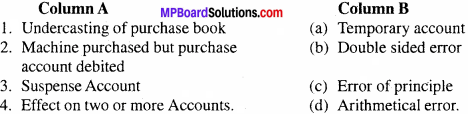
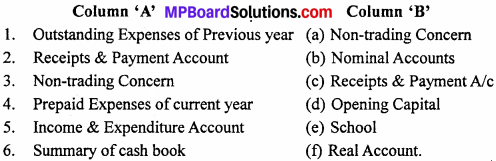
Match the following:
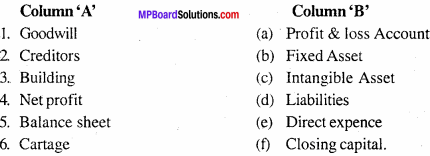
MP Board Class 11th Accountancy Important Questions Chapter 14 Financial Statement 1
Answer:

  1. (c)
  2. (d)
  3. (b)
  4. (a)
  5. (f)
  6. (e)

Question 4.
Answer in one word/sentence:

  1. When cost of goods sold is deducted from net sales, we get.
  2. The Expenses written in profit & loss Account are known as.
  3. The statement of Assets & Liabilities is called.
  4. Give an example of current Liability.
  5. In which side of balance sheet, the goods in transit are shown.

Answer:

  1. Gross profit
  2. Indirect expenses
  3. Balance sheet
  4. Bank overdraft
  5. Asset side.

MP Board Solutions

Question 5.
State True or False:

  1. Capital is a fixed Liability.
  2. Closing stock is not shown in balance sheet.
  3. Balance sheet is prepared on the basis of Trial balance.
  4. Bad debt reserve is a loss.
  5. Interest on drawings is loss of owner.

Answer:

  1. True
  2. False
  3. True
  4. False
  5. True.

Financial Statement Short Answer Type Questions

Question 1.
What do you mean by trading account?
Answer:
At the end of the financial year, the trader prepares an account called trading account to ascertain the gross profit or loss, of the business, i.e., The result of purchase and sale of goods. In its debit side, opening stock of goods, purchases less returns, wages, freight, carriage, power and fuel, etc. are entered. In its credit side sales less returns, closing stock etc. are entered. Then both, the sides are totalled and balanced. It may be either gross profit or gross loss. The debit balance shows gross loss and credit balance shows gross profit. It will be transferred to profit and loss account.

Question 2.
Explain the meaning of profit and loss account.
Answer:
Profit and Loss Account is an account prepared to find out Net Profit on Net Loss of the business for a particular period. In this account, all indirect incomes and expenses are entered. It starts with either gross profit or gross loss.

Question 3.
What is balance sheet? What are the objects of its preparation?
Answer:
“Balance sheet is a statement which gives information of business liabilities and assets on a particular date of which shows the financial position of the business”.

Objects:

  1. To ascertain the financial position of the business.
  2. To show the various assets and liabilities of the business.
  3. To find out the amount payable to creditors and the amount receivable from debtors.
  4. To ascertain the capital balance.
  5. To compare with previous years.

MP Board Solutions

Question 4.
Write a short note on valuation of closing stock.
Answer:
The unsold goods lies with the seller at the end of the financial year is called closing stock. It is essential to calculate the value of unsold stock at the end of each financial year, before the preparation of final accounts. Without its valuation, the net profit or net loss of the business is not possible to find out. In the following way it is valued.

The valuation of unsold stock is done in two ways, i.e., either in market price or in cost price. Generally, it is done in market price or in cost price which is lower. By doing so, chances of arising loss is minimized.

Question 5.
Differentiate between trading account and profit & loss account.
Answer:
Differences between trading account and profit & loss account:
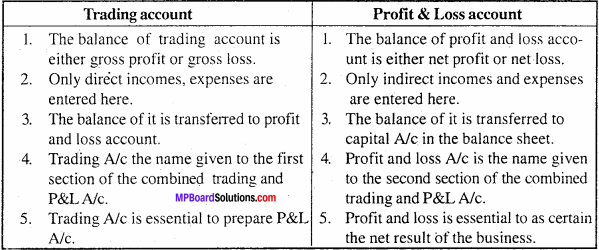
MP Board Class 11th Accountancy Important Questions Chapter 14 Financial Statement 2

Question 6.
Explain the objects of preparing profit and loss account
Answer:
The following are the advantages of preparing P&L accounts:

  1. To find out net profit or net loss of the business – The trading, profit and loss account shows the net profit or net loss of the business.
  2. Comparison – The net profit or net loss ascertained from the P&L account helps to compare it with previous years and plans can be taken to change the business policies.
  3. To calculate income tax – For the valuation of income tax, it helps the taxation authorities. It is done on the basis of net profit.
  4. Knowledge of daily expenses – P&L account gives the information of daily expenses and incomes of the business.
  5. Future plans – On the basis of net profit or net loss, ascertained from P&L account helps’the trader to make plans for the future.

Question 7.
Give the classification of liabilities.
Answer:
Liabilities can be classified as follows:

  1. Fixed liabilities – The liabilities which are to be paid after a long period of time.
  2. Current liabilities – The liabilities which are to be paid during short period (1 year) of time.
  3. Contingent liabilities – Those liabilities whose payment depend on future happenings.

Question 8.
What is meant by financial statement? What are accounts are open in it.
Answer:
At the end of current year for knowing the financial condition of business what¬ever statements are prepared are called financial statement. Trading account, profit & loss account, balance sheet.

MP Board Solutions

Question 9.
What is meant by closing stock ?
Answer:
The amount of goods remains unsold at the end of the accounting year is called as closing stock. It is necessary to enter closing stock in Dr. side of trading A/c because, profit or loss cannot be ascertained without taking closing stock into consideration.

Financial Statement Long Answer Type Questions

Question 1.
Explain the importance of final accounts.
Answer:
Ahead are the main importance of preparing final accounts:

1. To know the production cost and profit or loss on goods – Trading Account helps to know the cost of production and profit or loss made on goods for a particular period.

2. To know Net Profit or Net Loss of the business – The profit and loss account includes all indirect incomes and expenses, profits and losses of the business for a particular period. It enables us to find out the net profit or net loss of the business.

3. To know the financial position of the business – A Balance Sheet is prepared to find out the financial position of the business on a particular date. This statement contains all the assets and liabilities in its actual value. It must be equal.

4. To increase the earning capacity of the business – Final accounts are prepared in each year. It helps the trader to compare them from year to year. It enables him to find out the reasons of increase or decrease in profit or earning capacity.

5. To help in making future plans – The informations obtained from final account can work as a guideline for the business and on its base, he can make future plans.

MP Board Solutions

Question 2.
Differentiate between trial balance and balance sheet.
Answer:
Differences between trial balance and balance sheet:
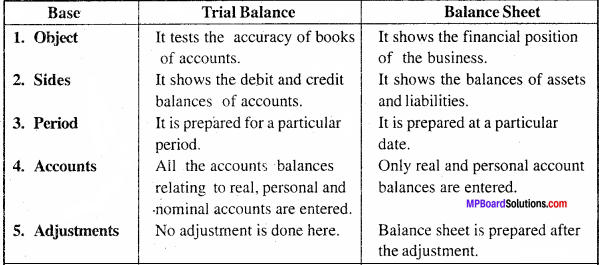
MP Board Class 11th Accountancy Important Questions Chapter 14 Financial Statement 5

Question 3.
Differentiate between trading and profit & loss account and balance sheet Answer: Differences between balance sheet and profit & loss account:
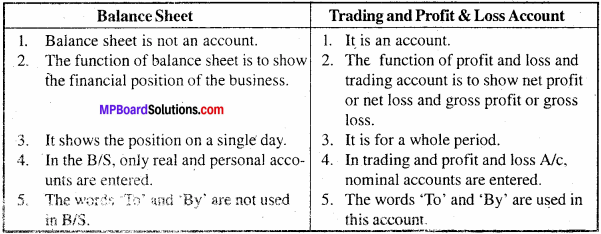
MP Board Class 11th Accountancy Important Questions Chapter 14 Financial Statement 6

Question 4.
Explain in brief me items which are written in the debit side of trading account
Answer:
The various iterns that appear in Dr. side of trading account:

  1. Opening stock – Last year’s unsold stock is brought toward and written as opening stock in trading account
  2. Purchases – The total amount of goods purchased is reduced by purchase returns.
    goods destroyed by fire etc. and net purchases are written.
  3. Direct expenses – It refers to those expenses which are incurred for purchase or production of goods, e.g., carriage purchases, octroi, wages, fuel etc.
  4. Gross profit – The credit balance of trading account is turned as gross profit. It is transferred to profit and loss account.
MP Board Class 11 Accountancy Important Questions

MP Board Class 11th Accountancy Important Questions Chapter 13 Bills of Exchange and Promissory Note

MP Board Class 11th Accountancy Important Questions Chapter 13 Bills of Exchange and Promissory Note

Bills of Exchange and Promissory Note Important Questions

Bills of Exchange and Promissory Note Short Answer Type Questions

Question 1.
What are the parties to a bill? Explain.
Answer:
There are three parties to a bill. They are:

  1. Drawer – He is the person who draws a bill. He is the seller or the creditor. He writes the bill.
  2. Drawee – He is the person to whom the bill is drawn. He is also known the acceptor of the bill. He is buyer or the debtor.
  3. Payee – He is the person to whom the payment is made on the due date. He may be the drawer, banker or the endorsee.

Question 2.
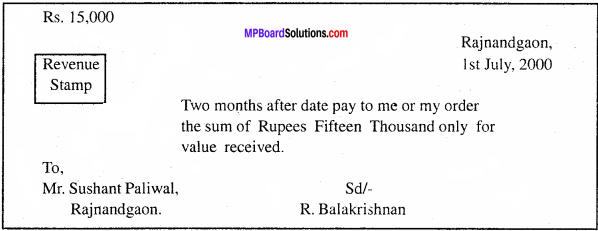
Give a specimen form of ‘Bills of Exchange’.
Answer:
A specimen form of bill of exchange:
MP Board Class 11th Accountancy Important Questions Chapter 13 Bills of Exchange and Promissory Note 1

Question 3.
What is meant by Accommodation Bill?
Answer:
These bills are written between the two parties for mutual financial help. No debtor-creditor relationship exists in such condition.

MP Board Solutions

Question 4.
Mention various characteristics of bill of exchange.
Answer:
The characteristics features of bill of exchange are:

  1. It is an unconditional order
  2. It must be in writing
  3. The maker or the writer of the bill must sign on it
  4. It is drawn on a particular person
  5. It must be accepted by one person to whom it is drawn
  6. It is payable on demand or on the expiry of a certain period
  7. It is written for a certain amount.

Question 5.
Explain renewal of a bill.
Answer:
Renewal of a bill refers to the cancellation of old bill and preparation of new bill for an extended period of time. It is done by the drawer on the request of drawee when the expressor his inability to pay.

Question 6.
What do you mean by renewal of a bill? Explain with an example.
Answer:
Renewal of a Bill:
Sometimes the acceptor of the bill found himself unable to meet his acceptance of the bill on the due date. So, he may request the drawer of the bill for the extension of time. If he agrees, the old bill is cancelled and a fresh one is drawn in place of the old one. For this extension of period, interest is charged and the bill is made with the principal amount and interest.

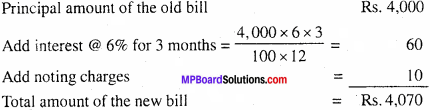
Example : Ram cancelled the old bill of Rs. 4,000 and draw a new bill on Mohan by charging interest at the rate of 6%, for a period of three months. The new bill should include noting charges of Rs. 10 also.

Solution :
Calculation of amount of the new bill
MP Board Class 11th Accountancy Important Questions Chapter 13 Bills of Exchange and Promissory Note 2

Question 7.
What is meant by dishonour of a bill? Explain in detail.
Or
Explain the procedure of dishonour of a bill.
Answer:
Non – payment of bill on due date due to any reason is known as dishonouring of a bill. In such a case, the holder of the bill can recover the amount from any of the previous endorser or drawer.
Due to the following causes a bill may be dishonoured:

  1. When the acceptor does not have adequate money to meet his acceptance
  2. When the acceptor is declared as insolvent
  3. When the payment is stopped by the Govt
  4. When the acceptor becomes lunatic, mad or expires.

When a bill is dishonoured, it is essential to certify it by a notary public by the holder in due course. He requests the drawee to make the payment. If again he denies to make payment then he approaches the court to recover the amount from him.

MP Board Solutions

Question 8.
What entries will be passed in the books of drawer in case of dishonour of a bill in following cases:

  1. Bill is retained with drawer and he pays noting charges.
  2. Bill is endorsed to Mr. X and Mr. X pays noting charges.

Answer:
1. If the bill retained with drawer and he pays noting charges:
Drawee’s A/c Dr. – –
To Bills Receivable A/c –
To Cash A/c –
(Being bill dishonoured and noting
charges paid)

2. If bill is endorsed to Mr. X and noting charges are paid by him:
Drawee’s A/c Dr. – –
To Mr. X’s A/c –
(Being bill dishonoured and noting charges paid)

Question 9.
What is a promissory note? Mention some features of promissory note.
Answer:
A promissory note is an instrument in writing containing an unconditional undertaking, signed by the maker to pay a certain sum of money to a person or to his order or to the bearer of the instrument. According to Indian Negotiable Instrument Act, “Promissory note is a promise to make the payment of certain specified amount to the creditor on demand or after expiry of certain period”.

In promissory note, acceptance is not required because the writer himself is the debtor. In’ transactions which are related to promissory note, there are mainly two parties one is maker (debtor) and second is payee (creditor). In this writer promises to pay the amount after certain period.

Special feature of promissory note:

  1. It is a document in writing.
  2. It must be a promise by the maker to make the payment in future.
  3. The promise to pay must be unconditional.
  4. It is a promise to pay specified amount.
  5. Payment may be made on demand or after the expiry of certain period.
  6. It must be signed by the maker of the instrument.
  7. It should be properly stamped.

Bills of Exchange and Promissory Note Long Answer Type Questions

Question 1.
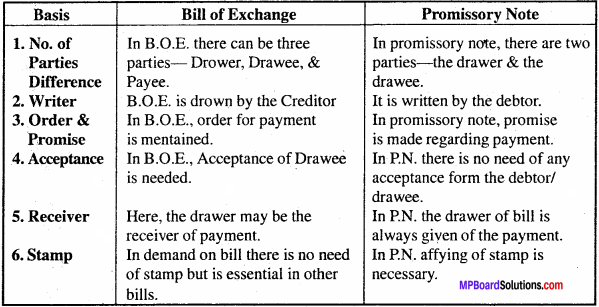
Differentiate between bill of exchange and promissory note.
Answer:
Difference between Bill of Exchange and Promissory Note:
MP Board Class 11th Accountancy Important Questions Chapter 13 Bills of Exchange and Promissory Note 3

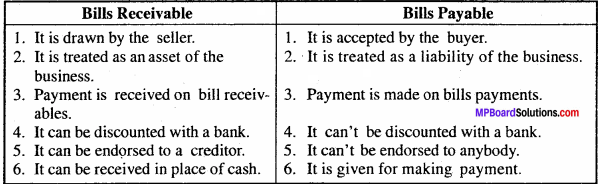
Question 2.
Differentiate between bills receivable and bill payables.
Answer:
The following are the difference between receivables and bill payable:
MP Board Class 11th Accountancy Important Questions Chapter 13 Bills of Exchange and Promissory Note 4

Question 3.
Explain in the following:

  1. Days of Grace
  2. Endorsement of a bill
  3. Retirement of a bill.

Answer:
1. Days of Grace:
Bill of exchange is written for a definite period. For the convenience of the acceptor, three extra days are allowed to him for making the payment. These extra day’s are known as ‘Days of Grace’. Three days are added to the due date of the bill.

2. Endorsement of a bill:
When the accepted bill is transferred by the drawer in favour of his creditors to pay off his debt is called endorsement. The person who endorses the bill is called endorser and to whom it is endorsed is called endorsee. When a bill is endorsed, the endorsee will be entitled to get the payment.

3. Retirement of a bill:
Sometimes the acceptor makes the payment of the bill before the due date. In this situation, he does not pay full amount of the bill. The drawer agrees to deduct some amount. This amount is called rebate. This is called ‘Retirement of bill under Rebate’.

MP Board Solutions

Question 4.
Describe types of bills of exchange?
Answer:
Kinds of bills of exchange are as follows:

  1. On the basis of place.
  2. On the basis of use.
  3. On the basis of time.
  4. On the basis of receiver.
  5. On the basis of Book – keeping.

1. On the basis of place:

  • Inland bill – When drawer and drawee are both from same country then it is called Inland bill.
  • Foreign bill – When drawer and drawee both are different countries then it is called foreign bill.

2. On the basis of use:

  • Trade bill – A trade bill is used for purchase and sale of goods or commodity.
  • Accommodation bill – This bill is drawer by drawer on drawee for meet financial need not for any business transaction.

3. On the basis of time:

  • Sight bill – This type of bill are liable for payment at time of presentation. ,
  • Tenure bill – This type of bill is to be made by acceptor on the date mentioned in the bill.

4. On the basis of receiver:

  • Bearer bill – The payment of such bills is made to that person who present the bills for payment.
  • Order bill – The payment of this bill is made to the person whose name is written on the bill on his order to any other person.

5. On the basis of Book – keeping

  • Bills receivable – These bills are those, the payment of which is to be received by traders at certain ate.
  • Bills payable – These bills are those the payment is made of purchases at certain date.

MP Board Class 11 Accountancy Important Questions

MP Board Class 11th Accountancy Important Questions Chapter 12 Provision and Reserves

MP Board Class 11th Accountancy Important Questions Chapter 12 Provision and Reserves

Provision and Reserves Important Questions

Provision and Reserves Objective Type Questions

Question 1.
Choose the correct answers:

Question 1.
Which reserve is not shown in balance sheet –
(a) General reserve
(b) Specific reserve
(c) Secret reserve
(d) Capital reserve.
Answer:
(c) Secret reserve

Provision and Reserves Short Answer Type Questions

Question 1.
What is General Reserve? What are its objectives?
Answer:
Reserve mean amounts set aside out of profits and other surpluses to meet future uncertainties. In other words, a reserve is meant for meeting any unknown liability or loss in the future. General Reserves are not meant for any purpose but can be utilised for any exigencies. General reserves are created for the following purposes:

  1. To compensate the unknown loss arising in future.
  2. To strengthen the financial position of the business.
  3. For reinvesting the profits in the business so as to expand the Current business.
  4. In case of companies, to maintain the rate of dividends for the shareholders.

Question 2.
Define secret Reserve. Explain the objects of secret Reserve.
Answer:
The main objects of secret reserve are:

  1. To strengthen the internal situation of the business.
  2. To compensate uncommon losses.
  3. To show reduced profit of the company.
  4. To hide the errors committed by Managers.

MP Board Solutions

Question 3.
Explain the methods of creating secret Reserve.
Answer:
Secret reserve is mainly created by showing Assets at a value less than its actual value or by way of showing Exaggerated liabilities. Some main methods adopted are:

  1. To provide more than required depreciation on Fixed Assets.
  2. Not to show Goodwill in the books.
  3. Not disclosing Accrued Incomes in the balance sheet.
  4. Not adjusting prepaid expenses.
  5. To show liabilities at a higher value than its actual value.

Question 4.
Mention three characteristics of Reserve.
Answer:
The characteristics or features of ‘Reserves’ are:

  1. It is created out of net profits or divisible profits. As such the reserves are also termed as ‘Retained Earnings’ or ‘Undistributed Profits.’
  2. Creation of Reserves is not a legal necessity. It is created voluntarily for strengthening the financial position of the business and for meeting an unforeseen Exigencies in the future.
  3. It is not created to meet any known liability or depreciation in the value of assets but for meeting an unknown liability or loss in the future.

Question 5.
What do you mean by bad debt reserve?
Answer:
Bad debt is a business loss for adjusting this loss, a reserve is maintained each year from the debtors. This reserve is known as bad debt reserve, it is the amount of provision to write off bad debt in future.

MP Board Solutions

Question 6.
What do you mean by bad and doubtful debt?
Answer:
Provisions for Bad and Doubtful Debts: At the end of the year there are certains debtors from whom it is expected that some amount may be received and some amount may not be received and there may be debtors from whom it is expected that no amount will be received. Hence, provision made for such losses or doubtful amount is known as “Provision or Reserve for Bad and Doubtful Debts.” Its amount and time is not known exactly. Hence provision is made for an expected amount.

This provision is deducted from the amount of debtors in balance sheet. If provision made is more than the amount of doubtful debts then such excess will be termed as Reserve and will be shown in the liability side of balance sheet. Accounting Treatment: The amount of provision or reserve for bad and doubtful debts is shown in the debit side of Profit and Loss Account and is deducted from the amount of debtors in Balance Sheet in the asset side.

Provision and Reserves Long Answer Type Questions

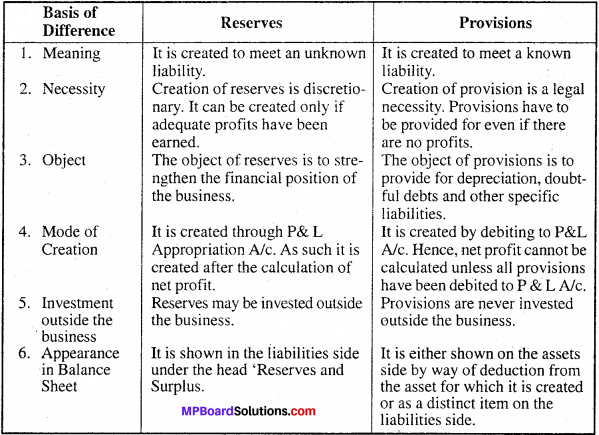
Question 1.
Distinguish between Reserves and provisions.
Answer:
Difference between Reserves and Provisions:
MP Board Class 11th Accountancy Important Questions Chapter 12 Provision and Reserves 1

Question 2.
Why a provision for discount on debtors and creditors are maintained in the business?
Answer:
Discount provision on sundry debtors:
When the sundry debtors make their payment before the prescribed time, they are allowed some concession. This concession is called cash discount. It is a loss to the business. In certain condition, the trader keeps a reserve to allow discount on debtors for future, in anticipation.

This reserve or provision is known as discount provision on sundry debtors. It is calculated after the deduction of further bad debt and new reserve from debtors at a percentage. This amount is shown in the debit side of profit and loss account and is also deducted from debtors in the balance sheet.

Discount provision on sundry creditors:
When the trader makes the payment before the stipulated time, he is allow’ed some discount. It is an income of the business. In certain condition, the trader keeps a reserve in anticipation that some discount may receive in future. This reserve on provision is called, ‘Discount provision on sundry creditors’. It is shown in the credit side of P&L A/c and is deducted from the sundry creditors in the balance sheet.

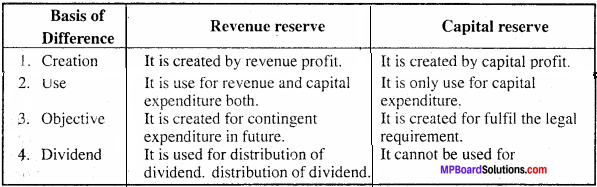
Question 3.
Distinguish between revenue reserve and capital reserve.
Answer:
Difference between Revenue and Capital reserve
MP Board Class 11th Accountancy Important Questions Chapter 12 Provision and Reserves 2

Question 4.
Explain the various types of Reserve.
Answer:
Reserve can be classified as follows:

1. Revenue reserve – Revenue reserves are those reserve which are created out of profit (revenue) earned through the business activities. Any reserve which is not capital reserve is called capital reserve.

2. Capital reserve – Capital reserve is created by capital profit or capital receipt. The profit which has not been earned from general business activities of the firm are termed as capital profit.

3. Specific reserve – When any part of profit the of business is kept for any specific purpose and it is utilised for that specific purpose then such reserve are called as specific reserve.

4. General reserve – A part of reserve which is created out of revenue reserve to meet out future contingencies and risk is called as general reserve.

5. Secret reserve – It is not shown in liabilities. If any reserve which is not shown in balance sheet which is called secret reserve.

MP Board Class 11 Accountancy Important Questions

MP Board Class 11th Accountancy Important Questions Chapter 11 Depreciation

MP Board Class 11th Accountancy Important Questions Chapter 11 Depreciation

Depreciation Important Questions

Depreciation Short Answer Type Questions

Question 1.
What do you mean by depreciation? What is the need of providing Depreciation?
Or
Write objects of providing for depreciation.
Answer:
Due to constant use of fixed assets in the business, there is continuing diminution or decrease in their value, quantity and quality. This permanent and continuing diminution or decrease in the value of asset is called ‘Depreciation’.

The objects of charging depreciation are as follows:

1. Replacement of fixed assets:
Due to constant use of a fixed asset, it becomes useless after a period of time. Hence, it must be necessary to replace it. At that time the businessman can utilize the money which were written off as depreciation for the replacement of the asset.

2. Proper distribution of loss:
The value of a fixed asset decreases due to its constant use and their loss is relevant to the particular year, i.e., their loss must be accounted each year and that is possible by charging depreciation.

3. For saving tax:
Law provides depreciation as a deduction from income. This reduces the taxable income of the business. So, to save payment of income tax depreciation should be charged.

4. To know accurate profit:
Depreciation is an expense like any other expense. So, only after providing depreciation the real profit for the period can be found.

5. To know the true and fair financial position:
As the value of asset is continually diminishing, it would be very wrong to show them at the original purchase value in the balance sheet. It is only reducing depreciation that the net value of assets can be known.

MP Board Solutions

Question 2.
Explain any five reasons for origin of depreciation.
Answer:
Causes for the Origin of Depreciation : Due to various reasons depreciation arises

1. Continuous use of assets:
In the business concern fixed assets are of daily use, resulting wear and tear, obsolescence and decline in the value of the assets. This decline of value of an asset is technically known as depreciation.

2. Obsolescence:
It means discard of an old machine which becomes uneconomic due to introduction of new machine of latest technique. The latest machine not only ensures cost minimization but the increase in production as well. Thus, for the sake of economy and efficiency of old machine is scrapped despite it being capable of giving service for few more years.

3. Exhaustion of original shape:
Some assets like mines, quarries, etc. exhaust considerably or completely as a result of excavation or removal of resources inherent therein. More and more, excavation / extraction leads to shrinkage or lessening of estimated available quantity. This decline in the value or quantity can be treated as depletion or depreciation.

4. Effluxion or expiration of time:
The value of old machines is always less than that of new machines. This is because, due to the passage of time and charging of depreciation every year the book value of old machine diminishes gradually. After a period of time the value becomes nominal or zero. For example, take leased land of Rs. 50,000 for 15 years. After 10 years its value may be less then half. This decline of value can also be treated as depreciation.

5. Fall in market price:
The market price of the fixed asset may rise or fall. This change in price is of temporary in nature. But the market price of an asset falls due to some special reasons, it can be trated as depreciation.

Question 3.
Write the characteristics of depreciation.
Answer:
The main characteristics of depreciation are as follows :

  1. Depreciation is charged only on fixed assets.
  2. Depreciation results in decrease of the value of a fixed asset.
  3. By depreciation the value of the fixed asset is constantly declining.
  4. Depreciation is a business expense.
  5. Depreciation is related with the account of a particular asset only.

MP Board Solutions

Question 4.
Write the demerits of reducing balance method.
Answer:
Demerits of reducing balance method are:

  1. No provision for interest on capital – Like fixed instalment method there is no provision of interest on capital invested in the fixed assets.
  2. High rate of depreciation – In this method, high rate of depreciation is essential. If the depreciation is charged on low rate, it will take many years to written off the assets.
  3. The value of assets can never be zero – This method of depreciation can be applied only when there is some residual value of the asset. In this method, inspite of charging depreciation, the value of assets can never be zero.

Depreciation Long Answer Type Questions

Question 1.
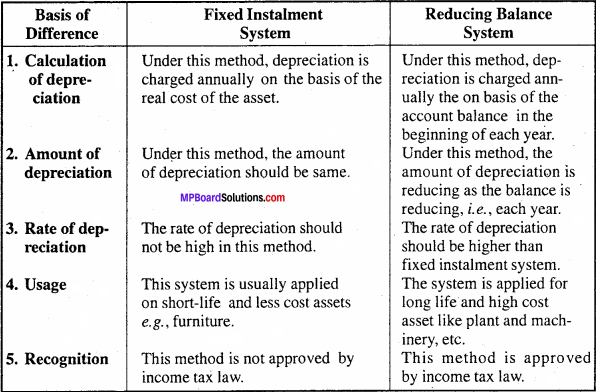
Distinguish between Fixed Instalment method and Reducing Balance Method of Depreciation.
Answer:
Fixed instalment method is called straight line method because when depreciation is charged evenly for all years, the curve will come in this manner:
MP Board Class 11th Accountancy Important Questions Chapter 11 Depreciation

MP Board Class 11 Accountancy Important Questions

MP Board Class 11th Economics Important Questions Unit 6 Development Experience of India: A Comparison with Neighbours

MP Board Class 11th Economics Important Questions Unit 6 Development Experience of India: A Comparison with Neighbours

MP Board Class 11th Economics Important Questions

Development Experience of India: A Comparison with Neighbours Objective Type Questions

Question 1.
Choose the correct option:

Question (a)
China republic was established in:
(a) 1945
(b) 1947
(c) 1949
(d) 1951
Answer:
(c) 1949

Question (b)
Which is the poorest nation:
(a) India
(b) China
(c) Pakistan
(d) Kerala
Answer:
(c) Pakistan

MP Board Solutions

Question (c)
In year 2010 which was biggest importer:
(a) America
(b) Japan
(c) China
(d) India
Answer:
(c) China

Question (d)
Economics of India and Pakistan depends for G.T.P:
(a) On primary level
(b) Secondary level
(c) Tertiary level
(d) None of these.
Answer:
(c) Tertiary level

Question (e)
Which country adopted infant policy:
(a) India
(b) China
(c) Pakistan
(d) None of these.
Answer:
(b) China

MP Board Solutions

Question 2.
Fill in the blanks:

  1. Biggest contributor to India’s National Income is …………………………
  2. In China great leap forward mission started in ………………………..
  3. Pakistan has better situation in field of ………………………. than India and China.
  4. In ……………………… urban population is least.
  5. Emission of Carbon – di – oxide is maximum is …………………………..

Answer:

  1. Service
  2. 1958
  3. Availability of facility
  4. India
  5. China.

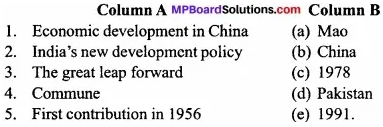
Question 3.
Match the columns:
MP Board Class 11th Economics Important Questions Unit 6 Development Experience of India A Comparison with Neighbours img 1
Answer:

  1. (c)
  2. (e)
  3. (a)
  4. (b)
  5. (d).

MP Board Solutions

Question 4.
State true or false:

  1. In 1978 ‘Reform policy’ started by China get a great blow.
  2. Ratio of people below poverty line is higher in India.
  3. Economy of Pakistan achieved great help by remittance of labourers.
  4. In comparison to China Indian human development index is higher.
  5. The Great leap Forward programme was started in Pakistan.

Answer:

  1. True
  2. True
  3. True
  4. False
  5. False.

MP Board Solutions

Question 5.
Answer in one word:

  1. Which model was adopted by Pakistan for development?
  2. Renmanbi is the currency of which country?
  3. Which price policy is there in China?
  4. In 2014 HDI in India was?
  5. Which is the poorest among India, Pakistan and China?

Answer:

  1. Statism
  2. China
  3. Double
  4. 0 – 609
  5. Pakistan.

Development Experience of India: A Comparison with Neighbours Very Short Answer Type Questions

Question 1.
Write two indications of HDI?
Answer:

  1. GNP per capita
  2. Life expectancy.

Question 2.
When did China started five year plans?
Answer:
In 1953.

Question 3.
When did economic reforms started in India and Pakistan?
Answer:
Economic reforms were started in 1951 in India and in 1956 in Pakistan.

MP Board Solutions

Question 4.
Name the two areas where India is ahead of Pakistan?
Answer:
Rate of GDP and Per Capita Income.

Question 5.
In which area China is ahead of India and Pakistan?
Answer:
Human development and GNP per capita.

Question 6.
What is liberty indicator?
Answer:
Liberty indicators means a tigers night to play in the governance of their country.

MP Board Solutions

Question 7.
Name any two regional groups?
Answer:

  1. SAARC
  2. ASEAN.

Question 8.
When did India and Pakistan became Independent?
Answer:
In 1947.

Question 9.
When was People’s Republic of China established?
Answer:
In 1949.

Question 10.
What was common in the development strategy of India, China and Pakistan?
Answer:
Five Year Plans.

MP Board Solutions

Question 11.
When was Great Leap Forward Movement started?
Answer:
In 1998.

Question 12.
What is Great Leap Forward?
Answer:
The Great Leap Forward was a campaign initiated in 1958 in China by Man’s which was aimed to Modernize China’s economy.

Question 13.
What is the objective of Great Leap Forward?
Answer:
Industrialization of nation on large scale.

Question 14.
What was the objective of commune?
Answer:
The objective of commune was collective farming.

Question 15.
When was the Great Proletarian Cultural Revolution started?
Answer:
In 1965.

MP Board Solutions

Question 16.
What was the objective of Great Protestarion Cultural Revolution?
Answer:
To send students and professionals to work and learn from country side.

Question 17.
When did economic reforms started in China?
Answer:
In 1978.

Question 18.
When did economic reforms started in Pakistan?
Answer:
In 1988.

MP Board Solutions

Question 19.
Why is density of population of China is less than India and Pakistan?
Answer:
Because the geographical area of China is big.

Question 20.
Which country adopted one child norm?
Answer:
China.

Question 21.
When was one child norm implemented in China?
Answer:
In the end of decade of 1970.

Development Experience of India: A Comparison with Neighbours Short Answer Type Questions

Question 1.
Mention some examples of regional and economic groupings?
Answer:
Following are some examples of regional and economic groupings:

  1. SAARC
  2. European Union
  3. ASEAN
  4. G – 8
  5. G – 20
  6. NAFTA
  7. SAFTA.

MP Board Solutions

Question 2.
What are the various means by which countries are trying to strengthen their own domestic economics?
Answer:
Following are the various means by which countries are trying to strengthen their own domestic economics:

  1. Countries are forming regional and global groupings such as European Union, G – 8, G – 20, ASEAN, SAARC, etc.
  2. Countries are making comparison of their policies with the policies of their neighbouring countries.

Question 3.
What similar developmental strategies have India and Pakistan followed for their respective developmental paths?
Answer:
Initially India and Pakistan adopted economic planning i.e., Five Year Plans as development strategy. Accordingly both the countries created a large public sector and raised public expenditure on social development. Till 1980 both the countries had similar growth rates and per capita income.

During this period, both the countries introduced a variety of regulated policy framework including tariff protection and direct import controls. During 1980s and 1990s, both the governments shifted their policy orientation to liberalisation and role of private sector. India introduced economic reforms in 1991 while Pakistan initiated economic in 1988.

Question 4.
Explain the Great Leap Forward Campaign of China as initiated in 1958?
Answer:
Great Leap Forward (GLF) campaign was initiated in China in 1958 as a strategy of economic development. Under this, the main emphasis was on the industrialisation of the country on a massive scale. People were encouraged to set up industries in their backyards. In rural areas, commune system was followed to promote collective forming. However, the Great Leap Forward compaign could not succeed.

MP Board Solutions

Question 5.
China’s rapid industrial growth can be traced back to its reforms in 1978. Do you agree? Elucidate?
Answer:
Yes, we agree with the statement that China’s rapid industrial growth can be traced back to its reforms in 1978. Under the reforms, private sector firms and co – operative societies were allowed to produce goods. At this stage, state enterprises (State Owned Enterprises) were made to face competition.

Under dual pricing, farmers and industrial units were required to buy and sell fixed quantities of inputs and outputs on the basis of prices fixed by the government and the rest were purchased and sold at market prices. Besides, special economic zones were set up to attract foreign investors.

Question 6.
Describe the path of developmental initiatives taken by Pakistan for its economic development?
Answer:
Pakistan became independent in 1947. Pakistan announced its first Five Year Plan in 1956. Till 1998, Pakistan had eighth Five Year Plans. Pakistan follows the mixed economy model with co – existence of public sector and private sector. In the initial period of planning, Pakistan adopted a policy of regulated environment characterised by tariff protection and import substitution.

As a result of huge public investment, the production of foodgrains also increased. In 1970s, capital goods industries were nationalised. However, by 1980, the emphasis was shifted to denationalisation and promation of private sector. The government offered incentives to the private sector. Reforms were introduced in Pakistan in 1988.

MP Board Solutions

Question 7.
What is the important implication of the “one norm” in China?
Answer:
The important implication of the “one norm” in the check on population growth. As a consequence, after a few decades, there will be more elderly people in proportion to young people. This will force China to take steps to provide social security measures with fewer workers.

Question 8.
Evaluate the various factors that led to the rapid growth in economic development in China?
Answer:
Following are the various factors that led to the rapid growth in economic development in China:

1. Government Control:
Since its establishment in 1949, China followed the strategy of socialism under which all the sectors of the economy, enterprises and land were under the government control.

2. Great Leap Forward:
Great Leap Forward campaign was launched in 1958 to promote industrialisation and collective fanning in agriculture.

3. Great Proletarian Cultural Revolution:
During 1966 – 1976, students and professionals were sent to work and learn from the countryside.

4. Economic Reforms:
Economic reforms were introduced in China in 1978. China introduced reforms in phases. In the initial phase reforms were introduces in agriculture, foreign trade and investment sectors. In the later phase, reforms were initiated in the indus¬trial sector. To attract foreign investors, special economic zones were set up.

MP Board Solutions

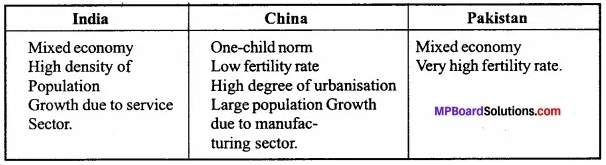
Question 9.
Group the following features pertaining to the economics of India, China and Pakistan?

  1. One – child norm
  2. Low fertility rate
  3. High degree of urbanization
  4. Mixed economy
  5. Very high fertility rate
  6. Large population
  7. High density of population
  8. Growth due to manufacturing sector
  9. Growth due to service sector.

Answer:
Grouping of features pertaining to the economics of India, China and Pakistan are as follows:
MP Board Class 11th Economics Important Questions Unit 6 Development Experience of India A Comparison with Neighbours img 2

Question 10.
Give reasons for the slow growth and re-emergence of poverty in Pakistan?
Answer:
Following are the reasons for the slow growth and re-emergence of poverty in Pakistan:

  1. Decline in the growth rate of agriculture sector which employs the largest proportion of work force.
  2. Political instability in pakistan.
  3. High rate of inflation.
  4. Dependence on foreign loans.

MP Board Solutions

Question 11.
What are the similarities in the developmental strategies of India, Pakistan and China?
Answer:
Following are the similarities in the developmental strategies of India, Pakistan and China:

  1. All the three countries have started towards developmental path at the same time.
  2. All the three countries followed the similar developmental strategies. All the three countries started their development through Five Year Plans and emphasis on pubic sector.
  3. Till 1980s, all the three countries had similar growth rates and per capita income.
  4. All the three countries have introduced economic reforms.

Question 12.
Compare and contrast India and China’s sectoral contribution towards GDP in 2008. What does it indicate?
Answer:
As far as sector wise contribution to growth is concerned in 2008, contribution of agriculture to GDP in China was 10% while in India it was 19%. On the other hand manufacturing contributes the highest to GDP in China at 47%, whereas, in India service sector contributes the highest at around 55%.

In the last two decades, the growth of agriculture sector has declined in both the countries. In the industrial sector, China has maintained a double-digit growth rate whereas for India industrial growth rate has declined. In the case of service sector, China has been able to raise its rate of growth in 2008 – 2010 while service sector growth in India has stagnated. China’s growth is mainly contributed by the manufacturing sector and India’s growth by service sector.

Development Experience of India: A Comparison with Neighbours Long Answer Type Questions

Question 1.
Mention the salient demographic indicators of China, Pakistan and India?
Answer:
The salient demographic indicators of China, Pakistan and India are discussed below:

1. The population of Pakistan is very small and accounts for roughly about one – tenth of China or India. Though, China is the largest nation and geographically occupies the largest area among the three nations its denstiy is the lowest.

2. One child norm was introduced in China in late 1970’s as population growth was the main reason. This was a measure led to a decline in the sex ratio, the proportion of females per 1000 males. Although sex ratio is based against females in all three countries are trying to adopt various measures to improve the situation. Due to one child norm, after few decades there will be more elderly people in proportion to young people.

3. The fertility rate is low in China and very high in Pakistan.

4. Urbanisation is high in both Pakistan and China with India having 28% of its people living in urban areas.

MP Board Solutions

Question 2.
Mention the various indicators of human development?
Answer:
Following are the various indicators of human development:

  1. Longevity or Life Expectancy at Birth: Longevity means the number of years of that a new bom infant can expect to live.
  2. Knowledge: Knowledge is measured by a combination of adult literacy rate and combined primary, secondary and tertiary school enrolment ratios.
  3. Decent standard of Living: It is measured by real per capita income at purchasing power parity in dollars.
  4. People below poverty line.
  5. Infant mortality rate:
  6. Maternal mortality rate.
  7. Adult literacy rate.
  8. GNP per capita etc.

MP Board Solutions

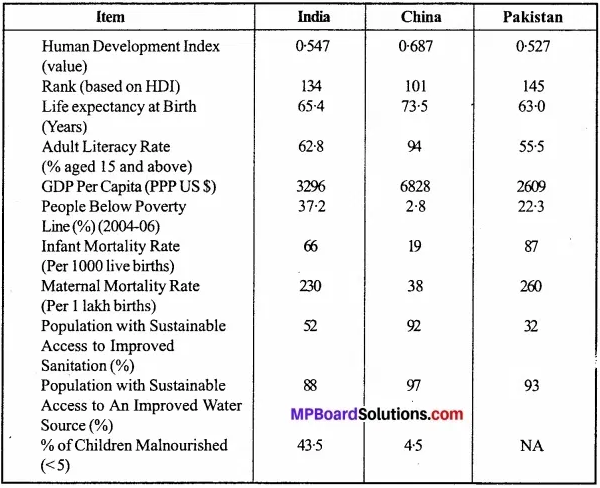
Question 3.
Compare and contrast the development of India, China and Pakistan with respect to some salient human development indicators?
Answer:
The following table presents the salient human development indicators in India, China and Pakistan:
MP Board Class 11th Economics Important Questions Unit 6 Development Experience of India A Comparison with Neighbours img 3

Source:
Human Development Report 2011 and World Development Indicators (W. W. W. worldbank. Org)

Table shows the following points:

1. China is ahead of India and Pakistan in human development indicators. China has better ranking in terms of income indicator such as GDP per capita, or proportion of population below poverty line or health indicators such as mortality rates, access to sanitation, literacy, life expectancy or malnourishment.

2. Pakistan is ahead of India in reducing proportion of people below the poverty line with 37 – 2% people below poverty line in India while the ratio being 22 – 3% in Pakistan in 2004 – 2006.

3. Pakistan’s performance in education, sanitation and access to water is better than India.

4. Maternal mortality is very high in India and Pakistan as compared to China. In China, for one lakh births, only 38 women die whereas, in India and Pakistan, more than 200 women die.

5. All the three countries report providing improved water sources for most of its population.

6. Considering the international poverty rate of $ 1 a day, India has the largest share of poor among the three countries.

MP Board Class 11th Economics Important Questions

MP Board Class 11th Accountancy Important Questions Chapter 10 Rectification of Errors

MP Board Class 11th Accountancy Important Questions Chapter 10 Rectification of Errors

Rectification of Errors Important Questions

Rectification of Errors Objective Type Questions

Question 1.
Choose the correct answer:

Question 1.
Errors are rectified in this book –
(a) Ledger book
(b) Journal proper
(c) Trial balance
(d) None of these.
Answer:
(b) Journal proper

Question 2.
Errors Committed by omitting entries in the Journal book is called –
(a) Error of commission
(b) Error of principle
(c) Error of omission
(d) None of these.
Answer:
(c) Error of omission

MP Board Solutions

Question 3.
If the trial balance does not tally after many efforts then following Account is opened –
(a) Purchase account
(b) Suspense account
(c) Sales account
(d) None of these.
Answer:
(b) Suspense account

Question 4.
Errors committed due to lack of basis principle of Accounting are called –
(a) Compensating errors
(b) Error of principle
(c) Single sided error
(d) None of these.
Answer:
(b) Error of principle

Question 2.
Fill in the blanks:

  1. Errors committed while totalling, balancing of Accounts are called ……………
  2. …………… errors are disclosed by Trial balance.
  3. If one error nullifies the effect of another error, such errors are called …………….
  4. Suspense Account is a ……………. Account.

Answer:

  1. Arithmetical errors
  2. Arithmetical
  3. Compensating errors
  4. Temporary.

Question 3.
Match the following
MP Board Class 11th Accountancy Important Questions Chapter 10 Rectification of Errors 1
Answer:

1. (d)
2. (c)
3. (a)
4. (b).

Question 4.
Answer in one word/sentence:

  1. The entries passed in the Journal proper for rectifying entries are called.
  2. The total of purchase book was written Rs. 200 instead of Rs. 2,000. This is an example of.
  3. When two errors nullify each others effect, then such errors are called.
  4. When are rectifying entries passed?

Answer:

  1. Rectifying entries
  2. Error of casting
  3. Compensating errors
  4. Beginning of the year.

MP Board Solutions

Question 5.
State True or False:

  1. Suspense Account is a Permanent Account.
  2. Single sided errors are generally rectified directly in the ledger accounts before closing the accounts.
  3. Final accounts are not affected through rectification of errors.
  4. Single sided errors are rectified through Suspense Account.

Answer:

  1. False
  2. True
  3. False
  4. True.

Rectification of Errors Short Answer Type Questions

Question 1.
Write some errors which are disclosed by a trial balance?
Answer:
The following are some of the errors which are disclosed by a trial balance:

  1. Wrong posting in an account.
  2. Double posting of an entry in an account.
  3. Entry of wrong amount in an account.
  4. Entry of one side posting.
  5. Error in bringing down the balance forward in new page.
  6. Error in balancing of account.

Question 2.
How the errors can be rectified? Explain.
Answer:
After the errors are located, it is essential to rectify them. Rectification can be made into three ways. They are:

  1. Cut the figures or by erasing the old figures and make it correct.
  2. Write rectification entries directly in the books of accounts.
  3. Write rectification entries in the journal.

Cut the figures or erasing the old figures and make it correct is wrong according to the principles of double entry system. By doing so, the validity of accounting is abolished. Rectification of entries in the ledger accounts or in the journal is made after the completion of financial year.

MP Board Solutions

Question 3.
How the double sided errors are rectified? Explain.
Answer:
The double sided errors are rectified through journal entries, where one account is debited and the other account is credited.

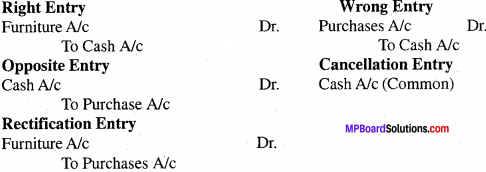
For the rectification of double sided error, the following steps are to be remembered:

  1. Make the correct entry as per the principles of double entry system.
  2. Repeat the wrong entry, which is done in the books of accounts.
  3. Make the opposite entry of wrong entry.
  4. Compare the correct entry with opposite entry and strike off the common entry. The resulting entry is the rectification entry.

Example: Ram purchased a furniture, which was debited in purchases account.
MP Board Class 11th Accountancy Important Questions Chapter 10 Rectification of Errors 2

Question 4.
What do you mean by suspense account? On which circumstances transactions are entered there?
Answer:
After the errors have been located, they must be rectified and the Trial balance should be tallied. This is done by transferring the difference into a special account called suspense account. It is temporary and fictitious account. In future, when the errors are located, the entries for their rectifications are done in this account. The suspense account will debited if the total of the credit column of trial balance exceeds the total of credit column, it will be credited in the other case.

In the following circumstances transactions are entered there:

  1. A transaction is completely omitted
  2. One sided errors
  3. Unlocated errors
  4. Disagreement of trial balance.

Rectification of Errors Long Answer Type Questions

Question 1.
How gross profit, net profit and balance sheet are affected by rectification of errors? Explain.
Answer:
The gross profit, net profit and balance sheet are affected by the rectification of errors. It is as follows:

1. Effect on gross profit –  If the credit side of trading account is increasing due to the rectification entry, the gross profit will also increase. On the other hand, if the debit side of the trading account is increased due to rectification, the gross profit will be reduced.

2. Effect on net profit – If the credit side of profit and loss account is increased due to. the rectification, the net profit will increase and vice versa. Thus rectification affects net profit.

3. Effect on balance sheet – The effect on net profit result the increase or decrease in capital balance, i.e., it will affect the total assets and liabilities in the balance sheet.

MP Board Solutions

Question 2.
Mention the errors which are disclosed by trial balance.
Answer:
The following are some of the errors which are disclosed by a trial balance:

  1. Wrong posting in an account.
  2. Double posting of an entry in an account.
  3. Entry of wrong amount in an account.
  4. Entry of one side posting.
  5. Error in bringing down the balance forward in new page.
  6. Error in balancing of account.

MP Board Class 11 Accountancy Important Questions

MP Board Class 12th Business Studies Important Questions Chapter 2 Principles of Management

MP Board Class 12th Business Studies Important Questions Chapter 2 Principles of Management

Principles of Management Important Questions

Principles of Management Very Short Answer Type Questions

Questions 1.
What do you understand by “Mental revolution” ?
Answer:
Principle of mental revolution assumes that even if there are large physical resources and other resources in an organization but if the human resources are not satisfied, there isn’t peace and prosperity and the moral of the human resources is not high till then the resources are simply resources. They can never take the form of production and services. Hence, managers must try to attain the maximum cooperation of the workers, to remove the gaps between labour and capital and to radicate mutual enmity.

Question 2.
What do you understand by principles of management ?
Answer:
Principles of management represent the techniques and principles which are related to management tasks and to show the correct path for achievement of the main objectives of the organization.

Question 3.
Explain Fayols principle of Initiatives ?
Answer:
According to this principle Fayol has suggested that the officers and employees of an organization should be given freedom to work on the new plans and to upgrade the old plans in order to increase the productivity. The employees should take the initiative in order to give suggestions to increase the productivity of the firm.

Question 4.
What is principle of equity ?
Answer:
This principle was formulated by Henri Fayol. Equity means fair dealings, equality of treatment and cooperative attitude among the employees in the enterprise. Equity results from a combination of kindness and justice. Employees expect equity from management.

Question 5.
How is efficiency developed through division of labour ?
Answer:
According to Henri Fayol all employees is an organization or institution do not have same efficiency. So according to their efficiency and interest they should be assigned the work. Labour should be divided into various groups. By doing this workers are motivated and this helps in increasing their efficiency.
The object of division of work is to derive benefits from specialization. The various functions of management like planning, organization cannot be done alone.

Question 6.
Distinguish is between principles of unity of command and principle of unity of direction.
Answer:
Difference between Principles of unity of command and Principle of unity of direction

principal of unity command:

  1. it is concerned with the functioning of personnel.
  2. 2.this principal makes the relation of and officers (authority) strong.

princpals of unity of direction:

  1. it is concerned with the functioning of the department and sub-department comprising the business concern.
  2. the principals help the unification of plans.

Question 7.
What do you mean by decentralization ?
Answer:
When the top level management gives more role and importance to its subordinates in management and organization, it is known as decentralization. The intensity of centralization of decentralization is decided by the top level management.

MP Board Solutions

Question 8.
What do you mean by standardization ?
Answer:
According to Taylor standardization is essential for high quality product with low cost of production. It involves the standardization of tools and equipment conditions of work and materials so that the best product can be produced at a minimum cost.

Question 9.
Explain the principle of unity of direction formulated by Henri Fayol.
Answer:
Principle of unity of direction means there should be one head and one plan for a group of activities having the same objectives. While unity of command is concerned with the functioning of personnel unity of direction is concerned with the functioning of the body corporate. The departments and subdepartments comprising the business concern.

Question 10.
Explain Principle of scientific selection, training and development.
Answer:
According to Taylor, selection of employees should be done very carefully, because wrong selection may create disaster. This does not mean that only well qualified persons should be employed, but that person should be employed who can do that work or is capable of -handling that work. Taylor in his book, “The principle of scientific management” has written, that no matter how good your selection procedure is, but without training, the working capacity of the employees cannot be increased. Therefore, along with scientific selection method, arrangement for training should also be made. “A person should do the work not mere know the work.”

Question 11.
What is Taylor’s Eight Boss scheme ?
Answer:
Taylor has suggested functional organizational system. This organization is called Eight Boss scheme.
They are:

  1. Gang Boss
  2. Speed Boss
  3. Repair Boss
  4. Inspector
  5. Shop disciplinarian
  6. Route clerk
  7. Instruction card clerk
  8. Time and cost clerk.

Question 12.
ExpIain the principle of ‘I’ and ‘We’ propounded by Fayol ?
Answer:
According to this principle of Henry Fayol the industrialists should use the word we instead of ‘I’ in order to get maximum cooperation of the employees. Both the aspect should work in cave and harmony.

Question. 13.
Explain Taylor’s principle of task idea.
Answer:
Principle of task idea: This pertains to the norms of productivity of individual worker. It is a technique of forecasting and viewing ahead every step in a long series of separate operations. The standard task is the amount of work which an average worker does in congenial atmosphere during a working day. Taylor called it a fair day’s work. A worker usually works much below his capacity if no standard is set for him.

Question 14.
What do you mean by motion study ?
Answer:
It is the study of a machine operator and his movements for performing the job. The purpose is to eliminate useless motion and thereby establish a standard for performance. The study is undertook in order.

Question 15.
Explain the principle of unity of direction.
Answer:
Principle of unity of direction : It means, there should be one head and one plan for a group of activities having the same objectives while unity of command is concerned with the functioning of personnel, unity of direction is concerned with the functioning of the body corporate the departments and subdepartments comprising the business concern.

Question 16.
Who formulated scientific principles of management when and where did he die ?
Answer:
Principles of scientific management was formulated by F.W. Taylor. He died in 1915 at Filadalphiya.

Question 17.
How many parts did Henri Fayol divide the works of business ?
Answer:
Fayol has classified all the works of business in six parts :

  1. Technical work
  2. Commercial work
  3. Financial work
  4. Security work
  5. Administrative work
  6. Managerial work.

Question 18.
What do you mean by time study ?
Answer:
lt is done to observe and study the minimum time-period required to perform any task. Through time study the precise time required for man’s work is determined. It will help in fixing the standard time required to do a particular job.

MP Board Solutions

Question 19.
what do you mean by Fatigue study ?
Answer:
Fatigue study : Excessive specialization of work and poor working conditions may cause monotony resulting in both physical and mental fatigue among industrial workers. Fatigue either a physical or mental always has an adverse effect on worker’s health and his efficiency. The idea of this study is to see that workers maintain their operational efficiency without any injury to their health and happiness.

MP Board Solutions

Principles of Management Short Answer Type Questions

Question 1.
Name the 14 principles of management formulated by Henri Fayol.
Answer:
AnirFayol’s Principles of Administration of Management:

  1. Principle of division of work
  2. Principle of authority and responsibility
  3. Principle of discipline
  4. Principle of unity of command
  5. Principle of unity of direction
  6. Principle of priority to common interest
  7. Principle of remuneration of personnel
  8. Principle of centralization
  9. Principle of scalar chain
  10. Principle of order
  11. Principle of equity
  12. Principle of stability
  13. Principle of initiative and Esprit de corps
  14. Principle of coordination of management.

Question 2.
Differentiate the time study and motion study.
Answer:
Differences between time study and motion study :

Time study:

  1. Time study is done at first.
  2. In time study, study of time is done of time taken by machine and time taken by labours.
  3. Stopwatch is used in time study.
  4. Time study is related to increase the efficiency of labourers.

Motion study:

  1. Motion study is done after time study In motion study the study of work done by labours is done.
  2. Camera is used in motion study.
  3. The object of motion study is to minimize the movement of labours.

Question 3.
why the principles of scientific management opposed by labourers ? Give any six reasons.
Answer:
Opposition by labourers : The maximum opposition of scientific management has been done by the labourers. The reasons for opposition of scientific management are following: .

1. Increase of labourers work: To adopt the scientific management, it is necessary to increase the efficiency of a labour and so the work load on labour is increased. The increased work load creates bad effect on the health of labourer. Hence, it is opposed by the labourers.

2. Strict control: Under the scientific management, strictness has to be observed and so the labourers are kept under the strict control which they do not like.

3. Fear of unemployment: Increased use of machines create a sense of fear in the minds of the workers, thereby making them inefficient. This may further lead to retrench-ment. Hence, they are against being the standards set;

4. Exploitation of labourers : In scientific management, wages of the labourers are not increased in proportion to the increased production. So, in this system, exploitation of the labourers are maximum.

Question 4.
describe the similarities of opinions of Taylor and Fayol.
Answer:
Followings are the similarities of opinions Taylor and Fayol:

  1. Both wanted to bring change in managerial conditions
  2. Both were great supporters of human factor
  3. Both gave much importance to forecasting and planning
  4. Both were management experts of the same time, i.e., both were contemporaries
  5. Both accepted management as an earned talent
  6. Both were experts in their own fields
  7. Both emphasised working in a technical and scientific way
  8. Both formulated principles of management.

Question 5.
To increase the production efficiency in industrial organization many principles were developed by Taylor. Explain them.
Answer:
To increase the production efficiency in industrial organization following principle are adopted by Taylor :

Principle of modern machines and equipment: Modem machines and equipments yield good quality of goods. Cost incurred is also reduced, therefore under production management, best of modem machines and equipments should be used.

Principle of standardization : Taylor says that, “For production, standard material, standard method, proper procedure and good workers qualifying the standard requirements should be made available, such that good quality of goods can be produced at lesser cost.”

Principle of ideal cost accounting system : For controlling the wastage in expenditure and misuse of materials suitable system of cost accounting should be adopted. Capable and experienced cost accounts should so appointed in the organization.

Question 6.
What are the dissimilarities in study of Taylor and Fayol ?
Answer:
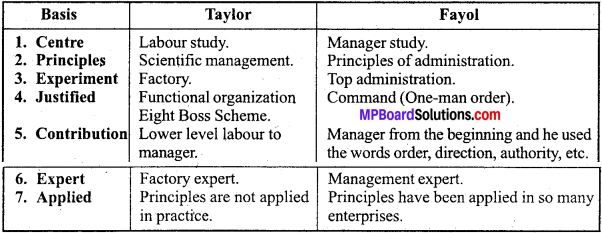
Dissimilarity of Opinions : Taylor and Fayol

  1. Taylor’s centre of study was labour whereas Fayol’s centre of study was manager.
  2. Taylor’s principles were Principles of Scientific Management whereas Fayol’s Principles were known as Principles of Administration.
  3. Taylor’s experiment point was factory whereas Fayol’s experiment point was top administration.
  4. Taylor justified functional organization (Eight Boss Scheme) for an enterprise whereas Fayol justified unity of command (One-man order).
  5. Taylor’s study and contribution was lower level, labour to manager whereas Fayol’s_ study and contribution was manager from the beginning and he used the words order, direction, authority, etc.
  6. Taylor is called as Factory Expert whereas Fayol is known as Management Expert.
  7. Taylor’s principles are not applied in practice whereas Fayol’s principles have been applied in so many enterprises.

MP Board Class 12th Business Studies Important Questions Chapter 2 Principles of Management IMAGE - 1
MP Board Solutions

Question 7.
Mention the objectives of scientific management.
Answer:
Following are the main objectives of scientific management: .

  1. Increase in the rate of production by use of standardized tools, equipments and methods
  2. Increase in quality of goods by research, quality control and inspection devices
  3. Reduction in the cost of production by rational planning and regulation and using cost control techniques.

Question 8.
“Principles of management are concentrated on human behaviour”. Explain.
Answer:
Management is totally related with human behaviour. The success of principles of management is affected by human behaviour. Management is related with persons. Management gives proper directions to human behaviour. Management is also done by human being and the consumer for whom the organization, is prepared is also human being. So it is said that principles of “Management are concentrated on human behaviour”.

Question 9.
The work of Taylor and Fayol are complementary.’ Explain
Answer:
F. W. Taylor is regarded as “father of scientific management and Henry Payol is regarded as “father of modern principles of industrial management”. Both were contemporaries and both were top class engineers. Both emphasized working in a technical and scientific way. Both have contributed a lot in the field of management. These existed a difference in thinking and working method of both. Economics for instance, Taylor focussed on improving efficiency of labourers while Fayol focussed on management work. The both realised that in every stage. Employees and their management will be the basis of success of an industrial Concern. To solve such problem both suggested scientific solutions and their implementation.

Despit of dissimilarities between the principles propounded by both learned economists. We can say that their work is complementary to each other.

Question 10.
Write the importance of principles of management is three points.
Or
Explain the importance of principle of management.
Answer:
Significance of Importance of Principles of Management: The principles of management are very useful as they provide useful guidelines to managerial behaviour and influence managerial practices. Actually, principles guide Them in taking and implementing decisions. Their importance can be understood by the discussion of the following points :

1. They provide useful In-sights : The principles provide the managers with useful insights into real world situations. Following these principles they increase their knowledge, ability and understanding and can face adverse situations effectively. Thus, the principles increase managerial efficiency.

2. They help in utilization to Resources of the optimum : As we know resources both human and material are limited. They have to be put to optimum use. They should be uses in such a way that they give maximum benefit with minimum cost. Principles equip the managers foresee the.cause and effect relationships of their decisions and actions. Thus, the wastage associated with a trial-and-error approach can be overcome.

3. Highlight the True Nature of Management: Lack of understanding of management principles makes it difficult to define clearly the nature and scope of the managerial job. Principles are necessary if the true nature of management is to be clearly understood. Principles act as a checklist of the meaning and contents of management. They highlight the role of managers in concrete terms and serve as a criteria to judge the appropriateness of managerial decisions and actions.

4. Based on Objective Assessment: Management principles help in thoughtful decision making. They emphasis logic rather than blind faith. Management decisions taken on the basis of principles are free from bias and prejudice. They are based on the objective assessment of the situation

5. To Guide Research : Principles of management indicate the lines along, which research should be carried out to develop new guidelines and to ascertain the validity of existing guidelines. Thus, management principles serve as focal points for useful research in management.

6. To attain Social Goals: Manager coordinate the efforts of people so that individual objectives get translated into social attainments. The standard of living of people depends upon the quality of management. If management is efficient, the resources of society are better utilized and quality of life is improved. Development of management principle by increasing, efficiency, in the use of resources, would definitely have a revolutionary impact on the cultural level of society and on human progress.

Question 11.
Distinguish between managerial principles and managerial techniques.
Answer:
Differences between Managerial principles and Managerial techniques

Managerial principles:

  1. Managerial principle is flexible.
  2. Managerial principles are directions for managerial work.

Managerial techniques:

  1. Managerial techniques are less flexible
  2. These are managerial techniques which are made fulfil the targets.

Question 12.
How are principles of management arises ?
Answer:
Principles of management arises due to following reasons :

1. Deep observation: In every business in front of management some problems arises. During this time managers observe working of employees. They see their reactions. On the basis of these observations principles are made.

2. Experiments done again and again : In this method experiments are done on various employees frequently. On the basis of results the principles are made.

Question 13.
Explain the principle of “Esprit De Corps”
Answer:
By ‘Esprit De Corps’ we mean “Power of Organization”. According to this principle each employee should consider himself/herself as the member of teach. He/she should try to achieve the target of team. Management should try to create feeling of cooperation among the workers. By following this target group target is achieved.

Question 14.
While fixing the proper wages which points are to be kept in mind ?
Answer:
While fixing the proper wages these points are kept in mind :

  1. Financial situation of institution or organization.
  2. Minimum wages act of government.
  3. Payment of bonus and wages done by competent.

Question 15.
How principles of management make administration more effective ? Explain with example.
Answer:
Principles of management discourages partiality and prejudice. It makes administration more effective. These principles encourages the scientific principles.

For example “Principle of unity of command” and “Principle of unity of direction” lead the orderly working of the organization. Principle of direction do assimilation of effort made by workers in a specific direction. Principle of scalar chain do the flow of information in a proper way.

Question 16.
Recognize those techniques of scientific management which are analysed by the following statements :

  1. When any expert supervises each labour.
  2. To know the best solution of doing any work.
  3. Different wages paid to labours.
  4. When equality is brought in material, machines tools and working methods and conditions after proper experimentation.
  5. To fix the standard time for completing the fixed work.
  6. Employee is for the enterprise and enterprise is for the employee.

Answer:

  1. Creative foremanship
  2. Method study
  3. Differential wages
  4. Stan-dardization of work
  5. Time study
  6. Mental revolution.

Question 17.
Distinguish between principle of unity of command and functional foremanship.
Answer:
The differences between principle of unity of command and functional foremanship:
Principle of unity of command

  1. This principle requires that the employees should receive orders from one superior only for any action or activity.
  2. In it planning and performing work is same.
  3. It means workers in a department are required to be accountable to one superior for orders.

Functional foremanship

  1. Under it each worker has to takeorder for performance of any work from foreman.
  2. Under it planning and performance of work is different, (excutation of function)
  3. This concept was extended to the lower level.

Question 18.
Distinguish between principles of management and principles of pure science
Answer:
Principles of management:

  1. Principles of management are of more flexible nature.
  2. These changes in business environment according to change.
  3. These principles are implemented with creativity.

Principles of puree science:

  1. These principles are more strong.
  2. These principles do not change according to time.
  3. These are implemented with fixed or proposed way.

Question 19.
When a salesman gets order from two high authority then what bad effects may take place ?
Answer:
When a salesman gets order from two different authorities then following bad effects may be found:

  1. Suspicion may take place in mind of salesman.
  2. He tries to avoid the work.
  3. There may be difference of opinion regarding the orders by two persons.
  4. It may be difficult to maintain discipline.

Question 20.
It is seen that in organization present position is due to the non-violation of principles of management. What is this present position ?
Answer:
Due to violation of principles of management following positions may be in the organization:

  1. Necessary material may not be made available at die time of requirement of it. In search of material much time will be wasted.
  2. Conditions may increases.
  3. Possibility of accidents may increase.

MP Board Solutions

Question 21.
Write the names of those officers who work under foremanship the following works:

  1. To examine the quality of produced goods. To check the standard of goods and if the goods are of not standardize, then finding the reason of it.
  2. To cheek if all the labours are working their own work according to fixed rate.
  3. To ensure what will be the order of any work in completing the specific work.
  4. To keep the machines and tools in working conditions.
  5. To give direction to workers to do work by a specific method.
  6. To ensure that each work is done in proper way.

Answer:

  1. Inspector
  2. Speed Boss
  3. Rote clerk
  4. Repairs Boss
  5. Card clerk
  6. Displinarian.

MP Board Solutions

Principles of Management Long Answer Type Questions

Question 1.
Explain some merits of scientific management.
Answer:
some merits of scientific management are as follows :

  1. Division of work : It stress on specialization and division of work. It helps the producer in completing of work effectively.
  2. Industrial peace: The conflicts among labours are solved scientifically under scientific management. There is no place for conflicts which helps in main taining industrial peace.
  3. Maximum work: It helps in getting the maximum work done from laboures. This helps in increase in profit as well.
  4. Reduction in cost of production : If reduce the cost of production, it can achieve .success. ‘
  5. Increase in Income: It increases the efficiency of worker which increase the income of labours.
  6. Stability in employment: Efficient and able worker provide their service regularly it will increasestability in employment.

Question .2
What do you understand by scientific management ? Write its characteristics.
Answer:
Meaning of Scientific Management: Scientific management is made of two words science and management. Science is the application of logic, reasoning and it gives a new dimension to our study approach to different problems of life. When we apply scientific approach towards management concepts this is called as scientific management.
Following are the characteristics of scientific management:

  1. The objectives of every job in scientific management is fixed and predetermined,
  2. There is a fixed plan to attain objectives
  3. Mutual cooperation among employees is essential in scientific management
  4. Scientific management works on the objective of maximum production at minimum cast
  5. Motivation is considered necessary for the completion of work
  6. Scientific control system is implemented under scientific management
  7. Time to time evaluation of standards is performed
  8. Increase in efficiency of employees helps in increase in the income of employees
  9. Researches and experiments plays an important role in the field of scientific management
  10. Specialisation and division of work is also given importance
  11. Much stress is given on right person for the right job
  12. Responsibilities are assigned or fixed for every level of work.

Question 3.
Discuss the elements of scientific management. (Imp)
Answer:
In order to implement the principles of scientific management, Taylor and his associates developed the following techniques :

1. Time Study : In refers to the technique used to measure the time that may be taken by a worker of reasonable skill and efficiency to perform various elements of a job. The aim of time study is to fix ‘Time standards’ for each operation.

2. Motion Study : It refers to have close observation of the movements of a worker’s body involved in performing a job. The purpose of motion study is to avoid wasteful motions in working.

3. Fatigue Study ; Fatigue study seeks to find out how long a person can perform the standard task without any adverse effect on this health and efficiency. It helps to determine the mount and frequency of rest intervals in completing a job.

4. Method Study : The aim of this study is to maximize efficiency in the use of materials, machinery, manpower, and capital by improving work methods.

5. Scientific Task Setting : Scientific planning of a task is the technique of forecast¬ing and viewing ahead every step in a long series of separate operations. Each step has to be taken in the right place, of the right degree, and at the right time, so that work can be done with maximum possible efficiency. Scientific task is the amount of work which an average worker working under proper working conditions can perform during a working day.

6. Standardization : Standardization is the process of fixing well thought-out and tasted norms with a view to maximise efficiency of work standardization eliminates needles variety and thereby simplifies the process of production.

7. Scientific Selection and Training : Under scientific management right men are selected for right jobs. Employees are selected according to predetermined standard in an impartial way. Workers are specifically trained for the jobs, so that they can perform their jobs effectively and efficiently.

8. Mental Revolution : It requires that there should be perfect cooperation,coordination and adjustment between the efforts of labour and management.

Question 4.
describe the principles formulated by Taylor.
Answer:
‘The principles formulated by Taylor are in fact the principles of scientific management. Sir Taylor has formulated the principles of management after studying the scientific management minutely and deeply. Taylor has presented the principles of management in L scientific way. So, it is called as principles of scientific management. The following principles have been formulated by Taylor.

1. Principle of task idea : This pertains to the norms of productivity of individual worker. It is a technique of forecasting and viewing ahead every step in a long series of separate operations. The standard task is the amount of work which an average worker does in congenial atmosphere during a working day. Taylor called it a fair day’s work. A worker usually works much below his capacity if no standard is set for him.

2. Principles of experiment: Taylor suggested that the following studies be conducted by an organization so that it has an insight in knowing the method of doing a job, movement of a machine, time required for its completion and the fatigue that is associated with performing the job.

(i) Time study : It is done to observe and study the minimum time required to perform any task. Through time study, the precise time required for man’s work is determined. It will help in fixing the standard time required to do a particular job.

(ii) Motion study : It is the study of a machine operator and his movements for performing the job. The purpose is to eliminate useless motion and thereby establish a standard for performance. This study is undertook in order to develop a less time consuming system for accomplishing the work.

(iii) Fatigue study : Excessive specialization of work and poor working conditions may cause monotony resulting in both the physical and mental fatigue among the industrial workers. Fatigue either a physical or mental always has an adverse effect on worker’s health and his efficiency. The idea of this study is to see that workers maintain their operational efficiency without any injury to their health and happiness.

3. Principles of scientific selection and training : Scientific management requires a radical change in the methods and procedures of selecting workers for the plan. Hence, it is essential to entrust the task of selection to a central personnel department. After having selected the workers, every job must be entrusted to the’best worker in the factory. This depends upon the workers aptitude, skill and intelligence.

Under scientific management, the management has to undertake the training of workmen before allotting them certain tasks. Training should be imparted from time to time to improve the efficiency of labour.

4. Principles of justified division of work : According to the principle of division of work, work should be allotted to the right worker according to his choice and efficiency. This is called as right job to the right person.

5. Principles of incentive wage system : Taylor assumes that in addition to good wages, proper incentive should be given to the employees for getting proper attention towards the work. Taylor introduced ‘Differential Wage System’ in this regard. This implies that a worker who works as per the standards set should be paid more, in comparison to the inefficient worker, who does not work as per the standards set. In simple words, a worker who works more should receive more wages than the person who doesn’t.

MP Board Solutions

Question 5.
Explain the principles of Fayol.
Answer:
Principles of administration or Management of Fayol: Fayol has mentioned 14 principles in his book, ‘General and Industrial Management’. As he has accepted administration and management as being synonyms, we can say it as principles of management.

These principles are as follows :

1. Principle of division of work : The object of division of work is to derive benefits from specialization. The various functions of management like planning, organization, coordination, control, etc., cannot be performed by a single proprietor or by a group of directors and they have to be entrusted to specialists in the related fields.

2. Principle of authority and responsibility: As management consists of getting the work done through others, it implies that the manager should have the right to give orders and the power to exact obedience. Thus, the manager gives order to his subordinates to perform the job as per his direction. A manager may exercise official authority and also personal authority. An individual to whom authority is given to exercise power must also be prepared to bear responsibility to perform the work.

3. Principle of discipline : Discipline is absolutely essential for the smooth running of the business. By discipline, we mean the obedience to authority, observance of the rules of service and norms of performance, respect for agreements, sincere efforts for completing the given job, respect to the superiors, etc.

Question 6.
Explain the nature of principles of management.
Or
Describe any six characteristics which clarify the nature of the principle of management.
Answer:
Nature/Characteristics of management principles: Management includes the qualities of both science and art that’s why management is called as a science or an art. The principles of management are not rigid and fixed like the principles of physics and chemistry. The main characteristics which highlight the nature of management principles are as follows:

(1) Universality of principles: Management principles can be applied to all manage
rial situations irrespective of the size (Small or large) and nature (Business government or social organization). That’s why Henri Fayol stressed on universality of management principles. Every organization or persons tries to achieve objectives through group efforts. Management principles can be implemented by the managers or directors in any level of management.

(2) Dynamic nature of principles : Management principles are dynamic in nature and flexible. These principles are not rigid and fixed like the principles of mathematics, physics and chemistry. Management principle changes due to cause and effect relationship. Management principles which were earlier important now have changed due to social changes. Management principles are dynamic in nature because these principles are directly related with human beings.

(3) Concentrated on human behavior: Management is totally related with human behavior. Management is related with persons. The success of management principles is affected by human behavior. Principles of management are directed towards enhancing human behavior so that the persons in organization give their best performance.

(4) Relative principles : Management principles are relative not absolute. These principles are implemented according to the needs of organization. It is not compulsory to apply these principles. Every organization, enterprise or society is having different type of nature. Thus due to different circumstances, assumptions, needs etc. accordingly the principles are applied in enterprises and organizations.

(5) Equal importance : All the principles of management are having equal importance. This is true that some principles are important for one organization while other principles may be important for other organization. But these principles are having some importance in all the organization.

(6) Cause and effect relationship : Management principles are always affected by cause and effect (result). Management principles establishes relationship between cause and result. These principles indicates the effect of an important decision on the activities of enterprise.

Question 7.
Write the characterstics of scientific management.
Answer:
Meaning of Scientific Management: Scientific management is made of two words science and management. Science is the application of logic, reasoning and it gives a new dimension to our study approach to different problems of life. When we apply scientific approach towards management concepts this is called as scientific management.

Following are the characteristics of scientific management:

  1. The objectives of every job in scientific management is fixed and predetermined,
  2. There is a fixed plan to attain objectives
  3. Mutal cooperation among employees is essential in scientific management
  4. Scientific management works on the objective of maximum production at minimum cast
  5. Motivation is considered necessary for the completion of work
  6. Scientific control system is implemented under scientific management
  7. Time to time evaluation of standards is performed
  8. Increase in efficiency of employees helps in increase in the income of employees
  9. Researches and experiments plays an important role in the field of scientific management
  10. Specialisation and division of work is also given importance
  11. Much stress is given on right person for the right job
  12. Responsibilities are assigned or fixed for every level of work.

MP Board Class 12 Business Studies Important Questions

MP Board Class 12th Accountancy Important Questions Chapter 1 Accounting for Non-profit Organization

MP Board Class 12th Accountancy Important Questions Chapter 1 Accounting for Non-profit Organization

Accounting for Non – profit Organization Important Questions

Accounting for Non – profit Organization Objective Type Questions

Question 1.
Choose the correct answer:

Question 1.
Advance Subscription received during a year is a:
(a) Income
(b) Expenses
(c) Liabilities
(d) Assets.
Answer:
(c) Liabilities

Question 2.
Receipts and payment account is prepared by:
(a) Firms
(b) Sole Trader
(c) Company
(d) Non-trading Concern.
Answer:
(d) Non-trading Concern.

Question 3.
Loss on sale of machine will be recorded in:
(a) Receipts & Payment A/c
(b) Income & Expenditure A/c
(c) Balance Sheet
(d) None of these. A/c
Answer:
(b) Income & Expenditure A/c

Question 4.
Entrance fee if no specific instruction is given will be treated as:
(a) Capital item
(b) Revenue item
(c) Assets
(d) None of these.
Answer:
(b) Revenue item

Question 5.
The system of accounting used by non-trading concern and professional person:
(a) Single Entry System
(b) Double Entry System
(c) Mixed Accounting System
(d) Cash System.
Answer:
(d) Cash System.

Question 6.
Balance Sheet is a:
(a) Statement
(b) Account
(c) Account & Statement
(d) None of these.
Answer:
(a) Statement

MP Board Solutions

Question 2.
Fill in the blanks:

  1. Opening Balance Sheet is prepared when opening balance of is not given…………….
  2. The first (debit) side of Income & Expenditure Account shows ………………
  3. Non-trading concern maintain their of account by ……………
  4. Receipts and payment account is a summary of ……………
  5. The aim of ……………… is not to earn profit

Answer:

  1. Capital fund
  2. Expenditure
  3. Cash System
  4. Cash book
  5. Non-trading Concern

Question 3.
Match the columns:

MP Board Class 12th Accountancy Important Questions Chapter 1 Accounting for Non-profit Organization - 2
Answer:

  1. (d) Opening Capital
  2. (a) Non-trading Concern
  3. (e) School
  4. (f) Real Account.
  5. (b) Nominal Accounts
  6. (c) Receipts & Payment A/c

Question 4.
Write true or false:

  1. Receipts and payment account is like profit and loss account.
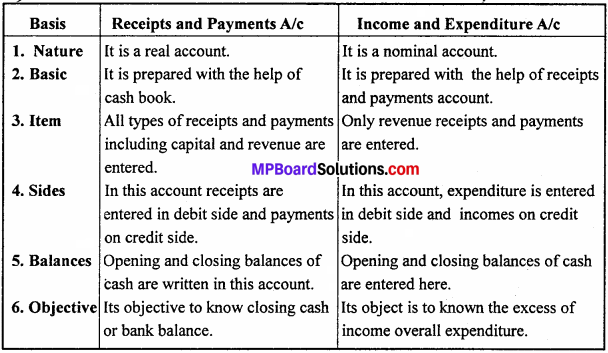
  2. Among the various fund provided by government, scholarship given to the students will be debited in Income Expenditure Account.
  3. If Sport Fund is shown then all the expenses related to sports will be shown in debit side of Income and Expenditure Account.
  4. Receipts and Payment Account does not show the difference between capital and receipts.
  5. The Receipt and payment account is a summary of all capital receipts and payment.
  6. Donation for specific purpose will be always capitalized.
  7. Receipts and payment account only record the revenue matured receipts and payment.

Answer:

  1. False
  2. False
  3. False
  4. True
  5. False
  6. True
  7. False.

Question 5.
Write the answer in one word/sentence:

  1. Income & Expenditure account is prepared on the basis of which account ?
  2. Which type of institution prepare Income Expenditure account ?
  3. Persons who earn income utilizing their intelligence and skills are called as ?
  4. Non-trading concern keep their accounts by which system ?
  5. Account which is the summary of cash book is known as ?

Answer:

  1. Receipts & Payment A/c
  2. Non-trading Concern
  3. Professional person
  4. Cash system
  5. Receipts & Payment A/c

MP Board Solutions

Accounting for Non – profit Organization Very Short Answer Type Questions

Question 1.
Write one important difference between receipts and payment account and Income and Expenditure account
Answer:
Receipts and payment account is a real account while Income and Expenditure account is a nominal account.

Question 2.
Write any one basis of difference between trading concern and non-trading concern.
Answer:
Aim of non-trading concern is to serve the society while the aim of trading concern is to maximize profit.

Question 3.
What do you mean by non-trading concerns ?
Answer:
Non-trading concerns are those concerns, whose aim is not to do business and earn profit but to serve the public. It includes hospitals, clubs, schools and colleges, etc.

Question 4.
Write the names of incomes and expenses of a non-trading concern.
Answer:
The following are the incomes and expenses of a non-trading concerns : Income : Annual membership fee, charity, interest, rent from sublet, income from the sale of waste materials, etc.
Expenses : Stationery, wages, charity, postal charges, electricity charges, subscription to newspapers, etc.

Question 5.
What do you mean by receipt and payment account ?
Answer:
Receipt and payment account is the summary of cash book in which all receipts are debited and all the payments are credited. In receipt and payment opening balance and closing balance of cash is also shown.

Question 6.
Why non-cash transactions are not entered in receipts and payment ac¬count ?
Answer:
Non cash transactions are not entered in receipts and payment account because it is prepared on the basis of cash book of accounting.

Question 7.
What do you mean by income and expenditure account and by whom it is prepared ?
Answer:
Income and expenditure account is a type of profit and loss account, which is prepared at the end of the accounting year with the help of receipts and payments by the non-trading concerns. Income and expenditure account is prepared by non-trading institutions and professional persons to know their annual income and expenditure.

Question 8.
What is the nature of income and expenditure account ?
Answer:
Income and expenditure is a nominal account.

Question 9.
Which account is prepared by non-trading concern is place of profit and loss account ?
Answer:
Income and expenditure account is prepared in place of profit and loss account.
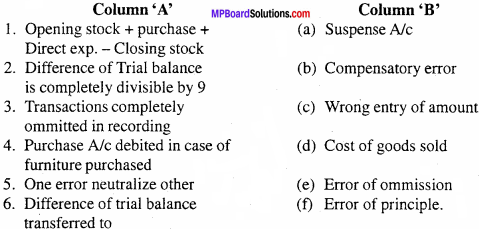
Question 10.
What is surplus in income and expenditure account ?
Answer:
Excess of income over expenditure refers to surplus in an income and expenditure account.

Question 11.
What is the basis of preparing income and expenditure account ?
Answer:
Income and expenditure account is prepared on accrual basis.

Question 12.
A school collected Rs. 50,000 as donation for the construction of buildings. In which side of school’s balance sheet will it be showed ?
Answer:
In the liabilities side of balance sheet.

Question 13.
Following balance appeared in the books of Modern club in the beginning of the year :

  • Fixed assets Rs. 50,000,
  • Bank overdraft Rs. 5,000,
  • Subscribed received in advance  Rs. 2,000.
  • Prepared rent Rs. 1,000.

Find the opening capital.

Answer:
Capital fund = Rs. 50,000 + Rs. 1,000 – Rs. 5,000 – Rs. 2,000
= Rs. 51,000 – Rs. 7,000 = Rs. 44,000.

MP Board Solutions

Accounting for Non – profit Organization Short Answer Type Questions

Question 1.
What is life time membership fees ?
Answer:
In non-trading organization some person becomes the life time member of the firm. The fee taken from such kind of persons is called as life time membership fee. This fees is not for a particular year but for the whole period. So it is treated as capital receipts and added to capital fund. It is also shown separately in the liabilities side.

Question 2.
What do you mean by endowment fund ?
Answer:
The cash or assets received by the members of the concern from the third person is called ‘endowment fund’. It is of capital nature, hence is written in receipt and payment account and is Shown in liability side of balance sheet.

Question 3.
state the meaning of ‘Not – for – Profit’ Organizations.
Answer:
Not – for – Profit Organizations (NPO) are set up with the prime objective of providing services and not to earn profit thereby enhancing the welfare of society. Such organizations include schools, hospitals, trade unions, religious organizations, etc. The person/s or the groups of individuals who govern and manage the working of an NPO are known as trustees.

NPO’s main sources of income are donations, subscriptions, life membership fees, grants etc. As these organizations are not set up with profit motive, they do not prepare Trading and Profit and Loss Account. Instead, they maintain Receipt and Payments Ac-count, Income and Expenditure Account and Balance Sheet.

MP Board Solutions

Question 4.
State the meaning of Receipt and Payment Account.
Answer:
Receipts and Payments Account is a summary of the Cash Book. All cash receipts are recorded on the Receipts side (i’. e., Debit side) and all cash payments are recorded on the Payments side (i.e., Credit side) of Receipts and Payments Account. It is prepared on the basis of cash and bank transactions recorded in the Cash Book. It begins with the opening balance of cash and bank and ends with the closing balances of cash and bank (balancing figure) at the end of the accounting period.

It records all cash and bank transactions both of capital and revenue nature. It not only records the cash and bank transactions relating to the current accounting period, but also the cash and bank receipts (or payments) received during the current accounting period that may be related to the previous or next accounting period. This account only helps us to ascertain the closing balance of the cash and bank and helps in assessing the cash position of an NPO.

Question 5.
State the meaning of Income and Expenditure Account.
Answer:
Income and Expenditure Account (I&E) is similar to the Profit and Loss Account in the sense that while the former is prepared to ascertain surplus or deficit during an accounting period, the latter is prepared to ascertain net profit or net loss incurred during an accounting period. I&E Account is a nominal account and is prepared on the accrual basis. It records all transactions of revenue nature that are related to the current accounting period (whether outstanding or prepaid) for which the books are maintained.

All expenses and losses are recorded on the debit side (Expenditure side) and all income and gains are recorded on the credit side (Income side) of I&E Account. The closing balance or the balancing figure of I&E Account is termed as surplus (or deficit), if the sum total of the Income side exceeds (is lesser than) the sum total of the Expenditure side.

Question 6.
Write the objective of receipts and payment account.
Answer:
Following are the objectives of receipts and payment account:

  1. Knowledge of cash: This account is summary of cash book on the basis of which the closing cash balance for a certain period can be known.
  2. Knowledge of cash receipts: By the help of this account the cash receipts of the organization at the beginning, mid of the year and at the end of the year can be easily found out.
  3. Knowledge of cash payments: Receipts and payment account shows all the cash payments made by the organization at the end of the year.
  4. 4. Basis of income and expenditure a/c:  With the help of receipts and payment account, income and expenditure account is prepared.

What is subscription? How is it calculated?
Answer:
subscription is the main source of income for an NPO besides entrance fees, donations, grants, etc. Subscriptions refer to the amount of money paid by the members on periodic basis for keeping their membership with the organization alive. It is paid monthly, quarterly, half yearly or annually by the members.

It is shown in the debit side of the Receipt and Payment Account with the total amount received during the year that may be related to the current period and to the previous and next accounting period. While calculating subscription for the current period, advance subscription received for the current period in the previous period and outstanding subscription for the current period are added to the subscription received during the current period.

Whereas, on the other hand, advance subscription received for the next accounting period during the current period and outstanding subscription for the preceding period are deducted from the subscription received during the current period.

Calculation of Subscription:
Subscription received during the year
Add: Subscription received (in advance) during previous year for current year
Add: Subscription outstanding at the end of the year
Less: Subscription received in advance for the next year
Less: Subscription outstanding for the previous year
## Subscription shown in Income and Expenditure Account

This subscription is related to the current accounting period and is shown in the In-come side of the Income and Expenditure Account.

MP Board Solutions

Question 8.
What is Capital Fund? How is it calculated?
Answer:
Capital fund is the excess of NPOs’ assets over its liabilities. In other words, the excess of assets over the liabilities for a profit earning organization is termed as capital and the same for an NPO is termed as capital fund. Any surplus or deficit ascertained from Income and Expenditure account is added to (deducted from) the capital fund. It is also termed as Accumulated Fund.

Calculation of Capital Fund
Capital Fund at the beginning of the year
Add: Surplus from Income and Expenditure Account
Add: Subscription Amount (Capitalized amount)
Add: Life membership fee.
Less : Deficit from Income and Expenditure Account
Capital Fund at the end of the year

Question 9.
Explain the statement: “Receipt and Payment Account is a summarized version of Cash Book”.
Answer:
Receipts and Payments Account is a summary of the Cash Book. This account is prepared by those organizations which maintain their books on cash basis. All cash receipts are recorded on the Receipts side (i.e., Debit side) and all cash payments are recorded on the Payments side (i.e., Credit side) of Receipts and Payments Account. It is prepared on the basis of cash and bank transactions recorded in the Cash Book.

It begins with the opening balance of cash and bank and ends with the closing balances of cash and bank (balancing figure) at the end of the accounting period. It records all the cash and bank transactions both of capital and revenue nature. It not only records the cash and bank transformations relating to the current accounting period, but also cash and bank receipts (or payments) received during the current accounting period that may be related to the previous or next accounting period.

This account only helps us to ascertain the closing balance of the cash and bank and helps in assessing the cash position of an NPO. It also forms the basis for the preparation of Income and Expenditure Account.

MP Board Solutions

Question 10.
What steps are taken to prepare Income and Expenditure Account from a Receipt and Payment Account ?
Answer:
The following steps are taken to prepare Income and Expenditure Account (I&E) from Receipts and Payment Account (R&P).

Step 1:
All the revenue expenditures paid for the current accounting period are transferred from the Payments side of R&P to the Expenditure side of I&E.

Step 2:
All the revenue receipts for the current accounting period are transferred from the Receipts side of R&P to the Income side of I&E.

Step 3:
Expenses outstanding for the current period and expenses paid in advance (prepaid expenses) for the current period in the preceding accounting periods are to be added (adjusted) to their related expenses in the Step 1.

Step 4:
Income outstanding (accrued income) for the current period and income re-ceived in advance for the current period in the preceding accounting periods are to be added (adjusted) to their related incomes in Step 2.

Step 5:
Non-cash items like depreciation, appreciation for the current accounting period are to be adjusted in the I&E.

Step 6:
After adjusting all the revenue items for the current accounting period, the Income and the Expenditure sides are totaled. If the sum total of the Income side exceeds (or is lesser than) the sum total of the Expenditure side, then the balancing figure is termed as surplus (or deficit).

MP Board Solutions

Accounting for Non – profit Organization Long Answer Type Questions

Question 1.
Differentiate the receipts and payments account and cash account, (any 2)
Answer:
Difference between receipts and payments account and cash account:
Receipts and Payments A/c:

  1. It is maintained by non-trading concerns.
  2. It is a summary of cash account.
  3. Income and expenditure account is prepared from it.
  4. Date is written at the top along with the heading.

Cash A/c:

  1.  It is prepared by both the trading and non-trading concerns.
  2. It is main account and write daily.
  3. Receipts and payments account is prepared from it.
  4. Date is written along with each transact-ion.

Question 2.
“Income and Expenditure Account of a Not – for – Profit Organisation is akin to Profit and Loss Account of a business concern”. Explain the statement.
Answer:
Income and Expenditure Account (I&E) is similar to Profit and Loss Account (P&L), in the sense that the former is prepared by Not-for-profit-Organisations and the latter is prepared by profit earning organisations. Both the accounts are prepared on the accrual basis.

Similar to the P&L, all the expenses and losses pertaining to the current accounting period are recorded on the debit side (Expenditure side) and all the gains and income of the current accounting period are recorded on the credit side (Income side) of the I&E.

The balancing figure of the I&E is surplus or deficit and that of the P&L is net profit or net loss. Both the accounts record only revenue items which are related to the current accounting period. Similarities between Income and Expenditure Account and Profit and Loss Account I&E Account of an NPO is akin to the Profit and Loss Account of a profit earning business in the following manners.

1. Nature of Account: Both the concerned accounts are nominal in nature.

2. Basis of Recording: Both the accounts record only revenue expenses and revenue income related to the current accounting period. The items of capital nature are not ignored while preparing these accounts.

3. Period: Transactions related to current year are recorded in Income and Expenditure account in the same manner in which profit and loss account is prepared. Transactions related to previous year or next year are excluded.

4. Adjustments: The treatment of adjustments like, outstanding expenses, prepaid expenses, income received in advance, income due but not received, depreciation, bad debts etc. is same as that in Profit and Loss Account. Thus, both the accounts are prepared on the accrual basis.

MP Board Solutions

Question 3.
Why does non-trading concerns maintain their accounts on the basis of cash system ? Given any five reasons.
Answer:
Due of the following reasons, non-trading concerns are maintaining these books of accounts according to the cash system of book-keeping.

  1. Easy method: Cash system is in easy method. It is a part of cash-book and its is maintained as a cash-book is prepared.
  2. Less expensive system: Under this method, no need for keeping more accounts. Even untrained and un experienced persons can do this work.
  3. Limited transactions: In non-trading concerns, the number of receipts and payments are limited.
  4. Cash transaction: Only cash receipts and payments are entered here as in the cash-book. If there is more credit transactions it will be entered in memorandum book.
  5. Checking of correctness: Correctness can be checked by comparing with cash-book.

Question 4.
What points should be kept in mind while preparing the receipts and payments account ?
Answer:
The following points should be kept in mind while preparing receipts and payments account:

  1. In this account, enter first of all the opening cash balance. This balance might be closing balance of the previous year.
  2. Only cash transaction, i.e., cash receipts and payments are entered and no credit transaction.
  3. All types of capital and revenue nature transactions are entered here.
  4. All types of receipts and payments whether they relate to previous, current or coming year should be entered.
  5. No adjustment relating to outstanding, prepaid, as earned and accrued are done here.

Question 5.
Differentiate the receipts and payments account and income and expenditure account ? (any 4 points)
Answer:
Differences between receipts and payments and income and expenditure

MP Board Class 12th Accountancy Important Questions Chapter 1 Accounting for Non-profit Organization - 1

Question 6.
Describe in brief the sources of income of non-trading concern.
Answer:
The various sources of income of non trading concern are :

(a) Subscription:
Subscription is the main source of income for the non-trading concern. It is the amount paid by the members of the organization monthly or yearly for keeping their membership with the organization alive.

(b) Donation:
Donation refers to the amount received by the organization as gift from the members or outsiders. If the amount of donation is merge, it will be treated as revenue income. But if the amount is huge and for specific purpose, then it is treated as capital receipt.

(c) Entry fee:
Amount paid by new member at the time of joining an organization is known as entry fee. It is paid by every member once at the time of becoming a member of the organization.

(d) Interest:
For increasing its sources of income, these non-trading organization invest money outside. The interest earned on this investment is also a source of income.

(e) Income from entertainment:
These organization organize various types of cultural programmes and collected income from the common people.

(I) Rent received:
By giving the building or some other portion in rent, the rent received is also a source of income for them.

MP Board Solutions

Question 7.
What are the process of preparing income and expenditure account from receipts and payments account ?
Answer:
The following is the process of preparing income and expenditure account from receipts and payment account:

(a) Opening cash and bank balance:
It is not entered in income and expenditure account. It is shown in assets side of opening balance sheets.

(b) Closing cash and bank balance:
It is not recorded in income and expenditure account. It is shown in assets side of closing balance sheet.

(c) Capital receipts:
Capital receipts are not entered in income and expenditure account. It is shown in liabilities side of closing balance sheet. Example of capital receipts are donation fund, sports fund, prize fund etc.

(d) Reserve and fund:
Reserve and funds are not recorded in income and expenditure account. It is shown in liabilities side of balance sheet and the concerned expenses are deducted from it.

(e) Sale of fixed assets:
Sale of fixed assets is not shown in income and expenditure account. It is entered in assets side of balance sheet by deducting if from concerned assets.

(f) Capital payments:
Capital payments are not entered in income and expenditure account. It is shown in assets side of closing balance sheet. Example of capital payments are purchase of assets, investment fixed deposits etc.

Question 8.
How is capital fund ascertained in non-trading organization ?
Or
How is initial capital ascertained in non-trading organizations ? Explain.
Answer:
For calculating initial capital, an opening balance sheet is prepared with the help of last year’s assets and liabilities. The total of liabilities side is deducted from the total of assets side and the difference thus gained is called initial capital.
Capital = Total assets – Total liabilities on opening date.

MP Board Class 12 Accountancy Important Questions

MP Board Class 11th Accountancy Important Questions Chapter 9 Trial Balance

MP Board Class 11th Accountancy Important Questions Chapter 9 Trial Balance

Trial Balance Important Questions

Trial Balance Objective Type Questions

Question 1.
Choose the correct answer:

Question 1.
What kind of accuracy is tested by Trial balance –
(a) Theoritical
(b) Practical
(c) Arithmetical
(d) None of these.
Answer:
(c) Arithmetical

Question 2.
How many methods are there for preparing Trial Balance –
(a) One
(b) Three
(c) Four
(d) None of these.
Answer:
(c) Four

MP Board Solutions

Question 3.
Which of the following is prepared on the basis of Trial Balance –
(a) Journal
(b) Ledger
(c) Final Accounts
(d) None of these.
Answer:
(c) Final Accounts

Question 4.
Of the two sides of Trial balance does not tally, which Account is opened –
(a) Suspense Account
(b) Personal Account
(c) Real Account
(d) None of these.
Answer:
(a) Suspense Account

Question 5.
The error which can be disclosed by Trial balance –
(a) Error of ommission
(b) Error of principal
(c) Compensatory error
(d) None of these.
Answer:
(d) None of these.

Question 2.
Fill in the Blanks:

  1. Trial balance is merely a …………… not an Account.
  2. …………….. are prepared on the basis of Trial balance.
  3. Trial balance is a test of …………….. Accuracy.
  4. Generally …………… does not form a part of Trial balance.
  5. ……………. stock is not included in Trial balance.

Answer:

  1. Statement
  2. Final Accounts
  3. Arithmetical
  4. Closing stock
  5. Closing stock.

Question 3.
Answer in one word/sentence:

  1. “A Trial balance is a statement of debit and Credit Balances Extracted from the ledger with a view to test the arithmetical accuracy of the books.” Who said this?
  2. Mention any account which can show Debit or Credit Balance.
  3. Debtor’s Accounts always show which balance?
  4. What Balance is shown by Drawing Account?
  5. How many methods are there for preparing trial balance?
  6. Is trial balance Ultimately proof of accuracy of accounts?
  7. What is the nature of suspense A/c ?

Answer:

  1. J.R. Batliboi
  2. Rent
  3. Debit
  4. Debit
  5. Four methods
  6. No
  7. Fluctuating.

MP Board Solutions

Question 4.
State True or False:

  1. Closing stock appears outside the trial balance.
  2. A trial balance is not a conclusive proof of accounting accuracy.
  3. Trial balance is a test of only Arithmetical accuary.
  4. Trial balance helps to check the principles of Double Entry System.
  5. Trial balance is a part of ledger.

Answer:

  1. True
  2. True
  3. True
  4. True
  5. False.

Question 5.
Match the following:
MP Board Class 11th Accountancy Important Questions Chapter 9 Trial Balance
Answer:

1. (d)
2. (c)
3. (e)
4. (f)
5. (b)
6. (a).

Trial Balance Short Answer Type Questions

Question 1.
Define trial balance. Discuss its objects.
Answer:
A trial balance may be defined as “A trial “balance is not an account. It is a statement or a test of debit and credit balances of all ledger accounts as on a given date, prepared with the object of proving the arithmetical accuracy of ledger accounts”.

The main objects of preparing a trial balance are:

  1. The balance of any ledger account can be easily found from the trial balance without going through the pages of the ledger book.
  2. To check the arithmetical accuracy of the books.
  3.  It is a base for the preparation of final accounts.

Question 2.
Mention the merits and demerits of balance method of preparing trial balance.
Answer:
Following are the merits and demerits of balance method:

  1. Helpful in preparing final accounts – With the help of balances from trial balance in this method, final accounts are prepared.
  2. Small size – Some accounts show no balance and hence they are not recorded in trial balance. Hence the size reduces.
  3. Less chance of error – Due to small size, the totalling becomes easy and the chances of errors are minimised.

MP Board Solutions

Question 3.
Explain the preparation of trial balance under balancing method.
Answer:
Under this method, each account is totalled and balanced. Then this balance is transferred to the trial balance. If a particular account shows a debit balance, it is transferred to the debit balance column of trial balance and vice versa. At the end, both the columns are totalled in the trial balance. There should not be any difference. If there is some difference, there is some mistake and it must be corrected.

Question 4.
What is suspense account?
Answer:
Even after checking of journal and ledger completely, the errors are not located, then the difference amount is transferred to a temporary account, i.e., suspense account in order to tally the Trial Balance. In future, when errors are detected, suspense account is closed.

Trial Balance Long Answer Type Questions

Question 1.
Is trial balance a conclusive proof of accuracy of accounts? Explain.
Or
Explain the errors which are not disclosed by a trial balance.
Answer:
Generally, it is treated that, when the debit total and credit total agrees, the ledger accounts are prepared correctly. But then also it is not possible to agree with the accuracy of accounts because there are some errors which are not disclosed by a trial balance and the trial balance may agree. They are as follows:

1. Errors of omission:
If an entry is omitted to record in journal, it will not reflected in ledger accounts and trial balance, such type of an error, will not be disclosed by a trial balance. This type of an error is called ‘Errors of omission’ e.g., Sold goods to Mr. Kshitij for 5,000 is not entered in Journal.

2. Errors of principle:
When the transactions are entered against the principles of double entry system, it is said to be Errors of Principle’. For e.g. Machinery purchased for Rs. 5,000 is entered in purchase account. As per the rule of D.E.S. when an asset buys that particular asset is debited. This type of error will not be disclosed by the trial balance.

3. Compensating errors:
These are those errors where one error is compensated with another error, e.g., In wages A/c, it is entered Rs. 100 less and in salary account it entered Rs. 100 more. In this condition, both are errors. But one error is adjusted with another error. This type of error will not affect the agreement of trial balance and it will not be disclosed there.

4. Wrong posting in ledger accounts:
When journal entries are posted wrongly in ledger account, it will affect the agreement of trial balance, e.g., Instead of salary paid Rs. 1,000 entered in wages account with the same amount. This type of error will not disclose by the trial balance.

MP Board Class 11 Accountancy Important Questions

MP Board Class 11th Accountancy Important Questions Chapter 8 Bank Reconciliation Statement

MP Board Class 11th Accountancy Important Questions Chapter 8 Bank Reconciliation Statement

Bank Reconciliation Statement Important Questions

Bank Reconciliation Statement Short Answer Type Questions

Question 1.
Why is Bank Reconciliation Statement prepared?
Answer:
When it is found that there are some differences between the cash-book balance and passbook balance, these differences should be rectified. For this purpose, a statement is prepared on a particular date, which is known as Bank Reconciliation Statement.

Question 2.
What are the different methods of preparing B.R. statement ?
Answer:
The following are some of the methods of preparing B.R. statement:

  1. On the basis of debit balance as per cash – book
  2. On the basis of credit balance as per cash – book
  3. On the basis of debit balance as per passbook
  4. On the basis of credit balance as per passbook.

Question 3.
In a B.R. statement if the debit balance of a cash – book is given, which items to be added?
Answer:
The following items are added to the debit balance of a cash – book, when a B.R. statement is going to prepare:

  1. Cheques issued, but not presented for payment.
  2. Interest allowed by the bank, only entered in passbook.
  3. Dividends etc. collected and credited only in the passbook.
  4. A customer directly deposited in the customers account and only entered in pass¬book.
  5. Cheques issued and dishonoured but not entered in cash – book.
  6. Any wrong entry in credit side of passbook.

MP Board Solutions

Question 4.
Write five reasons why the cash – book balance and the passbook balance differ.
Answer:
Due to the following reasons, the cash-book balance and passbook balance may vary

  1. Cheques issued but not presented for payment
  2. Cheques deposited in the bank but not credited in the passbook
  3. Cheques deposited entered in the cash – book, but forget to sent the bank
  4. Interest on deposit allowed by the bank entered in the passbook but not in cash – book
  5. Bank charges charged by the bank only entered in the passbook and not in the cash-book.

Question 5.
Explain the advantages of Bank Reconciliation statement.
Or
Explain the benefits of preparation of Bank Reconciliation statement.
Or
Write the utility or importance of Bank Reconciliation statement.
Answer:
The following are the advantages of preparing B.R. statement:

  1. Discovery of errors – With the help of its preparation, the errors which might committed either in the cash – book or in the passbook can be discovered.
  2. Helps to enter the transactions in the cash – book – The bank provides various agency services to the customers. But sometimes the bank fails to inform him then and there. For this purpose, the statement will become useful.
  3. Wrong entry in passbook – By preparing the B.R. statement, the wrong entry made in the passbook can be found out.
  4. To find out the correct balance – By preparing the B.R. statement, the correct balance at bank can be ascertained.
  5. For audit purpose – For audit purpose, it is necessary to prepare B.R. statement.

Question 6.
Explain the four features of bank reconciliation statement.
Answer:
The different characteristics of B.R. statement are as follows:

  1. When there is difference between cash – book balance and passbook balance, B. R. statement is prepared
  2. It is prepared on a fixed date
  3. It is prepared by the bank’s customer and not the bank
  4. It can be make even on a sheet of paper
  5. The main aim of this statement is to the reveal the errors and compare it.

Question 7.
What are uncollected cheques? Explain.
Answer:
As soon as the cheques are received by a trader, he sends them to bank for collection. If the amount is not deposited in trader’s account in the bank till a bank reconcilation statement is prepared, such cheques are called uncollected cheques.

Question 8.
How a B.R. statement is prepared on the basis of balance as per cash – book?
Answer:
In the following ways, B. R. statement is prepared on the basis of cash – book balances. They are added to it:

  1. Cheques issued but not presented for payment.
  2. Interest on deposit etc. entered only in passbook.
  3. Wrong entry in the credit side of passbook.
  4. Dividend collected by bank only entered in passbook.
  5. The customer directly deposited the amount in the customers A/c.

The following items are deducted from the cash-book balance :

  1. Cheques, bills, drafts, etc. deposited for collection but not collected till date.
  2. Bank charges, commission, expenses, etc. charged by the bank only entered in passbook.
  3. Interest on overdraft and charges only in passbook.
  4. Bills discounted with the bank but dishonoured.
  5. Cheques debited in cash – book but forget to send them to the bank.

MP Board Solutions

Question 9.
How a B.R. statement is prepared by taking passbook balance?
Answer:
The debit balance of passbook means that the businessman (customer) has to give money to the bank or the customer has taken an overdraft from the bank and credit balance of passbook shows the deposit balance of the customers.When a B.R. statement is prepared the following points should be kept in mind. When the passbook shows a credit balance, the following items are added:

  1. Cheques deposited in the bank, but not collected there.
  2. Expenses paid by bank, commission charged, interest on overdraft, etc. entered only in the passbook and not in the cash-book.
  3. A discounted bill, dishonoured which was not entered in the cash-book.

The following items are deducted:

  1. Cheques issued but not presented for payment.
  2. Interest on deposit only entered in cash – book.
  3. Dividend collected by the bank not entered in cash – book.
  4. Direct deposit made by a customer not entered in cash – book.
  5. When the passbook shows a debit balance, added items will be deducted and deducted items be added.

Bank Reconciliation Statement Long Answer Type Questions 

Question 1.
What is B.R. statement? Explain fully why and how it is prepared?
Answer:
When it is found that there are some difference between the cash – book balance and passbook balance, it should be rectified by means of statement on a particular date. This statement is known as bank reconciliation statement. There are various reasons behind this difference of balances. But it must be necessary to find out and reconcile it. With this aim, the bank reconciliation statement is prepared.

Objects:

  1. To find out the real bank balance
  2. To know the amount of interest allowed by the bank on deposit
  3. To know the amount of interest charged on overdraft By the bank
  4. To find out whether there is any error in passbook or in cash – book.

The need of bank reconciliation statement is as follows:

  1. By comparing the passbook balance with cash – book balance, it can be easily known about any undue delay in the clearance of cheque.
  2. If any errors were committed, it can be found out by comparing the balances in the B. R. statement.
  3. By preparing B. R. statement, the trader can find out how many cheques were presented for payment out of his issue and how many of them were not presented for payment.
  4. B. R. statement shows the total amount of interest allowed by the bank on customer’s deposit.
  5. It show’s how many cheques were collected by the bank directly from trader’s customers.

It is prepared as follows:

  1. It is prepared on the basis of cash-book or passbook balance.
  2. If it is prepared on the basis of RB. balance, C.B. balance is ascertained and vice versa.

MP Board Class 11 Accountancy Important Questions